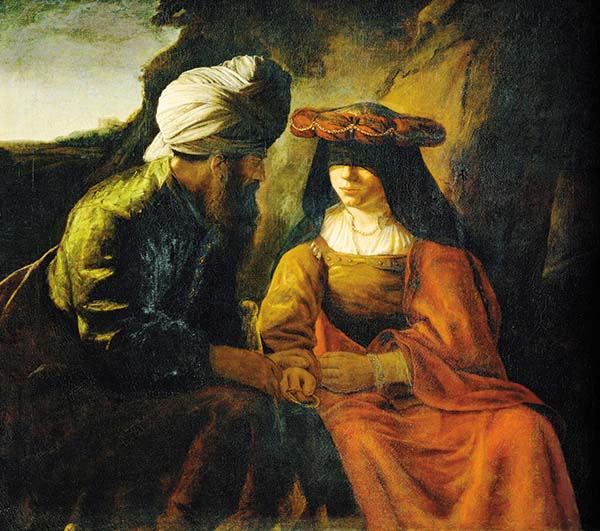
Hosea's Unconditional Love for Gomer
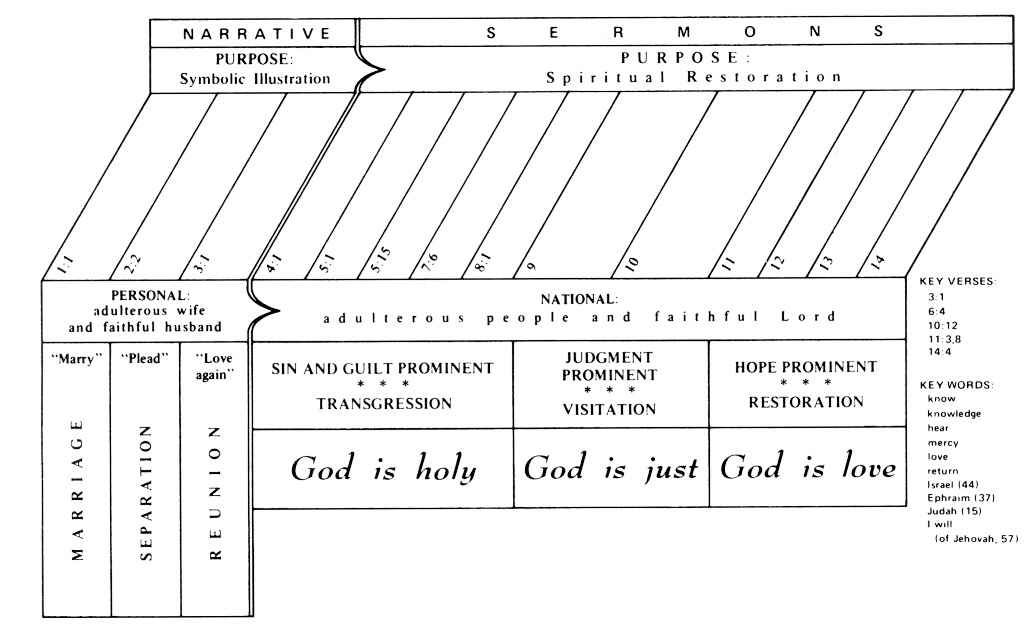
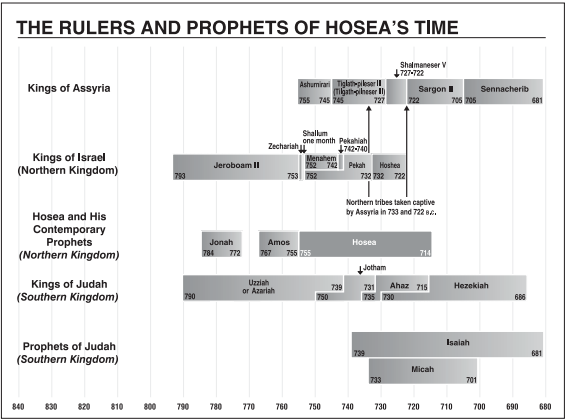
Click chart to enlarge
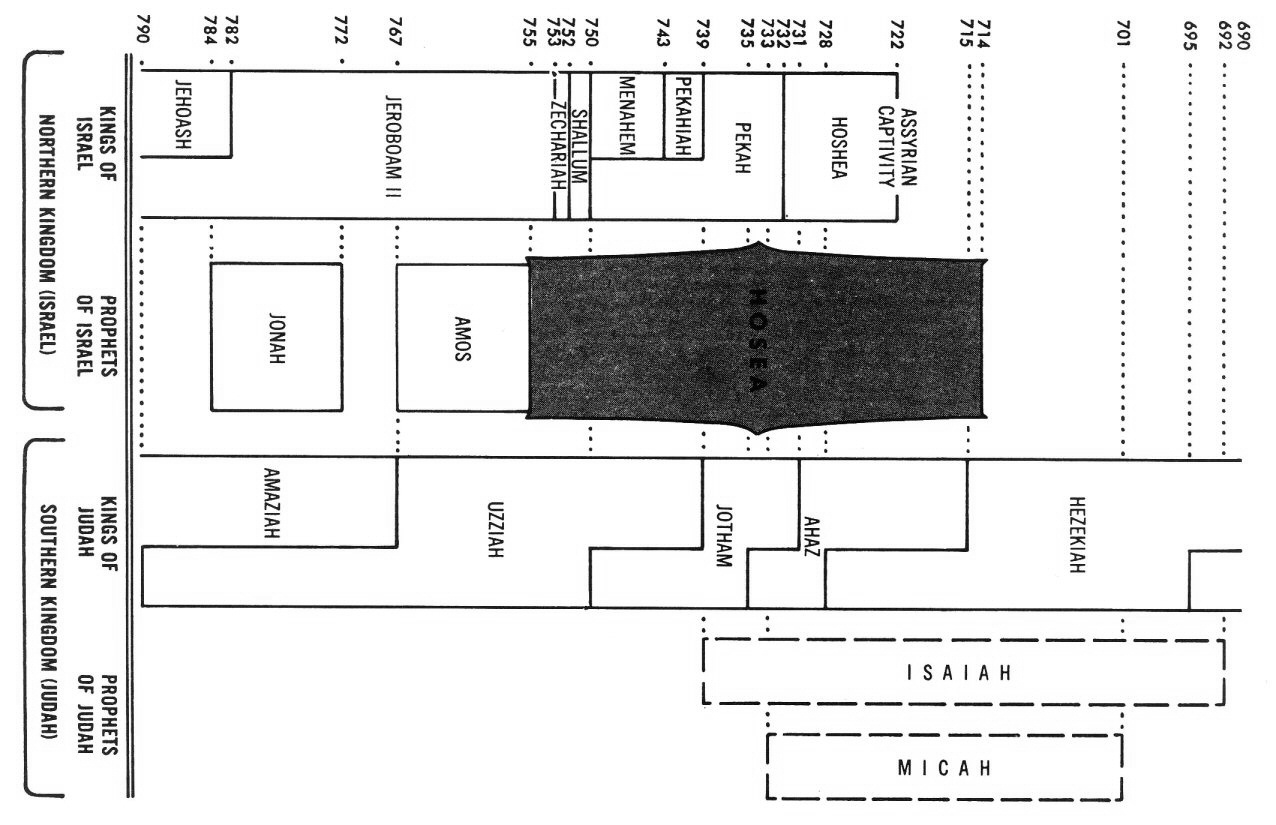
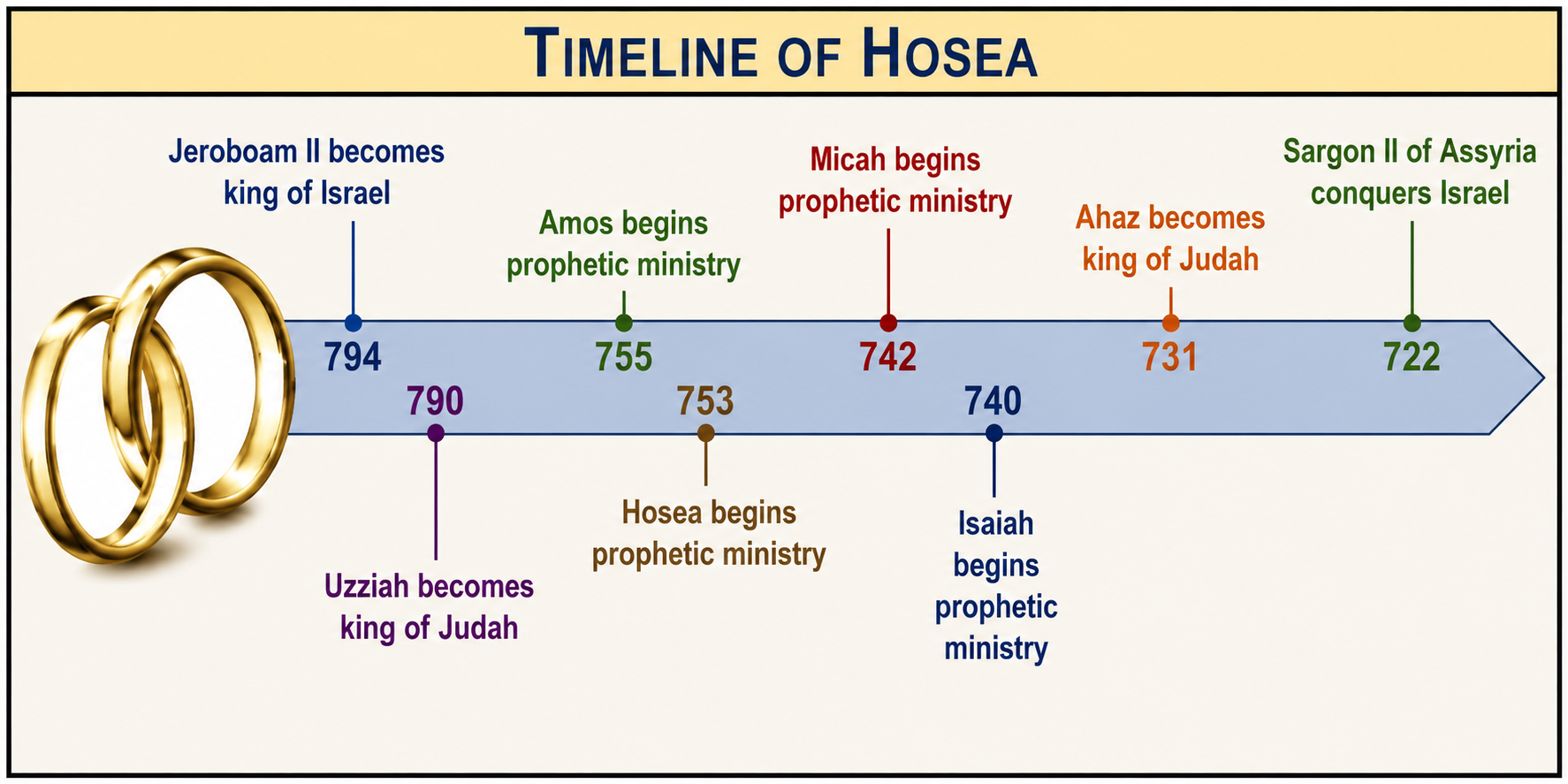
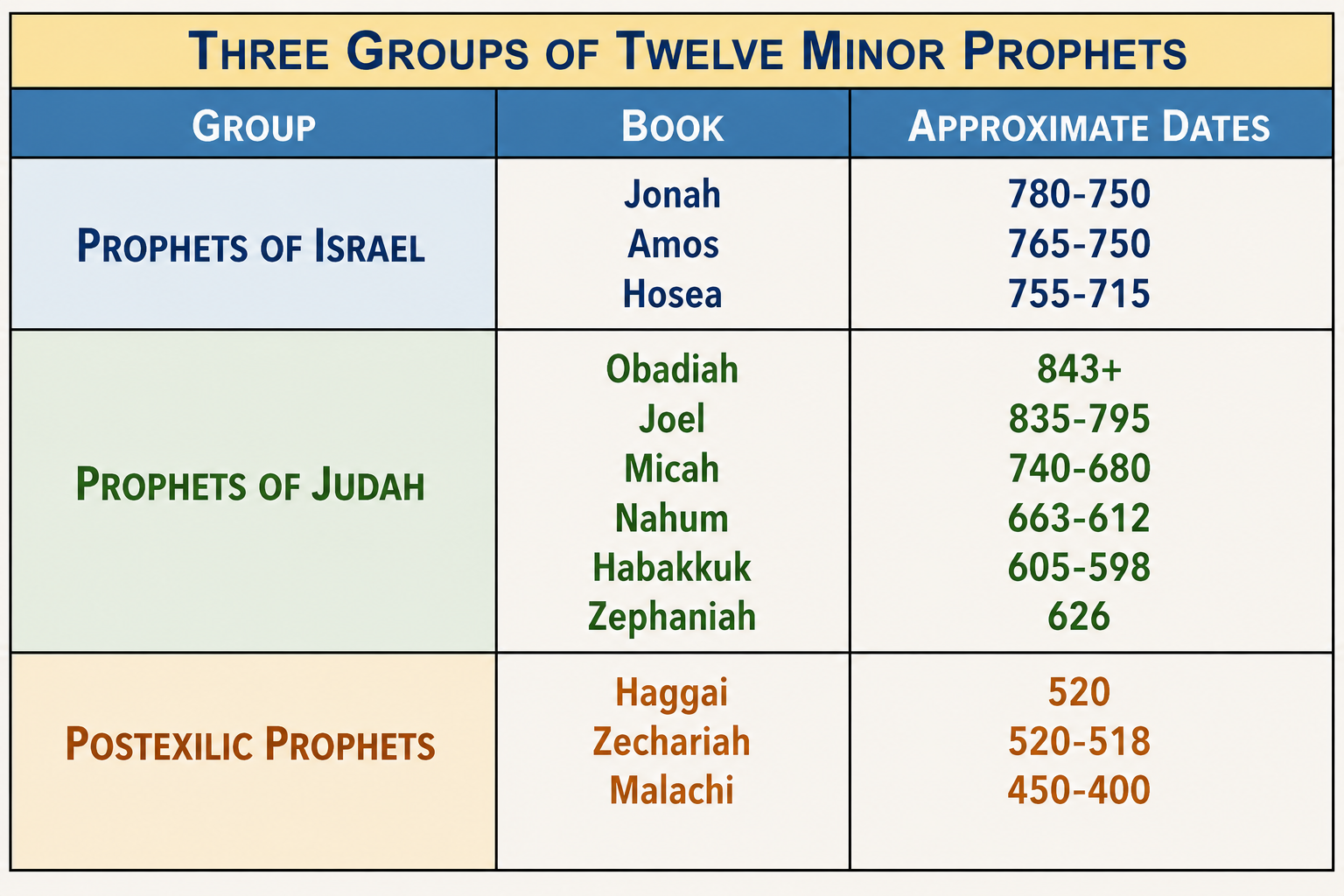
Click chart to enlarge
Chart from recommended resource Jensen's Survey of the OT - used by permission
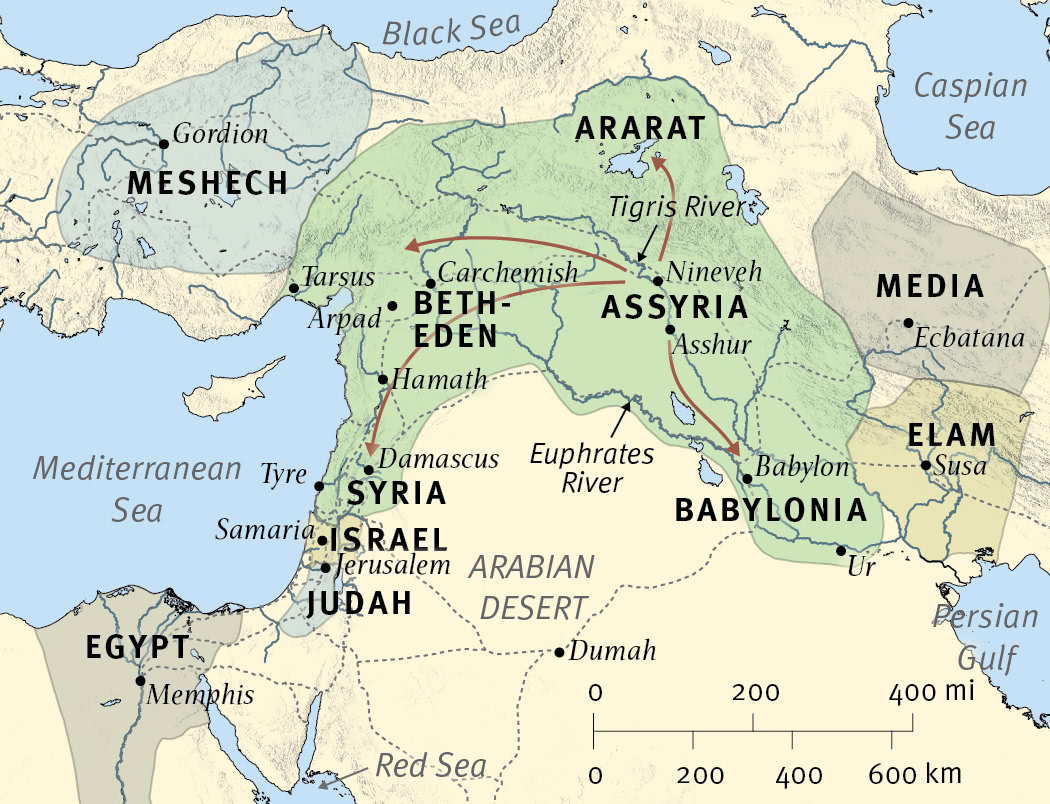
Source: ESV Global Study Bible
OUTLINE OF HOSEA
I. The Prodigal Wife, Hosea 1:1-3:5
A. Her Unfaithfulness, Hosea 1:1-11
B. Her Punishment, Hosea 2:1-13
C. Her Restoration and Israel's, Hosea 2:14-23
D. Her Redemption, Hosea 3:1-5
II. The Prodigal People, Hosea 4:1-14:9
A. The Message of Judgment, Hosea 4:1-10:15
1. The indictment, Hosea 4:1-19
2. The verdict, Hosea 5:1-15
3. The plea of Israel, Hosea 6:1-3
4. The reply of the Lord, Hosea 6:4-11
5. The crimes of Israel, Hosea 7:1-16
6. The prophecy of judgment, Hosea 8:1-10:15
B. The Message of Restoration, Hosea 11:1-14:9
1. God's love for the prodigal people, Hosea 11:1-11
2. God's chastisement of the prodigal people, Hosea 11:12-13:16
3. God's restoration of the prodigal people, Hosea 14:1-9
Ryrie Study Bible
Robert Chisholm points out that there are 5 "Judgment-Salvation" cycles in the book of Hosea:
| CYCLES OF JUDGMENT AND SALVATION IN HOSEA |
|
|
JUDGMENT |
SALVATION |
|
Hosea 1:2-9 |
Hosea 1:10-2:1 |
|
Hosea 2:2-13 |
Hosea 2:14-3:5 |
|
Hosea 4:1-5:14 |
Hosea 5:15-6:3 |
|
Hosea 6:4-11:7 |
Hosea 11:8-11 |
|
Hosea 11:12-13:16 |
Hosea 14:1-9 |
Hosea 3:1 Then the LORD said to me, "Go again, love a woman who is loved by her husband, yet an adulteress, even as the LORD loves the sons of Israel, though they turn to other gods and love raisin cakes."
NET The LORD said to me, "Go, show love to your wife again, even though she loves another man and continually commits adultery. Likewise, the LORD loves the Israelites although they turn to other gods and love to offer raisin cakes to idols."
LXE And the Lord said to me, Go yet, and love a woman that loves evil things, an adulteress, even as the Lord loves the children of Israel, and they have respect to strange gods, and love cakes of dried grapes.
NLT Then the LORD said to me, "Go and love your wife again, even though she commits adultery with another lover. This will illustrate that the LORD still loves Israel, even though the people have turned to other gods and love to worship them. "
KJV Then said the LORD unto me, Go yet, love a woman beloved of her friend, yet an adulteress, according to the love of the LORD toward the children of Israel, who look to other gods, and love flagons of wine.
ESV And the LORD said to me, "Go again, love a woman who is loved by another man and is an adulteress, even as the LORD loves the children of Israel, though they turn to other gods and love cakes of raisins."
CSB Then the LORD said to me, "Go again; show love to a woman who is loved by another man and is an adulteress, just as the LORD loves the Israelites though they turn to other gods and love raisin cakes."
NIV The LORD said to me, "Go, show your love to your wife again, though she is loved by another and is an adulteress. Love her as the LORD loves the Israelites, though they turn to other gods and love the sacred raisin cakes."
NAB Again the LORD said to me: Give your love to a woman beloved of a paramour, an adultress; Even as the LORD loves the people of Israel, though they turn to other gods and are fond of raisin cakes.
NKJ Then the LORD said to me, "Go again, love a woman who is loved by a lover and is committing adultery, just like the love of the LORD for the children of Israel, who look to other gods and love the raisin cakes of the pagans."
NJB Yahweh said to me, 'Go again, love a woman who loves another man, an adulteress, and love her as Yahweh loves the Israelites although they turn to other gods and love raisin cakes.'
GWN Then the LORD told me, "Love your wife again, even though she is loved by others and has committed adultery. Love her as I, the LORD, love the Israelites, even though they have turned to other gods and love to eat raisin cakes."
NRS The LORD said to me again, "Go, love a woman who has a lover and is an adulteress, just as the LORD loves the people of Israel, though they turn to other gods and love raisin cakes."
YLT And Jehovah saith unto me: 'Again, go, love a woman, loved of a friend, and an adulteress, like the loved of Jehovah, the sons of Israel, and they are turning unto other gods, and are lovers of grape-cakes.'
- Go again: Ho 1:2,3
- her husband: Jer 3:1,20 *marg: Mt 26:50
- even as the LORD loves the sons of Israel: Ho 11:8 De 7:6,7 Jdg 10:16 2Ki 13:23 Ne 9:18,19,31 Ps 106:43-46 Jer 3:1-4,12-14 31:20 Mic 7:18-20 Zec 1:16 Lu 1:54,55
- though they turn to other gods: Ps 123:2 Isa 17:7,8 45:22 Mic 7:7
- ove raisin cakes: Ho 4:11 7:5 9:1,2 Ex 32:6 Judges 9:27 Am 2:8 6:6 1Co 10:7,21 1Pe 4:3
Duane Garrett: GOMER'S RESTORATION (3:1–5)
- Yahweh's Command (3:1)
- Hosea's Response (3:2–3)
- Explanation: Punishment and Reversal (3:4–5)
- I. Love Breaks Deadlocks, 3:1-3
3:1 Go, Remarry Your Ex
3:2-3 Taking the Initiative - II. What Else Shall We Expect?
3:4-5 3:4 Restoring Trust Takes Time
3:5 The Result Is Worth It Al
Related Passages:
Hosea 1:2 "When the LORD first spoke through Hosea, the LORD said to Hosea, 'Go, take to yourself a wife of harlotry and have children of harlotry; for the land commits flagrant harlotry, forsaking the LORD.'"
Exodus 20:3 "You shall have no other gods before Me."
Deuteronomy 7:7–8 "The LORD did not set His love on you nor choose you because you were more in number than any of the peoples, for you were the fewest of all peoples, but because the LORD loved you and kept the oath which He swore to your forefathers, the LORD brought you out by a mighty hand and redeemed you from the house of slavery."
Deuteronomy 31:20 "For when I bring them into the land flowing with milk and honey, which I swore to their fathers, and they have eaten and are satisfied and become prosperous, then they will turn to other gods and serve them, and spurn Me and break My covenant."
Judges 2:17 "Yet they did not listen to their judges, for they played the harlot after other gods and bowed themselves down to them."
Jeremiah 3:20 "'Surely, as a woman (LIKE GOMER) treacherously departs from her lover, so you have dealt treacherously with Me, O house of Israel,' declares the LORD."
Jeremiah 31:3 "The LORD appeared to him from afar, saying, 'I have loved you with an everlasting love; therefore I have drawn you with lovingkindness.'"
Ezekiel 16:8 "Then I passed by you and saw you, and behold, you were at the time for love; so I spread My skirt over you and covered your nakedness. I also swore to you and entered into a covenant with you so that you became Mine," declares the Lord GOD.
Malachi 1:2 "'I have loved you,' says the LORD. But you say, 'How have You loved us?'"
Hosea 11:8 "How can I give you up, O Ephraim? How can I surrender you, O Israel?... My heart is turned over within Me, all My compassions are kindled."
Hosea 14:4 "I will heal their apostasy, I will love them freely, for My anger has turned away from them."
Romans 5:8 "But God demonstrates His own love toward us, in that while we were yet sinners, Christ died for us."
Ephesians 5:25 "Husbands, love your wives, just as Christ also loved the church and gave Himself up for her."
1 John 4:10 "In this is love, not that we loved God, but that He loved us and sent His Son to be the propitiation for our sins."
DIVINE COMMISSION
NUMBER TWO
Charles Feinberg - THOUGH THE THIRD CHAPTER of Hosea consists of but eighty-one words in the original Hebrew, it rightfully takes its place among the greatest prophetic pronouncements in the whole revelation of God. The expression, "multum in parvo” (much in little space), is certainly true of this passage. With skillful and quick lines, the prophet, through the Spirit of God, paints for us the complete picture of Israel’s national history. The fourth verse of the chapter is one of the surest proofs of the divine origin of prophecy and the Bible in general. This chapter has been likened to the eleventh chapter of Romans, because here, as there, God makes large disclosures of His plans and dealings, past, present, and future, with Israel, His chosen. (See The Minor Prophets)
Robert Chisholm sums up the theme of chapter 3 - As Hosea's experience with his unfaithful wife portrayed Israel's rejection of the Lord, so the recovery of his wayward wife pictured the Lord's love for and restoration of Israel. (See The Bible Knowledge Commentary Minor Prophets)
Then - This word marks progression and in this context follows the wonderful predictions of restoration of Israel at the end of chapter 2. Chapter 2 was the divine lawsuit and the promise of restoration, laid out in poetry. Chapter 3 brings it back to earth for God tells the prophet to act it out as an object lesson of God's great love for Israel despite her unfaithfulness. Hosea does not merely preach the sermon; he becomes it! What God announced He would do for Israel in Hosea 2:14–23, Hosea must now do for Gomer in his own household, at his own cost, in front of his neighbors! This would give us all a picture of radical love!
The LORD said to me - Now Yahweh is directly addressing the prophet (cf Hos 1:1)
Go again, love (aheb/ahab; LXX - agapao) - Again could modify go or love and commentators take both approaches. Either way one takes it, the commands explicitly point back to the first commission of Hosea 1:2, "Go, take to yourself a wife of harlotry." And so we see that this is commission number two, and it is far more difficult than the first. The first time he married a woman with a reputation. But this time he must reclaim a woman with a history! The implication clearly is that she has left Hosea to live as an adulteress but there is no clue as to how long this situation has existed. God is telling Hosea to bring her back (he would have to bring her back in order to show her love).
Love a woman (Gomer) who is loved (aheb/ahab; LXX - agapao) by her husband (Hosea) yet an adulteress (na'ap; LXX - moichalis) - Clearly the key word is love! God does not say "feel affection for her," or "see whether your heart might be rekindled." He issues a command. Biblical love is volitional and covenantal before it is emotional. Yahweh says that He knows Hosea loves Gomer. Some argue this is not Gomer because he uses the word "woman" and not "wife," but that is not in keeping with the context. It would not fit the comparison God makes with Himself. In other words, God did not love a different nation when Israel was unfaithful but the nation of Israel, and by analogy Hosea is not being called to love a different woman but his wife Gomer. Hosea's willingness to accept his unfaithful wife gives us just a small glimpse of how deeply Yahweh loves the unfaithful Israelites (and also how deeply He loves us beloved)!
Gomer is not neglected or unloved. She is loved by her own husband and yet she commits adultery. That is a picture of Yahweh's wife Israel, for they were not a people starved of divine attention, but a people lavished with it and in spite of God's attention, they went looking elsewhere. God commands Hosea to love Gomer while she is in another man's bed.
🙏 THOUGHT - Notice that Yahweh commands love (even of an unlovely spouse) clearly indicating that such love is possible (supernaturally). Love is a matter of the will. Feelings follow obedience more often than they precede it. Hosea was told to love a woman who had given him no reason to. It follows that husbands can obey God's command to love their wives in Eph 5:25. Such supernatural love requires a supernatural Source. Husbands, we need to be controlled by and empowered by the Spirit of God! David Guzik goes on to point out that "This is why “We’re not in love anymore” isn’t valid grounds for a bad relationship or divorce.It assumes that love is something beyond or outside of our will."
Hosea was to be a living lesson
of the Lord’s relationship with His people
Even as the LORD loves (ahabah) the sons of Israel, though they turn to other gods and love (aheb/ahab; LXX - phileo) raisin cakes." - God here gives Hosea the pattern of love with which he is love Gomer. Hosea is not asked to feel but to act in the confidence that a man who acts in love toward the unlovely is mirroring the love of his God. The Hebrew and Greek (present tense) of they turn both indicate Israel was habitually turning to other gods. And what a sad picture with raisin cakes! Israel willfully set aside the love of Yahweh for a taste for sweet cakes at an idol's table! And yet Yahweh still loved them!!!
Raisin cakes were a festival delicacy, the food of celebration and feasting. Raisin cakes were a special luxury gift to the people to celebrate the arrival of the ark in Jerusalem (2Sa 6:19; 1Chr 16:3), where the ark was placed inside a tent. They were a fertility-cult offering used in Canaanite worship, being presented to the idol and then eaten in the cult meal. The Amplified Version renders it the raisin cakes [used in the feasts in pagan worship]; NIV, "the sacred raisin cakes." Compare the cakes baked for the queen of heaven in Jer 7:18, Jer 44:19. The raisin cakes in the Song of Solomon (Song 2:5) are thought by some writers to be aphrodisiacs.
Charles Feinberg feels "These cakes of raisins are explained by Jeremiah 7:18 and Jer 44:19 as parts of a ceremony in honor of the queen of heaven; they speak of open worship of the idols of the day. What shame and open scandal this was in the eyes of God can be gleaned only faintly from the counterpart on the human scale in the life of the prophet. (See The Minor Prophets)
HCSB - Gomer rejected Hosea's genuine love of her for the selfish "love" of another man. In the same way, Israel preferred ("loved") raisin cakes to the faithful love Yahweh had for her. (See CSB Study Bible)
Bob Utley - Go again, love a woman who is loved by her husband, yet an adulteress" Notice YHWH is the speaker! This verse begins with two Qal IMPERATIVES. (1) Go and (2) Love (this VERB is used four times in this one verse) He is commanding Hosea to love again his unfaithful and divorced marriage partner. The second use of "love" is a Qal PASSIVE PARTICIPLE CONSTRUCT, which denotes the husband's (i.e. Hosea as an analogy of YHWH) ongoing love! ▣ "though they turn to other gods" This is the term (BDB 815, KB 937, Qal PARTICIPLE) that Moses used in predicting that the descendants of Jacob would become Canaanite fertility worshipers (cf. Deut. 31:18,20). YHWH Himself pleaded with them not to yield to this temptation (cf. Lev. 19:4; 20:6). FERTILITY WORSHIP OF THE ANE ▣ "and love raisin cakes" This is the fourth use of the VERB love (Qal PARTICIPLE), describing how the Israelites embraced Ba'al worship. These small delicacies were given to the worshipers after a time of sacrifice (cf. 2 Sam. 6:19). They are also referred to in Isa. 16:7 and Jer. 7:18; 44:19 as objects of fertility worship (also possibly Jer. 48:31).
Trent Butler - Raisin cakes, made of dried, compressed grapes, provided a rare delicacy in Israel's diet (Song 2:5). They apparently were part of the fertility rituals in Baal worship (Jer. 44:19). They represented part of the pay Israel thought they earned by worshipping Baal (Hos. 2:12). (See Holman Old Testament Commentary - Hosea, Joel, Amos - Page 24)
🙏 THOUGHT - Do we ever forgo (or ignore) God's amazing love so that we might (figuratively) have a taste of some sweet delicacy that we know is sinful? I think we do this almost every time we willfully, wantonly, volitionally choose to commit sin! Woe! Beloved, what are your "raisin cakes"?
TECHNICAL NOTE: Some versions (ESV, NIV, RSV, NRSV) have "loved by another man" rather than "loved by her husband" as in the NAS (NKJV, Amp). The NASB is more accurate because the analogy in the second half of the verse requires "loved by her husband." In other words, the comparison is the rightful husband loves her while she is unfaithful. If it were loved by another man the parallel would break down. Yahweh is never the "other lover" in this book but He is the wronged Husband.
Hosea 3:1 is the closest thing in the Old Testament to a dramatization of Romans 5:8 "But God demonstrates His own love toward us, in that while we were yet sinners, Christ died for us." Note the timing in both texts. Not after she repented. Not when she came to her senses. While she was still an adulteress.
God's love is not a response to our loveliness. It is a decision He made and keeps (1Jn 4:10). Hosea's commission proves that divine love is not drawn out by the beloved's worth but poured out from the Lover's character (cf Ro 5:5, 8).
J Vernon McGee - God is making an application here. In effect He says to Hosea, "Now you know how I feel. I want you to go and take Gomer again. She's been unfaithful to you, but you are to love her and take her back. That is what I am going to do with My people. Israel has been unfaithful to Me, and I am going to punish her, but some day I will bring her back to Myself." (See Thru the Bible: The Prophets Hosea/Joel)
David Thompson - Isn’t it true that we have all been like Gomer? Haven’t there been moments in our lives as a believer when we have been unfaithful to God and have failed Him? Cannot we all testify of things we have thought about, looked at or even done that have not pleased God? Haven’t we all said something or lost our temper or perhaps been jealous or envious or covetous? Really, haven’t there been moments when we really don’t deserve to be loved by God and, in fact, would deserve to be punished by God? Truth is we are all a lot like Gomer....How many times have we sold out our commitment to God for raisin cakes? Dr. S. Lewis Johnson said there is “hardly any one of us who could not look at our lives right now and find a half a dozen things which would classify as raisin cakes” (Hosea 3:1-5, p. 10). Scripture asks the question, what shall a man exchange for his soul? Suppose you literally went after the world and got it. What actually would you have? Absolutely nothing! Because when a soul leaves this world it will immediately realize I sold out my life for raisin cakes.
Now I want us to think about this context for a moment. This context says no matter how far you have fallen from God, He wants you back. No matter how twisted and tangled your life has become, He wants you back. You may have fallen deep into immorality. You may have worshipped false things. You may have been associating with low life people. God wants you back. He loves you and He wants you back. The proof is God says to Hosea, go get Gomer, bring her back and love her.
Adulteress (05003)(נָאַף nāʾap̱) is a verb meaning to commit adultery and is used literally of the physical act (Ex. 20:14; Lev. 20:10; Prov. 6:32; Jer. 5:7; 7:9; 29:23; Hos. 4:2; Mal. 3:5). Na'ap is also often used of spiritual adultery as well and as such is often equated with idolatry (Isa. 57:3; Jer. 3:9; Ezek. 23:37). Lxx translates this with the noun moichalis.
Na'ap -26v - Exod. 20:14; Lev. 20:10; Deut. 5:18; Job 24:15; Ps. 50:18; Prov. 6:32; Prov. 30:20; Isa. 57:3; Jer. 3:8; Jer. 3:9; Jer. 5:7; Jer. 7:9; Jer. 9:2; Jer. 23:10; Jer. 23:14; Jer. 29:23; Ezek. 16:32; Ezek. 16:38; Ezek. 23:37; Ezek. 23:45; Hos. 3:1; Hos. 4:2; Hos. 4:13; Hos. 4:14; Hos. 7:4; Mal. 3:5 adulterer(3), adulterers(5), adulteress(3), adulteresses(2), adulteries(1), adulterous(1), adultery(1), commit adultery(6), commits adultery(3), committed adultery(5), committing of adultery(1).
Love (0157) aheb/ahab means to love and can convey the idea of liking things (like bribes - Isa 1:23, wisdom - Pr 4:6, wine - Pr 21:17, peace and truth - Zech 8:19, food - Ge 27:4, 9, 14). The most important uses in the OT are as an expression of God's love of people (Dt 4:37, Hosea 3:1), man's love for God (Ex 20:6, Ps 116:1) and man's love for his fellow man (Ge 29:32, Ru 4:15-note, 1 Kings 11:1 = a forbidden love by backslidden King Solomon!!!) The first use of aheb in the OT is instructive as it is found in Ge 22:2 where Yahweh instructed his servant Abraham to "“Take now your son, your only son, whom you love, Isaac, and go to the land of Moriah; and offer him there as a burnt offering on one of the mountains of which I will tell you.” Notice that at the outset, we see that an inherent quality of this love (in many contexts) is that it is costly. God wants us to love Him above EVERYTHING, even our own flesh and blood. Matthews writes that Ge 22:2 "is the final test of the man’s faith, the closing bookend to his discovery of God’s sufficiency to achieve the promises made at Haran." (New American Commentary) As an aside God frequently "tests" His people to reveal their trust and obedience (cp Ex 15:25, 16:4, Judges 2:22 - in this last one they failed repeatedly). In Ge 25:28 there is a hint that Isaac's love was at least somewhat conditioned on the fact that Esau provided game for him to eat (cp Ge 27:4, 9, 14 of Isaac's love for the savory dish). In addition, Isaac's love for Esau is contrasted with Rebekah's love for Jacob (not to say of course that Isaac did not love Jacob but that he seemed to have a greater degree for Esau because he was as they say "a man's man!" Compare Jacob's greater love for Rachel than Leah - Ge 29:30, Jacob's greater love for Joseph - Ge 37:3,4) In Ex 21:5 we see one of the great examples of man to man love where a slave willingly stays with his master because he loves him -- now that is surely sacrificial love! In Dt 4:37 we see the first use of aheb to describe God's unconditional love for His chosen people Israel -- He loved them then, He continued to love them in their unfaithfulness (because that is the nature of true love) and He will bring them "from Egypt" (so to speak) at the end of this age when Messiah returns and all the believing remnant are saved (Ro 11:25-27)! In short, God's love transcends time and endures throughout eternity for His chosen people and for every Gentile that has been grafted into "the rich root of the olive tree," (Ro 11:17). In the Shema Israel is instructed ""You shall love the LORD your God with all your heart and with all your soul and with all your might." (Dt 6:5)
Loves (0160) ahabah from aheb/ahab) describes a powerful, intimate love between a man and a woman (Gen. 29:20; Song 2:4, 5, 7); love between friends (2 Sam. 1:26); God's love for His people (Isa. 63:9; Hos. 3:1). Frequently, it is associated with forming a covenant, which enjoins loyalty (Deut. 7:8). This Hebrew word is used of love between God and man, but usually refers to love between people.
A Path Forward
Love [your wife] as the Lord loves the Israelites, though they turn to other gods. Hosea 3:1
What do we do? Scott and Bree agonized over how to relate to friends and family members who’d chosen unbiblical ways of life. As they studied the Scriptures and prayed, a path forward emerged: First, they reinforced their love for their friends and loved ones; second, they expressed what was true and good about them based on God’s good design; and third, they shared how they would lovingly interact with them based on Scriptural wisdom. In time, greater relational trust was built as Scott and Bree extended Christlike love.
Hosea likely wondered how to relate to his wife—a woman whose chosen way of life didn’t honor God or him. God directed the prophet to “show your love to your wife again, though she is . . . an adulteress” (Hosea 3:1). The prophet evidently reinforced his love for her while also expressing what was right and true for them and their relationship before God (v. 3). His relationship with her symbolized God’s own challenge with rebellious ancient Israel. Though they’d chosen a wrong course, He provided a path forward, telling them His “love will know no bounds” (14:4 nlt) but to choose His ways for they “are right” (v. 9).
As God provides wisdom and discernment, let’s continue to extend His love and truth to those who’ve chosen unbiblical ways of life. His example provides the path forward.
Reflect & Pray
How has God shown love and truth to you? How can you show God’s love and truth to those on unbiblical paths?
Loving God, please help me to reflect Your truth and love to those far from You.
Tom Felten (Reprinted by permission from Our Daily Bread Ministries. Please do not repost the full devotional without their permission.)
Today’s Reading: Hosea 3:1-2
Hosea 3:1-2
1Then said the LORD unto me, Go yet, love a woman beloved of her friend, yet an adulteress, according to the love of the LORD toward the children of Israel, who look to other gods, and love flagons of wine. 2So I bought her to me for fifteen pieces of silver, and for an homer of barley, and an half homer of barley:
Marriages are easy to break; mending them is difficult, especially when adultery is involved. Chapter 3 tells the story of how Hosea has to learn to love his wife again, despite her unfaithfulness.
Hosea is told by God to “Go, show your love to your wife again, though she is loved by another and is an adulteress” (Hosea 3:1). Notice that:
• Hosea is to “go”. He must take the initiative and make the first move, even though he is the wronged party.
• Hosea is to go “again”. Despite Gomer’s infidelities and constant extramarital affairs, Hosea must persist in his love towards her. God literally says, “Love your wife”; it is a command. Perhaps by this stage Hosea no longer feels any love for her, but reconciling love is a love that goes again and again, in spite of feelings.
• Hosea is to love Gomer even though she doesn’t love him. Look at the second part of verse 1: “Love her as the LORD loves the Israelites, though they turn to other gods and love the sacred raisin cakes”. God knows they don’t love Him. He knows they prefer the other gods and the little delicacies (the raisin cakes) they eat at the festivals to Baal.
Moreover, Hosea has to buy his own wife back. “So I bought her for fifteen shekels of silver and about a homer and a lethek of barley” (Hosea 3:2). It looks like Gomer had run up debts and was forced to sell herself into slavery. Hosea swallows his injured pride, pays the debts, and opens his arms to Gomer again. Love pays the price.
Hosea’s love for Gomer is a reflection of God’s astonishing love for you and me. God has taken the initiative to seek out and save us. He offers forgiveness despite our unfaithfulness, and He paid a huge cost to redeem us even though He knows how fickle our love for Him is.
The apostle Peter writes: “For you know that it was not with perishable things such as silver or gold that you were redeemed from the empty way of life handed down to you from your ancestors, but with the precious blood of Christ, a lamb without blemish or defect” (1 Peter 1:18–19). God knows forgiveness is never cheap. If He is ever to have us as His people, He has to pay the price. Thank God, He has.
Prayer: Heavenly Father, as I read this love story, please rekindle my love for You and my commitment to You. In Christ, who loved and gave himself for me, amen.
What “gods” (God-substitutes or “saviours”) are you prone to turn to? Why? What is appealing about them? How do they compare to God and His love? Look up 1 Peter 1:18–19. What comparison is being made here? Why? What value do you place on the blood of Christ? Knowing this, what should your attitude be towards Christ, as opposed to the “gods” you often turn to?
Love [your wife] as the Lord loves the Israelites, though they turn to other gods. Hosea 3:1
Hosea 3:1–5
Ron and Nancy’s marriage was deteriorating rapidly. She had an affair, but after some time she admitted her sin to God. She knew what He wanted her to do, but it was difficult. She shared the truth with Ron. Instead of asking for a divorce, Ron chose to give Nancy a chance to win his trust back by showing that she’d changed. In a miraculous way God restored their marriage.
Ron’s actions are a picture of God’s love and forgiveness shown toward sinners like you and me. The prophet Hosea understood this well. He was commanded by God to marry an unfaithful woman as a way to show Israel their status of unfaithfulness before Him (Hosea 1). If that wasn’t heartbreaking enough, when Hosea’s wife left him, God told him to ask her to come back. He said, “Show your love to your wife again, though she is loved by another man and is an adulteress” (3:1). After all their disobedience, God longed for a close relationship with His people. Just as Hosea loved his unfaithful wife, pursued her, and sacrificed for her, so God loved His people. His righteous anger and jealousy were motivated by His great love.
This same God longs for us today to be near Him. As we come to Him in faith, we can trust that in Him we will find complete fulfillment.
Reflect & Pray
How will you respond to God’s love today? Is there someone you can share His great love with?
God in heaven, how great and amazing is Your love, even for a sinner like me! For all the wrong I’ve done, I don’t deserve Your love. Thank You for forgiving me, for buying me back, for restoring our relationship.
Today's Insights - Hosea 14:1 captures the theme of the book of Hosea, “Return, Israel, to the Lord your God.” This verse includes a key word of the book—return. Again and again in Hosea we see God, who is faithful and true to His covenant, calling unfaithful Israel to return to Him. The Hebrew word translated “return” (šûb, pronounced shoob) is a common Old Testament term. The verb form appears more than 1,050 times (the twelfth most frequently used verb in the Old Testament), and eighteen times in Hosea. The most theologically rich usages of it concern Israel’s turning to the Lord in repentance, as we see in Hosea 3:5: “Afterward the Israelites will return and seek the Lord their God and David their king.”
Estera Pirosca Escobar - (Reprinted by permission from Our Daily Bread Ministries. Please do not repost the full devotional without their permission.)
Larry Richards - As the Lord Loves (Hosea 3) The 365 day devotional commentary
Divorce is one of the most traumatic experiences a person can go through. Although I don’t believe the statistics that supposedly indicate some 70 percent of the students in our local school system live with a single or remarried parent, I know that far too many adults and children know that terrible pain.
I’m sure that some divorces are not only justified, but necessary. Yet all too many are not necessary at all. Even when one spouse has an affair, the marriage doesn’t have to end in divorce.
The pain of betrayal is intense. The hurt, the shame, the anger, all well up. Sometimes it all seems too much to bear—to keep on seeing “him” (or “her”) every day. To imagine the spouse with the lover. For some, this is just too much to take.
Still, before a person files for divorce, it’s important to consider Hosea.And to remember what God told him. “Go, show your love to your wife again, though she is . . . an adulteress.” And then the Lord added, “Love her as the LORD loves the Israelites.”
What a challenge! In our most intimate relationships, those relationships which have the capacity to cause us the deepest pain, we are to love as the Lord loves.
To love through the hurts. To love through the misunderstandings. To love through thoughtlessness, selfishness, and unconcern. Sometimes to love even through betrayal!
But however hard it may be, we Christians are called to love as the Lord loves.
I know that if we took this principle to heart, and practiced it in our homes, the divorce rate for Christians would drop. And despite the pain of such loving, the rewards would be great.
Personal Application
God’s love won you. When you love as God loves, you win others.
Quotable
“If you truly want to help the soul of your neighbor, you should approach God first with all your heart. Ask Him simply to fill you with love, the greatest of all virtues; with it you can accomplish what you desire.”—Vincent Ferrer
C H Spurgeon - Morning and Evening
“The love of the Lord.” — Hosea 3:1
Believer, look back through all thine experience, and think of the way whereby the Lord thy God has led thee in the wilderness, and how he hath fed and clothed thee every day—how he hath borne with thine ill manners—how he hath put up with all thy murmurings, and all thy longings after the flesh-pots of Egypt—how he has opened the rock to supply thee, and fed thee with manna that came down from heaven. Think of how his grace has been sufficient for thee in all thy troubles—how his blood has been a pardon to thee in all thy sins—how his rod and his staff have comforted thee. When thou hast thus looked back upon the love of the Lord, then let faith survey his love in the future, for remember that Christ’s covenant and blood have something more in them than the past. He who has loved thee and pardoned thee, shall never cease to love and pardon. He is Alpha, and he shall be Omega also: he is first, and he shall be last. Therefore, bethink thee, when thou shalt pass through the valley of the shadow of death, thou needest fear no evil, for he is with thee. When thou shalt stand in the cold floods of Jordan, thou needest not fear, for death cannot separate thee from his love; and when thou shalt come into the mysteries of eternity thou needest not tremble, “For I am persuaded, that neither death; nor life, nor angels, nor principalities, nor powers, nor things present, nor things to come, nor height, nor depth, nor any other creature, shall be able to separate us from the love of God, which is in Christ Jesus our Lord.” Now, soul, is not thy love refreshed? Does not this make thee love Jesus? Doth not a flight through illimitable plains of the ether of love inflame thy heart and compel thee to delight thyself in the Lord thy God? Surely as we meditate on “the love of the Lord,” our hearts burn within us, and we long to love him more.
Hosea 3:1-5 Today in the Word
The people of Israel and the people of Judah together will go in tears to seek the Lord their God. Jeremiah 50:4
When Joseph learned of Mary’s pregnancy, his initial reaction was to divorce her privately. According to Jewish law, betrothal was considered as legally binding as marriage, even before the wedding. A divorce would have been required to dissolve the union, and it was justified in the case of infidelity. The Gospel of Matthew includes this snapshot from Joseph’s life along with the angel’s revelation of the divine mystery, which began with the greeting, “Joseph, son of David” (Matt. 1:20). When divorce would have been expected, God instead brought the promise of salvation through a holy King.
Today’s reading is another example of a sort of mirror image within Scripture, where we see two pictures with similar features arranged in reverse. Mary and Gomer were direct opposites. Mary was faithful and deserved Joseph’s love. Gomer was adulterous and deserved divorce. Mary abstained from sexual relations with her husband as a fulfillment of prophecy. Gomer was prohibited from sex as a punishment of her sin. Joseph was directed to take Mary as his wife because she was not guilty. Hosea was told to love Gomer despite her guilt. Gomer was the example of Israel’s unfaithfulness. Mary gave birth to Israel’s perfect Redeemer and King.
Some cultural references in this chapter in Hosea are potentially confusing. Verse 1 is not a condemnation of raisin cakes in general, but an indictment of Israel’s love for sacrificing such cakes to pagan idols, which God compared to Gomer’s propensity for showing her love to other men. In verse 2, Hosea said that he bought his wife for a price comparable to the Old Testament value of a slave or a female dedicated to the service of God (cf. Ex. 21:32; Lev. 27:4). He may have purchased her from a pagan temple where she served as a prostitute.
Israel would be pulled from comfortable lives of pagan worship mixed with nominal allegiance to God. After the Assyrians took them captive, Israel would long for the one and only good God (v. 5).
Apply the Word
It’s encouraging to know that we serve a compassionate, forgiving God. But it’s important to remember the cost of sin and the price of forgiveness. Thousands of years separate Hosea’s prophesied judgment and the fulfillment of Israel’s complete restoration. Even though God’s faithfulness to forgive is certain, we still suffer the effects of our sinful choices. Let us show love and gratitude for God’s mercy by honoring His commands.
By Herbert Vander Lugt
Read: Hosea 3:1-5
Love a woman who … is committing adultery, just like the love of the Lord for the children of Israel. —Hosea 3:1
Unconditional love—how refreshing to see it in action! A doctor recounted how moved he was by a young husband’s response to his wife after her facial surgery. To remove a tumor, the surgeon had to sever a nerve that controlled the muscles of her mouth.
After the operation, as he and the husband stood by the woman’s bedside, she asked, “Will my mouth always be like this?” The doctor said yes. The husband looked at his wife, smiled, and said that he found her mouth “kind of cute.” Then he bent over and kissed her, twisting his own lips to meet hers.
Unconditional love—that’s what the prophet Hosea showed toward his wife, who had left him and lived as a prostitute. He searched for her, paid a price to obtain her freedom, and brought her home. God said that’s how He loved His wayward people Israel, in spite of their unfaithfulness to Him (Hosea 3:1). He said He would continue to love them so that one day they would return to Him and receive all the blessings reserved for them.
Unconditional love—that’s how God loves His children. What a comfort! Unconditional love—that’s how He expects us to love others. What a challenge! —H V Lugt
On such love, my soul, still ponder,
Love so great, so rich, so free;
Say, while lost in holy wonder,
"Why, O Lord, such love to me?" —Kent
God loves His children not because of who they are but because of who He is.
Then the LORD said to me, "Go again, love a woman who is … committing adultery… " So I bought her for myself for fifteen shekels of silver (Hosea 3:1-2).
Mary Ann Evans, better known as English novelist George Eliot, wrote on May 5, 1880, to her friend Barbara Bodichon about her marriage. "By the time you receive this letter I shall … have been married to Mr. J. W. Cross … who … sees his happiness in the dedication of his life to me."
Hosea continued to love Gomer, his adultrous wife. His love and faithfulness became God's object lesson to Israel. Although Israel had been a wayward wife and chased after other gods, God was still faithful and loving.
Stories of unfaithfulness to God abound; men and women continually seek intimacy with each other and with gods of their own making instead of with the One who truly cares.
The unfaithfulness of Judas must have hurt Jesus deeply. He had shared His life with him. At their last meal together, they dipped their bread into the bowl at the same time; their hands may have touched. Later, in the garden, Judas kissed Jesus, but it was a kiss of betrayal. Even though Judas double-crossed His loving friend for monetary gain, Jesus probably grieved when He heard that Judas hanged himself.
Like a faithful spouse, God listens for the phone to ring, for the sound of tires on gravel, for any sign that we have returned. When we finally come home, He quietly asks where we have been. He hugs us, tells us good night, and says, "I love you. I will always be here."
The Greatest Story
Story - According to an old legend, a man became lost in his travels and wandered into a bed of quicksand. Confucius saw the man's predicament and said, "It is evident that men should stay out of places such as this." Next, Buddha observed the situation and said, "Let that man's plight be a lesson to the rest of the world." Then Muhammad came by and said to the sinking man, "Alas, it is the will of God." Finally, Jesus appeared. "Take my hand, brother," he said, "and I will save you."
This chapter is perhaps the greatest chapter in the entire bible! Why? Because it tells the greatest story in the entire bible. It defines the word “so” in for God so loved the world! Outline: Love Chasing; Loves Checkbook; Loves Chastity; Loves Chaff; Love Charted. (Brian Bell, Calvary Chapel, Murrieta )
Bob Weber, past president of Kiwanis International, told this story. He had spoken to a club in a small town and was spending the night with a farmer on the outskirts of the community. He had just relaxed on the front porch when a newsboy delivered the evening paper. The boy noted the sign Puppies for Sale. The boy got off his bike and said to the farmer, "How much do you want for the pups, mister?" "Twenty-five dollars, son." The boy's face dropped. "Well, sir, could I at least see them anyway?" The farmer whistled, and in a moment the mother dog came bounding around the corner of the house tagged by four of the cute puppies, wagging their tails and yipping happily. At last, another pup came straggling around the house, dragging one hind leg. "What's the matter with that puppy, mister?" the boy asked. "Well, Son, that puppy is crippled. We took her to the vet and the doctor took an X ray. The pup doesn't have a hip joint and that leg will never be right." To the amazement of both men, the boy dropped the bike, reached for his collection bag and took out a fifty-cent piece. "Please, mister," the boy pleaded, "I want to buy that pup. I'll pay you fifty cents every week until the twenty-five dollars is paid. Honest I will, mister." The farmer replied, "But, Son, you don't seem to understand. That pup will never, never be able to run or jump. That pup is going to be a cripple forever. Why in the world would you want such a useless pup as that?"
The boy paused for a moment, then reached down and pulled up his pant leg, exposing that all too familiar iron brace and leather knee-strap holding a poor twisted leg. The boy answered, "Mister, that pup is going to need someone who understands him to help him in life!"
Crippled and disfigured by sin, the risen, living Christ has given us hope. He understands us--our temptations, our discouragements, and even our thoughts concerning death. By His resurrection we have help in this life and hope for the life to come. (Brian Bell, Calvary Chapel, Murrieta)
TODAY IN THE WORD
Over the past year or so, we have witnessed some unusual auctions of memorabilia offered by the rich and the famous. The unusual thing about these celebrity ""garage sales"" has been the way bidders have driven the prices of the items far higher even than the most generous pre-sale estimate of their value. Whether it was a presidential rocking chair or a cigar humidor, eager buyers have paid wildly inflated prices.
The prophet Hosea went to an auction of sorts, but there were no wild bidders and no outrageous prices paid. Hosea paid an inexpensive fifteen shekels to buy back his wife Gomer.
Hosea followed the Lord's command when he purchased Gomer to bring her back, just as he did in marrying her. Through Hosea's act, God showed His people that He was taking the initiative to reveal His love to a faithless nation.
We can only imagine the condition in which Hosea found Gomer. As one Bible commentator observed, even if Gomer had been an attractive woman before this occasion, it is doubtful that any man looked on her with desire at the time her husband purchased her back. She had traveled the hard way of the transgressor.
But Hosea reconfirmed his love for Gomer and helped lead her to restoration (v. 3). All the while, the prophet's actions were a mirror of God's loyal love for the nation.
Israel's guilt as a spiritually adulterous wife has already been established, although there are more indictments to come. The people thought they were just ""partygoers,"" when in reality they were prisoners of their gross sins.
Exile in Assyria lay ahead, a time when the people would be forced out of the land as slaves and captives. No ruler would sit on Israel's throne, and no sacrifices would be offered (v. 4).
TODAY ALONG THE WAY
It's hard not to notice the parallels between Israel in Hosea's day and our nation today.
Spiritually, modern-day America is forsaking the Lord and running after gods of materialism, pleasure, and power. Our need is the same as that of the church at Laodicea (Rev. 3:14-22). We need to open our eyes to our great spiritual needs and repent of our sin. (Copyright Moody Bible Institute. Used by permission. All rights reserved)
G Campbell Morgan - Go yet, love a woman beloved of her friend, and an adulteress, even as the Lord loveth the children of Israel. —Hosea 3.1
We ended our previous note with questions; and we think we were warranted in doing so. The prophet's experiences had interpreted the sin of Israel had vindicated the justice of her punishment. In communion justice had learned the Divine purpose in that punishment; but he had taken no action with regard to Gomer. Now the word of Jehovah came to him as a command in these words. If Hosea learned the nature of Israel's sin from Gomer's, and so, the righteousness of the Divine rejection of Israel, he was now taught the nature of love in this command of Jehovah. The closeness of his fellowship with God is seen in his immediate obedience in regard to Gomer. How low she had sunk is revealed in the price he paid for her; and, indeed, in that he had to buy her. The price in money and kind amounted to about thirty shekels, the price of a slave, which in all probability she had literally become. Observe that the command of Jehovah was not to redeem her, but to love her; but her redemption was the necessary issue. Thus Hosea, through tragic experiences in his own life, was brought into closest fellow= ship with God, and prepared for his ministry to Israel. All through his messages the great notes are sounding, which tell of his understanding, of the appalling nature of sin; of the righteousness of the Divine judgment; and supremely, of the unconquerable might of the Divine Love. It is indeed the love of God which "alters not when it alteration finds;" His is the love that "never faileth." All suffering on the part of His messengers is worth while, which brings them to such apprehension of in, of judgment, of love. - Life Applications
Brian Bell - Hosea 3
- Intro:
- His Club Pic’s on what’s happening behind these walls w/your kids.
- Opening Scripture & Prayer – Is. 58:13-14. “Delight yourself in the Lord”
- Story - According to an old legend, a man became lost in his travels and wandered into a bed of quicksand.
Confucius saw the man's predicament and said, "It is evident that men should stay out of places such as this."
Next, Buddha observed the situation and said, "Let that man's plight be a lesson to the rest of the world."
Then Muhammad came by and said to the sinking man, "Alas, it is the will of God."
Finally, Jesus appeared. "Take my hand, brother," he said, "and I will save you." - This chapter is perhaps the greatest chapter in the entire bible! Why? Because it tells the greatest story in the entire bible.
- It defines the word “so” in for God so loved the world!
- Outline: Love Chasing; Loves Checkbook; Loves Chastity; Loves Chaff; Love Charted.
- GOD SOOO LOVED THE WORLD! (Hos 3:1-5)
- LOVE CHASING! (Hos 3:1)
- Recap: Explain God’s vision for his people in 2:14-23 as stated in Hosea’s poetic language.
- Woo her, give her hope, have her singing, be her husband, betroth her, & provide for her.
- Q: What did he expect her to change? Fidelity to the marriage; to be intimate with Him, forsake all other gods, to be faithful to Him, & Love Him.
- Q: What indications do we have that God would take steps to bring this about? (He says “I will” 15 x’s in this section!!!)
- Q: What else would Hosea have to “give up” to get her back? (ask)
- Pride, resentment, unforgiveness, grudges, & self-righteousness!
- Note the word love appears in some form 5 times in this 1 verse.
- This is the Muzak (mew-zak) tone for the whole book of Hosea.
- LOVES CHECKBOOK! (Hos 3:2)
- In the Greek world there was a standard formula for manumission (emancipation/free) of a slave.
- “________ pays to the Pithian Apollo the sum of ______ minae for the slave ________ on the condition that he/she shall be set free.”
- We know quite a bit about the selling of slaves in antiquity because much has been written about it.
- Slaves were always sold naked. That way they could see muscle tone for the young men, & the of course the bodies of the women.
- The price of a female slave was normally 30 shekles, “If the ox gores a male or female servant, he shall give to their master thirty shekels of silver, and the ox shall be stoned.”(Ex.21:32)
- She was obviously worth less then that at this time.
- Jesus was sold for____ of silver? (30…the price of a slave/servant)
- Redemption! “so I bought her for myself”
- Redemption is dealt with in 150 texts of scripture, where a dozen Heb & Gk. words are used. (Evans, The Great Doctrines of the Bible.)
- The term means “to deliver by paying a price, to sever from bondage.”
- 3 important words in the NT:
- agorazo – “to buy in the market”.
- 1 Cor. 6:20 “For you were bought at a price; therefore glorify God in your body and in your spirit, which are God's.”
- Rev.5:9 “And they sang a new song, saying: "You are worthy to take the scroll, And to open its seals; For You were slain, And have redeemed us to God by Your blood Out of every tribe and tongue and people and nation,”
- exagorazo [ex=out of] - “to buy out of the market” {so as not to be sold again}
- Gal.3:13 “Christ has redeemed us from the curse of the law, having become a curse for us”
- Gal.4:5 “to redeem those who were under the law, that we might receive the adoption as sons.”
- lutroo – “to set free”. (to release on receipt of ransom/Vines)
- Tit.2:14 “who gave Himself for us, that He might redeem us from every lawless deed and purify for Himself His own special people, zealous for good works.”
- 1 Pet.1:18,19 “knowing that you were not redeemed with corruptible things, like silver or gold, from your aimless conduct received by tradition from your fathers, but with the precious blood of Christ, as of a lamb without blemish and without spot.”
- Hosea paid half in money, & half in grain? Q: Why didn’t he pay for it all in cash? I believe it was because he couldn’t pay it all in cash. It’s my speculation that he is giving his all to purchase her back.
- Q: Is Christlike love always costly? (ask)
- Davdi said, “Then the king said to Araunah, "No, but I will surely buy it from you for a price; nor will I offer burnt offerings to the LORD my God with that which costs me nothing." So David bought the threshing floor and the oxen for fifty shekels of silver.” (2 Sam.24:24)
- Hosea bids for Gomer!
- The 1st bidder calls out, “12 pieces of silver!”…Hosea bids 13. “14 pieces of silver!”…Hosea bids 15.
“15 pieces of silver & a bushel of barley!”…Hosea bids 15 & 1 & ½ bushels.
Seeing no more bids the auctioneer yells, “sold to Hosea for 15 pieces of silver & 1 & ½ bushels.” - And so Hosea took her off the streets, clothed her, led her back home, & back to his heart!
- I guess you could say, “Hosea (which means Salvation) caught her (being unfaithful), sought her (Hos 3:1), bought her (Hos 3:2), & taught her (Hos 3:3)”
- The 1st bidder calls out, “12 pieces of silver!”…Hosea bids 13. “14 pieces of silver!”…Hosea bids 15.
- God bids for helpless sinful slaves!
- God steps into the market place of sin & buys us out of sin’s bondage by the death of Christ.
- We are Gomer. Standing on the auction block of sin. The world bids fame, wealth, prestige, influence, power…all of which are the world’s currency!
- When all seemed lost God sent His only Son to the marketplace to buy us at the cost of His life.
- God was the auctioneer, He said, “What am I bid for these poor, hopeless, enslaved sinners?” Jesus said, “I bid the price of my blood” – The Father said, “Sold to the Lord Jesus Christ for the price of His blood!”
- The World bids for Your Marriage!
- The world bids you to cheat on your spouse. The bid is “fun, thrills, excitement, adventure, delight, ecstasy, kicks”…& yet they don’t realize all of those can be had within a monogamous marriage made on the Messiah!
- Q: Would God ever call anyone today to do the same for his wife or her husband! Absolutely!
- We are called like Hosea in vs.1 to love as God loves! Note…“just like the love of the Lord”
- “But I don’t feel I can do it!”…You can’t!...but God can help you, guide you, & empower you…so you can!
- What is it…but “God love” that’s what this is!
- LOVES CHASTITY! (Hos 3:3)
- This could mean live in seclusion(i.e. her customary purification time).
- Nor shall you have a man – The unity candle in a wedding represents the 2 becoming one. But at 1 wedding, a mother sitting next her young teenage son asked him, “do you know what that represents?” He replied,“sure, it means your blowing out all old flames!”
- LOVES CHAFF! (Hos 3:4)
- As Hosea’s experience with Gomer, so God w/Israel, as they would be separated for a time from a king or a prince(no civil gov.); while they are being purified from…A sacrifice(sacrifices were to be in 1 place & 1 only) or sacred pillar(this cult object was used in pagan worship. It was forbidden in Deut.16:22) ; A Ephod(means “overlay”, in Gideon’s time it was an idol/prob made of wood & overlaid w/precious metal) orteraphim(household gods).
- The exile would be a time where the cult objects would be removed!
- LOVE CHARTED! (Hos 3:5)
- “Return” – A key word, found 22 times in Hosea.
- God is Love! - & promises to forgive & restore all who repent & return to Him. He promises to bless all who trust in Him!
- Like Gomer, we didn’t seek Him but He sought us. We didn’t join ourselves to Him but He joined Himself to us. He courted us, He won our love. Then we stood with Him before the Father & recited those spiritual vows that made us His for eternity!
- 1st He took His vows: “I Jesus, take thee, sinner, to be my wedded wife; & I do promise & covenant, before God & these witnesses, to be thy loving & faithful Savior & Bridegroom; in plenty & in want, in joy & in sorrow, in sickness & in health, for this life & for eternity.”
- Then we looked up into His face & said: “I, sinner, take thee, Jesus, to be my Savior & Lord; & I do promise & covenant, before God & these witnesses, to be thy loving & faithful bride; in plenty & in want, in joy & in sorrow, in sickness & in health, for this life & for eternity.”
- Thus, we took His name & became His! From Mr. or Mrs. Sinner; to Mr. or Mrs. Christian.
- Q: Have you adopted the great American past-time of “dating God…& others?” – Become His betrothed bride tonight! 2.19.4.1. Pray the Vows!
- End: Bob Weber, past president of Kiwanis International, told this story. He had spoken to a club in a small town and was spending the night with a farmer on the outskirts of the community. He had just relaxed on the front porch when a newsboy delivered the evening paper. The boy noted the sign Puppies for Sale. The boy got off his bike and said to the farmer, "How much do you want for the pups, mister?" "Twenty-five dollars, son." The boy's face dropped. "Well, sir, could I at least see them anyway?" The farmer whistled, and in a moment the mother dog came bounding around the corner of the house tagged by four of the cute puppies, wagging their tails and yipping happily. At last, another pup came straggling around the house, dragging one hind leg. "What's the matter with that puppy, mister?" the boy asked. "Well, Son, that puppy is crippled. We took her to the vet and the doctor took an X ray. The pup doesn't have a hip joint and that leg will never be right." To the amazement of both men, the boy dropped the bike, reached for his collection bag and took out a fifty-cent piece. "Please, mister," the boy pleaded, "I want to buy that pup. I'll pay you fifty cents every week until the twenty-five dollars is paid. Honest I will, mister." The farmer replied, "But, Son, you don't seem to understand. That pup will never, never be able to run or jump. That pup is going to be a cripple forever. Why in the world would you want such a useless pup as that?"
The boy paused for a moment, then reached down and pulled up his pant leg, exposing that all too familiar iron brace and leather knee-strap holding a poor twisted leg. The boy answered, "Mister, that pup is going to need someone who understands him to help him in life!"
Crippled and disfigured by sin, the risen, living Christ has given us hope. He understands us--our temptations, our discouragements, and even our thoughts concerning death. By His resurrection we have help in this life and hope for the life to come.
Hosea 3:2 So I bought her for myself for fifteen shekels of silver and a homer and a half of barley.
NET Hosea 3:2 So I paid fifteen shekels of silver and about seven bushels of barley to purchase her.
LXE Hosea 3:2 So I hired her to myself for fifteen pieces of silver, and a homer of barley, and a flagon of wine.
NLT Hosea 3:2 So I bought her back for fifteen pieces of silver and five bushels of barley and a measure of wine.
KJV Hosea 3:2 So I bought her to me for fifteen pieces of silver, and for an homer of barley, and an half homer of barley:
ESV Hosea 3:2 So I bought her for fifteen shekels of silver and a homer and a lethech of barley.
CSB Hosea 3:2 So I bought her for 15 shekels of silver and five bushels of barley.
NIV Hosea 3:2 So I bought her for fifteen shekels of silver and about a homer and a lethek of barley.
NAB Hosea 3:2 So I bought her for fifteen pieces of silver and a homer and a lethech of barley.
NKJ Hosea 3:2 So I bought her for myself for fifteen shekels of silver, and one and one-half homers of barley.
NJB Hosea 3:2 So I bought her for fifteen shekels of silver, a homer of barley and a skin of wine,
GWN Hosea 3:2 So I bought her for 23 ounces of silver and 10 bushels of barley.
NRS Hosea 3:2 So I bought her for fifteen shekels of silver and a homer of barley and a measure of wine.
- So I bought her for myself for fifteen shekels of silver: Ge 31:41 34:12 Ex 22:17 1Sa 18:25
- a homer and a half of barley.: Lev 27:16 Isa 5:10 Eze 45:11
Related Passsages:
Exodus 21:32 “If the ox gores a male or female slave, the owner shall give his or her master thirty shekels of silver, and the ox shall be stoned.
Leviticus 27:4 ‘Or if it is a female, then your valuation shall be thirty shekels.
Numbers 5:15 the man shall then bring his wife to the priest, and shall bring as an offering for her one-tenth of an ephah of barley meal; he shall not pour oil on it nor put frankincense on it, for it is a grain offering of jealousy, a grain offering of memorial, a reminder of iniquity.
Deuteronomy 22:29 then the man who lay with her shall give to the girl’s father fifty shekels of silver, and she shall become his wife because he has violated her; he cannot divorce her all his days.
PURCHASED FOR THE
PRICE OF A SLAVE
So . Hosea will now begin to speak in his own voice about the hardest thing God ever asked of him.
I bought her for myself for fifteen shekels of silver - Hosea obeys without any complaints or excuses. He does not simply fetch he but actually purchases her, because she has become someone's property. The LXX renders it "So I hired her to myself" because it uses the Greek verb misthoo which means to hire, engage someone to work for oneself for pay (Mt 20:1). Note that 15 shekels is half the thirty shekels of silver that was the going rate for a slave (Exod 21:32; Lev 27:4) and became a standard way in the ancient Near East to refer to something of little value.
Note here that the wronged party pays. In any human court the adulteress owes restitution to her husband. Here the husband empties his purse and his barn to buy back his own wife from the man she left him for "for myself" (לִּי), to keep her, not to release her.
Charles Feinberg on fifteen pieces of silver. The price of a common slave was thirty pieces of silver according to Exodus 21:32. She had lowered herself to such a plane where she was worth but half the price of a common slave. The homer and lethech of barley speak of her utter worthlessness, for this was the food of animals. Nothing so undoes man altogether and ruins him completely as defection from the Lord. It is no less than high treason against high heaven. (See The Minor Prophets)
Bob Utley - "So I bought her for myself" The VERB "bought" (Qal IMPERFECT with waw) means "to purchase by trade or money" (cf. Deut. 2:6). However, the LXX, following an Arabic cognate, has "hired." Apparently Hosea bought back his own wife! The price paid was the price of a slave (cf. Exod. 21:32 and Lev. 27:4). Apparently he paid half in silver and half in produce. This must have strained his financial resources.
And a homer and a half of barley (about 7.5 bushels) - The word "homer" means "a donkey load" which equals about five bushels. Therefore, the purchase price includes about 7.5 bushels. Most writers that this would come up to a combined value at about 30 shekels (but the value of the barley is not certain, so this is a supposition). If the price for Gomer was equivalent to 30 pieces of silver, this was the price of a slave in Exodus 21:32, and also the price of the Shepherd in Zechariah 11:12–13, and the price of Christ in Mt 26:15. Worth noting too is that barley is the grain of the jealousy offering in Numbers 5:15, the ordeal prescribed for a wife suspected of adultery (see below). In short, Hosea pays in the currency of suspected adultery to redeem an actual adulteress.
The barley is an indictment. It was the cheap grain of the poor and the fodder of animals (1Ki 4:28) but more pointedly, barley meal was the prescribed offering of a wife suspected of adultery: Nu 5:15, "a grain offering of jealousy, a grain offering of memorial, a reminder of iniquity." In a sense, this porition of the currency itself named her sin. Reckoned at ordinary prices, the barley was worth roughly fifteen shekels, bringing the total to thirty the full slave price.
Warren Wiersbe - This was not an exorbitant price, but she had cheapened herself by her sins. (See Bible Exposition Commentary)
John Phillips - Wretched Gomer had come down in the world. Presumably she had sold herself as a slave to the man with whom she was living. He must not have cared that much about her, for he was quite willing to sell her back to Hosea. Evidently the man did not value her highly either, for he sold her for a paltry fifteen pieces of silver (half the price of a common slave; see Exodus 21:32) and a month's supply of barley (the food of the poor, the food usually given to animals). (See Exploring the Minor Prophets: An Expository Commentary - Page 46)
Reformation Study Bible - Christ similarly fulfilled this picture of love in action when He redeemed His saints from the slave market of sin. The payment, roughly half in silver and half in produce, amounted to about thirty shekels and approximated the price of a slave in Ex. 21:32. The New Testament teaches that the actual cost of redemption was Christ's blood (1 Pet. 1:18).
David Thompson - I heard a story told by a great Bible expositor of a man who was traveling and he had to do business in Las Vegas. He had never been unfaithful to his wife, but he decided that one time wouldn’t hurt, so he contacted an escort service and asked for a call girl to come to his motel room. There was a knock at the door and when he opened the door, there was his own daughter. He did not know his daughter was even in Las Vegas and he sure didn’t know she was a prostitute. Now this ruined everything in this family. Just imagine the initial thought when the two looked each other in the eyes. Think of what must have been going through Gomer’s mind when she sees her client is Hosea!
From this slave price we may assume that Gomer was working as a prostitute for either a brothel or a temple or a pimp. In order for Hosea to be able to take her, he had to buy her and this was the price. I don’t know what you have slopped around with in life, I don’t need to know and don’t care if I ever know. I don’t know how pathetic you have been in your secret world; I know how pathetic I have been. The truth is in some ways we have all been slaves to ugly sin. But here is what I can tell you–God loves you and God has paid the full redemptive price for you to get back into a healthy, holy relationship with Him. That blood of Jesus Christ is able to cleanse you from “ALL UNRIGHTEOUSNESS.” Maybe you have drifted far away from God. Maybe you have been involved in perverted things; gross things. May be you are enslaved to something. God wants you back and has paid the full price for you to return to Him.
Hosea 3:3 Then I said to her, "You shall stay with me for many days. You shall not play the harlot, nor shall you have a man; so I will also be toward you."
NET Hosea 3:3 Then I told her, "You must live with me many days; you must not commit adultery or have sexual intercourse with another man, and I also will wait for you."
LXE Hosea 3:3 And I said unto her, Thou shalt wait for me many days; and thou shalt not commit fornication, neither shalt thou be for another man; and I will be for thee.
NLT Hosea 3:3 Then I said to her, "You must live in my house for many days and stop your prostitution. During this time, you will not have sexual relations with anyone, not even with me. "
KJV Hosea 3:3 And I said unto her, Thou shalt abide for me many days; thou shalt not play the harlot, and thou shalt not be for another man: so will I also be for thee.
ESV Hosea 3:3 And I said to her, "You must dwell as mine for many days. You shall not play the whore, or belong to another man; so will I also be to you."
CSB Hosea 3:3 I said to her, "You must live with me many days. Don't be promiscuous or belong to any man, and I will act the same way toward you."
NIV Hosea 3:3 Then I told her, "You are to live with me many days; you must not be a prostitute or be intimate with any man, and I will live with you."
NAB Hosea 3:3 Then I said to her: "Many days you shall wait for me; you shall not play the harlot Or belong to any man; I in turn will wait for you."
NKJ Hosea 3:3 And I said to her, "You shall stay with me many days; you shall not play the harlot, nor shall you have a man-- so, too, will I be toward you."
NJB Hosea 3:3 and I said to her, 'You will have to spend a long time waiting for me without playing the whore and without giving yourself to any man, and I will behave in the same way towards you.'
GWN Hosea 3:3 Then I told her, "You must wait for me a long time. Don't be a prostitute or offer yourself to any man. I will wait for you."
NRS Hosea 3:3 And I said to her, "You must remain as mine for many days; you shall not play the whore, you shall not have intercourse with a man, nor I with you."
YLT Hosea 3:3 and I say unto her, 'Many days thou dost remain for Me, thou dost not go a-whoring, nor become any one's; and I also am for thee.'
- You shall stay with me for many days De 21:13
REDEMPTION IS
FOLLOWED BY RESTRAINT
Then I said to her, "You shall stay with me for many days - YLT = "and I say unto her, 'Many days thou dost remain for Me." In Hebrew word order many days is the first thing out of his mouth. Remember this time phrase for many days is a significant clue to this chapter, being repeated again in Hos 3:4. Hosea gives Gomer 4 instructions. To stay referred not to a visit but a settled residence. With me is more literally "for me or "as mine" The ESV catches it best "You must dwell as mine for many days." Note that this is the identical word as v. 2, "I bought her for myself" (lî). He purchased her for himself and she now abides for him.
You shall not (LXX has strongest double negative [ou me] in Greek) play the harlot (zanah; LXX - porneuo - practice prostitution) - It is not a request or a temporary arrangement, but an absolute, permanent prohibition laid on her as law.
Nor shall you have a man - This is is the standard idiom for belonging to a man maritally or sexually.
So I will also be toward you." - NJB = "I will behave in the same way towards you." There is no verb in the Hebrew. It reads simply "and also I toward you." Every English rendering supplies a verb, and which verb you supply is the interpretive crux of the verse. The NLT paraphrases it "During this time, you will not have sexual relations with anyone, not even with me." It should be noted that not all writers agree with the idea that Hosea would not have relations with Gomer during these many days. As an infectious disease doctor, I could see the rationalization of not having relations with her for a period of time to make sure she has no obvious STD!
Duane Garrett feels “Hosea means that she should live with him in total abstinence of sexual relations for ‘many days’ until the two of them could resume the normal life of husband and wife.” (Hosea, Joel: An Exegetical and Theological Exposition of ...)
Derek Kidner adds that "the NEB expresses the Hebrew text as well as any: ‘and have no intercourse with a man, nor I with you.’" (SEE The Message of Hosea)
Trent Butler - The final phrase of the verse, "And also I to you," apparently warns Gomer that Hosea will not be her escape hatch, substituting sexual relationships with him for those to which she was accustomed. Gomer is on "probation" so to speak, as Israel is with the Lord for "many days" (Hos. 3:4). (See Holman Old Testament Commentary - Hosea, Joel, Amos, ... - Page 24)
H A Ironsides - Hosea 3:3 Me for Himself—Romans 12:1. Himself for me.
Hosea 3:4 For the sons of Israel will remain for many days without king or prince, without sacrifice or sacred pillar and without ephod or household idols.
NET For the Israelites must live many days without a king or prince, without sacrifice or sacred fertility pillar, without ephod or idols.
LXE For the children of Israel shall abide many days without a king, and without a prince, and without a sacrifice, and without an altar, and without a priesthood, and without manifestations.
NLT This shows that Israel will go a long time without a king or prince, and without sacrifices, sacred pillars, priests, or even idols!
KJV For the children of Israel shall abide many days without a king, and without a prince, and without a sacrifice, and without an image, and without an ephod, and without teraphim:
ESV For the children of Israel shall dwell many days without king or prince, without sacrifice or pillar, without ephod or household gods.
CSB For the Israelites must live many days without king or prince, without sacrifice or sacred pillar, and without ephod or household idols.
NIV For the Israelites will live many days without king or prince, without sacrifice or sacred stones, without ephod or idol.
NAB For the people of Israel shall remain many days without king or prince, Without sacrifice or sacred pillar, without ephod or household idols.
NKJ For the children of Israel shall abide many days without king or prince, without sacrifice or sacred pillar, without ephod or teraphim.
NJB For the Israelites will have to spend a long time without king or leader, without sacrifice or sacred pillar, without ephod or domestic images;
GWN In the same way, the Israelites will wait a long time without kings or officials, without sacrifices or sacred stones, and without ephods or family idols.
NRS For the Israelites shall remain many days without king or prince, without sacrifice or pillar, without ephod or teraphim.
YLT For many days remain do the sons of Israel without a king, and there is no prince, and there is no sacrifice, and there is no standing pillar, and there is no ephod and teraphim.
- will remain for many days without king or prince: Ho 10:3 Ge 49:10 Jer 15:4,5 Joh 19:15
- without sacrifice : 2Ch 15:2 Da 8:11-13 9:27 12:11 Mt 24:1,2 Lu 21:24 Ac 6:13,14 Heb 10:26
- or sacred pillar: Heb. a standing, or statue, or pillar, Isa 19:19,20
- without ephod: Ex 28:4 Lev 8:7 Jdg 8:27 17:5 1Sa 2:18 14:3 21:9 22:18 23:6,9 1Sa 30:7 2Sa 6:14
- household idols: Ge 31:19 Jdg 17:5 Jdg 18:17-24 2Ki 23:24 Eze 20:32 21:21 Mic 5:11-14 Zec 13:2
Related Passages:
John 19:15 So they cried out, “Away with Him, away with Him, crucify Him!” Pilate *said to them, “Shall I crucify your King?” The chief priests answered, “We have no king but Caesar.”
Luke 21:24 (MANY DAYS) and they will fall by the edge of the sword, and will be led captive into all the nations; and Jerusalem will be trampled under foot by the Gentiles until the times of the Gentiles are fulfilled.
Judges 17:5 And the man Micah had a shrine and he made an ephod and household idols and consecrated one of his sons, that he might become his priest.
Judges 18:17ff Now the five men who went to spy out the land went up and entered there, and took the graven image and the ephod and household idols and the molten image, while the priest stood by the entrance of the gate with the six hundred men armed with weapons of war.
THREE PROPHETIC
"WITHOUTS"!
For - Term of explanation. What is this explaining? Hosea had just told Gomer that "You shall stay with me for many days." Now think about Gomer and Hosea. For many days she would be with Hosea but they would have no intimate relation (assuming you accept that interpretation of Hos 3:3b). And recalling that Hosea and Gomer were a picture of Yahweh and Israel, so too Israel (except for a small remnant such as Charles Feinberg below) would not have relations with Yahweh. In other words, for many days Israel would not truly know Yahweh, recalling that the verb "know" speaks of intimacy of covenant with Yahweh (e.g., "you will be My people, and I will be your God." Ezek 36:28 clearly describing the New Covenant, cf Jer 24:7, Jer 31:34)
The sons of Israel will remain for many days without king or prince - Notice the same time marker many days is shared by Hos 3:3 and Hos 3:4. They also share the same verb "stay" and "remain", both the Hebrew verb yashab. Gomer will sit with Hosea, which is analogous to the sons of Israel who will sit in the same suspended condition. Gomer's isolation from intimacy prefigured Israel's. The parallel is deliberate and exact. The future tense of will remain identifies this as a prophecy. It is in fact being fulfilled and continues to be fulfilled because Israel to this very day (2026) has no king or prince (cf Jn 19:15). Israel's prolonged absence of a king prepares for the promise of verse 5, where her waiting ends as sons of Israel will return and seek the LORD their God and David their king. The implication is that Israel is awaiting the coming of her king or prince. Would you be willing to venture a guess at who that might prophetically speak? When read with Hos 3:5, is this not a prophecy of the coming Messiah, Who was rejected as Israel's King in His first coming (cf calling Jesus "King of Israel" in Jn 12:12,13 and days later crying "Crucify Him" Lk 23:21) but Who will return again as King of kings and Lord of lords (Rev 19:16)?
without sacrifice or sacred pillar (matstsebah) - Without sacrifice surely alludes to the holy Temple where Yahweh had ordained they bring their sacrifices and offerings. That Temple was destroyed by the Romans in 70 AD. Israel is still without a place to sacrifice as of 2026.
Richard Patterson on sacred pillar - By the “sacred fertility pillar” (Hebrew matstsebah) is meant a sacred stone set up in honor of or the worship of a pagan deity, such as the one erected by Ahab for Baal (2Ki 3:2). Although the word is also used for the erection of memorial stones (Exod. 24:4), such as in the consummation of a covenant agreement (Ge 31:45; 35:14), most commonly it is used in connection with pagan religious practices. Therefore, the Israelites were instructed to demolish them (Ex 23:24; Dt. 7:5).
Robert Chisholm - Sacred stones" (matstsebah) had been a legitimate part of patriarchal worship (cf. Gen. 28:18, 22; 31:13). However, because of those stones' association with pagan religion, Israel was forbidden to use them after entering Canaan (Lev. 26:1; Deut. 16:22). In direct violation of this covenant stipulation Israel had erected such stones as part of its Baal worship (2 Kings 3:2; 10:26-27; 17:10; Hosea 10:1; Micah 5:13). (See Bible Knowledge Commentary: Old Testament - Page 1388)
A PEOPLE CURED
OF IDOLATRY
and without ephod (epod) or household idols (teraphim) - This is actually an amazing prophecy, for after return from Babylonian exile, Israel was in effect cured of her fascination with pagan idols and the cure persists to this day! Note that ephod and teraphim appear paired elsewhere as the two competing means of consulting the unseen (Jdg 17:5; 18:14, 17, 20) The ephod initially referred to the priestly garment like that of a vest over the High Priest's robe. The priesthood ceased to exist when the Temple was destroyed in 70 AD and thus Israel is devoid of a priest to intercede. Even worse Israel corrupted the use of the ephodas in the time of the Judges (Jdg 17:5). Without household idols basically prophesies that Israel would not engage in idolatry as they had done before the exile to Babylon.
Robert Chisholm - Ephod and idol refer to methods of divination. In this context the ephod was not the garment worn by a priest, but a cultic object (cf. Jdg 8:27 and Roland de Vaux, Ancient Israel. 2 vols. New York: McGraw-Hill, 1965, 2:350). Idols (terāpm), sometimes found in homes (Ge 31:19; 1Sa 19:13, 16) or in a king's collection of divination devices (Ezek. 21:21), were despised by the Lord (1 Sam. 15:23; 2 Kings 23:24). These two items (ephod and idol) are also mentioned together in Judges (jdg 17:5; 18:14, 17-18, 20) as part of the belongings of an Ephraimite's personal priest. These instruments of divination were confiscated by the Danites and used in their unauthorized worship system (Judges 18:27-31). (See Bible Knowledge Commentary: Old Testament - Page 1388)
Bob Utley - "ephod" This originally referred to a priestly garment (e.g. 1 Sam. 2:18; 22:18). A special one was worn by the High Priest (e.g. Exod. 25:7; 28:6-35). The Urim and Thummim were kept in a pouch behind the breastpiece, which was attached to the front of the ephod (cf. Exod. 28:30; see URIM AND THUMIM). The ephod was a sign of YHWH's priests. It became an attempt to legitimize unlawful shrines, sanctuaries, and priests (e.g. Jdg. 8:26-27; 17:5; 18:14,17,18,20). Possibly a life sized idol was draped with an elaborate cloak. This then would imply the place of divine revelation (an oracle). See EPHOD
Henry Morris - The "many days" thus prophesied have continued now for almost 2000 years. The children of Israel have been without a king and a prince ever since Nebuchadnezzar deposed and blinded King Zedekiah, after slaying his sons before his eyes (2 Kings 25:7). As far as is known, the children of Israel also abandoned their pagan images and teraphim when the Babylonians took them into captivity about 590 B.C. Furthermore, they have been without sacrifices and priestly ephods ever since the Romans destroyed the temple in A.D. 70.
Pillars (04676) matstsebah from natsab = to take a stand) means something set upright, most often "a standing, unhewn block of stone utilized for religious and memorial purposes. After a powerful experience of the Lord in a dream, Jacob set up as a pillar the stone on which he had laid his head, in commemoration of the event (Ge 28:18, 22; cf. Ge 31:45; 35:20). Moses set up an altar and also twelve pillars at the base of Mount Sinai to represent the twelve tribes of Israel (Ex. 24:4). These pillars were erected as monuments to God (Hos. 3:4); or, more commonly, to pagan deities (1 Ki. 14:23, Mic. 5:13). Many times in 2 Kings, the term refers to a sacred pillar that aided people in their worship of pagan gods, especially the Canaanite god Baal. In most of these passages, the sacred columns were used by Israelites, contrary to the Lord's prohibition concerning the worship of any other god (2 Ki. 3:2; 10:26, 27; 18:4; 23:14; cf. Hos. 10:1, 2; Mic. 5:13[12])." (Baker)
Matstsebah refers to the obelisks which stood at the entrance to the temple of the Sun in the Egyptian city of Heliopolis (Jer. 43:13). According to Heroclitus (II.3), two of these pillars were a hundred cubits high and eight cubits across, and each was a single stone. The word is also used of the statues of Baal (2 Ki. 3:2) which were erected in the innermost recess of the Temple.
Matstsebah - 38x in 33v - obelisks(1), pillar(19), pillars(16), stump(2). Gen. 28:18; Gen. 28:22; Gen. 31:13; Gen. 31:45; Gen. 31:51; Gen. 31:52; Gen. 35:14; Gen. 35:20; Exod. 23:24; Exod. 24:4; Exod. 34:13; Lev. 26:1; Deut. 7:5; Deut. 12:3; Deut. 16:22; 2 Sam. 18:18; 1 Ki. 14:23; 2 Ki. 3:2; 2 Ki. 10:26; 2 Ki. 10:27; 2 Ki. 17:10; 2 Ki. 18:4; 2 Ki. 23:14; 2 Chr. 14:3; 2 Chr. 31:1; Isa. 6:13; Isa. 19:19; Jer. 43:13; Ezek. 26:11; Hos. 3:4; Hos. 10:1; Hos. 10:2; Mic. 5:13
Holman Bible Dictionary - Pillar - Stone monuments (Hebrew matstsebah) or standing architectural structures (Hebrew amudim ). 1. Stones set up as memorials to persons. Jacob set up a pillar on Rachel's grave as a memorial to her (Genesis 35:20 ). Because Absalom had no son to carry on his name, he set up a pillar and carved his name in it (2 Samuel 18:18 ). Shrines both to the Lord and to false gods. Graven images often were pillars set up as gods. God commanded Israel to break down such “images” (Hebrew matstseboth; Ex 23:24). The Canaanites erected pillars at their places of worship, and probably influenced Israelite practice. Archaeologists found pillars, at Gezer. Jacob set up a pillar following his dream (Genesis 28:18 ) and again when God spoke to him at Bethel (Genesis 35:9-15 ) as memorials of God's revelation. Moses set up twelve pillars to commemorate the giving of the law to the tribes of Israel (Exodus 24:4).
Ephod (0646) epod (Thumbnails and descriptions) (0646)(epod) is a masculine noun referring to the sacred vestment worn by the high priest. "A garment worn around the high priest’s upper body that featured twelve semiprecious and precious stones on the front, each one bearing the name of one of the tribes of Israel (Ex. 28:4, 6, 12, 15, 25–28). The breastplate bearing the stones was on the front of the ephod itself. The ephod was made by a skilled workman and had two shoulder pieces which were fastened together to hold it securely. It also bore two stones, one on each of its shoulders that represented the tribes of Israel. Each stone had six of the tribes of Israel engraved on it." (Baker) The Hebrew word ephod also described a vestment worn by David (2Sa 6:14, 1Ch 15:27) and the boy Samuel (1Sa 2:18). Gideon made an ephod which was an idolatrous cultic object (Jdg 8:27) In Hos 3:4 it is one of the sacred items the sons of Israel will lose access to for a period of time (because of disobedience).
R K Harrison - The term ephod was also used occasionally to describe an ‘idol’ (cf. Jdg. 8:27; 17:5) which was employed in family worship, but precisely why such an image was described by a name used for a well-attested object in Israelite tabernacle worship is unknown. (BORROW Tyndale Old Testament Commentaries - Leviticus)
EPOD - 39V - Exod. 25:7; Exod. 28:4; Exod. 28:6; Exod. 28:12; Exod. 28:15; Exod. 28:25; Exod. 28:26; Exod. 28:27; Exod. 28:28; Exod. 28:31; Exod. 29:5; Exod. 35:9; Exod. 35:27; Exod. 39:2; Exod. 39:7; Exod. 39:8; Exod. 39:18; Exod. 39:19; Exod. 39:20; Exod. 39:21; Exod. 39:22; Lev. 8:7; Jdg. 8:27; Jdg. 17:5; Jdg. 18:14; Jdg. 18:17; Jdg. 18:18; Jdg. 18:20; 1 Sam. 2:18; 1 Sam. 2:28; 1 Sam. 14:3; 1 Sam. 21:9; 1 Sam. 22:18; 1 Sam. 23:6; 1 Sam. 23:9; 1 Sam. 30:7; 2 Sam. 6:14; 1 Chr. 15:27; Hos. 3:4
Household idol (08655) teraphim refers to a kind of idol, terāpîm is a plural noun, probably of Hittite origin. In all but one somewhat ambiguous context (1 Samuel 19:11-17), it is clear that the seraphim of ancient Israel were pagan household idols (cf. Genesis 31:19 with Genesis 31:30, 32; Judges 18:17 with Judges 18:24), Their primary function among the apostate element in Israel's population seems to have been that of divination (1Sa 15:23; 2Ki 23:24; Ezek 21:21; Zech. 10:2), in which role they are often found in context with the ephod (see Jdg 17:5; Jdg 18:14, 17, 18, 20; Hosea 3:4). Teraphim were associated with false worship and divination (2 Kings 23:24; Ezek. 21:21; Zech. 10:2). When Samuel condemned Saul’s disobedience, he likened teraphim to the sin of divination (1 Sam. 15:23). The Ephraimite Micah’s shrine included an ephod and teraphim (Jdg. 17:5; 18:14–31). Hosea also linked teraphim with the ephod (Hos. 3:4) in the list of cultic and national icons of which Israel would be deprived.
TERAPHIM - 15V- Gen. 31:19; Gen. 31:34; Gen. 31:35; Jdg. 17:5; Jdg. 18:14; Jdg. 18:17; Jdg. 18:18; Jdg. 18:20; 1 Sam. 15:23; 1 Sam. 19:13; 1 Sam. 19:16; 2 Ki. 23:24; Ezek. 21:21; Hos. 3:4; Zech. 10:2
Although I frequently use Bob Utley's well done short notes, it is always good to understand one's basic underlying theology, especially regarding how they interpret the promises to Israel like we see here in Hosea 3:4. Utley is one who believes that Israel has been replaced by the church and will not receive the promises specifically given to the Jews. Because of his theology, he has difficulty in interpreting a great passage like Hosea 3:4. With that caveat I wanted you to see how one who has removed Israel from the prophetic equation interprets a verse like Hosea 3:4, none of which speak of a future fulfillment for restored Israel (which is one of the basic themes of the entire book of Hosea!) (As an aside the same could be said about the Reformation Study Bible which has many good notes, but not when it comes to prophecies that relate to Israel) -
Bob Utley writes - There has been much discussion about the meaning of this verse. There are three major theories:
- these three couplets represent a contrast between YHWHism and Ba'alism
- these relate to aspects of idolatry, which had become the norm for Israel's religious practices (cf. Hosea 8:4-5;10:7-8,15)
- these refer to the exilic period when Israel was separated from the Promised Land
Charles Feinberg (a born again Jewish man who was training to be a rabbi!) gives us his analysis of Hosea 3:4:
Neither Gomer’s nor Israel’s past is a thing of glory, but the end of the story is not yet. Israel’s present condition is sketched for us in Hos 3:4. This has been her condition since she chose Caesar to rule over her in preference to the Christ of God. Every detail, and there is much of it here, is amazing in its accuracy until we realize it is God Who is speaking, the One who knows the end from the beginning. This verse, mark you, gives the lie squarely to all such vaporizings as the one labelled Anglo-Israelism. The conditions set forth here have not been the portion of England and cannot be twisted into such a meaning. The condition is anomalous; it defies all categories. No wonder the great German philosopher, Hegel, an ardent student of the philosophy of history, said of the history of Israel: “It is a dark, troublesome enigma to me. I am not able to understand it. It does not fit in with any of our categories. It is a riddle.” Just as Gomer was placed in the position where she no longer consorted with her former paramours and yet was not in full fellowship in marriage—a truly strange condition—so Israel is throughout this age in a position where she is neither idolatrous nor enjoying the fellowship of God in a worship pleasing to Him.
WITHOUT—WITHOUT—WITHOUT
For many days, and these many days answer to those of Gomer’s (ED: Hos 3:3a), Israel is to be without a king, without a prince, without sacrifice, without pillar, without ephod, and without teraphim. What does this mean?
It signifies, first of all, that the nation will be without civil polity; they shall have neither king nor prince. After the Babylonian captivity and the death of Zedekiah, the last king of Judah, the people of Israel knew no longer a king in their midst. (The Hasmonean dynasty scarcely offers a parallel to the pre-Exilic dynasties.) But they did have princes, such as Zerubbabel, the son of Shealtiel, as is clear from his genealogy. In this age, since the death of Israel’s Messiah, who came as King of the Jews, Israel has known neither king nor prince. It has been said: “No one of their own nation has been able to gather them together or become their king.”
Second, they shall be without God’s appointed sacrifice. There is no Temple, for the land on which the Temple is, is not theirs (ED: Temple Mount); there is no high priest, for there are no genealogies extant to prove it (ED: in contrast to Mt 1); there is no sacrifice, for there are no duly constituted priests to perform it and the one sacrifice in Christ has been completed once for all (ED: Jn 19:30, Heb 7:27, Heb 9:10, Heb 10:10): there is no atonement (ED: cf 1Jn 2:2NET), because there is no blood of sacrifice in their religious ceremonies.
though Israel shall be without a religious center and ritual,
yet she will not turn to idolatry.
Third, and probably most remarkable of all, they shall be without idolatry. Natural inference would lead us to believe that if Israel, when she had the true worship of God, turned repeatedly to idolatry, she would most assuredly do so when without the true worship. But no, the prophet is not telling the story by human inference but through divine revelation. Says Hosea, though Israel shall be without a religious center and ritual, yet she will not turn to idolatry. Israel, through the centuries of her dispersion, will have none of idol pillar (the obelisk) nor lying teraphim. Though Israel has lost distinctive national features—king, prince, and with these the occupation of all the land as well—and religious features, such as sacrifice and ephod, yet the marvel is that Israel abides! Covetous and vacillating Balaam spoke better than he knew when he said, “Lo, it is a people that dwelleth alone, And shall not be reckoned among the nations” (Nu 23:9).
ISRAEL’S FUTURE
Hosea 3:5
At this point there are those who would have us believe that the tale has been told. That is the end for Israel (ED: replacement theology / supersessionism / fulfillment theology). If so, we do well to cast the Bible from us as a vile and worthless thing, not to be depended upon in any particular. If this condition is the end for Israel, then why did Hosea not close his prophecy at this point? Why does he lead us to believe there is an “afterward” for Israel? Why? Yes, he may well do so, for there is a tomorrow for Israel, an afterward for the despised, criticized, and ostracized people of God. Notice the three marks of time: “many days,” “afterward,” and “in the latter days,” which are of vital importance here as elsewhere in prophetic Scriptures.
Here are the three elements in Israel’s future: return, seek, and come with fear. Hosea 3:1 told us that Israel turned to other gods; this verse (Hosea 3:4) tells us she will return to the true God. (See Dt 4:30-31; 30:1.) She will not need to be sought, but through God’s grace will seek Jehovah her God. Note the important truth in Hosea 5:15. The seeking will be to her God and “David their king” in the person of His greater Son, the Lord Jesus Christ. Remarkable to state, the Targum of Jonathan says, “This is the King Messiah.” (Cp. Jer 30:9; Eze 34:23; 37:24.) They will come with fear (reverential awe mingled with joy; see Is 60:5 for the same verb) unto His blessing and salvation. How could God’s love for Israel eventuate otherwise? God’s love outlives Israel’s, just as Hosea’s outlived Gomer’s. May God shed abroad this divine love for Israel in our hearts that she may know Him! (See The Minor Prophets)
Hosea 3:5 Afterward the sons of Israel will return and seek the LORD their God and David their king; and they will come trembling to the LORD and to His goodness in the last days.
NET Afterward, the Israelites will turn and seek the LORD their God and their Davidic king. Then they will submit to the LORD in fear and receive his blessings in the future.
LXE And afterward shall the children of Israel return, and shall seek the Lord their God, and David their king; and shall be amazed at the Lord and at his goodness in the latter days.
NLT But afterward the people will return and devote themselves to the LORD their God and to David's descendant, their king. In the last days, they will tremble in awe of the LORD and of his goodness.
KJV Afterward shall the children of Israel return, and seek the LORD their God, and David their king; and shall fear the LORD and his goodness in the latter days.
ESV Afterward the children of Israel shall return and seek the LORD their God, and David their king, and they shall come in fear to the LORD and to his goodness in the latter days.
CSB Afterward, the people of Israel will return and seek the LORD their God and David their king. They will come with awe to the LORD and to His goodness in the last days.
NIV Afterward the Israelites will return and seek the LORD their God and David their king. They will come trembling to the LORD and to his blessings in the last days.
NAB Then the people of Israel shall turn back and seek the LORD, their God, and David, their king; They shall come trembling to the LORD and to his bounty, in the last days.
NKJ Afterward the children of Israel shall return and seek the LORD their God and David their king. They shall fear the LORD and His goodness in the latter days.
NJB but after that, the Israel- ites will return and again seek Yahweh their God and David their king, and turn trembling to Yahweh for his bounty in the final days.
GWN After that, the Israelites will turn and look to the LORD their God and David their king. They will come trembling to the LORD for his blessings in the last days.
NRS Afterward the Israelites shall return and seek the LORD their God, and David their king; they shall come in awe to the LORD and to his goodness in the latter days.
YLT Afterwards turned back have the sons of Israel, and sought Jehovah their God, and David their king, and have hastened unto Jehovah, and unto His goodness, in the latter end of the days.
- and seek the LORD their God: Ho 5:6,15 Isa 27:12,13 Jer 3:22,23 31:6-10 50:4,5
- and David their king: 1Ki 12:16 Isa 55:3,4 Jer 30:9 Jer 33:17 Eze 34:23,24 Ezek 37:22-25 Am 9:11 Ac 15:16-18
- they will come trembling to the LORD: Ps 130:3,4 Jer 33:9 Eze 16:63 Ro 2:4
- to His goodness in the last days: Nu 24:14 De 4:30 Isa 2:2 Jer 30:24 Eze 38:8,16 Da 2:28 10:14 Mic 4:1 Ro 11:25
Related Passages:
Hosea 5:6 They will go with their flocks and herds To seek the LORD, but they will not find Him; He has withdrawn from them.
Hosea 5:15 I will go away and return to My place Until they acknowledge their guilt and seek My face; In their affliction they will earnestly seek Me.
Psalm 130:4 "But there is forgiveness with You, that You may be feared."
Jeremiah 33:9 "It will be to Me a name of joy, praise and glory before all the nations of the earth which will hear of all the good that I do for them, and they will fear and tremble because of all the good and all the peace that I make for it."
Isaiah 60:5 "Then you will see and be radiant, and your heart will thrill and rejoice; because the abundance of the sea will be turned to you, the wealth of the nations will come to you."
Deuteronomy 4:30 "When you are in distress and all these things have come upon you, in the latter days you will return to the LORD your God and listen to His voice."
Jeremiah 31:12 "They will come and shout for joy on the height of Zion, and they will be radiant over the bounty of the LORD — over the grain and the new wine and the oil, and over the young of the flock and the herd."
Psalm 31:19 "How great is Your goodness, which You have stored up for those who fear You, which You have wrought for those who take refuge in You, before the sons of men!"
Psalm 27:13 "I would have despaired unless I had believed that I would see the goodness of the LORD in the land of the living."
Ezekiel 16:63 "so that you may remember and be ashamed and never open your mouth anymore because of your humiliation, when I have forgiven you for all that you have done," the Lord GOD declares.
Ezekiel 36:31 "Then you will remember your evil ways and your deeds that were not good, and you will loathe yourselves in your own sight for your iniquities and your abominations."
Zechariah 12:10 "I will pour out on the house of David and on the inhabitants of Jerusalem, the Spirit of grace and of supplication, so that they will look on Me whom they have pierced; and they will mourn for Him, as one mourns for an only son, and they will weep bitterly over Him like the bitter weeping over a firstborn."
Luke 5:8 "But when Simon Peter saw that, he fell down at Jesus' feet, saying, 'Go away from me Lord, for I am a sinful man!'"
1 John 4:18 "There is no fear in love; but perfect love casts out fear, because fear involves punishment, and the one who fears is not perfected in love."
Hebrews 12:28–29 "Therefore, since we receive a kingdom which cannot be shaken, let us show gratitude, by which we may offer to God an acceptable service with reverence and awe; for our God is a consuming fire."
ISRAEL WILL RETURN
AND SEEK YAHWEH
Afterward - This time phrase should always cause you to pause and ask the simple question "after what?" or "To what time is the writer referring?" This will usually force you to examine the context to answer the question. This would be after other time phrase, the many days. And this will all take place in the last days.
The sons of Israel will return (shub/sub; LXX - epistrepho - change direction ~ "be converted" cf Jn 12:40) - This prophecy will be fulfilled in the "last" of the the last days and in the Millennium. Again and again God has called out for Israel to return but she has refused (Neh 1:9, Hos 11:5, Joel 2:12, Zech 1:3, Mal 3:7). Of course there has always been a remnant of Israel who heeded God's call to return to Him and by grace through faith in Messiah they did return. There are reports in our day that increasing numbers of Jewish people are hearing God's call to return and they are heeding His call and are returning to Him! Hallelujah! Thank You Messiah, the Redeemer of Israel! But we wait for a national repentance and return, one that will not occur until the end of this present age when Messiah returns.
So, as implied in the preceding paragraph Hosea's prophecy is a description of Israel repenting and returning with a whole heart to God. And what will be the impetus for their return? It is not within themselves. Israel in her own, natural (fleshly, fallen) strength has no desire and no power to return to Jehovah. And yet Hosea says the sons of Israel will return. Hosea does not explain how this return will be spiritually energized so we have to look at other passages. Isaiah prophesies that will return because God wipes out her transgressions and redeems her (Isa 44:22). Jeremiah adds that she will return because God gives her a heart to know God (Jer 24:7), to know her Messiah and her Redeemer, Jesus Christ, which of course is a description of the New Covenant promised in Jeremiah 31:31-37
“Behold, days are coming,” declares the LORD, “when I will make (cut) a new covenant with the house of Israel and with the house of Judah, (NOTICE THE NEW COVENANT IS NOT INITIALLY PROMISED TO THE CHURCH BUT TO THE NATION OF ISRAEL) 32 not like the covenant which I made with their fathers in the day I took them by the hand to bring them out of the land of Egypt, My covenant which they broke (MOSAIC COVENANT), although I was a husband to them,” declares the LORD. 33“But this is the covenant which I will make with the house of Israel after those days,” declares the LORD, “I will put My law within them and on their heart I will write it; and I will be their God, and they shall be My people. 34 “They will not teach again, each man his neighbor and each man his brother, saying, ‘Know the LORD,’ for they will all know Me, from the least of them to the greatest of them,” declares the LORD, “for I will forgive their iniquity, and their sin I will remember no more.” 35 Thus says the LORD, Who gives the sun for light by day And the fixed order of the moon and the stars for light by night, Who stirs up the sea so that its waves roar; The LORD of hosts is His name: 36 “If this fixed order departs From before Me,” declares the LORD, “Then the offspring of Israel also will cease From being a nation before Me forever.” 37 Thus says the LORD, “If the heavens above can be measured And the foundations of the earth searched out below, Then I will also cast off all the offspring of Israel For all that they have done,” declares the LORD. (See commentary)
Related Resources:
- Covenant: Abrahamic versus Mosaic
- Covenant: New Covenant in the Old Testament
- Covenant: Why the New is Better
- Covenant: Abrahamic vs Old vs New
Passages on return to Me...
Nehemiah 1:9 but if you return to Me and keep My commandments and do them, though those of you who have been scattered were in the most remote part of the heavens, I will gather them from there and will bring them to the place where I have chosen to cause My name to dwell.’
Isaiah 44:22 “I have wiped out your transgressions like a thick cloud And your sins like a heavy mist. Return to Me, for I have redeemed you.”
Jeremiah 3:7 “I thought, ‘After she has done all these things she will return to Me’; but she did not return, and her treacherous sister Judah saw it.
Jeremiah 3:10 “Yet in spite of all this her treacherous sister Judah did not return to Me with all her heart, but rather in deception,” declares the LORD.
Jeremiah 4:1 “If you will return, O Israel,” declares the LORD, “Then you should return to Me. And if you will put away your detested things from My presence, And will not waver,
Jeremiah 24:7 ‘I will give them a heart to know Me, for I am the LORD; and they will be My people, and I will be their God, for they will return to Me with their whole heart.
Hosea 11:5 They will not return to the land of Egypt; But Assyria–he will be their king Because they refused to return to Me.
Joel 2:12 “Yet even now,” declares the LORD, “Return to Me with all your heart, And with fasting, weeping and mourning;
Zechariah 1:3 “Therefore say to them, ‘Thus says the LORD of hosts, “Return to Me,” declares the LORD of hosts, “that I may return to you,” says the LORD of hosts.
Malachi 3:7 “From the days of your fathers you have turned aside from My statutes and have not kept them. Return to Me, and I will return to you,” says the LORD of hosts. “But you say, ‘How shall we return?’
Bob Utley - "the sons of Israel return and seek the Lord" Here are the two pillars of biblical faith; one is negative and one is positive (e.g. Mark 1:15; Acts 3:16,19; 20:21; 26:20). We must "turn from"—that is repentance (i.e. "return" Qal IMPERFECT, see REPENTANCE) we must "turn to"—that is faith (i.e. "seek" Piel PERFECT with waw, cf. Hosea 5:6,15; 7:10; Isa. 45:19; 65:1; Zeph. 1:6; 2:3) Another element of Israel's change of heart is seen in Hosea 3:5 in the words "they will come trembling." This term seems to involve a new "awe" and "respect" for YHWH.
And seek (baqas; LXX - ekzeteo) the LORD their God - What a dramatic (supernatural) turnaround. In Hos 2:7 Israel "will seek" her lovers (her idols and godless political alliances). Now having entered into the New Covenant (Jer 31:31-34) in which she has been given a new heart and energizing by the Spirit (Ezek 36:26-27), Israel will seek the Lover of her soul, Yahweh her true husband forever and ever. Amen.
And David their king - In my humble opinion (and I realize that this goes against most of the comments by the experts), if one reads this text literally, it is a clear reference to the man David, who will be resurrected at the end of this age (along with men like Daniel the prophet, etc - Da 12:13, Jer 30:9) and he will live and reign in the 1000 year millennial kingdom ruled by the Messiah, the King of kings (including David). Notice in Ezek 37:25 the phrase "Jacob My servant" clearly is a reference to the literal Jacob which would support the next phrase "David My servant" also being a reference to the literal David. This interpretation in no way would take away from the honor and esteem that alone goes to the King of kings, the Lord Jesus Christ.
In English AND is a coordinating conjunction expressing two elements to be taken together OR in addition to each other. If this text is read literally, it implies two distinct entities, the LORD and David. It does not say "the LORD their God and the (greater) son of David their king." While I have not done an exhaustive study of this issue, I am not aware of any passage in the Bible that refers to Jesus Christ as "David." Take special note of the first verse of the most "Jewish" of the Gospels, the Gospel of Matthew which says "The record of the genealogy of Jesus the Messiah, the son of David, the son of Abraham." (Mt 1:1)
TECHNICAL NOTE: Hosea 3:5 in Hebrew reads וּבִקְשׁוּ אֶת־יְהוָה אֱלֹהֵיהֶם וְאֵת דָּוִד מַלְכָּם. The direct object marker אֵת is repeated before David — et-YHWH their God and et-David their king. Hebrew does not have to do that. If the phrase were epexegetical ("the LORD their God, that is, David their king"), you would more naturally expect apposition without the repeated object marker et. The repetition of et points to two distinct objects of the verb. This is support for the premise that "AND is a coordinating conjunction." Otherwise one might refute my argument (based on the English translation) with a reference to waw explicativum — the well-attested Hebrew use of waw meaning "even" or "namely" (discussed in GKC and Waltke-O'Connor). Anyone who knows the grammar would submit that rebuttal immediately. However the repeated ʾet (אֵת) is more difficult to refute.
Below are all the NT uses of the phrase Son of David. Note the prevalence of this Name in the "Jewish" Gospel of Matthew, for the Jews were looking for "the Son of David" which was a Name they used for the Messiah. And notice that even at His (so called) "triumphal entry" into Jerusalem the Jews who were looking for a conquering king, hailed Jesus as the "Son of David" for they thought He had come to defeat the Roman rule. Notice they did not refer to Jesus as "David the king." And again notice how Jesus Himself alludes to His identity as the son of David in Mt 22:42-45)
Matt. 1:1; Matt. 1:20; Matt. 9:27; Matt. 12:23; Matt. 15:22; Matt. 20:30; Matt. 20:31; Matt. 21:9; Matt. 21:15; Matt. 22:42; Mk. 10:47; Mk. 10:48; Mk. 12:35; Lk. 3:31; Lk. 18:38; Lk. 18:39
Below are passages that mention David in the position of king in passages that refer to the Messianic Kingdom:
Jeremiah 30:9 ‘But they shall serve the LORD their God AND David their king, whom I will raise up for them.
Ezekiel 34:23 “Then I will set over them one shepherd, My servant David, and he will feed them; he will feed them himself and be their shepherd. 24 “And I, the LORD, will be their God, AND My servant David will be prince among them; I the LORD have spoken.
Ezekiel 37:24 “My servant David will be king over them, and they will all have one shepherd; and they will walk in My ordinances and keep My statutes and observe them. 25 “They will live on the land that I gave to Jacob My servant, in which your fathers lived; and they will live on it, they, and their sons and their sons’ sons, forever; and David My servant will be their prince forever.
Hosea 3:5 Afterward the sons of Israel will return and seek the LORD their God AND David their king; and they will come trembling to the LORD and to His goodness in the last days.
Isaiah 55:3-4 “Incline your ear and come to Me. Listen, that you may live; And I will make an everlasting covenant with you, According to the faithful mercies shown to David. 4 “Behold, I have made him a witness to the peoples, A leader and commander for the peoples.
Now before you write me, in the interest of full disclosure, there is a passage that would at least potentially support the interpretation that Jesus is David. Luke records...
He will be great and will be called the Son of the Most High; and the Lord God will give Him the throne of His father David; and He will reign over the house of Jacob forever, and His kingdom will have no end.” (Lk 1:32-33)
One could say from this passage since Jesus will receive the "throne of His father David" then David could not be king. And I will agree this passage would support those who say all of the Old Testament passages of the LORD and David refer to one person, the Lord Jesus Christ. I cannot argue against that logic, but again when one compares Scripture with Scripture, the bulk of passages when interpreted literally would favor a literal David ruling under the King of kings. And in support of this interpretation, to reiterate, not one passage in the Bible calls Jesus "David." Hosea, Jeremiah, Isaiah and Ezekiel are all writing to Jewish readers who apparently would have been familiar with the Messianic title "Son of David," and yet not one of these prophets uses that phrase in passages that mention David as future king.
Related Resource:
- Discussion of Identity of David in Jeremiah 30:9
- Another discussion of "Who is David about whom Jeremiah prophesies?"
You are good and do good;
Teach me Your statutes.
-- Ps 119:68
And they will come trembling (pāchad; LXX - existemi) to the LORD and to His goodness (See goodness of God) - The text reads more literally "trembling toward the LORD and toward His goodness." Normally, one might think this trembling is because of God's wrath, but this trembling is because of His goodness. This is not the slavish fear that has torment (1Jn 4:18) and makes men flee from a sin-hating God, but a fear that makes them flee toward Him, a reverence inspired by His goodness realized in the soul. As the psalmist says "there is forgiveness with You, That You may be feared." (Ps 130:4)
Trembling (pāchad; LXX - existemi) is another example of the supernatural reversal for Israel in the last days. In the covenant curses for disobeying Yahweh's Law, Moses had given Israel a stern warning "So your life shall hang in doubt before you; and you will be in dread (pāchad; LXX - phobeo) night and day, and shall have no assurance of your life. “In the morning you shall say, ‘Would that it were evening!’ And at evening you shall say, ‘Would that it were morning!’ because of the dread of your heart which you dread (pāchad; LXX - phobeo), and for the sight of your eyes which you will see." (Dt 28:66-67) Now, having been brought by the Spirit into the New Covenant, Israel's dread of Yahweh would be turned from shaking fear into a trembling, reverential awe of God and His incredible goodness. The Septuagint is even better because it uses the verb existemi which describes Israel as amazed or astonished at the LORD and His goodness.
Surely goodness and lovingkindness will follow me all the days of my life,
And I will dwell in the house of the LORD forever.
-- Psalm 23:6
🙏 THOUGHT - Would it be that we would all continually be amazed and atonished at the goodness of our great God to reach down and redeem our soul from the pit and crown our lives with His abundant lovingkindnesses and compassion! Surely this mindset would serve to motivate us to fight the good fight of faith, resisting temptations that seek to draw us back to the idols to which we were once enslaved. It reminds me of the powerful dynamic in the Expulsive Power of a New Affection. In light of so great a salvation, you might want to pause a moment to worship Yahweh by singing of The Goodness of God. (All my life you have been faithful. All my life you have been so, so good!....Your goodness is running after, is running after me! THANK YOU JESUS OUR MESSIAH) And you might want to follow up with Good, good Father.
We see a close parallel in Jeremiah 33:9 ‘It (Jerusalem) will be to Me a name of joy, praise and glory before all the nations of the earth which will hear of all the good that I do for them, and they will fear (pāchad) and tremble because of all the good and all the peace that I make for it.’ Isaiah 60:5 adds “Then you will see and be radiant, And your heart will thrill (same verb for tremble - pāchad) and rejoice; Because the abundance of the sea will be turned to you, The wealth of the nations will come to you."
Note that this verse leaves off David their king, which indirectly supports the premise that Hosea is referring to two distinct individuals, the first being Yahweh, the Messiah, the King of kings, to Whom the redeemed nation of Israel would rightly approach with trembling. The second individual would be David the king, to whom the redeemed Jews would not come trembling for he is but a man (even if resurrected and glorified! E.g., cf John's reaction in Rev 19:10 and Rev 22:8 in contrast with Rev 1:17 and Josh 5:15).
In the last days - This critical time phrase begs the question "When are the last days?" We could look at other Biblical uses of this time phrase (see resource below), but the context in this case is very instructive. Clearly, Hosea says these are days when Israel returns to the LORD and seeks the LORD. These prophetic descriptions do not describe Israel today but await a future fulfillment when Messiah returns to defeat all his foes (Rev 19:11-21) and set up His earthly kingdom (Rev 20:4-6, Mt 25:31), where even "amillennial" believers will be found! See In depth discussion of the Last Days.
John Walvoord summarizes (below) the interpretation of the identity of David in passages like Hosea 3:5...
A third solution of the problem is more simple and seemingly in keeping with the prophetic references throughout Scripture, namely, that by David is meant the resurrected David who shares with Christ as prince some of the governmental duties of the millennial kingdom. It should be clear from many Scriptures that the reign of Christ is shared with others. As Newell has written: “David is not the son of David. Christ, as Son of David, will be King; and David, His father after the flesh, will be prince, during the Millennium” (William R. Newell, The Revelation, p. 323). In the light of many prophecies which promise saints the privilege of reigning with Christ, it would seem most logical that David the king raised from the dead should be given a place of prominence in the Davidic kingdom of the millennial reign of Christ. As indicated in Revelation 19:16, Christ is “KING OF KINGS AND LORD OF LORDS.” This would certainly imply other rulers (cf. Isa. 32:1; Ezek. 45:8–9; Matt. 19:28; Luke 19:12–27).
Dwight Pentecost on the identity of David in the Millennium (see full discussion below)
A third interpretation is the literal interpretation, which holds that David means the historical David, who comes into regency by resurrection at the second advent of Christ. Newell represents this view when he says: We must not confuse in our minds this situation. We must believe the plain words of God. David is not the Son of David. Christ, as Son of David, will be King; and David, His father after the flesh, will be prince, during the Millennium. (William R. Newell, The Revelation, p. 323)
There are several considerations which support this interpretation. (1) It is most consistent with the literal principle of interpretation. (2) David alone could sit as regent in the millennium without violating the prophecies concerning David’s reign. (3). Resurrected saints are to have positions of responsibility in the millennium as a reward (Mt. 19:28; Lk 19:12-27). David might well be appointed to this responsibility since he was “a man after God’s own heart.” It would be concluded that in the government of the millennium David will be appointed a regent over Palestine and will rule over that land as prince, ministering under the authority of Jesus Christ, the King. The prince thus might lead in worship, offer memorial sacrifices, divide the land allotted to him among his faithful seed without violating his position by resurrection.
David Guzik - In that day God will also raise up for them David to reign as king. Most commentators take this as a reference to the Messiah, the Son of David and not David the Son of Jesse. Yet there are good reasons to believe that this and similar passages speak of David the Son of Jesse. This promise seems impossible, yet is repeated several times in the prophets of the Old Testament (Isaiah 55:3-4, Ezekiel 34:23-24, 37:24-25, Hosea 3:5). This speaks of the reign of the resurrected David the Son of Jesse over Israel in the Millennial earth. We have indications that as Gods people rule with Jesus over the millennial earth (Rev 2:26-27, Rev 20:6), people will be entrusted with geographical regions according to their faithfulness (Luke 19:12-19). It seems that Davids glorious portion will be to rule over Israel. (Jeremiah 30 Commentary)
John Walvoord in Israel in Prophecy writes "In Jeremiah 30:8, 9 another reference is found to the reign of the seed of David and again it is in a context of Israel’s future regathering which will be consummated following the great tribulation. According to Jeremiah 30:9, 10 it is predicted that Israel will be free from Gentile oppression and will serve the Lord and David their king. Jeremiah writes: “But they shall serve Jehovah their God, and David their king, whom I will raise up unto them. Therefore fear thou not, O Jacob my servant, saith Jehovah; neither be dismayed, O Israel: for, lo, I will save thee from afar, and thy seed from the land of their captivity; and Jacob shall return, and shall be quiet and at ease, and none shall make him afraid.” As in other passages, the fulfillment of the Davidic covenant is linked with the return of Israel to the land following their time of Jacob’s trouble, as indicated in the preceding context. Here it is stated that they will serve Jehovah and David their king. There is no good reason for not taking this exactly as it is written, namely, that David will be raised from the dead and will with Christ reign over the people of Israel in the millennium."
Charles Dyer in his note on Ezekiel 34:23,24 adds that "This shepherd, God stated, will be His servant David. Many see this as an allusion to Christ, the Good Shepherd (cf. Jn 10:11-18), Who descended from the line of David to be the King of Israel (cf. Mt. 1:1). However, nothing in Ezekiel 34:23 demands that Ezekiel was not referring to the literal King David who will be resurrected to serve as Israel’s righteous prince. David is referred to by name elsewhere in passages that look to the future restoration of Israel (cf. Jer 30:9e; Ezek. 37:24, 25; Hos 3:5). Also Ezekiel indicated that David will be the prince (nāśî’) of the restored people (Ezek 34:24; Ezek 37:25). This same “prince” will then offer sin offerings for himself during the millennial period (Ezek 45:22; 46:4). Such actions would hardly be appropriate for the sinless Son of God, but they would be for David. So it seems this is a literal reference to a resurrected David. In place of the false shepherds God will resurrect a true shepherd to tend his sheep. (See Bible Knowledge Commentary: Old Testament - Page 1295)
Henry Morris in the Defender's Study Bible has this note on Jeremiah 30:9 (see commentary) adds "After the great day of trouble (the Great Tribulation, "the time of Jacob's distress" Jer 30:7), when Israel is finally saved and restored, the whole nation will have recognized and accepted Jesus as their Messiah, the son of David (Acts 15:16; Ro 1:3). But this Scripture, among others including Ezekiel 37:24, indicates that David in his resurrected body will actually reign over the earthly people of Israel during the millennial age. (Defenders Study Bible Jeremiah 30:9 raise up)
Return (turn away or back, bring or go back, restore) (07725) shub/sub is is a common verb (over 1000x) meaning to turn, to return, to go back, to do again, to change, to withdraw, to bring back, to reestablish, to be returned, to bring back, to take, to restore, to recompense, to answer, to hinder.
The first use of shub/sub is Ge 3:19 - "By the sweat of your face You shall eat bread, Till you return to the ground, Because from it you were taken; For you are dust, And to dust you shall return.” The books with the greatest number of uses of shub/sub are Genesis (60), Psalms (65) and Jeremiah (92), but almost every book has some usage. In Ge 8:3 the water "receded" (or returned) and the dove returned to the ark because she found no resting place (Ge 8:9). In a prophecy to be fulfilled at the end of this present age we read that "Afterward the sons of Israel will return and seek the LORD their God and David their king; and they will come trembling to the LORD and to His goodness in the last days." (Hosea 3:5) Hosea in fact has 21 uses of shub/sub in only 14 chapters, so has one of the more "concentrated" uses in Scripture. Hosea 6:1 invites the readers "Come, let us return to the LORD. For He has torn us, but He will heal us; He has wounded us, but He will bandage us." In Hosea 6:11 God says " I restore the fortunes of My people." We see another invitation in Hosea 12:6 - "Therefore, return to your God, Observe kindness and justice, And wait for your God continually." and Hosea 14:1-2 "Return, O Israel, to the LORD your God, For you have stumbled because of your iniquity… Take words with you and return to the LORD. Say to Him, "Take away all iniquity And receive us graciously, That we may present the fruit of our lips." And for those who return we read God's promise in Hosea 14:4 - "I will heal their apostasy, I will love them freely, For My anger has turned away from them."
SHUB IN HOSEA - Hos. 2:7; Hos. 3:5; Hos. 5:6; Hos. 5:15; Hos. 7:10
Seek (search) (01245) baqas expresses a person's earnest seeking of something or someone which exists or is thought to exist with the intention that it will be found or acquired. It pictures one searching earnestly until the object of the search is located. The Septuagint (Lxx) translates baqas with the verb zeteo (ekzeteo in Hos 3:5) which implies giving attention and priority to and deliberately pursuing after. Webster says that to seek means to go in search or quest of, to look for, to try to discover, to search for by going from place to place. Zeteo in classical Greek is often used as a technical term for philosophical investigation, something “examined, considered” or “deliberated.”
BAQAS IN HOSEA - Hos. 2:7; Hos. 3:5; Hos. 5:6; Hos. 5:15; Hos. 7:10;
Hosea 2:7 “She will pursue her lovers, but she will not overtake them; And she will seek them, but will not find them. Then she will say, ‘I will go back to my first husband, For it was better for me then than now!’
Hosea 5:6 They will go with their flocks and herds To seek the LORD, but they will not find Him; He has withdrawn from them.
Hosea 5:15 I will go away and return to My place Until they acknowledge their guilt and seek My face; In their affliction they will earnestly seek Me.
Hosea 7:10 Though the pride of Israel testifies against him, Yet they have not returned to the LORD their God, Nor have they sought Him, for all this.
Trembling (06352) pāchad is a verb which conveys a general sense of fear or dread rather than fear tied to one specific object. It can describe a continual state of anxiety, such as the covenant curse in which the disobedient person lives in constant dread wherever he goes (Dt. 28:66–67). By contrast, trust in the Lord delivers from such fear, because He is the believer’s light, salvation, and security (Ps 27:1; 78:53; Pr. 3:24; Isa. 12:2). The verb can also describe the proper fear of Yahweh, a reverential awe that includes respect, humility, and a recognition of His holiness and authority. This nuance appears in the proverb, “Blessed is the man who always fears the LORD” (Pr 28:14), and in the psalmist’s confession that even princes persecuted him, yet his heart stood in awe of God’s words (Ps. 119:161). Pāchad may also express terror before the certainty of divine judgment. Job trembled at the thought of appearing before God (Job 23:15), while the wicked are seized with dread when they recognize that judgment is near (Ps 14:5; 53:5; Isa. 33:14; 44:8; Mic 7:17). Only a fool would remain unmoved in such circumstances. King Jehoiakim provides a sobering example, for although some who heard Jeremiah’s scroll were afraid, the king and his servants showed no fear and tore up the scroll as it was read (Jer. 36:16, 24).
Pāchad is the word for dread, but Hosea 3:5 couples it with the preposition of approach so the picture is not a nation cowering from God's wrath but a nation shaking as it runs toward Him, undone not by His judgment but by His goodness
Andrew Bowling - Pāchad serves as a strong verb of fearing with emphasis either on the immediacy of the object of fear or upon the resulting trembling. The verb may refer to the kind of fear aroused by a pahaâ "terror" (see below). Most of its occurrences are in poetic passages so that it could be considered a strong, poetic synonym for yārāʾ (q.v.). Pāchad refers to a strong emotion of fear, such as the fear of the princes at hearing Jeremiah's scroll read (Jeremiah 36:16; lit. "feared to each other") and the fear of sinners before God's judgment (Isaiah 33:14). It is appropriately used in contexts which refer to such ideas as quaking and trembling (e.g. Isaiah 19:16; Isaiah 33:14; Jeremiah 33:9). (The categories used for this discussion roughly parallel those used for the verb yārāʾ). However, in some contexts, the particular significance of pāchad seems less in mind than the desire to use an appropriate synonym in a poetic context. This verb occurs only rarely in prose.
While the verses cited above show pāchad used to refer to the emotion of fear, there are no clear examples in which the immediacy of feeling is lost sight of for this verb. Thus, unlike yārāʾ, it is not used for the abstract, intellectual apprehension of evil. It may refer to awe or reverence; Psalm 119:161 speaks of David's standing in awe at God's word (cf. also Proverbs 28:14). The "fear" of Hosea 3:5 is probably this kind of reverence. Unlike yārāʾ, it is not used to refer to pious living or formal religious worship.
Pāchad twice occurs in the Piel (Isaiah 51:13; Proverbs 28:14). In both cases the Piel probably has iterative meaning, particularly in light of the iterative adverbs in these two contexts ( "continually" and "always" respectively). Proverbs 28:14 is another case of this verb with the meaning of "revere." The Hiphil is once used (Job 4:14) with causative meaning; i.e. "cause to fear" (RSV "made . . . shake"). (See online TWOT)
PACHAD - 24X/24V - afraid(3), come in dread(1), come trembling(1), dread(6), fear(4), fears(1), shake(1), stands in awe(1), terrified(2), thrill(1), tremble(2), turned in fear(1). Deut. 28:66; Deut. 28:67; Job 3:25; Job 4:14; Job 23:15; Ps. 14:5; Ps. 27:1; Ps. 78:53; Ps. 119:161; Prov. 3:24; Prov. 28:14; Isa. 12:2; Isa. 19:16; Isa. 19:17; Isa. 33:14; Isa. 44:8; Isa. 44:11; Isa. 51:13; Isa. 60:5; Jer. 33:9; Jer. 36:16; Jer. 36:24; Hos. 3:5; Mic. 7:17
Dr. Dwight Pentecost in his classic prophetic work Things to Come: A Study in Biblical Eschatology has the following discussion on the identity of David in the prophetic passages such as Hosea 3:5 (and others noted above)...
David is regent in the millennium. There are a number of references which establish the regency of David in the millennium (Isa. 55:3-4; Jer. 30:9; 33:15, 17, 20-21; Ezek. 34:23-24; 37:24-25; Hos. 3:5; Amos 9:11). There is no question but that the Lord Jesus Christ will reign in the theocratic kingdom on earth by virtue of the fact that He was born in David’s line and possesses the royal and legal rights to the throne (Matt. 1:1; Luke 1:32-33). The question involved in the passages cited is whether the Lord Jesus Christ will exercise the government over Palestine directly or indirectly through a regent.
There are several answers given to this question, which is important in developing the government of the millennium.
1. The first answer is that the term David is used typically, and refers to Christ.
Ironside presents this view when he says: I do not understand this to mean that David himself will be raised and caused to dwell on the earth as king…the implication is that He who was David’s Son, the Lord Jesus Christ Himself is to be the King, and thus David’s throne will be re-established. (H A. Ironside, Ezekiel the Prophet, p. 262.)
This view is based on the fact that (1) many prophetic Scriptures predict that Christ will sit on David’s throne and any reference to rulership is assumed to apply to Christ, and (2) Christ’s name is closely associated with David’s in the Word, so that He is called the Son of David and is said to sit on David’s throne.
The objections to this view arise
(1) from the fact that Christ is never called David in the Scriptures. He is called the Branch unto David (Jer. 23:5), Son of David (15 times), Seed of David (John 7:42; Rom. 1:3; 2 Tim. 2:8), Root of David (Rev. 5:5), and Root and Offspring of David (Rev. 22:16), but never David.
(2) The appellation “my servant, David” is used repeatedly for the historical David.
(3) In Hosea 3:5; Ezekiel 37:21-25; 34:24; Jeremiah 30:9 and Isaiah 55:4 Jehovah is clearly distinguished from David. If in these passages David typically referred to Christ, no distinction could be made, nor would one need be so carefully drawn.
(4) There are statements concerning this prince which preclude the application of the title to Christ. In Ezekiel 45:22 the prince is said to offer a sin offering for himself. Even if these are memorial sacrifices, as shall be shown, Christ could not offer a memorial sacrifice for His own sin, since He was sinless. In Ezekiel 46:2 the prince is engaged in acts of worship. Christ receives worship in the millennium, but does not engage in acts of worship. In Ezekiel 46:16 the prince has sons and divides an inheritance with them. Such could not be done by Christ. For these reasons it seems that the prince referred to as David could not be Christ.
2. The second answer is that David refers to a literal son of David who will sit on the Davidic throne. This view recognizes that Christ can not do all that is stated concerning this prince and holds that it will be fulfilled by a lineal descendant of David.
It would seem, too, from a careful comparison of this passage with the latter part of Ezekiel’s prophecy, that a lineal descendant of David’s line (called “the prince”) shall exercise regency on earth over the restored nation, under the authority of Him whose capitol city will be the new and heavenly Jerusalem. (H. A. Ironside, Notes on the Minor Prophets, p. 33) The references in Jeremiah 33:15, 17, 20-21 would seem to indicate that a son is anticipated who will fulfill this office.
There are several objections to this view.
(1) No Jew is able to trace his family lineage after the destruction of Jerusalem.
Ottman writes: Whatever may be the traditional belief of a Jew as to his family and his tribe, no man can bring legal documentary proof that he is of the tribe of Judah and lineage of David and rightful heir to David’s throne. Therefore, the only living man who today can bring forward an unbroken genealogy, directly and incontrovertibly from David, is Jesus of Nazareth, born King of the Jews, crucified King of the Jews, and to come again King of the Jews. (Ford C. Ottman, God’s Oath, p. 74.)
(2) If another must come after Christ, it is to say that Christ was not, Himself, the complete fulfillment of the Davidic promises.
(3) Literal interpretation would demand that David mean what the word implies under normal usage.
3. A third interpretation is the literal interpretation, which holds that David means the historical David, who comes into regency by resurrection at the second advent of Christ.
Newell represents this view when he says: We must not confuse in our minds this situation. We must believe the plain words of God. David is not the Son of David. Christ, as Son of David, will be King; and David, His father after the flesh, will be prince, during the Millennium. (William R. Newell, The Revelation, p. 323)
There are several considerations which support this interpretation.
(1) It is most consistent with the literal principle of interpretation.
(2) David alone could sit as regent in the millennium without violating the prophecies concerning David’s reign.
(3). Resurrected saints are to have positions of responsibility in the millennium as a reward (Mt. 19:28; Lk 19:12-27). David might well be appointed to this responsibility since he was “a man after God’s own heart.” It would be concluded that in the government of the millennium David will be appointed a regent over Palestine and will rule over that land as prince, ministering under the authority of Jesus Christ, the King. The prince thus might lead in worship, offer memorial sacrifices, divide the land allotted to him among his faithful seed without violating his position by resurrection.
Click here more articles and videos by Dwight Pentecost
THE RIGHTEOUS GOVERNMENT OF THE MILLENNIUM
The cumulative evidence for the millennial reign of Christ presented in preceding discussion serves as a logical introduction to the prophecies of the Old and New Testaments fulfilled in the millennial reign of Christ. The doctrine of the millennial kingdom of God is one of the major revelations of Scripture pertaining to God’s program. As a theme for theological investigation, it has attracted a host of writers who have developed the kingdom theme from various standpoints.
J. Dwight Pentecost has summarized the various viewpoints on the kingdom of God as follows: “To some the kingdom of God is synonymous with the eternal state, or heaven, into which one comes after death, so that it has no relationship to the earth whatsoever. To others it is a non-material or ‘spiritual’ kingdom in which God rules over the hearts of men, so that, while it is related to the present age, it is unrelated to the earth. To still others the kingdom is purely earthly without spiritual realities attached to it, so that it is a political and social structure to be achieved by the efforts of men and thus becomes the goal of the social and economic evolution to which men press. To others with the same general concept, it has to do with a nationalistic movement on the part of Israel that will reconstitute that nation as an independent nation in the political realm. Then there are those who view the kingdom as synonymous with the visible organized church, so that the church becomes the kingdom, thus making the kingdom both spiritual and political. In addition there are those that view the kingdom as manifestation, in the earthly realm, of the universal sovereignty of God, in which He rules in the affairs of men, so that the kingdom is conceived as being both spiritual and material in its concept (“Biblical Eschatology,” unpublished Doctor’s dissertation, p. 550).
Premillenarians of course recognize the validity of more than one aspect of the kingdom. They insist, however, that the millennial form of the kingdom of God is not fulfilled by the eternal state, nor a present rule of God in the hearts of men. The doctrine of the millennial kingdom as held by premillenarians contradicts the amillennial concept, which identifies to a large extent the kingdom of God with the soteriological divine program and denies thereby any future earthly political kingdom of the Messiah subsequent to His second advent. It should be obvious, however, that the millennial kingdom, though in some respects the consummation of much kingdom truth in Scripture, is not the sum total of God’s kingdom purpose. There is, of course, a validity to the concept of an eternal kingdom to be identified with God’s government of the universe. In contrast, however, to this universal aspect, the millennial kingdom is the culmination of the prophetic program of God relative to a theocratic kingdom or rule of the earth. This in one sense began in the creation of Adam in the Garden of Eden, continued through human government, was manifested in the kingly line which ruled Israel, and has its consummation in the millennial kingdom which in turn is superseded by the timeless eternity which follows. Though there is a rule of God in the present age which can properly be described by the word kingdom, it is not the fulfillment of those prophecies that pertain to the millennial reign of Christ upon the earth.
The millennium government and earthly kingdom. One of the most significant facts relating to the millennial doctrine distinguishing it from the amillennial point of view is the teaching that the millennial kingdom is a rule of God on earth, thereby distinguishing it from a purely spiritual reign in the hearts of men through centuries of human history and distinguishing it from the will of God as expressed in heaven or in eternity future. The evidence for this is so abundant that it is strange that learned men have been able to deny this plain teaching of the Word of God. Psalm 2:8 records the invitation of the Father to His blessed Son: “Ask of me, and I will give thee the nations for thine inheritance, and the uttermost parts of the earth for thy possession.”
Isaiah 11 paints the graphic picture of the reign of Christ on earth, a scene which cannot be confused with the present age, the intermediate state, or the eternal state if interpreted in any normal literal sense. As presented it describes the millennial earth. The righteous government of Christ is depicted in Isaiah 11:14: “But with righteousness shall he judge the poor, and decide with equity for the meek of the earth; and he shall smite the earth with the rod of his mouth; and with the breath of his lips shall he slay the wicked.” The description which follows describes animals such as wolves, lambs, leopards, kids, calves, young lions, all of which are creatures of earth and not of heaven, and further pictures them in a time of tranquillity such as only can apply to the millennial earth. The sweeping statement of Isaiah 11:9 confirms this judgment: “They shall not hurt nor destroy in all my holy mountain; for the earth shall be full of the knowledge of Jehovah, as the waters cover the sea.” In the verses following, various countries of the earth are mentioned as having some part in the dealings of God at that time and therefore confirm that the earth is in view, not heaven. For similar passages see Isaiah 42:4; Jeremiah 23:3–6; Daniel 2:35–45; Zechariah 14:1–9.
By no theological alchemy should these and countless other references to earth as the sphere of Christ’s millennial reign be spiritualized to become the equivalent of heaven, the eternal state, or the church as amillenarians have done. A righteous reign of Christ on earth is of course precisely what one would have expected from previous study of the Abrahamic covenant with its promises to the earth, the Davidic covenant relative to the Son of David reigning on the throne forever, and the many promises pertaining to Israel’s regathering and re-establishment in their ancient land. The theocratic kingdom, therefore, of which the prophets spoke is an earthly kingdom which can find its fulfillment only in a literal reign of Christ upon the earth.
Jesus Christ the supreme King of the millennial kingdom.
In Psalm 2:6, in spite of the opposition of the kings of the earth, God declares His purpose: “Yet I have set my king upon my holy hill of Zion.” This purpose will be fulfilled in the millennial kingdom in the reign of Jesus Christ as the Son of David. As Lewis Sperry Chafer has succinctly stated: “Every Old Testament prophecy on the kingdom anticipates His kingly office: (a) Christ will yet sit on the throne as David’s heir (2 Sam. 7:16; Ps. 89:20–37; Isa. 11:1–16; Jer. 33:19–21). (b) He came as a King (Luke 1:32–33). (c) He was rejected as a King (Mark 15:12–13; Luke 19:14; cf. Gen. 37:8; Ex. 2:14). (d) He died as a King (Matt. 27:37). (e) When He come again, it is as a King (Rev. 19:16; cf. Luke 1:32–33)” (L.S. Chafer, Systematic Theology, VII, 233).
The fact that Christ will reign over the earth is of course imbedded in practically every prophecy concerning the millennial kingdom.
The absolute character of His reign is indicated in Isaiah 11:3–5. This central prophecy is confirmed by the angel to Mary in announcing the coming birth of Christ in these words: “He shall be great, and shall be called the Son of the Most High: and the Lord God shall give unto him the throne of his father David: and he shall reign over the house of Jacob forever; and of his kingdom there shall be no end” (Luke 1:32–33). It should be clear from the details surrounding these predictions that these prophecies are not being fulfilled in the present age, nor are they a description of the sovereignty of God in the heavenly sphere. Many other Scriptures can be cited to substantiate the reign of Christ as King in the millennium of which the following are representative: Isaiah 2:1–4; 9:6–7; 11:1–10; 16:5; 24:23; 32:2; 40:1–11; 42:3–4; 52:7–15; 55:4; Daniel 2:44; 7:27; Micah 4:1–8; 5:2–5; Zechariah 9:9; 14:16–17. These passages if interpreted in the ordinary literal meaning lead to the conclusion that Christ is the King who will reign over the earth in the millennial period.
A legitimate problem has arisen in the interpretation of the reign of Christ concerning how this relates to various prophecies which speak of David as King in the millennial kingdom.
References to this concept are found in Jeremiah 30:9; 33:15–17; Ezekiel 34:23–24; 37:24–25; Hosea 3:5, with more indirect references in Isaiah 55:3–4 and Amos 9:11. Several solutions have been offered to resolve this problem.
One of the most common is to take references to David as indicating Christ Himself as the greater David. Keil and Peters, as well as Ironside, support this view, (cf. Karl Friedrich Keil, The Twelve Minor Prophets, I, 72; Peters, The Theocratic Kingdom, III, 572; and Ironside, Ezekiel the Prophet, p. 262). There are obvious difficulties, however, in this point of view in that Christ is never referred to as David elsewhere in the Bible though He is frequently called the Son of David, Seed of David, etc.
A second view held by some interpreters is that the reference in some passages is to a future literal son of David who will sit on the Davidic throne, but who is not to be identified as Christ. Passages such as Jeremiah 33:15–21 are cited in support of this view. From many standpoints, however, this is less desirable than the first view. As many have indicated, no one today aside from Christ could prove His kingly lineage among the people of Israel. It is most unlikely that there should be another person closely related to Christ who is a descendant of David other than David himself.
A third solution of the problem is more simple and seemingly in keeping with the prophetic references throughout Scripture, namely, that by David is meant the resurrected David who shares with Christ as prince some of the governmental duties of the millennial kingdom. It should be clear from many Scriptures that the reign of Christ is shared with others. As Newell has written: “David is not the son of David. Christ, as Son of David, will be King; and David, His father after the flesh, will be prince, during the Millennium” (William R. Newell, The Revelation, p. 323). In the light of many prophecies which promise saints the privilege of reigning with Christ, it would seem most logical that David the king raised from the dead should be given a place of prominence in the Davidic kingdom of the millennial reign of Christ. As indicated in Revelation 19:16, Christ is “KING OF KINGS AND LORD OF LORDS.” This would certainly imply other rulers (cf. Isa. 32:1; Ezek. 45:8–9; Matt. 19:28; Luke 19:12–27).
Characteristics of divine government in the millennium.
From a governmental standpoint, the reign of Christ in the millennium will have three important characteristics. First, it will be a rule over the entire earth. It was God’s intent from the beginning of the creation of man that the earth should be ruled over by man. Adam sacrificed his right to rule when sin entered the human race, God’s purpose, however, is fulfilled in Jesus Christ. In Psalm 2:6–9 God declares His purpose to set His king in Zion who will have as His possession “the uttermost parts of the earth.” In Daniel 2:35 a stone which fills the whole earth is an anticipation of the universal rule of Christ. Daniel 7:14 is explicit: “And there was given him dominion, and glory, and a kingdom, that all the peoples, nations, and languages should serve him: his dominion is an everlasting dominion, which shall not pass away, and his kingdom that which shall not be destroyed.” This idea is repeated in Daniel 7:27 and becomes a frequent theme of prophecy (cf. Ps. 72:8; Mic. 4:1–2; Zech. 9:10). The title of Christ given in Revelation 19:16, “KING OF KINGS AND LORD OF LORDS,” makes it plain that He is supreme ruler over the entire earth.
The second important characteristic of the millennial rule of Christ is that His government will be absolute in its authority and power. This is demonstrated in His destruction of all who oppose Him (cf. Ps. 2:9; 72:9–11; Isa. 11:4). Such an absolute rule, of course, is in keeping with the person and majesty of the King in whom is all the power and sovereignty of God.
The third important aspect of the government of Christ in the millennium will be that of righteousness and justice. Most of the millennial passages emphasize this as the outstanding feature of of the millennium. Isaiah 11:3–5 assures the poor and the meek that their cause will be dealt with righteously in that day. The wicked are warned to serve the Lord lest they feel His wrath (Ps. 2:10–12). It seems evident from many passages that no open sin will go unpunished.
The subjects of the millennial rule of Christ at the beginning of the millennium will consist in those who survive the searching judgments of both Israel and Gentiles as the millennial reign of Christ begins. From many Scriptures it may be gathered that all the wicked will be put to death after the second coming of Christ; and only saints who have lived through the preceding time of trouble will be eligible for entrance into the millennial kingdom. This is demonstrated in the judgment of the Gentiles in Matthew 25:31–46, where only the righteous are permitted to enter the millennium. According to Ezekiel 20:33–38, God will also deal with Israel and purge out all rebels, that is, unbelievers, permitting only the saint’s among Israel to enter the millennial kingdom. The parables of the wheat and the tares (Matt. 13:30–31) and of the good and bad fish (Matt. 13:49–50) teach likewise that only the wheat and the good fish, representing the righteous, will survive the judgment. Confirmation is also found in Isaiah 65:11–66:16; Jeremiah 25:30–33. As the millennium continues, however, children will be born to those who are thus ushered into the millennial reign of Christ. Before many generations the children born to these tribulation saints will far outnumber their parents. They too will be subject to Christ’s reign and if openly rebellious will be put to death (Isa. 66:20, 24; Zech. 14:16–19). While it is obvious that even under the rule of Christ there will arise from children born in the millennium those who merely profess to follow the King without actually being saints, the true character of these is manifested at the end of the millennium in the final revolt. Meanwhile they are forced to obey the King or be subject to the penalty of death or other chastisement.
The place of Israel in the government of Christ. In contrast to the present church age in which Jew and Gentile are on an equal plane of privilege, the millennium is clearly a period of time in which Israel is in prominence and blessing. Though many passages speak of Gentile blessing as well, Christ will reign as the Son of David, and Israel as a nation will be exalted.
Passages of the Old Testament which have been studied previously anticipating a future day of glory for Israel find their fulfillment in the millennial reign of Christ. The regathering of Israel, a prominent theme of most of the prophets, has its purpose realized in the re-establishment of Israel in their ancient land. Israel as a nation is delivered from her persecutors in the time of tribulation and brought into the place of blessing and restoration.
J. Dwight Pentecost gives an excellent summary of the important place of Israel in the millennium in the following statement:
“Israel will become the subjects of the King’s reign (Isa. 9:6–7; 33:17, 22; 44:6; Jer. 23:5; Mic. 2:13; 4:7; Dan. 4:3; 7:14, 22, 27). In order to be subjects, Israel, first, will have been converted and restored to the land, as has already been shown. Second, Israel will be reunited as a nation (Jer. 3:18; 33:14; Ezek. 20:40; 37:15–22; 39:25; Hos. 1:11). Third, the nation will again be related to Jehovah by marriage (Isa. 54:1–17; 62:2–5; Hos. 2:14–23). Fourth, she will be exalted above the Gentiles (Isa. 14:1–2; 49:22–23; 60:14–17; 61:6–7). Fifth, Israel will be made righteous (Isa. 1:25; 2:4; 44:22–24; 45:17–25; 48:17; 55:7; 57:18–19; 63:16; Jer. 31:11; 33:8; 50:20, 34; Ezek. 36:25–26; Hos. 14:4; Joel 3:21; Mic. 7:18–19; Zech. 13:9; Mal. 3:2–3). Sixth, the nation will become God’s witnesses during the millennium (Isa. 44:8, 21; 61:6; 66:21; Jer. 16:19–21; Mic. 5:7; Zeph. 3:20; Zech. 4:1–7; 4:11–14; 8:23). Seventh, Israel will be beautified to bring glory to Jehovah (Isa. 62:3; Jer. 32:41; Hos. 14:5–6; Zeph. 3:16–17; Zech. 9:16–17)” (“Biblical Eschatology,” unpublished Doctor’s dissertation, pp. 651–52).
The lesser role of Gentiles in the millennium is the subject of many Old Testament Scriptures such as the following: Isaiah 2:4; 11:12; 16:1–5; 18:1–7; 19:16–25; 23:18; 42:1; 45:14; 49:6, 22; 59:6–8; 60:1–14; 61:8–9; 62:2; 66:18–19; Jeremiah 3:17; 16:19–21; 49:6; 49:39; Ezekiel 38:23; Amos 9:12; Micah 7:16–17; Zephaniah 2:11; 3:9; Zechariah 8:20–22; 9:10; 10:11–12; 14:16–19 (cf., Pentecost, ibid., p. 652). Outstanding in these Scriptures is the fact that, first, the Gentiles will share many of the spiritual and economic blessings of the millennial reign of Christ. Second, they will, however, occupy a subordinate role to Israel (Isa. 14:1–2; 49:22–23; 61:5–9). Third, as indicated previously, only Gentiles who are declared righteous by the King will be allowed entrance into the millennial kingdom at its beginning. (Source: The Righteous Government of the Millennium)
C H Spurgeon - Hosea 3:5 “Afterward, the people of Israel will return and seek the LORD their God and David their king. They will come with awe to the LORD and to his goodness in the last days.” In this childlike awe is not an atom of that fear which signifies being afraid. We who believe in Jesus are not afraid of our Father; God forbid that we ever should be. The nearer we can get to him, the happier we are. Our highest wish is to be forever with him and to be lost in him. But still we pray that we may not grieve him. We ask him to keep us from turning aside from him. We ask for his tender pity toward our infirmities and plead with him to forgive us and to deal graciously with us for his dear Son’s sake. As loving children we feel holy awe and reverence as we realize our relationship to him who is our Father in heaven.
F B Meyer Our Daily Homily
Hosea 3:5 Afterward shall the children of Israel return, and seek the Lord their God.
The unfaithful wife had left husband and children, and sunk into abject poverty and shameful disgrace; but Hosea is bidden to seek her again and bring her to his home. It was a wonderful act of condescending love on his part, to be willing to condone the past and take the poor stricken thing to his well-ordered dwelling. Nothing could have done it but the strong love which had followed her through all her wanderings, refusing to let her go. We cannot certainly affirm that Hosea’s love succeeded in making his Guinevere fair and lovely again; but we may cherish the hope that in this his compassionate love was recompensed.
Through the tragedy of the prophet’s domestic life, the people were called to see the mystery of the Divine faithful love. “The Lord loveth the children of Israel, though they turn unto other gods and love cakes of raisins” (Hosea 3:1, r.v.). The people in their wandering and rebellion had been unfaithful to the marriage vow plighted at Sinai. They had gone after many lovers; but God’s redeeming love would not let them go. That love still follows them; and though they have been for so many centuries without king, prince, sacrifice, or temple, they shall doubtless return to God. And is not this marvelous Zionist movement one further step towards the ultimate recognition and reunion?
You, too, have been without king or priest; without tears of penitence, or smiles of conscious acceptance. But the love of God has never ceased to follow you. And now, in your abject need, He seeks you out, and says, “Be for Me only.” Will you not come back to the goodness of God in these your latter days?