2 Chronicles 24:2
2 Chronicles 24:3
2 Chronicles 24:4
2 Chronicles 24:5
2 Chronicles 24:6
2 Chronicles 24:7
2 Chronicles 24:8
2 Chronicles 24:9
2 Chronicles 24:10
2 Chronicles 24:11
2 Chronicles 24:12
2 Chronicles 24:13
2 Chronicles 24:14
2 Chronicles 24:15
2 Chronicles 24:16
2 Chronicles 24:17
2 Chronicles 24:18
2 Chronicles 24:19
2 Chronicles 24:20
2 Chronicles 24:21
2 Chronicles 24:22
2 Chronicles 24:23
2 Chronicles 24:24
2 Chronicles 24:25
2 Chronicles 24:26
2 Chronicles 24:27
| SECOND CHRONICLES The Kingdom of Israel From Splendor to Disaster |
|||||
| Splendor | Disaster | ||||
| King Solomon of Judah 2 Chronicles 1-9 |
Successive Kings of Judah 2Chr 10-36 |
||||
| Kingdom United |
Kingdom Divided 2Chr 10:1-19 |
Rulers of the Southern Kingdom of Judah After the Split |
The Exile of Judah 2Chr 36:17-23 |
||
| Inaugural
2Chr 1:1-17 |
Solomon's Temple 2Chr 2:1-7:22 |
Solomon's Glory 2Chr 8:1-9:31 |
|||
| Building of the Temple |
Decline & Destruction of the Temple |
Temple Destroyed |
|||
| ~40 Years | ~393 Years | ||||

Click chart to enlarge
Chart from Jensen's Survey of the OT - used by permission
Click Chart from Charles Swindoll
|
1107 |
1011 |
971 |
931 |
853 |
722 |
586 |
||||
| 1Samuel | 2 Samuel | 1Kings | 1Kings | 2 Kings | ||||||
|
31 |
1-4 | 5-10 | 11-20 | 21-24 | 1-11 | 12-22 | 1-17 | 18-25 | ||
|
1 Chronicles 10
|
1Chr 11-19 |
1Chr 20-29 |
2 Chronicles |
2 Chronicles |
2 Chronicles |
|||||
|
Legend: B.C. dates at top of timeline are approximate. Note that 931BC marks the division of the Kingdom into Southern Tribes (Judah and Benjamin) and Ten Northern Tribes. To avoid confusion be aware that after the division of the Kingdom in 931BC, the Southern Kingdom is most often designated in Scripture as "Judah" and the Northern Kingdom as "Israel." Finally, note that 1 Chronicles 1-9 is not identified on the timeline because these chapters are records of genealogy. |
||||||||||
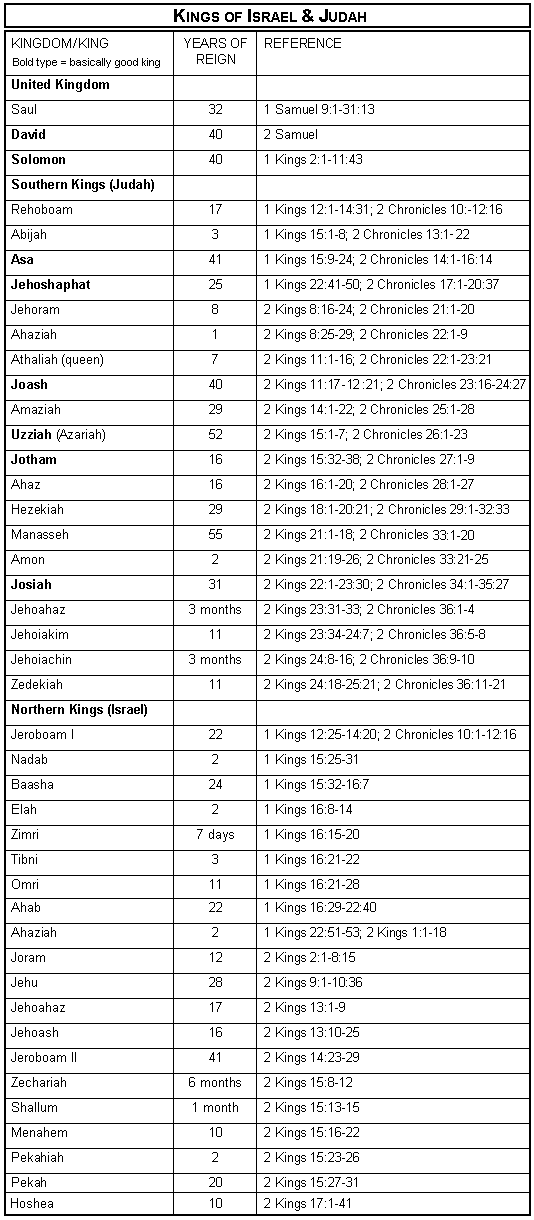
NOTE ONLY 7 BASICALLY GOOD KINGS ALL IN JUDAH!
ESV chart - kings of Israel - more information
ESV chart - kings of Judah - more information
Another Chart with Variable Dates for Reigns of Kings
2 Chronicles 24:1 Joash was seven years old when he became king, and he reigned forty years in Jerusalem; and his mother’s name was Zibiah from Beersheba.
- Joash 2Ki 11:21 2Ki 12:1, Jehoash, 1Ch 3:11
- CLICK 2 CHRONICLES COMMENTARIES FOR MULTIPLE SERMONS AND COMMENTARIES
- See BELOW FOR BIBLIOGRAPHY FOR 1-2 CHRONICLES - adapted from Paul Apple's Bible Outlines
Related Passages:
2 Kings 11:21 Jehoash was seven years old when he became king.
2 Kings 12:1 In the seventh year of Jehu, Jehoash became king, and he reigned forty years in Jerusalem; and his mother’s name was Zibiah of Beersheba.
Spurgeon - This chapter gives us the story of the reign of Joash. He was the only one of the royal seed who was preserved alive when Athaliah sought to destroy all the family of Ahaziah. He was hidden away for some six years in the temple by his aunt Jehoshabeath, the wife of Jehoiada the high priest, who arranged matters so well that, when the child was seven years old, Jehoiada caused him to be crowned king, and he put to death the cruel she-wolf Athaliah, who had destroyed the royal family. You see, therefore, how much this young king owed to his uncle the high-priest. Now let us read the story of his reign.
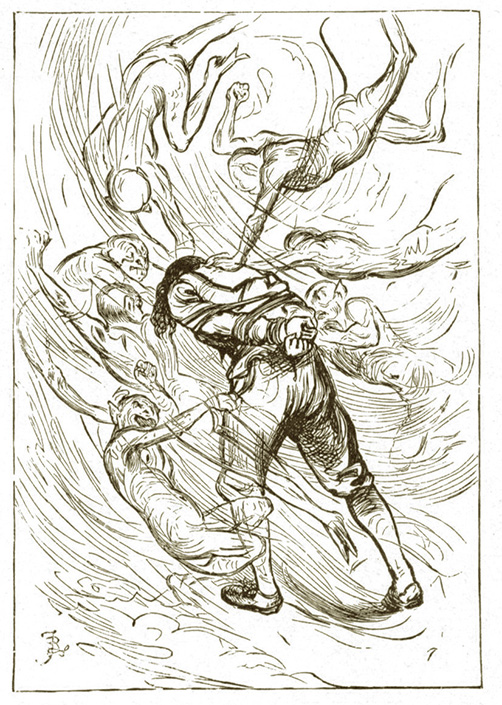
TURNAWAY
Cyril Barber talks about King Joash who was like "Turnaway in John Bunyan’s Pilgrim’s Progress. (SEE THE TRAGEDY OF TURNAWAY) Those who are familiar with this beautiful allegory of the spiritual pilgrimage we all are taking will remember that two men, Christian and Hopeful, were journeying from the City of Destruction to the Celestial City. En route they entered a dark lane where they came across a frightening scene. Seven demons were carrying toward a black door a man whom they had bound with seven strong cords. The man resembled someone whom Christian and Hopeful had seen before—Turnaway, a resident in the town of Apostasy. At the sight, both Christian and Hopeful began to tremble, for the awful fate of the man filled them with fear. Many of us know someone like Turnaway, for he represents those who once took an interest in spiritual matters, but following some trial or testing took the broad way that leads to destruction (cf. Matthew 7:13–14, Mt 7:21-23). " (2 Chronicles)
The Tragedy of Half-heartedness (2Ch 25:1–28)
A Salutary Beginning (2Ch 25:1–13)
A Foolish Decision (2Ch 25:14–16)
An Unnecessary War (2Ch 25:17–28) (2 Chronicles)
INTRODUCTION:
Andrew Hill: The Chronicler features the reigns of three kings following the execution of the usurper Athaliah: the child-king Joash, his son and successor Amaziah, and son and successor Uzziah (also known as Azariah, 2 Kings 15:1). The narrative continues a pattern introduced with King Jehoram, that of framing each royal record with an opening and closing regnal resume. Typically, the opening resume consists of formulaic expressions containing basic information: the accession age, the length and place of reign, the identification of the queen mother, and a theological review. Likewise, the closing resume usually includes a citation of source formula, a succession formula, and a notice of death and burial formula. . . Theme and structure are intertwined in this section. The pattern of early success contrasted with later failure ties the records of Joash, Amaziah, and Uzziah as a literary unit. This is in keeping with the Chronicler’s keen interest in the theology of divine retribution, especially the immediate impact of reward and punishment in the king’s reign. Thus, each royal record consists of two parts: a rehearsal of blessing and prosperity as a result of the king’s obedience to God, followed by a report of his apostasy and its detrimental religious and political consequences. This motif is not new, as the same literary pattern characterized Rehoboam (chs. 11-12) and Asa (chs. 14-16). But sadly, something has changed in these royal reports, as Selman carefully observes: “Positive balancing factors at the end of these reigns are no longer to be found.” (See 1 and 2 Chronicles - Page 33)
Iain Duguid: How did a temple restorer become a prophet killer? Kings introduces Joash’s reign by stating, “He did what was right in the eyes of the Lord all his days, because Jehoiada the priest instructed him,” but immediately modifies the positive assessment by stating that high places continued (2 Kings 12:2–3). Kings tells of temple restoration but concludes with details of submission to Syria and assassination. The Chronicler seeks to clarify by omitting 2 Kings 12:3 and by recounting Joash’s actions centering on the renewal of the temple and its utensils “all the days of Jehoiada the priest” (2 Chron. 24:1–16); he then provides a theological rationale for the reversals as being “after the death of Jehoiada,” when the king and the “princes of Judah . . . abandoned the house of the Lord,” rejecting prophetic warnings—with disastrous consequences (vv. 17–27). A clear contrast is seen between the period when Joash was under Jehoiada’s mature, faithful oversight, with its temple restoration, and his later listening to “the princes of Judah,” resulting in their serving “the Asherim and the idols” (v. 18). Only after persistent rejection of “prophets,” culminating in the killing of Zechariah, was retributive judgment evident. . . The two halves of the chapter are tied together by the contrasting burials of Jehoiada the priest and of Joash the king (vv. 15–16, 25). The priest was honored like a king because he had done what the king ultimately failed to do: “He had done good in Israel, and toward God and his house” (v. 16). (See ESV Expository Commentary (Volume 3): 1 Samuel–2 Chronicles)
Raymond Dillard - The Chronicler has divided the reign of Joash into two distinct periods: the good years while Jehoiada influenced the king, and the bad years after Jehoiada’s death; this is a characteristic feature in the Chronicler’s accounts of the individual kings (2 Chronicles, Volume 15 - Page 184)
Martin Selman - the pattern of early success followed by a sharp decline becomes established for the reigns of his two successors Amaziah (2Ch. 25) and Uzziah (2Ch. 26). The pattern is not new, having applied to Rehoboam (2 Chr. 11–12) and Asa (2 Chr. 14–16), but it plumbs new depths in chapters 24–26. (SEE 2 Chronicles: An Introduction and Commentary - Page 470)
A CHILD KING BY
DIVINE DESIGN
Joash was seven years old when he became king, and he reigned forty years in Jerusalem (835-796 B.C.); and his mother’s name was Zibiah from Beersheba This statement underscores God’s sovereignty, human weakness, and covenant faithfulness all in one sentence. Jehoash ascended the throne at seven years old clear evidence of God's sovereign doing. Joash’s coronation at seven years old declares that the throne of David stands not by human power, but by God’s unbreakable promise.
It is interesting to look at how God delights to advance His purposes though what looks weak and insignificant to men. And so repeated with see the emphasis on strength through weakness - Isaac — child of promise; Samuel — ministered as a boy; David — youngest, overlooked son/ Josiah — became king at eight; Jesus — born as a helpless infant.
C H Spurgeon - He might have reigned much longer had he not erred and turned aside from the right way, and so brought judgment upon himself. As long as his uncle lived, that truly devout statesman as well as priest of the Lord, “Joash did that which was right in the sight of the Lord.”
Spurgeon adds "THERE is a book called The Museum of Natural History, and the most singular animal in that museum is man. It would be far more easy to understand any other creature than to understand a human being. He is worthy of very great study; and the more he is studied, the more will he surprise you. There are certain characters that are great curiosities. Alas, there are also other characters that are great monstrosities! You can never tell, from what a man is, what he will be. The case before us is a very extraordinary one, because here is a man with every possible advantage, who through a number of years exhibited the brightest form of character; and yet in the end he was not thought worthy to be laid in the sepulchres of his fathers with others of the kings of Judah; neither was he worthy of any royal interment, for the latter part of his life blackened and defiled the whole of his career, and he who began his reign like the dawning of the day ended it like the middle of the night." (Sermon - Goodness as a Morning Cloud - 2Ch 24:2, 17-18)
Raymond Dillard: The Chronicler has divided the reign of Joash into two distinct periods: the good years while Jehoiada influenced the king, and the bad years after Jehoiada’s death; this is a characteristic feature in the Chronicler’s accounts of the individual kings. This division is already implicit in the wording of 2 Kgs 12:3 [2], that Joash did the right “for all his days while Jehoiada instructed him” (though for a contrary reading, see Williamson, 319; Gray, 583). The Chronicler omits the mention in Kings that Joash did not remove the high places (2 Kgs 12:4 [3]); since this would be out of character with his presentation of the early years of Joash, the matter of the high places is delayed to 24:18. (See NIV Application Bible - Page 701)
John Walton - Joash ruled from 835 to 796 B.C. and was a contemporary of Jehu, Jehoahaz and Jehoash of Israel. Shalmaneser III, Shamshi-Adad V and Adad-Nirari III ruled Assyria during this period. (IVP Background Commentary - OT - page 445)
Matthew Henry Notes: Chapter: 24
We have here the history of the reign of Joash, the progress of which, and especially its termination, were not of a piece with its beginning, nor shone with so much lustre. How wonderfully he was preserved for the throne, and placed in it, we read before; now here we are told how he began in the spirit, but ended in the flesh.
I. In the beginning of his time, while Jehoiada lived, he did well; particularly, he took care to put the temple in good repair (v. 1-14).
II. In the latter end of his time, after Jehoiada's death, he apostatized from God, and his apostasy was his ruin.
1. He set up the worship of Baal again (v. 15-18), though warned to the contrary (v. 19).
2. He put Zechariah the prophet to death because he reproved him for what he had done (v. 20-22).
3. The judgments of God came upon him for it. The Syrians invaded him (v. 23, 24). He was struck with sore diseases; his own servants conspired against him and slew him; and, as a mark of infamy upon him, he was not buried in the burying-place of the kings (v. 25-27).
Verses: 2Ch 24:1-14
This account of Joash's good beginnings we had as it stands here 2 Ki. 12:1, etc., though the latter part of this chapter, concerning his apostasy, we had little of there. What is good in men we should take all occasions to speak of and often repeat it; what is evil we should make mention of but sparingly, and no more than is needful. We shall here only observe,
1. That it is a happy thing for young people, when they are setting out in the world, to be under the direction of those that are wise and good and faithful to them, as Joash was under the influence of Jehoiada, during whose time he did that which was right. Let those that are young reckon it a blessing to them, and not a burden and check upon them, to have those with them that will caution them against that which is evil and advise and quicken them to that which is good; and let them reckon it not a mark of weakness and subjection, but of wisdom and discretion, to hearken to such. He that will not be counselled cannot be helped. It is especially prudent for young people to take advice in their marriages, as Joash did, who left it to his guardian to choose him his wives, because Jezebel and Athaliah had been such plagues, 2Ch 24:3. This is a turn of life which often proves either the making or marring of young people, and therefore should be attended to with great care.
2. Men may go far in the external performances of religion, and keep long to them, merely by the power of their education and the influence of their friends, who yet have no hearty affection for divine things nor any inward relish of them. Foreign inducements may push men on to that which is good who are not actuated by a living principle of grace in their hearts.
3. In the outward expressions of devotion it is possible that those who have only the form of godliness may out-strip those who have the power of it. Joash is more solicitous and more zealous about the repair of the temple than Jehoiada himself, whom he reproves for his remissness in that matter, v. 6. It is easier to build temples than to be temples to God.
4. The repairing of churches is a good work, which all in their places should promote, for the decency and conveniency of religious assemblies. The learned tell us that in the Christian church, anciently, part of the tithes were applied that way.
5. Many a good work would be done that now lies undone if there were but a few active men to stir in it and to put it forward. When Joash found the money did not come in as he expected in one way he tried another way, and that answered the intention. Many have honesty enough to follow that have not zeal enough to lead in that which is good. The throwing of money into a chest, through a hole in the lid of it, was a way that had not been used before, and perhaps the very novelty of the thing made it a successful expedient for the raising of money; a great deal was thrown in and with a great deal of cheerfulness: they all rejoiced, 2Ch 24:10. An invention to please people's humour may sometimes bring them to their duty. Wisdom herein is profitable to direct.
6. Faithfulness is the greatest praise and will be the greatest comfort of those that are entrusted with public treasure or employed in public business. The king and Jehoiada faithfully paid the money to the workmen, who faithfully did the work, 2Ch 24:12, 13.
QUESTION - Who was King Joash in the Bible? (NOTE HE IS CALLED "JEHOASH" IN 2 Kings 12:1)
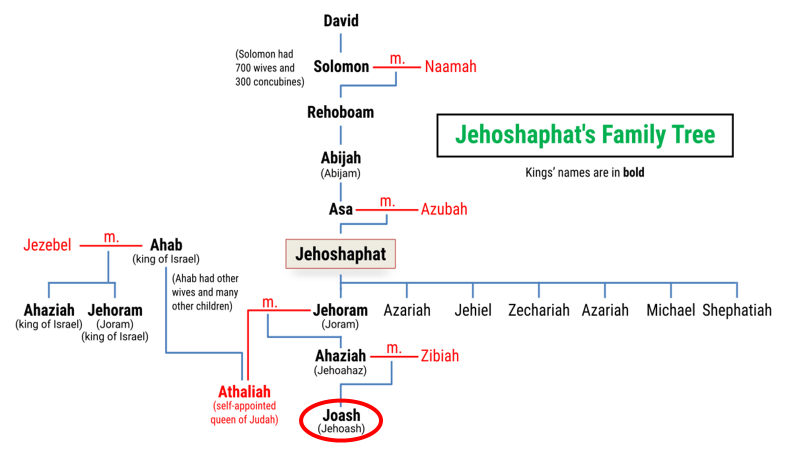
ANSWER - There are two kings with the name Joash (or Jehoash) in the Bible: one a king of Judah (reigned 835–796 BC) and the other a king of Israel (reigned 798–782 BC).
King Joash/Jehoash of Judah
The story of King Joash of Judah starts with that of King Jehu of Israel. Anointed king of Israel by Elisha, Jehu was tasked with destroying King Ahab’s descendants and wiping out Baal worship in the land (2 Kings 9). 1 Kings 21:25–26 gives the reason for the judgment: “There was never anyone like Ahab, who sold himself to do evil in the eyes of the Lord, urged on by Jezebel his wife. He behaved in the vilest manner by going after idols, like the Amorites the Lord drove out before Israel.” God had told Ahab, through Elijah, “I am going to bring disaster on you. I will wipe out your descendants and cut off from Ahab every last male in Israel—slave or free, . . . because you have aroused my anger and have caused Israel to sin” (1 Kings 21:21–22). Ahab responded to the prophecy with mourning and in humility, so God relented, saying that He would not bring the disaster in Ahab’s time but during his son’s reign. Jehu was God’s instrument to fulfill the prophecy.
After Jehu was anointed king over Israel, he set out against Joram, a son of Ahab and the current king of Israel. Ahaziah (different from the other son of Ahab who initially succeeded him) was king of Judah at the time and was with Joram. Judah’s Ahaziah, however, “followed the ways of the house of Ahab and did evil in the eyes of the Lord, as the house of Ahab had done, for he was related by marriage to Ahab’s family” (2 Kings 8:27). Jehu killed both Ahaziah and Joram; executed Ahab’s wife, Jezebel; killed Ahab’s descendants; and “wiped out Baal from Israel” (2 Kings 10:28, ESV). Unfortunately, Jehu himself did not walk in the ways of God, but, since he had been faithful to God’s call to rid Israel of Baal worship, God promised that four generations of his line would be king of Israel (2 Kings 10:30).
King Joash of Judah first comes on the scene when Athaliah, the mother of King Ahaziah, whom Jehu had killed, took charge of Judah. Athaliah killed all of the royal family she could find in Judah in order to secure the throne for herself. However, Athaliah missed one of her grandsons—the infant Joash. The evil queen’s sister rescued young Joash and his nurse, and the child was hidden for six years in the temple while Athaliah reigned in Judah (2 Kings 11:1–3). In the seventh year, the priest Jehoiada revealed Joash to the captains of the guards. The priest made an agreement with them to provide protection to the temple and the rightful king, and Jehoiada brought Joash out into public and anointed him as king (2 Kings 11:4–12). The people of Judah rejoiced over Joash’s appointment. Upon hearing the noise of the ceremony, Queen Athaliah rushed to the temple, crying, "Treason! Treason!” By Jehoiada’s command, Athaliah was captured by the guards, removed from the temple, and put to death (2 Kings 11:13–16). “Jehoiada then made a covenant between the Lord and the king and people that they would be the Lord’s people. He also made a covenant between the king and the people” (2 Kings 11:17). The people tore down the temple of Baal, watchmen were set over the Lord’s temple, and, at the age of seven, Joash took the throne (2 Kings 11:18–21).
2 Kings 12:1–3 says that Joash “reigned in Jerusalem forty years. . . . Joash did what was right in the eyes of the Lord all the years Jehoiada the priest instructed him.” 2 Kings 12 goes on to describe various financial dealings of Joash. King Joash’s main achievement was making repairs to the temple (2 Kings 12:4–16). He also used a monetary gift to dissuade King Hazael of Aram (Syria) from attacking Jerusalem (2 Kings 12:17–18).
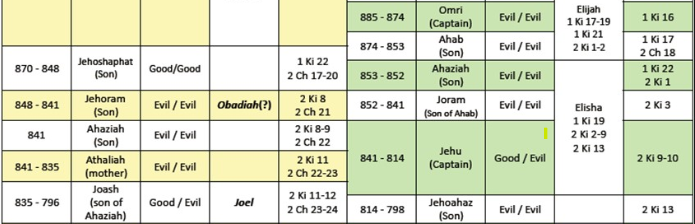
Good/Evil = Beginning of Reign/End of Reign
The tragedy of King Joash of Judah is that, after his mentor and guardian, Jehoiada, died, he began listening to wicked advisers. Joash revived Baal and Asherah worship in Judah (2 Chronicles 24:17–19). God sent prophets to warn Joash, but he did not listen to them. Finally, the prophet Zechariah, son of the priest Jehoiada, brought God’s word to Joash, but the king callously ordered the son of his old friend to be stoned to death (2Ch 24:19–22). Joash’s reign did not end peacefully: “His officials conspired against him and assassinated him at Beth Millo, on the road down to Silla” (2 Kings 12:20). Joash’s son Amaziah took over the throne, and Amaziah “did what was right in the eyes of the Lord,” but, the Bible notes, he was more like his father Joash than his ancestor David (2 Kings 14:3–4). Interestingly, Amaziah interacted with the other King Joash in the Bible.
King Joash of Israel
King Joash of Israel began his reign in the thirty-seventh year of the reign of King Joash of Judah, so there was some overlap. King Amaziah started ruling Judah in the second year of King Joash of Israel. Amaziah of Judah battled against the Edomites and then challenged Joash of Israel to battle (2 Kings 14:7–8). Joash refused, essentially telling Amaziah he was needlessly stirring up trouble (2 Kings 14:9–10). Amaziah did not heed the warning, and Joash of Israel defeated Judah in battle. 2 Chronicles 25:20 says that Judah’s defeat was “because they sought the gods of Edom.”
Second Kings records another of Joash of Israel’s military victories. When Joash’s father, Jehoahaz, was reigning, King Hazael of Aram (the same king that Joash of Judah had kept from attacking Jerusalem) oppressed Israel (2 Kings 13:22). “But the Lord was gracious to them and had compassion and showed concern for them because of his covenant with Abraham, Isaac and Jacob. To this day he has been unwilling to destroy them or banish them from his presence” (2 Kings 13:23). When the prophet Elisha was sick and near to death, King Joash of Israel visited the prophet, apparently disconcerted over the military situation in Israel (2 Kings 13:14). Elisha instructed Joash to shoot arrows out of the open window. The prophet then proclaimed, “The Lord’s arrow of victory, the arrow of victory over Aram! . . . You will completely destroy the Arameans at Aphek” (2 Kings 13:17). Elisha next instructed Joash to strike the ground with the arrows. Joash did so but stopped after three strikes. “The man of God was angry with him and said, ‘You should have struck the ground five or six times; then you would have defeated Aram and completely destroyed it. But now you will defeat it only three times’” (2 Kings 13:19). When Hazael died and his son, Ben-hadad, took over, Joash did defeat him three times. Israel was able to recover cities that previously had been taken from them (2 Kings 13:24–25).
King Joash of Israel ruled for sixteen years and “did evil in the eyes of the Lord and did not turn away from any of the sins of Jeroboam son of Nebat, which he had caused Israel to commit; he continued in them” (2 Kings 13:11). After he died, Joash of Israel was succeeded by his son Jeroboam II (2 Kings 14:16).GotQuestions.org
2 Chronicles 24:2 Joash did what was right in the sight of the LORD all the days of Jehoiada the priest.
- Joash: 2Ch 25:2 26:4,5 2Ki 12:2 Ps 78:36,37 106:12,13 Mk 4:16,17
- all the days of Jehoiada: 2Ch 24:17-22 Isa 29:13
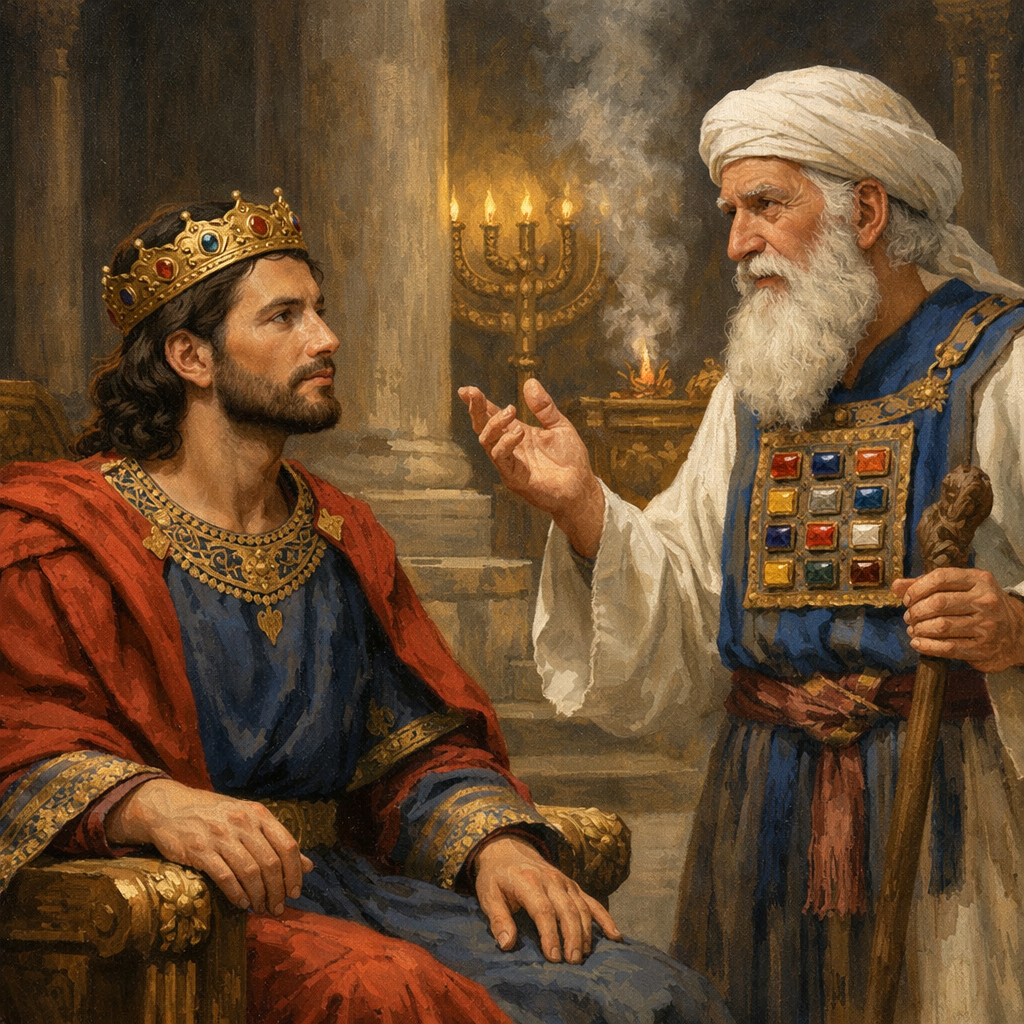
A GOOD START NO GUARANTEE
OF A GOOD FINISH!
Joash did what was right (yashar) in the sight of the LORD all the days of Jehoiada the priest. Jehoash had a good start, preserving Yahweh worship and supporting temple repair (2Ch 24:4). And note the important phrase in the sight of the LORD which reflects God’s evaluation, not public opinion or outward success. God Himself saw Jehoash's rule and judged it right, recalling that God’s perspective penetrates beyond actions to motives (cf. 1Sa 16:7). This language is judicial for God is the Witness, the Judge and the Standard of what is right.
The writer of kings explains the reason Joash did what was right was because Jehoiada the priest instructed (yarah) him (2Ki 12:2) This explanation emphasizes the influence of godly spiritual leadership. Unfortunately, it does not always last as was the sad case with King Joash. He apparently continued to do right until some time after the twenty-third year of his reign, datable to 813 BC.
Bob Utley - "did what was right in the sight of the Lord" This is an idiomatic expression for the kings of Judah (and possibly of Israel, i.e., Jeroboam I) who acted faithfully, like David (1 Kgs. 15:3) in keeping and promoting obedience to the Mosaic Law (cf. Deut. 6:16-18; 12:28; 13:18).
- Jeroboam I of Israel ‒ condition of YHWH's blessing: obedience to His covenant ‒ 1 Kgs. 11:33,38; 14:8, but he did not
- Asa (initially) ‒ 1 Kgs. 15:11; 2 Chr. 14:2
- Jehoshaphat (mostly) ‒ 1 Kgs. 22:43; 2 Chr. 20:32
- Jehu ‒ 2 Kgs. 10:30
- Jehoash (initially) ‒ 2 Kgs. 12:2
- Joash (initially) ‒ 2 Chr. 24:2
- Amaziah ‒ 2 Kgs. 14:2; 2 Chr. 25:2
- Jotham ‒ 2 Kgs. 15:33; 2 Chr. 27:2
- Ahaz ‒ 2 Kgs. 16:2; 2 Chr. 28:1 (negative)
- Hezekiah ‒ 2 Kgs. 18:3; 2 Chr. 29:2; 31:20
- Josiah ‒ 2 Kgs. 22:2
Right (03477) yashar from the verb yashar = to be smooth, straight or right) is an adjective that means straight; reliable, level, pleasing; upright; righteous. Yashar only rarely is used literally of that which is straight (Ezek 1:7). Yashar can refer to something physical like a path, but even in those uses is often a metaphorical description of one's conduct or behavior (Ps 107:7). Most uses refer to that which is right in an ethical or an emotional sense, as agreeable or pleasing. It is fitting that God is the standard of yashar (what is "straight") (Ps 92:15, called the "Upright One" - Isa 26:7). God's Word is described as upright (right) (Ps 19:7) as are His judgments (Ps 119:137) and His way (Ps 107:7). "God made men upright (Ge 1:27), but they have sought out many devices." (Eccl 7:29)
Yashar is frequently used to describe our moral/ethical heart as "upright in heart" (Ps 7:10, 11:2,). Indeed, the upright "will behold His face" (Ps 11:7), will experience gladness (Ps 97:11), will be gathered together in the assembly (Ps 111:1), will be blessed (Ps 112:2), will be given light in times of darkness (Ps 112:4), will dwell in God's presence (Ps 140:13, cp Pr 2:21), have access to God's sound wisdom (Pr 2:7), will experience intimacy with the Most High God (Pr 3:32), will be guided by their integrity (Pr 11:3), will be delivered by their righteousness (Pr 11:6), will be delivered by their words (Pr 12:6), will see their tents flourish (Pr 14:11). "The highway of the upright is to depart from evil." (Pr 16:17)
IN THE SIGHT OF THE LORD - The expression “in the sight of the LORD” means as evaluated by God Himself, not merely by human standards, public opinion, or outward success. It means according to God’s all-seeing, morally perfect, covenant-based evaluation—focused on faithfulness of heart and obedience, not outward appearance or human approval. It is found 82x in 81v - Gen. 38:7; Lev. 10:19; Num. 32:13; Deut. 4:25; Deut. 6:18; Deut. 9:18; Deut. 12:25; Deut. 12:28; Deut. 17:2; Deut. 21:9; Deut. 31:29; Jdg. 2:11; Jdg. 3:7; Jdg. 3:12; Jdg. 4:1; Jdg. 6:1; Jdg. 10:6; Jdg. 13:1; 1 Sam. 12:17; 1 Sam. 15:19; 1 Ki. 11:6; 1 Ki. 14:22; 1 Ki. 15:26; 1 Ki. 15:34; 1 Ki. 16:7; 1 Ki. 16:19; 1 Ki. 16:30; 1 Ki. 21:20; 1 Ki. 21:25; 1 Ki. 22:52; 2 Ki. 3:2; 2 Ki. 3:18; 2 Ki. 8:18; 2 Ki. 8:27; 2 Ki. 12:2; 2 Ki. 13:2; 2 Ki. 13:11; 2 Ki. 14:3; 2 Ki. 14:24; 2 Ki. 15:3; 2 Ki. 15:9; 2 Ki. 15:18; 2 Ki. 15:24; 2 Ki. 15:28; 2 Ki. 15:34; 2 Ki. 16:2; 2 Ki. 17:2; 2 Ki. 17:17; 2 Ki. 18:3; 2 Ki. 21:2; 2 Ki. 21:6; 2 Ki. 21:16; 2 Ki. 21:20; 2 Ki. 22:2; 2 Ki. 23:32; 2 Ki. 23:37; 2 Ki. 24:9; 2 Ki. 24:19; 1 Chr. 2:3; 2 Chr. 20:32; 2 Chr. 21:6; 2 Chr. 22:4; 2 Chr. 24:2; 2 Chr. 25:2; 2 Chr. 26:4; 2 Chr. 27:2; 2 Chr. 28:1; 2 Chr. 29:2; 2 Chr. 33:2; 2 Chr. 33:6; 2 Chr. 33:22; 2 Chr. 34:2; 2 Chr. 36:5; 2 Chr. 36:9; 2 Chr. 36:12; Ps. 116:15; Jer. 52:2; Mal. 2:17; Lk. 1:15; 2 Co. 8:21; Jas. 4:10
2 Chronicles 24:3 Jehoiada took two wives for him, and he became the father of sons and daughters.
- took for him: 2Ch 24:15 Ge 21:21 24:4
- two wives: Ge 4:19 Mt 19:4-8
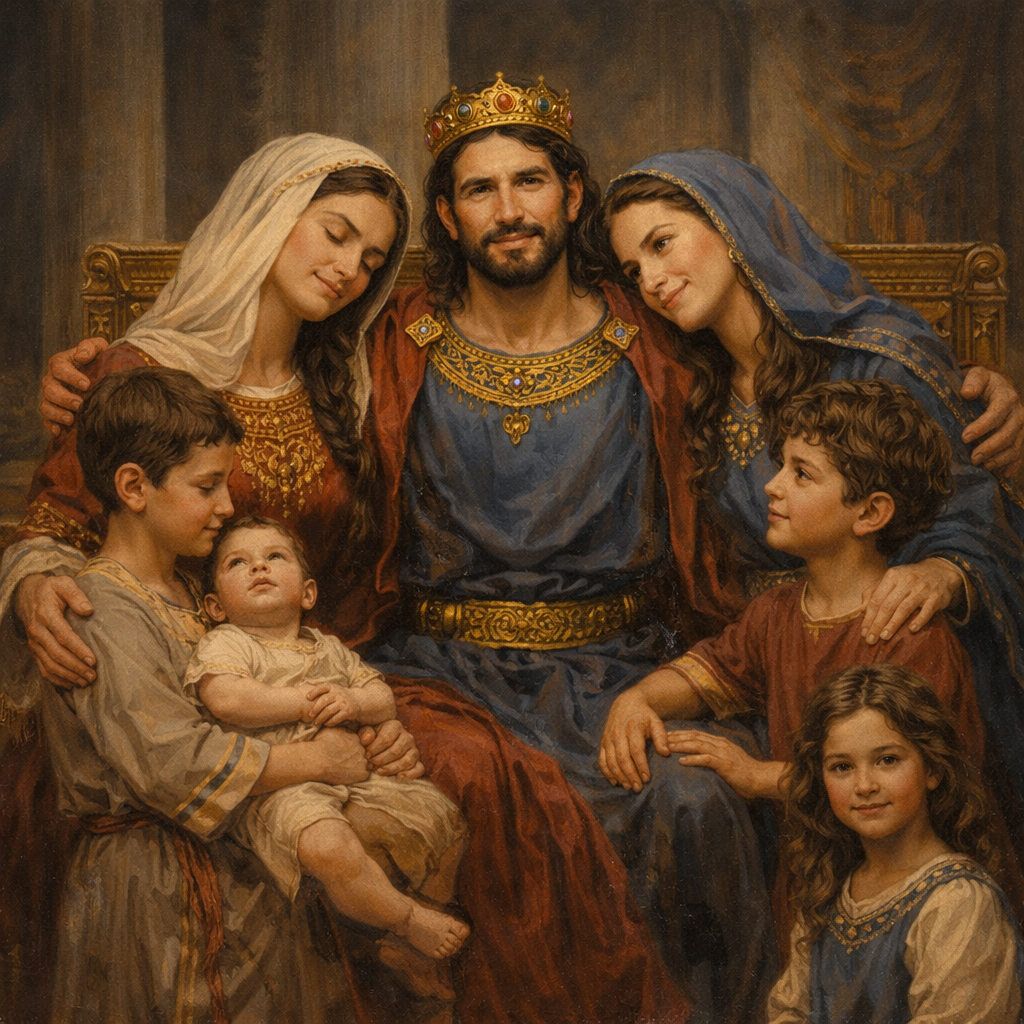
JEHOIADA SELECTS
THE KING'S WIVES
NOTE: This is only in 2 Chronicles 24 and is not in 2 Kings 12.
Jehoiada took two wives for him, and he became the father of sons and daughters. This detail is far more than a passing biographical note. Jehoiada understood that the wives of kings can make or break a dynasty, shaping not only the king’s household but also the spiritual and political future of the nation. Having witnessed the near extinction of the Davidic line under Athaliah, the priest acted with deliberate wisdom. By securing godly wives—and more than one—he sought to ensure fruitfulness, stability, and continuity, so that the lamp of David would not flicker again to the brink of extinction with only a single surviving heir. This was a calculated, covenant-conscious step to safeguard the promises of God and preserve the Davidic throne for future generations.
Warren Wiersbe - When the king was ready for marriage, it was Jehoiada who picked out his two wives. Both David and Solomon had gotten into trouble because of too many unwise marriages, so the high priest limited Joash to two wives. It was important that Joash rebuild the family of David, for the house of David had almost been destroyed by Jehoram (2 Chron. 21:4), Jehu (2 Kings 10:12–14), Arab invaders (2 Chron. 22:1), and Queen Athaliah (2 Kings 11:1).
Bob Utley - The godly High Priest, Jehoiada (cf. 2 Chr. 24:6, i.e., "head") chose wives for the young king. Although the text does not give any details, one assumes
- they were not of the line of Ahab (i.e., Jezebel and Athaliah)
- they were worshipers of YHWH from Judah
- the text does not mention additional wives or concubines
One of the two wives is named "Jehoaddan of Jerusalem" in 2 Chr. 25:1.
Raymond Dillard: Jehoiada’s securing wives for Joash addressed the dynastic threat that had brought him to the throne. Through the subsequent children the Davidic dynasty would begin to rebuild and broaden after the murders of members of the royal house during the reigns of Jehoram, Ahaziah, and Athaliah. V 3 is unique to Chronicles: beyond the concern with rebuilding the Davidic household, for the Chronicler numerous progeny were a token of divine blessing (1 Chr 14:2–7; 25:4–5; 26:4–5; 2 Chr 11:18– 23; 13:21). The additional material the Chronicler inserted regarding the wives and children of Joash was apparently drawn from the source he cites (24:27).
QUESTION - Who was Jehoiada in the Bible?
ANSWER - The best known of the Jehoiadas in the Bible was a leading priest of Israel who served several of the kings of Judah. After Israel split into two kingdoms, Judah, the southern kingdom, which included Jerusalem, remained more faithful to the Lord. Jehoiada the priest married the sister of King Ahaziah of Judah. King Ahaziah reigned just one year before being killed.
Ahaziah’s power-hungry mother, Athaliah, smelled an opportunity. She rounded up all of her son’s family, anyone with a potential claim to the throne, and had them all killed so she could become the queen (2 Kings 11:1). She missed only one in the slaughter. When Ahaziah’s sister Jehoshabeath, Jehoiada’s wife, realized what Athaliah was up to, she hid the youngest of her nephews, Joash, away (2Ki 11:2). Just a year old, Joash was too young to claim his rightful throne, but he was protected by Jehoiada and Jehoshabeath in the temple of the Lord (2Ki 11:3).
Six years passed, during which the usurping queen mother Athaliah remained in power and the rightful king grew into a boy within the temple courts. Finally, Jehoiada the priest decided the time had come to make the boy king. He called the captains of the guard and influential Levites and other leaders of the people to come to Jerusalem. He let them all in on the secret that one of the king’s sons still lived, the rightful heir to the throne as a direct descendant of David. The soldiers and the people agreed, under oath, to provide protection and support for the king while he was being crowned and anointed in the temple (2 Chronicles 23:1–3).
When the day came, every person in the assembly stood ready to defend the young king (2 Chronicles 23:8–10). Jehoiada brought Joash out, placed the crown on the boy, anointed him with oil, and gave to him the testimony (or royal law). The people clapped and shouted, “Long live the king!” while the trumpets blared (2Ch 23:11).
Athaliah, the queen mother and Joash’s grandmother, heard the noise from the temple and came over from the palace (2 Chronicles 23:12). When she saw the scene surrounding a boy wearing the crown of the king, she realized what was going on. She screamed out, “Treason!” and tore her own clothes in grief and fury (2Ch 23:13).
Jeohiada commanded the captains of the guard to take Queen Athaliah out of the temple and put her to death, along with anyone who followed her. The guards obeyed, and Athaliah was executed by the Horse Gate on the palace grounds (2 Chronicles 23:15). Serving now as the king’s proxy, Jehoiada made a covenant between the king and the people that they would be the Lord’s people and no longer worship Baal as the queen mother had allowed (2Ch 23:16). The people stormed and destroyed the temple of Baal and killed the idolatrous chief priest (2Ch 23:17).
Joash, just seven years old, assumed the throne and reigned as king over Judah for 40 years. Thanks to his adviser Jehoiada, Joash was known as one of the good kings of Judah who served the Lord. Together, Joash and Jehoiada oversaw extensive repairs to the Lord’s temple that had gone neglected for far too long. 2 Kings 12:1–3 says that Joash “did what was right in the eyes of the Lord all the years Jehoiada the priest instructed him.”
Jehoiada lived to be an impressive 130 years old and blessed the kingdom of Judah with his godly wisdom and able direction. Highly regarded by the people for his service both to the kings of Judah and the house of God, Jehoiada the priest was buried in Jerusalem in the place of the kings. Unfortunately, after Jehoiada died, King Joash began listening to wicked advisers, and Baal and Asherah worship revived in Judah (2 Chronicles 24:17–19).
You can read more of Jehoiada’s story in 2 Kings 11–12 and 2 Chronicles 22:10–24:16.GotQuestions.org
2 Chronicles 24:4 Now it came about after this that Joash decided to restore the house of the LORD.
- restore: Heb. renew, 2Ch 24:5-7
- See Steven Cole - How God’s Work Gets Done (2 Chronicles 24:4-14)
JOASH DESIRES TO
RESTORE TEMPLE OF GOD
This information is not in 2 Kings 12, only in 2 Chronicles 24:4.
Now it came about after this that The time phrase after this is not precise so how long after is not certain. One writer thing this was as long as 20 years later basing that supposition on 2Ki 12:6)
Joash decided (leb - heart) to restore (chadash) the house of the LORD - NET = "to repair the LORD's Temple." CSB = "renovate" YLT = "renew" Notice that the word rendered Decided is more literally "came with his heart." This is amazing to me for as we move on in Joash's life, we see a major shift in his heart away from God! In any event, what a great, God honoring start for this king! This resolve reveals a heart that, at least in his early years, was oriented toward the priorities of God rather than personal power or royal comfort. Instead of focusing first on strengthening his palace, expanding his borders, or consolidating political influence, Joash set his attention on the condition of the LORD’s house, which had suffered neglect and damage during the reign of Athaliah and the years of Baal worship.
Joash's decision undoubtedly reflects the shaping influence of godly instruction under Jehoiada and shows that Joash understood a fundamental spiritual principle that the health of a nation is inseparably tied to the honor given to God. Pr 14:34 says "Righteousness exalts a nation, But sin is a disgrace to any people." (Are you listening America?)
Restoring the temple was more than a construction project, but was a public declaration that Judah’s spiritual life needed repair and renewal. By prioritizing the house of the LORD, Joash signaled a desire to realign the kingdom with covenant faithfulness and proper worship. At this point in his reign, Joash’s intentions are commendable. His concern for the temple demonstrates early humility, reverence, and a willingness to place God’s glory above royal ambition. It stands as a reminder that true reform often begins with a renewed concern for God’s presence and God’s honor, even before deeper changes take root in the heart.
Joash's prioritizing Yahweh reminds me of Jesus' words in Mt 6:33 "But seek first His kingdom and His righteousness, and all these things will be added to you." Joash was clearly on a good, God honoring trajectory! Sadly, he later turned either to the right or to the left!
Bob Utley - YHWH's temple had deteriorated from non-use and the ransacking and theft by Athaliah's people (cf. 2 Chr. 24:7).The purpose of restoration was the restart of YHWH's worship in its Mosaic form (i.e.., 2 Chr. 24:5,6,9).
HOUSE OF THE LORD - KEY PHRASE IN 2 KINGS 12 AND 2 CHRONICLES 24 - 2 Ki. 12:4; 2 Ki. 12:9; 2 Ki. 12:10; 2 Ki. 12:11; 2 Ki. 12:12; 2 Ki. 12:13; 2 Ki. 12:14; 2 Ki. 12:16; 2 Ki. 12:18; 2 Chr. 24:4; 2 Chr. 24:7; 2 Chr. 24:8; 2 Chr. 24:12; 2 Chr. 24:14; 2 Chr. 24:18; 2 Chr. 24:21;
Raymond Dillard: Royal initiative was crucial to the building of the temple at the time of David and Solomon; here royal initiative leads to its restoration. However, royal initiative and precedent would also have led the priests and Levites to expect the royal treasury to bear much of the expense. The king instead seeks to finance the restoration work by reallocating some of the temple income used for the maintenance of the cultic staff to the building project. The priests respond with inaction. (See 2 Chronicles, Volume 15 - Page 189)
C H Spurgeon - Jehoiada had with him broken in pieces the images of Baal, and battered down the temples of the idols; and now the young king is “minded to repair the house of Jehovah.”
Frederick Mabie: Joash’s repair and restoration of the temple are similar to the later efforts of Hezekiah (2Ch 29:3-36) and Josiah (2Ch 34:8-13). Such refurbishing provided a tangible way for the ruler to show his devotion to God. As such, emphasis is placed on the involvement of many sectors of the community (cf. 2Ch 24:9-12) as well as the skill and carefulness of those involved in the process of restoration (cf. v. 13). (See The Expositor's Bible Commentary: 1 Chronicles-Job - Page 261)
John Walton - ideology of temple restoration in the ancient Near East. The temple was the center of culture, economy and society in Syria, Mesopotamia and Israel. It served as the house of the city’s patron deity, and thus the god’s presence was considered to exist there. It was incumbent upon the ruler of the city to attend to the “care and feeding” of the deity. The statue of the god was bathed, clothed and fed daily. Just as important as the king’s military success was his attention to the upkeep of the god’s house. Countless building inscriptions from both Assyria and Babylonia attest to the king’s piety because of his restoration of a certain god’s house. Similarly, those who rebuilt or restored Yahweh’s were accorded this same type of piety. Restoration entailed both physical and ritual aspects. A neglected temple would need structural repairs (see comment on v. 13) and perhaps the restoration of pilfered furniture and accessories. It is possible that gold objects or gold plating on walls would need to be replaced. Then the temple would need to have its sanctity reestablished through appropriate rituals. Finally, it would need to be provided with funding and personnel so that it could operate. (IVP Background Commentary - OT - page 445)
Restore (renew) (02318) chadash/hadas means to make new, to restore, to repair, to renovate or reconstruct ("renew the kingdom" ~ the altar = 1Sa 11:14, restored the altar = 2Chr 15:8, restore the house of Jehovah, the Temple = 2Chr 24:4, 12, surface of the ground = Ps 104:30). The idea is to make like new and implies a restoration to a former state of something which has become faded or disintegrated (in David's case in Ps 51:10, this would refer to the effects of unconfessed sin). To begin again.
CHADASH - 11V - 1 Sam. 11:14 = "renew the kingdom"; 2 Chr. 15:8 = ASA "restored the altar of the LORD which was in front of the porch of the LORD."; 2 Chr. 24:4; 2 Chr. 24:12; Job 10:17; Ps. 51:10 "renew a steadfast spirit within me"; Ps. 51:12; Ps. 103:5 = "your youth is renewed like the eagle"; Ps. 104:30; Isa. 61:4; Lam. 5:21.
2 Chronicles 24:5 He gathered the priests and Levites and said to them, “Go out to the cities of Judah and collect money from all Israel to repair the house of your God annually, and you shall do the matter quickly.” But the Levites did not act quickly.
- gathered: 2Ch 29:3 34:8,9 2Ki 12:4-5
- But: 2Ki 12:6,7
Related Passages:
2 Kings 12:4-5 Then Jehoash said to the priests, “All the money of the sacred things which is brought into the house of the LORD, in current money, both the money of each man’s assessment and all the money which any man’s heart prompts him to bring into the house of the LORD, 5 let the priests take it for themselves, each from his acquaintance; and they shall repair the damages of the house wherever any damage may be found.”
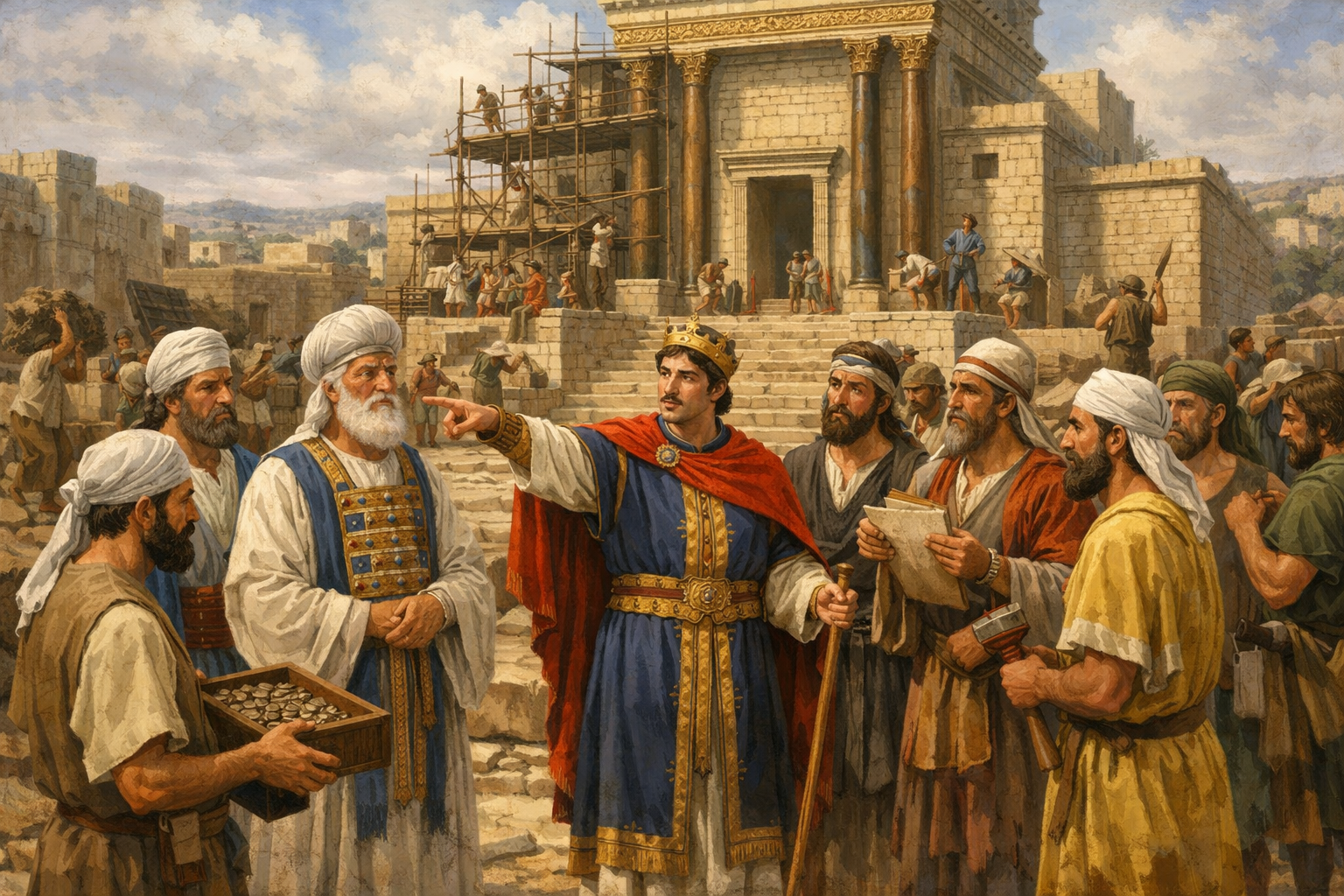
JEHOASH INITIATES
"BUILDING FUND"
He gathered the priests and Levites and said to them, “Go out to the cities of Judah and collect money from all Israel to repair the house of your God annually - NET = "Go out to the cities of Judah and collect the annual quota of silver from all Israel for repairs on the temple of your God. Be quick about it!" But the Levites delayed." Joash gives 2 clear commands to the Levites to travel throughout the cities of Judah to collect funds “from all Israel” (i.e., covenant people in Judah). This plan assumed faithfulness on the part of the priests. The basis for the commands is the levy by Moses in Ex 30:12-16 (each time a census was take each male "shall give it for the service of the tent of meeting") which was a mandatory, not voluntary, tax.
Bob Utley - "cities of Judah. . .all Israel" It is obvious that the Chronicler considered Judah to be the true covenant people, "Israel" (cf. 2Ch 24:9,16).
And you shall do the matter quickly - Spiritual renewal loses momentum when postponed.
But the Levites did not act quickly - Sadly the Levites failed to act quickly. Why they delayed is not clear. What is clear is that delay in obedience often equals disobedience.
Bob Utley - "But the Levites did not act quickly" The reason for the delay is not stated but from the context, one wonders if they, too, had become followers of Ba'al. They had allowed YHWH's temple to be ransacked and looted. The other option is the parallel in 2Ki 12:6-8 which mentions the date of the request, which may denote a time when Jehoiada had little influence (NASB Study Bible, p. 613). A third option is expressed by Josephus, Antiq. 9.8.2., "but the high priest did not do this, as concluding that no one would willingly pay the money."
John Olley Details in 2 Kings 11:6–8 suggest that Jehoiada regarded his first priority to be the support of priests, with little attention given to the building (a question of budget allocations!). (See ESV Expository Commentary (Volume 3): 1 Samuel–2 Chronicles)
Spurgeon - It is a great pity when those who live in the house of God have not enough interest in it to see to its repair. The fact was, the offerings presented at the temple, like the tithes in modern times, were intended not only for the ministers, but for the maintaining of the fabric, too. But these priests and Levites would not allow anything to be deducted from their own income even for the repair of the house in which they served. So Joash ordained that special collections should be made for the purpose.
August Konkel: There is no indication when Joash first tried to refurbish the temple. After the first failure to raise funds, Joash summoned Jehoiada a second time, in his twenty-third year (2 Kings 12:6, 7). Failure to collect the temple tax might have been the result of the king’s intervention in what was regarded as a priestly jurisdiction. Over time disagreement had arisen between crown and priesthood over funding the restoration work; priests looked to the royal treasury, but the king wanted to reallocate temple money. The king censured Jehoiada for his failure to act and proposed a plan of action that put the offering on a more voluntary basis. (See 1 & 2 Chronicles)
John Walton - collection of funds. The collecting of funds for the restoration of a temple was a common occurrence by monarchs in the ancient Near East. Often, though, the monarch would restore the temple by means of corvee labor or by collecting building materials from his subjects. The initial collection procedure is described only in 2 Kings 12:5–7 and was unsuccessful. It entailed receiving funds from the “treasurers” (NIV). This word only occurs in this context and has now been identified in both Ugaritic and Akkadian texts dealing with temple treasuries. It could refer either to officers who distributed temple assets or to the assets themselves. TAXATION IN ISRAEL - There are surprisingly few words in Scripture for “tax.” The most common term was a generic word meaning to “evaluate for taxation.” The term is used for the tribute that Israelite kings were obliged to pay ruling overlords. It was also used in connection with collecting funds for the temple, as here. The process of taxation is described in 1 Samuel 8:15–17. The king could also exempt a household from taxation (see 1 Sam 17:25). Solomon had a core of governors who periodically collected taxes (1 Kings 4:7–19). It appears that the rebellion against Rehoboam was motivated by tax abuse. Ostraca from Samaria record deliveries of wine for the use of the king, with the phrase, “for the king.” These ostraca were from several sites that were probably depots where the local taxes were gathered. Another aspect of taxation was forced labor (see Ex 1:10; Josh 16:10; 2 Sam 20:24). Although taxation in Mesopotamia is much better documented, it appears to have similar attributes to taxation practices found in Israel.(IVP Background Commentary - OT - page 445)
2 Chronicles 24:6 So the king summoned Jehoiada the chief priest and said to him, “Why have you not required the Levites to bring in from Judah and from Jerusalem the levy fixed by Moses the servant of the LORD on the congregation of Israel for the tent of the testimony?”
- Why have you not required the Levites: 2Sa 24:3
- The levy fixed by Moses Ex 30:12-16
- For the tent of the testimony: Nu 1:50 17:7,8 18:2 Ac 7:44
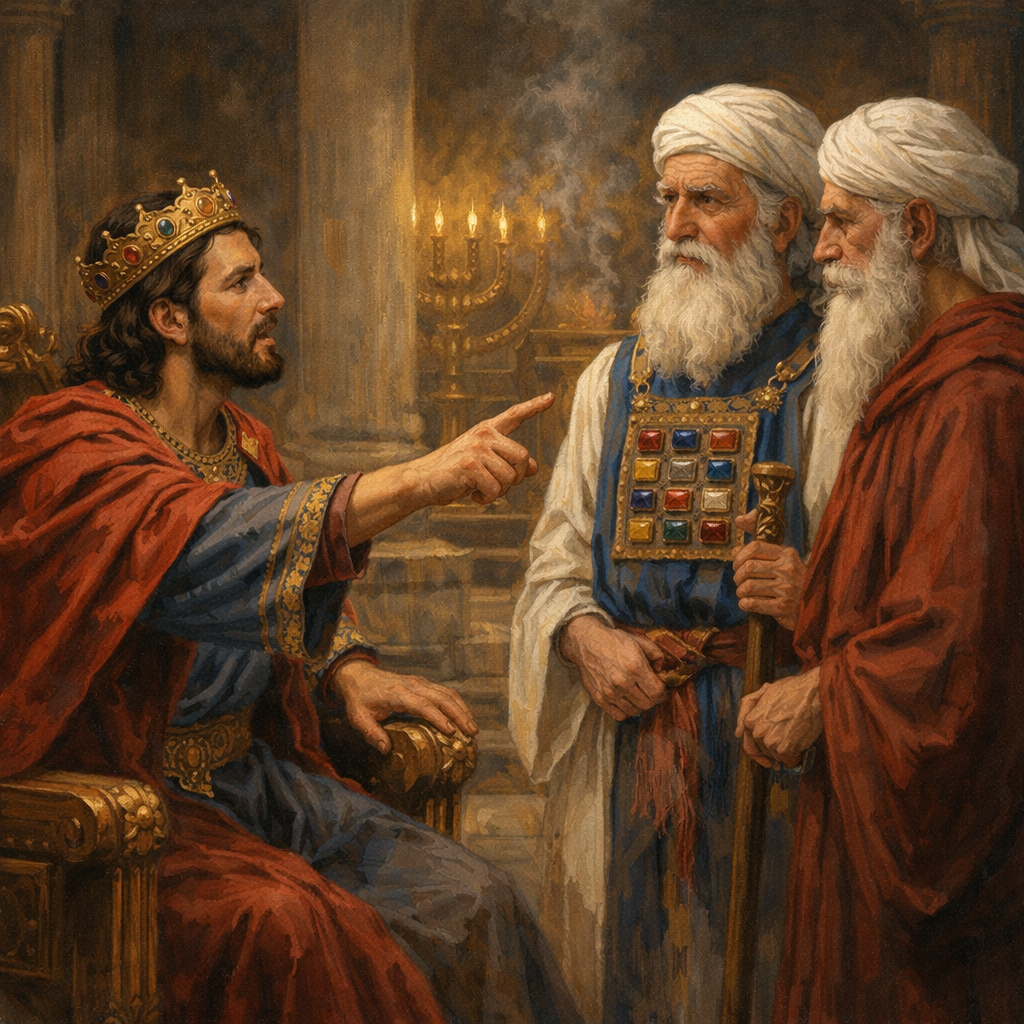
JOASH'S ROYAL
REBUKE TO JEHOIADA
So the king summoned Jehoiada the chief priest and said to him, “Why have you not required the Levites to bring in from Judah and from Jerusalem the levy fixed by Moses the servant of the LORD (2Ch 24:9) on the congregation of Israel for the tent of the testimony (see Ex 30:12-16)?” This verse records a pointed but necessary confrontation by King Joash, directed even toward his godly mentor Jehoiada. It records King Joash’s Scripture-based rebuke of Jehoiada, exposing the failure to enforce the Mosaic levy and marking the shift from informal trust to lawful accountability in restoring God’s house. Thus the failure to repair the temple was not due to ignorance or lack of authority, but to neglected enforcement of God’s revealed command.
“Why have you not required the Levites to bring in from Judah and from Jerusalem The king’s question places responsibility squarely on temple leadership. The Levites were tasked not merely with service, but with instruction and enforcement of God’s commands throughout Judah and Jerusalem which would include collecing the levy fixed by Moses. God’s law had authorized the collection; leadership had simply failed to press it.
The levy fixed by Moses was a legal obligation. Thus the king explicitly grounded his rebuke of his mentore on the Mosaic Law, referring to the mandatory census/atonement tax prescribed in Ex 30:12–16. By invoking Moses, Joash is not inventing a new policy but appealing to established Scripture. This levy was required, not voluntary, uniform for all eligible Israelites and designated for the maintenance of God’s dwelling. Joash’s point is clear: the resources God ordained were already available, but they were not being collected. Notice the paradox in this verse because here a king instructs the priests using Scripture. Normally, the priest teaches the king about the Torah!
Andrew Hill: The favorable report concerning Joash’s reign centers on the dual themes of the renovation of Yahweh’s temple and the figure of Jehoiada as the ideal high priest. The temple of Solomon has apparently fallen into a general state of disrepair....The desecration of the sanctuary included structural damage as well (2Ch 24:7). The reference to the “sons of . . . Athaliah” (2Ch 24:7) is puzzling, since she had them murdered. Perhaps the expression is used figuratively to denote her followers or adherents, or perhaps her sons conspired in the desecration of the temple before their deaths. (See First and Second Chronicles - Page 166)
John Walton - Tent of the Testimony. The Tent of the Testimony was more commonly called the Tent of Meeting or tabernacle (see comment on Ex 33:7–10). It was the central place of worship for the Israelites before the construction of the temple of Solomon. It was the shrine that housed the ark of the covenant and various other cultic objects. The tabernacle continued to play an important link to Israel’s history, even during the monarchy, and one gets the impression that somehow the tent was set up inside the temple precinct (see 1 Kings 8:4 = 2 Chron 5:5).(IVP Background Commentary - OT - page 445)
2 Chronicles 24:7 For the sons of the wicked Athaliah had broken into the house of God and even used the holy things of the house of the LORD for the Baals.
- the sons of Athaliah: 2Ch 21:17
- wicked: 2Ch 28:22-24 Es 7:6 Pr 10:7 2Th 2:8 Rev 2:20
- the holy things: 2Ki 12:4
- for the Baals: Dt 32:15-17 Eze 16:17-21 Da 5:2-4,23 Ho 2:8,9,13
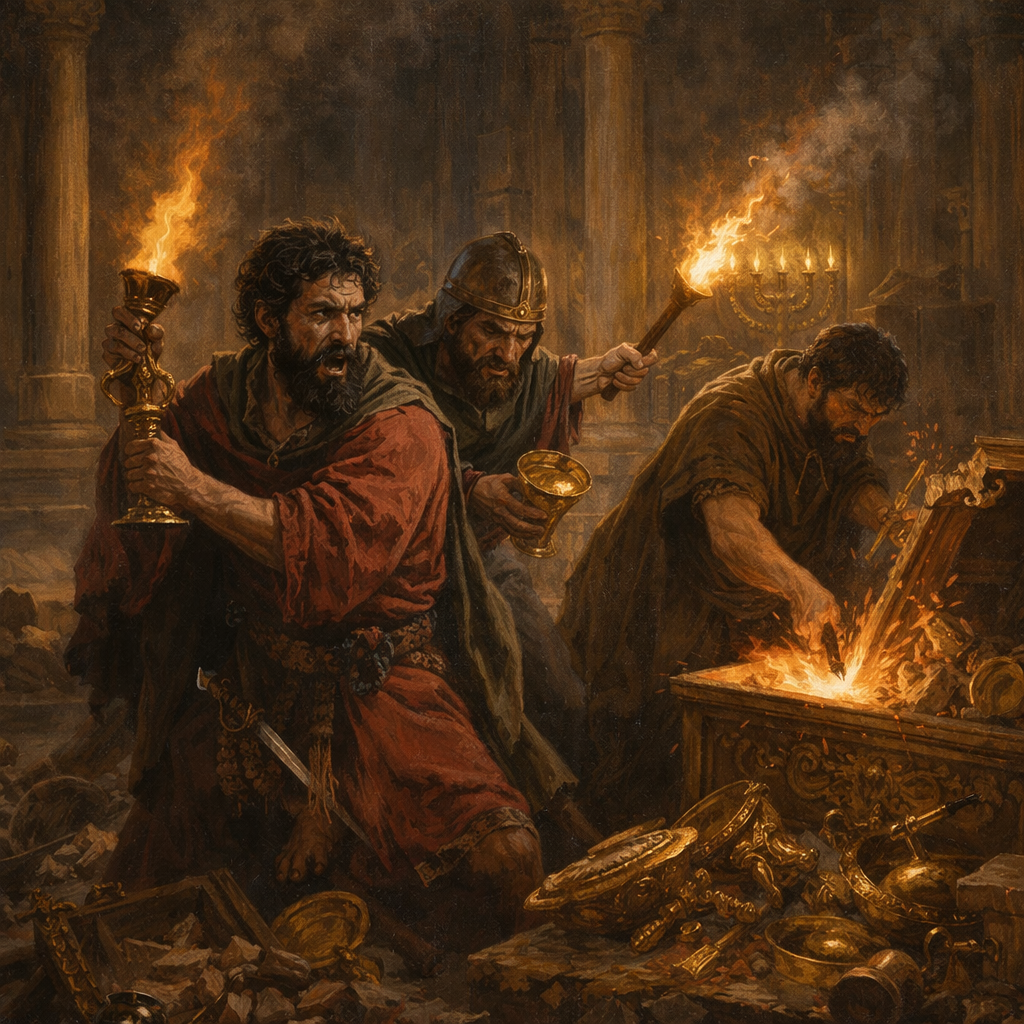
Athaliah's Temple Raiders
ONE REASON TEMPLE
IN NEED OF REPAIR
NOTE - This information is not found in 2 Kings 12.
For - Term of explanation. The writer explains that the temple required restoration because Athaliah’s Baal-worshiping regime had violently desecrated God’s house and diverted sacred items to idols.
The sons of the wicked Athaliah had broken into the house of God and even used the holy things of the house of the LORD for the Baals - This verse explains in part why the temple was in such serious disrepair and why restoration was needed. It identifies the damage as intentional desecration ("looting"), not mere neglect (although that is likely a contributing facter given that Baalism was practiced for a number of years before Joash was crowned king). The blame is placed squarely on Athaliah and “her sons” a phrase that likely refers to her supporters, relatives, or the Baal-worshiping faction aligned with her regime, given that she had purged all potential male heirs to the throne.
Bob Utley - "the Baals" The reason Ba'al is plural is because every village and high place (naturally raised place) had its own Ba'al and Asherah shrine. Ba'al was symbolized by an uplifted, elongated stone and Asherah by a live tree or carved stake, symbolizing the tree of life.
Broken into the house of God This phrase suggests forceful intrusion and profanation of the holiness of the Temple. The temple, the place of God’s presence, had been treated as a resource to plunder rather than a sanctuary to honor. Sacred boundaries were ignored, and holy space was violated.
And even used the holy things Even more shocking, the verse states that dedicated things of the LORD—items consecrated for Yahweh’s worship—were repurposed for Baal.
Baal worship was not merely an alternative religion; it was explicitly forbidden. And using Yahweh’s holy vessels in Baal worship was tantamount to a declaration of Baal’s supremacy, a mocking of Yahweh and publicly asserting that Yahweh had been displaced. Their goal was not syncretism but deliberate replacement of worship of the One True God.
J.A. Thompson: Some commentators suggest that the term “son” is flexible in meaning and could refer to “adherents” (NEB). Yet others, by a very slight emendation, read “her builders” (boneyha), suggesting that the temple materials as well as its “dedicated things” had been used in building temples for the Baals. (See 1, 2 Chronicles: An Exegetical and Theological Exposition)
2 Chronicles 24:8 So the king commanded, and they made a chest and set it outside by the gate of the house of the LORD.
- king: 2Ki 12:8,9 Mk 12:41
Related Passages:
2 Kings 12:9 But Jehoiada the priest took a chest and bored a hole in its lid and put it beside the altar, on the right side as one comes into the house of the LORD; and the priests who guarded the threshold put in it all the money which was brought into the house of the LORD.
JOASH SETS UP
TRUSTWORTHY SYSTEM
So This verse records the decisive reform that corrected earlier delays and inefficiency in funding the temple restoration. After identifying the cause of neglect (2Ch 24:6–7), Joash moves from admonition to action. Joash was enforcing God’s provision with a visible, trustworthy system that restored lawful giving and moved the repair of the LORD’s house forward.
The king commanded, and they made a chest The king apparently gave on the Levites going about the land to collect money. And so he implements another mode of collecting building funds. The chest ensured that offerings could be given easily while preventing private handling. The solution is modest but effective—integrity by design.
and set it outside by the gate of the house of the LORD - Placing the chest outside the temple, at the gate assured accessibility so that all worshipers could give without navigating priestly channels. It also provided visibility, the placement in view of all showing nothing was hidden. Giving was also linked with worship linkage since the giving occurred at the threshold of God’s house, tying generosity to devotion.
Bob Utley - "set it outside by the gate of the house of the Lord" This would be where all the Judeans could place their offerings. 2 Kings 12:9 says it was placed next to the altar of sacrifice, which would limit access to the priest and Levites. 2 Chronicles makes more sense. Obviously Kings and Chronicles have their own unique sources.
Richard Pratt on the difference between the 2Ki 12:9 and 2Ch 24:8 descriptions of the placement of the chest - From all appearances Joash and Jehoiada reached a compromise. Instead of sending the Levites out to collect money (see 2Ch 24:5), a chest was made and placed outside at the gate of the temple (2Ch 24:8). The Chronicler shifted attention from Jehoiada setting up this chest (see 2Ki 12:9) to the fact that this occurred at the king’s command (2Ch 24:8). He mentioned this fact to highlight the renewed cooperation between the king and the priest. 2Ki 12:9 sets the chest beside the altar. The Chronicler, however, set it at the gate of the temple of the LORD (2Ch 24:8). From this variation we must suppose that ‘the altar’ of 2Ki 12:9 was not the bronze altar of the inner court, but a smaller altar somewhere near the gate of the temple complex (1-2 Chronicles)
Raymond Dillard: Donations to the first temple were not brought in the form of coins— that would be an anachronism. Judging from the analogies with Mesopotamian temples prior to the use of coinage, offerings of precious metals would have come in the form of ingots, ores, and amalgams of various grades. Some temple personnel served primarily as goldsmiths or assayers; these would refine, hammer, and cast the offerings into the desired shapes for temple paraphernalia, make ingots for storage in the temple treasury, and make repairs to damaged implements. Foundries were commonly associated with Mesopotamian temples, and one can infer that the temple in Jerusalem probably had a similar operation. (See 2 Chronicles, Volume 15 - Page 190)
2 Chronicles 24:9 They made a proclamation in Judah and Jerusalem to bring to the LORD the levy fixed by Moses the servant of God on Israel in the wilderness.
- levy: 2Ch 24:6 Mt 17:24-27
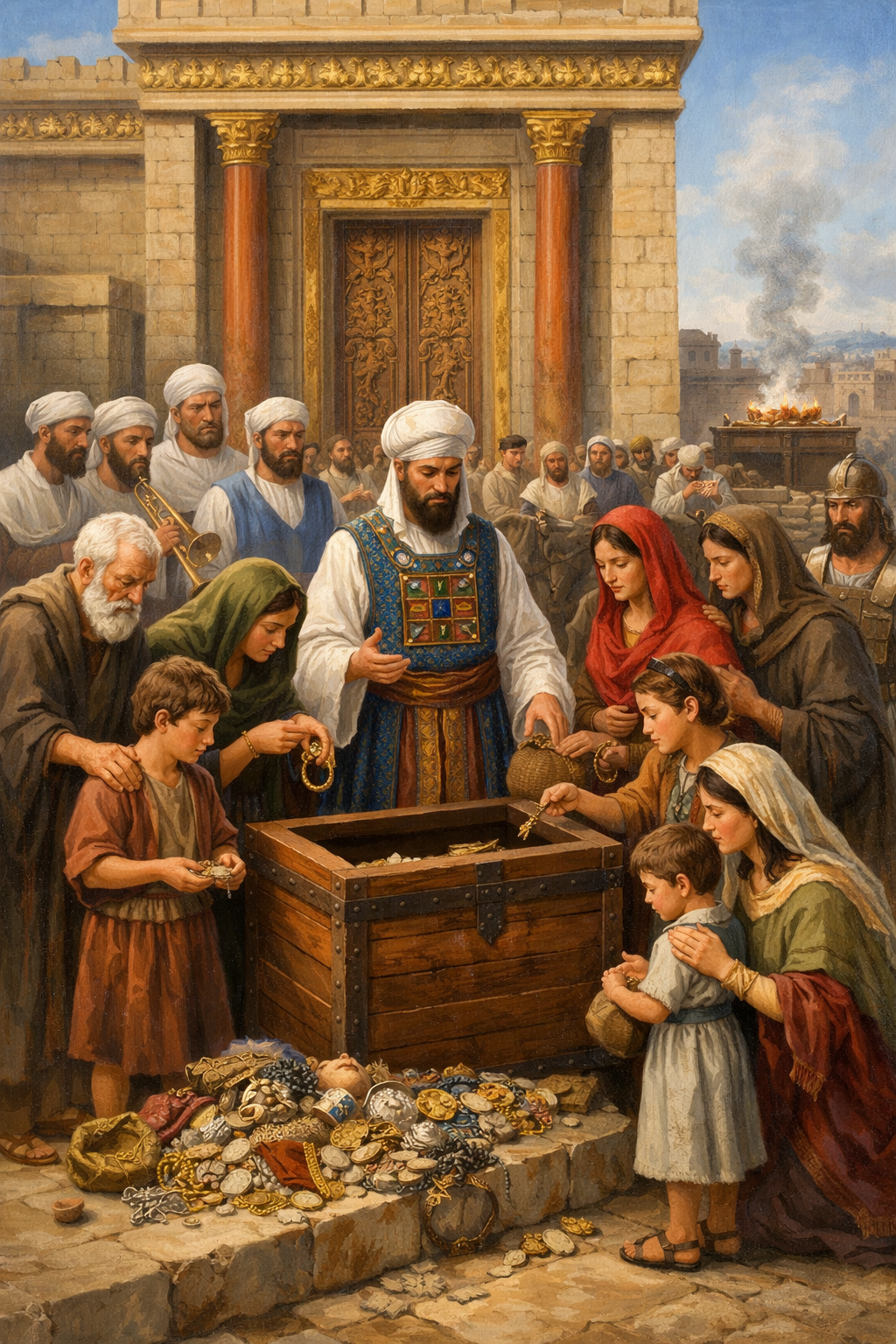
A NATIONWIDE PROCLAMATION
FOR FULFILLING THE MOSAIC TAX
This is not in the account in 2 Kings 12.
They made a proclamation in Judah and Jerusalem to bring to the LORD the levy fixed by Moses the servant of God on Israel in the wilderness - Note the proclamation indicates they desire for all the people of God to support the Temple. Instead of relying on the ineffective, inefficient collections by the Levites described in 2 Chronicles 24:5 the leaders now issue an official, public call reminding the people of their responsibility to fulfill the Mosaic tax.
Andrew Hill: Joash brokers a compromise with the priests to the effect that the people will bring their taxes and offerings to the temple rather than contribute to Levitical “collection agents” (2 Kings 12:6-8; 2 Chron. 24:8-11). In addition, laborers are contracted to do the repair work instead of using the Levites as construction workers. . . A chest or collection box is stationed near the altar (in the courtyard) outside the gate of the temple building (2 Kings 12:9; 2 Chron. 24:8). Joint oversight of the funds deposited in the chest is provided by a royal and priestly official (2 Kings 12:10; 2 Chron. 24:11). Workers, including carpenters, masons, and smiths, are hired and paid directly from the funds deposited in the temple collection box (2 Kings 12:10-12; 2 Chron. 24:12-13). Presumably these funds include the three types of revenues specified by Joash: the annual tax, personal vows, and freewill offerings (2 Kings 12:4). (See 1 and 2 Chronicles - Page 33)
Raymond Dillard: The Chronicler frequently draws parallels between the tabernacle and the first temple. The joyous, unfettered giving of the wilderness community (Exod 36:4–7) was repeated in the history of the first temple (1 Chr 29:1–9; 2 Chr 24:9–10); for the Chronicler this spirit of joyous giving was of homiletical relevance to encourage a similar attitude toward the second temple in his own day. (See 2 Chronicles, Volume 15 - Page 187)
2 Chronicles 24:10 All the officers and all the people rejoiced and brought in their levies and dropped them into the chest until they had finished.
- rejoiced: 1Ch 29:9 Isa 64:5 Ac 2:45-47 2Co 8:2 2Co 9:7
Related Passages:
2 Corinthians 8:2 that in a great ordeal of affliction their abundance of joy and their deep poverty overflowed in the wealth of their liberality.
2 Corinthians 9:7 Each one must do just as he has purposed in his heart, not grudgingly or under compulsion, for God loves a cheerful giver.
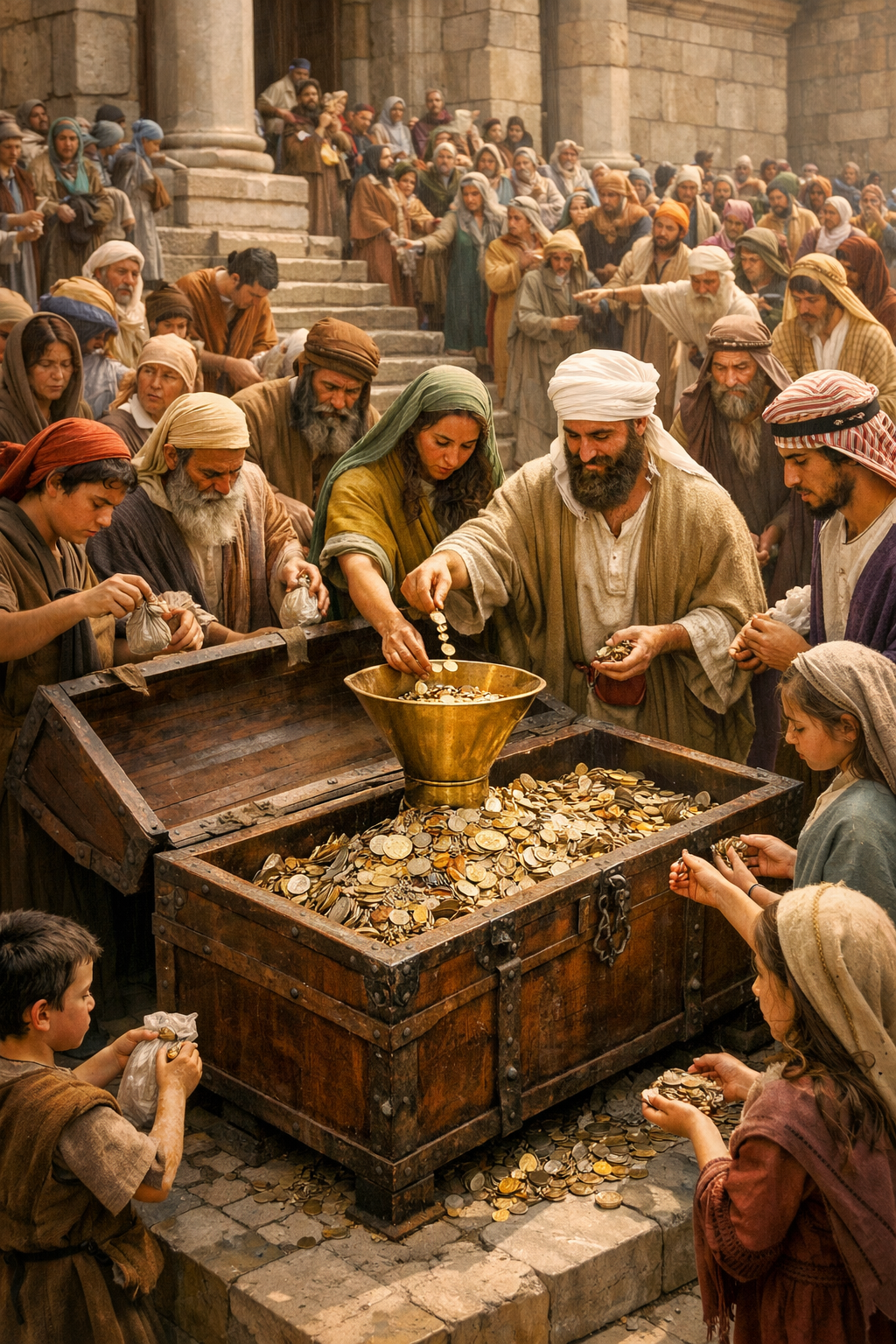
JOYFUL
GIVERS
This information is not in the account in 2 Kings 12.
All the officers and all the people rejoiced - This records the remarkable response to the proclamation of verse 9 and shows that the restoration effort seems to have gained full national momentum. Note the repetition of “all” is intentional. All leaders (officers) and all citizens (the people) responded together. The people did not give under compulsion or fear of enforcement but gave with rejoicing.
And brought in their levies - They followed through on their reaction of rejoicing with tangible action. The word levies points back to the Mosaic requirement. The people were not improvising generosity; they were responding obediently to what God had already prescribed. God’s people rejoiced to do what God required.
and dropped them into the chest until they had finished - The act of dropping money into the chest emphasizes their personal participation and visible transparency. Each giver could see where the money went. This restored confidence that offerings would be used faithfully.
This passage shows that when God’s Word is clearly proclaimed and faithfully administered, His people respond with joyful, united, and sustained obedience.
Spurgeon -See the influence of one man. One man can sway a state. One man can check sin. One man can be the head of a host who shall serve God, and honour his name.
Bob Utley - This verse is surprising because in 2 Chr. 24:18 the people revert to Ba'al worship. Either there was a group of faithful followers all along or the whole population was religiously fickle.
Warren Wiersbe Jehoiada and King Joash would lead the people in repairing the temple so that they had a fine place for worshipping the Lord. The godly people in Judah must have rejoiced that an obedient descendant of David was on the throne. What they didn’t know was that Joash’s faith was shallow, and that he obeyed God only to please Jehoiada. Joash was an excellent follower but not a good leader. When Jehoiada died, Joash went his own way and disobeyed the Lord.
2 Chronicles 24:11 It came about whenever the chest was brought in to the king’s officer by the Levites, and when they saw that there was much money, then the king’s scribe and the chief priest’s officer would come, empty the chest, take it, and return it to its place. Thus they did daily and collected much money.
- at what time: 2Ki 12:10-12
- Thus they did: 1Co 16:2
Related Passages:
2 Kings 12:10 When they saw that there was much money in the chest, the king’s scribe and the high priest came up and tied it in bags and counted the money which was found in the house of the LORD.
It came about whenever - Whenever indicates an established routine, not an occasional or improvised action. The system was designed to function smoothly as often as needed.
the chest was brought in to the king’s officer by the Levites, and when they saw that there was much money, then the king’s scribe and the chief priest’s officer would come, empty the chest, take it, and return it to its place - Note this layered oversight (Levites, kings officer, king's scribe, chief priest's officer) ensured that no single individual or group controlled the funds. Civil authority and priestly authority worked together, reinforcing transparency and preventing misuse.
Much money - When the chest contained “much money,” officials emptied it openly, secured the contents and returned the chest immediately. The chest was never left unattended or privately handled. This visible integrity was crucial in rebuilding public trust.
Bob Utley - The large amount of money collected in the chest was not tallied nor dispensed by the Levites but by several special leaders only -- King's scribe and High Priest's officer
Thus they did daily and collected much money The word “daily” highlights consistency and diligence. Faithfulness was not occasional—it was habitual. The system did not depend on exceptional moments but on ordinary obedience repeated over time. The result of this procedure was that they collected much money.
In short, when giving is handled openly, jointly, and consistently, God’s people respond with sustained generosity, and God’s work advances powerfully.
Warren Wiersbe Joash didn’t ignore the priesthood in this project, for the counting and distributing of the money was handled jointly by representatives of the king and the high priest (v. 10). Without realizing it, Joash was following Paul’s principle of involving the people and making sure everything was kept open and aboveboard (2 Cor. 8:16–24). The workers were so honest and faithful that nobody kept records of the income and expenditures, a fact that may have upset the royal auditors. The only project they didn’t include was replacing the gold and silver utensils that had been stolen from the temple (2 Chron. 24:7), but enough money was left over to take care of that need (2 Chron. 24:14). Believers today know that the Lord doesn’t live in church buildings or in any other kind of building (John 4:23–24; Acts 7:48–50; 17:24), but this doesn’t mean that it’s wrong to dedicate structures to His service and glory. The early churches didn’t have their own buildings but met in homes and in accessible public places such as the temple in Jerusalem. It wasn’t until the fourth century that the law permitted them to construct and meet in their own buildings. Some of the saints today oppose church buildings and say they’re a waste of God’s money, while others almost worship their buildings and get their priorities confused. Campbell Morgan clarifies the issue with this warning: Whereas the house of God today is no longer material but spiritual, the material is still a very real symbol of the spiritual. When the Church of God in any place in any locality is careless about the material place of assembly, the place of its worship and its work, it is a sign and evidence that its life is at a low ebb. I recall preaching one Sunday evening to a congregation that met in a church building that was in such disrepair that it couldn’t help but embarrass the members and the visitors they brought. It was doubtful that any of the members lived in houses in that condition (Hag. 1:1–6). I asked one of the church leaders why they didn’t fix things up, and he replied somewhat sarcastically, “Oh, most of our budget has to go to foreign missions. And do you know what the missionaries do with the money we send them? They fix their buildings!” It wasn’t a matter of either home or foreign but of balance. As Dr. Oswald J. Smith used to say, “The light that shines the farthest will shine the brightest at home.” The executive director of a foreign mission ministry told me, “It took me ten years to learn that Acts 1:8 didn’t use the word or but the word and. The Lord doesn’t tear things down at home in order to build things up overseas.” Blessed are the balanced!
Walton - shared custody of funds between king and priests. The sharing of custody for funds used in temple restorations is attested in the records of Assyrian king Esarhaddon (seventh century). Here also there are accusations on both sides regarding who is responsible for the delay in the project..(IVP Background Commentary - OT - page 445)
2 Chronicles 24:12 The king and Jehoiada gave it to those who did the work of the service of the house of the LORD; and they hired masons and carpenters to restore the house of the LORD, and also workers in iron and bronze to repair the house of the LORD.
- gave it to such: 2Ch 34:9-11
- masons: 1Ki 5:15
Related Passages:
2 Kings 12:11-12 They gave the money which was weighed out into the hands of those who did the work, who had the oversight of the house of the LORD; and they paid it out to the carpenters and the builders who worked on the house of the LORD; 12 and to the masons and the stonecutters, and for buying timber and hewn stone to repair the damages to the house of the LORD, and for all that was laid out for the house to repair it.
RESOURCES BEGIN TO
YIELD RESULTS
The king and Jehoiada - The verse begins by naming Joash and Jehoiada together is deliberate for it shows unity between royal authority and priestly authority. This shows unified leadership faithfully channeling God’s provision into skilled labor, resulting in the thorough restoration of the house of the LORD.
Gave it to those who did the work of the service of the house of the LORD - Note the funds were given not to intermediaries, not to administrators for personal discretion, but directly to responsible overseers.
And they hired masons and carpenters to restore (chadash) the house of the LORD, and also workers in iron and bronze to repair the house of the LORD - The repeated phrase “to restore...repair the house of the LORD” underscores the goal.
John Walton - repair crew. The regular maintenance of the temple complex was the responsibility of the “workmen in charge of the temple.” Major repairs had to be contracted out to skilled workers. The listing of these skilled laborers is typical of contemporary Assyrian records. (IVP Background Commentary - OT - page 445)
2 Chronicles 24:13 So the workmen labored, and the repair work progressed in their hands, and they restored the house of God according to its specifications and strengthened it.
- the workmen labored Ne 4:7
- in his state: 1Ch 22:5 Hag 2:3 Mk 13:1,2
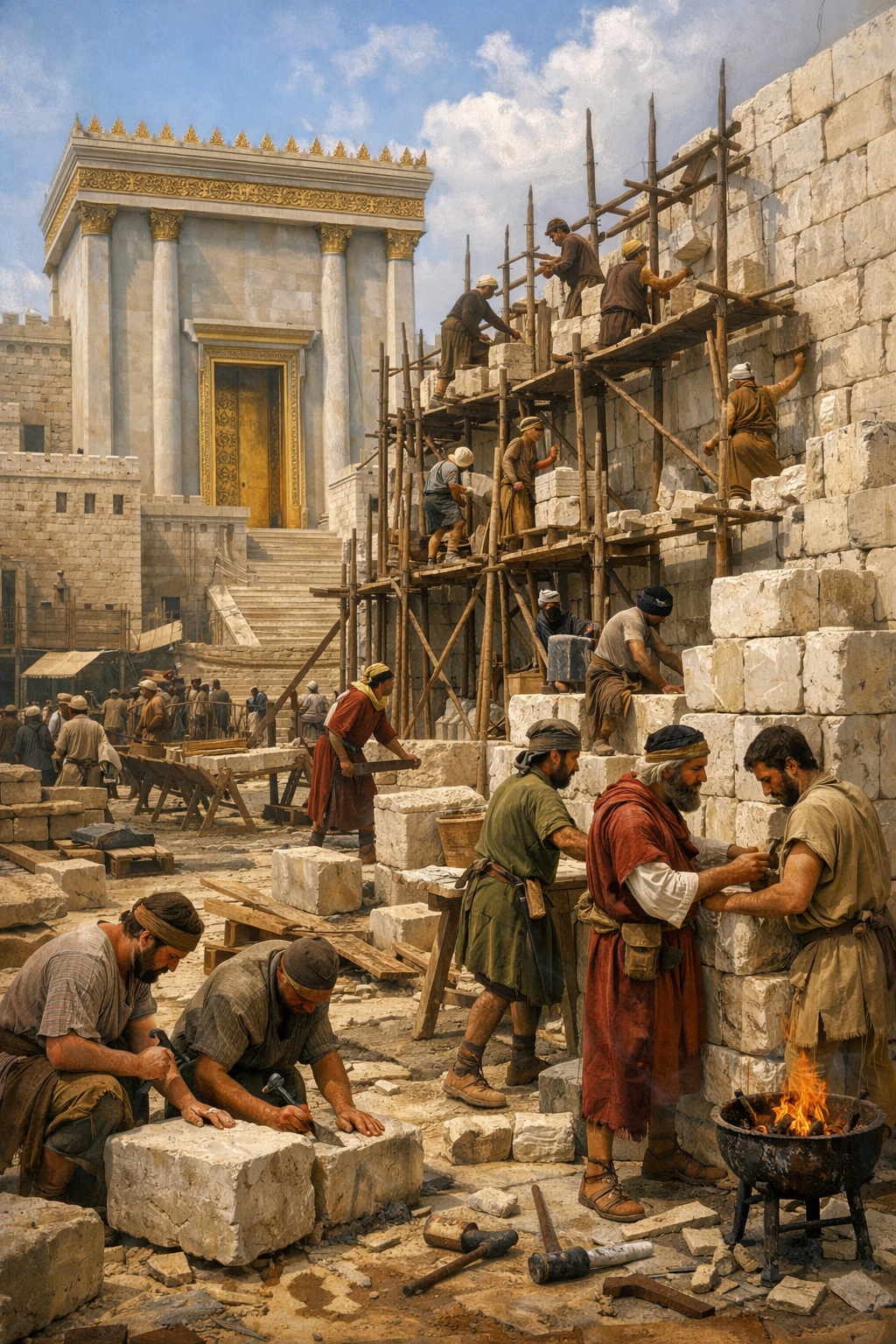
SUCCESSFUL EXECUTION
OF TEMPLE RESTORATION
So the workmen labored, and the repair work progressed in their hands, and they restored the house of God according to its specifications and strengthened it - This verse shows that when God’s provision is matched by faithful labor and obedience to His design, restoration is effective, enduring, and God-honoring.
Bob Utley - "according to its specifications" This meant the guidelines from King David and King Solomon.
J.A. Thompson: The “original design” came from God (1 Chr 28:11-19), and the reformers did not want to try to improve on it. The diligence of the workers further reveals the celebratory atmosphere of this revival. (See 1, 2 Chronicles: An Exegetical and Theological Exposition)
Joseph Parker - The life tabernacle is a wondrous building; there is room for workers of all kinds in the uprearing of its mysterious and glorious walls. If we cannot do the greatest work, we may do the least; our heaven will come out of the realization of the fact that it was God’s tabernacle we were building, and under God’s blessing that we were working.
John Walton - nature of the work. It appears that the skilled workers restored the temple to its original foundations. The skilled workers were carpenters, builders, masons and stonecutters. The term for “builder” was used for both skilled and unskilled laborers who worked primarily with mudbrick. The carpenter was responsible for all of the wood items in construction, including the roof, door, window and stair fittings, and various cultic objects in the temple. The mason/stonecutter quarried the stones from natural caves or drove shafts in the hillside. Then the stones were cut and fitted into place. It will be remembered that Solomon contracted Phoenician craftsmen to build the temple. It is not expressly stated that foreign workers were used to refurbish the temple during the reign of Joash.(IVP Background Commentary - OT - page 445)
2 Chronicles 24:14 When they had finished, they brought the rest of the money before the king and Jehoiada; and it was made into utensils for the house of the LORD, utensils for the service and the burnt offering, and pans and utensils of gold and silver. And they offered burnt offerings in the house of the LORD continually all the days of Jehoiada.
- utensils of the house, 2Ki 12:13,14
- utensils for the service: 1Ki 7:50
- to offer withal: or, pestils, Pr 27:22
- And they offered: Ex 29:38-42 Nu 28:2-29:40
- all the days: 2Ch 24:2
Related Passages:
2 Kings 12:13-14 But there were not made for the house of the LORD silver cups, snuffers, bowls, trumpets, any vessels of gold, or vessels of silver from the money which was brought into the house of the LORD; 14 for they gave that to those who did the work, and with it they repaired the house of the LORD.
FINAL STAGE OF
TEMPLE RESTORATION
This verse describes the final stage of the temple restoration and highlights the return of full, proper worship once structural repair was complete.
When they had finished, they brought the rest of the money before the king and Jehoiada First the temple was repaired and strengthened (v. 13) then surplus funds were addressed. The utensils were made from remaining funds, not from money originally designated for repairs. This directly explains and harmonizes with 2 Kings 12:13, which states that no vessels were made during the repair phase. The surplus money was brought before the king and Jehoiada, highlighting shared accountability between royal and priestly authority.
and it was made into utensils for the house of the LORD, utensils for the service and the burnt offering, and pans and utensils of gold and silver - The list of utensils shows that the goal was functional worship, not decoration. These items were necessary for sacrifices, offerings, and daily temple ministry.
Bob Utley - Apparently most of the sacred utensils had been stolen and taken to the temple of Ba'al in Jerusalem (cf. 2 Chr. 23:17; 24:7).
And they offered burnt offerings in the house of the LORD continually all the days of Jehoiada - The verse ends with worship, not construction. Continuous burnt offerings signal restored covenant faithfulness, ongoing devotion, not a one-time event and stability during the lifetime of Jehoiada. The phrase “all the days of Jehoiada” quietly anticipates later tragedy. As long as godly leadership remained, worship continued faithfully.
TSK - It appears from this, that the daily morning and evening sacrifices had been previously intermitted; and that they were again neglected after the death of Jehoiada.
J.A. Thompson: The workers’ integrity was such that they could be relied on to use only what was needed for the job. As the Chronicler informs us, they finished their work considerably under budget. The reference to the regular burnt offerings is intended as an indication that there was full cultic faithfulness throughout Jehoiada’s lifetime. (See 1, 2 Chronicles: An Exegetical and Theological Exposition)
Raymond Dillard: “As long as Jehoiada lived” (v 14). These words form an inclusio with 24:2. They reflect the regular practice of the Chronicler to use chronological notes to divide the accounts of individual reigns into good and bad periods; the transition to the record of Joash’s apostasy begins with the similar notice at the beginning of v 15. (See 2 Chronicles, Volume 15 - Page 214)
John Walton - articles for the temple. The cultic vessels mentioned here were made by Solomon’s craftsmen (1 Kings 7:50) and were distinct from those made by the Phoenicians (1 Kings 7:13–47). They became booty for Nebuchadnezzar II during his capture of Jerusalem more than two centuries after Joash. The terms are best described as “vessels for the service and for the burnt offering, bowls and gold and silver vessels.”.(IVP Background Commentary - OT - page 445)
2 Chronicles 24:15 Now when Jehoiada reached a ripe old age he died; he was one hundred and thirty years old at his death.
- reached a ripe old age he diedGe 15:15 25:8 1Ch 23:1 Job 5:26 Ps 91:16
- an hundred: Ge 47:9 Ps 90:10
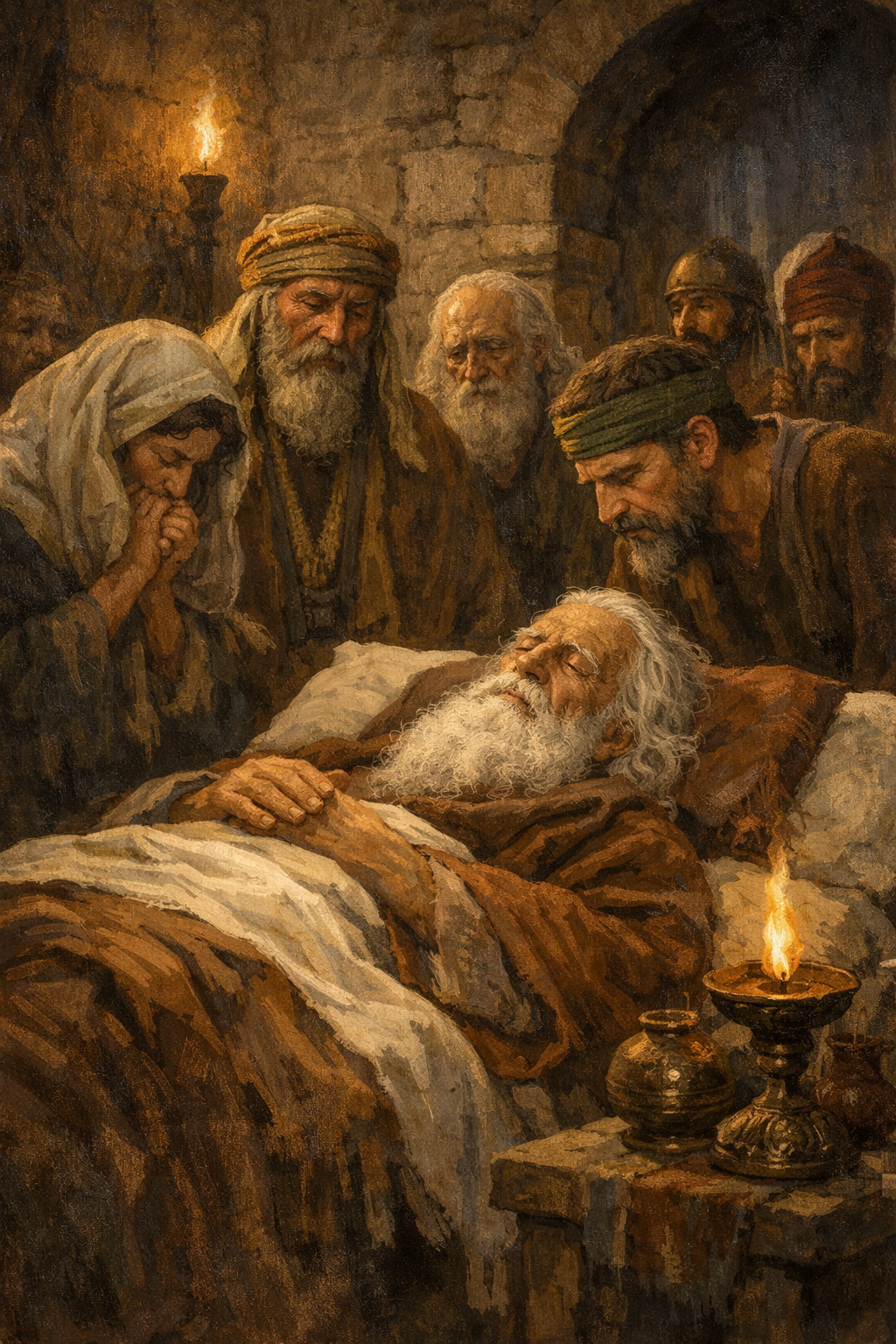
PASSING OF JOASH'S
"SPIRITUAL STABILIZER"
NOTE: 2 Chronicles 24:15-16 is not recorded in 2 Kings 12.
This marks not just the death of a man, but the approaching end of a spiritual era in Judah.
Now when Jehoiada reached a ripe old age he died he was one hundred and thirty years old at his death The Chronicler draws attention to the extraordinary age of Jehoiada. This is exceptional even by Old Testament standards.
This verse functions as a hinge point in the narrative. Up to this moment for Joash honored the LORD, restored the temple, establish regular worship. But the Chronicler intentionally pauses here, because everything that follows is shaped by this death. The repeated refrain earlier—“all the days of Jehoiada”—now comes into sharp focus. This verse prepares the reader to see that Joash’s obedience was externally supported rather than internally secured. Jehoiada’s long life delayed the consequences of Joash’s shallow roots, but it did not eliminate them. His death will expose whether Joash’s devotion was learned behavior or settled conviction.
Bob Utley - Death was not seen as an enemy. The time of death was the concern. Life taken early, violently or by sickness, was seen as the problem.
Morris - Jehoiada lived far longer than any others of his generation. He was the uncle of King Joash, as well as high priest, and was almost solely responsible for preserving the Davidic line and the true faith of Jehovah during the critical reign of the pagan queen Athaliah. In fact, he was largely responsible for leading the country in its great reforms under the long reign of Joash, who became an apostate after Jehoiada died. When Jehoiada's son, Zechariah, rebuked him for this Joash slew him.
Spurgeon - It happened to him as it must happen to us all; for the best of men must grow old, and pass away. Let us value them while we have them. Too often we give them stones while they are alive, in anticipation of giving them bigger stones to keep them in memory when they die. “Jehoiada waxed old,” —An unusual age for that time; short enough as compared with the years of the antediluvian patriarchs, but still a great age for those days.
August Konkel: The priest Jehoiada lived to the extraordinary age of 130 years (2 Chron 24:15), longer than great figures such as Moses. Living to such and advanced age was a sign of blessing. (1 & 2 Chronicles)
John Walton - Jehoiada lived longer than Moses (120 years) and Aaron (123 years), showing his great favor with God. The fact that the Chronicler called attention to Jehoiada’s age shows his great importance, equal to any of the Judahite monarchs. Egyptian texts considered 110 to be the ideal old age, while Mesopotamian ideas targeted 120. In the sixth century, Adad-Guppi, the mother of the Babylonian king Nabonidus, is said to have lived to the age of 104. (IVP Background Commentary - OT - page 446)
Matthew Henry Notes: 2Ch 24:15-27
We have here a sad account of the degeneracy and apostasy of Joash. God had done great things for him; he had done something for God; but now he proved ungrateful to his God and false to the engagements he had laid himself under to him. How has the gold become dim, and the most fine gold changed! Here we find,
I. The occasions of his apostasy. When he did that which was right it was not with a perfect heart. He never was sincere, never acted from principle, but in compliance to Jehoiada, who had helped him to the crown, and because he had been protected in the temple and rose upon the ruins of idolatry; and therefore, when the wind turned, he turned with it.
1. His good counsellor left him, and was by death removed from him. It was a mercy to him and his kingdom that Jehoiada lived so long-130 years (2Ch 24:15), by which it appears that he was born in Solomon's time, and had lived six entire reigns before this. It was an encouragement to him to go on in that good way which Jehoiada had trained him up in to see what honour was done to Jehoiada at his death: They buried him among the kings, with this honourable encomium (perhaps it was part of the inscription on his grave-stone), that he had done good in Israel. Judah is called Israel, because, the other tribes having revolted from God, they only were Israelites indeed. Note, It is the greatest honour to do good in our generations, and those who do that which is good shall have praise of the same. He had done good towards God; not that any man's goodness can extend unto him, but he had done good towards his house, in reviving the temple service, 2Ch 23:8. Note, Those do the greatest good to their country that lay out themselves in their places to promote religion. Well, Jehoiada finished his course with honour; but the little religion that Joash had was all buried in his grave, and, after his death, both king and kingdom miserably degenerated. See how much one head may sustain, and what a great judgment to any prince or people the death of godly, zealous, useful men is. See how necessary it is that, as our Saviour speaks, we have salt in ourselves, that we act in religion from an inward principle, which will carry us on through all changes. Then the loss of a parent, a minister, a friend, will not involve the loss of our religion.
2. Bad counsellors got about him, insinuated themselves into his affections, wheedled him, flattered him, made obeisance to him, and, instead of condoling, congratulated him upon the death of his old tutor, as his release from the discipline he had been so long under, unworthy a man, a king. They tell him he must be priest-ridden no longer, he is now discharged from grave lessons and restraints, he may do as he pleases: and (would you think it?) the princes of Judah were the men that were so industrious to debauch him, 2Ch 24:17. His father and grandfather were corrupted by the house of Ahab, from whom no better could be expected. But that the princes of Judah should be seducers to their king was very sad. But those that incline to the counsels of the ungodly will never want ungodly counsellors. They made obeisance to the king, flattered him into an opinion of his absolute power, promised to stand by him in making his royal will and pleasure pass for a law, any divine precept or institution to the contrary in any wise notwithstanding. And he hearkened to them: their discourse pleased him, and was more agreeable than Jehoiada's dictates used to be. Princes and inferior people have been many a time thus flattered into their ruin by those who have promised them liberty and dignity, but who have really brought them into the greatest servitude and disgrace.
II. The apostasy itself: They left the house of God, and served groves and idols, v. 18. The princes, it is likely, had a request to the king, which they tell him they durst not offer while Jehoiada lived; but now they hope it will give no offence: it is that they may set up the groves and idols again which were thrown down in the beginning of his reign, for they hate to be always confined to the dull old-fashioned service of the temple. And he not only gave them leave to do it themselves, but he joined with them. The king and princes, who, a little while ago, were repairing the temple, now forsook the temple; those who had pulled down groves and idols now themselves served them. So inconstant a thing is man and so little confidence is to be put in him!
III. The aggravations of this apostasy and the additions of guilt to it. God sent prophets to them (2Ch 24: 19) to reprove them for their wickedness, and to tell them what would be in the end thereof, and so to bring them again unto the Lord. It is the work of ministers to bring people, not to themselves, but to God-to bring those again to him who have gone a whoring from him. In the most degenerate times God left not himself without witness; though they had dealt very disingenuously with God, yet he sent prophets to them to convince and instruct them, and to assure them that they should find favour with him if yet they would return; for he would rather sinners should turn and live than go on and die, and those that perish shall be left inexcusable. The prophets did their part: they testified against them; but, few or none received their testimony.
1. They slighted all the prophets; they would not give ear, were so strangely wedded to their idols that no reproofs, warnings, threatenings, nor any of the various methods which the prophets took to convince them would reclaim them. Few would hear them, fewer would heed them, but fewest of all would believe them or be governed by them.
2. They slew one of the most eminent, Zechariah the son of Jehoiada, and perhaps others. Concerning him observe,
(1.) The message which he delivered to them in the name of God, 2Ch 24:20. The people were assembled in the court of the temple (for they had not quite left it), probably on occasion of some solemn feast, when this Zechariah, being filled with the spirit of prophecy, and known (it is likely) to be a prophet, stood up in some of the desks that were in the court of the priests, and very plainly, but without any provoking language, told the people of their sin and what would be the consequences of it. He did not impeach any particular persons, nor predict any particular judgments, as sometimes the prophets did, but as inoffensively as possible reminded them of what was written in the law. Let them but look into their Bibles, and there they would find,
{1.} The precept they broke: "You transgress the commandments of the Lord, you know you do so, in serving groves and idols: and why will you so offend God and wrong yourselves?''
{2.} The penalty they incurred: "You know, if the word of God be true, you cannot prosper in this evil way; never expect to do ill and fare well. Nay, you find already that because you have forsaken the Lord he hath forsaken you, as he told you he would,'' Deu. 29:25; 31:16,17. This is the work of ministers, by the word of God, as a lamp and a light, to expose the sin of men and expound the providences of God.
(2.) The barbarous treatment they gave him for his kindness and faithfulness in delivering this message to them, v. 21. By the conspiracy of the princes, or some of their party, and by the commandment of the king, who thought himself affronted by this fair warning, they stoned him to death immediately, not under colour of law, accusing him as a blasphemer, a traitor, or a false prophet, but in a popular tumult, in the court of the house of the Lord-as horrid a piece of wickedness as perhaps any we read of in all the history of the kings. The person was sacred-a priest, the place sacred-the court of the temple (the inner court, between the porch and the altar), the message yet more sacred, and we have reason to think that they knew it came from the spirit of prophecy. The reproof was just, the warning fair, both backed with scripture, and the delivery very gentle and tender; and yet so impudently and daringly do they defy God himself that nothing less than the blood of the prophet can satisfy their indignation at the prophecy. Be astonished, O heavens! at this, and tremble, O earth! that ever such villany should be committed by men, by Israelites, in contempt and violation of every thing that is just, honourable, and sacred-that a king, a king in covenant with God, should command the murder of one whom it was his office to protect and countenance! The Jews say there were seven transgressions in this; for they killed a priest, a prophet, a judge, they shed innocent blood, and polluted the court of the temple, the sabbath, and the day of expiation: for on that day, their tradition says, this happened.
(3.) The aggravation of this sin, that this Zechariah, who suffered martyrdom for his faithfulness to God and his country, was the son of Jehoiada, who had done so much good in Israel, and particularly had been as a father to Joash, 2Ch 24:22. The affront done by it to God, and the contempt put on religion, are not so particularly taken notice of as the ingratitude there was in it to the memory of Jehoiada. He remembered not the kindness of the father, but slew the son for doing his duty, and what the father would have done if he had been there. Call a man ungrateful, and you can call him no worse.
(4.) The dying martyr's prophetic imprecation of vengeance upon his murderers: The Lord look upon it, and require it! This came not from a spirit of revenge, but a spirit of prophecy: He will require it. This would be the continual cry of the blood they shed, as Abel's blood cried against Cain: "Let the God to whom vengeance belongs demand blood for blood. He will do it, for he is righteous.'' This precious blood was quickly reckoned for in the judgments that came upon this apostate prince; it came into the account afterwards in the destruction of Jerusalem by the Chaldeans-their misusing the prophets was that which brought upon them ruin without remedy (2Ch 36:16); nay, our Saviour makes the persecutors of him and his gospel answerable for the blood of this Zechariah; so loud, so long, does the blood of the martyrs cry. See Mt. 23:35. Such as this is the cry of the souls under the altar (Rev. 6:10), How long ere thou avenge our blood? For it shall not always go unrevenged.
IV. The judgments of God which came upon Joash for this aggravated wickedness of his.
1. A small army of Syrians made themselves masters of Jerusalem, destroyed the princes, plundered the city, and sent the spoil of it to Damascus, 2Ch 24:23, 24. God's people, while they kept in with God, had often been conquerors when the enemy had the advantage of the greater number; but now, on the contrary, an inconsiderable handful of Syrians routed a very great host of Israelites, because they had forsaken the Lord God of their fathers, and then they were not only put upon the level with their enemies, but opposed them with the utmost disadvantage; for their God not only departed from them, but turned to be their enemy and fought against them. The Syrians were employed as instruments in God's hand to execute judgments against Joash, though they little thought so, Isa. 10:6, 7, and see Deu. 32:30.
2. God smote him with great diseases, of body, or mind, or both, either like his grandfather (2Ch 24:18), or, like Saul, an evil spirit from God troubling him. While he was plagued with the Syrians he thought that, if he could but get clear of them, he should do well enough. But, before they departed from him, God smote him with diseases. If vengeance pursue men, the end of one trouble will but be the beginning of another.
3. His own servants conspired against him. Perhaps he began to hope his disease would be cured-he was but a middle-aged man and might recover it; but he that cometh up out of the pit shall fall into the snare. When he thought he should escape death by sickness he met it by the sword. They slew him in his bed for the blood of the sons of Jehoiada, by which it should seem that he did not only slay Zechariah, but others of the sons of Jehoiada for his sake. Perhaps those that slew him intended to take vengeance for that blood; but, whether they did or not, this was what God intended in permitting them to slay him. Those that drink the blood of the saints shall have their own blood given them to drink, for they are worthy. The regicides are here named (2Ch 24:26), and it is observable that the mothers of them both were foreigners, one an Ammonitess and the other a Moabitess. The idolatrous kings, it is likely, countenanced those marriages which the law prohibited for the prevention of idolatry; and see how they resulted in their own destruction.
4. His people would not bury him in the sepulchres of the kings because he had stained his honour by his mal-administration. Let him not be written with the righteous, Ps. 69:28. These judgments are called the burdens laid upon him (v. 27), for the wrath of God is a heavy burden, too heavy for any man to bear. Or it may be meant of the threatenings denounced against him by the prophets, for those are called burdens. Usually God sets some special marks of his displeasure upon apostates in this life, for warning to all to remember Lot's wife.
2 Chronicles 24:16 They buried him in the city of David among the kings, because he had done well in Israel and to God and His house.
- in the city of David among the kings: 1Sa 2:30 1Ki 2:10 Ac 2:29
- because: 2Ch 23:1-21 31:20 Ne 13:14 Heb 6:10
A ROYAL BURIAL FOR
A LOYAL PRIEST
They buried him in the city of David among the kings - Jehoiada was not a king, yet he was buried with the kings in the city of David. This was virtually unheard of. Royal burial was normally reserved for Davidic rulers, not priests. The Chronicler intentionally highlights this to show that spiritual faithfulness outweighed political office in God’s evaluation.
because (term of explanation) The reason for this honor is explicitly stated. Jehoiada preserved the Davidic line, overthrew Athaliah’s wicked regime, restored the worship of the LORD, and guided Joash during his faithful years
He had done well in Israel and to God and His house - Jehoiada received royal honor in death because his life was marked by covenant faithfulness to God and sacrificial devotion to God’s house.
Raymond Dillard: By virtue of his regency over his young ward Joash, Jehoiada was somewhat a priest/king, and he is given a royal burial among the graves of the kings, a sharp contrast to the burial of Joash (24:25). The role played by Jehoiada may reflect also the growing influence of the high priest in the absence of a monarchy during the post-exilic period. (See 2 Chronicles, Volume 15)
Frederick Mabie: Jehoiada’s death notice (vv. 15-16) reads more like a Judean regnal summary than a death notice for a priest. This final summary of his life reflects a number of subtle editorial strokes that work to portray Jehoiada’s actions in a kinglike manner, including - the phraseology that Jehoiada “showed his strength” (cf. 23:1), - his leading in national covenant ratification (23:1, 3), - his oversight of reforms to ensure adherence to Mosaic and Davidic instructions (cf. 23:18-19), - his selection of wives for Joash (24:3), and - his burial in the royal cemetery (v. 16, an honor not given to Joash himself, cf. v. 25). Thus, it can be argued that Jehoiada to an extent functioned as a surrogate king in a manner similar to Samuel during the reign of Saul (note that both were king-makers with extensive national authority). Obviously, Joash’s young age at his enthronement would have necessitated a significant degree of assistance with his royal responsibilities at the beginning of his reign. (See 1 and 2 Chronicles)
Spurgeon -That is the best kind of good which begins with doing good toward God, and then goes on to doing good towards God’s house. The Church is to be served, but even it must be second to God’s glory. God first, and then the very best must come next.
2 Chronicles 24:17 But after the death of Jehoiada the officials of Judah came and bowed down to the king, and the king listened to them.
- but after: De 31:27 Ac 20:29,30 2Pe 1:15
- the officials of Judah: 2Ch 10:8-10 22:3,4 Pr 7:21-23 20:19 26:8,28 29:5 Da 11:32
- and the king listened: Pr 29:12
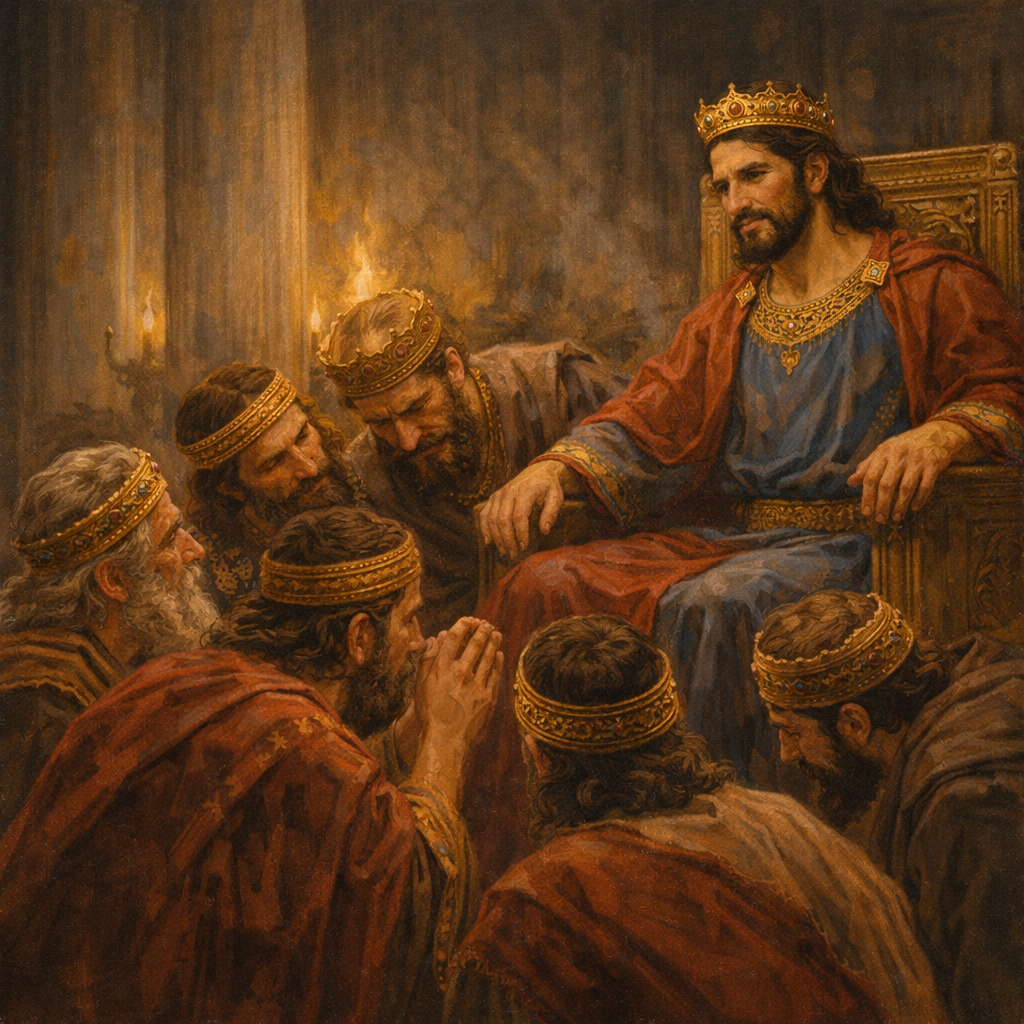
Officials Bowing, King Listening
THE HINGE WORD "BUT"
MARKS A DECISIVE CHANGE
But - Term of contrast - Key indicator that divides the two periods of the reign of Joash. Jehoiada had been the godly influence. BUT is like a hinge on a door and the door it opens can be either good or bad. In this case it was VERY BAD! (See How One Word Can Change the Way you read your Bible)
After the death of Jehoiada The time sensitive word AFTER is critical. Scripture has repeatedly emphasized that Joash did what was right “all the days of Jehoiada.” Now that Jehoiada is gone, the narrative tests whether Joash’s faith was genuine, internalized conviction or borrowed obedience, so to speak. The subsequent verses answer that question dramatically and tragically.
The officials of Judah came and bowed down to the king The word officials refers to Judah’s political and social elites. These were influential men—likely sympathetic to syncretism or idolatry—who had been restrained while Jehoiada lived. Their approach signals a change with priestly counsel replaced by political counsel, God’s Word is replaced by human opinion and spiritual authority is replaced by flattery. This act of bowing is more than courtesy. It signals man-centered allegiance, appealing to Joash’s pride and desire for affirmation.
And the king listened to them - WOE! This phrase the king listened leads to demise, disaster and death. Joash chooses his counselors and in doing so, he chooses his future. Note what we do not see him do! He does not seek the LORD, consult priests or prophets (includeing Jehoiada's son Zechariah) or (saddest of all to me as a teacher) remember Jehoiada’s instruction who was like a father to him! In effect he listens to voices that tell him what he wants to hear, not what he needs to hear.
🙏 THOUGHT - In the context of what subsequently transpired in Joash's life, the clear takeaway and warning for ALL of us is BE CAREFUL WHO (or what) you listen to! What you take in audibly and visibly will have a major impact on the entire course of your life! Do not be deceived, thinking you are the exception to this rule!
Bob Utley - This shows the problem of faithless counselors and the people's devotion to Ba'al (cf. 2 Kgs. 12:3) Joash listened to them, as he had previously listened to Jehoiada. It shows his weak personality.
Warren Wiersbe when Jehoiada passed off the scene, King Joash showed his true colors and abandoned the faith. His apostasy wasn’t the fault of Jehoiada, for the high priest had faithfully taught Joash the Scriptures. The problem was Joash’s shallow faith and his desire to please the leaders of the land, “the officials of Judah” who visited Joash and asked him to be more lenient in matters of religion (24:17–18). He relented, and once again idolatry moved into Judah and Jerusalem.
Spurgeon - These flatterers came with all their daintiest manners, and made obeisance to the king, and “the king hearkened unto them.” All the days of Jehoiada, these princes had been afraid to set up the fashionable worship the worship of Baalim, that had been introduced by the Sidonian queen Jezebel, that wicked woman of strong and masterful spirit. This worldly and false religion had been put down by the strong hand of Jehoiada; but when its adherents thought they had a chance to get to the front again, they came and flattered the king, and “the king hearkened unto them.”
Andrew Hill: The Chronicler informs us that the king is led astray by the counsel of the officials of Judah (24:17). The expression “paid homage” (hwh; lit., “do obeisance”) may suggest that the leaders of the clans of Judah exploit a character weakness in Joash through flattery. The elders prefer to return to the policies of Joash’s father, Ahaziah, for unspecified reasons. Perhaps the “old ways” are now custom in Judah, or such religious policy is advantageous socially and economically. For the Chronicler, however, to abandon the temple is to abandon God (24:18). (See 1 and 2 Chronicles - Page 33)
August Konkel: Materialism is exceedingly deceptive and pervasive. Upon the passing of the priest, it immediately began to assert its ugly influence in Judah. The influence of Athaliah had been subdued, but its impulses were ever present, and at the first opportunity the king was pressured to make changes. The wealth of the Phoenicians and their trading empire was constantly alluring. One of the ways to realize those benefits more readily was with the revival of their religion. The impression given is that the change effected by Jehoiada was more a coercive force than a real change of life and values. Another generation had arisen in the decades following the coronation of Joash, and the dramatic transformation of those events had faded. The king himself succumbed to the demands for change. . .Power, greed and materialism invariably breed violent conflict. The king, incapacitated by the wounds of war, became particularly vulnerable to conspiracy. The mothers of the conspirators who killed Joash were both foreign women, perhaps a reminder of the danger of turning to foreign worship. Materialism and greed leave a terrible legacy. Jehoiada, the faithful priest, was buried as a king; Joash, the privileged king, was buried in disgrace. (1 & 2 Chronicles)
See sermon by Steven Cole - excerpt - Joash faced spiritual testing; so will we. We read (2Ch 24:2) that “Joash did what was right in the sight of the Lord all the days of Jehoiada the priest.” But Jehoiada finally died and then Joash was faced with a spiritual test (2Ch 24:17). This was a hinge-point in his life, and Joash failed the test. Our enemy, the devil, is neither stupid nor impetuous. He is waiting in the wings, biding his time for the right moment to attack. The officials of Judah did not approach Joash while Jehoiada was alive--the time was not right. But as soon as he was dead, and Joash was vulnerable, they hit and he fell. Joash’s temptation was a common one. In Deuteronomy 31:29 Moses warned Israel that after his death, they would act corruptly and turn from the way which he had commanded them. In Joshua 24:31 we read that Israel served the Lord all the days of Joshua and all the days of the leaders who survived Joshua, who had known all the deeds which the Lord had done for Israel. But then comes the book of Judges, when everyone in Israel forsook the Lord and did what was right in his own eyes. The time comes for us all when we can no longer lean on those who have nurtured us in the faith. We must be weaned and learn to stand on our own spiritual legs. We must develop and maintain our own walk with God, or else we will fall when Satan comes, as surely he will, to tempt us. The story of Joash shows four dangers Satan often uses to test those who are spiritually privileged (For full sermon click A Good Boy Gone Bad - 2 Chronicles 23 and 24)
G Campbell Morgan - 2 Chr 24.17
These are very simple words, but they are inexpressibly sad, and full of arresting power and suggestion. Under the reign of Joash real reformation was achieved in Judah, but it was wholly due to the influence of Jehoiada the priest. This is clearly indicated in the statement of the chronicler that: "Joash did that which was right in the eyes of Jehovah all the days of Jehoiada the priest." Nevertheless, during this period it is evident that Joash was honesty zealous in his endeavour to re-establish the true worship of God. The reform circumferenced the Temple: "They set up the house of God in its state, and strengthened it." The worship was maintained while Jehoiada lived. After his death, the princes of Judah, evidently corrupt men, came to the king, and he "hearkened unto them." The house of God was forsaken, and idolatry was again established in the land. Joash, who had been zealous in reform, now became determined in wickedness. The study of the story of Joash offers a striking illustration of how a weak man is easily influenced. It emphasizes the need of strong individual character, which can only be created by direct dealing with God. However valuable the influence of a good man may be, it remains true that if a man have nothing more to lean on than that, if it should fail, collapse is almost inevitable. All foundations fail, save one. When the will of man is yielded wholly to the will of God, and no other authority is sought or permitted, that man is safe. Where this is lacking, every changing tide of circumstances will change the currents of life.
2 Chronicles 24:18 They abandoned the house of the LORD, the God of their fathers, and served the Asherim and the idols; so wrath came upon Judah and Jerusalem for this their guilt.
- They abandoned the house of the LORD 2Ch 24:4 21:13 33:3-7 1Ki 11:4,5 14:9,23
- wrath: 2Ch 19:2 28:13 29:8 32:25 36:14-16 Jos 22:20 Jud 5:8 2Sa 24:1 Ho 5:10,11,14 Zep 1:4-6 Eph 5:6
TRAGIC OUTCOME OF
ABANDONING GODLY COUNSEL
They abandoned ('azab; LXX - egkataleipo = leave behind, forsake) the house of the LORD, the God of their fathers - The verb abandoned ) is a key word in 2Ch 24 (2Ch 24:18, 20, 24, 25) and the last use is poetic justice. Joash LEFT God and in the end the Arameans LEFT him very sick (2Ch 24:25)! What goes around, comes around. This is the immutable law of reaping and sowing (Hos 8:7). What Joash should have abandoned was his transgressions, Pr 28:13 using the same verb 'azab declaring "He who conceals his transgressions will not prosper, But he who confesses and forsakes ('azab - abandons) them will find compassion."
Judah did not merely neglect worship, but walked away from it. This is especially shocking given the recent restoration of the temple. The house that had been repaired with such care is now spiritually forsaken and without care. This verse records the tragic outcome of the decision described in verse 17. What began as listening to ungodly counsel now becomes open apostasy.
and served the Asherim and the idols - The Asherim were associated with fertility worship and moral corruption. Their reappearance signals a return to pagan influence and worship driven by desire rather than obedience. This was not a neutral alternative spirituality but a direct violation of the first commandment.
So - Term of conclusion (and what a horrible conclusion!) describing the moral consequence of the abandonment of Yahweh.
Wrath came upon Judah and Jerusalem The verse clearly connects sin with consequence. God’s wrath here is not arbitrary anger but covenant response. The Law had warned that abandoning the LORD would bring discipline. What follows is not random misfortune but divine judgment designed to awaken repentance.
for this their guilt - The Chronicler leaves no ambiguity. Judah’s suffering is traced to a specific cause: their guilt. Political trouble, military defeat, and national distress are presented as the fruit of spiritual rebellion.
The lessons are several -
- External reform cannot substitute for internal devotion
- Abandoning God often follows abandoning godly counsel
- Idolatry invites divine discipline
- Covenant faithlessness has real consequences
Once Joash and Judah abandoned the LORD for idols, wrath followed—revealing the tragic collapse of reform that never reached the heart.
Bob Utley - Again, the Chronicler asserts that judgment came because of disobedience to YHWH's covenant. YHWH wanted to bless His people as a witness to the world but because of the curses involved in "the two ways" (cf. Leviticus 26; Deuteronomy 28; 30; Psalm 1; Proverbs 1), only judgment was seen. The Chronicler saw all history in YHWH's hand. Judgment (temporal) was meant to turn His people back to Him (cf. 2 Chr. 24:19). SPECIAL TOPIC: APOSTASY
ESV Study Bible (borrow) has an interesting comment - Throughout 2 Chronicles, the religious character of a king can be readily gauged by his attitude toward the temple, and this is most evident in the case of Joash: in his faithful period, he is devoted to the restoration of the temple (vv. 4, 5, 12), but in his apostasy, he abandons it for idolatry (v. 18).
Warren Wiersbe Joash’s apostasy was a sin of willful rebellion against God, for the king knew what the law of Moses taught about idolatry. But it was also a sin of ingratitude for all that Jehoiada had done for him. Jehoiada and his wife had saved the king’s life! The high priest had taught him the truth of God’s Word and had stood at Joash’s side as he learned how to govern the people. But the king had never taken the truth into his heart and allowed it to take root. The soil of his heart was shallow and he had obeyed God’s law only because his mentor was watching. He even took wealth from the very temple he had repaired and gave it to a pagan king for ransom!
Spurgeon -Or, “Asherah and idols.” The word is mistakenly translated “groves.” These were certain horrible and disgusting emblems of the heathen goddess Ashtaroth, or Astarte: “They served Asherah and idols.”
J.A. Thompson: It is evident that despite Jehoiada’s restraining influence, the Asherah poles and idols continued to be served. A common story in Israel and elsewhere is that despite religious reforms directed from the top by a leader or leaders, popular forms of religion linger on and break out again when restraints are lifted. (See 1, 2 Chronicles: An Exegetical and Theological Exposition)
John Walton - The Asherah poles were apparently man-made objects and often were situated near trees (see Jer 17:2), although they may have actually been living trees on occasion (see Deut 16:21). The Asherah cult object symbolized the goddess herself. The poles were often associated with the image of the goddess, which was a separate item altogether. For more information see comment on 2 Kings 13:6. (IVP Background Commentary - OT - page 446)
Abandoned (forsook, left) (05800) 'azab basically means to depart from something -- to leave, to forsake (48x), to leave (26x; "left" 22x), to loose, to depart, to abandon. Things that can left behind or forsaken include persons (Ge 44:22; Nu 10:30; Ru 1:16; 2Ki4:30), people who should left behind (Ge 2:24); places (2Ki 8:6; Jer 18:14; 25:38) and objects (Ge 39:12,13; 50:8; Ex 9:21). Men can forsake God (apostatize) (Dt 28:20, 31:16, Jer 1:16), can abandon qualities of virtue (1Ki 12:8, 2Chr 10:8, 13), the way (of righteousness) (Pr 15:10), instruction/wisdom (Pr 4:2, 6), reproof (Pr 10:17 - "ignore" = forsake), kindness (lovingkindness, faithfulness) (Pr 3:3). God promises to not forsake His people (Ge 24:27, 28:15, Dt 31:6,7 contrast what God's people will do = Dt 31:16). In a use similar to Pr 28:13, we are instructed to "forsake wrath." (Ps 37:8)
'AZAB IN KINGS AND CHRONICLES - 1 Ki. 6:13; 1 Ki. 8:57; 1 Ki. 9:9; 1 Ki. 11:33; 1 Ki. 12:8; 1 Ki. 12:13; 1 Ki. 14:10; 1 Ki. 18:18; 1 Ki. 19:10; 1 Ki. 19:14; 1 Ki. 19:20; 1 Ki. 21:21; 2 Ki. 2:2; 2 Ki. 2:4; 2 Ki. 2:6; 2 Ki. 4:30; 2 Ki. 7:7; 2 Ki. 8:6; 2 Ki. 9:8; 2 Ki. 14:26; 2 Ki. 17:16; 2 Ki. 21:22; 2 Ki. 22:17; 1 Chr. 10:7; 1 Chr. 14:12; 1 Chr. 16:37; 1 Chr. 28:9; 1 Chr. 28:20; 2 Chr. 7:19; 2 Chr. 7:22; 2 Chr. 10:8; 2 Chr. 10:13; 2 Chr. 11:14; 2 Chr. 12:1; 2 Chr. 12:5; 2 Chr. 13:10; 2 Chr. 13:11; 2 Chr. 15:2; 2 Chr. 21:10; 2 Chr. 24:18; 2 Chr. 24:20; 2 Chr. 24:24; 2 Chr. 24:25; 2 Chr. 28:6; 2 Chr. 28:14; 2 Chr. 29:6; 2 Chr. 32:31; 2 Chr. 34:25;
To abandon, reject, desert or leave a former association (1Ki 18:18). Abandoned, deserted or rejected, forsaken (Isa 6:12; 10:14; 17:2, 9; 54:6; 60:15; 62:4; Jer 4:29; Zep 2:4).
In Pr 28:13 the writer urges the path of forsaking transgressions. God issued a similar merciful plea in Isaiah 55…
Let the wicked forsake ('azab) his way and the unrighteous man his thoughts; and let him return to the Lord, and He will have compassion (racham) on him, and to our God, For He will abundantly pardon. (Is 55:7)
2 Chronicles 24:19 Yet He sent prophets to them to bring them back to the LORD; though they testified against them, they would not listen.
- Yet he sent: 2Ch 36:15,16 2Ki 17:13-15 Ne 9:26 Jer 7:25,26 25:4,5 26:5 44:4,5 Lu 11:47-51 16:31 20:9-15
- but they would: Ps 95:7,8 Isa 28:23 42:23 51:4 55:3 Mt 13:9,15,16
ASTONISHING DIVINE PATIENCE
AND MERCY OF YAHWEH
Yet - A mercy filled term of contrast - The word “yet” is crucial for signals the striking contrast that despite rebellion, God gives mercy and grace.
He sent prophets to them to bring them back to the LORD - Note God's way - mercy before judgment! Prophets were not sent to condemn first, but to call the people back. This reflects a consistent biblical pattern—warning precedes wrath. The purpose of the prophetic message was restoration, not humiliation.
Bob Utley - "He sent prophets" Prophets, their message, and their writings were very important to the Chronicler! YHWH had not abandoned His people. They just would not listen (cf. Isa. 6:9-13).
Though they testified against them The prophets did not soften the message. “Testified against them” implies clear identification of sin, public confrontation and clear covenantal warning. True prophetic ministry is not vague encouragement; it is truth spoken in love, naming sin and calling for repentance.
they would not listen - This final clause is devastating. Judah’s refusal to listen shows that the issue was not lack of information but lack of transformation. The problem was not unclear messaging but stopped up ears. The root issue was hardened hearts. When they rejected the prophets, they rejected Yahweh who sent them.
Persistent rejection of God’s warnings leads inevitably to judgment, not because God is harsh, but because repentance is refused. God spoke repeatedly. Judah refused repeatedly. The responsibility lies squarely with the hearers.
🙏 THOUGHT - How do we as believers today apply this truth today, for we do not have prophets in the Old Testament sense? Let me suggest that we do have prophets (prophetes) in the sense of those who speak forth God's Word from pulpits and teaching platforms. And Paul gives us two commands we should heed "Do not quench (present imperative with a negative = stop doing this or do not begin -- see our need to depend on the Holy Spirit to obey) the Spirit. Do not despise (present imperative with a negative = stop doing this or do not begin -- see our need to depend on the Holy Spirit to obey) prophetic utterances." (1Th 5:19-20) How do we quench God's Spirit? When we despise prophetic utterances, God's Word, spoken through those He had raised up. I would propose that even when we read the Word of God in our quiet time in the morning (you do have a quiet time don't you?), we are not just to HEAR it but to HEED it, and enabled by His Spirit, become DOERS of what we have heard lest we delude ourselves like King Joash! (Jas 1:22)
Frederick Mabie: Despite his anger at the rapid abandonment of covenantal faithfulness by Joash and the Judeans, God emphatically demonstrated his love, patience, and grace for his covenantal people by repeatedly sending prophets to proclaim his word to urge the people to return to God in obedience. The summary of God’s (unsuccessful) efforts to bring his people back to himself is reminiscent of the closing verses of Chronicles reflecting on the tragedy of the exile: “The Lord, the God of their fathers, sent word to them through his messengers again and again, because he had pity on his people and on his dwelling place. But they mocked God’s messengers, despised his words and scoffed at his prophets until the wrath of the Lord was aroused against his people and there was no remedy.” (2Ch 36:15-18) (See 1 and 2 Chronicles)
Spurgeon - “These old Puritans have come back again,” said they. “We will not listen to them.” The common people were still mostly worshippers of Jehovah; but the great ones of the earth had gone over to the idols, and they could not endure that one and another of the prophets, often very humble and unlearned men, should come and bear testimony for Jehovah.
2 Chronicles 24:20 Then the Spirit of God came on Zechariah the son of Jehoiada the priest; and he stood above the people and said to them, “Thus God has said, ‘Why do you transgress the commandments of the LORD and do not prosper? Because you have forsaken the LORD, He has also forsaken you.’”
- And the Spirit: 2Ch 15:1 20:14
- came upon: Heb. clothed, Judges 6:34 1Ch 12:18
- the son: 2Ch 23:11
- transgress: Nu 14:41 1Sa 13:13,14 2Sa 12:9,10 Zec 7:11-14
- because: 2Ch 15:2 De 29:25,26 1Ch 28:9 Jer 2:19 4:18 5:19,25
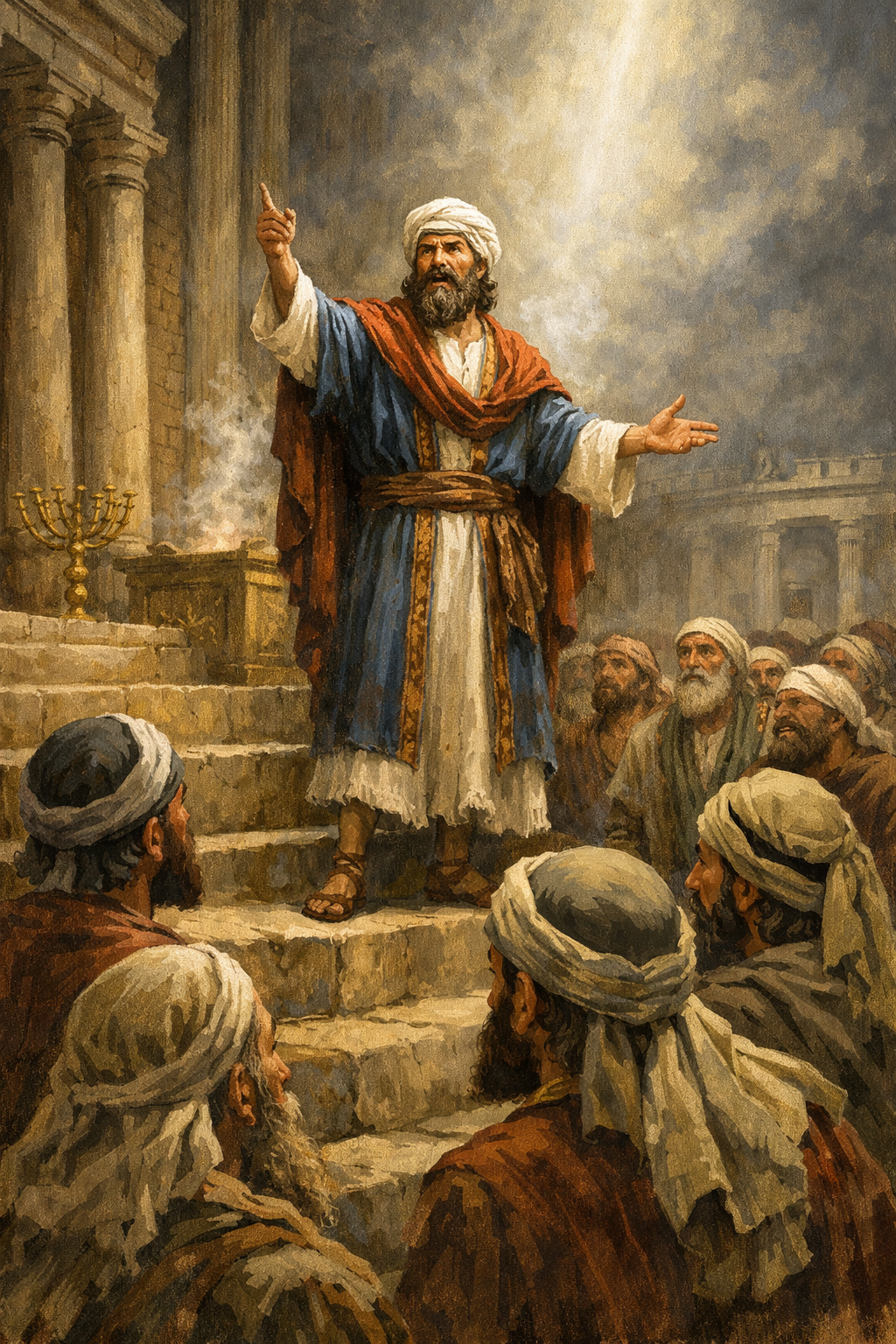
THE CLIMATIC PROPHETIC
CONFRONTATION
Then the Spirit of God came on Zechariah the son of Jehoiada the priest - NET = "God's Spirit energized Zechariah..." CSB = "The Spirit of God too control of Zechariah" NRSV = "The Spirit of God took possession of Zechariah." ESV = "the Spirit of God clothed Zechariah," which is closer to the literal which reads "the Spirit of God clothed.” This is same expression used of Amasai (1Ch 12:18). It follows that Zechariah does not speak from personal anger or inherent authority but by God's authority because the Spirit of God came upon him. He therefore functions as a prophet, a man who will now speak the Words of God for God. What follows is God’s word, not Zechariah's opinion. Zechariah is the son of Jehoiada, the very man whose godly influence preserved Joash and restored true worship.
And he stood above the people and said to them, Zechariah positions himself above the people, likely in the temple court, to address the nation openly. This is not a private rebuke but a public covenant lawsuit. Truth is proclaimed where sin has been practiced.
“Thus God has said, ‘Why do you transgress the commandments of the LORD and do not prosper? The prophet exposes the false assumption behind Judah’s actions. They had likely expected blessing or security despite disobedience. Zechariah declares that disobedience explains their lack of prosperity. Covenant blessing and covenant obedience cannot be separated.
Because you have forsaken ('azab; LXX - egkataleipo = leave behind, forsake) the LORD, He has also forsaken ('azab; LXX - egkataleipo = leave behind, forsake) you - This is the heart of the message. It does not mean God abandons His people arbitrarily, but that covenant relationship is reciprocal. To forsake the LORD is to forfeit His protective presence. The statement echoes long-standing covenant warnings: abandonment leads to withdrawal, not because God is unfaithful, but because the people have broken fellowship.
Ryrie - On the Spirit's work in the OT, see note on Judg. 3:10. Zechariah the son of Jehoiada. Not the prophet Zechariah, but likely the grandson of Jehoiada. See note on Matt. 23:35. The Spirit of the LORD came upon many in OT times, as here with Othniel (see 6:34; 11:29; 13:25; 1 Sam. 10:9-10; 16:13; 1 Chron. 12:18). He was also in some people (Num. 27:18; Dan. 4:8; 6:3; 1 Peter 1:11) and filled some for special service (Ex. 31:3; 35:31). These relationships are characterized by the Lord, as the Spirit, being "with" them, in contrast to His permanent indwelling of all believers from the Day of Pentecost on (John 14:17).
This verse teaches that:
- God warns clearly before judging
- Prophetic truth often comes from unexpected and painful sources
- Prosperity without obedience is an illusion
- Forsaking God carries inevitable relational consequences
Spurgeon - He spoke very temperately and affectionately. The warning was faithful; but it was delivered in the very best and kindest spirit. But now see what the wicked men did.
Raymond Dillard: Though the Chronicler demonstrates the coherence of action and effect by showing judgment for wrongdoing, sanctions are ordinarily imposed only after a prophet offers hope of escape through repentance and forgiveness (Williamson, 323). Many prophets confronted Joash (24:19, 27), but the writer elaborates only on the death of Zechariah (24:20–22).
John Olley: The tragedy is expressed: Joash “did not remember” (from Hb. zakar), a play on the name “Zechar-iah” (“The Lord has remembered”); to “remember” involves acting on the basis of what is called to memory. A further wordplay is evident as Zechariah called for the Lord to “avenge” (Hb. darash, “seek” [cf. ESV mg.]); since the king did not “seek” God, the Lord was to “seek” the king, leading to judgment. (SEE ESV Expository Commentary (Volume 3): 1 Samuel–2 Chronicles)
F B Meyer - 2 Chronicles 24:20 The Spirit of God clothed itself with Zechariah the son of Jehoiada. (R. V. marg.)
As we put on a cloak or dress, so does the Spirit of God, as it were, hide Himself in those who surrender themselves to Him, so that it is not they who speak and act, but He within them. Have you at any time been conscious of having the clothing of the Holy Spirit? Remember that cloth or leather must yield itself easily to the movements of its wearer, and not less pliable and supple must we be to the Spirit of God.
When the Spirit of God is thus within us, and speaks or acts for us, we may expect, as Zechariah found it, to come into collision with the entire drift and current of society around us, and to incur odium and hatred. Men do not like to be told that they cannot prosper because they have forsaken God; but we have no alternative than to witness against their sins. Does the Spirit clothe Himself with you, my friend, as you anticipate the work of to-day? Are you using Him, or is He to use you? Are you seeking to clothe yourself with His power for some personal ambition, or are you desirous that He should array Himself in you, so that the glory may evidently be His? In the agony of battle; when great deeds are to be done, no one stops to think of the uniform of the soldier, but only of the might beneath it.
But for this you must be prepared to pay the cost, and be willing to cross the cherished purposes of men, as the Spirit of God by your voice or deed witnesses against them. They stoned Zechariah at the command of the king; but years after the Lord Jesus referred to it, for no faithful martyr seals his witness with his blood without some quick glance of recognition from the Master, and some record on the imperishable tablets of his heart.
Gleason Archer - How could Zechariah son of Berechiah bethe last of the martyrs? And wasn’t he really the son of Jehoiada?
In Matthew 23:34-35, Jesus says to the scribes and Pharisees who are plotting His death, “Therefore behold, I am sending you prophets and wise men and scribes; some of them you will kill and crucify, . . . that upon you mayfall all the righteous blood shed onearth, from the blood of righteous Abel to the blood of Zechariah the sonof Berechiah, whom you murdered between the temple and the altar.” It is generally supposed that Jesus was actually referring to Zechariah the son of Jehoiada, who was stoned to death in the court of the temple at the order of King Joash, because Zechariah had the temerity to rebuke the government and the citizenry for their cultivation of idolatry. This is recorded in 2 Chronicles 24:20-22. But once this apparent error concerning the name of the martyr’s father has been explained away as a textual error, then it is observed that Zechariah ben Jehoiada, who died 800 b.c., was by no means the last of the Old Testament martyrs; hence he makes a poor balance to Abel, who certainly was the first.
The obvious solution is to start all over again and assume that Matthew 23:25 correctly reports the words of Jesus, and that He knew what He was talking about. If so, then we discover that the Zechariah He was referring to was indeed the son of Berachiah (not Jehoiada), and that he was indeed the last of the Old Testament martyrs mentioned in the Hebrew Scriptures. In other words, Christ is recalling to His audience the circumstances of the death of the prophet Zechariah, son of Berechiah (Zech. 1:1), whose ministry began around 520 and ended a bit later than 480 b.c. The Old Testament contains no record of events during the first few decades of the fifth century b.c. until about 457, the date of Ezra’s return to Jerusalem. But it may very well have been that sometime between 580 and 570 Zechariah the prophet was martyred by a mob in much the same way Zechariah the son of Jehoiada was some three centuries earlier. Since Jesus referred to Zechariah as the last of the Old Testament martyrs, there can be no legitimate doubt that it was the eleventh of the twelve minor prophets He had in mind. Therefore we can only conclude that the later Zechariah died in much the same way the earlier one did, as a victim of popular resentment against his rebuke of their sins.
Since there are about twenty-seven different individuals mentioned in the Old Testament bearing the name Zechariah, it is not surprising if two of them happened to suffer a similar fate. In other words, if we take Matthew 23:35 just as it stands, it makes perfect sense in its context; and it offers no contradiction to any known and established facts of history. In the absence of any other information as to how the prophet Zechariah died, we may as well conclude that Jesus has given us a true account of it and add him to the roster of the noble martyrs of biblical times.
2 Chronicles 24:21 So they conspired against him and at the command of the king they stoned him to death in the court of the house of the LORD.
- conspired: Jer 11:19 18:18 38:4-6
- stoned him: Mt 21:35 Mt 23:34-37 Ac 7:58-59
Related Passages:
Matthew 23:34-37 (“Therefore, behold, I am sending you prophets and wise men and scribes; some of them you will kill and crucify, and some of them you will scourge in your synagogues, and persecute from city to city, 35 so that upon you may fall the guilt of all the righteous blood shed on earth, from the blood of righteous Abel to the blood of Zechariah, the son of Berechiah, whom you murdered between the temple and the altar. 36 “Truly I say to you, all these things will come upon this generation. 37 “Jerusalem, Jerusalem, who kills the prophets and stones those who are sent to her! How often I wanted to gather your children together, the way a hen gathers her chicks under her wings, and you were unwilling. (NOTE: MANY THINK JESUS IS REFERRING TO ZECHARIAH'S STONING HERE IN 2 CHRONICLES BECAUSE THAT IS THE LAST BOOK IN THE HEBREW BIBLE. THUS ABEL TO ZECHARIAH WOULD ENCOMPASS THE ENTIRE OT.)
Acts 7:58-59+ When they had driven him out of the city, they began stoning him; and the witnesses laid aside their robes at the feet of a young man named Saul. 59 They went on stoning Stephen as he called on the Lord and said, “Lord Jesus, receive my spirit!”
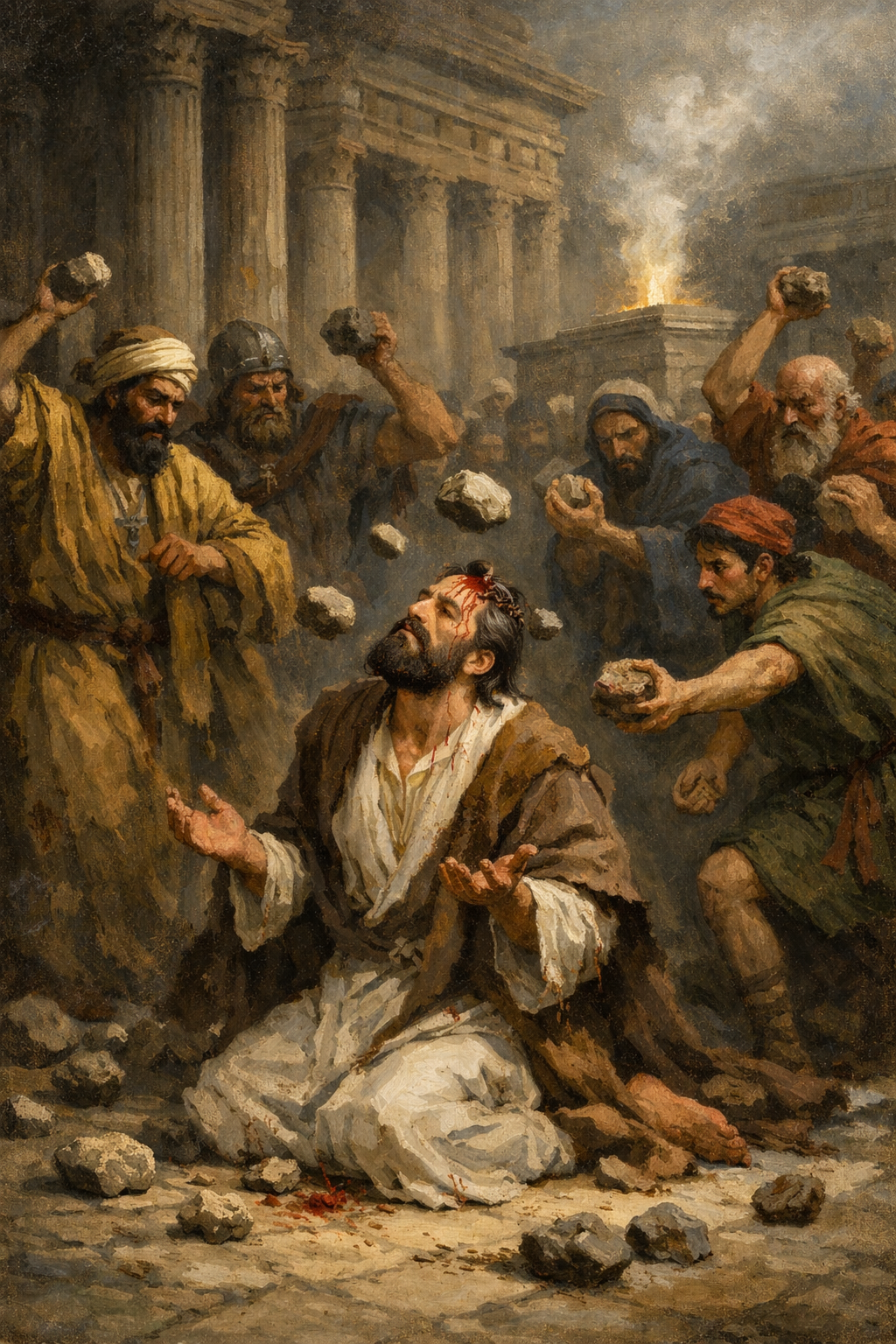
CONSPIRACY AND STONING
OF PROPHET ZECHARIAH
So - Term of conclusion. This is a bad conclusion reached by these sinful Judeans who failed to heed God's Word through Zechariah. This verse records one of the darkest moments in Judah’s history—the murder of a prophet inside the very place meant for worship.
They conspired against him - Having deliberately rejected the Words of Truth, they now conspire. This is a sad commentary of Judea. This was not a spontaneous act of rage. The word conspired indicates premeditation and collective agreement. The leaders and people did not merely disagree with the prophet’s message—they decided to silence it. Conviction turned into hostility, and warning turned into threat. Their conspiracy reveals that their hearts were hardened spiritually and that truth was no longer tolerated.
And at the command of the king - This is very difficult to believe that someone could drift so deeply into the abyss of sin that they would willfully command the murder of the son of the man who had protected their own life for 7 years and then instructed them in the Torah until their death! This despicable act marks Joash’s complete spiritual reversal from protector of the temple to persecutor of God’s prophet in the Temple and from reformer to rebel and covenant breaker.
They stoned him to death - The king commanded and the people obeyed. Stoning was the prescribed punishment for blasphemy or apostasy under the Law. Ironically, Judah uses a lawful execution method to commit an unlawful act. The prophet who called them back to obedience is executed as though he were the offender. This is a tragic, profound inversion of justice. It demonstrates how depraved one can become when they willfully reject the truth of God's Word! This is a frightening verse because even believers still have the ugly, evil sin nature lurking in their mortal bodies!
In the court of the house of the LORD (Temple) - The location intensifies their heinous crime. The temple courts were a place of animal sacrifice not human murder. To spill innocent blood there was the highest act of sacrilege. The irony is that this murder was commited in the very house recently restored to honor God thus defiling the Temple with the blood of God’s messenger.
Spurgeon - This is probably the prophet to whom Christ alludes when he speaks of Zechariah, “whom ye slew between the temple and the altar.” It was a crime most foul to murder the son of Jehoiada, one of those who had helped to put the crown upon the head of the king. To do this evil deed in the court of God’s house, when the prophet was engaged in his Master’s business, and delivering a divine message, was to heap sin upon sin.
Zechariah, the son of the priest who had saved the throne for Joash,
is murdered in the place where Joash was protected during the coup
Raymond Dillard: There is great irony in the passage: Zechariah, the son of the priest who had saved the throne for Joash, is murdered in the place where Joash was protected during the coup; Jehoiada, who had preserved the sanctity of the temple from bloodshed, installed the king who would murder his own son there. Joash falls to treason (24:25), just as Athaliah (23:13) had before him. (2 Chronicles, Volume 15)
J.A. Thompson: Matthew 23:35 and Luke 11:51 may refer to this incident. If that is the case, then Jesus was referring to all the martyrs from the beginning of the canon (Abel, in Genesis) to its end (Zechariah, son of Jehoiada, in Chronicles). This probably indicates that Chronicles stood last in the Hebrew canon in Jesus’ time, as it does today (ED: IN THE HEBREW BIBLE IT IS THE LAST BOOK). A difficulty is that Matthew’s version mentions “Zechariah the son of Berachiah,” that is, not the Zechariah of this text but the author of the Book of Zechariah. But as far as we know, the son of Berachiah was not martyred in the temple courtyard, and it seems apparent that Zechariah, son of Jehoiada, is intended. (See 1, 2 Chronicles: An Exegetical and Theological Exposition)
What is especially striking about this low moment in the history of the
Judean monarchy is that Zechariah had been like a brother to Joash
Frederick Mabie: Amazingly, the king and the people plot the murder of Zechariah, and the prophet is stoned to death (the punishment for a false prophet; cf. Dt 13:5; 18:20). What is especially striking about this low moment in the history of the Judean monarchy is that Zechariah had been like a brother to Joash, as Jehoiada (Zechariah’s father) had been a father figure to Joash from his days as an infant rescued from the murderous rampage of Athaliah (2Ch 22:10-12). (See 1 and 2 Chronicles)
2 Chronicles 24:22 Thus Joash the king did not remember the kindness which his father Jehoiada had shown him, but he murdered his son. And as he died he said, “May the LORD see and avenge!”
- remember: Ps 109:4 Lu 17:15-18 Joh 10:32
- but murdered his son: Pr 17:13
- May the LORD see: Ge 9:5 Jer 11:20 26:14,15 Lu 11:51 2Ti 4:14,16 Rev 6:9-11 Rev 18:20 19:2
- and avenge: Ps 10:14 Jer 51:56
JOASH'S MORAL
AMNESIA!
Thus Joash the king did not remember the kindness - The Chronicler’s charge is devastating. Joash forgot—not intellectually, but morally—the covenantal kindness (ḥesed) shown to him by Jehoiada. Jehoiada hid him as a child from Athaliah’s massacre, preserved the Davidic line, crowned him king and instructed him in the ways of the LORD! To “not remember” in biblical terms is to fail to act loyally in response. Joash’s sin is ingratitude that hardened into betrayal.
which his father Jehoiada had shown him - Jehoiada is called Joash’s father, highlighting a spiritual relationship. This intensifies the crime for Joash did not merely reject a prophet but he violated a special bond of spiritual paternity. The kindness owed was not abstract but was personal, accentuating the evil nature of the act against Jehoiada's son.
But - This is a sad term of contrast depicting the ultimate reversal!
He murdered his son Joash orders the death of Zechariah, the very man God raised to warn Judah. The contrast is stark for Jehoiada saved Joash’s life, whereas Joash takes Zechariah’s life! This is treachery at its worst, repaying deliverance with death.
And as he died he said, “May the LORD see and avenge!” - Zechariah’s final words are not curses of rage but an appeal to divine justice. His plea is based on the fact that he knows God sees the injustice (in His Temple!), and He acts righteously in due time because vengeance belongs to the LORD. Zechariah's last words recall to mind Robert G. Lee's great sermon Payday Someday! Joash would not have to wait long for his "payday!"
J.A. Thompson: This was a dastardly act. Joash had “forgotten” the kindness shown to him by Jehoiada. In short, he had no sense of loyalty or gratitude. The verb used for “killed” (harag) is used also of the execution of the idolatrous priest Mattan in 2Ch 23:17 and of the death of Joash in 2Ch 24:25. (See 1, 2 Chronicles: An Exegetical and Theological Exposition)
🙏 THOUGHT "Joash is a warning to us today. It isn’t enough simply to know God’s truth; we must obey His truth “from the heart” (Eph. 6:6). Truth in the mind can lead to obedience, but truth in the heart and obedience from the heart will produce godly character. God’s Word and God’s will must be internalized—received into the heart (Ps. 119:9–11)—or we can never develop consistent Christian character. Until duty and discipline become delight, we are only reluctant servants who obey God because we have to, not because we want to. Jehoiada was a “religious prop” on which the king leaned. When the prop was removed, the king fell.
During more than fifty years of ministry, I have occasionally witnessed the “Joash tragedy.” A godly wife dies and the widower soon drops out of church and starts to live a worldly life. Sons or daughters go off to college and gradually leave the faith because father and mother aren’t there to counsel and warn them. I’ve known some high-profile Christian leaders who “used” their children in their ministries, but when the children were on their own, they turned their backs on their parents and the Lord. A good beginning is no guarantee of a good ending. King Joash had every encouragement to become a godly man, but he didn’t take advantage of his opportunities by taking God’s truth into his heart. When the Lord sent prophets to warn him, he refused to listen. He even plotted with his leaders to have Zechariah, the son of Jehoiada, stoned to death because he rebuked the king for his sins.2 Imagine murdering the son of the very people who saved your life! (Warren Wiersbe)
2 Chronicles 24:23 Now it happened at the turn of the year that the army of the Arameans came up against him; and they came to Judah and Jerusalem, destroyed all the officials of the people from among the people, and sent all their spoil to the king of Damascus.
- at the turn of the year: Heb. in the revolution, 1Ki 20:22,26
- the army of the Arameans came up against him De 32:35 2Ki 12:17,18
- officials: 2Ch 24:17,18 Ps 2:10,11 58:10,11 82:6,7
Related Passages:
2 Kings 12:17 Then Hazael king of Aram went up and fought against Gath and captured it, and Hazael set his face to go up to Jerusalem.
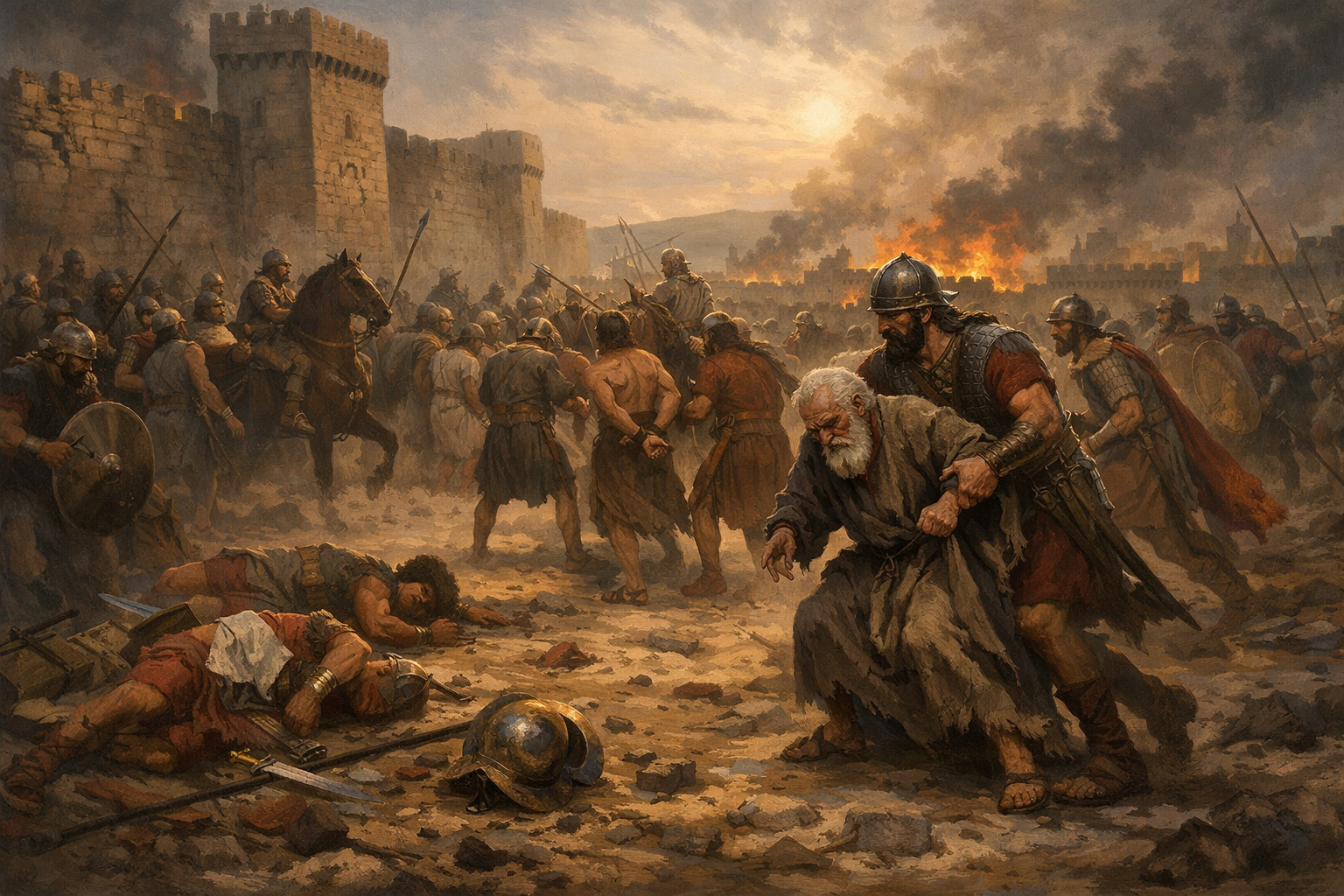
BEGINNING OF DIVINE RETRIBUTION
ON JUDAH AND JOASH
Now it happened - Events do not "just happen!" This phrase should always make us think of God's providence. Here the phrase indicates the beginning of divine retribution for the murder of Zechariah.
At the turn of the year - NLT = "in the spring of the year" The phrase indicates a set time appointed by Yahweh. God’s response is neither impulsive nor delayed indefinitely. The interval shows patience, but the timing shows certainty. Judgment arrives on schedule, not by accident. God may delay judgment, but He never forgets injustice.
That the army of the Arameans came up against him - Yahweh uses external pagan instruments to carry out His judgment. The invaders are the Arameans, acting as God’s instrument of discipline. Earlier, Joash had tried to buy them off with temple treasure (2Ki 12:18). Now, instead of bribery preventing disaster, divine judgment permits invasion. The Chronicler wants the reader to see that political maneuvering cannot replace repentance, what tribute once delayed, judgment now enforces and the wages of sin is death (Ro 6:23).
And they came to Judah and Jerusalem - The enemy reaches the very heart of the nation. Jerusalem, the city of David and the place the Temple had been restored temple is threatened. Sacred space does not guarantee safety when covenant faithfulness has been abandoned.
Destroyed all the officials of the people from among the people - Notice who is described as being destroyed! The officials were the very ones who flattered Joash (2Ch 24:17), who led the nation into idolatry (2Ch 24:18) and who conspired against Zechariah (2Ch 24:21). Judgment fell precisely on the guilty leadership, not indiscriminately. God’s justice is targeted, not chaotic.
and sent all their spoil to the king of Damascus - The spoils are sent to Hazael, highlighting Judah’s humiliation. Earlier, Joash stripped the temple to send tribute to Damascus. Now, Judah is stripped by force. What Joash once gave willingly in fear is now taken violently in judgment. Is this not divine poetic justice? Temple treasure was sent to Damascus and now Judah’s wealth follows it. God’s restored house was defiled by innocent blood and now God allows Judah to be plundered.
Cyril Barber - Several important ironies are to be found in these verses. The people of Judah and Jerusalem had been worshiping Astarte (i.e., Ashtoreth, identified as the goddess of love and war). When the Syrians invaded the land, the people of Judah would have expected Astarte to protect them and give them success in battle. Obviously, being only the creation of human minds, she could not. Judah suffered a resounding defeat, and the “leaders,” who had persuaded Joash to grant latitude to the people thus paving the way for their apostasy, were themselves killed.(2 Chronicles)
Spurgeon - God delayed not long the punishment of the evil-doers. When his servants are persecuted, he will speedily avenge his own elect. “They destroyed all the princes of the people from among the people.” Was not that remarkable? These were the authors of the sin; and they had chiefly to endure the penalty. It is not always that invaders lay hold upon the princes alone, and slay them; but these Syrians did so.
Believer's Study Bible - It is not unusual for biblical writers to refer to the kings of various nations and empires as the kings of their respective capital cities. Here, for instance, Ben-Hadad, known to the chronicler as the king of Syria (Aram), is identified as the king of Damascus, which was the capital city of Syria. Ahab was known as the king of the northern kingdom (Israel) but on occasion is referred to as the king of Samaria (1 Kin. 21:1). Hiram is called the king of Tyre (Phoenicia) on several occasions (cf. 2:3, 11; 2 Sam. 5:11; 1 Kin. 5:1; 9:11; 1 Chr. 14:1). In keeping with this precedent, Jonah spoke of the king of Assyria as the king of Nineveh, which was its capital city (Jon. 3:6).
Raymond Dillard: The “turn of the year” was in the spring, at the beginning of the dry season and a period of reduced agricultural activity after harvest; it was “the time when kings go off to war” (1Ch 20:1; 2Sa 11:1; 1Ki 20:26). The coup of Jehu had left both the Northern and Southern kingdoms in a condition of great military weakness; Hazael was quick to exploit the advantage, reducing the army of Jehoahaz in the North to no more than needed for a good parade (2 Kgs 13:7), and taking tribute from Joash in the South. In the holy war ideology of Israel, Yahweh fought for his people so that a small force could overcome a larger (13:3–18; 14:8–15; 1 Kgs 20:27; 1 Sam 14:6; Judg 7; cf. 25:7–8); here the reverse happened: due to the infidelity of Joash, with Yahweh’s aid a smaller enemy force overturned the army of Judah. (2 Chronicles, Volume 15)
John Walton - turn of the year - war in spring. In the ancient Near East spring was a popular time in which to commence military ventures. First of all, the weather in the winter was prohibitive for extensive military travel. Second, because of harvesting in the spring, invading armies were able to forage for food. The Assyrian annals make a point of describing any particular military campaign that happened during the winter or the dead of summer, when there was unbearable heat for the soldiers. (IVP Background Commentary - OT - page 446)
Bob Utley - 24:23-26 These verses record how the curse of 2 Chr. 24:22 was fulfilled.
- the Syrians invaded with a small force
- killed all officials (same title as 2 Chr. 24:17)
- took all the spoil of Jerusalem to Damascus (cf. 2 Kgs. 12:18)
- Joash was sickened or wounded (NIDOTTE, vol. 2, p. 142, #6)
- Joash's foreign servants (2 Chr. 24:26; names different in 2 Kgs. 12:21) "conspired" against him and killed him ("beware of foreigners" was surely a concern of the small post-exilic Judah of the Chronicler's day)
- he was not buried in the royal tombs
2 Chronicles 24:24 Indeed the army of the Arameans came with a small number of men; yet the LORD delivered a very great army into their hands, because they had forsaken the LORD, the God of their fathers. Thus they executed judgment on Joash.
- came: Lev 26:8,37 De 32:30 Isa 30:17 Jer 37:10
- delivered: 2Ch 16:8,9 20:11,12 Lev 26:25 De 28:25,48
- Because: 2Ch 22:8 Isa 10:5,6 13:5 Hab 1:12
GOD HEARS THE
CRY OF ZECHARIAH
Indeed the army of the Arameans came with a small number of men Humanly speaking, Judah should not have lost. The invaders were numerically inferior, yet they triumphed decisively. The Chronicler highlights this imbalance to make a point: victory and defeat are not determined by numbers but by allegiance to the LORD. This echoes a repeated biblical principle: “The LORD does not deliver by sword or by spear; for the battle is the LORD’s” (cf. 1 Sam 17:47). “One of you puts to flight a thousand”—but only when the LORD fights for you (cf. Deut 32:30).
Yet (term of contrast) the LORD delivered a very great army into their hands The subject of the verb is the LORD. Note the contrast brought out by the conjunction YET -- This was not Aramean superiority BUT divine judgment. Judah’s army is described as “very great”, underscoring the irony that a strong army is helpless when God withdraws His protection and/or strengthens the enemy army.
Because (term of explanation) they had forsaken ('azab; LXX - egkataleipo = left) the LORD, the God of their fathers - Joash had forsaken Yahweh after the death of Jehoiada. The result of forsaking of Yahweh was that he tolerated idolatry, rejected prophetic warnings and even sanctioned the murder of Zechariah, Jehoiada’s son (2 Chr 24:20–22). Think about this for a moment. As a child who was likely raised in the same household? Very likely there were almost like brothers growing up. This shows what can happen when one forsakes God and their heart grows cold and hard! MESSAGE? Beloved, don't neglect daily reading of the Word of God! To forsake ('azab; LXX - egkataleipo) the LORD is covenant language and signals a rejection of the God Who redeemed Israel, Who preserved them as a nation, and Who even preserved an heir to fulfill the Davidic Covenant. Thus the Chronicler consistently teaches that apostasy invites discipline.
Past faithfulness does not
cancel present rebellion
Thus they executed judgment on Joash This is a striking phrase because the Arameans become agents of divine justice. The Hebrew concept is judicial, not accidental for God used foreign nations as His instruments when His people refused His word (Assyrians will defeat Israel in 722BC and Babylonians will defeat Judah in 586 BC). What irony! Joash, once preserved by God as a child-king, assuring presevation of the line of Messiah through the Davidic Covenant, now stands exposed without divine protection.
John Walton - war with Aram. In the last decades of the ninth century the Aramean kingdom of Damascus was relieved of Assyrian pressures and was able to assert its influence south and west into Judah (see comment on 2 Kings 10:32). There was an attack on Gath (probably Gittaim in the northern Shephelah, not Philistine Gath), which posed a direct threat on Jerusalem (see 2 Kings 12:18). The Aramean king at this time was Hazael (see comment on 2 Kings 8:8), who ruled from 843 B.C. to near the end of the ninth century. (IVP Background Commentary - OT - page 446)
2 Chronicles 24:25 When they had departed from him (for they left him very sick), his own servants conspired against him because of the blood of the son of Jehoiada the priest, and murdered him on his bed. So he died, and they buried him in the city of David, but they did not bury him in the tombs of the kings.
AMP When they left Joash (for they left him very ill), his own servants conspired against him because of the blood of the son of Jehoiada the priest, and they murdered him on his bed. So he died, and they buried him in the City of David, but they did not bury him in the tombs of the kings.
CSB When the Arameans saw that Joash had many wounds, they left him. His servants conspired against him, and killed him on his bed, because he had shed the blood of the sons of the priest Jehoiada. So he died, and they buried him in the city of David, but they did not bury him in the tombs of the kings.
CEV Joash was severely wounded during the battle, and as soon as the Syrians left Judah, two of his officials, Zabad and Jehozabad, decided to revenge the death of Zechariah. They plotted and killed Joash while he was in bed, recovering from his wounds. Joash was buried in Jerusalem, but not in the royal tombs.
EXB When the Arameans left, Joash was badly wounded. His own ·officers [officials] made plans against him because ·he had killed [ of the shed blood of] Zechariah son of Jehoiada the priest. So they ·killed [murdered] Joash in his own bed. He died and was buried in the City of David [ Jerusalem] but not in the ·graves [tombs] of the kings.
- When they had departed from him: 2Ch 21:16,18,19 22:6
- his own servants: 2Ki 12:20 14:19,20
- the blood: 2Ch 24:21,22 Ps 10:14 Rev 16:6
- not: 2Ch 24:16 21:20 28:27
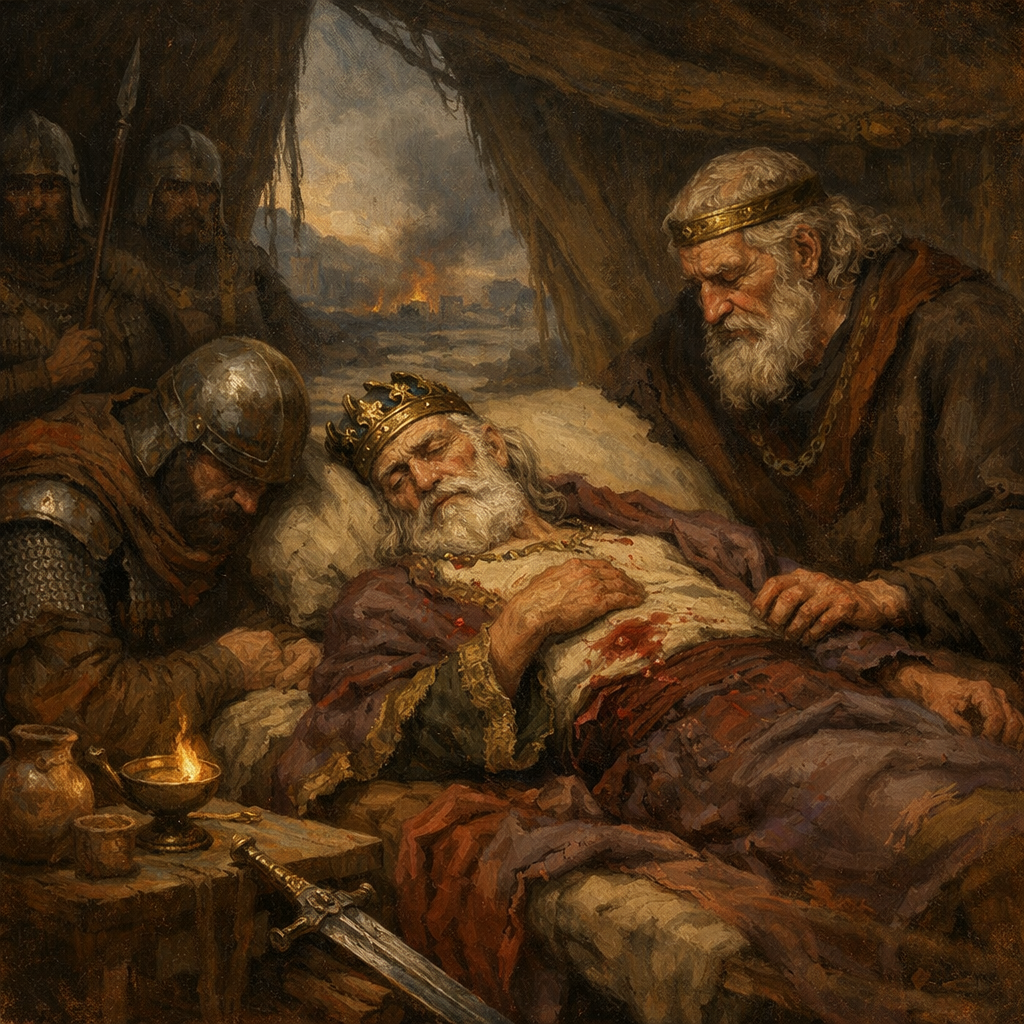
CONSPIRACY OF SERVANTS
BECAUSE OF BLOOD OF ZECHARIAH
Cyril Barber - Those who seek God find Him; those who abandon Him are themselves abandoned; those who conspire to do evil are conspired against; and those who kill are themselves killed. (2 Chronicles)
When they had departed from him (for they left ['azab; LXX - egkataleipo = left] him very sick) - This is speaking of King Joash and refers to the Aramean (Syrian) forces who had invaded Judah (vv. 23–24). Though numerically small, they devastated Judah and apparently wounded King Joash. The Chronicler underscores that Joash was left “very sick” which is a detail not emphasized in Kings and it showis that God’s judgment was already operating physically before the assassination of Joash occurred.
His own servants conspired against him because (term of explanation) of the blood of the son of Jehoiada the priest The conspiracy comes from within Joash’s own household, not from foreign enemies. This is a classic biblical motif of retributive justice: as Joash betrayed covenant loyalty, so loyalty is withdrawn from him. Importantly, Chronicles explains why the servants acted—something Kings does not make explicit.
And murdered him on his bed - Joash dies helpless, passive, and dishonored which is a striking reversal from the boy once protected in the Temple chambers. His bed, a place of rest, became his place of judgment.
Bob Utley - "murdered him on his bed" It is hard to reconcile the account here with the parallel in 2 Kgs. 12:20. See John H. Walton and D. Brent Sandy, The Lost World of Scripture, which documents how oral cultures passed down their traditions. Here, it seems to be two written sources which differ.
Spurgeon - When one set of executioners had gone, his own servants conspired against him and slew him. Here ends our reading. May it be profitable to us! (2Ti 3:16,17)
So (term of conclusion) he died, and they buried him in the city of David, but (term of contrast) they did not bury him in the tombs of the kings - Did you catch that last contrasting "BUT"? No royal burial for Joash. What a contrast with righteous Jehoiada who was given the special and unique honor of being buried with the kings of Judah!
🙏 THOUGHT - In which plot would your rather be buried? The choice is yours. Choose to "love the LORD your God, to walk in His ways and to keep His commandments and His statutes and His judgments, that you may live and multiply, and that the LORD your God may bless you" in this life and and the life to come when you will reign as a king! (Dt 30:16)
Raymond Dillard: The Chronicler commonly uses burial notices to exhibit a theme important to him: righteous kings are buried in honor, while the ignominy of the unrighteous extends even to their interment (2Ch 16:14; 21:19–20; 26:23; 28:27). In this context the refusal to bury the unrighteous Joash in the tombs of the kings contrasts sharply to the burial of the righteous priest Jehoiada there (2Ch 24:16). (2 Chronicles, Volume 15)
Warren Wiersbe - The boy king, who made such a good beginning, had a bad ending, and it was because he forsook the way of the Lord. We wonder if the prophet Ezekiel was thinking about Joash when he wrote Ezekiel 18:24–32
For I have no pleasure in the death of anyone who dies,”
declares the Lord GOD. “Therefore, repent and live.”
“But when a righteous man turns away from his righteousness, commits iniquity and does according to all the abominations that a wicked man does, will he live? All his righteous deeds which he has done will not be remembered for his treachery which he has committed and his sin which he has committed; for them he will die.
25 “Yet you say, ‘The way of the Lord is not right.’ Hear now, O house of Israel! Is My way not right? Is it not your ways that are not right? 26 “When a righteous man turns away from his righteousness, commits iniquity and dies because of it, for his iniquity which he has committed he will die. 27 “Again, when a wicked man turns away from his wickedness which he has committed and practices justice and righteousness, he will save his life. 28 “Because he considered and turned away from all his transgressions which he had committed, he shall surely live; he shall not die. 29 “But the house of Israel says, ‘The way of the Lord is not right.’ Are My ways not right, O house of Israel? Is it not your ways that are not right? 30 “Therefore I will judge you, O house of Israel, each according to his conduct,” declares the Lord GOD. “Repent and turn away from all your transgressions, so that iniquity may not become a stumbling block to you. 31 “Cast away from you all your transgressions which you have committed and make yourselves a new heart and a new spirit! (Ezek 36:25-27, Jer 31:31-34) For why will you die, O house of Israel? 32 “For I have no pleasure in the death of anyone who dies,” declares the Lord GOD. “Therefore, repent and live.”
2 Chronicles 24:26 Now these are those who conspired against him: Zabad the son of Shimeath the Ammonitess, and Jehozabad the son of Shimrith the Moabitess.
- Zabad: or, Jozachar, 2Ki 12:21
CONSPIRACY OF
FOREIGNERS
This verse identifies the assassins of King Joash and very deliberately names their mothers and national origins. That detail is not incidental; it is theological, moral, and ironic.
Now these are those who conspired against him: Zabad the son of Shimeath the Ammonitess, and Jehozabad the son of Shimrith the Moabitess - Why name their mothers—and why their ethnicity? Both assassins are sons of foreign women. Zabad was the son of Shimeath the Ammonitess and Jehozabad was the son of Shimrith the Moabitess. The Chronicler could have named only the men—but he intentionally highlights their maternal lineage. Now, God’s judgment comes through men linked to nations historically hostile to Israel’s faith. This is poetic justice.
Bob Utley - Zabad This person is called "Jozacar" in 2Ki 12:21.
Ammonites... Moabites — Biblically, Ammon and Moab are descended from Lot’s incest (Genesis 19:30–38), were often enemies of Israel and were associated with idolatry and moral corruption. The Law stated “No Ammonite or Moabite shall enter the assembly of the LORD… because they did not meet you with bread and water… and because they hired Balaam against you.” (Deut 23:3–4) Yet here, sons of women from those nations become the instruments of judgment against a Davidic king who had betrayed the covenant. The message is unmistakable that when covenant privilege is despised, God may judge His people through those once considered outsiders.
There is a tragic reversal running through the chapter
| A TRAGIC REVERSAL | |
|
Earlier in Joash’s life |
End of Joash’s life |
|
Protected by a faithful priest |
Killed by conspirators |
|
Surrounded by godly counsel |
Influenced by apostates |
|
Preserver of the temple |
Profaner of the covenant |
|
Beneficiary of grace |
Object of judgment |
Spiritual heritage does not guarantee spiritual fidelity. Privilege rejected invites judgment—sometimes from unexpected hands. Joash’s story warns that faith borrowed from godly mentors must become personal faith, that external reform without inward loyalty will not last and that God’s justice may come from places we least expect
Andrew Hill: According to the Chronicler, Joash’s officials conspire against him in retaliation for the murder of Zechariah (24:25b). Interestingly, the writer is careful to note that prominent among the conspirators are Zabad and Jehozabad – both sons of non-Hebrew women (24:26). It is as if the Chronicler seeks to emphasize the irony of the situation since these “mixed-blood” Israelites have a greater sense of justice than the king and citizens of Judah.
2 Chronicles 24:27 As to his sons and the many oracles against him and the rebuilding of the house of God, behold, they are written in the treatise of the Book of the Kings. Then Amaziah his son became king in his place.
- many oracles: 2Ki 12:18
- rebuilding 2Ch 24:13
- story: or, commentary, 2Ch 9:29 16:11 20:34
- Amaziah: 2Ch 25:1 2Ki 12:21 1Ch 3:12
MANY ORACLES
AGAINST JOASH-WOE!
As to his sons The plural “sons” indicates that Joash had more than one son, even though only Amaziah succeeded him. This subtly reminds the reader that dynastic continuity did not equal spiritual faithfulness. The Chronicler is not interested in cataloging all the sons, but in highlighting the moral and theological outcome of Joash’s reign.
And the many oracles against him “Oracles” refers to prophetic pronouncements, not private opinions. These oracles were judgments, not blessings. They arose especially from Joash’s apostasy after Jehoiada’s death and his murder of Zechariah the priest (2 Chr 24:20–22).
And the rebuilding of the house of God This phrase intentionally holds together two contrasting realities, first that Joash helped restore the Temple and second that Joash later abandoned the God of the Temple. The Chronicler often does this showing that external reform without enduring heart loyalty is exposed as insufficient. In short, and to put it bluntly, the Temple was repaired, but the king’s heart was not.
Behold, they are written in the treatise of the Book of the Kings This does not refer to our canonical 1–2 Kings directly, but to an official royal chronicle or historical record used as a source. Chronicles is not repeating history mechanically; it is interpreting history spiritually.
Many oracles refer to threatening prophecies against him as described in 2Ch 24:19, 20.
Then Amaziah his son became king in his place - This transition is deliberately understated because succession does not imply approval. Amaziah will begin well but repeat Joash’s fatal pattern (2 Chr 25). Chronicles repeatedly warns that a godly start does not guarantee a godly finish.
PAUL APPLE - DEVOTIONAL QUESTIONS:
1) How could a leader degenerate so quickly from a privileged disciple of a godly priest to a treacherous apostate killer of God’s prophet?
2) Are we sensitive today to the warnings provided to us by the Holy Spirit?
3) How can we make sure that our Christian giving is voluntary and not coercive?
4) What are some of the points of irony that you see in this passage?
Iain Duguid: To whom do we look for advice? The first part of Joash’s reign illustrates the positive value of good mentors, whose experience and knowledge of God’s Word provide guidance without taking control. Paul has this stance as he writes to the younger Timothy, concerned for his well-being and that of the church he serves (cf. 1 Tim. 1:2, 18–19; 2 Tim. 1:2–7). This contrasts with Joash’s later acceptance of the counsel of the “princes,” perhaps his own peers. Here we see an example of the all-toocommon looking for advice and teaching from those who will tell us what we want to hear (cf. Jer. 5:31; Mic. 2:6, 11; 2 Tim. 4:3–4). The lack of interest in being challenged is reflected in Joash’s angry response to Zechariah’s message. The drastic command to kill seems disproportionate to the general nature of the message and is an example of heated reaction when a criticism hits home or a wrongdoing is exposed that threatens the hearer’s self-perception, position, practices, or reputation. The message is publicly and vehemently denied (whether its truth is recognized internally or not) and the messenger derided and penalized. It is a clear sign of folly and self-deception to believe that, if the messenger is removed, the message can be forgotten. We see something similar in the angry response of the Nazareth congregation to Jesus’ use of Scripture (Luke 4:16–30), or of the leaders who instigated the crucifixion. Wise is the person who seeks and listens to friends and mentors who are lovingly honest (Prov. 27:6, 9).
August Konkel: The Chronicler has cast the life of Joash into two periods that serve to explain why his life would end in Syrian domination and his own assassination. The whole is linked to the loss of the good counsel of Jehoiada. But the punishment does not come without the warnings of the prophets urging him to repent. The account as a whole serves as an alert to the Chronicler’s readers; it reminds them that judgment will not overtake them without warning. Disaster can be avoided by accepting responsibility and turning in repentance.
August Konkel: Teaching Moral Values: It is very important for Christians to be mindful that the essence of moral behavior is internal motivation and not external control or influence. Joash becomes one of the most negative examples of turning opportunity into disaster. Faithfulness comes from an internal disposition; influence can help maintain a commitment, but it can never be a replacement for personal choice. The guidance and instruction of Jehoiada apparently did not transform the young king he tutored. Once the priest was no longer present, the forces of power and greed quickly took control. This is not to suggest that the efforts of Jehoiada proved of no value. They did preserve the dynasty of David and changed the course of political events. However, they did not have the effect that the priest desired; no amount of influence has the power to convert. Faith and choice of life values are a personal matter. Only by the grace of God can instruction and perseverance transform individuals to do what is right and good. Believers need to be faithful in doing and teaching what is right, but one must never presume that these have the power to bring others to do the same. Christians must remember these limitations in seeking to be a positive influence in their world. There is a tendency to change laws to coerce behavior deemed to be moral. Law does not have the power to create a moral society any more than the priest Jehoiada had in his time. The first priority for Christians is not the creation of law. . . The highest priority then must be instruction and a change of thinking. . . Such instruction will often be frustrated, just as that of the priest Jehoiada. But it still must be undertaken, with the knowledge that it will not be without results. The immediate outcome for Jehoiada and his family was tragic; but his story is not the end of the Chronicler’s story. In the story of the Chronicler, the work of Jehoiada was the means God provided for the continuity of the dynasty and the kingdom. The same will be true for those who are faithful in the work of God’s kingdom. Christians must pursue the work of a kingdom that is not of this world.
Phil Winfield: Joash – The Boy King and Figurehead
Reforms:
- Joash decided to repair the house of God (v.1).
- Joash decreed that the census taxes must resume (v.4-5).
- Joash decried the delay in the temple repairing process (v.5b-7).
- Joash devised an alternative plan for receiving the offerings (v:8-14). o It is was visible and encouraging (v.8-11). o It was diligently counted and administered (v.12-14).
Reversals:
- Joash was indiscriminate in his choice of counsellor (v.17).
- Joash revealed that his heart was not loyal to God (v.18).
- Joash and his new counsellors rejected the merciful warnings of the prophets sent to him (v.19).
- Joash was filled with murderous rage at God’s messenger (v.20-21).
- Joash was disloyal to the God and to Jehoida who put him on the throne (v.22).
- Joash reaped what he sowed (v.23-27).
What can we learn about leadership from Joash?
- A leader can borrow brains; he can even borrow wisdom.
- A leader can never borrow character
- A leader can never borrow conviction.
- A leader will be revealed by the counsellors he chooses. Once again show me how a man’s associates and friends are and I will tell you who he is.
- A leader that can’t be corrected shouldn’t be selected.
- A leader that will not be accountable is a leader that is destined to fall.
- A leader who has shifting loyalties will fall prey to disloyalty.
- A leader who has no principle other than doing what is necessary to stay in power is not a leader he/she is a figurehead, a puppet being controlled by winds of opinion.
Geoffrey Kirkland: What’s the downward spiral of Joash’s life? What are the steps that led to his doom?
1. Alone (isolation) — lack of accountability, oversight, leadership, care, shepherding
2. Pride — people bowed down to him, praised him, revered/honored him >> and he LISTENED to them [their flattery fooled him!]
3. Indifferent (toward worship) — he abandoned the Temple, forsook Yahweh & His worship.
4. Idolatrous (wandering heart) — began to serve the Asherim & the Idols >> even w/ God’s discipline/wrath/ punishment
5. Stubborn/Brazen/Callous — God (!) sent prophets to them to bring them back (=repent).
Steven Cole - How God’s Work Gets Done (2 Chronicles 24:4-14)
Last week Mike Hendricks, who led our worship time, said that after the first service someone told him that he should have people stand during the choruses, since it’s hard to worship while sitting down. So, in the second service he had us stand, only to have someone tell him that it’s too hard to stand that long; he should have us sit down!
I share that story because no doubt there will be some who will hear my message today and think, “Not again! He’s beating that subject to death!” But there will be others who will think, “Why hasn’t this been communicated more often? We should have heard more about this!”
As I preached on the rest of chapter 24 last week, I debated whether I should preach on verses 4-14, which are easy to relate to our current need to pay off and fix up the building next door, or skip them and move on. I brought it up at our elders and deacons meeting last Sunday afternoon, and the consensus was that since I preached the message in which I encouraged us to get on with this project last summer, when many were gone, and since we have many who have started coming to FCF since that time, that it probably needed to be addressed again. I pointed out that I even wrote about it in our last newsletter, but the raised eyebrows around the room said, “You don’t expect people actually to read that, do you?”
I read a book earlier this year by Hans Finzel, executive director of CBInternational called The Top Ten Mistakes Leaders Make (Victor Books), one of which is the failure to communicate adequately. He says, “Never assume that anyone knows anything.... We can never communicate enough in our organizations” (p. 115, emphasis his). He tells of one new employee who complained about the lack of information by saying, “I feel like a part of a mushroom farm--I’m left completely in the dark and fed more manure from time to time” (p. 117). So today I want to bring everyone out of the dark, and I hope no one thinks I’m feeding manure!
In my July message, I set forth a purpose or vision statement for our church which I hope we all will keep at the forefront:
Flagstaff Christian Fellowship exists to show how great God is by helping each person grow in all-out love for God, for one another, and for the lost, both locally and globally, through the careful teaching and practice of God’s Word of Truth. In particular, in light of our location, we seek to be a lighthouse to the nearby university community, especially to the international students.
I also pointed out that a bottleneck in our ministry is the current lack of facilities. We actually own enough space, but we can’t use the two houses we own due to the need to rent them to pay the mortgage on the house next door. So I encouraged us to move as quickly as possible to pay off the remaining $37,000 on the mortgage, plus give enough extra to do necessary modifications and repairs to use the properties for ministry. I suggested that if 150 families or individuals would give $300, we would meet that goal. And, I set a target date of October 2nd (next Sunday).
Some may wonder, “Why that date?” It’s somewhat arbitrary, but there were several factors behind that date. It was ten weeks away from when I gave the original challenge, which left enough time to pray about what God would have each one give and to see the money get raised if people didn’t have it. Also, our renter was moving out in early August, and we needed to know whether we should find new renters (and thus go for a number of months more without the use of that building) or get it paid off. So I picked a date that didn’t leave us up in the air for too long. As you may know, we’re already using the building for the new young married’s class. And I believe the Boy’s Brigade is using it as well. Our junior high Sunday School class last week had 22 students, too many to squeeze into the library. Clearly, we need the space for ministry!
As of last Sunday, about one-third of the needed amount had come in. I’m hoping and praying that most of you, like myself, have not yet given what you’re planning to give toward this project, but are waiting until next Sunday. That means that about $30,000 above and beyond our normal budget needs to be given next Sunday. I believe that God can do it, although I don’t know if He will do it. If that amount does not come in, then we’ll need to evaluate where we’re at and how to proceed. My main concern is that each of you would go before the Lord and wait obediently on Him for what He would have you to do. That way, you’ll be blessed and God will be honored.
With that as a backdrop, I’d like us to study these verses which tell us how King Joash restored the Temple after it had fallen into disrepair under the godless Athaliah. We’re going to conclude our service with a time of corporate prayer. These verses show us how God gets His work done, namely,
God’s work gets done by strong leaders, cheerful givers, and faithful workers.
Joash (2Ch 24:4) and Jehoiada (2Ch 24:6) were the leaders who got the work started, moved along, and completed; the people rejoiced at the opportunity to give toward this project (2Ch 24:10); and, the workers were faithful to make the needed repairs (2Ch 24:12-13); the result was that burnt offerings were offered continually all the days of Jehoiada (2Ch 24:14).
1. God’s work gets done by strong leaders.
In my younger, more idealistic days, which included my first years in pastoral ministry, I downplayed the need for strong leadership in the church. Perhaps I was swayed in part by a reaction against some of the leadership abuses I saw both in the church and in our society (this was the post-Vietnam, post-Watergate era!). Also, I was influenced by a number of Plymouth Brethren writers who were reacting against churches in which the pastor did everything, while the so-called “laity” was passive. These writers rightly emphasized the functioning of the entire body. But due to their fault or my own, I’m not sure which, I missed in their writings a proper biblical emphasis on how God uses strong leaders to accomplish His purposes. As a result, I was very laid back and non-directive in my leadership style.
I remember eating dinner at a conference in 1982 with Gene Getz, who has done a lot of thinking and has extensive experience with the subject of biblical church government through the Fellowship Bible Churches he has planted. He was arguing that even though there should be a plurality of elders in a local church, the pastor needs to be the one in charge in the sense that the buck stops there. I countered that such responsibility could be shared mutually and that only Christ needed to be in charge. But over the years, I’ve come around to his point-of-view. In both the Old and New Testaments, as well as in church history, you can see how God uses strong, godly leaders to accomplish His purpose.
I could cite numerous examples from all over the Bible, but for the sake of time, I’ll limit myself to a few observations on Joash and Jehoiada from this chapter. Jehoiada was the godly old priest, uncle of Joash, who had rescued him as an infant from Athaliah’s sword. He had raised him in the temple precincts and he courageously deposed Athaliah and installed Joash as king when the boy was only seven. To depose a wicked tyrant like Athaliah (who also happened to be his mother-in-law!) took some strong leadership on Jehoiada’s part (see chap. 23). No doubt Jehoiada served as the regent over Joash until he grew old enough to reign. But by virtue of his age and position, Jehoiada must have served as chief counselor to the king until his death.
As we saw last week, Joash followed the Lord all the days of Jehoiada, but was seduced to turn to idolatry after the godly old man died (24:2, 17). But in the verses we are considering, Joash was following the Lord. His actions reveal three marks of the kind of leadership God uses to get His work done:
A. STRONG LEADERS ARE MEN OF VISION.
Strong leaders have a clear picture of what God wants to accomplish with His people and they communicate it. Joash realized that the temple needed to be restored (2Ch 24:4), so he gathered the priests and Levites and directed them to scatter through the cities of Judah and collect the money to do the necessary repairs (2Ch 24:5). Joash found out what many leaders have discovered, namely that telling your vision to people is one thing; having them accept and act on it with proper zeal is another! So Joash had to reprove Jehoiada (who was about 120 by this time, which may explain why things weren’t moving quickly) and change his plan. But Joash diligently kept at it until the project got done.
Although I’m not naive enough to think that there are more than a dozen people (if that!) who could articulate our vision here at FCF, I keep plugging away at trying to keep it in front of us. I stated it when I candidated here. I put it in writing in our philosophy of ministry, which I use in the New Member’s Class. I preach on it every so often, when it fits in with a text. I write about it occasionally in the newsletter. I’ve recently had Patti put it on the bulletin board in several places around the building. I tried to make sure everyone had a copy of it in print from the sermon on it last July.
Once more: Flagstaff Christian Fellowship exists to show how great God is by helping each person grow in fervent love for God, for one another, and for the lost, both locally and globally, through the careful teaching and practice of God’s Word of Truth. In particular, in light of our location, we seek to be a lighthouse to the nearby university community, especially to the international students.
Buildings or facilities are not our goal. Glorifying God through ministry to people based on His Word is our goal. But, at least in our culture at this point in history, adequate facilities are useful in helping to accomplish our goal. As you know if you’ve peeked inside the house next door, we’re not talking about some extravagant cathedral! We just need room for some classes to meet in!
B. STRONG LEADERS ARE MEN OF SCRIPTURAL AUTHORITY.
Strong, godly leaders always get their vision from God’s Word. Joash knew the importance of the temple and of worship from the Law of Moses. He appeals to that law as the basis for the collection (2Ch 24:6, 9). In other words, the people needed to know that what they were doing was in obedience to God and His Word, not just something to make the king happy.
On our particular project of paying off the house next door, we have sought to take an approach where each person does what God wants him to do, not what I or the elders want. My desire is for each person prayerfully to consider what the Lord would have you do and to do it to please Him. There are many Scriptures which show that God wants us as His people to be generous givers out of love for Him and gratitude for His great gift to us. I’ll mention some in a moment, as I did in the earlier sermon. I want this offering to be a heartfelt, obedient response based on the authority of God’s Word.
C. STRONG LEADERS ARE MEN OF DILIGENCE.
The third factor of strong leadership seen here is diligence. Joash’s first attempt at getting the priests and Levites to collect the money failed. But he didn’t quit; he tried another approach (the collection chest; 2Ch 24:8) and kept at it until the project got done. There may have been some critics who thought he was ramrodding the project through. But the fact is, you can’t lead if you aren’t focused enough and persistent enough to keep trying to move God’s people toward what He wants.
I realize that there is a fine line between being diligent and being stubborn. Even godly leaders may sometimes err on the side of stubbornness. But if you err on the side of giving up or backing off when something doesn’t happen right away, you won’t be a strong leader. Strong leadership is one thing God uses to get His work done.
2. God’s work gets done by cheerful givers.
I don’t know for sure why the people didn’t give when the priests and Levites went into their cities. A comparison with the account in 2 Kings 12 seems to indicate that the money wasn’t actually going toward the intended project, but was being spent on the priests themselves. But when Joash came up with a method (the chest at the door of the temple) for the money to go to the workers, everyone rejoiced and gave generously until the project was completed (2Ch 24:10). There was even enough left over to make the utensils for the burnt offerings (2Ch 24:14).
Some people complain that the church is always after their money. But such complaints tip your hand! God makes no bones about it--He is after your money, because He knows that your money and your heart are inextricably bound together, and if your heart isn’t given fully to Him, you’ll keep a tight grip on your money, as if it were yours anyway! (See Matt. 6:19-21). But when you give your heart fully to God, you realize that your money is not yours, but His. You’re just a steward of what He has entrusted to you to invest in His kingdom. If you squander it on selfish pleasure, you aren’t a faithful steward. So, yes, God is after your money because He’s after your heart!
That’s why motive is crucial in giving. God wants you to give cheerfully as you have purposed in your heart, overflowing with thanksgiving to Him for His indescribable gift to you in Christ (see 2 Cor. 9:7, 12, 15). Alexander Maclaren wrote (Expositions of Holy Scripture [Baker reprint] on 2 Chron. 24:4-14, pp. 195-196):
Love is a longing to give to the beloved, and whoever truly loves God will know no keener delight than surrender for His dear sake. Pecuniary contributions for religious purposes afford a rough but real test of the depth of a man’s religion; but it is one available only for himself, since the motive, and not the amount, is the determining factor.
Whenever I think of giving cheerfully I remember the story I heard of a stingy Scot who accidentally threw a crown into the collection plate thinking it was a penny. When he saw his mistake he asked to have it back, but the deacon refused. The Scot grumbled, “A well, a well, I’ll get credit for it in heaven.” The deacon shot back, “Na, na, ye’ll get credit for the penny.” It’s the heart motive that counts!
Andrew Fuller, a friend of the missionary great, William Carey, announced a collection for foreign missions. A good friend said to him, “Very well, Andrew, seeing it is you, I’ll give $500.” Andrew replied, “No, I can’t take the money since you give it seeing me.” The friend saw his point and said, “You’re right, Andrew. Here is $1,000, seeing it’s for the Lord Jesus.” God has always used cheerful givers who give generously to His work because they love Him who gave everything for them.
But not only does God’s work get done by strong leaders and cheerful givers. Also,
3. God’s work gets done by faithful workers.
When Joash’s chest at the temple got full, at least two men (not one!) would empty it, the money was given to contractors who hired workers to get the job done. The parallel account (2 Kings 12:15) states that they didn’t even require an accounting from those who paid the workers, since they dealt faithfully.
I realize that there is a difference between these paid workers and those who serve the Lord faithfully without monetary wages. But the point still stands and is well-supported throughout the New Testament, that God’s work is not accomplished just by the leaders and not just by the leaders along with those who give, but also by every part serving as the Head of the body directs (Eph. 4:16). We all have a vital function in serving the Lord. If you are not serving Him in some capacity, with your time and giftedness along with your giving, it’s safe to say that you are too self-focused. Every Christian is in the ministry (= service), accountable to God for how you fulfill that ministry.
Conclusion
What was the result of strong leadership, cheerful givers, and faithful workers in Joash’s day? “They offered burnt offerings in the house of the Lord continually all the days of Jehoiada” (2Ch 24:14). The offerings were an act of worship, a sweet-smelling savor to God, just as our lives are to be offered continually to God as an act of worship because of His mercy toward us in Christ (Rom. 12:1-2).
The offerings also pointed to the need for atonement, for reconciliation to God through the shedding of blood. In our sin, we cannot approach God through our own good deeds, be it leading, giving, or serving Him. We can only approach God through a blood sacrifice. Jesus Christ gave Himself as that sacrifice to God on our behalf (Eph. 5:2), so that now we can draw near to God through Him. Any service we now render to God is a thank offering because Christ, our sacrifice has opened the way for us into God’s holy presence.
The restored temple also provided a place for God’s people to gather in worship and service to Him. The “house of the Lord” occurs nine times in these eleven verses (2Ch 24:4, 5, 7, 8, 12 [2x], 2Ch 24:13, 14 [2x]), plus the phrase, “the tent of the testimony” (2Ch 24:6). The Lord’s house is where He dwells, where His holy presence is manifested, where His glory shone forth. While church buildings are not the house of the Lord today (God’s people are His house; 1 Tim. 3:15; Heb. 3:6; 10:21), and we may be forced to gather in secret in homes if persecution sets in, at least for now church buildings do provide a place for God’s house to meet for worship and instruction.
As we look to our goal of paying off the mortgage, Grant Kolkow, myself, and the non-staff elders are seeking to provide godly, strong leadership by providing a biblically-based vision and by being diligent in helping the body move toward it. We, along with every member of the body here, want to be cheerful givers to the Lord’s work. We want to set the example so that we all will faithfully serve the Lord as He has gifted and enabled us. We invite you to join with us. In that way, God’s work will get done.
Discussion Questions
- How do we maintain the biblical balance between strong leadership and every-member ministry?
- An occasional church attender complains to you, “The church is always after my money.” Your response?
- Agree/disagree: A Christian who isn’t serving the Lord in some capacity is too self-focused.
NOTE: SOME CAN BE BORROWED FROM ARCHIVE.ORG
Archer, Gleason L. Jr. A survey of Old Testament introduction (BORROW). Chicago, IL: Moody Press, 1964.
Baxter, J. Sidlow. Explore the Book Vol. 2 Judges to Esther . Grand Rapids, MI: Zondervan, 1960.
Boda, Mark J. Cornerstone Biblical Commentary – 1-2 Chronicles. (Digital version) Carol Stream, IL: Tyndale House Publishers, 2010.
Braun, Roddy. Word Biblical Commentary – Volume 14 –1 Chronicles (BORROW). Grand Rapids, MI: Zondervan, 2018.
Cooper, Derek. Reformation Commentary on Scripture – Old Testament V – 1-2 Samuel, 1-2 Kings, 1-2 Chronicles. (Digital version) Downers Grove, IL: IVP Academic, 2016.
Constable, Thomas - 1&2 Chronicles (ONLINE)
Daniel, Ron - Teaching Notes - 1 Chronicles; 2 Chronicles (ONLINE)
Dillard, Raymond B. Word Biblical Commentary – Volume 15 – 2 Chronicles (BORROW) Grand Rapids, MI: Zondervan, 2018.
Ellison, H. L. The New Bible commentary, revised – 1 & 2 Chronicles (BORROW). Grand Rapids, MI: Wm. B. Eerdmans Publishing Co., 1970.
Guzik, David. Enduring Word Bible Commentary 1 Chronicles; 2 Chronicles (ONLINE)
Hill, Andrew E. The NIV Application Commentary – 1 & 2 Chronicles. (Digital version) Grand Rapids, MI: Zondervan, 2003.
Keil, C. F. and Delitzsch, F. Commentary on the Old Testament – 1 Chronicles & 2 Chronicles. Grand Rapids, MI: William B. Eerdmans Publishing Company, 1975.
Konkel, August H. Believers Church Bible Commentary – 1 & 2 Chronicles. (Multipart video series also available) Harrisonburg, VA: Herald Press, 2016.
Mabie, Frederick J. The Expositor’s Bible Commentary Revised Edition – 1 & 2 Chronicles. (Digital Version) Grand Rapids, MI: Zondervan, 2010.
MacArthur, John. The MacArthur Study Bible (BORROW). Nelson Bibles, 2006.
Olley, John W. (ED: IAIN DUGUID) ESV Expository Commentary, Vol. III – 1 Samuel – 2 Chronicles. (Digital Version) Wheaton, IL: Crossway, 2019.
Payne, J. Barton. The Expositor’s Bible Commentary – 1 & 2 Chronicles. Grand Rapids, MI: Zondervan Publishing House, 1988.
Schultz, John. - 1 Chronicles (177 pages), 2 Chronicles (239 pages) (ONLINE)
Selman, Martin J. Tyndale Old Testament Commentaries – 1 Chronicles. (BORROW)Downers Grove, IL: InterVarsity Press, 1994.
Selman, Martin J. Tyndale Old Testament Commentaries – 2 Chronicles. (BORROW) Downers Grove, IL: InterVarsity Press, 1994.
Sherwin, Simon & Mabie, Frederick J. Zondervan Illustrated Bible Backgrounds Commentary -- 1 & 2 Chronicles. (Digital Version) Grand Rapids, MI: Zondervan, 2009.
Thompson, J.A. The New American Commentary – Volume 9 – 1, 2 Chronicles. (Digital Version) Nashville, TN: B&H Publishing Group, 1994.
Utley, Bob. 1 Chronicles Table of Contents; 2 Chronicles Table of Contents
http://www.freebiblecommentary.org/old_testament_studies/VOL07BOT/VOL07BOT.html
Walton, John, et al - The IVP Bible Background Commentary Old Testament IVP - InterVarsity Press 2000.
Wiersbe, Warren W. Be Restored – Trusting God to See Us Through – OT Commentary – 2 Samuel & 1 Chronicles. (BORROW) Colorado Springs, CO: David C. Cook, 2010.
Wiersbe, Warren W. Be Distinct – Standing Firmly Against the World’s Tides – OT Commentary – 2 Kings & 2 Chronicles. (BORROW) Colorado Springs, CO: David C. Cook, 2010.
Williamson, H.G.M. New Century Bible Commentary – 1 and 2 Chronicles. Eugene, OR: Wipf and Stock Publishers 1982.
Wood, Leon. A Survey of Israel’s History. (BORROW) Grand Rapids: MI: Zondervan Publishing House, 1970.