2 Chronicles 25:2
2 Chronicles 25:3
2 Chronicles 25:4
2 Chronicles 25:5
2 Chronicles 25:6
2 Chronicles 25:7
2 Chronicles 25:8
2 Chronicles 25:9
2 Chronicles 25:10
2 Chronicles 25:11
2 Chronicles 25:12
2 Chronicles 25:13
2 Chronicles 25:14
2 Chronicles 25:15
2 Chronicles 25:16
2 Chronicles 25:17
2 Chronicles 25:18
2 Chronicles 25:19
2 Chronicles 25:20
2 Chronicles 25:21
2 Chronicles 25:22
2 Chronicles 25:23
2 Chronicles 25:24
2 Chronicles 25:25
2 Chronicles 25:26
2 Chronicles 25:27
2 Chronicles 25:28
| SECOND CHRONICLES The Kingdom of Israel From Splendor to Disaster |
|||||
| Splendor | Disaster | ||||
| King Solomon of Judah 2 Chronicles 1-9 |
Successive Kings of Judah 2Chr 10-36 |
||||
| Kingdom United |
Kingdom Divided 2Chr 10:1-19 |
Rulers of the Southern Kingdom of Judah After the Split |
The Exile of Judah 2Chr 36:17-23 |
||
| Inaugural
2Chr 1:1-17 |
Solomon's Temple 2Chr 2:1-7:22 |
Solomon's Glory 2Chr 8:1-9:31 |
|||
| Building of the Temple |
Decline & Destruction of the Temple |
Temple Destroyed |
|||
| ~40 Years | ~393 Years | ||||

Source: Ryrie Study Bible

Click chart to enlarge
Chart from Jensen's Survey of the OT - used by permission
Click Chart from Charles Swindoll
|
1107 |
1011 |
971 |
931 |
853 |
722 |
586 |
||||
| 1Samuel | 2 Samuel | 1Kings | 1Kings | 2 Kings | ||||||
|
31 |
1-4 | 5-10 | 11-20 | 21-24 | 1-11 | 12-22 | 1-17 | 18-25 | ||
|
1 Chronicles 10
|
1Chr 11-19 |
1Chr 20-29 |
2 Chronicles |
2 Chronicles |
2 Chronicles |
|||||
|
Legend: B.C. dates at top of timeline are approximate. Note that 931BC marks the division of the Kingdom into Southern Tribes (Judah and Benjamin) and Ten Northern Tribes. To avoid confusion be aware that after the division of the Kingdom in 931BC, the Southern Kingdom is most often designated in Scripture as "Judah" and the Northern Kingdom as "Israel." Finally, note that 1 Chronicles 1-9 is not identified on the timeline because these chapters are records of genealogy. |
||||||||||
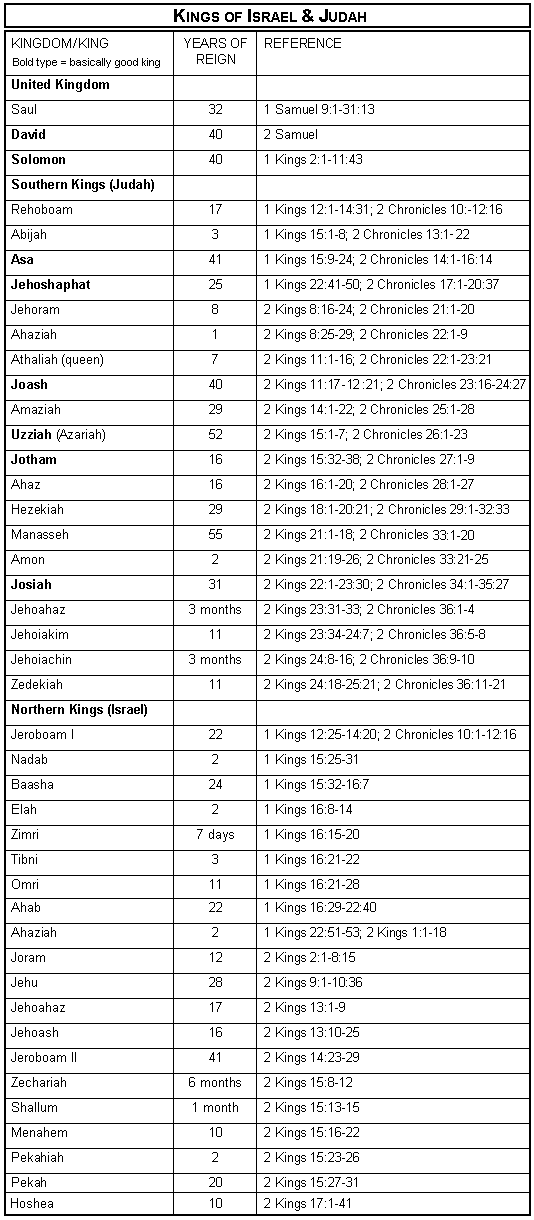
SEE ALSO:
ESV chart - kings of Israel - more information
ESV chart - kings of Judah - more information
Another Chart with Variable Dates for Reigns of Kings
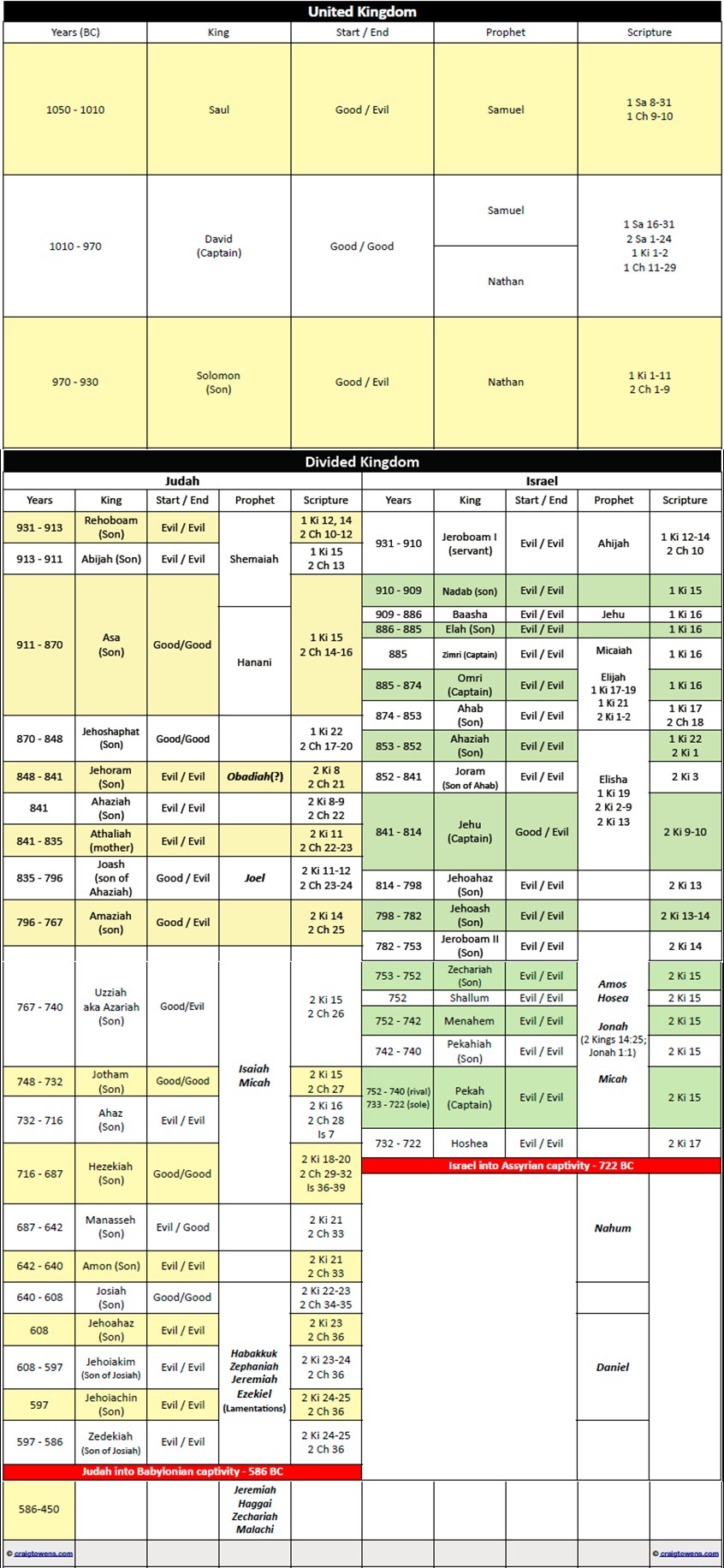
2 Chronicles 25:1 Amaziah was twenty-five years old when he became king, and he reigned twenty-nine years in Jerusalem. And his mother’s name was Jehoaddan of Jerusalem.
- twenty-five: 2Ki 14:1-3
- See BELOW FOR BIBLIOGRAPHY FOR 1-2 CHRONICLES - adapted from Paul Apple's Bible Outlines
- CLICK 2 CHRONICLES COMMENTARIES FOR MULTIPLE SERMONS AND COMMENTARIES
Parallel Passages:
2 Kings 14:2 He was twenty-five years old when he became king, and he reigned twenty-nine years in Jerusalem. And his mother’s name was Jehoaddin of Jerusalem.
INTRODUCTION:
Raymond Dillard: On the whole the record of Amaziah’s reign is a negative one. Apart from the brief, but clouded, victory over Edom as a reward for his obedience to the prophetic warning, the passage does not record any of the usual repertoire of indications of divine favor; rather, it is a study in opposites. Instead of royal building programs, the walls of Jerusalem are destroyed; instead of wealth from the people and surrounding nations, the king is plundered; instead of a large family, there are hostages; instead of peace, war; instead of victory, defeat; instead of loyalty from the populace and long life, there is conspiracy and regicide. The Chronicler’s message for the restoration community was clear—to those rebuilding Jerusalem and restoring its walls, the Chronicler sounded again the central demand of exclusive loyalty in Israel’s covenant with its Lord. (Borrow 2 Chronicles)
John Olley: The narrative provides yet another example of disaster and decline that follows failure to continue serving the Lord wholeheartedly: his father’s reign had begun with the joyful refurbishment of the temple, but Amaziah’s was to be marked by the seizing of “all the gold and silver, and all the vessels that were found in the house of God” (2Ch 25:24).
Martin Selman: That Amaziah did what was right . . . but not wholeheartedly (2Ch 25:2) aptly summarizes a reign vitiated by compromise. Though he could respect the Mosaic law (2Ch 25:4) and respond to prophecy (2Ch 25:9-10), it is all tinged with mixed motives, and it is no surprise that in the end he turned away from following the Lord (2Ch 25:27). His reign is difficult to classify, and commentators have disagreed as to whether it should be divided into favourable and unfavourable parts (Williamson, Allen, Becker, etc.) or whether he is fundamentally half-hearted and double-minded (e.g. Coggins, McConville - borrow I & II Chronicles). In favour of the former, Amaziah’s emphatic if violent victory against the Edomites (2Ch 25:12) is an apparent turning-point, since any good features that do exist are limited to 2Ch 25:1-12. On the other hand, Amaziah’s weaknesses are distributed throughout the chapter, even though they gather momentum from verse 14 onwards. Over all, while his reign does fit the periodization scheme of chapters 24-26, he declines from bad to worse rather than from good to bad! (BORROW Tyndale Old Testament Commentaries – 2 Chronicles.)
Mark Boda: The Chronicler organizes his account of Amaziah into two phases, one highlighting positive aspects of his reign (2Ch 25:5-12) and the other negative (2Ch 25:13-24). . . Each phase is structured according to this pattern:
(1) The action of Amaziah that arouses God’s anger (2Ch 25:5-6, 14-15a);
(2) the prophetic voice that confronts Amaziah (2Ch 25:7-8, 15b);
(3) the question of Amaziah (2Ch 25:9a, 16a);
(4) the response of the prophetic voice (2Ch 25:9b, 16b);
(5) the obedience/disobedience of Amaziah (2Ch 25:10, 17-20);
(6) success/failure in battle (2Ch 25:11-12, 21-24). (1-2 Chronicles)
AMAZIAH ASCENDS TO
THRONE IN JUDAH
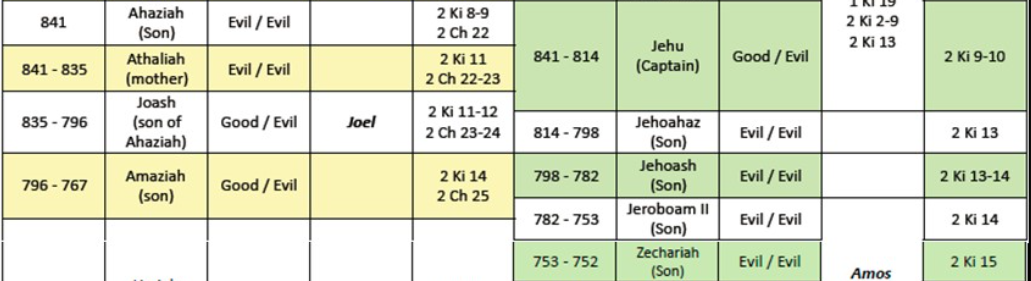
Amaziah was twenty-five years old when he became king, and he reigned twenty-nine years in Jerusalem. And his mother’s name was Jehoaddan of Jerusalem. Amaziah is the son of Joash, succeeding to the throne on the murder of his father (see chart above). He was the eighth king of the separate kingdom of Judah and reigned over Judah from 796 to 767 BC. and details of his reign are recorded in 2 Kings 14 and 2 Chronicles 25. Amaziah's name means "Jehovah is mighty" or "strengthened by Jehovah" or "the strength of the Lord."
John Walton -Thiele assigns to Amaziah the years 796–767 B.C. He was contemporary with Jehoash and Jeroboam II of Israel. Adad-Nirari III, Shalmaneser IV and Ashur- Dan III ruled Assyria during his time (ED: KINGS OF ASSYRIA) (IVP Background Commentary - OT - page 446)
John Olley: Although Amaziah “reigned twenty-nine years,” it is likely that his son Uzziah (also called Azariah) was co-regent from the fifth year (15:1). This probably came about when Amaziah was captured by Joash, king of Israel (2Ch 25:23), and held hostage in Samaria until at least Joash’s death ten years later (2Ch 25:25). Thereafter, power might have been shared, but tensions were evident, culminating in his assassination (v. 27). (ESV Expository Commentary - Volume 3: 1 Samuel–2 Chronicles)
Frederick Mabie: During Amaziah’s reign, the Assyrian Empire begins to decline, which facilitates a time of peace and prosperity for Judah and Israel. (1 and 2 Chronicles)
Believer's Study Bible - Although Amaziah officially reigned 796-767 B.C., through most of his reign his son Uzziah was coregent. This probably began in 792 B.C. as a result of Amaziah's capture by Joash (v. 23).
Martin Selman - "The date of Amaziah's reign is a seemingly intractable problem, and his twenty-nine years (v. 1) has been reduced to varying lengths such as thirteen, sixteen, or nineteen years.1 One solution regards Amaziah as sole ruler for only five years before being taken hostage by Jehoash of Israel (vv. 23-24), with his son Uzziah being co-regent for the remaining twenty-four years. This rather surprising conclusion has found support in the unique comment that Amaziah lived for fifteen years after Jehoash's death (v. 25) and in the participation of the people at Uzziah's accession, perhaps indicating some kind of crisis (26:1; cf. 22:1).2 If this is correct, the two wars belong to Amaziah's first five years, though the whole reign has been dated between 801-773 (Begrich) and796-767 (Thiele)." (Borrow 2 Chronicles)
Matthew Henry Notes: Chapter: 25
Amaziah's reign, recorded in this chapter, was not one of the worse and yet for from good. Most of the passages in this chapter we had before more briefly related, 2 Ki. 14. Here we find Amaziah,
I. A just revenger of his father's death (2Ch 25:1-4).
II. An obedient observer of the command of God (2Ch 25: 5-10).
III. A cruel conqueror of the Edomites (2Ch 25:11-13).
IV. a foolish worshipper of the gods of Edom and impatient of reproof for it (2Ch 25:14-16).
V. Rashly challenging the king of Israel, and smarting for his rashness (2Ch 25:17-24).
VI. And, lastly, ending his days ingloriously (2Ch 25:25-28).
Verses: 2Ch 25:1-13
Here is,
I. The general character of Amaziah: He did that which was right in the eyes of the Lord, worshipped the true God, kept the temple service a going, and countenanced religion in his kingdom; but he did not do it with a perfect heart (2Ch 25:2), that is, he was not a man of serious piety or devotion himself, nor had he any zeal for the exercises of religion. He was no enemy to it, but a cool and indifferent friend. Such is the character of too many in this Laodicean age: they do that which is good, but not with the heart, not with a perfect heart.
II. A necessary piece of justice which he did upon the traitors that murdered his father: he put them to death, 2Ch 25:3. Though we should suppose they intended to avenge on their king the death of the prophet (as was intimated, 2Ch 24:25), yet this would by no means justify their wickedness; for they were not the avengers, but presumptuously took God's work out of his hands: and therefore Amaziah did what became him in calling them to an account for it, but forbade the putting of the children to death for the parents' sin, 2Ch 25:4.
III. An expedition of his against the Edomites, who, some time ago, had revolted from under the dominion of Judah, to which he attempted to reduce them. Observe,
1. The great preparation he made for this expedition.
(1.) He mustered his own forces, and marshalled them (2Ch 25:5), and found Judah and Benjamin in all but 300,000 men that were fit for war, whereas, in Jehoshaphat's time, fifty or sixty years before, they were four times as many. Sin weakens a people, diminishes them, dispirits them, and lessens their number and figure.
(2.) He hired auxiliary troops out of the kingdom of Israel, 2Ch 25:6. Finding his own kingdom defective in men, he thought to make up the deficiency with his money, and therefore took into his pay 100,000 Israelites. If he had advised with any of his prophets before he did this, or had but considered how little any of his ancestors got by their alliances with Israel, he would not have had this to undo again. But rashness makes work for repentance.
2. The command which God sent him by a prophet to dismiss out of his service the forces of Israel, 2Ch 25:7, 8. He would not have him call in any assistance at all: it looked like distrust of God. If he made sure of God's presence, the army he had of his own was sufficient. But particularly he must not take in their assistance: For the Lord is not with the children of Ephraim, because they are not with him, but worship the calves. This was a good reason why he should not make use of them, because he could not depend upon them to do him any service. What good could be expected from those that had not God with them, nor his blessings upon their undertakings? It is comfortable to employ those who, we have reason to hope, have an interest in heaven, and dangerous to associate with those from whom the Lord has departed. The prophet assured him that if he persisted in his resolution to take these idolatrous apostate Israelites with him, in hopes thereby to make himself strong for the battle, it was at his peril; they would prove a dead weight to his army, would sink and betray it: "God shall make thee fall before the enemy, and these Israelites will be the ruin of thy cause; for God has power to help thee without them, and to cast thee down though thou hast them with thee.''
3. The objection which Amaziah made against this command, and the satisfactory answer which the prophet gave to that objection, 2Ch 25:9. The king had remitted 100 talents to the men of Israel for advance-money. "Now,'' says he, "if I send them back, I shall lose that: But what shall we do for the 100 talents?'' This is an objection men often make against their duty: they are afraid of losing by it. "Regard not that,'' says the prophet: "The Lord is able to give thee much more than this; and, thou mayest depend upon it, he will not see thee lose by him. What are 100 talents between thee and him? He has ways enough to make up the loss to thee; it is below thee to speak of it.'' Note, A firm belief of God's all-sufficiency to bear us out in our duty, and to make up all the loss and damage we sustain in his service abundantly to our advantage, will make his yoke very easy and his burden very light. What is it to trust in God, but to be willing to venture the loss of any thing for him, in confidence of the goodness of the security he gives us that we shall not lose by him, but that whatever we part with for his sake shall be made up to us in kind or kindness. When we grudge to part with any thing for God and our religion, this should satisfy us, that God is able to give us much more than this. He is just, and he is good, and he is solvent. The king lost 100 talents by his obedience; and we find just that sum given to his grandson Jotham as a present (2Ch 27:5); then the principal was repaid, and, for interest, 10,000 measures of wheat and as many of barley.
4. His obedience to the command of God, which is upon record to his honour. He would rather lose his money, disoblige his allies, and dismiss a fourth part of his army just as they were going to take the field, than offend God: He separated the army of Ephraim, to go home again, v. 10. And they went home in great anger, taking it as a great affront thus to be made fools of, and to be cashiered as men not fit to be employed, and being perhaps disappointed of the advantages they promised themselves in spoil and plunder by joining with Judah against Edom. Men are apt to resent that which touches them in their profit or reputation, though it frees them from trouble.
5. His triumphs over the Edomites, 2Ch 25:11, 12. He left dead upon the spot, in the field of battle, 10,000 men; 10,000 more he took prisoners, and barbarously killed them all by throwing them down some steep and craggy precipice. What provocation he had to exercise this cruelty towards them we are not told; but it was certainly very severe.
6. The mischief which the disbanded soldiers of Israel did to the cities of Judah, either in their return or soon after, 2Ch 25:13. They were so enraged at being sent home that, if they might not go to share with Judah in the spoil of Edom, they would make a prey of Judah. Several cities that lay upon the borders they plundered, killing 3000 men that made resistance. But why should God suffer this to be done? Was it not in obedience to him that they were sent home, and yet shall the country thus suffer by it? Surely God's way is in the sea! Did not the prophet say that God was not with the children of Ephraim, and yet they are suffered to prevail against Judah? Doubtless God intended hereby to chastise those cities of Judah for their idolatries, which were found most in those parts that lay next to Israel. The men of Israel had corrupted them, and now they were made a plague to them. Satan both tempts and torments.
QUESTION - Who was King Amaziah in the Bible?
ANSWER - Amaziah was a king of the southern kingdom of Judah from 796 to 767 BC. He succeeded his father, King Joash, who was originally a righteous king but turned aside later in life and was assassinated by his own officials (2 Kings 12:20–21). One of Amaziah’s first acts was to bring justice upon the murderers of his father (2 Kings 14:5).
The Bible summarizes Amaziah’s reign thus: “He did what was right in the eyes of the LORD, but not as his father David had done” (2 Kings 14:3). One of Amaziah’s failings was that, while he led the people of Judah in worshiping the Lord, he failed to remove the high places where people continued to sacrifice and burn incense in violation of God’s instruction to offer sacrifices in Jerusalem (verse 4; cf. Deuteronomy 12:13–14). Amaziah later conquered the Edomites and foolishly brought back their gods and sacrificed to them. This idolatry resulted in an unnamed prophet coming to Amaziah and rebuking him. Amaziah insolently resisted the prophet’s words, saying to him, “Since when have I made you the king’s counselor?” (2 Chronicles 25:16, NLT). The prophet was not to be intimidated, however. He told King Amaziah, “I know that God has determined to destroy you, because you have done this and have not listened to my counsel” (verse 16).
Amaziah’s defeat of the Edomites had made him overconfident, so he sent a challenge to King Jehoash of Israel to meet him in battle (2 Kings 14:8; 2 Chronicles 25:17). Jehoash recognized Amaziah’s arrogance and refused the challenge, knowing that he could easily defeat the smaller territory of Judah (2 Kings 14:9–10; 2 Chronicles 25:18–19). But Amaziah would not back down, and so Jehoash attacked, defeating the army of Judah and capturing Amaziah. Amaziah was taken to Jerusalem where Jehoash plundered the temple before returning to Samaria (2 Kings 14:14; 2 Chronicles 25:24).
After Jehoash died, Amaziah lived another 15 years. It is unknown whether he returned to rule in Jerusalem, but, in any case, the men of Judah were conspiring against him, causing him to flee to Lachish in southwestern Judah. But the assassins sent after Amaziah found him and killed him. “He was brought back by horse and was buried with his ancestors in the City of Judah” (2 Chronicles 25:28). Amaziah could have had a long, successful reign had he continued following the Lord, but his story became another cautionary tale of the fate of the kings who turned aside to idolatry. GotQuestions.org
2 Chronicles 25:2 He did right in the sight of the LORD, yet not with a whole heart.
- Yet not: 2Ch 25:14 2Ch 24:2 2Ch 26:4 1Sa 16:7 2Ki 14:4 Ps 78:37 Isa 29:13 Ho 10:2 Ac 8:21 Jas 1:8 4:8
Parallel Passages:
2 Kings 14:3-4 (TEXT IN BOLD NOT IN 2 CHRONICLES 25) He did right in the sight of the LORD, yet not like David his father; he did according to all that Joash his father had done. 4 Only the high places were not taken away; the people still sacrificed and burned incense on the high places.
DAVID WHOLE HEART
AMAZIAH "HALF" A HEART
He did right (yashar) in the sight of the LORD - This is the good news first. This is a good start and tells us that Amaziah was not an openly wicked king. This is not a claim of flawless obedience but means that the king’s reign was generally aligned with and in harmony with Yahweh’s revealed will. God Himself, not public opinion, military success, or political stability, is the ultimate Judge of a king’s life and reign. The standard is covenantal faithfulness, not outward prosperity.
The description in the sight of the LORD reminds me of the Hanani's words to King Asa who had initially trusted God for deliverance but later trusted in his own strength (cf 2Ch 16:7,8) - “For the eyes of the LORD move to and fro throughout the earth that He may strongly support those whose heart is completely (shalem) His. You have acted foolishly in this. Indeed, from now on you will surely have wars.” (2 Chr. 16:9) Note that completely (shalem) describes a whole heart, one that Yahweh will strongly support. Oh, God give us all a passion for a whole heart in Christ. Amen!
Doing right in the sight of the LORD means living under divine oversight, knowing that God sees every act and every motive. It is a life of reverent accountability before a holy God. As we might say today it is living Coram Deo-Before the Face of God. Sadly, as the rest of Amaziah's story shows, a good beginning does not guarantee a good finish.
🙏 THOUGHT - Are you living Coram Deo-Before the Face of God, remembering that our life will ultimately be evaluated at the Bema Seat of Christ, not by what men see, but what the LORD sees (1Sa 16:7b). When God takes the measure of a man or woman, He doesn't Put a "tape measure" around your head to see how much you know, but He puts it around your heart to see how much you obey!
Yet - Term of contrast. This is a sad contrast which limits how "right" he was before God. 2Ki 14:4 "Only the high places were not taken away" helps us begin to understand his compromise which would eventually lead to other "compromises" in his obedience.
Not with a whole (shalem; LXX - pleres) heart (lebab) - The Scripture shows his lack of a whole heart, for example, in 2Ch 25:14 Amaziah "brought the gods of the sons of Seir (Edom), set them up as his gods, bowed down before them and burned incense to them." And so we see that Amaziah's life vividly illustrates the truth that partial obedience is still disobedience, and that God desires wholehearted devotion. The Septuagint translates shalem with the Greek adjective pleres which means filled up (as opposed to empty) as of a hollow vessel, and speaks of a totality of something or someone with nothing lacking -- complete, in full, wholly filled.
🙏 THOUGHT - How's your obedience to Yahweh been lately? Whole hearted or partial, remembering that partial obedience is really disobedience?
NET NOTE Heb “a complete heart.”
Raymond Dillard: While the Chronicler often divides an individual reign into distinct periods of obedience and disobedience, here he depicts Amaziah as fundamentally halfhearted and mediocre from the beginning (McConville, 214 - borrow I & II Chronicles). (Borrow 2 Chronicles)
Bob Utley on "did what was right in the sight of the Lord" This is an idiomatic expression for the kings of Judah (and possibly of Israel, i.e., Jeroboam I) who acted faithfully, like David (1 Kgs. 15:3) in keeping and promoting obedience to the Mosaic Law (cf. Deut. 6:16-18; 12:28; 13:18).
- Jeroboam I of Israel ‒ condition of YHWH's blessing: obedience to His covenant ‒ 1 Kgs. 11:33,38; 14:8, but he did not
- Asa (initially) ‒ 1 Kgs. 15:11; 2 Chr. 14:2
- Jehoshaphat (mostly) ‒ 1 Kgs. 22:43; 2 Chr. 20:32
- Jehu ‒ 2 Kgs. 10:30
- Jehoash (initially) ‒ 2 Kgs. 12:2
- Joash (initially) ‒ 2 Chr. 24:2
- Amaziah ‒ 2 Kgs. 14:2; 2 Chr. 25:2
- Jotham ‒ 2 Kgs. 15:33; 2 Chr. 27:2
- Ahaz ‒ 2 Kgs. 16:2; 2 Chr. 28:1 (negative)
- Hezekiah ‒ 2 Kgs. 18:3; 2 Chr. 29:2; 31:20
- Josiah ‒ 2 Kgs. 22:2
DID RIGHT IN THE SIGHT OF THE LORD - OCCURS 10 TIMES, ONLY IN KINGS & CHRONICLES - 2 Ki. 12:2; 2 Ki. 14:3; 2 Ki. 15:3; 2 Ki. 18:3; 2 Ki. 22:2; 2 Chr. 25:2; 2 Chr. 26:4; 2 Chr. 27:2; 2 Chr. 29:2; 2 Chr. 34:2
Right (03477) yashar from the verb yashar = to be smooth, straight or right) is an adjective that means straight; reliable, level, pleasing; upright; righteous. Yashar only rarely is used literally of that which is straight (Ezek 1:7). Yashar can refer to something physical like a path, but even in those uses is often a metaphorical description of one's conduct or behavior (Ps 107:7). Most uses refer to that which is right in an ethical or an emotional sense, as agreeable or pleasing. It is fitting that God is the standard of yashar (what is "straight") (Ps 92:15, called the "Upright One" - Isa 26:7). God's Word is described as upright (right) (Ps 19:7) as are His judgments (Ps 119:137) and His way (Ps 107:7). "God made men upright (Ge 1:27), but they have sought out many devices." (Eccl 7:29)
Yashar is frequently used to describe our moral/ethical heart as "upright in heart" (Ps 7:10, 11:2, 32:11, 36:10, 64:10, 94:15, 97:11, 111:1, 125:4) (See all uses in Psalms and Proverbs below). Indeed, the upright "will behold His face" (Ps 11:7), will experience gladness (Ps 97:11), will be gathered together in the assembly (Ps 111:1), will be blessed (Ps 112:2), will be given light in times of darkness (Ps 112:4), will dwell in God's presence (Ps 140:13, cp Pr 2:21), have access to God's sound wisdom (Pr 2:7), will experience intimacy with the Most High God (Pr 3:32), will be guided by their integrity (Pr 11:3), will be delivered by their righteousness (Pr 11:6), will be delivered by their words (Pr 12:6), will see their tents flourish (Pr 14:11). "The highway of the upright is to depart from evil." (Pr 16:17)
YASHAR IN KINGS AND CHRONICLES - 1 Ki. 11:33; 1 Ki. 11:38; 1 Ki. 14:8; 1 Ki. 15:5; 1 Ki. 15:11; 1 Ki. 22:43; 2 Ki. 10:3; 2 Ki. 10:15; 2 Ki. 10:30; 2 Ki. 12:2; 2 Ki. 14:3; 2 Ki. 15:3; 2 Ki. 15:34; 2 Ki. 16:2; 2 Ki. 18:3; 2 Ki. 22:2; 2 Chr. 14:2; 2 Chr. 20:32; 2 Chr. 24:2; 2 Chr. 25:2; 2 Chr. 26:4; 2 Chr. 27:2; 2 Chr. 28:1; 2 Chr. 29:2; 2 Chr. 29:34; 2 Chr. 31:20; 2 Chr. 34:2
Whole (devoted, complete, perfect, wholly) (08003) shalem from root verb shalam = denotes perfection in the sense that a condition or action is "complete" = to be complete, be sound; to be in a covenant of peace, be at peace) is an adjective which describes that which is complete, safe, peaceful, perfect, whole, full, at peace. "The general meaning behind the root š-l-m is of completion and fulfillment—of entering into a state of wholeness and unity, a restored relationship." (TWOT) Brown-Driver-Briggs - (1) complete - full, perfect, finished (2) safe, unharmed (3) peace (of covenant of peace, mind) - perfect, complete (of keeping covenant relation).
SHALEM - 27V - Gen. 15:16; Gen. 33:18; Gen. 34:21; Deut. 25:15; Deut. 27:6; Jos. 8:31; Ruth 2:12; 1 Ki. 6:7; 1 Ki. 8:61; 1 Ki. 11:4; 1 Ki. 15:3; 1 Ki. 15:14; 2 Ki. 20:3; 1 Chr. 12:38; 1 Chr. 28:9; 1 Chr. 29:9; 1 Chr. 29:19; 2 Chr. 8:16; 2 Chr. 15:17; 2 Chr. 16:9; 2 Chr. 19:9; 2 Chr. 25:2; Prov. 11:1; Isa. 38:3; Amos 1:6; Amos 1:9; Nah. 1:12
Heart (03824) lebab sometimes refers to a literal heart (Ex 28:29, 1Sa 25:37, 2Ki 9:24), but most often is used figurative to refer to what I term the "control center" of our being. Think of an Air Traffic Controller and how dysfunctional, even destructive it is when the controllers fail to function as they should. Just as a healthy human heart is at the center of the body and absolutely essential for physical life and health, so too a healthy spiritual heart (intellect, emotion, will) is at the center of one's inner being (soul) and is vital for a healthy soul, serving as the "fountain" of all moral attitudes and actions. Our spiritual heart thus controls out actions and our actions determine our habits, which in turn determine our character. When God measures the ''worth'' of a man's life He puts the measuring tape around his heart, not around his head. Be a man after God's Own heart (Acts 13:22) We must continually "post a guard" at the doorway of our heart, so that every avenue for sin's entry is blocked. SEE HEART - page 1262 in the Dictionary of Biblical Imagery online
John MacArthur - The “heart” commonly refers to the mind as the center of thinking and reason (Pr 3:3; 6:21; 7:3), but also includes the emotions (Pr 15:15, 30), the will (Pr 11:20; 14:14), and thus, the whole inner being (Pr 3:5). The heart is the depository of all wisdom and the source of whatever affects speech (Pr 4:24), sight (Pr 4:25), and conduct (Pr 4:26, 27). (BORROW MacArthur Study Bible)
WHOLE HEART - 8X/8V - 2 Ki. 20:3; 1 Chr. 28:9; 1 Chr. 29:9; 2 Chr. 15:15; 2 Chr. 25:2; Isa. 1:5; Isa. 38:3; Jer. 24:7
G. Campbell Morgan -2 Chr 25.2
These words give us the key to all that follows in the story of Amaziah. The general aim of the man was right, but execution was spoiled by imperfection. Nothing is wholly satisfactory to God save the perfect heart, because nothing else can possibly produce the best in man. His punishment of his father's murderers was tempered with justice. The imperfection of his heart was manifested in his alliance with Israel; and then again his right desire, in the readiness with which he obeyed the voice of the prophet, and broke off that alliance, even at cost to himself. Returning from his conquest over the Edomites, he brought back with him the gods of his defeated foes. Again the prophet visited him, and the unutterable folly of such action is revealed in the question asked: "Why hast thou sought after the gods of the people, which have not delivered their own people out of thy hand 1" Punishment for this followed in the defeat of Judah by Israel. What, then we may ask, as we consider this story of Amaziah, is a perfect heart? The root idea of the Hebrew word rendered "perfect" is that of being whole or complete. An imperfect heart is a divided heart. Imperfection of heart consists in incomplete surrender. Some chamber of the temple is closed against the true Indweller. It is retained for self. What it was in the case of Amaziah we are not told, but the fact is patent, that notwithstanding the general rightness of the direction of his life, either through personal indulgence, or ambition, or carelessness, his whole heart was not set upon doing the will of God. Within the fortress, one apartment possessed by the foe is ever the gravest peril. Sooner or later, the dweller in that chamber opens the door for foes without.
2 Chronicles 25:3 Now it came about as soon as the kingdom was firmly in his grasp, that he killed his servants who had slain his father the king.
- Now it came: 2Ki 14:5-22
- he killed: 2Ch 24:25,26 Ge 9:5,6 Ex 21:14 Nu 35:31-33
Parrallel Passage:
2 Kings 14:5 Now it came about, as soon as the kingdom was firmly in his hand, that he killed his servants who had slain the king his father.
Related Passages:
2 Kings 12:19 Now the rest of the acts of Joash and all that he did, are they not written in the Book of the Chronicles of the Kings of Judah? 20 And his servants arose and made a conspiracy, and struck down Joash at the house of Millo as he was going down to Silla. 21 For Jozacar the son of Shimeath, and Jehozabad the son of Shomer, his servants, struck him, and he died; and they buried him with his fathers in the city of David, and Amaziah his son became king in his place.
PURGING THE
CONSPIRATORS
Now it came about as soon as the kingdom was firmly in his grasp - At first, after a king’s father was assassinated (as Amaziah’s father Joash was), the new ruler’s position often was weak — conspirators might still be in positions of power. Once Amaziah had “firmly grasped” the kingdom, he had the strength, stability, and legitimacy to act decisively. In other words, after his succession was no longer uncertain and any political rivals or instability had been dealt with (or would soon be dealt with as in this verse), Amaziah could act freely to carry out justice or implement reforms.
NET NOTE Heb “when the kingdom was secure upon him.”
TSK has an interesting thought on kingdom was firmly in his hand - No doubt those wicked men, Jozachar and Jehozabad, who murdered his father, had considerable influence; and therefore he found it dangerous to bring them to justice, till he was assured of the loyalty of his other officers: when this was clear, he called them to an account, and justly put them to death for treason and murder; for, if even these conspirators against Joash intended to avenge upon him the death of Zechariah, they acted without a commission from that God "to whom vengeance belongeth."
that he killed his servants who had slain his father the king - Amaziah took avenged his father Joash's murder, putting to death Jozacar the son of Shimeath and Jehozabad the son of Shomer.
Raymond Dillard: Amaziah may have been motivated to avenge the death of his father when he executed the assassins; however, his own consolidation of power and elimination of potential rivals may also have been a factor. (Borrow 2 Chronicles)
Easton has a good summary of Amaziah - He began his reign by punishing the murderers of his father (2 Chr. 25:3-5). He was the first to employ a mercenary army of 100,000 Israelite soldiers, which he did in his attempt to bring the Edomites again under the yoke of Judah (2 Chr. 25:5, 6). He was commanded by a prophet of the Lord to send back the mercenaries, which he did (2 Chr. 25:7-10, 13), much to their annoyance. His obedience to this command was followed by a decisive victory over the Edomites (2 Chr. 25:14-16). Amaziah began to worship some of the idols he took from the Edomites, and this was his ruin, for he was vanquished by Joash, king of Israel, whom he challenged to battle. The disaster he thus brought upon Judah by his infatuation in proclaiming war against Israel probably occasioned the conspiracy by which he lost his life (2 Kings 14:8-14, 19). He was slain at Lachish, whither he had fled, and his body was brought upon horses to Jerusalem, where it was buried in the royal sepulchre (2 Kings 14:19, 20; 2 Chr. 25:27, 28).
2 Chronicles 25:4 However, he did not put their children to death, but did as it is written in the law in the book of Moses, which the LORD commanded, saying, “Fathers shall not be put to death for sons, nor sons be put to death for fathers, but each shall be put to death for his own sin.”
- as it is written: De 24:16 2Ki 14:5,6 Jer 31:29,30 Eze 18:4,20
Parallel Passage:
2 Kings 14:6 But the sons of the slayers he did not put to death, according to what is written in the book of the Law of Moses, as the LORD commanded, saying, “The fathers shall not be put to death for the sons, nor the sons be put to death for the fathers; but each shall be put to death for his own sin.”
Related Passages:
Deuteronomy 24:16 “Fathers shall not be put to death for their sons, nor shall sons be put to death for their fathers; everyone shall be put to death for his own sin.
Ezekiel 18:4; 20 “Behold, all souls are Mine; the soul of the father as well as the soul of the son is Mine. The soul who sins will die....18:20 “The person who sins will die. The son will not bear the punishment for the father’s iniquity, nor will the father bear the punishment for the son’s iniquity; the righteousness of the righteous will be upon himself, and the wickedness of the wicked will be upon himself.
OBEDIENCE TO
THE TORAH
However, he did not put their children to death, but did as it is written in the law in the book of Moses, which the LORD commanded, saying, “Fathers shall not be put to death for sons, nor sons be put to death for fathers, but each shall be put to death for his own sin.” Amaziah began well by distinguishing his rule with reverence for the Word of God. He intentionally obeyed the Law’s limits on retribution.” Here see Amaziah making a good start in obeying the Torah, but as time went on (and pride may have set it), he overtly disobeyed Ex 20:3-4.
NET NOTE Heb “on account of sons.” Heb “on account of fathers.”
Believer's Study Bible - "The Book of Moses" is another name used to identify the Torah (cf. 2Ki 23:18). The text relates how every individual is personally responsible for his own sin and dispels any notion whatever of the so-called feud or vendetta, even in a society in which the enlarged family was an important social unit (cf. Deut. 24:16; 2 Kin. 14:5, 6; Jer. 31:30).
Andrew Hill: Amaziah obeys the law of Moses selectively, bringing just punishment against the conspirators responsible for his father’s murder (and solidifying his own rule in the process) but ignoring the injunctions against false worship in the Canaanite high places (cf. Deut. 7:5; 12:2). (First and Second Chronicles)
Bob Utley - This shows a knowledge of Deuteronomy (i.e., Deut. 24:16) before Josiah found the book of the law in the house of the Lord. The Chronicler's writing shows he knew many OT books (see Introduction to 2 Chronicles, III., G.).
The parallel shows this same allusion (cf. 2 Kgs. 14:6) and, like the Chronicler, simply quoted him. Kings is written earlier but still after the
- conquest of Jerusalem and the temple by Nebuchadnezzar
- the murder of Gedaliah the Babylonian appointed governor of Judah
Just a theological note, this verse focuses on the spiritual responsibility of each individual (cf. Jer. 31:29,30; Ezekiel 18), but later in this chapter, several cities of Judah and 3,000 people are killed (2 Chr. 25:13) because of the sin of Amaziah. It is hard to balance these concepts (i.e., Deut. 5:9 vs. 7:9)!
2 Chronicles 25:5 Moreover, Amaziah assembled Judah and appointed them according to their fathers’ households under commanders of thousands and commanders of hundreds throughout Judah and Benjamin; and he took a census of those from twenty years old and upward and found them to be 300,000 choice men, able to go to war and handle spear and shield.
- commanders of thousands: Ex 18:25 1Sa 8:12 1Ch 13:1 27:1
- from twenty years old: Nu 1:3
- 300,000 choice men: 2Ch 11:1 14:8 17:14-18
Parallel Passages:
No parallel in 2 Kings 14 with 2 Chronicles 25:5-10
Related Passages:
Numbers 1:3 from twenty years old and upward, whoever is able to go out to war in Israel, you and Aaron shall number them by their armies.
AMAZIAH GATHERS
AVAILABLE SOLDIERS
Note that 2Ch 25:12-16 is not found in parallel section in 2 Kings 14.
Moreover, Amaziah assembled Judah and appointed them according to their fathers’ households under commanders of thousands and commanders of hundreds throughout Judah and Benjamin; and he took a census of those from twenty years old and upward and found them to be 300,000 choice men, able to go to war and handle spear and shield.
NET NOTE The Hebrew text uses the name “Judah” by metonymy here for the people of Judah.
Bob Utley - This is a census for military purposes of war (i.e., 2 Chr. 14:8; 17:14-18; 26:11-13) against Edom. Josephus, Antiq. 9.1.1., says the battle was against three nations, "Amalekites, Edomites, and Gebalites." The inclusion of "Amalekites" might be a way to explain/excuse the slaughter of 2 Chr. 25:12. All Amalekites were to be killed. See EDOM AND ISRAEL
Raymond Dillard: Twenty years old was the traditional age of enrollment (Exod 30:14; 38:26; Lev 27:3–5; Num 1; 1 Chr 27:23; 23:24; 2 Chr 31:17). The fact that Benjamin is included suggests that Judah continued to exercise hegemony in that region. (Borrow 2 Chronicles)
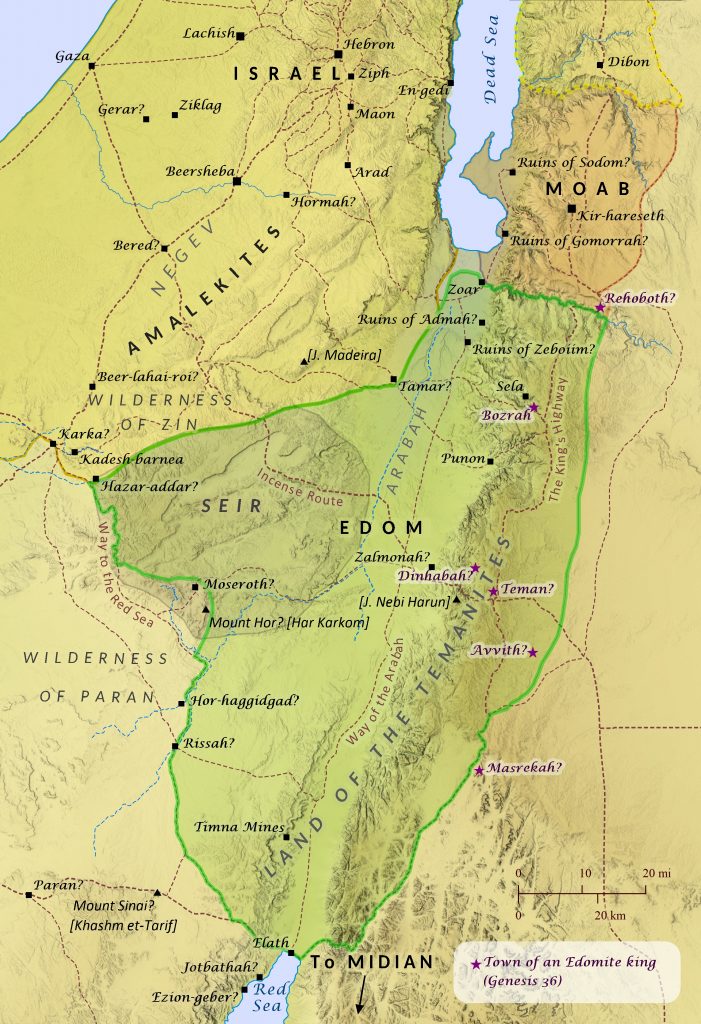
Edom
August Konkel: Amaziah’s interest in Edom was to gain control of the trade routes in Transjordan. Edom had gained its independence in the days of Joash (2 Chron 21:8- 10). Amaziah mustered his forces and appointed his commanders according to the ancestral clans, the typical way of gathering an army. The inclusion of Benjamin in the muster indicates that it was part of the territory of Judah at that time. (1 & 2 Chronicles)
Bob Utley - "spear and shield" It was the king's responsibility to produce, store, and distribute arms in this period. Often lists of weaponry are mentioned.
- 2 Chr. 25:5; 11:12
- shields (i.e., large shield, BDB 857 III, KB 1037)
- spears or lance (BDB 942)
- 2 Chr. 14:8
- large shields (BDB 857 III)
- spears or lances (BDB 942)
- shields (BDB 171)
- bows (BDB 905)
- 2 Chr. 23:5
- spears (BDB 333)
- large shields (BDB 171)
- bows (BDB 1020, KB 1522)
- 2 Chr. 26:14
- shields (BDB 171, KB 545)
- spears (BDB 942)
- helmets (BDB 464)
- body armor (BDB 1056)
- bows (BDB 905)
- sling stones (BDB 6 construct BDB 887)
- Neh. 4:13
- swords (BDB 352)
- spears (BDB 942)
- bows (BDB 905)
See Roland deVaux, Ancient Israel, "Armaments," pp. 241-246.
2 Chronicles 25:6 He hired also 100,000 valiant warriors out of Israel for one hundred talents of silver.
Parallel Passages:
No parallel in 2 Kings 14 with 2 Chronicles 25:5-10
AMAZIAH HIRES MERCENARIES
TO BOLSTER ARMY
He hired also 100,000 valiant warriors out of Israel for one hundred talents of silver These were mercenaries from the northern kingdom, specifically from Ephraim (2Ch 25:10). Amaziah’s army was significantly smaller than that of earlier kings such as Asa, who mustered 580,000 men, and Jehoshaphat, whose forces numbered 1,160,000. This relative weakness helps explain why Amaziah sought to supplement his troops by hiring mercenaries from the northern kingdom. He paid them one hundred talents of silver—an enormous sum, equal to 300,000 shekels, or roughly three shekels per soldier, slightly more than an ounce of silver each.
NET NOTE talents - The Hebrew word כִּכַּר (kikar, “circle”) refers generally to something that is round. When used of metals it can refer to a disk-shaped weight made of the metal or, by extension, to a standard unit of weight. According to the older (Babylonian) standard the “talent” weighed 130 lbs. (58.9 kg), but later this was lowered to 108.3 lbs. (49.1 kg). More recent research suggests the “light” standard talent was 67.3 lbs. (30.6 kg). Using this as the standard for calculation, the weight of the silver was 6,730 lbs. (3,060 kg).
Amaziah's decision was not merely a military calculation but a spiritual misstep. By hiring Israelite mercenaries, Amaziah effectively entered into a foreign alliance rather than relying wholly on the LORD for deliverance. What appeared to be prudent strategy revealed a subtle but serious lack of faith, substituting human resources for trust in God’s sufficiency.
Amaziah thought in terms of numbers in order
to determine power and chances of victory.
John Schultz: Amaziah thought in terms of numbers in order to determine power and chances of victory. He must not have taken God into his calculations. He did not evince any of the faith of Jonathan, the son of King Saul, who attacked the Philistines single-handedly, and who said to his armor-bearer: “Come, let’s go over to the outpost of those uncircumcised fellows. Perhaps the Lord will act in our behalf. Nothing can hinder the Lord from saving, whether by many or by few.” Faith in the God of Israel played no role in Amaziah’s strategic planning; he wanted to be sure his numbers were up. (2 Chronicles)
Bob Utley - "talents of silver" Apparently (i.e., from their actions in 2 Chr. 25:13) these Ephraimitic mercenaries were promised part of the spoils of the defeated army.
John Walton -The use of mercenaries in ancient Near Eastern warfare was widespread. The Assyrians began to rely heavily on mercenaries by the reign of Tiglath-Pileser III (reigned 745–727 B.C.). Although mercenaries were experienced and well trained, their loyalty was often called into question when they did not get their pay in a timely fashion, or if they were fighting against a kindred foe. Ionian mercenaries left the Persian camp and fought for the Greeks at the Battle of Plataea during the Persian wars (480 B.C.). hundred talents of silver. The talent was the largest weight measure used in the Near East. It was comparable to three thousand shekels at Alalakh and Ugarit in Syria and in the Old Testament (Ex 38:25–6). One hundred talents of silver weighed about three and one quarter tons. Obviously this was the total amount spent hiring the mercenaries and comes to one talent of silver for each division. This is not exorbitant pay and was just “earnest money”—the real payoff would come in the plunder. (IVP Background Commentary - OT - page 446)
2 Chronicles 25:7 But a man of God came to him saying, “O king, do not let the army of Israel go with you, for the LORD is not with Israel nor with any of the sons of Ephraim.
- a man of God: 2Sa 12:1 1Ki 13:1 1Ti 6:11 2Ti 3:17
- for the Lord: 2Ch 13:12 19:2 1Ki 12:28 Isa 28:1-3 Ho 5:13-15 9:13
Parallel Passages:
No parallel in 2 Kings 14 with 2 Chronicles 25:5-10
Related Passages:
1 Kings 13:1 (MAN OF GOD = PROPHET) Now behold, there came a man of God from Judah to Bethel by the word of the LORD, while Jeroboam was standing by the altar to burn incense.
1 Kings 17:18 (MAN OF GOD = PROPHET) So she said to Elijah, “What do I have to do with you, O man of God? You have come to me to bring my iniquity to remembrance and to put my son to death!”
2 Kings 1:9 (MAN OF GOD = PROPHET) Then the king sent to him a captain of fifty with his fifty. And he went up to him, and behold, he was sitting on the top of the hill. And he said to him, “O man of God, the king says, ‘Come down.’”
GOD'S PROPHET WARNS
OF TAKING ISRAELITES INTO WAR
But a man of God - This is another name for a prophet, in this case an unnamed prophet.
Bob Utley - Amaziah is confronted with a prophetic message which he obeyed (2 Chr. 25:7-10). This obedience brings victory. The king's idolatry will bring defeat. Both are from YHWH, not human forces! The post-exilic Chronicler (probably Ezra) is nervous of all foreign alliances. He chooses aspects of history to emphasize his theological concern.
Came to him saying, “O king, do not let the army of Israel go with you - The prophet gives clear warning against taking forces of Israel into battle and the reason is explained in the next clause.
For (term of explanation) the LORD is not with Israel nor with any of the sons of Ephraim - NET = "O king, the Israelite troops must not go with you, for the LORD is not with Israel or any of the Ephraimites." Ephraim was the dominant tribe of the Northern Kingdom and the home to Samaria, Israel’s capital.
NET NOTE Heb “Israel, all the sons of Ephraim.”
Raymond Dillard: A central theme in the Chronicler’s theology is the necessity of trusting God; all foreign alliances are repudiated as an implicit failure to rely on Yahweh alone (2Ch 16:2–9; 19:1–3; 20:15–17; 20:35–37; 32:7–8). Commonly associated with this rejection of alliances and reliance on Yahweh is the holy war theme of Yahweh’s fighting for the few against the many (13:3–18; 14:8–15; 1 Kgs 20:27; 1 Sam 14:6; Judg 7);” (Borrow 2 Chronicles)
2 Chronicles 25:8 “But if you do go, do it, be strong for the battle; yet God will bring you down before the enemy, for God has power to help and to bring down.”
- be strong: 2Ch 18:14 Ec 11:9 Isa 8:9,10 Joe 3:9-14 Mt 26:45
- God has power: 2Ch 14:11 20:6 Judges 7:7 1Sa 14:6 Job 5:18 9:13 Ps 20:7 33:16-10 Ps 62:11 Ec 9:11, army, Heb. band, 2Ch 25:13,The Lord, 2Ch 1:12 De 8:18 Ps 24:1 Pr 10:22 Hag 2:8 Lu 18:29,30 Php 4:19
Parallel Passages:
No parallel in 2 Kings 14 with 2 Chronicles 25:5-10
MAN OF GOD
WARNING AMAZIAH
But (term of contrast) if you do go, do it, be strong for the battle - The phrase signals defiance, not obedience. This is like saying “If you’re determined to ignore God, then at least understand what you’re walking into.” Be strong is ironic. Normally in Scripture, “be strong” means “the LORD will be with you.” Here, it’s the opposite and the very next line explains why.
Yet (term of contrast) God will bring you down before the enemy, for God has power (koach; LXX - ischuo) to help (azar) and to bring down - NET = "Even if you go and fight bravely in battle, God will defeat you before the enemy. God is capable of helping or defeating." NLT says "If you let them go with your troops into battle, you will be defeated no matter how well you fight. God will overthrow you, for he has the power to help or to frustrate." What the prophet of God is saying is “If you insist on going to battle with your plan, go ahead. Fight bravely if you will. But understand that your courage and your hired strength will fail you, because your confidence is misplaced. God alone has the power to help or to bring down, and if you ignore His warning, He will ensure your defeat.”
NET NOTE bring you down - Heb “cause you to stumble.”
For (term of explanation) - What is the prophet explaining here?
God has power to help and to bring down - What the prophet is saying is that victory or defeat are never determined merely by human effort, strength, or strategy, but by God’s sovereign will. This reminds me of Pr 21:31 which says "The horse is prepared for the day of battle, But victory belongs to the LORD." This statement is "two-edged." God will be Amaziah's help if he obeys the call to dismiss the 100,000. On the other hand if he disobeys the call to dismiss the 100,000, God will bring him down, effectively causing him to lose the battle.
Amaziah has just been told to dismiss 100,000 Ephraimite soldiers—roughly a quarter of his fighting force and at great financial cost. From a human standpoint, that looks reckless and dangerous. There is another implication in this statment and it is that Amaziah need not fear losing a fourth of his army in sending the Ephraimite mercenaries home, for Yahweh “has the power to help.
Power (03581) koah/koach means power, capacity or ability and thus speaks of power in the sense of the inherent potential to perform some function. Koah is the capacity to act and be able to produce. The Lord’s right hand is magnificent in strength (koah).
Help (05826) 'azar means to protect, aid, help, succor, support, give material or nonmaterial encouragement. Azar often refers to aid in the form of military assistance and in many instances refers to help from Jehovah. See study of Jehovah Ezer: The LORD our Helper:
2 Chronicles 25:9 Amaziah said to the man of God, “But what shall we do for the hundred talents which I have given to the troops of Israel?” And the man of God answered, “The LORD has much more to give you than this.”
Parallel Passages:
No parallel in 2 Kings 14 with 2 Chronicles 25:5-10
AMAZIAH WORRYING ABOUT
COST OF DISMISSING ISRAELITES
Amaziah said to the man of God, “But what shall we do for the hundred talents which I have given to the troops of Israel?” - Amaziah is concerned about the money paid the mercenaries if he dismisses them.
And the man of God answered, “The LORD has much more to give you than this - The prophet is trying to encourage Amaziah to trust in the sufficiency of the LORD.
John Newton wrote a hymn entitled Come My Soul (play beautiful vocal by Matt Foreman) and in one stanza he pens words that parallel our present passage...
Thou art coming to a King,
Large petitions with thee bring;
For His grace and power are such,
None can ever ask too much;
None can ever ask too much.
Andrew Hill: The expression “man of God” (2Ch 25:7) is often a title for a prophetic figure (e.g., 1Ki 13:1; 1Ki 17:18; 2Ki 1:9). This unnamed individual is one of two anonymous prophets who approach King Amaziah with a message from God. He heeds the instruction of the first but rejects the counsel of the second to his own demise (cf. 2Ch 25:15-16). At times God’s prophets remain unnamed so as to highlight the message rather than the messenger. The first prophet advises the king to reject the help of mercenaries form the kingdom of Israel because “the Lord is not with Israel” (2Ch 25:7). God’s abandonment of the kingdom of Israel for the persistent sin of idolatry related to the calf-cult of King Jeroboam I assures military failure. In other words, Judah’s association with Israel means that God will side with the Edomites against Amaziah. (First and Second Chronicles)
How much will it cost me
to be obedient?
David Guzik: Amaziah heard and understood the word of God from His messenger. Yet his question was familiar: “How much will it cost me to be obedient?” This is not necessarily a bad question to ask if we are willing to be persuaded by the LORD’s answer. “The LORD is able to give you much more than this” -- The prophet wisely answered Amaziah. Whatever obedience costs, it is always ultimately cheaper than disobedience.
F B Meyer - 2 Chronicles 25:9 The Lord is able to give thee much more than this.
We must understand that God cannot be in fellowship with us
if we tolerate fellowship with the ungodly....
O child of God, let not the army of Israel go with thee!
Amaziah had many good qualities, but he did not clearly see how impossible it was for Israel to be allied with Judah without invalidating the special Divine protection and care on which Judah had been taught to rely. We must understand that God cannot be in fellowship with us if we tolerate fellowship with the ungodly. We must choose between the two. If we can renounce all creature aid, and trust simply in the eternal God, there is no limit to the victories He will secure; but if, turning from Him, we hold out our hand toward the world, we forfeit His aid. O child of God, let not the army of Israel go with thee! Do not adopt worldly policy, methods, or partnership. However strong you make yourself for the battle in alliance with these, you will fail. Indeed, God Himself will make you fall before the enemy, that you may be driven back to Himself.
But you say that you have already entered into so close an alliance that you cannot draw back. You have invested your capital, you have gone to great expenditure. Yet it will be better to forfeit these than Him. Without these aids, and with only God beside you, you will be able to rout Edom, and smite ten thousand men. Would that men knew the absolute deliverance which God will effect for those whose hearts are perfect toward Him!
The soldiers of Israel committed depredations (plundering, pillaging) on their way back. This was the result of the folly and sin of Amaziah’s proposal. We may be forgiven, and delivered, and yet there will be after-consequences which will follow us from some ill-considered act. Sin may be forgiven, but its secondary results are sometimes very bitter. We must expect to reap as we sow.
Adrian Rogers - When I got ready to go away to college, my dad said to me, "Son, I wish I could pay your way to school. I'm not able to, you know, but I sure would like to." That always meant a lot to me.
I'm glad, though, that my heavenly Father will never say to me, "Son, I'd like to, but I can't." Our heavenly Father is the King of kings. We have the heart of the Father and the hand of the King. We have a Father who can hear us and a king who can answer us. Therefore, we should always pray earnestly, fervently, expectantly, and praisefully unto Him, because He is both willing and able.
Vance Havner - God's Compensations
The Lord is able to give thee much more than this. II Chronicles 25:9.
The Lord is able to give us much more than we lose
when we part with all else to trust Him
Amaziah had hired an army of Israel to fight Edom, when he should have relied upon God. When a prophet advised against it Amaziah was concerned about the money he had paid out for such assistance. The prophet answered with our text. In other words, God is able to make up any loss we sustain when we give up anything for Him.
We are prone to seek help from the world when confronted with a crisis. To give it up leaves us with a helpless feeling. What about the sacrifices we make and the money we lose? But we only give up trash for treasures and rags for riches. God can and will abundantly compensate us for any loss we sustain. After all, we never lose anything by utter reliance on God. We but get rid of hindrances. It is never a losing proposition to trust God. When to us to live is Christ, then to die is gain, and even death pays dividends.
The Lord is able to give us much more than we lose when we part with all else to trust Him
C H Spurgeon - Morning and Evening -
Morning, November 30 Go To Evening Reading —2 Chronicles 25:9
A very important question this seemed to be to the king of Judah, and possibly it is of even more weight with the tried and tempted O Christian. To lose money is at no times pleasant, and when principle involves it, the flesh is not always ready to make the sacrifice. “Why lose that which may be so usefully employed? May not the truth itself be bought too dear? What shall we do without it? Remember the children, and our small income!” All these things and a thousand more would tempt the Christian to put forth his hand to unrighteous gain, or stay himself from carrying out his conscientious convictions, when they involve serious loss. All men cannot view these matters in the light of faith; and even with the followers of Jesus, the doctrine of “we must live” has quite sufficient weight.
The Lord is able to give thee much more than this is a very satisfactory answer to the anxious question. Our Father holds the purse-strings, and what we lose for his sake he can repay a thousand-fold. It is ours to obey his will, and we may rest assured that he will provide for us. The Lord will be no man’s debtor at the last. Saints know that a grain of heart’s-ease is of more value than a ton of gold. He who wraps a threadbare coat about a good conscience has gained a spiritual wealth far more desirable than any he has lost. God’s smile and a dungeon are enough for a true heart; his frown and a palace would be hell to a gracious spirit. Let the worst come to the worst, let all the talents go, we have not lost our treasure, for that is above, where Christ sitteth at the right hand of God. Meanwhile, even now, the Lord maketh the meek to inherit the earth, and no good thing doth he withhold from them that walk uprightly.
Robert Morgan - 2 Chronicles 25:9 - Much More Borrow From This Verse
In 1865, when Hudson Taylor founded the China Inland Mission (now Overseas Missionary Fellowship), he determined to depend on God alone for the needed finances. From that day no direct solicitation of funds has occurred, yet the Mission’s needs have been continuously met from unexpected sources at critical times, in answer to prayer.
Several years ago, Phyllis Thompson chronicled many stories of God’s faithfulness to CIM in her little book, Proving God. “Through the ninety and more years of its history,” she wrote, “although no public or private appeal for funds has ever been authorized, its work and workers have been sustained by an unfailing supply.”
For example, Thompson recalls that in December, 1954, when funds were especially low, Mission personnel heard of a gift coming their way from a wealthy American lady. Nobody at CIM remembered having met the lady, but she had sometimes sent small donations to the Mission’s London office. Now she had apparently included CIM in her will to the tune of $5,500.
As it turned out, however, the money was not for the China Inland Mission. It went instead to a Bible school organized by Chinese in the Far East. While the CIM personnel were glad for their Chinese brothers, they naturally felt a bit disappointed. But their attention was soon drawn to 2 Chronicles 25:9, and they claimed the verse as their own: “The Lord is able to give you much more than this.”
Within days another communication came from the woman’s estate. She had indeed remembered the mission, but not for $5,500. The amount being sent was $75,000, with an additional $60,000 coming later! Mission directors met for prayer with overflowing and humbled hearts. They sang the Doxology and thanked the Lord for his goodness in sending them “much more than this.”
C H Spurgeon - Faith's Checkbook
IF you have made a mistake, bear the loss of it; but do not act contrary to the will of the Lord. The Lord can give you much more than you are likely to lose; and if he does not, will you begin bargaining and chaffering with God? The king of Judah had hired an army from idolatrous Israel, and he was commanded to send home the fighting men because the Lord was not with them. He was willing to send away the host, only he grudged paying the hundred talents for nothing. Oh for shame! If the Lord will give the victory without the hirelings, surely it was a good bargain to pay their wages and to be rid of them.
Be willing to lose money for conscience sake, for peace sake, for Christ’s sake. Rest assured that losses for the Lord are not losses. Even in this life they are more than recompensed: in some cases the Lord prevents any loss from happening. As to our immortal life, what we lose for Jesus is invested in heaven. Fret not at apparent disaster, but listen to the whisper, “The Lord is able to give thee much more than this.”
Robert Morgan - Two or three years ago, when I was deeply troubled over a problem that seemed to have no solution, I looked up verses in the Bible on this subject and jotted them down for myself. I’d like to quote them for you now, for they bolster and confirm the words Gabriel speaks in Luke 1:
• Is anything too hard for the LORD?—Genesis 18:14
• The LORD is able.—2 Chronicles 25:9
• Ah, Lord God! Behold, You have made the heavens and the earth by Your great power and outstretched arm. There is nothing too hard for You.—Jeremiah 32:17
• Behold, I am the LORD, the God of all flesh. Is there anything too hard for Me?—Jeremiah 32:27
• And He said, “Abba, Father, all things are possible for You.”—Mark 14:36
• I know that You can do everything.—Job 42:2
• God is able.—Matthew 3:9
• The things which are impossible with men are possible with God—Luke 18:27
• Jesus looked at them and said, “With men it is impossible, but not with God, for with God all things are possible.”—Mark10:27
• Jesus said to him, “If you can believe, all things are possible to him who believes.”—Mark 9:23
• Assuredly, I say to you, if you have faith as a mustard seed, you will say to this mountain, “Move from here to there,” and it will move; and nothing will be impossible for you.—Matthew 17:20
• For with God nothing will be impossible.—Luke 1:37
2 Chronicles 25:10 Then Amaziah dismissed them, the troops which came to him from Ephraim, to go home; so their anger burned against Judah and they returned home in fierce anger.
- Amaziah: 1Ki 12:24
- their anger burned against Judah 2Sa 19:43 Pr 29:22
Parallel Passages:
No parallel in 2 Kings 14 with 2 Chronicles 25:5-10
AMAZIAH DISMISSES BUT
ANGERS ISRAELITES
Then Amaziah dismissed them - Amaziah heeded the words of God's prophet.
The troops which came to him from Ephraim, to go home; so their anger burned against Judah and they returned home in fierce anger The dismissed Israelite mercenaries felt humiliated, cheated, and rejected, and their rage turned into hostility toward Judah. They were mercenaries and thus counting not on just the wages Amaziah had paid but on the plunder that would come with victory. Notice their anger was directed not just at Amaziah (which it must have been) but against Judah. We see the fallout in 2Ch 25:14 when they kill those in Judah and took plunder from them.
2 Chronicles 25:11 Now Amaziah strengthened himself and led his people forth, and went to the Valley of Salt and struck down 10,000 of the sons of Seir.
NET Amaziah boldly led his army to the Valley of Salt,21 where he defeated22 10,000 Edomites.23
BGT καὶ Αμασιας κατίσχυσεν καὶ παρέλαβεν τὸν λαὸν αὐτοῦ καὶ ἐπορεύθη εἰς τὴν κοιλάδα τῶν ἁλῶν καὶ ἐπάταξεν ἐκεῖ τοὺς υἱοὺς Σηιρ δέκα χιλιάδας
LXE And Amasias strengthened himself, and took his people, and went to the valley of salt, and smote there the children of Seir ten thousand.
CSB Amaziah strengthened his position and led his people to the Valley of Salt. He struck down 10,000 Seirites,1
ESV But Amaziah took courage and led out his people and went to the aValley of Salt and struck down b10,000 men of Seir.
NIV Amaziah then marshaled his strength and led his army to the Valley of Salt, where he killed ten thousand men of Seir.
NLT Then Amaziah summoned his courage and led his army to the Valley of Salt, where they killed 10,000 Edomite troops from Seir.
YLT And Amaziah hath strengthened himself, and leadeth his people, and goeth to the Valley of Salt, and smiteth the sons of Seir -- ten thousand.
- valley: 2Sa 8:13 2Ki 14:7 Ps 60:1
Parallel Passage:
2 Kings 14:7 (BOLD ONLY IN KINGS) He killed of Edom in the Valley of Salt 10,000 and took Sela by war, and named it Joktheel to this day.
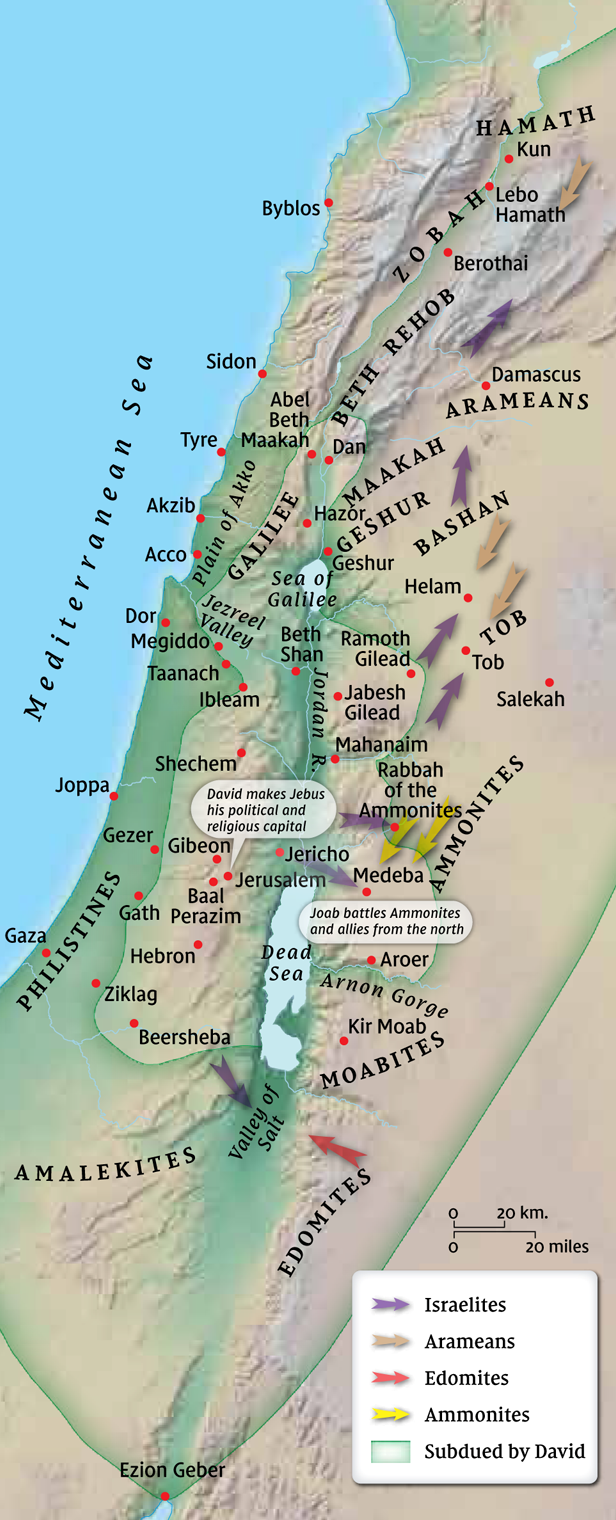
Valley of Salt at Southern End of Dead Sea
NIV Study Bible
Now Amaziah strengthened himself - NLT = Then Amaziah summoned his courage; ESV = Amaziah took courage; NIV = Amaziah then marshaled his strength NET = Amaziah boldly led his army
and led his people forth, and went to the Valley of Salt (just sourh of Dead Sea in map above) and struck down 10,000 of the sons of Seir (Edomites). It appears that Amaziah gave God as least some of the credit in his victory because as explained below the name Joktheel means "subdued by God."
Knapp: His [Amaziah’s] name means “strength of Jah”; but we read, “he strengthened himself” (2 Chronicles 25:11); his character of self-sufficiency thus belying his name – a thing not uncommon in our day.
Konkel - There were two main centers in Edom. Petra was in the south, and Bozrah (Buseirah) was in the north, between Sela and Punon. The initial conquests were in the north, with the aim of dominating the southern portion of the King’s Highway, on the east side of the Arabah, the rift valley of the Jordan, which extends south from the Dead Sea. . . Uzziah was able to complete the task begun by Azariah: regaining control over the trade routes of the King’s Highway, and providing a port city on the Gulf of Aqaba. With the death of Jehoash and Amaziah, the royal houses of Samaria and Jerusalem come to a new level of cooperation, providing a temporary advantage over the Edomites. (1 & 2 Chronicles)
Easton's Bible Dictionary helps us understand why Amaziah renamed Sela (Petra) as Joktheel - Amaziah, king of Judah, undertook a great expedition against Edom (2 Chr. 25:5-10), which was completely successful. He routed the Edomites and slew vast numbers of them. So wonderful did this victory appear to him that he acknowledged that it could have been achieved only by the special help of God, and therefore he called Selah (q.v.), their great fortress city, by the name of Joktheel (2 Kings 14:7).
Frederick Mabie: Amaziah’s victory over the Edomites (“men of Seir”; cf. Ge 32:3; 36:8; Eze 35:15) takes place in the Valley of Salt (Wadi el-Milh), located within the Arabah to the south of the Dead (Salt) Sea. Later, Uzziah will build on Amaziah’s victory over Edom by restoring Judean control over the port city of Elath, adjacent to Ezion Geber (cf. 2Ch 26:2). Like the subsequent worship of the Edomite gods (2Ch 25:14), the heinous act against the prisoners of war should be seen as repulsive.
Land of Seir
Land of Seir - The name of a mountainous region occupied by the Edomites, extending along the eastern side of the Arabah from the south-eastern extremity of the Dead Sea to near the Akabah, or the eastern branch of the Red Sea. It was originally occupied by the Horites (Gen. 14:6), who were afterwards driven out by the Edomites (Gen. 32:3; 33:14, 16). It was allotted to the descendants of Esau (Deut. 2:4, 22; Josh. 24:4; 2 Chr. 20:10; Isa. 21:11; Exek. 25:8).
We have both "land of Seir," (Genesis 32:3; 36:50) and "Mount Seir." (Genesis 14:6) It is the original name of the mountain range extending along the east side of the valley of Arabah, from the Dead Sea to the Elanitic, Golf. The Horites appear to have been the chief of the aboriginal inhabitants, (Genesis 36:20) but it was ever afterward the possession of the Edomites, the descendants of Esau. The Mount Seir of the: Bible extended much farther south than the modern province, as is shown by the words of (2:1-8) It had the Arabah on the west, vs. 1 and 8; it extended as far south as the head of the Gulf of Akabah, ver. 8; its eastern border ran along the base of the mountain range where the plateau of Arabia begins. Its northern, order is not so accurately determined. There is a line of "naked" white hills or cliffs which run across the great valley about eight miles south of the Dead Sea, the highest eminence being Mount Hor, which is 4800 feet high.
Mount Seir, an entirely different place from the foregoing; one of the landmarks on the north boundary of the territory of Judah. (Joshua 15:10) only. It lay westward of Kirjath-jearim, and between it and Beth-shemesh. If Kuriel el-Enab be the former and Ain-shems the latter of these two, then Mount Seir cannot fail to be the ridge which lies between the Wady Aly and the Wady Ghurab . In a pass of this ridge is the modern village of Seir. This cannot be Edom’s Mount Seir. Why? Geographic reasons - Joshua 15 is describing the tribal boundary of Judah. The context is west of Jerusalem, moving toward: Kiriath-jearim (Chesalon), Beth-shemesh, The Shephelah. Edom’s Mount Seir is far to the south, beyond the Dead Sea — geographically impossible here
2 Chronicles 25:12 The sons of Judah also captured 10,000 alive and brought them to the top of the cliff and threw them down from the top of the cliff, so that they were all dashed to pieces.
- threw them down: 2Sa 12:31 1Ch 20:3
- dashed to pieces. 2Ch 20:10 21:8-10
Parallel Passages:
No parallel in 2 Kings 14 with 2 Chronicles 25:12-16
VICTORY BECOMES
BARBARITY!
The sons of Judah also captured 10,000 alive and brought them to the top of the cliff and threw them down from the top of the cliff, so that they were all dashed to pieces - This sounds like something the Nazis would have done in WWII! So having obeyed God’s earlier command not to use mercenary troops from Israel (vv. 7–10) Amaziah went to battle with his own men and God gave them a sweeping victory. However, how the soldiers treated the prisoners afterwards reveals something dark about the moral climate of Judah’s army, and perhaps of Amaziah himself. This act was mass execution, an ancient‑world practice of revenge meant to instill fear in defeated enemies. We are beginning to see what the writer meant that Amaziah had a heart problem (2Ch 25:2)
Rather than reflecting Yahweh’s righteous judgment, the massacre mirrors the cruel excesses of pagan warfare. It anticipates Amaziah’s later moral collapse—most notably his adoption of the gods of Edom (2 Chronicles 25:14). The irony is striking: he kills Edom’s people, then bows to Edom’s gods.
2 Chronicles 25:13 But the troops whom Amaziah sent back from going with him to battle, raided the cities of Judah, from Samaria to Beth-horon, and struck down 3,000 of them and plundered much spoil.
- the troops whom Amaziah 2Ch 25:9
- Samaria: 1Ki 16:24,29
- Beth-horon: 2Ch 8:5 1Ki 9:17
Parallel Passages:
No parallel in 2 Kings 14 with 2 Chronicles 25:12-16
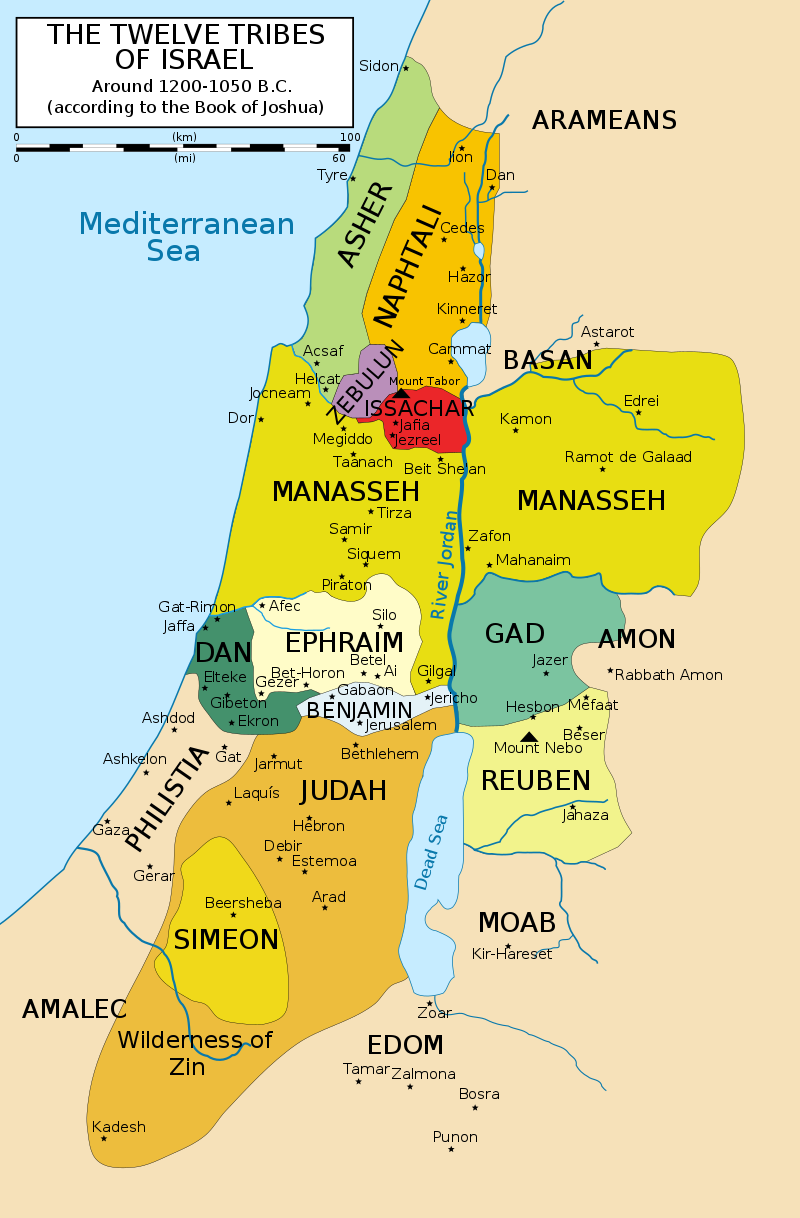
Map to help visualize descriptions of boundaries
CLICK TO ENLARGE
ANGERED MERCENARIES
PLUNDER & KILL JUDAHITES
But - Term of contrast. The writer has just described Judah's victory over Edom, but here the tide shifts. This describes the price Judah had to pay for Amaziah's foolish decision to hire mercenaries from apostate Israel.
The troops whom Amaziah sent back from going with him to battle, raided the cities of Judah, from Samaria to Beth-horon, and struck down 3,000 of them and plundered much spoil - The dismissed, angered Ephraimites took out their anger on Judah, raiding, killing and plundering. This was a consequence of Amaziah unwise attempt at an alliance with apostate Israelites. Beth-horon is in the tribal distribution of Ephraim (see map above - locate Ephraim) and is about 12 miles NW of Jerusalem.
Bob Utley - "the troops" This refers to the mercenaries from Ephraim (2 Chr. 25:6). The phrase "the cities of Judah from Samaria to Beth-horon" is unusual. Beth-horon is about fifteen miles NW of Jerusalem but "Samaria" is the capital of Israel, much farther north; both are in Israel, not Judah. This does explain 2Ch 15:10 but the geography is uncertain. There is no "Samaria" near the border of Judah and Ephraim. Perhaps this verse means they left from Samaria and traveled to Beth-horon, where they destroyed and plundered villages while Amaziah was battling Edom.
Raymond Dillard: No reason is offered for the anger and attack of the dismissed mercenaries. Presumably they had received at least a portion of the sum agreed upon (2Ch 25:6, 9). Perhaps the fact that they would not share in any spoil from the battle is the implicit reason. (Borrow 2 Chronicles)
August Konkel: Samaria was a vastly superior power to the state of Judah. This is of no consequence in the thinking of the Chronicler, for the single criterion of success is faithfulness to God. However, when God is not fighting the battle, the outcome will depend on the power of the combatants. Amaziah utterly failed to appreciate his own weaknesses in this regard, particularly in the border that he shared with the north (2 Chron 25:13). He suffered the plundering of his border towns after he had paid the mercenaries their due. This is not presented by the Chronicler as a theological judgment. It is more an evidence of Amaziah’s failure to recognize his vulnerability in the shadow of his much more powerful neighbor. (1 & 2 Chronicles)
Mark Boda: Amaziah’s move against the northern kingdom appears to be an act of revenge for the violent actions of the northern mercenaries (25:13). (1-2 Chronicles)
2 Chronicles 25:14 Now after Amaziah came from slaughtering the Edomites, he brought the gods of the sons of Seir, set them up as his gods, bowed down before them and burned incense to them.
- he brought: 2Ch 28:23 Isa 44:19
- his gods: Ex 20:3-5 De 7:5,25 2Sa 5:21
Parallel Passages:
No parallel in 2 Kings 14 with 2 Chronicles 25:12-16
Related Passages:
Exodus 20:3-4 You shall have no other gods before Me. 4“You shall not make for yourself an idol, or any likeness of what is in heaven above or on the earth beneath or in the water under the earth.
Deuteronomy 7:5 (NOTE THE 4 ACTIONS AGAINST IDOLS) “But thus you shall do to them: you shall tear down their altars, and smash their sacred pillars, and hew down their Asherim, and burn their graven images with fire.
Deuteronomy 12:2 “You shall utterly destroy all the places where the nations whom you shall dispossess serve their gods, on the high mountains and on the hills and under every green tree.
AMAZIAH'S BIG MISTAKE:
BRINGING BACK IDOLS!
Now after Amaziah came from slaughtering the Edomites, he brought the gods of the sons of Seir - This was his second mistake, to bring these idols back to Jerusalem God's holy city! You ask, what was his first mistake and crucial point of disobedience? He failed to obey the clear instructions in Deuteronomy (given to Israel before they entered the Promised Land literally filled with IDOLS!) spelled out in Dt 7:5 and Dt 12:2.
🙏 THOUGHT - Amaziah's biggest mistake was leaving a foot in the door (so to speak), in a sense making provision for the lust of his flesh (Ro 13:14). He failed to annihilate and exterminate the vermin of idolatry! What is fascinating is that the Bible frequently links IDOLATRY with IMMORALITY, and Paul gives us the cure - don't bring the gods into your home (via the internet, ipad, iphone) to allow yourself to be tempted! You will fall! Instead "by the Spirit be putting to death (present tense - continually) the deeds of the body, you will live." (Ro 8:13). Kill idolatry/immorality! Kill sin lest it be killing you! At the very least Amaziah should have turned and run obeying Paul's command to "Flee (present imperative see our need to depend on the Holy Spirit to obey) immorality. Every other sin that a man commits is outside the body, but the immoral man sins against his own body.." (1Cor 6:18)
Paul commanded "Therefore, my beloved, flee from idolatry.." (1Co 10:14)
John commanded "Little children, guard yourselves from idols." (1Jn 5:21)
Here is a free book by Steve Gallagher online entitled At The Altar of Sexual Idolatry (Here is the workbook At the Altar of Sexual Idolatry Workbook which can be borrowed)
Henry Morris - After the miraculous deliverance of the Edomites into his hand by God, it seems almost incredible that Amaziah would then bow down to their impotent "gods."
Set them up as his gods bowed down before them and burned incense to them - Note the inevitable progression - (1) fail to obey God and destroy the idols; (2) bring them back home (note what the writer called them - "HIS gods!"); (3) bow down (4) burn incense (cf to prayer)! The writer leaves one aspect off his description, although it may be implied in #3 "bowed down." So just so we do not miss it Number 5 is one becomes enslaved to the idol -- in bondage to dead (but spiritual corrupting) gods! Watch Amaziah's spiritual discernment deteriorate from here on out!
🙏 THOUGHT - Paul writes to believers "Therefore do not let sin reign (present imperative with a negative see our need to depend on the Holy Spirit to obey) in your mortal body so that you obey its lusts (AKA "DO NOT BOW DOWN!"), 13 and do not go on presenting (present imperative with a negative see our need to depend on the Holy Spirit to obey) the members of your body to sin as instruments of unrighteousness; but present yourselves to God as those alive from the dead, and your members as instruments of righteousness to God. (Ro 6:12-13) One of the best "antidotes" to bowing down to idols is to bow down to God! See The Expulsive Power of a New Affection.
Bob Utley - This is so shocking! How could a king who just responded positively to a prophet be led so quickly into idolatry with the obviously impotent gods of Edom (cf. 15b)? Notice what Amaziah did. (1) collected the idols of Edom, (2) brought them to Jerusalem (3) bowed down to them (4) burned incense to them. 2 Chronicles 25:15 is a powerfully logical statement! Why, Why, Why?
John Walton - gods of the sons of Seir. It is generally assumed that these would be the images of the Edomite gods. The national god of the Edomites was Qos. It is not unusual that worship should be offered to deities of defeated nations. At Dan standing stones were found at a shrine just inside the city gate, and the clear remains of the presentation of votive offerings were evident. It is thought that the standing stones represented some of the deities of cities that had fallen to Israel. The votive offerings would be in fulfillment of vows made to those deities (perhaps for their aid in overthrowing the city the Israelites were fighting against). (IVP Background Commentary - OT - page 447)
John Olley: While this situation is unique in the OT (contrast David; 1 Chron. 14:12), elsewhere in the ancient Near East conquerors sometimes worshiped the gods of defeated nations, regarding them as having abandoned their opponents to fight on the victor’s side (cf. the Lord’s abandoning his people; e.g., Isa. 10:5–6). (ESV Expository Commentary, Vol. III – 1 Samuel – 2 Chronicles)
John Schultz: There must have been demonic influence in Amaziah’s behavior which made him take the gods of the Edomites and worship them. Our first impression would be that this was an act of stupidity. If the idols of Edom were not strong enough to protect that people who worshipped them, what value would they have for Amaziah? Amaziah may have thought that they had been so favorable to him that they gave him their territory. Instead of attributing his victory to the Lord, he accredited it to the Edomite idols! That sounds like the kind of lie Satan would whisper in someone’s ear. (2 Chronicles)
Martin Selman: Amaziah’s achievement seems to bring out the worst in him. Whereas he had previously made some response to God, now he turns to idolatry (vv. 14-15), persecution (v. 16), revenge (v. 17), intransigence (vv. 16, 20), pride (v. 19), and apostasy (v. 27). The decisive factor is Amaziah’s worship of Edomite gods (v. 14). This is the only explicit reference to Edomite worship in the Bible, even though there was a persistent sense of brotherhood between Israel and Edom (cf. Dt. 23:7; Am. 1:11). The Edomites did worship a deity by the name Qos, though the earliest evidence comes from a few decades later than Amaziah. (BORROW Tyndale Old Testament Commentaries – 2 Chronicles.)
Matthew Henry Notes: Verses: 2Ch 25:14-16
Here is,
I. The revolt of Amaziah from the God of Israel to the gods of the Edomites. Egregious folly! Ahaz worshipped the gods of those that had conquered him, for which he had some little colour, ch. 28:23. But to worship the gods of those whom he had conquered, who could not protect their own worshippers, was the greatest absurdity that could be. What did he see in the gods of the children of Seir that could tempt him to set them up for his gods and bow himself down before them? 2Ch 25:14. If he had cast the idols down from the rock and broken them to pieces, instead of the prisoners, he would have manifested more of the piety as well as more of the pity of an Israelite; but perhaps for that barbarous inhumanity he was given up to this ridiculous idolatry.
II. The reproof which God sent to him, by a prophet, for this sin. The anger of the Lord was kindled against him, and justly; yet, before he sent to destroy him, he sent to convince and reclaim him, and so to prevent his destruction. The prophet reasoned with him very fairly and very mildly: Why hast thou sought the favour of those gods which could not deliver their own people? 2Ch 25:15. If men would but duly consider the inability of all those things to help them to which they have recourse when they forsake God, they would not be such enemies to themselves.
III. The check he gave to the reprover, v. 16. He could say nothing in excuse of his own folly; the reproof was too just to be answered. But he fell into a passion with the reprover.
1. He taunted him as saucy and impertinent, and meddling with that which did not belong to him: Art thou made of the king's counsel? Could not a man speak reasonably to him, but he must be upbraided as usurping the place of a privy-counsellor? But, as a prophet, he really was made of the king's counsel by the King of kings, in duty to whom the king was bound not only to hear, but to ask and take his counsel.
2. He silenced him, bade him forbear and say not a word more to him. He said to the seer, See not, Isa. 30:10. Men would gladly have their prophets thus under their girdles, as we say, to speak just when and what they would have them speak, and not otherwise.
3. He threatened him: "Why shouldst thou be smitten? It is at thy peril if thou sayest a word more of this matter.'' He seems to remind him of Zechariah's fate in the last reign, who was put to death for making bold with the king; and bids him take warning by him. Thus he justifies the killing of that prophet by menacing this, and so, in effect, makes himself guilty of the blood of both. He had hearkened to the prophet who ordered him to send back the army of Israel, and was ruled by him, though he contradicted his politics and lost him 100 talents, 2Ch 25:10. But this prophet, who dissuaded him from worshipping the gods of the Edomites, he ran upon with an unaccountable rage, which must be attributed to the witchcraft of idolatry. He was easily persuaded to part with his talents of silver, but by no means with his gods of silver.
IV. The doom which the prophet passed upon him for this. He had more to say to him by way of instruction and advice; but, finding him obstinate in his iniquity, he forbore. He is joined to idols; let him alone, Hos. 4:17. Miserable is the condition of that man with whom the blessed Spirit, by ministers and conscience, forbears to strive, Gen. 6:3. And both the reprovers in the gate and that in the bosom, if long brow-beaten and baffled, will at length forbear. So I gave them up to their own hearts' lusts. The secure sinner perhaps values himself upon it as a noble and happy achievement to have silenced his reprovers and monitors, and to get clear of them; but what comes of it? "I know that God has determined to destroy thee; it is a plain indication that thou art marked for ruin that thou hast done this, and hast not hearkened to my counsel.'' Those that are deaf to reproof are ripening apace for destruction, Prov. 29:1.
2 Chronicles 25:15 Then the anger of the LORD burned against Amaziah, and He sent him a prophet who said to him, “Why have you sought the gods of the people who have not delivered their own people from your hand?”
- a prophet: 2Ch 25:7 16:7-9 19:2 20:37 2Sa 12:1-6
- Why hast thou sought: 2Ch 24:20 Jud 2:2 Jer 2:5
- the gods: Ps 96:5
- which could: 2Ch 25:11,12 Ps 115:4-8 Isa 44:9,10 46:1,2 Jer 10:7 1Co 8:4 10:20
Parallel Passages:
No parallel in 2 Kings 14 with 2 Chronicles 25:12-16
UNNAMED PROPHET CHALLENGES
AMAZIAH'S INEXCUSABLE IDOLATRY
Then - Always pause and ask "When"? Here the answere is when Amaziah had chosen to worship false gods who could not protect the country he just defeated. What was Amaziah thinking? Answer? He was not!
The anger of the LORD burned against Amaziah, and He sent him a prophet who said to him - This the second unnamed prophet sent to Amaziah. This one came with a different message, a message of rebuke.
“Why have you sought the gods of the people who have not delivered their own people from your hand? - God had just given Amaziah a resounding victory and he brings back the enemy's little "g" gods! He should have returned and had a national praise and worship service for Jehovah! And so the prophet calls out Amaziah's foolish decision to bring back the idols of Edom and even bow down to them. He did not just bring them back because they were gold plated and he could put them in his treasure. The sad irony is that he treasured them in his heart! In the ancient world gods were worshiped because the pagans thought they could bring victory. Here Amaziah turns the tables and worships gods who failed miserably to bring victory to Edom. This foolish decision helps us understand 2Ch 25:2 where Amaziah is said to not have a whole heart, a heart like his spiritual ancestor David (2Ki 14:2).
NET NOTE sought - Heb “seeking,” perhaps in the sense of “consulting [an oracle from].”
Amaziah's foolish actions reminds me of King Solomon in 1 Kings 11, the writer telling us the tragic truth that "when Solomon was old (HE SHOULD HAVE BEEN WISE!) his wives turned his heart away after other gods; and his heart was not wholly devoted to the LORD his God, as the heart of David his father had been." (1Ki 11:4)
Bob Utley - After the Davidic covenant of 2 Samuel 7; 1 Chronicles 17 (i.e., 1 Kgs. 8:25), several ways of forgiveness or restoration of fellowship with YHWH are mentioned. (1) the possibility of repentance (i.e., 1 Kgs. 8:29-53) (2) there is a prophetic warning (in this chapter alone there are two unnamed prophets and even a revelation from an idolatrous king)
Andrew Hill: A second nameless prophet is commissioned by God to rebuke Amaziah (25:15). His worship of the Edomite gods is utter folly on two counts. (1) These gods have failed to deliver their own people in a time of crisis – the essential test of any deity. (2) The Mosaic injunction against idolatry has been firmly in place for centuries (Ex. 20:4-5). The expression “the anger of the Lord burned” (2 Chron. 25:15a) is typically found in contexts where God’s jealousy has been provoked by idolatry on the part of the Israelites (e.g., Deut. 7:4; Judg. 3:8; 2 Kings 13:3). According to the sanctions of the Davidic covenant, idolatry by the royal family puts the whole nation at risk of being exiled from the land (2 Chron. 7:19-22). (First and Second Chronicles)
Why have you sought the gods of the people, which could not rescue their own people from your hand. --2 Chronicles 25:15
If you've recently experienced a great spiritual victory, take a minute to check your luggage. You may have returned from the battle with something you definitely don't need.
Amaziah, King of Judah, followed the advice of a man of God before he went to war, and the Lord gave him a great victory (2 Chr. 25:7-12). Then, incredible as it seems, Amaziah "brought the gods of the people of Seir, set them up to be his gods, and bowed down before them and burned incense to them" (v.14).
There seems to be a critical time following every spiritual victory when we are particularly vulnerable to our own foolish mistakes. We may become proud, thinking we won the battle on our own. We may withdraw in a wave of depression and fear, wondering how we can possibly sustain the spiritual advance that has been made. We may suddenly reach out to embrace the very evil we set out to destroy.
Amaziah brought back the gods of the people whose army he had just defeated. Who could imagine it? And yet his battlefield baggage led to his downfall as king.
We need to follow up every spiritual triumph with a humble recommitment to the almighty God who gave it. --D C McCasland (Reprinted by permission from Our Daily Bread Ministries. Please do not repost the full devotional without their permission.)
Lord, grant us strength from day to day--
How prone we are to go astray!
The passions of our flesh are strong;
Be Thou, O God, a shield from wrong.
--DJD
The greatest enemy in the Christian life may be overconfidence.
2 Chronicles 25:16 As he was talking with him, the king said to him, “Have we appointed you a royal counselor? Stop! Why should you be struck down?” Then the prophet stopped and said, “I know that God has planned to destroy you, because you have done this and have not listened to my counsel.”
- Have we appointed you: 2Ch 16:10 18:25 24:21 Am 7:10-13 Mt 21:23
- Stop!: Pr 9:7,8 Isa 30:10,11 Jer 29:26 2Ti 4:3 Rev 11:10
- I know that God has planned t: Heb. counselled, 2Ch 18:20,21 Ex 9:16 De 2:30 1Sa 2:25 Isa 46:10 Ac 4:28 Ro 9:22 Eph 1:11
Parallel Passages:
No parallel in 2 Kings 14 with 2 Chronicles 25:12-16
AMAZIAH GIVES A
CEASE & DESIST ORDER!
As he was talking with him, the king said to him, “Have we appointed you a royal counselor? (yaats) - Absolute arrogance on the part of Amaziah! He had at least listened to the first unnamed prophet of Jehovah. But not this time. What had changed? He had begun to bow down to false gods and as Jesus declared you cannot have two masters (Mt 6:24+). His heart had been stolen by the false gods. This is spiritual warfare 101. Satan has been shooting fiery missiles at Amaziah that were lying and telling him Edom's gods were better than Jehovah and Jehovah's prophet.
Stop! Why should you be struck down?” - Amaziah threatens God's prophet. The English of the Septuagint says "take heed lest thou be scourged!" The NET says "Stop prophesying or else you will be killed!"
🙏 THOUGHT - How do I respond when I read a passage, hear a sermon, receive a rebuke that I do not like? Do I have an "Amaziah" reaction? Or in humility, do I bow down and receive the Word implanted which God is sending to save my soul (James 1:21). (See Net Note)
Bob Utley - The king's rebellion is clearly revealed in this verse. His mind and heart were set on a course of idolatry! But there will be consequences, as there always are!
Then the prophet stopped and said - The prophet stopped, but he had an addendum for the king. This addendum could have brought the sword on his neck immediately but it shows that God's men were filled with the Spirit and filled with holy boldness and courage (cf Acts 4:31).
I know that God has planned (yaats) to destroy you, because you have done this and have not listened (shama; LXX - akouo) to my counsel - With his last words (we never hear whether he was killed or walked out) he dropped the "A Bomb" on Amaziah! The prophet gives his verdict on Amaziah. He boldly declares that knew God was determined to destroy the king. He then explains why divine judgment would fall - (1) what Amaziah had done (overt idol worship) and (2) refused the counsel of God's mouthpiece, which was tantamount to refusing or "dissing" God Himself!
Amaziah rejected the counsel of God’s prophet;
now he would be the victim of God’s “counsel.”
NET NOTE on planned ("decided") The verb יָעַץ ((yaats ya’ats, “has decided”) is from the same root as יוֹעֵץ (yo’ets, “counselor”) in 2Ch 25:16 and עֵצָה (’etsah, “advice”) later in 2Ch 25:16. The wordplay highlights the appropriate nature of the divine punishment. Amaziah rejected the counsel of God’s prophet; now he would be the victim of God’s “counsel.”
Andrew Hill: The petulant Amaziah interrupts the prophet mid-sentence and commands him to desist in his indictment, upon threat of death (25:16). The prophet obeys the edict as a subject of the king and stops his denouncement. No doubt the earlier murder of Zechariah by Joash under similar circumstances is still fresh in the memory of Judah (cf. 24:22). Although the prophet stops his oracle, God’s message cannot be stopped – to reject the counsel of God’s prophet is to reject God himself. Amaziah is doomed to destruction by a righteous God. Not to be overlooked is the clever play of the writer on the word “counsel” (25:16, 17). The course of events will soon demonstrate that Amaziah can ignore the prophet’s counsel – but not God’s! (First and Second Chronicles)
Trapp: This was a rejection of God’s mercy to Amaziah. God was kind to send him a correcting prophet -- When he might have sent him to hell with a thunderbolt; as the patientest man upon earth would have done likely, had he been in God’s place and power.
Listen (hear, obey, understand)(08085) shama means to hear (Adam and Eve hearing God = Ge 3:8, 10, Ge 18:10 = "overheard"), to listen (Ge 3:17, Ge 16:2 [= this was a big mistake and was the origin of Jews and Arabs!] Ex 6:9,16:20, 18:19, Webster's 1828 on "listen" = to hearken; to give ear; to attend closely with a view to hear. To obey; to yield to advice; to follow admonition) and since hearing/listening are often closely linked to obedience, shama is translated obey (1 Sa 15:22, Ge 22:18, 26:5, 39:10, Ex 19:5, disobedience = Lev 26:14, 18, 21, 27) or to understand. KJV translates shama "hearken" (196x) a word which means to give respectful attention. Of God's hearing in general or hearing our prayers (Hab 1:2, Ps 66:18, click here for more in the Psalms, cf God's hearing in Zeph 2:8, Ge 16:11, 17:20, 30:17, 22, Ge 21:17, 29:33, 30:6, 17, 22; Ex 2:24, Ex 16:8, 9, 12, Nu 11:1, 12:2). Shama means “to hear intelligently and attentively and respond appropriately." In other words to hear does not convey the idea of "in one ear and out the other!"
The most famous use is the so-called "Shema" in Dt 6:4 “Hear, (a command, in Greek Lxx = present imperative - habitually, continually) O Israel! The LORD is our God, the LORD is one!" 5 “You shall love the LORD your God with all your heart and with all your soul and with all your might.
SHAMA IN KINGS AND CHRONICLES - 1Ki. 1:11; 1Ki. 1:41; 1Ki. 1:45; 1Ki. 2:42; 1Ki. 3:9; 1Ki. 3:11; 1Ki. 3:28; 1Ki. 4:34; 1Ki. 5:1; 1Ki. 5:7; 1Ki. 5:8; 1Ki. 6:7; 1Ki. 8:28; 1Ki. 8:29; 1Ki. 8:30; 1Ki. 8:32; 1Ki. 8:34; 1Ki. 8:36; 1Ki. 8:39; 1Ki. 8:42; 1Ki. 8:43; 1Ki. 8:45; 1Ki. 8:49; 1Ki. 8:52; 1Ki. 9:3; 1Ki. 10:1; 1Ki. 10:6; 1Ki. 10:7; 1Ki. 10:8; 1Ki. 10:24; 1Ki. 11:21; 1Ki. 11:38; 1Ki. 12:2; 1Ki. 12:15; 1Ki. 12:16; 1Ki. 12:20; 1Ki. 12:24; 1Ki. 13:4; 1Ki. 13:26; 1Ki. 14:6; 1Ki. 15:20; 1Ki. 15:21; 1Ki. 15:22; 1Ki. 16:16; 1Ki. 17:22; 1Ki. 19:13; 1Ki. 20:8; 1Ki. 20:12; 1Ki. 20:25; 1Ki. 20:31; 1Ki. 20:36; 1Ki. 21:15; 1Ki. 21:16; 1Ki. 21:27; 1Ki. 22:19; 1Ki. 22:28; 2Ki. 3:21; 2Ki. 5:8; 2Ki. 6:30; 2Ki. 7:1; 2Ki. 7:6; 2Ki. 9:30; 2Ki. 10:6; 2Ki. 11:13; 2Ki. 13:4; 2Ki. 14:11; 2Ki. 16:9; 2Ki. 17:14; 2Ki. 17:40; 2Ki. 18:12; 2Ki. 18:26; 2Ki. 18:28; 2Ki. 18:31; 2Ki. 18:32; 2Ki. 19:1; 2Ki. 19:4; 2Ki. 19:6; 2Ki. 19:7; 2Ki. 19:8; 2Ki. 19:9; 2Ki. 19:11; 2Ki. 19:16; 2Ki. 19:20; 2Ki. 19:25; 2Ki. 20:5; 2Ki. 20:12; 2Ki. 20:13; 2Ki. 20:16; 2Ki. 21:9; 2Ki. 21:12; 2Ki. 22:11; 2Ki. 22:13; 2Ki. 22:18; 2Ki. 22:19; 2Ki. 25:23; 1Chr. 10:11; 1Chr. 14:8; 1Chr. 14:15; 1Chr. 15:16; 1Chr. 15:19; 1Chr. 15:28; 1Chr. 16:5; 1Chr. 16:42; 1Chr. 17:20; 1Chr. 18:9; 1Chr. 19:8; 1Chr. 28:2; 1Chr. 29:23; 2Chr. 5:13; 2Chr. 6:19; 2Chr. 6:20; 2Chr. 6:21; 2Chr. 6:23; 2Chr. 6:25; 2Chr. 6:27; 2Chr. 6:30; 2Chr. 6:33; 2Chr. 6:35; 2Chr. 6:39; 2Chr. 7:12; 2Chr. 7:14; 2Chr. 9:1; 2Chr. 9:5; 2Chr. 9:6; 2Chr. 9:7; 2Chr. 9:23; 2Chr. 10:2; 2Chr. 10:15; 2Chr. 10:16; 2Chr. 11:4; 2Chr. 13:4; 2Chr. 15:2; 2Chr. 15:8; 2Chr. 16:4; 2Chr. 16:5; 2Chr. 18:18; 2Chr. 18:27; 2Chr. 20:9; 2Chr. 20:20; 2Chr. 20:29; 2Chr. 23:12; 2Chr. 24:17; 2Chr. 25:16; 2Chr. 25:20; 2Chr. 28:11; 2Chr. 29:5; 2Chr. 30:20; 2Chr. 30:27; 2Chr. 33:13; 2Chr. 34:19; 2Chr. 34:26; 2Chr. 34:27; 2Chr. 35:22
Counselor...planned (03289) yaats means to advise, counsel consult first in Exod. 18:19, where Jethro says to his son-in-law Moses "I will give you counsel, and God be with you."
Paul Gilchrist - TWOT - The first occurrence of yāʿaṣ is in Exodus 18:19. Jethro, seeing the tremendous burden of Moses, says, "I shall give you 'counsel,' and God be with you." He then gives him an organizational plan and advises him how to carry out the administrative responsibilities for ruling and judging his people. Jethro gives counsel from wisdom attained by age and/or experience. One may remember Rehoboam's rejection of the counsel (ʿēṣâ) of the old men (1 Kings 12:8, 13). Moses, as chief administrator of the people of God, is not obligated to accept such counsel. A case in point is Absolom's rejection of Ahithophel's good counsel which was countered by Hushai's evil counsel (2 Samuel 17). Jethro, as counsellor, presents a carefully thought out plan together with a procedure for its implementation. In 2 Kings 18:20 Rabshakeh's taunt of Hezekiah's claim, "I have counsel and strength for the war" reflects the usual careful deliberation that goes into planning for battle, in this case for defense.
Psalm 33:10 speaks of nations and peoples devising counsels and plans (Heb maḥăshābâ "thought, device, plan, purpose") albeit not in accordance with God's "counsels (ʿēṣâ) and plans" (cf. Isaiah 8:10; Isaiah 30:1).
In contrast to the counsels of men and nations, the OT speaks of the "counsel of the Lord." Psalm 33:10f. presents this thought most clearly. "The Lord nullifies the counsel of the nations; he frustrates the plans of the peoples. The 'counsel' of the Lord stands forever, the plans of his heart from generation to generation." Noteworthy here is the overruling power of God as he nullifies and frustrates the plans of men. The case of Ahithophel's counsel is apropos. In 2 Samuel 15:31 David prays to the Lord to "make the counsel of Ahithophel foolishness." He thereby acknowledges that God sovereignly disposes what man proposes. Further, in 2 Samuel 17:14 after Absalom chooses the advice of Hushai over that of Ahithophel, the inspired author makes the theological comment, "For the Lord had ordained to thwart the good counsel of Ahithophel, in order that the Lord might bring calamity on Absalom." Cf. Neh. 4:15 [H 9].
The counsel of the Lord is eternal, "It stands forever." The enduring character of God's counsel and plan is grounded in the unchangeableness of God himself. The "plans of his heart" may be equated with "the secret things" which belong to the Lord our God. It is God who guarantees the accomplishment of his eternal decrees. Isaiah beautifully integrates these thoughts, "Remember the former things long past, for I am God, and there is no other; declaring the end from the beginning and from ancient times things which have not been done, saying, 'My purpose will be established, and I will accomplish all my good pleasure'; Calling . . . the man of my purpose (lit. the man who executes my purpose, i.e. Cyrus) from a far country. Truly I have spoken; truly, I will bring it to pass. I have planned it, surely I will do it" (Isaiah 46:9-11). It is well to remember that ʿēṣâ is translated in the LXX by boulē, a word replete with theological significance in the NT (see Acts 2:23; Acts 4:28; Acts 5:38-39; Acts 20:27; Ephes. 1:11 where "the counsel of his will" expresses the immutable foreordination of God's will); cf. Hebrews 6:17, "the unchangeableness of his purpose").
Arising from the theological conceptualization are anthropological and ethical conclusions. Moses anticipates the waywardness of Israel as a "nation void of counsel," i.e. not following the" plans and purposes of God (Deut. 32:28). Job acknowledges that through lack of knowledge, he has darkened counsel (Job 42:3; cf. Job 38:2). In Proverbs, counsel is rejected and spurned to one's own detriment (Proverbs 1:25, 30) but "he who listens to counsel" is a wise man (Proverbs 12:15). From Proverbs 19:20-21 we understand that the counsel the godly man is urged to listen to is the "counsel of the Lord" which will stand, in contrast to the many "plans in a man's heart." The blessed man of Psalm 1:1 is one "who walks not in the counsel of the ungodly." Further, in Psalm 32:8 the psalmist is encouraged by the Lord's instruction and teaching, together with the assurance "I 'will counsel' (yāʿaṣ) you with my eye upon you" (cf. Psalm 73:24).
Two christological passages need to be studied in this connection. The only hope of Judah, Isaiah claims, is to be found in the person of the Messiah, who is characterized by four compound names, the first being "Wonderful Counsellor" (Isaiah 9:6). The child who is to come, on whose shoulders the government of the world shall rest, is one whose plans, purposes, designs and decrees for his people are marvellous. We further learn from Isaiah 11:2 that "counsel" is a gift of God's own Holy Spirit. Consequently, Jesus Christ is revealed as the counsellor par excellance.
Gilbrant - Yāʿats is a verb that means "to counsel," to "purpose" or "to conspire together." Ahithophel advised Absalom to pursue David immediately after the king had fled from his insurrectionist son (2 Sam. 17:4), but Hushai undermined Ahithophel's advice (v. 7). The prophet Nathan asked King David's wife Bathsheba to allow him to "give counsel" to her when David's son Adonijah set himself as king (1 Ki. 1:12). David praised the Lord for "giving counsel" to him (Ps. 16:7).
In the Qal participle, yāʿats often is used substantively to refer to a "counselor." Ahithophel, David's "counselor," defected to Absalom when the king's son rebelled against his father. King Ahaziah's wicked "counselors" led to his downfall (2 Chr. 22:4).
Sometimes yāʿats refers to "purposing" to do something or "devising" a plan. Jeremiah proclaimed that the punishment that the Lord had "purposed" to bring against Assyria would stand (Jer. 14:24). A prophet warned Amaziah, the king of Judah, that the Lord had "purposed" to destroy him for worshiping foreign gods (2 Chr. 25:16). David says that wicked people "plot" to do harm to a righteous man (Ps. 62:4).
The preposition ʿel (HED #420) is sometimes used to denote who is counseled against, e.g., the Lord "purposed" a plan of judgment against Edom (Jer. 49:20) and against Babylon (50:45). The preposition ʿal (HED #6142) is used similarly (e.g., Isa. 19:17).
In the Hithpael, yāʿats means "to conspire together." The psalmist declared that the Lord's enemies "conspired together" against the Lord's people (Ps. 83:3). (Complete Biblical Library)
YAATS - 74V - advise(1), advisers(1), conspire(1), conspired(1), consult(2), consulted(8), counsel(4), counsel do you give(2), counsel you have given(1), counseled(7), Counselor(1), counselor(10), counselors(11), decided(3), devised(2), devises(2), formed(1), gave(1), give(2), give you advice(1), give you counsel(1), given(4), planned(8), purposed(1), purposing(1), receive counsel(1), take counsel(1), took counsel(1). Deut. 32:28; Jdg. 20:7; 2 Sam. 15:31; 2 Sam. 15:34; 2 Sam. 16:20; 2 Sam. 16:23; 2 Sam. 17:7; 2 Sam. 17:14; 2 Sam. 17:23; 1 Ki. 1:12; 1 Ki. 12:8; 1 Ki. 12:13; 1 Ki. 12:14; 2 Ki. 18:20; 1 Chr. 12:19; 2 Chr. 10:8; 2 Chr. 10:13; 2 Chr. 10:14; 2 Chr. 22:5; 2 Chr. 25:16; Ezr. 4:5; Ezr. 10:3; Ezr. 10:8; Neh. 4:15; Job 5:13; Job 10:3; Job 12:13; Job 18:7; Job 21:16; Job 22:18; Job 29:21; Job 38:2; Job 42:3; Ps. 1:1; Ps. 13:2; Ps. 14:6; Ps. 20:4; Ps. 33:10; Ps. 33:11; Ps. 73:24; Ps. 106:13; Ps. 106:43; Ps. 107:11; Ps. 119:24; Prov. 1:25; Prov. 1:30; Prov. 8:14; Prov. 12:15; Prov. 19:20; Prov. 19:21; Prov. 20:5; Prov. 20:18; Prov. 21:30; Prov. 27:9; Isa. 5:19; Isa. 8:10; Isa. 11:2; Isa. 14:26; Isa. 16:3; Isa. 19:3; Isa. 19:11; Isa. 19:17; Isa. 25:1; Isa. 28:29; Isa. 29:15; Isa. 30:1; Isa. 36:5; Isa. 40:13; Isa. 44:26; Isa. 46:10; Isa. 46:11; Isa. 47:13; Jer. 18:18; Jer. 18:23; Jer. 19:7; Jer. 32:19; Jer. 49:7; Jer. 49:20; Jer. 49:30; Jer. 50:45; Ezek. 7:26; Ezek. 11:2; Hos. 10:6; Mic. 4:12; Zech. 6:13
2 Chronicles 25:17 Then Amaziah king of Judah took counsel and sent to Joash the son of Jehoahaz the son of Jehu, the king of Israel, saying, “Come, let us face each other.”
- Amaziah: 2Ch 25:13 2Ki 14:8-14
- let us face: 2Sa 2:14 Pr 20:3
Parallel Passage:
2 Kings 14:8 Then Amaziah sent messengers to Jehoash, the son of Jehoahaz son of Jehu, king of Israel, saying, “Come, let us face each other.”
AMAZIAH COUNSELED TO
CHALLENGE JOASH
Then Amaziah king of Judah took counsel (yaats) and sent to Joash the son of Jehoahaz the son of Jehu, the king of Israel, saying, “Come, let us face each other - NET = "Come, face me on the battlefield." Fresh off a victory over Edom and in light of the raiding of Judah by Israelite mercenaries it seems that Amaziah is as we say today "picking a fight!" Notice that little phrase (not in the Kings parallel) took counsel! This reminds me of King Rehoboam who took counsel with elders and then young men and listened to the latter. (1Ki 12:8,9, 2Ch 10:6-11) and the result was a divided kingdom!!! There is no evidence Amaziah sought God's "counsel" which is always a bad idea when making a major (even minor) decision! In fact from 2Ch 25:16 he actually rejected God's counsel (same Hebrew word yaats) !
NET NOTE Heb “let us look at each other [in the] face.” The expression refers here not to a visit but to meeting in battle. See v. 21.
Bob Utley asks on "took counsel" What counsel? (1)he had rejected prophetic counsel, 2Ch 25:16. (2) was this from his political leaders, his military leaders or his new gods and their priests. The counsel probably encouraged Amaziah to attack Israel because of what the Ephraimitic mercenaries did in 2Ch 25:13.
John Olley: The foolhardy arrogance of Amaziah continued as he sought confrontation with Joash of Israel. (ESV Expository Commentary, Vol. III – 1 Samuel – 2 Chronicles)
David Guzik: He had reason to believe he would be successful. He had recently assembled a 300,000 man army that killed 20,000 men in a victory over Edom (2 Chronicles 25:5, 11-12). King Joash (Jehoahaz) of Israel seemed very weak, having only 50 horsemen, 10 chariots, and 10,000 foot soldiers after being defeated by the Syrians (2 Kings 13:7).
Matthew Henry Notes: Verses: 2Ch 25:17-28
We have here this degenerate prince mortified by his neighbour and murdered by his own subjects.
I. Never was proud prince more thoroughly mortified than Amaziah was by Joash king of Israel.
1. This part of the story (which was as fully related 2 Ki. 14:8, etc., as it is here)-embracing the foolish challenge which Amaziah sent to Joash (2Ch 25:17), his haughty scornful answer to it (2Ch 25:18), with the friendly advice he gave him to sit still and know when he was well off, (2Ch 25:19),-his wilfully persisting in his challenge (2Ch 25:20, 21), the defeat that was given him (2Ch 25:22), and the calamity he brought upon himself and his city thereby 2Ch 25:23, 24),-verifies two of Solomon's proverbs:-
(1.) That a man's pride will bring him low, Prov. 29:23. It goes before his destruction; not only procures it meritoriously, but is often the immediate occasion of it. He that exalteth himself shall be abased.
(2.) That he that goes forth hastily to strive will probably not know what to do in the end thereof, when his neighbour has put him to shame, Prov. 25:8. He that is fond of contention may have enough of it sooner than he thinks of.
2. But there are two passages in this story which we had not before in the Kings.
(1.) That Amaziah took advice before he challenged the king of Israel, 2Ch 25:17. But of whom? Not of the prophet-he was not made of the king's counsel; but of his statesmen that would flatter him and bid him go up and prosper. It is good to take advice, but then it must be of those that are fit to advise us. Those that will not take advice from the word of God, which would guide them aright, will justly be left to the bad advice of those that will counsel them to their destruction. Let those be made fools that will not be made wise.
(2.) Amaziah's imprudence is here made the punishment of his impiety (2Ch 25:20): It was of the Lord; he left him to himself to act thus foolishly, that he and his people might be delivered into the hands of their enemies, because they had forsaken God and sought after the gods of Edom. Those that will not persuaded to do well for their souls will justly be given up to their own counsels to do ill for themselves even in their outward affairs.
II. Never was poor prince more violently pursued by his own subjects. From the time that he departed from the Lord (so it may be read, 2Ch 25:27) the hearts of his subjects departed from him, and they began to form a design against him in Jerusalem. It is probable they were exasperated against him more for his rashly engaging in a war against Israel than for his worshipping the gods of Edom. But at length the ferment grew so high, and he perceived the plot to be laid so deeply, that he thought fit to quit his royal city and flee to Lachish, either as a private place where he might be hid or as a strong place where he might be guarded; but they sent after him thither, and slew him there. By this the putting of him to death seems to have been done deliberately, and to have been the act, not of a disgusted servant or two, but of a considerable body that durst avow it. How unrighteous soever they were herein, God was righteous.
2 Chronicles 25:18 Joash the king of Israel sent to Amaziah king of Judah, saying, “The thorn bush which was in Lebanon sent to the cedar which was in Lebanon, saying, ‘Give your daughter to my son in marriage.’ But there passed by a wild beast that was in Lebanon and trampled the thorn bush.
- thorn, Judges 9:8-15 1Ki 4:33
- a wild beast: Heb. a beast of the field, Ps 80:13
Parallel Passage:
2 Kings 14:9 Jehoash king of Israel sent to Amaziah king of Judah, saying, “The thorn bush which was in Lebanon sent to the cedar which was in Lebanon, saying, ‘Give your daughter to my son in marriage.’ But there passed by a wild beast that was in Lebanon, and trampled the thorn bush.
A PARABLE TO
AMAZIAH
Joash the king of Israel sent to Amaziah king of Judah, saying, “The thorn bush which was in Lebanon sent to the cedar which was in Lebanon, saying, ‘Give your daughter to my son in marriage.’ But there passed by a wild beast that was in Lebanon and trampled the thorn bush Jehoash tried to cut Amaziah down to size with this parable: A thorn bush (thistle - symbolizing Amaziah) tried to make himself equal with a cedar tree (Jehoash) until a wild beast accidently stepped on him and stopped his ambitious plans. Amaziah was the thistle — fragile and easily crushed — while Israel was the cedar. Amaziah should stay home and be content with his trophies (including his little gods).
NET NOTE The thorn bush in the allegory is Judah. Amaziah’s success had deceived him into thinking he was on the same level as the major powers in the area (symbolized by the cedar). In reality he was not capable of withstanding an attack by a real military power such as Israel (symbolized by the wild animal).
Dilday: The thistle, imagining himself to be equal with the cedar, presumptuously suggested a marriage alliance between them. The difference between the two was made obvious when a wild beast passed through and crushed the thistle underfoot. Of course the beast was powerless to injure the cedar.
J.A. Thompson: Jehoash’s fable about the arrogant thistle is similar to Jotham’s allegory about the thornbush in Judges 9:7-15. The Chronicler viewed pride as a grievous sin and can be heard speaking through Jehoash. To have supposed that a victory over Edom was a warrant for attacking Jehoash and a guarantee of another victory was arrogant and foolish. Amaziah would be wiser to remain at home. His action would bring about his own downfall and that of his nation Judah as well (cf. 26:16). (The New American Commentary – Volume 9 – 1, 2 Chronicles)
YHWH was speaking through Israel's pagan king,
warning the Davidic seed.
Bob Utley Agricultural analogies or fables were common in the ANE (i.e., Samson). Judah thought she was a tree but she was a bush! What is surprising is Israel's humility and patience. YHWH was speaking through Israel's pagan king, warning the Davidic seed. YHWH tries to sway human volition but He allows its choices and consequences. Life is not a pre-written script. Foreknowledge must not be confused with determinism.
Apparently there was friendship between Judah and Israel.
- ability to hire mercenaries, 2 Chr. 25:6
- marriage proposal (i.e., even if rejected), 2 Chr. 25:18
- the king of Israel's attempt not to go to war, 2 Chr. 25:17-19
"the wild beast" This may be the 100,000 soldiers who were furious (cf. 2 Chr. 25:10).
2 Chronicles 25:19 “You said, ‘Behold, you have defeated Edom.’ And your heart has become proud in boasting. Now stay at home; for why should you provoke trouble so that you, even you, would fall and Judah with you?”
NET You defeated Edom and it has gone to your head. Gloat over your success, but stay in your palace. Why bring calamity on yourself? Why bring down yourself and Judah along with you?"
BGT εἶπας ἰδοὺ ἐπάταξας τὴν Ιδουμαίαν καὶ ἐπαίρει σε ἡ καρδία ἡ βαρεῖα νῦν κάθησο ἐν οἴκῳ σου καὶ ἵνα τί συμβάλλεις ἐν κακίᾳ καὶ πεσῇ σὺ καὶ Ιουδας μετὰ σοῦ
LXE Thou hast said, Behold, I have smitten Idumea, and thy stout heart exalts thee: now stay at home; for why dost thou implicate thyself in mischief, that thou shouldest fall, and Juda with thee.
CSB You have said, 'Look, I have defeated Edom,' and you have become overconfident that you will get glory. Now stay at home. Why stir up such trouble so that you fall and Judah with you?"
ESV You say, 'See, I have struck down Edom,' and your heart has lifted you up in boastfulness. But now stay at home. Why should you provoke trouble so that you fall, you and Judah with you?"
NIV You say to yourself that you have defeated Edom, and now you are arrogant and proud. But stay at home! Why ask for trouble and cause your own downfall and that of Judah also?"
NLT "You are saying, 'I have defeated Edom,' and you are very proud of it. But my advice is to stay at home. Why stir up trouble that will only bring disaster on you and the people of Judah?"
YLT Thou hast said, Lo, I have smitten Edom; and thy heart hath lifted thee up to boast; now, abide in thy house, why dost thou stir thyself up in evil, that thou hast fallen, thou, and Judah with thee?'
- heart: 2Ch 26:16 32:25 De 8:14 Pr 13:10 16:18 28:25 Da 5:20-23 Hab 2:4 Jas 4:6 1Pe 5:5
- to boast: Jer 9:23 1Co 1:29
- why should: 2Ch 35:21 Pr 18:6 20:3 26:17 Lu 14:31
Parallel Passage:
2 Kings 14:10 “You have indeed defeated Edom, and your heart has become proud. Enjoy your glory and stay at home; for why should you provoke trouble so that you, even you, would fall, and Judah with you?
NOW WE COME TO THE
HEART OF THE PROBLEM
You said, ‘Behold (hinneh; LXX - idou - trying to get Amaziah's full attention!) you have defeated Edom
NET You defeated Edom and it has gone to your head. Gloat over your success, but stay in your palace. Why bring calamity on yourself? Why bring down yourself and Judah along with you?"
NET NOTE Heb “you say [to yourself], ‘look, you have defeated Edom.’ ”
And (important connective with Amaziah's victory) your heart has become proud in boasting. ESV - "your heart has lifted you up in boastfulnes"Jehoash cuts to the quick identifying the heart of Amaziah's problem as the pride in his heart! Jehoash is not exactly the most spiritually astute man on the block, but in this case he nails Amaziah's sin of pride (note the middle letter of the word pride, and same with sin = "I").
NET NOTE proud - Heb “and your heart is lifted up.”
Now stay at home - Jehoash gives Amazian wise advice - stay put!
For - Term of explanation. What is Jehoash explaining?
Why should you provoke (garah - stir up) trouble so that (term of result) you, even you, would fall and Judah with you?” The question is somewhat rhetorical. He is saying if you come against me, that will provoke trouble. And then he adds that (so to speak) two dominoes would tumble - Amaziah and Judah. Jehoash is speaking like a prophet at this point, for 2Ch 25:20 tells us that Jehoash's warning "was from God." In effect, this would have been the third "prophet" Amaziah had encountered and he would prove to have a low reception rate, listening only to the first unnamed prophet. Pride is distorting his common sense and driving his fleshly desire to defeat Jehoash.
NET NOTE Heb “Why get involved in calamity and fall, you and Judah with you?
Bob Utley King Amaziah was overconfident because of his defeat of a smaller Edomite army (i.e., 20,000 casualties), but Israel was a much larger army. (ED: I WOULD ADD THAT YAHWEH WAS ALSO AGAINST AMAZIAH, SO ISRAEL WOULD HAVE DEFEATED AMAZIAH IF THEY HAD HAD ONLY ONE SOLDIER - 2Ch 25:20! RECALL ELISHA'S SINGLE HANDED CAPTURE OF AN ENTIRE ARAMEAN ARMY! 2Ki 6:15-23)
David Guzik: Amaziah should have listened to this word from Jehoash, but he didn’t. He provoked a fight he should have avoided, and did not consider either the likelihood of success or the effect his defeat would have on the whole kingdom of Judah.
2 Chronicles 25:20 But Amaziah would not listen, for it was from God, that He might deliver them into the hand of Joash because they had sought the gods of Edom.
- it was from God: 2Ch 25:16 22:7 1Ki 12:15 Ps 81:11,12 Ac 28:25-27 2Th 2:9-11 1Pe 2:8
- sought: 2Ch 25:14
Parallel Passage:
2 Kings 14:11 But Amaziah would not listen. So Jehoash king of Israel went up; and he and Amaziah king of Judah faced each other at Beth-shemesh, which belongs to Judah.
AMAZIAH'S
"UNCIRCUMCISED EARS"
But - Term of contrast. Oh my, when the heart is filled with pride, the mind is empty of common sense.
Amaziah would not listen (shama; LXX - akouo) - This is what pride will do to your ears! It will close your ears to the voice of God! Jehoash was broadcasting on the FM Band but the only thing Amaziah could hear was the AM Band, for that is where his hard heart was tuned. It reminds me of Stephen's words in Acts 7:51 “You men who are stiff-necked and uncircumcised in heart and ears are always resisting the Holy Spirit; you are doing just as your fathers did (AKA AMAZIAH)."
For it was from God, - God is amazing. He can speak through a donkey to Balaam and here He speaks through an apostate king to a stubborn donkey of a king! God is jealous and therefore would avenge the spiritual adultery of Amaziah and Judah (See Israel the Wife of Jehovah)
Bob Utley - This is another theological comment by the Chronicler. YHWH is behind all history. (ED: HISTORY IS HIS-STORY!) Amaziah's idolatry will have consequences, not only for him but for Judah.
That (term of purpose - What's God's purpose?) He might deliver (LXX - paradidomi = legal term for passing someone along in the judicial process - God giving Judah to judgment!) them into the hand (yad = power) of Joash because (term of explanation - what is writer explaining?) they had sought (darash; LXX - ekzeteo = exerted effort to find!) the gods (elohim) of Edom - Amaziah's payday is around the corner and Yahweh is guiding Amaziah's footsteps to that around the corner surprise! Once again we see God's sovereignty intersecting with man, in this case with Amaziah's irresponsibile, rebellious behavior.
NET NOTE Heb “because it was from God in order to give them into the hand because they sought the gods of Edom.”
J.A. Thompson: Behind the human affairs of this world is the overruling hand of God. Indeed, God guided even Amaziah’s own pride in such a way that it brought about his downfall. In judgment for his apostasy God made Amaziah blind to the truth and deaf to wisdom (cf. 1 Kgs 12:15). (The New American Commentary – Volume 9 – 1, 2 Chronicles.)
2 Chronicles 25:21 So Joash king of Israel went up, and he and Amaziah king of Judah faced each other at Beth-shemesh, which belonged to Judah.
- they faced each another: 2Ch 25:17
- Beth-shemesh: Jos 21:16 1Sa 6:9,19,20
LOCATION OF BETH-SHEMESH
(ESV Study Bible)
BROTHERS FIGHTING
BROTHERS
So Joash king of Israel went up, and he and Amaziah king of Judah faced each other at Beth-shemesh, which belonged to Judah - Beth Shemesh was a town about fifteen miles west of Jerusalem in the Shephelah region between Jerusalem and the coastal territory of Philistia
NET NOTE Heb “looked at each other [in the] face.” See the note on the expression “Come on, face me on the battlefield” in 2Ch 25:17.
Bob Utley - "Beth-shemesh" This (BDB 112) meant "house of the sun," which denoted astral worship in Judah at some point. (What does the Bible say about sun worship?)
TSK - The reason of this war was evidently the injury the army of Joash had done to the unoffending inhabitants of Judah. The ravages committed by them were totally unprovoked, base, and cowardly: they fell upon women, old men, and children, and butchered them in cold blood, when all the effective men were gone with their king against the Edomites. The quarrel of Amaziah were certainly just, yet he was put to the rout: he fell, and Judah with him, as Joash had said; and the reason was, because "it came of God, that he might deliver them into the hands of their enemies, because they sought after the gods of Edom." This was the reason why the Israelites triumphed.
John Walton - Beth Shemesh (SEE ON MAP ABOVE) was a town about fifteen miles west of Jerusalem in the Shephelah region between Jerusalem and the coastal territory of Philistia. It was an important fortress town that guarded the Sorek pass from raiders who desired to plunder Jerusalem. The site of Beth Shemesh (Tell er-Rumeliah) has remains showing an extensive Canaanite occupation of the city before the Israelite conquest.(IVP Background Commentary - OT - page 447)
Easton's Bible Dictionary - BETH-SHEMESH = Beth (house) Shemesh (sun) - house of the sun. (1.) A sacerdotal city in the tribe of Dan (Josh. 21:16; 1 Sam. 6:15), on the north border of Judah (Josh. 15:10). It was the scene of an encounter between Jehoash, king of Israel, and Amaziah, king of Judah, in which the latter was made prisoner (2 Kings 14:11, 13). It was afterwards taken by the Philistines (2 Chr. 28:18). It is the modern ruined Arabic village 'Ain-shems, on the north-west slopes of the mountains of Judah, 14 miles west of Jerusalem.
2 Chronicles 25:22 Judah was defeated by Israel, and they fled each to his tent.
- Judah was defeated 2Ch 28:5,6
- fled: 1Sa 4:10 1Ki 22:36
Parallel Passage:
2Ki 14:12 Judah was defeated by Israel, and they fled each to his tent.
AMAZIAH'S DEFEAT AT
HAND OF GOD
Judah was defeated by Israel, and they fled each to his tent - A human king, Jehoash, had defeated Amaziah, but the truth is that it was Yahweh Who had defeated Amaziah.
NET NOTE Heb “and Judah was struck down before Israel and they fled, each to his tent.”
2 Chronicles 25:23 Then Joash king of Israel captured Amaziah king of Judah, the son of Joash the son of Jehoahaz, at Beth-shemesh, and brought him to Jerusalem and tore down the wall of Jerusalem from the Gate of Ephraim to the Corner Gate, 400 cubits.
- Amaziah: 2Ch 33:11 36:6,10 Pr 16:18 29:23 Da 4:37 Ob 1:3 Lu 14:11
- Jehoahaz: 2Ch 21:17 22:1, Ahaziah, 2Ch 22:6, Azariah
- gate of Ephraim: Ne 8:16 12:39
- corner gate: Heb. the gate of it that looketh, 2Ch 26:9 Jer 31:38
Parallel Passage:
2 Kings 14:13 Then Jehoash king of Israel captured Amaziah king of Judah, the son of Jehoash the son of Ahaziah, at Beth-shemesh, and came to Jerusalem and tore down the wall of Jerusalem from the Gate of Ephraim to the Corner Gate, 400 cubits.
LOCATION OF BETH-SHEMESH
(ESV Study Bible)
THE WALLS COME
TUMBLING DOWN!
Then Joash king of Israel captured Amaziah king of Judah, the son of Joash the son of Jehoahaz, at Beth-shemesh, and brought him to Jerusalem and tore down the wall of Jerusalem from the Gate of Ephraim to the Corner Gate, 400 cubits - 400 cubits ≈ 580 to 680 feet (175-205 meters), a little more than the length of two football fields (American-style). In upper left part of the old city diagram above you can locate the two gates referred to by the writer. This "hole" in the wall would have been relatively substantial. The Gate of Ephraim (named that because it faced north to Ephraim) was a strategic gate, controlling access from the northern kingdom of Israel into Judah’s capital. In later texts (e.g., Nehemiah), it appears closely associated with the Valley Gate area. There is irony here for a gate named for Ephraim (another name for Israel) becomes the entry point through which the northern kingdom of Israel humiliates Judah.
Gates of Jerusalem
As shown on the diagram, the Corner Gate stood at the northwestern corner of Jerusalem’s wall, where the north wall met the west wall. It functioned as a key defensive junction and was frequently mentioned as a reference point for wall length (cf. Zech 14:10) The tearing down of the wall was not a token gesture, but represented a major military demolition, a public act of domination and a calculated humiliation of Judah and Amaziah! Breaking a city wall in the ancient world meant the city was defenseless and the king was disgraced. Amaziah’s pride resulted in a very public breach literally and spiritually. The king who would not listen now watches his city wall collapse!
Jerusalem’s breached walls stood as a concrete (excuse the bad pun!) illustration of the proverb, “Pride goes before destruction,” (Pr 16:18) as Amaziah’s pride led directly to Judah’s humiliation.
NET NOTE Heb “400 cubits.” Assuming a cubit of 18 inches (45 cm), the distance would have been about 600 feet (180 m).
John Walton - Scholars have supposed that the Ephraim gate was located at the northwest corner of the city of Jerusalem, while the corner gate was at the northeast corner. The northern portion of Jerusalem was the only direction that allowed easy accessibility to the town. Other areas of the wall did not make for easy access because of the Valley of Ben Hinnom to the southwest and the Kidron Valley to the southeast.(IVP Background Commentary - OT - page 447)
Bob Utley - Jerusalem's wall was the major means of her protection. Here, its destruction showed that YHWH's protection had departed!
There are several items that show YHWH's judgment.
- a large portion (i.e., 600 feet) of the city's wall that faced north was destroyed
- the treasure and utensils of the temple were taken to Damascus
- members of the special temple Levites were taken (hostages, literally, "sons of pledges," cf. 2 Kgs. 14:14)
- the treasures of the king's palace were taken
- some time later his own servants conspired against him and slew him (same thing happened to Amaziah's father in 2 Chr. 24:25-26)
2 Chronicles 25:24 He took all the gold and silver and all the utensils which were found in the house of God with Obed-edom, and the treasures of the king’s house, the hostages also, and returned to Samaria.
- all the gold: 2Ch 12:9 2Ki 14:14
Parallel Passage:
2 Kings 14:14 He took all the gold and silver and all the utensils which were found in the house of the LORD, and in the treasuries of the king’s house, the hostages also, and returned to Samaria.
ISRAEL SACKS TEMPLE
AND KING'S HOUSE
He (JEHOASH) took all the gold and silver and all the utensils which were found in the house of God with Obed-edom, and the treasures of the king’s house, the hostages also, and returned to Samaria
Ryrie - with (the family of) Obed-edom who served as doorkeepers (1Ch 26:4-8).
Thomas Constable: Amaziah disobeyed God by attacking Israel late in his reign (vv. 17- 24). This was due, from the divine perspective, to the king's idolatry (v. 20) and, from the human perspective, to his pride (v. 18). The consequences were that Judah's enemy destroyed a portion of the wall around Jerusalem, thus weakening its defense (v. 23), and stripped the temple, thus diminishing its glory (v. 24). . . Idolatry was a serious matter because it struck at the heart of God's relationship with His people. God blessed Israel with the opportunity to have an intimate personal relationship with the living sovereign LORD as no other people in the world then. To turn from this privilege to pursue dead idols was the height of insolence (cf. Exod. 20:5).
QUESTION - Who was Obed-Edom in the Bible? GOTQUESTIONS.ORG
ANSWER - Obed-Edom was a man from the tribe of Levi. We first read about Obed-Edom in 2 Samuel 6:10 when David was bringing the ark of the covenant to Jerusalem for a more permanent resting place.
The ark had been in the home of Abinadab and his sons Eleazar, Uzzah, and Ahio for many years since being captured by the Philistines and returned to Israel (1 Samuel 5:1; 7:1–2). David and thirty thousand men arrived at Abinadab’s house to escort the ark to Jerusalem. The problems began when they placed the ark on a cart drawn by oxen instead of transporting it on the shoulders of the Levites as God had instructed in Numbers 7:9. It may have been that in the excitement David forgot the instruction about its transport. But, whatever the reason, Uzzah, Ahio and all David’s men were joyfully transporting the ark of the covenant to Jerusalem on a cart when the oxen stumbled.
Fearing the ark was about to slide off, Uzzah reached out to steady it. When his hand touched the ark, the “the Lord’s anger burned against Uzzah because of his irreverent act; therefore God struck him down, and he died there beside the ark of God” (2 Samuel 6:7). While this punishment may seem extreme to us, the Israelites had been warned for centuries that the ark of the covenant was holy to the Lord. Only Levites could carry it, only high priests could minister before it, and no one was to look inside it (Exodus 40:20–21; Numbers 4:15; 1 Samuel 6:19). David was angry over this incident and became afraid of the Lord, refusing to take the ark to Jerusalem himself. Instead of completing the journey to Jerusalem with the ark, David placed the ark in the home of a man named Obed-Edom the Gittite, and it remained there for three months (2 Samuel 6:10–11).
During the three months that the ark was in the possession of Obed-Edom, the Lord blessed Obed-Edom and his entire household (1 Chronicles 13:13–14). We can infer from this that Obed-Edom was a God-fearing man and showed proper reverence for the ark, unlike Uzzah who may have become overly familiar with it while it remained in his father’s house for twenty years. Despite knowing about Uzzah’s fate, Obed-Edom welcomed the ark and seemed to have no misgivings. Indeed, as a godly man, Obed-Edom had nothing to fear: “The righteous are as bold as a lion” (Proverbs 28:1). It could be that he viewed having the ark in his home as a high honor rather than a nuisance, and God rewarded his attitude.
When King David saw that God had blessed rather than cursed Obed-Edom, his fear of transporting the ark dissipated and he went once again to retrieve the ark (1 Chronicles 15:25). This time he did according to God’s law and brought Levites to carry the ark on their shoulders. He also showed utmost respect for the ark: “When those who were carrying the ark of the LORD had taken six steps, he sacrificed a bull and a fattened calf” (2 Samuel 6:13).
One of the ways God blessed Obed-Edom was in giving him many sons—eight to be exact. First Chronicles 26:4–6 lists them and their own sons, along with their father, as gatekeepers in God’s temple. Obed-Edom named each of his sons in honor of God’s blessing on his household. For example, he named one son Jehozabad (“The Lord Has Given”) and another Issachar (“Reward”).
Obed-Edom had sixty-two strong male heirs, and it appears that all were faithful to the Lord. Although his was a minor role in Scripture, Obed-Edom is an example to us that God is fully aware of those whose hearts are wholly His (2 Chronicles 16:9), and He delights to bless those who honor Him (see 1 Samuel 2:30).
2 Chronicles 25:25 And Amaziah, the son of Joash king of Judah, lived fifteen years after the death of Joash, son of Jehoahaz, king of Israel.
- Joash: 2Ki 14:17-22, Jehoash
Parallel Passage:
2 Kings 14:17 Amaziah the son of Joash king of Judah lived fifteen years after the death of Jehoash son of Jehoahaz king of Israel.
And Amaziah, the son of Joash king of Judah, lived fifteen years after the death of Joash, son of Jehoahaz, king of Israel.
Frederick Mabie: This final paragraph covers Amaziah’s final twenty-four years when his son Uzziah is (presumably) acting as his coregent. For nine of these years Amaziah is likely a prisoner of the northern king Jehoash.
2 Chronicles 25:26 Now the rest of the acts of Amaziah, from first to last, behold, are they not written in the Book of the Kings of Judah and Israel?
- rest of the acts: 2Ch 20:34 2Ki 14:15
Parallel Passage:
2 Kings 14:18 Now the rest of the acts of Amaziah, are they not written in the Book of the Chronicles of the Kings of Judah?
Now the rest of the acts of Amaziah, from first to last, behold, are they not written in the Book of the Kings of Judah and Israel
NET NOTE Heb “As for the rest of the events of Amaziah, the former and the latter, are they not—behold, they are written on the scroll of the kings of Judah and Israel.”
Bob Utley - "the Book of the Kings of Judah and Israel" This book did not survive. In other places this book is mentioned as
- the Book of the Kings of Judah
- the Book of the Kings of Israel
but here, they are combined into one book. These records must be compilations of royal scribes through the history of Israel and Judah. Therefore, they were finally combined sometime during the post-exilic period.
2 Chronicles 25:27 From the time that Amaziah turned away from following the LORD they conspired against him in Jerusalem, and he fled to Lachish; but they sent after him to Lachish and killed him there.
- after the time: 2Ch 15:2
- following: Heb. after
- made: Heb. conspired, 2Ch 24:25 2Ki 14:19
- Lachish: Jos 10:31
Parallel Passage:
2 Kings 14:19 They conspired against him in Jerusalem, and he fled to Lachish; but they sent after him to Lachish and killed him there.
Map to Locate Lachish South & West of Jerusalem
(ESV Study Bible)
From the time that Amaziah turned away from following the LORD they conspired (cf 2Ki 12:20, 2Ki 14:19) against him in Jerusalem, and he fled to Lachish; but they sent after him to Lachish and killed him there Lachish was 25-30 mi SW of Jerusalem (locate on map above). This is the second Judean king who was assassinated. Joash (Jehoash) of Judah, Amaziah's father, was the first assassinated Judean king murdered by his own servants in Jerusalem (2Ki 12:20–21; 2Chr 24:25–26) after the death of Jehoiada the priest, Joash turned from the LORD, tolerated idolatry, and even ordered the killing of Zechariah the son of Jehoiada. His assassination is presented as divine judgment as is that of Amaziah. This father–son pairing is striking because Judah normally had stable successions, unlike Israel—yet here both kings end their reigns by conspiracy and murder, tied in Chronicles to spiritual decline after initial faithfulness.
NET NOTE Heb “and they conspired against him [with] a conspiracy in Jerusalem.”
Walton - Lachish (Tell ed-Duweir) was a major fortress city in the Judahite Shephelah. It is not surprising that Amaziah went to this town, since it was in the line of defense surrounding Jerusalem. Both the Assyrians and the Babylonians captured Lachish in their invasions of Judah in the eighth and seventh centuries B.C. Located about thirty miles southwest of Jerusalem, the site covers some thirty acres. (IVP Background Commentary - OT - page 444)
Andrew Hill: It is likely that Amaziah’s false worship is the catalyst that bonds a group of conspirators from Judah to plot Amaziah’s assassination for some fifteen years. It is unclear as to who these men of Judah are, but most likely it is a coalition of priests along with civil and military leaders similar to the one that elevated Joash to the throne of Judah. (First and Second Chronicles)
Mark Boda: The conspiracy broke out within the court in Jerusalem, the center of his power, so he was forced to flee to one of his fortified cities guarding one of the key valleys between the coastal plain and Jerusalem. But there would be no fleeing the prophetic word, or he was killed there. (1-2 Chronicles)
Knapp: Lachish was the first of the cities of Judah to adopt the idolatries of the kingdom of Israel (‘the beginning of the sin to the daughter of Zion: for the transgressions of Israel were found in thee,’ Micah 1:13), and it was natural for the idolatrous Amaziah to seek an asylum there.
Clarke: He no doubt became very unpopular after having lost the battle with the Israelites; the consequence of which was the dismantling of Jerusalem, and the seizure of the royal treasures, with several other evils. It is likely that the last fifteen years of his reign were greatly embittered: so that, finding the royal city to be no place of safety, he endeavoured to secure himself at Lachish; but all in vain, for thither his murderers pursued him; and he who forsook the Lord was forsaken by every friend, perished in his gainsaying, and came to an untimely end.
2 Chronicles 25:28 Then they brought him on horses and buried him with his fathers in the city of Judah.
- the city of Judah: that is, the city of David, as it is, 2Ki 14:20
Parallel Passage:
2 Kings 14:20 Then they brought him on horses and he was buried at Jerusalem with his fathers in the city of David.
2 Samuel 5:7 Nevertheless, David captured the stronghold of Zion, that is the city of David.
Then they brought him on horses and buried him with his fathers in the city of Judah. This implies that he was buried in the royal tombs.
NET NOTE The Hebrew text has “Judah,” but some medieval MSS read “David,” as does the parallel passage in 2 Kgs 14:20. The phrase the City of David refers here to the fortress of Zion in Jerusalem, not to Bethlehem. See 2 Sam 5:7.
Bob Utley - "the city of Judah" Usually it says, "the city of David" (see LXX, Peshitta, Vulgate, cf. 2 Kgs. 14:20), which, in this context, is Jerusalem, not Bethlehem.
Paul Apple - DEVOTIONAL QUESTIONS:
1) In times of financial pressure, how can we be confident that the Lord has sufficient resources to sustain us?
2) What is involved in being fully committed to the Lord instead of being content with just half-hearted loyalty?
3) What is the relationship between pride and idolatry?
4) How do we respond to God’s revelatory word of correction in our lives?
Martin Selman: Though it is a little depressing to read about yet another wayward king, the possible value of a story such as this is worth considering before turning quickly to the next chapter (which is equally depressing though perhaps more colourful!). -
- Firstly, repeated stories about sinful rulers testify to God’s patience. -
- Secondly, people who turn away from God after receiving his grace are also found in the Christian church (e.g. 1 Cor. 5:1-13; 2 Tim. 2:16-18; Rev. 2:4-6, 20-25). -
- Thirdly, such incidents are exemplary warnings to others not to fall into the same temptations (1 Cor. 10:11-13; cf. Rom. 15:4). -
- Fourthly, merely to belong to God’s people or being part of their traditions is insufficient before God. No-one is immune from pride and complacency (1 Cor. 10:12; 1 John 1:8, 10), but God’s forgiveness to anyone who falls is always lose at hand (cf. Ps. 51:7-15; 2 Chr. 7:13-16; 1 John 1:9; 2:1-2). (BORROW Tyndale Old Testament Commentaries – 2 Chronicles.)
John Olley: Again a reign began well in following the Lord but ended with failure; the implied warning to hearers not to follow that example is repeated. The prior account of Joash’s reign had juxtaposed the positive “good” of joyful, faithful worship of “the Lord, the God of the fathers” with the consequences of turning away, and now Amaziah had begun with willingness to listen to a prophet but soon turned to apostasy and arrogant pride, rejecting a prophet’s message. Between these two accounts, a Mosaic law is cited that affirms generational responsibility. As Ezekiel was to say at the time of the exile, “When a righteous person turns away from his righteousness and . . . does the same abominations that the wicked person does, shall he live?” (Ezek. 18:24; cf. Heb. 6:4– 12; 10:26–31), but that passage also affirms that when a “wicked person turns away from all his sins . . . he shall surely live” (Ezek. 18:21). The gracious reality is that “I have no pleasure in the death of anyone, declares the Lord GOD; so turn, and live” (Ezek. 18:32). Thus in the reigns of both kings a prophetic warning became an opportunity, sadly refused, to turn. This message echoes through the centuries, as God sent his prophets and then his Son, calling for all to turn to him (cf. Matt. 21:33–41; 23:37–39), now continued by the Spirit-empowered witness of Christ’s followers (Luke 24:46–49; Acts 17:29–31). (ESV Expository Commentary, Vol. III – 1 Samuel – 2 Chronicles)
August Konkel: Pride is rightly regarded as the most insidious of human sins. Perhaps it seems to be the worst of deadly sins because it is so deceptive as well as destructive. No all pride is bad; there are things to be proud of, but most often pride has a negative and destructive effect. The story of Amaziah is exemplary in its depiction of a complete blindness to hubris. The reign of Amaziah is compromised, like that of the reign of Joash, his father, This is immediately signaled by the Chronicler by saying that Amaziah did what was right but did not have complete integrity (2 Chron 25:2). As with Joash, there are prophets to affirm, encourage, and give warnings. In a section unique to the Chronicler in Amaziah’s records, a man of God appears to warn him against allying with Israel through hiring mercenaries (25:5-10). Amaziah does the right thing in dismissing the Israelite troops; without their help he is successful in his battle with Edom. He suffers the retaliation of the troops raiding border towns for their loss of opportunity to retrieve booty (v. 13). However, the failure of Amaziah was his plunder of Edomite idols. This earns a sharp rebuke from another unnamed prophet. The king’s sarcastic response brings the announcement that divine judgment has already been determined (vv. 15-16). Ahaziah rashly undertook a war with Jehoash of Israel, and his army was routed. The Israelite troops broke down part of the wall of Jerusalem, plundered the temple, and brought the loot to Samaria. For the Chronicler, the cause was a spiritual problem. The victory at Edom had resulted in pride (v. 19); ironically, this damning condemnation comes from the Israelite king. That might seem a less convincing source than the earlier warning of the prophet, but the king of Israel makes his point. Pride and idolatry often come as a pair. The price for Amaziah is like that of his father; he dies in a conspiracy after a futile attempt to escape. . . The story of Amaziah follows patterns that are familiar. A king with potential to do much good rejects the warnings of the prophets and brings loss upon his people and ultimately himself. It is very difficult to accept words of correction. The preaching of Isaiah was met with deafness and blindness (Isa 6:9-10). Jesus would use these very words to describe his own ministry (Matt 13:14-15). The repeating themes of the accounts of the kings of Judah must remind God’s children of all times that two things will always be true: they should expect that their message may be rejected, and yet their message must be preached. The preaching itself becomes a judgment on those who refuse to hear, just as Amaziah’s refusal to hear the scornful rebuke of Jehoash was an indication of the divine judgment that was already determined (2 Chron 25:20). Pride casts a blinding veil that prevents the perception of the obvious. (1 & 2 Chronicles)
Steven Cole - Blah Christianity (2 Chronicles 25)
Charlie Brown and Lucy are walking along. Lucy says, “I can’t think of that word ... There’s one certain word that describes your personality, Charlie Brown, but I just can’t think of what it is.”
Charlie asks, “Blah?”
“THAT’S IT!” Lucy shouts, bowling Charlie over.
Charlie goes on to tell Lucy, “Look, you don’t have to tell me I’m blah. I know I’m blah.”
Lucy responds, “Well, then, there’s still hope for you Charlie Brown. If you recognize this in yourself then that’s the first step up from blahdom.”
In the last frame Charlie asks quizzically, “Blahdom?”
But Charlie despairs, “How can anyone ever like someone as blah as I am?”
Lucy says, “Please don’t despair Charlie Brown. Maybe there’s a girl somewhere in the world just as blah as you ... Maybe you’ll marry her ... And maybe you’ll raise a whole flock of blah kids, and then maybe they’ll go out and marry some other blah kids, and ...
In the last frame Charlie runs away screaming, “AAUGH!”
Nobody wants to be blah. And there’s nothing worse than blah believers--people who are Christian in name, but they’re half-hearted about it. They don’t have any convictions. There’s nothing distinctive about their lives. They just sort of exist in Christian “blahdom.”
You don’t want to live there, do you? The life of King Amaziah tells you that you don’t. He was a blah believer, straddling the fence, trying to get the best of both worlds. He wound up with a wasted life that accomplished little. His epitaph easily could have read, “Here lies King Amaziah, the Half-hearted. Ho-hum!” The chronicler puts it, “And he did right in the sight of the Lord, yet not with a whole heart” (2Ch 25:2). His life teaches us that
Half-hearted commitment results in inevitable ruin.
The parallel account (2 Kings 14:3) gives us a clue to his character: “And he did right in the sight of the Lord, yet not like David his father; he did according to all that Joash his father had done.” You remember his father Joash, the good boy who went bad.
The central aspect of Joash’s faith was that it wasn’t his own. He rode on the coat tails of Jehoiada, but as soon as Jehoiada died, Joash went astray. He himself never walked in reality with God.
His son Amaziah learned to follow in his dad’s steps. He did some good things and he did some bad things. But his life was not fully committed to the Lord. He never confronted the sin in his life. He never got serious about God.
A Portrait Of Half-Hearted Commitment
Let’s get a thumbnail sketch of Amaziah, a half-hearted, blah believer. I see here seven strands of half-heartedness we need to avoid:
1. Half-heartedness means a little bit of obedience.
He executed his father’s murderers, but at least he obeyed the Mosaic law, rather than the common custom of kings in that day, by not killing their sons (2Ch 25:3, 4). In 2Ch 25:10, we find him obeying the prophet, but only after questioning him. But later, when he decides to dabble in idolatry, he tells the prophet to shut up (2Ch 25:16). He may have been angry because even though he obeyed the first prophet, he still suffered loss (2Ch 25:13). After his victory over Edom, he was not following the Lord, but worldly convention, when he cruelly shoved his prisoners of war off a cliff (2Ch 25:12). So Amaziah’s life was marked by a little bit of obedience, but not complete obedience. Like Rehoboam, he suffered from the peril of partial obedience.
“Well,” you say, “a little bit of obedience is better than none, isn’t it?” That’s debatable. If a man claims to be a Christian, a little bit of obedience can be a dangerous thing. Like the Pharisees, it’s just enough to congratulate yourself that you’re okay, but it’s not the radical repentance that leads to eternal life (Matt. 5:29-30). It’s just enough to let others identify you as a Christian, but not enough to commend the faith to them. And so outsiders say, “If that guy is a Christian and lives like that, I don’t want anything to do with Christianity!”
2. HALF-HEARTEDNESS MEANS BEING AMBITIOUS FOR YOURSELF, BUT NOT FOR THE LORD.
Amaziah got right to work consolidating his kingdom and assembling an army. They marched off to battle against their enemies. But in all of this there is no mention of seeking the Lord and His glory. It was all for Amaziah.
A popular TV preacher encourages people to pursue their dream. That’s fine if one condition (which I’ve never heard him mention) is met: If you got your dream from God. If your dream is in line with God’s purpose and glory, then go for it! But if you’re just out to pursue your dream, then you’re just into American success. You’re living for self, not for God, even if He gets a tip of the hat. God’s glory and His purpose must be the aim of all our ambition.
3. HALF-HEARTEDNESS MEANS FOLLOWING HUMAN WISDOM, NOT GOD’S WISDOM.
Human wisdom often makes good sense and it works, but it leaves God out. A young king asks, “How do I build my kingdom?” Human wisdom answers, “Take a census, gather an army, hire mercenaries, take counsel for war, inflict punishment on your enemies, etc.” The methods worked in his battle with Edom. But there was one major problem: Amaziah never sought the Lord’s mind on any of these matters.
A lot of pastors in our day try to build the church like that. You learn the latest techniques, study your target audience, set goals, advertise, recruit workers, and manage everything properly. A lot of these church growth methods work well. But if faith in God and obedience to His Word isn’t at the heart of what we’re doing, then we’re operating on human wisdom, and it’s all wood, hay and stubble at best. If the Lord isn’t in it, then even if it works we’re just building a monument to ourselves.
4. HALF-HEARTEDNESS MEANS CONCERN FOR EXPEDIENCE OVER OBEDIENCE.
(Note 2Ch 25:6-9.) Amaziah’s first concern was not, “Is it right or wrong?” “Is this what God wants?” Rather, his concern was, “What about the money I’ll lose if I obey?” A hundred talents of silver was a pile--about 9,400 pounds! It is not wrong to consider the consequences, but it is wrong to consider the consequences first. The first matter to consider is the principle. In this case, Amaziah was unequally yoked with the idolatrous northern kingdom. The Lord was not with them, so how could he be with them? That was the principle. Only when Amaziah had considered that was he ready to ask, “What’s it going to cost?”
That’s how we ought to follow Jesus Christ. First, consider who He is, who He claimed to be. Is He in fact the promised Messiah and Savior? Does His life fulfill the Old Testament prophecies? Do His miracles authenticate His claims? Does His teaching come from God? Is He in fact raised from the dead? If so, then I must follow Him because He is the Truth.
Now, what’s it going to cost me? Everything I’ve got! So be it. The question then is, Do I believe that the Lord can give me much more than I give up, if not in material goods, then in peace, joy, and righteousness? Of course, the “much more” is not always material. Quite often it costs you dearly to follow Christ above expedience. But if you put the Lord first, He always makes the gain outweigh the losses.
On one occasion Peter wondered about this. He said, “We have left everything and followed You; what then will there be for us?” Jesus replied, “Everyone who has left houses or brothers or sisters or father or mother or children or farms for My name’s sake, shall receive many times as much, and shall inherit eternal life” (Matt. 19:27, 29). In Mark’s Gospel, the Lord is recorded as adding that not only will we receive in this age houses and family and farms, but also persecutions! And, in the age to come, eternal life (Mark 10:30). But it’s a good trade to give up everything you have for that pearl of great price!
5. HALF-HEARTEDNESS MEANS BEING SUSCEPTIBLE TO THE EVILS YOU CAMPAIGN AGAINST.
Amaziah, who knows about the living God, defeats these pagan idolaters in battle. But then he brings back their idols and bows down to them (2Ch 25:14)! Incredible! Well, not really, when you keep in mind that Amaziah had a divided heart. Satan knows that half-hearted believers are only half against sin, and so he smiles and bides his time.
Every so often you hear of some preacher who campaigns against pornography who gets caught in an adult bookstore or with a prostitute. It’s always sad, because the world mocks God on account of it. A man who isn’t dealing with his own sin on the thought level had better not get into the ministry, because it’s warfare against a subtle and powerful enemy. If Satan can’t defeat you in open battle, he will lure you into his camp in other ways. He feels around the rim of your life for the cracks, and if he knows that you don’t follow the Lord with a whole heart, he smiles as you campaign against immorality. It makes your fall look so much more spectacular!
6. HALF-HEARTEDNESS MEANS REJECTING THE COUNSEL OF GOD IN FAVOR OF THE COUNSEL OF MEN.
This is stronger than the following of human wisdom rather than God’s wisdom that we saw (under point 3). That was more just going along with the way the world does things; this is deliberately saying no to God’s Word and choosing to go your own way. Notice the play on words (2Ch 25:16, 17): -“counselor,” “counsel” (2Ch 25:16), “counsel” (2Ch 25:17). Amaziah didn’t want to hear the counsel of God, because it meant dealing with his sin. A half-hearted, blah-believer doesn’t want to do that--it’s too threatening. So instead he found counselors who told him what he wanted to hear, namely, to go to war against Joash, king of Israel. But this was his eventual undoing.
Proverbs 21:30 states, “There is no wisdom and no understanding and no counsel against the Lord.” When a man rejects the counsel of God in favor of the counsel of men, God uses that wrong human counsel to accomplish His sovereign judgments.
There’s a principle here you should never forget: You can’t win if you go against the Lord. That ought to be perfectly obvious, but people won’t accept it. Maybe some like a challenge, I don’t know. But you can’t win against the Lord. I often see this in counseling with people. God’s Word clearly confronts their sin, but they don’t want to face that, because it means they would have to repent and change. So they make excuses for their behavior and go find other counselors who tell them what they wanted to hear in the first place, thinking that this counsel will get them where they want to go. But it never brings them lasting happiness, because you can’t win if you go against the Lord!
7. HALF-HEARTED COMMITMENT MEANS FALLING PREY TO PRIDE.
Amaziah starts thinking that he’s pretty hot stuff. “Did you see how I dealt with the Edomites?” So he challenges Joash, king of Israel, to a showdown. Joash answers with an allegory that means, “You’re just a little thorn bush compared with me as a mighty cedar tree. You’re going to get trampled.” That eggs Amaziah on. So he goes to battle and gets creamed. Apparently he was so badly crippled that the king of Israel figured that it wouldn’t hurt him to let him stay on the throne. So he tore down 600 feet of the wall facing to the north and left Amaziah there. He never recovered his power.
Pride goes before a fall. A person who is not wholeheartedly for the Lord is not judging his sin. The only way to avoid pride is to deal with the sin which so easily besets us. Half-hearted commitment results in inevitable ruin. We’ve seen the half-heartedness.
A Portrait Of The Resulting Ruin
Some of Amaziah’s ruin was immediate, but some took a while. God’s judgments don’t always follow swiftly by our reckoning. But they do follow inevitably. It may take a while for the seeds sown to the flesh to spring up and produce corruption, but the crop never fails.
1. IMMEDIATE RESULTS: GOD’S PEOPLE WERE DEFEATED AND DEFENSELESS.
(See 2Ch 25:23-24.) A city with a 600 foot hole in its wall was defenseless. Jerusalem and the southern kingdom could not be strong under these conditions. Some of the people were taken as hostages. The few items of gold and silver left in the Temple and king’s house (which Joash had not lost to the Syrians, or which Amaziah may have restored) were taken. The worship life of God’s people was at a low ebb, thanks to Amaziah.
Half-hearted commitment always weakens the entire church,
especially when the half-heartedness is in the leadership.
2. LONG-RANGE RESULTS: WASTED YEARS AND A POINTLESS DEATH FOR AMAZIAH.
(See 2Ch 25:25, 27, 28.) His power was gone. His riches were gone. His army was defeated. The last 15 years--more than half of his 29 as king--were futile and wasted. When Amaziah turned from following the Lord, it gave rise to discontent which eventually led to a conspiracy. The very thing he tried to prevent by executing his father’s murderers came upon him. He fled to the stronghold city of Lachish on the Philistine border. But it could not protect him if the Lord was not protecting him. He was murdered, carried home, and buried. Ho-hum. The epitaph of a blah believer, whose heart was not wholly for the Lord.
Conclusion
But there’s a positive side to this story: While half-hearted commitment results in inevitable ruin, full commitment results in eternal rewards. In just about every one of these stories of the kings there is a group of men who come on the stage, say their piece, and disappear again. Sometimes, such as Hanani, Micaiah, Jehu (the son of Hanani), and Zechariah (the son of Jehoiada), they are named. In other cases (as in 2Ch 25) they remain anonymous. But they were known to God. They are the prophets (2Ch 25:7, 15).
When I read of them, I always wonder what they did when they weren’t on an assignment. It’s as if God kept them in a garage somewhere, always ready to roll at a moment’s notice (like Clark Kent, Superman). After they do their job, if they don’t get killed, they go back and wait for the next assignment. It was a hazardous occupation. Zechariah had been stoned to death by Amaziah’s father Joash. Amaziah reminds this nameless prophet of that incident (25:16). The life insurance folks wouldn’t have touched these prophets with a ten foot pole!
But they were God’s men--totally committed to Him, available, and even expendable. Nameless to us, but known to God, they stand in stark contrast to the blah life of Amaziah. Amaziah was more famous. For a while he had more power and more riches. But these courageous prophets knew life as it is meant to be lived. When they passed from this earth--as kings, prophets, and commoners all must do--these committed men heard the words, “Well done, good and faithful servant, enter into the joy of your master” (Matt. 25:23).
To call Amaziah “half-hearted” isn’t technically correct. Satan doesn’t need half your life to gain entry and bring you to ruin. He only needs a single area where you refuse to let Jesus be Lord. If you give everything to Jesus except that one area, it’s enough for Satan. A Haitian pastor told this story that illustrates what I’m saying:
A certain man wanted to sell his house for $2,000. Another man wanted very badly to buy it, but because he was poor, he couldn’t afford the full price. After much bargaining, the owner agreed to sell the house for half the original price with just one stipulation: he would retain ownership of one small nail protruding from just over the door.
After several years, the original owner wanted the house back, but the new owner was unwilling to sell. So the first owner went out, found the carcass of a dead dog, and hung it from the single nail he still owned. Soon the house became unlivable, and the family was forced to sell the house to the owner of the nail on his terms.
The Haitian pastor’s conclusion: “If we leave the devil with even one small peg in our life, he will return to hang his rotting garbage on it, making it unfit for Christ’s habitation.”
Pollster George Gallup contends that fewer than 10 percent of evangelical Christians could be called deeply committed. But full commitment to the Lord Jesus Christ, who gave His life for you, is the only way to go. Blah Christianity is not an option. I’m sure that Amaziah thought he would gain happiness and success going the way he went. Half-hearted Christians are afraid of full commitment, because they think it will result in a dreary or difficult life. But we need to keep in mind the words of Jesus: “Whoever wishes to save his life shall lose it; but whoever loses his life for My sake and the gospel’s shall save it” (Mark 8:35).
Discussion Questions
- What is the difference between being wise in using all of the latest available methods and God’s wisdom? Are the two necessarily in opposition? What is the sanctifying factor?
- What is the difference between being ambitious for yourself and for the Lord, especially in Christian work?
- What does being fully committed to the Lord mean? How can it be measured?
- Does full commitment mean going “full-bore” all the time? How do we achieve the proper balance between full commitment and necessary rest/recreation?
NOTE: SOME CAN BE BORROWED FROM ARCHIVE.ORG
Archer, Gleason L. Jr. A survey of Old Testament introduction (BORROW). Chicago, IL: Moody Press, 1964.
Baxter, J. Sidlow. Explore the Book Vol. 2 Judges to Esther . Grand Rapids, MI: Zondervan, 1960.
Boda, Mark J. Cornerstone Biblical Commentary – 1-2 Chronicles. (Digital version) Carol Stream, IL: Tyndale House Publishers, 2010.
Braun, Roddy. Word Biblical Commentary – Volume 14 –1 Chronicles (BORROW). Grand Rapids, MI: Zondervan, 2018.
Cooper, Derek. Reformation Commentary on Scripture – Old Testament V – 1-2 Samuel, 1-2 Kings, 1-2 Chronicles. (Digital version) Downers Grove, IL: IVP Academic, 2016.
Constable, Thomas - 1&2 Chronicles (ONLINE)
Daniel, Ron - Teaching Notes - 1 Chronicles; 2 Chronicles (ONLINE)
Dillard, Raymond B. Word Biblical Commentary – Volume 15 – 2 Chronicles (BORROW) Grand Rapids, MI: Zondervan, 2018.
Ellison, H. L. The New Bible commentary, revised – 1 & 2 Chronicles (BORROW). Grand Rapids, MI: Wm. B. Eerdmans Publishing Co., 1970.
Guzik, David. Enduring Word Bible Commentary 1 Chronicles; 2 Chronicles (ONLINE)
Hill, Andrew E. The NIV Application Commentary – 1 & 2 Chronicles. (Digital version) Grand Rapids, MI: Zondervan, 2003.
Keil, C. F. and Delitzsch, F. Commentary on the Old Testament – 1 Chronicles & 2 Chronicles. Grand Rapids, MI: William B. Eerdmans Publishing Company, 1975.
Konkel, August H. Believers Church Bible Commentary – 1 & 2 Chronicles. (Multipart video series also available) Harrisonburg, VA: Herald Press, 2016.
Mabie, Frederick J. The Expositor’s Bible Commentary Revised Edition – 1 & 2 Chronicles. (Digital Version) Grand Rapids, MI: Zondervan, 2010.
MacArthur, John. The MacArthur Study Bible (BORROW). Nelson Bibles, 2006.
Olley, John W. (ED: IAIN DUGUID) ESV Expository Commentary, Vol. III – 1 Samuel – 2 Chronicles. (Digital Version) Wheaton, IL: Crossway, 2019.
Payne, J. Barton. The Expositor’s Bible Commentary – 1 & 2 Chronicles. (BORROW) Grand Rapids, MI: Zondervan Publishing House, 1988.
Schultz, John. - 1 Chronicles (177 pages), 2 Chronicles (239 pages) (ONLINE)
Selman, Martin J. Tyndale Old Testament Commentaries – 1 Chronicles. (BORROW) Downers Grove, IL: InterVarsity Press, 1994.
Selman, Martin J. Tyndale Old Testament Commentaries – 2 Chronicles. (BORROW) Downers Grove, IL: InterVarsity Press, 1994.
Sherwin, Simon & Mabie, Frederick J. Zondervan Illustrated Bible Backgrounds Commentary -- 1 & 2 Chronicles. (Digital Version) Grand Rapids, MI: Zondervan, 2009.
Thompson, J.A. The New American Commentary – Volume 9 – 1, 2 Chronicles. (Digital Version) Nashville, TN: B&H Publishing Group, 1994.
Utley, Bob. 1 Chronicles Table of Contents; 2 Chronicles Table of Contents
http://www.freebiblecommentary.org/old_testament_studies/VOL07BOT/VOL07BOT.html
Walton, John, et al - The IVP Bible Background Commentary Old Testament IVP - InterVarsity Press 2000.
Wiersbe, Warren W. Be Restored – Trusting God to See Us Through – OT Commentary – 2 Samuel & 1 Chronicles. (BORROW) Colorado Springs, CO: David C. Cook, 2010.
Wiersbe, Warren W. Be Distinct – Standing Firmly Against the World’s Tides – OT Commentary – 2 Kings & 2 Chronicles. (BORROW) Colorado Springs, CO: David C. Cook, 2010.
Williamson, H.G.M. New Century Bible Commentary – 1 and 2 Chronicles. Eugene, OR: Wipf and Stock Publishers 1982.
Wood, Leon. A Survey of Israel’s History. (BORROW) Grand Rapids: MI: Zondervan Publishing House, 1970.