2 Kings 6:2
2 Kings 6:3
2 Kings 6:4
2 Kings 6:5
2 Kings 6:6
2 Kings 6:7
2 Kings 6:8
2 Kings 6:9
2 Kings 6:10
2 Kings 6:11
2 Kings 6:12
2 Kings 6:13
2 Kings 6:14
2 Kings 6:15
2 Kings 6:16
2 Kings 6:17
2 Kings 6:18
2 Kings 6:19
2 Kings 6:20
2 Kings 6:21
2 Kings 6:22
2 Kings 6:23
2 Kings 6:24
2 Kings 6:25
2 Kings 6:26
2 Kings 6:27
2 Kings 6:28
2 Kings 6:29
2 Kings 6:30
2 Kings 6:31
2 Kings 6:32
2 Kings 6:33
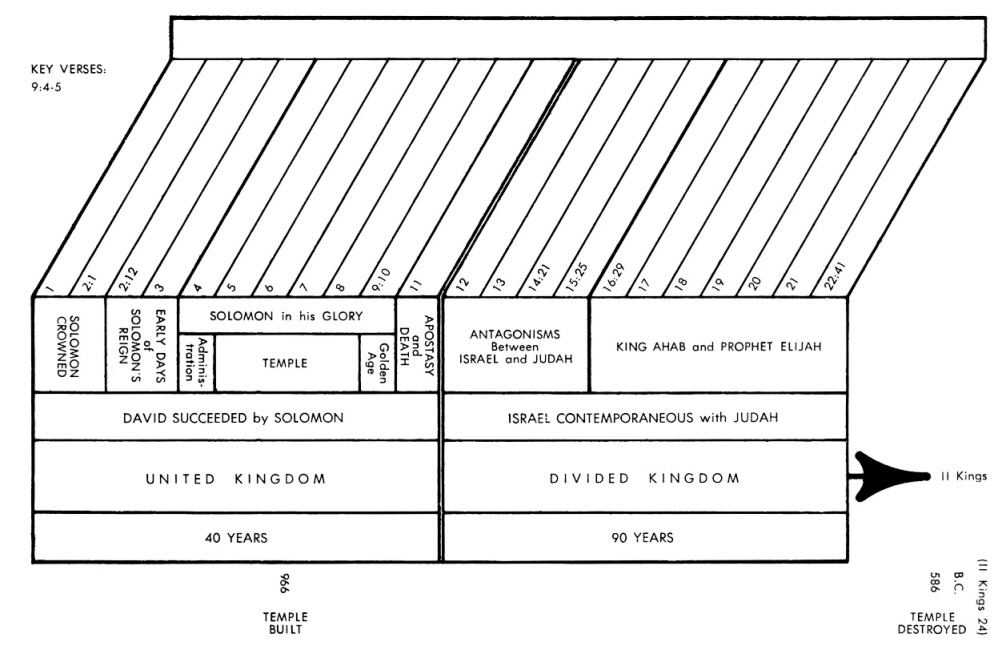
Chart from recommended resource Jensen's Survey of the OT - used by permission
1 Kings Chart from Charles Swindoll
THE DOWNWARD SPIRAL
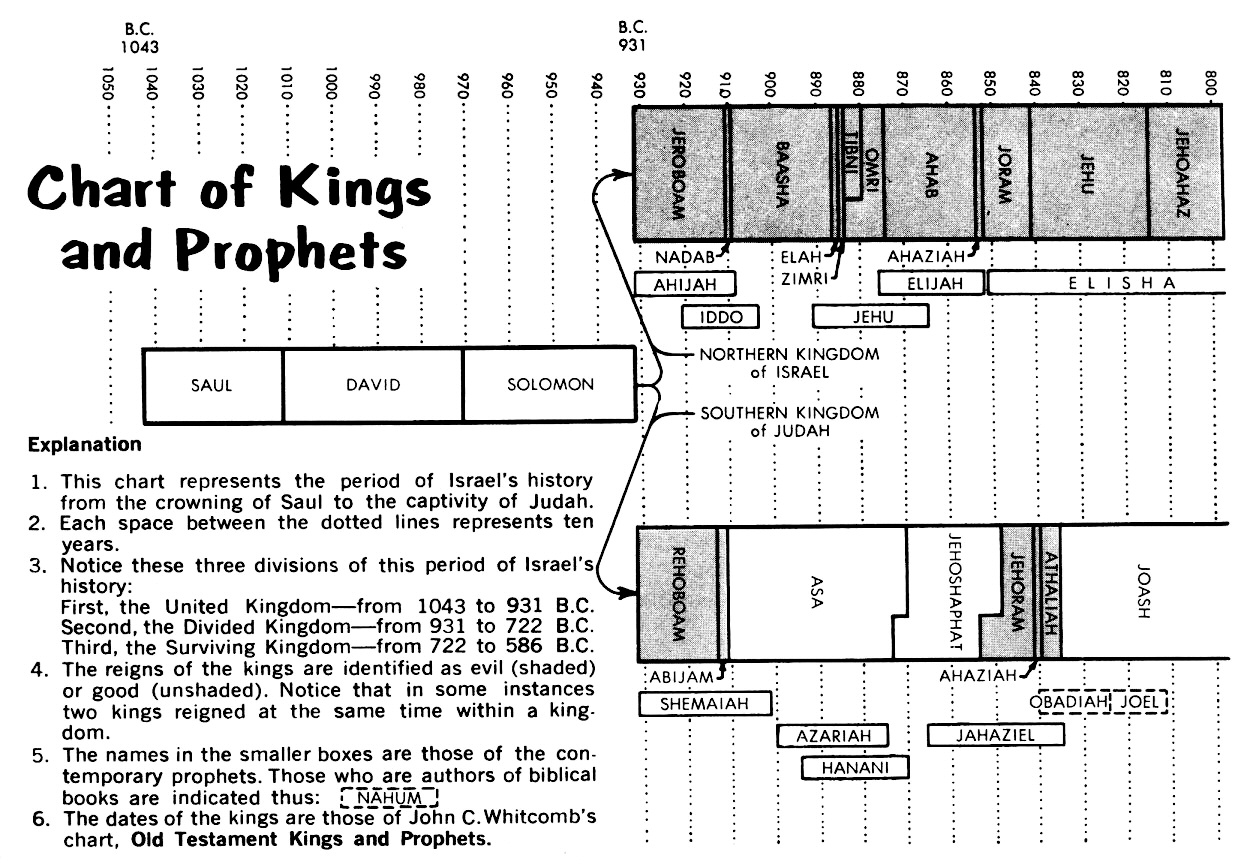
Click to Enlarge
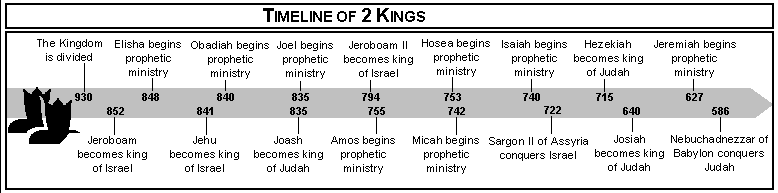
Ryrie Study Bible - Borrow
Click to Enlarge
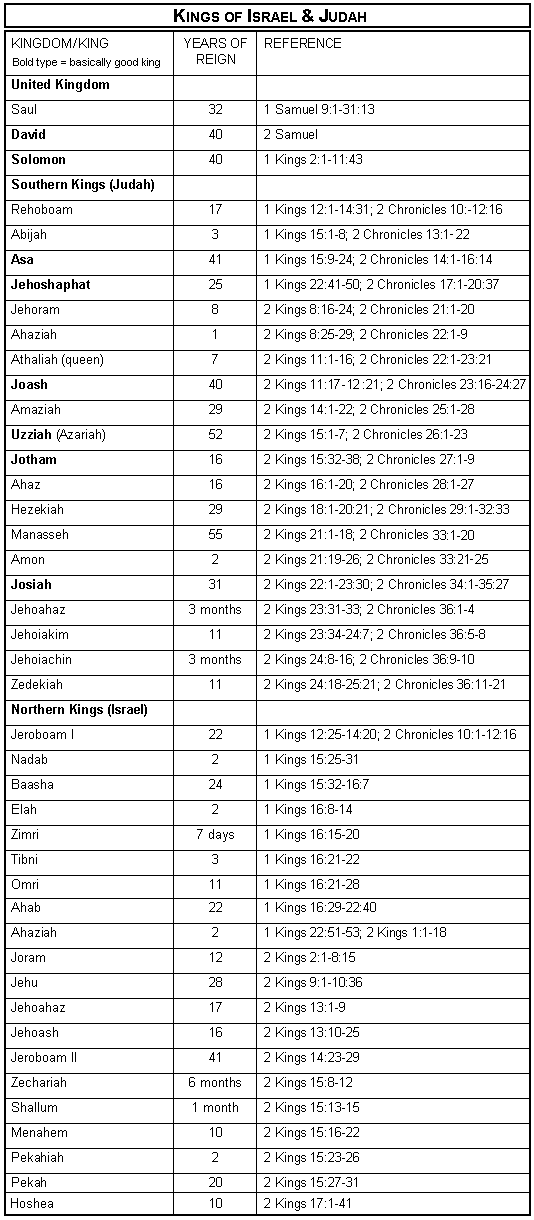
(NOTE: Many consider Amaziah and Hezekiah as "good" kings)
SEE ALSO:
ESV chart - kings of Israel - more information
ESV chart - kings of Judah - more information
Another Chart with Variable Dates for Reigns of Kings
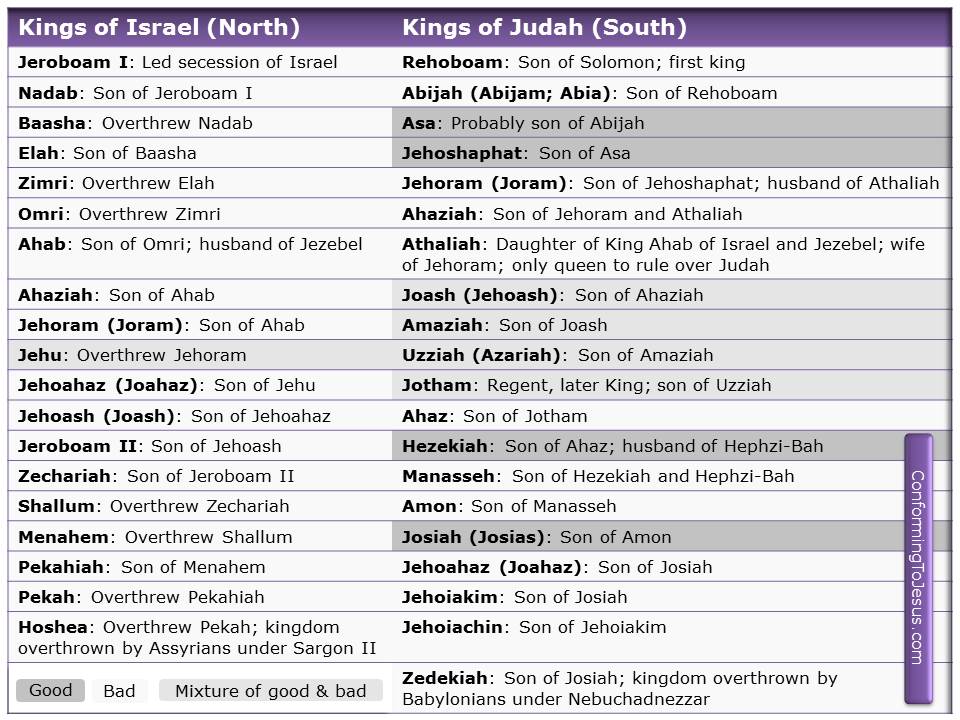
Source: ConformingtoJesus.com
2 Kings 6:1 Now the sons of the prophets said to Elisha, “Behold now, the place before you where we are living is too limited for us.
- the sons: 2Ki 2:3 4:1 1Ki 20:35
- the place: 2Ki 4:38 1Sa 19:20
- too limited for us.: Jos 17:14 19:47 Job 36:16 Isa 49:19,20 54:2,3
SCHOOL FOR SONS OF
PROPHETS GROWING
Now the sons of the prophets said to Elisha - The sons of the prophets were part of the saved remnant, for God maintains a remnant of believing Jews in every generation. As previously discussed these were not biological sons but describe a prophetic training community, like a spiritual seminary or ministry school. It implies intentional discipleship. The location is not given but presumably not that far from the Jordan River. Some commentaries point out that this miracle could relate to continuation of 2Ki 4:44.
SONS OF THE PROPHETS - 12X/11V - 1 Ki. 20:35; 2 Ki. 2:3; 2 Ki. 2:5; 2 Ki. 2:7; 2 Ki. 2:15; 2 Ki. 4:1; 2 Ki. 4:38; 2 Ki. 5:22; 2 Ki. 6:1; 2 Ki. 9:1; (Acts 3:25 - different context) Note that 10 of the 11 occurrences of this phrase refer to prophetic groups associated with Elisha. Sons of the prophets were more accurately understood as students, disciples, or members of prophetic guilds or schools. They were not biological sons of prophets (necessarily), but rather a community of prophetic apprentices or trainees, dedicated to following and learning the ways of the prophetic tradition and likely living in communal settings at places like Bethel, Jericho, and Gilgal. Think of them as kind of like seminary students or a prophetic order, much like a monastic or academic group. However they were not monastic in terms of celibacy for they were often married (2Ki 4:1). The "sons of the prophets" remind us that God always preserves a faithful remnant, even in dark times. They were men devoted to learning, living, and proclaiming God's truth in a culture that often rejected it. (See School of prophets below)
Behold (hinneh; ; Lxx - idou) now Look, please listen, consider carefully. A respectful appeal that also has a sense of urgency but not complaint.
The place before you Refers to the location where they gathered to be instructed under Elisha’s leadership, essentially their “school" of discipleship.
Harry E Shields adds that "The Hebrew literally reads, "where we sit before you," and implies that some sort of place for instruction was being described. These students under Elisha's instruction said that where they were meeting was too small." (See Moody Bible Commentary page 529)
Where we are living - NET and NIV have "the place where we meet" which is probably more accurate than translations that say "where we live" for the NET/NIV convey the sense that this where they met to be instructed by Elisha. We know that the sons of the prophets were not a celibate monastic group but at least some had wives and children (see 2Ki 4:1-7) and surely they lived with their families and not in some commune.
Ellicott agrees writing "The common hall is meant; whether that at Gilgal or at Jericho is uncertain. Jericho was close to the Jordan (2Kings 6:2), but that does not prove that it is meant here. The prophet’s disciples did not live in a single building, like a community of monks. Their settlement is called “dwellings” (nāyôth) in the plural (1Samuel 19:18); and they could be married (2Kings 4:1).
Is too limited for us - Literally “too narrow… too small… too cramped.” Their numbers had grown (cf 2Ki 4:43) even in the face of the nation's widespread apostasy from the true and living God. This is a tribute to the Spirit empowered effectiveness of Elisha's ministry. This was a good problem and evidence that God was blessing Elisha’s ministry and was faithful to maintain truth through the sons of the prophets even in those spiritually dark days in Israel.
Hampton Keathley III - First, let’s not miss the fact that this account stands in contrast with the story of Gehazi. In contrast to the materialism, the unfaithfulness, and the hypocrisy of Gehazi, we are given a picture of a whole school of men who were faithful, sacrificial, and devoted to the spread of the Word of the God by working toward larger quarters to accommodate their growing numbers. Among God’s people, there are usually some Gehazi-like people, but we should never allow this to discourage us or cause us to become cynical, because if we will look around we can usually find those who are faithful. Our need, as the Lord exhorts us, is to pray to the Lord of the harvest to thrust these out into the fields (Luke 10:2). Or as in Elijah’s day--to get them out of the caves. Second, we see that Elisha and the school of the prophets of God were growing. As in the ministry of our Lord and the disciples that followed him, the purpose of the ministry and miracles of both Elijah and Elisha was to authenticate the messenger as the one who was truly carrying the message of God. Though the miracles demonstrated God’s love for His people, the primary purpose was to demonstrate the futility of Baal and any way of life that departed from the Lord. God had warned them of this earlier in Deut. with the promises of blessing for obedience and cursing for disobedience.(2 Kings 6:1-7 The Lost Axe Head)
Behold (02009) hinneh is an interjection meaning behold, look, now; if. "It is used often and expresses strong feelings, surprise, hope, expectation, certainty, thus giving vividness depending on its surrounding context." (Baker) Hinneh generally directs our mind to the text, imploring the reader to give it special attention. In short, the Spirit is trying to arrest our attention! And so hinneh is used as an exclamation of vivid immediacy (e.g., read Ge 6:13)! Hinneh is a marker used to enliven a narrative, to express a change a scene, to emphasize an idea, to call attention to a detail or an important fact or action that follows (Isa 65:17, Ge 17:20, 41:17). The first use of hinneh in Ge 1:29 and second in Ge 1:31 - "And God saw all that He had made, and behold, it was very good. And there was evening and there was morning, the sixth day." Hinneh is oftn used in the idiom "Here I am" in Ge 22:1, 7,11 Ge 27:1,18, Ge 31:11, Ge 46:2 Ex 3:4 1Sa 3:4, 3:16, 12:3, 2Sa 1:7, Isa 52:6, Isa 58:9. Hinneh is used most often to point out people but also to point out things (Ge 31:41, 17:4). God uses hinneh to grab man's attention before He brings destruction (Ge 6:13, 17). God uses hinneh when He establishes covenants (Ge 9:9, 15:12, 17 [when Jehovah cut the Abrahamic covenant], Ge 17:4, cp Ge 28:13, 15), when He provided a sacrificial substitute for Isaac (foreshadowing His giving us His only Son!) (Ge 22:13). Hinneh marks the "chance (The Providence of God)" arrival of Boaz at the field where Ruth was gleaning (Ru 2:4-read about this "chance romance" - Indeed, "Behold!"). Hinneh is used to announce the Lord’s sending of a child as a sign and a prophecy of Immanuel-Emmanuel, the Messiah (Isa. 7:14). In fact W E Vine says that it is notable that when behold (hinneh) is used in Isaiah, it always introduces something relating to future circumstances.
Spurgeon reminds us that "Behold is a word of wonder; it is intended to excite admiration. Wherever you see it hung out in Scripture, it is like an ancient sign-board, signifying that there are rich wares within, or like the hands which solid readers have observed in the margin of the older Puritanic books, drawing attention to something particularly worthy of observation." I would add, behold is like a divine highlighter, a divine underlining of an especially striking or important text. It says in effect "Listen up, all ye who would be wise in the ways of Jehovah!"
HINNEH IN 2 KINGS - 2 Ki. 1:14; 2 Ki. 2:11; 2 Ki. 2:16; 2 Ki. 2:19; 2 Ki. 3:20; 2 Ki. 4:9; 2 Ki. 4:13; 2 Ki. 4:25; 2 Ki. 4:32; 2 Ki. 5:6; 2 Ki. 5:11; 2 Ki. 5:15; 2 Ki. 5:20; 2 Ki. 5:22; 2 Ki. 6:1; 2 Ki. 6:13; 2 Ki. 6:15; 2 Ki. 6:17; 2 Ki. 6:20; 2 Ki. 6:25; 2 Ki. 6:30; 2 Ki. 6:33; 2 Ki. 7:2; 2 Ki. 7:5; 2 Ki. 7:6; 2 Ki. 7:10; 2 Ki. 7:13; 2 Ki. 7:15; 2 Ki. 7:19; 2 Ki. 8:5; 2 Ki. 9:5; 2 Ki. 10:4; 2 Ki. 10:9; 2 Ki. 11:14; 2 Ki. 13:21; 2 Ki. 15:11; 2 Ki. 15:15; 2 Ki. 15:26; 2 Ki. 15:31; 2 Ki. 17:26; 2 Ki. 18:21; 2 Ki. 19:7; 2 Ki. 19:9; 2 Ki. 19:11; 2 Ki. 19:35; 2 Ki. 20:5; 2 Ki. 20:17; 2 Ki. 21:12; 2 Ki. 22:16; 2 Ki. 22:20;
Hinneh is translated in the Septuagint with the interjection idou (strictly speaking a command in the second person aorist imperative, middle voice) a demonstrative particle (used 1377 times in the Septuagint and NT) which is found especially in the Gospels of Matthew and Luke "and giving a peculiar vivacity to the style by bidding the reader or hearer to attend to what is said: "Behold! See! Lo!" (Thayer) The command is calling for urgent attention. Do this now! Don't delay! It could be loosely paraphrased "Pay attention!" or "Listen up!" to arouse attention and introduce a new and extraordinary fact of considerable importance.
QUESTION - What was the school of prophets? | GotQuestions.org
ANSWER - The Old Testament mentions a school of prophets in 1 Samuel 19:18–24 and in 2 Kings 2 and 2 Ki 4:38–44 (some translations say “company of prophets” or “sons of the prophets”). Also, the prophet Amos possibly mentions a prophetic school in stating his credentials (or lack thereof) to Amaziah the priest: “I was neither a prophet nor the son of a prophet” (Amos 7:14).
First Samuel 19 relates an account in which King Saul sends messengers to arrest David. When these men encountered a company of prophets under Samuel’s leadership, the king’s men also prophesied. This happened three times. Saul himself then went, and he, too, prophesied, leading people to ask, “Is Saul also among the prophets?” (1 Samuel 19:24), which became a saying in those days.
The “group of prophets” in 1 Samuel 19 was clearly comprised of students of the prophet Samuel. These students were likely Levites who served in roles related to the tabernacle and ceremonial worship. The content of their “prophesies” is not specified. Their messages could have been general teachings from God’s laws in the Books of Moses, or they could have included additional revelation.
In 2 Kings 2 Elijah is traveling with Elisha, and a group of prophets from Bethel tells Elisha that Elijah would be taken from him that day (2Ki 2:3). Another group of prophets at Jericho repeats the prophecy (2Ki 2:5), and a third group of prophets near the Jordan River also delivers the same message (2Ki 2:7). This third group of 50 men may have been a subset of the group of prophets at Jericho. After Elijah was taken up into heaven, Elisha reluctantly sends 50 of these prophets to search for Elijah for three days (2Ki 2:15–18).
In 2 Kings 4:38–41 Elisha is in Gilgal during a time of famine. Elisha miraculously changes an inedible stew into a comestible dish for the group of prophets there. Chapter 4 ends with Elisha’s turning 20 loaves of bread into more than enough food for 100 people. Nothing else is mentioned about this school of prophets, though it is clear they lived together in some kind of community and were known as sons of the prophets who worshiped the Lord.
These groups of men were likely leaders among those 7,000 Israelites who had not bowed down to Baal, as God had told Elijah (1 Kings 19:18). There were at least three schools or communities of these prophets and possibly more, consisting of men who were devoted to God and served Him. They followed the teachings of Samuel, Elijah, and Elisha during the time of the prophets and were known as their “students.”
James Smith - THE BORROWED AXE; OR, LOST POWER 2 KINGS 6:1–7
“So should we live that every hour
May die as dies the natural flower—
A self-reviving thing of power;
That every thought and every deed
May hold within itself the seed
Of future good and future need.”
—Houghton.
The hypocritical Gehazi had gone out smitten with the leprosy of Naaman; branded with a life-long shame and dishonour (vv. 5–27). Surely it is significant that in the very next verse we should read, “Behold, now the place wherein we dwell with thee is too strait for us” (v. 1). The little meeting-house suddenly became too small when the false professor is excommunicated. The Church of God ought to be a growing concern, for it is the most important and best-established business on earth. The incoming of new members into the society of “the sons of the prophets” sets them all astir to seek the enlargement of their place. Fresh converts are sure to bring fresh blood and interest into a congregation. But how is the thing to be done? They propose not to have a bazaar or a sale of work, but to have a deal of work. “Let us go into Jordan, and take thence every man a beam.” Every member of this Church was a worker, but some were wiser than others, for one said to Elisha, “Be content to go with us.” The others seemingly would have been content to go without the master. Alas! that this class of worker should be so numerous. Interested in the “building fund,” and in the general good of the Church, but indifferent about the presence and fellowship of Christ. This one who took to praying for the master’s presence with them was the one who did most for the work. If the master had not been there when the head of one of their few axes fell in Jordan, their special effort would have been seriously hindered. Moses prayed, “If Thy presence go not, carry us not up hence” (Exod. 23:15). They that wait on the Lord shall exchange strength. Except the Lord build the city they labour in vain that build it. Let us now see what lessons we may learn from the man who lost his axe. The vital point of interest in this incident finds its centre here.
I. He Lost his Power for Service.
As soon as the “axe-head fell into the water” he became helpless for effective work. Once he had power, now it is gone, and gone suddenly and quite unexpectedly. It is possible for a Christian worker to lose his or her power in service for God. There is a something that every servant of Christ ought to have which corresponds to the “axe-head,” and without which our labour will only be a piece of useless formality—that something is the presence of the Spirit of God. Where the Spirit is grieved, there power for service is lost (Judges 16:20).
II. He Lost his Power while Working. It was while he was “felling a beam” that the axe-head fell off. His power was not lost through laziness or idleness. He had a mind to work, but had no mind to watch that the axe was not slowly slipping off the haft. It is good to be willing to work; it is safe to be willing to pray. It is possible to be so carried away with the desire for doing as to be forgetful of the spirit in which the thing should be done. Any uprising of pride and self-interest in the heart while doing service for God is a slackening of the axe-head of spiritual power, which may end in total separation if not attended to at once.
III. He Lost that which was not his Own.
“Alas, master! for it was borrowed.” This point is beautifully applicable to the Christian worker, because all his power for service is borrowed power, and he is accountable to his Lord for how it is used. The Lord Jesus Christ has given to His servants that with which they are to trade in His Name till He comes (Luke 19:13–22). The gift of the Holy Spirit is, as it were, a loan made over to every servant of Christ, by which they may accomplish great things for the honour of His Name. Have you borrowed and lost this wonder-working gift. In ourselves we have no power to lose. In me, that is, in my flesh, dwelleth no good thing, “All power is given unto Me” (Matt. 28:18), says the Risen One, therefore go ye borrowing from Me.
IV. He was Painfully Conscious of his Loss.
“Alas!” As soon as the axe-head disappeared he felt that further effort was useless, and, like a sensible man, he gave it up at once until things were put right again. Any amount of eloquence, earnestness, and good intentions will never make up for the loss of the keen-cutting edge of spiritual power. If the man had gone on swinging the headless handle as if nothing had happened he would have been looked upon by his brethren as one beside himself. Yet in reality he would not have been more silly than the preacher who continues the round of religious services destitute of the power of the Holy Ghost. Of course, those who go to this work, without borrowing this heavenly implement, will go on slaving away, beating the air, quite unconscious of the fact that they are attempting to fell trees with a headless haft. When will the servants of God learn to stop and examine themselves and their methods when they see their work fruitless? Tarry till ye be endued with power from on high.
V. He Immediately Appealed to his Master.
“Alas, master!” To whom else could he go? If the man of God cannot help him, who can? If you find that you have lost power to make headway in the work of the Lord, do not sit down and try to content yourself with the thought that it cannot be helped. It can be helped. Take it to the Lord in prayer. Tell Him plainly that you have lost your power to win souls, and that you can do nothing until this power is restored. What a dishonour it would be to God if Elisha was not able to restore! Shall your Master fail to make good that which you ought to have for the glory of His own Name if you so commit your case into His hands?
VI. He had it Miraculously Restored.
“The man of God said, Where fell it? and he showed him the place. He cut a stick and cast it in, … and the iron did swim, … and he put out his hand and took it” (vv. 6, 7).
1. HE GOT IT WHERE HE LOST IT.
There was no other place where he could find it. There is no use of seeking for lost power in longer prayers and better sermons when it has been lost through worldliness and self-seeking. If power for God has been lost through the worry and excitement of much serving, it can never be regained by an increase of that worry and excitement. You will find your lost power for service back at that place where you failed to reckon on the Holy Ghost, and went on in your own wisdom and strength.
2. HE GOT IT THROUGH A MIRACLE.
Every enduement of power is a miracle of grace wrought
through the casting in of that stick called the Cross
Elisha made the “iron to swim.” Every enduement of power is a miracle of grace wrought through the casting in of that stick called the Cross. It is the gift of God, and always comes in a supernatural way. If God has made this gift of power to swim before your eyes as a great possibility brought within your reach, then, like this man, “put out your hand and take it.”
Chris Tiegreen - 2Ki 6:1 - The One Year Hearing His Voice Devotional: 365 Days of ... - Page 80
There are times in Israel’s history, particularly during the ministries of Elijah and Elisha, when the “sons of the prophets” lived in groups under a well-known prophetic master. Elijah had his followers, and so did Elisha. Apparently, these disciples were in a learning mode —living with their teacher in order to grow in the practice of their prophetic gifts. This defies many of our assumptions, namely that in biblical times, someone was either a prophet or he wasn’t. But as with any spiritual gift, there is room for practice, learning, and growth. The path to hearing God’s voice and declaring it isn’t traveled in an instant. It’s a process.
If Old Testament prophets had to go to school to learn how to hear God’s voice, we can too. If we aren’t hearing clearly, we have no reason to assume that it’s because we aren’t equipped. Or that we just aren’t gifted. Or that God doesn’t speak to us today. Or any other disclaimer that causes us to stop trying. We can position ourselves to hear God better, both in our inward attitudes and our outward actions. We can fine-tune our spiritual receptors to recognize His wavelengths and ignore others. We can become sensitive to His inner prompts and His external signals, looking for His will like explorers on a treasure hunt. We can grow in our confidence in what He is saying.
Most Christians get discouraged early in the process, long before learning how to recognize God’s voice. When our prophetic instincts don’t mature immediately, we think they aren’t there at all. But Jesus made it clear that all of His sheep can hear His voice, and He never implied that our hearing is an instant skill. We have a lot to learn. If we press on, we will learn it.
Father, I want to enroll in Your school of prophecy. No matter how long the learning curve lasts, I will persist under Your training. Teach me to hear and to speak.
2 Kings 6:2 “Please let us go to the Jordan and each of us take from there a beam, and let us make a place there for ourselves where we may live.” So he said, “Go.”
- and take: Joh 21:3 Ac 18:3 20:34,35 1Co 9:6 1Th 2:9 2Th 3:8 1Ti 6:6
ELISHA APPROVES
CONSTRUCTION PROJECT
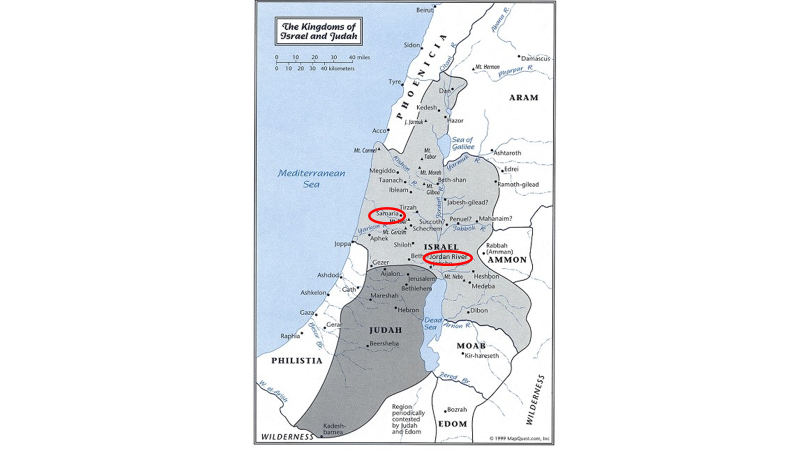
Please let us go to the Jordan - See map above. Samaria is circled as that is here Elisha's house was located. The sons of the prophets show their submission to Elisha by seeking his direction of the building project. This is a good pattern for all disciples of Christ, to seek His Spirit's direction is ALL our endeavors! Do you do this (I ask this looking in my mirror!)? Why the Jordan? The region of the Jordan River valley had abundant forests, for trees grow well near the water as the psalmist said in Psalm 1:2-3 speaking there of the "water" of God's Word - .
But his delight is in the law of the LORD, And in His law he meditates day and night. He will be like a tree firmly planted by streams of water, Which yields its fruit in its season And its leaf does not wither; And in whatever he does, he prospers.
Ellicott - The Jordan valley was well wooded. Its present bed is still “overarched by oleanders, acacias, thorns, and similar shrubbery.” If all were to take part in felling the trees, the work would soon be done.
Note that the sons did not ask Elisha to miraculously add some rooms to their dwelling. God’s work often advances through ordinary obedience and hard work, not just miracles. Ministry growth involves participation, not spectators.
🙏 THOUGHT - Speaking of miracles, we do well to remember that every empowerment of grace (cf Acts 1:8, Eph 3:16) we receive each day is from the Spirit of grace (Heb 10:29) and is thus a supernatural act, a miracle of God's grace!
And each of us take from there a beam - Each of us emphasizes that participation was universal and responsibility was shared. It was not a task reserved for a select few or for a spiritual elite; everyone was expected to contribute. No one could stand on the sidelines, excuse themselves, or assume that others would do the work for them. The phrase underscores unity, cooperation, and the idea that every person had a meaningful role to play — each individual bearing his part so that the collective goal could be accomplished.
🙏 THOUGHT - This phrase each of us recalls the truth that each believer has a spiritual gift (see Spiritual Gifts chart) and therefore "each of us" should "take from there a beam" (so to speak), to build Christ's "building," the Church. If you are not using your spiritual gift, a "beam" is missing from the local body Christ has called you to. Like these sons of prophets, we as sons and daughters of God our Father (1Jn 3:1), should seek even more to use our gift for the growth of God's Kingdom and the glory of the Lamb. You do know your gift don't you beloved of Christ? (read 1Co 12:7, 11, 18) Place yourself as a "beam" in the diagram above, with Christ at the center, each "beam" contributing in some way to the foundation and growth of His body. (Col 2:19, Eph 4:15, 16) Father, may any of Your children who have not added their beams to the supernatural structure of Christ's Body, the church, by the leading and energizing of Your Spirit, make the choice of their will in this coming year (2026) to discern their gift and to utilize their gift for Your glory and honor in Christ Jesus. Amen.

The sons of prophets humble themselves and are willing to roll up their sleeves and go to work, picturing unity and shared responsibility. The word beam (or log) refers to a cut piece of wood or timber, used for building. The disciples of Elisha proposed going to the Jordan River valley, where trees were plentiful, to cut their own logs so they could build additional living space.
Each one cut a beam. No spectators. Tragically in many churches 10% of the people do 90% of the work.
And let us make a place there for ourselves where we may live - The Hebrew (yashab) for live can also mean to sit, so could refer to the students sitting for instruction from Elisha.
I agree with Ellicott - Where we may live.—Literally, to sit (or, dwell) there. The reference seems still to be to sitting in the hall of instruction.
So he said, “Go” - Elisha gives permission for the project. Elisha doesn’t micromanage or control the sons of the prophets (In my 40 years I have seen several pastors who fall into this "micromanage" category and also seen the negative, sometimes disastrous fall out). He listens, evaluates, and then releases them to act. His simple “Go” demonstrates trust in God’s guidance and in the sincerity of their desire to serve. True spiritual leadership does not suppress initiative; it blesses and sends it.
2 Kings 6:3 Then one said, “Please be willing to go with your servants.” And he answered, “I shall go.”
- Please be willing: 2Ki 5:23 Jdg 19:6 Job 6:28
- go with: Jdg 4:8
FIRST ASK HIS PERMISSION
NOW FOR HIS PRESENCE
Then one said, “Please be willing to go with your servants ('ebed; Lxx - doulos - see note) - Please be willing translates a polite, earnest appeal. It reflects a heart posture of dependence rather than independence. They make a humble request, not a command
And he answered, “I shall go - Elisha is the leader but willing to showing his humility and pastor's heart. His going is God's providence (from pro = before, ahead + videre = to see), for the omniscient God knew one would lose an axe head and so He sets the stage for His prophet's miracle of raising the axe head.
They said, “Let us go,” and Elisha said, “I will go.” Ministry flourishes when leaders are present, engaged, and working beside God’s people. Presence is sometimes the pastor’s greatest gift.
2 Kings 6:4 So he went with them; and when they came to the Jordan, they cut down trees.
- they cut down: De 19:5 29:11

Even this Modern Picture of the Jordan shows a few trees
A UNIFIED
COOPERATIVE EFFORT
So he went with them - This highlights Elisha’s gracious willingness to join the sons of the prophets in their humble labor. The prophet of God did not view manual work as beneath him, nor did he remain distant or detached. His presence affirmed both their task and their faith, reminding us that spiritual leadership often expresses itself through simple companionship, encouragement, and shared effort.
And when they came to the Jordan, they cut down trees While only one is described as having an ax, clearly all had to possess such implements in order to cut down trees. This passage shows that everyone actively participated in the work. They didn’t merely talk about the project (like a lot of church committees!), but they went to the place where the work needed to be done and put their hands to it. There is movement, unity, and purposeful action. God’s servants were not idle dreamers; they were diligent workers, trusting God while faithfully doing what was within their power to do. Together the verse emphasizes cooperation, humility, shared responsibility, and the truth that God often works in and through ordinary, everyday tasks done in faith and fellowship.
🙏 THOUGHT - Dear church member, in light of the work and example of the sons of the prophets, allow me to ask you a few thoughtful and searching questions:
Are you a spectator or a servant?
Do you sit in church—or serve the church?
Are you filling a seat or fulfilling a calling?
Are you a consumer or a contributor?
Do you receive the Word—or reproduce it?
Are you here to be fed or to feed others?
Are you a container or a conduit?
Are you informed or transformed?
2 Kings 6:5 But as one was felling a beam, the axe head fell into the water; and he cried out and said, “Alas, my master! For it was borrowed.”
- axe head: Ec 10:10 Isa 10:34
- master: 2Ki 6:15 3:10 Rev 18:10,16,19
- for it was borrowed: 2Ki 4:7 Ex 22:14,15 Ps 37:21

FLYING OFF
THE HANDLE
But (Lxx adds idou = "Behold") as one was felling a beam, the axe head fell into the water - Axe head is the Hebrew word barzel (Lxx = an implement of iron) which literally means iron (CSB, NIV).
And he cried out and said, “Alas (NET - "Oh no"), my master! For (term of explanation) it was borrowed - He is particularly distressed because the axe head was borrowed and iron tools were both expensive and rare.
For (term of explanation) it was borrowed - This suggests the sons of prophets were not profiteering but relatively poor. Iron was a relatively expensive commodity making the loss more painful. Finally, since it was borrowed, to not return it to the owner would be a poor witness.
The man was upset because the axe head was borrowed which shows a tender conscience and respect for what belongs to another. Rather than saying, “It’s just an axe,” he felt responsible before God. Scripture consistently praises this kind of faithful stewardship, Paul writing (in a different context, but in principle still true) "it is required of stewards that one be found trustworthy." (1Co 4:2). God used the miracle to affirm that He values honesty, integrity, and care in the smallest matters — character traits consistent with His own righteousness.
Harry E Shields adds that "Loss of the tool would have put him in debt, and as with the widow in chap. 4, the indebtedness would have put him under a financial burden he would be unable to bear." (See Moody Bible Commentary page 529)
🙏 THOUGHT - Woodcutters become useless when the blade flies off. Many Christians still swing the handle—busy, active, working—but have lost their cutting edge of prayer, joy, holiness, or dependence on the power of the Spirit. How is your blade beloved, sharp or dull? Are you busy but barren! Ministry movement without spiritual sharpness just makes noise! Are you just making noise or are you abiding in the Vine (Jn 15:5), filled with (controlled by) His Spirit (Eph 5:18), so that you are storing up for yourself a priceless treasure that will last forever and ever. Amen. (Mt 6:20, Jn 15:16)?
Vance Havner - The Lost Axe Head
"Alas, Master! for it was borrowed." 2 Kings 6:5
Observe that this young prophet's axe head was borrowed. The believer's power is from God, it is not his own. Observe that when he lost the axe head he was concerned over the loss of it. Today we pretend that the Lord has not departed from us in power for service and we keep on chopping with the handle when the axe head is gone!
It would be better to stop all our church work six months and find the lost axe head than to go on vehemently chopping, having a name to be alive but dead. Pulpits might be vacant, church classes without teachers, choir lofts without singers; if they only went back to the waters of worldliness, the ponds of sluggishness, the swamps of indifference and showed the Lord where the axe head fell, where they lost their power—then they might fell forests and build stately mansions to his glory.
God is asking, "Where did it fall?" Will you show him the place? You must go right back where you grieved the Spirit, you must "go back to Bethel" and "up to Gilgal" and make fresh covenant with God.
"And the iron did swim"! Axe heads do not ordinarily float on water but when you show God the place he will make the impossible happen, he will restore lost joy and uphold you with his Spirit. At the place where it fell, the iron will swim.
Robert Neighbour - Where Fell It?
"And the man of God said, Where fell it? And he shewed him the place" (II Kings 6:6).
The first thing that Elisha did was to ask the question,
This suggests to us our need of going to the place
where we lost our touch with God
1. "Where fell it?"
This suggests to us our need of going to the place where we lost our touch with God. We must get back to Bethel, back to the parting of the ways, back to the main line track. It is easy for us to know where we lost our fellowship and our power to serve if we will stop and think. There was some act of disobedience; some stumbling into sin; some yielding to the flesh; somewhere we lost touch with God.
With Peter it was self-confidence. The Lord had said you will deny Me thrice. Peter replied, "Though all men forsake Thee, yet will not I." That was the point of departure. There followed in quick succession the steps that led Peter down, until, with an oath he said, "I know not the Man." There were the same number of steps by which he later retraced his way back to God. Yet it was not until the Lord asked Peter, "Lovest thou Me, more than these?" that Peter, in the collapse of self-confidence, confessing his love, refused to place it as superior to that of his brethren. Then he was back to the place where his axe head fell into the water.
2. He showed him the place.
Let us not seek to hide our sins. Let us not cover up our backslidden heart. "If we say we have no sin, we deceive ourselves." "He that covereth his sins shall not prosper, but whoso confesseth and forsaketh them shall find mercy." (Pr 28:13) Let us show God the very place where we lost our touch with Him; Let us be definite. We know what it was. Let us hide it from Him no longer.
Nathan said unto David: "Thou art the man." David cried out, "I have sinned." He made a full confession. He opened up the hideous iniquity of his heart and sought for a through and through cleansing. He was heard and restored. (2 Samuel 12:1-12,13,14)
What do we gain by hiding away from God? Are not all our ways open and naked with Him with Whom we have to do? (Hebrews 4:13) He already knows the place we lost out with God; then why not point out the spot unto Him? Let us say, "It fell just there." "That is the very spot where I lost my fellowship." "It was when I became angry and spoke so harshly." "It was when I yielded to that lustful desire."
When the Lord says, "Where fell it?" Some of us will have to point to the movie, or the dance, or to the card table, and answer "Lord, it fell just there." Some of us will have to go to the neglected prayer closet, the neglected Bible, the neglected obedience and say, "It fell just there."
May God help us to answer truly and faithfully to God,
making a clean breast of the whole thing, confessing our sins (1Jn 1:9)
2 Kings 6:6 Then the man of God said, “Where did it fall?” And when he showed him the place, he cut off a stick and threw it in there, and made the iron float.
- he cut: 2Ki 2:21 4:41 Ex 15:25 Mk 7:33,34 8:23-25 Joh 9:6,7
Related Passages:
2 Kings 2:14 He took the mantle of Elijah that fell from him and struck the waters and said, “Where is the LORD, the God of Elijah?” And when he also had struck the waters, they were divided here and there; and Elisha crossed over.
2 Kings 2:19-22 Then the men of the city said to Elisha, “Behold now, the situation of this city is pleasant, as my lord sees; but the water is bad and the land is unfruitful.” 20 He said, “Bring me a new jar, and put salt in it.” So they brought it to him. 21 He went out to the spring of water and threw salt in it and said, “Thus says the LORD, ‘I have purified these waters; there shall not be from there death or unfruitfulness any longer.’” 22 So the waters have been purified to this day, according to the word of Elisha which he spoke.

GOD'S POWER DEFIES
HIS LAW OF GRAVITY
Then the man of God said, “Where did it fall?” - It is interesting that Elisha did not know the location, which God could have easily shown him. Another point of interest is that this miracle involves the Jordan, the place Elisha actually performed his first "water" miracle (2Ki 2:14), parting the Jordan River. Elisha also had some additional experience with aqueous miracles in Jericho's bad water situation (2Ki 2:19-22).
And when he showed him the place, he cut off a stick and threw it in there, and made the iron float - KJV = "the iron did swim." There is nothing magical about the cut stick. Elisha did not use it to stick it into the axe head hole as some liberals claim, always trying to refute the supernatural! Perhaps the cut stick in some way added to drama of the "resurrection" of the axe head. In any event, this miracle requires faith to accept for it is counter to all natural logic, just as was Elisha's throwing salt into fresh water to purify it, an action that naturally would make it less drinkable not more drinkable! These supernatural paradoxes showcasing Yawheh's ways recall His words...
"For My thoughts are not your thoughts, nor are your ways My ways,” declares the LORD. For as the heavens are higher than the earth, So are My ways higher than your ways and My thoughts than your thoughts. ." (Isa 55:8-9)
Remember that the purpose of miracles in the Bible is to reveal God’s power, confirm His message, and point people to faith in Him (Jn 20:30,31). From Scripture, miracles were never random displays of power but they were “signs” (semeion), meant to authenticate God’s messengers (Acts 2:22 and in this case Elisha) and demonstrate His compassion (as in this case) and authority.
Nothing is too difficult,
but also nothing is too trivial
God used Elisha to carry out this miracle showing that God is a God who rules over His own physical laws in nature. Is anything too difficult for the Lord? (Jer 32:17, 27, Ge 18:14, Lk 1:37) That's rhetorical. Nothing is too difficult, but also nothing is too trivial. Both difficult and trivial things can bring Him glory. By causing the axe head to float, God demonstrated His concern for even the minor losses and anxieties of His people. Jesus declared “Are not five sparrows sold for two pennies? And not one of them is forgotten before God.” (Lk 12:6) If God cares about sparrows, how much more about His people’s needs, including even their borrowed tools?
Spurgeon - “God can do all things, he can make iron swim-we cannot-and yet you see the prophet did it, and he did it by the use of a stick. He cut down a stick. Was there any connection between the stick and the iron? I can’t see any, and yet God does use means, and he would have us use means.”
Keil - The object of the miracle was similar to that of the stater in the fish’s mouth (Matt. 17:27), or of the miraculous feeding, namely, to show how the Lord could relieve earthly want through the medium of His prophet. The natural interpretation of the miracle, which is repeated by Thenius, namely, that “Elisha struck the eye of the axe with the long stick which he thrust into the river, so that the iron was lifted by the wood,” needs no refutation, since the raising of an iron axe by a long stick, so as to make it float in the water, is impossible according to the laws of gravitation.
Morgan - The chief value of the story lies in its revelation of the influence Elisha was exerting in the nation. The growth of the school of the prophets was most remarkable.
God’s power works through compassion, not just confrontation. While many of Elisha’s miracles were dramatic acts of judgment or deliverance (healing Naaman, striking Gehazi with leprosy, striking armies blind, etc.), here God’s power is shown in tenderness. It reminds us that His might is not only for punishing evil or displaying authority, but also for comforting and providing. In Psalm 145:8-9 David supports these thoughts about God, writing that "The LORD is gracious and merciful; Slow to anger and great in lovingkindness. The LORD is good to all, And His mercies are over all His works."
🙏 THOUGHT - Be an Acts 17:11 Berean for you may not agree with this THOUGHT but remember that while there is only one valid interpretation, there can be many apropriate applications. Commentaries are as they say "all over the place" regarding this simple miracle! Without pressing this miracle beyond its original intent, the axe head was undeniably something lost—and God restored it. It stands as a clear demonstration of His power to recover what has slipped beyond human reach, to “raise” what seemed gone for good.
In that sense it gently points forward to the God Who delights to restore what is lost. Ultimately this finds its fullest expression in Christ, Who declared, “The Son of Man has come to seek and to save that which was lost” (Luke 19:10). Though this axe head miracle may appear minor in Israel’s history, it offers a beautiful glimpse into the compassionate heart of God. He is the God Who retrieves what is lost, restores what is broken, and reclaims what seems beyond recovery, even an axe head from the riverbed. The same grace that restored an axe head in Elisha’s day shines most gloriously in Christ, Who restores all that Adam lost when sin entered the world (cf Ro 5:12).
You might ask what have I "lost" that I once had spiritually? Joy in serving? Zeal for prayer or Scripture? A surrendered spirit? Do I need to return to the place where I drifted, disobeyed, or neglected spiritual priorities?
This THOUGHT recalls Jesus' message to the Church at Ephesus - they had not lost something but they had left something! Jesus declares "But I have this against you, that you have left your first love. Therefore remember (first of 3 commands) from where you have fallen, and repent and do the deeds you did at first; or else I am coming to you and will remove your lampstand out of its place–unless you repent." (Rev 2:4-5) (See article Beware of Slowly Drifting from Your First Love!)
We are on safer ground if we see Elisha’s axe-head
miracle as a little picture of redemption.
Philip Graham Ryken - We are on safer ground if we see Elisha’s axe-head miracle as a little picture of redemption. The return of the axe head delivered the young prophet from debt and may have saved him from slavery. The gospel tells a grander story of redemption, in which the blood of Jesus pays the infinite debt of our sin and we are saved from slavery forever. The same God is the source of both kinds of salvation, small and large. (2 Kings)
Harry E Shields writes that "Skeptics can argue over the plausibility of such a miracle, but to do so is fruitless. The conclusion should be that God can do anything He chooses. And He is concerned about both “great” and “small” things in the lives of His people. Although the miracle involved the recovery of an axe head, the motivation for the miracle was compassion for the worker who had borrowed and lost it. (See Moody Bible Commentary page 529)
In short, this “small” story is anything but trivial. It teaches that God is both transcendent and personal—mighty enough to make iron float, yet compassionate enough to care about a borrowed tool. Through it, we see that God’s care encompasses every detail of our lives, reminding us that His power and compassion never fail those who trust Him (Lam 3:22-23).
C H Spurgeon - “The iron did swim.”—2 Kings 6:6
The axe-head seemed hopelessly lost, and as it was borrowed, the honour of the prophetic band was likely to be imperilled, and so the name of their God to be compromised. Contrary to all expectation, the iron was made to mount from the depth of the stream and to swim; for things impossible with man are possible with God. I knew a man in Christ but a few years ago who was called to undertake a work far exceeding his strength. It appeared so difficult as to involve absurdity in the bare idea of attempting it. Yet he was called thereto, and his faith rose with the occasion; God honoured his faith, unlooked-for aid was sent, and the iron did swim. Another of the Lord’s family was in grievous financial straits, he was able to meet all claims, and much more if he could have realized a certain portion of his estate, but he was overtaken with a sudden pressure; he sought for friends in vain, but faith led him to the unfailing Helper, and lo, the trouble was averted, his footsteps were enlarged, and the iron did swim. A third had a sorrowful case of depravity to deal with. He had taught, reproved, warned, invited, and interceded, but all in vain. Old Adam was too strong for young Melancthon, the stubborn spirit would not relent. Then came an agony of prayer, and before long a blessed answer was sent from heaven. The hard heart was broken, the iron did swim.
Beloved reader, what is thy desperate case? What heavy matter hast thou in hand this evening? Bring it hither. The God of the prophets lives, and lives to help his saints. He will not suffer thee to lack any good thing. Believe thou in the Lord of hosts! Approach him pleading the name of Jesus, and the iron shall swim; thou too shalt see the finger of God working marvels for his people. According to thy faith be it unto thee, and yet again the iron shall swim.
2 Kings 6:7 He said, “Take it up for yourself.” So he put out his hand and took it.
- Take it up: 2Ki 4:7,36 Lu 7:15 Ac 9:41
- put out: Ex 4:4
MAN'S RESPONSIBILITY IN
THE AXE HEAD MIRACLE
He said, “Take it up for yourself.” So he put out his hand and took it - God could have done everything in this miracle, raising the axe head and putting it in the man's hand. Instead once again we see while God did His part to raise the axe head, He allowed the man to take responsibility in consummating the miracle. This is not as dramatic as some examples of the Paradoxical Principle of 100% Dependent and 100% Responsible, but is clearly illustrating that principle. Recall Psalm 127:1 (Psalm of Solomon) which illustrates this principle declaring "Unless the LORD builds the house, They labor in vain who build it; Unless the LORD guards the city, The watchman keeps awake in vain." In the present case we would say "Unless the LORD raises the axe head, they would have tried in vain to retrieve it!"
Gary Inrig writes that "Of all the miracles, this was surely the most “trivial.” But that is probably the point. Even the trivial issues of life, even things brought on by our own carelessness or things we label as accidents, are not outside of God’s care. He does not promise to float all lost ax heads or to locate all lost keys. (ED: I CAN HOWEVER TESTIFY THAT SEVERAL TIMES I HAD LOST KEYS, PRAYED AND SOON FOUND THEM. ONCE I LOST MY RETAINER, PRAYED AND SOON FOUND IT ACCIDENTALLY TOSSED IN A LARGE SACK OF GARBAGE. NOTHING IS TOO TRIVIAL) But he does invite us to “cast all your anxiety on him because he cares for you” (1 Pet. 5:7). (See Holman Old Testament Commentary - 1 & 2 Kings)
Iain Provan adds that "God saves” individual Israelites as well as Israel. God’s purposes take in the “trivial” as well as the “significant.” (See 1 & 2 Kings - Page 38)
🙏 THOUGHT - While the miracle of raising an axe head may seem trivial in comparison to raising a dead son (Shunammite's son), it is still the Word of God. What these divergent miracles show is that God is omnipotent over the TRIVIAL and the TRANSCENDANT! There is absolutely not one detail of your life about which your Father is not aware. There is not one trivial trial He is not able to bring up from the bottom of the river (so to speak) for your good and His glory.
Remember that Scripture has only one literal interpretation, but can have many applications. Applying this truth to our lives, we can be confident that from the trivial details of our day to the towering crises of our life, God’s hand is steady and sovereign. Nothing is beneath His care and nothing is beyond His control. God’s power extends from the trivial moments we barely notice to the tremendous burdens we cannot carry (Ps 55:22) for He is faithful in both (Heb 10:23).
Paul's instruction to Timothy makes it clear that the axe head story is not "dull" (bad pun for axe head!) but is profitable, for he writes "All (even 2Ki 6:1-7) Scripture is inspired by God (see Isaiah 55:11) and profitable for teaching, for reproof, for correction, for training in righteousness; 17 so that (PURPOSE) the man of God may be adequate, equipped for every good work." (2Ti 3:16-17) The axe head story is profitable! It will make us adequate and equip us! Case closed!
Here is another application of this miracle for the lost axe head meant loss of power to do the work of the LORD. James Smith explains it this way (see his full discussion)...
1. HE GOT IT WHERE HE LOST IT. There was no other place where he could find it. There is no use of seeking for lost power in longer prayers and better sermons when it has been lost through worldliness and self-seeking. If power for God has been lost through the worry and excitement of much serving, it can never be regained by an increase of that worry and excitement. You will find your lost power for service back at that place where you failed to reckon on the Holy Ghost, and went on in your own wisdom and strength.
2. HE GOT IT THROUGH A MIRACLE. Elisha made the “iron to swim.” Every enduement of power is a miracle of grace wrought through the casting in of that stick called the Cross. It is the gift of God, and always comes in a supernatural way. If God has made this gift of power to swim before your eyes as a great possibility brought within your reach, then, like this man, “put out your hand and take it.”
Dale Ralph Davis has an extended commetary on the various ways this miracle has been interpreted. Davis writes "You can go off in the wrong direction with this text. In one sense, it’s easy to do because this little incident is such a teaser. You ask yourself: Why is this story about the aquatic axe in Scripture? Answer: It shows the power of Yahweh working through the prophet. True, but … it seems so trivial, so senseless, so unnecessary, so outlandish. Besides, what substantial teaching can we get from it? So there are various approaches—that go off with Rabbi Duncan in the wrong direction." Davis goes on to discuss some rationalize the episode....others allegorize this text... Others moralize the text. To read his discussion of each of these interpretative approaches borrow 2 Kings: The Power and the Fury page 88.
Gary Inrig comments on miracles - Miracles are significant throughout the Bible, but a careful evaluation shows that many of them are clustered in three major periods—the exodus and conquest (Moses and Joshua), Elijah and Elisha, and the New Testament period (Jesus and the apostles). In the first case, God’s covenant people are being established in a special way; in the second, the covenant is under attack by baalism; in the third, the new covenant community is being born. Miracles were given to authenticate the messenger and the message of God. They are almost never mere displays of divine power, but they serve as signs and pointers to something beyond themselves. They also reveal the heart of God, by putting his character on display. In one sense, they are also glimpses of the kingdom, since they are a window into what God intended apart from the effects of sin. (See Holman Old Testament Commentary - 1 & 2 Kings)
Play this modern worship song THE AXE HEAD FLOATS.
THE AXE HEAD FLOATS.
Chopping wood by Jordan's tide
Sweat was rolling swinging wide,
But with a splash my heart sank low
My borrowed ax was gone below.
Oh Elisha, man of grace
See my trouble, lost my place.
How can I arise again?
But the Lord moves where we can't.
The axe head falls, the river sinks,
Even little things are seen.
What is lost is found once more
By the power of the Lord.
The axe head floats, defying weight.
Mercy moves and won't be late.
If He cares for this, then friend, take note
Even heavy hearts can float.
Not a kingdom not a crown,
Just so I am sinking down,
Yet the One Who parts the sea
Makes room for even fears like these.
Oh Elisha, man of grace
See my trouble, lost my place.
How can I e'vn rise again
But the Lord moves where we can't.
The axe head floats, the river sings
Even little things are seen
What is lost is found once more
By the power of the Lord
The axe head floats defying weight.
Mercy moves and won't be late.
If He cares for this, then friend, take note
Even heavy hearts can float.
If He lifts the smallest loss
Trust Him now, don't count the cost.
Every burden, great or slight,
Lies within His hand so bright.
So when your heart feels lost and low,
Tossed beneath the waves below
Lift your eyes and call His name
What is fallen He'll reclaim.
Robert Neighbour - The Axe Head Restored
"Therefore said he, Take it up to thee. And he put out his hand, and took it" (II Kings 6:7).
How blessed it is that the backslider can be restored. Some have an idea that when one has lost out with God, he can never again get back, or, if he does get back, it will be with a curtailed usefulness.
There is a song that was for a while quite popular with soloists. It was called "The Bird with a Broken Wing." The song says:
"I walked through the woodland meadow,
Where sweet, the thrushes sing,
And I found on a bed of mosses,
A bird with a broken wing.
I healed its wing, and each morning
It sang its old sweet strain,
But the bird, with a broken pinion,
Never soared so high again."
The deduction is that the life that sin has stricken, though forgiven, can never reach as high altitudes of service as it knew of yore.
This is not true. Peter after he stumbled and fell into sin, even unto cursing and unto saying, "I know not the Man," became the mighty Apostle of Pentecost.
We grant that a believer when he sins may have a hard time getting back, because of his remorse and because God would chasten him until he knows the heinousness of his sins; but when God forgives He fully restores.
What a wonderful picture is that in Jeremiah 18! Down by the place of the potter was a vessel that was marred. Then what? "And the vessel that he made of clay, was marred in the hand of the potter: so he made it again another vessel, as it seemed good to the potter to make it."
Shall not Israel, wandering Israel, sinning Israel, be "made over again"? Yes. The Lord will hear her cry and forgive her. And, when she is forgiven, she shall shine forth as the sun, and her glory shall be known all over the world.
Let us remember this, however, that an axe head restored is an axe to be used. Why take the axe head again? Why place it once more on the handle, unless it is to be wielded against the forest? When Peter's wife's mother was healed, she arose and served. That is what all forgiven and restored saints should do. They should get back at once into the place of service.
QUESTION - What is the significance of Elisha causing the axe-head to float? GOTQUESTIONS.ORG
ANSWER - The prophet Elisha, successor to Elijah, ministered for about 60 years throughout the reigns of kings Jehoram, Jehu, Jehoahaz, and Joash. During this time, Elisha supervised and gave instruction to a fellowship or guild of prophets called “the sons of the prophets” (see 1 Kings 20:35; 2 Kings 2:3; 4:1). In 2 Kings 6:1–7, the Bible records a miraculous episode in which Elisha, while helping these prophets, causes the lost axe-head (or ax head) to float to the surface of the Jordan River.
Under Elisha’s leadership, the band of trainee prophets was experiencing the blessing of the Lord. With their numbers increasing, they had outgrown their meeting and housing accommodations. One day, they sought Elisha’s approval to build a larger facility along the banks of the Jordan River, where logs were plentiful. When their master authorized the work, the young prophets invited Elisha to join the effort: “So he went with them, and when they came to the Jordan, they cut down trees. As one of them was cutting down a tree, the iron ax head fell into the water, and he cried out, ‘Oh, my master, it was borrowed!’” (2 Kings 6:4–5, CSB).
Right off, Elisha’s humility, simplicity, and sincerity became apparent. He was not too proud or preoccupied to jump in and work alongside his students. The apprentice prophets likely had little money or possessions, and at least one had to borrow a hand tool for the project. The man cried out in great distress when his axe-head flew off and disappeared into the water. The instrument was not his own. It was borrowed and needed to be returned.
The original Hebrew word translated as “ax head” in this passage literally means “the iron.” The implement was made of heavy iron metal, a costly commodity in ancient times. It had sunk to the bottom of the Jordan. Through Elisha, God demonstrated His personal attention and compassion for this needy man. Elisha asked the young prophet to show him where the ax head had fallen into the water. Then, “Elisha cut a stick and threw it into the water at that spot. Then the ax head floated to the surface” (2 Kings 6:6, NLT). The quaint wording of the KJV is “the iron did swim.” “‘Grab it,’ Elisha said. And the man reached out and grabbed it” (2 Kings 6:7, NLT).
Elisha causing the axe-head to float to the surface was an unmistakable miracle that defied the laws of nature. When he commanded the man to retrieve the ax head from the water, Elisha emphasized the personal nature of the miracle. Though minor to most, the loss of an ax head was significant to the man who had borrowed it. God, like Elisha, cares about our needs, no matter how trivial they seem. He is interested in the big and small issues of our lives. We can give God all our worries and problems because He cares about us (1 Peter 5:7).
Elisha performed many astonishing public miracles in his ministry, but making the ax head float was a private act for one man. While this miracle confirms the divine power bestowed on Elisha as God’s chosen prophet, it reveals an additional, more profound truth. It serves as a testament to God’s compassion and care for the seemingly mundane concerns of the everyday lives of His people (see Matthew 6:25–26). Even the small matters that trouble our hearts are not outside God’s interest and care.
The Lost Axe head
Emerging unscathed from a duel fought in a secluded corner of London, British aristocrat Lord William Alvanley handed a guinea to the hackney coachman who had conveyed him to the spot and home again. Surprised at the size of the tip, the man protested. “But, my lord, I only took you a mile.”
Alvanley waved aside the objection. “The guinea’s not for taking me, my man, it’s for bringing me back.” Alvanley knew that getting into a duel was the easy part. Surviving the ordeal was another story. Losing something of value and finding it again is sort of like that. Losing the valued item is the easy part. Recovering it, like surviving a duel, is something else altogether.
In this brief and fascinating account from the ministry of Elisha, the miraculous recovery of a lost axehead became a powerful reminder of God’s care for His faithful servants.
At first reading, this may seem like a trivial incident. So an axehead was lost. Just pay the owner for it and go on. But there’s more going on here than a slip of an ax. The various “compan(ies) of the prophets” in Israel were crucially important if the worship of the true God was to be preserved in a nation where the majority of the people had fallen into Baal worship. So building needed living quarters for these men was important. The importance of these prophetic “schools” was also underscored by Elisha’s presence with them (vv. 3-4). He knew how critical their role was in keeping alive the worship of God. They evidently didn’t have much financial support from the people, so the loss of a borrowed axehead was a fiscal crisis.
Most important of all, Elisha turned the loss into an opportunity for God to demonstrate His power and His care for these prophets. Was that important to them in a hostile environment where they were probably outnumbered? Of course it was. This miracle was God’s way of saying to the prophetic band, “Don’t fear, I am with you.” That’s always a welcome message!
James Smith - THE IRON THAT SWAM 2 KINGS 6:1 to 7
Introduction
THE INCIDENT.
1. Some of the most wonderful stories are recorded in the life of the prophet Elisha. Possibly none more wonderful than this of the “Lost Axe Head.”
A school of prophets flourished under the fostering care of the prophet, who lived with and at the school.
2. The prophetic college became too small. Need of larger premises.
3. The prophet’s permission for extension was first sought, then his presence solicited.
4. They decided to do the alterations themselves.
5. On reaching the Jordan banks they commenced operations.
6. Whilst engaged in this healthful exercise, one of the young prophets, possibly wielding his axe with more force than judgment, caused the iron head to fly off and disappear under the water.
SOME SMILE.
1. Some worldly wise folk smile unbelievingly when they read or hear read this incident.
2. It is valuable.
I. A Lesson on the Divine Care.
1. This spiritual application is thus put by John Newton:
Not one concern of ours is small,
If we belong to Him;
To teach us this, the Lord of all,
Once made the iron to swim.2. This may seem a triviality to the worldly folk.
3. But He takes a real, living, practical interest in everything in our lives.
4. It was bad enough to lose an axe head; but worse, seeing it was borrowed.
5. He is interested in your axes and knives, and pots and pans and brushes.
II. A Lesson in Spiritual Effectiveness.
1. It points out for the Christian believer’s edification, the danger of losing spiritual effectiveness.
2. The man did not lose the whole of his axe, but the effective part of it, without which he was useless in the work.
3. The axe head was lost.а. At a time of growth and expansion.
b. In the midst of service.4. He did not lose:
a. The axe handle, nor
b. His knowledge of how trees should be cut.5. How he recovered his loss.
a. He confessed his loss.
b. He returned to the place where he lost it.
Satan does not mind if we deepen our knowledge and keep sound our doctrine, but he wishes to rob us of the keen edge of spirituality that is effective.6. One great secret of retaining our spiritual effectiveness is abiding in Him, as in our next point.
III. A Lesson on the Importance of Union.
1. In this story the truths set forth in John 15 may be found.
2. Two kingdoms here. Iron, belonging to mineral; wood, to vegetable.
3. When separated—useless.
4. Nothing must be allowed to come in between the Lord and ourselves.
5. If left to ourselves we shall “sink” and be useless.
6. There is always the downward pull in the world, and always something in our old nature to answer to that pull.
7. How to maintain our abiding.a. Union maintained.
b. Meditation of the Word.
c. Cleansing by Word.
IV. A Lesson on the Salving of a Sinner.
THE SINNER.
1. The axe head may be taken to represent the sinner.
2. He had lost what was really not his own. We belong to God.
3. Its nature was to sink deeper. So poor sinner is only capable, apart from the power of God, of getting further away.
THE PLACE.
1. The place where it fell, Jordan, the sinner’s position before God, viz., in the death of trespasses and sins.
2. Jordan stands for death.
HOW TO BE SAVED.
1. Can the axe head raise itself? No; help must come outside itself.
2. God has cut down a branch (Isa. 11:1), and cast it into the pit of death.
3. When cast into the waters it disappears.
4. But only for a moment, to re-appear in resurrection.
COMES TO US.
1. The stock came to where the axe head lay.
2. So the Lord Jesus comes to where we are.
THE RESULT.
1. Recovered.
2. Raised.
3. Not “the iron did float”—a dead corpse can do this.
4. The iron did swim—does what is contrary to nature. This meant progress.
5. Union with the living Christ means:a. Life.
b. Energy.
c. Progress.
d. Restoration.
6. Restoration to proper and original owner—God.
HOW TO BE RAISED.
1. Tell the Lord.
2. Consult the servant of the Lord.
John Newton's hymn - The Borrowed Axe
The prophets sons, in time of old,
Though to appearance poor;
Were rich without possessing gold,
And honored, though obscure.
In peace their daily bread they eat,
By honest labor earned;
While daily at Elisha’s feet,
They grace and wisdom learned.
The prophet’s presence cheered their toil,
They watched the words he spoke;
Whether they turned the furrowed soil,
Or felled the spreading oak.
Once as they listened to his theme,
Their conference was stopped;
For one beneath the yielding stream,
A borrowed axe had dropped.
“Alas! it was not mine, he said,
How shall I make it good?”
Elisha heard, and when he prayed,
The iron swam like wood.
If God, in such a small affair,
A miracle performs;
It shows his condescending care
Of poor unworthy worms.
Though kings and nations in his view
Are but as motes and dust;
His eye and ear are fixed on you,
Who in his mercy trust.
Not one concern of ours is small,
If we belong to him;
To teach us this, the LORD of all,
Once made the iron swim.
Herbert Lockyer - The miracle of the axhead (2Ki 6:1-7) - CAVEAT - I DO NOT AGREE WITH ALL OF LOCKYER'S COMMENTS AS NOTED BELOW.
- Borrow All the Miracles of the Bible : the Supernatural in Scripture, its Scope and Significance page 122.
The history of Elisha’s mighty deeds continue and we have in the above portion another miracle displaying God’s power in the material world. The number of the sons of the prophets had increased and become too small to hold them. Their master’s help was sought in the matter of enlarged accommodation. The students suggested that they should go to the well-wooded valley of Jordan and each fell a tree. Elisha not only allowed them to go and secure all the necessary wood but he went with them. But as one of the students was felling a tree the axhead came off the shaft and fell into the water.
It was useless to search for the lost head in the swift and muddy stream, so the young man cried to Elisha for help. What aggravated the loss was the fact that the axhead had been borrowed. Shown the place where it fell, Elisha cut down a stick and cast it into the water. The iron head came to the surface and was taken out by the young man. Such a miracle may seem contrary to our ideas and so out of proportion to the loss incurred. To discredit the miraculous in the story, it has been suggested that all Elisha did was to cut down a stick and, discovering the exact spot where the ax went in, stretched down the point of the stick into the hole for the handle and thus raised it to the surface. But whoever wrote the account of the incident understood it to be of a miraculous nature and worthy of a place among the “wonders” Elisha performed. Ellicott’s comment is concise on Elisha causing the iron to float:
Elisha’s throwing in the stick was a symbolic act, intended to help the witnesses to realize that the coming up of the iron was not a natural, but a supernatural, event, brought about through the instrumentality of the prophet. As in the case of the salt thrown into the spring at Jericho, the symbol was appropriate to the occasion. It indicated that iron could be made to float like wood by the sovereign power of Jehovah. The properties of material substances depend on His will for their fixity, and may be suspended or modified at His pleasure. The moral of this little story is that God helps in small personal troubles as well as in the great ones of larger scope. His providence cares for the individual as well as the race.
The law of gravitation caused the iron to sink. Because iron is heavier than water or wood, the ax sank. Into the stick Elisha cast into the water a new force was introduced giving it a greater attractive power. Thus it became as strong as a magnet and overcame the attraction of gravitation and its hidden power brought the iron to the surface. (ED: I AM NOT CONVINCED WE CAN ATTRIBUTE ANY MAGNETIC STRENGTH TO THE STICK.)
Do we not have here another type of Christ? (ED: I THINK LOCKYER SPIRITUALIZES THIS "STICK" A BIT TOO FAR.). Was He not the “Branch” (Zechariah 3:8; 6:12) who was cut down and who, because He descended into the waters of death for us, is now able to raise us up into the air of heaven and restore us to our Owner for His use? This beautifully acted parable, says old Trapp, teaches us that “God can as easily make our hard, heavy hearts, sunk down in the world’s mud, to float upon life’s stream and see heaven again.” (ED: BE AN ACTS 17:11 BEREAN WHEN READING COMMENTARIES INCLUDING MINE!!!)
2 Kings 6:8 Now the king of Aram was warring against Israel; and he counseled with his servants saying, “In such and such a place shall be my camp.”
- the king: 2Ki 6:24 1Ki 20:1,34 22:31
- took: 1Ki 20:23 Job 5:12,13 Pr 20:18 21:30 Isa 7:5-7 8:10

Shared Border Aram & Israel Made Conflict Almost Inevitable
THE BACKGROUND:
ARAM AT WAR WITH ISRAEL
Now - Marks a change of subject in this contex.
The king of Aram was warring against Israel - See map for the long common border, where tensions could easily escalate into skirmishes and wars, so warring against Israel describes war in the form of raiding parties (like the one that kidnapped the young Israelite girl in 2Ki 5:2) (cf 2Ki 6:23). Ongoing wars between Aram and Israel provide the historical setting for the narratives in chapters 6–8. The last major encounter between Aram and Israel was in 1 Kings 22 King Ahab of Israel went to war with Ben‑hadad II, the king of Aram (Syria), to recapture the city of Ramoth‑Gilead, a strategic fortress east of the Jordan, and is the battle in which Arab was killed (1Ki 22:34-40). The king of Aram here is Ben-Hadad, usually identified historically as Ben-Hadad II (note).
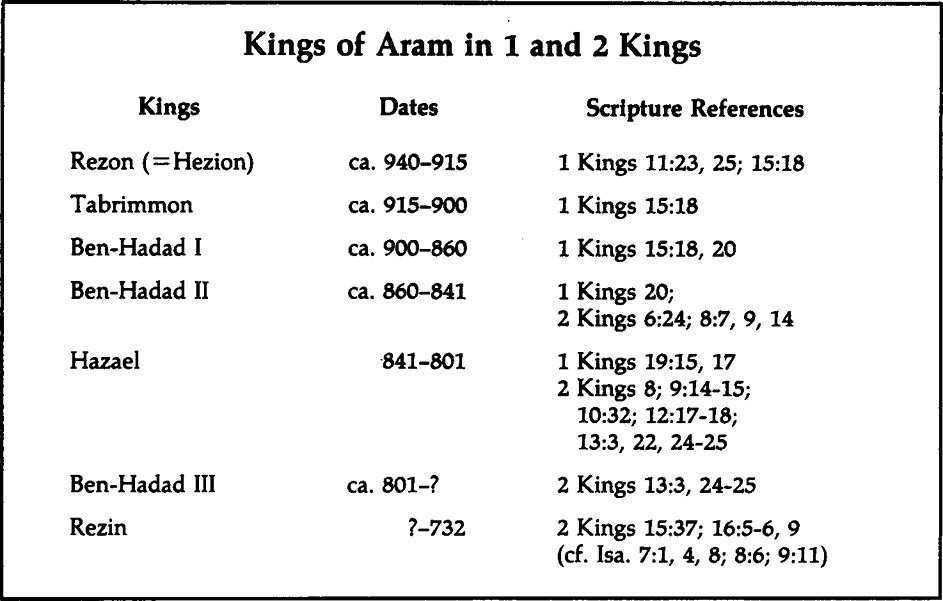
And he counseled with his servants saying - NET - "He consulted his advisers." Althought not mentioned by name, most likely this king is Ben Hadad II who ruled from about 860-841 BC. The name of the king of Israel is also not mentioned but was probably Jehorah/Joram. As Gary Inrig suggests "The absence of names serves to put the spotlight more squarely on the man of God, Elisha, God’s secret agent."
“In such and such a place shall be my camp - The king of Aram is planning secret ambushes against Israel. The king's advisors said "Invade at such and such a place." (NET) NLT says "We will mobilize our forces at such and such a place." In the Hebrew narrative, this expresses that the king of Aram repeatedly named exact locations, but the writer does not list them all, because the emphasis is not on which place—but on what God did.
Wikipedia - Hadadezer (Imperial Aramaic: הַדִדעֶזֶר, romanized: Haḏiḏ-ʿezer /ˌhædəˈdiːzər/; "[the god] Hadad is help"[1]); also known as Adad-Idri (Akkadian: 𒀭𒅎𒀉𒊑, romanized: dIM-id-ri), and possibly the same as Bar- or Ben-Hadad II, was the king of Aram-Damascus between 865 and 842 BC. (See note on name "Ben Hadad")
2 Kings 6:9 The man of God sent word to the king of Israel saying, “Beware that you do not pass this place, for the Arameans are coming down there.”
- Beware: 2Ki 3:17-19 1Ki 20:13,28
- for the Arameans: 2Ki 4:27 Am 3:7 Rev 1:1

ELISHA GIVES DIVINE REVELATION
CONCERNING ARAMEAN AMBUSHES
The man of God (Elisha) sent word to the king of Israel saying - Elisha sent a message but it was not by Gehazi who sadly had lost his ministry with Elisha and been replaced. He did not personally go. One of the tactics of the Arameans was to establish strategic ambush points against Israel’s army. However, their plans continually failed because Elisha, the man of God, knew of these raids beforehand (divine revelation) and repeatedly alerted Jehoram, the king of Israel. The king believed Elisha as evidenced by the fact that he acted on the word of warning. Surely Elisha must have spoken words of warning about spiritual matters but we have no evidence that the king believed them and acted on them. Sad!
🙏 THOUGHT- The importance of belief in temporal warnings pales in comparison to belief in eternal warnings! Belief in temporary earthly warnings may briefly alarm us, but belief in God’s eternal warnings should move us to repentance, faith, and holy urgency (1Pe 1:15, 16, 17, 2Co 7:1). What is passing (1Jn 2:17, 1Co 7:31, Jas 4:14) cannot compare to what is permanent (Mt 24:35). Do you stop at red lights? Do you slow down with yellow caution lights? How do you respond to God's "red and yellow lights" when He says don't look at that, don't buy that, don't say that, etc, etc. God's warning lights come as a package deal. Obey and reap spiritual blessing. Disobey and reap corruption in your soul! (Gal 6:8). Here is God's clear warning linked to His sure promise "Do not be deceived (present imperative with a negative see our need to depend on the Holy Spirit to obey - stop doing this or do not begin doing this!), God is not mocked; for (term of explanation) whatever a man sows, this he will also reap." (Gal 6:7)
Walton (page 392) - In the examples of prophetic activity in the ancient Near East, military advice is commonly given by prophets to kings. The information given by Elisha is far more specific than the examples known from other literature.
Beware (shamar - be on guard; Lxx - phulasso) that you do not pass this place, for (term of explanation) the Arameans are coming down there - Elisha serves as a "secret service" agent for King Jehoram. Is this not amazing grace being shown by Yahweh to a leader who "did evil in the sight of the LORD" (2Ki 3:2)?
2 Kings 6:10 The king of Israel sent to the place about which the man of God had told him; thus he warned him, so that he guarded himself there, more than once or twice.
- sent to the place: . 2Ki 5:14 Ex 9:20,21 1Ki 20:15 Pr 27:12 Mt 24:15-17
- warned him: Eze 3:18-21 Mt 2:12 3:7 Heb 11:7
- he guarded: 2Ki 2:12 13:14 2Ch 20:20 Am 7:1-6 Ac 27:24
ELISHA ISRAEL'S 'SECRET AGENT"
WARNS OF DANGER TO JEHORAM
The king of Israel (Jehoram/Joram) sent to the place about which the man of God had told him Jehoram sent word to the location Elisha had warned about. It is said that Jehoram trusted Elisha's word to protect him temporarily, but did not seem to trust his word to "protect" him eternally!
Obedience to God’s guidance
brought protection.
Thus he warned him, so that he guarded (shamar - be on guard; Lxx - phulasso) himself there, more than once or twice - NIV - "Time and again Elisha warned the king, so that he was on his guard in such places." Presumably the king responded by sending out scouts to see if the place were occupied by the Arameans. Finding Elisha’s warning true in every instance, the king simply avoided that location. Elisha demonstrates a kind of “second sight,” the Spirit-given ability to discern what others cannot see, because nothing is hidden from God.
Elisha is Israel’s
best line of defense.
-Paul House
God didn’t stop the Arameans by sending fire from heaven or by striking them with sickness—not yet. Instead, He protected Israel by doing something quieter and often overlooked: He warned them. Before danger ever reached them, God had already seen it. Before the enemy ever moved, God had already spoken. Before harm could come, God had already provided guidance. And the king of Israel was wise enough to listen to Elisha's warnings.
We often want God to rescue us after the fact, but many times His greatest mercy comes not in a dramatic deliverance, but in giving us gentle direction (especially direction to even avoid needing rescue!) He warns us through His Word, through faithful teachers, through conviction, through godly counsel, and through the quiet voice of the Spirit. Sometimes the most spiritual thing we can do is simply heed His warning.
This idol worshiper's willingness to listen to Elisha's warnings begs several questions for us today as believers. How many spiritual ambushes could we avoid if we listened sooner? How many regrets would disappear if we took God’s Word seriously (OUCH!)? How many wounds could be spared if we trusted His guidance the first time (DOUBLE OUCH!)?
Mark it down that that omniscient God still goes ahead of His people. He sees what we cannot. He protects through His truth. May we be willing to humble ourselves to listen and wise enough to obey when God speaks. Amen!
James Smith - A BLIND SERVANT 2 KINGS 6:8–17
“Thou who hast given me eyes to see,
And love this sight so fair;
Give me a heart to find out Thee,
And read Thee everywhere.”
—Gell.
The weapons of a “man of God” are not carnal, but spiritual. Elisha was able through his wonderful spiritual insight to save the king of Israel, “not once nor twice” from the trap set for him by the king of Syria (2Kings 6:9, 10). They go to spy the prophet out, and come back, saying, “Behold he is in Dothan.” Therefore a great host is sent by night to compass the city and capture the man of vision. This praying man is a mightier obstacle to the king of Syria than the army of Israel. Oh, what power lies within the reach of that one who is in favourable contact with God! Elisha was a man whose eyes God had opened to see invisible things, but he had a servant who was spiritually blind. A “young man” (2Kings 6:17) who had just lately come into office after the deceitful Gehazi had gone out a leper. There are some lessons of vital importance here. We may learn that—
I. There are Unseen Realities.
Elisha said, “They that be with us are more than they that be with them” (2Kings 6:16). This man of God lived by faith and endured, like Moses, as seeing the forces that are invisible. We look not at the things which are seen, but at the things which are unseen and eternal. To have this vision that discerns spiritual things is to be saved from the fear of man, and to be always confident of victory in the Name of God. “Greater is He that is in you, than he that is in the world.” “If God be for us, who can be against us?” (Rom. 8:31). These spiritual things are not created by faith, but revealed to faith, as light does any earthly object. Did not our Lord believe that there were more than twelve legions of angels ready at His bidding to defend Him? (Mt. 26:53).
II. Some Men are Blind to these Realities.
When Elisha’s servant saw that host of Syrians compassing the city he said, “Alas, master! how shall we do?” (2Kings 6:15). Like the unbelieving spies, this young man could only see with those carnal unanointed eyes which can never see God’s way of deliverance. The heavenly host was also there, but the servant had no eyes to see it. To him their condition was hopeless. “The natural man receiveth not the things of the Spirit of God” (1 Cor. 2:14). Spiritual blindness, if it does not lead to fear and despair, will certainly lead to pride and self-confidence. “How shall we do?” Shall we surrender to these forces of evil that are round about us, or shall we make a desperate effort to escape? Shall we allow ourselves to become captive to the power of this world, or shall we fight them in our own strength? Uttered or unuttered, this is all the salvation that the unenlightened know.
III. The Lord Alone can Give this New Vision.
“Lord, I pray Thee, open his eyes that he may see” (2Kings 6:17). Elisha did not argue with his servant; he knew that spiritual things could only be seen through spiritual eyes. “Things which eye saw not … God hath revealed unto us through the Spirit” (1 Cor. 2:10, R.V.). Secret things belong to God Those hidden treasures of spiritual strength—mountain full of horses and chariots of fire—can only be seen and trusted by those who have received the holy eye-salve of Him who has all power in Heaven and on earth (Rev. 3:18). No amount of learning or scholarship will ever be able to do the work of this eye-salve, which is the Holy Spirit. It is the Spirit that quickeneth.
IV. Spiritual Sight Might be Given in Answer to Prayer.
“Elisha prayed, and said: Lord, I pray Thee, open his eyes.” How confidently that man can pray who lives and moves with opened eyes, as in the presence of God, and among the realities of eternity. It is easy for the man of God to pray the prayer of faith (James 5:17). Blessed is that servant who has such a Master. Is it not your heavenly Master’s will that your eyes should be so opened that you might see clearly those unfailing forces that are for you, that you might be more than conquerors? To pray a servant’s eyes open, that he may see that cloud of witnesses, with which he also is compassed about, is to bring him into newness of life. If this is “the second blessing” it is a great one.
V. Opened Eyes Brings Rest and Satisfaction.
“The Lord opened the eyes of the young man, and he saw the mountain full of horses and chariots of fire round about Elisha.” Before he could only see the enemy round about the city. The host of God was there, not to preserve the city, but the man of faith. Ye are the salt of the earth. What a revelation this was to that young man trembling with fear, and what a cure it would be for all his doubts and alarms! He could now truly say, “God is my salvation, I will trust and not be afraid” (Isa. 12:2). This great saving vision now centres round the Cross of Christ. It is there on Mount Calvary, the opened eyes can see the hell-conquering chariots of God’s mercy, grace, and power. This is the vision that delivers from the fear of death and the fear of man, that brings peace and rest to the soul, that inspires to praise and service, and with the hope of eternal victory. “Believe, and thou shalt see!”
2 Kings 6:11 Now the heart of the king of Aram was enraged over this thing; and he called his servants and said to them, “Will you tell me which of us is for the king of Israel?”
- Now the heart : 1Sa 28:21 Job 18:7-11 Ps 48:4,5 Isa 57:20,21 Mt 2:3-12
- Will you tell 1Sa 22:8
ANGER OVER ABORTED AMBUSHES
AND SUSPICION OF SPY IN HIS COURT
Now the heart of the king of Aram was enraged over this thing - Note the nteresting small insight - where does anger originate? Doesn't this remind us of the angry reaction of King Herod when Jesus was born and he was unable to find the birthplace? (Mt 2:3-12).
And he called his servants and said to them, “Will you tell me which of us is for the king of Israel - The king of Aram assumed treason so he was basically saying "Someone among us must be a traitor. Which one of you is secretly helping the king of Israel?” Every time the Arameans planned an ambush, Israel avoided it—because God revealed the plans to Elisha, who warned the king of Israel. The Aramean king assumes the only explanation must be betrayal inside his own ranks, so he demands to know who is “for” (i.e., siding with / leaking information to) Israel.
No one can touch or harm God’s people
unless their Defender allows.
Dale Ralph Davis illustrates the frustration of someone who is powerful yet unable to accomplish his goals - One can appreciate the royal frustration. It was like the scourge of Rocky Mountain locusts in the American west in the nineteenth century. They would stop trains in their tracks because the oil from their millions of crushed bodies made the locomotives’ wheels spin.2 All that power and no traction. And that was the king of Aram here. All his plans, his tricks and strategies, and no success. But this is a continuing pattern. God still frustrates the plans of the enemies of his people in the most uncanny, ironic ways. In the 1970s many Christians in China were worshiping (as they still do) in house churches. Their meeting places were constantly being changed in order to avoid crackdowns. Leaders would be arrested and sent to labor camps. At one particular meeting those present had a very strong sense of Christ’s love and the Spirit’s presence. At the end of the meeting five visitors stood and announced they had been sent to make arrests. Now they too wanted to believe. The Protector of the church had disarmed the enemy. God does not always intervene that way. Often Christ’s people who are ‘hated by all’ (Mark 13:13) are ruined and crushed by Christ’s enemies. And yet biblical narrative, church history, and Christian biography are literally littered with instances of God’s strange—and often amusing—protection of his own....No one can touch or harm God’s people unless their Defender allows. (Borrow 2 Kings: The Power and the Fury page 112)
2 Kings 6:12 One of his servants said, “No, my lord, O king; but Elisha, the prophet who is in Israel, tells the king of Israel the words that you speak in your bedroom.”
- Elisha: 2Ki 5:3,8,13-15 Am 3:7
- tells: 2Ki 6:9,10 Isa 29:15 Jer 23:23,24 Da 2:22,23,28-30,47 4:9-18,
- bedroom Ps 139:1-4 Ec 10:20
Related Passages:
Psalm 139:1-4 For the choir director. A Psalm of David. O LORD, You have searched me and known me. 2 You know when I sit down and when I rise up; You understand my thought from afar. 3 You scrutinize my path and my lying down, And are intimately acquainted with all my ways. 4 Even before there is a word on my tongue, Behold, O LORD, You know it all.
Ezekiel 8:12 Then He said to me, “Son of man, do you see what the elders of the house of Israel are committing in the dark, each man in the room of his carved images? For they say, ‘The LORD does not see us; the LORD has forsaken the land.’”
Hebrews 4:13 And there is no creature (ANY EXCEPTIONS?) hidden from His sight, but all things (HOW MANY?) are open and laid bare (trachelizo - our English "trachea") to the eyes of Him with whom we have to do (ESV - "MUST GIVE AN ACCOUNT").
Ecclesiastes 10:20 Furthermore, in your bedchamber do not curse a king, and in your sleeping rooms do not curse a rich man, for a bird of the heavens will carry the sound and the winged creature will make the matter known.
KING OF ARAM MADE AWARE
OF ELISHA'S "SUPERNATURAL SPYING"
One of his servants said, “No, my lord, O king; but Elisha, the prophet who is in Israel, tells the king of Israel the words that you speak in your bedroom - How did the Aramean sevant know? The text does not say, but clearly God providentially made him aware to put in motion the following spectacular events. How disturbing to the king of Aram, that Elisha could eavesdrop on even conversations in his bedroom! He should have been more alarmed that a holy, omniscient God knew his every thought (every where) before he even uttered it!
2 Kings 6:13 So he said, “Go and see where he is, that I may send and take him.” And it was told him, saying, “Behold, he is in Dothan.”
- Go and see where he is, 1Sa 23:22,23 Ps 10:8-10 37:12-14,32,33 Jer 36:26 Mt 2:4-8 Joh 11:47-53 Ac 23:12-27
- Dothan: Ge 37:17
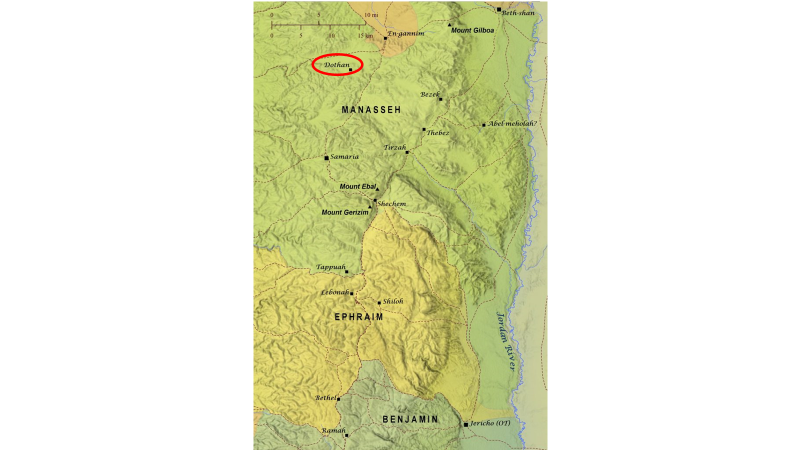
Dothan about 12 mi N of Samaria
"WE'VE GOT
HIM NOW!"
So - Term of conclusion. Based on this "spy report" the king of Aram draws a conclusion (illogical as explained below) to put Elisha "out of business."
He said, “Go and see (KJV - "spy") where he is, that I may send and take him.” - The king of Aram is making an illogical remark. Does he not realize that if Elisha knew what was said in the king's bedroom, he is fully aware of what he says anywhere. And as the story unfolds, Elisha did know what was coming!
And it was told him, saying, “Behold (hinneh; ; Lxx - idou), he is in Dothan - The king of Aram is deluded and thinks "I've got him now!" We are not told why Elisha was at Dothan which is about 12 miles north of the capital of Israel (Samaria which was were Elisha's house was located). It is notable that the Arameans’ ability to locate Elisha in all the land of Israel shows that they also had an effective spy network.
We see God's sovereignly and providentially working behind the scenes as He arranged for Elisha to be present at a much smaller regional city (probably only a few acres compared to Samaira's 40-60 acres) rather than to remain at his house in Samaria. Samaria was far larger than Dothan and would have made it very unlikely for the Aramean army to surround the city and result in such a dramatic scene as occurred in Dothan.
QUESTION - What is the significance of Dothan in the Bible? | GotQuestions.org
ANSWER - Dothan was a city in central Israel, approximately 12 miles north of Samaria in the hills of Gilboa. Today it is known as Tell-Dothan, located on the south plains of Jezreel. The word Dothan means “two wells,” and both wells are still in existence.
Dothan is first mentioned in Genesis 37:17 as near the place where Joseph was mistreated by his brothers. At first, they planned to kill Joseph, but Reuben persuaded them to throw him into a cistern instead. Because Dothan was on the caravan route from Egypt to Syria, Judah later suggested that they sell Joseph to Ishmaelite traders (Genesis 37:19–20, 26–27). The brothers agreed. So Dothan marks the place where young Joseph left everything familiar to him and became a slave in Egypt (Genesis 37:36). The modern name of one of the wells in Dothan reflects the event: it’s called Jubb Yusuf, which means “the pit of Joseph.”
Dothan is mentioned again in the historical narrative as Elisha’s home (2 Kings 6:13). It was in Dothan that God opened the eyes of Elisha’s servant so that he could see the horses and chariots of fire surrounding them (2 Kings 6:17). Elisha had warned the king of Israel that the king of Aram was going to attack Israel. However, when the king of Aram found out what Elisha was doing, he sought to capture the prophet. When Elisha’s servant saw the Arameans that had come against them, he was afraid. But Elisha told him not to be afraid because “those who are with us are more than those who are with them.” Then Elisha prayed, “Open his eyes, Lord, so that he may see.” The Lord answered, opening the servant’s eyes, “and he looked and saw the hills full of horses and chariots of fire all around Elisha” (2 Kings 6:16–17).
As the army of Arameans approached, Elisha prayed that the Lord would strike them with blindness (2 Kings 6:18). The Lord again answered, and the army was blinded. Elisha then led them from Dothan to Samaria, the capital of Israel, before asking the Lord to open their eyes. In the capital, the king of Israel wondered if he should kill the hapless captives, but Elisha counseled him to prepare food for them instead. When they were finished with the feast, the Arameans returned to their master, and Aram ceased raiding Israel. Then Elisha went back to his home in Dothan.
2 Kings 6:14 He sent horses and chariots and a great army there, and they came by night and surrounded the city.
- He sent horses and chariots. 2Ki 1:9-13 1Sa 23:26 24:2 Mt 26:47,55 Joh 18:3-6
- great: Heb. heavy, 2Ki 18:17

KING OF ARAM'S
NOCTURNAL SURPRISE
He sent horses and chariots and a great army there, and they came by night and surrounded the city - This amazing. The Aramean king sends a formidable force (not just a small raiding party) to seize a single man! Little did the king of Aram know that his "nocturnal surprise" for Elisha would soon turn into a "morning shock" for his great army! We are reminded that when the enemy came to seize Jesus an unarmed man, there was "a large crowd with swords and clubs." (Mt 26:47).
Warren Wiersbe (p 689) - Elisha’s (ORIGINAL) home was in Abel-meholah (ED: Here Elisha was found at his plough by Elijah on his return up the Jordan valley from Horeb 1Ki 19:16), but in his itinerant ministry, he moved from city to city. Humanly speaking, he would have been safer in the walled city of Samaria, but he had no fear, for he knew God was caring for him. The arrival that night of a company of foot soldiers, cavalry, and charioteers didn’t upset the prophet in the least. This was not the full army but rather an enlarged “band” such as engaged in border raids (2Ki 6:23; 5:2; 13:20; 24:2)
🙏 THOUGHT - When God’s servants are in His will and doing His work, they are immortal until their work is done (ED: SEE TWO WITNESSES IN Rev 11:3-6,7 = "When they have finished their testimony") The disciples tried to discourage Jesus from going back to Judah, but He assured them He was on a “divine timetable” and was therefore perfectly safe (John 11:7–10). It was only when His “hour had come” (Jn 13:1; Jn 17:1) that His enemies had the power to arrest Him and crucify Him. If the Father’s eye is on the sparrow (Mt 10:29), then surely He is watching over His precious children. (Wiersbe)
God’s servants do not live at the mercy of hostile people or hostile circumstances, but under the sovereign hand of a loving God. Until God’s purpose is fulfilled, we are kept by His power, guided by His timing, and held in His care. This truth does not make us reckless—it makes us fearless, faithful, and willing to obey. If I truly believed my life was in God’s hands, not man’s, how would it change the way I respond to fear, pressure, or threats? Where do I see myself living as though people or circumstances determine my future rather than God’s sovereignty? Am I more concerned with preserving my safety or fulfilling God’s purpose for my life (cf Mk 8:35)? How does knowing God has a divine timetable for my life encourage me to trust, obey, and rest in Him today? Are you resting in this truth? Take a moment and listen to Steve Green's great song Jesus, I Am Resting, Resting. (Listen the powerful story of how this hymn ministered to the famous missionary Hudson Taylor) Then REST IN CHRIST!
2 Kings 6:15 Now when the attendant of the man of God had risen early and gone out, behold, an army with horses and chariots was circling the city. And his servant said to him, “Alas, my master! What shall we do?”
- attendant 2Ki 3:11 5:20,27 Ex 24:13 1Ki 19:21 Mt 20:26-28 Ac 13:5
- Alas: 2Ki 6:5 2Ch 20:12 Ps 53:5 Mt 8:26
EARLY TO BED, EARLY TO RISE
TO WITNESS GOD'S SURPRISE!
Now when the attendant of the man of God had risen early and gone out - This attendant is not named but is not Gehazi (the leper) as noted above. Talk about a "wake up call!" Wheaties used to be called the "Breakfast of Champions" and this attendant was in need of a big bowl! Of course, even better than any cereal he was about to encounter a mighty God and a fearless prophet.
Behold (hinneh; Lxx - idou) - Now this is a behold that would grab anyone's attention!
Our fears prevail
when we don’t see the unseen!
-- Dale Ralph Davis
An army with horses and chariots (rekeb) was circling the city - An encircled city was in big trouble in ancient times as (1) there is no escape and (2) it could result in a seige with famine, starving and death by attrition. In this particular case the encirclement was to assure capture of the spy Elisha. The irony is striking that an entire military force, complete with horses, chariots, and a surrounding army, was dispatched to apprehend just one man. The sheer overreaction underscores their insecurity and how deeply threatened the king of Aram felt, not by Israel’s army, but by a prophet of God, who had already clearly demonstrated divine power.
And his servant said to him, “Alas (ahah), my master ('adon; Lxx - kurios)! What shall we do - The servant expresses the response most of us would have had. He could have said "We need to hit our knees and pray," but that thought did not seem to cross his mind. He was (like so many of us) focused on the alarming temporal circumstances which led to panic instead of prayer. This servant's reaction recalls the reaction of the son of the prophets when he lost the axe head and cried out “Alas, my master! What shall we do?” (2Ki 6:15).
As an aside, the only place I can find that Gehazi referred to Elisha as "master" ('adon; Lxx - kurios) is in 2Ki 5:20, 22 as he began to hatch and carry out his deception and grand larceny. We will see Gehazi re-surface in 2Ki 8:4-5 when he speaks to the king about Elisha’s miracles, but he still does not call Elisha “my master”.
Donald Grey Barnhouse could have been referring to the pessimistic attitude of Elisha’s servant when he wrote "Those who think the devil is gaining victory are like the servant of Elisha. In one of the leading magazines, there was an article on limerick poetry which included the following example:
God’s plan made a hopeful beginning
But man spoiled his chances by sinning.
We trust that the story
Will end in God’s glory,
But, at present, the other side’s winning.
(BORROW The invisible war : the panorama of the continuing conflict between good & evil page 133)
Alas (0162) ahah is an interjection usually rendered ah! oh! or alas! indicating great emotion, such as grief or despair (Josh. 7:7; Jdg. 11:35; Ezek. 11:13). Ahah can also signify a strong sense of marvel with fear (Jdg. 6:22), a feeling of inability (Jer. 1:6), a sense of confusion (Jer. 4:10; Ezek. 4:14). In the present context ahah introduces the announcement of the Day of the LORD (Joel 1:15).
Most of the uses of ahah entail a sense of the speaker being overwhelmed by impending doom (Josh. 7:7; Jdg. 6:22; 2 Ki. 3:10; 6:15; Joel 1:15, etc.).
In English the term "ah" means an expression of surprise, delight, disgust, or pain in nearly all Indo-European languages. The English word "alas" is used to to express unhappiness, sorrow or regret.
Alas, ah in most places is used with "Lord GOD" (Josh 7:7; Jdg 6:22; Jer 1:6; Jer 4:10; Jer 14:13; Jer 32:17; Ezek 4:14; Ezek 9:8; Ezek 11:13).
AHAH - 15 verses - Ah(5), alas(10). Jos. 7:7; Jdg. 6:22; Jdg. 11:35; 2 Ki. 3:10; 2 Ki. 6:5; 2 Ki. 6:15; Jer. 1:6; Jer. 4:10; Jer. 14:13; Jer. 32:17; Ezek. 4:14; Ezek. 9:8; Ezek. 11:13; Ezek. 20:49; Joel 1:15
Philip G Ryken - The way to wage spiritual warfare is first to recognize the danger (See Schemes of the Devil). Missiologist Robert Linthicum writes about the oppressive spiritual darkness he sensed when he visited the city of Calcutta. He did not understand why he felt so oppressed until he learned about Kali, the Hindu goddess to whom Calcutta is dedicated:
Who is Kali, who gathers the souls of young men? She is the goddess of darkness, evil, and destruction in the Hindu pantheon. This is the goddess to whom an entire city is dedicated. Once I understood this, I understood Calcutta. I could finally identify the ominous, profoundly dark, and permeating impression I had felt since I had first entered the city. The spirit of Kali, like a malevolent power, possessed and hovered over her city. The urban world’s worst poverty, the indignity in which street people were forced to live, and the way the rich and the city’s systems and structures disregarded it all now made sense—for a profoundly evil presence brooded over this city and held it in her thrall. (Borrow City of God, city of Satan : a biblical theology of the urban church)
Do you sense the danger? Although the Bible does not say that individual demons are assigned to every city and nation, as some Christians believe, engaging in spiritual warfare begins with recognizing that spiritual forces are at work in the world. It is not hard to name the spiritual powers arrayed against the evangelical church in the world today: Self, Money, Sex, Power, Entertainment. These are spiritual realities. They are every bit as real as the ground we stand on, if not more so. To see how real they are, one need only look at the devastating effect they have on the family, the church, the city, and the world. (2 Kings)
2 Kings 6:16 So he answered, “Do not fear, for those who are with us are more than those who are with them.”
- Do not fear: Ex 14:13 Ps 3:6 11:1 27:3 118:11,12 Isa 8:12,13 41:10-14 Mk 16:6 Ac 18:9,10 Php 1:28
- Those who are with us: 2Ch 16:9 2Chr 32:7-8 Ps 46:7,11 Ps 55:18 Isa 8:10 Mt 26:53 Ro 8:31 1Jn 4:4
Related Passages:
Romans 8:31 What then shall we say to these things? If God is for us, who is against us?
1 John 4:4 You are from God, little children, and have overcome them; because greater is He who is in you than he (Satan) who is in the world.
2 Chronicles 16:9 “For the eyes of the LORD move to and fro throughout the earth that He may strongly support those whose heart is completely His. You have acted foolishly in this. Indeed, from now on you will surely have wars.”
2 Chronicles 32:7-8 “Be strong and courageous, do not fear or be dismayed because of the king of Assyria nor because of all the horde that is with him; for the one with us is greater than the one with him. 8 “With him is only an arm of flesh, but with us is the LORD our God to help us and to fight our battles.” And the people relied on the words of Hezekiah king of Judah.
FEAR NOT GOD HAS
THE BASES COVERED!
To cover the bases is an American idiom meaning to ensure one's safety or success by dealing with every potentially problematic aspect of a situation or activity.
So he answered, “Do not fear - In the Septuagint do not fear it is present imperative with a negative which means to stop fearing. Elisha's attendant was clearly "scared to death" as they say.
For - This is one of those great terms of explanation in Scripture. Elisha is now going to explain why his attendant need not fear this great Aramean army.
Those who are with us are more than those who are with them - This statement is almost an Old Testament paraphrase of Romans 8:31 which says "If God is for us, who is against us?" Put yourself in the attendants sandals and imagine what would have gone through your mind hearing your master recite these seemingly ridiculous words! The attendant is looking with "horizontal vision," while Elisha is seeing with "vertical vision." The former is living by sight not by faith. Elisha was living by faith, not by sight! Paul describes this "other worldly" type of vision in 2Co 4:18 writing "we look not at the things which are seen, but at the things which are not seen; for the things which are seen are temporal, but the things which are not seen are eternal." Moses the servant of God had this type of "other worldly" vision, the writer of Hebrews recording "By faith he left Egypt, not fearing the wrath of the king; for he endured, as seeing Him Who is unseen." (Heb 11:27).
Warren Wiersbe (p690) - A woman told evangelist D. L. Moody that she had found a wonderful promise that gave her peace when she was troubled, and she quoted Psalm 56:3, “What time I am afraid, I will trust in thee.” Moody said he had a better promise for her, and he quoted Isaiah 12:2, “Behold, God is my salvation; I will trust, and not be afraid.” We wonder what promises from the Lord came to Elisha’s mind and heart, for it’s faith in God’s Word that brings peace in the midst of the storm. Perhaps he recalled David’s words in Psalm 27:3, “Though an army may encamp against me, my heart shall not fear; though war may rise against me, in this I will be confident” (nkjv). Or the words of Moses from Deuteronomy 20:3–4 may have come to mind, “Do not let your heart faint, do not be afraid … for the Lord your God is He who goes with you, to fight for you against your enemies, to save you” (nkjv).
WHEN DANGERS ASSAIL -- BIBLE “FEAR NOTS” No. 8. - James Smith
“Fear not: for they that be with us are more than they that be with them” (2 Kings 6:16).
This is a “Fear not” for those overawed at the magnitude of the forces arrayed against them. It was truly an appalling sight that Elisha’s man-servant saw. Dothan, their residence just then, lay on an isolated hill in a wide plain. Rising up early one morning to perform his accustomed tasks ere his master arose, he saw a great host of the enemy surrounding the town, and they were utterly undefended and apparently at the mercy of the besiegers. No; we are not at all surprised at the man’s alarm and dismay. It verily was a fearsome sight.
The King of Syria was at war with Israel. His method of warfare was not by a regular continued invasion, but by dashes across the border on undefended places. But he found himself forestalled at every point. Whatever place they decided to attack they found their plans were known, and the carefully planned surprises were defeated. No wonder he suspected treachery, and, calling his servants together, challenged them on the matter. Their prompt answer implied that Elisha’s intervention was well known by them. They declared that Jehovah revealed those carefully made plans of theirs to Elisha, who instructed the King of Israel. Therefore the Syrian king determined to send an expedition for the capture of Elisha, never dreaming that this servant of the Lord, who knew all his former schemes, might know of this one too.
No; we are not at all surprised at the servant’s fear. And there is no wonder that we, too, are appalled as we remember the forces arrayed against us. Worse foes ring us round than those whose armour glittered in the morning sunshine at Dothan. A recently retired business man, in a letter, said: “These are terrible times we are living in, and it seems as if Satan is allowed to put forth tremendous powers in these last dark days.” How true are these words. All the Satanic forces seem to have united in one desperate onslaught upon the forces of righteousness and truth, and against the Lord’s own people. Of the reality of those mighty enemies and of their bitter and fierce attacks, the Lord’s people are not ignorant.
Are we not as helpless to cope with them as this servant was? Then why should not we fear? Ah, this incident teaches us that we are not alone and deserted even when we seem most to be. And that, like Elisha, it is our duty, not so much to pray that the Lord and His host might be with us, as to recognise their presence. Elisha did not pray that the Heavenly guards might come, for they were there already. The manifestation was the miracle. God’s messengers are ever near us. Let us remember this, and thus, ever recognising their presence, and, above all, the presence of the mighty Lord, be delivered from all fear. For “greater is He that is in you than he that is in the world.” “The angel of the Lord encampeth round about them that fear Him, and delivereth them.”
The Christian on his knees sees more than the philosopher on tiptoe.
The soul that stoops to God rises above the mind that rises against Him.
The praying man’s vision reaches eternity; the proud man’s sight dies at the horizon.
Heaven opens wider to bent knees than to lifted brows.
The light of prayer reveals what the lantern of philosophy cannot.
The posture of humility opens horizons no height of intellect can reach.
Eyes lifted to heaven see more than eyes straining at the limits of human thought.
Truth is better seen with a bowed head than with a lifted chin.
A praying heart sees realities the sharpest mind cannot chart.
C H Spurgeon —2 Kings 6:16.
HORSES and chariots, and a great host, shut up the prophet in Dothan. His young servant was alarmed. How could they escape from such a body of armed men? But the prophet had eyes which his servant had not, and he could see a greater host with far superior weapons guarding him from all harm. Horses of fire are mightier than horses of flesh, and chariots of fire are far preferable to chariots of iron.
Even so is it at this hour. The adversaries of truth are many, influential, learned, and crafty; and truth fares ill at their hands; and yet the man of God has no cause for trepidation. Agencies, seen and unseen, of the most potent kind, are on the side of righteousness. God has armies in ambush which will reveal themselves in the hour of need. The forces which are on the side of the good and the true far outweigh the powers of evil. Therefore, let us keep our spirits up, and walk with the gait of men who possess a cheering secret, which has lifted them above all fear. We are on the winning side. The battle may be sharp, but we know how it will end. Faith, having God with her, is in a clear majority: “They that be with us are more than they that be with them.”
Robert Hawker - MY soul! never lose sight of this, which was shown to the prophet’s servant in his fright. Though thou seest not, with bodily eyes, the mountain full of horses and chariots of fire in thy defence; yet, with thy spiritual eyes, thou mayest see, infinitely beyond all this, as surrounding thee at all times and in all places, God thy Father, with all his divine attributes and perfections, all engaged, all made over, all pledged in covenant engagements, in Jesus, for thy defence, protection, comfort, security, and guiding thee in all things. There is more in that one assurance than in a thousand worlds, I will be thy God—and all in Jesus; yea and amen. Then, moreover, thou hast God thy Redeemer with thee, with all his fulness, all his grace, all his love—his whole heart, his whole soul thine. And thou hast God the Holy Ghost, with all his influences, gift, teachings, quickenings, consolations, strengthenings. All these are with thee; to say nothing of angels, which are ministering spirits, sent forth to minister unto them which are heirs of salvation. Surely God’s attributes, Jesus’ graces, the Holy Ghost’s comforts, being all thine own, and always with thee; let what armies of men, or legions of evil spirits, assault thee—unbelief, or fear, or doubt, or misgiving; let nothing drive out the recollection, nor remove thy confidence: fear not; for they that be with thee, are more than all that can be against thee. Hallelujah! Amen.
J J Knapp - They that Be with Us -- 2 Kings 6:16
Elisha’s servant had real reasons to be fearful, when he saw that the enemies had completely surrounded the city in which his master lived; no escape seemed possible. It is not surprising that he complained to Elisha: “Alas, my master! how shall we do?” However, Elisha calmed him down: the holy angels of God stood at his side and watched over him. Once the eyes of Elisha’s servant were opened upon the prayer of the prophet, he saw the mountain full of fiery horses and chariots surrounding his master,—that were the heavenly legions, that are still being sent out presently in the service of those who shall inherit salvation, to keep them and to fight for them.
This is an encouraging vision. We need it, we need opened eyes to see it, we need the eye of faith to not only discern the enemy but also God’s support. Of the evil powers that surround us, everyone of us can speak from experience. There are many that are against us. The life of grace is indeed a quiet and peaceful life in respect to the peace of the Sabbath that fills the heart of the children of God. However, it is a fiercely challenged life in respect to the force that is sent against it. Hundreds of accusations in a single day. Thousands of guilty thoughts, that strike like a singing flash of lightning through our mind and overwhelm our soul in billowing clouds of sulphur, so to say. Countless pitfalls of temptation are spread before our feet. Besides, an accusing conscience, the sins of our past, which the Evil One continues to stir up to take away our peace; the curse of the law that threatens to crush us! All this presses upon us and sometimes surrounds us completely like a welded ring so that we cannot break through it.
Fear not, it comes to us, because those that be with us are more than those that be with them. Within the circle of enemies that encircled Elisha, the Lord drew another circle of flaming spirits around the man of God. A circle within a circle. The enemies closed in upon him, certainly, but the heavenly legions closed in upon him even more. If the enemy wanted to reach him, it had to first break through the battle ranks of fiery chariots and fiery horses, and that was impossible; it was impossible.
Are we not safe and shielded? Shall we cry alas with the servant of Elisha? Or shall we see with a clear eye of faith towards the mountain, upon which it teems with heavenly powers? Let us do the latter, because only that makes us brave and ready. Let us believe that what is with us for Christ’s sake, is always more than what is with the enemies. In the midst of the circle of the opponents we shall still triumph: “If God be for us, who can be against us?”
Donald Grey Barnhouse in his famous work The Invisible War writes...
Ben-Hadad and Elisha
One of the most striking stories in the Word of God is that of the attempt of Ben-Hadad, king of Syria, to defeat the plan of God by destroying His prophet Elisha. The king's enmity had been stirred against Elisha because Elisha was able to know all of the plans which were spoken in the secret bed chamber of the king by the leaders of his army. When the king became aware that he was being consistently outwitted in the field, he angrily asked his counselors which one of them was a traitor. They told him the truth, that their secret conversations were communicated to Elisha (probably by angels), and Elisha, in turn, communicated them to the king of Israel, enabling him to escape from the greatly superior forces of the enemy.
When Ben-Hadad learned this, he decided to send an expedition against Elisha, to take him prisoner. It is worthwhile to notice, in passing, that a single man of God, yielded to God, can become so important in the invisible warfare that the earthly enemy king finds it worthwhile to send an army against him, and that, in the spiritual realm, a great number of fallen angels will be deployed by the prince of this world, in order to frustrate the plan of God.
The army of Ben-Hadad reach the little valley of Dothan in the middle of the night, having learned that the prophet of God was living there at the moment. The troops were thrown about the village, leaving no loophole for human escape. At the dawn, when the servant of Elisha went out to begin his daily tasks, he saw the indications of the enemy force, round about on all sides and rushed back into the presence of his master with words of warning and inquiries of consternation and doubt. "Alas, my master! How shall we do?"(II Kings 6:15) is the phrase which God has recorded to reveal the state of his mind.
Elisha's Answer
The answer of Elisha is a verse of very great importance to us in our study. "Fear not," said Elisha, "for they that be with us are more than they that be with them" (2Ki 6:16). "They," "us," "they," and "them," are the four words which line up all of the forces, earthly and supernatural, and calculate the extent of the powers that oppose each other on the field of battle. The human alignment can be counted. The "us" refers to Elisha and his servant, just two people. The "them" is indicated for us in the narrative with the statement that Ben-Hadad, on hearing that Elisha was in Dothan, "sent thither horses, and chariots, and a great host: and they came by night and compassed the city about."
Ordinarily the human eye cannot see the spiritual forces that are arrayed in the invisible realm. The eye of faith can look into the Word of God and know the truth of the power of the Lord we serve, and can be sure that nothing can ever touch us unless it has passed through the will of God. We can be sure that though there may be wisdom on the other side, omniscience is on our side alone. We may be sure that though we find an enemy to be potent, we can find that our God alone is omnipotent. We deal with the only Being in the universe who has never made a mistake, who has never been astonished, who has never been caught at a disadvantage, who has never been surprised at a superior force or strategem. This is the thought that is in the mind of the worshiper when he sings, "TTie Lord is high above all nations, and his glory above the heavens. Who is like unto the Lord our God, who dwelleth on high" (Psalm 113:4, 5).
The Hosts of Heaven Visible
Elisha knew that the forces of God were greater than the Satanic forces that watched over Ben-Hadad. Satan could not muster enough to make his group of angelic powers more than "they" that were with Elisha. The prophet prayed and asked the Lord to open the eyes of his servant. It would spoil the grandeur of the vision to tell it in any other words than those which have been given us by God Himself. The simplicity of the phrase, thrown up against the glory of the fact, gives us to see something more than a picture of the imagination. For "the Lord opened the eyes of the young man; and he saw: and, behold, the mountain was full of horses and chariots of fire round about Elisha" (II Kings 6:17).
The writer once passed by Dothan. It lies in a little valley to the east of the road that runs south from Galilee through Samaria. We stopped there and walked over the brown fields toward the mound that possibly was the site of the ancient town. The hills round about were bare and dry in the summer sun, and there was no movement save the shimmering air that rose from the parched earth. We sat in the shade under a scrawny tree that furnished a little shelter from the hot sun and read portions of the story of Elisha, including the one we have just told. We could well imagine the startled servant coming out in the morning and, walking toward the well to draw some water, seeing the glint of fresh morning light on the shields of the Syrian soldiers. But we closed our eyes to see the mountain full of horses and chariots of fire, and, since we live in an age when God has ordered our standard to be faith and not sight, we saw more than the angelic hosts that do God's bidding on our behalf. Certainly, it is true, there are guardian angels that protect us from the onslaughts of the enemy. Certainly, it is true, that the faithful angels are the servants of us, who are the heirs of salvation. Certainly, it is true, that they that are with us are more than they that are with any foe or combination of foes. But that day, as we thought of these things we were reminded of an even greater verse that has the same alignment of pronouns covering the earthly warfare and the heavenly.
The Holy Spirit in Us
We on this side of the cross have something far greater than Elisha ever had. There is that which transcends sighted vision of invisible things. The Lord told His own disciples that the Holy Spirit dwelt with them, but that the day would come when He would dwell in them (John 14:17). Having a member of the Godhead come to take up His abode within us puts us on a spiritual plane above that which was known to men of the Old Testament. The Lord Jesus Christ said that John the Baptist was no whit behind Moses, Elijah, Elisha, or any of the other mighty men upon whom the Spirit had come; of all that had preceded him there was not a greater than John the Baptist (Matthew 11:11). And we have the word of our Lord that the least and lowliest from the time of the coming of the Holy Spirit to dwell within, would be considered in God's sight, greater than John the Baptist because of the presence of the Holy Spirit within.
It is in the light of this great fact that the New Testament writer lines up the invisible forces to show us the fullness of the supply that is available to us. "Ye are of God, little children," the believers are told, "and have overcome them: because greater is he that is in you, than he that is in the world" (I John 4:4). Let us remember this when we face difficulty or feel that the forces that are against us are more than we can meet. "He," "you," "he," "the world," are the four words which draw the line of demarcation, ranging all of the forces, earthly and spiritual, and calculating the extent of the powers that oppose each other on the field of battle. Even more, for not only are there horses and chariots of fire round about Elisha of old and the Elishas of this age, but there are the angelic hosts for even the humble servants of Elisha. Still more it is our privilege to fly the flag of joy in our lives every day, as the flag is displayed in a kingdom on whatever castle or palace the king is using at the moment, for we have not merely angels with us but the King of kings. Himself, is in residence.
Then what do we care though Satan's organization is close-knit and widespread? Only the mind of unbelief can think, even for a moment, that at present Satan's side is winning. "We know that an idol is nothing in the world, and that there is none other God but one. For though there be that are called gods, whether in heaven or in earth (as there be gods many, and lords many,) but to us there is but one God, the Father, of whom are all things, and we in him; and one Lord Jesus Christ, by whom are all things, and we by him" (1 Corinthians 8:4-6). (BORROW The invisible war : the panorama of the continuing conflict between good & evil page 134-136)
2 Kings 6:17 Then Elisha prayed and said, “O LORD, I pray, open his eyes that he may see.” And the LORD opened the servant’s eyes and he saw; and behold, the mountain was full of horses and chariots of fire all around Elisha.
- prayed Ps 91:15 Jas 5:16-18
- open his eyes: 2Ki 6:18-20 Ps 119:18 Isa 42:7 Ac 26:18 Eph 1:18 Rev 3:7
- full of horses 2Ki 2:11 Ps 34:7 68:17 91:11 104:3 Eze 1:13-16 Zec 1:8 6:1-7 Mt 26:53 Heb 1:14 Rev 19:11,14
Psalm 125:2 As the mountains surround Jerusalem, So the LORD surrounds His people From this time forth and forever.
Psalm 34:7 The angel of the LORD encamps around those who fear Him, and rescues them.
Matthew 26:53 “Or do you think that I cannot appeal to My Father, and He will at once put at My disposal more than twelve legions of angels?
Hebrews 1:14 Are they (GOD'S ANGELS) not all ministering spirits, sent out to render service for the sake of those who will inherit salvation?
Colossians 3:1-2 Therefore (IN LIGHT OF THE FUTILITY OF FLESHLY EFFORTS IN Col 2:23) if (SINCE) you have been raised up with Christ, keep seeking (present imperative see our need to depend on the Holy Spirit to obey) the things above, where Christ is, seated at the right hand of God. 2 Set your mind (present imperative see our need to depend on the Holy Spirit to obey) on the things above, not on the things that are on earth.
2 Kings 2:11 As they were going along and talking, behold, there appeared a chariot of fire and horses of fire which separated the two of them. And Elijah went up by a whirlwind to heaven.
Numbers 22:31 Then the LORD opened the eyes of Balaam, and he saw the Angel of the LORD standing in the way with his drawn sword in his hand; and he bowed all the way to the ground.

OPENED EYES
REVEAL ANGELIC SKIES
Then - Be alert to the small conjunction then as it often marks progression in a narrative and can be especially helpful in interpreting prophetic passages accurately.
Elisha prayed and said, “O LORD, I pray, open his eyes that he may see.” - God's eyes were already opened to the dire straits of the man of God (see 1Chr 16:9) and we can be comforted by the fact that His eyes are open to whatever distress we are experiencing or will soon experience! Elisha did not pray to send the angelic calvary, for God had already sent them! God knew their need and His protection was already in place. And so Elisha just prayed for his attendant to be able to see them. Clearly, the attendant is not blind as he saw the Aramean army. Elisha is praying for the attendant's spiritual vision, which reminds me of Paul's prayer for the saints at Ephesus "I pray that the eyes of your heart may be enlightened, so that you will know what is the hope of His calling, what are the riches of the glory of His inheritance in the saints." (Eph 1:18)
What also stands out in Elisha’s prayer is that he did not plead for God to alter the situation, but for God to alter the servant’s sight. The circumstances did not need to change; the servant’s understanding did. God opened his eyes from the temporal to the eternal, from earthly fear to spiritual confidence, and suddenly the situation looked completely different because the attendant could now see God's army. When God shifts our focus from the temporal to the eternal, from human fear to divine presence, everything changes, even if our circumstances do not. He is still in full control.
Bob Utley - I just love this text! Wow, how many times we as believers face circumstances and evil intentions with "fear"! Elisha prays that YHWH will open the attendant's spiritual eyes that he might see the spiritual realm (notice Ge 21:19; Ge 32:1-2; and Nu 22:31; also note Ps 37:7; Ps 91). Elisha had seen these very things in 2Ki 2:10-11. I think what happened in 2 Ki 7:6 is related to these spiritual armies of the Lord of hosts. Our wonderful hymn "Open My Eyes" comes from this text. There is one passage where opening one's spiritual eyes is a disaster (i.e., Gen. 3:5,7)!
And the LORD opened the servant’s eyes and he saw - God enabled him to see beyond the visible battlefield to the unseen spiritual reality to see that the enemy was already outnumbered.
🙏 THOUGHT - A basic principle is that unless the Spirit of God opens our natural eyes, we are unable to see supernatural truth. Human intellect, religious upbringing, or moral sincerity alone cannot pierce the veil of the unseen; only divine illumination can. Just as Elisha’s servant could only see blazing chariots of fire when the Lord opened his eyes (2 Ki 6:17), so it is with us in grasping the truths of God. By nature we are spiritually blind (1 Cor 2:14), but the Spirit grants sight, enabling us to see Christ’s glory, God’s purposes, and the hope secured for us (Eph 1:18). We do not need new truth so much as opened eyes to the truth already present. Spiritual clarity is not achieved — it is received. Therefore, the believer’s continual prayer must echo David’s: “Open my eyes, that I may behold wonderful things from Your law” (Ps 119:18). When God opens our eyes, fear gives way to faith, confusion to confidence, and earthly perspective to eternal conviction.
And behold (hinneh; ; Lxx - idou), the mountain was full of horses and chariots (rekeb) of fire all around Elisha - This is at least the second time Elisha has seen chariots of fire (2Ki 2:11). It is interesting that one of the names of Yahweh is Jehovah Sabaoth, LORD of hosts (of armies), here identified as angelic forces.
Paul House points out the interesting parallel with Elijah - At this point the Lord is defending Elisha from death by the same instrument with which Elijah was protected from death and taken to heaven (2 Kings 2:11). (See 1, 2 Kings - Volume 8 - Page 277)
Dale Ralph Davis - This text reminds me of Bunyan’s description of Christian’s approach to the Palace Beautiful in Pilgrim’s Progress. A short distance away from the porter’s lodge Christian entered a very narrow passage and then spied up ahead two lions in the way. Then Bunyan adds, ‘The lions were chained; but he saw not the chains.’ How it would help us sometimes to see the chains!
🙏 THOUGHT - What if God doesn’t show you the horses and chariots of fire? Then you must go on, leaning on the fact of verse 16 if the sight of verse 17 is denied you. How we need those unseen legions. You walk through the heartbreak of family breakdown, perhaps crushed by marital infidelity; you wait for your appointment in the oncology unit; or you wade into one of those hated but recurring periods of deep depression. It’s all right to ask Him to show you a glimpse of the horses and chariots of fire. (Borrow 2 Kings: The Power and the Fury page 114)
John Schultz: We could treat this story as a parable of Jesus’ teaching about spiritual blindness. We read: “Jesus said, ‘For judgment I have come into this world, so that the blind will see and those who see will become blind.’ Some Pharisees who were with him heard him say this and asked, ‘What? Are we blind too?’ Jesus said, ‘If you were blind, you would not be guilty of sin; but now that you claim you can see, your guilt remains.’” (John 9:39-41) But this does not mean that it is not a report of a real incident that happened in Israel’s relationship with Aram, which made raids into Israeli territory.
William Barnes: Physical sight and spiritual blindness can often occur together, but rarely are these phenomena juxtaposed so dramatically as in the present text of 2 Kings. Elisha can see, spiritually—and sometimes literally—heavenly realities, and for a brief instance, so can his servant (2Ki 6:16–17). Elisha can also pray for supernatural blindness to fall upon his foes (2Ki 6:18), so that the enemies of God’s people Israel can be led helplessly into the very center of the Israelite capital. Finally, Elisha can ask that Yahweh open the enemies’ eyes (2Ki 6:20), so that they could see immediately what predicament they were in and be moved to reach an amicable military solution with a minimum of bloodshed. In sharp contrast to the next several sections of 2 Kings, the present passage ends with a peaceful resolution between Arameans and Israelites, including a “great feast” celebrating the onset of that very status. Equally surprisingly, hints are given concerning continued peaceful relations between Israelite prophet and king (see 2Ki 6:9–10, 21), with the latter following the advice of the former, and even calling him “my father”. When God’s leadership stands united, absolutely amazing things can happen.
Peter Pett - This extraordinary vision is of great importance, for it is a reminder to us also that the invisible forces of God are ever watching over and protecting His own. It is a reminder to us that as Christians we live in a sense in two places. In our bodies we live in, and are limited to, the physical world, but in our spirits we live in, and have contact with, ‘the heavenlies’ (Ephesians 1:3; Ephesians 2:6; Ephesians 6:10-18), where we are seated with Christ, and under His personal protection, and where we engage in warfare against the forces of evil (Ephesians 6:10-18). (See Schemes of the Devil)
Morgan: Faith is never the imagining of unreal things. It is the grip of things which cannot be demonstrated to the senses, but which are real. The chariots of horses and fire were actually there.
Matthew Henry: When we are magnifying the causes of our fear we ought to possess ourselves with clear, and great, and high thoughts of God and the invisible world. If God be for us, we know what follows, Rom. viii. 31. … The opening of our eyes will be the silencing of our fears. In the dark we are most apt to be frightened. The clearer sight we have of the sovereignty and power of heaven the less we shall fear the calamities of this earth.
Related Resource:
- JAMES HASTINGS 2 Kings 6:17 The Visible and the Invisible (20 pages)
WHEN YOU CAN’T SEE THE CHARIOTS
Lean on God’s Word when your eyes give you nothing to hold onto (See passages above). 2Ki 6:16 is truth even if 2Ki 6:17 is hidden: “Do not fear, for those who are with us are more than those who are with them.”
Learn to trust that unseen realities are stronger than visible threats (2Cor 5:7). Fear grows in the soil of sight; faith grows in the soil of trust.
Pray honestly, like Elisha — it’s okay to ask God for reassurance of a few fiery chariots! Sometimes He does give a glimpse: a Scripture at the right moment, a strengthening peace, a timely encouraging word from a brother or sister in Christ.
Remember that the presence of trouble does not mean the absence of the omnipresent God. Take a moment and read God's promise in Hebrews 13:5-6 (even better memorize it so you have it available for ready recall) Samaria was surrounded, but Elisha and the attendant were not abandoned.
PRAY ABOUT BIG AND LITTLE THINGS - the woman who came to the well-known Bible teacher, G. Campbell Morgan and asked, “Dr. Morgan, do you think we should pray about little things, or just about big problems?” He straightened up and in his formal British manner said, “Madam, can you think of anything in your life that is big to God?” Our God is omniscient and omnipotent. He spoke the universe into existence. Nothing is too difficult for Him (Jer. 32:17, 27)!
G Campbell Morgan - Open his eyes, that he may see.—2 Kings 6. 17.
Elisha, in company with his servant, was in Dothan. The city was compassed about by the hosts of the king of Syria. They were there for the express purpose of capturing the prophet of God. The servant of Elisha, going out in the morning early, saw these enveloping hosts, but he saw nothing else. Therefore his very love for his master filled him with fear. Then the prophet prayed for him, and God answered. How constantly we need to pray this prayer on behalf of ourselves: "0 Jehovah, open our eyes that we may see!" To the servants of God there are often hours in which circumstances speak of defeat, forces in opposition are gathered round about in strength, and there seems no way of escape. All such seeming is false, for it is ever true, as Elisha said, that "They that be with us are more than they that be with them." It is always true that Hell is nigh, but God is nigher, Circling us with hosts of fire. It is such consciousness that maintains the heart in strength, and courage, and quietness, on the day when otherwise there might indeed be panic. That man always endures, who sees Him Who is invisible. This is the true function of faith, and so faith becomes the secret of 'endurance, and the actual method by which we may take hold upon all the sources of strength. Faith is never the imagining of unreal things. It is the grip of things which cannot be demonstrated to the senses, but which are real. The chariots of horses and fire were actually there. God is not a myth.
Streams in the Desert - “Elisha prayed, and said, Lord, I pray thee, open his eyes, that he may see.” (2 Kings 6:17)
THIS is the prayer we need to pray for ourselves and for one another, “Lord, open our eyes that we may see”; for the world all around us, as well as around the prophet, is full of God’s horses and chariots, waiting to carry us to places of glorious victory. And when our eyes are thus opened, we shall see in all events of life, whether great or small, whether joyful or sad, a “chariot” for our souls.
Everything that comes to us becomes a chariot the moment we treat it as such; and, on the other hand, even the smallest trial may be a Juggernaut car to crush us into misery or despair if we consider it....
The Lord cannot do much with a crushed soul, hence the adversary’s attempt to push the Lord’s people into despair and hopelessness over the condition of themselves, or of the church. It has often been said that a dispirited army goes forth to battle with the certainty of being beaten. We heard a missionary say recently that she had been invalided home purely because her spirit had fainted, with the consequence that her body sunk also. We need to understand more of these attacks of the enemy upon our spirits and how to resist them. If the enemy can dislodge us from our position, then he seeks to “wear us out” (Daniel 7:25) by a prolonged siege, so that at last we, out of sheer weakness, let go the cry of victory.
F B Meyer - 2 Kings 6:17 Behold the mountain was full of horses and chariots of fire roundabout Elisha.
So it is with each of God’s saints. We cannot see, because of the imperfection of mortal vision, the harnessed squadrons of fire and light; but the Angel of the Lord encampeth round about them that fear Him, and delivereth them. If our eyes were opened, we should see the angel hosts as an encircling fence of fire; but whether, we see them or not, they are certainly there.
God is between us and temptation.— However strong the foe, God is stronger. However swift the descending blow, God is swifter to catch and ward off. However weak we are, through long habits of yielding, God is greater than our hearts, and can keep in perfect peace. “Trust ye in the. Lord forever; for in the Lord Jehovah is the Rock of Ages.”
God is between us and the hate of man.— Dare to believe that there is an invisible wall of protection between you and all that men devise against you. What though the heathen rage, and the people imagine a vain thing! No weapon that is formed against you shall prosper, and every tongue that shall rise in judgment shall be condemned.
God is between you and the deluge of care.— What thousands are beset with that dark specter! They have no rest or peace either day or night, saying, “Where will the next rent, the next meal, come from?” How different the life of birds, and flowers, of children, of Jesus, and all holy souls. Oh, rest in the Lord, and put Him between you and black care.
God is between you and the pursuit of your past.— He is your reward; and as He intercepted the pursuit of Pharaoh, so He stands at Calvary between your past and you. The assayer of retribution is arrested by that Divine Victim— what more can we ask!
THE AMAZING STORY OF 26 MEN - The “Global Prayer Digest” (9/91) told about a medical missionary to Africa who was speaking at his home church in Michigan. He told about how he often had to travel by bicycle through the jungle to a nearby city for supplies. It was a two-day trip that required camping overnight at the halfway point. When he got to the city, he would go to the bank, get money, and buy medicine and supplies to take back. On one of these trips, he saw two men fighting. One had been badly injured, so the missionary treated his wounds and witnessed to him about Christ.
He returned home without incident. On his next trip to town, the man he had treated came up to him and said that he knew the missionary was carrying money and supplies. This man and some friends had followed him into the jungle, planning to kill him and take his money and drugs. But just as they were ready to move into his campsite, they saw that he was surrounded by 26 armed guards.
When the missionary heard this, he laughed and said that he was all alone out at that jungle campsite. But the man insisted, “No, not only I, but also my five friends saw and counted the 26 guards. Because of them we were afraid and left you alone.”
At this point in the church in Michigan where the missionary was telling the story, a man jumped to his feet and asked, “Can you tell me the exact day this took place?” The missionary thought for a moment and was able to give the exact date. The man in the church continued, “When it is night in Africa, it is morning here. That morning I was preparing to go play golf. As I was putting my golf bag in my car, I felt the Lord leading me to pray for you. This urging was so strong that I called the men in this church to meet here and pray for you. Would all of those men who met with me on that day, please stand up?” All together, 26 men were standing!
C H Spurgeon - 2 Kings 6:17— My Sermon Notes
Faith serves the believer for eyes, and makes him see what others cannot. This keeps the man himself quiet and calm, and enables him to check the fears of those who cry, “Alas, my master! how shall we do?” verse 15.
From this narrative we learn how much may be about us, and yet it may be invisible to the natural eye. We shall use it to teach—
I. THAT THE NATURAL EYE IS BLIND TO HEAVENLY THINGS.
God is everywhere; yet sin-blinded eyes see him not.
His law touches the thoughts and intents of the heart; yet its wonderful spiritual meaning is not perceived.
Men themselves are evil, guilty, fallen; yet they see not their own wounds, and bruises, and putrefying sores.
Their danger is imminent; yet they sport on, blindly dancing at hell’s mouth. There is a man at Brighton who wears a placard about his neck, on which are these words, “I am quite blind.” This might suit such foolish ones.
Jesus is near, and ready to help; but their eyes are holden so that they know not that it is Jesus. He is altogether lovely, and desirable, the sun of the soul, yet is he altogether unknown.
This want of spiritual discernment makes man ignoble. Samson blinded is a sorry spectacle: from a judge in Israel he sinks to a slave in Philistia.
This keeps a man content with the world: he does not see how poor a thing it is, for which he sweats, and smarts, and sins, and sacrifices heaven.
This causes many men to pursue the monotonous task of avarice; never more aspiring after better things, but pursuing the dreary round of incessant moil and toil, as blind horses go round and round the mill.
This makes men proud. They think they know all things because they see so little of what can be known.
This places men in danger. “If the blind lead the blind, both shall fall into the ditch”: Matt. 15:14.
II. THAT GOD ALONE CAN OPEN MAN’S EYES.
We can lead the blind, but we cannot make them see; we can put truth before them, but we cannot open their eyes; that work remains with God alone.
Some use artificial eyes, others try spectacles, telescopes, coloured glasses, &c., but all in vain, while the eyes are blind. The cure is of the Lord alone.
1. To give sight is the same wonder as creation. Who can make an eye? In the sinner the faculty of spiritual vision is gone.
2. The man is born blind. His darkness is part of himself. “Since the world began was it not heard that any man opened the eyes of one that was born blind”: John 9:32.
3. The man is wilfully blind. None so blind as those who will not see. “The blind people that have eyes”: Is. 43:8.
4. Opening of the eyes is set down as a covenant blessing. The Lord has given his Son “for a covenant of the people, to open the blind eyes”: Is. 42:6, 7.
Satan counterfeited this in the garden when he said, “Your eyes shall be opened, and ye shall be as gods”: Genesis 3:5.
III. THAT WE MAY PRAY HIM TO OPEN MEN’S EYES. We ought to cry, “Lord, I pray thee, open his eyes, that he may see.”
1. When we see sinners in trouble it is a hopeful sign, and we should pray for them with double importunity. Is. 26:2.
2. When we hear them enquiring, we should enquire of the Lord for them. Their prayer should call up ours.
3. When we ourselves see much, we should see for them.
4. When their blindness astonishes us, it should drive us to our knees.
5. The prayers of others availed for us, and therefore we ought to repay the blessing to the prayer-treasury of the church.
6. It will glorify God to open their eyes; let us pray with great expectancy, believing that he will honour his Son.
IV. THAT GOD DOES OPEN MEN’S EYES.
1. He has done it in a moment. Notice the many miracles performed by our Lord on blind men.
2. He specially opens the eyes of the young. “The Lord opened the eyes of the young man.” See the text.
3. He can open your eyes. Many are the forms of blindness, but they are all comprehended in that grand statement, “The Lord openeth the eyes of the blind”: Ps 146:8.
4. He can in an instant cause you to see his grace in its all-sufficiency and nearness. Hagar and the well: Gen. 21:19.
V. THAT EVEN THOSE WHO SEE NEED MORE SIGHT. Elisha’s young man could see; yet he had his eyes more fully opened
1. In the Scriptures more is to be seen. “Open thou mine eyes, that I may behold wondrous things out of thy law”: Ps. 119:18.
2. In the great doctrines of the gospel there is much latent light.
3. In Providence there are great marvels. To see God’s hand in everything is a great attainment, specially glorifying to his name. Ps. 107:24.
4. In self, sin, Satan, &c., there are depths which it were well for us to see. May we be men with our eyes opened.
5. In Christ Jesus himself there are hidden glories. “Sir, we would see Jesus”: John 12:21. Heb. 2:9.
Have you spiritual sight? Then behold angels and spiritual things. Better still,—Behold your Lord!
GLEANINGS
One of the saddest conditions of a human creature is to read God’s word with a veil upon the heart, to pass blindfolded through all the wondrous testimonies of redeeming love and grace which the Scriptures contain. And it is sad, also, if not actually censurable, to pass blindfolded through the works of God, to live in a world of flowers, and stars, and sunsets, and a thousand glorious objects of nature, and never to have a passing interest awakened by any of them.—Dean Goulbourn.
A lady once said to Turner, when he was painting: “Why do you put such extravagant colours into your pictures? I never see anything like them in nature.” “Don’t you wish you did, madam?” said he. It was a sufficient answer. He saw them, if she did not So believers, like the prophet, see many divine wonders which worldlings cannot perceive.
If his word once teach us, shoot a ray
Through all the heart’s dark chambers, and reveal
Truths undiscerned but by that holy light,
Then all is plain.
Cowper.
The dying prayer of William Tyndale, the martyr, uttered “with a fervent zeal and a loud voice,” was this: “Lord open the king of England’s eyes!”
2 Kings 6:18 When they came down to him, Elisha prayed to the LORD and said, “Strike this people with blindness, I pray.” So He struck them with blindness according to the word of Elisha.
- Strike this people Ge 19:11, De 28:28 Job 5:14 Zec 12:4 Joh 9:39 12:40 Ac 13:11 Ro 11:7
Related Passages:
Genesis 19:11 They (ANGELS WHO HAD COME TO DELIVER LOT AND FAMILY) struck the men who were at the doorway of the house with blindness (sanverim), both small and great, so that they wearied themselves trying to find the doorway.
Deuteronomy 28:28 (PART OF THE CURSE TO ISRAEL FOR DISOBEDIENCE) “The LORD will smite you with madness and with blindness and with bewilderment of heart;
Zechariah 12:4 “In that day,” (AT HIS SECOND COMING) declares the LORD, “I will strike every horse with bewilderment and his rider with madness. But I will watch over the house of Judah, while I strike every horse of the peoples with blindness.
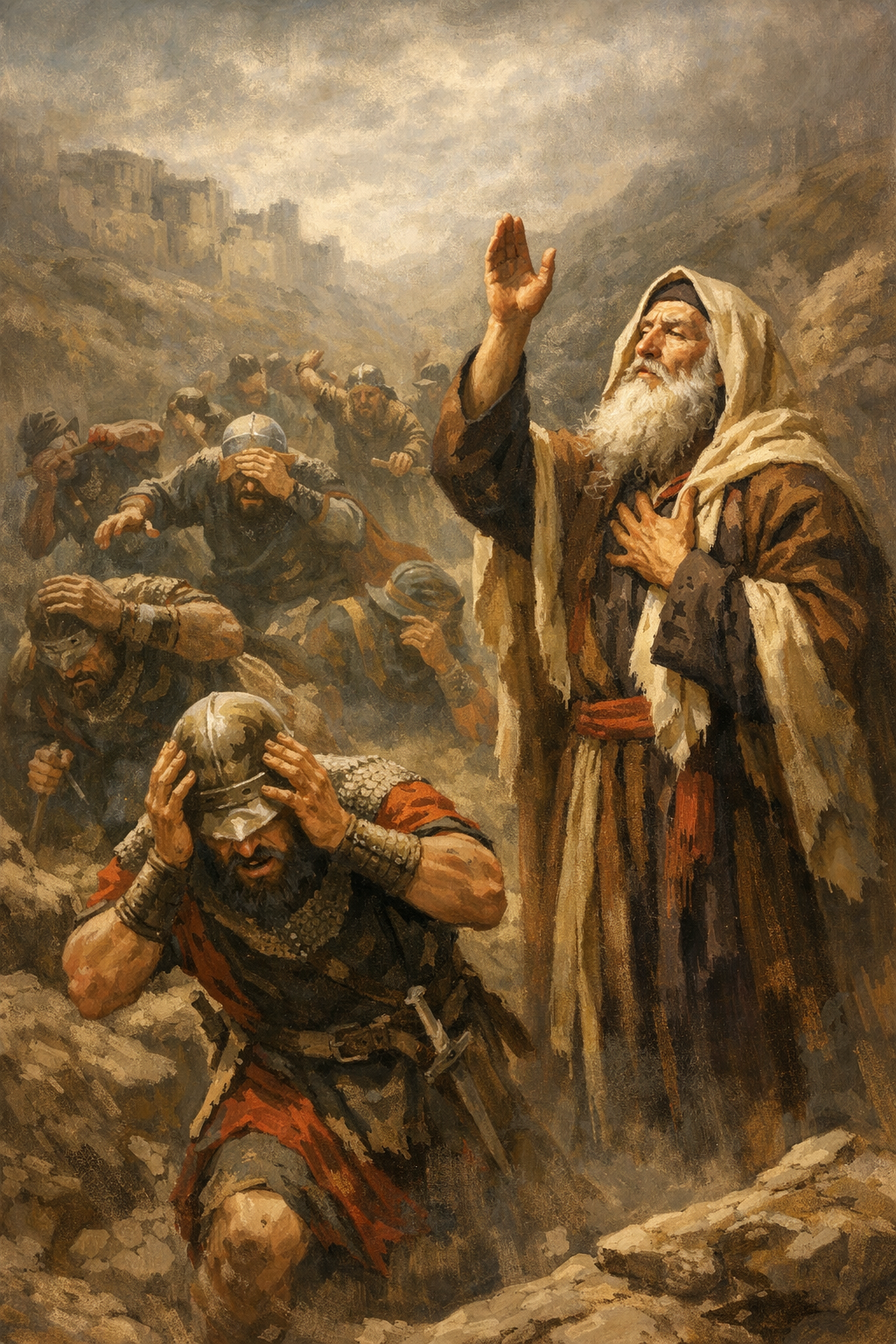
PRAYER FOR EYES
TO BE CLOSED
When they came down to him - They came down is not the angels but the Aramean army who did not see the angelic forces. Notice that the Arameans cannot see what Elisha and his attendant see and their forces advance on Dothan to capture Elisha.
Elisha prayed to the LORD and said, “Strike this people with blindness (sanverim; Lxx - aorasia - inability to see), I pray.” - Once again we see God's man fighting with prayer. Whereas the prayer to open the attendant's eyes was to see spiritually, this prayer was for the Arameans to be unable to see physically. This blindness of the enemy recalls the angels striking the Sodomites trying to break into Lor's house (Ge 19:11).
TECHNICAL NOTE - Elisha's request to strike is in the imperative in Hebrew and Greek and thus is a command. I have found a number of OT prayers that use the imperative and it has always confused me somewhat. Clearly we cannot command God to do anything in the same way we might command another human being. I interpet these imperative prayers more as bold (still humble) confidence, and definitely not arrogance or entitelment. Such praying is especially appropriate when we know God's will, which is another reason we should frequently pray God's word which reveals His will (cf 1Jn 5:14,15).
So He (Yahweh) struck them with blindness (sanverim; Lxx - aorasia - inability to see) according to the word of Elisha - NET - "as Elisha requested." Notice the phrase according to the word of Elisha. The point is that God act in accordance with the word of Elisha because he prayed in alignment with God’s will. There is no actual verbal answer from God, only affirmative action, miraculously rendering the great army utterly helpless in a moment. Imagine the thoughts that went through the minds!
The imagery of sight and blindness is rarely set in sharper contrast than in this passage. The servant saw only the enemy and was blind to spiritual reality, whereas the prophet clearly perceived that the enemy was always outmatched by heavenly forces. Elisha simply prayed that Yahweh would open his servant’s eyes (v. 17) and close the Arameans’ eyes (v. 18). Once again this narrative reminds us that things are rarely as they appear to our limited human perspective. This insight also helps illuminate the experience of Job. He had no awareness of what had taken place in the heavenly realm between Yahweh and “the Satan,” as recorded in Job 1–2. Yet this is not entirely comforting for Job or his companions, for God’s purposes often remain beyond human comprehension—truly, His ways are “past finding out” (Rom. 11:33).
Iain Provan on the nature of the blindness - In view of vv. 19–20, this is probably not physical blindness, but rather a dazed condition. The Arameans are open to the suggestion and manipulation of the prophet, but they can still see well enough to follow him to Samaria. (1 & 2 Kings)
ESV Study Bible on the nature of the blindness - Probably not a loss of physical sight (since the Syrians would not doubt their location just because they could no longer physically see it), but rather a dazed mental condition in which they are open to suggestion and manipulation but still able to follow the prophet to Samaria. The Syrians are “bedazzled” and do not “see” things clearly, whereas Elisha’s servant has been given perfect clarity of “sight” about reality. (See ESV Study Bible - Page 1118)
Blindness (05575) sanverim sudden blindness which refers to an inability to find one's way, inability to see properly. It is found only in Ge 19:11 and 2Ki 6:18, both times associated with angels (2Ki 6:17), both times resulting in rescue and both translated in Lxx with aorasia, the inability to see.
Gilbrant - Attested in Jewish Aramaic with the meaning "to blind," this noun is used to describe sudden miraculous blinding. In Gen. 19:11, Lot's visitors strike the offensive men of the city blind after pulling Lot back behind the door of his house. In 2 Ki 6:18, the Arameans are struck with temporary blindness just as Elisha prays. Some scholars think the blindness was achieved by a bright flash, since some cognates mean "to dazzle." This could be one explanation for what seems to have been a blindness that wore off. (Complete Biblical Library)
NET NOTE - On the basis of the Akkadian etymology of the word, M. Cogan and H. Tadmor (II Kings [AB], 74) translate “blinding light.” HALOT 761 s.v. סַנְוֵרִים suggests the glosses “dazzling, deception.”
2 Kings 6:19 Then Elisha said to them, “This is not the way, nor is this the city; follow me and I will bring you to the man whom you seek.” And he brought them to Samaria.
- follow me: Mt 16:24 Mk 8:34 Lu 9:23
- I will bring: 2Sa 16:18,19 Lu 24:16
ELISHA LEADS THE BLIND
ARAMEANS TO ISRAEL'S CAPITAL
Then Elisha said to them, “This is not the way, nor is this the city - NET = "This is not the right road or city." The Arameans thought they were going to Dothan, but Elisha redirected them to Samaria. They came to Dothan to capture Elisha as an enemy target. But under God’s intervention, God had changed the terms. The “right” path for God’s plan was now for them to be redirected to Samaria, where God would reveal His sovereignty and mercy.
Follow me and I will bring you to the man whom you seek - Clearly the Arameans were not totally blinded, for they could still walk, hear, and follow instructions. Note the irony. The man they were seeking was the very one speaking to them! The hunters have become the helpless and the hunted is now the guide!
Warren Wiersbe - When Elisha went out to meet the Syrian troops, did he lie to them (2Ki 6:19)? No, because he was no longer in the city of Dothan and was actually going to Samaria. The prophet was actually saving their lives, for if King Joram had been in charge, he would have killed them (2Ki 6:21). Elisha did bring the troops to the man they wanted. When the army arrived at Samaria, the guards must have been shocked to see the prophet leading the troops, but they obediently opened the gates and then God opened their eyes. Imagine their surprise when they found themselves at the heart of the capital city and at the mercy of the Israelites. (See Bible Exposition Commentary)
ESV Study Bible - I will bring you to the man whom you seek. The statement is somewhat puzzling, but rather than leaving the Syrians, Elisha did in fact bring them face to face with the man they were looking for. (See ESV Global Study Bible - Page 1120)
Dale Ralph Davis explains their blindness this way - The ‘blindness’—certainly here and probably in Genesis 19—is not an absence of sight but some sort of visionary befuddlement or visual confusion. (Borrow 2 Kings: The Power and the Fury page 114)
And he brought them to Samaria - This would have been about a 10-12 mile walk that would taken them 4-6 hours to arrive at Samaria.
Norman Geisler - 2 KINGS 6:19—Didn’t Elisha lie to the Syrian troops who were coming to capture him? - When Critics Ask
PROBLEM: When Elisha went out to meet his enemies, he told them “this is not the way, nor is this the city. Follow me, and I will bring you to the man whom you seek” (2 Kings 6:19). How could a man of God lie to these Syrian troops?
SOLUTION: What Elisha told them was not actually a lie. The Syrian troops were sent to Dothan to capture Elisha. The Lord blinded them, and Elisha came out of the city to meet them. What Elisha told them was “this is not the way, nor is this the city.” Once Elisha came out of the city he was no longer in Dothan. Consequently, entering Dothan was no longer the way to capture Elisha, neither was it the city. Elisha also instructed them, “follow me and I will bring you to the man whom you seek.” This was also true. Elisha went before them into Samaria, and when they arrived, the Lord opened their eyes and they saw Elisha, and that they were in Samaria. (As to whether lying is ever justified, see comments on Ex. 1:15–21.)
Gleason Archer - Was not Elisha the prophet guilty of lying to the Syrian troops in 2 Kings 6:19? Encyclopedia of Bible Difficulties
Technically Elisha’s statement to the foreign invaders was true in the light of the situation in which he made it. He said to the expeditionary force of Benhadad, sent to capture him by surprise, “This is not the way, nor is this city; follow me and I will bring you to the man whom you seek” (NASB). While it is true that Dothan had been Elisha’s location the night before and that they had taken the right way to get up to Dothan, nevertheless neither of those facts was now true. Why? Because Elisha was no longer in Dothan; he had come out of the city to meet them. Therefore the way up to Dothan was no longer the right path for them to use if they wished to capture the troublesome prophet. Thus he was only speaking the truth when he said, “This is not the way, nor is this the city.” It was not Elisha’s purpose to go in front of them down the highway to Samaria, the city where he would remove the “blindness” (i.e., their inability to recognize him) from their eyes. Consequently the rest of his statement was likewise true: if they would follow him all the way down to Samaria, then he would indeed bring them to Elisha inside the city of Samaria. The following verse (v.20) shows how he fulfilled his promise to the letter. Samaria was the right city for them to see the prophet they had come to capture. But unfortunately for them, when they did get into Samaria, they saw their hoped-for quarry surrounded by the regimental troops of the king of Israel; and it was the Syrians who were taken prisoner.
This delightful episode certainly does record the complete discomfiture of the foreign invaders by a supernatural blindness cast on them by the Lord (somewhat like the blindness sent on the Sodomites who riotously attempted to break down the door to Lot’s house [Gen. 19:11]). But it is not really justified to call Elisha’s statement a lie, for every part of it was technically correct. Nowhere does he actually say, “I am not the man you are looking for.” He only said that he would lead them to that man in the city where they would find him (as soon as as he got there).
2 Kings 6:20 When they had come into Samaria, Elisha said, “O LORD, open the eyes of these men, that they may see.” So the LORD opened their eyes and they saw; and behold, they were in the midst of Samaria.
- open the eyes: 2Ki 6:17 Lu 24:31
- opened: Jdg 20:40-42 Lu 16:23
ELISHA'S PRAYER TO
REVERSE THE BLINDNESS
When they had come into Samaria - The Aramean army are now within the capital city of Samaria, the place with likely the highest concentration of Israeli forces in the entire country. They were moments away from complete destruction. Yet, as the story unfolds, we see Yahweh even protecting the Arameans by restraining the king of Israel. Proverb 21:1 says " king’s heart is like channels of water in the hand of the LORD; He turns it wherever He wishes."
Elisha said, “O LORD, open the eyes of these men, that they may see.” Another prayer in the will of God is answered affirmatively. Elisha prays that God would restore their sight so that they may fully recognize where they are, how helpless they are, who truly has authority and ultimately, who God is. They are not victims of luck, trickery, or cunning strategy. They are held in place by the sovereign power of God.
So the LORD opened (Lxx = dianoigo) their eyes and they saw - Imagine their shock! When God opens their eyes, they see the greater reality: their fate is in Yahweh’s hands. Just as Elisha earlier prayed for his servant, “O LORD, open his eyes that he may see” (2 Ki 6:17), now he prays the same for his enemies. God opens eyes of the fearful servant to see divine protection and now of the hostile enemy to see divine authority and mercy. Both need God’s intervention.
THOUGHT- God still opens blind eyes today—physically, emotionally, and spiritually to help people see Who He is. For example in Acts 16:14 "A woman named Lydia, from the city of Thyatira, a seller of purple fabrics, a worshiper of God, was listening; and the Lord opened (dianoigo - same verb as here in 2Ki 6:20!) her heart to respond to the things spoken by Paul." The same gracious God who opened the eyes of the Arameans in Elisha’s day and Lydia's "eyes" in Paul's day still opens hearts and minds today. Are there areas in your own life where you need God to open your eyes to truth, correction, or encouragement? What does it teach us about praying for those who do not yet see or understand the truth about God?
And behold (hinneh; ; Lxx - idou) - Normally commands our attention. It certainly got the attention of the Aramean army!
They were in the midst of Samaria - NET - "in the middle of Samaria" The scene carries a striking and almost humorous irony. The Arameans had confidently surrounded Dothan, thinking they had Elisha trapped only to find themselves later surrounded in Samaria. Those who came to encircle God’s servant are now, by God’s sovereign hand, the ones encircled. Their strength collapses into helplessness, and their strategy is swallowed up by God’s greater wisdom and power.
Dale Ralph Davis: That is not the sort of ‘care’ one expects between enemies. It is rather exceptional. And the Syrians knew this all too well. One can almost hear their hearts thud when Yahweh opened their eyes after Elisha’s prayer: ‘they looked and— ah!—in the middle of Samaria!’ (v. 20b). They knew it was ‘curtains’. And yet they were spared. If then the Syrians really had eyes to see they would understand that they had come under Yahweh’s protection; it was offered to the likes of them. For here Yahweh not only protected Elisha and Israel by disabling the Syrians but protected the Syrians by restraining Israel’s king. Not only Israel but unwashed gentiles can have Yahweh as sun and shield. What an opportunity this was for these Syrians if they had had eyes to see it. This text is joyful news we can bring to all: it’s not just for churchy folks—the shelter of the Lord is open to you. One is tempted to tamper with Joseph Hart’s marvelous hymn—‘Come, ye Syrians, poor and wretched, weak and wounded, sick and sore.’ (Borrow 2 Kings: The Power and the Fury page 114)
2 Kings 6:21 Then the king of Israel when he saw them, said to Elisha, “My father, shall I kill them? Shall I kill them?”
- My father : 2Ki 2:12 5:13 8:9 13:14
- shall: 1Sa 24:4,19 26:8 Lu 9:54-56 22:49
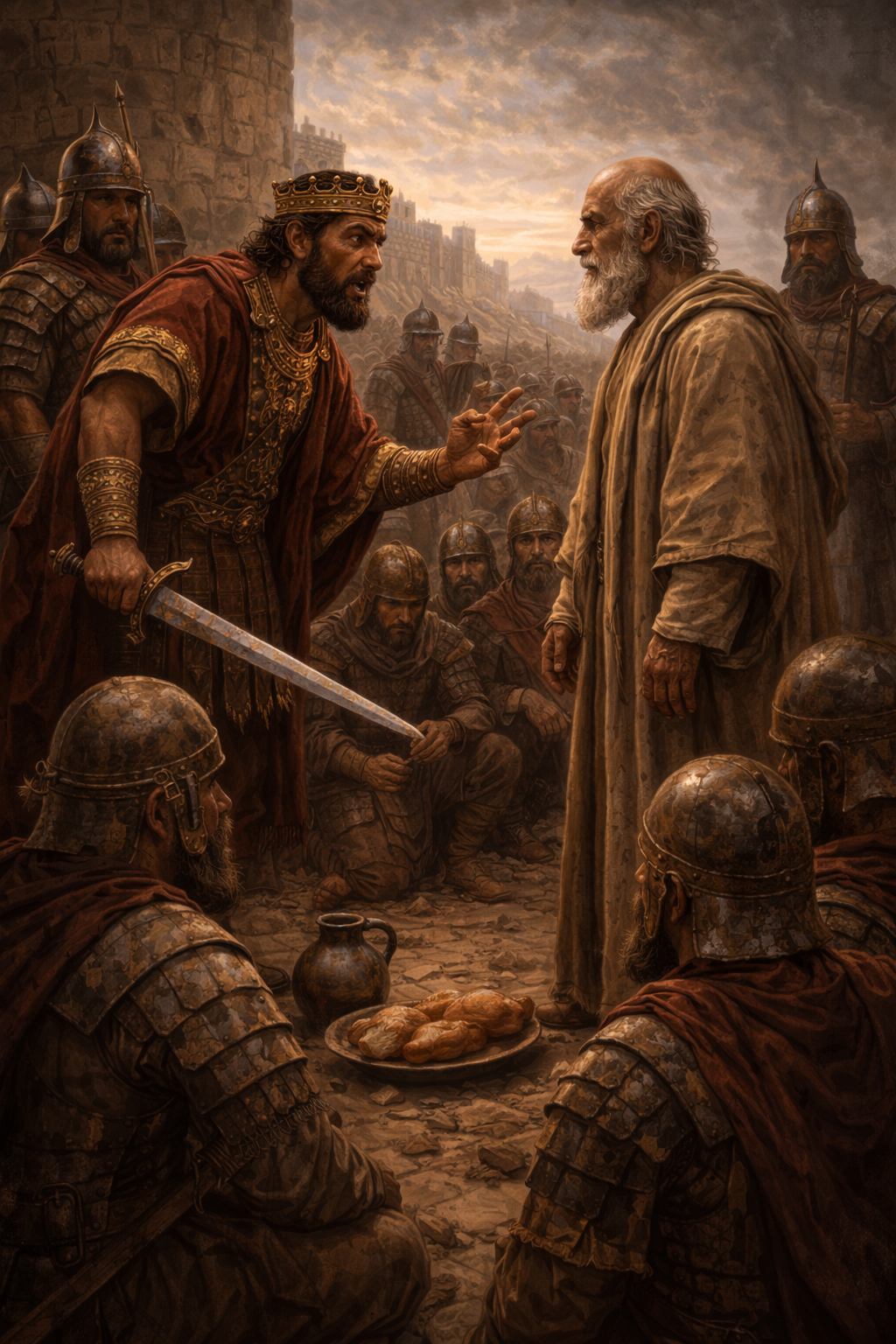
"Shall I kill them?"
THE KING OF ISRAEL'S
SUBMISSIVE QUESTION
Then the king of Israel when he saw them - Imagine the shock of the king seeing a great Aramean army (presumably including their chariots and horses), captured by one man, Elisha.
Said to Elisha, “My father" - The king uses FATHER as a title of honor and reverence acknowledging Elisha’s spiritual authority, recognizing that the prophet, not himself, is the one in control. His acknowledging Elisha as father is similar to Elisha calling Elijah “My father, my father” (2 Ki 2:12). We do see Jehoram humbling himself in this moment.
Shall I kill them? Shall I kill them - He speaks as a natural man would seeking bloodthirsty vengeance. Notice the repetition which in Hebrew is highly expressive. It conveys intense excitement, eagerness, shock and surprise at such an opportunity and almost a bursting question something like “This is incredible! Do I get to destroy them?”
Walter Kaiser - 2Ki 6:21–23 Why Were the Syrians Spared? - Hard Sayings
Why did Elisha spare the lives of this reconnaissance group when most say that the Old Testament elsewhere is marked by a ruthless treatment of Israel’s enemies? Does this point to an inconsistent policy in the nation and the testament?
The problem here is that it is wrong to universalize the provision of Deuteronomy 20:13, with its principle of ḥerem, the involuntary dedication for total destruction of all those so marked out by God. The conditions of total destruction of all living things and possessions (except what could not burn, such as gold, silver or iron, which was to be put into the tabernacle or temple) applied only to the nation of Canaan. The only other peoples to be involved in the ḥerem were the Amalekites, for the reasons announced in the Bible (1 Sam 15:2–3).
All other nations were to be treated differently, even when God had authorized Israel or Judah to proceed against them. The divine permission did not give Israel the right to run roughshod over the population and abuse their human rights and dignity. To do so would be to earn the wrath of God.
Instead of exterminating them, they were to be offered terms of peace. Thus, Elisha prepared a table in the presence of his enemies. Moreover, the Syrian raids ceased operating, for who can fight against a God who knows even the secrets of one’s bedroom? Nothing could be concealed from him and nothing could compete with him. No wonder the prophet Elisha was not intimidated in the least by all Syria’s power and might. Why should he be?
2 Kings 6:22 He answered, “You shall not kill them. Would you kill those you have taken captive with your sword and with your bow? Set bread and water before them, that they may eat and drink and go to their master.”
- would: De 20:11-16 2Ch 28:8-13
- sword: Ge 48:22 Jos 24:12 Ps 44:6 Ho 1:7 2:18
- set bread: Pr 25:21,22 Mt 5:44 Ro 12:20-21
Related Passages:
Proverbs 25:21-22 If your enemy is hungry, give him food to eat; And if he is thirsty, give him water to drink; 22 For you will heap burning coals on his head, And the LORD will reward you.
Romans 12:20-21 (See HOW TO TREAT YOUR ENEMY) “BUT IF YOUR ENEMY IS HUNGRY, FEED (present imperative see our need to depend on the Holy Spirit to obey) HIM, AND IF HE IS THIRSTY, GIVE (present imperative see our need to depend on the Holy Spirit to obey) HIM A DRINK; FOR IN SO DOING YOU WILL HEAP BURNING COALS ON HIS HEAD.” 21 Do not be overcome () by evil, but overcome (present imperative see our need to depend on the Holy Spirit to obey) evil with good.
COMMENT - Heap burning coals on someone’s head is an expression associated with punishment in the Bible (Psalm 11:6; 140:10). The idea is that under the heat and pressure of applied kindness, the person will feel ashamed, regret his actions, and repent. The phrase could have originated from an ancient Egyptian propitiation ritual in which a person guilty of a crime was made to carry a basin of burning embers on his head as a symbol of his repentance. The goal of treating our enemies with kindness is to bring them to a place of conviction about their wrongdoing and, thus, cause them to repent. (GOTQUESTIONS.ORG)
Matthew 5:44 “But I say to you, love your enemies and pray for those who persecute you (ELISHA DID EXACTLY THAT!),
Matthew 5:7 “Blessed are the merciful, for they shall receive mercy.

Drop the Sword & Give Bread & Water
FEED YOUR ENEMY
WATCH GOD WORK!
He answered, “You shall not kill them. - Elisha's word is clear. Elisha commands kindness instead of execution.
Would you kill those you have taken captive with your sword and with your bow? - Elisha challenges the king with what amounts to a rhetorical question. Even in normal warfare, prisoners of war captured in battle were not ordinarily executed. If you wouldn’t kill captives you captured by your own power, how much less should you kill men whom God has given you in a miraculous way?
Set bread and water before them, that they may eat and drink and go to their master - Instead of killing them, "kill them with kindness!' Instead of execution, Elisha instructs the king to feed them, treat them generously and send them home in peace. Mercy becomes the instrument God used to end hostility at least temporarily. This is a fascinating scene, because in the ancient world sharing a meal often signified covenant fellowship. It was not casual hospitality, but an act that symbolized agreement, loyalty, and relationship (cf. Ge 26:26–31) (See Covenant Meal). Of course, in the present context there was no actual covenant formed between Israel and Aram.
🙏 THOUGHT - Is there someone with whom you have an adversial relationship? If so perhaps you need to take Elisha's (and Paul's) advice to "feed them" and "heap burning coals upon their head!" (See passage and note above). Notice that passage has four commands all in the present imperative (calling for this to be our habitual practice) which shows that you absolutely cannot obey these four commands by relying on your own (natural, fleshly) strength, but only by yielding to the control of the Holy Spirit (Eph 5:18, Php 2:13NLT).
Warren Wiersbe - King Joram would have slain all of the Syrian soldiers and claimed a great victory for himself, but Elisha intervened. The king graciously called Elisha “my father” (2Ki 6:21), a term used by servants for their master (2Ki 5:13), but later, he wanted to take off Elisha’s head (2Ki 6:32)! Like his wicked father, Ahab, he could murder the innocent one day and then “walk softly” before the Lord the next day (1Ki 21). Double-minded people are unstable (Jas 1:8). (See Bible Exposition Commentary)
2 Kings 6:23 So he prepared a great feast for them; and when they had eaten and drunk he sent them away, and they went to their master. And the marauding bands of Arameans did not come again into the land of Israel.
- he prepared: 1Sa 24:17,18 2Ch 28:15 Pr 25:21,22 Mt 5:47 Lu 6:35 10:29-37
- the marauding bands: That is, for a considerable time. What is mentioned in the next verse was more than a year afterwards. See on ver. 2Ki 6:8,9 5:2 24:2
Related Passages:
2 Kings 5:2 Now the Arameans had gone out in bands (gedud; Lxx - monozonos = "lightly armed") and had taken captive a little girl from the land of Israel; and she waited on Naaman’s wife.
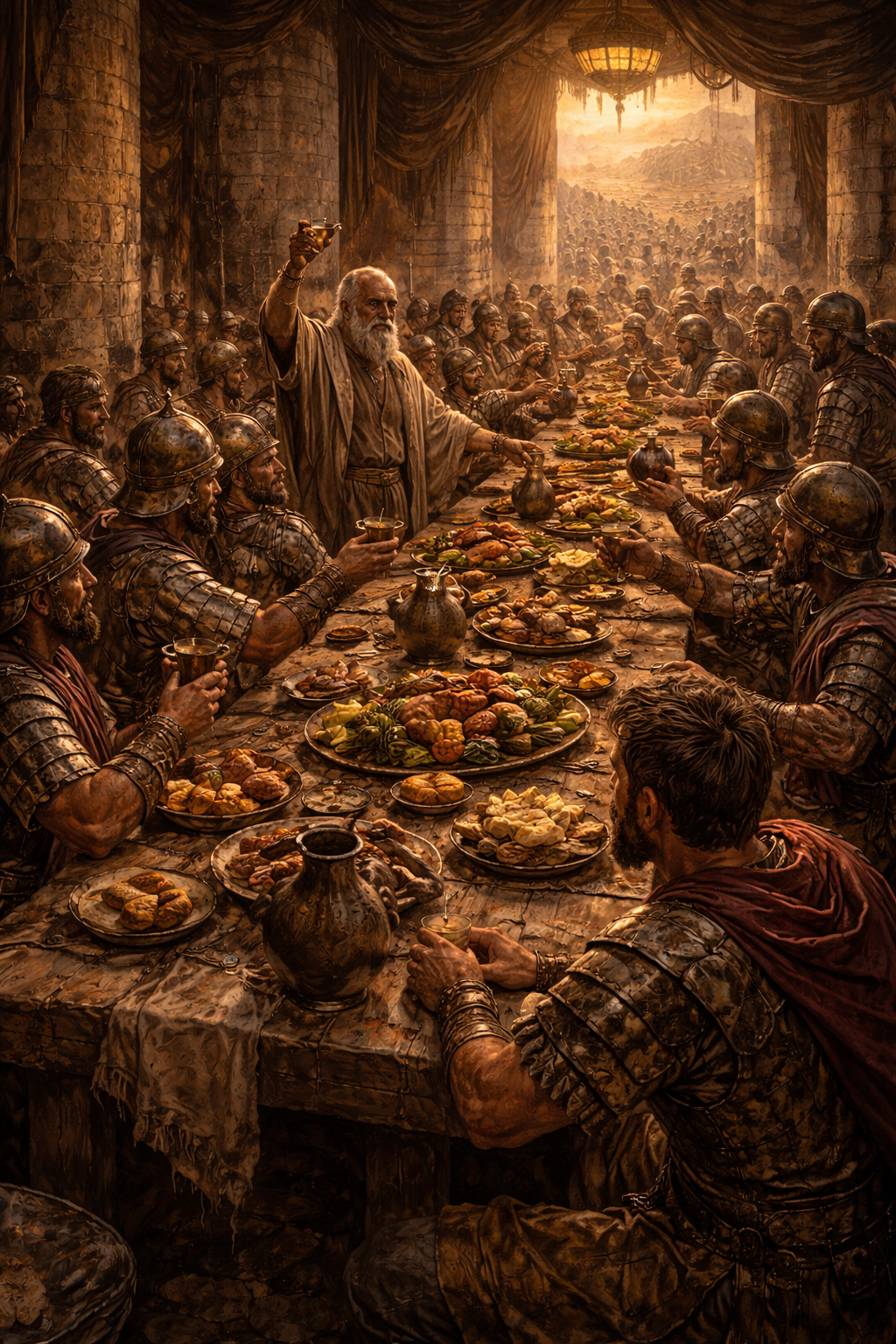
Great Feast for the Aramean Enemy
THE CONSEQUENCES
OF COMPASSION
So he prepared a great feast for them - The meal wasn’t a snack but a great feast as suggested by the Hebrew and Septuagint (Greek uses the adjective megas which means large or great). The king showed deliberate generosity, not bare-minimum hospitality. This is over the top mercy. He does not give them just a piece of stale bread and a cup of lukewarm water!
And when they had eaten and drunk he sent them away, and they went to their master - The king of Israel treated them as guests rather than prisoners, and then released them unharmed. Imagine their explanations to the king of Aram. The purpose of blinding and then restoring sight to the Aramean soldiers would surely have been clear demonstration (witness) to the king of Aram of the mighty power of God.
And the marauding bands (gedud; Lxx - monozonos = "lightly armed") of Arameans (Syrians) did not come again into the land of Israel - Israel did not overcome the Aramean raids by sword but by kindness initiated by the divine wisdom of Elisha.
What a hostile king intended for evil,
God worked through His prophet to bring about good.
-- Harry Shields
Paul House - Elisha aids those in distress over “small” matters, such as a lost axhead, and those concerned with larger, societal issues such as war. (See 1, 2 Kings - Volume 8 - Page 277)
Whitcomb: this would be one more opportunity to confirm in the thinking of the Syrians that “the kings of the house of Israel are merciful kings” (I Kings 20:31, because their God is a merciful God. The Syrians must have been greatly impressed, not only with Jehovah’s mercy, but also with Elisha’s superhuman insight, “for the bands of Syria came no more into the land of Israel” (II Kings 6:23).
Marauding bands (raiders) (01416) gedud from gadad = to penetrate, cut. This refers to a marauding band, a raiding party, or a group that makes inroads into enemy territory, sometimes referring to Israel's forces (2Sa 4:2, 2Ch 22:1), but more often bands raiding into Israel (Gen. 49:19; 1 Sam. 30:8, 15, 23; 1 Ki. 11:24; 2 Ki. 5:2; 6:23; 24:2). Vine adds gedud "trepresents individuals or a band of individuals who raid and plunder an enemy. The units that perform such raids may be a group of outlaws ("bandits"), a special unit of any army, or an entire army. Ancient peoples frequently suffered raids from their neighbors. When the Amalekites "raided" Ziklag, looting and burning it while taking captive the wives and families of the men who followed David, he inquired of God, "Shall I pursue after this troop? shall I overtake them?" (1 Sam. 30:8). In this case, the "raiding band" consisted of the entire army of Amalek. This meaning of gedûd occurs for the first time in Gen. 49:19: "…A troop shall overcome him." Here the word is a collective noun referring to all the "band of raiders" to come. When Job described the glory of days gone by, he said he "dwelt as a king in the army [nasb, "troops"]" (Job 29:25). When David and his followers were called a gedûd, they were being branded outlaws, men who lived by fighting and raiding (1 Kings 11:24)." (Vine's Expository Dictionary)
Victor Hamilton - The word usually refers to those who take part in a military raid, but occasionally it may refer to the raid itself: 2 Samuel 3:22. More often than not, the noun refers not to Israel's own troops but to those of her enemies: 1 Samuel 30:8, 15, 23; 1 Kings 11:24; 2 Kings 5:2; 2 Kings 6:23; 2 Kings 24:2. In certain situations God may allow these unbelievers to inflict damage on his own people for chastisement (Jeremiah 18:22). A gedûd could operate officially under royal sponsorship: 2 Samuel 3:22 (David); 2 Samuel 4:2 (Ishbosheth); 2 Chron. 22:1 (Ahaziah); 2 Chron. 25:9-10 (Amaziah); 2 Chron. 26:11 (Uzziah). The function of such troops, perhaps mercenaries, was not to acquire land, but rather to put pressure for conformity on peoples already reduced to vassalage. In some cases these bands became primarily looters. This is the case of the "band" of the Amalekites mentioned in 1 Samuel 30:8, 15, 23. There are a few references in the Bible to gedûd who operate independently; thus, "troop of robbers" in Hosea 6:9; Hosea 7:1. Two times the book of Job refers to God's gedûd: Job 19:12; Job 25:3, analogous to Yahweh ṣebā’ôt, "Lord of hosts/armies." Job says that he himself was once like a king among his "troops" (Job 29:25). (See online TWOT)
GEDUD - 29V - band(6), band of raiders(1), Bandits(1), bands(7), divisions(1), marauding band(2), marauding bands(1), raid(1), raiders(3), troop(2), troops(7), troops*(1). Gen. 49:19; 1 Sam. 30:8; 1 Sam. 30:15; 1 Sam. 30:23; 2 Sam. 3:22; 2 Sam. 4:2; 2 Sam. 22:30; 1 Ki. 11:24; 2 Ki. 5:2; 2 Ki. 6:23; 2 Ki. 13:20; 2 Ki. 13:21; 2 Ki. 24:2; 1 Chr. 7:4; 1 Chr. 12:18; 1 Chr. 12:21; 2 Chr. 22:1; 2 Chr. 25:9; 2 Chr. 25:10; 2 Chr. 25:13; 2 Chr. 26:11; Job 19:12; Job 25:3; Job 29:25; Ps. 18:29; Jer. 18:22; Hos. 6:9; Hos. 7:1; Mic. 5:1
2 Kings 6:24 Now it came about after this, that Ben-hadad king of Aram gathered all his army and went up and besieged Samaria.
- gathered: 2Ki 17:5 18:9 25:1 De 28:52 1Ki 20:1 22:31 Ec 9:14

Arameans Encircle Samaria
ARAMEANS INVADE ISRAEL
NOT TO RAID BUT TO BESIEGE
Now it came about after this - The Hebrew simply means sometime later and marks a transition in the narrative but not a marker of specific time. After this is of course after the "truce" and cessation of border raids by the Arameans, but it could mean weeks, months, or even years. In any event this phrase marks a new narrative unit, a new stage in Aram’s hostility from the “raiding parties” to the siege.
That Ben-hadad king of Aram - Note that the name Ben-hadad was a name given to Syrian kings, much like several Egyptian rulers were called Pharaoh. There were at least 3 Ben-hadad's in these accounts in 1-2 Kings (see chart above). The question is whether this is the same Ben-hadad described in the immediately succeeding section or is his successor. One feature of the books of Kings is that the writer can compress events.
Gathered all his army and went up and besieged (tsûr/sur; Lxx = perikathizo = to "sit around") Samaria - Clearly the time has been long enough for circumstances and strategy to change, all of course from God Who sovereignly allows a new crisis to arise. This event marks a major escalation of Aramean-Israeli tensions. There is a bit of irony in the Arameans encircling a city (Samaria) where their army was once surrounded by the forces of Israel. The fact is that God’s past mercy did not guarantee no future testing. Circumstances changed and Aramean hostility returned in another form.
Related Resource:
- Good brief discussion of "Siege Warfare" - BORROW Roland DeVaux, Ancient Israel, pp. 236-237 and page 238.
Besieged (harass, attack) (06696) tsûr/sur has the basic meaning to enclose or to confine. It conveys the ideas of to lay siege, to secure, to tie up or bind (2Ki 5:23, Ezek 5:3, Dt 14:25), to surround. The most common meaning of tsûr is to lay siege, usually to a city, by surrounding it and cutting off its supplies. To “encircle and enclose a fortified area as an aggressive military strategy to defeat a city or nation.” The word does not necessarily denote an actual battle but emphasizes taking control of a city. For example, David's men besieged Rabbah (2Sa 11:1; 1Chr. 20:1); Nadab laid siege to Gibbethon (1Ki. 15:27) Omri to Tirzah (1Ki. 16:17). Saul attempted to surround David at Keilah (1Sa 23:8). The Assyrians under Ben-Hadad besieged Samaria (1Ki. 20:1; 2Ki. 6:24f). Shalmaneser V laid siege against Samaria (725BC 2Ki 18:9) which fell after three years (722BC). Nebuchadnezzar laid siege to Jerusalem in 597BC (2Ki. 24:11) and 588BC (Jer. 32:2; 37:5). Instructions to Israel regarding siege tactics appear in Dt. 20:12, 19. 2Sa 20:15 describes the strategy of building ramps to overtake a walled city.
QUESTION - Who was Ben-Hadad in the Bible? | GotQuestions.org
ANSWER - Ben-Hadad seems to have been the title of the reigning king of Aram (Syria). Ben-Hadad means “son of Hadad.” Hadad or Adad was the god of storm and thunder, and, as was common in that epoch of history, kings were seen as sons of the primary god of the region.
In the Bible, Ben-Hadad, the king of Aram, is mentioned in 1 Kings 15:18–22; throughout 1 Kings 20; 2 Kings 6:24; 8:9; 13:24–25; 2 Chronicles 16:2–4; Jeremiah 49:27; and Amos 1:4. Since Ben-Hadad is a title much like Pharaoh or President, the term can refer to different individuals at different times. The context of each passage must be studied to determine just who is involved. Most students of history accept the existence of three Ben-Hadads who ruled in Damascus: Ben-Hadad I, who ruled c. 900–860 BC; his son (or grandson) Ben-Hadad II, who ruled 860–841; and another, unrelated Ben-Hadad, the son of the man who assassinated Ben-Hadad II.
In 1 Kings 15:18, Ben-Hadad is designated as the son of Tabrimmon, the son of Hezion. In this passage, King Asa of Judah makes a treaty with Ben-Hadad to help protect himself against the king of Israel, who was threatening Judah. (This is also recorded in 2 Chronicles 16:2–4.) Ben-Hadad sent soldiers against Israel and King Baasha and conquered a number of towns, bringing some relief to Judah.
In 1 Kings 20, Ben-Hadad once again attacks the northern kingdom of Israel, where Ahab is now the king. It is possible that this is the same Ben-Hadad who attacked in 1 Kings 15, or it could be a son, Ben-Hadad II. It seems that this time Ben-Hadad is attacking on his own without consideration for any treaty with Judah. And this time, although he had 32 kings helping him (1 Kings 20:1), he is defeated by King Ahab and the army of Israel. About three years later, Israel and Syria renew their conflict, leading to Ahab’s final battle and death (1 Kings 22).
In 2 Kings 6–7, about nine years after Ahab’s death, Ben-Hadad II invades Israel and lays siege to Samaria, the capital. The siege went on for so long that the people in the city were starving to death. However, in the middle of the night, the Lord caused the Aramean army to hear sounds of an advancing army. Thinking the king of Israel was receiving help from foreign nations, all of Ben-Hadad’s men fled, leaving everything behind.
In 2 Kings 8, the prophet Elisha travels to Damascus and relays a paradoxical prophecy to Ben-Hadad II, who was ill: “Go and say to him, ‘You will certainly recover.’ Nevertheless, the Lord has revealed to me that he will in fact die” (verse 10). Just as Elisha said, Ben-Hadad began to recover from his illness, but then a man named Hazael murdered Ben-Hadad and took the throne of Aram. In 2 Kings 13, Hazael is succeeded by his son, who is also named Ben-Hadad. This final Ben-Hadad was defeated three times by King Jehoash of Israel, fulfilling another prophecy of Elisha (2 Kings 13:1–25).
In Jeremiah 49:27, the word of the Lord says, “I will set fire to the walls of Damascus; it will consume the fortresses of Ben-Hadad.” At the time of Jeremiah’s prophecy, none of the Ben-Hadads mentioned above would have been alive. The reference may be to the current king of Aram or perhaps to a fortress that had been built by and now bore the name of a former king. In Amos 1:4 we have a similar prophecy: “I will send fire on the house of Hazael that will consume the fortresses of Ben-Hadad.” By this time, the original Ben-Hadad had been killed, and Hazael was king. As above, “the fortress of Ben-Hadad” could simply refer to a fortress of the current king or to a specific fortress that was known by that name.
In summary, Ben-Hadad is the title of the Aramean king, “son of Hadad,” a prominent deity in the region. Several kings of Aram had extensive interaction with the kingdom of Israel and attacked several times. The Lord used Ben-Hadad and the Arameans to bring judgment on rebellious Israel, but He punished Aram for her evil, as well.
2 Kings 6:25 There was a great famine in Samaria; and behold, they besieged it, until a donkey’s head was sold for eighty shekels of silver, and a fourth of a kab of dove’s dung for five shekels of silver.
- a great famine: 2Ki 6:28,29 7:4 25:3 1Ki 18:2 Jer 14:13-15,18 32:24 52:6
- donkey’s head Eze 4:13-16
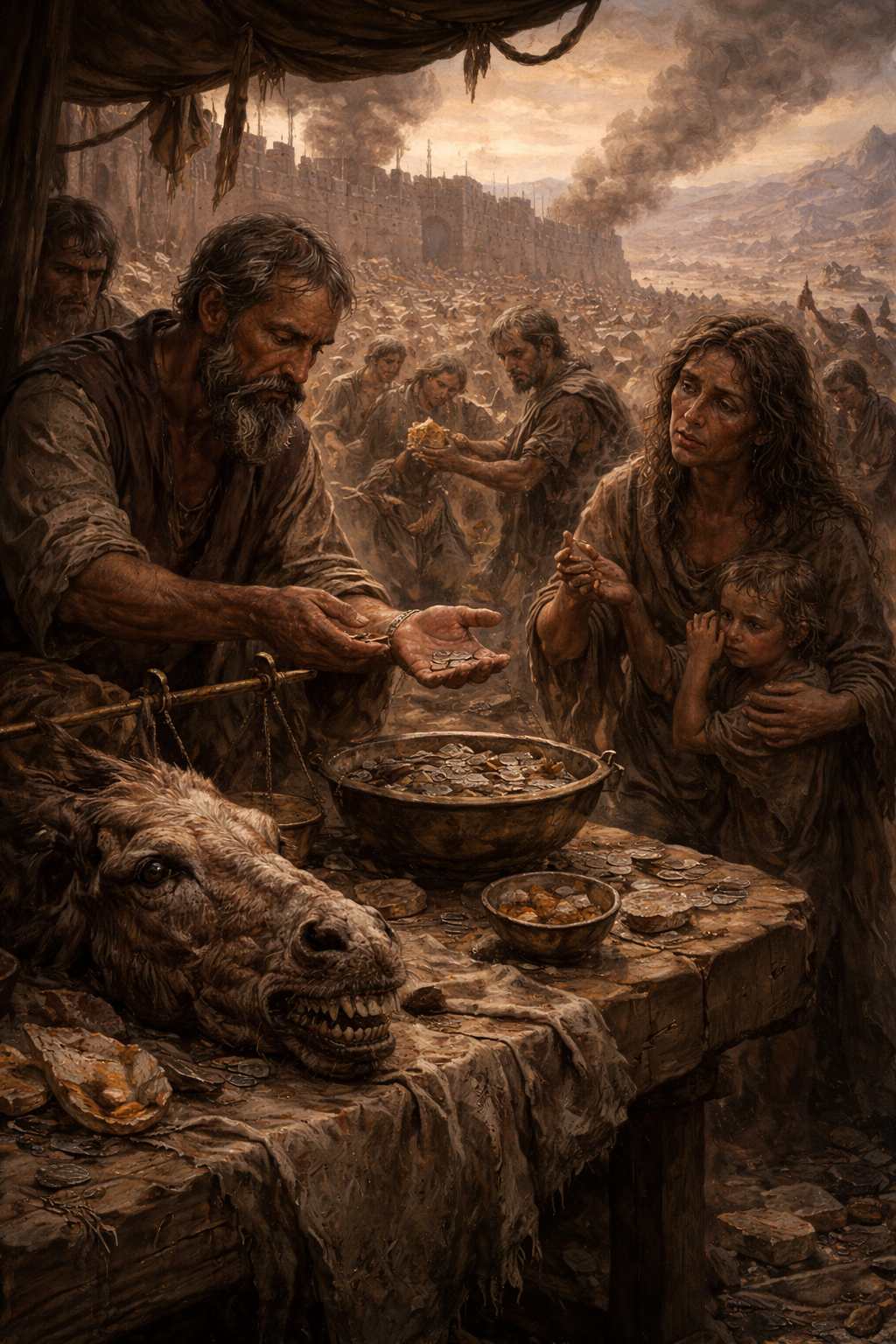
Donkey's Head for 80 Shekels!
SUCCESSFUL SIEGE
LEADS TO STARVATION
There was a great famine in Samaria and behold (hinneh; ; Lxx - idou) - Is this not ironic? In 2 Kings 6:23 the Israelites prepared a great feast for the Arameans, but here the Arameans “prepare” a great famine for the Israelites! This recalls the old idiom that it's either "feast or famine!" The Aramean siege achieves one of the goals of such a tactic which is to outlast the besieged city's supply of rations of food and water.
Until - Until marks how long the siege continued, which was long enough for conditions to become extreme. In this context until does not simply tell time passed but highlights that the situation worsened progressively, reaching an unimaginable level of desperation.
A donkey’s head was sold for eighty shekels (about 2 pounds) of silver, and a fourth of a kab (about 2 quarts) of dove’s dung for five shekels of silver (about 6 months’ wages of average worker) - Samaria is in dire straits! This description gives us the shocking evidence of the famine, so that the Israelites were reduced to eating unclean animals (cf. Lv 11:2-7; Dt 14:4-8), eating the worst part of them and paying exorbitant prices. The donkey has a single (not split) hoof and is not a ruminant. Hence its meat is unclean for Israel. The dove's dung was probably used for fuel, not eaten! The writer is preparing the reader for the even darker horror in the following passages.
TECHNICAL NOTE ON DOVE DUNG - The consonantal text (Kethib) reads, “dove dung” (חֲרֵייוֹנִים, khareyonim), while the marginal reading (Qere) has “discharge” (דִּבְיוֹנִים, divyonim). Based on evidence from Akkadian, M. Cogan and H. Tadmor (II Kings [AB], 79) suggest that “dove’s dung” was a popular name for the inedible husks of seeds. (NET Bible)
Dove dung probably means fuel but Rabshakeh predicted the besieged Israelites will "eat their own dung and drink their own urine!" (Isa. 36:12) As a medical doctor I would have to refute Rabhakeh's prediction because urine is a waste product and can actually make dehydration worse. However if they became desperate enough one might resort to these extreme measures similar to resorting to cannibalism described in 2 Kings 6.
ESV Study Bible on donkeys and dung - Donkeys were commonly found among the domestic animals in Syria-Palestine, and various OT laws identify them as significant possessions (e.g., Ex. 13:13; 20:17; 22:4). So severe was the siege that the inhabitants of Samaria were reduced not only to slaughtering and eating valuable animals, but also to consuming body parts that would not normally be consumed, and purchasing them for exorbitant prices (the cost of a live horse in 1Ki 10:29 is only 150 shekels of silver, and here a donkey’s head costs eighty). During this crisis even half a liter (the fourth part of a kab) of dove’s dung cost what the average worker could make in six months (five shekels of silver).
ESV Study Bible, The: English Standard Version.(See ESV Global Study Bible - Page 1120)
What we witness in the text then is
not Syrian atrocity but divine punishment.
-- Dale Ralph Davis
March 1865, Richmond, Virginia. The signs in store windows told a story of war: Bacon, $20 a pound; live hens, $50 each; beef, $15 a pound; fresh shad, $50 a pair; butter, $20 a pound.1 So it was during the War between the States. Cities can be reduced to desperate conditions in wartime. Ask Samaria.
Clarence Macartney recalls a ninteenth-century episode: ‘At the time of the gold rush to California, the Donner party, made up of high-class religious people from Illinois and other Midwest states, was overtaken by the snows in the Sierras at what is now Donner Lake, where most of them perished. It is a matter of record that the stronger waited eagerly for the weaker to die that they might devour their bodies. Even murder was committed so the survivors could devour the corpses’ (Chariots of Fire and Other Sermons on Bible Characters [New York: Abingdon-Cokesbury, 1951], 115–16).
2 Kings 6:26 As the king of Israel was passing by on the wall a woman cried out to him, saying, “Help, my lord, O king!”
NLT One day as the king of Israel was walking along the wall of the city, a woman called to him, "Please help me, my lord the king!"
- my lord: 2Sa 14:4 Isa 10:3 Lu 18:3 Ac 21:28
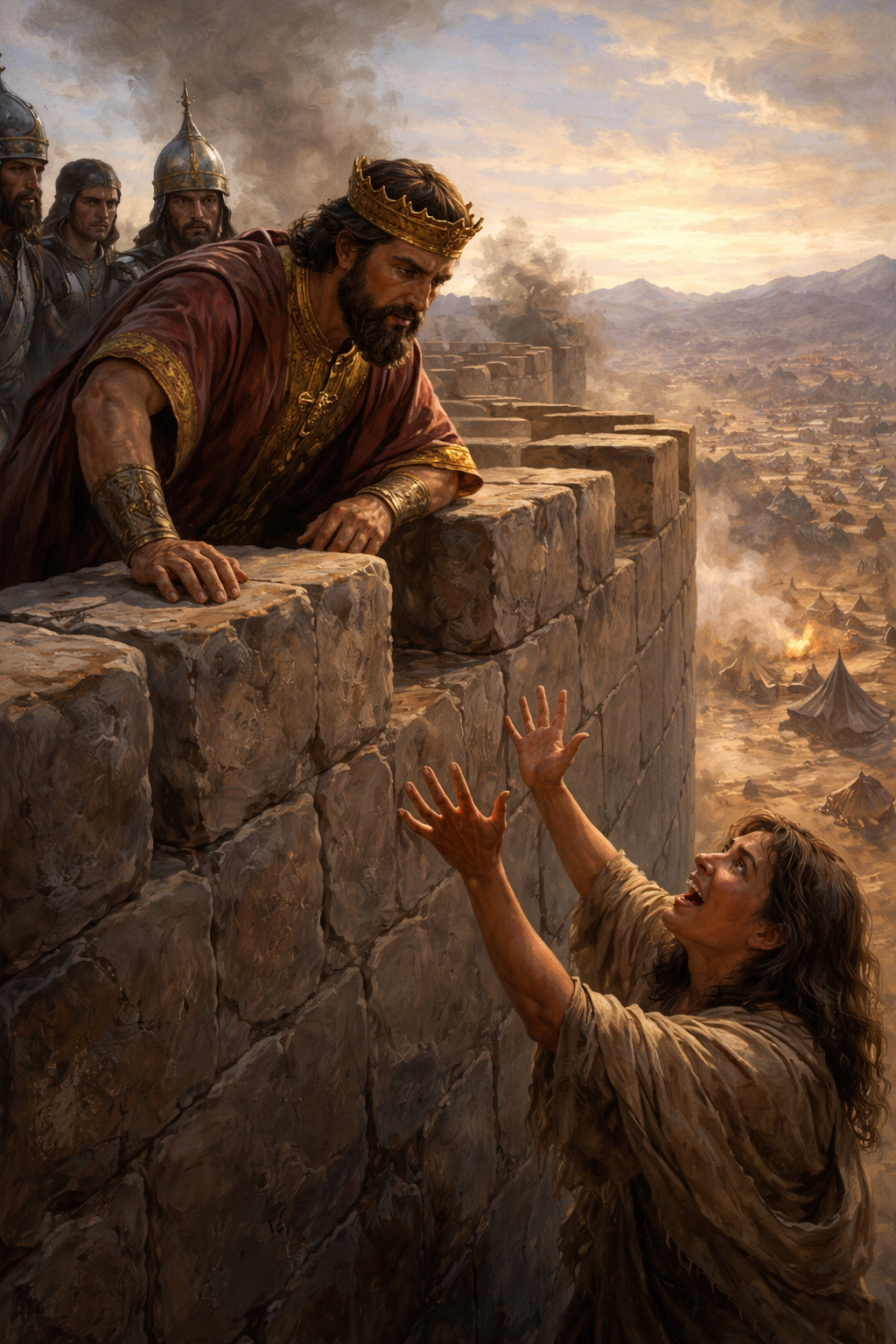
A HELPLESS WOMAN CRIES OUT
TO A HELPLESS KING
As the king of Israel was passing by on the wall - The king walking on the wall of the city could mean inspecting defenses, encouraging troops or surveying the desperate conditions of his people (or all of these things).
A woman cried out to him, saying, “Help, my lord, O king! - This is the cry of a mother in in unbearable distress turning to the highest human authority she knows. The king was supposed to be the ultimate court of human justice (1Ki 3:16-28), but the idolatrous nation of Israel had long departed from that Biblical ideal (cf Jezebel stealing Naboth's vineyard 1Ki 21:7-15, 16). A formal plea for royal intervention. But it also highlights irony for she still hopes the king can save her… though the king, the symbol of strength, leadership, and power is powerless and helpless to help her! Israel is experiencing covenant judgment (cf. Divine Curses on Israel in Deut 28:15-68), and no human power can reverse it.
2 Kings 6:27 He said, “If the LORD does not help you, from where shall I help you? From the threshing floor, or from the wine press?”
- where: Ps 60:11 62:8 118:8,9 124:1-3 127:1 146:3 Isa 2:2 Jer 17:5
HUMAN HELP EXHAUSTED
ONLY GOD REMAINS
He said, “If the LORD (Jehovah - Yahweh) does not help (yasha; Lxx - sozo = save, deliver) you - NET - He replied, "No, let the LORD help you. How can I help you?" He shows good theology (Yahweh can help) but poor application (In effect he blames God)! The idolatrous kings of Israel seemed to have short spiritual memories. Yet whenever they were confronted with a crisis beyond human ability, their minds were suddenly “refreshed,” and they once again remembered that only the power of Israel’s God could truly help in humanly impossible situations. The sad irony is the king acknowledges only God can truly help and yet he still does not truly trust or turn to God to plead for help. One wonders what would have happened had he humbled himself (called a fast, so to speak) and pled with the Lord? That's a hypothetical, rhetorical question.
From where shall I help (yasha; Lxx - sozo = save, deliver) you? - This question is rhetorical. If God doesn't help her, the king admits he cannot help her. The king knows he has nothing with which to help this woman.
From the threshing floor (speaks of grain supply - food), or from the wine press (speaks of winge supply - drink) - The normal supply of grain is exhausted for nothing comes from the threshing floor. The normal supply of drink is gone. The king is saying he has nothing to offer the women and only God could help now. As the king would soon discover, this poor woman wanted justice, not food!
Help (save, deliver, help) (03467) yasha' (See also yeshua from which we get our word "Jesus") is an important Hebrew verb which means to help, to save, to deliver. The root in Arabic is "make wide" which underscores the main thought of yasha' as to bring to a place of safety or broad pasture in contrast to a narrow strait which symbolizes distress or danger.
TWOT adds that the concept of "wide" "connotes freedom from distress and the ability to pursue one’s own objectives. To move from distress to safety requires deliverance. Generally the deliverance must come from somewhere outside the party oppressed. In the OT the kinds of distress, both national and individual, include enemies, natural catastrophies, such as plague or famine, and sickness. The one who brings deliverance is known as the “savior.” (Here is another link to the TWOT)
YASHA USES IN 2 KINGS - 2 Ki. 6:26; 2 Ki. 6:27; 2 Ki. 13:5; 2 Ki. 14:27; 2 Ki. 16:7; 2 Ki. 19:19; 2 Ki. 19:34;
2 Kings 6:28 And the king said to her, “What is the matter with you?” And she answered, “This woman said to me, ‘Give your son that we may eat him today, and we will eat my son tomorrow.’
- What is the matter with you Ge 21:17 Jdg 18:23 1Sa 1:8 2Sa 14:5 Ps 114:5 Isa 22:1
- Give your son: Lev 26:29 De 28:53-57 Isa 9:20-21 49:15 La 4:10 Eze 5:10 Mt 24:18-21 Lu 23:29
Related Passages:
Leviticus 26:27-29 (GOD'S WARNING TO ISRAEL FOR DISOBEDIENCE) ‘‘Yet if in spite of this you do not obey Me, but act with hostility against Me, 28 then I will act with wrathful hostility against you, and I, even I, will punish you seven times for your sins. 29 ‘Further, you will eat the flesh of your sons and the flesh of your daughters you will eat.
Deuteronomy 28:53-57 “Then (AS DIVINE CURSES UNFOLD ON ISRAEL) you shall eat the offspring of your own body, the flesh of your sons and of your daughters whom the LORD your God has given you, during the siege and the distress by which your enemy will oppress you. 54 “The man who is refined and very delicate among you shall be hostile toward his brother and toward the wife he cherishes and toward the rest of his children who remain, 55 so that he will not give even one of them any of the flesh of his children which he will eat, since he has nothing else left, during the siege and the distress by which your enemy will oppress you in all your towns. 56 “The refined and delicate woman among you, who would not venture to set the sole of her foot on the ground for delicateness and refinement, shall be hostile toward the husband she cherishes and toward her son and daughter, 57 and toward her afterbirth which issues from between her legs and toward her children whom she bears; for she will eat them secretly for lack of anything else, during the siege and the distress by which your enemy will oppress you in your towns.
DESPERATION SPEAKS:
A MOTHER'S DESPERATE PLEA
And the king said to her, “What is the matter with you?” - He will soon wish he had not asked this question!
And she answered, “This woman said to me, ‘Give your son that we may eat him today, and we will eat my son tomorrow - The desperate woman reveals the shocking depth of the famine’s cruelty by describing an act of cannibalism, exposing just how horrifying and inhumane the situation in Samaria had become.
Harry Shields points out that "The scene portrayed a situation that was the opposite of what Solomon faced in the dispute between two women (cf. 1Kg 3:16-28) However, Jehoram lacked the wisdom of Solomon. In fact, there was no hope in sight, outside of the merciful intervention of God, to help the people in their desperate circumstances." (Moody Bible Commentary page 530)
Paul House on the two women and two sons - Their dilemma is quite like the one brought to Solomon in 1 Kgs 3:16–28, for it involves two mothers, two sons, one of which has died and one of which is still living, and the future of the living child. In a cruel twist of the Solomon story, though, the mothers have agreed to eat their children; but one woman has broken the pact. The dead boy’s mother wants the king to make the other woman keep her word. Syria’s siege has led to the worst sort of atrocities. (See 1, 2 Kings: An Exegetical and Theological Exposition)
2 Kings 6:29 “So we boiled my son and ate him; and I said to her on the next day, ‘Give your son, that we may eat him’; but she has hidden her son.”
- hidden: 1Ki 3:26 Isa 49:15 66:13
Related Passages:
Deuteronomy 28:56-57 (CURSES ON ISRAEL FOR DISOBEYING MOSAIC COVENANT) “The refined and delicate woman among you, who would not venture to set the sole of her foot on the ground for delicateness and refinement, shall be hostile toward the husband she cherishes and toward her son and daughter, 57 and toward her afterbirth which issues from between her legs and toward her children whom she bears; for she will eat them secretly for lack of anything else, during the siege and the distress by which your enemy will oppress you in your towns.
UNIMAGINABLE REALITY OF JUDGMENT
A CITY DRIVE TO CANNIBALISM
So we boiled my son and ate him; and I said to her on the next day, ‘Give your son, that we may eat him’; but she has hidden her son.” This unspeakable deed of cannibalistic infanticide illustrates the depths of depravity to which human beings can descend when they have more concern for their own needs than concern for the Lord. It was actually a fulfillment of God's prophetic warning: "The tender and delicate woman among you,...her eye shall be evil toward...her children which she shall bear: for she shall eat them...in the siege and straitness, wherewith thine enemy shall distress thee in thy gates" (Dt 28:56,57). So as stated above, this woman was crying out for justice, not food!
ESV Global Study Bible - The Assyrian king Ashurbanipal also reports that, during his two-year siege of Babylon (which ended in 648 b.c.), “famine seized them; for their hunger they ate the flesh of their sons and daughters”; the Bible itself reports other instances of cannibalism arising from a long siege (e.g., Lam. 2:20; 4:10; Ezek. 5:10). (See ESV Global Study Bible - Page 1120ff)
2 Kings 6:30 When the king heard the words of the woman, he tore his clothes–now he was passing by on the wall–and the people looked, and behold, he had sackcloth beneath on his body.
- tore his clothes: 2Ki 5:7 19:1 1Ki 21:27 Isa 58:5-7
Related Passages:
2 Kings 5:7 (PROBABLY KING JEHORAM) When the king of Israel read the letter, he tore his clothes and said, “Am I God, to kill and to make alive, that this man is sending word to me to cure a man of his leprosy? But consider now, and see how he is seeking a quarrel against me.”

A KING BROKEN
IN GRIEF AND GUILT
When the king heard the words of the woman, he tore his clothes–now he was passing by on the wall–and the people looked, and behold (hinneh; ; Lxx - idou), he had sackcloth beneath on his body - The This is the second time a king of Israel tears his clothes, both times related either directly (2Ki 5:7) or indirectly (this verse) related to the Arameans. This time the king tears his clothes, exposing sackcloth (note) beneath and underscoring his deep distress. It is too bad he rent only his clothes and not his heart (cf Joel 2:13), because his evil heart is about to bring forth an evil order!
He had sackcloth beneath on his body - His wearing of sackcloth was a facade, an external religious gesture unaccompanied by inward transformation. He wore the clothing of repentance, but lacked a heart of repentance. His sackcloth expressed his distress, but not his submission to the LORD. The king had grief over the consequences of sin, not he lacked genuine sorrow over sin. His reaction reminds me of Paul's words in 2Co 7:10 which says "the sorrow that is according to the will of God produces a repentance without regret, leading to salvation, but the sorrow of the world produces death." The king had the sorrow of the world and there was death all around him!
Gary Inrig - The king reacted with horror. Tearing his robes, he revealed that hidden underneath he had sackcloth on his body. He had the signs of repentance, but he kept it private, and his heart showed no genuine repentance before God. This was not a king leading his people in public repentance. The atrocity of cannibalism was a clear sign of divine judgment for covenant rebellion, predicted in Deuteronomy 28:53–57. A holy God was not inspiring such atrocities. But he had removed His restraint on evil and allowed human depravity to take its ugly course. (See Holman Old Testament Commentary - 1 & 2 Kings)
What good is sackcloth if there’s
no humility and repentance in the heart?
--Warren Wiersbe
QUESTION - What is the meaning of sackcloth and ashes? | GotQuestions.org
ANSWER - Sackcloth and ashes were used in Old Testament times as a symbol of debasement, mourning, and/or repentance (ED: WHICH WAS NOT THE CASE OF THIS KING OF ISRAEL). Someone wanting to show his repentant heart would often wear sackcloth, sit in ashes, and put ashes on top of his head. Sackcloth was a coarse material usually made of black goat’s hair, making it quite uncomfortable to wear. The ashes signified desolation and ruin.
When someone died, the act of putting on sackcloth showed heartfelt sorrow for the loss of that person. We see an example of this when David mourned the death of Abner, the commander of Saul’s army (2 Samuel 3:31). Jacob also demonstrated his grief by wearing sackcloth when he thought his son Joseph had been killed (Genesis 37:34). These instances of mourning for the dead mention sackcloth but not ashes.
Ashes accompanied sackcloth in times of national disaster or repenting from sin. Esther 4:1, for instance, describes Mordecai tearing his clothes, putting on sackcloth and ashes, and walking out into the city “wailing loudly and bitterly.” This was Mordecai’s reaction to King Xerxes’ declaration giving the wicked Haman authority to destroy the Jews (see Esther 3:8–15). Mordecai was not the only one who grieved. “In every province to which the edict and order of the king came, there was great mourning among the Jews, with fasting, weeping, and wailing. Many lay in sackcloth and ashes” (Esther 4:3). The Jews responded to the devastating news concerning their race with sackcloth and ashes, showing their intense grief and distress.
Sackcloth and ashes were also used as a public sign of repentance and humility before God. When Jonah declared to the people of Nineveh that God was going to destroy them for their wickedness, everyone from the king on down responded with repentance, fasting, and sackcloth and ashes (Jonah 3:5–7). They even put sackcloth on their animals (verse 8). Their reasoning was, “Who knows? God may yet relent and with compassion turn from his fierce anger so that we will not perish” (verse 9). This is interesting because the Bible never says that Jonah’s message included any mention of God’s mercy; but mercy is what they received. It’s clear that the Ninevites’ donning of sackcloth and ashes was not a meaningless show. God saw genuine change—a humble change of heart represented by the sackcloth and ashes—and it caused Him to “relent” and not bring about His plan to destroy them (Jonah 3:10).
Other people the Bible mentions wearing sackcloth include King Hezekiah (Isaiah 37:1), Eliakim (2 Kings 19:2), King Ahab (1 Kings 21:27), the elders of Jerusalem (Lamentations 2:10), Daniel (Daniel 9:3), and the two witness in Revelation 11:3.
Very simply, sackcloth and ashes were used as an outward sign of one’s inward condition. Such a symbol made one’s change of heart visible and demonstrated the sincerity of one’s grief and/or repentance. It was not the act of putting on sackcloth and ashes itself that moved God to intervene, but the humility that such an action demonstrated (see 1 Samuel 16:7). God’s forgiveness in response to genuine repentance is celebrated by David’s words: “You removed my sackcloth and clothed me with joy” (Psalm 30:11).
- See also SPECIAL TOPIC: GRIEVING RITES.
Famine Induced Cannabilism - In this fallen world such awful things happen. This story reminds me of the Great Famine in 1932–33 in Ukraine. It too was a man-made famine. Stalin removed food by military force. An estimated three-million-plus people died as a result. Ukrainians called this Holodomor (“murder by hunger”). Some report how babies were eaten alive during the famine, and sometimes children would just disappear, but villagers knew what was happening (Eswine, Preaching to a Post-Everything World, 32).
Vance Havner - ROYAL ROBES AND SACKCLOTH
He [King Joram] had sackcloth within upon his flesh. 2 Kings 6:30.
King Joram wore his royal robes without, but, in this hour of dire national calamity, he wore at least the emblem of repentance within. Today the world wears the gay garments of outward popularity and success, but never has humanity had such need to don sackcloth as now. National leaders boast that we can handle our troubles and even churchmen brag of our competence to meet the crisis. When will we hear the prophet, "Lie all night in sackcloth, ye ministers of my God..."? Never has there been more gayety without and more misery within, but there is lacking the broken and contrite heart which God will not despise.
Vance Havner - Royal Robes and Sackcloth
And it came to pass, when the king heard the words of the woman, that he rent his clothes; and he passed by upon the wall and the people looked, and, behold, he had sackcloth within upon his flesh. II Kings 6:30.
Jehoram, walking the walls of famine-stricken Samaria, wore a king's garments without but sackcloth next to his flesh. What a picture of this poor world today, spiritually starving, trying to be gay without to hide the gloom within! The robes of royalty without but the rags of a beggar within! How it illustrates the plight of every sinner bedecked without in the colorful garb of this world but clad in the filthy rags of self-righteousness in his inmost soul!
Alas, there are too many in our churches robed in a profession of piety, a form of godliness; but beneath the sham, the shame—the sackcloth of fear and doubt and sin.
What a Samaria of hunger and want is ours today! God grant us a few lepers in the gate, as in the long ago, who will venture forward to find the bounty that God has prepared for all who trust Him and who refuse to sit still until they die!
Vance Havner - "This Is the Victory"
"In the world ye shall have tribulation: but be of good cheer; I have overcome the world." John 16:33
The world is too much with us nowadays. We cannot explain it for God holds that secret and the world by its wisdom knows not God. We cannot endure it by a Stoic stiff-upper-lip philosophy. Thousands are trying to bluff through, whistling their way past the graveyard, wearing the royal robes of a put-on fortitude over the sackcloth of inner wretchedness (2 Kings 6:30). We cannot enjoy the world for "she that liveth in pleasure is dead while she liveth," it is all a lifeless counterfeit.
But we can overcome the world and any of us, regardless of circumstance, can get in on this. Christ did not dodge or deny the fact of trouble: he declared plainly that in this world we might expect it. But he follows it with, "Be of good cheer." He overcame the world and whoever is born of God and believes that Jesus is the Son of God overcomes the world, and this is the victory that overcomes the world, even our faith (1 John 5:4, 5).
This business of overcoming the world is open to you. You may be an invalid, you may be in straits, you may be poor and ignorant and despised, but there is no condition in which you may be placed that can keep you from overcoming the world if you will receive him and let him live his overcoming life in you. "Be of good cheer." He is the way out.
2 Kings 6:31 Then he said, “May God do so to me and more also, if the head of Elisha the son of Shaphat remains on him today.”
- God do so: Ru 1:17 1Sa 3:17 14:44 25:22 2Sa 3:9,35 19:13 1Ki 2:23
- if the head: 1Ki 18:17 19:2 22:8 Jer 37:15,16 38:4 Joh 11:50 Ac 23:12,13
Related Passages:
Ruth 1:17 “Where you die, I will die, and there I will be buried. Thus may the LORD do to me, and worse, if anything but death parts you and me.”
1 Kings 19:2 (FOOLISH SWEARING BY NO GODS!) Then Jezebel sent a messenger to Elijah, saying, “So may the gods do to me and even more, if I do not make your life as the life of one of them by tomorrow about this time.”
1 Kings 20:10 Ben-hadad sent to him and said, “May the gods do so to me and more also, if the dust of Samaria will suffice for handfuls for all the people who follow me.”
MISPLACED RAGE:
BLAMING GOD'S PROPHET
Then - Be alert to the small conjunction then as it often marks progression in a narrative and can be especially helpful in interpreting prophetic passages accurately. In this context it shows us the warped thinking of the king of Israel after he has just stated only God could help them!
He said, “May God (Elohim) do so to me and more also - The king's anger should have been directed against Baal, the abominations introduced into the nation by his parents Ahab and Jezebel, the Jeroboam's golden calf cult, and the evil hearts of people! This reflects a “victimization” or blame-shifting mentality in King Jehoram, a ploy that many use when they begin to experience the dire consequences of their own choices!
And so Jehoram invokes a solemn oath formula which is eerily reminiscent of one his mother (assuming this is Jehoram) had made in 1 Kings 19:2. Once again, this idol-worshiping king tries to strengthen his vow by invoking the name of the true God, appealing to divine judgment on himself if he fails to carry out his intent. The irony is striking, for a man who will not truly trust or honor Yahweh still calls upon Him to validate his anger-driven threat. The king is also a hypocrite because his king does not genuinely worship, obey, or trust Yahweh, yet he freely uses God’s holy Name to legitimize his wicked words against Elisha. This is similar to “using God when convenient” calling on Him in crisis or to add weight to one’s words, but refusing to submit to Him in faith or obedience. That disconnect between lips and life is the very essence of hypocrisy. The king refused to take any resposibility for the siege and famine.
What a difference it would have made if the king had humbled himself and called out, just as Yahweh had instructed Solomon when he appeared to him a second time (2Ch 7:12, first appearance 1Ki 3:5) declaring...
“If I shut up the heavens so that there is no rain, or if I command the locust to devour the land, or if I send pestilence among My people, 14 and My people who are called by My name humble themselves and pray and seek My face and turn from their wicked ways (cf 2Ki 3:3), THEN I will hear from heaven, will forgive their sin and will heal their land. (2Ch 7:13-14)
If the head of Elisha the son of Shaphat remains on him today - The king lashes out at Elisha, effectively holding him responsible for the famine, now so severe it has driven the people to cannibalism. Assuming this king is Jehoram, he is acting much like his father Ahab, who also blamed God’s prophet for national troubles, calling Elijah “the troubler of Israel” (1Ki 18:17). This is amazing (and sad)! Instead of repentance, the king vows to kill Elisha! It is ironic he is calling for Elisha's death in light of the fact that he must surely have known Elisha was the man of God (the very Name he just sealed his oath with)! In addition, this king (assuming he was the king of Israel in 2Ki 3) had previously experienced Elisha's role in delivering the allied armies from certain disaster when they faced another life-threatening “famine” of the complete absence of water during the campaign against Moab (cf 2Ki 3:11-19) .
Some think that the king wanted Elisha dead because that Arameans were seeking to capture him. I think that is an unlikely interpretation. For one thing why would the king say kill him? Why not just capture him and give him over to the Arameans?
Warren Wiersbe suggests that one reason the king sought to kill Elisha is "It seems that Elisha had counseled the king to wait (2Ki 6:33), promising that the Lord would do something, but the longer they waited, the worse the circumstances became." (See Bible Exposition Commentary)
2 Kings 6:32 Now Elisha was sitting in his house, and the elders were sitting with him. And the king sent a man from his presence; but before the messenger came to him, he said to the elders, “Do you see how this son of a murderer has sent to take away my head? Look, when the messenger comes, shut the door and hold the door shut against him. Is not the sound of his master’s feet behind him?”
- the elders: Eze 8:1 14:1 20:1 33:31
- the messenger: 2Ki 6:12 5:26
- See how: Lu 13:32
- son of a murderer: 1Ki 18:4,13,14 21:10
- the sound: 1Ki 14:6
GOD PROTECTS ELISHA
CALM IN FACE OF FURY
Now Elisha was sitting in his house, and the elders were sitting with him - NET = "Now Elisha was sitting in his house with the community leaders." Recall Elisha's house was in Samaria, so here we see the man of God is also experiencing the effects of the siege. The elders most likely refers to leaders of Samaria. The fact that they are sitting with him suggests that unlike the king, they are seeking counsel and divine guidance from the man of God.
ESV Global Study Bible - As the “sons of the prophets” seem to have gathered to listen to the prophet (2Ki 4), so here the elders of Samaria are gathered together in Elisha’s house (cf. the similar scenario in Ezek. 8:1; 20:1). (See ESV Global Study Bible - Page 1120ff)
And the king sent a man from his presence - The evil king dispatches a man to "dispatch" Elisha!
But (term of contrast) - This hinge word marks a strategic reversal, a "life saving" reversal if you will! The king sought Elisha's head, but the true King overruled this wicked command! And so once again God gives divine knowledge to His prophet of the assasination plot against him.
🙏 THOUGHT - Indeed, God's prophets (and you and I) are in a sense "immortal" until we have accomplished the work that God has given us to do (cf Two Witnesses in Rev 11:3-6 and then read Rev 11:7 they were untouchable until God allowed it!) Are you working His work as prescribed by Paul in Eph 2:10 or are you carrying out your work which accomplishes nothing of eternal value (see Jn 15:5)?
Before the messenger came to him, he said to the elders, “Do you see how this son of a murderer has sent to take away my head? - NET = "Do you realize this assassin intends to cut off my head?" The man of God had received a "divine text message" from God Himself!
MacArthur on son of a murderer - This phrase can mean both that: (1) Jehoram was the son of Ahab, who was guilty of murder (1Ki 21:1-16); and that (2) he had the character of a murderer. (BORROW MacArthur Study Bible) (See also SPECIAL TOPIC: "SONS OF. . .")
Look, when the messenger comes, shut the door and hold the door shut against him - Elisha calls the elders to lean against the closed door to prevent the assasin's entrance. God could have used angels as he did in Sodom (Ge 19:10,11) but choose to use men for this task.
Is not the sound of his master’s feet (footsteps) behind him - The sense is that the assasin's master would certainly be right behind. The master Elisha refers to is the king himself personally coming to confront the prophet. Elisha knew the executioner was just the tool and that the king was the real aggressor. (recall that Elisha could "hear" the king of Aram's words in his bedroom! - 2Ki 6:12)
2 Kings 6:33 While he was still talking with them, behold, the messenger came down to him and he said, “Behold, this evil is from the LORD; why should I wait for the LORD any longer?”
CSB While Elisha was still speaking with them, the messenger came down to him. Then he said, "This disaster is from the LORD. Why should I wait for the LORD any longer?"
ESV And while he was still speaking with them, the messenger came down to him and said, "This trouble is from the LORD! Why should I wait for the LORD any longer?"
NIV While he was still talking to them, the messenger came down to him. And the king said, "This disaster is from the LORD. Why should I wait for the LORD any longer?"
NLT While Elisha was still saying this, the messenger arrived. And the king said, "All this misery is from the LORD! Why should I wait for the LORD any longer?"
- this evil is of the Lord: Ge 4:13 Ex 16:6-8 1Sa 28:6-8 31:4 Job 1:11,21 2:5,9 Pr 19:3 Isa 8:21 Jer 2:25 Eze 33:10 Mt 27:4,5 2Co 2:7,11 Rev 16:9-11
- wait for the: Ps 27:14 37:7,9 62:5 Isa 8:17 26:3 50:10 La 3:25,26 Hab 2:3 Lu 18:1
King Frustrated & Elisha Responds - see 2Ki 7:1
HOPELESS WORDS IN
A HOPELESS HEART
While he (Elisha) was still talking with them (the elders holding the door shut), behold (hinneh; ; Lxx - idou), the messenger came down to him
And he said, “Behold (hinneh; ; Lxx - idou) - The king has arrived and this is the king speaking.
This evil is from the LORD - Evil does not mean moral wickedness on God’s part but rather calamity, disaster, judgment, or distress. The king recognizes God's hand behind the siege and famine, but it fails to impact his heart and instead of repenting and rending his heart, he resents God's punishment on Israel. It should be noted that some writers think this was spoken by the messenger, but still agree that it was the king's message.
Why should I wait for the LORD any longer - The king in effect is saying God isn’t helping and so waiting on Him is pointless, so I am finished trusting God. The king had been waiting for Yahweh to end the siege, reverse the famine and save the city. The cannabalism led the king to believe things were getting worse (he was not wrong), and he had no hope they would improve (he was wrong). The king acts out against God rather than seeing his own sin and Israel’s idolatry as the true cause of God's judgment. He complains about God’s delay, instead of recognizing Israel’s rebellion. The king decides to take matters into his own hands, which is why he sent an executioner to kill Elisha.
What was the King “Waiting” (or Refusing to Wait) For? He was supposed to keep waiting for the LORD’s deliverance to trust that God would soon intervene through His prophet, as He had done many times before. Earlier in Israel’s history, when the people faced impossible pressure, God always delivered those who waited faithfully on Him (see 2 Kings 3:16‑18; Exodus 14:13‑14). Elisha himself would shortly bring the message of that coming deliverance in 2 Kings 7:1‑2. So the king’s refusal “to wait for the LORD” was a refusal to trust in the imminent deliverance that Elisha would announce, for the siege would be broken miraculously the very next day! The irony is that God was about to act, even within 24 hours (2 Ki 7:1)! The king quit trusting at the very moment God was about to deliver!
🙏 THOUGHT - Have you felt that God has been working too slowly recently? Have you been tempted to doubt God’s Word because you have not seen Him remove a particular problem? Keep seeking Him and His Word, and wait on Him. (See Tony Merida Exalting Jesus in 1 & 2 Kings)
Constable also suggests that "Apparently Elisha had told Joram (JEHORAM) that God had said he should not surrender to Ben-Hadad but should wait for divine deliverance. Since that help was not forthcoming Joram had decided to take matters into his own hands. As he had done many times before he was disobeying the orders of his Lord through Elisha, acting as an unfaithful administrator (cf. 1Sa 15:11)." (BORROW Bible Knowledge Commentary page 550).
Pulpit Commentary also suggest that there "had been in communication previously on the subject of the siege, and that Elisha had encouraged the king to ‘wait for’ an interposition of Jehovah. The king now urges that the time for waiting is over; matters are at the last gasp; “this evil” this terrible suffering which can no longer be endured — ‘is of the Lord,’ has come from him, is continued by him, and is not relieved."
“Why should I wait any longer for the Lord to help us?” 2 Kings 6:24–33 - Dianne Matthews
Severe famine spread through Samaria as the siege against the capital city dragged on. When King Joram heard about a starving mother who had eaten her child, he ripped his clothes as an expression of grief. But Joram didn’t admit that Israel had brought this punishment on herself by idolatry. He didn’t repent that he had allowed Baal worship to continue. Instead, he became angry and blamed Elisha, God’s messenger, who had warned of these events if Israel refused to return to God.
The king vowed to have Elisha executed that very day. As Joram stormed into the prophet’s house, he blurted out, “Why should I wait any longer for the Lord to help us?” Evidently, Elisha had earlier delivered God’s message that the king should wait for God to free the city instead of surrendering to the Arameans. But Joram had had enough. Even though he acknowledged that the famine came “from the Lord’s hand,” he was ready to disobey and give up.
“Do something – even if it’s wrong!” This may be a familiar cliché, but it’s not good advice. When our troubles drag on with no end in sight, it’s hard to think straight. It’s also hard to remember that God has everything under his loving control. Sometimes God calls us to action and shows us how to handle a problem; other times, he tells us to wait for him to work things out in his own way.
When we’re suffering, waiting for God’s timing can stretch our faith to its limits. Will we wait for him to resolve the situation, or will we give up and take matters into our own hands? If God instructs us to wait for his deliverance, surrendering to the temptation to handle things in our way is inviting disaster.
Be strong, all who wait with hope for the LORD, and let your heart be courageous. Psalm 31:24