2 Kings 7:2
2 Kings 7:3
2 Kings 7:4
2 Kings 7:5
2 Kings 7:6
2 Kings 7:7
2 Kings 7:8
2 Kings 7:9
2 Kings 7:10
2 Kings 7:11
2 Kings 7:12
2 Kings 7:13
2 Kings 7:14
2 Kings 7:15
2 Kings 7:16
2 Kings 7:17
2 Kings 7:18
2 Kings 7:19
2 Kings 7:20
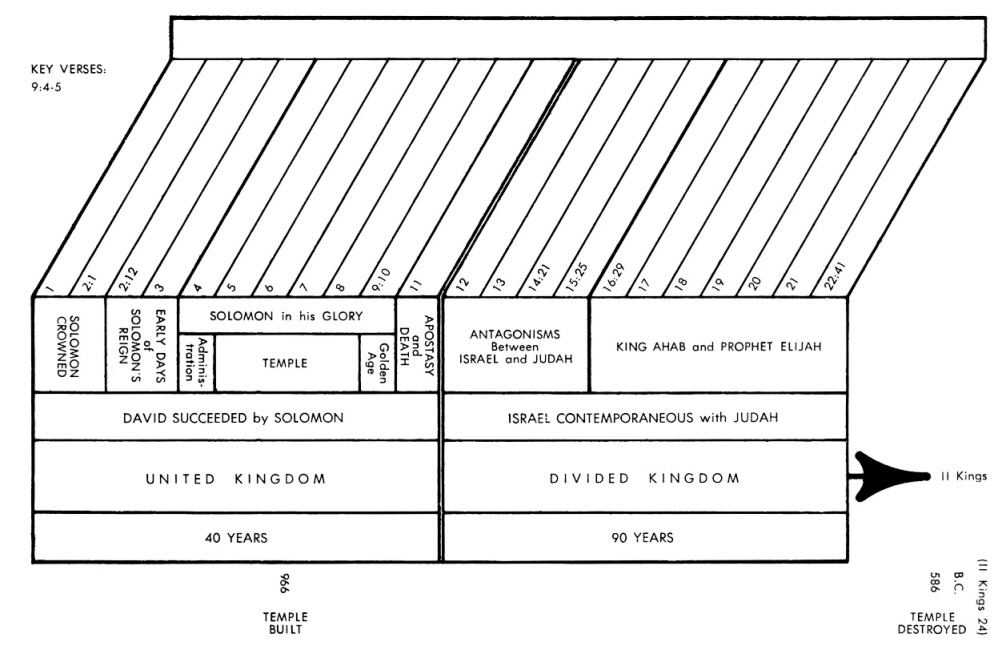
Chart from recommended resource Jensen's Survey of the OT - used by permission
1 Kings Chart from Charles Swindoll
THE DOWNWARD SPIRAL
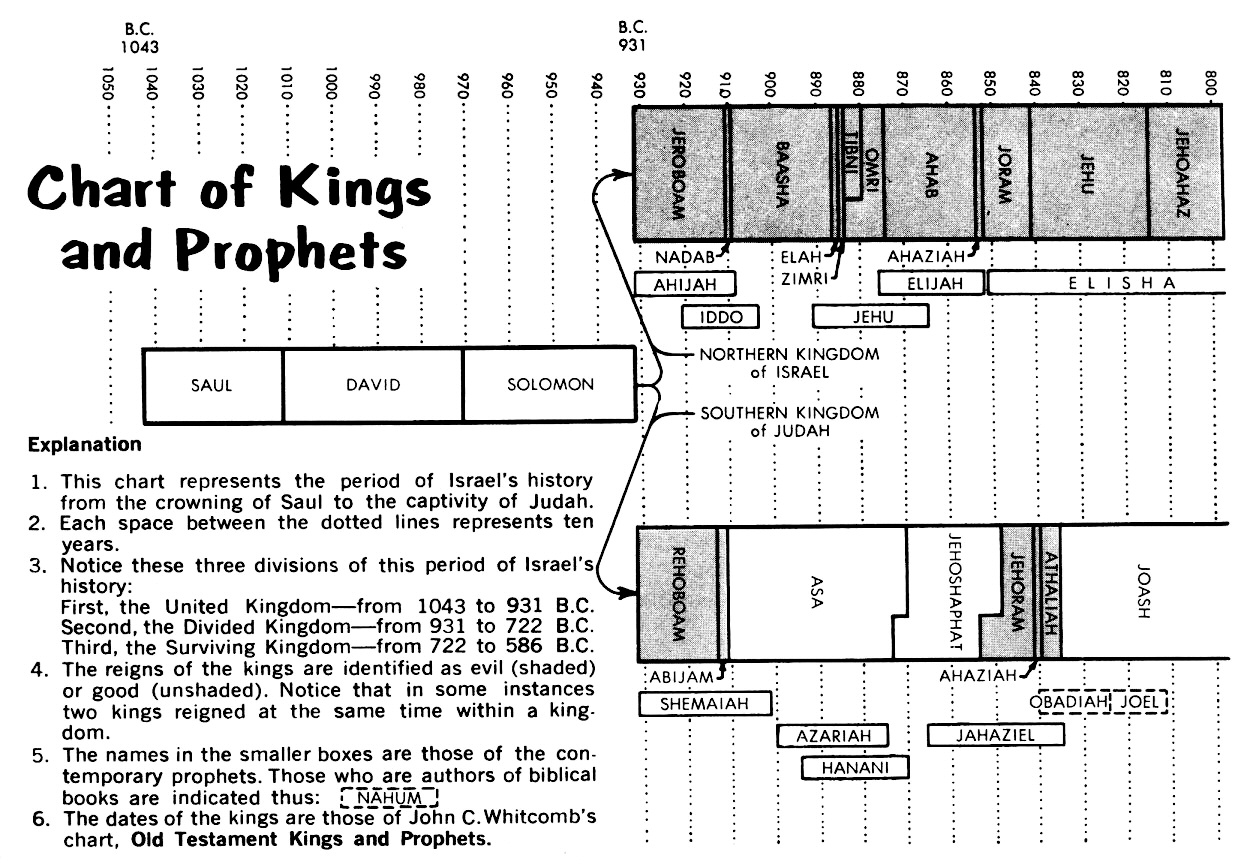
Click to Enlarge
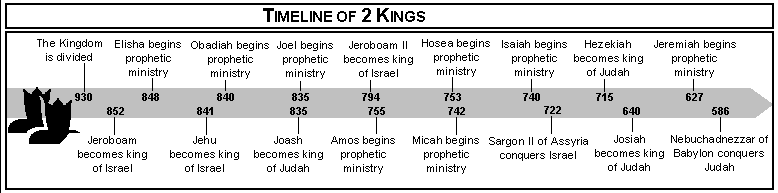
Ryrie Study Bible - Borrow
Click to Enlarge
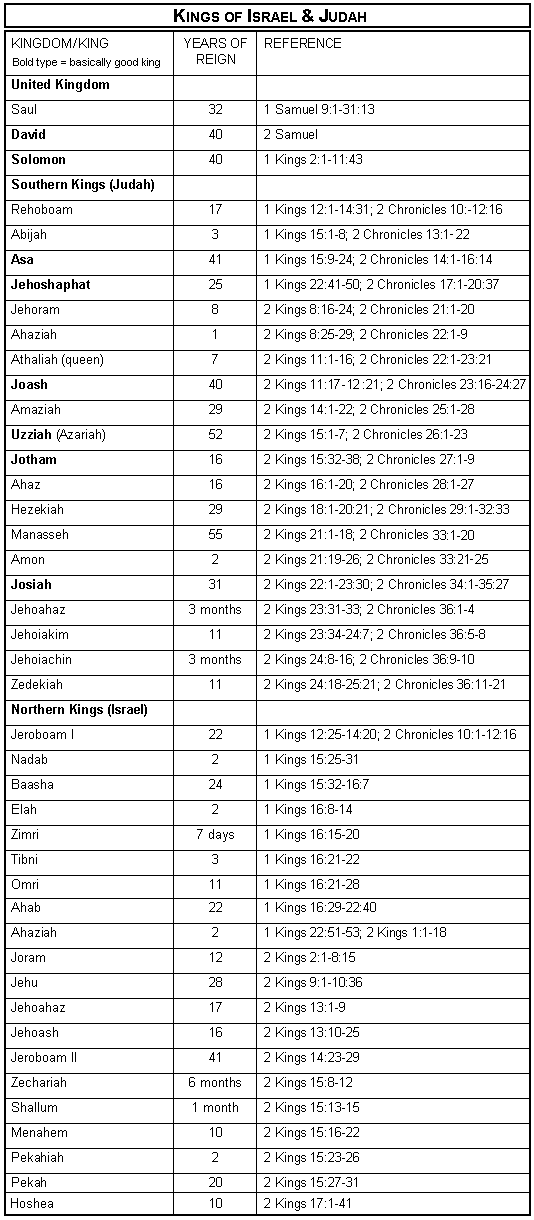
(NOTE: Many consider Amaziah and Hezekiah as "good" kings)
SEE ALSO:
ESV chart - kings of Israel - more information
ESV chart - kings of Judah - more information
Another Chart with Variable Dates for Reigns of Kings
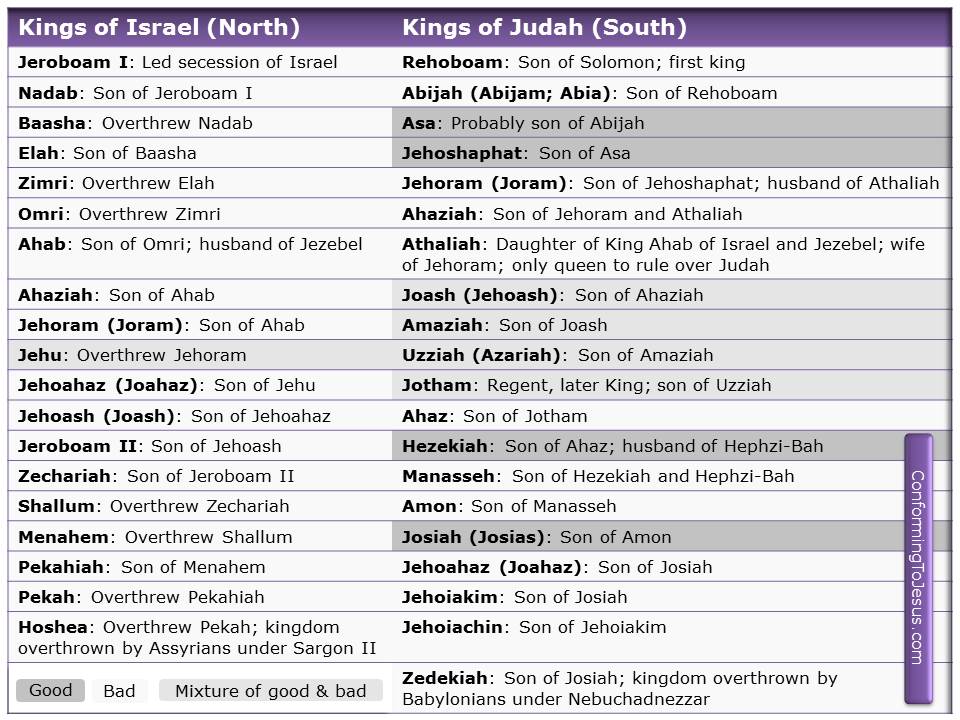
Source: ConformingtoJesus.com
2 Kings 7:1 Then Elisha said, “Listen to the word of the LORD; thus says the LORD, ‘Tomorrow about this time a measure of fine flour will be sold for a shekel, and two measures of barley for a shekel, in the gate of Samaria.’”
- Elisha said: See on ch. 2Ki 6:33 20:16 1Ki 22:19 Isa 1:10 Eze 37:4
- Tomorrow: 2Ki 7:18,19 Ex 8:23 9:5,6 14:13 16:12 Jos 3:5 1Sa 11:9 Ps 46:5
- a measure of fine flour: 2Ki 6:25 Rev 6:6
- of barley: 2Ki 4:42 Joh 6:9
- in the gate of Samaria: 2 Ki 7:18
Related Passages
2 Kings 6:32-33 Now Elisha was sitting in his house, and the elders were sitting with him. And the king sent a man from his presence; but before the messenger came to him, he said to the elders, “Do you see how this son of a murderer has sent to take away my head? Look, when the messenger comes, shut the door and hold the door shut against him. Is not the sound of his master’s feet behind him?” 33 While he was still talking with them, behold, the messenger came down to him and he said, “Behold, this evil is from the LORD; why should I wait for the LORD any longer?”
2 Kings 21:10 Now the LORD spoke through His servants the prophets, saying,
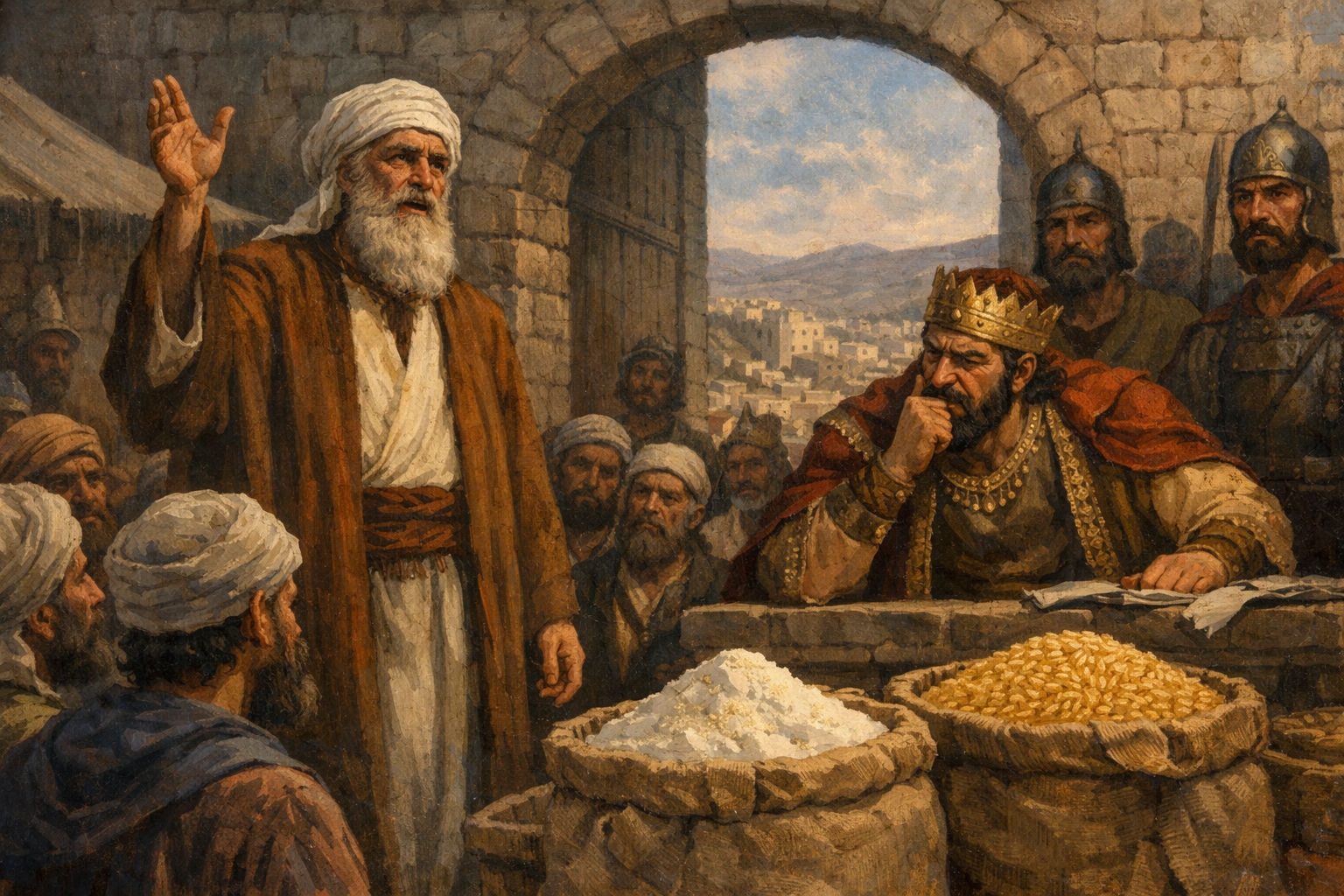
ELISHA'S PROPHECY OF
FAMINE CEASING & FEASTING
Then - This then marks progression in the narrative. However, most Bible scholars agree that the chapter division is unfortunate, that chapters 6 and 7 form a literary unit and that chapter 7 simply continues the story of the previous chapter.
Warren Wiersbe (p691) asks "Did Elisha and the elders allow the king to enter the room along with his attendant and messenger? They probably did, but Joram (aka Jehoram) was a somewhat subdued man when the door was finally opened to him, not unlike his father, Ahab, when Elijah indicted him for the murder of Naboth (1 Kings 21:17ff.). The only messages the Lord had sent to the rebellious King Joram were the army around the city and the starvation within the city, and the king still had not repented
Elisha said, “Listen (shama; Lxx - akouo - aorist imperative) to the word of the LORD - This is always a good command to obey, and especially if the one speaking is the man of God! Elisha’s declaration (command) to listen continues the narrative from chapter 6, where Samaria remains under siege by the Arameans (2 Kings 6:24–29). The famine is catastrophic with donkey heads being sold at outrageous prices and mothers resorting to cannibalism! The king blames God and wants Elisha executed (2Ki 6:31–33). Right at that moment of the king's unbelief and hostility against God, Elisha delivers a stunning word of hope. When everything screams “impossible” God’s Word says "possible"! God can reverse the direst situation immediately (cf. Ps 33:9; Isa 55:11).
Thus says the LORD - Notice how Elisha doubles down on this declaration as not coming from himself but from Yahweh, Who condescends to give a personal Word of encouragement from Heaven to a people who do not deserve it for they have been worshiping idols. This is God's amazing mercy mixed with pure grace (unmerited favor)!
You might ask was the king of Israel present to hear Elisha's prophecy? I think there is no question that he was present. In the next verse we have the king's right hand man. And in 2Ki 7:17 the writer speaking of the "right hand man" adds he died just as the man of God had said, who spoke when the king came down to him. This latter phrase surely indicates the king heard Elisha's prophecies of both blessing (this verse) and cursing (2Ki 7:2).
Dale Ralph Davis - if God promises deliverance, however wild it may seem, we are required to believe it. We must believe what Yahweh says no matter how unlikely. We have many unlikely words of our Lord. ‘Because I live, you also will live’ (John 14:19; cf. Jn 6:40). Do you believe that, as you go on through life standing at more and more graveside services? (BORROW 2 Kings: The Sound and the Fury page 124)
David Guzik has a good point - Though the king of Israel blamed the LORD for the calamity that came upon Israel and Samaria, God still had a word for the king and the nation – and it was a good word.
Tomorrow about this time a measure of fine flour will be sold for a shekel, and two measures of barley for a shekel, in the gate of Samaria - Within 24 hours (tomorrow about this time), food would be abundant and cheap, right in Samaria’s marketplace. These are slightly higher thannormal prices but low enough that it would allow the famine to cease and normal life to resume instantly with abundance replacing starvation overnight. What a miraculous turnaround! Siege-induced "inflation" had resulted in donkey heads selling for 80 shekels and dove's dung for 5 shekels! With only His Word, God creates dramatic divine "deflation"! This is a testimony to the power of Jehovah which is shown to the northern kingdom which has been worshiping Baal, a so-called "god" of fertility! Yahweh is the true Source of fertility! One wonders if any of the idol worshipers saw the Light of God and were converted? We will have to wait until we are in heaven to know as the text does not tell us.
At the gate of Samaria - The enemy was at the gate, but Elisha says God will again make the city gate the marketplace and civic center and resume full public commerce. The enemies would be gone. Fear gone. Scarcity gone. In the very place that death and despair reigned, the almighty God would restore life and order.
🙏 THOUGHT - Dear follower of Christ, has the enemy surrounded you? Do you feel hemmed in, pressed down spiritually, emotionally, physically, or relationally? Like Samaria, you may feel outnumbered, out of strength, out of answers and even out of hope. As I write this (12/30/2025), this is how I feel as my youngest son Wesley has begun injecting methamphetamine and cocaine and is in danger of sudden death as fentanyl is often used to lace these drugs. As a medical doctor I saw the harsh realities of illegal drug injection. Perhaps many of you can identify with me as I know drug use is epidemic (a field of my medical expertise) in America! What I (and you) need to remember is that our God is still the God of Elisha, a God Whose very living Words can reverse circumstances and futures (read Pr 23:18, Pr 24:14, Jer 29:11, Jer 31:17)! I (you) need to trust His Word of Truth and His faithfulness (Heb 10:23) even in the darkest of nights (Ps 27:1,2,3). Music can be God's medicine when we feel overwhelmed and surrounded by the "Arameans" (cf 2Ki 3:15ff) and so just now the Spirit brought to my mind Chris Tomlin's song OUR GOD. Let the words comfort your soul as it did mine as I listened...and my He HEAL you and yours when you feel surrounded and hopeless...
Water You turned into wine
Opened the eyes of the blind
There's no one like You
None like You
Into the darkness You shine
Out of the ashes we rise
There's no one like You
None like YouOur God is greater, our God is stronger
God, You are higher than any other
Our God is HEALER, awesome in power
Our God, our GodAnd if our God is for us, then who could ever stop us?
And if our God is with us, then what can stand against?
And if Our God is for us, then who could ever stop us
And if our God is with us, then what can stand against?
Then what could stand against?Our God is greater, our God is stronger
God, You are higher than any other
Our God is HEALER, awesome in power
Our God, our God
Our God is greater, our God is stronger
God, You are higher than any other
Our God is HEALER, awesome in power
Our God, our God
Listen (hear, obey, understand)(08085) shama means to hear (Adam and Eve hearing God = Ge 3:8, 10, Ge 18:10 = "overheard"), to listen (Ge 3:17, Ge 16:2 [= this was a big mistake and was the origin of Jews and Arabs!] Ex 6:9,16:20, 18:19, Webster's 1828 on "listen" = to hearken; to give ear; to attend closely with a view to hear. To obey; to yield to advice; to follow admonition) and since hearing/listening are often closely linked to obedience, shama is translated obey (1 Sa 15:22, Ge 22:18, 26:5, 39:10, Ex 19:5, disobedience = Lev 26:14, 18, 21, 27) or to understand. KJV translates shama "hearken" (196x) a word which means to give respectful attention. Of God's hearing in general or hearing our prayers (Hab 1:2, Ps 66:18, click here for more in the Psalms, cf God's hearing in Zeph 2:8, Ge 16:11, 17:20, 30:17, 22, Ge 21:17, 29:33, 30:6, 17, 22; Ex 2:24, Ex 16:8, 9, 12, Nu 11:1, 12:2). Shama means “to hear intelligently and attentively and respond appropriately." In other words to hear does not convey the idea of "in one ear and out the other!"
The most famous use is the so-called "Shema" in Dt 6:4 “Hear, (a command, in Greek Lxx = present imperative - habitually, continually) O Israel! The LORD is our God, the LORD is one!" 5 “You shall love the LORD your God with all your heart and with all your soul and with all your might.
2 Kings 7:2 The royal officer on whose hand the king was leaning answered the man of God and said, “Behold, if the LORD should make windows in heaven, could this thing be?” Then he said, “Behold, you will see it with your own eyes, but you will not eat of it.”
NET An officer who was the king's right-hand man responded to the prophet, "Look, even if the LORD made it rain by opening holes in the sky, could this happen so soon?" Elisha said, "Look, you will see it happen with your own eyes, but you will not eat any of the food!"
CSB Then the captain, the king's right-hand man, responded to the man of God, "Look, even if the LORD were to make windows in heaven, could this really happen?" Elisha announced, "You will in fact see it with your own eyes, but you won't eat any of it."
ESV Then the captain on whose hand the king leaned said to the man of God, "If the LORD himself should make windows in heaven, could this thing be?" But he said, "You shall see it with your own eyes, but you shall not eat of it."
NIV The officer on whose arm the king was leaning said to the man of God, "Look, even if the LORD should open the floodgates of the heavens, could this happen?" "You will see it with your own eyes," answered Elisha, "but you will not eat any of it!"
NLT The officer assisting the king said to the man of God, "That couldn't happen even if the LORD opened the windows of heaven!" But Elisha replied, "You will see it happen with your own eyes, but you won't be able to eat any of it!"
- royal officer on whose hand the king was leaning 2Ki 5:18
- if the LORD: Ge 18:12-14 Nu 11:21-23 Ps 78:19-21,41
- windows: Ge 7:11 Mal 3:10
- shall see it: 2Ki 7:17-20 De 3:27 2Ch 20:20 Isa 7:9 Ro 3:3 2Ti 2:13 Heb 3:17-19
Related Passages:
2 Kings 5:18 “In this matter may the LORD pardon your servant: when my master goes into the house of Rimmon to worship there, and he leans on my hand and I bow myself in the house of Rimmon, when I bow myself in the house of Rimmon, the LORD pardon your servant in this matter.”
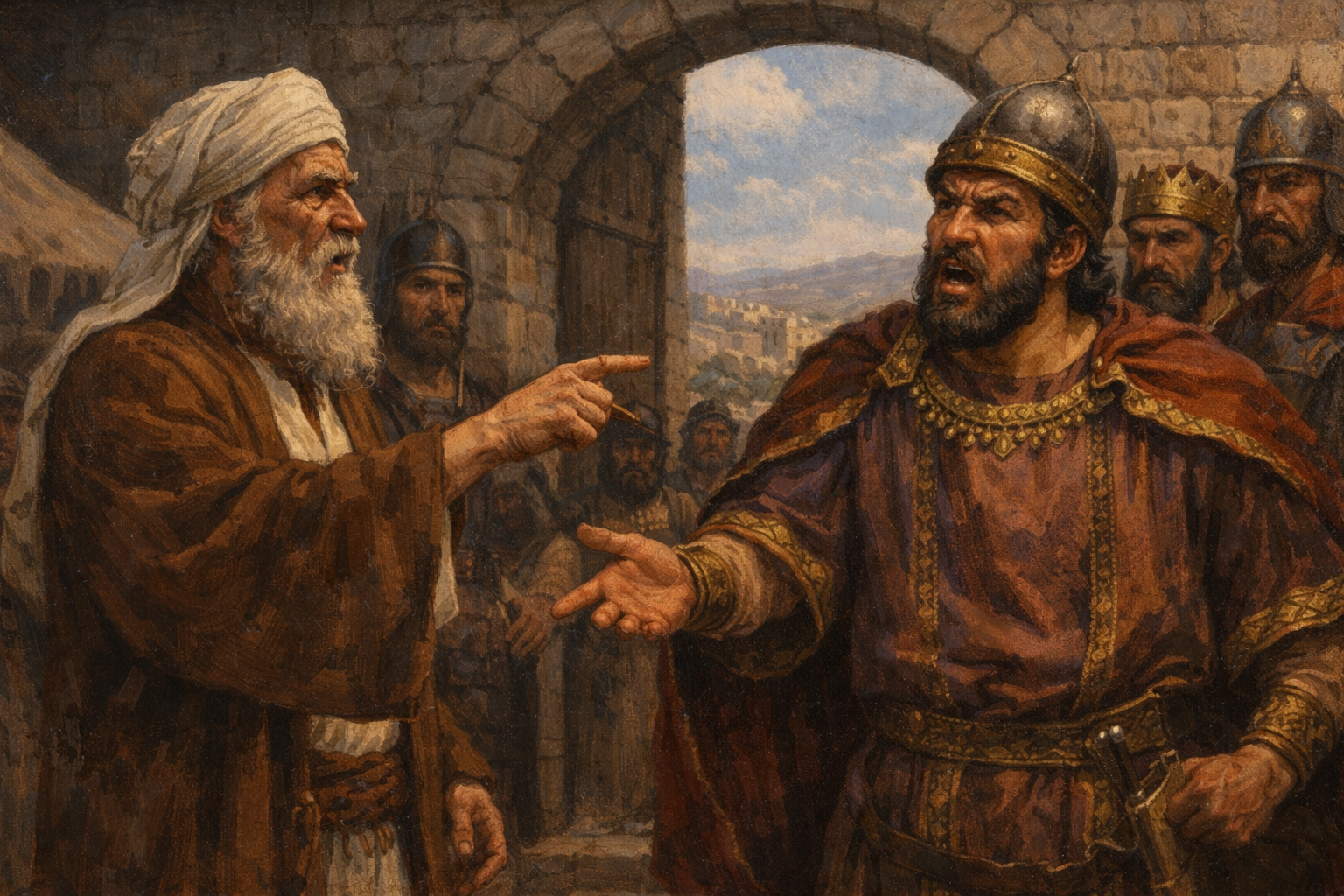
KING'S RIGHT-HAND MAN'S
UNBELIEF IN GOD'S POWER
The royal officer on whose hand the king was leaning answered the man of God and said - NET - "An officer who was the king's right-hand man responded to the prophet." Leaning could be literal as in 2 Kings 5:18. This unnamed man is clearly one who exerts influence with th king of Israel. Some would call him the king's "right hand man," an idiom that refers to one of the more trusted assistants of an individual.
Behold (hinneh; ; Lxx - idou) if the LORD (Jehovah or Yahweh) should make windows (arubbah) in heaven, could this thing be?” - The royal officer has some chutzpah (when pronounced quickly often sounds like "huffsa”) actually using God's covenant Name Jehovah or Yahweh! Obviously he has only heard this great Name, but has no personal experience with Him! The officer is addressing Elisha in response to his incredible prophecy of a 24 hour turn around in Samaria. What he is saying in effect is even if God did the impossible (make windows in heaven), the prophecy could not happen with sarcasm and skepticism. The officer is saying “Not only do I not believe you…I don’t believe God could do this even in the most extreme scenario.” In so doing, the royal officer brazenly expresses open unbelief at Elisha's prophecy and Elisha's God!
The officer’s accountability is heightened by the fact that he was not ignorant of God’s power. As a leading court official in Israel, he would certainly have known about Elisha’s previous miracles—the multiplied oil, the raising of the Shunammite’s son, the healing of Naaman, the blinded Aramean army, and countless other demonstrations of divine intervention! In other words, he had already been given ample evidence that Yahweh is able to do what human reason declares impossible. Yet standing in front of the prophet, hearing a direct promise from Yahweh, he does not respond with humility, reverence, or even cautious optimism! Instead, he meets God’s revealed word with open sarcasm and crass unbelief. That makes his sin not merely doubt born of desperation, but willful rejection of truth he already knew. He is accountable because he has knowledge and yet refuses to bow to it. He serves as a tragic example of how a person can be surrounded by God’s works and yet remain unmoved, unimpressed, and unbelieving.
🙏 THOUGHT - The royal officer's greater accountabilty recalls to mind Jesus' words of warning to the Jews "Woe to you, Chorazin! Woe to you, Bethsaida! For if the miracles had been performed in Tyre and Sidon which occurred in you, they would have repented long ago, sitting in sackcloth and ashes. The one who listens to you listens to Me, and the one who rejects you rejects Me; and he who rejects Me rejects the One who sent Me." (Lk 10:13-16, cf Mt 11:21-24) Here is the point (and it helps understand what happened to the royal officer) There will be degrees of judgment. The greater degree of privilege and light, the greater degree of judgment because they rejected Christ.” Dear reader, are you still procrastinating about Jesus and His free gift of salvation by grace through faith? My prayer is that you quit procrastinating today and "Believe in the Lord Jesus, and you will be saved," (Acts 16:31). The sobering truth calls every person who knows the gospel to respond with repentance and faith, for “now is the favorable time; behold, now is the day of salvation” (2 Corinthians 6:2).
Bob Utley on windows in heaven - Heaven refers to the atmosphere above the earth. The OT saw it as a hard dome with windows. Rain came from the windows (cf. Ps. 78:23-29; Mal. 3:10).
Rejection of "the word of the Lord"
was a serious offense.
-- Bob Utley
Then (marks progression in the conversation) he said, “Behold (hinneh; ; Lxx - idou) , you will see it with your own eyes, but you will not eat of it - I don't play poker but have heard people say when someone plays their card “I see your bet, and I raise you one.” To carry the poker analogy further, Elisha says in effect "I challenge your BEHOLD and I am upping the stakes with my own BEHOLD!" Be careful playing poker with a true prophet of God! Elisha then pronounced a two-fold prophetic promise (1) that the royal officer would see the fulfillment but (2) he would never taste it or benefit from it. We will see the somewhat ironic fulfillment of Elisha's prophecy in 2Ki 7:17-20.
Spurgeon - Unbelievers do not really enjoy the things of this life. The mass of them find that wealth does not yield them satisfaction, their outward riches cannot conceal their inner poverty. To many men it is given to have all that heart can wish, and yet not to have what their heart does wish. They have everything except contentment.
Warren Wiersbe (p691) on the royal official's reaction and consequences - To the humble heart that’s open to God, the word generates faith, but to the proud, self-centered heart, the word makes the heart even harder. The same sun that melts the ice will harden the clay. The next morning, all the people in the city except this officer would awaken to life, but he would awaken to death
Behold (02009) hinneh is an interjection meaning behold, look, now; if. "It is used often and expresses strong feelings, surprise, hope, expectation, certainty, thus giving vividness depending on its surrounding context." (Baker) Hinneh generally directs our mind to the text, imploring the reader to give it special attention. In short, the Spirit is trying to arrest our attention! And so hinneh is used as an exclamation of vivid immediacy (e.g., read Ge 6:13)! Hinneh is a marker used to enliven a narrative, to express a change a scene, to emphasize an idea, to call attention to a detail or an important fact or action that follows (Isa 65:17, Ge 17:20, 41:17). The first use of hinneh in Ge 1:29 and second in Ge 1:31 - "And God saw all that He had made, and behold, it was very good. And there was evening and there was morning, the sixth day." Hinneh is oftn used in the idiom "Here I am" in Ge 22:1, 7,11 Ge 27:1,18, Ge 31:11, Ge 46:2 Ex 3:4 1Sa 3:4, 3:16, 12:3, 2Sa 1:7, Isa 52:6, Isa 58:9. Hinneh is used most often to point out people but also to point out things (Ge 31:41, 17:4). God uses hinneh to grab man's attention before He brings destruction (Ge 6:13, 17). God uses hinneh when He establishes covenants (Ge 9:9, 15:12, 17 [when Jehovah cut the Abrahamic covenant], Ge 17:4, cp Ge 28:13, 15), when He provided a sacrificial substitute for Isaac (foreshadowing His giving us His only Son!) (Ge 22:13). Hinneh marks the "chance (The Providence of God)" arrival of Boaz at the field where Ruth was gleaning (Ru 2:4-read about this "chance romance" - Indeed, "Behold!"). Hinneh is used to announce the Lord’s sending of a child as a sign and a prophecy of Immanuel-Emmanuel, the Messiah (Isa. 7:14). In fact W E Vine says that it is notable that when behold (hinneh) is used in Isaiah, it always introduces something relating to future circumstances.
Spurgeon reminds us that "Behold is a word of wonder; it is intended to excite admiration. Wherever you see it hung out in Scripture, it is like an ancient sign-board, signifying that there are rich wares within, or like the hands which solid readers have observed in the margin of the older Puritanic books, drawing attention to something particularly worthy of observation." I would add, behold is like a divine highlighter, a divine underlining of an especially striking or important text. It says in effect "Listen up, all ye who would be wise in the ways of Jehovah!"
HINNEH IN 2 KINGS - 2 Ki. 1:14; 2 Ki. 2:11; 2 Ki. 2:16; 2 Ki. 2:19; 2 Ki. 3:20; 2 Ki. 4:9; 2 Ki. 4:13; 2 Ki. 4:25; 2 Ki. 4:32; 2 Ki. 5:6; 2 Ki. 5:11; 2 Ki. 5:15; 2 Ki. 5:20; 2 Ki. 5:22; 2 Ki. 6:1; 2 Ki. 6:13; 2 Ki. 6:15; 2 Ki. 6:17; 2 Ki. 6:20; 2 Ki. 6:25; 2 Ki. 6:30; 2 Ki. 6:33; 2 Ki. 7:2; 2 Ki. 7:5; 2 Ki. 7:6; 2 Ki. 7:10; 2 Ki. 7:13; 2 Ki. 7:15; 2 Ki. 7:19; 2 Ki. 8:5; 2 Ki. 9:5; 2 Ki. 10:4; 2 Ki. 10:9; 2 Ki. 11:14; 2 Ki. 13:21; 2 Ki. 15:11; 2 Ki. 15:15; 2 Ki. 15:26; 2 Ki. 15:31; 2 Ki. 17:26; 2 Ki. 18:21; 2 Ki. 19:7; 2 Ki. 19:9; 2 Ki. 19:11; 2 Ki. 19:35; 2 Ki. 20:5; 2 Ki. 20:17; 2 Ki. 21:12; 2 Ki. 22:16; 2 Ki. 22:20;
Hinneh is translated in the Septuagint with the interjection idou (strictly speaking a command in the second person aorist imperative, middle voice) a demonstrative particle (used 1377 times in the Septuagint and NT) which is found especially in the Gospels of Matthew and Luke "and giving a peculiar vivacity to the style by bidding the reader or hearer to attend to what is said: "Behold! See! Lo!" (Thayer) The command is calling for urgent attention. Do this now! Don't delay! It could be loosely paraphrased "Pay attention!" or "Listen up!" to arouse attention and introduce a new and extraordinary fact of considerable importance.
Windows (0699) arubbah A feminine noun meaning floodgate (Gen. 7:11; 8:2) , a lattice, window (Eccl. 12:3), sluice, a chimney (lattice opening where smoke escapes). Figuratively, it refers to in general to God’s ability to provide an abundance of anything (2Ki 7:2, 19) but also to the windows through which God pours judgments from on high (Isa 24:18). Symbolically ARUBBAH can refer to lattices, nests or roosts (KJV, NIV windows) for safety (Isa. 60:8). Two unique uses of arubbah are (1) window, in the sense of a “chimney” through which smoke passes (Hos 13:3), and (2) the small opening in a pigeon loft (Isa 60:8).
Victor Hamilton writes "The reference to “those who look out of windows are darkened” (Eccl 12:3) is probably not a poetical reference to the eyes which become dim with old age, but to some funereal practice (Dahood), or some disaster of unidentifiable nature (Sawyer)." (TWOT)
ARUBBAH - 9V - chimney(1), floodgates(2), lattices(1), windows(5). Gen. 7:11; Gen. 8:2; 2 Ki. 7:2; 2 Ki. 7:19; Eccl. 12:3; Isa. 24:18; Isa. 60:8; Hos. 13:3; Mal. 3:10
Gilbrant - The word ʾărubbāh is first used in Gen. 7:11; 8:2, and has the meaning “window.” Many translations render the word “floodgate,” which is a more appropriate metaphorical term for the source of severe rain. It is used nine times in the OT, always with the meaning of some form of opening. In the Genesis account of the flood, the word is used to describe the channels through which the waters of God’s judgment pour. God sends not only means of judgment, but blessing, as in Mal. 3:10: “I will open on your behalf the windows of the heavens and pour out for your sake a blessing” (see also 2 Ki. 7:2, 19). Two other meanings occur in prophetic literature. Hosea (13:3) uses ʾărubbāh to mean a chimney, the opening through which smoke passes. Isaiah 60:8 uses this noun to describe the small opening in a pigeon loft. In Ecc. 12:3, “windows” is probably not a reference to increasingly poor eyesight (in aging), but to some funeral practice or undetermined disaster. (Complete Biblical Library)
David Guzik - Look, if the LORD would make windows in heaven, could this thing be: The king’s officer doubted the prophecy, and his doubt was based on several faulty premises.
i. First, he doubted the power of God. If God willed it, He certainly could make windows in heaven and drop down food from the sky for the hungry, besieged city of Samaria.
ii. Second, he doubted the creativity of God. In the mind of the king’s officer, the way food could come to the city was from above, because the city was surrounded by a hostile, besieging army. He had no idea that God could bring provision in a completely unexpected way. “How often faith breaks down in this way! It knows that God is, and that He can act. But it only sees one way, and refuses to believe that such a way will be taken. The supply came without the opening of heaven’s windows.” (Morgan)
iii. Third, he doubted the messenger of God. Though the promise was admittedly hard to believe, the king’s officer could have and should have believed it because it came from a man with an established track record of reliability.
iv. All in all, the officer well illustrates the conduct of unbelief:
· Unbelief dares to question the truthfulness of God’s promise itself.
· Unbelief says, “This is a new thing and cannot be true.”
· Unbelief says, “This is a sudden thing and cannot be true.”
· Unbelief says, “There is no way to accomplish this thing.”
· Unbelief says, “There is only one way God can work.”
· Unbelief says, “Even if God does something, it won’t be enough.”
2 Kings 7:3 Now there were four leprous men at the entrance of the gate; and they said to one another, “Why do we sit here until we die?
- four leprous: 2Ki 5:1 8:4 Lev 13:46 Nu 5:2-4 12:14
- Why: 2Ki 7:4 Jer 8:14 27:13

FOUR LEPERS PARTICIPATE
IN PROPHECY FULFILLMENT
Now - Now marks a narrative transition and scene-shift, serving as a "narrative hinge" word opening the doorway to the fulfillment of Elisha's prophecy in 2Ki 7:1. More technically speaking the Hebrew text begins with a waw (vav)-consecutive (“and/now”), which biblical writers often used to move the story forward, introduce a new scene or signal that God’s promised action is about to unfold.
There were four leprous men at the entrance of the gate - Recall that the location of the four leprous men at the gate of Samaria is exactly where Elisha had stated the prophecy would be fulfilled (2Ki 7:1). The gate was where beggars often sat (cf Acts 3:2). We could call these men God's four unlikely instruments, four despised, outcast lepers, men who God used to to accomplish His sovereign plan. God was setting His answer in motion, illustrating His providence acting behind the scenes at the city gate and in the Aramean camp (2Ki 7:6-7).
Dale Ralph Davis: The discovery of God’s work is placed in the hands of the unclean and the unnamed. Surely we feel this text grabbing us by the lapels and pulling us down to kneel and praise. Here Yahweh uses neither the healthy nor the prominent. Doesn’t God deserve high praise for the lowly servants he uses? (BORROW 2 Kings: The Sound and the Fury page 126)
Spurgeon - If you were to take out of the Scriptures all the stories that have to do with poor, afflicted men and women, what a very small book the Bible would become, especially if together with the stories you removed all the psalms of the sorrowful, all the promises for the distressed, and all the passages which belong to the children of grief! This Book, indeed, for the most part is made up of the annals of the poor and despised.
And they said to one another, “Why do we sit here until we die? - At the entrance of the gate suggests they were outside the gate of the famine-stricken city, because as lepers (outcasts) they were not allowed to go inside the camp (cf Lev 13:45,46, Nu 5:2-3). They began to reason that they could passively remain and surely starve or they could move on which is described in the next passage. The footsteps of these four lepers would soon interact wtih the mighty hand of God’s intervention. (2Ki 7:6-7).
Spurgeon - Now you perceive that there are just two courses open to you; you can sit still, but then you know that you must perish; or you can go to Christ, and...if you do not go to Him, you must surely perish.
Leprous (06879) tsara (from tsaraath = leprosy)means to be struck with leprosy, to be leprous
TSARA - 20X/18V - being a leper(1), leper(12), lepers(1), leprous(6). Exod. 4:6; Lev. 13:44; Lev. 13:45; Lev. 14:2; Lev. 14:3; Lev. 22:4; Num. 5:2; Num. 12:10; 2 Sam. 3:29; 2 Ki. 5:1; 2 Ki. 5:11; 2 Ki. 5:27; 2 Ki. 7:3; 2 Ki. 7:8; 2 Ki. 15:5; 2 Chr. 26:20; 2 Chr. 26:21; 2 Chr. 26:23
Elmer Martens (TWOT online) - While usually rendered leper or leprous, the term "leper" is not correct medically, since ṣāraʿat refers to a wider range of skin diseases (cf. "malignant skin disease," NEB). For convenience, however, the term "leper" can be retained.
A person with leprosy, apart from the telltale malignant raw flesh and white hair, was to be otherwise identified by torn clothes, announcement of "unclean" when in the streets and was to live isolated from the community. Four persons are named in the OT as becoming leprous. Not counting Moses (Exodus 4:6; cf. also 2 Kings 7:3), there were Miriam (Numbers 12:10), Uzziah (2 Kings 15:5), Gehazi (2 Kings 5:27) and Naaman, the Syrian (2 Kings 5:1).
God may inflict the disease of ṣāraʿat as punishment for sins such as jealousy (cf. Miriam), anger, and lack of full compliance with God's commands (cf. Uzziah), and covetousness (cf. Gehazi). One must not conclude, however, that all sickness is a result of an individual's sin (cf. Job; Luke 13:1-5; John 9:1-7).
ṣāraʿat was not necessarily incurable (cf. 2 Kings 5:7). Leprosy by contrast, was likely incurable (Leviticus 13). In any event, healing of Sdra at could serve as a sign of divine power (Exodus 4:6; 2 Kings 5:8).
The isolation of a leprous person was doubtless a sanitary measure in order to avoid further contagion. That a priest in Israel's theocracy was to diagnose the illness does not mean that today's clergy should become health officers. But the principle of God's concern for the health of bodies is not only self-evident but remains an enduring principle (cf. Jesus, Matthew 8:2-3).
Diseases with eruptions affecting the skin are sometimes mild, sometimes, as in smallpox, scarlet fever, etc., both dangerous and highly contagious. The only effective control in antiquity would have been isolation. Only the Hebrew laws had this very valuable provision.
ṣaraʿat is found primarily (twenty times) in the two chapters that govern the diagnoses and the cleaning measures for one who had become unclean (tāmēʾ, Leviticus 13, 14). In the nature of a contagion, ṣāraʿat refers not only to eruptions on the skin but to mildew or mold in clothing (Leviticus 13:47-52) or in houses (Leviticus 14:34-53); therefore obviously the word is not specific for leprosy. The determination by the priest of an individual as unclean meant separation from the community, and ceremonial unfitness to enter the temple (cf. 2 Chron. 26:21). The cleansing measures to be performed upon recovery involved a ritual with two birds, which ritual according to KD was necessary for restoration to the community (Leviticus 14:2-9). An additional set of offerings followed, notably the guilt offering, perhaps because disease is ultimately to be linked with sin (Leviticus 14:10-20).
(NOT EVERYONE AGREES WITH MARTENS' STATEMENT) There is no Scriptural warrant for regarding leprosy as a type of sin, though the analogy can be helpful for illustrative purposes.
Bibliography: Harris, R. Laird, Man-God's Eternal Creation, Moody, 1971, pp. 142-43. Browne, S. G., "Leper, Leprosy," in WBE, II, pp. 1026-27. (Theological Wordbook of the Old Testament - TWOT)
2 Kings 7:4 “If we say, ‘We will enter the city,’ then the famine is in the city and we will die there; and if we sit here, we die also. Now therefore come, and let us go over to the camp of the Arameans. If they spare us, we will live; and if they kill us, we will but die.”
- we will enter: Jer 14:18
- let us go over to the camp 1Ch 12:19 Jer 37:13,14
- if they spare us: Es 4:16 Jer 8:14 Jon 3:9 Lu 15:17-19
- we will but die: 2Sa 14:14 Heb 9:27
FOUR LEPERS WEIGH
THEIR DIRE OPTIONS
If we say, ‘We will enter the city,’ then the famine is in the city and we will die there - Option 1 would bring sure death. Being lepers however would protect them from cannibalism!
And if we sit here, we die also - Option 2 of sitting also guaranteed a slow death by starvation.
Now therefore come, and let us go over to the camp of the Arameans (Syrians) - Option 3 of approaching the enemy at least offered a chance of survival.
If they spare us, we will live; and if they kill us, we will but die - This is the only option that holds any hope and the possiblity of mercy. Their logic was simple “If we are going to die anyway, we may as well take the one path where we have at least the chance we might live.” Even if they were to be killed by the Arameans, it would be far better to die quickly by the sword than to endure the slow, agonizing death of starvation.
2 Kings 7:5 They arose at twilight to go to the camp of the Arameans; when they came to the outskirts of the camp of the Arameans, behold, there was no one there.
- twilight: 1Sa 30:17 Eze 12:6,7,12
- behold: Lev 27:8,26 De 28:7 32:25,30
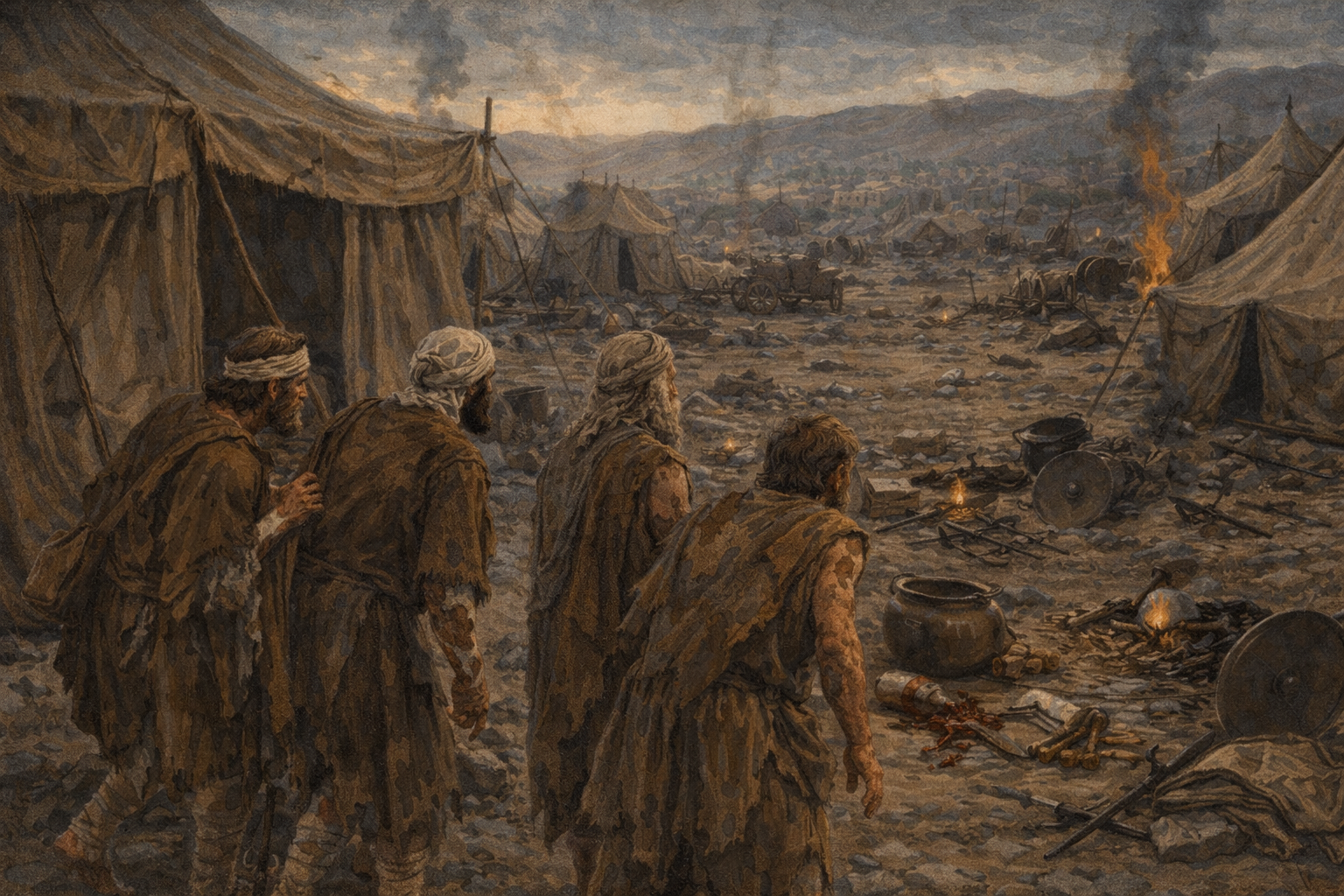
ABSOLUTE ABANDONMENT
BY THE ARAMEAN ARMY
They arose at twilight to go to the camp of the Arameans - NET - "So they started toward the Syrian camp at dusk." At dusk would allow them to approach cautiously with lower risk of immediate confrontation. Notice God's providential control of the timing -- in 2Ki 7:5 the lepers move toward the Aramean camp and in 2Ki 7:7 the Arameans fled at twilight. God was already at work before they moved, assuring that the movement of the lepers would intersect perfectly with the movement of the Arameans. In this moment, God turned their despair into deliverance! How many times has He done a similar miracle for you beloved?
TECHNICAL NOTE: The Hebrew word for twilight can refer to the low light time of morning or evening. Most of the translation render it as in the evening ("dusk"), not the morning. And that correlates with the king getting a report in the night (2Ki 7:2)
When they came to the outskirts (the edge) of the camp of the Arameans, behold (hinneh; ; Lxx - idou) there was no one there - The writer expresses what the four lepers must have experienced as they approached the camp. They had expected guards, confrontation and danger, but instead were utterly shocked by the silence, emptiness, desertion of the camp. Note God's perfect providential timing of having the four lepers arriive after the Arameans had fled.
There was no one there emphasizes that the camp was completely empty and deserted.
2 Kings 7:6 For the Lord had caused the army of the Arameans to hear a sound of chariots and a sound of horses, even the sound of a great army, so that they said to one another, “Behold, the king of Israel has hired against us the kings of the Hittites and the kings of the Egyptians, to come upon us.”
- the Lord: 2Ki 3:22,23-27 19:7 2Sa 5:24 Job 15:21 Ps 14:5 Jer 20:3,4 Eze 10:5 Rev 6:15,16 9:9
- the kings of the Hittites: 1Ki 10:29
- the kings of the Egyptians: 2Ch 12:2,3 Isa 31:1 36:9

SUPERNATURAL SOUNDS LEAD TO
FALSE ASSUMPTION AND GREAT FEAR
For - Here we encounter one of those very strategic uses of the hinge word FOR which introduces an explanation for the amazing scene in 2Ki 7:5.
The Lord ('adonay; Lxx - kurios) had caused the army of the Arameans to hear a sound of chariots and a sound of horses, even the sound of a great army - It is interesting to note that God has used horses and chariots in several of the stories with Elisha - here, separation of Elijah from Elisha (2Ki 2:10-12), Elisha's attendant's vision (2Ki 6:17)
God is never limited by human weakness
or overwhelming circumstances
When His people are helpless, He is not.
Israel was completely powerless against the besieging Aramean army but God was not. What human strength, military strategy, and political power could not accomplish, God accomplished effortlessly. He did not need to send chariots, swords, or soldiers; instead, He simply caused the Arameans to hear what sounded like the thunderous approach of a massive invading army. Panic seized them, and they fled in terror, abandoning everything. This scene powerfully reminds us that God is never limited by human weakness or overwhelming circumstances. When His people are helpless, He is not. God’s deliverance does not depend on human resources for He can save by many or by none, and even the sound of an imaginary army is enough when He wills it!
So that marks the second strategic hinge in the verse. So that explains the consequence of the Arameans hearing the sound of approaching armies, specifically giving the result that followed that frightening perception.
They said to one another “Behold (hinneh; ; Lxx - idou), the king of Israel has hired against us the kings of the Hittites and the kings of the Egyptians, to come upon us - When God caused the Arameans to hear the supernatural sound of armies, they panicked and tried to explain it. Their explanation was that the king of Israel had somehow hired foreign armies and they were about to be crushed from multiple sides.
The same God Who struck a Syrian army so they could not see what was there now struck another Syrian army so they heard what was not there. The God who blinded one enemy force in 2 Kings 6 is the same God Who terrified this one in 2 Kings 7, not by physical might, but by sovereign power. He can confuse sight, He can control sound, and He can overwhelm enemies without a single human weapon lifted. Oh, beloved, how we need to lay hold of this comforting, eternal truth, especially when we feel surrounded and helpless!
Warren Wiersbe (p692) - The Lord had defeated the Moabites by a miracle of sight (2Ki 3:20–23), and now He defeated the Syrians by a miracle of sound....Over a century ago, secular scholars used to smile at the mention of the Hittites and refer to them as “a mythological people mentioned only in the Bible.” But excavations have revealed a powerful Hittite civilization that was frequently at enmity with Israel. Once again the archaeologists’ spades have had to affirm the truth of scriptural record.
TECHNICAL NOTE ON HITTITES - Josh McDowell on archaelogical discoveries documenting the great Hittite civilization - The early twentieth century brought with it a continued flood of discoveries, including thousands of inscriptions and tablets from the Hittite city of Bagazkoy and the royal Hittite archives, allowing historians to gain insights into ancient Hittite history and culture that are still being pieced together today. (Online - Evidence That Demands A Verdict page 698)
This gives us confidence to believe that biblical difficulties
not yet explained do have an explanation,In New Evidence that Demands a Verdict Josh McDowell writes "Archaeological research has now uncovered evidence revealing more than 1,200 years of Hittite civilization (page 67).....Likewise, critics once believed that the Bible was wrong in speaking of the Hittite people, since they were totally unknown to historians. Now historians know of their existence by way of a Hittite library found in Turkey. This gives us confidence to believe that biblical difficulties not yet explained do have an explanation, and we need not assume that there is a mistake in the Bible. (page 103)"....Many criti¬ cal views about the Bible have been overturned by archaeo¬ logical discoveries. For exam¬ ple, it was long believed that the Bible erred when it spoke about Hittites. (Gen. 23:10) But since the discovery of the Hittite library in Turkey (1906) this is no longer the case. (Geisler, BECA, 48,49) (page 150). (See also Wikipedia article on Hittites) (See >20 page article by Harry A Hoffner on Hittites in Peoples of the Old Testament, page 126)

Hittites to the North
One might ask specifically why Hittites and Egyptians? The answer is that at this time in history, both of those nations symbolized power. The Hittites were a powerful force to the north (their power peaked about 1300 and the events in 2Ki 6 occur about 900 BC) and the Egyptians were the major empire to the south with elite chariots and armies. Together, these two would have produced a pincher effect on the Arameans from the north and the south.
Bob Utley - "the Hittites" This is an OT way of identifying the kingdom of Anatolia (i.e., modern Turkey). The name "Hittites" appeared only in the OT and many liberal scholars thought they were a legend or myth, but in the 1950's archaeologists found the royal library of this empire in central Turkey and saw from its documents that the empire went by two names. Again, the historicity of the OT was confirmed...."the Egyptians" The MT has "Mizraim" (BDB 595), which usually means Egypt, but in a few other texts it might be another group to the north. 1 Kings 10:28; 2 Chr. 1:16,17; 9:28 (see UBS Text Project, pp. 313-314) ‒ a place in northern Syria (BDB 596) called Musri (Tyndale OT Commentary, p. 212) Kue or Cilicia, just north of Cyprus on southern coast of Turkey See full note online at 2 Chr. 1:16 (freebiblecommentary.org). It may be an idiom for foreign mercenaries from the north to the south. There are historical questions about the term ever referring to anything but Egypt. The PLURAL "kings" is unusual in referring to Egypt, which had a united monarchy.
2 Kings 7:7 Therefore they arose and fled in the twilight, and left their tents and their horses and their donkeys, even the camp just as it was, and fled for their life.
- they arose: Job 18:11 Ps 48:4-6 68:12 Pr 21:1 28:1 Jer 48:8,9
- their horses: Ps 20:7,8 33:17 Am 2:14-16
- and fled for their life: Nu 35:11,12 Pr 6:5 Isa 2:20 Mt 24:16-18 Heb 6:18

ARAMEANS PANIC, FLEE FOR
THEIR LIVES & LEAVE PLUNDER
Therefore - Term of conclusion connecting the action in this verse (the "conclusion") with the supernatural sounds of verse 6.
They arose and fled in the twilight - See comment in verse 6 on significance of this time phrase. In short, while the lepers were coming, the Arameans were fleeing showing God's perfect timing!
And left their tents and their horses and their donkeys - Who leaves these items, especially the animals? Someone that has experienced such sudden panic and irrational fear. The believed death was imminent because God caused the Arameans to hear what sounded like a massive invading coalition army (2 Ki 7:6). The result was total and sheer panic. When an army believes it is about to be crushed, they reason there is not even time to saddle their animals, dismantle the camp or take provisions. Running on foot was faster in that moment of surprise.
even the camp just as it was - This indicates the Arameans experienced instantaneous supernatural terror. The untouched camp became proof of God’s power (there was no evidence of a skirmish), a provision for the starving nation and ultimately led to fulfillment of Elisha’s prophecy
And fled for their life They fled in blind panic, an every-man-for-himself escape. This was not an orderly retreat, but a stampede-like fleeing in fear.
Spurgeon - Everybody who went to bed that night felt that he was still in that horrible den where grim death seemed actually present in the skeleton forms of the hunger-bitten. They were as free as the harts of the wilderness had they known it: but their ignorance held them in vile durance.
2 Kings 7:8 When these lepers came to the outskirts of the camp, they entered one tent and ate and drank, and carried from there silver and gold and clothes, and went and hid them; and they returned and entered another tent and carried from there also, and went and hid them.
- hid: 2Ki 5:24 Jos 7:21 Jer 41:8 Mt 13:44 25:18
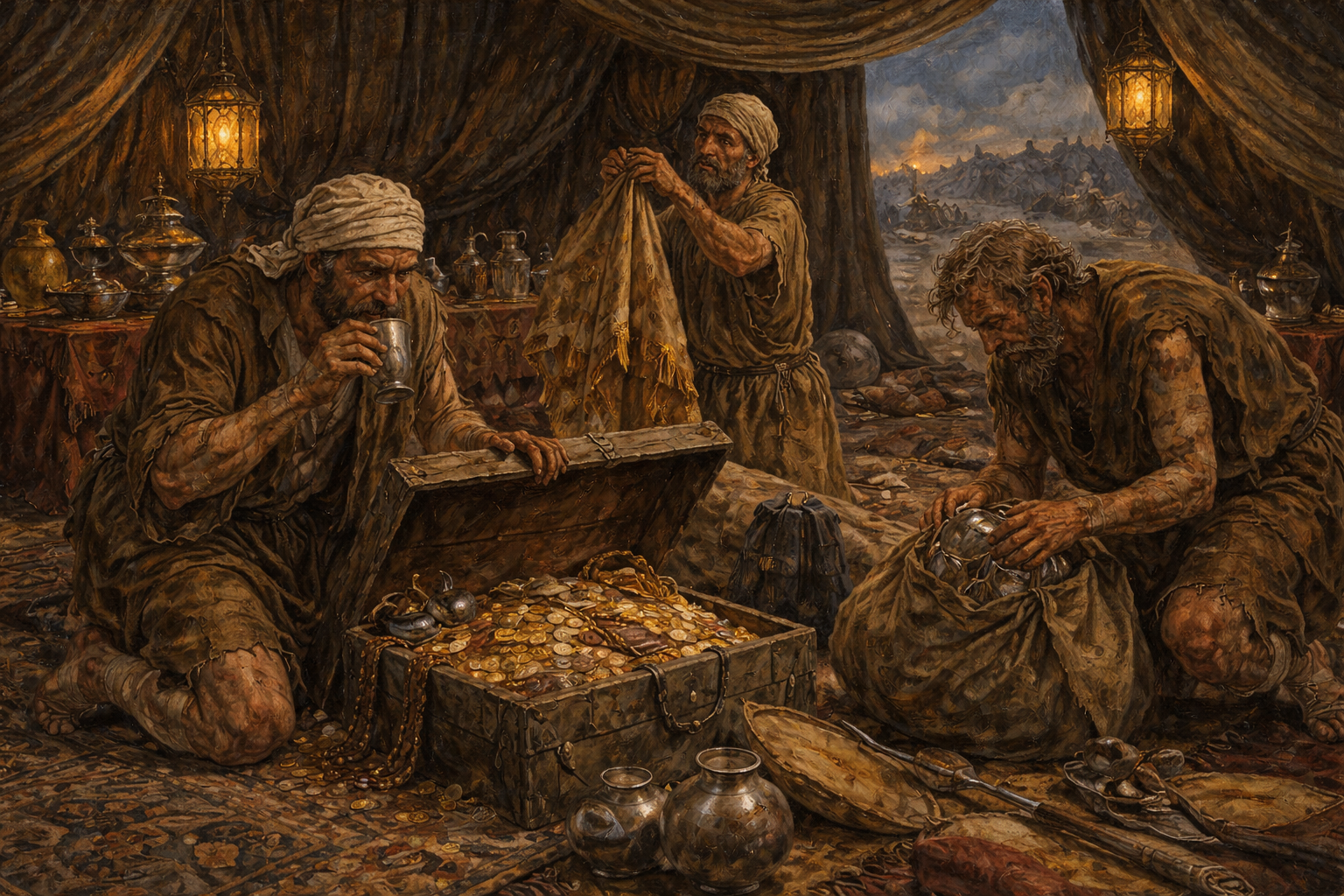
FOUR LEPERS HIT
THE JACKPOT
When these lepers came to the outskirts of the camp, they entered one tent and ate and drank - After themselves suffering the famine, nourishment would have been their reflex reaction.
and carried from there silver and gold and clothes, and went and hid them; and they returned and entered another tent and carried from there also, and went and hid them - It is notable that no normal army retreating would leave treasure behind, but this detail serves as more evidence of the Aramans total panic! The lepers lept upon the largess! After being nourished they plundered the valuables and hid two batches. They would still be lepers but they would now be rich lepers! Their reaction was very human, to satisfy hunger first and then feed their greed. They did what almost any person would have done when given access to unexpected abundance - consume, hoard and hide.
2 Kings 7:9 Then they said to one another, “We are not doing right. This day is a day of good news, but we are keeping silent; if we wait until morning light, punishment will overtake us. Now therefore come, let us go and tell the king’s household.”
- they said: 2Ki 7:3 Hag 1:4,5
- day: 2Ki 7:6 Isa 41:27 52:7 Na 1:15 Lu 2:10 Php 2:4
- punishment, 2Ki 5:26,27 Nu 32:23 Pr 24:16
LEPERS MORAL AWAKENING
TO SHARE THE "GOSPEL"
Then they said to one another, “We are not doing right - This is an interesting verse as these men who have been mistreated and cast out of socieity begin to experience a move in their consciences (we are not doing right). We can give them some credit, but remember they had hidden some of the goods!
🙏 THOUGHT - One might ask, why would four lepers suddenly experience such a surge of conscience and compassion for a people who had treated them as outcasts for years? While we cannot be dogmatic, their response clearly suggests that God was at work in their hearts, just as He sovereignly directs the heart of a king (Pr 21:1). God could have rained down manna (or flour and barley) from heaven 24 hours later in order to perfectly fulfill Elisha’s prophecy. Instead, He chose to accomplish His word through the miraculous scattering of the Arameans and the awakened consciences of four unlikely men. In this way, Elisha’s prophecy in 2 Kings 7:1 was fulfilled perfectly, "TO a T"!
This day is a day of good news (besorah; Lxx - euaggelia), but we are keeping silent - They began to say to each other "God has given us amazing news, but we’re selfishly keeping it to ourselves—and that is not right.” A day of good news is in effect a "gospel day" a day that would bring life to the city in place of death.
What if God had not allowed these men to be lepers and therefore be placed outside of the city gates? In their affliction they went to the Aramean siege (or so they thought), something they could not have done had they been INSIDE the city gate. Just a small detail that saved an entire population from a horrible death! A sovereign God allowed their affliction for in His incredible providence, He foresaw and knew they would be the "instruments" through which the good news of deliverance would reach the starving city! This reminds me of God's providence in Genesis 50:20! How much higher are God's ways than our ways!!! (Isaiah 55:8,9).
🙏 THOUGHT - The response of these four lepers is deeply convicting. They had experienced physical salvation, yet their consciences would not allow them to keep the good news to themselves while an entire city stood on the brink of death. In the same way, we as believers have experienced something far greater, spiritual salvation, while living in a world suffering spiritual starvation that leads not merely to physical death, but eternal separation from God.
May the Spirit of God stir our hearts with the truth that we are living in a “day of good news,” and it is not right for us to remain silent, but we must go and share this wonderful, life-saving message to famished souls. In the Name of our Savior, Amen.
When was the last time you remained silent when the Spirit was prompting you to share the Gospel with a starving hell-bound soul? Have you ever personally shared the Gospel with a lost person? Remember that we were all once spiritual “lepers,” cast out from God’s presence (Ge 3:24), until someone threw us a Gospel "life preserver." Let us go, in the power and boldness of the Spirit (Acts 1:8, Acts 4:31b), and do likewise for the glory of the Lamb of God.
Spurgeon - If the only result of our religion is the comfort of our poor little souls, if the beginning and the end of piety is contained within one’s self, why, it is a strange thing to be in connection with the unselfish Jesus, and to be the fruit of his gracious Spirit. Surely, Jesus did not come to save us that we might live unto ourselves. He came to save us from selfishness.
David Guzik - Yet, they enjoyed the feast first before they told others about it. We cannot properly share the good news of Jesus Christ unless we ourselves are enjoying it.
If we wait until morning light, punishment will overtake us - The outcast four have a conscience awakening. They sense it would be morally wrong to keep the good news to themselves while the city was still starving. Theorectically they could have done this because clearly the city does not realize the siege is lifted. That is a bit surprising that they could not see the enemy lines from their fortified wallls. However, recall the Arameans fled at dusk, so it is possible the Samarian sentries will begin to realize something is amiss when the morning sun arises. And this thought probably adds to their sense of guilt that punishment would overtake them.
Warren Wiersbe (p692) explains that they must have reasoned that "when morning comes, the whole city will discover that the enemy has fled, and they’ll wonder why the men didn’t say something. When the truth comes out, the four men would be punished for keeping the good news to themselves." It takes very little imagination to apply this scene to the church today. Jesus has won the victory over Satan and “this is a day of good news.” Believers are enjoying all the blessing of the Christian life while a whole world is suffering and dying. How can we keep the good news to ourselves? If we do, we will answer for it when we face the Judge. How can we be silent in a day of good news?
Bob Utley - punishment will overtake us" This is a personification. The OT often uses this kind of imagery. A good book on biblical imagery is G. B. Caird, BORROW The Language and Imagery of the Bible. There are real time consequences to our choices and actions!
Now therefore come, let us go and tell the king’s household - Thus moved by their conscience, they decide confession is better than concealment. They now decide to report this good news immediately to the king’s officials, the highest authority, so the news can quickly reach the entire city. And it would be up to the king's men to verify the report.
🙏 THOUGHT - This thought echoes the previous one, but it bears repeating: once we are in Heaven, the opportunity to share the Gospel is gone. So how do we apply the actions of the lepers to our lives? The lepers announced good news of physical deliverance, but we possess the far greater good news of spiritual deliverance! They felt guilty remaining silent about a message that meant temporal life, so how much more should we, as believers in Jesus Christ, refuse to remain silent about the Good News of eternal life? Empowered by the Spirit and grounded in the Word, we should echo and imitate Paul’s heart: "I am under compulsion; for woe is me if I do not preach the gospel." (1Co 9:16) And we must remember Paul’s penetrating question: “How will they believe in Him whom they have not heard? And how will they hear without a preacher?” (Ro 10:14). Have you ever shared the Gospel with your lost neighbor? And even if you have not spoken to them, you can always pray for their salvation. Have you prayed for their salvation? Don't be surprised if part of the answer to your prayer is that God gives you an opportunity to share the Gospel with them!
Good news (01309)(besorah related to basar) A feminine noun indicating news, tidings, message. It indicates a report delivered to someone about something: the report about the death of Saul was reported using this word (2Sa 4:10); news of the defeat of David's enemies (2 Sa. 18:20, 25, 27). It is used for either bad news or good news (2Ki 7:9). The account of 2Sa 4:10 states that the messenger thought David would receive the news of Saul's death as a good report; even expecting to receive a reward. David's anger at the report caused David to kill the messenger for these "tidings."
The root word basar means bear, bring, proclaim good news (01319) as in Psalm 40:9 "I have proclaimed glad tidings (Lxx - euaggelizo) of righteousness in the great congregation; Behold, I will not restrain my lips, O LORD, You know. "
BESORAH - 6V - 2 Sam. 4:10; 2 Sam. 18:20; 2 Sam. 18:22; 2 Sam. 18:25; 2 Sam. 18:27; 2 Ki. 7:9
Theological Dictionary of the Old Testament - Besora
I. Etymology, Occurrences, Usage in the Ancient Near East. In the OT the root bśr occurs 30 times in all: 14 times as a verb in the piel, once as a verb in the hithpael, 9 times as a substantival participle, and 6 times as a noun. Since the Hebrew knows only the intensive form, it seems likely from the start that a survey of the actual usage of this root in OT contexts will yield only a semantic analysis, and not an etymological conclusion.
This root is well attested in the ancient Near East. Even if we encounter varying s-sounds, comparative Semitic grammar shows that this is normal.1 Akkadian has the forms bussuru/passuru and bussurtu meaning “to bring a message (news)” and “message (news)” respectively.2 In itself, this word is neutral; consequently, the noun can be defined more precisely by adding other terms, as in the expressions bussurat lumnim, “bad news,” and bussurat dumqim, “good news,” or bussurat ḫadê, “joyful news.”3 In the majority of cases, both the noun and the verb forms denote a good message or good news. By way of comparison, Arab. baššara, Old South Arab. ʾbšr,4 Ethiop. absara, and Jewish Aram. bsr always mean “to bring good news.” In Ugaritic, the verb bšr means “to bring glad tidings,” and in the t-form “to receive it,” while the noun bšrt means “glad tidings.” These occurrences appear in three passages: CTA, 10 [IV AB], III, 34f., where Anat brings Baal the joyful news of the birth of a bull calf, causing him to rejoice (šmḫ); CTA, 19 [I D], II, 37, in a broken context which evidently has to do with news of victory; and CTA, 4 [II AB], V, 26f., where Anat brings Baal the news that a house is going to be built for him.
II. Secular Usage
1. Good News in General. In the OT we find bśr and its derivatives in three literary strata. We encounter the nontheological usage especially in the books of Samuel and Kings. The use of this word in the episode of the news about Absalom’s death is significant for determining the biblical meaning. It does not lack a certain dialectic, and for this very reason is instructive. The messengers and David, who awaits their arrival, have entirely different ideas about the content of the message: the messengers saw in the death of the insurgent Absalom the opportune occasion for their message, but David, as Absalom’s father, hoped that the message would be that Absalom was still alive. Both parties, the messengers (2 Sa. 18:19, 20) and David (18:25, 26), speak of “joyful” tidings that are brought or expected by using various forms of bissar, mebhasser, and besorah.5 We find the same thing when news of the death of Saul is brought to the land of the Philistines (1 Sa. 31:9 = 1 Ch. 10:9) and to David (2 Sa. 4:10); and in connection with the discovery of the flight of the Syrians (2 Ki. 7:9). David’s lament over Saul and Jonathan has the verb bśr in the piel in the first stich of 2 Sa. 1:20, but its parallelism with samach, “to rejoice,” and ʾalaz, “to exult,” makes it clear that the Philistines must have regarded the news as a joyful message. bśr is also used in parallelism with samach when news of the birth of Jeremiah is brought to his father (Jer. 20:15). Here undoubtedly bśr means “news of a joyful event.”
2. With tobh. In two passages in the OT, tobh(ah), “good,” modifies the root bśr: once it modifies the noun (2 S. 18:27), and once the verb (1 K. 1:42). In both cases this may be because the person to whom the message was carried was under great psychical tension: David anticipated from Ahimaaz, a “good man,” the kind of news he wanted to hear; in the midst of the celebration of his self-appointment to the throne, Adonijah became very anxious when he heard an echo of the surprising proclamation of Solomon as king, and he hoped to hear from Jonathan, a “worthy man,” words of reassurance. Thus the reason for the addition of tobh in these texts is to emphasize that the recipients of the tidings were hoping for “glad” tidings, and not to clarify the meaning of the root. Twice the noun besorah means “reward given to a messenger” (2 S. 4:10; 18:22). This also assumes that bśr means basically “glad” tidings.
3. Sad News. In one passage mebhasser is used of a messenger who brings to Eli the priest the sad news of Israel’s defeat and of the death of his sons (1 S. 4:17). Does this singular negative use of the root bśr justify the conclusion (assumed in KBL2) that bśr is a neutral word in Hebrew, and must be modified by “glad” or “sad” or something similar to convey the idea of glad or sad tidings? Or are we to agree with Friedrich when he assumes that the original meaning of this root is “glad” tidings?6 In our opinion Friedrich is correct, because the use of this root in extrabiblical literature also reveals the tendency to connect the root bśr with “glad” tidings, as Ugaritic in particular shows. The actual use of bśr in Biblical Hebrew starts at this semantic stage and further develops it. The exception in 1 S. 4:17 can be interpreted as a levelling down, and does not compel us to postulate that the original meaning in Hebrew was neutral.7
III. Theologico-Religious Meaning
1. Proclamation of Yahweh’s Saving Deeds. Only the verb and the substantival participle of bśr are used in a theologico-religious sense in the OT. Thus we will leave besorah out of our discussion from now on. The religious use of bśr is found in two rather strictly definable strata, the Psalms and the Prophets.
The use of bśr in Ps. 68:11, which speaks of “female messengers of victory in great number,” represents a definite transition from secular news of victory to news of victory in the sphere of salvation history grounded in Yahweh. The text here is not undisputed, but recent commentaries and translations leave it as it stands.8 The female messengers of victory are probably to be understood on analogy with the women who sang of the victories of Saul and David in 1 Sa. 18:7f. Ps. 68:11 does not have in mind news of victory carried to a specific audience, but a joyful announcement of Yahweh’s saving deeds, the “declarative praise” of God.9 It is only a step from this to the meaning that bśr assumes in certain cultic texts (Ps. 40:9 and Ps 96:2 = 1 Ch. 16:23). In the cult, bśr does not have to do with reporting news, but with joyfully proclaiming Yahweh’s great deeds as confession and in order to awaken religious joy.
2. The Messenger of Joy. This figure takes on new color in the dramatic sketch of the mebhasser who runs on the mountains to Jerusalem as a messenger of joy when Assyria falls (Nah. 2:1[1:15]). Deutero-Isaiah has the same figure, and the more he connects it with basic promises of salvation, the more expressive it becomes. Isa. 52:7 deals not only with the exodus from Babylon (52:11f.), but also with the tidings that in conjunction with this exodus God’s royal dominion has begun. In the first stich we find the substantival participle in the absolute meaning “messenger of glad tidings”; then the second stich is in synthetic parallelism, ending with the declaration of the sovereignty of God: here we encounter the significant words shalom, “peace,” tobh, “good,” and yeshuʿah, “salvation.” In this parallel stich, the participle of bśr is not substantival, but appears once with the obj. tobh, “good,” between two mashmiaʿ (“publish”) clauses in which the objects are shalom, “peace,” and yeshuʿah, “salvation,” respectively. The addition, tobh, is not adverbial and is not to be interpreted as a clarification of the particular nuance of bśr; instead, it is the second element in a threefold series of terms: peace, good, salvation. Similarly, the participle of bśr appears in the absolute in Isa. 40:9 (twice) meaning “female messenger of peace,” and in 41:27 meaning “messenger of joy.” In Deutero-Isaiah mebhasser always refers to Yahweh’s victory and the beginning of salvation.10
3. Intensification in Trito-Isaiah. In Trito-Isaiah we probably have the highest intensification of the meaning of bśr. First of all, this root is used in the sense of a proclamation of the praise of God by benevolent multitudes from Sheba, etc. (Isa. 60:6). In Isa. 61:1, it is more than a proclamation, but also more than a prophetic prognosis of the future. In his own interpretation of his mission, the prophet sees as his primary task lebhasser ʿanavim, “bringing good tidings to the afflicted.” Here the verb is absolute, and can denote only a saving message for the oppressed and poor, not a neutral message. The proclamation of a word of salvation, and thus of a joyful message of God, is a primary element in the work of the prophet along with healing, liberating, comforting, saving, etc., and is itself a saving event. The event-character of what is said in this entire pericope is clear to the extent that the proclamation of the prophet must be understood as an “announcement … which also gives rise to that which is proclaimed.”11 Thus bśr acquires an active note. With the announcement of glad tidings, the fulfilment begins; Yahweh himself is present and active in his word.
The height attained in Trito-Isaiah would be complete if we could find in bśr the basis for the NT key word euangélion, “gospel” (to say something about the later history of this word). Unfortunately, the noun besorah is not used in Isa. 61:1, and we do not know which intermediate Aramaic word Jesus used when he spoke of the “good news of the kingdom” (Mt. 4:23).12 However, in light of the quotation of Isa. 61:1 in Lk. 4:18f. and its adaptation to Jesus there, it is probably not far wrong to regard the translation of bśr by the Gk. deponent verb euangelízesthai in the LXX as the basis for the key word euangélion.13
In summary, it can be said that the theologico-religious usage of bśr confirms to a great extent the established secular sense of “bringing glad tidings” and develops this in relation to the message of salvation. --Schilling (†)
Good news in Septuagint - euaggelia (not found in NT) means good tidings - found in 5v in OT, all translating besora - 2 Sam. 18:20; 2 Sam. 18:22; 2 Sam. 18:25; 2 Sam. 18:27; 2 Ki. 7:9.
Related Words Used in the New Testament
- Gospel (2098) euaggelion
- Preach (the gospel, good news)(2097) euaggelizo/euangelizo
- Preached the Gospel beforehand (4283) proeuaggelizomai
- Evangelists (2099) euaggelistes
2 Kings 7:10 So they came and called to the gatekeepers of the city, and they told them, saying, “We came to the camp of the Arameans, and behold, there was no one there, nor the voice of man, only the horses tied and the donkeys tied, and the tents just as they were.”
- to the gatekeepers of the city: 2Ki 7:11 2Sa 18:26 Ps 127:1 Mk 13:34,35
- there was no one there: 2Ki 7:6,7

FOUR LEPERS REPORT
ENEMY CAMP DESERTED
So they came and called to the gatekeepers of the city, The lepers could not walk straight into Samaria and the gatekeepers were the only ones they could communicate with. The city was still locked down in fear of the Arameans. Normal security protocols required them to first report to the gatekeepers. The depiction above is probably slightly misleading as there is no evidence the lepers brought evidence (such as gold) to validate their claims. In fact, recall that they had hidden some of the plunder (2Ki 7:8).
And they told them, saying, “We came to the camp of the Arameans, and behold, (hinneh; ; Lxx - idou) there was no one there, nor the voice of man, only the horses tied and the donkeys tied, and the tents just as they were - Here is a behold guaranteed to get everyone's attention! The lepers (four witnesses not just two as normally required in testimony) make the shocking statement that the Aramean camp has been completely abandoned. The menion of the horses tied and the donkeys tied was significant because if an army flees intentionally and orderly, they ride and if they retreat strategically, they take supply animals. The fact that their tents just as they were indicates this as not a military movement.
🙏 THOUGHT - This verse is a picture of divine deliverance already completed, waiting to be believed and acted upon. The city still feared, but God had already acted. Many believers live in similar spiritual famine because they do not believe the good news of God’s already-accomplished salvation.
2 Kings 7:11 The gatekeepers called and told it within the king’s household.

GATEKEEPERS REPORT
TO THE KING
The gatekeepers called and told it within the king’s household - The gatekeepers were officials stationed at the city gate who controlled access and reported important matters. It is interesting that the gatekeepers did not ignore the leper's report as foolishness or hallucinations. In short, the gatekeepers promptly reported the lepers’ message to the king’s court so the news could reach the king and the nation could respond.
2 Kings 7:12 Then the king arose in the night and said to his servants, “I will now tell you what the Arameans have done to us. They know that we are hungry; therefore they have gone from the camp to hide themselves in the field, saying, ‘When they come out of the city, we will capture them alive and get into the city.’”

THE KING SUSPECTS
AN ARAMEAN AMBUSH
Then (then) - Marks a transition and progression in the narrative. The report was received and the king responsed. Then moves the story forward from good news announced to the king’s reception and decision.
The king arose in the night and said to his servants - The 4 lepers clearly moved quickly because they had arrived at the Aramean camp at twilight or dusk and returned to the city that same night. The gatekeepers also moved quickly to pass the news on to the king of Israel.
“I will now tell you what the Arameans have done to us. They know that we are hungry; therefore they have gone from the camp to hide themselves in the field, saying, ‘When they come out of the city, we will capture them alive and get into the city - The king's words indicate that he assumes the report is a trap, once again revealing his unbelief and pessimism (2Ki 3:10, 13). He also suffers from recent memory loss or rank unbelief, as he does not even make allusion to Elisha's prophecy given less about 24 hours earlier (cf timing in 2Ki 7:1). He thinks that the Arameans know Samaria is starving and have only pretended to retreat, hiding in ambush outside the city. And as soon as the starving Israelites come out looking for food, they would attack, capture the people and easily take the city. Perhaps he was thinking of how Joshua had defeated the city of Ai by drawing them out from the city to be ambushed (Joshua 8:1-35).
Warren Wiersbe (p692) points out that "It wasn’t so much that he doubted the word of the lepers as that he rejected the word of Elisha. Had he believed the word of the Lord, he would have accepted the good news from the lepers."
In short, the king is convinced the good news is too good to be true. He fails to even mention or associate this report with Elisha's prophecy the day before. He refuses to believe God's promise of deliverance instead choosing to believe this portends enemy deception.
2 Kings 7:13 One of his servants said, “Please, let some men take five of the horses which remain, which are left in the city. Behold, they will be in any case like all the multitude of Israel who are left in it; behold, they will be in any case like all the multitude of Israel who have already perished, so let us send and see.”
- one: 2Ki 5:13
- they are even: 2Ki 7:4 6:33 Jer 14:18 La 4:9
KING COERCED INTO
INVESTIGATING CAMP
One of his servants said, “Please, let some men take five of the horses which remain, which are left in the city. - This plea comes from the king’s servant and acknowledges because the siege had been so long and so severe, very few horses remained alive, many having either starved and/or having been eaten (cf. 2Ki 6:25). Samaria was on the brink of total collapse with almost no resources left. The fact that the servant had to plead with the king shows his courage and suggests the king was paralyzed by fear, unbelief and suspicion (of an ambush). The servant is reasoning that they should use the little they still had to investigate the report.
Behold (hinneh; Lxx - idou), they will be in any case like all the multitude of Israel who are left in it; Behold (hinneh; Lxx - idou), they will be in any case like all the multitude of Israel who have already perished, so let us send and see - The servant uses two attention grabbing "beholds" (but see the NET Note below) The servant is reasoning that even if it is a trap, the people are already dying. He recognizes Israel has nothing left to lose. Therefore if those sent out were killed by the Arameans, they would only be like many of the people in Samaria who had already died of starvation.
So the intent of the servant’s counsel was to urge the king not to dismiss the good news outright but at least to allow a reconnaissance party to go out and investigate the report. Rather than remain paralyzed by suspicion and fear, he encouraged the king to take a measured step of faith and verify the facts and see whether God had truly provided deliverance.
NET Note - Heb "Let them take five of the remaining horses that remain in it. Look, they are like all the people of Israel that remain in it. Look, they are like all the people of Israel that have come to an end." The MT is dittographic here; the words "that remain in it. Look they are like all the people of Israel" have been accidentally repeated. The original text read, "Let them take five of the remaining horses that remain in it. Look, they are like all the people of Israel that have come to an end."
2 Kings 7:14 They took therefore two chariots with horses, and the king sent after the army of the Arameans, saying, “Go and see.”

KING SAYS
"GO AND SEE"
They took therefore two chariots with horses, and the king sent after the army of the Arameans, saying, “Go and see. - The officer had asked for 5 horses but the king let him only have 2 chariots (with probably 2 horses per chariot). The king of Israel had enough sense to finally authorize a cautious scouting mission to verify the "good news" of the four lepers. The chariots would provide speed and give the scouting party some defense. It would also allow them to follow the trail to the Jordan River (2Ki 7:15). In effect, we see the beginning of God's promise unfolding.
2 Kings 7:15 They went after them to the Jordan, and behold, all the way was full of clothes and equipment which the Arameans had thrown away in their haste. Then the messengers returned and told the king.
- vessels: Es 1:7 Isa 22:24
- Thrown away: Job 2:4 Isa 2:20 10:3 31:7 Eze 18:31 Mt 16:26 24:16-18 Php 3:7,8 Heb 12:1
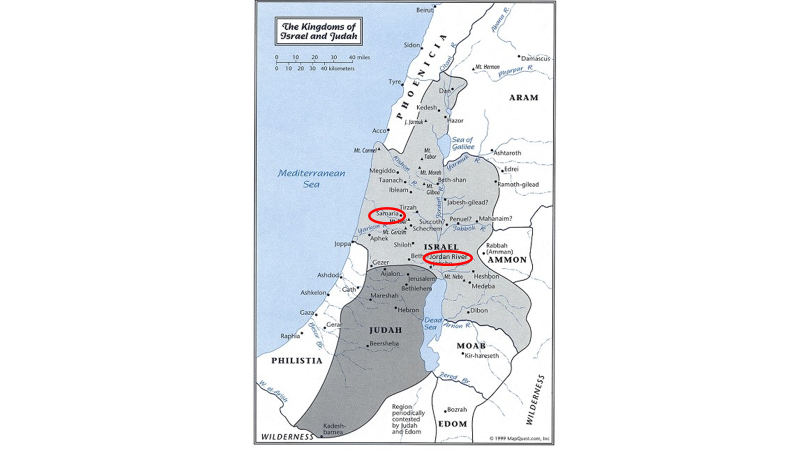
SCOUT PARTY TRACKS FROM
SAMARIA TO JORDAN RIVER
They went after them to the Jordan, and behold (hinneh; Lxx - idou), all the way was full of clothes and equipment which the Arameans had thrown away in their haste (in their panic) - The Israeli charioteers pursued the trail of the Aramean for about 20-25 miles. They did not need bloodhounds to track the Arameans, but simply had to follow the trail of clothes and equipment. This scattering of clothes and equipment confirms the fact that the Arameans fled in panic, literally running for their lives (or at least that is what they thought)!
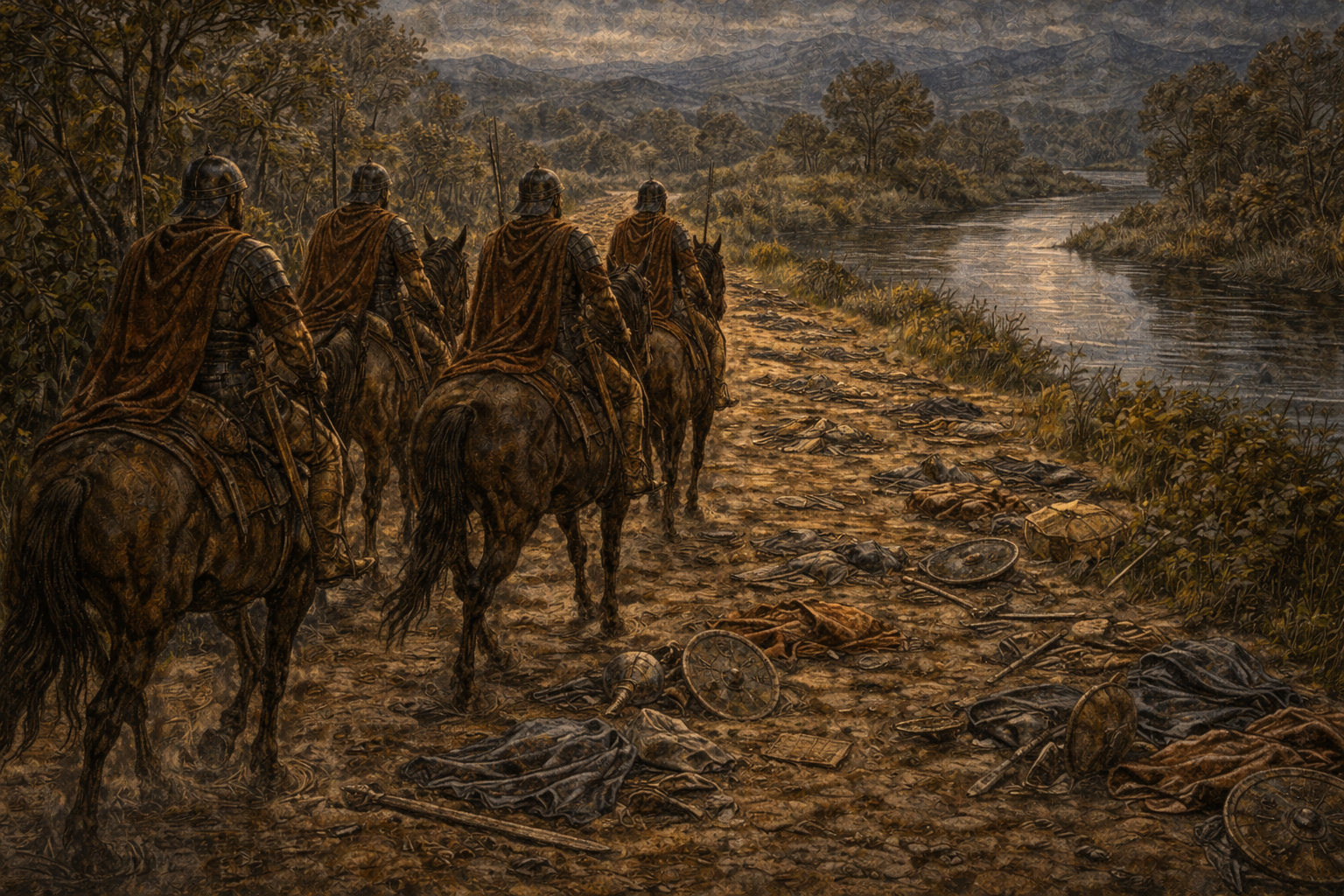
Then - This again marks progression in the narrative. The scouts would be able to complete the 40-50 mile round trip in roughly 8-10 hours.
The messengers returned and told the king - The messengers likely returned on the same day the king sent them out, confirming the good news the four lepers had brought the night before.
2 Kings 7:16 So the people went out and plundered the camp of the Arameans. Then a measure of fine flour was sold for a shekel and two measures of barley for a shekel, according to the word of the LORD.
- plundered the camp: 1Sa 17:53 2Ch 14:12-15 20:25 Job 27:16,17 Ps 68:12 Isa 33:1,4,23
- according to: 2Ki 7:1 Nu 23:19 Isa 44:26 Mt 24:35
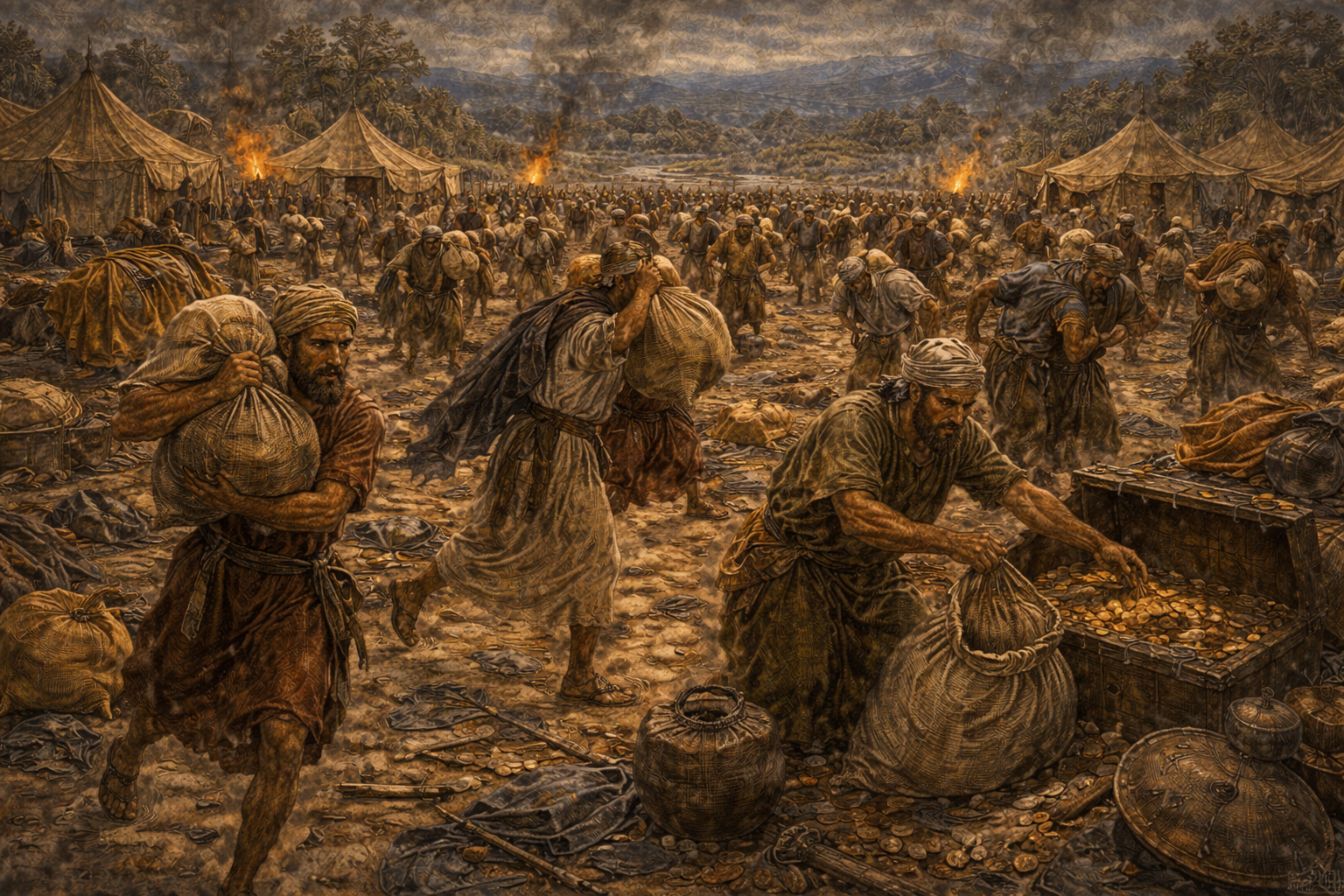
FROM FAMINE TO FEAST
GOD'S PROMISE FULFILLED
So - Term of conclusion. Based on the verification of the good news of the scouting party, the king obviously relayed this to the starving city.
The people went out and plundered (bazaz; Lxx - diarpazo) the camp of the Arameans - Once God’s deliverance was confirmed, the starving people of Samaria poured out of the city and seized the abandoned supplies and riches of the fleeing Aramean army, thus experiencing total relief, total reversal, and total fulfillment just as promised in God’s Word (2Ki 7:1).
Then a measure (5-7 quarts) of fine flour was sold for a shekel and two measures of barley for a shekel, according to the word of the LORD - This event is the precise fulfillment of Elisha’s short-term prophecy and serves as undeniable confirmation that he was a true prophet of YHWH. Moses had taught Israel that a genuine prophet of God would be verified when his words came to pass exactly as spoken (Deut. 13:1–5; Deut 18:21–22). Elisha’s prophecy was not vague, general, or distant—it was specific in content, timing, and outcome, and God brought it to pass in detail. This fulfillment validated Elisha’s prophetic authority, affirmed that his message truly came from the LORD, and demonstrated that God’s Word is absolutely trustworthy.
The phrase according to the word of the LORD occurs 5x in the Bible - most in Kings - 1Ki. 15:29; 2Ki. 1:17; 2Ki. 4:44; 2Ki. 10:17; Da 9:2
How trustworthy is the word of the LORD! Through Elisha, God did not merely promise relief but He announced the exact market prices that would be found in Samaria the very next day. God specified what would be available, where it would be sold, when it would happen, and even how much it would cost. When the famine ended and the people rushed to the abandoned Aramean camp, everything unfolded exactly as Yahweh had declared through His mouthpiece Elisha. The prophecy was fulfilled with precise accuracy, proving beyond doubt that Elisha spoke the true word of YHWH and that God’s promises are trustworthy down to the smallest detail. One of my favorite verses in Proverbs testifies "Every word of God is tested (tsaraph - like precious metal refined in a fire). He is a shield (Play Protector of My Soul) to those who take refuge in Him (Trusting His Word, His promises)." (Pr 30:5)
Warren Wiersbe (p692) adds that "the main lesson isn’t that God rescued His people when they didn’t deserve it, but that God fulfilled the promise He gave through His prophet Elisha. Note the emphasis on “the word of the Lord” in 2 Kings 7:16,17, 18." Jesus has promised to come again, but in these last days, people are questioning and even denying that promise. Fulfilling what Peter wrote in 2 Peter 3, the scoffers have now come and are asking, “Where is the promise of his coming?” The church is like those four lepers: we have the good news of salvation, and we must not keep it to ourselves. If people don’t believe the Word of the Lord, they won’t be ready for His coming, but if we don’t give them the message, they can’t be ready for His coming. What will we say when we meet the Lord?"
Plundered (took booty, seized) (0962) bāzaz is a verb meaning to loot, to plunder, to spoil, to rob. The word describes this destructive activity taken against cities or places (Gen. 34:27; 2 Kgs. 7:16), people and cattle (Num. 31:9; Isa. 10:2; 11:14). Its passive uses are similar with the meaning of be plundered (Isa. 24:3) or taken as spoil (Jer. 50:37). If Israel were obedient to God she would triumph over her enemies and would despoil them. This had been her experience during the latter part of the wilderness period and during the conquest of Canaan (Num 31:9, 32, 53; Josh 8:2, 27; etc.). God was pleased to give the spoil to them, only reserving to himself that which was designated ḥerem, devoted to God. By the same token, it is promised that in the latter days she will once again despoil her enemies (Isa 11:14; Zeph 2:9; etc.). God will act so mightily on Israel’s behalf that even the lame will take spoil (Isa 33:23). However, this will not happen simply because Israel is Israel, but because she will then be obedient and because the fruit of her enemies’ arrogance will have come to its full term (Ezek 26:5; 36:4; Jer 30:16).
2 Kings 7:17 Now the king appointed the royal officer on whose hand he leaned to have charge of the gate; but the people trampled on him at the gate, and he died just as the man of God had said, who spoke when the king came down to him.
- the royal officer 2Ki 7:2
- the people trampled : 2Ki 9:33 Jdg 20:43 Isa 25:10 Mic 7:10 Heb 10:29
Related Passages:
2 Kings 7:1-2 Then Elisha said, “Listen to the word of the LORD; thus says the LORD, ‘Tomorrow about this time a measure of fine flour will be sold for a shekel, and two measures of barley for a shekel, in the gate of Samaria.’” 2 The royal officer on whose hand the king was leaning answered the man of God and said, “Behold, if the LORD should make windows in heaven, could this thing be?” Then he said, “Behold, you will see it with your own eyes, but you will not eat of it.”
Matthew 24:35 “Heaven and earth will pass away, but My words will not pass away.
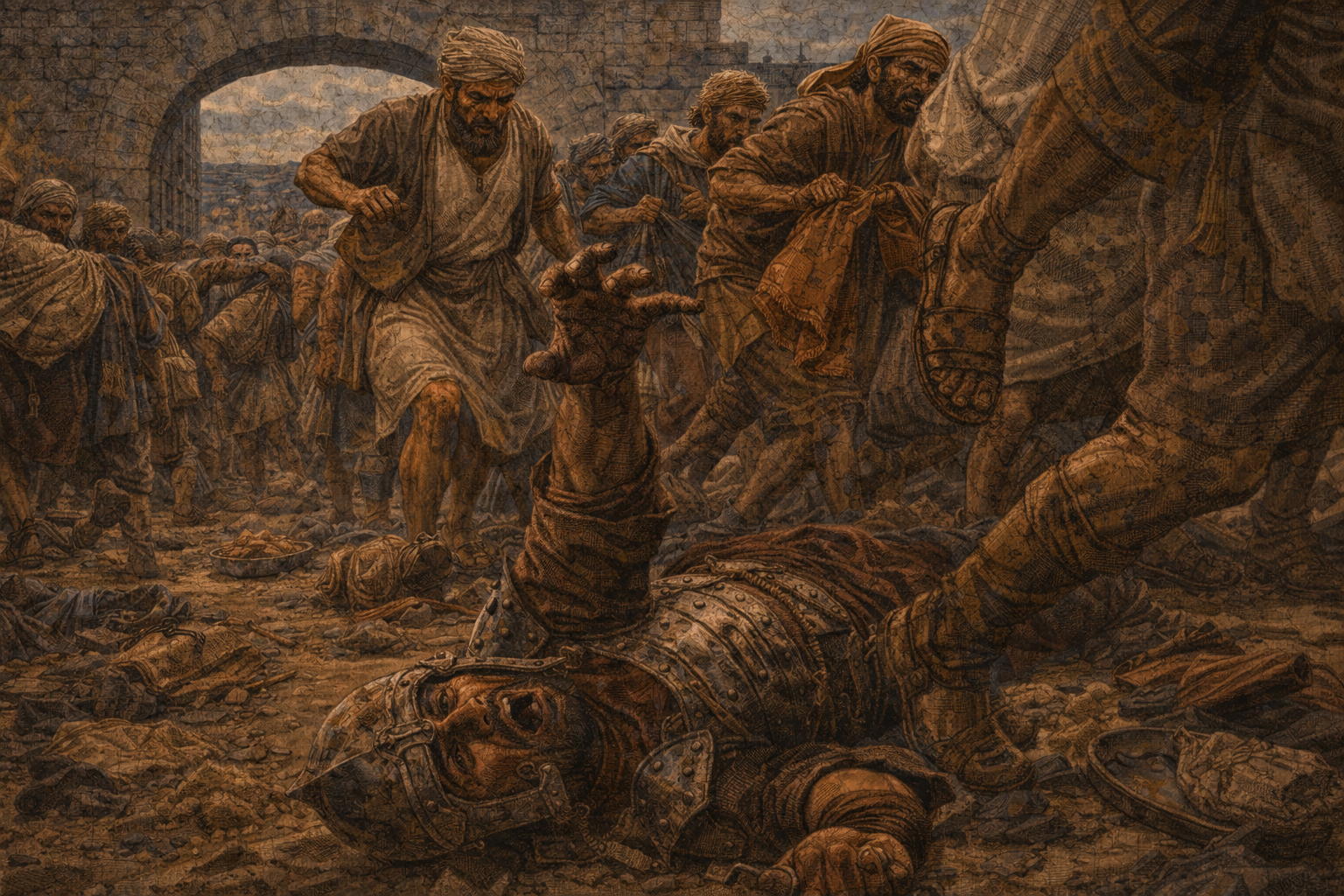
KING'S RIGHT HAND MAN
FULFILL'S ELISHA'S PROPHECY
Now - NOW signals “Pay attention as a key development follows.” In short, this NOW moves the story from God’s deliverance and abundance to the judgment scene that fulfills Elisha’s prophecy about the unbelieving officer. The writer shifts from description of divine blessing to description of divine justice.
The king appointed the royal officer on whose hand (yad) he leaned to have charge of the gate - Might I suggest a brief (contrasting) wordplay on the Hebrew word hand (yad) used here and in 2 Kings 7:2? Proverbs 21:1 says "The king’s heart is like channels of water in the hand (yad means power) of the LORD. He turns it wherever He wishes." The word hand (yad) carries the nuance of power, control, or authority, reminding us that kings, circumstances, and outcomes ultimately rest in God’s sovereign hand not man’s. In this verse Yahweh, by His sovereign providence, directs the king’s heart so that he appoints his trusted “right-hand man” to oversee the city gate, placing him precisely where God intends His promised purpose to unfold.
And note the divine irony that the very man who doubted God’s promise is stationed at the very gate where Elisha had prophesied abundance, the very gate where four desperate outcasts had once sat in emptiness.
David Guzik writes this sad comment - Because of his unbelief, he saw others enjoy God’s blessings but he did not.
🙏 THOUGHT - How does this apply to unbelievers who during their life have scoffed, mocked and failed to believe in God's gracious offer of salvation in His Son Jesus Christ? Scripture strongly suggests that before being cast into the Lake of Fire (Revelation 20:14–15), all the unsaved will behold the glory of God and the blessed state of the redeemed (Cf rich man in Hades Lk 16:23, cf sheep and goats in presence of the King's glory - Mt 25:31,32,33, 41). This awareness does not lead to repentance, for the time of grace will have passed, but it will vindicate God’s justice and magnify His mercy toward those who are saved. Just as the royal officer in 2 Kings 7 saw others enjoy God’s blessing but did not partake because of unbelief, so also those who reject Christ will see the fulfillment of God’s promises—but from outside the gates of His kingdom. May this truth compel us to share the Gospel while there is still time (cf Lk 13:25, Ro 1:16) and move every lost heart toward humble repentance and faith in Christ, Who “desires all people to be saved and to come to the knowledge of the truth” (1 Timothy 2:3–4). Amen and amen!
But - What a dramatic change of direction in this context (one word changed this officer's life!). One moment the king’s “right-hand man” was standing confidently at the gate, a symbol of royal authority and control. BUT reality crashed in. The starving people, suddenly electrified by hope and driven by desperation, surged like a human tidal wave toward the deserted Aramean camp and its unimaginable abundance. In an instant, order gave way to chaos, dignity to desperation, and the officer who had scoffed in unbelief at God’s promise was swept away beneath the feet of the very people he once stood over. I am reminded of Paul's warning "Therefore let him who thinks he stands take heed (present imperative) that he does not fall." (1Co 10:12)
The people trampled on him at the gate, and he died just as the man of God had said, who spoke when the king came down to him - When the famine ended and food suddenly became available from the abandoned Aramean camp, the desperate people surged out of Samaria to the gate to rush toward the supplies. In the chaos and stampede, the king’s royal officer who had earlier mocked God’s promise was trampled to death. This happened exactly as Elisha had foretold that the officer would see God’s blessing with his eyes, but he would never eat of it (2 Ki 7:2). This passage emphasizes that God fulfilled His word to the letter both the promise of provision and the warning of judgment. Beloved, take heart, God’s Word is reliable, both His words of blessing and judgment alike.
Cynicism toward God’s Word
can be dangerous to your health!
God’s promises cannot fail. God’s warnings cannot fail. He fulfills both. Grace and mercy to the believing. Judgment to the hardened and unbelieving. Unbelief does not merely miss out on blessing, but also faces consequence. Remember that God’s Word does not become true when we believe it, but remains true whether we believe it or not. I love the wise words of the aged, soon to pass on, Joshua addressed to the second generation Israelites now in the promised land...
“Now behold, today I am going the way of all the earth, and you know in all your hearts and in all your souls that NOT ONE WORD OF ALL THE WORDS which the LORD your God spoke concerning you HAS FAILED; ALL HAVE BEEN FULFILLED for you, NOT ONE OF THEM HAS FAILED. (Joshua 23:14)
🙏 THOUGHT: Dear tried and test true disciple of Jesus Christ, let this truth regarding God's unfailing Word soak in and stabilize your wavering soul. And note what Joshua repeats--that not one of the Words of God has failed (then, now or forever - Mt 24:35)! In Christ, you have been granted "His precious and magnificent promises, so that by them you may become partakers of the divine nature, having escaped the corruption that is in the world by lust," "for no matter how many promises God has made, they are "Yes" in Christ. And so through Him the "Amen" is spoken by us to the glory of God" for "Jesus Christ is the same yesterday and today and forever." (2Pe 1:4, 2Co 1:20NIV, Heb 13:8) Amen and amen!
Dale Ralph Davis on the tragedy in this passage - That is the situation in this text, only here it is not a simple tragedy but a tragedy brought on by the officer’s own unbelief. By his unbelief he did not falsify God’s word but forfeited his own benefit from that word. The story should drive us straight to Hebrews: ‘See (present imperative see our need to depend on the Holy Spirit to obey) to it that you do not refuse Him who is speaking’ (Heb. 12:25, NASB). How perilous the word of God is! How precarious to think God can’t possibly be all that upset over a certain degree of unbelief. (BORROW 2 Kings: The Sound and the Fury page 128)
Polio - Proverbs 21:1
Once while Francis and Edith Schaeffer returned from America to their Swiss home, young Franky grew ill and lost his ability to walk. The doctor diagnosed polio, and Edith devoted her waking hours to caring for him.
Francis was in Italy when Franky suffered another attack. The local doctor arrived, begging to inject the child with a virtually untested serum he had invented. “Please let me use it. Don’t deny the boy the possibility of help. He may never walk again otherwise.”
Edith, sick with panic, silently cried, “Oh Father, show me what is best. I’ll go with the doctor unless you stop me, God. I don’t know what else to do.” Meanwhile the doctor paced the floor, saying, “Hurry, hurry … no time to lose.” Jumping in the car, they raced to the little hospital. The ether mask was affixed over Franky’s screaming face, and the injection given, with another scheduled for the morning.
I became increasingly frightened about it. But in the early morning as I was reading my Bible beside Franky, a verse in Proverbs suddenly hit me. “The king’s heart is in the hand of the Lord, as the rivers of water: he turneth it whithersoever he will.” I thought, “If God can turn a king’s heart the way He can turn the course of a river, surely God can turn the decision of this doctor in the direction best for Franky”; and as I asked God to do this, I stopped trembling. The doctor walked in with a nurse and as she started to pull the cot towards the operation room, the doctor put up his hand and said sharply, “Wait.” Then he gazed at Franky a few minutes and finally said, “I’ve changed my mind. We won’t do it.” The second injection was never given.
Whatever that injection did, Franky did not have any paralysis, and the day came when he could sit up, then stand, and finally walk.
The President's Heart - Henry Morris
"The king's heart is in the hand of the LORD, as the rivers of water: he turneth it whithersoever he will" (Prov. 21:1).
A river may seem to meander aimlessly, but it eventually reaches its goal. The twists and turns along the way are constrained by a variety of hydraulic and geologic factors that determine its local speed and direction, but somehow it "just keeps rolling along" toward the sea.
So it is with a king, or with a president, or any leader of a state or nation. He may have a goal in mind (honorable or otherwise) for the nation he governs, but there are numerous people and circumstances along the way that will either impede or help his progress toward that goal. In fact, we ourselves—the Christian citizens of his nation—are an integral component of those circumstances.
The president's heart is in the hands of God. In fact, "the powers that be are ordained of God" (Rom. 13:1). Whether the ruler comes into power by election or inheritance or coup d'etat or some other way (depending upon the nation and type of government), God is in control and will accomplish His ultimate goal.
That is why it is vital that we frequently make "supplications, prayers, intercessions, and giving of thanks... for all men," especially for "kings, and for all that are in authority" so that we will all be able to "lead a quiet and peaceable life in all godliness and honesty" (1 Tim. 2:1-2).
Our American nation has had many great men as our presidents over the years, and many of our ancestors were indeed men and women of prayer. We do have a great heritage in our nation of both leaders and followers who believed in the Creator God of the Bible and who prayed diligently for their country and the great decisions of its history. We must—must —do the same today!
2 Kings 7:18 It happened just as the man of God had spoken to the king, saying, “Two measures of barley for a shekel and a measure of fine flour for a shekel, will be sold tomorrow about this time at the gate of Samaria.”
- as the man: 2Ki 7:1,2 6:32 Ge 18:14
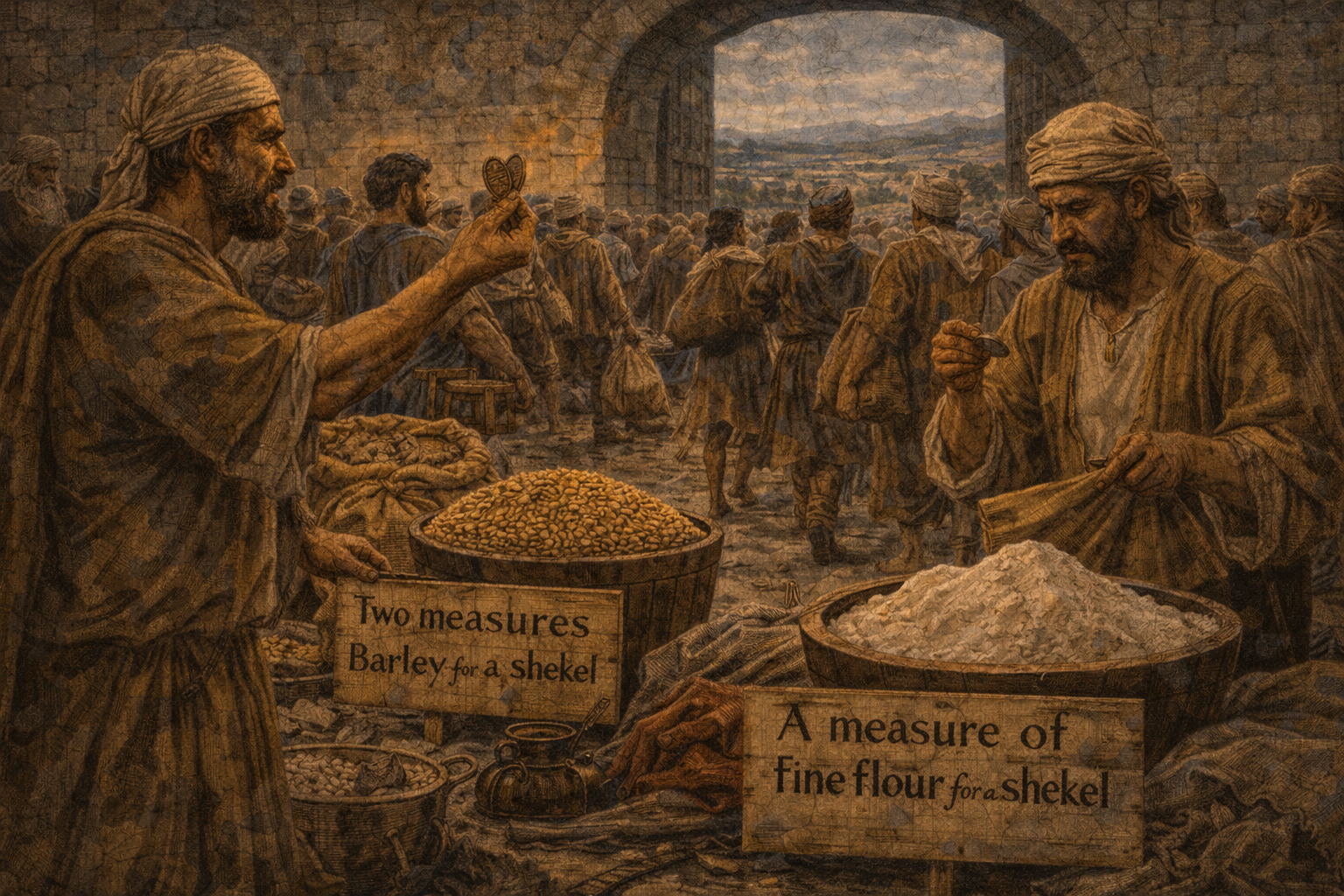
ELISHA'S PROPHECY
PROVES TRUE
It happened just as the man of God had spoken to the king God's Word in one sense is not prediction (which of course it is) but even more it is declaration. It happened just as emphasizes God's Word is not probabilty but certainty. It is like the Biblical truth about hope, which is not hope so (world's definion) but hope sure! God says it. That settles it. Whether we understand it or not (cf passages in Revelation!). Whether we believe it or not. The fate of the royal officer suggests it is best to believe it!
Saying, “Two measures of barley for a shekel and a measure of fine flour for a shekel, will be sold tomorrow about this time at the gate of Samaria - This verse restates 2Ki 7:2 and emphasizes that God fulfilled Elisha’s prophecy exactly as spoken, turning famine into abundance within a day, proving the absolute reliability and timing of God’s Word. In a sense this verse could be written as a banner over chapter 7. That banner would read
"God’s Word never fails, not in promise,
not in timing, not in detail."
2 Kings 7:19 Then the royal officer answered the man of God and said, “Now behold, if the LORD should make windows in heaven, could such a thing be?” And he said, “Behold, you will see it with your own eyes, but you will not eat of it.”
ELISHA'S PROPHECY OF
MOCKING OFFICER
Then the royal officer answered the man of God and said, “Now behold, if the LORD should make windows in heaven, could such a thing be?” And he said, “Behold, you will see it with your own eyes, but you will not eat of it - The writer repeats 2Ki 7:2 to remind the reader exactly what the officer said and exactly what Elisha replied before showing the fulfillment and in so doing highlights God’s absolute reliability, to show that the coming judgment is righteous and exact, and to underline the seriousness of proud unbelief of God’s Word.
2 Kings 7:20 And so it happened to him, for the people trampled on him at the gate and he died.
- Nu 20:12 2Ch 20:20 Job 20:23 Isa 7:9 Jer 17:5,6 Heb 3:18,19
Related Passages:
Numbers 20:12 (THE COST OF MOSES' UNBELIEF) But the LORD said to Moses and Aaron, “Because you have not believed Me, to treat Me as holy in the sight of the sons of Israel, therefore you shall not bring this assembly into the land which I have given them.”
Jeremiah 17:5-6 Thus says the LORD, “Cursed is the man who trusts in mankind And makes flesh his strength, And whose heart turns away from the LORD. 6 “For he will be like a bush in the desert And will not see when prosperity comes, But will live in stony wastes in the wilderness, A land of salt without inhabitant.
1 Thessalonians 5:3 While they are saying, “Peace and safety!” then destruction will come upon them suddenly like labor pains upon a woman with child, and they will not escape.
2 Peter 3:3-7 Know this first of all, that in the last days mockers will come with their mocking, following after their own lusts, 4and saying, “Where is the promise of His coming? (SOUNDS A LOT LIKE THE KING'S "RIGHT HAND MAN"!) For ever since the fathers fell asleep, all continues just as it was from the beginning of creation.” 5 For when they maintain this, it escapes their notice that by the Word of God the heavens existed long ago and the earth was formed out of water and by water (Heb 11:3), 6 through which the world at that time was destroyed, being flooded with water. 7 But by His Word the present heavens and earth are being reserved for fire (Heb 1:3), kept for the day of judgment and destruction of ungodly men.
2 Peter 3:10 But the day of the Lord will come like a thief, in which the heavens will pass away with a roar and the elements will be destroyed with intense heat, and the earth and its works will be burned up.
ELISHA'S PREDICTION FULFILLED
THE COST OF UNBELIEF
And so it happened to him, for the people trampled on him at the gate and he died - The writer records the exact fulfillment of God’s warning to the unbelieving officer showing again that God’s Word is utterly reliable, unbelief carries real consequence, and God’s faithfulness is seen both in deliverance and in judgment. This is intentional storytelling beginning first with the prophecy and unbelief (2Ki 7:2). Later the reminder of the prophecy and unbelief (2Ki 7:19) and finally immediately after this the fulfillment (2Ki 7:20)
Henry Morris writes that "It is dangerous to scoff at the inspired word of God (1Th 5:3; 2Pe 3:3-7,10).