2 Kings 3:2
2 Kings 3:3
2 Kings 3:4
2 Kings 3:5
2 Kings 3:6
2 Kings 3:7
2 Kings 3:8
2 Kings 3:9
2 Kings 3:10
2 Kings 3:11
2 Kings 3:12
2 Kings 3:13
2 Kings 3:14
2 Kings 3:15
2 Kings 3:16
2 Kings 3:17
2 Kings 3:18
2 Kings 3:19
2 Kings 3:20
2 Kings 3:21
2 Kings 3:22
2 Kings 3:23
2 Kings 3:24
2 Kings 3:25
2 Kings 3:26
2 Kings 3:27
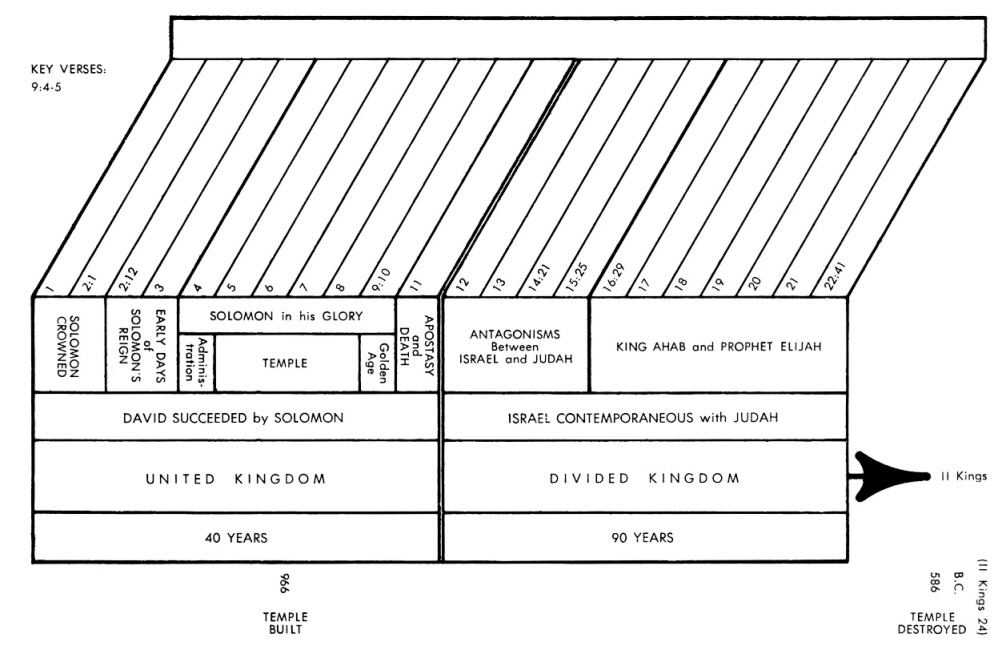
Chart from recommended resource Jensen's Survey of the OT - used by permission
1 Kings Chart from Charles Swindoll
THE DOWNWARD SPIRAL
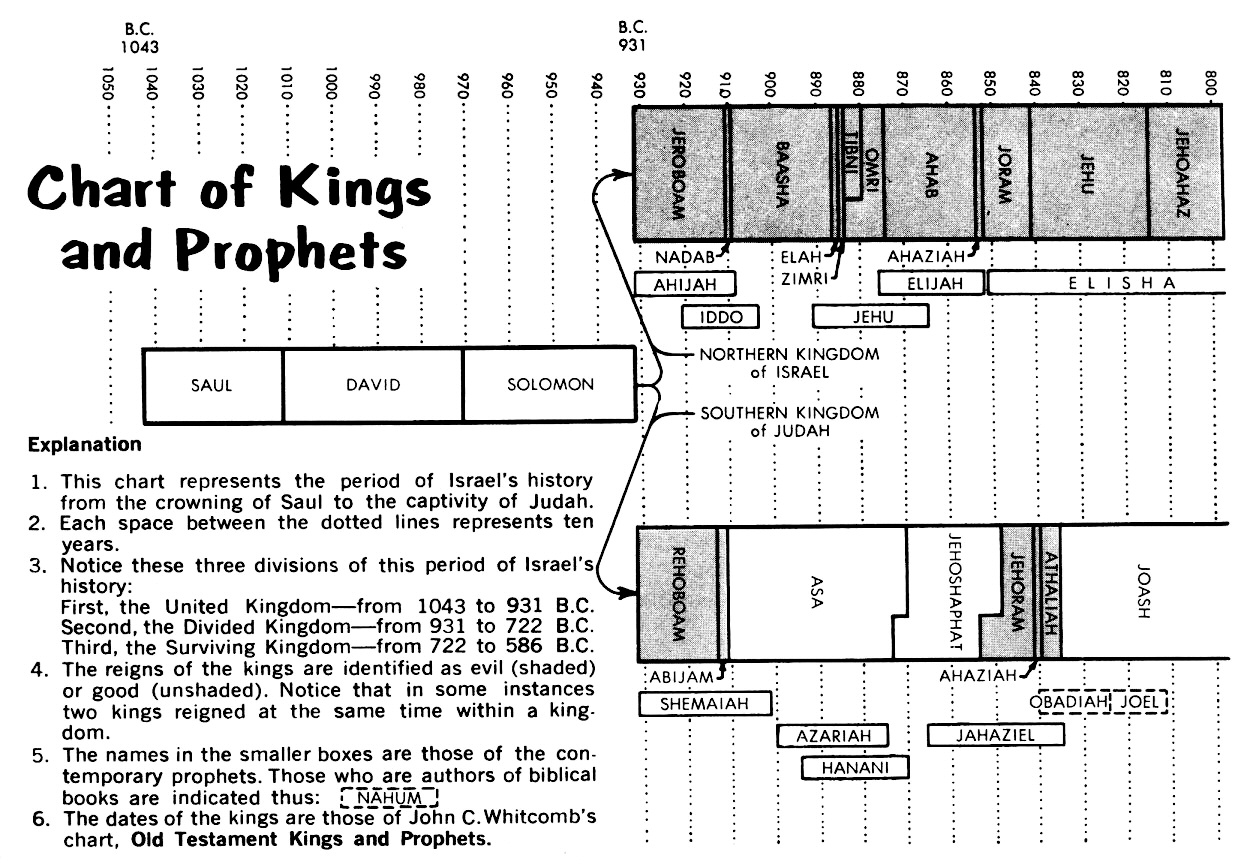
Click to Enlarge
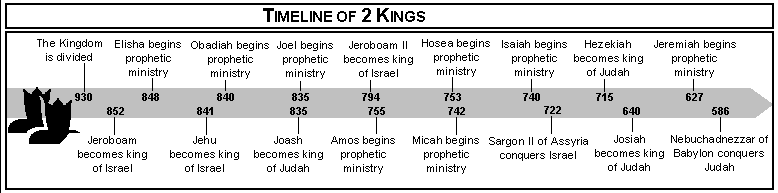
Ryrie Study Bible - Borrow
Click to Enlarge
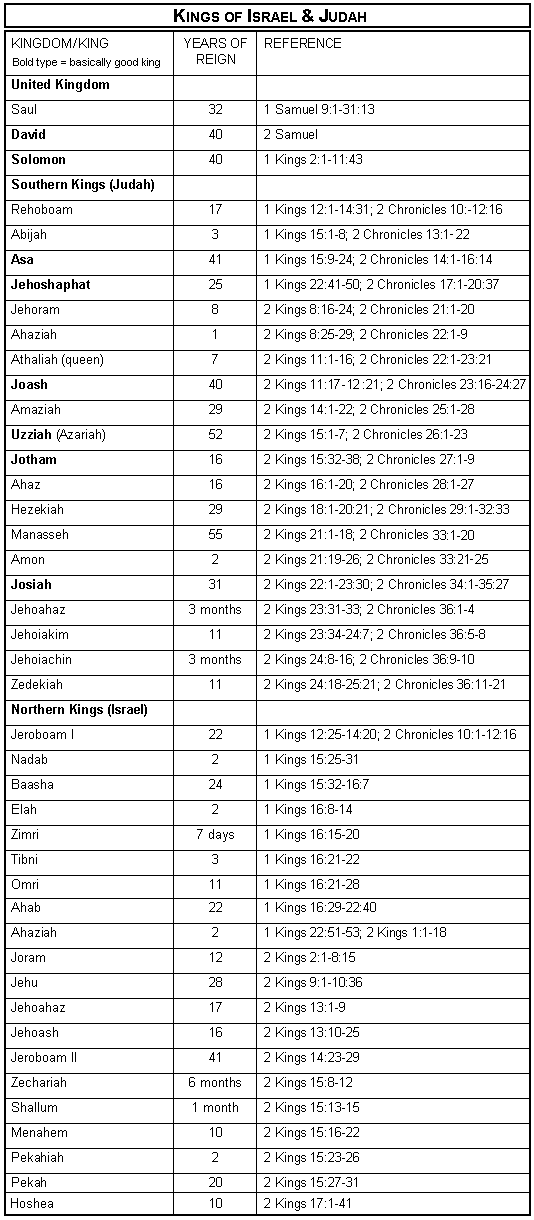
(NOTE: Many consider Amaziah and Hezekiah as "good" kings)
SEE ALSO:
ESV chart - kings of Israel - more information
ESV chart - kings of Judah - more information
Another Chart with Variable Dates for Reigns of Kings
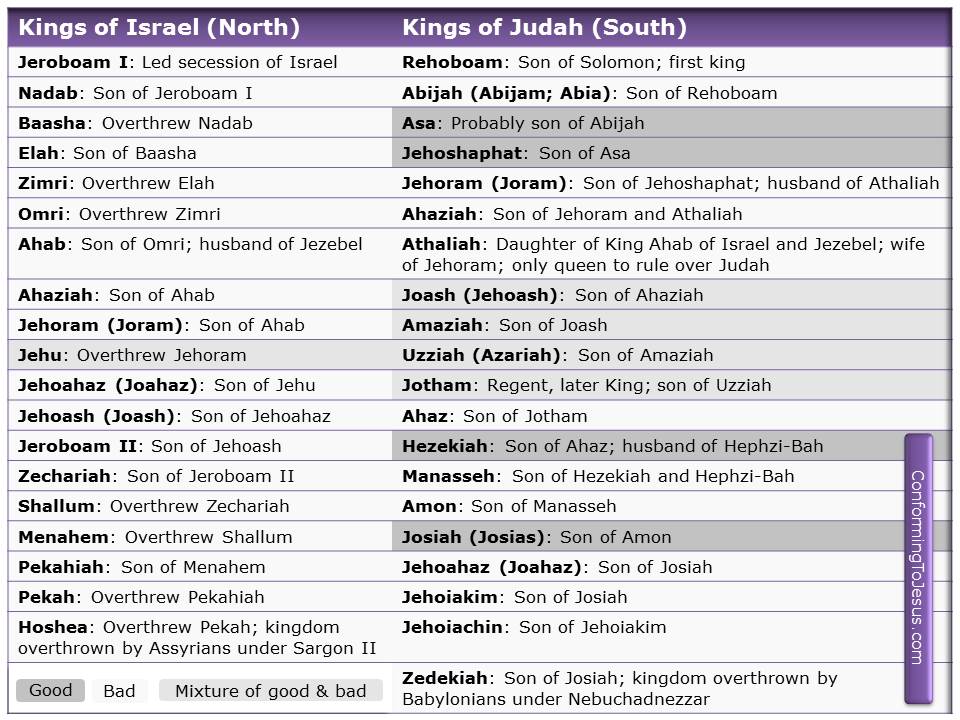
Source: ConformingtoJesus.com
2 Kings 3:1 Now Jehoram the son of Ahab became king over Israel at Samaria in the eighteenth year of Jehoshaphat king of Judah, and reigned twelve years.
- Jehoram: 2Ki 1:17 8:16, Joram, 1Ki 22:51
2 Kings 1:17 So Ahaziah (be careful this is not Ahaziah king of Judah! See family tree below) died according to the word of the LORD which Elijah had spoken. And because he had no son, Jehoram (aka Joram) became king in his place in the second year of Jehoram (NOTE: His name is switched to Joram in same chapter and in 2Ki 8:24 he died = "Joram slept with his fathers". Then in 2Ki 8:25 another "Joram" is mentioned = King of Israel) the son of Jehoshaphat, king of Judah.
2 Kings 8:16 Now in the fifth year of Joram (KING OF ISRAEL) the son of Ahab king of Israel, Jehoshaphat being then the king of Judah, Jehoram (KING OF JUDAH) the son of Jehoshaphat king of Judah became king.
2 Kings 8:21 (NOTE "Jehoram" is change to "Joram" in same chapter!) Then Joram (KING OF JUDAH) crossed over to Zair, and all his chariots with him. And he arose by night and struck the Edomites who had surrounded him and the captains of the chariots; but his army fled to their tents.
2 Kings 8:24-25 (NOTE Mentions two different Jorams in same section) So Joram (KING OF JUDAH) slept with his fathers and was buried with his fathers in the city of David; and Ahaziah his son became king in his place. 25 In the twelfth year of Joram (KING OF ISRAEL) the son of Ahab king of Israel, Ahaziah the son of Jehoram king of Judah began to reign.
2 Kings 8:28 Then he Joram (KING OF JUDAH) went with Joram (KING OF ISRAEL) the son of Ahab to war against Hazael king of Aram at Ramoth-gilead, and the Arameans wounded Joram (KING OF ISRAEL).
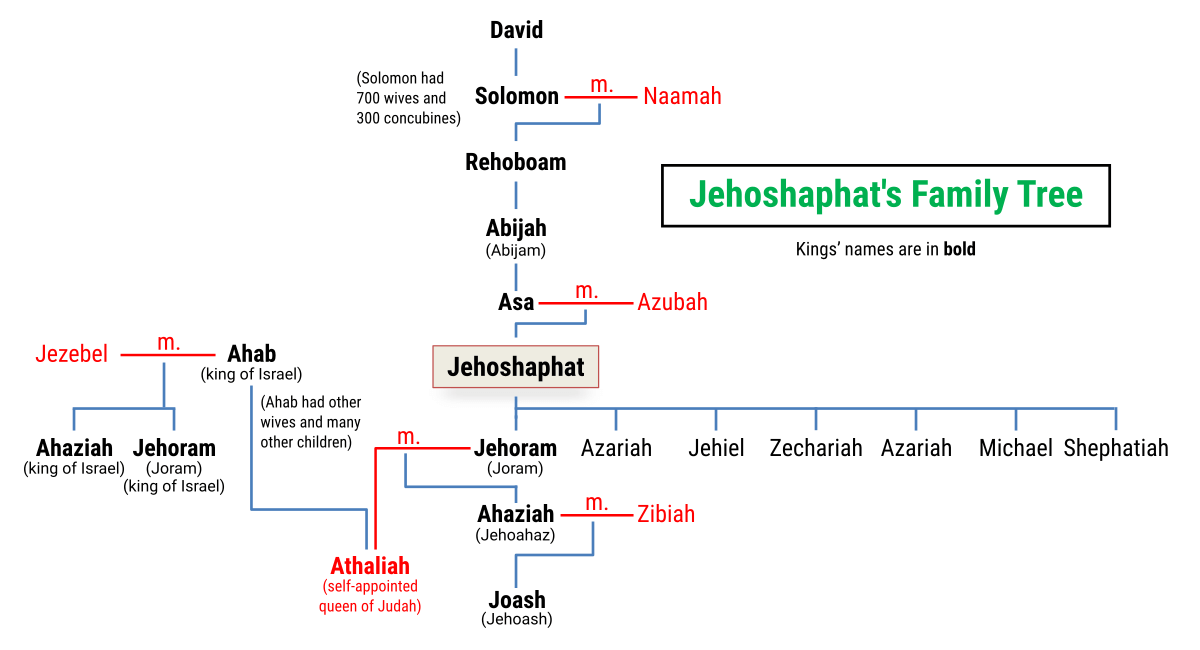
Jehosphaphat's Family Tree - Names in Bold are KINGS
Source: Mark Morgan at bibletales.org
JEHORAM BECOMES HEIR
TO AHAB'S THRONE
Be careful to distinguish these kings, noting that even in 2Ki 1:17 there are two Jehorams! First, as shown in the family tree above, Ahab had two sons, Ahaziah (2Ki 1:1-2) and Jehoram (Joram) (2Ki 3:1). And since King Ahaziah died without a son, his brother Jehoram (Joram) became king of Israel. Second, both King Jehoram's are sometimes named "Joram." 2 Kings 8 is particularly very confusing because of the changing of these names (see Related Passages above). Takeway - when you encounter names Jehoram or Joram, you need to read very slow and carefully examine the context which is crucial to decipher "Who's who!" Note also in the family tree that they are two King Ahaziahs, one in Israel, the other in Judah.
Jehoram of Israel (Son of Ahab)
- Ruled Israel from about 852–841 BC.
- Killed by Jehu during a coup.
Jehoram of Judah (Son of Jehoshaphat)
- Ruled Judah from about 853–841 BC.
- Married Athaliah, daughter of Ahab.
- Died a painful death from disease.
Warren Wiersbe calls 2 Kings 3-4 "Amazing Grace."
Now - Why "Now"? Context is crucial. Recall Ahab has died (1 Ki 22). Ahaziah, his son, reigned briefly and wickedly (1 Ki 22:51–53) and now Jehoram, another son of Ahab, comes to the throne. By beginning this way, the writer subtly invites comparison. Will Jehoram be like Ahab? Will he continue Baal worship? Will there be reform? This line of thought is confirmed by 2Ki 3:2, which evaluates Jehoram relative to his parents:
Jehoram the son of Ahab - Jehoram means "Jehovah is exalted" ( "whom Jehovah has exalted," "Jehovah makes high") a name this king of Israel clearly failed to live up to as shown in 2Ki 3:2. The meaning of Jehoram's name was meaningless to this man who lived as though Jehovah were irrelevant!
🙏 THOUGHT - A noble name cannot redeem an ignoble (disobedient) life. Jehoram's life is a timeless warning that identity (name) without obedience is utter hypocrisy. One fears for individuals who make a profession calling themselves by the name "Christian," but whose lives show they have no genuine possession of Christ and thus are destined for eternal spiritual ruin. I have spoken with at least two men just this week who made a profession of Christ, but who demonstrate no evidence of possession of Christ as their life! As an infectious disease expert, they remind me of folks who get a vaccination that prevents them from getting the real "disease" (in this case being truly "born again"). Not only are the desperately deceived but they are extremely difficult to convince that they are not truly born again Christians! They are like the "many" (not few) Jesus describes in Mt 7:21-23 "Not everyone who says to Me, ‘Lord, Lord,’ will enter the kingdom of heaven, but he who does (present tense = direction, not perfection) the will of My Father who is in heaven will enter. MANY will say to Me on that day, ‘Lord, Lord, did we not prophesy in Your name, and in Your name cast out demons, and in Your name perform many miracles?’ (JESUS DOES NOT ADDRESS THEIR CLAIMS) 23 “And then I will declare to them, ‘I never (AT ANY POINT IN TIME) knew (INTIMATELY) you; DEPART (aorist imperative) FROM ME, YOU WHO PRACTICE (present tense = direction, "hell-ward" not "heaven-ward") LAWLESSNESS."
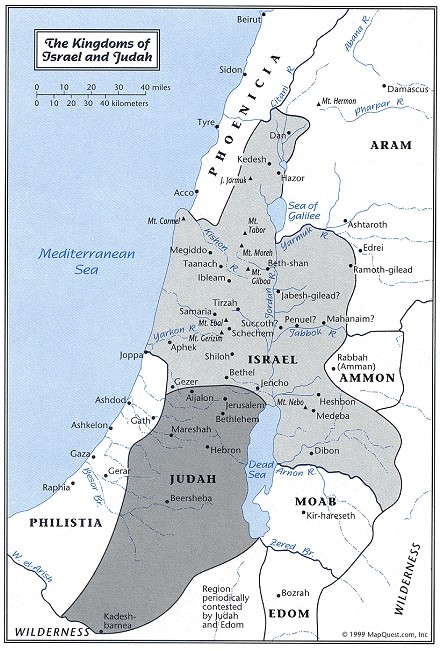
Divided Kingdom 931 BC
Click to enlarge
Became king over Israel at Samaria in the eighteenth year of Jehoshaphat king of Judah, and reigned twelve years - Recall that in 931 BC the kingdom of Israel was divided by God into 10 northern tribes (often called "Israel") and 2 southern tribes (often called "Judah"). Samaria was the capital of the Northern Kingdom of Israel, after the split from Judah, and was established by King Omri around 880 BC, serving as the political and economic center until the kingdom's fall to the Assyrians in 722 BC.
In chapter three the historian recounts a representative event which is designed to demonstrate that Elisha’s word carries the same divine authority and effectiveness as that of his predecessor Elijah. Just as the earlier narrative had confirmed the power and reliability of Elijah's prophetic word in a comparable historical setting (1Ki 22:1–53), this account shows that the prophetic mantle has truly passed to Elisha. His pronouncements prove no less certain, his insight no less God-given, and his role as the LORD’s spokesman no less authoritative. In this way, the narrative reassures the reader that although the prophet has changed, the power of God working through His appointed servant remains unchanged.
August Konkel adds that "Elisha’s continuation of Elijah’s work is illustrated in the battle against Moab. It bears obvious similarities to the coalition of Jehoshaphat with Ahab in the battle against Ramoth Gilead (1 Kings 22). In both events there is an alliance between Jehoshaphat, the God-fearing king of Judah, and the apostate northern king following in the ways of Jeroboam son of Nebat. Jehoshaphat asks for the assistance of a true prophet of God (1Ki 22:7 "But Jehoshaphat said, “Is there not yet a prophet of the LORD here that we may inquire of him?”). (See 1 and 2 Kings - Page 392)
John Walton - . Joram’s succession has been previously mentioned in 2Ki 1:17, but there it was related to the second year of Jehoram, son of Jehoshaphat. Here it is correlated to the eighteenth year of Jehoshaphat. This led Thiele to identify a period of coregency between Jehoshaphat and his son. The year, according to Thiele, is 852. (PDF - IVP Background Commentary-OT- page 387)
QUESTION: Who was King Jehoram / Joram in the Bible? | GotQuestions.org
ANSWER: There are two kings in the Bible referred to as King Jehoram/Joram. The first was the son of King Jehoshaphat, and he ruled in the southern kingdom of Judah from 853 to 841 BC. The other King Jehoram was the son of the wicked King Ahab, and he ruled in the northern kingdom of Israel from 852 to 841 BC . The name Joram is a shortened form of Jehoram. Complicating matters is the fact that both Jehorams were brothers-in-law to each other.
Jehoram son of Jehoshaphat was 32 years old when he began to reign, and he reigned for four years with his father and another eight years on his own in Judah (2 Kings 8:16–17)—a total of twelve years. Although Jehoshaphat had been a good and godly king, Jehoram did not follow in his father’s footsteps. He married Athaliah, daughter of King Ahab (and sister of Ahab’s son Joram), and he became an evil ruler. But, in spite of King Jehoram’s wickedness, God kept his covenant with David and refrained from destroying Judah (2 Kings 8:19).
Sadly, God’s mercy had no effect on Jehoram’s behavior. He led his kingdom into idolatry and lewdness, and he caused both Edom and Libnah to revolt against Judah (2 Chronicles 21:8, 11). So God sent word through the prophet Elijah that, because Jehoram had led the people into sin, there would be a devastating attack on Jehoram’s house and Jehoram himself would be struck with an incurable bowel disease (2Ch 21:14–15). As part of God’s judgment, the Philistines and Arabs “attacked Judah, invaded it and carried off all the goods found in the king’s palace, together with his sons and wives. Not a son was left to him except Ahaziah, the youngest” (2Ch 21:17). The disease killed Jehoram in a gruesome and agonizing manner at the age of 40. The people did not mourn this wicked king (2Ch 21:18–20).
The other Jehoram (or Joram), son of Ahab, took the throne of Israel in the second year of his brother-in-law’s reign in Judah, and he was just as corrupt. He certainly had a poor example in his father. Ahab had turned the people to idolatry, leading them away from the true God of their fathers to the worship of his wife Jezebel’s god, Baal. Ahab had famously clashed with the Elijah on many occasions, and his wicked rule had led to God’s punishment over the whole land in the form of a years-long drought. The consequences of Ahab’s choices carried into his son’s reign. Ahab had previously taken control of Moab and forced the people to pay tribute, but, when Joram took the throne, Moab rebelled, forcing Joram into war (2 Kings 3:4–5).
King Joram called for help in the battle from King Jehoshaphat of Judah and the king of Edom, and the combined armies set out on a march through the wilderness toward Moab (2 Kings 3:8). Along the way, they ran out of water. Jehoshaphat made inquiries and discovered that Elisha, a prophet of God and Elijah’s successor, was nearby. Elisha was brought before the kings, and Joram asked for help from God. Elisha wanted to refuse Joram, but he agreed to help for Jehoshaphat’s sake (2Ki 3:14). Through God’s power, Elisha filled a dry stream bed with water for the troops, and he also promised that God would deliver Moab into their hands (2Ki 3:15–18). The prophecy came true, and Moab fled before Israel (2Ki 3:20–27).
In spite of this miracle and the victories in subsequent battles God granted, King Joram continued in his evil ways. Although he had brought Baal worship to an end in Israel, “he clung to the sins of Jeroboam” (2 Kings 3:3), and his demise was sure. Joram was injured in a battle with the Aramians (2 Kings 9:15). God charged Jehoshaphat’s son Jehu to destroy the entire house of Ahab (2 Kings 9:6–10). Jehu obeyed, and, after confronting Joram, he shot Joram between the shoulders with an arrow (2 Kings 9:24). Unfortunately, Jehu stopped obeying God after he had wiped out Ahab’s family. King Jehu became yet another deficient ruler who continued leading the people of Israel into sin (2 Kings 9:31).
2 Kings 3:2 He did evil in the sight of the LORD, though not like his father and his mother; for he put away the sacred pillar of Baal which his father had made.
- did evil - 1Sa 15:19 1Ki 16:19, 2Ki 6:31,32 21:6,20
- not like his father: 1Ki 16:33 21:20,25
- his mother: 2Ki 9:22,34 1Ki 21:5-15,25
- sacred pillar of Baal: 2Ki 10:18,26-28 1Ki 16:31-32
Related Passages:
1 Kings 16:31-32 (AHAB ERECTED IMAGES TO BAAL) It came about, as though it had been a trivial thing for him to walk in the sins of Jeroboam the son of Nebat, that he married Jezebel the daughter of Ethbaal king of the Sidonians, and went to serve Baal and worshiped him. 32 So he erected an altar for Baal in the house of Baal which he built in Samaria.
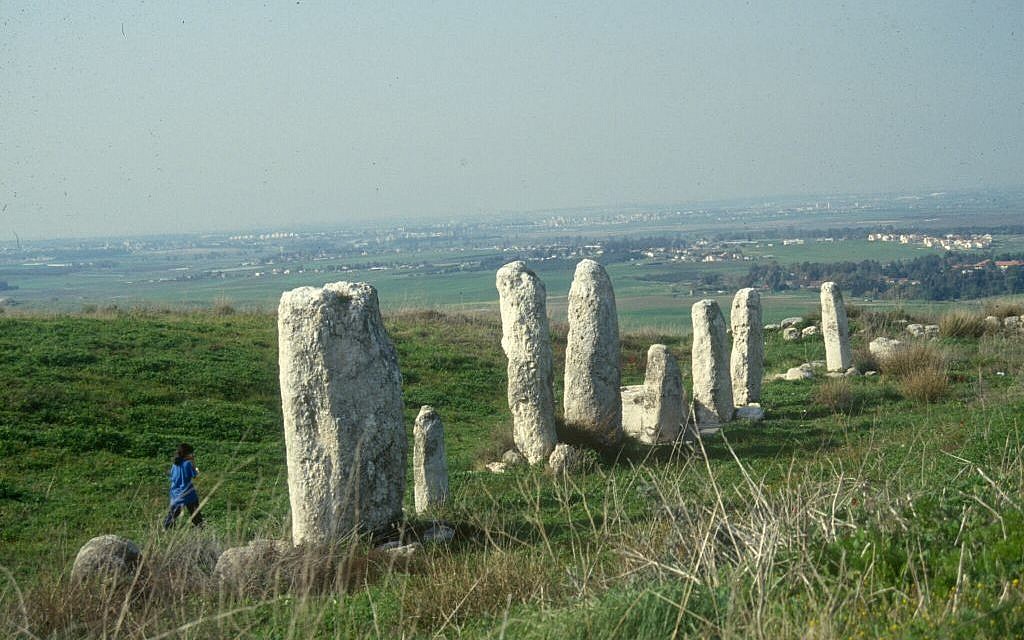
Standing Stones in the OT - Claude Mariottini (see note)
He did evil in the sight of the LORD, though not like his father (Ahab) and his mother (Jezebel) - Whatever Jehoram removed or reformed outwardly, God’s assessment is unchanged: his reign was evil. Scripture consistently reminds us that obedience is measured vertically (before the LORD), not relatively (compared to others). Not like his father does not excuse Jehoram. The comparison simply signals degree, not Jehoram's general direction. Jehoram’s reign warns us that, you can be less evil then you were but you are still evil before God. It would be like abandoning your "worst" sins while still clinging to your cherished ones.
That phrase “in the sight of the LORD” (the "true courtroom") is easy to read past, yet it is one of the most theologically weighty elements in the evaluation of Jehoram. The historian reminds us that Jehoram’s actions were not merely recorded by human observers or measured against political success or religious reforms. They were performed Coram Deo—before the face of God. What mattered most was not how Jehoram appeared to his subjects, but how he stood under the searching gaze of Yahweh, for "for God sees not as man sees, for man looks at the outward appearance, but the LORD looks at the heart.” (1Sa 16:7) Jehoram’s reforms may have altered external appearances; they did not alter his internal allegiance. Jehoram teaches us that what looks acceptable to men may still be evil to God. And that is why the phrase “in the sight of the LORD” matters so deeply. And there are many reminders in both the Old and New Testament...
Proverbs 15:3 "The eyes of the LORD are in every place, Watching the evil and the good."
In 2Ch 16:9 the prophet cried out to disobedient King Asa "the eyes of the LORD move to and fro throughout the earth that He may strongly support those whose heart is completely His. You have acted foolishly in this. Indeed, from now on you will surely have wars.”
The writer of Hebrews after warning the readers of the danger of not entering God's (salvation) rest like their ancestors declared "there is no creature hidden from His sight, but all things are open and laid bare (trachelizo) to the eyes of Him with Whom we have to do (NIV = "we must give account") (Hebrews 4:13)
🙏 THOUGHT - Oh, to have this truth of God's omniscience tatooed across our forehead so that every time we are tempted (Jas 1:14, 15) and began to drift toward sin, the still small voice of His Spirit would whisper, "He's watching. He want to bless you, not discipline you." May His Spirit enable us to "turn away our eyes from looking at vanity and revive us in His ways." (Ps 119:37).
For (term of explanation) - What is he explaining? You fill in the blank on this one.
He put away the sacred pillar (matstsebah) of Baal (ba'al) which his father (Ahab) had made - See 1 Kings 16:31-32. The sacred pillar (matstsebah; Lxx = stele) of Baal were stone or wooden posts symbolizing the presence of the Canaanite fertility god, Baal, representing fertility, prosperity, localized power, and a direct challenge to Yahweh's exclusive worship, often linked to licentious rites and contrasted sharply with God's pure worship. Israel was repeatedly warned by God of the spiritual danger of sacred pillars with a divine charge to utterly destroy them (Ex 23:24; Ex 34:13; Lev 26:1; Dt. 7:5; Dt. 12:3; Dt. 16:22). These sacred pillars were associated with houses (or temples) to Baal (2Ki 10:26, 27), Asherim (Asherah - See Asherah and ashtaroth/astarot) and high places (2Ki 17:10, 2Ki 18:4 - see high places - bamah).
🙏 THOUGHT - What sacred pillars do you need to tear down? Like Jehoram, it is possible to tolerate certain structures ("pillars") in our lives that once seemed untouchable, habits, loyalties, attitudes, or affections which we have allowed to stand because they feel familiar, useful, or even religious. Yet the Spirit gently exposes what competes with wholehearted devotion to the Lord. Anything that rivals Christ for first place in our hearts becomes an idol, no matter how sacred it appears. The Spirit does not shout. He whispers, convicting not to condemn, but to restore. The question is not whether He is speaking, but whether we are listening! "Tearing down a pillar" may feel costly, even painful, but freedom and revival lie on the other side of such radical obedience. God is not asking for improvement or adjustment. He is calling for undivided allegiance. May the Spirit grant each of us the courage to respond in faith, not stopping short of outward change, but allowing the Spirit to dismantle every rival to Christ, until He Alone stands exalted as Lord of our hearts.
Warren Wiersbe points out in regard to Jehoram's "reform" that "neither Baal worship nor the golden calves were removed from the land during his reign, and the image of Baal that Joram removed found its way back and Jehu had to destroy it (2Ki 10:27). (Bible Exposition Commentary page 681)
The phrase did evil in the sight of the LORD - Notice it is most concentrated during the time of the divided kingdom.
Jdg. 2:11; Jdg. 3:12; Jdg. 4:1; Jdg. 10:6; Jdg. 13:1; 1 Ki. 14:22; 1 Ki. 15:26; 1 Ki. 15:34; 1 Ki. 16:25; 1 Ki. 16:30; 1 Ki. 22:52; 2 Ki. 3:2; 2 Ki. 8:18; 2 Ki. 8:27; 2 Ki. 13:2; 2 Ki. 13:11; 2 Ki. 14:24; 2 Ki. 15:9; 2 Ki. 15:18; 2 Ki. 15:24; 2 Ki. 15:28; 2 Ki. 17:2; 2 Ki. 21:2; 2 Ki. 21:20; 2 Ki. 23:32; 2 Ki. 23:37; 2 Ki. 24:9; 2 Ki. 24:19; 2 Chr. 21:6; 2 Chr. 22:4; 2 Chr. 33:2; 2 Chr. 33:22; 2 Chr. 36:5; 2 Chr. 36:9; 2 Chr. 36:12; Jer. 52:2
Pillar (04676) matstsebah from natsab = to take a stand - describes Lot's wife Ge 19:26!) means something set upright, most often "a standing, unhewn block of stone utilized for religious and memorial purposes. It is notable that the first 8 uses in the OT were all positive (to memorialize a covenant, etc - Ge 28:18; Ge 28:22; Ge 31:13; Ge 31:45; Ge 31:51; Ge 31:52; Ge 35:14; Ge 35:20) For example, after a powerful experience of the Lord in a dream, Jacob set up as a pillar the stone on which he had laid his head, in commemoration of the event (Ge 28:18, 22; cf. Ge 31:45; 35:20). Moses set up an altar and also twelve pillars at the base of Mount Sinai to represent the twelve tribes of Israel (Ex. 24:4). These pillars were erected as monuments to God (Hos. 3:4). Sadly most of the uses after Ex 24:4 were negative and served to aid worship of pagan deities ( Ex 34:13; Lev 26:1; Dt. 7:5; Dt. 12:3; Dt 16:22; 1Ki. 14:23, Mic. 5:13). We see a veritable proliferation of these idolatrous uses 2 Kings, especially in worship of the Canaanite god Baal. In most of these passages, the sacred columns were used by Israelites, contrary to the Lord's prohibition concerning the worship of any other god (2 Ki. 3:2; 10:26, 27; 18:4; 23:14; cf. Hos. 10:1, 2; Mic. 5:13).
Matstsebah refers to the obelisks which stood at the entrance to the temple of the Sun in the Egyptian city of Heliopolis (Jer. 43:13). According to Heroclitus (II.3), two of these pillars were a hundred cubits high and eight cubits across, and each was a single stone. The word is also used of the statues of Baal (2 Ki. 3:2) which were erected in the innermost recess of the Temple.
NOTE: The picture of the pillars above is from the 3000 year old standing stones at Gezer (multiple pictures of the ruins), one of the largest Canaanite temples in Israel and site of unspeakable abominations, licentiousness and sexual perversion! It is not surprising that these Canaanite pillars were also associated with Asherah poles are widely interpreted by scholars as representing male and female fertility symbols, especially with explicit phallic significance linked to Canaanite fertility cults, alongside rituals involving sexual excess because God gave them over to their lusts! (read Ro 1:21,22,23,24). These upright stones, along with sacred trees, symbolized "divine" (little "g") power, fertility, and the so-called life force, functioning as focal points for the worship of deities like Ba'al (ba'al) and Asherah (Asherah and ashtaroth/astarot), the mother goddess.
Matstsebah - 38x in 33v - obelisks(1), pillar(19), pillars(16), stump(2). Ge 28:18; Ge 28:22; Ge 31:13; Ge 31:45; Ge 31:51; Ge 31:52; Ge 35:14; Ge 35:20; Exod. 23:24; Exod. 24:4; Ex 34:13; Lev 26:1; Dt. 7:5; Dt. 12:3; Dt 16:22; 2Sa 18:18; 1Ki. 14:23; 2Ki. 3:2; 2Ki. 10:26; 2Ki. 10:27; 2Ki. 17:10; 2Ki. 18:4; 2Ki. 23:14; 2Ch 14:3; 2Ch 31:1; Isa. 6:13; Isa. 19:19; Jer. 43:13; Ezek. 26:11; Hos. 3:4; Hos. 10:1; Hos. 10:2; Mic. 5:13
Septuagint of PILLAR = stele = a commemorative stone block or pillar, monument, pillar from the time of Homer inscribed and used as a grave marker (ED: IS THIS NOT IRONIC? THESE SACRED PILLARS CAUSED THE SPIRITUAL DEATH OF COUNTLESS SOULS!), or for commemoration of events, proclamation of decrees, recognition of personal achievements. Stele is a block or slab, bearing an inscription; and so, 1. a gravestone, Hom., Att. 2. a block or slab, inscribed with record of victories, dedications, treaties, decrees, etc., Hdt., Att.; whether for honour, or for infamy, Hdt., Dem.:-also the record itself, a contract, agreement, kata. th.n sth,lhn according to agreement, 3. a boundary post, Xen.:-the turning-post at the end of the racecourse,
Holman Bible Dictionary - Pillar - Stone monuments (Hebrew matstsebah) or standing architectural structures (Hebrew amudim ). 1. Stones set up as memorials to persons. Jacob set up a pillar on Rachel's grave as a memorial to her (Genesis 35:20 ). Because Absalom had no son to carry on his name, he set up a pillar and carved his name in it (2 Samuel 18:18 ). Shrines both to the Lord and to false gods. Graven images often were pillars set up as gods. God commanded Israel to break down such “images” (Hebrew matstseboth; Ex 23:24). The Canaanites erected pillars at their places of worship, and probably influenced Israelite practice. Archaeologists found pillars, at Gezer. Jacob set up a pillar following his dream (Genesis 28:18 ) and again when God spoke to him at Bethel (Genesis 35:9-15 ) as memorials of God's revelation. Moses set up twelve pillars to commemorate the giving of the law to the tribes of Israel (Exodus 24:4).
Baal (as a proper noun)(01168) (ba'al) refers to the pagan god who was called by the name "Baal". Elijah contended with and exterminated the prophets of Baal (1 Ki 18:18, 19, 21, 22, 25, 26, 40). One of the more incredible mentions of Baal is King Jehu's (King of Israel) eradication of them from the northern kingdom (2Ki 10:18-28). Before God would use Gideon to deliver His people from the Moabites, He first had him tear down his father's backyard altar to Baal (Jdg 6:25, 28, 30-31). As a result Gideon was named Jerrubball ("Let Baal contend against him" - Jdg 6:32-). Under Gideon Israel was set free from Moabite oppression, but apparently they people were not set free from the "seed" of Baal worship in their hearts for "Then it came about, as soon as Gideon was dead, that the sons of Israel again played the harlot (SPIRITUAL ADULTERY!) with the Baals, and made Baal-berith their god" (Jdg 8:33)! Wow! Our hearts are more deceitful than all else and are desperately sick (Jer 17:9)! In 1 Sa 7:4 we see that "Israel removed the Baals and the Ashtaroth and served the LORD alone" but they must have backslid because we see their cry in 1 Sam 12:10! Beware of idols.
Idols are like crabgrass that needs to be radically uprooted
lest they revive and return and ruin your spiritual garden (life)!
In the uses of ba'al during what period of Israel's history do these wicked idols proliferate? (You observe).
BA'AL - 66V - Num. 22:41; Jos. 13:17; Jdg. 2:11; Jdg. 2:13; Jdg. 3:7; Jdg. 6:25; Jdg. 6:28; Jdg. 6:30; Jdg. 6:31; Jdg. 6:32; Jdg. 8:33; Jdg. 10:6; Jdg. 10:10; 1 Sam. 7:4; 1 Sam. 12:10; 1 Ki. 16:31; 1 Ki. 16:32; 1 Ki. 18:18; 1 Ki. 18:19; 1 Ki. 18:21; 1 Ki. 18:22; 1 Ki. 18:25; 1 Ki. 18:26; 1 Ki. 18:40; 1 Ki. 19:18; 1 Ki. 22:53; 2 Ki. 3:2; 2 Ki. 10:18; 2 Ki. 10:19; 2 Ki. 10:20; 2 Ki. 10:21; 2 Ki. 10:22; 2 Ki. 10:23; 2 Ki. 10:25; 2 Ki. 10:26; 2 Ki. 10:27; 2 Ki. 10:28; 2 Ki. 11:18; 2 Ki. 17:16; 2 Ki. 21:3; 2 Ki. 23:4; 2 Ki. 23:5; 2 Chr. 17:3; 2 Chr. 23:17; 2 Chr. 24:7; 2 Chr. 28:2; 2 Chr. 33:3; 2 Chr. 34:4; Jer. 2:8; Jer. 2:23; Jer. 7:9; Jer. 9:14; Jer. 11:13; Jer. 11:17; Jer. 12:16; Jer. 19:5; Jer. 23:13; Jer. 23:27; Jer. 32:29; Jer. 32:35; Hos. 2:8; Hos. 2:13; Hos. 2:17; Hos. 11:2; Hos. 13:1; Zeph. 1:4
- Click ba'al for much more in depth discussion. which he made Israel sin; he did not depart from them.
2 Kings 3:3 Nevertheless, he clung to the sins of Jeroboam the son of Nebat, which he made Israel sin; he did not depart from them.
- he clung: 1Ki 12:28-33 2Ki 10:20-31
- which he made: 1Ki 14:16 15:26,34 16:31
- did not depart: 2Ki 13:2,6,11 14:24 15:9,18 17:22 1Ki 12:26-28 13:33 1Co 1:19,20
Related Passages:
1 Kings 12:25-33 (SINS OF JEROBOAM) Then Jeroboam built Shechem in the hill country of Ephraim, and lived there. And he went out from there and built Penuel. 26 Jeroboam said in his heart, “Now the kingdom will return to the house of David. 27 “If this people go up to offer sacrifices in the house of the LORD at Jerusalem, then the heart of this people will return to their lord, even to Rehoboam king of Judah; and they will kill me and return to Rehoboam king of Judah.” 28 So the king consulted, and made two golden calves, and he said to them, “It is too much for you to go up to Jerusalem; behold your gods, O Israel, that brought you up from the land of Egypt.” 29 He set one in Bethel, and the other he put in Dan. 30 Now this thing became a sin, for the people went to worship before the one as far as Dan. 31 And he made houses on high places, and made priests from among all the people who were not of the sons of Levi. 32 Jeroboam instituted a feast in the eighth month on the fifteenth day of the month, like the feast which is in Judah, and he went up to the altar; thus he did in Bethel, sacrificing to the calves which he had made. And he stationed in Bethel the priests of the high places which he had made. 33 Then he went up to the altar which he had made in Bethel on the fifteenth day in the eighth month, even in the month which he had devised in his own heart; and he instituted a feast for the sons of Israel and went up to the altar to burn incense.
Matthew 6:24 “No one (ABSOLUTELY NO ONE) can serve (douleuo) two masters; for either he will hate the one and love the other, or he will be devoted to one and despise the other. You (ABSOLUTELY) cannot serve (douleuo) God and wealth. (PLAY BOB DYLAN'S "GOTTA SERVE SOMEBODY!")
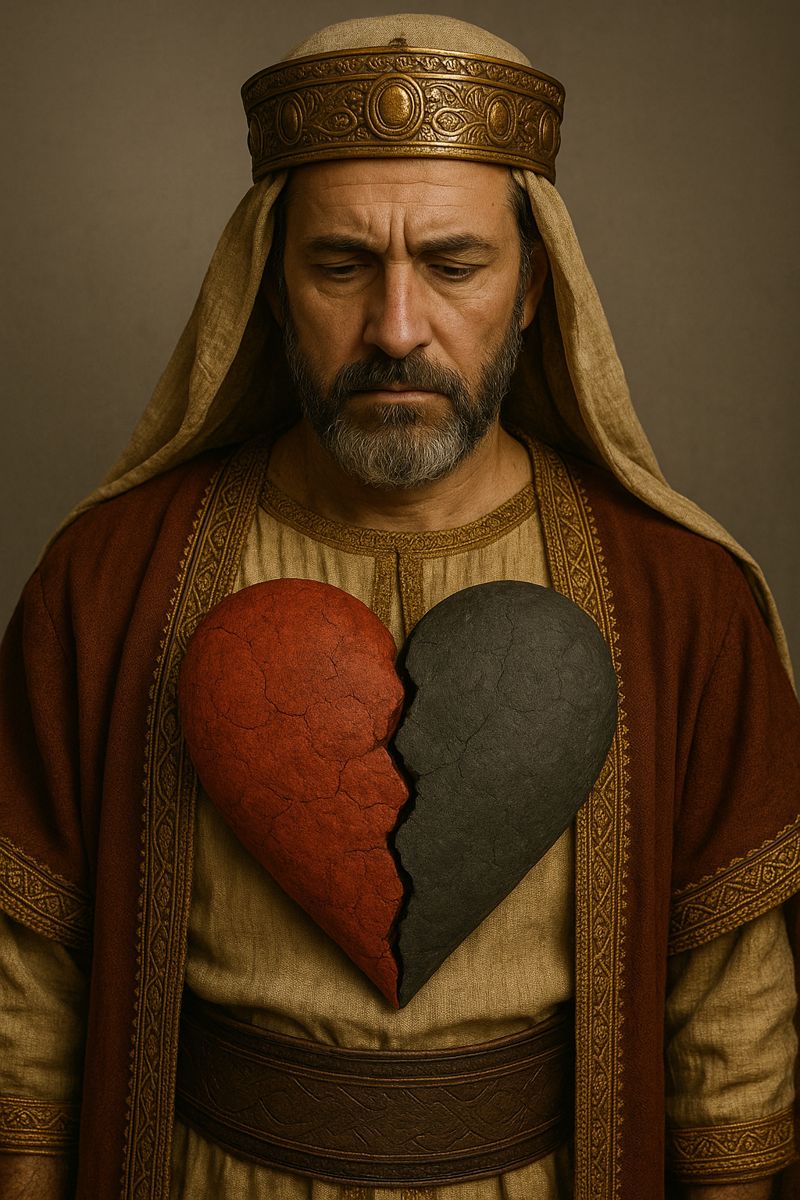
A Divided Heart
JEROBOAM "STICKS LIKE
GLUE" TO SINS OF HIS FATHER
Nevertheless, he clung (dabaq; Lxx - kollao = join closely, glue together) to the sins of Jeroboam the son of Nebat (see above), which he made Israel sin - Jehoram was double minded, possessing a divided heart and divided allegiance (cf Elijah's question in 1Ki 18:21). So while Jehoram demonstrated a partial, but incomplete reformation by removing the sacred pillar of Baal that his father had erected, he clung (dabaq) to the sins of Jeroboam the son of Nebat where clung (dabaq) indicates this was not a casual attachment. The verb clung (dabaq; Lxx - kollao) is first used in Ge 2:24 where "a man shall leave his father and his mother, and be joined to (dabaq Lxx - proskollao) his wife; and they shall become one flesh." In that context, word dabaq conveys intimacy, loyalty, and covenantal devotion, the language of marriage. Thus, Jehoram’s sin was not merely a failure of reform but a betrayal of relationship with the Almighty! Though he removed Baal’s pillar, he remained "stuck like glue" to the idolatrous system established by Jeroboam. In other words, his allegiance was divided, and in biblical terms, this constituted spiritual adultery against Yahweh. This imagery is especially poignant in light of Exodus 24:7,8, where Moses formally brought Israel into covenant with Yahweh in a ceremony that functioned as a marriage covenant (Jer 31:32 "I was a Husband to them", cf Isa 54:5). To cling to false worship after entering that covenant was to violate the marital faithfulness Israel owed to her divine Husband.(see Israel the Wife of Jehovah)
🙏 THOUGHT - Does this picture of Jehoram's divided heart not speak to our culture, to our churches? God is jealous (Ex 20:5, El Qanna - Ex 34:14, 15 "zealous," "ardent," = His intense, exclusive love and demand for devotion) and desires our whole heart (Mk 12:30, Pr 4:23), not a fraction of it. How are you doing beloved? Are you loving God on Sunday, yet cozying up to the God-hating world the rest of the week? Do you have a touch of Jehoram's double-minded virus in your soul? If we are honest, every one of us wrestles with this daily. The world system continually tantalizes and entices, seeking to draw our affections away from pure devotion to Yahweh.
Jesus directly addressed this spiritual danger and described both the diagnosis and the cure when He declared to the church at Ephesus: "But I have this against you, that you have left your first love. Therefore remember (present imperative see our need to depend on the Holy Spirit to obey - keep on remembering - we are so prone to forget!) from where you have fallen, and repent (aorist imperative see our need to depend on the Holy Spirit to obey) and do (aorist imperative see our need to depend on the Holy Spirit to obey) the deeds you did at first; or else I am coming to you and will remove your lampstand out of its place–unless you repent." (Rev 2:4-5 - see what happened to Ephesus - Beware of Slowly Drifting From Your First Love of Jesus) Note that each command calls for our dependence on the Holy Spirit for obedience. Remembering, repent, and return are not self-powered natural acts but grace-enabled supernatural responses.
Let me encourage you to consider praying the prayer of David (a man who failed grievously, yet was ultimately called “a man after God’s own heart”- Acts 13:22) in Ps 86:11 "Teach me Your way, O LORD. I will walk in Your truth. Give me an UNDIVIDED HEART to fear Your Name." In Jesus' Name. And may God grant each of us what Jehoram lacked—an undivided heart, wholly devoted to Yahweh. (Play and pray Single Heart)
Partial obedience
is still disobedience
He did not depart from them - Jehoram’s removal of the sacred pillar of Baal marked a small but significant step toward reform, suggesting some awareness that overt Baal worship was incompatible with allegiance to the LORD. Yet his continued practice of evil made clear that this action fell far short of genuine repentance. Partial obedience—discarding one visible idol while clinging to deeper patterns of sin—does not satisfy God’s holy standard. True repentance requires a decisive, wholehearted turning away from sin (cf real life example of repentance in 1Th 1:9,10) and a corresponding submission to the will of God, not selective reform that leaves the heart unchanged. Jehoram did not eradicate idolatry from his heart or his kingdom! Sin was restrained, not mortified. He failed to follow Paul's prescription to put to death the sins in Ro 8:13 (cf Col 3:5NKJV). The result was not reform but return (relapse). Repentance is an "about face," a full 180 degree turn, not a partial turn!
Jehoram turned away from the pillar of Baal,
but he did not turn away from the sins of Jeroboam.
Philip G Ryken - The Bible’s portrait of Jehoram’s spirituality ultimately condemns him. Anyone who wants to follow God must love him with a whole heart, soul, and mind (Matt. 22:37). God accepts nothing less. But Jehoram was halfhearted and double-minded—a man with a divided soul. As Dale Ralph Davis describes him, “he was not as wicked as he could have been, yet he was not as righteous as he should have been.”3 (2 Kings)
Jehoram's father Ahab must have failed to pass on Elijah's wise question (if he even heard it) “How long will you hesitate between two opinions? If the LORD is God, follow Him; but if Baal, follow him.” But the people did not answer him a word." (1Ki 18:21) Jehoram hesitated. And hesitation, when God calls for complete loyalty, is itself disobedience.
Jehoram was improved—
but not transformed.
John MacArthur: makes a good point that relates to Jehoram's "partial disobience" of removing sacred pillar of Baal worship noting that "This image was only put in storage, not permanently destroyed, because it reappeared at the end of Jehoram’s reign (10:26-27).
🙏 THOUGHT - There is a powerful message here for all of us! As John Owen said "Kill sin or sin will be killing you." Jehoram did not "kill sin" but gave it a short "rest." (2Ki 3:2) Mark it down - "Putting sin to rest” instead of putting it to death is spiritually deceptive (Heb 3:13) and dangerous!
What is the sin in your (my) life that, like Jehoram, we choose to "put away" for a while, but we remember where we put it and allow it to creep back into our life? Hebrews 12:1 says in order to run the race with endurance we need to "lay aside (apotithemi like taking off fifthy, smelling garments and casting far away!) every encumbrance and the sin which so easily entangles us." I would suggest "lay aside" (discard, strip off) means to remove it entirely from our sight ("lay aside" is aorist tense calling for a decisive act, not temporary restraint)!
A sin that is merely set aside, rather than decisively dealt with, waits patiently for a convenient season (cf. Sin is like the devil - Lk 4:13). What we remember where we stored, we can easily retrieve. This recalls Paul's commands in Ro 13:14 "put on (opposite of "lay aside"! - aorist imperative see our need to depend on the Holy Spirit to obey) the Lord Jesus Christ, and make no provision (present imperative with a negative see our need to depend on the Holy Spirit to obey - stop making provision - pronoia) for the flesh in regard to its lusts."
The Bible is never satisfied with
anything less than total submission.
Dale Ralph Davis: Do you feel the bristling impatience in this text? You see the dual point the text is making? On the one hand, the text recognizes degrees of evil. Jehoram suppressed at least some of the raw paganism of Baal worship; admittedly, it’s better to have someone ruling whose wickedness is not as lurid as Ahab and Jezebel’s. It’s not good, but, in a relative sense, it’s better. Yet Jehoram clung (note the strong verb, dabaq, used in Genesis 2:24 of the man clinging to his wife) to the refined paganism of Jeroboam’s cult (see 1 Kings 12:25–33). English translations rightly render the raq (‘only’) that begins verse 3 as ‘nevertheless’. ‘Nevertheless he clung to the sins of Jeroboam.’ For all the qualification of verse 2, don’t you sense the impatience of the Bible’s ‘Nevertheless’ here? The Bible is never satisfied with anything less than total submission. It’s as if our writer throws his pen down in disgust and hollers, ‘That’s not enough! It won’t do to go around saying it’s not as bad as it could be. Anything less than thorough-going, faithful first-and-second-commandment worship just won’t cut it!’ . . . This impatience of the Bible that refuses to accept anything less than total fidelity is only a reflection of the intolerant God of the Bible who insists on having all your affections. (Borrow 2 Kings : the power and the fury page 42)
Clung (1692) dabaq means to stick to, adhere to, cling to, join with, stay with, stay in close proximity to and which yields the noun form for "glue". Dabaq describes something that sticks or clings to something else (Ezek 29:4 and Ezekiel’s tongue to roof of his mouth Ezek. 3:26). Dabaq often refers to physical things sticking to each other, especially parts of the body as described vividly by Job who said "My bone clings to my skin and my flesh, and I have escaped only by the skin of my teeth" (Job 19:20, cf one's tongue "stuck to their palate" Job 29:10).
God speaking through Moses warned Israel to "choose life in order that you may live… by loving the LORD your God, by obeying His voice, and by holding fast (dabaq) to Him" going on to explain that one should cling to Jehovah because "this is your life and the length of your days, that you may live in the land which the LORD swore to your fathers, to Abraham, Isaac, and Jacob, to give them." (Dt 30:19, 20) King Hezekiah heeded this instruction and "clung to the LORD; he did not depart from following Him, but kept His commandments, which the LORD had commanded Moses." and the result of his clinging was that "Jehovah was with him; wherever he went he prospered." (2Ki 18:6 18:7, cf : Ps 63:8)
It is interesting that one of the most concentrated uses of "dabaq" in the OT is found in this short story of Ruth (Ru 1:14, Ru 2:8, 2:21, 23) -- Ruth 2:8 "stay here with my maids"; Ruth 2:21 "‘You should stay close to my servants"; Ruth 2:23 "So she stayed close by the maids of Boaz";
A vivid picture of the meaning of dabaq is found in David's declaration "I will set no worthless thing before my eyes; I hate the work of those who fall away; It shall not fasten its grip on me." (Ps 101:3), picturing the power of sin to entrap the sinner. (Spurgeon on Ps 101:3)
Dabaq also conveys the ideas of loyalty and devotion as in the first use of dabaq where "a man shall leave his father and his mother, and shall cleave to his wife; and they shall become one flesh" (Ge 2:24) which also emphasizes the basic meaning of being intimately joined to another and of being identified with one another.
As alluded to earlier, this idea of leaving former affections and loyalties and shifting them to Jehovah is found numerous times in Deuteronomy, as for example in (Dt 10:20) where Moses instructs Israel that they are to "fear the LORD your God; you shall serve Him and cling to Him, and you shall swear by His name". In this verse we also see that reverential awe (fear) of God is in part manifest by one cleaving closely to Him.
QUESTION - What is spiritual adultery? | GotQuestions.org
ANSWER - Spiritual adultery is unfaithfulness to God. It is having an undue fondness for the things of the world. Spiritual adultery is analogous to the unfaithfulness of one’s spouse: “‘But like a woman faithless to her lover, even so have you been faithless to me, O house of Israel,’ says the LORD” (Jeremiah 3:20; see also Isaiah 1:21; 57:8; Ezekiel 16:30). (ED: see Israel the Wife of Jehovah)
Spiritual adultery, then, is the forsaking of God’s love
and the embracing of the world’s values and desires
The Bible tells us that people who choose to be friends with the world are an “adulterous people” having “enmity against God” (James 4:4–5). The “world” here is the system of evil under Satan’s control (John 12:31; Ephesians 2:2; 1 John 5:19). The world system, with its contrived and deceitful scheme of phony values, worthless pursuits, and unnatural affections, is designed to lure us away from a pure relationship with God. Spiritual adultery, then, is the forsaking of God’s love and the embracing of the world’s values and desires (Ro 8:7–8; 2Ti 4:10; 1Jn 2:15–17).
Spiritual adultery includes any form of idolatry. In the Old Testament, the children of Israel tried to mix the worship of other gods such as Baal with that of God (Judges 3:7; 1 Kings 16:31–33; Jeremiah 19:5). In doing so, Israel became like an adulterous wife who wanted both a husband and another lover (Jeremiah 9:2; Ezekiel 6:9; 16:32). (ED: see Israel the Wife of Jehovah) In the New Testament, James defines spiritual adultery as claiming to love God while cultivating friendship with the world (James 4:4–5). The person who commits spiritual adultery is one who professes to be a Christian yet finds his real love and pleasure in the things that Satan offers. For believers, the love of the world and the love of God are direct opposites. (cf 1Jn 2:15,16, 17) Believers committing spiritual adultery may claim to love the Lord, but, in reality, they are captivated by the pleasures of this world, its influence, comforts, financial security, and so-called freedoms.
The concept of spiritual adultery against God
is a major theme throughout the Old Testament
The concept of spiritual adultery against God is a major theme throughout the Old Testament (Isaiah 54:5; Jeremiah 3:20; Ezekiel 16:15–19). This theme is illustrated especially well in the book of Hosea. The prophet’s wife, Gomer, symbolizes the infidelity of the children of Israel (Hosea 2:2–5; 3:1–5; 9:1). Hosea’s commitment to Gomer symbolizes God’s faithful, patient love with His erring people.
Jesus said, “No one can serve two masters. Either you will hate the one and love the other, or you will be devoted to the one and despise the other” (Matthew 6:24). The Bible exhorts us, “Do not love the world or anything in the world. If anyone loves the world, love for the Father is not in them. For everything in the world—the lust of the flesh, the lust of the eyes, and the pride of life—comes not from the Father but from the world” (1 John 2:15–16). Believers must echo the words of the old hymn: “The world behind me, the cross before me; no turning back.”
“As obedient children, do not conform to the evil desires you had when you lived in ignorance. But just as He who called you is holy, so be holy in all you do; for it is written: ‘Be holy, because I am holy’” (1 Peter 1:14–16).
Spiritual adultery is like trying to straddle the fence with one foot in the world and the other in heaven. We cannot have both. As Jesus warned the church in Laodicea,
“I know your deeds, that you are neither cold nor hot. I wish you were either one or the other! So, because you are lukewarm—neither hot nor cold—I am about to spit you out of my mouth” (Revelation 3:15–16).
The love of the world is primarily an attitude of one’s heart, and we can cast away worldliness by cultivating a new affection. To avoid spiritual adultery, “set your hearts on things above, where Christ is, seated at the right hand of God. Set your affection on things above, not on things on the earth” (Colossians 3:2KJV).
2 Kings 3:4 Now Mesha king of Moab was a sheep breeder, and used to pay the king of Israel 100,000 lambs and the wool of 100,000 rams.
- a sheep breeder Ge 13:2 26:13,14 2Ch 26:10 Job 1:3 42:12
- used to pay the king: 2Sa 8:2 1Ch 18:2 Ps 60:8 108:9,10
- lambs: Isa 16:1
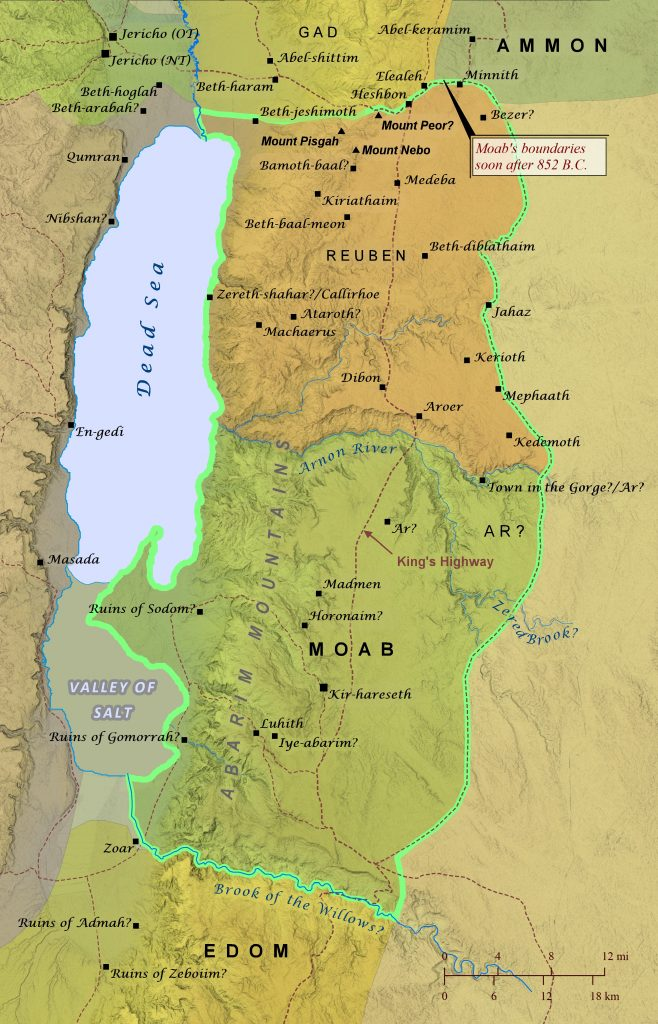
Moab circa time of Mesha (source)
Now Mesha king of Moab was a sheep breeder, and used to pay the king of Israel 100,000 lambs and the wool of 100,000 rams - The phrase used to pay means that Mesha is no longer paying tribute. Moab had been subjugated by Israel during the reign of Omri and Ahab (cf. 1Ki 16:21–28). As a conquered nation, Moab was required to pay tribute, not taxes in the modern sense, but enforced payments acknowledging Israel’s supremacy. Moab’s geography (see map above - east of Dead Sea) made ideal pasturelands so that sheep and wool were Moab’s chief economic assets. This explains why the tribute was not silver or gold, but livestock and wool.
Warren Wiersbe comments that "The land of Moab was especially suited for raising sheep, but an annual tribute to Israel of 100,000 lambs and the wool of 100,000 rams was certainly demanding. (Bible Exposition Commentary page 681)
100,000 lambs and the wool of 100,000 rams - It is difficult for the modern mind to fully grasp the magnitude of this tribute, but clearly it was an enormus tribute, even by ancient standards. To be sure, the size of this tribute was undoubtedly economically crushing to King Mesha, not to mention the personal humiliation he experienced year after year. By giving this annual tribute King Mesah was in essence publically confessing his subjugation to Israel. It is interesting that in ancient times kings were often called shepherds and yet here a shepherd-king, Mesha, is forced to give his literal flock to another king.
Tribute was not merely a tax but was a formal acknowledgment of political submission, allegiance, and the superior power of the dominant empire (the suzerain - Israel) by the subordinate entity (the vassal - Moab). The payment of tribute implied the vassal's agreement to follow the suzerain's demands and, in return, the suzerain was often expected to offer protection or at least a commitment not to attack. Failure to pay was a serious offense because it demonstrated a withdrawal of this submission and loyalty. The consequences were severe and often (as in this case) included military retaliation.
Craig Scott: Jehoram’s first problem as king was to deal with Moab. They were a vassal nation to Israel. They were supposed to supply Israel with 100,000 lambs and 100,000 rams with the wool. But Moab fortified their border and rebelled against Israel — 2 Kings 3:4-5.This created many serious problems for the new king and the nation. - First, it made Jehoram and the nation look weak. - Second, Moab could become a lethal threat to Israel by joining up with Damascus and attacking Israel’s southern border. - Third, economically, Moab’s rebellion would have negative impact on Israel’s textile and agricultural industry. It would be like Taiwan, Thailand or Japan shutting down business with us. The economic impact from this would bring shortages and high prices.
2 Kings 3:5 But when Ahab died, the king of Moab rebelled against the king of Israel.
- 2Ki 1:1 2Ki 8:20 2Ch 21:8-10
Related Passages:
2 Kings 1:1 Now Moab rebelled against Israel after the death of Ahab (Ahaziah succeeded Abab).
2 Kings 1:17 So Ahaziah died according to the word of the LORD which Elijah had spoken. And because he had no son, Jehoram became king in his place in the second year of Jehoram the son of Jehoshaphat, king of Judah.
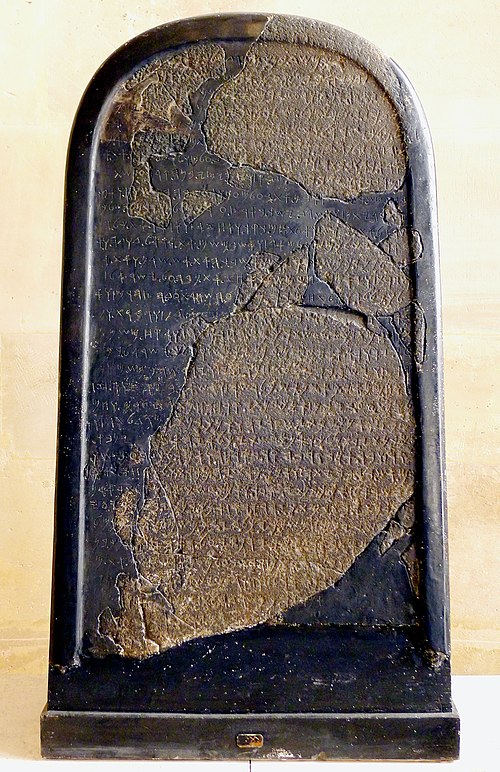
Moabite Stone (Mesha Stele)
FROM SUBJUGATION
TO INSURRECTION
But when Ahab died - But when is a crucial time phrase for it creates a "power vacuum" and marks the beginning of the drama that plays out the rest of this chapter. With Ahab’s death, King Mesha recognized a strategic opening. Israel’s grip was weakened, and Mesha seized the moment to cast off Moab’s vassal status. What had long been enforced submission now gave way to open revolt, as Mesha exchanged subjugation for insurrection and refused to continue the heavy tribute owed to Israel. There is a touch of irony in Mesha's rebellion against the authority of Jehoram, who himself was guilty of rebelling against the authority of the Most High God (2Ki 3:2)! Both acts stemed from each king's resent toward authority!
The king of Moab rebelled against the king of Israel - If we compare 2Ki 1:1, it is clear that Mesha's rebellion had begun during the days of King Ahaziah's brief reign (less than two years). King Mesha's rebellion continued against King Ahaziah's successor (2Ki 1:17, 2Ki 3:1), King Jehoram, and took the concrete form of refusing to pay the required tribute, the100,000 lambs and the wool of 100,000 rams, which provided not merely economic support to Israel but was also a public acknowledgment of Israel’s political dominance.
Inscriptions on the Moabite Stone (Mesha Stele) confirm the historicl figure Mesha, King of Moab, who rebelled after years of Israelite control and tribute payments (2Ki 3:5). Of even greater interest is that the Moabite Stone (Mesha Stele) recorded one of the earliest known extra-biblical references to Yahweh. Specifically, the inscription on the Moabite Stone mentions King Mesha of Moab taking the "altar-hearths of Yahweh" from an Israelite shrine at Mount Nebo and bringing them before Chemosh, following a victory over Israel.
It is notable that Moab's rebellion was only one exterbak foreign pressure experienced by Israel and Judah, for while Moab revolted in the east, Aram-Damascus harassed Israel in the north (1 Kings 20), Philistia probed the western borders (2 Chronicles 21:16), and Edom eyed Judah’s south (2 Kings 8:20-22).
One other consideration to explain Moab's rebellion is that this rebellion was in a sense a partial fulfillment of the warning Yahweh had given the nation in Leviticus 26:14-16 (cf Dt 28:15-68) declaring "But if you do not obey Me and do not carry out all these commandments, 15 if, instead, you reject My statutes, and if your soul abhors My ordinances so as not to carry out all My commandments, and so break My covenant, 16 I, in turn, will do this to you: I will appoint over you a sudden terror, consumption and fever that will waste away the eyes and cause the soul to pine away; also, you will sow your seed uselessly, for your enemies will eat it up." Ultimately this would be fulfilled by Assyria defeating Israel in 722BC and Nebuchadnezzar of Babylon defeating Judah in 586 BC, both nations being taken into exile, Israel permanently and Judah for 70 years.
Archaeological Corroboration and Divine Veracity
1. Mesha Stele (discovered 1868; now in the Louvre): Matches the biblical tribute (sheep/wool), the cities of Ataroth, Nebo, and Jahaz, and confirms Omride hegemony.
2. Khirbet Ataruz excavation (Jordan, 2000-2014): Stratigraphic burn layer aligns with Mesha’s campaign, confirming the historicity of the revolt and thereby the reliability of 2 Kings. Such extra-biblical witnesses exhibit Scripture’s factual precision (Luke 1:3-4).
• Political power without covenant fidelity collapses.
• External threats often mirror internal spiritual decay.
• God’s sovereignty over nations stands undiminished; He “removes kings and establishes them” (Daniel 2:21).
• Stability is ultimately secured, not by human alliances, but by faithfulness to Yahweh—a lesson culminating in the unshakeable kingdom of Christ (Hebrews 12:28).
MOABITE STONE (Mesha Stone). (Click another discussion of Mesha Stone and an excellent video on the Moabite Stone) The Moabite Stone, also called the Mesha Stele, is a thirty-four-line inscription on a large black basalt pillar written in a Transjordanian dialect having close affinity with classical Hebrew. It recounts the achievements of MESHA, the king of Moab, a figure also known from the OT (2 Kgs 3:4). The inscription provides a Moabite perspective on the rebellion by Moab against Israel recorded in 2 Kgs 1:1; 3:4–27. It is the longest Iron Age inscription found on either side of the Jordan River and the primary source of information about the ancient Moabite language. The inscription itself may be dated to ca. 840 BCE, recounting events occurring sometime not long before during the mid-9th cent. BCE.
The Moabite Stone was first made known to the West through an Alsatian-born Anglican missionary named F. A. Klein, working in Moab in 1868. After viewing the inscription with the help of Bedouin near modern-day Dhiban (see DIBON), he attempted to acquire it with the aid of the Prussian government. While his efforts ultimately failed, new interest came from Charles Clermont-Ganneau, who was more successful. But before Clermont-Ganneau could take possession of the inscription, it was shattered by locals who resented pressures from Turkish authorities in Palestine. Fortunately, Clermont-Ganneau had arranged to have a paper impression made of the inscription prior to its destruction. This impression, called a squeeze, was inexpert, but it is the sole basis for our knowledge of the content of approximately one-third of the stone. Clermont-Ganneau eventually acquired the large majority of the pieces. After some time, all the recovered fragments made their way to the Louvre, where the reconstructed stele has been housed since 1875.
The Moabite Stone memorializes the military exploits and domestic accomplishments of Mesha during his reign over Moab. It depicts Mesha as the deliverer of his people, and this message is underscored by his very name, meaning “savior.” While the rule of his father, Chemosh-yat, was characterized by weakness and foreign oppression, the Moabite Stone depicts Mesha as the legitimate successor to the throne who is favored by a Moabite god, CHEMOSH, to bring an end to this oppression and to restore order to his country.
The message of the inscription may be organized topically into four parts. It consists of an introduction (lines 1–4), followed by three larger sections in which two narratives of various military campaigns (lines 4–21; 31–34) flank a central account of Mesha’s domestic accomplishments in and around Dibon (lines 21–31).
After Mesha’s self-presentation, the inscription conveys the occasion for its composition: “I made this high place for Chemosh in Qarhoh […] because he delivered me from all the kings and because he made me gloat over all my enemies” (lines 3–4; author’s trans.). The role of Chemosh in guaranteeing Mesha victory in his military campaigns is heavily emphasized throughout the battle accounts that follow. Yet the larger purpose of the inscription is to legitimate Mesha’s rule by detailing both his military victories and his success in reestablishing order, particularly in Dibon.
The first major section, spanning half the total inscription, is devoted primarily to campaigns north of Dibon. As is typical of ANE conquest accounts, these narratives paint Moab’s success and the enemy’s failure in black and white, and the language is hyperbolic and repetitive. Its focus is the reclamation of Moabite territory from Israel. Though OMRI had “oppressed Moab for many days” (line 5; author’s trans.), Mesha reversed Moab’s fortunes during the reign of Omri’s “son.” He boasts, “I gloated over him and over his house. And Israel utterly perished forever” (line 7; author’s trans.). Through Chemosh’s favor, Mesha is able to reclaim MEDEBA, formerly in Omri’s possession. He displaces the Gadites from ATAROTH, claiming to have killed all the people of the city. At the behest of Chemosh, he attacks Nebo in Israelite territory, plundering cultic objects from a shrine to Yahweh. Mesha even suggests that the Moabites killed 7,000 people in Nebo in a single morning. The inscription also records success at JAHAZ, which Mesha seized “to annex it to Dibon” (line 21; author’s trans.). Thus Mesha not only restores old borders, but expands Moab by adding new territory from what was once Israelite land.
The second section is dedicated to recounting how Mesha created an edenic, orderly society in and around Dibon by (re)building fortifications and cosmic foundations. While Chemosh’s favor was the driving force behind Mesha’s military successes, his domestic accomplishments are depicted as personal achievements. “It was I who built Qarhoh: the walls of the parks and the walls of the citadel. It was I who built its gates, and it was I who built its towers. It was I who built the palace, and it was I who made the retaining walls of the reservoir for water in the middle of the city” (lines 21–24; author’s trans.). Such exploits are found in other ANE royal inscriptions and in the OT (Eccl 2:4–6), symbolizing monarchical mastery over nature by cultivating land for security, sustenance, and pleasure. Still more striking is Mesha’s claim to have used Israelites for slave labor in these projects. In this way, those who had caused Moab’s chaos are now instrumental in reestablishing its order. As the ideological center of the Mesha inscription, Dibon and its epicenter in the acropolis of Qarhoh are depicted as the navel of the earth, much like Jerusalem and Zion in the OT. This section also makes mention of a few other building projects in the area, but without the attention given to those in Dibon.
The final section begins yet another account of military conquest, including action against HORONAIM, south of Dibon. Unfortunately, the inscription is very fragmentary at this point. However, there remains the possibility that it originally mentioned the house of DAVID, as proposed by André Lemaire. If correct, this may indicate that Mesha undertook a campaign in the south against Judahite territory, much as he had done against Israelite territory in the north.
The conflict between Moab and Israel narrated on the Moabite Stone is also mentioned in the OT: “Now King Mesha of Moab was a sheep breeder, who used to deliver to the king of Israel one hundred thousand lambs, and the wool of one hundred thousand rams. But when Ahab died, the king of Moab rebelled against the king of Israel” (2 Kgs 3:4–5). However, it proves difficult to harmonize the campaign narrative in 2 Kgs 3:6–27 with the accounts on the Moabite Stone. While some believe that the Kings narrative records a different set of events than those recounted in the Mesha inscription, many scholars understand these narratives as providing two different perspectives on the same events, each heavily shaped by the author’s selective judgment.
One challenge to reconciling the perspectives of the two texts relates to the figures of Omri and his successor, mentioned in lines 4–8 of the Moabite Stone. Mesha claims that Omri occupied Medeba “during his time and half the time of his bn (בן)—forty years” (line 8; author’s trans.). If one understands the term bn used in the inscription to mean “son” in the sense of immediate offspring or successor, then AHAB is in view. However, on this interpretation, the “forty years” in the inscription becomes problematic. Further, 2 Kings recounts that Moab rebelled after the death of Ahab (1:1; 3:5). To solve this, one might interpret the number forty as a round number, simply meant to signify a long period of time. Alternately, the term bn used in the Mesha inscription may denote Omri’s grandson rather than his son, as it also sometimes does in the OT (Gen 31:55 [Heb. 32:1]; 2 Chr 22:9). If this latter interpretation is accepted, the Moabite Stone likely refers to Omri’s grandson, Jehoram, who, in alliance with JEHOSHAPHAT of Judah, took action against the Moabite rebellion in ca. 850 BCE (2 Kgs 3:6–27). The use of the term typically denoting “son” on the Moabite Stone is likely motivated by the parallel between the fates of Israelite and Moabite kings that Mesha wishes to create. While Omri had oppressed Moab, his “son” Jehoram lost control of it; while Chemosh-yat had been oppressed by Israel, his son, Mesha, regained control of Moab and gloated over Israel. See ARCHAEOLOGY; MOAB, MOABITES; OBELISK; STELE.
Bibliography: Andrew Dearman, ed. Studies in the Mesha Inscription and Moab (1989); J. A. Emerton. “Lines 25–26 of the Moabite Stone and a Recently-Discovered Inscription.” VT 55 (2005) 293–303; J. A. Emerton. “The Value of the Moabite Stone as an Historical Source.” VT 52 (2002) 483–92; Siegfried Horn. “Why the Moabite Stone Was Blown to Pieces.” BAR 12 (1986) 50–61; André Lemaire. “ ‘House of David’ Restored in Moabite Inscription.” BAR 20 (1994) 30–37; P. Kyle McCarter Jr. Ancient Inscriptions: Voices from the Biblical World (1996); Simon B. Parker. Stories in Scripture and Inscriptions: Comparative Studies on Narratives in Northwest Semitic Inscriptions and the Hebrew Bible (1997); K. A. D. Smelik. Converting the Past: Studies in Ancient Israelite and Moabite Historiography (1992). (The New Interpreter's Dictionary of the Bible, Volume 4 - SCOTT C. JONES)
R Laird Harris - Many parts of the Old Testament cannot yet be confirmed. No archeologists can prove that "The Lord is my shepherd, I shall not want." Archeology is concerned with Bible history. It can confirm facts in the historical and prophetical books, but it cannot bring spiritual discernment.
Archeological discoveries have confirmed Shishak's war against Rehoboam (1 Kings 14:25, 26); the kingship of Omri and the power of Ahab (1 Kings 16:22); the rebellion of Mesha of Moab (2 Kings 3:5); the fall of Samaria (2 Kings 18:10); the digging of Hezekiah's tunnel (2 Kings 20:20); the invasion of Pharaoh-Nechoh (2 Kings 23:29); the fall of Jerusalem and the deportation of Jehoiachin (2 Kings 24:10-15). It is most striking when some detail long forgotten by everyone, except the Bible authors, is confirmed. Such proven conclusions argue that the books of the Bible were written by eyewitnesses or by other men who knew the facts intimately and who lived in the age concerned. (BORROW Exploring the Basics of the Bible PAGE 84)
2 Kings 3:6 And King Jehoram went out of Samaria at that time and mustered all Israel.
- mustered: 1Sa 11:8 15:4 2Sa 24:1-25 1Ki 20:27
And King Jehoram went out of Samaria at that time and mustered (paqad) all Israel - Jehoram left his palace in the capital city to deal personally with this national crisis, because the continued rebellion of Moab demanded a response. The time phrase at that time connects this passage with 2Ki 3:5. Mustering means Jehorah personally mobilized the army of Israel (mustered in Lxx is episkeptomai which adds the nuance that he "inspected them" - cf 2Ki 3:6YLT) apparently, Israel did not feel confident enough to take Moab in a head-on battle. So Jehoram sought to make a league with Jehoshaphat, king of Judah.
Warren Wiersbe on mustered - "Joram didn’t want to lose all that free income, nor did he want his people to think he was a weak ruler, so he took a military census and prepared for war. (Bible Exposition Commentary page 681)
2 Kings 3:7 Then he went and sent word to Jehoshaphat the king of Judah, saying, “The king of Moab has rebelled against me. Will you go with me to fight against Moab?” And he said, “I will go up; I am as you are, my people as your people, my horses as your horses.”
NLT - On the way, he sent this message to King Jehoshaphat of Judah: "The king of Moab has rebelled against me. Will you join me in battle against him?" And Jehoshaphat replied, "Why, of course! You and I are as one. My troops are your troops, and my horses are your horses."
My Amplified Paraphrase - Then King Jehoram went out [to secure military support] and sent word to Jehoshaphat king of Judah, saying, “The king of Moab has rebelled against me [by refusing tribute and breaking covenant loyalty]. Will you go with me to fight against Moab?” And Jehoshaphat replied, “I will go up with you; I am as you are—my people as your people, my horses as your horses”
[expressing full identification, unity, and shared resources in the alliance].
- go with me: 1Ki 22:4,32-33 2Ch 18:3,29-32 2Ch 19:2 2Ch 21:4-7 2Ch 22:3,4,10-12
Related Passages:
1 Kings 22:41-43 (JEHOSHAPHAT WAS A GODLY KING IN JUDAH) Now Jehoshaphat the son of Asa became king over Judah in the fourth year of Ahab king of Israel. 42 Jehoshaphat was thirty-five years old when he became king, and he reigned twenty-five years in Jerusalem. And his mother’s name was Azubah the daughter of Shilhi. 43 He walked in all the way of Asa his father (1Ki 15:9-15); he did not turn aside from it, doing right in the sight of the LORD. However, the high places were not taken away; the people still sacrificed and burnt incense on the high places.
1 Kings 22:4 And he (KING AHAB) said to Jehoshaphat, “Will you go with me to battle at Ramoth-gilead?” And Jehoshaphat said to the king of Israel, “I am as you are, my people as your people, my horses as your horses.”
2 Chronicles 19:2 (AFTER JEHOSHAPHAT HAD ALLIED HIMSELF WITH EVIL KING AHAB WHO WAS KILLED IN THE BATTLE, A PROPHET REPROVES JEHOSHAPHAT) Jehu the son of Hanani the seer went out to meet him and said to King Jehoshaphat, “Should you help the wicked and love those who hate the LORD and so bring wrath on yourself from the LORD?
2 Chronicles 20:35-37 (JEHOSHAPHAT IS REPROVED A SECOND TIME BY A PROPHET FOR ALLIANCE WITH EVIL KING AHAZIAH) After this Jehoshaphat king of Judah allied himself with Ahaziah king of Israel. He acted wickedly in so doing. 36 So he allied himself with him to make ships to go to Tarshish, and they made the ships in Ezion-geber. 37 Then Eliezer the son of Dodavahu of Mareshah prophesied against Jehoshaphat saying, “Because you have allied yourself with Ahaziah, the LORD has destroyed your works.” So the ships were broken and could not go to Tarshish.
2 Corinthians 6:14 (A VERSE THAT WOULD HAVE GREATLY BENEFITED JEHOSHAPHAT) Do not be bound together (present imperative with a negative see our need to depend on the Holy Spirit to obey) with unbelievers; FOR (EXPLAINS WHY NOT) what partnership have righteousness and lawlessness, or what fellowship has light with darkness?
JEHORAM SEEKS ALLIANCE
WITH JEHOSHAPHAT
Then he went and sent word to Jehoshaphat the king of Judah - Note the similarity in King Jehoram's seeking alliance with King Jehoshaphat just as his father Ahab had done (1 Kings 22:4). And here again King Jehoshaphat will seek a prophet (2Ki 3:11), just as he had done in his alliance with King Ahab and of the prophet (1Ki 22:7).
Saying, “The king of Moab has rebelled against me. Will you go with me to fight against Moab?” Jehoram was appealing to Jehoshaphat for a full military alliance in order to reassert control over Moab and recover the lost tribute. Though it was presented as a joint campaign, the request implicitly placed Jehoshaphat in a position of identifying himself with Jehoram’s cause, motives, and leadership.
And he (JEHOSHAPHAT) said, “I will go up - Jehoshaphat agreed to an alliance with Jehoram in spite of having been censured twice by prophets censures, first for his alliance with king Ahab (2Chr 19:2) and later for his alliance with king Ahaziah (2Chr 20:37). Jehoshaphat's third evil alliance reminds me of the old saying "“Fool me once, shame on you; fool me twice, shame on me.” On this third time, the issue was no longer ignorance but unlearned obedience. The second prophetic rebuke produced no lasting discernment.
🙏 THOUGHT - King Jehoshaphat is generally considered to be a good and godly king, but he had (at least) one persistent flaw which was making unwise alliances with wicked kings. So what's the lesson for us today, who seek to walk in a manner worthy of the Lord to please Him in all respects (Col 1:10)? The principle is simply this—spiritual maturity is not measured by how often God warns us, but by whether we heed those divine warnings. Repeated compromise in the same area reveals a heart that listens to God’s Word but which fails to fully submit to His will (cf Jas 1:22). God is forbearing and gracious to discipline His children, but His corrections are meant to transform our decisions, producing holiness and the peaceful fruit of righteousness. (Heb 12:10,11) Time for each of us to look in the mirror! Is there a pattern in my life where God has clearly spoken—yet I continue to repeat the same compromise under a new name or a different set of circumstances? Am I treating divine reproof as a temporary restraint, or welcoming it as a call to lasting change? Proverbs 12:1 says "Whoever loves discipline loves knowledge, but he who hates reproof is stupid!" WOE!
I am as you are, my people as your people, my horses as your horses - Hebrew = "I will go up – like me, like you; like my people, like your people; like my horses; like your horses." Jehoshaphat was verbally expressing full identification and solidarity with Jehoram. The threefold statement moves from personal identification (“I am as you are”), to national identification (“my people as your people”), and finally to military identification (“my horses as your horses”), signaling complete unity in purpose, resources, and risk. By these words, Jehoshaphat bound himself, his people, and his military strength to the cause of Israel’s king, effectively treating Jehoram’s conflict as his own and placing himself under Jehoram’s leadership for the campaign.
I am as you are could also reflect the fact that Jehoshaphat was closely tied to Jehoram through marriage alliances that linked the royal houses of Judah and Israel. Athaliah, the daughter of Ahab and Jezebel and sister of Israel’s king Jehoram, was married to Jehoram of Judah, the son of Jehoshaphat. This dynastic connection blurred spiritual boundaries that Jehoshaphat should have guarded more carefully.
🙏 THOUGHT- Have I said “I am as you are” in a relationship, partnership, or decision where God has said, “Come out from their midst and be separate” (2 Cor 6:17)? Do I seek God’s counsel before committing myself (Pr 3:5-6)—or only after the alliance is already made?
John MacArthur: Mesha (KING OF MOAB) used Ahab’s death as an opportunity to cast off the political domination of Israel with its heavy economic burden. Moab’s rebellion took place in 853 B.C. during the reign of Ahaziah (2Ki 1:1). Jehoram determined to put down Moab’s rebellion upon his accession to Israel’s throne in 852 B.C. He mobilized Israel for war (2Ki 3:6) and asked Jehoshaphat of Judah to join him in the battle (2Ki 3:7). (Borrow MacArthur Study Bible page 518)
It is notable that while Jehoshaphat walked in the godly footsteps of his father King Asa (1Ki 15:9-15), he seems to have ignored his father's example in one critical area. His father King Asa fought against King Baasha of Israel all their days (1Ki 15:16) while Jehoshaphat foolishly and repeatedly made peace with the apostate, idolatrous northern kingdom (1Ki 22:44).
🙏THOUGHT - Jehoshaphat’s response to Israel demonstrates that partial faithfulness, though well-intentioned, can lead to an undesirable peace. His life warns us that spiritual inheritance must be embraced wisely, not imitated incompletely. Asa’s legacy was not only devotion to Yahweh, but discernment about alliances (at least for most of his life! cf 2Ch 16:7, 8, 9) While Asa refused peace with a spiritually corrupt Israel, Jehoshaphat chose compromise and political harmony over spiritual separation. Beloved, Scripture never commends us to pursue peace that requires us to overlook idolatry, minimize truth, or blur obedience. Jehoshaphat’s alliance with the northern kingdom looked reasonable and even strategic, but it placed him repeatedly in harm’s way and under prophetic rebuke (as discussed above). his story begs the question am I walking in the path of my spiritual mentors while ignoring their hard-won lessons about compromise? True godliness requires not only devotion, but discernment and the courage to say NO where others say let’s get along (cf 2Co 6:14). Paul warned asking "what harmony (symphonesis) has Christ with Belial (OR A BAAL WORSHIPER), or what has a believer in common with an unbeliever?" (2Co 6:15) Peace at the expense of holiness is not peace at all and can even be the prelude to spiritual loss. The writer of Hebrews exhorts us to be "imitators of those who through faith and patience inherit the promises." (Heb 6:12) Who are you imitating?
John Whitcomb adds a comment - Jehoram, now coregent of Judah, was married to Joram’s sister Athaliah (ED: SEE FAMILY TREE), so it seemed only right for Joram to ask King Jehoshaphat to go with him to punish Moab.
2 Kings 3:8 He said, “Which way shall we go up?” And he answered, “The way of the wilderness of Edom.”
- Nu 13:21. Nu 21:4 Mal 1:2,3
Related Passages:
1 Kings 22:5 Moreover, Jehoshaphat said to the king of Israel, “Please inquire first for the word of the LORD.”
Proverbs 19:21 Many plans are in a man’s heart, But the counsel of the LORD will stand.
Proverbs 20:18 Prepare plans by consultation, And make war by wise guidance.
Proverbs 14:12 There is a way which seems right to a man, But its end is the way of death.
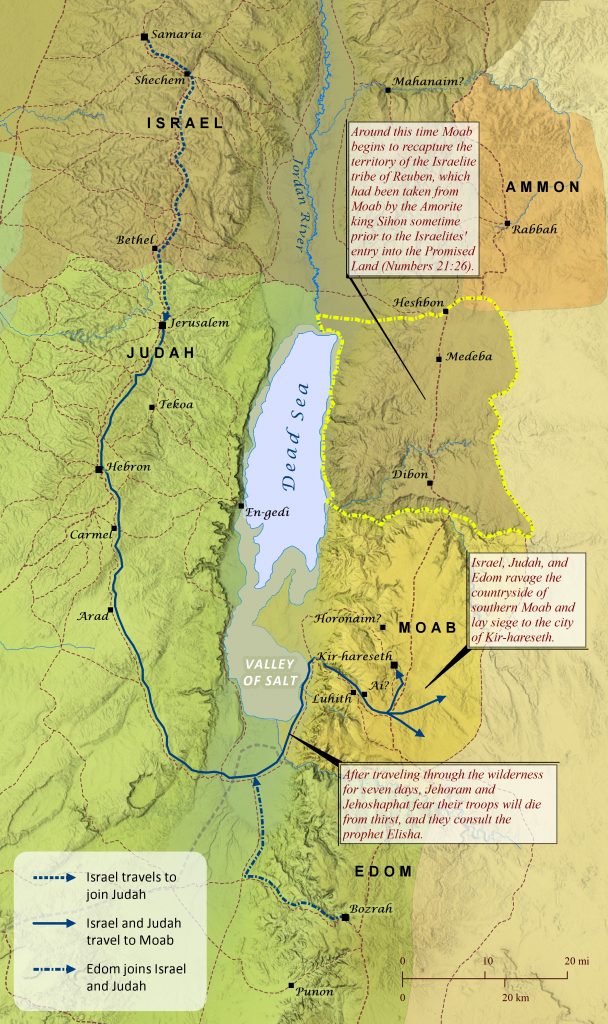
Invasion thru Edom (source)
JEHORAM QUERIES
JEHOSHAPHAT
He said, “Which way shall we go up?” - While the subject is not definitively stated here, most feel it was Jehoram questioning Jehoshaphat who answers below. Because Jehoshaphat was the more seasoned military leader, Jehoram of Israel sought his counsel.
And he answered, “The way of the wilderness of Edom.” - The wilderness of Edom was a harsh, arid desert region south and southeast of the Dead Sea, forming much of the territory of ancient Edom, also known as Mount Seir. It was called a wilderness because it was extremely dry and water-scarce, characterized by rocky terrain, wadis, and rugged hills and marked by intense heat, especially in summer. Thus is would have been considered unsuitable for sustaining large armies without some other provision. This region corresponds largely to modern southern Jordan, extending into areas bordering the Negev. In short, Jehoshaphat advised a southern approach against Moab, leading the armies through the arid desert of Edom (see map above), at route from which Moab would not expect an attack. At this time Edom was a vassal state under Judah (2Ki 3:9; 2Ki 8:20 later shows Edom rebelled). One question in light of the fact that this route required absolute dependence on water sources, is this -- did Jehoshaphat seek godly counsel (as he had done before 1Ki 22:5)? The text does not suggest he sought the Lord's wisdom before choosing this potentially dangerous, and instead relied on his human wisdom.
Iain Provan adds "Immediately, then, we are quite deliberately reminded of the earlier story and invited to make comparisons. This being so, we can hardly fail to notice that whereas, earlier, Jehoshaphat was very concerned to discover “the counsel of the Lord” before going off to war (1Ki 22:5), he now moves directly from agreement to tactics (2Ki 3:8, though it is not clear who is asking the question and who is answering it) and from tactics to action (2Ki 3:9). There is no prophet in sight. Is this the pious Jehoshaphat of earlier days? Why is he going off to war without consulting the Lord? Something seems amiss. (See 1 & 2 Kings - Page 35)
According to the Moabite Stone, Mesha’s army firmly
controlled the northern approach into Moab
John MacArthur: This was the long and circuitous route by the lower bend of the Dead Sea, the arid land in the great depression South of the sea known as the Arabah, or an area of marshes on Edom’s western side. According to the Moabite Stone, Mesha’s army firmly controlled the northern approach into Moab. Therefore, an attack from the South had a much better chance of success. It was the most defenseless position and Mesha could not enlist help from the forces of Edom (2Ki 3:9). (Borrow MacArthur Study Bible page 518)
2 Kings 3:9 So the king of Israel went with the king of Judah and the king of Edom; and they made a circuit of seven days’ journey, and there was no water for the army or for the cattle that followed them.
- Edom: 1Ki 22:27
- no water: Ex 15:22 17:1 Nu 20:2,4 21:5 33:14
- followed them: Heb. at their feet, Ex 11:8 Judges 4:10
SEVEN DAYS WITH
NO WATER
So the king of Israel went with the king of Judah and the king of Edom - Edom (located directly south of Moab) was a vassal state to Judah at this time and would have been obligated to join the other two armies.
and they made a circuit of seven days’ journey - ESV = "when they had made a circuitous march of seven days" The CSB has "they had traveled their indirect route" which reflected their roundabout way so that they would attack Moab from the south. Why seven days? Possibly because seven is the number of completion in Scripture, in this context signaling they were in dire straits for human beings can only go 3-5 days without taking in any water before they are at risk of dying.
And there was no water for the army or for the cattle that followed them - Edom was a region marked by extreme aridity. A seven-day march exhausted available water supplies, and no natural sources were found. What looked like a wise and workable strategy nearly ended in ruin because it was pursued without seeking the LORD, exposing how human planning—even when logical and well-intentioned—quickly collapses when divorced from divine guidance. This no water problem was not an environmental problem but a providential crisis designed to expose human self-reliance and drive the kings to seek prophetic direction.
2 Kings 3:10 Then the king of Israel said, “Alas! For the LORD has called these three kings to give them into the hand of Moab.”
- the Lord: 2Ki 6:33 Ge 4:13 Ps 78:34-36 Pr 19:3 Isa 8:21 51:20
HALF HEARTED MAN JUMPS
TO WRONG CONCLUSION
Then (a time phrase then) - Be alert to "then" in Scripture for it usually marks progression in a narrative.
The king of Israel said, “Alas! - NET and CSB paraphrase it as "Oh no!" NIV has "What!" NLT paraphrases it as "What shall we do?" More literally it is “Alas!” (Heb. hāh, הָהּ) is Jehoram's cry of despair and lamentation at "no water" predicament.
ALAS - Ah(5), alas(10). 15v - Jos. 7:7; Jdg. 6:22; Jdg. 11:35; 2 Ki. 3:10; 2 Ki. 6:5; 2 Ki. 6:15; Jer. 1:6; Jer. 4:10; Jer. 14:13; Jer. 32:17; Ezek. 4:14; Ezek. 9:8; Ezek. 11:13; Ezek. 20:49; Joel 1:15
For the LORD has called these three kings to give them into the hand of Moab - While Jehoram is not an atheist or a Baal-only pagan, he is clearly spiritually compromised, so when when the crisis hits, he talks theology, but thinks fatalistically, not faithfully! Jehoram's faulty theology (assumption not revelation) blames divine providence for his predicament even though he had not even considered consulting the Lord for direction before deciding on his course of action. And so in panic Jehoram interprets their crisis as divine doom rather than divine discipline or a call to seek God. His statement reveals he had a distorted view of God, a superstitious theology and worst of all no inclination to truly seek Yahweh even in these dire straits! He seems to conveniently forget that he was the one who initiated this military campaign, not God and that it was Jehoshaphat who proposed the desert route, not God and that neither one spoke with the LORD before taking action! There is a principle that often plays out which is when people do not seek God’s will before acting, they often blame God after things go wrong.
🙏 THOUGHT- Jehoram’s outburst perfectly reflects the spiritual posture so common in Kings: people living in rebellion who interpret hardship as God’s hostility rather than taking responsibility for the consequences of their own sin. Notice what he doesn’t say. He does not say, “Let us inquire of the LORD.” He does not say, “Let us humble ourselves.” He does not say, “Let us repent.” Instead, Jehoram leaps immediately to the accusation that it's God's fault we're in this mess. His words expose the reflex response of an unregenerate heart under pressure, for such a person often seeks to blame God rather than to seek God. And beloved, when affliction comes and the pressure rises, every soul faces the same fork in the road. Do we turn to the "blame game," faulting God or others while avoiding the "man in the mirror"? Or do we come boldly to the throne of grace “to receive mercy and find grace to help in time of need”? (Heb 4:16) Crises reveal our heart. The wise man runs to God, while fools run from Him. Which way do you run when the divine "pop test" comes, beloved?
Philip G Ryken - What happens to a halfhearted man in an emergency? Usually, unbelief triumphs. This is certainly what happened to King Jehoram. When the crisis came, he complained about God: “Then the king of Israel said, ‘Alas! The LORD has called these three kings to give them into the hand of Moab’ ” (2 Kings 3:10). Jehoram leaped to the gloomy conclusion that he was about to die. This response is all too familiar for people who only half-believe in God: when trouble comes, they assume the worst.....Halfhearted believers tend to act fearfully when they get into a crisis. There are two main ways to respond to a life-or-death situation: either in faith or in fear, either trusting God or doubting him. But Jehoram could not respond in faith. If he was not sure that he was on God’s side, how could he be sure that God was on his side? He did not have a true believer’s rock-solid confidence in the goodness of God. Thus, he could respond only in fear. When moments of crisis come, many people turn against God. Fewer and fewer Americans say they believe in God to begin with. But when they get downsized out of a job, or get rear-ended by a reckless driver, or stub their pinkie toe on the way to the bathroom, “God” will be the first word they utter, followed by a string of expletives. One of the best ways to test the quality of our spiritual life is to notice how we react when things go wrong. In a real emergency, a halfhearted believer may turn out to be no believer at all! (2 Kings)
2 Kings 3:11 But Jehoshaphat said, “Is there not a prophet of the LORD here, that we may inquire of the LORD by him?” And one of the king of Israel’s servants answered and said, “Elisha the son of Shaphat is here, who used to pour water on the hands of Elijah.”
- Is there not: 1Ki 22:7 Ps 74:9 Am 3:7
- that we may: 2Ki 3:1,3 Jos 9:14 Jud 20:8-11,18,23,26-28 1Ch 10:13 14:10,14 15:13
- pour water: That is, was his constant and confidential servant. Mr. Hanway, speaking of a Persian supper, says, "Supper being now brought in, a servant presented a basin of water, and a napkin hung over his shoulders; he went to every one in the company, and poured water on their hands to wash." Ge 18:4 Jos 1:1 1Ki 19:21 Lu 22:26,27 Joh 13:4,5,13,14 1Ti 5:10 Php 2:22
JEHOSHAPHAT BEGINS TO
THINK 'VERTICALLY' NOT 'HORIZONTALLY'!
But Jehoshaphat said - Now we see Jehoshaphat's faith constrasting with Jehoram's despair. He is beginning to think vertically (God's wisdom) rather than how he had been thinking which was "horizontally" (man's wisdom)! He is coming to his (spiritual) senses! That is usually (hopefully) what happens to spiritual men and women when they find themselves in dire straits. This term of contrast marks a critical turning point in the narrative and is wonderful contrast highlighting the godless response of Jehoram and the godly response of Jehoshaphat. In short, But contrasts Jehoram's panic with Jehoshaphat's spiritual discernment. While Jehoran intepreted circumstances, Jehoshaphat sought revelation from the LORD. One assumes judgment, while the other seeks truth! The irony is that because God is sovereign, in effect God did providentially allow them into the desert but not for destruction, but to test their faith, to validate His prophet Elisha and to display His power through provision and victory. These events with the two kings recalls Proverbs 21:1 which says "The king’s heart is like channels of water in the hand of the LORD; He turns it wherever He wishes." (See Moab's rebellion: God's sovereignty?)
Jehoram despairs
while Jehoshaphat looks to God.
-- Donald Wiseman
“Is there not a prophet (nabiy) of the LORD here, that we may inquire of the LORD by him?” - Jehoshaphat's memory is suddenly restored regarding the need for a prophet (cf 1Ki 22:7). It is amazing he is asking for a prophet in the middle of an arid desert! (I guess the message is we can cry out whenever and wherever for God's help, even when we caused the problem!) It is too also bad he did not seek God's counsel before they began the desert march! He is like a lot us, for we do our own thing and then when we get in a mess, we get real spiritual and seek God's guidance and rescue! (Been there, done that!) Jehoshaphat, unlike Jehoram of Israel, responds to the crisis by seeking the word of the LORD. Note he does not ask for a (false) prophet of Baal, but a (true) prophet of the LORD. Jehoshaphat understands that the issue is not their faulty human logic but the absence of flawless divine direction. Notice that only after their resources were exhausted (7 days in arid land) did the question of God’s will finally arise.
David Guzik makes an excellent point - Both Jehoram and Jehoshaphat believed there was a spiritual, divine element to their current crisis. Jehoram believed that God was to be avoided because of the crises, while Jehoshaphat believed that God should be sought because of the crisis.
And one of the king of Israel’s servants answered and said, “Elisha the son of Shaphat is here, who used to pour water on the hands of Elijah - It is interesting that the reply comes from one of Jehoram's men, for they knew of the reputation of Elisha and somehow they knew he was also in the desert. Talk about the providential provision of God! Had Elisha been absent, the coalition would have faced days of delay—sending messengers back to Israel while men and animals perished in the desert. Instead, God’s provision of guidance was immediate, not delayed. Someone has said that God often positions His help before we recognize our need. The kings failed to seek the LORD at the outset, but the LORD, in mercy, had already stationed His prophet who normally worked in the Northern Kingdom in the desert! What appeared to be poor planning met the reality of prevenient (going before) grace—God acting ahead of human repentance or wisdom. Elisha was there because God was there first, providentially orchestrating behind the scene.
Who used to pour water on the hands of Elijah - Pouring water on someone’s hands was a menial act performed by a servant, and would signify submission and attentiveness, not leadership. Thus Elisha was known to have once served Elijah in the lowest, most practical ways.
David Guzik points out that "This is a wonderful title for any servant of God. Elisha was the humble and practical servant of Elijah. This was spiritual service that prepared him for further spiritual service."
Isodore Singer adds that "This precept, that the water must be poured out by human act, is based on the fact that Scripture describes the pouring of water upon the hands as performed by one person for another, and considers it an appropriate act for the disciple to do for his master. The pouring on of water was a sign of discipleship. Thus, Scripture says of Elisha that he poured water ( ) upon the hands of Elijah, meaning that he was his disciple. " (Jewish Encyclopedia, 1901 - Article on Ablution)
Fred Wright on pour water on the hands - That this method of washing was in vogue in the days of the prophets is seen by the way Elisha was characterized by the king’s servants: “Here is Elisha the son of Shaphat, which poured water on the hands of Elijah” (2 Kings 3:11). Elisha had served as Elijah’s servant, and pouring water, so that his master could wash his hands, was an important part of his duties. (BORROW Manners and customs of Bible lands PAGE 54)
Donald Wiseman adds that "The lessons of the encounter at Ramoth-Gilead were remembered (1Ki 22:7–20) and Jehoshaphat demands assurance from his God. In ancient warfare it was customary to enquire (‘consult’) the divine will (1Ki 22:11) by oracle at different stages. (Tyndale Old Testament Commentary : 1 and 2 Kings)
Prophet (05030) nabiy conveys the essential idea of an authorized spokesman, of a person authorized to speak for another. He functions in essence as another's mouthpiece (cf same word used of Aaron as Moses' mouthpiece in Ex 7:1). In the OT a true prophet spoke or proclaimed the message of Yahweh, neither adding to nor taking away from the message. Moses was the greatest prophet of the Old Testament (Dt. 34:10) and only Abraham is called a prophet before Moses (Gen. 20:7). In Nu 11:29 Moses said "Would that all the LORD's people were prophets, that the LORD would put His Spirit upon them!" Moses predicted Jesus the greatest Prophet in Dt 18:15, 18.
NABIY IN 2 KINGS - 2 Ki. 2:3; 2 Ki. 2:5; 2 Ki. 2:7; 2 Ki. 2:15; 2 Ki. 3:11; 2 Ki. 3:13; 2 Ki. 4:1; 2 Ki. 4:38; 2 Ki. 5:3; 2 Ki. 5:8; 2 Ki. 5:13; 2 Ki. 5:22; 2 Ki. 6:1; 2 Ki. 6:12; 2 Ki. 9:1; 2 Ki. 9:4; 2 Ki. 9:7; 2 Ki. 10:19; 2 Ki. 14:25; 2 Ki. 17:13; 2 Ki. 17:23; 2 Ki. 19:2; 2 Ki. 20:1; 2 Ki. 20:11; 2 Ki. 20:14; 2 Ki. 21:10; 2 Ki. 23:2; 2 Ki. 23:18; 2 Ki. 24:2
2 Kings 3:12 Jehoshaphat said, “The word of the LORD is with him.” So the king of Israel and Jehoshaphat and the king of Edom went down to him.
- The word: 2Ki 2:14,15,21,24 1Sa 3:19-21
- Israel (KJV): 2Ki 2:25 5:8,9,15 Isa 49:23 60:14 Rev 3:9
A MAN OF GOD KNOWN
TO HEAR FROM GOD
Jehoshaphat said, “The word of the LORD is with him.” - What a description to make of any man that the word of the Lord is with him! Apparently Jehoshaphat had heard about Elisha's ministry, even though Elisha’s main ministry was in the Northern Kingdom, especially in and around Samaria. Jehoshaphat's words would have subtly confirmed Elisha as Elijah's rightful successor.
🙏 THOUGHT - Jehoshaphat's description reminds me of C H Spurgeon's vivid tribute to John Bunyan declaring "Prick him anywhere, and you will find that his blood is Bibline; the very essence of the Bible flows from him. He cannot speak without quoting a text, for his soul is full of the Word of God.” Oh, to have "Bibline" blood like Elisha and Bunyan! And let's be honest, the Word is vital in the ministry of the man of God and without it he will be of little use to mankind, able to dispense only earthly, natural, even demonic wisdom (James 3:15,16 versus James 3:17)
As an aside this description ought to be the primary credential for every pastor and elder! The true credential of a preacher or elder is this, that the word of the LORD is with him for everything else the flesh admires is secondary. By extension, the primary qualification in choosing a church home should be is the "word of the Lord" with it? I think of the seeker sensitive movement associated with Bill Hybels and Willow Creek Community Church which began (late 1970's) with the goal of making church more appealing and accessible to people who were curious about spiritual things but unfamiliar with Christianity. After decades of apparent success, Hybels and Willow Creek conducted a massive internal study (the “REVEAL” survey, 2007) to measure genuine spiritual growth among their members. The results shocked them: Regular attendance and program involvement did not necessarily lead to spiritual maturity. Many “core believers” said they were not being fed and were stagnating spiritually. Hybels admitted publicly: “We made a mistake. What we should have done when people became Christians is teach them to read their Bibles between services, to do the spiritual practices much more aggressively.” (2007) In effect, Willow Creek realized that entertainment and attraction could fill buildings, but did not MAKE DISCIPLES (the one command in the Great Commision Mt 28:19, which has sadly too often become the "Great Omission!") (See Gotquestions - Should a church be seeker sensitive?) Without the Word of God, a church is a waste of your time and will do you no spiritual good and give no spiritual growth (cf 1Pe 2:2).
So the king of Israel and Jehoshaphat and the king of Edom went down to him - Note that King Jehoram presents no resistance to consultation with Elisha. Undoubtedly he knew of Elisha's reputation in Israel. Don't miss the subtle point of who comes to who! The three kings did not send a messenger to Elisha to tell him to come see them. Normally, three kings would have requested Elisha to come to them. All three kings "went down" reflecting their willingness to humble themselves. The word humility speaks of a downward direction and thus a willingness to lower your perceived importance. The Greek word for humble (tapeinos) means low, not high, not rising far from the ground. It speaks of one's condition as lowly or of low degree. Humble is from from Latin humilis meaning low, humble, from humus earth.
John Butler on kings went down to Elisha - How the situation of God’s servants changes at times. In our last look at Elisha, he was being harassed by a gang of youths from Bethel. Here he is being sought out in honor by three kings. What a contrast to the dishonor he received at Bethel! But a true man of God will often experience such changes in attitudes towards him. Therefore, he must not get too upset when given great disrespect by the world—for it will pass; neither must he get too excited when given great respect by the world—for it also does not last. (Elisha The Miracle Prophet - Bible Biography Series)
2 Kings 3:13 Now Elisha said to the king of Israel, “What do I have to do with you? Go to the prophets of your father and to the prophets of your mother.” And the king of Israel said to him, “No, for the LORD has called these three kings together to give them into the hand of Moab.”
- What: Eze 14:3-5 Mt 8:29 Joh 2:4 2Co 5:16 6:15
- Go to the prophets: Judges 10:14 Ru 1:15 Pr 1:28 Jer 2:27,28
- the prophets: 1Ki 18:19 22:6,10,11,22-25
- No: 2Ki 3:10 De 32:37-39 Ho 6:1
ELISHA'S REBUKE
OF KING JEHORAM
Now Elisha said to the king of Israel, “What do I have to do with you? Elisha's greets Jehoram with censure, in effect saying “What common ground do we share?” “Why are you involving me?” This phrase often implies the speaker wants nothing to do with the other person. This same idiom appears elsewhere to mark moral and spiritual separation (cf. Judges 11:12; Hosea 14:8; John 2:4). The prophet called out Elisha's two-faced religion, having one religion when things were going well and another when things were going badly! Elisha will go on to tell him in effect "Let the gods of your good days also be the gods of your bad days."
Patterson and Austel - The Hebrew idiom מָה־לִּי וָלָךְ (māh-llî wālāḵ, “What do we have to do with each other?”) is commonly employed to express emphatic denial (cf. 2Sa 16:10) or differences of opinion between the persons involved (cf. John 2:4).“The Hebrew idiom . . . is commonly employed to express emphatic denial (cf. 2Sa 16:10) or differences of opinion between the persons involved (cf. John 2:4).” (BORROW Expositor's Bible Commentary page 180)
Go to the prophets of your father (Ahab) and to the prophets of your mother (Jezebel).” Notice Elisha's words are directed at King Jehoram, not Jehoshaphat and show he is a man of courage (especially given there was not one but three kings!), for he feared God but not men which is a snare (Pr 29:25)! Elisha reminds us of Hugh Latimer (c. 1487–1555 - see note below) who boldly confronted King Henry VIII with his sin refusing to soften the Word because of royal status. Elisha is fully aware that while Jehoram had removed the Baal pillar (2Ki 3:2), he had retained the golden calves of Jeroboam, practiced partial reform and wanted Yahweh’s help without full repentance. You gotta love Elisha, whose words cut to the chase, in effect saying “If Baal was good enough for your parents, let Baal save you now.” Elisha confronts Jehoram with the fact that the pagan gods he honored were powerless and hence worthless! In so doing Elisha uttered a bit of "holy sarcasm," echoing his spiritual father Elijah's mocking words to the pagan priests of Baal on Mount Carmel declaring "Call out with a loud voice, for he is a god; either he is occupied or gone aside, or is on a journey, or perhaps he is asleep and needs to be awakened.”(1Ki 18:27).
John Butler astutely points out that "Addressing Jehoram’s evil at the very outset of his meeting with the kings showed that Elisha would start where God starts when He would correct a problem in men’s lives. He started with the sin problem. Yes, there was an acute problem with the lack of water. But that problem did not compare to the sin problem. Before water comes to the valley, the sin problem needs to be addressed. It was a wise beginning by Elisha, and we can learn much from it. We will solve a lot more of our problems if we start with the problem of our sin first." (Elisha The Miracle Prophet - Bible Biography Series)
Dale Ralph Davis on What do I have to do with you? - Why this sudden interest, Elisha seems to say, in Yahweh’s word? Go to the Baal prophets your mother fed (1 Kings 18:19) or to the bootlickers your father kept at court (1 Kings 22:6–8). Apparently there was no seeking of Yahweh’s guidance before this military venture, but, now that Jehoram is in a jam, he seeks Yahweh. And all of a sudden Jehoram has this belief in the sovereignty of Yahweh (expressed again in v. 13b). (Always beware of folks who cite the sovereignty of God in order to excuse or accuse but not to worship and adore.) (Borrow 2 Kings : the power and the fury page 44)
And the king of Israel said to him, “No, for the LORD has called these three kings together to give them into the hand of Moab.” - JJehoram reveals the depth of his depravity by refusing to heed the rebuke and by persisting in his distorted theology saying in essence “God has orchestrated this alliance—not to save us, but to doom us.” Sadly, Jehoram does not confess sin and does not even ask what the LORD desires!
Hugh Latimer’s ultimate testimony - Latimer’s faithfulness to the Word of God cost him his life. In 1555, under Queen Mary I, Hugh Latimer was burned at the stake with Nicholas Ridley. His final words are among the most famous in church history “Be of good comfort, Master Ridley, and play the man; we shall this day light such a candle, by God’s grace, in England, as I trust shall never be put out.”
2 Kings 3:14 Elisha said, “As the LORD of hosts lives, before whom I stand, were it not that I regard the presence of Jehoshaphat the king of Judah, I would not look at you nor see you.
- As the Lord: 2Ki 5:16 1Ki 17:1 18:15
- I regard: 2Ch 17:3-9 19:3,4 Ps 15:4
- I would not look: 1Sa 15:26-31 1Ki 14:5-18 21:20 Jer 1:18 Da 5:17-23 Mt 22:16
ELISHA'S "SANCTIFIED
SLAM" OF JEHORAM
Elisha said, “As the LORD of hosts lives, before whom I stand, were it not that I regard the presence of Jehoshaphat the king of Judah, I would not look at you nor see you - Elisha ultimately agrees to help Jehoram only because of righteous (albeit forgetful) Jehoshaphat’s presence.
Wiersbe: Once again, it is God’s covenant with David that introduces the grace of God and brings about God’s rescue of His people. (Bible Exposition Commentary page 681)
He wanted to use the word of God in the moment
but not to submit to it long-term.
Dale Ralph Davis: He is saying that Jehoram is beyond the help of Yahweh’s word—if it weren’t for Jehoshaphat. That is a frightening implication: you can place yourself beyond the point of receiving direction or help from God. How might you know if you are in danger of doing that? Well, if your pattern is to seek God, like Jehoram, only for your convenience, so that you are trifling with God. You may be interested only in escape from trouble not in the path of discipleship. That was Jehoram. He wanted to use the word of God in the moment but not to submit to it long-term. Jehoramites view the word of God as something for emergency only, but not for normal days. God is simply the airbag in the disasters of life—which you hope you never have to use. If that is your pattern, you may be placing yourself beyond the help of God’s word. That is the alarming danger of the word of God. (Borrow 2 Kings : the power and the fury page 44)
2 Kings 3:15 “But now bring me a minstrel.” And it came about, when the minstrel played, that the hand of the LORD came upon him.
Related Passages:
1 Samuel 16:16; 23 “Let our lord now command your servants who are before you. Let them seek a man who is a skillful player on the harp; and it shall come about when the evil spirit from God is on you, that he shall play the harp with his hand, and you will be well.” 16:23 So it came about whenever the evil spirit from God came to Saul, David would take the harp and play it with his hand; and Saul would be refreshed and be well, and the evil spirit would depart from him.
1 Chronicles 25:1 Moreover, David and the commanders of the army set apart for the service some of the sons of Asaph and of Heman and of Jeduthun, who were to prophesy with lyres, harps and cymbals; and the number of those who performed their service was:
ELISHA'S MUSICAL
REQUEST
But now - This term of contrast combined with a time phrase (now) marks Elisha's shift from stern rebuke to now being ready to hear from Yahweh. But now functions as a hinge phrase, indicating that after confronting unbelief, Elisha intentionally shifts toward gracious intercession paralleling Moses’ transition from anger to mediation and intercession in Exodus 32:19–32. In effect this but now reveals a holy pause, so that the prophet will not speak from irritation, but will wait to speak in the Spirit, knowing that human anger never produces God’s righteous work (Jas 1:20). To be clear, the music did not compel God’s presence but it quieted the prophet’s spirit so the word of the LORD could be received and spoken rightly.
Bring me a minstrel (nagan) - Elisha asks for music, reflecting a familiar biblical pattern in which instrumental worship quiets the soul (cf Ps 46:10) and prepares the way for God’s presence and the word of the LORD (1Sa 16:23; 1Chr 25:1, cf 1Sa 10:5; 1Ch 15:16).
🙏 THOUGHT - When worship fills the air, it helps individuals shift the focus from self to God, quietens internal distractions (worries, anxieties, busy thoughts) and prepares them to receive His presence and His word (cf 2Chr 5:13–14).
MacArthur: The music was used to accompany praise and prayer, which calmed the mind of the prophet that he might clearly hear the word of the Lord. Music often accompanied prophecies in the OT (cf. 1Ch 25:1). (Borrow MacArthur Study Bible page 519)
And it came about, when the minstrel (nagan) played, that the hand of the LORD came upon him - NET - "When the musician played, the LORD energized him." CSB "the LORD's hand came on Elisha." The hand of the LORD signifies God’s empowering presence upon His servant Elisha (cf Ezek 1:3; Acts 11:21). (See article on The Hand of the Lord in various contexts)
Gotquestions.org - The hand of God is a symbol of God’s guidance, instruction, and discipline. The more we recognize the hand of God, the better we will be able to follow His lead. Through the study of God’s Word, a strong prayer life, and an abiding trust (ED: AKA obedience) in God, we can learn to recognize, trust, and enjoy the hand of God moving in our lives.
Instances of God's hand coming upon a prophet - 1Ki 18:46; 2Ki 3:15; Isa 8:11; Isa 51:16 Jer 1:9, Jer 15:17; Ezek 1:3; 3:14, 22; 8:1; 33:22; 37:1; 40:1-2
Donald Wiseman: Music was one means of the hand (Heb. ‘hand, power’) of the Lord coming upon a person, whether to calm or control (as with Saul in 1Sa 16:16, 23).
Minstrel (05059) The Hebrew word for minstrel (nagan) is a verb meaning to play a stringed instrument. It refers to the playing of stringed instruments of various kinds (1Sa 16:16-18, 23; 18:10; Ps 33:3, etc.), often harps. It was also used of the person playing the instument (minstrel, musician) as in 2Ki 3:15 and Ps 68:25. At the conclusion of the prayer of Hezekiah, the king proclaims that all will worship Yahweh in the Temple with stringed instruments (Isa. 38:20). (12v - 1Sa 16:16; 1Sa 16:17; 1Sa 16:18; 1Sa 16:23; 1Sa 18:10; 1Sa 19:9; 2Ki. 3:15; Ps. 33:3; Ps. 68:25; Isa. 23:16; Isa. 38:20; Ezek. 33:32)
2 Kings 3:16 He said, “Thus says the LORD, ‘Make this valley full of trenches.’
- Make this valley: 2Ki 4:3 Nu 2:18,16-18
Related Passages:
2 Peter 1:21 "No prophecy was ever made by an act of human will, but men moved by the Holy Spirit spoke from God.
Jeremiah 1:7 But the LORD said to me, “Do not say, ‘I am a youth,’ Because everywhere I send you, you shall go, And all that I command you, you shall speak.
Isaiah 55:11 So will My word be which goes forth from My mouth; It will not return to Me empty, Without accomplishing what I desire, And without succeeding in the matter for which I sent it.
MAN'S RESPONSIBLITY
IN THE MIRACLE
He said - The word prophet can mean one who fortells but also means one who speaks for God as in this passage. Elisha is simply God's mouthpiece, while the authority lies with the One Who spoke these words. When God says it that settles it, whether we like it or not or whether we understand it or not!
“Thus says the LORD - Elisha lived up to his reputation “The word of the LORD is with him”. Elisha began to prophesy under the Spirit’s influence, showing that the “hand of the LORD” also represented the Spirit’s inspiration moving the prophet to speak God’s word (cf 2Pe 1:21).
🙏 THOUGHT - Just as God’s hand empowered Elisha, believers today are empowered by the Holy Spirit, Who indwells and strengthens us, for Jesus declared “But you will receive power (dunamis) when the Holy Spirit has come upon you...." (Acts 1:8) Although we are not Old Testament prophets, God’s Spirit and Word still guides, enables, and strengthens us to accomplish His good and acceptable and perfect will (Ro 12:2).
We can never open our mouths in wisdom
except we are under the divine touch
Charles H Spurgeon - The text is a somewhat singular one, but I hope it will suggest a profitable idea.....ELISHA needed that the Holy Spirit should come upon him to inspire him with prophetic utterances. "Holy men of God spake as they were moved by the Holy Ghost." (2Pe 1:21) We need that the hand of the Lord should be laid upon us, for we can never open our mouths in wisdom except we are under the divine touch. Now, the Spirit of God works according to His own will. "The wind bloweth where it listeth," (Jn 3:8) and the Spirit of God operates as He chooseth. Elisha could not prophesy just when he liked; he must wait until the Spirit of God came upon him, and the Spirit of God could come or not even as he pleased. Elisha had noticed that the Spirit of God acted upon him most freely when his mind was restful and subdued. He found himself best prepared for the heavenly voice when the noise within his soul was hushed, and every disturbing emotion was quieted. Having ascertained this fact by observation he acted upon it. He could not create the wind of the Spirit, but he could set his sail to receive it, and he did so. (The Minstrel)
John Gates: God answered by foretelling the success of the campaign. He would use it to show his people the abominable aspect of heathen worship.
Make this valley full of trenches - God does not begin by sending rain; He begins by commanding action. God's ways are not man's ways (Isa 55:8,9) and so this must have initially made no sense to dig trenches in a parched valley before any sign of rain or water appeared. The command created a tangible choice of either believe and act, or doubt and dehydrate. The soldiers are worn out and exhausted and dehydrated and yet God is charging them to work hard at digging trenches! Just imagine how hard it would have been to dig ditches in an arid land which probably had rocky soil. Clearly this would require a step of faith and obedience, although in context God does give an explanation in v17. Their obedience preceded God's provision, illustrating that faith readied the ground for divine supply and victory.
🙏 THOUGHT - Faith here was not a call to passive assent but is expressed by sweaty labor with no visible guarantee (Heb 11:1, 6). Has God ever called you to take a step of faith that did not initially make sense? God calls His children to walk by faith, not by sight (2Co 5:7). The Bible is literally filled with such examples -- Noah to build an ark when it had never rained (Ge 6:13-22), Abraham to leave all he knew to go to a place he did not know (Heb 11:8), Israel to move forward into the Red Sea, then parting the sea (Ex 14:15 - God often parts the waters after the step of faith!) Jericho falling without a siege (Heb 11:30), Peter steps out of the boat (Mt 14:28, 29), etc. The takeaway is that God often calls His people to obey before the outcome makes sense, because faith rests not on logic or sight, but on the trustworthiness of His word. True faith involves acting on God's promise and preparing to receive His blessing, rather than just waiting passively.
Warren Wiersbe: The kings were to command their soldiers to dig ditches or pits in the dry valley. God would send rain in the distant mountains, but the Moabite army wouldn’t know it because there would be no sound of wind or storm. The rain would create a flood that would move down form the mountains and cover the arid plain. Some of the water would collect in the pits or trenches and be available for the men and beasts to drink. But God would also use those pools to deceive and defeat the Moabite army. Elisha didn’t explain how. (Bible Exposition Commentary page 681)
2 Kings 3:17 “For thus says the LORD, ‘You shall not see wind nor shall you see rain; yet that valley shall be filled with water, so that you shall drink, both you and your cattle and your beasts.
- shall not: 1Ki 18:36-39 Ps 84:6 Ps 107:35 Isa 41:17-18 Isa 43:19-20 Isa 48:21
- shall drink,: Ex 17:6 Nu 20:8-11
Related Passages:
Psalm 107:35 He changes a wilderness into a pool of water And a dry land into springs of water;
Isaiah 41:17-18 “The afflicted and needy are seeking water, but there is none, And their tongue is parched with thirst; I, the LORD, will answer them Myself, As the God of Israel I will not forsake them. 18 “I will open rivers on the bare heights And springs in the midst of the valleys; I will make the wilderness a pool of water And the dry land fountains of water.
Isaiah 43:19-20 “Behold, I will do something new, Now it will spring forth; Will you not be aware of it? I will even make a roadway in the wilderness, Rivers in the desert. 20 “The beasts of the field will glorify Me, The jackals and the ostriches, Because I have given waters in the wilderness And rivers in the desert, To give drink to My chosen people.
Isaiah 48:21 They did not thirst when He led them through the deserts. He made the water flow out of the rock for them; He split the rock and the water gushed forth.
GOD'S SOVEREIGNTY
IN THE MIRACLE
For thus says the LORD - For is a term of explanation which identifies as God's explanaton for the puzzling command to did ditches. This is the second thus says the LORD and anchors the promise, reminding us that what follows rests on the unchangeable character of the LORD (Nu 23:19; Isa 55:10-11). God delights in bypassing the predictable to show His sovereignty.
‘You shall not see wind nor shall you see rain yet that valley shall be filled with water - "You will not feel any wind or see any rain." God does not even promise any hints of rain. Imagine hearing these words. You won't see any evidence of rain but the trenches they dug would be filled with water. So again this is call to trust God's Word, to walk by faith, not by sight. But now the call to faith is linked with an "aqueous promise." Here God through Elisha promises water without rain. God is not boxed in when it comes to His miraculous works (cf water in Ps 78:20).
It is interesting that here God is working in an opposite way with Elisha when compared to how he worked with Elijah who prayed for rain and the sky “became black with clouds and wind, and heavy rain fell” (1Ki 18:45).
So that you shall drink, both you and your cattle and your beasts - God's first purpose for the water was the preservation of the people and the animals. The Creator remembers that armies can’t march and people can’t live without their animals. His compassion extends to “both man and beast” (Psalm 36:6), highlighting His thorough, detailed provision.
THOUGHT - This principle of divine provision when God's people are in dire straits is repeated throughout the Scriptures - Ex16:13–15 — manna and quail arrive where no food existed; 1Ki 17:6 ravens feed Elijah in a drought; Ps 78:15–16 water from rock in the desert; Php 4:19 God would supply all their needs. Where do you go when you are need of help? Do you go vertically (God's throne) or horizontally (men's wisdom)? Go up young man, go up....to the throne of grace. "Therefore let us draw near with confidence to the throne of grace, so that we may receive mercy and find grace to help in time of need (paraphrase - "in the nick of time")." (Heb 4:16)
2 Kings 3:18 ‘This is but a slight thing in the sight of the LORD; He will also give the Moabites into your hand.
- And this: 1Ki 3:13 Jer 32:17,27 Lu 1:37 Eph 3:20
- a Slight: 2Ki 20:10 1Ki 16:31 Isa 7:13 49:6 Eze 8:17
- he will: 1Ki 20:13,28 Isa 7:1-9
Related Passages:
Jeremiah 32:17 Ah Lord GOD! Behold, You have made the heavens and the earth by Your great power and by Your outstretched arm! Nothing is too difficult for You,
Jeremiah 32:27 “Behold, I am the LORD, the God of all flesh; is anything too difficult for Me?” (RHETORICAL! ANSWER? NO!)
Genesis 18:14 Is anything too difficult for the LORD? At the appointed time I will return to you, at this time next year, and Sarah will have a son.”
Luke 1:37 “For nothing will be impossible with God.”
SUPERNATURAL WATER
PREVIEWS SUPERNATURAL VICTORY
This is but a slight thing in the sight of the LORD - To an omnipotent God everything is "slight!" In other words, 3 armies with all the animals would have been a relatively large number to rehydrate, but God is saying everyone will get enough of His "divinely bottled" water to have their thirst quenched.
Human impossibilities do not tax divine resources
What overwhelms us is simple for Him.
He will also give the Moabites into your hand - This is the third component of the miracle - first, water in the ditches, second water enough for armies and animals and thirdly, handing over Moab to the 3 armies. The victory belongs to the LORD (see Pr 21:31), but He uses the armies of the 3 kings to bring this victory about. Once again we see the mysterious interaction of God's sovereignty (provision) and man's responsibility. Into your hand means into your power.
Dale Ralph Davis: ‘This is too trivial a matter in Yahweh’s eyes—so he will give Moab into your hand.’ ‘This’ refers to Yahweh’s supplying water for the whole famished army. Elisha is saying that rehydrating Israel’s parched troops and pack animals is a ‘piece of cake’ for Yahweh, or, more accurately, ‘small potatoes.’ So Yahweh will not limit himself to such trivial work but also hand Moab over as well. This is the typical tendency. Yahweh not only addresses the immediate dilemma but has the penchant to do far more than was asked. This is vintage Yahweh. You come to Him seeking grace and you receive ‘grace on top of grace’ (John 1:16). Yahweh’s goodness tends toward extravagance—even for the likes of Jehoram (2Ki 3:13–14). Water plus Moab is an equation highlighting both the generosity and omnipotence of God. Watering a languishing army? That’s simply not grand nor lavish enough for Yahweh! (Borrow 2 Kings : the power and the fury page 46)
2 Kings 3:19 ‘Then you shall strike every fortified city and every choice city, and fell every good tree and stop all springs of water, and mar every good piece of land with stones.’”
- Then you: 2Ki 13:17 Nu 24:17 Judges 6:16 1Sa 15:3 23:2
- fell: De 20:19,20
- stop: Heb. grieve, 2Ki 3:25
GOD CALLS FOR
DEMOLITION THE MOABITES
Then (a time phrase then). As noted earlier, as you observe Biblical texts, train yourself to be alert to the use of "then" which usually marks progression and thus will help you establish sequence of events. This is often very important in prophetic passages. The natural question to ask is "what happens then?" Or "What precedes this "then"?"
You shall strike every fortified city and every choice city, and fell every good tree and stop all springs of water, and mar every good piece of land with stones - What's the repeated word? Every! Fenced cities, every important city, productive trees chopped, sources of water stopped and farming land ruined by rocks. What does this say about the thoroughness of the defeat of Moab? That is rhetorical of course, for these steps (which are prophetic promises at this point), will thoroughly "hamstring" the rebellious nation of Moab and King Mesha. God promises a decisive victory that dismantles the enemy’s strength, resources, and future.
2 Kings 3:20 It happened in the morning about the time of offering the sacrifice, that behold, water came by the way of Edom, and the country was filled with water.
- time of offering the sacrifice: Ex 29:39-40 1Ki 18:36 Da 9:21
- filled: Ps 78:15,16,20 Isa 35:6,7
Related Passages:
Exodus 29:39-40 “The one lamb you shall offer in the morning and the other lamb you shall offer at twilight; 40 and there shall be one-tenth of an ephah of fine flour mixed with one-fourth of a hin of beaten oil, and one-fourth of a hin of wine for a drink offering with one lamb.
GOD SUPERNATURALLY
SUPPLIES WATER
It happened (cf Ru 3:8) - In God's sovereignty, things don't just "happen" (by chance or by accident)! One meaning of happen is to come about by chance or without planning. Happen is from Old English happ, meaning chance, fortune, or luck and is why happen often carries the idea of something not fully planned or controlled. However in this context, it did not just happen by chance but by providence! The same God Who causes the rising to the sun to "happen" is the same God Who just "happened" to cause water to come into the valley by way of Edom. God is always behind the scenes and in full control of the scenes He is behind! You can stake your (eternal) life on it!
It happened in the morning about the time of offering the sacrifice - This time phrase refers to the morning offering of Judah (and Israel if they collaborated). God keeps His word to the letter. He is never vague and never keeps it partially.
That behold (hinneh) water came by the way of Edom, and the country was filled with water - Behold, is a word of wonder calling on the reader to pay special attention to what follows. NKJV says "suddenly" (for behold) to emphasize that this influx of water was miraculous, for there was neither wind nor rain, nor any other natural means to furnish it. Some postulate that it rained in the distant mountains and water came rushing down the wadis which are known to flood very quickly. Either way, this was God's miraculous provision for even if it did rain in the mountains, God produced the rain and He sovereignly controlled the perfect timing of the event. The point is that this is in no way explicable as a natural process per se, but is clearly indicative of God's supernatural intervention. God had said there would be water where there was no water and as always what God promises always comes to pass!
The miracle met three needs at once, (1) drink for the armies and animals, (2) deception for the Moabites, and (3) confirmation that Elisha was a true prophet of Yahweh.
This verse records a literal, miraculous event orchestrated by God at the exact moment of morning worship. Without natural cause, life-giving water rushed from the unlikely direction of Edom, saturating every trench and transforming a desert battlefield into a place of divine provision, strategic advantage, and renewed faith.
Behold (02009) hinneh is an interjection meaning behold, look, now; if. "It is used often and expresses strong feelings, surprise, hope, expectation, certainty, thus giving vividness depending on its surrounding context." (Baker) Hinneh generally directs our mind to the text, imploring the reader to give it special attention. In short, the Spirit is trying to arrest our attention! And so hinneh is used as an exclamation of vivid immediacy (e.g., read Ge 6:13)! Hinneh is a marker used to enliven a narrative, to express a change a scene, to emphasize an idea, to call attention to a detail or an important fact or action that follows (Isa 65:17, Ge 17:20, 41:17). The first use of hinneh in Ge 1:29 and second in Ge 1:31 - "And God saw all that He had made, and behold, it was very good. And there was evening and there was morning, the sixth day." Hinneh is oftn used in the idiom "Here I am" in Ge 22:1, 7,11 Ge 27:1,18, Ge 31:11, Ge 46:2 Ex 3:4 1Sa 3:4, 3:16, 12:3, 2Sa 1:7, Isa 52:6, Isa 58:9. Hinneh is used most often to point out people but also to point out things (Ge 31:41, 17:4). God uses hinneh to grab man's attention before He brings destruction (Ge 6:13, 17). God uses hinneh when He establishes covenants (Ge 9:9, 15:12, 17 [when Jehovah cut the Abrahamic covenant], Ge 17:4, cp Ge 28:13, 15), when He provided a sacrificial substitute for Isaac (foreshadowing His giving us His only Son!) (Ge 22:13). Hinneh marks the "chance (The Providence of God)" arrival of Boaz at the field where Ruth was gleaning (Ru 2:4-read about this "chance romance" - Indeed, "Behold!"). Hinneh is used to announce the Lord’s sending of a child as a sign and a prophecy of Immanuel-Emmanuel, the Messiah (Isa. 7:14-note). In fact W E Vine says that it is notable that when behold (hinneh) is used in Isaiah, it always introduces something relating to future circumstances.
Spurgeon reminds us that "Behold is a word of wonder; it is intended to excite admiration. Wherever you see it hung out in Scripture, it is like an ancient sign-board, signifying that there are rich wares within, or like the hands which solid readers have observed in the margin of the older Puritanic books, drawing attention to something particularly worthy of observation." I would add, behold is like a divine highlighter, a divine underlining of an especially striking or important text. It says in effect "Listen up, all ye who would be wise in the ways of Jehovah!"
2 Kings 3:21 Now all the Moabites heard that the kings had come up to fight against them. And all who were able to put on armor and older were summoned and stood on the border.
- put on armour: Heb. gird himself with a girdle. 1Ki 20:11 Eph 6:14
MOABITES ON
HIGH ALERT
Now all the Moabites heard that the kings had come up to fight against them - The text does not say how the Moabites "heard." Did they literally hear the marching armies? Did they see clouds of dust in the distance? Both of these are unlikely, because verse 22 tells us what they were able to see. So more likely a messenger brought word to the Moabits of the incipient invasion from Edom in the South.
And all who were able to put on armor and older were summoned and stood on the border - Presumably they heard that this was a large force and so all who were able signifies every able bodied man who was old enough was instructed to mass forces at the southern border.
2 Kings 3:22 They rose early in the morning, and the sun shone on the water, and the Moabites saw the water opposite them as red as blood.

THE MIRACULOUS
DECEPTIVE ILLUSION
They rose early in the morning - Presumably this may have been a day later after the morning described in 2Ki 3:20. In any event the Moabites are up at the crack of dawn and that "crack" would lead to their defeat!
And the sun shone on the water, and the Moabites saw the water opposite them as red as blood - God sovereignly,miraculous brought the water, causing it to fill the dry valley, without wind or rain (2Ki 3:16-19). The fact that this southern border was an arid wilderness would not lead them to even think this was actually water. In addition why would God have brought this about without any atmospheric signs? Clearly had the Moabites known it had rained the night before, they would not have fallen for the allusion. So at dawn, the low-angle sun struck this water, reflecting a deep red color. Some say it was red because it was sandstone, which is a reasonble explanation. Ultimately, it was a deep red color because the Creator had so orchestrated all the conditions that it would have the appearance of blood.
John MacArthur: As the Moabites looked down at the unfamiliar water in the ditches dug in the valley below them, the combination of the sun’s rays and the red sandstone terrain gave the water a reddish color, like pools of blood. Unaccustomed to water being in those places and having heard no storm (see v. 17), the Moabites thought that the coalition of kings had slaughtered each other (v. 23) and so went after the spoils. The coalition army led by Israel defeated the Moabites, who had been delivered into their hands by the Lord (see vv. 18, 24). (Borrow MacArthur Study Bible page 519)
John Walton - water appearing as blood. It is not hard to imagine the water having the appearance of blood in a sandstone water course under a rising sun on a hot, hazy day—especially if the Moabites had no reason to think there would be any water scattered in the pits throughout the wadi. But if they actually thought it was blood, where were the corpses? If they come charging in expecting plunder, it is more likely that the Moabites see what appears to be a deserted camp. They therefore take the appearance of the water as an omen that internal rivalries have resulted in the desertion of the camp as the armies fought one another. In fact a Mesopotamian omen series of popular beliefs contains the indication that if a river carries blood, internal strife will lead an army to do battle with itself, brother against brother. The imagery of blood flowing like water is used in Assyrian descriptions of battles. . (IVP Bible Background see page 388 in pdf)
2 Kings 3:23 Then they said, “This is blood; the kings have surely fought together, and they have slain one another. Now therefore, Moab, to the spoil!”
- This is blood: 2Ki 6:18-20 7:6
- now therefore: Ex 15:9 Jud 5:30 2Ch 20:25 Isa 10:14
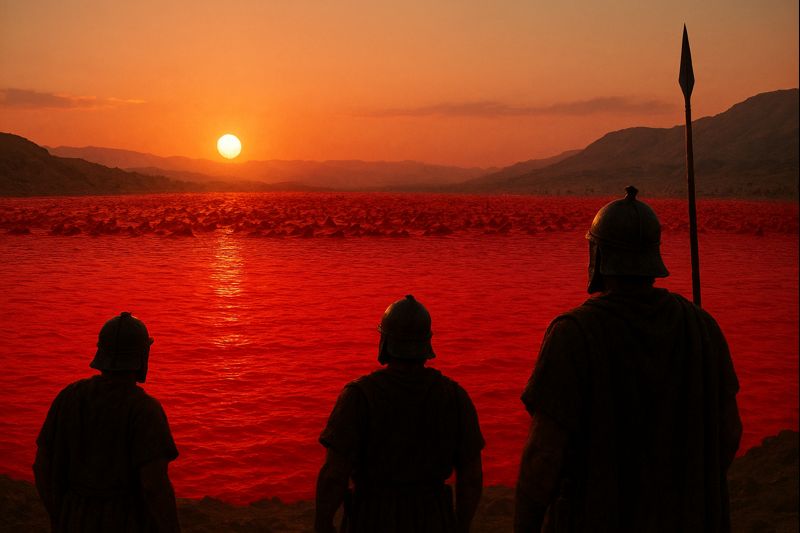
A BLOODY MIRAGE
IN THE DESERT
Then (another then) marks progress in the narrative.
They said, “This is blood; the kings have surely fought together, and they have slain one another - The Moabites apparently all reach 3 conclusions - the red was human blood, the cause is infighting of the three armies and the result is a complete slaughter. It is interesting that no one is raising the question "Where are the bodies?" "Where are the horses?" Personally, I believe God gave the Moabites over to the delusion that there had been a complete massacre.
Now therefore (term of conclusion), Moab, to the spoil! - This exclamation if fascinating because they have still not identified bodies and strewn swords and other spoil. One can envision the Moabite forces running to get the booty (first come, first serve), with swords still sheathed (if they even had them with them for if they did not have their swords and armor they could personally retrieve more spoils).
2 Kings 3:24 But when they came to the camp of Israel, the Israelites arose and struck the Moabites, so that they fled before them; and they went forward into the land, slaughtering the Moabites.
- struck the Moabites: Jos 8:20-22 Jdg 20:40-46 1Th 5:3,4
MASSACRE OF
THE MOABITES
But when they came to the camp of Israel, the Israelites arose and struck the Moabites - Are the Israelites "playing possum" (acting like they are dead)? We cannot say, but when they arose, the surprise attack clearly caught the Moabites off guard and overwhelmed them.
So that they fled before them - The result of the shock and awe of live soldiers instead of dead Israelite soldiers caused panic in the Moabites who ran for their lives!
And they (Israelites and allies) went forward into the land, slaughtering the Moabites - NET = "The Israelites thoroughly defeated Moab." ESV = " And they went forward, striking the Moabites as they went." One can picture the scene of fleeing Moabites being mowed down by the energized Israelite (and allied) troops.
2 Kings 3:25 Thus they destroyed the cities; and each one threw a stone on every piece of good land and filled it. So they stopped all the springs of water and felled all the good trees, until in Kir-hareseth only they left its stones; however, the slingers went about it and struck it.
- threw a stone on every piece: 2Ki 3:19 Jdg 9:45 2Sa 8:2 Isa 37:26,27
- stopped: Ge 26:15,18 2Ch 32:4
- and felled: De 20:19-20
- Kir-haraseth: Supposed to be the same as Ar, or Areopolis, the capital of Moab. De 2:9 Isa 16:7,11 Jer 48:31,36, Kir-heres
Related Passages:
Deuteronomy 20:19-20 “When you besiege a city a long time, to make war against it in order to capture it, you shall not destroy its trees by swinging an axe against them; for you may eat from them, and you shall not cut them down. For is the tree of the field a man, that it should be besieged by you? 20 “Only the trees which you know are not fruit trees you shall destroy and cut down, that you may construct siegeworks against the city that is making war with you until it falls.
Moab circa time of Mesha (source)
SCORCHED EARTH
POLICY
Thus they destroyed the cities; and each one threw a stone on every piece of good land and filled it. So they stopped all the springs of water and felled all the good trees - The Israelites forces fully obeyed God's instructions in 2Ki 3:19.
Until in Kir-hareseth only they left its stones; however, the slingers went about it and struck it. See map for this chief city in the southern central Moab. Kir Hareseth, the major city, could not be taken was situated at the end of a valley and successfully resisted the attacks of the stone slingers surrounding it. But as the plot unfolds, clearly God did not allow it to be taken, for there was one final abominable act of this dramatic battle.
Walton on the effect of decimating the land and water sources - The ecological destruction was intended to cripple the economy for years. The springs and fields could eventually be cleared of stones, but needing to do so would make it a long, slow process to reestablish a productive agriculture. Sometimes springs would find other, less usable outlets and fields would be so damaged as to have greatly reduced fertility. The cutting down of trees would have even more devastating effects on the ecological balance. Not only would shade and wood supply be lost, but topsoil erosion would increase and the loss of forestation’s contribution to the environment would accelerate the development of wasteland conditions. Some fruit trees (such as the date palm) take twenty years of growth before they become productive. Agricultural devastation and deforestation were typical tactics of invading armies seeking to punish those they conquered and as an attempt to hasten their surrender. The Assyrian records and reliefs especially detail punitive measures that include felling trees, devastating meadowlands and destroying canal systems used for irrigation. (IVP Bible Background see page 388 in pdf)
Walton - Kir Haresheth. This is a designation for the capital city in the southern section of Moab, otherwise known as Kir-Moab, and identified with modern Kerak, seventeen miles south of the Arnon along the King’s Highway. There has been no major excavation at the site, but surface surveys show some slight remains from the Iron Age (IVP Bible Background see page 388)
William Barnes: covered … stopped up … cut down - See 2Ki 3:19, where these same aggressive actions are listed in reverse order, with only minor variations in vocabulary. The Hebrew imperfect forms of the verbs used in the present verse vividly denote the actions as ongoing in nature, and thus convey “a graphic picture of the progress of the battle” (Cogan and Tadmor 1988:46, citing Driver).
2 Kings 3:26 When the king of Moab saw that the battle was too fierce for him, he took with him 700 men who drew swords, to break through to the king of Edom; but they could not.
- king of Edom: 2Ki 3:9 Am 2:1
MESHA'S COUNTERATTACK
FAILS TO ADVANCE
When the king of Moab saw that the battle was too fierce for him, he took with him 700 men who drew swords, to break through to the king of Edom; but they could not - King Mesha's attempt to drive a wedge in the Edomite forces was unsuccessful.
2 Kings 3:27 Then he took his oldest son who was to reign in his place, and offered him as a burnt offering on the wall. And there came great wrath against Israel, and they departed from him and returned to their own land.
KJV Then he took his eldest son that should have reigned in his stead, and offered him for a burnt offering upon the wall. And there was great indignation against Israel: and they departed from him, and returned to their own land.
NET So he took his firstborn son, who was to succeed him as king, and offered him up as a burnt sacrifice on the wall. There was an outburst of divine anger against Israel, so they broke off the attack and returned to their homeland.
BGT καὶ ἔλαβεν τὸν υἱὸν αὐτοῦ τὸν πρωτότοκον ὃς ἐβασίλευσεν ἀντ᾽ αὐτοῦ καὶ ἀνήνεγκεν αὐτὸν ὁλοκαύτωμα ἐπὶ τοῦ τείχους καὶ ἐγένετο μετάμελος μέγας ἐπὶ Ισραηλ καὶ ἀπῆραν ἀπ᾽ αὐτοῦ καὶ ἐπέστρεψαν εἰς τὴν γῆν
LXE And he took his eldest son whom he had designed to reign in his stead, and offered him up for a whole-burnt-offering on the walls. And there was a great indignation against Israel; and they departed from him, and returned to their land.
CSB So he took his firstborn son, who was to become king in his place, and offered him as a burnt offering on the city wall. Great wrath was on the Israelites, and they withdrew from him and returned to their land.
ESV Then he took his oldest son who was to reign in his place and offered him for a burnt offering on the wall. And there came great wrath against Israel. And they withdrew from him and returned to their own land.
NIV Then he took his firstborn son, who was to succeed him as king, and offered him as a sacrifice on the city wall. The fury against Israel was great; they withdrew and returned to their own land.
NLT Then the king of Moab took his oldest son, who would have been the next king, and sacrificed him as a burnt offering on the wall. So there was great anger against Israel, and the Israelites withdrew and returned to their own land.
YLT and he taketh his son, the first-born who reigneth in his stead, and causeth him to ascend -- a burnt-offering on the wall, and there is great wrath against Israel, and they journey from off him, and turn back to the land.
- offered him: Ge 22:2,13 De 12:31 Jud 11:31,39 Ps 106:37,38 Eze 16:20 Mic 6:7
- they departed: 1Sa 14:36-46 1Ki 20:13,28,43
Related Passages:
Deuteronomy 12:31 “You shall not behave thus toward the LORD your God, for every abominable act which the LORD hates they have done for their gods; for they even burn their sons and daughters in the fire to their gods.
Micah 6:7 Does the LORD take delight in thousands of rams, In ten thousand rivers of oil? Shall I present my firstborn for my rebellious acts, The fruit of my body for the sin of my soul?
MESHA'S ABOMINABLE SACRIFICE
OF HIS OWN SON
Then (another then) - When he realized he could not defeat the enemy armies.
He took his oldest son who was to reign in his place - Mesha makes the radical choice of selecting the heir to the throne of Moab.
And offered him as a burnt offering on the wall - A burnt offering would mean the royal son was totally consumed. And doing this offering on the wall would make it visible to the Israelite forces.
And there came great wrath against Israel, and they departed from him and returned to their own land - This is clearly a difficult verse to interpret. I favor Israel was appalled at the abominable sacrifice and departed for that reason.
It is interesting to note that Lines 7-9 on The Mesha Stele (Moabite Stone) record Chemosh’s anger turned to favor, which would parallel Mesha’s religious appeal. In other words, Israel departing would be interpreted by King Mesha as his so-called god Chemosh defeating the Israelite God Yahweh. Obviously that is a ridiculous interpretation as something that is a "no god" could hardly stand against the Most High God of Israel.
NET NOTE on great wrath against Israel - The meaning of this statement is uncertain, for the subject of the anger is not indicated. Except for two relatively late texts, the noun קֶצֶף (qetsef) refers to an outburst of divine anger. But it seems unlikely the Lord would be angry with Israel, for he placed his stamp of approval on the campaign (2Ki 3:16–19). D. N. Freedman suggests the narrator, who obviously has a bias against the Omride dynasty, included this observation to show that the Lord would not allow the Israelite king to “have an undiluted victory” (as quoted in M. Cogan and H. Tadmor, II Kings [AB], 52, n. 8). Some suggest that the original source identified Chemosh the Moabite god as the subject and that his name was later suppressed by a conscientious scribe, but this proposal raises more questions than it answers. For a discussion of various views, see M. Cogan and H. Tadmor, II Kings (AB), 47–48, 51–52.
TSK - In cases of great extremity, it was customary in various heathen nations, to offer human sacrifices, and even their own children. This was frequent among the Phoenicians, Greeks, Romans, Scythians, Gauls, Africans, and others; and was the natural fruit of a religious system, which had for the objects of its worship cruel and merciless divinities. The king of Moab, in this case, sacrificed his son to obtain the favour of Chemosh his god, who, being a devil, delighted in blood and murder, and the destruction of mankind. The dearer any thing was to them, the more acceptable those idolaters thought the sacrifice, and therefore burnt their children in the fire to their honour.
Walton - Evidence of child sacrifice has been recovered from Phoenician sites in North Africa (Carthage) and Sardinia, and it was also practiced in Syria and Mesopotamia during the Assyrian period (eighth to seventh centuries B.C.). Dedicating children to a god as a form of sacrifice is found in several biblical narratives. They can be explained as a means of promoting fertility (Mic 6:6-7) or as a way of obtaining a military victory (Judg 11:30-40), as here. In no case, however, does Yahweh consider this an acceptable sacrifice (Deut 18:10). An eighthcentury B.C. Phoenician inscription speaks of sacrifices made to Molech before battle by the Cilicians and their enemies. (IVP Bible Background see page 389)
Donald Wiseman: The human sacrifice of the crown-prince publicly on the wall of the capital was a rare practice (Jdg. 11:31, 39) used to appease the national god Chemosh ‘who was angry with his land’ (Moabite Stone Inscrip.) and had showed his displeasure in their calamitous defeat.
R. D. Patterson: Keil (in loc.) suggests that God’s fury was against Israel because of the lengths to which their pressure had driven the Moabite kings.
MacArthur: It seems best to understand that the king’s sacrifice inspired the Moabites to hate Israel more and fight more intensely. This fierceness perhaps led Israel to believe that Chemosh was fighting for the Moabites. Thus, the indignation or fury came from the Moabites.
Dale Ralph Davis in his unique commentary style describes four views as to how to explain great wrath against Israel -
(1) Yaheweh's wrath - View one points out that qeṣep usually refers to Yahweh’s wrath. Moreover, whenever one meets the phrase ‘great wrath’ (qeṣep gādôl, used here) elsewhere, it refers to Yahweh’s wrath. If the text refers to Yahweh’s anger, why is He angry? Seow suggests divine anger is ‘for the violation of the deuteronomic prohibition of the scorched-earth policy in war’. But we have already rejected the view of 2Ki 3:19 on which his suggestion is based.
(2) Chemosh's wrath - View two agrees with view one that the wrath is divine but assigns it to a different divinity. In this view, the wrath belongs to Chemosh, the god of Moab. Mesha sacrifices, Chemosh becomes angry and causes Israel to flee in panic from the land. A little polytheism anyone? Did a crypto-Chemoshite sneak in and doctor a biblical text? Are such scholars serious? Yes, they are. But this view is untenable even on the suppositions many Old Testament critics have about the books of Kings. They hold that Kings was edited (probably more than once) by ‘Deuteronomists’, vigilant theologians who shaped the Kings material in line with their point of view. They were death on paganism, abominated syncretism, and pressed exclusive Yahwism. If 2Ki 3:27 refers to Chemosh’s wrath and ‘activity’, one cannot explain how that could ever have gotten past the alleged Deuteronomic censors. They would have nailed it. A gremlin would have had to have broken into the redaction factory and given tranquilizers to all the Deuteronomists working there for such a text with such a meaning to survive. Of course I don’t buy this Deuteronomistic theory, so I am content to say that no convinced Yahwist would have allowed Chemosh even one square inch of Yahweh’s sovereignty.
(3) Moabite's wrath - View three holds that the wrath or fury is that of the Moabites themselves, so that Mesha’s troops ‘respond to this desperate act with a superhuman fury that carried them to victory’. Seeing how their king was driven to such an extreme measure so enraged the Moabite army that they drove Israel from the field.
(4) Israel's wrath - View four agrees with view three that the ‘wrath’ is human but assigns it to Israel rather than Moab. This view takes the preposition ‘al as ‘upon’ rather than ‘against’ (it can mean either depending on the context). If the indignation is ‘upon’ Israel, it can mean that Israel has or manifests the indignation. The text then refers to the indignation, horror, or repugnance Israel felt at Mesha’s act. Hence they quit the field without total victory.
All that over, ‘great wrath/indignation was upon Israel.’ On balance, I follow view four. The wrath or indignation is not explicitly said to be God’s. If it were, one would expect some indication of its basis (which is absent). Moreover, the clause comes immediately after the report of Mesha’s sacrifice and so likely depicts a reaction to that gruesome event. . .
Verse 27 is a picture of ‘seeking god’ in paganism. You have to coerce and manipulate—perhaps in the most costly way (cf. Micah 6:6–7). Even not very faithful Israelites are repulsed and horrified. Do you see the message for Israel here? It’s as if Yahweh says: ‘See where pagans go in their desperation? See where paganism leads? Do you savvy at all the matchless gift you have in a God who lives and hears and speaks and delivers without bribery?’ It’s as if the writer is pleading: ‘O Israel, do you realize the treasure that you have in Yahweh? You never need to resort to stuff like this.’ In Moab you can bash your head against the wall or sacrifice your son on it. Both are equally futile. But to Israel Yahweh has given prophets through whom one can receive the light and help one needs (see Deut. 18:15–22 in light of Dt 18:9–14). Here is the easy yoke of the word of God. What a relief biblical religion is! If you don’t believe it, try paganism. (Borrow 2 Kings : the power and the fury page 48)
John Whitcomb: This was the supreme act of devotion to a pagan deity, and Jehovah had long since warned Israel against such abominations (Deut. 12:31; Micah 6:7). The superstitious (and increasingly polytheistic) Israelites were so terrified at the prospect of what Chemosh, the god of Moab, would do in response to this supreme sacrifice, that they gave up the siege and returned to their own land! And so it was, as in the days of Elisha’s predecessor, that the nation continued to halt between two opinions as to who their God really was.
Wiersbe: Twice Joram had questioned whether Jehovah could or would do anything (vv. 10, 13), and Elisha made it clear that he wasn’t paying any attention to the apostate king (vv. 13-14). Yet Joram was sharing in a great victory because of the faith of the king of Judah! Perhaps the Lord demonstrated His wrath against the army of Israel alone to teach Joram a lesson, just as He sent drought and fire from heaven to teach his father, Ahab, a lesson. When Israel had to leave the field, the other two kings left with them, and this ended the siege. The capital city was not destroyed and the Moabite king and his forces were neither captured nor killed, so it was an incomplete victory. However, for the sake of the house of David, God in His grace gave victory to the three kings. (Bible Exposition Commentary page 681)
August Konkel: The final outcome of the campaign fails to regain control over the territory and restore the tribute of Moab. Neither the presence of Jehoshaphat nor the word of Elisha can turn the tide of judgment against Israel. In spite of the rout of the Moabites through divine intervention, Joram cannot achieve his goal to subjugate Mesha; rather, he is forced to retreat precipitately.
Peter Pett: As a result of YHWH’s activity this was accomplished quite easily, until it was suddenly brought to a halt (with Moab meanwhile having been devastated) when in a last ditch attempt to save what was probably his capital city Mesha sacrificed his firstborn son and heir as a burnt offering on the wall (presumably to Chemosh, the god of Moab) in full view of the besieging enemy. The horror of this in Israelite eyes so disturbed the armies of Israel that they recognized in it a signal that YHWH’s anger would be directed on them if they proceeded further, and they thus immediately withdrew from the siege and returned to their own country, their mission on the whole accomplished.
John Gates: The author seems to be asking: If Israel was so deeply moved in this case, why was she not shocked enough to forsake her own idolatry? But idolatry continued in Israel and in Judah.
Dale Ralph Davis: Before we leave this section, however, we must deal with a problem, for some of you are upset. Some have been muttering that this idolatrous rascal Jehoram doesn’t deserve such benefits. Of course he doesn’t. But notice why he received them— because of Jehoshaphat, the king of David’s line (see Elisha’s clear explanation in v. 14). Jehoram received these benefits because of another. And it is the same with you. If you receive any benefit from God it is because you stand next to the Davidic king— Jesus, the descendant of David and Jehoshaphat. You are in exactly the same position as Jehoram. You don’t deserve heaven’s crumbs but receive massive mercies only because Jesus, the Davidic king, stands beside you. (Borrow 2 Kings : the power and the fury page 46)
Iain Provan: Elisha did not lie. There is in his prophecy, nevertheless, a certain economy with the truth. All that he said about the Moabite campaign was true, but the whole truth was not spoken. Some crucial information (about its end) was withheld— information whose absence led the recipients of revelation (and the reader) to have quite mistaken expectations about what would happen. The Lord did hand Moab over to the kings (3:18)—but only up to a certain point. After that point, he handed the kings over to Moab. In the light of 1 Kings 22, we can scarcely doubt that this was his intention from the start. Total victory was never on the agenda, in spite of the way Elisha’s words might have been construed. Once again a wicked Israelite king has been lured to disaster, this time not by a lying spirit speaking through false prophets, but by the Spirit of God revealing partial truth to a true prophet. Perhaps Jehoshaphat, who had seen it all before, should have probed more deeply—particularly when the prophecy so clearly raised questions in terms of Deuteronomy’s rules of war (Deut. 20:19–20). But then, Jehoshaphat was apparently prone to forgetfulness where prophets were concerned.
A central lesson of the chapter is this: prophets do not control the prophetic word. It is something given to them by God (2 Pet. 1:21). They are simply channels through which it passes. We have been confronted with this lesson before (cf. 1 Kgs. 13:1–10; 14:1– 18; 18:1–15). Nothing could make it clearer, however, than a story in which an indisputably true prophet is presented as unaware (fully) of God’s plans (cf. further 2 Kgs. 4:27). God does not always reveal the entirety of the divine will, particularly when faced with wicked Israelite kings destined for judgment. Revelation cannot be taken for granted, just because it is the option that God so frequently chooses. This is a significant lesson to be reminded of at this point in our reading of Kings, when we have seen the regularity of God’s self-revelation through the prophets. Like the other characters here—the pious Judean who fails to consult the Lord; the son of Ahab who takes the Lord’s name upon his lips—God, too, can behave in ways that defy our expectations. God is not bound by conventions.
Indignation (07110) qesep is a masculine noun meaning wrath. "The verb qāṣap is used to give pointed expression to the relationship between two or more persons, one or both of which can be said to feel anger (ʾap), have wrath (ḥēmâ), indignation (kaʿas), or express anger." (TWOT) "The word refers to anger aroused by someone's failure to do a duty. For example, a wife in Persia who showed contempt for her husband by not doing her duties would arouse his wrath (Esther. 1:18). This word usually refers to God's wrath aroused by people failing to do their duties (Deut. 29:28; Ps. 38:1; Isa. 34:2). In some cases, this wrath was directed against sinful Gentile nations (Isa. 34:2; Zech. 1:15; cf. Ro 1:18). In Israel's case, this duty was expressed in the Law of Moses (2 Chr. 19:10; Zech. 7:12; cf. Ro 4:15). Atonement performed by priests turned away God's wrath when laws were broken (Num. 16:46; 1 Chr. 27:24; 2 Chr. 29:8)." (Complete Word Study Dictionary – Old Testament)
Gilbrant - "Qesep is one of the strongest words for anger and is heightened to "great wrath" in several passages (Deut. 29:28; 2 Ki. 3:27; Jer. 21:5; 32:37; Zech. 1:15; 7:12). Three passages place "great wrath" at the climax of a trio of synonyms for anger. In Deut. 29:28, God warns that apostasy from the Covenant will result in Israel being uprooted from their land by his "anger, and in wrath, and in great indignation." Jeremiah predicts the day when the Lord will fight against Israel in overwhelming anger as He carries out the curse of Deuteronomy (Jer. 21:5). Later, he foretells the nation's restoration; even though God has banished the people in anger and great wrath, He will bring them back (Jer. 32:37)." (Complete Biblical Library Hebrew-English Dictionary)
QESEP - 28X/28V - anger(3), indignation(4), very(1), very*(1), wrath(19). Nu 1:53; Nu 16:46; Nu 18:5; Dt. 29:28; Jos. 9:20; Jos. 22:20; 2 Ki. 3:27; 1Ch 27:24; 2 Chr. 19:2; 2 Chr. 19:10; 2 Chr. 24:18; 2 Chr. 29:8; 2 Chr. 32:25; 2 Chr. 32:26; Est. 1:18; Ps. 38:1; Ps. 102:10; Eccl. 5:17; Isa. 34:2; Isa. 54:8; Isa. 60:10; Jer. 10:10; Jer. 21:5; Jer. 32:37; Jer. 50:13; Zech. 1:2; Zech. 1:15; Zech. 7:12
ANSWER - Second Kings 3 records a battle between Mesha, the Moabite king, and an alliance of kings comprised of Joram (king of Israel), Jehoshaphat (king of Judah), and the king of Edom. After the Israelites slaughtered the Moabites and destroyed their towns, the Moabite king offered his son as a sacrifice on the city wall of Kir Hareseth. After this, “the fury against Israel was great; they withdrew and returned to their own land” (2 Kings 3:27). The Moabites were defeated (2 Kings 3:26), but what caused the great indignation against Israel after Mesha sacrificed his son?
When Joram (or Jehoram) became king of Israel, Mesha did not pay his tribute of one hundred thousand lambs and the wool of one hundred thousand rams. That was the reason the kings of Israel, Judah, and Edom allied to fight against the Moabites (2 Kings 3:4–7). As the prophet Elisha had predicted, God filled the wilderness of Edom with water (2 Kings 3:8–20). With the morning sun shining on the water, the Moabites mistook the water for blood. Thinking that the allies had fought among themselves and slaughtered each other, the Moabites began attacking Israel (2 Kings 3:21–23). “But when the Moabites came to the camp of Israel, the Israelites rose up and fought them until they fled. And the Israelites invaded the land and slaughtered the Moabites” and left the land destroyed (2 Kings 3:24). Israel and her allies had defeated the Moabites. Yet Mesha did not accept the defeat.
Mesha tried one last time to come against Israel with seven hundred swordsmen and failed (2 Kings 3:26). Then “he took his firstborn son, who was to succeed him as king, and offered him as a sacrifice on the city wall” (2 Kings 3:27). After this event there came “great indignation against Israel” (NKJV). More than likely, Mesha offered his son as a peace offering or bloody propitiation to the war god, Chemosh. The Bible mentions Chemosh several times (Numbers 21:29; Judges 11:24; 1 Kings 11:7, 33; 2 Kings 23:13; Jeremiah 48:7, 13, 46), and he is almost always described as the god of the Moabites. Mesha believed that offering his son, the heir to the throne, would appease his false god who would grant him victory over his enemies.
The battle waged in Moab has archaeological support. The Moabite Stone (or the Mesha Stele) was discovered in Dhiban, Jordan, in 1868 by French medical missionary F. A. Klein. The Mesha Stele is a stone slab, or stela, measuring three feet high and two feet wide. Unfortunately, the stone was later broken into pieces by local Bedouin, but about two thirds of it was recovered, and those pieces, along with an impression made before the stela was destroyed, allowed all but the last line of text to be reconstructed.
The Moabite Stone verifies most of the details found in 2 Kings 3, but from the Moabite perspective. The stone contains fourteen sections and is inscribed by Mesha, king of Moab, who identifies himself as the son of Chemosh (also spelled Kemoš). The stone tells of some of Mesha’s accomplishments and gives some history between Moab and Israel. In the third and fourth sections, the oppression of King Omri (sixth king of Israel before King Ahab and then King Joram) is recorded and states that King Omri’s son also oppressed Moab. The stone mentions Chemosh twelve times and clearly reflects the relationship that ancient Near Eastern kings had with their gods. Kings needed to convince their gods and subjects that their military acts had just causes to gain both divine and public support. Mesha credits his successes and motivations to Chemosh.
After Mesha sacrificed his son, “the fury against Israel was great; they [the Israelites] withdrew and returned to their own land” (2 Kings 3:27). Moab maintained its independence afterward—another detail confirmed by the Moabite Stone. It is unclear whether the “great indignation” came from Moab, from Israel, or from Israel’s allies, Judah and Edom. Moab could have been indignant that the allies’ actions led to the sacrifice of their next king. Knowing that human sacrifice was an abomination (Leviticus 18:21; Deuteronomy 12:31), the army of Israel could have also been indignant with themselves for having pushed things to the point of an atrocity. The same holds true for Judah and Edom, who were likely sickened at the sight of a human sacrifice, especially when the battle had essentially been over for a while. In any case, the siege of Kir Hareseth was relinquished, and the allies withdrew from battle and returned to their own lands.
God calls us all to have great indignation against sin and evil (Psalm 97:10; Proverbs 8:13). May we follow Paul’s instruction and let love be genuine, abhor what is evil, and hold fast to what is good (Romans 12:9).
Moabite Stone
Moabite Stone - The Moabite Stone (or Mesha Stele) is a 9th-century BCE basalt slab inscribed by King Mesha of Moab, detailing his victories against Israel, crediting his god Chemosh, and rebuilding cities, which largely corroborates the account in 2 Kings 3 (describing Moab's rebellion against Israel under Omri/Ahab/Jehoram), confirming shared historical figures, places (like Dibon), and the conflict, though from different perspectives (Mesha glorifies himself, 2 Kings God's intervention). It provides crucial extra-biblical proof of Israelite/Judahite history, including the "House of David," and mentions Yahweh, adding significant historical weight to the biblical narrative of this period.
Key Allusions to 2 Kings 3:
- Mesha's Revolt: Both texts confirm Mesha, King of Moab, rebelled after years of Israelite control and tribute payments (2 Kings 3:4-5).
- Omri & Son: The Stone mentions Omri and his unnamed son oppressing Moab, aligning with the biblical narrative of Omri's dynasty ruling Israel (2 Kings 3:5-6).
- Israelite Oppression: The Stele details Israel's control, stating Omri "humbled" Moab, matching the biblical context of tribute (2 Kings 3:4).
- Reclaiming Territory: Mesha boasts of victories and taking back Israelite-held towns like Medeba and Nebo, which 2 Kings 3 describes as being attacked.
- YHWH Cultic Objects: Mesha claims to have taken the "altar-hearths of YHWH" as spoils, a significant detail confirming Israel's worship practices mentioned implicitly in the biblical narrative.
Key Difference:
- The Moabite Stone provides Mesha's victorious perspective, while 2 Kings 3 describes the combined Israelite, Judahite, and Edomite campaign against Moab, culminating in the bizarre human sacrifice at Kir-hareseth (2 Kings 3:27). The Stone focuses on Mesha's achievements, not the outcome of that specific battle from the Israelite viewpoint.
The Mesha Stele, the first major epigraphic Canaanite inscription found in the Southern Levant,[5] the longest Iron Age inscription ever found in the region, constitutes the major evidence for the Moabite language, and is a "corner-stone of Semitic epigraphy",[6] and history.[7] The stele, whose story parallels, with some differences, an episode in the Bible's Books of Kings (2 Kings 3:4–27), provides invaluable information on the Moabite language and the political relationship between Moab and Israel at one moment in the 9th century BCE.[3] It is the most extensive inscription ever recovered that refers to the kingdom of Israel (the "House of Omri");[8] it bears the earliest certain extrabiblical reference to the Israelite God Yahweh.[9][8] It is also one of four known contemporaneous inscriptions containing the name of Israel, the others being the Merneptah Stele, the Tel Dan Stele, and one of the Kurkh Monoliths.[10][11][12] Its authenticity has been disputed over the years, and some biblical minimalists suggest the text was not historical, but a biblical allegory. The stele itself is regarded as genuine and historical by the vast majority of biblical archaeologists today.[13]
The stele has been part of the collection of the Louvre Museum in Paris, France, since 1873.[2] Jordan has been demanding the stone slab's return to its place of origin since 2014.[14]