2 Kings 10:2
2 Kings 10:3
2 Kings 10:4
2 Kings 10:5
2 Kings 10:6
2 Kings 10:7
2 Kings 10:8
2 Kings 10:9
2 Kings 10:10
2 Kings 10:11
2 Kings 10:12
2 Kings 10:13
2 Kings 10:14
2 Kings 10:15
2 Kings 10:16
2 Kings 10:17
2 Kings 10:18
2 Kings 10:19
2 Kings 10:20
2 Kings 10:21
2 Kings 10:22
2 Kings 10:23
2 Kings 10:24
2 Kings 10:25
2 Kings 10:26
2 Kings 10:27
2 Kings 10:28
2 Kings 10:29
2 Kings 10:30
2 Kings 10:31
2 Kings 10:32
2 Kings 10:33
2 Kings 10:34
2 Kings 10:35
2 Kings 10:36
2 Kings 10:37
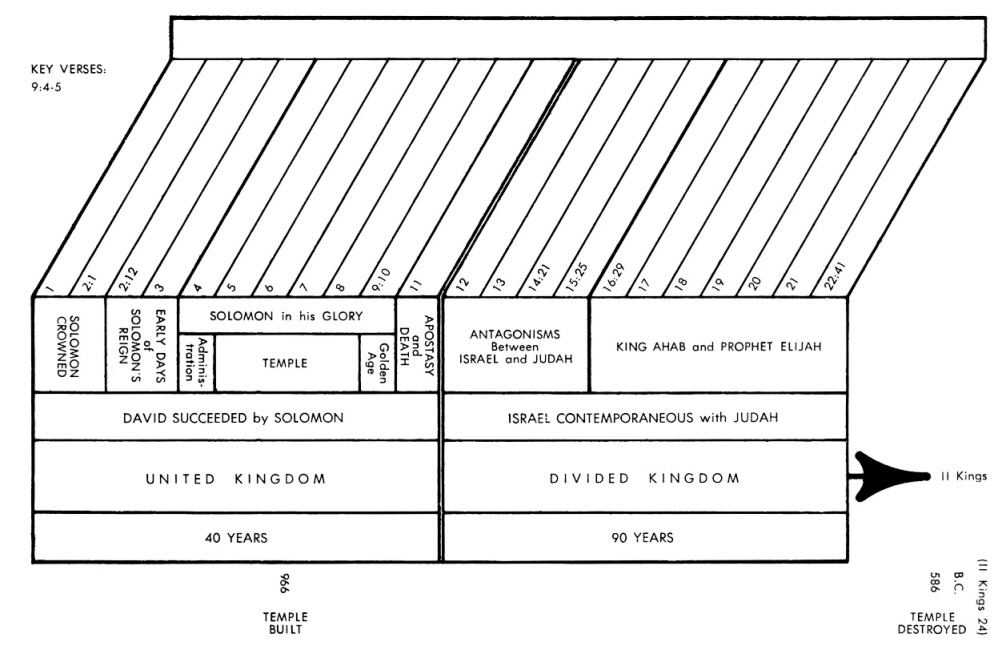
Chart from recommended resource Jensen's Survey of the OT - used by permission
1 Kings Chart from Charles Swindoll
THE DOWNWARD SPIRAL
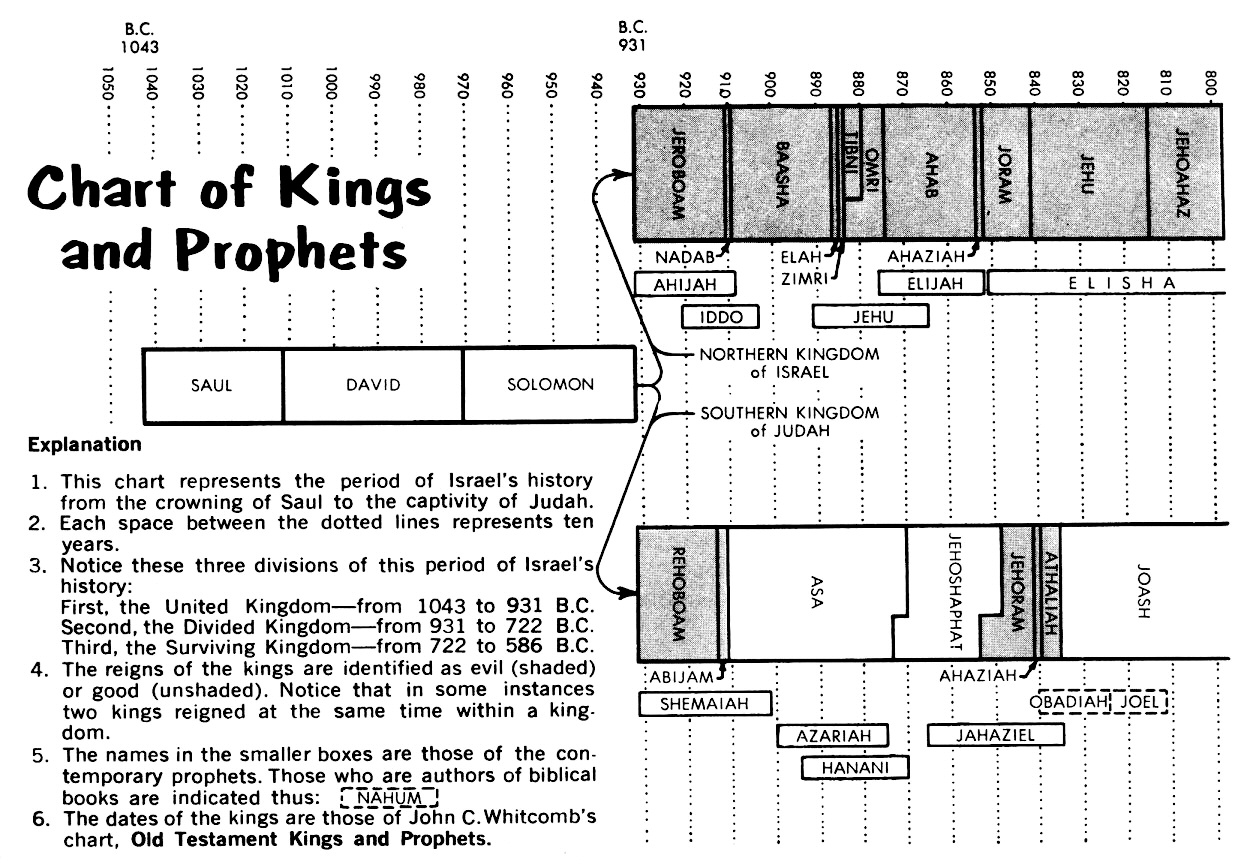
Click to Enlarge
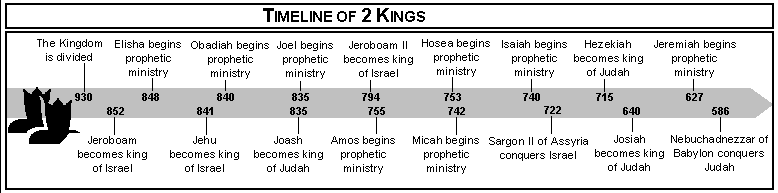
Ryrie Study Bible - Borrow
Click to Enlarge
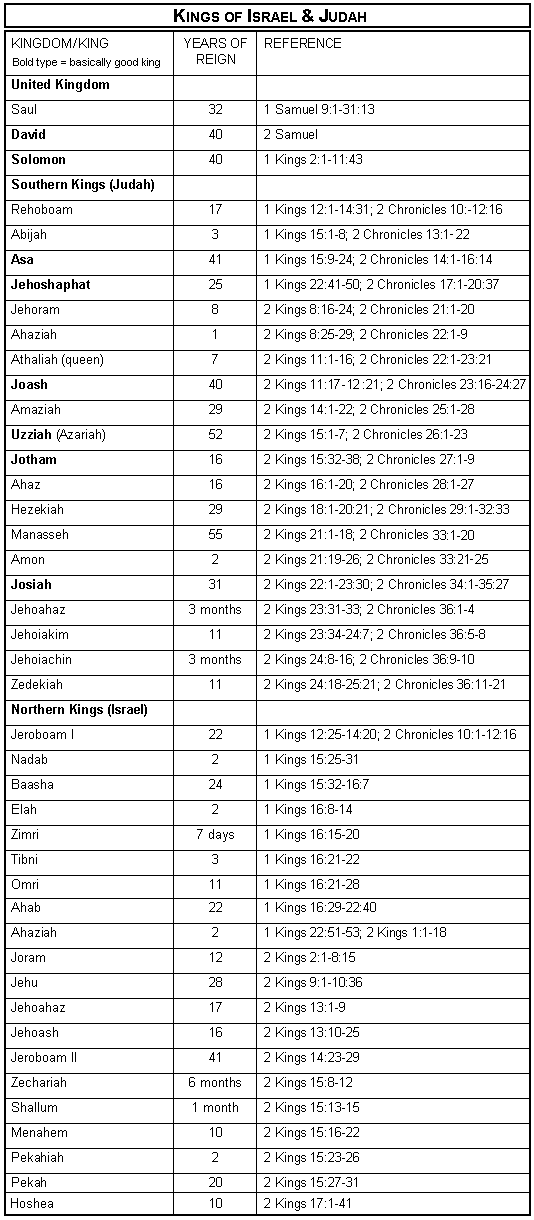
(NOTE: Many consider Amaziah and Hezekiah as "good" kings)
SEE ALSO:
ESV chart - kings of Israel - more information
ESV chart - kings of Judah - more information
Another Chart with Variable Dates for Reigns of Kings
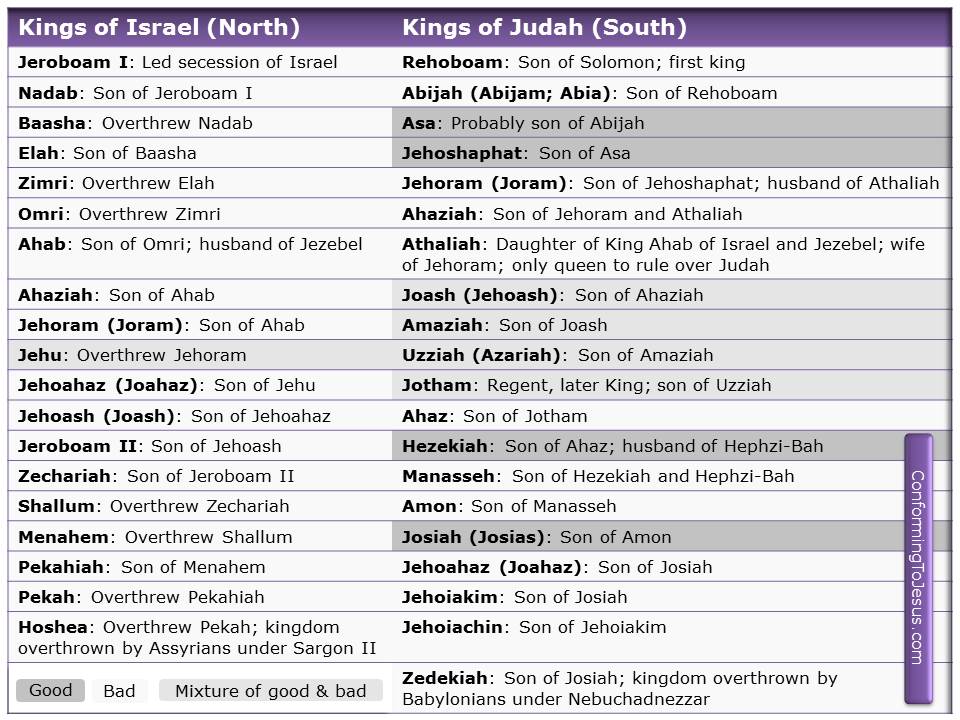
Source: ConformingtoJesus.com
2 Kings 10:1 Now Ahab had seventy sons in Samaria. And Jehu wrote letters and sent them to Samaria, to the rulers of Jezreel, the elders, and to the guardians of the children of Ahab, saying,
- seventy sons: Jdg 8:30 10:4 12:14
- in Samaria: 2Ki 5:3 1Ki 13:32 16:28 2Ch 22:9
- the rulers: De 16:18 1Ki 21:8-14
- them: Heb. nourishers
Now - This marks a strategic pause in the narrative with one of the most chilling sections in the Jehu account, for NOW judgment shifts from battlefield violence to psychological, political, and moral confrontation.
Ahab had seventy sons in Samaria - Seventy signals the magnitude of the challenge to Jehu. The number seventy signals that even though Ahab is dead, his house is still very much alive, at least on paper. Jehu controls Jezreel, but Samaria remains unfinished business.
And Jehu wrote letters and sent them to Samaria - Samaria, the political capital of Israel is the administrative heart of Ahab’s dynasty and represents the last stronghold of Ahab’s legacy. Jehu's letters are his first act after Jezebel’s death, and it is remarkably calculated to see who truly held the power, where their loyalties now lie and whether Samaria would resist or submit.
Bob Utley on name Jehu - This is a form of the sacred name YHWH (cf. Exod. 3:14). This particular form seems to mean "He is." (Dictionary has Jehu = "Jehovah is He" "Yahweh is he" "the living")
to the rulers of Jezreel, the elders, and to the guardians of the children of Ahab, saying - Notice Jehu's calculation. His letters are directed to three groups, the rulers of Jezreel (local administrators), the elders (over civic and judicial matters) and the guardians of Ahab’s sons, those directly responsible for protecting the heirs. Notice Jehu deliberately bypasses the princes themselves and speaks to those accountable for them. Those entrusted to protect Ahab’s sons would soon be confronted with a choice.
NET NOTE - Hebrew “to the officers of Jezreel, the elders, and to the guardians of Ahab, saying.” - It is not certain why the officials of Jezreel would be in Samaria. They may have fled there after they heard what happened to Joram and before Jehu entered the city. They would have had time to flee while Jehu was pursuing Ahaziah.
QUESTION - Who was King Jehu in the Bible? | GotQuestions.org
ANSWER - Before his reign as king, Jehu functioned as a commander in the army of Ahab (2 Kings 9:5, 25) in the northern kingdom of Israel. Jehu was the son of Jehoshaphat, although he is more commonly mentioned as son of Nimshi, his grandfather, perhaps because Nimshi was more well-known. Jehu’s name, meaning “Yahweh is he,” portrays well his future, God-given task: to obliterate the house of Ahab along with the worship of Baal that pervaded Israel at the time.
Jehu was a reformer of sorts who was used by God to clean up the mess that Ahab had made. Of King Ahab it is recorded that he “did more evil in the eyes of the Lord than any of those before him” (1 Kings 16:30). Marrying Jezebel, daughter of the king of the Sidonians, Ahab was seduced into her idolatrous worship of Baal and Ashtoreth. Although God was patient for a time with Ahab, his many sins eventually brought God’s judgment upon his family line (1 Kings 21:20–22). This judgment first lands upon Ahab’s own head, as he is shot and killed in a battle against the Arameans (1 Kings 22:34–38).
God chose Jehu as one of three men who would enact His judgment upon Ahab’s family. God told the prophet Elijah, “Anoint Hazael king over Aram. Also, anoint Jehu son of Nimshi king over Israel, and anoint Elisha son of Shaphat from Abel Meholah to succeed you as prophet. Jehu will put to death any who escape the sword of Hazael, and Elisha will put to death any who escape the sword of Jehu” (1 Kings 19:15–17). One way or another, Ahab’s dynasty would be destroyed.
God also chose Jehu to be the king of Israel. After he was anointed king, Jehu immediately took steps to secure the throne. Knowing that Joram, son of Ahab, had recently gone to Jezreel to recover from wounds in a battle against the Arameans, Jehu ordered his men to seal the city so that no one could alert Joram of Jehu’s anointing (2 Kings 9:1–16). Jehu made haste to Jezreel and killed two of Ahab’s progeny—Joram, king of northern Israel; and Ahaziah, king of Judah (2 Kings 9:14–29). Jehu then proceeded to Jezebel’s palace in Jezreel, where the queen stood watching for him at her window. At Jehu’s command, eunuchs surrounding Jezebel threw her down from the window. Jezebel’s blood splattered over the pavement, and her body was eaten by dogs (2 Kings 9:30–37).
Jehu left no man standing who was in alliance with King Ahab, as God had commanded long before through Elijah. Entering the temple of Baal, Jehu slaughtered all the priests of Baal and destroyed the temple and its sacred stone, thus eradicating Baal worship in Israel (2 Kings 10:23–28).
The Lord blessed Jehu for his obedience, granting him a dynasty that would last to the fourth generation (2 Kings 10:30). However, because Jehu continued to hold on to the idolatrous worship of King Jeroboam (2 Kings 10:29, 31; 1 Kings 12:26–30), God began to reduce the size of Israel, gradually giving them over to the power of even Hazael of Syria (2 Kings 10:32–33). Jehu reigned over Israel a total of twenty-eight years and was succeeded by his son Jehoahaz (2 Kings 10:35–36).
Through Jehu we can learn that, although it is true that God blesses and grants success to those who seek to obey Him, God also can and will pull away His blessing from one who willfully chooses to live in sin. As Jesus says in Matthew 6:24, “No one can serve two masters. Either you will hate the one and love the other, or you will be devoted to the one and despise the other.” We cannot serve God while continuing to hold on to false gods. As Joshua said, we must “choose for [ourselves] this day whom [we] will serve” (Joshua 24:15). Where does your allegiance lie?
2 Kings 10:2 “Now, when this letter comes to you, since your master’s sons are with you, as well as the chariots and horses and a fortified city and the weapons,
- Now, when this letter 2Ki 5:6
JEHU'S LETTER SETS
UP TEST OF LOYALTY
Now, when this letter comes to you Jehu does not march immediately on Samaria. Instead, he sends a letter—an act of psychological warfare. He forces the leaders to think, choose, and expose their allegiance before any swords are drawn.
Bob Utley - Jehu is attempting to have the male descendants of Ahab killed, but to do it in such a way as not to draw the displeasure of the populace to himself.
since your master’s sons are with you The master is Ahab, and his sons represent the remaining heirs of the dynasty, seventy royal princes (2 Kings 10:1). These sons are Jehu’s chief threat, because any one of them could be proclaimed king in opposition to Jehu.
as well as the chariots and horses and a fortified city and the weapons - Jehu acknowledges that the leaders possess military power. Chariots were the elite strike force of the ancient Near East. This is Jehu’s way of saying, “You are fully capable of resisting me if you choose.” Samaria is not defenseless but was a strong, walled capital, stocked with arms. Jehu is not bullying the weak—he is confronting leaders who have every human resource necessary to oppose him.
Jehu's letter is clever because by cataloging their strength, he removes every excuse. If they submit to him, it will not be because they lacked powerbut because they lacked will and loyalty to Ahab’s house. Jehu is forcing the leader to make a clear decision, to either stand with Ahab’s sons and fight, or to abandon the dynasty and submit to his rule and ultimately to God’s judgment.
Jehu gives Ahab’s supporters every opportunity to choose their side knowingly and deliberately. When God brings judgment, He often exposes hearts by forcing clear choices, so that submission or resistance is unmistakable.
2 Kings 10:3 select the best and fittest of your master’s sons, and set him on his father’s throne, and fight for your master’s house.”
- Look even: De 17:14,15 1Sa 10:24 11:15 2Sa 2:8,9 1Ki 1:24,25 12:20
- fight for: 2Sa 2:12-17 1Ki 12:21 Joh 18:36
JEHU'S CHALLENGE
PUT AHAB'S SON ON THRONE
Select the best and fittest of your master’s sons, and set him on his father’s throne, and fight for your master’s house - Here is Jehu's challenge of the nobles and guardians of Ahab's 70 sons to put one on the throne. Jehu’s charge is not sincere but is forcing them to choose sides! He knows the leaders in Samaria will not dare oppose him. Jehu is carrying out psychological warfare. He knows they know he has already killed two kings. Clearly his reputation precedes him, so in wisdom, the men in Samaria know resistance would be suicidal. In short Jehu is testing their allegiance with a trap.
By telling them to choose “the best and fittest”, enthrone him and “fight for your master’s house” he is forcing the leaders to reveal where their loyalty truly lies. Are they with Ahab’s dynasty? Or are they with the new king, the God-appointed executioner of judgment? Jehu is calling them to choose open rebellion or open submission and is not allowing neutrality.
NET NOTE - on fittest - Hebrew יָשָׁר (yashar) does not have its normal moral/ethical nuance here (“upright”), but a more neutral sense of “proper, right, suitable.” For the gloss “capable,”
The guardians are directly responsible for the lives of Ahab's son and Jehu’s challenge implicitly says to them if you truly believe in Ahab’s house, prove it with blood.
2 Kings 10:4 But they feared greatly and said, “Behold, the two kings did not stand before him; how then can we stand?”
- Behold: 2Ki 9:24,27
- how then shall: Isa 27:4 Jer 49:19 Na 1:6 Lu 14:31
THEIR LESSER TO
GREATER LOGIC
But - This is a strategic term of contrast, marking a "military about face!" Instead of supporting Ahab's sons, they turn their backs on them.
They feared greatly - Their fear is sheer terror, not reverence of Jehu.
NET NOTE on feared greatly - Heb “they were very, very afraid.” The term מְאֹד (me’od) “very,” is repeated for emphasis.
And said, “Behold, the two kings did not stand before him; how then can we stand - Notice their "lesser to greater" argument (classic qal-wahomer argument). If the two kings could not stand against Jehu, what hope did the guardians and officials have? If the mighty fell…how much more will the weak?
Bob Utley on "the two kings did not stand before him" - This is the rationalization of the leaders of Samaria in surrendering to Jehu. The two rulers referred to are Joram of Israel and Ahaziah of Judah (cf. chapter 9).
Notice what is absent from their argument. There is no mention of Yahweh. They see Jehu, but they do not see the God who anointed Jehu (2 Ki 9:6–7). They also do not seem to know Solomon's wisdom that “The fear of man brings a snare, but he who trusts in the LORD will be exalted.” (Pr 29:25) Their fear leads them not to resistance, but to submission and ultimately to participation in murder (2 Ki 10:6–7).
2 Kings 10:5 And the one who was over the household, and he who was over the city, the elders, and the guardians of the children, sent word to Jehu, saying, “We are your servants, all that you say to us we will do, we will not make any man king; do what is good in your sight.”
- We are thy servants: 2Ki 18:14 Jos 9:11,24,25 1Ki 20:4,32 Jer 27:7,8,17 Joh 12:26
SAMARIAN LEADERS WISELY
CAPITULATE TO JEHU
And the one who was over the household, and he who was over the city, the elders, and the guardians of the children, sent word to Jehu, saying The speakers are the official leadership of Samaria and represent every power structure left from Ahab’s dynasty. Their response comes after Jehu’s intimidating letter (2 Ki 10:2–3), which challenged them to place the “best” of Ahab’s sons on the throne and fight.
“We are your servants, all that you say to us we will do, we will not make any man king; do what is good in your sight - Instead of choosing a rival king, they surrender completely, declaring loyalty to Jehu as his servants, expressing willingness to obey (without negotiation), flatly rejecting Ahab's line and transferring full authority to Jehu.
This verse is a turning point for now Jehu no longer faces internal resistance, and the capital city submits without a fight as Samaria's officials abandon Ahab’s sons to save themselves. Their decision will prove to be ironic, for the very ones entrusted to protect the royal heirs would be commanded to take their royal heads! WOE!
William Arnot - Keep as few good intentions hovering about as possible. They are like ghosts haunting a dwelling. The way to lay them is to find bodies for them. When they are embodied in substantial deeds they are no longer dangerous.
2 Kings 10:6 Then he wrote a letter to them a second time saying, “If you are on my side, and you will listen to my voice, take the heads of the men, your master’s sons, and come to me at Jezreel tomorrow about this time.” Now the king’s sons, seventy persons, were with the great men of the city, who were rearing them.
- A letter - 1Ki 21:8-11
- If you are on my side Heb. If ye be for me, 2Ki 9:32 Mt 12:30 Lu 9:50
- take the heads of the men: Nu 25:4
- your master's sons: De 5:9 Jos 7:24,25 Job 21:19 Isa 14:21,22 Rev 2:20-23
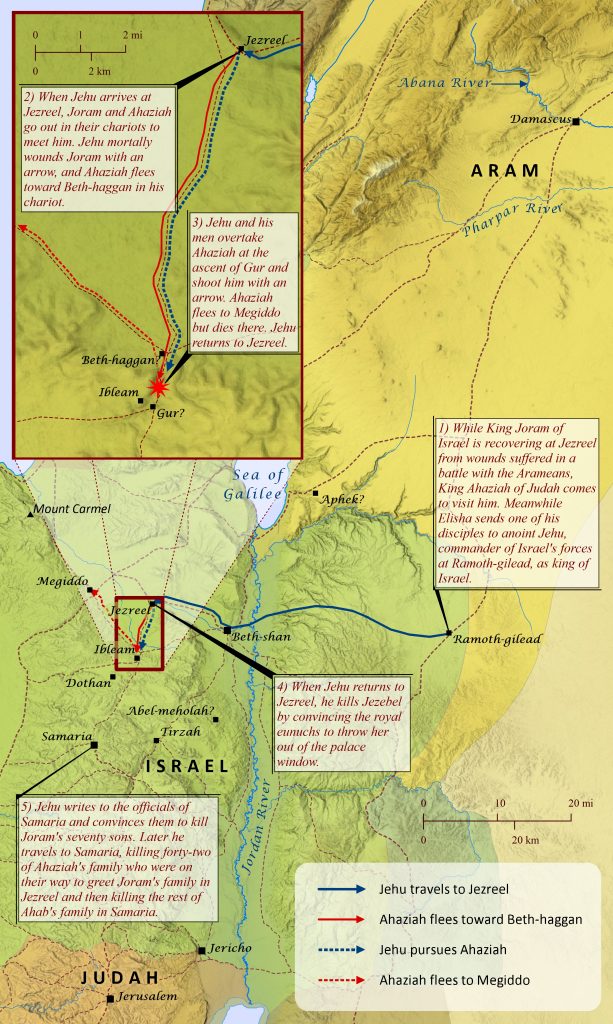
NOTE: See Caption 5 - Jehu's Letter to Samaria Concerning Ahab's 70 Sons
JEHU DROPS THE HAMMER
CALLING FOR HEIR'S HEADS
Then he wrote a letter to them a second time - Jehu now knows he is in full control and civil war has been averted. Those leaders responded in fear, declaring loyalty to Jehu rather than risk opposing him, but now Jehu escalates the test of their loyalty to the ultimate level!
Saying, “If you are on my side, and you will listen to my voice, take the heads of the men, your master’s sons, and come to me at Jezreel tomorrow about this time - Jehu says now their words declaring loyalty must be proven by action, specificlly the act of executing all 70 sons of Ahab. This will ensure the leaders are complicit and irrevocably bound to Jehua.
William Barnes on letter...a second time - This is an example of the deceptive nature of the letter-writing found in Kings (see the second note on 10:1)—did Jehu want their actual “heads” severed from their bodies? (Cf. Leithart 2006:222, “ ‘I didn’t mean literal heads,’ we can hear him protesting on the evening news.”) (1-2 Kings - Page 263)
Peter Leithart - In Hebrew and in English, “head” can mean either the spheroid at the top of the neck or a leader. Jehu plays on the ambiguity, instructing the elders to bring the “heads” of the men to Jezreel. This might be taken as an invitation to parley, but it might also be taken as an instruction to decapitate Ahab’s sons. Jehu retains deniability: “I didn’t mean literal heads,” we can hear him protesting on the evening news. By taking “head” literally, the leaders of Samaria remove a considerable obstacle to Jehu’s power and demonstrate at the same time that they are Jehu’s followers. After they kill seventy of Ahab’s house, there is no going back to the house of Ahab. (See 1 & 2 Kings - Page 222)
It is also a bit ironic that the phrase tomorrow about this time is essentally the same threat Jezebel made against Elijah in 1 Ki 19:2 ("by tomorrow about this time")
Bob Utley on take the heads - Beheading was a common practice of the day from the Assyrian documents. Jezreel was about 20 miles from Samaria, which meant that these guardians had to act immediately to fulfill Jehu's request, without time to think.
NET NOTE has an interesting comment on take the heads - Jehu’s command is intentionally vague. Does he mean that they should bring the guardians (those who are “heads” over Ahab’s sons) for a meeting, or does he mean that they should bring the literal heads of Ahab’s sons with them? (So LXX, Syriac Peshitta, and some MSS of the Targum) The city leaders interpret his words in the literal sense, but Jehu’s command is so ambiguous he is able to deny complicity in the executions (see 2Ki 10:9).
Now the king’s sons, seventy persons, were with the great men (probably in wealth, position, and prestige) of the city, who were rearing them - I am sure the sons felt safe being guarded by the elite protective force. In a twist of poetic justice, the guardians would now become the executioners! While this seems excessive to our modern minds, remember that this is under divine sanction to fulfill God's Word in 1Ki 21:21 “Behold, I will bring evil upon you, and will utterly sweep you away, and will cut off from Ahab every male, both bond and free in Israel." The consequences of Ahab's sin rippled throughout his entire family.
John Walton (p 398) wiping out predecessor’s line. Leaving any living relatives of a king who had been forcibly deposed from the throne by assassination was an invitation to civil war. The relatives would be honor-bound to avenge the death of the previous king, and they would be certain to find those who would support their bid to regain the throne. Such annihilation of ruling families was common practice both in Israel and in the ancient Near East at large.
2 Kings 10:7 When the letter came to them, they took the king’s sons and slaughtered them, seventy persons, and put their heads in baskets, and sent them to him at Jezreel.
- seventy: 2Ki 10:9 11:1 Jdg 9:5-57 1Ki 21:21 2Ch 21:4 Mt 14:8-11
Related Passages:
2 Kings 9:7-9 (THIS PROPHECY NOW FULFILLED) You shall strike the house of Ahab your master, that I may avenge the blood of My servants the prophets, and the blood of all the servants of the LORD, at the hand of Jezebel. 8 ‘For the whole house of Ahab shall perish, and I will cut off from Ahab every male person both bond and free in Israel. 9 ‘I will make the house of Ahab like the house of Jeroboam the son of Nebat, and like the house of Baasha the son of Ahijah.
LEADERS CAPITULATE
BY DECAPITATING
When the letter came to them, they took the king’s sons and slaughtered them, seventy persons, and put their heads in baskets, and sent them to him at Jezreel - Jehu's authority was accepted without resistance. He never had to raise a sword in Samaria. His pen was mightier than his sword! Clearly Ahab’s house has no defenders, only beneficiaries who now were forced act out of fear and the natural instinct of self-preservation!
This is quite a passage to visualize, for these men were guardians, caretakers and civic leaders, most of who had never lifted a sword against another person! Now, these men decapitate the 70 and send their heads to Jehu, thus giving him absolute assurance that there were no successors remaining! Imagine driving the wagons with baskets filled with 70 heads of men you had cared for!
Trapp on heads in baskets - “This was suitable to Ahab’s sin. He had sent for baskets of grapes out of Naboth’s vineyard at Jezreel; and now the heads of his sons are brought thither in baskets.”
ESV Study Bible (borrow) - This fulfills the word of the Lord in 9:7–9 and is similar to other instances in which entire groups of people are put to death (e.g., Dan. 6:24, which likewise does not commend the action; cf. note on 2 Sam. 21:3–6). This kind of drastic action against a royal household was not at all uncommon in the ancient world, as the present incumbents of thrones tried to ensure a future free of retaliation. For example, the Aramaic Panammuwa Inscription (c. 733–727 B.C.) records that Panammuwa of Sam’al was the survivor of a palace coup in which a brother killed his father Barsur, along with 70 brothers of his father. This text and the biblical text in Judg. 9:5, where Abimelech kills 70 of his brothers before being crowned king, may suggest that the number seventy in such contexts is a round number, or a matter of literary convention, rather than an exact number. In any case, the number of sons of such a monarch could be quite large.
2 Kings 10:8 When the messenger came and told him, saying, “They have brought the heads of the king’s sons,” he said, “Put them in two heaps at the entrance of the gate until morning.”
- there came: 2Sa 11:18-21 1Ki 21:14 Mk 6:28
- until the morning: De 21:23
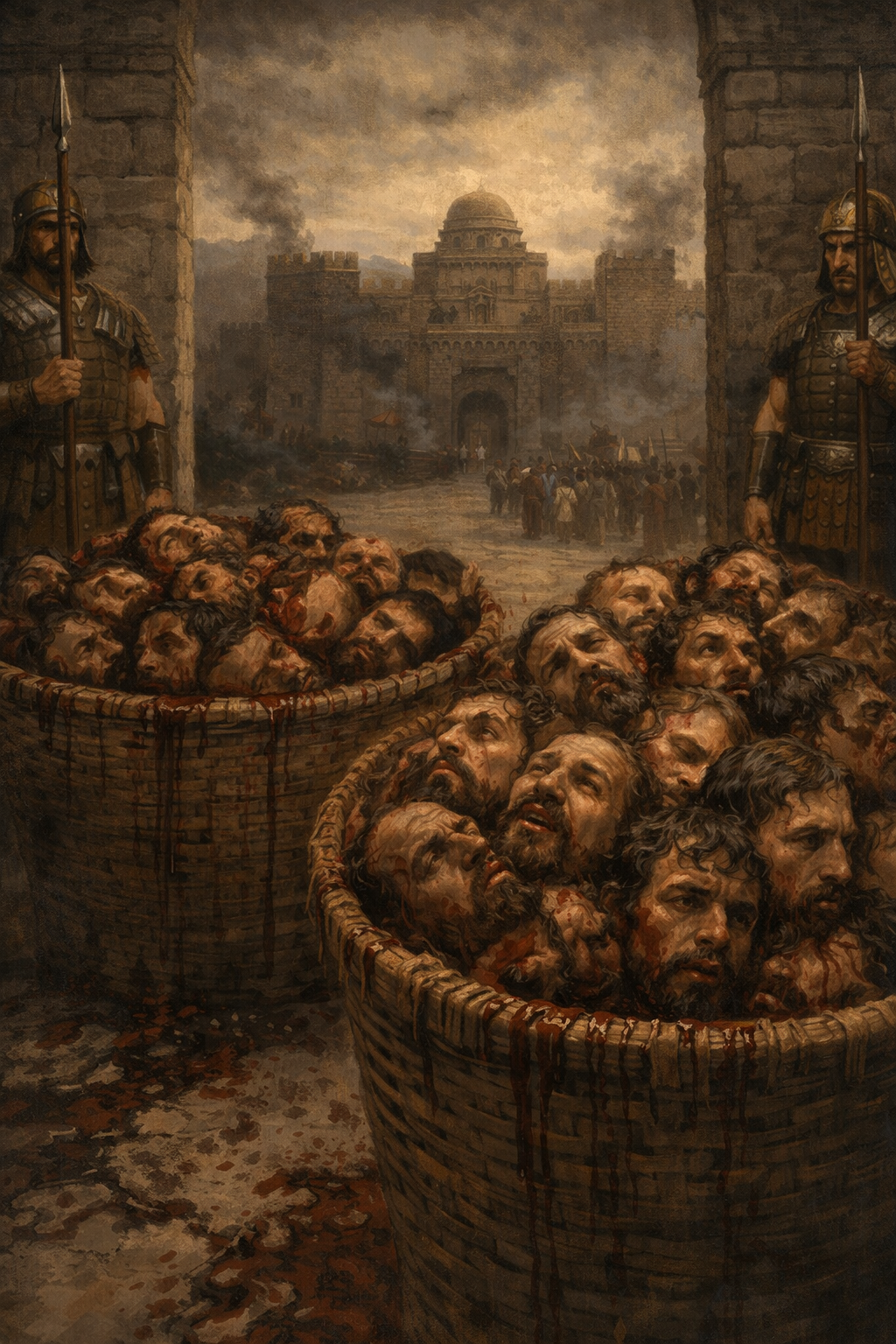
A BASKET OF
HEADS FOR JEHU
When the messenger came and told him, saying, “They have brought the heads of the king’s sons,” The severed heads of Ahab’s sons are proof of total submission—there will be no rival claimant from Ahab’s line. This is not random brutality but the final elimination of dynastic succession, a standard (if horrifying) ancient Near Eastern method of signaling regime change.
he said, “Put them in two heaps at the entrance of the gate until morning The city gate was the place of public assembly, legal decisions, and announcements. By displaying the heads there, Jehu makes the outcome unmistakably public and judicial, not secret or private. The two heaps likely correspond to the two prominent gate entrances or simply emphasize completeness and finality.
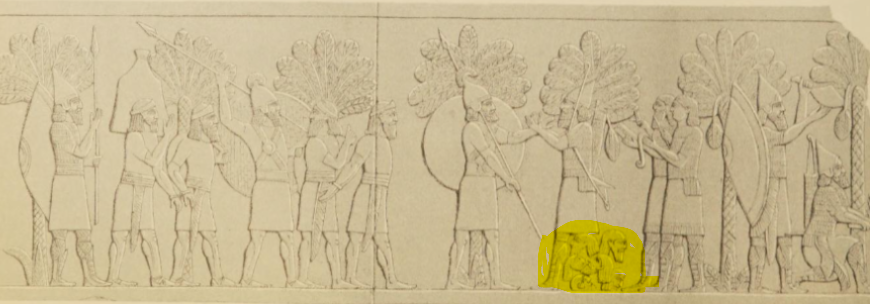
Scribes list booty and slain (see pile of heads in yellow highlight) from Southern Babylon
William Barnes - Pile them in two heaps at the entrance of the city gate. This would frighten the surviving citizens of the city into submission, a tactic also used by contemporary Neo-Assyrian kings (Cogan and Tadmor 1988:113). For an Assyrian image of severed heads as part of a scene where scribes of King Sennacherib are compiling lists of war booty and of the slain, BORROW -- picture above is from ANEP, picture #236. (See 1-2 Kings - Page 263)
Toward the right of this part of a register, which shows the booty taken from a captured town in southern Babylonia, stand two scribes, evidently listing the booty and the slain, represented by a pile of heads before them. The nearer one, like the scribe to the left in No. 235, is beardless, and holds a piece of writing material of papyrus or skin in one hand and a brush or pen in the other. The second scribe, the one only partly visible, wears a full beard and holds what may be a clay tablet.
Bob Utley on Put them in two heaps - Jehu wanted to make a public display of the prophetic fulfillment of the fall of Ahab's house. Tthis was an action known in the Ancient Near East to discourage treason. Heaps The root is usually used of gathering grain into bundles after cutting. Here, and only here, it is used of a pile of severed human heads!
Until morning - Leaving the display overnight ensures maximum visibility and impact. At daybreak, the entire city—and any arriving officials—will see undeniable evidence that Ahab’s house is finished. Public sin meets public judgment. Ahab’s dynasty sinned openly; its end is displayed openly.
John Walton (p 398) heads in baskets. The Assyrians made a practice of piling up the heads of those that had been killed in battle or punished for their rebellion. It was common in this period for such piles to be placed just outside the city gates as a warning to the inhabitants that rebellion was treated harshly.
2 Kings 10:9 Now in the morning he went out and stood and said to all the people, “You are innocent; behold, I conspired against my master and killed him, but who killed all these?
TLB - In the morning he went out and spoke to the crowd that had gathered around them. “You aren’t to blame,” he told them. “I conspired against my master and killed him, but I didn’t kill his sons! (10) The Lord has done that, for everything he says comes true. He declared through his servant Elijah that this would happen to Ahab’s descendants.”
- Ye be righteous: 1Sa 12:3 Isa 5:3
- I conspired: 2Ki 9:14-24 Ho 1:4
JEHU'S CONFESSION
AND QUESTION
Now in the morning he went out and stood and said to all the people Jehu is not making a private remark but a public, judicial-style declaration to the nation.
David Guzik - When the people saw the severed heads of 70 descendants of Ahab, they feared that judgment had gone too far and they would be punished for it. Jehu assured them that they had done right – and that none had the right to accuse him, because he acted at the command of God.
You are innocent (saddiq); behold, (hinneh; LXX - idou) I conspired against my master (King Joram) and killed him - Jehu's confession is strategic, not penitential, because he knows it was God's will. By confessing openly, he removes suspicion of secrecy or treachery
Bob Utley on "you are innocent" (righeous) Jehu is trying to remove the guilt of bloodshed (cf. Deut. 21:1-9). There is some question whether the guardians themselves are later killed (v. 11). This is a specialized sense of the ADJECTIVE "righteous" (saddiq) as innocent (i.e., Gen. 20:4; Deut. 25:1; 1 Kgs. 8:32; 2 Chr. 6:23; Prov. 17:15,26; 18:5). They (and he) are innocent because YHWH had ordered the death of Ahab's family.
Matthew Poole - “You are righteous in your own eyes, and you look upon me as a traitor, and rebel, and murderer, because I have risen against and slain my master, which I acknowledge I have done. But if I am guilty, you are not innocent, and therefore cannot accuse me; for I have killed one, but you a great number.”
Donald Wiseman - Jehu, in a formal assembly (stood before all the people), either absolved the people from blame for the holocaust (you are innocent, Heb. ‘righteous’) on the grounds that it was a fore-ordained action or put the onus on them to decide whether his action had their approval (‘you are fair judges. If I conspired against my master and killed him, who put all these to death?’ NEB), thus they had already implicated themselves. (See 1 and 2 Kings: An Introduction and Commentary - Page 239)
But - Term of contrast. This marks a sharp, rhetorical turn with his question.
Who killed all these - All these refers to the 70 heards suggesting he points to them as he asks the question. This is an interesting maneuver, for now no one can accuse Jehu without condemning themselves. This question in effect unifies the people under complicity, so that now everyone present is implicated in the fall of Ahab’s house.
By publicly confessing his own limited role while exposing the greater complicity of others, he neutralizes opposition, fulfills prophecy, and binds the nation to his reign through shared responsibility
Behold (02009) hinneh is an interjection meaning behold, look, now; if. "It is used often and expresses strong feelings, surprise, hope, expectation, certainty, thus giving vividness depending on its surrounding context." (Baker) Hinneh generally directs our mind to the text, imploring the reader to give it special attention. In short, the Spirit is trying to arrest our attention! And so hinneh is used as an exclamation of vivid immediacy (e.g., read Ge 6:13)! Hinneh is a marker used to enliven a narrative, to express a change a scene, to emphasize an idea, to call attention to a detail or an important fact or action that follows (Isa 65:17, Ge 17:20, 41:17).
Spurgeon reminds us that "Behold is a word of wonder; it is intended to excite admiration. Wherever you see it hung out in Scripture, it is like an ancient sign-board, signifying that there are rich wares within, or like the hands which solid readers have observed in the margin of the older Puritanic books, drawing attention to something particularly worthy of observation." I would add, behold is like a divine highlighter, a divine underlining of an especially striking or important text. It says in effect "Listen up, all ye who would be wise in the ways of Jehovah!"
Hinneh is translated in the Septuagint with the interjection idou (strictly speaking a command in the second person aorist imperative, middle voice) a demonstrative particle (used 1377 times in the Septuagint and NT) which is found especially in the Gospels of Matthew and Luke "and giving a peculiar vivacity to the style by bidding the reader or hearer to attend to what is said: "Behold! See! Lo!" (Thayer) The command is calling for urgent attention. Do this now! Don't delay! It could be loosely paraphrased "Pay attention!" or "Listen up!" to arouse attention and introduce a new and extraordinary fact of considerable importance.
Innocent (righteous) (06662) saddiq from sadaq = to be just or righteous) is an adjective with describes one as upright or just. This root basically connotes conformity to an ethical or moral standard. And so saddiq pertains to a person being in accordance with a proper (right) standard (God's standard being the ultimate arbiter of what defines righteousness acceptable to God). Saddiq can also convey the sense of innocence (guiltless) when describing one having no sin or wrongdoing according to a right (righteous) standard (Ex 23:7).
2 Kings 10:10 “Know then that there shall fall to the earth nothing of the word of the LORD, which the LORD spoke concerning the house of Ahab, for the LORD has done what He spoke through His servant Elijah.”
- the earth: 1Sa 3:19 15:29 Jer 44:28,29 Zec 1:6 Mk 13:31
- the Lord has done: 2Ki 9:7-10 1Ki 21:19,21-24,29
- by: Heb. by the hand of, 2Ki 9:36
Related Passages:
2 Kings 9:7-10 (FULFILLMENT OF JEHOVAH'S PROPHECY AGAINST AHAB'S HOUSE) ‘You shall strike the house of Ahab your master, that I may avenge the blood of My servants the prophets, and the blood of all the servants of the LORD, at the hand of Jezebel. 8 ‘For the whole house of Ahab shall perish, and I will cut off from Ahab every male person both bond and free in Israel. 9 ‘I will make the house of Ahab like the house of Jeroboam the son of Nebat, and like the house of Baasha the son of Ahijah. 10 ‘The dogs shall eat Jezebel in the territory of Jezreel, and none shall bury her.’” Then he opened the door and fled.
JEHU FULFILLS GOD'S PROPHECY
OF JUDGMENT
Know then - This declaration is a command to the people. What Jehu wants the people to do is draw the conclusion that what they have just witnessed is not random violence, but is the outworking of Yahweh’s prophetic word. Not only are they innocent, but he likewise is innocent before the LORD because the order to kill came from heaven.
That there shall fall to the earth nothing of the word of the LORD - Fall to the earth nothing of the word is an idiomatic way of say God's Word will no fail, come to nothing or prove to be empty and/or ineffective. To the contrary Jehu asserts the absolute reliability of God’s spoken word and indicates it's total fulfillment.
Bob Utley on "Know then that there shall fall to the earth nothing of the word of the Lord" This is an idiom (cf. Josh. 21:45; 23:14; 1 Sam. 3:19; 1 Kgs. 8:56) of the trustworthiness of YHWH's revelations (NIDOTTE, vol 3, p. 129, #3).
Which the LORD spoke concerning the house of Ahab - Jehu is explaining that the judgment now unfolding was announced years earlier, primarily through Elijah (cf. 1 Ki 21:21–24). Divine delay does not signify divine denial.
For - Term of explanation. Jehu explains why one can conclude God's Word did not fail.
The LORD has done what He spoke through His servant Elijah - God had sovereignly decreed this judgment and Jehu says He has carried out the judgment using Jehu's actions (man's responsibility).
Warren Wiersbe quips that "Jehu practiced what is today called “double-speak.” Taxes are now “revenue enhancement” and potholes are “pavement deficiencies.” People are no longer bald; they are only “follicularly deprived.” Hospital technicians gave a fatal dose of nitrous oxide to a mother about to deliver and killed both the mother and the child. They called the tragedy “a therapeutic misadventure.” Poor people are now “fiscal underachievers,” and soldiers no longer kill the enemy, they “service the target.” David was right when he wrote, “They speak falsehood to one another; with flattering lips and with a double heart they speak” (Ps. 12:2 nasb)."
ESV Study Bible (borrow) - The Assyrian king Ashurnasirpal II records in an inscription that during his siege of the city of Damdammusa he cut off the heads of 600 of his enemy’s troops and, in an act of intimidation, “built a pile of heads before his gate.” Jehu’s aim is similar: to convince the people that resistance is futile. He knows who struck down all these, but the people do not; and he invites them to believe that the heads mean that the revolution is bigger than he is, involving mysterious powers more lethal than his (he killed only his master); it is truly the LORD who is at work in overthrowing the house of Ahab. As fair-minded (implied by innocent) people, they should be able to arrive at the correct interpretation of the evidence.
2 Kings 10:11 So Jehu killed all who remained of the house of Ahab in Jezreel, and all his great men and his acquaintances and his priests, until he left him without a survivor.
- and: Ps 125:5 Pr 13:20
- his priests: 2Ki 23:20 1Ki 18:19,40 22:6 Rev 19:20 20:10
- he left: Jos 10:30 11:8 1Ki 14:10 15:29 16:11 21:22 Job 18:19 Ps 109:13 Isa 14:21,22
YAHWEH'S JUDGMENT
COMPLETED AT JEZREEL
So Jehu killed This verse records the systematic completion of judgment against the house of Ahab in Jezreel by Jehu. It is not a random slaughter, but a targeted purge of everyone still connected to Ahab’s dynasty, including his power base in Jezreel.
When God brings judgment, He dismantles not only the throne
but the entire system that upheld it.
All who remained of the house of Ahab in Jezreel The verse carefully lists four categories, showing the completeness of the judgment. First, the blood relatives and surviving members of Ahab’s family which fulfills Elijah’s prophecy (1 Ki 21:21–22)
There is some disagreement on the morality of Jehu's actions in this verse.
HCSB notes for example write "But Jehu went beyond killing the house of Ahab and killed Ahab’s great men (perhaps the nobles loyal to Ahab). In these killings he clearly went beyond God’s commands into excessive slaughter. By the standards of that day, the false priests were fair targets." (See CSB Study Bible)
Bob Deffinbaugh however makes an interesting point - it is at this point in time that Jehu kills all those in Jezreel who are relatives of Ahab, as well as his loyal supporters, even including the priests (verse 11). Lest we question this and suggest (as some have done) that Jehu has gone too far here, let me remind you that at least some of these folks were participants in the mockery of justice which resulted in the death of Naboth and his sons, and the theft of his property by Jezebel and Ahab
7 His wife Jezebel said to him, “You are the king of Israel! Get up, eat some food and have a good time. I will get the vineyard of Naboth the Jezreelite for you.” 8 She wrote out orders, signed Ahab’s name to them, and sealed them with his seal. She then sent the orders to the leaders and to the nobles who lived in Naboth’s city. 9 This is what she wrote: “Observe a time of fasting and seat Naboth in front of the people. 10 Also seat two villains opposite him and have them testify, ‘You cursed God and the king.’ Then take him out and stone him to death.” 11 The men of the city, the leaders and the nobles who lived there, followed the written orders Jezebel had sent them. 12 They observed a time of fasting and put Naboth in front of the people. 13 The two villains arrived and sat opposite. Then the villains testified against Naboth right before the people, saying, “Naboth cursed God and the king.” So they led him outside the city and stoned him to death. 14 Then they reported to Jezebel, “Naboth has been stoned to death” (1 Kings 21:7-14, emphasis mine).(1 Kings 21:7-14)
Deffinbaugh goes on "We must certainly see that the nobility of Jezreel, in order to gain and maintain their positions, had to be participants in many of the wicked schemes of Ahab, Joram, and Jezebel. These folks were not innocent bystanders. (ED: THIS REMINDS ME OF THE GERMAN CITIZENS WHO LIVED NEXT TO THE CONCENTRATION CAMPS AND PRETENDED TO KNOW NOTHING ABOUT WHAT WAS TRANSPIRING) And they were the very ones who could also orchestrate the downfall of Jehu. The priests, likewise, were a part of Joram’s wicked administration. Jehu was “cleaning house,” and this surely needed to be done. I do not in any way dispute Jehu’s claim that these things were the fulfillment of God’s judgment upon this dynasty, and upon these people."
and all his great men - Secondly, he kills all the nobles, officials, military leaders who benefited from Ahab’s power and policies
and his acquaintances (close friends) - Thirdly, he kills close associates, allies, inner-circle supporters, those socially and politically were loyal to the dynasty.
and his priests - Fourthly, he kills Ahab's priests, not Yahwistic priests, but priests connected with Ahab’s religious system.
until he left him without a survivor - This is the total fulfillment of the prophetic word spoken years earlier.
Henry Morris - none remaining. Jehu had been commissioned to destroy the house of Ahab (2 Kings 9:7-9), and he carried it out with zeal. After slaying all those in Jezreel, he did the same in Samaria the capital (2 Kings 10:17) and even Ahab's more distant relatives from Judah (2 Kings 10:13,14). Jehu finally destroyed all the leaders of Baal worship in Israel as well (2 Kings 10:20-28). Thus was the prophetic word of both Elijah and Elisha fulfilled (1 Kings 21:21-24; 2 Kings 9:8,9).
Jehu is acting as God’s instrument, not merely as a political assassin fulfilling 1Ki 21:21 and 2Ki 9:7.
Warren Wiersbe Jehu’s divine commission had now become a personal crusade, motivated by his own selfish ambition. Novelist Joseph Conrad wrote in the preface to Some Reminiscences, “All ambitions are lawful except those which climb upward on the miseries and credulities of mankind.” Lawful ambition uses truth and builds on the past, while unlawful ambition uses lies and destroys the past. Dictators must annihilate their enemies in order to be safe, but in so doing, they destroy the past and the information and help they need for moving into the future. A German aphorism says, “Every eel hopes to become a whale,” and Jehu was now driving in that lane. To prove that he intended to obey God and purge the land of Ahab’s family, Jehu proceeded to kill all of Ahab’s descendants that he found in Jezreel. But he didn’t stop there; he went beyond his divine commission and killed Ahab’s close friends, his chief officers, and the priests who served in the palace. It was a wholesale slaughter based on “guilt by association.” The Lord wanted to rid the land of Ahab’s family so that none of them could usurp the throne, but for Jehu to kill Ahab’s friends, officers, and priests was totally unnecessary.
John Walton (p 398) his acquaintances (close friends) - The term translated “close friend” here is a technical term used both in Akkadian and Ugaritic sources describing those who enjoy the sponsorship of the court. They are royal wards who enjoy court privileges and were probably non-Israelite. Additionally Ahab’s family, administration and religious personnel were executed.
Dale Ralph Davis: If we cannot dispute Jehu we may be tempted to question Yahweh. Why does he work like this? Why does he allow the gore of man to carry out the will of God? Couldn’t he operate in a cleaner way? Perhaps. But we must remember two points. First, the Bible shows that God frequently works, we might say, indirectly— through human instruments, and, unlike surgeons, God has no sterilized instruments; all of them are flawed and many of them opportunistic, self-serving Jehus. So God uses wicked people to carry out his divine design. Second, this is a situation involving the judgment of God, and it is very difficult to make judgment pleasant. (Borrow 2 Kings : the power and the fury page 162)
2 Kings 10:12 Then he arose and departed and went to Samaria. On the way while he was at Beth-eked of the shepherds,
- Beth-eked of the shepherds 2Ki 10:12
FROM EXECUTION
TO EXPANSION
Then - Marks progression in the narrative from the decapitation of Ahab's 70 sons and the securing of Jerzreel to Jehu's movement to the capital city.
He arose and departed and went to Samaria - This was the political capital of Israel, the ideological center of Baal worship under Ahab and the place where Ahab’s allies, relatives, and priests still lived. Until Samaria is dealt with, the judgment against Ahab’s house is unfinished.
On the way while he was at Beth-eked of the shepherds - Beth-eked likely means “house of binding” or “shearing house” and refers to a sheep-shearing station, a communal place where shepherds gathered and sets the stage for what follows in vv.13–14. There is a note of irony for the shearing house would becomes a place of separation where those aligned with Ahab will be “cut off.”
Bob Utley on "Beth-eked" The place name means "the house of binding." This refers to the place where the sheep were sheared and during the process their feet were bound.
John Walton (p 398) Beth Eked of the Shepherds. This location must be somewhere along the nearly thirty-mile route between Jezreel and Samaria, but it has not been identified with any confidence. If it refers to a place where shepherds congregated or gathered their sheep, somewhere around the plain of Dothan would be logical. (ED: About 12 mi NE of Samaria.)
2 Kings 10:13 Jehu met the relatives of Ahaziah king of Judah and said, “Who are you?” And they answered, “We are the relatives of Ahaziah; and we have come down to greet the sons of the king and the sons of the queen mother.”
- the brethren: 2Ki 8:24,29 9:21-27 2Ch 21:17 22:1-10
Related Passages:
2 Chronicles 22:8 It came about when Jehu was executing judgment on the house of Ahab, he found the princes of Judah and the sons of Ahaziah’s brothers ministering to Ahaziah, and slew them.
PROVIDENCE
ON THE ROAD
Jehu met the relatives of Ahaziah king of Judah and said, “Who are you?” The meeting is accidental from a human perspective—but providential from God’s. Jehu encounters the kin of Ahaziah at precisely the wrong time. In times of divine reckoning, lineage and allegiance become determining factors.
Bob Utley on "Jehu met the relatives of Ahaziah king of Judah" King Ahaziah was a grandson of Jezebel and part of the prophet's prediction about the destruction of Ahab's entire house. We learn of the fate of most of his family from 2 Chr. 21:17; 22:1. Apparently these were 42 of his nephews (cf. 2 Chr. 22:8) who had not heard of the slaughter.
And they answered, “We are the relatives of Ahaziah - They must not have known about Ahaziah's fate! To be closely tied to Ahaziah is to be implicated in the same corrupt network. Judah’s royal family has become dangerously entangled with Ahab’s house.
and we have come down to greet the sons of the king (Joram) and the sons of the queen mother (Jezebel) - Now we know for certain they have not gotten any "texts" or read their "emails" (so to speak)! They are on their way to greet two dead people and a royal a house that no longer exists. They call Jezebel “the queen mother”, a title of honor, even though God has already reduced her to judgment and disgrace.
NORMAN GEISLER - Were Ahaziah’s brothers slain or were they his brother’s sons? - When Critics Ask
PROBLEM: Here we are told that it was king Ahaziah’s brother’s “sons” who were killed. But 2 Kings 10:13–14 says it was Ahaziah’s “brothers” that were slain.
SOLUTION: The Hebrew term for “brother” can mean “near relative.” For example, Abraham’s nephew Lot was called his “brother” (Gen. 14:12, 16). Since Ahaziah, the youngest son, was born when his father was only 18, he could have had many nephews and cousins or “brethren.” Since the 2 Chronicles passage refers to his brother’s sons, the word “brother” can be taken in the strict sense here.
It is also quite possible that both statements are literally true. Since Jehu was commanded by God to exterminate the house of Ahab, and since Ahaziah “walked in the way of the house of Ahab,” it is conceivable that Jehu took it upon himself to destroy the house of Ahaziah also, including his brothers and his brothers’ sons. In fact, in the 2 Kings passage, the report of the killing of Ahaziah’s brothers (2 Kings 10:13–14) takes place after Jehu had killed Ahaziah (2 Kings 9:27), while the 2 Chronicles passage reports the killing of the sons of Ahaziah’s brothers before the killing of Ahaziah (2 Chron. 22:8–9).
2 Kings 10:14 He said, “Take them alive.” So they took them alive and killed them at the pit of Beth-eked, forty-two men; and he left none of them.
- Take them alive: 2Ki 10:6,10,11 1Ki 20:18
- left none of them. 2Ki 8:18 11:1 2Ch 22:8,10
Related Passages:
2 Chronicles 22:8 It came about when Jehu was executing judgment on the house of Ahab, he found the princes of Judah and the sons of Ahaziah’s brothers ministering to Ahaziah, and slew them.
CUT OFF AT THE
SHEARING STATION
He said, “Take them alive.” - Jehu does not hesitate for a moment to order their capture.
So they took them alive and killed them at the pit (cistern, well) of Beth-eked, forty-two men - Their association with Ahab even indirectly or in any form made them guilty.
Warren Wiersbe points out that "Jehu was now attacking the Davidic dynasty!" (See 2 Chron. 22:8) And I would add that upon killing Ahaziah, even as bad as he was, the line of Messiah was reduced to a single thread, Ahaziah's son Joash who we will meet in 2 Kings 11.
And he left none of them - “He left none” echoes earlier prophetic language (cf. 1 Kings 21:21), stressing that God’s announced judgment against Ahab’s influence is being carried out. While some think Jehu overstepped his divine mandate here, the fact is the made a statement that supports their alliance with Ahab's dynasty, (we have come down to greet the sons of the king (Joram) and the sons of the queen mother (Jezebel))
The tragedy is that entanglement has consequences. Even though these men belong to Judah’s royal family, their close identification with Ahab’s house places them within the scope of judgment. Alliances with persistent evil can draw even God’s people into severe consequences.
David Guzik - Some believe that the execution of Ahaziah’s family was an example of Jehu going too far. “The sword of judgment, so far as the expressed purpose of Jehovah was concerned, should have been confined to the house of Ahab. But a reckless and ambitious hand was wielding it, and it devoured beyond the allotted limits.” (Knapp)
John Walton (p 398) treatment of Ahaziah’s relatives. Since Jehoram of Israel was the uncle of Ahaziah of Judah, all of these relatives of Ahaziah are at least indirectly associated with the bloodline of the house of Ahab. That is sufficient to bring a death sentence on their heads. The well here is a cistern that would have been very natural in an area where shepherds gathered. It was just such a cistern in which Joseph’s brothers imprisoned him around this same area of Dothan.
2 Kings 10:15 Now when he had departed from there, he met Jehonadab the son of Rechab coming to meet him; and he greeted him and said to him, “Is your heart right, as my heart is with your heart?” And Jehonadab answered, “It is.” Jehu said, “If it is, give me your hand.” And he gave him his hand, and he took him up to him into the chariot.
- met, 2Ki 10:13 9:21
- Jehonadab: Jer 35:6,8,14-19, Jonadab
- Rechab: 1Ch 2:55
- Greeted: Heb. blessed, Ge 31:55 47:7,10
- heart right: 1Ch 12:17,18 Joh 21:15-17 Ga 4:12
- give me: Ezr 10:19 Eze 17:18 Ga 2:9
- he took him: Ac 8:31
Related Passages:
1 Chronicles 2:55 The families of scribes who lived at Jabez were the Tirathites, the Shimeathites and the Sucathites. Those are the Kenites who came from Hammath, the father of the house of Rechab.

THE HANDCLASP THAT
LEGITIMIZED A KING
Now when he had departed from there, he met Jehonadab the son of Rechab coming to meet him - This meeting is deliberate, not accidental. He is en route to Samaria to complete the destruction of Baal worship (vv. 18–28) At this moment, he encounters Jehonadab, a man of widely recognized spiritual credibility. This is a turning point scene—a pause in bloodshed before religious reform.
Jehonadab (Jonadab) the son of Rechab is founder or leader of the Rechabites who were known for strict devotion, ascetic living, and covenant faithfulness. They are later commended by God Himself in Jeremiah 35 for obedience and fidelity
Bob Utley on "Jehonadab the son of Rechab" We learn more of this unique tribal group from 1 Chr. 2:55 and Jer. 35:1-19 (NIDOTTE, vol. 4, pp. 1126-1127). They are related to Moses' father-in-law, Jethro (cf. Genesis 18), apparently Kenites or Midianites. They were strict "YHWHists" and nomads. They are present in the northern ten tribes in Jdg 4:17-22. Josephus, Antiq. 9.6.6, says "Jehu and Jehonadab who had been his friend of old." However, this tradition was never mentioned in the Bible. See The Rekabites in Roland deVaux, - borrow - Ancient Israel, pp. 14-15.
and he greeted him and said to him, “Is your heart right, as my heart is with your heart?” This is not a test of holiness. It is a test of alignment. Jehu is asking: Are you on my side, fully with me in this purge? The standard is Jehu’s heart, not Yahweh’s revealed will.
And Jehonadab answered, “It is.” - His reply is affirmative. The text gives no evaluation, only consent. Also keep the time context in mind. Jehonadab would not have known about Jehu's killing of great men in 2Ki 10:11 or the relatives of Ahaziah (including some in line of David) in 2Ki 10:12-14 (2Ch 22:8). One has to wonder if Jehonadab would have climbed into the chariot if he had known about these killings?
Jehu said, “If it is, give me your hand.” - A hand shake was not a casual act in the Ancient Near East, but was even used as a covenant gesture. Power (Jehu) meets piety (Jehonadab) on the road to Samaria, forming an uneasy alliance.
TECHNICAL NOTE - Stiking (clasping) hands is a general expression of an agreement made (Ezr 10:19; Ezek 17:18, etc.). (The International Standard Bible Encyclopedia 1915) (See discussion of Striking Hands in Covenant)
Bob Utley on give me your hand" This idiom is used in several senses (NIDOTTE, vol. 3, p. 210, #3, b). friendship ‒ Gen. 38:28, formal alliance ‒ Ezra 10:19; Lam. 5:6; Ezek. 17:18, denotes loyalty ‒ 1 Chr. 29:24. In this context any one of the above could fit.
William Barnes on give me your hand" - This is “a gesture of promise and compact” (Greenberg 1983:315, in reference to Ezek 17:18; cf. 1 Chr 29:24; 2 Chr 30:8; Ezra 10:19). A striking parallel to this “handshake” may be found in a relief carved on the throne base of the contemporary Assyrian king Shalmaneser III, where he is depicted as extending his hand in friendship to one Marduk-zakir-shumi, a king he had helped reinstate to the Babylonian throne (see Oates 1963:21–22, also Plate VIIc; concerning Jehu’s abject bowing to this same king, see the commentary on 9:1–13). (See 1-2 Kings - Page 264)
And he gave him his hand, and he took him up to him into the chariot - Clearly this symbolizes to the watching nation Jehonadab is with me, and you should be too. In other words, Jehu's recruiting the godly Jehonadab legitimizes his cause. Though God will use this alliance to destroy Baal worship, the verse quietly warns that shared zeal does not guarantee shared devotion and that public righteousness can coexist with private compromise. Why? Because as we will soon see, Jehu's walk is not wholeheartedly devoted to Yahweh. (cf 2Ki 10:29, 31). To be invited to ride in a great man’s chariot was a significant honor (cf. 1 Kings 20:33),21 but it is unlikely that Jehonadab was awed by the privilege accorded him.
Warren Wiersbe - Every ambitious leader needs a respectable second man to help “sell” his policies and practices to the public. It was bad enough that Jehu had begun to murder innocent people, but now he was “using” an innocent man to make his crimes look like the work of the Lord. However, this is the way many unscrupulous leaders operate.
TSK - Jehu asked for the hand of Jehonadab not merely for the purpose of assisting him into the chariot, but that he might give him an assurance that he would assist him in the prosecution of his desires; for giving the hand is considered as a pledge of friendship and fidelity, or a form of entering into a contract, among all nations. Mr. Bruce relates, that when he entreated the protection of a {sheikh,} the great people who were assembled came, "and after joining hands, repeated a kind of prayer, of about two minutes long; by which they declared themselves and their children accursed, if ever they lifted their hands against me in the {tell,} (or field) in the desert, or on the river; or, in case that I, or mine, should fly to them for refuge, if they did not protect us at the risk of their lives, their families, and their fortunes, or, as they emphatically expressed it, to the death of the last male child among them." Another striking instance occurs in Ockley's History of the Saracens. Telha, just before he died, asked one of Ali's men if he belonged to the emperor of the faithful; and being informed that he did, "Give me then," said he, "your hand, that I may put mine in it, and by this action renew the oath of fidelity which I have already made to Ali."
BSB - Jehonadab is called the son of Rechab, who is mentioned only in an obscure genealogical verse (1 Chr. 2:55). From this verse most interpreters agree that Rechab belonged to those Kenites who were connected with Israel through the marriage of Moses, and who, at the Exodus, cast their lot with Israel (Num. 12:1, note). Jehonadab was loyal to Yahweh and strict in his manner of life. He became the tribal father of the Rechabites, an ascetic group whose faithfulness to regulations prompted admiration by Jeremiah many years later (Jer. 35:1-19).
John Walton (p 398) alliance with Jehonadab. Jehonadab is the leader of the Rechabites, a rather obscure clan in Israel that apparently lived an ascetic lifestyle and was known for its commitment to a semi-nomadic existence (some think because of their vocation as itinerant craftsmen) and for its religious conservatism (see the reference to them in Jeremiah 35 some two centuries later).
QUESTION - Who were the Rechabites in the Bible? | GotQuestions.org
ANSWER - The Rechabites (also Recabite, Rekabite) were a nomadic people group known for their strict rules to abstain from wine, from building houses, from sowing seed, and from planting vineyards (Jeremiah 35:6–7). The Rechabites were faithful to abide by these rules through the generations, all the way from the time of Jehu (2 Kings 10:15) to the time of Jeremiah (Jeremiah 35:8–10)—over 200 years.
The Rechabites were descendants of Rechab (or Recab or Rekab), a Kenite and thus related to the Midianites and Moses’ family by marriage (see Judges 1:16). According to Jeremiah 35:6, the Rechabites’ strict rules were put in place by a son (or descendant) of Rechab named Jehonadab (or Jonadab). This is the same Jehonadab who helped Jehu rid Israel of Baal-worship after the time of Ahab (2 Kings 10:15–27). Scholars have differing opinions as to why Jehonadab implemented the rules, but many believe he sought to preserve the primitive lifestyle of his nomadic forebears.
God used the faithfulness of the Rechabites to teach an important lesson to His people. The Lord told Jeremiah, “Go to the Rekabite family and invite them to come to one of the side rooms of the house of the LORD and give them wine to drink” (Jeremiah 35:2). The prophet gathered the Rechabites into the house of the LORD and set bowls of wine in front of them (verses 3–5). The Rechabites firmly declined the wine and explained the command of their forefather (verse 6). They remained faithful to their family tradition.
God then told Jeremiah to go and tell the people of Judah to learn a lesson from the Rechabites’ faithful obedience to Jehonadab (Jeremiah 35:12–14). God contrasted the obedience of the Rechabites to the disobedience of His own people. Again and again God had sent His prophets to tell the Israelites to turn from their wicked ways, but the people had not heeded God’s Word. “The descendants of Jehonadab son of Rekab have carried out the command their forefather gave them, but these people have not obeyed me” (verse 16).
As a result of the Israelites’ historic disobedience, God promised to bring disaster upon the nation (Jeremiah 35:17). But God commended the family of the Rechabites and gave them a promise: “Jehonadab son of Rekab will never fail to have a descendant to serve me” (verse 19).
There is much to learn from this family. The Rechabites stood firm against assimilating into the culture of the time. They were commended by God for their faithfulness and obedience to their father. The Rechabites are an example of steadfastness. God desires His people to live in obedience and steadfastness to Him.
Michael Eaton - The Branch - A Strange Friendship
As Jehu travels towards Samaria he meets Jehonadab, ‘the son of Recab’ (10:15–16) and the founder of the ‘Recabites’, a clan within the Kenite tribe (see 1 Chron 2:55; the Kenites were a non-Israelite tribe who associated themselves with Israel). They were strict observers of the law of Moses who followed a simple lifestyle in the rural areas and avoided the use of alcohol. Two hundred years later the descendants of Recab’s family were still obeying their ancestor’s regulations (Jer 35:1–19). Jehonadab was zealous for the worship of the Lord, and at this time (about 841 BC) he ‘came to meet’ Jehu, deliberately associating himself with the massacre of the worshippers of Baal. He was an intense crusader for the worship of the Lord and approved what Jehu was doing. Together they slaughtered the rest of the supporters of Ahab (2 Kgs 10:17) and the prophets of Baal (10:18–28). Jehu and Jehonadab were men that one would think would never be friends—the violent savage ruthless Jehu, and the ascetic stern Jehonadab. Jehu is not sure what Jehonadab will feel about him, but Jehonadab is a man of influence. If he will support Jehu it will be a great advantage to Jehu’s new reign. Jehu asks 15Is your heart right, as my heart is with your heart? It is a good question. In Kenya we often sing
I don’t care what tribe you belong to
As long as on Calvary you stand.
If today your heart feels with my heart
You’re my brother (sister), just give me your hand.
However we are rather surprised to find Jehonadab claiming his heart is warm towards Jehu. It seems he was willing to give Jehu support and be seen riding in Jehu’s chariot. Sometimes people associate together not because they like each other but because each can advance the other’s cause. Think of Herod and Pilate (Luke 23:12). Once they had been enemies, but then they found something in common when both were trying to get rid of Jesus.
1. Violent, worldly men, may want the support of the church. It is common for politicians to want the support of the church, especially in areas where the church is strong. Jehu is not the kind of person who would normally want to be seen with someone like Jehonadab, but at this point in his career Jehonadab was useful to him. Jehu wanted people to see Jehonadab riding with him in his chariot. Then the people would think, ‘If someone like Jehonadab supports Jehu, then Jehu must be a good man.’ It was a clever move on Jehu’s part. How often worldly politicians will say ‘The church ought to help us in such and such’ and will go on to mention some secular project in which they want endorsement by the church. But if the churches disagree with the current political programme the same people will say ‘The church ought to stick to religion and not get involved in politics!’ Few worldly politicians have much idea about the true calling of the people of God. Politicians often change their tune according to what is convenient for them
2. Simple-minded believers may find themselves being used by crafty, worldly people. It may have helped Jehu to be seen with Jehonadab, but I doubt whether it helped Jehonadab to be seen with Jehu! Jehonadab was not used to riding in a chariot with a king. Jehu was cruel and savage. Jehonadab may have been more kindly but his desire to get involved with the new anti-baal policy led to his being involved with Jehu’s butchery. What was Jehonadab’s motive? He wanted to support anything that seemed to forward God’s cause but it is doubtful whether becoming allied to Jehu did Jehonadab any good. When a simple-minded believer starts supporting a vicious-minded politician he is likely to soon find that the politician will let him down badly. 2 Kings 10:29 introduces a ‘but’! Despite his zeal to slaughter Baal-worshippers (2Ki 10:28), Jehu himself did not reform the idolatry of the land that had started with Jeroboam (2Ki 10:30). There was an idolatry in northern Israel that was older than Baal-worship. God commended Jehu to some extent and promise him a line of kings that would last for four generations, but Jehu himself was still an idolater (2Ki 10:31). What did Jehonadab do when it became clear that Jehu was still an idolater? His attaching himself to Jehu must eventually have brought him embarrassment.
2 Kings 10:16 He said, “Come with me and see my zeal for the LORD.” So he made him ride in his chariot.
- Come with me: 2Ki 10:31 9:7-9 Nu 23:4 24:13-16 1Ki 19:10,14,17 Pr 27:2 Eze 33:31 Mt 6:2,5 Ro 10:2
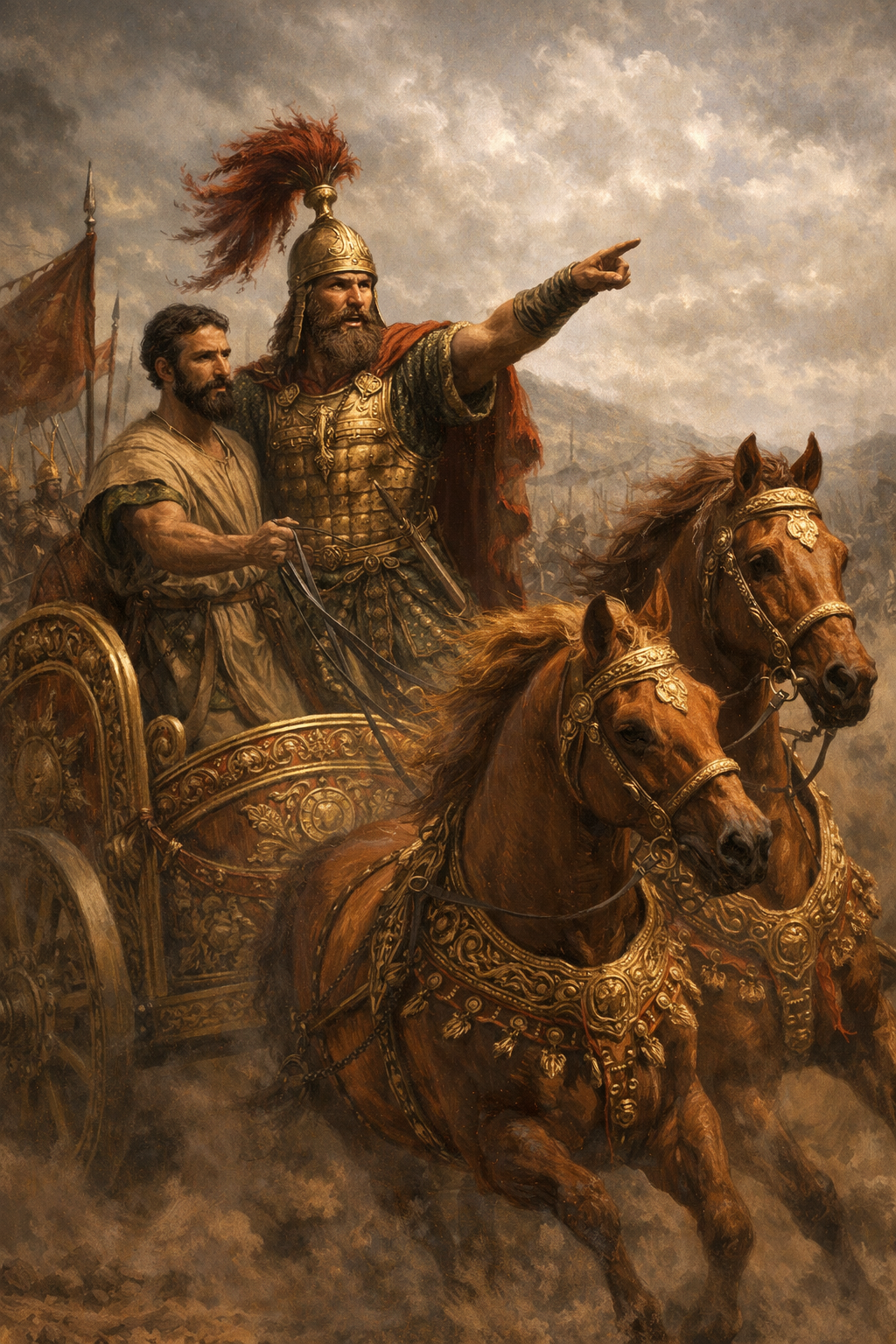
Jehonadab & Jehu Heading for Samaria
JEHU'S ZEAL SEEKS JEHONADAB
AS A SEAL OF APPROVAL
He said, “Come with me and see my zeal (qin'ah; LXX - zeloo) for the LORD.” - NET = "see how zealous I am for the LORD's cause" Jehu is a bit audacious exalting his own zeal. This raises a red flag because genuine zeal obeys Yahweh's will quietly while performative zeal seeks spectators and applause. Jehu wants Jehonadab not merely present, but watching. This appears to be a summons to endorse Jehu’s actions (almost like a politcal candidate seeking an endorsement of a popular athlete), to legitimize his campaign and to give moral credibility. One could think of Jehonadab as like a "seal of approval" before the people!
Jehu's zeal for the LORD would soon prove it was only partial (2Ki 10:31) and a later prophet records God's evaluation declaring " I will punish the house of Jehu for the bloodshed of Jezreel." (Hos 1:4 - see note)
I tend to agree with Morgan who says "When proceeding against Baal worship, his words to Jehonadab, ‘Come with me, and see my zeal for Jehovah,’ are in themselves a revelation of a proud spirit.”
Knapp adds that "His ostentatious display of his reforming zeal revealed how little he had God’s glory in mind in the midst of all his feverish activity and abolition.”
Matthew Henry: This ["see my zeal for the LORD," v. 16] is commonly taken as giving cause to suspect that the zeal he [Jehu] pretended for the Lord was really zeal for himself and his own advancement. For, (1) He boasted of it, and spoke as if God and man were mightily indebted to him for it. (2) He desired it might be seen and taken notice of, like the Pharisees, who did all to be seen of men.
David Guzik - The zeal of Jehu was noted in his complete and energetic obedience to the LORD, to the disregard of his own safety and comfort. Yet this statement reveals the dangerous root of pride in Jehu – he is proud of his own zeal.
Warren Wiersbe - Jehu was proud of his “zeal for the Lord” (10:16), but that “zeal” was a pious cloak that hid the egotism and anger that really motivated his service. God gave Jehu an important work to do, but the king went beyond the assigned boundaries and carried his mandate too far.
So he made him ride in his chariot. In the ancient Near East sharing a chariot spoke of political intimacy, signalled alliance, trust, and shared purpose. Jehu is effectively saying “What I am doing has the approval of the godly.”
Jehonadab is a well-known figure—ascetic, zealous, and respected for covenant faithfulness (cf. Jer 35). Jehu deliberately brings him alongside as a public witness. This is not a casual invitation; it is carefully staged, although ultimately providentially orchestrated.
Zeal (07068) qin'ah (See another study on qin'ah) means ardor, zeal, jealousy. Zephaniah 1:18 uses this same word describing the time when "all the earth will be devoured In the fire of His jealousy." The Lxx translates qin'ah in this verse with the noun zelos which strictly speaking means fervent in spirit and when used of God as in this passage speaks of the intensity of His righteous judgment.
Gilbrant - The noun qinʾāh, which means “jealousy” or “zeal,” is derived from the verb qānāʾ (HED # 7349), “to be jealous.” It can be used in the positive sense of zeal, as well as in the negative sense of jealousy. Cognates are widely attested in Semitic languages.
Humans are often said in the Bible to be jealous. The Mosaic Law, for example, made provision for the jealous husband who suspected his wife of adultery (Num. 5:14–30). Isaiah wrote of nations being jealous of each other (Isa. 11:13; cf. Ezek. 35:11). In a positive sense, people can be zealous for the LORD (cf. 2 Ki. 10:16; Ps. 69:9).
In reference to God, qinʾāh can be used positively or negatively. God is zealous to achieve his purposes (2 Ki. 19:31; Isa. 9:7; 37:32). God’s zeal for his people shames their enemies (Isa. 26:11). Metaphorically, the LORD is pictured as wearing zeal for a mantle (Isa. 59:17).
God’s zeal often leads to punishment. The person who would break the Covenant would face God’s wrath (Deut. 29:20). His judgment could be brought against nations as well as individuals (Ezek. 16:38). When the LORD judges the nations, the earth will be devoured by the “fire of [God’s] jealousy” (Zeph. 3:8). (Complete Biblical Library)QUN'AH - 39V - anger(1), envy(1), jealousy(24), passion(1), rivalry(1), zeal(14). Num. 5:14; Num. 5:15; Num. 5:18; Num. 5:25; Num. 5:29; Num. 5:30; Num. 25:11; Deut. 29:20; 2 Ki. 10:16; 2 Ki. 19:31; Job 5:2; Ps. 69:9; Ps. 79:5; Ps. 119:139; Prov. 6:34; Prov. 14:30; Prov. 27:4; Eccl. 4:4; Eccl. 9:6; Cant. 8:6; Isa. 9:7; Isa. 11:13; Isa. 26:11; Isa. 37:32; Isa. 42:13; Isa. 59:17; Isa. 63:15; Ezek. 5:13; Ezek. 8:3; Ezek. 8:5; Ezek. 16:38; Ezek. 16:42; Ezek. 23:25; Ezek. 35:11; Ezek. 36:5; Ezek. 36:6; Ezek. 38:19; Zeph. 1:18; Zeph. 3:8
G Campbell Morgan Such were the words of Jehu to Jehanadab, as he invited him to accompany him on his mission of judgment. They are revealing words, showing, as in a sudden flash, the central pride of his spirit. That he was the instrument of the Divine judgment there is no question. With terrific speed and thoroughness he swept out the posterity of Ahab. Having accomplished this, he turned himself against Baalism. With a thoroughness which was terrific, he broke and destroyed it. It was while occupied in this very work that he spoke these words:-He was proud of his own zeal. How subtle the peril! And it is a peril. Wherever it exists, it leads to other evil things. While this man was carrying out the judgments of God upon Israel, he was in his own life corrupt. It is written of him: "He departed not from the sins of Jeroboam," and "he took no heed to walk in the law of Jehovah." When the central fact of the life is that of self-glorying, even though there may be zeal for the doing of God's work in the destruction of certain evils, there will always be the toleration of others which appeal to personal desires; and that means there can be no fellowship with God. It is a story full of searching power, revealing as it does the fact that a man may be an instrument in the hands of God, for some purpose, while yet never being in personal communion with Him.
Driving Recklessly - Eric Hayden
“Come with me and see my zeal for the Lord. So they together rode in his chariot” (2 Kings 10:16).
Jehu is the precursor or forerunner of today’s reckless drivers, those who suffer from what is called in England “motorway madness.” In the King James’ Version the margin adds, “for he drives in madness” (2 Kings 9:20).
Jehu’s furious driving characterized purposeful energy needed to perform God’s work. God had raised him up to reform religion in Israel, specifically to destroy Baal worship. This Jehu did with great zeal, a zealousness that should be typical of every true servant of the living Lord God.
1 Jehu’s zeal
Look at the account of what Jehu did. He went to Jezreel to head a revolution. He then turned against Jezebel. He went on to Samaria, the center of Baal worship, and on the way dealt with Ahaziah’s relatives.
We are often zealous in all realms but the religious, zealous and enthusiastic about trying some new commodity for personal gratification, but with little zeal for the Lord and his church.
Jehu’s zeal was personal and perceptible. He could say, “Come … see my zeal.” The results of Jehu’s zeal make gruesome reading, but the piles of dead bodies were visible evidence of the man’s zeal for God.
In Shakespeare’s Henry the Eighth Cardinal Wolsey says to Cromwell: “Had I but served my God with half the zeal I served my king, he would not in mine age have left me naked to mine enemies.”
Do we carry out our Christian service with the same zeal with which we conduct our daily business in the secular world?
2 Jehu’s companion in zeal
It is often best to adopt the scriptural practice of serving Christ in pairs. In Romans 16 we read of Priscilla and Acquilla; Andronicus and Junia; Tryphena and Tryphosa. The gospel writers tell us that Jesus sent out his disciples “two by two.” Jehu, too, worked with a companion.
A. Jehonadab was a man of great personality. His name means “Jehovah has impelled.” Jehonadab was a true driving force, impelled by God’s Holy Spirit.
B. He was a man of great principle. He was the son of Rechab. The Rechabites were a wandering tribe who did not like contamination or corruption by the so-called “civilized” tendencies; they lived temperate lives.
3 Jehu’s zeal for the Lord
A. Pressing. He drove like a madman! (This, however, does not justify breaking the speed limit on the way to a preaching engagement! Paul tells us that we are to conform to the powers that be and the laws they enforce.) “The King’s business requires haste,” says Scripture. We are not to be “slothful in business” but “fervent in spirit, serving the Lord,” as Paul writes in Romans.
B. Persistent. Verse 17 describes how he persisted and persevered in his divine commission until his mission was accomplished. Is our Christian zeal like Jehu’s?
Two small girls climbed on their father’s knees. One put her arms around him and said: “I’ve got all of daddy.” The other pulled her father’s arms around her and said: “But daddy’s got all of me.” We have all of Christ. For service he must have all of us—our gifts, our time, our talents, our money—all that we have and all that we are.
Cyril Hocking - COME WITH ME, AND SEE MY ZEAL FOR THE LORD
THE PASSAGE completes the detailed account of the bloody revolution set afoot by prophecy, 9:1–3; 1 Kings 19:15–17. It was the affinity between the king’s house and the house of Baal, which Ahab had built, 16:32, that led to the total overthrow of both, 2 Kings 10:1–11, 17, 18–28.
What zeal, yea, what revenge! Jehu’s outstanding quality was zeal. The word means “to become intensely red”. How often the ardour of one’s zeal is evident in the glow of the face! Jehu followed in the train of Elijah (ct. meaning of names) who said “being jealous I have been jealous”, 1 Kings 19:10, 14, lit. Earlier, Phinehas had been “jealous with my (God’s) jealousy”, Num. 25:11 R.V.; cf. v. 13. Again, our Lord drove out those that defiled the temple, John 2:17, for “the zeal of thine house hath eaten me up”, Psa. 69:9. There is nothing more nauseous to God than being “neither cold nor hot”, Rev. 3:16.
Come, see Jehu’s zeal for the Lord. It was fearsome, red hot. In his role of a Divine executioner, he slew Jehoram, 2 Kings 9:24–26. He trampled Jezebel under foot, v. 33. He called upon the elders of Samaria to behead the 70 sons of Ahab, 10:1–10. He exterminated all that remained of Ahab’s house, vv. 11, 17. He then destroyed Baalism with great energy, vv. 18–28. This was right in the Lord’s eyes, according to all that was in His heart, and received His commendation, v. 30.
But there is a zeal that may seek a right thing in a wrong way; cf. Rom. 10:2. Jehu went too far. He did all that was in the Lord’s heart, but not in the spirit of the Divine commission. In him we see “jealousy (same word as zeal) is the rage of a man”, Prov. 6:34. Hence the Lord would visit “the blood of Jezreel upon the house of Jehu”, Hos. 1:4. How we need to be on our guard against the pursuit of truth apart from grace. Then, in all but annihilating Judah’s royal line, he went beyond the terms of the Divine commission also, 2 Kings 9:27–29; 10:12–14; ct. vv. 10, 17. Conversely, Jehu did not go far enough. Had he been motivated by the Lord’s glory and truth alone, he would have departed from the sins of Jeroboam, ct. v. 29, and walked in the law of the Lord with all his heart; ct. v. 31. We are not to pursue only that which suits our own disposition and interests in the cause of truth.
2 Kings 10:17 When he came to Samaria, he killed all who remained to Ahab in Samaria, until he had destroyed him, according to the word of the LORD which He spoke to Elijah.
- he killed all who remained to Ahab in Samaria: 2Ki 10:11 9:8 2Ch 22:8 Ps 109:8,9 Mal 4:1
- according: 2Ki 10:10 2Ki 9:25,26 1Ki 21:21
Related Passages:
2 Chronicles 22:8 It came about when Jehu was executing judgment on the house of Ahab, he found the princes of Judah and the sons of Ahaziah’s brothers ministering to Ahaziah, and slew them.
1 Kings 21:21-22 (ELIJAH'S WORD TO AHAB) “Behold, I will bring evil upon you, and will utterly sweep you away, and will cut off from Ahab every male, both bond and free in Israel; and I will make your house like the house of Jeroboam the son of Nebat, and like the house of Baasha the son of Ahijah, because of the provocation with which you have provoked Me to anger, and because you have made Israel sin.
THE FINAL END OF
AHAB'S DYNASTY
When he came to Samaria, he killed all who remained to Ahab in Samaria - All who remained stresses totality.. We have more acts of Jehu after this, so this verse is a summary statement.. It gathers everything Jehu has done so far and declares that the judgment is finished.
Until he had destroyed him, according to the word of the LORD which He spoke to Elijah - Him refers to to the house of Ahab as a unit and fulfills 1 Kings 21:21. According to the word of the LORD says in effect that Jehu was not acting autonomously, but as God's instrument in accordance with the revealed will of Jehovah.
As Jehu's failure in 2Ki 10:31 shows, God can perfectly accomplish His purposes through a man whose own obedience is incomplete.
2 Kings 10:18 Then Jehu gathered all the people and said to them, “Ahab served Baal a little; Jehu will serve him much.
- Ahab served Baal: 2Ki 3:2 1Ki 16:31,32 18:19,22,40
- Jehu: Job 13:7 Ro 3:8 Php 4:8
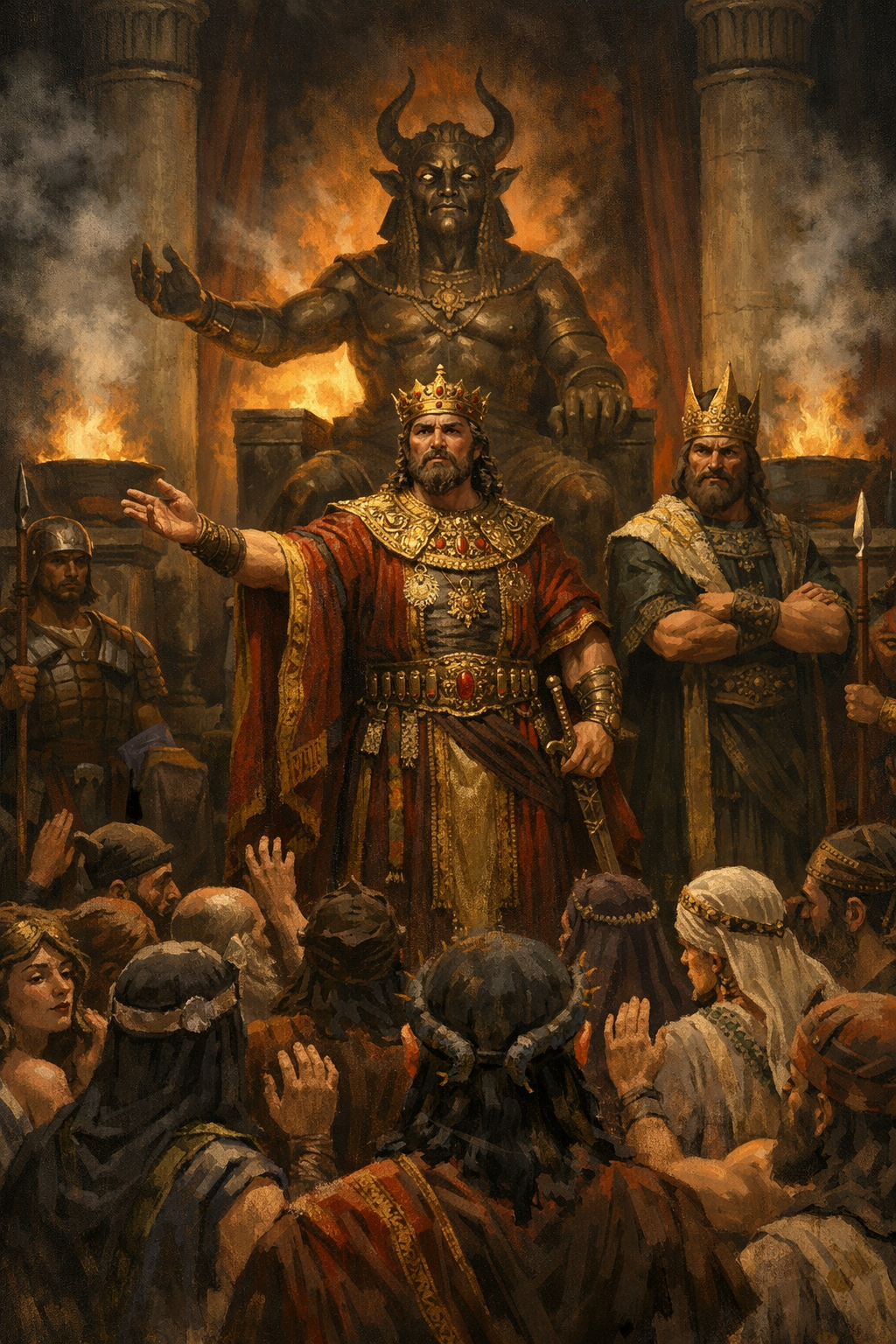
UNHOLY DECEPTION FOR
A FINAL PURGE
Then Jehu gathered all the people and said to them This verse marks Jehu's deliberate strategic ruse. Jehu publicly exaggerates his devotion to unholy Baal, not because he intends to worship, but to draw every remaining adherent into one place. His statement is ironic and intentionally misleading—a bait designed to ensure no Baal worshiper stays away.
Ahab served Baal (ba'al) a little; Jehu will serve him much. The contrast between Ahab and Jehus is sharp and sarcastic. Ahab’s reign was infamous for institutionalizing Baal worship but Jehu now deceptively claims he will surpass it which would sound good to idolaters in Samaria who were hungry for royal favor. The irony heightens the trap, for those most devoted to Baal would come most eagerly.
Can Deception Serve God’s Judgment? Scripture reports Jehu’s tactic without endorsing deception as a general moral norm. In the narrative context of divine judgment on entrenched idolatry, Jehu’s ruse functions as an instrument to fulfill the LORD’s announced sentence against Ahab’s house and Baal’s cult. Later evaluation (2Ki 10:29–31) shows Jehu is praised for obedience in judgment yet criticized for incomplete reform, because while he removed Baal he retained Jeroboam’s calves.
Warren Wiersbe - Jehu lied to them about himself, claiming that he was more devoted to Baal than Ahab had been. He also lied about the service in the temple of Baal. However, this may have been another instance of Jehu’s “doublespeak,” for there was a “great sacrifice” to Baal—the lives of the priests and the worshippers in Baal’s temple! Jehu was a military man whose life was so dedicated to strategy and conquest that, unlike David, he couldn’t bring faith and the glory of God into his battles. Jehu seems to have had a lust for blood and a joy in outsmarting his enemies, and we never read that he sought the mind of the Lord in any of his endeavors.
Baal (proper noun)(01168) ba'al (in depth discussion) refers to the pagan god who was called by the name "Baal". Elijah contended with and exterminated the prophets of Baal (1 Ki 18:18, 19, 21, 22, 25, 26, 40). One of the more incredible mentions of Baal is Jehu's eradication of them from the northern kingdom (see 2 Ki 10:18-28). Before God would use Gideon to deliver His people from the Moabites, He first had him tear down his father's backyard altar to Baal (Jdg 6:25, 28, 30-31-note). As a result Gideon was named Jerrubball ("Let Baal contend against him" - Jdg 6:32). Under Gideon Israel was set free from Moabite oppression, but apparently they people were not set free from the "seed" of Baal worship in their hearts for "Then it came about, as soon as Gideon was dead, that the sons of Israel again played the harlot (SPIRITUAL ADULTERY!) with the Baals, and made Baal-berith their god" (Jdg 8:33)! Wow! Our hearts are more deceitful than all else and are desperately sick (Jer 17:9)! In 1 Sa 7:4 we see that "Israel removed the Baals and the Ashtaroth and served the LORD alone" but they must have backslide because we see their cry in 1 Sam 12:10! Beware of idols. Idols need to be radically uprooted lest they revive and return!
2 Kings 17:6 records the exile of the Northern Kingdom of Assyria "In the ninth year of Hoshea, the king of Assyria captured Samaria and carried Israel away into exile to Assyria" and 2 Kings 17:16 explains (in part - read the litany of charges in 2 Ki 17:6-15) why God allowed them to be taken into exile - "They forsook all the commandments of the LORD their God and made for themselves molten images, even two calves, and made an Asherah and worshiped all the host of heaven and served Baal."
2 Kings 10:19 “Now, summon all the prophets of Baal, all his worshipers and all his priests; let no one be missing, for I have a great sacrifice for Baal; whoever is missing shall not live.” But Jehu did it in cunning, so that he might destroy the worshipers of Baal.
- all the prophets: 2Ki 3:13 1Ki 22:6
- all his servants: 2Ki 10:21
- all his priests: 2Ki 10:11
- But Jehu: 2Ki 10:18 Job 13:7 Pr 29:5 2Co 4:2 11:3,13-15 12:16-18 1Th 2:3
JEHU FEIGNS
ZEAL AS A TRAP
Now, summon all the prophets of Baal, all his worshipers and all his priests; let no one be missing - The triple grouping—prophets, worshipers, priests—covers every tier of Baal’s religious system. Jehu’s command is deliberately deceptive. Having already proclaimed, “Ahab served Baal a little; Jehu will serve him much” (v.18), he now escalates the pretense by announcing a “great sacrifice.” In Baal worship, large sacrifices were festival-like events drawing maximum attendance, ensuring that every devotee would appear.
Jehu intends a total purge, not a partial reform. By centralizing all Baal adherents in one place, he eliminates the cult in a single decisive act.
for I have a great sacrifice for Baal; whoever is missing shall not live.” - Jehu's instruction promotes fear which ensures compliance and attendance. It is ironic that loyalty to Baal becomes the means of self-identification for judgment.
But Jehu did it in cunning, so that he might destroy the worshipers of Baal Jehu used deception to ensure total attendance so he could wipe them out. Jehu is not praised for deceit as a moral virtue; rather, God uses Jehu’s methods to fulfill the prophetic word against the house of Ahab and Baal worship.
John Walton (p 398) Extermination of the Cult of Baal - the great Baal (enthronement) sacrifice. Part of the rhetoric that accompanied the promises of new kings in the ancient world was that they would be more devoted to the national or local gods than their predecessors. This often included commitments to repair, restore, enlarge or embellish the sanctuary. This strategy would gain the support of the priesthood and the pious populace, and, hopefully, bring divine approval of the new reign as well. It was politically correct for the king to take his place as royal patron and foremost of the supporters of the local deity. It is possible that Jehu is calling for an enthronement celebration in which he will take the throne as the vassal of Baal, whose enthronement as king of the gods would likewise be recognized. To be absent from such an event could easily be considered treason.
2 Kings 10:20 And Jehu said, “Sanctify a solemn assembly for Baal.” And they proclaimed it.
- Sanctify, 1Ki 18:19,20 21:12 Joe 1:14
THE RUSE CONTINUES
TO ASSURE EXTERMINATION
And Jehu said, “Sanctify a solemn assembly for Baal.” The verb “sanctify” (Heb. qāḏaš) means to set apart as holy—language normally reserved for worship of Yahweh. Jehu deliberately co-opts sacred vocabulary to announce a formal, nationwide religious convocation for Baal. This is not a casual gathering; it is presented as an official, state-endorsed act of worship.
Outwardly, he appears to outdo Ahab in devotion to Baal (v.18), but inwardly he is baiting a trap. By calling a solemn assembly, Jehu ensures maximum attendance so aaht all Baal priests, prophets, and devotees feel compelled to come.
ESV Study Bible (borrow) has an interesting note on Sanctify a solemn assembly - This phrase is unparalleled in Hebrew, but a Ugaritic text concerned with gaining protection for the royal ancestors of King Ammurapi of Ugarit suggests that it represents genuine Canaanite religious terminology.
And they proclaimed it. The proclamation itself becomes the net that draws in those loyal to Baal. Jehu proclaims a fake holy day for Baal, not to honor the idol, but to assemble every last devotee for decisive judgment, turning sacred language into a weapon against idolatry.
There is biting irony here. Jehu uses holy language to orchestrate the eradication of idolatry. The very terminology Baal’s followers expect to signal blessing will instead usher in judgment. Scripture often exposes false worship by letting it condemn itself (cf. Elijah on Carmel, 1 Kings 18).
2 Kings 10:21 Then Jehu sent throughout Israel and all the worshipers of Baal came, so that there was not a man left who did not come. And when they went into the house of Baal, the house of Baal was filled from one end to the other.
- And they came: Joe 3:2,11-14 Rev 16:16
- the house of Baal: 1Ki 16:32
- filled from one end to the other. Jdg 16:27
JEHU DRAWS THE NET
TIGHT ON BAALISM
Then Jehu sent throughout Israel Jehu now escalates his deception to a national scale. Messengers are dispatched throughout Israel, signaling an official, royal, and urgent command. This was not a local gathering—it was a comprehensive mustering of Baal’s adherents. This is not spontaneous worship but state-mandated assembly, giving Jehu control over time, place, and participants.
and all the worshipers of Baal came, so that there was not a man left who did not come - This is deliberate biblical overstatement for effect: Jehu’s plan succeeds perfectly. Baal’s followers self-identify and self-segregate in one location. Those who once hid their idolatry under royal protection now march openly to their own judgment.
And when they went into the house of Baal, the house of Baal was filled from one end to the other - Jehu's proclamation has resulted in a "full house," like standing room only as some event, except that soon they would be falling! The temple of Baal—built and promoted under Ahab and Jezebel—becomes the trap. What had been a symbol of apostate triumph now serves as an extermination chamber.
Filled from one end to the other - This is an idiomatic phrase which in Hebrew literally means "mouth to mouth," not "mouth to mouth" resuscitation as we commonly use the term but "mouth to mouth" (head to head) destruction! The worshipers feel safe because Jehu claims to serve Baal “more than Ahab” (2Ki 10:18), the attendance is mandatory and approved and there is no opposition is visible.
John Walton (p 398) temple of Baal in Samaria. Excavations in Samaria have not yet located any remains from Ahab’s temple of Baal. It has been suggested that the temple contributed to the concept being promoted by Ahab and Jezebel that the city was the sacred precinct of Baal. This would mean it functioned as an independent political unit, just as Zion often did in the south. Therefore, even after Jehu had been made king of Israel and Ahab’s line had been wiped out, control of Samaria, especially the temple precinct, had to be approached separately.
2 Kings 10:22 He said to the one who was in charge of the wardrobe, “Bring out garments for all the worshipers of Baal.” So he brought out garments for them.
- garments: Ex 28:2 Mt 22:11,12
ROBED FOR
RUIN
He said to the one who was in charge of the wardrobe, “Bring out garments for all the worshipers of Baal.” The phrase “the one who was in charge of the wardrobe” indicates that the temple of Baal had an organized cultic system, complete with special garments for its worshipers. This mirrors (and mocks) Israel’s own priestly system (cf. Exod 28–29), showing how deeply entrenched Baalism had become under Ahab and Jezebel. Ironically, what was meant to honor Baal would now expose his followers. The garments would allow easy identification of Baal worshipers when the swords began to fly!
So he brought out garments for them While the think they are dressing for worship, they are actually dressing for judgment. The wardrobe keeper unknowingly assists in the final accounting of Baal worship in Israel.
John Walton (p 398) robes from the keeper of the wardrobe. These robes would have been cultic vestments for the worship of Baal (see Zeph 1:8). It is additionally likely that the occasion and the use of the sacred robes would have prohibited any weapons from being worn—a distinct advantage for Jehu’s men.
2 Kings 10:23 Jehu went into the house of Baal with Jehonadab the son of Rechab; and he said to the worshipers of Baal, “Search and see that there is here with you none of the servants of the LORD, but only the worshipers of Baal.”
- Jehonadab: 2Ki 10:15
- the worshippers: Mt 13:30,41 25:32,33
JEHU ASSURES
STRATEGIC SEPARATION
Jehu went into the house of Baal with Jehonadab (“Whom Jehovah impels” or “Yahweh is willing”) the son of Rechab - Jehonadab is a striking companion in this idol temple, for he represents ascetic devotion and covenant loyalty (cf. Jer 35:6-10). By bringing Jehonadab inside the temple, Jehu gains credibility before the people and cunningly signals that this action has the appearance of religious legitimacy. This is a masterstroke of political theater to have a Yahweh-devoted man entering Baal’s temple. The irony of course is that man devoted to Yahweh walks into Baal’s templenot to worship, but to witness its end.
And he said to the worshipers of Baal, “Search and see that there is here with you none of the servants of the LORD, but only the worshipers of Baal - Search implies thorough inspection, reinforcing the completeness of the coming judgment.Jehu wants absolute clarity and no accidental killing of true Yahweh worshipers. Those inside are self-identified as Baal worshipers and their presence is a self-incriminating confession, not to mention their tell-tale garments.
2 Kings 10:24 Then they went in to offer sacrifices and burnt offerings. Now Jehu had stationed for himself eighty men outside, and he had said, “The one who permits any of the men whom I bring into your hands to escape shall give up his life in exchange.”
- If any of the men: 1Ki 20:30-42
THE OFFERERS WOULD
BE THE SACRIFICE!
Then they went in to offer sacrifices and burnt offerings The Baal worshipers believe they are safe and are gathered for celebration. In reality, the temple becomes their place of judgment, not refuge. What they thought was consecration became condemnation. The worshipers are unaware that the moment of divine reckoning has arrived. They think they are approaching Baal. They are actually approaching death. False religion often feels safest just before judgment falls (cf. Isa 47:8–9; 1 Thess 5:3). Notice the divine irony for here they offered burnt offerings to Baal, but in verse 26 the sacred pillars of Baal were themselves burned!
Now Jehu had stationed for himself eighty men outside - Jehu posts guards at every exit, ensuring total containment.
and he had said, “The one who permits any of the men whom I bring into your hands to escape shall give up his life in exchange - This threat would be ultra-motivating for the 80 men. The understood it was a life-for-life decree. If even one Baal worshiper escapes, the responsible guard dies.
Bob Utley on "shall give up his life in exchange" The Hebrew word for "life" is nephesh. If a guard lost his prisoner he must take the penalty himself.
Earlier, Jehu had been commissioned by God to eradicate the house of Ahab and avenge the blood of the prophets (2 Ki 9:7). Here, that commission expands to include the religious system that sustained Ahab’s apostasy.
2 Kings 10:25 Then it came about, as soon as he had finished offering the burnt offering, that Jehu said to the guard and to the royal officers, “Go in, kill them; let none come out.” And they killed them with the edge of the sword; and the guard and the royal officers threw them out, and went to the inner room of the house of Baal.
- Go in: Ex 32:27 De 13:6-11 Eze 9:5-7
- let: Eze 22:21,22 Rev 16:6,7
JUDGMENT COMPLETED
IDOLATRY ERASED
Then it came about, as soon as he had finished offering the burnt offering - The sacrifice completes the illusion that Jehu is a devoted worshiper of Baal. Jehu let the Baal worshipers go on with their final offerings and clearly they assumed all was well.
That Jehu said to the guard and to the royal officers, “Go in, kill them; let none come out.” Baal’s own worship service becomes the setting of his total defeat. This is not mob violence but state-sanctioned judgment carried out with military precision. The command is absolute calling for total judgment, leaving no survivors and providing no compromise.
This language echoes herem-style destruction (devotion to destruction), recalling earlier covenant judgments against entrenched idolatry (cf. Deut 13:12–18).
And they killed them with the edge of the sword - The phrase underscores swift execution. And Baal, the so-called storm god, cannot save a single worshiper. His impotence is publicly exposed.
And the guard and the royal officers threw them out - The bodies are cast out of the temple precincts—an act of defilement. Baal’s “holy place” is reduced to shame.
Bob Utley on "threw them out" This VERB (BDB 1020, KB 1527, Hiphil IMPERFECT with waw) is an idiom for the slain bodies of the Ba'al worshipers being taken outside the Ba'al temple and left unburied (cf. 1 Kgs. 13:25; Isa. 14:19).
And went to the inner room of the house of Baal - The “inner room” (likely the holy inner sanctuary) was the most sacred area, the location of the dwelling of Baal’s image and the heart of false worship
It should not surprise us that skeptics use passages like this to denigrate God saying He approved of all Jehu's mass murders. Talk about yanking passages out of context (which you have to do to arrive at such a distorted interpretation)! Clearly, such skeptics have no concept of God's holiness and won't fully understand until they stand before Him at their Great White Throne arraignment where they will no longer be skeptical, just shocked!
QUESTION - Does God killing people make Him a murderer? | GotQuestions.org
ANSWER - The Old Testament records God killing multitudes of people, and some people want to believe this makes Him a murderer. The misconception that “killing” and “murder” are synonymous is partially based on the King James mistranslation of the sixth commandment, which reads, “Thou shalt not kill” (Exodus 20:13). However, the word kill is a translation of the Hebrew word ratsach, which nearly always refers to intentional killing without cause. The correct rendering of this word is “murder,” and all modern translations render the command as “You shall not murder.” The Bible in Basic English best conveys its meaning: “Do not put anyone to death without cause.”
It is true that God has intentionally killed many people. (God never “accidentally” does anything.) In fact, the Bible records that He literally wiped out entire nations including women, children, cattle, etc. In addition to that, God killed every living creature upon the face of the earth with the exception of eight people and the animals on the ark (Genesis 7:21-23; 1 Peter 3:20). Does this make Him a murderer?
As already stated, to kill and to murder are different things. Murder is “the premeditated, unlawful taking of a life,” whereas killing is, more generally, “the taking of a life.” The same Law that forbids murder permits killing in self-defense (Exodus 22:2).
In order for God to commit murder, He would have to act “unlawfully.” We must recognize that God is God. “His works are perfect, and all His ways are just. A faithful God who does no wrong, upright and just is He” (Deuteronomy 32:4; see also Psalm 11:7; 90:9). He created man and expects obedience (Exodus 20:4-6; Exodus 23:21; 2 John 1:6). When man takes it upon himself to disobey God, he faces God’s wrath (Exodus 19:5; Exodus 23:21-22; Leviticus 26:14-18). Furthermore, “God is a just judge, and God is angry with the wicked every day. If [man] does not turn back, He will sharpen His sword; He bends His bow and makes it ready” (Psalm 7:11-12).
Some would argue that executing the innocent is murder; thus, when God wipes out whole cities, He is committing murder. However, nowhere in Scripture can we find where God killed “innocent” people. In fact, compared to God’s holiness, there is no such thing as an “innocent” person. All have sinned (Romans 3:23), and the penalty for sin is death (Romans 6:23a). God has “just cause” to wipe us all out; the fact that He doesn’t is proof of His mercy.
When God chose to destroy all mankind in the Flood, He was totally justified in doing so: “Then the LORD saw that the wickedness of man was great in the earth, and that every intent of the thoughts of his heart was only evil continually” (Genesis 6:5).
During the conquest of Canaan, God ordered the complete destruction of entire cities and nations: “But of the cities of these peoples which the LORD your God gives you as an inheritance, you shall let nothing that breathes remain alive, but you shall utterly destroy them: the Hittite and the Amorite and the Canaanite and the Perizzite and the Hivite and the Jebusite, just as the LORD your God has commanded you” (Deuteronomy 20:16-17).
Why did God give such a command? Israel was God’s instrument of judgment against the Canaanites, who were evil, almost beyond what we can imagine today: “Every abomination to the LORD which He hates they have done to their gods; for they burn even their sons and daughters in the fire to their gods” (Deuteronomy 12:31). Their utter annihilation was commanded to prevent Israel from following their ways: “Lest they teach you to do according to all their abominations which they have done for their gods, and you sin against the LORD your God” (Deuteronomy 20:18; also Deuteronomy 12:29-30).
Even in the dire judgments of the Old Testament, God offered mercy. For example, when God was about to destroy Sodom and Gomorrah, God promised Abraham that He would spare the whole city in order to save ten righteous people there. Though God did destroy those cities (ten righteous people could not be found), He saved “righteous Lot” and his family (Genesis 18:32; Genesis 19:15; 2 Peter 2:7). Later, God destroyed Jericho, but He saved Rahab the harlot and her family in response to Rahab’s faith (Joshua 6:25; Hebrews 11:31). Until the final judgment, there is always mercy to be found.
Every person dies in God’s own time (Hebrews 9:27; Genesis 3:19). Jesus holds the keys of death (Revelation 1:18). Does the fact that everyone experiences physical death make God a “killer”? In the sense that He could prevent all death, yes. He allows us to die. But He is no murderer. Death is part of the human experience because we brought it into the world ourselves (Romans 5:12). One day, as John Donne put it, “Death shall be no more; death, thou shalt die.” God, in His grace, has conquered death for those who are in Christ, and one day that truth will be fully realized: “The last enemy to be subdued and abolished is death” (1 Corinthians 15:26).
God is faithful to His word. He will destroy the wicked, and He holds “the unrighteous for the day of judgment, while continuing their punishment” (2 Peter 2:9). But He has also promised that “the gift of God is eternal life in Christ Jesus our Lord” (Romans 6:23b).
QUESTION - Why did God order the killing of people in the Old Testament? GOTQUESTIONS.ORG
ANSWER - From the beginning, God assigned exceedingly great value to human life: “So God created human beings in his own image. In the image of God he created them; male and female he created them” (Genesis 1:27, NLT). God told Noah that He would “demand an accounting for the life of another human being” because “in the image of God has God made mankind” (Genesis 9:5–6).
In Exodus 20:1–21, God issued the Ten Commandments, the heart of Hebrew law. Here, God outlined the absolutes of moral and spiritual living for His people. His intentions could not have been more clear: “You shall not murder” (Exodus 20:13; see also Deuteronomy 5:17). Murder is the unlawful, intentional taking of a life. New Testament Bible verses further affirm the sacredness of human life (Matthew 5:21; Romans 13:9; 1 Timothy 1:9; 1 John 3:15; James 2:11–12).
If God places such high worth on the life of every human, then why did He intentionally order the killing of many people in the Old Testament? In the Great Flood (Genesis 6:1—8:22), God destroyed all land-dwelling life on earth except for a remnant. Other significant examples of God killing people include the destruction of Sodom and Gomorrah (Genesis 19:1–29) and the drowning of the Egyptian army at sea (Exodus 14:26–31). God instructed Israel to execute everyone in Jericho except for Rahab and her family (Joshua 6:17, 21). In a lesser-known account, God sent lions to kill some Assyrian ex-patriots (2 Kings 17:25–26).
Bible skeptics often ask, why is it acceptable for
God to kill or command the slaughter of people?
Bible skeptics often ask, why is it acceptable for God to kill or command the slaughter of people? The answer is not complicated: God as Creator of the Universe is the Author of life (Acts 3:15). He alone possesses the right and authority to give life and to take it away (Genesis 2:7; Job 1:21; 12:10; Acts 3:15; 17:25). God is also the only just Judge of sin (Isaiah 13:11; 26:21; Psalm 99:8; Proverbs 11:21; Amos 3:14; Zephaniah 1:12; Romans 2:12; 1 Thessalonians 4:6). When people commit evil, God has the right and authority to carry out His punishment, and sometimes the only fitting punishment for the crime is death (Genesis 2:17; Leviticus 20:1–17; Proverbs 11:19; Romans 1:32; 1 Corinthians 11:29–30).
The Bible clearly states that “the wages of sin is death” (Romans 6:23). God told Adam and Eve that, if they disobeyed His orders, they would die (Genesis 2:17). By the time of Noah’s Flood, humans had grossly violated their place in God’s order, once again stepping far beyond the limits God had marked out for them (Genesis 6:1–4). The flood was God’s divine punishment upon wicked people. Sin had become so widespread that God needed to reassert His lordship and give humanity a fresh start and another chance to obey Him.
Because we are not God, we do not have the right to end a human life except on certain exceedingly rare occasions permitted by God. The Lord told Israel to wipe out the Canaanite nations and to kill everyone, including women and children. Only He has the right to do this; the Israelites could not pick and choose whom to destroy on their own. The destruction of the Canaanites in the book of Joshua was God’s divine punishment against wicked people. God used Israel as the means of meting out that punishment, as He explained: “Recognize today that the Lord your God is the one who will cross over ahead of you like a devouring fire to destroy them. He will subdue them so that you will quickly conquer them and drive them out, just as the Lord has promised. After the Lord your God has done this for you, don’t say in your hearts, ‘The Lord has given us this land because we are such good people!’ No, it is because of the wickedness of the other nations that he is pushing them out of your way. It is not because you are so good or have such integrity that you are about to occupy their land. The Lord your God will drive these nations out ahead of you only because of their wickedness, and to fulfill the oath he swore to your ancestors Abraham, Isaac, and Jacob” (Deuteronomy 9:3–5, NLT). God also warned His people not to get caught up in the Canaanites’ idolatrous and detestable practices (Deuteronomy 12:29—13:18).
After the flood, God established a covenant with Noah to never again destroy the earth by water. He also gave this command: “And for your lifeblood I will surely demand an accounting. I will demand an accounting from every animal. And from each human being, too, I will demand an accounting for the life of another human being. ‘Whoever sheds human blood, by humans shall their blood be shed; for in the image of God has God made mankind’” (Genesis 9:5–6). Here, God explains that anyone who kills another person will be held accountable by God. God’s punishment involved having the murderer executed by another human agent of justice working on God’s behalf.
Humanity was still corrupted by sin after the flood. But instead of periodically eradicating evildoers from the face of the earth, God handed over the task of carrying out His justice on earth to humans (Romans 13:4; Jeremiah 51:20). Sometimes, that job involves ending another human life as the penalty for murder. However, individuals are not to independently carry out justice or revenge. God has reserved that authority for governmental powers (Romans 13:1–14).
According to Mosaic Law, God sometimes prescribed the death penalty for crimes other than murder (Exodus 22:18–20; 35:2; Deuteronomy 21:18–21). Although these stipulations of capital punishment may seem harsh by today’s standards, in context, they helped keep the Israelites pure and set them apart from neighboring pagan peoples. God’s holy standard contrasts sharply against the depravity of sin and the degree of its destructiveness on society. Like the rest of the law, those regulations were fulfilled in Jesus Christ and are no longer legalistic obligations for God’s people (Matthew 5:17; John 1:17; Romans 10:4). Today, the only morally justifiable conditions for killing another person involve matters of self-defense, the death penalty for the crime of murder, and killing in wartime. However, even in these situations, Christians don’t always agree.
Related Resources:
- Why is God so different in the Old Testament than He is in the New Testament?
- Why did God condone such terrible violence in the Old Testament?
- Why did God condone such terrible violence in the Old Testament?
2 Kings 10:26 They brought out the sacred pillars of the house of Baal and burned them.
- sacred pillars, 1Ki 14:23
- and burned them: 2Ki 19:18 2Sa 5:21
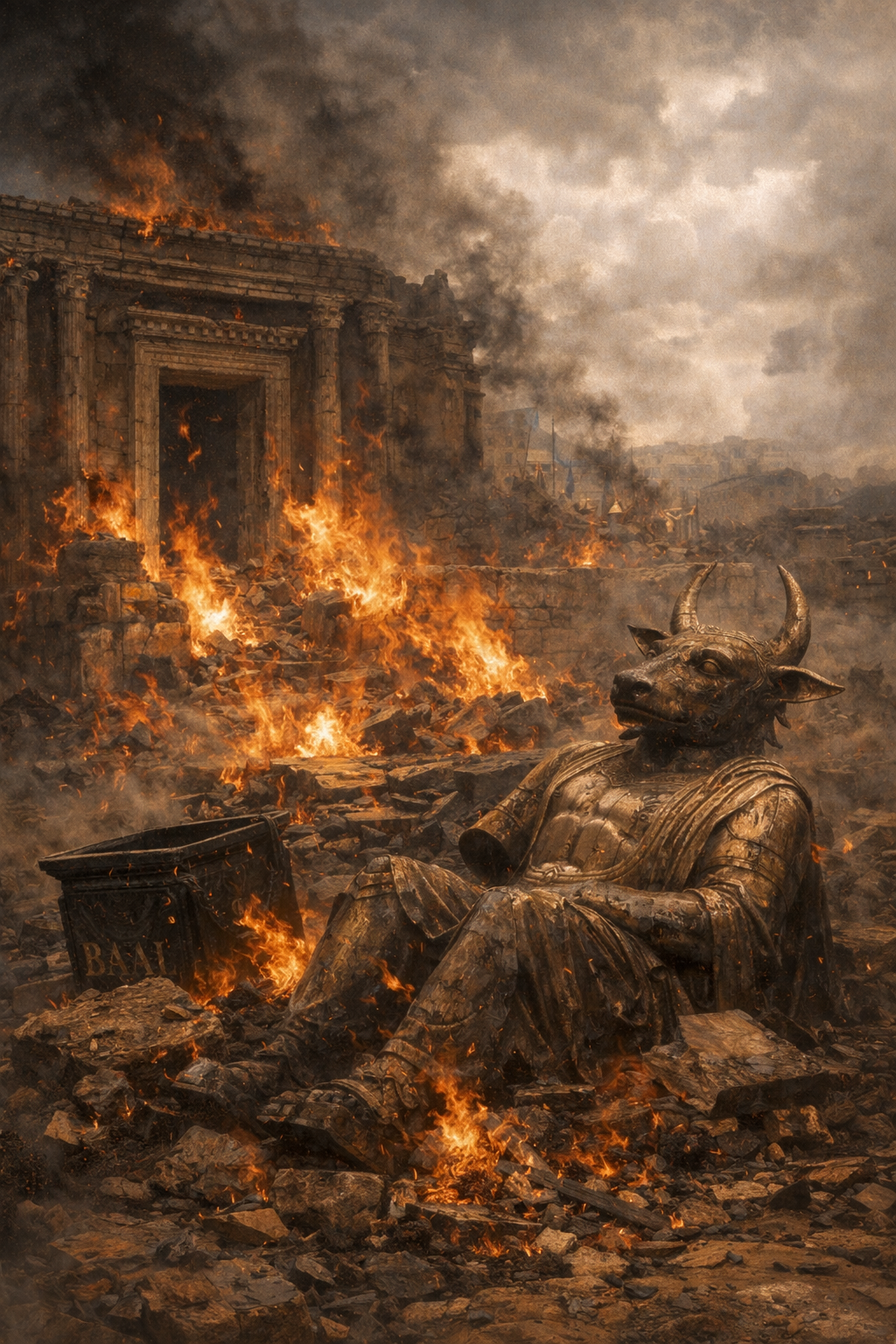
THE FINAL JUDGMENT
OF FIRE
They brought out the sacred pillars (matstsebah) of the house of Baal and burned them - The “sacred pillars” (Hebrew maṣṣēbôt) were stone or wooden cult objects associated with Baal worship. These pillars functioned as visible symbols of Baal’s presence, power, and fertility, often linked to immoral and idolatrous rites (cf. Exod 23:24; Deut 12:3). Removing them from the temple is deliberate: idolatry is not reformed, but removed.
The house of Baal refers to the central Baal temple in Samaria, established under Ahab and Jezebel (1 Ki 16:31–32). The temple represented institutionalized apostasy. Its destruction marks the collapse of Baal’s public authority in Israel.
and burned them - Burning was an act of total desecration and annihilation. Fire symbolizes judgment and cleansing (Deut 7:5; 12:3).This action fulfills Yahweh’s command to destroy—not recycle—idolatrous objects. There is no attempt to “redeem” Baal artifacts; they are reduced to ashes.
John Walton (p 398) sacred stone. Standing stones often occupied the place of the sacred niche in Canaanite sanctuaries in place of an image. These stones were often plain but occasionally had a figure of the deity carved in relief on the face of the stone.
Pillars (04676)(matstsebah from natsab = to take a stand) means something set upright, most often "a standing, unhewn block of stone utilized for religious and memorial purposes. After a powerful experience of the Lord in a dream, Jacob set up as a pillar the stone on which he had laid his head, in commemoration of the event (Ge 28:18, 22; cf. Ge 31:45; 35:20). Moses set up an altar and also twelve pillars at the base of Mount Sinai to represent the twelve tribes of Israel (Ex. 24:4). These pillars were erected as monuments to God (Hos. 3:4); or, more commonly, to pagan deities (1 Ki. 14:23, Mic. 5:13). Many times in 2 Kings, the term refers to a sacred pillar that aided people in their worship of pagan gods, especially the Canaanite god Baal. In most of these passages, the sacred columns were used by Israelites, contrary to the Lord's prohibition concerning the worship of any other god (2 Ki. 3:2; 10:26, 27; 18:4; 23:14; cf. Hos. 10:1, 2; Mic. 5:13[12])." (Baker)
Septuagint in Ex 23:24 = stele = a commemorative stone block or pillar, monument, pillar from the time of Hom. inscribed and used as a grave marker, or for commemoration of events, proclamation of decrees, recognition of personal achievements. Stele is a block or slab, bearing an inscription;
2 Kings 10:27 They also broke down the sacred pillar of Baal and broke down the house of Baal, and made it a latrine to this day.
- They also broke down the sacred pillar of Baal 2Ki 18:4 23:7-14 Lev 26:30 De 7:5,25 1Ki 16:32 2Ch 34:3-7
- made it a latrine Ezr 6:11 Da 2:5 3:29
Related Passages:
Deuteronomy 12:3 “You shall tear down their altars and smash their sacred pillars and burn their Asherim with fire, and you shall cut down the engraved images of their gods and obliterate their name from that place.
1 Kings 16:32-33 So he (AHAB) erected an altar for Baal in the house of Baal which he built in Samaria. Ahab also made the Asherah. Thus Ahab did more to provoke the LORD God of Israel than all the kings of Israel who were before him.
FINAL ERADICATION
OF BAAL WORSHIP
They also broke down the sacred pillar (matstsebah) of Baal - The sacred pillar was a standing stone representing Baal’s presence and authority. Destroying it publicly signified the overthrow of Baal’s spiritual claim over the nation. This act fulfills Yahweh’s repeated commands to tear down pagan symbols (cf. Dt 12:3).
And broke down the house of Baal - This marks the official end of state sponsored Baal worship. The house (temple) of Baal had been formally established under Ahab and Jezebel (1 Kgs 16:32). Its demolition represents not reform but eradication—the complete dismantling of institutionalized idolatry.
And made it a latrine to this day - Turning the temple into a latrine (or refuse dump) was the ultimate act of contempt. In the ancient Near East, this conveyed permanent defilement, public humiliation and irreversibility with no opportunity for future reuse for worship. The phrase to this day indicates that the disgrace endured for generations, serving as a visible testimony of Baal’s defeat.
Making something religious into a latrine "was an ancient mode of degradation, which still continues in the East; and we are informed, that Abbas the Great, king of Persia, having conquered Bagdad, treated the tomb of Hanifah, one of the fathers of the church among the Turks, in a similar manner."
John Walton (p 399) use as latrine. It was the practice to rebuild temples on the sites where they had traditionally been because it was believed that the god had revealed the location and it was holy ground. By making it into a latrine area (or perhaps a garbage dump), Jehu was insuring that it would never be the site of a temple again. This greatly reduced any possible resurgence of the official Baal cult in Samaria.
Bob Utley on latrinie - This root (BDB 351, KB 348) appears only here. It is the same consonants as "dung." It was a cultural way in the ANE to curse a place and make it unclean. See NIDOTTE, vol. 2, p. 257.
2 Kings 10:28 Thus Jehu eradicated Baal out of Israel.
Related Passages:
Deuteronomy 7:2 and when the LORD your God delivers them before you and you defeat them, then you shall utterly destroy (charam ) them. You shall make no covenant with them and show no favor to them.
Deuteronomy 9:3 “Know therefore today that it is the LORD your God who is crossing over before you as a consuming fire. He will destroy (shamad) them and He will subdue them before you, so that you may drive them out and destroy them quickly, just as the LORD has spoken to you.
BAALISM ERADICATED AS
NATIONAL RELIGION IN ISRAEL
Thus Jehu eradicated (shamad; LXX - aphanizo) Baal out of Israel - This is a summary statement. After the carefully staged assembly of Baal worshipers (2 Ki 10:18–27), the narrator pauses to give the theological verdict that Baal worship was eliminated as an organized, state-supported cult in the northern kingdom.
The Hebrew verb translated eradicated (shamad) is strong language. It means to destroy, annihilate, wipe out, often used of divine judgment against idolatry or covenant violation (cf. Deut 7:2; 9:3). The LXX translates it with the Greek verb aphanizo means made invisible! The emphasis is institutional destruction, not necessarily that every private idol instantly vanished from every household.
David Guzik gives a short history of Baal worship in Israel - Beginning with the first king of Israel – Jeroboam – Israel was steeped in idolatry. Jeroboam began with false representations of the true God (the golden calves described in 1 Kings 12:25-33). The successive kings of Israel continued his idolatry (Nadab, Baasha, Elah, Zimri, and Omri), until the reign of Ahab. Under King Ahab, Israel moved from the false worship of the true God to the state-supported worship of Baal (1 Kings 16:29-34). The son of Ahab (Jehoram/Joram) continued this practice until he was assassinated by Jehu, who destroyed the infrastructure of state-sponsored Baal worship in Israel.
Eradicated (destroyed, demolished, exterminated) (08045) shamad is a verb meaning "be destroyed, decimated, perished, overthrown, exterminated, i.e., pertaining to being in a totally ruined state, which can include death of a person or extinction of an entity." (Swanson) The destruction depicted by shamad usually involves a rather sudden catastrophe such as warfare or a mass killing. For example in Dt 6:15 God says He will "wipe" Israel off the face of the earth, so great was His anger against them! It is worth noting that the last OT use of shamad is one of the greatest for the nation of Israel, the prophet Zechariah recording "And in that day (WHAT DAY - Read Zechariah 12:1-14) I (JEHOVAH/YAHWEH HIMSELF) will set about to destroy all (HOW MANY?) the nations that come against Jerusalem." (Zechariah 12:9) Anti-Semitism will be obliterated! The prophet Isaiah gives a prophecy that should startle every person who is not a believer in the Messiah - "Behold, the day of the LORD is coming, Cruel, with fury and burning anger, To make the land a desolation; And He will exterminate its sinners from it." (Isa. 13:9)
Many of the uses of shamad have God as the subject rendering the destruction, sometimes against Israel's enemies, sometimes threatening Israel herself or Aaron her priest (see uses below in Deuteronomy 9 and Deuteronomy 28)! In Esther 3:6 Haman sought to destroy all the Jews! If this had happened there would have been no ancestral line from which the Messiah might arise! When the Messiah returns a second time He will "set about to destroy (Lxx = exairo = to expel, drive out, lift off the earth, remove) all the nations that come against Jerusalem." (Zechariah 12:9) and "will overthrow the thrones of kingdoms and destroy (Lxx = olethreuo = kill, destroy, used o nly in NT in Heb 11:28 of the "death angel" in the Passover) the power of the kingdoms of the nations." Of Babylon God says he will "I will sweep it with the broom of destruction (Lxx = apoleia)" a prophecy that was partially fulfilled in 539BC when the Medo-Persians conquered Babylon (Da 5:30-31, Persian Conquest), but which will finally and fully be fulfilled in Revelation 18:21! (See also Babylon's Predicted Destruction)
2 Kings 10:29 However, as for the sins of Jeroboam the son of Nebat, which he made Israel sin, from these Jehu did not depart, even the golden calves that were at Bethel and that were at Dan.
- the sins: 2Ki 13:2,11 14:24 15:9,18,24,28 17:22 1Ki 12:28-30 13:33,34 14:16
- made Israel: Ge 20:9 Ex 32:21 1Sa 2:24 Mk 6:24-26 1Co 8:9-13 Ga 2:12,13
- the golden calves: Ex 32:4 Ho 8:5,6 10:5 13:2
- in Bethel: 1Ki 12:29
Related Passages:
1 Kings 12:28-35 So the king consulted, and made two golden calves, and he said to them, “It is too much for you to go up to Jerusalem; behold your gods, O Israel, that brought you up from the land of Egypt.” 29 He set one in Bethel, and the other he put in Dan. 29He set one in Bethel, and the other he put in Dan. 30 Now this thing became a sin, for the people went to worship before the one as far as Dan. 31 And he made houses on high places, and made priests from among all the people who were not of the sons of Levi. 32 Jeroboam instituted a feast in the eighth month on the fifteenth day of the month, like the feast which is in Judah, and he went up to the altar; thus he did in Bethel, sacrificing to the calves which he had made. And he stationed in Bethel the priests of the high places which he had made. 33 Then he went up to the altar which he had made in Bethel on the fifteenth day in the eighth month, even in the month which he had devised in his own heart; and he instituted a feast for the sons of Israel and went up to the altar to burn incense.
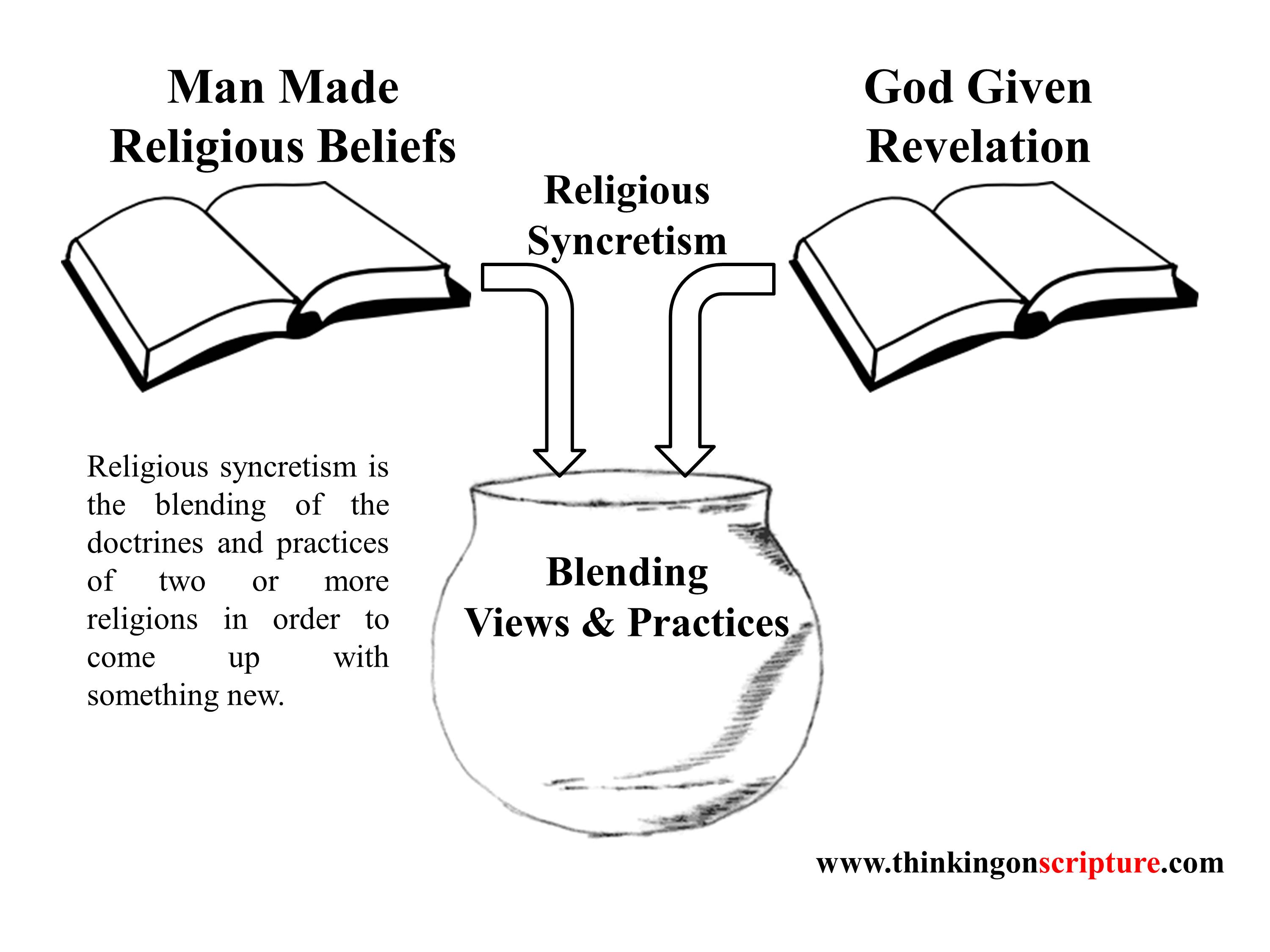
PARTIAL OBEDIEDIENCE
IS DISOBEDIENCE
However (nevertheless, but) marks a contrast, in this case a tragic exception.
As for the sins of Jeroboam the son of Nebat - This phrase is a sad refrain for the Northern Kingdom and is almost a technical label in Kings. The primary sin was man-made worship (golden calves), led by a false priesthood (non-Levitical), man-made feasts, with alternative sanctuaries (Bethel & Dan) and structured as a political religion designed to prevent loyalty to Jerusalem. So while Jehu rejected Baal, he retained convenient Yahweh-idolatry. Jeroboam did not replace Yahweh; he reshaped Yahweh worship by blending it with forbidden imagery and political convenience. That is the essence of syncretism.
SINS OF JEROBOAM - 14X/14V - 1 Ki. 14:16; 1 Ki. 15:30; 1 Ki. 16:31; 2 Ki. 3:3; 2 Ki. 10:29; 2 Ki. 10:31; 2 Ki. 13:2; 2 Ki. 13:11; 2 Ki. 14:24; 2 Ki. 15:9; 2 Ki. 15:18; 2 Ki. 15:24; 2 Ki. 15:28; 2 Ki. 17:22
Which he made Israel sin - For what Jeroboam MADE see 1 Kings 12:28-35. Jehu’s authority perpetuated Jeroboam's institutional sin. The king’s compromise became the people’s pattern.
Jehu was God’s instrument,
but not God’s servant.
From these Jehu did not depart (turn aside, turn away from), even the golden calves (note) that were at Bethel and that were at Dan - These were not presented as foreign gods, but as “Behold your gods, O Israel, who brought you up from the land of Egypt” (1 Ki 12:28) In other words it was Yahweh "redefined,", not Yahweh denied. It was in effect syncretistic worship (see note). Sadly it was worship without obedience and orthodoxy without submission to the true and living God.
It is likely that Jehu kept these calves because removing them would threaten political unity and pilgrimage to Jerusalem implied submission to Judah. In short, while Jehu changed Israel’s religious landscape, he failed to alter Israel’s spiritual direction which was into full blown apostasy.
Warren Wiersbe - The calves were supposed to be only symbols of Jehovah, but it was idolatry just the same. In spite of his zeal for the Lord, Jehu was an idolater at heart who used the Lord’s name only to cover up his sins. By being a part of the “national religion,” Jehu united the people and gained their respect. Jehu was a consummate politician to the very end
ESV Study Bible (borrow) on the golden calves - The symbolism of these calves encouraged a blurring of the distinction between Mosaic and Canaanite religion; the high god of the Canaanite pantheon, El, is frequently called “the bull” in Ugaritic materials (signifying his strength and fertility), and Baal himself is also represented as a bull. Archaeologists have discovered bull icons at numerous sites in Syria-Palestine, including Byblos, Ugarit, and Hazor.
John Butler - Jehu. Both the slaying and straying by Jehu is recorded in this chapter. •Slaying by Jehu: the beginning of Jehu’s reign was very bloody; he killed the fruit of Ahab (the seventy sons of Ahab); the friends of Israel’s king (princes from Judah’s royal family); and the followers of Baal (Jehu cleverly got all the Baal worshippers together under the guise that Jehu was going to worship Baal; then once they were all assembled, he ordered their execution and destroyed the temple of Baal and made the place an outhouse). •Straying of Jehu: the duplication in his straying (he followed Jeroboam’s sins); the discipline for straying (Hazael king of Syria warred on Israel’s borders); the death of the strayer (Jehu died after reigning 28 years).
QUESTION - What is religious syncretism? | GotQuestions.org
ANSWER - Syncretism, as defined by the American Heritage Dictionary, is “the reconciliation or fusion of differing systems of belief.” This is most evident in the areas of philosophy and religion, and usually results in a new teaching or belief system. Obviously, this cannot be reconciled to biblical Christianity.
Religious syncretism often takes place when foreign beliefs are introduced to an indigenous belief system and the teachings are blended. The new, heterogeneous religion then takes a shape of its own. This has been seen most clearly in Roman Catholic missionary history. Take, for example, the Roman Catholic Church’s proselytizing of animistic South America. Threatened with the fear of death, natives were baptized into the church by the tens of thousands without any preaching of the Gospel whatsoever. Former temples were razed, with Catholic shrines and chapels built on the same spot. Natives were allowed to substitute praying to saints instead of gods of water, earth and air, and replaced their former idols with new images of the Roman Catholic Church. Yet, the animistic religion the natives had formerly practiced was never fully replaced—it was adapted into Catholic teachings, and this new belief system was allowed to flourish.
More recently, religious syncretism can be seen in such religious systems as the New Age, Hinduism, Unitarianism, and Christian Science. These religions are a blending of multiple different belief systems, and are continually evolving as the philosophies of mankind rise and fall in popularity.
Therein lies the problem, for syncretism relies on the whim of man, not the standard of Scripture. The Bible makes it very clear what true religion is. Think on just a few things stated in Scripture: "Love the Lord your God with all your heart and with all your soul and with all your mind" (Deuteronomy 6:5; Matthew 22:37); "Jesus replied, 'I am the way and the truth and the life. No one comes to the Father except through me'" (John 14:6); "Jesus did many other miraculous signs in the presence of his disciples, which are not recorded in this book. But these are written that you may believe that Jesus is the Christ, the Son of God, and that by believing you may have life in his name" (John 20:31); and “Salvation is found in no one else, for there is no other name under heaven given to men by which we must be saved" (Acts 4:12).
Religious syncretism is simply not compatible with true Christianity. In fact, any modification to biblical law and principle for the sake of a “better” religion is heresy (Revelation 22:18-19).
QUESTION - What was the sin of Jeroboam? | GotQuestions.org
ANSWER - 2 Kings 3:3 includes a reference to King Joram (or Jehoram) of Israel and the “sin of Jeroboam.” Joram was a son of Ahab, and the only thing positive mentioned about him is that “he got rid of the sacred stone of Baal that his father had made” (2 Kings 3:2); thus, he was not as wicked as his parents, but that’s not saying much. Joram’s problem was that “he clung to the sins of Jeroboam” (verse 3).
Jeroboam was the first king of divided Israel. In 1 Kings 14:9, the prophet Ahijah clearly states the sins of Jeroboam: “You have done more evil than all who lived before you. You have made for yourself other gods, idols made of metal; you have aroused [God’s] anger and turned your back on [God].” Jeroboam’s sin was idolatry. He created and worshiped gods other than the Lord.
This practice of worshiping other gods began early in Jeroboam’s reign. When the kingdom was divided and he controlled the northern part, he stopped all pilgrimages to Jerusalem: “‘It is too much for you to go up to Jerusalem. Here are your gods, Israel, who brought you up out of Egypt.’ One [golden calf] he set up in Bethel, and the other in Dan. And this thing became a sin; the people came to worship the one at Bethel and went as far as Dan to worship the other” (1 Kings 12:28–30).
In addition to sacrificing to these two golden calves, Jeroboam “built shrines on high places and appointed priests from all sorts of people, even though they were not Levites” (1 Kings 12:31). God’s entire system of holy days, sacrifices, and worship was changed into a man-made system focused on worshiping golden calves. In addition to the idolatry, the cities of Bethel and Dan became the places of worship rather than God’s chosen city of Jerusalem (cf. 2 Chronicles 6:6).
The sin of Jeroboam was doubly tragic in that he had been promised blessing from God if he had just followed the path of David. “If you do whatever I command you and walk in obedience to me and do what is right in my eyes by obeying my decrees and commands, as David my servant did, I will be with you. I will build you a dynasty as enduring as the one I built for David and will give Israel to you” (1 Kings 11:38). In turning to calf-worship, Jeroboam spurned God’s goodness and brought about his own demise: “The sin of the house of Jeroboam . . . led to its downfall and to its destruction from the face of the earth” (1 Kings 13:34).
There are other places throughout 1 and 2 Kings that refer to the sins or ways of Jeroboam. For example, 1 Kings 15:34 states that King Baasha “did evil in the eyes of the LORD, following the ways of Jeroboam and committing the same sin Jeroboam had caused Israel to commit.” For following Jeroboam’s sin, Baasha suffered Jeroboam’s fate (1 Kings 16:1–4).
The sins of Jeroboam haunted the later kings of Israel, all of whom practiced idolatry. King Zimri (1 Kings 16:19), King Omri (1 Kings 16:26), King Jehoahaz (2 Kings 13:2), and King Pekahiah (2 Kings 15:24)—these and others all followed the wicked example of Jeroboam.
Jeroboam’s reign included many sins, yet the “sin of Jeroboam” is a specific reference to idol worship that marked his reign and the reigns of the kings of Israel who followed him. This sin was one that angered the Lord and ultimately led to judgment upon Israel.
QUESTION - Why did Jehu destroy the Baal worship in Israel but not the worship of the golden calf? GOTQUESTIONS.ORG
ANSWER - Jehu was anointed by the prophet Elisha as king over Israel in place of the evil Ahab (ED: THAT STATEMENT IS TRUE IN ONE SENSE, BUT ULTIMATELY IT WAS ELISHA'S SERVANT WHO CARRIED OUT THE ACTUAL ANOINTING - 2 Kings 9). This took place as part of the judgment on Ahab for his worship of Baal. Therefore, Jehu’s role was to end Baal worship in Israel.
In this role, Jehu clearly succeeded. First, he had all of the people who worshiped Baal put to death (2 Kings 10:18–26). After that, at Jehu’s command, “they demolished the pillar of Baal, and demolished the house of Baal, and made it a latrine to this day. Thus Jehu wiped out Baal from Israel” (2Ki 10:27–28). God’s goal of ridding the land of Baal worship had been accomplished.
However, the very next verse (2 Kings 10:29) states, “But Jehu did not turn aside from the sins of Jeroboam the son of Nebat, which he made Israel to sin—that is, the golden calves that were in Bethel and in Dan.” So, even though Baal was gone, other types of idolatry remained in Israel.
According to 1 Kings 12:28–29, Jeroboam himself had made the golden calves in Bethel and Dan. Some scholars surmise that, because Baal was originally a god of foreigners, Jehu may have limited his work to only clearing out the foreign gods. He left alone the “domestic” gods—those created and installed by Israel.
A more likely explanation is that the calf-worship sites were left intact because Israel was still a divided kingdom. The alternative would have been to realign with Judah and worship according to the Law at the temple in Jerusalem. This was not going to take place, as Jehu was at war with Judah (2 Chronicles 22:7–9).
Jehu was one of a long line of wicked kings in the northern kingdom of Israel—yet he was one of the “better” of the “bad kings.” Others were much worse. God granted Jehu a long reign of 28 years and gave him a promise: “Because you have done well in carrying out what is right in my eyes, and have done to the house of Ahab according to all that was in my heart, your sons of the fourth generation shall sit on the throne of Israel” (2 Kings 10:30). Jehu reigned approximately 841—814 BC.
Jehu’s influence in the northern kingdom would extend for a century; however, Syria began to take over larger portions of Israel: “from the Jordan eastward, all the land of Gilead, the Gadites, and the Reubenites, and the Manassites, from Aroer, which is by the Valley of the Arnon, that is, Gilead and Bashan” (2 Kings 10:33). Jehu’s reforms were ultimately only a partial and short-lived effort. Israel continued on the path to destruction, eventually being defeated by their enemies as prophesied (Hosea 1:4).
Related Resource:
- KING JEHU: AN ARCHAEOLOGICAL BIOGRAPHY by Bryan Windle - nice article with multiple pictures
2 Kings 10:30 The LORD said to Jehu, “Because you have done well in executing what is right in My eyes, and have done to the house of Ahab according to all that was in My heart, your sons of the fourth generation shall sit on the throne of Israel.”
- Because: 1Ki 21:29 Eze 29:18-20 Ho 1:4
- according to all that: 1Sa 15:18-24 1Ki 20:42 21:22
- your sons of the fourth generation: 2Ki 10:35 13:1,10 14:23 15:8-12
FIRST THE GOOD
NEWS FOR JEHU
The LORD said to Jehu - This is an amazing verse indicating Jehu had direct communication and commendation from Jehovah! The evaluation of Jehu’s actions does not come from historians or prophets alone but from Yahweh Himself, the covenant God of Israel. This gives the statement decisive theological weight.
Because you have done well in executing what is right in My eyes, and have done to the house of Ahab according to all that was in My heart - Jehu's commendation is specific, not sadly not comprehensive. God praises Jehu’s obedience in judgment, not his overall spiritual fidelity. The phrase “in My eyes” emphasizes God’s moral standard. This verse must be read together with 2 Kings 10:31, which immediately exposes Jehu’s failure to walk fully in the Law of the LORD.
Bob Utley on "My eyes. . .My heart" This is anthropomorphic language to describe Israel's Deity. (See ANTHROPOMORPHIC LANGUAGE TO DESCRIBE GOD)
Peter Leithart on what is right in My eyes - The word “right” or “upright” (yashar) occurs several times in the chapter (2 Kgs. 10:9, 15), culminating in Yahweh’s declaration that Jehu is upright in his sight (2Ki 10:30) (Provan 1995, 216, 218). At every turn, Jehu’s actions fulfill the word of Yahweh (2Ki 9:36–37; 10:10–11, 30), but the last reference is jarring: bloody Jehu fulfills all that is on Yahweh’s “heart.” This gives a new twist to the idea that David is “a man after God’s own heart” and shows that vengeance against the wicked, especially against the wicked who attack Yahweh’s prophets, is very dear to Israel’s God (Mt 21:33–46). (See 1 & 2 Kings - Page 222)
ESV Study Bible (borrow) on done...what is right - Since Jehu does not abolish the golden calves in Bethel and Dan (v. 29; cf. v. 31), it is surprising to find him addressed as someone who has carried out what is right (Heb. yashar) in the eyes of the Lord. In other places, the authors of Kings use yashar only positively, with regard to David (1 Kings 15:5) and the relatively good (i.e., non-idolatrous) kings of Judah (1 Kings 15:11; 22:43; 2 Kings 12:2; 14:3; 15:3, 34; 18:3; 22:2). It is even more surprising to find Jehu receiving a David-like dynastic promise. This is not the same thing as a promise of eternal dynasty, but it is nevertheless extraordinary; Jeroboam was promised a dynasty like David’s if he did “what was right” in the Lord’s eyes (1 Kings 11:38), but then he failed and lost this opportunity (1 Kings 14:8). Evidently what Jehu has done that is right (eradication of Baal worship) far outweighs what he continues to do that is wrong.
According to all that was in My heart - This is striking language from God Almighty to a man. Jehu fulfilled exactly what God had decreed earlier through Elijah (1 Kings 21:21–24) and Elisha (2 Kings 9). The destruction of the house of Ahab was not excessive revenge but precise covenant judgment. God’s heart here refers to His judicial will, not His redemptive desire. Jehu did not exceed the mandate in this matter but carried it out fully.
God rewards obedience, even when mixed
But God does not overlook compromise
Your sons of the fourth generation shall sit on the throne of Israel - And just as Yahweh promised four did rule - Jehoahaz, Jehoash (Joash), Jeroboam II, and Zechariah. The result was that Jehu’s dynasty was the longest-lasting dynasty in the Northern Kingdom. Note this is both a reward and a restriction. Four and no more. Only four generations, unlike David’s everlasting dynasty in Judah.
Warren Wiersbe - The Lord commended Jehu for the work he had done and rewarded him by giving him the longest dynasty in the history of the northern kingdom—over one hundred years. He was succeeded by Jehoahaz, Joash, Jeroboam II, and Zechariah, all of whom were bad kings. But the prophet Hosea announced that the Lord was displeased with Jehu for murdering innocent people (Hos. 1:4; 2:21). Jehu established his dynasty by killing King Joram at Jezreel (2 Kings 9:15ff.), and for this God would judge him. “Jezreel” means “God scatters ” and He would scatter the northern kingdom by allowing the Assyrians to conquer them in 722 BC Jehu’s great-great-grandson Zechariah reigned only six months and was assassinated by Shallum who reigned only one month. The dynasty began with a murder and ended with a murder.
NET NOTE Jehu ruled over Israel from approximately 841–814 B.C. Four of his descendants (Jehoahaz, Jehoash, Jeroboam II, and Zechariah) ruled from approximately 814–753 B.C. The dynasty came to an end when Shallum assassinated Zechariah in 753 B.C. See 2 Kgs 15:8–12.
This commendation was mitigated by the prophet Hosea (Hos. 1:4).
Hosea 1:4 And the LORD said to him, “Name him Jezreel; for yet a little while, and I will punish the house of Jehu for the bloodshed of Jezreel (means "God scatters"), and I will put an end to the kingdom of the house of Israel.
Hosea 1:4 announces judgment on the house of Jehu for the bloodshed at Jezreel—not because the command was wrong, but because Jehu’s heart was corrupt. This shows that right actions without right devotion eventually bring judgment.
ESV Study Bible (borrow) on Hosea 1:4 - Call his name Jezreel. Hosea, like Isaiah, uses children as signs and symbols for prophetic pronouncements (cf. Isa. 7:3; 8:1–3, 18). the house of Jehu. Jeroboam II (Hos. 1:1) was the fourth king of the dynasty begun by Jehu in 841 B.C. This dynasty was the longest in the history of the northern kingdom. Many suppose that the blood of Jezreel refers to the shedding of blood of the house of Ahab and Ahaziah when Jehu usurped the throne (2 Kings 9:21–28), but this proposal suffers from serious difficulties. First, the kingdom of Israel did not come to an end with Jehu’s dynasty. Israel survived for 30 years after Zechariah, the last king of that dynasty. Second, God commanded Jehu to exterminate Ahab’s dynasty, and commended his work (2 Kings 9:1–10; 10:30; cf. 2 Chron. 22:7). It seems unlikely that the Lord would punish someone for carrying out his command. It is better to take the phrase “house of Jehu” as parallel to house of Israel, and thus another name for Israel. By this reading, “the blood of Jezreel” refers to 1 Kings 21: Ahab, who promoted Baalism as the national religion of Israel, plotted to murder Naboth, a man loyal to the Lord, in order to seize his vineyard in Jezreel. Appropriately, this verse sets the tenor of the rest of the book: the ongoing confrontation between Baal and the God of Israel.
See “The Bloodshed Of Jezreel”: Harmonizing Hosea 1:4 And 2 Kings 10:30 -- By: Robert B. Chisholm, Jr.
Was Jehu Punished for the Bloodshed of Jezreel? Peter Goeman
Michael Eaton - The Branch - Jehu is rewarded for what he did but condemned for his motivation. When the slaughter is finished and every important supporter of Baal-worship is dead, Jehu is commended (2Ki 10:30). But the spirit in which he acted was not praised. He was not given a long-lasting line of kings like that of the house of David, and like that which was offered to Jeroboam (1 Kgs 11:38). God approved the abolition of Baal-worship but he did not approve of the ways in which it had been done. Methods and motives are important as well as results. One may have a right motive but a wrong method (as with Jehoshaphat’s fraternizing with Ahab). One may have a right goal but wrong methods and wrong motivations (as in the life of Jehu). Or one may walk with God and have God’s methods and godly motives. A few years later God would announce through Hosea ‘I will punish the house of Jehu for the blood of Jezreel.’ (Hosea 1:4) Elisha, not Jehu, went down in history with an honourable reputation.
Right (03477) yashar from the verb yashar = to be smooth, straight or right) is an adjective that means straight; reliable, level, pleasing; upright; righteous. Yashar only rarely is used literally of that which is straight (Ezek 1:7). Yashar can refer to something physical like a path, but even in those uses is often a metaphorical description of one's conduct or behavior (Ps 107:7). Most uses refer to that which is right in an ethical or an emotional sense, as agreeable or pleasing.
It is fitting that God is the standard of yashar (what is "straight") (Ps 92:15, called the "Upright One" - Isa 26:7). God's Word is described as upright (right) (Ps 19:7) as are His judgments (Ps 119:137) and His way (Ps 107:7). "God made men upright (Ge 1:27), but they have sought out many devices." (Eccl 7:29)
When God tore the kingdom from Solomon for his failure to obey (God had given him a promise conditioned on whether he would "do what is right [yashar]" in God's sight - 1Ki 11:38), he reminded him that he was not like David "who followed Me with all his heart, to do only that which was right (yashar) in My sight." (1Ki 14:8). Again we read "David did what was right (yashar) in the sight of the LORD, and had not turned aside from anything that He commanded him all the days of his life, except in the case of Uriah the Hittite." (1Ki 15:5). We see the phrase "did what was right (yashar) in the sight of the LORD" in the description of a number of the Kings of Judah (Asa - 1Ki 15:11, 2Chr 14:2, Asa's son Jehoshaphat - 1Ki22:43, 2Chr 20:32, Jehoash [Joash] = 2Ki 12:2, 2Chr 24:2, Amaziah = 2Ki 14:3, 2Chr 25:2, Azariah = 2Ki 15:3, Jotham = 2Ki 15:34, 2Chr 27:2, Hezekiah = 2Ki 18:3, 2Chr 29:2, 2Chr 31:20, Josiah = 2Ki 22:2, 2Chr 34:2, Uzziah = 2Chr 26:4) Ahaz "did not do what was right in the sight of the LORD." (2Ki 16:2, 2Chr 28:1)
Gleason Archer - How could God commission Jehu to destroy the house of Ahab (2 Kings 9:6–10; 2 Kings 10:30) and then later condemn him for the bloodshed (Hos. 1:4)? (See page 211 NIEBD)
There can be no question that Jehu fully carried out the commission he received from the Lord: “You shall strike the house of Ahab your master, that I may avenge the blood of My servants the prophets, and the blood of all the servants of the LORD, at the hand of Jezebel. For the whole house of Ahab shall perish” (2 Kings 9:7–8, NASB). After Jehu, racing back from Ramoth Gilead to Jezreel, shot King Jehoram dead, and Ahaziah of Judah as well (for he was the grandson of Jezebel), he then proceeded to the city of Samaria and intimidated the elders of that city into decapitating all seventy of Ahab’s sons who were living in the palace (2 Kings 10:1–10). Not long after that he managed to lure all the Baal-worshiping leaders of Israel into the temple of Baal on the pretext of leading them in a great celebration of worship there. Once they were locked up inside the temple itself, he had them all massacred by his troops and destroyed the entire building, desecrating it in such a way that it could never be used for worship again (vv. 18–27).
It was after Jehu had carried out all these stern measures for the suppression of idolatry in Israel that the commendation came to him from the Lord: “Because you have done well in executing what is right in My eyes, and have done to the house of Ahab according to all that was in My heart, your sons of the fourth generation shall sit on the throne of Israel” (2 Kings 10:30, NASB). Jehu had served as God’s executioner on behalf of the many hundreds of prophets of the Lord whom Jezebel and Ahab put to death (1 Kings 18:4,13), and he had taken the most thorough means of suppressing the soul-destroying curse of idolatry. Therefore he would be granted security on his throne, and his descendants after him unto “the fourth generation” (i.e., Jehoahaz 814–798, Jehoash 798–782, Jeroboam II 793–753, and Zechariah, who was assassinated within a few months of his accession in 752).
In the course of his own career, however, Jehu did not enjoy a great deal of success as a ruler or defender of his country. The Black Obelisk of Shalmaneser III of Assyria depicts Jehu “the son of Omri [sic!]” prostrate before the invader and paying him tribute as his vassal (cf. Pritchard, ANET, p. 281), in connection with an expedition against Benhadad of Damascus and the Phoenician cities of Byblos, Sidon, and Tyre. But 2 Kings 10:33 indicates that even before that invasion by Assyria (in the twenty-first year of Shalmaneser, which would have been about 832 B.C.), Jehu had lost all Transjordanian Manasseh, Gad, and Reuben (which later had for the most part been conquered by Moab under King Mesha) to King Hazael of Damascus. His son Jehoahaz (814–798) was reduced to complete vassalage by Hazael and his son Benhadad II (2 Kings 13:1–3). But Jehoash (798–782) was allowed by the Lord to expel the Syrians in three decisive engagements (v.19) and also to crush the pretensions of King Amaziah of Judah in the Battle of Bethshemesh (14:13), with a resultant spoliation of Jerusalem itself. But it was Jehu’s great-grandson Jeroboam II who achieved very great success on the battlefield, for he regained possession of the Transjordanian tribal territory and all the area formerly ruled over by Jeroboam I—just as the prophet Jonah had predicted (vv. 25–27).
On what basis, then, did the prophet Hosea proclaim the judgment of the Lord on the dynasty of Jehu (Hos. 1:4–5)? It was because of the impure motive with which Jehu himself had carried out his commission from Yahweh to blot out the race of Ahab. Although Jehu had only done what God had commanded, he did so out of a carnal zeal that was tainted with protective self-interest. 2 Kings 10:29 says of him: “However, as for the sins of Jeroboam the son of Nebat, [by] which he made Israel sin, from these Jehu did not depart, even the golden calves that were at Bethel and … Dan” (NASB). But v.31 goes on to say: “But Jehu was not careful to walk in the law of the LORD, the God of Israel, with all his heart; he did not depart from the sins of Jeroboam, [by] which he made Israel sin” (NASB). This same mixture of motives showed up in Jehu’s descendants as well, for Jehoahaz “did evil in the sight of the LORD, and followed the sins of Jeroboam.… So the anger of the LORD was kindled against Israel, and He gave them continually into the hand of Hazael king of Syria, and into the hand of Benhadad the son of Hazael. Then Jehoahaz entreated the favor of the LORD, and the LORD listened to him” (2 Kings 13:1–4, NASB).
Jehoash, Jehoahaz’s son, did not do much better; for he followed his father’s evil example (2 Kings 13:11), even though he did retain a respectful relationship with the prophet Elisha (vv. 14–19). And even though Jeroboam II enjoyed such remarkable success in war (14:25) and had a long reign of forty-one years (v.23)—i.e., from 793–782 as viceroy under his father, and 782–753 as sole king—yet his relationship toward the LORD was no better than his father’s. “He did evil in the sight of the Lord; he did not depart from all the sins of Jeroboam the son of Nebat, [with] which he made Israel sin” (v.24; NASB). The whole prophecy of Amos, especially Amos 2:6–16; 4:1; 5:5–13; 6:1–8, is a commentary on the corruption of government, society, and personal morality that prevailed in the Northern Kingdom during Jeroboam’s reign. (Amos’s ministry came “two years before the earthquake” [Amos 1:1], in the reign of Uzziah of Judah. This must have been some time between 760 and 755.)
The important principle set forth in Hosea 1:4 was that when blood is shed, even in the service of God and in obedience to His command, blood-guiltiness attaches to God’s agent himself if his motive was tainted with carnal self-interest rather than by a sincere concern for the purity of the faith and the preservation of God’s truth (such as, for example, animated Elijah when he had the 450 prophets of Baal put to death after the contest with them on Mount Carmel). The “bloodshed of Jezreel” was finally visited on the house of Jehu when his great-great-grandson Zechariah was murdered at his own birthday party by his trusted chariot captain Shallum (2 Kings 15:10).
Walter Kaiser addresses Jehu - Jehu Punished for Doing As He Was Commanded? - Page 208 Hard Sayings
Why is Jehu at first told to carry out the destruction of the house of Ahab and then later on threatened with punishment by the prophet Hosea for doing as he was told (Hos 1:4)?
Jehu was given a twofold divine commission: (1) he was to annihilate all the wicked and apostate house of Ahab, and (2) he was to avenge the blood that Jezebel had shed of the prophets of Yahweh. God’s instrument of choice was the army captain, Jehu. These tasks Jehu carried out to the full.
Why then was God displeased with Jehu, as Hosea seems to imply? Because it is one thing to be the instrument God has chosen to punish another person (or group of persons or even a nation) and another to find automatic approval at the completion of the act for the manner in which this task was carried out. For example, Assyria was ordered to move against Israel, but God disapproved of the brutal way Assyria carried out the warfare (Is 10:5–19). Babylon was likewise authorized to move against Judah but was excoriated for cruelty in that war (Hab 1:6; 3:13–16).
Therefore, although Jehu was obedient to God’s directive (2 Kings 9:7), he erred grievously in that he killed more people than God had directed and did so with a savagery that did not earn God’s approval. It seems clear from Jehu’s conduct that he was motivated not by a desire to be obedient to God but by sheer personal ambition—thereby making his act of obedience wicked. It was this same spirit that was transmitted to his descendants, in a heightened degree if anything.
Jehu showed unnecessary cruelty when he slew not only the house of Ahab at Jezreel, but also the visiting monarch from Judah, Ahaziah, and almost all the members of the Davidic family (2 Kings 9:27; 10:13–14). Jehu, furthermore, extended this massacre to all the friends of the ruling family (2 Kings 10:11).
The point is most evident that divine approval for an act does not thereby carry with it indifference as to how that act is accomplished and how many others it may involve.
NORMAN GEISLER —How could God condemn Jehu for bloodshed when God had commanded him to exterminate the house of Ahab?
PROBLEM: In 2 Kings 9:6–10, we find the commissioning of Jehu by the Lord to strike down the house of Ahab. According to 2 Kings 10:30, God commended Jehu for having destroyed the house of Ahab. However, Hoshea prophesied that God would “avenge the bloodshed of Jezreel on the house of Jehu” (Hosea 1:4). How could God condemn Jehu for shedding blood when it was God who had commanded him to do so?
SOLUTION: God praised Jehu for obeying Him in destroying the house of Ahab, but condemned Jehu for his sinful motive in shedding their blood. Although 2 Kings 10:30 states that God told Jehu that he had done right in killing the relatives of Ahab, the previous verse observes that Jehu “did not turn away from the sins of Jeroboam … from the golden calves … ” and verse 31 states that Jehu “took no heed to walk in the law of the Lord God of Israel with all his heart.” Obviously, since Jehu worshiped other gods and did not walk in God’s Law, he did not destroy Ahab’s family out of any devotion to the Lord.
2 Kings 10:31 But Jehu was not careful to walk in the law of the LORD, the God of Israel, with all his heart; he did not depart from the sins of Jeroboam, which he made Israel sin.
- was not careful De 4:15,23 1Ki 2:4 Ps 39:1 119:9 Pr 4:23 Heb 2:1 12:15
- to walk : De 5:33 Dt 10:12,13 2Ch 6:16 Ne 10:29 Ps 78:10 Eze 36:27 Da 9:10
- he departed: 2Ki 10:29 3:3 1Ki 14:16
JEHU'S FAILURE TO FOLLOW
GOD WITH A WHOLE HEART
But - Term of contrast. This one is tragic, for Jehu had received so much light, so much favor and had even been spoken to by God and yet we see this sad BUT. Scripture now gives Heaven’s final verdict on Jehu’s spiritual life.
Jehu was not careful to walk in the law of the LORD, the God of Israel, with all his heart - Jehu was fiercely passionate about destroying Baal, but not deeply devoted to following the LORD. Jehu's life and reign were characterized by partial obedience to Yahweh. The Hebrew verb for careful conveys watchfulness, diligence, guarding one’s steps. Jehu was zealous in action, but careless in devotion. He executed judgment forcefully, but failed to cultivate obedience attentively.
🙏 THOUGHT - Jehu was zealous for the Lord's work, but failed to guard his heart (Pr 4:23) and thus failed in his walk. There is a powerful lesson for all believers (I am making no judgment on Jehu's salvation status, just his zeal). We can be zealous in seeking to accomplish the LORD's will and work, but in so doing we must also be careful to guard our hearts. It does not matter how hard we work for the Lord if we are not obedient to His Word (1Sa 15:22). Of course I am not speaking of perfection, but of direction. Clearly, if we have any "golden calves" we are worshiping, we need to destroy them! Another lesson is that external zeal without internal loyalty leads to temporary blessing, not enduring legacy.
He did not depart from the sins of Jeroboam, which he made Israel sin (see golden calves) - This is repeated for emphasis. God does not confuse success with faithfulness. Jehu did what God commanded—and was rewarded. Jehu did not love the LORD fully—and his dynasty ended.
C H Spurgeon - Jehu did obey God up to a certain point. It happened to be a profitable thing to him to exterminate the old royal house of Ahab, because it would confirm himself upon his own throne; but anything beyond that did not pay, and therefore Jehu did not touch it.
🙏 THOUGHT - “How terrible a warning is the story of this man – that it is possible to be an instrument in the hand of God and yet never be in fellowship with Him.” (Morgan) God may sovereignly use a person without ever approving of that person’s heart. It is a frightening thought that divine usefulness is not the same as divine intimacy. One may serve God’s purposes externally while remaining estranged from God internally! Here is the challenge for all of us (yours truly included) who serve the Lord in some capacity (you are serving Him aren't you dearly beloved?) -- beneath all of our zeal and pious activity there might lay a fatal flaw, that our heart has never been wholly surrendered to the Lord! WOE! One may love God’s work while subtly be resisting God’s will. This warning presses especially hard upon those who teach, lead, preach, or serve. It is possible to preach truth without loving it (or without practicing it), confront sin without hating it personally, defend orthodoxy while neglecting obedience, or be busy for God while distant from God. One of my favorite preachers who I will not name recently fell (2025) and yet he preached powerful messages for several years right up to the time that it came to light he had been carrying on an affair during those years. I am not judging him. I am frightened for what I might do if given the opportunity! The prayer of David in Psalm 139:23-24 is one we should all consider frequently praying - "Search me, O God, and know my heart; Try me and know my anxious thoughts; and see if there be any hurtful way in me, and lead me in the everlasting way." For Thy Glory. In Jesus' Name. Amen.
And Jesus' words in Revelation 2:4-5 echo a "Jehu-like" warning about external busyness but internal barrenness. Note His three commands -- "But I have this against you, that you have left your first love (see how busy the church at Ephesus was - Rev 2:2,3). 5 ‘Therefore remember from where you have fallen, and repent and do the deeds you did at first; or else I am coming to you and will remove your lampstand out of its place–unless you repent."
Spurgeon - Hating one sin he loved another, and thus proved that the fear of the Most High did not reign in his breast. He was merely a hired servant, and received the throne as his wages, but a child of God he never was.
Henry Morris - Jehu took no heed. Despite Jehu's apparent zeal to carry out God's commands against Ahab and Baal worship, it was more in self-interest than out of love for God. It is noteworthy that Shalmaneser III, a prominent king of Assyria, mentioned Jehu in his "Black Obelisk." This four-sided black limestone object contains a number of bas-relief panels, one of which depicts Jehu, the son of Omri, paying tribute to the Assyrian emperor. The obelisk is now in the British Museum.
Knapp - Jehu’s zeal, on the contrary, consumed and destroyed everybody and everything that stood in the way of his own advantage or aggrandizement, but never touched himself. He appears to have been a total stranger to real exercise of soul.
Jehu’s problem was not zeal against evil,
but indifference toward wholehearted good
Dale Ralph Davis’s epilogue on Jehu is poignant and frightening, because it exposes the terrifying truth that one may finish God’s work without ever fully following God.
Let Jehu haunt us—
to fear and faithfulness.
This is a sobering summary, for it is telling us that one instrument of Yahweh’s judgment (Hazael) is raised up to bring judgment on a previous instrument of Yahweh’s judgment (Jehu). This tale will repeat itself. Though Yahweh will use Assyria as the rod of his anger against His own people, as the axe that whacks down his own covenant nation, yet Yahweh will destroy the axe for forgetting it was merely an axe in the divine Lumberjack’s hands (Isa. 10:1–19). Yahweh will give Judah and surrounding countries to His ‘servant’, the Babylonian Nebuchadnezzar, ‘until the time of His own land comes’ (Jer. 27:7).Yahweh presses kings and other reprobates into His service (Pr 21:1) but such servants seldom accept servanthood and so Yahweh raises up another servant to consign His previous servant to the dumpster of history.
Jehu’s story testifies that one can be
used by God and judged by God.
All this is scary, however, because it doesn’t merely involve the movers and shakers and swelled heads of politics. Jehu’s story testifies that one can be used by God and judged by God. We need go no farther than Matthew 7:21–23 to find the Jehu paradigm in the New Testament. You can be both used by Christ (ED: "did we not prophesy in Your name, and in Your name cast out demons, and in Your name perform many miracles?" He does not refute their claims!) and rejected by Christ. Just because you have at some time in some way been the Lord’s servant does not mean you are viewed with the Lord’s pleasure. It is very solemn. Let Jehu haunt us—to fear and faithfulness. (BORROW 2 Kings : the power and the fury PAGE 166)
Tony Merida applies Jehu's life and "twisted zeal" to modern Christianity - What are some modern-day examples of twisted zeal? You might be zealous for religion, but you have never experienced regeneration. You may have zeal to attend worship gatherings but be addicted to pornography. You might think you are zealous for ministry but really have zeal to be known and admired by others. You might claim to have zeal to grow a church but be doing it for all the wrong reasons. You may have zeal for morality but turn into a legalistic Pharisee and know nothing of the grace of God in Christ. You might claim to have zeal for truth but actually have hatred toward those who disagree with you. You might have zeal to preach but actually be driven to please people or be famous. You might be busy with churchy things but have no devotion to Christ, doing everything in the energy of the flesh. You might be into social causes but have no desire for Jesus.
Jehu purged Israel,
but he still needed purging on the inside.
Paul says there are some “holding to the form of godliness but denying its power” (2 Tim 3:5). Jehu says, “Come see my zeal.” Jesus says, “Let Me examine your heart.” That is what matters. Jehu purged Israel, but he still needed purging on the inside.
How can we avoid Jehu’s sin? We must experience the transforming grace of Jesus. Paul was formerly “zealous” for a form of religion that led him to persecute Christians (Phil 3:6), but then he experienced conversion to Jesus Christ, leaving him to pursue nothing but Christ. That is what we need: zeal for Christ above all things. May all our sermons be aimed at pleasing Him! May our ministry to kids be about pleasing Christ! May our parenting, our small groups, and our finances be about Him! May our church planting, orphan care, and care for the poor and oppressed be done out of the overflow of a heart for Jesus. Let your heart burn for Christ, not self. (Exalting Jesus in 1 & 2 Kings)
F B Meyer - Jehu took no heed to walk in the law of the Lord God of Israel.
Jehu was the Cromwell of his time. He swept away the symbols of idolatry with ruthless destruction. Nothing could withstand his iconoclastic enthusiasm. But he failed to keep his own heart, and therefore his dynasty lasted for but one generation.
It is a deep lesson for us all.
We may keep other people’s vineyards, and neglect our own.
We may give good advice to our friends, but fall into the very faults against which we warn them.
We may pose as infallible guides, but fall into the crevasses and precipices from which we had carefully warned our companions.
Jehu avenged the idolatries of Ahab, but he departed not from Jeroboam’s calves.
Before you rebuke another, be sure that you are free from the faults that you detect in him.
When you hear of the failings of some erring brother, ask yourself whether you are perfectly free from them.
And never attempt to cast out the mote from your neighbor’s eye till you are sure that the beam has been taken from your own.
It is easier to be vehement against the abominations of others
than to judge and put away your own SECRET SINS!
Take heed to your heart. Its complexion colors all the issues of life. Do not be content to be strong against evil; be eagerly ambitious of good. It is easier to be vehement against the abominations of others than to judge and put away your own secret sins. But while we keep our heart with all diligence (Pr 4:23), we cannot afford to be independent of the keeping power of God. We must yield ourselves to Him (HIS SPIRIT), reserving nothing. The King must have all. The light of His face must fill every nook and corner of the soul. And every power that opposes itself to His dominion, must be dragged beyond the barriers and ruthlessly slain (Ro 8:13).
C H Spurgeon - Heedlessness in religion (Full sermon)
‘But Jehu took no heed to walk in the law of the LORD God of Israel with all his heart: for he departed not from the sins of Jeroboam, which made Israel to sin.’ 2 Kings 10:31
Jehu was very angry at other people’s sins, and
we may be without being delivered from our own.
Jehu was very angry at other people’s sins, and we may be without being delivered from our own. It is a very fine sight to see a man work himself up into a furor against drunkenness; he himself has never been guilty of it. It is true that all the indignation which he pours upon it, it well deserves; for is it not the great net of the devil, in which he catches multitudes? I may be very furious against adultery, or theft, or immorality of some other kind, which I do not happen to practise myself, yet my own sins may cry out against me; and it will not be possible to compound for my own sins by denouncing those of others. That is a very cheap sort of virtue; bullying other people’s vices. The easiest thing in all the world is to be constantly denouncing popular faults; but to wring the neck of one of my own bosom sins is a harder work by far, and a much better sign of conversion.
To be earnest against the sin of others may be praiseworthy,
but it is no sign of grace in the heart;
To be earnest against the sin of others may be praiseworthy, but it is no sign of grace in the heart; for natural men have been some of the greatest leaders in this matter. To loathe my own sin, to humble myself on account of my own personal faults, and to endeavour in the sight of God to renounce every false way, is a work of something more than human nature.
Will you also notice Jehu was very bitter against one sin. The very mention of the name of Baal brought the blood into his face, and there are persons in the world who cannot bear some one sin to which they have aversion; they love to hammer away against that; their whole soul takes fire at the mention of it. This is all very well; but, unless you hate all sin, unless you hate especially the besetting sin which is most congenial to your own nature, you need to be converted.
Total Commitment
On a recent trip to Haiti, I heard a Haitian pastor illustrate to his congregation the need for total commitment to Christ. His parable:
A certain man wanted to sell his house for $2,000. Another man wanted very badly to buy it, but because he was poor, he couldn't afford the full price. After much bargaining, the owner agreed to sell the house for half the original price with just one stipulation: he would retain ownership of one small nail protruding from just over the door.
After several years, the original owner wanted the house back, but the new owner was unwilling to sell. So first the owner went out found the carcass of a dead dog, and hung it from the nail he still owned. Soon the house became unlivable and the family was forced to sell the house to the owner of the nail.
The Haitian pastor's conclusion: "If we leave the Devil with even one small peg in our life, he will return to hang his rotting garbage on it, making it unfit for Christ's habitation." —Dale A. Hays, Leadership, Vol. 4, no. 2.
2 Kings 10:32 In those days the LORD began to cut off portions from Israel; and Hazael defeated them throughout the territory of Israel:
- Hazael: 2Ki 8:12 13:22 1Ki 19:17
GOD BEGINS SURGICAL
CUTTING OF ISRAEL
In those days This phrase marks a new phase in Israel’s history under Jehu. Although Jehu had zealously carried out God’s judgment on the house of Ahab (2 Kings 9–10), the narrative now pivots from initial success to gradual decline. The verse functions as a theological hinge: God fulfilled His word of judgment on Ahab, but now God begins to discipline Jehu and Israel for incomplete obedience
The LORD began to cut off portions from Israel - This is not merely geopolitical misfortune. Scripture interprets Israel’s losses as covenant discipline (cf. Deut 28:25, 49–52). God Himself initiates the reduction of Israel’s strength and borders. The verb “began” indicates a progressive judgment, not sudden annihilation. The Northern Kingdom of Israel was not destroyed overnight. Instead, God chipped away at her territory, strength, and security, slowly but surely. This slow erosion is often more sobering than instant judgment and it gives time for repentance, but also reveals stubborn persistence in sin.
Why Did God Do This? Go back and read the previous verse (2Ki 10:31)! Destruction of one form of idolatry (Baal worship) and retaining another form (golden calf worship) is a sure recipe for national and personal divine discipline and ultimately disaster if there is never repentance. Sadly, Jehu obeyed God selectively, and God responded proportionately. Jehu's (and the nation's) partial obedience did not prevent God's hand of discipline! Then and now!
And Hazael defeated them throughout the territory of Israel Hazael was a pagan king and yet God repeatedly used him as a rod of discipline (cf. 1 Kings 19:15–17; 2 Kings 8:12). God is sovereign not only over Israel but over foreign kings and armies (Pr 21:1). Hazael thought he acted independently, but God used him to acts instrumentally.
Throughout the territory of Israel anticipates what the next verses detail (2 Kings 10:33). God's judgment was (1) Geographical (land lost), (2) Military (defeated in battle) and worst of all (3)Spiritual (God withdrawing His Person and His protection).
Incomplete Reform Brings Incomplete Blessing - Jehu reformed externals, not the heart. God rewarded his obedience temporarily (10:30), but discipline followed his compromise (10:31–32).
God Judges His Own People First. Israel is not spared because she is “chosen.” Election brings greater accountability, not immunity (cf. Amos 3:2).
Loss Precedes Collapse - Israel will not fall to Assyria until decades later—but the erosion starts here. Spiritual compromise always precedes national decline.
Believer's Study Bible - The humiliation of Israel at the hands of foreign powers was especially prevalent during Jehu's reign. This came primarily from Syria in further fulfillment of God's word given by Elijah (1 Kin. 19:15-17). Further humiliation came in 841 B.C., the first year of Jehu's reign, when Shalmaneser III (cf. 1 Kin. 20:34; 22:3, notes) again invaded Syria and besieged Damascus. He would have invaded Israel had Jehu not paid him tribute. This event is recorded on the Black Obelisk of Shalmaneser III, discovered in 1846, which pictures an Israelite bringing to Shalmaneser the tribute of "Jehu son of Omri."
John Walton (p 399) Hazael’s actions against Israel. No military details are given here, but the text describes the loss of the entire Transjordan region to Hazael. After 838 the Assyrians were absent from the west for several decades, and this allowed the Arameans to begin to build their own little empire. This continued during the reign of Jehu’s successor, Jehoahaz (see comments on 2 Kings 12—13).
ESV Study Bible (borrow) on Hazael - He is said to have conquered Transjordan as far south as the Valley of the Arnon, the southern limit of Israelite Transjordanian territory (cf. Josh. 12:2). This military success occurred during the lull in Assyrian aggression against Syria-Palestine between the campaign of Shalmaneser III’s twenty-first year (838 B.C.), when he captured four of Hazael’s cities and accepted tribute from the peoples of the Phoenician coast, and the campaign of the fifth year of Adad-nirari III (806). This respite enabled Damascus to turn its full attention toward Israel and Judah and to subject these kingdoms to prolonged pressure in the last decades of the ninth century. More of Hazael’s conquests will be reported later (2 Kings 12:17–18; 13:3–7, 22–23).
2 Kings 10:33 from the Jordan eastward, all the land of Gilead, the Gadites and the Reubenites and the Manassites, from Aroer, which is by the valley of the Arnon, even Gilead and Bashan.
- the land of Gilead: Nu 32:33-42 De 3:12-17 Jos 13:9-12
- even: Am 1:3,4
- See another map of Conflicts Between Israel and Aram (click map to enlarge)
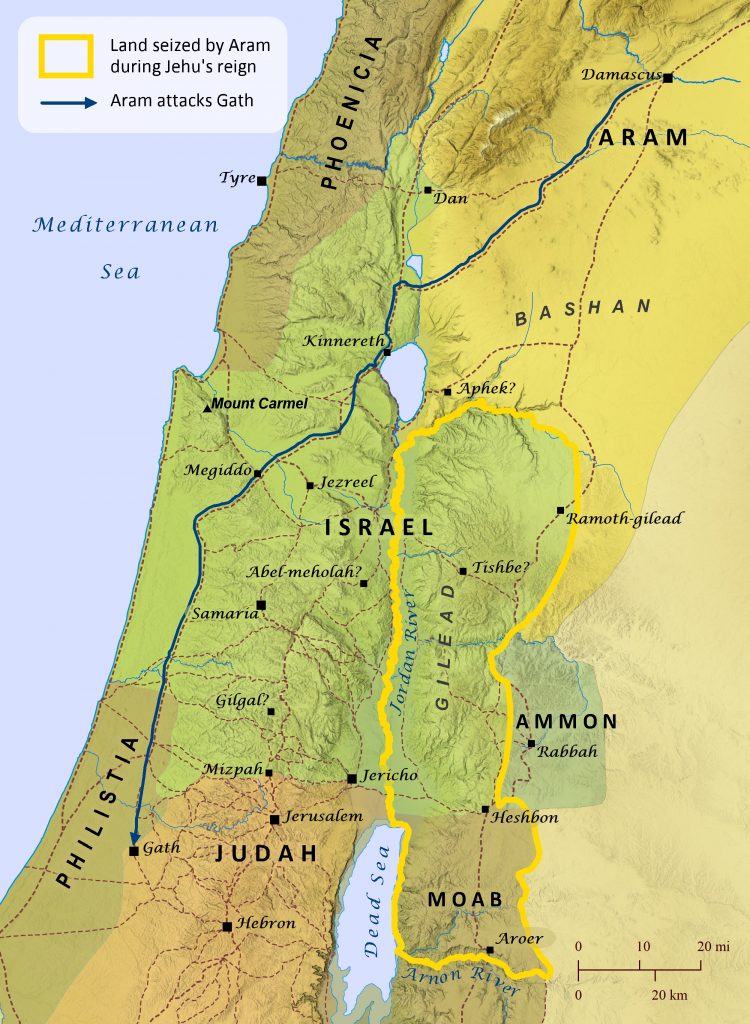
THE LORD CUTS OFF
ISRAEL'S TERRITORY
From the Jordan eastward (Heb. toward the rising of the sun), all the land of Gilead, the Gadites and the Reubenites and the Manassites, from Aroer, which is by the valley of the Arnon, even Gilead and Bashan - This description specifies exactly what was cut off—Israel’s entire Transjordan territory (east of the Jordan River). This phrase marks all Israelite territory east of the Jordan River, land originally conquered under Moses and Joshua (Num 32; Deut 3). It includes Gilead (central highlands) and Bashan (northern fertile plateau). This was prime agricultural and military land, critical for Israel’s strength.
The verse carefully lists the affected tribes as Gad, Reuben and the Half-tribe of Manasseh. It is notable that these tribes had chosen land east of the Jordan (Nu 32), and now that very inheritance is stripped away. There is a sobering irony here, for that land gained early by compromise is lost early by judgment.
From Aroer… to Bashan - Aroer is the Southern boundary near the Arnon Gorge. Bashan is the Northern boundary, rich pastureland. This phrase means nothing east of the Jordan remained under Israelite control! WOE! God did not just let Hazael carry out a skirmish, but allowed him to bring about a systematic collapse of the eastern territory of Israel.
Yahweh's Human
Instrument was Hazael
Though Hazael is not named in 2Ki 10:33, he was God's human instrument used to inflict severe divine discipline! Recall that God had foretold Hazael’s brutality through Elisha (2 Kings 8:12) and now that prophecy begins to unfold!
2 Kings 8:12 Hazael said, “Why does my lord weep?” Then he answered, “Because I know the evil that you will do to the sons of Israel: their strongholds you will set on fire, and their young men you will kill with the sword, and their little ones you will dash in pieces, and their women with child you will rip up.”
Sin rarely collapses everything at once, but
inevitabley and immutably erodes incrementally.
This verse is living proof of Yahweh enforcing covenant sanctions (Lev 26; Deut 28). God is faithful both to bless and to curse!
Notice that God's judgment begins at the periphery. Notice the pattern of loss starts far from Samaria. Border regions fall first and the heartland will follow in later generations.
2 Kings 10:34 Now the rest of the acts of Jehu and all that he did and all his might, are they not written in the Book of the Chronicles of the Kings of Israel?
- 2Ki 12:19 13:8
- 1Ki 11:41 14:19,29
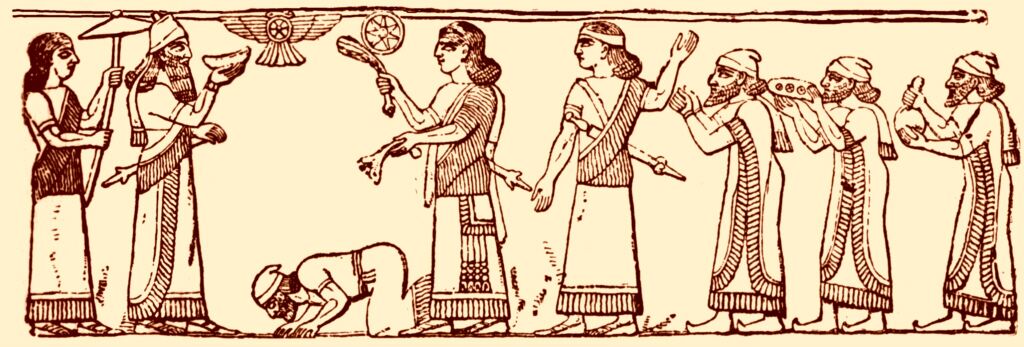
Drawing of king Jehu paying tribute to Shalmaneser III as depicted on the Black Obelisk (see note)
JEHU'S DEEDS RECORDED
NOT CELEBRATED
Now the rest of the acts of Jehu and all that he did and all his might, are they not written in the Book of the Chronicles of the Kings of Israel? This verse is the standard royal summary formula used throughout Kings (cf. 1 Kgs 14:29; 15:7; 22:45). It signals closure of the narrative section on Jehu.
The phrase “the rest of the acts” (Heb. yether divrê) refers to military campaigns (esp. against Aram — cf. vv. 32–33), administrative acts and political decisions and deeds not essential to the theological purpose of Kings. Kings is not a full political history; it is a covenant history explaining Israel’s spiritual decline.
Power without perseverance in obedience
is the quiet indictment.
The phrase “all his might” (gebûrâh) often highlights valor or strength. But here it carries subtle irony. Jehu was energetic, decisive, and violent yet his might did not translate into covenant faithfulness. He destroyed Baal worship (vv. 18–28) but retained the golden calves at Bethel and Dan (v. 29)
Bob Utley on "all his might" This is a very unusual phrase to describe Israeli kings. It is unusual in that it is used of a man who had such major military losses. We learn from the Black Obelisk that tribute was paid by Jehu to Assyria.
Zeal in one area never excuses
disobedience in another.
Written in the Book of the Chronicles of the Kings of Israel This book is NOT the biblical book of Chronicles but a lost royal annal, likely kept by court scribes
ESV Study Bible (borrow) on the rest of the acts of Jehu - Jehu appears in Assyrian records describing an event that must have taken place shortly after his accession to the throne, during the western campaign of Shalmaneser III’s eighteenth year (841 B.C.). During that campaign King Shalmaneser besieged Damascus, marched on to the Hauran Mountains in southern Syria, then through Gilead to the south of the Sea of Galilee and through Jezreel to Ba’li-ra’si (perhaps Mount Carmel) near Tyre. Hosea 10:14 may preserve a memory of this march through northern Palestine, since “Shalman” there is probably an abbreviated form of Shalmaneser’s name. At this time, Shalmaneser collected tribute from “Jehu the Israelite” as well as from Tyre and Sidon. The Black Obelisk of Shalmaneser III (854–824 B.C.), found at the site of Nimrud, depicts the Israelite king Jehu giving tribute. Jehu, or perhaps his emissary, lies prostrate before the king while other Israelites present tribute that includes gold and silver objects. If the figure is Jehu, then it is the only extant pictorial representation of an Israelite king from antiquity. Shalmaneser III, after having received tribute from Jehu, also plundered Tyre and Sidon in Phoenicia. In commemoration of this successful campaign, Shalmaneser had his portrait carved on the cliffs of the Dog River, north of Beirut.
HISTORICAL-ARCHAEOLOGICAL NOTE: The Black Obelisk of Shalmaneser III (British Museum) pictures a scene of a kneeling figure identified as “Jehu, son of Omri” (Assyrian designation for kings of Israel), apparently bringing TRIBUTE to Shalmaneser III, king of Assyria. This is the earliest known pictorial representation of an Israelite king. The inscription (standard translation) reads “The tribute of Jehu, son of Omri: I received from him silver, gold, a golden bowl, a golden vase with pointed bottom, golden tumblers, golden buckets, tin, a staff for a king [and] spears.” (See The Black Obelisk of Shalmaneser and the Earliest Depiction of an Israelite - The beginning of the end for the northern kingdom of Israel)
John Walton (p 399) Jehu in Assyrian records. The fact that Jehu quickly paid tribute to Shalmaneser III upon his accession to the throne of Israel suggests that he probably enjoyed the support not only of the religiously conservative Yahwist party but also of the pro-Assyrian faction of the government (see comment on 9:14). This party saw the breakdown of the western coalition as leading inevitably to defeat by the Assyrians and was tired of the perpetual warfare. Jehu is portrayed in the uncomplimentary posture of prostration on the Black Stela of Shalmaneser that reports the tribute he brought to the Assyrian king in 841 (ED: SEE DEPICTION ABOVE). His tribute consisted of items of silver and gold and some javelins.
HISTORICAL-ARCHAEOLOGICAL NOTE: The Black Obelisk of Shalmaneser III (British Museum) pictures a scene of a kneeling figure identified as “Jehu, son of Omri” (Assyrian designation for kings of Israel), apparently bringing TRIBUTE to Shalmaneser III, king of Assyria. This is the earliest known pictorial representation of an Israelite king. The inscription (standard translation) reads “The tribute of Jehu, son of Omri: I received from him silver, gold, a golden bowl, a golden vase with pointed bottom, golden tumblers, golden buckets, tin, a staff for a king [and] spears.” (See The Black Obelisk of Shalmaneser and the Earliest Depiction of an Israelite - The beginning of the end for the northern kingdom of Israel)
John Walton adds this note on TRIBUTE - When one state or other political entity conquered another or extended hegemony over its affairs, the result was the exaction of tribute payments from the subject people (see 2Sa 8:2; 1Ki 4:21; 2Ki 17:3-4). This could take the form of precious metals (by weight or as jewelry or implements), farm produce (a significant portion of the harvest), or labor service. Not surprisingly, this draining of the economy was unpopular and was generally the reason for revolt or warfare. Extrabiblical documentation for this practice is widespread. For instance, the annals of the Assyrian kings often include lists of items received as tribute: the “Black Obelisk” inscription of Shalmaneser III (859-824 B.C.) contains Jehu’s tribute to Assyria of silver, gold, lead and hard woods; Tiglath-Pileser III (744-727 B.C.) received elephant hide, ivory, linen garments and other luxury items from his vassals in Damascus, Samaria, Tyre and elsewhere. (See page 248 in The IVP Bible Background Commentary Old Testament)
2 Kings 10:35 And Jehu slept with his fathers, and they buried him in Samaria. And Jehoahaz his son became king in his place. 36Now the time which Jehu reigned over Israel in Samaria was twenty-eight years.
- Jehu slept: 2Sa 7:12 1Ki 1:21 2:10 14:20,31
- Jehoahaz: 2Ki 13:1,7,8
JEHU'S EMPTY
EPITAPH
And Jehu slept with his fathers - Jehu's swansong is very simple for a king who ruled 28 years and destroyed Ahab's line and Baal worship. The phrase “slept with his fathers” is a standard Old Testament euphemism for death. It signals that Jehu’s earthly reign has come to an end, regardless of how dramatic, bloody, or divinely commissioned it was. Jehu was used by God to judge the house of Ahab (2 Kgs 9–10), but he was never commended for wholehearted obedience (cf. 2 Kgs 10:31). His death comes without any divine accolade, prophetic praise, or covenantal promise attached. God may sovereignly use a man for judgment without approving of his heart.
and they buried him in Samaria. Burial in Samaria is an interesting honor for Samaria was founded by Omri, the very dynasty which Jehu destroyed. While other kings of Israel were assassinated or denied honorable burial, Jehu does receive a formal burial—suggesting political success, not spiritual faithfulness. In sum the irony is that while Jehu eradicated Baal worship (2Ki 10:28), Samaria would later become a symbol of entrenched idolatry and spiritual compromise (Hos 7–10; Amos 3–6). External reform does not always equate with internal renewal.
And Jehoahaz his son became king in his place a tragic transition. The verse ends with succession: “…and Jehoahaz his son became king in his place.” This transition sets up the next sobering chapter: Jehoahaz will preside over one of Israel’s weakest military and spiritual periods (2 Kgs 13:1–9). The partial obedience of Jehu results in multi-generational consequences. Jehu destroyed Baal—but he did not destroy the golden calves (2 Kgs 10:29). Compromise passed down becomes calamity multiplied.
2 Kings 10:36 Now the time which Jehu reigned over Israel in Samaria was twenty-eight years.
- the time: Heb. the days were, 2Ki 10:36
JEHU'S LIFE REDUCED
TO A LINE!
Now the time which Jehu reigned over Israel in Samaria was twenty-eight years. This verse functions as a summary regnal notice, concluding the narrative section on Jehu (2 Kings 9–10). This is a typical Old Testament historiographical device, signaling a transition to the evaluation of Jehu’s reign that continues in the following chapter (2 Kings 11). Jehu reigned approximately 841–814 BC. His reign began with a divinely sanctioned coup (2 Kings 9:6–10) He exterminated the house of Ahab. He destroyed Baal worship institutionally (2 Kings 10:18–28) Yet, as the narrative has already warned (2 Kings 10:29–31), Jehu failed spiritually by clinging to the golden calves of Jeroboam. Thus, the long reign (28 years) should not be read as divine approval of his heart, but as God’s sovereign patience and covenant discipline. In short this versethat closes out his life is deliberately neutral in tone and does not say as with some other kings “Jehu reigned faithfully…” or “Jehu walked in the ways of the LORD…” It simply states how long he reigned.
Bob Utley on "twenty-eight years" This was one of the longest, most stable reigns in Israel. The only longer reign was that of Jeroboam II that lasted 41 years.
Why is that important? Because Scripture is making a subtle but powerful point that longevity does not equate with loyalty and relative success as a monarch does not equate with obedience. As the first king Saul was clearly told "to obey is better than sacrifice." (1Sa 15:22+). Yes, Jehu’s reign was relatively strong politically (no internal adversaries), relatively effective militarilty against his Ahab's dynasty (but not external enemies) but overall it was sadly spiritually compromised. For this God rewarded Jehu’s partial obedience (2 Kings 10:30) but God also also disciplined Israel during Jehu’s reign (2 Kings 10:32)
Samaria stands as a silent witness, the mention of which is significant. While it was the political capital, it became a center of syncretistic worship and therefore stood as a reminder that Israel’s kings ruled from a place compromised by idolatry. Jehu never attempted covenant reform centered on Jerusalem worship or Mosaic fidelity.
The lesson of Jehu's life is that God may bless actions that serve His purposes, while still condemning compromised devotion. Remember that Faithful execution of God’s will does not excuse unfaithful allegiance to God’s ways.
Knapp - The great lesson to be drawn from this remarkable man’s life is that of being constantly on guard, as servants of God, lest we be found doing His work – whether it be in the exercise of discipline, or the accomplishment of reformation – in a spirit of unbrokenness and without due exercise of heart and conscience between Him Who is ‘a God of judgment,’ and by Whom ‘actions are weighed.