2 Kings 11:2
2 Kings 11:3
2 Kings 11:4
2 Kings 11:5
2 Kings 11:6
2 Kings 11:7
2 Kings 11:8
2 Kings 11:9
2 Kings 11:10
2 Kings 11:11
2 Kings 11:12
2 Kings 11:13
2 Kings 11:14
2 Kings 11:15
2 Kings 11:16
2 Kings 11:17
2 Kings 11:18
2 Kings 11:19
2 Kings 11:20
2 Kings 11:21
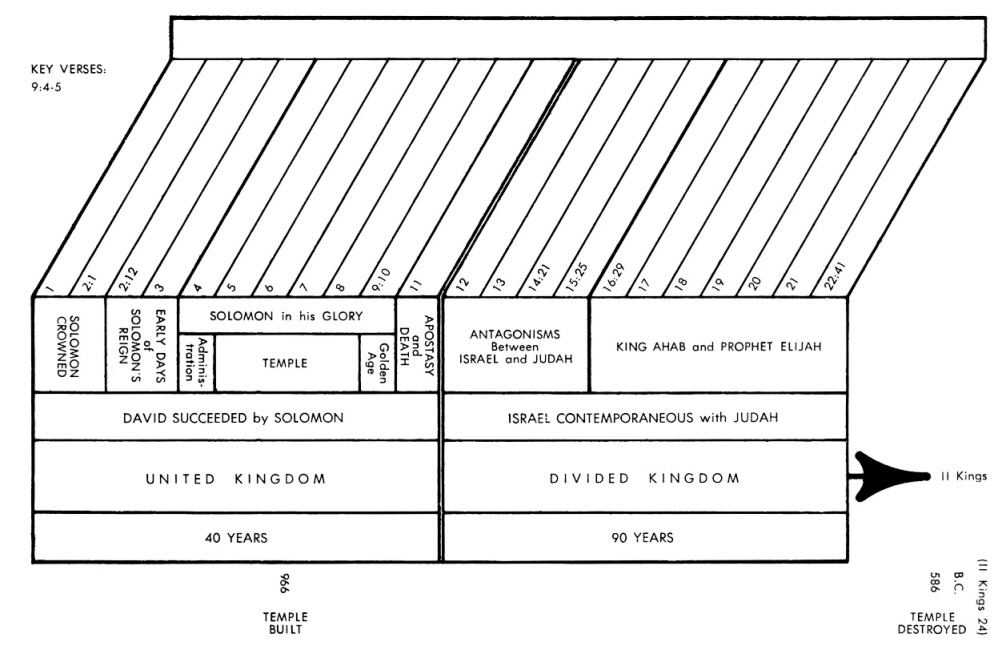
Chart from recommended resource Jensen's Survey of the OT - used by permission
1 Kings Chart from Charles Swindoll
THE DOWNWARD SPIRAL
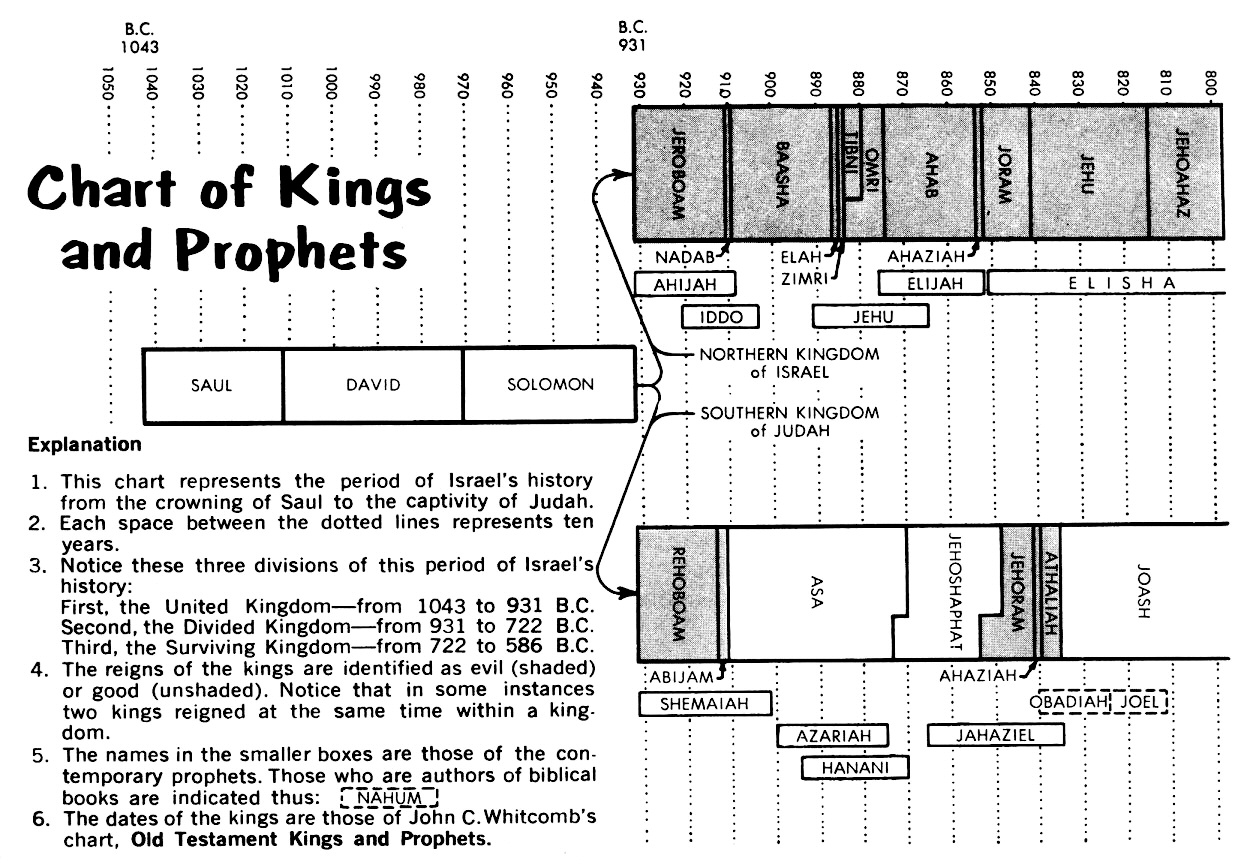
Click to Enlarge
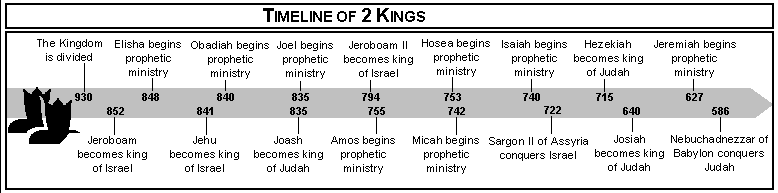
Ryrie Study Bible - Borrow
Click to Enlarge
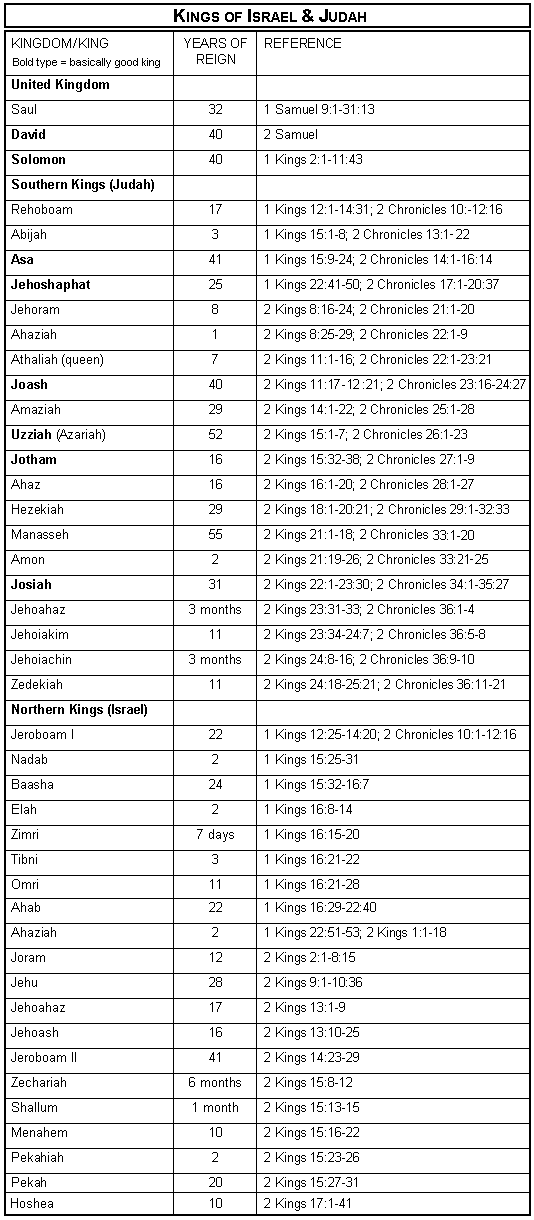
(NOTE: Many consider Amaziah and Hezekiah as "good" kings)
SEE ALSO:
ESV chart - kings of Israel - more information
ESV chart - kings of Judah - more information
Another Chart with Variable Dates for Reigns of Kings
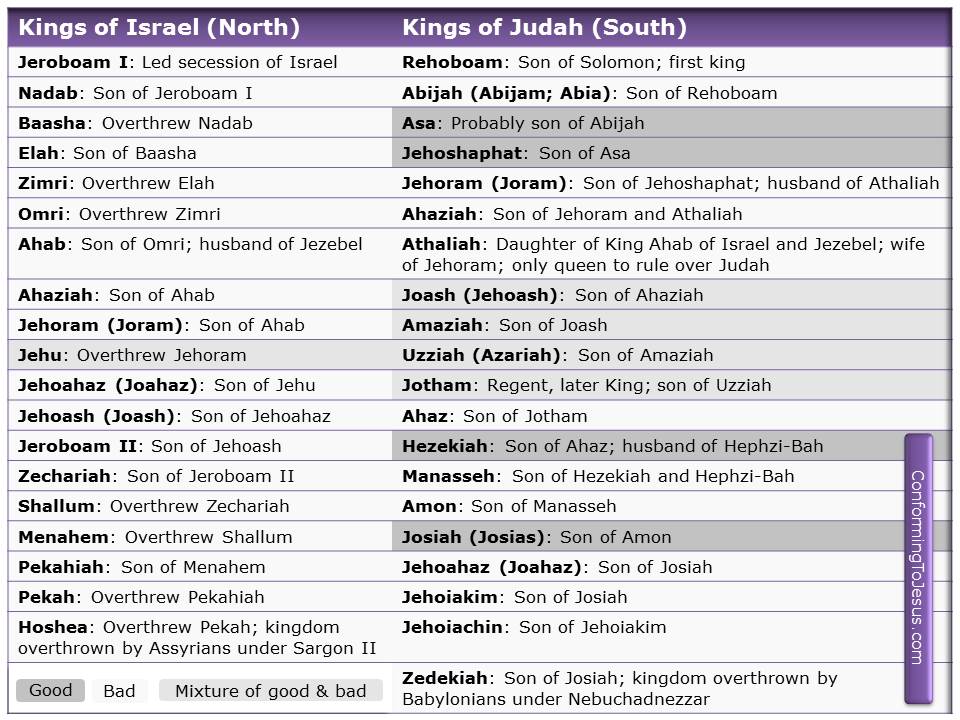
Source: ConformingtoJesus.com
2 Kings 11:1 When Athaliah the mother of Ahaziah saw that her son was dead, she rose and destroyed all the royal offspring.
- Athaliah: 2Ch 22:10, 24:7
- the mother: 2Ki 8:26, 9:27
- and destroyed: Mt 2:13,16 Mt 21:38,39
- seed royal: 2Ki 25:25 *marg: Jer 41:1
- TO HELP HARMONIZE KINGS & CHRONICLES SEE Harmony of 2Kings 11-12 and 2Chronicles 22-24E
Related Passages:
2 Chronicles 22:10 Now when Athaliah the mother of Ahaziah saw that her son was dead, she rose and destroyed all the royal offspring of the house of Judah.
2 Chronicles 24:7 For the sons of the wicked Athaliah had broken into the house of God and even used the holy things of the house of the LORD for the Baals.
2 Kings 8:26 Ahaziah was twenty-two years old when he became king (XR - 2Ch 22:3), and he reigned one year in Jerusalem. And his mother’s name was Athaliah the granddaughter of Omri king of Israel.
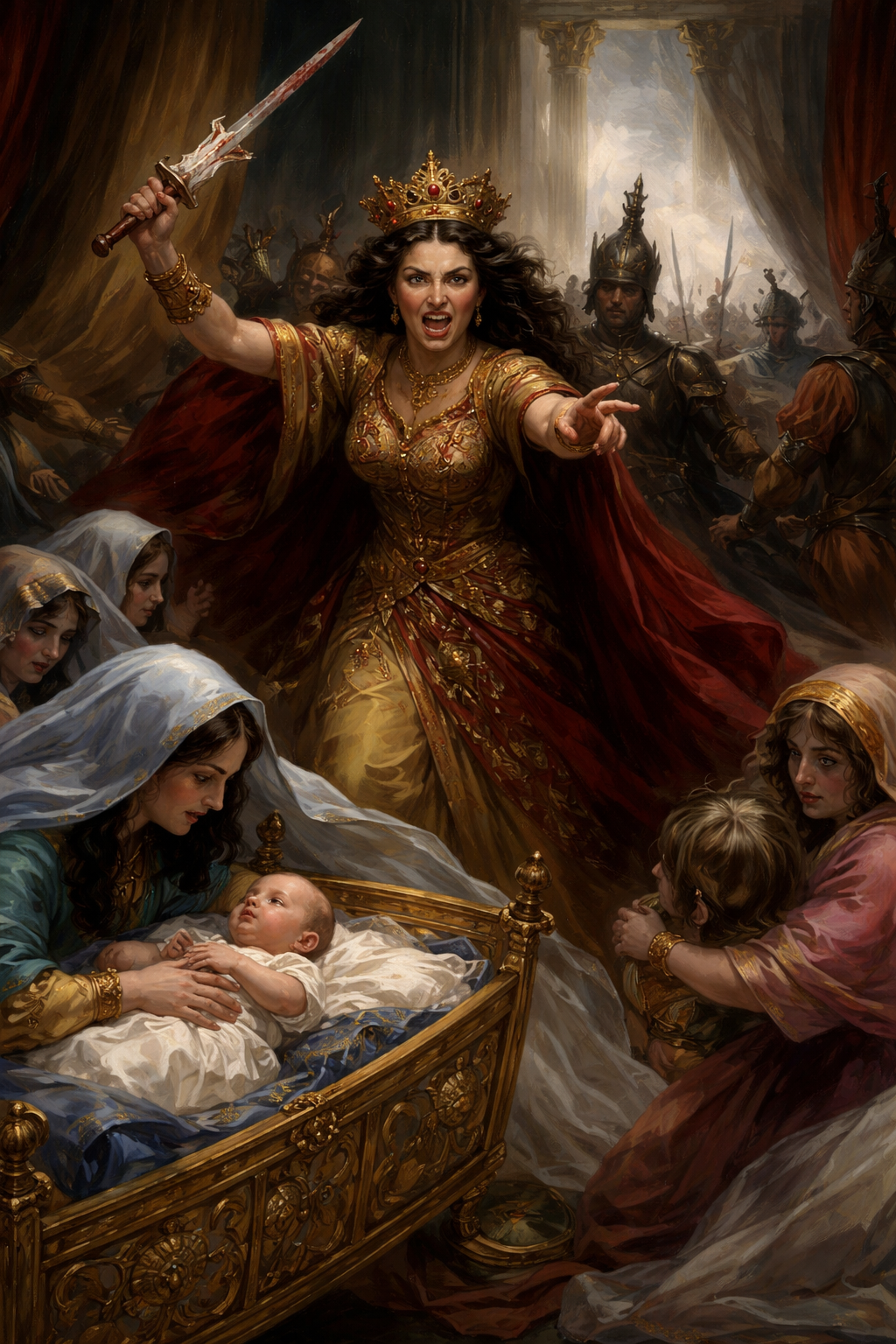
Athaliah's Purge of Davidic Line
THE COLDBLOODED COUP OF
ATHALIAH, "JUDAH'S JEZEBEL"
Other titles for this next section could be "THE LAMP OF DAVID BURNING LOW BUT NOT OUT," "A FLICKERING FLAME IN THE HOUSE OF DAVID." "THE LAST LAMP OF DAVID IN THE ROYAL LINE."
Background - The verse occurs immediately after the bloody purge of 2 Kings 9–10, where Jehu executes judgment on the house of Ahab. Ahaziah king of Judah, Athaliah’s son, is swept up in that judgment because of his alliance with Ahab’s house (2 Ki 9:27). With Ahaziah dead, the Davidic throne is now vulnerable and the Davidic Covenant is close to being extinguished (at least from a human perspective).
When Athaliah the mother of Ahaziah saw that her son was dead - Here is her short Curriculum Vitae -- Athaliah was the daughter of Ahab and Jezebel (2 Ki 8:18, 26), the wife of Jehoram king of Judah, the mother of Ahaziah, an overt Baal worshiper who imported northern apostasy into Judah and was the only usurper to ever replace David's descendants on the throne and the only woman ever to rule Judah, doing so illegitimately. This woman shows us the depth of human depravity and the reality of spiritual warfare. Notice also that she is the only ruler to not have an opening and closing formula applied to her, indicating the writer's (and the Spirit's) derisory view of her rule! Athaliah is like a "bad blip" in the succession rather than an integral part of it!
It is a striking—and tragic—irony that God used Jehu to eradicate Baal worship in the Northern Kingdom, yet through King Joram of Judah and his wife Athaliah, that same Baal worship took root in the Southern Kingdom and persisted there. Though the Lord graciously raised up godly kings who temporarily restrained this corruption, Baalism was never fully eradicated from Judah. Like a smoldering fire, it repeatedly reignited, until it resurfaced with full force during the wicked reign of Manasseh, where it is explicitly listed among his grievous sins (2 Kings 21:3). Thus, roughly 150 years after Joram ascended the throne, the poisonous legacy of Baal worship—introduced through compromise and foreign alliance—continued to defile the land, demonstrating how sin tolerated but not destroyed will inevitably return with greater strength.
🙏 THOUGHT - Is there a sin in your life which you are refusing to eradicate (cf Heb 12:1, Ro 8:13, Gal 5:16,17, 1Pe 2:11).
She rose and destroyed (abad; LXX - apollumi) all the royal (mamlāḵāh; LXX - basileia) offspring (zera - seed; literally "seed of the kingdom"; LXX - sperma) - Note three crucial verbs in this description of Athaliah - "saw...arose...destroyed!" Athaliah sees that her son is dead—and instantly reads the moment for advantage. Her eyes are not filled with grief but with opportunity. What she perceives is not loss, but a power vacuum. Note that evil often begins not with action, but with how one interprets circumstances. Athaliah sees the same facts others see, but through a heart firmly aligned against the LORD.
Athaliah married Jehoram; daughter of king and now the wife of a king; and became the mother of a king; that still wasn’t good enough – became king herself!
She rose signals intentional action and deliberate resolve as she makes a calculated seizure of power by carrying out a political purge, violently usurping the throne. Athaliah does not drift into wickedness, but stands up to seize control. She moves from perception to position, from seeing an opening to stepping into it. It is clear she moved expeditiously before anyone else could take action and assume power in Judah.
🙏 THOUGHT - Beloved, mark this as an immutable principle: when God’s restraints are cast off, evil does not hesitate—it rises! It seeks to "fill the power vaccum! (so to speak)" Therefore, we must heed and continually practice under grace our Lord’s words of warning to His disciples in the Garden, spoken at the very hour when both temptation and danger were at their greatest. "Keep watching (gregoreuo - present imperative calling for our continual dependence on the Holy Spirit to obey) and praying (proseuchomai - present imperative again calling for our continual dependence on the Holy Spirit to obey) that you may not enter into temptation; the spirit is willing, but the flesh is weak.” (Mt 26:41).
Jezebel is dead; but her daughter Athaliah lives,
and the mother’s spirit yet haunts the earth in her.
--John Kitto
And destroyed (abad; LXX - apollumi) (mamlāḵāh; LXX - basileia) offspring (zera - seed; literally "seed of the kingdom"; LXX - sperma) (Heb. seed of the kingdom) - She attempts extermination of the Davidic line, which would in turn erase the Messianic line. Athaliah is clearly a human instrument of Satan echoing similar attempts to eradicate the Messianic line by Pharaoh who sought to kill the Hebrew male infants (Ex 1:15-22) and King Herod who slaughtered Bethlehem’s children in an attempt to kill the infant Messiah (Matt 2:13-18). Satan has always attempted to destroy the line through which the Messiah would come, but praise God, He has always sovereignly preserved it. And so in our current story, the house of David has been reduced to a single spark, but God would keep that spark alive, and all the power of hell could not quench it! (cf Mt 16:18) Can I hear an "AMEN"?
The previous deaths of Jehoram’s brothers (2Ch 21:4) and Ahaziah’s brothers and relatives (2Ki 10:12-14; 2Ch 21:17) left only her grandchildren for Athaliah to put to death to destroy the Davidic line.
Adam Clarke - How dreadful is the lust of reigning! It destroys all the charities of life; and turns fathers, mothers, brothers, and children, into the most ferocious savages!
Athaliah is Jezebel
transplanted into Jerusalem.
It is not a shock that Athaliah is a chip off the old block of her mother Jezebel. Athaliah killed the royal heirs, usurped the throne, established her mother's favorite religion, Baal worship, even having the evil audacity to pollute Yahweh’s house and desecrate His holy things (2Ch 24:7)! Jezebel killed prophets, usurped authority (she wore the "pants" in Ahab's rule), promoted Baalism and opposed Yahweh’s word through His prophets (Elijah and others).
Bob Utley - "she rose and destroyed all the royal offspring" She wanted to reign and acted to secure her reign by killing all the royal seed. But this would violate YHWH's promise to David in 2 Samuel 7; 1 Chronicles 17.She had all her relatives killed who were descendants of David. There were not many left.
- her husband Jehoram (Joram) had his brothers killed (2 Chr. 21:1-4)
- a divinely sent Arab raid took others into captivity (2 Chr. 21:16-17)
- a divinely sent Jehu killed other relatives in 2 Kgs. 10:13-14
John Walton - Athaliah’s executions. As queen mother (see comment on 1 Kings 2:19) during the reign of her son Ahaziah, Athaliah enjoyed an exalted position as “sovereign,” which was evidently an official title. This afforded her a special influence on ceremonial and political matters. Following the custom of other dynasts, the usurper Athaliah attempted to destroy the members of the previous Davidic dynasty, in the same fashion that usurpers in the northern kingdom had killed off members of the previous dynasty. Such annihilations of ruling families was common practice both in Israel and in the ancient Near East at large. There is wide precedent in Mesopotamian texts for the elimination of all rival claimants to the throne when a king comes to power.(IVP Background Commentary - OT - page 443) (See also Wikipedia)
Here’s another sample of Yahweh’s
hidden and roundabout work.
Dale Ralph Davis has an interesting observation on God's role in this strategic chapter - I have tried to show that this episode is of immense importance in redemptive history because the covenant with David was almost dead and buried under Athaliah’s rampage. She had almost succeeded in writing ‘finis!’ over Yahweh’s kingdom plan. Yahweh is so vigilant in maintaining His king and His kingdom! I think the writer of 2 Kings 11 would agree that it was his intent to show that. But how does he do it? Does he explicitly state Yahweh’s intervention or record any word or directive of Yahweh’s? Note how the whole narrative is simply descriptive— there is no ‘Yahweh said’ this or ‘Yahweh did’ that. To be sure Yahweh is mentioned but all are ‘third person’ references: nine times in the phrase ‘the house of Yahweh’ and twice where the writer refers to Him. But you see how indirect it is? Never does Yahweh even interject a word nor is there any reference to any explicit activity on His part. We’ve seen this before; here’s another sample of Yahweh’s hidden and roundabout work.(BORROW 2 Kings: The Power and the Fury page 168)
Wiersbe: When God began to restore true worship in Jerusalem and Judah, He started with one dedicated couple – Jehoiada the high priest and his wife, Jehosheba. They enlisted the nurse who cared for Joash, and God protected all four of them for six years. Then Jehoiada enlisted the five military captains, who in turn assembled their five hundred soldiers. The scattered priests, Levites, and people of the land came together as one to honor the Lord and obey His Word. Sin was purged, God’s will was accomplished and the name of the Lord was glorified! (Bible Exposition Commentary)
Bob Deffinbaugh has an interesting comment on Athaliah's 7 year reign - She reigned for nearly seven years, and I cannot help but look at this period as a kind of a “tribulation period” for Judah. It certainly prepared them for the unexpected appearance of the legitimate king, who would sit on the throne of his father, David. The appearance was that evil had won the day, that Athaliah had seized the throne and succeeded in terminating the dynasty of David. But appearances were not reality.
Destroyed (annihilated, exterminated)(06) abad cp Abaddon 011) is a verb meaning to perish, to be destroyed, to be ruined, to be lost, to in a state of ruin and destruction pertaining to an object, including the death (Ex 10:7). Abad can mean literally to die, or, in the case of things, reputation, etc., to pass away. In a causative sense, abad means to destroy, to reduce to some degree of disorder. God’s destruction of evil, both threatened (Lev. 26:38) and realized (Nu 17:12); Israel’s destruction of the Canaanites and their altars (Nu 33:52; Dt. 12:2, 3); the perishing of natural life (Ps. 49:10; 102:26; Eccl. 7:15); the perishing of abstract qualities such as wisdom and hope (Isa. 29:14; Lam. 3:18); and an item or animal being lost (Dt. 22:3; Eccl. 3:6)
See 4.5 page article on Abad and cognates in the Theological Dictionary Of The Old Testament page 19 (online)
Gilbrant - This word was used of something being destroyed, ruined, or obliterated, so that it ceases to exist or function as it once did. Thus, it can mean “to be annihilated,” “to be exterminated” or “to perish.” Sometimes the sense is something “being lost.” In other words, the owner’s lost item has gone out of existence. At least temporarily, it has disappeared. To be lost is also to be in danger of perishing, or being killed or destroyed.
This is the word used in Exo. 10:7 regarding Egypt’s destruction from the plagues. The word is often parallel to death (Num. 17:12, Ps. 31:12).
In Job 4:9, 20, the wicked are said to perish forever in parallel with God destroying or breaking them into pieces. Micah 7:2 says the godly have perished from the earth, meaning they have disappeared, been annihilated or exterminated from this life. In Est. 8:11, the form of the verb (Piel), which means “to cause to perish,” is used in parallel with words for destroying and killing attackers. Deuteronomy 7:24 states that the Israelites would cause the name of the Canaanites to perish. In other words, they would exterminate them. Jeremiah 23:1 condemns shepherds who destroy the LORD’S sheep in parallel to scattering, driving away neglecting them and generally doing evil.
A participle of this verb is used in Ezek. 34:4 of the lost sheep and the wicked shepherds. God’s people were not searched for by the shepherds. The sheep were scattered and eaten by wild animals. Ecclesiastes 3:6 says there is a time to search and a time to surrender the lost. A bribe is said “to destroy” the heart in Ecc. 7:7. A memory can perish or be obliterated (Isa. 26:14). Hope can be destroyed, wiped out or perish (Job 8:13, Ezek. 37:11). The heart can perish in the sense of being emotionally devastated, the will destroyed, and all courage wiped out in horrified response to the wrath of God as in Jer. 4:9. A voice or sound can be caused to perish in the sense of “banished” (Jer. 25:10). In Prov. 10:28, the expectations of the wicked “perish” or “come to nothing.” When a person dies, his or her plans “perish” or “come to an end” (Ps. 146:4). The persecuted one says refuge has “perished” or “vanished” (Ps. 142:4). (Complete Biblical Library)
ABAD IN KINGS & CHRONICLES -2 Ki. 9:8; 2 Ki. 10:19; 2 Ki. 11:1; 2 Ki. 13:7; 2 Ki. 19:18; 2 Ki. 21:3; 2 Ki. 24:2; 2 Chr. 22:10;
Royal (KINGDOM) (04467) mamlāḵāh from melek = king) is a feminine noun meaning kingdom. Often the term refers to the royal power an individual in sovereign authority possesses. Because Solomon did not keep the Lord’s covenant and commandments, his kingdom (that is, his power to rule) was torn from his son (1Ki 11:11; cf. 1Sa 28:17; 1Ki 14:8). In many other places, however, the word is utilized concretely to denote a people under a king (that is, a realm). The kingdom (or realm) of King Sihon of the Amorites and the kingdom (realm) of King Og of Bashan were given to the Gadites, Reubenites, and the half-tribe of Manasseh (Nu 32:33; cf. Ex 19:6; Dt. 28:25; 1Sa 24:20). In some passages, the word functions as an adjective, meaning royal (e.g., city of the kingdom = royal city; Josh. 10:2; 1Sa 27:5; cf. 2Ki 11:1; 2Chr. 23:20; Amos 7:13). This noun derives from the verb mālaḵ (4427), as does its synonym, malḵûṯ (4438). (The Complete Word Study Old Testament)
MAMLAKAH - 113V - dominion(1), kingdom(58), kingdoms(48), reign(2), royal(6), rule(1), sovereignty(1).Gen. 10:10; Gen. 20:9; Exod. 19:6; Num. 32:33; Deut. 3:4; Deut. 3:10; Deut. 3:13; Deut. 3:21; Deut. 17:18; Deut. 17:20; Deut. 28:25; Jos. 10:2; Jos. 11:10; 1 Sam. 10:18; 1 Sam. 13:13; 1 Sam. 13:14; 1 Sam. 24:20; 1 Sam. 27:5; 1 Sam. 28:17; 2 Sam. 3:10; 2 Sam. 3:28; 2 Sam. 5:12; 2 Sam. 7:12; 2 Sam. 7:13; 2 Sam. 7:16; 1 Ki. 2:46; 1 Ki. 4:21; 1 Ki. 9:5; 1 Ki. 10:20; 1 Ki. 11:11; 1 Ki. 11:13; 1 Ki. 11:31; 1 Ki. 11:34; 1 Ki. 12:26; 1 Ki. 14:8; 1 Ki. 18:10; 2 Ki. 11:1; 2 Ki. 14:5; 2 Ki. 15:19; 2 Ki. 19:15; 2 Ki. 19:19; 1 Chr. 16:20; 1 Chr. 29:11; 1 Chr. 29:30; 2 Chr. 9:19; 2 Chr. 11:1; 2 Chr. 12:8; 2 Chr. 13:5; 2 Chr. 13:8; 2 Chr. 14:5; 2 Chr. 17:5; 2 Chr. 17:10; 2 Chr. 20:6; 2 Chr. 20:29; 2 Chr. 21:3; 2 Chr. 21:4; 2 Chr. 22:9; 2 Chr. 22:10; 2 Chr. 23:20; 2 Chr. 25:3; 2 Chr. 29:21; 2 Chr. 32:15; 2 Chr. 36:23; Ezr. 1:2; Neh. 9:22; Ps. 46:6; Ps. 68:32; Ps. 79:6; Ps. 102:22; Ps. 105:13; Ps. 135:11; Isa. 9:7; Isa. 10:10; Isa. 13:4; Isa. 13:19; Isa. 14:16; Isa. 17:3; Isa. 19:2; Isa. 23:11; Isa. 23:17; Isa. 37:16; Isa. 37:20; Isa. 47:5; Isa. 60:12; Jer. 1:10; Jer. 1:15; Jer. 15:4; Jer. 18:7; Jer. 18:9; Jer. 24:9; Jer. 25:26; Jer. 27:1; Jer. 27:8; Jer. 28:1; Jer. 28:8; Jer. 29:18; Jer. 34:1; Jer. 34:17; Jer. 49:28; Jer. 51:20; Jer. 51:27; Lam. 2:2; Ezek. 17:14; Ezek. 29:14; Ezek. 29:15; Ezek. 37:22; Amos 6:2; Amos 7:13; Amos 9:8; Mic. 4:8; Nah. 3:5; Zeph. 3:8; Hag. 2:22
Josephus Antiquities 9.7.3. records the following about this event...
1. [An. 885.] Now when Athaliah, the daughter of Ahab, heard of the death of her brother Joram, and of her son Ahaziah, and of the royal family, she endeavoured that none of the house of David might be left alive; but that the whole family might be exterminated: that no King might arise out of it afterward. And, as she thought, she had actually done it. But one of Ahaziah’s sons was preserved; who escaped death after the manner following. Ahaziah had a sister, by the same father, whose name was Jehosheba; and she was married to the High Priest Jehoiada. She went into the King’s palace, and found Jehoash, for that was the little child’s name, who was not above a year old, among those that were slain, but concealed, with his nurse. So she took him with her into a secret bedchamber, and shut him up there; and she and her husband Jehoiada brought him up privately in the temple, six years: during which time Athaliah reigned over Jerusalem, and the two tribes.
QUESTION - Who was Athaliah in the Bible? | GotQuestions.org
ANSWER - Athaliah was queen of Judah from 841–835 BC and the only female monarch to sit on David’s throne in biblical history. Athaliah was the daughter of King Ahab and Queen Jezebel of Israel, and she married Jehoram, the eldest son of Judah’s King Jehoshophat. Her time as queen is nestled amid centuries of evil monarchs who reigned over Judah and Israel. An avid Baal zealot, Athaliah rivaled the wickedness of the kings who came before and after her. Her story can be found in 2 Kings 11 and 2 Chronicles 22–23.
Athaliah’s husband, Jehoram, was king of Judah until his death in 841 BC. Unlike his father, Jehoram was a wicked king. Athaliah’s son, Ahaziah, at the age of 22, ascended to the throne, and proved himself just as evil as his father (2 Kings 8:18, 25–27). Athaliah counseled her son in his devilish schemes (2 Chronicles 22:3). Ahaziah served as king of Judah for less than one year, for he was assassinated along with Israel’s ailing king, Joram. Their assassin was Jehu, who had originally been a commander in King Ahab’s army (2 Kings 9:5, 25). The prophet Elisha had anointed Jehu as the new king of Israel and commissioned him as an instrument of the Lord to carry out God’s judgment on King Ahab and his entire idolatrous family (1 Kings 19:1–17; 2 Kings 9:1–13). Jehu’s mission of ending Ahab’s dynasty included putting Jezebel and her sons to death. Ahaziah happened to be visiting Joram when Jehu arrived to assassinate Joram, and Ahaziah was killed, too.
When Athaliah received word that her son was dead, she seized the opportunity to usurp the throne by murdering Ahaziah’s sons—her own grandsons—thus eradicating the entire royal family so she could take the throne. Unbeknownst to Athaliah, a single grandchild escaped the massacre. Jehosheba, the baby’s aunt and the wife of the high priest Jehoiada, took the infant Joash and hid him and his nurse in a bedroom. Joash was later smuggled out of the castle and taken to the temple, where he remained hidden for six years while Queen Athaliah reigned over the land (2 Kings 11:1–3).
As queen, Athaliah used her influence to further establish Baal worship in Judah, installing priests and building altars for her idol in the very temple of the Lord (2 Kings 11:18; 2 Chronicles 24:7). In this way Athaliah followed the footsteps of her mother, Jezebel. Interestingly, the name Athaliah means either “God is exalted” or “dealt violently with by God.” Queen Athaliah did not exalt God with her life; instead, God dealt violently with her.
After Athaliah had reigned six years, the high priest Jehoiada set guards around the temple and publicly crowned the young Joash as the rightful king. As the new king was anointed, “the people clapped their hands and shouted, ‘Long live the king!’” (2 Kings 11:12). Athaliah heard the commotion, realized what was happening, and ran out of the palace shouting, “Treason! Treason!” (verse 13). Jehoiada commanded the troops to capture Athaliah and execute her, and so they killed the queen “where the horses enter the palace grounds” (verse 16). Seven-year-old King Joash, under the direction of the faithful high priest, tore down the temple of Baal, smashed the altars and images of Baal, and killed the priest of Baal. And “all the people of the land rejoiced, and the city was calm, because Athaliah had been slain” (verse 20).
2 Kings 11:2 But Jehosheba, the daughter of King Joram, sister of Ahaziah, took Joash the son of Ahaziah and stole him from among the king’s sons who were being put to death, and placed him and his nurse in the bedroom. So they hid him from Athaliah, and he was not put to death.
- Jehosheba: 2Ch 22:11, Jehoshabeath
- Joram: 2Ki 8:16, Jehoram
- Joash: 2Ki 12:1,2, Jehoash
- hid him: 2Ki 8:19 Pr 21:30 Isa 7:6,7 37:35 65:8,9 Jer 33:17,21,26
- in the bedroom"in a chamber of beds;" 1Ki 6:5,6,8,10 Jer 35:2 Eze 40:45
Related Passages:
2 Chronicles 22:11 But Jehoshabeath the king’s daughter took Joash the son of Ahaziah, and stole him from among the king’s sons who were being put to death, and placed him and his nurse in the bedroom. So Jehoshabeath, the daughter of King Jehoram, the wife of Jehoiada the priest (for she was the sister of Ahaziah), hid him from Athaliah so that she would not put him to death.
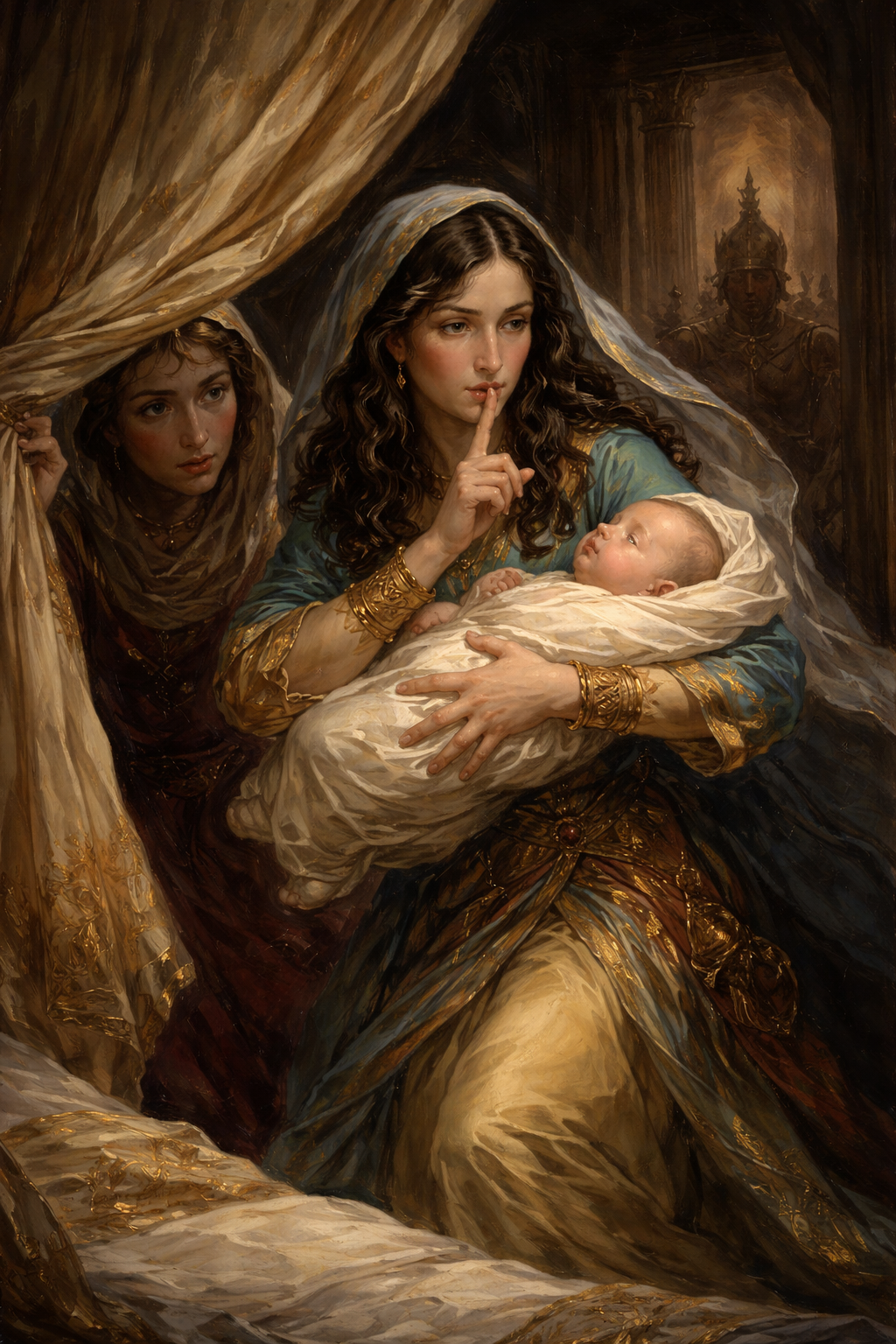
Athaliah's Purge Misses One Infant - Joash
A DIVINELY ORDAINED
"KIDNAPPING"
But - Term of contrast. This strategic hinge word marks a turning point in what could have been a messianic catastrophe and on this small "hinge" swings open a door of messianic hope! (See also How Understanding One Word Can Change the Way You Read the Bible). Athaliah believed she had secured victory, removing every piece from the chess board. Yet unseen by her, God was positioning the final move—“Checkmate!”
Dale Ralph Davis titled his commentary on 2 Kings 11 as "The Lady Who Saved Christmas!"
G Campbell Morgan - “Thus evil always breaks down. It is extremely clever, it calculates on all the changes, and seems to leave no unguarded place; but with unvarying regularity it fails somewhere to cover up its tracks, or to insure its victory.”
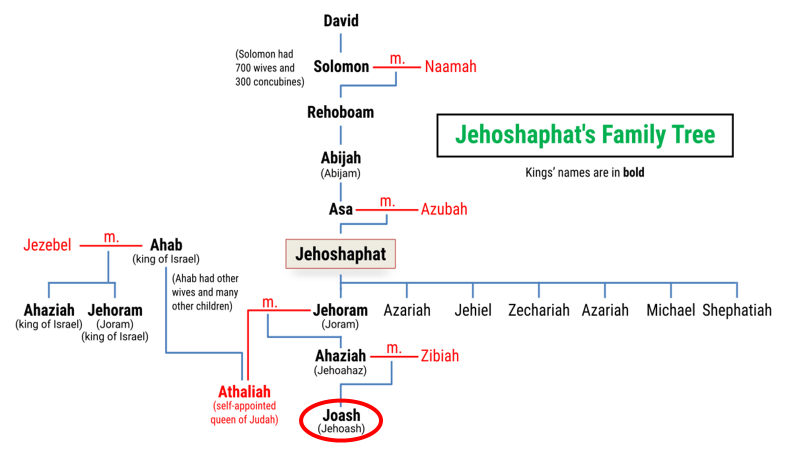
Jehosheba, the daughter of King Joram (of Judah), sister of Ahaziah - Note that Jehosheba was daughter of King Joram but surely not a daughter of Athaliah, but a daugher of Joram by another wife. This is the sole mention of Jehosheba in the Kings (but her alternative name Jehoshabeath is used once in 2Ch 22:11), but it speaks volumes as they say! Divinely speaking, one faithful woman changes everything. Jehosheba appears suddenly and briefly, yet her obedience alters redemptive history. This is one of Scripture’s recurring patterns that God often preserves His promises through quiet, courageous obedience, not public power. Since Jehosheba is a member of Athaliah's household, this move took incredible courage for it clearly put her life at high risk! She probably did not know the doctrine of the divine remnant, but clearly put it into practice.
Jehosheba means "Jehovah has sworn" (or "Jehovah's oath") and it is surely no coincidence that God uses this faithful woman to preserve the Word He swore in the Davidic Covenant. Her name is mentioned only here and in 1Ch 22:11 but is memorialized for all eternity for her part in preserving the line of the Messiah! This woman reminds us that even in the midst of spiritual darkness and great evil, God has faithful followers, much like in the dark days of the Judges (Jdg 21:25), which had the shining lights of Ruth and Boaz, who also were instrumental in propagating the line of the Messiah! (Mt 1:5)
🙏 THOUGHT - Days are dark in America in 2026 but God has His faithful remnant and His purposes will not be thwarted but will be accomplished. If God is calling you to be a "Jehosheba" or a "Ruth" or a "Boaz," then may He give you the grace to answer His call and carry out the "good works" (Eph 2:10) He has prepared for you in Christ Jesus, for His glory and honor. Amen.
Took Joash the son of Ahaziah and stole him from among the king’s sons who were being put to death - Joash (other name Jehoash used primarily in 2 Chronicles 22-24) is a helpless infant, the last surviving heir of David and obviously unaware he carries the Messianic line as the sole representative to ensure fulfillment of God's covenant promise (2Sa 7:12,13). The verb stole is chilling for it suggests the slaughter was actively going on and Jehosheba, in a race against death, snatches Joash moments before the sword would have amputated his tiny royal head! The point is that Jehosheba did not just protect him but actively grabbed him out of harm's way in a eternally significant act of courage! And without going too far, think about the risks which would have included a baby crying loudly which could have alerted the execution! God orchestrated this royal kidnapping and made sure it would not be discovered!
Bob Utley - Joash the son of Ahaziah" He is called "Jehoash" in v. 21 (NIDOTTE, vol. 4, pp. 279-280). The account of Ahaziah's death is recorded in 2 Kgs. 9:27-28. The Jewish Study Bible, p. 747, has an interesting note about why the names of kings of this period have different spellings. "Joash (cf. Also 12-19, 20; 13:1) is also called Jehoash (12:1, 5). The difference in the form of the name is due to peculiarities in regional pronunciations of Heb during the biblical period. Both forms are found in Kings because the author tended to write names as he found them in his sources."
From Chronicles we learn in 2Ch 22:11 we learn a little more about Jehosheba, the writer adding that Jehoshabeath (her other name) was "the daughter of King Jehoram, the wife of Jehoiada the priest (for she was the sister of Ahaziah)." So she would have been the aunt of Joash.
And placed him and his nurse in the bedroom - The Hebrew term bedroom suggests a small, concealed storage or sleeping chamber that protected the nurse and the infant. I would suggest this unnamed nurse was also courageous for she knew the risk of hiding Joash from Athaliah's venom and sword! So here we have two faithful women taking part in presevation of Josah and the Davidic line, reminding us of the two faithful women who were instrumental in preserving the infant Moses from Pharoah's sword.
NET NOTE - Heb “him and his nurse in an inner room of beds.” The verb is missing in the Hebrew text. The parallel passage in 2 Chr 22:11 has “and she put” at the beginning of the clause. M. Cogan and H. Tadmor (II Kings [AB], 126) regard the Chronicles passage as an editorial attempt to clarify the difficulty of the original text. They prefer to take “him and his nurse” as objects of the verb “stole” and understand “in the bedroom” as the place where the royal descendants were executed. The phrase בַּחֲדַר הַמִּטּוֹת (bakhadar hammittot), “an inner room of beds,” is sometimes understood as referring to a bedroom (HALOT 293 s.v. חֶדֶר), though some prefer to see here a “room where the covers and cloths were kept for the beds (HALOT 573 s.v. מִטָּת). In either case, it may have been a temporary hideout, for v. 3 indicates that the child hid in the temple for six years.
Bob Utley - "in the bedroom" This term (BDB 641) can mean where one sleeps ‒ Exod. 8:3; 2 Sam. 4:7; 2 Kgs. 6:12 where extra bedding is stored ‒ 2 Kgs. 11:1; 2 Chr. 22:11 Later the boy was kept in the temple chambers reserved for the priests (or possibly the High Priest only, v. 3; suggestion by Rashi and Kimchi). This is why Athaliah could not find him.
So they hid him from Athaliah, and he was not put to death - There is a saying out of sight, out of mind but the story of Joash proves just the opposite. Though Joash was hidden from Athaliah’s sight, he was never hidden from God’s mind and care. While a murderous queen believed the future had been eliminated, God was quietly preserving His promise in secret. Joash was out of Athaliah’s reach, but he was continually in God’s mind, being guarded, sustained, and waiting to appointed for His time. Praise the Lord, Whose purposes cannot be seen by tyrants, silenced by violence, or erased by human schemes!
David Guzik - Like the boy Samuel, Joash grew up in the temple. Like Samuel, he probably found little ways to help the priests, whatever could be done without attracting too much attention.
Athaliah rose to destroy the royal seed, believing she could erase God’s promise with a sword. But while she was slaughtering children, God was hiding one—because covenant faithfulness does not depend on thrones, armies, or numbers, but on the faithfulness of the LORD.
Bob Utley - Irony—two royal children saved; one is evil, Ahaziah and one is godly, Joash. The Messianic line from David continues! There were still godly, faithful people in Judah. Jehoshabeath is
- King Jehoram of Judah's daughter
- wife of Jehoida the priest
- sister of King Ahaziah
- Athaliah's daughter or the daughter of another wife/concubine of Jehoram
Joash means "Yahweh has given (bestowed)" Joash was a hidden child, a threatened heir but a preserved promise, so that even his name preaches theology! What Athaliah tried to destroy, God “gave.” In other words, even Joash’s name is a quiet testimony to the fact that the Davidic linesurvived not by fate or chance, but by God’s sovereign gift, the gift of preservation and protection from evil.
Joash is used 18x in 15v in 2 Kings 11-14 - 2Ki. 11:2; 2Ki. 12:19; 2Ki. 12:20; 2Ki. 13:1; 2Ki. 13:9; 2Ki. 13:10; 2Ki. 13:12; 2Ki. 13:13; 2Ki. 13:14; 2Ki. 13:25; 2Ki. 14:1; 2Ki. 14:3; 2Ki. 14:17; 2Ki. 14:23; 2Ki. 14:27
QUESTON - Who was King Joash (Jehoash) in the Bible? | GotQuestions.org
ANSWER - There are two kings with the name Joash (or Jehoash) in the Bible: one a king of Judah (reigned 835–796 BC) and the other a king of Israel (reigned 798–782 BC).
The story of King Joash of Judah starts with that of King Jehu of Israel. Anointed king of Israel by Elisha, Jehu was tasked with destroying King Ahab’s descendants and wiping out Baal worship in the land (2 Kings 9). 1 Kings 21:25–26 gives the reason for the judgment: “There was never anyone like Ahab, who sold himself to do evil in the eyes of the Lord, urged on by Jezebel his wife. He behaved in the vilest manner by going after idols, like the Amorites the Lord drove out before Israel.” God had told Ahab, through Elijah, “I am going to bring disaster on you. I will wipe out your descendants and cut off from Ahab every last male in Israel—slave or free, . . . because you have aroused my anger and have caused Israel to sin” (1 Kings 21:21–22). Ahab responded to the prophecy with mourning and in humility, so God relented, saying that He would not bring the disaster in Ahab’s time but during his son’s reign. Jehu was God’s instrument to fulfill the prophecy.
After Jehu was anointed king over Israel, he set out against Joram, a son of Ahab and the current king of Israel. Ahaziah (different from the other son of Ahab who initially succeeded him) was king of Judah at the time and was with Joram. Judah’s Ahaziah, however, “followed the ways of the house of Ahab and did evil in the eyes of the Lord, as the house of Ahab had done, for he was related by marriage to Ahab’s family” (2 Kings 8:27). Jehu killed both Ahaziah and Joram; executed Ahab’s wife, Jezebel; killed Ahab’s descendants; and “wiped out Baal from Israel” (2 Kings 10:28, ESV). Unfortunately, Jehu himself did not walk in the ways of God, but, since he had been faithful to God’s call to rid Israel of Baal worship, God promised that four generations of his line would be king of Israel (2 Kings 10:30).
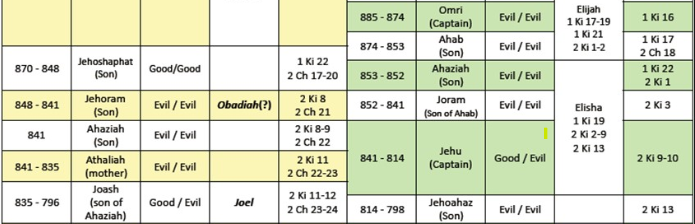
Good/Evil = Beginning of Reign/End of Reign
King Joash of Judah first comes on the scene when Athaliah, the mother of King Ahaziah, whom Jehu had killed, took charge of Judah. Athaliah killed all of the royal family she could find in Judah in order to secure the throne for herself. However, Athaliah missed one of her grandsons—the infant Joash. The evil queen’s daughter (or possibly step-daughter) rescued young Joash and his nurse, and the child was hidden for six years in the temple while Athaliah reigned in Judah (2 Kings 11:1–3). In the seventh year, the priest Jehoiada revealed Joash to the captains of the guards. The priest made an agreement with them to provide protection to the temple and the rightful king, and Jehoiada brought Joash out into public and anointed him as king (2 Kings 11:4–12). The people of Judah rejoiced over Joash’s appointment. Upon hearing the noise of the ceremony, Queen Athaliah rushed to the temple, crying, "Treason! Treason!” By Jehoiada’s command, Athaliah was captured by the guards, removed from the temple, and put to death (2 Kings 11:13–16). “Jehoiada then made a covenant between the Lord and the king and people that they would be the Lord’s people. He also made a covenant between the king and the people” (2 Kings 11:17). The people tore down the temple of Baal, watchmen were set over the Lord’s temple, and, at the age of seven, Joash took the throne (2 Kings 11:18–21).
2 Kings 12:1–3 says that Joash “reigned in Jerusalem forty years. . . . Joash did what was right in the eyes of the Lord all the years Jehoiada the priest instructed him.” Second Kings 12 goes on to describe various financial dealings of Joash. King Joash’s main achievement was making repairs to the temple (2 Kings 12:4–16). He also used a monetary gift to dissuade King Hazael of Aram (Syria) from attacking Jerusalem (2 Kings 12:17–18).
The tragedy of King Joash of Judah is that, after his mentor and guardian, Jehoiada, died, he began listening to wicked advisers. Joash revived Baal and Asherah worship in Judah (2 Chronicles 24:17–19). God sent prophets to warn Joash, but he did not listen to them. Finally, the prophet Zechariah, son of the priest Jehoiada, brought God’s word to Joash, but the king callously ordered the son of his old friend to be stoned to death (verses 19–22). Joash’s reign did not end peacefully: “His officials conspired against him and assassinated him at Beth Millo, on the road down to Silla” (2 Kings 12:20). Joash’s son Amaziah took over the throne, and Amaziah “did what was right in the eyes of the Lord,” but, the Bible notes, he was more like his father Joash than his ancestor David (2 Kings 14:3–4). Interestingly, Amaziah interacted with the other King Joash in the Bible.
King Joash of Israel began his reign in the thirty-seventh year of the reign of King Joash of Judah, so there was some overlap. King Amaziah started ruling Judah in the second year of King Joash of Israel. Amaziah of Judah battled against the Edomites and then challenged Joash of Israel to battle (2 Kings 14:7–8). Joash refused, essentially telling Amaziah he was needlessly stirring up trouble (2 Kings 14:9–10). Amaziah did not heed the warning, and Joash of Israel defeated Judah in battle. Second Chronicles 25:20 says that Judah’s defeat was “because they sought the gods of Edom.”
Second Kings records another of Joash of Israel’s military victories. When Joash’s father, Jehoahaz, was reigning, King Hazael of Aram (the same king that Joash of Judah had kept from attacking Jerusalem) oppressed Israel (2 Kings 13:22). “But the Lord was gracious to them and had compassion and showed concern for them because of his covenant with Abraham, Isaac and Jacob. To this day he has been unwilling to destroy them or banish them from his presence” (2 Kings 13:23). When the prophet Elisha was sick and near to death, King Joash of Israel visited the prophet, apparently disconcerted over the military situation in Israel (2 Kings 13:14). Elisha instructed Joash to shoot arrows out of the open window. The prophet then proclaimed, “The Lord’s arrow of victory, the arrow of victory over Aram! . . . You will completely destroy the Arameans at Aphek” (2 Kings 13:17). Elisha next instructed Joash to strike the ground with the arrows. Joash did so but stopped after three strikes. “The man of God was angry with him and said, ‘You should have struck the ground five or six times; then you would have defeated Aram and completely destroyed it. But now you will defeat it only three times’” (2 Kings 13:19). When Hazael died and his son, Ben-hadad, took over, Joash did defeat him three times. Israel was able to recover cities that previously had been taken from them (2 Kings 13:24–25).
King Joash of Israel ruled for sixteen years and “did evil in the eyes of the Lord and did not turn away from any of the sins of Jeroboam son of Nebat, which he had caused Israel to commit; he continued in them” (2 Kings 13:11). After he died, Joash of Israel was succeeded by his son Jeroboam II (2 Kings 14:16).
2 Kings 11:3 So he was hidden with her in the house of the LORD six years, while Athaliah was reigning over the land.
- Athaliah: Ps 12:8 Mal 3:15
Related Passages
2 Chronicles 22:12 He was hidden with them in the house of God six years while Athaliah reigned over the land.
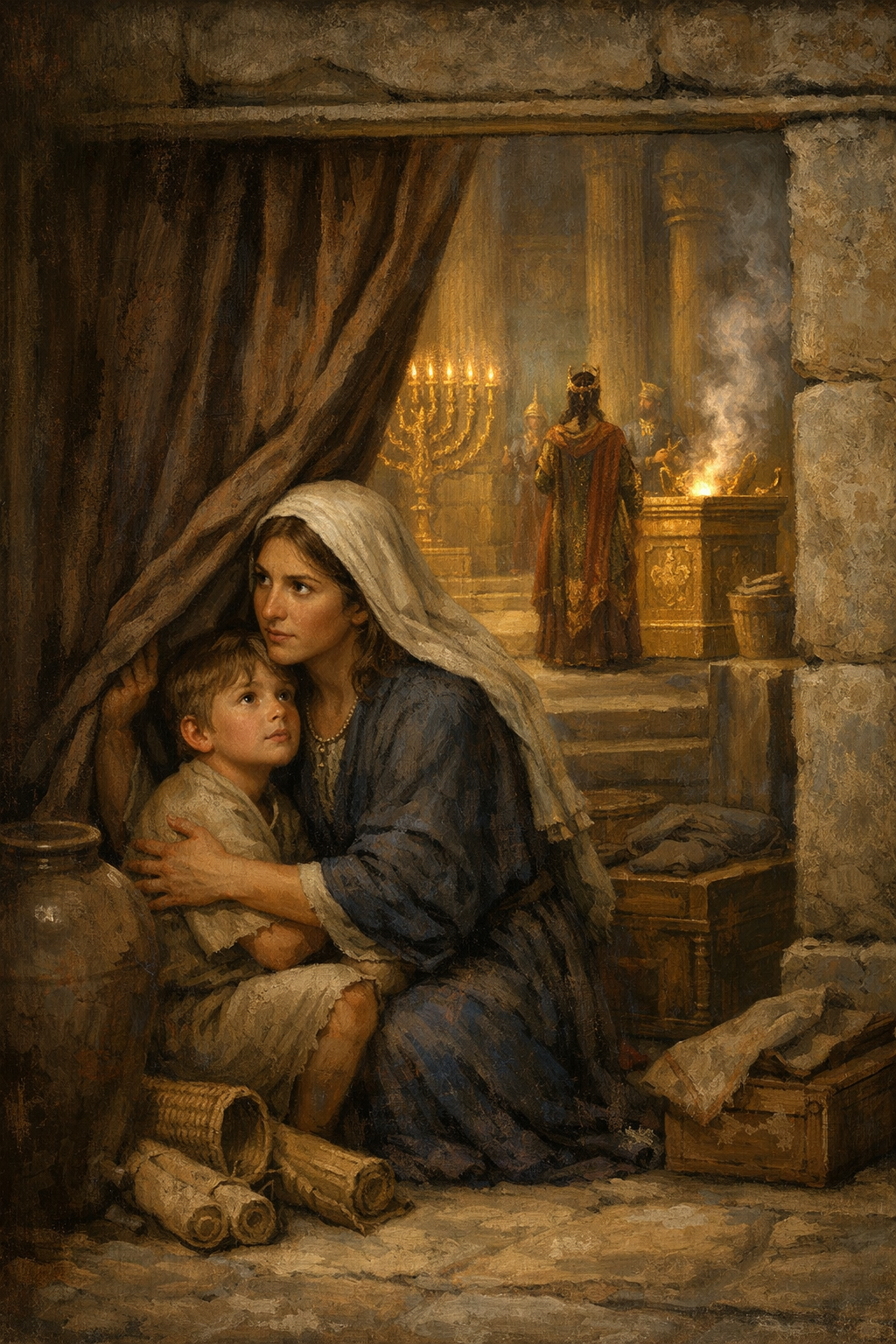
JOASH HIDDEN FOR
SIX YEARS
So he was hidden with her in the house of the LORD six years - With her signifies that Jehosheba lived daily with the danger of discovery. She reminds us of the Hebrews "Hall of Faith" description of "(men of whom the world was not worthy), wandering in deserts and mountains and caves and holes in the ground." (Heb 11:38). The house of the LORD of course is Solomon's Temple. It is amazing (but should not be surprising) that the safest place in a godless reign of Athaliah’s Baal-infested rule is God's Temple. It is likely Joash was hidden in temple chambers used by priests (cf. 1 Kgs 6:5; 2 Chr 22:12), placing his protection under priestly oversight—especially that of Jehoiada. Six years meant the Joash's protectors had to endure a long discipline of waiting. There was "shalom" in God's house and safety from the evil storm that was raging outside.
He was hidden - The precious seed was preserved when all hope appeared cut off. It is interesting to note that what God intends to preserve, He often conceals before He reveals. Moses was hidden from Pharaoh (Ex 2:2) David was hidden from Saul (1 Sa 19–24) Ultimately, Jesus was hidden from Herod (Matt 2:13-15)
This is an amazing verse showing the sovereignty of God. Why do I say that? Look at 2Ch 24:7 "For the sons of the wicked Athaliah had broken into the house of God and even used the holy things of the house of the LORD for the Baals." Had these evil sons heard the infant Joash crying it would have meant his destruction. God's sovereignty and permissive will let them take holy things from the house of the LORD and even use them for idol worship! It is amazing they were not instantly terminated! This recalls to mind Romans 2:4 "do you think lightly of the riches of His kindness and tolerance and patience, not knowing that the kindness of God leads you to repentance?" Athaliah and her sons had no concept that God is kind and forbearing, but He would repay their evil acts against His house in due time. And the wages they would pay is their death (Ro 6:23).
While Athaliah was reigning over the land - Athaliah’s reign was illegitimate and temporary, though she appeared to have total control. She sat on the throne, excercised power and appeared to be victorious. She may have reigned as sovereign over Judah, but God reigned sovereignly over Judah's history! While Athaliah ruled in blood and terror, the true king was hidden in the house of the LORD. So while evil occupied the throne, God was in full control of the future.
Bob Utley - "while Athaliah was reigning over the land" This means that during a period of six years Baalism was brought into Judah on a large scale (i.e., 2 Chr. 24:7). There was even a temple to Ba'al built in or near Jerusalem with its own high priest (cf. v. 18). This same verse is the only summary statement of Athaliah's reign. She is not in any kings list.
F B Meyer - Hid in the House of God - Safe from Athaliah, who would have ruthlessly destroyed him if she had had an inkling of his existence, the young Joash was reared beneath the care of Jehoiada and his wife within the precincts of the house of God. He was hidden in the secret place of the Most High, and abode under the shadow of the Almighty. There let us also live. Let us know what it is to dwell in the house of the Lord all the days of our life, and all this day. Let us cultivate the life which is hid with Christ in God.
It is well often to remind ourselves that we are in God, and that the film of His environing presence is about us like a wall of thick-ribbed steel. We are in Him as the jewel in the casket; as the chick under the feathers of the hen; as the child in the warm embrace of its mother. And so long as we stay there we are invulnerable. Therefore our great enemy is continually endeavoring to allure us into the open; he knows he can do as he likes with us, if only he can induce us to venture beyond our hiding-place. Therefore, beware of any temptation to worry, to amass this world’s goods, or to seek the indulgence of appetite; it is by such lures and baits that Satan seduces unwary souls from their safe hiding.
If a day in God’s courts is better than a thousand, what must it be to dwell in the house of the Lord all one’s days, to behold His beauty, and enquire in His temple. The rarest visions, the fairest fellowship, the most entrancing joys, the most confident outlook on life and the hereafter, are the accompaniments of such a residence. The altar of incense, the laver of daily cleansing, the light of the Shekinah, the holy psalm and song, the great altar of sacrifice, are familiar objects to the hidden soul.
2 Kings 11:4 Now in the seventh year Jehoiada sent and brought the captains of hundreds of the Carites and of the guard, and brought them to him in the house of the LORD. Then he made a covenant with them and put them under oath in the house of the LORD, and showed them the king’s son.
- the seventh: 2Ch 23:1-15
- captains: 2Ki 11:9 1Ch 9:13 Ac 5:24,26
- made a covenant: 2Ki 23:3 Jos 24:25 1Sa 18:3 1Sa 23:18 2Ch 15:12 2Ch 29:10 2Ch 34:31,32 Ne 9:38
- put them under oath Ge 50:25 1Ki 18:10 Ne 5:12 10:29
Related Passages:
Leviticus 19:12 ‘You shall not swear falsely by My name, so as to profane the name of your God; I am the LORD.
1 Kings 8:31-32 “If a man sins against his neighbor and is made to take an oath, and he comes and takes an oath before Your altar in this house, 32 then hear in heaven and act and judge Your servants, condemning the wicked by bringing his way on his own head and justifying the righteous by giving him according to his righteousness.
2 Chronicles 23:1 Now in the seventh year Jehoiada strengthened (chazaq; LXX - kratioo - became strong) himself, and took captains of hundreds: Azariah the son of Jeroham, Ishmael the son of Johanan, Azariah the son of Obed, Maaseiah the son of Adaiah, and Elishaphat the son of Zichri, and they entered into a covenant with him (Jehoiada). (Bob Utley -The five men listed must also be of the tribe of Levi.)
2 Kings 23:3 The king (JOSIAH) stood by the pillar and made (karath - cut) a covenant (beriyth) before the LORD, to walk after the LORD, and to keep His commandments and His testimonies and His statutes with all his heart and all his soul, to carry out the words of this covenant that were written in this book. And all the people entered into the covenant.
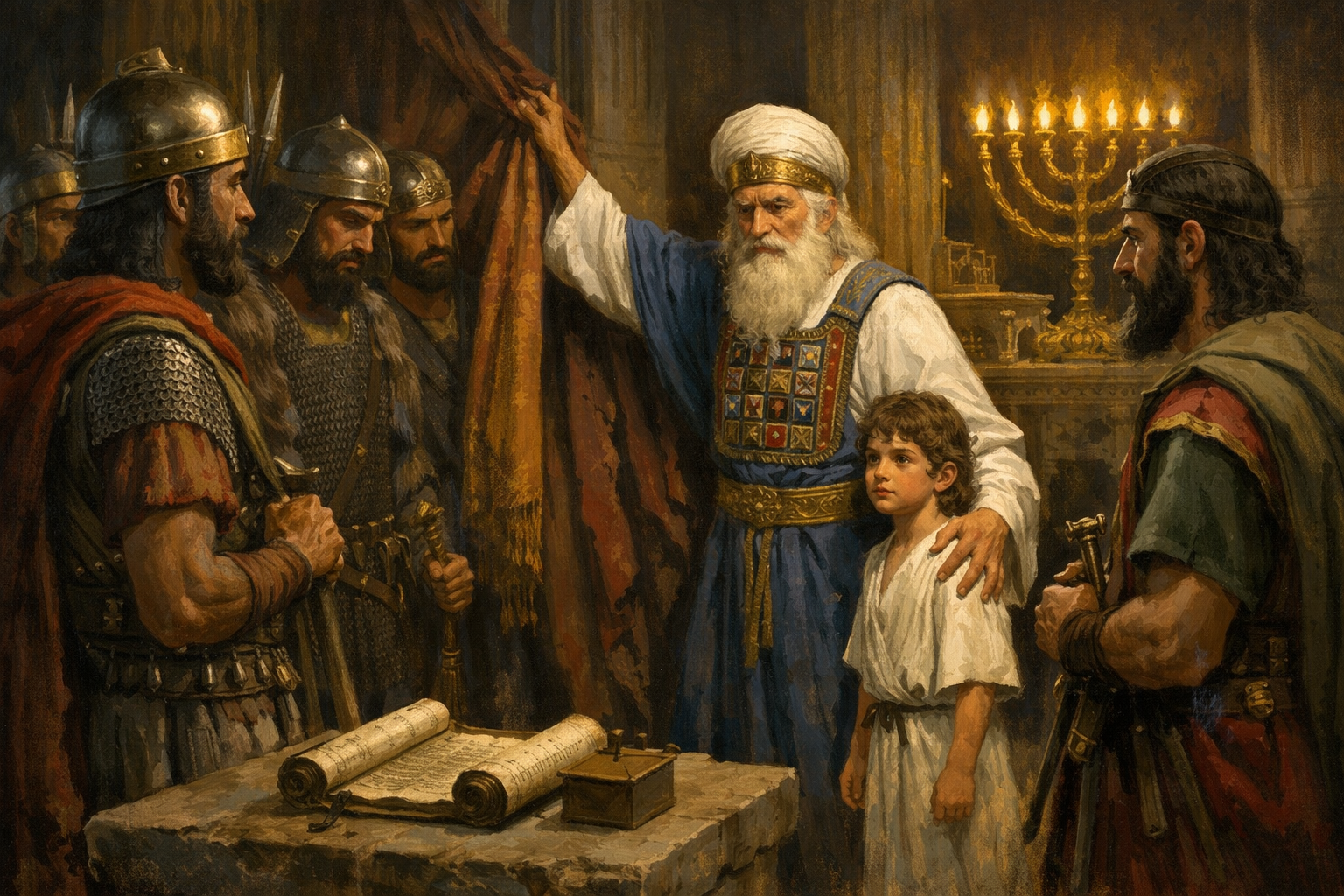
JEHOIADA'S DELIBERATE
LAWFUL, REVERENT COUP
Now in the seventh year - This NOW marks the major hinge point in this chapter and for that matter in the life of the nation of Judah. In short, the one who has been hidden for six years will NOW begin to move deliberately, lawfully, and reverently into public view.
Athaliah had reigned six years, believing the Davidic line was extinguished. But the “seventh year” signals completion of a divinely allowed season, restoration rather than destruction and a subtle echo of sabbath deliverance (seventh year -see note below). Joash was out of Athaliah’s sight but he was never out of God’s plan.
Jehoiada sent and brought the captains of hundreds (LXX - hekatontarches= "centurion" commander of 100 soldiers) of the Carites (kari) and of the guard (ruts) - 2Ch 23:1 adds "Jehoida strengthened (chazaq; LXX - kratioo - became strong ) himself." Jehoiada does not act impulsively or publicly but with with prudence, caution and wisdom (and personally I think he is being led by the Holy Spirit). First, he summons the captains of hundreds, who were experienced, trusted military leaders and belonged to the Carites (v19) which most writers agree were a specialized guard unit, closely associated with the Davidic royal household and the Temple precincts, functioning as temple security forces. Second, Jehoiada also summoned the guards, men who like the captains had a sense of honor and were more likely to trustworthy and firm in their word.
Bob Utley - "the Carites" This (BDB 501) seems to refer to the same foreign mercenaries that served David and Solomon. However, they are often called "Cherethites" (i.e., slight emendation, cf. 1 Sam. 30:14 and LXX). They are also associated with the "Pelethites" (cf. 2 Sam. 8:18; 20:23; 1 Kgs. 1:38). They were an extremely loyal foreign body of troops within the nation of Judah. They are not mentioned in the 2 Chronicles parallel. See Roland deVaux, Ancient Israel, p. 221.
and brought them to him in the house of the LORD (Solomon's Temple) - This is a solemn event. He brings them onto sacred ground, the place of God's presence where truth and accountability are practiced, leading to his cutting a covenant with them.
the captains of hundreds (LXX - hekatontarches= "centurion" commander of 100 soldiers) of the Carites (kari) and five are named in 2Ch 23:1 = "Azariah the son of Jeroham, Ishmael the son of Johanan, Azariah the son of Obed, Maaseiah the son of Adaiah, and Elishaphat the son of Zichri."
Then he made (karath - cut) a covenant (beriyth) with them - This is the same covenant described in 2Ch 23:1. In the ancient world covenant was the most solemn and binding agreement men could make with one another, and of course this applies to God's covenant with men. In agreeing to covenant these men were saying in effect if I break my covenant with you then I must pay for that break with my life!
And put them under oath (shaba) in the house of the LORD - Loyalty must be secured before truth is unveiled. Jehoiada knew that before there is any revelation, there must be commitment, so he does not stop with just making a covenant with them but now binds them by a solemn, legally and spiritually enforceable oath, sworn in God’s presence (CORAM DEO), even in His sanctuary. It combines legal obligation, covenant accountability, and divine witness. Stated another way put...under oath was to to compel a person to swear truthfulness or loyalty, invoking God as Witness and Judge. An oath was not a casual promise which carried real consequences for breaking it because it was seen as sin against God, not merely against people. These captains were saying in effect “May God judge me if I break this covenant.” (1Ki 8:31,32) God hears. God witnesses. God judges. In effect the Temple functions as God’s courtroom and an oath here made betrayal perjury before Yahweh!
What Athaliah tried to erase,
God quietly preserved.
And showed them the king’s son - Only after covenant and oath does Jehoiada reveal Joash. He secures heir loyalty before he makes the revelation. The sight of the child confirms that God’s promise to David is alive and that Athaliah’s reign is illegitimate. These men must have been "shell shocked!" (in a state of utter disbelief!)
ADDITIONAL INFORMATION
FROM 2 CHRONICLES 23
2 Chronicles 23:2-3 They (Jehoiada and the captains) went throughout Judah and gathered the Levites from all the cities of Judah, and the heads of the fathers’ households of Israel, and they came to Jerusalem. 3 Then all the assembly (captains, Levites) made (karath - cut) a covenant (beriyth) with the king in the house of God (TEMPLE). And Jehoiada said to them, “Behold, the king’s son shall reign, as the LORD has spoken concerning the sons of David (HIS ASSURANCE WAS BASED ON THE DAVIDIC COVENANT).
COMMENT - One would have thought this might arose some suspicion with the followers of Athaliah, but clearly it did not. Is this more evidence of God behind the scences controlling the actors in this redemptive drama? Note the central role of covenant which was solemn and binding on these men. And this is actually the second covenant (first in 2Ch 23:1 with the captains) which is with the king.
Carites (03746) kari - A term of uncertain meaning in 2Kings 11:4, 2 Kings 11:19 and in Hebrew text of 2 Samuel 20:23 , where Cherethites is usually read. The Carites were either mercenary soldiers recruited from Cilicia by Judah and other countries such as Egypt, or the meaning of the term can no longer be determined. They were military personnel who helped Jehoiada, the priest, install Joash as king and assassinate the queen mother Athaliah. Only in 2 Sam. 20:23; 2 Ki. 11:4; 2 Ki. 11:19
Their precise origins remain debated among scholars. One theory connects them to the Carians, a 1st-millennium people from southwestern Anatolia who served as mercenaries in Egypt and Nubia. However, this linguistic identification has faced significant scholarly challenges. An alternative view identifies the Carites with the Kerethites, a connection suggested by variant textual readings in 2 Samuel 11. A third possibility proposes they were mercenaries from Cilicia, though the term’s meaning may ultimately be irrecoverable.
NET NOTE - The Carians were apparently a bodyguard, probably comprised of foreigners. See HALOT 497 s.v. כָּרִי and M. Cogan and H. Tadmor, II Kings (AB), 126.
Gilbrant - The Carites were a royal guard composed of foreign mercenaries who supported the house of David. Scripture alludes to them in 2 Sam. 20:23 and 2 Ki. 11:4, 19. Although they are called Cherethites in the KJV in 2 Samuel, all three references are identical in Hebrew. Cherethites are included with the Pelethites in 2 Sam. 15:18. “Pelethites” is another name for the Philistines. Conjecture is that certain Philistine elements became loyal to David during his exile in Philistia (cf. 1 Sam. 27). Benaniah was commander of the Cherethites during David’s reign (2 Sam. 20:23). A few scholars hold that the Carites may have come from Caria in southwest Anatolia (modern Turkey). They were often enlisted as mercenaries, and the term may have come to mean the same. The Carites were known to have served in this capacity in Egypt under Pharaoh Psammetichus (663–609 B.C.). They came to the aid of Joash (the young heir to the throne), and the high priest Jehoida, as they successfully deposed the usurper, Athaliah. Such a military unit would have not only served as a royal guard, but also as one which administered capital punishment on behalf of the king. (Complete Biblical Library)
Guard (runners)(07323) ruts is a verb means to run (primary use) but is also translated to guard especially in Kings and Chronicles (1Ki 14:28, 2Ki 10:24, 11:4, 6, 11, 13, 19, 2Ch 12:10, 11). It means to travel, to journey by moving one’s legs more rapidly than in walking (Ge. 18:2). It may carry with it a sense of urgency, a need to hurry (Ge 18:7); or a sense of intense concern, care, excitement (Ge 24:17, 20, 28, 29). It is used of horses (Amos 6:12). It describes, figuratively, the course of the sun across the sky (Ps. 19:5); or the road, way, or course of God’s moral commandments (Ps. 119:32). In its intensive stem, it can indicate fright, running to and fro in battle (Nah. 2:4). In its causative stem, it has the sense of to cause someone to run, to bring them (Gen. 41:14, 1 Sam. 17:17; 2 Chr. 35:13); or to cause or make someone run away (Jer. 49:19; 50:44). Followed by liqraʾṯ, it means to meet (Gen. 24:17; 29:13). It is used in a figurative sense of a prophet’s activity of prophesying (Jer. 23:21; Hab. 2:2); of the swift activity of God’s Word (Ps. 147:15). In its participial form, it may refer to runners (2 Sam. 15:1; 1 Kgs. 1:5).
1) to run 1a) (Qal) 1a1) to run 1a2) runners (participle as subst) 1b) (Polel) to run swiftly, dart 1c) (Hiphil) 1c1) to bring or move quickly, hurry 1c2) to drive away from, cause to run away
Ruts is used of animals (Amos 6:12), but it is usually used of humans (Nu 11:27; Pr. 1:16). The verb can also be used as a substantive meaning “runner” (1Sa 22:17). In the Polel stem, rûts is used of the flashing of lightning (Nah. 2:4). The Hiphil stem carries either a causal force (Jer. 49:19) or an intensive force (Gen. 41:14). In Hab. 2:2, rûts means “to be eager.” Yahweh’s response to Habakkuk’s second query, “Why are you silent while the wicked swallow up those more righteous than themselves?” (Hab. 1:13, NIV), was to be written on tablets. Possibly, these were of clay, stone, or metal meant to endure. The antecedent of rûts (Hab. 2:2) is unclear. If it refers to the content, rûts may be understood to mean “to read fluently.”
RUTS - 92V - carried them speedily(1), courier runs(1), courier runs to another(1), couriers(6), dash to and fro(1), guard(6), guards(7), guards'(2), hurriedly brought(1), outran*(1), quickly stretch(1), ran(25), run(34), runner(1), runners(1), running(6), runs(4), rushed(1), rushes(1), smashed(1). Gen. 18:2; Gen. 18:7; Gen. 24:17; Gen. 24:20; Gen. 24:28; Gen. 24:29; Gen. 29:12; Gen. 29:13; Gen. 33:4; Gen. 41:14; Num. 11:27; Num. 16:47; Jos. 7:22; Jos. 8:19; Jdg. 7:21; Jdg. 13:10; 1 Sam. 3:5; 1 Sam. 4:12; 1 Sam. 8:11; 1 Sam. 10:23; 1 Sam. 17:17; 1 Sam. 17:22; 1 Sam. 17:48; 1 Sam. 17:51; 1 Sam. 20:6; 1 Sam. 20:36; 1 Sam. 22:17; 2 Sam. 15:1; 2 Sam. 18:19; 2 Sam. 18:21; 2 Sam. 18:22; 2 Sam. 18:23; 2 Sam. 18:24; 2 Sam. 18:26; 2 Sam. 22:30; 1 Ki. 1:5; 1 Ki. 14:27; 1 Ki. 14:28; 1 Ki. 18:46; 1 Ki. 19:20; 2 Ki. 4:22; 2 Ki. 4:26; 2 Ki. 5:20; 2 Ki. 5:21; 2 Ki. 10:25; 2 Ki. 11:4; 2 Ki. 11:6; 2 Ki. 11:11; 2 Ki. 11:13; 2 Ki. 11:19; 2 Ki. 23:12; 2 Chr. 12:10; 2 Chr. 12:11; 2 Chr. 23:12; 2 Chr. 30:6; 2 Chr. 30:10; 2 Chr. 35:13; Est. 3:13; Est. 3:15; Est. 8:10; Est. 8:14; Job 9:25; Job 15:26; Job 16:14; Ps. 18:29; Ps. 19:5; Ps. 59:4; Ps. 68:31; Ps. 119:32; Ps. 147:15; Prov. 1:16; Prov. 4:12; Prov. 6:18; Prov. 18:10; Cant. 1:4; Isa. 40:31; Isa. 55:5; Isa. 59:7; Jer. 12:5; Jer. 23:21; Jer. 49:19; Jer. 50:44; Jer. 51:31; Dan. 8:6; Joel 2:4; Joel 2:7; Joel 2:9; Amos 6:12; Nah. 2:4; Hab. 2:2; Hag. 1:9; Zech. 2:4
Covenant (01285) berit/berith/beriyth means covenant, treaty, compact, agreement between two parties (first use in God's covenant with Noah - Ge 6:18, 9:9, 11, 12, 13, 15, 16, 17). As discussed more below beriyth describes a compact made by passing between pieces of flesh. Covenant is a solemn, binding arrangement between two parties and entails a variety of responsibilities, benefits and penalties depending on the specific covenant which is being studied. OT covenants were made between God and man (eg, God with Noah - Ge 6:18, with Abram - Ge 15:18) or between men (Abraham and Abimelech - Ge 21:27, Isaac and Abimelech - Ge 26:28, Jacob and Laban - Ge 31:44) (For summary of covenants see - Covenant in the Bible).
ISBE says that "In essence a covenant is an agreement, but an agreement of a solemn and binding force. The early Semitic idea of a covenant was doubtless that which prevailed among the Arabs. This was primarily blood-brotherhood, in which two men became brothers by drinking each other’s blood. (ED: Now that sounds serious to me! See illustration in pagan culture)
Covenant can be summarized as follows…
(1) Between two parties (sometimes equal, other times superior to inferior) -- (a) nations -- (peace) treaty, alliance of friendship (b) individuals -- a pledge or agreement with mutual obligations to each other (c) monarch and subjects (2Sa 3:21, 5:3, 1Chr 11:3) -- a constitution (d) God and man -- Noahic, Abrahamic, Mosaic, Davidic, New Covenants.
TWOT adds that…"Apart from blood ties the covenant was the way people of the ancient world formed wider relationships with each other. The accounts of the relationship between David and Jonathan are the only unequivocal mention of a compact between two individuals in the Old Testament (1Sa 18:3; 20:8; 23:18). It is spoken of as “a covenant of the Lord” because the Lord witnessed the transaction and protected the legal order."
(2) Accompanied by (a) signs (also witnesses, memorials, shared meals) (b) sacrifices, (c) solemn, binding oaths -- sealing the relationship with promises of blessing for keeping the covenant and curses for breaking the covenant (d) Sometimes with written document on which the words of the covenant, its terms in the form of promises and stipulations were spelled out, witnessed to, signed and sealed. Behm (TDNT) notes that in ancient times
There is no firmer guarantee of legal security peace or personal loyalty than the covenant (e.g., Amos 1:9).
(3) Is depicted in the idiomatic phrase "make (cut) a covenant" in which there is was a blood sacrifice as part of the covenant ritual.
Almost 100 years ago, Andrew Murray motivated by a waning understanding regarding the truth and power inherent in the Biblical truth of covenant wrote that…
One of the words of Scripture, which is almost going out of fashion, is the word 'Covenant'. There was a time when it was the keynote of the theology and the Christian life of strong and holy men. We know how deep in Scotland it entered into the national life and thought. It made mighty men, to whom God, and His promise and power were wonderfully real. It will be found still to bring strength and purpose to those who will take the trouble to bring all their life (Ed: and their marriages) under control of the inspiring assurance that they are living in covenant with a God who has sworn faithfully to fulfill in them every promise He has given. (Two Covenants - Index - Andrew Murray)
The majority of the the OT uses of beriyth are translated as covenant (275/285 uses) and the majority of these are translated into Greek using the word diatheke, which was a common technical word used in the Greco-Roman law to describe the settlement of an inheritance (i.e., a "last will and testament") and used in the NT to describe the "self-commitment, promises, and conditions by which [God] entered into relationship with man" (Friberg).
Put under oath (Swear)(07650) shaba (or shaba) from sheba = seven) to swear, to take an oath, to make or swear an oath, swearing to someone, thus putting oneself under obligation to someone. "In general, shāvaʿ is employed in mainly these contexts: covenant making, where the parties involved made vows, oaths or promises to one another (Deut. 4:31; 1 Sa 20:42); oath taking, which was a serious transaction in Israel and involved a person's taking upon himself (and possibly others) a curse if that person did not carry out his oath faithfully; vow making, which was solemn and not to be broken (cf. Nu 30:2)." (CBL)
QUESTION - What is a sabbatical year? | GotQuestions.org
ANSWER - The Sabbath is the seventh day of the week, a day of rest for the Hebrew people under the Mosaic Law. But the Law also spoke of a sabbatical year. Leviticus 25:1–7 provides instructions for the sabbatical year to be observed after the Israelites moved into the Promised Land.
Leviticus 25:3–5 explains what to do—or, rather, what not to do—on the sabbatical year: “For six years sow your fields, and for six years prune your vineyards and gather their crops. But in the seventh year the land is to have a year of sabbath rest, a sabbath to the Lord. Do not sow your fields or prune your vineyards. Do not reap what grows of itself or harvest the grapes of your untended vines. The land is to have a year of rest.” Every seventh year, then, was to be a time of no planting or pruning of crops. The Sabbath day was a rest every week, and this rest was applied to farmland once every seven years (the sabbatical year is also mentioned in Exodus 23:10–11).
If the Israelites were not to plant during the sabbatical year, what were they to eat? Leviticus 25:6–7 explains: “Whatever the land yields during the sabbath year will be food for you—for yourself, your male and female servants, and the hired worker and temporary resident who live among you, as well as for your livestock and the wild animals in your land. Whatever the land produces may be eaten.”
The food for the Israelites, their servants, and livestock was to come from harvesting the sabbatical year’s “volunteer” crop—reaping the harvest that grew on its own accord in the seventh year. Leviticus 25:20–22 anticipates the people’s question: “You may ask, ‘What will we eat in the seventh year if we do not plant or harvest our crops?’ I will send you such a blessing in the sixth year that the land will yield enough for three years. While you plant during the eighth year, you will eat from the old crop and will continue to eat from it until the harvest of the ninth year comes in.” In other words, the Israelites had no reason to worry. God promised to take care of them, if they would only trust Him.
Deuteronomy 15 also speaks of the sabbatical year. In this passage, a further command is given: forgive all debt and release all Hebrew servants. If the Israelites obeyed this command, they had another promise: “The LORD your God will bless you as he has promised, and you will lend to many nations but will borrow from none. You will rule over many nations but none will rule over you” (Deuteronomy 15:6).
Observing the sabbatical year was an important sign of trust in the Lord, and it was accompanied by great blessings. Refusing to obey this command, God warned, would lead to a curse:
“I will scatter you among the nations and will draw out my sword and pursue you. Your land will be laid waste, and your cities will lie in ruins. Then the land will enjoy its sabbath years all the time that it lies desolate and you are in the country of your enemies; then the land will rest and enjoy its sabbaths. All the time that it lies desolate, the land will have the rest it did not have during the sabbaths you lived in it” (Leviticus 26:33–35).
Sadly, Israel failed to observe the sabbatical years. They continued cultivating and harvesting their land on the seventh year just as they had the other years. As a result of that and other sins, God brought the Assyrians and the Babylonians against Israel, and God’s people were removed from the Promised Land for a period of time. The biblical historian notes the significance of the deportations: “The land enjoyed its sabbath rests; all the time of its desolation it rested” (2 Chronicles 36:21).
Related Resources:
2 Kings 11:5 He commanded them, saying, “This is the thing that you shall do: one third of you, who come in on the sabbath and keep watch over the king’s house
- who come in on the sabbath: 1Ch 9:25 23:3-6,32 24:3-6 Lu 1:8,9
- Keep watch: 2Ki 11:19 16:18 1Ki 10:5 Jer 26:10 Eze 44:2,3 46:2,3
RESTORATION OF RIGHTEOUS RULE
THROUGH CAREFUL PLANING
He commanded them, saying - This verse introduces Jehoiada’s carefully planned, lawful, and covenant-minded strategy to protect young King Joash and overthrow Athaliah without defiling the Temple or provoking chaos. The priest acts decisively and issues commands not tp grasp power, but to guard God’s covenant and the Davidic throne.
NET NOTE - Verses 5b–7 read literally, "the third of you, the ones entering [on] the Sabbath and the ones guarding the guard of the house of the king, and the third in the gate of Sur, and the third in the gate behind the runners, and you will guard the guard of the house, alternating. And the two units of you, all the ones going out [on] the Sabbath, and they will guard the guard of the house of the LORD for the king." The precise meaning of this text is impossible to determine. It would appear that the Carians and royal bodyguard were divided into three units. One unit would serve during the Sabbath; the other two would be off duty on the Sabbath. Jehoiada divided the first unit into three groups and assigned them different locations. The two off duty units were assigned the task of guarding the king.
“This is the thing that you shall do: Jehoiada’s instructions leave no room for confusion, which is essential in a coup conducted in the Temple precincts.
Righteous zeal is paired
with order and restraint
One third of you, who come in on the sabbath and keep watch over the king’s house - One third of you,in 2Ch 23:4 has "one third of you, of the priests and Levities." Jehoiada’s revolution is not mob action but careful planning. In vv5-7 we see three rotating groups (1) One third on active duty (incoming Sabbath shift), (2) One third guarding the king’s house (palace), and (3) One third stationed at the foundation/gate. It is interesting that Jehoiadah did not just pray and say "Lord protect the king," but he took action to ensure continuous protection, leave no exposed weaknesses and exert full control of key access points. There is nothing wrong with praying for protection but sometimes the LORD calls us to take action!
Why the sabbath? The Sabbath was ideal because guard rotations naturally changed that day, more Levites and guards were present, no suspicion was raised by movement of the larger numbers and thus Athaliah would not be able to detect unusual troop movement. In other words, Jehoiada carefully planned the overthrow of Athaliah to coincide with the changing of the guard on the Sabbath, thus preventing suspicion and ensuring maximum protection for the young king.
David Guzik agrees - Jehoiada chose the Sabbath for the day of the coup because that was the day when the guards changed their shifts, and they could assemble two groups of guards at the temple at the same time without attracting attention.
Keep watch (mishmereth; LXX - phulasso - guard someone) over the king’s house - This is not ceremonial guarding like the British soldiers standing in front of Buckingham Palace, guarding a symbolic monarchy. These guards are to stand armed (2Ki 11:8) and kill any intruder who breached the ranks for their task was to protect the king.
2 Chronicles 23:4-5 (NOTE BOLDFACED TEXT REFLECTS MATERIAL ADDED IN CHRONICLES) “This is the thing which you shall do: one third of you, of the priests and Levites who come in on the sabbath, shall be gatekeepers, 5 and one third shall be at the king’s house, and a third at the Gate of the Foundation; and all the people shall be in the courts of the house of the LORD.
The king’s house refers to the royal palace which was the seat of legitimate authority, assuring the transition from Joash in the Temple to Joash on the throne.
If we compare with the parallel passages in 2 Chronicles 23, 2 Kings 11 focuses on military logistics, 2Ch 23 on Levitical organiztion (2) 1Ki 11 mentions guards, Carites, captains, 2Ch 23 mentions Levites, heads of fathers' houses; (3) 2Ki 11 has a political/historical emphasis, 2Ch 23 has a priestly/covenantal emphasis; (4) 2Ki 11 is a short, concise narration, 2Ch 23 is expanded with explanatory detail. Kings answers “How was the coup secured?” Chronicles answers “Why was it lawful before God?” Chronicles clarifies that many guards were Levites, lawfully present on the Sabbath, which shows Jehoiada did not violate Sabbath law but used already-serving Temple personnel. 2 Kings 11 shows the strategy; 2 Chronicles 23 shows the sanctity—together revealing that God restores rightful rule through careful planning carried out in faithful obedience to His covenant.
Keep watch (duty, guard, keep, obligation)(04931) mishmereth from shamar = to watch, guard, protect, observe, keep) a guard, watch, charge, function, duty. The most basic meaning of this noun is "keeping" or "something kept." That said there are two main meanings - (1) an obligation or service to be performed (2) having to do with something that is to be kept or preserved (the Passover lamb = "you shall keep it" Ex 12:6, manna = "to be kept" Ex 16:32-34; ashes of red heifer = "shall keep" = Nu 19:9) In several instances, it is used of a guard post (Isa. 21:8; Hab. 2:1). The idea of obedience (i.e., keeping the commandments) is often depicted, which leads to a translation of charge (Gen. 26:5; Deut. 11:1; Zech. 3:7) or duty (Nu 3:7; 9:23; 2 Chr. 8:14).
2 Kings 11:6 (one third also shall be at the gate Sur, and one third at the gate behind the guards), shall keep watch over the house for defense.
- the gate of Sur: 1Ch 26:13-19 2Ch 23:4-5
COVENANT PRESERVATION WITH
MILITARY PRECISION
(one third also shall be at the gate Sur - Gate Sur (location debated) was likely a strategic access point between the palace and Temple complex or possibly a southern or side gate controlling approach to royal areas. In any event it would prevent outside intrusion from a potentially vulnerable entry point. Note that the gate Sur may be parallel (we cannot be dogmatic) to the Foundation gate in 2Ch 23:5 and the different names may reflect different aspects of the gate’s function or simply represent alternative designations used in different periods of time (remember that Chroncles was written about 200 years later than 1 Kings). The gate’s exact location and architectural details remain uncertain.
TECHNICAL NOTE - Heb “the gate of Sur” (followed by many English versions) but no such gate is mentioned elsewhere in the OT. The parallel account in 2 Chr 23:5 has “Foundation Gate.” סוּר (sur), “Sur,” may be a corruption of יְסוֹד (yésod) “foundation,” involving in part dalet-resh confusion.
and one third at the gate behind the guards - This refers to an inner security layer, thus Behind the guards implies a secondary checkpoint. If the outer line were to fails, the inner line could still hold. This is the same wisdom seen elsewhere in biblical imagery, Solomon writing “A cord of three strands is not quickly torn apart” (Eccl 4:12)
2 Chronicles 23:4-5 (NOTE BOLDFACED TEXT REFLECTS MATERIAL ADDED IN CHRONICLES) “This is the thing which you shall do: one third of you, of the priests and Levites who come in on the sabbath, shall be gatekeepers, 5 and one third shall be at the king’s house, and a third at the Gate of the Foundation; and all the people shall be in the courts of the house of the LORD.
Shall keep watch over (mishmereth; LXX - phulasso - guard someone) the house for defense - This refers to the royal house and by extension to the Davidic dynasty ("house of David"), not merely a building.
NET NOTE - The meaning of מַסָּח (massakh) is not certain. The translation above, rather than understanding it as a genitive modifying “house,” takes it as an adverb describing how the groups will guard the palace. See HALOT 605 s.v. מַסָּח for the proposed meaning “alternating” (i.e., “in turns”).
2 Kings 11:7 “Two parts of you, even all who go out on the sabbath, shall also keep watch over the house of the LORD for the king.
- go out: 2Ki 11:5 2Ch 23:6
JEHOIDA WISDOM IN LAWFULLY
DOUBLING THE GUARDS
Two parts of you, even all who go out on the sabbath, shall also keep watch over the house of the LORD for the king - This verse reveals the inner logic of Jehoiada’s plan: maximum protection at the holiest and most vulnerable moment—when the king is revealed in the Temple.
2 Chronicles 23:6 “But let no one enter the house of the LORD except the priests and the ministering Levites; they may enter, for they are holy. And let all the people keep the charge of the LORD.
Two parts of you - two-thirds of the force, not one, are assigned to a single location. Why? The Temple is where Joash will be crowned (2Ki 11:12) and once revealed, the king becomes the primary target. The greatest danger would come after disclosure, not before.
Even all who go out on the sabbath - These are the guards finishing their Sabbath duty and normally the outgoing guards would leave the area and disperse, but Jehoiada keeps them on duty, in effect instantly doubling manpower without raising suspicion. Furthermore, no law is broken, for they are already lawfully present and Chronicles clarifies these were Levites on Temple duty (2 Chr 23)
keep watch over the house of the LORD - This is the center of the plan, for the Temple was not just a safe place but the place the beginning of the coronation would take place before they brought the king out and put the crown on him (2Ch 23:11)
Let's summarize Jehoiada's threefold arrangement (2Ki 11:5-7) - (1) First third - King's house - protect legitimacy; (2) Second third - Gate Sur - block external threats; (3) Third third - Gate behind the guards - inner defense.
2 Kings 11:8 “Then you shall surround the king, each with his weapons in his hand; and whoever comes within the ranks shall be put to death. And be with the king when he goes out and when he comes in.”
- whoever comes within the ranks: 2Ki 11:15 Ex 21:14 1Ki 2:28-31 2Ch 23:7
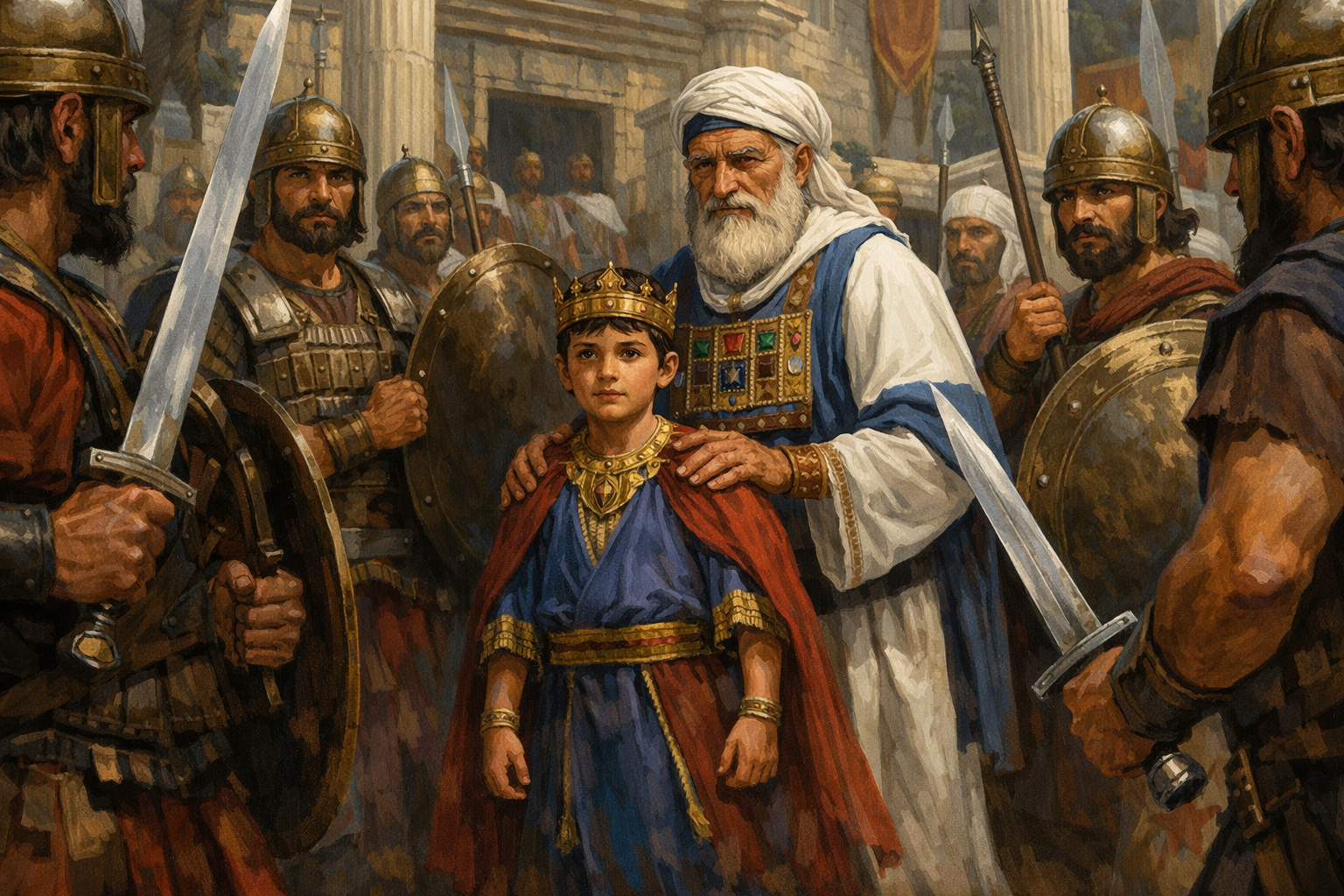
PROTECTION THE KING
AT ALL COSTS
Then you shall surround the king - 2Ch 23:7 adds "The Levites will surround the king." This verse gives Jehoiada’s precise security command at the most dangerous moment of the restoration. The command centers on the king himself, not the Temple, not the ceremony. Jehoida knows that the Davidic heir is the target and that God's promise to David is embodied in a person. Therefore protecting the king was tantamount to protecting God’s covenant. And while it is difficult for us today to fully grasp the danger of this coup, this is not symbolic protection but is life-or-death defense.
David Guzik One reason Athaliah was able to reign for six years was that no one knew any alternative. Many people live under the reign of Satan because they don’t really know there is a legitimate king ready to take reign in their lives.
Each with his weapons in his hand - As noted above, these were not ceremonial guards, but guards with weapons in hand (not left sheathed), ready to defend any potential attack by Athaliah.
And whoever comes within the ranks shall be put to death - This was a controlled kill zone which was crucial to establish a protective perimeter for the king. Anyone who breached it is presumed hostile and delay by the guards could mean death for the king.
And be with the king when he goes out and when he comes in - Jehoida is calling for total, continuous protection, in constant proximity to the king with no gaps in coverage. Biblically, “going out and coming in” often refers to the whole course of life, but in this context it means never leave the king exposed, not even for a moment. Jehoiada knew full well that Athaliah had already murdered all other royal heirs and that she was present in Jerusalem and would react instantly when she heard the noise (2Ki 11:13)
In these passages we see the familar pattern of God's sovereignty and Man's responsibility. God’s promises were certain, but in moments of crisis such as this, they were to be guarded by courageous, obedient servants who stood watch without compromise. This pattern recalls Solomon's words in Psalm 127:1 "Unless the LORD builds the house, They labor in vain who build it; Unless the LORD guards the city, The watchman keeps awake in vain." (See discussion of "Paradoxical Principle of 100% Dependent and 100% Responsible")
Warren Wiersbe - Jehoiada’s plan was simple but effective. The five officers each commanded one hundred men. Two companies would ordinarily be on duty daily and be replaced on the Sabbath Day, but on this particular Sabbath they would remain on duty and guard the king. A third company would guard the palace where Athaliah lived, and this would give her a false sense of security. A fourth company was assigned to the gat Sur which may have led from the nearby palace to the temple area. The fifth company assembled at the gate behind the guardhouse, a normal place for the temple guards to gather. Anybody watching at the temple would have no reason to suspect that anything dramatic was about to occur. They would see the guards march in and take their usual places, and they might notice that the crowd of worshipers in the temple was larger than usual.
2 Kings 11:9 So the captains of hundreds did according to all that Jehoiada the priest commanded. And each one of them took his men who were to come in on the sabbath, with those who were to go out on the sabbath, and came to Jehoiada the priest.
- the captains: 2Ki 11:4 1Ch 26:26 2Ch 23:8
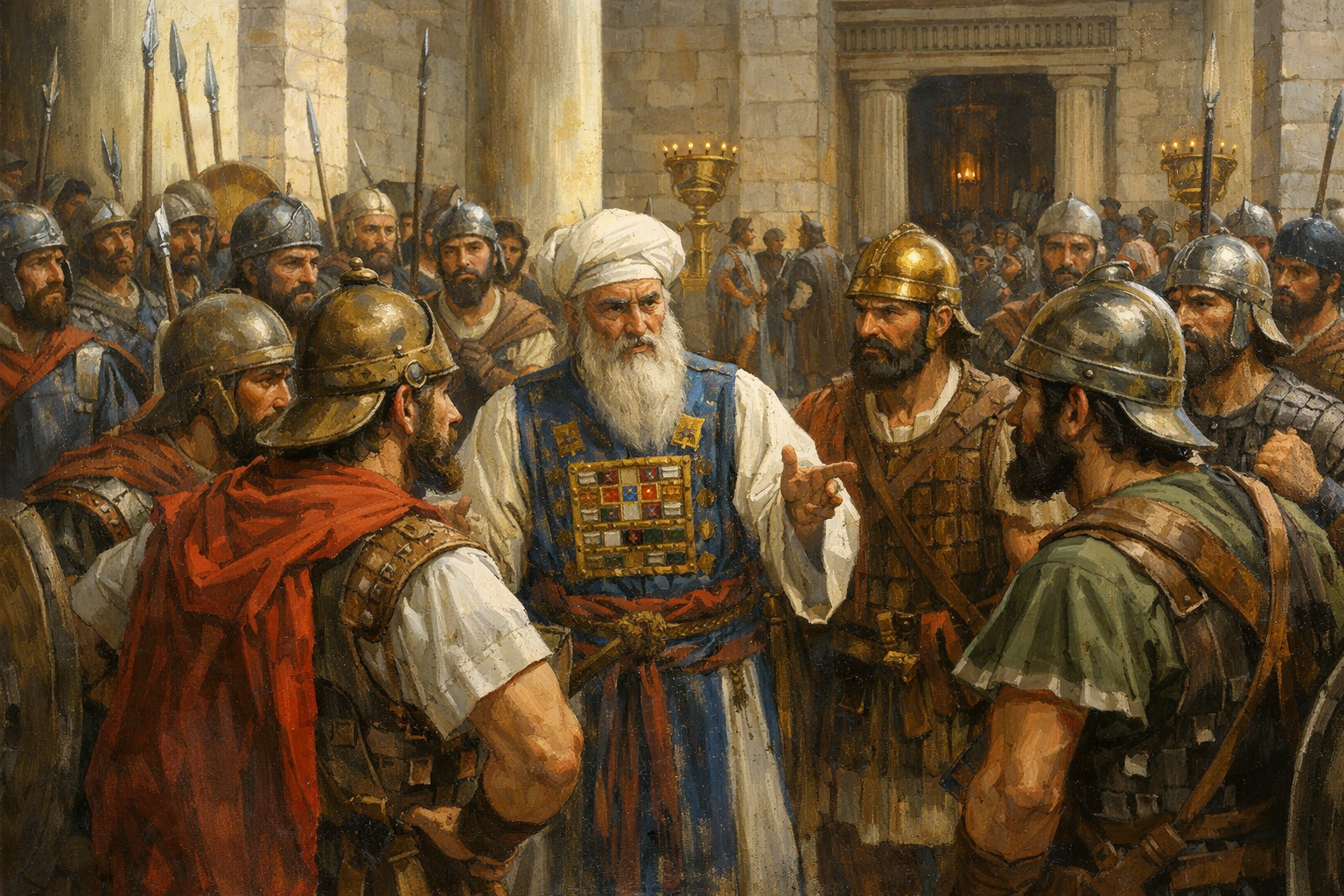
Jehoiada instructing the captains at the temple
CAREFUL COORDINATION
UNDER JEHOIADA
So the captains of hundreds did according to all that Jehoiada the priest commanded - The captains comply fully as the military submits to priestly leadership. This obedience is crucial for a divided command would have meant a dead king.
And each one of them took his men who were to come in on the sabbath with those who were to go out on the sabbath- Jehoiada does not personally marshal troops, but each captain gathers his own trusted men. The responsibility is distributed but unified. On the Sabbath one group of Levitical guards finished their duty, while another group of Levites began their duty. 2Ch 23:8 says Jehoiada the priest did not dismiss any of the divisions. But by bringing both groups of Levites together, Jehoiada doubles the manpower and no one appears out of place and no suspicion is raised. Jerusalem expected increased movement around the Temple on the sabbath. But the city sees all as routine. And while the text does not say it, one has to believe that Athaliah had a cadre of spys spread around to look for suspious movements that might mark the beginning of a civil uprising or rebellion.
And came to Jehoiada the priest. All forces converge at one point (Jehoiada) so that there was unity under the spiritual authority of Jehoida. One leader with one plan.
2 Kings 11:10 The priest gave to the captains of hundreds the spears and shields that had been King David’s, which were in the house of the LORD.
- king David's spears: 1Sa 21:9 2Sa 8:7 1Ch 26:26,27 2Ch 5:1 2Ch 23:9-10
Related Passages:
2 Samuel 8:7 David took the shields of gold which were carried by the servants of Hadadezer and brought them to Jerusalem
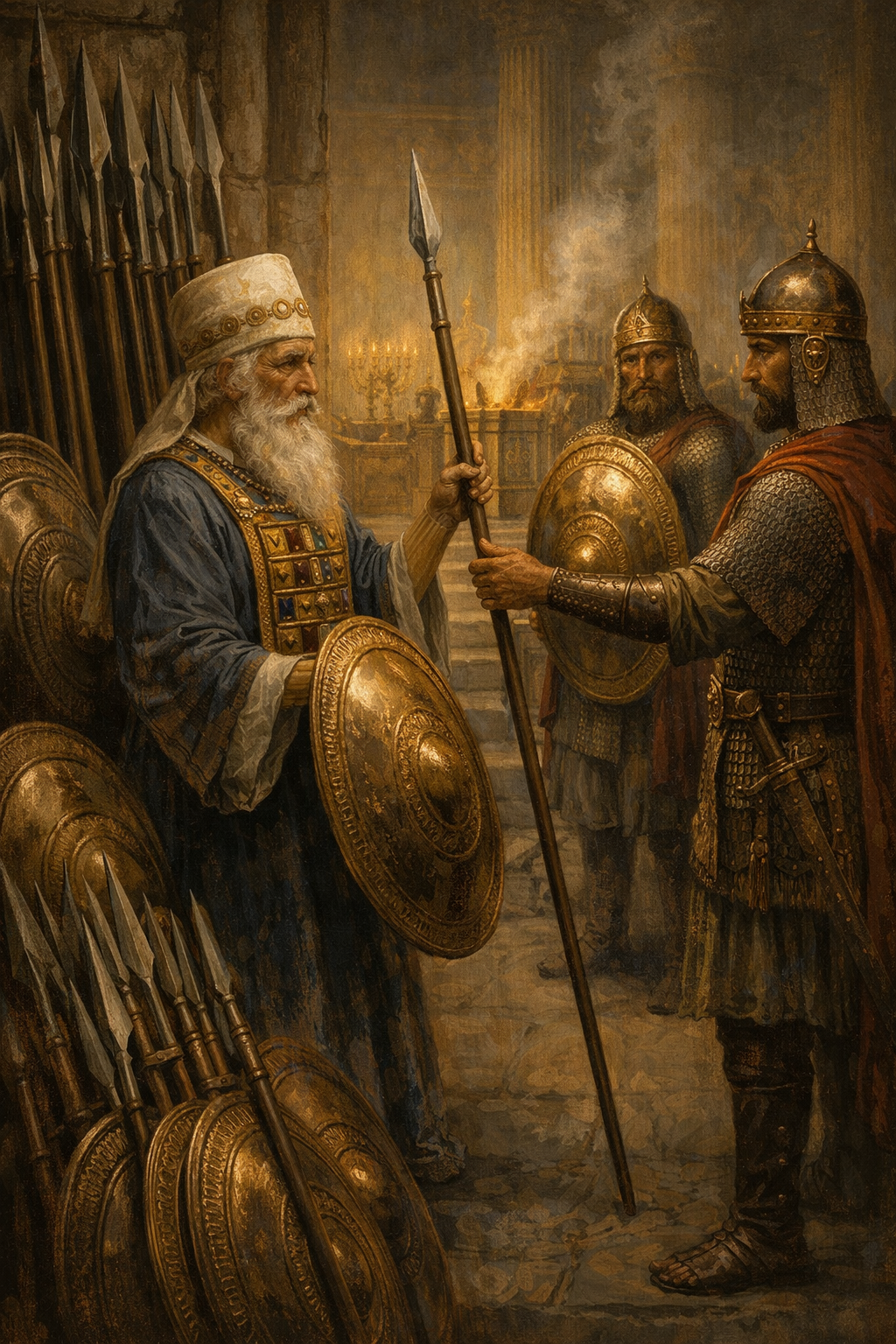
THE PRIEST ARMS SOLDIERS
WITH DAVID'S WEAPONS
The priest gave to the captains of hundreds the spears and shields Spears were for offensive readiness and shields for defensive protection. Together they signal preparedness, and not pageantry because Jehoiada expects the possibility of violent resistance and prepared accordingly.
That had been King David’s - This is fascinating for this entire chapter is about protecting the integrity of the Davidic covenant. And here we see the very weapons once used to establish the kingdom, now being used to preserve the kingdom and the Davidic Covenant.
Bob Utley - Jehoiada passed out weapons that were kept in the temple. David's shields of gold ‒ 2 Sam. 8:7; 1 Chr. 18:7 Solomon's shields of gold ‒ 1 Kgs. 10:16-17; 14:26-27; 2 Chr. 9:16 Shishak of Egypt took Solomon's shields of gold and Rehoboam replaced them with bronze ones, 2 Chr. 12:9-10 The 2 Chr. 23:9 parallel adds another kind of "shield" (BDB 171) not mentioned here (i.e., "shields," BDB 1020). "spears" This spear (BDB 333; NIDOTTE, vol. 2, pp. 197-200) was a shorter and lighter spear (cf. 1 Sam. 18:11; 20:33). Another heavier spear (BDB 942) was also used (cf. 1 Kgs. 18:28; 2 Chr. 11:12; 12:9,25; 14:7; 25:5; 26:14). See Roland deVaux, Ancient Israel, p. 242.
Which were in the house of the LORD. - This might prompt the question why were David’s weapons in the Temple? The Temple functioned as a treasury of remembrance. 2 Samuel 8:11 says that "King David also dedicated these (articles of silver, of gold and of bronze) to the LORD, with the silver and gold that he had dedicated from all the nations which he had subdued." Weapons would have been included as those removed from active combat and stored as testimony to God’s faithfulness and memorials of divinely given victories.
PARALLEL PASSAGE - 2 Chronicles 23:9-10 Then Jehoiada the priest gave to the captains of hundreds the spears and the large and small shields which had been King David’s, which were in the house of God.
How interesting that David had stored these, not knowing that one day they would be used to defend the very covenant Yahweh had made with him! And think about this for a moment. If it had been necessary to bring spears and shields from outside the Temple, this activity would surely have been noticed by Athaliah's spies and led to immediate reprisals! God had sovereignly sufficiently stocked the Temple armory almost 150 years earlier!
Josephus states that, for fear of creating suspicion, they came unarmed, "and Jehoiada having opened the arsenal in the temple which David had prepared, he divided among the centurions, priests, and Levites, the spears (arrows), and quivers, and all other kinds of weapons which he found there."
2 Kings 11:11 The guards stood each with his weapons in his hand, from the right side of the house to the left side of the house, by the altar and by the house, around the king.
- every man: 2Ki 11:8,10
- corner: Heb. shoulder
- by the altar: Ex 40:6 2Ch 6:12 Eze 8:16 Joe 2:17 Mt 23:35 Lu 11:51
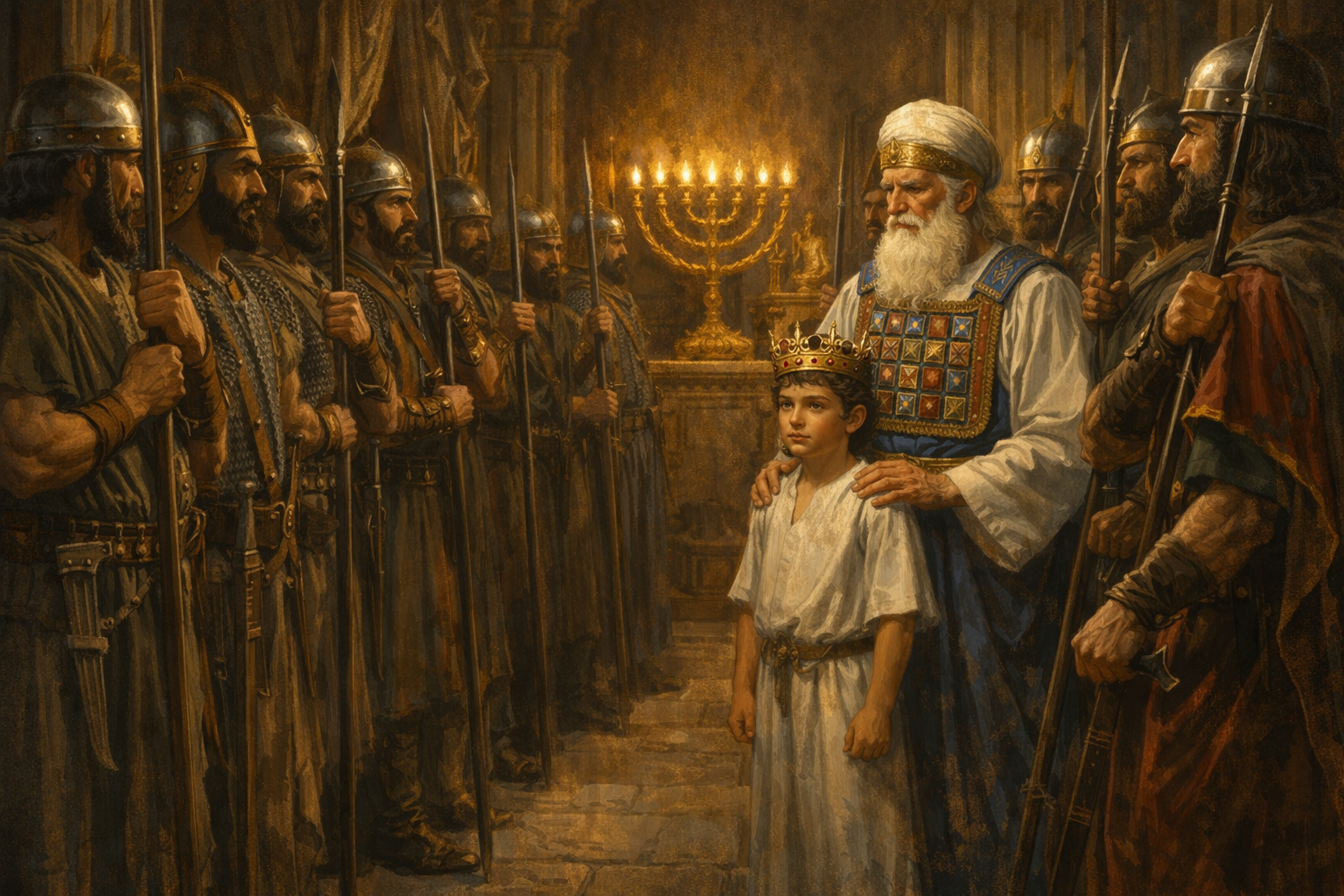
YOUNG JOSIAH ENCIRCLED
BY THE GUARDS
The guards stood each with his weapons in his hand - The guards were firm, standing with immovable resolve surely beginning to grasp the solemnity and seriousness of this moment as they saw the young king. Note the weapons are in hand, not nearby, thus they were ready on a moment's notice should the need arise. Note also this readiness was with each man so there were no weak links in the defense line.
NET NOTE on guards - Heb “the runners” (also in v. 19). Heb “and the runners stood, each with his weapons in his hand, from the south shoulder of the house to the north shoulder of the house, at the altar and at the house, near the king all around.”
Bob Utley on guards - The MT has a PARTICIPLE (BDB 930, KB 1207, Qal ACTIVE) which means "the ones running." This designation is used of royal servants and messengers. (1)royal bodyguard ‒ 1 Sam. 22:17; 1 Kgs. 14:27-28; 2 Kgs. 10:25; 11:4,6,11,19; 2 Chr. 12:10-11 (2) runners ‒ 1 Sam. 8:11; 2 Sam. 15:1; 1 Kgs. 1:5 (3) messengers ‒ 2 Sam. 18:21-26 (4) #2 and #3 parallel in Jer. 51:31
from the right side of the house to the left side of the house, by the altar and by the house, around the king - Let us envision a continuous human wall giving no blind sides, no exposed flanks, no gaps but 360 degree protection across the Temple court. The king was not merely guarded but he was encircled. The young king apparently stood between the altar and the house (Temple Sanctuary). What Athaliah tried to erase with murder, Yahweh now surrounded with His faithfulness.
PARALLEL PASSAGE - 2 Chronicles 23:10 He stationed all the people, each man with his weapon in his hand, from the right side of the house to the left side of the house, by the altar and by the house, around the king.
2 Kings 11:12 Then he brought the king’s son out and put the crown on him and gave him the testimony; and they made him king and anointed him, and they clapped their hands and said, “Long live the king!”
- he brought: 2Ki 11:2,4 2Ch 23:11
- put the crown: 2Sa 1:10 12:30 Es 2:17 6:8 Ps 21:3 89:39 132:18 Mt 27:29 Heb 2:9 Rev 19:12
- the testimony: Ex 25:16 31:18 De 17:18-20 Ps 78:5 Isa 8:16,20
- anointed him: 2Ki 9:3 1Sa 10:1 16:13 2Sa 2:4,7 5:3 1Ki 1:39 La 4:20 Ac 4:27 2Co 1:21 Heb 1:9
- and they clapped: Ps 47:1 98:8 Isa 55:12
- and said: 1Ki 1:34 Ps 72:15-17 Da 3:9 6:21 Mt 21:9
- Long live the king Heb. Let the king live, 1Sa 10:24 2Sa 16:16
Related Passages:
Deuteronomy 17:18-20 (PRIEST GAVE JOASH THE TESTIMONY) “Now it shall come about when he sits on the throne of his kingdom, he shall write for himself a copy of this law on a scroll in the presence of the Levitical priests. 19 “It shall be with him and he shall read it all the days of his life, that he may learn to fear the LORD his God, by carefully observing all the words of this law and these statutes, 20 that his heart may not be lifted up above his countrymen and that he may not turn aside from the commandment, to the right or the left, so that he and his sons may continue long in his kingdom in the midst of Israel.
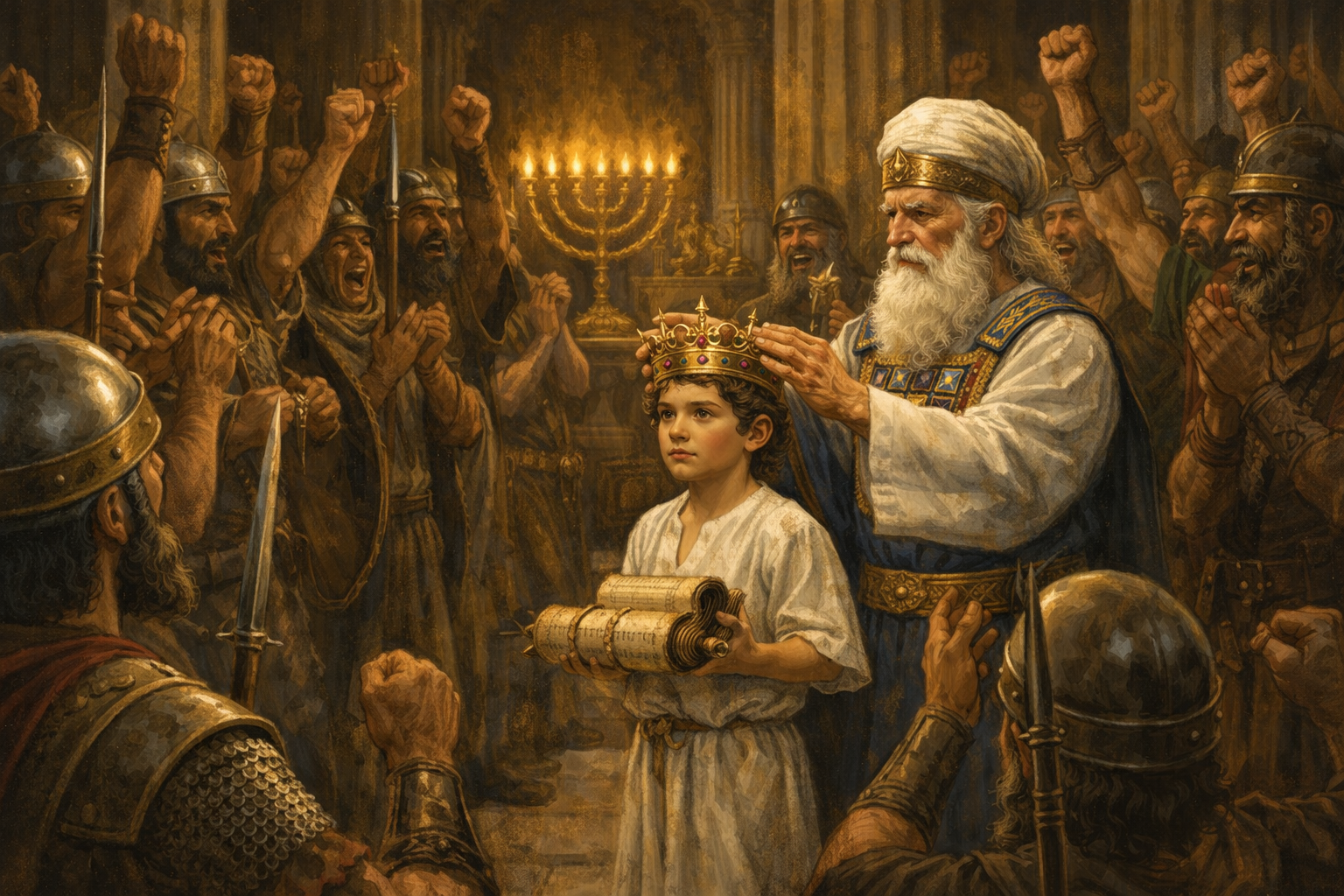
LONG LIVE
THE KING!
Then he brought the king’s son out - For six years Joash was hidden in the inner aspect of the Temple Complex. Now he is revealed at the right moment. It is notable that the Davidi heir is revealed in God’s temple, not in king's palace.
And put the crown (nezer) on him - The crown signified legitimate kingship and transfer of royal authority.
Joash is crowned with Scripture,
not merely with gold.
And gave him the testimony (eduth) - The testimony refers to the Law of God or the Book of the Law (see Dt 17:18-20) , the covenant document given to Israel’s kings. This act points out that the king is not above the Law and is to reigns guided by the covenant law all the days of his life. His authority is limited by and is to be continually shaped by God’s Word. The Book of the Law serves to remind the king from day one that he reigns by obedience to God, not autonomy.
Donald Wiseman - “This is the basis for the British custom of presenting the monarch with a copy of the Bible during the coronation service.”
Bob Utley - "the testimony" This could refer to the Torah, the law of Moses, or the Pentateuch. It is improbable that the young king had the actual tablets of stone placed on his lap for they were in the Ark of the Covenant, and by this time, no one would open the ark because it had become so holy and renowned. It probably refers to a copy (cf. Ex 25:16; 31:18; Dt. 17:18; see K. A. Kitchen, Ancient Orient and Old Testament, pp. 108-109).
John MacArthur on the testimony – This was a copy of the whole law (Ps 119:88). According to Dt 17:18-20, a copy of the law was to be kept with the king always so that it became his guide for life.
And they made him king and anointed (maschah; LXX - chrio root of Christos = Christ) him - Anointing symbolizes God’s choice and empowerment and marks Joash as Yahweh’s appointed ruler. Anointing kings with oil in the Old Testament symbolized God’s divine selection, consecration, empowerment, and authority for a sacred office. In the Old Testament, priests, prophets, and kings were anointed, symbolizing authority and divine appointment and pointing ultimately to Jesus Christ, the Anointed One (Christos) Who is prophet, priest, and king in full measure. It was not merely a cultural or ceremonial act but a spiritual declaration that the person anointed was being set apart by God for His purposes. Obviously the anointing distinguishes him from Athaliah, who was never anointed.
The Hebrew verb maschah translated “to anoint” means to smear, rub, or consecrate with oil (1Sa 10:1, 1Sa 16:13). From this word comes the title “Messiah” (Mashiach) Messiah - Anointed One.
And they clapped their hands - Clapping expresses their joy, approval, celebration, unity and relief after years of Athaliah's tyrannical rule. The people rejoice because the Davidic line lives, tyranny is ending and God’s promises have not failed.
And said, “Long live the king!” (cf 1Sa 10:24, 1Ki 1:34, 39)- This is the voice of the people, declaring their loyalty and is in effect a prayer for divine blessing. This is a recognized coronation cry, a public declaration that the people accept, affirm, and submit to the newly crowned ruler. It marks the moment when Joash is no longer a hidden child but the acknowledged king of Judah. It expresses a plea that God would preserve the king’s life, establish his reign and grant stability to the kingdom. In Scripture, longevity of rule is understood as a gift from the LORD, not merely a biological wish. This cry signals a public turning point that Athaliah's tyranny is rejected, God’s chosen king is embraced and the Davidic covenant is reaffirmed.
PARALLEL PASSAGE - 2Ch 23:11-21 Then they brought out the king’s son and put the crown on him, and gave him the testimony and made him king. And Jehoiada and his sons anointed him and said, “Long live the king!”
Bob Utley Notice all the elements of this procedure.
- the special place ‒ the temple
- put the crown on him (cf. 2 Sam. 1:10)
- give him the testimony or bracelet
- anointed him (by "the priest")
- clapped their hands (a gesture of affirmation)
- gave royal verbal affirmation ‒ "long live the King" (cf. 1 Sam. 10:24; 1 Kgs. 1:25,34,39)
- later blew the trumpets (v. 14, cf. 2 Chr. 23:13)
- later he sat on the throne (v. 19)
Crown (separation, dedicated) (05145) nezer from nazar = to dedicate, consecrate) is a masculine noun derived from nazar which speaks of separation or dedication. It describes something (Lev 21:12 - anointing oil) or someone (priest - Ex 29:6, 39:30, Lev 8:9; Nazirite - Nu 6:5, 7-9, 12 - see see Nazarite) set apart or consecrated to a deity for a special purpose (a holy purpose). Nezer is used of a royal crown in 2Sa 1:10; 2Ki 11:12; Zech 9:16; Ps 89:39, Ps 132:18; Pr 27:24; 2Chr 23:11. Jeremiah used nezer to refer to the hair of the personified Jerusalem (Jer. 7:29), the hair possibly being a symbol of consecration.
TWOT - In view of the fact that the long hair of a Nazirite was a nezer denoting his consecration, and the head plate of a priest was a nezer denoting his consecration, the word nezer appears not to connote "crown" in the primary sense, but crown in the sense of the sign of one's consecration. This could be one's hair as well as a headpiece. The nezer was a sign of the king's consecration to his office just as it was a sign of the Nazirite's consecration to God.
Testimony (05715) eduth from ed = witness in turn from the word ud = to return, repeat) means testimony, precept, warning, sign. This word refers to the Ten Commandments as a solemn divine charge or duty. In particular, it represents those commandments as written on the tablets and existing as a reminder and "testimony" of Israel's relationship and responsibility to God (Ex 31:18). Because of the importance of the covenant, the tabernacle itself was even called the Tabernacle of the Testimony (Ex 38:21, Nu 1:50, 53) Eduth is also used alone to represent the ark (Ex. 16:34; 27:21; 30:36; Lev. 16:13). In some contexts eduth stood for the entire law of God (Ps. 19:7; cf Ps 119:88). In Ps 122:4 the annual pilgrimage feasts are called the "ordinance of Israel." Eduth is always used in connection with the testimony of God and most frequently in association with the Tabernacle (Ex. 38:21; Num. 1:50, 53). The stone tablets containing the Ten Commandments are identified as God's testimony (Ex. 25:16; 31:18; 32:15). In time, eduth came to stand for the laws or precepts that God had delivered to humanity
Anointed (04886) masah/maschah is a verb which basically means to smear something on, to rub with oil, to anoint (as in setting one apart for office or function - Elisha as prophet = 1Ki 19:16, kings for office = 1Sa 9:16 = Saul,1Sa 16:12 = David, 1Ki 1:39 = Solomon) and by implication to sanctify (set aside for sacred purpose) or consecrate (dedicate for a sacred purpose) (altar = Nu 7:10; vessels for worship - Ex 29:36 = "you shall anoint it to consecrate it;" Ex 30:26, 40:9-10). In the first OT use, Jacob "anointed a pillar" and made a vow to God (Ge 31:13; Lxx = aleipho = to anoint by applying a liquid - Jesus' feet were anointed with perfume - Lk 7:38, 46).
Baker adds that "The anointing was done with oil to symbolize the elevation of the person to a new position such as priest or king (2Sa 5:3)."
Masah is used of Aaron being anointed (Ex 28:41, Ex 29:7, Ex 29:29) and is translated in the Septuagint (Lxx) with chrio which means to anoint and in the NT only referred to an anointing by God of someone, setting them apart for special service under divine direction (2Co 1:21). In Lk 4:18 chrio refers to the anointing of Jesus for His ministry (quoting from Isa 61:1 which also uses chrio to translate masah) Chrio also refers to Jesus' being anointed in Hebrew 1:9 "“YOU HAVE LOVED RIGHTEOUSNESS AND HATED LAWLESSNESS; THEREFORE GOD, YOUR GOD, HAS ANOINTED YOU WITH THE OIL OF GLADNESS ABOVE YOUR COMPANIONS.”
2 Kings 11:13 When Athaliah heard the noise of the guard and of the people, she came to the people in the house of the LORD.
- 2Ch 23:12-15
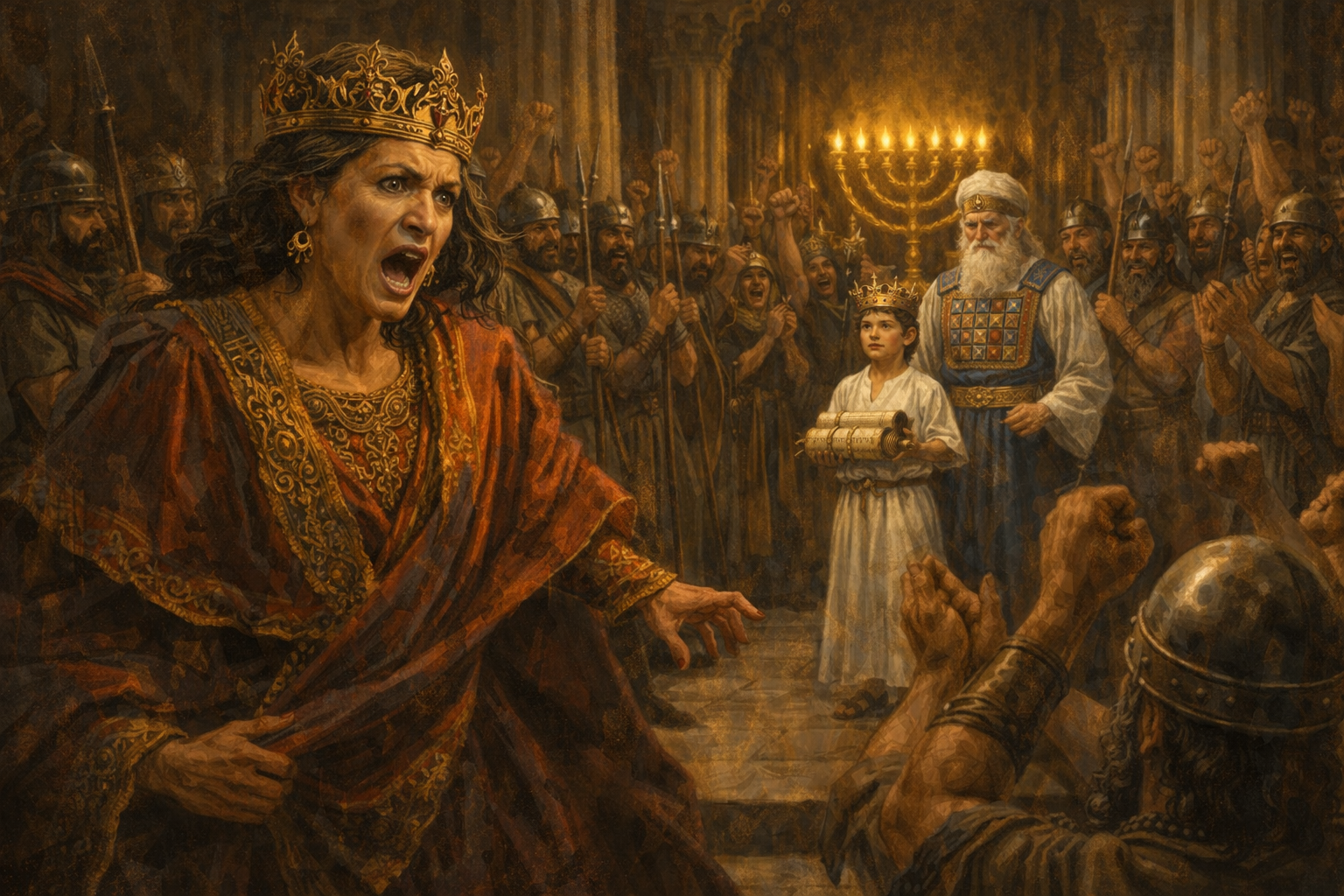
When Athaliah heard the noise of the guard and of the people - 2Ch 23:12 adds "When Athaliah heard the noise of the people running and praising the king, she came into the house of the LORD to the people."
She came to the people in the house of the LORD - Is there not a touch of divine irony here. Athaliah, a usurper who had devoted herself to Baal and had sought to exterminate the Davidic line, now enters the very place she had despised and defiled. She steps into the house of the LORD not as a worshiper, but as a threatened tyrant—drawn there by the noise of rejoicing she cannot control. The temple she had neglected (and even torn down 2Ch 24:7) becomes the perfect stage for her exposure. The covenant she had violated now condemns her. The God she had ignored orchestrates the moment of her downfall within His own house! It was time for divine retribution! What Athaliah never valued becomes the setting in which her illegitimacy is revealed and her reign publicly undone.
Note that in the house of the LORD refers to the temple complex, specifically one of the courts and not inside the sanctuary (Holy Place or Most Holy Place). The scene includes “the people of the land”, military captains and trumpeters, groups that could not lawfully enter the inner sanctuary. which was restricted to priests,
2 Kings 11:14 She looked and behold, the king was standing by the pillar, according to the custom, with the captains and the trumpeters beside the king; and all the people of the land rejoiced and blew trumpets. Then Athaliah tore her clothes and cried, “Treason! Treason!”
- Nu 10:1-10
- stood: The Orientals considered a seat by a pillar or column as particularly honourable.
- a pillar: 2Ki 23:3 2Ch 34:31
- the princes: 2Ki 11:10,11
- all the people: 1Ki 1:39,40 1Ch 12:40 Pr 29:2 Lu 19:37 Rev 19:1-7
- Treason: 2Ki 11:1,2 9:23 1Ki 18:17,18
Related Passages:
1 Kings 7:21 Thus he (SOLOMON) set up the pillars at the porch of the nave; and he set up the right pillar and named it Jachin, and he set up the left pillar and named it Boaz.
2 Chronicles 23:3 Then all the assembly made a covenant with the king in the house of God. And Jehoiada said to them, “Behold, the king’s son shall reign, as the LORD has spoken concerning the sons of David. (ED: Kings shows the crown restored; Chronicles shows the covenant renewed.)
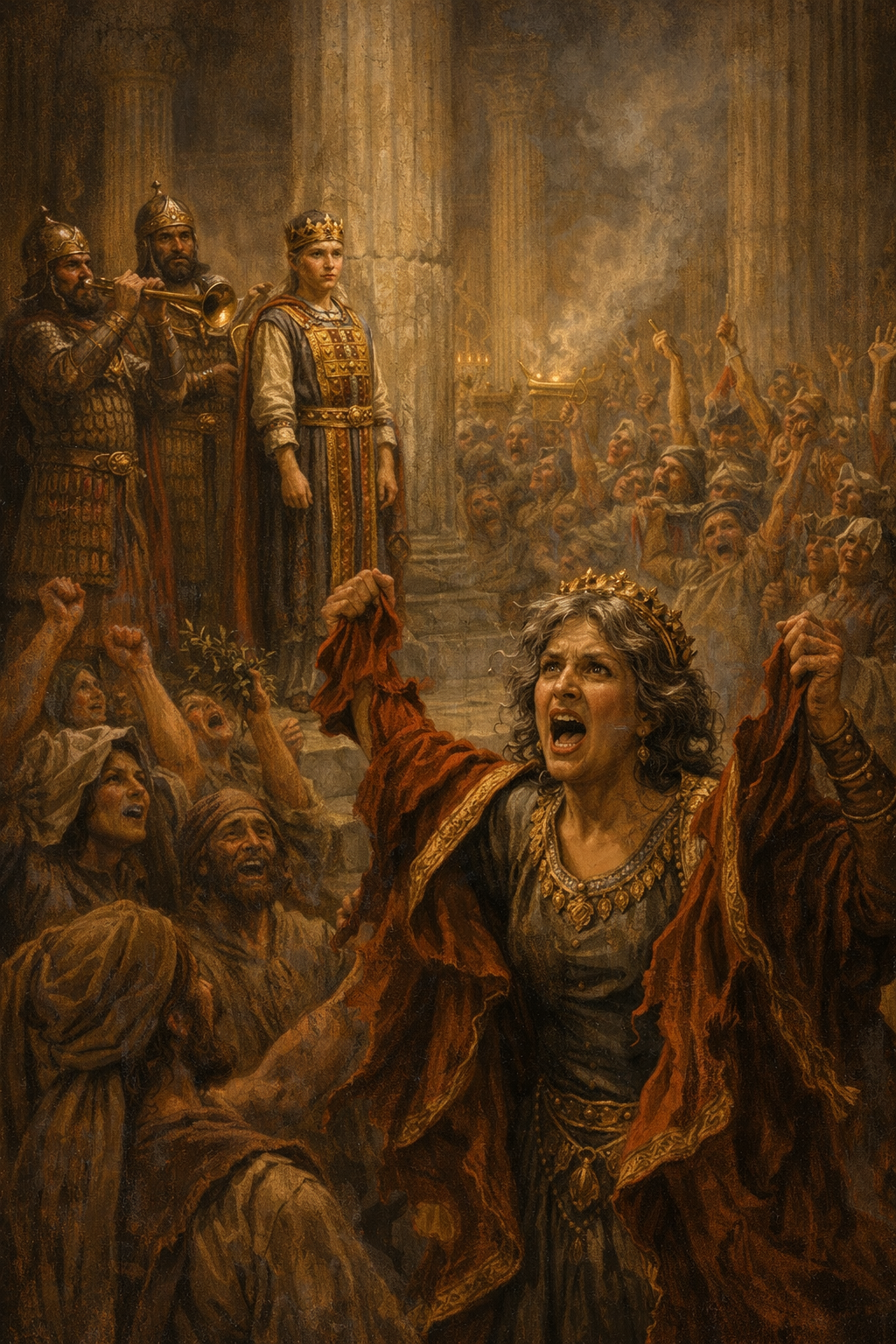
ATHALIAH'S SHOCK OF
SUDDEN REVERSAL
She looked and behold, (hinneh; LXX - idou) - Athaliah, who believed she had eradicated the royal line, suddenly sees the living heir. The word “behold” signals astonishment and divine reversal. What she thought was finished was, in fact, only hidden. Six years of apparent victory collapse in a moment.
The king was standing by the pillar - 2Ch 23:13 says "the king was standing by HIS pillar." His pillar intensifies the meaning indicating that the pillar is assigned to the king. This pillar was likely one of the prominent bronze pillars near the temple entrance (cf. Solomon’s temple furnishings - cf 1Ki 7:21), serving as the customary place of royal presentation and covenant affirmation. Joash is not sneaking into power BUT he is publicly, lawfully, and covenantally installed.
Bob Utley - "standing by the pillar" This refers either to (1) one of the two pillars of Solomon's temple (cf. 1 Kgs. 7:15-22), on each side of the entrance of the Holy Place where the king would have a prominent view and be conspicuous to all (cf. 1 Kgs. 7:21; 2 Chr. 3:17; 34:31) (2_ a raised platform built especially for the king and his entourage (cf. 2 Chr. 6:13; 23:13 in Vulgate but especially in Neh. 8:4)
According to the custom, with the captains and the trumpeters beside the king - Joash was not crowned improvisationally or secretly, but was installed exactly the way legitimate kings always were. This signals lawful succession, not rebellion. This scene unites military authority (emphasizing the army supports King Joash) and liturgical worship, the captains provide protection, order, and lawful authority. The trumpeters bring worship, celebration, divine approval (cf. Nu 10). Recall that trumpets were regularly associated with coronations, public announcements and divine deliverance. The trumpets echo earlier enthronements, especially Solomon’s (1Ki 1:34, 39)
And all the people of the land rejoiced and blew trumpets - 2Ch 23:13 adds the singers with their musical instruments leading the praise.Throughout Kings, the people of the land often represent those still loyal to Yahweh and to the Davidic covenant. Their rejoicing shows Athaliah’s reign had no popular support, the nation recognized Joash as the true king and God has preserved a faithful remnant
Then Athaliah tore her clothes and cried, “Treason! Treason!” Picture the scene of the king standing by the pillar, the army gathered, the trumpets blaring and the people rejoicing. Now imagine what had to go through Athaliah's mind in that instant! Tearing garments was a sign of mourning and often repentance, but here it is hypocritical grief—not repentance, but rage over lost power.
Bob Utley - Athaliah tore her clothes - The Israelites expressed sorrow for national tragedies, the death of a loved one, and for personal repentance, as well as corporate crimes, in several ways: tear outer robe, Gen. 37:29,34; 44:13; Jdgs. 11:35; 2 Sam. 1:11; 3:31; 13:31; 1 Kgs. 21:27; 2 Kgs. 6:30; Job 1:20; Jer. 41:5
Athaliah’s cry is the voice
of a thief surprised in the act.
“Treason! Treason!” She who had been guilty of the greatest treason imaginable, in usurping the throne, and destroying the seed royal, now cries out Treason! Treason! when her own wickedness is brought to light. This is the height of irony for Athaliah had murdered the royal heirs, usurped the throne and promoted Baal worship. She has the gall to now accuse God’s lawful restoration of the Davidi monarchy as treason! Those who commit real treason against God often cry “treason” the loudest when exposed.
R. D. Patterson: When the clamor of the people reached the ears of Athaliah, she made her way to the scene of jubilation (2Ki 11:13). The sight that greeted her eyes doubtless made her heart sink (v. 14). There, on the royal dias at the eastern gate of the inner court to the temple, stood a newly crowned king, surrounded by the high officials both in the religious order and in the military, amid great fanfare and the joyous shouts of the people. She shrieked out here condemnation: it was treason. But her cry was to have as little effect as that of Israel’s Jehoram to Athaliah’s son Ahaziah (2Ki 9:23). (See The Expositor's Bible Commentary - Abridged Edition - Page 50)
Bob Utley - "Treason! Treason!" This exclamation (BDB 905) is repeated for emphasis (cf. 2 Kgs. 9:23; 2 Chr. 23:13). What she considered "treason" was YHWH's justice!
PARALLEL PASSAGE - (TEXT IN BOLD ONLY IN CHRONICLES) 2Ch 23:13 She looked, and behold, the king was standing by his pillar at the entrance, and the captains and the trumpeters were beside the king. And all the people of the land rejoiced and blew trumpets, the singers with their musical instruments leading the praise. Then Athaliah tore her clothes and said, “Treason! Treason!”
Behold (02009) (hinneh) is an interjection meaning behold, look, now; if. "It is used often and expresses strong feelings, surprise, hope, expectation, certainty, thus giving vividness depending on its surrounding context." (Baker) Hinneh generally directs our mind to the text, imploring the reader to give it special attention. In short, the Spirit is trying to arrest our attention! And so hinneh is used as an exclamation of vivid immediacy (e.g., read Ge 6:13)! Hinneh is a marker used to enliven a narrative, to express a change a scene, to emphasize an idea, to call attention to a detail or an important fact or action that follows (Isa 65:17, Ge 17:20, 41:17). The first use of hinneh in Ge 1:29 and second in Ge 1:31 - "And God saw all that He had made, and behold, it was very good. And there was evening and there was morning, the sixth day." Hinneh is oftn used in the idiom "Here I am" in Ge 22:1, 7,11 Ge 27:1,18, Ge 31:11, Ge 46:2 Ex 3:4 1Sa 3:4, 3:16, 12:3, 2Sa 1:7, Isa 52:6, Isa 58:9. Hinneh is used most often to point out people but also to point out things (Ge 31:41, 17:4). God uses hinneh to grab man's attention before He brings destruction (Ge 6:13, 17). God uses hinneh when He establishes covenants (Ge 9:9, 15:12, 17 [when Jehovah cut the Abrahamic covenant], Ge 17:4, cp Ge 28:13, 15), when He provided a sacrificial substitute for Isaac (foreshadowing His giving us His only Son!) (Ge 22:13). Hinneh marks the "chance (The Providence of God)" arrival of Boaz at the field where Ruth was gleaning (Ru 2:4-read about this "chance romance" - Indeed, "Behold!"). Hinneh is used to announce the Lord’s sending of a child as a sign and a prophecy of Immanuel-Emmanuel, the Messiah (Isa. 7:14). In fact W E Vine says that it is notable that when behold (hinneh) is used in Isaiah, it always introduces something relating to future circumstances.
Spurgeon reminds us that "Behold is a word of wonder; it is intended to excite admiration. Wherever you see it hung out in Scripture, it is like an ancient sign-board, signifying that there are rich wares within, or like the hands which solid readers have observed in the margin of the older Puritanic books, drawing attention to something particularly worthy of observation." I would add, behold is like a divine highlighter, a divine underlining of an especially striking or important text. It says in effect "Listen up, all ye who would be wise in the ways of Jehovah!"
Hinneh is translated in the Septuagint with the interjection idou (strictly speaking a command in the second person aorist imperative, middle voice) a demonstrative particle (used 1377 times in the Septuagint and NT) which is found especially in the Gospels of Matthew and Luke "and giving a peculiar vivacity to the style by bidding the reader or hearer to attend to what is said: "Behold! See! Lo!" (Thayer) The command is calling for urgent attention. Do this now! Don't delay! It could be loosely paraphrased "Pay attention!" or "Listen up!" to arouse attention and introduce a new and extraordinary fact of considerable importance.
Josephus Antiquities 9.7.3. has an interesting comment that Athaliah came with her royal guard whom she ordered to kill the crowned child, but she was stopped and she and her supporters killed. Below is the full quote.
When Athaliah unexpectedly heard the tumult, and the acclamations, she was greatly disturbed in her mind; and suddenly issued out of the royal palace with her own army: and when she was come to the temple, the Priests received her: but as for those that stood round about the temple, as they were ordered by the High Priest to do, they hindred the armed men that followed her from going in. But when Athaliah saw the child standing upon a pillar, with the royal crown upon his head, she rent her clothes, and cried out vehemently, and commanded [her guards] to kill him that had laid snares for her, and endeavoured to deprive her of the government. But Jehoiada called for the captains of hundreds, and commanded them to bring Athaliah to the valley of Cedron, and slay her there: for he would not have the temple defiled with the punishments of this pernicious woman. And he gave order, that if any one came near to help her, he should be slain also. Wherefore those that had the charge of her slaughter took hold of her, and led her to the gate of the King’s mules, and slew her there.
4. Now as soon as what concerned Athaliah was by this stratagem after this manner dispatched, Jehoiada called together the people, and the armed men into the temple; and made them take an oath, that they would be obedient to the King, and take care of his safety, and of the safety of his government. After which he obliged the King to give security [upon oath] that he would worship God, and not transgress the laws of Moses. After which they then ran to the house of Baal; which Athaliah and her husband Jehoram had built, to the dishonour of the God of their fathers, and to the honour of Ahab; and demolished it, and slew Mattan, that had his priesthood. But Jehoiada intrusted the care and custody of the temple to the Priests and Levites, according to the appointment of King David; and enjoined them to bring their regular burnt-offerings twice a day; and to offer incense according to the law. He also ordained some of the Levites, with the porters, to be a guard to the temple; that no one that was defiled might come there.
5. And when Jehoiada had set these things in order, he, with the captains of hundreds, and the rulers, and all the people, took Jehoash out of the temple into the King’s palace: and when he had set him upon the King’s throne, the people shouted for joy; and betook themselves to feasting, and kept a festival for many days. But the city was quiet upon the death of Athaliah. Now Jehoash was seven years old when he took the Kingdom. His mother’s name was Zibiah, of the city Beersheba. And all the time that Jehoiada lived, Jehoash was careful that the laws should be kept, and very zealous in the worship of God. And when he was of age he married two wives, who were given to him by the High Priest: by whom were born to him both sons and daughters. And thus much shall suffice to have related concerning King Jehoash; how he escaped the treachery of Athaliah, and how he received the Kingdom.
2 Kings 11:15 And Jehoiada the priest commanded the captains of hundreds who were appointed over the army and said to them, “Bring her out between the ranks, and whoever follows her put to death with the sword.” For the priest said, “Let her not be put to death in the house of the LORD.”
- captains: 2Ki 11:4,9,10 2Ch 23:9,14
- Have: Eze 21:14
- follows: 2Ki 11:8
- Let: Eze 9:7
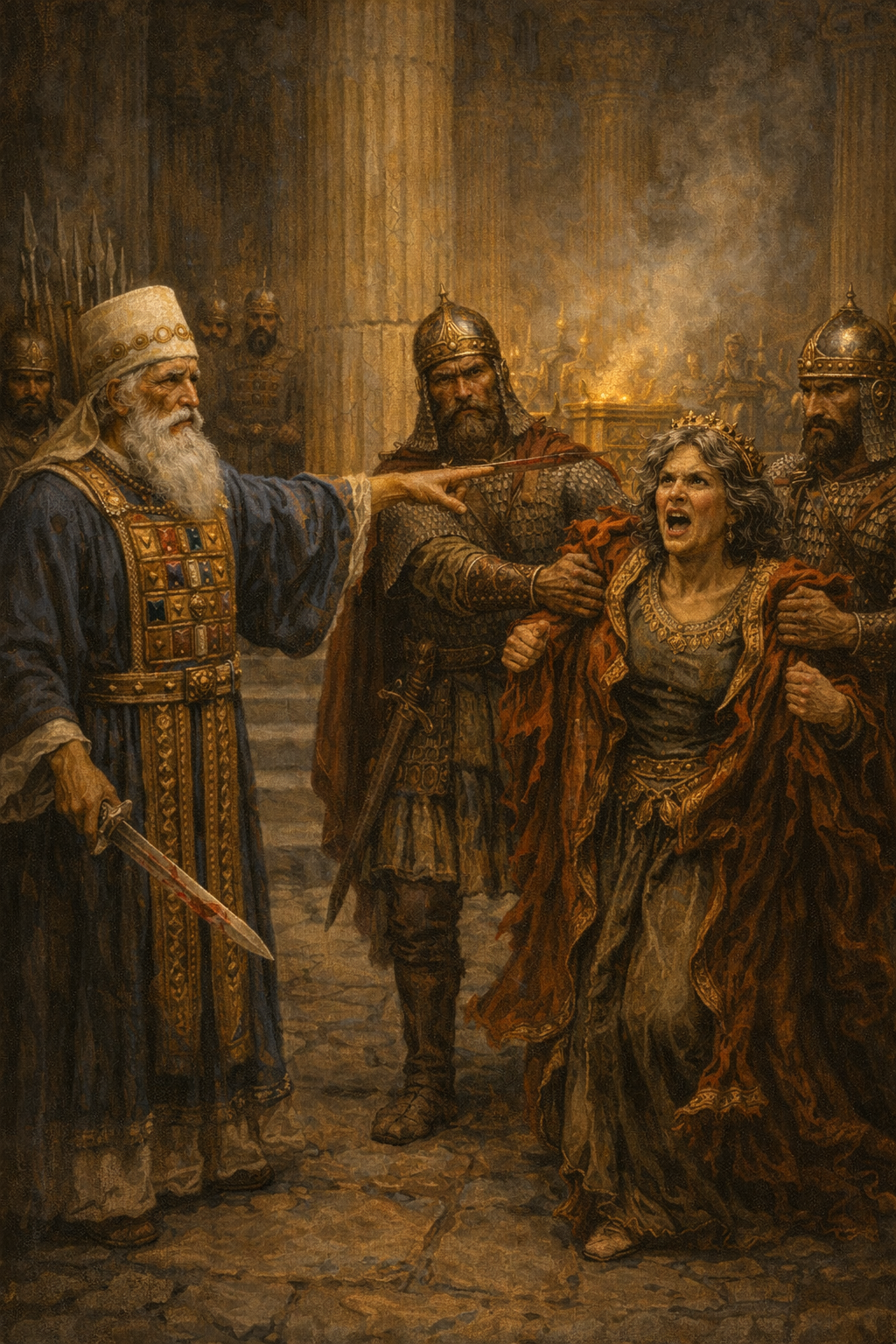
ATHALIAH'S FOLLOWERS
ALSO PURGED
And Jehoiada the priest commanded the captains of hundreds who were appointed over the army and said to them, “Bring her out between the ranks, and whoever follows her put to death with the sword - NLT = "Take her to the soldiers in front of the Temple, and kill anyone who tries to rescue her." Jehoiada now calls in the military men to secure Athaliah, marking the decisive transfer from exposure to execution, and it is handled with deliberate care, legality, and restraint.
Between the ranks - Athaliah is to be escorted through a corridor of armed soldiers.
Bob Utley - Bring her out between the ranks - NKJV, NJB = "Take her outside under guard"; TEV = "take her out between the rows of guards"; REB = "bring her outside the precincts" The term "ranks" (BDB 690, KB 1310) can mean (1) a line of soldiers (KB #2) (2) a row of pillars (Egyptian root) or planks (KB, #1, cf. 1 Kgs, 6:9) "whoever follows her put to death" Josephus, Antiq. 9.7.3, says Athaliah came with her royal guard whom she ordered to kill the crowned child, but she was stopped and she and her supporters killed.
For the priest said, “Let her not be put to death in the house of the LORD - Presumably he did not want to defile the Temple with a Baal worshiper's blood! The temple was holy ground, set apart for worship, sacrifice, and atonement—not for executions. Shedding blood within the sanctuary would defile it (cf. Num 35:33), and even a just execution must not pollute sacred space.
PARALLEL PASSAGE - 2Ch 23:14 Jehoiada the priest brought out the captains of hundreds who were appointed over the army and said to them, “Bring her out between the ranks; and whoever follows her, put to death with the sword.” For the priest said, “Let her not be put to death in the house of the LORD.”
2 Kings 11:16 So they seized her, and when she arrived at the horses’ entrance of the king’s house, she was put to death there.
- by the which: 2Ch 23:15
- there was she slain: Ge 9:6 Judges 1:7 Mt 7:2 Jas 2:13 Rev 16:5-7
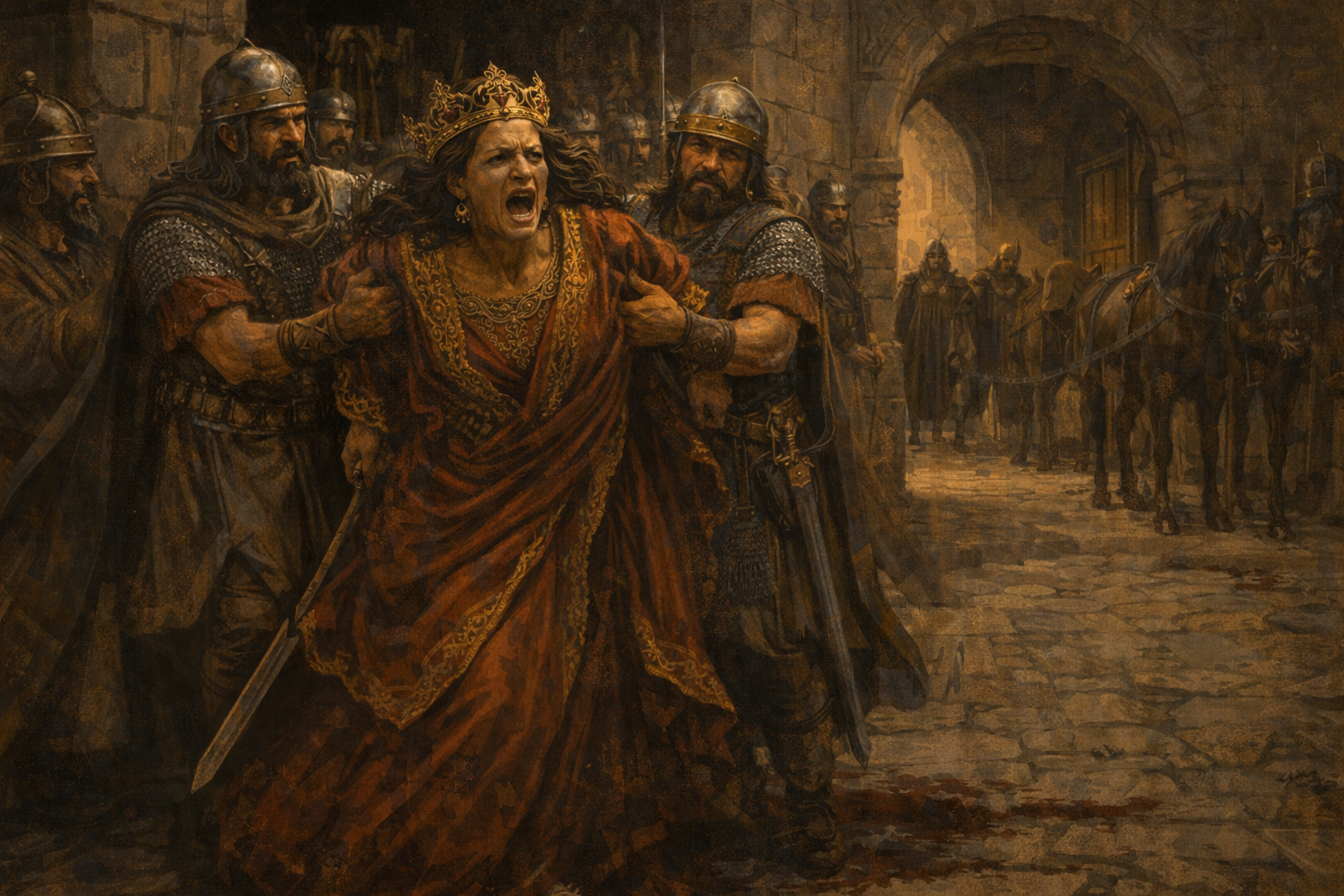
ATHALIAH'S BLOOD SHED
AT HORSE GATE
So they seized her, and when she arrived at the horses’ entrance of the king’s house, she was put to death there - They make sure she is well removed from the Temple complex before killing her. And so like mother, like daughter, Athaliah is terminated just as her mother had been. And there is not even mention of a proper burial.
PARALLEL PASSAGE - 2Ch 23:15 So they seized her, and when she arrived at the entrance of the Horse Gate of the king’s house, they put her to death there.
David Guzik - One reason the people resented this worship of Baal in Jerusalem so much was because Athaliah had directed that sacred objects from the temple of the LORD be put into the temple of Baal: For the sons of Athaliah, that wicked woman, had broken into the house of God, and had also presented all the dedicated things of the house of the LORD to the Baals (2 Chronicles 24:7).
2 Kings 11:17 Then Jehoiada made a covenant between the LORD and the king and the people, that they would be the LORD’S people, also between the king and the people.
- made a covenant: 2Ki 11:4 De 5:2,3 29:1-15 Jos 24:25 2Ch 15:12-14 29:10 34:31 Ezr 10:3 Ne 5:12,13 9:38 10:28,29 2Co 8:5
- the king: 1Sa 10:25 2Sa 5:3 1Ch 11:3 2Ch 23:16 Ro 13:1-6
Related Passages:
2 Samuel 5:3 So all the elders of Israel came to the king at Hebron, and King David made (karath - cut) a covenant (beriyth) with them before the LORD at Hebron; then they anointed David king over Israel.
2 Chronicles 23:16 Then Jehoiada made (karath - cut) a covenant (beriyth) between himself and all the people and the king, that they would be the LORD’S people.
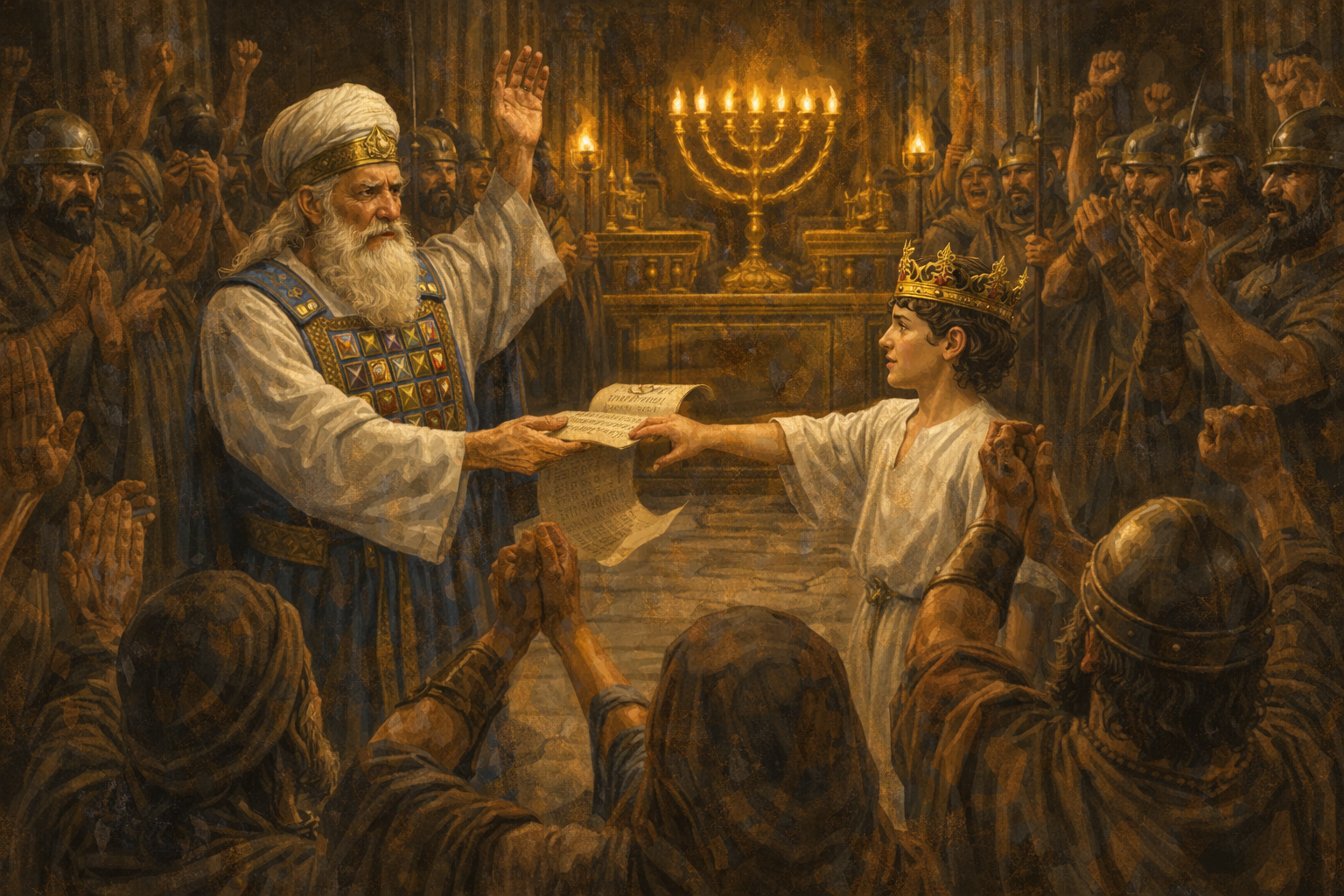
CUTTING A COVENANT
WITH YAHWEH
Then Jehoiada made (karath - cut) a covenant (beriyth) between the LORD and the king and the people, that they would be the LORD’S people, also between the king and the people - Note the parties in this covenant renewal - Yahweh, Jehoiada, new king, and people of Judah. This is a solemn, binding, national covenant renewal, restoring Judah as Yahweh’s covenant people, not merely installing a king.
The purpose of the covenant was that they would be the LORD’S people. - Note that phrase "the LORD's people," not the king's people! The essence of the covenant was that the king would reign, not as absolute monarch, but as God’s representative.
Peter Pett comments that "Such a renewing of the covenant on important occasions can be paralleled in 2 Kings 23:3; Deuteronomy 5:1 ff; Joshua 8:30-35; Joshua 24:2-25; 2 Samuel 5:3 with 1 Chronicles 11:3; 2 Chronicles 29:3 ff). It was an essential part of returning to the true worship of YHWH. By it the people were acknowledging YHWH as their sole God and Overlord, and their responsibility to be His holy people and observe His laws and commandments.
PARALLEL PASSAGE - 2Ch 23:16 Then Jehoiada made (karath - cut) a covenant (beriyth) between himself and all the people and the king, that they would be the LORD’S people.
2 Kings 11:18 All the people of the land went to the house of Baal, and tore it down; his altars and his images they broke in pieces thoroughly, and killed Mattan the priest of Baal before the altars. And the priest appointed officers over the house of the LORD.
- went: 2Ki 9:25-28 10:26 18:4 23:4-6,10,14 2Ch 23:17 34:4,7
- tore it down: 2Ki 18:4 Ex 32:20 De 12:3 2Ch 21:17 Isa 2:18 Zec 13:2
- Mattan: De 13:5,9 1Ki 18:40 Zec 13:2,3
- appointed: 2Ch 23:18-20
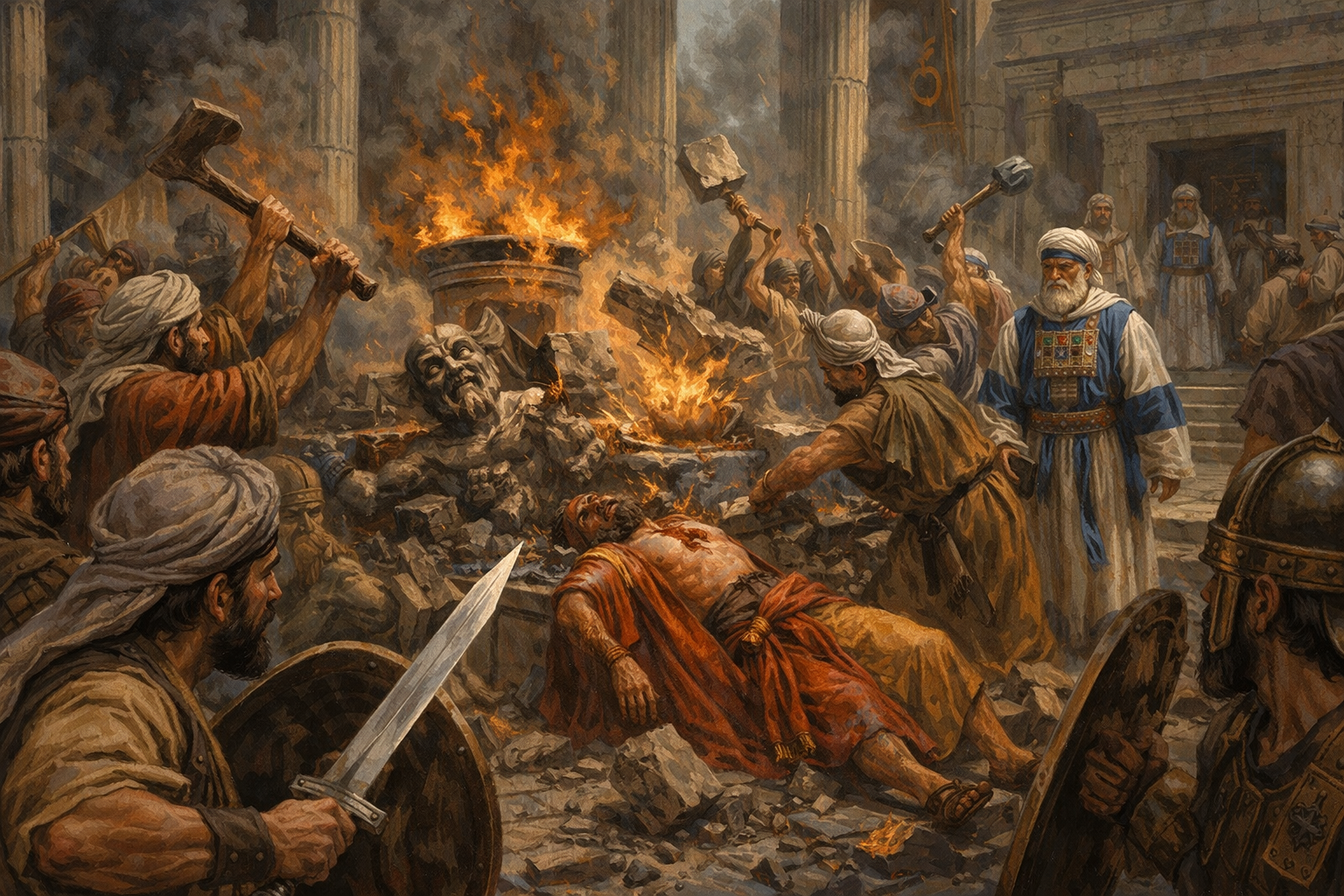
ANNIHILATION OF
ATHALIAH'S BAALISM
All the people of the land went to the house of Baal, and tore it down; his altars and his images they broke in pieces thoroughly, and killed Mattan the priest of Baal before the altars - They did not stop with tearing down the building itself; they went on to shatter the sacred objects devoted to Baal and to put Mattan, the priest of Baal, to death.
This purge of Baalism in Judah closely paralleled the earlier purge carried out by Jehu in the northern kingdom (2 Kings 10:18–29). In both cases, Baal worship was publicly exposed, violently dismantled, and decisively suppressed, signaling a dramatic reversal of apostasy at the national level. Altars were destroyed, sacred objects desecrated, and Baal’s priesthood eliminated, demonstrating that covenant infidelity would no longer be tolerated—at least for a time.
Paul House adds that "This religious reform parallels Jehu’s in some ways yet diverges in certain crucial areas. Baal’s temple is destroyed in both instances, but only the leader of Baalism is killed in Judah’s reform. Baalism is removed as the state religion in each case, yet the people dominate the reform in Judah, whereas the new king orchestrates the changes in Israel. Prophetic predictions fuel Jehu’s purge, while a priest drives the people forward in Judah. In the north separatist Yahwism seems to have no real voice after the coup, and Jeroboam’s cult appears to resume its earlier role as state religion. In Judah the high places are not removed (cf. 2 Kgs 12:3), but separatist Yahwism has been returned to the temple by its champion, Jehoiada. From this analysis it seems likely that the reform in the south has more popular support, more institutional backing, and more chance of long-term survival. Neither reform, though, goes as far as the narrator thinks is necessary. (See 1, 2 Kings: An Exegetical and Theological Exposition)
Bob Utley - "the house of Baal" Ahab had built a house (temple) for Ba'al in the capital city of Samaria (cf. 1 Kgs. 16:32; 2 Kgs. 10:21,26,27). Since Ahab had married the daughter of the king of Tyre, Ethbaal, this was probably a temple to Ba'al Melqart. But this house of Ba'al was in Jerusalem. The influence of Ahab and Jezebel had polluted Judah also. It must have been next to Solomon's temple or even on its grounds (cf. v. 18).
J. Barton Payne: The execution of “Mattan the priest of Baal” carried out the requirement of God’s Word directed against those who should lead others into false religion (Dt 13:5-10). (See The Expositor's Bible Commentary - Abridged Edition- Page 50)
And the priest (JEHOIADA) appointed officers over the house of the LORD - The officers were authorized temple officials Levitical priests who regulated access to the temple, so that worship would proceed according to God’s commands.
PARALLEL PASSAGE - (MATERIAL IN BOLD ONLY IN CHRONICLES) 2Ch 23:17-18 And all the people went to the house of Baal and tore it down, and they broke in pieces his altars and his images, and killed Mattan the priest of Baal before the altars. 18 Moreover, Jehoiada placed the offices of the house of the LORD under the authority of the Levitical priests, whom David had assigned over the house of the LORD, to offer the burnt offerings of the LORD, as it is written in the law of Moses–with rejoicing and singing according to the order of David.
🙏 THOUGHT - "The second thing the Judeans got rid of was the idolatrous apparatus — the altar and the images. Again, we need to apply this personally, in our lives, our homes, and the businesses and other institutions we control. Does the machinery or apparatus of idolatry exist in your home? If you worship the God of entertainment, the apparatus you use is a big TV and a powerful sound system. If you worship the God of convenience, the apparatus with which you do it may be a big smartphone or an Amazon Echo. If you worship the god of human relationships, the apparatus with which you do it may be clothes, makeup, and other image and status artifacts. If you worship the god of prosperity, the apparatus may be your tools or your bank accounts. If you worship the God of the Bible, but reduced to a size and level you can control, you may have images of God and Jesus in your house. You may not be able to get rid of certain of these different apparatuses of idolatry, and some of them have legitimate uses. But brothers and sisters, if you are confirmed money-worshipper you may need to severely curtail your bank account. If you are a food-worshipper you may need to keep an empty fridge. If you are an images-of-Christ worshipper, you may need to get rid of your idolatrous pictures." (Caleb Nelson)
2 Kings 11:19 He took the captains of hundreds and the Carites and the guards and all the people of the land; and they brought the king down from the house of the LORD, and came by the way of the gate of the guards to the king’s house. And he sat on the throne of the kings.
- took: 2Ki 11:4-11
- by the way: 2Ki 11:5 2Ch 23:5,19
- he sat: 1Ki 1:13 1Ch 29:23 Jer 17:25 22:4,30 Mt 19:28 25:31
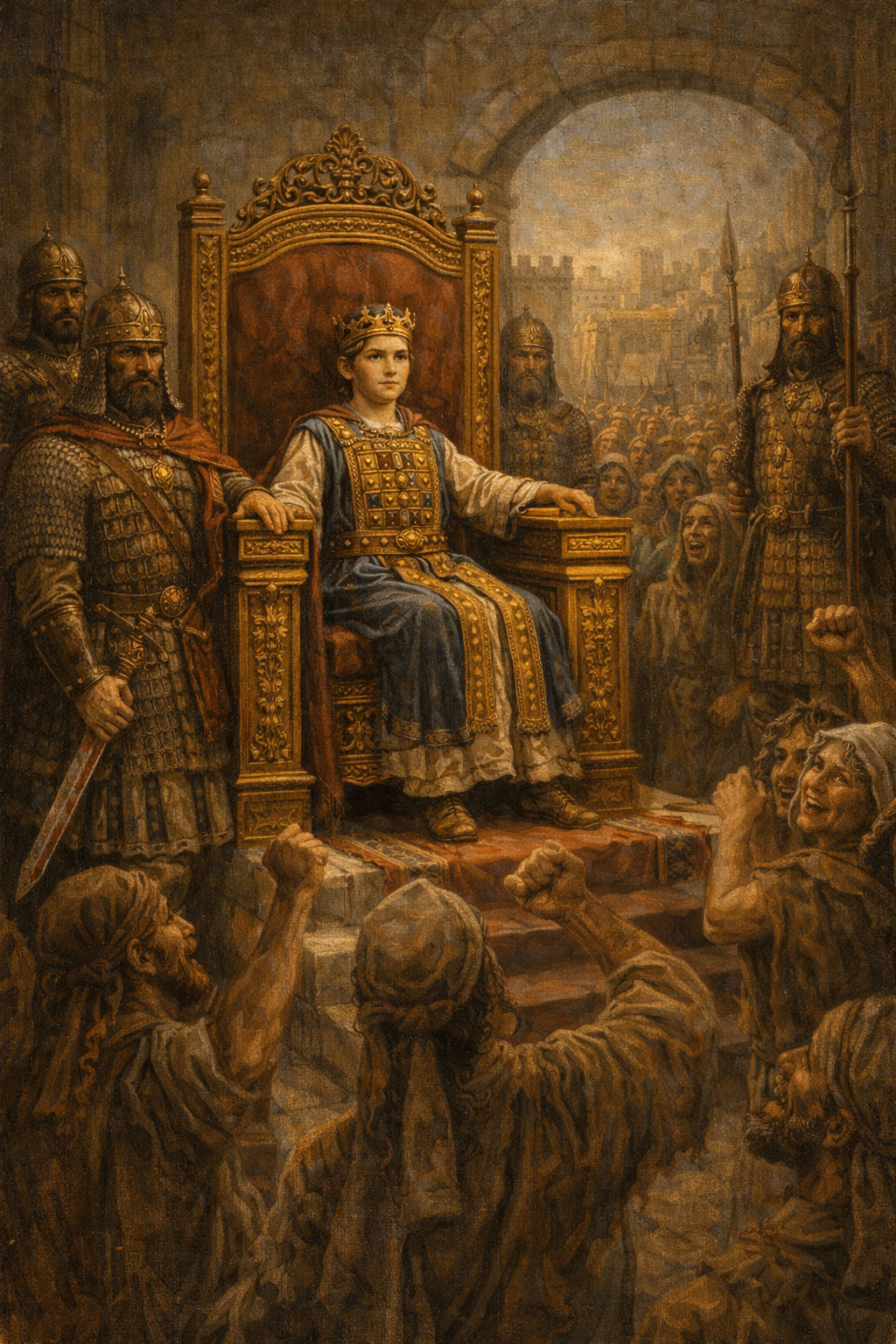
He took the captains of hundreds and the Carites and the guards and all the people of the land; and they brought the king down from the house of the LORD, and came by the way of the gate of the guards to the king’s house. And he sat on the throne of the kings.
PARALLEL PASSAGE - (MATERIAL IN BOLD ONLY IN CHRONICLES) 2Ch 23:19 He stationed the gatekeepers of the house of the LORD, so that no one would enter who was in any way unclean. 20 He took the captains of hundreds, the nobles, the rulers of the people and all the people of the land, and brought the king down from the house of the LORD, and came through the upper gate to the king’s house. And they placed the king upon the royal throne.
2 Kings 11:20 So all the people of the land rejoiced and the city was quiet. For they had put Athaliah to death with the sword at the king’s house.
- rejoiced: 2Ki 11:14 2Ch 23:21 Pr 11:10 29:2
- slew Athaliah: 2Ki 11:15
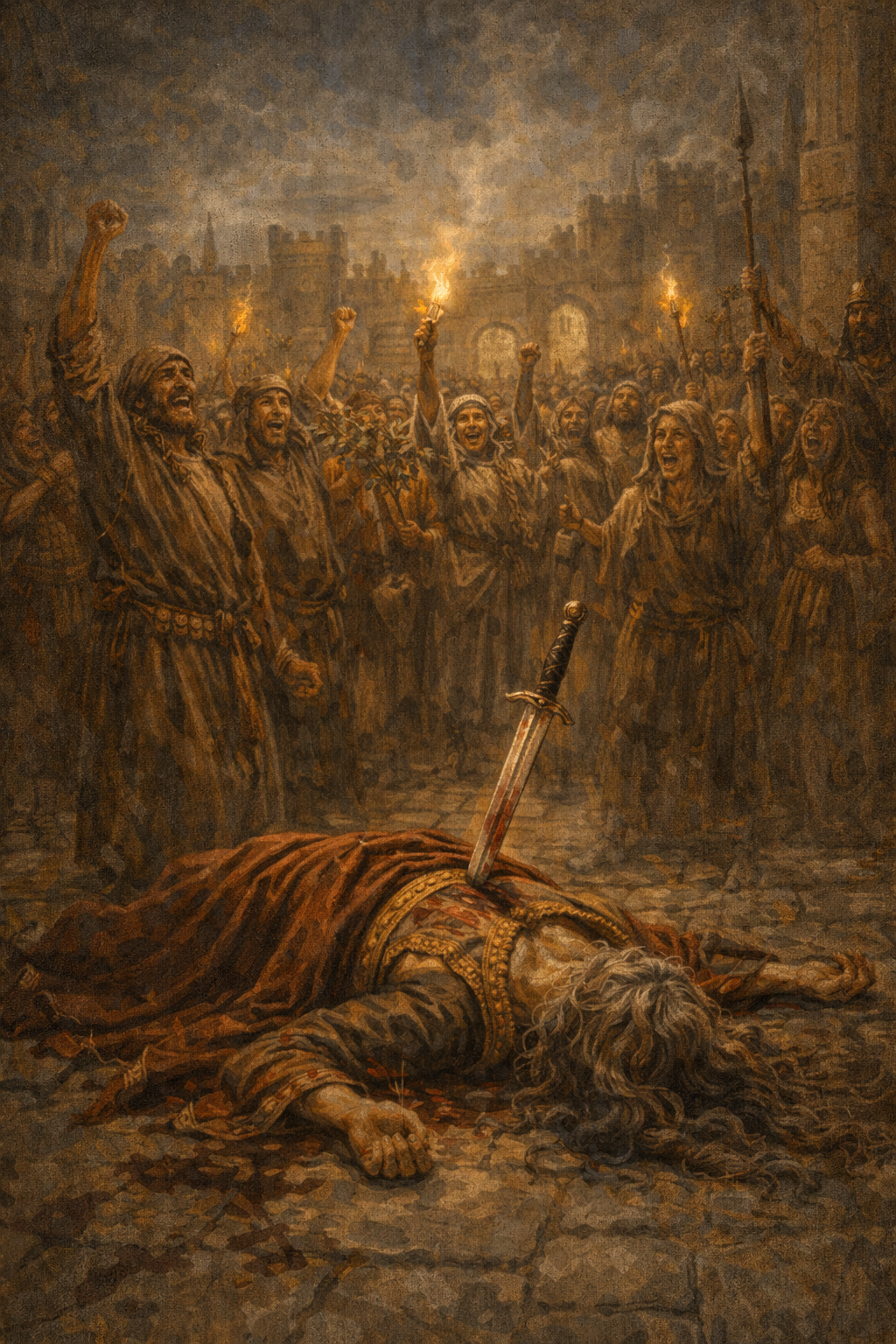
CORPORATE JOY
IN JERUSALEM
So all the people of the land rejoiced and the city was quiet - Clearly the people had been silenced, thus they were not mourning but rejoicning. Her removal brought relief, not grief. n Scripture, when people rejoice at a ruler’s fall, it exposes the ruler’s true character. The Hebrew idea of quiet is undisturbed, settled, at rest — not eerie silence. Did you see the author's interesting contrast - people rejoiced but city quiet. The people had joy on the inside because there was peace on the outside (in Judah). And finally, peace did not come by compromise, but by removing evil.
Bob Utley - Jehoash was only seven years old. This meant his godly counselors would control the nation for years (cf. 2 Chr. 24:1-16; like Josiah). The bad years are recorded in 2 Chr. 24:17-27.
When illegitimate, idolatrous power was removed and God’s rightful king restored, the people rejoiced inwardly and the city rested outwardly. This reminds me of Isaiah 32:17 "And the work of righteousness will be peace, And the service of righteousness, quietness and confidence forever."
Joy in the people and peace in the city
are fruits of righteous leadership.
For (term of explanation). What's it explaining and what is the explanation?
They had put Athaliah to death with the sword at the king’s house - In the Wizard of Oz there is a song at the end which sings "Ding, dong, the wicked witch is dead." The spiriti of Jezebel as been definitively snuffed out with her daughter's death. The murderous usurper who had slaughtered the royal heirs is herself slaughtered. Payday someday had come for her. This proverb proved true "When it goes well with the righteous, the city rejoices, and when the wicked perish, there is joyful shouting. (Pr 11:10)
PARALLEL PASSAGE - 2Ch 23:21 So all of the people of the land rejoiced and the city was quiet. For they had put Athaliah to death with the sword.
2 Kings 11: 21 Jehoash was seven years old when he became king.
- 2Ki 11:4 22:1 2Ch 24:1-14
A CHILD KING BY
DIVINE DESIGN
Jehoash was seven years old when he became king - This statement underscores God’s sovereignty, human weakness, and covenant faithfulness all in one sentence. Jehoash ascended the throne at seven years old clear evidence of God's sovereign doing.
It is interesting to look at how God delights to advance His purposes though what looks weak and insignificant to men. And so repeated with see the emphasis on strength through weakness - Isaac — child of promise; Samuel — ministered as a boy; David — youngest, overlooked son/ Josiah — became king at eight; Jesus — born as a helpless infant.
Jehoash’s coronation at seven years old declares that the throne of David stands not by human power, but by God’s unbreakable promise.
2 Kings 12:1 In the seventh year of Jehu, Jehoash became king, and he reigned forty years in Jerusalem; and his mother’s name was Zibiah of Beersheba.
PARALLEL PASSAGE - 2 Chronicles 24:1 Joash was seven years old when he became king, and he reigned forty years in Jerusalem; and his mother’s name was Zibiah from Beersheba.