2 Kings 12:2
2 Kings 12:3
2 Kings 12:4
2 Kings 12:5
2 Kings 12:6
2 Kings 12:7
2 Kings 12:8
2 Kings 12:9
2 Kings 12:10
2 Kings 12:11
2 Kings 12:12
2 Kings 12:13
2 Kings 12:14
2 Kings 12:15
2 Kings 12:16
2 Kings 12:17
2 Kings 12:18
2 Kings 12:19
2 Kings 12:20
2 Kings 12:21
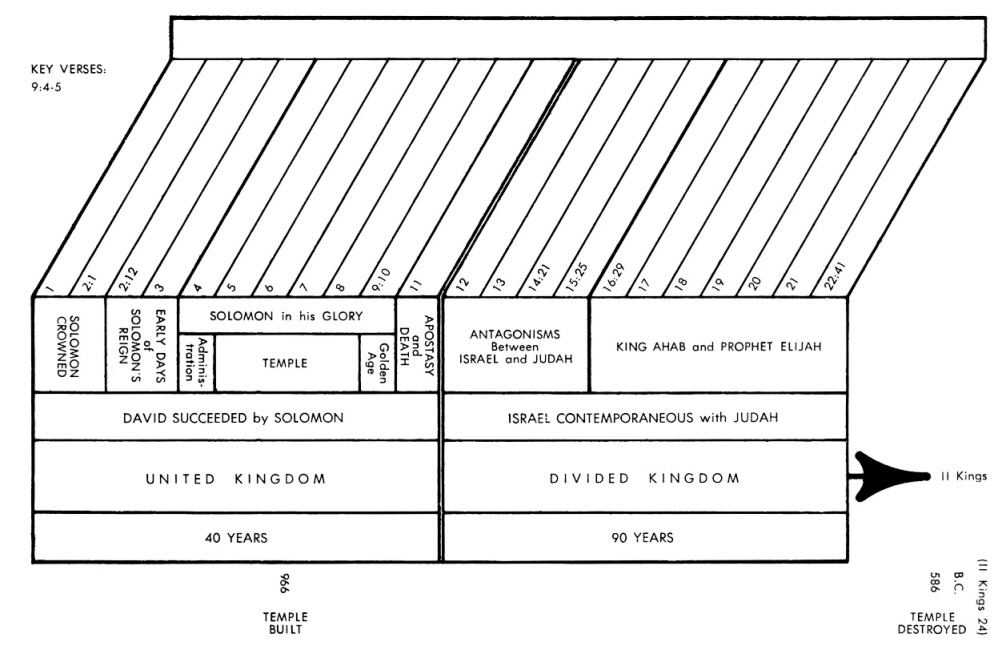
Chart from recommended resource Jensen's Survey of the OT - used by permission
1 Kings Chart from Charles Swindoll
THE DOWNWARD SPIRAL
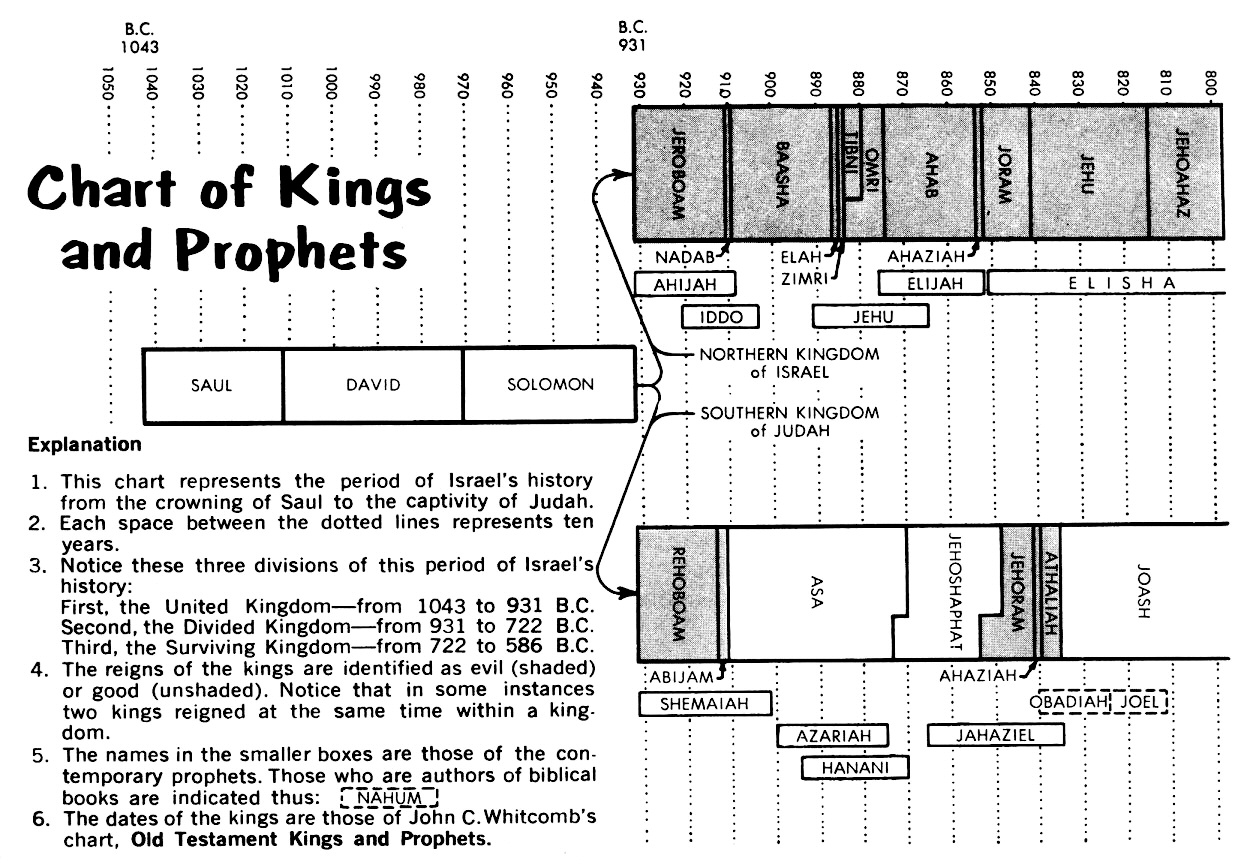
Click to Enlarge
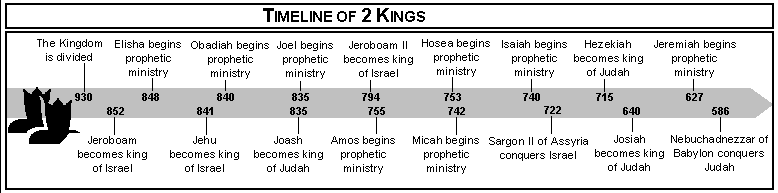
Ryrie Study Bible - Borrow
Click to Enlarge
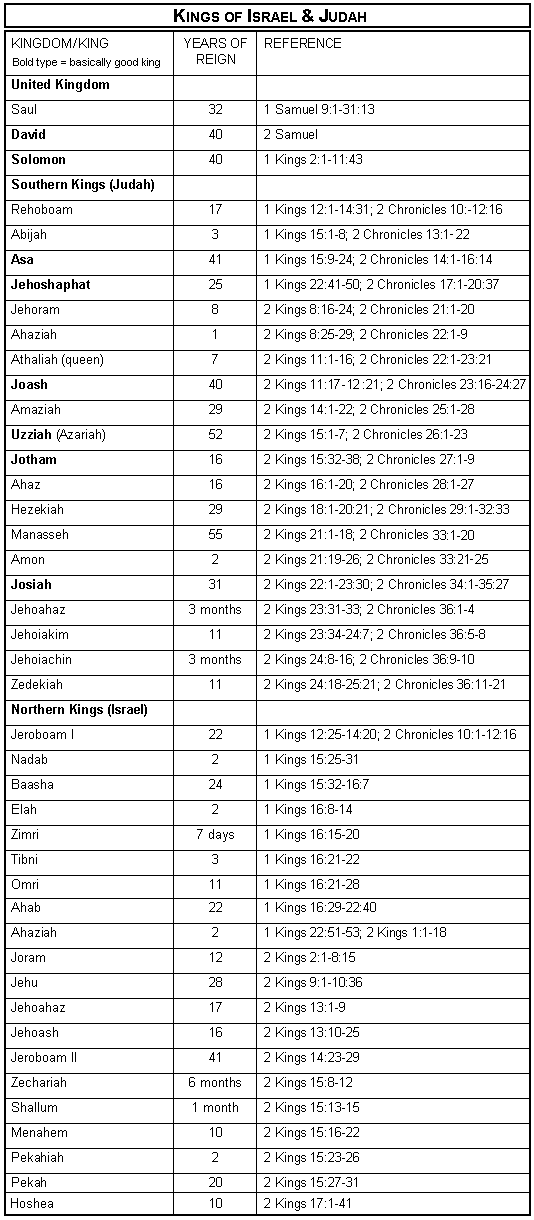
(NOTE: Many consider Amaziah and Hezekiah as "good" kings)
SEE ALSO:
ESV chart - kings of Israel - more information
ESV chart - kings of Judah - more information
Another Chart with Variable Dates for Reigns of Kings
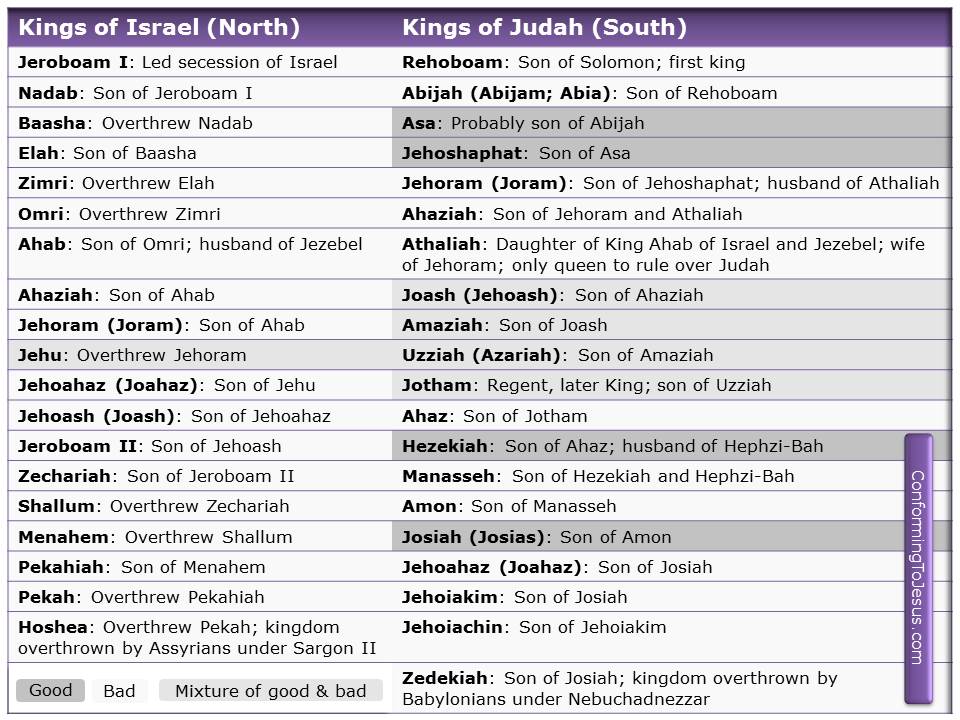
Source: ConformingtoJesus.com
2 Kings 12:1 In the seventh year of Jehu, Jehoash became king, and he reigned forty years in Jerusalem; and his mother’s name was Zibiah of Beersheba.
- the seventh: 2Ki 9:27 11:1,3,4,21 2Ch 24:1-14
- Jehoash: 2Ki 11:2 1Ch 3:11, Joash
- TO HELP HARMONIZE KINGS & CHRONICLES SEE Harmony of 2Kings 11-12 and 2Chronicles 22-24E
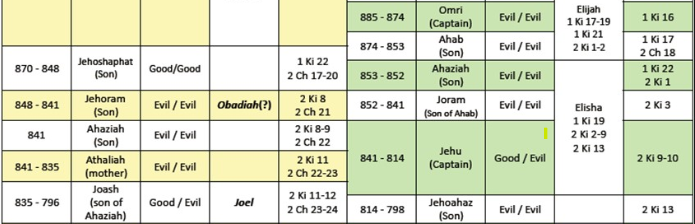
Joash = Jehoash > Began Good/Ended Evil
JOASH'S FORMAL
REGNAL SUMMARY
In the seventh year of Jehu - In the seventh year of Jehu is a synchronism wich ties Judah’s history to Israel’s timeline (see diagram above). This dating method helps readers track events across both kingdoms and underscores God’s sovereign control over history, even amid political upheaval. There is an interesting irony in synchronism with Jehu's reign, for while Jehu was purging Baalism in Israel, Baal worship had nearly extinguished David’s line in Judah, yet God preserved it.
Jehoash became king - Jehoash (means "Yahweh has given") is also called Joash. This simple statement is profound for it markes the preservation of the Davidic line of the coming Messiah! And the meaning of his name is significant for his survival and enthronement were not accidental or political but they were "God given" to preserve the Davidic covenant (2Sa 7:12-13). What Athaliah tried to erase, the LORD gave back.
And he reigned forty years in Jerusalem - The only reigns of Judean kings longer than Jehoash were Manasseh for 55 years (2 Ki 21:1), Azariah (Uzziah) for 52 years (2 Ki 15:2) and Asa for 41 years (1 Ki 15:10). Intermediate reigns were seen with Jehoshaphat – 25 years; Amaziah – 29 years; and Hezekiah – 29 years. Much shorter reigns were seen with Ahaziah – 1 year; Athaliah – 6 years (usurper); Jehoahaz – 3 months; Jehoiachin – 3 months; Zedekiah – 11 years. In summary, Jehoash’s 40-year reign stands among the longer reigns of Judah’s kings highlighting relative political stability and divine preservation, but his long reign did not demonstrate lifelong obedience. Jehoash’s early faithfulness under Jehoiada contrasts sharply with his later apostasy (2 Chr 24).
Bob Utley - "he reigned forty years" There are two ways to view this number. (1) It is a round number ‒ see SYMBOLIC NUMBERS IN SCRIPTURE, #7. (2) It counts the reign of Athaliah, thereby counting from Ahaziah ‒ see SPECIAL TOPIC: KINGS OF THE DIVIDED MONARCHY.
Spurgeon - He might have reigned much longer had he not erred and turned aside from the right way, and so brought judgment upon himself. As long as his uncle lived, that truly devout statesman as well as priest of the Lord, “Joash did that which was right in the sight of the Lord.”
C H Spurgeon - THERE is a book called The Museum of Natural History, and the most singular animal in that museum is man. It would be far more easy to understand any other creature than to understand a human being. He is worthy of very great study; and the more he is studied, the more will he surprise you. There are certain characters that are great curiosities. Alas, there are also other characters that are great monstrosities! You can never tell, from what a man is, what he will be. The case before us is a very extraordinary one, because here is a man with every possible advantage, who through a number of years exhibited the brightest form of character; and yet in the end he was not thought worthy to be laid in the sepulchres of his fathers with others of the kings of Judah; neither was he worthy of any royal interment, for the latter part of his life blackened and defiled the whole of his career, and he who began his reign like the dawning of the day ended it like the middle of the night. (Sermon - Goodness as a Morning Cloud - 2Ch 24:2, 17-18)
And his mother’s name was Zibiah of Beersheba - Zibiah is otherwise unknown, but her identification serves several purposes because it establishes legitimacy confirming Jehoash’s rightful birth for she was a Judean from Beersheba, far in southern Judah. It is notable that Beersheba was associated with patriarchal faith (Abraham, Isaac, Jacob), subtly contrasting with Athaliah’s Baalistic heritage.
Bob Utley - "his mother's name was Zibiah" Jehoash was not a son of Athaliah.
Jehoash (Joash) was only seven years old when he was made king; therefore, he needed a capable advisor. Jehoiada, who had already protected and anointed him, served in this capacity. To Jehoiada must go most of the credit for the fine record of Jehoash's early years. So long as Jehoiada continued as high priest, Jehoash remained a true follower of God. But when Jehoiada died, the king began to listen to new advisors who were more sympathetic to Baal worship (2 Chr. 24:17, 18). Jehoash served the Lord as long as Jehoiada lived to instruct him (2 Chron. 24:2).
Warren Wiersbe has an interesting introductory comment on 2 Kings 12—13 (2 Chronicles 24)
It’s a well-known principle that what a person believes ultimately determines how a person behaves. Eve believed the Devil’s lie that she wouldn’t die; she ate the forbidden fruit, and she eventually died. With his eyes wide open, Adam believed he should imitate his wife, so he took the fruit and ate it, and he plunged the human race into sin and death (Gen. 3; Rom. 5:12–21; 1 Tim. 2:14). When we believe the truth, God works for us, but when we believe a lie, the Devil works against us. When our Lord was tempted by Satan, He countered Satan’s lies with God’s truth and said, “It is written” (Matt. 4:1–11). The three kings presented in these chapters illustrate three different kinds of faith, none of which is the kind God’s people should have today.
- Joash—shallow faith (2Ki 12:1–21)
- Jehoahaz—crisis faith (2Ki 13:1–9)
- Amaziah, a presumptuous king (2Ki 14:1–20; 2Ch 25)
Paul Apple - INTRODUCTION: Jesus gave us the illustration of two different houses built on two very different foundations. The one was solid – built on rock – able to stand on its own and endure any type of trial. This house spoke to the type of faith that finishes strong and leaves a good legacy. But the other house was built on sand. It didn’t look very different for quite some time. It might even have seemed very attractive – plenty of bedrooms with walk-in closets; modern kitchen; even a screened in porch. But it was propped up by favorable conditions. Once the supporting props were removed and the strong winds blew, its weak foundation was exposed. How strong is your faith? Are you being propped up by your parents or by some Christian leader or some strong spiritual mentor that guides you? When you are completely on your own and tough times come, how will you react? What happens when you go off to high school or college? What decisions do you make when you don’t have a large crowd of Christian friends to pressure you in the right direction? We want to learn a lesson today about finishing strong in our Christian life. We want to make sure that we are depending directly on the grace of God and the sufficiency of Jesus Christ – not on someone else to give us spiritual strength. We are going to study the life of the Boy-King Joash – the one who came to the throne at the young age of 7 (hard to imagine) and ruled for 40 years over Judah. His life is broken into 2 halves. His early reign looks fairly strong under the spiritual guidance of the wise old high priest Jehoiada who lived to be 130 (talk about a generation gap! – Must have been some interesting dynamics). But after his death, King Joash showed his true colors and turned away from the Lord big time. Unable to form his own godly convictions and live them out, he turned to some other poor counselors and followed their foolish advice. Hopefully, we will learn from his failures how to finish strong in our Christian walk. FINISHING STRONG REQUIRES BEING RELENTLESS IN THE PURSUIT OF RIGHTEOUSNESS
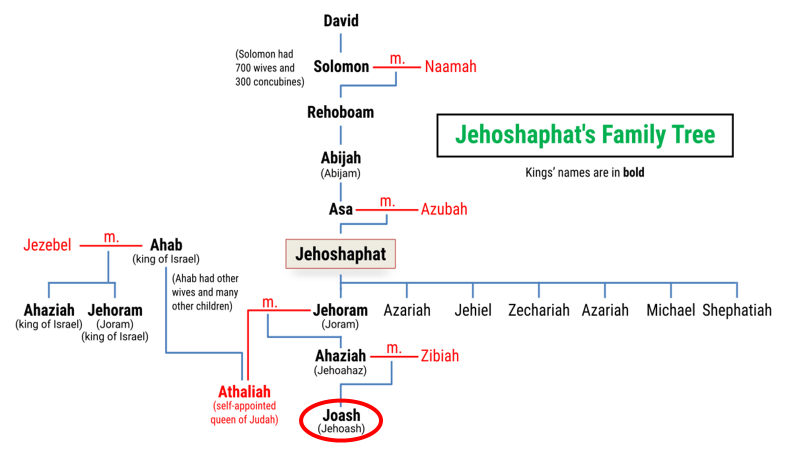
QUESTON - Who was King Joash (Jehoash) in the Bible? | GotQuestions.org
ANSWER - There are two kings with the name Joash (or Jehoash) in the Bible: one a king of Judah (reigned 835–796 BC) and the other a king of Israel (reigned 798–782 BC).
The story of King Joash of Judah starts with that of King Jehu of Israel. Anointed king of Israel by Elisha, Jehu was tasked with destroying King Ahab’s descendants and wiping out Baal worship in the land (2 Kings 9). 1 Kings 21:25–26 gives the reason for the judgment: “There was never anyone like Ahab, who sold himself to do evil in the eyes of the Lord, urged on by Jezebel his wife. He behaved in the vilest manner by going after idols, like the Amorites the Lord drove out before Israel.” God had told Ahab, through Elijah, “I am going to bring disaster on you. I will wipe out your descendants and cut off from Ahab every last male in Israel—slave or free, . . . because you have aroused my anger and have caused Israel to sin” (1 Kings 21:21–22). Ahab responded to the prophecy with mourning and in humility, so God relented, saying that He would not bring the disaster in Ahab’s time but during his son’s reign. Jehu was God’s instrument to fulfill the prophecy.
After Jehu was anointed king over Israel, he set out against Joram, a son of Ahab and the current king of Israel. Ahaziah (different from the other son of Ahab who initially succeeded him) was king of Judah at the time and was with Joram. Judah’s Ahaziah, however, “followed the ways of the house of Ahab and did evil in the eyes of the Lord, as the house of Ahab had done, for he was related by marriage to Ahab’s family” (2 Kings 8:27). Jehu killed both Ahaziah and Joram; executed Ahab’s wife, Jezebel; killed Ahab’s descendants; and “wiped out Baal from Israel” (2 Kings 10:28, ESV). Unfortunately, Jehu himself did not walk in the ways of God, but, since he had been faithful to God’s call to rid Israel of Baal worship, God promised that four generations of his line would be king of Israel (2 Kings 10:30).

Good/Evil = Beginning of Reign/End of Reign
King Joash of Judah first comes on the scene when Athaliah, the mother of King Ahaziah, whom Jehu had killed, took charge of Judah. Athaliah killed all of the royal family she could find in Judah in order to secure the throne for herself. However, Athaliah missed one of her grandsons—the infant Joash. The evil queen’s daughter (or possibly step-daughter) rescued young Joash and his nurse, and the child was hidden for six years in the temple while Athaliah reigned in Judah (2 Kings 11:1–3). In the seventh year, the priest Jehoiada revealed Joash to the captains of the guards. The priest made an agreement with them to provide protection to the temple and the rightful king, and Jehoiada brought Joash out into public and anointed him as king (2 Kings 11:4–12). The people of Judah rejoiced over Joash’s appointment. Upon hearing the noise of the ceremony, Queen Athaliah rushed to the temple, crying, "Treason! Treason!” By Jehoiada’s command, Athaliah was captured by the guards, removed from the temple, and put to death (2 Kings 11:13–16). “Jehoiada then made a covenant between the Lord and the king and people that they would be the Lord’s people. He also made a covenant between the king and the people” (2 Kings 11:17). The people tore down the temple of Baal, watchmen were set over the Lord’s temple, and, at the age of seven, Joash took the throne (2 Kings 11:18–21).
2 Kings 12:1–3 says that Joash “reigned in Jerusalem forty years. . . . Joash did what was right in the eyes of the Lord all the years Jehoiada the priest instructed him.” Second Kings 12 goes on to describe various financial dealings of Joash. King Joash’s main achievement was making repairs to the temple (2 Kings 12:4–16). He also used a monetary gift to dissuade King Hazael of Aram (Syria) from attacking Jerusalem (2 Kings 12:17–18).
The tragedy of King Joash of Judah is that, after his mentor and guardian, Jehoiada, died, he began listening to wicked advisers. Joash revived Baal and Asherah worship in Judah (2 Chronicles 24:17–19). God sent prophets to warn Joash, but he did not listen to them. Finally, the prophet Zechariah, son of the priest Jehoiada, brought God’s word to Joash, but the king callously ordered the son of his old friend to be stoned to death (verses 19–22). Joash’s reign did not end peacefully: “His officials conspired against him and assassinated him at Beth Millo, on the road down to Silla” (2 Kings 12:20). Joash’s son Amaziah took over the throne, and Amaziah “did what was right in the eyes of the Lord,” but, the Bible notes, he was more like his father Joash than his ancestor David (2 Kings 14:3–4). Interestingly, Amaziah interacted with the other King Joash in the Bible.
King Joash of Israel began his reign in the thirty-seventh year of the reign of King Joash of Judah, so there was some overlap. King Amaziah started ruling Judah in the second year of King Joash of Israel. Amaziah of Judah battled against the Edomites and then challenged Joash of Israel to battle (2 Kings 14:7–8). Joash refused, essentially telling Amaziah he was needlessly stirring up trouble (2 Kings 14:9–10). Amaziah did not heed the warning, and Joash of Israel defeated Judah in battle. Second Chronicles 25:20 says that Judah’s defeat was “because they sought the gods of Edom.”
Second Kings records another of Joash of Israel’s military victories. When Joash’s father, Jehoahaz, was reigning, King Hazael of Aram (the same king that Joash of Judah had kept from attacking Jerusalem) oppressed Israel (2 Kings 13:22). “But the Lord was gracious to them and had compassion and showed concern for them because of his covenant with Abraham, Isaac and Jacob. To this day he has been unwilling to destroy them or banish them from his presence” (2 Kings 13:23). When the prophet Elisha was sick and near to death, King Joash of Israel visited the prophet, apparently disconcerted over the military situation in Israel (2 Kings 13:14). Elisha instructed Joash to shoot arrows out of the open window. The prophet then proclaimed, “The Lord’s arrow of victory, the arrow of victory over Aram! . . . You will completely destroy the Arameans at Aphek” (2 Kings 13:17). Elisha next instructed Joash to strike the ground with the arrows. Joash did so but stopped after three strikes. “The man of God was angry with him and said, ‘You should have struck the ground five or six times; then you would have defeated Aram and completely destroyed it. But now you will defeat it only three times’” (2 Kings 13:19). When Hazael died and his son, Ben-hadad, took over, Joash did defeat him three times. Israel was able to recover cities that previously had been taken from them (2 Kings 13:24–25).
King Joash of Israel ruled for sixteen years and “did evil in the eyes of the Lord and did not turn away from any of the sins of Jeroboam son of Nebat, which he had caused Israel to commit; he continued in them” (2 Kings 13:11). After he died, Joash of Israel was succeeded by his son Jeroboam II (2 Kings 14:16).
QUESTION - Who was King Joash in the Bible? | GotQuestions.org
ANSWER - There are two kings with the name Joash (or Jehoash) in the Bible: one a king of Judah (reigned 835–796 BC) and the other a king of Israel (reigned 798–782 BC).
The story of King Joash of Judah starts with that of King Jehu of Israel. Anointed king of Israel by Elisha, Jehu was tasked with destroying King Ahab’s descendants and wiping out Baal worship in the land (2 Kings 9). First Kings 21:25–26 gives the reason for the judgment: “There was never anyone like Ahab, who sold himself to do evil in the eyes of the Lord, urged on by Jezebel his wife. He behaved in the vilest manner by going after idols, like the Amorites the Lord drove out before Israel.” God had told Ahab, through Elijah, “I am going to bring disaster on you. I will wipe out your descendants and cut off from Ahab every last male in Israel—slave or free, . . . because you have aroused my anger and have caused Israel to sin” (1 Kings 21:21–22). Ahab responded to the prophecy with mourning and in humility, so God relented, saying that He would not bring the disaster in Ahab’s time but during his son’s reign. Jehu was God’s instrument to fulfill the prophecy.
After Jehu was anointed king over Israel, he set out against Joram, a son of Ahab and the current king of Israel. Ahaziah (different from the other son of Ahab who initially succeeded him) was king of Judah at the time and was with Joram. Judah’s Ahaziah, however, “followed the ways of the house of Ahab and did evil in the eyes of the Lord, as the house of Ahab had done, for he was related by marriage to Ahab’s family” (2 Kings 8:27). Jehu killed both Ahaziah and Joram; executed Ahab’s wife, Jezebel; killed Ahab’s descendants; and “wiped out Baal from Israel” (2 Kings 10:28, ESV). Unfortunately, Jehu himself did not walk in the ways of God, but, since he had been faithful to God’s call to rid Israel of Baal worship, God promised that four generations of his line would be king of Israel (2 Kings 10:30).
King Joash of Judah first comes on the scene when Athaliah, the mother of King Ahaziah, whom Jehu had killed, took charge of Judah. Athaliah killed all of the royal family she could find in Judah in order to secure the throne for herself. However, Athaliah missed one of her grandsons—the infant Joash. The evil queen’s daughter (or possibly step-daughter) rescued young Joash and his nurse, and the child was hidden for six years in the temple while Athaliah reigned in Judah (2 Kings 11:1–3). In the seventh year, the priest Jehoiada revealed Joash to the captains of the guards. The priest made an agreement with them to provide protection to the temple and the rightful king, and Jehoiada brought Joash out into public and anointed him as king (2 Kings 11:4–12). The people of Judah rejoiced over Joash’s appointment. Upon hearing the noise of the ceremony, Queen Athaliah rushed to the temple, crying, "Treason! Treason!” By Jehoiada’s command, Athaliah was captured by the guards, removed from the temple, and put to death (2 Kings 11:13–16). “Jehoiada then made a covenant between the Lord and the king and people that they would be the Lord’s people. He also made a covenant between the king and the people” (2 Kings 11:17). The people tore down the temple of Baal, watchmen were set over the Lord’s temple, and, at the age of seven, Joash took the throne (2 Kings 11:18–21).
2 Kings 12:1–3 says that Joash “reigned in Jerusalem forty years. . . . Joash did what was right in the eyes of the Lord all the years Jehoiada the priest instructed him.” 2 Kings 12 goes on to describe various financial dealings of Joash. King Joash’s main achievement was making repairs to the temple (2 Kings 12:4–16). He also used a monetary gift to dissuade King Hazael of Aram (Syria) from attacking Jerusalem (2 Kings 12:17–18).
The tragedy of King Joash of Judah is that, after his mentor and guardian, Jehoiada, died, he began listening to wicked advisers. Joash revived Baal and Asherah worship in Judah (2 Chronicles 24:17–19). God sent prophets to warn Joash, but he did not listen to them. Finally, the prophet Zechariah, son of the priest Jehoiada, brought God’s word to Joash, but the king callously ordered the son of his old friend to be stoned to death (verses 19–22). Joash’s reign did not end peacefully: “His officials conspired against him and assassinated him at Beth Millo, on the road down to Silla” (2 Kings 12:20). Joash’s son Amaziah took over the throne, and Amaziah “did what was right in the eyes of the Lord,” but, the Bible notes, he was more like his father Joash than his ancestor David (2 Kings 14:3–4). Interestingly, Amaziah interacted with the other King Joash in the Bible.
King Joash of Israel began his reign in the thirty-seventh year of the reign of King Joash of Judah, so there was some overlap. King Amaziah started ruling Judah in the second year of King Joash of Israel. Amaziah of Judah battled against the Edomites and then challenged Joash of Israel to battle (2 Kings 14:7–8). Joash refused, essentially telling Amaziah he was needlessly stirring up trouble (2 Kings 14:9–10). Amaziah did not heed the warning, and Joash of Israel defeated Judah in battle. Second Chronicles 25:20 says that Judah’s defeat was “because they sought the gods of Edom.”
Second Kings records another of Joash of Israel’s military victories. When Joash’s father, Jehoahaz, was reigning, King Hazael of Aram (the same king that Joash of Judah had kept from attacking Jerusalem) oppressed Israel (2 Kings 13:22). “But the Lord was gracious to them and had compassion and showed concern for them because of his covenant with Abraham, Isaac and Jacob. To this day he has been unwilling to destroy them or banish them from his presence” (2 Kings 13:23). When the prophet Elisha was sick and near to death, King Joash of Israel visited the prophet, apparently disconcerted over the military situation in Israel (2 Kings 13:14). Elisha instructed Joash to shoot arrows out of the open window. The prophet then proclaimed, “The Lord’s arrow of victory, the arrow of victory over Aram! . . . You will completely destroy the Arameans at Aphek” (2 Kings 13:17). Elisha next instructed Joash to strike the ground with the arrows. Joash did so but stopped after three strikes. “The man of God was angry with him and said, ‘You should have struck the ground five or six times; then you would have defeated Aram and completely destroyed it. But now you will defeat it only three times’” (2 Kings 13:19). When Hazael died and his son, Ben-hadad, took over, Joash did defeat him three times. Israel was able to recover cities that previously had been taken from them (2 Kings 13:24–25).
King Joash of Israel ruled for sixteen years and “did evil in the eyes of the Lord and did not turn away from any of the sins of Jeroboam son of Nebat, which he had caused Israel to commit; he continued in them” (2 Kings 13:11). After he died, Joash of Israel was succeeded by his son Jeroboam II (2 Kings 14:16).
2 Kings 12:2 Jehoash did right in the sight of the LORD all his days in which Jehoiada the priest instructed him.
- 2Ki 14:3 2Ch 24:2,17-22 25:2 26:4
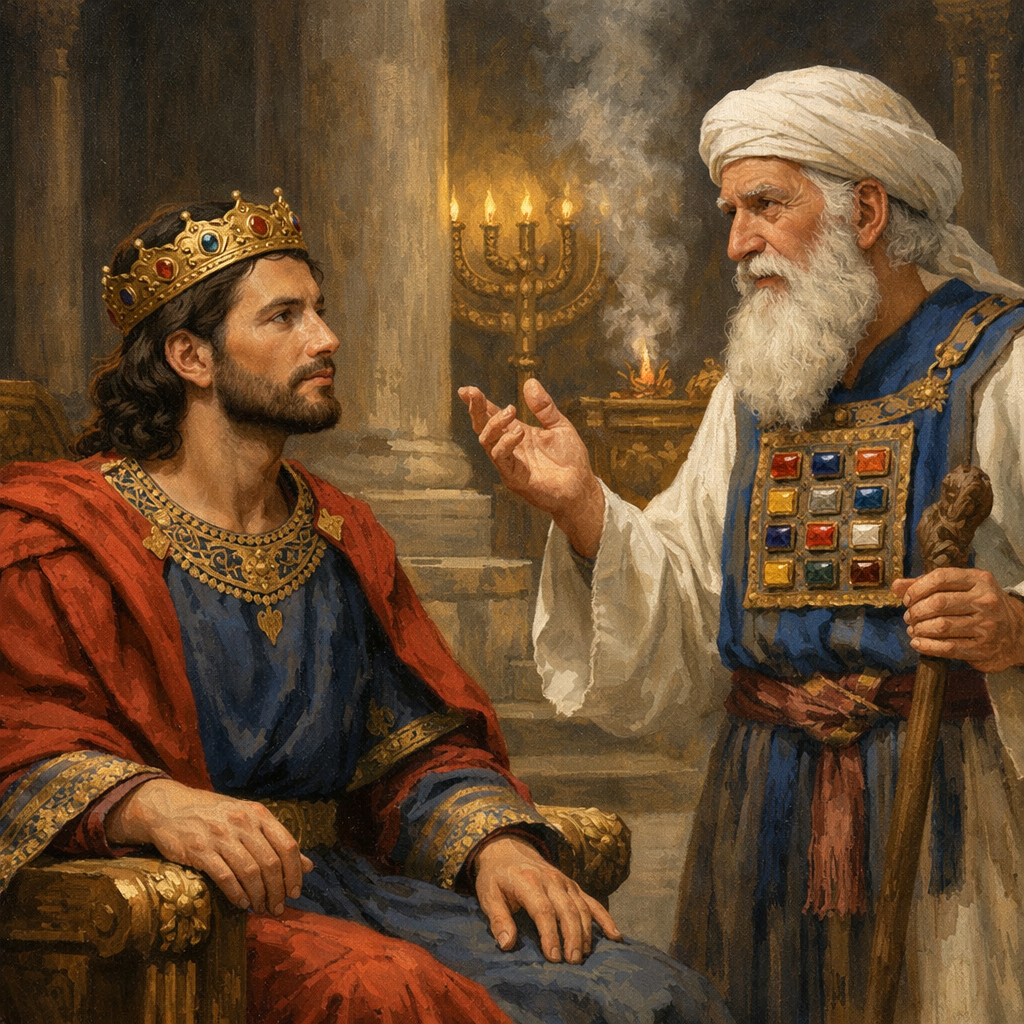
A GOOD START
JEHOASH DID RIGHT
Jehoash did right (yashar) in the sight of the LORD - Jehoash had a good start, preserving Yahweh worship and supporting temple repair (2 Ki 12:4–16). And note the important phrase in the sight of the LORD which reflects God’s evaluation, not public opinion or outward success. God Himself saw Jehoash's rule and judged it right, recalling that God’s perspective penetrates beyond actions to motives (cf. 1Sa 16:7). This language is judicial for God is the Witness, the Judge and the Standard of what is right.
Bob Utley - "Jehoash did right in the sight of the Lord" This was true as long as Jehoiada was his counselor. This is a recurrent idiom related to a godly king (cf. Deut. 6:18; 12:28; 13:18; 1 Kgs. 11:38; 14:8; 15:11; 22:43; 2 Chr. 14:2; 20:32; 24:2).
All his days in which Jehoiada the priest instructed (yarah) him - Jehoiada was Jehoash’s protector, his mentor and spiritual guardian and the driving force behind the covenant renewal (2 Ki 11:17). All his days emphasizes ehe instruction was continuous, not a one-time coronation speech. However sadly there is a qualifying phrase "in which" which in effect places a boundary around the instruction, indicating that Jehoash did right only during the period of Jehoiada’s instruction. 2 Chronicles 24:2 makes this even clearer recording that “Joash did what was right in the sight of the LORD all the days of Jehoiada the priest.”
🙏 THOUGHT - In short, the reign of Jehoash shows that righteous leadership flourishes where God’s Word is honored but withers when it is removed. If this applied to the kings of Israel, does this principle not also apply to our lifes beloved? That's rhetorical of course. Moses' words at the end of his sermon to Israel getting ready to enter the promised land is relevant, for we as believers in Christ have entered a "promised life." And so Moses instructed them and us "Take (command; LXX = prosecho present imperative see our need to depend on the Holy Spirit to obey = make this your habitual practice) to your heart (cf MEMORIZATION) all the words with which I am warning you today, which you shall command your sons to observe carefully, even all the words of this law. FOR (VITAL TERM OF EXPLANATION) IT (GOD'S WORD) is not an idle (EMPTY, VAIN, USELESS) WORD for you; indeed IT (GOD'S WORD) is your LIFE! And by this WORD you will prolong your days in the land (FOR BELIEVER'S TODAY = NOT A LAND BUT "A LIFE"), which you are about to cross the Jordan to possess (cf Eph 1:3, 2Pe 1:3-4).” (Dt 32:46-47)
Right conduct flows from
right instruction.
Instructed (yarah) carries the idea of pointing the way, directing, or guiding along a chosen path. Yarah is a word that It is the same root from which Torah is derived, emphasizing that Jehoiada’s instruction was not merely advice but authoritative guidance grounded in the Law of the LORD. Joash’s righteousness, therefore, was not self-generated; it was cultivated through sustained exposure to God’s revealed will (always best seen in His Word).
Instructed (yarah) in the LXX is the verb photizo which means literally to give light, to illuminate and figuratively, as in this context, to enlighten and give guidance or understanding (cf Jn 1:9, Eph 1:18) Instructed implies ongoing guidance, not a one-time lesson and given that Jehoiada was a priest, the instruction was "Torah-centered" especially regarding the Davidic covenant, proper worship at the temple, the eradication of Baalism and the king’s responsibility to rule under God’s authority, not above it. While the text does not say it specifically, it is reasonable to believe that Jehoiada encouraged Jehoash to keep the specific instructions Moses gave to Israel's kings in Dt 17:18-20.
Bob Utley - "the priest" This was a way to designate the head priest. In v. 16 the ADJECTIVE "great" (BDB 152) designates the same person. It is usually translated "High Priest." See a good brief note on the changing titles for the High Priest in Roland deVauz, Ancient Israel, pp. 377-379.
In 2 Chronicles 24:3 we are told that Jehoiada took two wives for him, and he became the father of sons and daughters - This detail is far more than a passing biographical note. Jehoiada understood that the wives of kings can make or break a dynasty, shaping not only the king’s household but also the spiritual and political future of the nation. Having witnessed the near extinction of the Davidic line under Athaliah, the priest acted with deliberate wisdom. By securing godly wives—and more than one—he sought to ensure fruitfulness, stability, and continuity, so that the lamp of David would not flicker again to the brink of extinction with only a single surviving heir. This was a calculated, covenant-conscious step to safeguard the promises of God and preserve the Davidic throne for future generations.
Warren Wiersbe on Joash's SHALLOW FAITH (2Ki 12:1-21) In His parable about the sower (Matt. 13:1–9, 18–23), Jesus explained that, from a spiritual viewpoint, there are four kinds of hearts, and they respond to the seed of the Word in four different ways. When the hardhearted hear the Word, the seed can’t get in, so Satan snatches it away. Shallow-hearted people receive the Word but provide no room for it to take root, so the shoots grow up but don’t last. A plant can’t grow and bear fruit if it doesn’t have roots. Those with crowded hearts receive the seed but the shoots are smothered by the weeds that should have been pulled up. The person with the heart that bears fruit is honest, repentant, understands the Word and embraces it by faith. When it came to his own personal faith, King Joash had a shallow heart. Let’s note the stages in Joash’s spiritual experience.
Right (03477) yashar from the verb yashar = to be smooth, straight or right) is an adjective that means straight; reliable, level, pleasing; upright; righteous. Yashar only rarely is used literally of that which is straight (Ezek 1:7). Yashar can refer to something physical like a path, but even in those uses is often a metaphorical description of one's conduct or behavior (Ps 107:7). Most uses refer to that which is right in an ethical or an emotional sense, as agreeable or pleasing. It is fitting that God is the standard of yashar (what is "straight") (Ps 92:15, called the "Upright One" - Isa 26:7). God's Word is described as upright (right) (Ps 19:7) as are His judgments (Ps 119:137) and His way (Ps 107:7). "God made men upright (Ge 1:27), but they have sought out many devices." (Eccl 7:29)
Yashar is frequently used to describe our moral/ethical heart as "upright in heart" (Ps 7:10, 11:2,). Indeed, the upright "will behold His face" (Ps 11:7), will experience gladness (Ps 97:11), will be gathered together in the assembly (Ps 111:1), will be blessed (Ps 112:2), will be given light in times of darkness (Ps 112:4), will dwell in God's presence (Ps 140:13, cp Pr 2:21), have access to God's sound wisdom (Pr 2:7), will experience intimacy with the Most High God (Pr 3:32), will be guided by their integrity (Pr 11:3), will be delivered by their righteousness (Pr 11:6), will be delivered by their words (Pr 12:6), will see their tents flourish (Pr 14:11). "The highway of the upright is to depart from evil." (Pr 16:17)
IN THE SIGHT OF THE LORD - The expression “in the sight of the LORD” means as evaluated by God Himself, not merely by human standards, public opinion, or outward success. It means according to God’s all-seeing, morally perfect, covenant-based evaluation—focused on faithfulness of heart and obedience, not outward appearance or human approval. It is found 82x in 81v - Gen. 38:7; Lev. 10:19; Num. 32:13; Deut. 4:25; Deut. 6:18; Deut. 9:18; Deut. 12:25; Deut. 12:28; Deut. 17:2; Deut. 21:9; Deut. 31:29; Jdg. 2:11; Jdg. 3:7; Jdg. 3:12; Jdg. 4:1; Jdg. 6:1; Jdg. 10:6; Jdg. 13:1; 1 Sam. 12:17; 1 Sam. 15:19; 1 Ki. 11:6; 1 Ki. 14:22; 1 Ki. 15:26; 1 Ki. 15:34; 1 Ki. 16:7; 1 Ki. 16:19; 1 Ki. 16:30; 1 Ki. 21:20; 1 Ki. 21:25; 1 Ki. 22:52; 2 Ki. 3:2; 2 Ki. 3:18; 2 Ki. 8:18; 2 Ki. 8:27; 2 Ki. 12:2; 2 Ki. 13:2; 2 Ki. 13:11; 2 Ki. 14:3; 2 Ki. 14:24; 2 Ki. 15:3; 2 Ki. 15:9; 2 Ki. 15:18; 2 Ki. 15:24; 2 Ki. 15:28; 2 Ki. 15:34; 2 Ki. 16:2; 2 Ki. 17:2; 2 Ki. 17:17; 2 Ki. 18:3; 2 Ki. 21:2; 2 Ki. 21:6; 2 Ki. 21:16; 2 Ki. 21:20; 2 Ki. 22:2; 2 Ki. 23:32; 2 Ki. 23:37; 2 Ki. 24:9; 2 Ki. 24:19; 1 Chr. 2:3; 2 Chr. 20:32; 2 Chr. 21:6; 2 Chr. 22:4; 2 Chr. 24:2; 2 Chr. 25:2; 2 Chr. 26:4; 2 Chr. 27:2; 2 Chr. 28:1; 2 Chr. 29:2; 2 Chr. 33:2; 2 Chr. 33:6; 2 Chr. 33:22; 2 Chr. 34:2; 2 Chr. 36:5; 2 Chr. 36:9; 2 Chr. 36:12; Ps. 116:15; Jer. 52:2; Mal. 2:17; Lk. 1:15; 2 Co. 8:21; Jas. 4:10
Instructed (archer, cast, instruct, shoot)(03384) yarah means to “teach, instruct” but is related to another root sharing the same spelling “to shoot an arrow”. The basic idea of the root yārâh is "to throw" or "to cast" with the strong sense of control by the subject. The word “teaching, instruction” (torah [08451) is derived from this same verb cluster. The instruction of Yahweh may be compared to archery in the sense that the “arrow” of God’s teaching (laws, commandments, statutes) was aimed at our heart with the goal of pursuing God’s holiness. The secondary meaning of yarah is "to instruct" or "to teach," always in the Hiphil tense, meaning "causing to learn." Instruction was given by the priest (2 Ki. 12:3); companions (Job 6:24); those with experience (Job 8:8ff); and, of course, God (Exo. 24:12; Isa. 28:26).
Baker summarizes yarah - A verb meaning to shoot, to throw, to pour. God hurled Pharaoh's army into the sea (Ex. 15:4); Joshua cast lots (Josh. 18:6); and God asked Job who laid the cornerstone of the earth (Job 38:6). This word is used often in reference to shooting with arrows, as Jonathan (1 Sam. 20:36); and those who killed some of David's men (2 Sa 11:24). King Uzziah made machines that shot arrows (2 Chr. 26:15); and the wicked shot arrows at the upright of heart (Ps 11:2; 64:4[5]). In the sense of throwing, people were overthrown (Num. 21:30); and Job said that God had thrown him in the mud (Job 30:19). (The Complete Word Study Dictionary – Old Testament)
2 Kings 12:3 Only the high places were not taken away; the people still sacrificed and burned incense on the high places.
- 2Ki 14:4 18:4 1Ki 15:14 22:43 2Ch 31:4 Jer 2:20
Related Passages:
2 Kings 14:4 Only the high places were not taken away; the people still sacrificed and burned incense on the high places.
Jeremiah 2:20 “For long ago I broke your yoke And tore off your bonds; But you said, ‘I will not serve!’ For on every high hill And under every green tree You have lain down as a harlot.
THE TRAGIC "BUT" - WHEN
REFORM STOPS SHORT
Only (BUT - KJV, NET, YET - CSB, NLT) the high places (bamah) were not taken away - BUT marks a change of direction, but in this case, it marks a failure to change direction! It was a good start for Jehoash, smashing Baal in Jerusalem, BUT they held on to the high places. This was in effect a half-way reformation and signals the nation's (and Joash's) incomplete obedience, lingering compromise and divided hearts.
It is interesting to note that the Chronicler omitted the mention in Kings that Joash did not remove the high places since this would be out of character with his presentation of the early years of Joash, the matter of the high places is delayed to 2Ch 24:18.
The people still sacrificed and burned incense on the high places - Judah had not fully submitted to God’s appointed way of worship. Old habits die slowly, even after revival. Compromise often survives in familiar, tolerated forms. What God permits temporarily, He still expects to be corrected eventually. These high places were where the people worshiped Yahweh rather than pagan deities but they were potential sources for the entrance of pagan practices into Israel’s worship and they were not ordained by Yahweh.
Warren Wiersbe on high places - The only thing Joash and Jehoiada didn’t do was remove the high places in Judah, the local shrines where the people worshipped the Lord. They were supposed to go to the temple to worship (Deut. 12), but during the dark days of Athaliah’s reign, the temple had been ignored and even allowed to decay.
Bob Utley - "the high places" These were local places of worship (BDB 119). Originally they were not condemned but with the rise of a mandated central shrine in Jerusalem, they became identified with Ba'al worship. Not until Hezekiah (2 Kgs. 18:4) were the high places destroyed (cf. 1 Kgs. 15:14; 22:43; 2 Kgs. 12:3; 14:4; 15:4,35).
What's the takeaway here? And it is what was not Judah's "take away" so to speak! Judah had abandoned Baal, but had not fully submitted to God’s appointed way of worship. They had removed the idol, but not high altars which were not sanctioned by the LORD.
A sad phrase that is repeated again and again (speaking of Israel and Judah) is "the high places were not taken away" (1Ki 15:14, 2Chr 15:17 = King Asa but notice he did remove some of them - 2Chr 14:3, 5, 1Ki 22:43, 2Chr 20:33 = King Jehoshaphat, 2Ki 12:3 = King Jehoash, 2Ki 14:4 = King Amaziah, 2Ki 15:4 = King Azariah, 2Ki 15:35 = King Jotham son of Uzziah and look what his son did in 2Ki 16:1-4!, 2Chr 20:33). In many of these passages the context was of a king doing "spiritual house cleaning" so to speak and yet still failing to remove the high places. Isn't sin that way? We confess one or two sins but we have a little pet sin (better a "venomous viper") that we just don't have the heart to kill! God grant us spiritual eyes and hearts to learn from Israel's mistakes. Amen! Some kings like Hezekiah (1Ki 18:4, 2Chr 31:1, Isa 36:7) and Josiah (2Ki 23:4,8, 13, 15, 19-20, 2Chr 34:3 cp prophecy about Josiah 300 years earlier = 1Ki 13:2) did destroy the high places, but in Hezekiah's case his own son Manasseh rebuilt them (2Ki 21:1-2, 3, 2Chr 33:3) and in Josiah's case the people rebuilt them!
High places (01116) bamah Six activities seem to be related to high places -- burning of incense, sacrificing, eating of sacrificial meals, praying, prostitution, child sacrifice (cf. bama in the valley, Je7:31). The first use in Lev 26:30 is God's declaration to Israel "I will destroy your high places." In Dt 32:13 speaking of Jacob (Israel) He declared "He made him ride on the high places of the earth," so clearly some uses of bamah are not negative. In a similar use God says Israel "you will tread upon their (Israel's enemies') high places." Another positive use is Psalm 18:33 where David declared Jehovah "makes my feet like hinds' feet, And sets me upon my high places." (cp Hab 3:19 - NET Note = David "compares his agility in battle to the ability of a deer to negotiate rugged, high terrain without falling or being injured.", cp Isa 58:14) We see he effect of Israel's high places on Jehovah in Ps 78:58 = "For they provoked Him with their high places and aroused His jealousy with their graven images."
2 Kings 12:4 Then Jehoash said to the priests, “All the money of the sacred things which is brought into the house of the LORD, in current money, both the money of each man’s assessment and all the money which any man’s heart prompts him to bring into the house of the LORD,
NLT One day King Joash said to the priests, "Collect all the money brought as a sacred offering to the LORD's Temple, whether it is a regular assessment, a payment of vows, or a voluntary gift.
- said to the priests: 2Ki 22:4 2Ch 29:4-11 35:2
- the money: 2Ki 12:18 1Ki 7:1 1Ch 18:11 2Ch 15:18 2Ch 31:12
- sacred things: Heb. holiness, Lev 5:15,16 27:12-27,31
- both the money: 2Ki 22:4 Ex 30:12-16 2Ch 24:9-10
- any man's heart prompts Lev 27:2-8
- and all the money: Ex 25:1,2 35:5,22,29 36:3 1Ch 29:3-9,17 Ezr 1:6 2:69 7:16 Ezr 8:25-28 Lu 21:4
Related Passages:
2 Chronicles 24:9-10 They made a proclamation in Judah and Jerusalem to bring to the LORD the levy fixed by Moses the servant of God on Israel in the wilderness. 10 All the officers and all the people rejoiced and brought in their levies and dropped them into the chest until they had finished.
Exodus 30:12-16 “When you take a census of the sons of Israel to number them, then each one of them shall give a ransom for himself to the LORD, when you number them, so that there will be no plague among them when you number them. 13 “This is what everyone who is numbered shall give: half a shekel according to the shekel of the sanctuary (the shekel is twenty gerahs), half a shekel as a contribution to the LORD. 14 “Everyone who is numbered, from twenty years old and over, shall give the contribution to the LORD. 15 “The rich shall not pay more and the poor shall not pay less than the half shekel, when you give the contribution to the LORD to make atonement for yourselves. 16 “You shall take the atonement money from the sons of Israel and shall give it for the service of the tent of meeting, that it may be a memorial for the sons of Israel before the LORD, to make atonement for yourselves.”
JEHOASH'S DEVOTION
TAKES DIRECTION
NOTE 1: It is difficult to integrate the two discussions of Jehoash's desire to repair the Temple and the instructions regarding accumulation of funds to carry out the repairs. What follows is my attempt to try to integrate the passages in 2Ki 12 and 2Chr 24.
Let's begin by noting that the following information is not in 2Ki 12 but only in 2Ch 24:4 - Now it came about after this that Joash decided to restore the house of the LORD.
This statement reveals the inner resolve of the king, the moment when concern for God’s dwelling place took shape in his heart.
2 Kings 12:4-6 then supplies the practical outworking of Joash's resolve. Whereas 2Ch 24:4 records why Joash acted (he decided to restore the house of the LORD), 2 Kings 12:4-6 explains how he put his intention into implementation. In other words, what Chronicles describes as a decision, Kings details as a financial and administrative plan. To reiterate, most of the details regarding the accumulation of funds for the Temple repair are found in 2Ki 12:4-6 although there is some overlap with 2Ch 24:5 as discussed in the NOTE 2 below.
Then - After noting that Jehoash did what was right (yet tolerated the high places), the narrative now moves from spiritual evaluation to practical reform.
Jehoash said to the priests Jehoash speaks, in his first recorded roya initiative, to the priests, not to military leaders or civil officials, because the issue at hand concerns the house of the LORD and show that the king has a proper priority. And remember where he has spent the first 7 years of his life!
NOTE 2: 2Ch 24:5 gives Joash's commands (in red) to the priests which are not found in 2Ki 12:4-6 - He gathered the priests and Levites and said to them, “Go out to the cities of Judah and collect money from all Israel to repair the house of your God annually, and you shall do the matter quickly.” But the Levites did not act quickly.
All the money of the sacred (qodesh; LXX - hagios) things which is brought into the house of the LORD (TEMPLE) - This refers to funds that were considered holy because they were devoted to God and therefore belonged to the LORD and His house, not to the king or priests personally.
In current money - This means money that is presently in circulation and usable at that time. It is somewhat like our phrase "liquid funds" or "cash on hand" referring to funds that were spendable, accepted currency available right now. In other words, this does not refer to pledged amounts not yet paid, etc. It stresses immediate usability which in context would be for Temple repairs.
Both the money of each man’s assessment - The money of each man’s assessment refers to mandatory, fixed contributions required under the Law of Moses, not distinct vows or freewill gifts. The money that was raised by public assessment (like a "poll tax"), would include the half-shekel which every male Israelite was obliged to pay by the law, when the people were numbered,, (cf. Ex 30:12–16).
and all the money which any man’s heart prompts him to bring into the house of the LORD - This money refers to (1) money from personal vows, voluntary promises made to God, often in gratitude or dedication (Lev. 27:2) and (3) money from freewill offerings (Lev. 23:18-23).
Bob Utley - The temple of Solomon had been neglected, especially under Athaliah. It needed to be repaired. King Jehoash started the campaign to do this by collecting some of the revenue of the temple. (1) each man's assessment ‒ Exod. 30:11-16; Num. 18:19; 2 Chr. 24:9, for priests (AB, p. 137 and NET Bible call it "a census tax") (2) free will offerings ‒ for any purpose (like peace offerings) (3) vow offerings ‒ Lev. 27:1-13
Warren Wiersbe No doubt Joash and Jehoiada had discussed the need for repairing the temple, but for some reason, the high priest wasn’t enthusiastic enough to get things started. Old age may have been a factor. We don’t know how old Joash was when Jehoiada issued the order to have the temple offerings diverted into the building project (2Ki 12:4–5). This would include money from the census (Ex. 30:11–16; Num. 2:32), money from personal vows (Lev. 22:18–23; 27:1ff.), and money from the trespass offerings (2Ki 12:17; Lev. 5:14—6:7). But the plan didn’t work, probably because the priests depended on these sources of income for the funds they needed to maintain the temple ministry and to meet their own needs. As far as the census was concerned, the priests and Levites may have hesitated because they remembered that David’s census had brought judgment to the land (1 Chron. 22)
David Guzik on all the money - This money was received in three ways:
- Each man’s census money: This was the half shekel each Israelite older than the age of twenty had to pay every year (Exodus 30:14-15).
- Each man’s assessment money: “That is, literally, ‘each man the money of his souls of his estimating.’ This was a kind of property tax based on the personal assessment of each individual (Leviticus 27:2).” (Dilday)
- All the money that a man purposes in his heart to bring into the house of the LORD: These were freely given offerings over and above the required donations.
Sacred (holy, most holy, holy things, sanctuary) (06944) qodesh is a masculine noun which means set apart, distinct, unique. Qodesh describes that which has been consecrated or set apart for sacred use and was not to be used for common or profane tasks. If it were used for profane things, in simple terms, it became "not holy." It is fitting that the first OT use of qodesh was in God's instruction to Moses - "Do not come near here; remove your sandals from your feet, for the place on which you are standing is holy ground.” (Ex 3:5). NET Note on Ex 3:5 "What made a mountain or other place holy was the fact that God chose that place to reveal himself or to reside among his people. Because God was in this place, the ground was different – it was holy."
2 Kings 12:5 let the priests take it for themselves, each from his acquaintance; and they shall repair the damages of the house wherever any damage may be found.”
- Let the priests: 2Ch 24:5
- repair: 2Ki 12:12 22:5,6 1Ki 11:27 2Ch 24:7 Isa 58:12
JEHOASH'S CLEAR
INSTRUCTIONS TO THE PRIESTS
NOTE 3: As discussed above 2Ki 12:5 gives information not found in 2Ch 24:5
Let the priests take it (the money, silver, proceeds) for themselves - This indicates that the priests were to receive and manage the funds directly. Rather than placing the money into a central treasury, Joash entrusted those who ministered in the temple with the responsibility of handling the resources intended for its repair. This reflects an early assumption that the priests, as custodians of the LORD’s house, would naturally steward these funds faithfully.
each from his acquaintance - NET - "from the treasurers." CSB = "from his assessor", ESV = "from his donor." The priests were to receive money from people they personally knew—likely regular worshipers or supporters within their circle.
and they shall repair the damages of the house This functions like a command (not a suggestion) and assigns not only direct financial responsibility but also practical oversight to the priests. They were expected to identify areas of neglect, decay, or damage and ensure that repairs were made accordingly. In short, they were not merely to collect money, but to ensure actual restoration work occurred.
Damages refers to breaches, cracks, or deterioration, the visible effects of long neglect, including 7 years of neglect and direct damage by Athaliah's sons (2Ch 24:7).
Wherever any damage may be found - This emphasizes the widespread deterioration of the temple after years of Athaliah’s reign and Baal worship; the problems were not isolated but extensive.
At this stage, Joash’s plan was well-intentioned and spiritually sound, reflecting his genuine desire to restore the house of the LORD. However, it also assumed that good intentions alone would produce effective results. As later verses reveal, the lack of structure, timelines, and accountability led to delay and inefficiency—necessitating a revised plan that removed the priests from direct handling of the funds. This verse shows that spiritual zeal must be matched with wise administration. Even God-honoring goals can falter without clear systems of accountability and follow-through.
2 Kings 12:6 But it came about that in the twenty-third year of King Jehoash the priests had not repaired the damages of the house.
- the priests: 1Sa 2:29,30 2Ch 29:34 Isa 56:10-12 Mal 1:10 Php 2:21 1Pe 5:2
FAILURE OF PRIESTS
TO FOLLOW THROUGH
But it came about that in the twenty-third year of King Jehoash the priests had not repaired the damages of the house - In any event, this verse marks a sobering turning point in the temple restoration effort. Nearly two decades into Joash’s reign, and despite clear instructions, repeated opportunities, and adequate time, the work had still not been done. Note that we are not told how long before the twenty-third year the collection had begun (2Ki 12:4-5).
Adam Clarke - In what year Jehoash gave the orders for these repairs, we cannot tell; but the account here plainly intimates that they had been long given, and that nothing was done, merely through the inactivity and negligence of the priests.”
NOTE 4 - The reference to “the twenty-third year” is crucial. Joash began his reign at seven years old, and presumbaly his concern for restoring the temple (2Ch 24:4) arose early (but we do not know when in the 7th to 23rd year it arose) under the godly influence of his mentor, Jehoiada. In any event it appears that years passed with no visible progress on Temple repair. What had begun as a noble plan had stalled.
Bob Utley - 12:6-15 For some reason not given, the priests did not use the money for repairs (cf. 2 Chr. 24:5). Because of this, King Jehoash demanded the collected money
- be used exclusively for temple repair (v. 7)
- be kept by both a royal representative and a priestly representative (v. 11)
- be given directly to the laborers and craftsmen (v. 12)
- there would be no required accounting from the workmen of the disbursement of the funds (v. 15, this may be a slap at the priests' handling of the money)
The NET Bible, p. 611, #21, suggests this reluctance on the part of the priests to repair the temple was due to the fact they wanted skilled workers to repair it, not themselves.
2 Kings 12:7 Then King Jehoash called for Jehoiada the priest, and for the other priests and said to them, “Why do you not repair the damages of the house? Now therefore take no more money from your acquaintances, but pay it for the damages of the house.”
- king Jehoash: 2Ch 24:5,6-14
- Jehoiada: 2Ki 12:2 11:4 2Ch 23:1 24:16
- Why: 1Ch 21:3
JEHOASH ISSUES
A ROYAL REBUKE
Then - When is then? This appears to be the twenty-third year of Jehoash's reign and there is still no repair on the Temple.
NOTE 5 - 2Ch 24:5b adds the phrase "the Levites did not act quickly."
Then 2Ch 24:6 parallels 2Ki 12:7 - "So the king summoned Jehoiada the chief priest and said to him, “Why have you not required the Levites to bring in from Judah and from Jerusalem the levy fixed by Moses the servant of the LORD on the congregation of Israel for the tent of the testimony?”
2Ki 12:7b-8 add informaton not found in the 2Ch 24:6 passage "Now therefore take no more money from your acquaintances, but pay it for the damages of the house." 8 So the priests agreed that they would take no more money from the people, nor repair the damages of the house."
King Jehoash called for Jehoiada the priest, and for the other priests and said to them, “Why do you not repair the damages of the house? The king is calling for accountability in what amounts to a "royal rebuke." (as in 2Ch 24:6) The problem was not lack of funds, but failure to use them for their intended sacred purpose. Even the king's instructor Jehoiada is called out to answer for the administrative failure. Spiritual stature did not exempt the priests from responsibility when God’s House remained in disrepair. It is surprising that those men who worked in the Temple should procrastinate in rennovating it!
Now therefore take no more money from your acquaintances - NET - "Now, take no more silver from your treasurers unless you intend to use it to repair the damage." CSB = "don't take any money from your assessors; instead, hand it over for the repair of the temple." ESV = "Now therefore take no more money from your donors, but hand it over for the repair of the house." The king issues a clear change in policy and in effect removes the priests from direct handling of the funds. The earlier system which was based on personal relationships and informal trust had proven ineffective. Joash recognizes that familiarity without oversight had produced stagnation rather than stewardship.
David Guzik - King Joash got to the heart of the problem – the building project was plagued by poor administration and financial mismanagement. Through Jehoiada the priest, he implemented a system where the money would be set aside, saved, and then wisely spent for the repair and refurbishing of the temple.
Warren Wiersbe The text doesn’t tell us how long Joash waited for Jehoiada to act, but when he was thirty years old and had reigned for twenty-three years, the king decided to act on his own. He called in Jehoiada and cautiously rebuked the priests for not doing the job. He also told the high priest that the throne would now direct the building program. The priests could keep the money that was rightfully theirs according to the Mosaic law, because the new approach to financing the project would be freewill offerings from the people. Jehoiada informed the priests and Levites, who must have rejoiced that their income wouldn’ t be diverted and that they no longer had to get involved in repairing the temple. Having been involved in church building programs, I can sympathize with them!
But - Term of constrast. In this context, the king introduces a restriction. The priests may not retain it, divert it, delay it, or repurpose it.
Pay it for the damages of the house - Pay it implies the funds were earmarked specifically for repairs of God's dwelling.
At this point in his reign Jehoash exhibits a vital principle of leadership, that godly leaders must be willing to correct even faithful servants when sacred trust is mishandled. Joash does not abandon the project, nor does he lower expectations. Instead, he reforms the process so that God’s work will move forward without obstruction.
Charles Ryrie comments on acquaintances - Assessors who fixed the value of the offerings. Because the project had been delayed, the king took it out of the hands of the priests, ordering instead that the money be placed in a chest (v. 9) and paid directly to those who repaired the Temple (v. 11).
2 Kings 12:8 So the priests agreed that they would take no more money from the people, nor repair the damages of the house.
NET The priests agreed not to collect silver from the people and relieved themselves of personal responsibility for the temple repairs.
CSB So the priests agreed they would not take money from the people and they would not repair the temple's damage.
ESV So the priests agreed that they should take no more money from the people, and that they should not repair the house.
NIV The priests agreed that they would not collect any more money from the people and that they would not repair the temple themselves.
NLT So the priests agreed not to accept any more money from the people, and they also agreed to let others take responsibility for repairing the Temple.
YLT And the priests consent not to receive money from the people, nor to strengthen the breach of the house,
PRIESTS TAKE A
NECESSARY STEP ASIDE
NOTE 6 - This information on the building funds is not found in 2Ch 24.
So the priests agreed that they would take no more money from the people, nor repair the damages of the house. After years of delay and ineffective stewardship, the priests formally agreed to relinquish control over both the collection of funds and the responsibility for repairs. The language signals a decisive shift: what had once been entrusted to them is now willingly surrendered.
The priests’ agreement shows that the king’s rebuke was justified and accepted. There is no resistance, no protest, and no attempt to defend past inaction. Their consent implicitly acknowledges that the existing system had failed. Sacred money had been collected, yet sacred work had not been completed. At this point, even the priests recognized that continuing under the same arrangement would only perpetuate stagnation.
Importantly, the verse does not accuse the priests of embezzlement, but it does expose mismanagement, delay, or misplaced priorities. By agreeing to step aside, the priests submit to a new structure that would soon introduce transparency, public accountability, and measurable progress (vv. 9–12). This marks a rare and commendable moment where spiritual leaders accept correction for the sake of God’s work. Their willingness to yield authority prevents further harm and allows reform to advance.
Andrew Hill: Joash brokers a compromise with the priests to the effect that the people will bring their taxes and offerings to the temple rather than contribute to Levitical “collection agents” (2 Kings 12:6-8; 2 Chron. 24:8-11). In addition, laborers are contracted to do the repair work instead of using the Levites as construction workers. . . A chest or collection box is stationed near the altar (in the courtyard) outside the gate of the temple building (2 Kings 12:9; 2 Chron. 24:8). Joint oversight of the funds deposited in the chest is provided by a royal and priestly official (2 Kings 12:10; 2 Chron. 24:11). Workers, including carpenters, masons, and smiths, are hired and paid directly from the funds deposited in the temple collection box (2 Kings 12:10-12; 2 Chron. 24:12-13). Presumably these funds include the three types of revenues specified by Joash: the annual tax, personal vows, and freewill offerings (2 Kings 12:4). (See 1 and 2 Chronicles - Page 33)
2 Kings 12:9 But Jehoiada the priest took a chest and bored a hole in its lid and put it beside the altar, on the right side as one comes into the house of the LORD; and the priests who guarded the threshold put in it all the money which was brought into the house of the LORD.
- took a chest: 2Ch 24:8-14 Mk 12:41
- beside: 2Ch 24:10
- the priests: 2Ki 22:4 23:4 25:18 1Ch 15:18,24 Jer 35:4 52:24
- threshold, Ps 84:10
JEHOIADA'S CLOSED CHEST JOINS
WORSHIP WITH STEWARDSHIP
NOTE 6 - Now let's relate 2Ki 12:9 to 2Ch 24:7-10. First, note that 2Ch 24:7 gives information about "sons of wicked Athaliah" not found in 2Ki 12, information that helps us understand why the Temple was in need of repair. Second, 2Ch 24:8 describes making a chest which somewhat parallels 2Ki 12:9 (although chest details and placement of the chest are not identical). Third, 2Ch 24:9-10 gives information not found in 2Ki 12:9. Here are the passages from 2 Chronicles 24:
2Ch 24:7-10 For the sons of the wicked Athaliah had broken into the house of God and even used the holy things of the house of the LORD for the Baals. 8 So the king commanded, and they made a chest and set it outside by the gate of the house of the LORD. 9 They made a proclamation in Judah and Jerusalem to bring to the LORD the levy fixed by Moses the servant of God on Israel in the wilderness. 10 All the officers and all the people rejoiced and brought in their levies and dropped them into the chest until they had finished.
But - Term of contrast, signaling a change in strategy because the priests had failed to apply the funds for repairs (2Ki 12:6-7).
Jehoiada the priest took a chest and bored a hole in its lid - Jehoiada “took a chest”—a plain, functional container—signaling that the solution was not elaborate but intentional. By boring a hole in its lid, he ensured that money could be deposited but not easily removed. This single act safeguarded the funds from misuse and eliminated suspicion. The design itself communicated integrity: once given to the LORD, the money could not be casually accessed by any individual.
And put it beside the altar, on the right side as one comes into the house of the LORD The placement of the chest is significant, for it was near the altar, not in a private chamber. The location would join worship and stewardship. This was a highly visible location, where worshipers could see their gifts being offered in proximity to sacrifice and prayer. Giving was thus inseparably linked to worship. Contributors knew that their money was not disappearing into private hands but was being placed directly before God.
Richard Pratt discusses the difference between the 2Ki 12:9 and 2Ch 24:8 descriptions of the placement of the chest - "From all appearances Joash and Jehoiada reached a compromise. Instead of sending the Levites out to collect money (see 2Ch 24:5), a chest was made and placed outside at the gate of the temple (2Ch 24:8). The Chronicler shifted attention from Jehoiada setting up this chest (see 2Ki 12:9) to the fact that this occurred at the king’s command (2Ch 24:8). He mentioned this fact to highlight the renewed cooperation between the king and the priest. 2Ki 12:9 sets the chest beside the altar. The Chronicler, however, set it at the gate of the temple of the LORD (2Ch 24:8). From this variation we must suppose that ‘the altar’ of 2Ki 12:9 was not the bronze altar of the inner court, but a smaller altar somewhere near the gate of the temple complex." (1-2 Chronicles)
Expositor's Bible Commentary "At first sight a discrepancy seems to exist between the details in Kings and those in Chronicles. Whereas this verse locates Joash's chest "beside the altar, on the right side" (cf. Jos. Antiq. IX, 163 [viii.2]), 2 Chron 24:8 places it without "at the gate of the temple." Actually the chest could not have been placed beside the altar per se, for this would contravene Levitical stipulation. The intent of the text of Kings is simply that the chest was set against the altar wall at the entrance that lay to the right side of the altar, or the southern entrance to the middle court. So understood, the texts of Kings and Chronicles are in natural agreement."
and the priests who guarded the threshold The priests were doorkeepers not treasurers. The role of the priests who guarded the threshold adds another layer of accountability. These gatekeepers were responsible for maintaining order at the entrance to the temple, and now they were entrusted with placing the offerings into the chest. This created shared responsibility so that no single priest controlled the funds, and no secret handling was possible.
Put in it all the money which was brought into the house of the LORD - All the money would include mandatory assessments, freewill offerings, etc. This underscores the success of this new system so that now funds flowed freely and faithfully (as indicated by "much money" in the next verse).
Warren Wiersbe The arrangement was simple, and it worked. Jehoiada prepared a large offering box, placed it in the temple by an entrance near the altar, and encouraged the people to bring their offerings for the repair of the temple. Of course, there were temple guards that kept their eye on the box. When the people found out that the project was now under royal supervision and in the hands of the laity, this encouraged them to give even more. They knew that every gift they brought and placed in the box would go directly into the building project and not be diverted into other ministries, so they gave generously. King Josiah followed a similar plan when he repaired the temple nearly two hundred years later (2 Kings 22:1–7).
2 Kings 12:10 When they saw that there was much money in the chest, the king’s scribe and the high priest came up and tied it in bags and counted the money which was found in the house of the LORD.
- the king's: 2Ki 19:2 22:3,12 2Sa 8:17 20:25
- put up: Heb. bound up, 2Ki 5:23
NEW SYSTEM OF
STEWARDSHIP IS WORKING
NOTE 7 - There is reasonably good correlation of 2Ch 24:11 and 2Ki 12:10 as both have the identical phrase when they saw that there was much money. 2Ch 24:11 adds a few details - "then the king’s scribe and the chief priest’s officer would come, empty the chest, take it, and return it to its place. Thus they did daily and collected much money." 2Ki 12:10 adds they would tie the money "in bags" and it was "counted," whereas 2Ch 24:11 says they would "empty the chest, take it, and return it to its place. Thus they did daily and collected much money."
When they saw that there was much money in the chest, This verse shows that the new system of stewardship was working. The phrase “when they saw that there was much money” indicates that the chest beside the altar was visibly filling up. The people were giving generously once they were confident their offerings were being handled with integrity. The issue apparently had never been unwilling hearts, but the need for a trustworthy process.
the king’s scribe and the high priest came up and tied it in bags At this point, two officials jointly oversee the funds the king’s scribe, representing royal authority and civil accountability and Jehoiada, representing spiritual authority and priestly oversight. This dual involvement is crucial. It ensures that no single group controls the money. The action of tying the money in bags reflects careful handling and security. Funds were sorted, bundled, and prepared for responsible distribution, not casually handled or left loose.
Bob Utley - "the king's scribe" See SCRIBES.
Bob Utley - tied it up in bags - The MT has the VERB (BDB 848 II, KB 1015, Qal IMPERFECT with waw), which means "to confine," "to bind," and "to besiege." The UBS Text Project, p. 356, gives the MT a "B" rating (some doubt). The NIDOTTE, vol. 3, p. 792, asserts that both roots refer to a melting process related to valuable metals. There were no coins in the ANE in this period. Gifts would be in the form of (1) pieces of metal (2) pieces of jewelry
and counted the money which was found in the house of the LORD. They then counted the money—a detail Scripture includes intentionally. Counting is not a sign of distrust, but of faithful administration. The Bible presents financial transparency as wisdom, not worldliness. The counting took place “in the house of the LORD,” reinforcing that this was a sacred act carried out in God’s presence, not a private audit behind closed doors.
Warren Wiersbe Joash didn’t ignore the priesthood in this project, for the counting and distributing of the money was handled jointly by representatives of the king and the high priest (v. 10). Without realizing it, Joash was following Paul’s principle of involving the people and making sure everything was kept open and aboveboard (2 Cor. 8:16–24). The workers were so honest and faithful that nobody kept records of the income and expenditures, a fact that may have upset the royal auditors. The only project they didn’t include was replacing the gold and silver utensils that had been stolen from the temple (2 Chron. 24:7), but enough money was left over to take care of that need (2 Chron. 24:14).
2 Kings 12:11 They gave the money which was weighed out into the hands of those who did the work, who had the oversight of the house of the LORD; and they paid it out to the carpenters and the builders who worked on the house of the LORD;
- gave the money: 2Ki 22:5,6 2Ch 24:11-12 34:9-11
Related Passages:
2 Chronicles 24:12 The king and Jehoiada gave it to those who did the work of the service of the house of the LORD; and they hired masons and carpenters to restore the house of the LORD, and also workers in iron and bronze to repair the house of the LORD.
FROM TREASURY TO TASK:
FUNDS PUT TO WORK
NOTE 8 - 2 Chronicles 24:12 is similar to 2Ki 12:11-12, except that the latter gives more detail of who the recipient workers were.
They gave the money which was weighed out into the hands of those who did the work, This verse describes the final, functional stage of the temple-repair process—where faithful stewardship results in actual restoration. The phrase “the money which was weighed out” signals precision and accountability. Funds were not estimated or loosely distributed; they were carefully measured, ensuring accuracy, fairness, and transparency at every step. Weighing the money prevented both excess and shortage and reflected respect for offerings given to the LORD.
into the hands of those who did the work, who had the oversight of the house of the LORD The money was then placed “into the hands of those who did the work, who had the oversight of the house of the LORD.” These were appointed supervisors, likely skilled administrators or foremen, responsible for managing the project. Importantly, they were distinct from the priests and from the donors, creating a separation of roles that minimized conflict of interest. Spiritual leaders oversaw worship; project overseers managed construction. This division of responsibility ensured competence and integrity.
and they paid it out to the carpenters and the builders who worked on the house of the LORD From the overseers, the funds were paid out directly to the craftsmen—“the carpenters and the builders.” This direct payment system eliminated unnecessary intermediaries and ensured that those doing the work were compensated promptly and fairly. It also kept the focus on the mission itself: repairing the house of the LORD, not sustaining bureaucratic layers.
TAKEAWAY - When God’s money is handled with care and clarity, God’s work moves forward with power and credibility.
John Walton - repair crew. The regular maintenance of the temple complex was the responsibility of the “workmen in charge of the temple.” Major repairs had to be contracted out to skilled workers. The listing of these skilled laborers is typical of contemporary Assyrian records. (IVP Background Commentary - OT - page 445)
2 Kings 12:12 and to the masons and the stonecutters, and for buying timber and hewn stone to repair the damages to the house of the LORD, and for all that was laid out for the house to repair it.
- masons: 1Ki 5:17,18 Ezr 3:7 5:8 Lu 21:5
PAYING THE SKILLED LABOR
FOR SACRED PURPOSE
and to the masons and the stonecutters This verse underscores the completeness and seriousness of the temple restoration effort. The funds collected were not absorbed by administration or diverted to secondary purposes; they were applied directly and comprehensively to the work itself. By naming specific trades—masons and stonecutters—the text emphasizes that skilled labor was employed, not makeshift or superficial repairs. The house of the LORD was restored with care, craftsmanship, and durability in mind.
and for buying timber and hewn stone The mention of buying timber and hewn stone highlights that the repairs required new materials, not merely patchwork using what was already on hand. “Hewn stone” implies stone that was carefully cut and shaped, pointing to quality construction rather than temporary fixes. The temple had suffered real structural damage during years of neglect and idolatry, and the restoration addressed those damages at their source.
to repair the damages to the house of the LORD This echoes earlier verses, reminding the reader that the project was restorative, not ornamental. This was not about beautification or luxury, but about bringing God’s house back to a condition worthy of worship.
and for all that was laid out for the house to repair it. - This serves as a comprehensive accounting clause. It assures the reader that every expenditure had a single focus: the repair of the LORD’s house. Nothing was wasted, misdirected, or left unexplained. The verse functions almost like a financial report, reinforcing the transparency introduced earlier in the chapter.
2 Kings 12:13 But there were not made for the house of the LORD silver cups, snuffers, bowls, trumpets, any vessels of gold, or vessels of silver from the money which was brought into the house of the LORD;
- But there were not made 2Ch 24:14
- bowls: Nu 7:13,14 1Ki 7:48-50 Ezr 1:9-11
- trumpets: Nu 10:2
Related Passages:
2 Chronicles 24:14 When they had finished, they brought the rest of the money before the king and Jehoiada; and it was made into utensils for the house of the LORD, utensils for the service and the burnt offering, and pans and utensils of gold and silver. And they offered burnt offerings in the house of the LORD continually all the days of Jehoiada.
TEMPLE REPAIRED BEFORE
BOWLS, ETC WERE MADE
NOTE 9 - 2Ch 24:14 descibes the Temple utensils and 2 Kings 12:13-16 gives more details not found in 2 Chronicles 24.
Note that 2Chr 24:14 seems to say something different than 2 Kings 12:13-16. The passages from Kings and Chronicles do not contradict each other. They describe different stages of the same restoration project. In other words, in 2Ki 12:13 during the repair phase of the Temple, no money was used to make silver or gold vessels. 2Ch 24:14 says after the temple was repaired, surplus money was used to make vessels for ministry.
In summary, 2 Kings 12:13 describes disciplined spending during the repair work of the Temple, while 2 Chronicles 24:14 records how surplus funds were used for Temple vessels, etc, but only after the repairs were completed. Thus we have two stages of the same faithful restoration, not a contradiction.
But there were not made for the house of the LORD silver cups, snuffers, bowls, trumpets, any vessels of gold, or vessels of silver from the money which was brought into the house of the LORD - This verse clarifies an important deliberate decision in the temple restoration program. Although sacred vessels were appropriate and even necessary for temple worship, none of the collected funds were used for ornamental or ceremonial items. Instead, every contribution was reserved strictly for repairing the structure of the LORD’s house. The wording is emphatic. By listing silver cups, snuffers, bowls, trumpets, and vessels of gold or silver, Scripture removes any ambiguity. These were not sinful objects, nor would their creation have been inappropriate in another season. The issue here is priority. The temple was damaged and unsafe; its walls, beams, and stones demanded attention before its furnishings.
Bob Utley - The text in 2 Kings wants all the money collected to go to the repairs of the building. 2 Chronicles 24:14 tells us there was some money left over and this was used for temple utensils.
2 Kings 12:14 for they gave that to those who did the work, and with it they repaired the house of the LORD.
FUNDS WERE USED
AS INTENDED
For - Term of explanation. This is explaining why no gold or silver vessels were made during the repair phase (v. 13) and how the money was actually used.
They gave that to those who did the work, and with it they repaired the house of the LORD - The money was given directly to the workers to repair the house. The funds were not absorbed into priestly income, administrative overhead, or ceremonial embellishments. Instead, the money moved straight from the treasury into the hands of the craftsmen and supervisors responsible for the repairs. The money accomplished exactly what it was intended to do to repair the house of the LORD.
2 Kings 12:15 Moreover, they did not require an accounting from the men into whose hand they gave the money to pay to those who did the work, for they dealt faithfully.
- they did not require 2Ki 22:7
- for they dealt faithfully 2Ch 34:12 Ne 7:2 Mt 24:45 Lu 16:1,10,11 1Co 4:2,3 3Jn 1:5
Related Passages:
2 Chronicles 34:12 The men did the work faithfully with foremen over them to supervise: Jahath and Obadiah, the Levites of the sons of Merari, Zechariah and Meshullam of the sons of the Kohathites, and the Levites, all who were skillful with musical instruments.
FAITHFUL WORKERS
PRELCUDED AN AUDIT
Moreover, they did not require an accounting from the men into whose hand they gave the money to pay to those who did the work, for they dealt faithfully - After funds were carefully collected, publicly counted, and responsibly distributed (vv. 9–14), the men overseeing the work demonstrated such consistent honesty that detailed audits were no longer necessary. The phrase “for they dealt faithfully” places the emphasis squarely on character. The Hebrew idea behind “faithfully” conveys trustworthiness, reliability, and integrity. These men handled God’s money as if God Himself were watching—because He was. Their faithfulness made micromanagement redundant.
Bob Utley - "faithfully" This is one of the great Hebrew roots/words. In the OT its main thrust is "faithfulness." In this context it may be a contrast to the priests who initially wasted the money collected for repairing the temple of Solomon.
2 Kings 12:16 The money from the guilt offerings and the money from the sin offerings was not brought into the house of the LORD; it was for the priests.
- the guilt offerings Lev 5:15-18 7:7 Nu 5:8-10 18:8,9 Ho 4:8
Related Passages:
Leviticus 5:15-18 “If a person acts unfaithfully and sins unintentionally against the LORD’S holy things, then he shall bring his guilt offering to the LORD: a ram without defect from the flock, according to your valuation in silver by shekels, in terms of the shekel of the sanctuary, for a guilt offering. 16 “He shall make restitution for that which he has sinned against the holy thing, and shall add to it a fifth part of it and give it to the priest. The priest shall then make atonement for him with the ram of the guilt offering, and it will be forgiven him. 17 “Now if a person sins and does any of the things which the LORD has commanded not to be done, though he was unaware, still he is guilty and shall bear his punishment. 18 “He is then to bring to the priest a ram without defect from the flock, according to your valuation, for a guilt offering. So the priest shall make atonement for him concerning his error in which he sinned unintentionally and did not know it, and it will be forgiven him.
FUNDS FOR PRIEST
SET ASIDE BY LAW
The money from the guilt offerings and the money from the sin offerings was not brought into the house of the LORD; it was for the priests - This verse draws an important distinction between different categories of sacred money. Unlike the funds collected for temple repair (assessments, vows, and freewill offerings), the money associated with guilt offerings and sin offerings was never intended for building projects. By divine law, these offerings belonged to the priests as part of their God-appointed provision.
This verse functions like a legal footnote. After emphasizing transparency and integrity in handling repair funds (vv. 9–15), the writer now clarifies that not all money entering the temple treasury was treated the same way. Without this explanation, a reader might wrongly assume that every form of sacred income should have gone toward repairs.
David Guzik - It belonged to the priests: The point is made that the project succeeded without taking anything away from the priests. The temple was not repaired and refurbished at their expense; they still received money from the trespass offerings and from the sin offerings.
Bob Utley - The priests did retain their personal income from (1) GUILT OFFERINGS ‒ see Lev. 5:14-6:7; 7:1-2; NIDOTTE, vol. 1, pp. 557-565 (2) SIN OFFERINGS ‒ see Lev. 4:1-5:13; 6:24-30
2 Kings 12:17 Then Hazael king of Aram went up and fought against Gath and captured it, and Hazael set his face to go up to Jerusalem.
- Hazael: 2Ki 8:12-15
- against Gath: 1Sa 27:2 1Ki 2:39,40 1Ch 8:13 18:1
- set his face: Jer 42:15 Lu 9:51,53
- to Jerusalem: 2Ch 24:23,24
Related Passages:
2 Kings 8:12 Hazael said, “Why does my lord weep?” Then he answered, “Because I know the evil that you will do to the sons of Israel: their strongholds you will set on fire, and their young men you will kill with the sword, and their little ones you will dash in pieces, and their women with child you will rip up.”
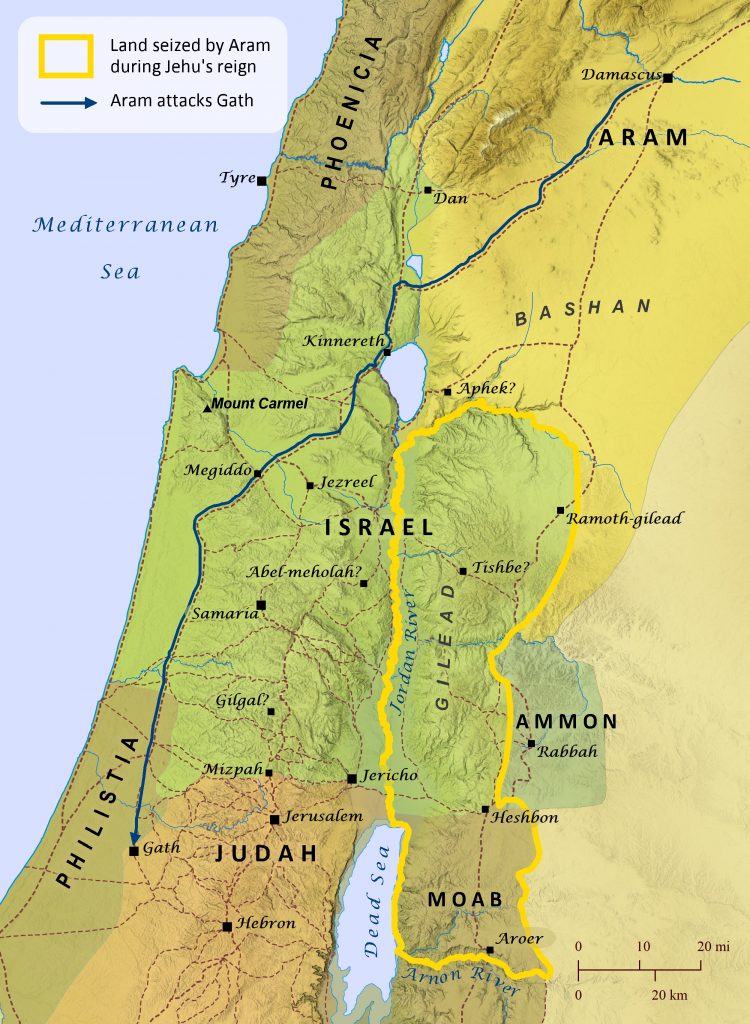
Aramean Hazael Captures Gath in Philistia
SUDDEN THREAT APPEARS
HAZAEL TAKES GATH
NOTE: 2 Chronicles 24:15-22 gives us information that is not found in 2 Kings 12 but help us under Hazael's capture of Gath and his setting his face to go up to Jerusalem.
JEHOIADA'S DEATH
2Ch 24:15 Now when Jehoiada reached a ripe old age he died; he was one hundred and thirty years old at his death. 16 They buried him in the city of David among the kings, because he had done well in Israel and to God and His house.
JOASH'S APOSTASY
17 But after the death of Jehoiada the officials of Judah came and bowed down to the king, and the king listened to them. 18 They abandoned the house of the LORD, the God of their fathers, and served the Asherim and the idols; so wrath came upon Judah and Jerusalem for this their guilt.
YAHWEH'S PROPHETS
INCLUDING ZECHARIAH19 Yet He sent prophets to them to bring them back to the LORD; though they testified against them, they would not listen. 20 Then the Spirit of God came on Zechariah the son of Jehoiada the priest; and he stood above the people and said to them, “Thus God has said, ‘Why do you transgress the commandments of the LORD and do not prosper? Because you have forsaken the LORD, He has also forsaken you.’” 21 So they conspired against him and at the command of the king they stoned him to death in the court of the house of the LORD. 22 Thus Joash the king did not remember the kindness which his father Jehoiada had shown him, but he murdered his son. And as he died he said, “May the LORD see and avenge!”
Then - Then marks a new phase, after internal reform comes external pressure. This verse introduces a sudden external threat that interrupts the temple-repair narrative and signals a shift in the evaluation of Joash’s reign. See the Note above for events that preceded Hazael's invasion
Warren Wiersbe when Jehoiada passed off the scene, King Joash showed his true colors and abandoned the faith. His apostasy wasn’t the fault of Jehoiada, for the high priest had faithfully taught Joash the Scriptures. The problem was Joash’s shallow faith and his desire to please the leaders of the land, “the officials of Judah” who visited Joash and asked him to be more lenient in matters of religion (24:17–18). He relented, and once again idolatry moved into Judah and Jerusalem.
Hazael king of Aram Hazael was one of Israel and Judah’s most dangerous enemies in the ninth century BC. His rise had been foretold earlier (See 2Ki 8:12-15), and his reign was marked by aggressive expansion and brutal conquest. When Hazael moves, kingdoms fall.
Bob Utley - Hazael continues his invasions. He controlled the trans-Jordan area but wanted more (see more details in 2 Chr. 24:23-27). It is ironic that the priests were reluctant to use their income for temple repair; all the treasures of the temple and palace are used to pay off the Syrians.
Went up and fought against Gath and captured it Notice from the map above that apparently Hazael also traveled unimpeded through Israel’s territory and attacked Gath. Gath was a strategically vital Philistine city on the western flank of Judah. Its capture is alarming for several reasons -- (1) Gath lay on the approach route to Jerusalem. (2) It functioned as a buffer city. (3) Its fall meant Judah was now exposed. The text offers no battle details because the outcome is the point: Hazael succeeded. The threat is real, immediate, and escalating.
David Guzik - At this time, the kingdom of Syria attacked Judah with an inferior army, but God used them as an instrument of judgment against the disobedient Joash. King Joash was wounded in a battle outside of Jerusalem.
And Hazael set his face to go up to Jerusalem This phrase signals deliberate, resolved intent. Hazael is not merely raiding, but is targeting the capital, Jerusalem, the city of David and the house of the LORD.
This verse serves as a theological test case. After years of faithful administration and visible reform, the question now becomes how will Joash respond when faith is tested by fear? Up to this point, Joash has acted wisely under godly influence. Now, the narrative moves from internal stewardship to external crisis—from building to defending, from faithfulness to fear. The verse prepares the reader for the sobering truth that follows: reform without deep-rooted faith cannot sustain courage under pressure.
The cruel Syrian king Hazael, as well as his predecessor Ben-Hadad, are both mentioned by name in several archaeological inscriptions, mostly of Assyrian origin and all of them consistent with the Biblical references to these men. This invasion may be dated tentatively to 813 B.C., after the death of Jehu (13:1-3). Gath formerly had belonged to the Philistines, but Rehoboam included it in a list of cities which he fortified. This indicates that at this time these cities probably belonged to Judah (2 Chr. 11:8).
2 Kings 12:18 Jehoash king of Judah took all the sacred things that Jehoshaphat and Jehoram and Ahaziah, his fathers, kings of Judah, had dedicated, and his own sacred things and all the gold that was found among the treasuries of the house of the LORD and of the king’s house, and sent them to Hazael king of Aram. Then he went away from Jerusalem.
- took all 2Ki 18:15,16 1Ki 15:18 2Ch 16:2
JOASH'S APPEASES
HAZAEL
This verse records Joash’s decisive, but spiritually devastating, response to the threat described in 2Ki 12:17. Faced with the advancing forces of Hazael, Joash chooses appeasement instead of dependence on the LORD.
Jehoash king of Judah took all the sacred things that Jehoshaphat and Jehoram and Ahaziah, his fathers, kings of Judah, had dedicated - Where is the prayer to Yahweh in this section? That's rhetorical because there is none! These were offerings set apart for God, symbols of thanksgiving, faith, and covenant loyalty.
and his own sacred things - Joash even took items he himself had consecrated to the LORD and surrendered them to Hazael.
and all the gold that was found among the treasuries of the house of the LORD and of the king’s house From both the house of the LORD and the king’s house, indicating a total depletion of reserves.This was not spare wealth. It was consecrated treasure and holy property.
Warren Wiersbe Joash’s apostasy was a sin of willful rebellion against God, for the king knew what the law of Moses taught about idolatry. But it was also a sin of ingratitude for all that Jehoiada had done for him. Jehoiada and his wife had saved the king’s life! The high priest had taught him the truth of God’s Word and had stood at Joash’s side as he learned how to govern the people. But the king had never taken the truth into his heart and allowed it to take root. The soil of his heart was shallow and he had obeyed God’s law only because his mentor was watching. He even took wealth from the very temple he had repaired and gave it to a pagan king for ransom!
and sent them to Hazael king of Aram. Then he went away from Jerusalem -The immediate crisis passed. Jerusalem was not stormed, the invading army withdrew, and the city enjoyed a fragile calm. From a purely political perspective, the strategy appeared successful. Bloodshed was avoided, walls remained standing, and the threat dissipated. Yet Scripture subtly invites the reader to look beneath the surface. The Temple had just been repaired—restored with care, reverence, and funds devoted to the LORD. But now, those very sacred treasures were stripped away to purchase safety from an enemy. What had been given to God in worship was handed over to man in fear. The building still stood, but its meaning had been compromised. Joash achieved peace, but not peace with God—only peace from danger. And such peace is always temporary.
David Guzik - Instead of trusting God, Jehoash traded prior blessing – the sacred treasures of the temple – to protect his capital and kingdom against the attacking Syrians. He was in a difficult place: wounded, with an attacking and successful army bearing down on Jerusalem. He found it hard to trust God in this difficult place because he had stopped trusting God in easier circumstances long before.
The verse leaves us unsettled because it shows how easily spiritual priorities can be reversed. Joash did not abandon worship outright. He did not tear down the Temple. But when pressure came, he treated sacred things as expendable. What once symbolized devotion became a bargaining chip.
2 Kings 12:19 Now the rest of the acts of Joash and all that he did, are they not written in the Book of the Chronicles of the Kings of Judah?
- the rest: 2Ki 8:23 1Ki 11:41 14:19,29
JOASH'S LIFE
SUMMARIZED
Now the rest of the acts of Joash and all that he did, are they not written in the Book of the Chronicles of the Kings of Judah? - This verse is part of a deliberate literary formula used throughout Kings to close a ruler’s reign. It signals that the author is bringing Joash’s public record to an end. The rest of the acts of Joash acknowledges that Joash did far more than what is recorded in 2 Kings.
O how few of the few who begin to live to God
continue unto the end!
--Adam Clarke
2 Kings 12:20 His servants arose and made a conspiracy and struck down Joash at the house of Millo as he was going down to Silla.
- his servants: 2Ki 14:5 2Ch 24:24,25 25:27 33:24
- the house of Millo: or, Beth-millo, Judges 9:6 2Sa 5:9 1Ki 11:27
Related Passages:
2 Chronicles 24:24-25 Indeed the army of the Arameans came with a small number of men; yet the LORD delivered a very great army into their hands, because they had forsaken the LORD, the God of their fathers. Thus they executed judgment on Joash. 25 When they had departed from him (for they left him very sick), his own servants conspired against him because of the blood of the son of Jehoiada the priest, (See Note above) and murdered him on his bed. So he died, and they buried him in the city of David, but they did not bury him in the tombs of the kings.
THE ASSASSINATION OF
KING JOASH
His servants arose - Note the irony, Joash was not killed by the Arameans but by his own servants, men who should have been loyal to him. See the Note above for events that led up to Joash's death
and made a conspiracy - Conspiracy does not depict a sudden riot or emotional outburst, but signifies there was planning, agreement, timing and coordination. The assassination of Joash was intentional and calculated. The details as to why Joash's servants conspired against him are recorded in 2Ch 24:17-26
Bob Utley - "conspiracy" The VERB basically means "to bind." Here, to bind together for a conspiracy. Both the NOUN and the VERB appear together (BDB 905, KB 1153).
David Guzik - “So disobedience brings its own bitter reward, and what God’s people sow they always, in some way or another, reap. Joash abundantly deserved his inglorious and terrible end.” (Knapp)
Adam Clarke - Thus ended a reign full of promise and hope in the beginning, but profligate, cruel, and ruinous in the end. Never was the hand of God’s justice more signally stretched out against an apostate king and faithless people, than at this time.
And struck down Joash at the house of Millo as he was going down to Silla (no other mentions of Silla in Bible) Joash, once rescued as a child and crowned with joy, dies quietly, violently, and shamefully. The “house of Millo” was likely part of a fortified structure or royal complex in Jerusalem. The irony is that house of Millo was a place meant for security but here becomes a place of death. The message is clear that stone walls could not protect a king whose heart had drifted from God. What we trust instead of God often becomes the setting of our downfall.
A good beginning is
no guarantee of a good ending.
🙏 THOUGHT "Joash is a warning to us today. It isn’t enough simply to know God’s truth; we must obey His truth “from the heart” (Eph. 6:6). Truth in the mind can lead to obedience, but truth in the heart and obedience from the heart will produce godly character. God’s Word and God’s will must be internalized—received into the heart (Ps. 119:9–11)—or we can never develop consistent Christian character. Until duty and discipline become delight, we are only reluctant servants who obey God because we have to, not because we want to. Jehoiada was a “religious prop” on which the king leaned. When the prop was removed, the king fell.
During more than fifty years of ministry, I have occasionally witnessed the “Joash tragedy.” A godly wife dies and the widower soon drops out of church and starts to live a worldly life. Sons or daughters go off to college and gradually leave the faith because father and mother aren’t there to counsel and warn them. I’ve known some high-profile Christian leaders who “used” their children in their ministries, but when the children were on their own, they turned their backs on their parents and the Lord. A good beginning is no guarantee of a good ending. King Joash had every encouragement to become a godly man, but he didn’t take advantage of his opportunities by taking God’s truth into his heart. When the Lord sent prophets to warn him, he refused to listen. He even plotted with his leaders to have Zechariah, the son of Jehoiada, stoned to death because he rebuked the king for his sins.2 Imagine murdering the son of the very people who saved your life! (Warren Wiersbe)
Bob Utley - 12:19-21 The text does not state why Jehoash was assassinated by his own servants, but since these men did not flee, one is caused to assume that
- Jehoash had done something, possibly idolatry (cf. 2 Chr. 24:15-22)
- the king's actions were well known and not approved by the people
- his death was not a coup but a judgment (later these men were killed, cf. 2 Kgs. 14:5)
- these men were sons of foreign women; why it affected their actions is uncertain
2 Kings 12:21 For Jozacar the son of Shimeath and Jehozabad the son of Shomer, his servants, struck him and he died; and they buried him with his fathers in the city of David, and Amaziah his son became king in his place.
- Jozacar: 2Ch 24:26, Zabad
- Shomer: 2Ch 24:26, Shimrith
- Amaziah his son: 2Ch 24:27
ASSASSINS ACCOUNTABLE
AMAZIAH ASCENDS TO THRONE
For Jozacar the son of Shimeath and Jehozabad the son of Shomer, his servants - Unlike many assassinations recorded anonymously, Scripture names the perpetrators. Both men are described again as his servants, reinforcing a key theme. Joash is destroyed from inside his own household, not by foreign enemies. When leaders abandon God, loyalty erodes.
Bob Utley - Jozacar This person is called "Zabad" in 2 Chr. 24:26. The UBS Text Project, p. 356, could not decide between "Jozacar" or "Jozachar," but gave them both "D" ratings (highly doubtful).
struck him and he died Joash, once miraculously preserved as a child and crowned with celebration, dies violently and quietly. The contrast is intentional -- A gracious beginning; A compromised middle; A dishonorable end
and they buried him with his fathers in the city of David - Joash was buried in Jerusalem, among the kings of Judah, which shows he retained legal status as a Davidic king and his reign was officially recognized. However, when compared with the parallel account in 2 Chronicles 24:25, we learn that he was not buried in the tombs of the kings and his burial lacked full royal honor. Thus Joash receives position without commendation, burial without celebration.
and Amaziah his son became king in his place - The Davidic line continues through Amaziah, fulfilling God’s covenant promises. God preserves His covenant even when leaders fail personally. This shows God’s faithfulness to David’s line but not God’s approval of Joash’s choices. A godly beginning does not guarantee a godly ending!