2 Kings 13:2
2 Kings 13:3
2 Kings 13:4
2 Kings 13:5
2 Kings 13:6
2 Kings 13:7
2 Kings 13:8
2 Kings 13:9
2 Kings 13:10
2 Kings 13:11
2 Kings 13:12
2 Kings 13:13
2 Kings 13:14
2 Kings 13:15
2 Kings 13:16
2 Kings 13:17
2 Kings 13:18
2 Kings 13:19
2 Kings 13:20
2 Kings 13:21
2 Kings 13:22
2 Kings 13:23
2 Kings 13:24
2 Kings 13:25
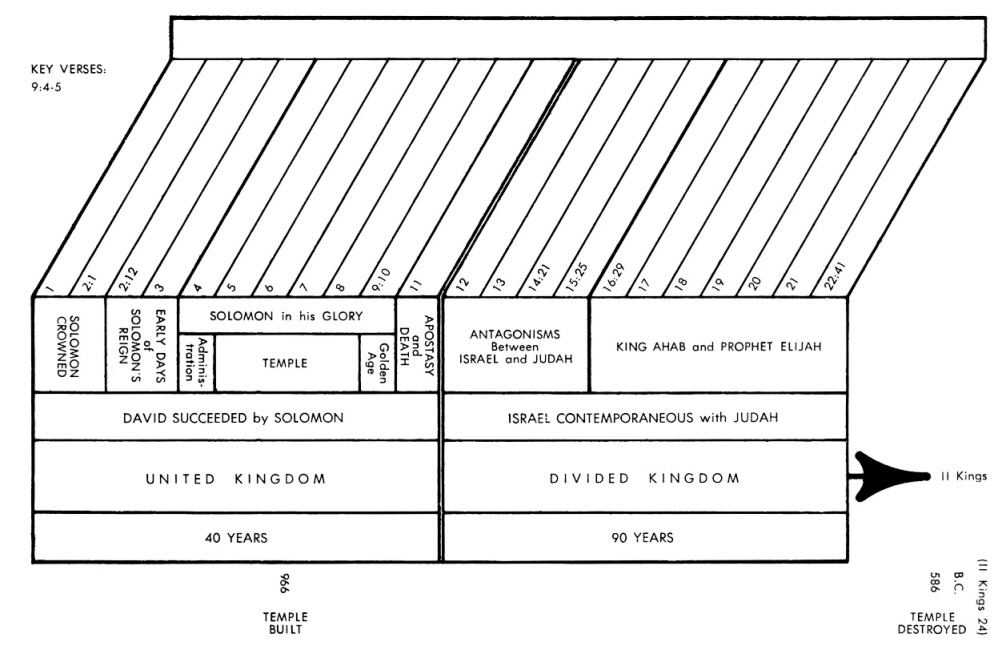
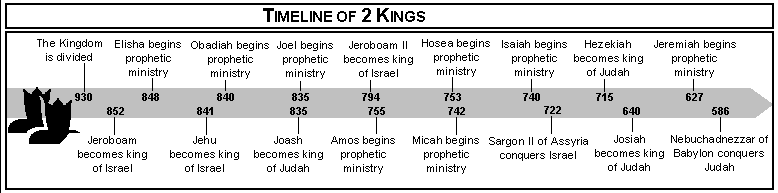
Chart from recommended resource Jensen's Survey of the OT - used by permission
1 Kings Chart from Charles Swindoll

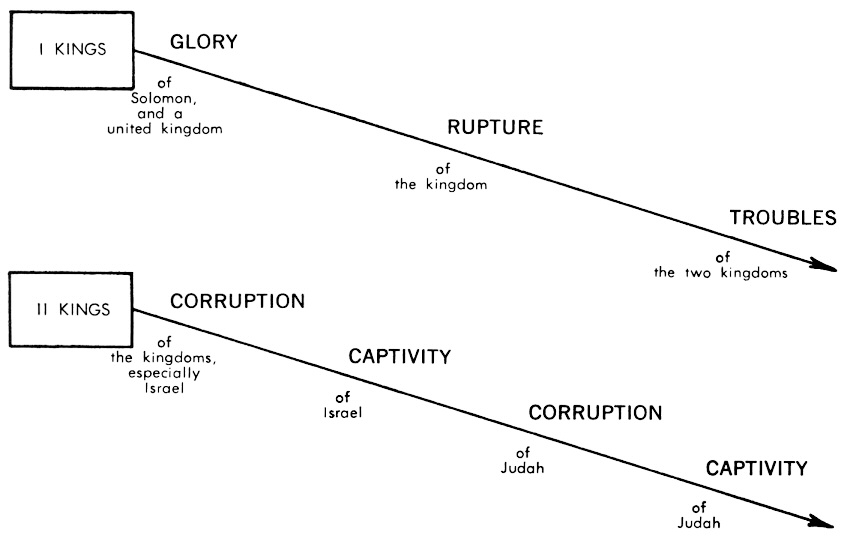
THE DOWNWARD SPIRAL
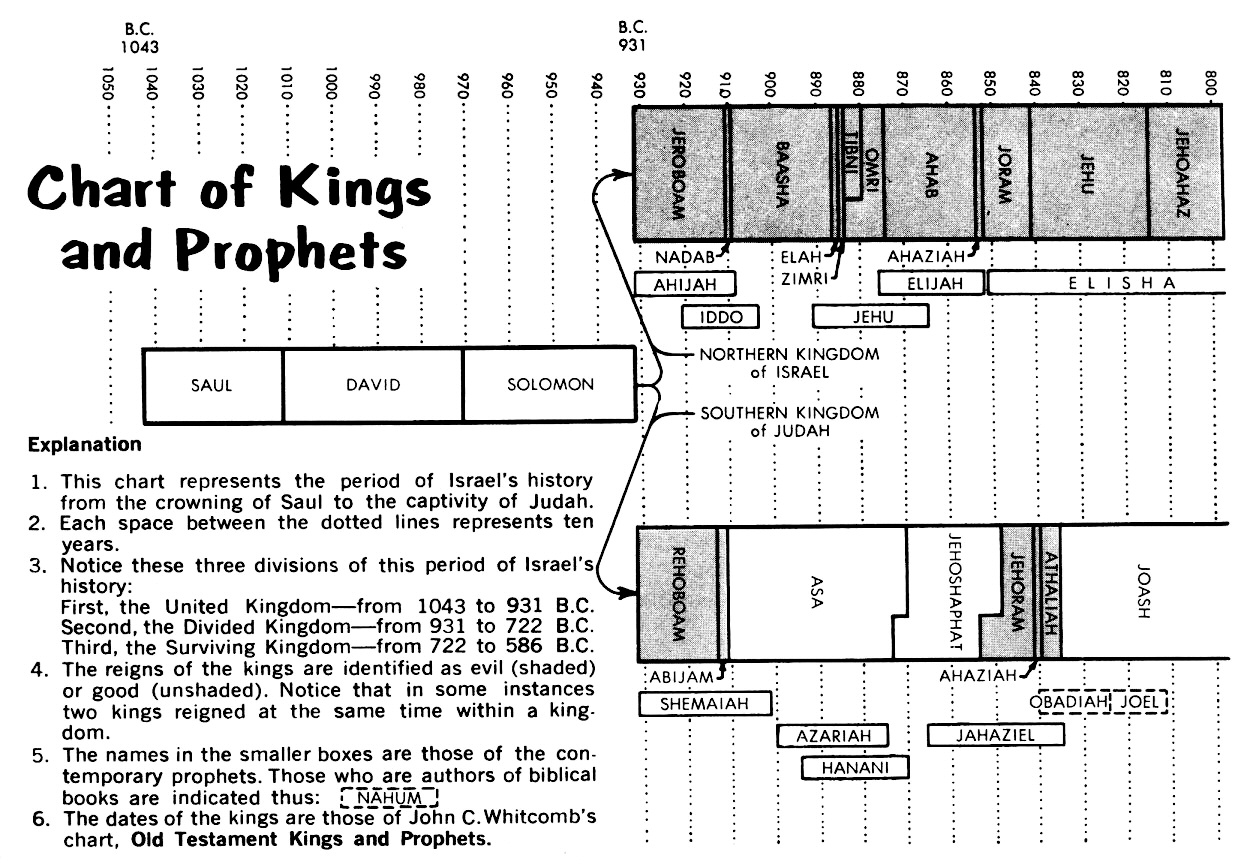
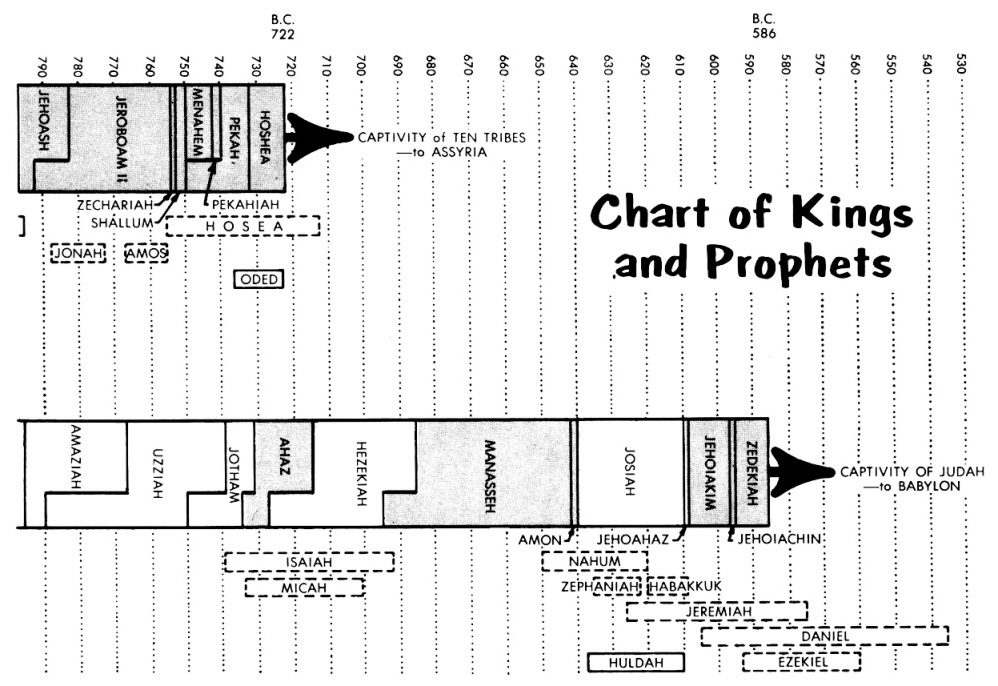
Click to Enlarge
Ryrie Study Bible - Borrow
Click to Enlarge
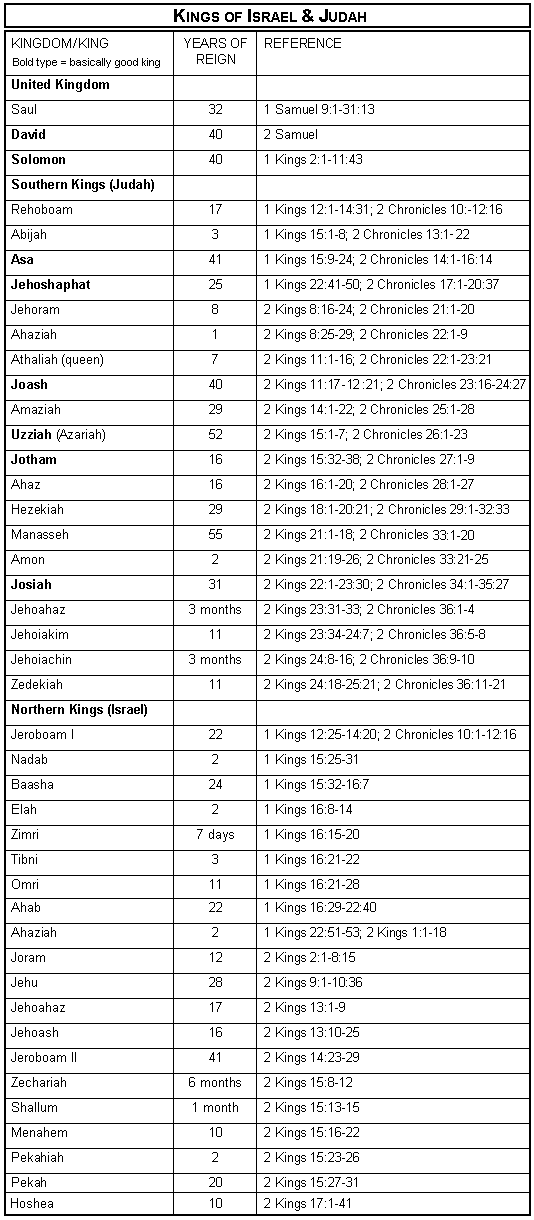
(NOTE: Many consider Amaziah and Hezekiah as "good" kings)
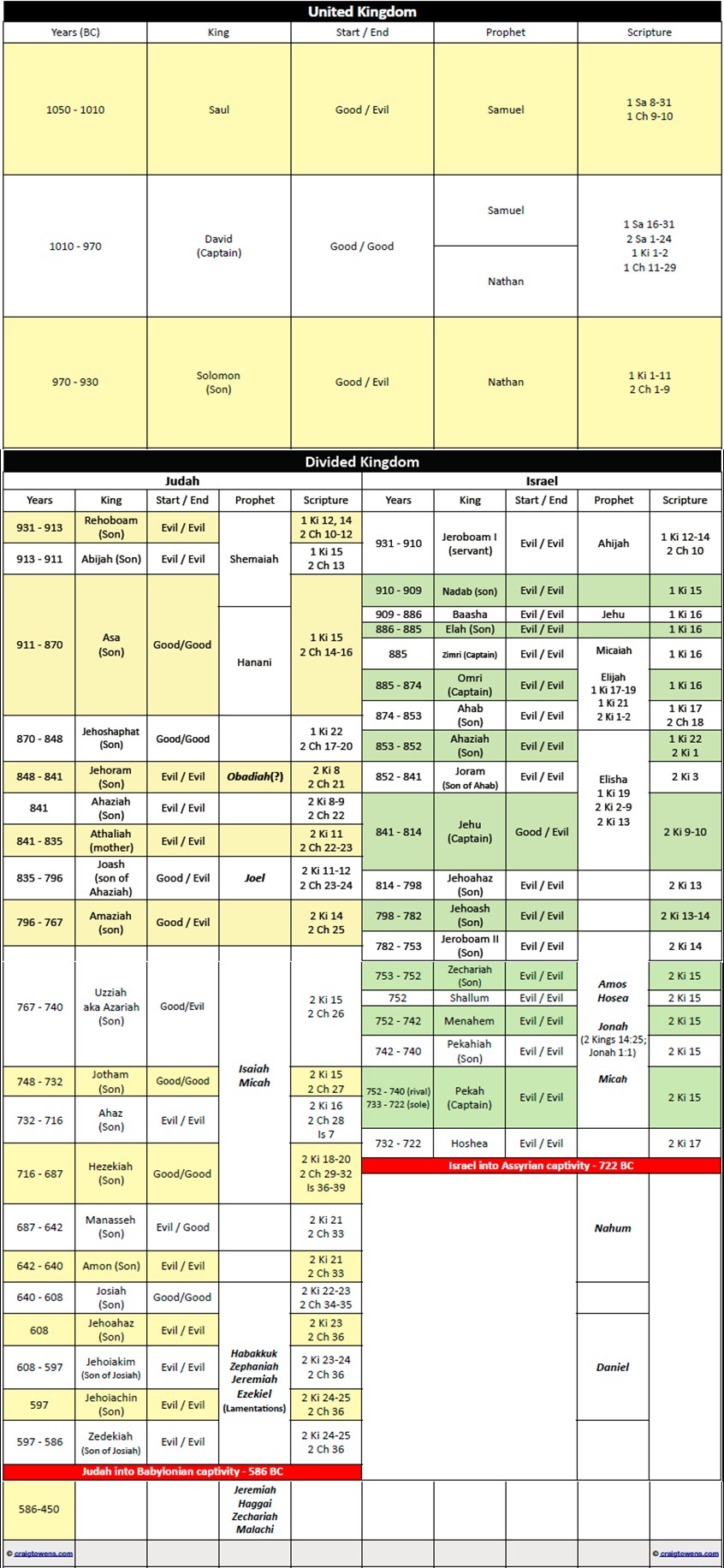
SEE ALSO:
ESV chart - kings of Israel - more information
ESV chart - kings of Judah - more information
Another Chart with Variable Dates for Reigns of King
2 Kings 13:1 In the twenty-third year of Joash the son of Ahaziah, king of Judah, Jehoahaz the son of Jehu became king over Israel at Samaria, and he reigned seventeen years.
- 23rd year of Joash: 2Ki 8:26 10:36 2Ki 11:4,21
- Jehoahaz the son of Jehu: 2Ki 10:35
Related Passages:
2 Kings 10:35 And Jehu slept with his fathers, and they buried him in Samaria. And Jehoahaz his son became king in his place.

NOW BACK TO
KINGS OF ISRAEL
In the twenty-third year of Joash the son of Ahaziah king of Judah - This verse is a chronological marker that links the reigns of Judah and Israel so readers can track who was ruling where and when (see chart above, see also Technical Note because 2Ki 13:10 says " In the thirty-seventh year of Joash king of Judah, Jehoash the son of Jehoahaz became king over Israel in Samaria, and reigned sixteen years."). King Joash (Jehoash) twenty-third year is noted in 2Ki 12:6 "But it came about that in the twenty-third year of King Jehoash the priests had not repaired the damages of the house." At this time the priest Jehoiada had not yet died and therefore Joash was still considered walking in a good way.
Jehoahaz the son of Jehu (see right side of chart above) became king over Israel at Samaria, and he reigned seventeen years - Recall that Jehu was a captain who Yahweh made king of Israel with the job description of annihilate the line of Ahab which he accomplished. One might say he missed one individual Athaliah, Ahab's daughter who had married King Azariah of Judea. However with the crowning of King Joash thus assuring continuity of the Davidic line, Queen Athaliah was executed as the last member of Ahab's line. King Jehu of Israel retained the sins of Jeroboam son of Nebat (2Ki 10:29) even retaining the golden calves at Bethel and Dan. In 2Ki 10:30 Yahweh told Jehu "Because you have done well in executing what is right in My eyes, and have done to the house of Ahab according to all that was in My heart, your sons of the fourth generation shall sit on the throne of Israel."
If you thought the names of the kings could be confusing, we have to put the name Jehoahaz at the top of the list! "There are three kings named Jehoahaz in the Bible. Two were kings of Judah, and one was king of Israel. The name Jehoahaz means “Yahweh is sustainer” or “whom Yahweh holds,” but, ironically, none of these kings trusted in the Lord or followed Him." (Gotquestions)
GOD'S PROMISE TO JEHU IN 2 Kings 10:30 The LORD said to Jehu, “Because you have done well in executing what is right in My eyes, and have done to the house of Ahab according to all that was in My heart, your sons of the fourth generation shall sit on the throne of Israel.”
Jehoahaz was the first of four generations that the LORD promised Jehu would sit on his throne. Below is Jehu's "family tree" which lists the four generations just as Yahwen had promised:
Jehu ➡️
(1) Jehoahaz ➡️
(2) Jehoash ➡️
(3) Jeroboam II ➡️
(4) Zechariah
King Joash of Judah first comes on the scene when Athaliah, the mother of King Ahaziah, whom Jehu had killed, took charge of Judah. Athaliah killed all of the royal family she could find in Judah in order to secure the throne for herself. However, Athaliah missed one of her grandsons—the infant Joash. The evil queen’s daughter (or possibly step-daughter) rescued young Joash and his nurse, and the child was hidden for six years in the temple while Athaliah reigned in Judah (2 Kings 11:1–3). In the seventh year, the priest Jehoiada revealed Joash to the captains of the guards. The priest made an agreement with them to provide protection to the temple and the rightful king, and Jehoiada brought Joash out into public and anointed him as king (2 Kings 11:4–12). The people of Judah rejoiced over Joash’s appointment. Upon hearing the noise of the ceremony, Queen Athaliah rushed to the temple, crying, "Treason! Treason!” By Jehoiada’s command, Athaliah was captured by the guards, removed from the temple, and put to death (2 Kings 11:13–16). “Jehoiada then made a covenant between the Lord and the king and people that they would be the Lord’s people. He also made a covenant between the king and the people” (2 Kings 11:17). The people tore down the temple of Baal, watchmen were set over the Lord’s temple, and, at the age of seven, Joash took the throne (2 Kings 11:18–21).
Second Kings 12:1–3 says that Joash “reigned in Jerusalem forty years. . . . Joash did what was right in the eyes of the Lord all the years Jehoiada the priest instructed him.” Second Kings 12 goes on to describe various financial dealings of Joash. King Joash’s main achievement was making repairs to the temple (2 Kings 12:4–16). He also used a monetary gift to dissuade King Hazael of Aram (Syria) from attacking Jerusalem (2 Kings 12:17–18).
The tragedy of King Joash of Judah is that, after his mentor and guardian, Jehoiada, died, he began listening to wicked advisers. Joash revived Baal and Asherah worship in Judah (2 Chronicles 24:17–19). God sent prophets to warn Joash, but he did not listen to them. Finally, the prophet Zechariah, son of the priest Jehoiada, brought God’s word to Joash, but the king callously ordered the son of his old friend to be stoned to death (verses 19–22). Joash’s reign did not end peacefully: “His officials conspired against him and assassinated him at Beth Millo, on the road down to Silla” (2 Kings 12:20). Joash’s son Amaziah took over the throne, and Amaziah “did what was right in the eyes of the Lord,” but, the Bible notes, he was more like his father Joash than his ancestor David (2 Kings 14:3–4). Interestingly, Amaziah interacted with the other King Joash in the Bible.
King Joash of Israel began his reign in the thirty-seventh year of the reign of King Joash of Judah, so there was some overlap. King Amaziah started ruling Judah in the second year of King Joash of Israel. Amaziah of Judah battled against the Edomites and then challenged Joash of Israel to battle (2 Kings 14:7–8). Joash refused, essentially telling Amaziah he was needlessly stirring up trouble (2 Kings 14:9–10). Amaziah did not heed the warning, and Joash of Israel defeated Judah in battle. 2 Chronicles 25:20 says that Judah’s defeat was “because they sought the gods of Edom.”
Second Kings records another of Joash of Israel’s military victories. When Joash’s father, Jehoahaz, was reigning, King Hazael of Aram (the same king that Joash of Judah had kept from attacking Jerusalem) oppressed Israel (2 Kings 13:22). “But the Lord was gracious to them and had compassion and showed concern for them because of his covenant with Abraham, Isaac and Jacob. To this day he has been unwilling to destroy them or banish them from his presence” (2 Kings 13:23). When the prophet Elisha was sick and near to death, King Joash of Israel visited the prophet, apparently disconcerted over the military situation in Israel (2 Kings 13:14). Elisha instructed Joash to shoot arrows out of the open window. The prophet then proclaimed, “The Lord’s arrow of victory, the arrow of victory over Aram! . . . You will completely destroy the Arameans at Aphek” (2 Kings 13:17). Elisha next instructed Joash to strike the ground with the arrows. Joash did so but stopped after three strikes. “The man of God was angry with him and said, ‘You should have struck the ground five or six times; then you would have defeated Aram and completely destroyed it. But now you will defeat it only three times’” (2 Kings 13:19). When Hazael died and his son, Ben-hadad, took over, Joash did defeat him three times. Israel was able to recover cities that previously had been taken from them (2 Kings 13:24–25).
King Joash of Israel ruled for sixteen years and “did evil in the eyes of the Lord and did not turn away from any of the sins of Jeroboam son of Nebat, which he had caused Israel to commit; he continued in them” (2 Kings 13:11). After he died, Joash of Israel was succeeded by his son Jeroboam II (2 Kings 14:16).
King Ahaziah of Judah (who is also called “Jehoahaz” in some translations), was the nephew of King Ahaziah of Israel and the son of Jehoram, the evil son of the righteous king Jehoshaphat. Judah’s King Ahaziah was related to King Ahaziah of Israel through his mother, Athaliah, the daughter of Ahab and Jezebel. Ahaziah of Judah walked in the ways of his father, and because of this the Lord allowed him to reign less than one year in 841 BC. He was only 22 years old (2 Kings 8:26–27).
King Ahaziah immediately allied with his other uncle, King Joram, in a war against the king of Aram. King Joram was wounded and went to Jezreel to rest (2 Kings 8:28–29), and Ahaziah of Judah joined him there. During this time, a man named Jehu was anointed by the Lord as king of Israel with the command to destroy the house of Ahab (see 2 Kings 9:1–10). Jehu knew King Joram of Israel and King Ahaziah of Judah were in Jezreel, and so he rode to that city (verse 16). When King Joram and King Ahaziah went down to meet Jehu, Joram guessed Jehu’s plan and tried to flee (verse 23). Jehu, however, shot Joram with an arrow and killed him instantly (verse 24). Ahaziah tried to run as well, but Jehu’s company pursued him, mortally wounding him. Ahaziah made it to Megiddo but died there (verse 27). Jehu continued his campaign, killing Jezebel and eventually destroying all of Ahab’s family.
Not only are the stories of King Ahaziah of Israel and King Ahaziah of Judah a part of the history of the Jewish people, they are also a cautionary tale of the consequences of leading God’s people away from the Lord. Both the northern and southern kingdoms were eventually destroyed as a result of God’s judgment for their evil ways. While a remnant that spent 70 years in captivity was eventually able to return to Judah, the kingdom was never the same again. (Gotquestions)
QUESTION - Who was King Jehoahaz in the Bible? | GotQuestions.org
ANSWER - There are three kings named Jehoahaz in the Bible. Two were kings of Judah, and one was king of Israel. The name Jehoahaz means “Yahweh is sustainer” or “whom Yahweh holds,” but, ironically, none of these kings trusted in the Lord or followed Him.
Jehoahaz (Ahaziah) son of Jehoram,
king of Judah (841 BC).
This Jehoahaz was the youngest son of Jehoram. He is called “Azariah” in the NIV, CEV, and NLT; but he is called “Jehoahaz” in the ESV, KJV, NKJV, and NASB. The difference is due to the fact that Ahaziah is a variant of Jehoahaz in Hebrew. The people made him king of Judah since all his older brothers had been killed (2 Chronicles 21:17; 22:1). Although he ruled in the southern kingdom, Jehoahaz (Ahaziah) was actually a grandson of Ahab and Jezebel of the northern kingdom, and he followed in the sins of Ahab (2 Chronicles 22:3–4). Upon the suggestion of his advisors, Jehoahaz helped his uncle, King Joram of Israel, fight against Hazael king of Aram (2 Chronicles 22:5–6). Joram was injured in the battle, and Jehoahaz went to visit him. During the visit, Jehu showed up on his mission to wipe out the entire house of Ahab. Jehu killed Joram, all of Jehoahaz’s relatives who were there, and, after a chase, Jehoahaz himself (2 Chronicles 22:7–9). So, Jehoahaz (Ahaziah) was buried after only one year on the throne of Judah.
Jehoahaz son of Jehu,
king of Israel (814—798 BC).
This Jehoahaz reigned for seventeen years over the northern kingdom Israel. “He did evil in the eyes of the LORD by following the sins of Jeroboam son of Nebat, which he had caused Israel to commit” (2 Kings 13:2). About a century earlier, Jeroboam I had led the rebellion that split the kingdom into two. After the split, Jeroboam sought to keep the people in his northern kingdom from traveling to the southern kingdom to worship God in Jerusalem. So Jeroboam set up two golden calves in the north: one in Bethel, and one in Dan (1 Kings 11—12). In this way, Jeroboam led the people into idol worship. Ruling about one hundred years later, Jehoahaz persisted in this sin of idolatry.
Interestingly, Jehoahaz’s father, Jehu, had destroyed the worship of Baal in Israel. But he did not keep God’s law with all his heart or turn away from the sins of Jeroboam (2 Kings 10:28–31). Still, for destroying the house of Ahab, God promised Jehu that his sons would rule to the fourth generation. Jehoahaz was the second in that dynasty.
Because Jehoahaz worshipped idols and caused Israel to continue in the idolatry of Jeroboam, God began to reduce the size of Israel, allowing Hazael and Ben-Hadad of Aram to overpower them (2 Kings 13:3, 22). After experiencing Aramian oppression for a period of time, Jehoahaz finally relented and “sought the LORD’s favor” (2 Kings 13:4). God graciously raised up a deliverer, who freed the Israelites from Aram, so that they were able to live in their own homes again (2 Kings 13:5). Many biblical commentators believe the deliverer was either Jehoahaz’s son Jehoash or his grandson Jeroboam II (2 Kings 13:10, 22–23; 14:23, 26–27). The biblical historian cites God’s grace: “Hazael king of Aram oppressed Israel throughout the reign of Jehoahaz. But the Lord was gracious to them and had compassion and showed concern for them because of his covenant with Abraham, Isaac and Jacob. To this day he has been unwilling to destroy them or banish them from his presence” (2 Kings 13:22–23). Inexplicably, after God delivered him from the Aramians, Jehoahaz left standing the wooden Asherah pole in Samaria, the capital (2 Kings 13:6). Israel’s army and chariots had been mostly destroyed by the end of Jehoahaz’s reign (2 Kings 13:7), leaving the nation vulnerable to attack. Jehoahaz’s son and grandson ruled after him, completing the dynasty of Jehu. Sadly, these kings followed in the same evil footsteps as Jehoahaz (2 Kings 13:10–11; 14:23–24). Even so, God continued to be faithful to His people (2 Kings 13:24–25; 14:26–27).
Jehoahaz son of Josiah,
king of Judah (609 BC).
Although he was the fourth son of Josiah, Jehoahaz was made king over Judah once his father died (2 Kings 23:31; 2 Chronicles 36:1). Also known as Shallum (1 Chronicles 3:15), Jehoahaz only reigned for three months in Jerusalem before being deposed by Pharaoh Necho. The pharaoh installed Jehoahaz’s brother, Eliakim (aka Jehoiakim) as king and deported Jehoahaz in chains. Jehoahaz later died in Egypt (2 Kings 23:31–35). This third and final Jehoahaz also “did evil in the eyes of the LORD, just as his predecessors has done” (2 Kings 23:32).
The sins of the last Jehoahaz are especially tragic because his father, Josiah, had been an exceptionally good king. Josiah had found the Book of the Law, renewed the covenant, torn down the high places of idol worship, destroyed the priests of false gods, reinstituted the Passover, and turned to the Lord “with all his heart and with all his soul and with all his strength, in accordance with all the Law of Moses” (2 Kings 23:25). But his son Jehoahaz did not follow in his steps.
Sadly, none of the Jehoahazes followed the Lord. Yet, as their name communicates, the Lord did not abandon His people.
Biographical Sketch of by Christopher Knapp - Jehoahaz (Jehovah-seized) 2 Kings 13:1-9
- Contemporary Prophets: Elisha, Jonah.
“When the righteous are in authority, the people rejoice:
but when the wicked beareth rule, the people mourn.”
—Proverbs 29:2
“In the three and twentieth year of Joash the son of Ahaziah king of Judah, Jehoahaz the son of Jehu began to reign over Israel in Samaria, and reigned seventeen years. And he did that which was evil in the sight of the Lord, and followed the sins of Jeroboam the son of Nebat, which made Israel to sin; he departed not therefrom.” There is no variation from the same sorrowful formula usually used in describing the moral conduct of these Israelitish kings: “He did that which was evil in the sight of the Lord.” His ways may not have appeared sinful in the sight of his fellows; but God, who “seeth not as man seeth,” pronounced it “evil,” and sent upon him and his subjects the chastisement their wicked idolatry deserved.
“And the anger of the Lord was kindled against Israel, and He delivered them into the hand of Hazael king of Syria, and into the hand of Ben-hadad the son of Hazael, all their days.” Hazael’s conquest of the kingdom had begun in the days of Jehu, Jehoahaz’ father: “In those days the Lord began to cut Israel short: and Hazael smote them in all the coasts of Israel; from Jordan eastward, all the land of Gilead, the Gadites, and the Reubenites, and the Manassites, from Aroer, which is by the river Arnon, even Gilead and Bashan” (2 Kings 10:32, 33). Jehu, though so “swift to shed blood” in the beginning of his reign, was more slow to take the sword in defence of the land and people of God toward its close. Men of this class are seldom really “good soldiers.” They may be exceedingly active in obtaining the position they love and covet, while very careless about the true interests of the people of God. There is no hint of his having made the slightest attempt to resist these inroads of the king of Syria in his dominion. He probably remained timorously passive at Samaria while the encroachments on God’s territory were being made. The Black Obelisk records that he (“Jahua”) sent gold and silver to Shalmaneser I. at this time, probably to invoke the Assyrian’s aid against Hazael. Certainly valor was not characteristic of Jehu. Impetuosity is not courage, nor must we mistake enthusiasm for the earnestness of conviction. To boast when putting on the harness is an easy matter; the wise will wait until the time to put it off (1 Kings 20:11); and then the truly wise will glory only in the Lord.
“And Jehoahaz besought the Lord, and the Lord harkened unto him: for He saw the oppression of Israel, because the king of Syria oppressed them. And the Lord gave Israel a saviour, so that they went out from under the hand of the Syrians: and the children of Israel dwelt in their tents, as beforetime. Nevertheless they departed not from the sins of the house of Jeroboam, who made Israel to sin, but walked therein: and there remained the grove (Asherah, N. Tr.) also in Samaria.” In this parenthetic paragraph we see how Elisha’s prophecy of Hazael’s pitiless oppression of the children of Israel was fulfilled (2 Kings 8:12). Well might the man of God, who so dearly loved Israel, weep as before him stood the destined perpetrator of these cruelties against his people—God even thus seeking to turn them back to repentance from their idolatries. This bitter chastisement appears to have had a salutary effect upon Jehoahaz, for he “besought Jehovah.” When the “goodness” of God fails to bring men to repentance, His “severity “is required, and used. See Ps. 78:34; Hos. 5:15. “Accordingly God accepted of his repentance,” Josephus says; “and being desirous rather to admonish those that might repent, than to determine that they should be utterly destroyed, He granted them deliverance from war and dangers. So the country having obtained peace, returned to its former condition, and flourished as before” (Ant. ix. 8, § 5). This restoration to prosperity began under Joash son of Jehoahaz, and culminated during the reign of his grandson Jeroboam II.21 So prayer is frequently answered after the petitioner has passed away. Let none say, then, like the wicked of old, in reference to God, “What profit should we have, if we pray unto Him?” (Job 21:15.)22 What profit? Ah, true prayer is always heard at the Throne: “Whatsoever we ask, we know that we have the petitions that we desired of Him” (1 John 5:15).
“Hazael king of Syria oppressed Israel all the days of Jehoahaz” (2 Kings 13:22). There was no respite until Joash’s day. This must have been a test to Jehoahaz’ faith, if his repentance was really the result of “godly sorrow” for his and the nation’s sins. But when has faith, untried, ever flourished? Stagger not, then, nor stumble, beloved fellow-believer, at “the trial of your faith.” God “harkened” to Jehoahaz, though he died with Hazael busy at his work of devastation in his realm. “Neither did he leave of the people to Jehoahaz but fifty horsemen, and ten chariots, and ten thousand footmen; for the king of Syria had destroyed them, and had made them like the dust by threshing.” See Amos 1:3.
“Now the rest of the acts of Jehoahaz, and all that he did, and his might, are they not written in the book of the chronicles of the kings of Israel? And Jehoahaz slept with his fathers; and they buried him in Samaria: and Joash his son reigned in his stead.”
21 A temporary deliverance may have been granted as 2 Kings 13:4, 5, seems to imply; and the reason of being only temporary given in the 6th verse: “Nevertheless they departed not from the sins of the house of Jeroboam” etc.
22 The very need of the creature, even though unintelligent, is like a prayer—an appeal to God:” Who provideth for the raven his food? when his young ones cry unto God” (Job. 38:41).
QUESTION - Who was King Jehu in the Bible? | GotQuestions.org
ANSWER - Before his reign as king, Jehu functioned as a commander in the army of Ahab (2 Kings 9:5, 25) in the northern kingdom of Israel. Jehu was the son of Jehoshaphat, although he is more commonly mentioned as son of Nimshi, his grandfather, perhaps because Nimshi was more well-known. Jehu’s name, meaning “Yahweh is he,” portrays well his future, God-given task: to obliterate the house of Ahab along with the worship of Baal that pervaded Israel at the time.
Jehu was a reformer of sorts who was used by God to clean up the mess that Ahab had made. Of King Ahab it is recorded that he “did more evil in the eyes of the Lord than any of those before him” (1 Kings 16:30). Marrying Jezebel, daughter of the king of the Sidonians, Ahab was seduced into her idolatrous worship of Baal and Ashtoreth. Although God was patient for a time with Ahab, his many sins eventually brought God’s judgment upon his family line (1 Kings 21:20–22). This judgment first lands upon Ahab’s own head, as he is shot and killed in a battle against the Arameans (1 Kings 22:34–38).
God chose Jehu as one of three men who would enact His judgment upon Ahab’s family. God told the prophet Elijah, “Anoint Hazael king over Aram. Also, anoint Jehu son of Nimshi king over Israel, and anoint Elisha son of Shaphat from Abel Meholah to succeed you as prophet. Jehu will put to death any who escape the sword of Hazael, and Elisha will put to death any who escape the sword of Jehu” (1 Kings 19:15–17). One way or another, Ahab’s dynasty would be destroyed.
God also chose Jehu to be the king of Israel. After he was anointed king, Jehu immediately took steps to secure the throne. Knowing that Joram, son of Ahab, had recently gone to Jezreel to recover from wounds in a battle against the Arameans, Jehu ordered his men to seal the city so that no one could alert Joram of Jehu’s anointing (2 Kings 9:1–16). Jehu made haste to Jezreel and killed two of Ahab’s progeny—Joram, king of northern Israel; and Ahaziah, king of Judah (2 Kings 9:14–29). Jehu then proceeded to Jezebel’s palace in Jezreel, where the queen stood watching for him at her window. At Jehu’s command, eunuchs surrounding Jezebel threw her down from the window. Jezebel’s blood splattered over the pavement, and her body was eaten by dogs (2 Kings 9:30–37).
Jehu left no man standing who was in alliance with King Ahab, as God had commanded long before through Elijah. Entering the temple of Baal, Jehu slaughtered all the priests of Baal and destroyed the temple and its sacred stone, thus eradicating Baal worship in Israel (2 Kings 10:23–28).
The Lord blessed Jehu for his obedience, granting him a dynasty that would last to the fourth generation (2 Kings 10:30). However, because Jehu continued to hold on to the idolatrous worship of King Jeroboam (2 Kings 10:29, 31; 1 Kings 12:26–30), God began to reduce the size of Israel, gradually giving them over to the power of even Hazael of Syria (2 Kings 10:32–33). Jehu reigned over Israel a total of twenty-eight years and was succeeded by his son Jehoahaz (2 Kings 10:35–36).
Through Jehu we can learn that, although it is true that God blesses and grants success to those who seek to obey Him, God also can and will pull away His blessing from one who willfully chooses to live in sin. As Jesus says in Matthew 6:24, “No one can serve two masters. Either you will hate the one and love the other, or you will be devoted to the one and despise the other.” We cannot serve God while continuing to hold on to false gods. As Joshua said, we must “choose for [ourselves] this day whom [we] will serve” (Joshua 24:15). Where does your allegiance lie?
2 Kings 13:2 He did evil in the sight of the LORD, and followed the sins of Jeroboam the son of Nebat, with which he made Israel sin; he did not turn from them.
- followed: Heb. walked after, 2Ki 13:11 2Ki 10:29 1Ki 12:26-33 14:16 Ho 5:11
Related Passages:
2 Kings 10:29, 31 (JEHU CONTINUED SINS OF JEROBOAM) However, as for the sins of Jeroboam the son of Nebat, which he made Israel sin, from these Jehu did not depart, even the golden calves that were at Bethel and that were at Dan.....But Jehu was not careful to walk in the law of the LORD, the God of Israel, with all his heart; he did not depart from the sins of Jeroboam, which he made Israel sin.
THE BAD NEWS: JOASH FOLLOWED IN
FOOTSTEPS OF FATHER JEHU
2 Kings 13:1 was "Good News" of a new king. But now the "Bad News" of a bad king!
He did evil in the sight of the LORD - The wording underscores that sin is never merely horizontal (affecting people) but vertical, committed before the eyes of a holy God. God was eyewitness and Judge and His verdict was guilty as charged. Like father (Jehu), like son (cf 2Ki 10:31)
and followed the sins of Jeroboam the son of Nebat - This is almost a technical term in Kings. Jeroboam’s introduction of a false idolatrous religion into Israel was a constant stumbling block to succeeding kings of Israel. Jeroboam great sin was to set up golden calves at Bethel and Dan (1Ki 12:28–33) directly disobeying God's commandment in Ex 20:3-5. These were counterfeit worship centers, designed to prevent Israelites from going to Jerusalem and preserve political unity at the cost of spiritual truth. Every northern king was measured by whether he abandoned or perpetuated Jeroboam’s system. Jehoahaz chooses continuity with corruption rather than repentance and reform. Originally the rival temples at Bethel and Dan were for the worship of YHWH but the "calves" lent imagery to Ba'al worship.
Like father, like son. Jehoahaz follows in his father's footsteps Jehu, worshiping the golden calves rather than the living God.
🙏 THOUGHT - Fathers, those little eyes are watching you. Are you living in such a way that you would want them to follow you? Do they even know you? Do you show them attention during your busy work week when you come home exhausted? As a busy physician, I dropped this ball with my youngest daughter and I have had to pay a dear price! Spend time with them before they are teens, before it is too late to spend time! This is an exhortation I wish I had followed!
with which he made Israel sin - Jehoahaz was responsible for making the people of the Northern Kingdom "miss the mark" of God's will and God's holiness. As the nation's leader he did not sin alone but shaped the direction of his subjects, and he will be held accountable for that.
he did not turn from them - In short, he did not repent. He did not reform. He did not remove the golden calves (following in the footsteps of his father Jehu). He did not return to the LORD.
This description of Jehoahaz explains Israel’s suffering from the Aramean oppression reflecting covenant unfaithfulness and covenant discipline. In sovereign discipline, the LORD employed their enemies, those they should have defeated, to chasten His people.
🙏 THOUGHT - For believers, Scripture teaches that God disciplines His children in love, not in wrath (Hebrews 12:5–11). At times, His loving discipline may include allowing opposition, adversity, or even enemies to trouble us, much as He did with Israel, but never as condemnation and never outside His sovereign control (Ro 8:1). In the New Testament, discipline most often takes the form of loving correction, conviction, loss of peace, exposure of sin, or providential restraint (1 Corinthians 11:30–32), yet God may also permit external pressure to awaken repentance, humble pride, or restore dependence on Him. It is important to remember however that not all suffering or opposition means personal sin (John 9:1–3), and believers must not assume every hardship is disciplinary. Nevertheless when sin is present and unconfessed, God may sovereignly use even hostile circumstances as a refining tool, but as a loving Father always aiming at restoration, holiness, and deeper fellowship, not punishment. Is there a sin which you need to confess and repent?
He did evil in the sight of the LORD - phrase repeated 27X/27V primarily describing the KINGS - 1 Ki. 15:26; 1 Ki. 15:34; 1 Ki. 22:52; 2 Ki. 3:2; 2 Ki. 8:18; 2 Ki. 13:2; 2 Ki. 13:11; 2 Ki. 14:24; 2 Ki. 15:9; 2 Ki. 15:18; 2 Ki. 15:24; 2 Ki. 15:28; 2 Ki. 17:2; 2 Ki. 21:2; 2 Ki. 21:20; 2 Ki. 23:32; 2 Ki. 23:37; 2 Ki. 24:9; 2 Ki. 24:19; 2 Chr. 21:6; 2 Chr. 22:4; 2 Chr. 33:2; 2 Chr. 33:22; 2 Chr. 36:5; 2 Chr. 36:9; 2 Chr. 36:12; Jer. 52:2
Sins of Jeroboam the son of Nebat - phrase repeated 8X/8V - 1 Ki. 16:31; 2 Ki. 3:3; 2 Ki. 10:29; 2 Ki. 13:2; 2 Ki. 13:11; 2 Ki. 14:24; 2 Ki. 15:9; 2 Ki. 15:18. "Sins of Jerobaom" occurs 14X/14V - 1 Ki. 14:16; 1 Ki. 15:30; 1 Ki. 16:31; 2 Ki. 3:3; 2 Ki. 10:29; 2 Ki. 10:31; 2 Ki. 13:2; 2 Ki. 13:11; 2 Ki. 14:24; 2 Ki. 15:9; 2 Ki. 15:18; 2 Ki. 15:24; 2 Ki. 15:28; 2 Ki. 17:22
2 Kings 13:3 So the anger of the LORD was kindled against Israel, and He gave them continually into the hand of Hazael king of Aram, and into the hand of Ben-hadad the son of Hazael.
- He gave: Lev 26:17 De 4:24-27 28:25 Judges 2:14, 3:8, 10:7-14 Isa 10:5,6 Heb 12:29
- Hazael: 2Ki 13:22 8:12,13 12:17 1Ki 19:17
- Ben-hadad: 2Ki 13:24,25
- Continually - "all his days" - all Jehoahaz's days for his son Joash delivered Israel from Ben-hadad. 2Ki 13:22-25
Related Passages:
Deuteronomy 28:25 “The LORD shall cause you to be defeated before your enemies; you will go out one way against them, but you will flee seven ways before them, and you will be an example of terror to all the kingdoms of the earth.
Leviticus 26:17 ‘I will set My face against you so that you will be struck down before your enemies; and those who hate you will rule over you, and you will flee when no one is pursuing you.
Leviticus 26:25 ‘I will also bring upon you a sword which will execute vengeance for the covenant; and when you gather together into your cities, I will send pestilence among you, so that you shall be delivered into enemy hands.
Judges 2:14 The anger of the LORD burned against Israel, and He gave them into the hands of plunderers who plundered them; and He sold them into the hands of their enemies around them, so that they could no longer stand before their enemies.
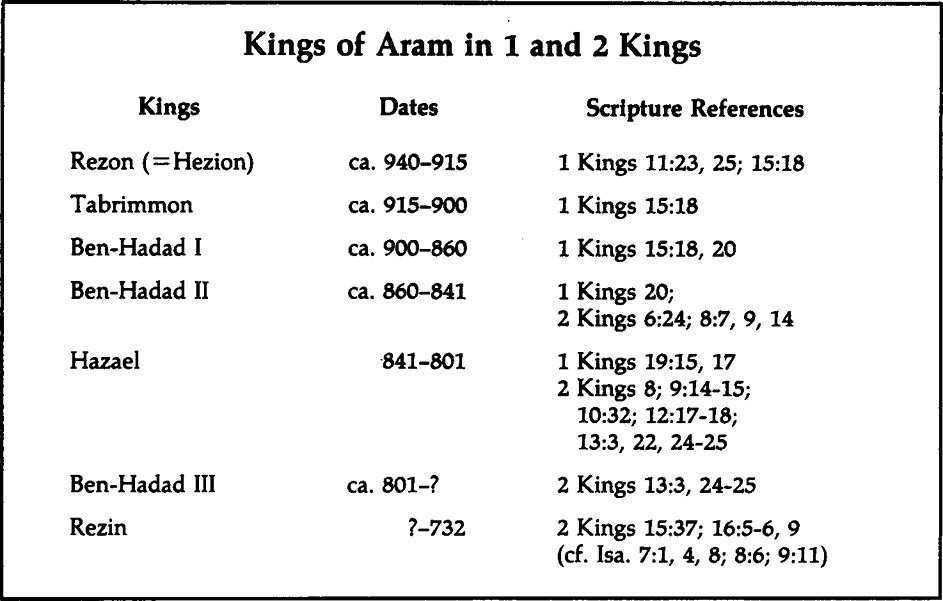
Source: Borrow Bible Knowledge Commentary (page 509)
THE DISCIPLINING
HAND OF THE LORD
So - This term of conclusion clearly links with the persistent practice of idolaltry of 2Ki 13:2. The author now gives us the conclusion of God's response to long-term rebellion.
The anger (aph; LXX - orgizo) of the LORD was kindled (charah) against Israel - The LORD is slow to anger, but continued sin reaches a "tipping point," against Israel. Holy anger is a sobering reality. It is important to understand that Yahweh’s anger here is not an impulsive flare-up like human anger. Rather, it is a settled, measured anger that builds over time in response to persistent sin. Think of a tomato left on the vine too long. If it is not picked at the proper time, it continues to ripen until the skin finally splits open. That natural process provides a vivid picture of divine anger—not sudden, but cumulative and inevitable. In the final analysis, however, God’s anger is always righteous, fully justified, and perfectly fair.
God is loving and forgiving,
though He will not delay judgment forever.
And He gave them continually - He gave emphasizes that God is sovereign. Israel isn’t merely losing battles. God is handing them over (cf. Dt 28:25). Military defeat is the instrument and the LORD is the Initiator, for a "king’s heart is like channels of water in the hand of the LORD; He turns it wherever He wishes." (Pr 21:1). Continually indicates that the oppression against Israel was prolonged, not one and done! The LORD's discipline apparently spans much (if not all) of Jehoahaz’s reign (LXX - renders it "all their days"!). Jehoahaz's persistent sin warranted sustained discipline, not just a quick warning shot.
Warren Wiersbe - People still believe Satan’s lie, “You will not surely die” (Gen. 3:4 nkjv). “Do whatever you enjoy,” says the enemy, “because there are no serious consequences to sin.”
Into the hand (yad = power) of Hazael king of Aram (Syria) - We have previously met Hazael, the man who Elisha prophesied over declaring he would be Israel's most ruthless enemy. Recall the interchange with Hazael, (at that time he was just a soldier in Aram) in 2 Kings 8:12 "Hazael said, “Why does my lord (ELISHA) weep?” Then he answered, “Because I know the evil that you will do to the sons of Israel: their strongholds you will set on fire, and their young men you will kill with the sword, and their little ones you will dash in pieces, and their women with child you will rip up.” Yahweh had revealed to Elisha Hazael would be an instrument of judgment.
Why did Yahweh do this? Simply put, God is a Jealous God and Israel is His wife and He will punish her spiritual adultery! See more discussion of Israel The Wife of Jehovah.
And into the hand (yad = power) of Ben-hadad the son of Hazael - God continued to use Hazael’s son even after Hazael had passed from the scene. As noted in 2 Kings 13:24,25, Ben-hadad did not wield the same degree of power over Israel as his father Hazael, and Israel experienced a partial reversal of Aramean dominance. But oppression is still oppression!
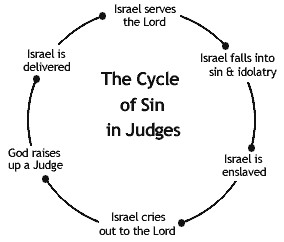
The king and the people of Judah seem to have developed selective amnesia, for God had clearly warned the Second Generation before they entered the Promised Land that He would give victory if they obeyed Him but would cause them to fall before their enemies if they disobeyed (see above) Not only had Yahweh given a clear warning, He even showed them that He meant what He said in the 300 year time of the Judges.
Judges 2:14 The anger of the LORD burned against Israel, and He gave them into the hands of plunderers who plundered them; and He sold them into the hands of their enemies around them, so that they could no longer stand before their enemies.
Judges 3:8 Then the anger of the LORD was kindled against Israel, so that He sold them into the hands of Cushan-rishathaim king of Mesopotamia; and the sons of Israel served Cushan-rishathaim eight years.
Bob Utley - Ben-hadad" This would be the third Syrian king by this name.
- son of Tabrimmon in Asa, king of Judah's day ‒ 1 Kgs. 15:18,20; 2 Chr. 10:2,4
- in Ahab, King of Israel's day ‒ 1 Kgs. 20; 2 Kgs. 6:24; 8:7,9
- son of Hazael, King of Syria ‒ 2 Kgs. 13:3,24,25; Amos 1:4
At this period Assyria had other interests (i.e., Babylon to the southeast) than Syria/Canaan, so Syria reasserted its influence over Israel. But with the reign of Adad-nirari III, Assyria's attention returned to the west.
Ron Daniel on God's anger against Israel's sin and Israel's punishment - This is the pattern that God faithfully followed all through the history of Israel, and in our own individual lives as well. When there is sin, God shows mercy, but when it is continual and unrepentant, He brings punishment. He is merciful to give us time to repent. But eventually, it would be unrighteous not to judge, so He must. The Scriptures tell us,
Gal. 6:7 Do not be deceived, God is not mocked; for whatever a man sows, this he will also reap.
He spoke through Jeremiah the prophet,
Jer. 2:35 Yet you said, ‘I am innocent; Surely His anger is turned away from me.' Behold, I will enter into judgment with you Because you say, ‘I have not sinned.'
All unrepentant sin is eventually punished if not repented of. It is an inevitable truth.
Anger (nose, nostril, wrath) (0639) aph from anaph = to breathe hard, to be angry) is a masculine noun meaning nose, nostril, snout (pigs - Pr 11:22), face (2Sa 25:23) and anger. Both senses are found in Proverbs 30:22 - "For the churning of milk produces butter, and pressing the nose (aph) brings forth blood; so the churning of anger (aph) produces strife." In the first use God "breathed into (man's) nostrils the breath of life." (Ge 2:7) Aph sometimes refers to the entire e whole face (Ge 3:19), especially in the expression, to bow one’s face to the ground (Ge 19:1; 1Sa 24:8). To have length of nose is to be slow to wrath (Pr 14:29, 16:32). To have shortness of nose is to be quick tempered (Pr. 14:17; Jer. 15:14, 15). Aph is used in a phrase (goba aph) which means pride, arrogance, formally, high of nose, an improper haughtiness and self-confidence (Ps 10:4). Often speaks of divine anger or wrath (Ps 2:5, 2:12, 6:1, 30:5, 74:1, 77:9, 78:21) and thankfully is "Slow to anger." (Ps 103:8; 145:8, both Lxx = makrothumos = long-suffering)
Swanson on why aph describes anger - anger, wrath, resentment, formally, nose, i.e., have a strong feeling of displeasure over a person or a situation, as a figurative extension of the nose as an area that can change color when blood rushes to it while one is angry.
TWOT - By the act of breathing, emotions can be expressed. Perhaps it was observed that the nose dilates in anger. God is said to be “erek appayim” (lit. “long of anger,” i.e. long before getting angry) in such passages as Ex 34:6; Num 14:18; Ps 86:15; Neh 9:17. The thought is that God takes a long, deep breath as he holds his anger in abeyance. A ruler is said to be persuaded by a display of forbearance, patience, i.e. “the long of breath” (Prov 25:15). The main use of aph is to refer to the anger of men and of God. This anger is expressed in the appearance of the nostrils. aph gives specific emphasis to the emotional aspect of anger and wrath, whereas its synonyms and terms related to them give particular expression to other aspects. The anger of God is particularly related to the sin of his people, which pains and deeply displeases him (2Kgs 13:3). Sin offends and wounds his love. The emotional response to this is divine anger. This anger, though fierce (Jer 25:37) is not sinful, evil, or the source of capricious attitudes or deeds. However, it is expressed in chastisement (Ps 6:1; Isa 12:1) and punishment (II Sam 6:7; Jer 44:6). Man’s anger can be legitimate (II Sam 12:5). But the OT Scriptures warn that anger can be outrageous (Pr 27:4) and, stirs up strife (Prov 29:22). In contrast, it is said that the man slow to anger appeases strife (Pr 15:18) and a wise man turns from it (Prov 29:8).
ANGER OF THE LORD - THIS PHRASE IS FOUND 35X/35V - Exod. 4:14 = "against Moses!"; Num. 11:10; Num. 11:33; Num. 12:9; Num. 25:4; Num. 32:14; Deut. 6:15; Deut. 7:4; Deut. 11:17; Deut. 29:20; Deut. 29:27; Jos. 7:1; Jos. 23:16; Jdg. 2:14; Jdg. 2:20; Jdg. 3:8; Jdg. 10:7; 2 Sam. 6:7; 2 Sam. 24:1; 2 Ki. 13:3; 2 Ki. 24:20; 1 Chr. 13:10; 2 Chr. 12:12; 2 Chr. 25:15; 2 Chr. 28:11; Ps. 106:40; Isa. 5:25; Jer. 4:8; Jer. 12:13; Jer. 23:20; Jer. 25:37; Jer. 30:24; Jer. 51:45; Jer. 52:3; Zeph. 2:2
Kindled (burned) (02734) charah means to burn or be kindled with anger, and in the Hithpael, charah is used 4x (Ps 37:1, 7,8, Pr 24:19) always meaning "to worry" and describing the agitation, irritation or vexation resulting from active worry. Charah is used in reference to the anger of both man and God.
- James Wolfendale's comments on Dt 32:19–27 in Preacher's Homilectical Commentary
For a fire is kindled in My anger,
And burns to the lowest part of Sheol,
And consumes the earth with its yield,
And sets on fire the foundations of the mountains.
-- Deuteronomy 32:22
These may be figurative expressions, but cannot be explained away, to make the Supreme Being incapable of feeling against sin and the sinner, destitute of pleasure or displeasure, without concern for His glory, or the welfare of the universe.
I. The anger of God is caused by the sins of men. “They have provoked me to anger.” It exists in Divine perfections, and is manifest in Divine government. God’s eye is a flame of fire, and its lofty jealousy rests upon every form of sin, negative and positive. “For the wrath of God is revealed (displayed in judicial vengeance) against all ungodliness (impiety, non-recognition of God) and unrighteousness (deviations from truth and moral rectitude) of men” (Rom. 1:18).
II. Execution of anger is reserved to God Himself. “I will provoke,” “I will move,” agent’s secondary causes. God is the avenger. We are not to usurp His place, and recompense evil for evil. He knows how to punish without passion, and without injustice. “Vengeance is mine; I will repay, saith the Lord.”
III. Anger, when roused in God, is terrible in its effects. Most severe judgments are threatened (Dt 32:22–25).
1. Judgments extensive in operation. Sweeping the earth, penetrating the lowest hell, and like a fire of universal conflagration.
2. Judgments irresistible in might. “Set on fire the foundations of mountains.” Strong fortresses subverted, holy cities destroyed, and the Jewish Constitution overturned. “Who knoweth the power of Thine anger? Even according to Thy fear, so is Thy wrath,” i.e., equal to all that a man can fear from it (Ps. 90:11).
3. Judgments destructive in results. Swept together, heaped up, and falling upon young men and maidens, children and old men—swift as arrows, and hot as fire; in the field and in the home destruction came. It falls upon men like wild beasts upon victims—to crush, destroy, and carry in triumph. This is not an overdrawn picture of the danger and the anger of God against presumptuous sins. “Consider this, ye that forget God, lest I tear you in pieces, and there be none to deliver”—
For guilt, no plea! to pain, no pause, no bound!
Inexorable all! and all extreme.
—Young.
IV. The anger of God is often restrained by mercy. “Were it not that I feared the wrath of the enemy” (Dt 32:27). God can make a full end, but desires not the death of sinners. In the midst of wrath He remembers mercy.
In the midst of wrath
He remembers mercy.
1. Restrained in regard for His own honour. “Lest their adversaries should say, ‘Our hand is high,’ ” etc. If God destroyed Israel, the enemy would take the credit to themselves—become proud and boastful. Hence He regards His own name; will not permit its profanation and pollution (cf. Ex. 32:12; Numb. 14:13; Isa. 10:5).
2. Restraint in the interests of His people. Unworthy as they are, “a nation void of counsel,” He was concerned for their welfare.
(a) For their protection. Their adversaries would injure them, behave themselves strangely; but He defends, restrains the wrath of man, and causes remainder to praise Him.
(b) For their correction. He desires to teach and make them wise (Dt 32:28). “My people is foolish; they have not known Me.”
(c) For their continuance (Dt 32:26). No desire to blot out their name, but to perpetuate their existence, honour, and bless them for ever.
2 Kings 13:4 Then Jehoahaz entreated the favor of the LORD, and the LORD listened to him; for He saw the oppression of Israel, how the king of Aram oppressed them.
- Jehoahaz: Nu 21:7 Judges 6:6,7 10:10 Ps 78:34 Isa 26:16 Jer 2:27
- the Lord: 2Ki 14:26 Ge 21:17 Ex 3:7 Judges 10:15,16 2Ch 33:12,13,19 Ps 50:15 Ps 106:43,44 Jer 33:3
- he saw: Ge 31:42 Ex 3:9 Isa 63:9
- how the king of Aram oppressed them: 2Ki 13:22 14:26
JEHOAHAZ SEEKS THE
FAVOR OF YAHWEH!
Then - Whenever a passage begins with "then," be sure to pause, ponder and interrogate it. Two simple questions in this context would be "When is then?" or "What happened then?" Then usually marks progression in a narrative. Recall the sequence here progresses from following in the sins of Jeroboam and God's hand of discipline as a consequence of his idolatry. But now we see Jehoahaz to some degree "comes to his senses"
Perhaps King Jehoahaz recalled the sin cycles of Judges where Israel repeatedly experienced divine discipline and repeatedly cried out to Yahweh and He heard their cries. (See cycle above).
Jehoahaz entreated (chalah; LXX - deomai - beg) the favor (panim - face) of the LORD (Jehovah - Yahweh) - Literally the Hebrew reads "entreated (or appeased) the face of Yahweh." When he was in trouble, he sought the One Who could address the trouble! Warren Wiersbe calls this "CRISIS FAITH." (See note below)
In the midst of wrath
God remembers mercy.
and the LORD (Jehovah - Yahweh) listened to him - Frankly this is an amazing clause stating God listened. Why is this so amazing (amazing grace)? Because Jehoahaz "followed the sins of Jeroboam...did not turn from them" (2Ki 13:2) Verses that speak of God not listening to sinners include Isaiah 59:2 Isaiah records "your iniquities have made a separation between you and your God, And your sins have hidden His face from you so that He does not hear." And as the psalmist acknowledged "If I regard wickedness in my heart, The Lord will not hear." (Ps 66:18)
Why did the LORD listen to Jehoahaz after giving them into the hand of Hazael? If we go to the end of this chapter we see a description that "Hazael king of Aram had opposed Israel all the days of Jehoahaz." (2Ki 13:22) And then in 2Ki 13:23 the writer explains why God would have listened to Jehoahaz and graciously given them a deliverer. The answer is that God remembered His covenant with Abraham, "was gracious to them and had compassion on them and turned to them (in v5 turning His ear to listen!)" Oh, praise God that He is a covenant keeping God!
For (term of explanation) He saw the oppression (lachats; LXX - thlipsis) of Israel, how the king of Aram oppressed (lachats; LXX - thlibo) them - This is the oppression Yahweh Himself had sent on Israel as a punishment for Israel's committing spiritual adultery with her idol worship.
“For (term of explanation) grounds the LORD’s response in what He Himself observed. The text states that He saw the oppression of Israel. The Hebrew word לָחַץ (lachats) carries the idea of crushing pressure, relentless squeezing, and severe distress. It is not a momentary hardship, but an ongoing condition that leaves no room to breathe. The LXX translates it with thlipsis, a word that conveys tribulation, affliction, and pressing anguis, the kind of suffering that weighs heavily on both body and soul. The verse then repeats the same root to describe how the king of Aram oppressed them (lachats; LXX - thlibo). This repetition is deliberate and serves to emphasize the severity, continuity, and intensity of Israel’s suffering. The pressure was not incidental or sporadic bu systematic and unrelenting.
Divine discipline is never
detached or indifferent.
The author is careful to show that this oppression, though executed by Aram, originated with the LORD Himself. This was not random cruelty or geopolitical misfortune. It was covenant discipline, judgment sent by Yahweh in response to Israel’s persistent spiritual adultery through idolatry. The LORD had handed Israel over to this crushing affliction because they refused to turn from the sins of Jeroboam. And yet, here is the remarkable tension of the passage: the same God Who sent the oppression also saw it. He did not avert His eyes from the suffering He had decreed. Divine discipline is never detached or indifferent. Yahweh remained attentively aware of the misery of His people, even while justly chastening them. This explains why mercy follows. God’s compassion is not triggered by Israel’s faithfulness (there was none), but by His own covenant character (See the only direct allusion to the Abrahamic Covenant in 2Ki 13:23)!
Paul House writes that "As in the times of Amos, it seems that the more the Lord does to change Israel’s habits the more the people choose a destructive path (cf. Amos 4:6–12)." (1, 2 Kings: An Exegetical and Theological Exposition)
The Lord’s chastisement was not purposeless; it was designed to bring about needed change. When Israel was pressed to the breaking point and driven into the depths of suffering, the king finally entreated the favor of the LORD. Stripped of strength and self-reliance, he cried out for mercy.
One of the consistent themes of 1 and 2 Kings is the LORD’s compassion in response to the cries of His people. Again and again, when affliction exposes their helplessness and they finally call upon Him, God listens. He is not indifferent to their pain, even when that pain is the consequence of their own rebellion.
Here, the LORD heard because He saw. He observed the severity and brutality of the oppression inflicted by Hazael, king of Aram—an oppression that was prolonged, relentless, and devastating. Though Israel’s suffering was deserved as covenant discipline, it was never ignored by the covenant God.
This scene reveals both sides of the LORD’s character: His holiness, which disciplines persistent sin, and His compassion, which responds to desperate cries for help. Even where repentance was incomplete and reform absent, divine mercy was stirred by human misery. Discipline had done its work—not by producing full repentance, but by driving Israel back to the only One who could deliver them.
Entreated (02470)(chalah) with the meaning of "to entreat". This word is used sixteen times, always in the Piel stem, and always with penê "the face of." With penê the meaning is "entreat," "seek the favor of." The use of ḥlh in this construction is similar to that of the Hithpael of ḥānan, "entreat favor." Thirteen of the sixteen usages refer to the favor being sought of the Lord. Usually this involves a prayer for mercy or help in the threat of danger. The danger may be the hand of God (Exodus 32:11, as a result of the golden calf), or of enemies (2 Kings 13:4, the Syrians against Jehoahaz). As applied to others, Zophar tells Job that if he would "be good" people would entreat his favor (Job 11:19, KJV "make suit unto you"). In Proverbs 19:6 we are told that many will entreat the favor of the liberal man (KJV prince)." According to Psalm 45:12 [H 13], the rich shall entreat the bride of the King, who is identified in Hebrews 1:8-9 as the Son of God. Some would call attention to the invariable use with penê and urge that the idiom means to stroke the face of someone and thus mollify him, but this seems to be extreme etymologizing. The origin of the idiom may not be clear. The meaning, however, as determined by usage is plain. Other words for "to pray" are ḥānan and pālal (q.v.).
Chalah - 15v - asked(1), entreat(6), entreated(4), favor*(3), seek(2), seek the favor(1), sought(2). Exod. 32:11; 1 Sam. 13:12; 1 Ki. 13:6; 2 Ki. 13:4; 2 Chr. 33:12; Job 11:19; Ps. 45:12; Ps. 119:58; Prov. 19:6; Jer. 26:19; Dan. 9:13; Zech. 7:2; Zech. 8:21; Zech. 8:22; Mal. 1:9
Oppression (03906)(lachats) distress, oppression, affliction. Tribulation from difficult circumstances. When the people arrived in the Land of Promise, Moses commanded each family to bring an offering of firstfruits to the priest (Dt. 26:7). Part of the presentation involved a recognition that God had seen their oppression in Egypt and rescued them.
The Septuagint translates the noun lachats in with thlipsis literally pressure, pressing together; figuratively in the NT, of suffering brought on by outward circumstances affliction, oppression, trouble (Ro 5.3)
Israel experienced a whole wave of oppressors during the period of the Judges (Jdg 1:34; Jdg 2:18; Jdg 4:3; Jdg 6:9; Jdg 10:12; 1 Sa 10:18). But the Lord sent deliverers in each situation. Later he sent oppressors, (the king of Syria and others; 2 Ki 13:4, 22) against Israel on account of sin (Amos 6:14). Other nations will face their oppressors (Isa 19:20), too. But God always hears the cry for mercy and deliverance, and he will then fight daily against those oppressors (Ps 56:1)
Lachats - 10x - oppression(8), sparingly(2). Ex. 3:9; Dt. 26:7 = referring to God hearing their cry and delivering them from Egypt; 1 Ki. 22:27; 2 Ki. 13:4; 2 Chr. 18:26; Job 36:15; Ps. 42:9; Ps. 43:2; Ps. 44:24; Isa. 30:20
Oppressed (03905) (lachats) is the verb form which means to physically push against someone or something, to squeeze, to crush and has the sense of pressing, crowding or tormenting. Used literally twice of Balaam's donkey in Nu 22:25 "When the donkey saw the angel of the LORD, she pressed herself to the wall and pressed Balaam’s foot against the wall, so he struck her again." "Hold the door shut" in 1 Ki 6:32. Lachats is used repeatedly in the dark days of Judges (lasted some 1200 years!) when Israel would be oppressed by some pagan enemy and would cry out to God for deliverance. The only problem was they kept falling back into sin after a period of rest! Sounds too familiar to my life sometimes!
The Septuagint translates lachats in with thlibo which literally means to press, rub together; hence compress, make narrow and as here in 2Ki 13:4 figuratively afflict, oppress, cause trouble to (2Th 1.6);
2 Kings 13:5 The LORD gave Israel a deliverer, so that they escaped from under the hand of the Arameans; and the sons of Israel lived in their tents as formerly.
- a deliverer: 2Ki 13:25 14:25,27 Ne 9:27 Isa 19:20 Ob 1:21 Lu 2:11
- formerly Ex 4:10 De 19:4 1Sa 19:7 1Ch 11:2
Related Passage:
Judges 2:16 Then the LORD raised up judges who delivered them from the hands of those who plundered them.
GOD'S AMAZING GRACE
GIFT OF A DELIVERER
The LORD gave Israel a deliverer (mosia from the root yasha' in turn root of Yeshua ~ Jesus!; LXX - soteria), so that they escaped from under the hand (yad = power) of the Arameans (Syrians) - This verse describes GRACE, unmerited favor to Israel, like God did in days of the Judges when He graciously raised up a JUDGE to DELIVER Israel from oppression. Yahweh bestows a gift of grace, and in light of their continued sin one can better understand the definition of grace as totally unmerited favor!
The identity of the deliverer is not certain. Some feel this deliverer (cf JUDGE in book of Judges) may have been the Assyrian king, Adad-nirari III (810-783 B.C.), who came to the throne during Jehoahaz's reign. Adad-nirari III attacked and crushed Damascus in 805 B.C., bringing relief to Israel from the Syrian oppression. But in the final analysis no one knows who the deliverer is.
William Barnes on who is the savior - But who specifically is this “savior” (13:5; NLT, “someone to rescue”)? Commentators vary in their answers (see Cogan and Tadmor 1988:143 for an extensive listing of the various possibilities, both Israelite and non-Israelite); but an immediately attractive option, exegetically, must be the prophet Elisha (cf. 13:14–21). Always in the Judges parallels, the “savior”—whether moshia‘ [TH3467B, ZH4635], as here (cf. Judg 3:9, 15); or else “judge” (shopet [TH8199A, ZH9149]), as in Judg 2:16, 18; or even “prophet” (nabi’ [TH5030, ZH5566]; see Judg 6:8; cf. Judg 4:4)—is an Israelite, and is often a spiritual leader as well as a military one (admittedly, the prophet in Judg 6:8 is an imperfect parallel, inasmuch as Gideon, not he, brings deliverance and military leadership). (For those who see the “Ben-hadad” of 6:24 as referring to this time, the antipathy between prophet and king described in 6:24–7:20 would detract from the Elisha option, to be sure, but all such parallels must, at best, remain hypothetical.) But a strong historical case may be made that the savior here is the Assyrian king Adad-nirari III (see, especially, Wiseman 1993:240–241), whose vigorous attacks finally brought Aram to bay. Or possibly, Jehoahaz’s son Jehoash may be the “savior” (moshia‘) in question. Cogan and Tadmor point to the use of other forms of the cognate verb hoshia’ [TH3467, ZH3828] (to deliver) in connection with that king and his son Jeroboam II (13:17; 14:27), but I would submit that the prophet Elisha remains a better candidate.
Admittedly, all this speculation represents the classic “argument from silence,” inasmuch as the biblical text remains quiet concerning any specific identity of the present “savior” (contrast Hobbs 1985:167–168 [citing Carroll 1969:400–415], who makes a strong case for parallels here with Deut 26:5–9, where Moses himself would serve as the prophetic archetype for a string of prophets, Elisha being the present example [cf. Leithart 2006:232]). In any case Jehoahaz, the Israelite king, was correct to call upon Yahweh, the Israelite deity, who in turn had compassion on his people and sent the “savior” to deliver them from their enemies and allow them to live in “safety” as heretofore. God is faithful, as is especially evident when his human king acts in humility and obedience. And that is the clear message of the present nine verses of 2 Kings.
Cogan - a deliverer. Heb. môšîaʿ. The term echoes the phraseology of the book of Judges, in which divinely summoned leaders rescued Israel from their oppressors; cf. e.g. Judg 2:18; 3:9, 15. The identity of the present “deliverer,” unnamed in the text, remains disputed. He has been taken to be Joash (Qimḥi, Benzinger, A. Cody CBQ 32 [1970], 336–37); Jeroboam II (Thenius, Stade, Skinner, Šanda, Eissfeldt, Montgomery-Gehman, NAB); Elisha (Noth, Überlieferungsgeschichtliche Studien, 84; Gray); Adad-nirari III (Winckler, KAT3, 260; B. Mazar, BAR 2.145; Tadmor, EncMiqr 3.479); and even Zakur of Hamath (Cooke, CAH1 3.376). To be noted in particular is the use of the verb hôšîâʿ, “to deliver” both with reference to Joash (see below v. 17—“an arrow of victory [tĕšûʿâ] over Aram”) and Jeroboam (see 14:27—“he delivered them” [wayyôšîʿēm]). For historical evaluation of these traditions, see further in Comment.
This term deliver is similar to the deliverers in the book of Judges (yasha' in BOOK OF JUDGES - Jdg. 2:16; Jdg. 2:18; Jdg. 3:9; Jdg. 3:15; Jdg. 3:31; Jdg. 6:14; Jdg. 6:15; Jdg. 6:31; Jdg. 6:36; Jdg. 6:37; Jdg. 7:2; Jdg. 7:7; Jdg. 8:22; Jdg. 10:1; Jdg. 10:12; Jdg. 10:13; Jdg. 10:14; Jdg. 12:2; Jdg. 12:3; Jdg. 13:5)
TAKEAWAY - Though God disciplines His people for their sin, the LORD does not delight in their suffering. His discipline is restorative, not punitive. He desires to show mercy and to deliver when His people humble themselves and return to Him. Jehoahaz reigned from approximately 814–798 BC, meaning that this act of divine mercy occurred some sixty to seventy years before Israel was taken into exile in 722 BC. Thus, in the present context, the LORD’s provision of a deliverer was a gracious and deliberate act of mercy which was intended to turn the nation from its self-destructive course before judgment became irreversible.
ISRAEL EXPERIENCED
A TIME OF RELATIVE PEACE
And the sons of Israel lived in their tents as formerly This describes a return to relative peace and normalcy. Israel was once again able to dwell in open settlements and rural areas rather than crowding into fortified cities for protection. In other words, the constant threat of invasion had eased, allowing the people to live securely in their own land as in earlier days, without fear of constant attacks by the Syrians and without the need to seek refuge behind city walls.
Warren Wiersbe - God in His mercy heard and answered the king’s prayer and promised to send a deliverer, but only after Jehoahaz was off the scene (2Ki 13:22). Hazael died and his son and successor Ben-Hadad was a weaker ruler, so it was possible for someone to break the iron grip Syria had on Israel. Historians aren’t agreed as to who this deliverer was. Some point to the Assyrians who began to attack Syria in the days of Ben-Hadad and weaken his power. Others feel the deliverance came through one or both of Jehoahaz’s successors, Jehoash (v. 25) and Jeroboam II (2Ki 14:25–27). The statement “Israel dwelt in their tents” (v. 5)
Jon Courson - The Lord raised up a deliverer to free Israel from the hand of the Syrians. And yet these people continued to walk in their sin. Why would people continue in sin when the Lord raised up a savior for them? That's a question we have to ask ourselves. We have to realize that it's only by the grace, mercy, and lovingkindness of God that a Savior was granted to us.Why did the Lord give these wicked sinners a savior? Here's a better question: Why did He give His Son for us? (Jon Courson's Application Commentary Old Testament Volume 1)
Israel’s deepest problems were spiritual, and
spiritual warfare cannot be waged with military weapons.
Philip Ryken - Whoever the “savior” was, his deliverance brought peace for a season. But Israel’s deepest problems were spiritual, and spiritual warfare cannot be waged with military weapons. Although the Israelites won a short-term battle, “they did not depart from the sins of the house of Jeroboam, which he made Israel to sin, but walked in them; and the Asherah also remained in Samaria” (2 Kings 13:6). The people wanted to worship God, to some extent, but they were not willing to give up their idols. As Howard Vos explains, “The faith of the northern kings was syncretistic; it did not eliminate the worship of Yahweh completely but combined it with facets of pagan devotion.”4 (2 Kings)
Deliverer (KJV = "savior") (03467) yasha' (See also yeshua from which we get our word "Jesus") is an important Hebrew verb which means to help, to save, to deliver. The root in Arabic is "make wide" which underscores the main thought of yasha' as to bring to a place of safety or broad pasture in contrast to a narrow strait which symbolizes distress or danger.
TWOT adds that the concept of "wide" "connotes freedom from distress and the ability to pursue one’s own objectives. To move from distress to safety requires deliverance. Generally the deliverance must come from somewhere outside the party oppressed. In the OT the kinds of distress, both national and individual, include enemies, natural catastrophies, such as plague or famine, and sickness. The one who brings deliverance is known as the “savior.” Thus yasha' connotes protection that produces freedom from a present danger (2Sa 22:3, Job 5:4), salvation or deliverance in a religious sense (Ps 51:12), a title of God (Savior - 2Sa 22:47; 1Chr 16:35; Ps 18:46; Ps 24:5; Ps 25:5; Ps 27:9; Ps 65:5; Ps 79:9; Ps 85:4; Isa 17:10; 62:11; Mic 7:7 Hab 3:18), victory as an act or a result of conquering (2Sa 22:36; Ps 18:35) It is notable that almost 20% of the uses of yasha' are found during the dark days of Judges (dominated by the heart attitude of Jdg 21:25), which surely speaks of the undeserved lovingkindness of God!
Ron Daniel - The Lord listened, and raised up a deliverer. Just as it is part of God's nature to judge sin, it is just as much a part of Him to forgive the repentant sinner. Peter wrote that He...
2Pet. 3:9 ...is patient toward you, not wishing for any to perish but for all to come to repentance.
Never underestimate God's willingness to forgive you. He yearns for the day that you will turn back to Him.
- King Ahab was responsible for the murder of hundreds of the prophets of God, yet when he humbled himself before God, God withheld judgment against him.
- Saul of Tarsus went around arresting Christians and seeing them killed, yet when he turned to Christ, God forgave all of his sins.
- The Ninevites were brutal warriors, murderers, and immoral idolaters. Yet when they cried out to the Lord in repentance, he spared them.
How bad are your sins? Have you been living a life of substance abuse? Sexual immorality? Hatred in your heart? Bitterness and anger? Your sins are producing negative things in your life. The fruit of them is a hardened heart, and isolation from God. You're missing out on blessings, and storing up judgment against you. But God can forgive you - He wants to forgive you. He loves you more than you can understand, and it breaks His heart that you're so far away.
He has raised up a deliverer for you - Jesus Christ. The Bible says that it is...
1Th 1:10 ...Jesus, who delivers us from the wrath to come.
It is up to us to receive God's deliverer to save us from the wrath that comes upon us for our sins and rebellion against Him. That's why Jesus said,
John 3:36 "He who believes in the Son has eternal life; but he who does not obey the Son shall not see life, but the wrath of God abides on him."
He is willing, He has provided. The ball is now in our court.
2 Kings 13:6 Nevertheless they did not turn away from the sins of the house of Jeroboam, with which he made Israel sin, but walked in them; and the Asherah also remained standing in Samaria.
- did not turn away : 2Ki 13:2 10:29 17:20-23 De 32:15-18
- walked: 1Ki 15:3 16:26
- Asherah also remained standing in Samaria. 2Ki 17:16 18:4 23:4 De 7:5 1Ki 16:33
Related Passages:
Deuteronomy 7:5 “But thus you shall do to them: you shall tear down their altars, and smash their sacred pillars, and hew down their Asherim, and burn their graven images with fire.
Deuteronomy 12:3 “You shall tear down their altars and smash their sacred pillars and burn their Asherim with fire, and you shall cut down the engraved images of their gods and obliterate their name from that place.
1 Kings 16:31-33 (AHAB'S ASHERAH) It came about, as though it had been a trivial thing for him to walk in the sins of Jeroboam the son of Nebat, that he married Jezebel the daughter of Ethbaal king of the Sidonians, and went to serve Baal and worshiped him. 32 So he erected an altar for Baal in the house of Baal which he built in Samaria. 33 Ahab also made the Asherah. Thus Ahab did more to provoke the LORD God of Israel than all the kings of Israel who were before him.
1 Kings 18:21 (CALL FOR ALL IN FOR GOD OR BAAL!) Elijah came near to all the people and said, “How long will you hesitate between two opinions? If the LORD is God, follow Him; but if Baal, follow him.” But the people did not answer him a word.
Matthew 6:24 “(ABSOLUTELY) No one can serve two masters; for either he will hate the one and love the other, or he will be devoted to one and despise the other. You cannot serve God and wealth.
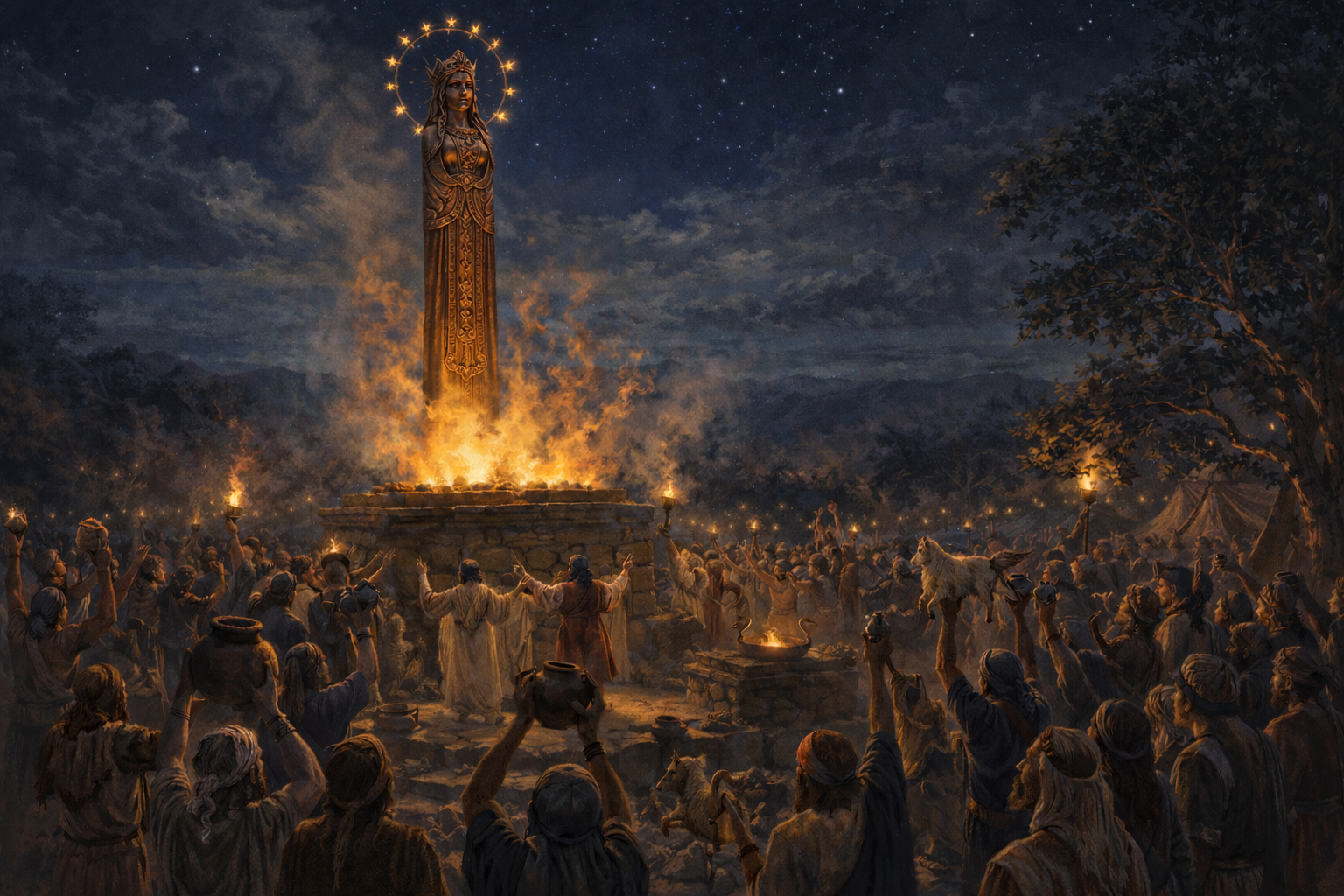
Abominable Asherah Worship
THE FALLIBILITY OF
"CRISIS FAITH"
Nevertheless - On my! Another critical "hinge word." A sad term of contrast! Jehoahaz's "crisis faith" should have opened the door to walk in faith and obedience, but here we see that "door" is slammed shut by Jehoahaz's almost immediate backsliding to the abominations of idol worship! Living in their tents as formerly (2Ki 13:5) shows the divine pressure" was off, but when they experienced relief, they quickly returned to their sins. Is this not a vivid picture of the power of our fallen flesh, which so often settles for partial obedience, shrinks back from full faith, and thereby restricts the measure of blessing and victory God intends to give? As Peter says (speaking to believers) in 1Pe 2:11 "I urge you as aliens and strangers to abstain (present tense - continually!!!) from fleshly lusts which wage war (present tense - continually!!!) against the soul." Takeaway - There there can be no furlough in spiritual war! As in the period of the Judges, Jehoahaz sought the LORD (v. 4a) primarily for relief from affliction, not from a heartfelt repentance for the sins that had brought the suffering.
🙏 THOUGHT - Is there not a powerful life lesson for all of us in Jehoahaz's almost immediate return to idolatry (See Crisis Faith)? I am reminded of 1Co 10:6-11 Paul writing "Now these things happened as examples for us, so that we would not crave evil things as they also craved. Do not be idolaters, as some of them were; as it is written, “THE PEOPLE SAT DOWN TO EAT AND DRINK, AND STOOD UP TO PLAY.” Nor let us act immorally, as some of them did, and twenty-three thousand fell in one day. 9 Nor let us try the Lord, as some of them did, and were destroyed by the serpents. 10 Nor grumble, as some of them did, and were destroyed by the destroyer. 11 Now these things happened to them as an example, and they were written for our instruction, upon whom the ends of the ages have come." O beloved, may the Spirit of God open our eyes to hear and heed these Old Testament warnings, for if any of us think we can stand against the subtle temptations and gross evil in our day, let each of us "take heed (present imperative see our need to depend on the Holy Spirit to obey ) that he does not fall!" (1Cor 10:12, cf Mt 26:41). Father, grant each of us the power by Your Spirit to continually flee idolatry (and often associated immorality) and stay fled (1Co 10:14), for the sake of Your Name, in Jesus our Deliverer. Amen
The deliverance produced peace without purification.
Circumstances improved, but hearts did not....
Temporary deliverance
without lasting transformation!
They did not turn away from the sins of the house of Jeroboam, with which he made Israel sin but walked in them - They refers to Israel as a whole. The entire nation suffered under God’s hand of discipline, yet the suffering produced no corresponding spiritual change of heart. Another way to say they did not turn away is to say that they did not repent! There was no moral about-face, no decisive break with the sins that defined their rebellion. Instead of allowing God’s discipline to bring them back, they remained unmoved and unchanged. Affliction exposed their sin, but it did not lead to repentance. Their stubborn refusal strongly echoes Stephen’s prophetic indictment in Acts 7:51, where he declares: “You men who are stiff-necked and uncircumcised in heart and ears are always resisting the Holy Spirit; you are doing just as your fathers did.” Israel in Jehoahaz’s day was doing the very same thing, resisting the Holy Spirit, Who was pressing upon them through discipline to bring about repentance.
They had briefly turned to God,
but not away from their sin.
The citizens of the Northern Kingdom had learned nothing from their history as recorded for example in Judges 2:19 "But it came about when the judge died, that they would turn back and act more corruptly than their fathers, in following other gods to serve them and bow down to them; they did not abandon their practices or their stubborn ways."
🙏 THOUGHT - Have we learned from our personal "history?" Or when divine disciplinary pressure is lifted in our lives, do we quickly return to the same sins? God is the same today as He was yesterday in the days of the Kings. We must be warned by and learn from the lessons of the nation of Israel. Paul wrote "if you are living according to the flesh, you must die; but if by the Spirit you are putting to death the deeds of the body, you will live." (Ro 8:13) Proverbs 28:13 says "He who conceals his transgressions will not prosper, But he who confesses and forsakes them will find compassion." "Israel’s repentance was only half-hearted; they repented because they suffered. They repented because of the suffering rather than because of the sin. They went back to the sin after they escaped from the sorrow." (Spurgeon) Is my repentance half-hearted?
The repetition of the word sin in this verse (sin … sins … them) is deliberate and emphatic. It underscores how deeply entrenched their rebellion had become. Rather than turning away from sin when confronted by it, they pressed forward into it. What should have provoked repentance instead became a settled pattern of life. Sin was no longer an interruption, but was their habitual practice. In short, God’s discipline affected their circumstances, but not their conscience. Their chains grew heavier, and their hearts grew harder, reflecting the power of persistent sin.
A dark cloud lingered over Jehoahaz’s earnest attempt to seek the LORD. Though his plea was heard and a season of relief followed, brought about by the LORD’s appointed deliverer, the deeper problem remained unchanged. The people did not turn away from the sins of the house of Jeroboam .
The deliverance produced peace without purification. Circumstances improved, but hearts did not. The false worship that had corrupted Israel from its earliest days in the northern kingdom continued uninterrupted, as though the mercy of God were merely a pause in judgment rather than a summons to repentance!
This tragic pattern exposes the limits of outward relief. God, in compassion, lifted the burden of oppression; yet Israel responded not with renewed devotion, but with a return to entrenched idolatry. The moment the pressure eased, the people resumed the very sins that had invited discipline in the first place. Thus, Jehoahaz’s cry, however sincere in distress, resulted in temporary deliverance without lasting transformation. The shadow over this narrative is unmistakable and it is when mercy does not lead to repentance, it only delays the next chapter of judgment! WOE!
And the Asherah (Asherah) also remained standing in Samaria The Asherah was the idolatrous consort of Baal. Worship of Asherah was a fertility cult, deeply sensual and intentionally designed to rival devotion to the LORD. In pagan belief, Asherah promised life, abundance, and blessing apart from covenant obedience. Asherah poles (or sacred trees) were usually wooden poles, carved trees, or living trees. They were set up on high places, under green trees and shockingly, sometimes near or inside the Temple precincts. These poles were not idols of Yahweh but visible symbols of a rival fertility theology. God had explicitly commanded Israel to cut them down and burn them (Dt 7:5; Dt 12:3). The most abominable aspect of the Asherah is that they repesented sexaulized fertility cults, involving ritual prostitution (male and female) with sexual acts performed unde the guise of religious rites! The Asherah worshipers were so deceived by their sin that they believed sexual activity would stimulate fertility and thus ensure rain, crops, and offspring. In a word aberrant sex was not merely tolerated but actually sacralized. Little wonder that God repeatedly accused the participants of spiritual adultery (See Israel the Wife of Jehovah)!
Technical note - Archaeology has uncovered thousands of small female fertility figurines, often with exaggerated breasts and wombs, dating to the period of the monarchy. These objects were almost certainly used in private homes, not merely in public shrines or state-sponsored cult centers. Their sheer number is significant. It demonstrates that Asherah worship was widespread, domestic, and thoroughly normalized in everyday life. This was not simply a top-down corruption imposed by kings. Asherah devotion had worked its way into the households, habits, and hopes of the people themselves. Pagan fertility theology shaped how families thought about prosperity, children, agriculture, and security. Idolatry had moved from the high places into the home. In other words, Asherah worship was not only institutional and cultural. It was woven into the very fabric of Israel’s daily existence. How far the nation had fallen from Yahweh’s original calling to "be to Me a kingdom of priests and a holy nation." (Ex 19:6). The warning is sobering and timeless. When false worship becomes ordinary, familiar, and culturally acceptable, the people in a so-called Christian nation may still speak God’s name while quietly living by a different theology altogether. America, take note!
Crisis faith is rarely deep or lasting...
crisis faith is undependable.
Warren Wiesbe on Jehoahaz's "CRISIS FAITH" - Did the promised blessing of God change the king? Apparently not, for he didn’t remove the idols from the land (2Ki 13:6; 1 Kings 16:33) nor did he encourage the people to return to the Lord. Crisis faith is rarely deep or lasting. Once people see hope of deliverance and their pain eases up, they forget the Lord and return to their old ways until the next crisis. The Syrians left Jehoahaz with a mock army that was more of an embarrassment than it was an encouragement. Yet God had promised that if His people trusted Him and obeyed His Word, their enemies would flee before them (Deut. 28:7; 32:30; Lev. 26:8). But crisis faith is undependable. How many times I’ve heard hospital patients say, “Pastor, if God heals me and gets me out of here, I’ll be the best Christian you ever met.” God did heal them and allow them to go home, but I never met them again in church. Yes, there are such things as “foxhole conversions” and “deathbed conversions,” and we don’t want to discourage anyone from turning to God in the hour of crisis. The British historian William Camden wrote, “Betwixt the stirrup and the ground / Mercy I asked, mercy I found.” But how many times can we call on the Lord when we’re in trouble and then ignore Him when we’re safe? People who depend on crisis faith need to heed the warnings of Proverbs 1:24–33 and Isaiah 55:6–7, and they shouldn’t assume that because God heard and helped them, they’re automatically going to heaven.
Ron Daniel - The believer who has one foot in the kingdom of God and the other in this world will become the most miserable person around. Decide what you're going to do and do it.
Turn away (depart, remove, take away)(05493) sur basically means to change direction, to turn away, to go away, to desert, to quit, to keep far away, to stop, to take away, to remove, to be removed, to make depart. Literally of turning aside or departing from the road a person is traveling (Jdg 18:3, 15) or departing from a road or path by turning aside from the original course (Ex 3:3; Dt. 2:27; Jdg. 18:3; 19:15; Ru 4:1; 1 Sam. 6:12; 1 Ki 22:32; Jer.5:23); to step out of line militarily (1 Ki 20:39); to retreat from a path (Ge 49:10; Ex 8:27; Nu 12:10; 14:9; Dt. 4:9; Jdg. 16:19; 1 Sa 6:3; 16:14)' Used figuratively, it has to do with the moral direction someone is taking; turning from the right road. Israel turned aside from the way of their ancestors walked (Jdg. 2:17) and away from God's commands (Mal 3:7). Israel's leaders exhorted them not to turn aside from the right way (Dt.77:20; Josh. 23:6; 1 Sa 12:20, 21). To stay on course is to turn neither to the right or to the left (Dt. 2:27; 5:32: Josh 1:7; 2 Ki 22:2).
Asherah (0842) Asherah refers to "poles" representing and/or associated with the goddess Asherah - these poles could be cut down and burned (Jdg. 6:25-26). They were made (1Ki 14:15) and set up (1Ki 14:23) after being carved (2Ki 21:7). In many cases, Asherah clearly refers to the deity and not to an image or symbol (Judg. 3:7, 1 Ki. 18:19 and 2 Ki. 23:4).
Victor Hamilton - It is in the period of the divided monarchy that the Asherah cult flourished both in Israel and Judah, though its existence before is documented by the command in Exodus 34:13, the prohibition of Deut. 16:21, and the incident at the threshold of Gideon's life of service to God, Judges 6:25ff. Rehoboam's career marks the beginning of this in Judah (1 Kings 14:23). In the north the cult received its greatest momentum from the incentive of Jezebel who was responsible for the presence of "four hundred prophets of Asherah" (1 Kings 18:19). Even a reform-minded king such as Asa (1 Kings 15:13) or later Hezekiah (2 Kings 18:4) was unable to liquidate the movement. It was knocked down, but not knocked out. There was an almost inevitable resurrection even in the wake of reform. Compare son Manasseh's policy (2 Kings 21:7, even to the point of placing the image in the temple) on the heels of father Hezekiah's reform (2 Kings 18:4). Apostasy and idolatry just behind revival! What one generation attempts to get rid of a subsequent generation may trot back in, however reprehensible it may be. All too frequently this has been the pattern in the human race. (Online TWOT)
2 Kings 13:7 For he left to Jehoahaz of the army not more than fifty horsemen and ten chariots and 10,000 footmen, for the king of Aram had destroyed them and made them like the dust at threshing.
- fifty horsemen: 1Sa 13:6,7,15,19-23 1Ki 20:15,27 Isa 36:8
- the king: 2Ki 8:12 2Ki 10:32
- like the dust: Ps 18:42 Isa 41:2,15,16 Joel 3:14 *marg: Am 1:3
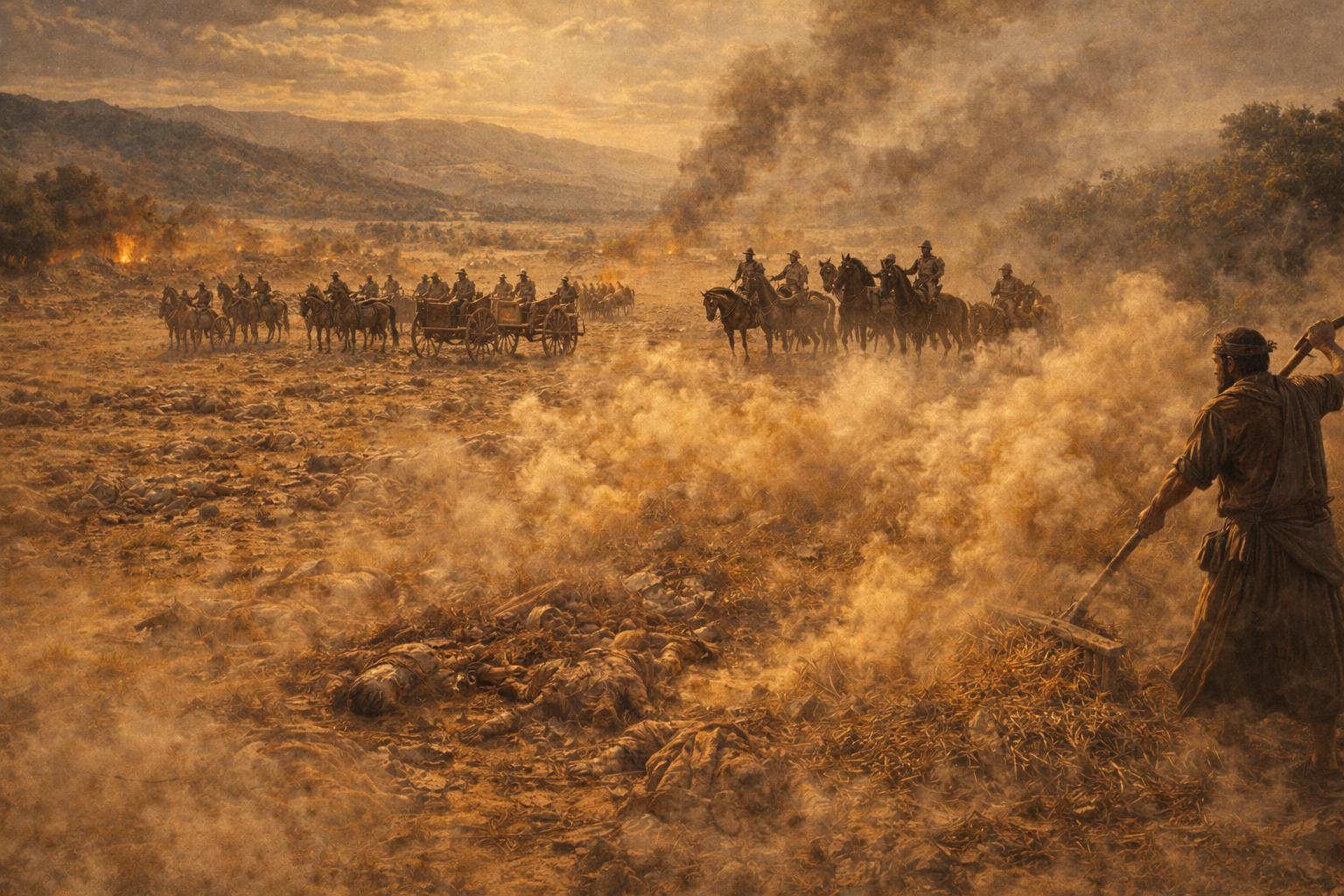
Army Like Dust at Threshing
ARAMEANS REDUCE ISRAEL
TO A TOKEN ARMY
For - Term of explanation. The writer explains the consequences of Israel's half-hearted repentance and immediate return to their previous sins.
He left (sha'ar/) to Jehoahaz of the army not more than fifty horsemen and ten chariots and 10,000 footmen - He is not the LORD, but in context is most likely the king of Aram, that is, Hazael and, by extension, his successor Ben-hadad (cf. v.3). The verb left (sha'ar/) is often used of a remnant spared after judgment. Israel was not preserved, but pared down! And what remained was only what the enemy allowed to survive, which was minimal, humiliating, and intentional. In truth Israel existed only because the Aramean king left them barely enough to exist at all. Now I would add that ultimately Israel was not totally demolished because the mercy of the sovereign God Who would not have His covenant with David abrogated or annulled.
God allowed Israel to be humbled,
yet not wiped out
The Arameans in effect had made Israel's army like a hamstrung horse, crippled by severing tendons at the back of the hind legs making it useless for pulling chariots and fighting in battle. So too was Israel's force, not annihilated, but crippled militarily.
🙏 THOUGHT - This token army was the result of God's hand of discipline for their return to idolatry. It was a judgment of the LORD (Ps 19:9). David tells us Yahweh's judgments "are righteous altogether. They are more desirable than gold, yes, than much fine gold; Sweeter also than honey and the drippings of the honeycomb. Moreover, by them Thy servant is warned; (THE NEAREST ANTECEDENT IS "JUDGMENTS" BUT OF COURSE THIS WOULD ENCOMPASS THE PRIOR ATTRIBUTES OF GOD'S WORD) In keeping them there is great reward." (Ps 19:10-11). Here in kings we are warned by the words of His judgment on Israel. Spurgeon comments on Ps 19:11 "We are warned by the Word both of our duty, our danger, and our remedy. On the sea of life there would be many more wrecks, if it were not for the divine storm-signals, which give to the watchful a timely warning. The Bible should be our Mentor, our Monitor, our Memento Mori, our Remembrancer, and the Keeper of our Conscience. Alas, that so few men will take the warning so graciously given; none but servants of God will do so, for they alone regard their Master's will. Servants of God not only find his service delightful in itself, but they receive good recompense; "In keeping of them there is great reward." There is a wage, and a great one; though we earn no wages of debt, we win great wages of grace. Saints may be losers for a time, but they shall be glorious gainers in the long run, and even now a quiet conscience is in itself no slender reward for obedience.
The specific numbers left in Israel's army is shocking and underscores the devastation the Arameans inflicted on Israel. For comparison, earlier Israelite armies fielded hundreds or thousands of chariots and cavalry! All Israel had at this time was token army, a nation unable to defend herself. Such is the wages reaped for sowing seeds of sin. Israel's reduction reflects divine discipline, which Yahweh executed through human instruments.
David Guzik - Israel was delivered; they were apostate; and they were weak. Their lack of fellowship with the true God made them weak; or actually, God made them weak (ED: USING THE ARAMEANS) because of their lack of true relationship.
For - Term of explanation, clearly explains why Israel's forces had been reduced to such miniscule numbers.
The king of Aram had destroyed (abad) them and made them like the dust at threshing (dush) - Destroyed does not mean annihilated to extinction, but crushed, shattered, rendered powerless. Through relentless Aramean oppression, Israel was crushed like grain under the threshing sledge, reduced to dust. Like dust is a vivid figure of speech, which every ancient reader could immediately grasp. Israel had chosen idols and now they are threshed leaving only worthless chaff. The basic meaning of the Hebrew verb threshing (dush) is the idea of trampling, an apropos picture of what the Arameans did to Israel's army!
Technical Note - Threshing involved spreading out grain on a compacted surface where the grain was beaten by hand, trodden on by an animal, or crushed by a wheel or sledge This was than winnowed (thrown into air) to separate the heavy grain from light stalk or chaff. The chaff was worthless and like fine dust was blown away by the wind. This simile gives a powerful picture of Israel's total helplessness. The repeated oppression had functioned like the threshing animals trampling the stalks of grain. Even as threshing floors were generally located in open, visible spaces, so too was Israel's defeated state -- not hidden! An added irony of this simile is that Threshing normally precedes harvest and provision but here, Israel is the thing being threshed but wihout yielding blessings, only loss. Threshing became an idiom for military victory (cf. Isa. 21:10; Jer. 50:11; Micah 4:13). Lumby adds, “The oriental manner of threshing is by the trampling of oxen’s feet, and the figure is used of the utter prostration of Israel”.
Left (remnant) (07604) sha'ar/sa'ar means to remain, be left over, to leave, to let remain. The first Biblical use of sha'ar is in the context of judgement, Moses recording that after the worldwide flood "only Noah was left" and was in essence a "remnant." (Ge 7:23; Lxx = kataleipo). The second use also describes God's judgment, this time on Sodom and Gomorrah stating that "those who survived fled to the hill country." (Ge 14:10)
Gary Cohen - Sha'ar/sa'ar "seems to be used almost exclusively to indicate the static action of surviving after an elimination process. This process of elimination may have been natural (Ru 1:3, “Naomi’s husband died; and she was left”). It may have been humanly caused (1Sa 9:24, “Behold that which is left!” Here Samuel is speaking of meat which was intentionally left for Saul to eat). Or the elimination may have been the direct result of a divine intervention (Ex 10:19, “There remained not one locust in all the coasts of Egypt,” when God blew them away). No matter what the cause, however, šāar points to that which remains or has survived, e.g. 1Sa 16:11, “There remains yet the youngest,” whereby Jesse informs Samuel that the prophet has examined every one of his sons except one who yet “remained,” a survivor as it were from Samuel’s earlier interviews." (See TWOT online)
Threshing (01758) dush means to tread, thresh out, trample, the first OT referring to threshing grain (Dt 25:4, cf 1Chr 21:20, Isa 28:27, 28, Hos 10:11), of a man trampled by a wild beast (Job 39:15). Dush is used with a figurative meaning of Israel's threshing the mountains (her enemies) (Isa. 41:15, Isa 25:10); of the Arameans' devastation of Israel's army and chariots under Jehoahaz, as if they were the dust left over after threshing grain (2Ki. 13:7); of the Lord's devastation and trampling of Moab like straw in a manure pile (Isa. 25:10; cf. Amos 1:3; Hab. 3:12). The threshing sledge was used to separate the grain from the husk and consisted of a wooden frame with sharp teeth of stone or metal (Isa. 41:15; Amos 1:3). Figuratively, the Lord described the treatment of Gilead by Damascus as having "threshed Gilead with threshing instruments of iron" (Amos 1:3). The Lord is said to thresh the nations in his anger (Hab. 3:12)
2 Kings 13:8 Now the rest of the acts of Jehoahaz, and all that he did and his might, are they not written in the Book of the Chronicles of the Kings of Israel?
- 1Ki 11:4 14:19,20,29,31
- the rest: 2Ki 10:34,35
THE CURTAIN FALLING
ON JEHOAHAZ
Now the rest of the acts of Jehoahaz This statement serves as a formal closing notice for many of the kings, in this case the reign of Jehoahaz. It signals that the inspired writer has recorded only what was theologically necessary, not everything that could have been said. This acknowledges that Jehoahaz did more—administrative decisions, political maneuvering, military actions—than what is recorded in Scripture. The biblical narrative is selective, not exhaustive.
And all that he did and his might - The mention of his “might” (military strength or exploits) is striking because, within the inspired account, Jehoahaz appears weak, oppressed, and diminished under Aramean domination (2 Kings 13:3, 7). This is a sad commentary for if Jehoahaz's appeal to the LORD had flowed from sincere repentance rather than mere distress, we can be confident that God would have displayed many powerful works of deliverance, works that Scripture would have preserved as enduring testimony to His grace and faithfulness.
🙏 THOUGHT - Like Jehoahaz, we may seek the LORD primarily for relief from suffering rather than for restored fellowship and changed hearts, and such half-hearted appeals often result in limited spiritual fruit. God is not unwilling to act powerfully, but sincere repentance is the pathway through which His grace is most fully displayed. When we turn to Him wholeheartedly, He delights to work in ways that bring lasting deliverance and produce a testimony that glorifies His faithfulness, shaping a spiritual legacy that others can clearly see.
Are they not written in the Book of the Chronicles of the Kings of Israel - This rhetorical question points readers to an external historical source, the Book of the Chronicles of the Kings of Israel. That book was a secular royal archive, not inspired Scripture and now lost to history.
Technical Note - The Assyrians, Babylonians, and Persians all recorded reigns, tributes, and wars on clay tablets or scrolls.Israel and Judah evidently did the same. These records were not preserved in the biblical canon but likely formed the source material that inspired writers like the author of Kings.
THE REST OF THE ACTS - A phrase repeated 43x/43v in Kings and Chronicles - 1 Ki. 11:41; 1 Ki. 14:19; 1 Ki. 14:29; 1 Ki. 15:7; 1 Ki. 15:31; 1 Ki. 16:5; 1 Ki. 16:14; 1 Ki. 16:20; 1 Ki. 16:27; 1 Ki. 22:39; 1 Ki. 22:45; 2 Ki. 1:18; 2 Ki. 8:23; 2 Ki. 10:34; 2 Ki. 12:19; 2 Ki. 13:8; 2 Ki. 13:12; 2 Ki. 14:15; 2 Ki. 14:18; 2 Ki. 14:28; 2 Ki. 15:6; 2 Ki. 15:11; 2 Ki. 15:15; 2 Ki. 15:21; 2 Ki. 15:26; 2 Ki. 15:31; 2 Ki. 15:36; 2 Ki. 16:19; 2 Ki. 20:20; 2 Ki. 21:17; 2 Ki. 21:25; 2 Ki. 23:28; 2 Ki. 24:5; 2 Chr. 9:29; 2 Chr. 13:22; 2 Chr. 20:34; 2 Chr. 25:26; 2 Chr. 26:22; 2 Chr. 27:7; 2 Chr. 32:32; 2 Chr. 33:18; 2 Chr. 35:26; 2 Chr. 36:8
BOOK OF THE CHRONICLES OF THE KINGS - A phrase repeated 33x in Kings - 1 Ki. 14:19; 1 Ki. 14:29; 1 Ki. 15:7; 1 Ki. 15:23; 1 Ki. 15:31; 1 Ki. 16:5; 1 Ki. 16:14; 1 Ki. 16:20; 1 Ki. 16:27; 1 Ki. 22:39; 1 Ki. 22:45; 2 Ki. 1:18; 2 Ki. 8:23; 2 Ki. 10:34; 2 Ki. 12:19; 2 Ki. 13:8; 2 Ki. 13:12; 2 Ki. 14:15; 2 Ki. 14:18; 2 Ki. 14:28; 2 Ki. 15:6; 2 Ki. 15:11; 2 Ki. 15:15; 2 Ki. 15:21; 2 Ki. 15:26; 2 Ki. 15:31; 2 Ki. 15:36; 2 Ki. 16:19; 2 Ki. 20:20; 2 Ki. 21:17; 2 Ki. 21:25; 2 Ki. 23:28; 2 Ki. 24:5
2 Kings 13:9 And Jehoahaz slept with his fathers, and they buried him in Samaria; and Joash his son became king in his place.
- buried him: 2Ki 13:13 10:35 1Ki 14:13
- Joash/Jehoash: 2Ki 13:10 14:8,
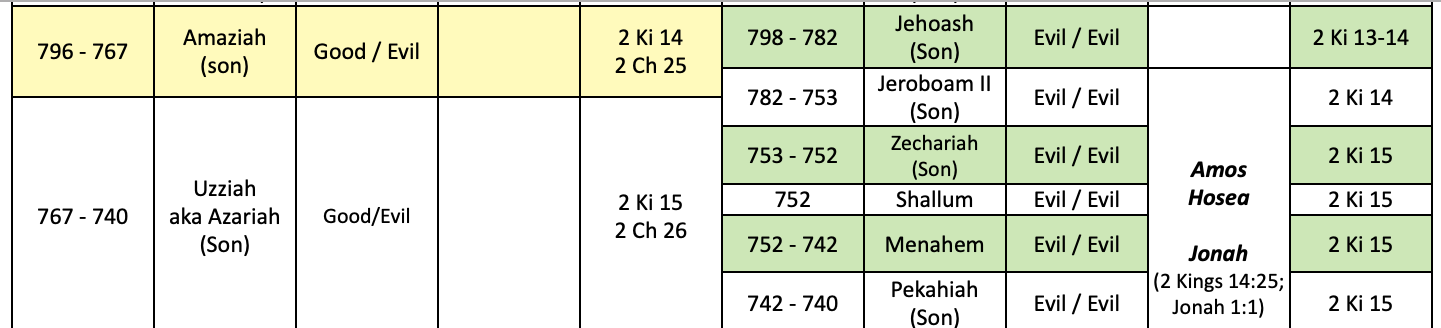
JEHOAHAZ SLEEPS
JOASH/JEHOASH ASCENDS
And Jehoahaz slept with his fathers - Slept (shakab) means to lie down and is a metaphor for died. His fathers simply means earlier generations.
And they buried him in Samaria - This specific phrase only used one other time, of his father Jehu (2Ki 10:35). Samaria was the capital of the Northern Kingdom of Israel.
And Joash his son became king in his place - Note that there were 2 kings name Joash. This King Joash of Israel began his reign in the thirty-seventh year of the reign of King Joash of Judah (2Ki 13:10), so there was some overlap.
SLEPT WITH HIS FATHERS - 36x/36v - 1 Ki. 2:10; 1 Ki. 11:21; 1 Ki. 11:43; 1 Ki. 14:20; 1 Ki. 14:31; 1 Ki. 15:8; 1 Ki. 15:24; 1 Ki. 16:6; 1 Ki. 16:28; 1 Ki. 22:40; 1 Ki. 22:50; 2 Ki. 8:24; 2 Ki. 10:35; 2 Ki. 13:9; 2 Ki. 13:13; 2 Ki. 14:16; 2 Ki. 14:22; 2 Ki. 14:29; 2 Ki. 15:7; 2 Ki. 15:22; 2 Ki. 15:38; 2 Ki. 16:20; 2 Ki. 20:21; 2 Ki. 21:18; 2 Ki. 24:6; 2 Chr. 9:31; 2 Chr. 12:16; 2 Chr. 14:1; 2 Chr. 16:13; 2 Chr. 21:1; 2 Chr. 26:2; 2 Chr. 26:23; 2 Chr. 27:9; 2 Chr. 28:27; 2 Chr. 32:33; 2 Chr. 33:20
Norman Geisler - Are the dead asleep or conscious? When Critics Ask
PROBLEM: As in this passage, the Bible often speaks of death as the time when one “sleeps with his fathers” (e.g., 1 Kings 2:10; 11:21, 43; 14:20, KJV). Jesus said, “Lazarus sleeps” (John 11:11) when he was “dead” (John 11:14). Paul speaks of believers who have “fallen asleep” in the Lord (1 Thes. 4:13; cf. 1 Cor. 15:51). Yet, in other places, the Bible speaks of persons being conscious in the presence of God after they die (cf. 2 Cor. 5:8; Phil. 1:23; Rev. 6:9).
SOLUTION: The first set of verses refers to the body, and the second set to the soul. “Sleep” is an appropriate figure of speech for the death of the body since death is only temporary, awaiting the resurrection when the body will be awakened from its sleep. Further, both sleep and death have the same posture, lying down.
The Bible is very clear about the fact that the believer’s soul (spirit) survives death (Luke 12:4), is consciously present with the Lord (2 Cor. 5:8) in a better place (Phil. 1:23) where other souls are talking (Matt. 17:3) and even praying (Rev. 6:9–10). Likewise, the unbeliever’s soul is in a place of conscious torment (Matt. 25:41; Luke 16:22–26; Rev. 19:20–20:15).
QUESTION - What does the Bible say about soul sleep? | GotQuestions.org
ANSWER - “Soul sleep” is a belief that after a person dies his or her soul “sleeps” until the resurrection and final judgment. The concept of soul sleep is not biblical.
It’s true that, in some places, the Bible speaks of those who have died as being asleep. Daniel 12:2 describes the resurrection as the time when “multitudes who sleep in the dust of the earth will awake.” The New Testament speaks of believers who are “asleep” in Jesus. In 1 Corinthians 15:6, Paul speaks of those who are “still living,” in contrast to those who have “fallen asleep” (see also verses 18 and 20). Luke relates the death of Stephen with the words, “He fell asleep” (Acts 7:60), much the same as how Jesus describes Lazarus in John 11:11 and Jairus’s daughter in Luke 8:52. So, for those who expect a resurrection, sleep is a metaphor for death.
Death is a “sleep” for the believer because it is temporary; the resurrection is the “awakening.” But what exactly is it that sleeps, and what is awakened? It is the body, not the soul. A body, when dead, appears to be resting in sleep, and that gives rise to the metaphorical usage of sleep. But the soul does not sleep. The moment we experience physical death, our souls are transferred to a different place. For believers, to be absent from the body is to be present with the Lord (2 Corinthians 5:6–8; Philippians 1:23). For unbelievers, death means everlasting punishment in hell (Luke 16:22–23).
Until the final resurrection, there is a temporary heaven—paradise (Luke 23:43; 2 Corinthians 12:4)—and a temporary hell—Hades (Revelation 1:18; 20:13–14). According to Jesus’ account in Luke 16:19–31, neither in paradise nor in Hades are people sleeping. The three individuals in Jesus’ story—Lazarus, Abraham, and the rich man—are quite conscious and active in the afterlife, prior to the resurrection.
Moses and Elijah were not “sleeping” when they appeared with Jesus on the mount of transfiguration. Far from it. They were “talking with Jesus” (Matthew 17:3). Luke gives some additional detail, relating the subject of their conversation: “They spoke about his departure, which he was about to bring to fulfillment at Jerusalem” (Luke 9:31).
In Revelation 6, John sees “the souls of those who had been slain” in heaven (verse 9). These souls are not sleeping; rather, they are crying out “in a loud voice, ‘How long, Sovereign Lord, holy and true, until you judge the inhabitants of the earth and avenge our blood?’” (verse 10). They are given white robes and “told to wait a little longer” (verse 11). Nothing in this heavenly scene hints at a state of unconsciousness, oblivion, or sleep prior to the resurrection. The souls in heaven are wide awake.
Still, it can be said that a person’s body is “sleeping” while his soul is in paradise or Hades. And that is just how the Bible pictures it. At the resurrection, the body is “awakened” and transformed into the everlasting body a person will possess forever, whether in heaven or hell. The redeemed, made righteous by the blood of Christ, will inhabit the new heaven and new earth (Revelation 21:1). The unredeemed, who remain in their sin, will be thrown into the lake of fire (Revelation 20:11–15).
Present-day advocates of the doctrine of soul sleep include Seventh-day Adventists, Jehovah’s Witnesses, Christadelphians, and some others.
Related Resources:
- Do believers immediately go to heaven when they die?
- Will we sleep in heaven? | GotQuestions.org
- What does it mean to be absent from the body (2 Corinthians 5:8)?
- Who are the dead in Christ in 1 Thessalonians 4:16? - Got Questions
- What happens after death? | GotQuestions.org
Christopher Knapp's biographical profile of Joash (Or, Jehoash) (Jehovah-gifted)
- 2 Kings 13:10-25; 14:8-16
- Contemporary Prophet: Jonah (?)
“A man shall not be established by wickedness;
but the root of the righteous shall not be moved.”
—Proverbs 12:3
“In the thirty and seventh year of Joash king of Judah began Jehoash the son of Jehoahaz to reign over Israel in Samaria, and reigned sixteen years” (2 Kings 13:10). It is evident from a comparison of the figures of this verse with those given in verse one of same chapter, and first verse of the chapter following, that Joash (Jehoash, abbreviated) reigned jointly with his father (a thing not uncommon in ancient times) during the last two years of the latter’s life. This readily explains an otherwise inexplicable chronological difficulty, and it is quite likely that the seeming discrepancies of chronology in Scripture (those most difficult of solution) could—excepting a few which undoubtedly owe their origin to errors of transcription— be as simply and as satisfactorily explained.
“And he did that which was evil in the sight of the Lord; he departed not from all the sins of Jeroboam the son of Nebat, who made Israel to sin: but he walked therein.” Josephus calls him a “good man” (Ant. 9. 8, § 6). This misjudgment of the character of Joash is probably based on the incident of his visit to the dying prophet Elisha. A little manifestation of religious, or even semi-religious, sentiment goes a long way, with some persons, in accounting people “good.” It has been supposed by some that Joash reformed, or repented, toward the end of his life (founded partly, perhaps, on his mild treatment, toward the close of his reign, of Amaziah, when he had it in his power to take that combative meddler’s life—see Amaziah), and that Josephus refers to this latter period of his reign. But the words, “He departed not from the sins of Jeroboam,” forbid all thought of any real, or lasting repentance at any period of his life. God is more anxious to record, than any of His people are to read, any good in any of these monarchs’ lives. He has noted none in Joash’s; and where He is silent, who will dare to speak?
The episode of Joash’s visit to the dying prophet has been alluded to; we quote it here in full: “Now Elisha was fallen sick of his sickness whereof he died. And Joash the king of Israel came down unto him, and wept over his face, and said, O my father, my father! the chariot of Israel, and the horsemen thereof. And Elisha said unto him, Take bow and arrows. And he took unto him bow and arrows. And he said to the king of Israel, Put thy hand upon the bow. And he put his hand upon it: and Elisha put his hands upon the king’s hands. And he said, Open the window eastward. And he opened it. Then Elisha said, Shoot. And he shot. And he said, The arrow of the Lord’s deliverance, and (even, N. Tr.) the arrow of deliverance from Syria: for thou shalt smite the Syrians in Aphek, till thou have consumed them. And he said, Take the arrows. And he took them. And he said unto the king of Israel, Smite upon the ground. And he smote thrice, and stayed. And the man of God was wroth with him, and said, Thou shouldest have smitten five or six times; then hadst thou smitten Syria till thou hadst consumed it: whereas now thou shalt smite Syria but thrice.”
The application of all this is simple. Joash could not but realize that the prophet’s departure from them would be a serious loss to the nation. And in calling him “the chariot of Israel, and the horsemen thereof,” he meant that the prophet’s presence in their midst was to them what chariots and horsemen were to other nations—their main defence.23 And by putting his dying hands upon those of the king, Elisha meant him to understand the truth of what God said more than three hundred years later, through the prophet Zecha- riah, “Not by might [or forces, or army], nor by power, but by My Spirit, saith the Lord of hosts” (Zech. 4:6). “Without Me, ye can do nothing,” this would be in New Testament phraseology. The shooting of the arrow eastward, toward the territory conquered by Syria, signified Joash’s victory over Ben-ha-dad’s forces at Aphek (“on the road from Syria to Israel in the level plain east of Jordan; a common field of battles with Syria.”—Fausset).
See 1 Kings 20:26. Only Joash’s lack of faith, manifested in his halfhearted smiting the ground with arrows but thrice, prevented his destroying the Syrians utterly. And it was unto him according to his faith. “And Jehoash the son of Jehoahaz took again out of the hand of Ben-hadad the son of Hazael the cities which he had taken out of the hand of Jehoahaz his father by war.
Three times did Joash beat him, and recovered the cities of Israel.”
Like Asa [see Asa], he had the opportunity given him to end the power of Syria (2 Chron. 16:7), which from its beginning had been such a plague to both Judah and Israel. But, like Asa, he let it pass, and the work was left to the Assyrian, who destroyed both it (Syria) and them (Israel and Judah).
“And the rest of the acts of Joash, and all that he did, and his might wherewith he fought against Amaziah king of Judah, are they not written in the book of the chronicles of the kings of Israel? And Joash slept with his fathers; and Jeroboam sat upon his throne: and Joash was buried in Samaria with the kings of Israel.”
23 The whole narrative here brings vividly to mind the departure of Elijah, when the chariot and horses of fire bore him away as by a whirlwind to heaven, and Elisha exclaimed, “My father, my father, the chariot of Israel, and the horsemen thereof!” King Joash (fully acquainted, no doubt, with the circumstances of Elijah’s carrying away to heaven) repeats Elisha’s very words at the taking away of his master, Jehovah’s faithful and honored servant. Like many another disobedient heart unreconciled to God, king Joash has a sense of the loss that Elisha’s death would be to the kingdom—Jehovah’s defence, as well as His reproofs, was departing. Yet Elisha (like Elijah dropping his mantle) would leave a blessing and help for poor Israel, limited only by Israel’s and their king’s unbelief.
2 Kings 13:10 In the thirty-seventh year of Joash king of Judah, Jehoash the son of Jehoahaz became king over Israel in Samaria, and reigned sixteen years.
- began Jehoash: "In consort with his father. 2Ki 14:1." 2Ki 13:10
Related Passages:
2 Kings 10:30 The LORD said to Jehu, “Because you have done well in executing what is right in My eyes, and have done to the house of Ahab according to all that was in My heart, your sons of the fourth generation shall sit on the throne of Israel.”
JEHOASH SITS ON THRONE OF ISRAEL
SECOND GENERATION OF JEHU'S SONS
In the thirty-seventh year of Joash (aka Jehoash) king of Judah, Jehoash (aka Joash) the son of Jehoahaz became king over Israel in Samaria, and reigned sixteen years. - This verse can be very confusing. 2Ki 13:9 just called Jehoahaz's son "Joash," but here he is called "Jehoahaz!" Don't let the names confuse you because two kings with the same name overlapped (for only about 2 years - 798-796 BC) in rule of the Northern and Sourthern kingdoms. Joash, the son of Jehoahaz, grandson of Jehu, was associated with his father in the government two years before his death. It is this association that is spoken of here. Joash reigned sixteen years which include the years he reigned conjointly with his father.
TECHNICAL NOTE - At first glance, if Jehoahaz began to reign in the 23rd year of Joash, and he reigned 17 years, then his son Jehoash (also called Joash of Israel) would begin to reign in the 40th year of Joash of Judah (23 + 17 = 40). But 2 Kings 13:10 says Jehoash of Israel began to reign in the 37th year of Joash of Judah. So there is a 3-year discrepancy.
2 Kings 13:1 and 2 Kings 13:10 are reconciled by a co-regency between Jehoahaz and his son Joash (Jehoash).
Here are the two verses side by side
2 Kings 13:1: In the 23rd year of Joash the son of Ahaziah, king of Judah, Jehoahaz the son of Jehu became king over Israel at Samaria, and he reigned 17 years.
2 Kings 13:10: In the 37th year of Joash (son of Jehoahaz) king of Judah, Jehoash the son of Jehoahaz became king over Israel in Samaria, and reigned 16 years.
If Jehoahaz of Israel began his reign in the Joash of Judah's 23rd year and reigned 17 years, this would mean that Jehoahaz of Israel reigned until Joash of Judah's 40th year. But when Jehoahaz's son Jehoash began to reign 2Ki 13:10 does not say Jehoash of Israel began to reign in the 40th year of Joash of Judah. Instead, it says says Jehoash of Israel began to reign in the 37th year of Joash of Judah. That leaves a discrepancy of 3 years. How do we resolve this 3 year difference? The most logical solution is that Jehoahaz of Israel did not reign alone for all 17 years, but in the last 3 years of Jehoahaz's reign, his son Joash reigned with him. And when did Joash of Israel begin his reign? Not in Joash of Judah's 40th year but in the 37th year. This accounts for the 3 year difference.
Coregency a common chronological practice in Kings (also seen with Jehoshaphat/Jehoram, Uzziah/Jotham, etc.).
Gotquestions.org - King Joash of Israel began his reign in the thirty-seventh year of the reign of King Joash of Judah, so there was some overlap. King Amaziah started ruling Judah in the second year of King Joash of Israel. Amaziah of Judah battled against the Edomites and then challenged Joash of Israel to battle (2 Kings 14:7–8). Joash refused, essentially telling Amaziah he was needlessly stirring up trouble (2 Kings 14:9–10). Amaziah did not heed the warning, and Joash of Israel defeated Judah in battle. 2 Chronicles 25:20 says that Judah’s defeat was “because they sought the gods of Edom.”
Second Kings records another of Joash of Israel’s military victories. When Joash’s father, Jehoahaz, was reigning, King Hazael of Aram (the same king that Joash of Judah had kept from attacking Jerusalem) oppressed Israel (2 Kings 13:22). “But the Lord was gracious to them and had compassion and showed concern for them because of his covenant with Abraham, Isaac and Jacob. To this day he has been unwilling to destroy them or banish them from his presence” (2 Kings 13:23). When the prophet Elisha was sick and near to death, King Joash of Israel visited the prophet, apparently disconcerted over the military situation in Israel (2 Kings 13:14). Elisha instructed Joash to shoot arrows out of the open window. The prophet then proclaimed, “The Lord’s arrow of victory, the arrow of victory over Aram! . . . You will completely destroy the Arameans at Aphek” (2 Kings 13:17). Elisha next instructed Joash to strike the ground with the arrows. Joash did so but stopped after three strikes. “The man of God was angry with him and said, ‘You should have struck the ground five or six times; then you would have defeated Aram and completely destroyed it. But now you will defeat it only three times’” (2 Kings 13:19). When Hazael died and his son, Ben-hadad, took over, Joash did defeat him three times. Israel was able to recover cities that previously had been taken from them (2 Kings 13:24–25).
King Joash of Israel ruled for sixteen years and “did evil in the eyes of the Lord and did not turn away from any of the sins of Jeroboam son of Nebat, which he had caused Israel to commit; he continued in them” (2 Kings 13:11). After he died, Joash of Israel was succeeded by his son Jeroboam II (2 Kings 14:16).
2 Kings 13:11 He did evil in the sight of the LORD; he did not turn away from all the sins of Jeroboam the son of Nebat, with which he made Israel sin, but he walked in them.
- he departed: 2Ki 13:2,6 3:3 10:29
Related Passage:
2 Kings 13:2 He did evil in the sight of the LORD, and followed the sins of Jeroboam the son of Nebat, with which he made Israel sin; he did not turn from them.
LIKE FATHER
LIKE SON
He did evil in the sight of the LORD - Here wer go again! No repentance. Only persistence in evil!
He did not turn away from all the sins of Jeroboam the son of Nebat with which he made Israel sin- Idolatry was indigenous to the northern kingdom of Israel! The blame is repeatedly traced back to Jeroboam, as it so often is in Kings. Little did he realize that his sins would be like a great stone hurled into a pond, sending ripples that would spread through one king’s reign after another. What a tragic and dreadful legacy to leave behind.
But he walked in them - But here sadly does not really mark a contrast or an about face, but instead marks a continual face forward toward evil! The description of Jehoash is virtually identical to his father Jehoahaz (see comments above on Jehoahaz). The apple did not fall far from the tree.
2 Kings 13:12 Now the rest of the acts of Joash and all that he did and his might with which he fought against Amaziah king of Judah, are they not written in the Book of the Chronicles of the Kings of Israel?
NET The rest of the events of Joash's reign, including all his accomplishments and his successful war with King Amaziah of Judah, are recorded in the scroll called the Annals of the Kings of Israel.
BGT καὶ τὰ λοιπὰ τῶν λόγων Ιωας καὶ πάντα ὅσα ἐποίησεν καὶ αἱ δυναστεῖαι αὐτοῦ ἃς ἐποίησεν μετὰ Αμεσσιου βασιλέως Ιουδα οὐχὶ ταῦτα γεγραμμένα ἐπὶ βιβλίῳ λόγων τῶν ἡμερῶν τοῖς βασιλεῦσιν Ισραηλ
LXE And the rest of the acts of Joas, and all that he did, and his mighty acts which he performed together with Amessias king of Juda, are not these written in the book of the chronicles of the kings of Israel?
CSB The rest of the events of Jehoash's reign, along with all his accomplishments and the power he had to wage war against Judah's King Amaziah, are written in the Historical Record of Israel's Kings.
ESV Now the rest of the acts of Joash and all that he did, and the might with which he fought against Amaziah king of Judah, are they not written in the Book of the Chronicles of the Kings of Israel?
NIV As for the other events of the reign of Jehoash, all he did and his achievements, including his war against Amaziah king of Judah, are they not written in the book of the annals of the kings of Israel?
NLT The rest of the events in Jehoash's reign and everything he did, including the extent of his power and his war with King Amaziah of Judah, are recorded in The Book of the History of the Kings of Israel.
- the rest: 2Ki 13:14-25 14:15,25
- his might: 2Ki 14:8-16 2Ch 25:17-24
EPITAPH OF JOASH
OF NORTHERN KINGDOM
Now the rest of the acts of Joash and all that he did and his might (geburah) with which he fought against Amaziah king of Judah, are they not written in the Book of the Chronicles of the Kings of Israel. The Book of the Chronicles appears to have been a court chronicle or state annals kept by royal scribes in the northern kingdom of Israel. Think of it as the king’s archive—records of reigns, events, wars, policies, and notable acts. It is tanatamount to saying “More details exist, but they’re in the official records, not in this inspired summary.”
Joash and all that he did and his might (geburah) with which he fought against Amaziah king of Judah - Scripture records one decisive battle between Joash (Jehoash) king of Israel and Amaziah king of Judah, described in 2 Kings 14:8–14 and 2 Chronicles 25:17–24 as parallel accounts of the same event. After Amaziah’s victory over Edom, pride led him to challenge Joash, who warned him with the parable of the thistle and the cedar, urging him to stay home; Amaziah ignored the warning, and the armies met at Beth-shemesh in Judah, where Judah was routed, Amaziah was captured, Jerusalem’s wall was breached, treasures were taken from the Temple and palace, and hostages were seized. Kings emphasizes the historical outcome of Israel’s victory, while Chronicles highlights the spiritual cause, Amaziah’s idolatry and refusal to heed godly counsel, showing that the defeat was ultimately an act of divine judgment rather than mere military failure.
2 Kings 13:13 So Joash slept with his fathers, and Jeroboam sat on his throne; and Joash was buried in Samaria with the kings of Israel.
- slept: 2Sa 7:12 1Ki 1:21 2:10 11:31
- Jeroboam: 2Ki 14:28,29
- was buried: 2Ki 13:9
JEHU'S GREAT GRANDSON
JEROBOAM
So Joash (Jehoash) slept with his fathers, and Jeroboam sat on his throne; and Joash was buried in Samaria with the kings of Israel.
2 Kings 13:14 When Elisha became sick with the illness of which he was to die, Joash the king of Israel came down to him and wept over him and said, “My father, my father, the chariots of Israel and its horsemen!”
- Elisha became sick: 2Ki 20:1 Ge 48:1 Joh 11:3 Php 2:26
- to die: Ps 12:1 Isa 57:1 Zec 1:5 Ac 13:36
- My father, my father, 2Ki 2:12 6:21 Pr 11:11 Eze 14:14 22:30 Mk 6:20
Related Passage:
2 Kings 2:12 Elisha saw it and cried out, “My father, my father, the chariots of Israel and its horsemen!” And he saw Elijah no more. Then he took hold of his own clothes and tore them in two pieces.
2 Kings 6:17 Then Elisha prayed and said, “O LORD, I pray, open his eyes that he may see.” And the LORD opened the servant’s eyes and he saw; and behold, the mountain was full of horses and chariots of fire all around Elisha.
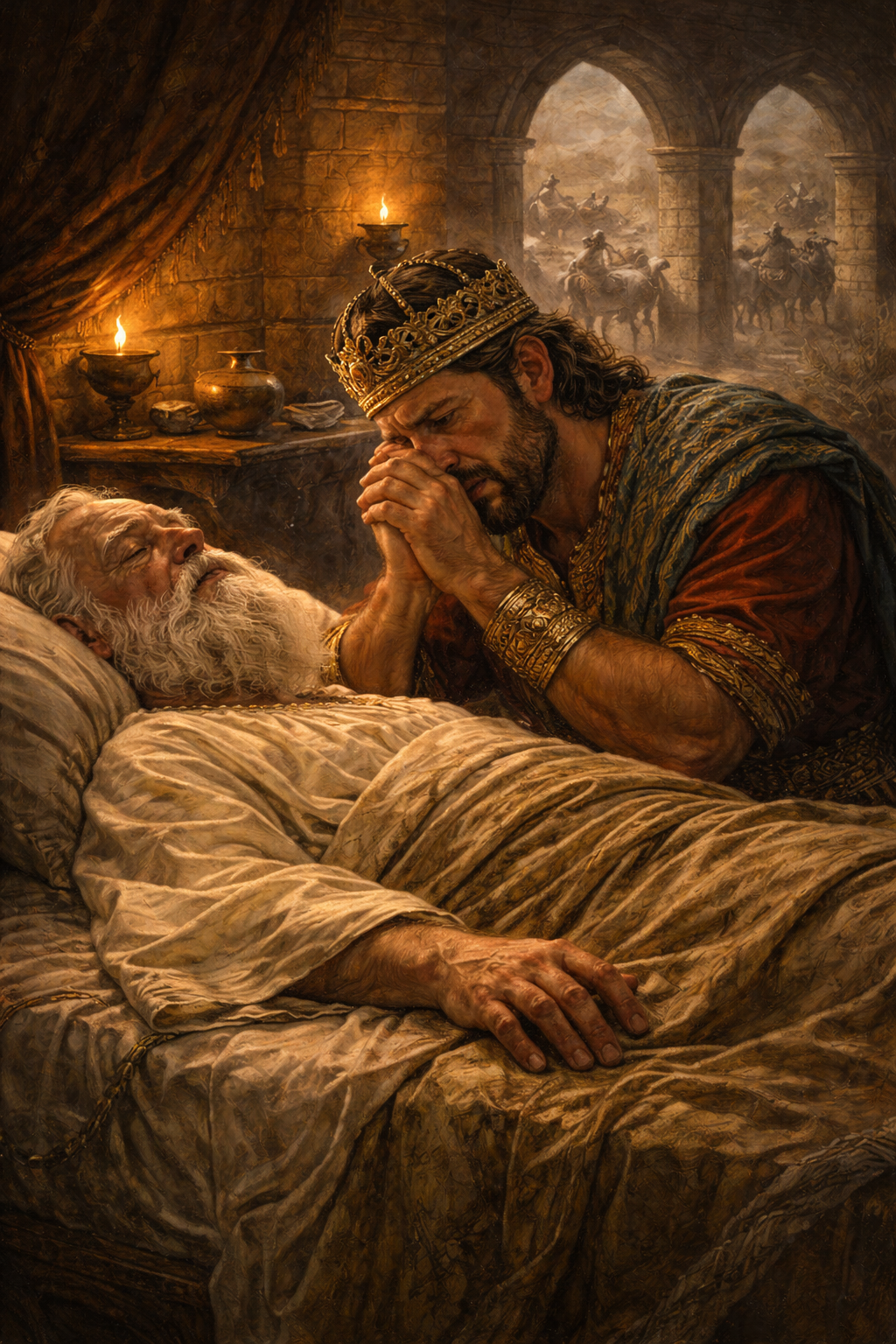
JOASH LAMENTS OVER
DYING ELISHA
This is an interesting pattern for after the brief summary statement concerning the death of Joash (Jehoash) in 2Ki 13:12,13, the narrative turns back to an earlier episode in his reign, specifically to the moment when he sought the counsel and aid of the prophet Elisha, shortly before Elisha’s death. This retrospective scene highlights the continuing influence of the prophet even at the close of his life and sets the stage for the events that follow. You have to love Elisha for many reasons, but here we see him running the race with endurance to the very end. What a model to emulate!
When Elisha became sick with the illness of which he was to die, Joash the king of Israel came down to him and wept over him Elisha was an old man at this time. It is testimony to the long influence of Elisha, prophesying during a succession of ungodly kings, that King Joash would speak of him as My father, my father, repeating verbatim the words that Elisha had cried out at the translation of Elijah into heaven (2 Kings 2:12). Was his weeping tears of contrition? Were they tears of compassion? We cannot be certain, so why did Joash come at this time? First, recall that his father had entreated the favor of the LORD and the LORD listened and sent Israel a savior or deliverer which brought a period of peace (2Kin 13:4, 5), but sadly they quickly fell back into the sin (2Ki 13:6). The result was predictable. God used the king of Aram, undoubtedly Hazael to reduce Israel's army to a token force. So now Jehoahaz is dead, but the Arameans were still oppressing, but Hazael had died and Ben-hadad was now king. Joash comes to the man of God to seek his counsel and relief from the Arameans.
Dave Guzik - Though God used Elisha on many occasions to heal others, God appointed this illness to be the means of taking Elisha from this world. God has no one single way that He does this; it is a mistake to believe that all the godly die in their sleep without a hint of prior illness.
🙏 THOUGHT - Spurgeon once said "Dear friends, let us seek so to live that even ungodly men may miss us when we are gone." Play and ponder the lyrics of Find Us Faithful sung by Steve Green.
Guzik adds on Joash's weeping - This reaction of the king of Israel might seem strange, having just read the description of the sin and evil that marked his reign. However, it is important to remember that Joash was not a worshipper of the false gods; he was a false worshipper of the true God. He had some respect for the true God, and therefore some regard and honor for Elisha.
And said, “My father, my father, the chariots of Israel and its horsemen - What does this metaphor signify? This striking cry is used twice in Kings, but with different emphases shaped by the speaker and the context. In 2 Kings 2:12, when Elisha sees Elijah taken up, the phrase points beyond the prophet himself. Elisha is responding to the unseen heavenly armies of the LORD, the divine chariots and horsemen that carried Elijah away—an idea later made explicit in 2 Kings 6:17, when Elisha prays that his servant’s eyes would be opened to see the mountains full of horses and chariots of fire.
In 2 Kings 13:14, however, the words “My father, my father, the chariots of Israel and its horsemen are spoken by Joash (Jehoash of Israel) as he weeps over the dying Elisha. Joash was astute enough to be concerned that the true strength of Israel was about to depart from this earth. Calling Elisha father here is therefore is more metaphorical than visionary. Joash is not describing a supernatural sight he can see; rather, he is confessing, perhaps more clearly than he ever had before, that Elisha himself embodied Israel’s true defense. Indeed, Elisha had functioned, in a very real sense, as the LORD’s one-man army for the Northern Kingdom. Through prayer, prophecy, and divine intervention, he accomplished what chariots and horsemen could not. On one occasion, he blinded and captured an entire Aramean army, leading them helplessly into Samaria (2 Kings 6:18–23). On another, he put a besieging army to flight simply by announcing the LORD’s word, which God fulfilled by causing the enemy to hear phantom armies and flee in panic (2 Kings 7:1–7).
Philip Ryken - After all, the prophet practically was the chariots and horsemen of Israel, especially since only a handful of chariots were left. Elisha was crucial to the nation’s defenses. More than once, by the power of God, he had single-handedly defeated(2 Kings)
Thus, Joash’s cry would appear to be a lament, a confession and a cry for help from the man of God. With Elisha’s impending death, Israel was losing what it truly relied on, not military strength, not cavalry, not chariots, (which it did not have in 2Ki 13:7). And one other point is that Joash knew he was king because Elisha had seen to it that his grandfather Jehu was anointed king of Israel (2Ki 9:3, 6, 12)! The presence and power of Yahweh mediated through His prophet. Elisha had been worth more to Israel than battalions of soldiers!
And so Joash, at least to some degree, comes humbly into the presence of this great man of God seeking his help against the Arameans. Joash wisely has come to the right place!
Bob Deffinbaugh - Here, then, is the way I understand the visit of Joash to the dying prophet, Elisha. Joash was not a man of faith. He did not lead Israel in the ways of God. He did evil in God’s sight. He was not willing to rid Israel of the religion introduced by Jeroboam, but neither was he willing to rid the nation of belief in the LORD, as proclaimed by prophets like Elisha. By protecting and promoting several religions at the same time, he was trying to “cover all the bases.” Joash did not see Elisha as “public enemy number one,” as Ahab and Jezebel had once done with Elijah and other prophets. Joash saw Elisha as one part of his “religious portfolio,” a part that he did not wish to lose. And so, when the prophet drew near to his death Joash was panic-stricken. This was one of his “arsenals of defense.” Elisha was to Joash what my granddaughters’ “security blankets” are to them. Joash felt safe with Elisha nearby, and he was frightened by the approach of his death.
At first, I thought Joash’s tears were tears of love and of sorrow, prompted by the approaching death of a confidant and friend. But that is not really the case, as our author has indicated. Joash is concerned for himself, and for his kingdom, and no wonder. We have just been informed that under Jehoahaz Israel’s military forces had been greatly reduced by the king of Syria (2 Kings 13:7). I would assume that this was still the case when Joash became king. God was a kind of “last resort” to Joash, and when Elisha was dying, the king feared that he might lose his “point of contact” with God. His tears, then, were tears of fear, and perhaps even of self-pity, more than tears prompted by love. Why, then, would Joash virtually repeat the words of Elisha, spoken at the time of Elijah’s departure into heaven? “My father, my father! The chariot and horsemen of Israel!” (2 Kings 13:14b). I think that Joash is saying something like this: “Oh no! Elisha, you are about to die, and when you die we will lose your access to the heavenly army of angelic beings (“the horsemen and chariots of fire”). These angelic forces were at Elisha’s disposal, to protect him and Israel. They were only seen when Elisha was present, and now that you are leaving us, we no longer have these “resources” available to us.” Joash is not happy for Elisha, because of the marvelous exodus that he will soon experience. Joash is sorry for himself, because his primary source of divine intervention is leaving, and along with him, it would seem, the angelic forces of heaven. I believe that the context of our passage bears me out on this interpretation. What happens next in the chapter? The first and only other thing we read about Elisha and Joash is the incident with the arrows in verses 15-19.
Elisha’s Last Sermon By Denis Lyle
Scripture: 2 Kings 13:14–19, especially verse 16: Then (Elisha) said to the king of Israel, “Put your hand on the bow.” And he put his hand on it, then Elisha laid his hands on the king’s hands.
Introduction: What if our armed forces went into each battle afraid, undedicated to the country or the task? We’d lose the war. Our military is taught complete commitment and courage; if they were not, they could never succeed. In the same way, Christians must learn the lesson Elisha gave from his deathbed to a lethargic young king.
1. The Task (2Ki 13:14–17). This scene can easily confuse us; but in Eastern lands instruction by means of symbolic actions was common (see 1 Sam. 15:27–28; Acts 21:10–11). King Joash seemed uninspired, and Elisha was symbolically urging him and his nation to victory. The prophet was departing life, but the fight would still go on. Through the symbolic actions seen in this story, Elisha was spurring on Joash to execute a specific task. In effect this was a call to:
A. Public Warfare. The cities which Syria had taken from Israel (see 2Ki 13:25) needed to be recovered. The king was to act decisively. Elisha was trying to stir up the sluggish, compromised young king with enthusiasm to fight the enemy. He was saying, “Be up and doing; smite the enemies of your country!” That’s the Lord’s call to every Christian. Too many of us have been on the defensive too long. God calls us to the offense, to attack the fortified places of error and sin in our society and to be proactive witnesses. Is there any way in which your example is seen as God’s offensive weapon against sin and evil in our society? Does your light dispel the darkness?
B. Personal Warfare. The apostle Paul frequently likened the Christian life to a personal battle (Rom. 7:23; Eph. 6:10; and 2 Cor. 10:3). How are you doing personally as you wage war with that powerful inward foe, your own flesh? Gossip? Sexual sin? Unforgiveness? We are given the Spirit to daily overcome these things (Gal. 5:16).
2. The Touch (2Ki 13:16). In verse 16, the trembling hands of the monarch are touched by the rugged hands of the prophet. Just as the touch of Elisha was on King Joash, the Lord’s touch is on us as we go forth to fight His battles. Joash experienced the alliance of the supernatural. Do you remember that old song, “He touched me! Oh, he touched me!” Jesus often touched people during His ministry, and His touch on our lives conveys His power as we go onward as Christian soldiers. Is the touch of Christ on your life? Offer yourself to Him as Lord, and visualize His hands clasping around your own, just as Elisha’s old, rugged hands fell in blessing over those of the young king, signifying:
A. God’s Presence with Him. What an encouragement for Joash to know that the Lord of Hosts would accompany him to the field of battle. Imagine how the disciples felt when the Savior placed before them the responsibility of world evangelization. Not only did Christ instruct them, but He encouraged them, “I am with you always … ” (Matt. 28:20). Do you need to be reminded of that? God is with you in days of blessing and barrenness, of storm and sunshine, of progress and opposition. He will never leave or forsake you (Heb. 13:5).
B. God’s Power upon Him. As the prophet’s hand closed over the king’s hand, so the might of the Lord of Hosts would, through him, defeat the forces of Syria. When His hand is upon us, is anything impossible (Phil. 4:13)?
C. God’s Purpose through Him. God’s purpose for Israel was victory over Syria (v. 17). Likewise, if we are engaged in the Lord’s work, we’re on the winning side (Matt. 16:18). Why is it that we fail so often, when the power available is so unlimited?
3. The Test (2Ki 13:18–19). Elisha commanded Joash to shoot his arrows into the ground, but Joash meekly fired three arrows into the dusty earth around the prophet’s bed. Why didn’t he get excited and shoot six or seven arrows? This was a mock battle that predicted the outcome of the real thing. Did he feel silly? Did he misunderstand? Joash simply didn’t believe there could be any connection between firing arrows in private and later seeing total victory in public. Are we not guilty of the same thing? We often limp in our prayer lives; we struggle to believe that a few words launched from our bedside can achieve anything in the real world. After two or three attempts, we give up.
James Smith - LESSONS FROM THE DEATH OF ELISHA 2 KINGS 13:14–24
“Teach me to live! ’Tis easier far to die—
Gently and silently to pass away—
On earth’s long night to close the heavy eye,
And waken in the glorious realms of Day.”
Elisha was now about ninety years of age. Forty-five years have gone since he performed his last public act in connection with the anointing of Jehu. There are some practical lessons we may learn from this portion. That—
I. The Most Useful Life Must Come to a Close.
“Now Elisha had fallen sick of his sickness whereof he died” (v. 14). It is appointed unto men once to die; there is a second death, but this is within the realm of man’s own appointment. Elisha’s master passed away without tasting death, but he must go the way of all the earth. No matter how great our gifts and privileges are, the solemn end is never far out of sight. Lives of great men do remind us of the tremendous possibilities of a single lifetime. Redeem the time.
II. The Past Achievements of the Aged should Encourage the Young.
“Joash the (young) king … came and wept, and said, O my father, my father, the chariot of Israel, and the horsemen thereof” (v. 14). This was a timely reminder of a great event in the life of Elisha, fifty-seven years ago (2 Kings 2:12). The young king’s heart was melted at the thought of it, as he gazed on the pale face of him who once had such power with God that he became a terror to royal evil-doers. There is hope for a young man who respects the wisdom and experiences of an aged saint, and who is conscious of the fact that the mightiest weapon on earth is faith in God (Mark. 9:23).
III. Confession of Need is the Way into a Life of Success.
The dying prophet fully understood the deeper meaning of the king’s confession. He desired victory over his enemies. “Take bow and arrows,” said Elisha, “and Elisha put his hands upon the king’s hands, and said, Open the window—shoot; and he shot” (vv. 15–17). That arrow was the symbol of the “Lord’s deliverance.” The hand of Elisha may have been weak and trembling, but it was a hand not to be despised by the young and the strong who sought victory in the Name of God. The hand of youthful vigour is powerless in the work of God without the hand of faith. The hand of the man of God is truly a “helping hand.”
IV. It is Dishonouring to God to be Satisfied with Partial Success.
“The man of God was wroth with him, and said, Thou shouldest have smitten five or six times” (vv. 18, 19). What an opportunity the king got, when he was assured that for every time he smote the ground with an arrow he would have a deliverance. Yet he only “smote thrice and stayed.” He got according to his faith (2Ki 13:25). But why did he stop short of all that God was prepared to do for him? Was it pity for the enemy, or a self-satisfying confidence that three victories would be quite enough to serve his purpose? Why do we stop short of the fullness of the blessing when we might be more than conquerors? Are there not many like Joash, that are perfectly content with just as much of the grace and power of Christ in their lives as enable them to get along with some honour and credit to themselves. Every arrow of believing prayer means a deliverance by the power of God. “Men ought always to pray and not to faint” (Luke 18:1).
V. God can Make His Servants a Blessing to Others even when Dead.
“And when the man … touched the bones of Elisha he revived, and stood up on his feet” (v. 21). This nameless man, buried in a hurry, was born anew in the grave of the prophet. He being dead, yet speaketh life into the dead. The posthumous influence of a holy man is in the hands of God. He who blessed the handkerchiefs and aprons that were brought into contact with the body of Paul (Acts 19:12) will see that the memory of His justified ones is blessed. The glory of some lives is scarcely realised until they are gone. The prodigal son, who, on returning home, found his mother dead and buried, and who went and flung himself on her new-made grave, confessing his sin, knew by experience the power of this influence. What we know not now we shall know hereafter. All who come into contact with the death of the Lord Jesus Christ are made alive again by the miraculous power of God. “You hath He quickened who were dead.” Every true servant of Christ, as well as their Master, shall see of the travail of their soul, and shall be satisfied.
2 Kings 13:15 Elisha said to him, “Take a bow and arrows.” So he took a bow and arrows.
ELISHA'S FINAL
INSTRUCTIONS
Elisha said to him, “Take a bow and arrows.” A bow and arrows are ordinary weapons; there is nothing inherently supernatural about them. Yet God frequently communicates His word through prophetic sign-acts that employ ordinary objects and actions (Ezek 4:1-3, etc). These visible enactments impress divine truth on the memory and make clear that while God works through normal means, the outcome depends entirely on His power and the faith of those involved.
So he took a bow and arrows - Note that Elisha does not hand Joash the weapons; he commands him to take them. Joash obeys—without argument or delay. Yet as the narrative unfolds, it becomes clear that initial obedience is not the same as full faith. That distinction proves decisive, for limited faith results in limited victory. Faith is never passive; God’s promise requires participation.
Peter Pett: In the first passage (in chapter 2) the message was one of hope, with Elijah being taken and Elisha entering Israel over the miraculously parted Jordan and advancing on Jericho and Bethel to take possession of the land. Now that period is over and Elisha is dying, but he wants Jehoash to recognise that the future is still one of hope if only he will trust in YHWH, and he does it by vivid symbolism which indicates that the chariots and horsemen of Israel and the armoury of God (represented by the arrow of YHWH’s victory) will still be with them if they are faithful to YHWH. . . Unlike the servant of Elisha previously (2 Kings 6:17), Elisha knew that the king was not spiritually attuned enough to see chariots and horses of fire at the ready to fight for Israel. Thus he gave him instead a visible sign of YHWH’s victory, one that he could understand and appreciate. And he was to see the arrows as the arrows of YHWH.
2 Kings 13:16 Then he said to the king of Israel, “Put your hand on the bow.” And he put his hand on it, then Elisha laid his hands on the king’s hands.
- Elisha: 2Ki 4:34 Ge 49:24 Ps 144:1
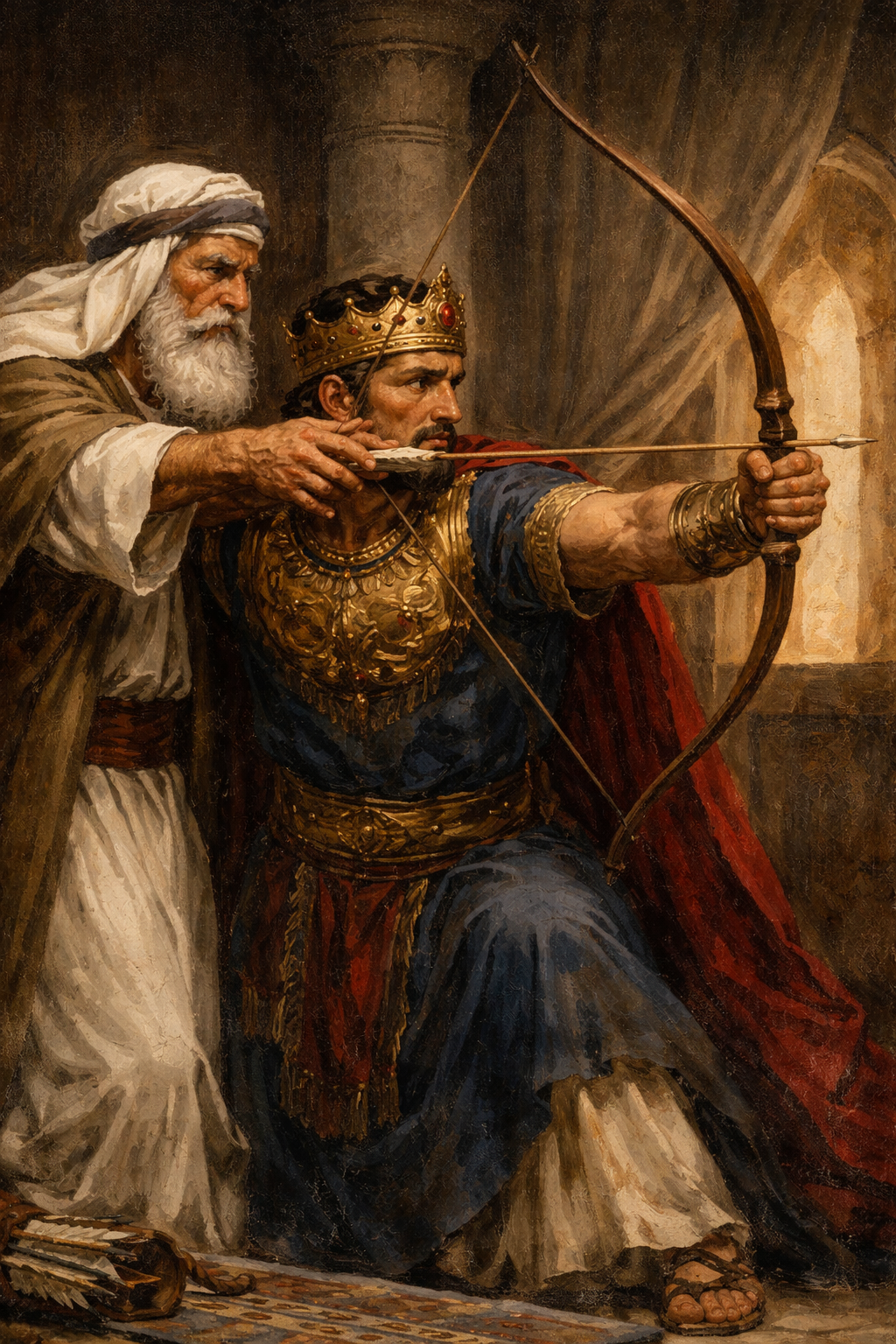
ELISHA'S LAYING HANDS
ON KING JOASH
Then he said to the king of Israel, “Put your hand on the bow.” This calls the king to participate. God’s promises don’t cancel human responsibility; the king must act in faith and obedience.
And he put his hand on it, then Elisha laid his hands on the king’s hands. When Elisha placed his hands on the hands of Jehoash, the meaning was unmistakable showing that the power behind what was about to happen would not originate with the king himself. Elisha’s physical gesture showed that what Jehoash was about to do was full of prophetic significance. Elisha, as the LORD’s prophet, stood as the visible representative of God’s authority, and this physical act signified that the coming action was now governed by God’s promise rather than by human strength. This was not a magical gesture, but a tangible sign that the victory to follow would be God’s work carried out through the king. Jehoash would act by shooting the arrow, but success would come because the LORD stood behind that act, not because of military skill. In effect, the gesture declared, “This victory will be God’s work through you—if you trust Him fully.”
James Smith - That arrow was the symbol of the “Lord’s deliverance.” The hand of Elisha may have been weak and trembling, but it was a hand not to be despised by the young and the strong who sought victory in the Name of God. The hand of youthful vigour is powerless in the work of God without the hand of faith. The hand of the man of God is truly an “helping hand.”
This incident reminds me of Aaron and Hur supporting Moses' hands in Exodus 17:10-12
Joshua did as Moses told him, and fought against Amalek; and Moses, Aaron, and Hur went up to the top of the hill. 11So it came about when Moses held his hand up, that Israel prevailed, and when he let his hand down, Amalek prevailed. 12But Moses’ hands were heavy. Then they took a stone and put it under him, and he sat on it; and Aaron and Hur supported his hands, one on one side and one on the other. Thus his hands were steady until the sun set.
2 Kings 13:17 He said, “Open the window toward the east,” and he opened it. Then Elisha said, “Shoot!” And he shot. And he said, “The LORD’S arrow of victory, even the arrow of victory over Aram; for you will defeat the Arameans at Aphek until you have destroyed them.”
- Open: 2Ki 5:10-14 Joh 2:5-8 11:39-41
- The arrow: . Ex 4:2,17 Judges 7:9-20 2Sa 5:24 1Co 1:18
- Aphek: 1Sa 4:1 1Ki 20:26
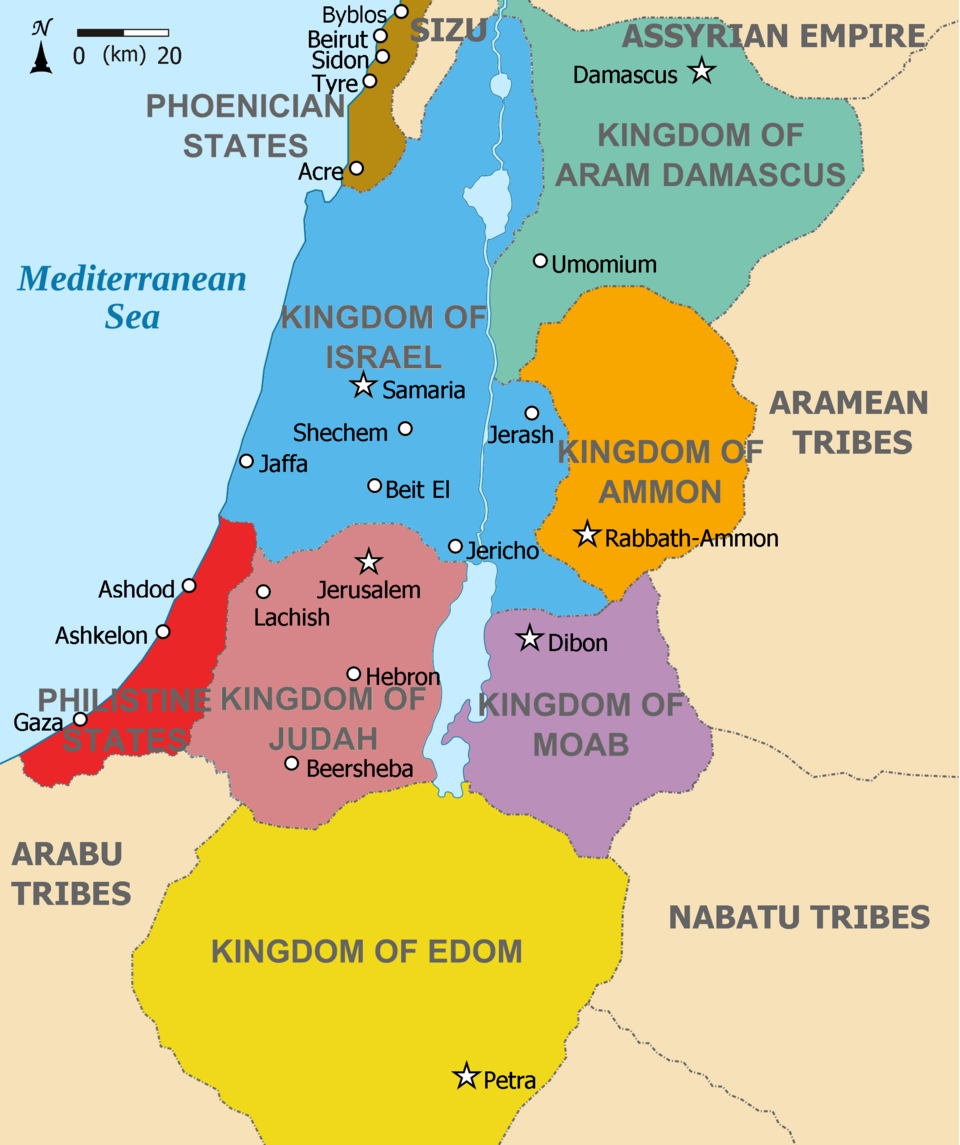
Umomium is unknown but location is near Aphek
ELISHA CALLING ON JOASH TO
MAKE A "POINT" TO ARAM
He said, “Open the window toward the east,” and he opened it - The east was the direction of Aram (Syria)—Israel’s persistent oppressor at the time. By opening the window toward the east, Elisha deliberately oriented the act toward the battlefield, not toward Jerusalem, the temple, or heaven. Opening the window is a deliberate, obedient response. The king does not argue, hesitate, or spiritualize the command. He opens it. That matters—because prophetic acts often require human participation before divine power is revealed.
Dilday adds “The window was opened eastward toward Syria and specifically toward Aphek, the most strategic site between Damascus and Samaria. Aphek was the city where Ahab had defeated the Syrians years earlier (1 Kings 20:26).
Then Elisha said, “Shoot!” And he shot. Elisha’s command, “Shoot!”, signals the decisive act that transforms a symbolic gesture into a prophetic action. The arrow is not merely loosed at random; it is released in obedience to the word of the LORD spoken through the prophet. The king’s action is simple, but it is meant to be faith-filled and responsive, The fact that Elisha must explicitly give the command underscores that victory begins with God’s initiative, not human strategy. Jehoash does not act independently; he acts only after receiving divine instruction. The immediacy of the response—“And he shot”—shows outward obedience, yet the surrounding context reveals that this obedience will soon prove partial rather than wholehearted.
Adam Clarke has an interesting note - “It was an ancient custom to shoot an arrow or cast a spear into the country which an army intended to invade… The dart, spear, or arrow thrown, was an emblem of the commencement of hostilities.”
And he said, “The LORD’S arrow of victory (teshuah; LXX - soteria = deliverance), even the arrow of victory (teshuah; LXX - soteria = deliverance) over Aram; for you will defeat (nāḵāh; LXX - patasso - strike down) the Arameans at Aphek until you have destroyed (kalah; LXX - sunteleia = a point of time marking completion of a duration, in NT used to describe the end of THIS AGE!) them. - As the arrow flew, Elisha interpreted the action. Elisha is making it very clear to King Joash what this arrow shot to the east symbolizes:
- The arrow belongs to the LORD—the victory originates with Yahweh, not the king.
- Victory is emphasized twice, underscoring the certainty of deliverance.
- The enemy is specified: Aram (Syria).
- The location of victory is identified: Aphek.
- You (Joash) will defeat or strike Aram - Note the juxtaposition of God's Sovereign Power and Man's (Joash's) responsibility. We see this pattern throughout the Bible, a pattern I call the Paradoxical Principle of 100% Dependent and 100% Responsible.
- The outcome is defined: destruction of the Arameans.
The time marker UNTIL is crucial. It indicates that Israel would defeat or strike Aram up to the point of complete destruction, speaking of not partial success but complete success, complete destruction of Aram!
Significantly, Aphek was the site where Ben-hadad had earlier suffered a devastating defeat at Israel’s hands (1 Kings 20:30)). Elisha is effectively declaring that Yahweh would grant King Joash a similarly decisive deliverance, freeing Israel from Aramean domination, if the promise were fully embraced. God's promises must be grasp with faith (shown to be genuine and full by complete obedience).
Warren Wiersbe adds "King Jehoash was not a man of faith, but he could follow directions. However, he lacked the spiritual discernment and insight that people have who live in the Word and walk by faith. When the prophet put his hands on the king’s hands, it obviously symbolized a conveying of power from God. When Elisha commanded him to shoot an arrow toward the area where the Syrians were in control, it clearly spoke of victory over the enemy (Deut. 32:42; Ps. 120:4). This much the king could have understood because Elisha gave him a clear promise of victory.
Victory (salvation, deliverance, help)(08668)(teshuah from yasha' = save, deliver, help) means a deliverance, a victory, safety, salvation, preservation from harm. The LORD is the source of victory and help in all spheres of life in general. Teshuah is often in the context of military conflict (Jdg. 15:18; 1Sa 11:13; 1Ch 11:14 = "the LORD saved them by a great victory."). While victory was usually not obtained through human means (Ps 33:17; 108:12; 146:3; Pr21:31), safety came through a multitude of counselors (Pr 11:14; 24:6). The primary Source of deliverance is Yahweh (2Ch 6:41 = "O LORD God, be clothed with salvation"; Ps 119:81 = "My soul languishes for Your salvation; I wait for Your word."; Ps 144:10 = "Who gives salvation to kings, Who rescues David His servant from the evil sword."). The deliverance of the Lord is described by the prophets during the troubled times (Isa. 45:17; 46:13; Jer. 3:23; Lam. 3:26 = "It is good that he waits silently For the salvation of the LORD.").
Strike (struck)(05221) nāḵāh A verb meaning to beat, to strike, to wound. The meaning of the verb ranges from hitting to killing. ni. be hit, be struck down; pu. be battered, ruined, destroyed; hi. strike, hit, beat, strike dead, wound, batter, destroy; ho. be struck down (dead), be taken, be hit (#5782); nom. מַכָּה (makkâ), blow, stroke, wound, plague, defeat There are many instances of striking physically (Ex. 21:15, 19; Job 16:10; Ps. 3:7[8]; Song 5:7). Of Yahweh smiting the firstborn (Nu 3:13, 8:17), His own people (Nu 11:33). Of Moses striking the rock twice resulting in his not being allowed to enter the Promised Land (Nu 20:11) Frequently, nākhāh is related to the Israelite conquest of Canaan. God used disease to smite the inhabitants of Canaan (Num. 14:12). This word is also used in a different sense, as when the men of Sodom and Gomorrah were stricken blind by the two angels (Gen. 19:11); when a priest stuck a fork into the kettle (1 Sam. 2:14); when people clapped their hands (2 Kgs. 11:12); or when people verbally abused Jeremiah (Jer. 18:18). God struck the Egyptians with plagues (Ex. 3:20); and struck people down in judgment (Isa. 5:25).
Destroyed (complete, consume) (03615) kalah means to be complete, at an end, finished, accomplished, or spent. To bring a process to completion. To consummate. It can have a positive connotation (Ge 2:1-2), but more often is used in a negative sense. Occurring over 200 times in the Hebrew Bible, this verb conveys a wide range of meanings. The primary meaning is the notion of "completion" of some process. This nuance is attested in an Arabic cognate meaning "to come to an end." In 2 Kings 13:17 Elisha's clear implication in using kalah (LXX - sunteleia) is that Joash would be enabled by Yahweh to COMPLETELY exterminate the Arameans!
APHEK - The Baker Illustrated Bible Dictionary - online
(1) The most significant Aphek in the Bible is about seven miles east of Tel Aviv. The springs nearby become the headwaters of the Yarqon River, flowing to the Mediterranean Sea. Traffic on the international coastal route passing through Israel was forced between the foothills to the east and the river, making this a strategic location. During the transition to the monarchy, the Philistines were at Aphek when the Israelites attacked them from Ebenezer (1 Sam. 4:1) just east in the foothills. The Philistines won the battle, captured the ark, and continued Philistine control of the international coastal highway. At the end of Saul’s life, the Philistines mustered their troops at this northern “boundary” of the Philistine plain before setting off to challenge Israel for control of the Jezreel Valley (1 Sam. 29:1).
(2) Asher’s tribal boundary, north of Mount Carmel, indicates an Aphek near the Mediterranean Sea (Josh. 19:30) from which the Canaanites were not dislodged (Judg. 1:31).
(3) (ED: THIS IS THE APHEK BEING REFERENCED IN 2 Kings 13:18) The Arameans attacked the northern kingdom at a third Aphek on the east side of the Sea of Galilee (1 Kings 20:26–30; see also 2 Kings 13:17). The Arabic Fiq preserves this place name. Herod rebuilt the city on the coastal plain, renaming it “Antipatris” after his father. When Paul was sent to Caesarea after the plot on his life was uncovered, the soldiers with him went as far as Antipatris (Acts 23:31–32). (See here also)
2 Kings 13:18 Then he said, “Take the arrows,” and he took them. And he said to the king of Israel, “Strike the ground,” and he struck it three times and stopped.
- Strike: Isa 20:2-4 Eze 4:1-10 5:1-4 12:1-7
- he struck it three times: 2Ki 4:6 Ex 17:11
Related Passage:
Joshua 8:18 (SIMILAR SYMBOLISM) Then the LORD said to Joshua, “Stretch out the javelin that is in your hand toward Ai, for I will give it into your hand.” So Joshua stretched out the javelin that was in his hand toward the city.
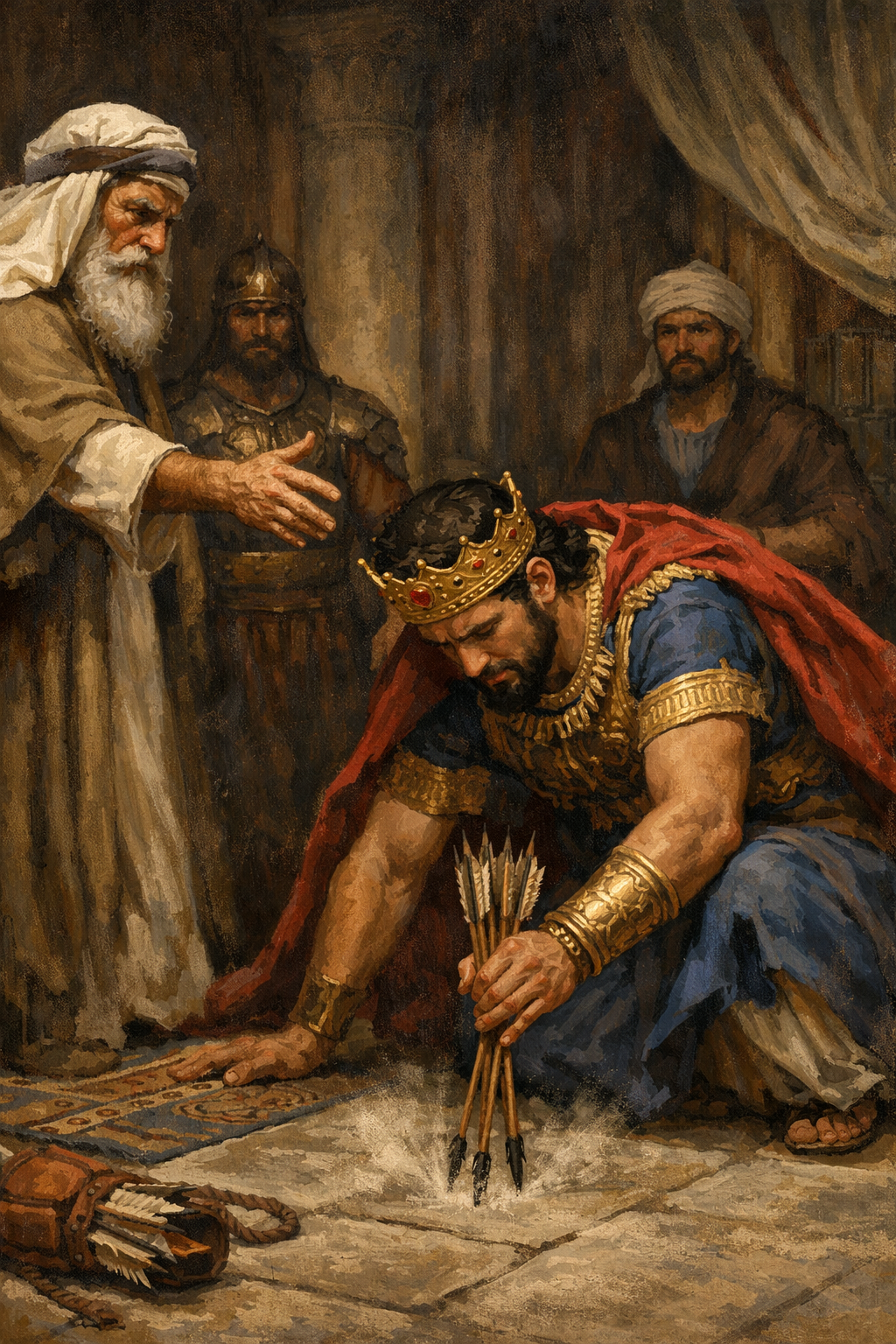
STRIKE THREE AND
YOU'RE OUT!
Then he said, “Take the arrows,” and he took them. Note arrows plural. But the writer does not tell us how many arrows! Were there just 3 arrows (like in the depiction above)? Or were there 5-6 arrows, as if Elisha were giving Joash a clue of how many strikes to carry out! One other point is that in the Septuagint Elisha gives him a bow and arrows, but Hebrew has only arrows.
Joash had just heard Elisha explicitly connect the arrow shot through the open window with the coming victory over the Syrian army. He understood (or should have understood) that the arrow was not merely a symbol, but a prophetic sign representing the promise of the LORD’s deliverance of Israel from Aramean oppression with destruction of the Aram. In that moment, the arrows became tangible tokens of Yahweh's prophetic promise, assuring King Joash that Israel’s salvation/deliverance from Aram oppression would come not by only by human strength, but in conjuction with the sovereign power of God.
Philip Ryken - God was testing Jehoash to see whether he had the courage to finish the work he had been given to do. The king already knew that the arrows were full of prophetic significance. Therefore, he should have kept striking the ground until Elisha told him to stop. But Jehoash held back, leaving half his arrows in his quiver. For such halfhearted obedience, which presumably came from something less than wholehearted faith, the most he could expect was a partial victory. (2 Kings)
And he said to the king of Israel, “Strike the ground,” - Elisha now pressed the lesson. The prophetic sign was not yet complete. He was calling Joash to respond actively, in faith, to the divine promise. The command required an act of obedience that would reveal the depth of the king’s faith in laying hold of the victory God had promised. Notice that Elisha did not specify how many times to strike—yet Joash struck three times. The implication is that Joash grasped the symbolism, but his failure to strike more times exposed a lack of trust in the LORD’s promise. In other words Joash stopping short revealed a faith that hesitated to press the promise to its fullest extent.
Elisha’s anger would also confirm Joash should have known. It would have been absolutely unfair of Elisha to be angry if Joash had not known. Elisha’s rebuke is decisive “You should have struck five or six times…” Now think about that statement. That statement only makes sense if Joash was capable of knowing that more was appropriate. In other words Elisha does not say “I should have explained better” or “You misunderstood” but instead, he holds Joash accountable for restrained faith. In sum, Joash knew the act mattered. He knew it symbolized victory. So he asks for 3 arrows of victory so to speak. As a Hebrew, he surely knew that 7 was the number of completion, so he should have kept striking until 7!
Selman - "It is … a symbolic action, like that of Joshua thrusting with a spear at Ai (Jos. 8:18)."
And he struck it three times and stopped - Note Elisha did not say shoot the arrow this time, but strike the ground. Three strikes would give Joash 3 victories over the Arameans but no more. Note the Hebrew and Greek use the same verbs as in 2Ki 13:17 - strike = nāḵāh and in the LXX patasso = strike down.
David Guzik - Joash timidly received this invitation of the prophet to shoot the arrows at no particular target so that they hit the ground. He shot three arrows and stopped, not sensing what he should have – that the arrows represented victories in battle over the Syrians, and he should have received the prophet’s invitation more boldly. The phrase “Strike the ground” can be for shot arrows hitting the ground. Elisha asked Joash to shoot the arrows through the window at no particular target, not to pound them on the floor.
Knapp - “Only Joash’s lack of faith, manifested in his half-hearted smiting the ground with arrows but thrice, prevented his destroying the Syrians utterly. And it was unto him according to his faith.” (The Kings of Judah and Israel)
Warren Wiersbe adds when Elisha told him to take the remaining arrows and strike the ground with them, he didn’t have the spiritual understanding he needed to make the most of it. Had he been a faithful worshipper of the living God, he would have seen the truth, but he was blind like the dead idols he worshipped (Ps. 115:3–8). Shooting one arrow guaranteed victory, but the number of times he smote the ground determined how many victories God would give him. Because Jehoash had ignorant faith, he limited himself to only three victories over the Syrians.
Tony Evans: Most of the time God’s promises are in your reach. They are not in your hand. Like Joshua, who had been promised every place the sole of his foot touched, and like this king, you have to go and get them. God’s promises for you don’t come about by you simply sitting around and waiting for them. They require you to act in faith, to live out the principles taught in His Word, and more—to align your life under God’s truth. With the first arrow that Elisha called, “The lord’s arrow of victory,” the promise of victory for king Joash had been established. Yet the king was told to shoot more arrows out the window. We know that at a minimum he had at least six arrows in his quiver because of what Elisha said to him. But the king chose to shoot only three. Maybe he wanted to save his remaining arrows for the upcoming battle. Maybe he didn’t want them damaged, or maybe he didn’t want to have to retrieve them, or lose them altogether. The king was obviously covering himself in keeping back a few of his arrows. Yet for whatever reason, the prophet had given him an instruction, and he had held back. He quit long before he ever should have.
Summary of Joash's Striking Three Times
- No numerical limit given. Elisha commanded simply, “Strike the ground.” The absence of a stated number invited a response governed by faith, not minimal compliance.
- Symbolism already explained. Joash had just been told that the arrow represented the LORD’s victory over Aram. He knew this was a prophetic sign-act tied to real outcomes. In 2Ki 13:17 the arrow shot was called "the arrow of victory over Aram."
- Multiple strikes reveal awareness. Joash struck three times, not once, showing had some understanding that repetition mattered. His stopping point reflects choice, not confusion. Note he said "until you have destroyed them." The end result was not just victory in 3 battles but total destruction of Aram! (Destroyed in the LXX is sunteleia which means a point of time marking completion of a duration, in NT used to describe the end of THIS AGE! He was offering Joash the opportunity to bring the time of Aramean rule to a complete end!)
- Prophetic rebuke confirms Joash's accountability. Elisha’s words—“You should have struck five or six times” assume Joash could and should have continued. The fault is not lack of instruction but restrained faith.
Conclusion: Joash obeyed outwardly but lacked expectant persistence. His partial response limited the extent of victory God was willing to grant.
Key Principle: Partial faith yields partial victory; God’s promise invites confident, persevering appropriation.
David Guzik has an interesting note on shooting the arrows -
· Keep shooting in the battle against sin.
· Keep shooting in the attainment of Christian knowledge.
· Keep shooting in the attainment of faith.
· Keep shooting to do more for the kingdom of God.
· Keep shooting because the world, the flesh, and the devil will not stop their shooting.
When God invites us to take something by faith, we must receive it boldly – and ask Him knowing that He is a great king and giver who is honored by bold, reverent requests.
Elisha clearly asked Joash to do something that modeled prayer.
- Shooting the arrows required effort and aim.
- Shooting the arrows required instruction and help from the prophet of God.
- Shooting the arrows had to be done through an open window.
- Shooting the arrows had to be done without knowing the exact outcome ahead of time. The target was only fully known by faith.
- Shooting the arrows was ineffective because it was not repeated enough, reflecting a lack of confidence in the process.
- Shooting the arrows had its strategic moment, and when that moment passed it was gone.
- Failing to shoot the arrows hurt others, not only himself.
Streams in the Desert -
“Take the arrows. … Smite upon the ground. And he smote twice and stayed. And the man of God was wroth with him, and said, Thou shouldest have smitten five or six times.” (2 Kings 13:18, 19.)
HOW striking and eloquent the message of these words! Jehoash thought he had done very well when he duplicated and triplicated what to him was certainly an extraordinary act of faith. But the Lord and the prophet were bitterly disappointed because he had stopped half way.
He got something better than the human,
but he did not get God’s best.
He got something. He got much. He got exactly what he believed for in the final test, but he did not get all that the prophet meant and the Lord wanted to bestow. He missed much of the meaning of the promise and the fullness of the blessing. He got something better than the human, but he did not get God’s best.
Beloved, how solemn is the application! How heartsearching the message of God to us! How important that we should learn to pray through! Shall we claim all the fullness of the promise and all the possibilities of believing prayer? —A. B. Simpson.
“Unto him that is able to do exceeding abundantly
above all that we ask or think.”
(Eph. 3:20)
There is no other such piling up of words in Paul’s writings as these, “exceeding abundantly above all,” and each word is packed with infinite love and power to “do” for His praying saints. There is one limitation, “according to the power that worketh in us.” (ED: I BELIEVE THIS REFERS TO THE SUPERNATURAL WORK OF THE SPIRIT CONTINUALLY ENERGIZING US ["worketh" = energeo in present tense same verb in Php 2:13NLT, Col 1:29] He will do just as much for us as we let Him do in us. The power that saved us, washed us with His own blood, filled us with might by His Spirit, kept us in manifold temptations, will work for us, meeting every emergency, every crisis, every circumstance, and every adversary. —The Alliance.
F B Meyer - 2 Kings 13:18 He smote thrice and stayed.
A striking spectacle. The dying prophet, with his thin hands on the muscular hands of the young king, as he shoots his arrow through the eastern window; the exhortation to smite the remaining arrows on the ground; the bitter chiding that the king had struck thrice only, instead of five or six times! What lessons are here?
The Lord Jesus put His hands upon ours. Here is the reverse to the incident referred to. Ours are weak, His are strong; ours would miss the mark, His will direct the arrows, if only we will allow Him, with unerring precision. We shoot, but the Lord directs the arrow’s flight to the heart of His foes.
Our success is commensurate with our faith. If we strike but thrice, we conquer but thrice. If we strike seven times, we attain a perfect victory over the adversary. Is not this the cause of comparative failure in Gospel effort? Souls are not saved because we do not expect them to be saved. A few are saved, because we only believe for a few. It is one of the most radical laws in the universe of God, and one which our Lord repeatedly emphasized, that our faith determines the less or more in our own growth, and in the victories we win for Christ. Do not stay, O soul-winner, but smite again and yet again in the secret of thy chamber, that thou mayest smite Satan, and compel him to acknowledge thy mite.
Let us not stay, though the energy of earlier days may be ebbing fast. The sanctified spirit waxes only stronger and more heroic, as Elisha’s and Paul’s did, amid the decay of mortal power., The Lord will say to us, as He did to Paul, “My grace is sufficient for thee: for my strength is made perfect in weakness.”
2 Kings 13:19 So the man of God was angry with him and said, “You should have struck five or six times, then you would have struck Aram until you would have destroyed it. But now you shall strike Aram only three times.”
- the man of God: 2Ki 1:9-15 4:16,40 6:9
- was wroth: Lev 10:16 Nu 16:15 Mk 3:5 10:14
- now thou shalt: 2Ki 13:25 Mk 6:5
ELISHA'S ANGER
AT KING JOASH
So the man of God was angry with him - Elisha's righteous anger against the king because he had failed to understand the significance of striking the ground. It was a faith failure for King Joash. As noted earlier, he seems to have known enough to strike the ground 3 times, even though Elisha had not specified this number. He knew this act had special significance because twice Elisha had called the arrows, an "arrow of victory," that it was Yahweh's arrow and that it guaranteed victory over the Arameans at Aphek.
Matthew Poole - “The prophet himself did not yet know how many victories Jehoash should obtain against the Syrians, but God had signified to him that he should learn that by the number of the king’s strokes.”
Trapp - There are many situations in which we should keep “shooting the arrows,” but we content ourselves with a small effort. “He should have continued smiting till the prophet had said, Enough.
Dale Ralph Davis: It is important, then, to see how verses 10–13 and verses 14–19 fit together. Verses 10–13 summarize Jehoash’s whole reign, but verses 14–19 capture his most crucial moment—standing before the word of Yahweh. Hence this latter vignette gets more space than the king’s whole ‘bio’ in verses 10–13. The text makes a value judgment: how a man responds to Yahweh’s word is more significant than all the achievements and honors of a lifetime.
And said, “You should have struck five or six times, then you would have struck Aram until you would have destroyed it. This statement reveals that the limitation of Israel’s victory was not imposed by God’s unwillingness, but by the king’s inadequate response of faith. Elisha’s words make clear that greater victory was genuinely available—symbolized by striking the ground “five or six times.” The rebuke shows that Joash stopped prematurely, not because he was told to stop, but because he failed to press forward in expectation. His action revealed a restricted faith—obedience that began correctly but lacked perseverance. As a result, the scope of deliverance was curtailed. Israel would experience real victories over Aram, but only partial ones: three defeats instead of total destruction.
But now you shall strike Aram only three times. God was willing to grant decisive victory, but the king’s restrained faith determined the measure of blessing. Obedience that hesitates forfeits what full trust might have received.
Warren Wiersbe - What an opportunity Jehoash missed for utterly destroying his enemies! “According to your faith let it be to you” (Matt. 9:29 nkjv). It isn’t enough for us simply to know God’s will and obey it, as important as that is, but we should also understand God’s will and God’s ways (Eph. 5:17; Ps. 103:7). The commandments and acts of God reveal to us the character of God if our spiritual eyes are open (Eph. 1:17–20). This is how we understand the ways of God and how better to serve Him, and this is how the Lord increases our faith
David Guzik - But now you will strike Syria only three times: As it happened, life and death depended on how many arrows Joash shot to the ground. When King Joash had the opportunity to shoot the arrows, it probably seemed to be a small thing to him. He did not know that God’s plan for a nation and his seemingly small actions were vitally connected.
“It is a fact that God has purposed all things both great and little; neither will anything happen but according to his eternal purpose and decree. It is also a sure and certain fact that, oftentimes, events hang upon the choice of men. Their will has a singular potency.” (Spurgeon)
We think of all the excuses that Joash could have made; yet none of them are valid.
- “I stopped shooting because I didn’t want to be presumptuous and ask for too much.”
- “I stopped shooting because I’m not a very good archer.”
- “I stopped shooting because Elisha didn’t help me more.”
- “I stopped shooting because I thought three was plenty.”
- “I stopped shooting because I didn’t think it would do any good.”
- “I stopped shooting because I wasn’t in a shooting mood. I didn’t feel like it.”
- “I stopped shooting because I didn’t want to get over-excited.”
“So there be some who think that hearing the gospel is a little thing. Life, death, and hell, and worlds unknown, may hang upon the preaching and hearing of a sermon. To hear attentively, and not be disturbed in the sermon, may seem a very insignificant thing; and yet upon the catching of the word may result either the attainment of faith or the absence of faith, and so the salvation that comes by faith.” (Spurgeon)
Spurgeon The arrows of the Lord’s deliverance - Point me to a single period in the history of the church where God has worked without instrumentality, and I will tell you that I suspect whether God has worked at all if I do not see the instruments he has employed. Take the Reformation, can you think of it without thinking of God? At the same time, can you mention it without the names of Luther, Calvin, Zwingli, and Melanchthon? Then in the later revival in England, when our slumbering churches were suddenly started from their sleep, who did it? The Holy Spirit himself: but you cannot talk of the revival without mentioning the names of Whitefield and Wesley, for God worked by means then, and he works by means still. I need to notice a remark which was made concerning the revival in the north of Ireland, that there seemed to be no prominent instrumentality. The moment I saw that, I mistrusted it. Had it been God’s work more fully developed through instrumentality, I believe it would not have so speedily come to a close. We grant you that God can work without means, and even when he uses means he still takes the glory to himself, for it is all his own; yet it has been the rule, and will be the rule till the day of means shall come to an end; that just as God saved man by taking upon himself man’s flesh, so everywhere in the world he calls men by speaking to them through men of their own flesh and blood. God incarnates himself—in his Spirit, incarnates himself in the chosen men, especially in his church, in which he dwells as in a temple; and then through that church he is pleased to bless the world.
G Campbell Morgan - The man of God was wroth with him, and said, Thou shouldest have smitten five or six times.-2 Kings 13.19.
The story of corruption in Israel runs on in the account of the reign of Jehoahaz. He was succeeded by Joash, concerning whose reign the chief incident recorded is that of his visit to Elisha. The prophet was now sick and feeble, but evidently keenly alive to all the things of true national interest. It is interesting to notice here again, that the king used of Elisha the very words which Ehsha had used of Elijah: "My father, my father, the chariots of Israel, and the horsemen thereof!" Joash recognized that the true strength of the nation was not that of its military equipment; but rather that of its possession of such as interpreted the will of God. In his intercourse with Elisha, the weakness of the king was manifested. Following the prophetic signs, he lacked that passion and consecration which were necessary to the full accomplishment of his purpose. There was no heart in his striking on the ground with the arrows; "he smote thrice and stayed." It was a literal obedience, devoid of enthusiasm, and it revealed the whole nature of the man. For lack of that touch of flame and passion, he would fail in his enterprise, and this the prophet plainly told him. It is a story we do well to heed. A mechanical obedience will carry us so far; but it always breaks down short of the complete fulfilment of purpose. Willingness to do ever needs the reinforcement of passion, if the thing in hand is to be well done. Perhaps one of the chief reasons of the ineffectiveness of the Church of God oftentimes is to be found in her lack of fire.
2 Kings 13:20 Elisha died, and they buried him. Now the bands of the Moabites would invade the land in the spring of the year.
- buried him: 2Ch 24:16 Ac 8:2
- the bands: 2Ki 5:2 6:23 24:2
- the Moabites: 2Ki 3:5,24-27 Jdg 3:12 Jdg 6:3-6
Related Passages:
Judges 3:12 Now the sons of Israel again did evil in the sight of the LORD. SO (NOTE THE SAME PATTERN) the LORD strengthened Eglon the king of Moab against Israel, because they had done evil in the sight of the LORD.
Judges 6:3-6 For it was when Israel had sown, that the Midianites would come up with the Amalekites and the sons of the east and go against them. 4 So they would camp against them and destroy the produce of the earth as far as Gaza, and leave no sustenance in Israel as well as no sheep, ox, or donkey. 5 For they would come up with their livestock and their tents, they would come in like locusts for number, both they and their camels were innumerable; and they came into the land to devastate it. 6 So Israel was brought very low because of Midian, and the sons of Israel cried to the LORD.

ELIJAH DIES
MOABITE BANDS INVADE
Elisha died, and they buried him - Simple words for a spectacular life! After decades of faithful service as the LORD’s prophet—through miracles, counsel to kings, confrontation of sin, and steadfast proclamation of God’s word—Elisha dies and is laid in the grave. The simplicity of the notice is striking. No eulogy is given, no list of accomplishments recorded, emphasizing that the prophet’s significance lay not in public honor, but in faithful obedience to God’s calling.
Now - Now is a change of subject but does not definitely give us the chronology, although clearly it was after Elisha died. One famous preacher says these bands invaded one year later but that is not stated in the text. What is clear is that this NOW sets the stage for one of the strangest miracles in the Old Testament.
The bands of the Moabites would invade the land in the spring of the year - The writer is setting the scene for one last "Elisha miracle." This statement provides the historical and seasonal background for what follows. The phrase bands of the Moabites refers to small, mobile raiding parties, not full-scale armies (See map above for location of Moab to south and east of Israel). These groups conducted opportunistic incursions, pillaging crops, livestock, and villages rather than attempting territorial conquest. The timing “in the spring of the year”is significant for spring was the period after the winter rains, when travel was easiest, when crops were growing and harvest prospects were visible and when Israelite communities were most vulnerable to plunder.
Such seasonal raids were a regular feature of life during Israel’s political weakness. With Aram still a threat and leadership in flux after Elisha’s death, Israel lacked the stability and military strength to deter these incursions. The mention of Moabites underscores the ongoing pressure from neighboring nations and the lawless insecurity of the period. And why were the Moabites raiding Israel? See Jdg 3:12
Elisha’s ministry demonstrates the confirming power of God, twenty‑eight miracles in all, precisely double those of Elijah (consistent with Elisha’s request for a double portion of his spirit). As Hebrews 11:4 says "though he is dead, he still speaks."
Note some writers list fewer than 28, but here we count everything supernatural connected to Elisha, including prophecies, fulfillments, multi-stage events, and delegated acts, often splitting one miracle into several items.
Transition and Sign
of Prophetic Power
(1) Divides the Jordan River — parts the waters with Elijah’s cloak. 2 Kings 2:14
(2) Purifies the waters of Jericho — throws salt into the spring, making them wholesome. 2 Kings 2:19-22
(3) Pronounces judgment on mocking youths — two bears maul forty-two young men. 2 Kings 2:23-25
Provision
and Deliverance
(4) God provides water for three armies — valley fills with water without rain. 2 Kings 3:14-20
(5) Multiplies the widow’s oil — debt is paid, and she lives on the remainder. 2 Kings 4:1-7
(6) Promises a son to the Shunammite woman. 2 Kings 4:14-17
(7) Raises the Shunammite’s son from death. 2 Kings 4:32-37
(8) Purifies a poisonous stew — flour cures the deadly mix. 2 Kings 4:38-41
(9) Feeds a hundred men with twenty loaves — food multiplied with leftovers. 2 Kings 4:42-44
Healing
and Judgment
(10) Naaman healed of leprosy — washes in Jordan seven times. 2 Kings 5:1-14
(11) Gehazi cursed with Naaman’s leprosy — punishment for greed. 2 Kings 5:25-27
Protection and
Prophetic Insight
(12) Iron ax head floats — restores borrowed tool. 2 Kings 6:1-7
(13) Reveals secret plans of the Syrian king — God discloses enemy movements. 2 Kings 6:8-12
(14) Prays that his servant’s eyes be opened — the young man sees heavenly armies. 2 Kings 6:17
(15) Blinds the Syrian army — confusion among enemies. 2 Kings 6:18
(16) Restores the Syrians’ sight — after leading them to Samaria. 2 Kings 6:20
Prophecies
and Fulfillments
(17) Prophesies end of famine in Samaria. 2 Kings 7:1-2
(18) Prophecy fulfilled — abundance returns overnight. 2 Kings 7:16-16
(19) Warns the Shunammite woman about famine — her obedience preserves her life. 2 Kings 8:1-2
(20) Restoration of her property — all her land and proceeds returned. 2 Kings 8:3-6
(21) Foretells Hazael’s rise and cruelty — anoints him as king over Aram. 2 Kings 8:7-15
(22) Anoints Jehu to destroy Ahab’s house — brings prophetic judgment. 2 Kings 9:1-10
Final Prophecies
and Posthumous Miracle
(23) Predicts victories of King Joash over Aram — limited by Joash’s obedience. 2 Kings 13:14‑19
(24) Predicts Israel’s future oppression by Aram — prophecy fulfilled after his death. 2 Kings 13:20‑22
(25) A man revived by touching Elisha’s bones — testimony of continuing divine power. 2 Kings 13:21
Additional Miraculous Acts
Often Counted Separately
(26) The king’s officer trampled at the city gate — fulfillment of Elisha’s prophecy. 2 Kings 7:17-20
(27) Naaman’s conversion and confession of faith — spiritual miracle of grace. 2 Kings 5:15-17
(28) Famine warning and survival of Israel — natural judgment removed through his word. 2 Kings 8:1-2 (extended implication of provision)
2 Kings 13:20 Elisha died, and they buried him. Now the bands of the Moabites would invade the land in the spring of the year.
“O death, where is thy sting?” exclaims the apostle, 1 Corinthians 15:55, speaking in the name of all who have been bought with the blood of the Lamb, and in the words of the Old Testament evangelist, the prophet Isaiah.
“O death!” says he at the commencement, turning himself to that destroying, ghastly monster, which sin brought forth at “the tree of knowledge,” under the overshadowing of the Divine wrath. Men usually want to shrink back, with horror, at the sight of that gloomy and terrific being; and even the slightest remembrance of him falls, like an embittering drop of wormwood, into our cup of joy. Paul, on the contrary, purposely seeks out the hideous specter; nay, he even cites it before his bar, as a conqueror his vanquished and disarmed foe, as a judge the captured and fettered delinquent.
“O death!” cries he, adjuring him as though he were a real personage. And does not the sable king of terrors traverse the creation as if he really were so? Does not, in him, a disguised executioner, with an insatiable sword, pass through the ranks of the living? Does he not sit, as in gloomy majesty, on a throne, which, piled up of crowned and uncrowned skulls, incessantly casts forth destroying lightning. Where is there a hero like him, whose slain cover the circle of the earth? Who among the strong can be compared to him, who can point in every place to the trophies of his victories, and the memorials of his triumphs? There they stand, stone upon stone, and hillock upon hillock; and not a single day appears, in which new ones are not raised, and thousands of victims fall beneath his murderous sword.
And yet the apostle meets him with the inquiry, “O Death, where is thy sting?” Strange question! Will death be at a loss for a reply? Oh, where does not the sting of this monster and his poisoned and murderous dagger meet us? “There,” might the king of terrors reply, “there is my sting, where from gloomy sepulchers the effluvia of corruption strike the sense; where the proud lord of the soil feeds the worms with his flesh; where the mere remembrance of my majesty makes you shudder; where the thought of my approaching visit clothes the firmament of your life with dark clouds; where the hands are wrung over beloved corpses, but wrung in vain; where fresh-closed graves are watered with a flood of tears, but the graves are not softened thereby nor moved to compassion; where I unsparingly snatch the darling child from its affectionate mother, and the beloved wife from the bleeding heart of the sobbing husband; and where bereaved widows pine away in grief and sorrow; where you hear the last gasp of the dying, and the despairing and agonizing shrieks of those, who are violently carried away, who offer all they have, and even the insignia of royalty for their lives, but vainly await their acceptance; there, where I thus destroy the edifices of happiness, burst the bonds of affection, transmute the saloons of pleasure into caverns of sorrow, and fill the heart with the terrors of hell, and hell with new victims—there pierces my sting; there slays my sword; there are my horrors; there my terrors are displayed.”
Thus might death, the prince of terrors, speak. Nevertheless the apostle mocks at him, and abides by his question, “Where is thy sting?” This is something unheard of. From whence does Paul derive his courage? What justifies his triumphant shout over this last enemy? We shall this day hear what it is. The most abundant justification exists. “Thanks be to God, which giveth us the victory through our Lord Jesus Christ!” Death is swallowed up in victory; life is brought to light.
2 Kings 13:20
“And Elisha died.”
We have now, my friends, arrived at the prophet’s dying hour. The Scriptures do not attach much importance, as regards the children of God, to what we call their death. Even as we ourselves, at the birth of a butterfly, do not linger at the ruined chrysalis, but direct our whole attention to the beauteous creature then coming forth to the light; so the view of the Scriptures, at the last moment of a departing saint, rests only on the soul now making progress toward completion, while it leaves unnoticed, as something trivial, the pallid corpse. Happy are all they, who have attained to the same method of contemplating the subject! May our present meditation pave the way to it in at least a few instances!
We drop at present the thread of our narrative, and return to the sick bed of the man of God. We will see him die; we will see if he dies like us, and ask him whither he is going. In the solemn stillness of his chamber, we will inquire if another world exists; if it be open to sinners; and particularly, whether we may comfort ourselves with the prospect of it.
I. We have reached the spot.
There lies Elisha; his eyes already half closed. A small number of the sons of the prophets stand weeping, and inexpressibly dejected, around his bed, watching the last heavings of his breast. Oh that we could comfort these deeply smitten mourners! but we ourselves feel too much pained and oppressed. O death, how terrible thou art! Are not the noblest safe from thy murderous scythe? and is there no Divine barrier drawn around such a man as Elisha, on which the inscription flashes upon thee, “Hitherto, and no further?” We ask; but the dark angel heeds us not, and continues his fearful operation in awful silence; more deeply extinguishing the light of the eyes, and plunging the earthly consciousness of the departing saint in night and darkness. Ah, he threatens to bury our hopes also in similar obscurity.
Is there any exit from these shades, any escape from such ruin? Is this appalling dissolution really only a gloomy phantom, and the process of dying, notwithstanding the appearance to the contrary, in reality only an outlet to a life of glorification? Does not my being cease with my last breath, and is the world beyond my grave not walled up? Beyond the limits of this visible creation, is there an invisible one, open to receive my spirit, on escaping from the catastrophe of death? Oh, a longing for such a world beats in every heart, although frequently only manifest, when the ground begins to recede from beneath the individual’s feet. Who wishes to die, much less to be annihilated? Dreadful thought, that death should be the close of all: and is it not? Oh, how can it be imagined? A presentiment tells us that there is a future state. There must be a haven for those, who are tossed about on the stormy sea of life; a state of retribution for the innocently oppressed and slighted; a garner for that which is truly great, holy, and noble under the sun! Yes, presentiments say so, but what are they but an expiring taper; while the exhibition of death is like a storm, before which the taper cannot stand. What is presentiment, but a harmless singing bird in a gloomy thicket; while the spectacle of corruption is a monster, which swallows up the bird. Oh, the horrors of actual dying! the rattling in the throat—the vanishing of the senses—the gasping the last breath—the cold, stiff, silent repose in the coffin—the commencement of corruption—the interment in the lonely and gloomy grave—the cold moist clods that cover it, and the grassy hillock with its withering garlands, and with the gradually diminishing dew of tears! Were there only some admixture of light, an audible clapping of the pinions of the departing spirit, or the visible entrance of an escorting angel, or even only a preternatural light glancing through the darkness! But nothing appears to counterbalance the melancholy idea of annihilation—all is somber, deeply veiled, and mute! And yet!—But no, it is not presentiment, which produces this hope of a future existence in the face of the horrifying images described above; and just as little is reason able to do so, although it has attempted it. Reason has sought, for centuries, a certain and well-founded consolation with reference to immortality. It has planted the ladders of philosophic logic to find the other world; afterwards soared about in the balloon of bold speculation; inquired of persons who have been entranced, magnetized, and in a state of somnambulism; and what has it discovered? It speaks, indeed, also of an elysium, of higher regions, and the like; but these are modes of speech, poetical expressions—that is, poesy, in the reality of which it does not itself believe; but it never yet saw any thing clearly, or arrived at any incontestably safe and certain conclusion. That conviction, which rises above the horrors of death and the ashes of the tomb, is only found on the radiant heights of revelation.
We may derive it from the garden of Joseph, and carry it away with us, especially, from the mount of ascension. Let us approach nearer to the sacred spot. See, there stands, surrounded by his dear disciples, the Man, who through the whole of his life appeared like one who was ever ready to ascend, and was only held fast to earth, to which he did not belong, by the bonds of some great object he had in view. He, whose entire miraculous manifestation bore upon its front a mighty proof of the existence of another world; of whom one felt persuaded, that he proceeded from another world, and must return to it; who also referred, times without number, to his “Father’s house,” from whence he had descended, but reserved for the sequel, the actual proof of its real existence. There he stands, only present, as respects the body, for a few moments longer upon the earth. He is preparing to conclude and crown his temporal labors with that proof. But first of all, he gives his disciples a sublime and majestic parting address. “All power is given unto me,” says he, “in heaven and in earth.” “Lo, I am with you alway, even unto the end of the world.” Nay, he even gives the whole world over to them, with the commission to take possession of it in his name, and for him. He then lifts up his hands; blesses his faithful followers at parting; and while the latter are wholly absorbed in the contemplation of his benignity, and think they had never before seen such a heaven of love and grace beam from his looks, they feel themselves pervaded by his benediction, as by a stream of peace from paradise. He rises in silent majesty from the earth, soaring in a posture of blessing, upwards from the circle of his followers; ascends higher and higher, visibly, bodily, and occupying space, towards heaven; and the disciples stand and look after him with adoring wonder, till a cloud intervenes betwixt him and them, and veils from their view, the most sublime and promise-laden spectacle.
What say you to this event? The question concerning another world is now decided, not, indeed, by any philosophical proof, but by something in power and convincing influence far exceeding all rational syllogisms—by a fact. What need is there of further testimony? Another state exists. We visibly behold one enter it. It is a locality beyond the ether, a real space-occupying world; for the Lord ascended thither in his bodily form. And it must be a blissful world. “God is gone up with a shout,” says the Psalmist, “even the Lord, with the sound of a trumpet.” Oh, let us congratulate one another upon this tangible seal to our hope of immortality! We creatures of sense require such a sensible proof of the existence of a heavenly kingdom.
“But”—what! can there still be a “but” in the face of such a fact? However, I understand what is meant. He that cannot believe a narrative for which, like that of the ascension, the disciples submitted to be stoned and crucified; a narrative which, if it still needed confirmation, received it so abundantly in the outpouring of the Holy Spirit, and in the establishment, guidance, and government of the Christian church; a narrative, which is not presented to us as an isolated wonder, but as an indispensable link in the whole connection of the life of Jesus; which took place in consequence of the most express and indubitable predictions, and can so little surprise the reflecting mind, that, on the contrary, it must have been felt as strange in the highest degree, had it not occurred;—for ought, not He, who came down from heaven, to return thither? and did not a coronation and triumph, at the close of his career, such as he received, belong to him, who had so completely accomplished the mighty work committed to him by the Father? He, I say, who is unwilling to believe a narrative like that of the glorious ascension of the Son of God, ought to deny all history in general; for where is there a fact in profane history, more powerfully confirmed, and by its widely extending results and events more exalted above the shadow of a doubt, than the Gospel fact in question? The just man believes, and lives by his faith.
We return, from the Mount of Olives, to the chamber of Elisha. Oh, how are the shadows dispersed, the horrors expelled! Now close, ye dear eyes; and cease to beat, thou faithful heart! In order that the butterfly may rest on the flowers of paradise, the chrysalis must be rent; and the buds must burst, that the rose may expand in all its beauty. Place not the inverted torch, but the upward flickering flame, as a symbol at the death-bed of our friend; and instead of the cypress wreath, let a garland of evergreen bloom on his pallid temples.
II. A future world exists.
This is the first conviction we bring down with us, from the summit of the Mount of Olives, into the vale of death. But is heaven open to sinners? Hallelujah, it is so! This is our second truth. “The breaker is come up!” is the exulting exclamation of the prophetic seers. And so it was. “They have broken up, and have passed through,” they joyfully cry out. Those break through, who belong to Christ. Heaven is therefore open! What bars and barriers closed it once! Three cherubim, instead of one, kept watch at its gate, with swords that turned every way: Divine justice, Divine holiness, and Divine truth. They have retired. The door is open. To whom? To the eye? yes, to that also. We look into the other world, and what a sight! Jesus, our first-born Brother, in infinite glory on the throne, the reins of the world’s government in his pierced hands. He, the breaker of the seals, the accomplisher of his Father’s counsels, the supporting, governing, and nurturing King of his church.
But heaven is open not only to the eye, but also to the heart that finds on Jesus’ breast, a comfortable landing-place for his sighs, and in Jesus’ paternal lap, a lovely discharging place for all his cares. Paradise is also open to thy feet. Direct thine ear upwards. That is not merely the music of angelic choirs, which sounds down to thee. Hark the theme, “The Lamb that was slain is worthy!” Hear, hear! “Thou hast bought us with thy blood. Hallelujah to the Lamb!” Dost thou perceive? They are human voices; and if thou listen attentively, thou wilt clearly hear the voices of the crucified thief, of the publican, of Manasseh, Rahab, Magdalen, and thousands of their brethren and sisters and thine. Heaven is open to sinners, transgressors, and those who are deserving of hell. And is it really so? The miracle on the Mount of Olives renders this also sure and certain.
What should be our exclamation from the vale of death, on seeing Jesus ascend on high? “Oh, that thou wert one of us, and our Mediator!” would be our ejaculation, “then should we possess the right of entrance into paradise. Oh, that thou wouldest be to us, as a general to his host, for the keys of the city of God would be given to the latter, on thy receiving them! Oh, that thou wert our head, as Adam once was; then would thy members be included in thy happy lot!” Such would naturally be the language of our heaving breasts; and, lo, what we wish and long for really exists. For who stood in our place, and undertook to rectify our cause before the Lord? Who took upon him our debts, in order to pay them; our obligations, in order to fulfill them? Who said, “I must restore that which I took not away?” “I sanctify myself for their sakes, that they also might be sanctified through the truth?” “Jesus,” is our reply. But, as in this quality of Mediator, Surety, Intercessor, Head, and Second Adam of all those who take refuge with him and believe on him, he soars aloft from the Mount of Olives to his eternal home, to be crowned, and to take possession of the treasures of celestial glory—the apostles do not hesitate, with all confidence and boldness of heart, to exclaim, “Ye are ascended with him to heavenly places, your citizenship is in heaven.”
Can you imagine to yourselves a surer foundation than that, on which our hopes of immortality are founded? They do not rest on scientific inferences, nor demonstrations, which may well shun the light—no; but upon well-known facts, real histories, which are not shaken by the billows of impending distress, and present a brazen front to the terrors of apparently contradicting experience. Elisha was also acquainted with this immovable, adamantine, blood-besprinkled basis, which firmly holds the anchor of our hopes, whatever may roll over it. He saw its glimmer through the sacrifices of the temple, as well as from the prophetic sayings of the Divine interpreters. He knew the Lamb that was slain from before the foundation of the world; and it is on the blood of this Lamb, though dying, he so gently and peacefully reposes.
He begins to respire with greater difficulty, and his pulse becomes weaker. We are no longer terrified at the sight. Depart, Elisha! we shall follow. The hour must come. Our life is a pilgrimage; our growing old, a hastening to our home. We gladly go forward, and stretch the sail to the impelling wind, because we know whither we are hastening. Oh, how fair is the promised land, where youth fades not, where spring forever blooms, whose joy is unmingled with bitterness, where light is without, shade! Depart, Elisha! we will joyfully follow. If Christ be our life, death can only be our gain.
His face becomes more pallid; but no darkness clouds his brow, no convulsive doubt distorts his features. The most profound repose is expressed in his whole countenance. Hark, hark! “I depart in safety,” he exclaims, with quivering lips. Yes, as long as the obedience of the Surety retains its value in the sight of God, or that for the sake of Divine justice, it is not permitted that the adversary should devour a saint; and as long as the promise stands fast, “The mountains shall depart, and the hills be removed; but my kindness shall not depart from thee; neither shall the covenant of my peace be removed”—so long shall there be nothing more sure, than that the members of Christ, whatever may occur, shall attain the object of their heavenly calling: no pit, into which they fall, reaches down to hell; no snare, in which they are entangled, that is not burst asunder; no sea foams around them, which must not yield them a passage. Proceed with a firm step, my brethren; we shall force a passage. As true as the Forerunner, preparing the way, preceded us; so true it is, that we shall never stick fast in any valley of temptation, in any narrow pass, nor ever perish in the desert from hunger and sorrow. And on our arrival, the just made perfect, with palms in their hands, will be found standing upon the ever-verdant shore awaiting us!
The prophet is “fallen asleep.” Then let him sleep! He is not lost to us. We are members of the same body, an intimately and eternally united procession of pilgrims. Our love remains,—it has been immersed in the spring of immortality; it passes over the grave, and embraces its objects, who have entered into their glory, only the more closely and firmly. And in the degree in which the number of our beloved friends increases there, our longing to be joined with them, and the feeling of our being strangers on the earth, increases also in intensity. The roots, which we have struck on this side of the grave, become ever looser, and ever freer do we hover above the heights of the earth, ever more powerfully are we attracted upwards and heavenwards by the glimmering lamps of our home, the benignant stars; and the more fully is formed within us the image of those peaceful pilgrims to Jerusalem, of whom the Psalmist sings, that they go forth weeping, bearing precious seed; but return with rejoicing, bringing their sheaves with them. Oh desirable state, to have left the world, before the world leaves us! Oh glorious freedom, to be beforehand with the angel of death, in the matter of weighing anchor, and to have outstripped him with the wings of an ardent longing to be at home!
Elisha has finished his course. He has entered into his rest; he is at home. The sons of the prophets stand round his bed, immersed in profound grief. Nor do their tears flow without reason. The Zion of God regrets the loss of such a man. For here was more than a “schoolmaster,” one that was greater than a taskmaster, more estimable than a teacher of the law. There are still those to be found, such as I have described above; and when one of them departs, another soon succeeds to fill up the vacancy. But here was an evangelist, a preacher of grace, a herald of the loving-kindness and tender mercy of our God; and there never is a superfluity of such men upon earth. And how much had Elisha been to the church of God in other respects! What miraculous deliverances did he accomplish! What a host did he prove in the Almighty’s hands, in the way of Israel’s adversaries! What a barrier did the Lord throw up, in this single individual, against the infernal waves of idolatry among the lofty and the low! Well might king Joash throw himself weeping over the dying man, and break out into the lamentation, “My father, my father, the chariots of Israel, and the horsemen thereof!” Israel’s crown was gone; a conductor, to speak humanly, had fallen from the people’s roof; a walking spring of consolation was dried up, and a vine hewn down, than which none in Canaan had ever borne sweeter grapes.
How peacefully does the noble corpse lie there, as if he were not dead, but slumbered only, and dreamed paradisiacal dreams! Here death no longer presents a terrific or horrifying appearance. It is evident, that his going home has been arranged with paternal care; it is not a dying and being torn away, against one’s will, from the land of the living. The appearance of the chamber of death is that of poverty. How devoid of state does the dear man of God lie upon his couch! Here we see nothing of pomp or display. No golden candelabra illumine the gloomy chamber; no splendid insignia of high dignities or offices glitter upon the pall; no crown, no star of nobility, no wreath of honor reminds us that any thing more than a common corpse reposes here. But something else, which far outshines all this, gives, nevertheless, an intimation of it. Oh, he who has an eye for it, discovers here a funereal state which kings and princes seldom enjoy. Children of God stand and water the pale forehead of the corpse with the tears of ardent affection and sorrow; and this is more than if a diadem of gold and pearls encircled it. Friendly angels, who accompanied the holy man during his life, and bore him on their hands, surround, in the character of silent and affectionate watchers, the solemn couch; and whenever did nobler shield-bearers and attendants than these stand round a prince’s corpse, when lying in state? The gratitude of innumerable souls, who are eternally indebted to him, weave tender invisible wreaths for the dear departed man of God, from flowers which never fade. And that which completes the whole, is the wondrous reflection of profound and Divine peace, which the richly favored soul, on departing, leaves behind, as its last significant trace in the pale features of its cast-off tenement.
No, no; the open door of eternity has not been dreadful to our friend. He saw it beaming with bright and lovely festal lights. It seemed to him a triumphal arch, under which he was to pass, after surmounting the struggles of the present life, in order to receive the crown of righteousness. He read, as the inscription over it, the words, “They that sow in tears shall reap in joy.” But if a person, under the Old Testament, no longer felt any reason why he should shrink back at the gates of death, how much less, my brethren in the Lord, ought we to be afraid of them, who see them beaming in the full splendor of New Testament illumination and glory, and read upon them passages, such as the ears of the saints of old never heard! No cloud any longer shades their entrance. No terrific form meets us near them. The King of kings, according to his promise, “I will come again,” receives us at the threshold of eternity, with the open arms of his love. The holy angels crowd to the gate, in order, with the music of their harps, and joyful and affectionate greetings, to welcome and introduce the new citizens of the kingdom. Thousands of the most blessed promises are the tapers, which enlighten the antechamber with solar radiance. Over the glittering portal stands the inscription, “Enter, ye blessed of my Father, and inherit the kingdom prepared for you from the foundation of the world!” Immediately adjoining it are the amazing words, “The glory which thou gavest me, I have given them.” Inside the gate, a seraph sent from God, beckons to us, holding in his hand a wedding garment, pure as the light, a palm-branch of triumph, an unfading crown of glory, and the golden key to a mansion of peace in the Jerusalem above. All for the new comer! The golden harp of heaven glimmers in the distance. And, oh, what harmony salutes our ears from the background! It is the echo of the eternal hallelujahs, the rapturous sound of the mighty song of the perfected church; the hymn, whose never-ceasing chorus is, “The Lamb that was slain,” and which is responded to by the eternal acclamation,” Thou hast made us kings and priests unto God by thy blood.”
Lo, such is the gate of eternity for the members of Christ’s kingdom. It is a triumphal arch. We ought to rejoice aloud, whenever we think we see it about to open. But how seldom in Zion is the last journey commenced with rejoicing! The reason lies in the weakness of our faith, and our legality and self-righteousness. We refuse to rely solely on the blood of Christ; and yet all the glory must be given to his blood. Hence it so frequently happens, that we have to pass through a variety of painful processes, before we bid adieu to things temporal. The last remains of self must be put away; the false ground depart from under our feet. It is then that the various ladders we have endeavored to plant, in our own strength, heavenward, are broken by the hand of God; then follow bitter castings down from imaginary states of holiness, subsequent strippings to the bone and marrow; developments of the depths of corruptions within us, which make us shudder; the demolition of our most specious works, and the like. “Nothingness” is the final cry; and conflict, storm, and darkness, are experienced before the anchor is weighed. Many are thrown, by the breakers, on the opposite shore; others, after their humiliation, are again raised up in Christ, and depart rejoicing. But, however a child of God may remove, timidly, or heroically and exultingly, he has no need to be anxious.
“Father, I will,” says the Prince and Surety of sinners, bought with His blood, “that they also, whom Thou hast given Me, be with Me where I am; that they may behold My glory, which Thou hast given Me: for Thou lovedst Me before the foundation of the world.” (John 17:24)
J R Miller - 2 Kings 13:21
The bones of Elisha had no more power in themselves to give life—than any other dead man's bones. Yet we may get here the lesson of posthumous influence. No man ever wholly dies. We have nothing to do with superstitious nonsense about relics, saints' bones, and bits of holy men's clothing or of their coffins; but it is true that a really godly man has influence after he dies. He leaves behind him something which cannot die. His name has power. If he writes good books, these live after him, and give life to the souls that their words touch. We ought ever to seek to live—so as not only to be missed and mourned when we die—but to live on after death in our works, our name, our influence.
2 Kings 13:21 As they were burying a man, behold, they saw a marauding band; and they cast the man into the grave of Elisha. And when the man touched the bones of Elisha he revived and stood up on his feet.
- touched: 2Ki 4:35 Isa 26:19 Eze 37:1-10 Mt 27:52,53 Joh 5:25,28,29 11:44 Ac 5:15 19:12 Rev 11:11
Related Passages:
Revelation 14:13 And I heard a voice from heaven, saying, “Write, ‘Blessed are the dead who die in the Lord from now on!’” “Yes,” says the Spirit, “so that they may rest from their labors, for their deeds follow with them.”
Hebrews 11:4 By faith Abel offered to God a better sacrifice than Cain, through which he obtained the testimony that he was righteous, God testifying about his gifts, and through faith, though he is dead, he still speaks.
🙏 THOUGHT - Father, may Your Spirit so work in our lives that our deeds will follow us into eternity so that our dead lives will still speak like Abel and like the dead man who touched Elisha may spiritually dead men be brought to life by contact with our lives (alive and dead) lived for Your glory and honor in Christ. Amen.
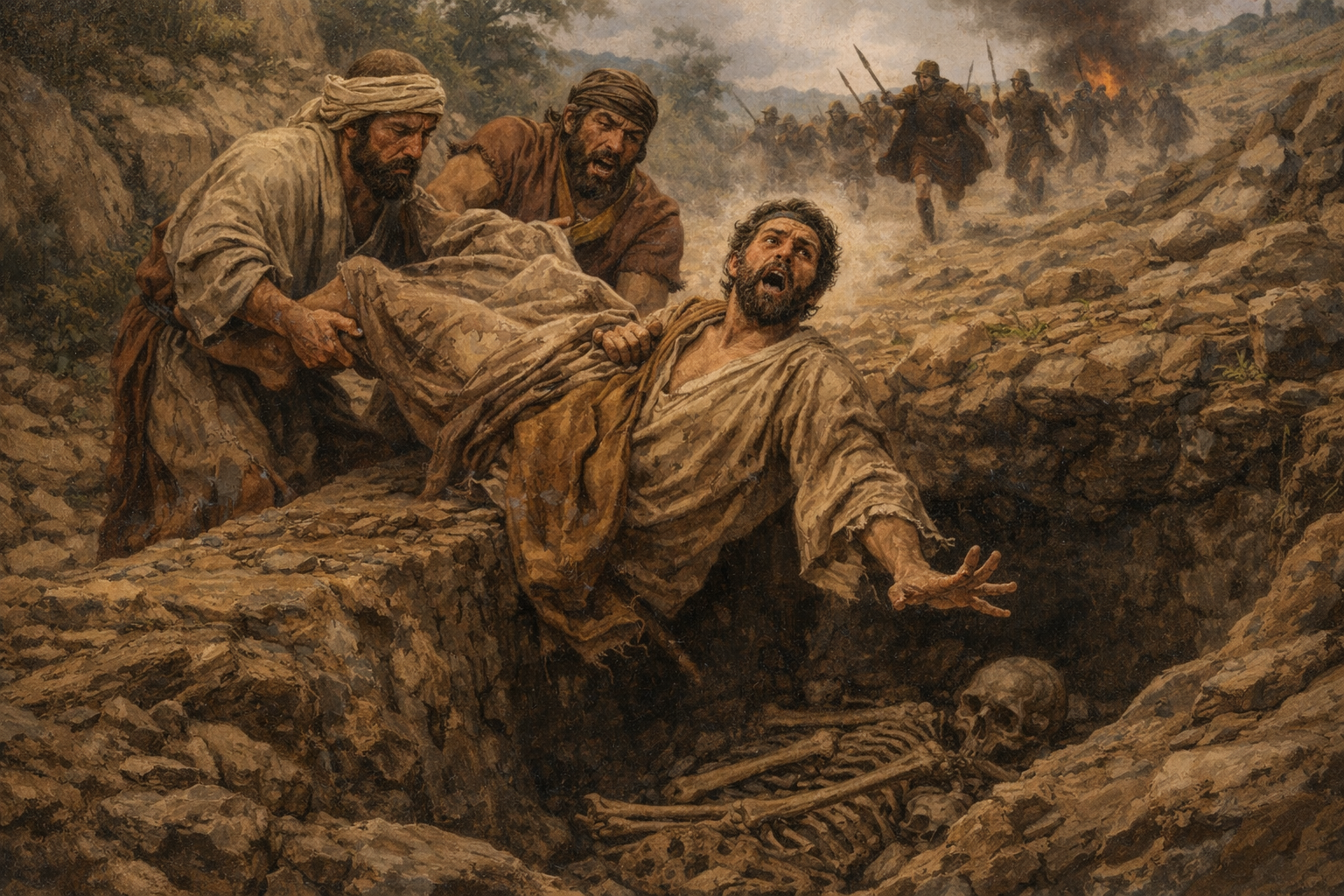
ELIJAH'S POSTHUMOUS
"RESURRECTION" MIRACLE
As - KJV has "and it came to pass." The literal Hebrew is "and it so happened [that] they." Beloved, things do not just happen to happened. This happened at the right place (near Elisha's grave) and the right time (sudden incursion of a marauding band). This is the Sovereing God once again orchestrating the events providentially to bring about one of the more unusual miracles in the Old Testament.
They were burying a man, behold (hinneh - grabs their attention!), they saw a marauding band - This funeral party realized that they might be the next ones to be buried, so they quickly changed plans on how to bury the dead man!
And they cast (shalak/salak - used in 2Ki 13:23) the man into the grave (sepulcher, tomb) of Elisha - Startled by the approach of the raiding party, the burial group abruptly abandoned the typical funeral rites and cast the corpse into the open grave of Elisha, a convenient hiding place, yet in God’s providence (for it is not stated they even knew this was Elisha's grave, but either way, it was the grave God had planned for them), this hurried act became the setting for one final testimony to the enduring power of the LORD Who had worked through the man of God, showing that the man of God may die but his work lives on!
And when the man touched the bones of Elisha he revived (chayah) and stood up on his feet Assuming Joash was told about this miracle, it would have confirmed Elisha's promise to him of victory over Aram. Can you imagine the impact on these "pallbearers"?
Adrian Rogers says "I believe that God was just saying that this fellow is so important that I’m going to prepare a miracle as a memorial unto his honor. And this memorial served a twofold purpose....It encouraged God’s people. You see, Elisha had been their leader. They had been depending on him. He had been leading them. He had been defending them. He had been protecting them. He had been preaching to them. And now he was gone. And the situation was dark indeed. What was God showing them? What was God telling them? I believe that God was telling them by this miracle that Elisha was dead, but God was still alive.....I believe, by performing this miracle, God wants to encourage us tonight. God is alive. I want to tell you another reason I believe that God allowed this miracle to be performed and for this memorial to a man of God: not only to encourage them, but to teach a wonderful, wonderful lesson. And you want me to tell you what it is? It is this: The man who lives for God never really dies. You see, Elisha was dead, and yet his influence lived on. And he being dead yet spoke. (Hebrews 11:4) You see, Dwight L. Moody is dead. But he never really died; he lives on. Charles Haddon Spurgeon died. But he lives on. George W. Truett died. But he lives on. Robert G. Lee died. But he lives on. You see, the influence of a man of God, a woman of God, a person of God, goes on and on and on. I believe we ought to preach till we die, and then go on preaching, amen? I just believe that our influence just ought to go on more and more. I believe that Elisha had more power dead than most preachers have alive. And I thank God for this man. (Read his full sermon on 2 Kings 13:20-21 The Man of God page 139)
God can Make His Servants a Blessing
to Others even when Dead.
-- James Smith
Dave Guzik - This is one of the more strange and unusual miracles in the Bible. There is little explanation and the silence of the record suggests that there was not inherent power in the bones of Elisha to resuscitate others. This seems to be a unique, one-time miracle to bring honor to the memory of this great prophet.
MacArthur: A dead man returned to life after touching Elisha’s bones. This miracle was a sign that God’s power continued to work in relationship to Elisha even after his death. What God had promised to Jehoash through Elisha when he was alive would surely come to pass after the prophet’s death (cf. vv. 19-25) in the defeat of the enemy, the recovery of the cities that had been taken, and their restoration to the kingdom of Israel (vv. 22-25).
We can also be brought to life
by our contact with these dead prophets.
-- David Guzik
Warren Wiersbe - King Joash received a great encouragement -- When Elisha died, the king may have wondered if his promises died with him. To encourage the king, the Lord graciously performed a miracle after Elisha died. The Jews didn’t embalm corpses as did the Egyptians. They merely washed the body and wrapped it in clean cloths along with spices. One day, when the arrival of Moabite raiders interrupted a committal service of a man recently deceased, the mourners quickly put the body into Elisha’s tomb and fled. But God used that occasion to give the man life! Surely this miracle was talked about among the people and the king may have heard the account from the lips of the men who saw it. This miracle told him that, though the prophet was dead, Jehovah was still the living God and the God of power. His promises would not fail. The prophet Elijah never died but was caught up into heaven (2:11–12), but the prophet Elisha died and was buried. However, Elisha performed a miracle even after he was dead. God has different plans for each of His servants and it’s not our business to compare one with the other or to question what He does (John 21:19–23).
The strange miracle which occurred at Elisha's tomb must have been an astonishment to the friends of the resurrected man. The plundering Moabites must have been a surprise to the burial party, but what about a dead friend who suddenly stood up alive and well? The purpose of the miracle was (1) to confirm that God was the God of the living, and (2) to seal the witness of Elisha with the divine imprimatur.
Bob Deffinbaugh - We then come to the story of the “runaway corpse,” in which a dead body that is being buried providentially comes into contact with the bones of Elisha the prophet. The dead body comes to life. Remember that Joash is not a godly king. He is the king who is the recipient of the prophecy given through Elisha while he is dying. The context seems to make it clear that Joash was afraid of what would happen to his kingdom after Elisha died. Now that Elisha is dead, Joash may very well have reasoned that this prophecy was no longer valid. I believe this bizarre miracle was divinely designed to give Joash courage and hope, so that he would engage Syria in battle, and thus experience the victories that God had promised. Did the king fear that a dead man’s (Elisha’s) prophecies were now lifeless as well? News of this miracle certainly reached the city and the ears of the king. If Elisha’s bones still had power in the tomb, then surely his words were also to be trusted. I therefore believe that this miracle was specifically aimed at Joash. I am sure that the dead man appreciated the miracle as well, but I believe that this great manifestation of God’s power through the prophet spoke volumes to the king.....With this chapter, we come to an end of an era—the times of Elijah and Elisha. Other prophets will preach to the northern kingdom of Israel, but the time for Israel to repent is certainly running out. Israel’s day of judgment is coming.
if we live with God, and for God, we, too, shall possess
a deathless influence, and a spiritual immortality.
D L Moody - When men thought him dead, one of Elisha’s bones was worth a whole army of ordinary men. So, if we live with God, and for God, we, too, shall possess a deathless influence, and a spiritual immortality. Our lives will not cease with our funerals, but when men are saying, “He is dead” here, voices shall be calling yonder, “Blessed are the dead who die in the Lord, for they rest from their labors, and their works do follow them."
🙏 THOUGHT - Dear pastor, what a text to preach at the funeral of a disciple of Jesus! Read 2 Kings 13:21 and then expound on the passage as suggested above by D L Moody. And then add expand the message with the text from John in Revelation 14:13 "And I heard a voice from heaven, saying, “Write, ‘Blessed are the dead who die in the Lord from now on!’” “Yes,” says the Spirit, “so that they may rest from their labors, for their deeds follow with them.” Our deeds in this life will have a lasting impact on the living! You may have fallen asleep in Jesus, but someone is revived by the Spirit upon reading of your life's testimony (See My Testimony to the Grace of God.) Thus, “their deeds” are expressions of faith that continue to speak even after the believer’s earthly life ends just as Hebrews 11:4 says of Abel “through faith, though he is dead, he still speaks.” And in a similar way your good, God honoring deeds will follow you! May we all be blessed and motivated by the bones of Elisha so that our deeds too will follow us and bring glory to God. In Jesus' resurrecting Name. Amen.
Ron Daniel quips that "Based on this Bible story, Televangelist Benny Hinn reports that he visits the graves of faith healers Kathryn Kuhlman and Aimee Semple McPherson to experience the anointing that emanates from their bones. That is a good lesson in how not to get personal application from Bible stories!"
Henry Morris - This is the third (and last in the Old Testament) of the eight recorded "resuscitations" of the dead back to life. (Below is an additional comment of "resurrections.")
When we include the New Testament miracles of resurrection before Jesus’ own (and not counting His eternal resurrection, which is unique), many scholars count eight total biblical resuscitations, such as:
- Widow’s son of Zarephath (1 Kings 17:17-22)
- Shunammite’s son (2 Kings 4:32-37)
- Man raised by Elisha’s bones (2 Kings 13:20,21)
- Saints raised at Jesus’ death (Matthew 27:50–53)
- Widow of Nain’s son (Luke 7:14–15)
- Jairus’ daughter (Luke 8:54–55, Mk 5:35-43)
- Lazarus (John 11:43–44)
- Tabitha/Dorcas (Acts 9:36–41)
- Eutychus (Acts 20:9–12)
Counting may vary depending on inclusion of #9, but the description of “eight recorded” fits a standard conservative list that regards 2 Kings 13:21 as the third Old Covenant example.
The Greatest Resurrection - Jesus rose from the dead (Matt. 28:5–8; Mark 16:6; Luke 24:5, 6).
Norman Geisler - 2 KINGS 13:21—Does the fact that God performed a miracle through Elijah’s bones justify venerating relics of the saints as Roman Catholics claim? See When Cultists Ask
MISINTERPRETATION: The text says that “once while some Israelites were burying a man, suddenly they saw a band of raiders; so they threw the man’s body into Elisha’s tomb. When the body touched Elisha’s bones, the man came to life and stood up on his feet” (1 Kings 13:21 NIV). Roman Catholics cite this verse in support of their practice of venerating relics (Ott, 1960, 319).
CORRECTING THE MISINTERPRETATION: This Scripture does not justify venerating relics any more than it would justify venerating other physical means that God has used to convey miracles—such as the rod of Moses, the brazen serpent in the wilderness, the clay Jesus used to heal the blind man, or the hands the apostles used to cure diseases.
As a matter of fact, the Bible condemns the use of the brazen serpent for idolatrous purposes. In Hezekiah’s campaign against Judah’s idolatry, “he removed the high places, smashed the sacred stones and cut down the Asherah poles. He broke into pieces the bronze snake Moses had made, for up to that time the Israelites had been burning incense to it” (2 Kings 18:4 NIV).
God clearly commanded his people not to make graven images or to bow down to them in an act of religious devotion (Exod. 20:4, 5). This is the same error of the pagans who “revered and worshiped the creature rather than the Creator” (Rom. 1:25).
John Butler - Elisha’s Tomb
“And it came to pass, as they were burying a man, that, behold, they spied a band of men; and they cast the man into the sepulcher of Elisha; and when the man was let down, and touched the bones of Elisha, he revived, and stood up on his feet.” (2 Kings 13:21)
WHAT an interesting scene this was! Pallbearers were taking a man to be buried when they spotted some Moabite guerrillas. In their fright, they cast the dead man into Elisha’s tomb. What happened next was astounding! When the dead man’s body touched the bones of Elisha in the tomb, the dead man came back to life! A number of lessons can be seen here. We note two of them.
Recycling of ministries. This miracle reminds us that even though we are dead, the influence of our life continues. Our day has gotten into the recycling business which reuses those whose work was thought to be over. God has been in the recycling business a long time. We think a person’s work is done when he dies, but not so. Elisha had been dead for some time, but he still had influence! Scripture says of Abel, “He being dead yet speaketh” (Hebrews 11:4). That is true of all of us. And how we influence people after we have died depends on how we have lived before we died. Will the life you are leading influence for good or for evil after you die?
Redemption of sinners. This miracle in Elisha’s grave is also a picture of the redemption of sinners. First, there is the need of redemption. This man was dead; he needed life. Likewise the sinner. “You hath he quickened, who were dead in trespasses and sins” (Ephesians 2:1). Second, the means of redemption. This man’s restoration to life came as a result of Elisha’s death. Redemption is through the death of Jesus Christ on the cross. Third, opposition to redemption. As soon as the man came back to life, he faced the enemy—the Moabite guerrillas. When a person is saved he is soon confronted with the enemy. Fourth, the evidence of redemption. When the man was restored to life, he “stood up.” Sin lowers; it brings the fall of men just as death did to this man. But salvation brings uprightness in conduct.
FROM PAGE 196 in Outlines of sermons on the miracles and parables of the Old Testament, by a London minister by W. Harris
“And it came to pass as they were burying a man, that, behold, they spied a band of men; and they cast the man into the sepulchre of Elisha: and when the man was let down, and touched the bones of Elisha, he revived, and stood up upon his feet.”—2 Kings 13:21.
Several views have been taken of this incident. By some it has been regarded as a mere Hebrew myth; others have supposed that there was an inherent virtue, or life-giving power, in the bones of Elisha, and that the same power exists in the bones of all men of extraordinary goodness. From this point of view it has become a corner stone of the doctrine of the efficacy of relics. With regard to the first, the occurrence is related as a historic fact as much as any other in the Old Testament, or as much as the raising of the daughter of Jairus in the New Testament. If it is to be rejected because it is a marvel, almost all the historical books of the Bible may be set aside for the same reason. As to the second view, experience contradicts it. We will therefore accept the fact as it stands, assuming that “it was not the prophet’s bones which brought the dead to life, but the Living God” (see Lange).
Notice therefore—
I.—That the resurrection of a dead man through the medium of the bones of another man is neither contrary to reason nor to the teaching of other parts of Scripture.
If God gave life to man at first, it is surely in His power to restore it by any means, or without any visible means, and it is not more extraordinary than the clothing of the rod of Aaron with beauty and fruitfulness, or the dividing of the Red Sea at the outstretching of the rod of Moses. The rod was the medium, but God gave the power; the prophet’s bones were the medium, the life-giving power was God’s.
II.—That such a miracle was in keeping with the wonderful life of the prophet Elisha.
He was a man raised up by God to do a special work. The whole of his public life was marked by miracles. As his predecessor, Elijah, had been honoured by a miraculous exodus from the earth, so it seems fitting that some similar mark of honour should be given to Elisha, either at the time of his death, or after it.
III.—The probable intention of the miracle.
It was probably intended to revive, in the mind of Israel, hope in God as to the future of the nation. Elisha, on his dying bed, had foretold the deliverance of Israel from the yoke of Syria: their present sufferings from the Moabites would naturally discourage the heart of the people and lead them to forget the promise, which was not yet, it may be presumed, completely fulfilled. This resurrection by means of Elisha’s dead body would be the means of a resurrection of hope in Elisha’s God.
SUGGESTIONS
I.—God would have the dust of departed saints remind us of their holy lives. He would have the child, when he stands by the grave of a sainted mother, call to mind her holy words and deeds; and the church or nation which has been blest with a godly and gifted teacher remember and follow the teaching which He gave them while in the flesh (Heb. 13:7).
II.—The dust of the godly dead may bear witness that they are still living. Its very contrast to the body when it was animated by the living soul, seems to testify to the fact that they must still be living. We speak of the body as theirs, thereby recognising the fact of their existence. The bones are here called Elisha’s bones, suggesting, at least, his continued existence although disunited from his human body.
III.—God retains his relationship with His children, even with their bodies, after they have left the world. The miracle here recorded is a proof that God was still the God of Elisha, that the relationship existing between Him and the prophet was as real now as when the latter was serving Him in the land of Israel.
All this the people among whom the resurrection took place might have gathered from it; our faith in these truths ought to be so much the stronger in proportion as the evidence which we possess is more clear. Christ Himself has told us that “God is not the God of the dead, but of the living” (Matt. 22:32), and His apostle has affirmed that the body shall live again (1 Cor. 15:22).
SELECTED—
I.—The intent of the miracle.
While Elisha lived the power manifested in his works might seem to be his. Now that he is dead, the bones can challenge nothing, but send the wandering Israelite to that Almighty agent, to whom it is all one to work by the living or the dead. And if the men of Israel were not more dead than the carcase thus buried, how could they choose but see, in this revived corpse, an emblem of their own condition? How could they but think, “If we adhere to the God of Elisha, He will raise our decayed estates, and restore our nation to its former glory?”
II.—The proof which it gave of a future resurrection.
The Sadducees had as yet no being in Israel. With what face could that heresy ever after look into the world, when before the birth of it, it was so palpably convinced, with an example of resurrection. Intermission of time, and degrees of corruption, add nothing to the impossibility of our rising. The body that is once cold in death, has no more aptitude to a reanimation than that which is mouldered into dust.—Adapted from Bishop Hall.
SELECTED II
God wrought this miracle for three sacred reasons.
I.—He was willing to give Israel additional tangible proof that He, Elisha’s God, was the true, living, omnipotent God, with whom it was a small thing to save, even from the dead, and whom it was therefore only requisite to have for a friend, in order no longer to fear the Moabites. “Give this God glory, fall at His feet, and confide in Him,” was the first sermon which resounded from this miracle.
II.—It impressed a new and Divine seal of confirmation upon the whole of Elisha’s earthly actions, for the man whom God thus honoured even in the grave, must have been a true prophet; his word, the word of God; and his advice and intimations infallible.
III.—In this miraculous act, God held up to view a mighty image of the future—of the regenerating, life-giving power which should be shed abroad in the world by the death of Elisha’s great Master, Jesus Christ.
The miracle of the prophet’s grave is frequently repeated in the world, in spiritual antitypes. How often does God impress upon His servants the full credential seal only after their decease, either by removing the veil from the works of faith and love, which the spiritually fructified germ of their regenerate nature produced in deep concealment, or by permitting their words and example to operate the wonders of spiritual awakening and reanimation after their departure, for the manifestation of which they vainly waited during the whole of their lives.—Krummacher.
“And Elisha died, and they buried him. And the bands of the Moabites invaded the land at the coming in of the year. And it came to pass, as they were burying a man, that, behold, they spied a band of men; and they cast the man into the sepulcher of Elisha: and when the man was let down, and touched the bones of Elisha, he revived, and stood up on his feet.”
A mysterious event is here brought before us; the last, if I may so speak, of Elisha’s life. I grieve to utter the word “last,” as though it were no ideal, but a real taking leave of the man of God, after having conversed with him for so long a period. How intimately we have become acquainted with him! The love that is from God, passes over thousands of years, and embraces the remotest object as if it were present, and that which it has never seen as if it were walking bodily before our eyes. The communion of saints knows neither time nor space. Having once entered into it by the birth from above, we dwell and walk, even during the present state of existence, in the assembly of all Jehovah’s favorites, who, from the beginning of the world, have found their home in heaven, and hold converse with Abraham, David, Peter, Paul, and John, and whatever may be the names of all the just made perfect, only, indeed, in spirit, but not the less cordially and confidentially, as with a brother, whom we still look upon with affection here below.
Today, we are to make a pilgrimage to Elisha’s grave, in order there to witness a stupendous miracle. The latter, and its object and intention, will form the subject of this our closing meditation, to which, may the Lord graciously add his blessing!
I. We proceed in the direction of Jericho.
The burial-ground of the peaceful colony of the brethren on the banks of the Jordan, with which we are already so well acquainted, is the scene of the occurrence we are this day to contemplate. There rests Elisha. Yes, the sons of the prophets could not let themselves be deprived of the honor, that the last resting-place of their ardently beloved master should be in the midst of them. They had carried him out about a year before, accompanied by a small number of people, who followed in silence. Tears of affection fell upon the way by which they went; these were the roses and lilies which they strewed. Many painful sighs and ejaculations burst forth; these were their requiem—their funeral hymn. One said, “I am burying my spiritual father, by whom I was begotten again unto eternal life!” A second, “I am burying the man, who was to me a beacon on the rocky sea of life.” A third, “I am interring all that held me to the earth; how? long to follow him!” And many, whom no one had previously recognized as children of God, then came forth from their secret corners, and said, “Oh if you knew how much the holy man was to us! We hope God will reward him for it; we never can!” Thus every heart was grieved, and every eye was moist. It was, indeed, an inconsiderable funeral procession; but, at the same time, one so glorious, as seldom falls to the lot of the mighty of this world. Here, it was not “the dead burying their dead;” but heirs of heaven plunging into the lap of earth, a seed of corn for an eternal harvest; and angels of God walked mutely and invisibly in the procession, enjoined to watch the hillock, beneath which the body of the man beloved of God was to slumber, till the great morning of the resurrection. The dear remains, enveloped in white linen, were interred in the gloomy grave, and many a sorrowful, affectionate, and grateful adieu followed it. The mourners then retired, and a heavy stone closed the sepulcher. King Joash had provided an inscription over the tomb. It was as follows: “My father, my father, the chariot of Israel and the horsemen thereof!” We will add another from the word of the Lord to Daniel 12:3 “They that be wise shall shine as the brightness of the firmament; and they that turn many to righteousness as the stars forever and ever.”
At the time of our entering the peaceful cemetery, near Jericho, Elisha, as already observed, had slept in his grave about a year, the dreamless sleep. Elisha? No, not he, but only his body, his earthly tenement. He himself is sitting at table with Abraham, Isaac, and Jacob. He no longer breathes the rude air of this world, but has shaken off the dust of this vale of tears from his feet, and mingles his exulting voice in the hallelujahs of the heavenly palm-bearers, where all sorrow and crying reaches its eternal termination in an endless acclamation of joy.
Elisha’s corpse now lies in its sepulcher. Therefore, he was also obliged to go the way of all flesh. Yes, even he, who was Jehovah’s favorite in a distinguished manner, and who, when viewed in the light, deserves the praise of having exhibited himself as more spiritually formed and sanctified than even his great master, the Tishbite. And yet no fiery chariot descended for him; on the contrary, he was obliged to submit to be unclothed, and leave his body behind him on the earth. By this, God designs to tell us, that Elisha lost nothing in consequence of so doing; for he would certainly not have permitted one, who was dear to him as the apple of his eye, to be the loser by it. Hence, it must be really no loss to lay aside the body; and therefore, what are called” the terrors of the tomb” are only specious and imaginary—phantoms, shadows, but nothing real. And such is actually the case. We suffer no shipwreck in the separation of body and soul, unless the bursting of the shell, from which a free and winged creature, a butterfly, rises up, can be called a shipwreck. And still less ought the dissolution of our bodies to bear such a name; for if the companion of our pilgrimage, the corruptible body, had become dear to us, we know that, though we lay it aside at death, we do not even lose it. We shall, in accordance with the Divine promise, receive it back in radiant glorification. The eye of God will watch it until that period as a valuable treasure. If it be difficult to believe, that a resurrection morn shall dawn, even upon the body, yet it will as surely ensue, as it once broke upon the grave of the Firstborn from the dead. Israel’s Champion does not lie; the Almighty knows how to keep his word.
A year had already passed over the sepulcher of Elisha in the rock. (ED: THIS IS SPECULATION - THE TEXT DOES NOT STATE A YEAR HAD PASSED). It then happened, that troops of heathenish Moabites crossed over the borders with a view to plunder. They, of course, were no longer able to injure the departed man of God; but they give, very remarkably, the first occasion of his suddenly appearing again in Israel’s history.
Let us imagine ourselves standing within the burial-ground. We behold a funeral procession approaching—one of those, which are every moment and uninterruptedly traversing the earth. An Israelite is being carried to his long home; probably one of the quiet in the land, who did not bow the knee to Baal. But he must have been a poor man, for there was no hewn sepulcher in readiness to receive him; on the contrary, the grave had still to be dug for him. But the moment the attendants are about to commence the work, spears and swords are seen glittering in the distance. A troop of Moabites is on the march towards them. What is now to be done? They cannot continue their work without imminent danger of their lives, or exposing themselves to the risk of a dreadful imprisonment. Close at hand is Elisha’s tomb; and without reflecting long, they quickly roll away the stone from its mouth, and cast the corpse, for the time, on the bones of the prophet. But what is the result? Oh, what a miracle! No sooner does the corpse touch his remains, than the departed spirit returns to it. The man raises himself up, stands upon his feet, and, oh! the surprise and astonishment of the funeral attendants! he issues forth from the tomb alive!
But you ask, “Is he restored to life simply by touching Elisha’s corpse?” Does this seem strange to you? What would you say, on being told that, on one occasion, the sick and possessed among the inhabitants of Jerusalem were carried on beds and biers along the streets, in order that, if the apostle Peter passed by, even his shadow might fall upon some of them; and those over whom it passed were made whole? And what would you say on hearing, that the believers at Ephesus held napkins and handkerchiefs, taken from the body of Paul, over the sick, and the disease departed from them, the evil spirits went out of them?
But you say, Does not the worshipping of relics in the Romish church find, in these facts, a certain degree of support and justification? God forbid! For without taking into account—since it is of little or no moment with regard to the point in question—that the so-called relics are, for the most part, only pretended remains of saints—the Papists attribute to these relics, bones, vestments, and other objects, a species of magical power; and what else is this but superstition and heathenism? In the wonder at Jericho, as well as in the miracles of which we have just spoken, the miraculous power did not lie either in Elisha’s bones, Paul’s handkerchiefs, or Peter’s shadow, but exclusively in the living God, who was pleased, for wise purposes, to make these objects, which, abstractedly considered, were entirely powerless, the vehicles of his miraculous power. Or else they ascribe the wonderful effects they promise, to human saints, whose skulls or garments they present to their devotees, to be touched, kissed, and adored; and what again is this deification of man but a specious idolatry? Or, finally, they come nearer the truth, and say, that God, or Christ, performs the miracles, through the medium of their sacred vestments, bones, or fragments of the cross, etc. But where can they point out any express word of promise, that God will really connect his aid with these objects? They have none, nor do they think they require them. They imagine that it follows of course, that in consequence of their hocus pocus, God must necessarily pour down his blessing. Because he once wrought miraculously by the mortal remains of Elisha, and the handkerchiefs of the apostle, he must also operate in a similar manner through every other holy man’s relics. Thus they wish to dispose of God as they please; and without the slightest Divine assurance in their favor, by their own assumed authority, bind him and his wonder-working agency to their vile rags and broken bones. But this is daring and culpable impiety; and the more so, since, in their delusion, they not infrequently desire, over and above, that the holy and true God should, by signs and wonders, confirm and establish their lies. After the miracle at the burial-ground near Jericho, probably many a Jew was tempted to believe that a kind of life-insurance place had disclosed itself in Elisha’s grave; but they might have cast in thither many thousand corpses, and not one of them would have again awoke to life; for Elisha’s bones could not give life.
In the reign of Hezekiah, it happened, that the Jews carried on a disgraceful idolatry with the brazen serpent, which Moses, centuries before, had been directed to make in the desert; and imagined that the copper figure must necessarily work miracles, because it had once done so, and healed the poisonous bite of the fiery serpents: just as if the figure had healed the wounded Israelites, and not the Almighty by its means; or, as if God had inclosed and left in perpetuity his miraculous power in the copper figure, and not much rather voluntarily attached it thereto for a temporary object. A holy indignation seized king Hezekiah, on perceiving the abuse that was made of the brazen serpent in the land. And what did he do? He took the brazen figure, which, in so far as it had become the object of such idolatry, he contemptuously called Nehustan, that is, “brazen dragon,” pulverized the idol in the Lord’s name, and strewed its ashes to the winds. Ah! how many fetishes there are in the world, with which we would gladly do the like.
But still we are told of wonders wrought, here and there, by these so-called relics. Alas! one lie begets another. But if, in the gloomy spheres of superstition, something of a miraculous nature really occurred, it would only fill me with surprise and horror; for in this case, the wonder-worker would assuredly not be God, but some other being: and? should be compelled to come to the melancholy conclusion, that God had given up these idolatrous people to the error of their ways. I could only regard the occurrence of such a miracle as a judgment of Divine wrath, but not as an act of Divine mercy.
II. But what was the reason, that God wrought this unheard-of miracle of restoring a man to life by the bones of Elisha?
There was more than one sacred reason, which induced him to it. For, first, he was willing thereby to give to the people of Israel an additional tangible proof, that he, the God of Elisha, was the true, living, and omnipotent God, with whom it was a small thing to save, even from the dead, and whom it was therefore only requisite to have for a friend, in order no longer to be afraid of the Moabites. “Give this God the glory, fall at his feet, and confide in him,” was the first sermon, which resounded from the miracle, with a voice of thunder, in the ears of the people.
The miracle next impressed a new and Divine seal of confirmation upon the whole of Elisha’s acts upon earth; for the man, whom God thus honored and glorified, even in the grave, must have been a true prophet; his word, the unerring word of God; and his advice and intimations, infallible. This was now publicly manifested to the world, and king Joash might now as decidedly let go the last doubt of the certainty of the promises of victory, which had been given him by Elisha, as those must have condemned themselves, who had closed their ears to the words and instructions of this man of God.
Finally, God was willing, in this miraculous act, to hold up to view a mighty image of the future—of the emanating, regenerating, life-giving, miraculous power, which should eventually be shed abroad in the world, by the death of Elisha’s great Master, Jesus Christ. By his death, Christ reconciled the world unto God; by it, he purchased and consecrated it to himself, as the scene of his renewing and wonder-working power; by it, he destroyed death, the child of the curse—the death of the body as well as that of the soul; and by it, he procured the sending of the life-begetting Spirit into the world, which, by his sprinkled blood, had been cleansed anew and rendered capable of receiving mercy. In his death, the great and priestly King laid the foundation of a new creation, in which no funeral banners would wave any more, no groaning of the creature, made subject to vanity, be any longer heard; but in which, the creature should be free from subjection to that which is transitory, and its anxious sighs and expectations terminate in the hallelujahs of an uninterrupted sabbatic festival. This new, spiritual, and vital principle has been increasingly penetrating, during the last eighteen hundred years, through the shell of the old accursed world, and the promise is hastening towards its accomplishment on every side.
Thou, also, my hearer, belongest to this new creation, so soon as thou hast entered, by a penitential belief, into the fellowship of Christ’s victorious death. Thou then standest uncondemnable before God, freed from the curse, snatched from the powers of darkness, and diest no more; but being dead with Christ, art also raised up with him, and hast “passed from death unto life.” Behold! thou who hast thus been transplanted into the element of Divine love, and even here in the body art already walking in heaven—thou child of the heavenly calling, already saved by hope, marked out for resurrection at the last great day, how thou art encouraged to look forward to thy resurrection, by the man who went forth reanimated from Elisha’s sepulcher.
The miracle near Jericho reminds me of another, which I cannot refrain from mentioning to you. A friend, who is dear to the hearts of many of you, lost his wife. At their marriage, she had experienced something of Divine grace, but not a thorough regeneration; for the world, with its glittering tinsel, still acted powerfully upon her, and at her betrothment, she said jocosely, although with a serious meaning, being still very young, “You will not deprive me of my finery?” Here it must be observed, that, in our friend’s native land, the women are wont to mark their abandonment of the world, by putting on an hereditary and a more simple dress, not subject to the changes of fashion. “I will leave you your trinkets and fine clothes,” replied her intended, “until the Lord himself strips you of them.” The marriage took place, and the young married woman lived for a while, though certainly with a degree of innocence, in the senseless gayeties of the blinded children of this world. But one day it happened, that while she was loitering in the garden, she was surprised by a heavy thunder-storm. The flashes of lightning rapidly succeeded each other, and every clap of thunder rendered it probable, that the lightning had struck somewhere in the immediate vicinity. The awful phenomena had raged for some time, when the poor woman, pale as a corpse, and trembling in every limb, rushed back into the house, and holding both her hands before her eyes, threw herself into a seat, and sobbed aloud. Her husband, who had never before seen her in such a state of excitement, hastened towards her with no small astonishment, and tenderly and soothingly asked his trembling consort the reason of her trepidation and her tears. “Oh, I feel,” was her reply, “that if the lightning had struck me, I should have been lost, and have received sentence of condemnation at the bar of God!” “Do you think so?” rejoined our friend, and was silent; but his soul secretly gave God thanks, and his hopes did not deceive him. The Lord soon arrayed the terrified woman in more splendid vestments, than the world can weave or offer.
Not long afterwards, she fell sick, and the sickness proved unto death. Her sick bed was a couch of triumph. She called upon every one to congratulate her on the prospect of so soon seeing her heavenly Bridegroom. A few days, however, before her departure, her rapture diminished, and at length she became entirely mute, and painful inward conflicts and a darkening of her faith took their place. She died exclaiming, “Lord Jesus, have mercy upon me!” Her heavily afflicted and deeply affected husband bedewed her corpse with a flood of tears.
The day fixed for the interment arrived. The coffin was about to be closed; the solitary mourner cast himself once more upon the dear remains, and exclaimed sobbing, “Ah, shall I ever see thee again?” for his mind was also obscured. He hoped, indeed, that she had received forgiveness before her departure; but he felt no joyful and triumphant confidence. His agitated spirit then broke out into loud supplication, and he exclaimed, “Lord, give me a sign that my wife is not dead, but liveth!” and scarcely conscious himself of what he was saying, he added, “Didst thou not confirm the prophet Elisha as thy servant, even after his decease, by the miracle wrought by his bones? how shouldest thou, therefore, not be able, in a similar way, to seal the adoption and glorification of my deceased wife!”
The coffin was closed, the funeral procession put itself in motion. The way to the church-yard was more painful to our friend than his own death would have been. The burial-ground was reached, and the corpse interred. The sorely afflicted husband, bathed in tears, then advanced to the edge of the opened grave, and with inexpressible emotion, began to address the assembled people. He brought forward those traits, from the life of the dear deceased, which assured his hope that she was not lost. He spoke of the nothingness of man; of the curse of sin; and with overflowing lips, praised Him who had overthrown death, the devil, and sin, and had brought immortality to light; yea, who was himself “the resurrection and the life”—Christ, the Savior of sinners. Hereupon the grave was closed, and the funeral attendants, in solemn silence, commenced their return.
The next day, about the dusk of the evening, our friend sat plunged in sorrow in his chamber; the image of his departed wife hovering before his weeping soul. The question, whether she was really happy, still tormented him; at the same time, he resolved to plant a rose-tree on her grave, as an emblem of his love. One of his intimate friends now entered, and said to him, “Have you heard what has happened? By means of the address you gave at the grave of your wife, and especially by the traits you related of her last days, one of the bitterest opponents of the Gospel was suddenly awakened from his sleep of sin, brought to Christ, and born again to newness of life.” The sorrowing widower, on hearing this, rose up, as if reanimated, from his profound melancholy, solemnly folded his hands, and said with joy beaming from his countenance, “Thou hast, therefore, O faithful God! thyself planted the rose on the grave of my beloved, and given me a more glorious sign than that, which was wrought by the bones of Elisha! Now I know the abode of my deceased wife.” He spake, and no longer doubted.
The miracle of the prophet’s grave is frequently repeated in the world, in spiritual antitypes. How often does God impress upon his servants the full credential seal only after their decease, either by removing the veil from the works of faith and love, which the spiritually fructified stem of their regenerate nature produced in deep concealment, or by permitting their words and example to operate the wonders of spiritual awakening and reanimation after their departure, for the manifestation of which, they vainly waited during the whole of their lives! Nor can a more beautiful memorial to a witness of the truth be erected, than the living one, which is built over his grave, in the spiritual children who are subsequently born from the quickened seed of his word and example. And when, ye fortunate inhabitants of this valley, was there ever a faithful pastor among you, carried to the grave, over whose remains a similar monument did not rise? and where is there a more beautiful attestation than that, which the Lord wrote with reference to him, who so very recently departed this life, and which he continues to write to this hour?
But we must conclude, and bid our prophet farewell.
When at length we shall walk with him under the palm-trees of Eden, he will explain the miracles and mysteries of his life to us, more fully and profoundly than we have been able to do, through the troubled vision of earthly manifestation. Till then, let his glorious image, surrounded by the fiery flame of love, continue to live in our hearts, as a radiant testimony what great things the Lord effects in the children of men; and as a lovely star, pointing out to us the direction, which our course must take, if we wish to depart at length in peace.
The path of faith is a blissful path, which no one ever yet repented of having taken, however much it might have cost him. Even though it may have been entered upon blindfold, yet it will be prosecuted with visions of the glory of God. The inscription upon its boundary stone is, “Self-denial;” but would a boatman call that too great a demand, if told to empty his vessel of its ballast, in order to load it with gold and precious stones? And truly, it is more than gold and jewels, which is promised us as a recompense for the loss of fancied blessings, which we have to suffer, in taking the first step on that holy path.
We exchange dead idols for the Living God, deception for truth, and darkness for light; a church-yard tranquillity, pervaded by phantoms of horror, for a peace surpassing understanding; the soiled garment of our own righteousness, for the white robe of the righteousness of God; the gloomy and afflictive world, for heaven itself. Incomparable exchange!
Who would hesitate to make it? Come then, come all! We will follow in the steps of Elisha, that we may eventually land on the same shore with him. The End.
2 Kings 13:22 Now Hazael king of Aram had oppressed Israel all the days of Jehoahaz.
- Hazael: 2Ki 13:3-7 2Ki 8:12 Ps 106:40-42
Related Passages:
2 Kings 8:12 Hazael said, “Why does my lord weep?” Then he (ELISHA) answered, “Because I know the evil that you will do to the sons of Israel: their strongholds you will set on fire, and their young men you will kill with the sword, and their little ones you will dash in pieces, and their women with child you will rip up.”
HAZAEL HAD FULFILLED
GOD'S PURPOSE
Now Hazael king of Aram had oppressed (lachats; LXX - ekthlibo) Israel all the days of Jehoahaz - All the days of Joash's father Israel had experienced God's hand of discipline through Hazael. Hazael's oppression was the fulfillment of prophecy by Yahweh as discerned by Elisha in 2Ki 8:12.
2 Kings 13:23 But the LORD was gracious to them and had compassion on them and turned to them because of His covenant with Abraham, Isaac, and Jacob, and would not destroy them or cast them from His presence until now.
- the Lord: 2Ki 14:27 Ex 33:19 34:6,7 Judges 10:16 Ne 9:31 Ps 86:15 Isa 30:18,19 Jer 12:15 La 3:32 Mic 7:18,19
- had compassion on them Ex 2:24,25 1Ki 8:28
- because of His covenant Ge 13:16,17 17:2-5,7,8 Ex 3:6,7 32:13,14 Lev 26:42 De 32:36 Ne 9:32 Ps 105:8 Mic 7:20 Lu 1:54,55,72,73
- cast them 2Ki 17:18 2Ki 24:20 Ps 51:11 Mt 25:41 2Th 1:9
- presence: Heb. face, Ge 6:3
Related Passages:
2 Kings 17:6 (ASSYRIANS DEFEAT & EXILE NORTHERN KINGDOM IN 722 BC) In the ninth year of Hoshea, the king of Assyria captured Samaria and carried Israel away into exile to Assyria, and settled them in Halah and Habor, on the river of Gozan, and in the cities of the Medes.
2 Kings 17:18 So the LORD was very angry with Israel and removed them from His sight; none was left except the tribe of Judah.
2 Kings 24:20 (BABYLON DEFEATS & EXILES SOUTHERN KINGDOM, JUDAH IN 586 BC) For through the anger of the LORD this came about in Jerusalem and Judah until He cast (shalak/salak) them (JUDAH) out from His presence. And Zedekiah rebelled against the king of Babylon.
Leviticus 26:41-42 (PROPHECY THAT THE NATION WOULD BE CAST OUT IN THE FUTURE) I also was acting with hostility against them, to bring them (cf CAST THEM) into the land of their enemies–or if their uncircumcised heart becomes humbled so that they then make amends for their iniquity (SADLY THAT DID NOT TRANSPIRE), 42 (THE GOOD NEWS) then I will remember My covenant with Jacob, and I will remember also My covenant with Isaac, and My covenant with Abraham as well, and I will remember the land.
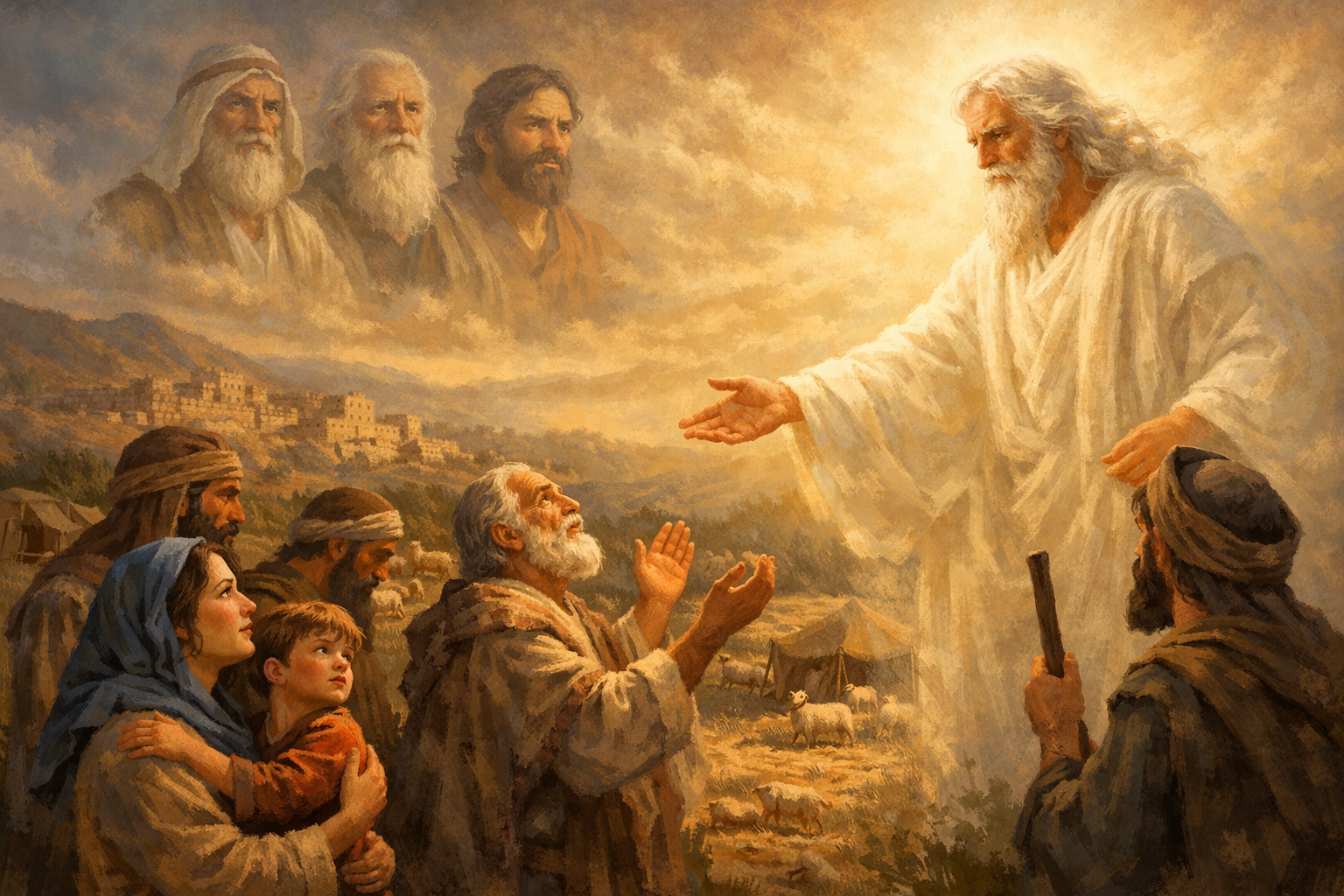
Yahweh's Covenant with Abraham, Isaac, Jacob
GRACE & COMPASSION BASED ON
ABRAHAMIC COVENANT
But (but Yahweh) - Praise God for this term of contrast. It signals an "about face." Had Hazael been allowed to continue oppression of Israel, the nation would have been destroyed. "BUT YAHWEH" changed Israel's course.
Andrew Murray wrote that "One of the words of Scripture, which is almost going out of fashion, is the word 'Covenant'. There was a time when it was the keynote of the theology and the Christian life of strong and holy men. We know how deep in Scotland it entered into the national life and thought. It made mighty men, to whom God, and His promise and power were wonderfully real. It will be found still to bring strength and purpose to those who will take the trouble to bring all their life under control of the inspiring assurance that they are living in covenant with a God who has sworn faithfully to fulfill in them every promise He has given."..."Covenant was above all to give man a hold upon God as the Covenant-keeping God, to link him to God Himself in expectation and hope, to bring him to make God Himself Alone the portion and the strength of His soul." (Two Covenants - see caveat)
The LORD was gracious (chanan; LXX - eleeo - show mercy, pity) to them (Israel) and had compassion (racham;LXX oikteiro - moved by sympathy) on them and turned to them - In the midst of wrath which God had allowed (ordained) Hazael to inflict, He also remembered mercy.
Because of - This is a vital term of explanation, explaining why Yahweh intervened to prevent Hazael from completely destroying Israel. It all has to do with God's faithfulness to His covenant. Mark it down that God is a covenant keeping God and all He does ultimately is based on His covenants with men!
His covenant (beriyth) with Abraham, Isaac, and Jacob - God "remembered" (of course He never forgets like we do) His covenant with the patriarchs. It is notable that this is the sole mention of the Abrahamic Covenant in the 2 Kings. Remember that covenant (beriyth) was a solemn, binding arrangement between Yahweh and sinners. The writer of Hebrews speaks of the glory of the Abrahamic Covenant writing "For men swear by one greater than themselves, and with them an oath given as confirmation is an end of every dispute. In the same way God, desiring even more to show to the heirs of the promise (see Heb 6:13,14) the unchangeableness of His purpose, interposed with an oath,." (Heb 6:16-17)
And would not destroy (shachath) them or cast (shalak/salak) them from His presence (panim/paniym/paneh - literally = face) until now - Israel deserved divine discipline, yet God refused to forsake them because He was faithful to His covenant with Abraham.
The Hebrew phrase translated until now (ʿad hinnāh) literally means “up to this present time.” It marks the boundary of a continuing mercy, indicating that God had so far withheld destroying or casting them from His presence, but it also implies that His mercy had a limit. It could be paraphrased as “God had refrained from destroying them completely up to this point in history.” It does not mean He suddenly destroyed them at that exact moment, but that His patience had not run out yet, though the nation was nearing the point of no return (fulfilled later in the Assyrian exile, 2Ki 17:6–23).
Until now - Until is a critical expression of time, indicating something will continue up to a point and then something else will happen. So, until now in 2 Kings 13:23 God’s restraint was still active, but His judgment was certain to come if repentance did not. Until now expresses the tension between God’s covenant mercy and His righteous judgment. God’s relationship with Israel rested on His covenant with Abraham (Ge 12:1–3; 22:15–18). Even though His people repeatedly sinned, He withheld total destruction out of faithful love (cf His covenant love = hesed). One is reminded of the words in 2 Peter 3:9 "The Lord is not slow about His promise, as some count slowness, but is patient toward you, not wishing for any to perish but for all to come to repentance." In summary, until now reminds readers that divine patience is real but not permanent in this life. A day of reckoning was coming when His mercy, continually despised, would give way to judgment and casting of both Israel and Judah out of the land into exile.
🙏 THOUGHT - Until now teaches that God’s mercy continues only as long as His saving purpose does. It is an invitation to repent before His patience, once extended, must yield to justice. Dear reader, if you have still not surrendered to the covenant mercy of God manifest in His Son's death in your place on the Cross, then by God's Spirit may today be your day of salvation, while you still have today! For the glory of the Lamb. Amen.
Warren Wiersbe - The Syrians were determined to destroy Israel and make it a part of their empire, but the Lord had other plans. His covenant with the patriarchs (Gen. 12:1–3) and His grace toward their descendants moved Him to look upon Israel’s affliction and rescue them from their enemies. It was only when the people sinned so flagrantly that they blasphemed the name of the Lord and defiled His land that God permitted both Israel and Judah to be defeated and taken into bondage. In 722, Assyria conquered the northern kingdom of Israel, and in 586, Jerusalem fell to the Babylonians. The people of Judah returned to their land after the seventy years of captivity expired, but the people of Israel were assimilated into the Assyrian empire.
Related Resources:
- Covenant: As It Relates to Marriage
- Covenant: Why Study It?
- Covenant: Introduction
- Covenant: Abrahamic versus Mosaic
- Covenant: New Covenant in the Old Testament
- Covenant: Why the New is Better
- Covenant: Abrahamic vs Old vs New
Gracious (supplication, pity)(02603) chanan is verb meaning to be gracious toward, to favor, to have mercy on. Generally implies extending "favor" neither expected nor deserved. It is the heartfelt response by someone who has something to give to one who has a need. It reflects the action from a superior to an inferior who has no real claim for gracious treatment. The verb is used in social or secular contexts as well as theological ones. It often has the sense of showing kindness to the poor and needy. First used in Ge 33:5 "The children whom God has graciously given your servant." Chanan may express "generosity," a gift from the heart (Ps 37:21). God especially is Source of undeserved "favor" (Ge 33:11) God is asked repeatedly for such "gracious" acts as only He can do (Nu 6:25; Ge 43:29 Ps 119:29) God's "favor" esp seen in deliverance from one's enemies or evils (Ps 77:9; Am 5:15). God extends His "graciousness" in His own sovereign way and will to whomever He chooses (Ex 33:19). In many ways chanan combines meaning of Greek charis (w general classical Greek sense of "charm" or "graciousness") and NT sense of "undeserved favor" or "mercy." The Septuagint translates with oikteiro = pity or have compassion and with eleeo = show mercy or sympathy. Job begs his friends, "Pity me, pity me" (Job 19:21). The Hithpael stem means "to beseech," as in Gen 42:21 where the brothers recalled how Joseph had pleaded with them. The Syrian captain besought Elijah for his Ide and for the lives of his soldiers (2Kings 1:13). Esther implored the king with tears (Est 8:3; cf. Est 4:8). Amos (Am 5:15) urges his hearers to establish justice that the Lord might be gracious to them. in the final analysis the Lord is sovereign in acting graciously to those whom he selects (Ex 33:19). The verb hanan and its derivatives are components of the names of fifty-one persons (Hannah)
Compassion (have compassion, mercy)(07355) racham from rechem = womb ~ suggesting a connection between the place of the developing child and the strong feelings of love a mother has toward her child) speaks a deep love of one for another rooted in some "natural" bond (cp rechem = womb). Racham manifests itself as an "emotional" response to one's needs. Racham means to feel another's pain so deeply that you are moved to do something about it. Racham means to have compassion, to have mercy, to find mercy. "The word pictures a deep, kindly sympathy and sorrow felt for another who has been struck with affliction or misfortune, accompanied with a desire to relieve the suffering." (Baker)
Ken Hemphill - BUT GOD...Is Gracious
2 Kings 13:23 But the Lord was gracious to them and had compassion on them and turned toward them because of His covenant.
Do you remember as a child when you had done something you knew your parents didn't approve of, and yet no discipline was meted out? You might have been tempted to think your parents didn't know or didn't care. Later, though, you discovered that they had simply been patient with you. They loved you and wanted you to respond to their grace, not just their correction.
Israel was a little slow to learn this.
In verse 1 of 2 Kings 13, we read the headline version of the news — “Jehoahaz son of Jehu became king over Israel in Samaria,” where he ruled for seventeen years. So far, so good! The next verse, however, contains the bad news. “He did what was evil in the Lord's sight.” Furthermore, he caused all Israel to sin along with him. The indictment was clear and swift. The Lord allowed Israel to receive the consequences of their sin, employing Syria as the instrument of God's discipline. Under normal circumstances they would have destroyed Israel.
The only reason this catastrophe had been delayed was by the grace and compassion of the Lord, based in his faithfulness to his own covenant. Even though Israel deserved to be banished from God's presence for their persistent wickedness, patience flowed from God's character. Yet Israel took God's patience for granted, continued in their wicked ways, and were ultimately taken into captivity by Assyria.
Have you ever taken God's patience for granted? Perhaps you know that you are tolerating sin in your own life, and yet God has not yet brought judgment. Rather than thanking God for his patience and kindness, you may have behaved as if holy God is unconcerned or unaware of your sin.
When we experience God's patience with us as frail children, our response should be to turn from our sin and allow him to fully restore our relationship. We should live every day in grateful thanks for God's gracious compassion. (BORROW "BUT GOD - devotions empowered by biblical statements of faith" - RECOMMENDED)
2 Kings 13:24 When Hazael king of Aram died, Ben-hadad his son became king in his place.
- Hazael: Ps 125:3 Lu 18:7
Source: Borrow Bible Knowledge Commentary (page 509)
HAZAEL PASSES TORCH
TO BEN-HADAD.
When Hazael king of Aram died, Ben-hadad his son became king in his place - As noted above, God had raised up Hazael to be His instrument of discipline, but now brings his role as Israel's major antagonist to an end. His death is on God's timetable (as is every human being) for He declared "It is I Who put to death and give life." (Dt 32:39).
2 Kings 13:25 Then Jehoash the son of Jehoahaz took again from the hand of Ben-hadad the son of Hazael the cities which he had taken in war from the hand of Jehoahaz his father. Three times Joash defeated him and recovered the cities of Israel.
- Three times Joash defeated him and recovered the cities of Israel. 2Ki 13:18-19
Related Passages:
2 Kings 13:3 So the anger of the LORD was kindled against Israel, and He gave them continually into the hand of Hazael king of Aram, and into the hand of Ben-hadad the son of Hazael.
2 Kings 13:18-19 Then he said, “Take the arrows,” and he took them. And he said to the king of Israel, “Strike the ground,” and he struck it three times and stopped. 19 So the man of God was angry with him and said, “You should have struck five or six times, then you would have struck Aram until you would have destroyed it. But now you shall strike Aram only three times.”
GOD'S FAITHFULNESS
TO ISRAEL
Then - Marks progression in the narrative, fittingly following the emphasis on God's graciousness and compassion just mentioned.
Jehoash the son of Jehoahaz took again from the hand of Ben-hadad the son of Hazael the cities which he had taken in war from the hand of Jehoahaz his father - Ben-hadad means “son of (the god) Hadad.” This verse summarizes a reversal of fortunes between Israel and Aram (Syria). The phrase “took again”emphasizes recovery, not expansion.
The archaeological Stele of Zakkur mentions "Bar Hadad, son of Hazael".[1][2]
Three times Joash defeated him and recovered the cities of Israel. The fulfillment of Elisha's prophecy saw Jehoash of Israel (798-782 B.C.) recover all the cities that Damascus had taken from Israel.
During the reigns of Jehoash and Jeroboam II, the kingdom of Israel
reached its zenith and there was prosperity in the land.
Warren Wiersbe - King Jehoash won three great victories against the Syrians, and this was sufficient to enable him to recover towns that Hazael and Ben-Hadad had taken from Israel, and then King Jeroboam II recovered the rest of the land. The Lord enabled Jehoash to increase his military power (2Ki 13:7) and overcome the Syrians led by Ben-Hadad III. God’s promise came true and God’s people were spared. During the reigns of Jehoash and Jeroboam II, the kingdom of Israel reached its zenith and there was prosperity in the land. However, with all its achievements and wealth, it was still a land filled with idolatry and much sin (ED: WHAT MODERN COUNTRY DOES THAT SOUND LIKE?). During the reign of Jeroboam II, the prophets Hosea and Amos ministered to the people of Israel. When you read their books, you see the true conditions of the land.
Ron Daniel - Finally, as the chapter draws to a close, we see that Yo-AWSH did have three victories over the Arameans, just as God had spoken through Elisha. If I have discovered nothing else during this lifetime, I do know this: God's Word is always reliable, dependable, sure, and trustworthy. God keeps His Word, you can rest assured that what He says will be done.
Bryant Wood writes that "The Tel Dan Stela is extraordinary in that it names eight Biblical kings: Ben-Hadad II, Hazael, Joram, Ahab, Ahaziah, Jehoram, David and Jehu. It was most likely erected following Hazael’s defeat of Joram and Ahaziah at Ramoth Gilead in ca. 841 BC (2 Kgs 8:28–29). The occasion for the breaking of the stela was probably when Jehoash, king of Israel from 798 to 782, recaptured Israelite territory previously taken by Hazael (2 Kgs 13:24–25). It appears that the monument stood in Dan near the city gate for over four decades. It was a constant reminder to the Israelites that they were subject to the Arameans. When the tide of political power shifted, the Israelites gained the upper hand and the hated stela was broken into many pieces, some of which were reused as building material.
The importance of the Tel Dan Stela lies not in its record of history, because the Bible gives a much fuller account. Its importance, rather, lies in the fact that it is an independent, contemporary, witness to the events of ca. 841 BC and the accuracy of the Biblical record. (See full article with pictures - THE TEL DAN STELA AND THE KINGS OF ARAM AND ISRAEL)