2 Chronicles 29:2
2 Chronicles 29:3
2 Chronicles 29:4
2 Chronicles 29:5
2 Chronicles 29:6
2 Chronicles 29:7
2 Chronicles 29:8
2 Chronicles 29:9
2 Chronicles 29:10
2 Chronicles 29:11
2 Chronicles 29:12
2 Chronicles 29:13
2 Chronicles 29:14
2 Chronicles 29:15
2 Chronicles 29:16
2 Chronicles 29:17
2 Chronicles 29:18
2 Chronicles 29:19
2 Chronicles 29:20
2 Chronicles 29:21
2 Chronicles 29:22
2 Chronicles 29:23
2 Chronicles 29:24
2 Chronicles 29:25
2 Chronicles 29:26
2 Chronicles 29:27
2 Chronicles 29:28
2 Chronicles 29:29
2 Chronicles 29:30
2 Chronicles 29:31
2 Chronicles 29:32
2 Chronicles 29:33
2 Chronicles 29:34
2 Chronicles 29:35
2 Chronicles 29:36
| SECOND CHRONICLES The Kingdom of Israel From Splendor to Disaster |
|||||
| Splendor | Disaster | ||||
| King Solomon of Judah 2 Chronicles 1-9 |
Successive Kings of Judah 2Chr 10-36 |
||||
| Kingdom United |
Kingdom Divided 2Chr 10:1-19 |
Rulers of the Southern Kingdom of Judah After the Split |
The Exile of Judah 2Chr 36:17-23 |
||
| Inaugural
2Chr 1:1-17 |
Solomon's Temple 2Chr 2:1-7:22 |
Solomon's Glory 2Chr 8:1-9:31 |
|||
| Building of the Temple |
Decline & Destruction of the Temple |
Temple Destroyed |
|||
| ~40 Years | ~393 Years | ||||

Click chart to enlarge
Chart from Jensen's Survey of the OT - used by permission
Click Chart from Charles Swindoll
|
1107 |
1011 |
971 |
931 |
853 |
722 |
586 |
||||
| 1Samuel | 2 Samuel | 1Kings | 1Kings | 2 Kings | ||||||
|
31 |
1-4 | 5-10 | 11-20 | 21-24 | 1-11 | 12-22 | 1-17 | 18-25 | ||
|
1 Chronicles 10
|
1Chr 11-19 |
1Chr 20-29 |
2 Chronicles |
2 Chronicles |
2 Chronicles |
|||||
|
Legend: B.C. dates at top of timeline are approximate. Note that 931BC marks the division of the Kingdom into Southern Tribes (Judah and Benjamin) and Ten Northern Tribes. To avoid confusion be aware that after the division of the Kingdom in 931BC, the Southern Kingdom is most often designated in Scripture as "Judah" and the Northern Kingdom as "Israel." Finally, note that 1 Chronicles 1-9 is not identified on the timeline because these chapters are records of genealogy. |
||||||||||
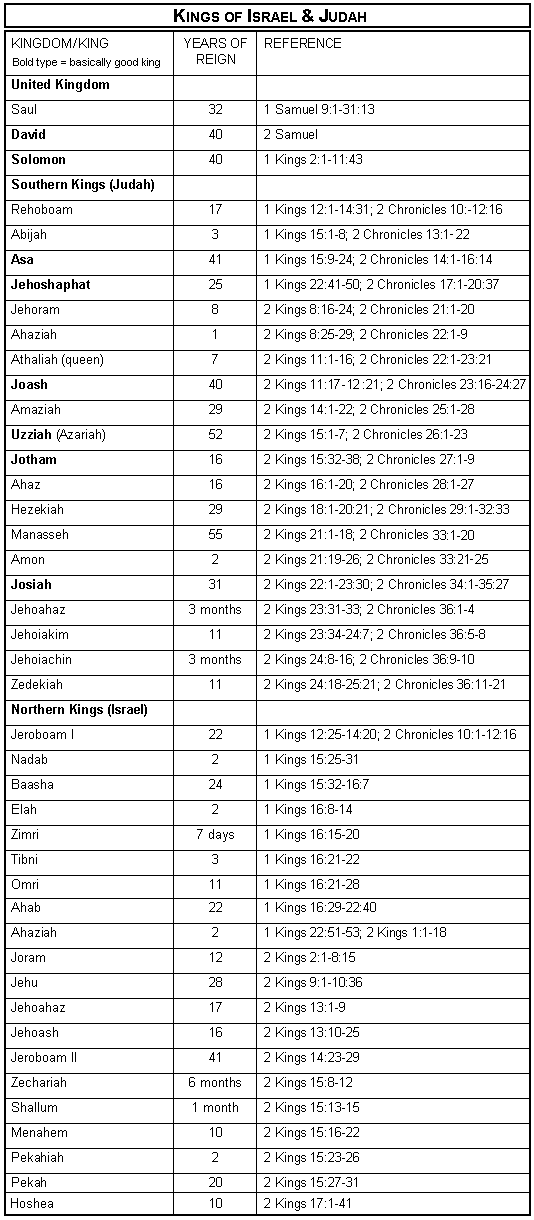
SEE ALSO:
ESV chart - kings of Israel - more information
ESV chart - kings of Judah - more information
Another Chart with Variable Dates for Reigns of Kings
2 Chronicles 29:1 Hezekiah became king when he was twenty-five years old; and he reigned twenty-nine years in Jerusalem. And his mother’s name was Abijah, the daughter of Zechariah.
- Hezekiah: 2Ki 18:1-3 1Ch 3:13 Isa 1:1 Ho 1:1 Mic 1:1 Mt 1:9,10, Ezekias
- Zechariah: 2Ch 26:5 Isa 8:2
- CLICK 2 CHRONICLES COMMENTARIES FOR MULTIPLE SERMONS AND COMMENTARIES
- See BELOW FOR BIBLIOGRAPHY FOR 1-2 CHRONICLES - adapted from Paul Apple's Bible Outlines
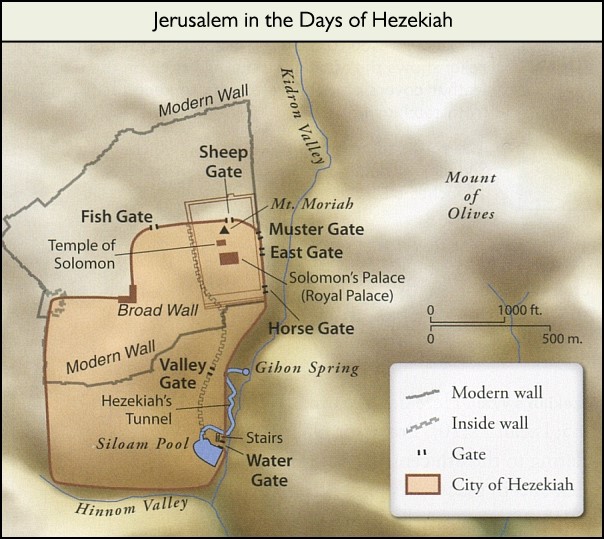
Source: Halley's Bible handbook BORROW
A NEW KING
HEZEKIAH
Hezekiah became king when he was twenty-five years old; and he reigned twenty-nine years in Jerusalem. And his mother’s name was Abijah, the daughter of Zechariah. - This verse introduces Hezekiah by noting his age, length of reign, and maternal lineage, raising the question of why his mother is mentioned rather than his father, Ahaz. While some speculation is unavoidable, it is reasonable to see Hezekiah’s mother, Abijah, as a godly counter-influence whose faith helped shape his character and prepared the way for his faithful leadership. Scripture records no prophet or priest who tutored Hezekiah, and his notoriously evil father certainly did not instruct him in righteousness. Significantly, Abijah’s name means “Yahweh is my Father” or “My Father is the LORD,” and in the Old Testament personal names often carried theological meaning, reflecting character, divine purpose, or spiritual hope. This detail subtly suggests that Abijah embodied covenant faith and exerted a formative influence on her son, fitting the biblical pattern of faithful mothers nurturing genuine faith in the next generation as alluded to in the life of Timothy...
2 Timothy 1:5 For I am mindful of the sincere faith within you, which first dwelt in your grandmother Lois and your mother Eunice, and I am sure that it is in you as well.
2 Timothy 3:15 and that from childhood you have known the sacred writings which are able to give you the wisdom that leads to salvation through faith which is in Christ Jesus.
🙏 THOUGHT - Mothers, you may never be the president of a bank or a business, but the significance of your role in your children’s lives cannot be overstated. You may be the one who leads them to faith, as Timothy’s mother (or grandmother) did, or the one who faithfully urges them on toward spiritual maturity. Though the world may not affirm it, your calling is far more valuable than any prestigious title, for you are not laboring merely for time but for eternity (Col 3:23,24), and your reward is not earthly but heavenly (Mt 6:19,20,21). Be encouraged, then, in the sacred role God has entrusted to you—the nurture and admonition of your children in the ways of the Lord. You may be raising up a Hezekiah or an Abijah! (See more on Abijah below)
John Walton - Hezekiah’s dates are the most controversial, (ED: SUGGESTION DON'T GET TOO MIRED DOWN IN THESE DIFFICULT DATES WITH SEVERAL KINGS AND "MISS THE FOREST FOR THE TREES!") and Thiele, in acknowledged contradiction to some of the biblical synchronisms, assigns him the date of 715–687 B.C., contemporary with Sargon II and Sennacherib of Assyria. Egyptian monarchs of this period were Shabako, Shebitku and Taharqa. Many consider it more likely that Hezekiah came to the throne in 727 and that his encounter with Sennacherib in his fourteenth year (2 Kings 18:13) took place when Sennacherib was still only the crown prince leading the armies for his father, Sargon II. Assyrian records confirm that there was a campaign to the west against Ashdod in 713. This represents the beginning of a lengthy series of conflicts between these protagonists that came to a climax in the siege of Jerusalem in 701 after Sennacherib had ascended to the throne. Archaeological evidence of Hezekiah’s reign includes a seal found at Tell Beit Mirsim with Hezekiah’s name that dates to his reign. The royal jar-handle stamps found in Syro-Palestine from the late eighth century onward probably also originated during Hezekiah’s reign. Along with the expansion and building at Jerusalem (see the comment on 32:5), there is a great shaft at Lachish that was probably built in this period.
D A Carson on 2 Chronicles 29 - WITH THE EXCEPTION OF only a few verses, most of the material in 2 Chronicles 29–31 has no parallel in 2 Kings. What these chapters provide is a detailed account of how King Hezekiah went about reinstituting temple worship that was in line with the Law of God delivered through Moses, and then called the covenant people together not only from Judah but even some from Israel to celebrate the Passover in a way that had not been done for some time.
Here we may focus on 2 Chronicles 29. Paganism had taken such a hold on the people that temple service had fallen into disuse. The temple had become a repository for junk; even the doors needed fixing. Still only twenty-five years old, King Hezekiah, in the first month of his reign (29:3), opened the doors and repaired them. He found some priests and Levites and instructed them to consecrate themselves according to the rites established in the Law, and then to set about cleaning, repairing, and reconsecrating the temple. Moreover, Hezekiah recognized that the past failures in this respect had invited the wrath of God (2Ch 29:6). He was not so foolish as to think the failures were merely a matter of ritual: he saw the larger picture, but perceived, rightly, that the utter neglect of the ritual demonstrated that the hearts of priests, Levites, people, and king alike were entirely alienated from God. His open intention was to reverse this pattern and inaugurate a covenant with the Lord (2Ch 29:10).
The rest of the chapter details what was done. More priests and Levites came on board. The musical instruments secured by David were restored to use. Even small deviations from the Law are recorded, such as the permission to allow the Levites to help with the skinning of the animals for the sacrifices, owing to the fact that at this point too few priests were consecrated (2Ch 29:32–34).
“So the service of the temple of the LORD was reestablished. Hezekiah and all the people rejoiced at what God had brought about for his people, because it was done so quickly” (2Ch 29:35–36).
So it is when genuine revival comes in considerable proportion. Inevitably, God raises up a leader whose prophetic insistence proves irresistible, first to a few, and then to a great crowd. And in the best instances it is not long before men and women look back and marvel at how fast the face of things was massively transformed. They conclude, rightly, that the only explanation is that God himself has done it—that is, that the transformation is not finally attributable to reforming zeal or organizing skill, but to a God who has changed people’s hearts. (BORROW For the Love of God, Combined Edition, Volumes One and Two PAGE 384)
Where did King Hezekiah's godly character come from given that he had one of the most ungodly fathers in the OT?
As alluded to above, while we cannot state with certainty that Abi/Abijah was a godly mother but there are strong textual and theological indicators that point in that direction.
The Scripture explicitly says that Hezekiah was the son of Abijah (Abi), the daughter of Zechariah (2Ki 18:2; 2Ch 29:1). Scripture does not directly describe Abijah’s personal piety or actions, so any conclusion must be inferential rather than explicit.
Here are some thoughts to consider in support of why Abi/Abijah was a godly woman and a godly mother to Hezekiah:
(1) Her deliberate mention
In royal summaries, mentioning the mother often signals influence—especially when the father is notorious. Hezekiah’s father, Ahaz, was one of Judah’s most evil kings. The narrator’s choice to name the mother rather than highlight the father strongly suggests a counter-influence.
(2) The meaning of her name
Abijah / Abi means “Yahweh is my Father” or “My Father is the LORD.” In the Old Testament, names frequently carry theological intent. While a godly name does not guarantee godly character, it often reflects covenant identity within faithful families.
(3) Hezekiah’s radical break from his father
Hezekiah did not merely improve Ahaz’s policies—he reversed them immediately and decisively (2 Chronicles 29:3). Such a sharp spiritual divergence is best explained by formative influence before he came to the throne, an influence that most plausibly was maternal.
(4) Absence of another mentor
Scripture names no prophet or priest who raised or tutored Hezekiah prior to his reign. That silence strengthens the likelihood that his earliest spiritual formation came from the home, and therefore from his mother.
(5) Biblical pattern of godly maternal influence
Scripture repeatedly shows faithful mothers shaping covenant faith in their sons (e.g., Hannah in 1Sa 1:1-28+; Pr 1:8, Pr 6:20; 2Ti 1:5, 2Ti 3:15). Interpreting Abijah as a godly influence fits a well-established biblical pattern.
In conclusion, Scripture does not explicitly call Abijah godly, however Scripture implies she was a faithful, covenant-minded influence and finally her presence explains Hezekiah’s faith better than any alternative the text provides. While the Bible stops short of explicitly describing Abijah as godly, the narrative, her name, her mention in contrast to Ahaz, and Hezekiah’s extraordinary faith all strongly suggest that she was a godly mother whose influence shaped one of Judah’s greatest kings.
One other point to mention regarding Hezekiah's godly character can be gleaned from his description in 2Ki 18:6 which says Hezekiah "kept His commandments, which the LORD had commanded Moses." Clearly, that indicates he knew the commandments given to Moses. While I cannot prove it, one way he would have been familiar with the commandments is if he carried out the instructions given to the kings in Dt 17:18-20. You might argue that within the first month of his reign he began the reforms (2Ch 29:3), so how could he have had time to read and meditate on the Scriptures? Without going into great detail (because some of the times are a bit "fuzzy" to me), it is very likely that Hezekiah co-reigned with his father Ahaz for several years before becoming sole king at age 25. If you care to dig deeper below are a few more thoughts on why co-regency was a reasonable consideration and would have given him time to carry out Dt 17:18-20 (it would have taken him about 6 months to handwrite a copy as prescribed in the instructions to the king).
Why a co-regency
makes sense biblically
(1) The chronological data otherwise conflicts.
- Hezekiah is said to be 25 years old when he began to reign and to have reigned 29 years (2 Kings 18:2).
- His 6th year is also the year Samaria fell (722 BC) (2 Kings 18:9–10).
- Working backward, this places the start of his reign around 728/727 BC—before Ahaz’s death if Ahaz died around 715 BC. A co-regency resolves this.
(2) Ahaz’s reign allows room for it.
- Ahaz reigned 16 years (2 Kings 16:2), commonly dated 735–715 BC. A co-regency beginning around 728/727 BC fits well within Ahaz’s final years, especially given Judah’s political instability and Assyrian pressure.
(3) Judah commonly used co-regencies.
- Co-regencies were a normal administrative practice in Judah (e.g., Uzziah/Jotham; later Hezekiah/Manasseh). They helped ensure continuity during illness, crisis, or transition.
(4) Scripture hints at early leadership.
- Hezekiah launches sweeping religious reforms immediately “in the first year of his reign” (2 Chronicles 29:3). That level of preparedness is consistent with prior shared rule rather than sudden accession.
Likely reconstruction
- Co-regency with Ahaz: ~728/727–715 BC
- Sole reign: 715–686 BC
- Age 25: refers to the start of the co-regency, not the sole reign.
Conclusion
- The co-regency view best harmonizes 2 Kings 18, 2 Chronicles 29, and the Assyrian synchronisms. Without it, the dates strain or contradict one another. Thus, while the Bible never explicitly states “Hezekiah co-reigned,” the evidence makes it the most historically and textually sound conclusion.
PAUL APPLE - BIG IDEA: SPIRITUAL REVIVAL REQUIRES CONVICTED REPENTANCE, CLEANSING OF GOD’S TEMPLE AND COMMITMENT TO JOYFULLY WORSHIP WHOLEHEARTEDLY
Hezekiah's reign is described in 2Ki 17:1-41, 2Ki 18:1-37, 2Chr 29:1-32:33 and Isaiah 36-39.
J.A. Thompson: The Chronicler had a deep interest in Hezekiah. He devoted more space to his account of Hezekiah’s reign than he did to any king of Judah other than David and Solomon (2Ch 29-32). But is interest is different from that of 2 Kings 18- 20. The Book of Kings devotes only a single verse to Hezekiah’s religious reform, concentrating rather on political and military affairs. Here the account of the reform occupies three chapters (2Ch 29-31) that deal with the rehabilitation of the temple (2Ch 29), the celebration of the Passover by “all Israel” (chap. 30), and the renewal of regular worship (2Ch 31). The remaining chapter on Hezekiah’s reign refers to the deliverance of Hezekiah from Sennacherib, king of Assyria, and Hezekiah’s sickness, pride, success, and death. Hezekiah is presented as the king most like David and Solomon (2Ch 29:2, 11-14; 30:18-20, 26). The Chronicler had great hopes of a united Israel once again under a Davidic king and united around the temple of the Lord, other unauthorized places of worship being abandoned. (SEE 1, 2 Chronicles: An Exegetical and Theological Exposition)
John Olley - Hezekiah acted early in his reign to restore the temple and its worship. In a context of major external change, his priority was the worship of God. . . The process involved four steps:
(1) after opening the doors (cf. 2Ch 28:24), Hezekiah charged the priests and Levites to “consecrate [ritually cleanse] yourselves, and consecrate the house of the Lord” (2Ch 29:3–11);
(2) in willing obedience they completed the twofold consecration (2Ch 29:12–19);
(3) Hezekiah and city officials brought animals that were sacrificed, “making atonement for all Israel” (2Ch 29:20–24), accompanied by the restored Levitical music as burnt offerings were made (2Ch 29:25–30); and finally,
(4) with the consecration of the Levites completed, “the assembly” participated in the offerings (2Ch 29:31–35a). In this way “the service of the house of the Lord was restored,” and all “rejoiced” (2Ch 29:35b–36). All steps were necessary: personnel, building, and cleansed utensils were the prelude to the worship’s functioning as intended. The dramatic restoration happened “suddenly,” due to God’s grace (2Ch 29:36).
Raymond Dillard: Hezekiah’s reinstitution of legitimate temple worship early during his reign is described in four steps:
(1) the instruction and ritual purification of the priests and Levites (2Ch 29:3–15);
(2) the purification of the temple and its precincts (2Ch 29:16–19);
(3) the rededication of the temple (2Ch 29:20–30);
(4) the participation of the populace (2Ch 29:31–36). (Borrow 2 Chronicles)
August Konkel: Outline:
- Summary of Hezekiah’s Reign 2Ch 29:1-2
- Exhortation to Restoration 2Ch 29:3-11
- Restoration of the Sanctuary 2Ch 29:12-19
- Rededication of the Temple 2Ch 29:20-30
- Sacrifices of Praise 2Ch 29:31-36 (See 1 & 2 Chronicles)
Matthew Henry Notes: Chapter: 29
SUMMARY - This passage introduces the exemplary reign of Hezekiah, highlighting his unmatched zeal for restoring true worship and covenant faithfulness in Judah. Coming to the throne at twenty-five, Hezekiah immediately set about reforming the nation by reopening the temple, exhorting the priests and Levites, cleansing and restoring the house of God, and reviving neglected ordinances to make atonement for past sins (2 Chr 29:1–36). Unlike many predecessors, he acted decisively and wholeheartedly “like David,” recognizing that Judah’s calamities stemmed from abandoning God’s worship. His impassioned address traced national distress to spiritual neglect, declared his resolve to renew the covenant with the LORD, and called the Levites to repentance, diligence, and service, reminding them that God had chosen them to stand before Him. The chapter thus portrays Hezekiah as a king who rightly began with God, leading a joyful national revival marked by obedience, renewed worship, and divine favor.
We are here entering upon a pleasant scene, the good and glorious reign of Hezekiah, in which we shall find more of God and religion than perhaps in any of the good reigns we have yet met with; for he was a very zealous, devout, good man, none like him. In this chapter we have an account of the work of reformation which he set about with vigour immediately after his accession to the crown. Here is, I. His exhortation to the priests and Levites, when he put them in possession of the house of God again (v. 1-11). II. The care and pains which the Levites took to cleanse the temple, and put things in order there (v. 12-19). III. A solemn revival of God's ordinances that had been neglected, in which atonement was made for the sins of the last reign, and the wheels were set a-going again, to the great satisfaction of king and people (v. 20-36).
2Ch 29:1-11
Here is,
I. Hezekiah's age when he came to the crown. He was twenty-five years old. Joash, who came to the crown after two bad reigns, was but seven years old; Josiah, who came after two bad reigns, was but eight, which occasioned the delay of the reformation; but Hezekiah had come to years, and so applied himself immediately to it. We may well think with what a sorrowful heart he beheld his father's idolatry and profaneness, how it troubled him to see the doors of the temple shut, though, while his father lived, he durst not open them. His soul no doubt wept in secret for it, and he vowed that when he should receive the congregation he would redress these grievances, which made him do it with more readiness and resolution.
II. His general character. He did that which was right like David, 2Ch 29:2. Of several of his predecessors it had been said that they did that which was right, but not like David, not with David's integrity and zeal. But here was one that had as hearty an affection for the ark and law of God as ever David had.
III. His speedy application to the great work of restoring religion. The first thing he did was to open the doors of the house of the Lord, 2Ch 29:3. We are willing to hope his father had not quite suppressed the temple service; for then the holy fire on the altar must have gone out, and we do not read of the re-kindling of it; but he had hindered the people from attending it, and the priests, except such of them as were of his own party, 2 Ki. 16:15. But Hezekiah immediately threw the church doors open, and brought in the priests and Levites. He found Judah low and naked, yet did not make it his first business to revive the civil interests of his kingdom, but to restore religion to its good posture again. Those that begin with God begin at the right end of their work, and it will prosper accordingly.
IV. His speech to the priests and Levites. It was well known, no doubt, that he had a real kindness for religion and was disaffected to the corruptions of the last reign; yet we do not find the priests and Levites making application to him for the restoration of the temple service but he calls upon them, which, I doubt, bespeaks their coldness as much as his zeal; and perhaps, if they had done their part with vigour, things would not have been brought into so very bad a posture as Hezekiah found them in. Hezekiah's exhortation to the Levites is very pathetic.
1. He laid before them the desolations of religion and the deplorable state to which it was brought among them (2Ch 29:6, 7): Our fathers have trespassed. He said not "My father,'' because it became him, as a son, to be as tender as might be of his father's name, and because his father would not have done all this if their fathers had not neglected their duty. Urijah the priest had joined with Ahaz in setting up an idolatrous altar. He complained,
(1.) That the house of God had been deserted: They have forsaken God, and turned their backs upon his habitation. Note, Those that turn their backs upon God's ordinances may truly be said to forsake God himself.
(2.) That the instituted worship of God there had been let fall. The lamps were not lighted, and incense was not burnt. There are still such neglects as these, and they are no less culpable, when the word is not duly read and opened (for that was signified by the lighting of the lamps) and when prayers and praises are not duly offered up, for that was signified by the burning of incense.
2. He showed the sad consequences of the neglect and decay of religion among them, 2Ch 29:8. 9. This was the cause of all the calamities they had lain under. God had in anger delivered them to trouble, to the sword, and to captivity. When we are under the rebukes of God's providence it is good for us to enquire whether we have not neglected God's ordinances and whether the controversy he has with us may not be traced to this neglect.
3. He declared his own full purpose and resolution to revive religion and make it his business to promote it (2Ch 29:10): "It is in my heart (that is, I am fully resolved) to make a covenant with the Lord God of Israel (that is, to worship him only, and in that way which he has appointed); for I am sure that, otherwise, his fierce anger will not turn away from us.'' This covenant he would not only make himself, but bring his people into the bond of.
4. He engaged and excited the Levites and priests to do their duty on this occasion. This he begins with (2Ch 29:5); this he ends with, 2Ch 29:11. He called them Levites to remind them of their obligation to God, called them his sons to remind them of the relation to himself, that he expected that, as a son with the father, they should serve with him in the reformation of the land.
(1.) he told them what was their duty, to sanctify themselves first (by repenting of their neglects, reforming their own hearts and lives, and renewing their covenants with God to do their duty better for the time to come), and then to sanctify the house of God, as his servants, to make it clean from every thing that was disagreeable, either through the disuse or the profanation of it, and to set it up for the purposes for which it was made.
(2.) He stirred them up to do it (2Ch 29:11): "Be not now negligent, or remiss, in your duty. Let not this good work be retarded through your carelessness.'' Be not deceived, so the margin. Note, Those that by their negligence in the service of God think to mock God, and put a cheat upon him, do but deceive themselves, and put a damning cheat upon their own souls. Be not secure (so some), as if there were no urgent call to do it or no danger in not doing it. Note, Men's negligence in religion is owing to their carnal security. The consideration he quickens them with is derived from their office. God had herein put honour upon them: He has chosen you to stand before him. God therefore expected work from them. They were not chosen to be idle, to enjoy the dignity and leave the duty to be done by others, but to serve him and to minister to him. They must therefore be ashamed of their late remissness, and, now that the doors of the temple were opened again, must set about their work with double diligence.
QUESTION - Who was Hezekiah in the Bible? WATCH VIDEO
ANSWER - Hezekiah was one of the few kings of Judah who was constantly aware of God’s acts in the past and His involvement in the events of every day. The Bible describes Hezekiah as a king who had a close relationship with God, one who did “what was good and right and faithful before the LORD his God” (2 Chronicles 31:20).
Hezekiah’s story is told in 2 Kings 16:20—20:21; 2 Chronicles 28:27—32:33; and Isaiah 36:1—39:8. He is also mentioned in Proverbs 25:1; Isaiah 1:1; Jeremiah 15:4; 26:18–19; Hosea 1:1; and Micah 1:1.
Hezekiah, a son of the wicked King Ahaz, reigned over the southern kingdom of Judah for twenty-nine years, from c. 715 to 686 BC. He began his reign at age 25 (2 Kings 18:2). He was more zealous for the Lord than any of his predecessors (2 Kings 18:5). During his reign, the prophets Isaiah and Micah ministered in Judah.
After Ahaz’s wicked reign, there was much work to do, and Hezekiah boldly cleaned house. Pagan altars, idols, and temples were destroyed. The bronze serpent that Moses had made in the desert (Numbers 21:9) was also destroyed, because the people had made it an idol (2 Kings 18:4). The temple in Jerusalem, whose doors had been nailed shut by Hezekiah’s own father, was cleaned out and reopened. The Levitical priesthood was reinstated (2 Chronicles 29:5), and the Passover was reinstituted as a national holiday (2 Chronicles 30:1). Under Hezekiah’s reforms, revival came to Judah.
Because King Hezekiah put God first in everything he did, God prospered him. Hezekiah “held fast to the Lord and did not stop following him; he kept the commands the Lord had given Moses. And the Lord was with him; he was successful in whatever he undertook” (2 Kings 18:6–7).
In 701 BC, Hezekiah and all of Judah faced a crisis. The Assyrians, the dominant world power at the time, invaded Judah and marched against Jerusalem. The Assyrians had already conquered the northern kingdom of Israel and many other nations, and now they threatened Judah (2 Kings 18:13). In their threats against the city of Jerusalem, the Assyrians openly defied the God of Judah, likening Him to the powerless gods of the nations they had conquered (2 Kings 18:28–35; 19:10–12).
Faced with the Assyrian threat, Hezekiah sent word to the prophet Isaiah (2 Kings 19:2). The Lord, through Isaiah, reassured the king that Assyria would never enter Jerusalem. Rather, the invaders would be sent home, and the city of Jerusalem would be spared (2 Kings 19:32–34). In the temple, Hezekiah prays a beautiful prayer for help, asking God to vindicate Himself: “Now, Lord our God, deliver us from his hand, so that all the kingdoms of the earth may know that you alone, Lord, are God” (2 Kings 19:19).
God, faithful as always, kept His promise to protect Jerusalem. “That night the angel of the Lord went out and put to death a hundred and eighty-five thousand in the Assyrian camp. When the people got up the next morning—there were all the dead bodies!” (2 Kings 19:35). The remaining Assyrians quickly broke camp and withdrew in abject defeat. “So the Lord saved Hezekiah and the people of Jerusalem. . . . He took care of them on every side” (2 Chronicles 32:22).
Later, Hezekiah became very sick. Isaiah told him to set things in order and prepare to die (2 Kings 20:1). But Hezekiah prayed, beseeching God to be merciful and to remember all the good he had done. Before Isaiah had even left the king’s house, God told Isaiah to tell Hezekiah that his prayer had been heard and that his life would be extended fifteen years. Isaiah applied a poultice, and Hezekiah was healed (2 Kings 20:5–7).
However, soon after his healing, Hezekiah made a serious mistake. The Babylonians sent a gift to Hezekiah, for they had heard Hezekiah had been sick. In foolish pride, Hezekiah showed the Babylonians all of his treasures, all the silver and gold, and everything in his arsenal. There was nothing Hezekiah did not parade in front of them. Isaiah rebuked Hezekiah for this act and prophesied that all the king had shown the Babylonians would one day be taken to Babylon—along with Hezekiah’s own descendants.
During the years following his illness, Hezekiah fathered the heir to Judah’s throne, Manasseh, who would turn out to be the evilest king ever to reign in Judah (2 Kings 18—20; 2 Chronicles 29—32; Isaiah 36—39). Tradition has it that Manasseh is the one who murdered Hezekiah’s friend, Isaiah.
Hezekiah’s life is, for the most part, a model of faithfulness and trust in the Lord. His faith was more than superficial, as his bold reforms show. Hezekiah’s trust in the Lord was rewarded with answered prayer, successful endeavors, and miraculous victory over his enemies. When faced with an impossible situation, surrounded by the dreadful and determined Assyrian army, Hezekiah did exactly the right thing—he prayed. And God answered.GotQuestions.org
2 Chronicles 29:2 He did right in the sight of the LORD, according to all that his father David had done.
- 2Ch 28:1 34:2 2Ki 18:3
Related Passages:
1 Kings 15:11 Asa did what was right in the sight of the LORD, like David his father.
2 Chronicles 17:3 The LORD was with Jehoshaphat because he followed the example of his father David’s earlier days and did not seek the Baals,
2 Chronicles 34:2 (JOSIAH) He did right in the sight of the LORD, and walked in the ways of his father David and did not turn aside to the right or to the left.
HEZEKIAH DID RIGHT
LIKE DAVID
He did right (yashar) in the sight of the LORD - Is there not a clue here as to why Hezekiah did right? Perhaps. Athough we see the phrase in the sight of the LORD with many other kings, not all responded to the truth that the eyes of the LORD were watching. That's a personal choice for all of us. God is always watching, always presence, and the question is will will make our choices each day always in the light of that truth? That's Coram Deo living. So it is very possible that Hezekiah lived his life with a continual sense of the LORD's presence. Perhaps he had read 1Ch 16:11. In any case, such a sense of God's eyes continually upon us engenders a heart desire to walk in a manner worthy of the LORD to please Him in all respects.
The Hebrew word yāshār (יָשָׁר) carries the practical sense of being “upright,” “straight,” or “right.” In Scripture, it often describes moral integrity, righteousness, and alignment with God’s will. To be yāshār is not merely to act correctly in outward behavior but to live in a way that is consistent with God’s truth and character. Proverbs 3:5–6 captures this idea beautifully: “Trust in the Lord with all your heart, and do not lean on your own understanding. In all your ways acknowledge him, and he will make straight (yāshār) your paths.” Here, the word conveys the sense of God directing one’s life along a straight, morally sound path when one walks in faith and obedience.
Yāshār also carries the imagery of something level, or aligned, like a straight edge or plumb line used by a builder. In the ancient world, a craftsman would use a straight edge to ensure that a wall or beam was true and properly aligned. In the same way, God’s Word serves as the “straight edge” by which human conduct is measured. Hezekiah's conduct was straight not crooked like his father Ahaz which suggest he was guided by the "straight edge" of God's Word of Truth! (See discussion above)
according to all that his father David had done. Scripture consistently holds David up as the benchmark king of covenant faithfulness. While none were sinless, Asa, Jehoshaphat, Hezekiah, and Josiah are commended for ruling in conscious continuity with David’s God-centered heart, reforms, and loyalty to Yahweh.
2 Chronicles 29:3 In the first year of his reign, in the first month, he opened the doors of the house of the LORD and repaired them.
- in the first month 2Ch 34:3 Ps 101:3 Ec 9:10 Mt 6:33 Ga 1:16
- he opened the doors of the house of the LORD : 2Ch 29:7 28:24 2Ki 16:14-18
Related Passages:
2 Chronicles 28:24 Moreover, when Ahaz gathered together the utensils of the house of God, he cut the utensils of the house of God in pieces; and he closed the doors of the house of the LORD and made altars for himself in every corner of Jerusalem.
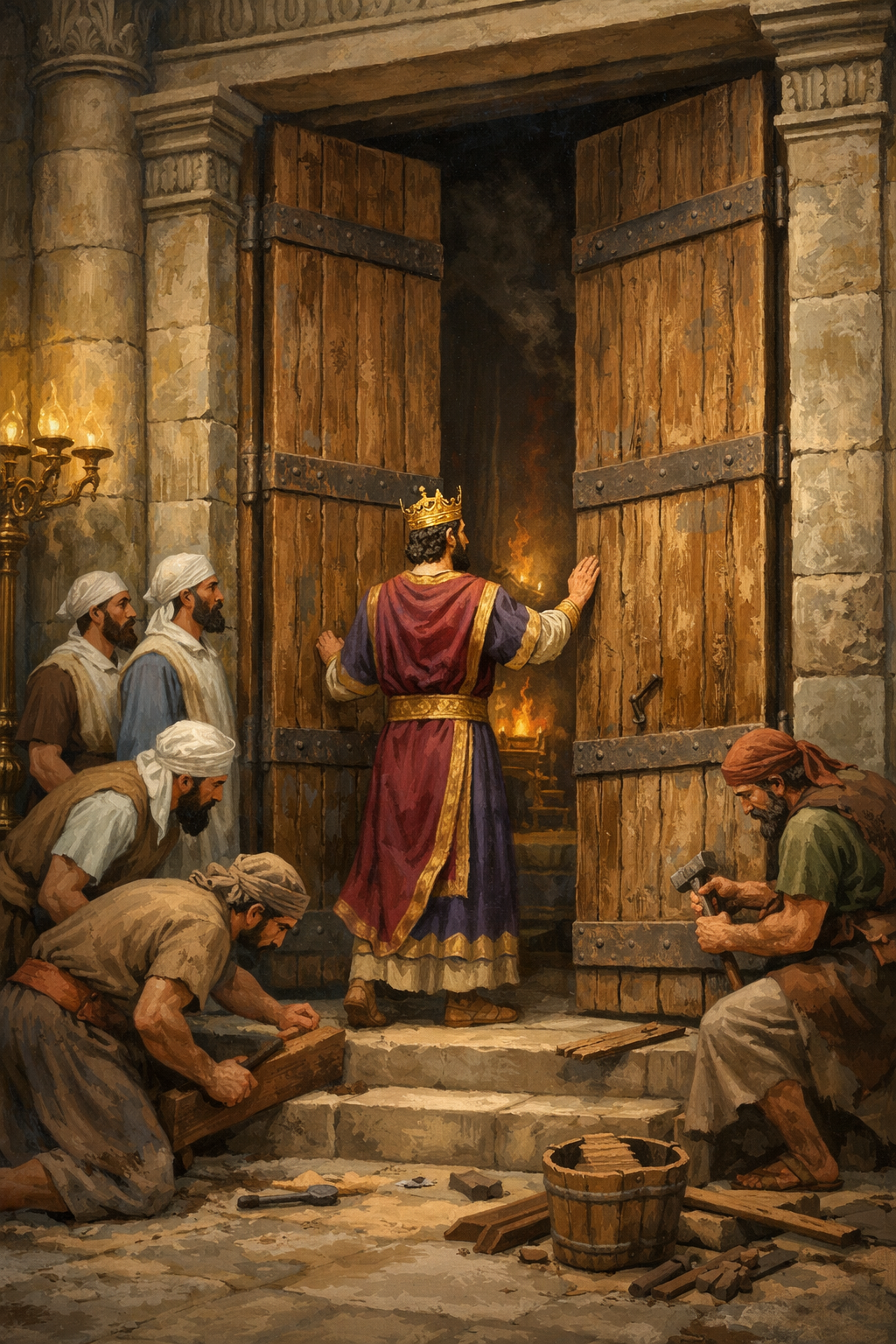
HEZEKAIAH OPEN'S GOD'S
HOUSE AND BEGINS REPAIRS
In the first year of his reign, in the first month - Note Hezekiah's priority when he assumes the throne. His first priority was not political reform, military strength, or economic recovery—it was spiritual renewal. He understood that the nation’s true strength and blessing depended on its relationship with God. Hezekiah's immediate focus on God and His presence (in the Temple) reminds me of Solomon's words in Psalm 127:1, words he may have even read, focusing especially on the words "UNLESS" and "VAIN"...
A Song of Ascents, of Solomon.
Unless the LORD builds the house,
They labor in vain who build it;
Unless the LORD guards the city,
The watchman keeps awake in vain.
🙏 THOUGHT - Hezekiah recognized that without God’s presence and power, all his well planned efforts would fall short of what they could be if God were in them! That was true then and it is still true today. Do you include God in your plans? Based on the truth of Psalm 127:1 you should!
he opened the doors of the house of the LORD and repaired them - Wicked Ahaz had closed them (2Ch 28:24, cf 2Ch 29:6). Hezekiah does not waste time reversing his apostate father's evil acts and immediately reopened and repaired the doors of the house of the LORD. By opening the Temple doors, Hezekiah was symbolically and literally reopening the way for the people to return to fellowship with Jehovah.
This section marks the most extended
account of revival in biblical history
This section marks the most extended account of revival in biblical history (2 Chr 29:1–31:21), surpassed only by the outpouring that began on the Day of Pentecost (Acts 2). Seasons of repentance and renewal recur throughout Scripture: repeatedly during the era of the judges (cf. Judges 2:16), at Mount Sinai under Moses (Exodus 32–34), at Mizpah under Samuel (1 Samuel 7), on Mount Carmel under Elijah (1 Kings 18–19), in Judah under Asa (2 Chronicles 15), in Nineveh under Jonah (Jonah 3), again in Judah under the young King Josiah (2 Chronicles 34–35), and finally in the postexilic community through Ezra and Nehemiah (Ezra 9–10; Nehemiah 8–10).
John Schultz (free 239 page commentary) It is a most amazing fact that Hezekiah, who grew up in the polluted atmosphere of Ahaz’ palace, developed such an intimate fellowship with God.
Bob Utley - The temple had been desecrated and closed by Ahaz (cf. 2 Chr. 28:24). It is surprising how the kings of Judah vacillated between (1) godly king ‒ Jotham, Hezekiah, Josiah and (2) evil king ‒ Ahaz, Manessah, Amon
Andrew Hill: Hezekiah’s invitation to purify the temple (2Ch 29:3-11) is dominated by a royal speech (2Ch 29:5-11) directed to the priests and Levites (2Ch 29:4). Like King Solomon (cf. 2Ch 2:1), the proper worship of Yahweh is an immediate priority for Hezekiah as he initiates the cleansing of the temple in his first month of rule and celebrates the religious festivals in his second (cf. 2Ch 30:2). The act of reopening the temple doors shut up by King Ahaz (2Ch 28:24) and repairing them is a symbolic gesture indicating the temple is once again serviceable for worship (29:3). Hezekiah assembles the priests and Levites outside the still defiled sanctuary in a square to the east of the temple precinct (2Ch 29:4) – perhaps the square adjacent the Water Gate (cf. Neh. 8:1). The king’s speech to the priests and Levites contains two injunctions: a call to the religious leadership to “consecrate” themselves and an instruction to them to “remove all defilement from the sanctuary” (2Ch 29:5). The term “consecrate” (qds) means to make holy by setting apart someone or something exclusively for the service of God (cf. Ex. 28:41; 29:1; 30:30). The word “defilement” (niddah) is used generally of ritual impurity, although here the writer probably has the pollution of idol worship in mind. (See 1 and 2 Chronicles - Page 54)
August Konkel: The speech of Hezekiah uses the vocabulary of exile to describe the failure of the nation. The people have abandoned the Lord as in the days of the separation under Rehoboam (2 Chron 12:1; cf. 13:10). The wrath of God had come upon Judah and Jerusalem, putting them in the same situation as the people in the north. It is the desire of Hezekiah to reverse this situation, but he is dependent on the religious leaders to make it possible. Renewal of the covenant requires the revitalization of the temple as the central symbol of the divine rule. Only the Levites can care for the temple, and only the priests can enter it to burn incense. (See 1 & 2 Chronicles)
Iain Duguid: Door opening and repairing was a powerful expression of Hezekiah’s leadership in desiring to serve the Lord, but as king he could not enter. The work now had to be done by “the priests and Levites,” directed by the king. (ESV Expository Commentary (Volume 3): 1 Samuel–2 Chronicles)
John Walton - ideology of temple restoration in the ancient Near East. The temple was the center of culture, economy and society in Syria, Mesopotamia and Israel. It served as the house of the city’s patron deity, and thus the god was believed to be present there. It was incumbent upon the ruler of the city to attend to the “care and feeding” of the deity. The statue of the god was bathed, clothed and fed daily. Just as important as the king’s military success was his attention to the upkeep of the god’s house. Countless building inscriptions from both Assyria and Babylonia attest to the king’s piety because of his restoration of a certain god’s house. Similarly, those who rebuilt or restored Yahweh’s house were accorded this same type of piety. Restoration entailed both physical and ritual aspects. A neglected temple would need structural repairs and perhaps the restoration of pilfered furniture and accessories. It is possible that gold objects or gold plating on walls would need to be replaced. Then the temple would need to have its sanctity reestablished through appropriate rituals. Finally, it would need to be provided with funding and personnel so that it could operate
2 Chronicles 29:4 He brought in the priests and the Levites and gathered them into the square on the east.
- east: 2Ch 32:6 Ne 3:29 Jer 19:2
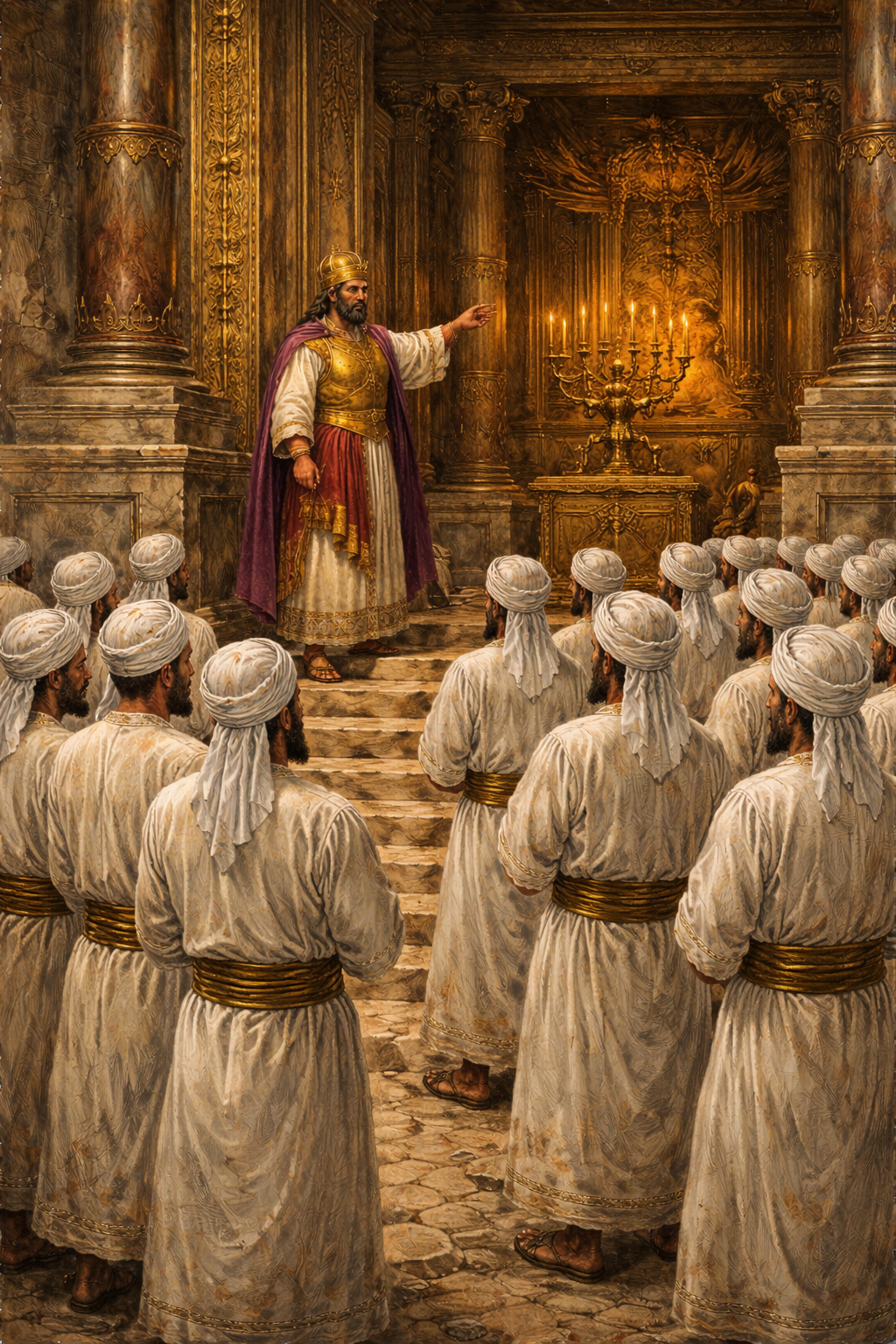
PRIEST AND LEVITES
GATHER ON EAST SIDE
He brought in the priests and the Levites and gathered them into the square on the east - This was an open area in front of the east gate of the Temple. Square (Heb. rechob) means a broad open plaza, not a city square in the modern sense. It was east of the Temple proper, near the East Gate (also called the front of the Temple). This area functioned as a public gathering space, suitable for assembling large groups—here, priests and Levites. The east side was the main ceremonial approach to the Temple (cf. Ezekiel’s visions later emphasize the east gate).
It is interesting that the priests and the Levites are gathered at the eastern side, the very side which in 586 BC will mark the departure of the LORD's Shekinah Glory in Ezekiel (Ezek 10:18,19 and Ezek 11:22-23) and will also mark His return in the same book (Read Ezek 43:1-5) at a TBA ("to be announced!"). The east side functions in Ezekiel as a theological marker—the direction of divine departure in judgment and later return in restoration. Against this backdrop, the gathering on the eastern side is rich with meaning: it subtly anticipates both the tragedy of lost glory and the hope of its future return.
Why gather them there? Hezekiah intentionally gathers the priests and Levites outside the inner sacred courts: They were spiritually unclean at this point (2 Chr 29:5–6). The inner court and sanctuary could not yet be entered. The eastern plaza allowed public accountability, corporate instruction and a visible call to repentance and renewal.
Bob Utley - These priests and Levites would have been out of work (ED: DURING THE APOSTATE REIGN OF AHAZ). They had to find other jobs to support their families
John Walton - the Levites. The Levitical families had not played a major role in the Jerusalem cult since the time of Jehoshaphat, over a century earlier. In accordance with typical restoration procedures, Hezekiah used the traditional priestly families to cleanse the temple and restore it to ritual purity. He then restored them to their original functions (see 2Ch 19:5)
2 Chronicles 29:5 Then he said to them, “Listen to me, O Levites. Consecrate yourselves now, and consecrate the house of the LORD, the God of your fathers, and carry the uncleanness out from the holy place.
- Consecrate yourselves now 2Ch 35:6 Ex 19:10,15 1Ch 15:12
- consecrate the house 2Ch 29:16 34:3-8 Eze 36:25 Mt 21:12,13 1Co 3:16,17 2Co 6:16 7:1 Eph 5:26,27
- carry the uncleanness out from the holy place. Eze 8:3,9-18
HEZEKIAH COMMANDS
CONSECRATION
Then - This marks a clear progression in the narrative: the priests and Levites stand poised, likely wondering what Hezekiah will do next. Then, suddenly—like the sharp staccato of a machine gun—Hezekiah issues four rapid-fire commands.
He said to them, “Listen to me, O Levites. Consecrate yourselves now, and consecrate the house of the LORD, the God of your fathers, and carry the uncleanness out from the holy place - They were first to consecrate themselves, a process that included washing (Exodus 19:10, 14), avoiding defilement (Leviticus 11:44), and refraining from intercourse (Exodus 19:15). Hezekiah therefore commands the Levites to begin with personal consecration before cleansing the LORD’s house, because purified servants must come before a purified sanctuary.
Iain Duguid: The rationale includes three points (2Ch 29:6–10), each introduced by a marker: (1) “For our fathers have been unfaithful” (maʻal; cf. 2Ch 28:19, 22), leading to God’s “wrath” (2Ch 29:6–8; as it had for the north, 2Ch 28:13); (2) “For behold,” the results are before “your own eyes” in the deaths and captives (2Ch 29:8, 9); and (3) “Now” Hezekiah himself pledges loyalty to the Lord so that “his fierce anger may turn away” (2Ch 29:10). (ESV Expository Commentary (Volume 3): 1 Samuel–2 Chronicles)
Frederick Mabie has a good summary of Hezekiah's call for spiritual cleansing - Hezekiah’s speech also functions as a rallying call to faithfulness in the light of the disastrous (albeit covenantal) consequences of unfaithfulness. (Recall that speeches are a key facet of the Chronicler’s means of expressing theological points of emphasis [cf. 2Ch 13:4-12].) Hezekiah’s focused commitment to restore Judah to faithfulness and nullify God’s righteous anger against his people rises to the level of a covenant (2Ch 29:10). Later, Hezekiah will convene an assembly of Judean officials (cf. 2Ch 29:20-31) and finally the whole community (cf. 2Ch 30:1-27) for worship and dedication at the Jerusalem temple. (See The Expositor's Bible Commentary: 1 Chronicles-Job - Page 286)
Bob Utley - "Consecrate" The writings of Moses give some procedures for this, mostly from the original ordination of Aaron and his sons.
- Exod. 19:10,14 ‒ washed their clothes
- Exod. 28:41; 29:7; 30:30; Lev. 8:12 ‒ anoint them with oil
- Exod. 29:1-3,10-18; Lev. 8:20 ‒ sacrifice animals
- Exod. 29:5-6; 40:13 ‒ put on holy garments
- Exod. 29:19 ‒ lay hands on sacrifice
- Exod. 29:20-21 ‒ place blood in special places on the High Priest's body and altar
- Exod. 29:24-28 ‒ special wave offering ceremony
The OT records the call to consecration of people and priests often but does not give the specific elements that are required. God's people must be holy because YHWH is holy. This holiness had several components. (1) ceremonial purification (2) obedience to Mosaic Law (3) willingness to seek YHWH
2 Chronicles 29:6 “For our fathers have been unfaithful and have done evil in the sight of the LORD our God, and have forsaken Him and turned their faces away from the dwelling place of the LORD, and have turned their backs.
- For our fathers: 2Ch 28:2-4,23-25 34:21 Ezr 5:12 9:7 Ne 9:16,32 Jer 16:19 44:21 La 5:7 Da 9:16 Mt 10:37 23:30-32
- have forsaken him: Jer 2:13,17
- have turned their backs. Heb. given the neck Jer 2:27 Eze 8:16
Related Passages:
Deuteronomy 28:20 “The LORD will send upon you curses, confusion, and rebuke, in all you undertake to do, until you are destroyed and until you perish quickly, on account of the evil of your deeds, because you have forsaken Me.
GIVING GOD THE
"COLD SHOULDER"!
For our fathers - While the plural is accurate, the reality is that Hezekiah’s own father was among the most unfaithful and evil kings of Judah. Here Hezekiah unleashes a sobering litany of charges against the fathers, openly confessing Judah’s covenant guilt: they abandoned the LORD and committed evil by turning away from His dwelling place. This deliberate act of spiritual apostasy is repeatedly condemned throughout Scripture (cf. 2 Chronicles 29:6; Jeremiah 2:27; Ezekiel 8:16).
(1) have been unfaithful - They acted treacherously against the LORD by breaking covenant trust and loyalty owed to Him (cf. Leviticus 26:40; 2 Chronicles 28:19).
and (2) have done evil in the sight of the LORD our God and - They lived in open defiance of God’s revealed will, persisting in attitudes and actions that He explicitly judged as morally and spiritually corrupt, despite repeated warnings and clear revelation (cf. Judges 2:11; 2 Kings 17:7–18).
(3) have forsaken Him and - They willfully abandoned covenant loyalty to the LORD, rejecting Him as their God and severing the relationship established by grace and obligation under the covenant (cf. Deuteronomy 31:16).
(4) turned their faces away from the dwelling place of the LORD and - They deliberately refused to seek God’s presence at the place where He chose to set His name, showing indifference toward worship, sacrifice, and communion with Him (cf. 2 Chronicles 7:16; Psalm 27:4).
(5) have turned their backs - They displayed open contempt by consciously reversing direction, choosing rebellion instead of repentance and substituting defiance for devotion (cf. Jeremiah 2:27).
David Guzik: Poole suggests that the idea of turning the back to God could also be understood literally, because according to 2 Kings 16, in the days of Ahaz the altar was moved and its replacement was directed to the east, in the manner of pagan altars instead of toward the west as God commanded. The idea was therefore that under this dangerous innovation, one had to literally turn his back to the temple and the ark of God to stand before the altar.
Andrew Hill: The rest of the royal address rehearses the neglect of the temple by Hezekiah’s predecessors (2Ch 29:6-8). The depth of Judah’s apostasy under Ahaz is underscored in the fivefold emphasis on their wicked deeds: - faithlessness, - doing evil, - forsaking God, - turning their faces away from the temple, and - turning their backs on Yahweh (2Ch 29:6). It is for this reason that Yahweh’s wrath fell on Judah, resulting in costly losses in battle and the exile of many citizens of Judah (2Ch 29:9; cf. 2Ch 28:5-8). (See 1 and 2 Chronicles - Page 54)
J.A. Thompson: Hezekiah did not excuse himself or his generation when he described the sins of their fathers. Rather, he asserted that the nation must acknowledge its corporate guilt and take steps to rectify what had been done. Admitting that one’s nation and cultural heritage have turned away from God is not easy, but true repentance must place the glory of God above national and family pride. (SEE 1, 2 Chronicles: An Exegetical and Theological Exposition)
Bob Utley - 29:6-7 These verses spell out the sins of the fathers (esp. Ahaz).
- they have been unfaithful ‒ Qal PERFECT, cf. 2 Chr. 26:16,18; 2Ch 28:19,22; 2Ch 36:14
- they have done evil in the sight of the Lord our God ‒ 2 Chr. 28:2-3,22-25
- they have forsaken Him ‒ Qal IMPERFECT with waw; this is the opposite of "seek." cf. Dt. 28:20; 2Ch 15:2; 24:18,20; 28:6; Jdg 10:10; Jer 1:16
- they turned their faces away from the dwelling place of the Lord (i.e., abandoned temple worship (cf. 2 Chr. 28:22-25)
- they turned their backs to YHWH ‒ this is an idiom, "stiff-necked," which denotes someone who is obstinate and unchanging, cf. Exod. 32:8-9; 33:3,5; 34:9; Deut. 9:6; 31:27; 2 Kgs. 17:14; 2 Chr. 30:8; Neh. 9:16,17; Jer. 7:26; 17:23; 19:15; this rebellious stubbornness was a characteristic of YHWH's people from the very beginning
- they shut the doors of the porch (Ahaz in 2 Chr. 28:24)
- they put out the lamps
- they had not burned incense
- they had not offered burnt offerings (cf. Leviticus 1)
2 Chronicles 29:7 “They have also shut the doors of the porch and put out the lamps, and have not burned incense or offered burnt offerings in the holy place to the God of Israel.
- 2Ch 29:3 28:24 Lev 24:2-8 2Ki 16:17,18 Mal 1:10
Related Passages:
2 Chronicles 28:24 Moreover, when Ahaz gathered together the utensils of the house of God, he cut the utensils of the house of God in pieces; and he closed the doors of the house of the LORD and made altars for himself in every corner of Jerusalem.
Exodus 27:20-21 “You shall charge the sons of Israel, that they bring you clear oil of beaten olives for the light, to make a lamp burn continually. 21“In the tent of meeting, outside the veil which is before the testimony, Aaron and his sons shall keep it in order from evening to morning before the LORD; it shall be a perpetual statute throughout their generations for the sons of Israel.
TRUE WORSHIP OF YAHWEH PLACED
"ON HOLD" UNDER AHAZ
This statement in 2 Chronicles 29:8 describes the deliberate suspension of true worship in Judah. The temple was effectively shut down and its ministries extinguished: the doors were closed, the lamps were put out, incense was withheld, and sacrifices were abandoned—pattern of covenant neglect condemned elsewhere in Scripture (cf. 2 Chronicles 28:24; Exodus 27:20–21; Leviticus 24:1–4; Numbers 28:3–8; Psalm 74:7–9).
(6) They have also shut the doors of the porch and - By closing the temple entrance, they intentionally cut off access to God’s appointed place of worship, halting covenant fellowship at its very threshold (cf. 2 Chronicles 28:24; 29:3).
(7) put out the lamps, and - They extinguished the divinely commanded light of the sanctuary, symbolizing both spiritual darkness and disregard for God’s revealed order (cf. Exodus 27:20–21).
(8) have not burned incense or- They ceased atoning sacrifice and devoted worship, cutting off the God-ordained means of reconciliation and consecration (cf. Leviticus 1:3–9; 2 Chronicles 29:27).
(9) offered burnt offerings in the holy place to the God of Israel. - They ceased atoning sacrifice and devotion to the God of Israel, cutting off the prescribed means of worship and reconciliation (cf. Leviticus 1:3–9; 2 Chronicles 29:27).
Those who turn their backs on God’s ordinances may rightly be said to forsake God Himself. When the lamps were left unlit and incense went unburned, worship did not merely decline in form—it failed in substance. Likewise today, neglect is no less serious when God’s Word is not faithfully read and taught (corresponding to the light of the lamps) or when prayer and praise are withheld, which the burning of incense was meant to signify.
Bob Utley - "in the holy place" This designation could refer to the whole temple area or the shrine/tent. Usually the outer part of the inner tent is called "the holy place"; both priests and Levites could minister there. However, the inner part was the "holy of holies," where only the High Priest could go on the Day of Atonement. In this context, Solomon's temple was defiled and had to be cleaned, so this holy designation was altered until it was reconsecrated.
2 Chronicles 29:8 “Therefore the wrath of the LORD was against Judah and Jerusalem, and He has made them an object of terror, of horror, and of hissing, as you see with your own eyes.
- Therefore: 2Ch 24:18 34:24,25 36:14-16 De 28:15-20
- He has made them an object of terror 2Ch 28:6-8.
- horror, De 28:25
- hissing: Lev 26:32 De 28:59 1Ki 9:8 Jer 18:15,16 19:8 25:9,18 29:18
Related Passages:
Deuteronomy 28:37 “You shall become a horror, a proverb, and a taunt among all the people where the LORD drives you.
Jeremiah 18:16 To make their land a desolation, An object of perpetual hissing; Everyone who passes by it will be astonished And shake his head.
Acts 13:47 “For so the Lord has commanded us, ‘I HAVE PLACED YOU AS A LIGHT FOR THE GENTILES, THAT YOU MAY BRING SALVATION TO THE END OF THE EARTH.’”
Isaiah 42:6 “I am the LORD, I have called You in righteousness, I will also hold You by the hand and watch over You, And I will appoint You as a covenant to the people, As a light to the nations,
WRATH OF JEHOVAH
TERROR, HORROR, HISSING
Therefore - Term of conclusion. This is signaling the end of a cause-and-effect argument. Because Judah and Jerusalem had forsaken the LORD—abandoning His sanctuary, neglecting true worship, and embracing idolatry—the inevitable result followed: the wrath of the LORD came upon them in the form of public judgment. Their calamities were neither random nor excessive but the just and predictable outcome of persistent covenant disobedience, exactly as God had warned in advance (cf. Deuteronomy 28:15–37; 2 Chronicles 28:19, 24).
The wrath of the LORD was against Judah and Jerusalem - This describes Yahweh’s righteous response to their covenant unfaithfulness and rejection of true worship. God’s anger here is not capricious emotion but holy opposition to sin that had reached a breaking point (cf. 2 Chronicles 28:19; 29:8).
And He has made them an object of terror, of horror (sammah), and of hissing, as you see with your own eyes - This points to a judgment that was visible, undeniable, and instructional. Judah became a public warning—an object of trembling fear, desolation, and contempt to surrounding peoples (cf. Jeremiah 19:8). Hezekiah likely alludes to the recent catastrophic defeat at the hands of Israel, when 120,000 were slain in one day and 200,000 were taken captive (2 Chronicles 28:6–8), a disaster still fresh in living memory.
Since Judah and Jerusalem violated God’s covenant, the LORD justly turned His anger against them and made them a public spectacle of judgment, an object of terror, horror, and derision, fulfilling the covenant curses and prophetic warnings visible to all (Dt 28:37; Jeremiah 18:16).
This description ("object of terror, of horror, and of hissing") is a characteristic theological reflection in Chronicles, which consistently interprets Israel’s history through the lens of covenant obedience and disobedience as outlined in Leviticus 26 and Deuteronomy 28: because Judah violated the covenant, the LORD made them an object of terror (literally “trembling,” Deut 28:25; Jer 15:4; Ezek 23:46), an object of horror or desolation (Dt 28:37; 2Ch 30:7; Jer 25:9, 11; 29:18), and an object of hissing, a visible and audible sign of derision and disgust (1Ki 9:8; Jer 18:16; Lam 2:15–16; Mic 6:16). Israel, who had been called to be a kingdom of priests and a holy nation (Ex 19:5–6), a light to the nations revealing the mercy and character of the LORD (Isa 42:6; 49:6; Acts 13:47), instead became a living testimony to God’s righteous judgment, demonstrating not His saving compassion but the serious consequences of covenant rebellion.
This triad—terror, horror, and hissing—is a characteristic theological motif in Chronicles, consistently interpreting Israel’s history through the covenant framework of Leviticus 26 and Deuteronomy 28. Because Judah violated the covenant, the LORD made them an object of terror (literally “trembling”; cf. Deuteronomy 28:25; Jeremiah 15:4; Ezekiel 23:46), an object of horror or desolation (cf. Deuteronomy 28:37; 2 Chronicles 30:7; Jeremiah 25:9, 11; 29:18), and an object of hissing, a sign of public scorn and disgust (cf. 1 Kings 9:8; Jeremiah 18:16; Lamentations 2:15–16; Micah 6:16).
Tragically, the nation of Israel, called to be a kingdom of priests and a holy nation (Exodus 19:5–6), and a light to the nations that was to reveal the mercy and character of the LORD (Isaiah 42:6; 49:6), became instead a living testimony to God’s righteous judgment. Their condition proclaimed not His saving compassion, but the sobering consequences of covenant rebellion, “as you see with your own eyes.”
Horror (desolation) (08047) sammah/shammah basically conveys the idea of the desolation, ruin or wasting caused by some great disaster, usually as a result of divine judgment. And so it describes destruction, ruin or wasting of both evil people (Ps 73:19, Isa 5:9) and destruction of places because of evil people (Jer 2:15, Zeph 2:15, Jer 48:9, 51:29). Shammah describes the reaction in those who witness the destruction as astonishment, dismay or horror (Dt 28:37, Jer 19:8, Jer 49:13, 17, 50:3, 23, Jer 51:37, 41, 43, Ezek 23:33). Sammah describes the extreme dismay people can feel at seeing destruction, a horror that fills persons (Jer. 8:21). Shammah was used by the prophet Hosea to describe the fate of the Northern Kingdom - "Ephraim will become a desolation in the day of rebuke; Among the tribes of Israel I declare what is sure." (Hosea 5:9)
2 Chronicles 29:9 “For behold, our fathers have fallen by the sword, and our sons and our daughters and our wives are in captivity for this.
- our fathers: 2Ch 28:5-8,17 Lev 26:17 La 5:7
Related Passages:
2 Chronicles 28:5-8, 17 5Wherefore, the LORD his God delivered him into the hand of the king of Aram; and they defeated him and carried away from him a great number of captives and brought them to Damascus. And he was also delivered into the hand of the king of Israel, who inflicted him with heavy casualties. 6For Pekah the son of Remaliah slew in Judah 120,000 in one day, all valiant men, because they had forsaken the LORD God of their fathers. 7And Zichri, a mighty man of Ephraim, slew Maaseiah the king’s son and Azrikam the ruler of the house and Elkanah the second to the king. 8The sons of Israel carried away captive of their brethren 200,000 women, sons and daughters; and they took also a great deal of spoil from them, and brought the spoil to Samaria.....28:17 For again the Edomites had come and attacked Judah and carried away captives.
EXPLANATION OF THE TERROR,
HORROR AND HISSING
For - Term of explanation - For functions as a clear term of explanation, introducing the reason for the terror, desolation, and shame described in verse 8. Judah’s devastation is now traced to its root cause: covenant violation. Because the nation broke faith with the LORD, His wrath was expressed in military defeat, loss of freedom, and national humiliation, exactly as the covenant had warned (cf. Leviticus 26; Deuteronomy 28).
Behold (hinneh) = Pay attention to what follows. This is a summons to attention, urging the hearers to face an undeniable and painful reality. What follows is not theory or distant history, but visible evidence of divine judgment.
Our fathers have fallen by the sword - This is Hezekiah’s sober confession that Judah’s military losses were not accidental setbacks but the direct consequence of covenant unfaithfulness. The slain fathers point to the catastrophic defeats recently inflicted by their enemies, particularly the slaughter of 120,000 men in a single day (2 Chronicles 28:5–6).
God’s covenant threats were neither empty nor exaggerated,
but certain and just when His people persist in disobedience.
And our sons and our daughters and our wives are in captivity for this - Hezekiah confesses that Judah’s rebellion had devastating generational consequences. As a direct result of covenant infidelity, families were torn apart through deportations: to Syria (2 Chronicles 28:5), to Israel (2 Chronicles 28:8, 11, 13–15), and to Edom (2 Chronicles 28:17). This captivity not only fulfilled the covenant curses but also foreshadowed the greater national exiles to come: Israel’s removal by Assyria in 722 BC and Judah’s later captivity by Babylon in 586 BC. In this way, Hezekiah interprets present suffering as both judgment and warning and living proof that God’s covenant threats were neither empty nor exaggerated, but certain and just when His people persist in disobedience.
2 Chronicles 29:10 “Now it is in my heart to make a covenant with the LORD God of Israel, that His burning anger may turn away from us.
- Now it is in my heart 2Ch 6:7-8
- to make a covenant: 2Ch 15:12,13 2Ch 23:16 2Ch 34:30-32 Ezr 10:3 Ne 9:38 10:1-39 Jer 34:15,18 Jer 50:5 2Co 8:5
- that his fierce: 2Ki 23:3,26
Related Passages:
2 Chronicles 6:7-8 “Now it was in the heart of my father David to build a house for the name of the LORD, the God of Israel. 8“But the LORD said to my father David, ‘Because it was in your heart to build a house for My name, you did well that it was in your heart.
2 Chronicles 15:12-13 (KING ASA) They entered into the covenant to seek the LORD God of their fathers with all their heart and soul; 13 and whoever would not seek the LORD God of Israel should be put to death, whether small or great, man or woman.
2 Chronicles 23:16 (A GOOD START BY THE PRIEST UNDER JOASH/HEHOASH WHO DID NOT HAVE A GOOD FINISH) Then Jehoiada made a covenant between himself and all the people and the king, that they would be the LORD’S people.
2 Chronicles 34:30-32 (UNDER KING JOSIAH) The king went up to the house of the LORD and all the men of Judah, the inhabitants of Jerusalem, the priests, the Levites and all the people, from the greatest to the least; and he read in their hearing all the words of the book of the covenant which was found in the house of the LORD. 31 Then the king stood in his place and made a covenant before the LORD to walk after the LORD, and to keep His commandments and His testimonies and His statutes with all his heart and with all his soul, to perform the words of the covenant written in this book. 32 Moreover, he made all who were present in Jerusalem and Benjamin to stand with him. So the inhabitants of Jerusalem did according to the covenant of God, the God of their fathers.
2 Chronicles 30:8 “Now do not stiffen your neck like your fathers, but yield to the LORD and enter His sanctuary which He has consecrated forever, and serve the LORD your God, that His burning anger may turn away from you.
Proverbs 16:6 By lovingkindness and truth iniquity is atoned for, And by the fear of the LORD one keeps away from evil.
HEZEKIAH'S HEART
TOWARD YAHWEH
Now it is in my heart to make a covenant (beriyth) with the LORD God of Israel This expresses Hezekiah’s settled resolve to renew the covenant relationship under which the whole nation stood—the covenant whose defining promise was, “I will be your God, and you shall be My people.” This was not innovation but restoration. In doing so, Hezekiah deliberately follows the pattern of Asa, who led Judah into covenant renewal during a time of spiritual crisis (2 Chronicles 15:12–13), and he anticipates the later reforms of Josiah, who likewise bound the nation anew to the LORD (2 Chronicles 34:30–32). Covenant renewal here signifies a conscious return to exclusive loyalty, obedience, and worship of Yahweh as Israel’s true King.
🙏 THOUGHT - In 2 Chronicles 29:10, the covenant Hezekiah refers to was not a new covenant replacing earlier ones, nor was it the Abrahamic, Davidic, or New Covenants, all of which are unconditional. Rather, it was a renewal of the Mosaic Covenant, a recommitment to the covenant relationship that Israel had broken through shameless idolatry. Scripture repeatedly describes this apostasy as spiritual adultery (cf. Jer 3:9, 5:7, Ezek 23:37, Hos 4:13), made all the more striking when one recalls that Baal can mean “husband.” Throughout the Old Testament, Yahweh presents Himself as Israel’s Husband, and Israel as His wife, bound to Him by covenant (cf. Jer 31:32; Isa 54:5). Hezekiah’s covenant, therefore, may be viewed as a kind of “marriage renewal ceremony”—not creating a new relationship, but restoring a broken one. Like a human marriage renewal, it was a reaffirmation of love, loyalty, and exclusive devotion to the LORD. (For more discussion see Israel the Wife of Jehovah)
Hezekiah was clearly coming back to the true heart of worship and would have liked Matt Redman's modern song The Heart of Worship (play)...
When the music fades
All is stripped away
And I simply come
Longin' just to bring
Something that's of worth
That will bless Your heart
I'll bring You more than a song
For a song in itself
Is not what You have required
You search much deeper within
Through the ways things appear
You're looking into my heart
I'm comin' back to the heart of worship
And it's all about You
It's all about You, Jesus
That (term of purpose) His burning anger may turn away from us - THAT functions as a term of purpose, stating the intended outcome of this covenant renewal that His burning anger may turn away from us. Hezekiah understands that repentance and renewed obedience are God’s appointed means for averting judgment and restoring favor. Scripture consistently affirms this principle, that humble turning to the LORD results in mercy rather than wrath. Compare...
2 Chronicles 30:8 “Now do not stiffen your neck like your fathers, but yield to the LORD and enter His sanctuary which He has consecrated forever, and serve the LORD your God, that His burning anger may turn away from you.
Proverbs 16:6 By lovingkindness and truth iniquity is atoned for, And by the fear of the LORD one keeps away from evil.
Burning anger is a vivid biblical metaphor for the LORD’s holy and righteous wrath against persistent covenant rebellion. It depicts an intense, purposeful response to sin, like fire, but not as uncontrolled rage (like a wildfire), but as just judgment designed to discipline, purge evil, and call God’s people back to Himself. Hezekiah recognizes that Judah’s suffering flowed from this divine anger (2 Chronicles 29:8–9), and he acts decisively so that judgment might give way to mercy, warning might lead to repentance, and wrath might be replaced by restoration (cf. Deuteronomy 29:27; Jeremiah 4:4).
Bob Utley - 29:10-11 Hezekiah's message to the priests and Levites continues (2 Chr. 29:4).
- It is in my heart to make (i.e., renew) a covenant with YHWH.
- So that His burning anger may turn away from us (BDB 996, KB 1427, Qal JUSSIVE; this root is also used of repentance).
- "My sons," in context this must refer to the assembled members of the tribe of Levi.
- do not be negligent ‒ Niphal IMPERFECT used in a JUSSIVE sense (ED: JUSSIVE CONVEYS SENSE OF A COMMAND)
- for YHWH has chosen you to stand before Him (i.e., Nu 3:6-9; 8:14-19)
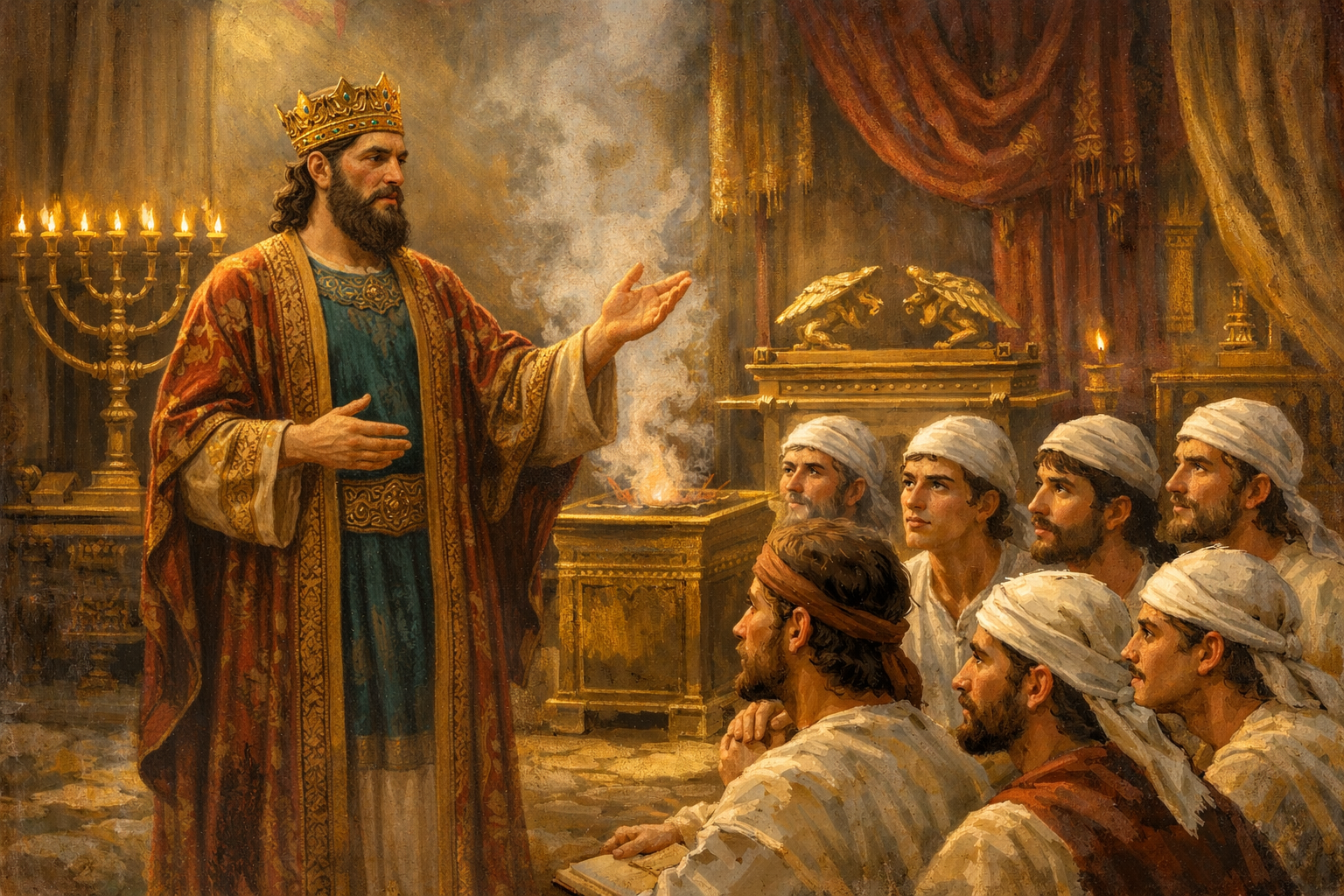
2 Chronicles 29:11 “My sons, do not be negligent now, for the LORD has chosen you to stand before Him, to minister to Him, and to be His ministers and burn incense.”
- negligent: Ga 6:7,8
- for the LORD has chosen you Nu 3:6-9 8:6-14 18:2-6 De 10:8
- burn incense: or, offer sacrifice, Nu 16:35-40 18:7
HEZEKIAH'S INSTRUCTIONS FOUNED ON
LORD'S REASON FOR CHOSING
My sons - This address refers specifically to the priests and the Levites who had been gathered “into the square on the east” (2 Chronicles 29:4). Though spoken by the king, the phrase conveys pastoral authority and covenant concern, underscoring both responsibility and privilege in their calling.
Do not be negligent now - Hezekiah urgently warns them against carelessness, complacency, or delay. Having diagnosed the nation’s spiritual collapse, he presses the Levites to respond with immediate, wholehearted diligence in the sacred work entrusted to them. Halfhearted service at such a moment would only compound Judah’s guilt.
For (term of explanation) the LORD has chosen you - Their ministry was not self-appointed nor merely hereditary; they were sovereignly selected by Yahweh Himself. This emphasizes that ministry is fundamentally God’s work accomplished through chosen servants, not human initiative or personal ambition. Responsibility flows from divine election.
(1) to stand before Him - The Levites were chosen to serve in the immediate presence of the LORD, representing the people before Him and attending to His dwelling place (Deuteronomy 10:8). This privileged access underscores the seriousness of their role. In the new covenant, believers likewise live consciously before God, drawing near with confidence through Christ as a royal priesthood (Hebrews 4:16; 1 Peter 2:9).
(2) to minister to Him, and - They were appointed to render direct service to the LORD, carrying out worship according to His revealed will (Numbers 18:2). Their work was God-centered before it was people-directed. Is this not a pattern apropos to every pastor and teacher of God's Word ? (That's rhetorical). In a similar way, individual believers today minister to the Lord by first presenting their lives as living sacrifices as their spiritual service of worship (Romans 12:1).
(3) to be His ministers and - The Levites functioned as God’s designated servants, set apart to maintain and lead the ministry of the sanctuary (2 Chronicles 35:3). In parallel, every believer is appointed as Christ’s servant, entrusted with representing Him through character, proclamation, and good works in the ministry of reconciliation (2 Corinthians 5:18–20; Ephesians 4:12).
(4) burn incense - They were responsible for offering incense daily, symbolizing prayer and intercession continually ascending before the LORD (Exodus 30:7–8; Psalm 141:2). This priestly duty finds its fulfillment in the life of the believer, who is called to continual prayer and intercession, offering spiritual sacrifices that rise acceptably to God through Jesus Christ (Revelation 5:8; 1 Thessalonians 5:17, Hebrews 13:15,16).
Together, these four purposes reveal the dignity, gravity, and God-centered focus of the Levites’ calling and by extension, the seriousness of all service rendered before the LORD.
2 Chronicles 29:12 Then the Levites arose: Mahath, the son of Amasai and Joel the son of Azariah, from the sons of the Kohathites; and from the sons of Merari, Kish the son of Abdi and Azariah the son of Jehallelel; and from the Gershonites, Joah the son of Zimmah and Eden the son of Joah;
- the sons: 1Ch 6:19,44 15:6 23:21-23
- Kohathites: Ex 6:16-25 Nu 4:2-20 1Ch 6:16-18 15:5 23:12-20
- the sons: 1Ch 6:16-18 15:5 23:12-20
- from the Gershonites: 1Ch 6:17,20,21 15:7 23:7-11
BEGINNING OF NAMING OF
7 GROUPS OF 14 LEVITES
Then (progression of narrative) the Levites arose - This records the prompt, organized response of the Levitical leaders from all three major clans, showing unified obedience as representative heads rose to carry out Hezekiah’s call for temple restoration.
EXCURSUS ON LEVITES - The Levites trace their story to Jacob’s prophetic blessing, where Levi—paired with Simeon—was rebuked for violent, cruel anger and sentenced to be scattered in Israel (Genesis 49:5–7), a judgment rooted in the treachery at Shechem (Gen 34) that warns against unrestrained wrath; yet God’s grace transformed this curse into calling when the Levites proved loyal to the LORD at Sinai (Exodus 32:26–29), becoming the priestly tribe dispersed throughout Israel as ministers and keepers of cities of refuge, possessing no tribal land but enjoying the privilege of sacred service; their history teaches believers to shun the counsel of uncontrolled anger and pursue Spirit-produced self-control (cf. Galatians 5:22–23), while ultimately pointing to the gospel’s greater restoration, where through Christ’s substitutionary righteousness (2 Corinthians 5:21) God forms a renewed people—a royal priesthood—called to declare His praises (1 Peter 2:9).
Mahath, the son of Amasai and Joel the son of Azariah, from the sons of the Kohathites; and from the sons of Merari, Kish the son of Abdi and Azariah the son of Jehallelel; and from the Gershonites, Joah the son of Zimmah and Eden the son of Joah - This list names representative leaders from all three major Levitical clans—Kohathites, Merarites, and Gershonites—showing that the work of restoration was orderly, inclusive, and clan-wide, with each family contributing under recognized leadership to the cleansing and renewal of the LORD’s house (2 Chronicles 29:12).
EXCUSUS ON KOHATHITES, GERSHONITES, MERARITES - The Kohathites, Gershonites, and Merarites were the three clans of the tribe of Levi, descended from Levi’s sons Kohath, Gershon, and Merari (Numbers 26:57; Genesis 46:11), with Moses, Aaron, and Miriam belonging to the Kohathite line (1 Chronicles 6:2–3); together they fulfilled Israel’s priestly and tabernacle responsibilities with clearly defined duties—Kohathites caring for the most holy furnishings such as the ark and table (Numbers 4:4–14; 10:21), Gershonites maintaining curtains and coverings (Num 4:24–26), and Merarites transporting the structural elements of the tent (Num 4:31–33), with transport provisions reflecting their loads (the Kohathites carrying holy objects on poles, Num 7:9; the Gershonites and Merarites using ox carts, Num 7:6–8); lacking a tribal territory of their own, the Levites were instead scattered among Israel in designated cities and pasturelands—including cities of refuge—allocated by lot from the other tribes, so that priestly service and instruction permeated the nation (Joshua 21:1–8).
Source: All the Genealogies of the Bible: Visual Charts and Exegetical Commentary
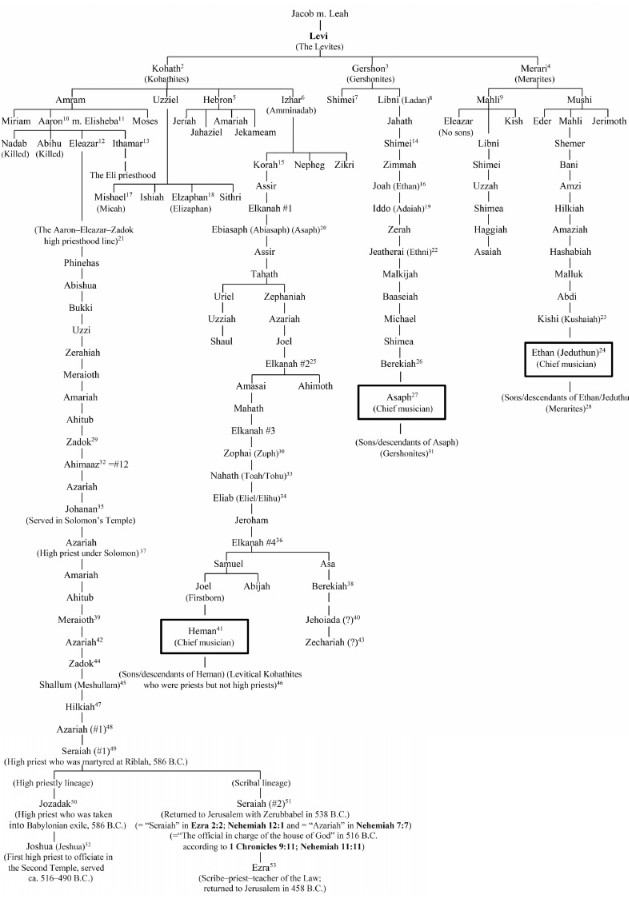
Andrew Hill: The name list serves both to memorialize the contributions of key leaders in Israelite history and to remind the present audience that God’s work is accomplished through the cooperative efforts of faithful individuals. (See 1 and 2 Chronicles - Page 54)
David Guzik: These were men who had been complicit in the neglect and disgrace of the temple. Yet the Chronicler rightly noted these men by name, because when they were exhorted by King Hezekiah to do what was right in cleansing and restoring the temple, they did it.
Raymond Dillard: The list of fourteen Levites is composed of (1) two representatives from each of the three Levitical families—Kohath, Merari, and Gershon; (2) two representatives from the great Kohathite family of Elizaphan; and (3) two representatives from each division of the singer—Asaph, Heman, and Jeduthun. When compared with the list in 1 Chr 15:5–10, the Levitical singers have replaced Hebron and Uzziel, perhaps reflecting a growing influence on the part of the musical families (Petersen, Prophecy, 81). The family of Elizaphan had achieved sufficient importance as to be virtually a fourth Levitical clan, though in fact a subclan of Kohath (Num 3:30; 1 Chr 15:8). (Borrow 2 Chronicles)
Iain Duguid: The naming of seven groups may signify wholeness, all groups responding to Hezekiah’s charge, “Do not now be negligent” (2 Chron. 29:11; cf. “seven” four times in 2Ch 29:21). (ESV Expository Commentary (Volume 3): 1 Samuel–2 Chronicles)
QUESTION - Who were the Kohathites, Gershonites, and Merarites? - Got Questions
ANSWER - The Kohathites, Gershonites, and Merarites were three clans of the Levite tribe in Israel (Numbers 26:57). Each clan was comprised of descendants of the man from whom the clan received its name. Kohath was the father of the Kohathites, Gershon the father of the Gershonites, and Merari the father of the Merarites. Kohath, Gershon, and Merari were the three sons of Levi and grandsons of Jacob (Genesis 46:11). Moses, Aaron, and Miriam were Kohathites (1 Chronicles 6:2–3).
The Levites filled the priestly roles in Israel and bore the responsibility of caring for the tabernacle. The Kohathites, Gershonites, and Merarites had specific roles within the Levite culture. The Kohathites, for example, had charge of caring for the objects associated with the sanctuary: “This is the service of the sons of Kohath in the tent of meeting: the most holy things” (Numbers 4:4–14). The Ark of the Covenant, the Table of Showbread, and other holy items were the responsibility of the Kohathites (Numbers 10:21; 1 Chronicles 9:32). The Gershonites took care of the decorations in the sanctuary—curtains, ropes, and coverings (Numbers 4:24–26). The Merarites had the task of maintaining and carrying from place to place the pillars, bases, frames, pegs, and cords that created the structure of the tent of meeting. Since the Israelites were often on the move, the tent of meeting often had to be taken up and moved. Each clan had its responsibility to the sanctuary of God.
The sanctuary objects that the Kohathites transported were to be carried on their shoulders with poles made for that purpose (Numbers 7:9; cf. Exodus 25:26–28). The Gershonites and Merarites, however, were given ox carts to help with the transport of their items; the Gershonites received two carts and four oxen, and the Merarites received four carts and eight oxen (Numbers 7:6–8).
As Levites, the Kohathites, Gershonites, and Merarites did not receive a specific territory in the Promised Land. Rather, they were given cities and pasturelands from among the territories of the other tribes by the command of the Lord (Joshua 21:2). The Kohathites received thirteen cities from the tribes of Judah, Benjamin, and Simeon and ten cities from Ephraim, Manasseh, and Dan. The Gershonites received thirteen cities from Isaachar, Asher, Naphtali, and Manasseh. The Merarites got twelve cities from Reuben, Gad, and Zebulun. The distribution of the cities was decided by the drawing of lots (Joshua 21:1–8), and six of the Levites’ cities were designated as cities of refuge.
Matthew Henry Notes: 2Ch 29:12-19
We have here busy work, good work, and needful work, the cleansing of the house of the Lord.
I. The persons employed in this work were the priests and Levites, who should have kept the temple clean, but, not having done that, were concerned to make it clean.
Several Levites are named—two from each of the three principal houses, Kohath, Gershon, and Merari (2 Chronicles 29:12), and two from each of the three families of singers, Asaph, Heman, and Jeduthun (2 Chronicles 29:13–14)—not merely because of rank or position, for otherwise the high priest or heads of the priestly courses would surely have been mentioned, but because they proved especially zealous and active in the work. When God has work to be done, He raises up willing leaders to guide it, and those most prominent by office are not always the most ready or fit for service. These Levites not only stirred themselves but also gathered their brethren and energized them to act according to the king’s command, which itself was grounded in the word of the LORD. Significantly, they obeyed the king, yet with their primary eye on God’s word: the king’s command called them to what Scripture already required, so God’s word served as their rule, and the king’s directive as their spur.
II. The work was cleansing the house of God,
The work was the cleansing of the house of God, and it involved two kinds of defilement. First, it was purified from the ordinary filth accumulated while the temple had been shut—dust, cobwebs, and the corrosion of neglected vessels. Second, and far more serious, it was cleansed from the idols and idolatrous altars that had been set up within it, which, however carefully maintained, were a far greater pollution than if the place had been reduced to a common sewer. Though no priests are named as leaders in this task, none but the priests were permitted to enter the inner parts of the house to cleanse them, and the high priest likely entered even the Most Holy Place for that purpose. The Levites, while honored as leaders of the work, did not despise their supporting role but served the priests according to their office, carrying away to the brook Kidron the defilement the priests removed. This orderly cooperation reminds us that even the most eminent usefulness must never lead one to forget proper calling or place.
III. The expedition with which they did this work was very remarkable.
They began on the first day of the first month—a joyful and hopeful start to the new year that promised blessing ahead. In the same way, every year ought to begin with the reform of what is wrong and the purging, through true repentance, of the defilements carried over from the previous year. In eight days they cleansed the temple itself, and in eight more days they purified its courts (2 Chronicles 29:17), modeling diligence and resolve. Those who undertake good work should learn to press it forward and finish it, amending what is amiss without delay.
IV. The report they made of it to Hezekiah was very agreeable, 2Ch 29:18, 19.
They reported back to the king because he had commissioned the work, not to boast of their diligence or to seek reward, but to inform him that everything once profaned had now been sanctified according to the law and stood ready for use whenever he desired. Knowing that this godly king had set his heart on the altar of the LORD and longed to restore its service, they especially emphasized its readiness—that the altar vessels had been cleansed and restored. The very vessels that Ahaz, in his transgression, had cast aside as worthless were gathered, sanctified, and returned to their proper place before the altar. Though the vessels of the sanctuary may be profaned for a time, God will yet appoint a season and means to sanctify them again; neither His ordinances nor His people will be allowed to fail forever.
2 Chronicles 29:13 and from the sons of Elizaphan, Shimri and Jeiel; and from the sons of Asaph, Zechariah and Mattaniah;
- Elizaphan: Lev 10:4, Elzaphan, 1Ch 15:8
- Asaph: 1Ch 6:39 15:17 25:2
and from the sons of Elizaphan, Shimri and Jeiel; and from the sons of Asaph, Zechariah and Mattaniah - This verse shows that the clans descended from Elizaphan and Asaph rose together, highlighting the unified and willing participation of both Levitical servants and appointed musicians in the work of restoration. Practical service and musical ministry advanced side by side, demonstrating that the renewal of worship required not only cleansing and order but also the joyful restoration of praise, as every God-appointed role moved together in obedience to the king’s call and the LORD’s purpose.
2 Chronicles 29:14 and from the sons of Heman, Jehiel and Shimei; and from the sons of Jeduthun, Shemaiah and Uzziel.
- Heman: 1Ch 6:33 15:19
- Jeduthun: 1Ch 25:1,3,6
and from the sons of Heman, Jehiel and Shimei; and from the sons of Jeduthun, Shemaiah and Uzziel This verse adds the sons of Heman and Jeduthun, completing the picture of full Levitical representation. With Asaph, Heman, and Jeduthun—all three major Levitical musical families—now present, the restoration of worship was comprehensive and orderly. Temple service and worship leadership were reestablished together, showing that renewal was not partial or fragmented but unified, deliberate, and conducted according to God’s appointed design, so that cleansing, sacrifice, and praise advanced in harmony before the LORD.r.
2 Chronicles 29:15 They assembled their brothers, consecrated themselves, and went in to cleanse the house of the LORD, according to the commandment of the king by the words of the LORD.
- consecrated themselves : 2Ch 29:5
- by the words of the LORD - : or, in the business of the Lord, 2Ch 30:12
- to cleanse the house of the LORD: 1Ch 23:28
Related Passages:
2 Chronicles 28:22-25 (AHAZ'S DEFILEMENT OF YAHWEH'S HOUSE!) Now in the time of his distress this same King Ahaz became yet more unfaithful to the LORD. 23 For he sacrificed to the gods of Damascus which had defeated him, and said, “Because the gods of the kings of Aram helped them, I will sacrifice to them that they may help me.” But they became the downfall of him and all Israel. 24 Moreover, when Ahaz gathered together the utensils of the house of God, he cut the utensils of the house of God in pieces; and he closed the doors of the house of the LORD and made altars for himself in every corner of Jerusalem. 25 In every city of Judah he made high places to burn incense to other gods, and provoked the LORD, the God of his fathers, to anger.
They assembled their brothers, consecrated (qadash; LXX - hagiazo) themselves (see 2Ch 29:5) - The Levites first gathered their fellow servants and then set themselves apart, recognizing that corporate renewal requires personal consecration before effective ministry can begin (cf. 2 Chronicles 29:15; 2 Timothy 2:21).
🙏 THOUGHT - (See related THOUGHT below) This scene vividly recalls Paul’s exhortation in 2 Timothy 2:21 "Therefore, if anyone cleanses himself from these things, he will be a vessel for honor, sanctified, useful to the Master, prepared for every good work." This underscores the vital principle that God’s work must be done by God’s cleansed servants. The Levites’ consecration before cleansing the temple mirrors the truth that usefulness flows from holiness, and warns us that zeal without purity invites spiritual impotence (for we have grieved the Spirit and are not abiding in the Vine - Jn 15:5, 1Th 5:19). Woe to us if we rush to serve the LORD outwardly while neglecting inward cleansing, for sanctification is not an optional accessory to ministry but its essential preparation (read 1Cor 9:27; Ps 24:3–4).
And went in to cleanse the house of the LORD - The priest had to be clean first before they could clean God's House. Their action signifies obedient, hands-on repentance, as they moved from consecration to decisive work in purifying the LORD’s dwelling place Because it had been horribly defiled and polluted by Hezekiah's father King Ahaz (see 2Ch 28:22-25)
According to the commandment of the king by the words of the LORD - This statement would support the premise that Hezekiah had obeyed Dt 17:18-20 and was very aware of God's commandments regarding idolatrous practices. On passage that would be apropos is Deuteronomy 12:2-4
“You shall utterly destroy all the places where the nations whom you shall dispossess serve their gods, on the high mountains and on the hills and under every green tree. 3 “You shall tear down their altars and smash their sacred pillars and burn their Asherim with fire, and you shall cut down the engraved images of their gods and obliterate their name from that place. 4 “You shall not act like this toward the LORD your God.
John Walton - Consecration is a process of ritual purification to prepare someone for association with that which is holy. Procedures varied from one culture to another, but most shared the idea that some ritual process was necessary so that impurity could be removed and the sanctity of the deity’s house preserved. The priests were presumably consecrated based upon the detailed rules found in Exodus 29.
Consecrated (Sanctified, set themselves apart) (06942) qadash means to set apart for a specific use. Removed from common use. To be holy. To show one's self to be holy. To consecrate or dedicate. To set apart a person or thing from all common or secular purposes to some religious use. Everything consecrated to God was separated from all profane use. Webster's Dictionary definition #2 for consecrate is convicting - " make or declare sacred; esp devote irrevocably to worship of God by a solemn ceremony." Qadash could refer to anything reserved exclusively for God (Ex 13:2, 12, 13; Nu 18:15)
Qadash signifies an act or a state in which people or things are set aside for use in the worship of God, i.e., they are consecrated or made sacred for that purpose. They must be withheld from ordinary (secular) use and treated with special care as something which belongs to God (Ex 29:21). Otherwise, defilement makes the sanctified object unusable (cf. Dt 22:9; Eze 44:19; 46:20).
🙏 THOUGHT - Consecration involves God's part and our part. In 2Ti 2:21 we see it is God Who sets us apart for His good work. But out part in consecration calls for of our will to His will. Paul writes in Romans 12:1–2, “Therefore I urge you, brethren, by the mercies of God, to present your bodies a living and holy sacrifice, acceptable to God, which is your spiritual service of worship. And do not be conformed to this world, but be transformed by the renewing of your mind , so that you may prove what the will of God is, that which is good and acceptable and perfect.” To consecrate yourself is to daily offer your life as a living sacrifice, allowing God’s Spirit and Word to shape your thinking and actions in ways that please Him, rather than being molded by worldly values or sinful desires.
Practically, consecration involves pursuing holiness not as an external ritual but as an inner devotion (Heb 12:14). It means yielding your will to God’s will (Ro 12:2), choosing obedience over convenience (1Sa 15:22), purity over compromise, and faithfulness over self-interest. This is lived out through studying and applying God’s Word (Jn 17:17), being filled with the Spirit (Eph 5:18) and resisting temptation (1Pe 2:11). As Peter reminds believers, “But you are a chosen race, a royal priesthood, a holy nation, a people for God’s own possession, so that you may proclaim the excellencies of Him who has called you out of darkness into His marvelous light” (1 Peter 2:9). Consecration thus moves us from self-centered living to Christ-centered living, reflecting the truth that are no longer our own but we now belong to God. (1Co 6:19,20).
Even Jesus provides an example of consecration when He prays for His followers, saying, “For their sakes I sanctify Myself, that they themselves also may be sanctified in truth” (John 17:19). Our consecration follows His pattern—we set ourselves apart not for isolation, but for service and holiness empowered by His truth. Just as Jesus blessed the children in Mark 10:16, setting them apart for God’s favor and care, so also believers who consecrate themselves open their lives to the supernatural power of God’s transforming grace (cf Heb 10:29b). This daily setting apart is not just a one‑time act but a continual devotion to live as “a living sacrifice” before the Lord. In essence, experiential consecration is a practical outworking of love and loyalty, an ongoing offering of all we are to the God Who redeemed us and made us positionally forever consecrated (holy).
2 Chronicles 29:16 So the priests went in to the inner part of the house of the LORD to cleanse it, and every unclean thing which they found in the temple of the LORD they brought out to the court of the house of the LORD. Then the Levites received it to carry out to the Kidron valley.
- the inner part: 2Ch 3:8 5:7 Ex 26:33,34 1Ki 6:19,20 Heb 9:2-8,23,24
- every unclean thing: Eze 36:29 Mt 21:12,13 23:27
- carry out to the Kidron valley 2Ch 15:16 2Ki 23:4-6 Joh 18:1, Cedron
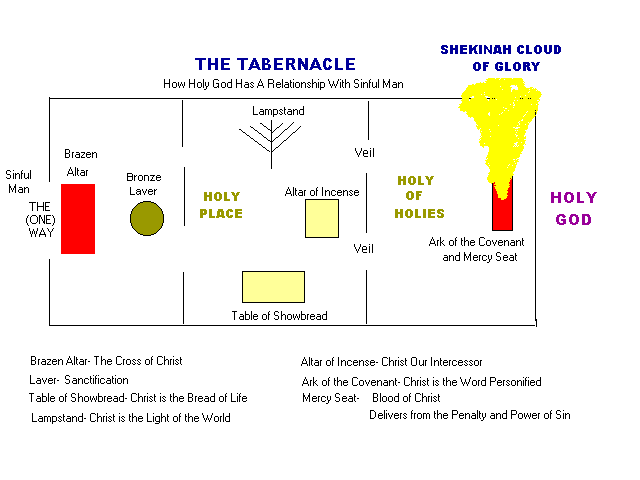
Tabernacle Symbolism Associated with Christ
TAKING THE "TRASH"
OUT TO KIDRON VALLEY
So the priests went in to the inner part of the house of the LORD to cleanse it - This implies the "holy of holies" but could refer to the whole shrine tent. The priests and Levites first purified the outer courts, both the court of the priests and the court of the people, a task that occupied eight days. They then turned to cleansing the interior of the temple itself. Because the Levites were not permitted to enter the sanctuary, the priests removed all the accumulated filth and debris to the porch. From there, the Levites gathered it, carried it away, and cast it into the Brook Kidron. This second phase required eight additional days, so that the purification of the temple was completed in sixteen days.
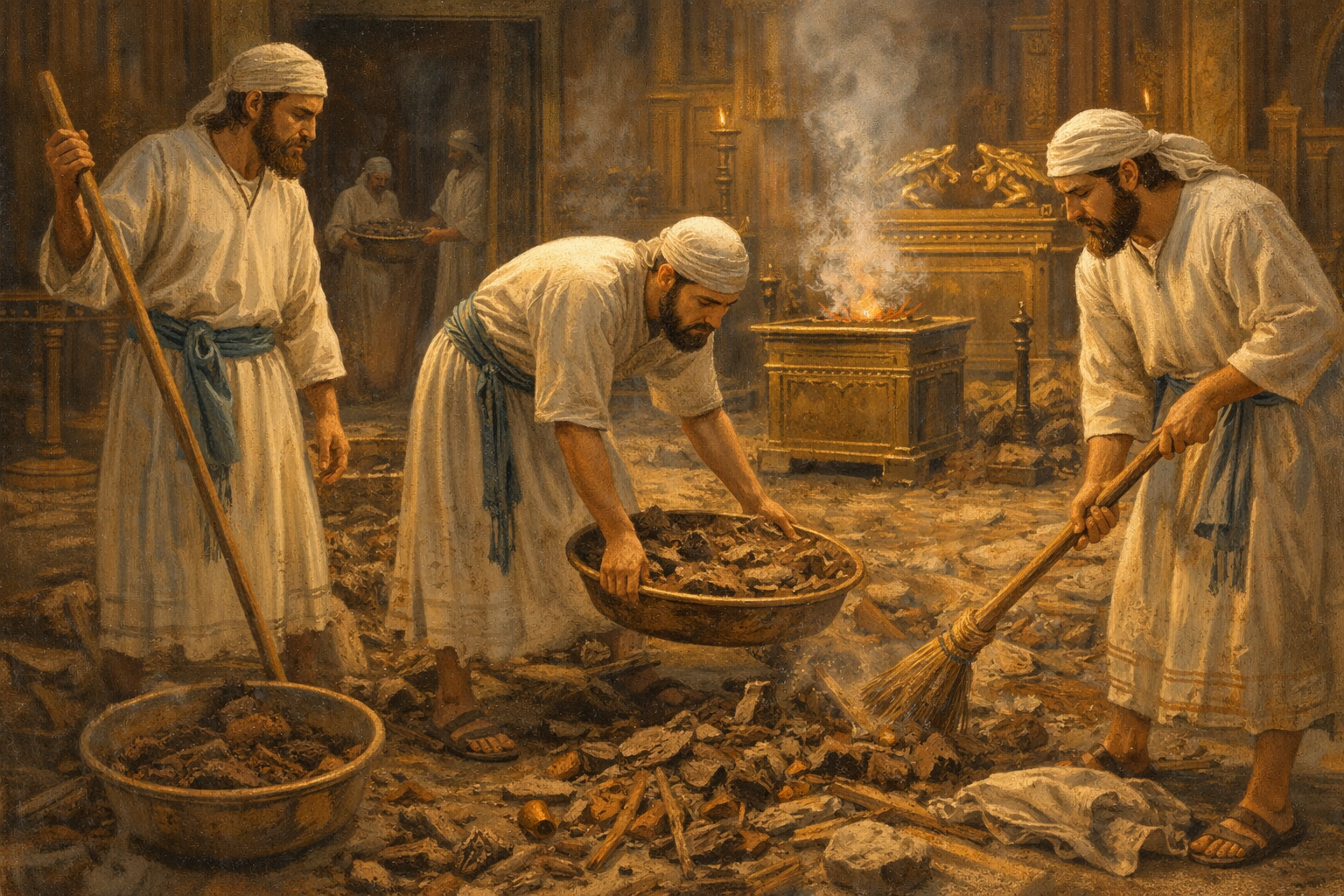
and every unclean thing which they found in the temple of the LORD they brought out to the court of the house of the LORD. Then the Levites received it to carry out to the Kidron valley. - This is a sad verse for this is God's house and years of neglect and idolatry under King Ahaz resulted in a variety of unclean things in God's holy place including idols, pagan altars, and defiled objects that had been brought into the temple, as well as physical debris and filth that symbolized spiritual corruption.
🙏 THOUGHT - This verse raises the question of what about my temple since as believers our body is His temple (1Co 6:19,20)? Are there some idols, pagan altars or other defiled debris in my heart? Daily confession and repentance is a good way to keep our temple clean (1Jn 1:9, cf Pr 28:13). And we can pray David's prayer "Create in me a clean heart, O God, And renew a steadfast spirit within me." (Ps 51:10).
Bob Utley to carry out to the Kidron valley" The city of Jerusalem had two main valleys. the Kidron, east of the temple and the Hinnom, south of the city (cf. 2 Chr. 28:3) Asa destroyed his mother's Asherah. Hezekiah will also destroy the altars of Ahaz (2 Chr. 28:24) there (cf. 2 Chr. 30:14). The Kidron was where the blood from the temple drained. The Valley of Hinnom was the place of Molech worship (cf. 2 Chr. 28:3).
Raymond Dillard: The purification of the temple required two weeks (ED: ACTUALLY 16 DAYS - 2Ch 29:17), one week in the outer courts and another in the building itself. The term interior (inner part of the house ) may broadly refer to the interior of the temple (cf. 2Ch 29:18) or more narrowly to the Most Holy Place (cf. 2Ch 4:22; 1Ch 28:11; 1Ki 6:27, 7:12, 50). It is not altogether clear in this case which is intended. The Levites were responsible for the inventory of the temple implements being taken in or out of the building (1Ch 9:28), implying that they did not ordinarily enter the interior of the sanctuary; on the other hand, the Chronicler may be seeking to illustrate careful observance of the laws restricting access to the Most Holy Place to priests (2Ch 5:4–11). (Borrow 2 Chronicles)
John Schultz (free 239 page commentary) This is one of the most impressive descriptions of a national spiritual revival in the Old Testament. It was, first of all, brought about by the king’s personal initiative, which worked inspirational upon the priests and Levites who were to do the actual work. Ultimately, it affected the relationship with God of the whole nation. Before anything positive could be done, the old system had to be destroyed. Ahaz had defiled the temple by his idol worship. The temple must be purified before it could be restored to its proper service.
Frederick Mabie: The process of the cleansing of the temple and its altar and related items (cf. 2Ch 29:18-19) takes two sets of eight days. Cleansing begins from the outside and progressively works toward areas of increasing holiness. The time required for the purification of the temple complex and the purification of sufficient priests necessitates a delay in the subsequent Passover celebration organized by Hezekiah (cf. 2Ch 30:2-3, 15). (See The Expositor's Bible Commentary: 1 Chronicles-Job - Page 286)
John Walton - 29:16. Kidron Valley. The Kidron Valley southeast of the temple was connected to Ben Hinnom, which had long been a dumping ground for the people of Jerusalem. Hezekiah, like Josiah, attempted to cleanse the Jerusalem temple complex by taking all of the illegal cultic items to this valley. The Kidron Valley was also used as a burial ground for the common people.
KIDRON VALLEY - The Kidron Valley was a wadi lying just east of Jerusalem between the city and the Mount of Olives. It derives its name either from the dark/murky waters that flow there after heavy rains or from nearby cedars, and throughout Scripture it functions as a setting of sorrow, judgment, and death: reforming kings repeatedly disposed of idolatry there (Josiah burned the objects of Baal and Asherah in the Kidron, 2Ki 23:4–6; cf. Asa, 1Ki 15:13; Hezekiah, 2Ch 29:16; 30:14), David crossed it in grief while fleeing Absalom (2Sa 15:23), Shimei was restricted from passing it (1Ki 2:36–37), and it appears to have contained graves of common people (2Ki 23:6); Jesus Himself crossed the Brook Kidron on the night of His arrest to enter Gethsemane (John 18:1), where He bore the weight of impending death (Lk 22:44). Many identify the prophetic “Valley of Jehoshaphat/Decision” with the Kidron as the scene of eschatological judgment (Joel 3:2, 14), the place where God will judge the nations. Yet Scripture also promises a future reversal: the Lord will restore Israel, turn mourning into joy, and consecrate even this valley—“holy to the LORD”—as part of a permanently renewed Jerusalem (Jer 31:1, 8–9, 13, 34, 40). Thus, the Kidron Valley moves from a backdrop of impurity and sorrow to one of hope and holiness in God’s redemptive plan.
2 Chronicles 29:17 Now they began the consecration on the first day of the first month, and on the eighth day of the month they entered the porch of the LORD. Then they consecrated the house of the LORD in eight days, and finished on the sixteenth day of the first month.
- the porch: 2Ch 29:7 3:4 1Ki 6:3 1Ch 28:11
- the sixteenth: Ex 12:2-8
CONSECRATION FROM
OUTSIDE INWARD
Now they began the consecration on the first day of the first month, and on the eighth day of the month they entered the porch of the LORD. - The consecration began promptly on the first day of the first month and progressed for eight days until the priests reached the porch of the LORD, marking an orderly advance toward restored worship
Then they consecrated the house of the LORD in eight days, and finished on the sixteenth day of the first month. - Cleansing begins with what is most visible and accessible and then moves inward toward areas of greater sanctity, reflecting God’s orderly pattern that purification must progress from the outer courts to the inner sanctuary, teaching that true restoration advances step by step toward deeper holiness rather than occurring all at once.
John Walton - 29:17. calendar. The first month was Nisan, which spanned our spring months of March and April. This was the beginning of the religious calendar of festivals. The purification procedure moved from the outer areas toward the inner ones, because each area had its own ritual requirements. When one level of purity was reached, an area could be entered. The next level of purity would allow access to the next, and so on. It took eight days to consecrate the areas contiguous to the temple, and eight more to carry out the procedure on the temple structure itself.
John Walton - 29:17. consecration of articles. The temple was rededicated in three steps; the temple was cleansed, it was then reconsecrated, and then there was the inaugural dedication ceremony. The articles that Ahaz removed had to be reconsecrated, because they had been removed from the sacred precincts and so were no longer pure.
Bob Utley - 29:17 The Jewish Study Bible, p. 1809, suggests that the timing of v. 17 is purposely related to
- Exod. 40:17 ‒ day the tabernacle was erected
- Lev. 8:33-9:24 ‒ the ordination of Aaron and his sons and their first sacrifices
2 Chronicles 29:18 Then they went in to King Hezekiah and said, “We have cleansed the whole house of the LORD, the altar of burnt offering with all of its utensils, and the table of showbread with all of its utensils.
- the altar: 2Ch 4:1,7
- the showbread: 2Ch 4:8 13:11
A JOB
WELL DONE
Then they went in to King Hezekiah and said, “We have cleansed the whole house of the LORD, the altar of burnt offering with all of its utensils, and the table of showbread with all of its utensils This report to the king confirms that the Levites had fully purified the temple and its central furnishings, signaling that sacrificial worship could be lawfully and completely restored.
Iain Duguid: Finally (vv. 18–19) the Levites spoke of completion as they reported to the king. “We have cleansed all the house of the Lord. . . . All the utensils . . . we have made ready and consecrated.” The scene is set for the “altar of the Lord” to be used again for offerings (ESV Expository Commentary (Volume 3): 1 Samuel–2 Chronicles)
Bob Utley - 29:18-19 The priests
- cleansed the altar of burnt offerings, v. 18
- reinstituted Levitical music, vv. 25-28
- accepted offerings the people brought, vv. 29-36 SPECIAL TOPIC: ALTAR OF SACRIFICE
C I Scofield - HEZEKIAH RE-OPENS THE TEMPLE (2 Chr. 29:18–31)
I. The Analysis
1. Cleansing of the Vessels (verses 18, 19).—The special form of consecration here is the restoration to the divine service of that which belonged to Him.
2. Sacrifice in View of the Sin of Judah (verses 20–24).—The law required sacrifices such as these to be oft repeated—we have “one sacrifice for sins forever” (Heb. 10:12).
3. The Praise of a Cleansed and Restored People (verses 25–28).—This is the order of Psalm 51 (see below).
4. The Worship of a Praising People (verses 29, 30.)—(See below.)
5. The Gifts of a People Right with God (verse 31).—(See below.)
II. The Heart of the Lesson
So intimately connected are the parts of this precious lesson that they must be considered together. The lesson is all heart; and it is found in the moral order of the return to God of His own people who have become backslidden through sin. Very much superficial and therefore unsatisfying work is done along this line. Conscious of a loss of communion and so of joy and power, we come to God with general and indefinite confessions of coldness and sinfulness, but without deep searching of heart and exercise of conscience, and we find ourselves soon back on the old ground of failure. Here through work was done, and the divine order of restoration is here illustrated. Let us mark the steps.
1. Cleansing of the vessels. For the Christian this takes two forms.
(1) The cleansing of the ways of the daily walk. This is illustrated by John 13:4–10, and is performed according to 1 John 1:9; for confession is just bringing the defiled feet to the Lord Jesus to be made clean.
(2) The second form of cleansing is separation from vessels unto dishonor according to 2 Tim. 2:20, 21. This makes us “vessels unto honor, sanctified and meet for the Master’s use.”
2. The acknowledgment of the efficacy of the “one sacrifice for sins forever”—the restoration of the Cross to its right place as the sin offering which has settled forever the whole sum of our guilt and demerit before God; and the burnt offering in which Jesus Christ “offered Himself without spot unto God” in our stead and behalf. Faith, dimmed by backsliding and sin, once more sees that as all our demerit was borne by Christ, so all His glorious merit is accounted to us. What inevitably follows is:—
3. The praise of a cleansed and restored heart, now again rejoicing in God through Jesus Christ. In the tabernacle the incense which was burnt on the golden altar was kindled by a live coal from the brazen altar where sacrifice was offered, so true praise like true worship is set aflame by the sacrifice of Christ. Then follows something deeper, higher than praise:—
4. The worship of cleansed, restored, and singing hearts. Praise is vocal, expressive, a testimony. David said that many should hear his new song. Worship is “in spirit”; the bowing of the whole inner self in adoration, wonder and love before the Father. Note this order in 1 Tim. 1:12–17. Paul breaks into praise in verse 12, into worship in verse 17, “Now unto the King eternal, immortal, invisible, the only wise God, honor and glory forever and ever. Amen.”
5. And now the heart, cleansed, restored, filled with the new song, and bowed in adoration, is ready for service. “Come near and bring sacrifices and thank offerings unto the house of the Lord.”
2 Chronicles 29:19 “Moreover, all the utensils which King Ahaz had discarded during his reign in his unfaithfulness, we have prepared and consecrated; and behold, they are before the altar of the LORD.”
NET We have prepared and consecrated all the items that King Ahaz removed during his reign when he acted unfaithfully. They are in front of the altar of the LORD."
BGT καὶ πάντα τὰ σκεύη ἃ ἐμίανεν Αχαζ ὁ βασιλεὺς ἐν τῇ βασιλείᾳ αὐτοῦ ἐν τῇ ἀποστασίᾳ αὐτοῦ ἡτοιμάκαμεν καὶ ἡγνίκαμεν ἰδού ἐστιν ἐναντίον τοῦ θυσιαστηρίου κυρίου
LXE and all the vessels which king Achaz polluted in his reign, in his apostasy, we have prepared and purified: behold, they are before the altar of the Lord.
- all the utensils 2Ch 28:24
TEMPLE AND UTENSILS
CLEANSED & READY
Moreover, all the utensils which King Ahaz had discarded during his reign in his unfaithfulness (maal; LXX = apostasia), we have prepared and consecrated (qadash; LXX - hagiazo); and behold (hinneh), they are before the altar of the LORD.” The priests report that everything defiled under Ahaz’s apostasy has been removed and restored, including the altar of the LORD, signaling the completion of purification. The LXX of discarded is miaino which describes ceremonial uncleanness, indicating Ahaz had in effect polluted the holy Temple utensils. With the sanctuary cleansed and furnishings reset, the temple is now fully prepared for renewed sacrificial worship.
Apostasy (646)(apostasia from aphistemi = depart derived from apo = separation + histemi = to stand) is a noun which literally describes a "stand off" (or "a standing off") and thus is a departure, a defection or falling away. In English apostasy means the abandonment or renunciation of a religious or political belief. In the Septuagint (Lxx) apostasia is used in Joshua 22:22 (describes "an unfaithful act [apostasia] against the LORD"), 2Chr 29:19 (describes King Ahaz during "during his reign in his unfaithfulness [apostasia]") and Jer 2:19 ("Your [God speaking to unfaithful Judah] own wickedness will correct you, and your apostasies will reprove you").
2 Chronicles 29:20 Then King Hezekiah arose early and assembled the princes of the city and went up to the house of the LORD.
- arose: Ge 22:3 Ex 24:4 Jos 6:12 Jer 25:4
Related Passages:
Genesis 22:3 So Abraham rose early in the morning and saddled his donkey, and took two of his young men with him and Isaac his son; and he split wood for the burnt offering, and arose and went to the place of which God had told him.
Exodus 24:4 Moses wrote down all the words of the LORD. Then he arose early in the morning, and built an altar at the foot of the mountain with twelve pillars for the twelve tribes of Israel.
Joshua 6:12 Now Joshua rose early in the morning, and the priests took up the ark of the LORD.
HEZEKIAH AND PRINCES
PREPARE FOR WORSHIP
Then King Hezekiah arose early and assembled the princes of the city and went up to the house of the LORD - Hezekiah rises early and assembles the city officials, showing urgent, resolute leadership as he moves immediately to initiate public, corporate action to restore worship and renew Judah’s covenant faithfulness to the LORD.
EXCURSUS ON AROSE EARLY - In Scripture, rising early consistently signifies eagerness, priority, and wholehearted devotion to the LORD, marking decisive obedience rather than reluctant duty: faithful leaders act promptly when God’s will is clear (Hezekiah, 2 Chronicles 29:20), earnest seekers pursue God at the first opportunity (the psalmist, Psalm 119:147), and supreme devotion is modeled by Jesus Himself, Who rose early to pray and align with the Father’s will (Mark 1:35). Conversely, God “rising early” to send His prophets highlights His persistent grace toward a reluctant people (Jeremiah 7:13; 25:4), underscoring that promptness reflects priority of the heart, so that what we rise early to do reveals what we value most.
🙏 THOUGHT - DO YOU RISE EARLY? WHAT DO YOU DO FIRST WHEN YOU RISE EARLY? DO YOU MEET WITH YOUR CREATOR AND CONVERSE WITH HIM? IF NOT, YOU MIGHT BEGIN, IF ONLY FOR A FEW MINUTES, AND THEN SEE WHAT A NOTICEABLE DIFFERENT IT MAKES IN THE REST OF YOUR DAY! One of my favorite verses to pray and (attempt to) practice is "Seek the LORD and His strength; Seek His face continually." (1Ch 16:11)
Andrew Hill: The ceremony for the consecration of the temple is a multifaceted event.
(1) The initial phase addresses the issues of sin and purification in the community (2Ch 29:20-24).
(2) The next phase features burnt offerings signifying the dedication of the religious and civic leaders and the sanctuary to the service of God (2Ch 29:25-30). The burnt-offering ritual is accompanied by instrumental and choral music from the Levitical musicians and concludes with prostration in reverent worship (2Ch 29:29-30). There is some question as to whether the sin offering and burnt offering are sequential or simultaneous events.
(3) The final stage includes participation by the assembly of people from Jerusalem and Judah (representing “all Israel”) through additional burnt offerings and thank offerings (2Ch 29:31-36). (See 1 and 2 Chronicles - Page 54)
Bob Utley - Hezekiah arose early This is a good example of the interpretive issue of word meaning. Does this refer to early in the day while it was still cool (literal use)? Or does it express Hezekiah's sense of urgency, like v. 3 (imagery use)?
Matthew Henry Notes: 2Ch 29:20-36
SUMMARY OF THIS COMMENT - Matthew Henry explains that after the temple was cleansed, Hezekiah immediately led the nation in restored worship, beginning with atonement for the sins of the previous reign through sin and burnt offerings offered on behalf of the entire people—king, priests, and nation—showing that repentance and reform must be joined to sacrificial atonement, ultimately pointing to Christ. Worship was marked by reverence, confession, praise, and joyful submission as psalms and sacrifices were offered together. Looking forward, the temple service was reestablished for continual communion with God, and the people responded freely and generously despite their poverty. Though the priests were few and unprepared due to past compromise, the Levites distinguished themselves by zeal and readiness, stepping in where needed. The king and the people rejoiced, recognizing both the swiftness of the reform and the clear hand of God, who had prepared hearts and made the work unexpectedly easy, so that the restoration of worship was plainly “the Lord’s doing.”
The temple being cleansed, we have here an account of the good use that was immediately made of it. A solemn assembly was called to meet the king at the temple, the very next day (v. 20); and very glad, no doubt, all the good people in Jerusalem were, when it was said, Let us go up to the house of the Lord, Ps. 122:1. As soon as Hezekiah heard that the temple was ready for him he lost no time, but made it appear that he was ready for it. He rose early to go up to the house of the Lord, earlier on that day than on other days, to show that his heart was upon his work there. Now this day's work was to look two ways:-
I. Atonement must be made for the sins of the last reign. They thought it not enough to lament and forsake those sins, but they brought a sin-offering. Even our repentance and reformation will not obtain pardon but in and through Christ, who was made sin (that is, a sin-offering) for us. No peace but through his blood, no, not for penitents. Observe,
1. The sin-offering was for the kingdom, for the sanctuary, and for Judah (2Ch 29:21), that is, to make atonement for the sins of princes, priests, and people, for they had all corrupted their way. The law of Moses appointed sacrifices to make atonement for the sins of the whole congregation (Lev. 4:13, 14; Num. 15:24, 25), that the national judgments which their national sins deserved might be turned away. For this purpose we must now have an eye to Christ the great propitiation, as well as for the remission and salvation of particular persons.
2. The law appointed only one goat for a sin-offering, as on the day of atonement (Lev. 16:15) and on such extraordinary occasions as this, Num. 15:24. But they here offered seven (2Ch 29:21), because the sins of the congregation had been very great and long continued in. Seven is a number of perfection. Our great sin-offering is but one, yet that one perfects for ever those that are sanctified.
3. The king and the congregation (that is, the representatives of the congregation) laid their hands on the heads of the goats that were for the sin-offering (2Ch 29:23), thereby owning themselves guilty before God and expressing their desire that the guilt of the sinner might be transferred to the sacrifice. By faith we lay our hands on the Lord Jesus, and so receive the atonement, Rom. 5:11.
4. Burnt-offerings were offered with the sin-offerings, seven bullocks, seven rams, and seven lambs. The intention of the burnt-offerings was to give glory to the God of Israel, whom they owned as the only true God, which it was proper to do at the same time that they were by the sin-offering making atonement for their offences. The blood of those, as well as of the sin-offering, was sprinkled upon the altar (2Ch 29:22), to make reconciliation for all Israel (2Ch 29:24), and not for Judah only. Christ is a propitiation, not for the sins of Israel only, but of the whole world, 1 Jn. 2:1, 2.
5. While the offerings were burning upon the altar the Levites sang the song of the Lord (2Ch 29:27), the Psalms composed by David and Asaph (2Ch 29:30), accompanied by the musical instruments which God by his prophets had commanded the use of (2Ch 29:25), and which had been long neglected. Even sorrow for sin must not put us out of tune for praising God. By faith we must rejoice in Christ Jesus as our righteousness; and our prayers and praises must ascend with his offering, to be accepted only in virtue of it. 6. The king and all the congregation testified their consent to and concurrence in all that was done, by bowing their heads and worshipping, expressing an awful veneration of the divine Majesty, by postures of adoration. This is taken notice of, v. 28-30. It is not enough for us to be where God is worshipped, if we do not ourselves worship him, and that not with bodily exercise only, which profits little, but with the heart.
II. The solemnities of this day did likewise look forward.
The temple service was to be set up again, that it might be continually kept up; and this Hezekiah calls them to, 2Ch 29:31. "Now that you have consecrated yourselves to the Lord-have both made an atonement and made a covenant by sacrifice, are solemnly reconciled and engaged to him-now come near, and bring sacrifices.'' Note, Our covenant with God must be pursued and improved in communion with him. Having consecrated ourselves, in the first place, to the Lord, we must bring the sacrifices of prayer, and praise, and alms, to his house. Now, in this work, it was found.
1. That the people were free. Being called to it by the king, they brought in their offerings, though not in such abundance as in the glorious days of Solomon (for Judah was now diminished, impoverished, and brought low), but according to what they had, and as much as one could expect considering their poverty and the great decay of piety among them.
(1.) Some were so generous as to bring burnt-offerings, which were wholly consumed to the honour of God, and of which the offerer had no part. Of this sort there were seventy bullocks, 100 rams, and 200 lambs, 2Ch 29:32.
(2.) Others brought peace-offerings and thank-offerings, the fat of which was burnt upon the altar, and the flesh divided between the priests and the offerers, 2Ch 29:35. Of this sort there were 600 oxen and 3000 sheep, 2Ch 29:33. Perhaps the remembrance of their sin in sacrificing on the high places made them more willing to bring their sacrifices now to God's altar.
2. That the priests were few, too few for the service, 2Ch 29:34. Many of them, it is likely, were suspended and laid aside as polluted and uncanonical, for having sacrificed to idols in the last reign, and the rest had not the zeal that one might have expected upon such an occasion. They thought that the king needed not to be so forward, that there was no necessity for such haste in opening the doors of the temple, and therefore they took no care to sanctify themselves, and being unsanctified, and so unqualified, they made that their excuse for being absent from the service; as if their offence would be their defence. It is recorded here, to the perpetual shame of the priests, that, though they were so well provided for out of the offerings of the Lord made by fire, yet they did not mind their business. Here was work to do, and there wanted proper hands to do it.
3. That the Levites were forward. They had been more upright in heart to sanctify themselves than the priests (2Ch 29:34), were better affected to the work and better prepared and qualified for it. This was their praise, and, in recompence for it, they had the honour to be employed in that which was the priests' work: they helped them to flay the offerings. This was not according to the law (Lev. 1:5, 6), but the irregularity was dispensed with in cases of necessity, and thus encouragement was given to the faithful zealous Levites and a just disgrace put upon the careless priests. What the Levites wanted in the ceremonial advantages of their birth and consecration was abundantly made up in their eminent qualifications of skill and will to do the work.
4. That all were pleased. The king and all the people rejoiced in this blessed turn of affairs and the new face of religion which the kingdom had put on, 2Ch 29:36. Two things in this matter pleased them:-
(1.) That it was soon brought about: The thing was done suddenly, in a little time, with a great deal of ease, and without any opposition. Those that go about the work of God in faith and with resolution will find that there is not that difficulty in it which they sometimes imagine, but it will be a pleasing surprise to them to see how soon it is done.
(2.) That the hand of God was plainly in it: God had prepared the people by the secret influences of his grace, so that many of those who had in the last reign doted on the idolatrous altars were now as much in love with God's altar. This change, which God wrought on their minds, did very much expedite and facilitate the work. Let magistrates and ministers do their part towards the reforming of a land, and ascribe to him the glory of what is done, especially when it is done suddenly and is a pleasing surprise. This is the Lord's doing, and it is marvellous.
2 Chronicles 29:21 They brought seven bulls, seven rams, seven lambs and seven male goats for a sin offering for the kingdom, the sanctuary, and Judah. And he ordered the priests, the sons of Aaron, to offer them on the altar of the LORD.
- seven: Nu 23:1,14,29 1Ch 15:26 Ezr 8:35 Job 42:8 Eze 45:23
- a sin offering: Lev 4:3-14 Nu 15:22-24 2Co 5:21
Related Passages:
Leviticus 1:5 (PRIESTS CARRY OUT OFFERING) ‘He shall slay the young bull before the LORD; and Aaron’s sons the priests shall offer up the blood and sprinkle the blood around on the altar that is at the doorway of the tent of meeting.
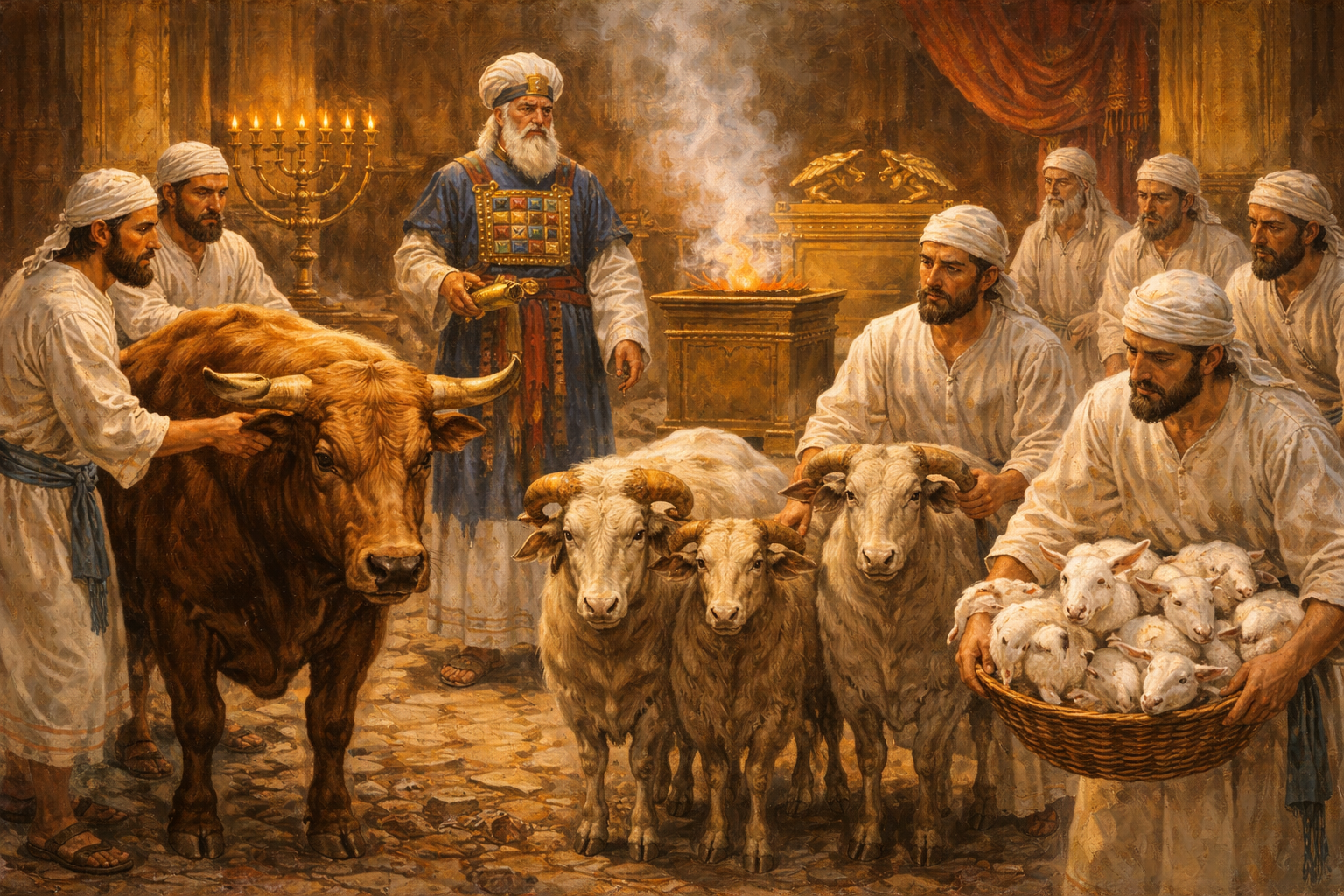
SEVEN FOLD
SIN OFFERING
They brought seven bulls, seven rams, seven lambs and seven male goats - The Mosaic Law required only one bull for the sin of the high priest, one for the sins of the people, and one male goat for the sin of the ruler; yet Hezekiah offered many more sacrifices, and the reason is clear. The Law primarily addresses sins of ignorance, whereas Judah’s guilt involved deliberate and aggravated transgressions—idolatry, apostasy from true worship, and the profanation of the temple. Accordingly, the sin offerings were presented in deliberate order: first for the kingdom, addressing the sins of the king and his household; second for the sanctuary and the priests, which had been defiled through neglect and unfaithfulness; and finally for all Judah, the entire nation that had been led into widespread abomination by these failures.
For (NOTE: not a term of explanation) a sin offering (chattat/chattath) (1) for the kingdom, (2) the sanctuary, and (3) Judah - The sin offerings were presented first for the kingdom to atone for royal and national leadership guilt, then for the sanctuary to cleanse what had been defiled by neglect and apostasy, and finally for Judah to seek forgiveness for the people who had followed their leaders into widespread sin.
And he ordered the priests, the sons of Aaron, to offer them on the altar of the LORD - This command affirms that the sacrificial work must be carried out by the ordained priests, the sons of Aaron, in accordance with God’s appointed order for worship (2 Chronicles 29:21; cf. Leviticus 1:5).
EXCURSUS ON SIN OFFERING - Under the Mosaic Law, the sin offering (Heb. ḥaṭṭāʾt, often rendered “fault offering”) was the first sacrifice in which atonement was central, providing God’s gracious remedy for unintentional sins—those committed in ignorance, inadvertence, passion, or omission and later recognized as guilt (Leviticus 4–5; cf. Nu 15:22–29)—while explicitly excluding high-handed, premeditated rebellion, for which no sacrifice was provided (Nu 15:27–31); the required offering varied by status (a bull for the high priest, a male goat for a ruler, a female goat or lamb for an individual, or birds/flour for the poor) yet followed a consistent pattern of identification by laying on of hands, the shedding and application of blood to purge sacred space, and the burning or priestly consumption of the remainder, so that “the priest shall make atonement…and he will be forgiven” (Lev 4:29–35; 6:24–30), a rhythm that culminated annually on the Day of Atonement when the high priest offered a bull for himself and a goat for the people (Lev 16:11, 15); crucially, the rite’s efficacy lay not in ritual alone but in God’s mercy received by faith, for Scripture rejects worship without trust and obedience (Isa 1:10–20; Amos 5:21–24; Mic 6:6–8), underscores corporate responsibility (cf. Josh 7; Ro 5:12ff), and ultimately points beyond itself to Jesus Christ, the flawless Lamb whose once-for-all sacrifice Who suffered outside the city as the sin offering was burned outside the camp (Heb 13:12; cf. Lev 4:12), fulfilling the principle that “without the shedding of blood there is no forgiveness” (Heb 9:22), redeeming all who acknowledge their guilt and believe by the precious blood of Christ (1 Pet 1:19; cf. John 3:16; Eph 1:7), thus rendering further sin offerings unnecessary.
Frederick Mabie: All together, these elements of the Israelite sacrificial system portray the forgiveness of sin, reconciliation, and atonement made available by God. Note that the sacrificial offerings are accompanied by (and followed by) singing and music (cf. 2Ch 29:25-30). The final movement of Hezekiah’s temple rededication ceremony (cf. 2Ch 29:31-35) includes additional burnt offerings (2Ch 29:31-32, 35), thank offerings (2Ch 29:31), peace/fellowship offerings (2Ch 29:35), and drink offerings (2Ch 29:35). (See The Expositor's Bible Commentary: 1 Chronicles-Job - Page 286)
August Konkel: The animals divide into two groups: the bulls, rams, and sheep are for the burnt offering, and the male goats are for the purification offering. It is a linguistic error to call the latter a “sin offering” (Milgrom 1983: 67-68). Rather, this is a purification offering for the kingdom, for the sanctuary, and for Judah (2Ch 29:21 NIV mg.; also in 2Ch 29:23-24). The purification appears to include temple artifacts, such as the utensils laid before the altar (cf. 2Ch 29:18-19). The king is distinguished from the people in the purification offering, a distinction followed consistently by the Chronicler. The king represents the royal house, and the assembly represents the people of Judah (2Ch 29:23). The temple personnel are a third group purified by the offerings. Later the Chronicler will specify that the purification offering is for all Israel (2Ch 29:24). All Israel cannot be the equivalent of Judah (Williamson 1977a: 126-27). The emphatic repetition of the king’s command indicates that a wider group of people must be included than that originally envisioned by the priests (2Ch 29:21). The Chronicler is emphasizing the inclusion of the total population, without regard for the former divisions. (See 1 & 2 Chronicles)
John Walton - 29:21–24. sacrificial ritual. There were no sacrificial rituals used in the dedication of the tabernacle. When the temple of Solomon was dedicated, the animals sacrificed were too numerous to count. Nowhere does the text offer instructions for the numbers reflected here. For information about the sin offering see comments on Leviticus 4:1–3 and 4–12.
2 Chronicles 29:22 So they slaughtered the bulls, and the priests took the blood and sprinkled it on the altar. They also slaughtered the rams and sprinkled the blood on the altar; they slaughtered the lambs also and sprinkled the blood on the altar.
- sprinkled: Lev 1:5 4:7,18,34 8:14,15,19,24 Heb 9:21-22
Related Passages:
Leviticus 1:10-11 ‘But if his offering is from the flock, of the sheep or of the goats, for a burnt offering, he shall offer it a male without defect. 11 ‘He shall slay it on the side of the altar northward before the LORD, and Aaron’s sons the priests shall sprinkle its blood around on the altar.
Hebrews 9:22 And according to the Law, one may almost say, all things are cleansed with blood, and without shedding of blood there is no forgiveness.
Leviticus 17:11 ‘For the life of the flesh is in the blood, and I have given it to you on the altar to make atonement for your souls; for it is the blood by reason of the life that makes atonement.’
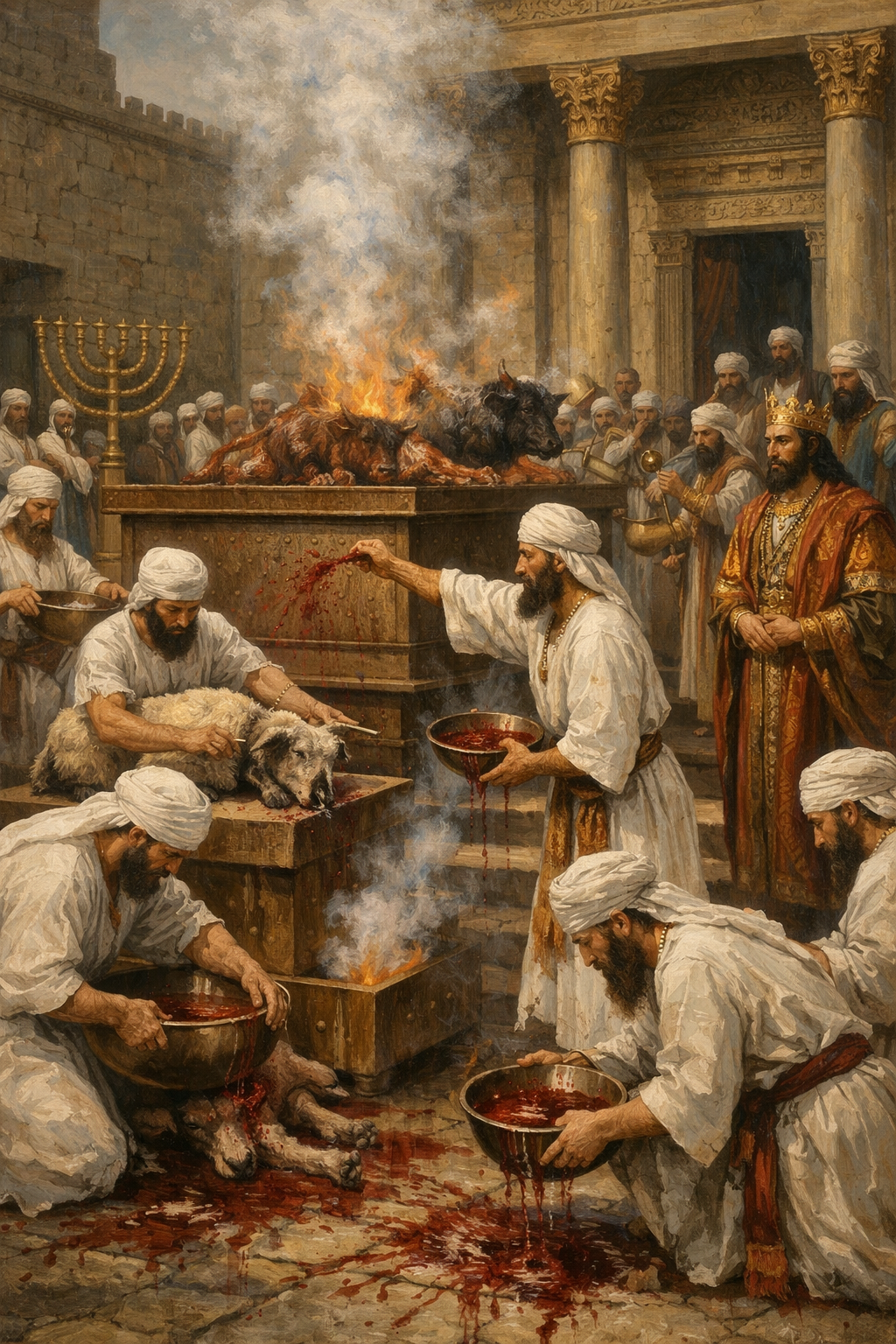
PRIESTS SLAUGHTER AND
SPRINKLE FOR ATONEMENT
So (term of conclusion) as a logical connector, indicates that the slaughter of the bulls and the sprinkling of the blood are the direct result and obedient response to Hezekiah’s command in the preceding verse, showing immediate compliance with God’s prescribed order for atonement.
Atonement and cleansing from sin required the shedding and application of blood on the altar, symbolizing life given in place of the guilty so that fellowship with the LORD could be restored (Leviticus 17:11; cf. Hebrews 9:22).
they slaughtered the bulls, and the priests took the blood and sprinkled it on the altar (mizbeah). The slaughtering of the bulls and the sprinkling of their blood on the altar signified atonement through a substitutionary sacrifice, carried out according to the LORD’s prescribed sacrificial order (cf. Leviticus 17:11).
They also slaughtered the rams and sprinkled the blood on the altar (mizbeah) This action represents the continuation of atoning sacrifice, as the priests faithfully applied the blood of the rams to the altar in accordance with God’s ordained means of purification and reconciliation (2 Chronicles 29:22; cf. Leviticus 8:18–19).
They slaughtered the lambs also and sprinkled the blood on the altar (mizbeah) - This completes the sacrificial sequence, as the lambs were slain and their blood applied to the altar, signifying full atonement and consecration in obedience to the LORD’s sacrificial law (Leviticus 1:10–11).
Altar (04196) mizbeah from zabach = to slaughter for sacrifice or for food) is a masculine noun that is frequent in the OT (338x) and describes the place of sacrifice where offerings were made to a deity. The first use in Ge 8:20 describes the altar built by Noah as his first act after he survived the flood. Abraham is associated with an altar in Ge 12:7,8; 13:4, 18; Ge 22:9. Not surprisingly the majority of OT occurrences are in Leviticus (88x in 72v and Exodus is not far behind - 61x in 53v). The first offering by Cain and Abel does not mention a specific altar (Ge 4:3). The Septuagint (Lxx) often translates mizbeach with the word thusiasterion ("a place of sacrifice") which is derived from thusia meaning that which is offered as the sacrifice.
2 Chronicles 29:23 Then they brought the male goats of the sin offering before the king and the assembly, and they laid their hands on them.
- they laid: Lev 1:4, 4:15,24
Related Passages:
Leviticus 16:21 “Then Aaron shall lay both of his hands on the head of the live goat, and confess over it all the iniquities of the sons of Israel and all their transgressions in regard to all their sins; and he shall lay them on the head of the goat and send it away into the wilderness by the hand of a man who stands in readiness.
KING & ASSEMBLY LAY
HANDS ON ANIMALS
Then they brought the male goats of the sin offering before the king and the assembly, and they laid their hands on them - The male goats are presented before the king and the assembled people to show that atonement is a public, corporate matter, not a private ritual. By laying their hands on the goats, the leaders symbolically identified with the sacrifice and transferred guilt, acknowledging that the animals would bear the penalty for the nation’s sin (cf. Leviticus 16:21).
The laying on of hands is a symbolic act throughout Scripture signifying identification, transfer, and authorization, most clearly seen in sacrificial worship where the worshiper places hands on the animal to identify with it and transfer guilt, acknowledging that the substitute will bear the penalty in the sinner’s place (Leviticus 1:4; 16:21). In this sense, the act is a visible confession: my sin deserves death, and this life now stands in my stead (cf. 2 Chronicles 29:23).
EXCURSUS ON LAYING ON OF HANDS - The laying on of hands is a biblical gesture of personal identification and participation used in diverse contexts, including oath-taking (Gen 24:2, 9; 47:29), transferring family leadership (Gen 48:14, 17–18), identifying with a sacrificial substitute by both priests and laypersons (Exod 29:10, 15, 19; Lev 1:4; 3:2, 8; 4:4, 15, 24; 16:21; Num 8:12; 2 Chr 29:23), setting individuals apart for special service or ministry (Num 8:10; 27:18, 23; Deut 34:9; Acts 6:6; 13:3; 1 Tim 4:14; 5:22; 2 Tim 1:6), participating in judicial judgment (Lev 24:14), expressing silence or submission (Judg 18:19; Job 21:5; 29:9; 40:4; Mic 7:16), signifying grief (2 Sam 13:19), conveying blessing (Matt 19:13–15; Mark 10:16), ministering healing (Matt 8:3; 9:18, 20; Mark 5:23; 6:5; 7:32; 8:23; Luke 4:40; 13:13; Acts 9:17; 28:8), and receiving the Holy Spirit (Acts 8:17–19; 19:6), yet the New Testament shows no uniform ordination pattern, as different leaders lay hands in different settings (Acts 6:6; 13:3; 1 Tim 4:14; 2 Tim 1:6), underscoring that early church life was dynamic and gift-driven, with godly character outweighing formal structures or fixed procedures (cf. 1 Cor 12–14; Acts 15). (See also Laying on of hands - what does the Bible say? - GotQuestions.org)
Bob Utley - "laid their hands on them" This was done in the ritual to remove sin/guilt from the nation, by the leadership ‒ Lev. 4:13-15, by the High Priest ‒ Lev. 16:21 and in the ritual of Num. 8:5-13 as the people laid their hands on the Levites, Nu 8:10 and the cleansed Levites laid their hands on the head of the bulls, v. 12
2 Chronicles 29:24 The priests slaughtered them and purged the altar with their blood to atone for all Israel, for the king ordered the burnt offering and the sin offering for all Israel.
- purged the altar with their blood: Lev 6:30 8:15 Eze 45:15,17 Da 9:24 Ro 5:10,11 2Co 5:18-21 Col 1:20,21 Heb 2:17
- to atone for all Israel: Lev 14:20
- the sin offering: Lev 4:13-35
Related Passages:
Leviticus 1:3-4 ‘If his offering is a burnt offering from the herd, he shall offer it, a male without defect; he shall offer it at the doorway of the tent of meeting, that he may be accepted before the LORD. 4 ‘He shall lay his hand on the head of the burnt offering, that it may be accepted for him to make atonement on his behalf.
ATONEMENT FOR
THE NATION
The priests slaughtered them and purged the altar with their blood - The priests ritually cleansed and reconsecrated the altar, applying sacrificial blood to remove defilement caused by sin so that it could once again serve as an acceptable place of atonement before the LORD (2 Chronicles 29:24; cf. Leviticus 8:15; 16:18–19).
To atone (kapar; LXX - exilaskomai ) for all Israel - The priests slaughtered the sacrifices and applied the blood to the altar, symbolically cleansing it and making atonement for all Israel, showing that national sin required substitutionary sacrifice ordained by God.
for the king ordered the burnt offering and the sin offering for all Israel - It is notable that this ceremony closely resembled the Day of Atonement, with the sacrifice offered on behalf of all Judah, here called “Israel” because Judah represented the true covenant people of God at that time.
SHORT EXCURSUS ON ATONEMENT - In the Old Testament, atonement (Hebrew kāpar) weaves together several core images: the holiness of God offended by human rebellion, the truth that the penalty for sin is death (cf. Ezekiel 18:4, 20), and the substitution of a sacrificial life in place of the sinner; the root meaning “to cover” (also “ransom,” cf. Ex 30:16) is most clearly portrayed on the Day of Atonement (Yom Kippur) (Leviticus 16), when the high priestsprinkled blood on the mercy seat (the ark’s lid) above the Law, symbolically covering the testimony that condemned Israel while God dwelt between the cherubim, a pattern that anticipates the New Testament fulfillment in the perfect, eternal blood of Christ—the innocent Lamb who bears sin (cf. John 1:29; 2Co 5:21)—and explains why the NT term “propitiation” is directly tied to the mercy seat imagery (cf. Hebrews 2:17).
SHORT EXCURSUS ON THE MERCY SEAT was the golden lid of the Ark of the Covenant (Ex 25:17–22; Ex 37:6–9), located in the Most Holy Place, where God symbolically dwelt between the cherubim (His “footstool,” cf. 1Ch 28:2; Ps 132:7) above the Law that condemned Israel (SEE Shekinah glory cloud); on the Day of Atonement the high priest entered twice to sprinkle blood on this lid—first for his own sin and then for the unintentional sins of the nation (Leviticus 16; Heb 9:7)—thereby “covering” sin and maintaining covenant fellowship, imagery that the New Testament applies directly to Christ, whom Paul presents as the true “propitiation” (literally, mercy seat = hilasterion) “in His blood” (Ro 3:25), meaning that through Jesus’ substitutionary, sinless life poured out for the guilty (cf. John 1:29; Isaiah 52:13–53:12), God both upholds His righteousness and extends saving mercy to all who receive it through faith (Ro 3:26; Ro 5:12–21).
Atone (forgive, appease) (See "mercy seat") (03722) kapar means to make atonement, to make reconciliation (to reconcile), to purge, to make propitiation (to propitiate), to pacify, to cancel. There are two main ideas regarding the meaning of kapar - (1) Kapar means to cover over sin (2) A number of resources however favor the idea that kapar means to wipe away. These ideas are discussed more below.
The Septuagint - Lxx translates every use of kapar in Leviticus with the verb exilaskomai which means to propitiate, to make atonement, to appease. Thayer says that exilaskomai is used "When one endeavors to attain the goodwill of another, the word can be rendered," meaning to appease. We find such a sense in Ge 32:20 where Jacob seeks to appease his brother Esau (whom he had cheated out of the blessing of the first-born).
Richards notes that "It is often said that the idea expressed (in kapar) is one found in a possibly related Arabic root that means “to cover or conceal.” Atonement would then denote a covering that conceals a person’s sin and makes it possible for him to approach God. Although this relationship is possible, the language link is not at all certain. What is certain is the role that atonement played in the religion of Israel—a role given to atonement by God to carry a vital message about our faith."
As might be surmised the verb kapar is found most often in the Pentateuch, especially in Leviticus. In Leviticus, kapar is especially prominent in Leviticus 16, occurring 16 times in the great chapter that describes the annual Day of Atonement.
Vine writes that "Most uses of kapar involve the theological meaning of “covering over,” often with the blood of a sacrifice, in order to atone for some sin. It is not clear whether this means that the “covering over” hides the sin from God’s sight or implies that the sin is wiped away in this process."
Mounce writes that while kapar can mean "to cover, to ransom, or to wipe clean/purge, it is the last one that seems most appropriate in the OT."
(1) When kāpar is used in verses not connected with Israel’s sacrificial system, it has the nuance of wiping something clean or appeasing someone. Jacob attempts to appease Esau’s anger (i.e., to wipe the anger off his face) by the enormous gift he has sent on ahead of his actual encounter with him (Gen 32:20). Similarly, a wise man knows how to wipe away a king’s wrath (Pr 16:14).
(2) In Israel’s religious ceremonies other than the Day of Atonement, kāpar usually refers to God’s wiping away our sins through various sacrifices (cf. Lev 1:4; 4:20, 26, 31). Note especially the parallel lines of Jer 18:23: “Do not forgive their crimes or blot out their sins from your sight.” To forgive sins is to blot them out and wipe them clean. As Ps 65:3 attests, when we come to God overwhelmed by our sins, God wipes them clean (KJV, “will purge them away”; NIV “forgave”; cf. Ps 78:38 where "forgave" = kapar).
(3) As described in Lev 16 (kāpar occurs 16x), the Day of Atonement was a day of purging sins from the holy sanctuary. All throughout the year, the priest sprinkled the blood of sacrificial animals in front of the curtain of the sanctuary (e.g., Lev 4:6) and thus symbolically transferred the sins of God’s people into his Holy Place. By the end of the year, that place was, as it were, filled up with all their sins. Something had to be done in order to “clean house”; this was the purpose of the Day of Atonement. Note how in the final stage of this ceremony, the sins of God’s people were placed on the head of the live goat, who then carried them far away into the desert, never to be seen again. There was now “room” for another year’s worth of sin in the Most Holy Place. Jesus, of course, has by his sacrifice taken away our sins once for all (Heb 9–10). See NIDOTTE, 2:699–702. (Mounce’s Complete Expository Dictionary of Old & New Testament Words)
2 Chronicles 29:25 He then stationed the Levites in the house of the LORD with cymbals, with harps and with lyres, according to the command of David and of Gad the king’s seer, and of Nathan the prophet; for the command was from the LORD through His prophets.
- He then stationed the Levites 1Ch 9:33 15:16-22 16:4,5,42 25:1-7
- according to the command of David: 2Ch 8:14 35:15 1Ch 23:5 28:12,19
- Gad: 2Sa 24:11 1Ch 21:9 29:29
- Nathan: 2Sa 7:2-4 12:1-7
- for the command was from the LORD: 2Ch 30:12
Related Passage:
2 Chronicles 30:12 The hand of God (SEE HAND OF THE LORD) was also on Judah to give them one heart to do what the king and the princes commanded by the word of the LORD.
1 Chronicles 25:1 Moreover, David and the commanders of the army set apart for the service some of the sons of Asaph and of Heman and of Jeduthun, who were to prophesy with lyres, harps and cymbals; and the number of those who performed their service was
1 Chronicles 23:5 and 4,000 were gatekeepers, and 4,000 were praising the LORD with the instruments which David made for giving praise.
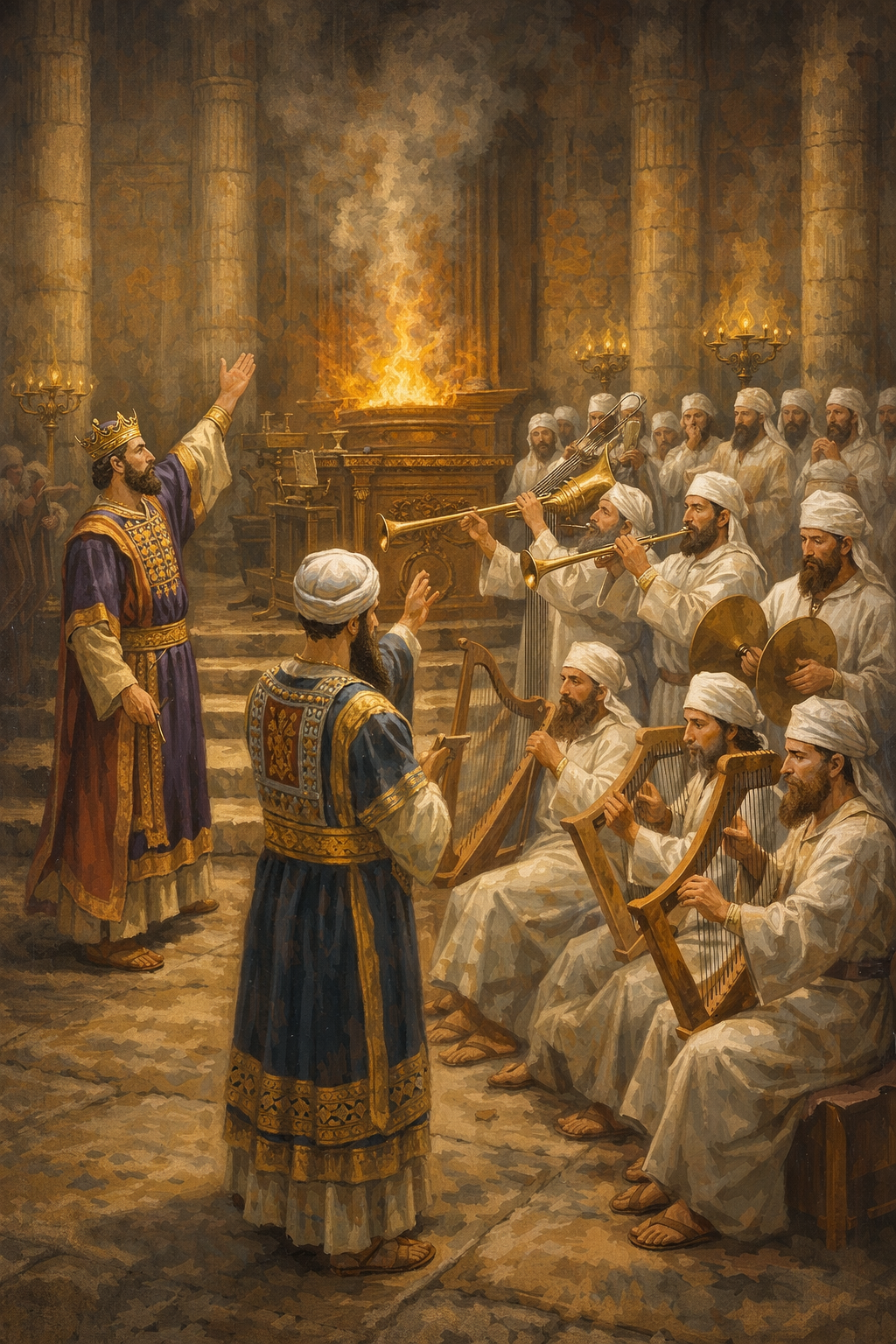
LET PRAISE TO
THE LORD BEGIN!
He then stationed the Levites in the house of the LORD with cymbals, with harps and with lyres - Hezekiah’s decision to station the Levites in the house of the LORD with cymbals, harps, and lyres demonstrates a deliberate restoration of biblically prescribed worship, re-establishing musical praise as an integral expression of obedience, joy, and reverence before God in accordance with His revealed will (1 Chronicles 25:1).
Music was divinely welcomed and carefully ordered as a powerful
vehicle for expressing the life of God’s people before Him.
EXCURSUS ON MUSICAL INSTRUMENTS IN THE OLD TESTAMENT - Music plays a significant and early role in the Old Testament, appearing even before the flood with Jubal, the father of those who play the lyre and pipe (Genesis 4:21), and serving throughout Scripture as a means of celebration, mourning, worship, prophecy, warning, and praise, with sounds and voices often compared to instruments themselves. Israel employed a wide range of instruments—winds (pipes/flutes such as ḥālîl and ʿūgāb used in joy, prophecy, and lament; cf. 1 Kings 1:40; Isaiah 5:12; Jeremiah 48:36), horns (the ram’s-horn shofar and metal ḥaṣoṣerāh used for battle, warning, and worship; Joshua 6:4; Numbers 10:1–2), percussion (cymbals, tambourines, bells, and castanet-like instruments prominent in processions and praise; 2 Samuel 6:5; Psalms 150), and strings (the kinnôr and nēbel—lyre/harp-type instruments central to temple worship, psalmody, and prophecy; Psalms 33:2; 1 Chronicles 25:1–3; 2 Chronicles 29:25), while Aramaic instruments appear in foreign cultic settings (Daniel 3); though many exact forms remain uncertain, the consistent biblical witness is clear—music was divinely welcomed and carefully ordered as a powerful vehicle for expressing the life of God’s people before Him.
According to the command of David and of Gad the king’s seer, and of Nathan the prophet This phrase affirms that the restoration of temple worship was carried out in strict accordance with divinely revealed instruction, for the musical service had been established by David under prophetic guidance from Gad the king’s seer and Nathan the prophet, showing that Israel’s worship was grounded not in innovation but in God’s word delivered through His appointed servants (1Ch 23:5; 25:1).
For (term of explanation) the command was from the LORD through His prophets - This worship reforms carried divine authority, because the instructions originated from the LORD Himself, communicated through His prophets, making obedience an act of submission to God rather than human tradition (2Ch 30:12).
John Walton - musical instruments. For harps and lyres see the note on 2 Chronicles 20:28. There were two kinds of cymbals used in the ancient Near East. One consisted of two shallow metal plates held with one in each hand and struck together. The others were shaped like a cup. One cymbal was held stationary while being struck with the other one. It is not certain which type of cymbal was employed here, but they were probably made of bronze.
Bob Utley - David began and organized the musical aspect of temple worship. The first instrument used in worship was the trumpet. However, after a military victory, the people of God celebrated with songs and instruments (i.e., Exodus 15; 1 Sam. 18:6,7). Also, David's first attempt to move the ark to Jerusalem was accompanied by songs and music (2 Sam. 6:5), as was the next successful attempt (2 Sam. 6:14). From these uses of song and music, David, the singer of Israel (i.e., 1 Sam. 16:16-18), loved music! This love of music for worship continued to develop throughout his life (i.e., the Psalms). As king he began to organize a musical component within the families of Levites (cf. 1 Chr. 6:31-32; 15:16-22,27; 16:4-6,23) for the future temple. Surely he used them in the tabernacle worship during his long reign. See Dictionary of Biblical Imagery, "Music," pp. 576-578.
2 Chronicles 29:26 The Levites stood with the musical instruments of David, and the priests with the trumpets.
- instruments: 1Ch 23:5 Ps 87:7 150:3-5 Isa 38:20 Am 6:5
- the priests: 2Ch 5:12,13 Nu 10:8,10 Jos 6:4-9 1Ch 15:24 16:6 Ps 81:3 98:5,6
Related Passages:
1 Chronicles 23:5 and 4,000 were gatekeepers, and 4,000 were praising the LORD with the instruments which David made for giving praise.
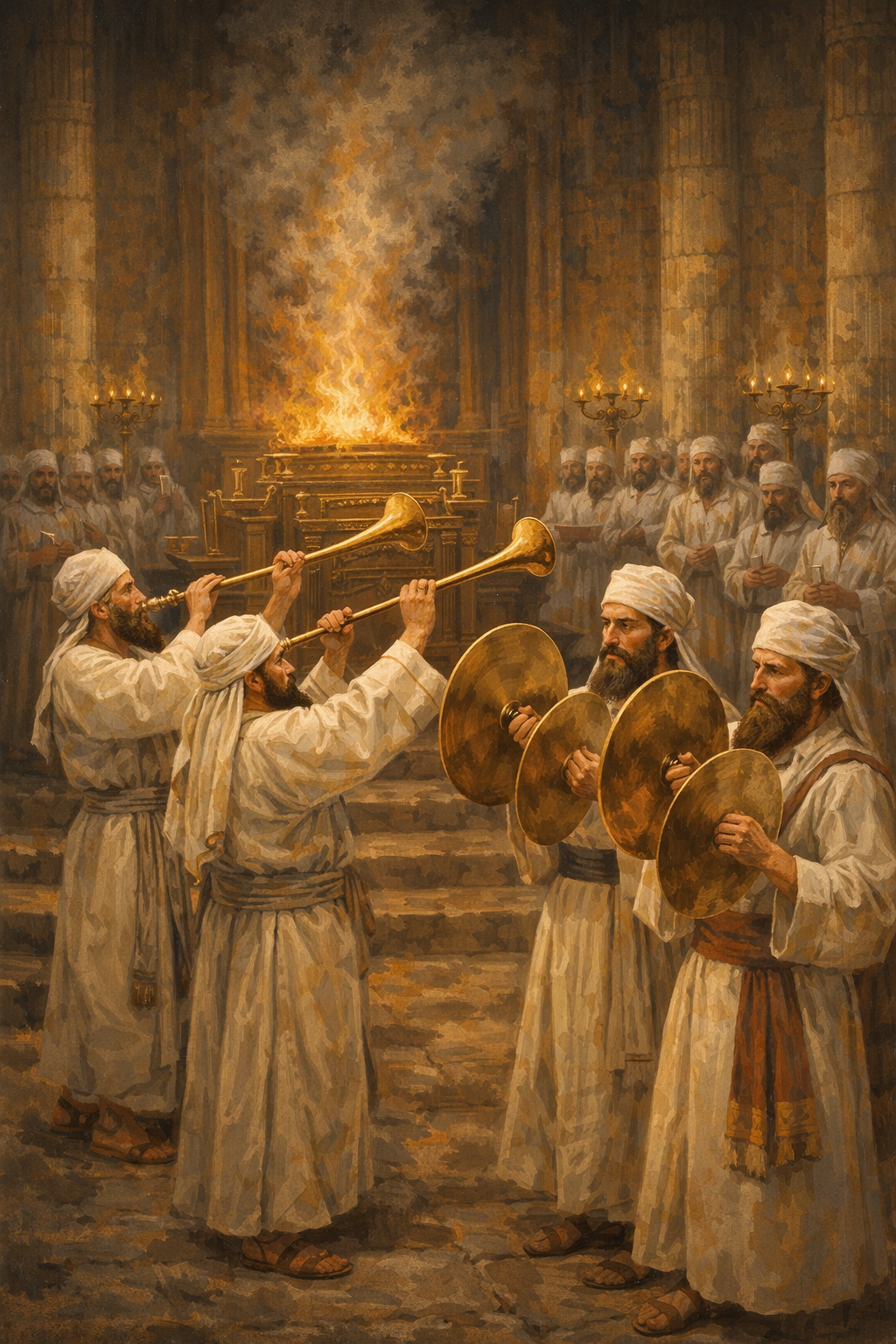
LEVITES & PRIESTS
LEAD WORSHIP
The Levites stood with the musical instruments of David - THIS ighlights the intentional restoration of biblically authorized worship, as these instruments had been established under David’s direction through prophetic guidance and were now employed to lead the people in ordered, joyful praise before the LORD, reaffirming continuity with God’s revealed pattern rather than innovation (1Ch 23:5; 1Ch 25:1–6).
And the priests with the trumpets. - This highlights that worship was being conducted according to God’s appointed order, not human preference. The trumpets were the sacred instruments entrusted specifically to the priests (Nu 10:1–10), used to signal God’s presence, summon the congregation, and mark solemn worship. Their sound proclaimed that reconciliation with God was taking place through sacrifice and that the nation was once again standing before Him in covenant relationship. In this restored service, the priests did not merely assist; they announced and authenticated the worship, declaring—by trumpet blast—that the LORD had accepted the renewed approach to His altar and that true worship had returned to Jerusalem. Sing to the Lord with All of Your Heart. (Messianic Version)
Trumpets ultimately pointed forward to the final divine summons,
when the “trumpet of God” will announce
the return of Christ, the true and eternal King!
Hallelujah! Maranatha!
EXCURSUS ON TRUMPETS - In the Old Testament, trumpets—especially the silver ḥaṣoṣerot and the ram’s horn (shofar)—were not mere musical instruments but God-ordained means by which the LORD communicated His presence, authority, and purposes to His people. They summoned and organized Israel, directing the congregation and the movement of the camps at God’s command (Num 10:2–3), sounded alarms in times of war and impending judgment (Num 10:9; Jer 4:19), and accompanied sacrifices, festivals, and days of gladness as acts of covenant worship before the LORD (Num 10:10; Lev 23:24). Trumpets also proclaimed kingship, announcing the enthronement of earthly kings and, more importantly, the rule and presence of Israel’s true King (1 Kgs 1:39; Josh 6). At Sinai, the trumpet blast marked the holy descent of God and the solemn establishment of His covenant (Exod 19:16), while the prophets employed trumpet imagery to warn of the coming Day of the LORD as a time of divine warfare and judgment (Joel 2:1; Zeph 1:16). Theologically, trumpets functioned as the audible voice of God—calling, warning, gathering, and sanctifying His people—and they ultimately pointed forward to the final divine summons, when the “trumpet of God” will announce the return of Christ, the true and eternal King (1 Thess 4:16).
2 Chronicles 29:27 Then Hezekiah gave the order to offer the burnt offering on the altar. When the burnt offering began, the song to the LORD also began with the trumpets, accompanied by the instruments of David, king of Israel.
- the song: 2Ch 7:3 20:21 23:18 Ps 136:1 137:3,4
THE SONG TO
THE LORD
Then Hezekiah gave the order to offer the burnt offering (olah) on the altar - This verse marks a decisive moment in Judah’s restoration, for the burnt offering was the sacrifice wholly consumed to God, symbolizing complete consecration, surrender, and renewed devotion. By commanding the ʿōlâ, Hezekiah was not merely restarting ritual activity but publicly declaring that the nation now belonged entirely to the LORD. This offering, ascending in smoke as a “soothing aroma,” expressed atonement, dedication, and worship together, affirming that reconciliation with God must lead to a life wholly yielded to Him. Placed at the center of the renewed temple service, the burnt offering proclaimed that Judah’s restoration would begin not with partial reform or political strategy, but with wholehearted surrender to God on His altar and according to His word.
When the burnt offering (olah) began, the song to the LORD also began with the trumpets, accompanied by the instruments of David, king of Israel - This is the only use of this phrase the song to the LORD in the Bible. This shows that worship and sacrifice were intentionally synchronized, so that as the burnt offering (olah) ascended in total consecration, praise erupted simultaneously through song, trumpets, and Davidic instruments, declaring that atonement and wholehearted worship belong together in the presence of the LORD.
EXCURSUS ON BURNT OFFERING (see also Gotquestions.org) - In Leviticus 1, the burnt offering (olah) was presented on the bronze altar at the entrance of the Tabernacle—the altar of burnt offering made of acacia wood overlaid with bronze—where blood was applied to its sacred horns, symbolizing strength, refuge, and the offering lifted up to God. The worshiper brought an unblemished offering according to ability, ranging from a costly bull to a sheep or goat, or even birds for the poor, showing that access to God was open to all. The offerer personally identified with the sacrifice by laying hands on the animal, slaughtering it “before the LORD,” and preparing it, while the priest handled the blood and arranged the offering on the altar, emphasizing that life belonged to God and atonement required death. Unlike other sacrifices, the entire animal was consumed by fire, signifying total consecration, surrender, and devotion of the worshiper’s life to God. Offered daily and at all major feasts and sacred times, the burnt offering stood as the most complete sacrificial act—an expression of general atonement, thanksgiving, and wholehearted dedication—anticipating the perfect self-offering of Christ and calling every worshiper to present himself wholly to the LORD.
John Walton - singing. Reference to the words of David and Asaph suggests the Levites probably used a hymnal or psalter, possibly somewhat like the book of Psalms. Most ancient Near Eastern monarchs employed singers (both male and female) for use in the palace and temple. The Mari archives describe in detail the female singers and the daily food supplies that were needed for their sustenance. Over twenty-four classes of singers are known in Israel (1 Chron 25). The names of the three heads of families of singers are also known (Asaph, Heman and Ethan; 1 Chron 6:18–32). The singers were presumably free men, but slaves were also attached to the temple (Ezra 2:43–58; Neh 7:46–60). Women played a role in the music of the tabernacle (Ex 38:8), but there is no clear reference to there being female singers associated with the temple.
Burnt offering (05930) 'olah from 'alah = to ascend and thus the picture of going up in smoke) refers to a whole burnt offering (one which goes up in smoke), which was voluntary, was understood as a sacrificial gift to God, resulting in a pleasing aroma acceptable to Jehovah (Lev 1:9). The presenter laid hands on the sacrifice which many feel signifies they saw the animal sacrifice as their substitute. The blood was sprinkled on the altar (Lev 1:6) When this offering was properly carried out (including a right heart attitude not just a "going through the motions," [which was not pleasing to God - Jer 6:20, Jer 7:21, 23, 24, see David - Ps 51:16-17+] not just an external "work," but an internal submission and obedience to Jehovah), they made atonement and were acceptable before Jehovah. The total burning indicated (or should have indicated) total consecration of the presenter's heart and soul and life to Jehovah. As noted a key feature of 'olah appears to be that among the Israelite sacrifices only 'olah is wholly burned, rather than partially burned and eaten by the worshipers and/or the priest. Thus, the whole animal is brought up to the altar and the whole is offered as a gift (minha) in homage to Yahweh. Whole offering would be a better rendering in English to convey the theology. It is indeed burned, but the burning is essentially secondary to the giving of the whole creature to Yahweh.
Olah in Kings and Chronicles - 1 Ki. 3:4; 1 Ki. 3:15; 1 Ki. 8:64; 1 Ki. 9:25; 1 Ki. 18:34; 1 Ki. 18:38; 2 Ki. 3:27; 2 Ki. 5:17; 2 Ki. 10:24; 2 Ki. 10:25; 2 Ki. 16:13; 2 Ki. 16:15; 1 Chr. 6:49; 1 Chr. 16:1; 1 Chr. 16:2; 1 Chr. 16:40; 1 Chr. 21:23; 1 Chr. 21:24; 1 Chr. 21:26; 1 Chr. 21:29; 1 Chr. 22:1; 1 Chr. 23:31; 1 Chr. 29:21; 2 Chr. 1:6; 2 Chr. 2:4; 2 Chr. 4:6; 2 Chr. 7:1; 2 Chr. 7:7; 2 Chr. 8:12; 2 Chr. 13:11; 2 Chr. 23:18; 2 Chr. 24:14; 2 Chr. 29:7; 2 Chr. 29:18; 2 Chr. 29:24; 2 Chr. 29:27; 2 Chr. 29:28; 2 Chr. 29:31; 2 Chr. 29:32; 2 Chr. 29:34; 2 Chr. 29:35; 2 Chr. 30:15; 2 Chr. 31:2; 2 Chr. 31:3; 2 Chr. 35:12; 2 Chr. 35:14; 2 Chr. 35:16
QUESTION - What is a burnt offering?
ANSWER - The burnt offering is one of the oldest and most common offerings in history. It’s entirely possible that Abel’s offering in Genesis 4:4 was a burnt offering, although the first recorded instance is in Genesis 8:20 when Noah offers burnt offerings after the flood. God ordered Abraham to offer his son, Isaac, in a burnt offering in Genesis 22, and then provided a ram as a replacement. After suffering through nine of the ten plagues, Pharaoh decided to let the people go from bondage in Egypt, but his refusal to allow the Israelites to take their livestock with them in order to offer burnt offerings brought about the final plague that led to the Israelites’ delivery (Exodus 10:24-29).
The Hebrew word for “burnt offering” actually means to “ascend,“ literally to “go up in smoke.” The smoke from the sacrifice ascended to God, “a soothing aroma to the LORD” (Leviticus 1:9). Technically, any offering burned over an altar was a burnt offering, but in more specific terms, a burnt offering was the complete destruction of the animal (except for the hide) in an effort to renew the relationship between Holy God and sinful man. With the development of the law, God gave the Israelites specific instructions as to the types of burnt offerings and what they symbolized.
Leviticus 1 and 6:8-13 describe the traditional burnt offering. The Israelites brought a bull, sheep, or goat, a male with no defect, and killed it at the entrance to the tabernacle. The animal’s blood was drained, and the priest sprinkled blood around the altar. The animal was skinned and cut it into pieces, the intestines and legs washed, and the priest burned the pieces over the altar all night. The priest received the skin as a fee for his help. A turtledove or pigeon could also be sacrificed, although they weren’t skinned.
A person could give a burnt offering at any time. It was a sacrifice of general atonement—an acknowledgement of the sin nature and a request for renewed relationship with God. God also set times for the priests to give a burnt offering for the benefit of the Israelites as a whole, although the animals required for each sacrifice varied:
- Every morning and evening (Exodus 29:38-42; Numbers 28:2)
- Each Sabbath (Numbers 28:9-10)
- The beginning of each month (Numbers 28:11)
- At Passover (Numbers 28:19)
- With the new grain/firstfruits offering at the Feast of Weeks (Numbers 28:27)
- At the Feast of Trumpets/Rosh Hashanah (Numbers 29:1)
- At the new moon (Numbers 29:6)
The ultimate fulfillment of the burnt offering is in Jesus’ sacrifice on the cross. His physical life was completely consumed, He ascended to God, and His covering (that is, His garment) was distributed to those who officiated over His sacrifice (Matthew 27:35). But most importantly, His sacrifice, once for all time, atoned for our sins and restored our relationship with God. GotQuestions.org
F B Meyer 2 Chronicles 29:27 When the burnt-offering began, the song of the Lord began also.
This chapter contains a parable of the cleansing of the heart, meant to be a temple for God; but the doors of prayer are unopened, the lamps of testimony unlit, the burnt-offerings of self sacrifice neglected; and, as the result, grass grows thick in courts which should have been trodden by the feet of Levite minstrels engaged in holy song. If ever that song is to break out again, it can only be after a thorough cleansing and renovation of the inner shrine. You tell me that you cannot sing the Lord’s song; then I know you have gone into the strange land of backsliding. You acknowledge that for some time now you have taken no delight in God or His service; then I am sure that the temple is badly in need of renovation.
Cleanse the house of the Lord. Bring out-all the uncleanness. By self-examination, confession, and repudiation, be clean of all the filth which has accumulated through months and years of neglect. Resume the position of entire devotion, as a prepared and sanctified soul. Offer the sin-offering for the past, and prepare the burnt-offering of entire consecration for the future. And when that is offered, when you determine to be wholly God’s, lay yourself, with all the interests of your life, at the feet of Jesus, for His disposal; then the song of the Lord will begin again.
The music of your life is still, because you are out of accord with the will of God; but when by surrender and consecration there is unison, your heart will be filled with songs without words, and love like an ocean in the fullness of her strength. When the rich, selfish bachelor suddenly finds himself compelled to care for his dead brother’s little children, he is startled to find that a new song has begun in his life.
George H. Morrison
As the offering began, singing to the Lord began also.—2 Chronicles 29:27
It is not till the burnt offering begins that we ever hear a single strain of music.34 Every human life has got its shadow, and every human life has got its cross. It is well to distinguish the shadow from the cross, lest by confusing them we go astray. For the shadow is something into which we enter and out of which we will pass in God’s good time. But the cross is something that we must take up, or stumble over into the mouth of hell. Now one of the deepest questions in life is, “In what way do you regard your crosses?” Do you hate them? Do you rebel against them? Would you give anything to fling them from you? Along that road there is no voice of song. Along that road there is the hardening heart. Along that road there is a growing bitterness, the foretaste of the bitterness of death. But take up your cross, as Jesus bids you do—take it up as a mother takes her child. Lay it against your heart and cherish it—say “This, too, like the summer roses, is from God.” And so this is how your poor life will become a harmony—and what is harmony but perfect music—and when the burnt offering begins, the song of the Lord will begin also.
2 Chronicles 29:27a
July 22 - Our Daily Walk
SURRENDER LEADING TO SONG
"And when the burnt offering began, the song of the Lord began also with the trumpets, and with the instruments ordained by David king of Israel."-- .
THE HEBREW Psalmody became famous throughout the world. Even their fierce conquerors recognized the sublime beauty of the Hebrew temple music. By the waters of Babylon they urged them to sing one of the Songs of Zion, not knowing how impossible it was for the captives to sing the Lord's song in a strange land! For sixteen years no song had poured forth from the sacred shrine. Ahaz had shut the doors, dispersed the Levites, and allowed the holy fabric to remain unkempt, unlit, and unused. There were no sacrifices on the Altar, no sweet incense in the Holy Place, no blood on the Mercy-Seat, no Song of the Lord!
For too many Christians this, alas, is a picture of their life. The soul, intended to be a holy temple for God, shows signs of disorder and neglect. The lights are not lit, the sweet incense of prayer does not ascend, the doors of entrance to fellowship and exit to service are closed. Outwardly the ordinances of the religious life are preserved, but inwardly silence and darkness prevail, into which bat-like thoughts intrude. Thorns have come up in the court of the Holy Place, where the scorpion makes her nest. The Song of the Lord had died out of heart and life.
Why should not this miserable condition be ended to-day? Why should you not be cleansed from the traces of sin and neglect through the Blood of the Cross? Why should you not come back into fellowship with God, who waits to receive and forgive? Surrender yourself to Him now. Do not be general, but specific in your consecration. Weld yourself to some life or lives that sorely need help. Give not words only, but deeds and blood. Merge your little life in the life of Christ, as the streamlet in the wide ocean. And as you yield yourself to Christ first, and next to all who need you for His sake, you will find the Song of the Lord breaking forth again in your heart like a spring, which was formerly choked with debris.
PRAYER We pray Thee, Heavenly Father, to cleanse the thoughts of our hearts, by the inspiration of Thy Holy Spirit, that we may perfectly love Thee, and worthily magnify Thy Holy Name, through Jesus Christ our Lord. AMEN.
🙏 THOUGHT - When we cleanse the neglected temple of our hearts through repentance and wholehearted surrender to Christ, the “song of the Lord” that once fell silent will rise again in joyful, living fellowship with God.
2 Chronicles 29:27b
November 25 - Our Daily Walk
HOW THE SONG OF THE LORD BEGAN
"When the burnt offering began, the Song of the Lord began."-- 2 Chronicles 29:27
"They sing as it were a new Song before the Throne." -- Rev14:3.
HEZEKIAH, AT the age of twenty-five, came to the throne, and set himself to reverse his father's evil policy. The doors of the Temple were re-opened, and under his direction the Levites were commissioned to cleanse the desecrated courts of the rubbish and filth that had been allowed to accumulate. After eight days of strenuous labour, they were able to report that their work was successfully accomplished; that the altar of burnt-offering and the table of shewbread were ready for the renewal of their wonted service. It was good news, and in the early morning of a memorable day, the king, accompanied by his princes and officers of state, took part in a solemn service of re-dedication. Amid the tense expectancy of the vast congregation which had assembled, Hezekiah commanded that the burnt sacrifice should be offered; and "when the burnt-offering began, the song of the Lord began also."
These ancient sacrifices have passed for ever. "Sacrifice and offering Thou dost not desire; mine ears hast Thou pierced (nailing me to Thy Cross); burnt-offering and sin-offering hast Thou not required. Then said I, Lo, I come, I delight to do Thy will, O my God!" To yield up one's life to the Saviour, to surrender our lives for others for His sake, to maintain the steadfast resolve of self-sacrifice,--this surely fulfils the conception of the burnt-offering, which the king ordered that morning as the symbol of national devotion to the Will of God. Can we wonder that the Song of the Lord began also? Does not that same Song arise in every heart when the sacrifice of love and obedience begins?
It is the self-contained life that has made itself snug within its four walls, sound-proof, sorrow-proof, as it thinks, and love-proof, which is song-less and pitiable.
Our Lord said: "'Whosoever shall lose his life for My sake shall find it." That finding is the correlative and source of the "Song of the Lord.'" Unite thyself with Jesus on the Cross, and one day thou wilt find thyself sharing with Him the New Song of accomplished Redemption!
PRAYER Give us loving and thankful hearts. May Thy mercies bind us like cords to the horns of the Altar. Let our whole nature be consecrated for Thine indwelling, and as the burnt-offering begins, may the Song of the Lord begin also in our hearts. AMEN.
🙏 THOUGHT When we open our lives fully to God and offer ourselves in loving obedience, true joy and the “song of the Lord” inevitably follow, for life is only truly found when it is willingly surrendered to Him.
2 Chronicles 29:28 While the whole assembly worshiped, the singers also sang and the trumpets sounded; all this continued until the burnt offering was finished.
- While the whole assembly : Ps 68:24-26 Rev 5:8-14
- the singers also sang Ps 89:15
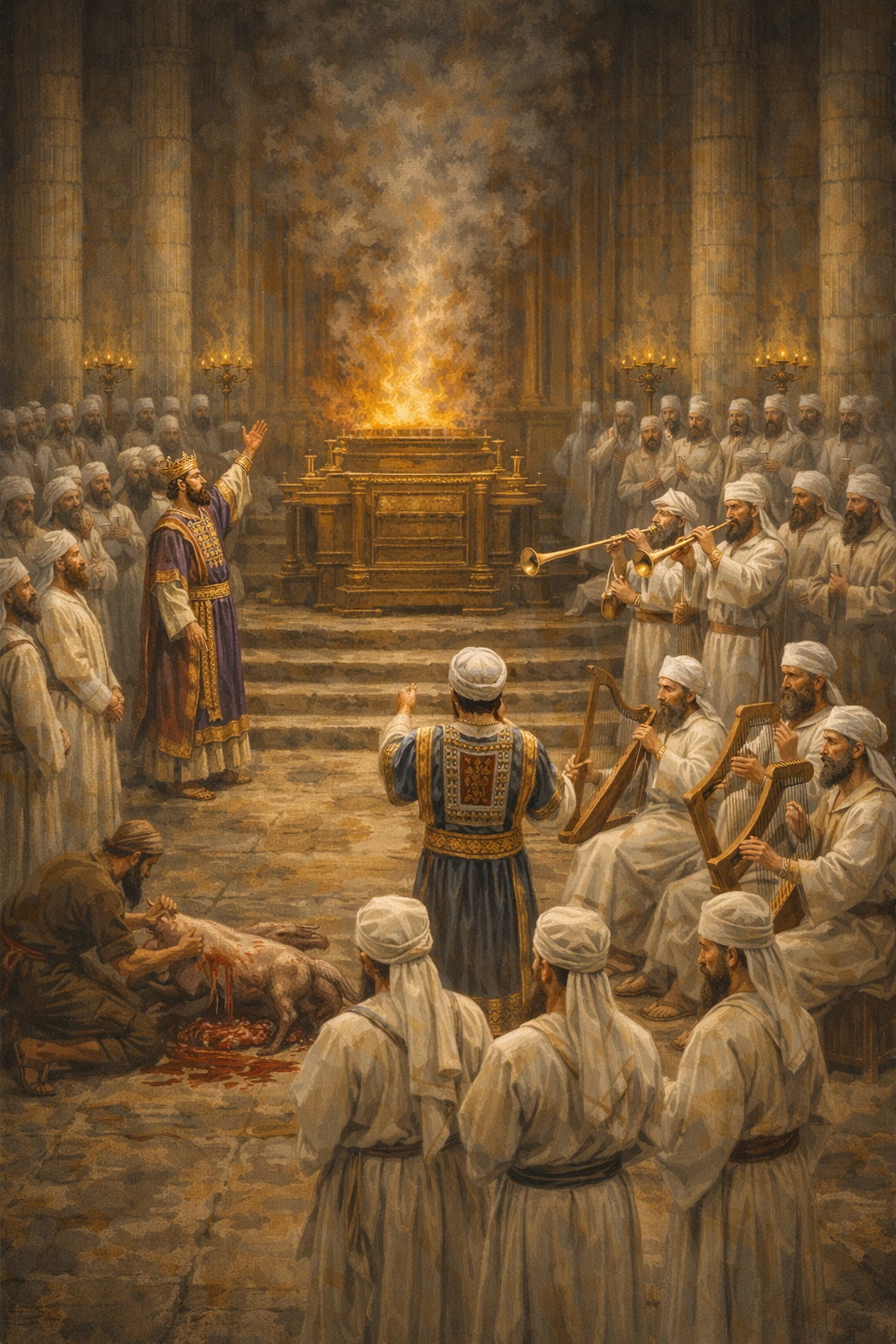
THE SONG OF THE LORD
RISING WITH THE SACRIFICE
While the whole assembly worshiped, the singers also sang and the trumpets sounded; all this continued until the burnt offering was finished - This portrays a unified act of worship in which sacrifice, song, and trumpet sound were deliberately joined together. As the burnt offering (LXX - holokautoma) was wholly consumed, symbolizing complete consecration, the people bowed in reverence while singers and priests continued in praise, showing that true worship surrounds God’s work from beginning to end and unites heart, voice, and obedience before Him.
J.A. Thompson: Now that the “whole assembly” had dedicated themselves to the Lord verbally, it was time for them to express their faith by bringing sacrifices. The Hebrew idiom for “dedicated yourselves” is “you have filled your hand.” It is ordinarily used for priestly investiture (2Ch 13:9), but here it applies to the whole assembly and not just to the priests. The same idiom is used in this wider sense in 1 Chr 29:5. The word for “sacrifices” here (zebahim) probably refers to fellowship offerings in general (2Ch 29:35) of which thank offerings form a subgroup (Lev 7:11-18). The responsiveness of the people recalls events at the time of Moses, David, and Solomon (Exod 36:6-7; 1 Chr 29:1, 5-9; 2 Chr 7:7). Here was a pattern to be followed by the Chronicler’s postexilic audience. (SEE 1, 2 Chronicles: An Exegetical and Theological Exposition)
True dedication is proved by action, not words—
when hearts are truly given to the LORD,
hands are willingly filled with sacrificial obedience and thankful worship.
August Konkel: This celebration has a character distinct from the prior ritual, as expressed by the different kinds of sacrifices. Instead of burnt offerings and purification offerings, the people are asked to offer sacrifices and praise offerings (2Ch 29:31), offerings that are eaten by their owners as part of a thanksgiving meal. These are often qualified as peace offerings or offerings of well-being. The Chronicler goes out of his way to show surprise and delight at the spontaneity of the great number of devoted praise offerings consumed as part of the thanksgiving festivities (2Ch 29:33). (See 1 & 2 Chronicles)
2 Chronicles 29:29 Now at the completion of the burnt offerings, the king and all who were present with him bowed down and worshiped.
- bowed: 2Ch 20:18 1Ch 29:20 Ps 72:11 Ro 14:11 Php 2:10,11
BOW DOWN
IN WORSHIP
Now at the completion of the burnt offerings, the king and all who were present with him bowed down and worshiped At the completion of the burnt offerings, Hezekiah and all who were with him bowed down in worship, openly acknowledging the LORD’s holiness and mercy and humbly responding in gratitude to His acceptance of the sacrifice and the restoration of covenant fellowship.
EXCURSUS ON POSTURE IN WORSHIP - The Old Testament describes prayer and worship through a rich variety of physical postures that outwardly expressed inward humility, reverence, and devotion before God. Worshipers stood (ʿāmad) in prayer (1 Sam 1:26; 1 Kgs 8:22; Jer 18:20), often with hands and head lifted (nāśāʾ), symbolizing appeal and dependence on the LORD (Ps 28:2; 134:2; 141:2; Isa 1:15; Lam 2:19), while kneeling (bārak) conveyed submission and earnest entreaty (1 Kgs 8:54; 2 Chr 6:13). Bowing and prostration were especially prominent, expressed by verbs such as gāhar (to crouch or bend low; 1 Kgs 18:42), ḥāwâ (to bow down in worship before the LORD; 1 Sam 1:3, 19; 1 Chr 29:20; 2 Chr 7:3; Ps 95:6; 99:5, 9; 132:7), kāphaph and kāphak (to bend or bow the body in humility; 1 Kgs 8:54; 2 Chr 29:29; Mic 6:6), and qādad (to bow the head deeply; Exod 4:31; 12:27; 1 Chr 29:20; 2 Chr 29:30). In contrast, sāgad consistently denotes bowing in worship before false gods (Isa 44:15, 17, 19; 46:6; Dan 2:46; 3), underscoring the sharp biblical distinction between true worship and idolatry. Together, these texts show that posture varied with the nature of prayer, yet biblical worship consistently engaged the whole person, one's body and heart, expressing awe, repentance, gratitude, and covenant loyalty before the living God. (See also What does the Bible say about bowing or kneeling in prayer?)(Play and sing Come Let Us Worship and Bow Down)
John Walton - worship in the outdoors. The Israelites of Jerusalem normally prayed at the temple courts, facing the sanctuary itself (Ps 5:8; 28:2; 138:2). The Jew outside Jerusalem faced in the direction of the city of Jerusalem and temple (1 Kings 8:44–48). In most ancient Near Eastern cultures the common person did not have access to the inside of a temple but did his worship in the temple courts. The temples of the ancient world were not built to be houses of worship but residences for the divine presence. Worship (prayers and sacrifices) was carried out at the temple, but there were no regular worship services at which all of the faithful gathered.
2 Chronicles 29:30 Moreover, King Hezekiah and the officials ordered the Levites to sing praises to the LORD with the words of David and Asaph the seer. So they sang praises with joy, and bowed down and worshiped.
- with the words of David 2Sa 23:1,2 1Ch 16:7-36
- So they sang praises: Ps 32:11 33:1 95:1,2,6 100:1,2 149:2 Php 4:4
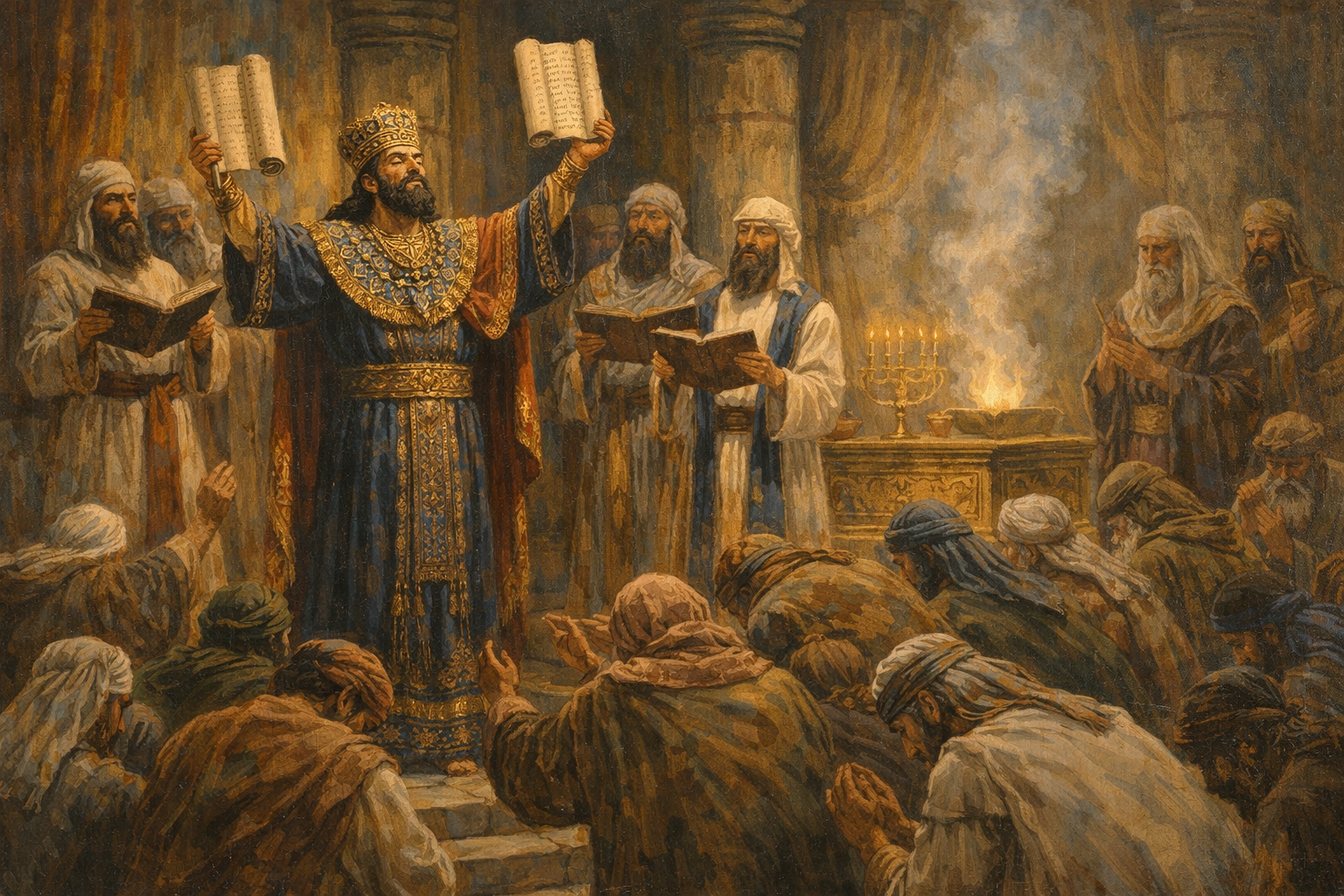
RESTORATION OF PRAISE
"DAVID STYLE"
Moreover, King Hezekiah and the officials ordered the Levites to sing praises (halal) to the LORD with the words of David and Asaph the seer - King Hezekiah and the officials deliberately restored praise according to God’s revealed pattern by commanding the Levites to sing to the LORD using the inspired words of David and Asaph the seer, rooting Israel’s worship in Scripture rather than innovation. This underscores that true revival is marked not only by renewed sacrifice but by God-centered praise shaped by His Word and faithfully transmitted through His appointed servants.
EXCURSUS ON SEER - A seer is literally one who “sees,” an older or more specific designation for a prophet that emphasizes the mode of revelation, as Scripture notes that “the prophet was formerly called a seer” (1 Sam 9:9). While all prophets declared the word of the LORD, seers were especially characterized by receiving divine revelation through visions—what they saw in dreams, mental images, or visible scenes—and by being given God-given insight to interpret those visions; the Old Testament commonly uses rōʾeh (1 Sam 9:11) and ḥōzeh (2 Sam 24:11). Passages such as 2 Chronicles 9:29 suggest a functional distinction, contrasting prophets who primarily proclaimed God’s message (e.g., Nathan) with seers particularly associated with visionary revelation (e.g., Iddo), a pattern illustrated in Jeremiah’s call when God asks what he “sees” and then explains its meaning (Jer 1:11–18). The distinction is therefore not one of rank but of emphasis: seer highlights revelation by sight, while prophet (nabiy) highlights the mission of proclamation (Exod 7:1; Jer 1:7); accordingly, all seers were prophets, though not all prophets bore the title. Although “seer” is not used in the New Testament, visionary prophecy continues in figures such as Paul (2 Cor 12:2), Stephen (Acts 7:55–56), and John (Rev 1:12–16), showing God’s ongoing use of visions within His authoritative prophetic witness.
Those explicitly called seers include Samuel, the earliest figure associated with the title, when “the prophet was formerly called a seer” (1 Sam 9:9; cf. 9:11, 18–19); Gad, known as “the king’s seer” who advised David (2 Sam 24:11; 1 Chr 21:9; 29:29); Iddo, linked with visionary records concerning Solomon and Jeroboam (2 Chr 9:29; 12:15; 13:22); Hanani, who confronted King Asa (2 Chr 16:7, 10); and Heman, called “the king’s seer” in matters of God (1 Chr 25:5). Although David is not called a seer, his reign is recorded through “Samuel the seer, Nathan the prophet, and Gad the seer” (1 Chr 29:29), while other prophets such as Jeremiah and Ezekiel functioned as seers by receiving visions without bearing the formal title (Jer 1:11–13; Ezek 1).
So they sang praises (halal) with joy (simchah), and bowed down and worshiped (shachah; LXX - proskuneo) - This shows that restored worship involved the whole person, as the people lifted their voices in praise (halal) marked by God-given joy (simchah) and then humbled themselves in reverent submission by bowing down to worship (shachah). Together with the Septuagint’s proskuneo, it emphasizes that true worship holds joyful exaltation and humble self-abasement in balance, rejoicing in the LORD while acknowledging His supreme holiness and authority.
Praises (verb) (01984) (halal, הָלַל) has the root meaning of "giving off of light by celestial bodies." Halal means to shine, to flash, to radiate, have bright or clear light be visible from a source (as in Job 29:3; 31:26; 41:18; Isa 13:10). To praise is the meaning of the intensive form of the halal, which in its simple active form means to boast (Related to God = "My soul shall make its boast in the LORD" Ps 34:2, Boasting related to men = 1Ki 20:11). Halal connotes genuine appreciation for the great actions or the character of its object.
Halal is occasionally used to indicate “praise” of people (the king = 2Chr 23:12; Absalom = 2Sa 14:25). More often halal refers to the “praise” of God (first use in this way = 2Sa 22:4). In fact in some texts not only living things are to praise God but all created things, including the sun and moon, are to praise Him (Ps 148:2-5, 13; 150:1).
Vine notes that to praise is actually the meaning of the intensive form of the Hebrew verb halal, which in its simple active form means to boast… The Hebrew name for the Book of Psalms is simply the equivalent for the word “praises” and is a bit more appropriate than “Psalms,” which comes from the Greek and has to do with the accompaniment of singing with a stringed instrument of some sort. It is little wonder that the Book of Psalms contains more than half the occurrences of halal in its various forms. Psalms 113-118 are traditionally referred to as the “Hallel Psalms,” because they have to do with praise to God for deliverance from Egyptian bondage under Moses. Because of this, they are an important part of the traditional Passover service. There is no reason to doubt that these were the hymns sung by Jesus and His disciples on Maundy Thursday when He instituted the Lord’s Supper (Mt 26:30). (Vine's Expository Dictionary of Old Testament and New Testament Words)
TWOT - hālal = praise, boast (only in Piel, Pual and Hithpael). This root connotes being sincerely and deeply thankful for and/or satisfied in lauding a superior quality(ies) or great, great act(s) of the object… This root can be used of exalting human beauty (Ge 12:15; 2Sa 14:25) or human understanding (Pr 12:8)… (Halal) usually refers to praising deity, even false deities (Jdg 16:24). The most frequent use of our root relates to praising the God of Israel. Nearly a third of such passages occur in the Psalms. The largest number of these are imperative summons to praise… (Praise) is to be offered in an attitude of delight and rejoicing. Belief and joy are inextricably intertwined. Secondly, it is significant that most of these occurrences are plural (except Ps 146:1; Ps 147:12, collective). This shows us, as does the use of the psalms in the worship that praise of Jehovah was especially, though by no means uniquely (Ps 146:1), congregational. This praise could involve choirs and musical instruments, too. (Online Theological Wordbook of the Old Testament- R Laird Harris, Gleason L Archer Jr., Bruce K. Waltke)
Worshiped (bowed down, prostrated themselves) (07812) shachah means to bow down, to prostrate oneself, to crouch, to fall down, to humbly beseech, to do reverence, to worship. The idea is to assume a prostrate position as would in paying homage to royalty (Ge 43:28) or to God (Ge 24:26, Ps 95:6). In the first use in Genesis (which has most of the uses - 21v), when Abraham saw "three men (one of Whom was most likely the pre-incarnate Christ)… standing opposite him… he ran from the tent door to meet them and bowed (shachah) himself to the earth (Ge 18:2, cp Lot bowing to the two angels - Ge 19:1) It is used to describe Joseph's brother's sheaves which "bowed down to my sheaf.” (Ge 37:7) When God told Abraham to sacrifice his son, he told his men to remain for they would go to "worship and return to you." (Ge 22:5) Joshua bowed down to the "Captain of the host of the LORD," (Joshua 5:14) almost assuredly a preincarnate appearance of Messiah. In Josh 23:7, 16 Joshua warned Israel NOT to bow down to the idols of the land, but in Jdg 2:12, 17, 19 that is exactly what they did!
The English word prostrate is defined as being stretched out with one's face on the ground in adoration or submission. It is not just that the person has fallen down but pictures them lying at length or with their body extended on the ground and so lying in a posture which is reflective of genuine humility and/or adoration.
The Hebrew verb shāchāh means “to bow down, prostrate oneself, or worship” and occurs more than 170 times in the Old Testament, reflecting its deep cultural and theological significance. First appearing in Genesis 18:2, where Abraham bowed to the messengers of the LORD, the word commonly denotes physical homage offered to one possessing authority, whether a human superior—such as David before Saul (1 Sam 24:8), Ruth before Boaz (Ruth 2:10), or Joseph’s brothers in his dream (Gen 37:5, 9–10)—or God Himself, where the act becomes true worship (1 Sam 15:25; Jer 7:2). The verb frequently appears in the Hithpael stem, emphasizing a voluntary, self-humbling action, vividly illustrated in Exodus 34:8: “Moses made haste, bowed his head toward the earth, and worshiped.” While shāchāh rightly describes worship of the LORD (Gen 22:5; Exod 4:31; 12:27; Judg 7:15), Scripture also uses it to condemn idolatry, as people bow before false gods, idols, sacred sites, or celestial bodies (Exod 20:5; Deut 4:19; Isa 44:15, 17). Whether directed toward God or misdirected toward idols, prostration conveys the worshiper’s acknowledged powerlessness before one deemed supreme, a posture mirrored in ancient political and social customs (Gen 42:6; 2 Sam 14:33; 1 Kgs 1:16), but given its highest and rightful meaning only when expressed before the living LORD.
The LXX translates WORSHIP here with the picturesque verb proskuneo (from pros = before + kuneo = kiss or adore) means to prostrate oneself in homage before another in the full sense of worship, not mere reverence or courtesy. When Jesus Christ was born into this world, He was attended and worshipped by angels. (Lu 2:13f). Proskuneo represents the most common Near Eastern act of adoration and reverence and also carries the idea of profound awe and respect. Some believe that the root word kuneo may be related to kuon which is the Greek word for dog and which then could be picturing a dog licking his master's hand.
The word proskuneo literally means to kiss toward someone, to throw a kiss in token of respect or homage, to prostrate oneself in homage, to do reverence to, to adore and so to worship and show respect. In the ancient Oriental (especially Persia) the mode of salutation between persons of equal rank was to kiss each other on the lips. When the difference of rank was slight, they kissed each other on the cheek. When one was much inferior, he fell upon his knees touched his forehead to the ground or prostrated himself, and as he was bowing down he would be throwing kisses toward the superior. It is this latter mode of salutation that is intended by the Greek writers in the use of the verb proskuneo .
Joy (gladness, pleasure, delight) (08057) simchah derived from the verb samach (“to rejoice, be glad”), denotes joy or gladness involving the whole person—heart, soul, and outward expression—and refers both to the inward experience and its visible manifestation (Exod 4:14; Ps 19:8; 86:4; Ezra 3:12–13). Scripture presents simchah as a gift from God, who places gladness in the heart (Ps 4:7), makes His people rejoice in His presence (Ps 16:11), and desires to be served with joy (Deut 28:47), as David prays, “Make me to hear joy and gladness” (Ps 51:8). This joy frequently accompanies music, singing, and celebration in worship and covenant life (1 Sam 18:6; 1 Kgs 1:40; 1 Chr 15:16; 2 Chr 29:30; 30:21), as well as willing, wholehearted giving (1 Chr 29:9, 17), feasts, harvests, weddings, and daily labor under God’s gracious hand (Eccl 5:20; Song 3:11; Ezra 6:22). While simchah can describe fleeting or misguided pleasure, including the temporary joy of the godless (Job 20:5), Scripture underscores that true and enduring joy comes from the LORD and may be given or removed at His will (Isa 16:10; Jer 7:34; Joel 1:16). Translated in the Septuagint by chara (e.g., Jer 15:16), simchah ultimately reflects joy that “shines” from a heart rightly aligned with God, finding its fullest expression in grateful worship and covenant fellowship with Him.
2 Chronicles 29:31 Then Hezekiah said, “Now that you have consecrated yourselves to the LORD, come near and bring sacrifices and thank offerings to the house of the LORD.” And the assembly brought sacrifices and thank offerings, and all those who were willing brought burnt offerings.
- consecrated yourselves, 2Ch 13:9
- sacrifices: Lev 1:1-3:17
- thank: Lev 7:12
- all those who were willing. Lev 1:3 23:38 Ezr 1:4
FROM CONSECRATION
TO CELEBRATION
Then Hezekiah said, “Now that you have consecrated (male; LXX - pleroo) yourselves to the LORD Hezekiah is addressing the priests and Levites, with the assembled leaders and people of Judah present, after they had completed the rites of cleansing and consecration of themselves and the temple (cf. 2 Chr 29:15–19). Having been set apart to the LORD, the priests and Levites were now authorized to resume their sacred duties,
Come near and bring sacrifices and thank offerings to the house of the LORD.” And the assembly brought sacrifices and thank offerings, and all those who were willing brought burnt offerings. The assembly of Israel was invited to draw near by bringing sacrifices and thank offerings, showing that restored leadership enabled renewed, willing participation in corporate worship under Hezekiah’s direction. Thank offerings (also known as peace offerings or fellowship offerings) were a specific type of sacrifice that the people of Judah brought to God out of gratitude and fellowship after being cleansed and reconciled to Him through atonement. Unlike sin or burnt offerings, thank offerings were not primarily for atonement but for celebration of restored fellowship with the LORD. Part of the sacrifice was burned on the altar, while the remainder was shared by the priests and the worshipers in a communal meal (Lev 7:11–15). In this context, they signified heartfelt thanksgiving for forgiveness, renewal, and the reopening of access to God, showing that true revival moves beyond cleansing from sin to joyful gratitude and willing worship.
EXCUSUS ON PEACE OFFERING (CF THANK OFFERING) - In Scripture, the peace offering (also called the fellowship offering) was not a propitiatory gift meant to placate God but a voluntary covenant sacrifice expressing thanksgiving, fulfilled vows, or joyful communion after reconciliation had already been established (Lev. 7:11–21; 3:1–17). Offered as a concluding sacrifice following offerings that addressed sin and consecration, it celebrated restored fellowship with God, family, and community, highlighting joy rather than appeasement (Lev. 9:18–21). The offering could be male or female from the herd or flock, without blemish, with hands laid on the animal, its blood sprinkled around the altar, and the choicest parts—fat, kidneys, and the lobe of the liver—burned to the LORD as His portion (Lev. 3:2–5; 7:3–5), while the breast and right thigh were given to the priests as wave and heave offerings (Lev. 7:28–34). Uniquely, the remaining portion was eaten by the worshiper within a prescribed time, symbolizing shared fellowship with God and affirming that He provides sustenance rather than extracting payment (Lev. 7:15–18). Thus the peace offering testified that God’s favor is rooted in grace, not human appeasement (Eph. 2:8–9), anticipating the New Covenant reality in which believers offer spiritual sacrifices of praise and living devotion through Christ, whose sacrifice alone secures true peace with God (Rom. 12:1; Heb. 13:15; Rom. 5:1).
Consecrated (fulfilled, completed, ordain) (04390) male means to fill or to be full, to complete, to fulfill, to finish, to satisfy. Male is used of something full in both the spatial and temporal sense.
G Campbell Morgan - 2 Chr 29.31
With the accession of Hezekiah a great change came over the life of Judah. For a period there was a definite arrest in the process of degeneration. The reformation which he carried out began in his deep consciousness of the wretched condition of the people, and the reason thereof. This is most graphically set forth in the words he addressed to the priests and Levites when he called them together. There was no suggestion on his part that the calamities which had fallen upon them were in any way unjust. On the other hand he traced the story of their sin, and declared that the result of that sin was that the wrath of God had expressed itself righteously in their disasters. He then commenced the work of restoring the true order of worship, and the first business was that of cleansing the actual Temple. Some idea of the calamitous condition of the national life may be gained from the fact that the Levites were occupied sixteen days in cleansing the accumulation of filth from the sacred precincts. When this was done, there followed the ceremony of re-dedication; and in these words we discover Hezekiah's sense of the true order of procedure. Sacrifices and offerings are only acceptable when those offering them are themselves consecrated to Jehovah. The same principle is found in Paul's words in the Corinthian letter: "First they gave their own §elves to the Lord, and to us through the will of God." Contributions to the work of God are only valuable as they are the gifts of those who are themselves yielded to God
True renewal begins when we first give ourselves fully to the LORD,
for only consecrated lives can offer worship and service that truly pleases God.
2 Chronicles 29:32 The number of the burnt offerings which the assembly brought was 70 bulls, 100 rams, and 200 lambs; all these were for a burnt offering to the LORD.
- the number: 1Ki 3:4 1ki 8:63 1Ch 29:21 Ezr 6:17
Related Passages:
1 Kings 3:4 (OBVIOUS ABUNDANCE DURING SOLOMON'S REIGN) The king went to Gibeon to sacrifice there, for that was the great high place; Solomon offered a thousand burnt offerings on that altar.
1 Kings 8:63 (OBVIOUS ABUNDANCE DURING SOLOMON'S REIGN) Solomon offered for the sacrifice of peace offerings, which he offered to the LORD, 22,000 oxen and 120,000 sheep. So the king and all the sons of Israel dedicated the house of the LORD.
1 Chronicles 29:21 (KING DAVID SHORTLY BEFORE SOLOMON FORMALLY ASCENDED TO THRONE - 1Ch 29:22) On the next day they made sacrifices to the LORD and offered burnt offerings to the LORD, 1,000 bulls, 1,000 rams and 1,000 lambs, with their drink offerings and sacrifices in abundance for all Israel.
FAITHFUL SACRIFICE AMID
REDUCED PROSPERITY
The number of the burnt offerings which the assembly brought was 70 bulls, 100 rams, and 200 lambs; all these were for a burnt offering to the LORD - Comparing the sacrifices offered in 2 Chronicles 29:32 with the vast number presented by Solomon at the temple dedication (see 2 Chr 7:4–7) highlights how greatly Judah’s material prosperity and spiritual vitality had declined in the intervening years. Under Solomon, abundance overflowed in both wealth and national devotion, whereas Hezekiah’s offerings—though sincere and acceptable—reflect a kingdom weakened by idolatry, judgment, and loss. Yet this contrast also underscores an important truth: God’s pleasure is not measured by quantity but by faithfulness, for even in reduced circumstances, a repentant people who return to the LORD with willing hearts find their worship received and their restoration begun.
2 Chronicles 29:33 The consecrated things were 600 bulls and 3,000 sheep.
- the consecrated: 2Ch 29:31
COSTLY GIFTS FROM
WILLING HEARTS
The consecrated things (offerings set apart for the LORD) were 600 bulls and 3,000 sheep - The consecrated offerings numbered 600 bulls and 3,000 sheep, an extraordinary total that reflects the people’s willing and grateful response to the LORD after the temple was restored to proper worship. Though far fewer than the sacrifices offered in Solomon’s day, these offerings nonetheless represent costly devotion from a humbled and repentant nation, showing that genuine consecration is measured not by abundance but by obedient hearts eager to honor God with what they have.
God measures consecration not by how much we give,
but by the willing, grateful hearts with which we give it.
2 Chronicles 29:34 But the priests were too few, so that they were unable to skin all the burnt offerings; therefore their brothers the Levites helped them until the work was completed and until the other priests had consecrated themselves. For the Levites were more conscientious to consecrate themselves than the priests.
- the priests: 2Ch 29:5 30:16,17
- their brothers : 2Ch 35:11 Nu 8:15,19 18:3,6,7
- for the Levites: 2Ch 30:3
- upright: 1Ch 29:17 Ps 7:10 26:6 94:15
NECESSITY OVERRIDES CUSTOM
IN SERVICE TO YAHWEH
But the priests were too few, so that they were unable to skin all the burnt offerings The Levites were permitted to flay and prepare peace offerings and similar sacrifices, but the whole burnt offerings were ordinarily handled only by the priests, except in a case of necessity such as this.
Therefore their brothers the Levites helped them until the work was completed and until the other priests had consecrated themselves. For the Levites were more conscientious to consecrate themselves than the priests. the number of consecrated priests was initially insufficient for the volume of sacrifices, so the Levites stepped in to assist until the work was finished and more priests were properly set apart. The note that the Levites were more conscientious highlights their readiness and zeal, gently exposing the priests’ earlier negligence while commending wholehearted obedience.
The Chronicler is very supportive of the Levites. Notice only Levites' families are named in 2 Chr. 29:12-15. In Ezra's day there was a great need for Levites. Often in history they had been neglected and overworked. They were given by God to serve the priests.
Bob Utley - The priests killed, skinned, and prepared the animals for mass public sacrifices (i.e., 2 Chr. 29:22,24,34; Ezek. 44:11), but for free will sacrifices, usually the offerer killed, skinned, and cut up the animal (cf. Lev. 1:5-6).
2 Chronicles 29:35 There were also many burnt offerings with the fat of the peace offerings and with the libations for the burnt offerings. Thus the service of the house of the LORD was established again.
- the burnt: 2Ch 29:32
- the fat: Ex 29:13 Lev 3:15,16
- the drink: Ge 35:14 Lev 23:13 Nu 15:5-10
- so the: 1Ch 16:37-42 Ezr 6:18 1Co 14:40
FULL RESTORATION OF
THE LORD'S HOUSE
There were also many burnt offerings with the fat of the peace offerings and with the libations for the burnt offerings. Thus the service of the house of the LORD was established again - This statement emphasizes the full restoration of proper temple worship, as all the prescribed elements—burnt offerings, the fat portions of the peace offerings, and the drink offerings—were once again offered together according to the Law. With sacrifice, thanksgiving, and worship functioning in their proper order, the temple was no longer merely cleaned but fully operational, showing that true renewal is complete only when God’s house is restored to faithful, obedient service.
Frederick Mabie: In the afterglow of the ceremony culminating in a consecrated and functioning temple for God’s people (v. 35), there is a deep-seated atmosphere of gratefulness. As reflected at the beginning of the account (v. 3), the quickness in which the temple is reopened, consecrated, and dedicated is an added measure of great joy celebrated by the king and the community as a whole. (See The Expositor's Bible Commentary: 1 Chronicles-Job - Page 286)
John Walton - 29:35–6. sacrifice and feasting. Biblical feasts were different in purpose, content and origin from those of other peoples in the ancient Near East. Ancient Near Eastern feast days coincided with the New Year or the change of seasons. The Israelite took part in the feast as one who was indebted to the grace of Yahweh. The feasts of their neighbors typically included periods of mourning, processions, the performance of sacred dramas (as well as other entertainment) and an opportunity to ask oracles of the deity.
Bob Utley - "peace offering" The meat would be shared with all the worshipers!
2 Chronicles 29:36 Then Hezekiah and all the people rejoiced over what God had prepared for the people, because the thing came about suddenly.
- Hezekiah rejoiced: 1Ch 29:9,17 Ezr 6:22 1Th 3:8,9
- God: 2Ch 30:12 1Ch 29:18 Ps 10:17 Pr 16:1
- the thing: Ac 2:41
JOY OVER GOD'S SUDDEN
WORK OF RENEWAL
Then Hezekiah and all the people rejoiced over what God had prepared for the people, because the thing came about suddenly. Hezekiah and the people rejoiced because they recognized that the swift and thorough restoration was the result of God’s sovereign preparation of hearts, accomplishing in a short time what had long seemed impossible. Though Hezekiah’s godly example and leadership were instrumental, the sudden success made clear that true revival is ultimately a gracious work of God, prompting shared joy and directing all glory to Him alone.
When God prepares hearts, renewal happens suddenly—
and all the joy and glory rightly belong to Him.
Iain Duguid: The speed of restoration was evidence that, while the king had given the lead and the people, Levites, and priests had responded, this was all God’s enabling provision. The solid basis for “rejoicing” (cf. 2Ch 29:30: “gladness”) is not human willingness but the grace of God that enables all. (ESV Expository Commentary (Volume 3): 1 Samuel–2 Chronicles)
Martin Selman: Two consequences followed from these offerings. The first was to acknowledge that only God had made it all possible (2 Chronicles 29:36; cf. 1 Corinthians 12:3; Ephesians 2:18). The second was that everyone rejoiced (2 Chronicles 29:36), in complete contrast with the situation with which they had begun.
Bob Utley - "because the thing came about suddenly" This ADVERB is usually used of the rapid arrival of judgment, but only here is it used of sudden joy over the rapid cleansing, consecration, and restart of temple worship!
Robert Hawker —2 Chron. 29:36.
SWEET thought ever to keep in view, that it is the Lord that prepares the heart, and gives answers to the tongue. And, oh! how sudden, how unexpected, how unlooked-for, sometimes, are the visits of his grace! “Or ever I was aware (saith the Church) my soul made me like the chariots of Amminadib.” Is my heart cold, my mind barren, my frame lifeless? Do thou then, dearest Lord, make me to rejoice in warming my frozen affection, making fruitful my poor estate, and putting new life into my soul. All I want is a frame of mind best suited to thy glory. And what is that? Truly, that when I have nothing, feel nothing, can do nothing, am worse than nothing, that then, even then, I may be rich in thee amidst all my own bankruptcy. This, dear Lord, is what I covet. And if thou withholdest all frames which might melt, or warm, or rejoice my own feelings, yet if my soul still hangs upon thee notwithstanding all, as the vessel upon the nail, my God and Jesus will be my rock, that feels nothing of the ebbings and flowings of the sea around, whatever be the tide of my fluctuating affections.
SUMMARY - Spiritual renewal begins when we personally recommit to God, allow His Word to cleanse us through Christ’s sacrifice, and respond with joyful, reverent worship—because revival that transforms a nation must first take root in surrendered hearts.
America desperately needs spiritual renewal or revival! Most of us would say, “Amen!” to that statement. The city of Flagstaff needs revival! “Preach it, brother!” The NAU campus needs revival! “You’ve got that right!”
The churches of Flagstaff need revival! “Yes, all the churches need to catch on fire!” Flagstaff Christian Fellowship needs revival! “Well, there may be some here who need it.” You and I need individual revival! “Now, just a minute! You’ve gone too far!”
We’re all for revival “out there,” but when it gets too close to home, we begin to get a bit nervous. Revival implies that the thing needing reviving isn’t real healthy--paramedics don’t revive someone walking down the street in good health! Revival also implies change. That threatens us because, even if we’re not doing real well spiritually, we tend to get comfortable with the predictable.
But I suggest that we all are in constant need of continuing spiritual renewal. Every day the world, the flesh, and the devil seek to pull us back into a spiritual lethargy that chokes the new life we received through the “washing of regeneration and renewing of the Holy Spirit” (Titus 3:5). Like silver exposed to the elements, we grow tarnished and dull spiritually. Thus we constantly need renewal or revival.
But we need it not only individually, but corporately, as God’s people. Corporate revival happens when God’s Spirit moves on a group of His people, often on many groups in the same region at the same time, bringing a new awareness of God’s holiness, of our own sinfulness, and of His abundant grace. It always results in God’s people confessing and forsaking sin, of an increase of the conversion of sinners, and of great joy in the Lord.
No one can plan or program true revival; it is a sovereign act of God. You can hang a sign out in front of the church proclaiming, “Revival This Week,” but that doesn’t mean it will happen. It is from first to last a work of God. But at the same time, there are conditions we can meet as His people so that if He should choose to move in a mighty way, His power would not be hindered. They are essential factors if we want to walk in daily freshness with our Lord. We can see three important factors of spiritual renewal in the revival that happened under the good king Hezekiah (2 Chron. 29):
Spiritual renewal comes through commitment and cleansing, and expresses itself in celebration.
We see Hezekiah’s commitment to the Lord in 2Ch 29:1-11; the cleansing of the priests and the temple in 2Ch 29:12-24; and the celebration of God’s people in worship in 2Ch 29:25-36.
1. Spiritual renewal comes through commitment to the Lord (2Ch 29:1-11).
To understand this story, you have to remember the previous chapter and the dismal spiritual situation in Judah under the wicked King Ahaz, Hezekiah’s father. He began by introducing idol worship alongside the worship of God and ended by closing the doors of the Temple, sacrificing to the gods of Damascus, and establishing centers of idol worship in every Judean town.
Because of Ahaz’s apostasy, the Lord stirred up enemies against him from every side. The Philistines were invading from the west; the Edomites were taking territory to the east. But the most ominous threat was from the north, where Ahaz had tried to buy the friendship of Tiglath-Pileser of Assyria. That held him at a distance long enough for him to polish off the northern kingdom of Israel and their neighbor to the north, Syria. But feeding the monster only made him stronger, and now he was threatening Judah. The Assyrian army was known for its brutality and awesome power. If they overran Judah, thousands would be slaughtered, families would be torn apart, people would be hauled into captivity as slaves, and the worship of God among His people would be a thing of the past.
If you were Hezekiah, taking the leadership of a nation under those conditions, what would be your first priority? In light of this desperate historical setting, the words of verse 3 take on heightened significance: “In the first year of his reign, in the first month, he opened the doors of the house of the Lord and repaired them.” Then he calls the priests and Levites and charges them to consecrate themselves (first) and the Lord’s house (second) (2Ch 29:5) to reverse the awful conditions introduced by his father. He shares with them what is in his heart, namely, to make a covenant with the Lord God (2Ch 29:10), and repeats his charge to them, “Do not be negligent now, for the Lord has chosen you to stand before Him to minister to Him” (2Ch 29:11). Hezekiah’s first priority in the face of a national crisis was to call the nation and its leaders back to the proper commitment to God. We can learn several things from his example:
A. COMMITMENT TO GOD IS THE MOST PRESSING NEED IN A TIME OF PRESSING NEED.
When you face a crisis, the natural human response is to focus on the crisis. If you’re a king facing a military threat, the thing to do is to strengthen your army. If you face a health crisis, the first thing to do is get medical attention. If you’ve lost your job, your first priority is to focus on finding another job. If your marriage is in trouble, focus on your marriage. If your teenager is rebellious, focus on dealing with your teenager.
Don’t misunderstand: I’m not saying that we should ignore pressing problems. They demand our attention and we would be negligent not to attend to them. But I am arguing that Hezekiah’s example shows us that the most pressing need in a time of need is to renew our commitment to the Lord. Only after we have done that are we free to seek His mind on how to deal with the pressing problem. Often the very reason God sends the problem is to get us to stop and get our priorities back in line. Once we’ve done that, He often deals with the problem in ways we never could have, even if we had put all our efforts into solving it.
B. COMMITMENT TO GOD BRINGS HOPE INTO THE DARKEST OF SITUATIONS.
Hezekiah could have looked around and thought, “Things are grim. My father shut down the temple. Idolatry is rampant. He lost a lot of our territory to other nations. And we’re under the thumb of Tiglath-Pileser. Why try?” He could have grown very depressed and have been paralyzed into doing nothing. But instead he committed himself to follow the Lord. He rallied the priests to re-open the temple for worship. He called the nation back to God. And as soon as God breaks into any situation, the darkness is dispelled by the light of His presence.
Down through history, God has broken into the worst of situations to bring hope and light when, humanly speaking, things are hopeless. At the time of the Reformation, spiritual conditions were abysmal. The Roman Catholic church was corrupt beyond description. Then God converted a German monk named Martin Luther and a French lawyer named John Calvin. Through these men and many others, the good news that Christ died for sinners and that His forgiveness and eternal life are a free gift to all who will trust in Him began to be proclaimed. Hope broke into a darkened, hopeless situation! The same thing happened during the English revival in the 18th century with the Wesleys and George Whitefield. Some historians argue that England would have faced a bloody revolution similar to that in France if that revival had not taken place.
It applies to our nation at this time. We see sin abounding. People are flaunting their degradation. Religious liberties are being taken from us. The Judeo-Christian base which used to underlie our legal and political systems has been eroded. Even the Christian church seems anemic and polluted with sin, from the leadership level on down. But if we, as God’s people, will commit ourselves fully to Him, there is hope! If God will break into the church and nation with His light, there is no limit to what can happen.
It also applies to you personally. Perhaps you’re in a hopeless, discouraging situation. You’ve given every ounce of your effort to trying to deal with it, all to no avail. But can you conceive of any problem that is too big for God? If God breaks through into your situation, there is hope. The main thing is that we renew our commitment to Him.
Adoniram Judson, the great pioneer missionary to Burma, was suffering from fever in a stinking, rat-infested prison. He had seen little fruit for his years of hard work and sacrifice. He had gone through many setbacks and hardships. A letter from a friend arrived which asked, “Judson, how’s the outlook?” He replied, “The outlook is as bright as the promises of God.” Commitment to God brings hope into the darkest of situations.
C. COMMITMENT TO GOD ALWAYS INVOLVES A RADICAL COMMITMENT TO HIS WORD.
By a radical commitment to God’s Word, I mean a commitment that goes against tradition and current custom, if need be; that goes against the way we were raised, if need be; and goes back to complete obedience to what God’s Word teaches about how we are to live. Undergirding Hezekiah’s reforms is an understanding of what the Law of Moses prescribed and a commitment to follow that completely. He knew what was clean and unclean (2Ch 29:5). He knew what the proper incense offerings and burnt offerings were that had been neglected (2Ch 29:7). He had gained this understanding from God’s Word (2Ch 29:15). Spiritual renewal is always centered on a renewal of the authority of God’s Word.
Again, we can only understand how radical this was for Hezekiah if we remember his background and the spiritual climate he grew up in. His father was an abusive, self-centered man who had burned some of Hezekiah’s brothers to death by offering them to the pagan god, Molech! Ahaz had set up idol worship throughout the whole country. Hezekiah easily could have been a rebellious, angry young man, mad at God, mad at his abusive father, just going with the evil current of his day. What I’m getting at is, he didn’t drift into the direction he took. He had to make a commitment to go against the evil ways of his father (2Ch 29:6) and to follow God’s Word even when it ran counter to the evil customs being practiced.
A radical commitment to God’s Word means that even though you had angry, abusive, self-centered parents, you confront your own anger, abusiveness, and self-centeredness so that it doesn’t continue in your family. Even though your parents worshipped gods of their own making, whether money or pleasure, you worship the living God in accordance with His Word of truth. Commitment puts God’s Word into life by obeying it when it confronts the way we live. Spiritual renewal always comes through renewed commitment to God and His Word.
Renewed commitment to God and His Word always reveals areas of our lives that have been displeasing to God. Thus the second element in spiritual renewal is cleansing.
2. Spiritual renewal comes through cleansing in accordance with God’s Word (2Ch 29:12-24).
Note that reform or renewal always starts with the person and moves outward to the church (2Ch 29:5, “consecrate yourselves and consecrate the house of the Lord”). Many of these priests had fallen into unfaithfulness and idolatry, so they had to deal with their own sin before they could begin the process of cleansing the temple. God can’t use you to impact others for Christ until you cleanse yourself from defilement. These priests had a lot of crud to deal with--it took them 16 days to haul out all the idols and other junk from the temple (2Ch 29:17)! But, thank God, if we’re willing to clean up our lives, even if it takes a while to shovel it all out, He will restore us and use us again for His purpose!
In Hezekiah’s revival, as soon as the temple was cleansed, they gathered in worship and offered three kinds of sacrifices: Sin offerings (2Ch 29:21); burnt offerings (2Ch 23:27); and thank offerings (2Ch 29:31). These three offerings typify the kind of cleansing and consecration we need as worshipers of God.
The sin offering pictured substitution. God’s holiness and justice demand that the penalty for our sin is death. Without the shedding of blood, there is no forgiveness (Heb. 9:22). The slaughter of these animals and the sprinkling of their blood on the altar pictured the perfect sacrifice for our sins that would be accomplished by the Lord Jesus Christ on the cross. For the person to be cleansed, he had to lay his hands on the head of the animal as the priest slit its throat, thus identifying himself with that shedding of blood on his behalf. His sins were “transferred” to the animal which died in his place. Even so, there is no cleansing from sin unless you have by faith identified yourself with Jesus Christ in His death on your behalf.
The burnt offering pictured consecration. It was offered up totally to the Lord (the worshiper did not eat any of it) and represents the surrender and holiness demanded of those who have received God’s forgiveness. Our response to His mercy in becoming our sin offering should be to give ourselves completely to Him: “I urge you therefore, brethren, by the mercies of God, to present your bodies a living and holy sacrifice, acceptable to God, which is your spiritual service of worship” (Rom. 12:1).
The thank offering pictured devotion. These were voluntary offerings expressing love and gratitude for God’s many blessings. The author to the Hebrews refers to this when he writes, “Through (Christ) then, let us continually offer up a sacrifice of praise to God, that is, the fruit of lips that give thanks to His name. And do not neglect doing good and sharing; for with such sacrifices God is pleased” (Heb. 13:15-16). Christians are to be “overflowing with gratitude” (Col. 2:7).
The burnt offerings and thank offerings move into the third area of renewal, celebration, or corporate worship. But the point is, we can’t experience spiritual renewal, whether individually or corporately, unless we appropriate God’s cleansing through the blood of Christ, confessing our sins and cleaning the offensive, idolatrous crud out of our lives, even as they cleansed themselves and God’s temple. Spiritual renewal starts with commitment; continues with cleansing; and culminates in celebration:
3. Spiritual renewal expresses itself in celebration with God’s people (2Ch 29:25-36).
Celebration results from knowing that your sins are forgiven. “When the burnt offering began, the song to the Lord also began with the trumpets” (2Ch 29:27). They had quite a celebration, with cymbals, harps, lyres, trumpets and singing (2Ch 29:25-28).
I chose the word “celebration” because it starts with the same letter as commitment and cleansing. Seriously, though, the word expresses the fact that these people weren’t just mumbling through a religious service, looking at their watches and wondering if they’d get home in time to tune in the football game. Their hearts were in it! Note 2Ch 29:30, “they sang praises with joy.” Do you sing that way? If not, maybe you need revival! When you realize that God has moved in your heart to reveal Christ as the perfect sacrifice for all your sins, how can you mumble through a song with no joy? An outsider coming into our midst should be able to tell by our worship that we are overflowing with joy because of what God has done in cleansing us from sin.
They were joyous, but they were also reverent. We read (2Ch 29:30) that “they bowed down and worshiped.” They had a sense of awe in the presence of God. By bowing down they showed their submission to Him.
One of the current adjectives in vogue among teenagers is “awesome.” A group of girls sees the captain of the football team and coo, “He’s awesome!” Perhaps it’s a harmless expression, but I’ve got news for you. A handsome young man isn’t awesome. GOD IS AWESOME! We need to remember that when we worship Him together.
Hezekiah invited the consecrated people (2Ch 29:31), “Come near and bring sacrifices and thank offerings to the house of the Lord.” This expression is used in the book of Hebrews when we are invited to draw near through the blood of Christ as we assemble together (Heb 10:19-25). We don’t gather here on Sundays to run through an entertaining program. We gather to meet with the Lord Himself, to come near to Him. So our worship celebration should be both joyful and reverent, in His presence.
Sometimes people come to church and leave mumbling, “I didn’t get anything out of it.” That’s not the point. The point is, “Did the Lord get anything out of you?” Did you come to draw near and offer to the Lord a joyous, reverent thank offering because of His grace shown to you through the blood of Christ?
Conclusion
I love 2Ch 29:36: “Then Hezekiah and all the people rejoiced over what God had prepared for the people, because the thing came about suddenly.” God prepared it (He is the sovereign cause of revival), but it happened suddenly! There was a joyous spontaneity to the whole thing. The birth of our Savior had been prepared from ages past, and yet “suddenly there was with the angel a multitude of the heavenly host praising God ....” In Acts we read that suddenly there came from heaven a noise like a violent rushing wind” and yet “this is what was spoken of through the prophet Joel” hundreds of years before! Prepared by God, but it happened suddenly. And God’s people rejoiced and God--not Hezekiah--got the glory.
I’ll end where I began: Spiritual renewal or revival in our nation begins with revival in our hearts. John Wesley said, “Give me 100 men who fear nothing but sin and desire nothing but God, and I will shake the world.” If you and I want revival, we must commit ourselves completely to the Lord; we must cleanse ourselves of all defilement of flesh and spirit, perfecting holiness in the fear of God (2 Cor. 7:1); and we must join together in corporate celebration of God’s abundant grace that extends to all who will draw near to Him through blood of Christ. And if God’s Spirit moves in a mighty way in our midst, we will rejoice over what He has prepared, because the thing came about suddenly.
Discussion Questions
- What should we do if we’re committed to Christ, cleansed from all known sin, and yet feel spiritually cold?
- Discuss the implications of the statement, “Commitment to God is the most pressing need in a time of pressing need.”
- Must true confession of sin include contrition over our sin?
- Discuss: Apathy in worship is sin.
PAUL APPLE - DEVOTIONAL QUESTIONS:
1) How can we deal with spiritual apathy when it comes to either our individual worship or participation in corporate worship?
2) Do we take for granted our privilege of direct access to the Lord in worship?
3) What steps can we take to make sure that our participation in worship is preceded by purification and consecration?
4) Does our worship celebration reflect the joy of corporate praise?
Raymond Dillard: Historical questions tend to dominate the discussion. Foremost among these is the issue of whether Sennacherib campaigned against Hezekiah once or twice, and how to resolve the apparent tension between Hezekiah’s submission to the Assyrians (2 Kgs 18:13–16) and his resistance and miraculous deliverance (2 Kgs 18:17—19:37 // Isa 36:1—37:38). . . Alongside these historical questions there are issues of theology and tradition history. (1) The reign of Hezekiah was a crucible for the developing ideology of the inviolability of Zion (Clements). (2) The narratives about Hezekiah in Isaiah, Kings, and Chronicles were all shaped by the concerns of their respective compilers, and each makes a distinctive use of the material while also presenting distinctive portraits of the king. . . A number of the Chronicler’s distinctive emphases intersect in his portrayal. (1) Hezekiah reunifies Israel, reflecting the Chronicler’s concern with “all Israel.” (2) Hezekiah is portrayed as a second David and Solomon. (3) Hezekiah also exemplifies the operation of the Chronicler’s retribution theology. (Borrow 2 Chronicles)
Andrew Hill: McConville has noted that the closing chapters of Chronicles are not so much an end as they are an arrival – the conclusion of a long preamble that brings the audience to their own day under the rule of the Persian Empire. The Chronicler holds out hope for a united Israel under a Davidic king overseeing the true worship of God in the Jerusalem temple. For him Hezekiah and Josiah are the prototypes of such kingship, hence their elevation as parade examples of “worshiping kings” at the end of the book. Dillard has observed that this lesson is not lost on the Chronicler’s audience since “the path to the reunification of Israel and the fulfillment of prophetic hopes was the path of cultic fidelity.” (See 1 and 2 Chronicles - Page 54)
August Konkel: Ahaz had closed the temple to the worship of the Lord so that it was like that of the other nations. The gods of other nations were not separate from creation, as was the Holy One of Israel. The gods of the other nations originated out of the substance of the same matter that constituted the rest of creation. They were also subordinate to superior powers that they themselves could not control. The temple was a symbolic confession of the rule of God over creation, declaring his holiness. God is holy, separate from the common of creation. His holy throne room was absolutely set apart from other spaces by its heavy veil. Hezekiah immediately determined to restore the temple so it could function to represent the God of the covenant. This was a first essential act in renewing a relationship with the God of redemption. Confession of faith must have a tangible form so that it may be observed by witnesses. Faith is expressed in ritual as well as in word and deed. It is also possible for ritual to be rigorously maintained but to be completely empty of a genuine faith confession. In the time of Jesus, scrupulous attention was given to the purity of the temple, but not in terms of what the temple was to represent. Immediately upon his triumphal entry into Jerusalem, Jesus went to the temple and evicted those who were selling sacrifices there, accusing them of turning it into a den of thieves (Matt 21:12-13). The temple was in a pristine state of ritual purity, at least in the view of the priesthood that controlled it, but some had polluted it with their selfrighteousness and greed. The temple was to be a place of prayer for all peoples, as the prophets had said (Isa 56:7). The temple was not to be exclusive to one nation or group, but available to all those who made confession of the covenant (2Ch 29:4-7), whatever their social status or ethnic background. The keepers of the temple had turned it into the very opposite of what it was meant to be. They had made it ethnically exclusive; they had turned its rituals into an opportunity to make profit. Ritual is important, but it must also be protected so that it truly makes confession of the faith relationship. The Chronicler manifests this attitude toward the temple. The temple was the eminent confession of the faith of Israel to all nations. No king desiring to observe the covenant could ignore its most central physical expression. The faith of Hezekiah is unequivocally stated in 2 Kings 18:5-6. There it is manifested in his trust in the God of the temple during the siege of Sennacherib, when he goes before the Lord with the threatening letters of the invading king (2 Kings 19:14-15; cf. 2 Chron 32:20). The Chronicler demonstrates the faith of Hezekiah in his purification of the temple, an action no less significant and one that explains the trust of the king in the time of crisis. From the very start Hezekiah was a man of faith; hence he could do nothing other than express it in restoration of the covenant and its celebrations. This he put into action immediately upon coming to the throne.(See 1 & 2 Chronicles)
Peter Wallace: Reformation of Worship The eighth day is the day of the new creation. In the OT, the seventh day is the day of rest – the day of fulfillment. But the problem with the 7th day is that man has sinned. Every seventh day reminds us that we are stuck in a never-ending cycle of 7s. There needs to be a day beyond the seventh day. . . Now, Hezekiah leads Israel in the restoration of the temple – a restoration that is portrayed as a new creation! . . . when you see what the new creation is all about, as the OT tells the stories of these “new starts” – these “new covenants” – these “eighth days” pointing forwards to Christ, then you can see that what we do in our worship is a participation in this new creation! So, the basic point is that Israel’s worship was pointing them towards the new creation. And of course, Israel’s worship was all about the sacrifices. In 2Ch 29:20-24 you have the burnt offering and the sin offering. The normal pattern was burnt offering, grain offering, peace offering – but when the altar has been defiled – and the temple has been desecrated – you need to cleanse the temple and the altar, so that they are holy – so that burnt offerings and peace offerings can be offered once again. . . Hezekiah looks at the law of Moses, and he doesn’t see a specific provision for what to do in his case. But he sees the general principles in Leviticus 4. If a priest sins, he is supposed to offer a bull from the herd. If the whole assembly sins, they are supposed to offer a bull from the herd. If a leader sins, he is supposed to bring a goat, a male without blemish. So what do you do when the whole assembly, and all its leaders, and all its priests have sinned? And they’ve kept doing it – over and over and over again! Is there any hope for Israel? After all, it would be hard to say that all this was “unintentional”! So Hezekiah turns to the number of completeness. Seven bulls, seven rams, and seven lambs are offered as the burnt offering, and then seven male goats as the sin offering. Not just Judah and Jerusalem – but all Israel is included in this atonement. . . And so having atoned for their sins, and having consecrated the altar, now the priests are prepared to offer the regular burnt offerings once again. In 2Ch 29:25-30 we hear about the resumption of the burnt offering. https://media-cloud.sermonaudio.com/text/108122127587.pdf
Paul Archbald: Worship Re-established
First Point: The Re-Opening of the Temple
1) The Sins of the Fathers: Ahaz was a wicked king who profaned and suit down the Temple and encouraged idolatry in Judah. Many priests and people followed his lead.
2) The Young Reformer: However, God gave Ahaz’ son, Hezekiah, a heart for the Lord and zeal for reformation. The reforms began as soon as Hezekiah took the throne, aged 25. He re-opened and repaired the Temple. He also called on the priests and Levites to resume their service to the Lord and His people. This was only possible because of the Lord Jesus, who was more than a reformer; He is the “Author and Perfecter of faith” (Heb. 12:2).
Second Point: The Re-Consecration of the Temple and Its Servants
1) Cleansed Ceremonially: The evils Ahaz encouraged had made the Temple and its utensils “unclean.” Before the Temple service could be re-instituted, the uncleanness had to be dealt with. Unclean things had to be removed. The priests and Levites themselves had to be consecrated (2Ch 29:3). Then the Temple and its contents had to be physically and ceremonially cleansed. See Lev. 8.
2) Cleansed by Sacrifices Pointing to Christ: The priests, Levites and people of Judah also needed to have their sins dealt with. 2Ch 29:20f describe the sin-offerings that point to the true ground of atonement, the sacrifice of Christ. All of this was part of a “covenantrenewal” (2Ch 29:10). Today we do not need ceremonies and animal sacrifices before we can worship God. We have the once-for-all sacrifice of Christ covering all our sins. But we should approach the worship of God conscious that we come as forgiven sinners, coming to serve God as “priests” in Christ.
Third Point: The Reformation of Worship in the Temple
1) Only After the Sin Was Dealt With: Once the sin was dealt with, the people could gather to worship with joy – rejoicing in God’s mercy and full of thanks and praise to Him for it (2Ch 29:25f). As God’s people, we need to be aware of our sin and God’s grace in Christ, in order to rejoice and express our thanks.
2) A Davidic Reformation of Worship: The Lord established the pattern of public worship through David, via the instructions of the prophets. Hezekiah sought to model his reform on David’s pattern (2Ch 29:2, 26-27, 30). This included the worship music, using the Levitical singers and musicians, singing the Psalms. In doing so, he reminded God’s people that the Son of David defines our worship and makes it possible. When Christ came, He changed some elements of this – the involvement of the Temple, the priests and the Levitical musicians. Now the whole congregation sings. But the emphasis on loud and joyful praise and thanks, responding to the grace of God in Christ, remains (Eph. 5:18-20; Col. 3:16). This is the chief reason why we should rejoice when we assemble again for public worship. https://media-cloud.sermonaudio.com/text/51020109152162.pdf
NOTE: SOME CAN BE BORROWED FROM ARCHIVE.ORG
Archer, Gleason L. Jr. A survey of Old Testament introduction (BORROW). Chicago, IL: Moody Press, 1964.
Baxter, J. Sidlow. Explore the Book Vol. 2 Judges to Esther . Grand Rapids, MI: Zondervan, 1960.
Boda, Mark J. Cornerstone Biblical Commentary – 1-2 Chronicles. (Digital version) Carol Stream, IL: Tyndale House Publishers, 2010.
Braun, Roddy. Word Biblical Commentary – Volume 14 –1 Chronicles (BORROW). Grand Rapids, MI: Zondervan, 2018.
Cooper, Derek. Reformation Commentary on Scripture – Old Testament V – 1-2 Samuel, 1-2 Kings, 1-2 Chronicles. (Digital version) Downers Grove, IL: IVP Academic, 2016.
Constable, Thomas - 1&2 Chronicles (ONLINE)
Daniel, Ron - Teaching Notes - 1 Chronicles; 2 Chronicles (ONLINE)
Dillard, Raymond B. Word Biblical Commentary – Volume 15 – 2 Chronicles (BORROW) Grand Rapids, MI: Zondervan, 2018.
Ellison, H. L. The New Bible commentary, revised – 1 & 2 Chronicles (BORROW). Grand Rapids, MI: Wm. B. Eerdmans Publishing Co., 1970.
Guzik, David. Enduring Word Bible Commentary 1 Chronicles; 2 Chronicles (ONLINE)
Hill, Andrew E. The NIV Application Commentary on the Bible (Digital version) Grand Rapids, MI: Zondervan, 2003.
Keil, C. F. and Delitzsch, F. Commentary on the Old Testament – 1 Chronicles & 2 Chronicles. Grand Rapids, MI: William B. Eerdmans Publishing Company, 1975.
Konkel, August H. 1 & 2 Chronicles . (Multipart video series also available) Harrisonburg, VA: Herald Press, 2016.
Mabie, Frederick J. he Expositor's Bible Commentary: 1 Chronicles-Job (Digital Version) Grand Rapids, MI: Zondervan, 2010.
MacArthur, John. The MacArthur Study Bible (BORROW). Nelson Bibles, 2006.
Olley, John W. (ED: IAIN DUGUID) ESV Expository Commentary, Vol. III – 1 Samuel – 2 Chronicles. (Digital Version) Wheaton, IL: Crossway, 2019.
Payne, J. Barton. The Expositor’s Bible Commentary – 1 & 2 Chronicles. Grand Rapids, MI: Zondervan Publishing House, 1988.
Schultz, John. - 1 Chronicles (177 pages), 2 Chronicles (239 pages) (ONLINE)
Selman, Martin J. Tyndale Old Testament Commentaries – 1 Chronicles. (BORROW)Downers Grove, IL: InterVarsity Press, 1994.
Selman, Martin J. Tyndale Old Testament Commentaries – 2 Chronicles. (BORROW) Downers Grove, IL: InterVarsity Press, 1994.
Sherwin, Simon & Mabie, Frederick J. Zondervan Illustrated Bible Backgrounds Commentary -- 1 & 2 Chronicles. (Digital Version) Grand Rapids, MI: Zondervan, 2009.
Thompson, J.A. 1, 2 Chronicles: An Exegetical and Theological Exposition (Digital Version) Nashville, TN: B&H Publishing Group, 1994.
Utley, Bob. 1 Chronicles Table of Contents; 2 Chronicles Table of Contents
http://www.freebiblecommentary.org/old_testament_studies/VOL07BOT/VOL07BOT.html
Walton, John, et al - The IVP Bible Background Commentary Old Testament IVP - InterVarsity Press 2000.
Wiersbe, Warren W. Be Restored – Trusting God to See Us Through – OT Commentary – 2 Samuel & 1 Chronicles. (BORROW) Colorado Springs, CO: David C. Cook, 2010.
Wiersbe, Warren W. Be Distinct – Standing Firmly Against the World’s Tides – OT Commentary – 2 Kings & 2 Chronicles. (BORROW) Colorado Springs, CO: David C. Cook, 2010.
Williamson, H.G.M. New Century Bible Commentary – 1 and 2 Chronicles. Eugene, OR: Wipf and Stock Publishers 1982.
Wood, Leon. A Survey of Israel’s History. (BORROW) Grand Rapids: MI: Zondervan Publishing House, 1970.
Cyril Barber - 2 Chronicles: God’s Blessing of His Faithful People
Leslie Allen - 1, 2 Chronicles (BORROW)
Ryrie Study Bible - BORROW
Defender's Study Bible - BORROW
NIV Study Bible - (BORROW)
ESV Study Bible - (BORROW)
Believer's Bible Commentary - (BORROW)