2 Chronicles 28:2
2 Chronicles 28:3
2 Chronicles 28:4
2 Chronicles 28:5
2 Chronicles 28:6
2 Chronicles 28:7
2 Chronicles 28:8
2 Chronicles 28:9
2 Chronicles 28:10
2 Chronicles 28:11
2 Chronicles 28:12
2 Chronicles 28:13
2 Chronicles 28:14
2 Chronicles 28:15
2 Chronicles 28:16
2 Chronicles 28:17
2 Chronicles 28:18
2 Chronicles 28:19
2 Chronicles 28:20
2 Chronicles 28:21
2 Chronicles 28:22
2 Chronicles 28:23
2 Chronicles 28:24
2 Chronicles 28:25
2 Chronicles 28:26
2 Chronicles 28:27
| SECOND CHRONICLES The Kingdom of Israel From Splendor to Disaster |
|||||
| Splendor | Disaster | ||||
| King Solomon of Judah 2 Chronicles 1-9 |
Successive Kings of Judah 2Chr 10-36 |
||||
| Kingdom United |
Kingdom Divided 2Chr 10:1-19 |
Rulers of the Southern Kingdom of Judah After the Split |
The Exile of Judah 2Chr 36:17-23 |
||
| Inaugural
2Chr 1:1-17 |
Solomon's Temple 2Chr 2:1-7:22 |
Solomon's Glory 2Chr 8:1-9:31 |
|||
| Building of the Temple |
Decline & Destruction of the Temple |
Temple Destroyed |
|||
| ~40 Years | ~393 Years | ||||

Click chart to enlarge
Chart from Jensen's Survey of the OT - used by permission
Click Chart from Charles Swindoll
|
1107 |
1011 |
971 |
931 |
853 |
722 |
586 |
||||
| 1Samuel | 2 Samuel | 1Kings | 1Kings | 2 Kings | ||||||
|
31 |
1-4 | 5-10 | 11-20 | 21-24 | 1-11 | 12-22 | 1-17 | 18-25 | ||
|
1 Chronicles 10
|
1Chr 11-19 |
1Chr 20-29 |
2 Chronicles |
2 Chronicles |
2 Chronicles |
|||||
|
Legend: B.C. dates at top of timeline are approximate. Note that 931BC marks the division of the Kingdom into Southern Tribes (Judah and Benjamin) and Ten Northern Tribes. To avoid confusion be aware that after the division of the Kingdom in 931BC, the Southern Kingdom is most often designated in Scripture as "Judah" and the Northern Kingdom as "Israel." Finally, note that 1 Chronicles 1-9 is not identified on the timeline because these chapters are records of genealogy. |
||||||||||
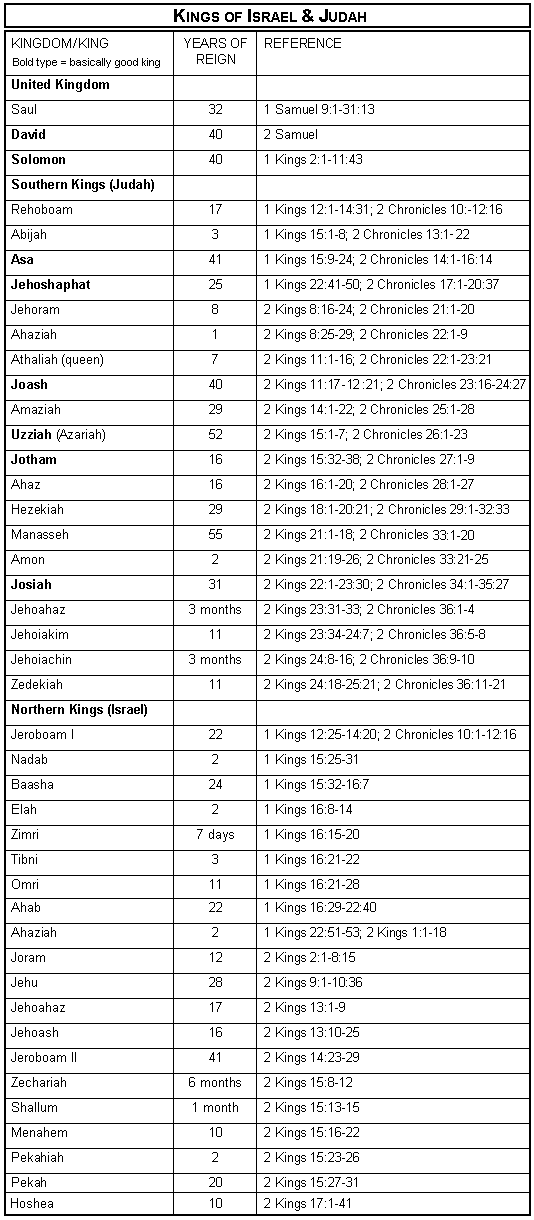
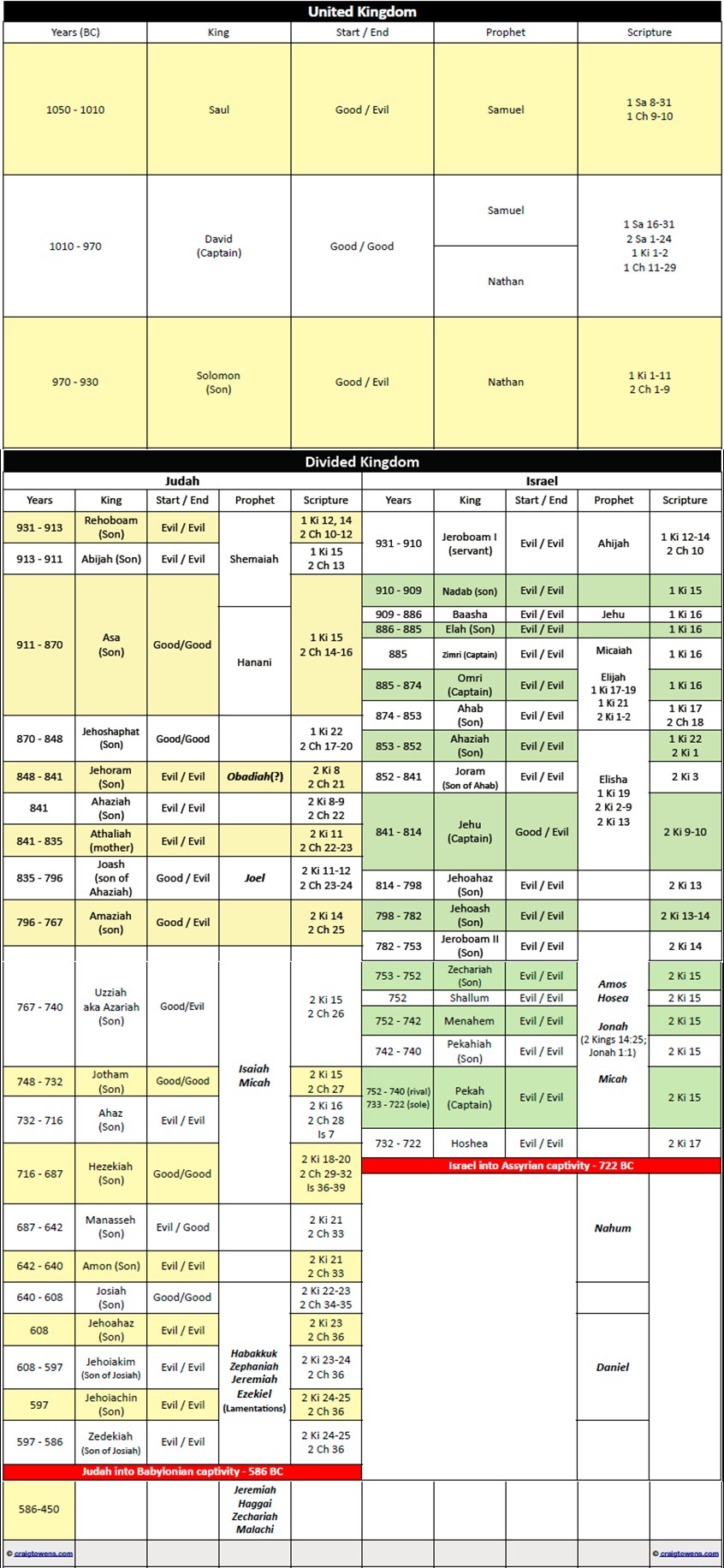
SEE ALSO:
ESV chart - kings of Israel - more information
ESV chart - kings of Judah - more information
Another Chart with Variable Dates for Reigns of King
2 Chronicles 28:1 Ahaz was twenty years old when he became king, and he reigned sixteen years in Jerusalem; and he did not do right in the sight of the LORD as David his father had done.
- Ahaz: 2Ki 16:1,2-20 1Ch 3:13 Isa 1:1 7:1-12 Ho 1:1 Mic 1:1 Mt 1:9
- as David his father: 2Ch 17:3
- CLICK 2 CHRONICLES COMMENTARIES FOR MULTIPLE SERMONS AND COMMENTARIES
- See BELOW FOR BIBLIOGRAPHY FOR 1-2 CHRONICLES - adapted from Paul Apple's Bible Outlines
Parallel Passages
2 Kings 16:2 Ahaz was twenty years old when he became king, and he reigned sixteen years in Jerusalem; and he did not do what was right in the sight of the LORD his God, as his father David had done.
2 Chronicles 17:3 The LORD was with Jehoshaphat because he followed the example of his father David’s earlier days and did not seek the Baals,
AHAZ EVIL FROM
START TO FINISH
Ahaz was twenty years old when he became king, and he reigned sixteen years in Jerusalem; and he did not do right (yashar) in the sight of the LORD as David his father had done - This brief verdict measures Ahaz against the highest standard in Judah’s history—David, the man after God’s own heart. The comparison with David is deliberate. David was far from sinless, yet his heart was directed toward the LORD. When he fell, he repented; when he ruled, he sought God’s will. Unlike his ancestor David, who, despite failures, humbled himself before God and sought to honor His word, Ahaz chose a different path. He evaluated life by expediency rather than obedience, allowing foreign alliances and pagan customs to shape his decisions. The verse sets the tone for his entire rule: a king seated on David’s throne but lacking David’s heart, leading Judah away from covenant faithfulness and toward spiritual decline.
He did not do right - To “do right” meant honoring God’s Word, protecting the temple, and leading the people in faithful obedience. Ahaz neglected each of these responsibilities. His reign illustrates that heritage alone cannot secure righteousness. Being a son of David did not guarantee a heart like David’s. Every generation must choose whom it will serve.
In the sight of the LORD - Coram Deo - God’s perspective, not human approval, determines the true value of a life. Ahaz may have appeared shrewd to some of his contemporaries, yet heaven’s assessment was painfully clear: he failed to walk in the path of covenant faithfulness.
🙏 THOUGHT - This statement stands as a mirror for all who follow the LORD. God measures our lives not by comparison with the culture around us, but by the pattern of faith He has revealed. The question is not whether we are better than others, but whether we walk in the light we have been given: “If we say that we have fellowship with Him and yet walk in the darkness, we lie and do not practice the truth; but if we walk in the Light as He Himself is in the Light, we have fellowship with one another, and the blood of Jesus His Son cleanses us from all sin” (1 John 1:6–7) Ahaz’s tragic life warns that privilege without devotion becomes failure, for “to whom much has been given, much will be required” (Luke 12:48b). David’s example, however, shows that a heart set toward God can transform even imperfect lives into enduring testimonies, for the LORD said, “I have found David the son of Jesse, a man after My heart, who will do all My will” (Acts 13:22). Scripture calls us to choose our pattern wisely for “He who walks with wise men will be wise, but the companion of fools will suffer harm” (Proverbs 13:20). Whose life are you imitating, Ahaz's or David's?
The Chronicler’s account of Ahaz’s reign
is the most negative of any king in the book.
John Olley: The Chronicler’s account of Ahaz’s reign is the most negative of any king in the book. Unlike with other rulers, Ahaz’s description is negative throughout, beginning with the admission that “he did not do what was right in the eyes of the Lord” and ending with the statement that he was “provoking to anger the Lord, the God of his fathers” (2 Ch 28:1, 25); further, Ahaz is buried separately from the “tombs of the kings of Israel [i.e., Judah]” (2Ch 28:27; cf. 2Ch 21:20; 24:25). While other kings had been “unfaithful” (2Ch 12:2; 26:16, 18; 1 Ch 10:13), Ahaz was “very unfaithful” and became “yet more faithless” (2Ch 28:19, 22). (SEE ESV Expository Commentary Volume 3: 1 Samuel–2 Chronicles)
C H Spurgeon on Ahaz's death at age 36 - So that he died before he reached the prime of life; he was cut off by God in the very midst of his sin.
To paraphrase historian Thomas Carlyle, the destinies of societies are shaped by great men and women who act boldly at key times. On the other hand, Ahaz demonstrates that societies are also shaped, sometimes even more decisively, by the failure andcorruption of influential people at key moments. To say it another way, the destinies of societies are often determined by the moral collapse of those who were positioned to act but chose comfort, fear, or compromise instead. Scripture repeatedly shows this darker side. Ahaz had royal privilege yet led Judah into idolatry. Pilate knew Jesus was innocent but lacked courage. Solomon, with unmatched wisdom, ended by tolerating idols. The turning points were not only when someone acted boldly for good, but when someone refused to do so.
Right (03477) yashar from the verb yashar = to be smooth, straight or right is an adjective meaning straight, reliable, level, pleasing, upright, or righteous. Yashar is only rarely used literally of that which is physically straight (Ezek 1:7); more often it describes a path metaphorically as one’s conduct or behavior (Ps 107:7). Most occurrences refer to what is right in an ethical or emotional sense—what is agreeable or pleasing—and it is significant that God Himself is the standard of yashar, the measure of what is truly “straight” (Ps 92:15; Isa 26:7). God’s Word is described as upright (Ps 19:7), as are His judgments (Ps 119:137) and His way (Ps 107:7). Though “God made men upright” (Ge 1:27), Ecclesiastes reminds us that “they have sought out many devices” (Eccl 7:29). The term is frequently applied to the moral condition of the heart, speaking of those who are “upright in heart” (Ps 7:10; 11:2; 32:11; 36:10; 64:10; 94:15; 97:11; 111:1; 125:4). The upright will behold His face (Ps 11:7), experience gladness (Ps 97:11), gather in worship (Ps 111:1), be blessed (Ps 112:2), receive light in darkness (Ps 112:4), dwell in God’s presence (Ps 140:13; cf. Pr 2:21), gain access to His sound wisdom (Pr 2:7), enjoy intimacy with the Most High (Pr 3:32), be guided by integrity (Pr 11:3), delivered by righteousness (Pr 11:6) and by their words (Pr 12:6), and see their tents flourish (Pr 14:11), for “the highway of the upright is to depart from evil” (Pr 16:17).
YASHAR IN KINGS AND CHRONICLES - 1 Ki. 11:33; 1 Ki. 11:38; 1 Ki. 14:8; 1 Ki. 15:5; 1 Ki. 15:11; 1 Ki. 22:43; 2 Ki. 10:3; 2 Ki. 10:15; 2 Ki. 10:30; 2 Ki. 12:2; 2 Ki. 14:3; 2 Ki. 15:3; 2 Ki. 15:34; 2 Ki. 16:2; 2 Ki. 18:3; 2 Ki. 22:2; 2 Chr. 14:2; 2 Chr. 20:32; 2 Chr. 24:2; 2 Chr. 25:2; 2 Chr. 26:4; 2 Chr. 27:2; 2 Chr. 28:1; 2 Chr. 29:2; 2 Chr. 29:34; 2 Chr. 31:20; 2 Chr. 34:2
John Olley: The dramatic developments affecting Judah that eventuated during Ahaz’s sixteen-year reign (2Ch28) are for the Chronicler the result of Ahaz’s unfaithfulness (2Ch 28:1–5, 19). An attack by the alliance of Syria and Israel brought some devastation to Judah (2Ch 28:5–8), and a weakened Judah was then attacked by Philistines and Edomites; Ahaz sought help from Assyria, which demanded tribute (2Ch 28:16–21). Ahaz’s apostasy increased, even to shutting the doors of the temple (2Ch 28:22–27). (SEE ESV Expository Commentary Volume 3: 1 Samuel–2 Chronicles)
August Konkel: The reign of Ahaz was a disaster both politically and in regard to covenant faithfulness. The Chronicler essentially shares the views of the other prophets regarding Ahaz. Isaiah, through the names of children, had exhorted Ahaz to be faithful in the fear of the Lord. His warning was unequivocal: “If you do not stand firm in your faith, you will not stand at all” (Isa 7:9b). Isaiah offered the king a sign, but it was refused as if it would be tempting God (2Ch 7:12). Ahaz had already made his own plans when confronted by Isaiah and his son; he would turn to the Assyrians for help against his enemies (2 Chron 28:16). But Ahaz could not escape God; the promise of the sign was that God would be with him (Immanuel). God was indeed with him. The Assyrians would flood through his land like the overflow of the Euphrates and then he would know that God was with him (Isa 8:7-8). The Chronicler speaks of Ahaz’s losses to the Edomites and Philistines (2 Chron 28:17-18). The decimation of Judah had begun. (SEE 1 & 2 Chronicles)
Frederick Mabie: In a rapid departure from his father Jotham (cf. 2Ch 27:6), Ahaz becomes one of the most ungodly kings in the history of Judah’s monarchy (note 2Ch 28:19), thus underscoring how quickly one generation can abandon the values of the previous generation. (SEE 1 and 2 Chronicles)
J.A. Thompson: King Ahaz (735-715 B.C.) probably is most familiar to Bible students as the faithless king to whom the prophet Isaiah delivered the prophecy of Immanuel in Isa 7:14. But the biblical historians, especially the Chronicler, furnish much more information about him. He was king at a critical time in Judah’s history, which saw a corrupt Israel fall to a revived Assyrian Empire, thus ending the divided monarchy. Any hopes on the part of the faithful that Judah might learn from this event and return to the Lord were dashed by the reign of Ahaz, who patterned himself after everyone but his righteous predecessors. (SEE 1, 2 Chronicles: An Exegetical and Theological Exposition)
Mark Boda: While in the book of Kings, Manasseh represents the lowest point in the history, in the book of Chronicles Ahaz plays this role (Smelik 1992:182-183; 1998: 164, 181). Hezekiah will soon appear on the scene and usher in a new ideal period of renewal for Judah, inviting faithful northerners to join him in worship at Jerusalem. But before Hezekiah arrives, it is Ahaz who creates the conditions of nothing short of “exile” as he first desecrates the land with inappropriate worship practices, sees a foreign emperor take control of his kingdom, then closes the Temple (cf. Dillard 1987:261; Mosis 1973:41-43, 186-188). (SEE 1-2 Chronicles - Page 376)
Matthew Henry Notes: Chapter: 28
This chapter is the history of the reign of Ahaz the son of Jotham; a bad reign it was, and which helped to augment the fierce anger of the Lord. We have here,
I. His great wickedness (2Ch 28:1-4).
II. The trouble he brought himself into by it (2Ch 28:5-8).
III. The reproof which God sent by a prophet to the army of Israel for trampling upon their brethren of Judah, and the obedient ear they gave to that reproof (2Ch 28:9-15).
IV. The many calamities that followed to Ahaz and his people (2Ch 28:16-21).
V. The continuance of his idolatry notwithstanding (2Ch 28:22-25), and so his story ends (2Ch 28:26, 27).
2Ch 28:1-5
Never surely had a man greater opportunity of doing well than Ahaz had, finding things in a good posture, the kingdom rich and strong and religion established; and yet here we have him in these few verses,
1. Wretchedly corrupted and debauched.
He had had a good education given him and a good example set him: but parents cannot give grace to their children. All the instructions he had were lost upon him: He did not that which was right in the sight of the Lord (2Ch 28:1), nay, he did a great deal that was wrong, a wrong to God, to his own soul, and to his people; he walked in the way of the revolted Israelites and the devoted Canaanites, made molten images and worshipped them, contrary to the second commandment; nay, he made them for Baalim, contrary to the first commandment. he forsook the temple of the Lord and sacrificed and burnt incense on the hills, as if they would place him nearer heaven, and under every green tree, as if they would signify the protection and influence of heaven by their shade and dropping. To complete his wickedness, as one perfectly divested of all natural affection as well as religion and perfectly devoted to the service and interest of the great enemy of mankind, he burnt his children in the fire to Moloch (2Ch 28:3), not thinking it enough to dedicate them to that infernal fiend by causing them to pass through the fire. See what an absolute sway the prince of the power of the air bears among the children of disobedience.
2. Wretchedly spoiled and made a prey of. When he forsook God, and at a vast expense put himself under the protection of false gods, God, who of right was his God, delivered him into the hands of his enemies, 2Ch 28:5.
(1.) The Syrians insulted him and triumphed over him, beat him in the field and carried away a great many of his people into captivity.
(2.) The king of Israel, though an idolater too, was made a scourge to him, and smote him with a great slaughter. The people suffered by these judgments: their blood was shed, their country wasted, their families ruined; for when they had a good king, though they did corruptly (2Ch 27:2), yet then his goodness sheltered them; but now that they had a bad one all the defence had departed from them and an inundation of judgments broke in upon them. Those that knew not their happiness in the foregoing reign were taught to value it by the miseries of this reign.
2 Chronicles 28:2 But he walked in the ways of the kings of Israel; he also made molten images for the Baals.
- he walked: 2Ch 21:6 22:3,4 1Ki 16:31-33 2Ki 10:26-28
- molten images: Ex 34:17 Lev 19:4
- Baal: Judges 2:11,13 Ho 2:13,17
Parallel Passages
2 Kings 16:3 But he walked in the way of the kings of Israel, and even made his son pass through the fire, according to the abominations of the nations whom the LORD had driven out from before the sons of Israel.
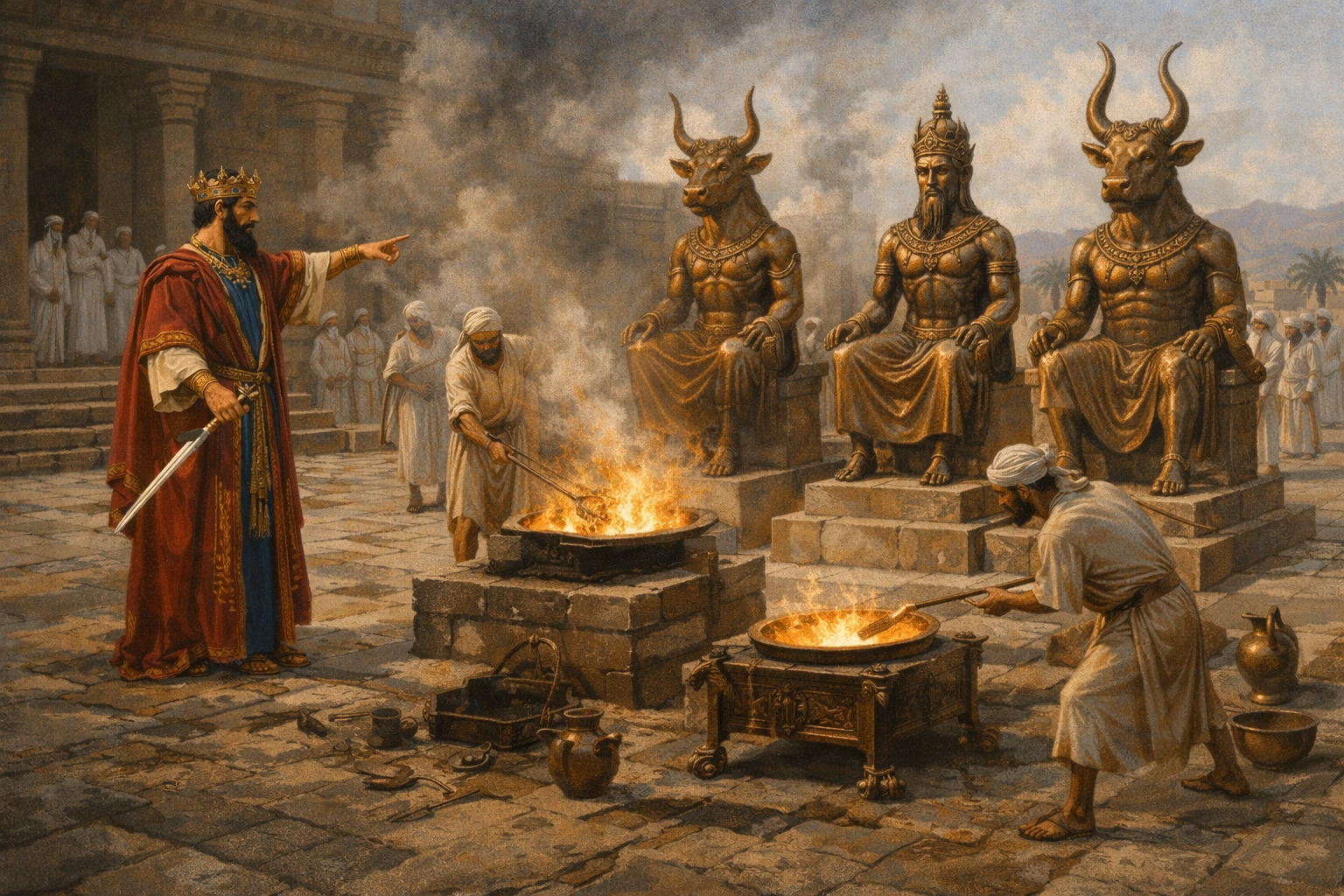
AHAZ WALKING THE WAY
OF NORTHERN KINGS
But he walked in the ways of the kings of Israel - This is a first! It is the first time the king of Judah imitated Israel’s apostasy. Ahaz abandoned the faithful pattern of David and instead adopted the idolatrous practices and false worship that characterized the northern kings of Israel.
he also made molten images for the Baals (ba'al) - This brief statement exposes how far Ahaz had moved from the exclusive worship of the LORD. He was not merely tolerating pagan practices around him; he actively sponsored them by crafting molten images, idols cast from metal and fashioned to represent the Baals, the false gods of Canaan. Such images were strictly forbidden in the Law, which prohibited making any likeness for worship, yet Ahaz used the resources of the kingdom to promote what God had condemned. The plural “Baals” suggests a variety of local deities and cults, indicating that Judah was being drawn into the full religious system of its pagan neighbors. By producing these idols, Ahaz institutionalized idolatry at the highest level, turning the Davidic throne from a guardian of covenant faith into a patron of false gods and leading the nation further from its calling as a people devoted to the one true LORD!
Spurgeon - God had driven out the Canaanites because of these abominations; therefore, for his own people to practice them, was peculiarly provoking to him. They had set up the worship of God under emblems, there were the calves of Bethel, the representation of strength: it was the worship of God by imagery, and Ahaz imitated it, and went even further in sin, —If we worship the true God under some symbol, the next step is to worship a false God.
John Walton - made molten images. -- Ahaz cast idols of the Baals of Canaan, not to local representations. The plural (Baals) may be used as a parallel with the plural Elohim, the generic name for the Hebrew God. Casting idols for worship was specifically condemned in the Mosaic Law (see Ex 34:17). Metal casts of Canaanite deities (including Baals) have been found at numerous sites in Palestine. (See page 449 The IVP Bible Background Commentary-Old Testament)
Baals (01168) ba'al This refers to the pagan deity known as Baal. Elijah confronted and destroyed the prophets of Baal on Mount Carmel (1 Ki 18:18–40). Another remarkable account is Jehu’s thorough eradication of Baal worship from the northern kingdom (2 Ki 10:18–28). Earlier, before God used Gideon to deliver Israel from the Midianites, He required him to tear down his father’s backyard altar to Baal (Jdg 6:25–31). Because of this, Gideon was given the name Jerubbaal, meaning “Let Baal contend against him” (Jdg 6:32). Although God granted victory through Gideon, the people’s hearts were not truly cleansed from Baal’s influence, for “as soon as Gideon was dead, the sons of Israel again played the harlot with the Baals and made Baal-berith their god” (Jdg 8:33). What a sobering reminder that outward deliverance does not guarantee inward transformation! Truly, “the heart is more deceitful than all else and desperately sick” (Jer 17:9). Later we read that “Israel removed the Baals and the Ashtaroth and served the LORD alone” (1 Sa 7:4), yet their cry in 1 Samuel 12:10 shows how quickly they backslid. Beware of idols. Flee (present imperative AND the only way to continually FLEE is by continually depending on the Holy Spirit to enable us!) from idolatry. (1Co 10:14)
Num. 22:41; Jos. 13:17; Jdg. 2:11; Jdg. 2:13; Jdg. 3:7; Jdg. 6:25; Jdg. 6:28; Jdg. 6:30; Jdg. 6:31; Jdg. 6:32; Jdg. 8:33; Jdg. 10:6; Jdg. 10:10; 1 Sam. 7:4; 1 Sam. 12:10; 1 Ki. 16:31; 1 Ki. 16:32; 1 Ki. 18:18; 1 Ki. 18:19; 1 Ki. 18:21; 1 Ki. 18:22; 1 Ki. 18:25; 1 Ki. 18:26; 1 Ki. 18:40; 1 Ki. 19:18; 1 Ki. 22:53; 2 Ki. 3:2; 2 Ki. 10:18; 2 Ki. 10:19; 2 Ki. 10:20; 2 Ki. 10:21; 2 Ki. 10:22; 2 Ki. 10:23; 2 Ki. 10:25; 2 Ki. 10:26; 2 Ki. 10:27; 2 Ki. 10:28; 2 Ki. 11:18; 2 Ki. 17:16; 2 Ki. 21:3; 2 Ki. 23:4; 2 Ki. 23:5; 2 Chr. 17:3; 2 Chr. 23:17; 2 Chr. 24:7; 2 Chr. 28:2; 2 Chr. 33:3; 2 Chr. 34:4; Jer. 2:8; Jer. 2:23; Jer. 7:9; Jer. 9:14; Jer. 11:13; Jer. 11:17; Jer. 12:16; Jer. 19:5; Jer. 23:13; Jer. 23:27; Jer. 32:29; Jer. 32:35; Hos. 2:8; Hos. 2:13; Hos. 2:17; Hos. 11:2; Hos. 13:1; Zeph. 1:4
David Guzik writes - Micah 7:2-7 is a good description of the depravity of the times of Ahaz and the reaction of the godly remnant to it.
Micah 7:2-7 (MICAH BEGAN HIS PROPHETIC MINISTRY TO JUDAH ca. 742 BC OR ABOUT 10 YEARS PRIOR TO AHAZ BECOMING KING IN JUDAH cf Micah 1:1) - The godly person has perished from the land, And there is no upright person among men. All of them lie in wait for bloodshed; Each of them hunts the other with a net. 3 Concerning evil, both hands do it well. The prince asks, also the judge, for a bribe, And a great man speaks the desire of his soul; So they weave it together. 4 The best of them is like a briar, The most upright like a thorn hedge. The day when you post your watchmen, Your punishment will come. Then their confusion will occur. 5 Do not trust in a neighbor; Do not have confidence in a friend. From her who lies in your bosom Guard your lips. 6 For son treats father contemptuously, Daughter rises up against her mother, Daughter-in-law against her mother-in-law; A man’s enemies are the men of his own household. 7 But as for me, I will watch expectantly for the LORD; I will wait for the God of my salvation. My God will hear me.
2 Chronicles 28:3 Moreover, he burned incense in the valley of Ben-hinnom and burned his sons in fire, according to the abominations of the nations whom the LORD had driven out before the sons of Israel.
- the valley: 2Ki 23:10 Jer 7:31,32 19:2-6,13
- burned: 2Ch 33:6 Lev 18:21 2Ki 16:3 Ps 106:37,38 Jer 2:34 32:35 Eze 16:20,21 Mic 6:7
- the abominations: 2Ch 33:2 De 12:31
Related Passages:
2 Kings 16:3 But he walked in the way of the kings of Israel, and even made his son (NOTE PLURAL IN CHRONICLES) pass through the fire, according to the abominations of the nations whom the LORD had driven out from before the sons of Israel.
Leviticus 18:21 ‘You shall not give any of your offspring to offer them to Molech, nor shall you profane the name of your God; I am the LORD.
Deuteronomy 12:29-31 (GOD'S CLEAR WARNING AGAINST PAGAN PRACTICES) “When the LORD your God cuts off before you the nations which you are going in to dispossess, and you dispossess them and dwell in their land, 30beware that you are not ensnared to follow them, after they are destroyed before you, and that you do not inquire after their gods, saying, ‘How do these nations serve their gods, that I also may do likewise?’ 31 “You shall not behave thus toward the LORD your God, for every abominable act which the LORD hates they have done for their gods; for they even burn their sons and daughters in the fire to their gods.
Deuteronomy 18:10 “There shall not be found among you anyone who makes his son or his daughter pass through the fire, one who uses divination, one who practices witchcraft, or one who interprets omens, or a sorcerer,
2 Kings 23:10 (KING JOSIAH) He also defiled Topheth, which is in the valley of the son of Hinnom, that no man might make his son or his daughter pass through the fire for Molech.
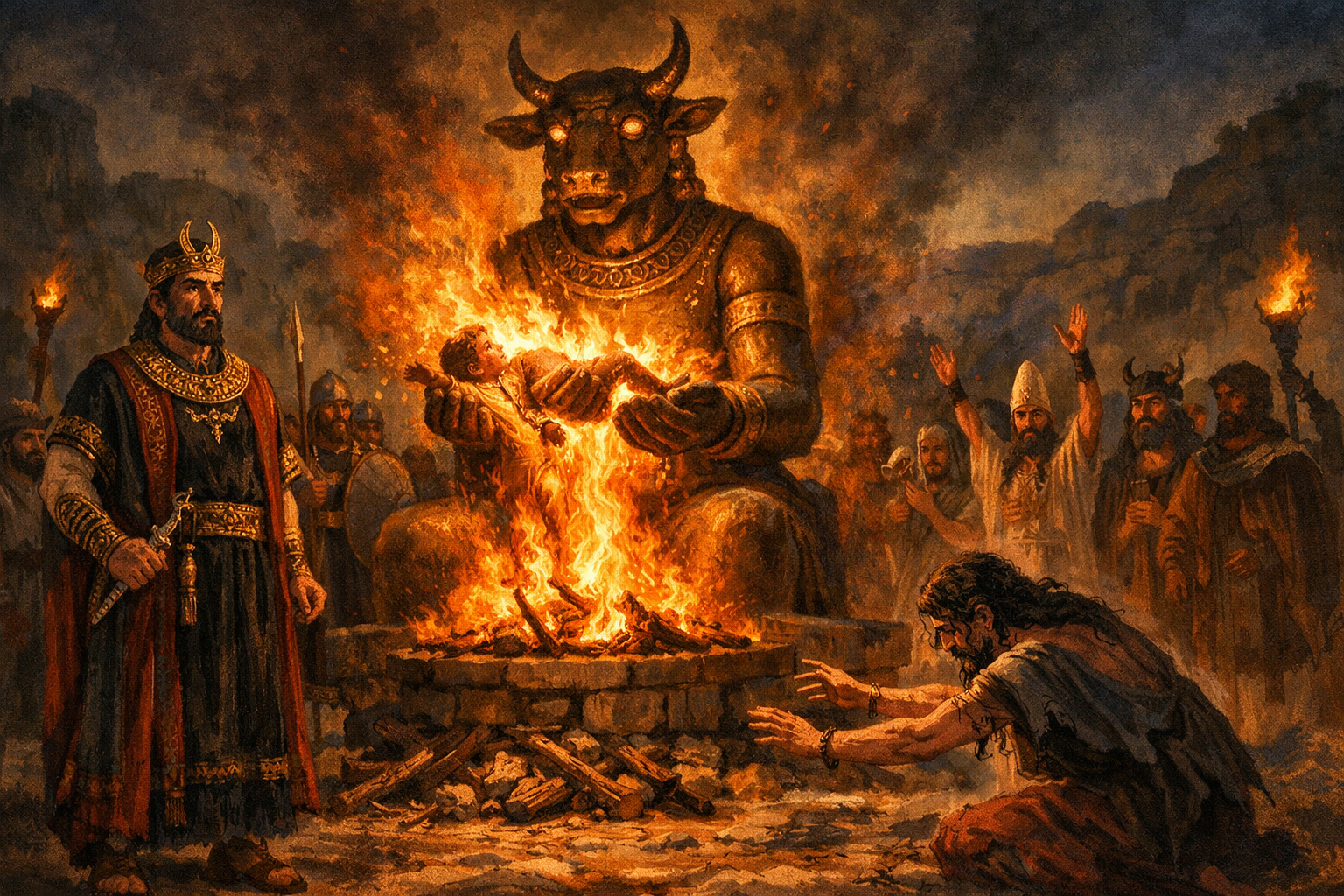
AHAZ ABOMINATION
SON SACRIFICE!
Moreover, he burned incense in the valley of Ben-hinnom and burned his sons in fire, according to the abominations (toebah; LXX - bdelugma - destestable things) of the nations whom the LORD had driven out before the sons of Israel. This verse marks the depth of Ahaz’s apostasy. Notice that Ahaz is acting as his own priest burning incense. Kings said he made his son (singular) "pass through the fire" but the Chronicler states it more dreadfully that he burned his sons (plural)! The Valley of Ben-hinnom, just outside Jerusalem, had become a center of Canaanite worship where the god Molech was honored with grotesque rites. Ahaz not only offered incense there, participating personally in pagan rituals, but went further and burned his own sons (PLURAL) in the fire, a practice explicitly condemned in the Law (Dt 12:31; Dt 18:10). What God had called an “abomination” Ahaz embraced as acceptable religion. It is interesting that the word Gehenna (geenna) the place of eternal torment is related to Ben-hinnom.
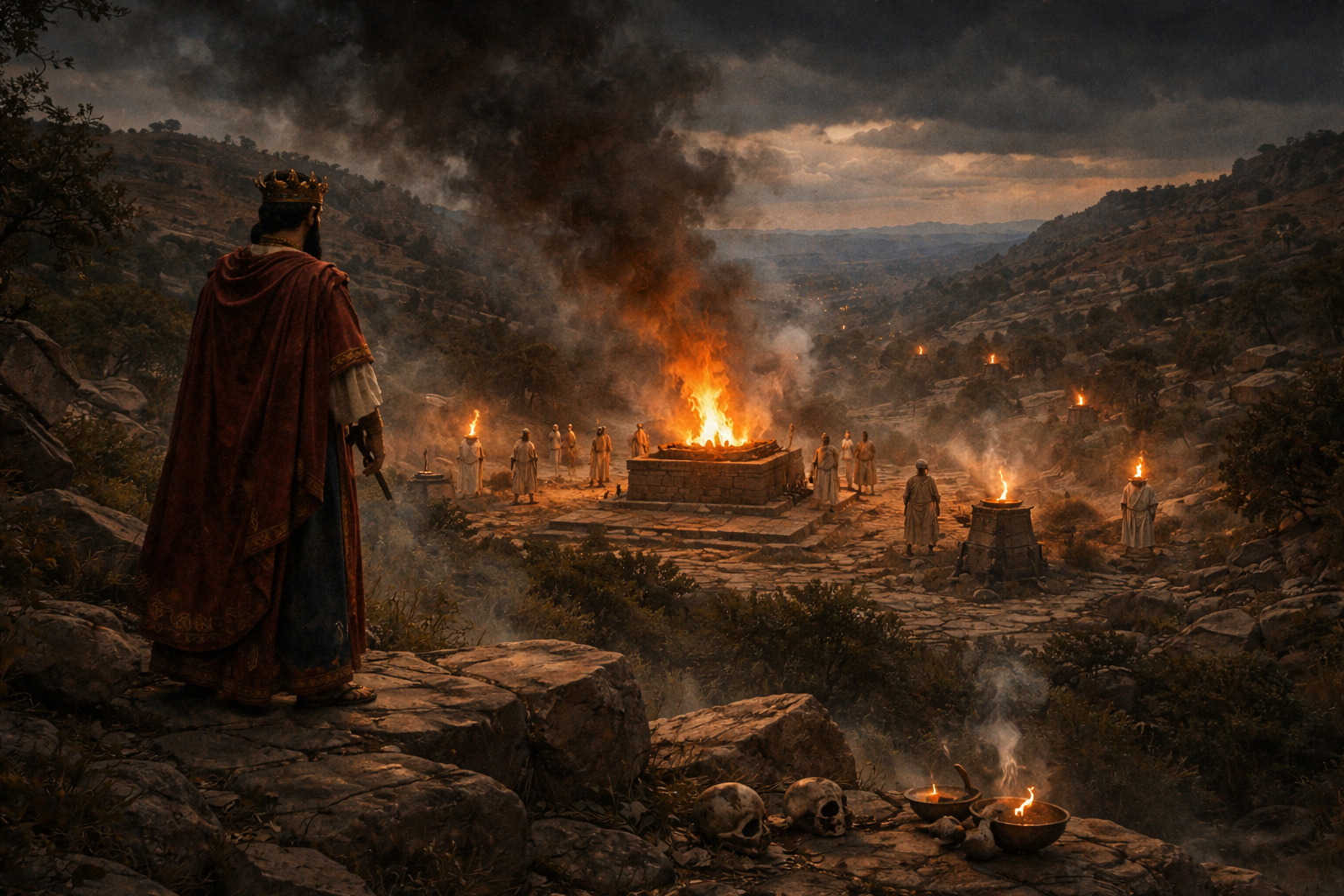
The phrase “according to the abominations of the nations” recalls that these were the very sins for which the LORD had expelled the Canaanites from the land and yet now the king of Judah was now imitating the evils that once brought divine judgment on the land (and would in fact bring divine judgment on the land again!) Instead of protecting his children and his people, Ahaz sacrificed them to false gods, revealing how idolatry enslaves, deceives, dehumanizes and destroys. This act shows that his rebellion was not merely political compromise but a complete moral and spiritual collapse, replacing the worship of the life-giving LORD with the cruel satanic rituals of pagan darkness.
Warren Wiersbe - Each Jewish son was to be redeemed by a sacrifice and therefore belonged to the Lord (Ex. 13; Nu 18:14–16). How could a son who belonged to God be sacrificed to an idol? But Ahaz was a compromiser both in his religious practices and his political leadership.
David Guzik - Molech was worshipped by heating a metal statue representing the god until it was red hot, then placing a living infant on the outstretched hands of the statue, while beating drums drowned out the screams of the child until it burned to death. Sadly, even a man as great as Solomon at least sanctioned the worship of Molech and built a temple to this idol (1 Kings 11:7). One of the great crimes of the northern tribes of Israel was their worship of Molech, leading to the Assyrian captivity (2 Kings 17:17). King Manasseh of Judah gave his son to Molech (2 Kings 21:6). Up to the days of King Josiah of Judah, Molech worship continued, until he destroyed a place of worship to that idol (2 Kings 23:10).
Frederick Mabie: A key attraction to Baal-Hadad was his presumed dominion over storms (i.e., rain), while a key attraction point for Asherah was her presumed dominion over fertility – both of which were key areas of concern for ancient societies such as Judah and Israel. But acts of spiritual compromise can have unexpected waves of consequences, as seen in the subsequent events of this chapter. . . The Valley of Ben Hinnom was located south of the Temple Mount and came to symbolize grave apostasy (Jer 32:35). During the reforms of Josiah this area was purged of its ignominious usage (cf. 2Ki 23:4-14). Ultimately the area became a city dump used for refuse and even the bodies of criminals; it was marked by constant fires and dreadful sights and smells. In the light of this imagery, the Hebrew expression for this valley (approximately “Gehenna”) came to be used of hell itself (cf. Mt 10:28; Mk 9:43, 47). (SEE 1 and 2 Chronicles)
J.A. Thompson: Even worse than imitating the apostasy of the Northern Kingdom, Ahaz is condemned for behaving as the cursed Canaanites, whose culture was so vile that God had ordered its elimination (Lev 18:28; 20:23; Deut 7:22-26; 12:2-4; 18:9- 14). Little wonder that Yahweh visited Ahaz with judgment in the form of an Aramean attack. (SEE 1, 2 Chronicles: An Exegetical and Theological Exposition)
Spurgeon -The worship of Moloch was one of the most horrible that can be imagined. A brazen image was made terribly hot, and then children were thrust into its burning arms to be consumed; and this king went to such a length that he gave his own children to death in that cruel fashion in the place commonly called by the Jews Topheth, or, the place of spitting, since it was so loathsome to them to think of this false God.
John Schultz: Evidently, in the worship of Molech, babies and young children were thrown alive in the mouth of the idol in which a fire was burning. When Israel was on her way to Canaan, God warned them about the atrocious practices of the people of the land. We read: “Do not give any of your children to be sacrificed to Molech, for you must not profane the name of your God. I am the Lord.” And: “You must not worship the Lord your God in their way, because in worshiping their gods, they do all kinds of detestable things the Lord hates. They even burn their sons and daughters in the fire as sacrifices to their gods.”
John Walton - 28:3. Valley of Ben Hinnom. The Valley of Ben Hinnom was on the south side of Jerusalem and joined the Kidron Valley at the southeast corner of the city. Access from the city to Ben Hinnom came from the Potsherd Gate and the Valley Gate. The valley became infamous for Baal worship because of the acts of Ahaz and Manasseh. Josiah defiled the region in order to prevent future idolatrous acts (2 Kings 23:10). (See page 449 The IVP Bible Background Commentary-Old Testament)
David Guzik - “The ‘Valley of (the son of) Hinnom’ descended eastward below the southern edge of the city of Jerusalem; and it became noted as the scene of Judah’s most revolting pagan practices (2 Chronicles 33:6). It was later defiled by King Josiah and converted into a place of refuse for the city (2 Kings 23:10); thus the perpetual fires of ‘Gehenna’ became descriptive of hell itself (Mark 9:43).” (Payne) The Canaanite nations that occupied Canaan before the time of Joshua also practiced this terrible form of human and child sacrifice. God would bring judgment upon Judah for their continued practice of these sins. This reminds us that the war against the Canaanites in the Book of Joshua – as terrible and complete as it was – was not a racial war. God’s judgment did not come upon the Canaanites through the armies of Israel because of their race, but because of their sin. If Israel insisted on walking in the same sins, God would bring similar judgment upon them.
John Walton - 28:3. sons passing through the fire. The biblical writers distinguished between the practice of the nations of burning their children in the service to their gods (Deut 12:31 and 2 Kings 17:31) and the idolatrous Israelites who “passed their sons and daughters through the fire.” If “passing through the fire” was something different than child sacrifice, it is not certain what it was. In Deuteronomy 18:9 “passing through the fire” appears with other Canaanite divination practices. There are hints from contemporary Assyrian sources of burning children in this period. In some Assyrian economic documents the penalty clauses include “burning children to Sin.” (See page 449 The IVP Bible Background Commentary-Old Testament)
Henry Morris - Whoever this man Hinnom may have been, his name eventually became attached to this valley of fire, where the fiery sacrifices of children to the "god" Molech were made. This practice was eventually halted by King Josiah (see notes on 2 Kings 16:3; 23:10).
Believer's Study Bible - The "Valley of the Son of Hinnom" is first mentioned in Scripture as the boundary between Judah and Benjamin (cf. Josh. 15:8; 18:16). In this valley was the site of Topheth, where parents offered their children as human sacrifices by making them pass through the fires dedicated to the idol Molech (cf. 2 Kin. 23:10) as a part of their idolatrous worship (v. 3; cf. 33:6). Jeremiah refers to this place as the "Valley of Slaughter" (Jer. 7:29-34; 19:2-6). King Josiah would later strive to end these idolatrous abominations by making the Valley of Hinnom into a dumping ground for refuse from the city of Jerusalem (cf. 2Ch 34:3-5; 2 Kin. 23:13, 14). Fires smoldered perpetually in the valley, and it became a place of desolation. In the N.T. the word Gehenna, the Greek transliteration of a Hebrew phrase meaning "the Valley of Hinnom" (cf. Josh. 15:8; Matt. 11:23, note), is used to describe the place of eternal separation from God and punishment for sin.
Abominations (detestable, loathsome) (08441) toebah refers to an abominable custom or thing. Abomination. Loathsome. Detestable thing. Something or someone who is loathsome and abhorrent. Toebah denotes things, persons or practices that are not merely improper but ritually or morally offensive offensive to the very character of God—idolatry, ritual prostitution, child sacrifice, occultism, and every form of pagan worship that denied Yahweh’s holiness. The Septuagint often translates toebah with bdelugma, a word that conveys something disgusting and repugnant, emphasizing how these acts appear to Holy Eyes! WOE!
Baker notes that toebah "is primarily understood in the context of the Law. It identifies unclean food (Dt. 14:3); the activity of the idolater (Isa. 41:24); the practice of child sacrifice (Dt. 12:31); intermarriage by the Israelites (Mal. 2:11); the religious activities of the wicked (Pr 21:27); and homosexual behavior (Lev. 18:22). In a broader sense, the word is used to identify anything offensive (Pr 8:7)." (The Complete Word Study Dictionary: OT)
Sometimes toebah is used as a synonym for idol, a repulsive thing, a worship object, with a focus that it is an item to be rejected (Dt 32:16; 2Ch 34:33; Isa 44:19, Jer 16:18; Eze 5:9; 7:20; 11:18, 21; 16:36). Toebah is even used for a specific pagan deity, as in 2Ki 23:13 where Milcom is called "the abomination of the Ammonites." And even prayer is an abomination when offered by one who refuses to obey God's Word (Pr 28:9).
Ronald Youngblood - TWOT - As with the verb, so also with the noun (toebah) the abomination may be of a physical, ritual or ethical nature and may be abhorred by God or man. Sharing a meal with a Hebrew was ritually offensive to an Egyptian (Gen 43:32), as was offering certain kinds of sacrifices (Ex 8:22). homosexuality and other perversions are repugnant to God and fall under his judgment (Lev 18:22–30; 20:13). Idolatry (Deut 7:25), human sacrifice (Deut 12:31), eating ritually unclean animals (Deut 14:3–8), sacrificing defective animals (Deut 17:1), conducting one’s business dishonestly (Deut 25:13–16), practicing ritual prostitution (I Kgs 14:23f.), and similar acts of disobedience (for seven more abominations, see the list in Pr 6:16–19) were sure to bring God’s wrath on those who perpetrated them. Twelve times the book of Proverbs uses the phrase, “is an abomination to the Lord.” In Ps 88, a prayer for help written by a man close to death, the physically repulsive appearance of a tô˓ēbâ is stressed; the man’s former friends avoid him because they consider him to be a thing of horror (Ps 88:8 [H 9]). (TWOT Theological Wordbook of the Old Testament)
TOEBAH IN KINGS AND CHRONICLES - 1 Ki. 14:24; 2 Ki. 16:3; 2 Ki. 21:2; 2 Ki. 21:11; 2 Ki. 23:13; 2 Chr. 28:3; 2 Chr. 33:2; 2 Chr. 34:33; 2 Chr. 36:8; 2 Chr. 36:14
M. R. Vincent on the Septuagint term "abomination" "The cognate verb, bdelussomai, (bdelusso) means to feel a nausea or loathing for food, hence used of disgust generally. In a moral sense it denotes an object of moral or religious repugnance (cf. 2 Chr. 15:8; Jer. 13:27; Ezek. 11:21; Dan. 9:27; 11:31). It is used as equivalent to idolatry in 1 Kings 11:17; Deut. 7:26; 2 Kings 23:13. It denotes anything in which estrangement from God manifests itself; as the eating of unclean beasts, Lev. 11:11; Deut. 14:3; and, generally, all forms of heathenism. This moral sense must be emphasized in the New Testament use of the word (i.e., compare Luke 16:15; Rev. 17:4,5; 21:27). It does not denote mere physical or esthetic disgust. The reference here is probably to the occupation of the temple precincts by the idolatrous Romans under Titus, with their standards and ensigns. Josephus says that after the burning of the temple the Romans brought their ensigns and set them over against the eastern gate, and there they offered sacrifices to them, and declared Titus, with acclamations, to be emperor" (Word Studies in the New Testament, pp. 74-75).
HINNOM, VALLEY OF [ISBE] - hin'-om (ge hinnom, Josh 15:8; 18:16; "valley of the son of Hinnom" (ge bhen hinnom), Josh 15:8; 18:16; 2 Ch 28:3; 33:6; Jer 7:31 f; 19:2,6; 32:35; "valley of the children (sons) of Hinnom" (ge bhene hinnom), 2 Ki 23:10; or simply "the valley," literally, the "hollow" or "ravine" (ha-gay'), 2 Ch 26:9; Neh 2:13,15; 3:13; Jer 31:40 and, perhaps also, Jer 2:23 (the above references are in the Hebrew text; there are some variations in the Septuagint)): The meaning of "Hinnom" is unknown; the expressions ben Hinnom and bene Hinnom would suggest that it is a proper name; in Jer 7:32; 19:6 it is altered by the prophet to "valley of slaughter," and therefore some have thought the original name must have had a pleasing meaning.
1. Bible References and History:
It was near the walls of Jerusalem, "by the entry of the gate Harsith" (Jer 19:2); the Valley Gate opened into it (Neh 2:13; 3:13). The boundary between Judah and Benjamin ran along it (Josh 15:8; 18:16). It was the scene of idolatrous practices in the days of Ahaz (2 Ch 28:3) and of Manasseh, who "made his children to pass through the fire in the valley of the son of Hinnom" (2 Ch 33:6), but Josiah in the course of his reforms "defiled Topheth, which is in the valley of the children (margin "son") of Hinnom, that no man might make his son or his daughter to pass through the fire to Molech" (2 Ki 23:10). It was on account of these evil practices that Jeremiah (7:32; 19:6) announced the change of name. Into this valley dead bodies were probably cast to be consumed by the dogs, as is done in the Wady er-Rababi today, and fires were here kept burning to consume the rubbish of the city. Such associations led to the Ge-Hinnom (New Testament "Gehenna") becoming the "type of Hell" (Milton, Paradise Lost, i, 405).
- See GEHENNA.
2. Situation:
The Valley of Hinnom has been located by different writers in each of the three great valleys of Jerusalem. In favor of the eastern or Kidron valley we have the facts that Eusebius and Jerome (Onom) place "Gehennom" under the eastern wall of Jerusalem and the Moslem geographical writers, Muqaddasi and Nasir-i-khusran, call the Kidron valley Wady Jahamum. The Jewish writer Kimchi also identifies the Valley of Jehoshaphat (i.e. the Kidron) with Hinnom. These ideas are probably due to the identification of the eastern valley, on account of its propinquity to the Temple, as the scene of the last judgment--the "Valley of Jehoshaphat" of Joel 3:2--and the consequent transference there of the scene of the punishment of the wicked, Gehenna, after the ancient geographical position of the Valley of Hinnom, had long been lost. In selecting sacred sites, from the 4th Christian century onward, no critical topographical acumen has been displayed until quite modern times. There are three amply sufficient arguments against this view: (1) the Kidron valley is always called a nachal and not a gay' (see KIDRON); (2) the "Gate of the Gai" clearly did not lie to the East of the city; (3) En-rogel, which lay at the beginning of the Valley of Hinnom and to its East (Josh 15:8; 18:16) cannot be the "Virgin's fount," the ancient Gihon (2 Sam 17:17).
Several distinguished modern writers have sought to identify the Tyropeon Valley (el Wad) with Hinnom, but as the Tyropeon was incorporated within the city walls before the days of Manasseh (see JERUSALEM), it is practically impossible that it could have been the scene of the sacrifice of children--a ritual which must have occurred beyond the city's limits (2 Ki 23:10, etc.).
3. Wady er-Rababi:
The clearest geographical fact is found in Josh 15:8; 18:16, where we find that the boundary of Judah and Benjamin passed from En-rogel "by the valley of the son of Hinnom"; if the modern Bir Eyyub is En-rogel, as is certainly most probable, then the Wady er-Rababi, known traditionally as Hinnom, is correctly so called. It is possible that the name extended to the wide open land formed by the junction of the three valleys; indeed, some would place Tophet at this spot, but there is no need to extend the name beyond the actual gorge. The Wady er-Rababi commences in a shallow, open valley due West of the Jaffa Gate, in the center of which lies the Birket Mamilla; near the Jaffa Gate it turns South for about 1/3 of a mile, its course being dammed here to form a large pool, the Birket es Sultan. Below this it gradually curves to the East and rapidly descends between sides of bare rocky scarps, much steeper in ancient times. A little before the valley joins the wide Kidron valley lies the traditional site of HAKELDAMA (which see). E. W. G. Masterman
TOPHET - = Topheth, from Heb. toph "a drum," because the cries of children here sacrificed by the priests of Moloch were drowned by the noise of such an instrument; or from taph or toph, meaning "to burn," and hence a place of burning, the name of a particular part in the valley of Hinnom. "Fire being the most destructive of all elements, is chosen by the sacred writers to symbolize the agency by which God punishes or destroys the wicked. We are not to assume from prophetical figures that material fire is the precise agent to be used. It was not the agency employed in the destruction of Sennacherib, mentioned in Isa. 30:33...Tophet properly begins where the Vale of Hinnom bends round to the east, having the cliffs of Zion on the north, and the Hill of Evil Counsel on the south. It terminates at Beer 'Ayub, where it joins the Valley of Jehoshaphat. The cliffs on the southern side especially abound in ancient tombs. Here the dead carcasses of beasts and every offal and abomination were cast, and left to be either devoured by that worm that never died or consumed by that fire that was never quenched." Thus Tophet came to represent the place of punishment.
QUESTION - What is the significance of Topheth in the Bible? (a 'high place' in the valley of Hinnom outside Jerusalem)
ANSWER - The word Topheth, alternatively spelled Tophet, is thought by some to originate from the Aramaic word taphya, which meant “hearth, fireplace or roaster.” Others link it to the word toph (“drum”), leading to the idea that drums were used in the pagan worship rituals associated with Tophet. What is certain is that Topheth was not a cozy fireplace for Israelites to keep warm. Its first mention is in 2 Kings 23:10 when King Josiah “defiled Topheth, which is in the Valley of the Son of Hinnom, that no one might burn his son or his daughter as an offering to Molech” (ESV). Topheth was a place where the Israelites committed the despicable act of child sacrifice, a practice God strictly condemned (Leviticus 18:21; Deuteronomy 12:31). King Josiah’s reforms included “defiling” Topheth, making it unusable as a gathering place.
Unfortunately, the Israelites had disregarded God’s command and sacrificed their children to the god Molech at Topheth in the Valley of Hinnom, at the south end of Jerusalem. Kings like Ahaz and Manasseh are examples of rulers who indulged in this abhorrent practice (2 Kings 16:3; 21:6). Prophets such as Jeremiah and Isaiah confronted the Israelites about their child sacrifice, suggesting that the practice continued even after the steps Josiah took to end such atrocities.
Jeremiah 7:31–32 records the prophet’s declaration, “They have built the high places of Topheth in the Valley of Ben Hinnom to burn their sons and daughters in the fire—something I did not command, nor did it enter my mind. So beware, the days are coming, declares the Lord, when people will no longer call it Topheth or the Valley of Ben Hinnom, but the Valley of Slaughter, for they will bury the dead in Topheth until there is no more room.”
The prophet Isaiah also had things to say about child sacrifice: “You who burn with lust among the oaks and under every green tree, who slaughter your children in the valleys, under the clefts of the rocks? Among the smooth stones of the valley is your portion; they, they, are your lot; to them you have poured out a drink offering, you have brought a grain offering. Shall I relent for these things?” (Isaiah 57:5–6). And in Isaiah 30:33, the prophet makes a metaphorical reference to Topheth in pronouncing judgment on the king of Assyria: “Topheth has long been prepared; it has been made ready for the king. Its fire pit has been made deep and wide, with an abundance of fire and wood; the breath of the Lord, like a stream of burning sulfur, sets it ablaze.”
There is evidence of child sacrifice being practiced in many cultures around the world. Some cases were documented in Greco-Roman sources like Plutarch and Tertullian, and archaeologists continue to uncover sites of ritualistic mass murder of children (www.cbsnews.com/news/biggest-child-sacrifice-evidence-archaeologists-national-geographic-peru-chimu/, accessed 8/9/23). But child sacrifice is not just an outrage of ancient times. The practice is still alive in places like Uganda (www.bbc.com/news/world-africa-15255357, accessed 8/9/23) and India (www.theguardian.com/world/2006/mar/05/india.theobserver, accessed 8/9/23). One can also see the connection between abortion and child sacrifice as many unborn babies around the world are killed daily.
Topheth symbolizes the extent of the Israelites’ rebellion, which ultimately led to their exile. God dealt with the Canaanites for engaging in similar practices (Leviticus 18:24–25), and He did not spare the Israelites. God must judge such a horrendous action as child sacrifice..
After Josiah’s reforms, Topheth became a landfill of sorts—a vile place of burning garbage, raw sewage, and the rotting flesh of the bodies of executed criminals. The Valley of Hinnom, also called Gehenna, had a wicked reputation and was utterly unclean. It thus became an apt illustration of the horrors of hell. Jesus mentioned the fiery valley in His warning against divine judgment in Mark 9:47: “If your eye causes you to stumble, pluck it out. It is better for you to enter the kingdom of God with one eye than to have two eyes and be thrown into hell [lit., Gehenna].”
Topheth reminds us of human depravity and the appropriateness of God’s justice. Praise the Lord for the beauty of the gospel, which saves us from Topheth.GotQuestions.org
2 Chronicles 28:4 He sacrificed and burned incense on the high places, on the hills and under every green tree.
- Lev 26:30 De 12:2,3 2Ki 16:4
Parallel Passages
2 Kings 16:4 And he sacrificed and burned incense on the high places and on the hills and under every green tree.
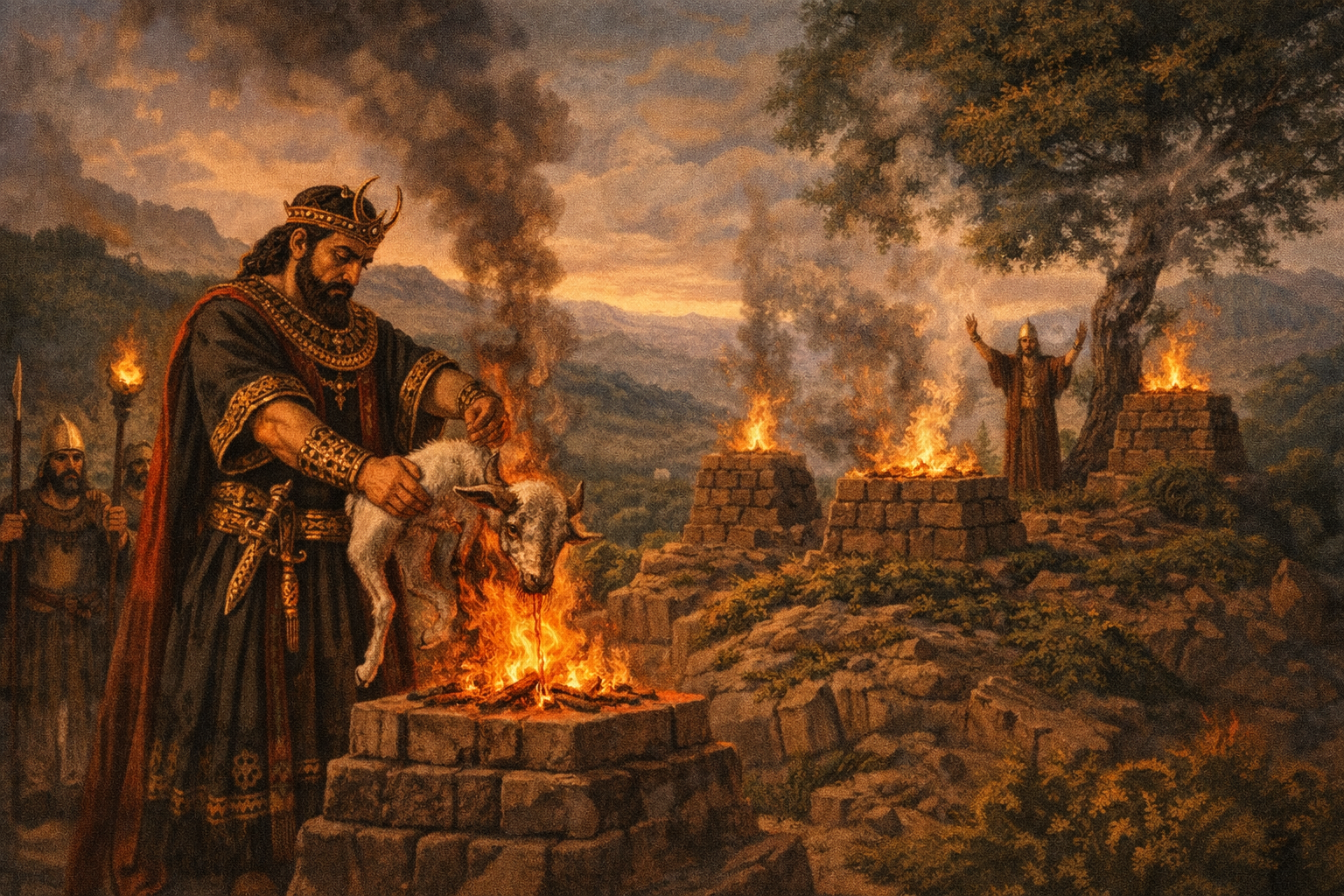
ACTS OF WORSHIP
DIRECTED AT WRONG "GODS"
He sacrificed (zabach) and burned incense (qāṭar) Sacrificed refers to a priestly act associated with atonement and devotion to Yahweh. Burned incense is a Biblical symbol of prayer and fellowship (cf. Ps 141:2). Ahaz took actions meant for the LORD and redirected them to idols. Religious zeal without revealed truth becomes spiritual adultery. See discussion of Israel the Wife of Jehovah.
When worship is everywhere except where God said,
it is nowhere God accepts.
Spurgeon - He could not do enough of it; so many trees, so many altars. There are some men who use every opportunity for sin, with a diligence which should bring the blush into the face of Christians, who are not as diligent in obeying as these men are in sinning. According to the command of God, there was to be but one altar, and that one was to be at Jerusalem; but these people multiplied their altars; there could not be a high place but they must have an idol shrine set up upon it.
On the high places (bamah) and on the hills and under every green tree - Notice how the Holy Spirit uses three locations to show how thoroughly Ahaz abandoned the worship of Yahweh. Ahaz replaced God’s appointed worship with a marketplace of pagan devotion, turning every hill and tree into a rival altar to the LORD. This is not mere geography—it is theology. The verse portrays a king who multiplied venues of false worship, rejecting the one place God had chosen—the temple in Jerusalem (Dt 12:5–14). The distance from God's chosen site the Temple to man's choice of a tree is only one small step of compromise.
John MacArthur - Ahaz was the first king in the line of David since Solomon who was said to have personally worshiped at the high places. While all the other kings of Judah had tolerated the high places, Ahaz actively participated in the immoral Canaanite practices that were performed at the “high places” on hilltops under large trees (cf. Hos 4:13). (Borrow MacArthur Study Bible)
Bob Utley - "on the high places and on the hills under every green tree" This reflects outlawed Canaanite fertility worship (cf. Deut. 12:2; 1 Kgs. 14:23,24; Jer. 2:20; 3:2,6; 17:2; Isa. 57:5,7; Ezek. 6:13; 20:28; Hosea 4:13). The fertility gods were worshiped in many localities (i.e., natural hills or man made platforms). Trees were often viewed as sacred (esp. in arid places) because they showed underground water was present. SPECIAL TOPIC: TREES
John Walton - high places, spreading trees. The worship at high places is not attributed to other Judahite kings but to the people of Judah (e.g., 1 Kings 22:44). A different verbal form is used in Hebrew to denote illegal sacrifices at shrines opposed to legal sacrifices at the Jerusalem temple. Ahaz, of course, was condemned for his illegal sacrifices. For more information on high places see comment on 2 Kings 17:9. (See page The IVP Bible Background Commentary-Old Testament)
Sacrificed (slaughtered, offer sacrifice)(02076) zabach to slaughter or kill an animal for sacrifice. The Hebrew verb zābacḥ is a common Semitic term for sacrificial slaughter in general. It is used of offerings such as the firstborn (Ex. 13:15), peace and burnt offerings (Ex. 20:24), and animals from the flock and herd (Num. 22:40). Moses cited this need when asking Pharaoh to let Israel go to “sacrifice to the LORD our God” (Ex. 3:18; 5:3). The word can also refer to slaughter for food (Deut. 12:21; 1 Sam. 28:24) and to the sealing of a covenant (Gen. 31:54). Though most often used of sacrifices to the true God (Gen. 46:1), it also describes pagan offerings, such as to Dagon (Jdg. 16:23) and the gods of Damascus (2 Chr. 28:23).
ZABACH IN SAMUEL-CHRONICLES 1 Sam. 1:3; 1 Sam. 1:4; 1 Sam. 1:21; 1 Sam. 2:13; 1 Sam. 2:15; 1 Sam. 2:19; 1 Sam. 6:15; 1 Sam. 10:8; 1 Sam. 11:15; 1 Sam. 15:15; 1 Sam. 15:21; 1 Sam. 16:2; 1 Sam. 16:5; 1 Sam. 28:24; 2 Sam. 6:13; 2 Sam. 15:12; 1 Ki. 1:9; 1 Ki. 1:19; 1 Ki. 1:25; 1 Ki. 3:2; 1 Ki. 3:3; 1 Ki. 3:4; 1 Ki. 8:5; 1 Ki. 8:62; 1 Ki. 8:63; 1 Ki. 11:8; 1 Ki. 12:32; 1 Ki. 13:2; 1 Ki. 19:21; 1 Ki. 22:43; 2 Ki. 12:3; 2 Ki. 14:4; 2 Ki. 15:4; 2 Ki. 15:35; 2 Ki. 16:4; 2 Ki. 17:35; 2 Ki. 17:36; 2 Ki. 23:20; 1 Chr. 15:26; 1 Chr. 21:28; 1 Chr. 29:21; 2 Chr. 5:6; 2 Chr. 7:4; 2 Chr. 7:5; 2 Chr. 11:16; 2 Chr. 15:11; 2 Chr. 18:2; 2 Chr. 28:4; 2 Chr. 28:23; 2 Chr. 30:22; 2 Chr. 33:16; 2 Chr. 33:17; 2 Chr. 33:22; 2 Chr. 34:4
Burned incense (offered up in smoke) (06999) qāṭar (from qetōreth, “smoke” or “fragrant incense”) means to cause smoke to rise, especially as an act of worship, and is used of burning incense or turning a sacrifice into fragrance by fire. While most often associated with incense, the term can describe the smoke of any major offering on the altar (Ex 30:7; Lev 1–7). It is closely linked with priestly ministry and dominates Leviticus, where sacrifices were “offered up in smoke” before the LORD. Tragically, the same word also marks Israel’s descent into idolatry: Solomon, though loving the LORD, “burned incense on the high places” (1Ki 3:3), and later even to the gods of his foreign wives (1Ki 11:8). This pattern spread through the nation so that burning incense became a symbol of covenant betrayal, provoking God’s wrath (2Ki 22:17; Jer 7:9; Hos 11:2). Yet in mercy the LORD promised a day when true worship would be restored, when from every nation incense would again be offered to His great name (Jer 33:18; Mal 1:11).
High places (01116) bamah -- Scripture associates the high places (bāmôt) with at least six recurring activities—burning incense, offering sacrifices, eating sacrificial meals, praying, ritual prostitution, and even child sacrifice (Jer 7:31)—revealing how these sites became centers of corrupt worship. God’s first reference to them is a warning: “I will destroy your high places” (Lev 26:30). Yet the term can occasionally carry a positive sense, as when the LORD made Israel “ride on the high places of the earth” (Dt 32:13) or when David rejoiced that God set him upon “my high places” like a sure-footed deer (Ps 18:33; Hab 3:19; Isa 58:14). Tragically, Israel’s misuse of these sites provoked the LORD’s jealousy (Ps 78:58), and a sorrowful refrain echoes through Kings and Chronicles: “the high places were not taken away” (1Ki 15:14; 22:43; 2Ki 12:3; 14:4; 15:4, 35; 2Chr 15:17; 20:33). Even reforming kings who cleansed much of the land left this root of compromise intact, reminding us how sin often survives partial repentance—we put away obvious evils yet cling to a favored “pet sin,” which is really a venomous viper. May God give us grace to finish the work Israel left undone and to tear down every rival altar of the heart.
High Places - NOTE prevalence in Kings and Chronicles - Lev. 26:30; Num. 22:41; Num. 33:52; Deut. 32:13; Deut. 33:29; Jdg. 5:18; 1 Sam. 9:12; 1 Sam. 9:13; 1 Sam. 9:14; 1 Sam. 9:19; 1 Sam. 9:25; 1 Sam. 10:5; 1 Sam. 10:13; 2 Sam. 1:19; 2 Sam. 1:25; 2 Sam. 22:34; 1 Ki. 3:2; 1 Ki. 3:3; 1 Ki. 3:4; 1 Ki. 11:7; 1 Ki. 12:31; 1 Ki. 12:32; 1 Ki. 13:2; 1 Ki. 13:32; 1 Ki. 13:33; 1 Ki. 14:23; 1 Ki. 15:14; 1 Ki. 22:43; 2 Ki. 12:3; 2 Ki. 14:4; 2 Ki. 15:4; 2 Ki. 15:35; 2 Ki. 16:4; 2 Ki. 17:9; 2 Ki. 17:11; 2 Ki. 17:29; 2 Ki. 17:32; 2 Ki. 18:4; 2 Ki. 18:22; 2 Ki. 21:3; 2 Ki. 23:5; 2 Ki. 23:8; 2 Ki. 23:9; 2 Ki. 23:13; 2 Ki. 23:15; 2 Ki. 23:19; 2 Ki. 23:20; 1 Chr. 16:39; 1 Chr. 21:29; 2 Chr. 1:3; 2 Chr. 1:13; 2 Chr. 11:15; 2 Chr. 14:3; 2 Chr. 14:5; 2 Chr. 15:17; 2 Chr. 17:6; 2 Chr. 20:33; 2 Chr. 21:11; 2 Chr. 28:4; 2 Chr. 28:25; 2 Chr. 31:1; 2 Chr. 32:12; 2 Chr. 33:3; 2 Chr. 33:17; 2 Chr. 33:19; 2 Chr. 34:3; Ps. 18:33; Ps. 78:58; Prov. 9:14; Eccl. 12:5; Isa. 15:2; Isa. 16:12; Isa. 36:7; Jer. 7:31; Jer. 17:3; Jer. 19:5; Jer. 26:18; Jer. 32:35; Jer. 48:35; Ezek. 6:3; Ezek. 6:6; Ezek. 16:16; Ezek. 16:24; Ezek. 16:25; Ezek. 16:31; Ezek. 16:39; Ezek. 20:29; Hos. 10:8; Amos 4:13; Amos 7:9; Mic. 1:3; Mic. 1:5; Mic. 3:12; Hab. 3:19
High places (01116) bamah Six activities seem to be related to high places -- burning of incense, sacrificing, eating of sacrificial meals, praying, prostitution, child sacrifice (cf. bama in the valley, Je7:31). The first use in Lev 26:30 is God's declaration to Israel "I will destroy your high places." In Dt 32:13 speaking of Jacob (Israel) He declared "He made him ride on the high places of the earth," so clearly some uses of bamah are not negative. In a similar use God says Israel "you will tread upon their (Israel's enemies') high places." Another positive use is Psalm 18:33 where David declared Jehovah "makes my feet like hinds' feet, And sets me upon my high places." (cp Hab 3:19 - NET Note = David "compares his agility in battle to the ability of a deer to negotiate rugged, high terrain without falling or being injured.", cp Isa 58:14) We see he effect of Israel's high places on Jehovah in Ps 78:58 = "For they provoked Him with their high places and aroused His jealousy with their graven images."
A sad phrase that is repeated again and again (speaking of Israel) is "the high places were not taken away" (1Ki 15:14, 2Chr 15:17 = King Asa but notice he did remove some of them - 2Chr 14:3, 5, 1Ki 22:43, 2Chr 20:33 = King Jehoshaphat, 2Ki 12:3 = King Jehoash, 2Ki 14:4 = King Amaziah, 2Ki 15:4 = King Azariah, 2Ki 15:35 = King Jotham son of Uzziah and look what his son did in 2Ki 16:1-4!, 2Chr 20:33). In many of these passages the context was of a king doing "spiritual house cleaning" so to speak and yet still failing to remove the high places. Isn't sin that way? We confess one or two sins but we have a little pet sin (better a "venomous viper") that we just don't have the heart to kill! God grant us spiritual eyes and hearts to learn from Israel's mistakes. Amen! Some kings like Hezekiah (1Ki 18:4, 2Chr 31:1, Isa 36:7) and Josiah (2Ki 23:4,8, 13, 15, 19-20, 2Chr 34:3 cp prophecy about Josiah 300 years earlier = 1Ki 13:2) did destroy the high places, but in Hezekiah's case his own son Manasseh rebuilt them (2Ki 21:1-2, 3, 2Chr 33:3) and in Josiah's case the people rebuilt them!
We see the spiritual effect of high places on the people when King Jehoram (2Chr 21:5-10) "made high places in the mountains of Judah, and caused the inhabitants of Jerusalem to play the harlot and led Judah astray." (2Chr 21:11)
One of the most incredible (and saddest) verses in the OT (in my opinion) is "Then Solomon built a high place for Chemosh the detestable idol of Moab, on the mountain which is east of Jerusalem, and for Molech the detestable idol of the sons of Ammon." (1Ki 11:7, cp 1Ki 3:3 = Solomon had "half a heart" for God!) This was too much for Jehovah and He declared that the 12 tribes would be split as a result of Solomon's sin! Sin is costly. You may think you are getting away with it, but you are not! You may think you are the wisest man in the world (like Solomon) but you are really the most foolish (as Solomon was)! There was one high place that was not idolatrous (at least not at the outset) - "Then Solomon, and all the assembly with him, went to the high place which was at Gibeon; for God's tent of meeting was there, which Moses the servant of the LORD had made in the wilderness." (2Chr 1:3, cp 1Chr 16:39-40, 21:29).
Norman Geisler - When Critics Ask - 2 CHRONICLES 28:24—Did Ahaz encourage or oppose worship in the Jerusalem temple?
PROBLEM: In 2 Kings 16:15, Ahaz encouraged the worship of the Lord in the temple. But, in 2 Chronicles 28 he is said to have “shut up the doors of the house of the Lord, and made for himself altars in every corner of Jerusalem” (v. 24).
SOLUTION: First of all, even in 2 Kings, during his earlier reign, Ahaz was said to be an evil king who “did not do what was right in the sight of the Lord his God” (2Ki 16:2). He even “took the silver and gold that was found in the house of the Lord … and sent it as a present to the king of Assyria” (v. 8). During this period, he encouraged only a corrupt form of worship in the pilfered Jerusalem temple (v. 15).
Furthermore, the 2 Chronicles passages refers to a later, even more corrupt, part of his reign. During this period of apostasy, he shut up the house of the Lord completely and set up his own centers of worship
2 Chronicles 28:5 Wherefore, the LORD his God delivered him into the hand of the king of Aram; and they defeated him and carried away from him a great number of captives and brought them to Damascus. And he was also delivered into the hand of the king of Israel, who inflicted him with heavy casualties.
- his God: 2Ch 36:5 Ex 20:2,3
- delivered him: 2Ch 24:24 33:11 36:17 Jud 2:14 2Ki 16:5,6 Isa 7:1,6
Parallel Passages
2 Kings 16:5-6 Then Rezin king of Aram and Pekah son of Remaliah, king of Israel, came up to Jerusalem to wage war; and they besieged Ahaz, but could not overcome him. 6 At that time Rezin king of Aram recovered Elath for Aram, and cleared the Judeans out of Elath entirely; and the Arameans came to Elath, and have lived there to this day.
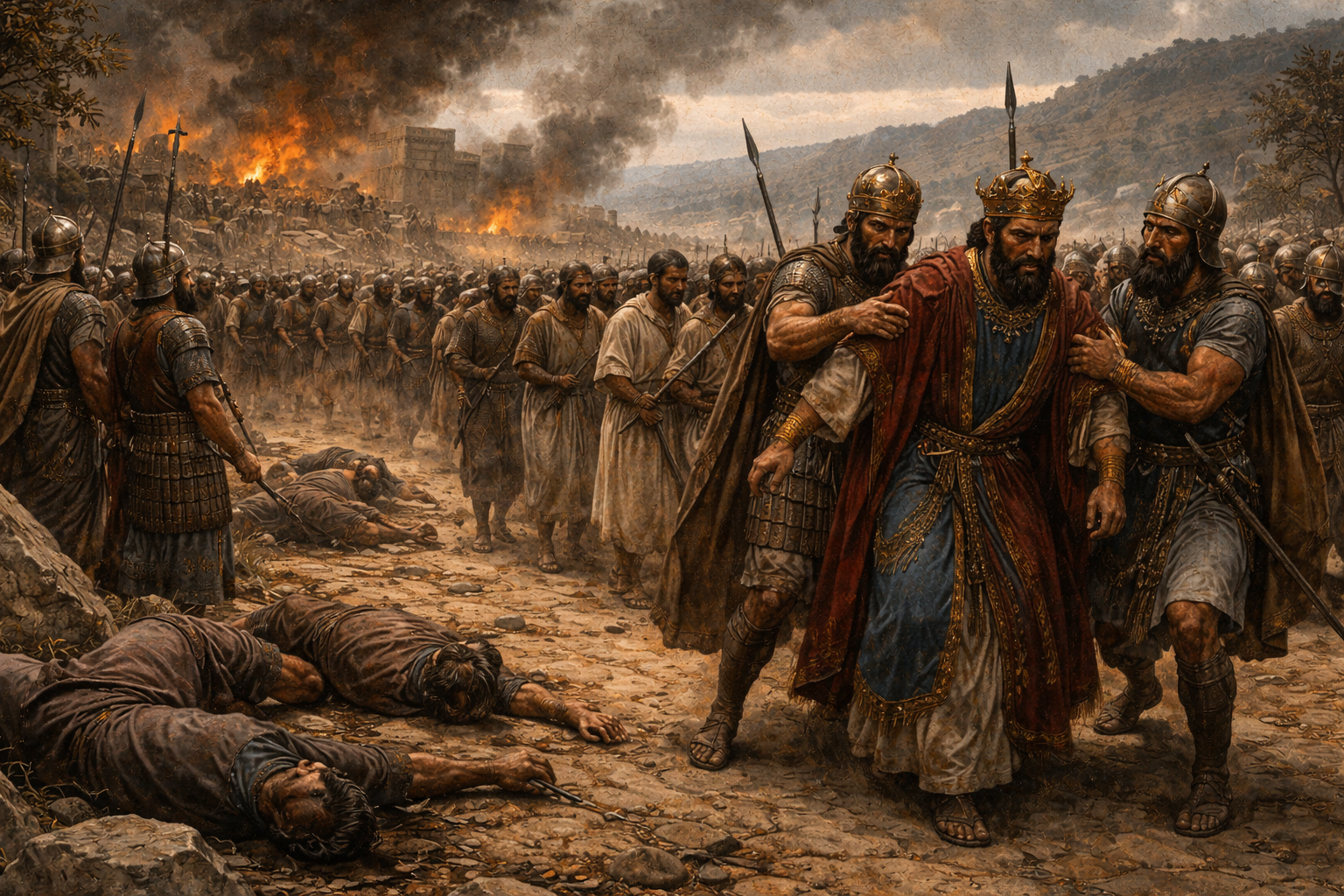
DIVINE DISCIPLINE
ON AHAZ & JUDAH
Wherefore - Term of conclusion. In view of King Ahaz's evil practices, consequences would follow.
The LORD his God delivered him into the hand of the king of Aram (REZIN) - The text still calls Ahaz "his God" but one has to wonder if Ahaz truly had a personal relationship with God. It seems doubtful! The Chronicler probably says the LORD his God to remind his readers that Ahaz still belonged to the covenant people and was accountable to the LORD of that covenant.
Matthew Poole - “God was his God, though not by covenant and grace, and special relation, which Ahaz had renounced, yet by his sovereign dominion over him; for God did not forfeit his right by Ahaz’s denying of it.”
The sobering statement the LORD his God delivered him makes clear that Judah’s defeat was not merely the result of military weakness or superior Aramean strategy, but was an act of divine discipline. Because the king had rejected the LORD through idolatry and trust in foreign powers, God Himself handed him over to those very powers. The language echoes earlier warnings in the Law that persistent disobedience would lead to defeat and subjugation by enemy nations (Deut 28:25). What appeared on the surface to be a political disaster was, at a deeper level, a spiritual judgment designed to awaken repentance. The verse teaches that when leaders abandon God’s ways, the consequences are not accidental, but they unfold under the sovereign hand of the LORD Who disciplines His people in order to call them to return to Him (cf Jer 4:1, Hos 11:5).
And they defeated him and carried away from him a great number of captives and brought them to Damascus. The consequence of Ahaz’s unfaithfulness now fell upon the nation he ruled. The Aramean forces not only gained a military victory over Judah but inflicted a humiliating defeat that shattered the kingdom’s sense of security. The phrase “a great number of captives” almost certainly indicates more than the loss of soldiers; it involved families torn from their homes, skilled workers, and members of the community who were marched away to Damascus as spoils of war. Captivity in the ancient world meant exile, slavery, and the breaking apart of social and religious life. Instead of the LORD delivering His people as in former days, Judah experienced the very fate once reserved for pagan nations. The tragic irony is that LORD indeed delivered His people but not from the enemy but into the hand of the enemy! This tragedy reveals the bitter harvest of Ahaz’s choices, for by turning to foreign gods and foreign alliances, he opened the door for foreign domination, and the people he failed to shepherd became victims of his spiritual compromise.
And he was also delivered into the hand of the king of Israel, who inflicted him with heavy casualties - Judah’s humiliation was compounded as the LORD allowed even the northern kingdom of Israel to strike Ahaz with devastating force. The phrase “heavy casualties” points to a crushing loss of soldiers and leaders, leaving the nation weakened and vulnerable. What should have been a brother people became an instrument of divine discipline, showing how far Judah had fallen from God’s protection through its own unfaithfulness.
John Olley: The Chronicler repeatedly shows how the chaos was the Lord’s judgment on Ahaz’s “faithlessness” (2Ch 28:5 [“therefore”], 2Ch 28:9, 19, 22–23, 25). Ahaz’s rejection of worship of the Lord and his active embracing of other gods (a sign of desperation?) was characteristic of his entire reign. (SEE ESV Expository Commentary Volume 3: 1 Samuel–2 Chronicles)
John Walton - defeat by Arameans. This is a description of what is called the Syro-Ephraimitic War. One popular reconstruction maintains that states in the region of Syria and Palestine (including Israel and Aram) had forged a coalition to fight against the rising power of Assyria under Tiglath-Pileser III. Rezin of Aram-Damascus headed this coalition in 733 B.C. One year earlier, Aram and Israel attempted to force Ahaz of Judah to join the coalition against Assyria. The two states sought to dethrone Ahaz (see Is 7:6). Upon an appeal from Ahaz, Assyria marched west in 733-732 B.C. and devastated the area, ending the Damascene state and setting up a puppet king in Israel (Hoshea). Others believe that the aggression of the Syro-Ephraimite coalition reflected only their own ambitions for expansion and had nothing to do with a coalition against Assyria. The Assyrian annals of Tiglath-Pileser III are badly mutilated, but a general picture of the Assyrian conquest can be obtained. (See page 450 The IVP Bible Background Commentary-Old Testament)
Rezin - Rezin was the last king of Aram (also known as Syria), a nation that often opposed Israel and Judah during the time of the divided kingdom. The Bible first introduces Rezin during the reign of King Ahaz of Judah. Rezin formed an alliance with Pekah, the son of Remaliah, who ruled the northern kingdom of Israel. Together, these two sought to attack Jerusalem in what is known as the Syro-Ephraimite War (Isaiah 7:1–2). Their plan was to overthrow Ahaz and set up a puppet king in Judah, but God sent the prophet Isaiah to reassure Ahaz that their scheme would not succeed. Isaiah told him, “Calm down and be quiet. Don’t be afraid or cowardly because of these two smoldering sticks, the fierce anger of Rezin, Aram, and the son of Remaliah” (Isaiah 7:4CSB). This was God’s way of saying that Rezin and Pekah were temporary threats whose power would soon vanish.
Historically, Ahaz refused to trust the Lord and instead appealed to the Assyrian Empire for protection. Scripture records that “Ahaz took the silver and gold found in the Lord’s temple and in the treasuries of the royal palace and sent it as a gift to the king of Assyria. So the king of Assyria listened to him and marched up to Damascus, captured it, deported its inhabitants to Kir, and put Rezin to death” (2 Kings 16:8–9 CSB). This fulfilled Isaiah’s prophecy that the threats from Syria and Israel would be short-lived. According to Isaiah 9:11, even though the people of Israel thought their alliances would bring security, it was actually the Lord who raised up their adversaries to bring judgment: “The Lord has raised up the adversaries of Rezin against him and stirred up his enemies.”
In summary, Rezin’s life reminds us of both human pride and God’s sovereignty. He set himself against the people of God, joined with Israel in rebellion, and ultimately fell under divine judgment. The Lord demonstrated that no political alliance or worldly power can stand against His purposes. Those who place their trust in alliances instead of the Lord inevitably find that their supposed protection becomes their downfall.
2 Chronicles 28:6 For Pekah the son of Remaliah slew in Judah 120,000 in one day, all valiant men, because they had forsaken the LORD God of their fathers.
- Pekah: 2Ki 15:27,37 Isa 7:4,5,9 9:21
- 120,000: 2Ch 13:17
- because: 2Ch 15:2 De 6:14,15 28:15,25 29:24-26 31:16,17 32:20 Jos 23:16 Jos 24:20 Isa 1:28 24:5,6 Jer 2:19 15:6
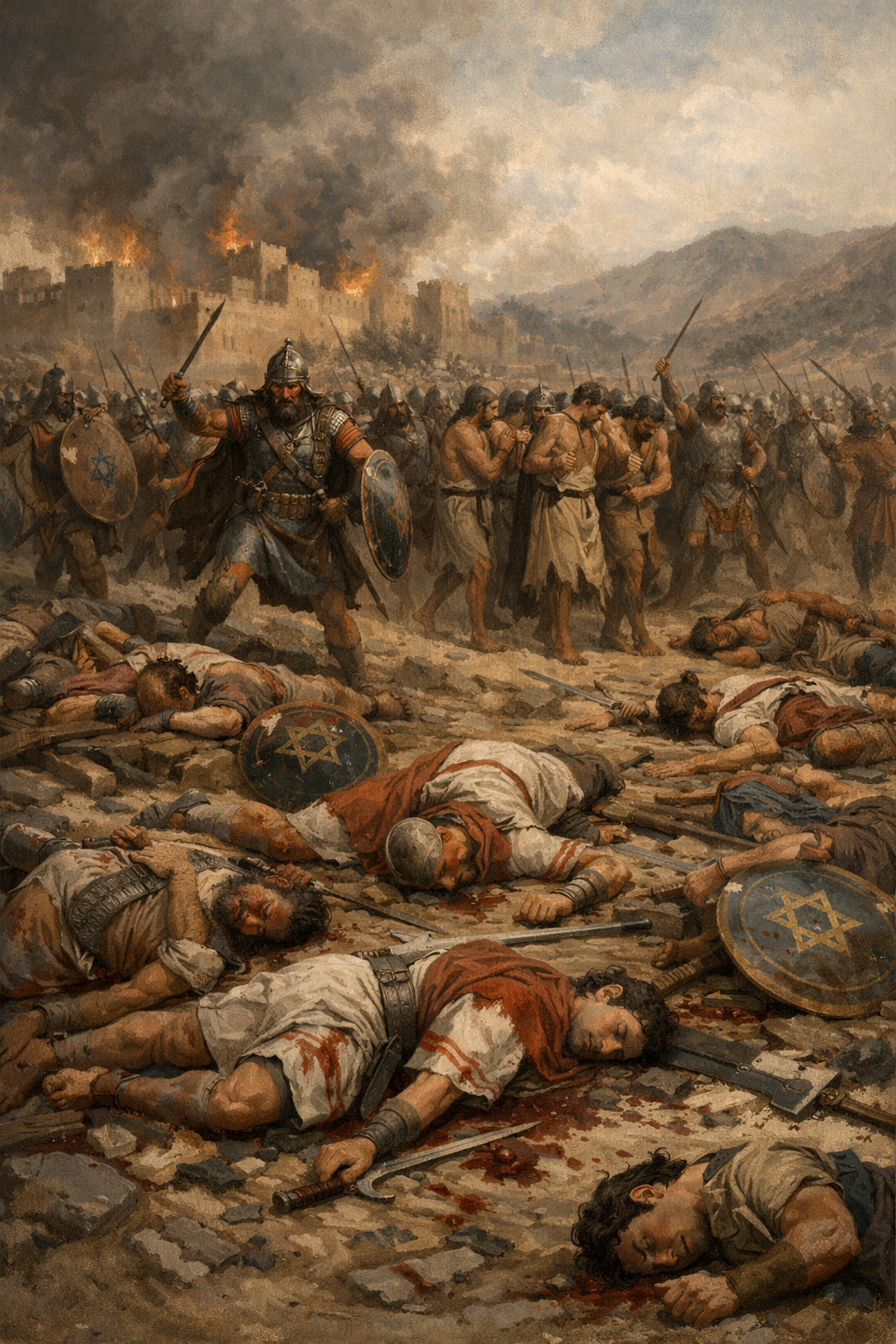
MASSACRE OF JUDAHITES
BY KING PEKAH OF ISRAEL
For - Term of explanation. This continues the expanation of the divine discipline on Judah.
Pekah the son of Remaliah slew in Judah 120,000 in one day, all valiant men, The slaughter of 120,000 in a single day reveals the staggering scale of Judah’s defeat, striking down not the weak but especially valiant men, men who were seasoned soldiers and defenders of the nation. Such a loss would have crippled Judah’s military strength and shattered families across the land, underscoring how severely God’s protection had been withdrawn because of Ahaz and Judah's unfaithfulness. This is an incredible loss which would likely be up to 1/3 or more of all Ahaz's forces leaving his nation vulnerable and weak to enemy attacks. For comparison there were only about 10,000 men lost (killed, captured, missing) on D-Day! And yet Ahaz still refuses to bow his knee to Jehovah.
Because - Term of explanation The writer reiterates the explanation of the massacre of 120,000 Judahites.
They had forsaken ('azab; LXX - kataleipo - abandoned, left behind) the LORD God of their fathers - Note the plural pronoun "they." Yes, Ahaz was the root problem in leading the people into idolatry, but the people of Judah made a bad choice to follow his lead and were held personally responsible. This phrase identifies the root cause behind Judah’s calamities is their spiritual abandonment.
They had forsaken ('azab; LXX - kataleipo) the LORD God means more than occasional failure. It describes a deliberate turning away from the covenant relationship established with Abraham, Moses, and David. The people had inherited a legacy of God’s faithfulness, His covenants, and His mighty acts on their behalf, yet they chose to neglect His commands and pursue other gods. By abandoning “the LORD God of their fathers,” they were severing themselves from the very Source of their identity and from their Protector. Scripture consistently teaches that blessing flowed from obedience, while departure from the LORD brought discipline. This statement therefore stands as a theological verdict: Judah’s suffering was not random tragedy but the inevitable result of exchanging the living God for idols and human alliances, forgetting the One who had formed them and called them out as His chosen people.
Forsaken (05800)('azab) basically means to depart from, leave behind, abandon, or forsake. It is translated “forsake” about 48 times and “leave/left” about 48 times in various forms. The term can refer to abandoning persons (Gen 44:22; Num 10:30; Ruth 1:16; 2 Ki 4:30), family relationships (Gen 2:24), places (2 Ki 8:6; Jer 18:14; 25:38), or objects (Gen 39:12–13; 50:8; Ex 9:21). Spiritually, it describes people who forsake God in apostasy (Deut 28:20; 31:16; Jer 1:16), who abandon virtue and wise counsel (1 Ki 12:8; 2 Chr 10:8, 13), forsake the way of righteousness (Prov 15:10), reject instruction and wisdom (Prov 4:2, 6), or ignore reproof (Prov 10:17). Scripture also calls believers to forsake sinful attitudes such as wrath (Ps 37:8). In gracious contrast, God repeatedly promises that He will not forsake His people (Gen 24:27; 28:15; Deut 31:6–7), even though He foreknows they will forsake Him (Deut 31:16). The word can also describe what is abandoned, deserted, or rejected (Isa 6:12; 17:9; 54:6; 60:15; Jer 4:29; Zeph 2:4).
A key concept in ʿāzab (“forsake”) is abandonment, especially Israel’s neglect of its covenant obligations to God. Scripture affirms that God never forsakes His promises to His people (Gen 24:7; Deut 31:6, 8; Josh 1:5; Isa 42:16), yet He may temporarily abandon them to discipline when they violate the covenant (Deut 31:17; Isa 54:7; Jer 12:7). The term frequently describes Israel’s own rejection of the LORD (Deut 28:20; 2 Ki 21:22; Isa 1:4; Jer 2:17), something they were repeatedly warned against (Josh 24:20; 1 Chr 28:9). Such forsaking inevitably led to idolatry and disobedience (Judg 2:12–13; 1 Ki 9:9; 2 Ki 22:17; Hos 4:10). The word can also denote physically leaving behind people, objects, or places (Gen 50:8; 2 Sam 5:21; Lev 26:43; Jer 51:9). In Genesis 2:24 it carries the positive sense of leaving former dependence as a man “forsakes” father and mother to cleave to his wife, illustrating that ʿāzab can describe both tragic abandonment and necessary separation.
PEKAH [ISBE] - pe'-ka (peqach, "opening" (of the eyes) (2 Ki 15:25-31); Phakee):
1. Accession:
Son of Remaliah, and 18th king of Israel. Pekah murdered his predecessor, Pekahiah, and seized the reins of power (2 Ki 15:25). His usurpation of the throne is said to have taken place in the 52nd year of Uzziah, and his reign to have lasted for 20 years (2 Ki 15:27). His accession, therefore, may be placed in 748 BC (other chronologies place it later, and make the reign last only a few years).
Pekah came to the throne with the resolution of assisting in forming a league to resist the westward advance of Assyria. The memory of defeat by Assyria at the battle of Karkar in 753, more than 100 years before, had never died out.
2. Attitude of Assyria:
Tiglath-pileser III was now ruler of Assyria, and in successive campaigns since 745 had proved himself a resistless conqueror. His lust for battle was not yet satisfied, and the turn of Philistia and Syria was about to come. In 735, a coalition, of which Pekah was a prominent member, was being formed to check his further advance. It comprised the princes of Comagene, Gebal, Hamath, Arvad, Ammon, Moab, Edom, Gaza, Samaria, Syria, and some minor potentates, the list being taken from a roll of the subject-princes who attended a court and paid tribute after the fall of Damascus. Ahaz likewise attended as a voluntary tributary to do homage to Tiglath-pileser (2 Ki 16:10).
3. Judah Recalcitrant:
While the plans of the allies were in course of formation, an obstacle was met with which proved insurmountable by the arts of diplomacy. This was the refusal of Ahaz, then on the throne of David, to join the confederacy. Arguments and threats having failed to move him, resort was had to force, and the troops of Samaria and Damascus moved on Jerusalem (2 Ki 16:5). Great alarm was felt at the news of their approach, as seen in the 7th and 8th chapters of Isa. The allies had in view to dispossess Ahaz of his crown, and give it to one of their own number, a son of Tabeel. Isaiah himself was the mainstay of the opposition to their projects. The policy he advocated, by divine direction, was that of complete neutrality. This he urged with passionate earnestness, but with only partial success. Isaiah (probably) had kept back Ahaz from joining the coalition, but could not prevent him from sending an embassy, laden with gifts to Tiglath-pileser, to secure his intervention. On the news arriving that the Assyrian was on the march, a hasty retreat was made from Jerusalem, and the blow soon thereafter fell, where Isaiah had predicted, on Rezin and Pekah, and their kingdoms.
4. Chronicles Ancillary to Kings:
The severely concise manner in which the writer of Kings deals with the later sovereigns of the Northern Kingdom is, in the case of Pekah, supplemented in Chronicles by further facts as to this campaign of the allies. The Chronicler states that "a great multitude of captives" were taken to Damascus and many others to Samaria. These would be countrymen and women from the outlying districts of Judah, which were ravaged. Those taken to Samaria were, however, returned, unhurt, to Jericho by the advice of the prophet Oded (2 Ch 28:5-15).
5. Fall of Damascus; Northern and Eastern Palestine Overrun:
The messengers sent from Jerusalem to Nineveh appear to have arrived when the army of Tiglath-pileser was already prepared to march. The movements of the Assyrians being expedited, they fell upon Damascus before the junction of the allies was accomplished. Rezin was defeated in a decisive battle, and took refuge in his capital, which was closely invested. Another part of the invading army descended on the upper districts of Syria and Samaria. Serious resistance to the veteran troops of the East could hardly be made, and city after city fell. A list of districts and cities that were overrun is given in 2 Ki 15:29. It comprises Gilead beyond Jordan--already partly depopulated (1 Ch 5:26); the tribal division of Naphtali, lying to the West of the lakes of Galilee and Merom, and all Galilee, as far South as the plain of Esdraelon and the Valley of Jezreel. Cities particularly mentioned are Ijon (now `Ayun), Abel-beth-maacah (now `Abi), Janoah (now Yanun), Kedesh (now Kados) and Hazor (now Hadireh).
6. Deportation of the Inhabitants:
These places and territories were not merely attacked and plundered. Their inhabitants were removed, with indescribable loss and suffering, to certain districts in Assyria, given as Halah, Habor, Hara, and both sides of the river Gozan, an affluent of the Euphrates. The transplantation of these tribes to a home beyond the great river was a new experiment in political geography, devised with the object of welding the whole of Western Asia into a single empire. It was work of immense difficulty and must have taxed the resources of even so great an organizer as Tiglath-pileser. The soldiers who had conquered in the field were, of course, employed to escort the many thousands of prisoners to their new locations. About two-thirds of the Samarian kingdom, comprising the districts of Samaria, the two Galilees, and the trans-Jordanic region, was thus denuded of its inhabitants.
7. Death of Pekah:
Left with but a third of his kingdom--humbled but still defiant--Pekah was necessarily unpopular with his subjects. In this extremity--the wave of invasion from the North having spent itself--the usual solution occurred, and a plot was formed by which the assassination of Pekah should be secured, and the assassin should take his place as a satrap of Assyria. A tool was found in the person of Hoshea, whom Tiglath-pileser claims to have appointed to the throne. The Biblical narrative does not do more than record the fact that "Hoshea the son of Elah made a conspiracy against Pekah the son of Remaliah, and smote him, and slew him, and reigned in his stead" (2 Ki 15:30). The date given to this act is the 20th year of Jotham. As Jotham's reign lasted but 16 years, this number is evidently an error.
8. References in Isaiah:
For the first time, the historian makes no reference to the religious conduct of a king of Israel. The subject was beneath notice. The second section of Isaiah's prophecies (Isa 7:1 through 10:4) belongs to the reign of Ahaz and thus to the time of Pekah, both of whom are named in it. Pekah is named in Isa 7:1, and is often, in this and the next chapter, referred to as "the son of Remaliah." His loss of the territorial divisions of Zebulun and Naphtali is referred to in 9:1, and is followed by prophecy of their future glory as the earthly home of the Son of Man. The wording of Isa 9:14 shows that it was written before the fall of Samaria, and that of Isa 10:9-11 that Damascus and Samaria had both fallen and Jerusalem was expected to follow. This section of Isaiah may thus be included in the literature of the time of Pekah. W. Shaw Caldecott
Matthew Henry Notes: 2Ch 28:6-15
We have here,
I. Treacherous Judah under the rebukes of God's providence, and they are very severe. Never was such bloody work made among them since they were a kingdom, and by Israelites too. Ahaz walked in the ways of the kings of Israel, and the king of Israel was the instrument God made use of for his punishment. It is just with God to make those our plagues whom we make our patterns or make ourselves partners with in sin. A war broke out between Judah and Israel, in which Judah was worsted. For,
1. There was a great slaughter of men in the field of battle. Vast numbers (120,000 men, and valiant men too at other times) were slain (2Ch 28:6) and some of the first rank, the king's son for one. He had sacrificed some of this sons to Moloch; justly therefore is this sacrificed to the divine vengeance. Here is another that was next the king, his friend, the prime-minister of state, or perhaps next him in the battle, so that the king himself had a narrow escape, 2Ch 28:7. The kingdom of Israel was not strong at this time, and yet strong enough to bring this great destruction upon Judah. But certainly so many men, great men, stout men, could not have been cut off in one day if they had not been strangely dispirited both by the consciousness of their own guilt and by the righteous hand of God upon them. Even valiant men were numbered as sheep for the slaughter, and became an easy prey to the enemy because they had forsaken the Lord God of their fathers, and he had therefore forsaken them.
2. There was a great captivity of women and children, 2Ch 28:8. When the army in the field was routed, the cities, and towns, and country villages, were all easily stripped, the inhabitants taken for slaves, and their wealth for a prey.
II. Even victorious Israel under the rebuke of God's word for the bad principle they had gone upon in making war with Judah and the bad use they had made of their success, and the good effect of this rebuke. Here is,
1. The message which God sent them by a prophet, who went out to meet them, not to applaud their valour or congratulate them on their victory, though they returned laden with spoils and triumphs, but in God's name to tell them of their faults and warn them of the judgments of God.
(1.) He told them how they came by this victory of which they were so proud. It was not because God favoured them, or that they had merited it at his hand, but because he was wroth with Judah, and made them the rod of his indignation. Not for your righteousness, be it known to you, but for their wickedness (Deu. 9:5) they are broken off; therefore be not you high-minded, but fear lest God also spare not you, Ro 11:20, 21.
(2.) He charged them with the abuse of the power God had given them over their brethren. Those understand not what victory is who think it gives them authority to do what they will, and that the longest sword is the clearest claim to lives and estates (Jusque datum sceleri-might is right); no, as it is impolitic not to use a victory, so it is impious to abuse it. The conquerors are here reproved,
{1.} For the cruelty of the slaughter they had made in the field. They had indeed shed the blood of war in war; we suppose that to be lawful, but it turned into sin to them, because they did it from a bad principle of enmity to their brethren and after a bad manner, with a barbarous fury, a rage reaching up to heaven, that is, that cried to God for vengeance against such bloody men, that delighted in military execution. Those that serve God's justice, if they do it with rage and a spirit of revenge, make themselves obnoxious to it, and forfeit the honour of acting for him; for the wrath of man worketh not the righteousness of God.
{2.} For the imperious treatment they gave their prisoners. "You now purpose to keep them under, to use them or sell them as slaves, though they are your brethren and free-born Israelites.'' God takes notice of what men purpose, as well as of what they say and do.
(3.) He reminded them of their own sins, by which they also were obnoxious to the wrath of God: Are there not with you, even with you, sins against the Lord your God? 2Ch 28:10. He appeals to their own consciences, and to the notorious evidence of the thing. "Though you are now made the instruments of correcting Judah for sin, yet do not think that you are therefore innocent yourselves; no, you also are guilty before God.'' This is intended as a check,
{1.} To their triumph in their success. "You are sinners, and it ill becomes sinners to be proud; you have carried the day now, but be not secure, the wheel may ere long return upon yourselves, for, if judgment begin thus with those that have the house of God among them, what shall be the end of such as worship the calves?''
{2.} To their severity towards their brethren. "You have now got them under, but you ought to show mercy to them, for you yourselves are undone if you do not find mercy with God. It ill becomes sinners to be cruel. You have transgressions enough to answer for already, and need not add this to the rest.''
(4.) He commanded them to release the prisoners, and to send them home again carefully (2Ch 28:11); "for you having sinned, the fierce wrath of God is upon you, and there is no other way of escaping it than by showing mercy.''
2. The resolution of the princes thereupon not to detain the prisoners. They stood up against those that came from the war, though flushed with victory, and told them plainly that they should not bring their captives into Samaria, 2Ch 28:12, 13. They had sin enough already to answer for, and would have nothing done to add to their trespass. In this they discovered an obedient regard to the word of God by his prophet and a tender compassion towards their brethren, which was wrought in them by the tender mercy of God; for he regarded the affliction of this poor people, and hears their cry, and made them to be pitied of all those that carried them captive, Ps. 106:44, 46.
3. The compliance of the soldiers with the resolutions of the princes in this matter, and the dismission of the captives thereupon.
(1.) The armed men, though being armed they might be force have maintained their title to what they got by the sword, acquiesced, and left their captives and the spoil to the disposal of the princes (2Ch 28:14), and herein they showed more truly heroic bravery than they did in taking them. It is a great honour for any man to yield to the authority of reason and religion against his interest.
(2.) The princes very generously sent home the poor captives well accommodated, 2Ch 28:15. Those that hope to find mercy with God must learn hence with what tenderness to carry themselves towards those that lie at their mercy. It is strange that these princes, who in this instance discovered such a deference to the word of God, and such an influence upon the people, had not so much grace as, in obedience to the calls of God by so many prophets, to root idolatry out of their kingdom, which, soon after this, was the ruin of it.
2 Chronicles 28:7 And Zichri, a mighty man of Ephraim, slew Maaseiah the king’s son and Azrikam the ruler of the house and Elkanah the second to the king.
- Elkanah the second to the king Ge 41:43 43:12,15 Es 10:3
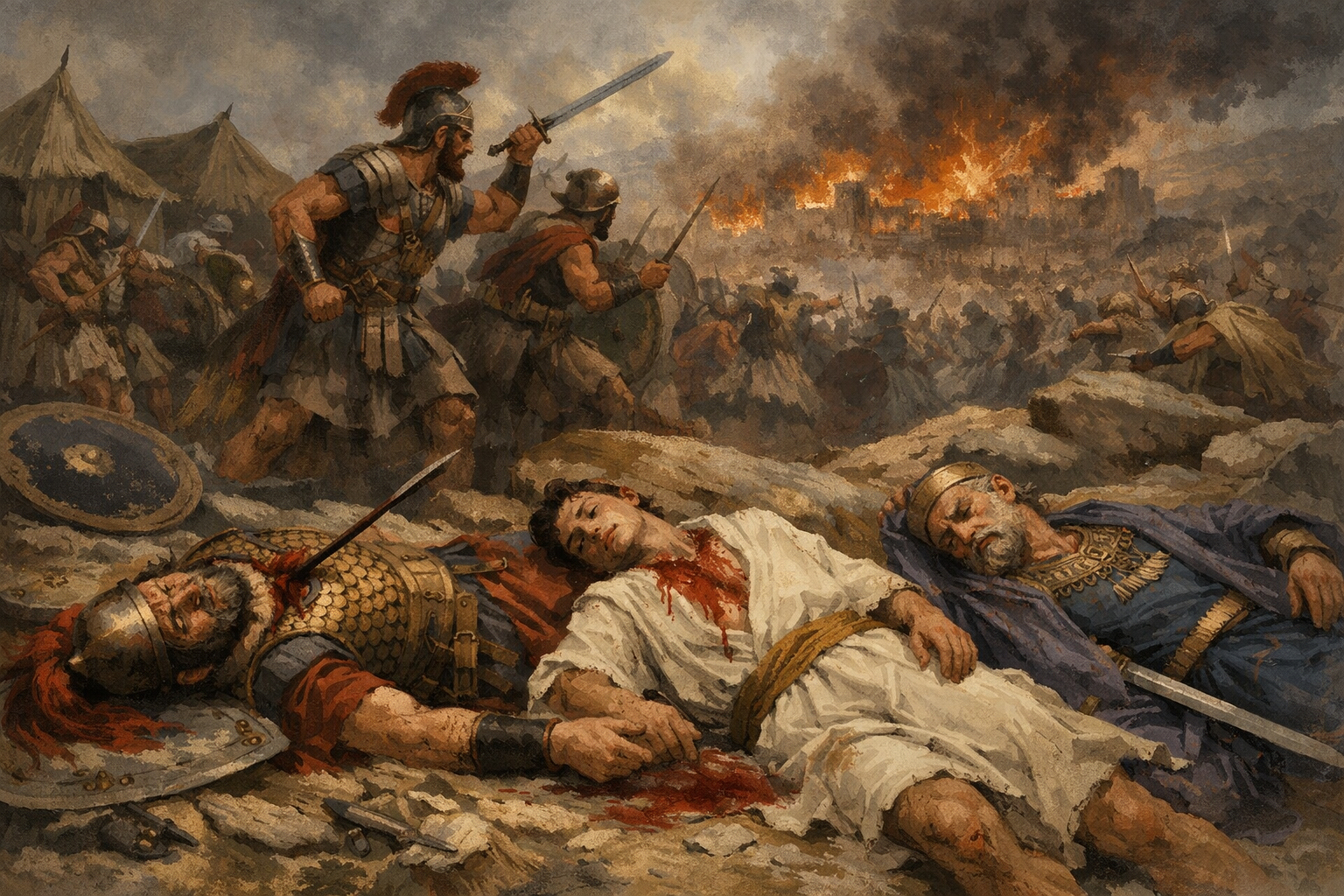
KEY OFFICIALS OF
JUDAH ALSO SLAIN
And Zichri, a mighty man of Ephraim, slew Maaseiah the king’s son and Azrikam the ruler of the house and Elkanah the second to the king. The slaying of the king’s son and chief officials by Zichri exposed how God’s judgment on Ahaz’s unfaithfulness shattered Judah’s leadership and left the nation defenseless.
This brief but sobering line opens a window into the devastating consequences of Judah’s spiritual decline under King Ahaz. Zichri, described as a “mighty man of Ephraim,” was not merely a common soldier but a prominent warrior of the northern kingdom of Israel. In the fierce conflict between Israel and Judah, he struck directly at the heart of the Davidic administration. The killing of Maaseiah, the king’s son, likely refers to a royal prince, perhaps not the heir to the throne, but a member of the royal household whose death symbolized the humiliation of Ahaz’s dynasty.
Along with him fell Azrikam, the ruler of the house, apparently the chief steward or palace administrator, the man responsible for the management of the royal court and its affairs. His death meant the collapse of internal order within the palace.
Also slain was Elkanah, “the second to the king,” a title suggesting the prime minister or highest official under Ahaz, comparable to a modern chief of staff. These were not random battlefield losses; they were targeted blows against Judah’s leadership structure.
spiritual compromise at the top inevitably
leads to national catastrophe below.
The Chronicler records these deaths to show how severely God’s judgment fell upon Ahaz for his persistent unfaithfulness. Because the king had forsaken the Lord, the Lord allowed even the most secure pillars of his government to be torn down. What should have been a protected royal household became vulnerable to the sword of an enemy nation. The verse underscores that spiritual compromise at the top inevitably leads to national catastrophe below. Judah’s defeat was not merely military misfortune but it was moral and theological collapse made visible in the deaths of her princes and counselors. And despite these losses Ahaz still refuses to repent and turn to Jehovah!
🙏 THOUGHT - Are you experiencing divine discipline (Heb 12:5-11)? If so then do not procrastinate or put off repenting and returning to the LORD! Ahaz's story clearly shows who wins!
Andrew Hill: Beyond the sheer totals, the devastating losses to Judah are compounded by the deaths of key officials, namely, “the king’s son,” the overseer of the palace, and the leader who is “second to the king” (2Ch 28:7). The expression “the king’s son” may be a title for a high-ranking officer, or the person named Maaseiah may be one of the royal princes. The title “second to the king” occurs elsewhere in the Old Testament only in Esther 10:3, where context suggests it is the office held by the senior political adviser. In any case, the deaths of three members of Ahaz’s “cabinet” would have had a crippling effect in the administration of political and military affairs in Judah. (See First and Second Chronicles - Page 180)
2 Chronicles 28:8 The sons of Israel carried away captive of their brethren 200,000 women, sons and daughters; and they took also a great deal of spoil from them, and brought the spoil to Samaria.
- carried: De 28:25,41
- brethren: 2Ch 11:4 Ac 7:26 13:26
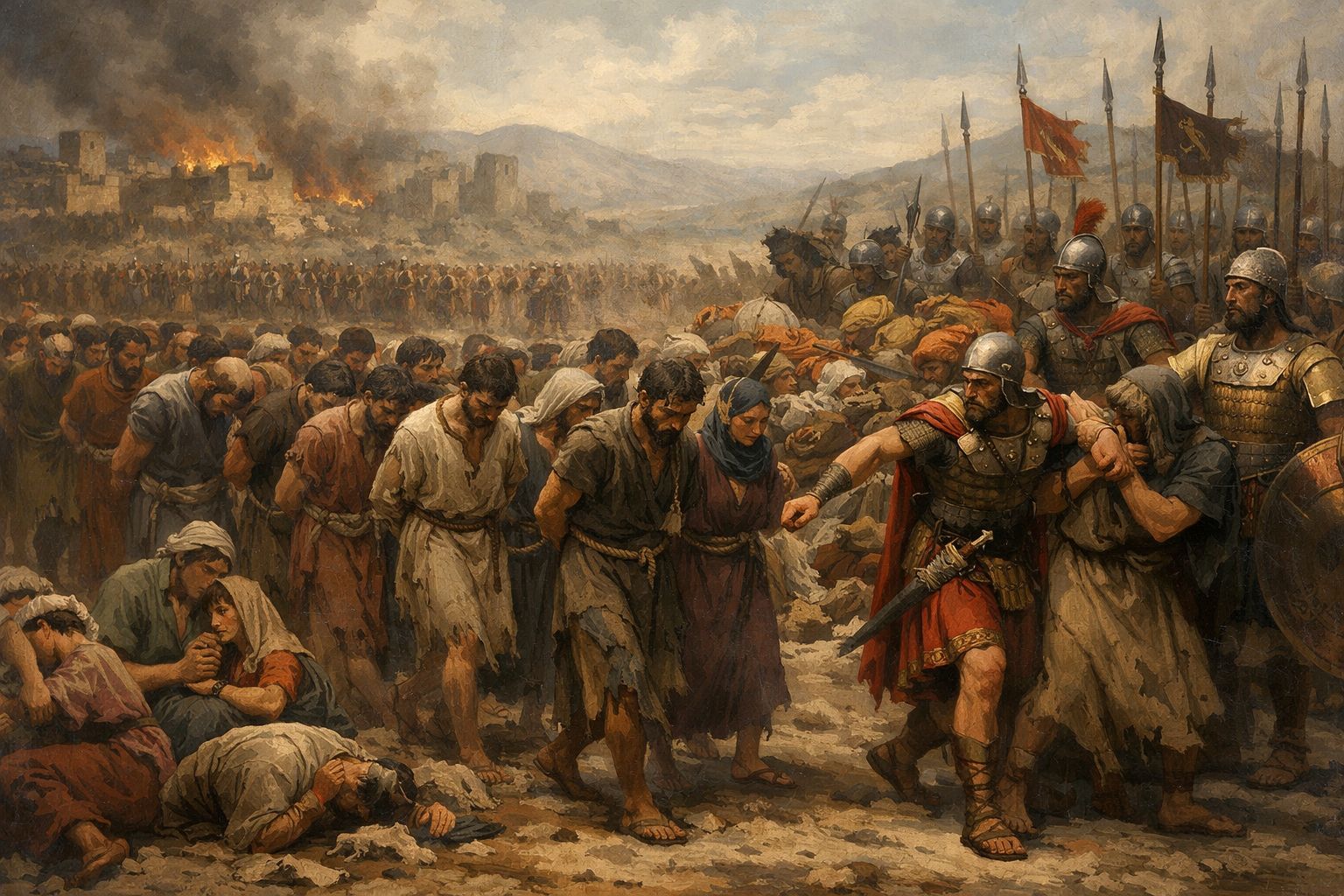
BRETHREN TAKEN
CAPTIVE BY ISRAEL
The sons of Israel carried away captive of their brethren 200,000 women, sons and daughters; This staggering statement reveals the full tragedy of Judah’s defeat under King Ahaz. The Chronicler emphasizes that the victims were not foreign enemies but “their brethren.” The northern kingdom of Israel and the southern kingdom of Judah shared the same ancestry, covenant history, and worship of Yahweh, yet civil war had so hardened hearts that Israelites treated fellow Israelites as conquered pagans. The taking of 200,000 captives (women and children in particular) shows the ruthless character of the invasion. Clearly families were torn apart, homes emptied, and entire communities marched away in humiliation and grief.
What % of the population of Judah would 200,000 represent? Be aware that we cannot be dogmatic but only give a rough estimate of between 20% and 30% of Judah’s population, mostly women and children, carried away in this single disaster. Whatever the percentage was, it clearly was a staggering number, representing a demographic catastrophe and probably explaining why Oded called it a sin “reaching to heaven” (2 Chr 28:9).
And they took also a great deal of spoil (shalal) from them, and brought the spoil (shalal) to Samaria Along with the captives, Israel seized “a great deal of spoil.” This included livestock, clothing, valuables, and anything of economic worth. The Chronicler’s wording suggests not a measured military victory but an act of plunder driven by greed and vengeance. The wealth of Judah, intended to support life and worship in Jerusalem, was carried north to Samaria, the capital of Israel, as a grim trophy of triumph. What should have been used to honor the Lord became evidence of covenant breakdown on both sides.
This verse underscores how far both kingdoms had fallen from God’s design. Judah suffered this calamity because Ahaz had led the nation into idolatry and reliance on pagan powers. Yet the Northern Kingdom's treatment of their brethren was equally sinful. The Law of Moses repeatedly commanded compassion toward fellow Israelites and forbade permanent enslavement of them (Lev 25:39–43). By ignoring these commands, the Northern Kingdom became an instrument of discipline that itself required correction, something the prophet Oded would soon confront (2Ch 28:9–11).
This scene stands as one of the darkest moments in the divided monarchy: covenant people enslaving covenant people, the weak and innocent bearing the heaviest burden of their leaders’ rebellion. The Chronicler records it not merely as history but as a warning that when a nation turns from the LORD, social bonds unravel, and even brothers become enemies.
Charles Spurgeon - It did not look as if the captives would ever return; yet the prophet’s son was named Shear-jashub, “The remnant shall return.” Ahaz might have said to Isaiah, “Your child’s name is a lie.” We shall see.
Spoil (07998) shalal is a masculine noun meaning spoils, plunder, or booty—that which is taken by force, usually in the context of war. The taking of spoil was often one of the chief motivations for military campaigns. Raids could function as thinly veiled plundering expeditions, such as the Amalekite attack on Ziklag (1 Sam 30:16, 19–20, 22, 26). At times shalal was seized as an act of political aggression (Esth 3:13; 8:11). Scripture also portrays the taking of spoil as the wicked preying upon the weak or righteous (Prov 1:13).
Scripture shows that taking spoil in war was sometimes permitted by God, as outlined in Deuteronomy 20:14, and typically included people, livestock, and valuables. Often a portion of this spoil was dedicated to the Lord for use in tabernacle or temple service (2 Sam 8:12; 1 Chr 26:27). Yet there were clear exceptions—no spoil was allowed at Jericho, in the destruction of idolatrous cities, or in Saul’s campaign against the Amalekites (Deut 13:17; 1 Sam 15). The Bible consistently teaches that the rise and fall of cities and the loss of their goods are under God’s sovereign control, as seen in His use of Assyria and Babylon as instruments of judgment (Isa 10:6; Ezek 7:21). Nevertheless, God will not permit the plundering of His people forever, and oppressors themselves will ultimately be despoiled (Zech 2:8; Hab 2:8; Jer 50:10; Ezek 39:10). “Spoil” can also describe unjust gain taken from the helpless (Prov 1:13; Isa 10:2), while the joy of dividing spoil becomes a metaphor for Israel’s future deliverance (Isa 9:3) and even for the triumphant victory of the Messiah, with the Psalmist likening delight in God’s Word to finding rich spoil (Ps 119:162).
“Booty” refers to the wealth of a person that is seized by another. In the Hebrew Bible, such seizure is permitted only in the context of war. Throughout much of history, booty served as the primary compensation for soldiers. Scripture identifies several categories of property that could be taken as booty. Persons were at times included (Deut 20:14; 2 Chr 28:8; Jer 45:5; 50:10; Zech 2:9). Livestock and clothing were also common forms (Judg 5:30; 1 Sam 14:32; Jer 49:32). Other items are summarized under the broader expression “the booty of the city” (Josh 8:2), likely referring to any movable property that could be carried away.
2 Chronicles 28:9 But a prophet of the LORD was there, whose name was Oded; and he went out to meet the army which came to Samaria and said to them, “Behold, because the LORD, the God of your fathers, was angry with Judah, He has delivered them into your hand, and you have slain them in a rage which has even reached heaven.
- he went out: 2Ch 19:1,2 25:15,16 1Ki 20:13,22,42 2Ki 20:14,15
- because the LORD the God: 2Ch 28:5 Judges 3:8 Ps 69:26 Isa 10:5-7 47:6 Jer 15:17,18 Eze 25:12-17 Eze 26:2,3 Ob 1:10-16 Zec 1:15
- reached: Ge 4:10 11:4 Ezr 9:6 Rev 18:5
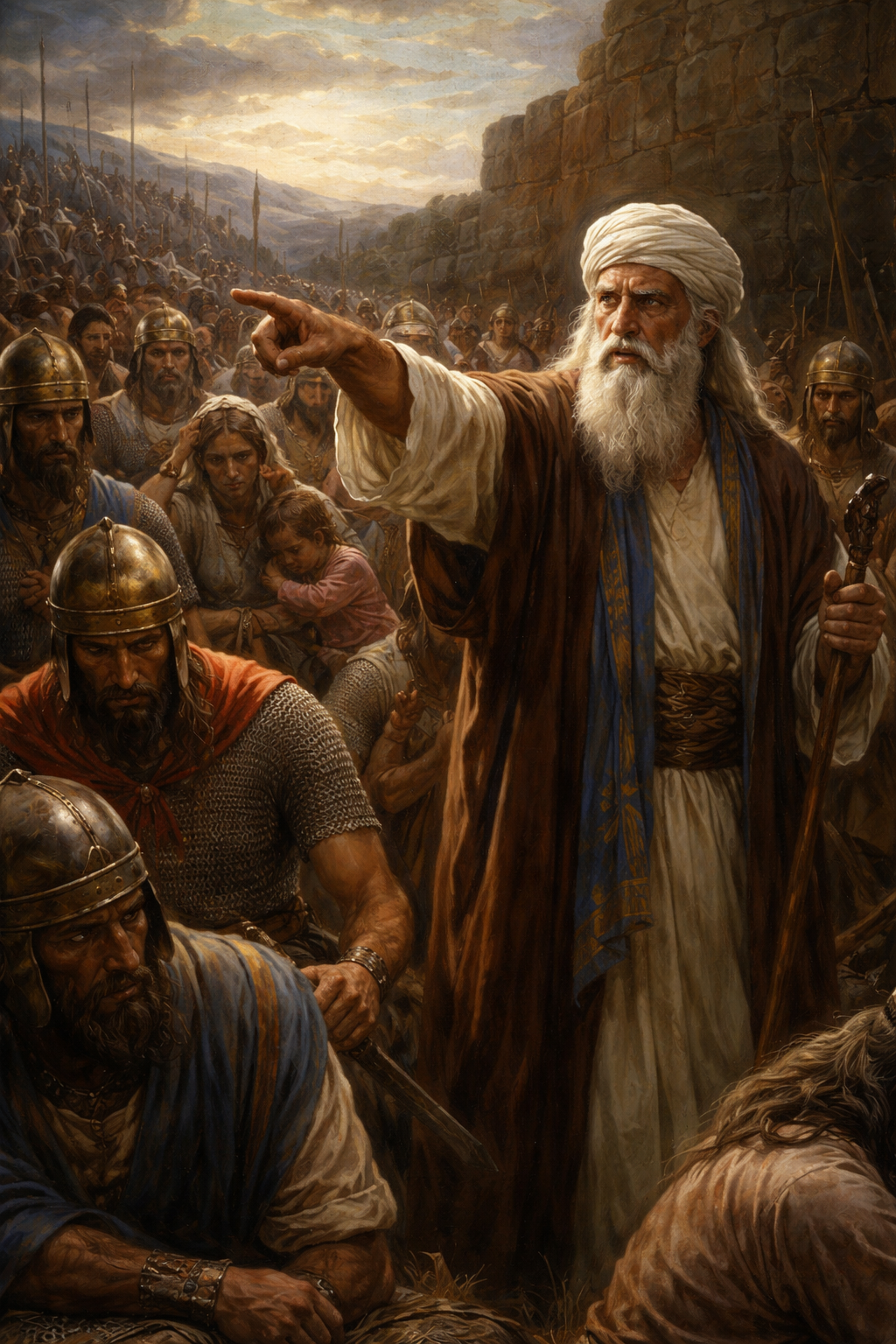
OBED'S WARNING
TO ISRAEL
But a prophet of the LORD was there, whose name was Oded and he went out to meet the army which came to Samaria; Into the midst of national triumph and blood-stained celebration, God raised up a solitary voice. Oded, otherwise unknown in Scripture, stands as a reminder that the Lord never leaves Himself without a witness, even in the spiritually corrupt northern kingdom. While the armies of Israel marched home boasting of victory and dragging 200,000 Judean captives behind them, this prophet went out to meet the army—a courageous act that placed him directly in the path of hardened soldiers intoxicated with success.
TSK adds "To this beautiful speech nothing can be added by the best comment: it is simple, humane, pious, and overwhelmingly convincing; and it is no wonder that it produced the effect here described. That there was much humanity, as well as firmness, in the heads of the children of Ephraim, who joined with the prophet of Jehovah on this occasion, their subsequent conduct, as detailed in the fifteenth verse, sufficiently proves. They did not barely dismiss these most unfortunate captives, but they took that very spoil which their victorious army had taken, and with clothed, shod, fed, and anointed these distressed people, set the feeblest of them upon asses, and escorted them safely to Jericho! We can scarcely find a parallel to this in the universal history of the wars which savage man has carried on against his fellows from the foundation of the world. The compliance also of the whole army, in leaving both the captives and spoil to the disposal of the princes, was really wonderful, and perhaps unparalleled in history. Both the princes and army are worthy to be held up to the admiration and imitation of mankind."
And said to them, “Behold, because the LORD, the God of your fathers, was angry with Judah, He has delivered them into your hand, and you have slain them in a rage which has even reached heaven. Oded first acknowledges the truth the victors had ignored. Judah’s defeat was not due to Israel’s strength but to “the LORD, the God of your fathers.” The same covenant God Who had once united all twelve tribes had, in righteous anger over Ahaz’s idolatry, allowed Judah to fall. Israel was merely an instrument in His hand. Yet an instrument can become guilty when it exceeds God’s purpose. The prophet therefore exposes the deeper sin that “you have slain them in a rage which has even reached heaven.” What began as divinely permitted discipline had turned into uncontrolled vengeance. The northern army had crossed the line from obedience to brutality, from justice to cruelty.
The phrase “reached heaven” is striking. It echoes earlier biblical language where human wickedness rises before God like a stench demanding response (cf. Ge 18:20–21; Ezra 9:6). Oded declares that Israel’s violence has not gone unnoticed; heaven itself bears witness against them. The prophet thus confronts the victors with an uncomfortable truth that God may use a nation to chastise another, yet still hold that nation accountable for its motives and excesses.
What is fascinating is that this scene is one of the rare bright moments in the history of the Northern Kingdom. A single faithful man, armed only with the Word of the Lord, challenges an entire army and reminds them that covenant brotherhood still matters. His message prepares the way for mercy, for the captives will soon be clothed, fed, and returned, but first sin must be named. Oded teaches that even in times of justified judgment, God demands compassion, restraint, and reverence for fellow members of His covenant people.
Spurgeon - It was very wonderful that these wild fellows should listen to this prophet with all those captives round about them. It was a brave act on the part of the prophet Oded to go out, and utter his protest.
ODED [ISBE] A prophet of Samaria (2 Ch 28:9) who lived in the reigns of Pekah, king of the Northern Kingdom, and Ahaz, king of Judah. According to 2 Ch 28, Oded protested against the enslavement of the captives which Pekah had brought from Judah and Jerusalem on his return from the Syro-Ephraimitic attack on the Southern Kingdom (735 BC). In this protest he was joined by some of the chiefs of Ephraim, and the captives were well treated. After those who were naked (i.e. those who had scanty clothing; compare the meaning of the word "naked" in Mk 14:51) had been supplied with clothing from the spoil, and the bruised anointed with oil, the prisoners were escorted to Jericho.
The narrative of 2 Ch 28 as a whole does not agree with that of 2 Ki 15:37; 16:5 f, where the allied armies of Rezin of Damascus and Pekah besieged Jerusalem, but failed to capture it (compare Isa 7:1-17; 8:5-8a). As Curtis points out (Chronicles, 459, where he compares Ex 21:2 ff; Lev 25:29-43; Dt 15:12-18), wholesale enslavement of their fellow-countrymen was not allowed to the Hebrews, and this fact the passage illustrates. It seems to be a fulfillment in spirit of Isa 61:1-2, a portion which our Lord read in the synagogue at Nazareth (Lk 4:16-20). David Francis Roberts
2 Chronicles 28:10 “Now you are proposing to subjugate for yourselves the people of Judah and Jerusalem for male and female slaves. Surely, do you not have transgressions of your own against the LORD your God?
- subjugate: Lev 25:39-46
- do you not have: Jer 25:29 Mt 7:2-4 Ro 12:20,21 1Pe 4:17,18
- the LORD: 2Ch 28:5
OBED'S WARNING
AGAINST ISRAEL
Now you are proposing to subjugate for yourselves the people of Judah and Jerusalem for male and female slaves. The prophet confronts Israel with a sobering charge. The northern army, having defeated their southern brethren, was preparing to turn fellow Israelites into permanent property—treating covenant relatives as disposable spoils of war. What they planned was not merely political domination but a moral outrage: the enslavement of those who shared the same ancestry, promises, and worship of Yahweh.
Surely, do you not have transgressions of your own against the LORD your God Obed's rebuke continues with a piercing rhetorical question, calculated to expose the hypocrisy of the Northern Kingdom who, while celebrating Judah’s downfall, were blind to their own guilt. Israel had been just as rebellious, idolatrous, and faithless. To enslave their brothers was to act as if they themselves were righteous, yet their hands were equally stained before Jehovah!
The message carries a powerful theological truth that judgment never grants a license for cruelty. God may discipline one nation through another, but He does not approve of brutality or exploitation. Israel was meant to be an instrument of correction, not an agent of oppression. By seeking to profit from Judah’s misery, they revealed hearts no better than those they condemned.
🙏 THOUGHT - Obed's warning calls all of us to humility. Before condemning another’s sin, we must remember our own need for mercy. The Lord measures not only what we do to our enemies, but how we treat our brethren in their weakness. The next time you point your index finger at someone's sin, be sure to remember that 4 fingers are pointing back at you!
J.A. Thompson: Any intention to make the people of Judah slaves was a breach of the law that forbade the enslaving of fellow Israelites (Lev 25:39-55). Short-term slavery of one Israelite to another was allowable, but ruling over one’s brothers “ruthlessly” (Lev 25:43) was forbidden. Israel itself was only a hairsbreadth from judgment. Repentance toward God and magnanimity toward their brethren was called for. They had taken prisoners. These should be sent back. Repentance required some display of appropriate action. (SEE 1, 2 Chronicles: An Exegetical and Theological Exposition)
Martin Selman: For the moment, however, Chronicles shows how God’s anger can be unexpectedly turned aside. A prophet from Samaria called Oded intervenes to greet the returning victorious Israelite army with the apparently unwelcome message that the prisoners must be sent back (vv. 9–11). He gives three reasons, that the Israelites had reacted with excessive rage (v. 9), that their plan to subject the Judean prisoners of war to the usual fate of slavery was unacceptable (v. 10a), and that they had ‘committed sins’ (v. 10b, JB; ‘are guilty’, REB, NEB) before God. As with many previous prophecies in Chronicles, Oded uses earlier Scripture. Excessive violence in war regularly met with God’s disapproval (cf. Isa. 10:15–16; Hos. 1:4; Hab. 2:2–20; Zech. 1:15), even though the Israelites might claim that they were simply getting their own back on Amaziah (cf. 25:11–12). Slavery of fellow Israelites was against the law of Leviticus 25:42–43, 46, because they were (lit.) ‘brothers’ (vv. 8, 11, 15; ‘kinsmen’, REB, NEB; ‘kinsfolk’, RSV), a significant theme throughout Chronicles (cf. 1 Chr. 12:39; 13:2; 2 Chr. 11:4). Also, ‘to force into slavery’ (v. 10, REB, NEB) is a phrase always associated with God’s disapproval, and occurs only in Jeremiah 34:11, 16 and Nehemiah 5:5, in the latter case perhaps not too distant from the Chronicler’s own experience. Finally, the prophecy is an appeal for repentance (v. 11). The only hope against God’s anger for both Israelites and Judeans (vv. 9, 11) is in God’s mercy, which according to 2 Chronicles 6:36–39 was available even in captivity. Though they had sinned against the law and the prophets, Scripture also pointed the way to forgiveness. (See 2 Chronicles: An Introduction and Commentary - Page 500)
C H Spurgeon - A home question (sermon)
“But are there not with you, even with you, sins against the Lord your God?” 2 Chronicles 28:10
Tell him that his sins deserve the wrath of hell. Make him feel that it is an awful thing to fall into the hands of our God, for he is a consuming fire. Then throw him down on a bed of spikes, and make him sleep there if he can. Roll him on the spikes, and tell him that bad as he is, he is worse by nature than by practice. Make him feel that the leprosy lies deep within. Give him no rest. Treat him as cruelly as he could treat another. It would only be his deserts. But who is this that I am telling you to treat so? Yourself, my hearer, yourself. Be as severe as you can, but let the culprit be yourself. Put on the wig, and sit upon the judgment-seat. Read the king’s commission. There is such a commission for you to be a judge. It says—Judge thyself—though it says judge not others. Put on, I say, your robes; sit up there Lord Chief Justice of the Isle of Man, and then bring up the culprit. Make him stand at the bar. Accuse him; plead against him; condemn him. Say: “Take him away, jailor.” Find out the hardest punishment you can discover in the statute book, and believe that he deserves it all. Be as severe as ever you can on yourself, even to the putting on the black cap, and reading the sentence of death. When you have done this, you will be in a hopeful way for life, for he that condemns himself God absolves. He that stands self-convicted, may look to Christ hanging on the cross, and see himself hanging there, and see his sins for ever put away by the sacrifice of Jesus on the tree.
2 Chronicles 28:11 “Now therefore, listen to me and return the captives whom you captured from your brothers, for the burning anger of the LORD is against you.”
- return: Isa 58:6 Jer 34:14,15 Heb 13:1-3
- burning anger: Ezr 10:14 Mt 5:7 7:2 Jas 2:13
RETURN OR
BURN
Now therefore, listen to me - Obed's appeal is both reasoned and compassionate. The phrase “listen to me” is a call to stop, reconsider, and submit to the voice of truth rather than the momentum of victory and greed. Though Israel had triumphed militarily, they were now standing on dangerous spiritual ground. Their prisoners were not foreigners but brothers—fellow members of the covenant family of Israel. To keep them as slaves would be to violate the bonds of kinship and the law of God that commanded mercy toward one’s own people.
Return the captives whom you captured from your brothers, The prophet’s demand to “return the captives” required more than a political decision; it called for repentance. These prisoners represented human lives torn from homes, families, and worship. What Israel had gained by the sword could not be kept with God’s blessing. True obedience meant reversing their actions, undoing the injustice, and restoring what had been wrongly taken.
For the burning anger of the LORD is against you.” For is a term of explanation, giving the explanation in the form of a warning as to why they should return their brethren. And the warning is severe. The imagery of burning anger conveys a wrath already kindled and ready to break forth. Israel may have thought their victory warranted divine approval, but the prophet declares just the opposite, that Yahweh was displeased with their cruelty and "kidnapping" of their brethren. The same Lord who had allowed Judah to be disciplined would now judge Israel if they refused to show mercy.
This verse reveals that God weighs not only outcomes but motives and conduct. When discipline becomes exploitation, the disciplinarian becomes guilty. The LORD’s people are called to be instruments of restoration, not destruction; to heal wounds, not deepen them. The prophet’s message echoes through the ages. Whenever we have power over another, whether through position, circumstance, or advantage, God calls us to act with compassion and restraint. To ignore that call is to invite His displeasure. Repentance often requires costly reversal, yet it is the only path that turns away the burning anger of the LORD and restores fellowship among brothers.
Warren Wiersbe - The prophet Obed (not the same man as in 15:8) pointed out three sins the army of Israel committed. First, they were in a rage against the people of Judah and captured and killed them indiscriminately. Second, they planned to make slaves out of their own brothers and sisters, and this was contrary to God’s law (Lev. 25:39ff.). In doing these things, they showed no fear of the Lord and therefore were asking for Him to judge them (2 Chron. 28:9–11). Yes, God was angry with Judah (2Ch 28:9, 25), but there was danger He would become angry at Israel for the way they treated Judah (28:11–13). After Obed’s message, some of the leaders in Israel stood and affirmed what he had said and urged the army not to sin against the Lord and their brothers and sisters.
August Konkel: The response of the Israelites to the appeal of Obed the prophet is further evidence of the unity that God intends for his people. It is testimony to the firm belief of the Chronicler that this is one nation. The political realities that have come about must not give a false impression of that underlying reality. It is seen in the way the words of the prophet can subvert political and material ambitions with spiritual victory and community concord. In the darkest time of a virtual exile for Judah, there is at the same time the evidence of the light the darkness cannot overcome. (SEE 1 & 2 Chronicles)
2 Chronicles 28:12 Then some of the heads of the sons of Ephraim–Azariah the son of Johanan, Berechiah the son of Meshillemoth, Jehizkiah the son of Shallum, and Amasa the son of Hadlai–arose against those who were coming from the battle,
- the heads: 1Ch 28:1
- arose: Jer 26:6
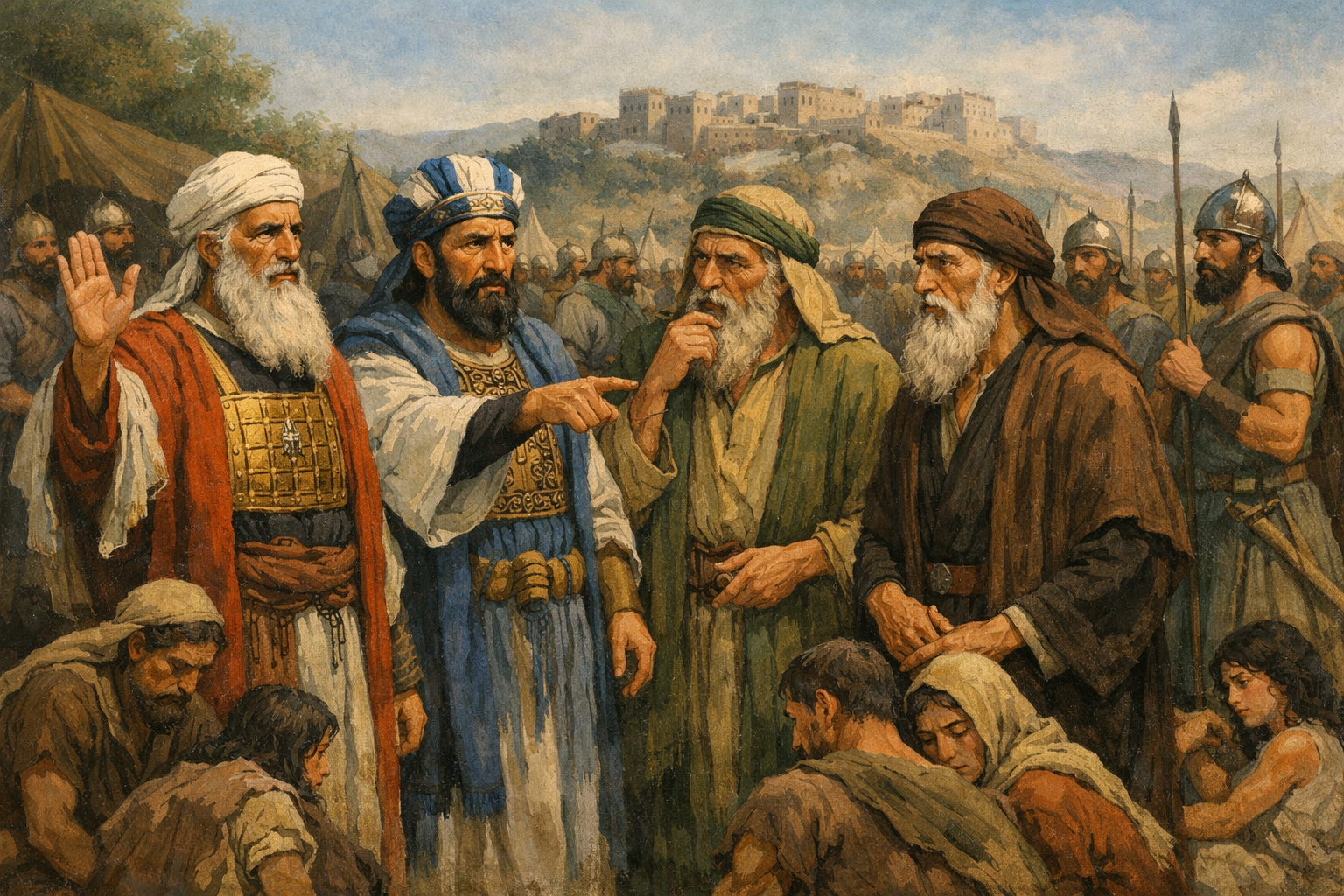
COOLER "HEADS"
PREVAIL
Then some of the heads of the sons of Ephraim–Azariah the son of Johanan, Berechiah the son of Meshillemoth, Jehizkiah the son of Shallum, and Amasa the son of Hadlai–arose against those who were coming from the battle - In the midst of national pride and military excitement, a remarkable moment of conscience occurred. As the victorious army of Israel returned laden with captives and spoil, four respected leaders (Azariah...Berechiah...Jehizkiah...Amasa) from the tribe of Ephraim stepped forward to oppose what was taking place. These were not obscure men but recognized heads of the community, individuals whose voices carried weight among the people. Their names are carefully recorded, as if the Spirit of God wished to honor their courage for all generations.
The fact that they arose against those who were coming from the battle was no small act. The mood of an army fresh from victory is rarely gentle or receptive to criticism. The warriors expected celebration and reward, not correction and rebuke. Yet these leaders were willing to stand in the path of popular opinion because they feared the LORD. They seem to understand that success on the battlefield did not justify disobedience to God’s law or cruelty toward their own brethren from Judah. They recognized that the captives being paraded home were not enemies but fellow Israelites—sons and daughters of the same covenant. To enslave them would deepen Israel’s guilt and invite divine judgment. These four men risked misunderstanding, ridicule, and perhaps even violence in order to defend righteousness. Their stand prepared the way for repentance, mercy, and the eventual release of the captives.
Andrew Hill: Unlike King Ahaz and their Judean counterparts, the leadership of Israel responds to the word of God through the prophet Oded and repents of their actions (2Ch 28:12-13). (See First and Second Chronicles)
2 Chronicles 28:13 and said to them, “You must not bring the captives in here, for you are proposing to bring upon us guilt against the LORD adding to our sins and our guilt; for our guilt is great so that His burning anger is against Israel.”
- adding: Nu 32:14 Jos 22:17,18 Mt 23:32,35 Ro 2:5
EPHRAIMITE LEADERS
WARNING TO ARMY
and said to them, “You must not bring the captives in here, The Ephraimite leaders spoke with firm conviction: “You must not bring the captives in here.” They recognized that what the soldiers saw as trophies of victory was, in God’s eyes, a grave injustice. To parade their Judean brothers into Samaria as slaves would turn military success into national sin.
for you are proposing to bring upon us guilt against the LORD adding to our sins and our guilt; Their warning was spiritual, not political. Israel was already burdened with rebellion and idolatry, and this cruelty would only multiply their accountability. The leaders interpret the situation through a spiritual lens rather than a political one. Military success had blinded many to the true issue, but these men understood that every act is weighed before the Lord. To enslave their brothers would not be a neutral act of war; it would be a deliberate offense against God’s covenant. Israel already carried a heavy burden of idolatry and rebellion, and this new cruelty would only multiply their accountability.
for our guilt is great so that His burning anger is against Israel - They explained (for = term of explanation) that the recent victory was not proof of divine favor. These leaders acknowledge that the nation already stands under divine displeasure. To proceed with enslaving the captives would be to provoke the LORD further, turning discipline into destruction. Burning anger conveys God's wrath as already kindled.
2 Chronicles 28:14 So the armed men left the captives and the spoil before the officers and all the assembly.
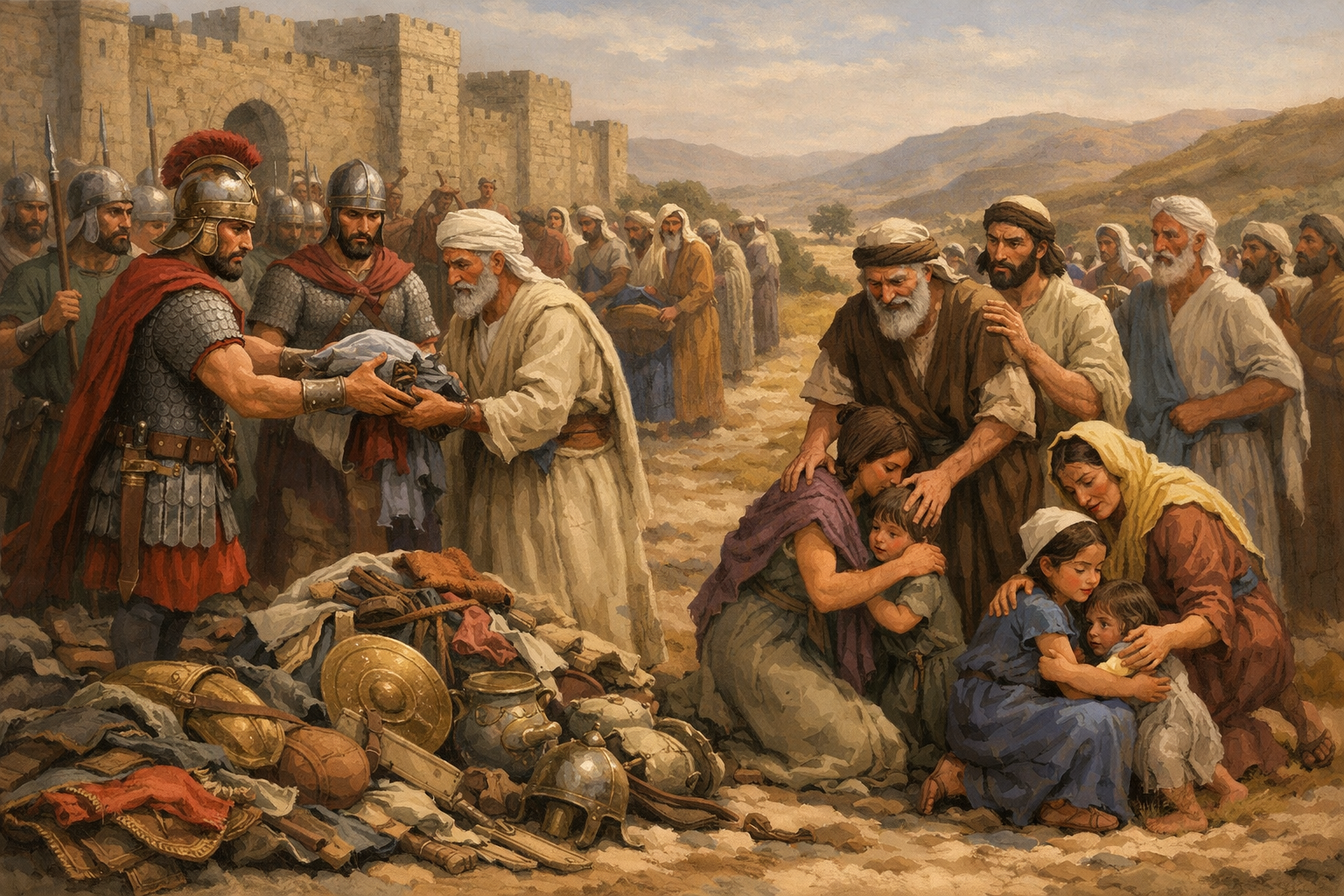
ISRAELI FORCES
CAPITULATE
So the armed men left ('azab; LXX - aphiemi - released) the captives and the spoil before the officers and all the assembly - The soldiers, who had marched home in triumph with prisoners and plunder, now laid everything down. Their weapons had won the battle, but the Word of the Lord won their hearts. Instead of clinging to what they considered rightful rewards, they submitted to the rebuke of the Ephraimite leaders and to the voice of conscience.
This moment stands as a testimony that even after wrongdoing, a nation or an individual can choose a different path. When hearts are willing to listen, the cycle of cruelty can be broken, and the burning anger of the Lord can be turned aside by acts of repentance and restoration.
Iain Duguid: At a time when Israel was about to end as a nation due to her apostasy, experiencing the Lord’s “fierce wrath,” the Chronicler tells of the Ephraimites’ confession of “great guilt” and actions that demonstrated some repentance. The positive treatment of the captives is given in much detail; they could not have done more! Political reunion may not have been possible at that chaotic time (“they returned to Samaria”), but the compassionate righting of all the damage involved in taking captives is commended.
Martin Selman: The Chronicler’s message, which must have been clear to his contemporaries, is that God’s mercy was freely available even to captives. The story is in fact so striking that Jesus used it twice in his teaching. Anointing of the prisoners’ wounds, the mention of donkeys and of Jericho make this an important source of the parable of the Good Samaritan (Luke 10:25-37), while the provision of food and clothing to brothers who are naked and hungry prisoners clearly lied behind Matthew 25:34-46. No-one’s situation is too hopeless for God to redeem, and he reserves the right to show mercy through the most unexpected people, even one’s traditional enemies (cf. Jon. 1-4; Acts 10:1–11:18). (See 2 Chronicles: An Introduction and Commentary)
John Walton - 28:14-15. treatment of prisoners. The Assyrian annals and wall reliefs depict the harsh conditions of those who were deported from their own territory. The males are normally naked, often with hooks in their nose or lips, and some are missing limbs. Others are carrying their worldly belongings with them. It appears that the Israelites had a similar policy, which was condemned by the prophet Oded. The extent of care and mercy described in these verses is, therefore, remarkable. (See page 450 The IVP Bible Background Commentary-Old Testament)
2 Chronicles 28:15 Then the men who were designated by name arose, took the captives, and they clothed all their naked ones from the spoil; and they gave them clothes and sandals, fed them and gave them drink, anointed them with oil, led all their feeble ones on donkeys, and brought them to Jericho, the city of palm trees, to their brothers; then they returned to Samaria.
- designated by name: 2Ch 28:12
- clothed: Job 31:15-23 Isa 58:7 Mt 25:35-45 Ac 9:39 1Ti 5:10 Jas 2:15,16 1Jn 3:17,18
- gave them: 2Ki 6:22 Pr 25:21,22 Lu 6:27 8:27,35 Ro 12:20,21
- carried: Ro 15:1
- the city: De 34:3 Judges 1:16
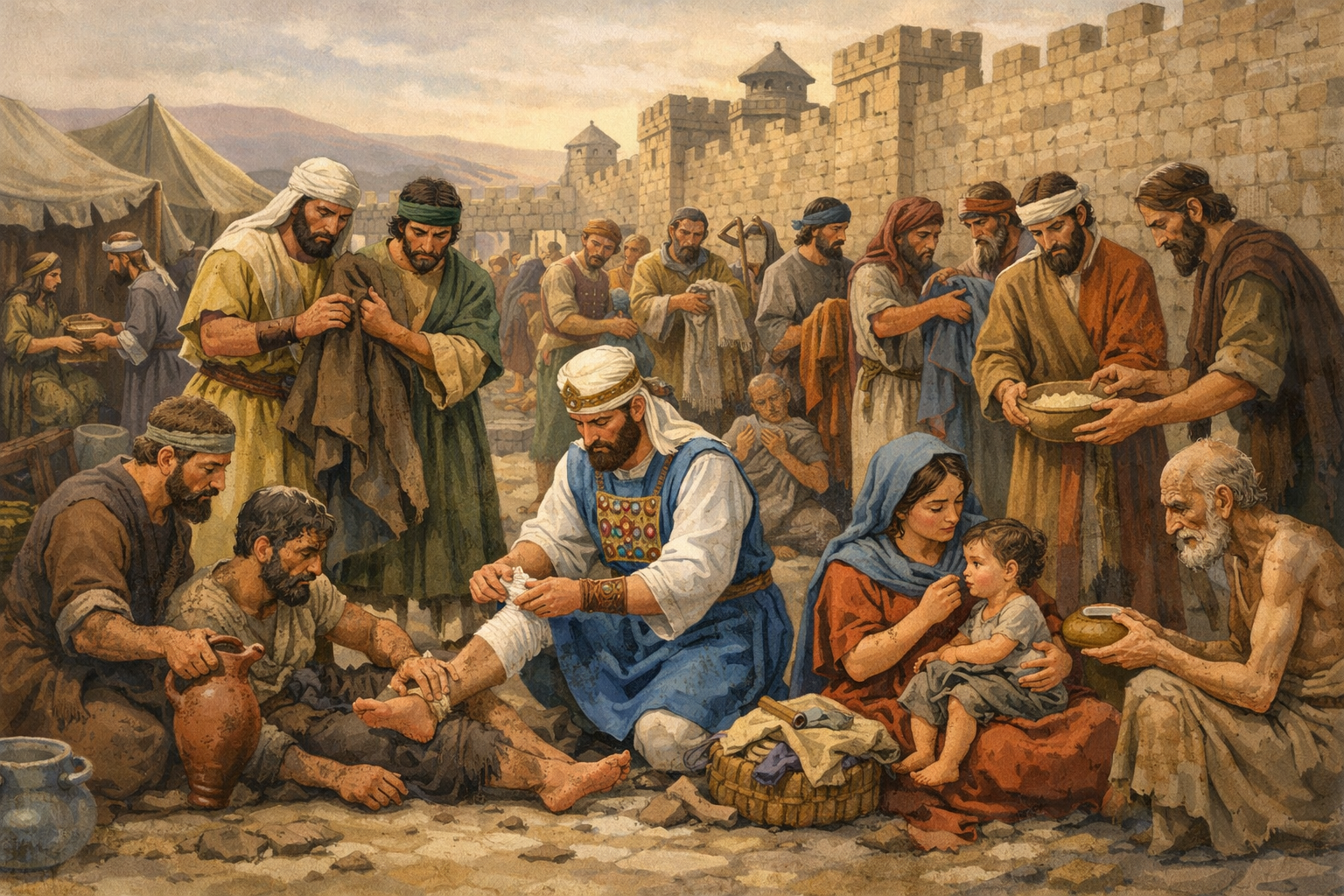
ISRAEL SHOWS
MERCY ON JUDAHITES
Then the men who were designated by name arose, took the captives Specific leaders were appointed to carry out this work of mercy. Their names were known, underscoring personal responsibility and deliberate action. What followed was not an impulsive gesture but an organized, compassionate ministry to those who had been wounded by war.
And they clothed all their naked ones from the spoil; and they gave them clothes and sandals The very plunder once intended to enrich the victors became the means of restoring the defeated. The captives, many stripped and humiliated, were treated with dignity. Clothing and sandals symbolized more than physical provision—they were signs that these people were no longer slaves but brothers to be honored.
Fed them and gave them drink, anointed them with oil, led all their feeble ones on donkeys Their needs were met with tender care. Food and water revived their strength; oil soothed wounds and refreshed weary bodies. The actions resemble the ministry of a shepherd or even the later compassion of the Good Samaritan—mercy replacing hostility, healing replacing hatred.
And brought them to Jericho, the city of palm trees, to their brothers Special attention was given to the weak, the elderly, and the exhausted. Those unable to walk were carried, showing that true repentance considers the most vulnerable first. The journey home would not be a march of misery but a procession of restoration.
Then they returned to Samaria. Having completed their mission, the Ephraimites went home with clean hands and softened hearts. What began as an act of war ended as an act of grace. Obedience turned potential judgment into blessing and demonstrated that repentance is most real when it is expressed through costly love.
🙏 THOUGHT - This passage stands as one of the most moving pictures of compassion in the Old Testament. It reveals the heart of God, Who desires restoration rather than revenge, and teaches that genuine repentance is measured not by words but by deeds of mercy toward those who can give nothing in return.
Warren Wiersbe - This was an instance of being “good Samaritans” on a national level (Luke 10:25–37), and it reminds us of Elisha’s kindness to the Syrian soldiers who came to capture him (2 Kings 6:15–23). When the prisoners (with the spoils of battle) arrived back in Judah, they were living witnesses of the grace and goodness of the Lord, but there’s no record that Ahaz led the nation in a great praise service. This remarkable event carried another message to Judah: the time would come when the Babylonians would invade the land and take thousands of captives away to Babylon. This experience with the kingdom of Israel was somewhat of a “dress rehearsal” for the people of Judah, but Babylon wouldn’t treat them as the Israelites did. Most of the Jewish captives would die in Babylon, and after seventy years, only a feeble remnant would return to rebuild the temple and try to establish the nation again.
Does the Lord still chasten nations today as He did in ancient days? The Jewish people, of course, belonged to a covenant nation, even though it was now divided into two kingdoms, and they were responsible to obey the covenant of the Lord. But what about the Gentile nations that have no covenant relationship with God? The prophet Amos makes it clear that God knows the sins of the Gentile nations and holds them accountable (Amos 1—2). God never gave His law to the Gentiles (Ps. 147:19–20), but the demands of that law are written in the hearts of all people (Rom. 2:12–16), so the disobedient Gentiles are guilty before the Lord. As you read the Old Testament, you find God judging Sodom and Gomorrah (Gen. 18—19), Egypt (Ex. 1—14), the Gentile nations in and around Canaan (Num. 31–32; Joshua 1—12), and even Babylon (Jer. 50—51). However, because the Jews knew the true and living God and had the witness of His law, they were even more accountable. How tragic that apostate Israel and not enlightened Judah showed concern about obeying the message of God. Judah had the temple, the law, and the priesthood, but they didn’t have the Lord. “Blessed is the nation whose God is the Lord” (Ps. 33:12).
F B Meyer - 2 Chronicles 28:15 They clothed all that were naked, and gave them to eat and drink.
A great burst of generosity was here, for Israel had every reason to be incensed against Judah for the raid made on their territory. But, instead of pushing their advantage to the uttermost, they returned good for evil, and anticipated the words of the apostle, “If thine enemy hunger, feed him; if he thirst, give him drink for in so doing thou shalt heap coals of fire on his head.”
Have you in your life people who have done you injury, and against whom you entertain hard thoughts? You do not injure them in return, but you cannot pray for them. So far as you can, you avoid them; you make no attempt to overcome the evil that is in them. But to act thus is to come short of Christ’s standard. It is your duty, not merely to keep at a distance and give a wide berth, but by love to destroy the evil, to transform the enemy into a friend, and to create love and friendship where hostility and alienation had reigned. It is God’s way, and in this we are bidden to be perfect, as our Heavenly Father is perfect.
Will you try it? Will you begin by doing kind acts to those who have harmed you? Not because as yet you feel as you would, but because it is right. Then as you dig the trench in right-doing, look up to God, and He will pour into your heart the warm gush of affection. If you sincerely will His will in this matter, and act as the Good Samaritan did to the Jew, and exercise faith, God will come to your aid whilst you clothe others and minister to them, you will find their hard heart melted, and yourselves clothed with the beautiful garments of salvation, and of a meek and quiet spirit, which in God’s sight is of great price.
2 Chronicles 28:16 At that time King Ahaz sent to the kings of Assyria for help.
- sent: 2Ki 16:5-7 Isa 7:1-9,17
Parallel Passages
2 Kings 16:7 So Ahaz sent messengers to Tiglath-pileser king of Assyria, saying, "I am your servant and your son; come up and deliver me from the hand of the king of Aram, and from the hand of the king of Israel, who are rising up against me."
Isaiah 7:4-9 (ISAIAH'S PROPHECY TO KING AHAZ) and say to him, ‘Take care and be calm, have no fear and do not be fainthearted because of these two stubs of smoldering firebrands (REZIN OF SYRIA, PEKAH OF ISRAEL), on account of the fierce anger of Rezin and Aram and the son of Remaliah. 5 ‘Because Aram, with Ephraim and the son of Remaliah, has planned evil against you, saying, 6 “Let us go up against Judah and terrorize it, and make for ourselves a breach in its walls and set up the son of Tabeel as king in the midst of it,” 7 thus says the Lord GOD: “It shall not stand nor shall it come to pass. 8 “For the head of Aram is Damascus and the head of Damascus is Rezin (now within another 65 years Ephraim will be shattered, so that it is no longer a people), 9 and the head of Ephraim is Samaria and the head of Samaria is the son of Remaliah. If you will not believe, you surely shall not last.”’
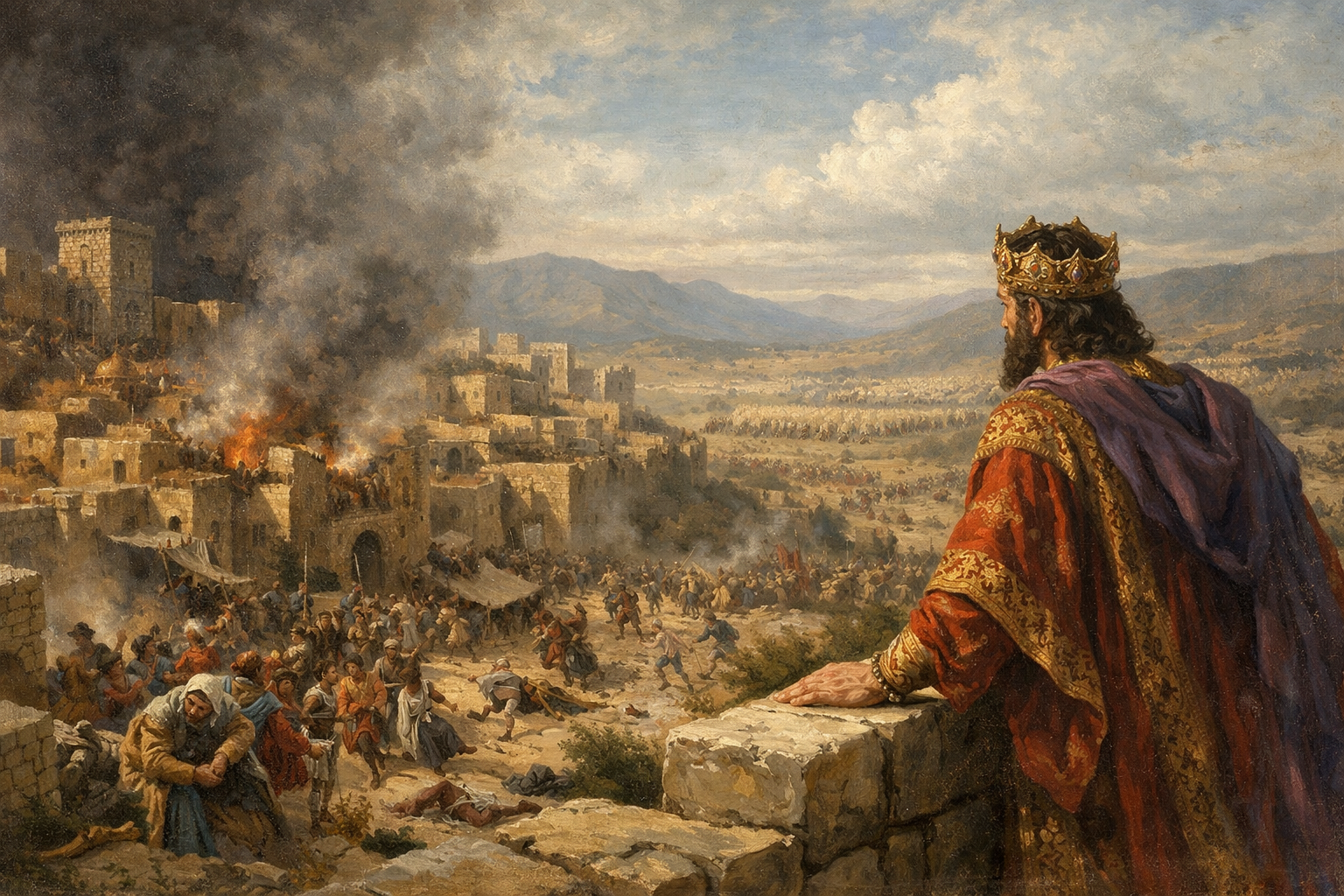
A DECISIVE TIME
IN JUDAH'S HISTORY
At that time - Whenever you encounter a "time phrase," interrogate the phrase with at least "To what time does it refer?" or "What happens at this itme?", etc, etc.
King Ahaz sent to the kings of Assyria - Pressured by the combined threat of Aram and Israel, Ahaz chose to seek security from the rising superpower of Assyria rather than from the LORD who had covenanted to protect David’s throne. His decision was driven by fear, not faith. Instead of turning to the God of his fathers, Who had repeatedly delivered Judah in times of danger, Ahaz looked to a pagan empire whose ambitions would ultimately enslave the very nation Ahaz hoped to save.
For help (azar; Lxx = boetheo) - This was not just a a diplomatic request. In effect King Ahaz is confession where he placed his trust. By appealing to Assyria, he effectively declared that in his mind human power was more reliable than Yahweh's promise of protection. The prophets of his day, especially Isaiah, had urged him to stand firm and believe (Isa 7:4–9), assuring him that the LORD would defend Jerusalem. Yet Ahaz preferred visible armies to invisible grace, immediate solutions to patient dependence.
Ahaz's disloyal act (to God) reaped heavy spiritual consequences. Alliances in the ancient Near East were not merely political, but often involved tribute, loyalty oaths, and acceptance of the ally’s gods and customs. By inviting Assyria’s intervention, Ahaz opened the door to foreign influence, idolatrous practices, and eventual domination by Assria. What humanly speaking appeared to be a practical strategy was, in reality, a step toward disaster for Judah.
🙏 THOUGHT - The verse exposes a timeless temptation: when crisis comes, where do we run first? Ahaz teaches how easily anxiety and fear can overwhelm faith. Help sought apart from God may bring short-term relief, but it often creates long-term bondage. True security for our lives will never be found in the “Assyrias” we may tempted to trust (money, influence, technology, other people’s approval, or my own clever plans). Like Ahaz, we all face moments when fear urges us to grasp the nearest visible solution instead of resting in the unseen faithfulness of our Heavenly Father. But when we chose to run first to human strength, we repeat Ahaz' mistake, trading the steadfast covenant love of Jehovah for a human substitute that cannot truly protect.
Andrew Hill: This dangerous diplomacy of playing one ancient superpower (i.e., Assyria) against another (I.e., Egypt) as an ally in petty border wars with neighboring nations was a ploy of the northern kingdom of Israel during the reign of Jeroboam II – a tactic soundly condemned by Hosea the prophet (Hos. 7:11). (See First and Second Chronicles)
Christopher Knapp - “How different was his great ancestor David! ‘In my distress,’ he says, ‘I called upon the Lord, and cried unto my God’ (Psalm 18:6). Even his wicked grandson Manasseh sought the Lord his God ‘when he was in affliction.’ But Ahaz seemed determined to fill up the measure of his sins.”
Spurgeon - The king of Assyria was the greatest potentate in that region, and all the little kings were afraid of him, and therefore sent to him for help when they were in trouble. Ahaz made no appeal to God, for the assistance he required, but he turned to the arm of flesh.
J.A. Thompson: Ahaz was in dire straits. His predecessors who had been faithful to the Lord had seen God subdue such enemies many times. But Ahaz did not trust in the Lord (cf. Isa 7:10-16). With Philistines and Edomites in the south and the SyroEphraimite invasion in the north (2Ch 28:5-8), he faced a two-front war. The verb help is important to the Chronicler. God was ever available to “help” faithful kings (1 Chr 5:20; 2 Chr 14:11; 18:31; 25:8; 26:7, 15; 32:8 = ED: SEE MANY USES BELOW IN CHRONICLES). Such help (azar) was not available from other sources (2Ch 28:21, 23). Ahaz had turned to human – indeed foreign – help instead of to the God of Israel. (SEE 1, 2 Chronicles: An Exegetical and Theological Exposition)
Spurgeon -When men are determined to be unbelievers and disobedient, they will send anywhere for help but to the Lord. Israel and Syria were very little kingdoms; but Assyria was a great empire, the mighty nation of the period. Yet no help came to Ahaz from that quarter, for we read in the twentieth verse, “And Tilgath-pilneser king of Assyria came unto him, and distressed him, but strengthened him not.” The twenty-first verse tells us that Ahaz bribed the king of Assyria; “but he helped him not.” That is always the dirge at the end of all efforts to secure human instead of divine aid.
John Walton - Ahaz asking help of Assyrians. In response to the invasion of Judah by the other Syro-Palestian states, Ahaz appealed to Assyria. Although the Assyrian annals do not explicitly state his appeal, he is listed as one of the kings who gave tribute to Tiglath-Pileser III (See page 450 The IVP Bible Background Commentary-Old Testament)
Help (05826) 'azar means to protect, aid, help, succor, support, give material or nonmaterial encouragement. Azar often refers to aid in the form of military assistance and in many instances refers to help from Jehovah as illustrated by the uses below. Webster says to help means to aid, to assist, to succour (see below), to lend strength or means towards effecting a purpose. To relieve; to cure, or to mitigate pain or disease. To remedy; to change for the better. The Septuagint translates 'azar most often with the word group that includes boáo, boetheo, boethos, all conveying the general idea of running to the aid of one who cries out for help (e.g., see He 2:18 which uses boetheo) which is similar to the English word succour (from Latin succurrere = to run up, run to help) means literally to run to and so to run to to support, to go to the aid of, to help or relieve when in difficulty, want or distress; to assist and deliver front suffering; as, to succor a besieged city; to succor prisoners.
The Theological Lexicon of the OT notes that…Connotations can vary from “to support” (Ezra 10:15), “to help out” (Josh 1:14; cf. Ge 2:18), “to assist” (Ge 49:25) to “to stand with to deliver” (Da 10:13; cf. Lam 4:17) and “to come to aid” (2Sa 21:17; cf. Ps 60:13 = Ps 108:13). To this extent, the Hebrew terms coincide with the English terms “to help” and “help.” (Jenni, E., & Westermann, C. Theological Lexicon of the Old Testament (872). Peabody, Mass.: Hendrickson Publishers)
Azar - 76v with 22 uses in Chronicles - Gen. 49:25; Deut. 32:38; Jos. 1:14; Jos. 10:4; Jos. 10:6; Jos. 10:33; 1 Sam. 7:12; 2 Sam. 8:5; 2 Sam. 18:3; 2 Sam. 21:17; 1 Ki. 1:7; 1 Ki. 20:16; 2 Ki. 14:26; 1 Chr. 5:20; 1 Chr. 12:1; 1 Chr. 12:17; 1 Chr. 12:18; 1 Chr. 12:19; 1 Chr. 12:21; 1 Chr. 12:22; 1 Chr. 15:26; 1 Chr. 18:5; 1 Chr. 22:17; 2 Chr. 14:11; 2 Chr. 18:31; 2 Chr. 19:2; 2 Chr. 20:23; 2 Chr. 25:8; 2 Chr. 26:7; 2 Chr. 26:13; 2 Chr. 26:15; 2 Chr. 28:16; 2 Chr. 28:23; 2 Chr. 32:3; 2 Chr. 32:8; Ezr. 8:22; Ezr. 10:15; Job 9:13; Job 26:2; Job 29:12; Job 30:13; Ps. 10:14; Ps. 22:11; Ps. 28:7; Ps. 30:10; Ps. 37:40; Ps. 46:5; Ps. 54:4; Ps. 72:12; Ps. 79:9; Ps. 86:17; Ps. 107:12; Ps. 109:26; Ps. 118:7; Ps. 118:13; Ps. 119:86; Ps. 119:173; Ps. 119:175; Isa. 30:7; Isa. 31:3; Isa. 41:6; Isa. 41:10; Isa. 41:13; Isa. 41:14; Isa. 44:2; Isa. 49:8; Isa. 50:7; Isa. 50:9; Isa. 63:5; Jer. 47:4; Lam. 1:7; Ezek. 30:8; Dan. 10:13; Dan. 11:34; Dan. 11:45; Zech. 1:15
Matthew Henry Notes: 2Ch 28:16-27
Here is,
I. The great distress which the kingdom of Ahaz was reduced to for his sin. In general,
1. The Lord brought Judah low, 2Ch 28:19. They had lately been very high in wealth and power; but God found means to bring them down, and make them as despicable as they had been formidable. Those that will not humble themselves under the word of God will justly be humbled by his judgments. Iniquity brings men low, Ps. 106:43.
2. Ahaz made Judah naked. As his sin debased them, so it exposed them. It made them naked to their shame; for it exposed them to contempt, as a man unclothed. It made them naked to their danger; for it exposed them to assaults, as a man unarmed, Ex. 32:25. Sin strips men. In particular, the Edomites, to be revenged for Amaziah's cruel treatment of them (2Ch 25:12), smote Judah, and carried off many captives, 2Ch 28:17. The Philistines also insulted them, took and kept possession of several cities and villages that lay near them (2Ch 28:18), and so they were revenged for the incursions which Uzziah had made upon them, 2Ch 26:6. And, to show that it was purely the sin of Ahaz that brought the Philistines upon his country, in the very year that he died the prophet Isaiah foretold the destruction of the Philistines by his son, Isa. 14:28, 29.
II. The addition which Ahaz made both to the national distress and the national guilt.
1. He added to the distress, by making court to strange kings, in hopes they would relieve him. When the Edomites and Philistines were vexatious to him, he sent to the kings of Assyria to help him (2Ch 28:16); for he found his own kingdom weakened and made naked, and he could not put any confidence in God, and therefore was at a vast expense to get an interest in the king of Assyria. He pillaged the house of God, and the king's house, and squeezed the princes for money to hire these foreign forces into his service, 2Ch 28:21. Though he had conformed to the idolatry of the heathen nations, his neighbours, they did not value him for that, nor love him the better, nor did his compliance, by which he lost God, gain them, nor could he make any interest in them, but with his money. It is often found that wicked men themselves have no real affection for those that revolt to them, nor do they care to do them a kindness. A degenerate branch is looked upon, on all sides, as an abominable branch, Isa. 14:19. But what did Ahaz get by the king of Assyria? Why, he came to him, but he distressed him, and strengthened him not (2Ch 28:20), helped him not, 2Ch 28:21. The forces of the Assyrian quartered upon his country, and so impoverished and weakened it; they grew insolent and imperious, and created him a great deal of vexation, like a broken reed, which not only fails, but pierces the hand.
2. He added to the guilt, by making court to strange gods, in hopes they would relieve him. In his distress, instead of repenting of his idolatry, which he had reason enough to see the folly of, he trespassed yet more (2Ch 28:22), was more mad than ever upon his idols. A brand of infamy is here set upon him for it: This is that king Ahaz, that wretched man, who was the scandal of the house of David and the curse and plague of his generation. Note, Those are wicked and vile indeed that are made worse by their afflictions, instead of being made better by them, who in their distress trespass yet more, have their corruptions exasperated by that which should mollify them, and their hearts more fully set in them to do evil. Let us see what his trespass was.
(1.) He abused the house of God; for he cut in pieces the vessels of it, that the priests might not perform the service of the temple, or not as it should be performed, for want of vessels; and, at length, he shut up the doors, that the people might not attend it, 2Ch 28:24. This was worse than the worst of the kings before him had done.
(2.) He confronted the altar of God, for he made himself altars in every corner of Jerusalem; so that, as the prophet speaks, they were like heaps in the furrows of the fields, Hos. 12:11. And in the cities of Judah, either by his power or by his purse, perhaps by both, he erected high places for the people to burn incense to what idols they pleased, as if on purpose to provoke the God of his fathers, 2Ch 28:25.
(3.) He cast off God himself; for he sacrificed to the gods of Damascus (2Ch 28:23), not because he loved them, for he thought they smote him; but because he feared them, thinking that they helped his enemies, and that, if he could bring them into his interest, they would help him. Foolish man! It was his own God that smote him and strengthened the Syrians against him, not the gods of Damascus; had he sacrificed to him, and to him only, he would have helped him. But no marvel that men's affections and devotions are misplaced when they mistake the author of their trouble and their help. And what comes of it? The gods of Syria befriend Ahaz no more than the kings of Assyria did; they were the ruin of him and of all Israel. This sin provoked God to bring judgments upon them, to cut him off in the midst of his days, when he was but thirty-six years old; and it debauched the people so that the reformation of the next reign could not prevail to cure them of their inclination to idolatry, but they retained that root of bitterness till the captivity in Babylon plucked it up.
The chapter concludes with the conclusion of the reign of Ahaz, 2Ch 28:26, 27. For aught that appears, he died impenitent, and therefore died inglorious; for he was not buried in the sepulchres of the kings. Justly was he thought unworthy to be laid among them who was so unlike them-to be buried with kings who had used his kingly power for the destruction of the church and not for its protection or edification.
2 Chronicles 28:17 For again the Edomites had come and attacked Judah and carried away captives.
- Edomites: 2Ch 25:11-12 Lev 26:18 Ob 1:10,13,14
Related Passages:
2 Chronicles 25:11-12 Now Amaziah strengthened himself and led his people forth, and went to the Valley of Salt and struck down 10,000 of the sons of Seir (EDOMITES). 12 The sons of Judah also captured 10,000 alive and brought them to the top of the cliff and threw them down from the top of the cliff, so that they were all dashed to pieces.
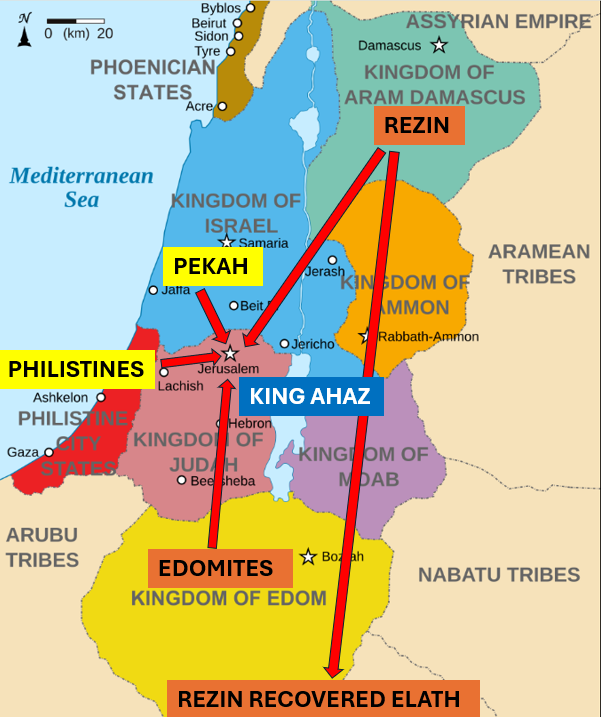
KING AHAZ SURROUNDED
EDOMITES ATTACK FROM SOUTH
EDOMITES INVADE
FROM THE SOUTH
For again - This is a time phrase and in this context suggests that Edomite aggression was not a single incident but a recurring humiliation under the reign of Ahaz. The Edomites had once been subject to David and Solomon and most recently defeated by Amaziah (2Ch 25:11-12) were now bold enough to invade the land of Judah at will. The balance of power had shifted, and Judah’s former vassals had become her oppressors.
BACKGROUND ON EDOM: Recall that although David had subjugated the Edomites (2Sa 8:13-14), circa 848 BC under the reign of evil King Jehoram (Joram, son of Jehoshaphat) the Edomites revolted and resisted Jehoram's attempt to suppress their rebellion (2Ki 8:20-22, 2Ch 21:8-10), resulting in the first permanent loss of Edom after the Davidic period. Then circa 796–767 BC Amaziah defeated Edom in the Valley of Salt and killed 10,000 Edomites (2Ki 14:7; 2Ch 25:11–12), regaining regained military dominance over Edom, but control was fragile and not total. Then circa 792–740 BC Uzziah rebuilt Elath (Eilat) on the Gulf of Aqaba (2Ki 14:22; 2Ch 26:2) which shows that Judah again held the key Edomite port and trade route, implying renewed control. Now we come to the reign of Ahaz and circa 735 BC during the Syro-Ephramite crisis, the Edomites attacked Judah (2Ch 28:17). Ahaz and Judah also lost control of Elath to Rezin (2Ki 16:6). After Ahaz, Judah never again controlled Edom; later the region passed under Assyrian, Babylonian, and eventually Nabatean rule.
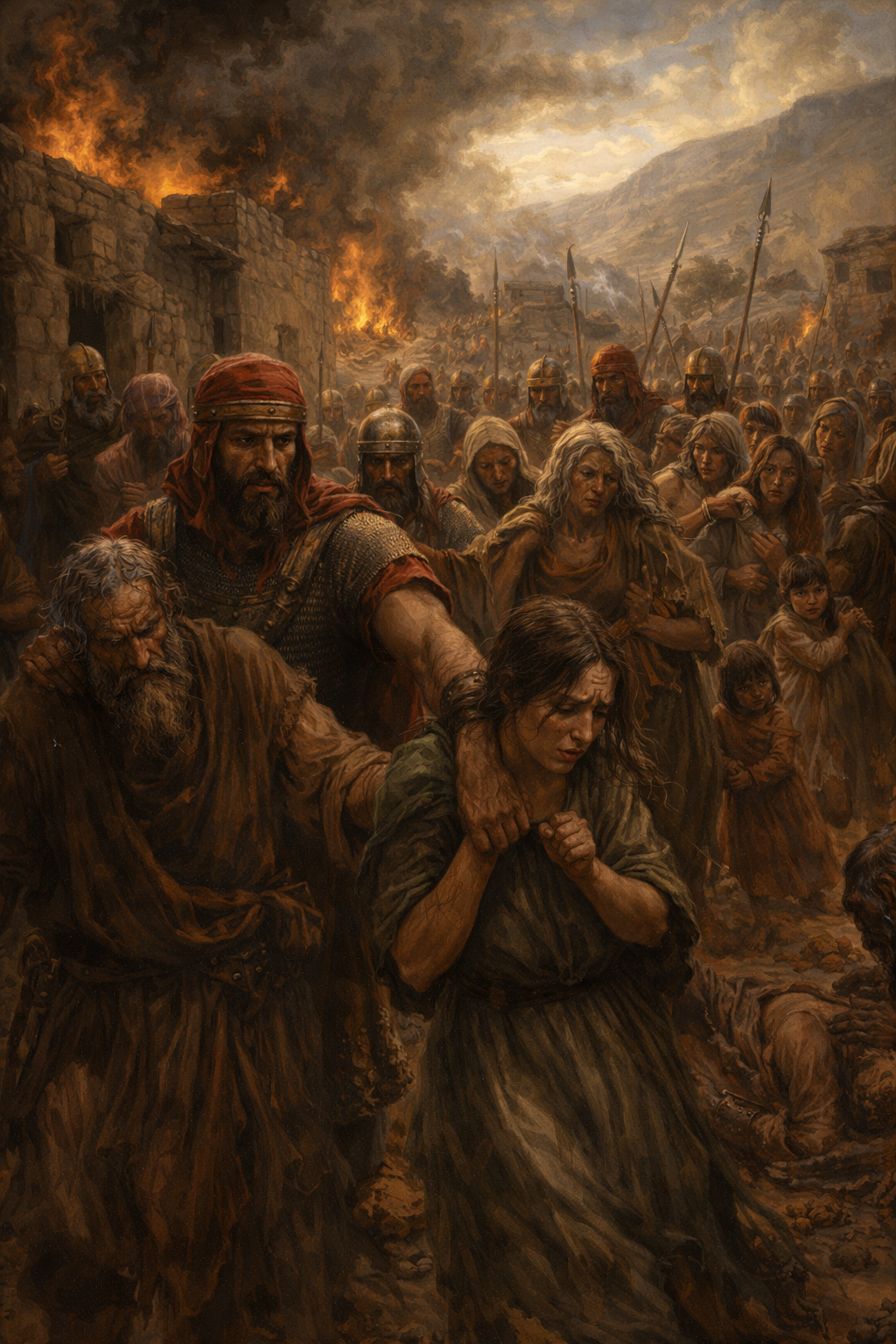
Captives Carried Away
The Edomites had come and attacked Judah and carried away captives - The Edomites, descendants of Esau (the twin brother of Jacob and grandson of Abraham), were longtime rivals of Israel. Their hostility reached back to the days of the Exodus and had flared repeatedly through the centuries. Now, sensing Judah’s weakness and God’s displeasure with Ahaz’s unfaithfulness, they seized the opportunity to strike. Their attack was not merely a border raid, for they carried away captives, tearing families from their homes and reducing fellow descendants of Abraham to slavery.
The Edomite attack was more than a political setback, but ultimately was a spiritual consequence of Ahaz's and Judah’s idolatry and misplaced trust in Assyria which resulted in Yahweh removing His divine protection that once restrained Judah's enemies. What Ahaz hoped to avoid through foreign alliances (military loss, shame, captivity) was coming upon the nation from every direction (SEE MAP ABOVE). The Edomite incursion became another visible sign that reliance on human power cannot replace obedience to the LORD.
As an aside, Edom would find out that what "goes around, comes around" for later the prophet Obadiah foretold Edom's fate writing...
Obadiah 10-14 Because of violence to your brother Jacob (AKA JUDAH), You will be covered with shame, And you will be cut off forever. 11 “On the day that you stood aloof, On the day that strangers carried off his wealth, And foreigners entered his gate And cast lots for Jerusalem– You too were as one of them. 12 “Do not gloat over your brother’s day, The day of his misfortune. And do not rejoice over the sons of Judah In the day of their destruction; Yes, do not boast In the day of their distress. 13 “Do not enter the gate of My people In the day of their disaster. Yes, you, do not gloat over their calamity In the day of their disaster. And do not loot their wealth In the day of their disaster. 14 “Do not stand at the fork of the road To cut down their fugitives; And do not imprison their survivors In the day of their distress.
Frederick Mabie: In addition to the pressure on Judah from Aram and Israel to the north (2Ch 28: 5-8), Ahaz also faces pressure in the south as the Edomites launch offensives into Judah (2Ch 28:17). In addition, the Philistines seize several key Judean cities in the Shephelah, including Beth Shemesh, Aijalon, Soco, and Timnah (2Ch 28:18). Note that most of these cities were located on the major passes (roads) leading into the central hill country. (SEE 1 and 2 Chronicles)
Spurgeon -The Edomites had been under subjection to Judah; but now that God had left her, Judah could not hold her position.
John Walton - military difficulties. Not only was Ahaz fearful of Aram-Israelite invasions, it appears his appeal to Assyria was for his war against Edom and Philistia. Recent excavations along the ancient border between Edom and Judah have confirmed the expansion of Edom into the Negev of Judah at towns such as En Hatzeva and Qitmit. Pottery ostraca from Arad that contain military correspondence from this period also show that Edomite invasions were considered imminent. The Philistines expanded their presence into the Shephelah region, regaining control of the area that had been under Judean control during the reign of Uzziah (see comment on 26:6-8). The description includes the three main passes into the Judean hills (the Aijalon, Sorek and Elah Valleys). There are no archaeological finds that illumine this Philistine conquest in any of the sites mentioned here. Tiglath-Pileser’s campaign of 734 included the Philistines among his targets. This led to setting up a stele in Gaza in 734 and the conquest of Ashkelon in 733. An Assyrian letter from Nimrud indicates the unstable conditions that existed in Palestine at this time. The territories lost by Ahaz were not returned to him but organized into Assyrian provinces. (See page 450 The IVP Bible Background Commentary-Old Testament)
2 Chronicles 28:18 The Philistines also had invaded the cities of the lowland and of the Negev of Judah, and had taken Beth-shemesh, Aijalon, Gederoth, and Soco with its villages, Timnah with its villages, and Gimzo with its villages, and they settled there.
- Philistines: Eze 16:27,57
- Beth-shemesh: Jos 15:10 1Sa 6:9
- Ajalon: 2Ch 11:10, Aijalon
- Gederoth: Jos 15:41
- Soco: Jos 15:48, Socoh
- Timnah: Judges 14:1
PHILISTINES ATTACK FROM WEST
PHILISTINES INVADE
FROM THE WEST
The Philistines also had invaded the cities of the lowland and of the Negev of Judah - As shown on the map above, Judah was being pressed from every side. While Edom struck from the southeast, the Philistines surged in from the west and southwest. These were ancient enemies who had troubled Israel since the days of the Judges and Saul. The “lowland” refers to the fertile Shephelah—the rolling foothills between the coastal plain and the Judean mountains—an area vital for agriculture and trade. The Negev was Judah’s southern frontier, a region that guarded access to the heartland. To lose control of these areas meant economic ruin and strategic vulnerability.
And had taken Beth-shemesh, Aijalon, Gederoth, and Soco with its villages, Timnah with its villages, and Gimzo with its villages, The naming of these specific towns underscores the scale of the disaster. Beth-shemesh and Aijalon were historic cities associated with earlier victories of Israel but now they had fallen without resistance. Soco and Timnah lay along key routes connecting Judah with the coast, and Gimzo guarded approaches toward Jerusalem itself. Each town represented families displaced, fields lost, and defenses dismantled. What had once been Judah’s protective belt on the western side was being peeled away piece by piece.
And they settled there - They refers to the Philistines. The point is that the Philistine invasion was not a temporary 'one and done" raid but a permanent occupation. The Philistines did not merely plunder and withdraw, but moved in to stay. Judah was losing territory that had belonged to the people of God for generations. The land promised to David’s line was being handed over to pagans, a visible sign that the nation’s spiritual foundations were crumbling under the evil reign of King Ahaz! Under Ahaz, Judah had turned to idols and to Assyria rather than to the LORD. As a result, the divine hedge of protection was removed (see 2Ch 28:19). Enemies long restrained now advanced with ease.
🙏 THOUGHT - These last 2 verses illustrate a sobering principle that when God’s people forsake Him, even once firm strongholds can fall, and ground once gained can be lost. Can we not apply this truth to our spiritual lives? That's a rhetorical question of course! How easily this truth applies to our own lives, for what once stood firm can slip away when our love of Christ grows cold (cf Rev 2:4-5) Woe to us if we presume upon yesterday’s victories while neglecting daily faithfulness! See Beware of Slowly Drifting From Your First Love of Jesus!
Spurgeon - A people that one might have thought had become extinct, so weak were they that we scarcely hear of them; yet “the Philistines also” —
Raymond Dillard: The inciting incident in Ahaz’s seeking the help of Tiglath-pileser III was the attack of the Syro-Ephraimite coalition according to 2 Kgs 16:7; here instead it is attacks from the Edomites and Philistines. These two nations were natural allies against Judah and could have been seeking to forge overland trading routes free of Judean influence linking the strategic gulf trade through Elath with the coastal highway to the west; Uzziah had extended Judean control into the region (2Ch 28:7–8). Pressure from the North (2Ch 28:5) would have encouraged opportunism on Judah’s southern and western flanks. The attacks from Edom may have been incited by the Arameans to further the interests of the coalition against Judah or the Aram of 2 Kgs 16:6 may have derived from misreading Edom. The cities captured by the Philistines (with the exception of Gimzo) were all along the Ayyalon, Sorek, and Elah valleys in the buffer zone of the Shephelah between the two nations or in the Negev (Arad).
2 Chronicles 28:19 For the LORD humbled Judah because of Ahaz king of Israel, for he had brought about a lack of restraint in Judah and was very unfaithful to the LORD.
KJV For the LORD brought Judah low because of Ahaz king of Israel; for he made Judah naked, and transgressed sore against the LORD.
NKJ For the LORD brought Judah low because of Ahaz king of Israel, for he had encouraged moral decline in Judah and had been continually unfaithful to the LORD.
NET The LORD humiliated Judah because of King Ahaz of Israel, for he encouraged Judah to sin and was very unfaithful to the LORD.
CSB For the LORD humbled Judah because of King Ahaz of Judah, who threw off restraint in Judah and was unfaithful to the LORD.
ESV For the LORD humbled Judah because of Ahaz king of Israel, for he had made Judah act sinfully and had been very unfaithful to the LORD.
NIV The LORD had humbled Judah because of Ahaz king of Israel, for he had promoted wickedness in Judah and had been most unfaithful to the LORD.
NLT The LORD was humbling Judah because of King Ahaz of Judah, for he had encouraged his people to sin and had been utterly unfaithful to the LORD.
- For the LORD humbled Judah: De 28:43 1Sa 2:7 Job 40:12 Ps 106:41-43 Pr 29:23
- because of Ahaz: Ho 5:11 Mic 6:16
- Israel: 2Ch 21:2
- Judah: Ge 3:7,11 Ex 32:25 Rev 3:17,18 16:15
Related Passages:
2 Chronicles 13:18 (200 YEARS BEFORE KING ABIJAH [913-911 BC] EXPERIENCED THE OPPOSITE OF AHAZ'S FATE [731-715 BC]) Thus the sons of Israel were subdued at that time, and the sons of Judah conquered because they trusted in the LORD, the God of their fathers.
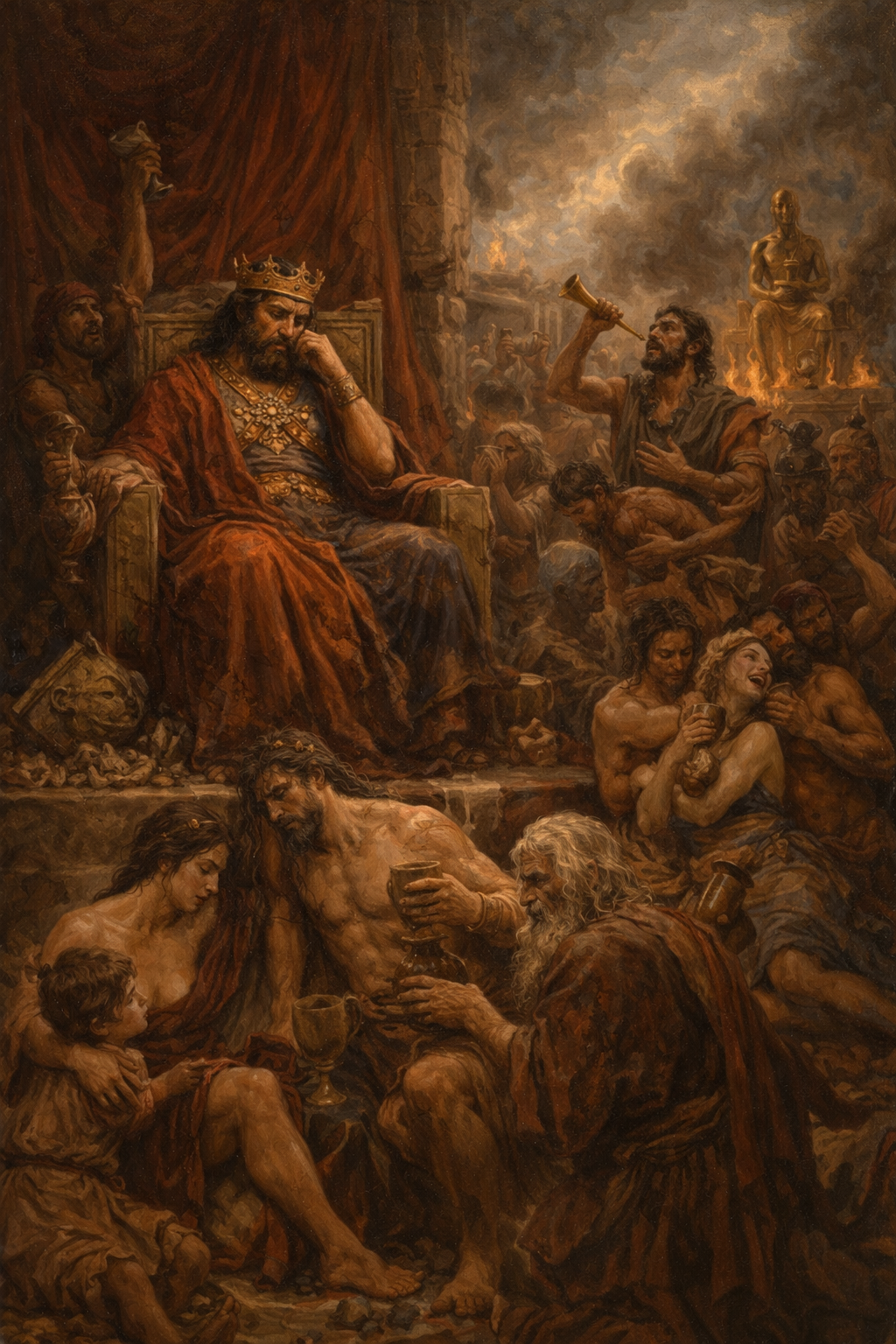
AHAZ'S UNRESTRAIN:
GOD WITHDRAWN RESTRAINT
For - This is the first of three terms of explanation in this verse. This one explains why Edomites and Philistines defeated Judah and why God allowed this.
The LORD humbled (kana ;LXX - tapeinoo - make low) Judah -The humiliation of Judah was not ultimately caused by Edom, Philistia, or Assyria, but by the sovereign hand of the LORD. God used these foreign nations to bring Judah to its knees. The purpose was not cruelty but was to motivate the nation to repent. Unfortunately, the people for the most part were not personally humbled and did not repent.
KJV For the LORD brought Judah low because of Ahaz king of Israel; for he made Judah naked, and transgressed sore against the LORD.
Because of - Like an explanatory sandwich, the Spirit explains why Yahweh humbled the entire nation.
Ahaz king of Israel - Israel in this context refers to the Southern Kingdom. Evil leadership spread like leaven and corrupted all of Judah. Though Ahaz ruled Judah, his behavior mirrored the apostasy of the northern kingdom.
For - This explains the evil leadership of Ahaz, the effect of it on the people and the cause of it in Ahaz.
He had brought about a lack of restraint in Judah - KJV = "for he made Judah naked." NKJV = "for he had encouraged moral decline in Judah" NLT = "for he had encouraged his people to sin." The weak, evil leadership of Ahaz infected the people, loosening the moral and spiritual fabric of the nation. Under Ahaz’s influence, the nation cast off the disciplines of the covenant, and what had once been guarded by the Law was now treated as optional. Deadly idolatry spread like bubonic plague without check, worship was corrupted, and the people followed the king’s example into religious confusion and ethical decline. Leadership that should have acted as a brake on evil instead removed the reins altogether, allowing passions, pagan customs, and political expediency to run wild! The result was a society no longer anchored by a healthy fear of the LORD, resulting in a nation drifting without restraint toward chaos and divine judgment.
And was very unfaithful (maal) to the LORD - At the heart of the crisis lay betrayal of relationship. Note Ahaz was not just unfaithful but VERY unfaithful to Yahweh. The adverb VERY underscores the depth of his rebellion, persistent, deliberate, and public. His reign was marked by repeated betrayal of the LORD, replacing worship of Yawheh with worship of idols and pursuing political dependence on pagan powers.
Humbled (03665) kana is a verb whose basic sense is to be lowly or meek. In the Old Testament it carries two primary meanings: most commonly to subdue—often in the sense of political humiliation—and secondly to humble oneself (Lev 26:41; 1 Ki 21:29 [twice]; 2 Ki 22:19; 2 Chr 7:14; 12:5–7, 12; 30:11; 32:26; 33:12, 19, 23; 34:27; 36:12). The term is used of nations being subdued, as in Judges 3:30, “So Moab was subdued that day under the hand of Israel, and the land was undisturbed for eighty years.” Yet Scripture makes clear that the power to subdue ultimately belongs to God, for Judges 4:23 states, “So God subdued on that day Jabin the king of Canaan before the sons of Israel.” This is a comforting truth for believers living in a world where evil appears unchecked—yet it is not out of control, for God remains sovereign. As Paul affirms, “The God of peace will soon crush Satan under your feet” (Ro 16:20).
Kana often pictures a person falling to his knees in submission or humiliation. In Leviticus 26:41 it describes the Lord humbling an uncircumcised, prideful heart. The verb also denotes God’s defeat of Israel’s enemies (Dt 9:3; Jdg 3:30; 4:23; 8:28; 1 Chr 17:10; 18:1; 20:4). At the same time it speaks of voluntary humility, as seen in Ahab’s response (1 Ki 21:29). The key to Israel’s restoration after failure was repentance and self-humbling before the Lord (2 Chr 7:14). God alone can humble the wicked in His time, as He declared to Job: “Look on everyone who is proud, and humble him… crush the wicked where they stand” (Job 40:12).
KANA - 32V - Lev. 26:41; Deut. 9:3; Jdg. 3:30; Jdg. 4:23; Jdg. 8:28; Jdg. 11:33; 1 Sam. 7:13; 2 Sam. 8:1; 1 Ki. 21:29; 2 Ki. 22:19; 1 Chr. 17:10; 1 Chr. 18:1; 1 Chr. 20:4; 2 Chr. 7:14; 2 Chr. 12:6; 2 Chr. 12:7; 2 Chr. 12:12; 2 Chr. 13:18; 2 Chr. 28:19; 2 Chr. 30:11; 2 Chr. 32:26; 2 Chr. 33:12; 2 Chr. 33:19; 2 Chr. 33:23; 2 Chr. 34:27; 2 Chr. 36:12; Neh. 9:24; Job 40:12; Ps. 81:14; Ps. 106:42; Ps. 107:12; Isa. 25:5
Unfaithful (treachery) (04604) maal from the verb maal = to act unfaithfully or treacherously, to violate a legal obligation) is a masculine noun which refers to an unfaithful (not adhering to vows, allegiance, or duty) act, a violation of allegiance (the fidelity owed by a subject to his or her Sovereign God) or of faith and confidence. Most uses of maal reflect violations are against Jehovah (exception = Job 21:34). The NAS translates maal as falsehood (1), treachery (2), trespass (1), trespass* (1), unfaithful (3), unfaithful act (4), unfaithful deeds (1), unfaithfully (6), unfaithfulness (6), very unfaithful (1). Treachery is that which is untrue to what should command one’s fidelity or allegiance (in this case fidelity to God alone). Furthermore, treachery implies a readiness to betray trust or confidence. Webster's 1828 edition adds "The man who betrays his country in any manner, violates his allegiance, arid is guilty of treachery. This is treason. The man who violates his faith pledged to his friend, or betrays a trust in which a promise of fidelity is implied, is guilty of treachery. The disclosure of a secret committed to one in confidence, is treachery. This is perfidy."
Maal - 26v - Lev. 5:15; Lev. 6:2; Num. 5:6; Num. 5:12; Num. 5:27; Num. 31:16; Jos. 7:1; Jos. 22:16; Jos. 22:20; Jos. 22:22; Jos. 22:31; 1 Chr. 9:1; 1 Chr. 10:13; 2 Chr. 28:19; 2 Chr. 29:19; 2 Chr. 33:19; 2 Chr. 36:14; Ezr. 9:2; Ezr. 9:4; Ezr. 10:6; Job 21:34; Ezek. 15:8; Ezek. 17:20; Ezek. 18:24; Ezek. 39:26; Dan. 9:7
2 Chronicles 28:20 So Tilgath-pilneser king of Assyria came against him and afflicted him instead of strengthening him.
NET King Tiglath-pileser of Assyria came, but he gave him more trouble than support.
BGT καὶ ἦλθεν ἐπ᾽ αὐτὸν Θαγλαθφελλασαρ βασιλεὺς Ασσουρ καὶ ἐπάταξεν αὐτόν
LXE And there came against him Thalgaphellasar king of Assyria, and he afflicted him.
CSB Then Tiglath-pileser king of Assyria came against Ahaz; he oppressed him and did not give him support.
ESV So Tiglath-pileser king of Assyria came against him and afflicted him instead of strengthening him.
NIV iglath-Pileser king of Assyria came to him, but he gave him trouble instead of help.
NLT So when King Tiglath-pileser of Assyria arrived, he attacked Ahaz instead of helping him.
- Tilgath pilneser: 2Ki 15:29 16:7-10, Tiglath-Pileser 1Ch 5:26 Ho 5:13
- afflicted him: 2Ki 17:5 Isa 7:20 30:3,16 Jer 2:37
Parallel Passages
2 Kings 16:9 So the king of Assyria listened to him; and the king of Assyria went up against Damascus and captured it, and carried the people of it away into exile to Kir, and put Rezin to death.
Isaiah 31:1 Woe to those who go down to Egypt for help And rely on horses, And trust in chariots because they are many And in horsemen because they are very strong, But they do not look to the Holy One of Israel, nor seek the LORD!
Psalm 146:3-5 Do not trust in princes, In mortal man, in whom there is no salvation. 4 His spirit departs, he returns to the earth; In that very day his thoughts perish. 5 How blessed is he whose HELP (ezer related to azar; LXX - boethos = Helper) is the God of Jacob, Whose hope is in the LORD his God,
Jeremiah 17:5-7 (THIS WOULD BE APROPOS TO KING AHAZ) Thus says the LORD, “Cursed is the man who trusts in mankind And makes flesh his strength, And whose heart turns away from the LORD. 6 “For he will be like a bush in the desert And will not see when prosperity comes, But will live in stony wastes in the wilderness, A land of salt without inhabitant. 7 “Blessed is the man who trusts in the LORD And whose trust is the LORD.
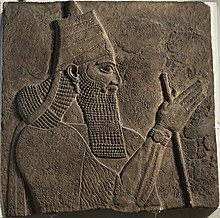
Tiglath-Pileser III as depicted on a stele from the walls of his royal palace

So Tilgath-pilneser (pileser) king of Assyria came against him and afflicted (tsarar) him instead of strengthening him. How vain it is to seek relief apart from God! The very power Ahaz had courted for protection became the instrument of Ahaz's distress. He had sent tribute to Assyria, calling himself a servant and son (2Ki 16:7), hoping the mighty empire would rescue Judah from Aram and Israel. Instead, Tilgath-pilneser arrived not as a savior but as a master. What Ahaz expected to be help turned into humiliation.
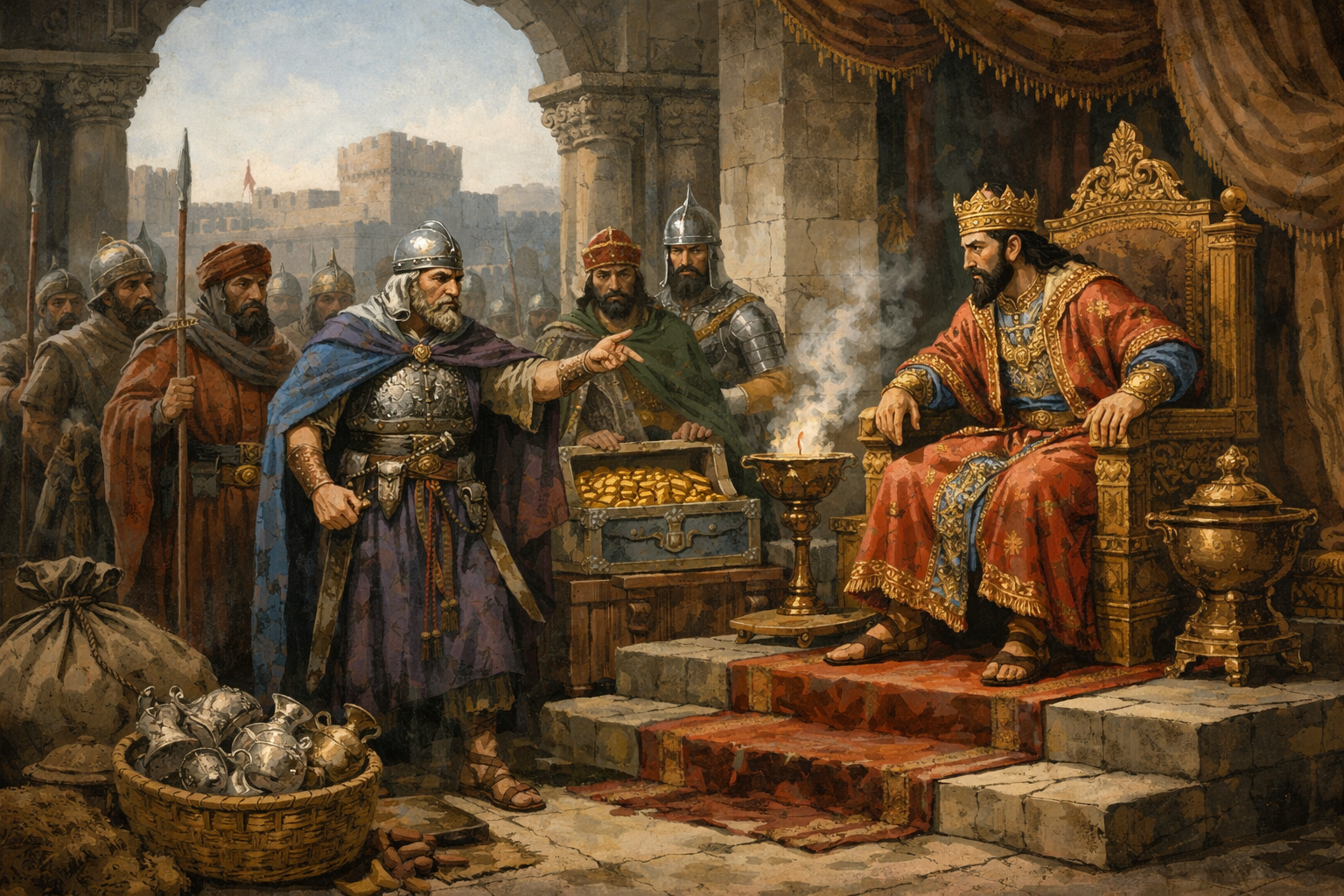
The phrase came against him reveals the bitter reversal. Judah had asked Tilgath-pilneser to intervene, and indeed he did intervene, butnot the way Ahaz had sought. Ahaz by inviting a stronger nation into his affairs, surrendered Judah's independence and dignity. The ally became an oppressor.
And afflicted (tsarar) him instead of strengthening (chazaq) him - I like the NET version = " but he gave him more trouble than support." This is the tragic heart of this verse. Human schemes that ignore God often produce the opposite of what they promise. (Been there, done that!) Ahaz believed Assyria would stabilize his throne, yet the alliance drained Judah’s resources, imposed heavy tribute, and deepened Judah's spiritual corruption. The king discovered that dependence on worldly power brings bondage, not freedom.
Afflicted (06887) tsarar means to be narrow, to be cramped, to be straitened, to be constricted, to hem or be hemmed in.
Tsarar may refer to anything that is confining. In the context of Isaiah 8:16, it means to bind up, tie, or wrap in order to safeguard from tampering (cf. Prov 26:8; Ex 12:34; Josh 9:4). The imagery most likely refers to scribes binding a document into a sealed scroll for preservation. A similar figurative use appears in Hosea 13:12, where Israel’s sins are portrayed as written down and permanently bound in a sealed scroll, ensuring that their guilt is retained and remembered.
Figuratively, tsarar often means to oppress, harass, or act as an adversary. The best-known example is Psalm 23:5, “in the presence of my enemies (tsarar).” This sense occurs frequently (e.g., Ex 23:22; Num 10:9; 25:17–18; Esth 3:10; 8:1; 9:10, 24; Ps 6:7; 7:4, 6; 8:2; 10:5; 23:5; 31:11; 42:10; 69:19; 74:4, 23; 129:1–2; 143:12; Isa 11:13; Amos 5:12), describing those who actively oppose or afflict God’s people.
The word also conveys the idea of being hard-pressed or distressed (about 13 of 36 uses), carrying nuances of anxiety, trouble, oppression, or being cramped. In contrast, the Hebrew concept of something “broad” or “wide-open” often pictures freedom and deliverance. Job 20:22 illustrates this meaning, describing a person in “narrow straits,” hemmed in by pressure, stress, or calamity.
To “bind up” a city can mean to besiege it (Deut 28:52). In the Septuagint this is rendered either by extribō (“to rub out, remove by irritation”) or more commonly by thlipsis, meaning pressure or constriction. Passages where the LXX translates tsarar with thlipsis include Deut 28:52; Judg 10:9; 1 Sam 28:15; 30:6; 2 Sam 13:2; 1 Kgs 8:37; 2 Chr 6:28; 22:5; 33:12; Neh 9:27; Job 20:22; Ps 31:9; 69:17; and Lam 1:20.
In another nuance, tsarar can mean to shut someone in or exclude a person, as in 2 Samuel 20:3. It may also describe something cramped, shortened, or restricted, as in Job 18:7, where affliction hems a man in so that he can no longer walk with the full, vigorous stride he once enjoyed.
TSARAR - 36V - Ge 32:7; Ex 12:34; Dt. 28:52; Jos. 9:4; Jdg. 2:15; Jdg. 10:9; Jdg. 11:7; 1 Sam. 25:29; 1 Sam. 28:15; 1 Sam. 30:6; 2 Sam. 1:26; 2 Sam. 13:2; 2 Sam. 20:3; 1 Ki. 8:37; 1 Chr. 21:13; 2 Chr. 6:28; 2 Chr. 28:20; 2 Chr. 28:22; 2 Chr. 33:12; Neh. 9:27; Job 18:7; Job 20:22; Job 26:8; Ps. 31:9; Ps. 69:17; Prov. 4:12; Prov. 26:8; Prov. 30:4; Isa. 8:16; Isa. 28:20; Isa. 49:19; Jer. 10:18; Lam. 1:20; Hos. 4:19; Hos. 13:12; Zeph. 1:17
TIGLATH-PILESER Tiglath-Pileser III was a powerful king of Assyria who reigned during the 8th century B.C., around 745–727 B.C. His rule marked a turning point in the history of the ancient Near East and had significant implications for both Israel and Judah. Historically, Tiglath-Pileser reorganized the Assyrian Empire, expanding its borders through military conquest and establishing a policy of deporting conquered peoples to prevent rebellion. The Bible refers to him several times, especially in connection with the kings of Israel and Judah who sought his help or who suffered his wrath.
In 2 Chronicles 28:20 “So Tilgath-pilneser king of Assyria came against him and afflicted him instead of strengthening him.” This verse recounts the reign of King Ahaz of Judah, who sought help from Tiglath-Pileser against his enemies. Instead of aiding Ahaz, Tiglath-Pileser used the opportunity to oppress Judah further. According to 2Ki 16:7–9, Ahaz sent silver and gold from the temple of the Lord as tribute to Tiglath-Pileser, choosing political expedience over faith in God. The result was tragic as Ahaz trusted in human alliances rather than divine protection, leading to greater suffering for his nation.
Biblically and historically, Tiglath-Pileser was also involved in the downfall of the northern kingdom of Israel. In 2Ki 15:29, we read, “In the days of Pekah king of Israel, Tiglath-Pileser king of Assyria came and captured Ijon and Abel-beth-maacah and Janoah and Kedesh and Hazor and Gilead and Galilee, all the land of Naphtali; and he carried them captive to Assyria.” Thus, Tiglath-Pileser was an instrument of God’s judgment upon Israel’s disobedience, fulfilling the prophetic warnings that had long been ignored.
Tiglath-Pileser’s rise coincided with Isaiah’s prophetic ministry and the turbulent political alliances of that age. When Ahaz refused to trust the Lord, looking instead to Assyria, Isaiah gave a prophetic sign through the naming of his son Maher-Shalal-Hash-Baz, which means “Speed the spoil and hasten the booty.” This name symbolized the coming Assyrian invasion that would swiftly seize the wealth of Israel and Syria. The prophet’s message in Isaiah 8:3–4 confirms this: “The Lord said to me, ‘Name him Maher-shalal-hash-baz; for before the boy knows how to cry out "My father" or "My mother," the wealth of Damascus and the spoil of Samaria will be carried away before the king of Assyria.’”
Theologically, Tiglath-Pileser reminds us that trusting in human power instead of God leads to ruin. The alliance Ahaz pursued brought distress, not deliverance, because God alone is worthy of His people’s confidence. Pr 3:5–6 exhorts us, “Trust in the Lord with all your heart and do not lean on your own understanding. In all your ways acknowledge Him, and He will make your paths straight.” Tiglath-Pileser was thus both a political figure in history and a divine instrument of judgment in Scripture, used by God to discipline nations that had turned away from Him.
ANOTHER SOURCE: [ISBE] - (SEE ALSO WIKIPEDIA) tig-lath-pi-le-zer tighlath pil'eser, as the name is read in 2 Kings, tilleghath pilnecer, in 2 Chronicles; Septuagint Algathphellasar; Assyrian, Tukulti-abal-i-sarra): King of Assyria in the days of Menahem, Pekahiah, and Pekah, kings of Israel, and of Uzziah, Jotham and Ahaz, kings of Judah. The king of Assyria, whom the historian of 2 Kings knows as exacting tribute from Menahem, is Pul (2 Ki 15:19 f). In the days of Pekah who had usurped the throne of Menahem's son and successor, Pekahiah, the king of Assyria is known as Tiglath-pileser, who invaded Naphtali and carried the inhabitants captive to Assyria (2 Ki 15:29). This invasion is described by the Chronicler (1 Ch 5:25 f) rather differently, to the effect that "the God of Israel stirred up the spirit of Pul king of Assyria, and the spirit of Tilgath-pilneser king of Assyria, and he carried them away, even the Reubenites and the Gadites, and the half-tribe of Manasseh, and brought them unto Halah, and Habor, and Hara, and to the river of Gozan, unto this day." Still later we find Pekah forming a coalition with Rezin, king of Damascus, into which they tried to force Ahaz, even going the length of besieging him in Jerusalem (2 Ki 16:5). The siege was unsuccessful. Ahaz called in the aid of Tiglath-pileser, sacrificing his independence to get rid of the invaders (2 Ki 16:7,8). He offered the Assyrian the silver and gold that were found in the house of the Lord and in the royal treasury; and Tiglath-pileser, in return, invaded the territories of Damascus and Israel in the rear, compelling the allied forces to withdraw from Judah, while he captured Damascus, and carried the people away to Kir and slew Rezin (2 Ki 16:9). It was on the occasion of his visit to Damascus to do homage to his suzerain Tiglath-pileser, that Ahaz fancied the idolatrous altar, a pattern of which he sent to Urijah, the priest, that he might erect an altar to take the place of the brazen altar which was before the Lord in the temple at Jerusalem. It is a significant comment which is made by the Chronicler (2 Ch 28:21) upon the abject submission of Ahaz to the Assyrian king: "It helped him not."
From the inscriptions we learn particulars which afford striking corroboration of the Biblical narrative and clear up some of the difficulties involved. It is now practically certain that Pul, who is mentioned as taking tribute from Menahem, is identical with Tiglath-pileser (Schrader, COT, I, 230, 231). In all probability Pul, or Pulu, was a usurper, who as king of Assyria assumed the name of one of his predecessors, Tiglath-pileser I, and reigned as Tiglath-pileser III. This king of Assyria, who reigned, as we learn from his annals, from 745 BC to 727 BC, was one of the greatest of Assyrian monarchs. See ASSYRIA. From the fact that no fewer than five Hebrew kings are mentioned in his annals, the greatest interest attaches to his history as it has come down to us. These kings are Uzziah or Azariah, and Jehoahaz, that is Ahaz, of Judah; and Menahem, Pekah and Hushes of Israel. Along with them are mentioned their contemporaries Rezin of Damascus, Hiram of Tyre, and two queens of Arabia otherwise unknown, Zabibi and Samsi. When he died in 727 BC, he was succeeded by Shalmaneser IV, who had occasion to suspect the loyalty of his vassal Hoshea, king of Israel, and besieged him in Samaria. - T. Nicol
2 Chronicles 28:21 Although Ahaz took a portion out of the house of the LORD and out of the palace of the king and of the princes, and gave it to the king of Assyria, it did not help him.
- took: 2Ch 12:9 2Ki 18:15,16 Pr 20:25
Parallel Passages
2 Kings 16:8 And Ahaz took the silver and gold that was found in the house of the LORD and in the treasuries of the king's house, and sent a present to the king of Assyria.

DESPERATE MOVES OF
AN UNFAITHFUL KING
Although Ahaz took a portion out of the house of the LORD and out of the palace of the king and of the princes, In desperation Ahaz stripped the very treasures that symbolized Judah’s covenant relationship with God. The wealth stored in the temple had been dedicated to the LORD, offerings given in gratitude for His protection and blessing. By seizing these sacred resources, Ahaz treated what was holy to God as mere currency. He also drained the royal palace and even the possessions of his leading officials, spreading the burden of his misguided policy across the whole nation.
This act revealed how far his heart had drifted. Instead of turning to the LORD whose house he plundered, he robbed God to purchase human assistance. The temple, meant to be a place of prayer and trust, became a bank for political schemes. What earlier kings had guarded with reverence, Ahaz sacrificed without hesitation.
And gave it to the king of Assyria Ahaz's tribute was intended to buy favor from Tiglath-pileser, to secure Judah’s safety through trust in gold rather than trust in God. In the ancient world such payments signified submission as well as alliance. Ahaz was not merely seeking help but was in effect making Judah a vassal state under Assyrian dominance. The people of God were being "mortgaged" to a pagan king by use of treasures meant for the worship of the true King!
It did not help ('ezrah; LXX - boetheia) him - The Beatles were right "Money can't buy you love!" Ahaz's costly sacrifice achieved absolutely nothing! Assyria took the gifts but offered no genuine protection; instead it tightened its grip and increased Judah’s misery. What Ahaz believed would be a solution became another chain around his neck. Money cannot purchase peace when the heart is estranged from the LORD.
Henry Morris - It is significant that many of the events recorded in the reign of Ahaz have been confirmed in archaeological inscriptions, including the tribute he was forced to pay to Tiglath-Pilezer, king of Assyria.
Spurgeon on King Ahaz - A black mark is put against his name, to show how greatly guilty he was. Those who rebel against divine checks, and will not be held in by the providence of God, are to be written down in capital letters as great sinners. They sin with emphasis who sin against the chastising rod.
They sin with emphasis
who sin against the chastising rod.
🙏 THOUGHT - WHAT SPURGEON IS SAYING IS to sin while God is disciplining you is an especially aggravated form of sin. It speaks of deliberate, stubborn, presumptuous, willful ("in Your face God") sin which just adds (or multiplies) guilt and seriousness. This is not a description of ordinary fleshly weakness, but of sin committed while God is actively trying to correct one's heart. One is reminded of the words of Jeremiah 5:3 "You have smitten them, But they did not weaken; You have consumed them, But they refused to take correction. They have made their faces harder than rock; They have refused to repent" and the words of Ps 78:32 "In spite of all this they still sinned And did not believe in His wonderful works." The upshot is to persist in sin while under God’s discipline is to rebel against the very mercy meant to restore us, making the offense all the more grievous.
2 Chronicles 28:22 Now in the time of his distress this same King Ahaz became yet more unfaithful to the LORD.
- in the: 2Ch 33:12 Ps 50:15 Isa 1:5 Eze 21:13 Ho 5:15 Rev 16:9-11
- this: Es 7:6 Ps 52:7
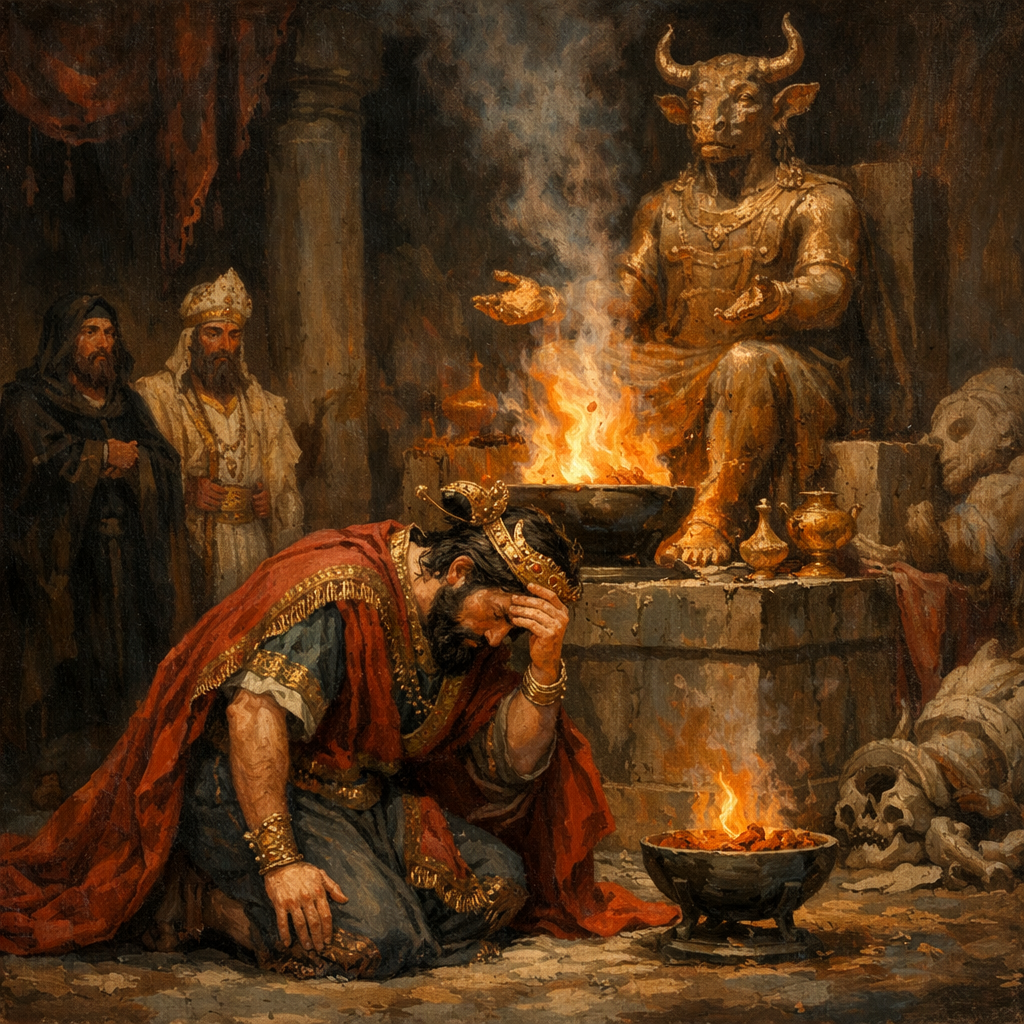
AHAZ'S STUBBORN REACTION
TO DIVINE DISCIPLINE!
Paul Apple sees this as a major theme in the reign of Ahaz - DESPERATION DRIVES THE WICKED TO TRUST IN FALSE SOURCES OF POWER AND DELIVERANCE
Now in the time of his distress (tsarar) this same King Ahaz became yet more unfaithful (maal) to the LORD. Distress (tsarar) is translated in the Septuagint with thlibo which means press, rub together; compress, make narrow and figuratively to afflict, oppress, or cause trouble to. This was the Lord's hand of discipline, but Ahaz either could no longer even recognize that this was from the Lord or simply refused to accept it!
They sin with emphasis
who sin against the chastising rod.
KJV has "this is that king Ahaz". (2Ch 28:22KJV) about which Spurgeon writes "A black mark is put against his name, to show how greatly guilty he was. Those who rebel against divine checks, and will not be held in by the providence of God, are to be written down in capital letters as great sinners. They sin with emphasis who sin against the chastising rod.”
Instead of repenting, Ahaz doubled down on his unfaithfulness. This is what you call stiffening your neck and hardening your heart even more, not a good response to the omnipotent God. Ahaz did not read the divine "tea leaves" like Manasseh did after suffering the distress of being taken in hooks to Babylon (2Ch 33:11)! In marked contrast to Ahaz the chronicler records "When he (MANASSEH) was in distress, he entreated the LORD his God and humbled himself greatly before the God of his fathers." (2Ch 33:12).
🙏 THOUGHT - Dear reader, are you experiencing a time of distress because of unconfessed, unrepentant sin? And by the way, most of us have experienced those times, from time to time (I certainly have in 38 years of walking with Jesus!). If you are in distress, do not seek worldly methods to get out of the distress, but SEEK HIM Who has allowed (or sometimes sent) the distress! Cry out! Run to Him! Seek Him! As an earthly father, I can say that when my 4 children have sought me in humility and repentance, my heart has melted every time!
David Guzik adds "Times of trial and distress do not necessarily drive people closer to God. Sometimes people allow such distresses to drive them away from God. Ahaz was notable among that type, so much so that the Chronicler noted, This is that King Ahaz."
Frederick Mabie: This is one of the saddest verses in all of Chronicles. As noted above (2Ch 28:9, 19), the judgment of God via the incursions of the surrounding nations is a direct result of the unfaithfulness of Ahaz (and Judah) to obey and trust the Lord fully. While such covenantal consequences are intended to drive God’s people back to him in repentance, Ahaz instead becomes “even more unfaithful” and pursues greater levels of wickedness by raiding the temple and palace treasuries, worshiping additional deities associated with the Arameans, and looting the temple for the furnishings of his many high places (cf. 2Ch 28:21-25). By so doing Ahaz spurns the forgiving nature of the God, who abounds in mercy and forgiveness when his people seek him in humility and contrition. (SEE 1 and 2 Chronicles)
Unfaithful (verb) (be or act unfaithful) (04603) maal means to act unfaithfully, to trespass, to violate one's duty, to break faith, to commit a violation, to act. The idea is of a conscious act of treachery or unfaithfulness against the Lord. NET Note - The word maal refers to some kind of overstepping of the boundary between that which is common (i.e., available for common use by common people) and that which is holy (i.e., to be used only for holy purposes because it has been consecrated to the LORD).
Maal - 36v - act(1), acted(2), acted treacherously(2), acting(1), acting treacherously(1), acting unfaithfully(1), acts(2), became...unfaithful(1), been(1), been unfaithful(5), broke faith(1), committed(6), committing unfaithfulness(1), err(1), perpetrated(1), unfaithful(3), unfaithfulness they committed(1), violated(1). Gen. 32:7; Exod. 12:34; Deut. 28:52; Jos. 9:4; Jdg. 2:15; Jdg. 10:9; Jdg. 11:7; 1 Sam. 25:29; 1 Sam. 28:15; 1 Sam. 30:6; 2 Sam. 1:26; 2 Sam. 13:2; 2 Sam. 20:3; 1 Ki. 8:37; 1 Chr. 21:13; 2 Chr. 6:28; 2 Chr. 28:20; 2 Chr. 28:22; 2 Chr. 33:12; Neh. 9:27; Job 18:7; Job 20:22; Job 26:8; Ps. 31:9; Ps. 69:17; Prov. 4:12; Prov. 26:8; Prov. 30:4; Isa. 8:16; Isa. 28:20; Isa. 49:19; Jer. 10:18; Lam. 1:20; Hos. 4:19; Hos. 13:12; Zeph. 1:17
G Campbell Morgan - -2 Chr 28.22
The utter evil of the man is seen in the fact that calamities
did not produce the effect in him which they had so
often done in the case of his predecessors
The reign of Ahaz was a period of terrible and rapid degeneracy in Judah. With appalling fearlessness the king restored all the evils of idolatry, even including the ghastly offering of children as sacrifices to Moloch. In all probability his own son was a victim. As difficulties gathered around him, he turned to the king of Assyria for aid, attempting to procure help from him by giving him treasure out of the house of God. The utter evil of the man is seen in the fact that calamities did not produce the effect in him which they had so often done in the case of his predecessors, that of bringing him to the abandonment of his sin. He was a man evil by deliberate choice, persistent in evil in spite of calamity, blasphemously rebellious not-withstanding the direct warnings of Isaiah. Moreover, as we know from the Book of Isaiah, he openly and deliberately rejected any sign from God. It is certainly a solemn and searching story, revealing, as it does, how possible it is to yield the life so completely to evil, that prosperity only ministers to its degeneration, and adversity only hardens the will in wickedness
🙏 THOUGHT - Morgan's statement (in bold italics above) begs the question - How do I respond to afflictions and adversities the LORD allows (or sometimes sends) into my life? How one responds speaks volumes about their heart (cf Acts 13:22).
2 Chronicles 28:23 For he sacrificed to the gods of Damascus which had defeated him, and said, “Because the gods of the kings of Aram helped them, I will sacrifice to them that they may help me.” But they became the downfall of him and all Israel.
- For he sacrificed: This passage, says Mr. Hallet, greatly surprised me; for the sacred historian is here represented as saying, "The gods of Damascus had smitten Ahaz." But it is impossible to suppose that an inspired author should say this; for the Scripture every where represents the heathen idols as nothing and vanity, and as incapable of doing either good or hurt. All difficulty is avoided if we follow the old Hebrew copies, from which the Greek translation was made: "And king Ahaz said, I will seek to the gods of Damascus which have smitten me." 2Ch 25:14 2Ki 16:12,13
- Because the gods: Hab 1:11
- sacrifice to them: Jer 10:5 44:15-18
- But they were: Isa 1:28 Jer 44:20-28 Ho 13:9
Related Passages:
Jeremiah 2:11-13 (THIS COULD HAVE BEEN AHAZ'S "TAGLINE") “Has a nation changed gods When they were not gods? But My people have changed their glory For that which does not profit. 12 “Be appalled, O heavens, at this, And shudder, be very desolate,” declares the LORD. 13 “For My people have committed two evils: They have forsaken Me, The fountain of living waters, To hew for themselves cisterns, Broken cisterns That can hold no water.
Psalm 115:4-8 (NOTE THE END RESULT OF IDOLATRY - VERSE 8) Their idols are silver and gold, The work of man’s hands. 5 They have mouths, but they cannot speak; They have eyes, but they cannot see; 6 They have ears, but they cannot hear; They have noses, but they cannot smell; 7 They have hands, but they cannot feel; They have feet, but they cannot walk; They cannot make a sound with their throat. 8 Those who make them will become like them, Everyone who trusts in them.
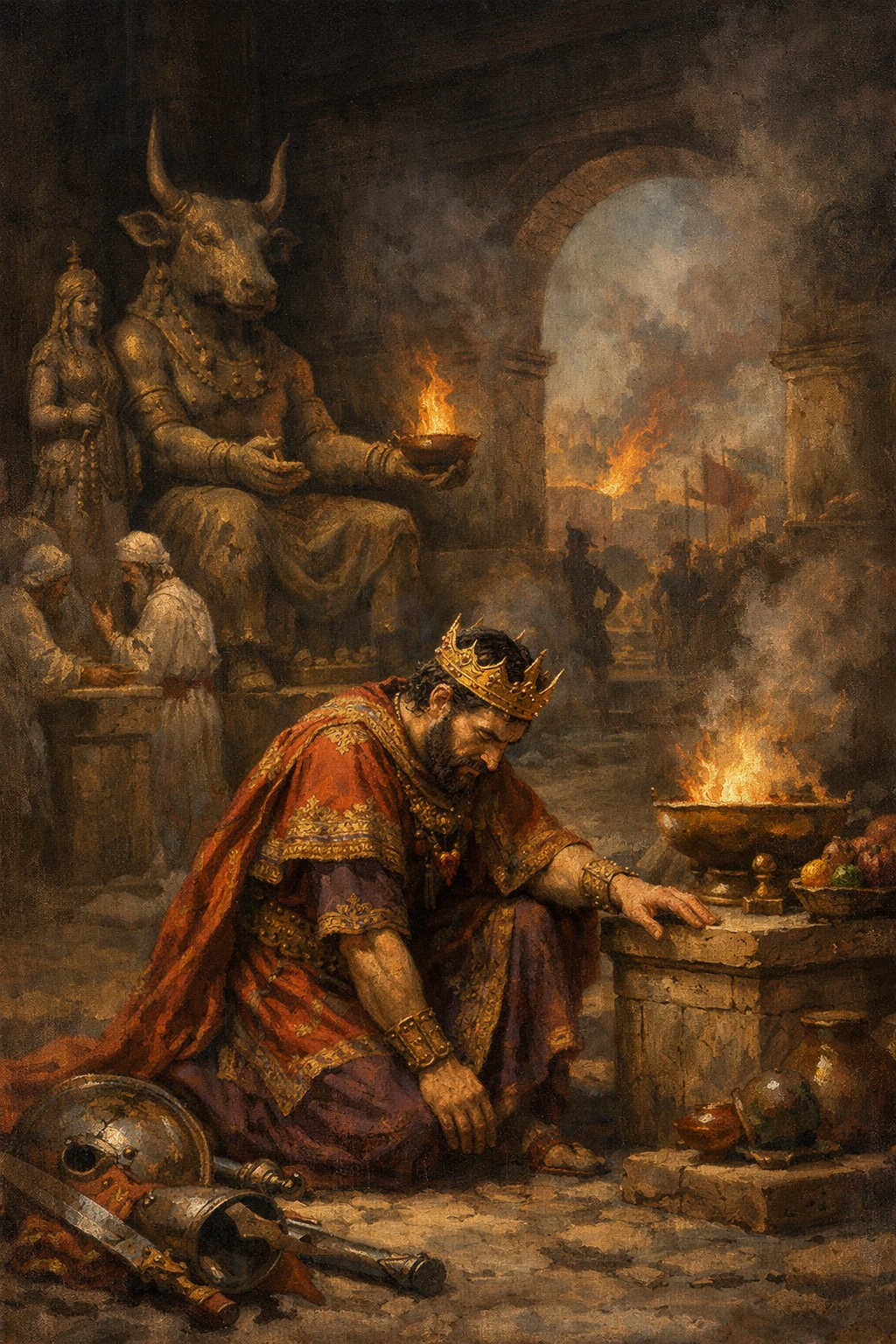
IDOLATRY MAKES A
PERSON A FOOL!
For - Term of explanation. What's the chronicler explaining? Check the context. The immediate context describes Ahaz as "more unfaithful" (as if being a little unfaithful was not enough!). Faith is what we believe and is shown by how we live, what we say, what we do. The polar opposite is unfaithful and it too is shown by our thoughts, words and deeds. And so the chronicler will show us Ahaz's lack of faith.
He sacrificed to the gods of Damascus which had defeated him - Instead of seeking God in defeat, Ahaz's mind and heart are so distorted that he seeks the very gods (which in truth are "no gods") which defeated him (so to speak because those gods per se had no intrinsic power to defeat him). The irony is that he was defeated because God allowed him to be defeated. And then God allowed him to be deceived.
Ahaz falsely worshipped
a false god of his own creation.
David Guzik - Ahaz’s grandfather Azariah (Uzziah) dared to enter the temple and serve God as a priest (2 Chronicles 26). Yet at least Azariah falsely worshipped the true God. Ahaz falsely worshipped a false god of his own creation. “Uzziah for so doing was smitten with leprosy; but Ahaz of a far worse disease, an incurable hardness of heart.” (Trapp)
And said, “Because the gods of the kings of Aram helped (azar) - them, I will sacrifice to them that they may help (azar) me.” - This is utter foolishness, but shows the corrupting effect of sin on the ability of a person to even have "common sense." Ahaz could not think clearly, because he was so deceived by his bondage to idolatry. One has to wonder if by now God has given Ahaz over to his fallen flesh like in Romans 1:28 where Paul writes "just as they did not see fit to acknowledge God any longer (LIKE AHAZ), God gave them over (paradidomi) to a depraved (adokimos) mind, to do those things which are not proper."
Amaziah Worshiped Defeated Gods,
Ahaz Worshiped Defeating Gods
Note the bizaree double irony -- Whereas Amaziah foolishly sacrificed to gods he had defeated in Edom (2Ch 25:14–16), Ahaz sacrified to godes that defeated him! Go figure! No, fall on your face before God, Who controlled both of these situations!
But (strategic term of contrast) they became the downfall of him and all Israel. The verdict is swift and tragic. The gods Ahaz embraced did not rescue him but ruined him. Idolatry deepened the nation’s corruption, invited further judgment, and accelerated Judah’s collapse. What Ahaz foolishly thought promised help, delivered destruction. Ahaz’s personal apostasy spread like leaven through the people, proving that a leader’s false worship can drag an entire society into spiritual disaster.
J.A. Thompson: A list of his apostasies is given. He offered sacrifices to the gods of Damascus whom he regarded as his conquerors, obviously blind to the truth that it was the Lord who was responsible for his defeat. It was a case of extreme apostasy, for it involved repudiation of the religious regulations the Lord gave Israel through Moses and David, although Ahaz probably worshiped the Lord along with the gods of Aram. Certainly Ahaz seems to have turned in all directions for help – the Assyrians, the gods of the kings of Aram – everywhere except to the Lord, the God of Israel, the source of the “help” he needed. These others served only to ruin Ahaz and all Israel. (SEE 1, 2 Chronicles: An Exegetical and Theological Exposition)
John Walton - gods of Damascus. Most of the people groups in the ancient Near East believed that the gods had limited geographic jurisdiction. The god’s land was in effect under the stewardship of the monarch. Normally the gods did not have control of events occurring in other regions (where other gods had jurisdiction). Since most wars were conducted as holy wars, credit was given to the god(s) of the victorious army. As early as the mid-third millennium B.C. the Sumerian city of Lagash claimed that their gods gave them victory over neighboring Umma. Here Ahaz is making a frank admission that since the Arameans had been victorious over him, their gods were more powerful and in the right. The gods of Damascus were from the Aramean pantheon and included Hadad (the storm deity), which was most probably the proper name of Baal, known from Canaanite sources. Ahaz also made a large altar to the “gods of Damascus” (see 2 Kings 16:9-16). It is not clear whether the altar was Phoenician, Aramean or even Assyrian. It was to replace the bronze altar built by Solomon. The temple that Ahaz visited was probably that of Hadad-Rimmon (cf. 2 Kings 5:18). However the rites described here are typically Israelite (See page 450 The IVP Bible Background Commentary-Old Testament)
C H Spurgeon (Sermon on 2 Chr 28:23 - RUINS) - I HAVE a little to say about the condition of Judah under Ahaz, before I come to personal dealing with souls from this text. God had given to his people a very simple mode of worship. He was the invisible and only living God, and they were to worship him in spirit and in truth; there was to be one altar, and that was to be at Jerusalem; but all the rest of the world was given up to idolatry, and the Israelites were not a very spiritual people, so by-and-by they wanted something to see, some image, some symbol. When the ten tribes broke off from Judah, they set up images of a bull to represent the strength of Deity. Those who kept to the worship of the invisible Jehovah, without emblems, ridiculed these symbols, and called the bulls, in contempt, calves; but the calf-worship became very strong throughout Israel, and there were many in Judah who were attracted to it. It was the worship of God, but it was the worship of God in a wrong way: for there was a very express commandment which forbade it: “Thou shalt not make unto thee any graven image, or any likeness of anything that is in heaven above, or that is in the earth beneath, or that is in the water under the earth: thou shalt not bow down thyself to them, nor serve them: for I the Lord thy God am a jealous God, visiting the iniquity of the fathers upon the children unto the third and fourth generation of them that hate me.” There are many still who worship idols and images; but they say, “No, we do not worship them; we worship God through them.” Just so, but that is as much forbidden in the second commandment as the worship of other gods is forbidden in the first; they are both violations of the Divine law. When the people of Judah had gone so far as to worship God through images, they went still farther, and bowed down to Baal and Ashtaroth, the sun, and even flies, for Baal-zebub, the god of flies, became one of the objects of adoration. Associated with this idolatry was everything that was sinful; I should not dare to tell you what horrible and loathsome abominations were witnessed in connection with the worship of these gods.
Spurgeon - Sermon Notes - 2 Chron. 28:23—“But they were the ruin of him, and of all Israel.”
Narrate the actual circumstances. Ahaz turned away from Jehovah to serve the gods of Damascus, because Syria enjoyed prosperity. “For he sacrificed unto the gods of Damascus, which smote him: and he said, Because the gods of the kings of Syria help them, therefore will I sacrifice to them, that they may help me. But they were the ruin of him, and of all Israel.”
The consequent introduction of false deities and defilement of the worship of God became the ruin of Ahaz and his kingdom.
We fear lest this should be the ruin of England; for the idols of the Papists and the doctrines of Rome are again being set up in our land. Though no country prospers in which these prevail, yet besotted minds are labouring to restore the gods of the Vatican. This subject deserves many faithful sermons.
At this time we shall turn the text to more general use.
I. THE MAN RUINING HIMSELF. Ahaz is the type of many self-destroyers. “O Israel, thou hast destroyed thyself.” Hos. 13:9.
He would be his own master. This ruined the prodigal, and will ruin millions more.
He was high-handed in sin. “He walked in the way of the kings of Israel”: 2 Kings 16:3, 4. This is a race to ruin.
He lavished treasure upon it. He spent much but gained little. Profligacy and many other wrong ways are expensive and ruinous.
He defied chastisement. “In the time of his distress did he trespass yet more against the Lord”: 2 Chron. 28:22. This defiance of correction leads to sure ruin.
He was exceedingly clever, and curried favour with the great. He made a copy of a classic altar, and sent it home. More men perish through being too clever than by being simple.
He was a man of taste. He admired the antique, and the æsthetic in religion.
He had officials to back him. “Urijah, the priest, built an altar according to all that king Ahaz had sent from Damascus”: 2 Kings 16:11. Bad ministers are terrible destroyers.
He imitated prosperous sinners. The king of Assyria became his type. This is ruinous conduct.
He abandoned all worship of God. “He shut up the doors of the house of the Lord” (verse 24). This is the climax of rebellion, and the seal of ruin.
But he did not prosper; the false gods were the ruin of him.
II. THE MAN IN RUINS. We leave Ahaz to think of some around us.
The man becomes eaten up with secret vice. A rotting ruin haunted by bats and owls, and foul creatures of the night.
The man of drinking habits, not fit for society, a brute, a fiend.
The man of evil company and foul speech: likely to be soon in prison, or an outcast.
The man of unbelieving notions and blasphemous conversation, lost to God, to goodness, and moral sense.
All around us we see such spiritual ruins.
Turned from holy uses to be mouldering wastes.
The man is ruined in—
Peace, character, usefulness, prospects. Worst of all, he is himself a ruin, and will be so for ever.
A ruin suggests many reflections.
What it was! What it might have been!
What it is! What it will be!
Meditations among ruins may be useful to those who are inclined to repeat the experiment of Ahaz.
III. OTHERS RUINED WITH HIM. “They were the ruin of him, and of all Israel.”
Designedly. Some men by example create drunkards, by teaching make infidels, by seduction ruin virtue, by their very presence destroy all that is good in their associates.
Incidentally; even without intent they spread the contagion of sin. Their irreligion ruins the young, their conduct influences the unsettled, their language inflames the wicked.
Sin will ruin you if persisted in.
Your downfall will drag down others.
Will you not endeavour to escape from ruin?
Jesus is the Restorer of the wastes.
RELICS
There is an Australian missile called the boomerang, which is thrown so as to describe singular curves, and to return at last to the hand of the thrower. Sin is a kind of boomerang, which goes off into space curiously, but turns again upon its author, and with tenfold force strikes the guilty soul that launched it.
We might illustrate the evil of sin by the following comparison:—“Suppose I were going along a street, and were to dash my hand through a large pane of glass, what harm would I receive?” “You would be punished for breaking the glass.” “Would that be all the harm I should receive?” “Your hand would be cut by the glass.” “Yes; and so it is with sin. If you break God’s laws, you shall be punished for breaking them; and your soul is hurt by the very act of breaking them.”—J. Inglis.
I have heard that a shepherd once stood and watched an eagle soar out from a cliff. The bird flew far up into the air, and presently became unsteady, and reeled in its flight. First one wing dropped, and then the other; presently, with accelerated speed, the poor bird fell rapidly to the ground. The shepherd was curious to know the secret of its fall. He went and picked it up. He saw that when the eagle lighted last on a cliff, a little serpent had fastened itself upon him; and as the serpent gnawed in farther and farther, the eagle in its agony reeled in the air. When the serpent touched its heart, the eagle fell. Have you never seen a man or woman in the church, or in society, rising and rising; the man becoming more and more influential, apparently strong, widely known, asserting power far and near; but, by and by, growing unsteady, uncertain, reeling, as it were, in uncertainty and inconsistency, and at last falling to the earth, and lying there in hopeless disgrace, a spectacle for angels to weep over, and scoffers and devils to jeer at? You do not know the secret of the fall, but the omniscient eye of God saw it. That neglect of prayer, that secret dishonesty in business, that stealthy indulgence in the intoxicating cup, that licentiousness and profligacy unseen of men, that secret tampering with unbelief and error, was the serpent at the heart that brought the eagle down.—T. Cuyler.
Sages of old contended that no sin was ever committed whose consequences rested on the head of the sinner alone; that no man could do ill and his fellows not suffer. They illustrated it thus:—“A vessel, sailing from Joppa, carried a passenger, who, beneath his berth, cut a hole through the ship’s side. When the men of the watch expostulated with him, saying, ‘What doest thou, O miserable man?’ the offender calmly replied, ‘What matters it to you? The hole I have made lies under my own berth.’ ” This ancient parable is worthy of the utmost consideration. No man perishes alone in his iniquity; no man can guess the full consequences of his transgression.
2 Chronicles 28:24 Moreover, when Ahaz gathered together the utensils of the house of God, he cut the utensils of the house of God in pieces; and he closed the doors of the house of the LORD and made altars for himself in every corner of Jerusalem.
- cut: 2Ki 16:17-18 25:13-17
- closed the doors of the house: 2Ch 29:3,7
- made altars for himself : 2Ch 33:3-5 Jer 2:28 Ho 12:11 Ac 17:16,23
Related Passages:
2 Kings 16:17-18 Then King Ahaz cut off the borders of the stands, and removed the laver from them; he also took down the sea from the bronze oxen which were under it and put it on a pavement of stone. 18 The covered way for the sabbath which they had built in the house, and the outer entry of the king, he removed from the house of the LORD because of the king of Assyria.
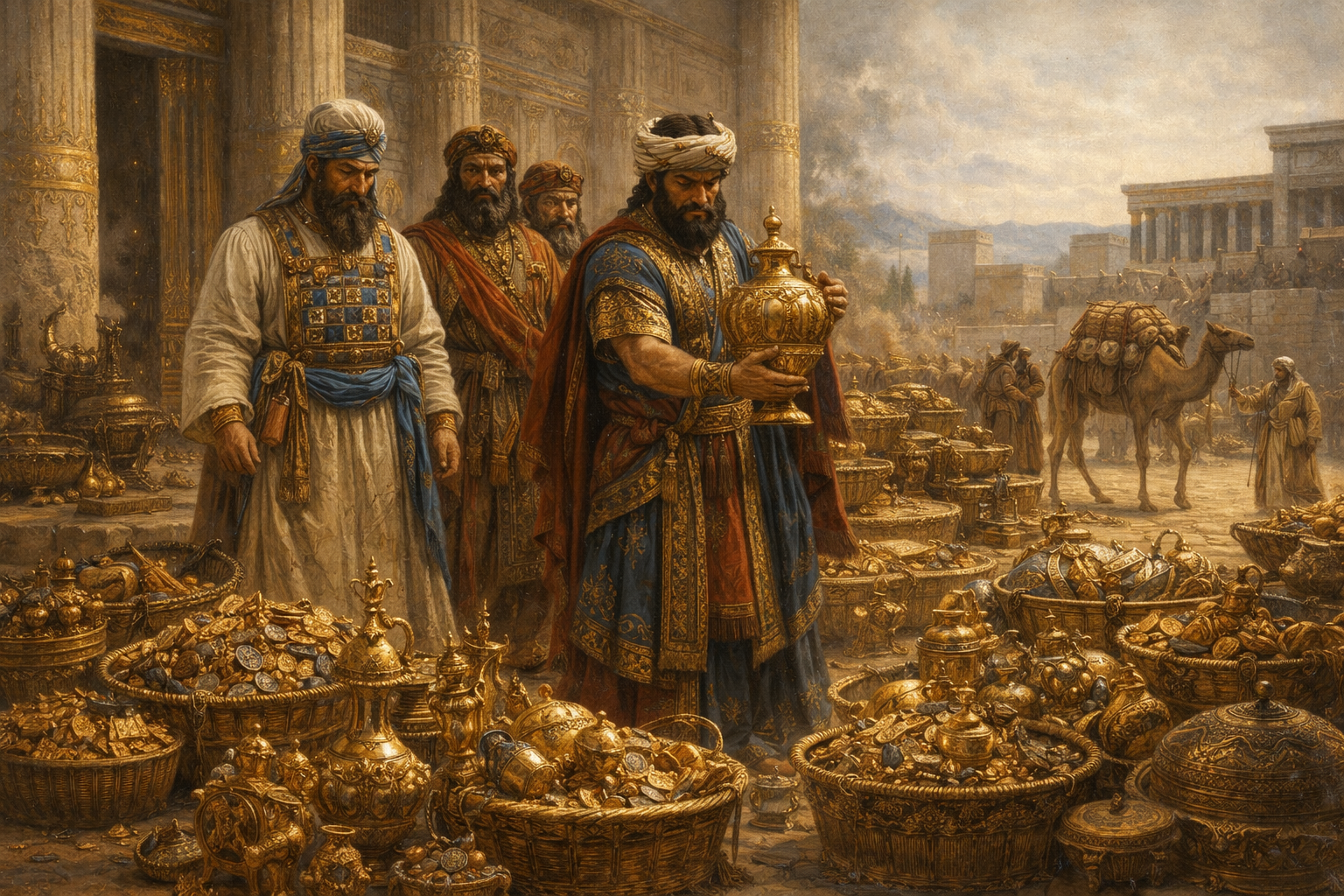
AHAZ "LOOTS" GOD'S HOUSE
TO PAY OFF ASSYRIAN KING
Moreover, when Ahaz gathered together the utensils of the house of God, he cut the utensils of the house of God in pieces -(See 2 Kings 16:17 above). This action reveals how far Ahaz had fallen from the faith of his fathers. The treasures stored in the temple were not merely national wealth; they were symbols of God’s covenant presence and provision. By stripping the house of the LORD to purchase Assyrian help, Ahaz treated sacred gifts as bargaining chips, placing his confidence in political power rather than in the God Who dwelt among His people. What earlier kings had guarded as holy, Ahaz surrendered in fear.
John Walton - furnishings of the temple. The furnishings of the temple probably included vessels, utensils, furniture and tools. According to 2 Kings 16:17-18 Ahaz was required to send very precise items, including the “Sabbath canopy,” to the king of Assyria. The Assyrians did not normally interfere with local cultic practices. It appears that Ahaz sent them to satisfy a metal tribute obligation. (See page 450 The IVP Bible Background Commentary-Old Testament)
David Guzik - “Ahaz’s appropriation of the panels and bases from the sacred furniture does not seem to be for the purpose of sending a further gift to Tiglath-pileser but rather for deemphasizing their importance in the worship services. Perhaps he planned to reuse them in some other decorative way. At any rate death overtook him before his attention could be turned to them. They are mentioned among the several items that were carried away in the later Babylonian despoiling of Jerusalem (2 Kings 25:13-14; Jeremiah 27:19-20; 52:17-23).” (Patterson and Austel - see 1 Samuel - 2 Kings - Volume 3 - Page 894) We remember that all this took place at the temple Solomon built unto the LORD. The mere location did not make it true worship. Sometimes idols are worshipped at a house that was once dedicated to the true God.
And he closed the doors of the house of the LORD For a more complete picture of how far Ahaz went in undermining the true worship of Yahweh, consult the account in 2 Kings 16:10–11, 17–18. Those verses describe Ahaz's deliberate imitation of a pagan altar he saw in Damascus, the construction of a copy within the temple precincts, and his arrogant command that Uriah the priest replace the divinely prescribed bronze altar with this foreign design. The passage further records how Ahaz dismantled sacred furnishings and altered temple arrangements to accommodate Assyrian interests, revealing a calculated effort to reshape Judah’s worship according to political expediency rather than covenant faithfulness. These actions show that Ahaz was not merely adding foreign elements alongside Yahweh worship, but was actively displacing it, even exchanging God’s revealed pattern for a man-made, pagan substitute.
And made altars for himself in every corner of Jerusalem. This statement reveals how thoroughly Ahaz reshaped the spiritual landscape of the holy city. Jerusalem was meant to be the one place on earth where the LORD’s name dwelt, centered on a single altar according to God’s command. Yet Ahaz scattered rival altars throughout the city, turning what was to be a unified center of worship into a patchwork of idolatrous shrines. The phrase “for himself” exposes the heart of the matter—these altars were not built for the glory of God but to satisfy the king’s own preferences and political alliances.
By filling “every corner of Jerusalem” with unauthorized places of sacrifice, Ahaz blurred the distinction between true worship and pagan practice. The city that David had established as the dwelling of the LORD became crowded with monuments to foreign gods. Instead of leading the people to the temple, the king led them away from it, making idolatry convenient and commonplace. His actions did more than multiply altars; they multiplied confusion, inviting the nation to serve many gods rather than the one true God.
The verse paints a tragic picture of Jerusalem, the city of peace, being transformed by an evil king into a marketplace of false religion. What should have been a beacon to the nations became a mirror of the polytheisitic idolatry of the surrounding pagan world. Ahaz’s personal apostasy spilled into public life, and the spiritual center of Judah was slowly being dismantled stone by stone. WOE!
G Campbell Morgan - “It would seem as though the light of truth were absolutely extinguished. It was not so, however, for it is likely that throughout the whole reigns of Jotham and Ahaz, Isaiah was uttering his message, and that during the reign of Ahaz Micah also was delivering the word of God.”
Charles Spurgeon adds that Ahaz "set up little shrines, so that every passer-by might worship which idol he pleased, and each man might present a little incense; thus the whole city was filled with idolatry."
John Walton - altars at every street corner. Babylonian texts speak of small open-air shrines or niches on street corners or courtyards. One text says that there were 180 of them in the city of Babylon to the goddess Ishtar. These shrines featured a raised structure with an altar on the top and seem to have been frequented primarily by women. In this sense the word “corner” may refer to what is basically a cultic niche (See page The IVP Bible Background Commentary-Old Testament)
Once compromise begins,
it continues to grow
Warren Wiersbe - the king (AHAZ) could never have made all these changes without the cooperation of Urijah, the high priest (2Kin 16:10, 11, 15, 16). When King Uzziah tried to rebel against the Word of the Lord and enter the temple, the high priest Azariah with eighty other priests successfully withstood him (2Ch 26:16ff.); but Urijah and his priests compromised, disobeyed the law of Moses and gave in to their king. Once compromise begins, it continues to grow; and all that it takes for evil to triumph is for weak people like Urijah to let leaders have their way. Ahaz not only replaced the altar and removed metal from the furnishings, but he finally took all the vessels for himself, closed the doors of the temple, and set up altars in the streets of Jerusalem (2Ch 28:24–25). “Do you not know that a little leaven leavens the whole lump of dough?” (1 Cor. 5:6; see Gal. 5:9). Once we allow worldliness to get into the church fellowship, it will quietly grow, pollute the fellowship, and eventually take over. It was not until the reign of his son Hezekiah that the temple Ahaz defiled was reopened and sanctified for ministry (2Ch 29:1–29).
Norman Geisler - When Critics Ask - 2 CHRONICLES 28:24—Did Ahaz encourage or oppose worship in the Jerusalem temple?
PROBLEM: In 2 Kings 16:15, Ahaz encouraged the worship of the Lord in the temple. But, in 2 Chronicles 28 he is said to have “shut up the doors of the house of the Lord, and made for himself altars in every corner of Jerusalem” (2Ch 28:24).
SOLUTION: First of all, even in 2 Kings, during his earlier reign, Ahaz was said to be an evil king who “did not do what was right in the sight of the Lord his God” (2Ki 16:2). He even “took the silver and gold that was found in the house of the Lord … and sent it as a present to the king of Assyria” (2Ki 16:8). During this period, he encouraged only a corrupt form of worship in the pilfered Jerusalem temple (2Ki 16:15).
Furthermore, the 2 Chronicles passages refers to a later, even more corrupt, part of his reign. During this period of apostasy, he shut up the house of the Lord completely and set up his own centers of worship.
2 Chronicles 28:25 In every city of Judah he made high places to burn incense to other gods, and provoked the LORD, the God of his fathers, to anger.
- burn: 2Ch 28:3
Related Passages:
Exodus 20:3-5 (AHAZ ACTED AS IF HE HAD NEVER READ OR HEARD THESE WORDS OF GOD TO MOSES) “You shall have no other gods before Me. 4 “You shall not make for yourself an idol, or any likeness of what is in heaven above or on the earth beneath or in the water under the earth. 5 “You shall not worship them or serve them; for I, the LORD your God, am a jealous God, visiting the iniquity of the fathers on the children, on the third and the fourth generations of those who hate Me,
Deuteronomy 12:2-5 (AHAZ'S ACTIONS THE ANTITHESIS OF THIS PASSAGE) “You shall utterly destroy all the places where the nations whom you shall dispossess serve their gods, on the high mountains and on the hills and under every green tree. 3 “You shall tear down their altars and smash their sacred pillars and burn their Asherim with fire, and you shall cut down the engraved images of their gods and obliterate their name from that place. 4 “You shall not act like this toward the LORD your God. 5“But you shall seek the LORD at the place which the LORD your God will choose from all your tribes, to establish His name there for His dwelling, and there you shall come.
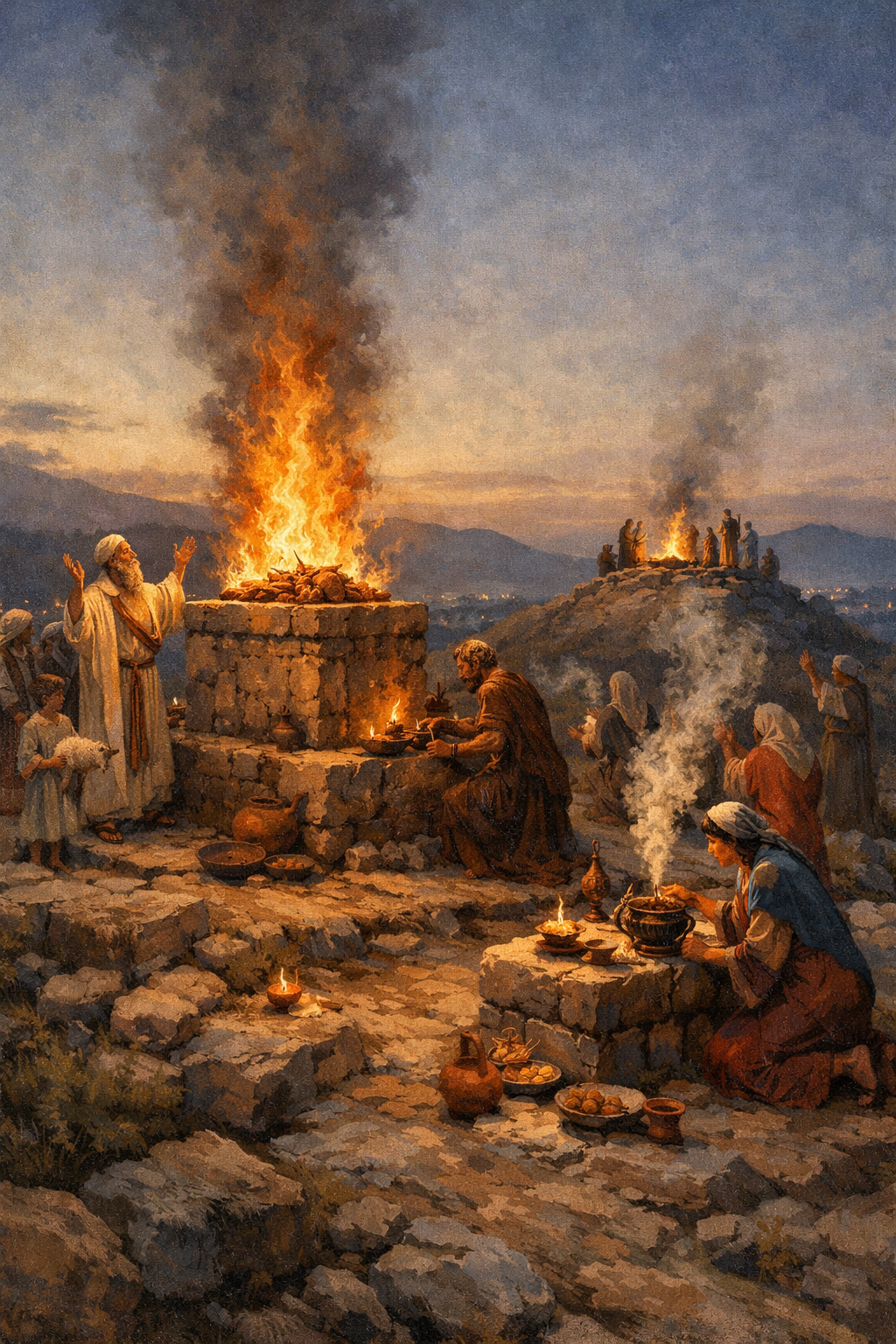
NATIONWIDE
HIGH PLACES
In every city of Judah he made high places to burn incense to other gods - Ahaz did not confine his idolatry to Jerusalem but deliberately spread the "spiritual leaven" throughout the land. By establishing high places in every city, he institutionalized false worship and made rebellion accessible to the whole population. These local shrines competed with the temple and invited the people to abandon the worship prescribed by the LORD. What had once been isolated pockets of compromise became a nationwide system of pagan devotion.
To burn incense to other gods was to offer honor, prayer, and allegiance that belonged to the LORD alone. Incense symbolized communion and dependence; Ahaz redirected the spiritual life of Judah away from the covenant God to lifeless idols. The king who was meant to guard true worship became its chief corrupter, leading the people not upward to God but downward to superstition.
and provoked the LORD, the God of his fathers, to anger The Chronicler emphasizes relationship: this was the God of Abraham, Moses, and David—the faithful Lord who had formed Judah as His own possession. Ahaz’s actions were not merely policy errors but personal affronts to a gracious Redeemer. To provoke God to anger is to awaken His righteous jealousy, for He will not share His glory with idols nor watch His people destroy themselves without response.
The verse reveals how sin escalates. What began as private unbelief became public idolatry, and finally national apostasy. The king’s example normalized what the Law of Moses clearly condemned, and the land became filled with pagan altars that testified to betrayal of Yahweh. Divine anger was not sudden or arbitrary, but was the measured reaction of a holy God to persistent unfaithfulness. If you have ever seen a tomato ripening and begining to split, that's a good picture of the "ripening" of Yahweh's anger which would finally be fully unleashed in 586 BC with the Babylonian destruction of the Temple and Judah's exile to Babylon. But the "tomato" was already becoming very ripe!
This passage warns that spiritual leadership carries immense influence, which can be for good or for evil. When those in authority abandon the LORD, entire communities can be led astray. Yet it also reminds us that God’s anger arises from covenant love—He is provoked because His people are precious to Him, and He will act to call them back to the worship that gives life.
Iain Duguid: Ahaz’s attitude to the worship of the Lord became even more antagonistic. He not only wantonly destroyed some of the temple items but also ended temple worship (cf. 2 Chron. 29:7). Instead of worshiping the Lord according to the Mosaic law in one temple, Ahaz multiplied worship of “other gods,” the extent highlighted by repetition of “every” for both “corner of Jerusalem” and “city of Judah” (cf. Jer. 2:28). Here is the first instance in Chronicles of the Lord’s being “provoked to anger” (Hb. form of kaʻas), to be used later of Manasseh (2 Chron. 33:6) and the people (2Ch 34:25), another example of a foretaste of the Babylonian exile due to persistent failure to be faithful in worshiping the Lord alone.
John Walton - 28:25. each town with a high place. The whole land of Judah was now made a center of foreign cultic practices. The Assyrians (and Arameans, for that matter) did not require any people group to switch allegiance to different gods, but a tributary group may have felt that their relationship with the conquerors would improve if they followed their deities. For information about high places see comment on 2 Kings 17:9. (See page 450 The IVP Bible Background Commentary-Old Testament)
2 Chronicles 28:26 Now the rest of his acts and all his ways, from first to last, behold, they are written in the Book of the Kings of Judah and Israel.
- the rest: 2Ch 20:34 27:7-9 2Ki 16:19,20
Parallel Passages
2 Kings 16:19 Now the rest of the acts of Ahaz which he did, are they not written in the Book of the Chronicles of the Kings of Judah?
Now the rest of his acts and all his ways, from first to last The Chronicler pauses to remind the reader that what has been recorded is only a portion of Ahaz’s life. The phrase “from first to last” suggests a complete story known to God, even if not fully told here. Every decision, alliance, and act of worship formed a consistent pattern. Ahaz’s reign was not marked by a single failure but by a trajectory—choices made early that shaped the character of his rule to its bitter end.
Behold (hinneh), they are written in the Book of the Kings of Judah and Israel. This appeal to another historical record serves several purposes. It anchors the narrative in real history, not legend. The Chronicler is not inventing a moral tale but under the inspiration of the Holy Spirit is summarizing documented events familiar to his audience. It also implies accountability, that is that a king’s life is not forgotten once the throne passes to another. His deeds are preserved for future generations to examine and learn from, although these books have been lost over time.
The reference highlights a sobering truth, that every human live is written somewhere. Even if earthly chronicles fade, God keeps His own record. Ahaz’s “ways” were known in detail, and their consequences continued to shape Judah long after his death. History remembers not only what a ruler accomplished but whom he trusted and whom he served.
🙏 THOUGHT - This concluding note calls for personal reflection. To be sure, a life can be summarized in a few lines, yet behind those lines stand years of choices. Ahaz’s legacy was largely one of misplaced trust and spiritual compromise. Ahaz's life challenges each of us to carry out a sober, honest self-examination (cf 2Co 13:5). What will be written of my ways from first to last? Will my story testify to faithfulness to the LORD or to reliance on substitutes that could never save?
Malachi 3:16 Then those who feared the LORD spoke to one another, and the LORD gave attention and heard it, and a book of remembrance was written before Him for those who fear the LORD and who esteem His name.
Revelation 22:12 “Behold, I am coming quickly, and My reward is with Me, to render to every man according to what he has done.
2 Chronicles 28:27 So Ahaz slept with his fathers, and they buried him in the city, in Jerusalem, for they did not bring him into the tombs of the kings of Israel; and Hezekiah his son reigned in his place.
- they brought: 2Ch 21:20 26:23 33:20 1Sa 2:30 Pr 10:7
Parallel Passages
2 Kings 16:20 So Ahaz slept with his fathers, and was buried with his fathers in the city of David; and his son Hezekiah reigned in his place.
AHAZ DESCENDS
HEZEKIAH ASCENDS
So Ahaz slept with his fathers, and they buried him in the city, in Jerusalem, for they did not bring him into the tombs of the kings of Israel - The kings of Israel refers to "the kings of Judah;" the name Israel being sometimes applied by the writer of this book, in a general way, to Judah. Although Ahaz was buried in Jerusalem, he was denied a place in the royal tombs, a quiet but telling judgment that reflected the nation’s disapproval of his unfaithful reign and his departure from the ways of the house of David.
It is notable that Ahaz is the third king of Judah of whom the Chronicler records the loss of this burial honor, following Jehoram (2 Chr 21:20), Joash (2 Chr 24:25), and Uzziah (2 Chr 26:23; cf. 33:20).
Warren Wiersbe - When Ahaz died, he was buried in Jerusalem but not in the royal tombs (2Ki 16:19–20; 2Ki 28:26–27). In this, he joined Jehoram (2Ch 21:20), Joash (2Ch 24:25), and Uzziah (2Ch 26:23), and Manasseh would join them (2Ch 33:20). The unbelief and unfaithfulness of Ahaz did great damage to the kingdom of Judah, some of which his son Hezekiah would be able to repair.
David Guzik - So ended the reign of perhaps the worst king of Judah. Micah – who prophesied during the reign of Ahaz – describes the man who works to successfully do evil with both hands (Micah 7:3). The idea is that the man pursues evil with all his effort, with both hands. He may very well have had King Ahaz in mind.
G Campbell Morgan - Ahaz was evil by choice, persistent in evil in spite of calamity, blasphemously rebellious notwithstanding the direct warnings of the prophet of God. This attitude of the king made the darkness all the denser.
TSK - The Hebrews were accustomed to honour the memory of those kings who had reigned well, by depositing their remains in the royal cemetery. On the contrary, those who died under the disapprobation of the people, as a mark of posthumous disgrace, were denied interment with their predecessors, and were buried in some other place in Jerusalem. So it was with Ahaz, who, though brought into the city, was not buried in the sepulchres of the kings of Judah. It was doubtless with a design to make a suitable impression on the minds of their kings while living, that such distinctions were observed. They might thus restrain them from evil, or excite them to good, according as they were fearful of being execrated, or desirous of being honoured, when dead.
And Hezekiah his son reigned in his place - Fortunately Molech did not get his deadly hands on Hezekiah! And so finally we have a breath of fresh (spiritual) air!
Henry Morris - Hezekiah his son. Ahaz sacrificed his sons to Molech (2 Chronicles 28:3), and one son was slain in battle (2 Chronicles 28:7), but God preserved his one godly son, and the Davidic line was kept intact.
C H Spurgeon - There was a holy and reverent feeling amongst the remnant of God’s people that a man who had lived as Ahaz had done should not lie with the good kings of Israel.
PAUL APPLE - DEVOTIONAL QUESTIONS: Page 599
1) To whom do you turn for help in times of crisis?
2) How do you respond to divine discipline when God is in the process of humbling you?
3) What are some false sources of power and deliverance that people turn to today instead of seeking help from the Lord?
4) How does apostasy escalate and end up causing such collateral damage?
Eugene Merrill: Historical Background Since the early 9th century, Assyria had becoming increasingly powerful and more and more inclined to look to the west for its riches and its ready access to the Mediterranean Sea. Assyria’s first significant contact with western principalities, including Israel under Ahab, was in 853 BC and by King Shalmaneser III (858-824 BC — the Battle of Qarqar). No territories were acquired but large bribes and booty were extracted. A series of weaker monarchs followed, with only occasional references to their engagement with the west, particularly with Israel and Judah. Then came the next great figure in Neo-Assyrian history, namely, Tiglath Pileser III (745-727 BC). His tenure is elaborately documented by numerous texts that are of particular relevance to the Bible. The first reference to him is by the secondary name Pulu of the Dynasty of Shashi. It is of interest to note that he is known by name (Hebrew: “Pul”) in both 2 Kings 15:19 and 1 Chronicles 5:26, and he is also called Tiglath Pilneser (2 Chron 28:20). The issue here is primarily neither historical nor textual confusion but the inherent problem in linguistics of transliteration (accounting for the different spellings and variants of the name of this Assyrian King). Tiglath Pileser’s first recorded foray against the west is attested to on a building inscription from early in his reign in which he speaks of receiving tribute from Jehoahaz of Judah. Years later, Tiglath Pileser recounts that he rendered Rezon of Damascus and Menahem of Samaria tributary states in addition to Hiram of Tyre. A date critical for both Damascus and Samaria is 732 BC, the year that Tiglath-Pileser defeated both capitals, slew Rezon, and placed on King Menahem of Israel a heavy tribute. A short time later, the Assyrian returned and established the man Hoshea (732-722 BC) as king of Israel in place of Pekah (752-732) who had been assassinated by his own inner circles. While Assyria was exercising its might, intrigue amongst the smaller states of the littoral was in full bloom. This is hinted at by the Chronicler who explains why TiglathPileser was involved in the affairs of the west to begin with. Though the Assyrian’s own texts say nothing about his motives in westward expansion, the Chronicler indicates that King Ahaz had pleaded with him to come to deliver him from the vicious attacks of the Edomites and the Philistines (2 Chron 28:16-18). However, the Chronicler is completely silent about the Aram-Israel alliance that may be the primary reason for Ahaz’s frantic appeals for help in the first place. Another amazing witness to these same times is the prophet Isaiah who devotes considerable attention to the matter (Isaiah 7:1-9). Isaiah’s public ministry commenced in the year that King Uzziah died (Isa 6:1; about 740 BC). Five years later, then, he spoke to his own historical situation. He summoned King Ahaz to a vantage point where he could look to the north, toward the enemy nations, and predicted that the plot against Ahaz and Judah could NOT stand if only Ahaz would trust in Yahweh. This leads to the far more transcendent promise that even if Ahaz could NOT believe, Yahweh would give him a sign about a hitherto barren young woman who would conceive, bear a son, and call his name Immanuel (Isa 7:14). Christian theology identifies this son as Jesus Christ, born of the Virgin Mary (Matt 1:23). To return to the 2 Chronicles 28 text, the narrator, having spoken of the loss of Eloth (the southernmost city of Israel on the northern tip of the Red Sea) to the Edomites, lists the places in the foothills and Negev (desert) seized by the Philistines: Beth Shemesh, Aijalon, Gederoth, Soco, Timnah, and Gizmo. These were all border posts guarding the Judean hill country and the capital from Philistine forces so their loss to the Philistines would in fact be disastrous
Raymond Dillard: H. Williamson (343–49; IBC, 114–18) has shown how the Chronicler has reworked his account of Ahaz from that found in 2 Kgs 16 in order to effect an almost complete reversal of the relationship of North and South as found in 2 Chr 13.
(a) Like Jeroboam at the time of the schism, Ahaz too makes molten images for worship (2Ch 28:2). He also worships the gods of Damascus (2Ch 28:10–16, 23), reflecting the charge of Abijah that Israel was worshiping the golden calves and “them that are no gods” (2Ch 13:8–9).
(b) Ahaz shut the doors of the temple (28:24), put out the lamps and stopped the offerings of incense and sacrifices (2Ch 29:7), and neglected the shewbread (2Ch 29:18). These additions to the Chronicler’s account amount to the negation of Abijah’s boast of orthodoxy before Jeroboam (2Ch 13:11). These changes show that apostasy in the South had reached the same depths as that in the North at the time of the schism.
(c) At the time of the schism, the righteous left the North to join Judah (2Ch 11:13–17), but during the reign of Ahaz, righteousness was found in the North (2Ch 28:9–15). Whereas at the time of the schism, Judah was obedient to the word of a prophet regarding attacking the sister kingdom (2Ch 11:1–4), here it is Israel that heeds the admonition of a prophet (2Ch 28:9).
(d) The military fortunes of the two kingdoms are also reversed. Contrast the fortunes of Jeroboam (“God delivered them into their hand, and Abijah and his people slew them with a great slaughter,” 2Ch 13:16–17) with those of Ahaz (“he was delivered into the hand of the king of Israel who smote him with a great slaughter,” 2Ch 28:5). At the time of Abijah it was Israel that was subjugated (2Ch 13:18), whereas at the time of Ahaz, it was Judah (2Ch 28:19). Ahaz is the only king of Judah for whom the Chronicler does not mention at least some redeeming feature; Ahaz is the antithesis of Abijah and the shadow of Jeroboam.
August Konkel: The example of Ahaz may be uncomfortably close to the practice of faith by affluent Christians. There is a tendency to trust ourselves, our resources, and to be most concerned about whatever is immediate. Modern and postmodern Christians manifest deistic tendencies. It is hard to conceive of God as active and present in maintaining life in his world. Everything can be understood as cause and effect; it can all be brought under human control. It is not a disbelief in God, but rather a belief that does not affirm the presence of God in our daily affairs. There is a tendency to cultural conformity without consideration of the ways in which this may be a sin against God. The greatest dangers are perceived to be tangible ones, observed forces that may threaten our well-being. There is no sense that the greatest danger may be less tangible, an implicit faith in ourselves for the needs of life rather than a genuine knowledge that life is a divine gift. Exclusive trust in God is very difficult in times of power and affluence. God has given the means of life to use and trust, but they must all be recognized for what they are: gifts from God. In a modern or postmodern society, there is a tendency to feel entitled, to believe that government and investments bring security. These are the sorts of compromises of which Ahaz was guilty. It is always a good practice to give thanks for every meal. Life and everything that sustains it must continually be acknowledged as divine gifts. Failure to make this confession readily leads to the unfaithfulness of which Ahaz was guilty. (SEE 1 & 2 Chronicles)
Martin Selman: The Chronicler’s history reaches another low point with the reign of Ahaz. -
To start with, Ahaz did not do what was right before God (2Ch 28:1), in contrast to his immediate predecessor Jotham (2Ch 27:2). -
Secondly, the totally negative assessment of Ahaz puts him on a par with the rulers of Ahab’s house (2 Chr. 21-23) and with the kings whose reigns led directly to the exile (2 Chr. 36; cf. also 2 Chr. 33:21-25). -
Thirdly, Chronicles has made Kings’ descriptions of Ahaz’ failings much more explicit. Additional interpretative comments explain that Judah was being punished because he had forsaken God (2Ch 28:6) and because Ahaz had been most unfaithful (2Ch 28:19), in sharp contrast with the merciful attitudes shown by the inhabitants of Israel (2Ch 28:12-15). . .
Ahaz’s real failure, however, was to seek human rather than divine help. One of the Chronicler’s principles is that “God has the power to help or to overthrow” (2 Ch. 25:8; cf. 2Ch 32:8), and that he helps those who put their trust in him (cf. 1 Ch. 5:20; 14; 10; 18:31). Ahaz’ turning to Assyria was therefore a sign of his unbelief (cf. Is. 7:9-12). Ahaz also “behaved without restraint” (v. 19, NRSV) and was most unfaithful. The former expression really means to favor license rather than true liberty, while the latter is a typical term in Chronicles for failing to give God his due. Therefore God humbled Judah as had Israel under Jeroboam (2 Ch. 13:18), but with even more disastrous results.
Geoffrey Kirkland: A Drama of Depraved Disasters — Politically, Nationally & Religiously! We can observe the absolute tragedy of Ahaz’s reign under 4 words…
1. Corruption (2Ch 28:1-4) -- Key word = Depravity
2. Conquest (2Ch 28:5-15) -- Key word = Discipline
3. Compromise (2Ch 28:16-21) -- Key word = Disfunction
4. Condemnation (2Ch 28:22-27) -- Key word = Downfall
Steven Cole - sermon - Forsaking Sin or God? (2 Chronicles 28)
A fourteenth century duke named Raynald III, in what is now Belgium, had a violent quarrel with his younger brother, Edward, who then led a successful revolt against him. Edward captured Raynald, but didn’t kill him. Instead, he built a room in the castle around his brother and promised him that he could regain his title and property as soon as he was able to leave the room.
This wouldn’t have been difficult for the average person, since the room had several windows and a door of near-normal size, and none was locked or barred. The problem was Raynald’s size: he was grossly overweight. To regain his freedom, he had to lose weight. But Edward knew his older brother, and each day he sent a variety of delicious foods. Instead of dieting his way out of prison by resisting those tempting foods, Raynald grew fatter. When Duke Edward was accused of cruelty, his reply was, “My brother is not a prisoner. He may leave when he so wills.”
But, of course, his brother was a prisoner--of his own appetite. He stayed in that room for ten years and wasn’t released until Edward died in battle. By then his health was so ruined that he died within a year (adapted from Leadership [Spring, 1984], p. 44).
There is in every human heart a perverse and powerful attraction
for that which you know cognitively will destroy you.
There is in every human heart a perverse and powerful attraction for that which you know cognitively will destroy you. It is the appeal of sin. Like bugs drawn toward a light that will kill them, fallen sinners are drawn toward the evil that will enslave and ultimately ruin them. I wish I could report that the longer you follow the Lord, the less appeal sin has, but I cannot. It is a battle that requires constant vigilance. It’s a winnable war, but we never (in this life) become immune to sin.
EDITORIAL NOTE: C H SPURGEON addressed OLD AGE - “I have lived long enough to observe that the greatest faults that are ever committed by professedly Christian men are not committed by young people. Most painful is it, to me to remember that the worst cases of backsliding and apostasy that I have ever seen, in this church, have been by old men and middle-aged men, – not by young people; for, somehow or other, the young people, if they are truly taught of God, know their weakness, and so they cry to God for help; but it often happens that more experienced people begin to think that they are not likely to fall into the faults and follies of the young; and I care not how old a man may be – even if seven centuries had passed over his head – if he began to trust in himself, he would be a fool, and soon he would have a grievous fall.”
Thus life consists of a series of choices. To put it plainly:
Either we forsake God to go after sin or
we forsake sin to go after God.
King Ahaz forsook the Lord for sin. He did so in spite of many advantages. His grandfather was King Uzziah who, although he later became proud and was struck with leprosy, was yet a mighty king who sought the Lord. Ahaz’s father was King Jotham, a godly man who further strengthened the kingdom (see 2 Chronicles 27:6). Furthermore Ahaz was a descendant of King David, and thus he came under the blessings of the covenant God had enacted between David and his progeny. And if that were not enough, Ahaz lived during the ministry of the prophet Isaiah, who encouraged Ahaz to trust in the Lord. But he forsook the Lord. Let’s look at his life to learn what it means to forsake God to go after sin. The chapter also reveals (from an unexpected source) what it means to forsake sin to go after God.
Forsaking God To Go After Sin:
1. FORSAKING GOD TO GO AFTER SIN BEGINS BY ADDING WORLDLY IDEAS TO GOD’S WORD (2Ch 28:2-4).
Ahaz didn’t begin his reign by closing the doors of the Temple and replacing the worship of God with the worship of idols. Eventually it came to that (2Ch 28:24). But he didn’t start there. He started by adding idol worship to the worship of the Lord. The parallel account in 2 Kings 16 tells of how Ahaz went up to Damascus to meet Tiglath-Pileser who had defeated the Syrians and the northern kingdom of Israel on Ahaz’s behalf. There he saw a magnificent altar which he liked so much that he sent back the plans for it to his priest so that it was waiting for him when he returned from Damascus. Ahaz offered on this pagan altar the sacrifices prescribed in the Law of Moses. As for the bronze altar prescribed by Moses, he moved it aside and kept it to inquire by (2 Kings 16:15), but he offered all his sacrifices on the pagan altar of his preference. In other words, he was blending pagan ideas with what is prescribed in the Bible.
Forsaking the Lord often begins by replacing a few things in the Bible that you don’t like with a few worldly ideas that you prefer. Let’s face it: There are some hard truths in the Bible that confront our culture and our sinful, selfish preferences. The Bible says that wives are to be subject to their husbands and workers at home (Titus 2:5), but we don’t like that; we prefer the egalitarian model. The Bible says that our marriage commitment is to be for life and that we are to work through our problems by learning to deny self and love as Jesus loved. But that’s too hard, so we bail out! But we begin forsaking the Lord when we replace the clear directives of His Word with the best of worldly wisdom or custom.
2. FORSAKING GOD TO GO AFTER SIN MEANS DOING WHAT I THINK WILL BE GOOD FOR ME, EVEN IF IT’S HARMFUL TO OTHERS (2Ch 28:3).
Ahaz burned some of his sons in the fire as an offering to the god Molech. In some cases this involved slaughtering the child and offering him up as a burnt sacrifice; at other times it meant passing the child through the fire without killing him. At the heart of that sort of abomination was self, because the parent was seeking to placate the gods so that it would go well with him. Never mind that it wasn’t going too well with the child! The main thing is my well being, even if it means my child’s pain or death. But it was detestable in God’s sight (Jer. 32:35).
Did you know that 95-97 percent of the abortions in our land are performed strictly for convenience? It would inconvenience the lifestyle of the mother or couple to take on the responsibility of caring for a child, so instead they slaughter that little life that is no different than you or I, except that it’s younger than we are.
I realize that there are difficult situations and that because of the irresponsibility of many young men, the burden often falls on the woman. I am not insensitive to the hardship nor excusing the man. But I’m saying, if you do what you think is best for you to the disregard, or even death, of others, you’re simply doing what these pagans did in offering their children to idols in the hopes of having a happier, easier life. You’re forsaking God for self.
Did you know that one of our candidates for U.S. senator in next month’s election is a former president of Planned Parenthood of Northern Arizona? I don’t care if you’re a member of his political party or if you prefer his views on the economy. To vote for such a man when his opponent is a strong advocate of protecting human life in the womb is to sin against God. Do your homework and vote for pro-life candidates!
Thus forsaking God to go after sin begins by adding worldly ideas to the Word of God. It means doing what you think will be good for you, even if it’s harmful to others.
3. FORSAKING GOD TO GO AFTER SIN MEANS TURNING TO THE WORLD FOR HELP (2Ch 28:16, 22-23).
When people turn away from God, He graciously sends trials so that, hopefully, the sinner will turn to God for help. Every trial is designed by God to teach us the futility of trusting in ourselves or in the world’s wisdom, so that we are driven to trust in God alone. Yet today, millions of Christians are turning to the pagan ideas of psychology for help with their trials. Several who have left this church because of my teaching on this subject have said to me, “If it’s helping me with my problems and I feel better because of it, then what’s wrong with it?”
What if I told you that I was feeling angry and depressed, and I went to a witch doctor. He listened sympathetically to my problems and then he mixed up a magic potion and asked me to drink it. After that, he slaughtered a chicken, dipped his finger in the blood, dabbed it on my forehead, and uttered an incomprehensible curse on everyone who had hurt me and invoked the blessings of the gods on my behalf. As he did all this, I felt my anger disappear and my depression lift. I’ve felt better ever since. What would you say?
The issue is never, does it help, but rather, is it biblical? Ahaz sacrificed to the gods of Aram because they helped them and he hoped that they would help him, too (2Ch 28:23). We are specifically warned in Scripture against accepting the counsel of the ungodly and the wisdom of the world (Ps. 1:1; Col. 2:8). We are repeatedly told to take all our problems to God and to trust in Him alone, not in our own strength or understanding (Ps. 33:6-22; Prov. 3:5-6). When you’ve got problems, you’ve only got two options--seek help from the Lord and His Word (including biblical counselors) or seek help from the world. Ahaz sought help for his problems from the world. But before you turn to the world for help, you need to realize three things:
A. THE WORLD ALWAYS EXACTS A HIGH PRICE FOR ITS HELP (2Ch 28:21).
Sure, Tiglath-Pileser would take care of Ahaz’s enemies--for a price! Ahaz had to strip the temple, strip his palace, and extract money from his princes. It was expensive and it wasn’t covered by his insurance! His wives and his princes probably complained about the stainless steel bathroom fixtures that replaced the gold, but a man has to do what he has to do when he needs help in this world!
Whenever you turn to the world for help, the world makes sure it gets its payment, and it’s always expensive. Whether you go to a counselor who charges you $100 an hour; or turn to drinking or drugs to blot out your troubles; or try to earn a lot of money so you can live the “good life” apart from God; the world gets its fee.
The irony is, it doesn’t cost you anything to get down on your knees and open God’s Word of truth and seek Him. It might cost you a cup of coffee to get together with a mature brother or sister in Christ and ask their counsel. Ahaz could have called Isaiah and asked for God’s wisdom through him and he wouldn’t have had to strip the temple and his palace or rob his princes.
B. THE WORLD NEVER DELIVERS WHAT IT PROMISES (2Ch 28:20, 21, 23).
Tiglath-Pileser promised his help, but after he polished off Ahaz’s enemies he moved on to afflict Ahaz. In the end the help Ahaz sought proved to be his downfall. In spite of all the money he spent, he didn’t get the help he needed.
The world’s help is like that. At first it seems to offer what you want, but in the end it never delivers what it promises, because it doesn’t direct you to the Lord. I’ve seen girls enter into a relationship with a nice, but unbelieving, young man. It seems as if he will bring her the happiness she seeks. But she pays a terrible price in the long run, because she disobeyed God’s Word about being unequally yoked.
C. THE WORLD COMES IN AS A FRIEND BUT TAKES OVER AS MASTER.
At first Tiglath-Pileser was Ahaz’s friend. He knocked off Syria and subdued Israel. But then he exacted tribute from Ahaz and in the end Ahaz was a weak vassal on a leash held tightly by the Assyrian monarch.
That’s how the world works. You invite it to come in as a friend, but it’s a domineering house guest! Soon it shoves your things to the corner and takes over. A man dabbles in pornography; after all, he’s got needs that aren’t being met! Soon he is enslaved to lust. A housewife starts having an afternoon drink to calm her nerves; soon it becomes a morning, afternoon, and before bed drink. She is enslaved to alcohol. A young person smokes a little dope or crack cocaine because it makes him feel so good. Soon he is enslaved to an expensive and destructive habit. The world always exacts a high price. It never delivers what it promises. It comes in as a friend but takes over as master.
Forsaking God for sin begins by adding worldly ideas to God’s Word; it means doing what I think will be good for me, even if it’s harmful to others; it means turning to the world for help, which is no help at all.
4. FORSAKING GOD TO GO AFTER SIN MEANS INCURRING HIS DISCIPLINE (2Ch 8:5, 19).
If a person has an outward profession of faith, but is not truly converted (as with Ahaz), then God sends trials to bring him to repentance and faith in Christ. If the person truly knows Christ, then God disciplines him as a son, that he may share God’s holiness (Heb. 12:4-11).
But in either case, we need to understand that trials do not come to us by bad luck or chance. A sovereign, loving God uses everything from minor irritations to major catastrophes to pry us loose from self-reliance, self-love, and sin and to drive us to trust in Him and to love Him and others for His glory.
In a recent Focus on the Family magazine Dr. Dobson said that AIDS is not God’s judgment, because it affects innocent children and others, such as recipients of blood transfusions. But he’s failing to understand that when God’s judgment falls on a nation, it hits the so-called “innocent” (no one is without sin) as well as flagrant sinners. In Ahaz’s day, the whole nation suffered because of Ahaz’s sin. In our day, AIDS is God’s means of judgment, but also of His mercy. The AIDS plague should make us all see the great sin of our land, not only in homosexuality, but also in many other ways. It also should make us realize that the wages of sin is death, but that if sinners will repent and turn to God, they will receive the gift of God which is eternal life in Jesus Christ our Lord (Rom. 6:23).
Even if we have not deliberately sinned, we need to recognize every trial as God’s gracious means of shaping us into the image of His Son (Rom. 8:28-29; Heb. 12:4-11). Health problems, family problems, financial troubles, car troubles, and every other kind of trial is an opportunity to grow in Christ by submitting to His loving hand and seeking Him more fervently in thankful prayer. Even Jesus, who was without sin, learned obedience through the things He suffered (Heb. 5:8). If you have forsaken God for sin, then view your trials as His gracious means of bringing you into the place of wholeness He wants to give.
Thankfully, there is an alternative to forsaking God to go after sin. Ahaz never did it, but some others in this chapter did:
Forsaking Sin To Go After God:
The warriors from the Northern Kingdom who defeated Judah in battle brought back 200,000 women and children as slaves (28:8). The Northern Kingdom had not had even one godly king since the division of the land almost 200 years before. Yet God did not leave Himself without a witness in the north. In this case the prophet Oded confronted these men. Ironically, the ungodly Northern Kingdom (whose capital was Samaria) forsook their sin and obeyed God, while the southern kingdom did not. This story was no doubt behind Jesus’ parable of the Good Samaritan.
Oded’s job was a bit like an M.P. single-handedly facing a barroom full of drunken sailors. These guys were high on the smell of victory. But he goes out and tells them to send their captives home. His words and their response reveal three aspects of true repentance:
1. REPENTANCE MEANS LISTENING TO THE WORD OF GOD (2Ch 28:9-11).
The only way we know right from wrong is the Bible. God’s Word reveals His righteous moral standards. These men heard God’s Word through Oded. Ahaz had heard God’s Word through Isaiah. We have it in written form. The Bible, and only the Bible, is our standard for right and wrong. Repentance involves listening to God’s Word.
2. REPENTANCE MEANS ACKNOWLEDGING OUR OWN SIN, NOT COMPARING OURSELVES WITH OTHERS (2Ch 28:10).
“Do you not have transgressions of your own against the Lord your God?” These warriors from the north had just been used to execute God’s judgment on their sinful brothers in the south. They could have been pretty cocky about themselves compared with their brothers. But the prophet calls them to face their own sin. Repentance always means acknowledging your own sin, not comparing yourself with others who may be more sinful.
3. REPENTANCE MEANS TURNING FROM SIN AND DOING WHAT IS RIGHT IN THE LORD’S SIGHT (2Ch 28:14-15).
Lip service isn’t enough. God requires us to perform “deeds appropriate to repentance” (Acts 26:20). A lot of people supposedly receive Christ, but there is no repentance. They don’t turn from their sin and begin to obey the Lord. Repentance means that we begin to obey God, and when we do sin, we come back to Him again for cleansing and restoration. Christians are not sinless, but we should sin less as we grow in our walk with God.
Conclusion
ILLUSTRATION A Native American tells a legend he heard as a boy. Many years ago, Indian braves would go away in solitude to prepare for manhood. One saw a rugged peak and thought, “I will test myself against that mountain.” He put on his buffalo-hide shirt, threw his blanket over his shoulders and set off to conquer the challenging summit.
When he reached the top, he felt like he was standing on the rim of the world. His heart swelled with pride at his success. Then he heard a rustle at his feet. Looking down, he saw a snake. Before he could move, the snake spoke. “I am about to die,” said the snake. “It’s too cold for me up here, and there is no food. Put me under your shirt and take me down to the valley.”
“No,” said the youth. “I know your kind. You’re a rattlesnake. If I pick you up, you’ll bite and kill me.” “Not so,” said the snake. “I’ll treat you differently. If you do this for me, I’ll not harm you.”
The youth resisted for a while, but this was a persuasive snake. At last the youth tucked it under his shirt and carried it down to the valley. There he laid it down. But suddenly the snake coiled, rattled, and struck, biting him on the leg.
The startled youth cried out, “But, you promised--!” “You knew what I was when you picked me up,” said the snake as it slithered away. (Adapted from Reader’s Digest [6/89], p. 131.)
The next time you’re tempted to embrace sin into your life, and it looks attractive and harmless, remember the words of that snake: “You knew what I was when you picked me up.” If you forsake God to go after sin, as Ahaz did, you will only get stung. If you forsake sin to go after God, though it’s often difficult, you will be ultimately blessed. Are you forsaking God to go after sin, or are you forsaking sin to go after God?
Discussion Questions
- What are some of the areas where the modern church is adding worldly ideas to the Word of God?
- What’s wrong with this argument: We seek the world’s help in medicine; why not in psychology?
- Some say that they’ve tried seeking God through the Bible, prayer, etc., but it didn’t help. What would you say to them?
- Can a person believe in Christ unto salvation without repenting of known sin? Cite biblical references for your position.
NOTE: SOME CAN BE BORROWED FROM ARCHIVE.ORG
Archer, Gleason L. Jr. A survey of Old Testament introduction (BORROW). Chicago, IL: Moody Press, 1964.
Baxter, J. Sidlow. Explore the Book Vol. 2 Judges to Esther . Grand Rapids, MI: Zondervan, 1960.
Boda, Mark J. Cornerstone Biblical Commentary – 1-2 Chronicles. (Digital version) Carol Stream, IL: Tyndale House Publishers, 2010.
Braun, Roddy. Word Biblical Commentary – Volume 14 –1 Chronicles (BORROW). Grand Rapids, MI: Zondervan, 2018.
Cooper, Derek. Reformation Commentary on Scripture – Old Testament V – 1-2 Samuel, 1-2 Kings, 1-2 Chronicles. (Digital version) Downers Grove, IL: IVP Academic, 2016.
Constable, Thomas - 1&2 Chronicles (ONLINE)
Daniel, Ron - Teaching Notes - 1 Chronicles; 2 Chronicles (ONLINE)
Dillard, Raymond B. Word Biblical Commentary – Volume 15 – 2 Chronicles (BORROW) Grand Rapids, MI: Zondervan, 2018.
Ellison, H. L. The New Bible commentary, revised – 1 & 2 Chronicles (BORROW). Grand Rapids, MI: Wm. B. Eerdmans Publishing Co., 1970.
Guzik, David. Enduring Word Bible Commentary 1 Chronicles; 2 Chronicles (ONLINE)
Hill, Andrew E. The NIV Application Commentary – 1 & 2 Chronicles. (Digital version) Grand Rapids, MI: Zondervan, 2003.
Keil, C. F. and Delitzsch, F. Commentary on the Old Testament – 1 Chronicles & 2 Chronicles. Grand Rapids, MI: William B. Eerdmans Publishing Company, 1975.
Konkel, August H. Believers Church Bible Commentary – 1 & 2 Chronicles. (Multipart video series also available) Harrisonburg, VA: Herald Press, 2016.
Mabie, Frederick J. The Expositor’s Bible Commentary Revised Edition – 1 & 2 Chronicles. (Digital Version) Grand Rapids, MI: Zondervan, 2010.
MacArthur, John. The MacArthur Study Bible (BORROW). Nelson Bibles, 2006.
Olley, John W. (ED: IAIN DUGUID) ESV Expository Commentary, Vol. III – 1 Samuel – 2 Chronicles. (Digital Version) Wheaton, IL: Crossway, 2019.
Payne, J. Barton. The Expositor’s Bible Commentary – 1 & 2 Chronicles. Grand Rapids, MI: Zondervan Publishing House, 1988.
Schultz, John. - 1 Chronicles (177 pages), 2 Chronicles (239 pages) (ONLINE)
Selman, Martin J. Tyndale Old Testament Commentaries – 1 Chronicles. (BORROW)Downers Grove, IL: InterVarsity Press, 1994.
Selman, Martin J. Tyndale Old Testament Commentaries – 2 Chronicles. (BORROW) Downers Grove, IL: InterVarsity Press, 1994.
Sherwin, Simon & Mabie, Frederick J. Zondervan Illustrated Bible Backgrounds Commentary -- 1 & 2 Chronicles. (Digital Version) Grand Rapids, MI: Zondervan, 2009.
Thompson, J.A. The New American Commentary – Volume 9 – 1, 2 Chronicles. (Digital Version) Nashville, TN: B&H Publishing Group, 1994.
Utley, Bob. 1 Chronicles Table of Contents; 2 Chronicles Table of Contents
http://www.freebiblecommentary.org/old_testament_studies/VOL07BOT/VOL07BOT.html
Walton, John, et al - The IVP Bible Background Commentary Old Testament IVP - InterVarsity Press 2000.
Wiersbe, Warren W. Be Restored – Trusting God to See Us Through – OT Commentary – 2 Samuel & 1 Chronicles. (BORROW) Colorado Springs, CO: David C. Cook, 2010.
Wiersbe, Warren W. Be Distinct – Standing Firmly Against the World’s Tides – OT Commentary – 2 Kings & 2 Chronicles. (BORROW) Colorado Springs, CO: David C. Cook, 2010.
Williamson, H.G.M. New Century Bible Commentary – 1 and 2 Chronicles. Eugene, OR: Wipf and Stock Publishers 1982.
Wood, Leon. A Survey of Israel’s History. (BORROW) Grand Rapids: MI: Zondervan Publishing House, 1970.
Cyril Barber - 2 Chronicles: God’s Blessing of His Faithful People
Leslie Allen - 1, 2 Chronicles (BORROW)
Believer's Study Bible (Digital Version)
Ryrie Study Bible - BORROW
Defender's Study Bible - BORROW
NIV Study Bible - (BORROW)
ESV Study Bible - (BORROW)
Believer's Bible Commentary - (BORROW)