2 Chronicles 27:2
2 Chronicles 27:3
2 Chronicles 27:4
2 Chronicles 27:5
2 Chronicles 27:6
2 Chronicles 27:7
2 Chronicles 27:8
2 Chronicles 27:9
| SECOND CHRONICLES The Kingdom of Israel From Splendor to Disaster |
|||||
| Splendor | Disaster | ||||
| King Solomon of Judah 2 Chronicles 1-9 |
Successive Kings of Judah 2Chr 10-36 |
||||
| Kingdom United |
Kingdom Divided 2Chr 10:1-19 |
Rulers of the Southern Kingdom of Judah After the Split |
The Exile of Judah 2Chr 36:17-23 |
||
| Inaugural
2Chr 1:1-17 |
Solomon's Temple 2Chr 2:1-7:22 |
Solomon's Glory 2Chr 8:1-9:31 |
|||
| Building of the Temple |
Decline & Destruction of the Temple |
Temple Destroyed |
|||
| ~40 Years | ~393 Years | ||||

Click chart to enlarge
Chart from Jensen's Survey of the OT - used by permission
Click Chart from Charles Swindoll
|
1107 |
1011 |
971 |
931 |
853 |
722 |
586 |
||||
| 1Samuel | 2 Samuel | 1Kings | 1Kings | 2 Kings | ||||||
|
31 |
1-4 | 5-10 | 11-20 | 21-24 | 1-11 | 12-22 | 1-17 | 18-25 | ||
|
1 Chronicles 10
|
1Chr 11-19 |
1Chr 20-29 |
2 Chronicles |
2 Chronicles |
2 Chronicles |
|||||
|
Legend: B.C. dates at top of timeline are approximate. Note that 931BC marks the division of the Kingdom into Southern Tribes (Judah and Benjamin) and Ten Northern Tribes. To avoid confusion be aware that after the division of the Kingdom in 931BC, the Southern Kingdom is most often designated in Scripture as "Judah" and the Northern Kingdom as "Israel." Finally, note that 1 Chronicles 1-9 is not identified on the timeline because these chapters are records of genealogy. |
||||||||||
SEE ALSO:
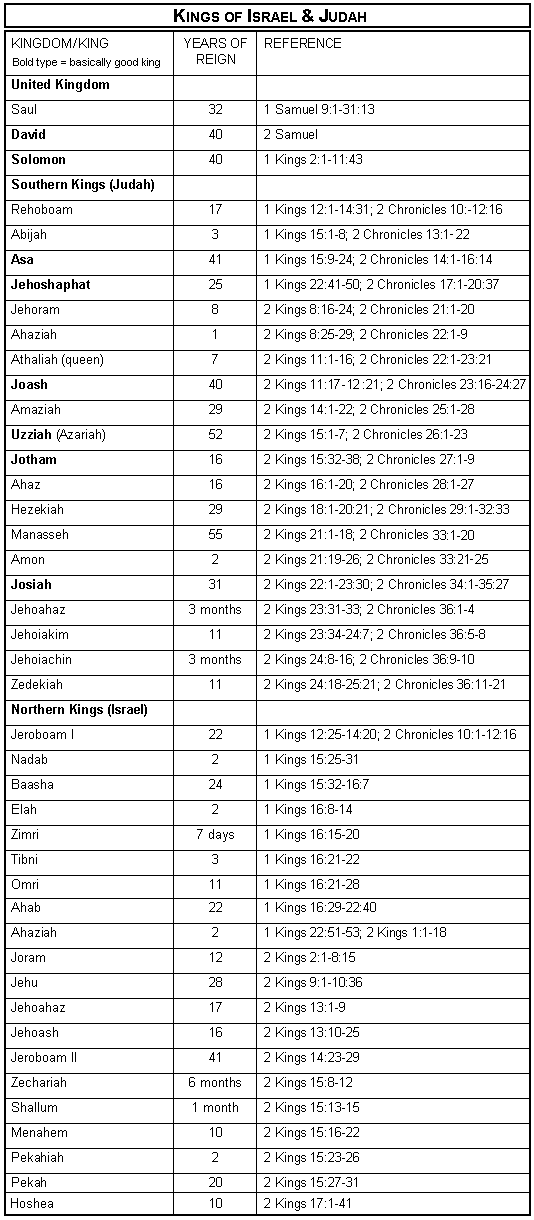
ESV chart - kings of Israel - more information
ESV chart - kings of Judah - more information
Another Chart with Variable Dates for Reigns of Kings
2 Chronicles 27:1 Jotham was twenty-five years old when he became king, and he reigned sixteen years in Jerusalem. And his mother’s name was Jerushah the daughter of Zadok.
- twenty-five years old: 2Ki 15:32,33-38 1Ch 3:12 Isa 1:1 Ho 1:1 Mic 1:1 Mt 1:9, Joatham
- CLICK 2 CHRONICLES COMMENTARIES FOR MULTIPLE SERMONS AND COMMENTARIES
- See BELOW FOR BIBLIOGRAPHY FOR 1-2 CHRONICLES - adapted from Paul Apple's Bible Outlines
Related Passage:
2 Kings 15:32-38 In the second year of Pekah the son of Remaliah king of Israel, Jotham the son of Uzziah king of Judah became king. He was twenty-five years old when he became king, and he reigned sixteen years in Jerusalem; and his mother’s name was Jerusha the daughter of Zadok. 34 He did what was right in the sight of the LORD; he did according to all that his father Uzziah had done. 35 Only the high places were not taken away; the people still sacrificed and burned incense on the high places. He built the upper gate of the house of the LORD. 36 Now the rest of the acts of Jotham and all that he did, are they not written in the Book of the Chronicles of the Kings of Judah? 37 In those days the LORD began to send Rezin king of Aram and Pekah the son of Remaliah against Judah. 38 And Jotham slept with his fathers, and he was buried with his fathers in the city of David his father; and Ahaz his son became king in his place.
2 Kings 15:30 And Hoshea the son of Elah made a conspiracy against Pekah the son of Remaliah, and struck him and put him to death and became king in his place, in the twentieth year of Jotham the son of Uzziah.
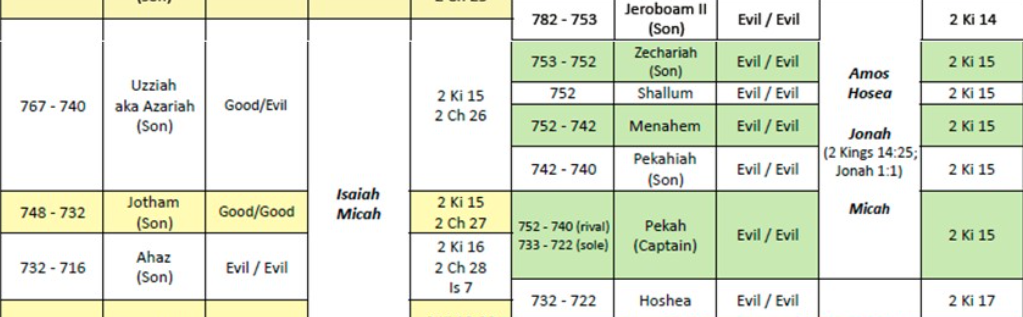
Jotham was twenty-five years old when he became king, and he reigned sixteen years in Jerusalem. And his mother’s name was Jerushah the daughter of Zadok. Jotham receives nothing but plaudits from the chronicler. 2 Kings 15:5 speaks of Jotham's coregency writing "The LORD struck the king, so that he was a leper to the day of his death. And he lived in a separate house, while Jotham the king’s son was over the household, judging the people of the land."
Bob Utley points out that "It is surprising that nothing negative is said about this king. He was faithful from the first to the last. The only negative item (2 Chr. 27:2) is attributed to "the people." Because of this it is surprising he does not receive more attention from the Chronicler. Also note that he did not have a godly counselor, did not receive a prophetic warning and did not receive a priestly warning. (ED: All 3 advantages were give to other kings but without the flawless record of Jotham!)
Raymond Dillard: Jotham’s sixteen years included a ten-year coregency due to the illness (LEPROSY) of his father Uzziah (750–740/39 B.C.); however, the sixteen-year figure did not include a three-to-four-year overlap of his reign with that of his own son and successor Ahaz (735–732/31 B.C.), a fact that would allow for the synchronism with Jotham’s twentieth year (2 Kgs 15:30). (2 Chronicles BORROW)
Kevin D. Zuber makes an excellent observation - As has been noted, a main theme of the Chronicler is that the when the Davidic king “seeks the Lord” there is blessing and prosperity—enjoyment of the blessings of the covenant promises. But when the king “forsakes the Lord” there is loss of blessing and chastisement for both the nation and the king. This theme is once again in focus in the accounts of the next six kings. The vacillation between “good kings” and “bad kings” was not merely a historical reality. It also provided the Chronicler the opportunity to drive the lesson home: faithfulness and obedience bring the blessing of the Lord, and disobedience brings His displeasure and loss of blessing. The ultimate loss of blessing was the Babylonian captivity—the loss of enjoying the land itself. In these accounts the Chronicler began to foreshadow (what his generation knew all too well was) that inevitable reality. (Moody Bible commentary)
Raymond Dillard: This wholly positive account of Jotham represents a break in the Chronicler’s practice seen in the preceding three reigns of dividing his accounts of individual kings into alternating periods of good and bad; he will follow the practice of presenting a single consistent judgment through his account of Hezekiah (Williamson, 341). (2 Chronicles BORROW)
Geoffrey Kirkland: Background & Bigger Context of the Ancient Near Eastern World: Jotham reigned in a period when the Assyrians were on the rise -- powerfully, globally, increasingly, fearfully, and violently! And the contemporary prophets were Hosea, Micah, Amos and Isaiah. (this gives us a clue as to the society/culture of life in Judah during Jotham’s reign). See Isaiah 1:1; 7:1; Hosea 1:1; Micah 1:1 [all speak of the reign of “Jotham” during these prophetic times] This speaks of a corrupt, unjust, idolatrous, pagan, deceitful, greedy, arrogant time in Judah & Israel!
Frederick Mabie: The summary evaluation of Jotham is similar to that of Uzziah (cf. 2Ch 26:4). As with Uzziah (recall their long coregency; cf. v. 1), Jotham “grew powerful” (v. 6), enjoyed success in battle (v. 5), and received tribute from foreign nations (v. 5). Unlike Uzziah, however, Jotham did not grow proud and challenge Yahweh’s covenantal bounds regarding temple service, but instead “walked steadfastly” (or better, “caused his ways to be ordered”) before the Lord (v. 6). Unfortunately, the people under Jotham’s rule were not similarly inspired to pursue covenantal faithfulness. (The Expositor’s Bible Commentary Revised Edition – 1 & 2 Chronicles)
Andrew Hill: The Chronicler’s review of Jotham’s reign applauds achievements on three fronts: his building program, his military success, and his consolidation of political power (2Ch 27:3-6). (The NIV Application Commentary )
L.M. Grant: Jotham's reign was comparatively short, just 16 years, and he died at 41years. He did what was right as his father had done, though he did not follow his father's bad example of entering the temple of the Lord. Yet in spite of his reign being better than most of the kings, the people still acted corruptly. This evil included their sacrificing in high places (2 Kings 15:35). Thus, though Jotham was personally faithful to the Lord, he did not have the spiritual energy to banish the false worship from Judah. But his good work of building the upper gate of the temple and on the wall of Ophel, and his building cities in the mountains and fortresses and towers in the forests, is commendable (vv.3-4). Jotham also by warfare brought the Ammonites into subjection, so that they paid him tribute of 100 talents of silver, 10,000 cors; of wheat and 10,000 of barley for three years in succession (v.5). The Ammonites picture the doctrine of demons, which, though not destroyed, were allowed no liberty during Jotham's reign. Thus we are told, "Jotham became mighty because he prepared his ways before the Lord his God" (v.6). His short reign of 16 years, he died and was buried in Jerusalem. Then his son Ahaz became king.
Matthew Henry Notes: 2Ch 26:1-9
There is not much more related here concerning Jotham than we had before, 2 Ki. 15:32, etc.
I. He reigned well. He did that which was right in the sight of the Lord; the course of his reign was good, and pleasing to God, whose favour he made his end, and his word his rule, and (which shows that he acted from a good principle) he prepared his ways before the Lord his God (v. 6), that is, he walked circumspectly and with much caution, contrived how to shun that which was evil and compass that which was good. He looked before him, and cast his affairs into such a posture and method as made the regular management of them the more easy. Or he established or fixed his ways before the Lord, that is, he walked steadily and constantly in the way of his duty, was uniform and resolute in it: not like some of those that went before him, who, though they had some good in them, lost their credit by their inconstancy and inconsistency with themselves. They had run well, but something hindered them. It was not so with Jotham. Two things are observed here in his character:-
1. What was amiss in his father he amended in himself (2Ch 27:2): He did according to all that his father did well and wisely; howbeit he would not imitate him in which he did amiss; for he entered not into the temple of the Lord to burn incense as his father did, but took warning by his fate not to dare so presumptuous a thing. Note, We must not imitate the best men, and those we have the greatest veneration for, any further than they did well; but, on the contrary, their falls, and the injurious consequences of them, must be warnings to us to walk the more circumspectly, that we stumble not at the same stone that they stumbled at.
2. What was amiss in his people he could not prevail to amend: The people did yet corruptly. Perhaps it reflects some blame upon him, that he was wanting in his part towards the reformation of the land. Men may be very good themselves, and yet not have courage and zeal to do what they might do towards the reforming of others. however it certainly reflects a great deal of blame upon the people, that they did not do what they might have done to improve the advantages of so good a reign: they had good instructions given them and a good example set before them, but they would not be reformed; so that even in the reign of their good kings, as well as in that of the bad ones, they were treasuring up wrath against the day of wrath; for they still did corruptly, and the founder melted in vain.
II. He prospered, and became truly reputable.
1. He built. He began with the gate of the house of the Lord, which he repaired, beautified, and raised. He then fortified the wall of Ophel, and built cities in the mountains of Judah (2Ch 27:3, 4), took all possible care for the fortifying of his country and the replenishing of it.
2. He conquered. He prevailed against the Ammonites, who had invaded Judah in Jehoshaphat's time, 2Ch 20:1. He triumphed over them, and exacted great contributions from them, 2Ch 27:5. He became mighty (2Ch 27:6) in wealth and power, and influence upon the neighbouring nations, who courted his friendship and feared his displeasure; and this he got by preparing his ways before the Lord his God. The more stedfast we are in religion the more mighty we are both for the resistance of that which is evil and for the performance of that which is good.
III. He finished his course too soon, but finished it with honour.
He had the unhappiness to die in the midst of his days; but, to balance that, the happiness not to out-live his reputation, as the last three of his predecessors did. He died when he was but forty-one years of age (2Ch 27:8); but his wars and his ways, his wars abroad and his ways at home, were so glorious that they were recorded in the book of the kings of Israel, as well as of the kings of Judah, 2Ch 27:7.
The last words of the chapter are the most melancholy, as they inform us that Ahaz his son, whose character, in all respects, was the reverse of his, reigned in his stead. When the wealth and power with which wise men have done good devolve upon fools, that will do hurt with them, it is a lamentation, and shall be for a lamentation.
QUESTION - Who was King Jotham in the Bible?
ANSWER - Jotham became king of Judah at age twenty-five and reigned for sixteen years, from 750 to 735 BC (2 Kings 15:33; 2 Chronicles 27:1). “He did what was right in the eyes of the Lord, just as his father Uzziah had done, but unlike him he did not enter the temple of the Lord. The people, however, continued their corrupt practices” (2 Chronicles 27:2; see also 2 Kings 15:34–35). King Uzziah had been faithful to the Lord but then became prideful and attempted to burn incense on the altar of the Lord, something only priests were permitted to do (2 Chronicles 26:16–20). As a result, God afflicted Uzziah with leprosy. Uzziah lived out the rest of his days in a separate house, while his son Jotham oversaw the palace and governed the people (2 Chronicles 26:21). Jotham did not repeat his father’s mistake of presumptuously entering the temple.
“Jotham grew powerful because he walked steadfastly before the Lord his God” (2 Chronicles 27:6). He rebuilt the Upper Gate of the temple and also did work on the wall at the hill of Ophel and built towns, forts, and towers (2 Chronicles 27:3–4). However, King Jotham failed to remove the high places so the people continued to make sacrifices there (2 Kings 15:35). Jotham waged a successful war against the Ammonites, resulting in their paying him tribute for three years (2 Chronicles 27:5). During Jotham’s reign “the Lord began to send Rezin king of Aram and Pekah son of Remaliah against Judah” (2 Kings 15:37). During the reign of Jotham’s son Ahaz, the Arameans would march against Judah, resulting in defeat and heavy casualties for Judah (2 Chronicles 28:5). Initial defeat was followed by Ahaz seeking help from the Assyrians and ultimately looting and shutting up God’s temple and creating more high places (2 Kings 16:5–18; 2 Chronicles 28:5–25).
Isaiah, Hosea, and Micah all prophesied during Jotham’s reign (Isaiah 1:1; Hosea 1:1; Micah 1:1). Also, the genealogies in 1 Chronicles 1–5 were recorded during Jotham’s reign (1 Chronicles 5:17).
Despite Jotham’s godly example, his son Ahaz proved to be a wicked king. Even so, both Jotham and Ahaz are ancestors of Jesus Christ (Matthew 1:9). God is able to use all people to accomplish His good purposes.GotQuestions.org
|
2 KINGS 15:32-38 |
2 CHRONICLES 26:1-9 |
|
2 Kings 15:32 In the second year of Pekah the son of Remaliah king of Israel, Jotham the son of Uzziah king of Judah became king. |
|
|
2 Kings 15:33 He was twenty-five years old when he became king, and he reigned sixteen years in Jerusalem; and his mother’s name was Jerusha the daughter of Zadok. |
2 Chronicles 27:8 He was twenty-five years old when he became king, and he reigned sixteen years in Jerusalem. |
|
2 Kings 15:34 He did what was right in the sight of the LORD; he did according to all that his father Uzziah had done. |
2 Chronicles 27:2 He did right in the sight of the LORD, according to all that his father Uzziah had done; however he did not enter the temple of the LORD. But the people continued acting corruptly. |
|
2 Kings 15: 35 Only the high places were not taken away; the people still sacrificed and burned incense on the high places. He built the upper gate of the house of the LORD. |
2 Chronicles 27:3 He built the upper gate of the house of the LORD, and he built extensively the wall of Ophel. |
|
2 Chronicles 27:4 Moreover, he built cities in the hill country of Judah, and he built fortresses and towers on the wooded hills. |
|
|
2 Kings 15:36 Now the rest of the acts of Jotham and all that he did, are they not written in the Book of the Chronicles of the Kings of Judah? |
2 Chronicles 27:7 Now the rest of the acts of Jotham, even all his wars and his acts, behold, they are written in the Book of the Kings of Israel and Judah. |
|
2 Kings 15:33 He was twenty-five years old when he became king, and he reigned sixteen years in Jerusalem; and his mother’s name was Jerusha the daughter of Zadok. |
2 Chronicles 27:1 Jotham was twenty-five years old when he became king, and he reigned sixteen years in Jerusalem. And his mother’s name was Jerushah the daughter of Zadok. 2 Chronicles 27:8 He was twenty-five years old when he became king, and he reigned sixteen years in Jerusalem. |
|
2 Kings 15:37 In those days the LORD began to send Rezin king of Aram and Pekah the son of Remaliah against Judah. |
|
|
2 Kings 15:38 And Jotham slept with his fathers, and he was buried with his fathers in the city of David his father; and Ahaz his son became king in his place. |
2 Chronicles 27:9 And Jotham slept with his fathers, and they buried him in the city of David; and Ahaz his son became king in his place. |
2 Chronicles 27:2 He did right in the sight of the LORD, according to all that his father Uzziah had done; however he did not enter the temple of the LORD. But the people continued acting corruptly.
- And he did: 2Ch 26:4 2Ki 15:34
- he did not enter the temple of the LORD 2Ch 26:16-21 Ps 119:120 Ac 5:13
- the people continued acting corruptly: 2Ki 15:35
Related Passages:
2 Kings 15:35 Only the high places were not taken away; the people still sacrificed and burned incense on the high places. He built the upper gate of the house of the LORD.
2 Chronicles 26:16-21 (THE SAD STORY OF JOTHAM'S FATHER UZZIAH) But when he became strong, his heart was so proud that he acted corruptly, and he was unfaithful to the LORD his God, for he entered the temple of the LORD to burn incense on the altar of incense. 17 Then Azariah the priest entered after him and with him eighty priests of the LORD, valiant men. 18 They opposed Uzziah the king and said to him, “It is not for you, Uzziah, to burn incense to the LORD, but for the priests, the sons of Aaron who are consecrated to burn incense. Get out of the sanctuary, for you have been unfaithful and will have no honor from the LORD God.” 19 But Uzziah, with a censer in his hand for burning incense, was enraged; and while he was enraged with the priests, the leprosy broke out on his forehead before the priests in the house of the LORD, beside the altar of incense. 20 Azariah the chief priest and all the priests looked at him, and behold, he was leprous on his forehead; and they hurried him out of there, and he himself also hastened to get out because the LORD had smitten him. 21 King Uzziah was a leper to the day of his death; and he lived in a separate house, being a leper, for he was cut off from the house of the LORD. And Jotham his son was over the king’s house judging the people of the land.
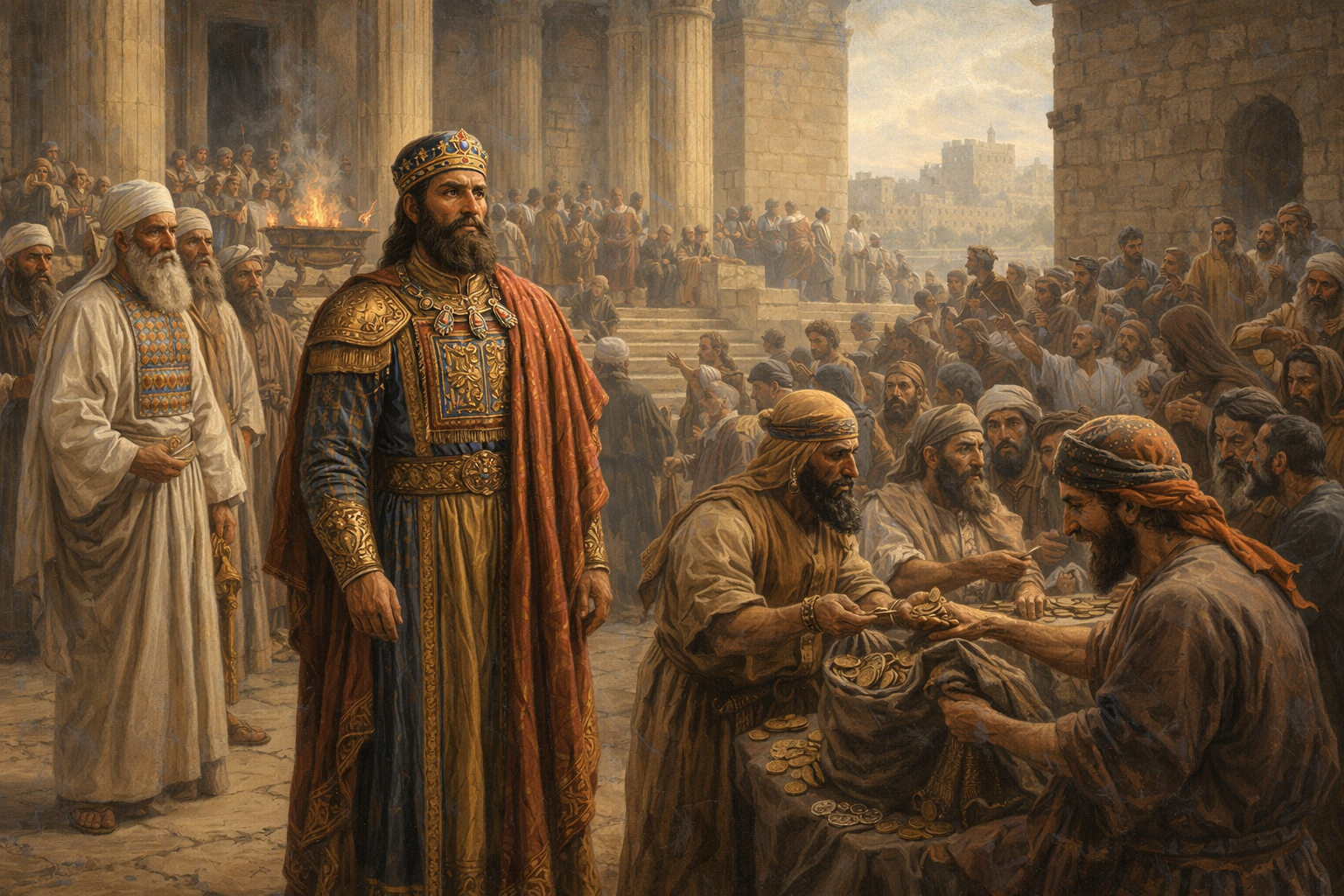
Righteous King <> Corrupt People
JOTHAM NOT LIKE FATHER
LIKE SON!
He did right (yashar) in the sight of the LORD, - The Hebrew word yashar means “straight, upright, or morally level,” describing a life aligned with God’s revealed standard rather than the crooked patterns of the surrounding culture (cf Php 2:15). The phrase in the sight of the LORD (see Coram Deo) reminds us that the true measure of a king was not political success, military strength, or public approval, but how his heart and actions appeared before the searching eyes of Yahweh (Pr 15:3, Heb 4:13, 2Ch 16:9). Jotham’s reign is therefore evaluated by a divine, not human, yardstick.
According to all that his father Uzziah had done, HOWEVER (crucial term of contrast) he did not enter the Temple of the LORD - Note the contrast word however, indicating Jotham followed the right things his father had done but not the bad things. He copied his father's conduct as far as it was pious and constitutional; and avoided his transgression. Specifically he did not dare attempt to offer incense. Why not? He had a living example of God's punishment that he could see every day as a reminder God will punish sin! This surely was a major motivating factor in Jotham's good behavior, for he co-reigned for the first 10 years with his father who was leprous. Ten years of seeing leprosy on his father's forehead convinced him he did not want to incur the same divine curse! The phrase he did not enter the temple does not mean he never went to the area, but simply that he assiduously stayed away from the areas that were off limits to all but the priests.
In summary, the Chronicler is saying that Jotham embraced the early, faithful pattern of Uzziah’s rule, not the tragic pride that later marred it. His obedience was steady and sincere, though not perfect, showing that a righteous, godly life in Scripture is often measured by direction not perfection!
🙏 THOUGHT - Ron Daniel on the word "HOWEVER" - This gets me thinking. Dad was a good example for the most part. But he also left a bad example. Parents, we must strive to be a good example to our kids. I wonder how many dads are sending the message to their children today, "Do what I say, not what I do"? Moms telling their daughters not to smoke, when they themselves do so regularly. Dads telling their sons not to drink, in spite of the obvious hypocrisy. Parents telling their children to be wise with their money, when the kids see the glaring inconsistency. We need to be examples for our children. After Jesus had washed the disciples' feet, He said, John 13:15 "...I gave you an example that you also should do as I did to you." And we also need to be honest about our example. Admitting when we've messed up. Confessing when we've been a bad example. Repenting when we've been ungodly. Our kids need our honesty as much as they need our example. (ED: I LIKE THAT - I WAS NOT THE MOST ATTENTIVE DAD TO MY YOUNGEST DAUGHTER AND PAID A DEAR PRICE FOR MY NEGLECT. I HAVE CONFESSED THIS TO HER AND SOUGHT HER FORGIVENESS WHICH SHE GAVE! HOWEVER, IT TOOK ME MANY YEARS TO REALIZE WHAT I HAD DONE OR RATHER LEFT UNDONE!) That way, they can look back and say, "Do what dad did... but not the bad stuff." Or, as the apostle Paul was able to tell the Corinthians, 1Cor. 11:1 "Be imitators of me, just as I also am of Christ."
But - This is a sad and somewhat surprisingly term of contrast. The king did right, while the people did wrong! Normally when a leader leads out, the people will follow (Jdg 5:2), but not this time. Jotham's faithfulness is a striking contrast with the people's unfaithfulness. In short, this BUT highlights the tragic gap between godly leadership and the spiritual condition of the nation. Even though Jotham personally walked uprightly and sought to honor the LORD, the hearts of many in Judah remained unchanged.
The new king was following the old king's good example,
while the people were following the old king's bad example.
-- Ron Daniel
The people continued acting corruptly (shachath - first use Ge 6:11) - Note this is the same verb shachath is used of King Uzziah in 2Ch 26:16 describing his heart as "so proud that he acted corruptly!" Jotham's personal piety did not prevent the people's pagan practices.
The Hebrew phrase continued acting corruptly (shachath) indicates this was their ongoing pattern. The people were not merely slipping. They were staying on a wrong path! The Hebrew (shachath) carries the sense of ruining, spoiling, or perverting what God intended, doing so especially through high places where they undoubtedly were mixing pagan practices with worship of Yahweh (aka syncretism). It pictures something once sound that has become rotten, like wood eaten by invisible termites from the inside or water that looks good but has become polluted. So the people were not necessarily abandoning religion but they were corrupting it, keeping the Name of Jehovah while living contrary to His ways. A righteous king could set an example, but he could not change hearts. The phrase quietly teaches that national character is not fixed by the throne but by the choices of ordinary people. Clearly, old habits, pagan influences, and love for the high places clung stubbornly to the people.
🙏 THOUGHT - Dear believer, do you (do I) have any old habits, lingering pagan influences, or secret affection for the “high places” that marked our life before Christ? Those "high places" may not be carved idols on a hill, but they can be familiar patterns of ungodly thoughts or sensual images, passing pleasures (Heb 11:25b) or worldly comforts (alcohol, drugs, etc) we run to instead of running to Christ (Heb 12:1, Heb 12:2, Php 3:13,14, cf Expulsive Power of a New Affection), relationships that ensnare us (cf Ps 25:15) and pull our hearts backward (cf Backsliding or Slowly Drifting), or sins we have learned to tolerate because they feel "normal." Scripture tells us that we are a new creation in Christ and the old things have passed away (2Co 5:17), yet the Old Man does not surrender territory easily. Like poison ivy clinging to a strong oak (cf Isa 61:3b), former ways can wrap themselves around the New Man and slowly sap our spiritual vitality. The Lord calls us not merely to manage these remnants but to tear them down (cf Dt 7:5, Dt 12:3), just as faithful kings did who were commanded to remove the high places (Dt 12:2, cf Asa - 2Ch 14:3, Jehoshaphat - 2Ch 17:6, Hezekiah 2Ki 18:4, Josiah 2Ki 23:8, 13). True freedom (Jn 8:32, 36, Lk 4:18, Ro 8:2, 2Co 3:17, Ga 5:1) is found when we allow the Holy Spirit to search every corner of our heart (cf Ps 139:23,24), when we name as sin (1Jn 1:9, Pr 28:13) what we have euphemistically excused as our "weakness," and when we bring even our most stubborn attachments into the light of Christ’s transforming grace (1Jn 1:6,7), allowing the Spirit to tear them down (Ro 8:13, Col 3:5KJV).
Acting corruptly (shachath) is translated in the Septuagint with the verb kataphtheiro (root gives us English "Diphtheria") which literally means to destroy (in Lev 26:39 = "will rot away because of their iniquity") or to ruin and here is in the imperfect tense (over and over, again and again) and middle voice this voice indicating that they were making the conscious choice to do this to themselves, i.e, choosing to ruin themselves! That's what unconfessed, persistent sin will do to the human soul!) There was a pretence of religion without reality and scrupulous ceremonialism was made a cloak for evil-doing. But Jotham was no party to this. The records do not charge him with any form of sin, as is done in the case of all the other kings of Judah. In his day Amos, Hosea and Isaiah prophesied. And in Isaiah 1-5, which addresses primarily the nation of Judah and its capital Jerusalem, we get a good picture of the corruption of the people! Isaiah was confronting the Southern Kingdom for its corrupt worship and unjust living while calling it back to covenant faithfulness.
The record of Jotham's father Uzziah/Azariah in 2 Kings would help explain to some extent the people's ongoing corruption, for the writer records that "the high places were not taken away; the people still sacrificed and burned incense on the high places." (2 Kings 15:4)
It is worth noting that Jotham did not have a godly counselor, did not receive a prophetic warning and did not receive a priestly warning.
Moody Bible Commentary adds that "The corrosive influence of idolatry that had afflicted the nation during the reigns of Joash and Amaziah had not been overcome even during the long reign of Uzziah. Such are the pervasive and lasting effects of ungodliness and evil upon a nation. The Chronicler’s generation was being warned, “Do not let the evil of idolatry take root again.” (Moody Bible commentary)
Bob Utley on people continued acting corruptly feels that "this refers to fertility worship. None of the kings of Judah, so far, were successful at removing the local Ba'al worship sites (i.e., 2 Kgs. 14:4; 15:35). See FERTILITY WORSHIP OF THE ANE." ED: Utley's assumption of what acting corruptly means may be accurate because of the persistence of the high places, where such activities were carried out.
Christopher Knapp: Jotham is the only one of all the Hebrew kings, from Saul down, against whom God has nothing bad to record. In this his character is in beautiful accord with his name, Jehovah-perfect.
Right (03477) yashar from the verb yashar = to be smooth, straight or right) is an adjective that means straight; reliable, level, pleasing; upright; righteous. Yashar only rarely is used literally of that which is straight (Ezek 1:7). Yashar can refer to something physical like a path, but even in those uses is often a metaphorical description of one's conduct or behavior (Ps 107:7). Most uses refer to that which is right in an ethical or an emotional sense, as agreeable or pleasing. It is fitting that God is the standard of yashar (what is "straight") (Ps 92:15, called the "Upright One" - Isa 26:7). God's Word is described as upright (right) (Ps 19:7) as are His judgments (Ps 119:137) and His way (Ps 107:7). "God made men upright (Ge 1:27), but they have sought out many devices." (Eccl 7:29)
Yashar is frequently used to describe our moral/ethical heart as "upright in heart" (Ps 7:10, 11:2, 32:11, 36:10, 64:10, 94:15, 97:11, 111:1, 125:4) (See all uses in Psalms and Proverbs below). Indeed, the upright "will behold His face" (Ps 11:7), will experience gladness (Ps 97:11), will be gathered together in the assembly (Ps 111:1), will be blessed (Ps 112:2), will be given light in times of darkness (Ps 112:4), will dwell in God's presence (Ps 140:13, cp Pr 2:21), have access to God's sound wisdom (Pr 2:7), will experience intimacy with the Most High God (Pr 3:32), will be guided by their integrity (Pr 11:3), will be delivered by their righteousness (Pr 11:6), will be delivered by their words (Pr 12:6), will see their tents flourish (Pr 14:11). "The highway of the upright is to depart from evil." (Pr 16:17)
YASHAR IN KINGS AND CHRONICLES - 1 Ki. 11:33; 1 Ki. 11:38; 1 Ki. 14:8; 1 Ki. 15:5; 1 Ki. 15:11; 1 Ki. 22:43; 2 Ki. 10:3; 2 Ki. 10:15; 2 Ki. 10:30; 2 Ki. 12:2; 2 Ki. 14:3; 2Ki. 15:3; 2Ki. 15:34; 2Ki. 16:2; 2Ki. 18:3; 2Ki. 22:2; 2Chr. 14:2; 2Chr. 20:32; 2Chr. 24:2; 2 Chr. 25:2; 2 Chr. 26:4; 2 Chr. 27:2; 2 Chr. 28:1; 2 Chr. 29:2; 2 Chr. 29:34; 2 Chr. 31:20; 2 Chr. 34:2
Right in the sight - 25x - Deut. 12:25; Deut. 12:28; Deut. 13:18; 1 Ki. 15:5; 1 Ki. 15:11; 1 Ki. 22:43; 2 Ki. 12:2; 2 Ki. 14:3; 2 Ki. 15:3; 2 Ki. 15:34; 2 Ki. 16:2; 2 Ki. 18:3; 2 Ki. 22:2; 2 Chr. 14:2; 2 Chr. 20:32; 2 Chr. 24:2; 2 Chr. 25:2; 2 Chr. 26:4; 2 Chr. 27:2; 2 Chr. 28:1; 2 Chr. 29:2; 2 Chr. 30:4; 2 Chr. 34:2; Acts 4:19; Rom. 12:17
Acting corruptly (07843) shachath means to decay, to go to ruin, to corrupt, to destroy (Sodom and Gomorrah = Ge 13:10, Ge 18:28, 31-32), to lay waste (Egypt from swarms of flies -Ex 8:24). Shachath is used of Israelites who worshiped the golden calf (Ex 32:7; Dt 9:12; 32:5, Hos 9:9). God warned He would destroy Israel if they were turned away from following Him (Nu 32:15). Shachath describes Israel's behavior as more corrupt after a judge died (Jdg 2:19).
Shachath in Kings and Chronicles - 2Ki. 8:19; 2Ki. 13:23; 2Ki. 18:25; 2Ki. 19:12; 1Chr. 20:1; 1Chr. 21:12; 1Chr. 21:15; 2Chr. 12:7; 2Chr. 12:12; 2Chr. 21:7; 2Chr. 24:23; 2Chr. 25:16; 2Chr. 26:16; 2Chr. 27:2; 2Chr. 34:11; 2Chr. 35:21; 2Chr. 36:19;
Leslie Allen - In verse 2 Jotham’s goodness shines out all the brighter by being set against a drab background of contrasting ills, perpetrated by his predecessor and by the people. It is a goodness that takes its cue from the will of God. In the books of Judges and Proverbs an opposite principle is featured, doing what is right in one’s own eyes (Judg. 17:6; 21:25; Prov. 12:15; cf. 30:12). The hallmark of biblical faith is to look at life through God’s eyes. The fact that “He has shown you, O man, what is good” (Mic. 6:8) is taken seriously. Neither expediency nor any other form of self-interest is to lie at the root of the believer’s motivation for living. Faith has a practical flowering when God is accepted as the arbiter of right and wrong. The result may often coincide with the ideals of the noble pagan—which may well be post-Christian relics—but not necessarily so. The norms of society have constantly to be brought to the bar of biblical ethics before the believer can endorse them in his or her attitudes. In New Testament terms his principle is enshrined in the challenge “Do not be conformed to this world, but be transformed by the renewing of your mind, that you may prove what is that good and acceptable and perfect will of God” (Rom. 12:2).For a weak Judah in post-exilic times, harassed by neighbors and eking out a bare economic existence, such operations had a mouth-watering appeal. The message is that God can meet His people at the point of their need, developing potential in the spheres where now there is failure. (See The Preacher's Commentary - Vol. 10: 1 and 2 Chronicles - Page 27)
2 Chronicles 27:3 He built the upper gate of the house of the LORD, and he built extensively the wall of Ophel.
- upper gate: 2Ch 23:20 Jer 20:2
- Ophel: 2Ch 33:14 Ne 3:26,27
Parallel Passage:
2 Kings 15:35 Only the high places were not taken away; the people still sacrificed and burned incense on the high places. He built the upper gate of the house of the LORD.
Related Passages:
2 Chronicles 26:9 Moreover, Uzziah built towers in Jerusalem at the Corner Gate and at the Valley Gate and at the corner buttress and fortified them.
2 Chronicles 23:20 (TIME OF KING JOASH - PROBABLY SAME AS UPPER GATE IN 2Ch 27:3) He took the captains of hundreds, the nobles, the rulers of the people and all the people of the land, and brought the king (JOASH) down from the house of the LORD, and came through the upper gate to the king’s house. And they placed the king upon the royal throne.
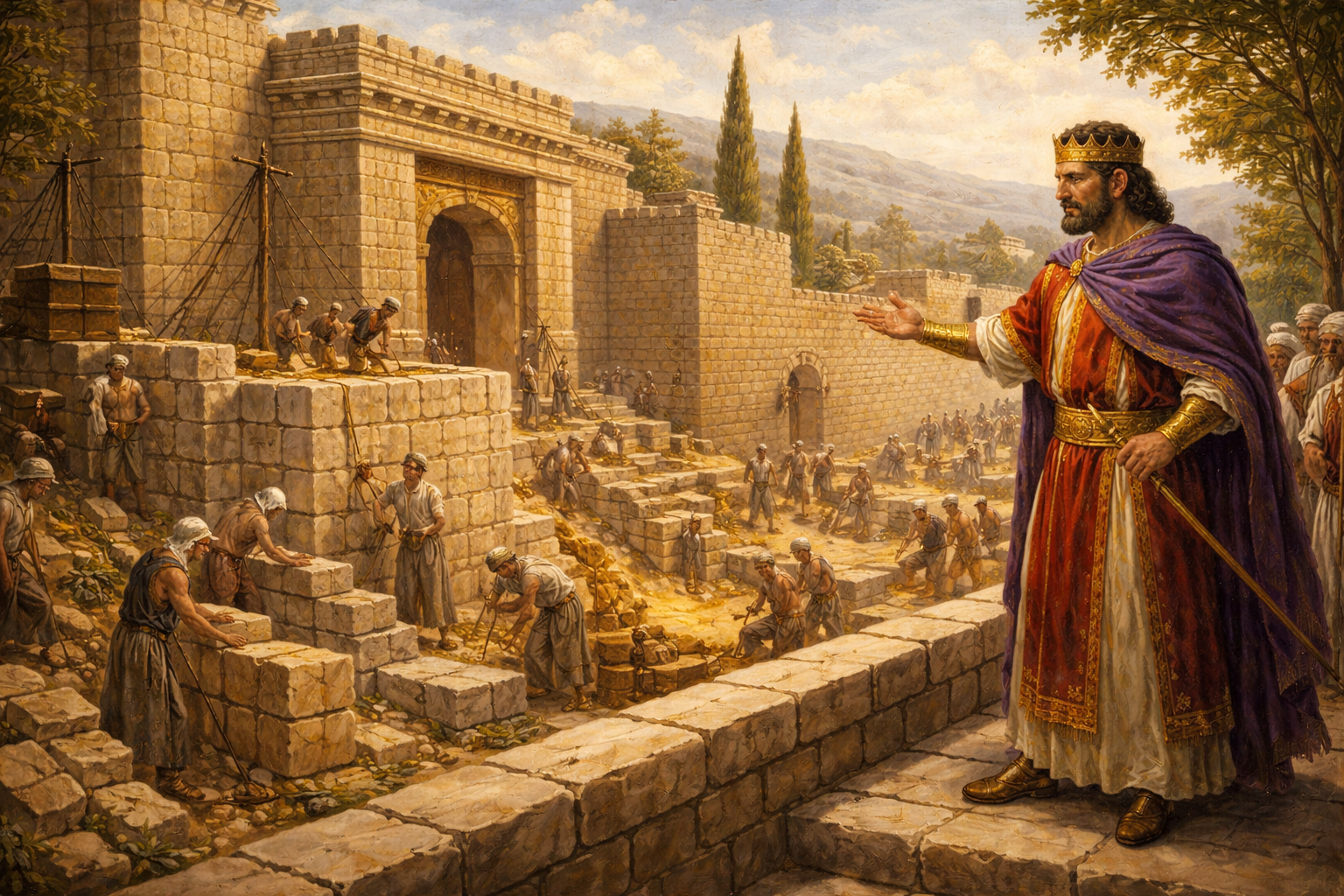
JOTHAM'S BUILDING PROJECTS
FOCUS FIRST ON GOD
He built the upper gate (North side) of the house of the LORD, and he built extensively the wall of Ophel - The Ophel (see diagrams below) was the fortification along the raised narrow ridge in Jerusalem that lies between the city of David (to the south) and the Temple Mount Moriah (to the north). It describes the raised spur connecting the original Jebusite/City of David with Solomon’s Temple platform. Think of it as the bridge of high ground joining the royal city to the sacred precinct. Excavations in the area of the Ophel have uncovered massive stones from the First Temple period, towers and gates from Jotham/Hezekiah’s era. If you stand there today you are literally between the southern steps of the Temple, and the northern end of the City of David.
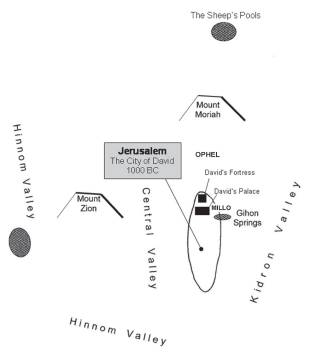
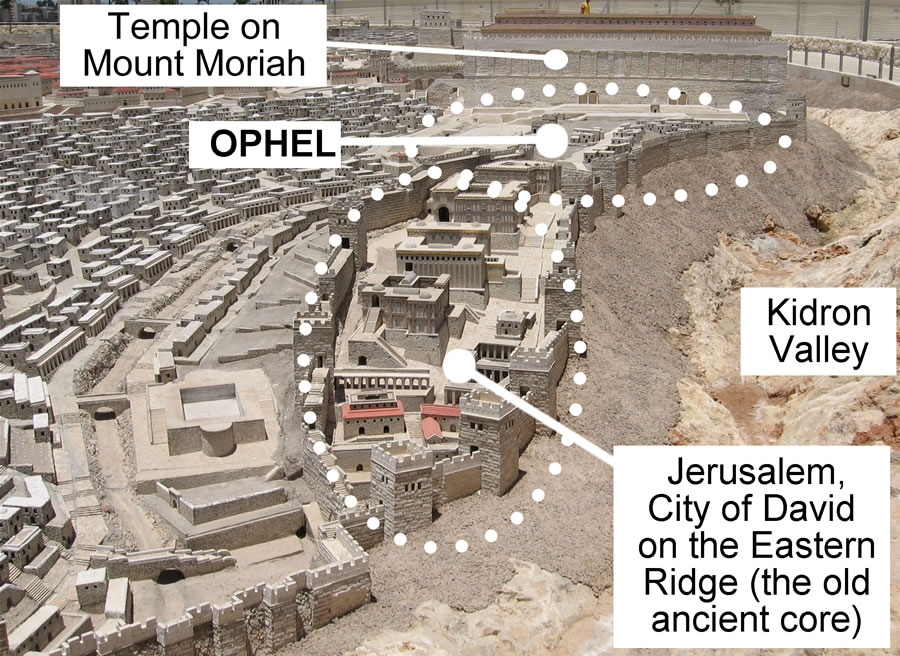
What is notable is that in Jotham's building projects, the first thing recorded relates to the Temple complex or as one writer says "As a true Davidic king he took an interest in the temple." Now go back and read about his father Uzziah's building projects and there is no mention of projects related to the Temple! (cf 2Ch 26:6,9,10)
From the very outset we can see that Jotham has his priorities straight, and to such an extent that God does not see it necessary to send a prophet to keep him on the "straight and narrow." Recall that 2Ch 26:5 says that Uzziah "continued to seek God in the days of Zechariah, who had understanding through the vision of God; and as long as he sought the LORD, God prospered him." So Uzziah did have a prophet (Zechariah but not the one who wrote the post-exilic prophecy) that exerted significant influence on him up until the time his heart became prideful at all his achievements (2Ch 26:16).
Bob Utley on the upper gate - It was an entrance to the temple court on the north (cf. 2Ki 15:35; 2Ch 23:20). It is unsure if Jotham built it or refurbished it. Apparently Jotham was very conscious of the sacredness of the temple. Later in Jehoiakim's time this gate was renamed "the New Gate." It was the location of the positioning of a large number of temple guards (i.e., 2Ki 11:6).
Jerry Thrower emphasizes that "One of the first things he did had to do with repairing the Temple of the LORD. He served the LORD first! He went to work for the LORD and did something for HIM! He didn’t enter the Temple like is father did in pride and try to do what he was never called to do, “he did that which was right in the sight of the LORD”, he used his reign to serve the LORD! He showed that by repairing the Temple!"
Mark Boda: Interestingly, if the “upper gate” referred to here was that gate that linked the royal palace to the Temple courts (cf. 2Ch 23:20), Jotham’s reconstruction work may signal a desire to protect the Temple courts from royal intrusion. (Cornerstone Biblical Commentary – 1-2 Chronicles.)
J. Parker: Ophel means “the mount.” Where was the mount? On the southern slope. Why did the king build so much on Ophel? Because it was most accessible to the enemy. Like a wise commander he remembered that no man is stronger than his weakest point, and that no fortification is stronger than its frailest part; so the king built much where the wall was weakest, or where the access of the enemy was most open; and in doing so he gathered up and represented the wisdom and experience of the ages, and anticipated what we and all the sons of time ought to do. What is your weakest point in life? Build much there.
Raymond Dillard: The Chronicler has already compared Jotham with Uzziah (2Ch 27:2), and he appears to be deliberately perfecting the parallel. Uzziah rebuilt Corner Gate and Valley Gate (2Ch 26:9), and Jotham works on the Upper Gate of the temple. Uzziah built towers in the desert and in Jerusalem (2Ch 26:10), and Jotham builds towers in forested areas. (2 Chronicles BORROW)
August Konkel adds that "Jotham’s enterprises are a sequel to those of his father. The work of restoration begun by Uzziah was continued in sections that had not been completed. His forts and towers were in the forests, providing a network of lookouts and highway defenses, both on the frontier and within the kingdom." (Believers Church Bible Commentary – 1 & 2 Chronicles)
Ophel - Fortification strengthened by Jotham (2 Chr 27:3) and Manasseh (2 Chr 33:14). Isaiah describes the destruction of such a fortress when prophesying the judgment of God upon Jerusalem (Is 32:14). After the exile the temple servants lived there and repaired its walls (Neh 3:26, 27; 11:21). Josephus states that it was near the temple. Archaeological excavations at the traditional site in Jerusalem reveal fortifications dating from pre-Israelite times to the Maccabean period. (BORROW Baker encyclopedia of the Bible Volume: 3)
2 Chronicles 27:4 Moreover, he built cities in the hill country of Judah, and he built fortresses and towers on the wooded hills.
- he built cities: 2Ch 11:5-10 14:7 2Ch 26:9-10
- in the hill country: Jos 14:12,13 Lu 1:39
Related Passages:
2 Chronicles 26:10 He (KING UZZIAH, JOTHAM'S FATHER) built towers in the wilderness and hewed many cisterns, for he had much livestock, both in the lowland and in the plain. He also had plowmen and vinedressers in the hill country and the fertile fields, for he loved the soil.

STEADY PREPARATION
OVER RECKLESS AMBITION
Moreover, he built cities in the hill country of Judah, and he built fortresses and towers on the wooded hills. - Jotham followed in his father King Uzziah's footsteps continuing similar constructive policies but he did not follow in the footsteps of his father’s presumptive sin. His building program shows a king devoted to strengthening the internal life of Judah rather than seeking glory abroad. By establishing cities in the hill country, Jotham encouraged settlement and stability in regions that likely had been thinly populated and vulnerable to raids.
The fortresses and towers erected on the wooded hills formed a defensive network across the highlands. From these elevated positions watchmen could spot approaching enemies, protect shepherds and farmers, and safeguard the vital routes that connected Jerusalem with the outlying districts. Rather than relying only on armies, Jotham invested in infrastructure that protected everyday life—fields, flocks, and families.
This verse portrays a prudent and God-fearing ruler. Althought he did conduct some military actitivies, Jotham did not pursue conquests as much as Uzziah. His reign illustrates that true leadership is often measured not by dramatic victories but by patient, faithful preparation that enables a nation to flourish in peace. Lord, give us leaders like that today. In Jesus' Name. Amen.
Ron Daniel: He is building protection for the house of God. That is very interesting to me. You see, it seems that every time the enemy breaks into Jerusalem, they invade the temple and steal the valuable things which are sanctified for the Lord. This is the way our enemy still works. The enemy's primary goal is to invade the house of God and steal that which is sanctified for God! It is we "who have been sanctified in Christ Jesus, saints by calling." (1Co 1:2) (ED: And what is the Temple today? It is believers of course! - 1Co 6:19,20)
2 Chronicles 27:5 He fought also with the king of the Ammonites and prevailed over them so that the Ammonites gave him during that year one hundred talents of silver, ten thousand kors of wheat and ten thousand of barley. The Ammonites also paid him this amount in the second and in the third year.
- the king of the Ammonites: 2Ch 20:1 Judges 11:4-33 2Sa 10:1-14 Jer 49:1-6
Related Passages:
2 Chronicles 24:26 Now these are those who conspired against him (ASSASSINATED KING JOASH JOTHAM'S GREAT GRANDFATHER): Zabad the son of Shimeath the Ammonitess, and Jehozabad the son of Shimrith the Moabitess.
2 Chronicles 26:7-8 God helped him (UZZIAH) against the Philistines, and against the Arabians who lived in Gur-baal, and the Meunites. 8 The Ammonites also gave tribute to Uzziah, and his fame extended to the border of Egypt, for he became very strong.
1 Kings 11:5 For Solomon went after Ashtoreth the goddess of the Sidonians and after Milcom (Molech, Moloch) the detestable idol of the Ammonites. (ED: Despite occasional efforts by godly kings, worship of Moloch wasn’t abolished until the Israelites’ captivity in Babylon!)
AMMONITES DEFEATED AND
PAY LARGE TRIBUTE FOR 3 YEARS
He fought also with the king of the Ammonites and prevailed (chazaq; LXX - katischuo - dominated or overpowered) over them so that (term of purpose/result) the Ammonites gave him during that year one hundred talents of silver, ten thousand kors of wheat and ten thousand of barley. The Ammonites also paid him this amount in the second and in the third year - Jotham’s reign was not only marked by personal piety but also by tangible strength on the international stage. The Ammonites, long-standing neighbors east of the Jordan and frequent adversaries of Judah, were subdued through Jotham's decisive military action. Keep in mind that 2Ch 26:8 had been subdued by Uzziah and they gave him tribute. The fact that Jotham had to fight against the Ammonites indicates that they had revolted against him at some point after Uzziah's death. The result was that Jotham extracted a very high rate of tribute for three years. Barnes writes that "The productiveness of the Ammonite country in grain, which is here indicated, has been remarked upon as extraordinary by modern travellers."
TECHNICAL NOTE - 10, 000 kors is estimated to be roughly 1,600 to 2,250 tons of grain each year, a massive amount of grain. While there is disagreement among scholars on the weight of the talent, the amount of silver would be in the range of 3.25 to 3.75 tons which today would be worth around $7.5 million USD per year. Looked at another way one source says 10,000 talents represented 200,000 years of wage! To grasp the actual scale, consider this historical comparison. Josephus calculated the total annual tax yield of all Palestine at only 8,000 talents, meaning the 10,000-talent sum exceeded the entire region’s yearly tax revenue. This underscores that the amount was essentially incomprehensible—potentially exceeding all currency in circulation in the region at the time. Keep in mind these are just approximations to help give you a sense of the large size of the tribute to Jotham.
That Jotham prevailed (chazaq; LXX - katischuo - dominated or overpowered) suggests more than a single battle, but indicates a campaign that broke the Ammonite's resistance and placed them in a tributary relationship. The payment demanded was enormous for 100 talents of silver (several tons) together with massive stores of grain demonstrated both the wealth of Ammon and the authority Judah over them (See Ancient Near East WEIGHTS). That the tribute continued for three consecutive years proves this was not a temporary victory but a period of continued submission by the Ammonites. God was granting Jotham external peace and prosperity because of his faithfulness, once again demonstating the principle that obedience often blessing.
An Example of the "Much More"
the LORD has to give!
Charles Ryrie says "The silver was equivalent to 120,000 oz (3.75 tons, or 3.4 metric tons). 10,000 kors is equivalent to 60,000 bushels (2,200 kl). The Lord did what was promised in 2Ch 25:9! (“The LORD has much more to give you than this.”) (Borrow Ryrie Study Bible Expanded Edition)
J.A. Thompson: While Uzziah’s main success in battle was against the Philistines (2Ch 26:6-7) and the Ammonites paid him tribute (2Ch 26:8), Jotham fought only the Ammonites (war against the Ammonites is recorded only here). Apparently they had stopped paying the tribute. This tribute seems to us to be very large. A hundred talents of silver is about 3.4 metric tons, and 10,000 cors of barley probably is about 62,000 bushels. The tribute apparently ceased again after three years, perhaps due to the rising power of Aram-Damascus in the area. (The New American Commentary – 1, 2 Chronicles)
Prevailed (02388) chazaq conveys the basic meaning of to be or become strong, to make strong or strengthen, in the Hiphil to take hold of or seize. Taking hold of something with determination. To overpower. Chazaq can describe physical strength, inner resolve or courage, political power, spiritual steadfastness and God strengthening a person.
Chazaq describes strength of humans to overpower (David and Goliath 1 Sa 17:50, cf 1 Sa 17:35 = seized;, Amnon and Tamar = 2 Sa 13:14), in a battle, to capture (2 Chr 8:3), Samson's last demonstration of supernatural strength he prays "please strengthen me" (Jdg 16:28).
2 Chronicles 26:8 “And his fame spread as far as the border of Egypt, for he became very strong (חָזַק מְאֹד – chāzaq me’od).”
2 Chronicles 26:9 Moreover, Uzziah built towers in Jerusalem at the Corner Gate and at the Valley Gate and at the corner buttress and fortified (chazaq) them.
2 Chronicles 26:15 “Hence his fame spread afar, for he was marvelously helped until he was strong (עַד־כִּי חָזַק).”
His strength was not self-generated but was the result of God’s help
2 Chronicles 26:16 The Turning Point “But when he became strong (וּכְחֶזְקָתוֹ – ukhechezqato), his heart was lifted up to his destruction…”
This verse shows the tragic irony God caused Uzziah to chāzaq (become strong) but Uzziah interpreted that strength as his own
Strength that begins as God’s gift can become
man’s downfall when gratitude turns into pride.CHAZAQ IN SAMUEL, KINGS AND CHRONICLES - 1 Sam. 4:9; 1 Sam. 15:27; 1 Sam. 17:35; 1 Sam. 17:50; 1 Sam. 23:16; 1 Sam. 30:6; 2 Sam. 1:11; 2 Sam. 2:7; 2 Sam. 2:16; 2 Sam. 3:1; 2 Sam. 3:6; 2 Sam. 3:29; 2 Sam. 10:11; 2 Sam. 10:12; 2 Sam. 11:25; 2 Sam. 13:11; 2 Sam. 13:14; 2 Sam. 13:28; 2 Sam. 15:5; 2 Sam. 16:21; 2 Sam. 18:9; 2 Sam. 24:4; 1 Ki. 1:50; 1 Ki. 2:2; 1 Ki. 2:28; 1 Ki. 9:9; 1 Ki. 16:22; 1 Ki. 20:22; 1 Ki. 20:23; 1 Ki. 20:25; 2 Ki. 2:12; 2 Ki. 3:26; 2 Ki. 4:8; 2 Ki. 4:27; 2 Ki. 12:5; 2 Ki. 12:6; 2 Ki. 12:7; 2 Ki. 12:8; 2 Ki. 12:12; 2 Ki. 12:14; 2 Ki. 14:5; 2 Ki. 15:19; 2 Ki. 22:5; 2 Ki. 22:6; 2 Ki. 25:3; 1 Chr. 11:10; 1 Chr. 19:12; 1 Chr. 19:13; 1 Chr. 21:4; 1 Chr. 22:13; 1 Chr. 26:27; 1 Chr. 28:7; 1 Chr. 28:10; 1 Chr. 28:20; 1 Chr. 29:12; 2 Chr. 1:1; 2 Chr. 7:22; 2 Chr. 8:3; 2 Chr. 11:11; 2 Chr. 11:12; 2 Chr. 11:17; 2 Chr. 12:13; 2 Chr. 13:7; 2 Chr. 13:8; 2 Chr. 13:21; 2 Chr. 15:7; 2 Chr. 15:8; 2 Chr. 16:9; 2 Chr. 17:1; 2 Chr. 19:11; 2 Chr. 21:4; 2 Chr. 23:1; 2 Chr. 24:5; 2 Chr. 24:12; 2 Chr. 25:3; 2 Chr. 25:8; 2 Chr. 25:11; 2 Chr. 26:8; 2 Chr. 26:9; 2 Chr. 26:15; 2 Chr. 26:16; 2 Chr. 27:5; 2 Chr. 27:6; 2 Chr. 28:15; 2 Chr. 28:20; 2 Chr. 29:3; 2 Chr. 29:34; 2 Chr. 31:4; 2 Chr. 32:5; 2 Chr. 32:7; 2 Chr. 34:8; 2 Chr. 34:10; 2 Chr. 35:2;
QUESTION - Who were the Ammonites? | GotQuestions.org
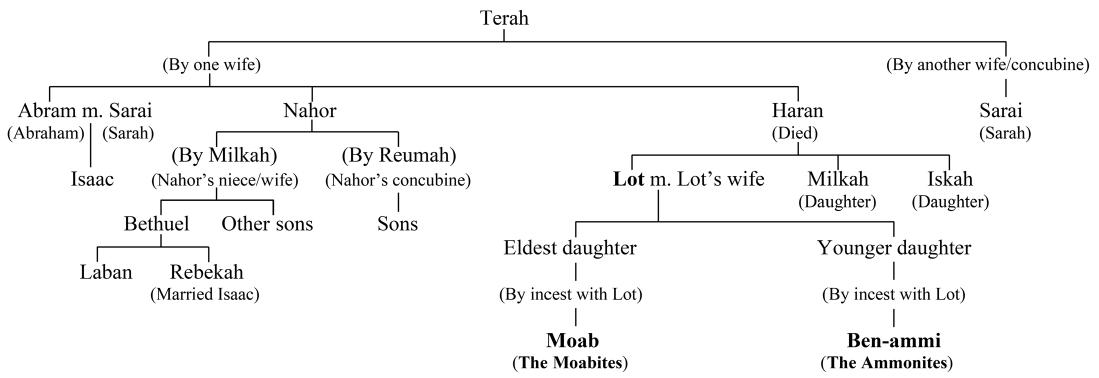
ANSWER - Throughout the early history of Israel, we find references to the Ammonite people. Who were they, where did they come from, and what happened to them? The Ammonites were a Semitic people, closely related to the Israelites. Despite that relationship, they were more often counted enemies than friends.
Lot, Abraham’s nephew, was the progenitor of the Ammonites. (ED: SEE BOTTOM RIGHT SIDE OF FAMILY TREE) After Abraham and Lot separated (Genesis 13), Lot settled in the city of Sodom. When God destroyed Sodom and Gomorrah because of their wickedness, Lot and his daughters fled to the hill country on the southern end of the Dead Sea. Probably thinking they were the only people left on the earth, Lot’s daughters got him drunk and had incestuous relations with him to produce children (Genesis 19:37-38). The older daughter had a son named Moab (“from father”), and the younger gave birth to Ben-Ammi (“son of my people”). The Ammonites, descendants of Ben-Ammi, were a nomadic people who lived in the territory of modern-day Jordan, and the name of the capital city, Amman, reflects the name of those ancient inhabitants.
In the time of Moses, the fertile plains of the Jordan River valley were occupied by the Amorites, Ammonites and Moabites. When Israel left Egypt, the Ammonites refused to assist them in any way, and God punished them for their lack of support (Deuteronomy 23:3-4). Later, however, as the Israelites entered the Promised Land, God instructed them, “When you approach the territory of the people of Ammon, do not harass them or contend with them, for I will not give you any of the land of the people of Ammon as a possession, because I have given it to the sons of Lot for a possession” (Deuteronomy 2:19). The Israelite tribes of Gad, Reuben, and half of Manasseh claimed the Amorite territory bordering that of the Ammonites.
The Ammonites were a pagan people who worshiped the gods Milcom and Molech. God commanded the Israelites not to marry these pagans, because intermarriage would lead the Israelites to worship false gods. Solomon disobeyed and married Naamah the Ammonite (1 Kings 14:21), and, as God had warned, he was drawn into idolatry (1 Kings 11:1-8). Molech was a fire-god with the face of a calf; his images had arms outstretched to receive the babies who were sacrificed to him. Like their god, the Ammonites were cruel. When Nahash the Ammonite was asked for terms of a treaty (1 Samuel 11:2), he proposed gouging out the right eye of each Israelite man. Amos 1:13 says that the Ammonites would rip open pregnant women in the territories they conquered.
Under King Saul’s leadership, Israel defeated the Ammonites and made them vassals. David continued that sovereignty over Ammon and later besieged the capital city to solidify his control. After the split of Israel and Judah, the Ammonites began to ally themselves with the enemies of Israel. (ED: KING JOTHAM SUBDUED THEM IN 748-742 - 2Ch 27:5) Ammon regained some sovereignty in the seventh century B.C., until Nebuchadnezzar conquered them about a hundred years later. Tobiah the Ammonite (Nehemiah 2:19) was possibly a governor of the region under Persian rule, but the inhabitants were a mix of Ammonites, Arabs, and others. By New Testament times, Jews had settled in the area, and it was known as Perea. The last mention of Ammonites as a separate people was in the second century by Justin Martyr, who said they were very numerous. Sometime during the Roman period, the Ammonites seem to have been absorbed into Arab society.
2 Chronicles 27:6 So Jotham became mighty because he ordered his ways before the LORD his God.
KJV So Jotham became mighty, because he prepared his ways before the LORD his God.
NET Jotham grew powerful because he was determined to please the LORD his God.
Heb "because he established his ways before the LORD his God."
BGT καὶ κατίσχυσεν Ιωαθαμ ὅτι ἡτοίμασεν τὰς ὁδοὺς αὐτοῦ ἔναντι κυρίου θεοῦ αὐτοῦ
LXE Joatham grew strong, because he prepared his ways before the Lord his God.
CSB So Jotham strengthened himself because he did not waver in obeying the LORD his God.
ESV So Jotham became mighty, because he ordered his ways before the LORD his God.
NIV Jotham grew powerful because he walked steadfastly before the LORD his God.
NLT King Jotham became powerful because he was careful to live in obedience to the LORD his God.
YLT And Jotham doth strengthen himself, for he hath prepared his ways before Jehovah his God.
NJB Jotham became powerful because he kept an unswerving course before Yahweh his God.
NAB Thus Jotham continued to grow strong because he lived resolutely in the presence of the LORD, his God.
GWN Jotham grew powerful because he was determined to live as the LORD his God wanted.
- Jotham: 2Ch 26:5
- he ordered his ways, 2Ch 19:3
Related Passages:
2 Chronicles 26:16 But when he became strong (chazaq), his heart was so proud that he acted corruptly, and he was unfaithful to the LORD his God, for he entered the temple of the LORD to burn incense on the altar of incense.
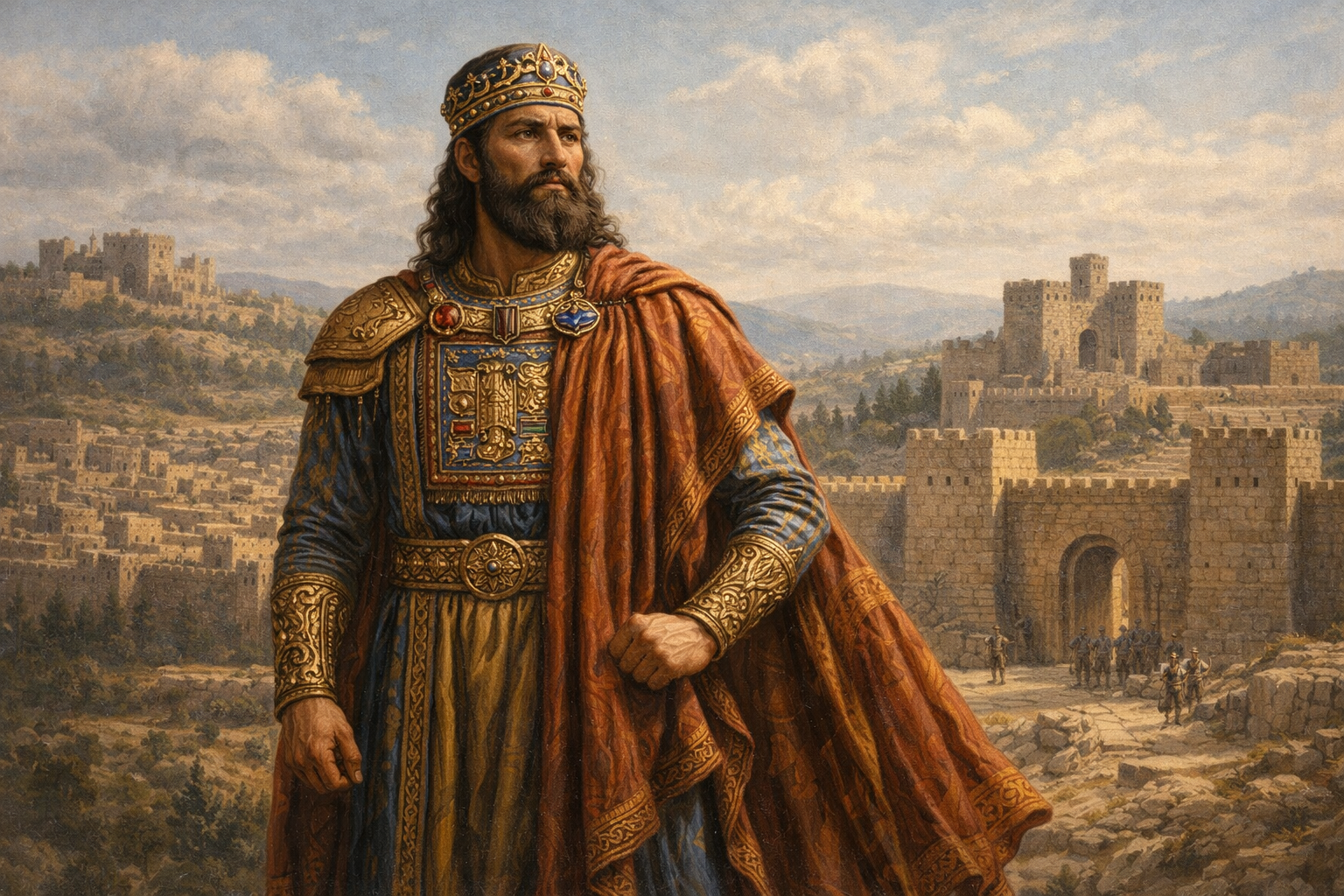
THE SECRET OF JOTHAM'S MIGHT
HE WAS MIGHTY IN THE LORD
So Jotham became mighty (chazaq) because he ordered (kun; LXX - hetoimazo = put/kept in readiness; prepared; made ready) his ways before (panim/paniym) the LORD his God - Don't miss the striking contrast related to the same verb mighty/strong (chazaq). The father's response is pride. The son's source of mighty is because he followed Jehovah. The clear implication is that he did not become prideful in the face of becoming mighty! Uzziah focused on self, while his son Jotham focused on God.
🙏 THOUGHT - One wonders if Jotham had read and prayed the words of the psalmist "Oh that my ways may be established To keep Your statutes!" (Ps 119:5) Would this not be a good prayer with which we each might frequently approach the Throne of grace (Heb 4:16)? That's rhetorical of course! Why not consider praying this passage (not vain repetition of course) over the next 30 days as you wait upon the Lord and see what His Spirit might do. (cf Isa 40:31).
Because - Term of explanation. What's the writer explaining?
He ordered (kun; LXX - hetoimazo = put/kept in readiness; prepared; made ready) his ways (his life, his choices, his decisions) before (panim/paniym) the LORD his God - NAB = "Thus Jotham continued to grow strong because he lived resolutely in the presence of the LORD, his God." Note it does not say before the LORD God, but the LORD HIS God, which speaks of a personal relationship! This personal relationship conveys the need for personal responsibility, indicating he chose to walk carefully before the LORD his God, not casually or occasionally, but with thoughtful purpose. This ordering was done before the LORD his God, reminding us that true strength grows out of living in God’s presence, conscious that every step is taken under His gaze. The Chronicler presents a clear principle—spiritual order precedes outward blessing; character shapes destiny. Jotham’s growing influence was the fruit of a heart kept in alignment with heaven.
Indeed, the secret of Jotham’s strength is traced not to military genius or political strategy but to deliberate, intentional preparatr spiritual discipline. The phrase “ordered his ways” (kun) carries the idea of being firm and established, prepared and determined. The idea is setting firmly in place, like a builder who lays a straight foundation before raising the walls. Jotham intentionally prepared his daily conduct, decisions, and priorities to align with the revealed will of God. In the LXX ordered is translated with the Greek verb hetoimazo which means to prepare, to make ready, to put in a state of readiness. The clear implication is that Jotham put his heart in a state of readiness. He prepared to meet with and hear from Yahweh! Then he stepped out intentonally aligning his steps with God's will!
🙏 THOUGHT - After you arise and take your first step out of bed in the morning, do you also figuratively prepare your steps to meet with the Lord of the Universe? And then do your steps throughout the day reflect that your first step was to hear His voice? If so, your life will be mighty in the Lord! P.S. How's your morning quiet time?
JOTHAM WALKED
CORAM DEO
The phrase before (panim/paniym = face) the LORD his God is notable as panim/paniym which means Jotham walked before the face of the Lord, or as we might say today CORAM DEO, BEFORE THE FACE OF GOD! In the Septuagint before is the preposition enanti which means in the presence of or in the sight of. Now think about this for a moment. His walk was such that "he was determined to please the LORD his God" (2Chr 27:6NET). Now consider the declaration and promise in 2Ch 16:9 that "the eyes of the LORD move to and fro throughout the earth that He may strongly support those whose heart is completely His." Surely this explains to some degree why Jotham is the only king in either Judah or Israel about which there is nothing negative recorded!
The recognition of God’s presence is
the foundation-stone of all prosperity.
🙏 THOUGHT - Does this truth in Jotham's life motivate you to desire to carry out a 2Ch 16:9a walk? What would change in the way I ordered my steps if I truly grasped that I live CORAM DEO—before the face of God? If I genuinely believed that the eyes of the LORD range throughout the earth, seeking to strengthen those whose hearts are wholly His, my daily choices would take on new weight and new joy. I would plan, speak, and respond not to impress people or to earn favor, but to please the One Who sees every motive (cf pleasing God - Col 1:10, 1Th 4:1, 2Ti 2:4, Heb 13:21). My priorities would shift from merely avoiding wrong to eagerly pursuing what honors Him. Prayer would become less of a duty and more of a conversation, obedience less a burden and more a privilege.
To walk CORAM DEO is not legalism but just the opposite! It is liberation, freedom in Christ! It means ordering my steps with grateful awareness that God is there His Spirit guiding, empowering, and delighting in sincere faith. Like Jotham, I would seek to “prepare my ways before the LORD” with humility, consistency, and dependence, trusting that faithfulness in small, unseen moments shapes a life that stands firm when tested.
The question is not, “What must I do to measure up?” (works mindset) but rather, “How can I walk today as one who is already seen, loved, and strengthened by God?” (grace mindset)
Bob Utley - Here again, the Chronicler makes a theological statement related to "the two ways." Obedience to the Mosaic covenant brings prosperity and blessing, but disobedience brings judgment (cf. Leviticus 26; Deuteronomy 28; Dt 30:15,19; Psalm 1:1-6).
Andrew Hill: The reference to Jotham’s becoming “powerful” is instructive. The same expression was used to characterize Uzziah’s earlier reign (Heb.chazaq cf.2Ch 26:16). But unlike his father, Jotham does not fall prey to the temptation of pride and turn away from God. His success is attributed directly to the fact that he “walked steadfastly before the Lord” (2Ch 27:6). This unique expression is generally understood to be synonymous with the phrase “to set one’s heart on God” (cf. 1 Chron. 22:19; 28:9; 2 Chron. 30:19). (The NIV Application Commentary )
Mark Boda: Here the Hebrew is literally, “He made firm his ways before Yahweh his God,” an expression that refers to doing something without flinching or wavering (see Prov 21:29 for the same phrase). (Cornerstone Biblical Commentary – 1-2 Chronicles.)
Spurgeon - “So Jotham became mighty, because he prepared his ways before the LORD his God.”—2 Chronicles 27:6. - THIS is a very singular expression which is used here concerning Jotham, who is one of the kings of Judah who are commended as having done that which was right in the sight of the Lord. All of them had their faults, yet they were the best monarchs that sat upon the throne of Judah; and concerning Jotham it is mentioned as his peculiar honour that he “became mighty, because he prepared his ways before the Lord his God.” (Sermon Jotham's Peculiar Honor)
Became mighty (02388)(chazaq) conveys the basic meaning of to be or become strong, to make strong or strengthen, in the Hiphil to take hold of or seize ("retain His anger" - Mic 7:18+), in the Hithpael to strengthen oneself (to take courage 1 Sa 30:6). To be courageous. To overpower. Chazaq describes strength - severity of a famine (a "strong" famine) (2 Ki 25:3, Jer 52:6), strength of humans to overpower (David and Goliath 1 Sa 17:50, cf 1 Sa 17:35 = seized;, Amnon and Tamar = 2 Sa 13:14), in a battle, to capture (2 Chr 8:3), Samson's last demonstration of supernatural strength he prays "please strengthen me" (Jdg 16:28). Used in the charge "Be strong and courageous" (Josh 1:6, 7, 9,18, Josh 10:25, "be firm" = Josh 23:6; "Be strong and courageous" = Dt 31:6-7, 23). Chazaq used 12 times in Ex 4-14 of hardening Pharaoh's heart (cf similar use in Josh 11:20). In a great passage in Da 11:32+ we read "“By smooth words he will turn to godlessness those who act wickedly toward the covenant, but the people who know their God will display strength (chazaq) and take action.""
Chazaq is commonly used in Kings and Chronicles - 1 Ki. 1:50; 1 Ki. 2:2; 1 Ki. 2:28; 1 Ki. 9:9; 1 Ki. 16:22; 1 Ki. 20:22; 1 Ki. 20:23; 1 Ki. 20:25; 2 Ki. 2:12; 2 Ki. 3:26; 2 Ki. 4:8; 2 Ki. 4:27; 2 Ki. 12:5; 2 Ki. 12:6; 2 Ki. 12:7; 2 Ki. 12:8; 2 Ki. 12:12; 2 Ki. 12:14; 2 Ki. 14:5; 2 Ki. 15:19; 2 Ki. 22:5; 2 Ki. 22:6; 2 Ki. 25:3; 1 Chr. 11:10; 1 Chr. 19:12; 1 Chr. 19:13; 1 Chr. 21:4; 1 Chr. 22:13; 1 Chr. 26:27; 1 Chr. 28:7; 1 Chr. 28:10; 1 Chr. 28:20; 1 Chr. 29:12; 2 Chr. 1:1; 2 Chr. 7:22; 2 Chr. 8:3; 2 Chr. 11:11; 2 Chr. 11:12; 2 Chr. 11:17; 2 Chr. 12:13; 2 Chr. 13:7; 2 Chr. 13:8; 2 Chr. 13:21; 2 Chr. 15:7; 2 Chr. 15:8; 2 Chr. 16:9; 2 Chr. 17:1; 2 Chr. 19:11; 2 Chr. 21:4; 2 Chr. 23:1; 2 Chr. 24:5; 2 Chr. 24:12; 2 Chr. 25:3; 2 Chr. 25:8; 2 Chr. 25:11; 2 Chr. 26:8; 2 Chr. 26:9; 2 Chr. 26:15; 2 Chr. 26:16; 2 Chr. 27:5; 2 Chr. 27:6; 2 Chr. 28:15; 2 Chr. 28:20; 2 Chr. 29:3; 2 Chr. 29:34; 2 Chr. 31:4; 2 Chr. 32:5; 2 Chr. 32:7; 2 Chr. 34:8; 2 Chr. 34:10; 2 Chr. 35:2
Ordered (03559) kun means to be firm, to set up, to make firm, to establish, to prepare. The primary action of this verb is to cause to stand in an upright position, and thus the word also means fixed or steadfast.
- It signifies the action of setting in place or erecting an object (Isa 40:20; Mic 4:1);
- establishing a royal dynasty (2 Sam 7:13; 1 Chr 17:12);
- founding a city (Hab 2:12);
- creating the natural order (Deut 32:6; Ps 8:3; Prov 8:27);
- fashioning a people for oneself (2 Sam 7:24);
- adjusting weapons for their targets (Ps 7:12[13]; 11:2);
- appointing someone to an office (Josh 4:4);
- confirming a position (1 Kgs 2:12);
- making ready or preparing something for use (2 Chr 31:11; Ps 103:19; Zeph 1:7);
- attaining certainty or verification (Deut 13:14; 1 Sam 23:23).
John Oswalt - TWOT - The root meaning is to bring something into being with the consequence that its existence is a certainty.
Five somewhat different connotations can be discovered in the usages of this root, all having basic theological significance. These connotations move from provision through preparation and establishment to fixity and rightness.
1) As noted above, the word as used in Hebrew, rarely means simply to bring into being.
So rare is it, in fact, that BDB and KB suggest that the root meaning is "to be firm" (KB also adding "straight"). However, evidence of the original etymology may be found in those occurrences where something is said simply to have been formed or fashioned (brought into existence) (Judges 12:6; Job 31:15; Psalm 119:73; Ezekiel 16:7). In none of these is the idea of fixity or firmness in view, but rather of basic formation. Particularly in the second and third of these, God's role in forming the human body is significant.
Probably this same basic idea is involved where the word is translated "to provide for" (cf. 2 Chron. 1:4; Job 38:41; Psalm 65:9 [H 10]; Psalm 78:20; Proverbs 6:8). Especially in question here is God's ability to provide food for his people and creation. At numerous points it is difficult to know whether certain usages should be translated "provide" or "prepare." It seems likely that the several references in Chronicles to David's "preparing" materials for the temple could just as appropriately be understood as referring to his "providing" such materials.
2) At any rate, however, it is clear that a very significant group of occurrences must be translated with "prepare."
In view of something in the future, certain things are set in order. Meal preparation (Genesis 43:16; Joshua 1:11; Neh. 8:10) and military preparation (Joshua 8:4; Ezekiel 7:14; Ezekiel 38:7; Amos 4:12) are two circumstances in which the word is used in this way. In the latter case many of the references indicate it is God who will war on the ungodly and they should prepare themselves as best they can (cf. Job 15:23; Jeremiah 46:14; Jeremiah 51:12 etc.). On the other hand, God has made preparations as well. These would include his creative functions (Psalm 147:8; Job 28:27; Proverbs 8:27) as well as his judicial ones (Psalm 7:11, 13 [H 12, 14]; Psalm 9:7 [H 8]; Proverbs 19:29; Zeph. 1:7).
The meaning of a group of references which speak of persons "preparing" their hearts to seek the Lord (cf. 1 Chron. 29:18; 2 Chron. 12:14, etc.) is somewhat unclear. It seems likely that the RSV rendering "set," in keeping with the several passages in Psalms (cf. Psalm 57:7 [H 8] "my heart is fixed [RSV "steadfast"], O God") is more appropriate.
3) As with the previous connotation, there is some ambiguity at the border between "prepare" and "establish."
This is especially true in God's creative acts. While Proverbs 8:27 says that God "prepared" the heavens, Proverbs 3:19 has him "establishing" the heavens. Here come the special overtones of certitude. They are implicit in the very character of the biblical deity, a God who does not change (Psalm 119:90). Because God has brought heaven and earth into existence they are fixed forever (Jeremiah 33:2). So the use of "establish" is especially appropriate. The references where this translation is appropriate may be divided into three groups. All three of these have royal overtones. God, as the divine king has established the heavens as his throne (Psalm 103:19) and the earth as his dominion (1 Chron. 16:30; Psalm 93:1; Isaiah 45:18). As the divine king, his work is accomplished through wisdom and understanding (Proverbs 3:19; Jeremiah 10:12; Jeremiah 51:15). This in itself leads to the fixity of what he has done.
4) It is the divine king who then guarantees or refuses to guarantee human kingship.
Some twenty-five times the word is used with reference to the establishment of a dynasty. It is made plain that, in and of itself, no human line can be established. Only by relation to the One in whom kingship abides is this possible (Psalm 89:37 [H 38] etc.). The culmination of this thought is found in Isaiah 9:6 [H 7] where the kingdom of the Messiah is established by God.
On a somewhat more human level, the book of Proverbs shows that establishment, on the throne or elsewhere, is not possible apart from adherence to the divine standards of righteousness (Proverbs 16:12, etc.).
But the great test of God's kingship is the problem of sin. This problem is dealt with through the establishment of a people (Deut. 32:6). The particular creation language of this verse is significant. Redemption is a part of the total work of creation. Furthermore, God overcomes sin by establishing his sanctuary in the midst of his people (Exodus 15:17; Isaiah 2:2).
5) The sense of well-being which results from being under God's hand is best expressed in the final connotation.
If our heart is fixed on God (Psalm 112:7, etc.) then we may be sure that he will establish (also direct, order) our ways (Psalm 37:23; Psalm 90:17; Proverbs 16:9). Apart from this kind of confidence, a person's ways are temporary and shaky. But with it there comes a certainty, a rightness (Jeremiah 23:10, etc.), which imparts some of the glory of the infinite to the finite.
Vine - KUN - "to be established, be readied, be prepared, be certain, be admissible." This verb occurs in nearly every Semitic language (not in biblical Aramaic). Kûn appears in the Bible about 220 times and in all periods of Hebrew.
This root used concretely connotes being firmly established, being firmly anchored and being firm. The first meaning is applied to a roof which is "firmly established" on pillars. So Samson said to the lad who was leading him: "Suffer me that I may feel the pillars whereupon the house standeth, that I may lean upon them" (Jdg. 16:26). In a similar sense the inhabited earth "is firmly established or anchored"; it is immovable: "… The world also is stablished, that it cannot be moved" (Psa. 93:1). In Psa. 75:3 the image shifts to the earth "firmly established" upon pillars. In Psa. 65:6 the divine establishing of the mountains is synonymous with divine creating. The verb also means "to be firm": "And you grew up and became tall and arrived at [the age for fine ornaments]; your breasts were formed, and your hair had grown" (Ezek. 16:7, rsv).
Used abstractly, kûn can refer to a concept as "established," or "fixed" so as to be unchanging and unchangeable: "And for that the dream was doubled unto Pharaoh twice; it is because the thing is established by God, and God will shortly bring it to pass" (Gen. 41:32, the first occurrence of the word). In somewhat the same sense one can speak of the light of day "being firmly established," or having fully arrived: "But the path of the just is as the shining light, that shineth more and more unto the perfect day" (Prov. 4:18). Kûn can be used of the "establishing" of one's descendants, of seeing them prosperous (Job 21:8).
Something can be "fixed" in the sense of "being prepared or completed": "Now all the work of Solomon was prepared unto the day of the foundation of the house of the Lord . . ." (2 Chron. 8:16).
An "established" thing can be something that is enduring. In 1 Sam. 20:31 Saul tells Jonathan: "For as long as the son of Jesse liveth upon the ground, thou shalt not be established, nor thy kingdom." Truthful lips (what they say) "shall be established," or will endure forever (Prov. 12:19). One's plans "will endure" (be established) if he commits his works to the Lord (Prov. 16:3).
Kûn can also mean "to be established" in the sense of "being ready." So Josiah told the people "to prepare" themselves for the Passover (2 Chron. 35:4). This same sense appears in Exod. 19:11: "And be ready against the third day: for the third day the Lord will come down in the sight of all the people upon mount Sinai." A somewhat different nuance appears in Job 18:12; Bildad says that wherever godlessness breaks out, there is judgment: "… Destruction shall be ready at his side." That is, calamity is "fixed or prepared" so that it exists potentially even before godlessness breaks out. Something "fixed" or "established" can "be certain": "Then shalt thou inquire, and make search, and ask diligently; and, behold, if it be truth, and the thing certain…" (Deut. 13:14). In a somewhat different nuance the thing can be trustworthy or true. The psalmist says of the wicked that "there is no faithfulness in their mouth" (Psa. 5:9). A further development of this emphasis is that a matter "may be admissible", so Moses said to Pharaoh: "It is not meet so to do; for we shall sacrifice the abomination of the Egyptians to the Lord our God. . ." (Exod. 8:26).
When one "fixes" an arrow on the bow, he takes aim or "prepares" to shoot his bow (cf. Psa. 7:12).
KUN - 203 V - aim(1), appointed(1), carried(1), certain(2), certainty(1), confirm(2), confirmed(1), consider(1), could(1), counted(1), definitely(1), determined(1), direct(3), direct your right(1), directed(1), directs(1), establish(15), established(52), establishes(2), fashion(1), fashioned(1), firm(1), firmly established(3), formed(1), founds(1), full(1), get yourself ready(1), installed(1), made it ready(1), made preparations(1), made provision(1), made...preparations(1), made...ready(1), maintain his position(1), make preparation(1), make ready(2), make...sure(1), makes his sure(1), makes ready(1), making my firm(1), ordained(1), ordered(1), place(1), prepare(21), prepared(37), prepares(5), provide(1), provided(5), provides(1), ready(7), reliable(1), rested(1), rests(1), right(3), set(10), set the in order(1), steadfast(6), strengthen(1), took(1).
Gen. 41:32; Gen. 43:16; Gen. 43:25; Exod. 8:26; Exod. 15:17; Exod. 16:5; Exod. 19:11; Exod. 19:15; Exod. 23:20; Exod. 34:2; Num. 21:27; Num. 23:1; Num. 23:29; Deut. 13:14; Deut. 17:4; Deut. 19:3; Deut. 32:6; Jos. 1:11; Jos. 4:3; Jos. 4:4; Jos. 8:4; Jdg. 12:6; Jdg. 16:26; Jdg. 16:29; 1 Sam. 7:3; 1 Sam. 13:13; 1 Sam. 20:31; 1 Sam. 23:22; 1 Sam. 23:23; 1 Sam. 26:4; 2 Sam. 5:12; 2 Sam. 7:12; 2 Sam. 7:13; 2 Sam. 7:16; 2 Sam. 7:24; 2 Sam. 7:26; 1 Ki. 2:12; 1 Ki. 2:24; 1 Ki. 2:45; 1 Ki. 2:46; 1 Ki. 5:18; 1 Ki. 6:19; 1 Chr. 9:32; 1 Chr. 12:39; 1 Chr. 14:2; 1 Chr. 15:1; 1 Chr. 15:3; 1 Chr. 15:12; 1 Chr. 16:30; 1 Chr. 17:11; 1 Chr. 17:12; 1 Chr. 17:14; 1 Chr. 17:24; 1 Chr. 22:3; 1 Chr. 22:5; 1 Chr. 22:10; 1 Chr. 22:14; 1 Chr. 28:2; 1 Chr. 28:7; 1 Chr. 29:2; 1 Chr. 29:3; 1 Chr. 29:16; 1 Chr. 29:18; 1 Chr. 29:19; 2 Chr. 1:4; 2 Chr. 2:7; 2 Chr. 2:9; 2 Chr. 3:1; 2 Chr. 8:16; 2 Chr. 12:1; 2 Chr. 12:14; 2 Chr. 17:5; 2 Chr. 19:3; 2 Chr. 20:33; 2 Chr. 26:14; 2 Chr. 27:6; 2 Chr. 29:19; 2 Chr. 29:35; 2 Chr. 29:36; 2 Chr. 30:19; 2 Chr. 31:11; 2 Chr. 33:16; 2 Chr. 35:4; 2 Chr. 35:6; 2 Chr. 35:10; 2 Chr. 35:14; 2 Chr. 35:15; 2 Chr. 35:16; 2 Chr. 35:20; Ezr. 3:3; Ezr. 7:10; Neh. 8:10; Est. 6:4; Est. 7:10; Job 8:8; Job 11:13; Job 12:5; Job 15:35; Job 18:12; Job 21:8; Job 27:16; Job 27:17; Job 28:27; Job 29:7; Job 31:15; Job 38:41; Job 42:7; Job 42:8; Ps. 5:9; Ps. 7:9; Ps. 7:12; Ps. 7:13; Ps. 8:3; Ps. 9:7; Ps. 10:17; Ps. 11:2; Ps. 21:12; Ps. 24:2; Ps. 37:23; Ps. 38:17; Ps. 40:2; Ps. 48:8; Ps. 51:10; Ps. 57:6; Ps. 57:7; Ps. 59:4; Ps. 65:6; Ps. 65:9; Ps. 68:9; Ps. 68:10; Ps. 74:16; Ps. 78:8; Ps. 78:20; Ps. 78:37; Ps. 87:5; Ps. 89:2; Ps. 89:4; Ps. 89:21; Ps. 89:37; Ps. 90:17; Ps. 93:1; Ps. 93:2; Ps. 96:10; Ps. 99:4; Ps. 101:7; Ps. 102:28; Ps. 103:19; Ps. 107:36; Ps. 108:1; Ps. 112:7; Ps. 119:5; Ps. 119:73; Ps. 119:90; Ps. 119:133; Ps. 140:11; Ps. 141:2; Ps. 147:8; Prov. 3:19; Prov. 4:18; Prov. 4:26; Prov. 6:8; Prov. 8:27; Prov. 12:3; Prov. 12:19; Prov. 16:3; Prov. 16:9; Prov. 16:12; Prov. 19:29; Prov. 20:18; Prov. 21:29; Prov. 21:31; Prov. 22:18; Prov. 24:3; Prov. 24:27; Prov. 25:5; Prov. 29:14; Prov. 30:25; Isa. 2:2; Isa. 9:7; Isa. 14:21; Isa. 16:5; Isa. 30:33; Isa. 40:20; Isa. 45:18; Isa. 51:13; Isa. 54:14; Isa. 62:7; Jer. 10:12; Jer. 10:23; Jer. 30:20; Jer. 33:2; Jer. 46:14; Jer. 51:12; Jer. 51:15; Ezek. 4:3; Ezek. 4:7; Ezek. 7:14; Ezek. 16:7; Ezek. 28:13; Ezek. 38:7; Ezek. 40:43; Hos. 6:3; Amos 4:12; Mic. 4:1; Nah. 2:3; Nah. 2:5; Hab. 2:12; Zeph. 1:7; Zech. 5:11
Stimulating effect of God’s presence
It is said that the air of a famous Kentucky cave has a peculiar power of stimulating the senses. After the visitor has been in its strange and silent labyrinths for an hour or two, and comes back into the open air, he can discern the very scents of the flowers, trees, and grasses. New perceptions of spiritual things will come to us if we get away into the quiet of God’s presence, and suffer ourselves to be absorbed by His Word. (T. G. Selby.)
Ron Daniel offers some practical advice on how to order your ways...
What are we planning in His presence? The steps of our day, making choices in advance. Think about it: The successful worker always has a plan. It's a to-do list, or an assignment that he's been given. If an employee just wanders the halls or the job site all day, then they are a terrible worker, a failure at their job.
The Christian life is the same way. We've got to have a plan. Now, understand that I'm not talking about religious obligation. I'm talking about making decisions tonight about what we will do tomorrow.
You see, many Christians don't have a plan, they aren't ordering their ways. And so...
- They can go weeks without ever reading the Bible outside of church, because they didn't plan to read it.
- They can go long periods of time without praying because it wasn't on their to-do list.
The approach that many of us take is, "I know I should do it, and I'll get around to it." And that doesn't make for a successful Christian.
Tonight, make a commitment for tomorrow. It starts in the morning. Look at all the great people of God who "arose early in the morning":
- Abraham (Ge 22:3),
- Jacob (Ge 28:18),
- Moses (Ex 24:4),
- Joshua (Josh 3:1),
- Hannah (1Sa 1:19),
- Samuel (1Sa 15:12),
- and all the way through the Bible to Jesus (Jn 8:2).
- Mk 1:35 In the early morning, while it was still dark, Jesus got up, left the house, and went away to a secluded place, and was praying there.
That doesn't happen by accident. It happens by commitment. When David wrote Psalm 5, he made a commitment to God:
Ps 5:3 In the morning, O LORD, You will hear my voice; In the morning I will order my prayer to You and eagerly watch.
Am I prescribing a religious program? A rule to follow?
No. I am saying that if you want to become mighty, you will order your ways before the Lord. Have a plan for tomorrow. Know when you're going to make time for prayer. Know when you're going to be in the Word. Make a commitment,
"Lord, in the morning,
You will be hearing from me."
G Campbell Morgan - 2 Chr 27.6.
We have very few details of the reign of Jotham. In all probability the sixteen years referred to by the chronicler cover a period in which he was exercising authority, while his father Uzziah was still alive, though excluded from the kingly office on account of his leprosy. He continued the work of his father in the strengthening of the internal conditions of the kingdom by building; and he was successful in a campaign against the Ammonites. While there was no definite national reform during his reign, he seems to have gone quietly forward along true lines, and his strength is attributed to the fact that he ordered his ways before Jehovah his God. Perhaps three things helped this man. First, he reigned during the early period in which Isaiah was exercising his prophetic ministry. Second, his mother was almost certainly the daughter of Zadok the priest. Third, he profited by his father's example—both good and bad, following the good and shunning the evil. All good influences are to be valued, but the ultimate note is always personal. "He ordered his ways." If a man will do this, then he will ever profit by all the influences brought to bear on him, distinguishing between good and evil, and choosing according to the will of God.
Jotham’s epitaph
I. EVERY MAN IS UNDER GOD’S INSPECTION. How truly did the ancients realise this (Psa 139:1-24.; Jer 23:23-24; 2Ch 16:9; Job 34:22). We little consider this in the present day.
II. EVERY MAN SHOULD LIVE AS UNDER GOD’S INSPECTION. A man’s conduct will be very different if he realises that God’s eye is on him. He will avoid sin. He will bear in mind the love of his Father who is in heaven. He will try to please Him in thought as well as in deed.
III. The recognition of God’s presence is the foundation-stone of all prosperity. It renders a man great, for--
1. It makes him careful not to do that which will disgrace him.
2. It entitles him to Divine protection and help.
3. It fills him with a consciousness of rectitude, which in itself is a panoply of defence. (Homilist.)
F B Meyer - 2 Chronicles 27:6 Jotham became mighty, because he ordered his ways. (R. V.)
There is a lower sense in which this holds good in daily and business life. You can hardly imagine a really successful man being untidy and disorderly. Method is the law of success; and a truly holy soul is sure to be orderly. I do not remember ever meeting one who really walked with God who did not make orderliness one of the first principles of life.
The Lord Jesus would have the men sit down in rows before He broke the bread; and He wrapped together His grave-clothes before He left the sepulchre. It was, therefore, in keeping with the whole tenor of His example when the apostle prescribed that all things should be done decently and in order.
Clear handwriting, especially the direction of an envelope, to give the postman as little trouble as possible; the careful folding of our cast-off garments, to save the maids needless work; the leaving our room that we have been occupying as little disturbed in its arrangements as may be; the gathering up of luncheon fragments from the green banks, where we have sat to view the entrancing prospect; the arrangement of papers, and accounts, and magazines, so that we can readily lay our hand upon whatever is required; the adopting of mental order in prayer and conversation, and in the thinking out of plans and purposes; neatness in dress— these are all part of the right ordering of life which makes for its success and comfort, and greatly for peace in the home. They are the habits of the soul that walks before God, and which is accustomed to think of Him as seeing in secret, and as considering all our ways. In this way we may become mighty, and by being faithful in that which is least come to great charges.
Spurgeon Study Bible - “So Jotham strengthened his position because he did not waver in obeying the LORD his God.” Jotham was the son of a good father (Uzziah), and he did not commit the great fault of his father, who conceived the idea that he would be a priest as well as a king, and the Lord struck him with leprosy. Jotham regarded his father’s sin rather as a beacon to warn him away from that rock on which Uzziah’s life had been wrecked (v. 2, “He didn’t enter the LORD’s sanctuary”). Here was an instance of a young man and a king—and yet, for all that, a saint of the right kind—one who “did not waver in obeying the LORD his God.” It must be a hard matter to be a king and to be a saint at the same time. The combination has seldom occurred, and when it has, it has been a prodigious triumph of divine grace. Do not ask for an eminent position. Let our prayer rather be, “Do not bring me into temptation” (see Mt 6:13). An eminent position always has a measure of temptation connected with it, so we are justified in praying to be preserved from it. Still, if the position is one that is our duty to take, we should take it and trust God’s grace to keep us there in safety. Jotham dwelt in the midst of people who were corrupt and yet was himself not corrupt because he resolved to do what God commanded him. He did not trouble about being thought to be right by neighboring kings, nor was his chief care to be thought to be right by the people over whom he ruled. He was not ambitious to be regarded as right by the heathen nations that were near him, but he did want to be right in the sight of God.
2 Chronicles 27:7 Now the rest of the acts of Jotham, even all his wars and his acts, behold, they are written in the Book of the Kings of Israel and Judah.
- Now the rest: 2Ch 20:34 26:22,23 32:32,33
Related Passages:
2 Kings 15:36-37 Now the rest of the acts of Jotham and all that he did, are they not written in the Book of the Chronicles of the Kings of Judah? 37 In those days the LORD began to send Rezin king of Aram and Pekah the son of Remaliah against Judah.
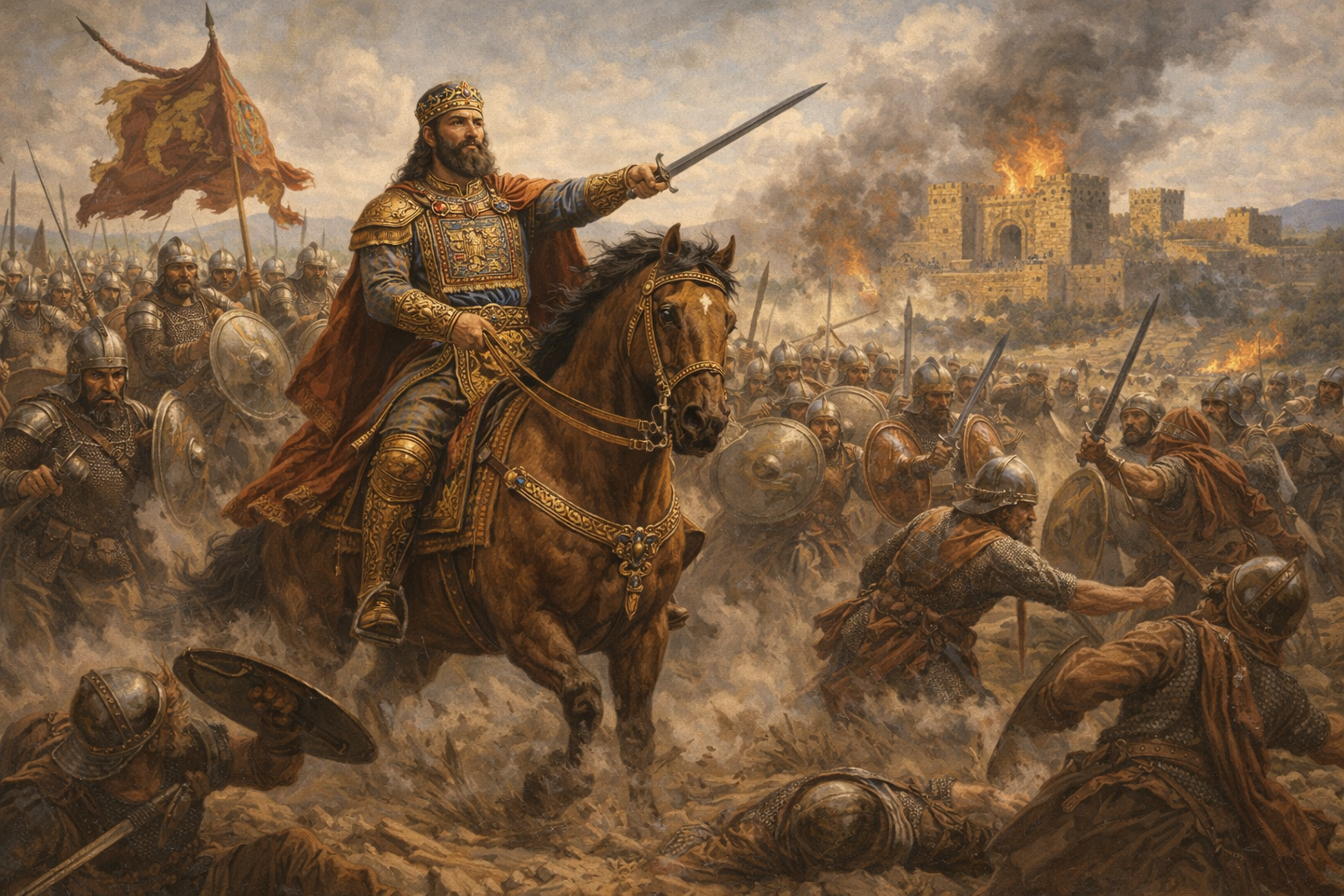
"Even all his wars"
JOTHAM: THE
REST OF THE RECORD
Now the rest of the acts of Jotham, even all his wars and his acts, behold, they are written in the Book of the Kings of Israel and Judah. This closing formula reminds the reader that what Scripture records is a select, theological portrait, not an exhaustive biography. Jotham’s reign included many additional campaigns, administrative decisions, and national achievements that the Chronicler does not detail. As discussed more below the Book of the Kings of Israel and Judah points to official royal annals—state records kept by scribes that preserved the political and military history of the nation. By appealing to these sources, the writer underscores the historical reliability of the account while also signaling that the Spirit has chosen only those events that reveal God’s purposes. The emphasis is not on satisfying curiosity about every battle, but on showing the spiritual lesson of Jotham’s life: a king who walked uprightly and strengthened Judah.
QUESTION - What is the book of the annals of the kings of Israel? - Got Questions
ANSWER - As the authors of the books of Kings and Chronicles were writing their histories, they referenced one or more external documents that they used as source material. They refer to this source as “the book of the annals of the kings of Israel,” “the book of the chronicles” (NKJV, ESV, CSB), or “The Book of the History” (NLT).
This historical source is usually cited by means of a rhetorical question that begins, “Are they not written?” For example, in 1 Kings 16:5, the historian writes this: “As for the other events of Baasha’s reign, what he did and his achievements, are they not written in the book of the annals of the kings of Israel?” That formulaic construction appears 33 times in the books of 1 and 2 Kings. Similar wording is found another two times in 2 Chronicles.
All ancient countries kept records of their own histories. A king’s exploits and what happened in his land were recorded in official annals. Esther 10:2, for example, speaks of “the book of the chronicles of the kings of Media and Persia.” When a plot to assassinate King Xerxes was uncovered and the conspirators were hanged, the event “was written in the book of the chronicles” (Esther 2:23). The kingdom of Israel also had official records, called “the book of the annals of the kings of Israel.” Judah had similar books, one kept by the prophet Iddo (2 Chronicles 13:22), and one simply called “the Scroll of the Kings” (2 Chronicles 24:27, NET).
The biblical books of Kings and Chronicles give a non-comprehensive overview of the kings of Israel and Judah. The author of Kings often refers his readers to the fuller account by mentioning “the book of the annals of the kings of Israel.” We could consider those references as an ancient form of footnoting or an example of an in-text bibliography.
First and Second Kings focus on the northern kingdom of Israel, and 1 and 2 Chronicles on the southern kingdom of Judah. Chronicles contains a much more thorough commentary on the reigns of the kings of Judah than Kings provides on the kings of Israel. This makes sense, because God’s covenant regarding the coming Messiah was to be fulfilled through the line of David, of the tribe of Judah. David’s line went through Solomon and his descendants, all of whom reigned in the southern kingdom of Judah. The detailed records of the kings of Israel contained in the book of the annals of the kings of Israel were not included in the canon of Scripture. The official documents referred to as “the book of the annals of the kings of Israel” are no longer extant or have yet to be discovered. Thus, God did not deem those volumes of civil records and daily happenings to be useful for our instruction (see 1 Corinthians 10:11), and the non-canonical annals were not preserved along with the Old Testament Scriptures.
2 Chronicles 27:8 He was twenty-five years old when he became king, and he reigned sixteen years in Jerusalem.
KING JOTHAM PASSED
ON AT A YOUNG AGE
He was twenty-five years old when he became king, and he reigned sixteen years in Jerusalem At twenty-five, Jotham was relatively young to carry the weight of a kingdom, yet he stepped into leadership with maturity shaped by years of observing both the strengths and failures of his father Uzziah. The Spirit records this not merely as statistics but as a reminder that every life is measured in seasons entrusted by God. Jotham did not control the length of his reign, yet he determined the quality of it. Sixteen years is a relatively short chapter in Judah’s history, but those years were filled with ordered obedience, careful leadership, and devotion to the LORD. Scripture repeatedly teaches that heaven weighs a life by faithfulness, not by calendar pages.
🙏 THOUGHT - Some kings reigned longer but wasted their opportunities. Jotham reigned fewer years but used them well. Jotham's life calls us to view time as stewardship (cf 1Co 4:1,2), each year a gift to be invested for God’s glory (cf Ps 90:12 - God counts obedience, not birthdays!). Legacy is not built by duration but by direction, by walking uprightly in whatever span the Lord assigns. Paul gives us a good takeaway "Therefore be careful (present imperative see our need to depend on the Holy Spirit to obey) how you walk, not as unwise men but as wise, 16 making the most of (present tense continually redeeming) your time, because the days are evil." (Eph 5:15-16)
A short life well-lived
outweighs a long life wasted.
J.A. Thompson: The Chronicler omits any reference to difficulties with Rezin and Pekah (2 Kgs 15:37), perhaps because he did not understand it as judgment on Jotham but on Judah generally and especially on Jotham’s successor, Ahaz. The account of Jotham is clearly a truncated one. Details of his death are not given, but he was buried with his fathers in the City of David, a burial that befitted his life and character (cp. 26:23). (The New American Commentary – 1, 2 Chronicles)
2 Chronicles 27:9 And Jotham slept with his fathers, and they buried him in the city of David; and Ahaz his son became king in his place.
- Jotham: 2Ki 15:38
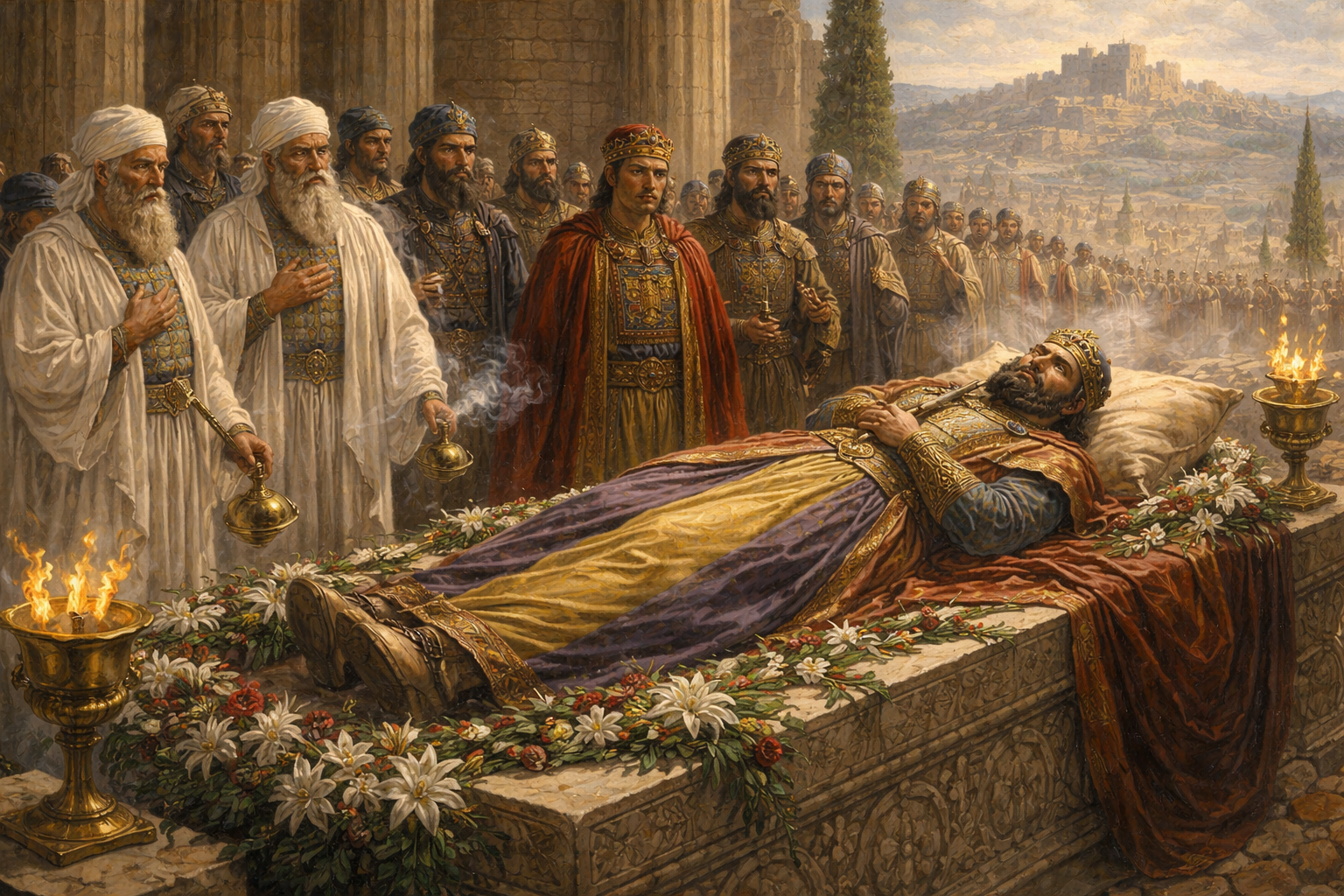
JOTHAM'S DECENDS
AHAZ ASCENDS
And Jotham slept with his fathers, and they buried him in the city of David; and Ahaz his son became king in his place -Scripture records the close of a steady and largely faithful reign. His life ended as it had been lived—without scandal, without dramatic collapse, and without the divine judgment that marked so many other kings. To be buried in the city of David was a testimony that his rule was regarded with honor and continuity within the covenant line. The faithful reign of Jotham closed with his honorable burial in the city of David, giving way to the troubled rule of his son Ahaz. The legacy of a godly leader is always tested by those who follow. Jotham’s death marked not only the end of a man, but the turning of a spiritual chapter in Judah.
PAUL APPLE DEVOTIONAL QUESTIONS:
1) Why do godly people sometimes fail to have a reforming influence on those under their authority (whether in the home or in society)?
2) Why did he only reign for sixteen years if he was such a godly king?
3) How do these building projects reflect the blessing of the Lord in granting him prosperity and security?
4) How careful and steadfast are we in our commitment to fully obey the Lord?
Andrew Hill: Selman has suggested that this three-generation sequence of a faithful father followed by a wicked son and a faithful grandson is based on the situation described by Ezekiel in his oracle on individual responsibility before God (Ezek. 18:1- 20). The stories of Jotham, Ahaz, and Hezekiah carry an important message for the Chronicler’s audience – each person and every generation is responsible to God for their behavior. The reigns of Jotham and Hezekiah are instrumental in demonstrating that a new generation need not be held hostage to the ungodliness they inherit from their predecessors. The combined tenure of Jotham, Ahaz, and Hezekiah on the throne of Judah extend from about 750 to 686 B.C. This means all three kings rule under the mighty shadow cast by the New-Assyrian empire (ca. 750-650 B.C.). The brutal grip of Assyria on Israel and Judah was first felt during the second western campaign of Tiglath-Pileser III (734-732 B.C.), when Pekah was replaced by Hoshea on the throne of the northern kingdom of Israel as an Assyrian puppet king (cf. 2 Kings 15:29-30). For all practical purposes Israel was annexed into the Assyrian Empire, and it is at this time that King Ahaz of Judah becomes an Assyrian vassal king (2 Kings 16:8). Not long thereafter, Shalmaneser V (and his successor Sargon II, who completed the campaign) invades Israel in order to punish the rebellion of Hoshea (cf. 2 Kings 17:1- 6). After a three-year siege, the city of Samaria was destroyed, survivors were deported to Assyria, and the entire northern kingdom was formally annexed into the Assyrian Empire (722 B.C.). Sometime later, during the reign of Hezekiah, the Assyrian overlord Sennacherib launches a western campaign (701 B.C.). The Assyrians subdue the coastal plain of Syria-Palestine from Phoenicia to Philistia and then turn full attention to Judah. They pillage the outlying regions of Judah but are thwarted in their siege of Jerusalem by a disastrous plague attributed to divine intervention as a result of prayers offered by Hezekiah and the prophet Isaiah (2 Kings 18:17 – 19:36). The Assyrian annals do not report the outcome of Sennacherib’s siege of Jerusalem. (The NIV Application Commentary )
Leslie Allen reminds us that the book of Chronicles would have been read by Jews who had returned from 70 years of exile in Babylong what how this might affect their mental state...
For a weak Judah in post-exilic times, harassed by neighbors and eking out a bare economic existence, such operations had a mouth-watering appeal. The message is that God can meet His people at the point of their need, developing potential in the spheres where now there is failure. (See The Preacher's Commentary - Vol. 10: 1 and 2 Chronicles - Page 27)
John McNeill: This is the key-note of Jotham’s biography: “He prepared his ways before the Lord his God.” This may be applied like a key put into the lock of each of these verses of the record of his life.
I. He went right where his father went wrong (2 Chronicles 27:2). Even on the pinnacle of success and popularity, his head was cool, and his heart was clear, and his nerves were steady, for he prepared his ways before the Lord his God.
II. He covered the country with fortifications (2 Chronicles 27:3-4). The man who is spiritual to the core will not be a weakling in the city, and he will not be easily turned aside. This disposes of the idea that to be a praying man and to be a business man do not go together.
III. He prevailed against his enemies (2 Chronicles 27:5). Because, before he fought he prayed.
IV. His wealth increased (2 Chronicles 27:5). Prayer to God brought him his fortune.
V. His humility exalted him (2 Chronicles 27:6). Conclusion: What was Jotham after all but a dim, distant, foreshadowing of Jesus Christ? If ever the text was true of any one, it was true of Him.
NOTE: SOME CAN BE BORROWED FROM ARCHIVE.ORG
Archer, Gleason L. Jr. A survey of Old Testament introduction (BORROW). Chicago, IL: Moody Press, 1964.
Baxter, J. Sidlow. Explore the Book Vol. 2 Judges to Esther (Online) . Grand Rapids, MI: Zondervan, 1960.
Boda, Mark J. Cornerstone Biblical Commentary – 1-2 Chronicles. (Digital version) Carol Stream, IL: Tyndale House Publishers, 2010.
Braun, Roddy. Word Biblical Commentary – Volume 14 –1 Chronicles (BORROW). Grand Rapids, MI: Zondervan, 2018.
Braun, Roddy Understanding the basic themes of 1,2 Chronicles (BORROW)
Cooper, Derek. Reformation Commentary on Scripture – Old Testament V – 1-2 Samuel, 1-2 Kings, 1-2 Chronicles. (Digital version) Downers Grove, IL: IVP Academic, 2016.
Constable, Thomas - 1&2 Chronicles (ONLINE)
Daniel, Ron - Teaching Notes - 1 Chronicles; 2 Chronicles (ONLINE)
Dillard, Raymond B. Word Biblical Commentary – Volume 15 – 2 Chronicles (BORROW) Grand Rapids, MI: Zondervan, 2018.
Ellison, H. L. The New Bible commentary, revised – 1 & 2 Chronicles (BORROW). Grand Rapids, MI: Wm. B. Eerdmans Publishing Co., 1970.
Guzik, David. Enduring Word Bible Commentary 1 Chronicles; 2 Chronicles (ONLINE)
Hill, Andrew E. The NIV Application Commentary – 1 & 2 Chronicles. (Digital version) Grand Rapids, MI: Zondervan, 2003.
Keil, C. F. and Delitzsch, F. Commentary on the Old Testament – 1 Chronicles & 2 Chronicles. (ONLINE) Grand Rapids, MI: William B. Eerdmans Publishing Company, 1975.
Konkel, August H. Believers Church Bible Commentary – 1 & 2 Chronicles. (Multipart video series also available) Harrisonburg, VA: Herald Press, 2016. (More lectures on OT studies with AI Study guides)
Mabie, Frederick J. The Expositor’s Bible Commentary Revised Edition – 1 & 2 Chronicles. (Digital Version) Grand Rapids, MI: Zondervan, 2010.
MacArthur, John. The MacArthur Study Bible (BORROW). Nelson Bibles, 2006.
Merrill, Eugene 1-2 Chronicles - Bible Knowledge Commentary (BORROW)
Olley, John W. (ED: IAIN DUGUID) ESV Expository Commentary, Vol. III – 1 Samuel – 2 Chronicles. (Digital Version) Wheaton, IL: Crossway, 2019.
Payne, J. Barton. The Expositor’s Bible Commentary – 1 & 2 Chronicles. (BORROW) Grand Rapids, MI: Zondervan Publishing House, 1988.
Schultz, John. - 1 Chronicles (177 pages), 2 Chronicles (239 pages) (ONLINE)
Selman, Martin J. Tyndale Old Testament Commentaries – 1 Chronicles. (BORROW)Downers Grove, IL: InterVarsity Press, 1994.
Selman, Martin J. Tyndale Old Testament Commentaries – 2 Chronicles. (BORROW) Downers Grove, IL: InterVarsity Press, 1994.
Sherwin, Simon & Mabie, Frederick J. Zondervan Illustrated Bible Backgrounds Commentary -- 1 & 2 Chronicles. (Digital Version) Grand Rapids, MI: Zondervan, 2009.
Thompson, J.A. The New American Commentary – Volume 9 – 1, 2 Chronicles. (Digital Version) Nashville, TN: B&H Publishing Group, 1994.
Utley, Bob. 1 Chronicles Table of Contents; 2 Chronicles Table of Contents
http://www.freebiblecommentary.org/old_testament_studies/VOL07BOT/VOL07BOT.html
Walton, John, et al - The IVP Bible Background Commentary Old Testament IVP (ONLINE) - InterVarsity Press 2000.
Wiersbe, Warren W. Be Restored – Trusting God to See Us Through – OT Commentary – 2 Samuel & 1 Chronicles. (BORROW) Colorado Springs, CO: David C. Cook, 2010.
Wiersbe, Warren W. Be Distinct – Standing Firmly Against the World’s Tides – OT Commentary – 2 Kings & 2 Chronicles. (BORROW) Colorado Springs, CO: David C. Cook, 2010.
Williamson, H.G.M. New Century Bible Commentary – 1 and 2 Chronicles. Eugene, OR: Wipf and Stock Publishers 1982.
Wood, Leon. A Survey of Israel’s History. (BORROW) Grand Rapids: MI: Zondervan Publishing House, 1970.
Zuber, Kevin Moody Bible commentary