Genesis 24:2
Genesis 24:3
Genesis 24:4
Genesis 24:5
Genesis 24:6
Genesis 24:7
Genesis 24:8
Genesis 24:9
Genesis 24:10
Genesis 24:11
Genesis 24:12
Genesis 24:13
Genesis 24:14
Genesis 24:15
Genesis 24:16
Genesis 24:17
Genesis 24:18
Genesis 24:19
Genesis 24:20
Genesis 24:21
Genesis 24:22
Genesis 24:23
Genesis 24:24
Genesis 24:25
Genesis 24:26
Genesis 24:27
Genesis 24:28
Genesis 24:29
Genesis 24:30
Genesis 24:31
Genesis 24:32
Genesis 24:33
Genesis 24:34
Genesis 24:35
Genesis 24:36
Genesis 24:37
Genesis 24:38
Genesis 24:39
Genesis 24:40
Genesis 24:41
Genesis 24:42
Genesis 24:43
Genesis 24:44
Genesis 24:45
Genesis 24:46
Genesis 24:47
Genesis 24:48
Genesis 24:49
Genesis 24:50
Genesis 24:51
Genesis 24:52
Genesis 24:53
Genesis 24:54
Genesis 24:55
Genesis 24:56
Genesis 24:57
Genesis 24:58
Genesis 24:59
Genesis 24:60
Genesis 24:61
Genesis 24:62
Genesis 24:63
Genesis 24:64
Genesis 24:65
Genesis 24:66
Genesis 24:67
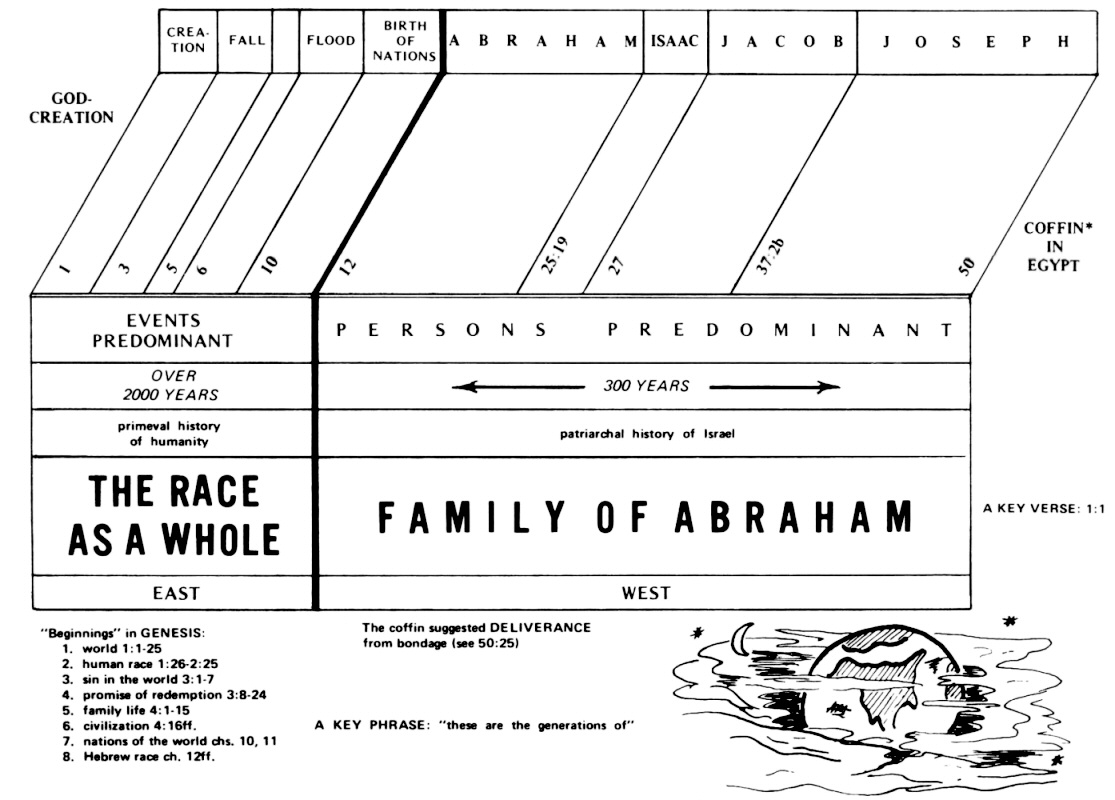
Click chart to enlarge
Chart from recommended resource Jensen's Survey of the OT - used by permission
| Summary Chart of The Book of Genesis |
||||||||
| Focus | Foundation Events (Four Events) (Events Predominant) |
Foundation People (Four People) (People Predominant) |
||||||
| Divisions | Creation (Ge 1-2) |
Fall (Ge 3-5) |
Flood (Ge 6-9) |
Nations (Ge 10-12) |
Abraham's Faith (Ge 12-24) |
Isaac's Family (Ge 25-26) |
Jacob's Conflicts (Ge 27-36) |
Joseph's Calamity (Ge 37-50) |
| Topics | Beginning of the Human Race (Race As A Whole) |
Beginning of the Hebrew Race (Family of Abraham) |
||||||
| Faithfulness of Mankind (Noah) |
Faithfulness of One Man's Family (Abraham) |
|||||||
| Historical | Biographical | |||||||
| Place | Eastward From Eden to Ur |
Westward From Canaan to Egypt |
||||||
| Time | ~2000+ Years (20% of Genesis) (~4004-2090BC) |
About 300 Years 193 Yr in Canaan, 93 Yr in Egypt (80% of Genesis) (2090-1804BC) |
||||||
| Primeval History of Humanity |
Patriarchal History of Israel |
|||||||
| Author | Moses | |||||||
|
BEGINNINGS
|
||||||||
Genesis 24:1 Now Abraham was old, advanced in age; and the LORD had blessed Abraham in every way.
- was old: Ge 18:11 21:5 25:20 1Ki 1:1 Lu 1:7
- blessed: Ge 24:35 Ge 12:2 13:2 49:25 Ps 112:1-3 Pr 10:22 Isa 51:2 Mt 6:33 Ga 3:9 Eph 1:3 1Ti 4:8
Related Passages:
Genesis 18:11 Now Abraham and Sarah were old, advanced in age; Sarah was past childbearing.
Genesis 25:20 (THIS VERSE INDICATES ABRAHAM WAS ABOUT 140) and Isaac was forty years old when he took Rebekah, the daughter of Bethuel the Aramean of Paddan-aram, the sister of Laban the Aramean, to be his wife.
Genesis 24:35 “The LORD has greatly blessed my master, so that he has become rich; and He has given him flocks and herds, and silver and gold, and servants and maids, and camels and donkeys.
Joshua 13:1 Now Joshua was old and advanced in years when the LORD said to him, “You are old and advanced in years, and very much of the land remains to be possessed.
Joshua 23:1 Now it came about after many days, when the LORD had given rest to Israel from all their enemies on every side, and Joshua was old, advanced in years,
1 Kings 1:1 Now King David was old, advanced in age; and they covered him with clothes, but he could not keep warm.
Proverbs 10:22 It is the blessing of the LORD that makes rich, And He adds no sorrow to it.
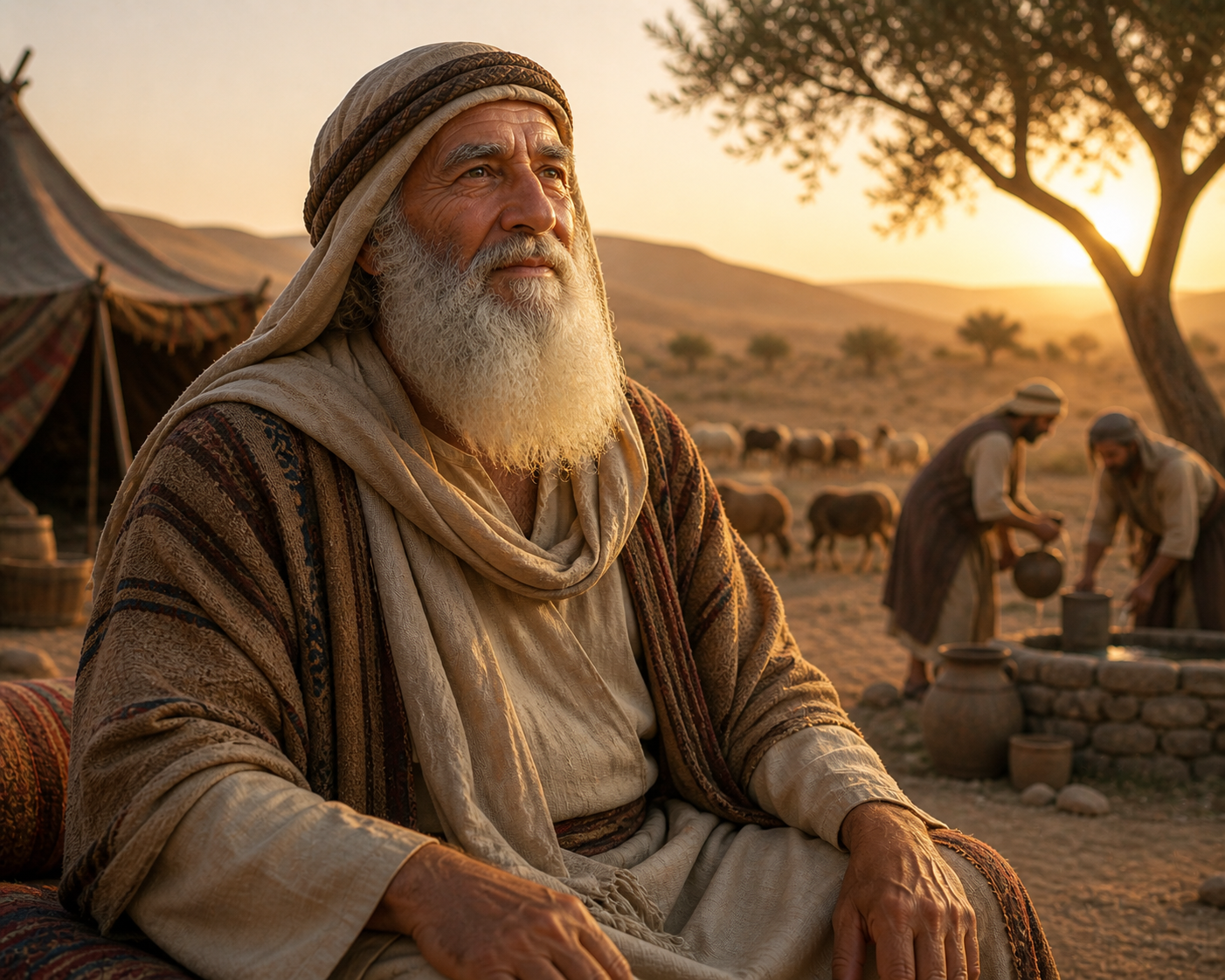
OLD AGE OF ABRAHAM
SIGN OF BLESSING BY YAHWEH
Warren Wiersbe aptly entitles chapter 24 "Here Comes the Bride!"
Paul Apple - imself in one of those critical situations in Gen. 24. His life is drawing to a close. God has committed Himself to momentous covenantal promises regarding Abraham’s seed and the possession of the Promised Land. But his son Isaac needs a wife – not just any wife – but a wife appointed by God for the fulfillment of these covenantal promises. Abraham has seen God provide for him and Sarah and protect the two of him in many crisis situations. Here, after the passing and burial of his precious companion, Abraham does not waver in his faith but displays full confidence that: GOD’S PROVIDENCE GRANTS US SUCCESS AS WE TRUST HIM FOR HIS PROVISION TO ACCOMPLISH HIS DIVINE PLAN Not looking for dramatic miracles here … counting on the Providence of God in the everyday events of life
J. I. Packer: Believers are never in the grip of blind forces (fortune, chance, luck, fate); all that happens to them is divinely planned, and each event comes as a new summons to trust, obey, and rejoice.
God is never speaking directly in this chapter and yet He is behind the scenes orchestrating everything (aka Providence!)
Now - Now we come to the longest chapter in Genesis. This marks a transition that both summarizes Abraham’s life up to this point and sets the stage for selection of Isaac's wife. This chapter unfolds in four scenes. It opens and closes in Canaan, while the two central scenes take place in Haran, one at the well and the other in Laban’s house.
Abraham was old, advanced in age - Abraham is at the final stage of his earthly life somewhere between 137 (Ge 23:1) and 175 (his age at death, Ge 25:7), probably about 140. The repetition (old…advanced in age) underscores not just his years and the fact that his life’s journey is nearing completion, BUT also is evidence of Yahweh's good hand of blessing on Abraham's life. (cf. Josh 13:1; Josh 23:1; 1Ki 1:1). The same is true today. If God has given you long life and you’re walking with Him, praise Him for His goodness (Ps 92:12–15; Ps103:1–5)
🙏 THOUGHT- O, for a life dominated and empowered by a faith like Abraham. Let it be so for all who read these notes. In Jesus' Name. Amen.
On the other hand Abraham's advanced age adds a sense of urgency to securing a wife for Isaac, ensuring the continuation of God’s covenant with Abraham and preserving the lineage through which the Messiah would come (Ge 24:3, 4; 12:3, Mt 1:1,2, Gal 3:16). He had relational blessing in God giving Him a son, Isaac, the heir of promise (Ge 21:1–3). He had spiritual blessing, with a deep, tested faith and friendship with God (Ge 15:6; 22:12). And he had the blessing of the covenant promises of God, the assurance that his offspring would become a great nation (Ge 12:2–3).
Bob Utley - "Now Abraham was old, advanced in age" When one compares Gen. 25:20, which says that Isaac was forty years old at his marriage to Rebekah, with Gen. 21:5, which says that Abraham was 100 years old at the birth of Isaac, then it seems that Abraham was 140 years old at the beginning of chapter 24. He lived to be 175 (cf. Gen. 25:7).
And the LORD had blessed Abraham in every way - Note that LORD occurs 20 time in this chapter and although He never speaks, He is the "Director" of the various scenes in this "play." In other words, He may be behind the scenes, but He was providentially in control of all the scenes!
Abraham had not lived a perfect life, but the direction of his life was toward obedience to Yahweh, Who showed him divine favor in many ways. He had material blessing with wealth, possessions, influence (Ge 13:2). Abraham's prosperity was not self-made but entirely God given by grace. (see blessings in Ge 24:35)
God had already proven faithful—
in Genesis 24 He will continue to show His faithfulness
🙏 THOUGHT - God has proven Himself faithful countless times in my life, and I am confident He has done the same in yours, dear believer. Every answered prayer, every sustaining grace in trial, every unexpected provision bears witness to His unchanging character (Lam 3:22–23; 1Co 1:9). Shall we now begin to doubt that He will continue to prove Himself faithful in the days to come? The question answers itself. The God who has been faithful will remain faithful, for He cannot deny Himself (2 Timothy 2:13). May we, like Abraham, learn to recognize and rest in His good hand upon our lives, trusting Him even when the path is not fully clear, confident that He is working all things together for good to those who love Him (Ge 24:27; Ro 8:28). Let us move forward with a settled assurance that the same God Who has led us thus far will continue to guide, provide, and sustain in the days, months, and years ahead. And all of this is for His glory Alone, accomplished through the gracious work of His Spirit, sent to us through His Son (Jn 14:16–17; Php 2:13). Amen.
C H Spurgeon - “That is the short history of his long life; God told him that he would bless him, and he did so. ‘The Lord had blessed Abraham in all things.’ What! when he commanded him to slay his son? Yes; he ‘had blessed him in all things.’ What! when he took away his wife Sarah? Yes, for ‘the Lord had blessed Abraham in all things.’ Perhaps, if his life had been without troubles, that sentence would not have been true.”
John Piper - Sometimes God spoke to Abraham directly and made his will unmistakably clear. But as far as we know from Genesis, those times were few and far between. Most of the time it seems Abraham had to trace out for himself his own trajectories of obedience from what God had said and done in the past. I think that is what’s happening in Genesis 24:1–9. (He Will Send His Angel Before You)
John Walton - 24:1-9. swearing oaths. An oath is always sworn in the name of a god. This places a heavy responsibility on the one who swears such an oath to carry out its stipulations, since he would be liable to divine as well as human retribution if he did not. Sometimes, as in this case, a gesture is added to the oath. The gesture usually is symbolic of the task to be performed by the oath taker. For instance, by placing his hand inside Abraham’s thigh (in the vicinity of or on the genitals), the servant ties his oath of obedience to the acquisition of a wife for Isaac and thus the perpetuation of Abraham’s line.
In summary, Genesis 24 moves from promise fulfilled in the birth of Isaac, the son of promise, to promise transmitted (Genesis 12:2–3) and thereby shows us that the God Who had “blessed Abraham in every way” continues to providentially act to secure the next link in the covenant line by providing a wife for Isaac. In doing so, the chapter demonstrates that God’s blessing is never an end in itself but always serves His larger purpose of advancing His unfolding plan of redemption for mankind.
R Kent Hughes who entitles Genesis 24 "Faith and Providence" says that "The position of this great story in Genesis at the end of Abraham’s life serves, in effect, to tell us that this is the way God works day in and day out in our lives. Such a God, of course, is great beyond our imaginings because he maintains all of life, involves himself in all events, and directs all things to their appointed end while rarely interrupting the natural order of life. This is an awesome thought. The God of Scripture is not simply a God of miracles who occasionally injects his power into life. He is far greater because he arranges all of life to suit and effect his providence. This makes all of life a miracle. God is over all. He is all-powerful, all-knowing, all-present, and all-controlling. This is the God of Scripture. Anything less is an idolatrous reduction of our puny imaginations." (See Genesis: Beginning and Blessing - Page 316)
GENESIS 24:1
The 2000 US presidential election was finally decided after weeks of recounts, court battles, and controversy about punch-card ballots. Political pundits and comedians had a heyday. Even after the Florida recount wrangling was over, a billboard along a Michigan highway reminded travelers of those post-election days. It carried this clever message: "Count your blessings. Recount if necessary"
In Genesis 24:1 we read that "the LORD had blessed Abraham in all things." Remarkable! The brief biography of Abraham's 175 years (GE 11:29-25:8) reveals blessing after blessing interwoven through all the adversities, testings, and even failures of his life.
As we review our years, whether many or few, we can see that same wonderful mixture of blessings, promises, and mercy running through our lives, even the trials and lapses of faith. If we can't, maybe a recount is necessary. —D. J. D.(Reprinted by permission from Our Daily Bread Ministries. Please do not repost the full devotional without their permission.)
PRAISE TO GOD COMES NATURALLY WHEN YOU COUNT YOUR BLESSINGS.
Oswald Chambers - Beatific Betrothal Genesis 24
Nothing can exceed the dignity and beauty of this chapter in the Bible. It reveals God’s providential workings in the lives of several elemental, upright people, and clearly conveys God’s order for each one. In the case of Abraham we see sublime sentiment (thought born in profound feeling) being worked out in plain common-sense details, yet with the natural sensibilities alive at once to human conditions and to the demands of God.
1. Sentiment, Sense and Sensibility
As already stated, there is a difference between sentiment and sentimentality. We cannot be profoundly moved by thought; we can only be profoundly moved by a personal crisis with God in which our usual equilibrium is disturbed, and our subsequent conceptions of life must be taken from the emotions stirred by the crisis. If the disturbance comes to you from outside, you will be exactly the same after it; but if you go through a personal crisis, such as Our Lord insists on, the personal crisis of devotion to Himself in discipleship, then all your conceptions of life will take colour from that moment. People are called backsliders who are merely sentimental pious people, they have had no crisis, all they have is the affectation of sentimentality. Recall the depths of feeling through which God has taken Abraham, and now in this chapter we see him being led rightly in the actual concerns of life. Right views on profound subjects will always be the spring of right relationships in shallow matters. To be guided by common sense is as foolish as being guided by faith. God is the One Who welds both faith and common sense into one practical personality.
By “Sense” understand matters of practical human existence, and remember that any feature of actual life not brought under the severe control of the conception born of your crisis with God will leave a loophole for the devil. For instance, if you ignore certain aspects of your natural life as it has been constructed by God—take too much sleep, or not enough sleep, forego meals—you will give occasion to the enemy straightaway, no matter how great a saint you are. We have no business to leave out any part of our being from the control of the conceptions born of our crisis with God. The difficulty with us as Christians is that we will not think in accordance with the crisis we have had; consequently when we come to the things of sense and meet with people who have not had a crisis with God, it is an easy business to climb down. If we remain true to the sentiment produced in us by our crisis with God, those who meantime protest against us will ultimately come up to the same standard; but if we succumb, everything will go down.
By “Sensibility” understand the natural intuitive power usually called tact, which makes it possible for us to live with other people without annoying them. These three, sentiment, sense and sensibility, must be welded into one in our personal lives by devotion to the Lord Jesus Christ.
2. Solemn Sacredness of Serving
Eliezer in many respects stands as a picture of a disciple of the Lord; the whole moulding of his life is his devotion to another, not to a sense of right or duty, but to his master (cf. John 13:13-14). We know very little about devotion to Jesus Christ. We know about devotion to right and to duty, but none of that is saintly, it is purely natural. My sense of duty and of right can never be God’s. If I can state what my duty is, I have become my god in that particular. There is only One Who knows what my duty is as a Christian, and that is God. The Sermon on the Mount nowhere tells us what our duty is; it tells us the things a saint will do—things that are not his duty, e.g., Matthew 5:39-42. Be renewed in the spirit of your mind†, says Paul, not that you may do your duty, but that you may make out what God’s will is.
All the reward Eliezer seeks is the happiness of his master, self-remembrance in him is dead. He is shrewd and practical, yet as guileless as a child, the exact embodiment of 1 Corinthians 4:2—“It is required in stewards, that a man be found faithful.”
3. Self-Forgetfulness in Stewards of Secrets
One significant thing to notice is that Rebecca came alone and unveiled, and conversed freely with a stranger. The self-forgetfulness of Eliezer and Rebecca’s own intuition made her know that she was safe with him. “Man’s virtue and woman’s liberty go hand in hand.” There are those who talk like angels, yet they smudge the soul; there are others who may not talk sweetly yet they exhilarate the soul. Guard your intuition as the gift of God. You cannot judge virtue by its obverse; you can only judge virtue by intuition. Woe be to any woman who ignores her intuition, ignores the warning which says—Now draw back. For God’s sake and your own womanhood’s sake, draw back, it matters not who the person is.
4. Sweet Supremacy of Singleness
Rebecca’s brother and mother recognise God’s hand in the whole matter (Genesis 24:50), and Those words are the answer to Eliezer’s prayer. Rebecca felt the thrill which always passes through any pure young heart in the presence of a saint. A soul’s trust in a saint in the providence of God is something more precious even than love. Few of us know anything about it because we are too sordidly selfish, we want things for ourselves all the time. Eliezer had only one conception, loyalty to his master, and in the providence of God he brought Rebecca straight to Isaac. This marriage, like all true marriages, concerns the Kingdom of God.
Warren Wiersbe (page 88) - It seems strange that the longest chapter in Genesis tells the story of how a man got his wife. While that is an important topic, and this is certainly a beautiful story, does it deserve that much space? Only thirty-one verses are devoted to the Creation account in Genesis 1; sixty-seven verses are allowed to relate how Rebekah became Isaac’s wife. Why?
For one thing, the chapter emphasizes separation. Abraham made it clear that his son was not to marry a Canaanite woman (Ge 24:3). The Law of Moses did not permit the Jewish men to marry heathen women (Deut. 7:1–11). Nor are believers today to marry unbelievers (2 Cor. 6:14–18; 1 Cor. 7:39–40). Genesis 24 is a great encouragement for those who want God’s will in the selection of a mate. Today, while we do not use the same manner as Abraham’s servant, the principles still apply: We must want God’s will, we must pray and seek His guidance, we must be willing to obey, and we must be alert to what God is doing.
Of course, when the husband in the story is Isaac, the beloved son of Abraham, then the narrative takes on greater significance. After all, Isaac was the next “living link” in the chain of blessing that culminated in the birth of the Savior, Jesus Christ; so whatever happens to Isaac is of utmost importance in God’s great plan of salvation.
But the chapter goes beyond history into theology. It gives us a picture of the Heavenly Father getting a bride for His Son (Matt. 22:1–14). The church is compared to a bride (2 Cor. 11:2–3; Eph. 5:22–33); and during this present age, the Holy Spirit is calling people to trust Christ and be “married to … Him” (Rom. 7:4). The elements involved in the marriage of Isaac and Rebekah are also involved in the marriage of Christ and His church. There are four of them.
Oswald Chambers - 1. Human Forethought and Divine Design (Genesis 24:1-9)
Abraham’s motive is clearly stated here. Never speak of human motives as if they were opposed to the Divine. In the life of a child of God the human motive is the disguised Divine. Sanctification means that I become a child of God, consequently my common-sense decisions are God’s will unless He gives the check of His Spirit. I decide things in perfect fellowship with God, knowing that if my decisions are wrong, He will check. When He checks, I must stop at once. It is the inner check of the Spirit that prevents common sense being our god. There are times of crisis when we must wait on God, but they are rare. It is the abortion of piety to ask God to guide us here and there, of course He will! Such asking is not real. Remember our Lord’s injunction—“Except ye . . . become as little children.”††
If God is not recognised by His blessings in the details of actual life in the beginning, He will be recognised in the end by His destructions. Human forethought in a faithful soul such as Abraham is the manifestation of the Divine design. In looking back you see not the haphazard, but an amazing design which, if you are born of God, you will credit to God; otherwise you credit it to the extraordinary wisdom of men and women.
David Jeremiah - MEET THE “STEWARD” OF STEWARDSHIP - Genesis 24
In this lesson we will define “stewardship” and discover four principles upon which Biblical stewardship is based.
OUTLINE
Whenever we say “my this” or “my that,” we reflect a worldly view of possessions—the view that what I have is mine. In reality, the opposite is true: Everything is owned by God, and we are only temporary managers of it on His behalf.
I. Stewardship
II. Aspects of Stewardship
A. We do not own anything—God owns it all.
B. Whatever we have is not ours, but His—we simply administer things on His behalf.
C. How we administer what God has entrusted to us determines whether or not we can be given anything else.
D. We shall all give an account someday.
OVERVIEW
We live in a world of financial bombardment, facing solicitations and appeals on almost a daily basis. How are we to respond to all the requests for funds? What do we do when faced with an appeal for our money? What principles has God given us to help us control what we do with our finances?
Many would say that we respond emotionally. Professional fund-raisers know that if they’ll push the right emotional buttons, they can successfully solicit money. Certainly our emotions ought to be involved in our giving, but when we examine the multitude of opportunities brought before us, there must be a better way to decide what we’ll distribute.
STEWARDSHIP
Fortunately, God has given us His wisdom. The Word of God speaks often about the concept of “stewardship,” a much-talked about word that most people do not understand. “Stewardship” is a concept that goes way beyond spending money—in fact, the use of money is a very small part of what it means to be a steward. In New Testament Greek, the word “steward” referred to either a slave or free man who was given household responsibilities, either as guardian of children or administrator of affairs. Every household of wealth and distinction had a steward, and he was in charge of the estate, often functioning as the manager of financial affairs and holdings.
The Hebrew word translated “steward” in the Old Testament was ben-meshach, which literally means “son of acquisition.” In Genesis 15:2, Abraham uses the word to refer to Eliezer as the “steward” or “heir” of his house. Eliezer, the trusted steward, was the one who represented Abraham in all of his dealings. That’s why, in Genesis 24, Eliezer was given the assignment to find a wife for Abraham’s son, Isaac. A careful reading of that chapter reveals several important insights regarding the work of a steward.
First, notice that the steward was accountable for his master’s domain. In verse 2 of chapter 24, Eliezer is described as the servant “who ruled over all that he had.” Eliezer was responsible for everything that belonged to Abraham. In verse 10 we read that the servant took ten camels from the herds, all his master’s goods were in his hands.” Eliezer had authority over Abraham’s herds, but with that authority came accountability.
Second, it is clear that the steward was available when his master needed him. When Abraham called Eliezer to give him a special assignment, the servant was at the disposal of his master. As the steward, Eliezer was to do whatever the master required of him.
Third, note that the steward was anxious to know the master’s will. When he was given the assignment to go into the far country and find a wife for Isaac, Eliezer requested additional information. He wanted to make sure he got the right woman! He talked it over with Abraham, to make sure he had the will of his master in his own heart. It is important to keep that principle in mind, for when God gives us something to do, He is never offended when we come to request more information in order to obey Him well.
Fourth, the steward was allegiant to his master. Verse 9 tells us that Eliezer “put his hand under the thigh of Abraham his master, and swore to him concerning this matter.” Of course, the servant was committed to his master already, but no one who is committed will be offended when asked to affirm his commitment. Occasionally I have had people in churches complain that they don’t like writing out “commitment cards,” but my experience has shown me that people who don’t like to affirm their commitments usually are not committed! If I am committed to my master, I’ll happily affirm my commitment. So Abraham’s servant eagerly agreed to commit himself anew to this particular assignment.
Fifth, it is clear that the steward was agreeable to his master’s bidding. Verses 12–14 record Eliezer’s prayer, in which he asks for guidance and grace in fulfilling his master’s desires. A true steward not only administrates the affairs of another, he does it with a deep desire to reflect his master’s will.
Finally, the steward attributed praise to his master. In verse 35, after locating the family of Isaac’s future bride, Eliezer spoke of the greatness of his master, and you can sense his pride and excitement in his words. He was thrilled to be able to faithfully serve Abraham, and he wanted to tell his new friends about the greatness of his master. Eliezer is the kind of steward every business owner wants to find—one who will manage it on behalf of the owner, while reflecting the owner’s heart.
ASPECTS OF STEWARDSHIP
Eliezer is just one example of an Old Testament steward, managing things on the owner’s behalf. Jacob was also a steward, managing Laban’s flocks and herds for seven long years in order to marry his daughter. Joseph was another steward who took charge of his master’s domain. Though unjustly sold as a slave by his brothers, Joseph came to administrate the entire affairs of Potiphar, and later the affairs of all Egypt. Genesis 39:4 tells us that Potiphar made Joseph “overseer of his house and all that he had.” That’s why, when faced with temptation at the hands of Potiphar’s wife, Joseph replied, “My master does not know what is with me in the house, and he has committed all that he has to my hand. There is no one greater in this house than I, nor has he kept back anything from me but you, because you are his wife. How then can I do this great wickedness, and sin against God?” Joseph recognized that his master had given him complete control, and his job was to please the will of his master.
There are two words translated “steward” in the New Testament that add another aspect to our understanding of stewardship. In Galatians 4:1, 2 we read that “a slave, though he is master of all … is under guardians and stewards until the time appointed by the father.” The King James translates that as “tutors and governors.” A tutor looks after someone’s children on behalf of the parents. A governor looks after their affairs or household. Both of these words can also be translated “steward,” and refer to the act of taking care of something that belongs to another.
Jesus often used the concept of stewardship in His parables. For instance, in the parable of the laborers recorded in Matthew 20, the owner of the vineyard puts his steward in charge of the labor force, telling him to pay the workers whatever they have earned. The steward managed the laborers on behalf of his master. In the parable of the minas in Luke 19, the parable of the talents in Matthew 25, and the parable of the wicked husbandman in Matthew 21, a steward manages responsibilities on behalf of someone else.
Christ used this same concept when He assigned responsibilities to His disciples. “Who then is that faithful and wise steward, whom his master will make ruler over his household, to give them their portion of food in due season?” the Lord asks in Luke 12:42. He was gathering His followers in order to say, “I am getting ready to go back to heaven, and I am now putting you in charge.” The Apostle Paul continued that thought when he wrote in Titus 1:7 that a bishop must be “blameless, as a steward of God.” That verse reveals churches don’t belong to pastors—they belong to God. The pastor’s role is to be a good steward of God’s people because one day he’ll have to give an account.
Remember, then, that stewardship is not a matter of coming to church in order to give God 10% of your income and keep the other 90% as your own. As stewards, all 100% belongs to God, and one day when we stand before Him, we’ll have to give an account of what we’ve done with His resources. We won’t simply be asked to explain what we did with 10%, but be held responsible for everything He has put into our hands. Stewardship is a lofty and dignified principle, not a gimmick for getting money into the offering plates of churches. It is God’s method for running things here on earth, and He has given us the blessed opportunity to be part of it. With that in mind, let’s look at the following four principles.
We do not own anything
—God owns it all.
If a couple says to you, “Come see our house,” what they’re really inviting you to see is the house God gave them to manage. If a friend invites you to drive her new car, what she is really inviting you to drive is God’s car—though He is allowing her to drive it for awhile. If a businessman extols the virtues of his business, what he is really praising is the Lord. It’s God’s business, but He arranges for someone to manage it on His behalf. In case you don’t believe that, consider these verses:
• Leviticus 25:23: “The land is Mine.”
• Psalm 24:1: “The earth is the Lord’s.”
• Psalm 50:10: “Every beast of the forest is Mine.”
• Haggai 2:8: “The silver is Mine and the gold is Mine.”
• Ezekiel 18:4: “All souls are Mine.”
• I Corinthians 6:19–20: “You are not your own...you were bought at a price.”
Every individual belongs to God. Everything we have belongs to God. Everything we claim is ours actually is owned by God. Therefore, never lose sleep over losing anything because we own nothing. We are simply allowed to manage God’s things for a short while.
Whatever we have is not ours, but His—
we simply administer things on His behalf.
James 1:17 tells us that every good and perfect gift comes from the Father. It isn’t something we have earned, but something He decides to give. That’s why Deuteronomy 8:18 warns us to remember the Lord, “for it is He who gives you power to get wealth.” A businessman may think he is a self-made man, but the very power to succeed came from God. As Paul said in I Timothy 6:7 and 17, “For we brought nothing into this world, and it is certain we can carry nothing out … [it is] God who gives us richly all things to enjoy.”
After one of the greatest offerings in history, King David had to actually tell the people to stop giving because they had given so much. After he had received the offering, David prayed these words, recorded in I Chronicles 29:14: “For all things come from You, and of Your own we have given You.” I love those words, for they remind me that anything I give to God is merely a giving back of His own abundant blessing. I’m simply giving back to God what He already owns. It’s like recycling the blessing for the kingdom of God. Everything we think we own belongs to God, and we administrate it on His behalf.
How we administer what God has entrusted to us determines
whether or not we can be given anything else.
I’ve been in churches all my life, and I’ve heard countless sermons on stewardship. One of the popular images in the church is to say that “you can’t out-give God.” I once heard a pastor say that giving was like having a shovel in which we give as much as possible to God, and He shovels it all right back to us. And since His shovel is bigger than ours, we always get back more than we gave. The problem with that illustration is that it brings God down to the level of “blessed bargainer.” The Lord doesn’t work that way.
God owns everything and has decided to put some of it into our hands to manage. When the Lord looks down and sees an individual doing a good job administering a few things, He decides to put that individual in charge of a few more things. God evaluates our stewardship on the basis of how well we administer it, keeping His priorities in mind rather than our own. When He sees someone serving faithfully, He expands the responsibility, giving something else to be managed. But when He sees someone who manages God’s resources based on a personal agenda, or who forgets to reflect the Spirit of God in his management, the Lord can choose to withhold any further responsibility.
That’s why Jesus, in explaining the parable of the talents in Matthew 25:21, said, “Well done, good and faithful servant; you were faithful over a few things, I will make you ruler over many things.” Another time, in Luke 16:10–11, the Lord noted, “He who is faithful in what is least is faithful also in much; and he who is unjust in what is least is unjust also in much. Therefore if you have not been faithful in the unrighteous mammon, who will commit to your trust the true riches?”
Occasionally I’ll hear someone say, “I can’t afford to tithe right now, but as soon as I get my next raise, I’m going to start giving to God.” That person is deluding himself. If we cannot manage the little God has given us, we won’t be able to manage more. And if we can’t take care of the small things, God won’t be interested in turning the big things over to us. Getting more responsibility would just make us more unfaithful as stewards. But when we prove ourselves faithful in the things God has given us, then He can entrust us with additional responsibilities.
We shall all give an account someday.
When Paul wrote to the Romans, he told them in 14:12 that “each of us shall give account of himself to God.” We will have to “settle up” with the Lord some day. That’s why II Corinthians 5:10 reminds us that “we must all appear before the judgment seat of Christ, that each one may receive the things done in the body, according to what he has done, whether good or bad.” God owns everything, He entrusts to each of us a portion of what He owns so that we can manage it, and someday we’ll each have to give an accounting for our actions. As stewards, we should expect nothing less.
The great preacher John Broadus once taught the members of his congregation a lesson on stewardship. As the ushers took up the offering, he walked up and down the aisles, looking at every penny and nickel put into the plate by his parishioners. As you can imagine, some of the people in church that day were furious, others were shamefaced, and everyone was surprised. But when Broadus walked back to his pulpit, he said, “My people, if you take it to heart that I have seen your offering this day and know just what sacrifice you have made—and what sacrifice you have not made—remember that your Savior [God’s Son] goes up the aisles with every usher and sees every cent contributed by His people. He knows whether or not you are faithful in your stewardship.”
We do everything we can in our modern churches to protect the anonymity of the stewards. As a pastor, I don’t know what anyone gives, nor do I want to know. But God knows exactly what we are doing with everything entrusted to our care, and one day we will have to account for all of it. What a thrilling thought it is to know that God has given us an opportunity to take care of His things! Let us make sure we are good stewards of all that belongs to Him.
Genesis 24:2 Abraham said to his servant, the oldest of his household, who had charge of all that he owned, “Please place your hand under my thigh,
- the oldest of his household: Ge 15:2 1Ti 5:17
- who had charge: Ge 24:10 39:4-6,8,9 44:1
- Please place your hand under my thigh: Ge 24:9 Ge 47:29 1Ch 29:24
Related Passages:
Genesis 12:3 And I will bless those who bless you, And the one who curses you I will curse. And in you (ULTIMATELY IN THE SEED OF THE MESSIAH Gal 3:16) all the families of the earth will be blessed.”
Genesis 15:2 Abram said, “O Lord GOD, what will You give me, since I am childless, and the heir of my house is Eliezer of Damascus?”
Genesis 47:29 When the time for Israel to die drew near, he called his son Joseph and said to him, “Please, if I have found favor in your sight, place now your hand under my thigh and deal with me in kindness and faithfulness. Please do not bury me in Egypt,
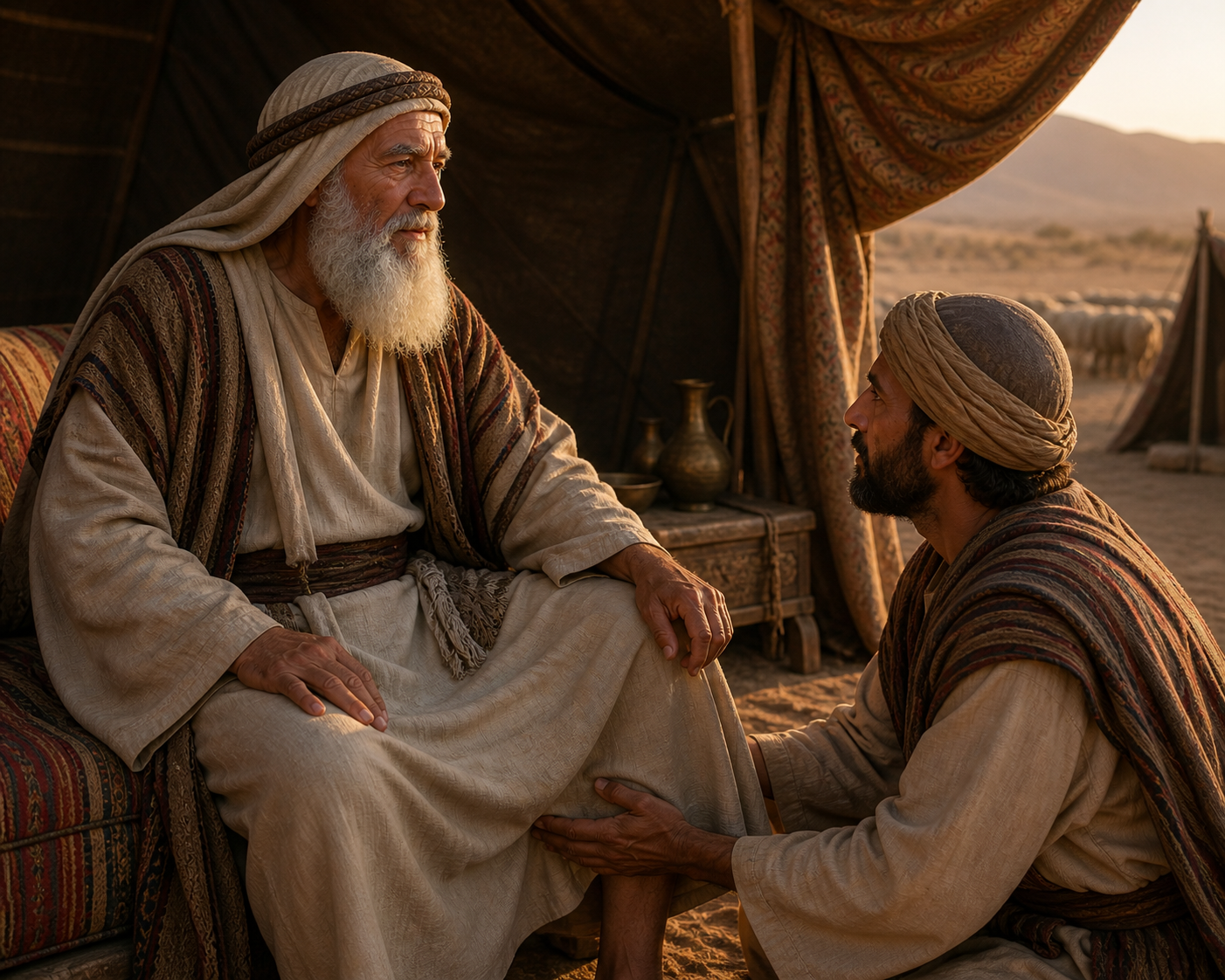
SERVANT COMMISSIONED
BY ABRAHAM
Abraham said to his servant, the oldest of his household, who had charge of all that he owned - His servant is most likely Eliezer (cf. Genesis 15:2), the trusted steward who had long managed Abraham’s affairs. The term “oldest” (זָקֵן, zaqēn) can denote either advanced age, senior rank, or both, and in this context it likely points to a man of proven maturity and highest authority within the household. He functioned as the superintendent over all that Abraham possessed, a position requiring both loyalty and discernment. Here we see Abraham's faith is not passive but is expressed through careful, practical obedience taking deliberate steps to find a wife for Isaac in such a way as to protect the Messianic line.
Please place your hand under my thigh - Even before he gives the reason, he calls on the servant to place in hand in this intimate location. There is nothing lascivious here, for as discussed below it was part of taking a solemn oath in certain situations.
The gesture =
culturally strange but deeply symbolic
NET NOTE - Put your hand under my thigh. The taking of this oath had to do with the sanctity of the family and the continuation of the family line. See D. R. Freedman, “Put Your Hand Under My Thigh—the Patriarchal Oath,” BAR 2 (1976): 2–4, 42.
Adam Clarke - “The person binding himself put his hand under the thigh of the person to whom he was to be bound; i.e., he put his hand on the part that bore the mark of circumcision, the sign of God’s covenant… Our ideas of delicacy may revolt from the rite used on this occasion; but, when the nature of the covenant is considered, of which circumcision was the sign, we shall at once perceive that this rite could not be used without producing sentiments of reverence and godly fear, as the contracting party must know that the God of this covenant was a consuming fire.”
Believer's Study Bible - Note Abraham's sensitivity to the importance of selecting a wife for his son. The responsibility was not taken lightly (cf. 2 Cor. 6:14). The strange practice alluded to here has been found also in the culture of the Babylonians. The "thigh" (yarek, Heb.), or "loins," was viewed as the seat of the procreative powers. The action enjoined upon the servant was one which affected all of Abraham's posterity, and hence, the messianic line. The placing of the hand beneath the procreative area of the body was a symbol of the solemnity of the oath and its far-reaching effects.
Charles Ryrie - thigh (cf. Ge 47:29) is a euphemism for the procreative organ. This act either symbolized that the yet unborn children would avenge any violation of the oath or solemnized the oath in the name of the God who gave circumcision as the sign of His covenant.
Bob Utley - "Please place your hand under my thigh" The VERB "place" (Qal IMPERATIVE) is an important cultural command related to the oath of Gen. 24:3 ("swear," Hiphil IMPERFECT used in a COHORTATIVE sense).
This particular cultural act is mentioned only here and in Gen. 47:29. There have been several theories as to its exact purpose.
- Since the thigh represents the symbol of a man's descendants (BDB 437,1,b, cf. Gen. 46:26; Exod. 1:5; Jdg. 8:30), this may refer to the genital organs. If this is true it seems to refer to circumcision, which is the sign of YHWH's covenant (cf. Gen. 24:3). This is the way that this verse is interpreted by the Targum of Jonathan and Rashi.
- It is conceded that this refers to descendants and therefore, Jerome, Augustine, and Luther all say that it refers to the ultimate descendant of Abraham, the Messiah.
- Some see it as referring to the lordship of Abraham to this particular administrator for this important task of finding a wife for Isaac (cf. Aben Ezra and Calvin).
- It may reflect a cultural curse oath of sterility if violated.
Genesis 24:3 and I will make you swear by the LORD, the God of heaven and the God of earth, that you shall not take a wife for my son from the daughters of the Canaanites, among whom I live,
- swear: Ge 21:23 26:28-31 31:44-53 50:25 Ex 20:7 22:11 23:13 Lev 19:12 Nu 5:21 De 6:13 10:20 Jos 2:12 1Sa 20:17 Ne 13:25 Isa 45:23 Isa 48:1 65:16 Jer 4:2 12:16 Zep 1:5 Heb 6:16
- the: Ge 14:22 2Ki 19:15 2Ch 2:12 Ne 9:6 Ps 115:15 Jer 10:11
- that: Ge 6:2,4 26:34,35 27:46 28:1,2,8 Ex 34:16 De 7:3,4 1Co 7:39 2Co 6:14-17 Ge 9:25
Related Passages:
Genesis 47:29 When the time for Israel to die drew near, he called his son Joseph and said to him, “Please, if I have found favor in your sight, place now your hand under my thigh and deal with me in kindness and faithfulness. Please do not bury me in Egypt,
Comment - Comparing Ge 24:2 and Ge 47:29 - both use same gesture with same meaning, both involve a patriarch and a trusted subordinate, both require a binding oath (probably appealing to the sign of the Abrahamic covenant (Ge 17:11), circumcision, both concern the Seed one through marriage and the other through burial, both are in the context of the end of life for Abraham and for Jacob, both show faith at the end of life is focused on God’s promises, not present circumstances, Ge 24 points to preservation of the Seed, Ge 47 to possession of the Land, upholding the two pillars of the Abrahamic covenant, the Seed and the Land! Both oaths say “God’s promises govern my decisions—even at the end of life.”
Genesis 9:25 So he said, “Cursed be Canaan; A servant of servants He shall be to his brothers.”
Deuteronomy 7:3-5 “Furthermore, you shall not intermarry with them; you shall not give your daughters to their sons, nor shall you take their daughters for your sons. 4“For they will turn your sons away from following Me to serve other gods; then the anger of the LORD will be kindled against you and He will quickly destroy you. 5“But thus you shall do to them: you shall tear down their altars, and smash their sacred pillars, and hew down their Asherim, and burn their graven images with fire.
OATH IN YAHWEH
OF HEAVEN AND EARTH
and I will make you swear by the LORD, the God of heaven and the God of earth - Abraham affirms that Yahweh has absolute authority over ALL creation! This verbal oath is made even more solemn by asking the servant to place his hand under his thigh. Ultimately we see God’s sovereign direction behind these human actions, in what is Abraham’s final act of faith.
That you shall not take a wife for my son from the daughters of the Canaanites, among whom I live, - The first part of the oath was that the servant not take a wife from the corrupt, cursed line of the Canaanites. The Canaanites were an idolatrous culture and marriage is a spiritual union (read 2Co 6:14-18, 7:1) and is about preserving covenant purity, protecting the line from which Christ would come. Here we see the servant becomes an instrument of God's providence (Human agency + divine sovereignty working together). Everything in this verse points to the fact that Isaac must marry correctly, the Covenant must remain pure and the Messianic line must continue. In short, this marriage determines the future of redemptive history. Keep in mind that Isaac is now 40 years old (Ge 25:20) and still their is no heir!
Warren Wiersbe (page 88) - In those days, the parents made the marriage arrangements. A man and woman got married and then learned to love each other (24:67). In much of the world today, the pattern is different.
Keith Krell - Where else would Abraham send his servant than to his own relatives? Now I am not recommending this for any young people today. But I would suggest that if you want to find a godly spouse you look where godly Christians should be. Furthermore, if you want a godly spouse you need to be the kind of person a godly spouse will be looking for.
ESV Study Bible - Abraham sets an example for his descendants to secure wives from the blessed Semites, not the cursed Canaanites (9:24-27; Deut. 7:1-4).
Parunak - Abraham here is making a distinction between the land and the people. • By purchasing a burying ground in ch. 23, he shows his faith that his descendants will inherit the land. • By avoiding union with the people, he avoids any kind of alliance that might enable them to remain there. God has promised to put out the Amorites, 15:12-16; to join with them (as Lot did, having sons in law in Sodom) would go against the promise.
John Piper on why not from the Canaanites is related to "a prediction that God made to Abraham in Genesis 15:16. God tells Abraham that his descendants will be oppressed 400 years in Egypt and then says, “And they shall come back here in the fourth generation; for the iniquity of the Amorites is not yet complete.” The Amorites here represent all the pagan peoples of Canaan. They are marked out for judgment because of their sin, but God will not drive them out until the history of their sin is so appalling no one will accuse God of injustice when he sweeps through Canaan destroying these nations. Now if God had said that to you about the people surrounding you, would you not hear a warning against forming marriage alliances? Abraham saw a trajectory in God’s Word that probably went something like this: “Through your son I will fulfill my covenant to be the God of his descendants and to bless all the nations through him. So take heed lest he marry a woman who worships other gods and could bring him into a snare.” That’s the way Moses warned Israel hundreds of years later when they were about to enter the promised land: “You shall not make marriages with them, giving your daughters to their sons or taking their daughters for your sons. For they would turn away your sons from following me, to serve other gods” (Deuteronomy 7:3, 4). (He Will Send His Angel Before You)
Warren Wiersbe - Just as Abraham wanted a bride for his son, so God the Father elected to provide a bride for His beloved Son. Why? Not because Jesus needed anything, for the eternal Son of God is self-existent and self-sufficient and needs nothing. The bride is the Father’s love gift to His Son. We usually emphasize that the Son is the Father’s love gift to the world (John 3:16) and forget that the church is the Father’s love gift to His Son (17:2, 6, 9, 11–12, 24).
In the divine counsels of eternity, the Father elected to save lost sinners by His grace, the Son agreed to die for the sins of the world, and the Holy Spirit agreed to apply that work to the lives of all who would believe. This is revealed in Ephesians 1:1–14, where you see the work of God the Father (Eph 1:3–6), God the Son (Eph 1:7–12), and God the Holy Spirit (Eph 1:13–14). Note especially that the reason for this great plan of salvation is the glory of God (Eph 1:6, 12, 14). Those who trusted Christ would be a special people, His inheritance (Eph 1:18) and His bride (Eph 5:22–33). His bride would bring glory to Christ on earth and throughout all eternity. One day Jesus Christ would have the joy of presenting His bride in glory to the Father (Heb. 12:2; Jude 24).
The next time you have the privilege of witnessing for Jesus Christ, remember that you are inviting people to come to the wedding!
Genesis 24:4 but you will go to my country and to my relatives, and take a wife for my son Isaac.”
- to my relatives: Ge 11:25-32 12:1,7 22:20-23 28:2
ABRAHAM'S INSTRUCTIONS MOVE FROM
PROHIBITION TO PRESCRIPTION
But (term of constrast) What is being contrasted? Genesis 24:4 is the positive counterpart to verse 3, replacing prohibition (“Do NOT take from Canaanites”) with direction (“GO and take from my people”).
You will go to my country and to my relatives, and take a wife for my son Isaac - Note 3 possessive pronouns ("my"). This is a seed-preserving command. Clearly although Canaan was the Promised Land, Abraham commanded the servant to (1) return to Abraham's home country and (2) secure a wife from Abraham's native land. The bride must come from the same covenant stream (Shemite line). Abraham's faith is directing his practical decisions.
Bob Utley - "go to my country and to my relatives" This refers to Ur of the Chaldees and the family of Nahor mentioned in Gen. 11:27-31.
Henry Morris - Abraham had learned the hard way that the heir of the promises should not leave the promised land. Nevertheless, a suitable wife through whom the promised seed could be born and trained could not be found among the people then in the land. Consequently, the father must send a trusted servant to find a suitable bride for his son, far away and among a small remnant who still served the true God. A typological parallel with the heavenly Father sending the Holy Spirit to claim a bride for His Son seems well warranted in this case (note John 14:26; 16:13,14; 2 Corinthians 11:2; Acts 15:14; etc.).
John Walton 24:4. marrying from same tribe. The practice of marrying within one’s own tribe or family is called endogamy. Endogamy could be the result of religious, social or ethnic concerns. In this text it appears to be ethnic in that there are no suggestions that the family of Laban, Rebekah and Rachel shares the religious beliefs of Abraham and his family. Likewise social standing is usually an issue only when nobility and commoners are involved or certain classes of urban society are seen as necessarily distinct. Ethnic concerns usually center around clan traditions or family land holdings. At times they represent long-established hostilities between two groups. In this text the endogamy seems motivated by the *covenant that seeks to prevent Abraham and his family from simply being assimilated into the ethnic melting pot in Canaan.
In summary, Abraham instructs his servant not only to avoid the Canaanite women, but to return to his own people to find a wife for Isaac, thereby protecting the covenant line through which the promised Seed would come (Genesis 12:3). This highlights that true faith is not merely avoiding what is wrong, but actively pursuing what God has revealed as right—even when that path is difficult, costly, and requires complete dependence on Him. Abraham’s command, therefore, becomes the channel through which God’s providence unfolds, demonstrating that the God of heaven and earth is personally involved in directing every detail, and that He will faithfully guide His servants step by step as they walk in obedient trust according to His purposes.
G Campbell Morgan - Gen. 24.4.
On the part of Abraham this sending of his servant to seek a wife for Isaac was an act of obedient and intelligent faith. He was now about a hundred and forty years old, and Isaac was forty. The record declares that "Jehovah had blessed Abraham in all things" (Ge 24:1); and the chief blessing granted was this son. Through him the promises made to Abraham were to be fulfilled; the promised Seed was to come. The certainty of this promise made it incumbent upon Abraham to co-operate with God intelligently. Therefore he took this method of securing the seed of his son from contamination with the people of the land. It was an activity of faith. This is seen in the answer Abraham gave to his servant when he suggested that the woman he might find might not be willing to follow him. He declared that Jehovah would send His angel before him. The sequel shows how wonderfully this man was guided through the ordinary circumstances of everyday life. The principle suggested and illustrated by this whole story is that faith is to act reasonably. To believe in the promises of God is to act in accordance with them, in the sense of intelligent co-operation. Faith does not sit down and say: God has promised, there-fore I have nothing to do. It rather says: God has promised, therefore I must do everything in the line of His promise; and so far as in me lies, see to it that nothing interferes with His purpose.
A W Tozer - Gifts and Graces
… gifts of the Holy Ghost, according to his own will. (Hebrews 2:4)
I go back often to Genesis 24 for the illustration and the figure in the Old Testament reminding us of the adornments of grace and beauty that will mark the believing Body of Christ. Abraham sent his trusted servant to his former homeland to select a bride for Isaac.
The adornment of Rebekah’s beauty consisted of jewels and the raiment that came as gifts of love from the bridegroom whom she had not yet seen.
It is a reminder of what God is doing in our midst right now. Abraham typifies God the Father; Isaac, our Lord Jesus Christ, the heavenly Bridegroom. The servant who went with the gifts into the far country to claim a bride for Isaac speaks well of the Holy Spirit, our Teacher and Comforter.
He gives us, one by one, the gifts and the graces of the Holy Spirit that will be our real beauty in His sight. Thus we are being prepared, and when we meet our coming Lord and King, our adornment will be our God-given graces!
James Smith - THE BRIDAL SEARCH. Genesis 24.
This is one of the most wonderful seed-plots in the whole field of Revelation. It is an epitome of the scheme of salvation, and an outline history of the Church of God. May our eyes be opened to behold these wondrous things. Here we may see—
I. Abraham; or, The Father's Purpose. "Thou shalt go and take a wife unto my son Isaac" (v. 4). The thought of a bride for Isaac originated with the father. It was the outcome of his love for his son, and a desire to bring into great blessing one who was as yet a great way off. What a picture of Christ and the Church (Eph. 5:32). God the Father saw that it would be good for His Son to have a Bride with Him in the glory of His Father's presence. This purpose was declared, and the covenant made before the world was formed. The Church, as His Bride, was chosen in Him before the foundation of the world. O the unsearchable riches of His grace! O the unfathomable depths of His kindness toward us!
II. Isaac; or, The Son and Heir. "Unto him hath he given all that he hath" (v. 36). Isaac, like Jesus, came into possession of his inheritance after passing through the bitterness of death (Gen. 22:9, 10). In the experience of both father and son Isaac virtually died and rose again. Now he becomes heir to all. Jesus Christ "humbled Himself, and became obedient unto death;... wherefore God also hath highly exalted Him" (Phil. 2:8, 9). Now it hath "pleased the Father that in Him should all fulness dwell" (Col. 1:19). "In Him dwelleth all the fulness of the Godhead" (Col. 2:9). Unto Him hath the Father given all that He hath, that all the wants of His happy Bride may be fully satisfied. "Though He was rich, yet for your sakes He became poor, that ye through His poverty might be rich" (2 Cor. 8:9). He emptied Himself that He might get into touch with the poverty of His Bride. Ye are complete in Him.
III. Eliezer; or, The Spirit's Mission (Gen. 24:2). This old steward of the house of Abraham is a perfect type of the Holy Spirit.
1. HE HAD AUTHORITY IN THE HOUSE. He looked after the domestic affairs of Abraham. The Spirit is One with the Father and the Son. He attended to the home affairs of this world (Gen. 1:2).
2. HE WAS SENT BY THE FATHER. "The Holy Ghost, whom the Father will send" (John 14:26).
3. HE WAS SENT IN THE NAME OF THE SON (JOHN 14:26).
4. HE DID NOT SPEAK OF HIMSELF (v. 33).
5. HE REVEALED THE THINGS OF ISAAC (v. 53; John 16:14).
6. HE WITNESSES FOR HIS MASTER (v. 35).
7. HE GUIDES ALL THE WAY HOME (v. 61). "The Comforter may abide with you for ever" (John 14:16).
Every act of this servant seems instinct with deep spiritual teaching. He would not eat bread until he had made known his errand (v. 33). The Holy Spirit cannot have fellowship with us until He has revealed to us the character of the Father and of the Son. He said, "Hinder me not" (v. 56). If the presence of Jesus Christ is to be enjoyed we must be obedient to this Holy Messenger.
IV. Rebekah; or, The Bride of Christ. "Wilt thou go with this man? She said, I will go" (v. 58). While Rebekah is a type of the Church—called out by the Spirit of God, and separated unto the Name of Jesus—yet we must not lose sight of our individual responsibility. The heavenly Eliezer is still calling out a people for His Name. In the Gospel we still hear the divine entreaty," Wilt thou go with this Man?" This call—
1. IS GRACIOUS. It is not a question of character.
2. IT IS PERSONAL." Wilt thou?" She alone could answer it.
3. IT IS URGENT. "Hinder me not." He may pass on to others.
4. IT IS A QUESTION OF THE WILL. "Wilt thou?" It is not a question of moral fitness. "Whosoever will." Unwillingness is the only unfitness.
5. IT IMPLIES SEPARATION. "Wilt thou go?" Count the cost (Ruth 1:16). Are you prepared to leave all and follow Him?
V. Following; or The Present Life. "Rebekah arose and followed the man." She believed, and so she obeyed. She knew whom she was following—the messenger who had come forth from the father to guide her into the presence of the son. What attractions would the country through which they passed have for her while her guide talked to her of the goodness and glories of Isaac, and while her heart burned within for a sight of him whom, having not seen, yet she loved, and rejoiced in the hope of his fellowship! Such is our present privilege—guided by the Spirit, taught of Him by the way, and looking for the appearing of our coming Lord. Are we as intent pressing on for the prize of this high calling as Rebekah was?
VI. Canaan; or, The Future Home. "Isaac took Rebekah, and she became his wife" (v. 67). All the troubles of her weary journey are forgotten now. One sight of our glorified Lord will heal all the wounds and scars received by the way. She now rests in his love, and becomes a joint-heir of his riches. She endured, as seeing him who was invisible; now she is satisfied in his presence and likeness. It is a precious thought that at the end of our journey Jesus will be as real to us as Isaac was to Rebekah; that this union is a personal one, and that the joy will be for ever. If we follow the Spirit now we shall follow the Lamb then.
QUESTION - Are we supposed to be actively looking for a spouse? GOTQUESTIONS.ORG
ANSWER - Should we be actively search for a spouse or waiting for God to provide us with a spouse? There is an important balance between the two. We are not to frantically search for a spouse as if everything depends solely on our effort. Neither should we be entirely passive, assuming that someday God will cause a spouse to knock on the door, ring in hand, ready to recite the vows.
When the time came for Isaac to take a wife, he took action (rather, his parents did, according to cultural norms): they sent a servant to actively seek a wife (Genesis 24). The servant had certain qualities that he was seeking, and he bathed the process in prayer (verses 12-14). The Lord answered the prayer, and Isaac and Rebekah were married (verse 67).
As Christians, once we know that it is time to start looking for a spouse, we should begin the process with prayer. Committing ourselves to God’s will for our lives is the first step. “Delight yourself in the LORD and he will give you the desires of your heart” (Psalm 37:4). Delighting in the Lord means we find pleasure in knowing Him and trusting that He will delight us in return. He will put His desires into our hearts. In the context of seeking a spouse, that means desiring for ourselves the type of spouse He desires for us and who He knows will delight us further. Proverbs 3:6 tells us, “In all your ways acknowledge him, and he will make your paths straight.” Acknowledging Him in the search for a spouse means submitting to His sovereign will. Whatever He decides is best is what we want.
We should also be clear on the biblical characteristics of a godly husband or wife, and we should seek someone who qualifies on a spiritual level. It is important to understand these qualities first and then seek someone who possesses those qualities. To “fall in love” with someone and then discover he or she is not spiritually qualified to be our mate is to invite heartache and put ourselves in a very difficult position.
Once we know what the Bible says we should be looking for, we can begin actively looking for a spouse, trusting that God will bring him or her into our lives in His perfect timing. If we pray, God will lead us to the person He has for us. It is important to wait on the Lord and trust in Him (Proverbs 3:5).
Some people cite a verse in 1 Corinthians 7 that seems to say that we should never look for a spouse. Verse 27 says, “Are you unmarried? Do not look for a wife.” This seems fairly straightforward, but the context provides additional, important information. In verse 26 Paul says, “Because of the present crisis, I think that it is good for you to remain as you are.” That is, in the time of persecution that the early church experienced, Paul said it was better not to make big plans, such as scheduling a wedding. Persecution hits a married couple harder, and it is even worse if there are also children involved. Paul repeats the sentiment in verse 29: “Those who marry will face many troubles in this life, and I want to spare you this.” In the same context, Paul says, “If you do marry, you have not sinned” (verse 28). So, seeking a marriage partner is not wrong.
Of course, it is not advisable to look for a spouse if God’s will does not include marriage. Sometimes God calls people not to marry at all (1 Corinthians 7). There are people who “because of the kingdom of heaven” have renounced marriage. Jesus says, “The one who can accept this should accept it” (Matthew 19:12). In those situations, God makes it clear that that is His will.
Searching for a Spouse - Rev. Todd M. Kinde - Genesis 24:1–27, especially verses 3 and 4
Introduction: One of the great ironies of our culture is how desperately people long for the love of their life but the divorce rate certainly doesn’t reflect a lifetime of love. As God’s people, how are we to be different in searching for a spouse? If you think your search is serious business, consider Isaac. He needed a wife not merely for his own comfort (Gen. 24:67), but so that the Messiah could come through his line some two thousand years yet in the future! Let’s look at applications we can draw from his search.
1. We Are to Marry Within the Family of God (24:1–9). Verse 3 is quite clear: do not get a wife from among the Canaanites. The concern is that the line would be pure. We should not read ethnic purity into this text. The concern is spiritual purity. The Canaanites were a cursed people group because of their wickedness and rebellion against God (Gen. 9:24). Abraham was called away from the pagan idol worship of his own family. So to geographically return would have its dangers of wickedness too. The servant asks what he should do if the woman will not come back with him. Is Isaac then to go back to the old country and the old way of life? The answer is a resounding, “No!” The same principle applies to us (1 Cor. 7:39; 2 Cor. 6:14–15; cf. 1 Cor. 7:12–14; 1 Pet. 3:1–7).
2. We Are to Pray for the Lord’s Leading in Seeking Marriage (24:10–14). The servant has managed the journey to the city of Nahor and now is faced with the task of finding the right family in the city. How will he accomplish that? He prays. He asks the Lord to lead him to the right woman. He not only asks the Lord for guidance and direction, he also places himself in a very good spot to see all the women of the city—at the well. This is where most of the young women will be to get water for their households. So, we are to pray and to trust the Lord to direct us, but there’s nothing wrong with joining a church singles group for an outing or purposely keeping our eyes out for other Christian single people—in fact, it’s advisable.
3. We Are to Reserve Sexual Intimacy for Marriage (24:15–21). Before the servant has even finished praying God is providing the answer (v. 15). Rebekah comes from the right family. And not only is she from the right family but she is beautiful and she is sexually pure. She is a maiden and a virgin. We learn that we are to remain sexually pure in anticipation of marriage. This is the standard of God’s holiness for us today. Sexual activity outside the bonds of covenant marriage is sin (1 Cor. 6:17–20; 1 Thess. 4:3–8).
4. We Worship the Lord for His Love and Faithfulness to Us in Marriage (24:22–27). The servant, discerning that he may have been successful in his mission, responds not with pride but with humility. He bows his head and worships the Lord who has been faithful. The servant has been “on the way” and the Lord directed his paths to the very point of fulfillment (Prov. 3:5–6). When we stand at the wedding ceremony and we see the bride coming down the aisle we don’t say to ourselves, “What a great catch I made.” No, we say, “Look who God has brought me to! God has been faithful to me!” Women, looking at that groom, you don’t say “I sure got him where I want him,” but, “Thank You Lord for giving me such a committed man of God.”
Conclusion: There is yet another picture in this chapter that we must see. The work of Jesus Christ in His living and dying for sinners involves the promise of a Bride for Him. Jesus lived and died for His Bride. The Father gives to Christ the church as His Bride. God is faithful to His Son. Dear ones, we who are repentant of our sins, trusting Christ, and living a new life are the Bride of Christ. If you are not, we invite you to put your faith in Christ today.
James Gilmour sailed for China in 1870, and plunged into re-opening the London Missionary Society’s work in Mongolia. But he was lonely and badly in need of a wife. “Companions I can scarcely hope to meet,” he wrote, “and the feeling of being alone comes over me.” As labors increased, so did loneliness.
The pain deepened when his proposal to a Scotch girl was rejected. “I then put myself and the direction of this affair—I mean the finding of a wife—into God’s hands, asking Him to look me out one, a good one, too.”
In 1873, Gilmore visited friends in Peking, a Mr. and Mrs. Meech. Seeing a picture of Mrs. Meech’s sister, Emily Prankard, James asked about her. As his hostess described Emily, James found himself falling in love. He gazed at her picture, saw some of her letters, and asked more and more questions.
Early next year, James wrote to Emily, proposing marriage in his first letter. By the same mail he informed his parents in Scotland: “I have written and proposed to a girl in England. It is true I have never seen her, and I know very little about her; but I have put the whole matter into the hands of God, asking Him, if it be best, to bring her, if it be not best, to keep her away, and He can manage the whole thing well.”
Receiving Gilmore’s letter, Emily took it at once to the throne of grace. Later Gilmore recalled, “The first letter I wrote her was to propose, and the first letter she wrote me was to accept.” By autumn, Emily was in China, arriving on this day, November 29, 1874. A week later, they were married. Gilmore acquired both wife and colleague, and they labored faithfully side by side for years, reaching northern China for Christ (from On This Day by Robert J. Morgan).
Gleason Archer - If Genesis 11:28 places the origin of Abraham’s family in Ur of the Chaldees, why does Abraham in Genesis 24:4 locate his country and kinfolk in Haran?
Abraham’s family originated in Ur but later migrated to Haran, which was located on the Belikh River, sixty miles from the Euphrates River, at the extreme north of the “Fertile Crescent.” The entire clan joined in the migration, including Abram, Nahor, and Lot (the son of the deceased Nahor). Therefore they settled as a group in Padan Aram, of which Haran was the capital. There they all lived together for several decades, giving birth to children and rearing them in this Syrian setting. It is quite to be expected that Abraham would look back to the long sojourn in Haran as a second homeland from which he had migrated at the age of 75 (Gen. 12:4). It was also natural for him to refer to the children of his two older brothers as his “family” (móledeṯ)—even though there may have been more distant relatives still living back in Ur (cf. 12:1).
Some have suggested that the Ur referred to as the ancestral home of Abraham’s family may actually have been located much closer to Haran, up in the area of Padan Aram. There are references to “Uru” in the Eblaite tablets, according to G. Pettinato (“BAR Interviews Giovanni Pettinato,” Biblical Archaeology Review 6, no. 5 [September–October 1980]: 51), located in northern Mesopotamia. But “Uru” was simply a Sumerian or Akkadian term for “the city,” and as such it might be expected to occur in more than one region of Mesopotamia. Genesis 11:28 says very explicitly, however, that the Ur from which Abraham came was “Ur of the Chaldeans.” This Ur was located very near the shoreline of the Persian Gulf back in ancient times, almost one hundred miles northwest of the present coast. As such it was very susceptible to raids by the Chaldean corsairs from the nearby region of what is now called Kuwait.
Just as the east coast of England finally became known as Danelaw, because of the increasing infiltration by Danish Vikings, so Ur became known as Ur Kasdim (by Moses’ time, at least, when Genesis was written), because of the establishment of a sphere of influence there on the part of the Chaldeans. But there is no way that any Uru up in the vicinity of Haran would have become subject to a Chaldeans hegemony, for the Chaldeans never penetrated to that part of the Near East. (The suggestion that this might have reflected the Kassites of the Kassite dynasty in Babylon 1500–1200 B.C. has little to commend it. There was never any third radical d attached to the name Kassi.)
Genesis 24:5 The servant said to him, “Suppose the woman is not willing to follow me to this land; should I take your son back to the land from where you came?”
- Peradventure: Ge 24:58 Ex 20:7 9:2 Pr 13:16 Jer 4:2
WHAT IF THE WOMAN
REFUSES?
The servant said to him, “Suppose the woman is not willing to follow me to this land; should I take your son back to the land from where you came?” - The servant is realistic. He realizes he might find a woman but she would not desire to leave her family and go to an unknown land. In that eventuality, he wants to know if he should take Isaac back to the land? Perhaps he reasons, if she sees Isaac, she would recognize he was a good "catch."
Keith Krell - This is a legitimate question. This is not the age of the Internet. A young woman cannot go to Equally Yoked, look at a man’s picture, read about his interests, and then make a thoughtful selection. What Abraham is seeking to do, however, would require blind faith…and not too many women are so eager that they will step out, sight unseen.
C H Spurgeon - No compromise Genesis 24:5–6
No good can come of trying to conform to the world. Suppose the servant’s policy had been adopted and Isaac had gone down to Nahor’s house, what would have been the motive? To spare Rebekah the pain of separating from her friends and the trouble of travelling. If those things could have kept her back, what would she have been worth to Isaac? The test of separation was wholesome and by no means ought to be omitted. She is a poor wife who would not take a journey to reach her husband. And all the converts that the church will ever make by softening down its doctrine and becoming worldly, will not be worth anything. When we get them, the next question will be, ‘How can we get rid of them?’ They would be of no earthly use to us. It swelled the number of Israelites when they came out of Egypt that a great number of the lower order of Egyptians came out with them. But that mixed multitude became the plague of Israel in the wilderness: ‘the mixt multitude … fell a lusting’. The Israelites were bad enough, but the mixed multitude always led the way in murmuring. Why is there such spiritual death today? Why is false doctrine so rampant in churches? It is because we have ungodly people in the church and in the ministry. Eagerness for numbers has adulterated many churches, making them lax in doctrine and practice and fond of silly amusements. These people despise a prayer-meeting, but rush to see ‘living waxworks’ in their schoolrooms. God save us from converts made by lowering the standard and tarnishing the spiritual glory of the church!
Spurgeon - 24:5–8 “He will send his angel before you.” (ED: Spurgeon works out an analogy between Abraham’s servant and his mission to find a wife for Isaac, and the minister of the gospel and his mission to find souls for Jesus. Then he states:) It is a small business in the esteem of some to preach the gospel. And yet, if God is with us, ours is more than angels’ service. In a humble way we are telling of Jesus to our boys and girls in our classes. And some will despise us as “only Sunday school teachers.” But our work has a spiritual weight about it unknown to conclaves of senators and absent from the counsels of emperors. On what we say, death and hell and worlds unknown are hanging. We are working out the destinies of immortal spirits, turning souls from ruin to glory, from sin to holiness.
Genesis 24:6 Then Abraham said to him, “Beware that you do not take my son back there!
- Ga 5:1 Heb 10:39 He 11:9,13-16 2Pe 2:20-22
Related Passages:
Hebrews 10:39 But we are not of those who shrink back to destruction, but of those who have faith to the preserving of the soul.
Hebrews 11:9 By faith he lived as an alien in the land of promise, as in a foreign land, dwelling in tents with Isaac and Jacob, fellow heirs of the same promise;
ABRAHAM'S WARNING NOT TO
TAKE ISAAC TO MESOPOTAMIA
Then - These are Abraham's last recorded words.
Abraham said to him, “Beware that you do not take my son back there! - Abraham gives a strong warning, a non-negotiable command. Back there refers to Mesopotamia (Haran), Abraham’s former homeland. Abraham refuses to allow Isaac to return because doing so would undermine God’s promise concerning the land of Canaan. God had called Abraham out of that land (Genesis 12:1) and promised to give Canaan to his descendants (Genesis 12:7; 13:15). To send Isaac back would suggest a lack of trust in God’s word. Abraham understands that obedience means staying where God has placed His promise, not returning to former securities.
David Guzik - Isaac, the son of promise, never once left the Promised Land. His wife was to come to him, as Isaac stayed in the land of Canaan. This principle was so important that if the woman would not come with the servant, it was better for Isaac to not have a wife.
Genuine faith refuses to retreat from God’s promises,
even when doing so might seem like the easier solution.
Hughes: Isaac was never once permitted to leave the land, even in time of famine (cf. Ge 26:2). Isaac encapsulated the divine promise of a people and a land. (See Genesis: Beginning and Blessing - Page 316)
John Piper - I believe the answer is that God had called Abraham out of his land and promised him and his descendants a new land. To go back could only mean unbelief in God’s promise and power to fulfill it. God said in Genesis 13:14, 15, “Lift up your eyes and look from the place where you are, northward and southward, and eastward and westward; for all the land you see I will give to you and to your descendants for ever.” And in Genesis 17:8 God said, “I will give to you and to your descendants after you the land of your sojournings, all the land of Canaan for an everlasting possession.” Abraham could not even contemplate seeing Isaac leave the land of promise. (He Will Send His Angel Before You)
Genesis 24:7 “The LORD, the God of heaven, Who took me from my father’s house and from the land of my birth, and who spoke to me and who swore to me, saying, ‘To your descendants I will give this land,’ He will send His angel before you, and you will take a wife for my son from there.
- The LORD, the God of heaven: Ezr 1:2 Da 2:44 Jon 1:9 Rev 11:13
- took: Ge 12:1-7
- To your descendants I will give this land: Ge 13:15 15:18 17:8 22:16-18 26:3,4,24 Ex 13:5 32:13 Nu 14:16,30 Nu 32:11 De 1:8 34:4 Jos 1:6 Judges 2:1 Ac 7:5 Heb 11:9
- He will send His angel before you: Ex 23:20-23 33:2 Ps 32:8 34:7 73:24 103:20 Pr 3:5,6 Isa 63:9 Heb 1:14
PAST FAITHFULNESS FUELS
FUTURE CONFIDENCE
The LORD, the God of heaven - Abraham begins by anchoring everything in the character and sovereignty of Yahweh. Calling Him “the God of heaven” emphasizes that He rules over all places, including distant lands like Mesopotamia. This assures the servant that no location is outside God’s control.
Who took me from my father’s house and from the land of my birth - Abraham looks back to God’s initiating call (Ge 12:1). He understood that God sovereignly brought him out and it was the truth of this divine past act that furnished the foundation for his present confidence that God would keep the specific promises He had given to Abraham. (Ge 12:1–3; 13:14–17; 15:18; 21:12).
Abraham comforts the servant about success
by the guarantee in the very Person of the covenant God
--James Rosscup
And who spoke to me and who swore to me, Yahweh not only called Abraham, but also gave him promises and confirmed them with His oath (Ge 12:7; Ge 15:18; Ge 22:16–17), the divine oath highlighting the certainty and unbreakable nature of the covenant promises.
Saying, ‘To your descendants I will give this land,’ - Yahweh gave Abraham several promises but here we see the promise of the land is central. Isaac is the heir through whom that promise will continue, which is why he must not leave Canaan (Ge 24:6).
Warren Wiersbe (page 88) Abraham was a man of faith who believed God’s word and knew how to apply it to specific situations and decisions. He sought to obey God’s word because true faith always results in obedience. The more you meditate on God’s Word, the more truth you will see in it and the more direction you will get from it. This applies to decisions about marriage, vocation, ministry, or any other area in life. Unless we trust God’s Word and obey it, He will not direct us (Prov. 3:5–6).
He will send His angel before you - How did Abraham know this? The text does not say but clearly in some way Yahweh had communicated this promise to him.
Bruce Waltke - See “Angel of the LORD” in Ge 16:7. The Abraham who engineered solutions with Hagar and the pharaohs has greatly matured. He has learned to trust God’s supernatural provision of the promise (cf. Gen. 16). (Genesis: A Commentary)
R Kent Hughes - What stands out above all else in these words (Abraham’s final words in Scripture) is Abraham’s faith. Abraham’s first recorded words in Scripture had been expressive of his doubts to God when he said, “you have given me no offspring” (15:3). But here his last recorded words declared unwavering faith in God as he said, “he will send his angel before you, and you shall take a wife for my son from there” (v. 7). So here, as Calvin says, we have “simple reliance on the providence of God.”2 Abraham believed that God’s unseen hand would do all. God’s hand may be hidden, but his effective power is absolute. Abraham believed this with all his heart. There will be no miracle in this story, as we usually think of miracles. No rearrangement of molecules—no sun standing still—no healing—no river stopped up. Rather, God will bring about the acquiring of Isaac’s bride through the “normal” events of life—the delays, the customs, the stresses, the chance meetings. As J. I. Packer says, believers “are never in the grip of blind forces (fortune, chance, luck, fate); all that happens to them is divinely planned, and each event comes as a new summons to trust, obey, and rejoice.” (See J I Packer's chapter Providence). (See Genesis: Beginning and Blessing - Page 316)
Bob Utley - "He will send His angel before you" YHWH's angel often speaks and acts to carry out YHWH's will. He is mentioned several times in Genesis (cf. Gen. 16:7; 21:17; 22:11; also note Exod. 23:20,23).
And you will take a wife for my son from there - Abraham was giving his servant a difficult task but he assures his servant of success giving two prophecies, (1) He will send His angel and (2) will ensure the servant takes a wife from the land. The angel (messenger) represents God’s active presence going ahead to prepare the way. Some feel this is not just any angel, but the Angel of the LORD, the pre-incarnate Christ. That is possible but the text does not give any other clues that would allow one to dogmatically make that interpretation.
Once we know the will of God, we can have tremendous confidence
that God will use His supernatural power to overcome obstacles for those who aim to do it.
John Piper -Three trajectories from God’s Word combine to show Abraham what God’s will is at the present time. The first trajectory is that Isaac, his son, must have a wife. Second, the wife may not be taken from the Canaanites. Third, Isaac may not return to the land which Abraham had left. As Abraham ponders these three trajectories of God’s Word, he sees them merge into a single line of decision. The decision is: I will send my trusted servant to find a wife for my son among my own kindred and in my own land, and he will bring her back. Abraham determines what the will of God is by forecasting where the trajectories of God’s past revelation are leading. And Abraham is so confident that this is God’s will, he says to his servant in verse 7, “God will send his angel before you, and you shall take a wife for my son.” Once we know the will of God, we can have tremendous confidence that God will use his supernatural power to overcome obstacles for those who aim to do it....We want to be led by God, and we want to be led in triumph (2 Corinthians 2:14). Scriptures like Genesis 24 are given to us for our instruction and encouragement. (ED: "For whatever was written in earlier times was written for our instruction, so that through perseverance and the encouragement of the Scriptures we might have hope [hope sure, not hope so!]." (Ro 15:4)....Abraham believed in the God of the promise. He glorified God because he was fully convinced God could do what he promised (Romans 4:20). When the trajectories of God’s Word merge to form a decision in our heart, we can count on all God’s sovereign power to carry it through. He will send his angel before us and overcome all obstacles. So it seems to me that there are two lessons to learn from this story. One is that we discover God’s will for our lives from the trajectories of his Word. The other is that God really does work powerfully for those who aim to do his will. He sends his angel before them. Do you see the implications now of saying that we discover God’s will from the trajectories of his Word? It means that if you are really serious about wanting to do God’s will, you will become a meditative student of his Word. I say meditative because it’s not just memorized facts that we need. It is a knowledge of trajectories. And we get that by asking: What’s the point of this? Where does that lead to? Why did he say this? Where is he heading here? What does this imply? To ask those questions (ED: SEE ALSO interrogate with the 5W/H questions) prayerfully is to meditate (ED: SEE ALSO Primer on Biblical Meditation). If you are not spending much time in meditative study of God’s Word, then probably doing God’s will on earth is not the passion of your life. And if you ever ask the question, “What is God’s will?” you probably get very confused.(He Will Send His Angel Before You)
Genesis 24:8 “But if the woman is not willing to follow you, then you will be free from this my oath; only do not take my son back there.”
- then you will be free from this my oath: Nu 30:5,8 Jos 2:17-20 9:20 Joh 8:32
- only do not take my son back there: Ge 24:4,5,6 Ac 7:2
DIVINE SOVEREIGNTY AND
HUMAN RESPONSIBILITY
But if the woman is not willing to follow you - While Abraham is confident that God will guide and provide a wife, he is also realistic about human responsibility and personal choice. Abraham acknowledges that the woman must come of her own volition and could not be coerced (or kidnapped)! This highlights the principle that God’s providence does not override human choice.
He can count on God,
but not on people.
--Bruce Waltke
Then you will be free from this my oath - If the woman refuses to return with the servant, he is free of the solemn oath he has made. In other words, the servant is not bound to accomplish something at all costs or by improper means.
Only do not take my son back there - This critical prohibition is reiterated (Ge 24:6)! Even if the mission fails, Isaac must not return to Mesopotamia. Abraham would rather the mission remain incomplete than compromise God’s promise concerning the land.
Keith Krell - Twice Abraham warns his servant not to take Isaac back to Ur (Ge 24:6, 8; cf. 12:1; Luke 9:62). This is faith! Abraham knows God has called him out of Ur and has promised him abundant descendants and land, so he is willing to trust the Lord in whatever He chooses to do. This is a great illustration of salvation. When God calls you, He is calling you out of something to something. He doesn’t want you looking back to your old life. He wants you to move forward and press on, to new life in Christ.
Spurgeon - 24:8–11 “He went to Aram-naharaim, to Nahor’s town.” Now I think I may freely say that this looks something like what we call “a wild goose chase.” He was to go and find a wife for a young man left at home. He knew nothing of the people among whom he was to sojourn, but he believed the angel of God would guide him. What ought he to do, now that he had come near to the time when the decision must be made? He should seek the counsel of God. Observe that he did so.
Genesis 24:9 So the servant placed his hand under the thigh of Abraham his master, and swore to him concerning this matter.
- Ge 24:2
FORMAL SEALING OF
SERVANT'S MISSION
So the servant placed his hand under the thigh of Abraham his master, and swore to him concerning this matter - This is the second time placing his hand under his thigh is mentioned (Ge 24:2), attesting that this was a solemn, binding act. The servant was committing to carrying out Abraham's requests.
MASTER - 17x/15v - This is a KEYWORD in Genesis 24. Gen. 24:9; Gen. 24:10; Gen. 24:12; Gen. 24:14; Gen. 24:27; Gen. 24:35; Gen. 24:36; Gen. 24:37; Gen. 24:39; Gen. 24:42; Gen. 24:48; Gen. 24:49; Gen. 24:54; Gen. 24:56; Gen. 24:65
Henry Morris - Under the thigh. This is a euphemistic reference to the genital organ, in symbolic reference (like that of circumcision) to the vital importance of maintaining the purity and integrity of the seed in whom God's purposes were to be accomplished.
QUESTION - Why did oaths involve putting a hand under someone’s thigh (Genesis 24:9)? GOTQUESTIONS.ORG
ANSWER - In our culture, taking an oath usually involves raising the right hand or placing a hand over the heart or on a Bible. In ancient Hebrew culture, we find something a little different. Genesis 24:9 describes an odd practice that involved Abraham’s servant swearing to obey his master’s command to find a wife for Isaac: “So the servant put his hand under the thigh of Abraham his master and swore to him concerning this matter.” In Genesis 47:29, Jacob makes his son Joseph swear to bury him in Canaan, not Egypt. The same ritual is observed: Joseph is required to put his hand under Jacob’s thigh as he makes the promise. It seems strange to us, but placing one’s hand under someone else’s thigh had a symbolic purpose.
In both cases, the request is made by a patriarch nearing death. Also, both oaths deal with family matters. In the case of Abraham and Jacob, the family was blessed by God Himself (Genesis 15:5; 28:14).
The thigh was considered the source of posterity in the ancient world. Or, more properly, the “loins” or the testicles. The phrase “under the thigh” could be a euphemism for “on the loins.” There are two reasons why someone would take an oath in this manner: 1) Abraham had been promised a “seed” by God, and this covenantal blessing was passed on to his son and grandson. Abraham made his trusted servant swear “on the seed of Abraham” that he would find a wife for Isaac. 2) Abraham had received circumcision as the sign of the covenant (Genesis 17:10). Our custom is to swear on a Bible; the Hebrew custom was to swear on circumcision, the mark of God’s covenant. The idea of swearing on one’s loins is found in other cultures, as well. The English word testify is directly related to the word testicles.
Jewish tradition also offers a different interpretation. According to Rabbi Ibn Ezra, the phrase “under the thigh” means literally that. For someone to allow his hand to be sat on was a sign of submission to authority. If this is the symbolism, then Joseph was showing his obedience to his father by placing his hand under Jacob’s thigh.
Abraham’s servant kept his oath. He not only obeyed Abraham’s instructions, but he also prayed to Abraham’s God for help. In the end, God miraculously provided Rebekah as the choice for Isaac’s wife (Genesis 24).
In the New Testament, believers are taught not to make oaths, but rather to let their “yes” mean “yes” and “no” mean “no” (James 5:12). That is, we should consider all our words to have the weight of an oath. Others should be able to trust our words without requiring an oath.
Genesis 24:10 Then the servant took ten camels from the camels of his master, and set out with a variety of good things of his master’s in his hand; and he arose and went to Mesopotamia, to the city of Nahor.
- all the: Ge 24:2 39:4-6,8,9,22,23
- Mesopotamia: De 23:4 Judges 3:8-10 1Ch 19:6 Ac 2:9
- city: Ge 11:31 27:43 29:1,4,5
THE CARAVAN OF CAMELS ON A
MESOPOTAMIAN MARRIAGE MISSION
Then the servant took ten camels from the camels of his master, and set out with a variety of good things of his master’s in his hand; and he arose and went to Mesopotamia (Aram Naharayim), to the city of Nahor.-Ten camels is impressive. Camels were relatively rare in this era, so the fact that Abraham owned ten of them reflects his great wealth (cf. Job 1:3). Nahor was in the vicinity of Haran (see Ge 11:31; 22:20; 27:43). The distance he traveled was about 500 miles if one went in a straight line. The route usually taken to avoid the desert was about 900 miles following the Fertile Crescent, going north through Syria and then east. Such a journey would take up to 4-6 weeks. The servant takes valuable good things which would help the potential bride to grasp the fact that the potential groom was "well heeled!" Ten camels would be quite an impressive caravan!
David Guzik - Two men named Nahor were associated with this place: the grandfather of Abraham (Genesis 11:24-26) and the brother of Abraham (Genesis 11:26-29). It was the city of Nahor in this sense.
NET NOTE - Hebrew = “and every good thing of his master was in his hand.” The disjunctive clause is circumstantial, explaining that he took all kinds of gifts to be used at his discretion. Aram Naharayim = Aram Naharaim means in Hebrew “Aram of the Two Rivers,” a region in northern Mesopotamia.
Bob Utley - "Then the servant took ten camels" There has been much discussion among historians concerning the date when camels were domesticated. It is true that they were not widely used for commercial purposes (i.e., caravans) until 1200 B.C., but they seem to have been domesticated much earlier for private use.
John Walton 24:10-11. camel domestication. Although camel remains in Arabia date back to 2600 B.C., domesticated camels were not common in Palestine until 1200 B.C. The occasional references to them in Genesis are authenticated by evidence of domestication in an *Old Babylonian text from *Ugarit from the early second millennium. Evidence that the camel was used as a beast of burden in Arabia dates to the end of the third millennium. The stages of domestication may be traced by the development of the saddles. Camels were extremely valuable animals capable of carrying heavy loads through hostile desert terrains. Thus they were seldom used for food and would have been a sign of wealth.
Bob Utley - "the city of Nahor" Nahor (BDB 637, the meaning is uncertain) is the name of Terah, Abraham's father's father (cf. Gen. 11:22,23,24,25; 1 Chr. 1:26). It is also the name of one of Terah's sons (Gen. 11:26,27,29). Apparently, Abraham is telling the servant to return to the city where his brother Nahor lives (Gen. 22:20-24). It may have been known by another name, possibly even Ur of the Chaldees, Abrahams' original home or to the place where many of his family moved, Haran (cf. Gen. 11:31). The NIV Study Bible note mentions that a city by the name Nahor appears in clay tablets found at Mari (p. 41). In this sense "Haran" refers to a district, not just a city in north central Mesopotamia.
Oswald Chambers - 2. Human Appointments and Divine Discoveries (Genesis 24:10-21)
It is our wisdom to follow providence, but folly to force it. By earnest human effort Eliezer makes his appointments, and these are not only recognised by God, but become also discoveries of the Divine mind. Unless you are a saint, your praying is pious humbug; but if you are a saint, you soon realise that you discover the Divine by energetically doing the human, provided you are maintaining a personal relationship to God. The fanatical element in the saint is the element that is devoted to a principle instead of to consistent conduct before God. For instance, I may become a devotee to the doctrine of Divine healing which means I must never be sick, and if I am sick then I say I must have gone wrong. The battle all through is against the absurdity of being consistent to an ideal instead of to God. The vital point about Eliezer is not his asking for signs, but that Eliezer asked for signs. Eliezer was a man who related everything entirely to God, consequently his human appointments, which are easy to ridicule, were God’s way of enabling him to discover His mind. Beware of making a fetish of consistency to convictions instead of developing your faith in God. “I shall never do that”—in all probability you will have to if you are a saint. Whenever we take what God has done and put it in the place of Himself, we instantly become idolaters. If Our Lord had been fanatically consistent, He would have said after the temptation††—I have not eaten for forty days, therefore I will never eat food again. He did not eat for forty days because it was His Father’s will for Him not to. Judged on the line of logical consistency there was no more inconsistent being than Our Lord. He said—“Resist not evil”; and then He cleansed the temple in Jerusalem (Mark 11:15-16†). But Our Lord was never inconsistent to His Father. The saint is to be consistent to the Divine life within him, not logically consistent to a principle. A fanatic is concerned not about God but about proving his own little fanatical ideas. It is a danger peculiar to us all. It is easier to be a fanatic than a faithful soul, because there is something amazingly humbling, particularly to our religious conceit, in being loyal to God.
Genesis 24:10-27 Guided Tour
Former college basketball coach Don Callan decided to venture off on his own in Nepal—but he found he wasn’t really alone. Don and a missions leader were in Nepal to look for ways to assist the people of that land. While his colleague took care of some business in Katmandu, Don flew to Pokhara to investigate that beautiful city in the heart of Nepal. He was praying for God’s guidance as he went.
Don had been given the name of a man in Pokhara who could serve as a guide, but no one knew he would be visiting there. Not knowing the city, he randomly chose a hotel and took a taxi from the airport to its location. When he arrived, he walked into the hotel lobby feeling unsure of himself. He didn’t know anyone and couldn’t speak the language. A group of men were standing at the front desk, so Don ventured over to them and said, “I’m looking for Jeevan.” What a surprise when one of the men said, “I’m Jeevan.” Obviously, God had directed Don’s path.
We do not always see God’s guidance so clearly, but this story reassures us that He does direct our lives. He led Isaac to Rebekah (Gen. 24), and He leads us as well. As we walk by faith on our earthly journey, we can trust God because He is our guide. (Reprinted by permission from Our Daily Bread Ministries. Please do not repost the full devotional without their permission.)
I may not see the path ahead,
Or find my way with ease,
But Jesus leads me by the hand—
He knows the way, He sees.
—Adams
God does not ask you to go where He does not lead
Genesis 24:10-28 "Mower" Faith
July 12, 1996 — by Dave Branon
O Lord God of my master Abraham, please give me success this day. —Genesis 24:12
The fifth-grader watched her father struggling under the hot sun to cut the grass on the family’s sizable yard. When he was finally done, she said to him, “Daddy, I wish we had a riding lawn mower. I’m going to buy you one.” She did more than make what seemed like an impossible promise. She began praying for a riding mower for her dad. And she began doing odd jobs to earn money.
Finally the girl had saved up $50, but everyone knew that wasn’t enough. Then one day she and her mom saw a riding mower that was for sale. Skeptically, they took a closer look at the sign. They couldn’t believe their eyes: $50. And the mower worked!
In Genesis 24, we read the account of Abraham’s servant seeking a bride for Isaac. He had the difficult task of finding a woman from a family hundreds of miles away. And she had to be willing to return with him to Canaan. He prayed specifically, did everything he could, and waited on the Lord.
Two seemingly impossible requests. Two faithful believers in prayer and action. It’s a formula for great results.
Not all prayers are answered affirmatively, of course, but that isn’t our concern. Our job is to see the need, ask God for help, and do what we can. We all need “mower” faith. (Reprinted by permission from Our Daily Bread Ministries. Please do not repost the full devotional without their permission.)
THINKING IT OVER
What did Jesus teach about prayer in John 15:7?
What did James say about the power of prayer? (5:16-18).
How did Jesus express His faith in Matthew 26:36-39?
A living faith is a working faith.
Genesis 24:11 He made the camels kneel down outside the city by the well of water at evening time, the time when women go out to draw water.
- kneel: Ge 33:13,14 Pr 12:10
- women go out to draw water:Ge 24:13-20 Ex 2:16 1Sa 9:11 Joh 4:7
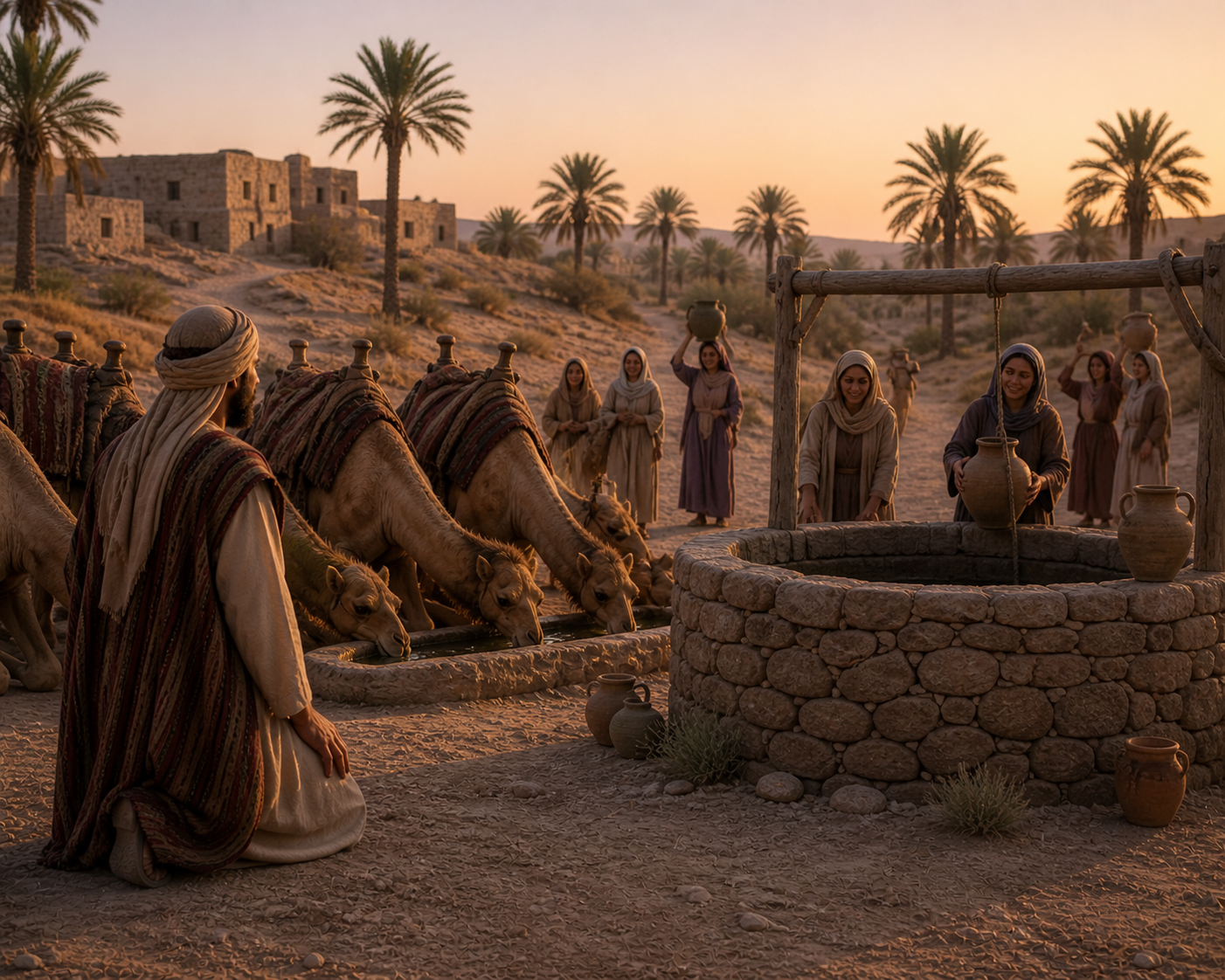
A DIVINE APPOINTMENT
AT THE WELL
He made the camels kneel down outside the city by the well of water at evening time - He stops just outside the city, not rushing in impulsively. Camels kneeling indicates the end of a long journey. In the ancient world, the well was a central gathering place, especially in the evening.
The time when women go out to draw water - The servant's stop here is strategic because he knows that this is the best opportunity to meet a suitable woman for Isaac. This sets the stage for the servant’s prayer in the next verses, showing that preparation and prayer go hand in hand.
John Walton 24:11. well at evening time outside of town. The cool of the early morning and evening would have been the best times for women to go to the village well for water. Since the well was often outside the town to accommodate watering of animals, women would normally travel in groups for protection. Strangers could be expected to use the well, but it may be assumed that they would ask permission of the villagers. Hospitality custom would have necessitated offering them a drink.
Genesis 24:12 He said, “O LORD, the God of my master Abraham, please grant me success today, and show lovingkindness to my master Abraham.
AMPC And he said, O Lord, God of my master Abraham, I pray You, cause me to meet with good success today, and show kindness to my master Abraham.
KJV And he said, O LORD God of my master Abraham, I pray thee, send me good speed this day, and shew kindness unto my master Abraham.
NET He prayed, "O LORD, God of my master Abraham, guide me today. Be faithful to my master Abraham.
NLT God of my master, Abraham," he prayed. "Please give me success today, and show unfailing love to my master, Abraham.
CSB "LORD, God of my master Abraham," he prayed, "give me success today, and show kindness to my master Abraham.
ESV And he said, "O LORD, God of my master Abraham, please grant me success today and show steadfast love to my master Abraham.
- O LORD, the God of my master Abraham: Ge 24:27 15:1 17:7,8 26:24 28:13 31:42 32:9 Ex 3:6,15 1Ki 18:36 2Ki 2:14 Mt 22:32
- please grant me: Ge 27:10 43:14 Ne 1:11 2:4 Ps 37:5 90:16,17 118:25 122:6 127:1 Pr 3:6 Php 4:6 1Th 3:10,11
Related Passages:
Ruth 2:3 (ANOTHER EXAMPLE OF DIVINE PROVIDENCE RELATED TO MARRIAGE AND PERPETUATION OF THE MESSIANIC LINE!) So she departed and went and gleaned in the field after the reapers; and she happened to come to the portion of the field belonging to Boaz, who was of the family of Elimelech.
SERVANT'S PRAYER
FOR SUCCESS
He said, “O LORD, the God of my master Abraham, please grant me success (literally “make happen before me”) today (NET - "guide me today"), and show lovingkindness (hesed) to my master Abraham. - The servant is the first person described in Scripture as asking specifically for divine guidance. So having reached his destination, he now petitions God with two entreaties (grant... and show...). This marks a decisive turning point in the narrative, as the servant, having faithfully carried out Abraham’s command so far, he now pauses to pray. Note that he does pray for success for himself which is not a selfish prayer. This request carries the idea of “cause it to happen” or “make it prosper.” The servant recognizes that success is not ultimately the result of his effort, planning, or wisdom, but of God’s providential direction (Proverbs 16:9). And don't miss the word "today," which adds urgency. This is a bold prayer as he is asks for immediate, visible guidance, showing that his faith did not hesitate to bring his specific needs before the LORD.
Bruce Waltke - The servant depends on God’s providence. What appears to be chance from the human perspective is part of an orchestrated plan from the divine perspective (see Ruth 2:3). the Hebrew word hesed entails loyalty to a covenant relationship. The inferior partner depends on the kindness of the superior to meet desperate need. God’s reliable kindness to his needy people is the basis of the covenant relationship (see Isa. 54:10). (Genesis: A Commentary)
Keith Krell - Now I might have gone about this task in a very different manner. I might have come into town advertising the fact that I worked for a very wealthy foreigner with a handsome, eligible son who was to be his only heir. I would have publicized my task and declared that only one lucky girl would be chosen. To select such a bride I might have held a “Miss Mesopotamia” contest. Only those who were the most beautiful and talented would be allowed to enter, and the winner would become the wife of Isaac. But that’s not what this godly servant did. Instead, when his small caravan arrived in Nahor he immediately went to prayer! When we are in need of divine guidance prayer should be our first activity rather than our last resort.
Lovingkindness is the Hebrew hesed, referring to God’s loyal, covenant love, His steadfast, faithful commitment to His promises. His request for lovingkindness is an appeal to God’s steadfast love and faithfulness to fulfill His promises (Ge 12:2–3). The servant is not asking God to do something new, but to act consistently with His already-declared covenant faithfulness. In essence, he is saying: “Lord, fulfill Your promises to Abraham by guiding me in this task.”
Warren Wiersbe - But how would he go about finding the right woman for his master’s son? The servant acted by faith in the God of Abraham and Isaac (Gen. 24:12). He believed the promise of God and trusted the providence of God to direct him (24:27). He took time to pray and to ask God for help, and he kept his eyes open to see what God might do. In fact, while he was praying, God was sending the answer (Isa. 65:24). The servant was not impulsive but waited on the Lord to see what He might do (Gen. 24:21). “Whoever believes will not act hastily” (Isa. 28:16, NKJV).
NET NOTE - Heb “make it happen before me today.” Although a number of English translations understand this as a request for success in the task (cf. NASB, NIV, NRSV) it is more likely that the servant is requesting an omen or sign from God (v. 14).
Henry Morris - This prayer is a model prayer for determining God's leading. It involved requesting a specific evidence which would be, in itself, beautifully consistent with the purpose of the guidance being sought (a suitable young woman who was both strong enough and considerate enough to volunteer to provide water for ten thirsty camels) and yet would require a combination of characteristics bound to be rare under the circumstances. Although not mentioned specifically, his prayers presupposed that she would be a godly virgin and from Abraham's people.
John Walton 24:12-21. mechanistic oracle. Abraham’s servant is using an *oracular approach to identifying Isaac’s bride-to-be. In an oracle a yes-no question is posed to deity, and a mechanism of some binary nature is used so that deity can provide the answer. In post-Sinai Israel the priest carried the Urim and Thummim to use in oracular situations. Abraham’s servant must be more creative and uses a natural mechanism for the oracle. His yes-no question is whether the girl that he is about to approach is the right wife for Isaac. His oracular mechanism is based on a question that he will pose to the girl. When asking for a drink, one would normally expect that a drink would be offered. That would be normal behavior in the context of etiquette and hospitality. In this case such a response would indicate a “no” answer to his oracular question. For the alternative the servant chooses something far out of the range of expectation: that prompted by such a common, unimposing request, the girl would volunteer to water all his camels. This unbelievable offer would indicate a “yes” answer to his oracular question. The thought behind this process is that if deity is providing the answer, he can alter normal behavior and override natural instinct in order to communicate his answer. For similar mechanistic oracles, see Judges 6:36-40 and 1 Samuel 6:7-12. The prophets occasionally approach this type of oracular situation from the other side when they provide signs to verify that they represent God, as in Numbers 16:28-30 or 1 Samuel 12:16-17.
Lovingkindness (02617) hesed/chesed/heced is the idea of faithful love in action and often in the OT refers to God's lovingkindness expressed in His covenant relationship with Israel (His "loyal love" to His "Wife" Israel [cp Hos 2:18, 19, 20-see note, Is 54:5, Je 31:32] = His "loyalty to covenant"). God's hesed His denotes persistent and unconditional tenderness, kindness, and mercy, a relationship in which He seeks after man with love and mercy (cp God immediately seeking man Ge 3:9, who was immediately hiding Ge 3:8 trying to cover their shame Ge 3:7 - contrast God's lovingkindness manifest by spilling blood to provide skins to cover their shame! Ge 3:21). Hesed expresses both God’s loyalty to His covenant and His love for His people along with a faithfulness to keep His promises.
HESED - 4X in Genesis 24 - Gen. 24:12; Gen. 24:14; Gen. 24:27; Gen. 24:49
Vine adds that hesed conveys "the idea of faithful love in action and often in the OT refers to God's lovingkindness expressed in His covenant relationship with Israel (His "loyal love" to His "Wife" Israel [cp Hos 2:18, 19, 20-see note, Is 54:5, Je 31:32] = His "loyalty to covenant"). God's hesed His denotes persistent and unconditional tenderness, kindness, and mercy, a relationship in which He seeks after man with love and mercy (cp God immediately seeking man Ge 3:9, who was immediately hiding Ge 3:8 trying to cover their shame Ge 3:7 - contrast God's lovingkindness manifest by spilling blood to provide skins to cover their shame! Ge 3:21). Hesed expresses both God’s loyalty to His covenant and His love for His people along with a faithfulness to keep His promises. (Vine's Complete Expository Dictionary of Old and New Testament Words)
D J Burrell - Good speed this day.
To live for to-day is in the noblest sense to live for eternity. To be my very best this very hour, to do the very best for those about me, and to spend this moment in a spirit of absolute consecration to God’s glory, this is the duty that confronts me.
Herbert Lockyer - All the Prayers of the Bible (borrow)
Eliezer of Damascus, Abraham's eldest servant or steward, was commissioned to find a bride for Isaac and came, relying upon God for guidance, to the town of Nahor. On his journey the servant devoutly prayed for success and his prayer is remarkable, an eighteenth century writer tells us, for three things—
1. For the faith in which it was offered.
2. For the correct views on the character of God it expresses.
3. For the sign for which the prayer presumed to ask.
Such a prayer offered with complete reliance upon divine faithfulness was sure to be answered, and was directly and immediately answered to by God. Success in quest called forth expression of gratitude. Further, the servant's prayer for guidance, beautiful in expression, indicates how the early saints seem to be on familiar terms with God. Prayers, then, were simple, direct and childlike. The servant prayed for a specific sign to guide him to the right woman for Isaac and the answer came almost at once, before he had done speaking to God. There would be fewer broken homes in the world today if only more prayer had ascended for guidance in the selection of a life-companion.
Prayer is a token of thanksgiving. With a grateful heart the servant blessed God for His guidance and goodness (Ge 24:26, 27). In passing, we can learn something about the place and posture of prayer. The sphere of prayer matters little—the spirit is all important (John 4:20-24). Alongside the kneeling camels at the well, Eliezer knelt and presented his request. Prayer in the fields and on a hillside (Ge 28:18-20), proves that God is no respector of places. As to posture, the servant "worshipped," or more literally, "he prostrated himself."
James Rosscup - An Exposition on Prayer - The summary of his prayer (v. 12). He simply petitions for success in securing the bride by the covenant mercy this would be to his master. He is quite specific in this and in the details that follow.
J Vernon McGee - The Servant’s Commission
The way Isaac got a wife reminds us of Another who is yet to take a bride. It is a marvelous picture of the relationship of Christ and His church.
You remember Abraham called his servant and sent him yonder to Mesopotamia to find a wife for Isaac. We do not know the name of this servant. We believe it was Eliezer, the one who had charge of his household; but his name is not given here because it’s not necessary. He has not gone on his own business or to get a bride for himself. He has not gone to talk about himself. He has gone to talk about another.
One of the figures of speech used in the New Testament is that the church is someday to become the bride of Christ. The Spirit of God, like this servant of Abraham, has come to talk about Another. Our Lord Jesus promised that He would send the Holy Spirit into the world and that when He would come He would not speak of Himself. “He will glorify Me, for He will take of what is Mine and declare it to you” (John 16:14). After all, the Holy Spirit, as far as we are concerned, is nameless. Tell me, what is the name of the third person of the Godhead? You say Holy Spirit, but that’s not a name. It’s merely a designation and title. We really don’t know Him by name. He’s the third person of the Godhead. We have God the Father; we have God the Son. But who is this third person? You say He is God the Holy Spirit. Well, that’s all we know. He hasn’t come to speak of Himself. He has come to speak of Another.
Now let’s look back at the narrative. Abraham is sending his servant back to the old hometown to choose a bride for his son Isaac. Candidly, he did not want Isaac to marry one of the daughters of the Canaanites, a people given over to idolatry and paganism. Abraham wanted Isaac’s bride to be a woman from among his own people back in the land of Haran. He didn’t send Isaac himself, and there’s nothing strange about that because parents always made the choice in that day.
We shall see that this choice of a bride is a marvelous picture of the Lord Jesus Christ securing His bride, the church. You see, the Holy Spirit has come into the world to get a bride; and that bride, my friend, must be made up of children of God—those who have been regenerated and given a capacity for heaven and the things of heaven. And so He’s come into the world for that purpose.
The servant of Abraham had a heavy assignment, didn’t he? It was up to him to get a bride for somebody else! Actually, the last thing I’d want to do would be to get a mate for another person. I talked to a girl for another fellow once, and I’ll never get in that awkward position again! Somehow I just couldn’t put my heart into it when I was asking her to marry somebody else. So I marvel at this servant in his tremendous undertaking because he is going to put all of his heart and all of his soul into it.
He leaves the home of Abraham in the land of the Canaanites and goes to northern Mesopotamia, to the city of Nahor near where Abraham had come from. He doesn’t know just where to go, but as he moves along he comes to a well in the early evening, the time when women go out to draw water. The servant knows it’s the area where Abraham had come from, but he doesn’t know who’s there. So he stops at this well, and he asks for God’s help. This is a tremendous prayer (Genesis 24:12–14)
F B Meyer - My Master Abraham
This worthy man, Eliezer, the steward of Abraham’s house, was almost garrulous about his master. Count up the number of times in which he contrives to bring in the two words, “my master.” We may learn from him how to speak of our Master, whenever we get the opportunity. “Rabboni, which being interpreted is, My Master.”
We too can speak of the Lord God as our Master. — The servant did not know Jehovah directly; it was enough that he had seen and heard Abraham pray to Him. This encouraged him to draw near for himself. So we are emboldened to draw near, because God is the God and Father of our Master Jesus. We love Him that was begotten, and are attracted to Him of whom Jesus said, “I ascend to my Father, and your Father; to my God, and your God.”
We, too, can plead for our Master’s sake. — When asking for good speed to be sent to himself, he alleged as his plea that it would be showing kindness to his master Abraham. So when we ask great things from God, we can plead in the name of Jesus, and urge that in answering our petition God will be showing kindness to his Well-beloved.
We, too, should bless in our Master’s name. — When the answer was given, this reverent soul gave thanks as though the favor had been shown to his master. Indeed, all through his intercourse with Bethuel and Laban he seems to have lost his identity in Abraham. He could talk of nothing else but that one scheme; was only eager to carry his point for his master’s sake; and when the errand was done, longed only to get back to his master’s side. It is a beautiful lesson for those who call Jesus Master and Lord.
Genesis 24:13 “Behold, I am standing by the spring, and the daughters of the men of the city are coming out to draw water;
- I am standing: Ge 24:43 Ps 37:5 Pr 3:6
- daughters: Ge 24:11 29:9,10 Ex 2:16 Judges 5:11 1Sa 9:11 Joh 4:7
NO BEATING AROUND
THE BUSH IN THIS PRAYER
Behold, (hinneh; LXX - idou) I am standing by the spring, and the daughters of the men of the city are coming out to draw water - Beating around the bush is talking (praying) vaguely to avoid speaking directly about the subject. Not so with the servant. One can just see the servant like an eagle scanning the horizon for a potential wife for his master's son.
John Walton spring versus well. The difference in terminology between verse 11 (“well”) and verse 13 (“spring”) may reflect a variety of water sources available. There are examples where a water source originated from a spring but as the water table shrank it became necessary to dig down, thereby forming a well. This is the case at Arad, where a deep well now replaces the original spring.
Warren Wiersbe - In His providence, God brought Rebekah to the well just as the servant was praying; and she did exactly what the servant had been praying about. The servant did what Gideon would do years later, “put out a fleece” (Jud. 6:36–40). This is not the best way for God’s people to determine the will of God, because the conditions we lay down for God to meet might not be in His will. We are walking by sight and not by faith, and we may end up tempting God. However, God accommodated Himself to the needs of the servant (and Gideon) and guided them as they requested. Little did Rebekah know that doing a humble task for a stranger would make her the bride of a wealthy man who was in a covenant relationship with God. She would become the mother of Jacob, and he would become the father of the twelve tribes of Israel! Years ago, I read a quotation from a writer identified only as “Marsden,” and it has stuck with me: “Make every occasion a great occasion, for you can never tell when someone may be taking your measure for a larger place.”
Behold (02009) hinneh is an interjection meaning behold, look, now; if. "It is used often and expresses strong feelings, surprise, hope, expectation, certainty, thus giving vividness depending on its surrounding context." (Baker) Hinneh generally directs our mind to the text, imploring the reader to give it special attention. In short, the Spirit is trying to arrest our attention! And so hinneh is used as an exclamation of vivid immediacy (e.g., read Ge 6:13)! Hinneh is a marker used to enliven a narrative, to express a change a scene, to emphasize an idea, to call attention to a detail or an important fact or action that follows (Isa 65:17, Ge 17:20, 41:17). The first use of hinneh in Ge 1:29 and second in Ge 1:31 - "And God saw all that He had made, and behold, it was very good. And there was evening and there was morning, the sixth day." Hinneh is oftn used in the idiom "Here I am" in Ge 22:1, 7,11 Ge 27:1,18, Ge 31:11, Ge 46:2 Ex 3:4 1Sa 3:4, 3:16, 12:3, 2Sa 1:7, Isa 52:6, Isa 58:9. Hinneh is used most often to point out people but also to point out things (Ge 31:41, 17:4). God uses hinneh to grab man's attention before He brings destruction (Ge 6:13, 17). God uses hinneh when He establishes covenants (Ge 9:9, 15:12, 17 [when Jehovah cut the Abrahamic covenant], Ge 17:4, cp Ge 28:13, 15), when He provided a sacrificial substitute for Isaac (foreshadowing His giving us His only Son!) (Ge 22:13). Hinneh marks the "chance (The Providence of God)" arrival of Boaz at the field where Ruth was gleaning (Ru 2:4-read about this "chance romance" - Indeed, "Behold!"). Hinneh is used to announce the Lord’s sending of a child as a sign and a prophecy of Immanuel-Emmanuel, the Messiah (Isa. 7:14). In fact W E Vine says that it is notable that when behold (hinneh) is used in Isaiah, it always introduces something relating to future circumstances.
Spurgeon reminds us that "Behold is a word of wonder; it is intended to excite admiration. Wherever you see it hung out in Scripture, it is like an ancient sign-board, signifying that there are rich wares within, or like the hands which solid readers have observed in the margin of the older Puritanic books, drawing attention to something particularly worthy of observation." I would add, behold is like a divine highlighter, a divine underlining of an especially striking or important text. It says in effect "Listen up, all ye who would be wise in the ways of Jehovah!"
Hinneh is translated in the Septuagint with the interjection idou (strictly speaking a command in the second person aorist imperative, middle voice) a demonstrative particle (used 1377 times in the Septuagint and NT) which is found especially in the Gospels of Matthew and Luke "and giving a peculiar vivacity to the style by bidding the reader or hearer to attend to what is said:
Genesis 24:14 now may it be that the girl to whom I say, ‘Please let down your jar so that I may drink,’ and who answers, ‘Drink, and I will water your camels also’–may she be the one whom You have appointed for Your servant Isaac; and by this I will know that You have shown lovingkindness to my master.”
- let: Judges 6:17,37 1Sa 14:9
- she: Ge 24:44 Pr 19:14
- by this I will know: Ge 15:8 Ex 4:1-9 Judges 6:17,37 7:13-15 18:5 1Sa 6:7-9 10:2-10 1Sa 14:8,10 20:7 2Sa 5:24 20:9 2Ki 20:8-11 Isa 7:11 Ro 1:10
THE SERVANT'S
SPECIFIC PRAYER
Now may it be that the girl to whom I say, ‘Please let down your jar so that I may drink,’ and who answers, ‘Drink, and I will water your camels also’- Notice the servant does not ask for the girl to be beautiful but to be hospitable, elevating this a major criterion. The "sign" is not a random one, but a carefully shaped, God-dependent test that seeks to discern the Lord’s will in a way consistent with His character and Abraham’s covenant. The servant says, “now may it be…”, expressing humble dependence. He is not demanding a miracle, but asking God to order the circumstances. Scripture affirms that God directs even the details of life: “The mind of man plans his way, but the LORD directs his steps” (Proverbs 16:9). His request flows out of prayer, not superstition.
The specific test is of a young woman who not only gives him a drink but also volunteers to water his camels which is highly significant, as it is no small act! A thirsty camel can drink 25 gallons of water, and Abraham’s servant had 10 camels (Ge 24:10), so this would require unusual generosity, initiative, humility, and servant-heartedness. In other words, the servant is asking God to identify a woman whose character is over the top in willingness to serve. He was looking for a Proverbs 31:30 woman, one whose “Charm is deceitful and beauty is vain, but a woman who fears the LORD, she shall be praised”.
Sternberg - “What touchstone could be more appropriate than the reception of a wayfarer to determine a woman’s fitness to marry into the family of the paragon of hospitality? And it is a stiff test, too, since it would require far more than common civility to volunteer to water ‘ten’ thirsty camels.”
Keith Krell - Culturally it was a normal act of hospitality to provide water to thirsty travelers. But the idea that a woman would also provide water for ten thirsty camels was going far beyond what would normally be expected. In praying this prayer the servant “stacked the deck” against finding someone. It would take a remarkable woman to volunteer for this lowly and backbreaking task.
NET NOTE - I will also give your camels water. It would be an enormous test for a young woman to water ten camels. The idea is that such a woman would not only be industrious but hospitable and generous. Heb “And let the young woman to whom I say, ‘Lower your jar that I may drink,’ and she says, ‘Drink and I will also give your camels water,’—her you have appointed for your servant, for Isaac, and by it I will know that you have acted in faithfulness with my master.”
May she be the one whom You have appointed for Your servant Isaac acknowledges God’s sovereignty. The word “appointed” shows that he believes God has already determined the outcome. He is not trying to manipulate God, but to recognize the one God has already chosen. This reflects confidence that God’s purposes stand firm (Isaiah 46:10).
And by this I will know that You have shown lovingkindness (hesed) to my master - By this refers to the girl watering the servant and the camels without being asked to do so. The servant wisely again brings in the concept of hesed, His loyal, covenant love. In other words, the servant sees God’s guidance as a visible expression of His covenant faithfulness, so that when God directs, He is displaying His hesed.
James Rosscup - An Exposition on Prayer - The servant cuts right to the point as to his place, women who fill their water pots here, the very woman, and further particulars to confirm that this is of God. Others like Gideon with his fleece would quell their human fears by spelling their needs right out to the Lord. The servant is passionate for God’s guiding to help the bride who would help carry on the covenant. Let her be the woman who would take the time, lower her vessel to quench his thirst, and even go to the trouble of watering the caravan camels.
Bruce Waltke - A request for a sign is appropriate in connection with the servant’s mission to advance a family meant to bless the earth (see Isa. 7:10–14). (Genesis: A Commentary)
David Guzik - He is asking for God’s guidance through providential circumstances. This is sometimes a bad way to discern God’s will. Circumstances alone can be a dangerous way to discern God’s will. It is common to ignore or minimize circumstances that speak against a desired outcome; those circumstances may even be attributed to the devil. It is also common to focus on and give great significance to the circumstances that speak in favor of a desired outcome. In this case, Eliezer established what he would look for before anything happened. He wasn’t making up a standard as the process unfolded.
J Vernon McGee - If he asks her for a drink and she responds graciously, well, it’ll mean that she’s polite. And then if she offers to water the camels, that means she’s an extra special girl; and he will know she is the one God has chosen. And before he has finished praying, here she comes. It’s Rebekah. She’s a very beautiful girl—Scripture says so; and the Word of God never apologizes for that. We’ve got a notion in America today that only the devil can use beauty. May I say that God created it and can use it as well. You’ll find many places in His Word where it says this girl or that girl was good to look at. And I think the Spirit of God knows when one’s good-looking, my friend! And Rebekah must have been beautiful. I want you to get acquainted with her a little here because later on you’ll read a story that may give the wrong impression concerning her, but here she’s very attractive. Rebekah comes out to the well and very modestly doesn’t say anything to the stranger. So he runs to her and asks, “May I please drink a little water from your pitcher.” She’s very polite so she says, “Why, yes!” And then she adds, “I will draw water for your camels also, until they have finished drinking.” Now remember, friend, there are ten camels! I don’t know how long it had been since they had last filled up, but camels have a very large capacity! And then you notice the man wondering at her. But he holds his peace, waiting to know whether the Lord has made his journey prosperous or not. You see the wisdom and the patience of this man. He doesn’t move hurriedly at this juncture; he’s waiting there upon God. He stands there and just watches all of this—thinking, This is working out just exactly the way I prayed! I wonder if God is actually in this. Is this the girl for Isaac? So he watches her as she moves about getting water for the camels.
May I say to you, friend, if you are a Christian and you do not know what it is to have the clear leading of God, especially in critical circumstances, you have missed the greatest thrill of your life! I feel sorry for Christians who are always asking, “How can I find God’s will for my life?” My friend, I hope you have gotten into a position where you have the clear leading of God. There’s nothing more satisfying than that. Notice this servant of Abraham, uncertain at first and moving carefully, rather gingerly; but now he’s sure.
Genesis 24:15 Before he had finished speaking, behold, Rebekah who was born to Bethuel the son of Milcah, the wife of Abraham’s brother Nahor, came out with her jar on her shoulder.
- before: Ge 24:45 Jud 6:36-40 Ps 34:15 65:2 145:18,19 Isa 58:9 65:24 Da 9:20-23
- Rebekah: Ge 24:24 22:20-23
- Milcah: Ge 11:27,29 22:23
- with her jar: Ge 21:14 29:9 Ex 2:16 Ru 2:2,17 Pr 31:27
Related Passages:
Isaiah 65:24 “It will also come to pass that before they call, I will answer; and while they are still speaking, I will hear.
1 Samuel 7:10 Now Samuel was offering up the burnt offering, and the Philistines drew near to battle against Israel. But the LORD thundered with a great thunder on that day against the Philistines and confused them, so that they were routed before Israel.
2 Chronicles 20:22 When they began singing and praising, the LORD set ambushes against the sons of Ammon, Moab and Mount Seir, who had come against Judah; so they were routed.
STILL PRAYING AND GOD
PROVIDENTIALLY ANSWERING
Before he had finished speaking, behold (hinneh; LXX - idou), Rebekah (Abraham's grandniece) who was born to Bethuel the son of Milcah, the wife of Abraham’s brother Nahor, came out with her jar on her shoulder - Here comes the bride. The servant did not know it yet, but he soon would. Notice that Rebekah just happens to pop up (providentially) and just happens to be from the right family! She is the daughter of Bethuel, a second cousin of Isaac, exactly what Abraham was seeking for his son!
Bob Utley - "Rebekah who was born to Bethuel the son of Milcah" This family was mentioned in Gen. 22:20-24. Her father's name, Bethuel, means "man of God" (BDB 143 I), which may show the spiritual nature of this family. It is also significant that the family line comes through Milcah, the true wife, and not a concubine of Nahor, Reumah. "came out with a jar on her shoulder" This is one point which shows the historicity of the account. Women in Egypt carried the water jars on their heads, but in Mesopotamia they carried it on their hip or shoulder.
NET NOTE - Heb “Look, Rebekah was coming out!” Using the participle introduced with הִנֵּה (hinneh, “look”), the narrator dramatically transports the audience back into the event and invites them to see Rebekah through the servant’s eyes.
Spurgeon - “Before he had finished speaking.” No, he did not know that promise, “While they are yet speaking I will hear,” but God keeps his promises before he makes them; and, therefore, I am sure he will keep them after he has made them.
QUESTION - Who was Rebekah in the Bible? GOTQUESTIONS.ORG
ANSWER - Rebekah in the Bible was the wife of Isaac and mother of Jacob and Esau. We first meet Rebekah in Genesis 24:15, where she is identified as “the daughter of Bethuel son of Milkah, who was the wife of Abraham’s brother Nahor.” This would have made Rebekah a great-niece to Abraham and second cousin to Isaac.
Abraham had been looking for a wife for his son, Isaac, but he was unwilling for Isaac to marry a Canaanite—Abraham and his family were living in Canaan at the time. So Abraham sent his servant to his own kinsmen, to the city of Nahor, to find a wife for Isaac. The servant came to a well and prayed that God would give him success in this mission. Specifically, he prayed that whichever young woman provided water for him and his camels would be God’s choice to be Isaac’s wife. As the servant was praying, along came a beautiful young virgin named Rebekah, who not only gave the servant a drink but also watered his camels, providing the sign to Abraham’s servant that she was the appointed bride (Genesis 24:10–28).
Everything was settled peaceably between Abraham’s servant and Rebekah’s father—and her brother, Laban—and the servant took Rebekah back to Isaac. Isaac and Rebekah were married (Genesis 24:67), but for many years Rebekah could not have children. Isaac prayed for his wife; the Lord answered his prayer, and Rebekah became pregnant (Genesis 25:21). Rebekah became the mother of Jacob and Esau, the first twins mentioned in the Bible (Genesis 25:22–24). From these twins came two conflicted nations.
God gave Rebekah a prophecy during her pregnancy. She had noticed that the twins were struggling against one another in her womb, and she asked the Lord why they were fighting. The Lord told her that two nations were in her womb and that those nations would be at odds with one another (Genesis 25:22–23). This prophecy came true. Jacob, whose name was later changed to Israel (Genesis 32:28), became the father of the twelve tribes of Israel. Esau became the father of the Edomites, who warred against Israel for ages and were finally wiped out (Obadiah 1:1–21).
Esau was born first, and he was Isaac’s favorite son (Genesis 25:28). The younger Jacob was Rebekah’s favorite. As the firstborn, Esau was due the birthright, but he had despised it and traded it to Jacob for a bowl of stew (Genesis 29–34). When the time came for the blessing to be given, Rebekah helped Jacob deceive Isaac, and the blessing did indeed fall to the younger son instead of to the elder (cf. Genesis 27:1–40).
When Esau discovered Jacob and Rebekah’s deceit, he planned to kill Jacob. Rebekah devised a plan to help save her favorite son, but it again involved deceiving her husband, Isaac. Rebekah made up an excuse to send Jacob to her brother, Laban, to look for a wife for himself (Genesis 27:41–46). Deceit was apparently a family trait.
Rebekah’s marriage to Isaac was the result of God’s providence, her pregnancy was an answer to prayer, and the lives of her sons fulfilled prophecy. Rebekah’s choice to lie and deceive her husband is an example of how wrongdoing in human beings does not thwart the plans of God and how God can ultimately bring about His will, through His mercy and wisdom, despite our sin (see Genesis 50:20).
L B Cowman - Streams in the Desert
“And it came to pass, before he had done speaking … and he said, Blessed be Jehovah … who hath not forsaken his lovingkindness and his truth.” (Gen. 24:15, 27.)
EVERY right prayer is answered before the prayer itself is finished—before we have “done speaking.” This is because God has pledged His Word to us that whatsoever we ask in Christ’s name (that is, in oneness with Christ and His will) and in faith, shall be done.
As God’s Word cannot fail, whenever we meet those simple conditions in prayer, the answer to our prayer has been granted and completed in Heaven as we pray, even though its showing forth on earth may not occur until long afterward.
So it is well to close every prayer with praise to God for the answer that He has already granted; He who never forsakes His loving-kindness and His truth. (See Daniel 9:20–27 and 10:12.)—Messages for the Morning Watch.
When we believe for a blessing, we must take the attitude of faith; and begin to act and pray as if we had the blessing. We must treat God as if He had given us our request. We must lean our weight over upon Him for the thing that we have claimed, and just take it for granted that He gives it, and is going to continue to give it. This is the attitude of trust.
When the wife is married, she at once falls into a new attitude, and acts in accordance with the fact; and so when we take Christ as our Savior, as our Sanctifier, as our Healer, or as our Deliverer, He expects us to fall into the attitude of recognizing Him in the capacity that we have claimed, and expect Him to be to us all that we have trusted Him for.—Selected.
“The thing I ask when God doth bid me pray,
Begins in that same act to come my way.”
Genesis 24:16 The girl was very beautiful, a virgin, and no man had had relations with her; and she went down to the spring and filled her jar and came up.
- was very beautiful: Heb. good of countenance, Ge 26:7 39:6
- no man had had relations with her: Ge 4:1 Nu 31:17,18 Song 5:2

REBEKKAH BEAUTIFUL
AND INDUSTRIOUS
The girl was very beautiful (literally, “very good in appearance”), a virgin (bethulah), and no man had had relations with her (Literally - a man she had not known.) - Rebekah was beautiful outside and inside, with double emphasis on her virginity.
Bruce Waltke - Beauty is valued in the Old Testament (cf. Pr 6:25). Many stories about honored women note their sex appeal and/or beauty: Sarah (Gen. 12:11; cf. Ge 20:2), Rachel (Ge 29:17), Tamar (Ge 38:13–19), Rahab (Josh. 2:1), Ruth (Ruth 3:1–9), and the queen consort (Ps. 45:11–15). (Genesis: A Commentary)
She did not practice “safe sex”;
she practiced “save sex” for marriage.
-- Keith Krell
NET NOTE - Heb “And the young woman was very good of appearance, a virgin, and a man she had not known.” Some argue that the Hebrew noun translated “virgin” (בְּתוּלָה, bétulah) is better understood in a general sense, “young woman” (see Joel 1:8, where the word appears to refer to one who is married). In this case the circumstantial clause (“and a man she had not known”) would be restrictive, rather than descriptive. If the term actually means “virgin,” one wonders why the circumstantial clause is necessary (see Jdg 21:12 as well). Perhaps the repetition emphasizes her sexual purity as a prerequisite for her role as the mother of the covenant community.
And she went down to the spring and filled her jar and came up - This was part of the sign the servant had prayed to see. God's providence is orchestrating the details (Ge 24:13). For went down...and came up see Hughes comment below.
R Kent Hughes - To grasp what a wonder this was, we must understand that the ancient well was a large, deep hole in the earth with steps leading down to the spring water (SEE PICTURE ABOVE)—so that each drawing of water required substantial effort. And more, a camel typically would drink about twenty-five gallons of water, and an ancient water jar held about three gallons of water. This means that Rebekah made between eighty to one hundred descents into the well.8 As to the amount of time she gave to this, a camel takes about ten minutes to drink its full complement of water. Rebekah’s labors filled one and one half to two sweaty hours! And all the while the servant watched without saying a word, to see whether or not the Lord had made his journey successful. (See Genesis: Beginning and Blessing - Page 316)
Bob Utley - Several characteristics of Rebekah are highlighted.
- willingness and strength to help, Gen. 24:14 (prayer of Abraham's servant)
- very beautiful, Gen. 24:16
- a virgin, Gen. 24:16
- hospitable, Gen. 24:18-25
Virgin (01330) bethulah is a feminine noun meaning virgin, a mature young woman that has never had sexual intercourse, and under the authority and protection of the father (translated as such 49x and once as maiden in the NAS). Judges 21:12 describes "400 young virgins who had not known a man by lying with him." So while the meaning of bethulah is unquestionably a virgin, that is not always the case for in Joel 1:8 we read "Wail like a virgin girded with sackcloth for the bridegroom of her youth," which suggests the bethulah is mourning for her husband. Bethulah also refers to cities or countries that are personified as females (Isa. 37:22; 47:1; Jer. 18:13; 31:4, 21; Amos 5:2). Swanson adds that bethulah also means "young women, i.e., a class of young female, though the class may be virgins, the focus is on the youth group (Dt 32:25; Ps 148:12; Jer 31:13; Am 8:13)." Swanson adds that a third meaning of bethulah is "dear one, one cared for, loved one, formally, virgin daughter, a young woman who is loved by the father, with the associated meaning of being pure, innocent, and under the protection and care of the father (2Ki 19:21; Isa 23:12; 37:22, 22; 47:1, 1; Jer 46:11; La 1:15; 2:10, 13)."
The first use in Ge 24:16 describes "a virgin, and no man had had relations with her." The Lxx translates bethulah with the Greek noun parthenos which generally refers to a young woman of marriageable age with a focus on her virginity. Figuratively parthenos was used by Paul to describe the Church as the bride pledged to Christ (2Cor 11:2). Given the fact that in the OT Israel was often depicted as Jehovah's wife, it is not surprising to see her referred to in this passage as "Virgin of Israel" speaking of the effects of her redemption (Ro 11:26) so that God sees her as a "spiritual virgin" in her regenerated state.
Genesis 24:17 Then the servant ran to meet her, and said, “Please let me drink a little water from your jar.”
- Please let: 1Ki 17:10 Joh 4:7,9
- water of: Ge 26:1-35 Isa 21:14 30:25 35:6,7 41:17,18 49:10
WHEN FAITH RUNS TO
MEET PROVIDENCE
Then the servant ran to meet her - He is eager to see if this woman is God's answer.
and said, “Please let me drink a little water from your jar - By asking rather than taking, this matches the prayer and creates the opportunity for her character to be revealed. The servant understands that the sign he requested involves not just meeting his need, but exceeding it (Genesis 24:14).
Note that the servant is not manipulating events to force an outcome; he is allowing God’s providence to unfold naturally. He sets the stage, but he does not script her response. This preserves the integrity of the test. If she freely offers to water the camels as well, it will clearly be God’s doing, not his influence.
Faith prays for guidance, then steps forward
and watches God reveal the answer.
Genesis 24:18 She said, “Drink, my lord”; and she quickly lowered her jar to her hand, and gave him a drink.
- Pr 31:26 1Pe 3:8 4:8,9
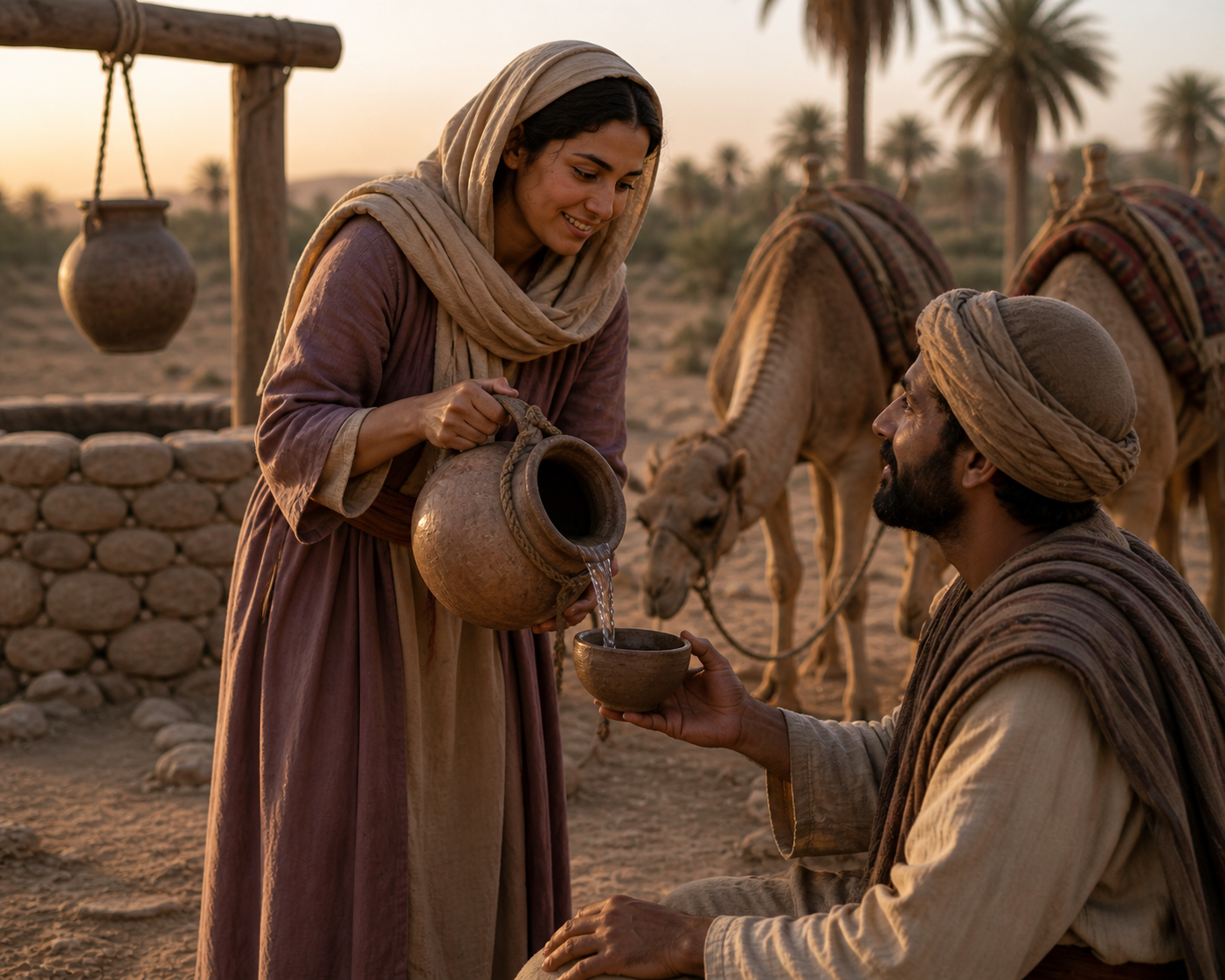
SERVING A CUP OF
COOL WATER
She said, “Drink, my lord” - This matches the prayer of Ge 24:14.
And she quickly lowered her jar to her hand, and gave him a drink - This reveals both Rebekah’s character and the unfolding of God’s answer to prayer. The term my lord ('adon) is a polite form of address, not a statement of rank, but it does show Rebekah's humility and graciousness. Her actions immediately match her words reflecting eagerness, readiness, and a heart inclined to serve.
Genesis 24:19 Now when she had finished giving him a drink, she said, “I will draw also for your camels until they have finished drinking.”
- Ge 24:14,45,46 1Pe 4:9
REBEKAH WILLING
TO WATER CAMELS
Now when she had finished giving him a drink, she said, “I will draw also for your camels until they have finished drinking.” - He did not ask her. She initiated the offer to water the camels!
Bob Utley - "I will draw also for your camels" This was also part of the servant's prayer of Gen. 24:14. YHWH gave specific guidance to Abraham's servant about Rebekah. This act on Rebekah's part would have involved a considerable amount of time and energy for ten thirsty camels!
John Walton 24:19-20. how much camels drink. Camels drink only as much water as they have lost and do not store it in the hump. The concentration of fat and the coat of hair allows dissipation of heat, less sweating and a wider range of body temperature during the day and night. The camel also is able to maintain a constant amount of water in its blood plasma and thus sustain higher water loss than most animals. A camel that has gone a few days without water could drink as much as twentyfive gallons. In contrast, the jars that were used for water would usually hold no more than three gallons.
Genesis 24:20 So she quickly emptied her jar into the trough, and ran back to the well to draw, and she drew for all his camels.
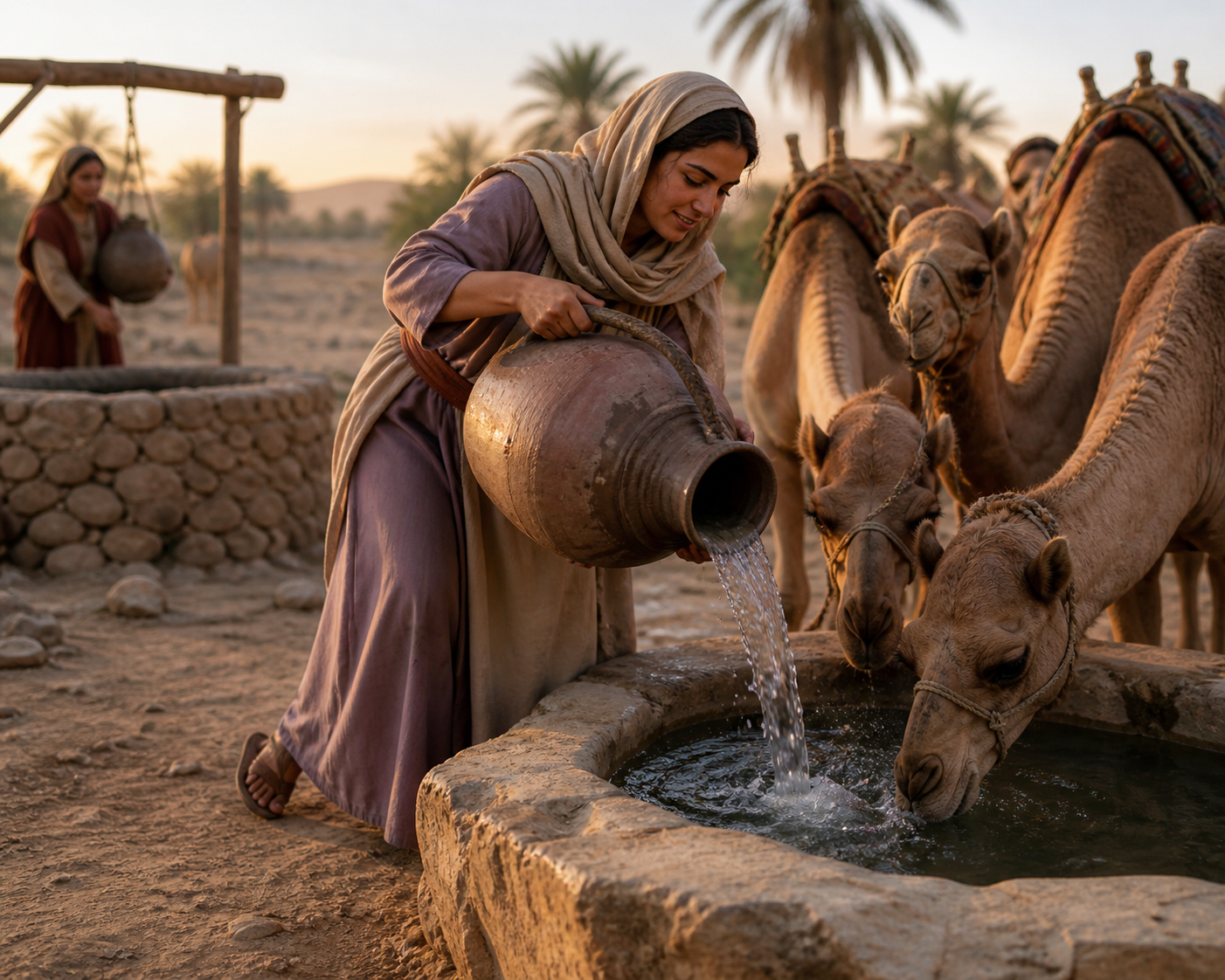
AN INCREDIBLE
ACT OF KINDNESS!
So she quickly emptied her jar into the trough, and ran back to the well to draw, and she drew for all his camels - This verse speaks volumes about Rebekah. Notice the words "quickly," "ran back" and "drew for all."
Don't miss it - Drew for all his camels - All 10 camels. You say well yes 10 trips back and forth. You might be shocked to know that a very thirsty camel can drink an astonishing amount, typically 25 to 30 gallons in one sitting, and in extreme dehydration even up to 40 gallons has been observed. Woe! Camels are quite unique for their red blood cells are oval-shaped, allowing blood to keep flowing even when thickened by dehydration. They can tolerate significant water loss (up to about 25% of body weight), which would be fatal for most animals. When water is available, they can rehydrate very quickly without damaging their system. In short, when Rebekah offered to water the servant’s camels, this was no small act of kindness. Assuming there were 10 camels, and each could drink 25–30 gallons, she may have drawn 250–300 gallons of water by hand, a remarkable display of servant-hearted diligence and generosity. It beautifully underscores how God’s providence was revealed to Abraham's servant through faithful, humble service, reminding me of Jesus' words in Mt 10:42
“And whoever in the name of a disciple gives to one of these little ones even a cup of cold water to drink, truly I say to you, he shall not lose his reward.”
Keith Krell adds a note on the watering of camels - Rebekah demonstrates an amazing servant’s heart. To grasp what a wonder this was we must understand that the ancient well was a large, deep hole in the earth with steps leading down to the spring water, so that each drawing of water required substantial effort. Moreover, a camel can consume 25 gallons of water in ten minutes. How would you like to get 250 gallons of water for ten camels? With a water jar holding about three gallons of water this means that Rebekah made 80 to 100 descents into the well.21 Rebekah’s labors filled 90 to 120 sweaty minutes.22 Ladies, Pilates, Spinning, and Tae-Bo have nothing on this workout. Interestingly, Rebekah didn’t realize that she was about to become an integral part of God’s eternal plan of salvation by marrying Isaac. She served simply because it was the pattern of her life. I wonder how many of us desire to be used of the Lord in great ways, but have not proven reliable in the small things in life? (See Matt 25:21) Women, are you willing to serve your husband and children like Rebekah? Are you a woman who is known for how you serve? By the way, both Jacob (29:1-12) and Moses (Exod 2:15-22) found their future wives at a well, after long journeys. Single men, guess where you should be hanging out? Seriously, these stories anticipate an event in the life of Jesus in John 4.
NOTE: The wording in Genesis 24:16 strongly suggests that Rebekah went down into a lower place to draw water and then came back up, and this most naturally fits the picture of a step-well or spring accessed by steps, rather than a simple rope-and-bucket well. In the ancient Near East, many wells or springs were built below ground level, accessed by stone steps and designed so people could walk down and fill jars directly.
Genesis 24:21 Meanwhile, the man was gazing at her in silence, to know whether the LORD had made his journey successful or not.
- gazing at her in silence, to know whether: 2Sa 7:18-20 Ps 34:1-6 107:1,8,15,43 116:1-7 Lu 2:19,51
- whether the LORD: Ge 24:12,56
LOOKING FOR THE
LORD'S ANSWER
Meanwhile, the man was gazing at her in silence, to know whether the LORD had made his journey successful (tsalach; LXX - eudokeo - literally lead along on a good path) or not - One can almost feel the quiet intensity of the moment as his pulse quickens and the possibility dawns that this woman might be THE ONE God has appointed. Yet the focus of the text is striking, for his confidence is not in his own ability to arrange a favorable outcome, but in the LORD’s sovereign hand to grant success. He does not act impulsively but watches and waits, recognizing that true success is not achieved by human effort but given by God, who alone directs the steps and prospers the way of His servants (Proverbs 16:9; Psalm 1:3).
The recognition that success was the LORD's doing reminds me of a verse I frequently ponder as I write comments on the website...
Not that we are adequate in ourselves to consider ANYTHING as coming from ourselves, but our adequacy is from God, 6 Who also made us adequate as servants of a new covenant, not of the letter but of the Spirit; for the letter kills, but the Spirit gives life. (2Co 3:5-6)
NET NOTE - The Hebrew term צָלָה (tsalah), meaning “to make successful” in the Hiphil verbal stem, is a key term (cf KEYWORDS) in the story (see Ge 24:40, 42, 56).
Made successful (06743) tsalach in this verse has the meaning of advancing powerfully toward a goal so that it succeeds, and thus it means to prosper, to succeed, to accomplish effectively, or to be brought to a successful outcome. It is used both of circumstances being made successful and of persons experiencing success, but in Scripture the emphasis consistently falls on the truth that success is not self-generated but God-given. For example, the servant of Abraham watched to see whether the LORD had “made his journey successful” (Genesis 24:21), and the LORD “caused all that he did to prosper” in Joseph’s hand (Genesis 39:2). In this sense, tsālaḥ describes the effective accomplishment of an intended purpose, whether in a journey, an endeavor, or even the flourishing of a righteous life (Psalm 1:3).
TSALACH - 54V - Gen. 24:21; Gen. 24:40; Gen. 24:42; Gen. 24:56; Gen. 39:2; Gen. 39:3; Gen. 39:23; Num. 14:41; Deut. 28:29; Jos. 1:8; Jdg. 18:5; 1 Ki. 22:12; 1 Ki. 22:15; 1 Chr. 22:11; 1 Chr. 22:13; 1 Chr. 29:23; 2 Chr. 7:11; 2 Chr. 13:12; 2 Chr. 14:7; 2 Chr. 18:11; 2 Chr. 18:14; 2 Chr. 20:20; 2 Chr. 24:20; 2 Chr. 26:5; 2 Chr. 31:21; 2 Chr. 32:30; Neh. 1:11; Neh. 2:20; Ps. 1:3; Ps. 37:7; Ps. 45:4; Ps. 118:25; Prov. 28:13; Isa. 48:15; Isa. 53:10; Isa. 54:17; Isa. 55:11; Jer. 2:37; Jer. 5:28; Jer. 12:1; Jer. 13:7; Jer. 13:10; Jer. 22:30; Jer. 32:5; Ezek. 15:4; Ezek. 16:13; Ezek. 17:9; Ezek. 17:10; Ezek. 17:15; Dan. 8:12; Dan. 8:24; Dan. 8:25; Dan. 11:27; Dan. 11:36
At the same time, the word makes clear that true prosperity is morally conditioned and theologically governed. Those who walk in obedience are promised success because God Himself grants it (Joshua 1:8; 2 Chronicles 31:21), while those who rebel cannot ultimately prosper, even if they appear to do so temporarily (Numbers 14:41; Deuteronomy 28:29; Jeremiah 12:1). Thus, Scripture distinguishes between apparent success and divinely sustained success, showing that the wicked may “prosper” for a time, but their success is fleeting, whereas the righteous prosper in a way that endures (Psalm 37:7). The verb is even used to show that no weapon formed against God’s people will ultimately succeed (Isaiah 54:17), underscoring that all outcomes are subject to God’s sovereign will.
Ultimately, tsālaḥ reaches its highest theological significance in passages like Isaiah 53:10, where “the will of the LORD will prosper in His hand,” referring to the Suffering Servant. Here the word points to the certainty that God’s redemptive purposes cannot fail, a truth echoed in Isaiah 55:11, that His word always accomplishes what He desires. Therefore, the core meaning of tsālaḥ is not merely “to succeed” in a human sense, but to be carried forward by God’s power so that His intended purpose is fully accomplished, whether in an individual life, a nation, or His overarching plan of salvation.
Oswald Chambers - Human Astonishment and Divine Details (Genesis 24:21-33)
The details of these verses are commonplace to Eastern custom, but Eliezer sees God in them. It is easy to see God in exceptional things or in a crisis, but it requires the culture of spiritual discipline to see God in every detail. Never allow that the haphazard is anything less than God’s appointed order.
One other thing to note in these verses is the characteristic of the hospitality, it is an incurious, generous hospitality, which is the rarest type. Hospitality is characteristic not only of the East but of God’s programme. To be curious about another person’s affairs is an impertinence and is never Christian.
Genesis 24:22 When the camels had finished drinking, the man took a gold ring weighing a half-shekel and two bracelets for her wrists weighing ten shekels in gold,
NET After the camels had finished drinking, the man took out a gold nose ring weighing a beka and two gold bracelets weighing ten shekels and gave them to her.
NLT Then at last, when the camels had finished drinking, he took out a gold ring for her nose and two large gold bracelets for her wrists.
- took: Ge 24:30 Ex 32:2,3 Es 5:1 Jer 2:32 1Ti 2:9,10 1Pe 3:3,8
- earring: or, jewel for the forehead, Ex 32:2,3 Isa 3:19-23 Eze 16:11,12
- of half: Ge 23:15,16
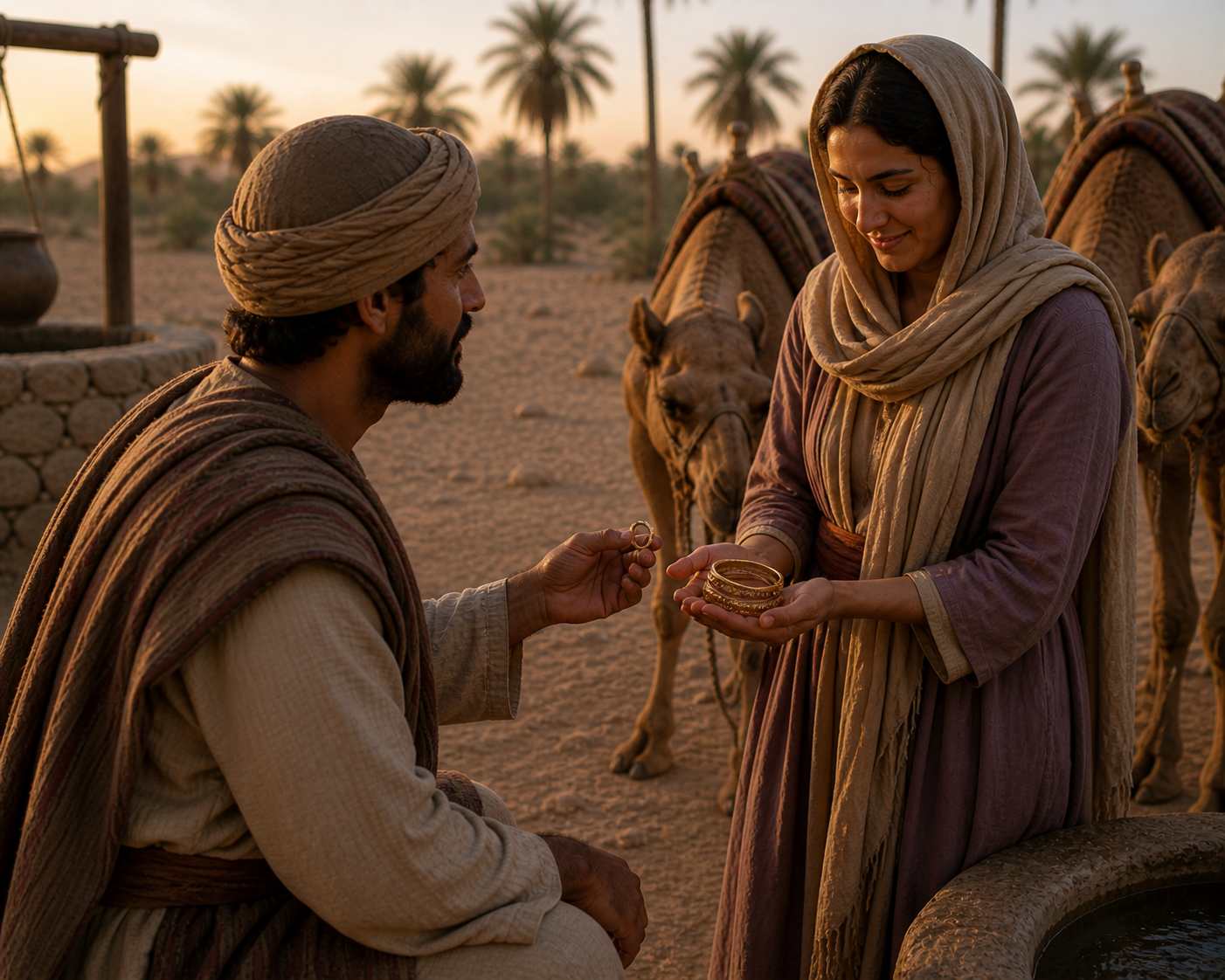
WHEN GOD MAKES IT CLEAR
THE SERVANT RESPONDS
When the camels had finished drinking, the man took a gold ring weighing a half-shekel and two bracelets for her wrists weighing ten shekels in gold - Now he knew! The servant had prayed for a specific sign, that the chosen woman would not only give him a drink but also voluntarily water his camels (Ge 24:14).The servant waited until the task was fully completed, confirming that this is not coincidence but matched his prayer precisely.
The man took - This marks a shift from watching in silence (v.21) to responding in faith and so he now acts because he sees evidence of God’s hand at work. This was not payment for watering the camels, but gifts of gratitude which would set the stage for his wedding proposal presentation.
A gold ring… and two bracelets - The “ring” likely refers to a nose ring (a customary adornment in the ancient Near East; cf. Ge 24:47) The bracelets were ornate wrist ornaments
Bob Utley - This gold ring refers to a nose ring (cf. Gen. 24:47 and the Samaritan Pent, cf. Prov. 11:22; Isa. 3:21; Ezek. 16:12). A nose ring of a half-shekel (i.e., beka, about 2 oz.) was common.
TSK on gold ring - From the word being in the singular number, it is not likely to have been an ear-ring, or a "jewel for the forehead," but "a jewel for the nose, a nose-ring," which is in use throughout Arabia and Persia, particularly among young women. It is very properly translated [epirrinon,] "an ornament for the nose," by Symmachus; and Sir John Chardin informs us, that "it is a custom in almost all the East, for the women to wear rings in their noses, in the left nostril, which is bored low down in the middle. These rings are of gold, and have commonly two pearls and one ruby between, placed in the ring. I never saw a girl or young woman in Arabia or in all Persia, who did not wear a ring after this manner in her nostril."
TSK on bracelets: The word rendered "bracelet," from a root which signifies "to join or couple together," may imply whatever may clasp round the arms and legs; for rings and ornaments are worn round both by females in India and Persia. The small part of the leg, and the whole arm, from the shoulder to the wrist, are generally decorated in this way. As these were given to Rebekah for "her hands," it sufficiently distinguishes them from similar ornaments for the ankles.
Weighing a half-shekel… ten shekels in gold is a significant amount of wealth for a half-shekel ring (~5–6 grams) and ten shekels for bracelets (~110–120 grams total) would clealy indicate the servant represents a wealthy household (Abraham’s) and is acting with serious intent, not casually!
The gifts are given in response to what God has just done for he recognizes God’s providence in seeing the perfect alignment with his prayer. And by giving these gifts he begins to acknowledge the LORD guiding. These gifts function as a first step toward engagement and a visible sign of honor and intent. Rebekah may not have fully grasped the significance yet, but clearly this was the servant's intent.
NET NOTE A beka (half-shekel) weighed about 5–6 grams (0.2 ounce). A shekel weighed about 11.5 grams (0.4 ounce) although weights varied locally, so these bracelets weighed about 4 ounces (115 grams).
Henry Morris - golden earring. Large golden earrings and intricate golden necklaces and bracelets dating well before Abraham's time have been found at Ur. Ancient craftsmen were highly skilled artisans.
John Walton 24:22. nose rings. Nose rings were especially popular during the *Iron Age (1200-600 B.C.), though there are examples from earlier periods. Made of silver, bronze and gold, and often tubular in design, they were round with two ends for insertion and sometimes included a tiny pendant. The beka is the half-shekel measure of weight, equal to one-fifth of an ounce. jewelry. The bracelets would have been bands worn around the wrist as bangles. They were very popular items and are often found on the arms and wrist of females in tombs. By placing them on her arms, the servant may be symbolizing the marriage contract. A tenshekel bracelet would weigh about four ounces. Legal materials from the first half of the second millennium suggest a worker might expect to make at most ten shekels per year and often less. These would typically be shekels of silver—gold would be more valuable.
QUESTION - What does the Bible say about nose rings? GOTQUESTIONS.ORG
ANSWER - Nose rings are mentioned in the Bible as far back as the book of Genesis. When Abraham sent his servant in search of a wife for Isaac, the servant prayed that God would reveal to him the right young woman (Genesis 24:12–14). Rebekah came in answer to his prayer, and when she agreed to give him lodging in her father’s home, he gave her some gifts from his master, Abraham. Among those gifts was “a gold nose ring” (Genesis 24:22). This reveals that nose rings were in fashion during that era and they represented wealth and status when given as gifts. They were also considered female attire. The only time men wore anything through their noses was when they were taken as slaves (2 Chronicles 33:10–11).
In Ezekiel 16, God describes the affection He had showered upon Israel in terms of a man showering his bride with gifts: “I put a ring on your nose, earrings on your ears and a beautiful crown on your head” (verse 12). The Lord often used figurative speech and familiar objects and customs in order to communicate unfamiliar truths to His people. The lavish adornment, including the nose ring, described in this passage was the way a wealthy, loving husband would have provided for his beloved.
Nose rings are worn for different reasons in different cultures. In some Hindu communities, piercing a woman’s nose marks her as either married or ready for marriage. It is also believed by some that piercing the nose relieves pain during childbirth. In more primitive cultures, nostril or septum piercing is common and has carried a variety of meanings depending upon the region, tribe, or historical era.
In the recent past, nose rings were not considered mainstream in Western culture. The presence of a nose ring indicated rebellion or solidarity with counterculturalism. However, in most Western cultures today, nose rings are simply a matter of personal style and preference. They are usually worn as tiny diamond studs or small rings fastened on one nostril. Wearing a nose ring is neither good nor bad but reflects one’s personal taste. However, if a nose ring represents something evil, then it is wrong to wear one. For example, a teenage girl may get her nose pierced as an act of rebellion against her family’s conservative values. She wants a nose ring simply because no one else in her circle has one and because it will spark controversy. Her parents have told her “no,” but she gets her nose pierced anyway. For that girl, wearing a nose ring is wrong because it is an open, visible statement of rebellion.
For a Christian, the one principle that should define all choices is found in 1 Corinthians 10:31: “Whether, then, you eat or drink or whatever you do, do all to the glory of God.” The mention of eating and drinking drives home the point that every choice a believer makes can have significance. What we do, where we go, and how we dress all reflect our relationship with Jesus. We can either bring Him glory by our choices or bring dishonor to His name. In the decision of whether or not to wear a nose ring, we can ask ourselves a few questions:
1. In my circle of influence, will wearing a nose ring be likely to cause offense and draw negative attention to me rather than draw positive attention to Christ?
2. What message do I think I am sending by wearing a nose ring? What message might others actually be receiving?
3. Do I have a history of infections or skin irritations that an unsanitary nose ring might aggravate?
4. Will my nose ring be so distracting that it becomes the focus for other people rather than my eyes or my words?
Keeping 1 Corinthians 10:31 as our guideline for every decision—whether it be the style of clothing we wear, the way we fix our hair, or the piercings we get—we also keep our motives pure. When our life goal is to magnify the purity and beauty of Christ in our lives, He helps us stay away from the sensational and seek modesty and humility (1 Corinthians 8:9; Galatians 5:13). With those qualities in place, we have freedom to express the beauty of Christ in a variety of ways, including wearing nose rings.
Genesis 24:23 and said, “Whose daughter are you? Please tell me, is there room for us to lodge in your father’s house?”
GUIDED BY GOD
CONFIRMED BY INQUIRY
and said, “Whose daughter are you? - After observing Rebekah’s extraordinary kindness at the well (Genesis 24:18–20), he does not immediately assume she is the one. Though he has prayed for guidance, he still seeks confirmation. It is not enough that she is kind; she must also be the right person according to God’s revealed will.
Warren Wiersbe - “Whose daughter art thou?” (Gen. 24:23) is a key question for any suitor to ask. Of course, the servant was interested in her family, but the question has a wider application for Christian believers today, both men and women. “Are you a child of God? Have you been born again into the family of God?” What a tragedy when believers marry unbelievers and try to establish a home without the full blessing of God.
Please tell me, is there room for us to lodge in your father’s house?” This is a practical question about hospitality. The servant has traveled a long distance with a caravan, and lodging is a legitimate need. But beneath that, it serves as a further test of both her household and her willingness to extend generosity. If her family shares her spirit of hospitality, it will confirm that this is a fitting environment for Isaac’s future wife.
P G Matthew - “Whose daughter are you? Whose son are you?”
Genesis 24:23; 1 Samuel 17:58
In biblical times, a person’s identity was rooted in their parentage. The Bible often introduces people as “son of” or “daughter of” someone. When Abraham sent his servant to find a wife for Isaac, God directed him to a beautiful young woman. The servant didn’t ask her name; he asked, “Whose daughter are you?” Rebekah answered, “I’m the daughter of Bethuel, son of Milcah and Nahor.”
When King Saul watched a teenage boy striding out to take on the giant who terrified the Israelite army, he told his army commander to find out whose son he was. As David stood before Saul with Goliath’s head in his hand, Saul asked, “Whose son are you, young man?” David replied, “The son of your servant Jesse of Bethlehem.”
As Christians, our identity is rooted in our heavenly Father. It may be popular to say that “we’re all God’s children,” but that’s not true. God only gives that right to those who believe in Jesus Christ (see John 1:12). The Bible labels those who don’t believe in him as “children of the devil” (1 John 3:10). When God adopts us, he puts his Spirit in us to let us know that we belong to him. As we learn to be led by that Spirit, it becomes obvious to the world whose son or daughter we are.
Human fathers are imperfect and prone to mistakes. Some seem distant; others appear to be nonexistent. But our heavenly Father is perfect and loves us unconditionally. He provides for us and guards our future inheritance. And he encourages us to call out to him as our “Abba,” an intimate term used by young children to address their father. Regardless of who our earthly father is, we have a heavenly Father who will never let us down.
He loves us so much that we are actually called God’s dear children. And that’s what we are. 1 John 3:1
Ask yourself: Can other people tell who my Father is?
Genesis 24:24 She said to him, “I am the daughter of Bethuel, the son of Milcah, whom she bore to Nahor.”
NLT "My father is Bethuel," she replied. "My grandparents are Nahor and Milcah.
- Ge 24:15 11:29 22:20,23
DIVINE PRECISION
IN PROVIDENCE
She said to him, “I am the daughter of Bethuel, the son of Milcah, whom she bore to Nahor - This sealed the deal! Rebekah traces her lineage carefully: Bethuel (her father), Milcah (her grandmother), and Nahor (her grandfather, Abraham’s brother; Genesis 11:29). This level of detail removes all doubt. She is not just from the right region but is from Abraham’s own family line. What the servant had been sent to find (Ge 24:4) is now confirmed beyond question that God has providentially guided every step, aligning the servant’s prayer, her actions, and her lineage into one seamless answer.
Genesis 24:25 Again she said to him, “We have plenty of both straw and feed, and room to lodge in.”
- Ge 18:4-8 Judges 19:19-21 Isa 32:8 1Pe 4:9
REBEKAH'S
HOSPITALITY
Again she said to him, “We have plenty of both straw and feed, and room to lodge in - This verse continues to reveal the remarkable character of Rebekah as she anticipate needs without being prompted. She is assuring the servant that his entire caravan (servant and camels) will be well cared for. Rebekah's response perfectly aligns with the servant’s earlier prayer. He had asked that the chosen woman would not only give him a drink but also voluntarily water his camels (Genesis 24:14). Rebekah has done exactly that and more. Now, without being asked, she provides lodging as well.
Genesis 24:26 Then the man bowed low and worshiped the LORD.
- Ge 24:48,52 22:5 Ex 4:31 12:27 34:8 1Ch 29:20 2Ch 20:18 29:30 Ne 8:6 Ps 22:29 66:4 72:9 95:6 Mic 6:6 Php 2:10
THE SERVANT'S
WORSHIPFUL RESPONSE
Then the man bowed low and worshiped (shachah; LXX - proskuneo - bow down to kiss someone's feet) the LORD - This describes the servant’s immediate and instinctive reaction to seeing God’s unmistakable hand at work. His humility and gratitude are a great example of praising God for answered prayer. his posture reminds us that true worship is both inward and outward. It is not merely a feeling of gratitude but an expressed acknowledgment of God’s worth, often accompanied by humble surrender. His bowing declares, “This success belongs entirely to the LORD.”
Bruce Waltke - The meeting is framed by prayer and worship (see 24:12), a sign of the servant’s faithfulness and God’s favor. (Genesis: A Commentary)
Keith Krell - When God moves in your life do you respond like this servant? If you are physically able, I challenge you to bow before the Lord on a daily basis. Recently I was challenged by a young man (Michael Fletcher) to prostrate myself before the Lord on a daily basis just to acknowledge that He is God. I have been attempting to do this and I have found it serves to remind me of how small I am and how huge God is.
Worshipped (prostrated, worship) (07812) shachah means to bow down, to prostrate oneself, to crouch, to fall down, to humbly beseech, to do reverence, to worship. The idea is to assume a prostrate position as would in paying homage to royalty (Ge 43:28) or to God (Ge 24:26, Ps 95:6).
It is found for the first time in Gen. 18:2, where Abraham "bowed himself toward the ground" before the 3 messengers who announced that Sarah would have a son. The act of bowing down in homage is generally done before a superior or a ruler. Thus, David "bowed" himself before Saul (1 Sam. 24:8). Sometimes it is a social or economic superior to whom one bows, as when Ruth "bowed" to the ground before Boaz (Ruth 2:10). In a dream, Joseph saw the sheaves of his brothers "bowing down" before his sheaf (Gen. 37:5, 9-10). Shāḥâ is used as the common term for coming before God in worship, as in 1 Sam. 15:25 and Jer. 7:2. Sometimes it is in conjunction with another Hebrew verb for bowing down physically, followed by "worship," as in Exod. 34:8: "And Moses made haste, and bowed his head toward the earth, and worshiped." Other gods and idols are also the object of such worship by one's prostrating oneself before them (Isa. 2:20; Isa. 44:15, 17).
Spurgeon - 26 “Then the man knelt low, worshiped the LORD.” Notice how Eliezer prayed all along the way. He had no doubt in his mind as to whether God interfered in human affairs but boldly and simply sought to know his will. Then, having presented his petition, we find him in quiet confidence holding his peace, “to see whether or not the LORD had made his journey a success” (24:21). And when success crowned his efforts, he was quick to acknowledge that the speedy fulfillment of his objective was in answer to his supplication. It was the guidance of God, and not his own acuteness or wisdom, which led to such a favorable issue. Thus it is also with every true minister of the New Testament. We will never speak to men for God with any power of persuasion unless, first, we speak to God for men with power of supplication.
Genesis 24:27 He said, “Blessed be the LORD, the God of my master Abraham, who has not forsaken His lovingkindness and His truth toward my master; as for me, the LORD has guided me in the way to the house of my master’s brothers.”
- Blessed: Ge 24:12 9:26 14:20 Ex 18:10 Ru 4:14 1Sa 25:32,39 2Sa 18:28 1Ch 29:10-13 Ps 68:19 72:18,19 Lu 1:68 Eph 1:3 1Ti 1:17
- of his: Ge 32:10 Ps 98:3 100:5 Mic 7:20 Joh 1:17
- the Lord: Ge 24:48 Pr 3:6 4:11-13 8:20
- of my: Ge 24:4 13:8 Ex 2:11,13
YAHWEH'S FAITHFULNESS TO
HONOR ABRAHAM'S DESIRE
He said, “Blessed (barak) be the LORD, the God of my master Abraham To “bless” God (barak) is to praise Him by declaring His greatness and goodness. Notice the focus the servant identifies Yahweh as “the God of my master Abraham.” Though he is a servant, he recognizes that the promises made to Abraham are actively being fulfilled before his eyes.
Keith Krell - God is deliberately behind the scenes, yet directing the acts. In this respect the account is very similar to the book of Ruth. The story records no word from God, no miracle, no prophetic oracle; it doesn’t even restate the Abrahamic covenant. It merely evidences God sovereignly working through the circumstances of those who are acting in faith.
Who has not forsaken His lovingkindness (hesed) and His truth ('emeth) toward my master - Abraham was old and Isaac unmarried and in a sense the Messianic Seed depends on the success of the servant's mission. And so agains he acknowledges Yahweh's stedfast love (hesed), describing God’s unwavering commitment to keep His promises (cf. Ge 32:10; Ps89:1–2). The servant is essentially saying, “God has remained exactly who He said He is.”
as for me, the LORD has guided me in the way to the house of my master’s brothers - Guided underscores Yahweh's active, moment-by-moment direction. The servant sees his journey not as a divinely directed path (cf. Pr 3:5–6). Every step, every timing, every encounter has been ordered by God bringing him to the exact destination Abraham had instructed (Genesis 24:4).
Bruce Waltke - has led me - The connotation of the Hebrew is “to lead through difficulty.” Elsewhere in the Pentateuch this word describes God’s special angelic guidance of his people through the wilderness to the Promised Land (Ex. 13:17, 21; 15:13; 32:34) (Genesis: A Commentary)
David Guzik - It is hard to steer a parked car. If we want to be guided by the LORD, we should be on our way.
Bob Utley - This is another significant term, "truth," אמת (BDB 54) which often appears in conjunction with the term "lovingkindness." Its original etymology meant "to be firm" or "to be sure" and it came, therefore, to speak of "faithfulness." "the Lord has guided me" The VERB (BDB 634, KB 685, Qal PERFECT) describes God's leadership and guidance for those who trust Him (cf. Ps. 5:8; 27:11; 139:24; Isa. 58:11). "in the way" This term (BDB 202) describes lifestyle faith in God (cf. Jdg. 2:22; Ps. 119:1). This OT idiom became the earliest title for the Christian church (i.e., "The Way," cf. Acts 9:2; 18:25,26; 19:9, 23; 22:4; 24:14, 22; and possibly John 14:6).
Divine Providence - John Butler
“I being in the way, the LORD led me to the house of my master’s brethren.” (Genesis 24:27)
THE beautiful story of Abraham sending his eldest servant to Nahor to find a bride for Isaac, gives some excellent guidelines and principles for choosing a marriage partner. Most prominent in the whole chapter is the marvelous working and blessing of Divine providence on behalf of the servant of Abraham. Our verse speaks of the consequences, condition, and character of Divine providence.
The consequences of Divine providence. Divine providence brought the servant into contact with Abraham’s “brethren” from whom he was to obtain a bride for Isaac. Divine providence gave the servant a successful trip. We are dependent on Divine providence more than we realize. We need God to work in our circumstances if we are going to succeed in life.
The condition for Divine providence. The condition for experiencing Divine providence in a blessed way is obedience. When the servant said, “I being in the way, the Lord led me,” he meant that his being in the way of obedience resulted in his experiencing the blessing of Divine providence. He had done exactly as he was commanded to do, and this resulted in his having a successful trip. Obedience is mocked by the world, but obedience is the key to Divine blessings—and a choice blessing is Divine providence.
The character of Divine providence. The providential incidences concerning the servant were in character simple incidents—such as coming to the well just as Rebekah came to the well. Someone has said that great doors swing on small hinges. Divine providence often works that way; for great changes in one’s life can occur by some seemingly small incident such as a phone call, a timely letter, the meeting of someone in a store or church or other place (such as a well in our text). Yet these small incidents can completely change one’s life. They may lead to a marriage, as it did in today’s Bible reading, or a needed job or an important career change. The world calls these incidents “luck” or “chance.” But God’s people know better, for they know them as Divine providence.
Genesis 24:27 "IN THE WAY"
And he said, . . . I being in the way, the Lord led me. Genesis 24:27
At the first meeting of a group of Girl Scouts, they were asked what they had done at home to help their mothers since joining the Brownies. One by one they proudly answered. Some had made beds, others had washed dishes, while still others had dusted their rooms. "And you, Penny?" asked the troop leader. "How did you help your mother?" Came the solemn answer, "I kept out of her way!" Keeping "out of the way" can sometimes be helpful; but when it comes to service for the Lord, He wants us to be "in the way," not in the senseGenesis 24:50-67 of being obstructive, but rather with the object of obediently walking in the pathway of His choosing. When we are thus fully surrendered, God de-lights to use and lead us.
In Genesis 24 we are told about Eliezer, Abraham's servant, who was sent to secure a bride for Isaac. After meeting Rebekah and receiving the assurance that she was the one "appointed" for his master's son, he blesses the Lord and says, "I being in the way, the Lord led me." Because he was treading the pathway of obedience, Eliezer was divinely directed and used. As a sub-missive servant he was an instrument in God's hands in the accomplishment of His purposes.
Are you "but of the way" or "in the way" today? Are you hiding out, shirking your duty, or are you in the place of obedience, available for service? Regardless of what your past experiences may have been, determine this day that your response to the Lord's plea, "Whom shall I send, and who will go for us?" will be the ready answer, "Here am I, send me! I want to be `in the way'!"
Ready to go, ready to stay,
Ready my place to fill;
Ready for service, lowly or great,
Ready to do His will!
—Tillman
What God wants from us most is
not so much our ABILITY as our AVAILABILITY!
Oswald Chambers - Discovering divine designs
I being in the way, the Lord led me.… Genesis 24:27.
We have to be so one with God that we do not continually need to ask for guidance. Sanctification means that we are made the children of God, and the natural life of a child is obedience—until he wishes to be disobedient, then instantly there is the intuitive jar. In the spiritual domain the intuitive jar is the monition of the Spirit of God. When He gives the check, we have to stop at once and be renewed in the spirit of our mind in order to make out what God’s will is. If we are born again of the Spirit of God, it is the abortion of piety to ask God to guide us here and there. “The Lord led me,” and on looking back we see the presence of an amazing design, which, if we are born of God, we will credit to God.
We can all see God in exceptional things, but it requires the culture of spiritual discipline to see God in every detail. Never allow that the haphazard is anything less than God’s appointed order, and be ready to discover the Divine designs anywhere. Beware of making a fetish of consistency to your convictions instead of being devoted to God. ‘I shall never do that’—in all probability you will have to, if you are a saint. There never was a more inconsistent Being on this earth than Our Lord, but He was never inconsistent to His Father. The one consistency of the saint is not to a principle, but to the Divine life. It is the Divine life which continually makes more and more discoveries about the divine mind. It is easier to be a fanatic than a faithful soul, because there is something amazingly humbling, particularly to our religious conceit, in being loyal to God.
James Butler - PROVIDENCE Genesis 24:27 - Sermon Starters
“I being in the way, the LORD led me to the house of my master’s brethren” (Genesis 24:27).
The world calls it “luck.” Believers do not believe in “luck” but they do believe in the providence of God who works things out in a wonderful way (Romans 8:28). The chief servant of Abraham was sent hundreds of miles north to Haran to find a wife for Isaac from Abraham’s kinfolk, whom Abraham knew would be a better situation from which to get a bride for Isaac then the Canaanites around Abraham. It makes a difference where you get your spouse. The world does not offer good spouses but God’s people do. The principle Abraham followed was written plainly by Paul when he said, “Be ye not unequally yoked together with unbelievers” (2 Corinthians 6:14). Our text speaks of the acknowledgement by the servant of Abraham of God’s leading regarding locating a wife for Isaac.
FIRST—THE CONSEQUENCE OF PROVIDENCE
“The LORD led me to the house of my master’s brethren.” Without maps and GPS help the servant had to find the kin of Abraham. It was like finding a needle in a haystack. But God so worked providence to help the servant find Isaac’s bride. When he came to the area when Abraham’s kinfolk lived he came to a well and there he met Rebekah the very women for Isaac.
SECOND—THE CONDITION FOR PROVIDENCE
“I being in the way.” What the servant meant by these words was that he was obedient. He had done exactly as Abraham said and it was on the path of obedience that he experienced providence. The condition to experience the providence of God is obedience to God. The world mocks this obedience, but it is the key to God working things out for you. The world speaks of “luck” or “the way the cookie crumbles” or “the way the ball bounces” as though a situation like the servant experienced is a chance happenstance. But God’s people know better. If we obey, God works for us in these timely experiences.
THIRD—THE CHARACTER OF PROVIDENCE
“The LORD led me to the house of my master’s brethren.” God uses many little things to lead us in His path. It may be simply a phone call, a letter, or the meeting of someone in the store or at church that guides you in some important decision. Someone has said that great doors swing on small hinges. And indeed they do especially when the providence of God is involved. Do not wait for some headline event to happen to direct your life. Pay attention to the little incidences in life and you will see God leading you in them as well as in the big incidences. The servant met the woman at the well. Such an insignificant situation as far as the world sees things but God was in it all the way and the servant recognized God’s working. He did not attribute his success to “luck,” but he credited his success to the Lord who often works in small incidences to direct out life.
Genesis 24:28 Then the girl ran and told her mother’s household about these things.
- of: Ge 24:48,55,67 31:33
REBEKAH'S EXCITED
RESPONSE
Then the girl ran and told her mother’s household about these things - In that culture a girl’s primary familial relation is with the mother (Ruth 1:8; Song 3:4; 8:2). Rebekah does not linger at the well analyzing what just happened; she moves quickly. Her actions reflect a heart stirred by the encounter. These things gathers up everything that has just occurred: the servant’s arrival, his request for water, Rebekah’s extraordinary generosity in watering the camels, and the giving of costly gifts (Genesis 24:22–27).
TSK - Some have conjectured from this, that her father Bethuel was dead; and the person called Bethuel, (ver. 50,) was a younger brother. This is possible; but as Dr. A. Clarke remarks, the mother's house might be mentioned were even the father alive; for in Asiatic countries, the women have apartments entirely separate from those of the men, in which their little children and grown-up daughters reside with them. This was probably the case here; though, from the whole narrative, it is very probable that Bethuel was dead, as the whole business appears to be conducted by Rebekah's brothers.
John Walton mother’s household. It would be natural for a young, unmarried woman to refer to her home as her mother’s house until she was wed (see Song 3:4).
J J Knapp - At Her Mother’s House Ge 24:28
Rebekah is described to us as a young daughter who was very fair to behold. However, higher than this physical beauty is the loveliness of her character. Of course, she did not know with what intention Eliezer was resting at the water well with his camels. Nobody had told her that he was on his way to find a wife for Abraham’s son, neither that he had placed this matter into God’s hand, as it ought to be done in such an important matter. But she would not have been a woman, not to suspect that this was no ordinary encounter.
In the beginning there was nothing extraordinary. It was to be expected that Eliezer would ask her for some water to drink. The fact that she did not only give him water to drink, but that she also drew water from the well for his camels, was for Eliezer an unexpected proof of her kindness, that did not mind a little helpfulness. However, when Eliezer opened his treasures and embellished her with arm rings and head gear; yes, when he seriously inquired after her lineage and asked for a place in her father’s house, a vague notion must have arisen in this youthful heart about implications she barely dared to imagine. The fact that in her confusion she ran immediately to her mother’s house, makes this youthful girl so appealing.
This is something particularly feminine. Quickly to Mother, to whisper in her ear what had happened. Maybe it was meaningless. It was not at all certain that something serious was intended. It could very well be that this man at the water well was only looking for a place to stay over for the night. But Mother was so much wiser and more experienced; she was so much older and she had experienced these things herself. She also loved her child so dearly; she would understand the fluttering heart and she would counsel her wisely. Above all, Mother would remain silent if it turned out to be nothing. A mother’s ear is like a confessional where secrets of the heart are safely kept!
Is it not touching, this trust between mother and child, especially in such tender matters, that cannot be shared with anyone else? Is it not a pity that this trust does not bind hearts together everywhere and that our young daughters often cannot find the way to their mother’s heart any more to reveal their secret hopes, their vague expectations and their deepest affections? God Himself has created this inclination of the maiden’s heart towards the mother. False shame should never keep anyone from following this inclination. As soon as in the distance the dream of each woman’s heart arises at the horizon of life, even if the outlines are still vague, she flee with winged feet to her mother’s house and her mother’s heart.
P G Matthew - “Why are you standing out here?” Genesis 24:28–32
In Conrad Reichter’s novel The Town, the first settler of a wooded area in Ohio returns after an absence of forty years. In place of dense forest, Worth Luckett finds a bustling town. Instead of a one-room cabin, his oldest daughter, Sayward, lives in a three-story brick house as the richest person in town. Despite Sayward’s pleas, Worth refuses to stay in her home and eat in her fancy dining room. He insists on staying in a shack by the river, sometimes ignoring the food she sends him.
Abraham’s servant responded differently to an offer of hospitality. After he met Rebekah, he waited for an invitation to enter her family’s home. As soon as her brother heard about her encounter with the stranger, he rushed out. “Come in, you whom the Lord has blessed,” Laban said. “Why are you standing out here?” The servant gladly accepted Laban’s provision for him, his men, and his animals.
Sometimes believers live like outsiders to the body of Christ. We may be struggling with personal problems we feel reluctant to share. We may think our lives are already too busy to get involved at church. It may be pride or past hurts that cause us to hold people at arm’s length. Whatever the reason, we miss out on the fellowship, help, and encouragement God intended for us.
Pride, rebellion, or a flippant attitude toward sin can cause us to hold ourselves distant from God. He never forces himself on anyone, but we have a standing invitation to draw near to him in prayer. To accept his offer of hospitality requires us to trust him enough to be transparent before him. Why would we stand outside in the cold when we can bask in the warmth of his love and fellowship?
Come close to God, and he will come close to you. James 4:8
Ask yourself: Have I been holding myself at a distance from God or from other believers?
Genesis 24:29 Now Rebekah had a brother whose name was Laban; and Laban ran outside to the man at the spring.
- Ge 24:55,60 29:5
REBEKAH'S BROTHER LABAN
RUNS TO MEET SERVANT
Now Rebekah had a brother whose name was Laban; and Laban ran outside to the man at the spring - In the ancient Near Eastern setting, a brother often functioned as a key representative in family matters, especially in marriage arrangements. Laban will soon become the primary spokesman for the household, and this introduction prepares us for his influence. Laban has seen the ring and bracelets given to Rebekah and heard her report (Genesis 24:30). His haste, therefore, is not merely hospitality; it is stirred, at least in part, by the visible wealth and significance of the visitor. While Rebekah’s actions flowed from pure generosity, Laban’s may be influenced by material considerations.
Bob Utley - "Laban" Rabbinical sources are negative toward Laban, therefore, they interpret Gen. 24:30 to say that he only went out to meet the servant when he saw the gold which he had given to his sister. However, Gen. 24:30 also mentions the family of Abraham, which is another potential reason for Laban's interest. Laban is a difficult person to understand in Scripture because in Gen. 24:31 he uses the term "YHWH," but in Gen. 31:53 he seems to be an idolater and polytheist and implies that there is another god of Nahor.
Genesis 24:30 When he saw the ring and the bracelets on his sister’s wrists, and when he heard the words of Rebekah his sister, saying, “This is what the man said to me,” he went to the man; and behold, he was standing by the camels at the spring.
WHEN WEALTH CATCHES
ONE'S EYE
When he saw the ring and the bracelets on his sister’s wrists - Hebrew = “And it was when he saw the nose ring and the bracelets on the arms of his sister.” The order is telling. Laban’s eyes are first drawn to the visible wealth. These were not trivial ornaments but costly gifts (Genesis 24:22), signaling that the visitor was a man of means.
And when he heard the words of Rebekah his sister, saying, “This is what the man said to me,” he went to the man - Now Laban processes not only what he has seen, but what he has heard. Rebekah’s testimony about the encounter at the well and the man’s words increases his interest.
he went to the man - While Rebekah's haste sprang from generous hospitality; his seems stirred by opportunity. Yet again, God’s providence works through differing motives to advance the same divine purpose.
And behold (hinneh; LXX - idou), he was standing by the camels at the spring - The behold invites the audience to view this unfolding drama through the eyes of Laban. The servant is still there, waiting. The camels, symbols of wealth and long-distance travel, reinforce the impression of abundance. The setting remains the well, the place where God has been quietly orchestrating events.
Genesis 24:31 And he said, “Come in, blessed of the LORD! Why do you stand outside since I have prepared the house, and a place for the camels?”
- thou: Ge 26:29 Judges 17:2 Ru 3:10 Ps 115:15 Pr 17:8 18:16
- for I: Ge 24:25
LABAN WELCOMES
THE SERVANT OF ABRAHAM
And he said, “Come in, blessed of the LORD! He recognizes that the visitor stands under divine favor.
Why do you stand outside - In that culture, to leave a guest waiting outside would be improper once hospitality had been offered. Yet the question also heightens the sense that Laban is eager to bring the man in quickly. The narrative continues to suggest that his enthusiasm is at least partly fueled by what he has perceived about the servant’s wealth and importance.
since I have prepared the house, and a place for the camels?” This is comprehensive hospitality. Not only is there room for the man, but provision has been made for the entire caravan. What began as a private encounter at the well, where God answered a prayer in quiet providence, now moves into the household, where the matter will be formally discussed and decided
NET NOTE Laban’s obsession with wealth is apparent; to him it represents how one is blessed by the LORD. Already the author is laying the foundation for subsequent events in the narrative, where Laban’s greed becomes his dominant characteristic.
Genesis 24:32 So the man entered the house. Then Laban unloaded the camels, and he gave straw and feed to the camels, and water to wash his feet and the feet of the men who were with him.
KJV And the man came into the house: and he ungirded his camels, and gave straw and provender for the camels, and water to wash his feet, and the men's feet that were with him.
NET So Abraham's servant went to the house and unloaded the camels. Straw and feed were given to the camels, and water was provided so that he and the men who were with him could wash their feet.
NLT So the man went home with Laban, and Laban unloaded the camels, gave him straw for their bedding, fed them, and provided water for the man and the camel drivers to wash their feet.
- wash: Ge 18:4 19:2 43:24 Jud 19:21 1Sa 25:41 Lu 7:44 Joh 13:4-14 1Ti 5:10
HOSPITALITY IN
ACTION
So the man (Abraham's servant) entered the house. - The servant accepts the invitation without hesitation.
Then Laban unloaded the camels, and he gave straw and feed to the camels - Laban does not delegate the task; he takes responsibility for caring for the caravan. Straw, by the eastern mode of threshing, was cut or shattered, and reduced to a kind of chaff. With this, sometimes mixed with a little barley, the eastern people still feed their labouring beasts, as they anciently did.
NET NOTE Heb “the man”; the referent (Abraham’s servant) has been specified in the translation for clarity. Some translations (e.g., NEB, NASB, NRSV) understand Laban to be the subject of this (Then Laban unloaded the camels) and the following verbs or take the subject of this and the following verbs as indefinite (referring to an unnamed servant; e.g., NAB, NIV).
and water to wash his feet and the feet of the men who were with him. - Foot washing was a customary act of refreshment for travelers who had journeyed over dusty terrain (cf. Genesis 18:4; 19:2). It signifies welcome, rest, and restoration. After a long journey, this simple act would have brought immediate relief. Again, the care extends beyond the servant himself to all who accompany him, emphasizing completeness.
Bob Utley - 24:32-33 Several expected cultural acts are done for the servant of Abraham by Laban/Laban's servants.
- unloaded the camels
- gave the camels food
- gave water for the servants who accompanied "the servant" to wash their feet
- fed all of them
Genesis 24:33 But when food was set before him to eat, he said, “I will not eat until I have told my business.” And he said, “Speak on.”
- Job 23:12 Ps 132:3-5 Pr 22:29 Ec 9:10 Joh 4:14,31-34 Eph 6:5-8 1Ti 6:2
A MAN GOVERNED
BY HIS MISSION
But - Term of contrast. Something more important than personal comfort is about to take precedence.
When food was set before him to eat, he said, “I will not eat until I have told my business.” This is striking. In a culture where receiving food was part of honoring the host, to delay eating was unusual and therefore emphatic. His mission takes priority over his appetite.
Bruce Waltke - The servant puts his mission before his need and comfort. His prudent refusal to eat before stating his mission also allows him to control the situation and to avoid any sense of obligation to this host and hostess. (Genesis: A Commentary)
And he said, “Speak on - Laban grants him the floor without resistance. This is significant. The door is now fully open for the servant to recount God’s providence and present his request.
Spurgeon - 24:33 “I will not eat until I have said what I have to say.” He meant business and would not even eat the meat set before him until he had explained his errand. Like every true servant of Christ, he put his Master’s business before his own ease or comfort—even before the question of necessary food. When a man begins to think more of his eating than of doing the will of God, he ceases to be a truehearted minister. Let us imitate the thoroughness of Abraham’s servant in this matter.
Genesis 24:34 So he said, “I am Abraham’s servant.
- Ge 24:2
A SERVANT SPEAKING AS
VOICE OF ABRAHAM'S HOUSE
Bob Utley - 24:34-41 This repeats the words of Abraham to his servant which are recorded earlier in this chapter.
So he said, “I am Abraham’s servant - He does not begin by highlighting the wealth he carries, the success of his journey, or even his own name (which is never given). Instead, he identifies himself entirely in relation to his master. His statement carries authority as well as humility. Though he is a servant, he represents Abraham, the one to whom God has given covenant promises (Genesis 12:1–3; 22:17–18). In that sense, he speaks not merely for himself, but as an authorized representative.
Oswald Chambers - Human Affinities and Divine Directions (Genesis 24:34-49)
Eliezer gives a simple account of his journey, but his speech is an example of great wisdom. When the Spirit of God guides a man’s human affairs, his speech indicates not human shrewdness, but the frankness of Divine skill. Ever note that we must be ready to discover the Divine designs anywhere.
Genesis 24:35 “The LORD has greatly blessed my master, so that he has become rich; and He has given him flocks and herds, and silver and gold, and servants and maids, and camels and donkeys.
- the Lord: Ge 24:1 12:2 13:2 25:11 26:12 49:25 Ps 18:35 112:3 Pr 10:22 22:4 1Ti 4:8
- flocks: Ge 12:16 13:2 26:13,14 Job 1:3 42:10-12 Ps 107:38 Mt 6:33
SERVANT RECOUNTS YAHWEH'S
BLESSING OF ABRAHAM
The LORD has greatly blessed (barak) my master, so that he has become rich; and He has given him flocks and herds, and silver and gold, and servants and maids, and camels and donkeys - Note that the servant's emphasis falls squarely on Yahweh as the Source. Abraham’s wealth is presented as evidence of God’s faithfulness. He follows with a detailed inventory, covering virtually every category of ancient wealth. The servant is carefully demonstrating that Isaac’s future household is one of stability, provision, and blessing.
NET NOTE Heb “great.” In this context the statement refers primarily to Abraham’s material wealth, although reputation and influence are not excluded.
Genesis 24:36 “Now Sarah my master’s wife bore a son to my master in her old age, and he has given him all that he has.
- Sarah: Ge 11:29,30 17:15-19 18:10-14 21:1-7 Ro 4:19
- unto: Ge 21:10 25:5
SERVANT RECOUNTS ISAAC TO
BE ABRAHAM'S HEIR
Now Sarah my master’s wife bore a son to my master in her old age, and he (Abraham) has given him all that he has - Now he gives a testimony of God's intervention in the birth of this son. Then he establishes Isaac as the sole heir. Unlike later patriarchal households where inheritance might be divided, Abraham has designated Isaac as the exclusive recipient of his estate (cf. Genesis 25:5). The servant is making it unmistakably clear: Rebekah would not be joining a divided household, but entering into the line of promise with full inheritance attached.
Bob Utley - "Now Sarah my master's wife bore a son to my master in her old age" Apparently this information was given to ease the family's mind about the age of Isaac. Isaac was the son of Abraham, while Rebekah was the granddaughter of Nahor.
Genesis 24:37 “My master made me swear, saying, ‘You shall not take a wife for my son from the daughters of the Canaanites, in whose land I live;
- And my: Ge 24:2-9 6:2 27:46 Ezr 9:1-3
ABRAHAM'S PROHIBITION
REGARDING ISAAC'S BRIDE
My master made me swear, saying, ‘You shall not take a wife for my son from the daughters of the Canaanites, in whose land I live;
Canaanites: The Canaanites were infected with gross idolatry; and consequently, not proper persons with whom to form so intimate a connection; especially as Jehovah had shown Abraham that they were filling up the measure of their iniquity, and were doomed to destruction.
Genesis 24:38 but you shall go to my father’s house and to my relatives, and take a wife for my son.’
- But: Ge 24:4 12:1
- my father's: Ge 31:19
ABRAHAM'S CONDITION
FOR ISAAC'S WIFE
but - This “but” sets the command against what has just been forbidden, taking a wife from the Canaanites (Genesis 24:37).
you shall go to my father’s house and to my relatives Abraham is narrowing the field intentionally. This is not about ethnic preference alone, but about preserving the covenant line through which God’s promises will unfold (Genesis 12:3; 22:18). By returning to his own kin, the servant is seeking a wife who is at least connected to the knowledge of the true God, rather than drawn from the idolatrous culture of Canaan.
and take a wife for my son This is the heart of the mission. Isaac is the promised son, the one through whom the covenant will continue (Genesis 21:12). His marriage is therefore not merely personal; it is theological and redemptive. The future of the promised Seed depends on this union. The servant’s task is not just to find a suitable match, but to participate in the unfolding of God’s plan for blessing the nations.
Genesis 24:39 “I said to my master, ‘Suppose the woman does not follow me.’
- Ge 24:5
FAITH ASKS
HONEST QUESTIONS
I said to my master, ‘Suppose the woman does not follow me.’ - This is not unbelief, but honest prudence. Abraham had given a very specific and demanding assignment, travel a great distance, find a woman among his relatives, and bring her back to marry Isaac. The servant recognizes that the plan involves another person’s free response. What if she refuses? What if she will not leave her home, her family, and her familiar surroundings to follow a stranger?
Suppose: We may see, says Calmet, by this and other passages of Scripture, (Jos 9:18,) what the sentiments of the ancients were relative to an oath. They believed that they were bound precisely by what was spoken, and had no liberty to interpret the intentions of those by whom the oath was made.
Genesis 24:40 “He said to me, ‘The LORD, before whom I have walked, will send His angel with you to make your journey successful, and you will take a wife for my son from my relatives and from my father’s house;
- And he: Ge 24:7
- before whom I have walked: Ge 5:22,24 Ge 6:9 17:1 Ge 48:15 1Ki 2:3 8:23 2Ki 20:3 Ps 16:8
- will: Ge 24:7 Ex 23:20 33:2 Ps 1:3 91:11 Da 3:28 Heb 1:14 Rev 22:8,16
Related Passages:
Genesis 5:22; 24 Then Enoch walked (LXX - euaresteo - was pleasing to) with God three hundred years after he became the father of Methuselah, and he had other sons and daughters. (5:24) Enoch walked (LXX - euaresteo - was pleasing to) with God; and he was not, for God took him.
Genesis 6:9 These are the records of the generations of Noah. Noah was a righteous man, blameless in his time; Noah walked (LXX - euaresteo - was pleasing to) with God.
Genesis 17:1 Now when Abram was ninety-nine years old, the LORD appeared to Abram and said to him, “I am God Almighty; Walk (LXX - euaresteo - present imperative - be pleasing) before Me, and be blameless.
Psalm 56:13 For You have delivered my soul from death, Indeed my feet from stumbling, So that I may walk (LXX - euaresteo - be pleasing) before God In the light of the living.
SERVANT RECOUNTS
ABRAHAM'S TESTIMONY
He said to me, ‘The LORD, before Whom I have walked - The Septuagint translates the Hebrew word for "walked" with the Greek word euaresteo meaning "be pleasing to" (euaresteo in Hebrews 11:5 "he was pleasing to God."). The servant gives a powerful testimony of a life lived in conscious fellowship with God and confident reliance on His providence.
Bruce Waltke - The repetition of the story is necessary to persuade the family to acknowledge the hand of the Lord. His detailed recounting of Abraham’s faith, of his own prayers, and of his providential meeting with Rebekah challenges the listeners to recognize God’s approval of this marriage. (Genesis: A Commentary)
When the servant quotes Abraham as saiing “The LORD, before whom I have walked,” he is not speaking of Abraham's mere outward religion, but of his sustained, habitual pattern of life lived Coram Deo (not perfection but direction), before the face of God (cf. Ge 17:1; Ps 56:13). To “walk” before the LORD is to order one’s steps in reverent obedience, trusting His promises and submitting to His authority. Abraham is essentially saying, “The God whose presence has governed my life and whose faithfulness I have proven over decades is the very One who will now guide you.” This is experiential theology, not theory.
NET NOTE on walked - The verb is the Hitpael of הָלַךְ (halakh), meaning “live one’s life” (see Gen 17:1). The statement may simply refer to serving the LORD or it may have a more positive moral connotation (“serve faithfully”). (ED: How would you describe your walk this past week beloved? Have you walked some place you should not have walked?)
Will send His angel with you to make your journey successful - On the basis of assurance that he has walked pleasing to Yahweh, Abraham expresses firm assurance: “will send His angel with you.” This reflects the Old Testament concept of divine agency, where God's angel (possibly the Angel of the LORD) represents God’s own presence actively guiding and protecting (cf. Ex 23:20; Ps 34:7). Abraham is not sending his servant out alone into uncertainty but was entrusting him to divine accompaniment. The mission is therefore not merely human initiative, but heaven-directed and heaven-assisted (and thus surely "heaven-successful"). The same God who called Abraham out of Ur will now go before Abraham's servant into Mesopotamia.
Make...successful is the Hebrew verb (צָלַח, tsalach; eudokeo - literally lead along on a good path)) carries the idea of causing something to prosper or turn out successfully under God’s hand (cf. Genesis 39:2–3; Joshua 1:8). Don't miss the secret of success, for it is not rooted in the servant’s skill, strategy, or persuasion, but in Yahweh’s sovereign orchestration. (THOUGHT - Can we not see this same pattern in our Christian life?) The servant’s role is obedience, but the outcome belongs to the LORD (cf David's part and Yahweh's part in 1Sa 17:47 = "the battle is the LORD'S!" cf 2Ch 20:15). In this way, Abraham anchors the entire enterprise in divine providence rather than reliance upon human effort. Of course, this truth does not exclude the need for man's part.
and you will take a wife for my son from my relatives and from my father’s house - Now the servant recounts his specific objective of retrieving a wife who is a relative. This is not merely a cultural preference but is a safeguard. How so? By insisting that Isaac’s wife come from his own kin rather than the Canaanites (cf. Ge 24:3), Abraham is protecting the purity of the covenant line through which the promised Seed of the Messiah would come (Ge 12:3; Ge 22:18). The servant’s task is therefore twofold, to secure a wife and assure continuation of God’s redemptive plan!
In sum, Abraham’s statement weaves together past faithfulness, present guidance, and future certainty. Because he has walked with God, he is confident God will go ahead of his servant; because God goes ahead, the journey will prosper; and because the journey prospers, the covenant purposes of God will advance.
A life that walks before God can rest
in the confidence that God goes before that person.
Genesis 24:41 then you will be free from my oath, when you come to my relatives; and if they do not give her to you, you will be free from my oath.’
- Ge 24:8 De 29:12
FAITHFUL BUT NOT
RESPONSIBLE FOR RESULTS
Then you will be free from my oath (alah), when you come to my relatives; and if they do not give her to you, you will be free from my oath (alah).’ Abraham had explained that the oath has defined limits. The servant’s obligation is to go to the right place and present the proposal. Once he has faithfully carried out that assignment, he has fulfilled his responsibility. The outcome is not his burden to carry. Even if the mission does not succeed in human terms, the servant is not guilty of failure. Why? Because success is not measured by results, but by obedience. If the family refuses, the servant is released. The responsibility for the decision rests with them, not with him.
God holds us responsible for obedience,
not for outcomes that only He can control.
NET NOTE Heb “my oath” (twice in this verse). From the Hebrew perspective the oath belonged to the person to whom it was sworn (Abraham), although in contemporary English an oath is typically viewed as belonging to the person who swears it (the servant).
Oath (curse) (0423) alah alah is a noun often translated “oath,” “curse,” or “execration” (אָלָה, ʾālāh) carries the idea of a solemn, binding pronouncement that invokes divine sanction, especially within the framework of covenant relationship. At its core, the word does not merely describe negative speech, but a formal declaration that calls upon God to enforce consequences, whether in the form of judgment for disobedience or confirmation of truthfulness. It belongs to the legal and covenantal sphere of Scripture, where words are not empty but are performative—spoken realities that bring accountability before God.
This term functions in two closely related dimensions.
First, it can denote an oath of obligation, in which a person places themselves under divine scrutiny, effectively saying, “May God judge me if I violate this.” This is seen in covenant settings such as Deuteronomy 29:12–20, where Israel enters into a binding relationship with the LORD, accepting not only His promises but also the stipulated sanctions attached to disobedience. The oath therefore becomes a self-maledictory commitment, tying obedience to blessing and disobedience to covenantal curse (cf. Deut 30:7). In this sense, the word expresses the seriousness of covenant fidelity—obedience is not optional but enforced by divine justice.
Second, the term refers to the curse itself—the enacted consequence of violated obligation. In Genesis 3:14–19, the curse pronounced upon the serpent and the ground illustrates this judicial aspect: it is not merely a wish but a divine sentence that alters reality, introducing toil, frustration, and death into human experience. Similarly, in prophetic literature, the word describes the outworking of covenant judgment, where Israel becomes “a curse” among the nations (Jer 24:9), meaning they become a visible object lesson of divine discipline and disgrace. The curse is thus both punitive and revelatory, displaying God’s righteousness before the world.
Genesis 24:42 “So I came today to the spring, and said, ‘O LORD, the God of my master Abraham, if now You will make my journey on which I go successful;
NET When I came to the spring today, I prayed, 'O LORD, God of my master Abraham, if you have decided to make my journey successful, may events unfold as follows:
NLT "So today when I came to the spring, I prayed this prayer: 'O LORD, God of my master, Abraham, please give me success on this mission.
- ‘O LORD, the God of my master Abraham: Ge 24:12-14 Ac 10:7,8,22
- make my journey on which I go successful: Ge 24:12,31 39:3 Ezr 8:21 Ne 1:11 Ps 37:5 90:17 Ro 1:10
SERVANT RECOUNTS
HIS PRAYER TO YAHWEH
So I came today to the spring (Lit "spring of water"), and said, ‘O LORD, the God of my master Abraham, if now You will make my journey on which I go successful (צָלַח, tsalach) - The servant is emphasizing how quickly events have unfolded recounting his prayer. The “if” here is not doubt, but dependence. It acknowledges that success lies entirely in God’s hands. The servant was not merely asking for a final result, but for God’s hand upon the entire course of events.
NET NOTE The words “may events unfold as follows” are supplied in the NET translation (SEE ABOVE) for clarification and for stylistic reasons.
Bob Utley - 24:42-48 This is a repetition of the previous discussion in Gen. 24:11-27.
Genesis 24:43 behold, I am standing by the spring, and may it be that the maiden who comes out to draw, and to whom I say, “Please let me drink a little water from your jar”;
- Ge 24:13,14
SERVANT'S PRAYER
CONTINUED
Behold, (hinneh; LXX - idou) I am standing by the spring (Lit "spring of water"), and may it be that the maiden who comes out to draw, and to whom I say, “Please let me drink a little water from your jar” The servant expects God to act through normal patterns, a young woman coming to draw water. There is no demand for a miraculous interruption of nature. Instead, he looks for divine guidance within the flow of everyday life. God’s providence often appears in what seems routine. His request is deliberately simple and modest. He asks only for a small drink, something entirely reasonable for a traveler. The servant was not creating a burdensome condition but was allowing the woman’s response to a natural request to reveal her heart. By keeping the request minimal, he left room for her generosity to become evident.
Bob Utley - "the maiden" It is interesting that Rebekah is called a virgin in Gen. 24:16, "bethulah" (BDB 143), while in Gen. 24:43 she is called a maiden, "alma" (BDB 761). The translators of the Septuagint translated the term "alma" as "virgin" in Isa. 7:14 and in this verse. It seems that the terms, culturally, meant the same thing, although "bethulah" specifically means "virgin" and "alma" means "a young woman of marriageable age" who was assumed to be a virgin. SPECIAL TOPIC: VIRGIN
Genesis 24:44 and she will say to me, “You drink, and I will draw for your camels also”; let her be the woman whom the LORD has appointed for my master’s son.’
- drink: Isa 32:8 1Ti 2:10 Heb 13:2 1Pe 3:8
- the woman: Ge 24:14 2:22 Pr 16:33 18:22 19:14
SERVANT'S PRAYER
CONCLUDED
and she will say to me, “You drink, and I will draw for your camels also”; Notice that the key lies not merely in giving him water, but in what she voluntarily adds. The servant’s request was small, just a drink. But the sign depends on her going beyond what is asked. Watering camels was no minor task; a thirsty camel can drink many gallons, and there were multiple camels. This is not a forced or manipulated response. The servant does not ask her to water the camels. She must offer it freely which preserves the integrity of the test. What is ultimately revealed is the condition of her heart.
let her be the woman whom the LORD has appointed for my master’s son.’ - The word “appointed” emphasizes divine sovereignty. The servant understands that the choice ultimately belongs to God. He is not selecting a wife for Isaac based on personal preference; he is seeking to discern the one God has already chosen. The prayer assumes that God’s will exists prior to human discovery, and the servant’s role is to recognize it. There is a beautiful balance here between divine appointment and human response. God appoints, but the appointed one reveals herself through her actions.
TSK - Those events, which appear to us the effect of choice, contrivance, or chance, are matters of appointment (PROVIDENCE) with God; and the persuasion of this does not prevent, but rather encourage, the use of all proper means; at the same time that it confines us to proper means, and delivers the mind from useless anxiety about consequences. (See related principle - Paradoxical Principle of 100% Dependent and 100% Responsible)
Genesis 24:45 “Before I had finished speaking in my heart, behold, Rebekah came out with her jar on her shoulder, and went down to the spring and drew, and I said to her, ‘Please let me drink.’
- before: Ge 24:15-20 Isa 58:9 65:24 Da 9:19,23 Ac 4:24-33 10:30 12:12-17 Mt 7:7
- speaking: 1Sa 1:13-15 2Sa 7:27 Ne 2:4 Ro 8:26
GOD ANSWERS BEFORE
PRAYER IS EVEN FINISHED
Before I had finished speaking in my heart (Lit - "As for me, before I finished speaking to my heart.”), - Speaking in my heart points to silent, inward prayer, known fully to God alone
Behold (hinneh; LXX - idou), Rebekah came out (Lit “Look, Rebekah was coming out.”) - Behold draws attention to the timing of the event. This is not coincidence; it is divine orchestration unfolding in real time. The servant is essentially saying, “At that very moment, while I was still praying, God’s answer appeared.”
with her jar on her shoulder, and went down to the spring and drew - Notice that everything is happening through ordinary means. There is nothing outwardly miraculous, no dramatic sign from heaven. A young woman simply comes to draw water, something that would happen regularly. Yet within this ordinary action, God is carrying out His extraordinary purpose. Providence is working quietly through routine activity.
and I said to her, ‘Please let me drink - This connects the unfolding event to the servant’s earlier prayer (Genesis 24:43). He steps into the situation exactly as he had prayed, positioning himself to see whether her response will match the sign.
Genesis 24:46 “She quickly lowered her jar from her shoulder, and said, ‘Drink, and I will water your camels also’; so I drank, and she watered the camels also.
THE EXACT ANSWER
TO PRAYER
She quickly lowered her jar from her shoulder, and said, ‘Drink, and I will water your camels also’; so I drank, and she watered the camels also - The word “quickly” again emphasizes Rebekah’s readiness and eagerness. This is not reluctant service or delayed response; it is immediate, willing action. Her posture reveals a heart inclined toward others, attentive, energetic, and unselfish. What she does outwardly reflects who she is inwardly.
‘Drink, and I will water your camels also’; so I drank, and she watered the camels also - is the precise wording the servant had prayed for (Genesis 24:44). The significance cannot be overstated. She not only meets the request, giving him a drink, but she freely goes beyond it.
Genesis 24:47 “Then I asked her, and said, ‘Whose daughter are you?’ And she said, ‘The daughter of Bethuel, Nahor’s son, whom Milcah bore to him’; and I put the ring on her nose, and the bracelets on her wrists.
- I put: Ge 24:22,53 Ps 45:9,13,14 Isa 62:3-5 Eze 16:10-13 Eph 5:26,27
THE RIGHT WOMAN FROM
THE RIGHT LINE
Then I asked her, and said, ‘Whose daughter are you?’ - This shows that even after witnessing her extraordinary kindness, the servant still seeks final confirmation. He does not act on impressions alone.
And she said, ‘The daughter of Bethuel, Nahor’s son, whom Milcah bore to him’ - This is the exact lineage the servant was sent to find. With these words, the last piece falls into place. What began as a prayer has now become a fully confirmed reality. The timing, the response, and now the family connection all align perfectly.
and I put the ring on her nose, and the bracelets on her wrists - This is not merely a gesture of gratitude; it is a recognition of God’s answer and a symbolic step toward betrothal. The gifts, previously mentioned (Genesis 24:22), now take on fuller meaning. They mark her as the chosen woman and begin to formalize the relationship.
Genesis 24:48 “And I bowed low and worshiped the LORD, and blessed the LORD, the God of my master Abraham, who had guided me in the right way to take the daughter of my master’s kinsman for his son.
- bowed: Ge 24:26,27,52
- guided me: Ge 24:27 22:23 Ex 18:20 Ezr 8:21 Ps 32:8 48:14 107:7 Pr 3:5,6 4:11 Isa 48:17
THE RIGHT RESPONSE
TO GOD'S GUIDANCE
And I bowed low and worshiped the LORD - See comments on Ge 24:26.
blessed the LORD, the God of my master Abraham,Who had guided me in the right way to take the daughter of my master’s kinsman for his son - The servant understands the invisible hand of God guiding his journey, making his journey successful. His obedience allowed him to experience the guiding hand of Yahweh, a wonderful example for all the servants of Yahweh to imitate as they walk through the wilderness of this sinful world.
Worship is the overflowing of a full heart;
prayer is the craving of an empty heart.
NET NOTE Heb “daughter.” Rebekah was actually the granddaughter of Nahor, Abraham’s brother. One can either translate the Hebrew term בַּת (bat) as “daughter,” in which case the term אָח (’akh) must be translated more generally as “relative” rather than “brother” (cf. NASB, NRSV) or one can translate בַּת as “granddaughter,” in which case אָח may be translated “brother” (cf. NIV).
Genesis 24:49 “So now if you are going to deal kindly and truly with my master, tell me; and if not, let me know, that I may turn to the right hand or the left.”
- now if: Ge 47:29 Jos 2:14
- deal kindly and truly: Heb. do mercy and truth, Ge 32:10 Pr 3:3
- that I: Nu 20:17 De 2:27
Related Passages:
Exodus 34:6 Then the LORD passed by in front of him and proclaimed, “The LORD, the LORD God, compassionate and gracious, slow to anger, and abounding in lovingkindness (hesed) and truth ('emeth)
SERVANT RESPECTFULLY
CALLS FOR A DECISION
So now if you are going to deal kindly (hesed; LXX - eleos) and truly ('emeth; LXX - dikaiosune) with my master, tell (command) me - This marks a decisive turning point in the servant’s mission. Having carefully recounted God’s providential guidance up to this moment, he now calls for a clear response. The opening phrase, “So now,” signals that everything he has said about the LORD’s leading is not mere narration but a basis for decision. In effect, he is saying, “In light of what God has done, what will you do?”
Kindly (hesed; LXX - eleos) reflects God’s steadfast, loyal, covenant love, while truly ('emeth; LXX - dikaiosune), speaks of His faithfulness or reliability. Together, this pairing often describes God’s own character (cf. Ex 34:6; Ps 85:10). The servant is essentially asking Laban and Bethuel to act in a way that mirrors God’s covenant faithfulness.
Tell (command) me and if not, let me know The repetition underscores his desire for a clear, unambiguous answer. The servant is not willing to linger in uncertainty!
Bob Utley - The servant asks for a response from Laban. Will he act like Abraham in lovingkindness and truth? If he does not wish to proceed with the marriage bargaining the servant will leave (metaphor, "I may turn to the right hand or left") and try elsewhere.The verse has three IMPERATIVES. "tell me,", Hiphil IMPERATIVE, "let me know," same VERB repeated "that I may turn," Qal IMPERFECT used in a COHORTATIVE sense
that I may turn to the right hand or the left - This is a Hebrew idiom expressing the idea of choosing an alternate course of action. If this family refuses, he will not force the matter or question God’s faithfulness; instead, he will look elsewhere for God’s provision. This shows that while the servant is fully committed to the mission, he is not rigidly tied to one human outcome. His trust is in God’s leading, not in Rebekah or her family as the only possible solution.
Bruce Waltke - he appeals to them for covenant loyalty to Abraham. If they fail to respond, he will look elsewhere for a bride. (Genesis: A Commentary)
When God’s hand is evident, faith (Heb 11:1) seeks a clear response
and rests in whatever path He opens next.
NET NOTE Heb “and I will turn to the right or to the left.” The expression apparently means that Abraham’s servant will know where he should go if there is no further business here.
Spurgeon - 24:49 “If you are going to show kindness and faithfulness to my master.” The principal reason, however, why this good man wanted to find a willing response about Rebekah was because it would gladden his master’s son. “Oh,” he thought, “what joy I will give him if I take back to him the right woman, the wife God has appointed for him. He has lost his mother, Sarah, and he is pining and grieving. But if I can take him back one who will fill her place in his tender heart, I will rejoice.” As for us, our one business is to make glad the heart of Christ. His heart was pierced with a spear after having been broken with great anguish, and nothing will refresh him like a soul yielding itself to his care.
Genesis 24:50 Then Laban and Bethuel replied, “The matter comes from the LORD; so we cannot speak to you bad or good.
- Laban: Ge 24:15,28,53,55,60
- The matter: Ps 118:23 Mt 21:42 Mk 12:11
- we: Ge 31:24,29 2Sa 13:22 Ac 11:17
THE LORD'S WILL
BE DONE
Then Laban and Bethuel replied, “The matter comes from the LORD - Lit = “From the LORD the matter has gone out.” These seem both to be brothers, of whom Laban was the eldest and chief. The precise timing at the well, Rebekah’s exact response, and the servant’s prayer being answered so specifically all point to Yahweh’s orchestration. In essence, they are saying, “This is God’s doing (will), not man’s.”
Bruce Waltke - The irregular sequence of mentioning the son before the father and the mention of only the brother and mother in 24:53 and 55 suggest that Bethuel is incapacitated. (Genesis: A Commentary)
So - Term of conclusion. Their conclusion follows naturally.
We cannot speak to you bad or good - This is a Hebrew idiom meaning they will not oppose or alter what God has clearly determined. It does not imply indifference, but submission. They are effectively saying, “We have no grounds to object or negotiate, because to do so would be to resist God Himself.” When God’s will is this evident, human opinion must yield. They are spiritually attuned enough to recognize that this is the hand of the LORD in the events that have just unfolded. Therefore the are in effect relinquishing their right to object. They are wise enough to realize that God’s providence has so ordered events that resistance would be unreasonable.
Bob Utley - Then Laban and Bethuel answered and said, 'The matter comes from the Lord, so we cannot speak to you bad or good'" They acknowledge God's hand of providence.
It is unusual that Laban, the brother, is listed before Bethuel, the father. We have learned from the Nuzi Tablets that a brother often took the lead in marriage negotiations.
so we cannot speak to you bad or good' The last phrase of this verse has been greatly misunderstood by many commentators. It seems to be a Hebrew idiom for "YHWH has spoken, what then can we say?" (cf. Gen. 24:51c). They have no choice in the matter.
NET NOTE Heb “We are not able to speak to you bad or good.” This means that Laban and Bethuel could not say one way or the other what they wanted, for they viewed it as God’s will.
🙏 THOUGHT - This passage teaches a profitable principle for all of us. When God’s hand is unmistakable, the only fitting response is humble submission, not human negotiation (cf "kick against the goads" Acts 26:14)! Have you ever had a time when you clealy recognized His hand and yet you still stubbornly chose to resist His will? How did that work out for you? (A rhetorical question of course!) May our Father in Heaven by His Spirit grant that all reading this note continually choose to not be conformed to this world, but to be continually transformed by the renewing of our mind, so that we may prove what the will of God is, that which is good and acceptable and perfect. (Ro 12:2) In Jesus' Name. Amen
Genesis 24:50-67 Camel Journey –
While Isaac was out in the field, he saw the camels in the distance, carrying his bride. At the same time Rebekah saw Isaac afar off also, and we read, “Rebekah lifted her eyes, and when she saw Isaac she dismounted from her camel; for she had said to the servant, ‘Who is this man walking in the field to meet us?’ The servant said, ‘It is my master.’ So she took a veil and covered herself” (Gen. 24:64-65).
How immeasurably rich, how inexpressibly precious is this wonderful, tender scene. Rebekah’s traveling days were done. Her long journey through the wilderness was over, and as was customary she covered her face before she met the man who would soon become her husband.
We today as believers have almost reached a similar point in our journey. For nearly 2,000 years the Holy Spirit has been here preparing the Bride and guiding her on her way home. Soon, yes, we believe very soon, we too will lift up our eyes, and lo and behold, Jesus our lover, our Savior, will break through the clouds to meet us. And we, like Rebekah getting off the camel, will leave our earthly dwellings and rise to meet Him in the air with glorified bodies! Perhaps today! (Reprinted by permission from Our Daily Bread Ministries. Please do not repost the full devotional without their permission.)
He is coming, coming for us;
Soon we'll see His light afar
On the dark horizon rising
As the Bright and Morning Star!
—Anon.
We are to be ready for the Last moment by being ready at every moment. —Bonar
Oswald Chambers - 5. Human Abandon and Divine Devotion (Genesis 24:50-67)
The custom according to which the brother must interest himself in the affairs of the sister is the explanation of much in these verses. They recognised the will of God in the whole matter, and have neither good nor ill to say. The consent of Rebecca is not sought in the betrothal, but only in the less important point of immediate departure.
When a soul abandons to God, God will not abandon it. But let that soul trust its wits and become its own amateur providence and a dextrous muddle will be the result. When once you have the amateur providence idea, it will prevent your doing the thing God tells you to do—“I must not tell my parents about my call; I want to prevent them suffering.” Your plain duty before God is to tell them. If you are abandoned to God and do the duty that lies nearest, God will not abandon you; but if you trust in your wits and bring in the amateur providence idea, He will have to abandon you, and there will be heartbreaks and distresses that He is not in at all. Present the whole thing where it ought to be presented—in abandonment to God, and He will engineer everything in His own way.
J. Vernon McGee - Genesis 24:50-67 - The Bridegroom and the Bride—Anticipation Matthew 25:1–6 The Best of J. Vernon McGee - Page 197
As the central theme of relationship strikes the area of proof, it fans out into these various figures that we are studying.
The figure of the Bridegroom and the bride moves us into the social sphere, and in these days of marital failure it may not seem a very likely or apt symbol for our Lord to use.
Recent issues of our papers carried headlines telling us of a playboy who had married thirteen times, and his thirteenth wife was suing for divorce. Another playboy forgot about the marriage ceremony altogether and, as it were, wiped his feet upon it. Our present age carries much cynicism about marriage. A lovely Christian girl, in talking with me on this subject, was plainly cynical about marriage in this hour. Later on, a toastmaster at a banquet gave this little story to the group assembled. He said, “You know marriage is an institution and love is blind. Therefore, marriage is an institution for the blind.”
These are days when folk speak freely in that vein. Nevertheless, there is no symbol of our relationship with Christ which is more colorful, more extravagant, or more beautiful than the one which we are considering here. It is engaging, expressive, and exhilarating to consider marriage—the bridegroom and the bride—as we look to Christ the Bridegroom and the Church as His bride.
A number of years ago, E. W. Bullinger attempted to distort this truth. We have been advised that before he died he retracted the heresy which he had started. But the heresy is still abroad, and you will find it in many places. The teaching is that the Church is the body of Christ and that the nation Israel is the bride of Christ. And the reason Dr. Bullinger gave for this unusual interpretation was that it is inconsistent for the Church to be at one time both a body and a bride. We have already looked at symbols which are contrary and conflicting. Could anything be farther apart than branches of a vine and sheep? Actually there is a total of seven symbols to add to the strange confusion of a mind such as that of Dr. Bullinger.
In the epistle to the Ephesians we find this remarkable symbolism: the Church is called a “new man,” and then immediately it is called “the bride.” This does seem conflicting. But, my friend, it takes many figures of speech to present as many facets of this vital and personal relationship which exists between Christ and His Church today. If we are to have the picture in its entirety we must see all of them.
Back in the Old Testament, Israel is called the wife of Jehovah. “For thy Maker is thine husband; the LORD of hosts is his name” (Isaiah 54:5). But there is something which you should add to that when it is used, for in Jeremiah 3:20 we read: “Surely as a wife treacherously departeth from her husband, so have ye dealt treacherously with me, O house of Israel, saith the LORD.” So, in the Old Testament Israel is called an unfaithful wife. It is needful to recall that the prophet Hosea was commanded to marry a harlot who proved unfaithful and returned to her slimy business. And yet this tragedy was to be used as the burden of Hosea’s prophecy in illustration of the fact that God still loved Israel, and Israel had been unfaithful to God.
When you come to the New Testament you will find a most remarkable thing in John 3:29. Here John the Baptist is making it very clear that he is not a member of the bride of Christ. “He that hath the bride is the bridegroom: but the friend of the bridegroom, which standeth and heareth him, rejoiceth greatly because of the bridegroom’s voice: this my joy therefore is fulfilled.”
Now as John the Baptist, an Old Testament prophet, walks out of the Old Testament and delivers the last message of the Old Testament, he says in effect, “I am not the bridegroom. Not only that, I am not part of the bride; I am just a friend.” That is the best summary that this man, who was a forerunner of the Lord Jesus Christ, could give concerning himself. Certainly he never thought of himself as part of the bride at all.
Let me make this very clear: The Church is spoken of as that which is to become the bride of Christ some day. “For I am jealous over you with godly jealousy: for I have espoused you to one husband, that I may present you as a chaste virgin to Christ” (2 Corinthians 11:2).
Certainly everyone is aware that there is a difference between an unfaithful wife and an engaged virgin! Israel in the Old Testament was an unfaithful wife, while in the New Testament the Church is yet to become the bride of the Lord Jesus Christ. So then, the bride symbolism speaks of the future, not of a present reality.
Genesis 24:51 “Here is Rebekah before you, take her and go, and let her be the wife of your master’s son, as the LORD has spoken.”
- Rebekah: Ge 20:15
- has spoken: Ge 24:15 2Sa 16:10
FROM RECOGNITION
TO RELEASE
Here - Look! NASB leaves out hinneh but it is literally behold, (hinneh; LXX - idou)
Is Rebekah before you, take her and go, and let her (jussive - like an imperative) be the wife of your master’s son, as the LORD has spoken - Rebekah is presented openly, without reservation. The phrase carries the sense of placing her at the servant’s disposal, as if to say, “What God has made clear, we now release.” She is no longer held back by family hesitation; she is yielded to the revealed will of God.
Bob Utley - 24:51 There are several commands in response to the servant's recounting the reason he had come and his request for an immediate answer (Gen. 24:49).
- "take her," BDB 542, KB 534, Qal IMPERATIVE
- "go," BDB 229, KB 246, Qal IMPERATIVE
- "let her be the wife," BDB 224, KB 243, Qal JUSSIVE
Notice, Rebekah is not asked about her actions in Gen. 24:48, but she is asked in Gen. 24:57-58, which seems to be a polite gesture since the dowry price is paid in Gen. 24:53. Remember the Bible only summarizes for us what was said and what happened, but we believe the Spirit guided these summaries.
Genesis 24:52 When Abraham’s servant heard their words, he bowed himself to the ground before the LORD.
- he bowed himself : Ge 24:26,48 1Ch 29:20 2Ch 20:18 Ps 34:1,2 95:6 107:21,22 116:1,2 Mt 2:11 Ac 10:25,26
WORSHIP WHEN GOD'S
WILL IS CONFIRMED
When Abraham’s servant heard their words, he bowed himself to the ground before the LORD - The servant now realizes that what God had revealed at the well is now affirmed in the house. The servant recognizes that the mission has reached a decisive turning point and bows as an act of deep humility and reverence. The servant does not respond first with relief or celebration, but with worship. One might say he responds with a "postural Hallelujah!" His posture says, “This is God’s doing, not mine.”
Bob Utley - "he bowed himself to the ground before the Lord" This is the third time that this servant has prayed in public, expressing his faith and thanksgiving to the Lord. This is truly a wonderful biblical character.
Genesis 24:53 The servant brought out articles of silver and articles of gold, and garments, and gave them to Rebekah; he also gave precious things to her brother and to her mother.
- Articles: Heb. vessels, The original word denotes vessels, utensils, instruments, furniture, or dress; and these presented by Abraham's servant might have been of various kinds. Ex 3:22 11:2 12:35
- precious: De 33:13-16 2Ch 21:3 Ezr 1:6 Song 4:13 Isa 39:2
A "REVERSED" DOWRY
FROM THE HUSBAND
The servant brought out articles of silver and articles of gold, and garments, and gave them to Rebekah; he also gave precious things to her brother (No mention is of her father, presumed deceased) and to her mother These gifts would have constituted a kind of "reversed" dowry (which normally was gifts from wife to husband and family), assuring the financial competence of the groom and his family.
Bruce Waltke - In addition to the personal gifts to Rebekah, he now gives the family a gift, probably the bride price. The bride price was payment for the loss of the bride’s services and her potential offspring (see Gen. 34:13; Ex. 22:16). (Genesis: A Commentary)
John Walton presents of betrothal. For a marriage to be arranged, the groom’s family must provide a bride price, while the bride’s family provided a dowry. The silver and gold objects and the garments presented to Rebekah are part of her transformation into a member of Abraham’s household. The word used in the text denotes metal worked into useful items, whether jewelry or plates and other utensils. The presents given to her brother Laban and her mother demonstrate Abraham’s wealth and the desirability of the marriage.
Bob Utley - 24:53 In the ancient world wealth was accumulated by having
- weights of precious metals
- jewels
- expensive clothing
- food stuffs
- land
- livestock
Notice the servant brings several of these items, which could be transported easily.
- articles of silver
- articles of gold
- garments
- precious things
Abraham was a wealthy man. To have a family member become part of his family (i.e., Isaac's wife) was a great honor.
Genesis 24:54 Then he and the men who were with him ate and drank and spent the night. When they arose in the morning, he said, “Send me away to my master.”
- Send me: Ge 24:56,59 28:5,6 45:24 2Sa 18:19,27,28 Pr 22:29 Ec 7:10 Lu 8:38,39
RESTING BY READY TO
GO AT FIRST LIGHT
Then he and the men who were with him ate and drank and spent the night. When they arose in the morning, he said, “Send me away to my master. - After receiving necessary rest and provision, the servant rises early and immediately seeks to continue his mission, showing his focus and commitment to complete the job God has begun.
Genesis 24:55 But her brother and her mother said, “Let the girl stay with us a few days, say ten; afterward she may go.”
NLT - "But we want Rebekah to stay at least ten days," her brother and mother said. "Then she can go."
- a few days: or, a full year, or ten months, Ge 4:3 Lev 25:29 Judges 14:8
INTRODUCTION OF
A DELAY TACTIC
But - Term of contrast. Given the brother's acquiescence to the hand (will) of Yahweh, one would have expected immediate compliance. The contrast suggests that while God’s will has been recognized, the human heart still hesitates when obedience requires costly separation. The family does not deny God’s will but simply seek to delay acting on it. Yet delayed obedience is ultimately disobedience.
her brother and her mother said, “Let the girl stay with us a few days, say ten; afterward she may go - The request itself is natural on one level. Rebekah is about to leave her family, likely never to return, and such a departure would understandably stir deep emotional attachment. In ancient Near Eastern custom, some delay before a bride’s departure was not unusual. So this is not necessarily rebellion, but it is a test of priorities. The servant has just demonstrated that the LORD has providentially arranged every detail with precision and immediacy (Genesis 24:12–27). To delay now risks dulling that sense of divine momentum. Is this not a reflection of our fallen human nature? Indeed, acknowledgment of God’s will does not always translate into prompt obedience (cf. Lk 9:59–62).
Bruce Waltke - The Hebrew is literally “days or ten.” The amount of time is ambiguous. The Targums interpreted the phrase to mean “a year or ten minutes”; the LXX, as “a few days, say ten.” It could mean a few days or a few years. Later, Jacob will unexpectedly remain twenty years (Gen. 31:38)! (Genesis: A Commentary)
The servant will press for immediate departure (Ge 24:56), showing that when God’s hand is clear, lingering is not a good option. This passage reveals how quickly clear recognition of God’s will (Ge 24:50,51) can be tempered by emotional hesitation and is a good reminder that one obstacle to obedience is often not outright refusal, but delay. Beware! It is not always “no” that hinders God’s will, but “later” and saying “not yet” can quietly undermine a clear call from God.
The greatest threat to obedience
is often delay, not defiance.
When the path is clear,
lingering can lead to drifting.
Spurgeon - 24:55 “Let the girl stay with us for about ten days.” I do not know what may have been Laban’s particular reason, but I suspect his motives were in keeping with his character. His subsequent conduct with regard to Jacob shows there was something in the background. He thought, perhaps, that there were more golden bracelets to be had, that he was parting with his sister rather too cheaply, that he must not let the priceless gems go out of his hands too soon. Therefore, he would keep the account open and bargain some more. Or if he could not get more out of the servant, he might at least get ten days more service from the maiden, for she appears to have been the keeper of the sheep of the household and to have performed the usual menial duties attended to by the young women of the family in the East.
C H Spurgeon - Delay is dangerous Genesis 24:55
A number of men are upstairs in a house, amusing themselves with a game of cards. What is that? The window is red! What is that cry in the street? ‘The house is on fire!’ says one. ‘Oh!’ answers another, ‘Shuffle the cards again; let us finish the game; we have plenty of time.’ ‘Fire! Fire!’ The cry rises more sharply from the street, but they keep on. One of them says, ‘It is all right; I have the key of the door on the roof, and we can get out at the last minute; I know the way over the roofs—it is all right.’ Presently one of them says, ‘Are you sure we can get through that door?’ and he goes and tries, but finds it locked. ‘Never mind,’ is the answer, ‘I have the key.’ ‘But are you sure you have the key?’ ‘Oh, yes! I am sure I have; here it is; try it for yourself, and do not be such a coward, man; try it.’ The man tries the key. ‘It will not turn!’ says he. ‘Let me try,’ says his friend. He comes, puts it in the lock and tries it. ‘Oh no!’ he shrieks, ‘It is the wrong key!’ Now, sirs, will you go back to your game again? No, now they will strain every nerve and labour to open the door, only to find, possibly, that it is all too late for them to escape. So, some of you are saying, ‘Oh, yes! What the preacher says is well enough, but, you know, we can repent whenever we like; we have a key that can turn the grace of God whenever we please; we know the way—it is just to trust Christ, and we can do that whenever we please; we shall get out.’ But suppose you cannot do that whenever you please! Suppose the day is come when you shall call, and he will not answer, when you shall stretch out your hand, but no man shall regard. Suppose you should cry, ‘Lord, Lord, open to us’, and the answer should be, ‘I never knew you: depart from me, ye that work iniquity.’ Besides, if you think that that key will open the door, and you can repent now, why do you not repent now?
Genesis 24:56 He said to them, “Do not delay me, since the LORD has prospered my way. Send me away that I may go to my master.”
- Do not delay me: Ge 45:9-13 Pr 25:25
- prospered: Jos 1:8 Isa 48:15
DO NOT DELAY AFTER
DIVINE CLARITY
He said to them, “Do not delay me, since the LORD has prospered my way. Send me away that I may go to my master - The servant gives a firm but respectful reply to the family's request for time (Ge 24:55), for the servant recognizes that delay now would work against what God has clearly accomplished. To delay now would be to hesitate after God has clearly acted. In effect, he is saying, “God has made the path straight; let us not slow what He has advanced.”
Bob Utley - The servant wants to leave immediately. He wants to fulfill his assignment as soon as possible.
- "send me away to my master," Gen. 24:54, BDB 1018, KB 1511, Piel IMPERATIVE
- "do not delay me," Gen. 24:56, BDB 29, KB 34, Piel IMPERFECT used in a JUSSIVE sense
- "send me away," same as #1
- "that I may go to my master," BDB 229, KB 246, Qal COHORTATIVE
Genesis 24:57 And they said, “We will call the girl and consult her wishes.”
REBEKAH CALLED TO
ANSWER FOR HERSELF
And they said, “We will call the girl and consult her wishes (Lit - “and we will ask her mouth”) - they summon Rebekah into the decision. In the ancient Near Eastern context, where marriages were often arranged by families, this moment is significant. It shows a recognition that this decision involves not only family agreement but personal willingness. Rebekah is not coerced into the plan. She must personally consent to leave her home, her family, and everything familiar to follow a man she has never met, based solely on the testimony of a servant and the evident hand of God.
John Walton Rebekah making decision. It was unusual in the ancient world for the woman to have any part in major decisions. Rebekah was not consulted with regard to the marriage (vv. 50-51), but when the servant asked to leave right away the men looked to Rebekah for consent. Marriage contracts of this general period show a great concern for maintaining the woman’s security within her husband’s family. The presence of her family was one of the guarantees that she would be cared for and treated properly. The ten days that Rebekah’s family requested (v. 55) would have given them a little more opportunity to make sure that everything was as it appeared to be. It is likely that she was consulted because of the substantial risk that was involved in leaving the family protection under such unusual circumstances.
Genesis 24:58 Then they called Rebekah and said to her, “Will you go with this man?” And she said, “I will go.”
- Ps 45:10,11 Lu 1:38
THE ANSWER OF FAITH
AND A WILLING HEART
Then they called Rebekah and said to her, “Will you go with this man?” And she said, “I will go - The question is simple and her answer is direct and without qualifications or conditions. Then they called Rebekah and said to her, “Will you go with this man?” And she said, “I will go. She trusts the unseen God who has orchestrated these events (cf. Hebrews 11:8, where Abraham obeyed by going out “not knowing where he was going”).
She reminds us of Ruth's words I WILL GO in Ru 1:16 "But Ruth said, “Do not urge me to leave you or turn back from following you; for where you go, I will go, and where you lodge, I will lodge. Your people shall be my people, and your God, my God."
Bruce Waltke - Will you go …? Since they had already consented to the marriage (Ge 24:51), the question is unethical. This story hints at Laban’s unscrupulous conduct and greed, which will later trouble Jacob (see Ge 29:23; 31:41). Had the servant and Rebekah stayed, they might have lost both the dowry and the marriage. I will go. This is the most decisive remark in the narrative. Seemingly against her family’s wishes, she complies with the Lord’s direction, matching Abraham’s faith to leave the family (see Ge 12:1, 4). (Genesis: A Commentary)
Keith Krell - The “I will” statement is typical of countless marriage ceremonies. At my own marriage ceremony Lori surprised me by singing a song by Steven Curtis Chapman entitled I Will Go There With You. By singing this song she committed herself to me—to go wherever I felt God calling us to go. The “I will” statement is also typical of the Christian life. Indeed, marriage is the greatest illustration of the love between Jesus and His church. The Christian life is a matter of putting ourselves in the hands of Jesus. The Holy Spirit comes to us and says, “Will you go with this Jesus? Will you go to Him? Will you spend the rest of your life in fellowship with Him?” And we respond and say, “I will.”29 The best way to know God’s will is to say, “I will,” to God.
Bob Utley - Then they called Rebekah and said to her, 'Will you go with this man?' And she said, 'I will go'" We learn from the Nuzi Tablets that the permission of the girl was required. "I will go" is a Qal COHORTATIVE
When God’s call is clear,
faith answers with a decisive “I will go.”
Robert Hawker —Gen. 24:58.
SEE, my soul, with what readiness Rebekah determined to accompany the servant of Abraham to Isaac. And wilt thou not arise and go forth at the invitation of the servants of Jesus, who sends them to call thee to his arms? Hath he not by the sweet constraining influences of his Holy Spirit, as well as by the outward ministry of his blessed word, made thee willing in the day of his power? Did the servant of Abraham give an earnest of his master’s affection in putting the bracelets upon Rebekah’s hands, and the ear-rings, and the gold? But what was this to the love-tokens which Jesus himself hath given thee, when he set thee as a seal upon his heart, and as a seal upon his arm, and when all the waters of divine wrath his holy soul had poured upon him for thy sins, and all the floods of corruption, which like a deluge, had overspread thy whole nature, could not quench his love, nor drown it. And if it be demanded, then, from thine own mouth this day, wilt thou go with this man, this God-man, this Glory-man, this Jesus? Wilt thou not instantly cry out, I will go? Yes! thou altogether lovely Lord, thou chiefest and fairest among ten thousand, I will go with thee. I would forget mine own people, and my father’s house. For my father’s house is a house of bondage. I was born in sin, and shapen in iniquity. A child of wrath, even as others, and by nature dead in trespasses and sins. It is thou, blessed Jesus, who hast delivered me from the wrath to come. It is thou who hast quickened me by thy Holy Spirit to a new and spiritual life. It is thou who hast sent thy servants to call me to thyself, and hast betrothed me to thyself for ever. And is there any that yet asketh me, Wilt thou go with this man? My whole soul would outrun the question, and, like the Apostle, I would answer, To whom else shall I go? Witness for me ye servants of my Lord, ye angels, and ministers of light, I have none in heaven, neither in earth, but him. Yes! thou dearest Redeemer! I will go with thee, follow thee, live with thee, hang upon thee, die with thee, nor even death itself shall part thee and me. Oh! let those precious words of thine, concerning thy church, be sweetly felt in my soul, “I will say, it is my people:” and my whole soul will make her responses to the gracious sound, and say, “The Lord is my God.”
Adrian Rogers - I want to ask you one last question. I said that Rebekah was chosen. Are you listening? What if she had said no? What if she had said, “I will not go with this man”? She could have said that, because she had a will of her own. She would have been a forgotten woman; we never would have heard her name. But, thank God, she said yes and is enshrined in our hearts and in the halls of heaven forever. Now God has commissioned to me today to ask you a question. Are you ready for it? My Heavenly Father has said to me, “Adrian, go preach. Tell people about Jesus. I want them to be Jesus’ bride. Tell them, Adrian, how wonderful Jesus is. And then, tell them, Adrian, that He who loves you is coming back for you one day.” Will you receive Jesus as your Savior and seek to make His will yours? “Tell the people, Adrian, that whosoever will may come.”
Genesis 24:59 Thus they sent away their sister Rebekah and her nurse with Abraham’s servant and his men.
- their: Ge 24:50,53,60
- nurse: Ge 35:8 Nu 11:12 1Th 2:5
FROM DECISION TO
DEPARTURE
Thus - What was spoken is now carried out. The family does not hold her back any longer.
they sent away their sister Rebekah and her nurse with Abraham’s servant and his men - The nurse (later identified as Deborah in Genesis 35:8) would have been a trusted companion, someone familiar and supportive. God’s providence is not only seen in calling Rebekah away, but also in providing companionship for the journey. Even in leaving, she is not sent alone.
John Walton 24:59. accompanying nurse. It would have been suitable for a woman betrothed to a wealthy man to have an entourage of servants. The nurse, however, would have higher status as the nurturer of the child who would now remain as part of her new household and serve as a chaperon on the return journey.
Bob Utley - "her nurse" We learn from Gen. 35:8 that her name was "Deborah" and she lived a long time and served Rebekah. The term "nurse" (BDB 413, KB 416, Hiphil PARTICIPLE) is from the VERB "to suck" (BDB 413), this could be literal or a metaphor for a personal helper. From Gen. 24:61 we learn there were other servants.
Genesis 24:60 They blessed Rebekah and said to her, “May you, our sister, Become thousands of ten thousands, And may your descendants possess The gate of those who hate them.”
- they: Ge 1:28 9:1 14:19 17:16 28:3 48:15,16,20 Ru 4:11,12
- thousands: Da 7:10
- your descendants: Ge 22:17 Lev 25:46 De 21:19
FAMILIAL BLESSING
BESTOWED UPON REBEKAH
They blessed Rebekah and said to her, “May you, our sister, Become thousands of ten thousands - The address “our sister” is tender and personal. Become thousands of ten thousands.” This is a poetic way of expressing extraordinary fruitfulness, a prayer that her descendants would multiply beyond measure. Though the family may not fully grasp it, their words echo God’s own covenant promises to Abraham about countless offspring (Genesis 22:17). What they speak in affection aligns with what God has already purposed in sovereignty. Rebekah is being sent into a future far greater than she can yet see.
And may your descendants possess The gate of those who hate them - In ancient culture, the “gate” of a city represented its place of authority, security, and control. To “possess the gate” means to prevail over enemies, to exercise dominance, and to enjoy victory and stability. This is not merely a wish for survival, but for triumph. Again, this language mirrors God’s covenant promise (Genesis 22:17), where Abraham’s offspring are assured victory over their adversaries.
Bob Utley - This farewell poem is very similar to the words of God which are recorded in Gen. 22:17. They request God on her behalf for many descendants and military victories.
NET NOTE - May you become the mother of thousands of ten thousands. The blessing expresses their prayer that she produce children and start a family line that will greatly increase (cf. Gen 17:16). Heb “gate,” which here stands for a walled city. In an ancient Near Eastern city the gate complex was the main area of defense (hence the translation “stronghold”). A similar phrase occurs in Gen 22:17.
Genesis 24:61 Then Rebekah arose with her maids, and they mounted the camels and followed the man. So the servant took Rebekah and departed.
- they mounted the camels: Ge 31:34 1Sa 30:17 Es 8:10,14
- followed: Ge 2:24 Ps 45:10
THE JOURNEY
BEGINS
Then Rebekah arose with her maids (reflecting her social status), and they mounted the camels and followed the man. So the servant took Rebekah and departed. - Rebekah, accompanied by her attendants, immediately begins the journey, following the servant and leaving her former life behind, as God’s plan moves from confirmation to fulfillment.
Bob Utley - The camels were primarily used to carry the dowry and gifts for Rebekah, and on the way home to carry Rebekah, her servants, and their belongings.
Warren Wiersbe - Camels traveled about 25 miles a day and could cover 60 miles if they had to, while the average pedestrian walked about 20 miles a day. A train of 10 camels with its attendants and guards could easily make the trip from Hebron to Mesopotamia and back (about 900 miles) in less than 2 months. The servant was the kind of man who permitted no delay and was anxious to complete his task successfully. Certainly Abraham and Isaac were both praying for him and his mission, and their prayers were answered.
Genesis 24:61-67 Marriage Before Love
July 12, 2008 — by Albert Lee
Live joyfully with the wife whom you love all the days of your vain life which He has given you under the sun. —Ecclesiastes 9:9
A man went to his pastor for counseling. In his hands were pages of complaints against his wife. After hours of uninterrupted listening, the pastor couldn’t help but ask, “If she is that bad, why did you marry her?” Immediately the man shot back, “She wasn’t like this at first!” The pastor, unable to hold back his thoughts, asked, “So, are you saying that she is like this because she’s been married to you?”
Whether or not this story is true, it does suggest an important lesson to be learned. At times, feelings toward a spouse may grow cold. But love is much more than feelings—it’s a lifelong commitment.
Although most people choose to marry only because of love, in some cultures people still get married through matchmaking. In the lives of Isaac and Rebekah recorded in the book of Genesis, love came after marriage. It says in chapter 24 that Isaac married Rebekah and then he loved her (v.67).
Biblical love is about our willingness to do what is good for another. Husbands are instructed to “love their own wives as their own bodies” (Eph. 5:28).
So, walking in obedience to the Lord, let’s keep our marriage vows to love “till death do us part.” (Reprinted by permission from Our Daily Bread Ministries. Please do not repost the full devotional without their permission.)
“For better or for worse,” we pledge,
“Through sickness and through strife”;
And by the help and grace of God
We’ll keep these vows for life.
—D. De Haan
Love is more than a feeling,
it’s a commitment.
Genesis 24:61-67
A man went to his pastor for counseling. In his hands were pages of complaints against his wife. After hours of uninterrupted listening, the pastor couldn’t help but ask, “If she is that bad, why did you marry her?” Immediately the man shot back, “She wasn’t like this at first!” The pastor, unable to hold back his thoughts, asked, “So, are you saying that she is like this because she’s been married to you?”
Whether or not this story is true, it does suggest an important lesson to be learned. At times, feelings toward a spouse may grow cold. But love is much more than feelings—it’s a lifelong commitment.
Although most people choose to marry only because of love, in some cultures people still get married through matchmaking. In the lives of Isaac and Rebekah recorded in the book of Genesis, love came after marriage. It says in chapter 24 that Isaac married Rebekah and then he loved her (v.67).
Biblical love is about our willingness to do what is good for another. Husbands are instructed to “love their own wives as their own bodies” (Eph. 5:28).
So, walking in obedience to the Lord, let’s keep our marriage vows to love “till death do us part.”
“For better or for worse,” we pledge,
“Through sickness and through strife”;
And by the help and grace of God
We’ll keep these vows for life.
—D. De Haan
Love is more than a feeling, it’s a commitment.
Genesis 24:62 Now Isaac had come from going to Beer-lahai-roi; for he was living in the Negev.
- Beer-lahai-roi (KJV): Ge 16:14 25:11
- south: Ge 12:9
ISAAC POSITIONED FOR
GOD'S PROVIDENCE
Now Isaac had come from going to Beer-lahai-roi - This location is significant. Beer-lahai-roi means “the well of the Living One who sees me” (Genesis 16:14), the place where Hagar encountered the God who saw her distress. By mentioning this place, the narrative subtly reminds us that Isaac is connected to a history of divine sight and care. The God who saw Hagar is the same God now orchestrating Isaac’s future. Isaac’s presence in connection with this well suggests a life lived under the awareness that God sees, knows, and provides.
Bruce Waltke - The shifts between these households occur fittingly at wells, which in Genesis typically mark marriage arrangements. The first well setting features Rebekah (24:10–27), the second, Isaac (24:62–65). Providential guidance is ever present. (Genesis: A Commentary)
for he was living in the Negev (the South). Negev is the name for the southern desert region in the land of Canaan, quietly awaiting the unfolding of God’s plan that is already in motion toward him.
Warren Wiersbe - Isaac was not living with his father at that time but was south of Hebron, getting ready to establish his own home. Isaac is identified with wells (Gen. 24:62; 25:11; 26:17–33) just as Abraham is identified with altars. Water was a precious commodity and had to be guarded carefully. The name of the well would be an encouragement to Isaac as he waited for the return of the servant: “the well of Him who lives and sees me” (16:14). If God took care of Hagar and met her needs, surely He would take care of Isaac and provide the wife that he needed in order to maintain the messianic line. Jehovah is the Living God who sees everything and plans all things for His glory and the good of His children.
NET NOTE - The Hebrew name Beer Lahai Roi (בְּאֵר לַחַי רֹאִי, bé’er lakhay ro’i) means “The well of the Living One who sees me.” See Gen 16:14.
John Walton Beer Lahai Roi. The place name means “well of the living who sees me” and is first associated with Hagar’s *theophany in Genesis 16:14. It would have been southwest of Hebron in the Negev. Either Isaac and Abraham have moved their encampment south or Isaac is now living separately.
Genesis 24:63 Isaac went out to meditate in the field toward evening; and he lifted up his eyes and looked, and behold, camels were coming.
AMP Isaac went out to bow down [in prayer] in the field in the [early] evening; he raised his eyes and looked, and camels were coming.
AMPC And Isaac went out to meditate and bow down [in prayer] in the open country in the evening; and he looked up and saw that, behold, the camels were coming.
NET He went out to relax in the field in the early evening. Then he looked up and saw that there were camels approaching.
NLT One evening as he was walking and meditating in the fields, he looked up and saw the camels coming.
- to meditate: or, to pray, Jos 1:8 Ps 1:2 77:11,12 104:34 119:15 139:17,18 143:5,6
Related Passages:
Joshua 1:8 “This book of the law shall not depart from your mouth, but you shall meditate on it day and night (NOTE Ge 24:63 IS TOWARD EVENING), so that you may be careful to do according to all that is written in it; for then you will make your way prosperous, and then you will have success.
Psalms 1:2 But his delight is in the law of the LORD, And in His law he meditates day and night.
Psalm 77:11,12 I shall remember the deeds of the LORD; Surely I will remember Your wonders of old. 12 I will meditate on all Your work And muse (adolescheo) on Your deeds.
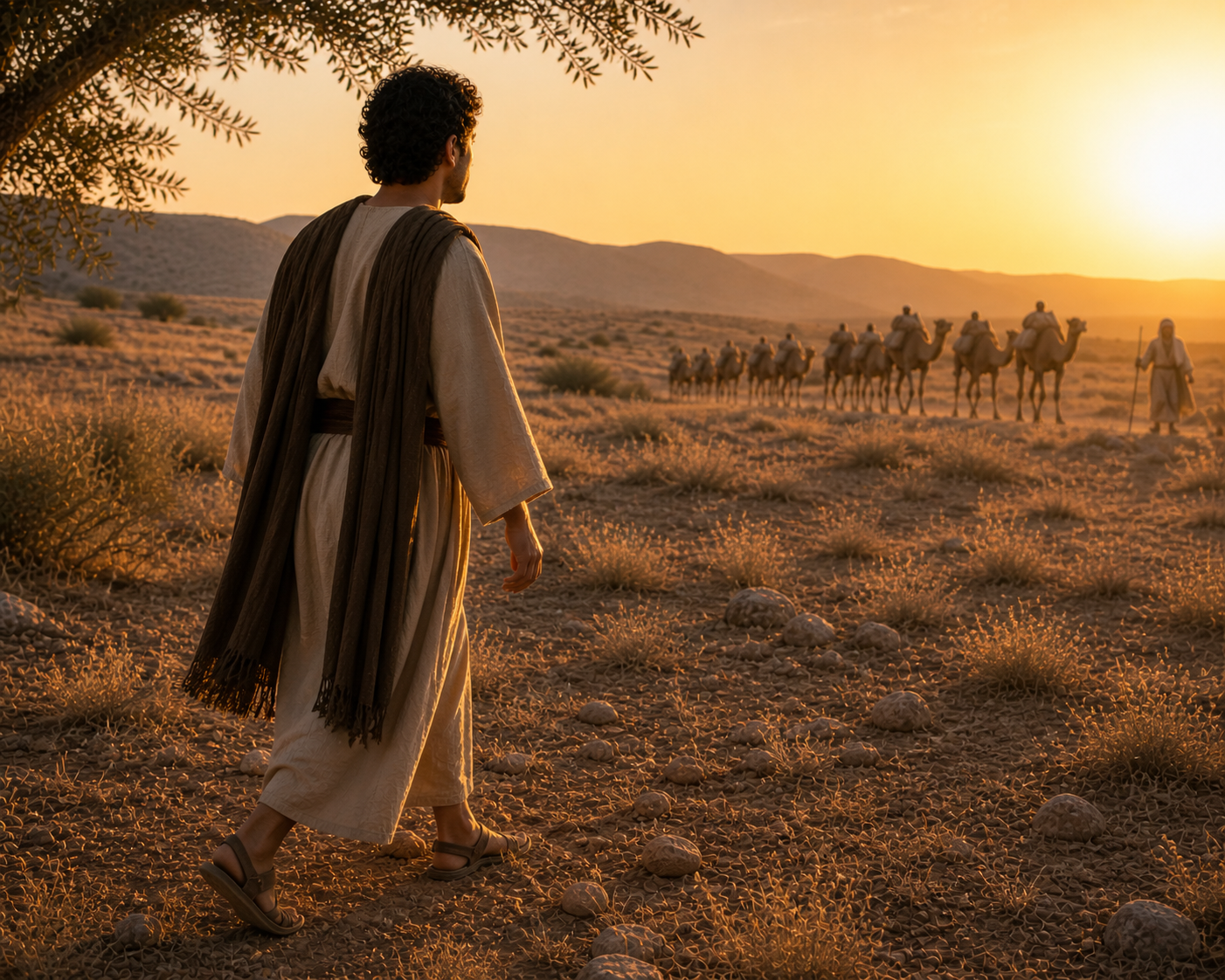
Isaac went out to meditate (pray) in the field toward evening (Lit - "at the turning of the evening") - The precise meaning of Isaac's action (meditate, pray or both) is uncertain as this is the sole use of this Hebrew word in the Bible. The Septuagint renders it with the verb adolescheo and can mean to talk idly but is used in Ps 77:12 to translate "muse on Thy deeds," suggesting that meditate is the proper sense. They who acknowledge God in all their ways, will find him present to direct their paths, and make their way prosperous; and when the prayer of faith meets with an immediate answer, the glory ought as speedily to be rendered to God in solemn praise and thanksgiving.
James Rosscup - A banner thought is evident here. For a truly godly believer, thoughts of meditation are often in direct communion with God. As the compass needle orientates to the north, the heart stayed on God (cf. Isa. 26:3) gravitates even to prayer and to the One who is Lord over prayer. Another principle emerges. The one who looks to God can often find that as he meditates in a life of need, God has some answer already on the way. (An Exposition on Prayer )
NET NOTE - meditate - The meaning of this Hebrew term is uncertain (cf. NASB, NIV “to meditate”; NRSV “to walk”).
And he lifted up his eyes and looked, and behold, (hinneh; LXX - idou) camels were coming.
NET NOTE Heb “And he lifted up his eyes.” This idiom emphasizes the careful look Isaac had at the approaching caravan. Heb “and look.” (behold, hinneh; LXX - idou) The clause introduced by the particle הִנֵּה (hinneh, “look”) invites the audience to view the scene through Isaac’s eyes. (ED: USE YOUR SANCTIFIED IMAGINATION AND PONDER THE THOUGHTS RUNNING THROUGH YOUNG ISAAC'S HEART AND MIND AS HE LOOKED WITH ANTICIPATION AND EXCITEMENT! HE WAS NOT JUST OPENING A CHRISTMAS PRESENT BUT RECEIVING THE WIFE OF HIS LIFE!)
C H Spurgeon - Morning, August 15
“Isaac went out to meditate in the field at the eventide.” —Genesis 24:63
Very admirable was his occupation. If those who spend so many hours in idle company, light reading, and useless pastimes, could learn wisdom, they would find more profitable society and more interesting engagements in meditation than in the vanities which now have such charms for them. We should all know more, live nearer to God, and grow in grace, if we were more alone. Meditation chews the cud and extracts the real nutriment from the mental food gathered elsewhere. When Jesus is the theme, meditation is sweet indeed. Isaac found Rebecca while engaged in private musings; many others have found their best beloved there.
Very admirable was the choice of place. In the field we have a study hung round with texts for thought. From the cedar to the hyssop, from the soaring eagle down to the chirping grasshopper, from the blue expanse of heaven to a drop of dew, all things are full of teaching, and when the eye is divinely opened, that teaching flashes upon the mind far more vividly than from written books. Our little rooms are neither so healthy, so suggestive, so agreeable, or so inspiring as the fields. Let us count nothing common or unclean, but feel that all created things point to their Maker, and the field will at once be hallowed.
Very admirable was the season. The season of sunset as it draws a veil over the day, befits that repose of the soul when earthborn cares yield to the joys of heavenly communion. The glory of the setting sun excites our wonder, and the solemnity of approaching night awakens our awe. If the business of this day will permit it, it will be well, dear reader, if you can spare an hour to walk in the field at eventide, but if not, the Lord is in the town too, and will meet with thee in thy chamber or in the crowded street. Let thy heart go forth to meet him.
Robert Hawker —Genesis 24:63.
My soul! every season is suited for meditation, if the Lord the Holy Ghost suit the mind for the employment. But unless he prepare the heart, no preparation will be found in any season. What multitudes are there, to whose unthinking minds neither the morning breath nor the evening call, in the Lord’s mercies in providence and in grace, have any hearing! They arise, as they lay down, unconscious and unconcerned as to whom they are indebted for keeping their persons and their dwelling-places in safety. They put on the garment to cover and adorn the body, but are ignorant that their souls are without clothing! They wash and refresh the body, but the pollution of the soul they see not! They are anxious to preserve the casket, but the jewel it contains falls under their feet, as an object of no value! My soul! do thou look at the patriarch Isaac, and take him for thy pattern. He went out “to meditate in the field at the even-tide!” He turned his back upon the house and family, and sought, in the solitude of the field, to have his mind disengaged from men, that he might be wholly engaged in devout communion with God. And is not the present evening suited to thee for this purpose? It is a calm and serene season, and every thing invites thee to the employment. Thy wants and necessities; the solemn inquiry how thou art advancing in grace, and in the knowledge of thy Lord and Saviour Jesus Christ; the consciousness that another day of thy pilgrimage is ended, and thou art by so much the nearer thine eternal home; every momentous interest belonging to a dying creature in a dying world, presses the matter upon thee, to ponder the path of thy feet, which, in every step, is leading thee to eternity. Go then, if not to the field of nature, yet to the field of grace, and if thou hast no closet to retire to, yet retire to thine own heart, and there meditate on all those interesting subjects which belong to an immortal soul. Jesus waits to meet thee, to be gracious to thee, and he will show thee his secret. O thou dear Lord of thy people! cause me to delight in those sweet and sacred interviews! Let every evening toll the bell of recollection to call home my poor wandering heart; and when the tumult of a busy, unsatisfying, and troublesome day is over, oh! for grace to do as my Lord did; “send the multitude away, and get up apart into the holy mountain” of faith and love in the Lord Jesus, “to meditate and pray!”
L B Cowman - Streams in the Desert - “And Isaac went out to meditate in the fields at eventide.” (Gen. 24:63.)
WE should be better Christians if we were more alone; we should do more if we attempted less, and spent more time in retirement, and quiet waiting upon God. The world is too much with us; we are afflicted with the idea that we are doing nothing unless we are fussily running to and fro; we do not believe in “the calm retreat, the silent shade.” As a people, we are of a very practical turn of mind; “we believe,” as someone has said, “in having all our irons in the fire, and consider the time not spent between the anvil and the fire as lost, or much the same as lost.” Yet no time is more profitably spent than that which is set apart for quiet musing, for talking with God, for looking up to Heaven. We cannot have too many of these open spaces in life, hours in which the soul is left accessible to any sweet thought or influence it may please God to send.
“Reverie,” it has been said, “is the Sunday of the mind.” Let us often in these days give our mind a “Sunday,” in which it will do no manner of work but simply lie still, and look upward, and spread itself out before the Lord like Gideon’s fleece, to be soaked and moistened with the dews of Heaven. Let there be intervals when we shall do nothing, think nothing, plan nothing, but just lay ourselves on the green lap of nature and “rest awhile.”
Time so spent is not lost time. The fisherman cannot be said to be losing time when he is mending his nets, nor the mower when he takes a few minutes to sharpen his scythe at the top of the ridge. City men cannot do better than follow the example of Isaac, and, as often as they can, get away from the fret and fever of life into fields. Wearied with the heat and din, the noise and bustle, communion with nature is very grateful; it will have a calming, healing influence. A walk through the fields, a saunter by the seashore or across the daisy-sprinkled meadows, will purge your life from sordidness, and make the heart beat with new joy and hope.
“The little cares that fretted me,
I lost them yesterday,
…………
Out in the fields with God.”
Christmas Eve
BELLS ACROSS THE SNOW
O Christmas, merry Christmas,
Is it really come again,
With its memories and greetings,
With its joy and with its pain!
There’s a minor in the carol
And a shadow in the light,
And a spray of cypress twining
With the holly wreath tonight.
And the hush is never broken
By laughter light and low,
As we listen in the starlight
To the “bells across the snow.”
O Christmas, merry Christmas,
’Tis not so very long
Since other voices blended
With the carol and the song!
If we could but hear them singing,
As they are singing now,
If we could but see the radiance
Of the crown on each dear brow,
There would be no sigh to smother,
No hidden tear to flow,
As we listen in the starlight
To the “bells across the snow.”
O Christmas, merry Christmas,
This never more can be;
We cannot bring again the days
Of our unshadowed glee,
But Christmas, happy Christmas,
Sweet herald, of good will,
With holy songs of glory
Brings holy gladness still.
For peace and hope may brighten,
And patient love may glow,
As we listen in the starlight
To the “bells across the snow.”
—Frances Ridley Havergal.
Genesis 24:64 Rebekah lifted up her eyes, and when she saw Isaac she dismounted from the camel.
- she dismounted: Jos 15:18 Judges 1:14
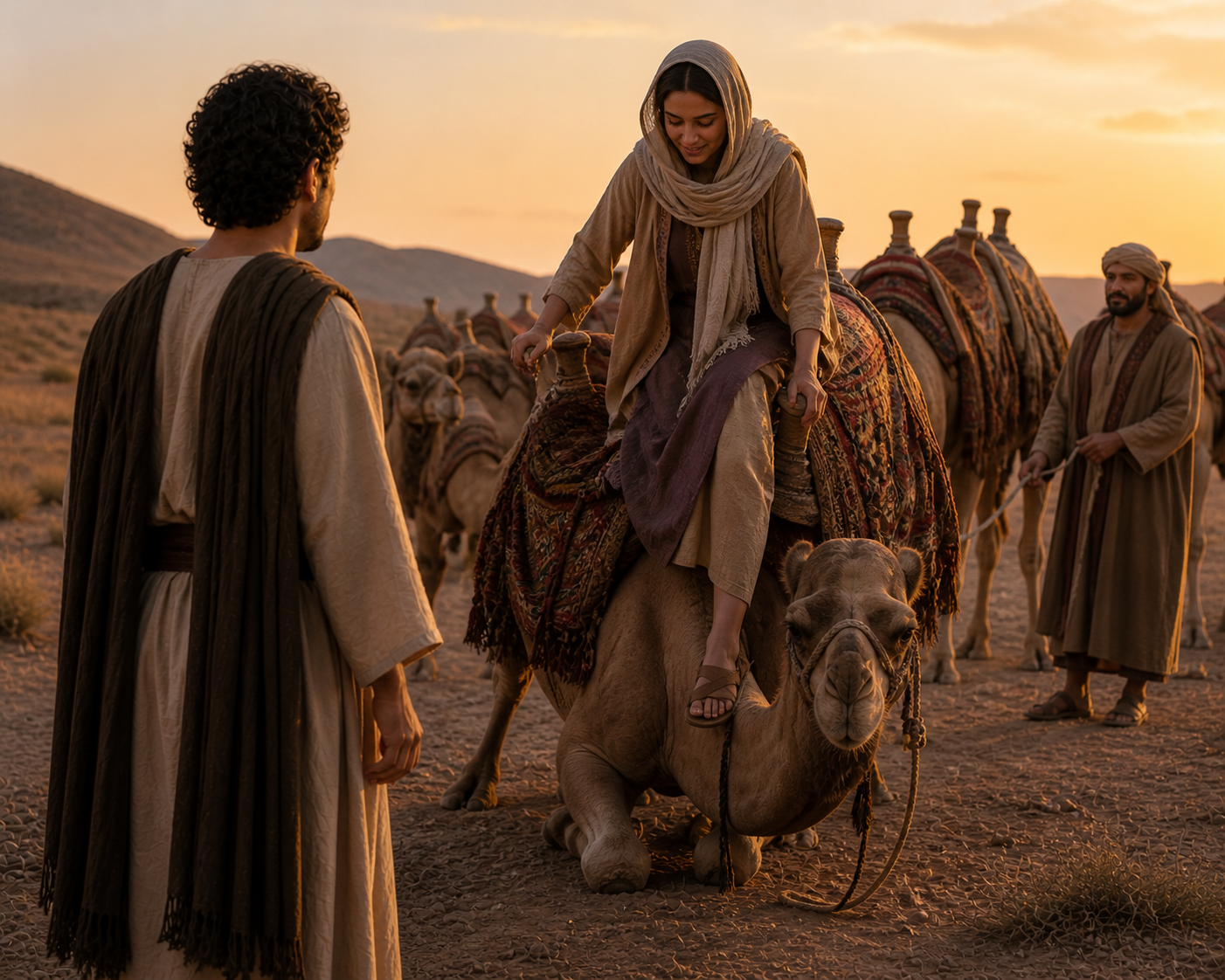
THE EYES OF REBEKAH SEE ISAAC
WHEN FAITH BECOMES SIGHT
Rebekah lifted up her eyes, and when she saw Isaac she dismounted from the camel - This is the moment toward which everything has been moving. Imagine Rebekah's excitement. She has just traversed 500 miles and now her eyes spot her husband-to-be, Isaac. She had heard about him from the servant, but now faith becomes sight. This moment reflects the unfolding of God’s providence, bringing together two people according to His good and acceptable and perfect plan of redemption.
In the ancient Near Eastern context, dismounting before a man, especially one of significance, demonstrated honor and deference. (Josh. 15:18; 1 Sam. 25:23). Rebekah’s action shows both modesty and discernment. She instinctively responds in a way that reflects character, not just custom.
Bob Utley - dismounted" This is literally "fell" (BDB 656, KB 709, Qal IMPERFECTR with waw). It was culturally appropriate and expected for women to dismount from their animal in the presence of men.
Genesis 24:65 She said to the servant, “Who is that man walking in the field to meet us?” And the servant said, “He is my master.” Then she took her veil and covered herself.
- a veil: Ge 20:16 1Co 11:5,6,10 1Ti 2:9
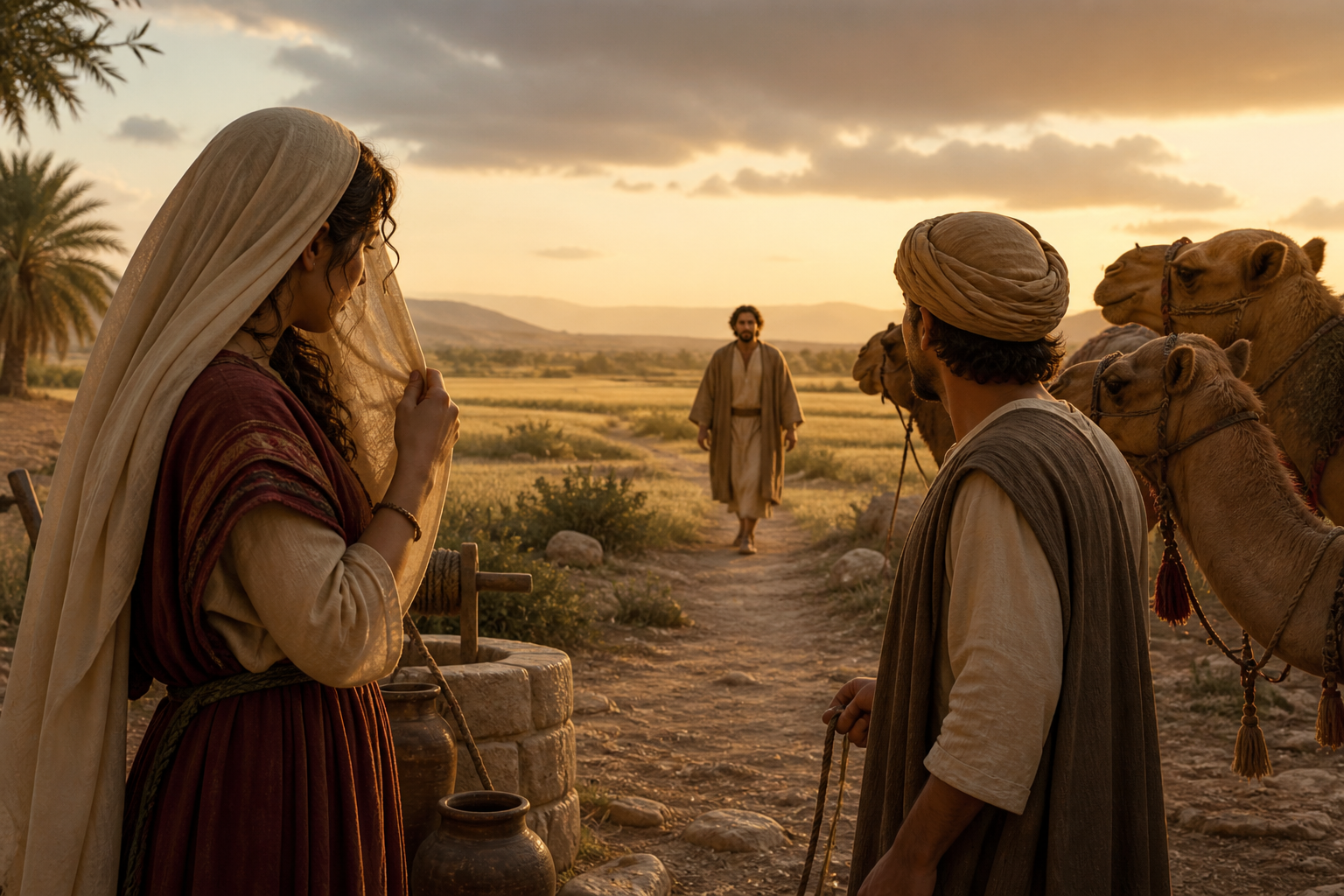
REBEKAH'S FIRST
GLIMPSE OF ISAAC
She said to the servant, “Who is that man walking in the field to meet us?” - Her question reveals awareness and curiosity. She notices him at a distance, set apart, moving intentionally toward them.
And the servant said, “He is my master.” - This is the first time Isaac is explicitly identified to her. The one she has come to meet, trust, and marry is now before her. The servant will refer now to Isaac as his master.
Then she took her veil and covered herself The veil, a sign of modesty and respect, was large enough to wrap around both face and body. This action is culturally and symbolically significant. In that context, the veil expressed modesty, respect, and readiness for marriage. It was a way of honoring the man who would become her husband and acknowledging the solemnity of the moment. She does not approach casually; she prepares herself appropriately. Her outward act reflects inward reverence.
Bruce Waltke - Rebekah’s veiling symbolizes to Isaac that she is the bride. Israelite women were not normally veiled (see 12:14; 38:14). It was customary, however, to veil the bride in the marriage ceremony. (Genesis: A Commentary)
Bob Utley - "she took her veil and covered herself" This was a sign of respect for Isaac, of betrothal to Isaac, that she was unmarried
John Walton use of veil. Since she had gone unveiled during the journey, Rebekah’s veiling herself once Isaac is identified to her suggests that this is her way of demonstrating to him that she is his bride. Brides were veiled during the wedding but went unveiled as married women. Veil customs differed in various locations and times. Asiatic women on the Beni Hasan tomb painting (early second millennium) are not veiled, but in the Middle *Assyrian laws (late second millennium) all respectable ladies went about veiled in public.
VEIL - In Scripture, a veil, shawl, or covering functions as a richly symbolic garment whose meaning shifts with context but consistently communicates ideas of modesty, identity, separation, or revelation. In the Old Testament, it was part of a woman’s expected attire, as seen when Rebekah veiled herself upon meeting Isaac (Genesis 24:65), an act expressing respect, modesty, and likely betrothal intent, while Tamar’s use of a covering (Genesis 38:14) shows how such a garment could also signal deception or even prostitution, depending on circumstance; thus the same item could carry very different social meanings. The Song of Songs distinguishes between a face veil and a larger mantle, indicating both beauty and modest concealment (Song of Songs 4:1), while coverings were also used in contexts of mourning or shame (Leviticus 13:45; Micah 3:7). Beyond clothing, the concept expands theologically: Moses veiled his face after encountering God’s glory (Exodus 34:29–35), both to shield the people and, as later explained, to obscure the fading glory (2 Corinthians 3:13), and the tabernacle veil served as a divine boundary, separating the Holy of Holies from human access (Exodus 26:31–33). In the New Testament, this imagery reaches its climax when the temple veil is torn at Christ’s death (Matthew 27:51), signifying that access to God is now open, while Paul uses the veil metaphorically to describe spiritual blindness versus revealed truth (2 Corinthians 3:14–16). Thus, throughout Scripture, the veil is far more than fabric—it is a theological symbol of hiddenness and revelation, separation and access, humility and identity, all ultimately fulfilled in Christ, who removes the veil and brings believers into the unveiled presence of God.
J J Knap - The Veil of Timidity - Gen. 24:65
The fair Rebekah resolutely joined Eliezer to soon marry Isaac. The matter was discussed within the family circle, because marriage is not only a personal matter, but it forges a relationship between two families and therefore these should be acknowledged in it. The young daughter was even asked herself; something that did not always happen in the East. Since God’s leading in the concurrence of the events was acknowledged in general, the journey to Canaan on camels was undertaken. When they approached the region, Isaac had just gone into the countryside to pray. Rebekah saw him from a distance and she asked Eliezer who this man was who came to meet them. The answer was that it was Isaac himself. Now pay attention to what Rebekah did. She lighted off her high camel and, when Isaac came near, she pulled immediately her veil, which she had put aside, modestly and timidly over her fair countenance. In this way she stood there, of course with fluttering heart, as an image of feminine timidity over against the young man to whom she would soon pledge her hand and her heart.
This veiled damsel appears as an accusation in the Bible. She appears as an accusation against the lack of timidity that tarnishes many of today’s young women. Young women are now taught much more than in the time of Rebekah, when a girl was not ashamed to go to the well with a cruse to draw water. Unfortunately it can not be said in general that the female youth has gained in inner beauty. Of course, there are eminent exceptions in many families; but where our young women are often skilled in languages, music, arts and sciences, there is not often a lack of modesty; playful boldness sometimes replaces the quiet shyness that conquers the heart. It is forgotten that timidity is the honour of a woman.
Modesty that shows itself in the covering that she wears even where the spirit of the time prescribes the baring of the flesh.
Timidity that shows itself in the brave but at the same time the reserved word that she speaks instead of dominating always and everywhere.
Chastity especially that shows itself in a timid reservation she keeps when she is in company with young men; a modesty like that of Rebekah.
This tender timidity is part of a profound soul. Superficial women, who have nothing but a fair countenance, are not timid. However, a woman whose emotions have been crowned by the fear of the Lord and have been deepened and sanctified by a secret communion with God, is in the midst of a vain world like the modest Rebekah; covered with the veil of timidity.
Genesis 24:66 The servant told Isaac all the things that he had done.
- Mk 6:30
THE FAITHFUL REPORT
EXPLAINING GOD'S HAND
The servant told Isaac all the things that he had done - The servant does not keep anything back or reshape the story; he gives a full account. This reflects integrity and accountability. He had been entrusted with a mission, and now he completes it by giving an accurate report to his master. In Scripture, faithful servants not only carry out commands, they also clearly communicate what has been done (cf. Luke 16:10). The report provides the context that assures him this union is not random, but divinely arranged.
Bruce Waltke - Abraham lived another thirty-five years (see Ge 21:5; 25:7, 9, 20), yet the narrative omits the servant’s report to Abraham and focuses on Isaac. By this editorial choice, Isaac is presented as lord and successor of Abraham even as Rebekah is presented as mother and successor of Sarah. (Genesis: A Commentary)
All the things that he had done summarizes a remarkable sequence:
- the prayer at the well (Genesis 24:12–14),
- the immediate answer through Rebekah (vv. 15–20),
- the confirmation of her lineage (v. 24),
- the family’s consent (vv. 50–51),
- and her willing decision to come (v. 58).
Genesis 24:67 Then Isaac brought her into his mother Sarah’s tent, and he took Rebekah, and she became his wife, and he loved her; thus Isaac was comforted after his mother’s death.
- his mother: Ge 18:6,9,10 Song 8:2 Isa 54:1-5
- and took: Ge 2:22-24 2Co 11:1,2 Eph 5:22-33
- comforted: Ge 37:35 38:12 1Th 4:13,15
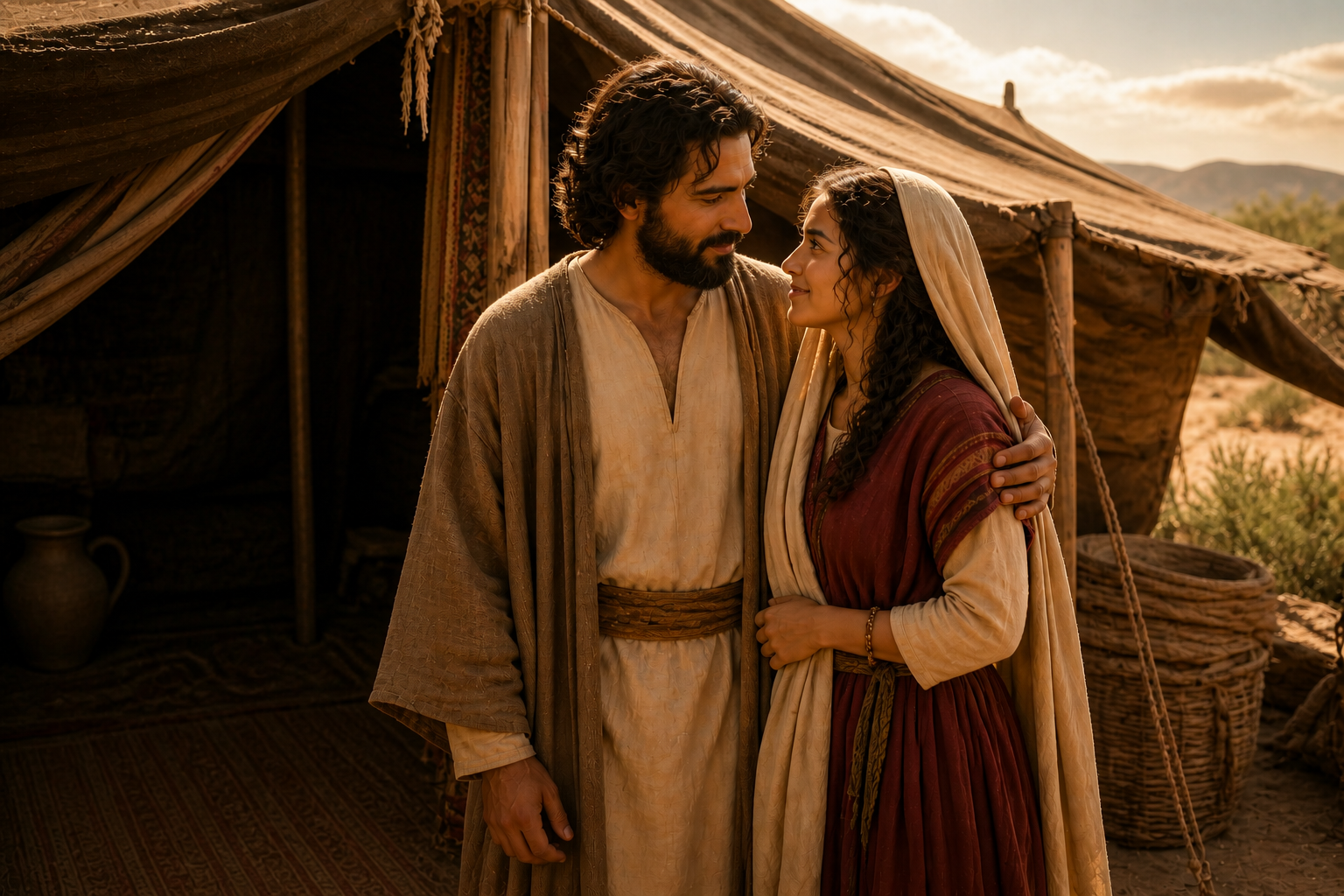
BEGINNING OF A NEW CHAPTER
IN THE ABRAHAMIC COVENANT
Then Isaac brought her into his mother Sarah’s tent Sarah, being dead, her tent, which, according to the custom of the east, was distinct from that of Abraham, became now appropriated to the use of Rebekah. This is more than a geographical note; it is symbolic. Sarah’s tent represents the place of the matriarch, the position of honor and continuity in the covenant household. By bringing Rebekah into that tent, Isaac is effectively installing her as the new matriarch.
Bruce Waltke - Fox concludes, “As the story opened with Yitzhak’s father in his last active moments, it closes with the memory of his mother. Yitzhak is on his own.” (Genesis: A Commentary)
Bob Utley - "Then Isaac brought her into his mother Sarah's tent" This was important because Sarah had died three years earlier and Isaac was still grieving. The beauty and honor of Sarah's tent was a wonderful way to welcome his bride-to-be.
And he took Rebekah, and she became his wife, This is the formal establishment of the marriage. The phrase “he took” reflects the customary language of entering into covenant union. What had been arranged through providence, prayer, and family agreement is now personally embraced. The union is complete. Importantly, this marriage is not portrayed as accidental or merely cultural; it is the direct result of God’s guiding hand throughout the chapter.
and he loved her This is the first explicit mention of a husband loving his wife in Scripture. The order is significant. In many modern contexts, love precedes marriage; here, love follows covenant commitment. This does not diminish the love, it deepens it. It shows that love grows within the framework of faithful commitment. Isaac’s love is not impulsive or fleeting; it is rooted in a relationship established under God’s direction.
Keith Krell - This is the first reference to marital love in the Bible. Do you notice that love came last, not first, in this chapter? Love came after marriage, not before it. Romantic love is never the basis for marriage. Instead, marriage is the basis for romantic love (Eph 5:25). Moses also states that Issac was “comforted after his mother’s death” (Prov 18:22; 19:14). Rebekah had taken the place of Sarah in the line of the descendants of Abraham and she brought comfort to Isaac. This marriage was essential to the work of God in the world. Perhaps the question that should be asked today by those seeking guidance in who to marry is: What value to God would this marriage be?32 What value to God would this business venture be? How does God benefit? Here are a few quick principles in the marriage arena:
- Don’t worry about finding the right person, become the right person yourself.
- If you are married, you are married to the right person.33
- Practice servanthood in your dating or marriage relationship.
- The root characteristic of love is commitment.
- Pray for your child’s future spouse.
Thus Isaac was comforted after his mother’s death This brings an emotional resolution to Isaac’s personal story. Sarah’s death (Genesis 23:1–2) left a void, not only in the household but in Isaac’s life. Rebekah’s arrival does not replace Sarah, but it brings restoration and consolation. God’s provision meets not only covenant needs, but also personal grief. The same God who guided the servant has also cared for Isaac’s heart.
Bob Utley - "thus Isaac was comforted after his mother's death" This verse seems to show that Isaac was still grieving over the death of his mother and this may affect the way we interpret the word "meditate" in Gen. 24:63.
Henry Morris - Although the New Testament does not specifically say that Isaac and Rebekah constitute a "type" of Christ and His Church, the numerous parallels are more than coincidental, and do follow naturally from the clear identification of Isaac himself as a type of Christ (Galatians 3:16; Hebrews 11:17-19). In the symbolic parallel, the servant dispatched by Abraham to seek a bride for his son becomes the Holy Spirit, sent by the Heavenly Father to find and bring the heavenly Bride, the Church, to His Son (John 14:26; 16:13,14; Acts 15:14). After she accepts the invitation, the Spirit, like Abraham's servant, guides the Bride through the wilderness to join the Bridegroom when he comes out to meet her at the end of the journey. There are numerous detailed parallels one can discern as the passage is studied in depth.
Believer's Study Bible - Isaac and Rebekah were deeply committed to one another in the early days of their relationship. Providing comfort is one of the most significant ministries of a God-given "helper" (2:18).
John Walton 24:67. tent of his mother. Sarah’s tent, due to her status of mistress of the household, would have been empty since her death. By taking Rebekah into his mother’s tent, Isaac demonstrates that she is now the mistress of the household. This is similar to the importance placed on entering the house of the bridegroom in *Ugaritic texts.
Gregory Brown - How can one find a godly mate? (OR read his entire book - Finding a Godly Mate)
How can one find a godly mate?
In Genesis 24, we witness Abraham’s search for Isaac’s wife. He doesn’t actually conduct the search himself, but commissions his chief servant to do it. We don’t know for sure who the servant was because he is unnamed, but this was most likely Eliezer, who is mentioned in Genesis 15:2. He had previously been Abraham’s heir, before Abraham had a son. Eliezer’s selflessness is demonstrated as he served Isaac, even though he had lost his inheritance to him.
Genesis 24 is the longest chapter in Genesis, and from it we learn a great deal about finding a godly mate. Yes, in this ancient culture marriages were arranged for young people by their parents for “practical” reasons. Today, young people generally choose their own marriage partners, and do so based largely on “romantic” reasons. However, we can discern from this text that God is not bound by culture. He is involved in the selection of godly mates in any culture. Proverbs 19:14 says, “A house and wealth are inherited from parents, but a prudent wife is from the Lord.” He is the one who made and chose Eve for Adam, and he wants to guide our selection of mates today, if we will allow him. Sometimes in Scripture God tells us what to do, but other times he gives us principles to guide us. As we consider Genesis 24, we learn many great principles about finding a godly mate.
Big Question: What principles can we learn about finding a godly mate from Genesis 24?
To Find a Godly Mate, One Must Be Committed to God and His Purposes
In the narrative, we see that Abraham was well advanced in age when he calls for his chief servant to go and find a spouse for Isaac. Maybe the fact that Abraham had just lost his wife, Sarah, and his ever-increasing age reminded Abraham of his need to find Isaac a wife. Isaac was also getting older. He was probably in his forties at this time.83
As we consider the servant’s commission, we cannot but notice that Abraham’s motivation was God and fulfilling his purpose. He quotes God’s promise of giving the land to his seed: “ ‘To your descendants I will give this land.’ He will send his angel before you so that you may find a wife for my son from there” (v. 7). Typically, ancient marriages were arranged to increase one’s wealth and status. Marriages were often used as contracts between families or between nations. A pretty daughter was often seen as a meal ticket for a poor family. However, Abraham’s concern was not wealth, status, or finding a beautiful bride. God had told Abraham that through Isaac’s seed a nation would be born, and through a seed from this nation all the nations would be blessed. Isaac’s marriage was crucial to the fulfillment of this promise.
Therefore, Abraham had his chief servant swear to not take a bride from Canaan. The Canaanites were a sinful people, and God said that once their sins were full, he would give Israel the land (Gen 15:16). Abraham knew that it was imperative for his descendants to stay separate from the Canaanites and their ungodly influence.
When the chief servant asked questions about the process, Abraham reiterated the need to keep Isaac apart from Canaan (Genesis 24:4–8)
Abraham said that even if the woman would not come back with his servant, Isaac should not move to Haran. Abraham knew that God had called for his offspring to inherit Canaan. In the process of seeking a mate, Abraham was primarily concerned about God and his purposes. He also declared confidently that God would guide the process. He would send his angel to guide his servant.
Similarly, when seeking a godly mate, God’s purposes and his will must guide the process. Yes, a mate may seem like a need, but the primary need is doing God’s will and completing the work he called one to do. This work will be greatly affected by the person one marries. Solomon married pagan wives, and they led him away from God’s will and into idolatry.
It has been said that the most important decision that people make after following Christ is whom they will marry. This is because one’s spouse will play an integral role in their completing God’s work. When God gave Adam a wife, his purpose was for them to tend the garden, rule the earth, and subdue it.
God has a similar purpose for marriages today. Scripture implies that marriage is a spiritual gift and therefore meant to build up the body of Christ and spread God’s kingdom. Consider what Paul said about marriage in 1 Corinthians 7:7 (The Message):
Sometimes I wish everyone were single like me—a simpler life in many ways! But celibacy is not for everyone any more than marriage is. God gives the gift of the single life to some, the gift of the married life to others.
Scripture teaches that marriage is a spiritual gift just like singleness. Therefore, God’s purpose in marriage is to build his kingdom, just as it was with Adam and Eve in the garden.
As in Abraham’s day, many factors can guide the selection of a mate: loneliness, friends, family, wealth, social status, shame, lust, and beauty, among others. However, our purpose in finding a mate (and thus marriage) must be to fulfill God’s will and to build his kingdom. That was Abraham’s purpose. When God and his kingdom are one’s purpose in marriage, Scripture says that God will guide the process. Proverbs 3:5–6 says, “Trust in the Lord with all your heart, and do not rely on your own understanding. Acknowledge him in all your ways, and he will make your paths straight.”
What is your primary purpose in seeking a mate? Is it removing loneliness, achieving status, having children, or fulfilling your lust?
Abraham’s purpose was to fulfill God’s will and that must be one’s primary purpose as well. When God and his kingdom are first, he guides the steps. Certainly, Matthew 6:33 can be applied to the pursuit of a godly mate: “But above all pursue his kingdom and righteousness, and all these things will be given to you as well.” Those who put God and his kingdom first will be guided by him.
Again, Proverbs 19:14 says, “A house and wealth are inherited from parents, but a prudent wife is from the Lord.” God wants to guide your process of finding a mate because he has a kingdom to build. Will you let him guide it?
Application Question: What are some common motivations for seeking a marriage partner? Is building God’s kingdom your main purpose in seeking a mate or being married? Why or why not?
To Find a Godly Mate, One Must Seek the Counsel of Parents and Godly Mentors - Genesis 24:1–8
Another principle we can learn from the process of finding a spouse for Isaac is the need to have parents and godly mentors involved. Arranged marriages were the norm in ancient cultures, as it still is in many parts of the world. God may not be calling you to allow your parents or spiritual mentors to pick your spouse; however, a wise person will keep them highly involved in the process.
Abraham and his chief servant were leading this process on behalf of Abraham’s son, Isaac. Abraham was a man of great faith and apparently, his servant was as well. In this passage, the servant becomes only the second person with a prayer recorded in Scripture, after Abraham.84 Obviously, in his many years serving Abraham, he had learned a great deal.
Similarly, one should have parents and godly mentors involved in the selection of his or her mate. Proverbs 15:22 says, “Plans fail when there is no counsel, but with abundant advisers they are established.” One of the problems with the modern dating culture is that it is commonly done apart from godly counsel. The two date by themselves, often without the benefit of the parents’ or godly mentors’ knowledge, wisdom, and insight. Then the two just show up one day and say, “I’m in love!” or even worse, “I’m engaged!”
The courting model is so much wiser and more prudent than the dating model. In courting, when two people are seriously considering one another as potential marriage partners, they immediately approach their parents or the church, or both, to seek their wisdom, insight, and covering. They want godly people talking with them throughout the process and also getting to know the potential mate.
This is crucial because when two people are face to face enjoying one another, they often miss major cues that could be disastrous in a marriage relationship. Also, they often lack the sexual accountability of having parents and mentors involved. As we will talk about later, sexual intimacy before marriage will greatly blind the couples, as well as remove God’s blessing from the courtship. Only the pure in heart will see God (Matt 5:8).
Now certainly some may not have Christian parents or they may live far away. In that case, they should pray and seek the guidance and oversight of spiritually mature married couples, small group leaders, or mentors. For lack of guidance, plans fail, but with many advisers they succeed.
Who are your many advisers? Also, for those who are married, are you willing to mentor a young couple so they can have success and protection in the dating process?
Application Question: Why is it important to have parents and mentors involved in the process of finding a mate? Who would you ask to help guide your process? If asked, how would you help mentor someone while dating or courting?
To Find a Godly Mate, One Must Be Realistic and Submit to God’s Sovereignty throughout the Process - Genesis 24:7–8
While talking with Abraham, the chief servant brought up the possibility of the woman not wanting to return to Canaan. Abraham replied that God would send his angel before the servant to guide the process, but then he said, “But if the woman is not willing to come back with you, you will be free from this oath of mine” (v. 8).
In seeking a mate, one must be realistic and trust God’s sovereignty over the process. Sometimes, young people seek the Lord’s guidance in dating or courting and they feel God’s peace throughout the process. But when God allows a break-up or some difficulty to happen, they question or get mad at God. Seeking God’s guidance does not necessarily mean you will find your mate the first time you date somebody or go through a courtship. Sometimes, God will allow failure or make it clear late in the process that the person is not the one for you.
This is not a reason to get mad at God. It is a time to praise and trust him. We must praise him because he knows best. Sometimes, by ending the relationship, he protects the couple from something potentially hazardous, and certainly, we can trust that he is preparing them for something better. In addition, we must realize that God’s focus is on our character. Many times, he allows seasonal relationships to reveal character issues and to draw people to seek him more. He allows them to help people grow, even though they might not last for a lifetime.
Abraham declared that God would guide the process, but he also recognized the possibility that God might choose to not bless it. Similarly, we must trust God’s sovereignty as well. Again, many become angry and upset with God in the process of seeking a mate, because it doesn’t happen as fast as they want or because of failed relationships. We must be realistic and trust God’s sovereignty throughout the process.
This also amplifies the reason why couples must be holy and pure throughout the process. Scripture says that we should treat people in the church as brothers and sisters with all purity (1 Tim 5:2). When you handle dating relationships in that fashion, it eliminates a lot of emotional and physical baggage often picked up in ungodly relationships. In the dating or courtship process, couples must protect themselves by staying pure, especially since God may have somebody else for them. In order to find a godly mate, one must be realistic about the process and trust God’s sovereignty.
Application Question: Why is it so important to be realistic about the process and trust God’s sovereignty when seeking a mate? Why would God allow failures in the courtship process? How have you experienced failure and disappointment in the courtship process and what did you learn from it?
To Find a Godly Mate, One Must Understand How Difficult It Might Be - Genesis 24:9–10
When seeking a mate for Isaac, the chief servant was told to go to the town of Nahor. Many eligible bachelorettes lived in Canaan, and it would have been relatively easy to marry one of them. However, that wouldn’t have been God’s best for Isaac. It would have opened the door for compromise in his life and endangered the promise. The alternative, however, was much more difficult. The servant had to travel one month and over 500 miles through rough and dangerous terrain to find the spouse God had for Isaac.85 And then he needed to convince her to leave home and family to marry a guy whom she had never met.
Similarly, in seeking a godly spouse, the easiest route is usually not God’s path. Many Christians, because they are lonely and can’t find a godly mate, often go to the same places as the world to find one. There are many nice Canaanite men and women and also some nice worldly Christians. Numerous are the temptations to take the easy route instead of waiting for and seeking a godly mate.
To find a godly mate, it will often mean waiting while God prepares one’s character for a godly mate. It will also often mean waiting because godly mates are so hard to find. Proverbs says,
Many a man claims to have unfailing love, but a faithful man who can find?
Proverbs 20:6 (NIV 1984)
“Many daughters have done valiantly, but you surpass them all!” Charm is deceitful and beauty is fleeting, but a woman who fears the Lord will be praised.”
Proverbs 31:29–30
Who can find a wife of noble character? For her value is far more than rubies.
Proverbs 31:10
There are a lot of men who claim unfailing love, but it’s hard to find a faithful man. There are many women who do noble things, but a woman who fears God is to be praised. These types of people are like precious jewels; they are hard to find, and therefore, many times waiting is necessary. In this waiting, sometimes people get discouraged and anxious, then they commonly take things into their own hands. Like Abraham, who became anxious while waiting on the child of promise, they go and find a Hagar to fulfill their desires. Many believers compromise and miss God’s best for them. Sometimes they marry an unbeliever, or they marry a spiritually lethargic believer.
Are you willing to take the hard journey instead of the easy one? The benefits are priceless and last a lifetime.
Application Question: What makes the road to finding a godly mate so difficult at times? How would you encourage a lonely Christian to not compromise?
To Find a Godly Mate, One Must Put Himself in a Position to Find a Mate - Genesis 24:9–11
The next principle one must apply in seeking a godly mate is putting oneself in a position to find him or her. Abraham’s chief servant left Canaan, which had a reputation for being ungodly, and traveled to Abraham’s hometown to find a mate. Before leaving, he made preparations for finding a marriage partner for Isaac. By taking ten camels—the Bentleys or Lamborghinis of ancient days—he was proving that his master was wealthy and that the woman would be well provided for. He also brought many of the master’s goods, which were necessary to pay the bride’s dowry. He then went to a well outside of town in the evening, when the women drew water (v. 11). He put himself in a position to find a mate.
Often in the church an emphasis is put on trusting God for a mate, but sometimes this emphasis leads towards inactivity. In order to find a mate for Isaac, the chief servant took valuables to prove his master’s ability to provide, traveled to Abraham’s hometown, and went to a location with eligible women. He put himself in a position to find Isaac’s spouse.
Similarly, it is not unspiritual to be active. God did not send a godly mate to Isaac’s door. Isaac was not called to just wait and pray; he had to be active. With that said, the most important thing in putting oneself in a position to find a mate is being intimate with God and knowing his will. For one person, God’s will may be to just wait and pray patiently. We have no evidence that Rebekah was seeking a husband. She was just being faithful where God placed her. However, for Isaac, the chief servant went to a place where he was more likely to find a godly woman. Single believers seeking mates must do the same.
Application Question: How can a person put him or herself in a position to find a godly mate?
1. A person must be financially prepared.
In Genesis 2:24, it says that the man must leave his father and mother and cling to his wife. One of the implications of this is that a couple should be financially independent. In this narrative, the chief servant brought wealth so the family could see that Isaac could provide. Isaac was financially prepared to marry.
When considering marriage, one must remember that there is a time for everything. A flower that blooms in the winter dies. In the same way, many relationships don’t work simply because of timing. One must ask, “Is it the right time to seek a mate?” “Am I financially ready to take care of somebody or to be married?” “How can I place myself in a position to contribute or provided for a household?”
These are practical questions. I remember when God started to put in my heart a desire to soon be married. I moved out of the apartment I shared with several roommates, and got an apartment by myself. After moving in, I started to prepare my home by getting basic furniture, kitchenware, etc.
Previously, as a bachelor, working and going to school, my housing was simply functional. I just slept, studied, and ate there. But, when I realized that God was calling me to start looking at marriage, I started preparing. Now, when God brought me a mate, she didn’t like anything I had, but at least I had something for our humble beginnings.
2. A person must wisely go to a place where he or she might find a potential godly mate.
There is a time for waiting. Many of God’s promises come by waiting as he prepares us—as well as those who will also take part in the promise. However, there is a time to be active, and we must discern that. Being active could mean praying, getting godly counsel, and discerning where to look. It also could mean asking someone out to coffee.
You probably won’t find a godly mate at the bars or clubs. But, there is a good chance God might provide one at church, small group, or through some ministry. If the wells have dried up at the church or ministry you attend, then maybe God is calling you to be creative. Being creative could include asking spiritually-minded people you know and respect to pray and consider suggesting a potential mate, or even joining a Christian dating site. Again, it must be heard that it is not disobedient to be active. Many times, it is disobedient or presumptuous to not be active. We should pray and discern what God wants us to do. For Rebekah, she waited and faithfully served God and others. For Isaac, his servant went to an area with eligible ladies.
How is God calling you to prepare for and seek a godly mate or to help others do so?
Application Question: How would you counsel a single person who feels called to actively pursue a mate? Where would you recommend him or her to go? How can a person discern if they should wait like Rebekah or be active like Isaac in the pursuit of a mate? If you already found your mate, where and how did you meet them?
To Find a Godly Mate, One Must Bathe the Process in Prayer - Genesis 24:12–14
When the chief servant reached the well, he began to pray. Again, this is one of the earliest recorded prayers in the Bible. The servant prayed for God to show kindness to Abraham and that he would essentially make it very clear whom the woman was.
This is not the only prayer in this chapter. Right after God confirmed that Rebekah was the one, he bowed down and worshiped God (v. 26). Then after the parents confirmed that they would give Rebekah to Isaac as a bride, he bowed down and worshiped again (v. 52). When Rebekah was about to leave her parents’ house, her family prayed a blessing over her that she would increase to thousands upon thousands (v. 60)—resembling God’s blessing on Abraham. This entire process was bathed with prayer.
Similarly, since a godly spouse is a gift of the Lord, one must continually bathe the process in prayer. I spent two years at a Christian school while in fifth and sixth grade. During that I time, I was taught to pray for my future spouse. From that point on till I was twenty-seven years old, when I met my wife, I had always prayed for her. In fact, after I got married and told my wife about my prayers, she shared all the ways she experienced divine protection and grace, which didn’t make sense to her at the time. She didn’t become a Christian until she was a senior in high school, but throughout that time God protected her purity, among other things.
If one is going to find a godly mate, the process must be bathed in prayer.
Application Question: Why is it important to continually pray over your future spouse and also for God to guide the process of finding the person? When should people start praying for their future spouse or their child’s future spouse?
To Find a Godly Mate, One Must Seek a Person of High Character - Genesis 24:13–14
Interpretation Question: What does Rebekah’s giving a drink of water to the servant and to his ten camels say about her character?
While the chief servant prayed for God to make it clear who Isaac’s wife was, he set some very high standards. He asked God to make it clear by allowing her to respond to his request for water by saying, “ ‘Drink, and I’ll give your camels water too” and her fulfilling this commitment. Now, this seems like a random request to try to confirm a spouse, but it was not.
No doubt, this chief servant knew exactly what it took to be a good spouse because these actions would show a very high character in this woman. For a woman to agree to share some water with a foreigner would show that she was nice, but it would not have been an uncommon character trait. There are a lot of nice people in the world. But for this lady to agree to water his ten camels would have been highly unlikely, and would show extraordinary character. Kent Hughes’ comments about this unlikely scenario are helpful:
To grasp what a wonder this was, we must understand that the ancient well was a large, deep hole in the earth with steps leading down to the spring water—so that each drawing of water required substantial effort. And more, a camel typically would drink about twenty-five gallons of water, and an ancient water jar held about three gallons of water. This means that Rebekah made between eighty to one hundred descents into the well. As to the amount of time she gave to this, a camel takes about ten minutes to drink its full complement of water. Rebekah’s labors filled one and one half to two sweaty hours! And all the while the servant watched without saying a word, to see whether or not the Lord had made his journey successful.86
The servant’s qualifying test was almost two hours of very difficult labor which would have shown great things about this lady. First, it revealed that she was a very hard worker. When looking for a potential spouse, find somebody that works hard. When Solomon writes about the virtuous woman in Proverbs 31, that is one of her characteristics—she works hard. She takes care of the children; she oversees the servants in the house; she makes clothes; she is a business woman; she serves her husband. And best of all she is a woman of integrity who loves the Lord. When seeking a godly mate, find somebody who works hard at whatever God calls them to do. Laziness only brings conflict and discord in a home, because a home takes hard work to keep.
Rebekah’s act of kindness also showed selflessness. The root of almost all marital difficulty is selfishness. Two people selfishly fighting for their own rights will cause conflict and discord. But a selfless, sacrificial person, the kind who would joyfully serve a stranger for two hours, without complaint, will make a great marriage partner.
When seeking a mate, one should seek a person of high character. It is not about how much money one makes, how many degrees one earned, or how attractive he or she is. The most attractive qualities must be his or her character. Consider what God said about women who are like Sarah, Abraham’s wife, in 1 Peter 3:3–5 (NIV 1984):
Your beauty should not come from outward adornment, such as braided hair and the wearing of gold jewelry and fine clothes. Instead, it should be that of your inner self, the unfading beauty of a gentle and quiet spirit, which is of great worth in God’s sight. For this is the way the holy women of the past who put their hope in God used to make themselves beautiful. They were submissive to their own husbands …
In talking about women, he says what makes them beautiful is the “inner self, the unfading beauty of a gentle and quiet spirit.” The word gentle can also be translated “meek.” Meek really means “power under control.” Instead of using their power to get their own way, they serve people. Instead of being angry at those who mistreat them, they are gentle in response. They use their power to honor God. God says that type of character makes a person beautiful. In seeking a mate, pursue a person with high character.
Application Question: What are other character traits that one should seek in a potential mate? If you have found your mate, what character traits drew you to him or her?
To Find a Godly Mate, One Must Observe the Potential Mate Carefully - Genesis 24:15–21
Before the servant finished praying, Rebekah, who was Abraham’s niece, went down to the spring to fill her jar of water. When she came up from the spring, the servant asked for a drink. Rebekah immediately gave him a drink and then said that she would also water his camels. In Genesis 24:21, it says that the servant “watched her with interest to determine if the Lord had made his journey successful or not.” He doesn’t say a word; he just watches.
Similarly, when seeking a mate, a person must also watch the potential mate very closely. In considering Rebekah, one might say, “Well, does watering camels really say something about her fitness for marriage?” Absolutely, it does. Scripture teaches that if a person is faithful with little, he will be faithful with much. If he is unfaithful with little, he will be unfaithful with much (cf. Lk 16:10).
A wise person must survey and watch the potential mate very closely because little things say a lot. How does he treat people who disappoint him? Is he gentle in his response or does he become very upset? How does she handle her money? How does she respond to trials? How does she treat her parents? How does he take care of his possessions? As mentioned before, what is his or her work-ethic like?
All these little things say something about how the person will be within marriage. If a person is rude to those serving him at a restaurant, who he barely knows, it tells you something about how that person will eventually treat you when he isn’t having a good day. If that person is not very good with his money, then it tells you something about how he will be at providing or using the money that you both make as partners. If the person is unfaithful with little, he will be unfaithful with much—and marriage is “much”!
This reinforces the reason why it is very important to have wise mentors involved in the courtship process. They will often see things that one might miss, which could become large things in marriage.
Application Question: Why is it important to observe a potential mate carefully? Are there some especially important scenarios that one should observe and learn from?
To Find a Godly Mate, One Must First Become Godly - Genesis 24:15–21
Another principle that we can learn from Rebekah’s great service, as she served not only Abraham’s servant, but also his camels, is that in order to find a godly mate, one must first become godly. If Rebekah had not been the type of person to perform this great service, she would have missed out on the opportunity to marry Isaac.
Certainly, this happens all the time. A man is praying for a godly wife; however, he has not given himself to the cultivation of his own character. Therefore, this man continues to display character flaws that won’t attract somebody godly. How can one pray for a godly spouse, if he or she is not seeking godliness?
There is a saying, “Birds of a feather flock together.” In the same way that birds of the same kind gather together, we typically draw people that are like us. If there are areas of compromise in our lives, we will attract people who are compromised. If we are zealous for the kingdom of God and to serve God’s church, we will attract people with the same values.
When God was guiding the search for Isaac’s mate, he provided a woman that had been preparing herself for years. She was a woman of great character. Great character does not come without work. A woman of great character was needed for the great calling that was on Isaac’s life. It was through Isaac’s seed that the whole earth would be blessed.
When one considers marriage, he must first begin by asking him or herself, “Am I ready for marriage? Am I the type of mate that I would want for somebody else?”
Application Question: What character trait(s) is God calling you to get rid of so he can bring you a godly mate to compliment and help fulfill his or her calling? How can we help singles with the self-evaluation process so they can be prepared for marriage?
To Find a Godly Mate, One Must Seek a Person Who Is Obedient to God - Genesis 24:49–51, 55–58
Previously, we talked about finding a person with high character; however, the greatest character trait one can find in a person is obedience to God. In the next part of the narrative, the servant arrived at the house and was welcomed by Laban, Rebekah’s older brother. The servant told the family about Abraham and Isaac and how God had blessed and guided the servant’s journey—leading him to Rebekah. When he inquired about whether the family would let her go or not, Rebekah’s mother and brother replied, “This is the Lord’s doing. Our wishes are of no concern. Rebekah stands here before you. Take her and go so that she may become the wife of your master’s son, just as the Lord has decided” (v. 50–51). The family could clearly sense God’s hand on this process.
After the servant spent the night, he requested to immediately leave with Rebekah to go to his master. However, the family wanted Rebekah to wait ten days before leaving. Abraham’s servant was not okay with the delay (as they could potentially change their mind in ten days). The parents then responded, “We’ll call the girl and find out what she wants to do” (v. 57). Then we see the most remarkable character trait of Rebekah. She immediately responded, “I want to go” (v. 58).
This was a great act of faith. Rebekah had never met Isaac. She would have to move over 500 miles away from home. The only thing she could discern, like her parents, was that God was in this; so she immediately agreed to leave. When Rebekah did this, she placed herself on the same path that Abraham had taken. Many years earlier, Abraham, similarly, heard God’s call and left home and family to heed it. Later, God told Abraham to circumcise himself and his household, and he immediately obeyed (Gen 17). Abraham was also told to banish his son, Ishmael, and he did (Gen 21). Then God called Abraham to sacrifice his son, Isaac, and he left for the mountain early the next morning (Gen 22). Obedience marked Abraham’s life. And, therefore, he is called the father of all those who believe (cf. Gal 3:7, Rom 4:16). Rebekah demonstrated similar faith in this narrative.
In 1 Corinthians 11:3, Paul says, “But I want you to know that Christ is the head of every man, and the man is the head of a woman, and God is the head of Christ.” The head of the man is Christ and the head of the woman (better translated as “wife”) is the man. The wife is supposed to submit to the man, and the man is supposed to submit to and be led by Christ. As a woman discerns her potential mate, she needs to be sure that this man is submitting to Christ. Otherwise, her home will be in disarray.
Similarly, Paul said in Ephesians 5:22, “Wives, submit to your husbands as to the Lord.” The wife must submit to her husband as unto the Lord. When a man is discerning whom to marry, he must discern if the woman is obedient in her relationship with the Lord. If she doesn’t submit to the Lord, then she will not submit to him. It is a lesson from the greater to the lesser. If she is disobedient to God (the greater), then she will not submit to her husband (the lesser).
Therefore, for both a man seeking a wife and a woman seeking a husband, the defining characteristic they should consider is obedience to the Lord. Does this person faithfully attend church and feel called to serve the church, as God commands? Does she faithfully study the Word of God and live a life of prayer before the Lord? Is he seeking first the kingdom of heaven or is something else his priority? Obedience to God marked Rebekah, as she was just like her father-in-law, Abraham. She was obedient, even when the cost was great.
In what ways is God calling you to grow in your obedience to him? Is the potential mate you are considering living a life marked by obedience to the Lord? This is the all-important characteristic. Marriage was made by God, and if a couple doesn’t submit to God, the marriage won’t fulfill its purpose.
Application Question: Why is obedience to God so important in a potential spouse? In what ways is God calling you to grow in obedience?
To Find a Godly Mate, One Must Practice Sexual Purity before Marriage - Genesis 24:62–67
After Rebekah agreed to leave with Abraham’s servant, they immediately traveled to Beer Lahai Roi, in the Negev, where Isaac lived. When the servant and Rebekah arrived, Isaac was walking in the field meditating. (Maybe, in anticipation, he was praying about his future spouse.) When Rebekah learned that this man was Isaac, she immediately put on her wedding veil, signifying that she was his bride.87
After Isaac heard the story of God’s faithfulness, he took Rebekah into his mother’s tent. The language implies that they consummated the marriage. There is another principle here that we should be aware of in seeking a godly mate. Couples must practice purity before marriage. Rebekah was a virgin on her wedding day (cf. 24:16) and presumably so was Isaac.
Application Question: Why is it important for a couple to wait to have sex until marriage?
This is important for many reasons:
1. Waiting to have sex before marriage is important for discerning God’s will.
Sex before marriage will hinder one’s ability to properly discern God’s will. When two people have sex, they become one flesh (cf. 1 Cor 6:16). They are attached mentally, physically, and spiritually. This is a hard tie to break, and many individuals enter a courtship still yoked to previous partners. This affects their mind and emotions and many times makes it a struggle to commit, even to the person they believe God has chosen for them. It often hinders people from being able to break up when God makes it clear that a certain person is not right for them. Again, the yoking that happens in sex creates soul-ties. The person will often then try to convince themselves (and God) that this is the right person by ignoring all their flaws. Impurity affects one’s ability to discern and obey God’s voice. Matthew 5:8 says, “Blessed are the pure in heart, for they shall see God.” One must see and hear God’s voice in the process of discerning a marriage partner; again, it’s the second most important decision a person will make.
2. Waiting to have sex before marriage protects the relationship from the devil.
Impurity in a relationship opens the door for the enemy to destroy the relationship. It opens the door for the enemy to tempt with jealousy, anger, and even further promiscuity (within or outside of the relationship). First Corinthians 5:6 says, “a little yeast affects the whole batch of dough.” Sin has a tendency to spread. Therefore, when Satan gets a doorway, he will try to destroy that relationship. Sadly, when couples open the door of impurity before marriage, it becomes almost impossible to close again. Couples must vigorously guard their relationship.
Paul said in 1 Timothy 5:1–2, “Do not address an older man harshly but appeal to him as a father. Speak to younger men as brothers, older women as mothers, and younger women as sisters—with complete purity.”
How should a person in a dating or courting relationship treat their potential spouse? They should treat them as a brother or sister—with complete purity. Practically, that means Christians should not do anything with their girlfriend or boyfriend that they would not do with their natural sibling. One should treat him or her with absolute purity.
Sadly, the church has not trained our young people well on how to date or court, so they adopt the world’s methods—opening themselves up to all kinds of temptations that destroy many relationships.
3. Waiting to have sex before marriage will increase the pleasure and joy in marriage.
Statistics say that couples who wait until marriage to have sex have better relationship outcomes.88 No doubt there are many reasons for this. It protects them from Satan’s attacks whether through comparison, expectations, emotional baggage, or other avenues/open doors. It also brings God’s blessings on the relationship, as the couple faithfully obeys him.
Application Question: What are some consequences of opening sexual doors before marriage? How can couples guard themselves from these temptations and consequences?
To Find a Godly Mate, One Must Seek a Mate and a Marriage that Magnifies God - Genesis 24:62–67
As we consider Isaac’s marriage, one cannot but notice how it resembles Christ and the church. Isaac is a type of Christ. He had a miraculous birth and, figuratively speaking, experienced death and resurrection (cf. Gen 22; Heb 11:19). His father sought a bride for him, even as God chose the church for Christ before creating the earth (cf. John 6:37, Eph 1:3–6). Abraham sent his chief servant to secure the bride, even as God sent the Holy Spirit to woo the church to Christ. If the chief servant was indeed Eliezer, it is notable that his name means “God of help.”89 In this case, it’s hard not to think of the Holy Spirit, who is called the “the Helper” (cf. John 14:26 ESV). Rebekah, in obedience, left all to marry Isaac. Similarly, the church left all to marry Christ (cf. Luke 14:26–33). Isaac’s marriage is a tremendous typology.
Furthermore, every marriage really is a typology—meant to share Christ with the world. Again, Paul said this in Ephesians 5:22–32:
Wives, submit to your husbands as to the Lord, because the husband is the head of the wife as also Christ is the head of the church—he himself being the savior of the body. But as the church submits to Christ, so also wives should submit to their husbands in everything. Husbands, love your wives just as Christ loved the church and gave himself for her to sanctify her by cleansing her with the washing of the water by the word, so that he may present the church to himself as glorious—not having a stain or wrinkle, or any such blemish, but holy and blameless. In the same way husbands ought to love their wives as their own bodies. He who loves his wife loves himself. For no one has ever hated his own body but he feeds it and takes care of it, just as Christ also does the church, for we are members of his body. For this reason a man will leave his father and mother and will be joined to his wife, and the two will become one flesh. This mystery is great—but I am actually speaking with reference to Christ and the church.
Marriage was always meant to reflect Christ’s relationship with the church. Even more, it was meant to reflect the triune relationship in the Godhead. First Corinthians 11:3 says, “But I want you to know that Christ is the head of every man, and the man is the head of a woman, and God is the head of Christ.” The husband is the head of the wife, as God is the head of Christ.
Therefore, when seeking a mate, more than anything, one must ask, “Will this relationship glorify God?” The man must ask, “Am I ready to sacrifice everything for this woman like Christ did for his church? Am I ready and willing to wash her with the Word of God like Jesus does his church? Am I ready and willing to lead a family in ministry like Christ does his church? Is this woman willing to submit to me, like the church does to Christ?” The woman must ask, “Am I willing to submit to this man as I do Christ? Am I willing to submit to his will over my own? Am I willing to follow this man in ministry for the rest of my life? Is this man a spiritual leader like Christ? Will this marriage reflect and magnify God?”
Marriage is meant to reflect Christ and the church. It is meant to magnify the beauty of the Godhead. Anything less defames and dishonors God.
When seeking a mate, one must seek after somebody who wants to glorify God and build his kingdom together.
Application Question: In what ways are Christ and the church and the tri-unity of God a model for marriage? How will this model benefit a marriage and benefit those watching?
Conclusion
1. To Find a Godly Mate, One Must Be Committed to God and His Purposes
2. To Find a Godly Mate, One Must Seek the Counsel of Parents and Godly Mentors
3. To Find a Godly Mate, One Must Be Realistic and Submit to God’s Sovereignty throughout the Process
4. To Find a Godly Mate, One Must Understand How Difficult It Might Be
5. To Find a Godly Mate, One Must Put Himself in a Position to Find a Mate
6. To Find a Godly Mate, One Must Bathe the Process in Prayer
7. To Find a Godly Mate, One Must Seek a Person of High Character
8. To Find a Godly Mate, One Must Observe the Potential Mate Carefully
9. To Find a Godly Mate, One Must First Become Godly
10. To Find a Godly Mate, One Must Seek a Person Who Is Obedient to God
11. To Find a Godly Mate, One Must Practice Sexual Purity before Marriage
12. To Find a Godly Mate, One Must Seek a Mate and a Marriage that Magnifies God