Ezekiel 17:2
Ezekiel 17:3
Ezekiel 17:4
Ezekiel 17:5
Ezekiel 17:6
Ezekiel 17:7
Ezekiel 17:8
Ezekiel 17:9
Ezekiel 17:10
Ezekiel 17:11
Ezekiel 17:12
Ezekiel 17:13
Ezekiel 17:14
Ezekiel 17:15
Ezekiel 17:16
Ezekiel 17:17
Ezekiel 17:18
Ezekiel 17:19
Ezekiel 17:20
Ezekiel 17:21
Ezekiel 17:22
Ezekiel 17:23
Ezekiel 17:24
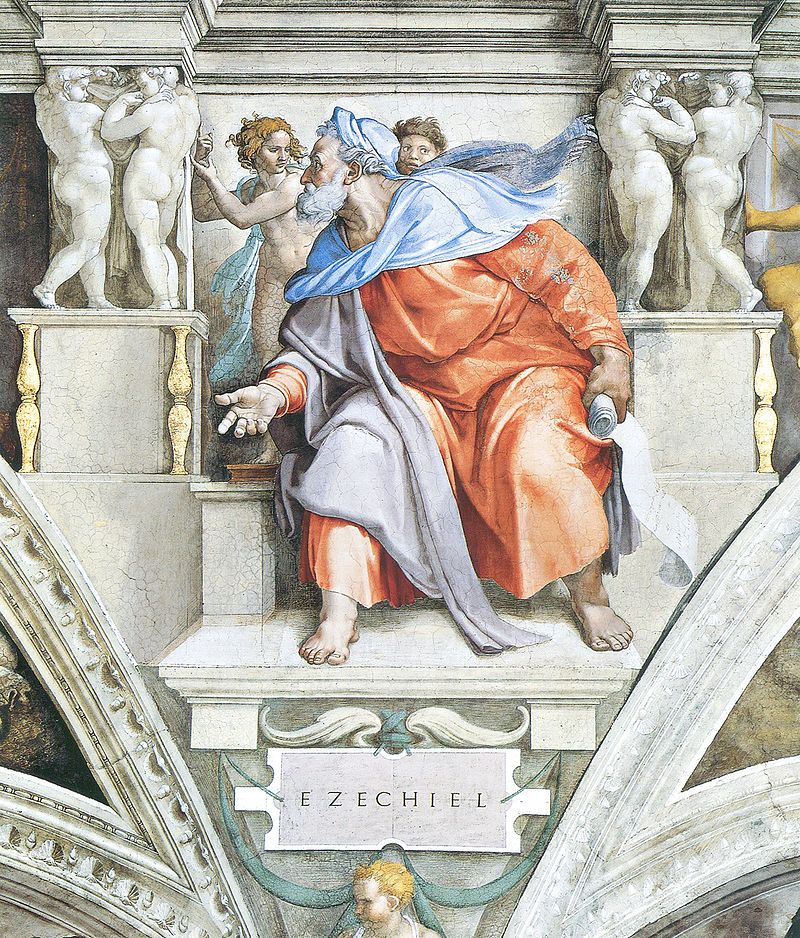
Michelangelo's Ezekiel on the Sistine Chapel
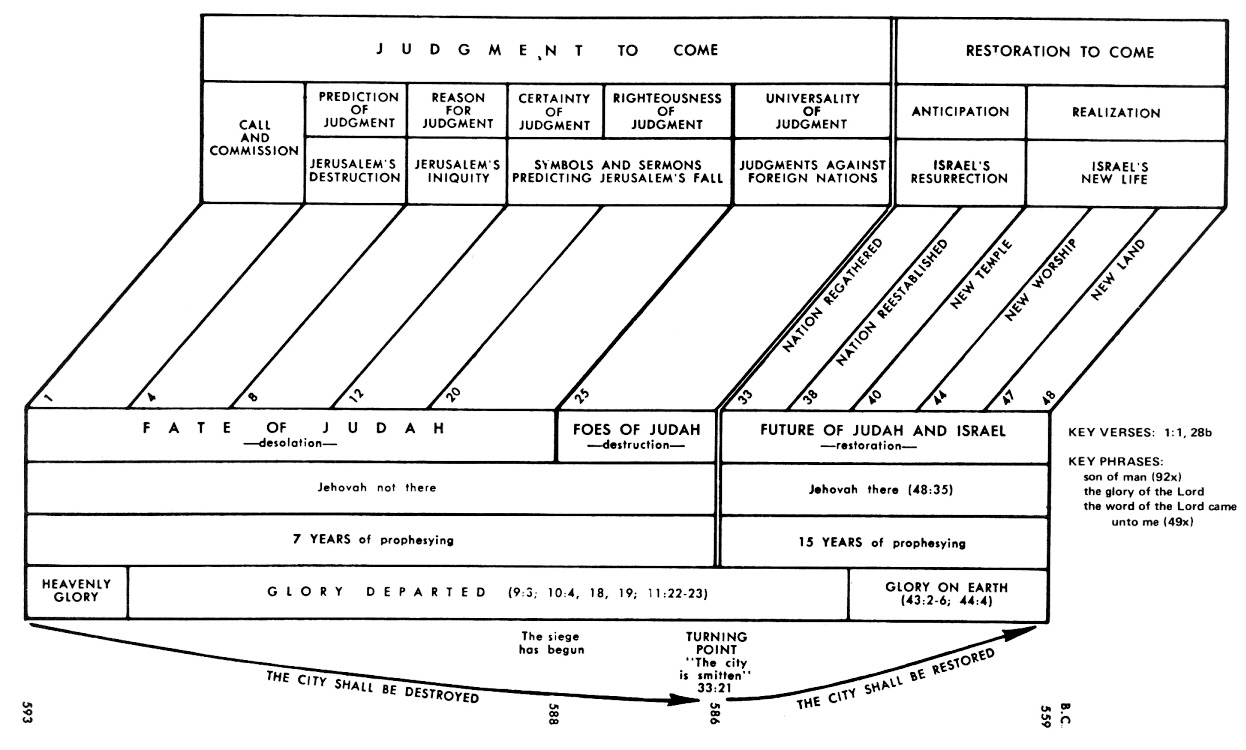
Click chart to enlarge
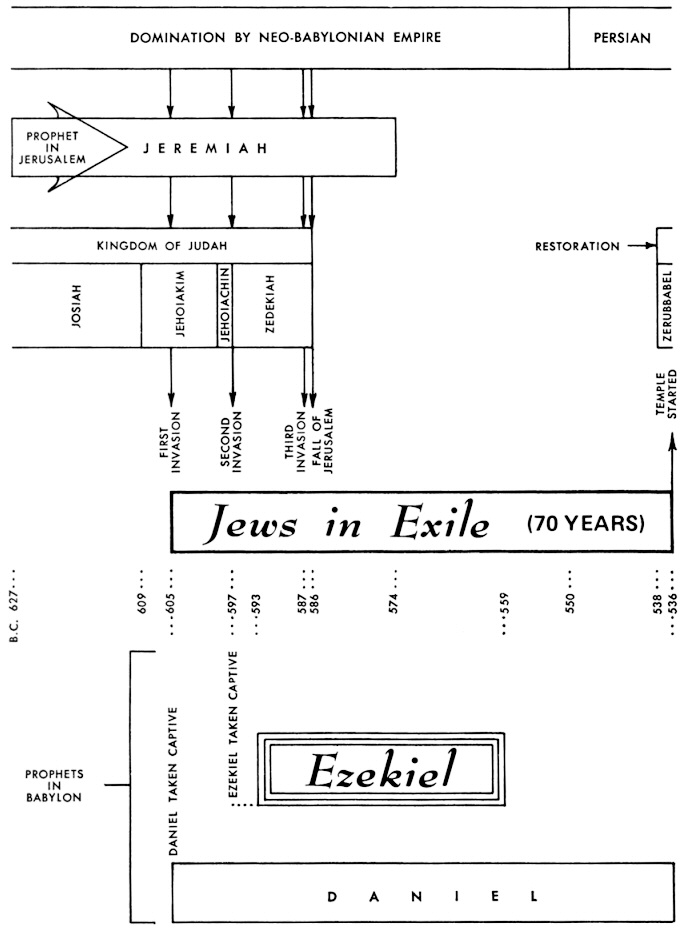
Click chart to enlarge
Chart from recommended resource Jensen's Survey of the OT - used by permission
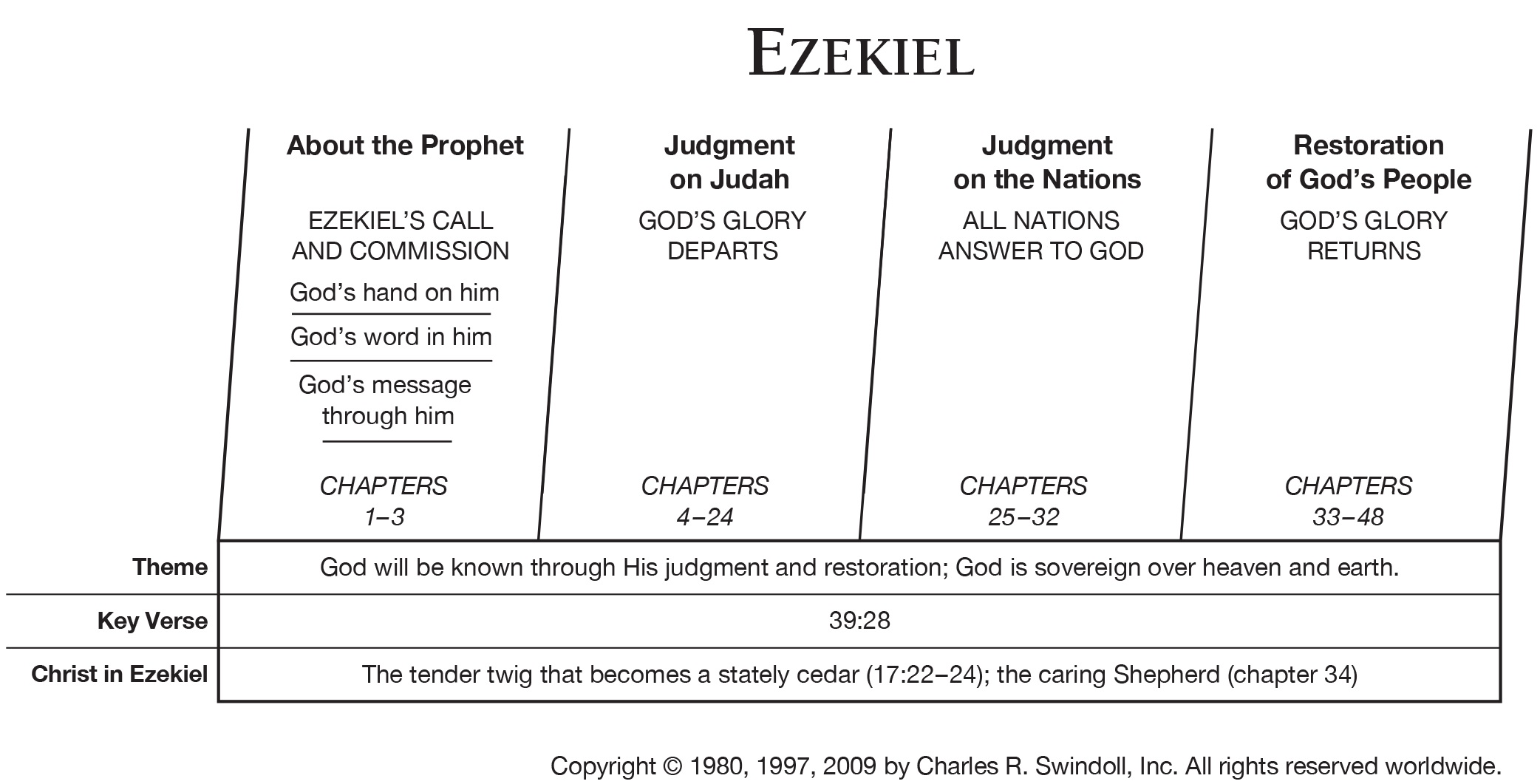
Click Chart from Charles Swindoll
|
PROPHECY OF |
PROPHECY OF |
|||
| FATE OF JUDAH Before the Siege |
FOES OF JUDAH During the Siege |
FUTURE OF JUDAH After the Siege |
||
|
593-588 BC |
587-586 |
586-571 |
||
|
7 YEARS |
15 YEARS |
|||
| Ezekiel 1:1-3:27 Ezekiel Sees the Glory & Receives the Call |
Ezekiel 4:1-24:27 Judgments Against Judah |
Ezekiel 25:1-32:32 Judgments Against the Gloating Nations |
Ezekiel 33:1-39:29 Restoration of Israel to the LORD |
Ezekiel 40:1-48:35 Visions of the Temple Jehovah Shammah |
Outline of the Book of Ezekiel from Dr John MacArthur - The book can be largely divided into sections about condemnation/retribution and then consolation/restoration. A more detailed look divides the book into 4 sections. First, are prophecies on the ruin of Jerusalem (Ezekiel 1:1–24:27). Second, are prophecies of retribution on nearby nations (Ezekiel 25:1–32:32), with a glimpse at God’s future restoration of Israel (Ezekiel 28:25,26). Thirdly, there is a transition chapter (Ezekiel 33:1-33) which gives instruction concerning a last call for Israel to repent. Finally, the fourth division includes rich expectations involving God’s future restoration of Israel (Ezekiel 34:1–48:35). (Reference)
I. Prophecies of Jerusalem’s Ruin (Ezekiel 1:1–24:27)
A. Preparation and Commission of Ezekiel (Ezekiel 1:1–3:27)
1. Divine appearance to Ezekiel (Ezekiel 1:1–28)|
2. Divine assignment to Ezekiel (Ezekiel 2:1–3:27)
B. Proclamation of Jerusalem’s Condemnation (Ezekiel 4:1–24:27)
1. Signs of coming judgment (Ezekiel 4:1–5:4)
2. Messages concerning judgment (Ezekiel 5:5–7:27)
3. Visions concerning abomination in the city and temple (Ezekiel 8:1–11:25)
4. Explanations of judgment (Ezekiel 12:1–24:27)
II. Prophecies of Retribution to the Nations (Ezekiel 25:1–32:32)
A. Ammon (Ezekiel 25:1–7)
B. Moab (Ezekiel 25:8–11)
C. Edom (Ezekiel 25:12–14)
D. Philistia (Ezekiel 25:15–17)
E. Tyre (Ezekiel 26:1–28:19)
F. Sidon (Ezekiel 28:20–24)
Excursus: The Restoration of Israel (Ezekiel 28:25, 26)
G. Egypt (Ezekiel 29:1–32:32)
III. Provision for Israel’s Repentance (Ezekiel 33:1–33)
IV. Prophecies of Israel’s Restoration (Ezekiel 34:1–48:35)
A. Regathering of Israel to the Land (Ezekiel 34:1–37:28)
1. Promise of a True Shepherd (Ezekiel 34:1–31)
2. Punishment of the nations (Ezekiel 35:1–36:7)
3. Purposes of restoration (Ezekiel 36:8–38)
4. Pictures of restoration—dry bones and two sticks (Ezekiel 37:1–28)
B. Removal of Israel’s Enemies from the Land (Ezekiel 38:1–39:29)
1. Invasion of Gog to plunder Israel (Ezekiel 38:1–16)
2. Intervention of God to protect Israel (Ezekiel 38:17–39:29)
C. Reinstatement of True Worship in Israel (Ezekiel 40:1–46:24)
1. New temple (Ezekiel 40:1–43:12)
2. New worship (Ezekiel 43:13–46:24)
D. Redistribution of the Land in Israel (Ezekiel 47:1–48:35)
1. Position of the river (Ezekiel 47:1–12)
2. Portions for the tribes (Ezekiel 47:13–48:35)
Ezekiel 17:1 Now the word of the LORD came to me saying,
NET The word of the LORD came to me:
NLT Then this message came to me from the LORD:
Simple Outline:
- Ezekiel 17:1-10 Parable of 2 Eagles and A Vine
- Ezekiel 17:11-21 Parable Explained
- Ezekiel 17:22-24 God's Promise of Hope
The theme of this chapter is the treachery of Zedekiah, the puppet-king appointed by Nebuchadrezzar to replace the captive Jehoiachin. (Tyndale Old Testament Commentaries – Ezekiel)
Now the word of the LORD came to me saying - This opening signals that what follows is not Ezekiel’s own reflection, but direct divine revelation given to the prophet Ezekiel while he was among the exiles in Babylon. Before God explains events, He establishes authority—this is His Word, not man’s opinion.
When did this prophecy occur? While we cannot be dogmatic it probably occurred between 592 BC (Ezek 8:1) and 591 BC (Ezek 20:1). In other words Ezekiel predicted Zedekiah's rebellion against Babylon about 3 years before it occurred.
John Walton (page 703) - allegories and parables in ancient world. It was a common rhetorical device in ancient storytelling to use allegories and parables to make a point or create an image that would be more understandable or expressive to the audience. This is especially true in ancient wisdom literature and in prophetic texts. For instance, in the twentieth-century B.C. Egyptian Dispute Between a Man and His Ba a despondent man’s soul tells him a parable about death and its unpredictability. Another Egyptian text, the Instruction of Ankhsheshonqy (eighth century B.C.), uses a vacant house and an unmarried woman as allegories for waste. The Egyptian Love Songs (thirteenth century B.C.) are filled with allegories comparing the various attributes of a beautiful woman to a lush marsh, a lotus bud and mandrake blossoms. In the prophetic visions of the Egyptian sage Neferti (twentieth century B.C.), he describes the invasion of Egypt as marked by the nest of a “strange bird” in the marsh and the appearance of desert herds drinking from the Nile. The images conjured up by these short tales and wordplays enhance enjoyment and drive home the author’s point.
Bob Utley - This is a riddle/parable of
- Neo-Babylon, Nebuchaddnezzar II (605-562 B.C.) ‒ a great eagle, Ezekiel 17:3-6,12
- Egypt, either Pharaoh Psammetichus II (Psamtik), who reigned from 593-588 or Pharaoh Apries (Hophea), who reigned from 588-569 ‒ another great eagle, Ezekiel 17:7-8
- the vine, the Faith remnant ‒ a twig, a branch, Ezekiel 17:22-24
SPECIAL TOPIC: REMNANT (three senses)
The historical context is Nebuchadnezzar II's exile of Josiah's son, Jehoiachin and the appointment of Josiah's third son, Zedekiah, as vassal king. In turn, Zedekiah approached Egypt for a military alliance (cf. 2 Kgs. 24-28; 2 Chr. 36; Jer. 52). As a result, Neo-Babylon's army invaded again.
There is a future hope in
Cyrus II's victory over Neo-Babylon (notice Isa. 44:45; 45:1). Persia let all captured national people groups return home. Mostly, Judah returned to a small province surrounding Jerusalem under Zerubbabel and Joshua.
There are clear hints in the text that this passage may have an ultimate fulfillment in Jesus, the true Davidic Messiah (cf. Isa. 11; Jer. 23:5-6)
Ezekiel 17:2 “Son of man, propound a riddle and speak a parable to the house of Israel,
NET "Son of man, offer a riddle, and tell a parable to the house of Israel.
NLT "Son of man, give this riddle, and tell this story to the people of Israel.
- Eze 20:49 Jdg 9:8-15 14:12-19 2Sa 12:1-4 Ho 12:10 Mt 13:13,14,35 Mk 4:33,34 1Co 13:12
Related Passages:
Psalm 78:2 I will open my mouth in a parable; I will utter dark sayings of old,
Matthew 13:13 “Therefore I speak to them in parables; because while seeing they do not see, and while hearing they do not hear, nor do they understand.
SPEAKING IN RIDDLES
TO EXPOSE HEARTS
Son of man Son of man is God’s way of addressing Ezekiel, emphasizing his humanity and role as God’s messenger to His people. The address “Son of man” (Hebrew ben-’adam) also emphasizes Ezekiel’s humanity and lowliness in contrast to the divine Speaker, reminding us that the messenger is merely an instrument (cf. Ezek 2:1).
This verse introduces one of the most symbolic and penetrating messages in the book of Book of Ezekiel. God commands Ezekiel to deliver His truth not in plain speech, but in the form of a riddle and a parable—a method that both reveals and conceals.
J Vernon McGee - because they would not listen to him, Ezekiel had to come to these people in a strange and unusual way.
Propound a riddle (chidah)- A riddle (Hebrew ḥîdâ) refers to something enigmatic, indirect, and requiring discernment—not a puzzle for entertainment, but a truth veiled in symbolism that demands spiritual perception (cf. Jdg 14:12).
Charles Feinberg - It is a riddle in that its meaning needs to be explained; there is a deeper meaning which underlies the figurative form, for something in its presentation is obscure. It is a parable in that it is an allegory.” (See Ezekiel)
And speak a parable (mashal) - The parallel command “speak a parable” (Hebrew māšāl) broadens the idea to include a proverbial or illustrative story, often drawn from everyday imagery but conveying deeper theological meaning.
Together, these terms indicate that what follows (Ezek 17:3–10) is a symbolic allegory—the famous account of the great eagle, the cedar, and the vine—which represents real historical events involving Babylon, Judah, and Egypt (cf. Ezek 17:12–15). God deliberately chooses this indirect method because the “house of Israel” had become spiritually dull and resistant to straightforward rebuke. Like Jesus later, who spoke in parables (cf. Mt 13:10–13), this form both tests the hearer and exposes the heart: those who are receptive will seek understanding, while the hardened will remain in confusion.
Warren Wiersbe - This message is called a “parable” or “riddle,” which means a story with a deeper meaning, an allegory in which various objects refer to people and what they do. The Jewish people were fond of discussing the wise sayings of the ancients and were always seeking to discover deeper meanings (Ps. 78:1-3). Ezekiel hoped that his allegory would awaken his dull hearers and give them something to think about. Perhaps the truth would grip their hearts and change their outlook on what God was doing. This allegory is about three kings (“shoots”), because the cedar tree represents the royal dynasty of David. (In Scripture, a tree can represent a ruler, a kingdom, or a dynasty -- Jdg. 9:8-15; Isa. 10:33; Ezek. 31:1-18; Da 4; Zech. 11:2) David’s dynasty was very important, because through it God had promised to bring a Savior to His people and to the world (2 Sam. 7:16; Luke 1:32-33, 69). It was essential that a descendant of David sit on the throne so that the blessing of God’s covenant with David might rest on the land.
By adding to this a riddle God is trying to get the Jews to understand
for themselves what has happened to them
Daniel E Woodhead - Now God adds to the parabolic form of communication for Ezekiel to communicate with the Jewish prisoners of war in Babylon. He introduces the riddle (Hebrew czeedah) to Ezekiel and has him speak a riddle within a parable. Riddles are generally known as word puzzles. The whole point of a riddle is for the listener to analyze the circumstances brought forth in the riddle to discover a hidden meaning. It is a test of wisdom, which requires careful thought in order to be interpreted or understood. The parable already contains no names or specific places and is used to make an impression upon the memory to recall personally related events or circumstances. By adding to this a riddle God is trying to get the Jews to understand for themselves what has happened to them, why and by whom. He wants them to realize that they have sinned against Him. God is going to compare Nebuchadnezzar to an eagle and the kings of Judah to the lofty tops of cedar trees in Lebanon. In the parable form one set of actual circumstances is compared to an imaginary set of circumstances. With the riddle added into the parable it makes it enigmatic and thought provoking. Nebuchadnezzar was given authority to rule over the whole world. God chose Nebuchadnezzar, in spite of all his wickedness, to rule over Israel and all the earth as stated by the prophet Daniel. (Da 2:37-38). Therefore he is called great because of his great wingspan (pinions), which represent many people under his rule and those whom he could rule if he chose to move beyond the Mid-East. The parable provides imagery reminiscent of the vine, which symbolized Judah.
To the house of Israel - this message is addressed to the Jews in exile, called "Israel" even though most were from Judah.
When plain words are ignored, God may speak in riddles—
forcing the hearer to either seek truth or reveal a hardened heart.
Charles Ryrie - A riddle contained an obscure idea requiring interpretation; a parable was an illustration by comparison. The first eagle in this parable seems to represent Nebuchadnezzar (Eze17:3,12); the second is Pharaoh (Eze17:7,15). The vine is Judah and King Zedekiah (Eze17:6,14), vacillating between Babylon and Egypt, although God had told him to yield to Nebuchadnezzar.
Daniel Block - “The manner in which plants and animals relate in the story, carrying on as if they were humans, would have amused any audience, and undoubtedly contributed to the prophet’s reputation as a ‘spinner of riddles’ (Ezekiel 20:49).” (See The Book of Ezekiel, Chapters 1–24 - Page 179)
Riddle (02420)(chidah) refers to an enigmatic saying, question, or story whose meaning must be determined by the audience. Most uses (8) refer to Samson's riddle in Judges 14. A riddle is a question, puzzle or statement so phrased that ingenuity is required to answer or understand. The queen of Sheba "came to test (Solomon) with difficult questions." (1Ki 10:1, 2Chr 9:1)
The Hebrew noun chîdhāh refers to a riddle or enigmatic saying that contains a hidden meaning requiring insight to understand. It is used of puzzling utterances, parables, allegories, and difficult sayings whose truth is not immediately obvious but must be discerned through wisdom. In Scripture, riddles often conceal truth beneath the surface, as seen in Samson’s riddle (Judges 14:14) and in wisdom literature where understanding requires reflection (Proverbs 1:6; Psalm 49:4). Unlike ordinary prophetic communication through dreams or visions, Moses uniquely received revelation from God “clearly and not in riddles” (Numbers 12:8), highlighting the obscurity typically associated with such sayings. The term can also describe allegorical prophecy, such as Ezekiel’s riddle of the eagles (Ezekiel 17:2), or politically complex and difficult matters (Daniel 8:23). At its core, a chîdhāh is truth veiled in mystery, accessible only to those with discernment, and often used by God to reveal deeper realities while simultaneously concealing them from the undiscerning.
CHIDAH - 17V- Num. 12:8; Jdg. 14:12; Jdg. 14:13; Jdg. 14:14; Jdg. 14:15; Jdg. 14:16; Jdg. 14:17; Jdg. 14:18; Jdg. 14:19; 1 Ki. 10:1; 2 Chr. 9:1; Ps. 49:4; Ps. 78:2; Prov. 1:6; Ezek. 17:2; Dan. 8:23; Hab. 2:6
Parable (04912) mashal [Singular = mashal, Plural = misle] from the verb mashal - to rule [e.g., Ge 1:18] or more generally indicates idea of comparison, likeness or equality and thus to speak a proverb or popular saying comparing 2 objects, attitudes or activities -Ps 49:12, Ezek 16:44, 18:2, 24:3) usually conveys the meaning of a wise saying (or a pithy maxim which suggest special insight and authority), but in two occurrences of the connotation of parable or allegory (as defined above) is clearly evident (viz. Ezek 17:2ff = a parable centering on two eagles, Ezek 17:12 representing Babylon and Ezek 17:15 representing Egypt, as well as centering on a vine Ezek 17:6), both in indictments against Israel for her sin. In Nu 23: 7, 18, 24:3ff. mashal refers not to a popular or common saying but to Balaam’s prophetic oracles (the first 7 uses in Scripture). In Isa 14:4 the context is after Israel's return to the land and the song is one of contempt or taunting (mashal) directed at the king of Babylon. SPECIAL TOPIC: INTERPRETING PARABLES
MASHAL -40V- byword(3), discourse(9), parable(3), parables(1), proverb(15), proverbs(6), taunt(2), taunt-song(1). Num. 23:7; Num. 23:18; Num. 24:3; Num. 24:15; Num. 24:20; Num. 24:21; Num. 24:23; Deut. 28:37; 1 Sam. 10:12; 1 Sam. 24:13; 1 Ki. 4:32; 1 Ki. 9:7; 2 Chr. 7:20; Job 13:12; Job 27:1; Job 29:1; Ps. 44:14; Ps. 49:4; Ps. 69:11; Ps. 78:2; Prov. 1:1; Prov. 1:6; Prov. 10:1; Prov. 25:1; Prov. 26:7; Prov. 26:9; Eccl. 12:9; Isa. 14:4; Jer. 24:9; Ezek. 12:22; Ezek. 12:23; Ezek. 14:8; Ezek. 17:2; Ezek. 18:2; Ezek. 18:3; Ezek. 20:49; Ezek. 24:3; Joel 2:17; Mic. 2:4; Hab. 2:6
Bob Utley - This verse has two parallel IMPERATIVES.
- "propound a riddle," BDB 295, KB 309, Qal IMPERATIVE, cf. Jdg. 14:12-19
- "speak a parable," BDB 605 II, KB 648 I, Qal IMPERATIVE, cf. Ezek. 12:23; 16:44; 17:2; 18:2; 20:49; 24:3
The term "riddle" means a statement that needs to have some information hinted at or supplied to be understood (cf. Prov. 1:6). The term "parable" implies a brief poetic structure, possibly a proverb which uses comparison as a way to illustrate truth. Ezekiel often used well known cultural proverbs. Ezekiel has been using highly figurative language to convince the exiles of the just and sure judgment of Jerusalem.
SON OF MAN - 93X/93V - KEY PHRASE IN EZEKIEL - Ezek. 2:1; Ezek. 2:3; Ezek. 2:6; Ezek. 2:8; Ezek. 3:1; Ezek. 3:3; Ezek. 3:4; Ezek. 3:10; Ezek. 3:17; Ezek. 3:25; Ezek. 4:1; Ezek. 4:16; Ezek. 5:1; Ezek. 6:2; Ezek. 7:2; Ezek. 8:5; Ezek. 8:6; Ezek. 8:8; Ezek. 8:12; Ezek. 8:15; Ezek. 8:17; Ezek. 11:2; Ezek. 11:4; Ezek. 11:15; Ezek. 12:2; Ezek. 12:3; Ezek. 12:9; Ezek. 12:18; Ezek. 12:22; Ezek. 12:27; Ezek. 13:2; Ezek. 13:17; Ezek. 14:3; Ezek. 14:13; Ezek. 15:2; Ezek. 16:2; Ezek. 17:2; Ezek. 20:3; Ezek. 20:4; Ezek. 20:27; Ezek. 20:46; Ezek. 21:2; Ezek. 21:6; Ezek. 21:9; Ezek. 21:12; Ezek. 21:14; Ezek. 21:19; Ezek. 21:28; Ezek. 22:2; Ezek. 22:18; Ezek. 22:24; Ezek. 23:2; Ezek. 23:36; Ezek. 24:2; Ezek. 24:16; Ezek. 24:25; Ezek. 25:2; Ezek. 26:2; Ezek. 27:2; Ezek. 28:2; Ezek. 28:12; Ezek. 28:21; Ezek. 29:2; Ezek. 29:18; Ezek. 30:2; Ezek. 30:21; Ezek. 31:2; Ezek. 32:2; Ezek. 32:18; Ezek. 33:2; Ezek. 33:7; Ezek. 33:10; Ezek. 33:12; Ezek. 33:24; Ezek. 33:30; Ezek. 34:2; Ezek. 35:2; Ezek. 36:1; Ezek. 36:17; Ezek. 37:3; Ezek. 37:9; Ezek. 37:11; Ezek. 37:16; Ezek. 38:2; Ezek. 38:14; Ezek. 39:1; Ezek. 39:17; Ezek. 40:4; Ezek. 43:7; Ezek. 43:10; Ezek. 43:18; Ezek. 44:5; Ezek. 47:6;
G Campbell Morgan - Son of man, put forth a riddle.—Ezek. 17.2
In the allegory of the foundling in the previous chapter Ezekiel was dealing with the spiritual and moral malady of Israel. In this message he was concerned with her political folly and wickedness. The riddle of the two eagles and the vine is explained. The nation had looked to compromise with Babylon, and protection from Egypt, as means of restoring national being and fruitfulness. This had been her political sin. The prophetic message demonstrated the futility of such wickedness. The vine was still Jehovah's, and the eagles were also within His power. The things they did were all within His power, and under His government. Therefore the transplanting of the vine was of no avail. His east wind found it, wherever it was placed, and it withered in spite of all its attempts to maintain its life by these false means. Thus the political iniquity, resulting from the spiritual abomination, was visited with the Divine judgment. The reprobation of God could not be annulled by the policies which forgot Him. Here also the last note is one declaring the coming restoration, but clearly showing that it will be brought about, not by human policy, when the policy is conceived in rebellion, but by the action of His Own power, and in answer to the inspiration of His never failing grace. This chapter is full of light for statesmen and politicians if they will but consider its teaching. The one fact which abides is that of the Divine sovereignty. God is governing, and there is no escape from Him. Eagles, and vines, are under His control. Happy are they who frame their policies by consulting Him, and order their ways in His fear.
Ezekiel 17:3 saying, ‘Thus says the Lord GOD, “A great eagle with great wings, long pinions and a full plumage of many colors came to Lebanon and took away the top of the cedar.
- A great eagle with Nebuchadnezzar, so called from his towering ambition and rapaciousness. Eze 17:7,12-21 De 28:49 Jer 4:13 48:40 49:16 La 4:19 Ho 8:1 Mt 24:28
- great wings: Extensive empire, both in length and breadth. Da 2:38 4:22 7:4
- came: Came against Judah and Jerusalem. Eze 17:12 2Ki 24:10-16 2Ch 36:9,10 Jer 22:23-28 24:1
- the top: Jeconiah, whom he took captive to Babylon.
- the cedar: The royal and ancient family of David.
Related Passages:
2 Kings 24:12 Jehoiachin the king of Judah went out to the king of Babylon, he and his mother and his servants and his captains and his officials. So the king of Babylon took him captive in the eighth year of his reign.
Jeremiah 22:24-25 “As I live,” declares the LORD, “even though Coniah the son of Jehoiakim king of Judah were a signet ring on My right hand, yet I would pull you off; 25and I will give you over into the hand of those who are seeking your life, yes, into the hand of those whom you dread, even into the hand of Nebuchadnezzar king of Babylon and into the hand of the Chaldeans.
Jeremiah 48:40 For thus says the LORD: “Behold, one will fly swiftly like an eagle And spread out his wings against Moab.

THE PARABLE OF
A GREAT EAGLE
saying, ‘Thus says the Lord GOD, “A great eagle with great wings, long pinions and a full plumage of many colors - This verse begins the parable proper, and every element is symbolic of real historical events. The “great eagle” represents Nebuchadnezzar, king of Babylon, whose power, speed, and dominance are vividly portrayed by the eagle imagery—“great wings” and “long pinions” emphasizing his far-reaching military strength and ability to conquer distant nations (cf. Jer 48:40; Dan 7:4). The phrase “full plumage of many colors” suggests the vast diversity and splendor of his empire, composed of many peoples and nations under Babylon’s rule.
Bob Utley - "a great eagle" This is a description of the large mercenary and conscripted army of Neo-Babylon who captured Jerusalem in 605, 597, 586, 582 B.C. In this context it is the 597 B.C. exile (i.e. "took the top of the cedar") in which Ezekiel and thousands of other craftsmen and leaders were taken to Babylon (cf. Ezek. 17:12-13; 2 Kgs. 24:24,15). "Lebanon" This is imagery referring to Judah.
Came to Lebanon and took away the top of the cedar - Lebanon symbolizes Jerusalem and the royal house of Judah, since Lebanon was famous for its majestic cedars and often used figuratively for royal glory and strength (cf. 2Ki 14:9; Isa 2:13). The “cedar” specifically represents the Davidic dynasty, the royal line of kings descended from David. When the eagle “took away the top of the cedar,” it refers to the deportation of the young king Jehoiachin (also called Jeconiah) in 597 BC, when Nebuchadnezzar removed him from the throne and carried him into exile in Babylon (cf. 2Ki 24:12–15). The “top” or highest shoot signifies the king and the elite leadership—the very best and most prominent of Judah being taken away.
John MacArthur - topmost of its young twigs. This is Jehoiachin, the king, exiled in 597 b.c. (2Ki 24:11-16). Babylon is the "land of merchants" (Ezek 16:29).
Reformation Study Bible - topmost of its young twigs. The removal of the topmost twig refers to the exile and captivity of Jehoiachin in Babylon. The exiles continued to regard Jehoiachin as the legitimate king of Judah.
Daniel E Woodhead - Greatness In general eagles fly higher than any other bird. Nebuchadnezzar had lofty goals of dominating many empires and in fact became the first of the world empires in the chain of the Times of the Gentiles cited by the Lord Jesus (Luke 21:24). The eagle is the greatest bird and the Scriptures compare him to an eagle (Jeremiah 48:40; 49:22; Ezekiel 17:3). Long Wings The long wings are symbolic of the span of control exercised by Nebuchadnezzar as he conquered in various battles in the Mid-East. Full of Feathers The wings were also full of feathers. This affirmed the eagle’s beauty and its great flying ability as well as the many nations and people groups under Nebuchadnezzar’s control. Variety of Colors in The Feathers The various colors represent the diverse people who are subordinate to the king including the common people, and merchant classes as well as the royalty. He came to Lebanon Lebanon represents Israel because the mighty forest of Lebanon was there just to the north. Just as the city of Jerusalem is the highest of places in the world so too is the cedar the tallest of trees in the region.
John Walton (page 704) - animal and tree fables. Among the most popular types of fables were those in which an animal talks (see the comment on Num 22:28-31) or trees have a conversation or perform some action (see comment on Judg 9:8). There are several examples of this in ancient Near Eastern literature. For example, there is a dialogue between a thorn bush and a pomegranate tree in the Assyrian Words of Ahiqar (eighth century B.C.) over their relative merits. In the thirteenth-century Egyptian Tale of Two Brothers his cows warn the younger brother, Anubis, that his jealous brother Bata planned to kill him
EAGLE - Dictionary of Biblical Imagery - page 782
EAGLE - 31V - Exod. 19:4; Lev. 11:13; Deut. 14:12; Deut. 28:49; Deut. 32:11; 2 Sam. 1:23; Job 9:26; Job 39:27; Ps. 103:5; Prov. 23:5; Prov. 30:17; Prov. 30:19; Isa. 40:31; Jer. 4:13; Jer. 48:40; Jer. 49:16; Jer. 49:22; Lam. 4:19; Ezek. 1:10; Ezek. 10:14; Ezek. 17:3; Ezek. 17:7; Dan. 4:33; Dan. 7:4; Hos. 8:1; Obad. 1:4; Mic. 1:16; Hab. 1:8; Rev. 4:7; Rev. 8:13; Rev. 12:14
The eagle, a large, solitary bird of prey, is known for its keen eyesight, power and sharp beak and talons. With a wingspan up to seven and a half feet, it hunts high in the air and swoops down on its prey at great speed. Eagles mate for life and care for their young in nests, called aeries, high in trees or rocky ledges. This provides protection for the eaglets, which remain helpless for a long period, up to 100 days. Palestine is home to four varieties of eagles, of which the most common is the short-toed eagle.
Israelites were forbidden from eating birds of prey such as vultures, hawks and eagles “because they are detestable” (Lev 11:13). Yet many of the some thirty references in Scripture depict the eagle, not as detestable, but as an image of strength and deliverance.
The eagle portrays speed and power in biblical images (2 Sam 1:23; Is 40:31; Jer 4:13). Along with three other creatures of strength-the lion, the ox and humans-it appears as one face of the four mighty cherubim who attend the throne of God (Ezek 1:10—14; Rev 4:7).
The eagle symbolizes the speed and power of both God’s deliverance and God’s destruction. Speaking of how he delivered Israel from Egypt, the Lord says, “You yourselves have seen what I did to Egypt, and how I carried you on eagles’ wings and brought you to myself” (Ex 19:4 NIV [NIV NIV. New International Version] ). Similar images of God’s protection as an eagle, swift and powerful, are found in Deuteronomy 32:11 and Revelation 12:14. Isaiah 40:31 is the famous passage relating the renewing strength God gives to his followers: “But those who hope in the Lord will renew their strength. They will soar on wings like eagles; they will run and not grow weary, they will walk and not be faint” (NIV [NIV NIV. New International Version] ).
The eagles’ hunting skill and sudden attack on their prey lend themselves to images of sure and sudden disaster in depictions of God’s judgment. In the OT [OT OT. Old Testament] prophets the mighty nations of Assyria and Babylon are portrayed as eagles bringing disaster on God’s people because they have broken covenant with him (Lam 4:19; Ezek 17:3, 7; Hos 8:1). Jeremiah depicts divine judgment against Moab and Edom as an eagle swooping down with wings outspread (Jer 48:40; 49:22). In a scene of final judgment in Revelation, the gliding eagle appears in midair to announce the woes of the imminent disaster that the Lord is sending on the inhabitants of earth (Rev 8:13).
Ezekiel 17:4 “He plucked off the topmost of its young twigs and brought it to a land of merchants; he set it in a city of traders.
- into: Isa 43:14 47:15 Jer 51:13 Rev 18:3,11-19
Related Passages:
Jeremiah 22:24-27 “As I live,” declares the LORD, “even though Coniah the son of Jehoiakim king of Judah were a signet ring on My right hand, yet I would pull you off; 25 and I will give you over into the hand of those who are seeking your life, yes, into the hand of those whom you dread, even into the hand of Nebuchadnezzar king of Babylon and into the hand of the Chaldeans. 26 “I will hurl you and your mother who bore you into another country where you were not born, and there you will die. 27 “But as for the land to which they desire to return, they will not return to it.
Daniel 1:2-4 The Lord gave Jehoiakim king of Judah into his hand, along with some of the vessels of the house of God; and he brought them to the land of Shinar, to the house of his god, and he brought the vessels into the treasury of his god. 3Then the king ordered Ashpenaz, the chief of his officials, to bring in some of the sons of Israel, including some of the royal family and of the nobles, 4youths in whom was no defect, who were good-looking, showing intelligence in every branch of wisdom, endowed with understanding and discerning knowledge, and who had ability for serving in the king’s court; and he ordered him to teach them the literature and language of the Chaldeans.
NEBUCHADNEZZAR'S DEPORTATION
OF JECONIAH IN 597 BC
He plucked off the topmost of its young twigs This passage refers to the removal of the Davidic king, specifically Jehoiachin (Jeconiah), who was taken from Jerusalem at the height of the nation’s leadership. The “topmost twig” signifies the royal line of David—the highest and most visible authority in Judah (2 Kings 24:12–15). The image emphasizes that Babylon did not merely conquer the land; it cut off the very leadership and future hope of the nation, at least from a human perspective. What appears to be merely political upheaval is actually the hand of God fulfilling His word.
Regarding the removal of the topmost, even here, the imagery quietly preserves hope, because the tree is not uprooted, but only the top is removed, which anticipates a future restoration of the Davidic line ultimately fulfilled in Christ (Isaiah 11:1).
and brought it to a land of merchants; he set it in a city of traders This description points to Babylon, a center of commerce and wealth in the ancient world. The phrase highlights both the geographical relocation and the cultural displacement of the king. He is taken from the covenant land, where God’s presence uniquely dwelt, and placed into a pagan, economically driven empire.
Daniel E Woodhead on land of merchants; he set it in a city of traders - Babylon was known as the world’s center of commerce (land of traffic). Babylon was famous for its transport traffic on the Tigris and Euphrates. Also, by its connection with the Persian Gulf, it carried on much commerce with India. For nearly 2,000 years Babylon was the most important commercial city in the world. It was a commercial and financial center of Mesopotamia. The arts of divination, astronomy, astrology, accounting, mathematics and private and commercial law all sprang up from Babylon. In short many of our world systems came from that region. The ancient city of Babylon, under King Nebuchadnezzar, must have been a wonder to the traveler’s eyes. "In addition to its size," wrote Herodotus, a historian in 450 BC, "Babylon surpasses in splendor any city in the known world." Herodotus claimed the outer walls were 56 miles in length, 80 feet thick and 320 feet high. Wide enough, he said, to allow a four-horse chariot to turn. The river Euphrates went through the middle of the city under the walls and linked with a moat surrounding the walls. The river Euphrates entered and exited through two spiked gates whose bars reached down to the riverbed. When these double doors were shut and all other entrances were closed, Babylon was impregnable
Bob Utley - The destination of exiled Judean society is described as "to a land of trade," (e.g. Ezek. 16:15-20) "a city of traders," Back in Ezek. 12:13 Chaldea is the resettled destination of the Judean exiles (cf. Ezek. 1:3). The term "Chaldea" (BDB 505) may be related to the term "Canaanite" ("merchants" in Ezek. 16:29, where they appear together).
John Walton (page 704) - land of merchants. See Ezekiel 16:29 for the previous reference to the “land of merchants” as equivalent to Babylonia. King Jehoiachin, perhaps the “topmost shoot” in this allegory, had been taken into exile in 597 along with his royal court. Babylonian ration lists show that they were held under house arrest in the city of Nippur. city of traders. Although the Phoenicians are more often associated with trade, their role was actually more as “middlemen,” while the bankers and merchants who supplied the goods for transport were based in the cities of Mesopotamia (see Is 23:8). It was the Chaldean commercial empire that had, through the military efforts of the king, been able to absorb all aspects of business into their control. This is a theme that is found in many Mesopotamian annals in which a king makes an expedition “to the sea” and gains control of the “Cedars of Lebanon.”
Ezekiel 17:5 “He also took some of the seed of the land and planted it in fertile soil. He placed it beside abundant waters; he set it like a willow.
- the seed: Zedekiah, brother to Jeconiah. Eze 17:13 2Ki 24:17 Jer 37:1
- planted it in: Heb. put it in a field of seed De 8:7-9
- he set: Made him dependent on Babylon, the city of great waters, as the willow is on humidity. Eze 19:11,12 Isa 15:7 44:4
SET IN FERTILE SOIL
BY ABUNDANT WATERS
He also took some of the seed of the land - He refers to Nebuchadnezzar taking a member of the native Judean royal line, namely Zedekiah, and installing him as a vassal king in place of Jehoiachin (2 Kings 24:17). Unlike the “topmost twig” that was removed to Babylon, this “seed of the land” emphasizes someone left behind from Judah itself, suggesting continuity of the nation under Babylonian authority.
NET NOTE - Heb “took of the seed of the land.” For the vine imagery, “seedling” is a better translation, though in its subsequent interpretation the “seed” refers to Zedekiah through its common application to offspring.
Daniel E Woodhead - The eagle was not a total tyrant. He took some of the seeds (relatives of the deposed kings) and made one a king. This was Zedekiah who was of the royal seed. He did not appoint a foreigner to rule over Jerusalem but a “seed of the land.” Zedekiah was given the fertile Jerusalem and could have grown it.
and planted it (ZEDEKIAH) in fertile soil He placed it beside abundant waters; he set it like a willow - Zedekiah was placed in a position where he could have prospered and remained stable if he had submitted to Babylon as God had commanded through Jeremiah (Jeremiah 27:12; Jeremiah 29:5–7). The imagery is striking because it shows that the conditions for survival and even modest flourishing were graciously provided by God despite the judgment.
He set it like a willow depicts a low, spreading plant that thrives near water, not a towering cedar, indicating that this king would have a humble, dependent role rather than sovereign greatness. The point is that Zedekiah’s reign could have been secure and fruitful in a limited sense, but only through submission. Tragically, his later rebellion against Babylon was therefore not just political miscalculation but spiritual defiance of God’s revealed will, which led to the final destruction of Jerusalem (2 Kings 25:1–7).
Daniel E Woodhead - The eagle was not a total tyrant. He took some of the seeds (relatives of the deposed kings) and made one a king. This was Zedekiah who was of the royal seed. He did not appoint a foreigner to rule over Jerusalem but a “seed of the land.” Zedekiah was given the fertile Jerusalem and could have grown it. Just as a willow tree set in fertile soil with an abundance of water will flourish so too would have Zedekiah had he behaved properly.
Ezekiel 17:6 “Then it sprouted and became a low, spreading vine with its branches turned toward him, but its roots remained under it. So it became a vine and yielded shoots and sent out branches.
- Then it sprouted: Eze 17:14 Pr 16:18,19
Related Passages:
Jeremiah 27:12-13 (JEREMIAH SPECIFICALLY WARNED KING ZEDEKIAH!) I spoke words like all these to Zedekiah king of Judah, saying, “Bring your necks under the yoke of the king of Babylon and serve him and his people, and live! 13“Why will you die, you and your people, by the sword, famine and pestilence, as the LORD has spoken to that nation which will not serve the king of Babylon?
Jeremiah 37:5-7 Meanwhile, Pharaoh’s army had set out from Egypt; and when the Chaldeans who had been besieging Jerusalem heard the report about them, they lifted the siege from Jerusalem. 6 Then the word of the LORD came to Jeremiah the prophet, saying, 7 “Thus says the LORD God of Israel, ‘Thus you are to say to the king of Judah, who sent you to Me to inquire of Me: “Behold, Pharaoh’s army which has come out for your assistance is going to return to its own land of Egypt.
PLANTED TO GROW,
YET BOUND TO BOW
Then it (Zedekiah) sprouted and became a low, spreading vine with - This description indicates that Judah did in fact survive and function as a nation, but only in a diminished, humbled state. It was no longer a towering cedar with independence and glory, but a low vine, dependent and restricted.
Daniel E Woodhead - Before Zedekiah rebelled against the suzerainty of Nebuchadnezzar he prospered in his affairs. In the fourth year of his reign Jeremiah says, “he went out to meet the king who crowned him” (Jeremiah 27:3). Zedekiah was given additional responsibilities to govern over the kings of Edom, Moab, Ammon, Tyre, and Zidon. Jerusalem was no going to be a cedar any more because of its previous evil especially under Manasseh who promoted idolatry. Now it became a vine of low stature with its tendrils facing the eagle who wanted it to prosper but not to be elevated above Babylon or the king Nebuchadnezzar.
its branches turned toward him Judah’s political allegiance and dependence were directed toward the king of Babylon, meaning Zedekiah was expected to remain loyal and subject to Nebuchadnezzar (2 Kings 24:17).
but its roots remained under it The roots describe a measure of internal stability and continuity in the land of Judah, indicating that the nation could have remained secure and even somewhat fruitful if it accepted this arrangement under God’s discipline (Jeremiah 27:12–13).
So it became a vine and yielded shoots and sent out branches - There was real potential for growth and continuation, even in this reduced condition. The nation was not destroyed at this point; it had opportunity for life and limited prosperity. However, the entire picture underscores a crucial spiritual truth: Judah’s well-being depended on humble submission to God’s ordained authority.
Daniel E Woodhead - The stability of Judah depended on Babylon. The repetition “branches” and “springs” is used in the parable to identify the lack of gratitude of Zedekiah, who, was not content with moderate prosperity. He revolted from him to whom he had sworn allegiance and accepted his crown.
John Walton (page 704) - vine parables. See the comment on Ezekiel 15:2-7. The initial efforts of the gardener to care for his vine, planting it near abundant water in fertile soil, are rewarded by lush growth. However, at the appearance of the second eagle, the vine seems to reject the gardener’s attentions and loses its purpose. It sends out tendrils toward the second bird as if seeking another, unnecessary, water source. This failure to respond as expected makes the parable similar to the “Song of the Vineyard” in Isaiah 5:1-7
Ezekiel 17:7 “But there was another great eagle with great wings and much plumage; and behold, this vine bent its roots toward him and sent out its branches toward him from the beds where it was planted, that he might water it.
- another Eze 17:15 2Ki 24:20 2Ch 26:13 Jer 37:5-7
Related Passages:
Ezekiel 17:15 ‘But he rebelled against him by sending his envoys to Egypt that they might give him horses and many troops. Will he succeed? Will he who does such things escape? Can he indeed break the covenant and escape?
Jeremiah 37:5-7 (ZEDEKIAH LOOKED TO EGYPT FOR MILITARY PROTECTION) Meanwhile, Pharaoh’s army had set out from Egypt; and when the Chaldeans who had been besieging Jerusalem heard the report about them, they lifted the siege from Jerusalem. 6 Then the word of the LORD came to Jeremiah the prophet, saying, 7 “Thus says the LORD God of Israel, ‘Thus you are to say to the king of Judah, who sent you to Me to inquire of Me: “Behold, Pharaoh’s army which has come out for your assistance is going to return to its own land of Egypt.
TURNING TO ANOTHER EAGLE:
THE FOLLY OF FALSE ALLIANCES
But there was another great eagle (EGYPT) with great wings and much plumage - This description speaks of Egypt, specifically Pharaoh, in contrast to the first eagle who symbolized Nebuchadnezzar of Babylon. The imagery shifts to expose Judah’s unfaithful political maneuvering under King Zedekiah.
“And behold (hinneh), this vine (ZEDEKIAH/JUDAH) bent its roots toward him (EGYPT) and sent out its branches toward him (EGYPT)” Behold directs attention to a change in the vine. It describes Judah turning away from its covenant and oath to Babylon and seeking help from Egypt instead. The vine, which had been planted and sustained under Babylon’s relatively benevolent oversight, now reaches southward toward Egypt, indicating Zedekiah's deliberate rebellion against Babylon and a transferance of reliance to Egypt.
Daniel E Woodhead - The second eagle was Egypt. This was Pharaoh Hophra (Apries) who was on the throne of Egypt. This eagle was not great like the first one, Nebuchadnezzar. Zedekiah bent his roots toward Egypt and sent forth branches that they might be watered and nourished by Hophra (Apries).
Daniel Block - “The redirection of the vine’s branches toward the second eagle (instead of having them spread out low on the ground) and its roots upward (instead of going deeper into the fertile and well-watered soil) had rendered the plant extremely vulnerable to the wind’s withering force.” (See The Book of Ezekiel, Chapters 1–24)
From the beds where it (JUDAH) was planted, that he (EGYPT) might water it (JUDAH) - Judah had been given conditions where it could survive (there was more than enough water) and even prosper under Babylon, as God had ordained (Jeremiah 27:12–17). Yet instead of remaining where God had planted it, the Zedekiah sought supposed “better” support from Egypt. Here we see Zedekiah rejecting God’s clear instruction and trusting in human power (cf. Isaiah 31:1). The image of the vine seeking water from another source highlights the folly of looking elsewhere for life and security when God had already provided what was sufficient through His servant Nebuchadnezzar.
Note that the verb "planted" in this context alludes to the covenant that Nebuchadnezzar had cut with Zedekiah (who made an oath before Yahweh to keep it) (See Ezek 17:13).
Obviously this passage refers to Zedekiah’s rebellion against Babylon and seeking an alliance with Egypt, which ultimately failed and brought devastating consequences (2 Kings 25:1–7).
Ezekiel 17:8 “It was planted in good soil beside abundant waters, that it might yield branches and bear fruit and become a splendid vine.”’
- It was planted in good soil Eze 17:5,6
Related Passages:
Jeremiah 27:12-13 (JEREMIAH SPECIFICALLY WARNED KING ZEDEKIAH!) I spoke words like all these to Zedekiah king of Judah, saying, “Bring your necks under the yoke of the king of Babylon and serve him and his people, and live! (THREE SIMPLE COMMANDS TO OBEY!) 13 “Why will you die, you and your people, by the sword, famine and pestilence, as the LORD has spoken to that nation which will not serve the king of Babylon? (ZEDEKIAH'S SONS WERE KILLED AND HE HIMSELF WAS THEN BLINDED AND DIED IMPRISONED IN BABYLON).
PLANTED FOR PROSPERITY:
EVERY ADVANTAGE GIVEN
It (JUDAH) was planted (by the first eagle Nebuchadnezzar) in good soil beside abundant waters (so why go to Egypt for for water? Ezek 17:7) - Judah, under Zedekiah, had been placed in a position of genuine opportunity for national stability and fruitfulness. Good soil and abundant waters indicate that the conditions in the land of Judah were favorable for life and growth. This was not a harsh arrangement, but Yahweh, in His mercy, had ordained circumstances (through His servant Nebuchanezzar) in which the nation could endure and even prosper in a limited way if only it King Zedekiah would submit to Babylon’s rule (Jer 27:12–13).
ESV Study Bible - The new orientation of the vine to the second eagle (EGYPT) threatens its choice location and flourishing state.
John Mackay - The future had looked bright and promising under the protection and cultivation of the first great eagle. (Ezekiel Commentary)
Daniel E Woodhead - As the verse says Zedekiah was already planted on good soil with much nourishment so as to bear fruit. The one who did the planting was the first Great Eagle (NEBUCHADNEZZAR). Zedekiah was ignoring his promises to Nebuchadnezzar and looking for an increase in his rule from the Egyptian king. He had received military help from Babylon and nevertheless turned against Babylon and toward Egypt for aid in throwing off the yoke of Babylon. There was no good reason for doing this as the nourishment from Babylon was leaving Zedekiah well off. If he had followed the commands of Nebuchadnezzar then he would have grown branches and born fruit. This means he would have thrived and his children would have lived.
That - Term of purpose. This was God's purpose for Judah.
It (JUDAH) might yield branches and bear fruit and become a splendid vine - "It might" speaks of Zedekiah's potential. "It might" if Zedekiah obeyed and submitted to Nebuchadnezzar (Jer 27:12-13). In other words, even in a humbled state, Judah could have developed into a productive and flourishing vine. The word splendid shows that there was real potential for honor and fruitfulness, though not in the former sense of independent glory, but in faithful submission to Babylon under God’s discipline.
🙏 THOUGHT - This passage reflects a consistent biblical principle: blessing is found not in resisting God’s will, but only in aligning with it, even when that will includes chastening (Heb 12:11).
The tragedy is that Judah's potential under Nebuchadnezzar's relatively benevolent treatment was never realized because King Zedekiah turned away, seeking help from Egypt instead of remaining where God through Nebuchadnezzar had planted them. Zedekiah's failure was not due to lack of provision, but to lack of faith, and the result was the loss of what could have been a fruitful future.
🙏 THOUGHT - Message? Dear reader, if you are contemplating leaving the wife/husband you entered into covenant with before God, let me remind you of Zedekiah's foolish, costly decision. The grass is not always greener on the other side of the fence!
Ezekiel 17:9 “Say, ‘Thus says the Lord GOD, “Will it thrive? Will he not pull up its roots and cut off its fruit, so that it withers–so that all its sprouting leaves wither? And neither by great strength nor by many people can it be raised from its roots again.
NET "'Say to them: This is what the sovereign LORD says: "'Will it prosper? Will he not rip out its roots and cause its fruit to rot and wither? All its foliage will wither. No strong arm or large army will be needed to pull it out by its roots.
NLT "So now the Sovereign LORD asks: Will this vine grow and prosper? No! I will pull it up, roots and all! I will cut off its fruit and let its leaves wither and die. I will pull it up easily without a strong arm or a large army.
- Will it thrive? Shall he succeed in casting off the yoke of the king of Babylon, to whom he had sworn fealty? Eze 17:10,15-17 Nu 14:41 2Ch 13:12 20:20 Isa 8:9,10 30:1-7 31:1-3 Jer 32:5
- Will he not pull up its roots: He shall come and dethrone him, and carry him captive. 2Ki 25:4-7 Jer 21:4-7 24:8-10 29:4-7 52:7-11
- even: Jer 37:10
UPROOTED BY THE ROOTS:
JUDGMENT AT ITS SOURCE
In Ezekiel 17:9, the Lord interprets the parable by posing a series of rhetorical questions that expose the inevitable outcome of Judah’s rebellion spelling out the consequences of her disobedience.
Say, ‘Thus says the Lord GOD, “Will it thrive? - Say is a command to Ezekiel to speak to the exiles. This verse expects a negative answer, because the vine has turned away from the one who planted it. Who is the audience? The immediate audience of Ezekiel’s message was the exilic community in Babylon, but the content of the prophecy directly concerns those still in Judah, especially King Zedekiah and his rebellion against Babylon. The expected answer is "No."
Will he (FIRST GREAT EAGLE) not pull up its roots and cut off its fruit - Expects an affirmative reply. This description refers to Nebuchadnezzar, God’s instrument of judgment, who will come and uproot Judah because of Zedekiah’s breach of covenant and alliance with Egypt (2Ki 25:1–7). The language of pulling up roots and cutting off fruit signifies total devastation, both the destruction of the nation’s stability and the end of its productivity.
So that (term of purpose) it withers–so that (term of purpose) all its sprouting leaves wither? - The question is framed rhetorically, which expects an affirmative response. The implied meaning is certain and unavoidable that the vine (JUDAH) will be uprooted, its fruit cut off, and its leaves wither.
Withers emphasizes the completeness of the judgment. Everything that appeared to be growing or promising will dry up and die. The nation will not merely be partially pruned but will be completely ruined.
And neither by great strength nor by many people can it be raised from its roots again - This describes the futility of human effort to try to resist or fight God's judgment. No military power, no alliance, not even Egypt, can reverse what God has decreed. Once He uproots the vine, restoration cannot come through human means.
Daniel E Woodhead - The second eagle which is pharaoh Hophra (Apries) will not come to Zedekiah’s aid which is characterized by the text of the riddle saying, “and not by a strong arm or much people can it be raised from the roots thereof.” Verse nine has every letter in the Hebrew alphabet which is a strange occurrence in the Bible since it is very rare and has importance. This is a Hebrew method of referring to the completeness of the nature of a verse or chapter. It summarized the complete futility of Zedekiah’s turning from the Great Eagle and going for aid against him from a weak eagle which cannot help him. The message here is that the Lord is omnipotent and Israel or anyone who knows Him should not seek any salvation either spiritual or temporal from any earthly powers.
When God removes what He has planted because of persistent disobedience,
no amount of human strength can restore it.
Ezekiel 17:10 “Behold, though it is planted, will it thrive? Will it not completely wither as soon as the east wind strikes it–wither on the beds where it grew?”’”
- will it thrive: Eze 19:12-14 Ho 12:1 13:15 Mt 21:19 Mk 11:20 Joh 15:6 Jude 1:12
A KINGDOM DOOMED
WITHERED UNDER JUDGMENT
Behold, though it is planted, will it thrive? - The question expects a negative reply. The vine may still be in the ground, but its outward position offers no security because it has turned away from the source of its preservation.
Will it not completely wither as soon as the east wind strikes it - Yes it will! Zedekiah has rejected Babylon's relatively good treatment and turned to the second eagle (Egypt) but would "wither" because of Nebuchadnezzar's wrath for turning away from him. This introduces the image of the east wind, a well-known symbol in Scripture for a scorching, destructive force coming from the desert (cf. Jonah 4:8; Hosea 13:15). Here it represents the renewed assault of Babylon, God’s instrument of judgment. The point is that the vine will not require a prolonged siege to fail; it will collapse quickly under the pressure of divine judgment, just as a hot desert wind rapidly dries up a plant.
Daniel E Woodhead - God compares the king of Babylon to the east wind because Babylon is northeast of Israel and the east wind is hot and dries up whatever it blows upon. The vine is located beside the irrigation furrows (beds) that would bring it water but the vine will dry up because nothing can withstand the east wind’s drying power.
Wither on the beds where it grew - The tragic irony is that the vine (Judah) will perish in the very place where it had been carefully planted and given opportunity by Nebuchadnezzar to flourish. The favorable “beds” of good soil and abundant water (Ezekiel 17:8) will not save it once God’s judgment comes via His servant Nebuchadnezzar.
Once again we see the truth that external blessings and advantages cannot preserve a people who refuse to trust and obey the LORD. Judah’s downfall would not be due to poor conditions, but to Zedekiah's misplaced trust and rebellion and the result would be swift and complete ruin. This passage shows that life and stability depend not on where one is planted, but on whether one remains aligned with God’s will.
Bob Utley - "the east wind" This CONSTRUCT is used as an active representation of God's power (ruah) to accomplish His purposes. The east wind is associated with judgments and the west wind with blessings.
- the Lord directed an east wind. . .brought the locusts, Exod. 13:10
- the Lord swept the sea back by a strong east wind, Exod. 14:21; 15:10
- with the east wind, Thou does break the ships of Tarshish, Ps. 48:7
- like an east wind I will scatter them (Israel) before the enemy, Jer. 18:17
- completely wither as soon as the east wind strikes it (Judah), Ezek. 17:10
- the east wind dried up its (Israel) fruit, Ezek. 19:12
- the east wind has broken you (Tyre), Ezek. 27:26
- an east wind will come. . .his (Israel) spring will be dried up, Hosea 13:15
- God appointed a scorching east wind, Jonah 4:8
- an east wind is implied in Job 1:19 and Jer. 4:11
The west wind is mentioned once in Exod. 10:19 and implied in Num. 11:31. Rain would come from a northwesterly direction.
Ezekiel 17:11 Moreover, the word of the LORD came to me, saying,
NOW EZEKIEL PRESENTS
EXPLANATION OF THE RIDDLE/PARABLE
Moreover - This marks the transition from puzzling parable to divine interpretation. Moreover signals continuation and emphasis. God is not introducing a new subject, but pressing further into the meaning and application of the parable.
The word of the LORD came to me, saying This is a standard prophetic formula that underscores divine initiative and authority. Came to me highlights the personal nature of revelation to Ezekiel. Contrast this with the contemporary false prophets, who spoke from their own imagination rather than from a genuine word received from God (Jeremiah 23:16).
Ezekiel 17:12 “Say now to the rebellious house, ‘Do you not know what these things mean?’ Say, ‘Behold, the king of Babylon came to Jerusalem, took its king and princes and brought them to him in Babylon.
- Say now to the rebellious house: Eze 2:5,8 3:9 12:9 Isa 1:2
- Know: Eze 24:19 Ex 12:26 De 6:20 Jos 4:6,21 Mt 13:51 15:16,17 16:11 Mk 4:13 Lu 9:45 Ac 8:30
- Behold: Eze 17:3 1:2 2Ki 24:10-16 2Ch 36:9,10 Jer 22:24-28
- brought them to him: Isa 39:7 Jer 52:31-34
Related Passages:
Ezekiel 17:3 saying, ‘Thus says the Lord GOD, “A great eagle with great wings, long pinions and a full plumage of many colors came to Lebanon and took away the top of the cedar.
Jeremiah 48:40 For thus says the LORD: “Behold, one (KING OF BABYLON NEBUCHADNEZZAR) will fly swiftly like an eagle And spread out his wings against Moab. (JEREMIAH 48 DESCRIBES THE COMING DESTRUCTION OF MOAB BY BABYLON)
Jeremiah 49:22 Behold, He (KING OF BABYLON NEBUCHADNEZZAR) will mount up and swoop like an eagle and spread out His wings against Bozrah; and the hearts of the mighty men of Edom in that day will be like the heart of a woman in labor.
2 Kings 24:12-15 Jehoiachin (JECONIAH, CONIAH) the king of Judah went out to the king of Babylon, he and his mother and his servants and his captains and his officials. So the king of Babylon took him captive in the eighth year of his reign. 13 He carried out from there all the treasures of the house of the LORD, and the treasures of the king’s house, and cut in pieces all the vessels of gold which Solomon king of Israel had made in the temple of the LORD, just as the LORD had said. 14 Then he led away into exile all Jerusalem and all the captains and all the mighty men of valor, ten thousand captives, and all the craftsmen and the smiths. None remained except the poorest people of the land. 15 So he led Jehoiachin away into exile to Babylon; also the king’s mother and the king’s wives and his officials and the leading men of the land, he led away into exile from Jerusalem to Babylon.
THE EAGLE SWOOPS IN
TO EXTRACT JECONIAH
In Ezekiel 17:12, the Lord moves from parable to plain speech and directly confronts Judah’s spiritual condition.
Say now to the rebellious (meri; LXX - parapikraino in present tense = continually disobedient) house - Rebellious describes a settled pattern of resisting God’s word, which is why the explanation that follows is necessary.
Bob Utley - "the rebellious house" This is a characteristic phrase of Ezekiel referring to Judah (cf. Ezek. 2:5,6,8; 3:9,26,27; Ezek12:2 [twice],Ezek 12:3,9,25; 17:12; 24:3). Moses first called the covenant people rebellious (BDB 598) in Deut. 9:7; 31:27. TOPIC: STUBBORNNESS (OT)
Daniel E. Woodhead - God again addresses the prophet telling him to communicate with the “rebellious house.” He begins to answer the riddle by telling Ezekiel to tell them, by saying to them, “Know ye not what these things mean?” Now he goes on to explain the details of the riddle. First the king of Babylon, Nebuchadnezzar, came to Jerusalem in 597 B.C. and took the king of Judah, Jehoiachin (II Kings 24:10-16; Jeremiah 24:1; 29:1). He took with him a lot of other people from the ranks of the royalty. He brought them to Babylon as prisoners of war. This again was the second invasion that brought the prophet Ezekiel to Babylon.
Do you not know what these things mean?’- This is a penetrating question that assumes they should have understood the parable. The events were not hidden or obscure, but were public acts of God’s judgment. Their failure to grasp the meaning was not intellectual but moral, rooted in a refusal to accept God’s interpretation of their circumstances.
The people were expected to recognize that what had happened fulfilled God’s warnings through the prophets. Their inability or unwillingness to “know what these things mean” reveals their deeper problem of spiritual blindness.
John Mackay on Do you not know - The answer to this direct challenge was obvious. Whether or not they were prepared to admit it, Ezekiel’s audience were uncomfortably aware of the thrust of the allegory, at least as far as it related to recent events. Even so, Ezekiel had to spell matters out to them, so that none could claim ignorance. (Ezekiel Commentary)
Matthew Poole on Do you not know - “Are ye so blockish that you do not know what is meant? or are you so secure that you will not consider it, but run on your own ruin?”
Say, ‘Behold (hinneh), the king of Babylon came to Jerusalem, took its king and princes and brought them to him in Babylon - Now Ezekiel begins to explain the parable, beginning with exile in 597 BC of Jehoiachin (also called Jeconiah/Coniah) and other high officials (See (2Ki 24:14-16). This establishes the point that Judah's fate was firmly under Babylonian control.
Bob Utley - This exile is recorded in 2 Kings 24. The date would be 597 B.C. KINGS OF NEO-BABYLON
John Walton (page 704) - deportation of king and nobles. The interpretation of the parable of the eagle and the vine is the taking of Jehoiachin and his royal court as hostages by Nebuchadnezzar after the city of Jerusalem was captured in 597 B.C. (2 Kings 24:6-17). Like the well-cultivated vine, Jehoiachin is treated with dignity, and the ration lists from Nebuchadnezzar’s official records prove that he was well fed. If the model of Daniel and his three friends could be used here, it seems likely that Jehoiachin and his advisers were being assimilated into Babylonian culture so that they could eventually be restored to Jerusalem to serve as the king’s loyal administrators (Dan 1:3-5).
Ezekiel 17:13 ‘He took one of the royal family and made a covenant with him, putting him under oath. He also took away the mighty of the land,
NET Ezekiel 17:13 He took one from the royal family, made a treaty with him, and put him under oath. He then took the leaders of the land
NLT Ezekiel 17:13 He made a treaty with a member of the royal family and forced him to take an oath of loyalty. He also exiled Israel's most influential leaders,
- He took one of the royal family : Eze 17:5 2Ki 24:17 Jer 37:1
- made a covenant with him, putting him under oath 2Ch 36:13 Jer 5:2
- he also: 2Ki 24:15,16 Jer 24:1 29:2
Related Passages:
2 Chronicles 36:13 He (KING ZEDEKIAH) also rebelled against King Nebuchadnezzar who had made him swear allegiance by God. But he stiffened his neck and hardened his heart against turning to the LORD God of Israel.
2 Kings 24:14-16 Then he led away into exile all Jerusalem and all the captains and all the mighty men of valor, ten thousand captives, and all the craftsmen and the smiths. None remained except the poorest people of the land. 15 So he led Jehoiachin away into exile to Babylon; also the king’s mother and the king’s wives and his officials and the leading men of the land, he led away into exile from Jerusalem to Babylon. 16 All the men of valor, seven thousand, and the craftsmen and the smiths, one thousand, all strong and fit for war, and these the king of Babylon brought into exile to Babylon.
NEBUCHADNEZZAR INSTALLED
ZEDEKIAH AS PUPPET KING
He (NEBUCHADNEZZAR) took one of the royal family (ZEDEKIAH/MATTANIAH) and made (karath - cut) a covenant (beriyth) with him, putting him under oath ("made him swear allegiance by God" 2Ch 36:13) - The year is 597 BC. This is a crucial fact, because when Zedekiah (Jeconiah's uncle and son of Josiah) broke this oath it was not merely political treachery against Nebuchadnezzar but a violation of a sacred commitment made in God’s Name. It is clear now who is really in control in Judah!
Bob Utley - The new Neo-Babylonian puppet king was Jehoiachin's uncle, Mattaniah, whose name was changed to Zedekiah (cf. 2 Kgs. 24:17; 2 Chr. 36:10). He made a loyalty oath to Neo-Babylon (v. 16), which he later broke seeking help from Egypt (v. 15).
John Mackay on made a covenant - This was a secular use of ‘covenant’ to refer to a treaty imposed by an overlord on a vassal king. It is this use which underlies the theological metaphor of covenant in the Old Testament. A covenant was normally sealed with an oath-taking ceremony in which an animal (or, in less important matters, an object) was split in two and the parties to the covenant, if of equal status, invoked the same fate on themselves if they broke their solemn undertakings. Here, it was only Zedekiah as the subordinate party who was put under such an oath. If he violated his commitment, the covenant bond would be abrogated and the overlord free to punish his errant vassal. (Ezekiel Commentary)
He took one of the royal family - Nebuchadnezzar removed Josiah’s son Mattaniah, installed him as a vassal king, and renamed him Zedekiah (“the LORD is righteousness”) which parallels the truth that Judah’s fall was tied to violations of God’s righteous law (2Ki 24:18; 2Ch 36:11; Jer 52:1). Zedekiah entered into a covenant, even swearing by the LORD, to remain subject to Babylon and thereby preserve peace (2Ch 36:13).
John Walton (page 704) - member of royal family. After capturing Jerusalem in 597 B.C., the Babylonian Chronicle records that Nebuchadnezzar took King Jehoiachin, son of Jehoiakim, as his hostage. Nebuchadnezzar then installed Jehoiachin’s uncle, the third son of Josiah, on the throne of Judah. His name was originally Mattaniah, but the Babylonian king renamed him Zedekiah as a gesture demonstrating his puppet status (2 Kings 24:17).
He also took away the mighty ('chief men' - human leadership) of the land - This refers to the deportation of Judah’s leaders, warriors, craftsmen, and influential figures (2Ki 24:14–16). Since they had been involved in the recent rebellion, their deportation served as a form of punishment. By removing these key people, Nebuchadnezzar ensured that Judah would be weakened and unable to rebel effectively. The nation was deliberately reduced to a dependent state, lacking the strength and leadership needed for independence (Ezek 17:14).
This verse highlights both God’s sovereignty and human responsibility. God sovereignly ordained the arrangement as a means of discipline, providing Judah a path of survival through submission. Zedekiah’s covenant was therefore not just a political necessity but an obligation under God’s providence. His later rebellion against Babylon was thus doubly serious, for it was defiance against the Babylonian empire and, more importantly, against Yahweh Whose Name had been invoked in the oath when cutting the covenant.
Ezekiel 17:14 that the kingdom might be in subjection, not exalting itself, but keeping his covenant that it might continue.
NET so it would be a lowly kingdom which could not rise on its own but must keep its treaty with him in order to stand.
NLT so Israel would not become strong again and revolt. Only by keeping her treaty with Babylon could Israel survive.
- the kingdom: Eze 17:6 29:14 De 28:43 1Sa 2:7,30 Ne 9:36,37 La 5:10 Mt 22:17-21
- but that by keeping of his covenant Jer 27:12-17 Jer 38:17
Related Passages:
2 Chronicles 36:13 He also rebelled against King Nebuchadnezzar who had made him swear allegiance by God. But he stiffened his neck and hardened his heart against turning to the LORD God of Israel.
Jeremiah 38:17 (THE CONDITIONAL PROMISE TO ZEDEKIAH) Then Jeremiah said to Zedekiah, “Thus says the LORD God of hosts, the God of Israel, ‘If you will indeed go out to the officers of the king of Babylon, then you will live, this city will not be burned with fire, and you and your household will survive.
GOD THROWS OUT A LIFE PRESERVER:
COVENANT WITH BABYLON
That (term of pupose) the kingdom might be in subjection - This continues the explanation of the purpose of Nebuchadnezzar's actions. KJV says that the kingdom might be base meaning low, that is, a tributary kingdom, dependent on the king of Babylon. In other words, Nebuchadnezzar deported thousands of the strongest and most skilled men, craftsmen, soldiers, and leaders (2Ki 24:14-16), intentionally weakening Judah so it could not rebel. Though this arrangement allowed Zedekiah to rule, the arrangement placed him under subjugation, a condition he likely viewed as humiliating.
Not exalting itself - God’s discipline aimed to bring Judah low so that it would abandon self-reliance and submit to His will. In Jer 27:12–13 Jeremiah tells Zedekiah (note 3 commands)...
I spoke words like all these to Zedekiah king of Judah, saying, “Bring your necks under the yoke of the king of Babylon and serve him and his people, and live! 13 “Why will you die, you and your people, by the sword, famine and pestilence, as the LORD has spoken to that nation which will not serve the king of Babylon?
Humility and obedience
were the means of survival.
But keeping his covenant (beriyth) that it might continue - NLT = "Only by keeping her treaty with Babylon could Israel survive" Here we learn that while Judah was subjected to Babylon, there was still a real path to preservation and relatively normal life (Jer 27:13). If Zedekiah honored the covenant he had made with Babylon, the kingdom could endure, even in a diminished condition. This covenant, though political in form, carried spiritual weight because it was made under oath before God (2Ch 36:13, cf Ezek 17:19). To keep it was to align with Yahweh's ordained discipline; to break it was to resist God Himself.
Judah did not need power or alliances to continue, but did need faithfulness and loyalty to the covenant. God had provided a way for the nation to remain in the land and avoid destruction, but it required accepting a lower position as a nation. The tragedy is that this gracious opportunity was rejected by King Zedekiah who was stiffnecked and hard-hearted (2Ch 36:13)! Instead of humbly submitting, Zedekiah and Judah rebelled, and in so doing forfeited the stability God had made possible through the covenant with Nebuchadnezzar.
🙏 THOUGHT - Beloved, Judah’s downfall reminds us that God is not looking for our strength, strategies, or alliances, but for faithful hearts that trust and obey His Word. Let's be honest, aren't we all at times a little like Judah, resisting God’s will/path because it feels like loss, humility, or surrender? And yet His way is always the path of life (Jer 21:9, Jer 27:13). Sometimes His will calls us to accept a “lower place” in the eyes of the world, but that place is actually the safest place, for it is under His hand (cf 1Pe 5:6). The tragedy of Zedekiah is a warning to us all that a stiff neck and hard heart can cause us to reject Jehovah’s gracious provision which He sets right in front of us. The call is simple but searching and it is to not resist the yoke God places on you, for His purposes are always good. Rather, be willing to humble yourself, to trust His wisdom, and you will find that what looks like surrender is actually the doorway to preservation, peace and rest for your soul! (Mt 11:29–30).
Ezekiel 17:15 ‘But he rebelled against him by sending his envoys to Egypt that they might give him horses and many troops. Will he succeed? Will he who does such things escape? Can he indeed break the covenant and escape?
NET But this one from Israel's royal family rebelled against the king of Babylon by sending his emissaries to Egypt to obtain horses and a large army. Will he prosper? Will the one doing these things escape? Can he break the covenant and escape?
NLT "Nevertheless, this man of Israel's royal family rebelled against Babylon, sending ambassadors to Egypt to request a great army and many horses. Can Israel break her sworn treaties like that and get away with it?
- he rebelled: Eze 17:7 2Ki 24:20 2Ch 36:13 Jer 52:3
- by sending his envoys: De 17:16 Isa 30:1-4 Isa 31:1-3 Isa 36:6-9 Jer 37:5-7
- Will he succeed: Eze 17:9 De 29:12-15 Jer 22:29,30
- Will he who does such things escape Eze 17:18 Ezek 21:25 Pr 19:5 Jer 32:4 Jer 34:3 38:18,23 Mt 23:33 Heb 2:3
- Can he indeed break the covenant and escape: Ps 55:23
Related Passages:
Deuteronomy 17:16 (CLEARLY ZEDEKIAH DID NOT WRITE OUT OR READ A COPY OF THE LAW -Dt 17:18,19- OR IF HE DID, HE FOOLISHLY CHOSE TO DISOBEY!) “Moreover, he (THE KING OF ISRAEL) shall not multiply horses for himself, nor shall he cause the people to return to Egypt to multiply horses, since the LORD has said to you, ‘You shall never again return that way.’
Isaiah 30:1-2 “Woe to the rebellious children,” declares the LORD, “Who execute a plan, but not Mine, And make an alliance, but not of My Spirit, In order to add sin to sin; 2 Who proceed down to Egypt Without consulting Me, To take refuge in the safety of Pharaoh And to seek shelter in the shadow of Egypt!
Isaiah 31:1 Woe to those who go down to Egypt for help And rely on horses, And trust in chariots because they are many And in horsemen because they are very strong, But they do not look to the Holy One of Israel, nor seek the LORD!
Isaiah 36:6 “Behold, you rely on the staff of this crushed reed, even on Egypt, on which if a man leans, it will go into his hand and pierce it. So is Pharaoh king of Egypt to all who rely on him.
Jeremiah 37:5-7 Meanwhile, Pharaoh’s army had set out from Egypt; and when the Chaldeans who had been besieging Jerusalem heard the report about them, they lifted the siege from Jerusalem. 6 Then the word of the LORD came to Jeremiah the prophet, saying, 7 “Thus says the LORD God of Israel, ‘Thus you are to say to the king of Judah, who sent you to Me to inquire of Me: “Behold, Pharaoh’s army which has come out for your assistance is going to return to its own land of Egypt. 8 “The Chaldeans will also return and fight against this city, and they will capture it and burn it with fire.”’ 9 “Thus says the LORD, ‘Do not deceive yourselves, saying, “The Chaldeans will surely go away from us,” for they will not go. 10 ‘For even if you had defeated the entire army of Chaldeans who were fighting against you, and there were only wounded men left among them, each man in his tent, they would rise up and burn this city with fire.’”
Jeremiah 52:11 Then he blinded the eyes of Zedekiah; and the king of Babylon bound him with bronze fetters and brought him to Babylon and put him in prison until the day of his death.
THE REBELLION THAT
SEALED JUDAH'S FATE
But - Term of contrast. This marks a change of direction, a tragic one for Judah!
Charles Feinberg - Zedekiah was surrounded by favorable conditions for his reign, represented in the parable by the fruitful soil, the many waters and the planting as a willow tree (Isa. 44:4). The benevolent attitude of Nebuchadnezzar helped Zedekiah to prosper in his rule. If he had remained faithful to his oath of fealty to Nebuchadnezzar, the kingdom of Judah could have continued to prosper as a tributary kingdom.” (See Ezekiel)
He (KING ZEDEKIAH) rebelled (marad; LXX - aphistemi - withdrew, revolted) against him (King of Babylon) - Zedekiah was a covenant breaker! Zedekiah foolishly revolted against Nebuchadnezzar, despite the covenant and oath he had sworn to him (2Ch 36:13). This was not merely a political shift but a willful rejection by a stiffnecked king of the amicable arrangement Yahweh had ordained for Judah! Jeremiah also reprimanded King Zedekiah (Jer 37:6-10; Jer 38:17-23).
Bob Utley - "But he rebelled" See 2 Kgs. 24:20, where Zedekiah, King of Judah, rebelled - against the prophecy of Jeremiah (cf. Jeremiah 27 and 37), by breaking his pledge to Nebuchadnezzar II, which he had taken in YHWH's name (cf. Ezek. 17:18; 2 Chr. 36:13). His disobedience was also an affront to YHWH (v. 19)
By (KING ZEDEKIAH) sending his envoys to Egypt that they might give him horses and many troops - This is Zedekiah's rebellion -- head for Egypt for help! This is Zedekiah's attempt to secure military support from Egypt, trusting in human strength rather than in Yahweh's Word. Horses and troops symbolized power and security, yet Scripture repeatedly warns against relying on such means instead of the Lord (Isaiah 31:1).
Zedekiah was ultimately
rebelling against Yahweh.
Will he succeed? Will he who does such things escape (malat)? Can he indeed break the covenant (beriyth) and escape (malat)? - Three rhetorical questions related to Zedekiah, all expecting negative replies. He won't succeed in his rebellion. He won't escape divine judgment. And finally the reason he cannot escape is because he broke the covenant made with Nebuchadnezzar in God's Name! Thus Zedekiah was ultimately rebelling against Yahweh. It follows that Judah fell not merely because of Babylon’s superior power, but because of God’s sovereign judgment for breaking the oath made before Him (2Ch 36:13, cf Ezek 17:19).
One is reminded of the futility and foolishness of trusting the world's resources while disregarding God's clearly revealed will. This will always lead to failure. I am reminded of Ps 20:7
"Some boast in chariots and some in horses,
But we will boast in the name of the LORD, our God."
John Walton (page 704) - Zedekiah’s rebellion and deal with Egypt. Despite the example of 597 and the deportation of Jehoiachin, Zedekiah entertained ideas of rebellion against the Babylonians. He met with envoys from Edom, Moab, Ammon, Tyre and Sidon early in his reign (Jer 27:3) and apparently had dealings with Pharaoh Psammeticus II (see the comment on Jer 34:21). See the comment on Jeremiah 37:5-8 for discussion of the troop movements of the Egyptians. Pharaoh Apries made at least a brief response to Zedekiah’s plea for help, but it did not prevent the fall of Jerusalem.
Ezekiel 17:16 ‘As I live,’ declares the Lord GOD, ‘Surely in the country of the king who put him on the throne, whose oath he despised and whose covenant he broke, in Babylon he shall die.
NET "'As surely as I live, declares the sovereign LORD, surely in the city of the king who crowned him, whose oath he despised and whose covenant he broke– in the middle of Babylon he will die!
NLT No! For as surely as I live, says the Sovereign LORD, the king of Israel will die in Babylon, the land of the king who put him in power and whose treaty he disregarded and broke.
- whose oath: Eze 17:18,19 16:59 Ex 20:7 Nu 30:2 Jos 9:20 2Sa 21:2 Ps 15:4 Ex 8:2 Ho 10:4 Zec 5:3,4 Mal 3:5 Ro 1:31 1Ti 1:10 2Ti 3:3
- even: Eze 17:10 12:13 Jer 32:4,5 34:3-5 39:7 52:11
Related Passages:
2 Kings 25:6-7 (ZEDEKIAH'S PAINFUL PUNISHMENT FOR BREAKING COVENANT) Then they (BABYLONIANS) captured the king (ZEDEKIAH) and brought him to the king of Babylon at Riblah, and he passed sentence on him. 7 They slaughtered the sons of Zedekiah before his eyes, then put out the eyes of Zedekiah and bound him with bronze fetters and brought him to Babylon.
Jeremiah 52:11 Then he blinded the eyes of Zedekiah; and the king of Babylon bound him with bronze fetters and brought him to Babylon and put him in prison until the day of his death.
ZEDEKIAH'S FATED DECLARED
WITH STARK FINALITY
'As I live,’ declares the Lord GOD - This phrase is a divine oath that underscores absolute certainty. God binds the statement to His own life, meaning the outcome is as sure as His own existence.
AS I LIVE - 27X - Num. 14:21; Num. 14:28; Deut. 32:40; Ps. 63:4; Ps. 104:33; Ps. 116:2; Isa. 49:18; Jer. 22:24; Jer. 46:18; Ezek. 5:11; Ezek. 14:16; Ezek. 14:18; Ezek. 14:20; Ezek. 16:48; Ezek. 17:16; Ezek. 17:19; Ezek. 18:3; Ezek. 20:3; Ezek. 20:31; Ezek. 20:33; Ezek. 33:11; Ezek. 33:27; Ezek. 34:8; Ezek. 35:6; Ezek. 35:11; Zeph. 2:9; Rom. 14:11
‘Surely in the country of the king who put him on the throne - This identifies Babylon as the place of judgment, emphasizing that the very power Zedekiah rebelled against would be the instrument of his downfall.
Zedekiah, the oath-despising,
covenant-breaking king
Whose oath (alah) he (ZEDEKIAH) despised (bazah) and whose covenant he broke reveals the true nature of Zedekiah’s sin. As noted above, Zedekiah did not just committ political rebellion but covenant violation (2Ch 36:13, cf Ezek 17:19), which ultimately was rebellion against Yahweh. To despise the covenant made with Babylon in Yahweh's Name was to treat God’s Name with contempt. He had despised the name of Jehovah and brought dishonor upon the name by violating the covenant with Nebuchadnezzar. The irony is that it appears the Gentile King had a higher esteem of that Name than the Jewish King. And then Jehovah in His righteous dealings used the Gentile to extract His punishment upon Zedekiah.
In Babylon he shall die (Jer 52:11) - Zedekiah would not escape, nor would he die in Jerusalem as a reigning king. Instead, he would be taken to Babylon and die there in exile, exactly as fulfilled when Nebuchadnezzar captured him, blinded him, and carried him away (2 Kings 25:6–7; Jeremiah 52:11). The judgment is fitting: the one who broke his covenant would end his days under the authority he rejected. Zedekiah would reap what he had sown (Gal 6:7,8).
Charles Feinberg - The sanctity of an oath was ingrained in Israel. Even an oath made by fraud was to be honored; for example, that with the Gibeonites (cf. Joshua 9 with 2Sa 21:1-2). Jeremiah had warned Zedekiah against treachery and duplicity.” (See Ezekiel)
Daniel Woodhead says "Thus the Gentile King was used in punishing a faithless Jewish king. This is a model of the judgment which came upon the whole nation Israel when they despised and rejected their own Messiah and King, the Lord Jesus Christ. Since Babylon the Gentiles have trodden down Jerusalem and the nation is blinded."
Oath (0423) alah is a noun often translated “oath,” “curse,” or “execration” (אָלָה, ʾālāh) carries the idea of a solemn, binding pronouncement that invokes divine sanction, especially within the framework of covenant relationship. At its core, the word does not merely describe negative speech, but a formal declaration that calls upon God to enforce consequences, whether in the form of judgment for disobedience or confirmation of truthfulness. It belongs to the legal and covenantal sphere of Scripture, where words are not empty but are performative—spoken realities that bring accountability before God.
ALAH - 30V - adjuration(1), curse(12), curses(6), oath(13). Gen. 24:41; Gen. 26:28; Lev. 5:1; Num. 5:21; Num. 5:23; Num. 5:27; Deut. 29:12; Deut. 29:14; Deut. 29:19; Deut. 29:20; Deut. 29:21; Deut. 30:7; 1 Ki. 8:31; 2 Chr. 6:22; 2 Chr. 34:24; Neh. 10:29; Job 31:30; Ps. 10:7; Ps. 59:12; Prov. 29:24; Isa. 24:6; Jer. 23:10; Jer. 29:18; Ezek. 16:59; Ezek. 17:13; Ezek. 17:16; Ezek. 17:18; Ezek. 17:19; Dan. 9:11; Zech. 5:3
This term functions in two closely related dimensions.
First, it can denote an oath of obligation, in which a person places themselves under divine scrutiny, effectively saying, “May God judge me if I violate this.” This is seen in covenant settings such as Deuteronomy 29:12–20, where Israel enters into a binding relationship with the LORD, accepting not only His promises but also the stipulated sanctions attached to disobedience. The oath therefore becomes a self-maledictory commitment, tying obedience to blessing and disobedience to covenantal curse (cf. Deut 30:7). In this sense, the word expresses the seriousness of covenant fidelity—obedience is not optional but enforced by divine justice.
Second, the term refers to the curse itself—the enacted consequence of violated obligation. In Genesis 3:14–19, the curse pronounced upon the serpent and the ground illustrates this judicial aspect: it is not merely a wish but a divine sentence that alters reality, introducing toil, frustration, and death into human experience. Similarly, in prophetic literature, the word describes the outworking of covenant judgment, where Israel becomes “a curse” among the nations (Jer 24:9), meaning they become a visible object lesson of divine discipline and disgrace. The curse is thus both punitive and revelatory, displaying God’s righteousness before the world.
In ritual contexts, such as Numbers 5:11–31, alah appears in a juridical procedure where an oath invokes a conditional curse, demonstrating that truth and guilt are ultimately exposed and adjudicated by God Himself. Here the word underscores that human courts appeal to divine authority when certainty is beyond human reach. Likewise, in 2 Chronicles 34:24, the “curse written in the book” refers to the accumulated covenant sanctions recorded in the Law, showing that Scripture itself contains codified judgments awaiting fulfillment when covenant terms are broken.
In prophetic and theological reflection, the concept broadens to encompass national and even cosmic judgment. Daniel 9:11 recognizes that Israel’s exile is not accidental but the direct fulfillment of the covenant curse pronounced through Moses, while Isaiah 24:6 extends the idea to a global scale, where sin results in a curse that “devours the earth,” diminishing life and joy. This reveals that the curse is not arbitrary; it is the moral consequence of rebellion against God’s order, affecting both humanity and creation (cf. Rom 8:20–22).
God governs His world through covenantal integrity,
where promises and warnings alike are certain.Ultimately, this noun expresses a unified theological truth: God governs His world through covenantal integrity, where promises and warnings alike are certain. The “oath” binds, the “curse” enforces, and both together reveal that God’s Word is active and irrevocable. Yet within the broader biblical storyline, the presence of the curse also anticipates redemption, as God’s final purpose is not perpetual judgment but restoration, when the curse is reversed (cf Gal 3:13) and His reign is fully established (cf. Rev 22:3).
Ezekiel 17:17 ‘Pharaoh with his mighty army and great company will not help him in the war, when they cast up ramps and build siege walls to cut off many lives.
NET Pharaoh with his great army and mighty horde will not help him in battle, when siege ramps are erected and siege-walls are built to kill many people.
NLT Pharaoh and all his mighty army will fail to help Israel when the king of Babylon lays siege to Jerusalem again and destroys many lives.
- will not: Eze 29:6,7 Isa 36:6 Jer 37:7 La 4:17
- by: Eze 4:2 Jer 33:5, 52:4
Related Passages:
Jeremiah 37:7 “Thus says the LORD God of Israel, ‘Thus you are to say to the king of Judah, who sent you to Me to inquire of Me: “Behold, Pharaoh’s army which has come out for your assistance is going to return to its own land of Egypt.
Jeremiah 52:4 Now it came about in the ninth year of his (ZEDEKIAH'S) reign, on the tenth day of the tenth month, that Nebuchadnezzar king of Babylon came, he and all his army, against Jerusalem, camped against it and built a siege wall all around it.
2 Kings 25:1-3 Now in the ninth year of his reign, on the tenth day of the tenth month, Nebuchadnezzar king of Babylon came, he and all his army, against Jerusalem, camped against it and built a siege wall all around it. 2So the city was under siege until the eleventh year of King Zedekiah. 3On the ninth day of the fourth month the famine was so severe in the city that there was no food for the people of the land.
Jeremiah 39:1 Now when Jerusalem was captured in the ninth year of Zedekiah king of Judah, in the tenth month, Nebuchadnezzar king of Babylon and all his army came to Jerusalem and laid siege to it;
2 Kings 25:1 Now in the ninth year of his reign, on the tenth day of the tenth month (~588 BC), Nebuchadnezzar king of Babylon came, he and all his army, against Jerusalem, camped against it and built a siege wall all around it.
Ezekiel 24:1-2 And the word of the LORD came to me in the ninth year, in the tenth month, on the tenth of the month (~588 BC), saying, 2 “Son of man, write the name of the day, this very day. The king of Babylon has laid siege to Jerusalem this very day.
2 Kings 25:3-4 On the ninth day of the fourth month the famine was so severe in the city that there was no food for the people of the land. 4Then the city was broken into, and all the men of war fled by night by way of the gate between the two walls beside the king’s garden, though the Chaldeans were all around the city. And they went by way of the Arabah. (COMMENT - Jeruslem breached: 11th year, 4th month, 9th day so total time of siege about 18 months)
THE FUTILITY OF JUDAH'S
MISPLACED TRUST IN EGYPT
Pharaoh with his mighty army and great company will not help him in the war - Zedekiah’s expectation was that Egypt would come to his aid against Babylon. Though Egypt appeared strong and capable, God declares that its power would prove ineffective. This directly contradicts Judah’s hope that human alliances could secure deliverance (cf. Isaiah 31:1).
What seemed like a strategic alliance was in reality a false hope
that would collapse at the moment of greatest need.
When they cast up ramps and build siege walls to cut off many lives - This describes the Babylonian siege of Jerusalem. The imagery of siege ramps and fortifications reflects standard ancient warfare tactics, indicating a prolonged and devastating assault that would result in significant loss of life (2Ki 25:1–3; Jeremiah 39:1). The point is that while Babylon methodically surrounded and crushed the city, Egypt offered no aid.
John Walton (page 704) - ramps and siege works. Although the portion of the Babylonian Chronicle that has survived does not contain a description of the siege of Jerusalem (see 2 Kings 25:1), a similar operation is described in Sennacherib’s Assyrian Annals from 701 B.C. It may be assumed that plans were laid for a long siege, since a great deal of time-consuming labor went into the construction of ramps and towers. See the comments on Jeremiah 6:6 and Ezekiel 4:2 for discussion of siege technology.
Ezekiel 17:18 ‘Now he despised the oath by breaking the covenant, and behold, he pledged his allegiance, yet did all these things; he shall not escape.’”
NET He despised the oath by breaking the covenant. Take note– he gave his promise and did all these things– he will not escape!
NLT For the king of Israel disregarded his treaty and broke it after swearing to obey; therefore, he will not escape.
CSB He despised the oath by breaking the covenant. He did all these things even though he gave his hand in pledge. He will not escape!"
ESV He despised the oath in breaking the covenant, and behold, he gave his hand and did all these things; he shall not escape.
NIV He despised the oath by breaking the covenant. Because he had given his hand in pledge and yet did all these things, he shall not escape.
YLT And he despised the oath -- to break covenant, And lo, he hath given his hand, And all these he hath done, he escapeth not.
- he: 1Ch 29:24 2Ch 30:8 La 5:6
- he shall: Eze 17:15
SUMMARY OF
ZEDEKIAH'S GUILT
Now he (ZEDEKIAH) despised the oath by breaking the covenant - As discussed above, the oath Zedekiah swore to the king of Babylon had been made in God’s name (2Ch 36:13, cf Ezek 17:19), so to despise it was to treat God’s authority with contempt. This was not ignorance or weakness but deliberate disregard for a binding, sacred commitment.
Making light of solemn commitments
has solemn consequences.
-- John Mackay
And behold (hinneh - pay attention), he pledged (he hath given his hand) his allegiance - This description highlights (behold is to get the reader's full attention!) the hypocrisy and treachery of Zedekiah's actions. He had openly given his hand in agreement, a formal gesture of covenant loyalty, and yet acted in direct contradiction to that pledge by seeking help from Egypt and rebelling against Babylon. The contrast exposes a heart that speaks one thing and does another, revealing unfaithfulness at its core.

He pledged (nathan - give) is allegiance (yad - hand so Literally = gave his hand) - This refers to a formal gesture of pledge or submission, and it likely involved something very much like a handclasp, though it carries deeper covenantal weight than a casual handshake. In passages such as Ezekiel 17:18, the expression (Hebrew nathan yad, “to give the hand”) signifies entering into a binding agreement, submitting to authority and/or pledging loyalty under oath. (cf. 2 Kgs. 10:15; 1 Chron. 29:24; Ezra 10:19). (See In Depth Discussion of "Striking Hands" aka "Handshake")
NET NOTE - Heb “hand.” “Giving one’s hand” is a gesture of promise (2 Kgs 10:15).
Yet - Term of contrast marks a change of direction for King Zedekiah from cutting a covenant with Nebuchadnezzar to breaking the covenant.
Did all these things - WHAT THINGS? Despised the oath, broke covenant, failed to keep his "handshake."
He shall not escape (answers question in Ezek 17:15) - Here is the unavoidable conclusion. Zedekiah would not prove to be an ancient "Harry Houdini" and make a great escape. No strategy, alliance, or effort could deliver him. Yahweh's judgment would stand.
John Mackay - Zedekiah did indeed flee from Jerusalem, but he was unable to get away. His sons were slain in his presence before his own eyes were gouged out (2 Kgs. 25:7), after which he was brought to Babylon where he died (Jer. 52:11). (Ezekiel Commentary)
🙏 THOUGHT - One lesson comes through clearly in Zedekiah’s actions and his judgment: be exceedingly careful about making commitments in the name of the LORD. Zedekiah did not merely break a political agreement; he violated an oath made in God's Name, under God’s authority, and in doing so treated the Name of the LORD with contempt (Ezek 17:18; 2Ch 36:13). Scripture consistently teaches that vows made before God are binding and must not be taken lightly, for the LORD hears and holds men accountable for what they promise (Eccl 5:4–5) (See What does the Bible say about keeping your vows / oaths?). To invoke His holy Name is to bring Yahweh as Witness to our word. It follows that to break such a commitment is not simply failure but sin directly against God Himself! Jesus reinforces this principle by calling His followers to such integrity that their simple “yes” or “no” is trustworthy without the need for oaths (Mt 5:37). Zedekiah’s punishment stands as a sobering reminder that careless or insincere commitments made in God’s Name invite serious consequences, while faithfulness to one’s word reflects a heart that honors the God Who hears every promise.
John Walton (page 704) - oath and covenant. Zedekiah’s fate is attributed to his failure to honor his oath or treaty obligations. Treaties between nations typically contained a list of curses that will be inflicted on the party that violates the covenant between them. These treaties were signed under oath to the respective deities. That way, if the treaty were violated, it would become the responsibility of the country’s own god(s) to punish the oath-breaker
Bob Utley - The imagery for giving an oath (BDB 46) was "he gave his hand" (BDB 678, KB 733, Qal PERFECT). The giving of one's hand denoted
- friendship, 2 Kgs. 10:15
- pledge/oath, 1 Chr. 29:24; 2 Chr. 30:8; Ezra 10:19; Lam. 5:6; Ezek. 17:18
- allowing one to do something, Exod. 10:25
- giving power to, 2 Sam. 16:8
- entrusting to, 2 Chr. 34:16
- giving authority to, Gen. 39:4,8,22
Bob Utley - HAND IN EZEKIEL - Usages in Ezekiel
- literal (i.e. hand of a human)
- symbol of the entire person, Ezek. 3:18; 18:8,17; 33:6,8
- symbol of human weakness, Ezek.7:17,27; 21:7; 22:14
- symbol of foreign enemies, Ezek. 7:21; 11:9; 16:39; 21:31; 23:9,28; 28:10; 30:12; 34:27; 38:12; 39:23
- literal hand, Ezek. 8:11; 12:7; 16:11; 37:17,19,20
- symbol of false leaders' power, Ezek. 13:21,22,23; 34:10
- symbol of a nation, Ezek. 23:31,37,42,45; 25:14; 27:15; 28:9; 30:10,22,24,25; 31:11; 39:3
- anthropomorphic of deity
- YHWH's giving of revelation, Ezek. 1:3; 3:14,22; 8:1; 33:22; 37:1; 40:1 (2:9 is other imagery of revelation—scroll on a hand)
- YHWH's power in judgment, Ezek. 6:14; 13:9; 14:9,13; 16:27; 20:33; 25:7,13,16; 35:3; 39:21
- YHWH Himself (His personal Presence), Ezek. 20:22
- YHWH's power to deliver, 20:34 (possibly key usage from Exodus, cf. 3:20; 4:17; 6:1; 7:19; 13:3)
- YHWH choosing not to act, Ezek. 20:22; also note v. 17 and Ps. 74:11
- anthropomorphic of Cherubim, Ezek. 1:8; 8:3; 10:7,8,12,21
- anthropomorphic of destroying angels, Ezek. 9:1-2; 21:11
- symbol of a pledge or oath, Ezek. 17:18; 20:5 (twice), 6,15,23,28; 36:7; 44:12; 47:14 (see SPECIAL TOPIC: PROMISE [hand] from Ezek. 17:18)
- symbol of joy, Ezek. 25:6
- anthropomorphic of an angel, Ezek. 40:3,5; 47:3
Ezekiel 17:19 Therefore, thus says the Lord GOD, “As I live, surely My oath which he despised and My covenant which he broke, I will inflict on his head.
NET "'Therefore this is what the sovereign LORD says: As surely as I live, I will certainly repay him for despising my oath and breaking my covenant!
NLT "So this is what the Sovereign LORD says: As surely as I live, I will punish him for breaking my covenant and disregarding the solemn oath he made in my name.
- surely: Eze 21:23-27 De 5:11 Jer 5:2,9 7:9-15
THE REASON FOR
ZEDEKIAH'S JUDGMENT
Therefore - Term of conclusion. This connects Zedekiah's breaking covenant (Ezek 17:18) with the penalty to be imposed
Thus says the Lord GOD - This draws a direct conclusion from his covenant-breaking, showing that what follows is the necessary response of divine justice.
As I live- Once again (Ezek 17:16) we see this solemn oath, emphasizing the absolute certainty of what God is about to do. The outcome is not uncertain or conditional but guaranteed by the very life of God!
Surely My oath (alah) which he despised (bazah) and My (Nebuchadnezzar had made it but Yahweh ordained the) covenant (beriyth) which he (ZEDEKIAH) broke - Note the surprising aspect of this statement in light of the truth that the covenant was between two men, Nebuchadnezzar and Zedekiah. It is striking because the oath made with the king of Babylon is now called God’s oath and God’s covenant. Though the agreement was political, it had been sworn in the Name of the LORD (2 Chronicles 36:13), and therefore God identified Himself with it. To break that oath was not merely to betray Babylon, but to despise God Himself. This reveals how seriously God regards promises made in His Name—He takes ownership of them.
John Mackay adds that "the LORD as the one called upon to be the witness to the covenant claimed the right to penalise gross infringements of the terms of the covenant to which his name had been attached, no matter whether those arrangements were coerced and inequitable, or not." (Ezekiel Commentary)
God holds individuals responsible for their commitments,
especially those made in His name.
I will inflict on his head (literally "place it on his head") - ESV = "I will return it on his head." CSB = "I will bring down on his head My oath" Yahweh's promised punishement on Zedekiah expresses the principle of personal accountability and just retribution. Zedekiah will bear the full consequences of his actions. The language indicates that the penalty will return upon his him so that what he has done will come back on his head! This is not arbitrary punishment but fitting justice, for he violated a covenant, and the judgment would fall directly on him.
Despised (0959) bazah is from a root meaning to accord little worth to something) means to disdain or to hold in contempt. Bazah is used in a number of places to mean “despise” in the sense of treating someone or something as totally insignificant or worthless. Bazah means to raise the head loftily and disdainfully, to look down one's nose at something (so to speak)! The idea is that one undervalues something or someone which implies contempt for that thing or person (in this case God's Name in Mal 1:6 and here His table/altar, the place He is to be worshipped, revered, and adored! Woe!) Lest we be too hard on these ancient Israelites, let us "moderns" consider what we do EVERY TIME we willfully sin against God! Are you as convicted as I am! In fact Larry Richards writes that "Disobedience and other sins are portrayed in the OT as nothing less than evidences that we despise God. When we disobey, we show that we place little value on the Lord."
Bazah means to treat things of value with contempt, as if they were worthless, the classic example being the very first use in Scripture in which Esau "despised his birthright" and sold it for lentil stew! (Ge 25:34, cp Heb 12:15-16-note)
Bruce K Waltke writes - The use of baza shows that disobedience to the Lord is based on "contempt, despising" of him. Thus David's adultery with Bathsheba is equated with contempt for the Lord (2 Sa12:10) and his word (v. 19). Likewise to "despise an oath" is equated with breaking the Lord's covenant (Ezek 16:59; Ezek 17:16, 18). A person who despises the Lord is devious in his ways (Prov 14:2). The opposite of baza is kabed "to honor" (1Sa 2:30), yare' "to fear" (Pr 14:2), and shamar "to keep" commandments (Pr 19:16). The person who acts contrary to the community founded on the "fear of the Lord" must be cut off from it (Num 15:31); those who treat the Lord with contempt will themselves be held contemptible by him (Mal 1:6-7, 12; Mal 2:9) and will die (Prov 19:16). Those who treated his messengers with disrespect experienced his wrath (2Chr 36:16). The Lord also condemns to insignificance those who despise what he chose: Esau for despising the birthright (Ge25:34), worthless fellows for despising Saul's election (1Sa10:27), Goliath for despising David's youth (1S 17:42), and Michal for despising David's religious enthusiasm (2Sa6:16). (TWOT online)
Ezekiel 17:20 “I will spread My net over him, and he will be caught in My snare. Then I will bring him to Babylon and enter into judgment with him there regarding the unfaithful act which he has committed against Me.
- I will spread: Eze 12:13 32:3 Jos 10:16-18 2Sa 18:9 2Ch 33:11 Job 10:16 Ec 9:12 Jer 39:5-7 La 1:13 4:20 Ho 7:12 Lu 21:35
- plead: Eze 20:35,36 38:22 Jer 2:9,35 50:44 Ho 2:2 Mic 6:2
Related Passages:
Ezekiel 12:13 (PROPHECY AGAINST KING ZEDEKIAH) “I will also spread My net over him, and he will be caught in My snare. And I will bring him to Babylon in the land of the Chaldeans; yet he will not see it, though he will die there.
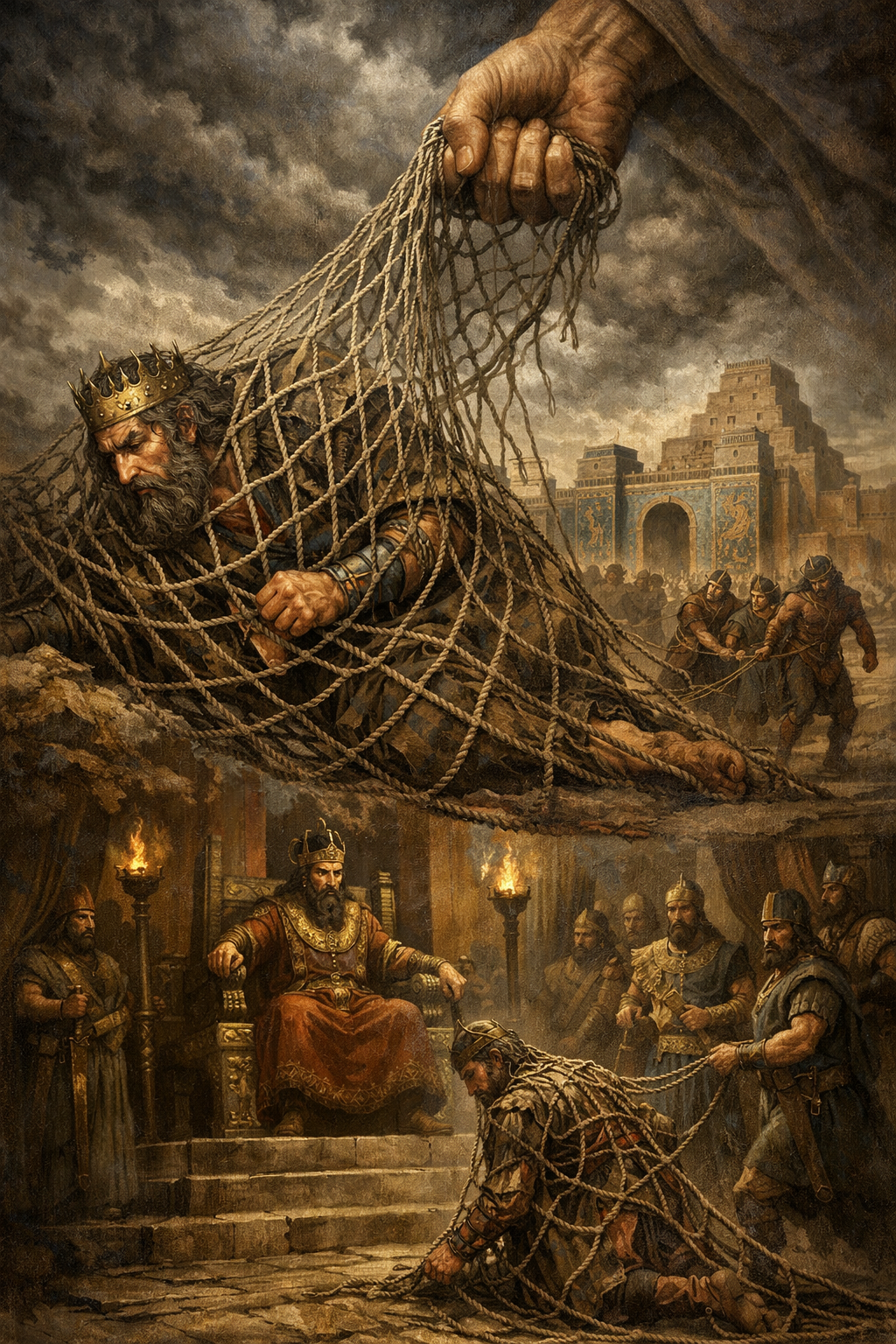
THE CERTAINTY OF ZEDEKIAH'S
CAPTURE AND JUDGMENT
I will spread My net (resheth) over him, and he will be caught in My snare (mesudah) - This description depicts God as the One actively pursuing and trapping King Zedekiah. Though the Babylonians would physically capture Zedekiah, the language makes clear that it is ultimately God Himself Who ensures the outcome. Escape is not possible! The king’s attempted escape will fail because he cannot evade divine judgment (cf. Ezek 12:13).
Then I will bring him to Babylon - God's third "I will" in this verse indicates that Zedekiah's fate is not random but directed by God’s sovereign hand. Babylon, the very power he rebelled against, becomes the appointed place of reckoning.
And enter into judgment (shaphat) with him there - This depicts a formal, personal confrontation with God’s justice. Zedekiah will not merely suffer political defeat but he will face divine judgment for his actions.
Bob Utley - This is mentioned earlier in Ezek. 12:13 and is documented in 2 Kgs. 25:7; Jer. 39:7; 52:11.
John Mackay - The language was that of a courtroom, though there was little doubt about the verdict which would be issued. (Ezekiel Commentary)
Regarding the unfaithful (maal) act which he has committed against Me - The heart of the issue is Zedekiah's rebellion against Babylon which was in essence unfaithfulness against God, because he broke the covenant oath sworn in the LORD's Name. Yes, Zedekiah sinned against Nebuchadnezzar, but far worse, he sinned directly against Yahweh! Note that unfaithful carries the idea of treachery and betrayal, underscoring the seriousness of his sin. Note that what appearred to be human events, the capture, exile, political downfall, were all in reality the outworking of God’s righteous response to unfaithfulness.
🙏 THOUGHT - God sees covenant-breaking as a personal offense, and He Himself acts to bring the offender to account. Let me just throw out a thought for your consideration. How might this be applied to divorce, given that marriage involves entering into a covenant made before God? (See Covenant of Marriage) I realize this can be a painful topic and I will not give any answer to my question, but allow you to ponder it yourself.
I will say that about 10 years after I was born again, our marriage was in serious trouble and I was definitely considering termination. Try as I might (and that is probably the problem -- it was "I TRYING!"), I could not get my wife to reconcile. Then one day in God's providence, our church offered a Precept course entitled Marriage Without Regrets, and it was offered during the day (my wife attended that one) and also at night (I attended that one - which shows how far apart we were!). Long story short, withing 3 lessons of this study, the Spirit of God worked supernaturally on both of our hearts and literally resurrected our dead marriage. Now we are about 30 years past that incredible move of the Spirit and are still happily married for 57 years and 8 grandchildren later.
Ezekiel 17:21 “All the choice men in all his troops will fall by the sword, and the survivors will be scattered to every wind; and you will know that I, the LORD, have spoken.”
NET All the choice men among his troops will die by the sword and the survivors will be scattered to every wind. Then you will know that I, the LORD, have spoken!
NLT And all his best warriors will be killed in battle, and those who survive will be scattered to the four winds. Then you will know that I, the LORD, have spoken.
- All the choice men: Eze 5:12 12:14 2Ki 25:5,11 Jer 48:44 52:8 Am 9:1,9,10
- you will know that I, the LORD, have spoken: Eze 6:7,10 13:14,23 15:7 Isa 26:11
Related Passages:
Ezekiel 6:7 “The slain will fall among you, and you will know that I am the LORD.
Ezekiel 12:25 “For I the LORD will speak, and whatever word I speak will be performed. It will no longer be delayed, for in your days, O rebellious house, I will speak the word and perform it,” declares the Lord GOD.’”
FULL EXTENT OF JUDGMENT
ON ZEDEKIAH & JUDAH
All the choice men in all his troops will fall by the sword Sword (chereb) - This passage shows the "ripple effect" of Zedekiah's unfaithfulness to keep covenant. Judah’s military strength will be destroyed. The choice men are the elite soldiers, the best and most capable warriors, yet even they would not survive. Clearly human strength, skill, and valor are powerless when set against God’s determined judgment (2Ki 25:1–7).
Zedekiah's effect on his troops reminds me of Jesus' words in Mt 15:14 (which is interesting because Zedekiah was blinded)
“Let them alone; they are blind guides of the blind. And if a blind man guides a blind man, both will fall into a pit.”
🙏 THOUGHT - To all spiritual leaders. Your leading will have significant repercussions, either for good or for bad, depending on whether you are leading with the Spirit energized Word of truth or with the words of men (or even worse with words of conscious deception).
And the survivors (sha'ar/sa'ar) will be scattered to every wind ("every direction") - This describes the dispersion of those who remain. Rather than regathering or stabilizing, they will be driven in every direction, a picture of exile and disintegration. What began as a localized rebellion ends in national unraveling. This scattering fulfills earlier covenant warnings that disobedience would result in being dispersed among the nations...
“Moreover, the LORD will scatter you among all peoples, from one end of the earth to the other end of the earth; and there you shall serve other gods, wood and stone, which you or your fathers have not known. (Dt 28:64).
And you will know (yada; LXX - epiginosko - know exactly, completely) that I, the LORD, have spoken - YOU here is plural but not specified, and presumably this refers to the Jews in exile. This is a recurring declaration (SEE NOTE BELOW) in Ezekiel that reveals the ultimate purpose behind God’s actions, whether in judgment or restoration. It emphasizes that what God says is not mere warning or suggestion, but His sovereign Word that is ALWAYS fulfilled! Zedekiah and Judah had heard His Word through Jeremiah and other prophets but they refused to believe them or act upon them. Now they would come to know by experience that His Word was true, but it would be knowledge obtained too late!(cf. Ezek 6:7; Ezek 12:25).
YOU WILL KNOW - 30X/30V IN EZEKIEL - Ezek. 6:7; Ezek. 6:13; Ezek. 7:4; Ezek. 7:9; Ezek. 11:12; Ezek. 12:20; Ezek. 13:14; Ezek. 13:21; Ezek. 13:23; Ezek. 14:8; Ezek. 14:23; Ezek. 15:7; Ezek. 17:21; Ezek. 20:38; Ezek. 20:42; Ezek. 20:44; Ezek. 22:16; Ezek. 22:22; Ezek. 23:49; Ezek. 24:24; Ezek. 25:5; Ezek. 25:7; Ezek. 35:4; Ezek. 35:9; Ezek. 35:12; Ezek. 36:11; Ezek. 36:36; Ezek. 37:6; Ezek. 37:13; Ezek. 37:14;
The word “know” here signifies more than awareness but points to experiential recognition. When the Babylonian "hammer falls" Zedekiah and Judah will come to an undeniable realization that Yahweh is the sovereign LORD whose word never fails (and they should have heeded His Word). What they refused to believer would soon be confirmed by painful reality.
This verse brings the prophecy to its theological climax by revealing God’s ultimate purpose in the coming judgment. Zedekiah and the people of Judah had heard God’s word again and again through Ezekiel and the other prophets (2Ch 36:15), but they had dismissed it, trusting instead in political alliances and human strength. When the judgment unfolds exactly as God declared—when the army is destroyed and the survivors are scattered—the people will no longer be able to deny the truth of His word.
Judah's rejection of God's Word reminds me of another day when the Jews reject the Word of their Messiah...
Luke 19:41-44 (JESUS PREDICTS FALL OF JERUSALEM IN 70 AD) When He approached Jerusalem, He saw the city and wept over it, 42 saying, “If you had known in this day, even you, the things which make for peace! But now they have been hidden from your eyes. 43 “For the days will come upon you when your enemies will throw up a barricade against you, and surround you and hem you in on every side, 44 and they will level you to the ground and your children within you, and they will not leave in you one stone upon another, (WHY?) because you did not recognize the time of your visitation.” (THEY COULD HAVE KNOWN IF THEY HAD BELIEVED Daniel 9:24-25)
This declaration also serves as a vindication of God’s prophets. Ezekiel’s message, which may have seemed unlikely or unwelcome, will be proven true in every detail. At the same time, it exposes the futility of ignoring divine revelation. Human plans collapse, but God’s Word stands (Pr 30:5).
The verse also teaches that God’s ultimate aim is to make Himself known. Even in judgment, He is revealing His authority, faithfulness, and truth. In the end, every person will come to know that He has spoken—either by trusting His word beforehand or by experiencing its fulfillment afterward. This reminds me of Jesus' words...
“This is eternal life, that they may know You, the only true God, and Jesus Christ Whom You have sent. (John 17:3)
Robert Hughes - The parable of the “cedar” (Ezek 17:22–24), representative of the house of David, is a messianic prophecy regarding the preservation of David’s dynasty (2Sa 7:12–16) in spite of the judgment on Jehoiachin and Zedekiah. The “shoot” (Ezek. 17:22) referred to the Messiah (cf. Isa. 11:1; Jer. 23:5), and the “high and lofty mountain” (Ezek. 17:22) was Zion (cf. 20:40). (See Tyndale Concise Bible Commentary - Page 301)
Gary Manning - Ezek. 17:22–24 was the subject of some messianic speculation in the Second Temple era. The LXX subtly increases the messianic emphasis of the passage by its use of masculine pronouns for the cedar. The Hebrew text naturally uses masculine pronouns and adjectives to refer to the cedar, since ארז (cedar) is masculine. However, the Greek κέδρος is feminine. The LXX appropriately uses a feminine adjective (μεγάλη) to modify the cedar, but then uses masculine pronouns to personify the cedar. ‘I will plant … and I will hang him (αὐτὸν) … every beast will rest under him (αὐτοῦ), and every bird will rest under his (αὐτοῦ) shade … his (αὐτοῦ) branches will be restored’ (Ezek. 17:22–23). The last three pronouns could be masculine or neuter, but neuter would be even less likely than masculine. There is no neuter antecedent, and the first pronoun is clearly masculine. The translator consistently uses feminine pronouns, participles, and adjectives to refer to the vine (ἡ ἄμπελος) in Ezek. 17:6–10, so the alteration to masculine here seems to intentionally refer to the person represented by the cedar.
The Targum to Ezekiel also treats the cedar as a king from the line of David, although it does not use the word ‘Messiah.’
‘I Myself will bring near a child from the kingdom of the house of David which is likened to the lofty cedar, and I will establish him from among his children’s children; I will anoint and establish him by my Memra on a high and exalted mountain. On the holy mountain of Israel will I establish him, and he shall gather together armies and build fortresses and become a mighty king; and all his righteous shall rely upon him, and all the humble shall dwell in the shade of his kingdom.’ (Targ. Ezek. 17:22–23)
Levey contends that the lack of ‘Messiah’ in this passage (and throughout the Targum to Ezekiel) makes the Ezekiel Targum non-messianic in contrast to other targumim. He suggests that this Targum was written during the time of Johanan ben Zakkai, when explicit messianic teaching could incur the Roman death penalty. However, despite the lack of the word ‘messiah,’ the Targum preserves a messianic interpretation by the use of targumic messianic language such as ‘house of David.’
It is clear that Ezek. 17:22–24 referred to a messianic figure (a coming Davidic king) when it was written, and was so interpreted by some authors of the Second Temple era. The messianic conclusion to Ezekiel’s vine parable may have provided the primary motivation for John to apply the image to Jesus. If so, then part of the implication of Jesus as the ‘true vine’ is that he is faithful to God, unlike the unfaithful vine, Zedekiah. Like other unfaithful kings, Zedekiah broke his oath and his covenant with God (Ezek. 17:13–19). In contrast, Jesus will be completely faithful to his father. There may be a hint of polemic against the current faithless rulers of Israel here as well. (See Echoes of a Prophet: The Use of Ezekiel in the Gospel of John - Page 144)
Ezekiel 17:22 Thus says the Lord GOD, “I will also take a sprig from the lofty top of the cedar and set it out; I will pluck from the topmost of its young twigs a tender one and I will plant it on a high and lofty mountain.
KJV Thus saith the Lord GOD; I will also take of the highest branch of the high cedar, and will set it; I will crop off from the top of his young twigs a tender one, and will plant it upon an high mountain and eminent:
NET "'This is what the sovereign LORD says: "'I will take a sprig from the lofty top of the cedar and plant it. I will pluck from the top one of its tender twigs; I myself will plant it on a high and lofty mountain.
NLT "This is what the Sovereign LORD says: I will take a branch from the top of a tall cedar, and I will plant it on the top of Israel's highest mountain.
ESV Thus says the Lord GOD: "I myself will take a sprig from the lofty top of the cedar and will set it out. I will break off from the topmost of its young twigs a tender one, and I myself will plant it on a high and lofty mountain.
NIV " 'This is what the Sovereign LORD says: I myself will take a shoot from the very top of a cedar and plant it; I will break off a tender sprig from its topmost shoots and plant it on a high and lofty mountain.
YLT Thus said the Lord Jehovah: I have taken of the foliage of the high cedar, And I have set it, From the top of its tender shoots a tender one I crop, And I -- I have planted it on a mountain high and lofty.
- I will also take a sprig from the lofty top: Eze 34:29 Ps 80:15 Isa 4:2 11:1-5 Jer 23:5,6 33:15,16 Zec 3:8 Zec 4:12-14 6:12,13
- a tender: Isa 53:2
- I will plant it on a high and lofty mountain Eze 20:40 40:2 Ps 2:6 Ps 72:16 Isa 2:2-3 Da 2:35,44,45 Mic 4:1
Isaiah 11:1 Then a Shoot (MESSIAH) will spring from the stem of Jesse, And a Branch (MESSIAH) from his roots will bear fruit.
Isaiah 53:2 For He (MESSIAH) grew up before Him like a Tender Shoot, And like a root out of parched ground; He has no stately form or majesty That we should look upon Him, Nor appearance that we should be attracted to Him.
Zechariah 3:8 ‘Now listen, Joshua the high priest, you and your friends who are sitting in front of you–indeed they are men who are a symbol, for behold, I am going to bring in My Servant the Branch (MESSIAH).
Zechariah 6:12-13 “Then say to him, ‘Thus says the LORD of hosts, “Behold, a man whose name is Branch (MESSIAH), for He will branch out from where He is; and He (MESSIAH) will build the temple of the LORD. 13 “Yes, it is He who will build the temple of the LORD, and He who will bear the honor and sit and rule on His throne. Thus, He (MESSIAH) will be a priest on His throne, and the counsel of peace will be between the two offices.”’
Psalm 2:6 “But as for Me, I have installed My King (MESSIAH) Upon Zion, My holy mountain.”
Isaiah 2:2-3 Now it will come about that In the last days The mountain of the house of the LORD (MOUNT ZION IN JERUSALEM) Will be established as the chief of the mountains, And will be raised above the hills; And all the nations will stream to it. 3 And many peoples will come and say, “Come, let us go up to the mountain of the LORD, To the house of the God of Jacob; That He (MESSIAH) may teach us concerning His ways And that we may walk in His paths.” For the law will go forth from Zion And the word of the LORD from Jerusalem.
Micah 4:1 And it will come about in the last days That the mountain of the house of the LORD (MOUNT ZION IN JERUSALEM) Will be established as the chief of the mountains. It will be raised above the hills, And the peoples will stream to it.
Psalms 48:1-2 A Song; a Psalm of the sons of Korah. Great is the LORD, and greatly to be praised, In the city of our God, His holy mountain. 2 Beautiful in elevation, the joy of the whole earth, Is Mount Zion in the far north, The city of the great King.
Daniel 2:35 “Then the iron, the clay, the bronze, the silver and the gold were crushed all at the same time and became like chaff from the summer threshing floors; and the wind carried them away so that not a trace of them was found. But the Stone (MESSIAH) that struck the statue became a great mountain and filled the whole earth. (MESSIANIC KINGDOM)
Daniel 2:44-45 “In the days of those kings the God of heaven will set up a kingdom which will never be destroyed, and that kingdom will not be left for another people; it will crush and put an end to all these kingdoms, but it will itself endure forever. 45 “Inasmuch as you saw that a Stone (MESSIAH) was cut out of the mountain without hands and that it (MESSIAH) crushed the iron, the bronze, the clay, the silver and the gold (Rev 19:11-21), the great God has made known to the king (NEBUCHADNEZZAR) what will take place in the future; so the dream is true and its interpretation is trustworthy.”
Jeremiah 23:5 “Behold, the days are coming,” declares the LORD, “When I will raise up for David a righteous Branch (MESSIAH) ; And He will reign as king and act wisely And do justice and righteousness in the land.
1 Chronicles 3:17-19 The sons of Jeconiah (THE LAST KING IN DAVIDIC LINE), the prisoner, were Shealtiel his son (NO RECORD HE RETURNED TO JUDAH AFTER EXILE), 18 and Malchiram, Pedaiah, Shenazzar, Jekamiah, Hoshama and Nedabiah. 19 The sons of Pedaiah were Zerubbabel (SON OF SHEALTIEL) and Shimei. And the sons of Zerubbabel were Meshullam and Hananiah, and Shelomith was their sister;
Matthew 1:11 Josiah became the father of Jeconiah and his brothers, at the time of the deportation to Babylon. 12 After the deportation to Babylon: Jeconiah became the father of Shealtiel, and Shealtiel the father of Zerubbabel. 13 Zerubbabel was the father of Abihud, Abihud the father of Eliakim, and Eliakim the father of Azor. 14Azor was the father of Zadok, Zadok the father of Achim, and Achim the father of Eliud. 15 Eliud was the father of Eleazar, Eleazar the father of Matthan, and Matthan the father of Jacob. 16 Jacob was the father of Joseph the husband of Mary, by whom Jesus was born, who is called the Messiah.

THE LORD'S SOVEREIGN PLANTING
THE MESSIANIC HOPE
Keep the context in mind. Ezekiel 17:1-21 has been in effect describing the termination of the royal monarchy in Israel. There will be no more kings either in exile or post-exile. But this was not Yahweh's last word! In Ezekiel 17:22-24, "after all human instrumentality has accomplised the purpose of God, He intervenes directly" (Charles Feinberg) and presents to the downcast Jews in exile the truth that one day they will again have a Davidic King, the Messiah. In other words, this section shows that Yahweh is a "Promise Keeping God" and has not abandoned His covenant promises made to King David (2Sa 7:12-16). Yes, the prophet Hosea had warned "For the sons of Israel will remain for many days without king or prince, without sacrifice or sacred pillar and without ephod or household idols." (Hosea 3:4) Bu in this last pericope Yahweh promises a new day is coming for Israel. There is an interesting parallel for even as Nebuchadnezzar had raised up Zedekiah the last king for Israel, Yahweh will raise up the very last King for Israel.
As John Mackay says Ezekiel records "a glimpse of the light ahead...amid the gloom of surrounding chapters so that the community will not become utterly dejected by the turn of events when their misplaced expectations are not realised." (Ezekiel Commentary)
Thus says the Lord GOD, “I will also take a sprig from the lofty top of the cedar and set it out I will pluck from the topmost of its young twigs a tender one and I will plant it on a high and lofty mountain - First, notice that in Ezek 17:22-24 Yahweh takes center stage revealing a new and glorious future for Israel. Thus after exposing the failure and judgment of Judah’s kings, especially Zedekiah, God Himself intervenes ("I will also take") to accomplish what human rulers could not. (See Table and discussion on Who is the Tender Twig?)
A special shoot that will appear to provide
a fresh new beginning. This is the Messiah...
Daniel E Woodhead Verse 22 reads (literally), “I will take from the high top of a cedar,” without actually identifying what God will take. But God adds the adjective “high,” together with the more “from,” points to an individual more prominent than any of the Jewish kings. By continuing to use the imagery of the “cedar” the Lord is saying that the new planting (community/nation) would be close in some fashion of the old. The verb translated “break off” (qāṭap)(ED: "PLUCK") says that a special shoot that will appear to provide a fresh new beginning. This is the Messiah as expressed by God through Isaiah (Isaiah 53:1-3) and cutoff as explained by God to Daniel (Da 9:26a).
The lofty top of the cedar represents the royal line of King David (cf Davidic Covenant - 2Sa 7:12–16), which had been cut down and humiliated through exile and judgment of Jeconiah, the last king in the Davidic Line, and whose lineage was "cursed" (see explanation of how this curse does not prevent Messiah from reigning as King - Jer 22:30). Yet God declares that He will personally “take a sprig” from its topmost shoots, a tender one, indicating something small, fragile, and seemingly insignificant, and plant it in a place of exaltation (on a high and lofty mountain - Isa 2:2-3, Mic 4:1).
Most interpreters agree that this prophecy
is in some sense messianic.
--John Mackay
Charles Ryrie on a tender one (a sprig) - Messiah (cf. Isa. 11:1; Jer. 23:5; 33:15; Zech. 3:8; 6:12).
John Mackay on twig - This term was not itself used messianically elsewhere, but similar language had already been employed by other prophets to refer to the Messiah: a ‘shoot’ (ḥōṭer) and ‘branch’ (nēzer) in Isa. 11:1, and ‘branch’ (ṣemaḥ) in Jer. 23:5; 33:15. He was not presented as a dominant potentate like those of eastern empires, but as a humble, unassuming individual, divinely designated and endowed (cf. Isa. 53:2), who would acknowledge his subordination to the LORD, as Israel’s king ought always to have done (Dt 17:19). While the current Davidic dynasty would terminate because of its gross failures, the LORD would go back to its source to make a new start, which would lead to the growth of a ‘splendid cedar’ (Ezek 17:23), not a lowly vine such as Zedekiah had been depicted to be (Ezek 17:6). (Ezekiel Commentary)
Warren Wiersbe - After Babylon was conquered by the Medes and Persians, Cyrus allowed the Jews to return to their land, and one of their leaders was Zerubbabel, a greatgreat-grandson of godly King Josiah (1Ch 3:17-19) and an ancestor of the Lord Jesus Christ (Matt. 1:11-16; Luke 3:27). Once again, a godly remnant stayed true to the Lord, and the promised Messiah was born. The name “Zerubbabel” means “shoot of Babylon,” but he helped to make possible the birth of the “shoot of David,” Jesus Christ, the Savior of the world.
This description tender one points prophetically to the Messiah, the ultimate Son of David, Who would arise not in visible power at first, but in humility (Isaiah 11:1; Isa 53:2). The imagery of planting it on a high and lofty mountain signifies divine authority, security, and universal prominence, ultimately fulfilled in the kingdom of Christ, the Messianic Kingdom (Isa 2:2-3; Da 2:35). Unlike the failed kings of Judah who repeatedly broke the Mosaic covenant, this “tender twig” will grow into a majestic tree under God’s sovereign care, bringing blessing and shelter to the nations (Ezekiel 17:23). This verse reveals that God’s purposes are never thwarted by human unfaithfulness and that He will preserve the Davidic line and fulfill His covenant promises of a Righteous King by His own initiative and omnipotence.
Daniel E Woodhead - Whereas the “great eagle” would transplant Israel and their king to the “city of traders” in the “land of merchants” the Lord God Himself would provide a new Davidic king and transplant Israel again to a place of protection and prominence on “the mountain heights of Israel.” During the Messianic Kingdom Jerusalem will be on the highest mountain of the world (Isaiah 2:2-4; 27:13; 56:6-8; 66:20; Micah 4:1-2; Ezekiel 17:22-24; 20:40-41; 40:1-4; 45:1-8; 48:8-20). God provided in the Psalms that His covenant with David would never be void or annulled. Psalm 89:3-4 “I have made a covenant with My chosen; I have sworn to David My servant, 4I will establish your seed forever And build up your throne to all generations.” Selah.
John MacArthur - Ezek 17:22, 23 a sprig from the lofty top. This is messianic prophecy stating that God will provide the Messiah from the royal line of David ("the cedar") and establish Him in His kingdom (like a "mountain," cf. Da 2:35, 44, 45). He will be "a sprig" reigning in the height of success. "Sprig," or "branch," is a name for Messiah (cf. 34:23, 24; 37:24, 25; Isa 4:2; Jer 23:5; 33:15; Zec 3:8; 6:12). Messiah will be "a tender one" (v. 22) growing into a "stately cedar" (v. 23). Under His kingdom rule, all nations will be blessed and Israel restored.
Henry Morris agrees that "This prophecy looks to the distant future and Messiah. The branch is a frequent representation of the coming Savior/King (Isa 11:1; Jer 23:5; Zech 3:8).
Believer's Study Bible also agree with this futuristic interpretation writing that "God promised to plant a "cedar" where it will grow and prosper. The "tender" young twig refers to the Messiah, a member of the Davidic line. References to the Messiah as a "tender plant" and righteous "Branch" are common among the prophets (cf. Isa. 11:1-5; Isa 53:2; Jer. 23:5-8; Zech. 3:8-10; Zech 6:12-13)."
Matthew Henry - The parable of a tree, used in the threatening, is here presented in the promise. It appears only applicable to Jesus, the Son of David, the Messiah of God.
Reformation Study Bible - The Bible often uses a branch or tree as a symbol of royalty (Dan. 4:9-12, 19-22), particularly as a figure of the Messiah. The messianic Branch belongs to the house of David (Isa. 4:2; 11:1; 53:2; 60:21; Jer. 23:5; 33:15; Zech. 6:12). Ezekiel announces that someday God would take a descendant of Jehoiachin (cf. vv. 3, 4 and 12, 13) and restore him to kingship in Judah.
Jamieson-Fausset-Brown Bible Commentary - All the empires of the world, represented by Babylon, once flourishing ("green"), shall be brought low before the once depressed ("dry"), but then exalted, kingdom of Messiah and His people, the head of whom shall be Israel (Da 2:44).
Carl F. Keil elaborates - The cedar,... as rising above the other trees, is the royal house of David, and the tender shoot which Jehovah breaks off and plants is not the Messianic kingdom or sovereignty,... but the Messiah Himself.... The high mountain, described in ver. 23 as the high mountain of Israel, is Zion, regarded as the seat and centre of the kingdom of God, which is to be exalted by the Messiah above all the mountains of the earth (Isa. 2:2, etc.). The twig planted by the Lord will grow there into a glorious cedar, under which all the birds will dwell. The Messiah grows into a cedar in the kingdom founded by Him, in which all the inhabitants of the earth will find both food (from the fruits of the tree) and protection (under its shadow).
Warren Wiersbe - The ‘high mountain’ Ezekiel wrote about is probably Mount Zion, where Messiah will reign over His people.”...Never stop praying, “Thy kingdom come,” for that prayer will be answered It was a dark day for the people of Israel, but when the day is the darkest, the Lord’s promises shine the brightest. God’s people today need to take heed to this prophetic Word, which is a light that shines in our dark world (2 Peter 1:19). Just as Jesus fulfilled prophecy and came the first time to die for the sins of the world, so He will the second time and reign over His righteous kingdom. The tender “shoot” of David will be the mighty monarch, the King of Kings and Lord of Lords!. The fulfillment of God’s kingdom promises to David (2 Sam. 7) is in Jesus Christ (Luke 1:26-55, 67-80), and He shall not fail.
Let's look at the parallels of Ezek 17:22-23 with the preceding riddle/parable in Ezek 17:3-4 to help discern the identity of the tender twig in Ezek 17:22, a section which is also somewhat "parabolic!"
Ezek 17:3-4 "Took away the top (KING JECONIAH, LAST KING IN DAVIDIC LINE) of the cedar...He (NEBUCHADNEZZAR) plucked off the topmost of its young twigs and brought it to a land of merchants (BABYLON)."
Ezek 17:22-23 “I will also take a sprig from the lofty top of the cedar and set it out; I will pluck from the topmost of its young twigs a tender one and I will plant it on a high and lofty mountain. On the high mountain of Israel I will plant it, that it may bring forth boughs and bear fruit and become a stately cedar. And birds of every kind will nest under it (see Mk 4:32); they will nest in the shade of its branches.
WHO IS THE TENDER TWIG
IN EZEKIEL 17:22?Who takes away?
Nebuchadnezzar
Yahweh
Where taken from?
Top of cedar
Lofty top of cedar
How removed?
Plucked
Pluck
What was plucked?
Topmost young twig
Topmost young twig, tender
How disposed?
Brought to land of
merchantsPlanted on a high and lofty
mountain...high mountain of IsraelWhere disposed?
Babylon
Israel
In summary, you can see there are clear parallels between these two descriptions of the last earthly king of Israel and what I interpret to be the last King of Israel. Note the contrast between who initiates the action, one merely a man, the other the LORD Himself. If the first twig plucked is Jeconiah, who was the last living king in the line of David, it is not a stretch to interpret the second twig as the Messiah, the last King in the line of David. The interpretation that this twig is the Messiah is supported by other clearly messianic passages:
Isaiah 53:2 supports this interepretation for it describes Messiah as "tender" recording that "He grew up before Him like a tender shoot, And like a root out of parched ground; He has no stately form or majesty That we should look upon Him, Nor appearance that we should be attracted to Him." This messianic interpretation is also supported by the fact that the second twig is planted in Israel on "the high mountain" which is almost certainly a description of Mount Zion.
The psalmist quotes Yahweh Who says "I have installed My King Upon Zion, My holy mountain.” (Ps 2:6). This planted twig grows, bears fruit and becomes a stately cedar. The birds represent the nations who will nest in the shade of the grown cedar, the reigning Messiah.
Isaiah 2:2-4 says "Now it will come about that In the last days The mountain of the house of the LORD Will be established as the chief of the mountains, And will be raised above the hills; And all the nations will stream to it. 3 And many peoples will come and say, “Come, let us go up to the mountain of the LORD, To the house of the God of Jacob; That He may teach us concerning His ways And that we may walk in His paths.” For the law will go forth from Zion And the word of the LORD from Jerusalem. 4 And He will judge between the nations, And will render decisions for many peoples; And they will hammer their swords into plowshares and their spears into pruning hooks. Nation will not lift up sword against nation, And never again will they learn war.
Mark 4:32 yet when it is sown, it grows up and becomes larger than all the garden plants and forms large branches; so that THE BIRDS OF THE AIR can NEST UNDER ITS SHADE.”
See also the Messianic cross references above.
Herbert Lockyer - All the Parables of the Bible (refresh page to show text) - The fourth king is the One of divine choice whose kingdom is yet future, who is to be a descendant of the kings of Judah. This King is to be greater than the greatest of all previous kings. Under the figure of “a young and tender twig” planted “in the mountain of Israel,” and growing into “a goodly cedar,” the establishment of Christ’s Kingdom is foretold (Isaiah 11:1–12). This glorious Kingdom will never be subverted but will be an everlasting monument of truth and power. Divine government is to be established over all nations and operate through all their operations. The concluding promise of the parable is that from the line of David, “the high cedar,” the Divine Ruler will come and when He does, He will dwarf all other powers, “the trees of the field,” and under his reign all men will be safe with their needs supplied (Luke 1:67–75).
Jewish interpretations -
- Rashi (11th century) "The famous commentator Rashi (Rabbi Shlomo Yitzchaki) on Ezekiel 17:22 notes that this passage contains a promise of the restoration of Israel, hinting at future redemption and the messianic age."
- The Jewish Study Bible says "God employs the allegory of the cedar to promise the restoration of the Davidic monarchy (Isa. 11.1—10; Jer. 23.5-6; 33-15). The cedar, the grandest of trees, will tower over all the other trees (nations), and all will see the power of God, Who is responsible for the fall and rise of Judah. Radak maintains that these statements refer to Zerubbabel son of Shealtiel, the grandson of King Jehoiachin whom Haggai declared to be God’s “signet ring” or regent (Hag. 2.20-23; see 1Ch 3-17-19, but note the problems in the genealogy), and who commenced the building of the Second Temple (Ezra 3). (NOTE: THEY MAKE NO ALLUSION TO THE MESSIAH!)
- Targum (Aramaic Paraphrase): Explicitly Messianic - The Targum Jonathan often makes implicit meanings explicit—and here it leans clearly messianic. It paraphrases the passage in a way that directly associates the figure with the Messiah, not merely a general restoration. In the Talmud (Sanhedrin 98b), the mention of the "branch" that will sprout from the high tree is linked to messianic expectations, specifically regarding the lineage of David.
- Midrash Ezekiel Rabbah (Ezekiel 17:22) discusses the planting of the cedar and interprets it as a metaphor for the Messiah, signifying God's promise to restore the Davidic kingdom. The Midrash often emphasizes the role of the Messiah in bringing about the redemption of Israel.
Ezekiel 17:23 On the high mountain of Israel I will plant it, that it may bring forth boughs and bear fruit and become a stately cedar. And birds of every kind will nest under it; they will nest in the shade of its branches.
- and it: Ps 92:12,13 Isa 27:6 Joh 12:24 15:5-8
- under: Eze 31:6 Ge 49:10 Ps 22:27-30 72:8-11 Isa 2:2 11:6-10 49:18 Isa 60:4-12 Da 4:10-14,21-23 Ho 14:7 Mt 13:32,47,48 Lu 14:21-23 Ac 10:11,12 Ga 3:28 Col 3:11 Rev 11:15
Related Passages:
Daniel 4:20-22 (DANIEL SPEAKING TO KING NEBUCHADNEZZAR EXPLAINING HIS DREAM) ‘The tree that you saw, which became large and grew strong, whose height reached to the sky and was visible to all the earth 21 and whose foliage was beautiful and its fruit abundant, and in which was food for all, under which the beasts of the field dwelt and in whose branches the birds of the sky lodged– 22 it is you, O king; for you have become great and grown strong, and your majesty has become great and reached to the sky and your dominion to the end of the earth.
PLANTED BY GOD
FLOURISHING FOR ALL NATIONS
This continues the promise of Ezekiel 17:23 and expands the outcome of God’s planting of the “tender twig.”
On the high mountain of Israel - points to Zion, the place of God’s rule and presence in the holy city of Jerusalem. This is where one of the "young twigs (which was plucked), a tender one" shall be planted. Now comparing the parallel passages in Ezek 17:1-4, we had one twig plucked and placed in Babylon and that is identified as King Jeconiah, the last fully human king in the line of David. Now if we look at the young twig which is also a tender twig, in context (see what happens to this twig in Ezek 17:23) this is almost certainly a prophecy of the last king in the line of David, the Messiah. (See Table and discussion on Who is the Tender Twig?)
John Mackay - there was no doubt that it was Zion, ‘my holy mountain’ (Ps. 2:6; cf. Ps. 132:13) (Ezekiel Commentary)
I will plant it (THE TENDER TWIG), that it may bring forth boughs and bear fruit and become a stately cedar - What begins as a small, fragile shoot now “brings forth boughs,” “bears fruit,” and becomes a “stately cedar,” portraying remarkable growth, stability, and enduring majesty. This is an wonderful description of the Messiah’s kingdom: what appears insignificant at its beginning, like Christ’s humble first coming, will ultimately expand into a fruitful, and unshakable reign (Da 2:35).
John Mackay - It will bear branches and produce fruit. However, the mention of ‘fruit’ indicated the metaphorical nature of the language. In reality cedar trees do not produce edible fruit, but fruitfulness was characteristic of the underlying messianic referent. The messianic reign would be noted for peace, justice and righteousness (Isa. 9:7; 11:3–5). In this way God would provide what was humanly impossible. (Ezekiel Commentary)
Taylor - After the failure of the two great eagles to make a success of establishing the state of Israel under their extensive and powerful patronage, God says, I myself (emphatic) will plant it upon a high mountain where it will grow and be conspicuous and attract the birds of the air to shelter under its protection.
David Guzik - This is Ezekiel’s version of the great prophecy of Isaiah 11:1: There shall come forth a Rod from the stem of Jesse, and a Branch shall grow out of his roots. Out of what was thought to be dead, God promised to bring forth wonderful and productive growth.
Messiah's kingdom will flourish beyond anything seen before,
becoming a place of life, fruitfulness, and shelter for the world.
And birds of every kind will nest under it; they will nest in the shade of its branches - In the Old Testament, birds often symbolize the nations (cf. Ezekiel 31:6; Daniel 4:12), so this seems to picture Gentiles from every people finding refuge, provision, and security under the rule of the Messiah (CF Isa 11:3 And many peoples will come and say, “Come, let us go up to the mountain of the LORD...4 And He will judge between the nations"). This anticipates the global scope of Christ’s kingdom, where salvation extends beyond Israel to all nations (Isaiah 49:6, “I will also make You a light of the nations so that My salvation may reach to the end of the earth”). Jesus Himself echoes this imagery in His parable of the mustard seed (Mt 13:31,32), where a small beginning grows into a tree large enough for birds to nest in its branches, again emphasizing unexpected growth and universal inclusion.
Matthew Poole - “All nations, the Gentiles as well as the Jews, shall build, breed, and multiply under the kingdom of Christ; it shall be no more confined to the Jews, but extend to the Gentiles also. There they shall find peace and safety; and this repeated confirms the certainty of the promise.”
Daniel E Woodhead - Enthroned on the highest mountain on earth which will be in Israel, God’s people will flourish beyond anything they experienced in the past and will provide shelter to “birds of every kind, all people of the world.” Furthermore, “all the trees of the field,” that is, all nations, will acknowledge what the Lord Jehovah has done in humbling the proud and in exalting and restoring the nation Israel and the Davidic line in the Messiah.
F B Meyer - All fowl of every wing.
The cedar is a royal tree. It thrives 6,000 feet above the level of the sea. The concentric rings of one tree showed that it was 3,500 years old. What a contrast between the long-lived, deep-rooted, broad-branched tree, and the little birds that nest among the leaves!
The text suggests that Christ is the cedar, and all kinds of people seek rest in Him, as birds of every wing. Young and old, rich and poor; men high-soaring as the eagle, fierce as the raven, gentle as the dove. The young, just learning to try their wings; the old, weary, and lonely; those who have kept all the commandments from their youth, and those who have broken them all.
It does not matter with what wing we come to Jesus, so long as we come. The practised eye can easily recognize the birds by their flight; each bird has its own wing; so every soul has its own disposition and temperament — one feverish, the other languid and lethargic; one impetuous, the other dilatory; one affectionate and warm, the other cool and shy. But the Lord Jesus knows our frame, and understands us afar off. He does not chide the dove because it cannot breast the storm and face the sun like the eagle. He does not expect the sustained flight of the seagull from the sparrow; or the song of the nightingale from the chaffinch.
Do not imitate another; be yourself. Do not go about the world counting that you are useless and a failure, because you cannot do what is done by others. Learn how to be abased, and how to abound. Only rest in Christ. Out of the windy storm and tempest, make for your roosting-place under the shelter of his wing.
Ezekiel 17:24 “All the trees of the field will know that I am the LORD; I bring down the high tree, exalt the low tree, dry up the green tree and make the dry tree flourish. I am the LORD; I have spoken, and I will perform it.”
- all the trees: Ps 96:11,12 Isa 55:12,13
- have brought: 1Sa 2:7,8 Job 5:11 40:12 Ps 75:6,7 89:38,45 Isa 2:13,14 9:6,7 Isa 11:1-9 26:5 Am 9:11 Lu 1:33,52,53 1Co 1:27,28
- I the Lord have spoken: Eze 12:25 22:14 24:14 Mt 24:35 Lu 21:33
YAHWEH'S CLIMATIC DECLARATION
AS SOVEREIGN RULER OVER ALL KINGDOMS
All the trees of the field will know that I am the LORD - God alone is the sovereign ruler over all kingdoms, and His dealings with nations and leaders are designed to make His identity unmistakably known. “All the trees of the field” represents the nations and their rulers (cf. Ezekiel 31:5–6; Daniel 4:10–12), and they will “know that I am the LORD”, not merely intellectually, but through undeniable acts of divine intervention in history (Psalm 46:10). (See 6 page article on TREE in the Dictionary of Biblical Imagery page 2990)
John Mackay - The trees represented the kings of the earth and, through them, the nations (the birds) they ruled over. Because of the LORD’s provision of the Messiah and the extension of his kingdom, they would come to acknowledge the status and sovereignty of the LORD as the one who determines the destiny of mankind. (Ezekiel Commentary)
The following series of contrasts reveals several reversals, emphasizing God's transformative power.
I bring down the high tree speaks of humbling the proud and powerful—like Judah’s kings and the surrounding nations who exalted themselves (cf. Luke 1:52).
Spurgeon - “Look over history, and you will see that everything gigantic in stature and colossal in dimensions, whatsoever has been great to human apprehension, grasping at earthly fame, has become an object for God’s penetrating arrows, and a subject for his withering blight.”
Exalt the low tree points to God’s grace toward the humble and seemingly insignificant—ultimately fulfilled in the Messiah, the “tender twig” who is lifted up to rule (Isaiah 53:2; Philippians 2:8–9).
Spurgeon - You remember Joseph in the dungeon, Israel in Egypt, Hannah in the family of Elkanah, David when Samuel would have passed him by, Hezekiah when Sennacherib rebuked him. Are not all these instances of God exalting the low tree?
Daniel Block - Yahweh remains sovereign over history. When his people experience calamity, his hand is in it. When foreign nations sweep down on them, they come as his agents. No nation has ever become so powerful that he cannot bring it down in a moment; and no people is so low that he cannot exalt it.” (See The Book of Ezekiel, Chapters 1–24 - Page 179)
Dry up the green tree and make the dry tree flourish emphasizes that human strength, vitality, and advantage mean nothing apart from God’s will; He can remove life from what appears thriving and bring abundant life from what seems dead and hopeless (1 Samuel 2:7–8; John 15:5).
I am the LORD; I have spoken, and I will perform it - The final statement seals the certainty of it all. This is a divine oath of fulfillment. Unlike Zedekiah, who broke his covenant, God never breaks His word. What He declares, He accomplishes (Isaiah 46:9–11).
In summary, this verse is a powerful reminder that God actively governs the rise and fall of all human power—He humbles the proud, lifts up the lowly, strips the self-sufficient, and brings life out of what appears dead—all so that the world will unmistakably know that He alone is the LORD, and when He speaks, His word is not merely a promise but an accomplished certainty.
Daniel E Woodhead - The concluding statement of the chapter affirms the certainty of the Lord’s promised restoration. This is a vast contrast between the vine of low nature and the godly cedar. The imagery is clear with God saying that he will bring down the Gentile nations of the world (Da 2:34,35) and restore the kingdom of Israel. Then and only then will all the nations and people of the world know the One Who makes such bold promises. He is able to fulfill the covenants He has made. The story of the two eagles began with judgment and punishment. It ended with mercy, grace and promise. God’s promises to redeem the earth through the Lord Jesus the Messiah provide the only hope this fallen world has. Personal faith in the Redeemer provides personal assurance of Heaven and participation in the Messianic Kingdom when it will be established at the Lord Jesus’ return to earth.
Bob Utley - YHWH describes His control of His creation in a series of plant imagery.
- I bring down the high tree
- I exalt the low tree (i.e. here)
- I dry up the green tree
- I make the dry tree flourish
Examples of #1,3 would be Egypt in Ezekiel 31 and Neo-Babylon in Daniel 4. An example of #2,4 would be the promises to restore Israel/Judah (Ezek. 16:60-63; 17:24). In the NT the mustard seed and resulting large bush become the symbol of a universal cosmic tree (cf. Matt. 13:31-32; Mark 4:30-32; Luke 13:18-19. Also note Dan. 4:12,21), which is the kingdom of our God and His Christ!
The final statement, "I am the Lord; I have spoken, and I will perform it," is a key theological statement (i.e. Isa. 55:9-11). Humans can depend on God's word, both His judgments and His promises! He is the creator and controller of all life! History/time are in His hands (cf. Ezek. 12:25,28; 22:14; Isa. 14:24; 55:11)!