Jeremiah 23:2
Jeremiah 23:3
Jeremiah 23:4
Jeremiah 23:5
Jeremiah 23:6
Jeremiah 23:7
Jeremiah 23:8
Jeremiah 23:9
Jeremiah 23:10
Jeremiah 23:11
Jeremiah 23:12
Jeremiah 23:13
Jeremiah 23:14
Jeremiah 23:15
Jeremiah 23:16
Jeremiah 23:17
Jeremiah 23:18
Jeremiah 23:19
Jeremiah 23:20
Jeremiah 23:21
Jeremiah 23:22
Jeremiah 23:23
Jeremiah 23:24
Jeremiah 23:25
Jeremiah 23:26
Jeremiah 23:27
Jeremiah 23:28
Jeremiah 23:29
Jeremiah 23:30
Jeremiah 23:31
Jeremiah 23:32
Jeremiah 23:33
Jeremiah 23:34
Jeremiah 23:35
Jeremiah 23:36
Jeremiah 23:37
Jeremiah 23:38
Jeremiah 23:39
Jeremiah 23:40
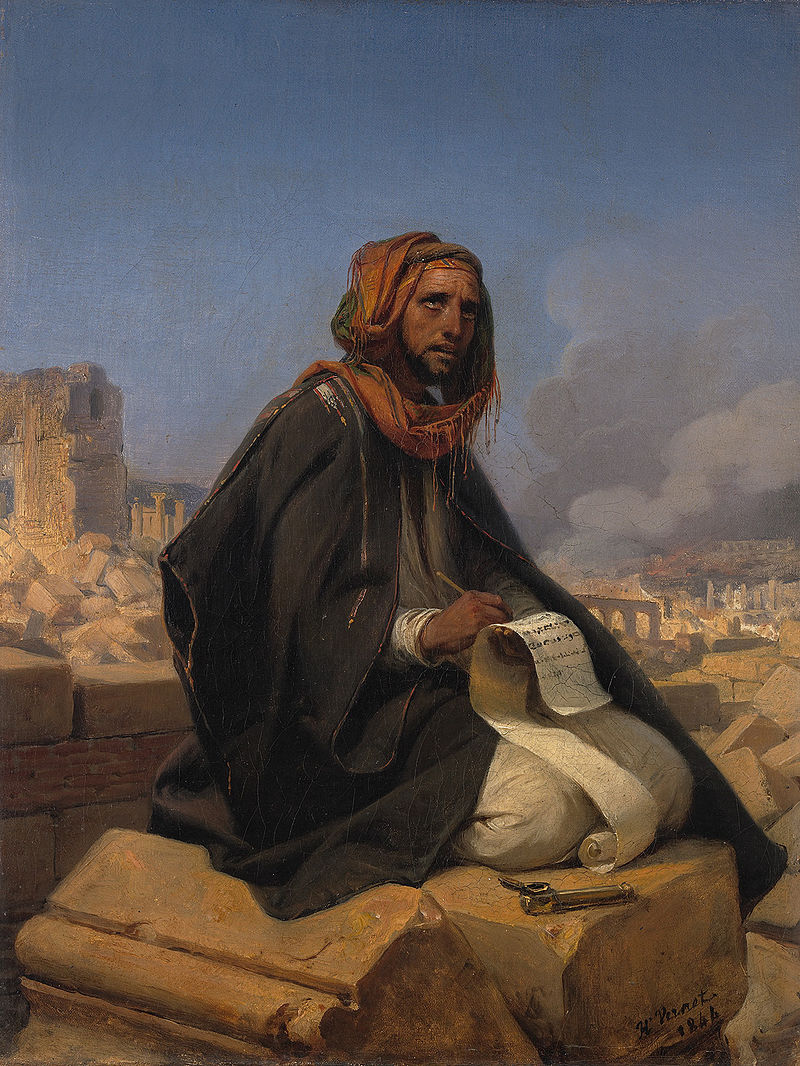
"Jeremiah on the Ruins of Jerusalem"
(Horace Vernet, 1844)
'For I know the plans that I have for you,' declares the LORD,
'plans for welfare and not for calamity to give you a future and a hope.
-- Jeremiah 29:11
(Play beautiful related song by Marty Goetz and Misha)
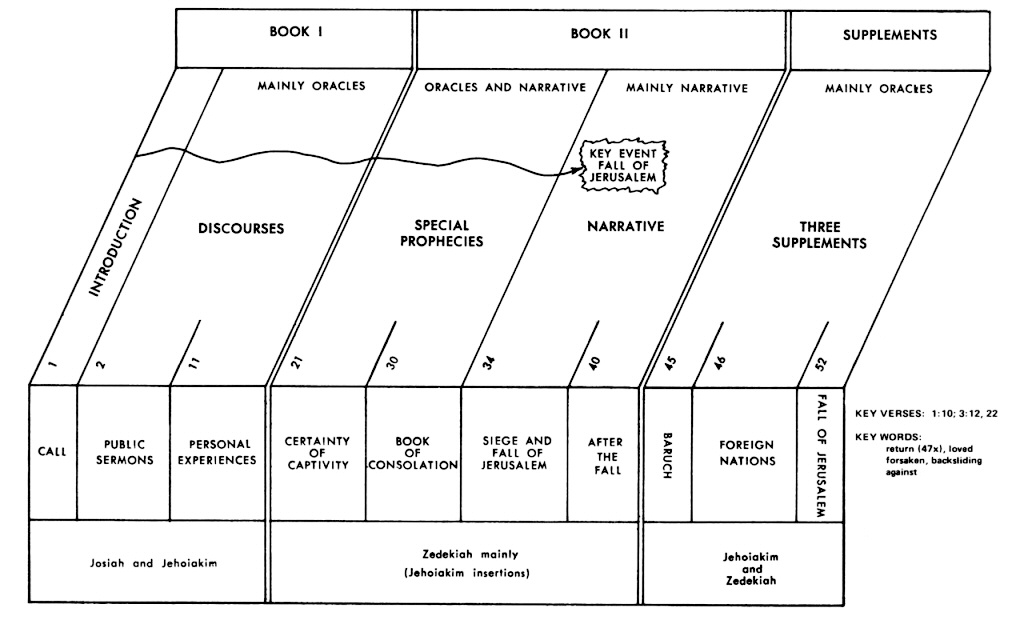
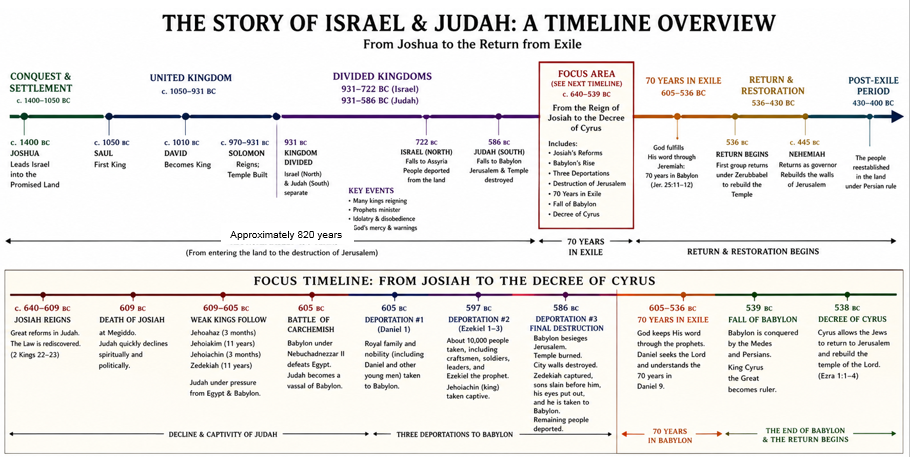
Click chart to enlarge
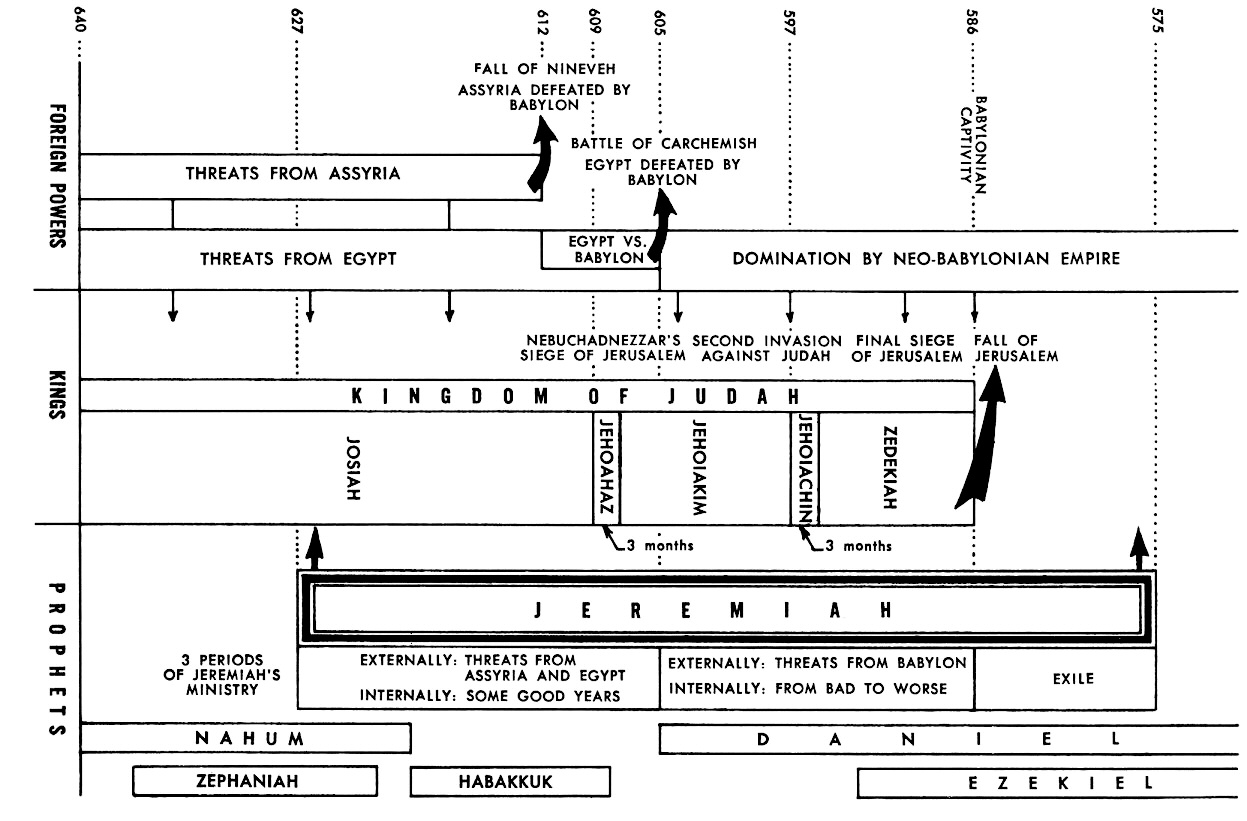
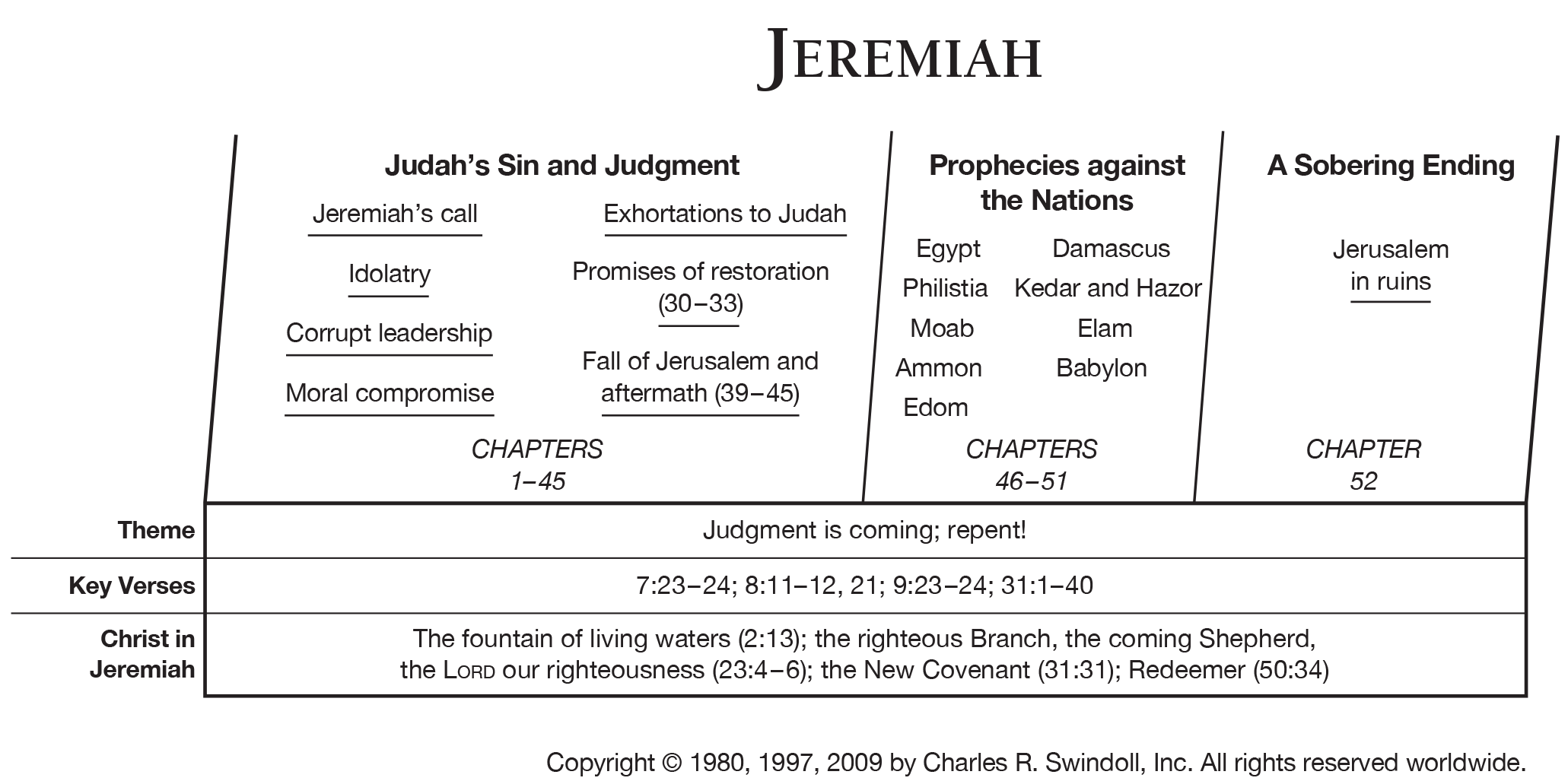
Click chart to enlarge
Chart from recommended resource Jensen's Survey of the OT - used by permission
Jeremiah Chart from Charles Swindoll
| JEREMIAH: "PROPHET TO THE NATIONS" Sin - "I Will Punish" (Jer 9:25) Hope - "I Will Restore" (Jer 30:17) Judah & Jerusalem |
||||||
|
Prophet |
Prophecies to Judah Jer 2:1-45:5 |
Prophecies to the Gentiles Jer 46:1-51:64 |
Prophet's Appendix Jer 52:1-52:34 |
|||
| Prophet's Commission Jer 1:1-19 |
Judah Condemned Jer 2:1-25:38 |
Jeremiah's Conflicts Jer 26:1-29:32 |
Jerusalem's Future Jer 30:1-33:26 |
Jerusalem's Fall Jer 34:1-45:5 |
Nations Condemned Jer 46:1-51:64 |
Historic Conclusion Jer 52:1-52:34 |
| Before The Fall Of Jerusalem Jer 1:1-38:28 |
The Fall Jer 39:1-18 |
After The Fall |
||||
| Call | Ministry | Retrospect | ||||
| Nation of Judah |
Surrounding Nations |
Future of Babylon |
||||
| 627-582 BC Ministered 40+ Years! |
||||||
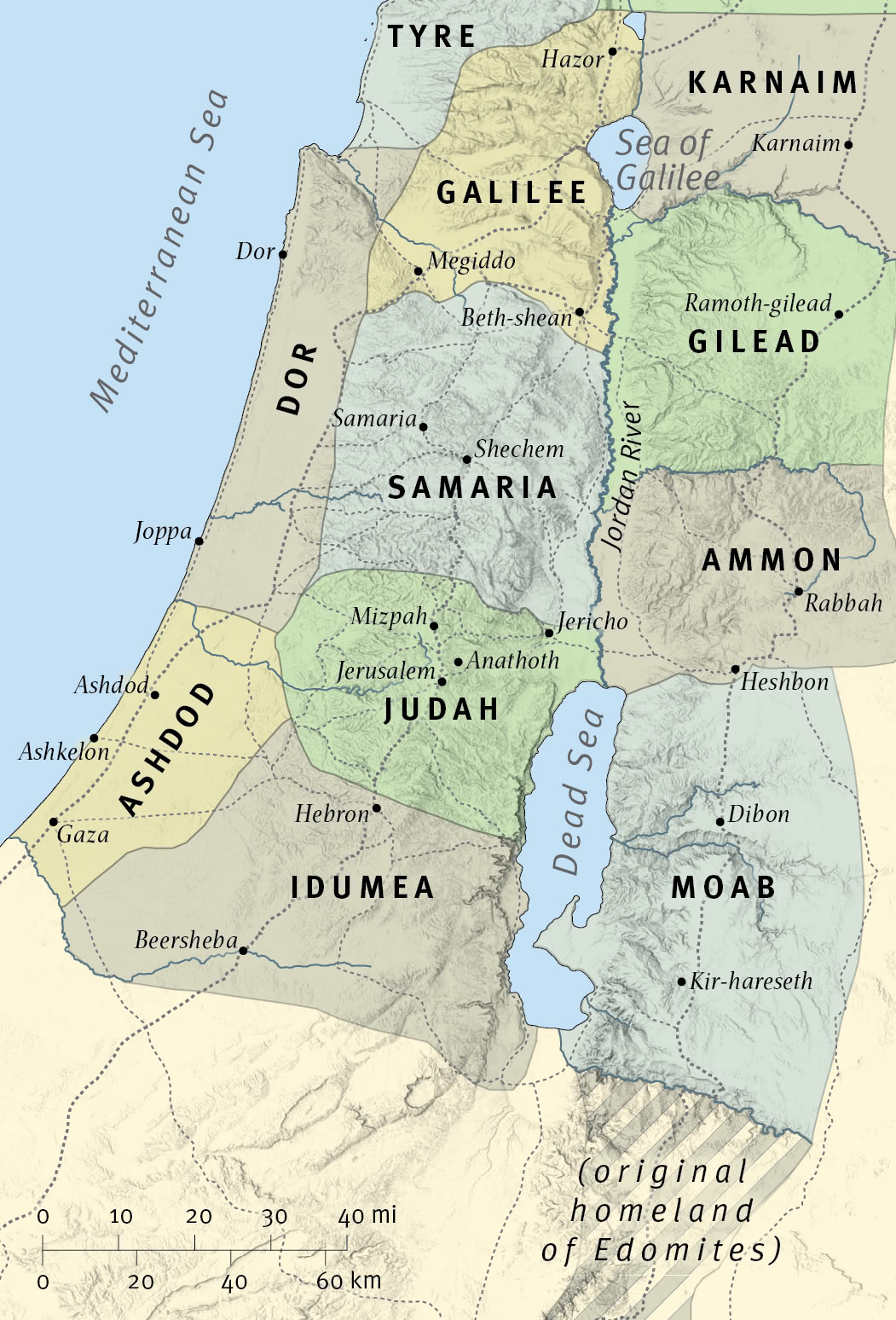
Map of Israel at Time of Jeremiah
Source: ESV Global Study Bible
Jeremiah 23:1 “Woe to the shepherds who are destroying and scattering the sheep of My pasture!” declares the LORD.
NET The LORD says, "The leaders of my people are sure to be judged. They were supposed to watch over my people like shepherds watch over their sheep. But they are causing my people to be destroyed and scattered.
NLT - "I will send disaster upon the leaders of my people--the shepherds of my sheep--for they have destroyed and scattered the very ones they were expected to care for," says the LORD.
- Woe: Jer 2:8,26 Eze 13:3 34:2 Zec 11:17 Mt 23:13-29 Lu 11:42-52
- pastors: Jer 23:2,11-15 2:8 10:21 12:10 22:22 25:34-36 50:6 Isa 56:9-12 Eze 22:25-29 34:2-10,21 Mic 3:11,12 Zep 3:3,4 Zec 11:5-7,15-17 Mt 9:36 15:14 Joh 10:10,12
Woe to the shepherds Woe is a declaration of coming judgment on the shepherds, the unrighteous rulers and leaders of Judah. The “shepherds” are the spiritual leaders of Israel, kings, priests, and prophets, entrusted with the care of God’s flock. Their calling was not merely administrative, but pastoral, to guard, guide, and nourish the people of God. Yet instead of feeding the flock, they destroyed and scattered it, abusing their authority and neglecting their sacred trust (cf. Jer 23:2).
This principle extends beyond ancient Israel. Shepherds of God’s spiritual flock in every age carry a weighty stewardship before God. When they faithfully feed the flock with the whole counsel of God’s Word, they are worthy of honor and reward
“The elders who rule well are to be considered worthy of double honor, especially those who work hard at preaching and teaching.” (1 Timothy 5:17)
Faithful shepherding involves both milk and meat, nurturing believers at every stage of growth (cf. 1 Peter 2:2; Hebrews 5:12–14). It requires diligence, doctrinal soundness, and a genuine concern for the spiritual well-being of the flock. However, with this high calling comes sobering accountability. Those who substitute truth with false doctrine, empty promises, or superficial platitudes stand under divine judgment. Jeremiah exposes such leaders:
“They speak a vision of their own imagination, not from the mouth of the LORD… ‘Peace, peace,’ but there is no peace” (Jeremiah 23:16–17)
“I am against the prophets… who lead My people astray by their falsehoods and reckless boasting” (Jeremiah 23:30–32)
Thus, the warning of Jeremiah 23:1 is not merely historical but is relevant to the modern church. God holds His shepherds accountable for the condition of His flock. To mislead, neglect, or exploit God’s people is to invite God's fearful “woe.” In sum, shepherds are called to feed, not scatter; to speak God’s Word, not their own; and to build up the flock, not destroy it. Great faithfulness brings great reward, but great responsibility also brings great judgment...
Let not many of you become teachers, my brethren, knowing that as such we will incur a stricter judgment (James 3:1).
who are destroying and scattering the sheep of My pasture!” declares the LORD - The two negative effects of these shepherd is plainly stated as destroy and scatter. Sheep are the souls that belong to God's pasture. To scatter them means driving people away from Yahweh, allowing them to wander spiritually and/or failing to guard them against danger. Destroying implies corrupt teaching, moral compromise, exploiting the people and ultimately leading them into judgment.
Jeremiah 23:2 Therefore thus says the LORD God of Israel concerning the shepherds who are tending My people: “You have scattered My flock and driven them away, and have not attended to them; behold, I am about to attend to you for the evil of your deeds,” declares the LORD.
NET So the LORD God of Israel has this to say about the leaders who are ruling over his people: "You have caused my people to be dispersed and driven into exile. You have not taken care of them. So I will punish you for the evil that you have done. I, the LORD, affirm it!
NLT - This is what the LORD, the God of Israel, says to these shepherds: "Instead of leading my flock to safety, you have deserted them and driven them to destruction. Now I will pour out judgment on you for the evil you have done to them.
- and have: Mt 25:36,43 Jas 1:27
- I: Jer 23:34 *marg: Jer 5:9,29 8:12 11:22 13:21 *margins Ex 32:34 Ho 2:13 Mic 7:4
Therefore thus says the LORD God of Israel concerning the shepherds who are tending My people God condemns the shepherds for their neglect of the people. The term "attended" is the translation of paqad (Heb.) which can be rendered "pay attention to," "look after," "provide," "see to someone's well-being," or "call into account." This latter meaning seems to be the idea in the second usage of paqad in v. 2. God is aware of the shepherds' lack of attention to His people, but He is giving attention to them and their evil doings.
: “You have scattered My flock and driven them away, and have not attended to them; behold, I am about to attend to you for the evil of your deeds,” declares the LORD.
Jeremiah 23:3 “Then I Myself will gather the remnant of My flock out of all the countries where I have driven them and bring them back to their pasture, and they will be fruitful and multiply.
NET Then I myself will regather those of my people who are still alive from all the countries where I have driven them. I will bring them back to their homeland. They will greatly increase in number.
NLT - But I will gather together the remnant of my flock from wherever I have driven them. I will bring them back into their own fold, and they will be fruitful and increase in number.
- Jer 29:14 30:3 31:8 32:37 De 30:3-5 Ps 106:47 Isa 11:11-16 Isa 27:12,13 43:5,6 Eze 11:17 34:13-31 36:24,37 37:21-27 Eze 39:27,28 Am 9:14,15 Mic 7:12 Zep 3:19,20 Zec 10:8-12
Then I Myself will gather the remnant of My flock out of all the countries where I have driven them and bring them back to their pasture, and they will be fruitful and multiply
The return from Babylonian captivity is promised, as well as a yet future regathering from all the countries (cf. Matt. 24:31).
Jeremiah 23:4 “I will also raise up shepherds over them and they will tend them; and they will not be afraid any longer, nor be terrified, nor will any be missing,” declares the LORD.
NET I will install rulers over them who will care for them. Then they will no longer need to fear or be terrified. None of them will turn up missing. I, the LORD, promise it!
NLT - Then I will appoint responsible shepherds to care for them, and they will never be afraid again. Not a single one of them will be lost or missing," says the LORD.
- I: Jer 3:14,15 33:26 Ps 78:70-72 Isa 11:11 Eze 34:23-31 Ho 3:3-5 Mic 5:2,4,5 7:14 Joh 21:15-17 Ac 20:28,29 1Pe 5:1-4
- neither: Nu 31:49 Joh 6:39,40 10:27-30 17:12 18:9 1Pe 1:5
I will also raise up shepherds over them and they will tend them; and they will not be afraid any longer, nor be terrified, nor will any be missing,” declares the LORD
Since the wicked shepherds, i.e., the leaders of the people, had deceived the nation (cf. v. 15; Deut. 28:15), at a coming day the Chief Shepherd Himself will gather the remnant (cf. Isa. 10:20-22; 11:11) and bring them back to the covenant relationship (v. 3). He will provide worthy shepherds to lead them (v. 4) and will raise up Jesus Christ, the Righteous Branch, the Messiah King (v. 5). Then Israel will be "saved" and will "dwell safely," showing the complete picture of their salvation, i.e., deliverance from destruction and protection from fear and danger (v. 6). This is not a reference to the return from captivity under Ezra, Nehemiah, and Zerubbabel (Jer. 29:10), nor is it a reference to the Messiah during His incarnation when He came to die. Rather these verses point toward unfulfilled prophecy -- His return in glory to execute justice and judgment and His reign over all (Luke 1:31-33).
Jeremiah 23:5 “behold, the days are coming,” declares the LORD, “When I will raise up for David a righteous Branch; And He will reign as king and act wisely And do justice and righteousness in the land.
NET "I, the LORD, promise that a new time will certainly come when I will raise up for them a righteous branch, a descendant of David. He will rule over them with wisdom and understanding and will do what is just and right in the land.
NLT - "For the time is coming," says the LORD, "when I will place a righteous Branch on King David's throne. He will be a King who rules with wisdom. He will do what is just and right throughout the land.
- the days: Jer 30:3 31:27,31-38 33:14 Heb 8:8
- I: Jer 33:15 Ps 72:1,2 Isa 32:1,2 40:10,11 Da 9:24 Am 9:11 Zec 9:9 Rev 19:11
- Branch: Ps 80:15 Isa 4:2 Isa 11:1-5 40:9,11 53:2 Eze 17:2-10,22-24 34:29 Zec 3:8 6:12,13 Joh 1:45
- reign: Jer 22:30 Ps 45:4 Isa 9:7 52:13 Isa 53:10 Lu 1:32,33, Acts 2:29-32
- and act wisely And do justice: Jer 22:3,15 Ps 72:2
Related Passages:
Jeremiah 30:3 ‘For behold, days are coming,’ declares the LORD, ‘when I will restore the fortunes of My people Israel and Judah.’ The LORD says, ‘I will also bring them back to the land that I gave to their forefathers and they shall possess it (ISRAEL IS A NATION AGAIN BUT THAT IS NOT THE FULFILLMENT OF THIS PROMISE FOR THEY ONLY POSSESS SOME OF THE ORIGINAL LAND GRANT TO ABRAHAM, ISAAC AND JACOB).’”
Acts 2:29-32 “Brethren, I may confidently say to you regarding the patriarch David that he both died and was buried, and his tomb is with us to this day. 30 “And so, because he was a prophet and knew that GOD HAD SWORN TO HIM WITH AN OATH TO SEAT one OF HIS DESCENDANTS ON HIS THRONE, 31 he looked ahead and spoke of the resurrection of the Christ, that HE WAS NEITHER ABANDONED TO HADES, NOR DID His flesh SUFFER DECAY. 32 “This Jesus God raised up (anistemi) again, to which we are all witnesses.
Isaiah 53:2 For He grew up before Him like a tender shoot, And like a root out of parched ground; He has no stately form or majesty That we should look upon Him, Nor appearance that we should be attracted to Him.
Jeremiah 33:15 “In those days and at that time I will cause a righteous Branch of David to spring forth; And He shall execute justice and righteousness on the earth.”
YAHWEH WILL RAISE
UP A RIGHTEOUS BRANCH
Behold (hinneh) - Yahweh calls for his hearers' full attention because the following truth is incredibly important for them to grasp.
The days are coming - Time phrases like this should always stimulate a reflex question like "What time is this referrring to?" etc. And remember their beloved city of Jerusalem and their Temple would soon be destroyed. The Jews were surely feeling hopeless with the exile and the destruction. They were in need of a ray of hope, a hope about a coming day.
Declares the LORD - This prophecy is authoritative and certain to come to pass because God is not a man that He should lie (Nu 23:19).
When I will raise up (qum; LXX - anistemi) for David a righteous Branch (tsemach) - God says the coming day would be when He raised up a righteous Branch. Note it is Yahweh Himself Who will carry this out. The word raise up (qum) conveys the idea of something rising into reality, whether physically, relationally, or covenantally, moving from potential into established fact. Is this not a double entendre (two meanings)? The Septuagint translates qum with the verb anistemi which is used in the NT for the resurrection of Jesus (Acts 2:24, Acts 2:32, Acts 13:34). And so Yahweh sent His Son to die and raised Him from the dead and will send Him as Second Time, not as Suffering Servant but as Conquering King to reign on the throne of David. King Jeconiah was deported to Babylon and was the last king in the line of David. For the next 5 centuries Israel would have no king, but here Yahweh promises that there is a coming day with they will have their final King, the Messiah.
Messiah is referred to as Branch in
Isaiah 4:2 In that day the Branch of the LORD will be beautiful and glorious, and the fruit of the earth will be the pride and the adornment of the survivors of Israel.
Isaiah 11:1 Then a shoot will spring from the stem of Jesse, And a branch from his roots will bear fruit.
Jeremiah 33:15 ‘In those days and at that time I will cause a righteous Branch of David to spring forth; and He shall execute justice and righteousness on the earth.
Zechariah 3:8 ‘Now listen, Joshua the high priest, you and your friends who are sitting in front of you–indeed they are men who are a symbol, for behold, I am going to bring in My servant the Branch.
Zechariah 6:12 “Then say to him, ‘Thus says the LORD of hosts, “Behold, a man whose name is Branch, for He will branch out from where He is; and He will build the temple of the LORD.
Righteous Branch describes not only Messiah's character but also alludes to what the King makes available to His loyal subjects, which is nothing less than His perfect righteousness God gives by grace through faith to all who believe in the Branch.
Romans 1:16-17 For I am not ashamed of the GOSPEL, for it is the power of God for salvation to everyone who believes, to the Jew first and also to the Greek. 17 For in it (THE GOSPEL) the righteousness of God is revealed from faith to faith; as it is written, “BUT THE RIGHTEOUS man SHALL LIVE BY FAITH.”
2 Corinthians 5:21 He made Him who knew no sin to be sin on our behalf, so that we might become the righteousness of God in Him.
1 Corinthians 1:30 But by His doing you are in Christ Jesus, Who became to us wisdom from God, and righteousness and sanctification, and redemption, 31 so that, just as it is written, “LET HIM WHO BOASTS, BOAST IN THE LORD.”
For David alludes to the unconditional covenant promises Yahweh had made to King David in 2Sa 7:12-16
“When your days are complete and you lie down with your fathers, I will raise up your descendant after you, who will come forth from you, and I will establish his kingdom. 13 “He shall build a house for My name, and I will establish the throne of his kingdom forever. 14 “I will be a father to him and he will be a son to Me; when he commits iniquity, I will correct him with the rod of men and the strokes of the sons of men, 15 but My lovingkindness shall not depart from him, as I took it away from Saul, whom I removed from before you. 16 “Your house and your kingdom shall endure before Me forever; your throne shall be established forever.”’
And He will reign as king - He will reign refers to the Righteous Branch, the Messiah, and if He will reign, that means He would have a Kingdom to reign over, which refers to the Messianc or Millennial Kingdom He ill set up when He returns as conquering King (Rev 19:11-21)
When Jesus presented Himself to the world, He said, ". . . Repent: for the kingdom of heaven is at hand" (Mt 4:17). Since you can't have a kingdom without the king, in effect He was saying to the people, "Your King is here!" The people rejected the King, but He had the last word. He said that someday the King would come back and set up that kingdom.
And act wisely - He will make wise decisions for "The Spirit of the LORD will rest on Him, The spirit of wisdom and understanding, The spirit of counsel and strength, The spirit of knowledge and the fear of the LORD." (Isa 11:2)
And do justice and righteousness in the land - The reign of the Branch will be characterized by justice in contrast to the kings like Jehoiakim who ruled without justice (Jer 22:13).
HOW DID THE JEWS INTERPRET JEREMIAH 23:5?
The Targum Jonathan (an early authoritative Jewish paraphrase) makes the Messianic meaning explicit “Behold, the days are coming… and I will raise up to David a righteous Messiah…” Here the Hebrew “Branch” is directly interpreted as “Messiah” (מְשִׁיחָא). This is one of the clearest ancient Jewish identifications of this verse as Messianic.
In the Babylonian Talmud, the “Branch” is tied to the Messiah: Sanhedrin 98b discusses names of the Messiah and includes: “What is his name? … The Rabbis say: His name is ‘the Branch’… as it is written, ‘Behold, a man whose name is the Branch’ (Zechariah 6:12).” While citing Zechariah 6:12, this clearly connects the “Branch” motif across prophets, including Jeremiah 23:5, as a Messianic title.
Behold (02009) hinneh is an interjection meaning behold, look, now; if. "It is used often and expresses strong feelings, surprise, hope, expectation, certainty, thus giving vividness depending on its surrounding context." (Baker) Hinneh generally directs our mind to the text, imploring the reader to give it special attention. In short, the Spirit is trying to arrest our attention! And so hinneh is used as an exclamation of vivid immediacy (e.g., read Ge 6:13)! Hinneh is a marker used to enliven a narrative, to express a change a scene, to emphasize an idea, to call attention to a detail or an important fact or action that follows (Isa 65:17, Ge 17:20, 41:17). The first use of hinneh in Ge 1:29 and second in Ge 1:31 - "And God saw all that He had made, and behold, it was very good. And there was evening and there was morning, the sixth day." Hinneh is oftn used in the idiom "Here I am" in Ge 22:1, 7,11 Ge 27:1,18, Ge 31:11, Ge 46:2 Ex 3:4 1Sa 3:4, 3:16, 12:3, 2Sa 1:7, Isa 52:6, Isa 58:9. Hinneh is used most often to point out people but also to point out things (Ge 31:41, 17:4). God uses hinneh to grab man's attention before He brings destruction (Ge 6:13, 17). God uses hinneh when He establishes covenants (Ge 9:9, 15:12, 17 [when Jehovah cut the Abrahamic covenant], Ge 17:4, cp Ge 28:13, 15), when He provided a sacrificial substitute for Isaac (foreshadowing His giving us His only Son!) (Ge 22:13). Hinneh marks the "chance (The Providence of God)" arrival of Boaz at the field where Ruth was gleaning (Ru 2:4-read about this "chance romance" - Indeed, "Behold!"). Hinneh is used to announce the Lord’s sending of a child as a sign and a prophecy of Immanuel-Emmanuel, the Messiah (Isa. 7:14). In fact W E Vine says that it is notable that when behold (hinneh) is used in Isaiah, it always introduces something relating to future circumstances.
Spurgeon reminds us that "Behold is a word of wonder; it is intended to excite admiration. Wherever you see it hung out in Scripture, it is like an ancient sign-board, signifying that there are rich wares within, or like the hands which solid readers have observed in the margin of the older Puritanic books, drawing attention to something particularly worthy of observation." I would add, behold is like a divine highlighter, a divine underlining of an especially striking or important text. It says in effect "Listen up, all ye who would be wise in the ways of Jehovah!"
Raise up (establish, stand, set, get) (06965) qum (קוּם) fundamentally means “to rise” or “to stand up,” referring literally to actions such as getting up, standing, or moving to an upright position (Ge. 19:33; Josh. 7:12). From this core idea, it develops a wide range of figurative meanings, including coming to pass, appearing, enduring, or being established. It can also express relational or legal concepts such as showing respect, being valid, belonging, or fulfilling an obligation. In its causative form, qum extends further to mean to establish, appoint, perform, fulfill, revive, or bring about something, even to the point of confirming a promise or ensuring victory. In short, qum conveys the idea of something rising into reality, whether physically, relationally, or covenantally, moving from potential into established fact (cf. Deut. 9:5; 1 Sam. 3:12; Ezek. 13:6).
Branch (shoot, spout, growth) (06780) tsemach from tsamach) is a noun which means a sprout, a branch or a growth and is used literally (Ge 19:25; Ps 65:10) but most significantly is used five times figuratively as a Name of the Messiah (Jer 33:15, Jer 23:5, Isa 4:2, Zechariah 3:8, Zechariah 6:12). See Walter Kaiser's excellent note.
Tsemach - 12x in 12v - Branch (5), growth (1), heads(1), plants(1), sprouting(1), sprouts(1), what grew(1), where it grew(1). Ge 19:25; Ps 65:10; Isa 4:2; 61:11; Jer 23:5; 33:15; Ezek 16:7; 17:9f; Hos 8:7; Zech 3:8; 6:12
Walter Kaiser comments on the noun tsemach and the verb - The first writer to take up the thought of 2Sa 23:5 and use the root smh as a noun to designate the Messiah is Isaiah (Isa 4:2). Many deny that Isaiah is referring to the Messiah when he speaks of “the Branch or Shoot of Yahweh” because it is paralleled by the expression “the fruit of the earth.” Therefore, Isa 4:2 is simply a reference to the agricultural prosperity of the land. But this view fails to notice that both of these expressions are elsewhere messianic. It also neglects to account for the unusual limitation of this fruitfulness “in that day”; the fruitfulness is for the survivors of Israel. Furthermore, they overlook the progressive nature of revelation, for certainly 2Sa 23:5 and perhaps Ps 132:17 are controlling ideas when we come to the eighth century B.C. Thus the “Sprout of Yahweh” (or as clarified by the cognate studies, “the son of Yahweh”) is an obvious reference to the divine nature of the tsemach. Yet his human nature is also in view, for he is “the Offspring or Fruit of the Earth.” In Jer 23:5–6 and Jer 33:15–16, He is “the Righteous Branch [or Sprout)” raised up for David to reign as King. While focusing on His human, but regal nature, this passage also stresses His deity by calling Him “the Lord our Righteousness.” Note that the context of both passages is the promise that Israel will return to the land. Even more pointedly, Jer 33:19–26 sets the tsemach promise in line with God’s previous promises to Abraham, Isaac, Jacob, the Levite priests, and David! Zechariah 3:8 pictures the Branch (tsemach) as the Lord’s Servant. No doubt the allusion is to Isaiah’s archetypal statements concerning Yah-weh’s Servant, Jesus Christ. In Zech 6:12 the prophet proclaims, “Behold the Man” who is “a priest on his throne,” a ruler, a counselor of peace, whose name is Branch. Zechariah sees the high priest Joshua as a type of the promise, but only a pledge of God’s future fulfillment in Jesus Christ. The Dead Sea Scrolls use the phrase tsemah dāwîd as a Messianic term in explanation of the Davidic covenant of 2Sa 7:14 (JBL 77:353). The NT makes at least two references to this messianic title “Branch” using the LXX translation of the root smh: anatolē and anatellō. Hebrews 7:14 is to be translated “our Lord sprang forth (or sprouted - anatello in perfect tense) from Judah.” But in Luke 1:78KJV with its anatolē ex hypsous ("the Dayspring from on high hath visited us") the equation of tsemach YHWH is complete. Therefore we translate the verse, “Because of the tender mercy of our God by which the Branch from on High shall visit us.” The only change needed is to convert the term “height” into the divine name and the OT expression appears again. Additional evidence for this Messianic concept may be found in netser/neser “branch” and hōter “shoot” (Isa 11:1) and yônēq “young plant” and šōresh “root” (Isa 53:2). (TWOT)
Jeremiah 23:6 “In His days Judah will be saved, And Israel will dwell securely; And this is His name by which He will be called, ‘The LORD our righteousness.’
NET Under his rule Judah will enjoy safety and Israel will live in security. This is the name he will go by: 'The LORD has provided us with justice.'
NLT - And this is his name: 'The LORD Is Our Righteousness.' In that day Judah will be saved, and Israel will live in safety.
- Judah: De 33:28,29 Ps 130:7,8 Isa 12:1,2 33:22 45:17 Eze 37:24-28 Ho 1:7 Ob 1:17,21 Zec 10:6 Mt 1:21 Lu 1:71-74 19:9,10 Ro 11:26,27
- dwell: Jer 30:10 32:37 1Ki 4:25 Isa 2:4 35:9 Eze 34:25-28 Ho 2:18 Zep 3:13 Zec 2:4,5 3:10 14:9-11
- and this: Isa 7:14 9:6 Mt 1:21-23
- THE LORD OUR RIGHTEOUSNESS: Heb. JEHOVAH-tsidkenu, Jer 33:16 Isa 45:24,25 54:17 Da 9:24 Ro 3:22 1Co 1:30 2Co 5:21 Php 3:9
Related Passages:
Jeremiah 33:16 ‘In those days Judah will be saved and Jerusalem will dwell in safety; and this is the name by which she will be called: the LORD is our righteousness.’
Romans 3:22 even the righteousness of God through faith in Jesus Christ for all those who believe; for there is no distinction;
1 Corinthians 1:30 But by His doing you are in Christ Jesus, who became to us wisdom from God, and righteousness and sanctification, and redemption,
2 Corinthians 5:21 He made Him who knew no sin to be sin on our behalf, so that we might become the righteousness of God in Him.
Philippians 3:9 and may be found in Him, not having a righteousness of my own derived from the Law, but that which is through faith in Christ, the righteousness which comes from God on the basis of faith,
Isaiah 11:1 Then a shoot will spring from the stem of Jesse, And a branch from his roots will bear fruit.
2 Samuel 7:12-16 “When your days are complete and you lie down with your fathers, I will raise up your descendant after you, who will come forth from you, and I will establish his kingdom. 13“He shall build a house for My name, and I will establish the throne of his kingdom forever. 14“I will be a father to him and he will be a son to Me; when he commits iniquity, I will correct him with the rod of men and the strokes of the sons of men, 15but My lovingkindness shall not depart from him, as I took it away from Saul, whom I removed from before you. 16“Your house and your kingdom shall endure before Me forever; your throne shall be established forever.”’”
Matthew 1:1 The record of the genealogy of Jesus the Messiah, the son of David, the son of Abraham:
Luke 1:32-33 “He will be great and will be called the Son of the Most High; and the Lord God will give Him the throne of His father David; 33and He will reign over the house of Jacob forever, and His kingdom will have no end.”
THE LORD OUR
RIGHTEOUSNESS
In His days Judah will be saved (yasha'; LXX - sozo - rescue, liberate, keep from harm, heal, preserve), And Israel will dwell securely; And this is His name by which He will be called, ‘The LORD our righteousness.’ What a magnificent Messianic promise! Against the dark background of Judah's corrupt kings, unfaithful shepherds, and impending Babylonian captivity, God announces the coming of a King unlike any Israel has ever known. This King will reign in righteousness, bring salvation to His people, and establish true security. But the climax of the prophecy is not merely what this King will accomplish. It is Who He is! His name will be “The LORD our righteousness.” Here is one of the most remarkable Messianic titles in the Old Testament, pointing ultimately to Jesus Christ, the righteous Son of David. The greatest blessing of the coming King is not simply that He will establish righteousness, but that He Himself is the righteousness His people desperately need!
In His days points directly back to Jeremiah 23:5. The subject of Jeremiah 23:6 is therefore the righteous Branch, the promised Davidic King. The Hebrew word for “Branch” is tsemach (צֶמַח), meaning a sprout, shoot, or growing branch. The image is especially significant because Judah's royal dynasty appeared to be approaching extinction. The Davidic monarchy was spiritually corrupt. The nation was moving toward judgment. The throne of David would soon appear to be cut down. Yet God in His great mercy and faithfulness to His covenant promises that new life will spring from the seemingly ruined dynasty. This imagery closely resembles Isaiah 11:1, where a shoot comes forth from the stem of Jesse. When the Davidic monarchy appeared to be a dead stump, God promised to bring forth a living Branch!
The promised King would be a descendant of David, fulfilling God's covenant promise that David's royal line would ultimately endure (2 Sa 7:12–16). Clearly this King is Jesus Christ the fulfillment of this promise (Mt 1:1; Lk 1:32, 33). In short, the King Who comes from David's line will possess the righteousness that David's successors so tragically lacked.
Judah will be saved (yasha') - This speaks of deliverance from national enemies and the restoration of God's covenant people and the fulfillment of the promises to Abraham, Isaac and Jacob. Judah had experienced a succession of unrighteous rulers. The nation had abandoned God's commandments. Its leaders had exploited the people. False prophets had proclaimed peace when judgment was approaching (Jer 23:9–22). Yet God promises that the coming righteous King will accomplish what Judah's rulers could never accomplish.
The contrast with the earthly kings is striking. Judah's kings had failed to protect their people. The righteous Branch would bring salvation. Judah's shepherds had scattered the flock. The righteous Branch would gather and preserve it (Jer 23:1–4). Judah's leaders had promoted unrighteousness. The righteous Branch would reign in righteousness. What sinful kings could not accomplish through political power, the righteous King will accomplish through His perfect rule.
The Hebrew verb yasha' is related to the name Yeshua, the Hebrew form of Jesus, meaning “Yahweh saves” or “the LORD is salvation.” Matthew 1:21 explains the significance of Jesus' name: He will save His people from their sins. Jeremiah's immediate promise concerns the deliverance and security of Judah and Israel under the coming Davidic King. The New Testament reveals that the Messiah's saving work also addresses humanity's deepest need: deliverance from sin and reconciliation with God (Mt 1:21; Ro 5:8-11). The Messiah does more than deliver His people from their enemies. He delivers sinners from the guilt and condemnation of sin.
And Israel will dwell (shakan) securely (betach) - This promise is especially striking because Jeremiah was prophesying during a period of profound national insecurity. The northern kingdom of Israel had already fallen to Assyria in 722 BC. Judah was facing the growing threat of Babylon and would go into exile in 586 BC as a consequence of their covenant unfaithfulness (See Israel the Wife of Jehovah). In spite of their continued unfaithfulness to their "Husband," Yahweh prophetically announces a future in which both Judah and Israel will enjoy security under the righteous Branch. Don't miss that the promise is for both the Northern and Southern Kingdoms (the result of national division in 931 BC as a consequence of Solomon's great sins 1Kings 11:1-25). The divided nation will experience restoration in the Millennium under the promised Davidic King as described in Jeremiah 3:18 and Ezekiel 37:21–28, where God promised the reunification and restoration of the nation of Israel. And the security in that coming kingdom will not be merely the absence of warfare but the result of righteous government under the Righteous Branch, the King appointed by God (Lk 1:32–33; Acts 2:29–36).
And this is His name (shem) by which He will be called, ‘The LORD our righteousness.’ - In Scripture, a name often reveals a person's character, identity, or mission. Specifically, God's names are especially significant because they disclose something about His nature and relationship to His people (See God's Name - A Strong Tower) .The coming King will bear a remarkable name The LORD our righteousness. Jehovah Tsidkenu” which is identifies the character of His reign (a righteous reign) and the source of His people's righteousness.
YHWH (יְהוָה) is the covenant Name of God, commonly represented by “LORD” in capital letters in English translations. Tsidqenu (צִדְקֵנוּ) comes from tsedeq (צֶדֶק), meaning righteousness, justice, or conformity to a proper standard. The suffix -enu means “our.” Thus, the expression means “Yahweh is our righteousness” or “The LORD our righteousness.” Notice the small but precious personal pronoun our which signifies that God is not merely declaring that He possesses righteousness or even commanding His people to practice righteousness but is revealing Himself as our righteousness. Our speaks of His righteousness as our possession forever in Christ when we enter into covenant with Him by grace through faith (Eph 2:8,9). Paul declares that "by His doing you are in Christ Jesus, who became to us wisdom from God, and righteousness and sanctification, and redemption." (1 Cor 1:30). Later Paul adds "He made Him who knew no sin to be sin on our behalf, so that we might become the righteousness of God in Him." (2 Cor 5:21). And in Philippians 3:9, Paul gives his personal testimony that he "may be found in Him, not having a righteousness of my own derived from the Law, but that which is through faith in Christ, the righteousness which comes from God on the basis of faith. And this is the righteousness God makes available to all lost sinners in His glorious Gospel, for as Paul declares "I am not ashamed of the gospel, for it is the power of God for salvation to everyone who believes, to the Jew first and also to the Greek. For in it the righteousness of God is revealed from faith to faith; as it is written, “BUT THE RIGHTEOUS man SHALL LIVE BY FAITH.” (Ro 1:16-17)
There is an interesting contrast in Jeremiah's prophecy because one of Judah's final kings was Zedekiah whose Hebrew name, is Tsidqiyyahu (צִדְקִיָּהוּ), which means something like “Yahweh is righteousness” or “Yahweh is my righteousness.” However Zedekiah's reign was anything but righteous and was characterized by disobedience and failure (2 Ki 24:18–20; Jer 52:1–3). So the contrast is that Jeremiah announces a future King Who will truly embody the righteousness that Judah's rulers lacked. Zedekiah had righteousness in his name but not in his reign. The Messiah will possess righteousness in both His character and His kingdom.
Another interesting note is that Jeremiah 33:16 says " ‘In those days Judah will be saved and Jerusalem will dwell in safety; and this is the name by which she will be called: the LORD is our righteousness." In this passage the name “The LORD our righteousness” is applied to Jerusalem. In Jeremiah 23:6, the name characterizes the promised Davidic King. In Jeremiah 33:16, the restored Jerusalem is identified by the same name. The city will reflect the righteousness and saving presence of the LORD. In other words, the righteousness that characterizes the King will also characterize the people and city blessed by His reign.
🙏 THOUGHT — Is the LORD Your Righteousness? Jeremiah 23:6 gives our Savior one of His most comforting names: “The LORD our righteousness.” Notice the little word “our.” God does not command us to become righteous by our own efforts. He provides the righteousness we need through His Son. Even our best deeds cannot make us acceptable to a holy God (Isa 64:6). Like Paul, we want to be found in Christ, not having a righteousness of our own, but the righteousness that comes from God through faith (Php 3:9). Our acceptance rests not on our knowledge, works, or reputation, but on Christ’s finished work (Ro 3:21–26; 2 Cor 5:21). Yet this truth never excuses careless living. Enabled by the indwelling Holy Spirit, we now pursue holiness (Ro 6:11–14; 8:13; 1 Pe 1:15–16). We do this not to earn God’s acceptance, but because in Christ we already have it. When your conscience accuses you, do not look inward; look upward to the One Who is your righteousness (1 Cor 1:30). And if necessary confess any known sins (1Jn 1:9).
Saved (delivered, helped) (03467) yasha' (See also yeshua from which we get our word "Jesus") Yāshaʿ is an important Hebrew verb meaning to save, deliver, rescue, help, defend, or give victory. Its fundamental picture is that of bringing someone out of a narrow, confined place of distress into a broad, spacious place of safety and freedom. The related Arabic root carries the idea “to make wide” or “make sufficient,” standing in contrast to the concept of narrowness or restriction. Thus, at its heart, yāshaʿ describes deliverance from a situation of danger, distress, or helplessness into safety, freedom, and well-being.
YASHA IN JEREMIAH - Jer. 2:27; Jer. 2:28; Jer. 4:14; Jer. 8:20; Jer. 11:12; Jer. 14:8; Jer. 14:9; Jer. 15:20; Jer. 17:14; Jer. 23:6; Jer. 30:7; Jer. 30:10; Jer. 30:11; Jer. 31:7; Jer. 33:16; Jer. 42:11; Jer. 46:27; Lam. 4:17
An important element of yāshaʿ is that the person needing salvation is unable to escape by his own resources. Deliverance therefore must come from someone outside the distressed person. This makes yāshaʿ particularly appropriate for describing God's saving activity: the helpless person needs a savior. Although human beings may serve as God's instruments of deliverance, the Old Testament overwhelmingly presents Yahweh as the ultimate Savior (Ex 14:30; Dt 33:29; Ps 68:19–20; Isa 43:11; 45:21).
The word can be used in an ordinary, non-theological sense of helping or rescuing someone from immediate difficulty. For example, Moses “helped” the daughters of Reuel when shepherds drove them away from the well (Ex 2:17). More commonly, however, yāshaʿ has strong theological significance because God is the One who saves His people when they cannot save themselves.
The deliverance expressed by yāshaʿ can take many forms. It includes rescue from enemies (Dt 28:31; Jdg 6:14), deliverance from national oppression (Jdg 2:16), victory in battle (1Sa 14:6; 17:47), deliverance from death (Ps 22:21), protection from danger (Ps 62:7), compassionate help for the needy (Ps 72:4), and even the protective work of a shepherd rescuing his flock (Ezek 34:22). Israel's deliverance from Egypt is one of the great Old Testament demonstrations of yāshaʿ: “Thus the LORD saved Israel that day from the hand of the Egyptians” (Ex 14:30).
Consequently, salvation is not merely escape from something; it is also deliverance into a condition of security. God provides His people with the safety necessary to live without being destroyed by the dangers surrounding them. Scripture therefore speaks of the “shield of salvation” (Ps 18:35), the “helmet of salvation” (Isa 59:17), the “garments of salvation” (Isa 61:10), and ultimately the walls of God's city being called “Salvation” (Isa 60:18). Yāshaʿ thus includes the ideas of rescue, preservation, security, and continuing protection.
While many Old Testament occurrences concern physical and historical deliverance, yāshaʿ also develops a profound spiritual dimension. God saves His people from their sins and unfaithfulness (Ezek 37:23); David calls upon the “God of my salvation” for deliverance from bloodguiltiness (Ps 51:14); and in Jeremiah 17:14, “save” parallels “heal,” showing salvation as God's restorative work in the whole person. Thus the concept progresses naturally from deliverance from external danger to deliverance from the deeper problem of sin.
God's saving activity is inseparably connected with His righteousness, covenant faithfulness, love, and sovereign power. He is “a righteous God and a Savior” (Isa 45:21). His acts of salvation demonstrate that He alone is God, while idols are powerless to save (Isa 43:11; 45:20; 46:7; Hos 13:4). His salvation also flows from His covenant love (Dt 7:7–8; Ps 6:4), so that salvation may appropriately be understood as God's love expressed in rescuing action.
At the same time, Scripture calls those in distress to turn to God, cry to Him, trust Him, and wait for His salvation (Jdg 3:9; Ps 69:1; Isa 30:15). Human strength is never the ultimate source of deliverance: “A king is not saved by a mighty army” (Ps 33:16), and “the battle is the LORD'S” (1Sa 17:47). Sometimes God works through human agents such as judges and kings (Jdg 2:16; 1Sa 9:16); at other times He acts so decisively that His people need only stand and witness His deliverance (2Ch 20:17). In either case, the saving power belongs to God.
The concept ultimately develops a Messianic and universal dimension. Zechariah 9:9 describes the coming King as “endowed with salvation,” and the prophets anticipate God's salvation reaching beyond Israel to “the end of the earth” (Isa 49:6; cf. Isa 45:22; 52:10). Thus the many individual and national acts of salvation throughout the Old Testament point forward toward God's climactic saving work.
Summary Definition - Yāshaʿ means to save, deliver, rescue, help, defend, or give victory. Its underlying picture is of bringing someone from a “narrow place” of danger, oppression, distress, or helplessness into a “broad place” of safety, freedom, security, and well-being. The person in distress cannot accomplish this deliverance by his own resources and therefore requires a savior. Although God may use human instruments, Yahweh is overwhelmingly the Savior in the Old Testament, delivering His people from enemies, oppression, danger, death, calamity, and ultimately sin (Ex 14:30; Dt 33:29; Ps 34:6; 51:14; Isa 43:11; 45:21–22). Thus yāshaʿ portrays salvation as God's powerful, righteous, and loving intervention on behalf of those who cannot save themselves. Yāshaʿ is God bringing the helpless out of distress and danger into deliverance, safety, freedom, and salvation.
Jeremiah 23:7 “Therefore behold, the days are coming,” declares the LORD, “when they will no longer say, ‘As the LORD lives, who brought up the sons of Israel from the land of Egypt,’
NET "So I, the LORD, say: 'A new time will certainly come. People now affirm their oaths with "I swear as surely as the LORD lives who delivered the people of Israel out of Egypt." (Jer 23:1-7 NET)
NLT - "In that day," says the LORD, "when people are taking an oath, they will no longer say, 'As surely as the LORD lives, who rescued the people of Israel from the land of Egypt.'
- Jer 23:3 16:14,15 31:31-34 Isa 43:18,19
Therefore behold, the days are coming,” declares the LORD, “when they will no longer say, ‘As the LORD lives, who brought up the sons of Israel from the land of Egypt
Jeremiah 23:8 but, ‘As the LORD lives, who brought up and led back the descendants of the household of Israel from the north land and from all the countries where I had driven them.’ Then they will live on their own soil.”
NLT - Instead, they will say, 'As surely as the LORD lives, who brought the people of Israel back to their own land from the land of the north and from all the countries to which he had exiled them.' Then they will live in their own land."
- Jer 23:3 Isa 14:1 27:12,13 43:5,6 65:8-10 Eze 34:13 36:24 37:25 Eze 39:28 Zep 3:20 Am 9:14,15
but, ‘As the LORD lives, who brought up and led back the descendants of the household of Israel from the north land and from all the countries where I had driven them.’ Then they will live on their own soil
AS THE LORD LIVES: This is one of the most remarkable prophecies in the Word of God. The oldest religious holiday celebrated today is the Jewish Passover. Jews everywhere whether reformed, conservative or orthodox, remember the Passover, because it is the celebration of the miraculous deliverance of the Jews out of Egypt. God is saying that the day is coming when He will bring them back into their land that they will forget His deliverance out of Egypt. They will remember this NEW DELIVERANCE from the NORTH LAND & ALL THE COUNTRIES. Obviously God is not through with the nation Israel.
Jeremiah 23:9 As for the prophets: My heart is broken within me, All my bones tremble; I have become like a drunken man, Even like a man overcome with wine, Because of the LORD And because of His holy words.
NLT - My heart is broken because of the false prophets, and I tremble uncontrollably. I stagger like a drunkard, like someone overcome by wine, because of the holy words the LORD has spoken against them.
- heart: Jer 9:1 14:17,18 2Ki 22:19,20 Eze 9:4,6 Da 8:27 Hab 3:16
- because: Jer 5:31
- like a drunken: Jer 25:15-18 Ps 60:3 Isa 6:5 28:1 29:9 51:21 La 3:15 Ro 7:9
As for the prophets: My heart is broken within me, All my bones tremble; I have become like a drunken man, Even like a man overcome with wine, Because of the LORD And because of His holy words.
Jeremiah 23:10 For the land is full of adulterers; For the land mourns because of the curse. The pastures of the wilderness have dried up. Their course also is evil And their might is not right.
NLT - For the land is full of adultery, and it lies under a curse. The land itself is in mourning--its pastures are dried up. For the prophets do evil and abuse their power.
- full: Jer 5:7,8 7:9 9:2 Eze 22:9-11 Ho 4:2,3 Mal 3:5 1Co 6:9,10 Ga 5:19-21 Heb 13:4 Jas 4:4
- because: Zec 5:3,4 1Ti 1:10
- swearing: Heb. cursing
- the land: Jer 12:3,4 14:2 La 1:2-4 Joe 1:10
- the pleasant: Jer 9:10 Ps 107:34 Isa 24:6
For the land is full of adulterers; For the land mourns because of the curse. The pastures of the wilderness have dried up. Their course also is evil And their might is not right.
Jeremiah 23:11 “For both prophet and priest are polluted; Even in My house I have found their wickedness,” declares the LORD.
NLT - "The priests are like the prophets, all ungodly, wicked men. I have seen their despicable acts right here in my own Temple," says the LORD.
- both: Jer 23:15 5:31 6:13 8:10 Eze 22:25,26 Zep 3:4
- in: Jer 7:10,11,30 11:15 32:34 2Ch 33:5,7 36:14 Eze 7:20 Eze 8:5,6,11,16 23:39 Mt 21:12,13
For both prophet and priest are polluted; Even in My house I have found their wickedness,” declares the LORD.
Jeremiah 23:12 “Therefore their way will be like slippery paths to them, They will be driven away into the gloom and fall down in it; For I will bring calamity upon them, The year of their punishment,” declares the LORD.
NLT - "Therefore, their paths will be dark and slippery. They will be chased down dark and treacherous trails, where they will fall. For I will bring disaster upon them when their time of punishment comes. I, the LORD, have spoken!
- as: Jer 13:16 Ps 35:6 73:18 Pr 4:19
- in the: Job 18:18 Isa 8:22 Joh 12:35 1Jn 2:11 Jude 1:13
- the year: Jer 11:23 23:12 48:44 50:27 Ex 32:34 Mic 7:4
Therefore their way will be like slippery paths to them, They will be driven away into the gloom and fall down in it; For I will bring calamity upon them, The year of their punishment,” declares the LORD.
Jeremiah 23:13 “Moreover, among the prophets of Samaria I saw an offensive thing: They prophesied by Baal and led My people Israel astray.
NLT - "I saw that the prophets of Samaria were terribly evil, for they prophesied by Baal and led my people of Israel into sin.
- folly: or, an absurd thing, Heb. unsavoury
- prophets: Ho 9:7,8
- prophesied: Jer 2:8 1Ki 18:18-21,25-28,40
- and: 2Ch 33:9 Isa 9:16
Moreover, among the prophets of Samaria I saw an offensive thing: They prophesied by Baal and led My people Israel astray.
Jeremiah 23:14 “Also among the prophets of Jerusalem I have seen a horrible thing: The committing of adultery and walking in falsehood; And they strengthen the hands of evildoers, So that no one has turned back from his wickedness. All of them have become to Me like Sodom, And her inhabitants like Gomorrah.
NLT - But now I see that the prophets of Jerusalem are even worse! They commit adultery, and they love dishonesty. They encourage those who are doing evil instead of turning them away from their sins. These prophets are as wicked as the people of Sodom and Gomorrah once were."
- in the: Jer 5:30,31 14:14 23:32 Eze 13:2-4,16 22:25 Isa 41:6,7 Mic 3:11 Zep 3:4 2Pe 2:1,2
- an horrible thing: or, filthiness, Jer 18:13
- they commit: Jer 29:23 2Pe 2:14-19
- walk: Jer 23:17,25,26,32 14:14 Eze 22:25 2Th 2:9-11 1Ti 4:2 Rev 19:20 Rev 21:8 22:15
- strengthen: Eze 13:22,23
- Sodom: Ge 13:13 18:20 De 32:32 Isa 1:9,10 Eze 16:46-52 Mal 1:1 Mt 11:24 2Pe 2:6 Jude 1:7 Rev 11:8
Also among the prophets of Jerusalem I have seen a horrible thing: The committing of adultery and walking in falsehood; And they strengthen the hands of evildoers, So that no one has turned back from his wickedness. All of them have become to Me like Sodom, And her inhabitants like Gomorrah
Jeremiah 23:15 “Therefore thus says the LORD of hosts concerning the prophets, ‘behold, I am going to feed them wormwood And make them drink poisonous water, For from the prophets of Jerusalem Pollution has gone forth into all the land.’”
NLT - 15 Therefore, this is what the LORD Almighty says concerning the prophets: "I will feed them with bitterness and give them poison to drink. For it is because of Jerusalem's prophets that wickedness fills this land.
- will: Jer 8:14 9:15 Ps 69:21 La 3:5,15,19 Mt 27:34 Rev 8:11
Therefore thus says the LORD of hosts concerning the prophets, ‘behold, I am going to feed them wormwood And make them drink poisonous water, For from the prophets of Jerusalem Pollution has gone forth into all the land
Jeremiah 23:16 Thus says the LORD of hosts, “Do not listen to the words of the prophets who are prophesying to you. They are leading you into futility; They speak a vision of their own imagination, Not from the mouth of the LORD.
NLT - This is my warning to my people," says the LORD Almighty. "Do not listen to these prophets when they prophesy to you, filling you with futile hopes. They are making up everything they say. They do not speak for the LORD!
- Hearken: Jer 27:9,10,14-17 29:8 Pr 19:27 Mt 7:15 2Co 11:13-15 Ga 1:8,9 1Jn 4:1
- they make: Jer 2:5 2Ki 17:15 Ro 1:21
- a vision: Jer 23:21,26 14:14 Eze 13:3,6,16,23 22:28 Mic 2:11
Thus says the LORD of hosts, “Do not listen to the words of the prophets who are prophesying to you. They are leading you into futility; They speak a vision of their own imagination, Not from the mouth of the LORD
The warning is in reference to the deceptive prophets who have spoken their own self-seeking messages (cf. 1:7, 9; 5:14) in the name of the Lord, promising false hopes of prosperity and peace when destruction was imminent, and seducing the people into a false confidence.
Jeremiah 23:17 “They keep saying to those who despise Me, ‘The LORD has said, “You will have peace”’; And as for everyone who walks in the stubbornness of his own heart, They say, ‘Calamity will not come upon you.’
NLT - They keep saying to these rebels who despise my word, 'Don't worry! The LORD says you will have peace!' And to those who stubbornly follow their own evil desires, they say, 'No harm will come your way!'
- that despise: Nu 11:20 1Sa 2:30 2Sa 12:10 Mal 1:6 Lu 10:16 1Th 4:8
- Ye: Jer 4:10 6:14 8:11 14:13,14 28:3-9 Isa 3:10,11 57:21 La 2:14 Eze 13:10,15,16,22 Mic 3:5,11 Zec 10:2
- imagination: or, stubbornness, Jer 3:17 7:24 9:14 13:10 De 29:19
- No: Jer 18:18 Am 9:10 Mic 3:11 Zep 1:12
They keep saying to those who despise Me, ‘The LORD has said, “You will have peace”’; And as for everyone who walks in the stubbornness of his own heart, They say, ‘Calamity will not come upon you.’
Jeremiah 23:18 “But who has stood in the council of the LORD, That he should see and hear His word? Who has given heed to His word and listened?
NLT - "But can you name even one of these prophets who knows the LORD well enough to hear what he is saying? Has even one of them cared enough to listen?
- who: Jer 23:22 1Ki 22:24 Job 15:8-10 2Ch 18:23 Isa 40:13,14 1Co 2:16
- counsel: or, secret, Ps 25:14 Am 3:7 Joh 15:15
But who has stood in the council of the LORD, That he should see and hear His word? Who has given heed to His word and listened
23:18-40 The life (v. 18) and message (v. 28) of the true prophet are contrasted with those of the false prophet (v. 32).
Jeremiah 23:19 “behold, the storm of the LORD has gone forth in wrath, Even a whirling tempest; It will swirl down on the head of the wicked.
NLT - Look! The Lord's anger bursts out like a storm, a whirlwind that swirls down on the heads of the wicked.
- Jer 4:11 25:32 30:23 Ps 58:9 Pr 1:27 10:25 Isa 5:25-28 21:1 Isa 40:24 66:15,16 Am 1:14 Na 1:3-6 Zec 9:14
behold, the storm of the LORD has gone forth in wrath, Even a whirling tempest; It will swirl down on the head of the wicked.
Jeremiah 23:20 “The anger of the LORD will not turn back Until He has performed and carried out the purposes of His heart; In the last days you will clearly understand it.
NLT - The anger of the LORD will not diminish until it has finished all his plans. In the days to come, you will understand all this very clearly.
- until: Jer 30:24 Isa 14:24 Zec 1:6 8:14,15
- in the: Ge 49:1 De 31:29,30 1Ki 8:47 Pr 5:11-14 21:30 Ho 3:4,5
The anger of the LORD will not turn back The "anger" of the Lord is the result of His righteous judgment, demanded by His perfect holiness and immutable justice. The "latter days" could be rendered as the "future days."
Until He has performed and carried out the purposes of His heart (7 x 70 Lv 26:18, fulfilled in Jacob's distress Jer 30:7, cp Da 12:1)
In the last days you will clearly understand it cp LATTER DAYS (Eze16:61,62 Dt4:30 31:29 Je30:24 48:47 Da2:28 10:14) LAST DAYS (Isa2:2 Je23:20 49:39 Eze38:16 Ho3:5 Mic4:1 Ac2:17 1Ti4:1 2Ti3:1 Heb1:2 9:26 Ja5:3 1Pe1:20 2Pe3:3 1Jn2:18 Jude18) DAYS TO COME (Ge49:1 Isa27:6 DAYS TO COME Nu24:14): "latter" literally = "hindmost", "farthest", whether of space or time -- "the last of the days" ("the latter days") is translated by some "in the end of the days". The phrase according to Jewish interpreters always means the days of the Messiah.
"In the latter days" is an expression which often refers to the messianic times, that period which closes human history when the kingdom of God will be manifested and the Lord Himself will rule the nations, as well as the hearts and minds of men.
LAST/LATTER DAYS is common in OT & is the time when Messiah would come to set up His kingdom. That there would be two comings of Messiah, separated by a long intervening period, was not clearly understood in the OT. The two comings, however, can be inferred from the two purposes for Messiah’s coming set forth in the OT. On the one hand, the OT teaches that Messiah would come as the Suffering Servant, to die for the sins of the world (Isa53). On the other hand, it also teaches that Messiah would come in glory to set up His kingdom (Isa9:6).
The first coming of Christ ushered in the last days.
1Jn2:18 “Children, it is the last hour.” Peter writes that Christ “has appeared in these last times for the sake of you” (1Pe1:20). Hebrews informs us that God “in these last days has spoken to us in His Son” (Heb1:2), and “now once at the consummation of the ages [Christ] has been manifested to put away sin by the sacrifice of Himself” (Heb9:26). The last days have thus lasted nearly two thousand years. During that time, God has graciously called Gentiles to salvation and chastened Israel for her unbelief.
The LXX (Septuagint) translates "last days" in this verse with "eschatos" (last) & "hemera" (day). The expression is found in LXX, where it frequently refers in some way to the days of the Messiah (Nu24:14). The phrase according to Jewish interpreters of the OT always means the days of the Messiah. In contrast with palai above. Common OT term with Messianic implications... days when God would intervene in history & if they had accepted it would have ushered in the Messianic Age.
Jeremiah 23:21 “I did not send these prophets, But they ran. I did not speak to them, But they prophesied.
NLT - "I have not sent these prophets, yet they claim to speak for me. I have given them no message, yet they prophesy.
- Jer 23:32 14:14 27:15 28:15 29:9,31 Isa 6:8 Joh 20:21 Ac 13:4 Ro 10:15
I did not send these prophets, But they ran. I did not speak to them, But they prophesied
Jeremiah 23:22 But if they had stood in My council, Then they would have announced My words to My people, And would have turned them back from their evil way And from the evil of their deeds.
NLT - If they had listened to me, they would have spoken my words and turned my people from their evil ways.
- if: Jer 23:18 Eze 2:7 3:17 Ac 20:27
- then: Jer 25:5 35:15 36:3 Eze 13:22 18:30 Zec 1:4 Ac 26:18-20 1Th 1:9,10 5:6
But if they had stood in My council, Then they would have announced My words to My people, And would have turned them back from their evil way And from the evil of their deeds.
Jeremiah 23:23 “Am I a God who is near,” declares the LORD, “And not a God far off?
NLT - Am I a God who is only in one place?" asks the LORD. "Do they think I cannot see what they are doing?
- 1Ki 20:23,28 Ps 113:5 139:1-10 Eze 20:32-35 Jon 1:3,4
Am I a God who is near,” declares the LORD, “And not a God far off?
These verses underscore the transcendence and the imminence of God. Am I a God who is only in one place?" Yahweh is not a God near, a local man-made deity whose domain and wisdom are limited. He is not unaware of the actions of His creatures and they are not able to hide from Him. He is not confined to a shrine or temple as are the pagan deities. He is omnipotent (all-powerful), omnipresent (present everywhere), and omniscient (all-knowing). Yahweh has the power to see even that which is hidden (v24). These false prophets were not operating unknown to God.
Men cannot be hidden from God's all-seeing eye. Will they never see what judgments they prepare for themselves? Let them consider what a vast difference there is between these prophecies and those delivered by the true prophets of the Lord. Let them not call their foolish dreams Divine oracles.
===============
OUR OMNIPRESENT GOD
The scene: A young boy and his mother are having a serious discussion over lunch one day. "Where is God?" he asks innocently. "He’s in heaven," his mother replies. "Does He live there?" "Yes." "Where’s Jesus?" "He’s in your heart." "But I thought Jesus and God were the same Person." "They are." "How can he be in heaven and in my heart at the same time?" "Sweetheart, it’s hard to explain." A short pause. "Where does the Holy Spirit live?" Another short pause. "I think it’s time to take a nap."
Thus we are introduced to one of the more difficult doctrines of the Bible—the doctrine of God’s omnipresence. "Where is God?" This is a very important question. The seeker wants to know … and so does the skeptic … and so does the guilty sinner so he can run the other way. And so does every hurting person who feels abandoned by the Almighty. "Where is God when I need Him?"
Tony Evans comments that these three attributes work in tandem:
He knows what needs to be done—that’s omniscience.
He has the power to do it—that’s omnipotence.
He’s always wherever he needs to be to do whatever needs to be done— that’s omnipresence.
Omnipresence is the hardest for us to grasp. We can only be one place at one time, but God is everywhere at the same time. Our problem is that we have nothing to compare to it. Is God all powerful? Yes, and we can slightly grasp that concept because we have power and strength. Is God all wise? Yes, and we can conceive of that on some level because we have wisdom and knowledge.
But there is no sense in which we are can be present everywhere! We can’t even be two places at once—a fact that we sometimes forget. For that reason omnipresence is mysterious to us.
Only God is omnipresent. All other beings are restricted to a given place at a given time -- the angels and demons can only be one place at one time. Satan is also limited & is not omnipresent. Satan is not like a "junior God" who can do everything God can do, only at a lower level. But think of it this way -- either you are omnipotent or you are not. There is no such thing as being 90% omnipotent, or 60% omniscient, etc. By the same token either you are present everywhere all the time or you are not. There is no such thing as "partial omnipresence." Satan is a created being & is limited and localized in the spirit realm, as are all the angels and demons. This should give comfort to those who feel overwhelmed by attacks they believe to be Satanic in nature. While we would surely agree that Satan works today through a vast array of spirit beings who work his infernal will, he himself is no more omnipresent than man.
In his classic seven-volume Systematic Theology, Lewis Sperry Chafer advanced the following argument for omnipresence. He said in essence that God’s perfection demands it. If we could conceive of even a tiny portion of the universe where God is not present, then we might conceive of a being in that locality who is greater than God himself. Some years ago a certain brand of soap advertised itself as "99 and 44/100th pure." But God knows no such sliding scale with regard to himself. A 99% God is no God at all! If your God is not present everywhere in the universe, then he is not the God of the Bible.
A simple definition of omnipresence = "The Lord Our God is everywhere at once." He is everywhere present all the time. That is a truly awesome thought.
Most people are not comfortable with an omnipresent God. That’s why they have idols. They want a god they can see and feel and touch ("a God Who is near" but not one "far off" also). A god they can understand. A god they can control. A god made by their own hands. But you can’t fully understand the God of the Bible. And you certainly can’t control him.
Perhaps the greatest statement of omnipresence is found in the inspired & inspiring words of Ps139:7-12. As David contemplates how God knows him inside and out, he wonders where he might go to hide from the Lord. Heaven, hell, east, west, the far side of the ocean—it doesn’t matter for the Lord is already there. What about the darkness of the night? The darkness will not deter God, for "darkness is as light to you."
There are several important implications of this truth.
(1) God cannot be contained in a building.
Solomon said as much in the dedication of the First Temple in Jerusalem. Sometimes I hear well-meaning people call the church the "house of God," as if his presence somehow specially dwells in a building made by the hands of man. But a church is not a holy place in the sense that the temple was a holy place. Today God dwells among his people and in his people wherever they are and wherever they go.
(2) God cannot be localized in a city or a nation.
This truth should keep us from boasting too much in our supposed moral superiority. God is not an American nor does he exist to defend and perpetuate our form of government.
(3) God cannot be reduced to an image or a statue.
This is why the Second Commandment warns against making "graven images." It is also why the Jews refused to make any pictures, drawings or statutes of God. The danger of idolatry is so great that J. I. Packer in Knowing God warns against the danger of religious pictures, even innocent drawings of Jesus. The truth is, we don’t know what he looked like and any picture or statues meant as an "aid to devotion" may somehow lead to superstitious worship.
(4) He is always present whether we believe it or not.
In the early days of space travel, one of the Russian cosmonauts returned from orbiting the earth to announce that he had looked out his space capsule and had not seen God anywhere. To which Dr. W. A. Criswell of the First Baptist Church of Dallas replied, "Let him take off his space suit for just one second and he’ll see God quick enough."
(5) He is present even in the worst moments of life.
God’s omnipresence means that he is there in the midst of suffering, pain, sickness, sorrow, anger, grief, bitterness, divorce, betrayal, murder, rape, sexual abuse, cancer, AIDS, abortion, warfare, famine, earthquakes, fires, floods, every natural disaster, accidents, personal loss, and at the moment of death.
(6) He is always available to us wherever we go, 24 hours a day.
We always have his full attention, we don’t have to make an appointment, He’s never too busy to hear us when we pray, He’s never preoccupied with other problems. Can you imagine what it would be like if we prayed only to have a angel tell us, "I’m sorry, but God is busy handling a major crisis in the Middle East. Leave your name and number and someone will get back to you as soon as possible." That will never happen because all of God is completely available to you no matter where you are. Though there be a thousand wars in a thousand places, our God hears you as if you were the only one praying.
(7) We may rely fully on him no matter how desperate our situation may be.
The story of the pastor who spoke with two of his senior adults. One had just been diagnosed with cancer. When he talked with her, she said, "Pastor, don’t worry about me. The Lord has been so good to me." She was 80 years old. Later he spoke with a woman who was 90, very weak and frail and eager to go to heaven. Her voice quivered, but her faith was strong. "I’m just trusting in the Lord," she told him. These dear saints learned through a lifetime of walking with God that He will never leave them for he is always present with his people (Heb13:5-6).
Most of us struggle to understand omnipresence because it is so foreign to our experience. The doctrine teaches us that God is wholly present everywhere. "God is not like a substance spread out in a thin layer all over the earth—all of Him is in Chicago, in Calcutta, in Cairo, and in Caracas, at one and the same time" (Paul Little). God’s presence is not like a layer of peanut butter on a piece of bread. All of God is completely present at every point in the universe all the time. He is present as fully as though He were nowhere else. Furthermore, his presence extends to all three Persons of the Godhead. That’s a relief because what if I needed to talk to Jesus and found out that he was over in Indonesia and wouldn’t be back in Oak Park for a month? Or what if the Spirit were in South Dakota when someone needed him in Turkey? Thank God, all three Persons of the Trinity are everlastingly available to all the children of God.
One writer said that God’s presence is like the air we breathe. Air is odorless, tasteless, invisible (when it’s not polluted). Most of the time we don’t even think about the air we breathe, yet we depend on it for our very existence. Even so God’s presence is everywhere with us, and if it were withdrawn, none of us could survive for even one moment.
Or consider radio waves. They are invisible yet everywhere. We don’t realize that in this room there are thousands of signals floating through the air. Microwave, short wave, AM-FM, TV, cellular phone, CB, police, fire, ultra-low frequency and ultra-high frequency. Tens of thousands of signals float through the ether all around us. They are there all the time. We aren’t aware of them because we don’t have a receiver tuned in to the right frequency. Likewise, God is always there, but we’re not tuned in to his frequency so we don’t sense his presence all the time.
You can ignore God but you can’t avoid him. This should be a serious warning to the unconverted. That’s why Ge16:13 calls him (in Hebrew) El Roi, which means The God Who Sees. At the end of this age, in those terrible days leading up to the return of Christ, the unconverted will suddenly realize the error of their ways. But then it will be too late. Rev6:15-17 describes the scene. Think of it! Every sin you commit is committed in the presence of God.
God promises to draw near to anyone who will draw near to him.
God is always near his people. This promise is repeated many places in scripture -- Heb13:5b In Mt28:20b Jesus promised, "I am with you always."And as he was nearing the end of his long life, Moses reminded his people Dt31:6
The Bible also tells us that he draws near to us in times of pain and suffering. Ps34:18 tells us that "the Lord is close to the brokenhearted and saves those who are crushed in spirit." Many of God’s choicest servants have experienced God’s powerful, uplifting presence in the midst of unspeakable sorrow. Often they look back later and marvel at how God brought them through when their own resources completely failed.
He is also near when we least expect him. In this regard I often think of Elisha and his scared servant at Dothan. 2Ki6:8-18 tells how the mighty armies of Aram had completely surrounded the people of God at Dothan. When his servant saw the enemy drawn up on every side, he cried out in fear, "What will we do?" Elisha told him not to fear because, "those that are with us are more than those who are with them" (2Ki6:16). Then Elisha prayed that the servant’s eyes might be supernaturally opened. They were, and as he looked up, he "saw the hills full of horses and chariots of fire all around Elisha" (2Ki6:17).
Something like that needs to happen to many of us. We need a glimpse of God’s presence all around us—even in the midst of difficult circumstances. Maybe you don’t need a new neighborhood or a new job or a new school. You need to see the angels of God surrounding you right now!
We also know that he draws near to those who approach him in humble faith. In Ps145:18 we read that "the Lord is near to all who call on him, to all who call on him in truth." Ja4:8 challenges us to "come near to God and He will come near to you." To quote Tony Evans once again, "God is with you if you are with God! If you are far from God today, who moved? He’s right where he always said he would be. If you aren’t conscious of his presence, perhaps it’s because you have moved away from him."
There is one final promise we need to remember. This is the most important promise of all. He promises to walk with us in the hour of death.
You will not pass across the threshold of death alone. In one of his sermons Dr. Donald Grey Barnhouse illustrated that truth this way. Think about a mother with son serving in the military. She doesn’t know when he’ll be home, so she constantly speaks of him this way: "When John comes home, he’ll fix the window shade." "When John comes home, he’ll plant the garden," "When John comes home, he’ll sit in his favorite chair and eat dinner with the whole family." Why the third person? Why does she say "he" and not "you"? Because John isn’t home yet! But when he finally comes home and she sees him for the first time, she cries, "John, you’re home." Why the change from "he" to "you"? Because John has come through the door.
In (Ps23:1-4) why the change from "He" to "Thou"? Because even though the Lord is with us every day, we don’t always feel his presence right beside us. But in the moment of death, we are not left alone. The Lord Jesus comes for us and walks with us across the Great Divide. Thank God, I do not have to walk through the valley of the shadow of death alone. For he comes, he enters the room, the stands by the bedside, he reaches down and takes my trembling hand, and he walks with me from this life into life eternal.
Jeremiah 23:24 “Can a man hide himself in hiding places So I do not see him?” declares the LORD. “Do I not fill the heavens and the earth?” declares the LORD.
NLT - Can anyone hide from me? Am I not everywhere in all the heavens and earth?" asks the LORD.
- hide: Jer 49:10 Ge 16:13 Job 22:13,14 24:13-16 Ps 10:11 90:8 Ps 139:7,11-16 Pr 15:3 Isa 29:15 Eze 8:12 9:9 Am 9:2,3
- Do: 1Ki 8:27 2Ch 2:6 6:18 Ps 148:13 Isa 57:15 66:1 Da 4:35 Eph 1:23
Can a man hide himself in hiding places So I do not see him?” declares the LORD. “Do I not fill the heavens and the earth?” declares the LORD.
On the omnipresence of God, note especially Psalm 139:7-12. None but the Creator of heaven and earth could fill heaven and earth, and He must do so.
Jeremiah 23:25 “I have heard what the prophets have said who prophesy falsely in My name, saying, ‘I had a dream, I had a dream!’
NLT - "I have heard these prophets say, 'Listen to the dream I had from God last night.' And then they proceed to tell lies in my name.
- heard: Jer 8:6 13:27 16:17 29:23 Ps 139:2,4 Lu 12:3 1Co 4:5 Heb 4:13 Rev 2:23
- dreamed: Jer 23:28,32 29:8 Ge 37:5,9 Nu 12:6 Joe 2:28 Mt 1:20
I have heard what the prophets have said who prophesy falsely in My name, saying, ‘I had a dream, I had a dream!’
God used dreams to reveal His will (Gen. 20:3; 31:24; Matt. 1:20; 2:12, 13, 19, 22), and yet not every dream is God's revelation, nor is everyone who dreams a prophet. False doctrine, the deceit of one's heart, draws people away from God and His truth just as idolatry does (v. 26). The people should have discerned the fallacy of these prophets for whom authenticating evidence of prophetic authority was missing, and who permitted and encouraged that which God had forbidden (cf. v. 27; Deut. 13:1-3).
Jeremiah 23:26 “How long? Is there anything in the hearts of the prophets who prophesy falsehood, even these prophets of the deception of their own heart,
NLT - How long will this go on? If they are prophets, they are prophets of deceit, inventing everything they say.
- How: Jer 4:14 13:27 Ps 4:2 Ho 8:5 Ac 13:10
- prophets of: Jer 14:14 17:9 Isa 30:10 2Th 2:9-11 1Ti 4:1,2 2Ti 4:3 2Pe 2:13-16
How long? Is there anything in the hearts of the prophets who prophesy falsehood, even these prophets of the deception of their own heart,
Jeremiah 23:27 who intend to make My people forget My name by their dreams which they relate to one another, just as their fathers forgot My name because of Baal?
NLT - By telling these false dreams, they are trying to get my people to forget me, just as their ancestors did by worshiping the idols of Baal.
- think: De 13:1-5 Ac 13:8 2Ti 2:17,18 3:6-8
- as: Jud 3:7 8:33,34 10:6 2Ki 21:3
who intend to make My people forget My name by their dreams which they relate to one another, just as their fathers forgot My name because of Baal
Clearly we are all in danger of forgetting about God (His name) and in context this can occur because we listen to "prophets" who have dreams that God did not give them. Practical application could be that we are reading or listening to so called "Christian" materials or sources that do not exalt the name of God. If we substitute any "Baal" (whatever that "idol" is in our life) what is the potential outcome? Clearly that we might "forget" His name ~ His character ~ His attributes ~ His ways, etc. Thus we need to be continuously seeking Him in His pure word that we might receive unadulterated truth about Him & our minds would be renewed by the Holy Spirit according to the Truth we are exposing ourselves to resulting in progressive growth in grace & the knowledge of our Lord & Savior Jesus Christ.
Jeremiah 23:28“ The prophet who has a dream may relate his dream, but let him who has My word speak My word in truth. What does straw have in common with grain?” declares the LORD.
NLT - Let these false prophets tell their dreams, but let my true messengers faithfully proclaim my every word. There is a difference between chaff and wheat!
- speak: Pr 14:5 Mt 24:45 Lu 12:42 1Co 4:2 2Co 2:17 1Ti 1:12
- What: That is, when the dreamers declare their dreams, and the true prophets faithfully declare their message, the difference between them will be as evident as that between "the chaff and the wheat." 1Co 3:12,13
The prophet who has a dream may relate his dream, but let him who has My word speak My word in truth. What does straw have in common with grain?” declares the LORD
BUT LET HIM WHO HAS MY WORD SPEAK MY WORD IN TRUTH: God calls for honesty and faithfulness from every prophet. How needed is this admonition for preachers today who are preaching "seeker services" devoid of the "word like fire" (v29)! God is repulsed by the man who mixes the chaff of his own dreams with the pure wheat of His word. Woe to the preacher who equates his own views and opinions to God's word! Man's dreams are not equal to God's word, which burns "like a fire" and crushes "like a hammer".
WHAT DOES STRAW (chaff) HAVE WITH GRAIN DECLARES THE LORD (5:13 La2:14): You have My Word. Why would you give them a dream? Give them My Word God says. Peter reminds us it has everything pertaining to life & godliness according to a true (in contrast to a pseudo, false or diluted) knowledge of Christ (2Pe1:3). God's Word is like grain (to nourish, cp "milk" 1Pe2:2), fire (to purify, cp 1Co3:13), and a hammer (to pound home its message, to "break" hard hearts, cp "sword" Heb4:12).
The promises of peace these prophets make are no more to be compared to God's promises than chaff to wheat. One is of no value to nourish while the other builds up & makes strong.
Ryrie - God's Word is like grain (to nourish, 1 Peter 2:2), fire (to purify, 1 Cor. 3:13), and a hammer (to pound home its message, Heb. 4:12).
BSB - God calls for honesty and faithfulness from every prophet. How needed is this admonition for preachers! God knows the heart of every man, and He does not say a man cannot share his dream. However, God does call for a man to have enough integrity to distinguish between divine revelation and the dreams of man. God is repulsed by the man who mixes the chaff of his own dreams with the pure wheat of His word. Woe to the preacher who equates his own views and opinions to God's word! Man's dreams are not equal to God's word, which burns "like a fire" and crushes "like a hammer" (v. 29).
Jeremiah 23:29 “Is not My word like fire?” declares the LORD, “and like a hammer which shatters a rock?
NLT - Does not my word burn like fire?" asks the LORD. "Is it not like a mighty hammer that smashes rock to pieces?
- like as: Jer 5:14 20:9 Lu 24:32 Joh 6:63 Ac 2:3,37 2Co 2:16 10:4,5 Heb 4:12 Rev 11:5
Is not My word like fire?” declares the LORD, “and like a hammer which shatters a rock?
The revealed Word of God is a very prominent theme in Jeremiah, with great power to convict of sin and shatter pride and complacency (compare Jeremiah 20:9).
THE WORD IS A "WORD..."
...of all t good words" Jos23:14
...of Thy lips" Ps17:4
...of this salvation" Acts13:26
...of God" Acts13:44, etal
...of the Lord" Acts 13:48, etal
...of His Grace Acts 14:3, 20:32
...of the Gospel" Acts 15:7
...of promise" Ro9:9
...of faith" Ro10:8
...of Christ" Ro10:17
...of the Cross" 1Co1:18
...of reconciliation" 2Co5:19
...of truth" 2Co6:7, Col1:5, 2Ti 2:15, Ja 1:18
...of life" Php2:16, cp 1Jn1:1
...of God's message" 1Th2:13
...of His power" Heb1:3
...of righteousness" Heb5:13
...of the oath" Heb7:28
...of exhortation" Heb13:22
...(living & abiding) 1Pe1:23
...of Life" 1Jn1:1
...of My perseverance"Rev3:10
Metaphors for the Bible and the Words of God
a) Scripture Is like a Counselor Ps. 119:24
b) Scripture Is like Fire Je 5:14; Je 23:29
c) Scripture Is like Gold Ps. 19:9–10
d) Scripture Is like a Hammer Jer. 23:29
e) Scripture Is like a Heritage Ps. 119:111
f) Scripture Is like Honey Ps. 19:9–10; Ps. 119:103
g) Scripture Is like a Lamp Ps. 119:105
h) Scripture Is like a Light Ps 119:105, 130; 2 Pe 1:19
i) Scripture Is like Milk 1 Co 3:1–3; Heb. 5:11–13; 1 Pe 2:2
j) Scripture Is like a Mirror Jas 1:23–25
k) Scripture Is like Rain Isa 55:10–11
l) Scripture Is like a Seed 1 Pe 1:23
m) Scripture Is like Snow Isa 55:10–11
n) Scripture Is like Solid Food Heb 5:11–12, 14
o) Scripture Is like a Sword Eph 6:17; Heb. 4:12
p) Scripture Is like Water Eph. 5:25–26
IS NOT MY WORD LIKE FIRE (5:13 15:16 20:9 La 3:21-25 Cp 2Co 10:4,v5 Heb4:12 ) DECLARES THE LORD:The revealed Word of God is a very prominent theme in Jeremiah, with great power to convict of sin and shatter pride and complacency.
AND LIKE A HAMMER WHICH SHATTERS A ROCK: CELA:(seh' lah) to be lofty, a craggy rock, a fortress, a stronghold. The unhumbled heart of man is like a rock; if not melted by the word of God as a fire, it will be broken to pieces by it as a hammer. How can they be long safe, or at all easy, who have a God of almighty power against them? The word of God is no smooth, lulling, deceitful message. And by its faithfulness it may certainly be distinguished from false doctrines.
Jeremiah 23:30 “Therefore behold, I am against the prophets,” declares the LORD, “who steal My words from each other.
NLT - "Therefore," says the LORD, "I stand against these prophets who get their messages from each other--
- Jer 14:14,15 44:11,29 Lev 20:3 26:17 De 18:20 29:20 Ps 34:16 Eze 13:8,20 15:7 1Pe 3:12
Therefore behold, I am against the prophets,” declares the LORD, “who steal My words from each other
These "prophets" have not relied entirely upon their "dreams." They have listened to godly prophets like Jeremiah in order to steal and twist his message, and thereby to enhance their own deceptive discourses. They dared to steal from God's own words in order to lead the people to destruction.
Jeremiah 23:31 “behold, I am against the prophets,” declares the LORD, “who use their tongues and declare, ‘The Lord declares.’
NLT - these smooth-tongued prophets who say, 'This prophecy is from the LORD!'
- use: or, smooth, Isa 30:10 Mic 2:11
- He: Jer 23:17 2Ch 18:5,10-12,19-21
behold, I am against the prophets,” declares the LORD, “who use their tongues and declare, ‘The Lord declares.
contrast Micaiah in 1Ki22:8 vs Isa 30:9-11; Je5:30,31, Mi2:11 Je23:14,31,32 2Ti 4:3,v4 contrast Micaiah in 1Ki22:8 vs Isa 30:9-11; Je5:30,31, Mi2:11 Je23:14,31,32 2Ti 4:3,v4
Jeremiah 23:32 “behold, I am against those who have prophesied false dreams,” declares the LORD, “and related them and led My people astray by their falsehoods and reckless boasting; yet I did not send them or command them, nor do they furnish this people the slightest benefit,” declares the LORD.
NLT - Their imaginary dreams are flagrant lies that lead my people into sin. I did not send or appoint them, and they have no message at all for my people," says the LORD.
- to err: Jer 23:16 27:14-22 28:15-17 29:21-23,31 De 13:1-18 18:20 Isa 3:12 Eze 13:7-18 Zec 13:2,3 Rev 19:20
- and by: Zep 3:4 2Co 1:17
- therefore: Jer 23:22 7:8 La 2:14 Mt 15:14
behold, I am against those who have prophesied false dreams,” declares the LORD, “and related them and led My people astray by their falsehoods and reckless boasting; yet I did not send them or command them, nor do they furnish this people the slightest benefit,” declares the LORD
THE SLIGHTEST BENEFIT: XR: Je5:13 ,7:8 La2:14
Jeremiah 23:33 “Now when this people or the prophet or a priest asks you saying, ‘What is the oracle of the LORD?’ then you shall say to them, ‘What oracle?’ The LORD declares, ‘I will abandon you.’
NLT - "Suppose one of the people or one of the prophets or priests asks you, 'What prophecy has the LORD burdened you with now?' You must reply, 'You are the burden! The LORD says he will abandon you!'
- What: Jer 17:15 20:7,8 Isa 13:1 14:28 Na 1:1 Hab 1:1 Mal 1:1
- I: Jer 23:39,40 12:7 De 31:17,18 32:19,20 2Ch 15:2 Ps 78:59,60 Ho 9:12
Now when this people or the prophet or a priest asks you saying, ‘What is the oracle of the LORD?’ then you shall say to them, ‘What oracle?’ The LORD declares, ‘I will abandon you.
WHAT IS THE ORACLE OF THE LORD: "oracle" (massa) comes from a root meaning "to lift up," and denotes a load or burden. Jeremiah uses a play on this word and its varied meanings to deliver the message of the coming judgment (cp numerous uses in Isa13:1 15:1 17:1, etc, Hab1). The false prophets were making light of Jeremiah's message when they inquired sarcastically about his "oracle" (massa) for the day. The prophet's reply is that they are the "burden" (massa) and that God will forsake them. Because of the abuse of this word massa, God has forbidden its use by prophet, priest, or individual (v34, 35). The evil men are charged with perverting and twisting God's word in blasphemy. The continued unholy use of this word, despite divine prohibition, will become in itself a "burden," bringing judgment and punishment upon all who choose to disobey the divine directive (v36-40). A customary word for a weighty, prophetic message (cf. Nah. 1:1; Hab. 1:1). Some of the people were mocking Jeremiah for his sobering words by asking him, "What's the heavy word (burden) from the Lord today?"
Jeremiah 23:34 “Then as for the prophet or the priest or the people who say, ‘The oracle of the LORD,’ I will bring punishment upon that man and his household.
NLT - If any prophet, priest, or anyone else says, 'I have a prophecy from the LORD,' I will punish that person along with his entire family.
- punish: Heb. visit upon, Jer 23:2
Then as for the prophet or the priest or the people who say, ‘The oracle of the LORD,’ I will bring punishment upon that man and his household.
Jeremiah 23:35 “Thus will each of you say to his neighbor and to his brother, ‘What has the LORD answered?’ or, ‘What has the LORD spoken?’
NLT - You should keep asking each other, 'What is the Lord's answer?' or 'What is the LORD saying?'
- Jer 31:34 Heb 8:11
Thus will each of you say to his neighbor and to his brother, ‘What has the LORD answered?’ or, ‘What has the LORD spoken
Jeremiah 23:36 “For you will no longer remember the oracle of the LORD, because every man’s own word will become the oracle, and you have perverted the words of the living God, the LORD of hosts, our God.
NLT - But stop using this phrase, 'prophecy from the LORD.' For people are using it to give authority to their own ideas, turning upside down the words of our God, the living God, the LORD Almighty.
- for every: Ps 12:3 64:8 120:3 149:9 Pr 17:20 Isa 3:8 Mt 12:36 Lu 19:22 2Pe 2:17,18 Jude 1:15,16
- for ye: Isa 28:13,14,22 Ga 1:7-9 6:5 2Pe 3:16
- of the: Jer 10:10 De 5:26 1Sa 17:26,36 2Ki 19:4 Ac 14:15 1Th 1:9
For you will no longer remember the oracle of the LORD, because every man’s own word will become the oracle, and you have perverted the words of the living God, the LORD of hosts, our God
Jeremiah 23:37 “Thus you will say to that prophet, ‘What has the LORD answered you?’ and, ‘What has the LORD spoken?’
NLT - "This is what you should say to the prophets: 'What is the Lord's answer?' or 'What is the LORD saying?'
Thus you will say to that prophet, ‘What has the LORD answered you?’ and, ‘What has the LORD spoken
Jeremiah 23:38 “For if you say, ‘The oracle of the LORD!’ surely thus says the LORD, ‘Because you said this word, “The oracle of the LORD!” I have also sent to you, saying, “You shall not say, ‘The oracle of the LORD!’”’
NLT - But suppose they respond, 'This is a prophecy from the LORD!' Then you should say, 'This is what the LORD says: Because you have used this phrase, "prophecy from the LORD," even though I warned you not to use it,
- say: 2Ch 11:13,14
For if you say, ‘The oracle of the LORD!’ surely thus says the LORD, ‘Because you said this word, “The oracle of the LORD!” I have also sent to you, saying, “You shall not say, ‘The oracle of the LORD!’”’
Jeremiah 23:39 “Therefore behold, I will surely forget you and cast you away from My presence, along with the city which I gave you and your fathers.
NLT - I will forget you completely. I will expel you from my presence, along with this city that I gave to you and your ancestors.
- even I: Ge 6:17 Lev 26:28 De 32:39 Isa 48:15 51:12 Eze 5:8 6:3 Eze 34:11,20 Pr 13:13 Ho 4:6 5:14
- and I: Jer 23:33 32:28-35 35:17 36:31 La 5:20 Eze 8:18 9:6 Ho 9:12-17
- cast: Jer 52:3 Ps 51:11 Mt 25:41 2Th 1:9
Therefore behold, I will surely forget you and cast you away from My presence, along with the city which I gave you and your fathers
Jeremiah 23:40 “I will put an everlasting reproach on you and an everlasting humiliation which will not be forgotten.”
NLT - 40 And I will make you an object of ridicule, and your name will be infamous throughout the ages.'"
- Jer 20:11 24:9 42:18 44:8-12 De 28:37 Eze 5:14,15 Da 9:16 12:2 Ho 4:7
I will put an everlasting reproach on you and an everlasting humiliation which will not be forgotten