Jeremiah 24:2
Jeremiah 24:3
Jeremiah 24:4
Jeremiah 24:5
Jeremiah 24:6
Jeremiah 24:7
Jeremiah 24:8
Jeremiah 24:9
Jeremiah 24:10
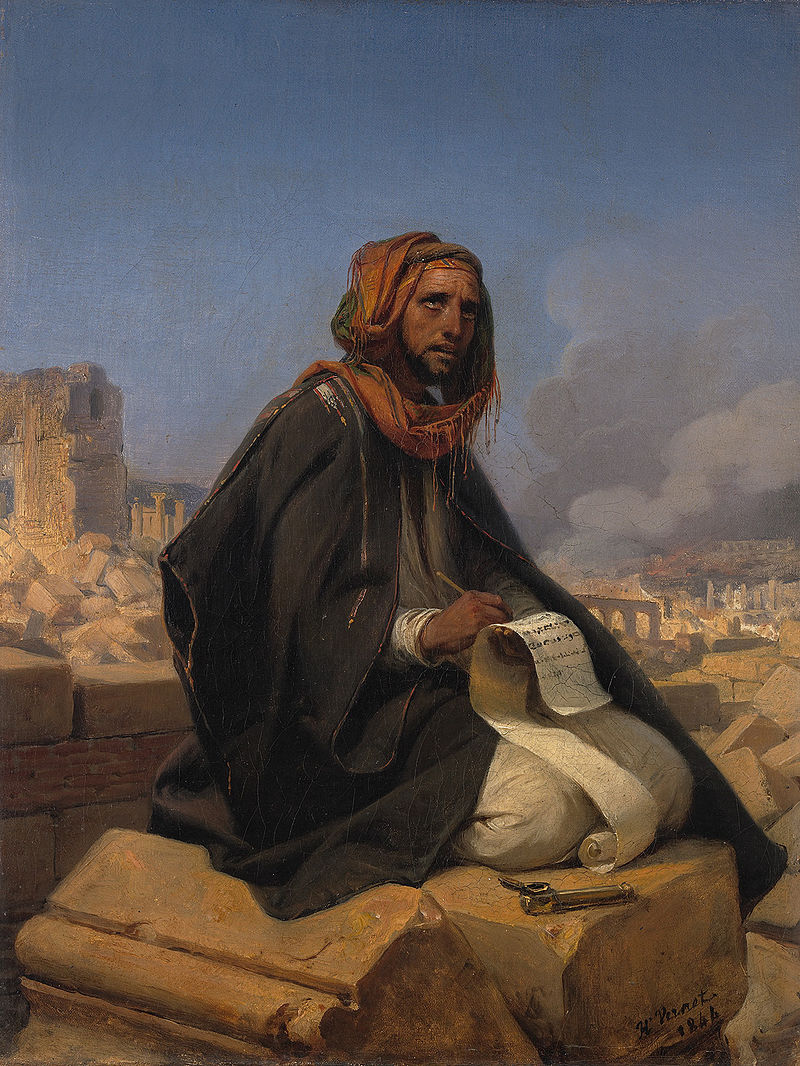
"Jeremiah on the Ruins of Jerusalem"
(Horace Vernet, 1844)
'For I know the plans that I have for you,' declares the LORD,
'plans for welfare and not for calamity to give you a future and a hope.
-- Jeremiah 29:11
(Play beautiful related song by Marty Goetz and Misha)
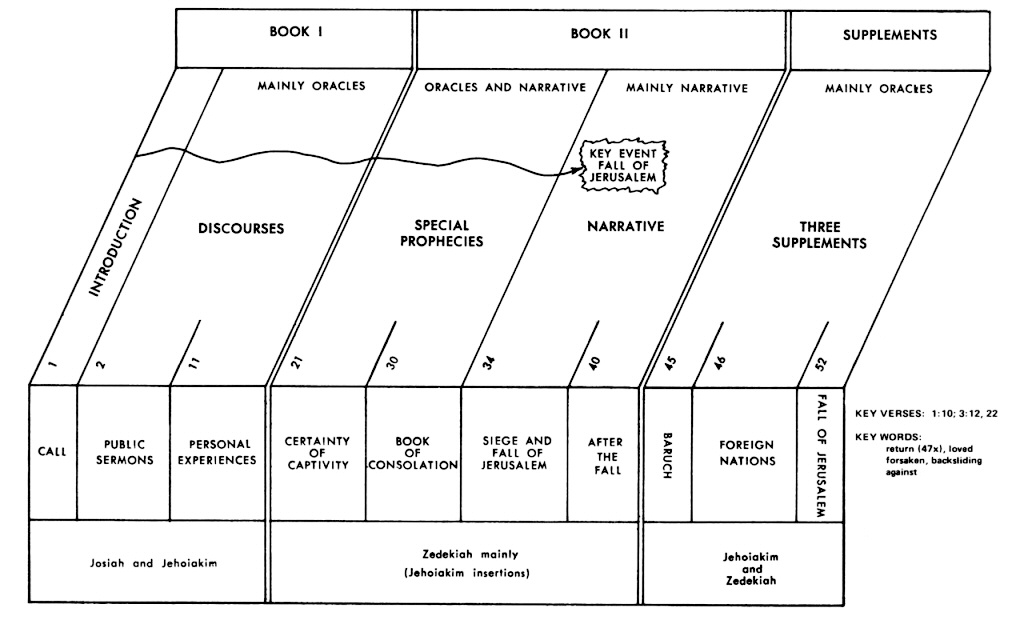
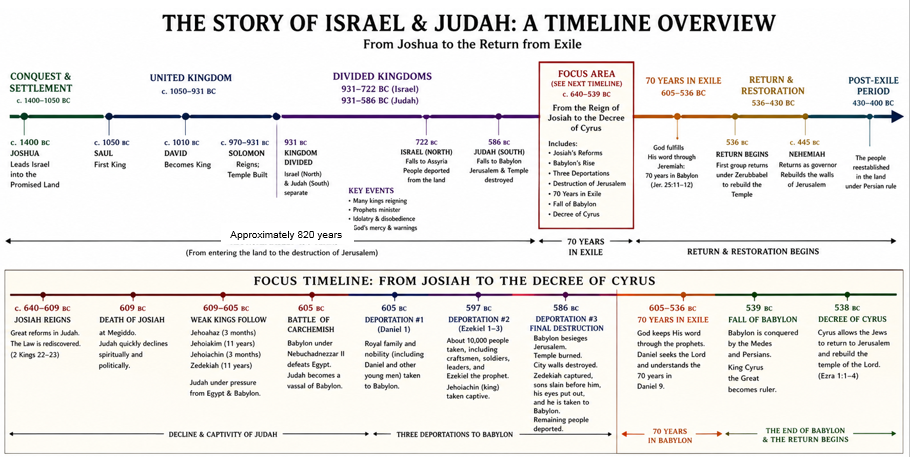
Click chart to enlarge
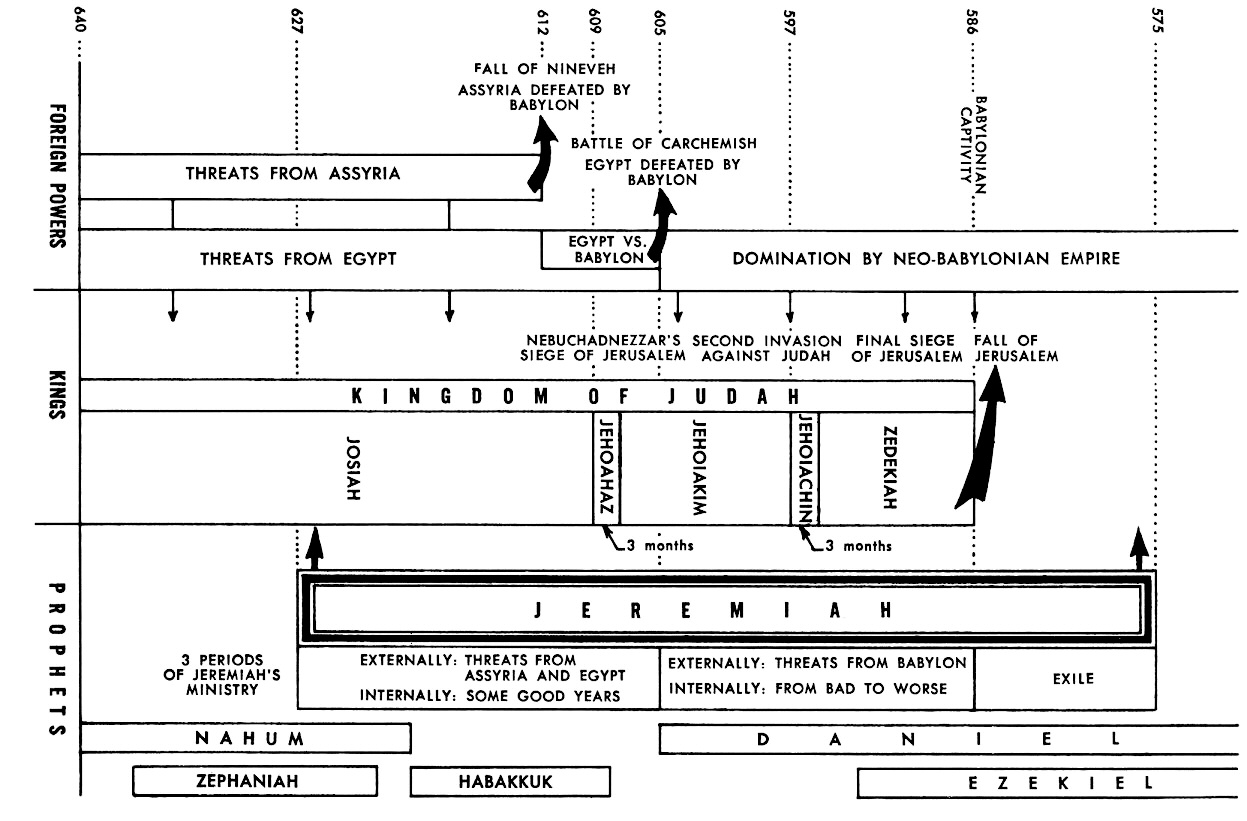
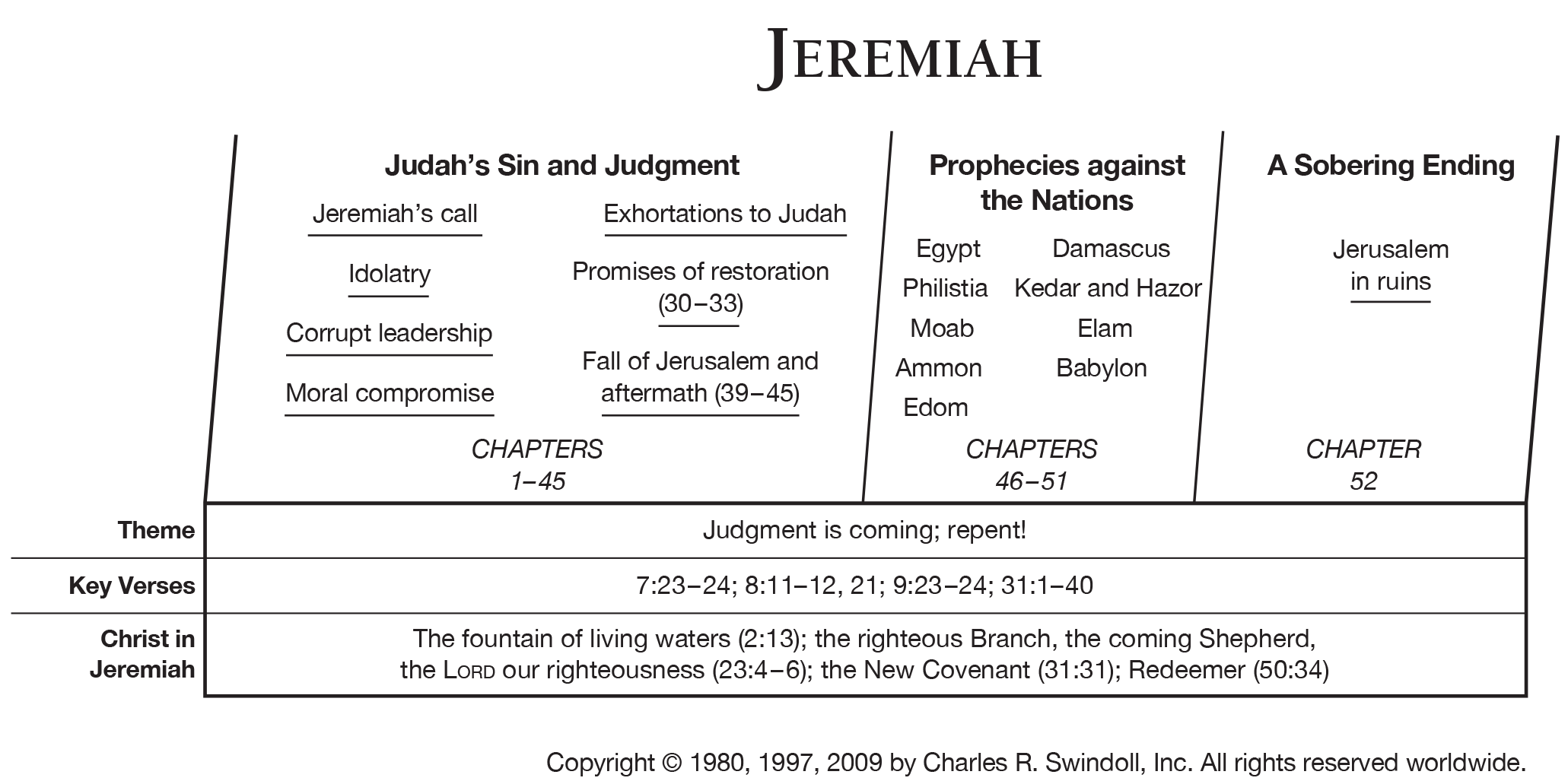
Click chart to enlarge
Chart from recommended resource Jensen's Survey of the OT - used by permission
Jeremiah Chart from Charles Swindoll
| JEREMIAH: "PROPHET TO THE NATIONS" Sin - "I Will Punish" (Jer 9:25) Hope - "I Will Restore" (Jer 30:17) Judah & Jerusalem |
||||||
|
Prophet |
Prophecies to Judah Jer 2:1-45:5 |
Prophecies to the Gentiles Jer 46:1-51:64 |
Prophet's Appendix Jer 52:1-52:34 |
|||
| Prophet's Commission Jer 1:1-19 |
Judah Condemned Jer 2:1-25:38 |
Jeremiah's Conflicts Jer 26:1-29:32 |
Jerusalem's Future Jer 30:1-33:26 |
Jerusalem's Fall Jer 34:1-45:5 |
Nations Condemned Jer 46:1-51:64 |
Historic Conclusion Jer 52:1-52:34 |
| Before The Fall Of Jerusalem Jer 1:1-38:28 |
The Fall Jer 39:1-18 |
After The Fall |
||||
| Call | Ministry | Retrospect | ||||
| Nation of Judah |
Surrounding Nations |
Future of Babylon |
||||
| 627-582 BC Ministered 40+ Years! |
||||||
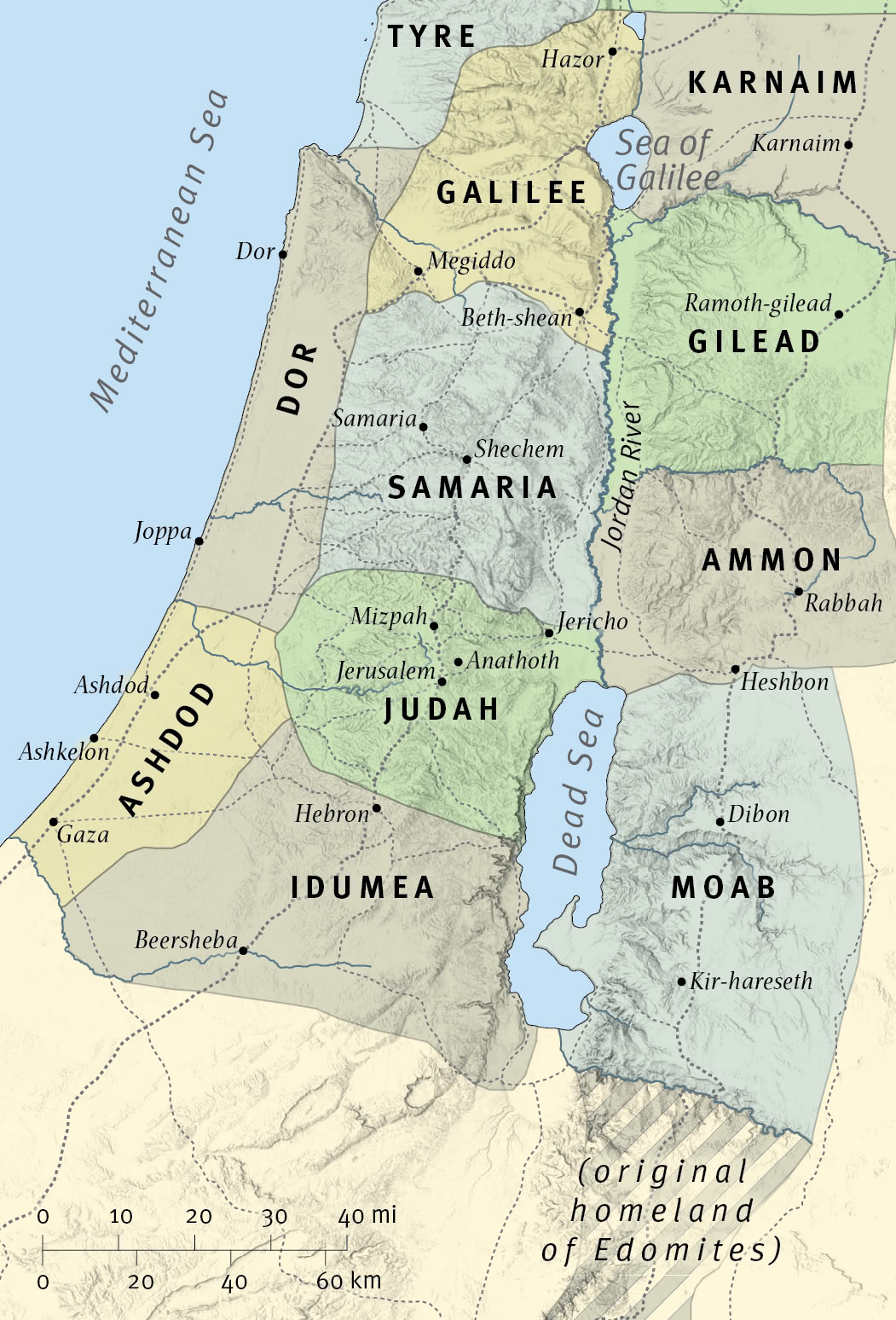
Map of Israel at Time of Jeremiah
Source: ESV Global Study Bible
Jeremiah 24:1 After Nebuchadnezzar king of Babylon had carried away captive Jeconiah the son of Jehoiakim, king of Judah, and the officials of Judah with the craftsmen and smiths from Jerusalem and had brought them to Babylon, the LORD showed me: behold, two baskets of figs set before the temple of the LORD!
- LORD: Am 3:7 7:1,4,7 8:1 Zec 1:20 3:1
- two baskets: De 26:2-4
- after: Jer 22:24-28 29:2 2Ki 24:12-16 2Ch 36:10 Eze 19:9
- smiths: 1Sa 13:19,20
Related Passages:
2 Kings 24:8 Jehoiachin was eighteen years old when he became king, and he reigned three months in Jerusalem; and his mother’s name was Nehushta the daughter of Elnathan of Jerusalem.
Esther 2:5-6 Now there was at the citadel in Susa a Jew whose name was Mordecai, the son of Jair, the son of Shimei, the son of Kish, a Benjamite, 6 who had been taken into exile from Jerusalem with the captives who had been exiled with Jeconiah king of Judah, whom Nebuchadnezzar the king of Babylon had exiled (Second Deportation 597 BC).
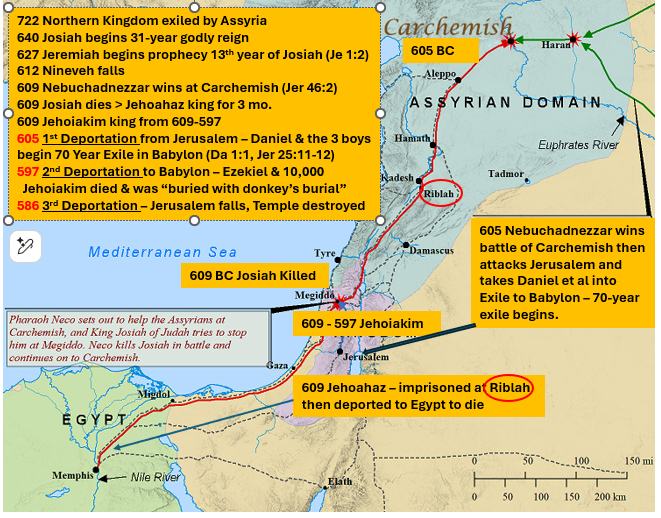
AFTER SECOND DEPORTATION
TO BABYLON
After - When? Approximately 597 BC. This is the second deporation - First in 605 BC and third in 586 BC. Recall that King Jehoiakim had reigned from 609 BC and was killed in Jerusalem in 597 BC suffered the dishonorable "burial of a donkey's burial" with his body being cast out of the city rather than into a grave! (Jer 22:19)
Warren Wiersbe is probably correct when he says "Knowing that His servant needed encouragement, the Lord gave him a vision of two baskets of figs sitting before the temple of the Lord." And as the passage unfolds the basket of good figs would be encouraging to him!
Nebuchadnezzar king of Babylon Nebuchadnezzar II was the ruler of the Neo-Babylonian Empire and the instrument God used to judge Judah (cf. Jer 25:9). His campaigns against Jerusalem were part of God’s sovereign plan to discipline His people.
Had carried away captive Jeconiah - Josiah's son Jeconiah (aka Jehoiachin in 2Ki 24:8 and Coniah in Jer 22:24, 28) was the young king of Judah who reigned only three months before surrendering to Babylon. After King Josiah's death you see a gradual, progressive decline in the monarchy in Judah with Judah losing its sovereignty and becoming in essence a vassal state, first of Egypt and finally of Babylon.
The son of Jehoiakim, king of Judah, and the officials of Judah with the craftsmen and smiths - Jehoiakim was Jeconiah’s father, a rebellious king who had opposed Babylon and ultimately brought further judgment upon the nation (2 Ki 24:1–6). Officials of Judah included the leaders, nobles, and governing authorities—those who shaped the nation politically and administratively. Their removal crippled Judah’s leadership structure. Craftsmen and smiths were skilled laborers and metalworkers, essential for building, industry, and especially weapons production. Babylon intentionally removed them to weaken Judah’s ability to rebel and strengthen Babylon’s own economy and infrastructure. 2 Kings 24:14 notes that only the poorest were left behind.
From Jerusalem and had brought them to Babylon This forced exile was not only a political or military event but also a deeply spiritual one. God had given the Promised Land to His chosen people (Dt 7:6) as part of His covenant promise to Abraham, Isaac, and Jacob (Ge 17:8). Yet, as Jeremiah 27:20 explains, Nebuchadnezzar “did not take away” everything at first, leaving some items and people in Jerusalem, showing that God’s judgment was unfolding in stages. Similarly, Esther 2:6+ later refers to this same deportation, noting that Mordecai’s family had been carried away “from Jerusalem among the captives carried away with Jeconiah king of Judah, whom Nebuchadnezzar king of Babylon had carried away.” These cross-references confirm the historical and theological significance of this exile—it was both a punishment for sin and a preparation for eventual restoration.
The LORD showed me - Remember that this vision is after the deportation in 597. This is special revelation, supernatural disclosure, and is not Jeremiah using his sanctified imagination! He is being given a prophetc vision direcely from Yahweh as did Amos (Amos 7:1, 4, 7, cf Nu 12:6, Abram - Ge 15:1, Jacob - Ge 46:2, Daniel - Da 7:1; Paul - Acts 16:9, 18:9). The message therefore carries divine authority and must be interpreted according to God’s explanation, not human perception (cf. 2Pe 1:20–21).
Behold (hinneh) calls for careful attention. It signals that what Jeremiah is about to see is significant and symbolic, inviting the reader to pause and observe closely (cf. Isa 7:14). Spurgeon reminds us that "Behold is a word of wonder; it is intended to excite admiration. Wherever you see it hung out in Scripture, it is like an ancient sign-board, signifying that there are rich wares within, or like the hands which solid readers have observed in the margin of the older Puritanic books, drawing attention to something particularly worthy of observation."
Two baskets of figs - As the context unfolds we see that the figs were symbolic. In Scripture, figs often represent Israel or Judah and their spiritual condition (cf Hos 9:10, Mic 7:1, Mt 21:19). The symbolism of these baskets of figs will be explained in the following passages.
Set before the temple of the LORD! - The temple represents God’s presence and covenant relationship (cf. 1 Ki 8:10–11). So setting the baskets before the temple which represents His dwelling place is tantamount to bringing the baskets before God Himself. This suggests that vision is not about feeding the poor but contains spiritual truths. The idea is that the people of Judah (symbolized by figs) are placed before God for His evaluation and judgment.
FIG, FIG TREE - excellent resource Dictionary of Biblical Imagery page 982.
Well known in antiquity for its sweet taste and protective shade, the fig tree appears in the biblical record first in the prototypical tragedy of the Fall of humanity (Gen 3). In this archetypal fall from innocence, one consequence of the original pair’s succumbing to temptation is their attempt to cover their nakedness before God with fig leaves.
The fig tree was one of the most important domesticated plants in the biblical era and was widely cultivated throughout Palestine. It grows best in moderately dry areas that have little or no rain during the period of fruit maturation. The tree was cultivated for its delicious fruit and appreciated for its dark green and deeply lobed leaves, which produced a welcome shade (Mic 4:4; Zech 3:10; Jn 1:48).
These features of fruitfulness and shade make the fig tree a ready symbol for God in covenant relation to his people, as is the vine, with which it is often linked. Thus God is portrayed as having seen in Israel prospects of productivity as one “seeing the early fruit on the fig tree” (Hos 9:10 NIV [NIV NIV. New International Version] ), which, appearing in late spring, gives promise of later fruitfulness. As covenant beneficiary, Israel could enjoy the God-given prosperity and security experienced in the Solomonic ideal: “each man under his own vine and fig tree” (1 Kings 4:25 NIV [NIV NIV. New International Version] ).
Failure to keep covenantal standards to be fruitful could mean the loss of safety and God’s judgment, a theme often repeated in prophetic pronouncements. Jesus utilized the motif of the fig tree in similar fashion, warning of the danger of spiritual fruitlessness (Lk 13:6—9), a condition which if uncorrected would spell disaster (Mt 21:19—21). Jesus uses a barren but leafy fig tree to illustrate how Israel, typified in its leadership, had a showy religion that was of no value and was worthy of judgment because it bore no fruit in their lives (Mk 11:12—21).
At its most basic level the fig tree is viewed as a wonderful part of settled life. It symbolized the good life, and to live under one’s fig tree stood for a life of settledness (fig trees took several years of difficult labor to establish), joy, peace and prosperity. In his taunt, the king of Assyria uses the fig tree as part of his picture of the life he claimed that he wanted to extend to Israel: “Do not listen to Hezekiah. This is what the king of Assyria says: Make peace with me and come out to me. Then every one of you will eat from his own vine and fig tree and drink water from his own cistern” (Is 36:16 NIV [NIV NIV. New International Version] ).
The fig tree is part of the eschaton because it is a good thing worthy of the new order and represents the pleasures of food and settled domestic life. Fig trees are portrayed as part of this new age by Micah and Zechariah, since they symbolize how the best of the present age will continue when God’s reign is fully established: “ ‘In that day each of you will invite his neighbor to sit under his vine and fig tree,’ declares the Lord Almighty” (Zech 3:10 NIV [NIV NIV. New International Version] ; also Mic 4:4)
Fred Wright - The Fig Tree - Manners and Customs of the Bible Lands page 206
Three Crops Of Figs In Palestine
The early figs, not very many in number, but large in size, are ripe a month before the main crop; the summer or main crop is used in August and September; and the winter figs remain on the trees until late in the fall of the year. Mention is made in Scripture of the firstripe figs as being desirable (Hosea 9:10), and the ease with which they are secured when the tree is shaken (Nahum 3:12). The summer crop that is not eaten as fresh fruit is dried on the housetops, and then used in the winter months.
The Fig Tree A Sign Of The Season
The fig tree shows sign of foliage later than some of the other fruit trees of Palestine. The unfolding of the fig leaves and the deepening of their color is thought of as a sign that summertime is at hand. Jesus made reference to this idea: “Now learn a parable of the fig tree; when his branch is yet tender, and putteth forth leaves, ye know that summer is nigh” (Matt. 24:32; Mark 13:28). The lover in the Song of Solomon indicated that winter was past and summer was at hand because “the fig tree putteth forth her green figs” (Canticles 2:11–13).
Christ And The Fig Tree
In order to understand why Christ cursed the fig tree one day, it is necessary to know the custom of the fig tree’s growth of leaves and fruit. The normal habit of the fig trees is that fruit begins to form on the tree as soon as leaves appear. Leaves and fruit also disappear together. But it was said of this fig tree which Jesus and his disciples saw on the Mount of Olives, “for the time of figs was not yet” (Mark 11:13). Actually this was no excuse for this fig tree, because if it was not the time for figs, it was also not the time for leaves to appear. By a show of leaves, it was like many people, pretending to have fruit which was not there. It was like the Pharisees who professed to be very religious, but whose lives were fruitless. Therefore Christ cursed this tree as an object lesson to all not to be hypocritical.
Jesus also gave us the Parable of the Barren Fig Tree.
A certain man had a fig tree planted in his vineyard; and he came and sought fruit thereon, and found none. Then said he unto the dresser of his vineyard, Behold, these three years I come seeking fruit on this fig tree, and find none: cut it down; why cumbereth it the ground? And he answering said unto him, Lord, let it alone this year also, till I shall dig about it, and dung it: and if it bear fruit, well: and if not, then after that thou shalt cut it down (Luke 13:6–9).
Here was a fig tree that failed for three years to bear fruit, when its owner had a right to expect a crop. The gardener suggested patience with the tree, and proposed additional cultivation and fertilization for it, giving it another chance to bear figs. It will be noted that this fig tree had been planted in the midst of a vineyard. This is often done in Palestine.
Use Of Figs In The Old Testament
Figs were often used in the history of Israel, especially dried figs. Abigail took two hundred cakes of figs to David (1 Sam. 25:18). A cake of figs was given the Egyptian to revive him (1 Sam. 30:12). And cakes of figs were brought to David at Hebron at a time of great rejoicing (1 Chron. 12:40). When King Hezekiah was sick, Isaiah told him to put a lump of figs on his boil, and the Lord healed him (2 Kings 20:7). Jeremiah refers to the characteristic of figs, that some of them can be very good, and then again, they can be very bad (Jer. 24:1, 2).
Sitting Under One’s Own Fig Tree
Several times the Old Testament makes use of this expression with the addition of the vine. It is used in various ways. In the prosperous reign of King Solomon it was said, “And Judah and Israel dwelt safely, every man under his vine and under his fig tree, from Dan even to Beer-sheba, all the days of Solomon” (1 Kings 4:25). This was another way of saying that there was prosperity and peace in the land, that every family enjoyed the possession of his father’s inheritance, which was symbolized by the fruits of the vine and fig tree belonging to each home. The prophet Micah used the expression to picture the universal peace and prosperity which would characterize the coming Golden Age: “Nation shall not lift up sword against nation, neither shall they learn war any more. But they shall sit every man under his vine and under his fig tree; and none shall make them afraid” (Micah 4:3, 4). It is a picture of enjoying the blessings of peace.
Jeremiah 24:2 One basket had very good figs, like first-ripe figs, and the other basket had very bad figs which could not be eaten due to rottenness.
- One basket: Jer 24:5-7 Ho 9:10 Mic 7:1
- first ripe: Mic 7:1 Na 3:12 Rev 6:13
- Very bad: The winter fig, probably, then in its crude or unripe state. Jer 24:8-10 Isa 5:4,7 Eze 15:2-5 Mal 1:12-14 Mt 5:13
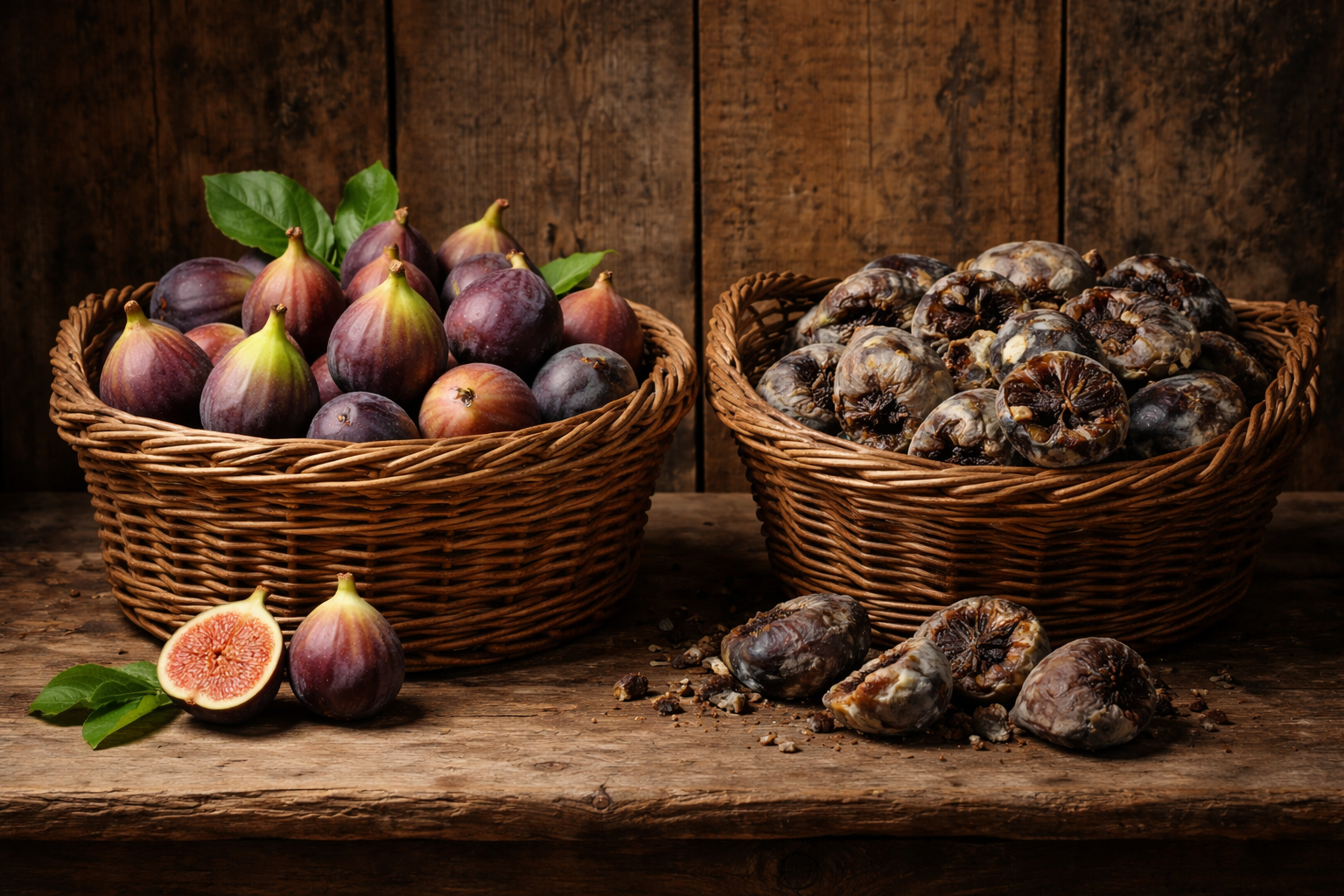
TWO BASKETS OF FIGS:
GOOD AND ROTTEN
One basket had very good figs, like first-ripe (bikkūrāh) figs and the other basket had very bad figs which could not be eaten due to rottenness - As the following context explains, the first-ripe figs symbolize the exiles whom God regards as good figs, valued and watched over with care.
The vision of the two baskets of figs serves as a vivid symbolic picture of the spiritual condition of Judah, though the imagery naturally extends to all of Israel. The figs do not merely represent individuals in a general sense, but rather the moral and spiritual “fruit” of the nation as a whole, what they have become in response to God’s revelation.
This imagery is consistent with a well-established biblical pattern in which the fig tree represents Israel and its spiritual state. Later, the Lord Jesus Christ explicitly employs this symbolism. In Lk 13:6–9, the barren fig tree illustrates Israel’s failure to produce the fruit God sought despite repeated opportunities. In Mt 21:18–20, Jesus curses the fig tree, a dramatic sign of judgment on fruitless religiosity. And in Mt 24:32–33, the fig tree becomes a lesson in discernment, pointing to recognizing the times and God’s unfolding purposes. Together, these passages reinforce that the fig tree and its fruit function as a spiritual barometer of the nation’s response to God.
Within Jeremiah’s vision, the distinction between the two baskets is striking: the good figs represent those who are faithful, those whose hearts are responsive to God, while the bad figs represent those who are hardened, rebellious, and apostate. Thus, the good figs symbolize those whom God regards with favor, whom He will preserve, refine, and restore, while the very bad figs represent those who persist in unbelief and rebellion, and who therefore come under judgment. The underlying principle is timeless teaching that a person’s true condition before God is revealed by their response to His revelation, culminating ultimately in their response to Jesus Christ.
TSK on First Ripe - The figs of the early sort; perhaps those which are ripe about six weeks before the full season, which are reckoned a great dainty. "No sooner," says Dr. Shaw, "doth the early fig draw near to perfection in the middle or latter end of June, than the summer fig, begins to be formed, though it rarely ripens before August; about which time the same tree frequently throws out a third crop, or winter fig, as we may call it. This is usually of a much longer shape and darker complexion than the summer fig hanging and ripening upon the tree, even after the leaves are shed; and, provided the winter proves mild and temperate, is gathered as a delicious morsel in the spring."
Henry Morris - The figs are symbolic of the spiritual fruit of the whole nation of Judah, probably including Israel as well. Christ also referred to the fig tree and its fruit as symbolic of the nation and its response to Him. (Luke 13:6-9; Matthew 21:18-20; 24:32,33) The good figs represent the faithful Jews, the bad figs the apostate Jews. The difference is determined by their respective response to their Messiah when He is made known to them.
First ripe (01063) Hebrew noun בִּכּוּרָה bikkūrāh from the root בָּכַר (bākar, “to be firstborn, to come early, to bear early”), and fundamentally denotes the first, earliest, or choicest produce of a season, especially fruit that appears at the beginning of the harvest. By extension it refers to that which is especially prized, desirable, and precious because of its “firstness.” While closely related to bikkurim (firstfruits), bikkūrāh places particular emphasis on the quality, preciousness, attractiveness, and eagerly desired nature of the first yield, not merely its chronological priority.
In the ancient Near Eastern and Mediterranean world, in the literal sense, the “early fig” (bikkūrāh) was considered a delicacy, especially in the Middle East. The early ripe fruit is especially prized because it appears before the main harvest and is therefore rare, eagerly desired, and highly valued. These figs ripen around June, well before the main (late) fig harvest in August, making them rare and highly sought after. For example, in Micah 7:1, the prophet laments, “There is not a cluster of grapes to eat, or a first-ripe fig which I crave,” where bikkūrāh conveys that the early fig is not only first in time but also uniquely satisfying and eagerly longed for. Similarly, Isaiah 28:4 compares something fleeting and quickly consumed to “the first-ripe fig prior to summer, which one sees, and as soon as it is in his hand, he swallows it,” highlighting its immediate appeal and desirability. Their desirability is reflected linguistically as well—the Arabic cognate bakurat even entered Spanish during centuries of Arab influence. Because of this cultural background, bikkūrāh came to signify something eagerly anticipated and immediately enjoyed. As seen in Isaiah 28:4, the first-ripe fig is snatched and eaten as soon as it is in hand, underscoring its irresistible appeal and fleeting nature.
bikkūrāh - 4X - Isa. 28:4; Jer. 24:2; Hos. 9:10; Mic. 7:1
Scripturally, bikkūrāh carries both literal and figurative meanings:
Literal sense: It refers to early ripe figs that are quickly picked and consumed, highlighting their freshness, sweetness, and desirability (Isa. 28:4).
Figurative sense: bikkūrāh is richly symbolic: It can describe that which is especially delightful, precious, and set apart because of its “firstness.
Figuratively, bikkūrāh carries rich theological and symbolic meaning. It can describe that which is especially delightful, precious, and set apart because of its “firstness.” In Hosea 9:10, God says, “Like grapes in the wilderness I found Israel; like the first fruit on the fig tree in its first season I saw your fathers,” using bikkūrāh to express the Lord’s delight in Israel at the beginning of their relationship—fresh, desirable, and full of promise. Thus, the term often conveys not only priority but affection, expectation, and value.
In Hosea 9:10, it portrays Israel in her early relationship with God—fresh, delightful, and precious in His sight: Hosea 9:10 "I found Israel like grapes in the wilderness; I saw your forefathers as the earliest fruit on the fig tree in its first season. But they came to Baal-peor and devoted themselves to shame, And they became as detestable as that which they loved. Bikkūrāh to express the Lord’s delight in Israel at the beginning of their relationship, fresh, desirable, and full of promise.
In Jeremiah 24:2, it symbolizes the exiles whom God regards as “good figs,” valued and watched over with care.
In Micah 7:1, it expresses the prophet’s lament that the godly have vanished, creating a longing like that experienced when no early figs are available between harvests.
In Isaiah 28:4, it also becomes a metaphor for Ephraim’s fleeting existence, soon to disappear like a first-ripe fig that is instantly consumed.
Thus, bikkūrāh not only conveys priority in time but also intensity of desire, delight, and value. It can represent:
- God’s initial delight in His people (Hos. 9:10),
- The precious remnant under His care (Jer. 24:2),
- The painful absence of righteousness (Mic. 7:1),
- Or the swift disappearance of a people under judgment (Isa. 28:4).
Theologically, bikkūrāh aligns with the broader biblical principle of firstfruits belonging to God, the idea that the first and best belong to God (cf. Ex 23:19; Lev. 23:10), reflecting the idea that the first and best are to be consecrated to Him as an acknowledgment of His provision and lordship. It underscores a key biblical pattern that what comes first is representative of the whole and is therefore sacred, set apart, offered in devotion and especially valued.
In summary, bikkūrāh refers to the earliest and most desirable produce—especially fruit such as first-ripe figs—marked by its priority in time, its excellence, its attractiveness, its rarity, and its cherished value or delight, and by extenstion figuratively it signifies what is precious, eagerly desired, and either cherished by God or belonging to God or, in judgment contexts, quickly lost, like something so desirable it is consumed the moment it appears.
Jeremiah 24:3 Then the LORD said to me, “What do you see, Jeremiah?” And I said, “Figs, the good figs, very good; and the bad figs, very bad, which cannot be eaten due to rottenness.”
- What do you see: Jer 1:11-14 1Sa 9:9 Am 7:8 8:2 Zec 4:2 5:2,5-11 Mt 25:32,33
Related Passages:
Jeremiah 1:11 The word of the LORD came to me saying, “What do you see, Jeremiah?” And I said, “I see a rod of an almond tree.”
Amos 7:8 The LORD said to me, “What do you see, Amos?” And I said, “A plumb line.” Then the Lord said, “Behold I am about to put a plumb line In the midst of My people Israel. I will spare them no longer.
JEREMIAH'S VISION OF
GOOD AND BAD FIGS
Then the LORD said to me, “What do you see, Jeremiah?” - Notice that God initiates the revelation through a question. This is a common prophetic pattern that God shows then asks and then explains. God's purpose of asking Jeremiah is to focus the prophet’s attention and to ensure he accurately perceives the vision before interpreting it. Imagine if Jeremiah had said something like "I see two flower pots!" Instead, Jeremiah gives an exact, discerning observation.
🙏 THOUGHT- I love Yahweh’s question to Jeremiah, for it beautifully reflects the heart of inductive Bible study, where careful observation is the essential starting point (NOT interpretation!) for understanding God’s Word. When the LORD asks, “What do you see?”, it is not merely a question for Jeremiah, but a model for every reader of Scripture. In a very real sense, the Holy Spirit, Who inspired the text (2Pe 1:20, 21), asks each of us the same question: “What do you see, ____________?” (Fill your name in the blank). This question underscores the truth that accurate interpretation begins with attentive observation. As Scripture itself affirms, “Ezra had set his heart to study the law of the LORD and to practice it, and to teach His statutes and ordinances in Israel” (Ezra 7:10), demonstrating intentional, careful engagement with the text. And what was the benefit to Ezra? The good hand of the LORD was upon him, and I submit that if you discipline yourself as Ezra did, the good hand of the LORD will be on your life!
The principle is simple but profound: the better you observe, the more you see; and the more you see, the more accurate your interpretation will be. Observation guards us from reading our ideas into the text (eisegesis) and instead trains us to draw meaning out of what God has actually said (cf. Acts 17:11+). Thus, before we interpret or apply, we must first slow down, look closely, and ask the Spirit to open our eyes to behold wonderful things from God's law and so to see what is truly there (Ps 119:18). See inductive Bible study. Short Power Point Presentation I made in 2002 you can work through at your own pace. Youtube video - How to Study Your Bible - "Hinge Words" Part 1.
And I said, “Figs, the good figs, very good; and the bad figs, very bad, which cannot be eaten due to rottenness - Jeremiah does not generalize but carefully distinguishes both the quality (very good vs very bad) and the usability (edible vs inedible). Notice that simply from making the correct observations, Jeremiah is already getting a sense of the interpretation of these symbols. Notice also Jeremiah does not see a middle ground, for very good and very bad indicate there is no middle ground (and that has spiritual implications of course). It recalls Jesus' words that "He who is not with Me is against Me." (Mt 12:30, Lk 11:23) In other words, there is no middle ground with Jesus. Jeremiah clearly discerns the very bad figs cannot be eaten due to rottenness, indicating total corruption, and complete uselessness. The bad figs are not simply imperfect, but are ruined beyond use. So while this verse is not the interpretation or meaning, it prepares for the interpretation that God distinguishes sharply between those He will restore and those He will judge. There is no "middle ground."
John Riddle has an interesting comment on the bad figs - Had they been asked to which basket they belonged, the Jews in Jerusalem would have doubtless replied that they were the “very good figs” and that their brethren had been carried off because they were “very naughty figs” (v. 2). But this was not the case. (What the Bible Teaches)
Eisegesis is the interpretive error of bringing one’s own assumptions, opinions, experiences, or theological biases into the text ("eis-" = into), rather than drawing meaning out of the text itself (exegesis - "ex-" = out of). Instead of allowing Scripture to speak on its own terms, the interpreter imposes a meaning that originates outside the passage. This leads to distorted understanding because the authority shifts from God’s Word to the reader’s perspective. Scripture warns against this kind of approach, emphasizing that “no prophecy of Scripture is a matter of one’s own interpretation” (2 Pet 1:20), and commends those who carefully examined the Scriptures to understand what was actually written (Acts 17:11). Nehemiah 8:8 is a good example - "They read from the book, from the law of God, translating to give the sense so that they understood the reading." In short, eisegesis invariably leads to distortion of God's original meaning of a text whereas exegesis leads to accuracy.
In summary, eisegesis is the mistake of inserting our own ideas into Scripture, whereas faithful Bible study seeks to draw out the meaning God placed in the text.
- Eisegesis says, “What do I think this means?”
- Exegesis asks, “What did God actually say?”
Jeremiah 24:4 Then the word of the LORD came to me, saying,
Related Passages:
Jeremiah 1:9 Then the LORD stretched out His hand and touched my mouth, and the LORD said to me, “Behold, I have put My words in your mouth.
Jeremiah 23:16-18 Thus says the LORD of hosts, “Do not listen to the words of the prophets who are prophesying to you. They are leading you into futility; They speak a vision of their own imagination, Not from the mouth of the LORD. 17 “They keep saying to those who despise Me, ‘The LORD has said, “You will have peace”’; And as for everyone who walks in the stubbornness of his own heart, They say, ‘Calamity will not come upon you.’ 18 “But who has stood in the council of the LORD, That he should see and hear His word? Who has given heed to His word and listened?
JEREMIAH'S WORD
FROM JEHOVAH
Then - This marks the moment when God Himself initiates communication with His prophet.
The word of the LORD came to me, saying - This is a classic prophetic formula signaling divine revelation. Jeremiah functions as God's mouthpiece. The message that follows is not human reflection, intuition, or opinion, but the very Word of God delivered by revelation. As Amos rhetorically asks "The Lord GOD has spoken! Who can but prophesy?"
The word of the LORD highlights the source. In Hebrew thought, God’s “word” (דָּבָר, dābār) is not merely speech but it is active, powerful, and effectual. What God speaks, He accomplishes (Isaiah 55:11). Thus, when Jeremiah says this, he is declaring that what follows carries divine authority and not speculation (2 Peter 1:21).
Came to me shows that revelation is initiated by God, not discovered by man. Jeremiah did not seek out this message—God brought it to him. This underscores the prophet’s role as a recipient and steward, not an originator (Jeremiah 1:9; Amos 3:7). This phrase also reinforces a key biblical principle: true prophecy begins with God speaking, not man thinking. It draws a sharp contrast with false prophets who speak from their own imagination rather than from God (Jeremiah 23:16–18).
QUESTION - What is the significance of the baskets of figs in Jeremiah 24?
SUMMARY - Jeremiah’s vision of the two baskets of figs (Jeremiah 24) symbolizes two groups of people in Judah after Babylon’s invasion. The good figs represent those taken into exile (like Jehoiachin and the captives), whom God regards with favor—promising to restore them, give them a new heart, and bring them back to the land (Jeremiah 24:5–7). The bad figs represent those who remained in Jerusalem or fled to Egypt, including Zedekiah and the disobedient people, who rejected God’s warnings and would face destruction by sword, famine, and pestilence (Jeremiah 24:8–10). This vision highlights two key truths: God shows mercy to those who respond to Him, even in judgment, and He brings inevitable judgment on those who persist in disobedience. Ultimately, it points to God’s consistent character—both gracious and holy—and His promise of restoration, fulfilled supremely through salvation by grace (Ephesians 2:4–9).
ANSWER - After one of the Babylonian attacks on Jerusalem, God gave the prophet Jeremiah an interesting vision: “The Lord showed me two baskets of figs placed in front of the temple of the Lord. One basket had very good figs, like those that ripen early; the other basket had very bad figs, so bad they could not be eaten” (Jeremiah 24:1–2). Each basket of figs represented something, as the Lord makes plain to Jeremiah in the subsequent verses.
Nebuchadnezzar, king of Babylon, invaded Judah three times: in 605, 597, and 586 BC. In the final of those conquests, Nebuchadnezzar destroyed Jerusalem and the temple, exiling all who remained. During the second invasion, Nebuchadnezzar carried away King Jehoiachin (Jeconiah) of Judah and craftsmen and smiths. That’s when Jeremiah had his vision of two baskets of figs in front of the temple (Jeremiah 24:1).
The figs in the two baskets were of different quality. The first basket was good for eating, while the second was rotten (Jeremiah 24:2–3). God explained to Jeremiah that He would regard those who had gone into captivity to Babylon as the good figs (Jeremiah 24:5). He would set His eyes on them for good and would one day bring that remnant back into the land (Jeremiah 24:6). He would give them a heart to know Him, and they would return to Him with their whole heart (Jeremiah 24:7).
In contrast to the good figs, the basket of bad figs illustrated the nature of those who remained in Jerusalem and those who had fled to Egypt (Jeremiah 24:7–8). This group included the wicked King Zedekiah, whom Nebuchadnezzar had placed on the throne in Jehoiachin’s stead. God had commanded everyone to go into exile to protect them from the judgment that was coming on the land (Jeremiah 21:8–10). Despite God’s merciful warning, Zedekiah, his officials, and many other Jews refused to obey God and remained in the land. Consequently, God announced that He would completely destroy them from the land by sword, famine, and pestilence (Jeremiah 24:9–10). They were the bad figs. The Promised Land had been given to their forefathers, but God determined that this particular generation would no longer enjoy their home. They would be removed, and the blessing of the land would be given to another generation.
After establishing the symbolism of the baskets of figs in Jeremiah 24, contrasting the obedient and the rebellious, God returns to the theme in Jeremiah 29. Parts of the prophet’s message, written from Jerusalem to the exiles in Babylon, were dire: “This is what the Lord says about the king who sits on David’s throne and all the people who remain in this city, your fellow citizens who did not go with you into exile—yes, this is what the Lord Almighty says: ‘I will send the sword, famine and plague against them and I will make them like figs that are so bad they cannot be eaten’” (Jeremiah 29:16–17). God’s curse was upon them, and He spells out the reason: “‘For they have not listened to my words,’ declares the Lord, ‘words that I sent to them again and again by my servants the prophets’” (verse 19).
Even in judgment, there is mercy. The people of Judah were exiled in Babylon for their past disobedience to God, yet God would mercifully protect all those who obeyed His direction to go willingly into exile. They were the good figs. In fact, in the midst of this judgment, God gives His people a beautiful promise: “This is what the Lord says: ‘When seventy years are completed for Babylon, I will come to you and fulfill my good promise to bring you back to this place. For I know the plans I have for you,’ declares the Lord, ‘plans to prosper you and not to harm you, plans to give you hope and a future’” (Jeremiah 29:10–11).
Jeremiah 29 is a vivid reminder of how longsuffering God is. Even though the people of Judah did not deserve to be given another chance, God extended His mercy. Similarly, none of us deserve His goodness. All of us were dead in our trespasses and sins (Ephesians 2:1), and we were even by nature children of God’s wrath (Ephesians 2:3). But God is rich in mercy and loved us greatly (Ephesians 2:4). He allowed us to have life in Jesus Christ (Ephesians 2:5). Because of His mercy and love, we are saved by grace through faith in Jesus Christ (Ephesians 2:8–9).
Some casual readers of Scripture may think that the God of the Old Testament is a God of wrath, while the God of the New Testament is a God of grace. However, if we simply read what He has said, we see that He is the same in both eras. He is holy and gracious throughout all of history. The two baskets of figs in Jeremiah 24 show us two important and constant principles about God. First, He is merciful and gracious to the utmost. He always provides a way for people to receive mercy. Second, God will not compromise His holiness. If the path of mercy is ignored, then there are severe and unavoidable consequences. The baskets of figs in Jeremiah 24 remind us that mercy is available—a mercy that we know today comes by grace through faith in Jesus Christ.
Jeremiah 24:5 “Thus says the LORD God of Israel, ‘Like these good figs, so I will regard as good the captives of Judah, whom I have sent out of this place into the land of the Chaldeans.
- I will regard as good: Na 1:7 Zec 13:9 Mt 25:12 Joh 10:27 1Co 8:3 Ga 4:9 2Ti 2:19
- as good the captives of Judah: De 8:16 Ps 94:12-14 119:67,71 Ro 8:28 Heb 12:5-10 Rev 3:19
Related Passages:
Jeremiah 29:11 ‘For I know the plans that I have for you,’ declares the LORD, ‘plans for welfare and not for calamity to give you a future and a hope.
YAHWEH BEGINS TO EXPLAIN
MEANING OF FIGS
Thus says the LORD God of Israel This typical authoritative formula underscores that the interpretation is not Jeremiah’s opinion but Yahweh's evaluation. God Alone defines what is truly good, independent of human assessments.
‘Like these good figs - The good (Hebrew ṭôb) figs symbolize spiritual quality, not outward circumstances. In the vision (Jer 24:2), these figs are very good, like first-ripe figs (bikkurah), prized for their sweetness and desirability. (cf. Hos 9:10). Thus, God is identifying a remnant within Judah that is precious to Him.
Charles Feinberg - The passage explicitly says that the good figs are the exiles of 597 B.C. under Jehoiachin (v.5). The word "good" refers not to the character of the exiles but to their circumstances. They were not taken to Babylon for their piety and godliness. But the Lord promised them that he would look with favor on them (v.6). (See The Expositor's Bible Commentary - Abridged Edition - Page 481)
So I will regard as good the captives of Judah - This is the shocking reversal. The exiles—those taken in the first deportation to Babylon (597 BC, including men like Ezekiel; cf. 2 Ki 24:10–16)—might appear cursed. Yet God declares them “good” because they are the ones He intends to refine, restore, and preserve spiritually. Their exile is not abandonment but redemptive discipline (cf. Heb 12:6).
Whom I have sent out of this place into the land of the Chaldeans – God emphasizes His sovereignty. The exile was not ultimately Nebuchadnezzar’s doing but God’s purposeful sending. This aligns with passages like Jer 25:9, where God calls the Babylonian king “My servant,” showing that even His righteous judgment is under divine control allowing Him to use unrighteous men (Chaldeans) to carry it out.
Babylon (the land of the Chaldeans) becomes the place of purification of His people. What seems like displacement is actually preparation. In the following verses (Jer 24:6–7), God promises to watch over them for good, bring them back, and give them a heart to know Him.
Ellicott makes an interesting commentar that the contact of the "good figs" "with the monstrous idolatry of Babylon made them more conscious than they had ever been before of the greatness of their own faith. The process which, at the end of the seventy years of exile, made them once more and forever a purely monotheistic people, had already begun” (Ellicott’s Commentary).
Jeremiah 24:6 ‘For I will set My eyes on them for good, and I will bring them again to this land; and I will build them up and not overthrow them, and I will plant them and not pluck them up.
NLT I have sent them into captivity for their own good. I will see that they are well treated, and I will bring them back here again. I will build them up and not tear them down. I will plant them and not uproot them.
- For I will: Jer 21:10 De 11:12 2Ch 16:9 Ne 5:19 Job 33:27,28 Ps 34:15 1Pe 3:12
- and I will bring: Jer 12:15 23:3 29:10 32:37 Eze 11:15-17 36:24
- I will build: Jer 1:10 18:7-9 32:41 33:7 42:10
Related Passages:
Jeremiah 1:10 “See, I have appointed you this day over the nations and over the kingdoms, To pluck up and to break down, To destroy and to overthrow, To build and to plant.”
Lamentations 3:31-32 For the Lord will not reject forever, 32For if He causes grief, Then He will have compassion According to His abundant lovingkindness.
2 Chronicles 36:22-23 Now in the first year of Cyrus king of Persia–in order to fulfill the word of the LORD by the mouth of Jeremiah–the LORD stirred up the spirit of Cyrus king of Persia, so that he sent a proclamation throughout his kingdom, and also put it in writing, saying, 23 “Thus says Cyrus king of Persia, ‘The LORD, the God of heaven, has given me all the kingdoms of the earth, and He has appointed me to build Him a house in Jerusalem, which is in Judah. Whoever there is among you of all His people, may the LORD his God be with him, and let him go up!’”
Ezra 1:1-4 Now in the first year of Cyrus king of Persia, in order to fulfill the word of the LORD by the mouth of Jeremiah, the LORD stirred up the spirit of Cyrus king of Persia, so that he sent a proclamation throughout all his kingdom, and also put it in writing, saying: 2 “Thus says Cyrus king of Persia, ‘The LORD, the God of heaven, has given me all the kingdoms of the earth and He has appointed me to build Him a house in Jerusalem, which is in Judah. 3 ‘Whoever there is among you of all His people, may his God be with him! Let him go up to Jerusalem which is in Judah and rebuild the house of the LORD, the God of Israel; He is the God who is in Jerusalem. 4 ‘Every survivor, at whatever place he may live, let the men of that place support him with silver and gold, with goods and cattle, together with a freewill offering for the house of God which is in Jerusalem.’”
YAHWEH PROMISES TO
BRING BACK TO LAND
For - term of explanation. This introduces the reason and explanation for the statement in the previous verse (Jer 24:5). He is explaining why God regards the exiles as “good figs.” God calls them good not because of their past righteousness, but because He has determined to act toward them for good.
This statement is a powerful declaration of God’s sovereign grace, restoration, and covenant faithfulness toward His people even after judgment.
I will set My eyes on them for good - God is turning His personal, watchful attention toward them with favor. In Scripture, God’s eyes signify His active oversight and care. What had previously been for judgment is now for blessing. God is not indifferent, but He is intentionally working for their good.
And I will bring them again to this land (Judah) - This is a prophecy of restoration to the Promised Land was partially fulfilled after their exile. Though they were carried away to Babylon, God promises a return. After 70 years in 538 BC they would be brought back to Judah by God.
There was an initial, partial fulfillment of this prophetic promise when the LORD stirred the spirit of Cyrus, king of Persia, to issue a decree allowing the Jewish exiles to return to their land and rebuild the temple (2Ch 36:22–23; Ezra 1:1–3). This marked the end of the 70 year Babylonian captivity and demonstrated God’s faithfulness to restore His people after judgment, just as He had promised (Jeremiah 29:10). Yet this return was only partial, not only in number (many chose not to return) but also in spiritual depth, for the full transformation of heart and complete restoration envisioned by the prophets had not yet been realized (Ezek 36:26–27). Thus, while the return under Cyrus was a genuine historical fulfillment, it ultimately anticipates a greater and more complete future restoration in which God will fully renew His people and firmly establish them in covenant relationship with Himself.
If the Captivity did nothing else,
it purged the Jewish people of idolatry
Warren Wiersbe makes the point that "The people who returned to the land after the Captivity were by no means perfect, but they had learned to trust the true and living God and not to worship idols. If the Captivity did nothing else, it purged the Jewish people of idolatry.
and I will build them up and not overthrow them - God using construction imagery to show stability and growth instead of destruction. Earlier, God had torn down because of sin (Jeremiah 1:10), but now He promises to rebuild. This reflects His redemptive purpose, even discipline is not His final word (Lam 3:31–32).
F B Huey, Jr makes an interesting point that "The verbs in v. 6—build, tear down, plant, uproot—are the same verbs found in Jer 1:10, though in a different order."
and I will plant them and not pluck them up - Here God shifts from construction imagery to shifts to agricultural imagery. To “plant” is to establish securely and cause to flourish. Previously, Israel had been uprooted because of persistent rebellion (Jeremiah 12:14–17), but now God promises permanence and fruitfulness. This echoes covenant blessing language (Psalm 1:3).
Note the phrase not pluck them up which which NET renders "I will plant them firmly in the land and will not uproot them." It is this last phrase which counters the interpretation that the return of the Jews after 70 years is the complete fulfillment of this prophecy. The fact is that the Jews were "plucked up" by the Romans in A.D. 70 and in A.D. 135. Therefore this prophecy has not been fulfilled and awaits a future fulfillment in the Millennium.
Don't miss the "I will's" - God Himself is the actor in every verb—I will set… I will bring… I will build… I will plant—showing that restoration is entirely by His grace
God is promising not just a return from exile, but a complete reversal—from judgment to blessing, from destruction to stability, and from uprooting to lasting fruitfulness—all by His sovereign, gracious initiative.
Jeremiah 24:7 ‘I will give them a heart to know Me, for I am the LORD; and they will be My people, and I will be their God, for they will return to Me with their whole heart.
- I will give: Jer 31:33-34 32:39 De 30:6 Eze 11:19-20 Ezek 36:24-28
- and they: Jer 30:22 31:33 32:38 De 26:17-19 Eze 37:23,27 Zec 8:8 13:9 Heb 8:10 11:16
- for they: Jer 3:10 29:12-14 De 4:29-31 30:2-5 1Sa 7:3 1Ki 8:46-50 2Ch 6:38 Isa 55:6,7 Ho 14:1-3 Ro 6:17
Related Passages:
Jeremiah 4:22 “For My people are foolish, They know (yada) Me not; They are stupid children And have no understanding. They are shrewd to do evil, But to do good they do not know (yada).”
Exodus 6:7 ‘Then I will take you for My people, and I will be your God; and you shall know that I am the LORD your God, who brought you out from under the burdens of the Egyptians.
Leviticus 26:12 ‘I will also walk among you and be your God, and you shall be My people.
Jeremiah 30:22 ‘You shall be My people, And I will be your God.’”
Jeremiah 31:31-34 “Behold, days are coming,” declares the LORD, “when I will make a new covenant with the house of Israel and with the house of Judah, 32 not like the covenant which I made with their fathers in the day I took them by the hand to bring them out of the land of Egypt, My covenant which they broke, although I was a husband to them,” declares the LORD. 33 “But this is the covenant which I will make with the house of Israel after those days,” declares the LORD, “I will put My law within them and on their heart I will write it; and I will be their God, and they shall be My people. 34 “They will not teach again, each man his neighbor and each man his brother, saying, ‘Know the LORD,’ for they will all know Me, from the least of them to the greatest of them,” declares the LORD, “for I will forgive their iniquity, and their sin I will remember no more.”
Deuteronomy 30:6 “Moreover the LORD your God will circumcise your heart and the heart of your descendants, to love the LORD your God with all your heart and with all your soul, so that you may live.
Ezekiel 11:19-20 “And I will give them one heart, and put a new spirit within them. And I will take the heart of stone out of their flesh and give them a heart of flesh, 20 that they may walk in My statutes and keep My ordinances and do them. Then they will be My people, and I shall be their God.
Ezekiel 36:24-28 “For I will take you from the nations, gather you from all the lands and bring you into your own land. 25 “Then I will sprinkle clean water on you, and you will be clean; I will cleanse you from all your filthiness and from all your idols. 26 “Moreover, I will give you a new heart and put a new spirit within you; and I will remove the heart of stone from your flesh and give you a heart of flesh. 27 “I will put My Spirit within you and cause you to walk in My statutes, and you will be careful to observe My ordinances. 28 “You will live in the land that I gave to your forefathers; so you will be My people, and I will be your God.
Revelation 21:3 And I heard a loud voice from the throne, saying, “Behold, the tabernacle of God is among men, and He will dwell among them, and they shall be His people, and God Himself will be among them,
GOD WILL CHANGE
THEIR HEARTS
This verse is one of the clearest Old Testament statements of inner spiritual transformation by God’s grace. It moves beyond outward restoration to the renewal of the heart, which is the root of true relationship with God. In short it moves from restoration to regeneration.
I will give them a heart to know (yada) Me (contra Je 4:22) - This is the heart of the promise, for God is promising to change His people from the "inside out!". The “heart” in Scripture refers to the inner person—mind, will, and affections. God is not merely giving information about Himself, but granting the capacity to truly know Him in a personal, relational way. Know (yada) speaks of an intimate personal relationship, one that would be realized when they entered the New Covenant. This kind of knowledge is experiential and covenantal, not merely intellectual (Jn 17:3 = "they may know You, the only true God, and Jesus Christ"). The phrase I will give shows that knowing God is a gift of grace, not something fallen man produces on his own (Jer 17:9; 1Co 2:14). This anticipates the New Covenant: “They will all know (yada) Me” (Jer 31:34).
J M Riddle quips that "At this point some commentators fall strangely silent, (ED: Reformation Study Bible) but the Old Testament prophets have a great deal to say on the subject, (What the Bible Teaches – Jeremiah and Lamentations) And those that do comment like the ESV Study Bible say this speaks of the "saving knowledge of God....special covenental relationship...repenting in their hearts." But strangely they make no comment about when this occurs. If one does not interpret Scripture literally and see a clear future fulfillment for the literal nation of Israel, passages like this are very difficult to fully understand.
Such transformation cannot be produced by human effort, religious ritual, or external circumstances, but represents the sovereign work of God alone to create this new heart and new life within His people. As He declares elsewhere, “I will give you a new heart and put a new spirit within you” (Ezek 36:26), showing that regeneration is entirely His gracious initiative. This promise ultimately anticipates a time when Israel, as a nation, will know the LORD personally and intimately (Jer 31:33–34; Ro 11:26–27).
At the same time, this truth applies universally, for what God promises Israel reflects what He will do in every sinner. Every person who turns to Him in faith and trust experiences this same divine work of new birth (cf. John 3:3–6). Thus, the prophecy highlights a foundational principle—true relationship with God is not based on external privilege or reform, but on an inward transformation wrought by God Himself, resulting in wholehearted devotion to Him.
For (term of explanation) I am the LORD - This grounds the promise in God’s identity—Yahweh, the covenant-keeping God. Because of who He is—faithful, sovereign, unchanging—this transformation is certain (Exodus 6:7).
And they will be My people, and I will be their God - This is classic covenant language, expressing restored relationship (See Jer 31:33, Jer 32:38, Ezek 11:20, Ezek 36:28, Ezek 37:23) Sin had fractured fellowship with God, but God promised to reestablish fellowship. This formula appears from the Pentateuch to Revelation (Lev 26:12; 2Co 6:16; Heb 8:10 Revn 21:3), showing that the ultimate goal of redemption is oneness with God in intimate, eternal fellowship. Hallejujah!
For they will return to Me with their whole heart (stands for their whole mind and will) - Return to Me describes genuine repentance, but notice the order. Their return is the result of the new heart God gives (I will give them a heart to know Me). In other words, in an act of incomprehensible grace, God enables the very repentance He requires (Ezek 36:26–27; Ro 2:4). Whole heart speaks of sincerity and total devotion with every faculty of life aligned in sincere love, loyalty, and obedience to God.
This promise goes far beyond national restoration to the land in 536 BC after 70 years of exile but describes spiritual regeneration, a divinely wrought change at the core of their being. While some of the returning exiles had surely received a new heart (e.g., Nehemiah), this prophecy is largely unfulfilled in its fullest sense, pointing beyond the immediate return from exile to a future, internal heart work of God in the nation of Israel (cf Zech 12:10, Zech 13:8,9;
Romans 11:26; 27 and so all Israel will be saved; just as it is written, “THE DELIVERER WILL COME FROM ZION (Messiah's Second Coming), HE WILL REMOVE UNGODLINESS FROM JACOB.” “THIS IS MY COVENANT WITH THEM, WHEN I TAKE AWAY THEIR SINS.”
Moody Bible Commentary - Although God did restore a minority of the people to the land after the Babylonian captivity, following the exile they never experienced the full blessings of fellowship God had promised (cf. Jer 31:31-34; Ezek 36:24-32). This awaits a still-future fulfillment when God again will regather Israel at the beginning of the Messiah's millennial reign on earth (Mt 24:29-31). (Moody Bible Commentary)
Charles Fineberg - God foretold their reinstatement into the original covenant (cf. 31:31-34)—an event in the distant future (See The Expositor's Bible Commentary - Abridged Edition - Page 481)
Charles Dyer on will return to Me with their whole heart - Though God did restore a minority of the people to the land after the Babylonian Captivity, they never experienced the full blessings of fellowship promised by God (cf. Jer 31:31-34; Ezek. 36:24-32). This awaits a still-future fulfillment when God again will regather Israel at the beginning of Christ's millennial reign on earth (Mt. 24:29-31). (See Bible Knowledge Commentary: Old Testament - Page 1160)
QUESTION - What does it mean to return to God with your whole heart (Jeremiah 24:7)? GOTQUESTIONS.ORG
ANSWER - Through Jeremiah’s vision of the good figs and the bad figs (Jeremiah 24:1–10), God encourages the prophet with a promise to care for a remnant of His people in exile. The Lord would work in their hearts and one day bring them back to their land: “I will set my eyes on them for good, and I will bring them back to this land. I will build them up, and not tear them down; I will plant them, and not pluck them up. I will give them a heart to know that I am the Lord, and they shall be my people and I will be their God, for they shall return to me with their whole heart” (verses 6–7, ESV).
Inspired by this vision, Jeremiah writes a letter from Jerusalem to the exiles in Babylon, urging them to live peacefully and patiently in the land because God has good plans for their future (Jeremiah 29:1–14). Again, through Jeremiah, the Lord calls the people to return to Him with their whole hearts: “Then you will call on me and come and pray to me, and I will listen to you. You will seek me and find me when you seek me with all your heart. I will be found by you . . . and will bring you back from captivity” (verses 12–14). The prophet Joel delivers a similar call to repentance: “‘Even now,’ declares the Lord, ‘return to me with all your heart, with fasting and weeping and mourning. Rend your heart and not your garments. Return to the Lord your God’” (Joel 2:12–13).
In these passages, repentance from sin is conceived as returning to God with a whole heart. Interestingly, in Jeremiah’s vision, the Lord Himself begins the work of repentance by changing their hearts. God did the same for the children of Israel when they disobeyed the covenant under Moses. The Lord promised to circumcise their hearts so they would love Him and return to Him with their whole hearts and souls (Deuteronomy 30:1–10). True repentance that turns us away from sin and back to God begins when the Lord changes our hearts. He gives us “an undivided heart” and “a new spirit,” removing our stony hearts and replacing them with “a heart of flesh” (Ezekiel 11:19; see also Ezekiel 36:26; Jeremiah 32:38–39).
The great longing of God’s heart is for people who are far away in spiritual rebellion to repent of their sins and return to a place of wholehearted obedience and devotion to the Lord (Luke 15:11–32). This theme weaves throughout the entire Bible (Nehemiah 1:9; Zechariah 1:3; Malachi 3:7; 1 John 1:9). In His loving grace, God leads us to repentance (Titus 2:11–14; 1 Peter 5:10). In His goodness and kindness, He draws us back to Himself (John 6:44; Romans 2:4). By working in our hearts to change our minds about sin, He does for us that which we cannot do for ourselves. He creates in us new hearts, clean and pure (Psalm 51:10), so that we want to return to Him, our source of life, and love Him with all our hearts.
Returning to God with our whole heart indicates the sincerity of our repentance and devotion to the Lord (Jeremiah 3:10; 1 Kings 8:46–50). God wants us to love Him and dedicate ourselves to Him with everything we’ve got—heart, soul, mind, and strength (Deuteronomy 6:5; 13:3; Matthew 22:37). Samuel urged the people to “worship the Lord with all your heart, and don’t turn your back on him” (1 Samuel 12:20, NLT).
A whole heart for God is an undivided heart (Psalm 86:11). Too often, our hearts become divided through sin and distracted by the things of this world. Just like the stubborn and rebellious children of Israel, we lose interest in what God wants. If we find ourselves in this predicament—more interested in pleasing ourselves than pleasing God—we must surrender our divided hearts to God.
Do you need to return to God with a whole heart? Then heed the apostle Paul’s plea to “live in a right way in undivided devotion to the Lord” (1 Corinthians 7:35). Let God change your heart as you repent from sin and follow James’ urging to “come close to God, and God will come close to you. Wash your hands, you sinners; purify your hearts, for your loyalty is divided between God and the world” (James 4:8, NLT).
Jeremiah 24:8 ‘But like the bad figs which cannot be eaten due to rottenness–indeed, thus says the LORD–so I will abandon Zedekiah king of Judah and his officials, and the remnant of Jerusalem who remain in this land and the ones who dwell in the land of Egypt.
KJV And as the evil figs, which cannot be eaten, they are so evil; surely thus saith the LORD, So will I give Zedekiah the king of Judah, and his princes, and the residue of Jerusalem, that remain in this land, and them that dwell in the land of Egypt:
NET "I, the LORD, also solemnly assert: 'King Zedekiah of Judah, his officials, and the people who remain in Jerusalem or who have gone to live in Egypt are like those bad figs. I consider them to be just like those bad figs that are so bad they cannot be eaten.
CSB "But as for the bad figs, so bad they are inedible, this is what the LORD says: in this way I will deal with king Zedekiah of Judah, his officials, and the remnant of Jerusalem-- those remaining in this land and those living in the land of Egypt.
ESV But thus says the LORD: Like the bad figs that are so bad they cannot be eaten, so will I treat Zedekiah the king of Judah, his officials, the remnant of Jerusalem who remain in this land, and those who dwell in the land of Egypt.
NIV Jeremiah 24:8 " 'But like the poor figs, which are so bad they cannot be eaten,' says the LORD, 'so will I deal with Zedekiah king of Judah, his officials and the survivors from Jerusalem, whether they remain in this land or live in Egypt.
NLT Jeremiah 24:8 "But the bad figs," the LORD said, "represent King Zedekiah of Judah, his officials, all the people left in Jerusalem, and those who live in Egypt. I will treat them like bad figs, too rotten to eat.
- But like the bad figs Jer 24:2,5 29:16-18
- so I will abandon Zedekiah king of Judah: Jer 21:10 32:28,29 34:17-22 37:10,17 38:18-23 39:2-9 52:2-11 Eze 12:12-16 17:11-21
- and the ones who dwell in the land of Egypt: Jer 43:1-44:30
Related Passages:
Jeremiah 29:17-19 thus says the LORD of hosts, ‘Behold, I am sending upon them the sword, famine and pestilence, and I will make them like split-open figs that cannot be eaten due to rottenness. 18 ‘I will pursue them with the sword, with famine and with pestilence; and I will make them a terror to all the kingdoms of the earth, to be a curse and a horror and a hissing, and a reproach among all the nations where I have driven them, 19 (HERE IS WHY!) because they have not listened to My words,’ declares the LORD, ‘which I sent to them again and again by My servants the prophets; but you did not listen,’ declares the LORD.
Jeremiah 37:1-2 Now Zedekiah the son of Josiah whom Nebuchadnezzar king of Babylon had made king in the land of Judah, reigned as king in place of Coniah the son of Jehoiakim. 2 But neither he nor his servants nor the people of the land listened to the words of the LORD which He spoke through Jeremiah the prophet.
Jeremiah 42:13-17 ‘But if you are going to say, “We will not stay in this land,” so as not to listen to the voice of the LORD your God, 14 saying, “No, but we will go to the land of Egypt, where we will not see war or hear the sound of a trumpet or hunger for bread, and we will stay there”; 15 then in that case listen to the word of the LORD, O remnant of Judah. Thus says the LORD of hosts, the God of Israel, “If you really set your mind to enter Egypt and go in to reside there, 16 then the sword, which you are afraid of, will overtake you there in the land of Egypt; and the famine, about which you are anxious, will follow closely after you there in Egypt, and you will die there. 17 “So all the men who set their mind to go to Egypt to reside there will die by the sword, by famine and by pestilence; and they will have no survivors or refugees from the calamity that I am going to bring on them.”’”
Jeremiah 43:4-7 So Johanan the son of Kareah and all the commanders of the forces, and all the people, did not obey the voice of the LORD to stay in the land of Judah. 5 But Johanan the son of Kareah and all the commanders of the forces took the entire remnant of Judah who had returned from all the nations to which they had been driven away, in order to reside in the land of Judah– 6 the men, the women, the children, the king’s daughters and every person that Nebuzaradan the captain of the bodyguard had left with Gedaliah the son of Ahikam and grandson of Shaphan, together with Jeremiah the prophet and Baruch the son of Neriah– 7 and they entered the land of Egypt (for they did not obey the voice of the LORD) and went in as far as Tahpanhes.
DISPOSITION OF
THE BAD FIGS
But - Term of contrast - This statement is the dark contrast of the fate of bad figs with the promise of restoration to good figs in Jer 24:6–7. While God promises blessing to the good figs (the exiles), He declares judgment on the bad figs.
like the bad figs which cannot be eaten due to rottenness - The bad figs are those people who are left in Judah or have fled to Egypt. They will become a driven and homeless people until they are consumed.
Indeed, thus says the LORD– This introduces a solemn, authoritative decree. It signals that what follows is not merely a warning but a divine verdict that will certainly come to pass (Isaiah 46:10).
So I will abandon Zedekiah king of Judah and his officials - To be “abandoned” by God is one of the most severe judgments in Scripture. It means the removal of His protection, favor, and guidance—leaving them exposed to destruction. Zedekiah, though king, had rejected God’s word through Jeremiah (Jer 37:1-2), and therefore would be handed over to judgment. This fulfills the principle: persistent rejection of God leads to judicial abandonment (2Ch 36:15–17)
And the remnant of Jerusalem who remain in this land - Ironically, those who stayed behind in Judah thought they were the fortunate ones, spared from exile. But God declares the opposite, that their apparent “safety” was actually a setup for judgment. The true objects of God’s favor were the exiles, whom He would refine and restore (Jer 24:5).
TECHNICAL NOTE: The term remnant can be confusing if taken out of context. While it often refers to a believers remnant of Israel, in this context it clearly does not have that meaning.
and the ones who dwell in the land of Egypt - Some fled to Egypt seeking security apart from God’s will. But Egypt which is symbolic of human dependence and worldly refuge (in contrast to dependence on Yahweh), would not save them. Scripture repeatedly warns against trusting Egypt instead of God, Isaish warning “Woe to those who go down to Egypt for help… but they do not look to the Holy One of Israel” (Isaiah 31:1). Their flight revealed a lack of trust and obedience (Jeremiah 42:13–17).
Those who remained in the land or sought refuge in Egypt appeared, on the surface, to have escaped judgment, yet in reality they were in a far more perilous position than those carried away into Babylon. The exiles, though they were being disciplined, were under God’s refining hand and future restoration (Jer 24:5–7), whereas those who stayed behind or fled to Egypt placed their trust in circumstances rather than in the LORD and thus fell under His judgment (Jer 24:8–10; Isa 31:1). What seemed like safety was actually spiritual danger, proving that true security is found not in location or strategy, but in submission to the LORD.
Jeremiah 24:9 ‘I will make them a terror and an evil for all the kingdoms of the earth, as a reproach and a proverb, a taunt and a curse in all places where I will scatter them.
KJV Jeremiah 24:9 And I will deliver them to be removed into all the kingdoms of the earth for their hurt, to be a reproach and a proverb, a taunt and a curse, in all places whither I shall drive them.
NKJ `I will deliver them to trouble into all the kingdoms of the earth, for their harm, to be a reproach and a byword, a taunt and a curse, in all places where I shall drive them.
NET I will bring such disaster on them that all the kingdoms of the earth will be horrified. I will make them an object of reproach, a proverbial example of disaster. I will make them an object of ridicule, an example to be used in curses. That is how they will be remembered wherever I banish them.
CSB I will make them an object of horror and disaster to all the kingdoms of the earth, a disgrace, an object of scorn, ridicule, and cursing, wherever I have banished them.
ESV I will make them a horror to all the kingdoms of the earth, to be a reproach, a byword, a taunt, and a curse in all the places where I shall drive them.
NIV I will make them abhorrent and an offense to all the kingdoms of the earth, a reproach and a byword, an object of ridicule and cursing, wherever I banish them.
NLT I will make them an object of horror and a symbol of evil to every nation on earth. They will be disgraced and mocked, taunted and cursed, wherever I scatter them.
YLT Jeremiah 24:9 And I have given them for a trembling, For evil -- to all kingdoms of the earth, For a reproach, and for a simile, For a byword, and for a reviling, In all the places whither I drive them.
- I will make them a terror and an evil for all the kingdoms of the earth, Jer 15:4 34:17 De 28:25,37,65-67 Eze 5:1,2,12,13
- as a reproach and a proverb, a taunt : Jer 19:8 25:18 26:6 42:18 44:12,22 1Ki 9:7 2Ch 7:20 Ps 44:13,14 La 2:15-17 Eze 25:3 26:2 36:2,3
- a curse: Jer 29:18,22 Ps 109:18,19 Isa 65:15
Related Passages:
Deuteronomy 28:37 “You shall become a horror, a proverb, and a taunt among all the people where the LORD drives you.
Jeremiah 25:9 behold, I will send and take all the families of the north,’ declares the LORD, ‘and I will send to Nebuchadnezzar king of Babylon, My servant, and will bring them against this land and against its inhabitants and against all these nations round about; and I will utterly destroy them and make them a horror and a hissing, and an everlasting desolation.
Jeremiah 25:18) Jerusalem and the cities of Judah and its kings and its princes, to make them a ruin, a horror, a hissing and a curse, as it is this day;
Jeremiah 26:6 then I will make this house like Shiloh, and this city I will make a curse to all the nations of the earth.”’”
Jeremiah 29:18 ‘I will pursue them with the sword, with famine and with pestilence; and I will make them a terror to all the kingdoms of the earth, to be a curse and a horror and a hissing, and a reproach among all the nations where I have driven them,
Jeremiah 42:18 For thus says the LORD of hosts, the God of Israel, “As My anger and wrath have been poured out on the inhabitants of Jerusalem, so My wrath will be poured out on you when you enter Egypt. And you will become a curse, an object of horror, an imprecation and a reproach; and you will see this place no more.”
Jeremiah 44:8 provoking Me to anger with the works of your hands, burning sacrifices to other gods in the land of Egypt, where you are entering to reside, so that you might be cut off and become a curse and a reproach among all the nations of the earth?
Jeremiah 44:12 ‘And I will take away the remnant of Judah who have set their mind on entering the land of Egypt to reside there, and they will all meet their end in the land of Egypt; they will fall by the sword and meet their end by famine. Both small and great will die by the sword and famine; and they will become a curse, an object of horror, an imprecation and a reproach.
Jeremiah 44:22 “So the LORD was no longer able to endure it, because of the evil of your deeds, because of the abominations which you have committed; thus your land has become a ruin, an object of horror and a curse, without an inhabitant, as it is this day.
PROPHECY JEWS WOULD BE
A HORROR AND A CURSE
This verse describes the public, far-reaching consequences of God’s judgment on those who rejected Him. It is not only personal ruin, but a visible, global disgrace that serves as a warning to others.
I will make them a terror (zevaah) and an evil for all the kingdoms of the earth - NET - "I will bring such disaster on them that all the kingdoms of the earth will be horrified. " God declares that His people will become an object of horror and dread among the nations. The word “terror” conveys shock and astonishment—others will look at what happened to Judah and be appalled. “Evil” here carries the idea of calamity or disaster. Their downfall will be so severe that it becomes a sobering example of divine judgment (Deuteronomy 28:37).
As a reproach (cherpah) A reproach is public shame. Instead of reflecting God’s glory, they will bear disgrace among the nations. This is tragic because Israel was meant to display God’s character (Deuteronomy 4:6–8), but their disobedience reversed that witness.
And a proverb (mashal) Their story will become a saying—a cautionary example repeated by others. People will point to Judah as a lesson of what happens when one turns away from God.
A taunt and a curse (qelalah) They will be mocked (“taunt”) and even used in expressions of cursing—others will say, in effect, “May you end up like them.” This reflects the complete reversal of their intended blessing to the nations (Genesis 12:3).
In all places where I will scatter (nadach) them - They will be exiled and dispersed. They will not only be judged in their own land but scattered among many nations, carrying their shame everywhere. This fulfills covenant warnings through Moses...
Moreover, the LORD will scatter you among all peoples, from one end of the earth to the other end of the earth; and there you shall serve other gods, wood and stone, which you or your fathers have not known. (Deut 28:64).
Historically, this scattering unfolded in stages, first through the Assyrians (722 BC) and Babylonians (586 BC) and finally having a global expression following the Roman destruction of Jerusalem (A.D. 70) and the further dispersion after the Bar Kokhba revolt (A.D. 132–135). From that time, the Jewish people were scattered across the nations for centuries, bearing witness to the reality of God’s Word.
Yet even in this severe judgment, Scripture holds out hope. The same God who scatters also promises to regather: “He who scattered Israel will gather him and keep him as a shepherd keeps his flock” (Jeremiah 31:10). Thus, the scattering is both a testimony to God’s justice and a backdrop for His future mercy, proving that His covenant purposes stand—both in discipline and in restoration.
Terror (02113) zevaah is a feminine noun that denotes terror, horror, and trembling astonishment, often describing both the experience and the visible result of severe divine judgment. It can refer to a scourge or calamity—such as pestilence or repeated affliction—that produces overwhelming dread in those who endure it (Isa 28:19). In covenant contexts, the term extends beyond inward fear to portray a condition in which God’s people, because of persistent sin, become an object of horror—a shocking and fearful spectacle.
It frequently describes the public outcome of God’s judgment, where Judah and Jerusalem are made a terror and a byword among the nations, provoking astonishment, fear, and even derision (Deut 28:25; Jer 15:4; 34:17; 2 Chr 29:8). The severity of the judgment is such that observers recoil at what they see, sometimes responding with mockery or taking advantage of the devastation (Ezek 23:46). Thus, the word captures both the intensity of divine judgment and its purpose as a visible warning, demonstrating the consequences of covenant unfaithfulness.
ZEVAAH - 8X/8V - object of horror(1), object of terror(1), terror(6). Deut. 28:25; 2 Chr. 29:8; Isa. 28:19; Jer. 15:4; Jer. 24:9; Jer. 29:18; Jer. 34:17; Ezek. 23:46
Jeremiah 24:10 ‘I will send the sword, the famine and the pestilence upon them until they are destroyed from the land which I gave to them and their forefathers.’”
- Jer 5:12 9:16 14:15,16 15:2 16:4 19:7 34:17 Isa 51:19 Eze 5:12-17 Eze 6:12-14 7:15 14:12-21 33:27
Related Passages:
Lamentations 4:9 Better are those slain with the sword Than those slain with hunger; For they pine away, being stricken For lack of the fruits of the field.
Leviticus 26:26 ‘When I break your staff of bread, ten women will bake your bread in one oven, and they will bring back your bread in rationed amounts, so that you will eat and not be satisfied.
Deuteronomy 28:21-25; 48 “The LORD will make the pestilence cling to you until He has consumed you from the land where you are entering to possess it. 22 “The LORD will smite you with consumption and with fever and with inflammation and with fiery heat and with the sword and with blight and with mildew, and they will pursue you until you perish. 23 “The heaven which is over your head shall be bronze, and the earth which is under you, iron. 24 “The LORD will make the rain of your land powder and dust; from heaven it shall come down on you until you are destroyed. 25 “The LORD shall cause you to be defeated before your enemies; you will go out one way against them, but you will flee seven ways before them, and you will be an example of terror to all the kingdoms of the earth.
Deuteronomy 28:48 therefore you shall serve your enemies whom the LORD will send against you, in hunger, in thirst, in nakedness, and in the lack of all things; and He will put an iron yoke on your neck until He has destroyed you.
Jeremiah 21:7 “Then afterwards,” declares the LORD, “I will give over Zedekiah king of Judah and his servants and the people, even those who survive in this city from the pestilence, the sword and the famine, into the hand of Nebuchadnezzar king of Babylon, and into the hand of their foes and into the hand of those who seek their lives; and he will strike them down with the edge of the sword. He will not spare them nor have pity nor compassion.”’
GOD SENDS HIS
RIGHTEOUS JUDGMENT
I will send the sword (chereb), the famine (raab) and the pestilence (deber) upon them - This a solemn declaration of God’s judgment upon the people of Judah who had persistently rebelled against Him. The sword represents warfare and violent invasion (Jer 25:9) and speaks of death by military conquest including siege, slaughter, and destruction at the hands of an enemy.
Famine (raab) represents the deprivation that naturally follows siege warfare. When cities like Jerusalem were surrounded, food supplies were cut off, leading to severe starvation (cf. Lam 4:9). This emphasizes prolonged suffering and the collapse of normal life. It also reflects covenant curses warned long before (Lev 26:26; Deut 28:48).
Pestilence (deber) represents disease and epidemic outbreaks, which often spread rapidly in conditions of war, famine, and overcrowding.
Upon them refers to those who remained in the land but persisted in rebellion, including King Zedekiah and those who falsely believed they were safe simply because they had not been exiled.
God’s judgment in Jeremiah’s time was meant to turn hearts back to Him, just as His discipline today calls people to repentance and faith in Christ.
Until they are destroyed (tamam) - Until is a time sensitive word that marks a limit in time, indicating that a certain action, state, or condition (judgment in this case) continues up to a specific point, and then something either changes, is fulfilled, or reaches its intended goal (destruction). It speaks of the certainty and completeness of the judgment (cf 2Ki 25:1–11). God's hand of judgment would continue until God’s purpose in judgment was fulfilled, namely, the removal (from the land) of persistent, unrepentant wickedness.
God’s covenant blessings are
inseparable from obedience to Him.
From the land which I gave to them and their forefathers - The land refers to the Promised Land, which was a gift of grace originally given to Abraham (Gen 12:7). While yes, the Abrahamic covenant is usually referred to as an unconditional covenant, the fact is that it was not unconditional in terms of enjoyment. In other words, continued possession and enjoyment of the land depended on faithfulness (obedience to the Mosaic Law) of Israel (Deut 28:63–64). Their expulsion shows that the land ultimately belongs to God, that Israel’s stay in the land was a privilege, not an unconditional right and that persistent sin against Yahweh would lead to removal from the land.