Jeremiah 25:2
Jeremiah 25:3
Jeremiah 25:4
Jeremiah 25:5
Jeremiah 25:6
Jeremiah 25:7
Jeremiah 25:8
Jeremiah 25:9
Jeremiah 25:10
Jeremiah 25:11
Jeremiah 25:12
Jeremiah 25:13
Jeremiah 25:14
Jeremiah 25:15
Jeremiah 25:16
Jeremiah 25:17
Jeremiah 25:18
Jeremiah 25:19
Jeremiah 25:20
Jeremiah 25:21
Jeremiah 25:22
Jeremiah 25:23
Jeremiah 25:24
Jeremiah 25:25
Jeremiah 25:26
Jeremiah 25:27
Jeremiah 25:28
Jeremiah 25:29
Jeremiah 25:30
Jeremiah 25:31
Jeremiah 25:32
Jeremiah 25:33
Jeremiah 25:34
Jeremiah 25:35
Jeremiah 25:36
Jeremiah 25:37
Jeremiah 25:38
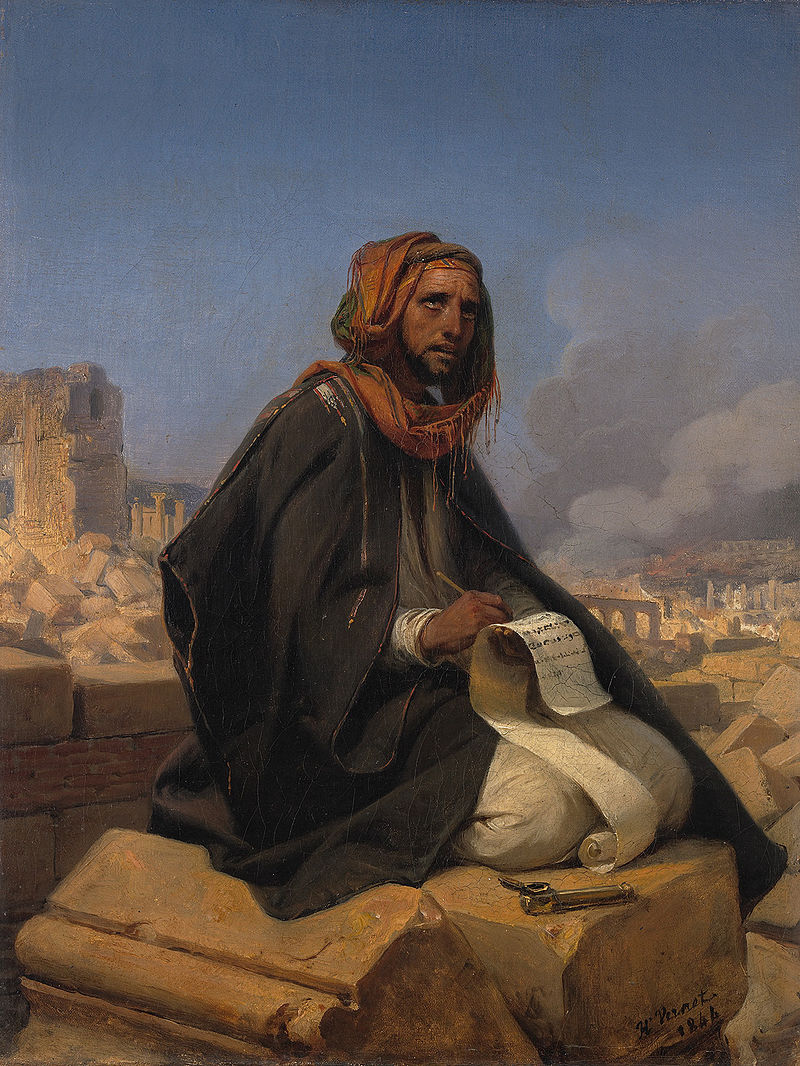
"Jeremiah on the Ruins of Jerusalem"
(Horace Vernet, 1844)
'For I know the plans that I have for you,' declares the LORD,
'plans for welfare and not for calamity to give you a future and a hope.
-- Jeremiah 29:11
(Play beautiful related song by Marty Goetz and Misha)
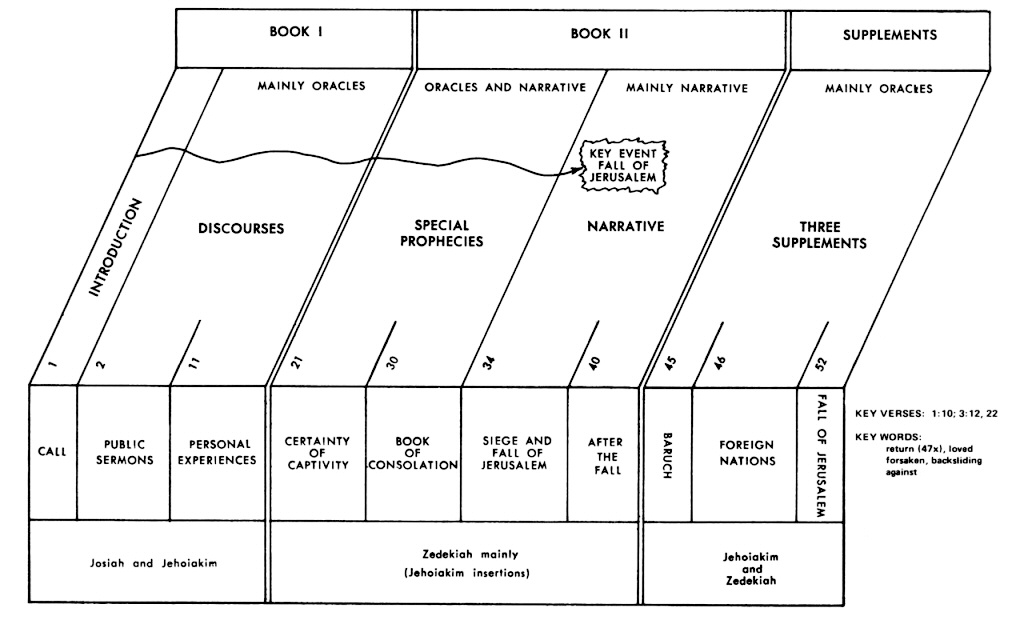
Click chart to enlarge
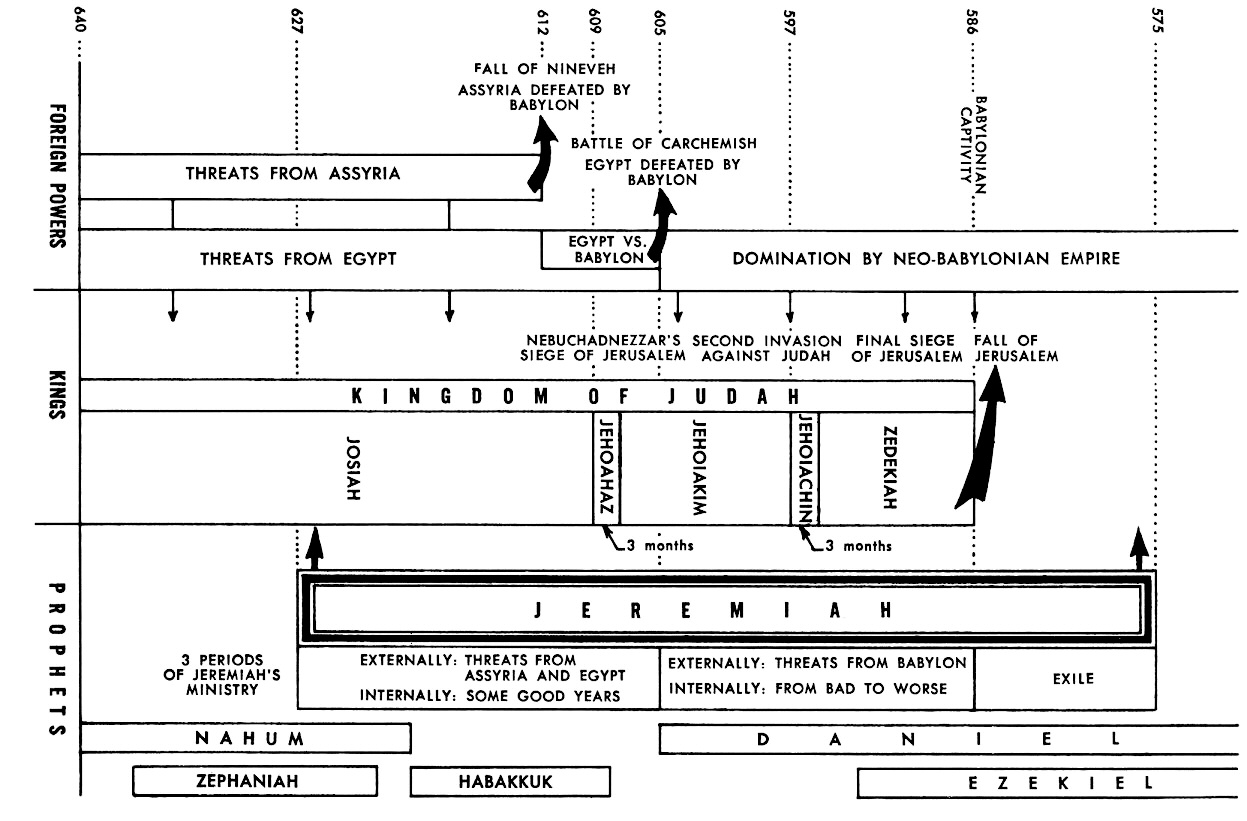
Click chart to enlarge
Chart from recommended resource Jensen's Survey of the OT - used by permission
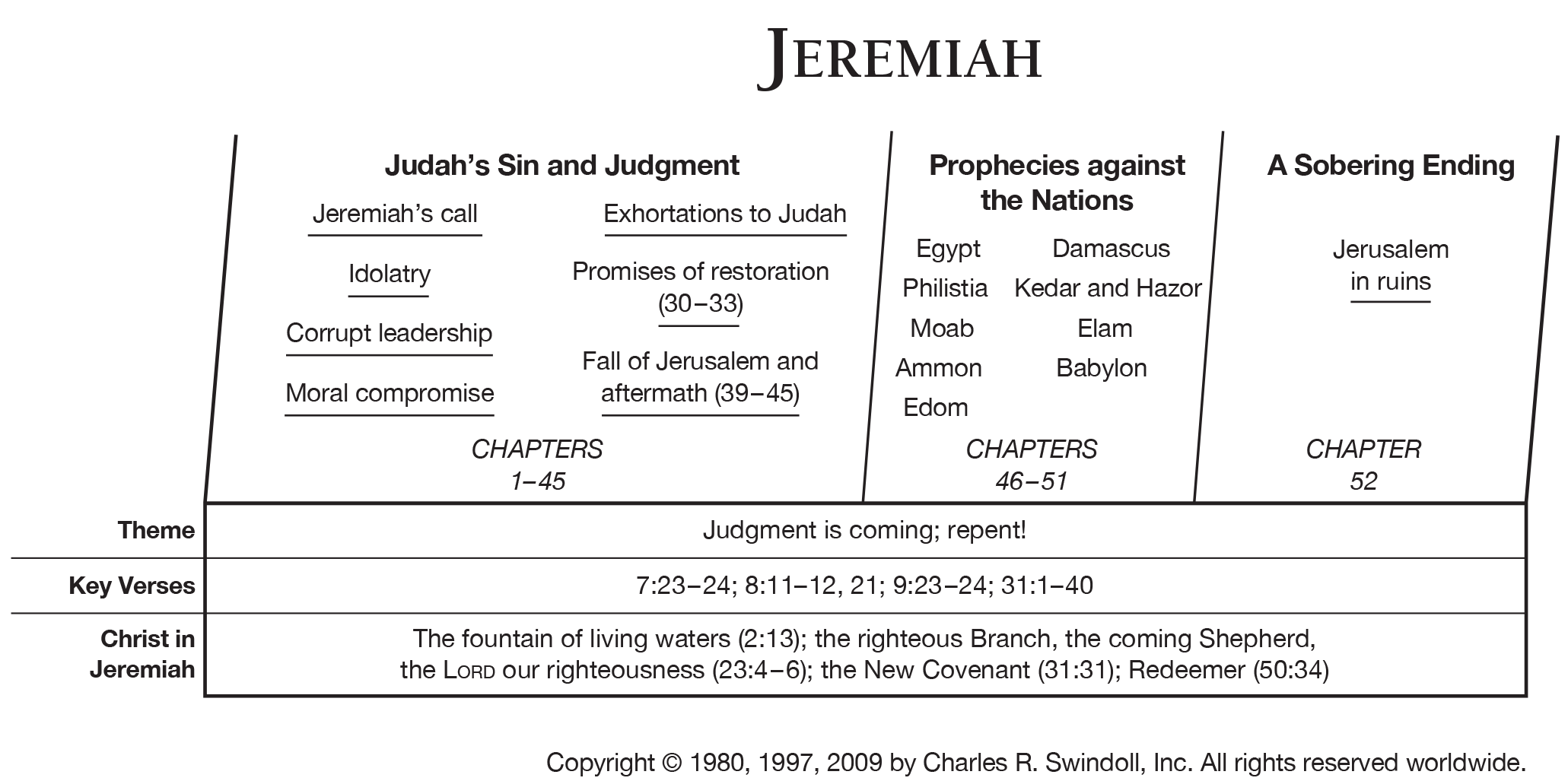
Jeremiah Chart from Charles Swindoll
| JEREMIAH: "PROPHET TO THE NATIONS" Sin - "I Will Punish" (Jer 9:25) Hope - "I Will Restore" (Jer 30:17) Judah & Jerusalem |
||||||
|
Prophet |
Prophecies to Judah Jer 2:1-45:5 |
Prophecies to the Gentiles Jer 46:1-51:64 |
Prophet's Appendix Jer 52:1-52:34 |
|||
| Prophet's Commission Jer 1:1-19 |
Judah Condemned Jer 2:1-25:38 |
Jeremiah's Conflicts Jer 26:1-29:32 |
Jerusalem's Future Jer 30:1-33:26 |
Jerusalem's Fall Jer 34:1-45:5 |
Nations Condemned Jer 46:1-51:64 |
Historic Conclusion Jer 52:1-52:34 |
| Before The Fall Of Jerusalem Jer 1:1-38:28 |
The Fall Jer 39:1-18 |
After The Fall |
||||
| Call | Ministry | Retrospect | ||||
| Nation of Judah |
Surrounding Nations |
Future of Babylon |
||||
| 627-582 BC Ministered 40+ Years! |
||||||
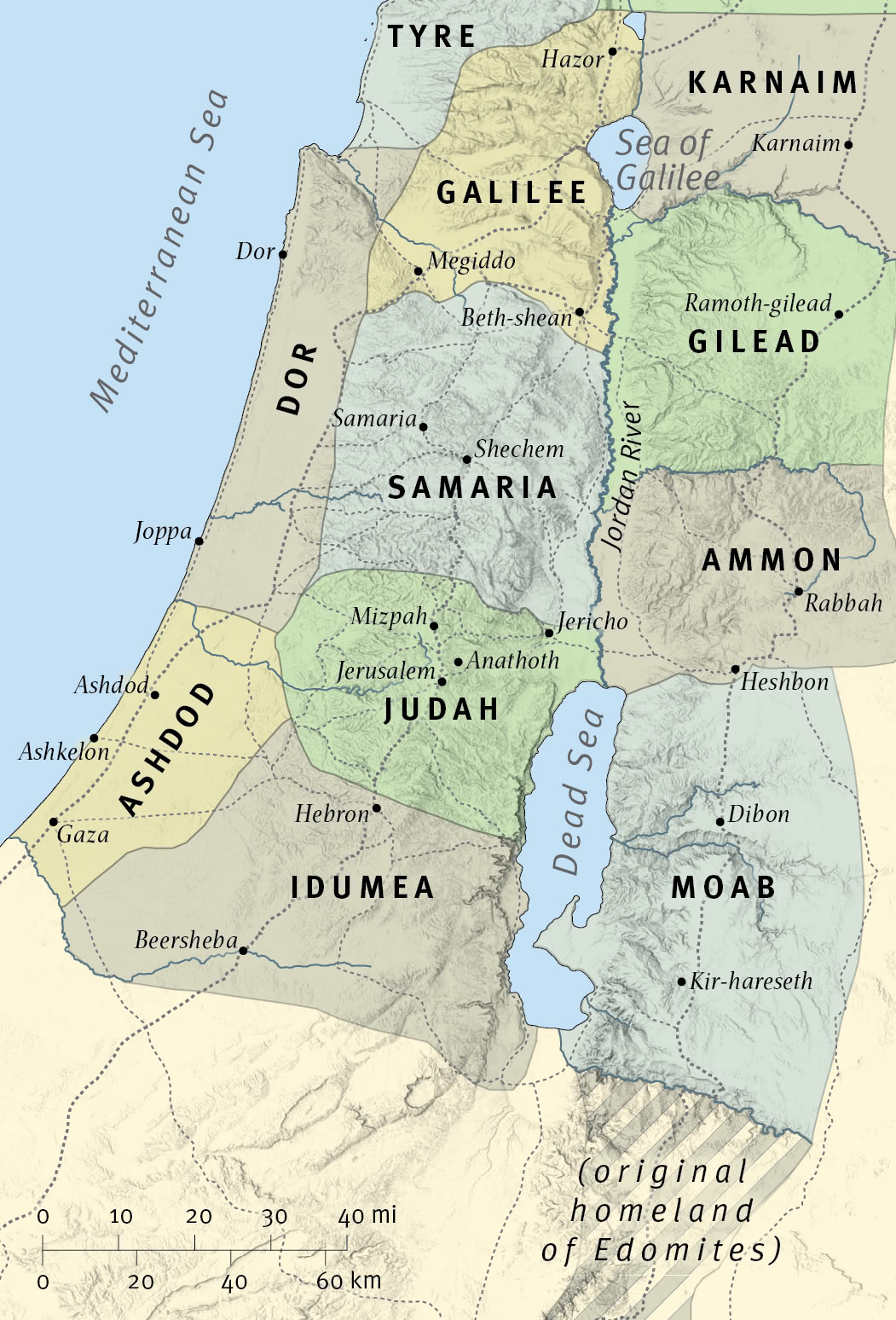
Map of Israel at Time of Jeremiah
Source: ESV Global Study Bible
Jeremiah 25:1 The word that came to Jeremiah concerning all the people of Judah, in the fourth year of Jehoiakim the son of Josiah, king of Judah (that was the first year of Nebuchadnezzar king of Babylon),
- in the: Jer 36:1 Jer 46:2 2Ki 24:1-2 Da 1:1
Related Passages
Daniel 1:1 In the third year of the reign of Jehoiakim king of Judah, Nebuchadnezzar king of Babylon came to Jerusalem and besieged it.
2 Kings 24:1-2 In his days Nebuchadnezzar king of Babylon came up, and Jehoiakim became his servant for three years; then he turned and rebelled against him. 2 The LORD sent against him bands of Chaldeans, bands of Arameans, bands of Moabites, and bands of Ammonites. So He sent them against Judah to destroy it, according to the word of the LORD which He had spoken through His servants the prophets.
Jeremiah 36:1 In the fourth year of Jehoiakim the son of Josiah, king of Judah, this word came to Jeremiah from the LORD, saying,
Jeremiah 46:2 To Egypt, concerning the army of Pharaoh Neco king of Egypt, which was by the Euphrates River at Carchemish, which Nebuchadnezzar king of Babylon defeated in the fourth year of Jehoiakim the son of Josiah, king of Judah:
The word that came to Jeremiah concerning all the people of Judah - This is a major prophetic message and is for the entire nation, representinga public, national warning. This chapter will go on to summarize over 20 years of Jeremiah’s preaching and declare that judgment is now unavoidable because of persistent refusal to repent.
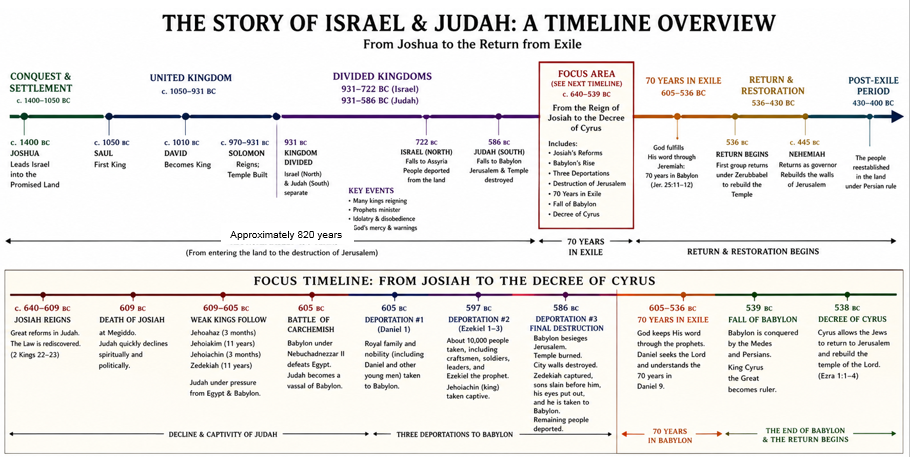
in the fourth year of Jehoiakim the son of Josiah, king of Judah - This gives us a precise historical moment when Jehoiakim reigned (609–598/597 BC) so that his fourth year is 605 BC. This is same year as the defeat of the Egyptian army of Necho at Carchemish (Jer. 46:2). This year marks the turning point when Judah’s independence effectively ends. Up until this point, Judah had been a vassal state of Pharaoh Neco. But in this year world power shifts dramatically as Babyon rises to a world power.
that was the first year of Nebuchadnezzar king of Babylon - This was the year of Nebuchadnezzar's victory over Egypt at the battle of Carchemish, which vaulted Babylon into "first place" at the dominant world power. And shortly after Nebuchadnezzar becomes king of Babylon upon death of his father Nabopolassar founder of the Neo-Babylonian empire who reigned from 626–605 BC (See KINGS OF NEO-BABYLON). As a result of his new power, Nebuchadnezzar begins asserting control over former Egyptian territories which includes Judah.
In Israel (Judah), the accession year or partial year in which a king began to reign, was counted as his first year. In contrast, in Babylon the accession year was not counted but was treated as “year zero,” and the king’s first official year began with the next new year. As a result, Daniel records “the third year of the reign of Jehoiakim” (Daniel 1:1) using the Babylonian system, which corresponds to the fourth year in the Judean (Hebrew) method of reckoning.
Jeremiah 25:2 which Jeremiah the prophet spoke to all the people of Judah and to all the inhabitants of Jerusalem, saying,
- Jer 18:11 19:14,15 26:2 35:13 38:1,2 Ps 49:1,2 Mk 7:14-16
Which Jeremiah the prophet - This emphasizes his divine authority as God's appointed and Spirit empowered mouthpiece, for as Yahweh declared in Jer 1:9 “Behold, I have put My words in your mouth.
Spoke to all the people of Judah and to all the inhabitants of Jerusalem, saying - Spoke indicates a public, formal, authoritative message from God. All the people of Judah refers to the entire nation. One wonders how those in the cities outside Jerusalem heard but presumably they somehow heard his message, because God would not want anyone not hearing this critical warning. Notice the repetition of ALL, which signifies there will be no one who can use the excuse that they are ignorant of God's warning.
Jeremiah 25:3 “From the thirteenth year of Josiah the son of Amon, king of Judah, even to this day, these twenty-three years the word of the LORD has come to me, and I have spoken to you again and again, but you have not listened.
- thirteenth: Jer 1:2 1Ki 22:3 2Ch 34:3,8
- I have spoken to you again and again: Jer 25:4 7:13 11:7 29:19 35:15 44:4 Ge 22:3 Ex 8:20 Ps 81:13 Isa 55:2 Mk 1:35 Joh 8:2,47 2Ti 4:2
Related Passages:
Jeremiah 1:1-3 The words of Jeremiah the son of Hilkiah, of the priests who were in Anathoth in the land of Benjamin, 2 to whom the word of the LORD came in the days of Josiah the son of Amon, king of Judah, in the thirteenth year of his reign. (~627 BC) 3 It came also in the days of Jehoiakim (609-598/597) the son of Josiah, king of Judah, until the end of the eleventh year of Zedekiah the son of Josiah, king of Judah, until the exile of Jerusalem in the fifth month (586 BC).
2 Chronicles 36:15 The LORD, the God of their fathers, sent word to them again and again by His messengers, because He had compassion on His people and on His dwelling place;
Acts 7:51 You men who are stiff-necked and uncircumcised in heart and ears are always resisting the Holy Spirit; you are doing just as your fathers did.
JEREMIAH'S PERSISTENT
PROCLAMATION FOR 23 YEARS
From the thirteenth year of Josiah the son of Amon, king of Judah, even to this day these twenty-three years - This marks the beginning of God's calling Jeremiah’s into ministry (Jer 1:1-3). Jeremiah has been warning Judah since about 627 BC. And even to this day is about 605 BC so he preached during reigns of Josiah, Jehoahaz (3 months) and Jehoiakim (about 4 years). Yes, different kings but with the same message and the same refusal and rejection. Jeremiah's "long windedness" was a reflection of God's long patience. It is worth noting that Jeremiah preached during a time of outward reform under Josiahand yet the people’s hearts were largely unchanged.
the word of the LORD has come to me - Jeremiah stresses the words he has been speaking are not his words but God's words, His special revelation. Truth was not hidden.
and I have spoken to you again and again - Literally this is "rising early and speaking" year after year, day after day to His chosen people. This speaks of persistence, urgency and faithfulness to fulfill the job Yahweh had given him. Jeremiah was a wonderful illustration of 2Ti 4:2 "preach the word; be ready in season and out of season (WHETHER CONVENIENT OR NOT); reprove, rebuke, exhort, with great patience and instruction.."
But - Here is a very sad term of contrast, one which ultimately would result in Judah's 70 year exile in Babylon!
You have not listened (shama) - O yes, they heard Jeremiah's voice and probably got tired of hearing that strident voice. The problem was the Words from God via Jeremiah went in one ear and out the other and never effectively took root in their hearts. To not listen is another way of saying they did not respond to or obey the warnings they heard. The issue was not lack of information but was hardness of heart and stiffness of necks (Acts 7:51) Notice that the fact that many who heard had grown up under Josiah's reforms shows that there was only superficial reform in many of the people, not genuine transformation, which explains the immediate and rapid spiritual decline after Josiah's death. What is the upshot? Divine judgment was fully warranted!
Listen (obey, understand)(08085) shama means to hear (Adam and Eve hearing God = Ge 3:8, 10, Ge 18:10 = "overheard"), to listen (Ge 3:17, Ge 16:2 [= this was a big mistake and was the origin of Jews and Arabs!] Ex 6:9,16:20, 18:19, Webster's 1828 on "listen" = to hearken; to give ear; to attend closely with a view to hear. To obey; to yield to advice; to follow admonition) and since hearing/listening are often closely linked to obedience, shama is translated obey (1 Sa 15:22, Ge 22:18, 26:5, 39:10, Ex 19:5, disobedience = Lev 26:14, 18, 21, 27) or to understand. KJV translates shama "hearken" (196x) a word which means to give respectful attention. Of God's hearing in general or hearing our prayers (Hab 1:2, Ps 66:18, click here for more in the Psalms, cf God's hearing in Zeph 2:8, Ge 16:11, 17:20, 30:17, 22, Ge 21:17, 29:33, 30:6, 17, 22; Ex 2:24, Ex 16:8, 9, 12, Nu 11:1, 12:2). Shama means “to hear intelligently and attentively and respond appropriately." In other words to hear does not convey the idea of "in one ear and out the other!"
The greatest significance of the use of shama is that of relation of man to God, especially where the context speaks of obedience. Obedience is the supreme test of faith and reverence for God. The Old Testament conception of obedience was vital. It was the one important relationship which must not be broken. While sometimes this relation may have been formal and cold, it nevertheless was the one strong tie which held the people close to God. The significant spiritual relation is expressed by Samuel when he asks the question, “Hath Yahweh as great delight in burnt-offerings and sacrifices, as in obeying (shama) the voice of Yahweh? Behold, to obey (shama) is better than sacrifice, and to hearken than the fat of rams” (1 Sa 15:22). It was the condition without which no right relation might be sustained to Yahweh. This is most clearly stated in the relation between Abraham and Yahweh when he is assured “In thy seed shall all the nations of the earth be blessed; because thou hast obeyed (shama) my voice” (Ge 22:18). In prophetic utterances, future blessing and prosperity were conditioned upon obedience: “If ye be willing and obedient (shama), ye shall eat the good of the land” (Isa 1:19). After surveying the glories of the Messianic kingdom, the prophet assures the people that “this shall come to pass, if ye will diligently obey (shama) the voice of Yahweh your God” (Zec 6:15). On the other hand misfortune, calamity, distress and famine are due to their disobedience and distrust of Yahweh.
Jeremiah 25:4 “And the LORD has sent to you all His servants the prophets again and again, but you have not listened nor inclined your ear to hear,
- all His servants:
- again and again: Jer 7:25 11:7 26:5 29:19 32:33 35:14,15 44:4,5 2Ch 36:15,16
- you have not listened nor inclined your ear to hear: Jer 25:3,7 Jer 7:24-26 Jer 11:8-10 Jer 13:10,11 Jer 16:12 Jer 17:23 Jer 18:12 Jer 19:15 Jer 22:21 Jer 36:31 Zec 7:11,12 Ac 7:51,52 Heb 12:25
Related Passages:
Jeremiah 7:24-26 “Yet they did not obey or incline their ear, but walked in their own counsels and in the stubbornness of their evil heart, and went backward and not forward. 25 “Since the day that your fathers came out of the land of Egypt until this day, I have sent you all My servants the prophets, daily rising early and sending them. 26 “Yet they did not listen to Me or incline their ear, but stiffened their neck; they did more evil than their fathers.

GOD'S PERSISTENT
GRACE AND PATIENCE
And the LORD has sent to you all His servants the prophets again and again (“rising early and sending”) - Some read all His servants as referring to the people of Judah, but in the context that is extremely unlikely. Servants obey their master and Judah has continually disobeyed. No, His servants refers to His prophets not the people of Judah! Notice that the prophets did not belong to themselves but belonged to God and existed for His service (cf believers today as His bondservants, His possession - 1Pe 2:9, 1Co 6:19,20). Prophets during this time that we know about include Jeremiah, Uriah, Huldah, Zephaniah and likely Habakkuk. The point is that God was actively, intentionally reaching out to His chosen people. His grace would precede His judgment but would not preclude it if there was no reception.
but you have not listened - He reiterates the same indictment from Jer 25:3. They heard! They chose to reject what they heard!
nor inclined your ear to hear - Incline your ear pictures on leaning forward to hear, turning their head and listening carefully and intentionally as depicted by the dog in the picture above! This is Hebrew parallelism (specifically "synthetic parallelism") and is a stronger expression which describe that willful, intentional refusal to give their attention to God's words. One might depict it as two levels, one of not listening and then one of not even trying to listen. In other words, in spite of this sustained and compassionate prophetic effort, the people refused not only to listen but even to incline their ear, showing a deliberate and hardened resistance to God’s word.
This verse expands the indictment beyond Jeremiah alone to a long history of prophetic appeals, thereby demonstrating that Judah’s coming judgment was the result of prolonged and willful rejection of abundant divine revelation.
🙏 THOUGHT - Let me ask you a simple question in light of the fact that Judah was not listening to God. When you read the Word from God's mouth (Isa 55:11), are you truly listening? (See Are You Listening?)
Jeremiah 25:5 saying, ‘Turn now everyone from his evil way and from the evil of your deeds, and dwell on the land which the LORD has given to you and your forefathers forever and ever;
- Turn: Jer 18:11 35:15 2Ki 17:13,14 Isa 55:6,7 Eze 18:30 33:11 Jon 3:8-10 Zec 1:4,5 Lu 13:3-5 Ac 26:20 Jas 4:8-10
- for: Jer 7:7 17:25 Ge 17:8 Ps 37:27 105:10,11
Related Passages:
Jeremiah 7:5-7 (CONDITIONS TO DWELL IN THE LAND) “For if you truly amend your ways and your deeds, if you truly practice justice between a man and his neighbor, 6 if you do not oppress the alien, the orphan, or the widow, and do not shed innocent blood in this place, nor walk after other gods to your own ruin, 7 then I will let you dwell in this place, in the land that I gave to your fathers forever and ever.
THE HEART OF THE
PROPHETIC MESSAGE
Saying - This word connects what follows directly with verse 4, introducing the content of the prophet's repeated message.
Turn now everyone from his evil way and from the evil of your deeds - The command is to return, repent, turn back and has both a note of urgency and of individual responsibility. From his evil way refers to one's lifestyle, direction of life. describes their specific evil acts and actions. The former (way) deals with the internal (heart) and the latter (deeds) with the external behavior.
and dwell on the land - In God's amazing grace, He gives them a promise attached to their repentance. In the context of impending exile, this means they could continue to live securely in the Promised Land.
Which the LORD has given to you and your forefathers forever and ever - This points back to God's giving of the covenant promises (including the land) to Abraham, Isaac and Jacob. Their repentance would not "earn" this gift but it would allow them to enjoy the blessings of the gift. Forever and ever speaks of God’s original intent for permanent possession of the land for Israel. However, their enjoyment of the land was conditional on their obedience. This truth goes back to Moses' words in Deuteronomy 28:63-64
“It shall come about that as the LORD delighted over you to prosper you, and multiply you, so the LORD will delight over you to make you perish and destroy you; and you will be torn from the land where you are entering to possess it. 64 “Moreover, the LORD will scatter you among all peoples, from one end of the earth to the other end of the earth; and there you shall serve other gods, wood and stone, which you or your fathers have not known.
REPENTANCE VERSES: 2Ki17:13 ,2 Ch30:6 ,Pr1:23 ,Isa22:12 ,Je25:5 ,Eze14:6, 18:31 , 33:11, Da4:27 , Ho14:2 , Joel2:12 , Mal3:7, Mt3:2, Lu13:2,v3, Ac3:19, 8:22,17:30, 26:20
Jeremiah 25:6 and do not go after other gods to serve them and to worship them, and do not provoke Me to anger with the work of your hands, and I will do you no harm.’
- Jer 7:6,9 35:15 Ex 20:3,23 De 6:14 8:19 13:2 28:14 Jos 24:20 1Ki 11:4-10 14:22 2Ki 17:35
Related Passages:
Psalm 115:4-7 Their idols are silver and gold, The work of man’s hands. 5 They have mouths, but they cannot speak; They have eyes, but they cannot see; 6 They have ears, but they cannot hear; They have noses, but they cannot smell; 7They have hands, but they cannot feel; They have feet, but they cannot walk; They cannot make a sound with their throat.
Psalm 135:15-17 The idols of the nations are but silver and gold, The work of man’s hands. 16 They have mouths, but they do not speak; They have eyes, but they do not see; 17 They have ears, but they do not hear, Nor is there any breath at all in their mouths.
Deuteronomy 4:28 “There you will serve gods, the work of man’s hands, wood and stone, which neither see nor hear nor eat nor smell.
Isaiah 44:9-10 Those who fashion a graven image are all of them futile, and their precious things are of no profit; even their own witnesses fail to see or know, so that they will be put to shame. 10 Who has fashioned a god or cast an idol to no profit?
Isaiah 44:17-18 But the rest of it he makes into a god, his graven image. He falls down before it and worships; he also prays to it and says, “Deliver me, for you are my god.” 18 They do not know, nor do they understand, for He has smeared over their eyes so that they cannot see and their hearts so that they cannot comprehend.
Jeremiah 10:3-5 For the customs of the peoples are delusion; Because it is wood cut from the forest, The work of the hands of a craftsman with a cutting tool. 4 “They decorate it with silver and with gold; They fasten it with nails and with hammers So that it will not totter. 5 “Like a scarecrow in a cucumber field are they, And they cannot speak; They must be carried, Because they cannot walk! Do not fear them, For they can do no harm, Nor can they do any good.”
Habakkuk 2:18-19 “What profit is the idol when its maker has carved it, Or an image, a teacher of falsehood? For its maker trusts in his own handiwork When he fashions speechless idols. 19“Woe to him who says to a piece of wood, ‘Awake!’ To a mute stone, ‘Arise!’ And that is your teacher? Behold, it is overlaid with gold and silver, And there is no breath at all inside it.
Romans 1:22-26 Professing to be wise, they became fools, 23 and exchanged the glory of the incorruptible God for an image in the form of corruptible man and of birds and four-footed animals and crawling creatures. 24 Therefore God gave them over in the lusts of their hearts to impurity, so that their bodies would be dishonored among them. 25 For they exchanged the truth of God for a lie, and worshiped and served the creature rather than the Creator, who is blessed forever. Amen. 26 For this reason God gave them over to degrading passions; for their women exchanged the natural function for that which is unnatural,
AVOID MAN-MADE GODS
FOR YOUR GOOD!
And do not go after other gods (elohim) to serve (abad; LXX - douleuo - be a slave, be subjected to) them and to worship (shachah; LXX - proskuneo - bow down to kiss feet, garment hem or ground) them - In the Hebrew this is in the imperfect tense describing their continued going after idols. In the Septuagint it is in the present imperative with a negative which means to stop an action already in process. In the New Testament obedience to this command calls for dependence on the Holy Spirit to obey. I would submit that even in the Old Testament to obey this command one needs a circumcised heart (See circumcision of the heart) and the enabling power of the Spirit (even though He was not indwelling these OT beleivers, He was still active in their lives).
Notice the downward spiritual spiral shown by the verbs - (1) First, they made a volitional choice, a choice of their will to pursue lifeless idols masquerading as "gods", (2) then they actively served them as slaves indentured to their "master" and (3) finally they fell down before their lifeless "gods" in obseisance, the outward expression of inward reverence, shown by bowing or submission! The upshot is that instead of experiencing freedom, they experienced bondage. Instead of experiencing life found only in God, they had the experience of the "walking dead." (Eph 2:1).
and do not provoke Me to anger (kāas; LXX - parorgizo - exasperate) - In other words "Stop engaging in the very sins that call forth My judgment." This is a sober warning from Yahweh calling His people to turn away from the very behaviors that stir up His righteous judgment. To provoke means to stir up, arouse, or incite. In Scripture, this refers to actions that deliberately offend God’s holiness, especially through persistent disobedience and idolatry. It is not that God is irritable or unstable, but that He is perfectly holy and just, and therefore responds rightly against sin.
Do not provoke Me to anger (kāas; LXX - parorgizo - exasperate) shows that this is a relational offense, that is, that sin is not just breaking rules, but breaking God's heart (see Ezek 6:9, cf Isa 63:10, Eph 4:30)! This also reflects a moral reality/necessity for God’s anger is His just response to evil. He has to respond. Finally, it is a merciful warning, as He was giving Judah an opportunity to repent before He sent judgment.
With the work of your hands - What's the work of their hands? In context he is speaking of the idols they make from wood, metal and stones - carved images, cast metal idols and other objects of false worship.
The tragic absurdity is that finite, fallen men fashion these objects with their own hands, things that are powerless, lifeless, and wholly dependent on their makers, and then, in profound stupidity and spiritual blindness, turn around and place their trust in them. What they have created cannot see, hear, speak, or save, yet they ascribe to it the very power and security that belong to God Alone. It is a sobering picture of the deceitful, desperately sick human heart (Jer 17:9) exchanging the glory of the living God for the works of human hands, and trusting in what is ultimately empty, instead of the One who alone is able to deliver and sustain.
Idols are lifeless creations of man, unable to see, hear, speak, or act,
yet tragically trusted by those who reject the living God Who Alone sees, hears, and saves.
One other critical point about idols is derived from Romans 1:24 "Therefore God gave them over (paradidomi = means to give over to the power of) in the lusts of their hearts to impurity, so that their bodies would be dishonored among them." It is no surprise that idolatry is almost always associated with gross, even abominable immorality (dishonoring of one's body). God had given the citizens of Judah over to their insatiable lusts!
🙏 THOUGHT - In what are you trusting other than God? The truth is that ANYTHING we are trusting in other than Almighty God is to some degree our "idol." Let's be honest. We all have them. Our goal should be to continually tear them down and destroy them, if not physically, then certainly in our heart and mind. In other words, don't throw away your 401K or your money in your checking account! Just do not put your trust in them! In effect "tear them down" as the Spirit brings them to your mind and you yield your heart and spirit and soul fully to the LORD in this area (whether it is finances, job, position, etc). Then walk by the Spirit and you will not fulfill the sinful desires of the flesh (Gal 5:16)! When the Son by His Spirit sets you free of that idol that has gripped you in its power, you will be free indeed! (Jn 8:36)
and I will do you no harm - God promises to to withhold judgment and extend mercy. Note that this promise from Yahweh is predicated on obeying 4 instructions - turn, dwell, do not go after idols and do no provoke God. This is Yahweh's gracious assurance, promising that no judgment or calamity will come upon His people if they heed His warning and turn from sin. It expresses God’s willingness to withhold deserved judgment and instead show undeserved mercy. The idea is not that the people are innocent, but that repentance changes the outcome for God will relent from bringing harm when/if His people return to Him.
This phrase also reveals that God’s heart is merciful for He warns before He judges. His judgment is conditional, for it can be averted through repentance (of course once in the Lake of Fire, His judgment is fixed forever!) And closely related is the truth that harm is deserved but not inevitable, for God is willing to forgive as shown in the following verses...
Jeremiah 18:7-8 “At one moment I might speak concerning a nation or concerning a kingdom to uproot, to pull down, or to destroy it; 8 if that nation against which I have spoken turns from its evil, I will relent (nacham; LXX - metanoeo) concerning the calamity I planned to bring on it.
Jonah 3:10 When God saw their deeds (NINEVEH), that they turned from their wicked way, then God relented (nacham; LXX - metanoeo) concerning the calamity which He had declared He would bring upon them. And He did not do it.
Provoke to anger (03707) kāas is a verb meaning to vex, agitate, stir up, provoke the heart to a "heated" condition which results in actions. To be angry, vexed, be incensed, to be in a state of strong displeasure, to provoke to anger. The causative sense of the verb occurs ost often and frequently signifies idolatry provoking God to anger (cf. 1 Kgs. 14:9; Ps. 106:29; Ezek. 8:17). The result of provocation may be expressed as ʾap̱, anger (639) (Deut. 9:18; 2 Kgs. 23:26; Jer. 7:20). In a noncausative sense, the verb means to be angry; people were warned not to become angry hastily (Eccl. 7:9); God says that after He punishes, He will not be angry (Ezek. 16:42). Three times it refers to the people’s anger directed toward righteousness (2 Chr. 16:10; Neh. 4:1[3:33]; Ps. 112:10).
KAAS is often used of YHWH's reaction to idolatry (i.e. Deut. 32:21; 1 Kgs. 15:30; 16:13; 22:53; 2 Kgs. 23:26; 2 Chr. 28:25).
KAAS - 53V - Deut. 4:25; Deut. 9:18; Deut. 31:29; Deut. 32:16; Deut. 32:21; Jdg. 2:12; 1 Sam. 1:6; 1 Sam. 1:7; 1 Ki. 14:9; 1 Ki. 14:15; 1 Ki. 15:30; 1 Ki. 16:2; 1 Ki. 16:7; 1 Ki. 16:13; 1 Ki. 16:26; 1 Ki. 16:33; 1 Ki. 21:22; 1 Ki. 22:53; 2 Ki. 17:11; 2 Ki. 17:17; 2 Ki. 21:6; 2 Ki. 21:15; 2 Ki. 22:17; 2 Ki. 23:19; 2 Ki. 23:26; 2 Chr. 16:10; 2 Chr. 28:25; 2 Chr. 33:6; 2 Chr. 34:25; Neh. 4:1; Neh. 4:5; Ps. 78:58; Ps. 106:29; Ps. 112:10; Eccl. 5:17; Eccl. 7:9; Isa. 65:3; Jer. 7:18; Jer. 7:19; Jer. 8:19; Jer. 11:17; Jer. 25:6; Jer. 25:7; Jer. 32:29; Jer. 32:30; Jer. 32:32; Jer. 44:3; Jer. 44:8; Ezek. 8:17; Ezek. 16:26; Ezek. 16:42; Ezek. 32:9; Hos. 12:14
Jeremiah 25:7 “Yet you have not listened to Me,” declares the LORD, “in order that you might provoke Me to anger with the work of your hands to your own harm.
- that: Jer 7:18-19 Jer 32:30-33 De 32:21 2Ki 17:17 21:15 Ne 9:26 Pr 8:36
Related Passages:
Jeremiah 32:30-33 “Indeed the sons of Israel and the sons of Judah have been doing only evil in My sight from their youth; for the sons of Israel have been only provoking Me to anger by the work of their hands,” declares the LORD. 31 “Indeed this city has been to Me a provocation of My anger and My wrath from the day that they built it, even to this day, so that it should be removed from before My face, 32 because of all the evil of the sons of Israel and the sons of Judah which they have done to provoke Me to anger–they, their kings, their leaders, their priests, their prophets, the men of Judah and the inhabitants of Jerusalem. 33 “They have turned their back to Me and not their face; though I taught them, teaching again and again, they would not listen and receive instruction.
Deuteronomy 32:21 ‘They have made Me jealous (SEE ISRAEL THE WIFE OF JEHOVAH) with what is not God; They have provoked Me to anger with their idols. So I will make them jealous with those who are not a people; I will provoke them to anger with a foolish nation,
Luke 6:46 “Why do you call Me, ‘Lord, Lord,’ and do not do what I say?
Jeremiah 2:19 “Your own wickedness will correct you, And your apostasies will reprove you; Know therefore and see that it is evil and bitter For you to forsake the LORD your God, And the dread of Me is not in you,” declares the Lord GOD of hosts.
THE CONSEQUENCE OF
IGNORING GOD
Yet - This term of contrast underscores the tragedy that though God spoke again and again through His faithful prophets, giving unmistakably clear warnings and urgent calls to repent and return, YET the following clause reveals the stark contrast...
you have not listened (shama) to Me,” declares the LORD - They heard the prophets' words but refused to obey them. In other words, they did not hear with attention, nor respond appropriately to what they heard. Despite repeatedly hearing God’s Word, the people willfully refused to obey, progressively hardening their hearts and inviting God's righteous judgment. Their heart of their problem was not lack of information but the problem with their heart.
In order that - Term of purpose/result. In this context it describes the result of not listening to Jehovah!
You might provoke (stir up, incite) Me to anger with the work of your hands (especially idolatry) to your own harm - The tragedy is that their sin would not damage God but it would destroy them. Mark it down that sin is self-destructive! As God says in Proverbs 8:36 “But he who sins against me injures himself; All those who hate me love death.”
Jeremiah 25:8 “Therefore thus says the LORD of hosts, ‘Because you have not obeyed My words,
THE CORE ISSUE
FAILURE TO OBEY
Therefore - Term of conclusion. This is the conclusion (v8,9) of wearing out God's patience. The idea is that in light of everything already said the following is inevitable.
Thus says the LORD of hosts (Jehovah Sabaoth, LORD of hosts or of armies) - This Name reflects the divine authority and divine power of Yahweh, for LORD of hosts, the Name that reflects the fact that God is Commander of the heavenly armies. In short, He has the right and the might to speak what follows!
Because you have not obeyed My words - Because (term of explanation) introduces the explanation, the core issue, which is not ignorance but disobedience. It is not failure to hear, but refusal to respond! It describes Judah's persistent rejection of God's Word.
Jeremiah 25:9 behold, I will send and take all the families of the north,’ declares the LORD, ‘and I will send to Nebuchadnezzar king of Babylon, My servant, and will bring them against this land and against its inhabitants and against all these nations round about; and I will utterly destroy them and make them a horror and a hissing, and an everlasting desolation.
- I will send and take all the families of the north: Jer 1:15 5:15,16 6:1,22-26 8:16 Lev 26:25-46 De 28:45-50 Pr 21:1 Isa 5:26-30 10:5 39:7 Hab 1:6-10
- I will send to Nebuchadnezzar king of Babylon, My servant: Jer 27:6 40:2 43:10 Isa 13:3 44:28 45:1 Eze 29:18-20
- against this land and against its inhabitants and against all these nations: Jer 25:17-26 27:3-8 Eze 26:7 29:19 30:10,11
- make them a horror and a hissing: Jer 18:16 24:9 1Ki 9:7,8
YAHWEH WILL SEND HIS
SERVANT NEBUCHADNEZZAR
Behold (hinneh; LXX - idou) Spurgeon reminds us that "Behold is a word of wonder; it is intended to excite admiration. Wherever you see it hung out in Scripture, it is like an ancient sign-board, signifying that there are rich wares within, or like the hands which solid readers have observed in the margin of the older Puritanic books, drawing attention to something particularly worthy of observation."
I will send and take all the families of the north,’ declares the LORD - I will send and I will take indicate God's sovereign decision/decree. Though Babylon appears to be acting on its own ambitions, God is in effect declaring “I am the One behind it.” Once again we see that God rules over history, including even pagan nations (Babylon) who unknowingly serve His purposes. All the families of the north refers to the invading armies to come from the north (from Judah’s perspective). Even though Babylon lies east, invading armies approached from the north via the Fertile Crescent.
In short, God Himself will summon and direct the Babylonian forces as His instrument to execute judgment on Judah.
And I will send to Nebuchadnezzar king of Babylon, My servant ('ebed)- God is in control and Nebuchadnezzar is not acting independently but is being summoned and directed by God. The fact that Yahweh calls Nebuchadnezzar his servant (one who carries out the will of another) does not mean the king knew God but that he was being used by God.
We see God use other pagan rulers, as in Isaiah 10:5 using Assyria as “the rod of My anger” and Isaiah 45:1 using Cyrus whom He calls His “anointed.” What is fascinating (and incomprehensible to our finite minds) is that this represents a perfect juxtaposition of God's sovereignty and human responsibility to act freely according to their desires and yet accomplish God's purposes! Is this not one of the great mysteries in all the Bible?
and will bring them against this land and against its inhabitants - Notice again that Yahweh say He will bring them sovereignly guiding the invading Babylonian forces under His sovereign control. What appears on earth as military conquest is, in reality, divine judgment in motion. This land of course is the Promised Land, at least the portion belonging to Judah, fulfilling the covenant warnings even as prophesied almost 800 years earlier in Leviticus...
Leviticus 26:31–33 I will lay waste your cities as well and will make your sanctuaries desolate, and I will not smell your soothing aromas. 32 ‘I will make the land desolate so that your enemies who settle in it will be appalled over it. 33 ‘You, however, I will scatter among the nations and will draw out a sword after you, as your land becomes desolate and your cities become waste.
And against its inhabitants -obviously means there would not only be judgment on the Land of Judah, but the people of Judah, including loss, suffering, exile, and death. One simple takeaway is to remember that sin is not abstract, but brings real consequences upon real people. Also this shows that privileges (like the land) carry responsibility.
and against all these nations round about; Judah, however, wouldn’t be the only nation to suffer at the hands of the Babylonians, for “all these nations round about” (Je25:9) would also be punished; among them the nations listed in [25:18-25 27:3]. In one way or another, these nations were confederate with Judah against Babylon, but God’s command was that the nations submit to Nebuchadnezzar.
and I will utterly destroy them and make them a horror and a hissing, and an everlasting desolation - This is one of the most severe and sobering descriptions of divine judgment, unfolding in four escalating expressions.
I will utterly destroy (charam) them conveys total devastation. The Hebrew idea often carries the sense of being “devoted to destruction” (charam) It implies complete overthrow, not necessarily the extinction of every individual, but the collapse of the nation as it had formerly existed.
Make them a horror means Judahites would become an object of shock and dread, something that causes others to shudder at the severity of judgment. In other words, people would look at Judah and think “Look what happens when a nation turns from God.”
A hissing (shereqah) refers to a sound of mockery, scorn, or astonishment so that observers would shake their heads and express disbelief and contempt. In a warning to King Solomon in 1 Kings 9:8 Yahweh promised "And this house will become a heap of ruins; everyone who passes by will be astonished and hiss and say, ‘Why has the LORD done thus to this land and to this house?’" Similarly in 2Ch 29:8 the chronicler records "“Therefore the wrath of the LORD was against Judah and Jerusalem, and He has made them an object of terror, of horror, and of hissing, as you see with your own eyes."
Finally the phrase an everlasting desolation describes a long-lasting ruin, so that the land becomes empty, barren, and uninhabited. However, everlasting does not always mean infinite but does convey the sense of prolonged and severe (e.g., 70-year exile, Jer 25:11). During that time the land would lie desolate, lose its former glory and bear the marks of judgment for generations.
Behold (02009) hinneh is an interjection meaning behold, look, now; if. "It is used often and expresses strong feelings, surprise, hope, expectation, certainty, thus giving vividness depending on its surrounding context." (Baker) Hinneh generally directs our mind to the text, imploring the reader to give it special attention. In short, the Spirit is trying to arrest our attention! And so hinneh is used as an exclamation of vivid immediacy (e.g., read Ge 6:13)! Hinneh is a marker used to enliven a narrative, to express a change a scene, to emphasize an idea, to call attention to a detail or an important fact or action that follows (Isa 65:17, Ge 17:20, 41:17). The first use of hinneh in Ge 1:29 and second in Ge 1:31 - "And God saw all that He had made, and behold, it was very good. And there was evening and there was morning, the sixth day." Hinneh is oftn used in the idiom "Here I am" in Ge 22:1, 7,11 Ge 27:1,18, Ge 31:11, Ge 46:2 Ex 3:4 1Sa 3:4, 3:16, 12:3, 2Sa 1:7, Isa 52:6, Isa 58:9. Hinneh is used most often to point out people but also to point out things (Ge 31:41, 17:4). God uses hinneh to grab man's attention before He brings destruction (Ge 6:13, 17). God uses hinneh when He establishes covenants (Ge 9:9, 15:12, 17 [when Jehovah cut the Abrahamic covenant], Ge 17:4, cp Ge 28:13, 15), when He provided a sacrificial substitute for Isaac (foreshadowing His giving us His only Son!) (Ge 22:13). Hinneh marks the "chance (The Providence of God)" arrival of Boaz at the field where Ruth was gleaning (Ru 2:4-read about this "chance romance" - Indeed, "Behold!"). Hinneh is used to announce the Lord’s sending of a child as a sign and a prophecy of Immanuel-Emmanuel, the Messiah (Isa 7:14). In fact W E Vine says that it is notable that when behold (hinneh) is used in Isaiah, it always introduces something relating to future circumstances.
Servant (05650) 'ebed from 'abad = work in any sense) means a slave or bondservant. Slavery in Israel amounted to indentured servitude. A fellow Israelite could not be held indefinitely against his will. In fact, his time of service was limited to 6 yr (Ex 21:2). The master could be punished if evil intent against the slave was proven (Ex 21:14) or if the slave died (Ex 21:20). These types of servants held a position of honor (Ge 24:2ff; 41:12, 15:2).
Of prime significance is the use of “my servant” for the Messiah in Isa 42:1-7; 49:1- 7; 50:4-10; 52:13-53:12. Israel was a blind and deaf “servant” (Isa. 42:18-22). So the Lord called “my righteous servant” (Isa 53:11; cf. Isa 42:6) "[to bear] the sin of many” (Isa. 53:12), “that thou may be my salvation unto the end of the earth” (Isa. 49:6). The “servant” was not a free man. He was subject to the will and command of his master. But one might willingly and lovingly submit to his master (Ex 21:5), remaining in his service when he was not obliged to do so. Hence it is a very fitting description of the relationship of man to God.
Allen Most probably the term עבדי, “servants,” refers to the whole cultic assembly rather than to Levitical singers, in view of the amplification of the similar Ps 135:1 in 135:19–20....How can God be praised enough? To worship adequately would take the rest of time and the concerted tongues of all creatures on earth. No less response in time or space is worthy of God. (Word Biblical Commentary)
Jeremiah 25:10 ‘Moreover, I will take from them the voice of joy and the voice of gladness, the voice of the bridegroom and the voice of the bride, the sound of the millstones and the light of the lamp.
- I will take from them: Heb. cause to perish from, Es 3:13 7:4 8:11
- voice of joy: Jer 7:34 16:9 33:10,11 Isa 24:7-12 Eze 26:13 Ho 2:11 Rev 18:22,23
- sound of the millstones: Ec 12:2-4
Related Passages:
Jeremiah 7:34 “Then I will make to cease from the cities of Judah and from the streets of Jerusalem the voice of joy and the voice of gladness, the voice of the bridegroom and the voice of the bride; for the land will become a ruin.
GOD REMOVES THE
BLESSINGS FROM PEOPLE
Moreover, I will take from them - Again Yahweh sovereignly will exert His power in withdrawing these gifts. He was the One Who gave these blessings (whether they recognized it or not) and now would be the One Who removes them
the voice of joy and the voice of gladness, the voice of the bridegroom and the voice of the bride - Note the key word/idea is voice/sound. God will all the things associated with normal, joyful, everyday life and leave them with a society gone silent (in regard to His blessings). A society with no joy or gladness is one that will be left with sorrow and grief. Weddings are generally such a hopeful sign of life continuing with future generation, but now the picture will be of a society that is no longer hopeful or thriving so that even their future seems to be cut off!
the sound of the millstones Millstones were used daily to grind grain, providing daily work and provision of food, but their absence signifies a society in economic collapse with no food production, even threatening everyday survival.
Sir J. Chardin remarks, that in the East, every where in the morning may be heard the noise of the mills, which often awakens people; for they generally grind every day just as much as may be necessary for the day's consumption. Where, then, the noise of the mill is not heard in the morning, nor the light of the candle seen in the evening, there must be an utter desolation.
and the light of the lamp - Normally a light would signify the life within the home, but with exile the lights would go out, leaving homes dark, empty and abandoned.
In summary, this verse is a bleak picture of a society that has totally collapsed. This is difficult for most of us in relatively affluent cultures to even begin to imagine what life would be like. But is was decreed for Judah because of her persistent disobedience to God and His Word.
Jeremiah 25:11 ‘This whole land will be a desolation and a horror, and these nations will serve the king of Babylon seventy years.
- seventy: This prophecy was delivered in the fourth year of Jehoiakim, and began to be accomplished immediately; and it was exactly seventy years from this time to the proclamation of Cyrus for the return of the Jews. Jer 25:12 2Ch 36:21,22 Isa 23:15-17 Da 9:2 Zec 1:12 7:5
SEVENTY YEARS OF EXILE
IN BABYLON
This whole land will be a desolation and a horror - Note the adjective whole which indicates not just parts of Judah but the entire land, all the cities, countryside, homes, and fields desolate, ruined, laid waste, emptied of normal life. Fields would lay uncultivated, and cities would be broken down. A horror indicates that this desolation will cause shock, dread, and astonishment, presenting an apocylptic-like scene that all who see it will be appalled. This reiterates Jeremiah's earlier word "To make their land a desolation, An object of perpetual hissing; Everyone who passes by it will be astonished And shake his head." (Jeremiah 18:16) It that sense what happened to Judah is not only a judgment on them but serves as a warning to the world.
and these nations will serve the king of Babylon seventy years - The nations is plural which shows that other nations would come under Babylon's domination (vassal states, captives, tributes), subjected to Nebuchadnezzar, the king of Babylon.
Seventy years represents a fixed, divinely appointed period, which emphasizes that the exile with have a beginning and an ending (605-536 B.C.). Other passages allude to this same time period...
Jeremiah 29:10 (GOD'S PROMISE OF BRINGING THEM BACK TO THE LAND) “For thus says the LORD, ‘When seventy years have been completed for Babylon, I will visit you and fulfill My good word to you, to bring you back to this place.
2 Chronicles 36:20-21 Those who had escaped from the sword he carried away to Babylon; and they were servants to him and to his sons until the rule of the kingdom of Persia, to fulfill the word of the LORD by the mouth of Jeremiah, until the land had enjoyed its sabbaths (over 490 years Israel failed to let the land lie fallow every 7th year - see Lev 25:2-7). All the days of its desolation it kept sabbath until seventy years were complete.
Daniel 9:2 in the first year of his reign, I, Daniel, observed in the books the number of the years which was revealed as the word of the LORD to Jeremiah the prophet for the completion of the desolations of Jerusalem, namely, seventy years.
Jeremiah 25:12 ‘Then it will be when seventy years are completed I will punish the king of Babylon and that nation,’ declares the LORD, ‘for their iniquity, and the land of the Chaldeans; and I will make it an everlasting desolation.
- when: Jer 29:10 2Ki 24:1 Ezr 1:1,2 Da 9:2
- that I: Jer 25:14 50:1-51:64 De 32:35-42 Isa 13:1-14:32 21:1-17 46:1-47:15 Da 5:1-31 Hab 2:1-20 Rev 18:1-24
- punish: Heb. visit upon, See on ch. Jer 23:2
- perpetual: Jer 50:3,13,23,39,40,45 51:25,26,62-64 Isa 13:19 14:23 15:6 Isa 20:1-6 47:1 Eze 35:9
Then - Marks progression (or transition) in a narrative and in this case in time of exile. It signifies that after the seventy years of Babylonian dominance (v. 11), at that specific point in time, God will change His course of action. In context, then functions as a hinge word, closing one door (discipline of Judah) and opening another door (judgment of Babylon).
it will be when seventy years are completed I will punish the king of Babylon and that nation,’ declares the LORD - God is in full control of the timing of the judgment of Judah showing that Babylon's power has a God appointed beginning and a God appointed ending. Recall that Nebuchadnezzar is called My servant (Jer 25:9), but that did not give Babylon a "free pass" but because of iniquity would fall to the Medes and Persians in 539 BC. Declares the LORD underscores that this promise is absolutely certain and must happen.
As someone has written God is sovereign over both judgment and judgment of the judge, so that no nation escapes accountability, even those used by God. To put it pithily Babylon was used by God, but not excused by God!
For their iniquity ('avon) and the land of the Chaldeans (Babylon) - God decrees that Babylon becomes the object of His judgment, for their own sin, pride, and cruelty and for going beyond God’s intent in their destruction. The Hebrew word for iniquity ('avon) carries a deeper sense than just sin and includes the ideas of moral crookedness or perversion, guilt resulting from sin and the consequences or liability of wrongdoing. In other words, iniquity ('avon) describes not just what they did, but how they did it, speaking of the corrupt nature behind their actions. As stated before this shows that even those used by God remain fully accountable for their sin.
And I will make it an everlasting desolation - God as the active agent who raised Babylon up, now prophesies He will bring it down making it a complete ruin and devastation, deserted, lifeless, and uninhabited. Everlasting does not necessarily mean infinite, but long-lasting. Historically, this prophecy was fulfilled when the Medo-Persian Empire conquered Babylon in 539 B.C., bringing an end to its political power.
The question is will Babylon ever reemerge in world history? The answer to this question is not straightforward, for clearly there is a Babylon in the book of the Revelation. Some think this is symbolic, but others (yours truly) think this will be reemergence of a literal city of Babylon. See videos I did on Babylon in a study of the Revelaton - Babylon, What does Word of God teach about Babylon part 1, and part 2
Iniquity (punishment, guilt) (05771) 'avon from verb 'avah = to bend, twist, distort) describes the iniquity, evil, punishment or guilt which is associated with a twisting of the standard or deviation from it. Since there is a deliberate twisting or perverting, 'avon describes sin that is particularly evil. It may also describe the punishment or disaster that befalls those who practice wickedness. Avon is the Hebrew word which most distinctly unites sins of all kinds with their penal consequences. Avon is not only the iniquity but can also indicate the guilt that results from the act.
'Avon also describes a conscious twisting or distorting as implied by the fact that David says "I kept myself from my iniquity." (2Sa 22:24) Israel made a choice to return to the sins of her ancestors (Jer. 11:10; 13:22). The punishment that goes with this deliberate act as a consequence is indicated by the word also (Ge 4:13; Isa 53:11). This word for sin can also indicate the guilt that results from the act of sin as implied in Moses' prayer in Nu 14:19.
In Pr 5:22 Solomon warns (and sadly failed to heed his own warning - see 1Ki 11:1-11) of the captivating power of 'avon - "His own iniquities ('avon) will capture (Heb - lakad = catch in a net, trap or pit, figuratively of entrapment of men caught in snares laid by enemies as in Jer 5:26; 18:22; Ps 35:8; Lxx translates lakad with verb agreuo used in " hunting or fishing = to take, catch; figuratively of taking advantage of someone in an unguarded moment, seeking to catch them in a mistake, try to get them to make a wrong statement as in Mk 12.13) the wicked, and he will be held (Heb = tamak = basic idea = "grasping securely"!) with the cords of his sin (chattat/chattath)."
Jeremiah 25:13 ‘I will bring upon that land all My words which I have pronounced against it, all that is written in this book which Jeremiah has prophesied against all the nations.
- has: Jer 1:5,10 Da 5:28,31 Rev 10:11
THE CERTAINTY, COMPLETENESS AND
AUTHORITY OF GOD'S WORD
Other subtitles might be "GOD SAID IT, THAT SETTLES IT," "WHAT GOD SAYS, GOD DOES."
I will bring upon that land all My words which I have pronounced against it, all that is written in this book which Jeremiah has prophesied against all the nations - This is the 8th mention of I will in Jer 25:1-14 and again emphasizes God if faithful to fulfill every Word. Every promise of God to bless or to curse is not an empty threat but all are guaranteed realities, for what He declare will come to pass in His perfect timing. As Joshua assured the second generation of Israel "Not one of the good promises which the LORD had made to the house of Israel failed; all came to pass." (Joshua 21:45) Note that God’s Word is not only spoken, but also preserved in writing, which may include the very scroll Jekoiakim destroyed in Jeremiah 36! Note that the phrase against all the nations widens the lens so that God's judgmenets extend beyond Judah and Babylon.
Jeremiah 25:14 (For many nations and great kings will make slaves of them, even them; and I will recompense them according to their deeds and according to the work of their hands.)’”
- many: Jer 27:7 50:9,41 51:6,27,28 Isa 14:2 45:1-3 Da 5:28 Hab 2:8-16
- I: Jer 50:29-34 51:6,20-27,35-41 Ps 137:8 Isa 66:6 Rev 18:20-24
BABYLON'S DIVINE
RECOMPENSE
For - Term of explanation. What is God (through Jeremiah) explaining? He has just stated in v13 that Babylon itself will not escape judgment and now explains Babylon's coming judgment. This is an illustration of the principle of divine recompense seen throughout Scripture (Gal 6:7, Ro 2:6, Ps 62:12). In summary the for in this context introduces the reason for Babylon’s coming judgment which is God’s moral law of sowing and reaping.
Many nations and great kings (in historical context = Medes and Persians) will make slaves of them, even them - God is saying that Babylon will be punished because many nations and kings will in turn subjugate them. Even them adds emphasis that the very nation that dominated others will experience the same fate.
and I will recompense them according to their deeds and according to the work of their hands - This speaks of Babylon's repayment, God giving that nation what their actions had earned. Babylon would not be judged arbitrarily, but justly and proportionally according to their deeds and the work of their hands. Just as Babylon enslaved others, they will be enslaved and God will repay them in full for everything they have done.
🙏 THOUGHT - Have you ever been treated unfairly, while the person who wronged you seemed to walk away without consequence? Most of us would answer yes for we have all experienced injustice, in one way or another. Take heart and be patient and do not take your own revenge but leave room for the wrath of God (see Ro 12:17-21). God’s “payday” is coming for those who mistreat others. He sovereignly governs history, and no one escapes His justice. Those who exalt themselves, oppress others, or trust in their own works will ultimately be repaid in full, while His purposes and His righteousness will always prevail.
UNDER CONSTRUCTION - NO ESTIMATED DATE FOR COMPLETION