Jeremiah 22:2
Jeremiah 22:3
Jeremiah 22:4
Jeremiah 22:5
Jeremiah 22:6
Jeremiah 22:7
Jeremiah 22:8
Jeremiah 22:9
Jeremiah 22:10
Jeremiah 22:11
Jeremiah 22:12
Jeremiah 22:13
Jeremiah 22:14
Jeremiah 22:15
Jeremiah 22:16
Jeremiah 22:17
Jeremiah 22:18
Jeremiah 22:19
Jeremiah 22:20
Jeremiah 22:21
Jeremiah 22:22
Jeremiah 22:23
Jeremiah 22:24
Jeremiah 22:25
Jeremiah 22:26
Jeremiah 22:27
Jeremiah 22:28
Jeremiah 22:29
Jeremiah 22:30
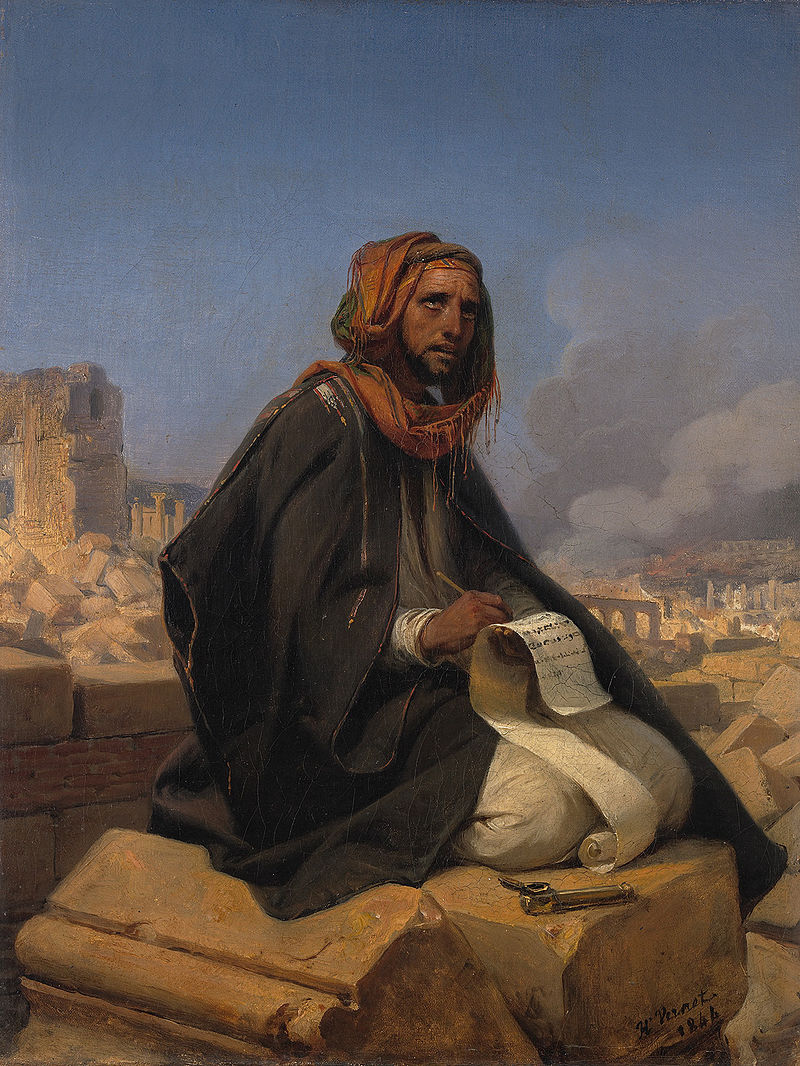
"Jeremiah on the Ruins of Jerusalem"
(Horace Vernet, 1844)
'For I know the plans that I have for you,' declares the LORD,
'plans for welfare and not for calamity to give you a future and a hope.
-- Jeremiah 29:11
(Play beautiful related song by Marty Goetz and Misha)
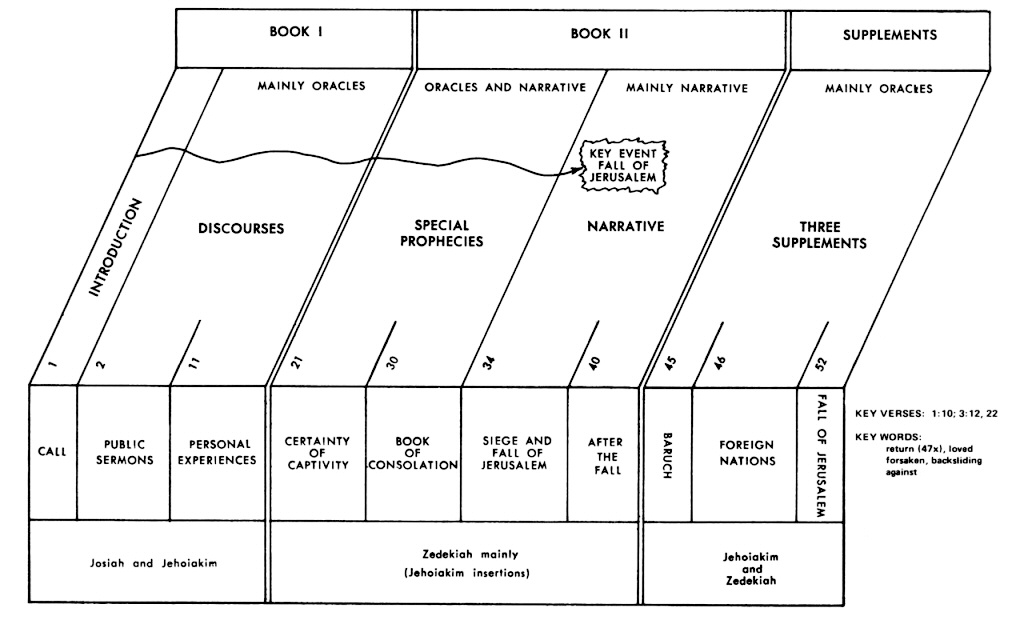
Click chart to enlarge
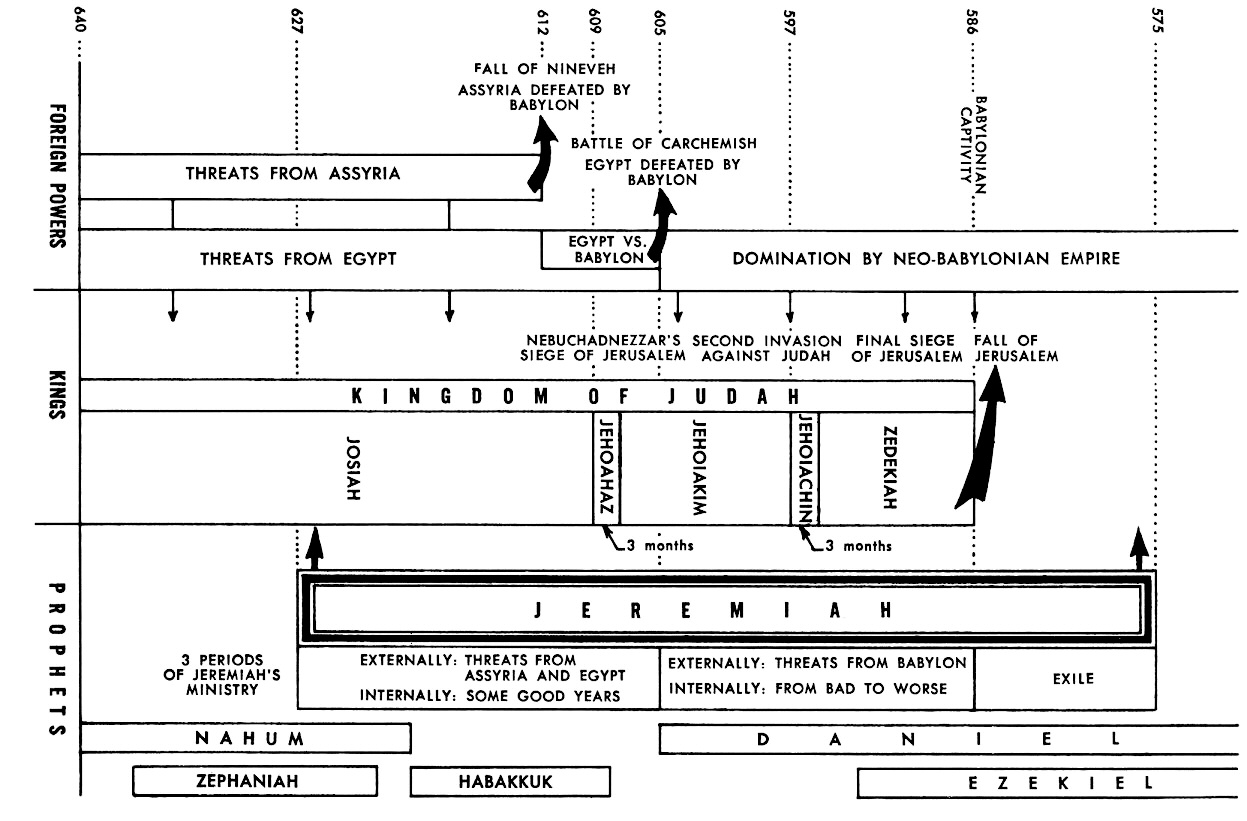
Click chart to enlarge
Chart from recommended resource Jensen's Survey of the OT - used by permission
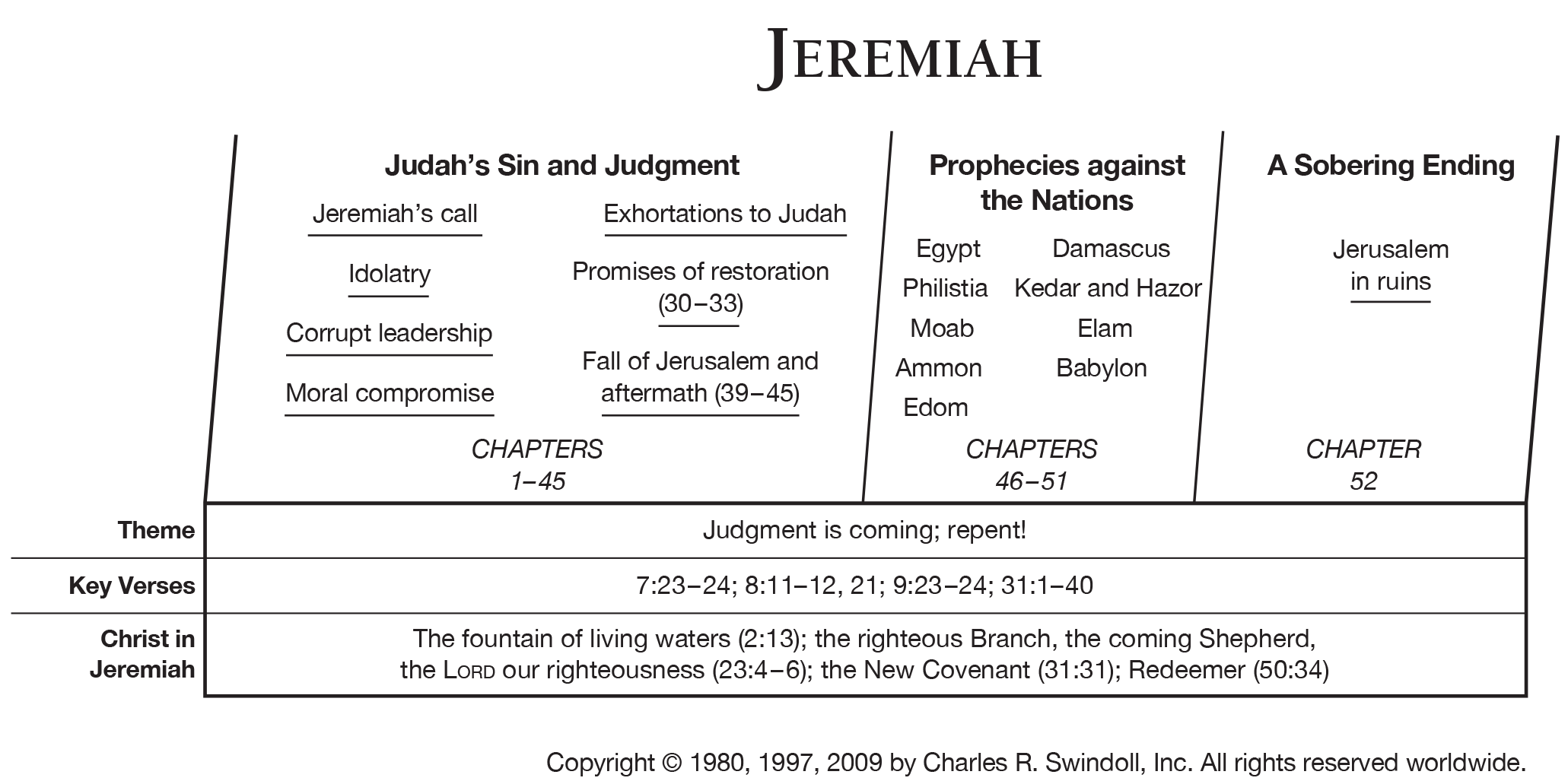
Jeremiah Chart from Charles Swindoll
| JEREMIAH: "PROPHET TO THE NATIONS" Sin - "I Will Punish" (Jer 9:25) Hope - "I Will Restore" (Jer 30:17) Judah & Jerusalem |
||||||
|
Prophet |
Prophecies to Judah Jer 2:1-45:5 |
Prophecies to the Gentiles Jer 46:1-51:64 |
Prophet's Appendix Jer 52:1-52:34 |
|||
| Prophet's Commission Jer 1:1-19 |
Judah Condemned Jer 2:1-25:38 |
Jeremiah's Conflicts Jer 26:1-29:32 |
Jerusalem's Future Jer 30:1-33:26 |
Jerusalem's Fall Jer 34:1-45:5 |
Nations Condemned Jer 46:1-51:64 |
Historic Conclusion Jer 52:1-52:34 |
| Before The Fall Of Jerusalem Jer 1:1-38:28 |
The Fall Jer 39:1-18 |
After The Fall |
||||
| Call | Ministry | Retrospect | ||||
| Nation of Judah |
Surrounding Nations |
Future of Babylon |
||||
| 627-582 BC Ministered 40+ Years! |
||||||
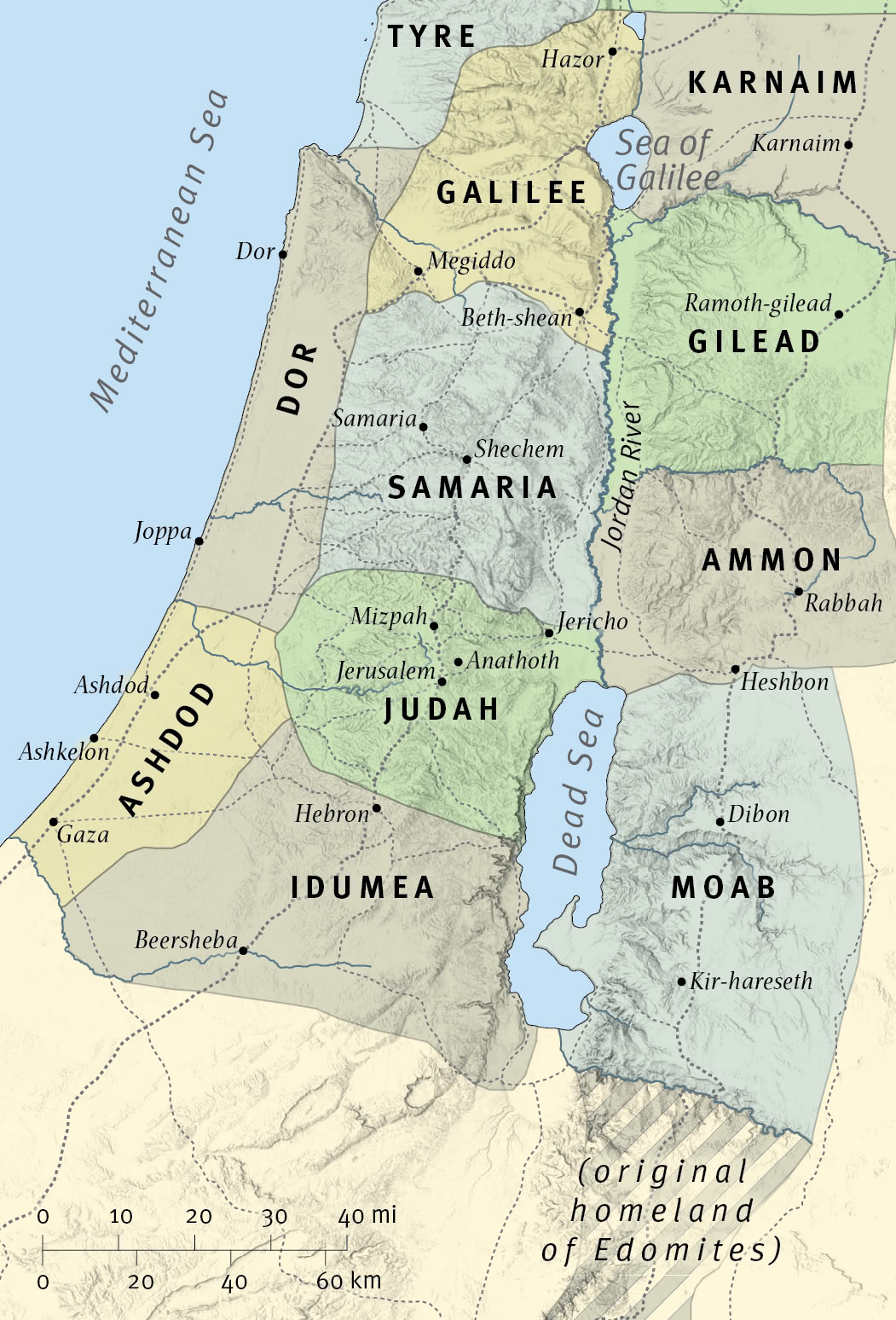
Map of Israel at Time of Jeremiah
Source: ESV Global Study Bible
Jeremiah 22:1 Thus says the LORD, “Go down to the house of the king of Judah, and there speak this word
NLT - Then the LORD said to me, "Go over and speak directly to the king of Judah. Say to him,
NET The LORD told me, "Go down to the palace of the king of Judah. Give him a message from me there.
- Go: Jer 21:11 34:2 1Sa 15:16-23 2Sa 12:1 24:11,12 1Ki 21:18-20 2Ch 19:2,3 25:15,16 33:10 Ho 5:1 Am 7:13 Mk 6:18 Lu 3:19,20
JEREMIAH ORDERED TO
SPEAK TO KING OF JUDAH
Paul Apple - We all would like to end well. We would like the summary of our life and ministry to read like a praiseworthy eulogy. Instead, in this series of oracles directed against very specific kings of Judah we find that God has nothing good to say about their administrations. Their leadership style has been self-indulgent and exploitative and they have failed to meet the essential standard of performing justice and righteousness.
Chapters 21—24 focus especially
on the royal house of David.
-- Warren Wiersbe
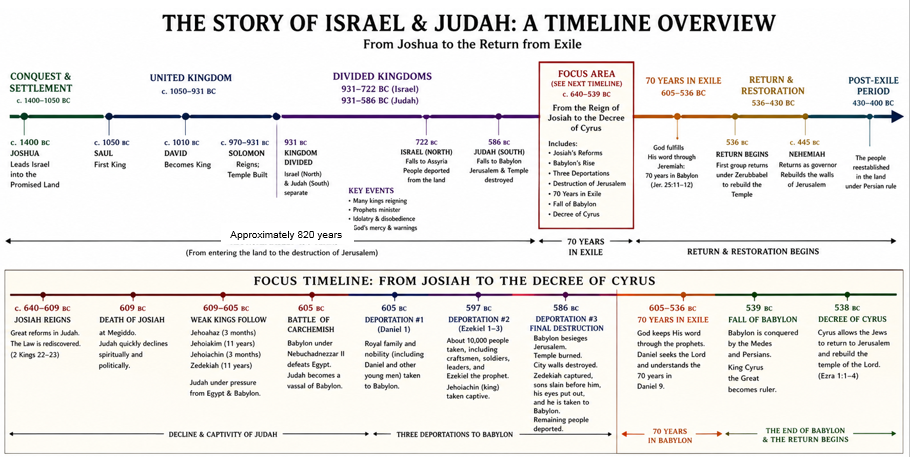
Tremper Longman: The previous chapter issued an oracle against Zedekiah, and now the prophet continues the diatribe against Judah’s kings. At first the oracle is addressed to the “King of Judah” without specification (Jer 22:1-10). (ED: WIERSBE THINKS THIS REFERS TO ZEDEKIAH) After this initial speech Jeremiah addresses Shallum (Jer 22:11-17 also known as Jehoahaz, who ruled for only a few months in 609 B.C.). Then (Jer 22:18-23), he turns his attention to Jehoiakim (609-597 B.C.), followed by Jehoachin, who ruled only a few months in Jerusalem before he was taken away in captivity to Babylon and replaced by Zedekiah, the last king of Judah (597-586 B.C.). In essence, these oracles cover the post-Josianic kings who ruled during the period of Jeremiah’s prophetic activity (See Jeremiah, Lamentations -Understanding the Bible Commentary)
Derek Kidner calls this chapter "A sad parade of kings 22:1–30. Brought together in one passage, these contemporary comments from God on each successor to King Josiah in turn drive home to us the necessity—and the miracle—of the perfect King to come." (See Jeremiah - Page 87)
Thus says the LORD - This establishes divine origin and calls for submission. The One Who is speaking infinitely outranks the king of Judah.
Go down to the house of the king of Judah - As noted above while the identity of this king is not stated, some think this refers to Zedekiah. Go down is a command to go directly into the seat of authority, where resistance will be greatest. The house of the king is the seat of responsibility. The obedience or rebellion of the king affected the entire nation.
NET NOTE on go down - The allusion here is to going down from the temple to the palace which was on a lower eminence. See Jer 36:12 in its context.
Bob Utley - "the house of the king of Judah" All of this chapter is a word play on "house" (BDB 108), meaning
- descendants (cf. 2 Samuel 7; 1 Chronicles 17)
- king's palace (Jer. 22:13-14 speak of enlarging and beautifying the palace in an attempt to be a great king)
And there speak this word - Yahweh gives Jeremiah a divine commission to go directly into the center of power and faithfully deliver Yahweh's message exactly as it is given with no alterations or softening. God's Word was directed first to leaders, because leadership carries greater accountability. God’s Word must be spoken where it is likely to be least welcomed but where it is most needed.
Bob Utley - Brief outline of messages to Judah's royal house, cf. Jer. 21:11-23:8
- Zedekiah (Mattaniah, cf. 2 Kgs. 24:17) ‒ Jer. 21:1-14
- Jehoahaz (Shallum, cf. 1 Chr. 3:15) ‒ Jer. 22:10-12
- Jehoiakim (Eliakim, cf. 2 Kgs. 23:34) ‒ Jer. 22:13-19
- Jehoiakim (Coniah) ‒ Jer. 22:24-30; 37:1
While not everyone agrees with the following analysis (especially since Zedekiah's name is not mentioned), some such as Warren Wiersbe think that Jeremiah 22 is structured as a series of oracles against Judah’s final kings:
- Jer 22:1–9 → Zedekiah / house of David (Other writers see this a a general warning to the Davidic kings).
- Jer 22:10–12 → Jehoahaz
- Jer 22:13–23 → Jehoiakim
- Jer 22:24–30 → Jehoiachin (Coniah)
In sum, Jeremiah 22 possibly represents a systematic indictment of the last four kings before the exile.
|
THE LAST FOUR KINGS OF |
|||
|
|
2 Chronicles |
2 Kings |
Date/Length |
|
Reign |
2Ch 36:1-4 |
2Ki 23:30b-34 |
609 - 3 months |
|
Reign |
2Ch 36:5-8 |
2Ki 23:35-24:7 |
609-598/597 - 11 yr |
|
Reign |
2Ch 36:9-10 |
2Ki 24:8-16 |
598/597- 3 months |
|
Reign |
2Ch 36:11-16 |
2Ki 24:17-20 |
598/597-586 - 11 yr |
|
Fall |
2Ch 36:17-21 |
2Ki 25:1-26 |
586 - 70 years Exile |
Jeremiah 22:2 and say, ‘Hear the word of the LORD, O king of Judah, who sits on David’s throne, you and your servants and your people who enter these gates.
NLT - 'Listen to this message from the LORD, you king of Judah, sitting on David's throne. Let your officials and your people listen, too.
NET Say: 'Listen, O king of Judah who follows in David's succession. You, your officials, and your subjects who pass through the gates of this palace must listen to what the LORD says.
- Hear: Jer 22:29 13:18 17:20-27 19:3 29:20 1Ki 22:19 Isa 1:10 28:14 Eze 34:7 Am 7:16
- who sits on David’s throne Jer 22:4,30 17:25 29:16,17 36:30 Isa 9:7 Lu 1:32
- your people who enter these gates: Jer 7:2 17:20
Related Passages:
Jeremiah 17:20 and say to them, ‘Listen to the word of the LORD, kings of Judah, and all Judah and all inhabitants of Jerusalem who come in through these gates:
JEREMIAH'S COMMAND TO
THE ROYAL FAMILY OF JUDAH
and say, ‘Hear the word of the LORD - This is a command, a divine summons. Recall that "hear" does not just mean hear sound waves but hear, heed and obey what is heard. In other words the following words are not to simply go in one ear and out the other! Hearers who are no doers are deluding themselves! (James 1:22)
O king of Judah, who sits on David’s throne - David's throne is an allusion to the Davidic Covenant (2 Samuel 7:12–16) By invoking David’s name, Jeremiah reminds the current king that his legitimacy depends on obedience to God’s covenant.
Warren Wiersbe - In 2 Samuel 7, there is a dual meaning to the word house: a literal building (the temple David wanted to construct for God) and the royal house (dynasty) God established through David by His gracious covenant. These same two meanings are woven into Jeremiah’s message: God will destroy both the royal palace and the Davidic dynasty because of the sins of the kings. The royal house of cedar would be cut down and burned as the Chaldean soldiers went through the city like men chopping down a forest in Lebanon. (Wiersbe Bible Commentary OT)
you and your servants and your people who enter these gates - God’s word applies to all levels of society, from rulers to common citizens, because all are under His authority. God’s people had repeatedly ignored His commands, especially regarding justice, righteousness, and faithfulness. The Lord was calling them back to covenant obedience before judgment would come.
G Campbell Morgan - Hear the word of the Lord; 0 king of Judah.—Jer. 22.2
With this chapter a section begins which continues through chapter 27. It contains, first, a message to Zedekiah directly; and then is made up of messages concerning his three predecessors, Jehoahaz, Jehoiakim, and Jehoiachin; and concerning the false prophets. Jeremiah was commanded to go to the house of the king of Judah, to deliver the word of Jehovah. This he did, delivering these messages, in which he repeated some of those which he had given during the reigns of these predecessors. A glance ahead to 27. 12 will show where these particular messages ended. Observe the opening words of this chapter (22): "Thus said Jehovah." The revised version has restored the past tense here accurately. Therefore, we are to understand that in the arrangement of the Book we are now taken back to a visit which Jeremiah had made to Zedekiah in the earlier days of his reign. All that the prophet said to him then should have saved him from his evil courses, had he been ready to hear and obey the word of Jehovah. The word of Jehovah to kings, as to people, is the word of wisdom. Hearing it, and obeying it, they execute judgment and righteousness, and so establish their kingdoms in strength. To neglect that word, or to rebel against it, in favour of policies resulting from watching events, observing circumstances, and making calculations, is to bring destruction, inevitably and irrevocably. The centuries run their course, kings rise and fall, kingdoms advance and perish, and we watch the process, and see that there is but one hope for kings and kingdoms; and that is that they should hear the Word of Jehovah, and hearing, obey.
Jeremiah 22:3 ‘Thus says the LORD, “Do justice and righteousness, and deliver the one who has been robbed from the power of his oppressor. Also do not mistreat or do violence to the stranger, the orphan, or the widow; and do not shed innocent blood in this place.
NLT - This is what the LORD says: Be fair-minded and just. Do what is right! Help those who have been robbed; rescue them from their oppressors. Quit your evil deeds! Do not mistreat foreigners, orphans, and widows. Stop murdering the innocent!
NET The LORD says, "Do what is just and right. Deliver those who have been robbed from those who oppress them. Do not exploit or mistreat foreigners who live in your land, children who have no fathers, or widows. Do not kill innocent people in this land.
CSB This is what the LORD says: Administer justice and righteousness. Rescue the victim of robbery from the hand of his oppressor. Don't exploit or brutalize the foreigner, the fatherless, or the widow. Don't shed innocent blood in this place.
ESV Thus says the LORD: Do justice and righteousness, and deliver from the hand of the oppressor him who has been robbed. And do no wrong or violence to the resident alien, the fatherless, and the widow, nor shed innocent blood in this place.
NIV This is what the LORD says: Do what is just and right. Rescue from the hand of his oppressor the one who has been robbed. Do no wrong or violence to the alien, the fatherless or the widow, and do not shed innocent blood in this place.
- Do justice and righteousness: Jer 5:28 9:24 21:12 Ex 23:6-9 Lev 19:15 De 16:18-20 25:1 2Sa 23:3 Job 29:7-17 Ps 72:2-4 Mic 3:11 Zec 7:9-11
- do not mistreat : Jer 22:17
- do violence to the stranger: De 10:18 24:7 27:19 Job 22:9 24:9 29:12 Ps 68:5 94:6 Pr 23:10 Isa 1:23 Eze 22:7 Mal 3:5 Jas 1:27
- do not shed innocent blood: Jer 22:17 7:6 26:16 De 19:10-13 2Ki 24:4 Ps 94:21 Pr 6:17 Isa 1:15-20 Joe 3:19
Related Passges:
Amos 5:24 “But let justice roll down like waters And righteousness like an ever-flowing stream.
Micah 6:8 He has told you, O man, what is good; And what does the LORD require of you But to do justice, to love kindness, And to walk humbly with your God?
Psalm 82:3-4 Vindicate the weak and fatherless; Do justice to the afflicted and destitute. 4 Rescue the weak and needy; Deliver them out of the hand of the wicked.
Psalm 89:14 Righteousness and justice are the foundation of Your throne; Lovingkindness and truth go before You.
Deuteronomy 10:18-19 “He executes justice for the orphan and the widow, and shows His love for the alien by giving him food and clothing. 19“So show your love for the alien, for you were aliens in the land of Egypt.
James 1:27 Pure and undefiled religion in the sight of our God and Father is this: to visit orphans and widows in their distress, and to keep oneself unstained by the world.
Deuteronomy 19:10 “So innocent blood will not be shed in the midst of your land which the LORD your God gives you as an inheritance, and bloodguiltiness be on you.
GOD'S CHARGE FOR
GODLY CONDUCT
Thus says the LORD - The following commands are God's word calling for godly character manifest in their conduct and specifically addressed to the king of Judah. What follows is essentially a call to repent and obey God.
Do justice and righteousness - NET, NIV = "Do what is just and right." Justice is how you treat others while righteousness is how you live before God. This is the foundation, and refers not merely to legal correctness but to a life that reflects God’s standards in both public decisions and personal conduct (Amos 5:24). Note the verb do calls for action, not just words. Justice deals with what is right in action, making fair, impartial decisions, defending those who are wronged or vulnerable andensuring that what is right is upheld in society. It is especially focused on how others are treated, particularly the weak. Justice is not abstract but is applied righteousness in relationships and institutions. Righteousness is right conduct before God, living in moral alignment with God’s character, acting with integrity, honesty, and uprightness and doing what is right in God’s sight, not merely what is acceptable to people. Righteousness is both vertical (right with God) and horizontal (right toward others). Doing justice and righteousness defines a society ordered according to God’s will.
And deliver the one who has been robbed from the power of his oppressor - This is a command calling for active intervention, not passive observation. It is a command to rescue the vulnerable and restrain injustice, showing that true obedience requires defending those who cannot defend themselves (Ps 82:3–4).
Also do not mistreat or do violence to the stranger, the orphan, or the widow - This instruction identifies the most vulnerable groups in society, those without protection or social power. God consistently places them at the center of ethical responsibility, revealing that how a people treat the weak is a measure of their faithfulness to Him (Dt 10:18–19; Jas 1:27).
NET NOTE on Heb “aliens, orphans, or widows” treating the terms as generic or collective. However, the term “alien” carries faulty connotations and the term “orphan” is not totally appropriate because the Hebrew term does not necessarily mean that both parents have died. These were classes of people who had no one to look out for their rights. The laws of Israel, however, were careful to see that their rights were guarded (cf. Deut 10:18) and that provision was made for meeting their needs (cf. Deut 24:19–21). The LORD promised to protect them (cf. Ps 146:9) and a curse was called down on any who deprived them of justice (cf. Deut 27:19).
And do not shed innocent blood in this place - NLT - "Stop murdering the innocent!" This charge condemns the ultimate injustice which is the taking of a life unjustly, whether through violence, corruption, or abuse of power (Dt 19:10). It underscores the fact that injustice is not merely social failure but moral guilt before God.
NET NOTE on "Do not kill innocent people. For an example of one of the last kings who did this see Jer 36:20–23. Manasseh was notorious for having done this and the book of 2 Kgs attributes the ultimate destruction of Judah to this crime and his sin of worshiping false gods (2 Kgs 21:16; 24:4)."
Bob Utley - "the stranger, the orphan, or the widow" This is a key phrase from Deuteronomy. It characterized YHWH's action and care (Deut. 10:18; Ps. 146:8-10). It is mentioned several times in Deuteronomy.
- help them ‒ Deut. 14:29; 24:17,19
- rejoice with them ‒ Deut. 16:11
- special offering for them ‒ Deut. 26:12-13
- cursings if one distorts their justice ‒ Deut. 27:19
Jeremiah 22:4 “For if you men will indeed perform this thing, then kings will enter the gates of this house, sitting in David’s place on his throne, riding in chariots and on horses, even the king himself and his servants and his people.
NLT - If you obey me, there will always be a descendant of David sitting on the throne here in Jerusalem. The king will ride through the palace gates in chariots and on horses, with his parade of officials and subjects.
NET If you are careful to obey these commands, then the kings who follow in David's succession and ride in chariots or on horses will continue to come through the gates of this palace, as will their officials and their subjects.
- then: Jer 17:25
PROMISE OF BLESSINGS
FOR OBEDIENCE
For if you men will indeed perform this thing, then kings will enter the gates of this house sitting in David’s place on his throne, riding in chariots and on horses, even the king himself and his servants and his people - Note the "if...then" identifies this sentence as a conditional promise. Simply put if the rulers of Judah will govern according to His standards, upholding justice, protecting the innocent, and rejecting oppression, then the Davidic dynasty will continue to flourish. The imagery of kings entering “the gates of this house” and “riding in chariots and on horses” symbolizes royal prosperity, stability, and divine favor. It reflects a vision of Jerusalem as a thriving city under righteous leadership, where the covenant promises to David remain intact.
Wiersbe sees this as Jeremiah seeming "to be giving the leaders a small window of opportunity: If they would repent and do justice, God would deliver the city and establish David’s throne (Jer. 22:4). Their hearts, however, were hard, and they would not listen. The ruins of Jerusalem would be a monument to their wickedness."
This verse promising blessing for obedience echoes the conditional promise in Jeremiah 17:24-25
But it will come about, IF you listen attentively to Me,” (AGAIN LISTEN IMPLIES HEEDING/DOING) declares the LORD, “to bring no load in through the gates of this city on the sabbath day, but to keep the sabbath day holy by doing no work on it,then there will come in through the gates of this city kings and princes sitting on the throne of David, riding in chariots and on horses, they and their princes, the men of Judah and the inhabitants of Jerusalem, and this city will be inhabited forever.
Jeremiah 22:5 “But if you will not obey these words, I swear by Myself,” declares the LORD, “that this house will become a desolation.”’”
NLT - But if you refuse to pay attention to this warning, I swear by my own name, says the LORD, that this palace will become a pile of rubble.'"
NET But, if you do not obey these commands, I solemnly swear that this palace will become a pile of rubble. I, the LORD, affirm it!"
- if: Jer 17:27 2Ch 7:19,22 Isa 1:20
- I: Ge 22:16 Nu 14:28-30 De 32:40-42 Ps 95:11 Am 6:8 8:7,8 Heb 3:18 6:13,17
- that: Jer 7:13,14 26:6-9 39:8 Mic 3:12
Related Passages:
Deuteronomy 28:15 “But it shall come about, if you do not obey the LORD your God, to observe to do all His commandments and His statutes with which I charge you today, that all these curses will come upon you and overtake you:
Proverbs 29:1 A man who hardens his neck after much reproof Will suddenly be broken beyond remedy.
GOD GIVES WARNING
IN FORM OF AN OATH
But if you will not obey these words, I swear by Myself,” declares the LORD, “that this house will become a desolation - Here we see another conditional sentence but this time promising a very negative outcome as the consequences for disobedience. Given that this was originally addressed to the king of Judah (Jer 22:1), house refers primarily to the royal palace of the king of Judah (cf Jer 22:6), but symbolically it represents the entire royal line and, by extension, the nation itself. The destruction of the royal house of Judah stands as a sobering reminder that no one, not even a king on David’s throne, is above God’s law. The point is that God’s justice is not arbitrary but is the natural and moral consequence of rejecting His righteous rule.
I swear by Myself is Yahweh's oath which conveys finality and certainty. This exact phrase is found only here in the Bible but there are similar phrases - Gen. 22:16; Amos 6:8; Heb. 6:13.
NET NOTE Heb “I swear by myself.” Oaths were guaranteed by invoking the name of a god or swearing by “his life.” See Jer 12:16; 44:26. Since the LORD is incomparably great, he could swear by no higher (see Heb 6:13–16) than to swear by himself or his own great name.
Jeremiah 22:6 For thus says the LORD concerning the house of the king of Judah: “You are like Gilead to Me, Like the summit of Lebanon; Yet most assuredly I will make you like a wilderness, Like cities which are not inhabited.
NLT - Now this is what the LORD says concerning the royal palace: "You are as beloved to me as fruitful Gilead and the green forests of Lebanon. But I will destroy you and leave you deserted, with no one living within your walls.
NET "'For the LORD says concerning the palace of the king of Judah, "This place looks like a veritable forest of Gilead to me. It is like the wooded heights of Lebanon in my eyes. But I swear that I will make it like a wilderness whose towns have all been deserted.
- You are as beloved to me as fruitful Gilead: Jer 22:24 21:11 Ge 37:25 De 3:25 Song 5:15
- Yet most assuredly: Jer 4:20 7:34 9:11 19:7,8 21:14 25:9,10 26:6-9,18 Ps 107:34 Isa 6:11 24:1-6 27:10 Eze 33:27,28
FATE OF THE ROYAL
PALACE IN JERUSALEM
For thus says the LORD concerning the house of the king of Judah: “You are like Gilead to Me, Like the summit of Lebanon - NLT - ""You are as beloved to me as fruitful Gilead and the green forests of Lebanon." Gilead was known for its rich pastures and healing balm (Jeremiah 8:22), while Lebanon was famous for its majestic cedar forests. Yahweh uses powerful imagery to express both His affection for Judah and the severity of the coming judgment if they continue in disobedience. God is acknowledging that Judah, and particularly the royal house, was once precious and valuable in His sight. They were meant to be a place of blessing, prosperity, and spiritual vitality.
Bob Utley - "You are like Gilead to Me" These first two lines of poetry in Jer. 22:6b and c are parallel and address the royal house. The imagery is that as Gilead and Lebanon were beautiful and forested, so too, the house (palace) of Judah. But it will be destroyed! The house of the king (physical and seed) and the house of the Lord will both be destroyed! Leviticus 26 and Deuteronomy 27-28 have come to painful reality!
NET NOTE Lebanon was well known for its cedars and the palace (and the temple) had used a good deal of such timber in its construction (see 1 Kgs 5:6, 8–10; 7:2–3). In this section several references are made to cedar (see vv. 7, 14, 15, 23) and allusion has also been made to the paneled and colonnade armory of the Forest of Lebanon (2:14). It appears to have been a source of pride and luxury, perhaps at the expense of justice. Gilead was also noted in antiquity for its forests as well as for its fertile pastures.
Yet - A tragic term of contrast one that is inevitable in the face of continued disobedience.
Most assuredly I will make you like a wilderness, Like cities which are not inhabited - Here we see the transformation of the royal palace from precious (like Gilead, Lebanon) to desolate. Yahweh prophetically promises that because of their persistent sin and rebellion, He will make the royal palace like a wilderness, a place of desolation and emptiness. The royal palace, once a symbol of God’s favor and the Davidic covenant, would become deserted and ruined.
One principle we see here is that privilege does not exempt anyone from judgment. Even though the kings of Judah sat on David’s throne, their unfaithfulness to God’s covenant would bring devastation. God’s blessings are always tied to obedience, and His judgment follows persistent rebellion. Deuteronomy 28:63 warned...
“It shall come about that as the LORD delighted over you to prosper you, and multiply you, so the LORD will delight over you to make you perish and destroy you; and you will be torn from the land where you are entering to possess it.
Isaiah 1:21 laments,
“How the faithful city has become a whore, she who was full of justice! Righteousness lodged in her, but now murderers.”
These passages reveal that when God’s people abandon righteousness, they forfeit the blessings that come from His presence.
Tsk - Thou: Gilead was the most fertile part of the country, and renowned for its rich pastures; and Lebanon was the highest mountain in Israel, celebrated for its stately cedars; and both were, therefore, proper emblems of the reigning family. "But though thou art the richest and most powerful, I, who raised thee up, can bring thee down, and make thee a wilderness."
Jeremiah 22:7 “For I will set apart destroyers against you, Each with his weapons; And they will cut down your choicest cedars And throw them on the fire.
NLT - I will call for wreckers, who will bring out their tools to dismantle you. They will tear out all your fine cedar beams and throw them on the fire.
NET I will send men against it to destroy it with their axes and hatchets. They will hack up its fine cedar panels and columns and throw them into the fire.
- I: Jer 4:6,7 5:15 50:20-23 Isa 10:3-7 13:3-5 54:16,17 Eze 9:1-7 Mt 22:7
- cut down your choicest cedars: Jer 21:14 Isa 10:33,34 27:10,11 37:24 Zec 11:1
Related Passages:
Lamentations 2:17 The LORD has done what He purposed; He has accomplished His word Which He commanded from days of old. He has thrown down without sparing, And He has caused the enemy to rejoice over you; He has exalted the might of your adversaries.
2 Kings 25:8-9 Now on the seventh day of the fifth month, which was the nineteenth year of King Nebuchadnezzar, king of Babylon, Nebuzaradan the captain of the guard, a servant of the king of Babylon, came to Jerusalem. 9 He burned the house of the LORD, the king’s house, and all the houses of Jerusalem; even every great house he burned with fire.
YAHWEH ORCHESTRATES
THE DESTRUCTION OF ROYAL HOUSE
For I (Yahweh) will set apart destroyers against you, Each with his weapons - This reiterates a point we have seen before that the coming invaders (Babylonians under King Nebuchadnezzar) are not acting independently but are instruments of God’s judgment. The Lord Himself is the one who appoints them. It is an immutable principle in Scripture that when nations rebel against God, He may use other nations as tools of discipline.
NET NOTE Heb “I will sanctify destroyers against it.” If this is not an attenuated use of the term “sanctify” the traditions of Israel’s holy wars are being turned against her. See also 6:4. In Israel’s early wars in the wilderness and in the conquest, the LORD fought for her against the enemies (cf., e.g., Josh 10:11, 14, 42; 24:7; Judg 5:20; 1 Sam 7:10). Now he is going to fight against them (21:5, 13) and use the enemy as his instruments of destruction. For a similar picture of destruction in the temple see the lament in Ps 74:3–7.
And they will cut down your choicest cedars - The “choicest cedars” symbolize the grandeur and strength of the royal palace, which was built with fine cedar wood from Lebanon, a material associated with luxury and majesty. To “cut down your choicest cedars and throw them on the fire” means that the very symbols of Judah’s pride and prosperity would be reduced to ashes. What was once a sign of blessing and royal splendor would become fuel for destruction.
And throw them on the fire The cedars that once lined the walls of the kills would soon be reduced to ashes. The palace, which represented the power and stability of David’s line, would be dismantled because the kings had forsaken the righteousness that was supposed to define their rule.
This principle echoes throughout Scripture that when people reject God’s word, they invite ruin upon themselves.
Jeremiah 22:8 “Many nations will pass by this city; and they will say to one another, ‘Why has the LORD done thus to this great city?’
NLT - People from many nations will pass by the ruins of this city and say to one another, 'Why did the LORD destroy such a great city?'
NET "'People from other nations will pass by this city. They will ask one another, "Why has the LORD done such a thing to this great city?"
- De 29:23-25 1Ki 9:8,9 2Ch 7:20-22 La 2:15-17 4:12 Da 9:7
Related Passages:
Deuteronomy 29:23-25 (DESCRIPTION OF DESTRUCTION IN PROMISED LAND) ‘All its land is brimstone and salt, a burning waste, unsown and unproductive, and no grass grows in it, like the overthrow of Sodom and Gomorrah, Admah and Zeboiim, which the LORD overthrew in His anger and in His wrath.’ 24 “All the nations will say, ‘Why has the LORD done thus to this land? Why this great outburst of anger?’ 25 Then men will say, ‘Because they forsook the covenant of the LORD, the God of their fathers, which He made with them when He brought them out of the land of Egypt.
Lamentations 2:15 All who pass along the way Clap their hands in derision at you; They hiss and shake their heads At the daughter of Jerusalem, “Is this the city of which they said, ‘The perfection of beauty, A joy to all the earth’?”
THE AMAZEMENT OF PAGANS
AT YAHWEH'S DESTRUCTION
Many nations will pass by this city; and they will say to one another, ‘Why has the LORD done thus to this great city - is a prophetic description of the aftermath of God’s judgment on Jerusalem, the great city. Jerusalem, once glorious and revered, would lie in ruins, and foreign nations would look upon its desolation with astonishment. Don't miss the truth that the question, “Why has the LORD done thus to this great city?” reveals that even the surrounding nations would recognize that this destruction was not merely the result of human warfare but an act of divine judgment.
Deuteronomy 29:25 shows the pagans will understand, Moses recording that the nations "will say, ‘Because they forsook the covenant of the LORD, the God of their fathers, which He made with them when He brought them out of the land of Egypt." The fall of Jerusalem would serve as a visible testimony to the world that the covenant God is holy and just, and that He does not overlook sin, even among His chosen people. Their downfall became a lesson to the world that God’s justice is impartial. As Romans 11:22 later reminds us, “Note then the kindness and the severity of God: severity toward those who have fallen, but God’s kindness to you, provided you continue in his kindness.”
Bob Utley - Verse 8 expressed the theological question connected to YHWH's judgment of His own covenant people (cf. Jer. 16:10; Deut. 28:24-26; 1 Kgs. 9:8-9; 2 Chr. 7:20-22). Moses' prayer of intercession for Israel entreated YHWH about this very issue (cf. Exod. 32:11-13) and YHWH changed His mind (cf. Exod. 32:14). But the covenant people had become so idolatrous (cf. Jer. 1:16; 5:19; 8:2; 16:11) and rebellious that only radical surgery could save their corporate life. Remember, in that day every nation had its own national deity. The more powerful deity won the battles for its people. Some might think that YHWH was weak because the northern kingdom (Israel) was exiled by Assyria (722 B.C.) the southern kingdom (Judah) was defeated and exiled several times by Neo-Babylon (605, 597, 586, 582 B.C.) The real problem was the sin of the covenant people (cf. Jer. 22:9; 2 Chr. 34:25), not YHWH!
Jeremiah 22:9 “Then they will answer, ‘Because they forsook the covenant of the LORD their God and bowed down to other gods and served them.’”
NLT - And the answer will be, 'Because they violated their covenant with the LORD their God by worshiping other gods.'"
NET The answer will come back, "It is because they broke their covenant with the LORD their God and worshiped and served other gods."
- Jer 2:17-19 40:2,3 50:7 De 29:25-28 2Ki 22:17 2Ch 34:25
Related Passages:
Deuteronomy 29:25-26 “Then men will say, ‘Because they forsook the covenant of the LORD, the God of their fathers, which He made with them when He brought them out of the land of Egypt. 26 ‘They went and served other gods and worshiped them, gods whom they have not known and whom He had not allotted to them.
PAGAN'S WILL RECOGNIZE
CAUSE OF JUDAH'S DESTRUCTION
Then they will answer - Jer 22:8 was a rhetorical question and here we have the expected answer from the nations. Even godless nations recognized the consequence of the Jews breaking covenant with Yahweh.
‘Because they forsook the covenant of the LORD their God and bowed down to other gods and served them.’” Israel was joined in the Mosaic Covenant as Yahweh's "wife," but they abandoned their covenant vows to pursue other "lovers." (See Israel the Wife of Jehovah) This verse underscores that sin is not merely the breaking of rules but the breaking of relationship. Whether it was the worship of Baal, the sun, or man-made idols, Judah’s idolatry represented a rejection of God’s rightful place as their "Husband," (Jer 31:32), their King and their Redeemer. To “bow down to other gods” is to give one’s heart, trust, and allegiance to something other than the true and living God.
This verse also carries a timeless warning. Idolatry is not limited to ancient statues or pagan rituals; it includes anything that takes the place of God in our hearts—wealth, power, pleasure, or self. Jesus affirmed this truth when He said, “You shall worship the Lord your God, and him only shall you serve” (Matthew 4:10). When people turn from God to serve other “gods,” whether literal or figurative, they invite spiritual ruin.
Jeremiah 22:10 Do not weep for the dead or mourn for him, But weep continually for the one who goes away; For he will never return Or see his native land.
NLT - Do not weep for the dead king or mourn his loss. Instead, weep for the captive king being led away! For he will never return to see his native land again.
NET "'Do not weep for the king who was killed. Do not grieve for him. But weep mournfully for the king who has gone into exile. For he will never return to see his native land again.
- Weep 2Ki 22:20 23:30 2Ch 35:23-25 Ec 4:2 Isa 57:1 La 4:9 Lu 23:28
- weep: Jer 22:11 2Ki 23:30-34 Eze 19:3,4
Related Passages:
2 Kings 23:29-35 In his days Pharaoh Neco king of Egypt went up to the king of Assyria to the river Euphrates. And King Josiah went to meet him, and when Pharaoh Neco saw him he killed him at Megiddo. 30His servants drove his body in a chariot from Megiddo, and brought him to Jerusalem and buried him in his own tomb. Then the people of the land took Jehoahaz the son of Josiah and anointed him and made him king in place of his father. 31 Jehoahaz was twenty-three years old when he became king, and he reigned three months in Jerusalem; and his mother’s name was Hamutal the daughter of Jeremiah of Libnah. 32 He did evil in the sight of the LORD, according to all that his fathers had done. 33 Pharaoh Neco imprisoned him at Riblah in the land of Hamath, that he might not reign in Jerusalem; and he imposed on the land a fine of one hundred talents of silver and a talent of gold. 34 Pharaoh Neco made Eliakim the son of Josiah king in the place of Josiah his father, and changed his name to Jehoiakim. But he took Jehoahaz away and brought him to Egypt, and he died there. 35 So Jehoiakim gave the silver and gold to Pharaoh, but he taxed the land in order to give the money at the command of Pharaoh. He exacted the silver and gold from the people of the land, each according to his valuation, to give it to Pharaoh Neco.
SHALLUM'S
SAD LEGACY
Jehoahaz, or Shallum, who succeeded Josiah and reigned only three months is discussed in Jer. 22:10-12 (2Ki 23:30-33).
Do not weep for the dead or mourn for him - This likely refers to King Josiah, who had been killed in the recent past (609 BC) (2 Kings 23:29–30). Josiah’s death was indeed a national tragedy, but Jeremiah tells the people not to weep for him because Josiah died in peace with God and was spared from witnessing the coming destruction of Jerusalem.
Here we see a contrasts between two kinds of sorrow, the natural grief of death and the deeper sorrow of separation from God and His blessings.
Charles Feinberg: Jeremiah tells the nation at large that they need not mourn the death of the godly king Josiah (Jer 22:10), who had been slain at the Battle of Megiddo in 609 B.C. (cf. 2 Kings 23:29-35; 2 Chron 35:25; Zech 12:11). It had become customary among God’s people to sing dirges for departed rulers. But now they were to reserve their weeping for Josiah’s son Shallum-Jehoahaz (Jer 22:11), who was to be forever exiled from the land. (SEE The Expositor's Bible Commentary - Abridged Edition)
But weep continually for the one who goes away - The one who “goes away” refers to Josiah’s son, King Shallum (1 Chron. 3:15 also known as Jehoahaz), who reigned three months before being taken captive to Egypt by Pharaoh Neco and never returned to Judah (2 Kings 23:29-35). His exile symbolized the beginning of Judah’s downfall, and his fate was far more tragic than death—he would live out his days in a foreign land, cut off from his people and his homeland.
For he will never return Or see his native land - 2Ki 23:34 says "Pharaoh Neco made Eliakim the son of Josiah king in the place of Josiah his father, and changed his name to Jehoiakim. But he took Jehoahaz away and brought him to Egypt, and he died there."
NET NOTE As the next verse makes clear, the king who will never return to see his native land is Shallum, also known as Jehoahaz (cf. 1 Chr 3:15; 2 Kgs 23:30, 33–34). He was made king by popular acclaim after the death of his father, Josiah, who was killed at Megiddo trying to stop Pharaoh Necho from going to the aid of the Assyrians. According to 2 Kgs 23:32 he was a wicked king. He was deposed by Necho and carried into exile where he died. The dead king alluded to is his father, Josiah, who was a godly king and was accordingly spared from seeing the destruction of his land (2 Kgs 22:20).
Jeremiah 22:11 For thus says the LORD in regard to Shallum the son of Josiah, king of Judah, who became king in the place of Josiah his father, who went forth from this place, “He will never return there;
NLT - For this is what the LORD says about Jehoahaz, who succeeded his father, King Josiah, and was taken away as a captive: "He will never return.
NET "'For the LORD has spoken about Shallum son of Josiah, who succeeded his father as king of Judah but was carried off into exile. He has said, "He will never return to this land.
- Shallum: 1Ch 3:15 2Ch 28:12 34:22 36:1-4,
UNDERSCORING THE FINALITY
OF SHALLUM'S JUDGMENT
For - Term of explanation, explaining the reason for the mourning mentioned in Jeremiah 22:10 and why Shallum would never see his native land.
Thus says the LORD in regard to Shallum (Jehoahaz) the son of Josiah, king of Judah, who became king in the place of Josiah his father, who went forth from this place, “He will never return there - The people of Judah had placed Shallum on the throne, likely because they hoped he would continue Josiah’s reforms and resist foreign domination. However, God allowed Egypt to remove him as part of His judgment on Judah. Jeremiah’s prophecy that “he will never return there” was fulfilled exactly—Jehoahaz died in exile and never saw his homeland again. Shallum’s fate was therefore not random but the fulfillment of covenant warnings. His exile served as a visible sign of what would soon happen to the entire nation of Judah when Babylon would carry them away.
Shallum's end reminds us that sin always leads to separation, from God, from blessing, and from the place of peace He provides.
John MacArthur -Name Shallum was given to him in irony, because the people called him Shalom (“peace”), but Shallum means “retribution.” (See MacArthur Study Bible)
Jeremiah 22:12 but in the place where they led him captive, there he will die and not see this land again.
NLT - He will die in a distant land and never again see his own country."
NET For he will die in the country where they took him as a captive. He will never see this land again."
- Jer 22:18 2Ki 23:34
COMPLETION OF PROPHETIC
WORD CONCERNING SHALLUM
but in the place where they led him captive, there he will die and not see this land again This statement is both a historical prophecy and a theological declaration of divine judgment. Shallum’s exile was not merely a political event but a divine act of justice.
The exile of Shallum is a picture of the spiritual exile that sin produces in every human heart—a separation from the presence and peace of God. Yet the gospel offers the hope of restoration that Shallum never experienced.
NET NOTE This prophecy was fulfilled according to 2 Kgs 23:34.
Jeremiah 22:13 “Woe to him who builds his house without righteousness And his upper rooms without justice, Who uses his neighbor’s services without pay And does not give him his wages,
NLT - And the LORD says, "Destruction is certain for Jehoiakim, who builds his palace with forced labor. By not paying wages, he builds injustice into its walls and oppression into its doorframes and ceilings.
NET "'Sure to be judged is the king who builds his palace using injustice and treats people unfairly while adding its upper rooms. He makes his countrymen work for him for nothing. He does not pay them for their labor.
- unto: Jer 22:18 2Ki 23:35-37 2Ch 36:4
- buildeth: Lev 19:13 De 24:14,15 Job 24:10,11 Mic 3:10 Hab 2:9-11 Mal 3:5 Jas 5:4
WOE TO KING
JEHOIAKIM
Jehoiakim, also called Eliakim,who reigned for eleven years is now discussed in Jer. 22:13-23 (2Ki 23:34-24:6)
Woe (hoy) to him who builds his house without righteousness And his upper rooms without justice, Who uses his neighbor’s services without pay And does not give him his wages - This verse addresses Jehoiakim, the eldest son of Josiah not originally chosen by the people as King because he favored Babylon over Egypt. The phrase “builds his house without righteousness” means that Jehoiakim’s prosperity was founded on sin. King Jehoiakim built elaborate buildings with FORCED LABOR.
By withholding wages and exploiting laborers, Jehoiakim directly defied God’s law. It was against the law to hold back wages or to enslave fellow Jews (Ex. 21:1-11; Lev. 19:13; Deut. 24:14-15; James 5:1-6). The Lord’s concern for justice is consistent throughout Scripture. Proverbs 14:31 declares, “Whoever oppresses a poor man insults his Maker, but he who is generous to the needy honors him.” Likewise, James 5:4 warns "Behold, the pay of the laborers who mowed your fields, and which has been withheld by you, cries out against you; and the outcry of those who did the harvesting has reached the ears of the Lord of Sabaoth."
Jeremiah’s message here is not only about economic injustice but also about the moral decay of Judah’s leadership. The king’s palace, built with cedar and adorned with luxury, symbolized pride and self-indulgence rather than righteousness and service. God’s covenant with David required that the king rule with justice and defend the cause of the poor and needy (Jeremiah 22:15–16). By ignoring this calling, Jehoiakim revealed that his heart was consumed by greed and covetousness.
We see a timeless truth here that God measures success not by wealth or power but by righteousness and justice. Any life, institution, or nation built on exploitation and sin will ultimately face God’s judgment.
Warren Wiersbe - The nation was decaying and dying while the king was admiring his palace, the spacious rooms, the large windows, and the decorated cedar paneled walls. Jehoiakim wasn’t much different from some modern politicians who profit from dishonest gain while they ignore the cries of the poor and needy.
J A Thompson: This passage is almost completely poetic. It probably comprises two short oracles, the first condemning Jehoiakim for his injustice, avarice, and tyranny (Jer 22:13- 17), and the second (Jer 22:18b, 19) introduced by a brief prose section (Jer 22:18a), announcing a terrible judgment on him. Jehoiakim was condemned by Jeremiah more severely than any other king. (The Book of Jeremiah)
John Mackay: The section has a chiastic structure. The oracle of Jer 22:13-15a exposes and criticizes the actions of the unnamed king, and is followed by a positive statement of his father’s conduct (Jer 22:15b-16). This is completed by further criticism of the king in Jer 22:17 before a sentence of condemnation in Jer 22:18-19 is explicitly uttered against Jehoiakim.
Bob Utley - "Woe" The pronounciation of His Hebrew word sounds like exasperated or sorrowful fellings. This term (BDB 222) characterizes the book of Lamentations (cf. Amos 5:24). The Prophets often used the literary form (a 3-2 beat) of a funeral dirge to express the disapproval of God and His coming judgment. This term is recurrent in Isaiah. negative in the sense of judgment in Isa. 1:4; 5:8,11,18,20,21,22; 10:1; 17:12; 28:1; 29:1,15; 30:1; 31:1; 33:1; 45:9,10; Jer. 22:13,18; 30:7; 48:1; 50:27; Heb. 2:6,9,12,15,19, neutral in Isa. 10:5, positive in the sense of pity in Isa. 18:1; 55:1; and Jer. 23:1; 34:5; 47:6
NET NOTE Heb “Woe.” This particle is used in laments for the dead (cf., e.g., 1 Kgs 13:30; Jer 34:5) and as an introductory particle in indictments against a person on whom judgment is pronounced (cf., e.g., Isa 5:8, 11; Jer 23:1). The indictment is found here in vv. 13–17 and the announcement of judgment in vv. 18–19. Heb “Woe to the one who builds his house by unrighteousness and its upper rooms with injustice using his neighbor [= countryman] as a slave for nothing and not giving to him his wages.”
NET NOTE without pay (He makes his countrymen work for him for nothing. Jer 22:13NET) - This was a clear violation of covenant law (cf. Deut 24:14–15) and a violation of the requirements set forth in Jer 22:3. The allusion is to Jehoiakim who is not mentioned until v. 18. He was placed on the throne by Pharaoh Necho and ruled from 609–598 B.C. He became a vassal of Nebuchadnezzar but rebelled against him, bringing about the siege of 597 B.C. in which his son and many of the Judean leaders were carried off to Babylon (2 Kgs 23:34–24:16). He was a wicked king according to the author of the book of Kings (2 Kgs 23:37). He had Uriah the prophet killed (Jer 26:23) and showed no regard for Jeremiah’s prophecies, destroying the scroll containing them (Jer 36:23) and ordering Jeremiah’s arrest (Jer 36:23).
F B Meyer - Jeremiah 22:13
Woe unto him that buildeth his house by unrighteousness.
This denunciation was probably against the king himself. But it has a much fuller reference. He was the godless son of a godly father, whose character is sketched in three particulars. He judged the cause of the poor and needy; it was well with him; it was to know God. But the son had reversed all this. He built his palace of unrighteousness, his chambers of covetousness; but its width of space could not obliterate the memory of the forced and unpaid labor by which it had been reared. And God would plead and avenge the cause of those oppressed laborers.
When we see the splendid piles of business buildings reared by monopolists who thrive by making existence impossible to smaller but industrious tradesmen; when we hear of the vast fortunes made out of strong drink; or the manipulation of the market by millionaires, that make honest business impossible — we recur to these terrible words. God still arises to avenge the cause of the poor and needy. There is a God who judges in the earth.
In our vast cities it is not easy to trace the incidence of the Divine displeasure on a family of wrong-doers. Those who reside in our villages and country towns, and have long memories, could tell of many corroborations in their own knowledge. But there is another side to this. God’s children can afford to be generous and openhanded to their employees, because their Father is rich. “He is able to make all grace abound towards us ... that we may abound.” Let us maintain his honor, and his family name, by fair dealing. They who know God, judge the cause of the poor and needy; and for those who do this it is well (Jeremiah 22:16).
John Butler - UNHOLY GOVERNMENT Jeremiah 22:13 (Sermon Starters)
“Woe unto him that buildeth his house by unrighteousness and his chambers by wrong; that useth his neighbour’s service without wages, and giveth him not for his work” (Jeremiah 22:13)
Jeremiah is specifically condemning the government of Jehoahaz, the son of Josiah. Josiah was a godly king who had not one, but three of his sons (Jehoahaz, Jehoiakim, and Zedekiah) follow him as king. They were, along with a grandson, Jehoiachin, the last kings of Judah. They were wicked kings, and, like Jehoahaz, speak of evil governments in their character. It is not difficult to see our own nation’s presidents in this condemnation of Jehoahaz We note six characteristics of their character and administration.
FIRST—THE DAMNATION
“Woe.” God would not vote for any of our politicians. The story is told of a black minister who said he was not a left winger or right winger because they were both flappin’ on the same old sick bird. That’s the “Woe” of our text. These governments are doomed, God is against them and denounces them no matter how popular they are.
SECOND—THE DESIGN
“Buildeth his house.” This is not just a nice office building or living quarters but it is a promoting of himself to glory so people will elect him. Pride is the problem in this case. They think they are somebody when they are nobody in God’s sight.
THIRD—THE DEFILEMENT
“Unrighteousness … wrong.” Their programs are evil from top to bottom. They approve of evil (like abortion, homosexuals etc.) and every thing they do favors evil and is done via evil. They are untruthful and unholy in their conduct. They may be revered by the public but their immoral conduct in the White House dooms them before God.
FOURTH—THE DECEITFULNESS
“Used his neighbour’s service.” They are as deceptive as the devil and lie as well as he does. This gains a following which he will use to promote himself. President Kennedy said, if you tell a lie enough times, people will believe it. So much for his integrity. He was full of venereal disease and flirted immorally especially when Jackie was away. His death was not the death of a righteous man but one in which God had had enough and cut him down for his evil.
FIFTH—THE DAMAGE
“Useth his neighbor’s services without wages.” He did not care who he hurt and caused to suffer as long as it benefitted him.
SIXTH—THE DEBT
“Giveth him not for his work.” Debt was his intended policy. Of course, he wants the government to look benevolent and helpful to others. But debt, as our nation has, will destroy the nation sooner or later, and probably sooner than we expect. Grandpa was right when told grandson that dirt, debt and the devil all need to be avoided.
Jeremiah 22:14 Who says, ‘I will build myself a roomy house With spacious upper rooms, And cut out its windows, Paneling it with cedar and painting it bright red.’
NLT - He says, 'I will build a magnificent palace with huge rooms and many windows, paneled throughout with fragrant cedar and painted a lovely red.'
NET He says, "I will build myself a large palace with spacious upper rooms." He cuts windows in its walls, panels it with cedar, and paints its rooms red.
- I will: Pr 17:19 24:27 Isa 5:8,9 9:9 Da 4:30 Mal 1:4 Lu 14:28,29
- ceiled with cedar: 2Sa 7:2 2Ch 3:5 Song 1:17 Hag 1:4
GOD EXPOSES JEHOIAKIM'S
SELF-INDULGENCE
Who says, ‘I will build myself a roomy house With spacious upper rooms, And cut out its windows, Paneling it with cedar and painting it bright red - This verse paints (PUN INTENDED) a vivid picture of a ruler obsessed with luxury and personal comfort, while ignoring righteousness, justice, and the suffering of his people. Jehoiakim was known for his greed and exploitation. He forced his subjects to labor without pay to construct his grand palace, as the previous verse (Jeremiah 22:13) makes clear.
Cedar and painting it bright red (with vermillion) - These details symbolize wealth, pride, and vanity. Cedar was a prized material used in royal and temple construction, and vermilion was an expensive imported paint. Together, they represent Jehoiakim’s desire to display power and prestige rather than humility and obedience to God.
Derek Kidner - This man, who gave his mind to trivialities at a time of crisis, and who saw his subjects only as exploitable, was a vulture at law and a peacock at home. (See Jeremiah - Page 87)
NET NOTE on red - The word translated “red” only occurs here and in Ezek 23:14 where it refers to the pictures of the Babylonians on the wall of the temple. Evidently this was a favorite color for decoration. It is usually identified as vermilion, a mineral product from red ocher (cf. C. L. Wickwire, “Vermilion,” IDB 4:748).
Bob Utley - "cedar paneling" (BDB 706, cf. 1 Kgs. 7:7), very expensive. painted with vermillion; this was a bright reddish orange dye made originally from insects, but later from the mineral cinnabar. Jehoiakim tried to match the greatness of his father, Josiah, in buildings but not in righteousness (cf. v. 15).
Jeremiah 22:15 “Do you become a king because you are competing in cedar? Did not your father eat and drink And do justice and righteousness? Then it was well with him.
NLT "But a beautiful palace does not make a great king! Why did your father, Josiah, reign so long? Because he was just and right in all his dealings. That is why God blessed him.
NET Does it make you any more of a king that you outstrip everyone else in building with cedar? Just think about your father. He was content that he had food and drink. He did what was just and right. So things went well with him.
- you: Jer 22:18 2Ki 23:25 1Ch 3:15
- eat: 1Ki 4:20-23 2Ch 35:7,8,12-18 Ec 2:24 9:7-10 10:17 Isa 33:16 Lu 11:41 Ac 2:46 1Co 10:31
- and do: Jer 22:3 21:12 23:5 2Sa 8:15 1Ki 10:9 2Ki 22:2 23:25 2Ch 34:2 Pr 20:28 21:3 25:5 29:4 31:9 Isa 9:7
- then: Jer 42:6 De 4:40 Ps 128:1,2 Isa 3:10
CONTRAST BETWEEN
FATHER AND SON
Do you become a king because you are competing in cedar? NET = "Does it make you any more of a king that you outstrip everyone else in building with cedar?" This is a powerful and ironic question from God through the prophet Jeremiah directed at King Jehoiakim, the son of Josiah. The rhetorical question exposes Jehoiakim’s misguided understanding of kingship. He seemed to believe that royal greatness was measured by wealth, grandeur, and the splendor of his palace, symbolized by the cedar wood imported from Lebanon, a prized material used in royal construction. God is in a sense mocking Jehoiakim’s obsession with material display. God is essentially asking, “Do you think your authority and worth as a king come from the size or beauty of your palace?” The implied answer is no—true kingship is not defined by outward luxury but by moral integrity and faithful service to God.
Wiersbe - Jeremiah moved from “him” (third person) in verse 13 to “you” (second person) in verse 15, and then he named the king in verse 18.
Did not your father eat and drink And do justice and righteousness? Then it was well with him - God contrasts Jehoiakim’s prideful pursuit of luxury and self-glorification with the humble, righteous reign of his father, King Josiah. The phrase “eat and drink” does not refer to indulgence but to living a normal, contented life under God’s blessing. Josiah enjoyed prosperity and peace not because of wealth or luxury, but because he ruled with justice and righteousness. His reign was “well” because it aligned with God’s moral order.
Wiersbe - Then he reminded him that his father, King Josiah, lived comfortably and still did what was just and right. Josiah defended the cause of the poor, and God blessed him, but Jehoiakim thought only of himself. It didn’t worry him that God watched as he robbed the poor, killed the innocent, and oppressed the just in order to satisfy his craving for luxury.
The problem was not the house itself, but the unrighteous means by which it was built and the selfish motives behind it. Jehoiakim’s palace stood as a monument to human pride rather than divine justice. The king’s focus on luxury contrasted sharply with his father Josiah’s devotion to righteousness and reform. Josiah’s reign brought blessing because he sought to honor God, while Jehoiakim’s reign brought judgment because he sought to glorify himself.
This verse reveals a timeless truth about leadership and life: outward success means nothing without righteousness. God’s standard for kingship—and for all people—is not material achievement but moral faithfulness.
NET NOTE - Heb “Your father, did he not eat and drink and do justice and right.” The copulative vav in front of the verbs here (all Hebrew perfects) shows that these actions are all coordinate not sequential. The contrast drawn here between the actions of Jehoiakim and Josiah show that the phrase eating and drinking should be read in the light of the same contrasts in Eccl 2 which ends with the note of contentment in Eccl 2:24 (see also Eccl 3:13; 5:18 [5:17 HT]; 8:15). The question is, of course, rhetorical setting forth the positive role model against which Jehoiakim’s actions are to be condemned. The key terms here are “then things went well with him” which is repeated in the next verse after the reiteration of Josiah’s practice of justice. The father referred to here is the godly king Josiah. He followed the requirements for kings set forth in Jer 22:3 in contrast to his son who did not (Jer 22:13).
Jeremiah 22:16 “He pled the cause of the afflicted and needy; Then it was well. Is not that what it means to know Me?” Declares the LORD.
NLT He made sure that justice and help were given to the poor and needy, and everything went well for him. Isn't that what it means to know me?" asks the LORD.
NET He upheld the cause of the poor and needy. So things went well for Judah.' The LORD says, 'That is a good example of what it means to know me.'
- pled the cause : Jer 5:28 Job 29:12-17 Ps 72:1-4,12,13 82:3,4 109:31 Pr 24:11,12 Isa 1:17
- Is not that what it means: Jer 9:3,16,24 31:33,34 1Sa 2:2 1Ch 28:9 Ps 9:10 Joh 8:19,54,55 Joh 16:3 17:3,6 Tit 1:16 1Jn 2:3,4
WHAT IT MEANS TO
TRULY KNOW YAHWEH
He pled the cause of the afflicted and needy; Then it was well. God continues contrasting the righteous reign of King Josiah with the corrupt rule of his son, King Jehoiakim. “He pled the cause of the afflicted and needy” refers to Josiah’s commitment to justice and righteousness during his reign. Unlike Jehoiakim, who exploited his people to build luxurious palaces, Josiah defended the poor and vulnerable.
Is not that what it means to know Me?” Declares the LORD God reveals what it truly means to “know” Him—not merely through religious ritual or outward profession, but through living out His character in justice, mercy, and compassion. Stated another way, genuine knowledge of God is not merely intellectual or ceremonial—it is relational and ethical. To “know” God, in the biblical sense, means to be in covenant relationship with Him, to love what He loves, and to live according to His ways. This truth echoes throughout Scripture.
NET NOTE - Heb “Is that not what it means to know me.” The question is rhetorical and expects a positive answer. It is translated in the light of the context. Comparison of the usage of the words “know me” in their context in Jer 2:8; 9:3, 6, 24 and here will show that more than mere intellectual knowledge is involved. It involves also personal commitment to God and obedience to the demands of the agreements with him. The word “know” is used in ancient Near Eastern treaty contexts of submission to the will of the overlord. See further the notes on 9:3.
In summary, Jeremiah 22:16 defines what it means to know God: to live in righteousness, to defend the cause of the poor and needy, and to reflect God’s justice and mercy in daily life. Josiah’s reign “was well” because he embodied these truths, while Jehoiakim’s downfall came from ignoring them. This verse reminds us that true knowledge of God is not proven by words or rituals but by a life that mirrors His heart. To know the Lord is to love what He loves, to act as He acts, and to treat others with the same compassion and justice that He shows to us.
Ray Stedman: Jeremiah was sent to tell this king that this was what was wrong in his life. He had failed to correct the wrongs of the land, had failed to "deliver from the hand of the oppressor him who had been robbed", and had failed himself to be a pattern of justice and righteousness. Then the second thing that government leaders are to do: "Do no wrong or violence to the alien, the fatherless, and the widow." These are the minority groups in any country, the weak, the helpless. You will notice that the king is told here that it is his task to watch that he does no violence to them. Here is a recognition of the power of government to hurt the weak, a recognition that government finds it easy to do so in its management of events. Bureaucracy can grow up, making it easy to turn a deaf ear and to be unavailable to those who are really in trouble. And special care must be taken by any government to watch over the weak among them -- the aliens, the foreigners, those with different cultural patterns; and the widows; and the fatherless, the orphans -- those with no one to plead their cause. This is the task of government. And the third responsibility of government leaders -- to keep the courts honest and just: "Do not shed innocent blood in this place." The task of government is to see that justice is available in a courtroom, that the guilty are found out and the innocent are freed, that innocent people are not punished wrongly by the court. This king had failed in this, and the prophet goes on to detail it for him in Verses 13 and following.
Jeremiah 22:17 “But your eyes and your heart Are intent only upon your own dishonest gain, And on shedding innocent blood And on practicing oppression and extortion.”
NLT - "But you! You are full of selfish greed and dishonesty! You murder the innocent, oppress the poor, and reign ruthlessly."
NET But you are always thinking and looking for ways to increase your wealth by dishonest means. Your eyes and your heart are set on killing some innocent person and committing fraud and oppression.
- But your eyes: Jos 7:21 Job 31:7 Ps 119:36,37 Eze 19:6 33:31 Mk 7:21,22 Jas 1:14,15 2Pe 2:14 1Jn 2:15,16
- covetousness: Ex 18:21 Ps 10:3 Lu 12:15-21 16:13,14 Ro 1:29 1Co 6:10 Eph 5:3-5 Col 3:5 1Ti 6:9,10 2Pe 2:3,14
- to shed: Jer 22:3 26:22-24 1Ki 21:19 2Ki 24:4 2Ch 36:8 Eze 19:6 Zep 3:3
Related Passages:
Deuteronomy 16:19-20 You shall not distort justice; you shall not be partial, and you shall not take a bribe, for a bribe blinds the eyes of the wise and perverts the words of the righteous. 20“Justice, and only justice, you shall pursue, that you may live and possess the land which the LORD your God is giving you.
Proverbs 21:2 Every man’s way is right in his own eyes, But the LORD weighs the hearts.
JEHOIAKIM'S CONTRASTING
CONDUCT TO HIS FATHER'S
But - Strong term of contrast. I like the NLT paraphrase "But you!" Here we see the dramatic contrast of a godly father, Josiah, and his ungodly son, Jehoiakim.
Your eyes and your heart Are intent only upon your own dishonest gain - Jehoiakim’s motives were entirely self-centered—his eyes, representing his desires, and his heart, representing his will, were fixed on personal enrichment. In short, Jehoiakim's inward corruption drove his outward sin. The heart of his problem was his evil heart which guided his eyes toward evil acts. (cf Mark 7:21–23).
NET NOTE - Heb “Your eyes and your heart do not exist except for dishonest gain and for innocent blood to shed [it] and for fraud and for oppression to do [them].” The sentence has been broken up to conform more to English style and the significance of “eyes” and “heart” explained before they are introduced into the translation.
And on shedding innocent blood - This points to the violence and cruelty that characterized Jehoiakim’s rule. points to the violence and cruelty that characterized Jehoiakim’s rule.
And on practicing oppression and extortion This description summarizes Jehoiakim's abuse of power. “Oppression” refers to the systematic mistreatment of the weak, while “extortion” describes the use of force or manipulation to take what belongs to others. These sins were especially grievous because the king was supposed to be the protector of justice in the land. Instead, Jehoiakim used his authority to exploit those he was meant to serve. This behavior directly violated God’s law, which commanded rulers to defend the poor and uphold righteousness (Deuteronomy 16:19–20).
Jeremiah 22:18 Therefore thus says the LORD in regard to Jehoiakim the son of Josiah, king of Judah, “They will not lament for him: ‘Alas, my brother!’ or, ‘Alas, sister!’ They will not lament for him: ‘Alas for the master!’ or, ‘Alas for his splendor!’
NLT - Therefore, this is the Lord's decree of punishment against King Jehoiakim, who succeeded his father, Josiah, on the throne: "His family will not weep for him when he dies. His subjects will not even care that he is dead.
NET So the LORD has this to say about Josiah's son, King Jehoiakim of Judah: People will not mourn for him, saying, "This makes me sad, my brother! This makes me sad, my sister!" They will not mourn for him, saying, "Poor, poor lord! Poor, poor majesty!"
- They: Jer 22:10 16:4,6 2Ch 21:19,20 35:25
- Alas, my brother: 2Sa 1:26 3:33-38 1Ki 13:30
GOD'S PROPHECY OF JEHOIAKIM'S
DEATH DEVOID OF DIGNITY
Therefore thus says the LORD in regard to Jehoiakim the son of Josiah, king of Judah, “They will not lament for him: ‘Alas, my brother!’ or, ‘Alas, sister!’ - These "Alas" phrases represent the traditional cries of mourning used in ancient Israel to express sorrow for the dead. These laments were often spoken by family members or subjects to honor the deceased. But God declares that none of these expressions will be uttered for Jehoiakim. His death would not inspire affection or respect, only contempt and relief. This fulfills the principle found in Proverbs 10:7: “The memory of the righteous is a blessing, but the name of the wicked will rot.”
They will not lament for him: ‘Alas for the master!’ or, ‘Alas for his splendor! Jehoiakim’s death would be met not with mourning or honor, but with indifference and disgrace—a fitting end for a king who had lived in arrogance, injustice, and rebellion against God.
God’s judgment is not only about physical punishment
but also about the loss of honor and legacy.
What a dramatic contrast with his father Josiah - When Josiah died, the nation deeply mourned him because he was a righteous and godly king who led Judah in repentance and reform (2 Chronicles 35:24–25). The people lamented Josiah’s death with heartfelt sorrow, recognizing that a good and faithful ruler had fallen. But Jehoiakim, who followed in pride and wickedness, would receive no such honor. His life had been marked by greed, oppression, and bloodshed (Jeremiah 22:13–17), and his death would bring no grief to the people he had exploited.
True honor, in God’s eyes, belongs not to those who build with cedar and splendor, but to those who walk humbly, do justice, and know the Lord.
NET NOTE - So the LORD has this to say about Josiah's son, King Jehoiakim of Judah: People will not mourn for him, saying, "This makes me sad, my brother! This makes me sad, my sister!" They will not mourn for him, saying, "Poor, poor lord! Poor, poor majesty!" (Jer 22:18NET) - The translation follows the majority of scholars who think that the address of brother and sister are the address of the mourners to one another, lamenting their loss. Some scholars feel that all four terms are parallel and represent the relation that the king had metaphorically to his subjects; i.e., he was not only Lord and Majesty to them but like a sister or a brother. In that case something like: “How sad it is for the one who was like a brother to us! How sad it is for the one who was like a sister to us.” This makes for poor poetry and is not very likely. The lover can call his bride sister in Song of Solomon (Song 4:9, 10) but there are no documented examples of a subject ever speaking of a king in this way in Israel or the ancient Near East.
Jeremiah 22:19 “He will be buried with a donkey’s burial, Dragged off and thrown out beyond the gates of Jerusalem.
NLT - He will be buried like a dead donkey--dragged out of Jerusalem and dumped outside the gate!
NET He will be left unburied just like a dead donkey. His body will be dragged off and thrown outside the gates of Jerusalem.'"
- Jer 15:3 Jer 36:6,30 1Ki 14:10 21:23,24 2Ki 9:35 2Ch 36:6
Related Passages:
Jeremiah 36:30 ‘Therefore thus says the LORD concerning Jehoiakim king of Judah, “He shall have no one to sit on the throne of David, and his dead body shall be cast out to the heat of the day and the frost of the night.
Deuteronomy 28:26 (JEHOIAKIM'S END WOULD FULFILL COVENANT CURSES) “Your carcasses will be food to all birds of the sky and to the beasts of the earth, and there will be no one to frighten them away.
Proverbs 16:18 Pride goes before destruction, And a haughty spirit before stumbling.
JEHOIAKIMS UTTER
DISGRACE IN DEATH
He will be buried with a donkey’s burial, Dragged off and thrown out beyond the gates of Jerusalem This statement vividly portrays the utter disgrace and humiliation that would mark Jehoiakim’s death—a fitting end for a ruler who had lived in arrogance, injustice, and rebellion against God. Jehoiakim would not receive the honorable burial normally given to kings. In ancient Israel, a proper burial was considered a sign of dignity and divine favor, while being left unburied or cast out of the city was viewed as a curse and a mark of divine judgment. To be “dragged off and thrown out beyond the gates of Jerusalem” meant that Jehoiakim’s body would be treated with contempt—discarded like refuse rather than laid to rest with respect. This prophecy was fulfilled historically when Jehoiakim died during the Babylonian invasion. According to 2 Kings 24:6 and Jeremiah 36:30, his death was sudden and dishonorable.
Jeremiah 36:30 records God’s decree: “He shall have none to sit on the throne of David, and his dead body shall be cast out to the heat by day and the frost by night.” This description aligns perfectly with the image of a “donkey’s burial”—a body left exposed, unburied, and forgotten. In the ancient Near East, donkeys were beasts of burden, and when they died, their carcasses were simply dragged away and thrown outside the city walls. To compare a king’s burial to that of a donkey was to declare that he would die in utter disgrace.
This verse serves as a sobering reminder that worldly success and power are fleeting, but righteousness and humility endure. Jehoiakim built grand palaces and sought splendor, but in the end, he was cast out like an animal. Jesus taught this same truth in Luke 12:20, where God says to the rich fool, “Fool! This night your soul is required of you, and the things you have prepared, whose will they be?” Earthly glory without godliness leads only to ruin.
Derek Kidner on Jehoiakim - The motto, ‘Live so as to be missed’, was not for him: rather, the more flattering ‘Live so as to be feared’—but his ignominious end (18–19) shows what is left when the fear is past. He died in fetters, unlamented, about to be deported to Babylon (2 Ch. 36:6). According to Josephus Antiquities, X.vi.3) it was Nebuchadrezzar who had his body ‘thrown before the walls, without any burial’.(See Jeremiah - Page 87)
NET NOTE - A similar judgment against this ungodly king is pronounced by Jeremiah in 36:30. According to 2 Chr 36:6 he was bound over to be taken captive to Babylon but apparently died before he got there. According to the Jewish historian Josephus, Nebuchadnezzar ordered his body thrown outside the wall in fulfillment of this judgment. The Bible itself, however, does not tell us that.
Bob Utley - Being improperly buried was viewed in the Ancient Near East as negatively affecting one's afterlife. See SPECIAL TOPIC: BURIAL PRACTICES
Jeremiah 22:20 “Go up to Lebanon and cry out, And lift up your voice in Bashan; Cry out also from Abarim, For all your lovers have been crushed.
NLT - Weep, for your allies are all gone. Search for them in Lebanon. Shout for them at Bashan. Search for them in the regions east of the river. See, they are all destroyed. Not one is left to help you.
NET People of Jerusalem, go up to Lebanon and cry out in mourning. Go to the land of Bashan and cry out loudly. Cry out in mourning from the mountains of Moab. For your allies have all been defeated.
- and cry: Jer 2:36,37 30:13-15 2Ki 24:7 Isa 20:5,6 30:1-7 31:1-3
- for: Jer 22:22 4:30 25:9,17-27 La 1:2,19 Eze 23:9,22
Related Passages:
Isaiah 30:1-3 “Woe to the rebellious children,” declares the LORD, “Who execute a plan, but not Mine, And make an alliance, but not of My Spirit, In order to add sin to sin; 2 Who proceed down to Egypt Without consulting Me, To take refuge in the safety of Pharaoh And to seek shelter in the shadow of Egypt! 3“Therefore the safety of Pharaoh will be your shame And the shelter in the shadow of Egypt, your humiliation.
Lamentations 1:2 She weeps bitterly in the night And her tears are on her cheeks; She has none to comfort her Among all her lovers. All her friends have dealt treacherously with her; They have become her enemies.
Hosea 8:9 For they have gone up to Assyria, Like a wild donkey all alone; Ephraim has hired lovers.
JUDAH'S LOVERS CRUSHED
BY NEBUCHADNEZZAR
Wiersbe - Before going on to discuss the next king, Jeremiah paused to address the people of Jerusalem and describe their terrible plight (Jer. 22:20-23).
Go up to Lebanon and cry out, And lift up your voice in Bashan; Cry out also from Abarim, Four commands all related to crying out! This is a poetic and prophetic lament in which God, through Jeremiah, calls Judah to mourn the loss of her allies and the collapse of her false sources of security.
Lebanon, Bashan, and Abarim were regions associated with strength, beauty, and prosperity. Lebanon was famous for its majestic cedar trees, often used as symbols of royal splendor. Bashan, located east of the Jordan River, was known for its fertile pastures and strong cattle. Abarim was a mountain range east of the Dead Sea, from which Moses once viewed the Promised Land (Deuteronomy 32:49). By calling Judah to “cry out” from these places, God is poetically saying that no matter where she turns—north, east, or south—there will be no refuge, for judgment will reach every corner.
This is a picture of Judah’s total loss and the futility
of trusting in anyone or anything other than Yahweh.
For all your lovers have been crushed. The "lovers" are the political allies of Judah. Throughout Jeremiah’s ministry, Judah is often portrayed as an unfaithful wife who sought security in “lovers”—that is, in Egypt, Assyria, and other nations—rather than in her covenant relationship with God (Jeremiah 2:36–37; 3:1–2). (See Israel the Wife of Jehovah) These alliances were not only political betrayals but also spiritual adultery, as they often involved adopting pagan practices and idols. Now, God declares that these “lovers” have been destroyed, leaving Judah abandoned and helpless. Nebuchadnezzar had destroyed these after the Egyptian forces fell at Carchemish in 605 B.C. The picture here is of Jerusalem being left alone.
Bob Utley - "your lovers" This refers to all of Judah's political alliances (cf. Jer. 2:25; 3:1). Judah trusted in the armies of foreign nations instead of YHWH (cf. Ps. 20:7; 33:16-17; Isa. 31:1; also note Eccl. 9:11)!
Charles Feinberg: Scholars differ widely about the identity of the “allies” in vv. 20, 22. Some claim they are Jerusalem’s faithful patriots, such as Ezekiel the prophet (so Bewer). Others hold that the leaders of the nation are probably intended (so Cunliffe-Jones). Still others see them as Egypt and other nations Jehoiakim relied on for aid against the Babylonians. All three views are held by reputable scholars. The last one, however, is preferable because of the immediate context (v. 22, where there is a contrast with the nation’s leaders – “your shepherds”) and the broad context (cf. 4:30); so NIV translates the word as “allies,” not “lovers.” (Jeremiah, a Commentary - Page 158)
NET NOTE - Heb “from Abarim.” This was the mountain range in Moab from which Moses viewed the promised land (cf. Deut 32:49). Heb “your lovers.” For the usage of this term to refer to allies see 30:14 and a semantically similar term in 4:30. If the passages in this section are chronologically ordered, this refers to the help that Jehoiakim relied on when he rebelled against Nebuchadnezzar.
Bob Utley - There are three mountain ranges mentioned.
- Lebanon (i.e. Mt. Hermon or its foothills)
- Bashan (i.e. mountains in TransJordan to the northwest)
- Abarim (i.e. mountains of Moab, cf. Num. 27:12; Deut. 32:49)
One wonders why these places?
- the higher elevations were used as places of Ba'al worship
- these are the places to which some Judeans fled to hide from and escape the invasion
- this is sarcasm of the grief Judah felt over the loss of her foreign alliances
- they describe the full extent of David's kingdom and the limits of the Promised Land
Jeremiah 22:21 “I spoke to you in your prosperity; But you said, ‘I will not listen!’ This has been your practice from your youth, That you have not obeyed My voice.
NLT - "When you were prosperous, I warned you, but you replied, 'Don't bother me.' Since childhood you have been that way--you simply will not listen!
NET While you were feeling secure I gave you warning. But you said, "I refuse to listen to you." That is the way you have acted from your earliest history onward. Indeed, you have never paid attention to me.
- I spake: Jer 2:31 6:16 35:15 36:21-26 2Ch 33:10 36:16,17 Pr 30:9
- This: Jer 3:25 7:22-28 32:30 De 9:7,24 31:27 32:15-20 Jud 2:11-19 Ne 9:16-37 Ps 106:6-48 Isa 48:8 Eze 20:8,13,21,28 23:3-39
Related Passages:
Deuteronomy 8:11-14 (THE PATHOGENESIS OF FORGETFULNESS AND INGRATITUDE) “Beware that you do not forget the LORD your God by not keeping His commandments and His ordinances and His statutes which I am commanding you today; 12 otherwise, when you have eaten and are satisfied, and have built good houses and lived in them, 13 and when your herds and your flocks multiply, and your silver and gold multiply, and all that you have multiplies, 14 then your heart will become proud and you will forget the LORD your God who brought you out from the land of Egypt, out of the house of slavery.
Psalms 81:11-12 “But My people did not listen to My voice, And Israel did not obey Me (NOTE THE CLEAR CONNECTION BETWEEN LISTENING AND OBEDIENCE IN THE BIBLE). 12 “So I gave them over to the stubbornness of their heart, To walk in their own devices.
Jeremiah 3:21 A voice is heard on the bare heights, The weeping and the supplications of the sons of Israel; Because they have perverted their way, They have forgotten the LORD their God.
Jeremiah 7:25 “Since the day that your fathers came out of the land of Egypt until this day, I have sent you all My servants the prophets, daily rising early and sending them.
JEHOIAKIM REFUSES
WARNING
I spoke to you in your prosperity (salwah) - NET - "While you were feeling secure I gave you warning." Feeling secure in self is delusional, for the only ultimate, lasting security (and true prosperity) is in Jehovah!
NET NOTE - Heb “I spoke to you in your security.” The reference is to the sending of the prophets. Compare this context with the context of Jer 7:25. For the nuance “security” for this noun (שַׁלְוָה, shalvah) rather than “prosperity” as many translate see Ps 122:7; 30:6 and the related adjective (שָׁלֵו, shalev) in Jer 49:31; Job 16:2; 21:23.
But you said, ‘I will not listen!’ God exposes the deep-rooted rebellion of His people—a pattern of stubborn disobedience that persisted even when He blessed them during times of peace, security, and blessing. It reveals not only Judah’s sin but also God’s patience and faithfulness in continually calling His people to repentance.
🙏 THOUGHT - This verse reveals a sad, sobering truth about the human heart that prosperity often tests faith more severely than hardship. When life is comfortable, people are tempted to rely on themselves and forget their dependence on God. The people of Judah mistook God’s blessings as a sign that they could live however they pleased. Are you comfortable? You are vulnerable to spiritual slip up! Cultivate the discipline of daily gratitude and remembrance that "Every good thing given and every perfect gift is from above, coming down from the Father of lights, with whom there is no variation or shifting shadow." (James 1:17)
I will not listen reveals deliberate rebellion, not ignorance. God had spoken clearly through His prophets, His law, and His acts of mercy, yet the people willfully rejected His word. This echoes the pattern seen throughout Israel’s history. From the wilderness generation onward, the nation repeatedly hardened its heart against God’s commands. As Stephen told the Jews who would soon stone him to death...
“You men who are stiff-necked and uncircumcised in heart and ears are always resisting the Holy Spirit; you are doing just as your fathers did. (Acts 7:51)
In a similar passage Jeremiah declared
“Since the day that your fathers came out of the land of Egypt until this day, I have sent you all My servants the prophets, daily rising early and sending them. 26 “Yet they did not listen to Me or incline their ear, but stiffened their neck; they did more evil than their fathers. (Jeremiah 7:25-26)
Bob Utley - "I will not listen! This has been your practice from your youth" The covenant people had been a stiffnecked, rebellious people (cf. Jer. 7:22-26) from the beginning (i.e. two early examples: Exodus 32 and Numbers 16). SPECIAL TOPIC: STUBBORNNESS (OT)
This has been your practice from your youth, That you have not obeyed My voice Judah’s rebellion was not a recent development but a long-standing pattern. “From your youth” refers to the early days of the nation, beginning with the Exodus. Despite God’s deliverance from Egypt, His people quickly turned to idolatry and disobedience (Exodus 32:1–6). Over the centuries, this same spirit of rebellion persisted, even as God sent prophets to call them back.
Prosperity (07962) salwah (שַׁלְוָה) is a feminine Hebrew noun denoting ease, quietness, security, and prosperity, derived from the verb shālāh (“to be at ease”), with cognates across Semitic traditions (Aramaic, Syriac, and the Dead Sea Scrolls), indicating a broad and enduring concept of tranquil well-being.
At its most basic level, it describes a state of outward peace and inward rest, free from anxiety or disturbance, as seen in the prayer for Jerusalem—“May peace be within your walls, and prosperity within your palaces” (Psalm 122:7)—and in the quiet contentment of relational harmony—“Better is a dry morsel and quietness with it than a house full of feasting with strife” (Proverbs 17:1).
Yet Scripture consistently warns that this same condition, when divorced from the fear of God, degenerates into spiritual complacency, a false security marked by moral indifference and lack of reflection on one’s actions. Thus, what begins as a gift of rest can become a subtle snare: “the complacency (šalwāh) of fools will destroy them” (Proverbs 1:32), revealing that ease without reverence leads to ruin. This danger is vividly illustrated in the prophetic indictment of Jerusalem, where abundance and ease bred arrogance and neglect of righteousness—“this was the guilt of your sister Sodom: she and her daughters had arrogance, abundant food and careless ease (šalwāh), but she did not help the poor and needy” (Ezekiel 16:49)—showing that prosperity can anesthetize the conscience and harden the heart. Jeremiah applies the term directly to royal rebellion: “I spoke to you in your prosperity (šalwāh), but you said, ‘I will not listen!’” (Jeremiah 22:21), exposing how ease fosters self-sufficiency that resists God’s voice.
In apocalyptic contexts, the word even shades into deceptive security or false peace (Daniel 8:25; 11:21, 24), where tranquility is not genuine but a calculated façade masking destruction. Therefore, šalwāh embodies a dual reality: it may signify God-given rest and flourishing when received with humility and gratitude, yet more often in fallen humanity it reveals a dangerous complacency—an ease that dulls spiritual vigilance, ignores covenant responsibility, and ultimately invites divine judgment (Deuteronomy 8:11–14).
Salwah - 9v - complacency(1), ease(2), prosperity(2), quietness(1), time of tranquility(2). Ps. 122:7; Prov. 1:32; Prov. 17:1; Jer. 22:21; Ezek. 16:49; Dan. 8:25; Dan. 11:21; Dan. 11:24
Šalwāh is peace that becomes peril when it replaces
dependence on God with complacent self-sufficiency.
LUDLOW. JER. 22:21. I spake unto thee in thy prosperity.
We shade our eyes with the hand to shut out the glare of the strong daylight, when we want to see far away. God thus puts, as it were, His hand upon our brows, and tempers the glow of prosperity, that we may take in the wider phases of His goodness. It is a common experience that, looking out from the gloom of some personal affliction, men have seen for the first time beyond the earth plane, and caught glimpses of the Beulah Land. Let us not shrink from the Hand which we know is heavy only with blessing.
Jeremiah 22:22 “The wind will sweep away all your shepherds, And your lovers will go into captivity; Then you will surely be ashamed and humiliated Because of all your wickedness.
NLT - And now your allies have all disappeared with a puff of wind. All your friends have been taken away as captives. Surely at last you will see your wickedness and be ashamed.
NET My judgment will carry off all your leaders like a storm wind! Your allies will go into captivity. Then you will certainly be disgraced and put to shame because of all the wickedness you have done.
- wind: Jer 4:11-13 30:23,24 Isa 64:6 Ho 4:19 13:15
- shepherds: Jer 2:8 5:30,31 10:21 12:10 23:1,2 Eze 34:2-10 Zec 11:8,17 Ac 7:51,52
- lovers: Jer 22:20
- surely: Jer 2:26,27,37 20:11
Related Passages:
Jeremiah 4:11-12 In that time it will be said to this people and to Jerusalem, “A scorching wind from the bare heights in the wilderness in the direction of the daughter of My people–not to winnow and not to cleanse, 12a wind too strong for this–will come at My command; now I will also pronounce judgments against them.
Jeremiah 13:24 “Therefore I will scatter them like drifting straw To the desert wind.
Jeremiah 18:17 ‘Like an east wind I will scatter them Before the enemy; I will show them My back and not My face In the day of their calamity.’”
Jeremiah 2:8 “The priests did not say, ‘Where is the LORD?’ And those who handle the law did not know Me; The rulers also transgressed against Me, And the prophets prophesied by Baal And walked after things that did not profit.
Jeremiah 10:21 For the shepherds have become stupid And have not sought the LORD; Therefore they have not prospered, And all their flock is scattered.
Jeremiah 23:1-4 “Woe to the shepherds who are destroying and scattering the sheep of My pasture!” declares the LORD. 2 Therefore thus says the LORD God of Israel concerning the shepherds who are tending My people: “You have scattered My flock and driven them away, and have not attended to them; behold, I am about to attend to you for the evil of your deeds,” declares the LORD. 3 “Then I Myself will gather the remnant of My flock out of all the countries where I have driven them and bring them back to their pasture, and they will be fruitful and multiply. 4 “I will also raise up shepherds over them and they will tend them; and they will not be afraid any longer, nor be terrified, nor will any be missing,” declares the LORD.
2 Kings 24:15 So he led Jehoiachin away into exile to Babylon; also the king’s mother and the king’s wives and his officials and the leading men of the land, he led away into exile from Jerusalem to Babylon.
GOD WILL STRIP AWAY ALL
FALSE SOURCES OF SECURITY
The wind will sweep away all your shepherds, And your lovers will go into captivity; God vividly describes the coming destruction that will strip Judah of her leaders, her allies, and her false sources of security, leaving her exposed and disgraced because of her persistent sin.
In the context of Jeremiah, “shepherds” refers to Judah’s political and spiritual leaders—primarily kings, officials, and false prophets/priestly authorities responsible for guiding the nation. In the Old Testament, “shepherd” is a common metaphor for rulers (2Sa 5:2, Ezek 34:2) so here, the “shepherds” primarily refer to the kings of Judah (like Jehoiakim, Jehoiachin), the princes and officials, possibly extended to priests and prophets who had leadership influence. They were supposed to guide, protect, and nourish the people—but instead led them into sin and ruin.
John Mackay: “Wind” refers to God’s judgment in the form of invading armies (Jer 4:11-12; Jer 13:24; Jer 18:17). “Shepherds” relates principally to the rulers of the nation (Jer 2:8; Jer 10:21; Jer 23:1-4), who are no longer going to be around to provide pasture for the people where they can feel secure.
Bob Utley - Notice how "shepherds" (Judah's civic and religious leaders, cf. Jer. 1:18; 2:8; 10:21; 23:2) are paralleled with "lovers" (foreign alliances). What a sad situation! JPSOA footnote suggests a revocalization which yields "paramours."
NET NOTE - Heb “A wind will shepherd away all your shepherds.” The figures have all been interpreted in the translation for the sake of clarity. For the use of the word “wind” as a metaphor or simile for God’s judgment (using the enemy forces) see Jer 4:11–12; 13:24; 18:17. For the use of the word “shepherd” to refer to rulers/leaders Jer 2:8; Jer 10:21; and 23:1–4. For the use of the word “shepherd away” in the sense of carry off/drive away see BDB 945 s.v. רָעָה 2.d and compare Job 20:26. There is an obvious wordplay involved in two different senses of the word “shepherd,” one referring to their leaders and one referring to the loss of those leaders by the wind driving them off. There may even be a further play involving the word “wickedness” which comes from a word having the same consonants. If the oracles in this section are chronologically ordered this threat was fulfilled in 597 B.C. when many of the royal officials and nobles were carried away captive with Jehoiachin (see 2 Kgs 24:15) who is the subject of the next oracle.
Shepherds refer to Judah’s rulers, priests, and prophets—those who were supposed to guide and protect the people spiritually and politically. God's coming judgment would come swiftly and irresistibly, scattering these leaders like chaff before a storm. The “wind” symbolizes divine judgment, often used in Scripture to depict God’s power to destroy the proud and unfaithful. Hosea 13:15 uses similar imagery: “An east wind shall come, the wind of the LORD shall come, rising from the wilderness, and his fountain shall dry up.” The leaders who thought themselves secure would be swept away by the very hand of God.
Psalm 146:3-5 Do not trust in princes, In mortal man, in whom there is no salvation. 4 His spirit departs, he returns to the earth; In that very day his thoughts perish. 5 How blessed is he whose help is the God of Jacob, Whose hope is in the LORD his God,
And your lovers will go into captivity refers to the foreign nations with whom Judah had formed alliances—Egypt, Assyria, and others. Throughout Jeremiah’s prophecies, these “lovers” symbolize Judah’s unfaithful political and spiritual relationships. Instead of trusting in the Lord, Judah sought protection and prosperity through alliances with pagan nations, often adopting their idolatrous practices. Now, God declares that these “lovers” will themselves fall into captivity, proving that Judah’s trust in them was misplaced. This fulfills Jeremiah 2:36–37, where God warned, “You shall be put to shame by Egypt as you were put to shame by Assyria. From it too you will come away with your hands on your head, for the LORD has rejected those in whom you trust.”
Then you will surely be ashamed and humiliated Because of all your wickedness. Shame and humiliation are the natural consequences of sin when it is exposed, as we all known too well from personal experience! Judah’s pride, idolatry, and injustice would be laid bare before the nations, and the people would finally see the folly of their rebellion. This fulfills the covenant warnings of Deuteronomy 28:37, where God told Israel that if they disobeyed Him, they would “become a horror, a proverb, and a byword among all the peoples where the LORD will lead you away.”
Jeremiah 22:23 “You who dwell in Lebanon, Nested in the cedars, How you will groan when pangs come upon you, Pain like a woman in childbirth!
NLT - It may be nice to live in a beautiful palace lined with lumber from the cedars of Lebanon, but soon you will cry and groan in anguish--anguish like that of a woman about to give birth.
NET - You may feel as secure as a bird nesting in the cedars of Lebanon. But oh how you will groan when the pains of judgment come on you. They will be like those of a woman giving birth to a baby.
- Lebanon: Jer 22:6 Zec 11:1,2
- Nested in the cedars: Jer 21:13 48:28 49:16 Nu 24:21 Am 9:2 Ob 1:4 Hab 2:9
- how: Jer 3:21, 4:31, 6:24, 30:5,6, 50:4,5 Ho 5:15, 6:1, 7:14
- when: Jer 4:30,31
Related Passages:
Isaiah 13:8 They will be terrified, Pains and anguish will take hold of them; They will writhe like a woman in labor, They will look at one another in astonishment, Their faces aflame.
Jeremiah 4:31 For I heard a cry as of a woman in labor, The anguish as of one giving birth to her first child, The cry of the daughter of Zion gasping for breath, Stretching out her hands, saying, “Ah, woe is me, for I faint before murderers.”
Jeremiah 6:24 We have heard the report of it; Our hands are limp. Anguish has seized us, Pain as of a woman in childbirth.
Jeremiah 13:21 “What will you say when He appoints over you– And you yourself had taught them– Former companions to be head over you? Will not pangs take hold of you Like a woman in childbirth?
Jeremiah 30:6 ‘Ask now, and see If a male can give birth. Why do I see every man With his hands on his loins, as a woman in childbirth? And why have all faces turned pale?
Jeremiah 49:24 “Damascus has become helpless; She has turned away to flee, And panic has gripped her; Distress and pangs have taken hold of her Like a woman in childbirth.
Jeremiah 50:43 “The king of Babylon has heard the report about them, And his hands hang limp; Distress has gripped him, Agony like a woman in childbirth.
LIVING LARGE NOW
GROANING LATER!
You who dwell in Lebanon, The reference is a metaphorical reference to the rulers in Jerusalem, for many of their grand buildings were built with cedars from Lebanon (cf Jer 22:14) and gave them a false sense of security. Jehoiakim believed his wealth and position made him untouchable, but God warns that judgment will reach even into his palace.
Nested in the cedars, How you will groan when pangs come upon you, Pain like a woman in childbirth! This vivid imagery describes the sudden and inescapable suffering (like sudden, unavoidable distress in natural childbirth) that will come upon Judah’s proud and luxurious rulers. The "labor pains" (Babylonian invasions) would come unexpectedly and could not be resisted!
This verse reminds me of those unbelieving scoffers in the last days as described in 1 Thessalonians 5:3
"While they are saying, “Peace and safety!” then destruction will come upon them suddenly like labor pains upon a woman with child, and they will not escape."
Bob Utley - "You who dwell in Lebanon, Nested in the cedars" This seems to be a literary figure of speech referring to the royal family in Jerusalem. The king's palace was known as "the House of the Cedars of Lebanon" (cf. 1 Kgs. 7:2; 10:17). SPECIAL TOPIC: BIRTH PAINS
NET NOTE - Heb “You who dwell in Lebanon, you who are nested in its cedars, how you.…” The metaphor has been interpreted for the sake of clarity. The figure here has often been interpreted of the people of Jerusalem living in paneled houses or living in a city dominated by the temple and palace which were built from the cedars of Lebanon. Some even interpret this as a reference to the king who has been characterized as living in a cedar palace, in a veritable Lebanon (cf. vv. 6–7, 14 and see also the alternate interpretation of 21:13–14). However, the reference to “nesting in the cedars” and the earlier reference to “feeling secure” suggests that the figure is rather like that of Ezek 31:6 and Dan 4:12. See also Hab 2:9 where a related figure is used. The forms for “you who dwell” and “you who are nested” in the literal translation are feminine singular participles referring again to personified Jerusalem. (The written forms of these participles are to be explained as participles with a hireq campaginis according to GKC 253 §90.m. The use of the participle before the preposition is to be explained according to GKC 421 §130.a.)
Jeremiah 22:24 “As I live,” declares the LORD, “even though Coniah the son of Jehoiakim king of Judah were a signet ring on My right hand, yet I would pull you off;
NLT - "And as surely as I live," says the LORD, "I will abandon you, Jehoiachin son of Jehoiakim, king of Judah. Even if you were the signet ring on my right hand, I would pull you off.
NET - The LORD says, "As surely as I am the living God, you, Jeconiah, king of Judah, son of Jehoiakim, will not be the earthly representative of my authority. Indeed, I will take that right away from you.
- Coniah: Jer 22:28 37:1 2Ki 24:6-8, Jehoiachin, 1Ch 3:16, Jeconiah, Mt 1:11,12
- the signet: Jer 22:6 Song 8:6 Hag 2:23
Related Passages:
1 Chronicles 3:16 The sons of Jehoiakim were Jeconiah his son, Zedekiah his son.
Haggai 2:23 ‘On that day,’ declares the LORD of hosts, ‘I will take you, Zerubbabel, son of Shealtiel, My servant,’ declares the LORD, ‘and I will make you like a signet ring, for I have chosen you,’” declares the LORD of hosts.
CONIAH WILL BE
"PULLED OFF" GOD'S HAND
As I live,” declares the LORD, - NET - Heb "oracle of the LORD." Jer 22:24-30 is addressed to Coniah/Jeconiah/Jehoiachin. Yahweh begins with an oath, testifying to the absolute certainty of His following judgment. It is the strongest possible affirmation in Scripture, used when God wants to emphasize the unchangeable nature of His decree (see Ezekiel 33:11).'
Bob Utley - "As I live" This is a recurrent oath formula where YHWH swears by Himself (cf. Jer. 22:5; 44:26; 49:13; 51:14; Gen. 22:16; Deut. 32:40; Isa. 45:23; Amos 6:8). It is a word play on His covenant name, YHWH, from the Hebrew VERB "to be." Covenant people were "to swear by His name" (cf. Jer. 4:2; 12:16; Deut. 6:13; 10:20).
AS I LIVE - 27x - Num. 14:21; Num. 14:28; Deut. 32:40; Ps. 63:4; Ps. 104:33; Ps. 116:2; Isa. 49:18; Jer. 22:24; Jer. 46:18; Ezek. 5:11; Ezek. 14:16; Ezek. 14:18; Ezek. 14:20; Ezek. 16:48; Ezek. 17:16; Ezek. 17:19; Ezek. 18:3; Ezek. 20:3; Ezek. 20:31; Ezek. 20:33; Ezek. 33:11; Ezek. 33:27; Ezek. 34:8; Ezek. 35:6; Ezek. 35:11; Zeph. 2:9; Rom. 14:11
Even though Coniah (Jeconiah, Jehoiachin 2Ki 24:6) the son of Jehoiakim king of Judah were a signet ring on My right hand, yet I would pull you off; - It is notable that Coniah was the last king of Judah in the direct line from King David (see Mt 1:11,12). Yet, in God’s mercy, this curse was not permanent. Centuries later, through the virgin birth of Jesus Christ, God fulfilled His promise to David in a way that bypassed the cursed royal line. Jesus, descended legally through Joseph (a descendant of Coniah) and biologically through Mary (a descendant of David through Nathan), became the rightful and sinless heir to David’s throne (Luke 3:31; Matthew 1:12–16).
A king’s signet ring was used to seal official documents, representing his personal power and approval and therefore was something a king did not part with, because it was the instrument with which he conducted business and manifested his authority. To be compared to a signet ring on God’s “right hand” meant to be in a position of great honor and closeness to Him. Yet God declares that even if Coniah occupied such a place of privilege, He would pull him off (picturing rejection and separation). Even if Coniah held the most honored and secure position imaginable, God would still remove him from his throne because of his and Judah’s persistent sin and rebellion. Coniah would be stripped of his authority and cast aside. This act symbolized the end of Judah’s royal line as it had existed up to that point.
Though God had promised David that his descendants would sit on the throne (2 Samuel 7:12–16), that promise did not guarantee uninterrupted blessing regardless of obedience. Coniah’s removal shows that divine privilege carries responsibility. When leaders reject God’s righteousness, He can and will remove them from their position of honor. This principle is echoed in 1 Samuel 2:30, where God says, “Those who honor me I will honor, and those who despise me shall be lightly esteemed."
NET NOTE - Heb “Coniah.” This is the spelling of this king’s name here and in v. 28 and 37:1. Elsewhere in Jeremiah he is called Jeconiah (24:1; 27:20; 28:4; 29:2 [see also 1 Chr 3:16, 17; Esth 2:6]) and Jehoiachin (52:31, 33 [see also 2 Kgs 24:6, 8, 12, 15; 25:27, 29; 2 Chr 36:8, 9; Ezek 1:2]). For the sake of consistency the present translation uses the name Jeconiah throughout. According to 2 Kgs 24:8–9 Jeconiah (= Jehoiachin) succeeded his father Jehoiakim and evidently followed in his anti-Babylon, anti-God stance. He surrendered to Nebuchadnezzar shortly after he became king and along with his mother, his family, his officials, and some of the leading men of Jerusalem and Judah was carried into exile in 597 B.C. According to Jer 28:4, 10, there were popular hopes that he would be restored from exile and returned to the throne. This oracle flatly denies that hope. Allusion has already been made to the loss of regal authority by this king and his mother in 13:18–19.
Warren Wiersbe - The signet ring was valuable because it was used to prove authority, identify possessions, and “sign” official documents, but Jehoiachin was useless to the Lord, fit only to be thrown away in Babylon.
NET NOTE - Heb “As surely as I live, Jeconiah, King of Judah, son of Jehoiakim will not be a signet ring on my right hand. Indeed I will tear you off from it [i.e., pull you off of my finger as a signet ring].” The signet ring was the king’s seal by which he verified all his legal and political transactions. To have the signet ring was to exercise authority in the king’s name. For examples of this see Gen 41:42, 43; 1 Kgs 21:8; Esth 3:10; 8:2. The figure has been interpreted in the translation for the sake of clarity. The particles כִּי אִם (ki ’im) that stand after the oath formula “As I live” introduce a negative statement according to the usage of Hebrew grammar (cf. BDB 474 s.v. כִּי אִם 1.a and BDB 50 s.v. אִם 1.b[2] and compare 2 Sam 3:35). The particle כִּי that stands in front of “I will tear you off” introduces a positive affirmation according to the same rules of Hebrew grammar (cf. BDB 472 s.v. כִּי 1.c and compare 1 Sam 14:39, 44). The LORD is swearing emphatically that Jeconiah will not be the earthly representative of his rule; i.e., not carry the authority of the signet ring bearer. As in several other places in Jeremiah there is a sudden shift from the third person to the second person which runs throughout vv. 24–27. The pronouns are leveled in the translation to the second person to avoid confusion. The figures are interpreted in the translation to convey the proper significance. See the study note for explanation.
NET NOTE - According to the Davidic covenant the Davidic king sat on God’s throne over God’s kingdom, Israel (cf. 2 Chr 29:30; 28:5). As God’s representative he ruled in God’s stead and could even be addressed figuratively as God (cf. Ps 45:6 [45:7 HT]) and compare the same phenomenon for the earthly judges, Exod 22:7–8; Ps 82:1, 6). Jeconiah is being denied the right to function any longer as the Davidic king and any hopes of ever regaining that right in his lifetime or through the succession of his sons is also denied. This oracle is reversed by the later oracle of the prophet Haggai to his grandson Zerubbabel in Hag 2:20–23 and both Jeconiah and Zerubbabel are found in the genealogy of Christ in Matt 1:12–13.
Jeremiah 22:25 and I will give you over into the hand of those who are seeking your life, yes, into the hand of those whom you dread, even into the hand of Nebuchadnezzar king of Babylon and into the hand of the Chaldeans.
NLT - I will hand you over to those who seek to kill you, of whom you are so desperately afraid--to King Nebuchadnezzar of Babylon and the mighty Babylonian army.
NET - I will hand you over to those who want to take your life and of whom you are afraid. I will hand you over to King Nebuchadnezzar of Babylon and his Babylonian soldiers.
- I: Jer 22:28 21:7 34:20,21 38:16 2Ki 24:15,16
- whose: Pr 10:24
YAHWEH WILL HAND JECONIAH
OVER TO NEBUCHADNEZZAR
and I will give you over into the hand (yad) of those who are seeking your life, yes, into the hand (yad) of those whom you dread, even into the hand (yad) of Nebuchadnezzar king of Babylon and into the hand (yad) of the Chaldeans - Hand (yad) repeated 4x speaks of the power of another. God Himself, not mere political circumstance, was delivering Judah’s king into the power of Babylon as a consequence of persistent rebellion and sin. The “Chaldeans” were the dominant ethnic group within the Babylonian Empire, known for their military strength and ruthless conquests. Those whom you dread,” underscores the terror that Babylon inspired in the hearts of Judah’s leaders.
Historically, this prophecy was fulfilled precisely. In 597 B.C., Nebuchadnezzar besieged Jerusalem, and King Jehoiachin (Coniah) surrendered after only three months of rule. He was taken captive to Babylon along with his family, officials, and thousands of the nation’s elite (2 Kings 24:10–15). This event marked the second major deportation of Judah’s people and the beginning of the end for the kingdom. What appeared to be a political defeat was, in reality, the execution of God’s righteous judgment.
Hand (03027) yad is feminine noun meaning hand and figuratively meaning strength.
Vine has a lengthy discussion of yad - "hand; side; border; alongside; hand-measure; portion; arm (rest); monument; manhood (male sex organ); power; rule." This word has cognates in most of the other Semitic languages. Biblical Hebrew attests it about 1,618 times and in every period.
The primary sense of this word is "hand": "And the Lord God said, Behold, the man is become as one of us, to know good and evil: and now, lest he put forth his hand, and take also of the tree of life…" (Gen. 3:22, the first biblical occurrence). Sometimes the word is used in conjunction with an object that can be grasped by the "hand": "And if he smite him with throwing a stone [literally, "hand stone"]…" (Num. 35:17). In a similar usage, the word means "human": "…He shall also stand up against the Prince of princes; but he shall be broken without hand [i.e., human agency]" (Dan. 8:25; cf. Job 34:20).
In Isa. 49:2, "hand" is used of God; God tells Moses that He will put His "hand" over the mouth of the cave and protect him. This is a figure of speech, an anthropomorphism, by which God promises His protection. God's "hand" is another term for God's "power" (cf. Jer. 16:21). The phrase "between your hands" may mean "upon your chest": "And one shall say unto him, What are these wounds in thine hands [upon your chest]?" (Zech. 13:6).
Yād is employed in several other noteworthy phrases. The "lifting of the hand" may be involved in "taking an oath" (Gen. 14:22). "Shaking" [literally, "giving one's hand"] is another oath-taking gesture (cf. Prov. 11:21). For "one's hands to be on another" (Gen. 37:27) or "laid upon another" (Exod. 7:4) is to do harm to someone. "Placing one's hands with" signifies "making common cause with someone" (Exod. 23:1). If one's hand does not "reach" something, he is "unable to pay" for it (Lev. 5:7, rsv). When one's countryman is "unable to stretch out his hand to you," he is not able to support himself (Lev. 25:35).
"Putting one's hand on one's mouth" is a gesture of silence (Prov. 30:32). "Placing one's hands under someone" means submitting to him (1 Chron. 29:24). "Giving something into one's hand" is entrusting it to him (Gen. 42:37).
A second major group of passages uses yād to represent the location and uses of the hand. First, the word can mean "side," where the hand is located: "And Absalom rose up early and stood beside the way of the gate…" (2 Sam. 15:2). In 2 Chron. 21:16, the word means "border": "Moreover the Lord stirred up against Jehoram the spirit of the Philistines, and of the Arabians, that were near [literally, "by the hand of"] the Ethiopians." A similar use in Exod. 25 applies this word to the "banks" of the Nile River: "And the daughter of Pharaoh came down to wash herself at the river; and her maidens walked along by the [Nile]…." In this sense, yād can represent "length and breadth." In Gen. 34:21 we read that the land was (literally) "broad of hands": "These men are peaceable with us; therefore let them dwell in the land, and trade therein; for the land, behold, it is large enough for them…." Second, since the hand can receive only a part or fraction of something, the word can signify a "part" or "fraction": "And he took and sent [portions] unto them from before him: but Benjamin's [portion] was five times so much as any of theirs" (Gen. 43:34).
Third, yād comes to mean that which upholds something, a "support" (1 Kings 7:35ff.) or an "arm rest" (1 Kings 10:19). Fourth, since a hand may be held up as a "sign," yād can signify a "monument" or "stele": "…Saul came to Carmel, and, behold, he set him up a place [monument], and is gone about, and passed on, and gone down to Gilgal" (1 Sam. 15:12). Fifth, yād sometimes represents the "male sex organ": "…And art gone up; thou hast enlarged thy bed, and made thee a covenant with them; thou lovest their bed where thou sawest it [you have looked on their manhood]" (Isa. 57:8; cf. v. Isa. 57:10; Isa. 6:2; Isa. 7:20).
In several passages, yād is used in the sense of "power" or "rule": "And David smote Hadarezer king of Zobah unto Hamath, as he went to stablish his dominion by the river Euphrates" (1 Chron. 18:3). "To be delivered into one's hands" means to be "given into one's power": "God hath delivered him into mine hand; for he is shut in, by entering into a town that hath gates and bars" (1 Sam. 23:7; cf. Prov. 18:21).
"To fill someone's hand" may be a technical term for "installing him" in office: "And thou shalt put them upon Aaron thy brother, and his sons with him; and shalt anoint them, and consecrate them [literally, "fill their hands"], and sanctify them, that they may minister unto me in the priest's office" (Exod. 28:41).
Yād is frequently joined to the preposition b(e) and other prepositions as an extension; there is no change in meaning, only a longer form: "For what have I done? or what evil is in mine hand?" (1 Sam. 26:18).
- See also 4-5 page discussion on the Biblical images of HAND - from Dictionary of Biblical Imagery (online)
- SPECIAL TOPIC: HAND.
Jeremiah 22:26 “I will hurl you and your mother who bore you into another country where you were not born, and there you will die.
NLT - I will expel you and your mother from this land, and you will die in a foreign country.
NET - I will force you and your mother who gave you birth into exile. You will be exiled to a country where neither of you were born, and you will both die there.
- Jer 15:2-4 2Ki 24:15 2Ch 36:9,10 Isa 22:17 Eze 19:9-14
Related Passages:
Deuteronomy 28:63 “It shall come about that as the LORD delighted over you to prosper you, and multiply you, so the LORD will delight over you to make you perish and destroy you; and you will be torn from the land where you are entering to possess it.
CONTINUATION OF GOD'S
JUDGMENT AGAINST JECONIAH
I will hurl you and your mother (Nehushta) who bore you into another country where you were not born, and there you will die - Mention of Jeconiah's mother being hurled suggests she was as much to blame for his 90 reign of evil! Jeremiah had warned both the king and the queen mother, but they wouldn’t listen (cf Jer 13:18-19). The metaphor "hurl" portrays the violent removal of Judah’s royal family from their homeland and their ultimate death in exile. It conveys the idea of rejection and expulsion, as if God were throwing them away from His presence. In 597 BC they were carried away to “another country where [they] were not born,” just as God had foretold. There, Jehoiachin lived out the rest of his days in exile.
NET NOTE - Heb “I will hurl you and your mother … into another land where …” The verb used here is very forceful. It is the verb used for Saul throwing a spear at David (1 Sam 18:11) and for the LORD unleashing a violent storm on the sea (Jonah 1:4). It is used both here and in v. 28 for the forceful exile of Jeconiah and his mother.
Jeremiah 22:27 “But as for the land to which they desire to return, they will not return to it.
NLT - You will never again return to the land of your desire.
NET - You will never come back to this land to which you will long to return!"
- to the: Jer 22:11 44:14 52:31-34 2Ki 25:27-30
- desire: Heb. lift up their mind, Ps 86:4
JECONIAH NEVER RETURNED
TO PROMISED LAND
But as for the land to which they desire to return, they will not return to it. Although he was later released from prison and given a measure of honor by the Babylonian king (2 Kings 25:27–30), he never returned to Judah. The prophecy was fulfilled completely as both Jeconiah and his mother died in a foreign land, far from the throne and the temple of God.
NET NOTE - Heb “And unto the land to which they lift up their souls to return there, there they will not return.” Once again there is a sudden shift in person from the second plural to the third plural. As before the translation levels the pronouns to avoid confusion. For the idiom “to lift up the soul to” = “to long/yearn to/for” see BDB 670 s.v. נָשָׂא 1.b(9)
Jeremiah 22:28 “Is this man Coniah a despised, shattered jar? Or is he an undesirable vessel? Why have he and his descendants been hurled out And cast into a land that they had not known?
NLT - "Why is this man Jehoiachin like a discarded, broken dish? Why are he and his children to be exiled to distant lands?
NET - This man, Jeconiah, will be like a broken pot someone threw away. He will be like a clay vessel that no one wants. Why will he and his children be forced into exile? Why will they be thrown out into a country they know nothing about?
- Coniah: Jer 22:24
- a despised: Jer 48:38 1Sa 5:3-5 2Sa 5:21 Ps 31:12 Ho 8:8 13:15 Ro 9:21-23 2Ti 2:20,21
- his descendants: Jer 22:30 1Ch 3:17-24 Mt 1:12-16
- which: Jer 14:18
A RHETORICAL QUESTION
CONCERNING CONIAH
Is this man Coniah a despised, shattered jar? Or is he an undesirable vessel? Why have he and his descendants been hurled out And cast into a land that they had not known? This verse captures both the tragedy of Judah’s fallen king and the justice of God’s judgment. It portrays the humiliation of a ruler who once sat on David’s throne but is now treated as worthless and discarded because of sin.
Warren Wiersbe - The question in verse 28 is constructed in such a way that “no” is the answer expected. The people of Judah didn’t consider Jehoiachin a broken pot to be tossed away on the trash heap. In fact, one of the false prophets predicted that Jehoiachin would return to Judah, deliver the nation, and reign once again in power (28:1-4). God, however, had another plan for this evil man and his family; the king, his mother, and his sons were all deported to Babylon, where they died.
The image of a shattered jar is deeply symbolic in Jeremiah’s writings. Earlier, in Jeremiah 19:10–11, God commanded the prophet to break a clay jar before the elders of Judah as a sign that He would “break this people and this city, as one breaks a potter’s vessel, so that it can never be mended.” The same imagery now applies to Coniah: he is like a vessel that has lost its purpose and value, shattered beyond repair because of rebellion against God. The word “hurled” conveys force and rejection—it is the same verb used in Jeremiah 22:26. God Himself had cast them out, just as a potter discards a vessel that is marred and unusable.?
NET NOTE - The word translated “clay vessel” occurs only here. Its meaning, however, is assured on the basis of the parallelism and on the basis of the verb root which is used for shaping or fashioning in Job 10:8. The KJV renders it as “idol,” but that word, while having the same consonants, never appears in the singular. The word is missing in the Greek version but is translated “vessel” in the Latin version. The word “clay” is supplied in the translation to clarify what sort of vessel is meant; its inclusion is justified based on the context and the use of the same verb root in Job 10:8 to refer to shaping or fashioning, which would imply clay pots or vessels.
NET NOTE - Heb “Is this man, Coniah, a despised, broken vessel or a vessel that no one wants?” The question is rhetorical expecting a positive answer in agreement with the preceding oracle.
NET NOTE - For the image of the rejected, broken vessel see Jer 19:1–13 (where, however, the vessel is rejected first and then broken) and compare also the image of the linen shorts which are good for nothing in Jer 13 (see especially vv. 10–11).
NET NOTE - "Why will they be thrown out into a country they know nothing about?" The question “Why?” is a common rhetorical feature in the book of Jeremiah. See Jer 2:14, 31; 8:5, 19, 22; 12:1; 13:22; 14:19. In several cases like this one no answer is given, leaving a sense of exasperation and hopelessness with the sinfulness of the nation that calls forth such punishment from God.
Bob Utley - The poem is addressed to Coniah/Jehoiachin (cf. 1 Chr. 3:16). He has become a vessel of dishonor (cf. Jer. 25:34; Hosea 8:8). The potter (YHWH) makes different vessels. Some are spoiled. - remade (unfired) or destroyed (fired). The promises of 2 Samuel 7 and 1 Chronicles 17 are vacated and annulled. No more descendants on the throne (i.e. he had children but none ruled, cf. Jer. 22:30)! This was absolutely shocking to Judeans. YHWH's promise nullified! They forgot that the promises to individuals are always conditional. This opens the theological door for a "new" covenant (cf. Jer. 31:31-34; Ezek. 36:22-36)!It is very clear who is being described but it is not clear who is speaking. (1) the people of Judah/Jerusalem (2) the prophet Jeremiah (cf. Jer. 22:29) The point is that Jehiochin is broken (BDB 658 I, KB 711), despised (BDB102, KB 117), uncared for (BDB 34 II CONSTRUCT BDB 343), exiled person and his family (BDB 376, KB 373)
Jeremiah 22:29 “O land, land, land, Hear the word of the LORD!
NLT - O earth, earth, earth! Listen to this message from the LORD!
NET - O land of Judah, land of Judah, land of Judah! Listen to what the LORD has to say!
- Jer 6:19 De 4:26 31:19 32:1 Isa 1:1,2 34:1 Mic 1:2 6:1,2
JEREMIAH'S SOLEMN CRY
TO A REBELLIOUS NATION
O land, land, land, Hear the word of the LORD In Hebrew, repetition is a way of expressing deep emotion and absolute seriousness. Just as Isaiah cried, “Holy, holy, holy is the LORD of hosts” (Isaiah 6:3) to emphasize God’s perfect holiness, Jeremiah repeats “land” three times to emphasize the desperate need for the nation to listen to God’s word. It is a divine plea that echoes through the hills, valleys, and cities of Judah—a final call to repentance before destruction. Spiritually, this verse speaks to every generation. God’s word still calls out to the “land”—to nations, communities, and individuals—to listen and turn back to Him.
Bob Utley - "O land, land, land" The threefold repetition was a Hebraic grammatical feature denoting intensity (cf. Jer. 7:4; Isa. 6:3; Ezek. 21:27), although some grammarians think it was a liturgical chant. It is even possible that "the land" was functioning as a legal witness in this court genre. The land of Palestine is experiencing the judgment of God because of the sin of God's people. The curses of Leviticus 26 and Deuteronomy 27-28 have come in full force! After one reads this text, they are so grateful for Rom. 8:18-25! The New Covenant is wonderful!
John MacKay - The emphatic threefold repetition of the word shows the prophet expressing his anguish, bewilderment and exasperation at the spiritual hardness of the people. Will they never listen and learn? (Jeremiah: Chapters 21-52)
James Bolick - HEAR YE THE WORD OF THE LORD JEREMIAH 22:29
INTRODUCTION. There are many voices clamoring to be heard in this day. There are the voices of government, education, business, labor, sports, etc. But God is also demanding of the people a hearing. God has spoken, man is without excuse. The command of the Lord is to hear His Word. Have you heard?
I. WHAT SHALL WE HEAR WHEN WE HEAR THE WORD OF THE LORD?
A. We shall hear the word of condemnation for the sinner. Rom. 5:12; We all have sin, therefore we are all under Condemnation. Rom. 3:23.
B. We shall hear the word of invitation. Isa. 55:1–3; Matt. 11:28–30.
C. We shall hear the word of salvation. John 1:12; 5:24; 10:27–29.
II. THERE ARE HINDRANCES TO HEARING THE WORD OF GOD.
A. The love of sin will cause men not to hear. Matt. 13:22; John 3:19, 20.
B. The work of Satan in stealing away the Word of God. Matt. 13:19. Satan seeks to keep men blind to the Gospel. 2 Cor. 4:4.
C. The belief that man has plenty of time left to be saved will keep many from hearing the Word of God. Example: Felix, Acts 24:24, 26.
III. THE RESULTS OF REFUSING TO HEAR THE WORD OF THE LORD. Proverbs 1:24–28.
A. God will one day laugh and mock. Prov. 1:26, 27; Rev. 6:14–17.
B. God will refuse to answer the sinner’s plea. Prov. 1:28.
C. God will see to it that the sinner who refused to hear His Word shall reap what he has sown. Prov. 1:30–31; Cp. Gal. 6:7, 8.
IV. THE RESULTS OF HEARING AND BELIEVING GOD’S WORD. John 5:24.
A. Deliverance from judgment. Cp. Rom. 8:1.
B. Eternal life. Cp. Rom. 8:35–39.
Jeremiah 22:30 “Thus says the LORD, ‘Write this man down childless, A man who will not prosper in his days; For no man of his descendants will prosper Sitting on the throne of David Or ruling again in Judah.’”
NLT - This is what the LORD says: Let the record show that this man Jehoiachin was childless, for none of his children will ever sit on the throne of David to rule in Judah. His life will amount to nothing."
NET - The LORD says, "Enroll this man in the register as though he were childless. Enroll him as a man who will not enjoy success during his lifetime. For none of his sons will succeed in occupying the throne of David or ever succeed in ruling over Judah."
- Write: 1Ch 3:16-17 Mt 1:12-16
- sitting: Jer 36:30 Ps 94:20 Lu 1:32,33 Mt 1:11,12
Related Passages:
1 Chronicles 3:16-17 The sons of Jehoiakim were Jeconiah his son, Zedekiah his son. 17The sons of Jeconiah, the prisoner, were Shealtiel his son,
Jeremiah 36:30 ‘Therefore thus says the LORD concerning Jehoiakim king of Judah, “He shall have no one to sit on the throne of David, and his dead body shall be cast out to the heat of the day and the frost of the night.
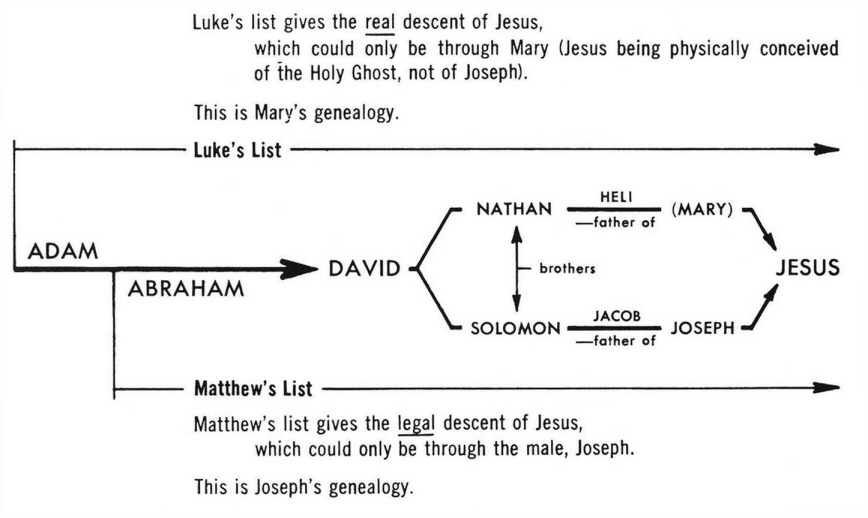
Click chart to enlarge
Chart from recommended resource Jensen's Survey of the NT - used by permission
JECONIAH WRITTEN
DOWN AS CHILDLESS
Thus says the LORD, ‘Write this man (JEHOIACHIN) down childless, The command “Write this man down” reflects the legal and prophetic finality of God’s judgment. This verse unmistakably conveys a divine judgment that functions as a curse, although the word CURSE is never specifically used. It is as though God is dictating a permanent record in the heavenly register, declaring that Coniah’s dynasty is finished. Zerubbabel, Jehoiachin's grandson (1Ch 3:19), returned to the land as one of the foremost leaders of the restoration community (cf. Ezra 1-6), but he was not a king. As noted below Jeconiah was not childless but would be treated by Yahweh as if he were childless, which meant he had no heir in the Davidic line (Jeconiah was the last king in that line).
All forms of the name Jehoiachin, Jeconiah, Coniah have the same meaning, i.e., "Yahweh will firmly establish" a name dishonored by its bearer, who was ruled by his own desires.
John MacArthur - Jeconiah did have offspring (1Ch 3:17, 18), but he was reckoned childless in the sense that he had no sons who would reign ("Sitting on the throne..."). (NOTE JECONIAH'S SON SHEALTIEL WAS BORN IN CAPTIVITY AND WAS IN THE LINE OF MESSIAH, JUST NOT AS A KING). The curse continued in his descendants down to Joseph, the husband of Mary. How could Jesus then be the Messiah when His father was under this curse? It was because Joseph was not involved in the blood line of Jesus since He was virgin born (Mt 1:12). Jesus' blood right to the throne of David came through Mary from Nathan, Solomon's brother, not Solomon (Jeconiah's line) thus bypassing this curse (Lk 3:31, 32). (ED: SEE MORE COMPLETE EXPLANATIONS BELOW)
Bob Utley - "Write this man down childless" This command from YHWH seems to be unfulfilled because Jehoiachin had several children (cf. 1 Chr. 3:16-17). However, they never sat on David's throne. A good discussion of the seeming contradiction is found in Hard Sayings of the Bible, p. 310. Another good source for interpreting prophetic literature is D. Brent Sandy, Plowshares and Pruning Hooks, especially pp. 151-154.
NET NOTE - Heb “Write this man childless.” The word translated “childless” has spawned some debate because Jeconiah was in fact not childless. There is record from both the Bible and ancient Near Eastern texts that he had children (see, e.g., 1 Chr 3:17). G. R. Driver, “Linguistic and Textual Problems: Jeremiah,” JQR 28 (1937–38): 115, has suggested that the word both here and in Lev 20:20–21 should be translated “stripped of honor.” While that would relieve some of the difficulties here, the word definitely means “childless” in Gen 15:2 and also in Sir 16:3 where it is contrasted with having godless children. The issue is not one of childlessness but of having “one of his sons” succeed to the Davidic throne. The term for “one of his sons” is literally “from his seed a man” and the word “seed” is the same one that is used to refer to his “children” who were forced into exile with him (v. 28). The figure here is of registering a person on an official roll of citizens, etc. (cf. Num 11:26; 1 Chr 4:41; Ps 87:6). Here it probably refers to the “king list” of dynastic succession. While Jeconiah did have children (2 Chr 3:17) none of them ever returned to Judah or ruled over it. What is being denied here is his own succession and that of his immediate sons contrary to the popular hopes expressed in Jer 28:4. His grandson Zerubbabel did return to Judah, became governor (Hag 1:1; 2:2), and along with the high priest Joshua was responsible for rebuilding the second temple (e.g., Ezra 5:2).
A man who will not prosper in his days; Coniah’s short reign lasted only three months before he was taken captive to Babylon (2 Kings 24:8–15). He lived the rest of his life in exile, stripped of power and honor.
For no man of his descendants will prosper Sitting on the throne of David Or ruling again in Judah the royal line through Coniah would never again produce a reigning king in Judah. This fulfilled God’s earlier warnings that disobedience would bring an end to the Davidic monarchy’s earthly rule in Jerusalem. The prophecy concerning his childlessness is not to be understood in the sense that he would have no offspring (cf. 1 Chr. 3:16, 17), but that none of his heirs would sit on the throne of David. Coniah had seven sons, but none reigned.
Charles Feinberg - Jehoiachin was thus the last of the Judean kings (ED: ACTUALLY ZEDEKIAH WAS THE CHRONOLOGICAL LAST. JEHOIACHIN WAS THE LAST KING IN THE LINE OF DAVID). In him the royal line became extinct. So Jeremiah 23 goes on to speak of the new King to be raised up by the Lord (cf. Jer 23:5-6).
“Behold, the days are coming,” declares the LORD, “When I will raise up for David a righteous Branch; And He will reign as king and act wisely And do justice and righteousness in the land. 6“In His days Judah will be saved, And Israel will dwell securely; And this is His name by which He will be called, ‘The LORD our righteousness.’
Joseph, the legal father of Jesus, was descended from Jeconiah and was therefore in the kingly line (cf. Mt. 1:11-16), but he could not reign because of the curse. The children of Joseph would also carry this curse. But Jesus was not affected by this divine prophecy, because His physical descent came from David only through His mother Mary, who conceived Him by an overshadowing of the Holy Spirit (Mt. 1:18; Luke 3:21-38). Thus, both Mary and Joseph were numbered among the royal descendants to the throne of David. Jesus sat upon the throne of David by dynastic or legal right through Joseph, by physical descent through Mary, and by divine appointment of the living God. Since Jesus had no children, the line to the throne climaxes and ends in Him. This passage demonstrates again the precision with which God makes and fulfills His prophecies.
Nathan Busenitz - What is the Curse of Jeconiah? (Reasons We Believe)
The implications of Jeconiah’s curse present an interesting dilemma. How could the Messiah be part of the royal line of David (which included Jeconiah) if none of Jeconiah’s physical offspring could ever rule as king over Israel (cf. Isaiah 9:7)? The answer is found in the virgin birth. Because Joseph was a direct descendant of Jeconiah (Matthew 1:11), he too was subject to the curse. Neither Joseph nor any of his physical offspring could be Israel’s king. The miracle of the virgin birth, however, meant that Jesus was not the physical son of Joseph. Being miraculously conceived by the Holy Spirit (Matthew 1:20–25), Jesus avoided the curse placed on Jeconiah’s bloodline. At the same time, as Joseph’s legal son, Jesus still retained the rights and privileges of Joseph’s royal ancestry. Moreover, because Mary was also related to David, though not through the royal line of Solomon (or Jeconiah), Jesus’ physical heritage did go back to David (Luke 3:31). Jesus therefore enjoyed being a true descendant of David (through Mary) and also the legal heir of David’s royal line (through Joseph), while simultaneously avoiding Jeconiah’s curse (Charles L. Feinberg, in Jeremiah: A Commentary (Grand Rapids, MI: Zondervan, 1982), 160 explains: “Matthew’s genealogy includes Jehoiachin but shows only who Jesus’ legal father was, not his natural one. Luke traces Jesus’ parental line through Nathan, a son of David, not through Solomon. Zerubbabel, grandson of Jehoiachin, though governor of Judah in 520 b.c., never ruled as king, nor did any other descendant of his.”).
QUESTION - What is the curse of Jeconiah? GOTQUESTIONS.ORG
ANSWER - Jeconiah, also called “Jehoiachin” (1 Chronicles 3:16, NIV) and “Coniah” (Jeremiah 22:24), was a king of Judah who was deported as part of the Babylonian captivity (Esther 2:6; 1 Chronicles 3:17). He is also listed in the genealogy of Jesus, in Joseph’s family line (Matthew 1:12).
The curse of Jeconiah is found in Jeremiah 22:24-30. First, the LORD likens the king to a signet ring on God’s hand—a ring that God will pull off (verse 24). Then, God pronounces a curse: “Record this man as if childless, a man who will not prosper in his lifetime, for none of his offspring will prosper, none will sit on the throne of David or rule anymore in Judah” (verse 30).
The problem is that the curse of Jeconiah seems to invalidate Jesus’ right to the throne of David. The Davidic Covenant promised that the Messiah, the “Son of David,” would reign forever on Jerusalem’s throne (1 Chronicles 17:11-14). If Jesus is a descendant of Jeconiah, then how can He be the Messiah, since the curse bars any of Jeconiah’s descendants from assuming David’s throne?
There are three possible solutions to this difficulty.
First, the “offspring” of Jeconiah mentioned in the curse could be a limited reference to the king’s own children—his immediate offspring, in other words. On a related note, the phrase “in his lifetime” could apply to the entire verse. The curse would only be in force while the king lived. This is exactly what happened, as Jeconiah was not successful as a king (he only reigned for three months before he surrendered to Nebuchadnezzar’s forces), and none of his sons (he had seven of them, 1 Chronicles 3:17–18) reigned over Judah. (ED: BUT ONE SON SHEALTIEL BORN IN CAPTIVITY AND HE WOULD BE IN THE LINE OF THE MESSIAH).
A second solution concerns the virgin birth. Jesus only had one human parent, Mary. His mother was of David’s line, but not through Jeconiah (Luke 3:31). Joseph was Jesus’ legal father, but not His physical one. Thus, Jesus was of royal blood through Mary, but the curse of Jeconiah stopped with Joseph and was not passed on to Jesus.
A third possible solution is that God reversed the curse on Jeconiah’s family. This is hinted at by the prophet Haggai, who told Zerubbabel, Jeconiah’s grandson, that God would make him a “signet ring” on God’s hand (Haggai 2:23). Zerubbabel was blessed by God as the governor of Judea, and he prospered in that role when the Jewish exiles returned to Jerusalem. The “signet ring” imagery of Jeconiah’s curse is repeated in Zerubbabel’s blessing, which must be more than coincidence. Several rabbinic sources teach that Jeconiah repented in Babylon and that God forgave him and lifted the curse.
QUESTION - Why are Jesus’ genealogies in Matthew and Luke so different? GOTQUESTIONS.ORG
ANSWER - Jesus’ genealogy is given in two places in Scripture: Matthew 1 and Luke 3:23-38. Matthew traces the genealogy from Jesus to Abraham. Luke traces the genealogy from Jesus to Adam. However, there is good reason to believe that Matthew and Luke are in fact tracing entirely different genealogies. For example, Matthew gives Joseph’s father as Jacob (Matthew 1:16), while Luke gives Joseph’s father as Heli (Luke 3:23). Matthew traces the line through David’s son Solomon (Matthew 1:6), while Luke traces the line through David’s son Nathan (Luke 3:31). In fact, between David and Jesus, the only names the genealogies have in common are Shealtiel and Zerubbabel (Matthew 1:12; Luke 3:27).
Some point to these differences as evidence of errors in the Bible. However, the Jews were meticulous record keepers, especially in regard to genealogies. It is inconceivable that Matthew and Luke could build two entirely contradictory genealogies of the same lineage. Again, from David through Jesus, the genealogies are completely different. Even the reference to Shealtiel and Zerubbabel likely refer to different individuals of the same names. Matthew gives Shealtiel’s father as Jeconiah while Luke gives Shealtiel’s father as Neri. It would be normal for a man named Shealtiel to name his son Zerubbabel in light of the famous individuals of those names (see the books of Ezra and Nehemiah).
One explanation, held by the church historian Eusebius, is that Matthew is tracing the primary, or biological, lineage while Luke is taking into account an occurrence of “levirate marriage.” If a man died without having any sons, it was tradition for the man’s brother to marry the widow and have a son who would carry on the deceased man’s name. According to Eusebius’s theory, Melchi (Luke 3:24) and Matthan (Matthew 1:15) were married at different times to the same woman (tradition names her Estha). This would make Heli (Luke 3:23) and Jacob (Matthew 1:15) half-brothers. Heli then died without a son, and so his (half-)brother Jacob married Heli’s widow, who gave birth to Joseph. This would make Joseph the “son of Heli” legally and the “son of Jacob” biologically. Thus, Matthew and Luke are both recording the same genealogy (Joseph’s), but Luke follows the legal lineage while Matthew follows the biological.
Most conservative Bible scholars today take a different view, namely, that Luke is recording Mary’s genealogy and Matthew is recording Joseph’s. Matthew is following the line of Joseph (Jesus’ legal father), through David’s son Solomon, while Luke is following the line of Mary (Jesus’ blood relative), through David’s son Nathan. Since there was no specific Koine Greek word for “son-in-law,” Joseph was called the “son of Heli” by marriage to Mary, Heli’s daughter. Through either Mary’s or Joseph’s line, Jesus is a descendant of David and therefore eligible to be the Messiah. Tracing a genealogy through the mother’s side is unusual, but so was the virgin birth. Luke’s explanation is that Jesus was the son of Joseph, “so it was thought” (Luke 3:23).
Click chart to enlarge
Chart from recommended resource Jensen's Survey of the NT - used by permission
Warren Wiersbe - Jesus Christ is the “son of David” (Matt. 1:1; Rom. 1:3) and one day will restore the fortunes of Israel and reign from David’s throne (Luke 1:30-33, 67-79). The genealogy in Matthew 1 traces Christ’s ancestry through His legal father, Joseph. Since Jehoiachin is in that family tree (Matt. 1:11), however, none of his descendants can claim the throne because of the curse pronounced (NOTE WORD "CURSE" NOT USED BUT IT WAS IN EFFECT LIKE A CURSE ON JECONIAH) in Jeremiah 22:24-30. Our Lord gets His Davidic throne rights through His mother, Mary, whose genealogy is given in Luke 3:21-38. From Abraham to David, the lists are similar, but from David on, they differ. Luke traced the line through David’s son Nathan and thus avoided Jehoiachin, a descendant of Solomon. Jesus Christ has every right to David’s throne, and His future reign is what Jeremiah dealt with in the next section.
Below is a chart from the unique work by Nancy S Dawson and contributing author Eugene H Merrill - All the Genealogies of the Bible: Visual Charts and Exegetical Commentary (Logos version)(highly recommended). In the list of Kings in the lineage you will note brackets ([....]) around the names of 4 kings - Ahaziah, Joash, Amaziah and Jehoiakim.
Dawson explains that "To maintain the highly stylized 14–14–14 generational structure of the composition, Matthew deliberately omits the name of King Jeconiah/Jehoiachin’s father (Jehoiakim/Eliakim) and the names of three consecutive kings of Judah—Ahaziah, Joash, and Amaziah. Matthew’s omission of them is an example of “literary telescoping,” in which he purposely shortens the entire genealogy by reducing the number of constituent elements. Since each of these kings caused apostasy in Judah, as did others, it is unclear why Matthew omits these rulers in particular."
The point is that although they are not in Matthew, even these evil kings are in the line of Messiah!
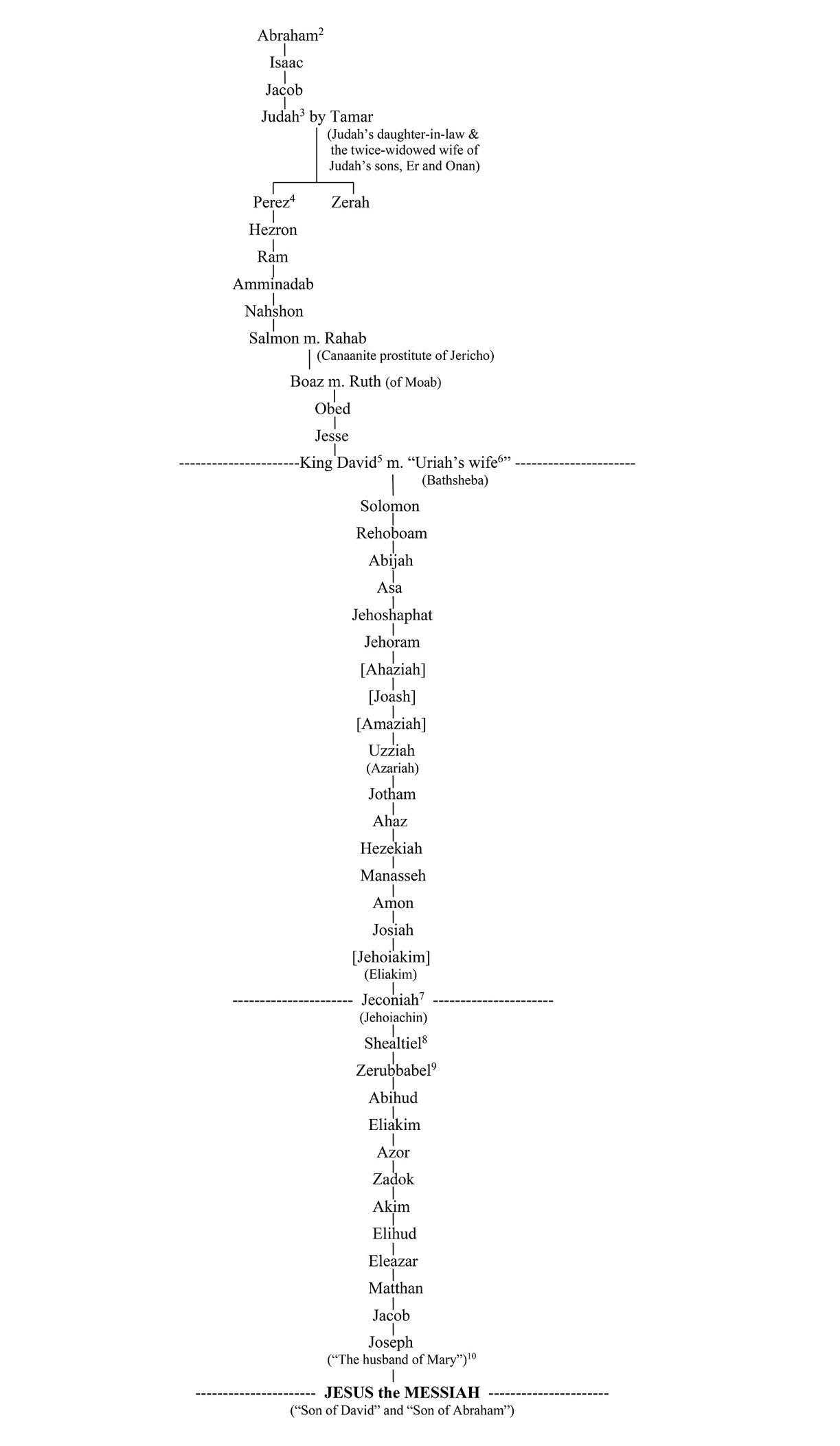
Norman Geisler - JEREMIAH 22:30—Was Jehoiachin childless or did he have heirs?
PROBLEM: Jeremiah was told here to “write this man down as childless.” However, Jechoiachin had a son, Shealtiel, who is listed in Matthew 1:12.
SOLUTION: First of all, the verse does not say he would actually be childless. Jeremiah was simply told to write him down “as if childless” (NIV). Further, this is explained by the last part of the verse, namely, “none of his descendants shall prosper, sitting on the throne of David, and ruling anymore in Judah.” This is true of His immediate successors. And it is even true of his long-range successor, Christ, who was not an actual son of Jehoiachin but only a legal son through his legal father, Joseph (see comments on Matt. 1:17). Jesus, however, was the actual son of David through Mary, His actual mother (cf. 2 Sam. 7:12ff; Luke 3:23, 31). (See When Critics Ask)
Walter Kaiser - 22:24, 30 None of Jehoiachin’s Line to Rule? (See Hard Sayings of the Bible)
Did Jesus the Messiah come from Jehoiachin’s line? If so, how could he claim the throne of David through a line cursed by God?
According to 1 Chronicles 3:16–17, Jehoiachin had seven descendants. These, however, were hauled off into Babylon and there, according to an archaeological finding on a Babylonian tablet in the famous Ishtar Gate, all seven were made eunuchs. In this manner, Jehoiachin became “as if childless,” as no man of his seed prospered, nor did any sit on David’s throne.
David’s line through his son Solomon abruptly ended. However, the line of David did continue through one of Solomon’s brothers, Nathan (not to be confused with Nathan the prophet).
By the best reconstructions possible from the evidence on hand, Jehoiachin adopted the seven sons of Neri, a descendant of David through Nathan. Neri’s son Shealtiel died childless and so his brother Pedaiah performed the duty of levirate marriage (Deut 25:5–10), and as a result Zerubbabel was born.
Accordingly, Zerubbabel, the postexilic governor of Judah during the days of Haggai and Zechariah, was the legal son of Shealtiel, the actual son of Pedaiah, and thus the descendant of David on two counts. First Chronicles 3:19 informs us that Zerubbabel was the son of Pedaiah, brother of Shealtiel. Luke’s genealogy states that Shealtiel was a descendant of Neri (Lk 3:27).
We conclude, therefore, that Jehoiachin’s line did come to an end and that God in his wisdom provided for another branch of David’s line to continue the promise made to David which led to the coming of Christ the Messiah.