Deuteronomy 29:2
Deuteronomy 29:3
Deuteronomy 29:4
Deuteronomy 29:5
Deuteronomy 29:6
Deuteronomy 29:7
Deuteronomy 29:8
Deuteronomy 29:9
Deuteronomy 29:10
Deuteronomy 29:11
Deuteronomy 29:12
Deuteronomy 29:13
Deuteronomy 29:14
Deuteronomy 29:15
Deuteronomy 29:16
Deuteronomy 29:17
Deuteronomy 29:18
Deuteronomy 29:19
Deuteronomy 29:20
Deuteronomy 29:21
Deuteronomy 29:22
Deuteronomy 29:23
Deuteronomy 29:24
Deuteronomy 29:25
Deuteronomy 29:26
Deuteronomy 29:27
Deuteronomy 29:28
Deuteronomy 29:29

Moses on Mt Nebo (Deuteronomy 34:1)
Listen to Mt Nebo as you Ponder How Moses' May Have Felt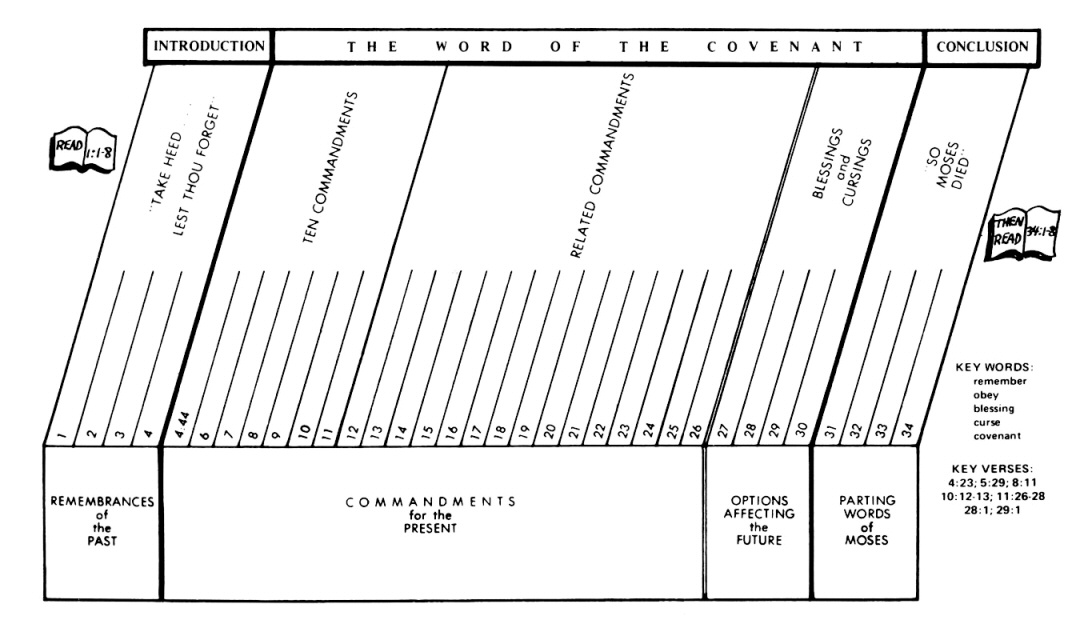
Deuteronomy by Irving Jensen- used by permission
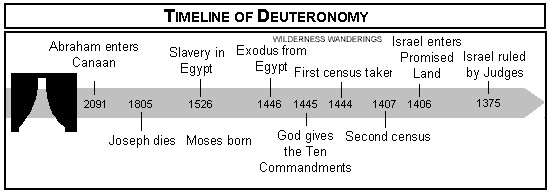
Source: Ryrie Study Bible
| Dt 1:1-4:43 | Dt 4:44-26:19 | Dt 27:1-34:12 | |||||
|
Moses' |
Moses' |
Moses' |
|||||
| Historical Review | Legal Exposition |
Prophetical Promises |
|||||
|
Looking Back 40 Years |
Looking Up What God Expected of Israel |
Looking Ahead What God Will Do for Israel |
|||||
| Recapitulation of Wanderings | Rehearsal of Israel's Law |
Ratification of Israel's Covenant |
Historical Appendices | ||||
| Remembrance of the past | Commandments for the Present |
Dt 27:1-30:20 Blessing and Cursing |
Dt 31:1-34:12 Death of Moses |
||||
| Take Heed Don't forget |
Ten Commands |
Related Commands |
Two Choices Affecting the Future |
Moses' Parting Words | |||
| Dt 1:1-4:43 Looking Back |
Dt 4:44-11:32 Exposition of Decalogue |
Dt 12:1-16:17 Ceremonial Laws |
Dt 16:18-20:20 Civil Laws |
Dt 21:1-26:19 Social Laws |
Dt 27:1-28:68 Ratification of Covenant |
Dt 29:1-30:20 Terms of Covenant |
Dt 31:1-34:12 Moses' Song, Blessing, Death |
|
Plains of Moab |
|||||||
|
ca. 2 Months |
|||||||
Deuteronomy 29:1 These are the words of the covenant which the LORD commanded Moses to make with the sons of Israel in the land of Moab, besides the covenant which He had made with them at Horeb.
- the words: De 29:12,21,25 Lev 26:44,45 2Ki 23:3 Jer 11:2,6 34:18 Ac 3:25
- besides the: De 4:10,13,23 5:2,3 Ex 19:3-5 24:2-8 Jer 31:32 Heb 8:9
- Deuteronomy 29 Resources - Multiple Sermons and Commentaries
John Hannah's Outline: (excellent resource)
- The third discourse: ratification of the covenant (Deut 27:1-30:20)
- The establishment of the law (Deut 27:1-26)
- The setting up of the law in the land (Deut 27:1-8)
- The benefit of covenant relationship (Deut 27:9-10)
- The declaration of Israel's commitment (Deut 27:11-26)
- The responsibility of keeping the law (Deut 28:1-68)
- The blessings for obedience (Deut 28:1-14)
- The curses for disobedience (Deut 28:15-68)
- The renewal of the covenant (Deut 29:1-30:20)
- Introduction (Deut 29:1-9)
- The summons to enter into the covenant (Deut 29:10-13)
- The seriousness of adherence to the covenant (Deut 29:14-29)
- The ultimate fulfillment of the covenant (Deut 30:1-10)
- The promise of dispersion (Deut 30:1)
- The promise of national repentance (Deut 30:2)
- The promise of return to the land (Deut 30:3-5)
- The promise of conversion (Deut 30:6)
- The promise of judgment on Israel's enemies (Deut 30:7)
- The promise of blessing (Deut 30:8-10)
- The appeal of commitment to the covenant (Deut 30:11-20)
- The establishment of the law (Deut 27:1-26)
Jack Deere - Some see this verse as an introduction to the fourth address of Moses beginning in verse 2, but probably it concludes the covenant renewal ceremony in Moab. This preference is reflected in the Hebrew text which numbers this verse as 28:69 rather than 29:1 (See Bible Knowledge Commentary: Old Testament - Page 311 - see all the comments on Deuteronomy).
Currid adds "The Masoretic Text includes this verse as the final one of chapter 28, as if it were a subscription to the giving of the entire law code. While some commentators would disagree with this interpretation, it is probably correct."
NET NOTE - Beginning with Dt 29:1, the verse numbers through Dt 29:29 in the English Bible differ from the verse numbers in the Hebrew text (BHS), with 29:1 ET = 28:69 HT, 29:2 ET = 29:1 HT, 29:3 ET = 29:2 HT, etc., through 29:29 ET = 29:28 HT. With Dt 30:1 the verse numbers in the ET and HT are again the same.
THE COVENANT ON THE
PLAINS OF MOAB
These are the words of the covenant (beriyth) which the LORD commanded Moses to make (karath - cut) with the sons of Israel in the land of Moab, besides the covenant (beriyth) which He had made (karath - cut) with them at Horeb - What is besides (in addition to) the covenant? While clearly most would agree that Deuteronomy is a renewal of the Covenant at Horeb (see Exodus 24:3-7) (See Abrahamic versus Mosaic). However, in Deuteronomy Moses is actually expounding in more detail the Covenant at Horeb because now the nation is about to enter the Promised Land and needed more specific instructions found in this book. They also needed the intense warnings of Deuteronomy 28, although to be sure many of these warnings are also found in Leviticus 26:1-46. The reason I personally think this refers to the Covenant at Sinai (with several additions which Moses declares to the second generation in Deuteronomy) is because of the statement (in context of this chapter) in Dt 29:25
“Then men will say, ‘Because they forsook the covenant (beriyth) of the LORD, the God of their fathers, which He made (karath - cut) with them when He brought them out of the land of Egypt.
Further, the phrase besides (in addition to) the covenant which He made (karath - cut) with them at Horeb could also be explained by the fact that now the second generation is entering into this covenant as alluded to in Dt 29:11 (covenant...the LORD your God is making [karath - cut] with you today). One could reason that the covenant the second generation entered into was in addition to the covenant the first generation entered into at Sinai. It was the same covenant, with the difference being there was the addition now of the second generation formally entering into the covenant. I could be wrong, but this seems to be a reasonable explanation (please send me email to preceptaustin.org if you have any additional thoughts. Thank you.)
And so clearly there is a difference of opinion on the meaning of the phrase besides the covenant - Most commentators favor it is a covenant renewal of the Covenant at Sinai made with the first generation, but others (especially dispensationalists) feel it is the so-called Palestinian Covenant, and John MacArthur (who also has a dispensational view) has a third view. Below are several comments:
John MacArthur's interpretation - The majority of interpreters view the covenant stated here as a reference to the covenant made at Sinai. According to this view, the covenant that God made with Israel at Sinai (Horeb) was renewed in Moab. However, this verse clearly states that the covenant of which Moses now speaks was “besides,” or “in addition to,” the previous covenant. This was another covenant distinct from the one made at Sinai. This other covenant is viewed by some interpreters as the Palestinian Covenant, which gave Israel the title to the land (see Dt 30:5). However, the emphasis of these two chapters is not on the Land, but on the change of Israel’s heart (see the contrast between Dt 29:4 and Dt 30:6). It was exactly this change of heart which the later prophets would term “The New Covenant” (see Jer 31:31–34; Eze 36:26-27 - SEE MY RELATED STUDY NEW COVENANT IN THE OLD TESTAMENT). In response to Israel’s certain failure under the provisions of the Sinaitic Covenant (Dt 29:23–28), Moses anticipated the New Covenant under which Israel would be obedient to the Lord and finally reap His blessings (Dt 30:1–10). (See MacArthur Study Bible- Page 240)
Daniel Block - Although many interpret this statement as distinguishing between the covenant made on the Plains of Moab and one Yahweh previously made with Israel at Sinai, this distinction is unwarranted. Since Moses opened his second address by reciting the Decalogue (Dt 5:6–21), the essence of covenant relationship obviously remains the same, as do both Yahweh’s and Israel’s roles within that relationship. What is happening on the Plains of Moab is not the establishment of a new covenant, but the renewal of the original covenant first made with Abraham and then established with Israel at Sinai. Since the people standing before Moses were not involved in the proceedings at Horeb forty years earlier, these procedures are necessary to bind this generation to the covenant ratified at Horeb (Dt 5:2–3) and to ensure that they enter the Promised Land as the covenant people of Yahweh. (See Deuteronomy - Page 133)
Warren Wiersbe - The covenant declared in Deuteronomy wasn’t different from the covenant given at Mount Sinai. Rather, it was an explanation and application of that covenant to the new generation and their new situation in the Promised Land. If what Moses taught in Deuteronomy had been a separate covenant, he would have offered blood sacrifices to seal the covenant as he did at Sinai (Ex. 24:3–8; Heb. 9:18–22 - ED: GREAT POINT!). Many (ED: ACTUALLY MOST) of the people who accepted the covenant at Sinai had perished in the wilderness, but there was still a “nation of Israel” that was accountable to the Lord to obey that covenant (Deut. 4–5). Future generations in Great Britain were both benefited and obligated when King John signed the Magna Carta in 1215, and so were future generations of Americans when the Constitution of the United States went into effect in 1789. Future generations of Jews were bound by the covenant made by their ancestors at Sinai, and that covenant wasn’t annulled until Christ died on the cross (Col. 2:11–14). (ED: COMPARE - Hebrews 8:13 = "When He said, “A new covenant,” He has made the first obsolete. But whatever is becoming obsolete and growing old is ready to disappear.") (Wiersbe Bible Commentary - OT)
The wording...was not meant to reflect the making of a new covenant,
but the renewing of the Mosaic Covenant made at HorebJack Deere (who is former professor of Old Testament theology at Dallas Theological Seminary, often considered a dispensationalist seminary) - The words, the covenant... in Moab, in addition to the covenant He had made with them at Horeb, have led some to posit the existence of a separate covenant (i.e., a Palestinian Covenant) in addition to the Mosaic Covenant. The wording, however, was not meant to reflect the making of a new covenant, but the renewing of the Mosaic Covenant made at Horeb. Moses' fourth address introduces no new covenantal provisions that were not already made explicit in his other speeches. So Deuteronomy 29:2-30:20 recapitulates the covenant details laid down in the preceding chapters. (See Bible Knowledge Commentary for all comments on Deuteronomy).
POSB - It should be noted that some commentators refer to chapters 29–30 as the Palestinian covenant; whereas other commentators prefer to look upon these chapters as a renewal and reaffirmation of the covenant given at Mt. Sinai. Whatever the case, the new information about the restoration of Israel is definitely a new revelation, a new promise to be added to the covenant given to God’s people.
J Vernon McGee (who trained at Dallas Theological Seminary, a dispensationalist seminary so it is not surprising he holds the view this is the Palestinian Covenant) - Chapters 29 and 30 are considered the Palestinian covenant. Dr. Lewis Sperry Chafer (ED: dispensationalist) considered chapters 28–30 to be the covenant. The Scofield Reference Bible (ED: dispensationalist) considers it to be Dt 29:1–30:10 with chapter 29 as the introduction. In my notes I take chapter 29 through the first ten verses of chapter 30 as being the covenant, although the covenant proper is in the first ten verses of chapter 30. This chapter 29 is a preliminary. The covenant made in Horeb was the Ten Commandments or what we know as the Mosaic Law. The covenant which God is going to make with them here relates to the land, and it is called the Palestinian covenant. God makes this covenant with them just before they enter the land. (See Thru the Bible)
Coakley - Moses had effectively blended the covenant that the Lord made with the nation’s first generation at Horeb with the words of this covenant, which Moses gave to the second generation in the land of Moab. (Moody Bible Commentary)
Michael Grisanti (COMMENTING ON DEUTERONOMY 29): Moses begins this section by reminding the children of Israel of Yahweh’s faithfulness to them in bringing them from Egypt to the plains of Moab, as well as of the covenantal relationship into which they are entering with the Lord—a relationship that promises cursing for disobedience and blessing for obedience. In the light of those realities, Moses challenges Israel to renew this covenant and choose life and blessing rather than death and cursing. (See Deuteronomy - Page 62)
Reginald Showers - God established the Palestinian Covenant at the end of Israel’s 40 years of wilderness wandering, just a short time before the nation was to invade Canaan (Dt. 29:5–8). The place of its establishment was the land of Moab (Dt. 29:1), east of the Dead Sea across from the land of Canaan. The parties of the covenant were God, the new generation of Israelites which was to invade Canaan, and succeeding generations of the nation. In Deuteronomy 29:14–15 Moses said to Israel, “Neither with you only do I make this covenant and this oath, But with him who standeth here with us this day before the Lord our God, and also with him who is not here with us this day.” As a new generation was about to begin a new chapter in Israel’s history, it had to be reminded in a solemn way of Israel’s special covenant relationship with Jehovah. This reminder appears to have been the purpose of the Palestinian Covenant. (Borrow There really is a difference! page 92)
Covenant (01285) berit/berith/beriyth means covenant, treaty, compact, agreement between two parties (first use in God's covenant with Noah - Ge 6:18, 9:9, 11, 12, 13, 15, 16, 17). As discussed more below beriyth describes a compact made by passing between pieces of flesh. Covenant is a solemn, binding arrangement between two parties and entails a variety of responsibilities, benefits and penalties depending on the specific covenant which is being studied. OT covenants were made between God and man (eg, God with Noah - Ge 6:18, with Abram - Ge 15:18) or between men (Abraham and Abimelech - Ge 21:27, Isaac and Abimelech - Ge 26:28, Jacob and Laban - Ge 31:44) (For summary of covenants see - Covenant in the Bible).
ISBE says that "In essence a covenant is an agreement, but an agreement of a solemn and binding force. The early Semitic idea of a covenant was doubtless that which prevailed among the Arabs. This was primarily blood-brotherhood, in which two men became brothers by drinking each other’s blood. (Ed: Now that sounds serious to me! See illustration in pagan culture)
Covenant can be summarized as follows…
(1) Between two parties (sometimes equal, other times superior to inferior) -- (a) nations -- (peace) treaty, alliance of friendship (b) individuals -- a pledge or agreement with mutual obligations to each other (c) monarch and subjects (2Sa 3:21, 5:3, 1Chr 11:3) -- a constitution (d) God and man -- Noahic, Abrahamic, Mosaic, Davidic, New Covenants. When God makes a covenant, He enters into an agreement to commit Himself to give what He promises. It is purely an act of grace. TWOT adds that…
Apart from blood ties the covenant was the way people of the ancient world formed wider relationships with each other The accounts of the relationship between David and Jonathan are the only unequivocal mention of a compact between two individuals in the Old Testament (1Sa 18:3; 20:8; 23:18). It is spoken of as “a covenant of the Lord” because the Lord witnessed the transaction and protected the legal order.
(2) Accompanied by (a) signs (also witnesses, memorials, shared meals) (b) sacrifices, (c) solemn, binding oaths -- sealing the relationship with promises of blessing for keeping the covenant and curses for breaking the covenant (d) Sometimes with written document on which the words of the covenant, its terms in the form of promises and stipulations were spelled out, witnessed to, signed and sealed. Behm (TDNT) notes that in ancient times
There is no firmer guarantee of legal security peace or personal loyalty than the covenant (e.g., Amos 1:9).
(3) Is depicted in the idiomatic phrase "make (cut) a covenant" in which there is was a blood sacrifice as part of the covenant ritual.
QUESTION - What is the Palestinian Covenant?
(DISCLAIMER - AFTER STUDYING THIS SECTION, I DO NOT THINK THE TEXT STRONGLY SUPPORTS CALLING THIS A SEPARATE COVENANT -- THE PALESTINIAN COVENANT -- BUT THIS EXPLANATION FROM GOTQUESTIONS.ORG IS INCLUDED FOR THE SAKE OF COMPLETENESS.)
(S. Michael Houdmann of Gotquestions.org writes "As a ministry, we believe dispensationalism and premillennialism are far more biblically sound theological systems." Therefor it is not surprising they espouse the Palestinian Covenant)
ANSWER - The so-called (ED: BOLDING IS MINE) Palestinian Covenant is recorded in Deuteronomy 29:1–29 and Deuteronomy 30:1–10 and was made between God and Israel right before Moses died and Israel entered the Promised Land. The Bible never uses the term “Palestinian Covenant,” and Moses certainly never would have called the land “Palestine,” but the term has become common usage. This covenant is also called the Land Covenant because many of the promises relate to Israel’s possession of the land. God made this covenant with Israel after the Mosaic Covenant and after Israel had wandered in the wilderness for forty years. God made this covenant with Israel while they were in Moab waiting to go into the Promised Land, and the covenant would serve this new generation of Israelites as a reminder of their special covenant relationship with God.
The Palestinian Covenant has many similarities to the Mosaic Covenant made at Mount Sinai but is a separate and distinct covenant as clearly seen in Deuteronomy 29:1. “These are the words of the covenant which the Lord commanded Moses to make with the children of Israel in the land of Moab, besides the covenant which He made with them in Horeb.” Before making this covenant with Israel, God reminded them that if they obeyed the Mosaic Law, He would bless the nation abundantly and warned them that disobedience to the Law would result in His cursing the nation (Deuteronomy 28:1-68).
Besides the promises that God would bless them if they obeyed His commandments and curse them if they disobeyed, the Palestinian Covenant also contains some special promises to Israel that many believe will not be completely fulfilled until the millennial reign of Christ. First, God promised to gather the scattered Israelites from all over the world and to bring them back into the land He had promised to their ancestors (Deuteronomy 30:3-5). Second, God promised to regenerate the Israelites of that time and their descendants by circumcising their hearts so that they would love Him totally (Deuteronomy 30:6). Third, God promised to judge Israel’s enemies (Deuteronomy 30:7), and, fourth, He promised that the Israelites would obey God and that God would prosper them in their obedience (Deuteronomy 30:8-9). While some might see these promises being fulfilled when Israel was returned from captivity in Babylon at the time of Ezra and Nehemiah, there seem to be some aspects of this that have not been fully realized yet.
For example, the promised restoration of Israel to the land would not happen until all the blessings and curses promised them were fulfilled (Deuteronomy 30:1), and we know that Israel as a nation rejected Jesus Christ as their Messiah and was once again cursed and cut off from the land when the Romans conquered Jerusalem in A.D. 70. Second, we see that one of the promises in this covenant was that God would circumcise their hearts (Deuteronomy 30:6) so that they and their descendants would obey Him (Deuteronomy 30:8). These same promises are repeated in Jeremiah 32:36-44 and Ezekiel 36:22-38 and are part of the blessings and promises of the New Covenant. Also, it seems that the final or ultimate restoration of Israel to the land and to an everlasting relationship with God is what Paul is looking forward to in Romans 11:25-26 when he says that “a partial hardening has happened to Israel until the fullness of the Gentiles has come in and thus all Israel will be saved.”
The Palestinian Covenant also serves to reinforce the promises made to Abraham, Isaac and Jacob that God would establish Israel as His chosen people (Deuteronomy 29:13). Even though God set before Israel the promise of His blessings for obedience and His curses for disobedience, He knew full well they would turn from Him and His covenant and turn to idols. This is why He also promised to one day restore them to the land and have compassion on them (Deuteronomy 30:1-3). Therefore, the ultimate outcome of this covenant does not depend on Israel and its obedience, but instead it depends on God and His faithfulness. The Palestinian Covenant focuses on what God is going to do more than what Israel is supposed to do. While Israel’s prosperity is closely tied to her obedience to God’s commands, and they will still be punished for their disobedience to God, there is coming a day when God will return them to the land (the full extent of the land as outlined in Genesis 15:18-21), and they will possess it, and God will bless them forever.
At that time God will circumcise their hearts so they will obey Him (Deuteronomy 30:6). This covenant is again reaffirming the Abrahamic Covenant in that someday the seed of Abraham will possess the Promised Land forever. Unlike the Mosaic Covenant whose promises are conditional upon Israel’s obedience to the Law, ultimate fulfillment of the promises of the Palestinian Covenant are not dependent upon Israel’s obedience. Instead, the Palestinian Covenant is an unconditional, eternal covenant (Ezekiel 16:60) (ED COMMENT - I DO NOT THINK EZEKIEL 16:60 SUPPORTS A "PALESTINIAN COVENANT" BUT I THINK THIS PASSAGE TAKEN IN THE CONTEXT OF THE BOOK OF EZEKIEL CLEARLY REFERS TO THE NEW COVENANT AS ELABORATED ON IN Ezekiel 36:26-27) because it is a part of the Abrahamic Covenant and an amplification of it. GotQuestions.org
Deuteronomy 29:2 And Moses summoned all Israel and said to them, "You have seen all that the LORD did before your eyes in the land of Egypt to Pharaoh and all his servants and all his land;
- have seen: Ex 8:12 19:4 Jos 24:5,6 Ps 78:43-51 105:27-36
- Deuteronomy 29 Resources - Multiple Sermons and Commentaries
This verse begins Moses' next address (some say it is his third - first Dt 1:1, second Dt 4:44, some writers say it is his fourth - first Dt 1:1, second Dt 4:44, third - Dt 27:1, fourth Dt 29:1), in which he summarizes the covenant (Dt 29:2-30:20). In this first section (Dt 29:2-8) Moses gives the second generation a review of the faithfulness of Yahweh and to give them hope for the future, because if Yahweh did this in the past, He can do it again in the future.
And Moses summoned all Israel and said to them - This is now the entire nation. How the message was heard by all is not stated, but somehow they all heard the message.
"You have seen all that the LORD did before your eyes in the land of Egypt to Pharaoh and all his servants and all his land - Of course this is the second generation and although some may have childhood memories of this event, most had not literally seen these things with their own eyes. Clearly Moses identifies this generation with the former and thus speaks as if they had seen these events. This statement is similar to his statement to the second generation is Dt 1:30 declaring "The LORD your God who goes before you will Himself fight on your behalf, just as He did for you in Egypt before your eyes."
By recalling “Pharaoh and all his servants and all his land,” Moses is reminding Israel that God’s judgment was total and decisive. Egypt, the most powerful empire of the ancient world, was utterly humbled so that Israel might know that their deliverance came not by human strength but by the hand of the living God. This was meant to strengthen their faith and obedience as they prepared to enter Canaan, where they would face new nations and new temptations. Psalm 105:5 commands, “Remember the wondrous works that He has done, His miracles, and the judgments He uttered.” Moses wanted Israel to understand that the same God Who had defeated Pharaoh would also be faithful to bless OR discipline ("curse") them according to their obedience or disobedience!
This verse also reveals something profound about God’s character. His acts in Egypt were not only displays of His power but also demonstrations of His covenant love and justice. He redeemed His people from slavery to make them His own. Deuteronomy 7:8 says "but because the LORD loved you and kept the oath which He swore to your forefathers, the LORD brought you out by a mighty hand and redeemed you from the house of slavery, from the hand of Pharaoh king of Egypt."
🙏 THOUGHT - This verse underscores the importance of remembering God’s works as the foundation of faith. Forgetfulness leads to disobedience, but remembrance leads to trust and covenant loyalty. As an aside, this is one of the reasons I strongly advocate continually memorizing God's Word and reviewing memorized passages. Have you ever memorized God's Word? It's a great impediment to forgetting the God of the Word! See Memorizing His Word and Memory Verses by Topic.
Utley - “you have seen … your eyes have seen” This is a figure of speech (cf. Dt 4:34; 7:19) because these people were the children of those who had seen (cf. Num. 14:29). Dt 29:2–8 form a historical review like chapters 1–4, which was a common element of Near Eastern treaties.
Jamieson, Brown and Faussett interprets before you eyes differently writing "This appeal to the experience of the people, though made generally, was applicable only to that portion of them who had been very young at the period of the exodus, and who remembered the marvellous transactions that preceded and followed that era.
While technically Jamieson, et al is correct, the fact that Moses had summoned all Israel and was addressing "all Israel" would favor the idea he is speaking to them as if they had seen these events themselves. One cannot be dogmatic either way (in my opinion), but it is not a crucial point.
POSB - At the time of the Exodus, many were 18 years of age or younger, which means that they were now around 40 to 58 years old. These were the ones who had actually seen and witnessed the saving power of God from Egyptian slavery. Everyone else had been born in the desert, but they knew one evident fact: if God had not saved their parents from Egypt, they would have been born in slavery. Thus the preaching of Moses was correct: every Israelite had been delivered from Egyptian slavery by the hand of God. It was the wonderful salvation of God that had saved them. This was the first basis of the covenant, the first reason why the people should renew their commitment, their covenant with God. Their (physical) salvation should stir them to rededicate their lives to God, to renew their covenant to obey God.
Grant - There are differences of opinion as to whether verse 1 should be placed as the last verse of chapter 28 or the first verse of chapter 29. No matter which view is adopted it is clear it is clear that the emphasis is on the fact that the covenant given to Israel on the plains of Moab, immediately before they crossed the Jordan, has the same authority as the covenant that was made at Horeb. The Moab covenant consists of what would be necessary for conditions after Canaan had been entered and possessed. The lesson for today is that there is no circumstance that is beyond the Word of God. It can never be stated that the believer is in a situation which Scripture does not cover. The Lord has ensured that there is provision and guidance given for all circumstances, be they bright or dark, through which the Christian passes. (What the Bible Teaches)
Raymond Brown - As the Israelites face the future they are urged, once again, to recall the past. If we are to cope with tomorrow’s problems we must remember yesterday’s blessings. Those who want to march on must know how to look back. (See The Message of Deuteronomy)
Deuteronomy 29:3 the great trials which your eyes have seen, those great signs and wonders.
- De 4:32-35 Dt 7:18-19 Ne 9:9-11
- Deuteronomy 29 Resources - Multiple Sermons and Commentaries
Related Passages:
Deuteronomy 4:32-35 “Indeed, ask now concerning the former days which were before you, since the day that God created man on the earth, and inquire from one end of the heavens to the other. Has anything been done like this great thing, or has anything been heard like it? 33 “Has any people heard the voice of God speaking from the midst of the fire, as you have heard it, and survived? 34 “Or has a god tried to go to take for himself a nation from within another nation by trials, by signs and wonders and by war and by a mighty hand and by an outstretched arm and by great terrors, as the LORD your God did for you in Egypt before your eyes? 35“To you it was shown that you might know that the LORD, He is God; there is no other besides Him.
Deuteronomy 7:18-19 you shall not be afraid of them; you shall well remember what the LORD your God did to Pharaoh and to all Egypt: 19 the great trials which your eyes saw and the signs and the wonders and the mighty hand and the outstretched arm by which the LORD your God brought you out. So shall the LORD your God do to all the peoples of whom you are afraid.
Nehemiah 9:9-11 “You saw the affliction of our fathers in Egypt, And heard their cry by the Red Sea. 10“Then You performed signs and wonders against Pharaoh, Against all his servants and all the people of his land; For You knew that they acted arrogantly toward them, And made a name for Yourself as it is this day. 11“You divided the sea before them, So they passed through the midst of the sea on dry ground; And their pursuers You hurled into the depths, Like a stone into raging waters.
SIGNS AND WONDERS
IN EGYPT
The great trials which your eyes have seen, those great signs and wonders - NET = "Your eyes have seen the great judgments, those signs and mighty wonders." He is speaking of the miraculous intervention by Yahweh to bring about Israel's deliverance from Egypt. Notice as in the previous verse (v2) Moses emphasizes the things their eyes have seen as he had also declared in Dt 4:34 ("before your eyes.") and Dt 7:19 ("he great trials which your eyes saw and the signs and the wonders.)
Keep in mind that one reason there were so many great signs and wonders (e.g., 10 plagues) is because Pharaoh refused to let Israel go and the adverse effect was felt by all Egyptians, by Pharaoh, by all his servants, and by all his land. Israel should have deduced from these observations that failure to heed God's word was very costly to the Egyptians (and would be so for them!)
🙏 THOUGHT - The verse stands as a timeless reminder that seeing God’s works should lead to trusting His Word, for the same God who performed those wonders is faithful to keep His promises to all generations. Do you ever review the previous great works God has done in your life and give Him thanks? This is an excellent discipline to practice and is aided by keeping a written journal (because we are so prone to forget).
Kalland - Many of those in front of Moses had not been in Egypt; they were born in the desert. However, many of them were under the age of twenty at Kadesh, two years after leaving Egypt, and were eighteen years of age or younger at the time of the Exodus (they were now thirty-nine to fifty-six years old). These had seen the "miraculous signs and great wonders" (v.3; Dt 4:34; Dt 7:19) that the Lord had loosed on the Egyptians during the plagues, though the youngest of them would have no memory of what happened when they were infants. Moses' message, however, was directed to the nation. The community had been in Egypt and had seen the wonderful things that the Lord had done for them. Even the specific mention of "your own eyes" (v.3) is doubtless directed to the whole community comprising the nation, as Dt 29:10-11 indicate. (See The Expositor's Bible Commentary - Abridged Edition- Page 50)
NET NOTE adds that "God’s intervention in Israel’s experience is unique in the sense that He has never intervened in such power for any other people on earth. The focus is on the uniqueness of Israel’s experience." (And I would add the UNIQUENESS of their GOD!)
Utley - “sign and wonders” These terms “signs” (BDB 16) and “wonders” (BDB 68) are mentioned often in Deuteronomy (cf. 4:34; 6:22; 7:19; 11:3; 26:8; 29:2; 34:11) to help the current generation of Israelis to remember YHWH’s powerful, gracious acts of deliverance and provisions (cf. vv. 5–7) during the Exodus and Wilderness Wandering Period.
Deuteronomy 29:4 "Yet to this day the LORD has not given you a heart to know, nor eyes to see, nor ears to hear.
- De 2:30 Pr 20:12 Isa 6:9-10 Isa 63:17 Eze 36:26 Mt 13:11-15 Joh 8:43 Joh 12:38-40 Ac 28:26,27 Ro 11:7-10 2Co 3:15 Eph 4:18 2Th 2:10-12 2Ti 2:25 Jas 1:13-17
- Deuteronomy 29 Resources - Multiple Sermons and Commentaries
Related Passages:
Psalm 106:7-8 Our fathers in Egypt did not understand Your wonders; They did not remember Your abundant kindnesses, But rebelled by the sea, at the Red Sea. 8 Nevertheless He saved them for the sake of His name, That He might make His power known.
Isaiah 6:9-10 He said, “Go, and tell this people: ‘Keep on listening, but do not perceive; Keep on looking, but do not understand.’ 10“Render the hearts of this people insensitive, Their ears dull, And their eyes dim, Otherwise they might see with their eyes, Hear with their ears, Understand with their hearts, And return and be healed.”
Isaiah 63:17 Why, O LORD, do You cause us to stray from Your ways And harden our heart from fearing You? Return for the sake of Your servants, the tribes of Your heritage.
Ezekiel 36:26 (PROMISE OF THE NEW COVENANT) “Moreover, I will give you a new heart and put a new spirit within you; and I will remove the heart of stone from your flesh and give you a heart of flesh.
Romans 11:8 just as it is written, “GOD GAVE THEM A SPIRIT OF STUPOR, EYES TO SEE NOT AND EARS TO HEAR NOT, DOWN TO THIS VERY DAY.”
ISRAEL'S
SPIRITUAL STUPOR
THIS IS A DIFFICULT PASSAGE.
Yet - This is a sad term of contrast. In the preceding two passages they SAW WITH THEIR EYES, but now the contrast is they failed to UNDERSTAND WITH THEIR HEART. Note the striking contrast of before your eyes (v2) and which your eyes have seen with the statement that Yahweh had not given them eyes to see.
Moses is addressing the second generation of Israelites — those who had survived the wilderness and were about to enter the Promised Land. They had seen God’s mighty acts -- Deliverance from Egypt (the plagues, the Red Sea), Provision in the wilderness (manna, water from the rock) and Victories over Sihon and Og (Deuteronomy 29:2–8). YET, despite all they had witnessed, they still lacked spiritual understanding. They had physical eyes and ears, but not spiritual perception.
To this day the LORD has not given you a heart to know, nor eyes to see, nor ears to hear - The phrase a heart to know is speaking of spiritual understanding of the miraculous events that transpired in Israel's history from the divine deliverance from Egypt, the divine guidance for 40 years and the divine victories over Sihon and Og. They witnessed these events but did not understand the spiritual significance of these events. Moses says the reason is that the LORD had not given them a spiritually attuned heart to know, see or hear spiritually (see notes on Jesus' words to His disciples regarding ability to understand parables - Mt 13:11-15). Was God being unfair? Not at all. Israel had repeatedly refused to believe God (see verse below) and obey God and their failure to know, see and hear was their fault, not God's fault. Keil below also points out that they had never ask for a heart to know the truth. Knowing spiritual truth is contingent on obeying the truth that has been revealed. Failure to obey it leads to gradual hardening of one's heart (and understanding). We see the principle in John 7:17 where Jesus said “If anyone is willing to DO His will, he will KNOW of the teaching, whether it is of God or whether I speak from Myself." Jesus says clearly the key to "knowing" is "doing" (obedience). Israel's spiritual blindness was the result of their persistent unbelief, not God’s injustice. True understanding is a gift of grace, given to those who humble themselves and turn to God.
This theme runs throughout Scripture. Isaiah 6:10 echoes the same idea when God tells the prophet, “Make the heart of this people dull, and their ears heavy, and blind their eyes; lest they see with their eyes, and hear with their ears, and understand with their hearts, and turn and be healed.” (cf Jer 5:21) Likewise, Isaiah 44:18 says of idolaters, “They know not, nor do they discern, for he has shut their eyes, so that they cannot see, and their hearts, so that they cannot understand.” These passages show that spiritual blindness is both a result of human sin and a form of divine judgment—when people persistently reject God’s truth, He allows their hearts to become hardened.
Moses' "diagnosis" of Israel's spiritual dullness is not a new revelation for he alluded to it earlier in Dt 1:30-32
The LORD your God who goes before you will Himself fight on your behalf, just as He did for you in Egypt BEFORE YOUR EYES (AS HE SAYS IN Dt 29:2-3), 31 and in the wilderness where YOU SAW how the LORD your God carried you, just as a man carries his son, in all the way which you have walked until you came to this place.’ 32 “BUT FOR ALL THIS, you DID NOT TRUST (aman - believe, rely upon, place firm confidence in) the LORD your God.
COMMENT: The key word “trust” and the idea is not merely intellectual belief but resting one’s confidence upon God’s character and promises. Israel had overwhelming evidence of God’s faithfulness, yet when confronted with the intimidating report of the spies and the fortified cities of Canaan, they chose fear instead of faith (Deut 1:26–28). The verse highlights a profound spiritual lesson: unbelief often persists even in the presence of clear evidence of God’s power and goodness. Scripture repeatedly warns against this pattern, urging believers instead to respond with faith in order to enter His rest (cf Heb 3:16-19).
Paul gives us an important insight into why Israel did not have a heart to understand what God had done for them...
their minds were hardened; (poroo - aorist passive indicative - passive indicates hardened from an outside source) for until this very day at the reading of the old covenant the same veil remains unlifted, because it is removed in Christ. 15 But to this day whenever Moses is read, a veil lies over their heart; (2 Cor 3:14-15)
In his sermon to Jewish men who were resisting the Gospel Stephen explained
“You men who are stiff-necked and uncircumcised in heart and ears are always (actively, continually, willfully) resisting the Holy Spirit; you are doing just as your fathers did. (Acts 7:51)
Jesus later used similar language when teaching in parables. He said, “He who has ears to hear, let him hear” (Matthew 11:15), meaning that only those whose hearts were open to God’s truth would truly understand His message. This phrase points to the difference between hearing words physically and receiving them spiritually. Those who have “ears to hear” are those whom God has awakened to faith and understanding.
In summary, this verse is both an explanation and a warning. Israel’s repeated stubbornness had produced a condition where they still lacked true understanding after forty years. It shows that exposure to truth does not guarantee spiritual insight. True understanding and faith are not achieved by human effort but are gifts of God’s grace, given to those who humble themselves and respond to His Word. It is a call to seek not only to witness God’s works but to know Him personally, allowing Him to open our hearts, eyes, and ears to His truth.
Keil has an interesting explanation - Jehovah had not given them a heart, i.e., understanding, to perceive, eyes to see, and ears to hear, until this day. With this complaint, Moses does not intend to excuse the previous want of susceptibility on the part of the nation to the manifestations of grace on the part of the Lord, but simply to explain the necessity for the repeated allusion to the gracious acts of God, and to urge the people to lay them truly to heart. “By reproving the dullness of the past, he would stimulate them to a desire to understand: just as if he had said, that for a long time they had been insensible to so many miracles, and therefore they ought not to delay any longer, but to arouse themselves to hearken better unto God” (Calvin). The Lord had not yet given the people an understanding heart, because the people had not yet asked for it, simply because the need of it was not felt. Compare Dt 4:26-31
I call heaven and earth to witness against you today, that you will surely perish quickly from the land where you are going over the Jordan to possess it. You shall not live long on it, but will be utterly destroyed. 27 “The LORD will scatter you among the peoples, and you will be left few in number among the nations where the LORD drives you. 28 “There you will serve gods, the work of man’s hands, wood and stone, which neither see nor hear nor eat nor smell. 29 “But from there you will seek the LORD your God, and you will find Him if you search for Him with all your heart and all your soul. 30 “When you are in distress and all these things have come upon you (cf OT illustration of the effect of dis, in the latter days you will return to the LORD your God and listen to His voice. 31“For the LORD your God is a compassionate God; He will not fail you nor destroy you nor forget the covenant with your fathers which He swore to them.
Bob Utley - “to this day” The blindness of Israel to their special place in YHWH’s eternal redemptive plan was not just an ancient problem (i.e., v. 4), but also a current problem (cf. Matt. 13:14–17; Mark 4:10–12; Luke 8:9–10; John 12:36b–43; Acts 28:26–27; and especially Rom. 11:25–32). “the LORD has not given you a heart to know, nor eyes to see, nor ears to hear” The Israelites of the exodus and wilderness wanderings saw the physical, but did not comprehend the spiritual dimension of YHWH’s actions (i.e., they were a special covenant people who were part of an eternal redemptive plan). This phrase becomes a metaphor for spiritual blindness and hardness (cf. multiple passages related to judicial hardening). There is a word play between Dt 29:2, “you have seen” and Dt 29:4, where it is stated they cannot see! This may refer to Israel’s rebellions mentioned in Dt 9:7–24. Without faith God is invisible in history, but with faith history becomes God’s track record. It takes a gift (i.e., “given,” Qal PERFECT) of YHWH’s grace for fallen humans to sense and understand His presence! (ED: BUT WILLFUL REJECTION OF REPEATED REVELATION IS A DANGEROUS PATH BECAUSE EVENTUALLY GOD MAY GIVE JUDICIAL BLINDNESS SO ONE CANNOT EVEN SEE SPIRITUAL TRUTH! THIS IS A FRIGHTENING PLACE TO BE. IF YOU ARE READING AND HAVE REPEATED REJECTED THE GOSPEL, BE VERY CAREFUL FOR YOU MAY BE ON THE PRECIPICE OF GOD'S JUDICIAL HARDENING!)
Coakley - The words yet to this day at the beginning of v. 4 imply that things were about to change (ED: BUT IN FAR DISTANT FUTURE). Moses was laying the groundwork for a future work by God when He would circumcise their hearts and allow them to love Him with all their hearts (Dt 30:6). This indicates that God had to do a work first in their hearts so that they would have the capacity for faith and love for God as they should. Paul referred to this passage in Rm 11:8 in the context of the need for God’s grace for salvation. Israel needed grace to appropriately respond to God just as NT believers do. (Moody Bible Commentary)
The Lord had not given them an understanding heart,
simply because the people had not penitently sought it
MacArthur explains that "In spite of all they had experienced (Dt 29:2, 3), Israel was spiritually blind to the significance of what the Lord had done for them, lacking spiritual understanding, even as Moses was speaking. This spiritual blindness of Israel continues to the present day (Ro 11:8), and it will not be reversed until Israel’s future day of salvation (see Ro 11:25–27). The Lord had not given them an understanding heart, simply because the people had not penitently sought it (cf. 2Ch 7:14, Ed: compare Dt 4:29)." (See MacArthur Bible Commentary Page 235)
Jack Deere - The new element in this review is Moses’ assertion that to this day the LORD has not given you a mind that understands or eyes that see or ears that hear (Dt 29:4). This does not mean that because Israel was disobedient she could not understand the meaning of the miraculous elements of her history. “To this day” suggests that Israel had not yet understood these saving events. Her disobedience and rebellion originated from a mindset that could not fully understand the implications of God’s saving works. Thus apart from divine enlightening, people always remain insensitive to God’s work (cf. Paul’s use of this text in Rom. 11:8).(See Bible Knowledge Commentary for all of Deere's comments on Deuteronomy).
Focus on the Bible Commentary – Deuteronomy: The Commands of a Covenant God. The events surrounding the Exodus were acts of God's power and grace, yet spiritual blindness prevented the people from viewing them with spiritual perception. The lack of insight is described in terms of not understanding with the heart, not seeing with the eyes, and not hearing with the ears. It is attributed to an act of God, who needed to grant such apprehension, even to those who actually were themselves eye-witnesses of the events. Paul later used verse 4 in combination with Isaiah 29:10 when speaking of the unbelieving Jews (Rom. 11:8), and the idea also lies behind his discussion in 2 Corinthians 3:12-15.
POSB - The covenant was needed because of the hard hearts of the people (v. 4). They wanted to do their own thing and live as they wanted, not as God said. Consequently, they disobeyed and rebelled against God. They closed their minds, eyes, and ears against God. They did not seek to understand the salvation and works of God. They refused to look and see the hand of God at work in nature and in the lives of people. They refused to listen to the commandments and Word of God. Because of the hardness of their hearts, the LORD was not able to open their minds, eyes, and ears so that they could understand His commandments and Word—all because the people had become hard, stiff-necked, and stubborn against God. This was a second reason why the people needed to renew their commitment, their covenant with God. They needed to repent of their stubborn, hard hearts and heed the Word of God.
Meredith Kline - But the simplest spiritual knowledge is beyond the perception of man the sinner unless the Spirit of God grants him understanding as a sovereign gift of grace. This people, so signally favored as to have lived forty years in the atmosphere of supernatural providence, lacked that necessary gift (cf. 9:7, 24). (Commentary on Deuteronomy)
J A Thompson - Alas, Israel, so signally favoured as to have lived in the midst of many evidences of divine favour and power, lacked the deeper understanding and insight to discern behind the external events a deeper significance. They needed the enlightenment that Yahweh could give but which, by reason of their disobedience, He had not given to them. Such blindness on the part of those who reject God’s revelation is not uncommon. Men may hear but not understand, because of a hardness of heart. It was the problem of several of the prophets of the Old Testament who preached to audiences who would not hearken (Isa. 6:9f.; Jer. 1:17–19; Ezek. 3:4–11, etc.). It prevented the Jews believing in the Lord Jesus (2 Cor. 3:12–15). (Deuteronomy: An Introduction and Commentary)
Jack Deere - This does not mean that because Israel was disobedient she could not understand the meaning of the miraculous elements of her history. "To this day" suggests that Israel had not yet understood these saving events. Her disobedience and rebellion originated from a mindset that could not fully understand the implications of God's saving works. Thus apart from divine enlightening, people always remain insensitive to God's work (cf. Paul's use of this text in Rom. 11:8).(See Bible Knowledge Commentary: Old Testament - Page 311).
John Currid - Moses now calls the people to reassemble; it is a summons to the ratification of the oath of the covenant. His speech begins with an accusation: he says that the Israelites do not truly understand the divine actions at the time of the Exodus. Although they have witnessed many of God’s great deeds in Egypt and up to this point on the plains of Moab, they do not have a true knowledge and understanding of God, or of what he has done. They are characterized by spiritual dullness, and they have a disposition towards falsehood. The reality is that the Israelites will not comprehend God and his ways unless God opens their hearts to know, their eyes to see and their ears to hear. The apostle Paul quotes verse 4 in Romans 11:8 in regard to the hard hearts of his fellow Jews to the truth of the gospel message. Indeed, how many walked with Jesus and saw him perform great things, and yet did not believe! God must open a person’s heart and mind to receive the truth.
Woods - The phrase to this day occurs six times in Deuteronomy (2:22; 3:14; 10:8; 11:4; 29:3; 34:6), with the sense that nothing has really changed, or is likely to do so. Like the exodus, the wilderness has failed to bring Israel to a right knowledge, recognition and acknowledgment of Yahweh. The same issue is found at 9:4–7 and 10:16, and further anticipated at 30:6, which may be seen as the narrative solution to 29:4 [ET] 3 [MT] (cf. 31:27–29). The new note sounded here is that Yahweh should give the people minds (or hearts) to know (cf. 8:2–5), in order to produce right action. In this sense, the Lord will have to give the people knowledge, sight and obedience (cf. Jer. 24:6–7; 31:33–34; Ezek. 36:26–28). (See Deuteronomy: An Introduction and Commentary - Page 285)
Coakley - This may seem to be stating that the Israelites simply lacked insight because of their constant refusal to trust God, as evidenced at Kadesh (Dt 9:22–24). But it is more likely that the Lord was responsible for the nation’s faithlessness because He did not grant them spiritual perception to His ways (see discussion at Ro 9). (Moody Bible Commentary)
George Smith - 4. an heart to know] The heart the seat of the practical understanding; ‘not the seat of the affections, but the mind itself, the intellectual faculty of the soul’ (Calvin), yet always in a moral aspect; see on 4:39, 6:6. Eyes and ears, figures here of the spiritual senses, cp. Jer. 5:21. In form the connection with the preceding v. is difficult to trace, but the substance is clear. The deeds in which the Divine revelation consists are of no avail without the inward power to recognise and appreciate them, which is also, equally with them, of the gift of God; ‘Men are ever blind even in the brightest light, until they have been enlightened of God’ (Calvin). The speaker is made to express the truth in this negative way in order to emphasise to the people the urgent need of their at last, after so much neglect, awakening to the meaning of Jehovah’s Providence. The awkwardness of the construction is due to the effort to express both the grace of God and the responsibility of man.
Pulpit Commentary - Ver. 4.—The Lord hath not given you an heart to perceive, etc. Moses says this “not to excuse their wickedness, but partly to direct them what course to take, and to whom they must have recourse for the amending of their former errors, and for a good understanding and improvement of God’s works; and partly to aggravate their sin, and to intimate that, although the hearing ear and the seeing eye and the understanding heart are the workmanship of God (Prov. 20:12), and the effects of his special grace (ch. 30:6; Jer. 31:33; 32:39, etc.), yet their want of this grace was their own fault and the just punishment of their former sins” (Poole). As they would not attend to God’s word, as they had shut their eyes and their ears, that they might not see or hear, or learn what God was teaching them by his conduct towards them, they had been left to themselves; and, as a necessary consequence, they had become as persons who had no eyes to see, or ears to hear, or heart to perceive what was set before them for their learning.
J A Thompson - Alas, Israel, so signally favoured as to have lived in the midst of many evidences of divine favour and power, lacked the deeper understanding and insight to discern behind the external events a deeper significance. They needed the enlightenment that Yahweh could give but which, by reason of their disobedience, He had not given to them. Such blindness on the part of those who reject God’s revelation is not uncommon. Men may hear but not understand, because of a hardness of heart. It was the problem of several of the prophets of the Old Testament who preached to audiences who would not hearken (Isa. 6:9ff.; Jer. 1:17–19; Ezek. 3:4–11, etc.). It prevented the Jews believing in the Lord Jesus (2 Cor. 3:12–15). (Deuteronomy: An Introduction and Commentary)
Wright - If God’s historically proven grace can, in a sense, be taken for granted, the human response certainly cannot. Dt 29:4 injects a surprisingly paradoxical note, yet one that is consistent with Moses’ unvarnished realism elsewhere. He knows that the eyes that had witnessed the exodus have not become eyes of faith (cf. Dt 1:30–32). The ears that heard the thunder of Mt. Sinai have not become ears of obedience, in spite of good intentions (cf. 5:26f). The hearts that learned the message from these events, namely, that Yahweh alone is God (cf. 4:35, 39; 7:9; 29:6b), are still capable of turning away and worshipping other gods (cf. vv. 18f.). It is this perennial fickleness of human nature, even among the redeemed people of God, that generates the apparent contradiction between verses 2f. (your eyes have seen … with your own eyes you saw) and verse 4 (the LORD has not given you … eyes that see). People can see the very works of God, hear the very voice of God, and yet still neither trust nor obey God. This awful fact dogs the footsteps of Jesus himself, breaks his heart, and leads him to respond in Isaianic echoes of this very verse (Matt. 13:14f. [note the earlier context of the Beelzebub controversy, 12:22–32]; Isa. 6:9f.). Paul also reflects on this verse in his interpretation of the rejection of Jesus by some of his contemporary Jews (Rom. 11:8), in a broader context (Rom. 9–11) heavily influenced by this whole section of Deuteronomy. Returning to our text, we must face the question of what is meant by the words the LORD has not given you … On the surface, it may appear to suggest that Israel’s failure to understand, trust, and obey was somehow God’s fault. Such a suggestion, however, runs right against the whole thrust of the book, which rebukes the Israelites for their own failure and challenges them instead to respond properly to God. There is furthermore the clear word of 5:28f. in which God welcomes Israel’s declaration of intent and fervently wishes it could always be true. Nor can the verse mean that somehow Israel was incapable of trust and obedience. Such a thought is faced and decisively rejected in this very speech (30:11–14). The urgent appeal of 30:15–20 would be a cynical charade if God had somehow decreed in advance that Israel could not respond to it. It seems, therefore, that this phrase reflects a feature of Hebrew language and thought in which events and processes that today would be expressed as consequences of human choice are attributed to God’s active will. The sovereignty of Yahweh encompasses even those things that oppose him. The words also express a deeper truth, namely, that hearts understand, eyes see, and ears hear only through the gift of God. Knowledge of God, trust, and obedience are themselves gifts of grace, at the same time as they are matters of human choice and response. In some sense, therefore, however mysterious, the persistent and wholly culpable failure of Israel to make the right response to God and to live accordingly was indeed because the gift was not yet fully given. Thus, the words of Moses on the boundary of the promised land gather eschatological force as they echo through later generations, until they are eventually taken up into more explicit prophetic visions of the day when God would indeed “give” the people hearts to know and obey, in the context of not merely a renewed covenant, but a new covenant altogether (cf. Jer. 24:6f.; 31:33; Ezek. 11:19f.; 36:26–28). Indeed, such a possibility is already envisaged through the grace of God beyond the fires of judgment (30:6): God will give what the covenant demands—circumcision of the heart for love and obedience. (See Deuteronomy Understanding the Bible Commentary Series)
Adam Clarke - And hath not God given you a heart, etc.? because they suppose that God could not reprehend them for the non-performance of a duty, when he had neither given them a mind to perceive the obligation of it, nor strength to perform it, had that obligation been known. Though this is strictly just, yet there is no need for the interrogation, as the words only imply that they had not such a heart, etc., not because God had not given them all the means of knowledge, and helps of his grace and Spirit, which were necessary; but they had not made a faithful use of their advantages, and therefore they had not that wise, loving, and obedient heart which they otherwise might have had. If they had had such a heart, it would have been God’s gift, for he is the author of all good; and that they had not such a heart was a proof that they had grieved his Spirit, and abused the grace which he had afforded them to produce that gracious change, the want of which is here deplored. Hence God himself is represented as grieved because they were unchanged and disobedient: "O that there were such a heart in them, that they would fear me, and keep all my commandments always, that it might be well with them and with their children for ever!" See De 5:29, and the note there.
Ajith Fernando - The response mentioned here is one that should not have taken place: “But to this day the LORD has not given you a heart to understand or eyes to see or ears to hear” (v. 4). There is a sad and ironic play on words here. Verse 2 says, “You have seen all that the LORD did before your eyes …” Verse 2 talks of “the great trials that your eyes saw.” But their response is not seeing. Moses says, “… the LORD has not given you a heart to understand, or eyes to see or ears to hear” (v. 4). This should be interpreted as God’s verdict on their rejection of his ways. Romans 1:24, 26, 28 talk of God giving up people who had refused to acknowledge him to do the terrible sins they wanted to do. Similarly, as the Israelites rejected his ways, God confirmed that choice by not giving them hearts, eyes, or ears to receive his message. (See Deuteronomy: Loving Obedience to a Loving God - Page 603)
John Maxwell - Yet, in spite of these displays of supernatural power, the purpose of which was to increase Israel’s faith in God, the people are still untrusting. Notice two contrasting sentences in this section. “You have seen all that the LORD did before your eyes” (v. 2) and “Yet the LORD has not given you a heart to perceive and eyes to see and ears to hear, to this very day” (v. 4). The children of Israel had physically witnessed the direct blessings of God; yet they had not fully understood the implications of God’s saving acts. Their natural eyes were not enough! In Romans 10:21, Paul quotes Isaiah, “All day long I have stretched out My hands/To a disobedient and contrary people,” and gives Israel’s disobedience as the reason for their spiritual blindness (Rom. 11:1–10). (See The Preacher's Commentary - Vol. 05: Deuteronomy - Page 6)
Multiple related passages dealing with "judicial hardening" and the related topic of Jesus speaking in parables - Dt 29:4, Isa 6:9,10 Mt 13:11-15 Mk 4:11-12 Lk 8:10 Jn 9:39-41, Jn 12:38-40 Acts 28:26,27 Ro 11:7-10, 2Co 3:14-15, Eph 4:17-18, 2Th 2:10-12.
Here is a summary of these passages on Judicial Hardening:
Judicial hardening is when God, in response to persistent unbelief, allows a person’s heart to become spiritually calloused so that they no longer respond to His truth. It is both a judgment for continual rejection and a fulfillment of divine justice, as seen in passages like John 12:40 and Romans 1:24.
Stated another way, Judicial hardening refers to God’s righteous act of confirming people in the spiritual blindness and hardness they have chosen after repeatedly rejecting His revealed truth. Scripture shows that when individuals or nations persistently resist God’s Word, He may judicially give them over to deeper insensitivity so that they no longer perceive spiritual truth clearly.
This principle appears already in Israel’s history, where despite witnessing God’s mighty works the people still lacked a heart to understand because the LORD had not granted them spiritual perception (Dt 29:4). The prophet Isaiah was told that his preaching would expose and intensify the people’s stubbornness so that they would hear but not understand and see but not perceive (Isa 6:9–10).
Jesus applied this same passage to His own ministry, explaining that the mysteries of the kingdom were revealed to receptive disciples but hidden from those whose hearts were dull, and therefore He spoke in parables that both revealed truth and confirmed the blindness of unbelief (Mt 13:11–15; Mk 4:11–12; Lk 8:10). Christ also taught that His coming produces a division: those who acknowledge their blindness receive sight, while those who claim to see become blind in judgment (Jn 9:39–41). John explains that Israel’s widespread rejection of Jesus fulfilled Isaiah’s prophecy that God would blind their eyes and harden their hearts after persistent unbelief (Jn 12:38–40).
Paul later quoted Isaiah to describe Israel’s continued resistance to the gospel, noting that they heard but did not understand because their hearts had grown dull (Acts 28:26–27). He further explains that the majority of Israel was hardened while a believing remnant received grace, describing this condition as a “spirit of stupor” that prevented them from seeing and hearing spiritually (Ro 11:7–10). This hardening also appears as a veil over the heart when the Scriptures are read apart from Christ (2Co 3:14–15), and as a darkening of understanding caused by hardness of heart that separates people from the life of God (Eph 4:17–18). Ultimately, persistent rejection of truth can lead God to give people over to deception itself, allowing them to believe what is false because they refused to love the truth and be saved (2Th 2:10–12). Thus judicial hardening demonstrates both human responsibility and divine judgment: when people continually resist God’s light, He may righteously confirm them in the blindness they have chosen.
Deuteronomy 29:5 "I have led you forty years in the wilderness; your clothes have not worn out on you, and your sandal has not worn out on your foot.
- I have led: De 1:3 8:2
- your clothes: De 8:4 Ne 9:21 Mt 6:31,32
- and thy shoe: Jos 9:5,13 Mt 10:10
- Deuteronomy 29 Resources - Multiple Sermons and Commentaries
YAHWEH'S PERFECT LEADING
AND PERMANENT APPAREL
Now God Himself speaks (presumably all Israel heard this) reviewing what they saw (I believe) to stir in their hearts a desire to truly understand spiritually what they saw and experienced.
I have led you forty years in the wilderness - For 40 years Yahweh had not misled them. This should have prompted a trust in His words declared in the covenant in Deuteronomy.
Thompson on the pronoun you - Strictly, very few of those who stood that day in Moab had known the experiences of the exodus and only some had lived through the wilderness events, for the old generation had died (Nu 14:28–35). Hence the you must be the corporate Israel. But the Israel of any age was always a part of the corporate Israel and might share the experiences of the past by seeking to identify herself with that former Israel. Hence in the corporate sense Yahweh could say: I have led you forty years … you have not eaten bread … that you may know that I am Yahweh your God. But rebellion and disobedience would prevent Israel in any age from discerning the providential hand of God in her national life.
Your clothes have not worn out on you, and your sandal has not worn out on your foot - Some items of clothes bear the label "Permanent Press" but here Yahweh's apparel bears the label (so to speak) permanently persistent!
Rashi makes the interesting comment that the clothes and shoes grew as the children grew! (cf. Dt 8:4; Neh. 9:21).
Deuteronomy 29:6 "You have not eaten bread, nor have you drunk wine or strong drink, in order that you might know that I am the LORD your God.
- eaten bread: De 8:3 Ex 16:12,35 Ne 9:15 Ps 78:24-25
- have: Nu 16:14 Nu 20:8 1Co 9:25 1 Cor 10:4 Eph 5:18
- Deuteronomy 29 Resources - Multiple Sermons and Commentaries
Related Passages:
Psalm 78:24-25 He rained down manna upon them to eat And gave them food from heaven. 25 Man did eat the bread of angels; He sent them food in abundance.
1 Corinthians 10:4 and all drank the same spiritual drink, for they were drinking from a spiritual rock which followed them; and the rock was Christ.
Joshua 5:12 The manna ceased on the day after they had eaten some of the produce of the land, so that the sons of Israel no longer had manna, but they ate some of the yield of the land of Canaan during that year.
Exodus 16:35 The sons of Israel ate the manna forty years, until they came to an inhabited land; they ate the manna until they came to the border of the land of Canaan.
Deuteronomy 4:35+ “To you it was shown that (strategic term of purpose) you might know (yada - know intimately and experientially) that the LORD, He is God; there is no other besides Him.
YAHWEH PROVIDED
FOOD AND DRINK
You have not eaten bread, nor have you drunk wine or strong drink, in order that (strategic term of purpose) you might know (yada - know intimately and experientially) that I am the LORD your God - Israel’s unusual diet during the wilderness years was intentional and instructive, designed by God to teach them a spiritual lesson. Yahweh continues the description. During the forty years after the Exodus, the Israelites did not live in normal agricultural conditions. They had no fields to grow grain, no vineyards to produce wine, and no settled economy. Instead, God provided their food directly and miraculously. Moses emphasizes that Israel did not live by normal human means of sustenance. The second generation had experienced daily manna from Heaven and water from a rock that followed them (what that means is unclear, but what is not unclear is that except for a couple of "no water" tests, Yahweh supplied water in a hot and dry environment for 40 years!).
nor have you drunk wine or strong drink, Wine and strong drink normally come from cultivated crops like grapes or grain. The absence of these beverages highlights the same point: Israel was not sustained by human production or prosperity, but by God’s direct care. Their wilderness experience removed the normal securities of settled life so they would learn complete dependence on God.
in order that (strategic term of purpose) you might know (yada - know relationally, intimately and experientially) that I am the LORD your God - This phrase reveals the purpose of the wilderness experience. God was teaching Israel to recognize Him as their covenant Lord and provider (cf that you might know in Dt 4:35). God used the wilderness years to teach His people that He alone is their sustainer and provider. They were to learn that life and blessing come not from material abundance but from trusting in Him.
Thompson comments that "For the obedient man there was abundant evidence of God’s care for Israel. For the disobedient the very facts of the divine activity would make plain the power of God."
Utley- Verses 5 and 6 show God’s providential care during the entire period of judgment known as the Wilderness Wandering Period (cf. 8:2–3). The Israelites were to help maintain the relationship by focusing on YHWH (not food, drink produced by human hands, but on His provision). But these verses also show the continual spiritual blindness of God’s people (cf. Isa. 6:9–10).
Eugene Merrill: All this he did to manifest his providential care and thus, in the face of their total dependence on him, to prove to them that he was the Lord their God (Dt 29:6b [5b]; cf. Dt 4:35). The notion that the Lord can and does prove himself to be God by his mighty works of deliverance and provision is a major biblical and theological motif (cf. Ex 6:7; 7:5,17; 8:10,22; 9:14; 10:2; 14:4; Ezek 6:7,10,13-14; and passim in Ezekiel). (See all of Merrill's discussion of chapter 29 in Deuteronomy: An Exegetical and Theological Exposition- Page 30)
Guzik applies these miraculous remembrances = Each of these great wonders (each proof in themselves of God’s power and love for Israel) has a spiritual counterpart in our lives.
• In the wilderness of this world, God provides clothes for us (Revelation 3:18)
• He gives us shoes (Ephesians 6:15)
• He gives us bread and wine to drink (1 Corinthians 11:23–26, cf Jn 6:32-40)
• In Him we conquer our enemies (Romans 8:37)
• We can take the land of our spiritual enemies (2 Corinthians 10:4–5)
Deuteronomy 29:7 "When you reached this place, Sihon the king of Heshbon and Og the king of Bashan came out to meet us for battle, but we defeated them;
- De 2:24-37 Dt 3:1-17 Nu 21:21-35 32:33-42 Ps 135:10-12 136:17-22
- Deuteronomy 29 Resources - Multiple Sermons and Commentaries
Related Passage:
Deuteronomy 2:31-34 “The LORD said to me, ‘See, I have begun to deliver Sihon and his land over to you. Begin to occupy, that you may possess his land.’ 32 “Then Sihon with all his people came out to meet us in battle at Jahaz. 33 “The LORD our God delivered him over to us, and we defeated him with his sons and all his people. 34 “So we captured all his cities at that time and utterly destroyed the men, women and children of every city. We left no survivor.
YAHWEH GAVE THEM
VICTORY OVER ENEMIES
Moses seems to resume the speech.
When you reached this place, Sihon the king of Heshbon and Og the king of Bashan came out to meet us for battle, but we defeated them - Moses says we defeated them but we know it was God and Israel that defeated them for we read in Dt 2:33 that Yahweh delivered him over to them (God's sovereignty-Man's responsibility).
Defeated (Lxx = patasso = inflicted a heavy blow)(05221)(nāḵāh) means to beat, to wound and can range from simply hitting to actually killing. There are many instances of striking physically (Ex. 21:15, 19; Job 16:10; Ps. 3:7; Song 5:7). Of Yahweh smiting the firstborn (Nu 3:13, 8:17), His own people (Nu 11:33). Of Moses striking the rock twice resulting in his not being allowed to enter the Promised Land (Nu 20:11) Frequently, nākāh is related to the Israelite conquest of Canaan. God used disease to smite the inhabitants of Canaan (Nu 14:12). This word is also used in a different sense, as when the men of Sodom and Gomorrah were stricken blind by the two angels (Ge 19:11); when a priest stuck a fork into the kettle (1 Sa 2:14); when people clapped their hands (2 Kgs. 11:12); or when people verbally abused Jeremiah (Jer. 18:18). God struck the Egyptians with plagues (Ex. 3:20); and struck people down in judgment (Isa. 5:25). Nakah in the (hif) = kill, slaughter, i.e., take the life of another (Ex 2:12); (hof) killed, slain (Nu 25:14,15, 18; Jer 18:21);
Nakah in Deut - Deut. 1:4; Deut. 2:33; Deut. 3:3; Deut. 4:46; Deut. 7:2; Deut. 13:15; Deut. 19:4; Deut. 19:6; Deut. 19:11; Deut. 20:13; Deut. 21:1; Deut. 25:2; Deut. 25:3; Deut. 25:11; Deut. 27:24; Deut. 27:25; Deut. 28:22; Deut. 28:27; Deut. 28:28; Deut. 28:35; Deut. 29:7
Deuteronomy 29:8 and we took their land and gave it as an inheritance to the Reubenites, the Gadites, and the half-tribe of the Manassites.
- Deuteronomy 29 Resources - Multiple Sermons and Commentaries
Related Passages:
Deuteronomy 3:12-13 “So we took possession of this land at that time. From Aroer, which is by the valley of Arnon, and half the hill country of Gilead and its cities I gave to the Reubenites and to the Gadites. 13 “The rest of Gilead and all Bashan, the kingdom of Og, I gave to the half-tribe of Manasseh, all the region of Argob (concerning all Bashan, it is called the land of Rephaim.
Numbers 32:33 So Moses gave to them, to the sons of Gad and to the sons of Reuben and to the half-tribe of Joseph’s son Manasseh, the kingdom of Sihon, king of the Amorites and the kingdom of Og, the king of Bashan, the land with its cities with their territories, the cities of the surrounding land.
YAHWEH GAVE THEM
LAND EAST OF JORDAN
and we took their land and gave it as an inheritance to the Reubenites, the Gadites, and the half-tribe of the Manassites - It says we took, but they took because God gave. Here we see another manifestation of the gracious hand of Yahweh on Israel, giving land to 2.5 tribes. This should have been like a movie where one sees "previews of coming attractions."
Eugene Merrill: From beginning to end, Israel's covenant history had been a record of miracle, and for this reason alone the present plea for covenant commitment was most reasonable indeed (See all of Merrill's discussion of chapter 29 in Deuteronomy: An Exegetical and Theological Exposition- Page 30)
Gerald Gerbrandt: This survey focuses on three main events: (1) the escape from Egypt (Dt 29:2b-3); (2) the period of wandering in the wilderness (Dt 29:5-6); and (3) the defeat of Kings Sihon and Og in the Transjordan, a foretaste of the gift of the Promised Land (Dt 29:7-8). Each of these are well-known themes in Deuteronomy. References to God’s deliverance of Israel from Egypt, the most important of the three, pervade the whole book, consistently providing background to the preaching and motivation for obedience (Dt 1:27, 30; 4:20, 34, 37, 45, 46; 5:6, 15; 6:12, 21, 22; 7:8, 18- 19; 8:14; 9:7, 12, 26, 29; 11:3, 10; 13:5, 10; 15:15; 16:1, 3, 6, 12; 20:1; 23:4; 24:9, 18, 22; 25:17; 26:8; 29:25; 34:11). The period in the wilderness is treated both as a time of miraculous care, with God providing manna and water for Israel (the probably meaning of the clauses You have not eaten bread, and you not drunk strong drink; Dt 29:6; cf. Dt 8:3) and even taking care of their clothes (Dt 29:5; cf. Dt 8:4), and as a time of testing and discipline (Dt 29:6; cf. Dt 8:2-5). The defeat of Kings Sihon and Og is described in detail earlier in the book (Dt 2:24 – 3:17), and then mentioned again in the important Chapter 4 (Dt 4:46-47). The survey is brief, but it makes the point: covenant stipulations are not the beginning of the story but a framework for response to God after God has delivered them from slavery, provided for them in the wilderness, and started to give them the Promised Land. (Deuteronomy: Believers Church Bible Commentary)
Deuteronomy 29:9 "So keep the words of this covenant to do them, that you may prosper in all that you do.
- De 29:1 4:6 Jos 1:7 1Ki 2:3 Ps 25:10 103:17,18 Isa 56:1,2,4-7 Jer 50:5 Lu 11:28 Heb 13:20,21
- Deuteronomy 29 Resources - Multiple Sermons and Commentaries
BECAUSE OF ALL LORD DID
THEY SHOULD OBEY
So - NET, ESV, NLT = Therefore, a term of conclusion. Based on this preceding review of the goodness and grace of God which He lavished on His chosen people Israel, this called for a simple conclusion.
As Keil wrote "These benefits from the Lord demanded obedience and fidelity."
Guzik - Seeing these great works of God, there is one logical response. Knowing the greatness of God’s love and power should make Israel more committed than ever to His covenant.
Keep (shamar) the words of this covenant (berit/berith/beriyth) to do them, that you may prosper in all that you do - Based on all the positive things Yahweh had done for Israel, they should have a heart of gratefulness and a desire to keep the words of His covenant. Keep means to preserve or watch but keeping is always integrally related to doing or obeying. If you really keep the words, you will really do the words.
God gives an added reason for obedience, that they would prosper in all their works which is how almost all translations render the Hebrew word sakal. However it is interesting that the Septuagint suggests the word may have a slightly different meaning, for the Greek word used to translate prosper (sakal) is the verb suniemi which means to understand, to put together the pieces of a puzzle (so to speak), to have the ability to comprehend or perceive clearly. In addition the Hebrew word sakal in the Hiphil stem (as in Dt 29:9) conveys the sense of to have insight, getting wisdom, gaining understanding, making one wise (as used in Ge 3:6) and is used this way in the only other use in Deuteronomy in Dt 32:29 "Would that they were wise, that they understood (sakal; Lxx = suniemi) this, That they would discern their future!" In light of their failure to have spiritual understanding in Deut 29:4, this would seem to least be a possible interpretation.
Daniel Block: Within the chapter as a whole, verse 9 is a hinge. Here Moses challenges his audience to continue to prove their faith in Yahweh, keeping the words of this covenant by doing them. The covenant ceremonies Moses is about to supervise involve a reaffirmation of the commitments made earlier by the exodus generation and by the people gathered here in the presence of Moses (26:16–19). The clause “so that you may prosper in everything you do” highlights the future importance of maintaining the commitment the Israelites had shown in their victory over the Amorite kings. The dimensions of this prosperity are summarized in the blessings of Dt 28:1–14. (See Deuteronomy - Page 4)
Utley on that you may prosper in all that you do” This VERB (BHiphil IMPERFECT) usually means “be prudent” or “circumspect,” but in the Hiphil stem it can mean “prosper,” “have success” (cf. Josh. 1:7–8; 1 Sa 18:5, 14, 15; 1 Kgs. 2:3; 2 Kgs. 18:7; 1 Chr. 22:13). Notice that success and prosperity are contingent on obedience!
Utley has an interesting note - “So keep the words … do this” The conditional nature of the covenant (i.e., “keep,” Qal PERFECT and “do,” Qal PERFECT) is recurrent in Deuteronomy (cf. Dt 4:2, 6, 9, 15, 23, 40; 5:1, 10, 12, 29, 32; 6:2, 3, 12, 17, 25; 7:9, 11, 12; 8:1, 2, 6, 11; 10:13; 11:1, 8, 16, 22, 32; 12:1, 28, 32; 15:5; 16:12; 17:19; 19:9; 24:8; 26:16, 17, 18; 27:1; 28:1, 9, 13, 15, 45, 58; 29:9; 30:10, 16; 31:12; 32:46). Obedience is a visible measure of the spiritual faithfulness of Israel. To love YHWH is to obey YHWH! This verse was later read by the rabbis when some of the people were publicly whipped (cf. 25:3). It contains 13 words to correspond to 13 stripes. Psalm 78:38 was also read.
Deuteronomy 29:10 "You stand today, all of you, before the LORD your God: your chiefs, your tribes, your elders and your officers, even all the men of Israel,
- De 4:10 31:12,13 2Chr 23:16 34:29-32 Ne 8:2 9:1,2,38 10:28 Joe 2:16,17 Rev 6:15 20:12
- Deuteronomy 29 Resources - Multiple Sermons and Commentaries
STANDING
CORAM DEO
Note that verses 10–13 are one long sentence in Hebrew.
Thompson -These verses remind us of the final stages of the covenant ceremony before the oath is taken. The covenant community is assembled and the nature of the event is explained.
Jack Deere - In Hebrew, the words all of you are standing (v. 10; cf. vv. 12, 15) imply some sort of formal ceremony for renewing the covenant. Today occurs three times (vv. 10, 15 [twice]) and this day occurs twice (vv. 12–13). So the stress was on the present, which meant that the Israelites were not entering into a new covenant, but were committing themselves afresh to the Mosaic Covenant. (See Bible Knowledge Commentary: Old Testament - Page 311).
Utley - All these different groups are called upon to attest to their commitment to the covenant (cf. vv. 14–15). This is a formal covenant renewal ceremony!
You stand today, all of you, before the LORD your God: your chiefs, your tribes, your elders and your officers, even all the men of Israel - All in this context (including next verse) indicates that there was not a single exception -- every soul was present at this time. The Hebrew word for before is panim which literally means "face," and the phrase "Coram Deo" means "before the face of God." This declaration should ilicit a sense of somber, sober, reverence and awe among all the people from the least to the leaders.
Thompson on stand...before - The expression stand before Yahweh is a significant one. In Hebrew the verb has a reflexive sense, ‘You have taken your stand’. In a number of other Old Testament passages it is used in a similar way (Josh. 24:1; 1 Sam. 10:19).
Keil on Deut. 29:10–15 - Summons to enter into the covenant of the Lord, namely, to enter inwardly, to make the covenant an affair of the heart and life. (ED: I AGREE WITH KEIL THAT THIS WAS CERTAINLY THE DESIRE OF MOSES FOR THE PEOPLE, THAT THEIR ENTRANCE INTO THE COVENANT WOULD NOT BE EXTERNAL AND PERFUNCTORY, BUT FROM THE HEART).
Deuteronomy 29:11 your little ones, your wives, and the alien who is within your camps, from the one who chops your wood to the one who draws your water,
- alien: De 5:14 Ex 12:38,48,49 Nu 11:4
- one who chops your wood: Jos 9:21-27 Ga 3:28 Col 3:11
- Deuteronomy 29 Resources - Multiple Sermons and Commentaries
EVERYONE
CORAM DEO
your little ones, your wives, and the alien who is within your camps, from the one who chops your wood to the one who draws your water - Notice it is not just the men who will called to enter into the covenant but everyone, even the alien (non-Jew but aligned with Israel - cf Ex 12:38, Nu 11:4). This is a national covenant! And everyone needed to understand they were Coram Deo and that God Himself was the participant party entering into the covenant.
Thompson - The expression he who hews your wood and he who draws your water seems to have been a descriptive way of denoting the servile group in the land (cf. Josh. 9:21, 23, 27).
Keil adds that the aliens included "the Midianites who joined the Israelites with Hobab (Nu 10:29), down to the very lowest servant, “from thy hewer of wood to thy drawer of water” (cf. Josh. 9:21, 27)."
Deuteronomy 29:12 that you may enter into the covenant with the LORD your God, and into His oath which the LORD your God is making with you today,
- may enter De 5:2-3 Ex 19:5-6 Jos 24:25 2Ki 11:17 2Ch 15:12-15
- oath: De 29:14 2Ch 15:12-15 Ne 10:28,29
- Deuteronomy 29 Resources - Multiple Sermons and Commentaries
THE PURPOSE OF THE
NATIONAL ASSEMBLY
that - ESV and NET = "so that" - expresses purpose of preceding statement
you may enter (Lit = pass on) into the covenant (berit/berith/beriyth) with the LORD your God, and into His oath which the LORD your God is making (cutting - karath) with you today - The context above is everyone is "Coram Deo" (before the face of God), in the presence of God. The NLT says "the LORD is making thins covenant including the curses." Keep in mind that covenant was the most solemn and binding agreement into which two parties could enter in the ancient world. So now the second (and third generation) are preparing for entrance into this solemn, binding agreement.
The question arises as to what does the phrase enter...into His oath mean? The NLT paraphrases it as follow = "The LORD is making this covenant, including the curses." The NJB has "sworn with imprecation." As noted below the Hebrew word alah is used 5x in this chapter. Note especially Dt 29:21 which is rendered "all the curses (alah; Lxx = ara)." (cf similar translation of alah in Dt 29:19, Dt 29:20). Here in Dt 29:12, the Septuagint translates oath with the Greek word ara which means curse. This helps understand Thompson's comment (see full comment below) that "this entry into the covenant is that Israel was also required to enter into the curse (’ālâ)"
Oath (0423). אָלָה ʾālāh from verb alah = to swear, curse) A feminine noun meaning an oath, a sworn covenant, or a curse. The word signifies an oath to testify truthfully (Lev. 5:1; 1 Kgs. 8:31); a sworn covenant, bearing a curse if violated (Deut. 29:19; Neh. 10:29[30]); a curse from God for covenant violations (Deut. 29:20; 2 Chr. 34:24; Dan. 9:11); God’s judgment on sin (Deut. 30:7; Isa. 24:6; Zech. 5:3); and that which is accursed because of unfaithfulness, such as an adulterous wife or the erring tribe of Judah (Num. 5:27; Jer. 29:18; 42:18; 44:12).
Swanson adds "1. curse, i.e., the invoking of divine harm as a retribution (Nu 5:23); 2. cursed, accursed, i.e., that which has been cursed (Nu 5:27; Jer 29:18; 42:18; 44:12); 3. oath, sworn agreement, public charge, i.e., a binding agreement that has divine sanctions for breaking (Ge 24:41)
Alah - 30v - adjuration(1), curse(12), curses(6), oath(13). Gen. 24:41; Gen. 26:28; Lev. 5:1; Num. 5:21; Num. 5:23; Num. 5:27; Deut. 29:12; Deut. 29:14; Deut. 29:19; Deut. 29:20; Deut. 29:21; Deut. 30:7; 1 Ki. 8:31; 2 Chr. 6:22; 2 Chr. 34:24; Neh. 10:29; Job 31:30; Ps. 10:7; Ps. 59:12; Prov. 29:24; Isa. 24:6; Jer. 23:10; Jer. 29:18; Ezek. 16:59; Ezek. 17:13; Ezek. 17:16; Ezek. 17:18; Ezek. 17:19; Dan. 9:11; Zech. 5:3
Keil has a note on the Hebrew of enter into - עָבַר with בְּ, as in Job 33:28, “to enter into,” expresses entire entrance, which goes completely through the territory entered, and is more emphatic than בֹּוא בִבְרִית (2 Chron. 15:12). “Into the oath:” the covenant confirmed with an oath, covenants being always accompanied with oaths (vid., Ge. 26:28).
ED COMMENT: The Lxx translates the Hebrew verb 'abar with the Greek verb parerchomai (para = beside, near + erchomai = come, go) which means to pass near, by or through as in the Lxx of Neh 9:11 = "they passed through the midst of the sea." Could this be an allusion to passing through the pieces as in covenant as in Jer 34:15-17, 18? Just wondering?
Utley - The VERBAL (Qal INFINITIVE CONSTRUCT) literally means “pass over.” It is used only in the sense of entering into a covenant here. It is possibly connected to the idea of “cutting” a covenant by passing between the parts of the sacrificial animal as in Ge 15:17–18. The inference is that the fate of the animal will pass on to the one making the covenant if they disobey the stipulations.
Thompson has an intriguing comment on may enter into the covenant with Yahweh -- This expression is found only here in this form and means literally ‘that you may pass over into the covenant of Yahweh’ (cf. Ge 15:17, 18). A further feature of this entry into the covenant is that Israel was also required to enter into the curse (’ālâh). The text reads literally ‘for your crossing over into the covenant of Yahweh your God and into his curse’. The noun ‘curse’ refers to the curses of the covenant. When one enters a covenant he places himself in the position where the curses will fall upon him if he violates the covenant obligations. The sense is neatly captured in the JPSA translation ‘the covenant … with its sanctions’.
TSK has an interesting note - This is an allusion to the solemn ceremony used by several ancient nations, when they entered into a covenant with each other. The victims, slain as a sacrifice on this occasion, were divided, and and parts laid asunder: the contracting parties then passed between them, imprecating, as a curse on those who violated the sacred compact, that they might in like manner be cut asunder. (Ge 15:10) St. Cyril, in his work against Julian, shows that passing between the divided parts of a victim was used also among the Chaldeans and other people. (Comment - while this is an interesting comment and may have been carried out, there is no record to state this solemn ceremony was performed. It is one of those secret things that belong to the LORD and which we will have to wait until Heaven to understand).
It is also fascinating that even as Moses was about to pass on, he is led to call all of Israel to enter the covenant with the LORD, even as His successor Joshua would do just before he passed on to glory. We read about that covenant in Joshua 24:1-29 (this is long but worth reading to see how it parallels the covenant Moses is describing at the plains of Moab)...
Then Joshua gathered all the tribes of Israel to Shechem, and called for the elders of Israel and for their heads and their judges and their officers; and they presented themselves before (COMPARE SIMILAR PHRASE OF "STAND...BEFORE" IN Dt 29:10) God. 2 Joshua said to all the people, “Thus says the LORD, the God of Israel, ‘From ancient times your fathers lived beyond the River, namely, Terah, the father of Abraham and the father of Nahor, and they served other gods. 3 ‘Then I took your father Abraham from beyond the River, and led him through all the land of Canaan, and multiplied his descendants and gave him Isaac. 4 ‘To Isaac I gave Jacob and Esau, and to Esau I gave Mount Seir to possess it; but Jacob and his sons went down to Egypt. 5 ‘Then I sent Moses and Aaron, and I plagued Egypt by what I did in its midst; and afterward I brought you out. 6 ‘I brought your fathers out of Egypt, and you came to the sea; and Egypt pursued your fathers with chariots and horsemen to the Red Sea. 7 ‘But when they cried out to the LORD, He put darkness between you and the Egyptians, and brought the sea upon them and covered them; and your own eyes saw what I did in Egypt. And you lived in the wilderness for a long time. (AKA 40 YEARS OF WILDERNESS WANDERING) 8 ‘Then I brought you into the land of the Amorites who lived beyond the Jordan, and they fought with you; and I gave them into your hand, and you took possession of their land when I destroyed them before you (SIHON AND OG). 9 ‘Then Balak the son of Zippor, king of Moab, arose and fought against Israel, and he sent and summoned Balaam the son of Beor to curse you. 10 ‘But I was not willing to listen to Balaam. So he had to bless you, and I delivered you from his hand. 11 ‘You crossed the Jordan and came to Jericho; and the citizens of Jericho fought against you, and the Amorite and the Perizzite and the Canaanite and the Hittite and the Girgashite, the Hivite and the Jebusite. Thus I gave them into your hand. 12‘ Then I sent the hornet before you and it drove out the two kings of the Amorites from before you, but not by your sword or your bow. 13 ‘I gave you a land on which you had not labored, and cities which you had not built, and you have lived in them; you are eating of vineyards and olive groves which you did not plant.’ 14 “Now, therefore, fear the LORD and serve Him in sincerity and truth; and put away the gods which your fathers served beyond the River and in Egypt, and serve the LORD. 15 “If it is disagreeable in your sight to serve the LORD, choose for yourselves today whom you will serve: whether the gods which your fathers served which were beyond the River, or the gods of the Amorites in whose land you are living; but as for me and my house, we will serve the LORD.” 16 The people answered and said, “Far be it from us that we should forsake the LORD to serve other gods; 17 for the LORD our God is He who brought us and our fathers up out of the land of Egypt, from the house of bondage, and who did these great signs in our sight and preserved us through all the way in which we went and among all the peoples through whose midst we passed. 18 “The LORD drove out from before us all the peoples, even the Amorites who lived in the land. We also will serve the LORD, for He is our God.” 19 Then Joshua said to the people, “You will not be able to serve the LORD, for He is a holy God. He is a jealous God; He will not forgive your transgression or your sins. 20 “If you forsake the LORD and serve foreign gods, then He will turn and do you harm and consume you after He has done good to you.” 21 The people said to Joshua, “No, but we will serve the LORD.” 22 Joshua said to the people, “You are witnesses against yourselves that you have chosen for yourselves the LORD, to serve Him.” And they said, “We are witnesses.” 23 “Now therefore, put away the foreign gods which are in your midst, and incline your hearts to the LORD, the God of Israel.” 24 The people said to Joshua, “We will serve the LORD our God and we will obey His voice.” 25 So Joshua made (CUT) a covenant with the people that day, and made for them a statute and an ordinance in Shechem. 26 And Joshua wrote these words in the book of the law of God; and he took a large stone and set it up there under the oak that was by the sanctuary of the LORD. 27 Joshua said to all the people, “Behold, this stone shall be for a witness against us, for it has heard all the words of the LORD which He spoke to us; thus it shall be for a witness against you, so that you do not deny your God.” 28 Then Joshua dismissed the people, each to his inheritance. 29 It came about after these things that Joshua the son of Nun, the servant of the LORD, died, being one hundred and ten years old. (Joshua 24:1-29)
Deuteronomy 29:13 in order that He may establish you today as His people and that He may be your God, just as He spoke to you and as He swore to your fathers, to Abraham, Isaac, and Jacob.
- establish: De 7:6 26:18,19 28:9
- may be: Ge 17:7 Ge 26:3-4 Ge 28:13-15 Ex 6:7 Jer 31:31-33 32:38 Heb 11:16
- Deuteronomy 29 Resources - Multiple Sermons and Commentaries
Related Passages:
Deuteronomy 1:8 ‘See, I have placed the land before you; go in and possess the land which the LORD swore to give to your fathers, to Abraham, to Isaac, and to Jacob, to them and their descendants after them.’
Deuteronomy 6:10 “Then it shall come about when the LORD your God brings you into the land which He swore to your fathers, Abraham, Isaac and Jacob, to give you, great and splendid cities which you did not build,
Deuteronomy 9:5 “It is not for your righteousness or for the uprightness of your heart that you are going to possess their land, but it is because of the wickedness of these nations that the LORD your God is driving them out before you, in order to confirm the oath which the LORD swore to your fathers, to Abraham, Isaac and Jacob.
PURPOSE OF ENTERING
COVENANT WITH YAHWEH
in order that - Purpose of entering into the covenant with God.
Eugene Merrill: It is important to remember that this was not so much a ceremony of covenant making as it was one of covenant affirmation or renewal. The original covenant had been made at Horeb, so what was in view here was the Lord's offer of the same covenant (albeit, with necessary amendments) to the next generation of Israelites. (See all of Merrill's discussion of chapter 29 in Deuteronomy: An Exegetical and Theological Exposition- Page 30)
He may establish you today as His people and that He may be your God, just as He spoke to you and as He swore to your fathers, to Abraham, Isaac, and Jacob - His people means belonging to Him as possessor. Your God means Yahweh is their God in covenant. Thompson adds that "The covenant correlate ‘My people … Your God’ is a continuing theme of the Old Testament (Dt 26:17, 18; 28:9, etc. Cf. Ex 19:5)
Jack Deere - In this covenant renewal the Israelites so committed themselves to obeying the LORD that He was able to confirm them as His people (v. 13) and Himself as their God. This was important because God had promised the patriarchs (Abraham, Isaac, and Jacob; cf. Dt 1:8; Dt 6:10; Dt 9:5, 27; Dt 30:20; Dt 34:4) that He would give their descendants that land. (See Bible Knowledge Commentary: Old Testament - Page 311).
Occurrences of the phrases My people and Your God - Ex 6:7 Lev 26:12 Ps 50:7 Isa 40:1 Jer 7:23 Jer 11:4 Jer 30:22 Ezek 36:28 Joel 2:26 Joel 2:27
Deuteronomy 29:14 "Now not with you alone am I making this covenant and this oath,
- Jer 31:31-34 Heb 8:7-12
- Deuteronomy 29 Resources - Multiple Sermons and Commentaries
COVENANT EXTENDS
TO FUTURE GENERATIONS
Now not with you alone am I making (cutting - karath) this covenant (berit/berith/beriyth) and this oath (see note on "oath" above) - Moses is emphasizing that the covenant relationship with God is not restricted to the people physically standing before him. The next verse clarifies the meaning: it includes “both with those who stand here with us today… and with those who are not with us here today” (Deut 29:15). This means that the covenant applies not only to the present generation but also to their descendants who will live in the land in the future. Israel as a nation would remain under the covenant across generations.
Peter Craigie - “those who are not with us here today” -- the reference is not to those who could not be present for some reason such as ill health. Rather, the words indicate the generations to be born in the future. The reference to future generations impressed even more firmly the responsibility incumbent on those who were present on the plains of Moab, for not only their own future, but also the future of their posterity would be contingent upon their obedience to the law of the covenant. The potential failure of any one generation, already potential in the elaboration of curses in ch. 28, reintroduces a solemn note in the subsequent discourse in ch. 29. (See The Book of Deuteronomy)
Deuteronomy 29:15 but both with those who stand here with us today in the presence of the LORD our God and with those who are not with us here today
- with: De 5:3 Jer 32:39 50:5 Ac 2:39 1Co 7:14
- Deuteronomy 29 Resources - Multiple Sermons and Commentaries
PRESENT AND FUTURE
GENERATIONS ADDRESSED
but both with those who stand here with us today in the presence of the LORD our God and with those who are not with us here today - Covenant was binding on those who were not present to personally enter the covenant.
those who are not with us here today - This extends the covenant beyond the immediate audience to future generations of Israelites who had not yet been born. In other words, the covenant relationship between God and Israel was not temporary or limited to one generation; it was ongoing and binding upon their descendants.
Jack Deere point out there is an important principle here that "the obedience of that present generation had a great effect on those not yet born." (Bible Knowledge Commentary: Old Testament - Page 311).
Keil - This covenant Moses made not only with those who are present, but with all whether present or not; for it was to embrace not only those who were living then, but their descendants also, to become a covenant of blessing for all nations (cf. Acts 2:39, and the intercession of Christ in John 17:20).
Thompson - The covenant demand is here extended to those who were yet to be born. Future generations were one with that early Israel who took the oath at Sinai. There is a genealogical continuity to the covenant, not because God’s covenant mercies are an inalienable family right, but because God is faithful to his promise to extend his blessing to all who love him and obey his commandments. Each new generation must renew the covenant for itself and take its stand before Yahweh as did Israel of old. Then, having learnt again of God’s saving actions on their behalf and of his covenant stipulations, they accept the covenant for themselves in their own this day.
Deuteronomy 29:16 (for you know how we lived in the land of Egypt, and how we came through the midst of the nations through which you passed;
- the nations: De 2:4,9,19,24 3:1,2
- Deuteronomy 29 Resources - Multiple Sermons and Commentaries
REMEMBER LIFE IN EGYPT AND
PASSAGE THROUGH PAGAN NATIONS
(for you know how we lived in the land of Egypt, and how we came through the midst of the nations through which you passed - Moses is reminding the people that they had firsthand knowledge of Egypt’s pagan environment. They had lived for centuries among a nation filled with idols, temples, and false gods. Even though the LORD delivered them from slavery, they had witnessed how deeply idolatry permeated Egyptian life. Because of this exposure, they understood the danger and temptation of adopting those practices.
Peter Craigie: The Israelites already had some knowledge of foreign forms of worship; they had experience of foreign religion in Egypt and during their travels through the desert and to the east of the Dead Sea. They knew already the nature of that worship, its detestable things and idols, which were made from wood or stone and decorated with silver or gold. Thus, although the Israelites would meet an alien form of worship when they entered the Promised Land, they had already experienced various forms of alien culture and should be equipped to deal with it. Nevertheless, Moses warns the people once again: beware … (v. 17). (See The Book of Deuteronomy)
and how we came through the midst of the nations through which you passed - During their journey from Egypt to the plains of Moab, Israel traveled near or through many pagan nations—such as Edom, Moab, and the Amorite territories. Along the way they observed the religious practices, shrines, and idols of these peoples. The next verse explains what they saw: “their abominations and their idols of wood, stone, silver and gold” (Deut 29:17).
The purpose of Moses' reminder was as a warning. Because Israel had seen these idolatrous systems up close, they could not claim ignorance about their corrupting influence. The memory of Egypt and the nations they passed through should serve as a caution not to adopt those practices when they entered the Promised Land.
The verse teaches that exposure to the world’s false gods should strengthen a believer’s resolve to remain loyal to the true God. Israel had seen the emptiness of idolatry and had witnessed the LORD’s power in delivering them from Egypt and its idolatry, so they were called to remain faithful to Him alone.
Deuteronomy 29:17 moreover, you have seen their abominations and their idols of wood, stone, silver, and gold, which they had with them);
- idols: De 29:17
- Deuteronomy 29 Resources - Multiple Sermons and Commentaries
WATCH WHAT
YOU WATCH!
moreover, you have seen their abominations (shiqquts; LXX - bdelugma = detestable) and their idols of wood, stone, silver, and gold, which they had with them) - This continues the warning to the Israelites, because they have seen the pagan's abominations and their idols. The danger of seeing these things is that the flesh may be attracted to participate in these godless practices. And that is exactly what happened when they were ensnared by daughters of Moab in Nu 25:1-3! The point is clear - WATCH WHAT YOU WATCH!
John Schultz: Moses warns the people against idolatry. The Israelites had been familiar with the practices of idolatry in Egypt. Although the majority may not have been eyewitnesses, as their parents were, they must have had sufficient knowledge of the facts to understand what Moses referred to. The countries Israel passed through on their way to Canaan were Moab, Heshbon, and Bashan. The Bible does not give us much information about the practices of idolatry in Egypt, Canaan, and neighboring countries. Moses describes the idols as “detestable images.” The Hebrew word used is shiqquwts which Strongs defines as, “disgusting, i.e. filthy; especially idolatrous.” Archeology has brought to light that many idolatrous practices were linked to perverse sexual behavior. The Bible has coined for us the expression “abomination of desolation” which is used, among others, by Daniel and referred to by Christ when speaking about the coming of the Antichrist.
Rich Cathers - The danger at the eye-gate- The Israelites would be facing all kinds of temptations because they had and will be exposed to the different perversions of the surrounding nations. Over and over God warns them not to go after the gods of the other nations, nor to do the things that they did. But part of the temptation comes simply from the fact that they’ve seen what goes on. Sin is birthed when we are carried away by our own inner lusts: (James 1:13-15KJV) Let no man say when he is tempted, I am tempted of God: for God cannot be tempted with evil, neither tempteth he any man: {14} But every man is tempted, when he is drawn away of his own lust, and enticed. {15} Then when lust hath conceived, it bringeth forth sin: and sin, when it is finished, bringeth forth death." But sometimes the lusts are started by the very things we allow ourselves to be exposed to: (Ge 3:6KJV) And when the woman saw that the tree was good for food, and that it was pleasant to the eyes, and a tree to be desired to make one wise, she took of the fruit thereof, and did eat, and gave also unto her husband with her; and he did eat." Sometimes you can’t avoid what you see. Sometimes you just can’t avoid the things in the world. But sometimes you can. Don’t expose yourself to more of the world than you need to be exposed to. It doesn’t mean that you’re going to stop sinning, but you can at least cheat your flesh from finding more ways to sin. (Notes)
Abominations (08251) shiqquts from the shaqats = to detest - Lev 11:11, 13, 43, Lev 20:25, Dt 7:26, Ps 22:24) means disgusting, filthy, detestable, detestable thing. Shiqquts is a generic term for anything that is reprehensible to Yahweh because of its nature or effects. It refers especially to an idol per se (Jer 16:18, 2 Ki 23:13, 24) or to practices associated with idolatry (especially in Ezekiel 5:11, Ezek 7:20, Ezek 11:18, 21 which led to the departure of the Shekinah glory of God from His Temple - He will never share His glory with another so called god!). Jesus commented on this prophetic event (which was still a prophecy at the time He spoke and as of 2015 is still prophetic) - "Therefore when you see the ABOMINATION OF DESOLATION which was spoken of through Daniel the prophet, standing in the holy place (let the reader understand)." (Mt 24:15) In one of the more incredible uses of this word in the OT we see the wisest man in the OT is described as "going after" the detestable idols (1Ki 11:5) and even building a high place for them (1Ki 11:7). Woe! Before you cast a stone read 1 Cor 10:12!
The Septuagint (LXX) translates shiqquts with the noun bdelugma (from bdelusso [word study] = emit foul odor, turn away thru loathing or disgust, abhor in turn related to bdeo = stink) describes that which is extremely hated or abhorred. These Bdelugma is the very word Jesus used in Mt 24:15 to describe the "abomination", the future abomination which causes (spiritual) desolation, i.e. it creates either a horror in the mind of the beholders or an objective condition of spiritual devastation.
Shiqquts is the second most common Hebrew term for abominations - toebah being the most common word. Sad, isn't it, that God needed two words for abomination! Such is the depraved nature of our hearts!
Herman Austel writes that the noun shiqquts - This noun is always used in connection with idolatrous practices, either referring to the idols themselves as being abhorrent and detestable in God’s sight, or to something associated with the idolatrous ritual. Idols generally are referred to as an abomination (Jer 16:18; Ezek 5:11; 7:20; 2Chr 15:8, etc). Not only are the idols an abomination, but they that worship them “become detestable like that which they love” (Hos 9:10), for they identify themselves with the idols. Antiochus Epiphanes, as prophesied in Da 11:31, and who is typical of Antichrist, set up an altar to, and image of, Zeus in the Temple. This is called the “abomination that causes desolation,” a desecration of the altar which destroys its true purpose. Just so will Antichrist establish an abomination in the sanctuary, a demonic counterfeit worship (Da 9:27, 12:11). The “abominable filth” of Nah 3:6 is shiqquts. It seems likely that, since shiqquts is everywhere else clearly related to idolatrous worship, the same would be true here. It is important to recognize that by the use of such a strong word as shiqquts God wants his people to recognize the extreme seriousness and wickedness of this sin, however attractive and popular it might be. God’s own people need to view sin from God’s perspective (Dt 7:26). (Online TWOT)
SHIQQUTS - 26V - Deut. 29:17; 1 Ki. 11:5; 1 Ki. 11:7; 2 Ki. 23:13; 2 Ki. 23:24; 2 Chr. 15:8; Isa. 66:3; Jer. 4:1; Jer. 7:30; Jer. 13:27; Jer. 16:18; Jer. 32:34; Ezek. 5:11; Ezek. 7:20; Ezek. 11:18; Ezek. 11:21; Ezek. 20:7; Ezek. 20:8; Ezek. 20:30; Ezek. 37:23; Dan. 9:27; Dan. 11:31; Dan. 12:11; Hos. 9:10; Nah. 3:6; Zech. 9:7
Deuteronomy 29:18 so that there will not be among you a man or woman, or family or tribe, whose heart turns away today from the LORD our God, to go and serve the gods of those nations; that there will not be among you a root bearing poisonous fruit and wormwood.
- among you: De 11:16,17 13:1-15 17:2-7 Heb 3:12
- a root: Jer 9:15 Ho 10:4 Am 6:12 Ac 8:23 Heb 12:15
- Deuteronomy 29 Resources - Multiple Sermons and Commentaries
IDOLATRY IS LIKE A POISONOUS
PLANT THAT TAKE ROOT
So that - Term of purpose, in this case stating the purpose of the preceding warning. In Dt 29:18-21 Moses describes the inescapable judment for idolatry.
There will not be among you a man or woman, or family or tribe, whose heart turns away today from the LORD our God, to go and serve (abad; LXX = latreuo = carry out religious duties in spirit of worship of) the gods of those nations; that there will not be among you a root bearing poisonous fruit and wormwood (laʿănâ) - The purpose of the preceding warning is that they would not be a rebellious people who turn away from God to idols that are like a root that could infect the entire nation with the poison of idolatry.
The writer of Hebrews gives a similar picture warning "See (present tense - continually looking diligently) to it that no one comes short of the grace of God; that no root of bitterness springing up causes trouble, and by it many be defiled." (Heb 12:15) Note the principle that when we allow sin to go unchecked, it can cause a "root of bitterness" to spring up, and cause many people to sin. Sin doesn’t just affect the sinner, but it can cause a "plant" with seeds to spring up and spread moral defilement through an entire body. Not just with bitterness but here in Deuteronomy with idolatry.
Gerald Gerbrandt: After stating that the people as a whole have been confronted by the possibility of worshiping other gods, the text turns to the individual: It may be there there is among you a man or a woman . . . (v. 18). The phrase continues by including a family or tribe, but then concentrates on the individual person. This is more apparent in versions that retain the singular pronouns. (Deuteronomy: Believers Church Bible Commentary)
Duane Christensen: The covenant community must be on guard against any member who, having taken the vows to YHWH, then decides that it is safe to do as he or she pleases (vv 18–19). The promises of God are conditioned on sincere and continued obedience, and the danger is that defection on the part of one person will infect the whole community. The whole community hence stands responsible for the individuals in their midst who make light of the obligations of the covenant. At the same time, these very individuals, with their reservations about keeping the covenant, stand responsible under the law for their own behavior. If an individual member of the community chooses the path of willful rebellion, “YHWH will single him out for misfortune from all the tribes of Israel according to all the curses of the covenant (that are) written in this scroll of the Torah” (v 20). The teaching of individual responsibility inherent in this text is developed further in Jeremiah, and even more so in Ezekiel.
Peter Craigie: The metaphor indicates the permeation of evil throughout Israel because of the action of an individual, family, or tribe. To express it in another way, “no man is an island”; when a man or group sinned by serving other gods, that sin was like a poisonous branch with bitter fruit, which by its nature spoiled the whole tree. The emphasis is thus placed on Israel’s nature as a covenant community, the whole of which was affected, for good or evil, by the actions of its constituents. As a community, Israel would stand or fall; as a community, it would experience blessing or cursing. However, the anonymity of the individual within the community could lead to a wrong attitude of independence and a feeling of false security within the community, regardless of a man’s own righteousness—or lack of it. The theme is developed further in the following verses. (See The Book of Deuteronomy)
Wormwood (03939) laanah (Hebrew laʿănâ; Greek apsinthos) refers to a bitter plant of the Artemisia family that grows in Palestine and is known for its intensely bitter taste, which made it a powerful biblical symbol of bitterness, sorrow, and divine judgment. Because the plant was so bitter—its Greek name meaning “undrinkable”—Scripture frequently uses it figuratively to portray moral corruption and the painful consequences of sin. Moses warned that a root of idolatry among Israel could produce “poisonous fruit and wormwood” (Deut. 29:18 NASB), while wisdom literature compares the seductive path of immorality to something that “in the end…is bitter as wormwood” (Prov. 5:4 NASB). The prophets likewise used the imagery to describe judgment and injustice: corrupt leaders “turn justice into wormwood” (Amos 5:7 NASB), and God warns He will feed His rebellious people “wormwood and give them poisoned water to drink” (Jer. 9:15; 23:15 NASB). Lamentations uses the term to portray deep personal anguish (“He has filled me with bitterness, He has made me drunk with wormwood,” Lam. 3:15,19 NASB). In the New Testament the symbolism reaches an apocalyptic climax when a star named Wormwood falls from heaven, making a third of the waters bitter and deadly (Rev. 8:10–11 NASB). Thus throughout Scripture wormwood becomes a vivid metaphor for the bitter consequences of sin, divine discipline, and profound sorrow.
LA'ANA - 8V - Deut. 29:18; Prov. 5:4; Jer. 9:15; Jer. 23:15; Lam. 3:15; Lam. 3:19; Amos 5:7; Amos 6:12
Deuteronomy 29:19 "It shall be when he hears the words of this curse, that he will boast, saying, 'I have peace though I walk in the stubbornness of my heart in order to destroy the watered land with the dry.'
- this curse: De 29:12 Ge 2:17
- he will boast : De 17:2 Nu 15:30,39 Ps 10:4-6,11 49:18 94:6,7 Pr 29:1 Jer 5:12,13 7:3-11 28:15-17 44:16,17,27 Eze 13:16,22 Eph 5:6
- I walk: Nu 15:30 Ec 11:9 Ro 1:21 2Co 10:5 Eph 4:17
- stubbornness, Jer 3:17 7:24
- Deuteronomy 29 Resources - Multiple Sermons and Commentaries
Related Passages:
Jeremiah 7:4-8 “Do not trust in deceptive words, saying, ‘This is the temple of the LORD, the temple of the LORD, the temple of the LORD.’ 5 “For IF you truly amend your ways and your deeds, if you truly practice justice between a man and his neighbor, 6 if you do not oppress the alien, the orphan, or the widow, and do not shed innocent blood in this place, nor walk after other gods to your own ruin, 7 THEN I will let you dwell in this place, in the land that I gave to your fathers forever and ever. 8 “Behold, you are trusting in deceptive words to no avail.
THE SMUGNESS OF
SELF DECEPTION
It shall be when he hears the words of this curse (ʾālāh), that he will boast (barak) - KJV = that he bless himself in heart." NET = "He secretly blesses himself." This is the description of someone totally deceived and enslaved to sin (See deceitfulness of sin). The dangerous root that bears poisonous fruit in verse 18 is now described as a man who in essence mocks the words of the curse. The Hebrew word for boast is barak which means in essence this deceived person actually "blesses himself" (or herself)!
Edward Woods - The root that bears such evil fruit is now described as a person who hears the covenant sanctions (lit. ‘words of this curse’), but considers himself immune by invoking a blessing on himself (lit. ‘in his heart’), and thinking, I will be safe, even though I persist in going my own way (lit. ‘in the stubbornness of my heart’; cf. Jer. 7:4-8). The result of such rebellion would be the utter ruin of the watered land as well as the dry (i.e. as a raging bushfire destroys both dry and fresh trees alike; cf. 1 Kgs 18:38; Luke 23:31). Thus, if idolatry were to take root in Israel, the result would be the utter ruin of the nation (cf. 2 Kgs 17:7-23) (Thompson 1974:282). (See Deuteronomy: An Introduction and Commentary - Page 288)
Saying, 'I have peace (shalom or safety) though I walk in the stubbornness (sheriruth) of my heart - As Jer 17:9 says "the heart is more deceitful than all else and is desperately sick, who can understand it?" Clearly the hearts of these individuals is totally deceived! They have no concept of what true peace is, which ultimately is peace with God (cf Ro 5:1)! This passage teaches that outward conformity to the covenant even carrying out things like circumcision could not save a person whose heart remained rebellious.
Daniel Block: The opening line of the idolater’s utterance is clear (v. 19b), reflecting the smugness of a man who imagines that the blessings listed in 28:1–14 are guaranteed for him unconditionally. (See Deuteronomy - Page 7)
MacArthur: The meaning is that the deceived individual rebel against the Lord follows only his wicked heart and could not hide within the total community. The idolater would stand out and bear the judgment for his idolatry. (See MacArthur Study Bible)
Guzik - He may have an immediate sense of peace at the moment, but it is the peace of the blind, the peace of the ignorant, who cannot see the peril of coming judgment. A rank sinner may feel confident in his own heart, having a marvelous sense of “peace.” But this peace is an illusion. It is the peace of the blind, of the unknowing. If a bomb is on a plane, most everyone on the plane is at peace the moment before the bomb explodes. But their peace is based on their ignorance. In the same way, a sinner may be completely untroubled in his heart. But this is only because he is blind.
Michael Grisanti: Any Israelite who worships other gods and hopes to escape divine judgment by some deceptive means can expect to experience the full force of covenantal curse. Moses depicts an individual Israelite who, upon hearing the covenantal curses and the judgment they pronounce on idolatry, thinks he can escape that curse and still worship false gods. The clause at the end of this verse can be rendered literally, “thus destroying the watered with the parched.” The expression appears to be a proverbial observation employing a figure of speech called a merism, which suggests totality by referring to two polar elements. This clause affirms that the Israelite who violates the letter and even the spirit of the covenant will harm not only himself but also everything he touches—“the watered and the parched” (NET note). Although the sin might appear hidden and committed by only one person, it will affect the entire nation. (See Deuteronomy - Page 76)
Utley on 'I have peace - This is the recurrent attitude of sinners who take God’s patience as an excuse to continue to rebel. God’s judgment, though often seemingly delayed, will call every stubborn covenant violation into account (i.e., we reap what we sow, cf. Job 34:11; Ps. 28:4; 62:12; Pro. 24:12; Eccl. 12:14; Jer. 17:10; 32:19; Matt. 16:27; 25:31–46; Rom. 2:6; 14:12; 1 Cor. 3:8; 2 Cor. 5:10; Gal. 6:7–10; 2 Tim. 4:14; 1 Pet. 1:17; Rev. 2:23; 20:12; 22:12).
Eugene Merrill: To drive home his point, Moses appears to have cited a proverb to the effect that the wet (land?) and the dry alike were unable to escape the scorching heat of God's wrath (v. 19c [18c]). That is, even if one was a member of the covenant community and sought to protect himself by verbalizing covenant blessings, he would be no safer in his sin than the unbeliever who made no pretense and stood beneath no such contrived shelter. The appropriateness of the proverb is evident in the statements of the burning wrath and zeal of the Lord that follow (v. 20 [19]). (See all of Merrill's discussion of chapter 29 in Deuteronomy: An Exegetical and Theological Exposition)
in order to destroy the watered land with the dry - KJV = to add drunkenness to thirst." NET = "This will destroy the watered ground with the parched." ESV = "This will lead to the sweeping away of moist and dry alike." NIV = " This will bring disaster on the watered land as well as the dry." Deere says this means "All Israelites would suffer in the judgment." (See Bible Knowledge Commentary: Old Testament - Page 311).
Utley - This is a proverb whose exact meaning is unsure, but the context demands an idiom of complete destruction. Because of one stubborn violator of YHWH’s covenant all Israel would suffer. Today we might say, “one bad apple spoils the barrel” or “one bad egg spoils the omelet.”
Stubbornness (08307) Sheriruth (שְׁרִרוּת) is a feminine Hebrew noun meaning “stubbornness” or “hardness,” derived from a root meaning to be firm, hard, or rigid. In the Old Testament it always appears with lēb (“heart”) and describes a heart that is hardened and unwilling to respond to God’s word. Rather than yielding to divine instruction, such a heart stubbornly follows its own plans and desires. Scripture portrays this condition as deliberate resistance to God’s counsel, where people refuse to listen and instead walk according to their own thoughts and impulses (Jer 7:24; Jer 11:8). This stubbornness often manifests in persistent evil and idolatry, as Israel follows “the stubbornness of their evil heart” (Jer 16:12; Jer 9:14). Those characterized by this hardened heart reject God’s warnings (Jer 13:10), persist in their own schemes (Jer 18:12), and falsely assure themselves of peace despite rebellion (Deut 29:19; Jer 23:17). Because of this persistent refusal to heed Him, God may ultimately give such people over to their own desires (Ps 81:12). Thus sheriruth depicts the tragic spiritual condition of a self-willed heart that resists God’s voice and chooses its own path instead.
Sheriruth - 10v - Deut. 29:19; Ps. 81:12; Jer. 3:17; Jer. 7:24; Jer. 9:14; Jer. 11:8; Jer. 13:10; Jer. 16:12; Jer. 18:12; Jer. 23:17
Deuteronomy 29:20 "The LORD shall never be willing to forgive him, but rather the anger of the LORD and His jealousy will burn against that man, and every curse which is written in this book will rest on him, and the LORD will blot out his name from under heaven.
- shall never be willing to forgive him: Ps 78:50 Pr 6:34 Isa 27:11 Jer 13:14 Eze 5:11 7:4,9 8:18 9:10 Eze 14:7,8 24:14 Ro 8:32 11:21 2Pe 2:4,5
- the anger: Ps 74:1
- jealousy: Ex 20:5 34:14 Ps 78:58 79:5 Song 8:6 Eze 8:3,5 23:25 36:5 Na 1:2 Zep 1:18 1Co 10:22
- burn: Ps 18:8 74:1 Heb 12:29
- curse: De 27:15-26 28:15-68
- blot out: Dt 9:14 Dt 25:19 Ex 32:32-33 Ps 69:28 Eze 14:7,8 Rev 3:5
- Deuteronomy 29 Resources - Multiple Sermons and Commentaries
Related Passages:
Deuteronomy 9:14 ‘Let Me alone, that I may destroy them and blot out their name from under heaven; and I will make of you a nation mightier and greater than they.’
Deuteronomy 25:19 “Therefore it shall come about when the LORD your God has given you rest from all your surrounding enemies, in the land which the LORD your God gives you as an inheritance to possess, you shall blot out the memory of Amalek from under heaven; you must not forget.
Exodus 32:32-33 (SEE COMMENT ON BOOK OF LIFE ON EX 32:32 “But now, if You will, forgive their sin–and if not, please blot me out from Your book which You have written!” 33 The LORD said to Moses, “Whoever has sinned against Me, I will blot him out of My book.
2 Kings 14:27 The LORD did not say that He would blot out the name of Israel from under heaven, but He saved them by the hand of Jeroboam the son of Joash.
THE CERTAINTY OF
JUDGMENT
The LORD shall never be willing to forgive him - This statement is true but only for person who absolutely will not repent and believe, for God is alway willing to forgive the repentant believer. This refers to a person who knowingly rejects God’s covenant while presuming they will escape judgment (cf. Deut 29:19). The issue is defiant, hardened rebellion, not a repentant sinner seeking mercy. Such a person arrogantly believes they can follow their own sinful desires and still remain secure among God’s people. Moses warns that this kind of willful apostasy places a person outside the sphere of covenant forgiveness.
Anyone who deliberately walked in the stubbornness of his own heart would not receive forgiveness (Dt 29:19; cf. Nu 14:19–20; 1 Kgs 8:30–50; Jer 31:34). Instead, the Lord’s anger and jealousy would burn against that individual, and the curses written in the covenant would fall upon him (Dt 29:20; cf. Dt 4:24; 6:15; 7:4).
Guzik - This truth is plain “There is no peace,” says the LORD, “for the wicked.” (Isaiah 48:22) The score may be settled on either side of eternity, but it will be settled. No one can forsake the LORD and escape the consequences.
Michael Grisanti: To highlight the severity of the divine judgment this person will experience, Moses makes five powerful statements: 1 Yahweh will never be willing to forgive him, 2 his zealous wrath will burn against him, 3 all the covenantal curses will fall on him, 4 Yahweh will blot out his name and 5 the Lord will single him out for disaster or calamity. In this covenantal relationship between Israel and Yahweh, there are no secret sins in the ultimate sense. (SEE Deuteronomy - Page 62)
Daniel Block: Because verses 19–21 focus on the apostasy and arrogant response of an individual, some argue that this paragraph concerns primarily individual infidelity. However, the quartette of subjects in verse 18 suggests a corporate interest as well. Furthermore, the sequel (vv. 22–28) portrays the effects of corporate and national rebellion. While interest in the individual is obvious, this person is singled out as a representative of the nation. The actions he performs, the disposition he expresses, and the fate he experiences represent the actions, disposition, and fate of the apostate nation as a whole. (SEE Deuteronomy - Page 7)
Peter Craigie: Yet the emphasis on the community did not mean that the individual was an anonymous nonentity. The health and vitality of the whole community depended on the health and vitality of the religious commitment of each individual within it. Far from being anonymous, each individual carried a heavy burden of responsibility for the whole community. The element of responsibility is emphasized by another metaphor, which may have been an ancient proverb: the moist along with the parched shall be swept away. That is, because of the evil acts of one man (the one who thought to himself, I shall have peace), the whole community was in immediate danger of God’s judgment. The individual, however, would carry the heavy burden of responsibility (vv. 19–20); the curse of God would come upon him in its awesome dimensions.
but rather the anger of the LORD and His jealousy (qin'ah)(Heb - "the wrath of the LORD and his zeal.") will burn (Heb "smoke, smolder") against that man, and every curse (ʾālāh - "the entire oath") which is written in this book will rest on ("will lie in wait against") him, and the LORD will blot out (obliterate) his name from under heaven - This is about as horrible a description of God's righteous just anger as can be found in all of the Bible! Not only does God say this man will be cursed in life, but he will be cursed in death! John's words confirm this man's eternal destiny for he writes "if anyone’s name was not found written in the book of life, he was thrown into the lake of fire (v14 "This is the second death, the lake of fire.)." (Rev 20:14) Another way his name could be blotted out is to have no male heir.
the anger of the LORD and His jealousy - This reflects God’s covenant jealousy. Because Israel belonged to the LORD in a unique relationship, turning to idols was spiritual betrayal. God’s jealousy is not sinful envy but His holy zeal to protect the covenant relationship (cf. Exod 20:5). (See Israel the Wife of Jehovah) Persistent idolatry therefore provokes divine judgment rather than mercy.
every curse which is written in this book will rest on him - These curses refer primarily to the covenant judgments described earlier in Deuteronomy 28, including national disaster, exile, suffering, and ruin. The rebellious person who rejects God’s covenant cannot expect the blessings promised to the faithful but instead inherits the consequences of disobedience.
the LORD will blot out his name from under heaven - This describes complete removal from the covenant community and from the memory of Israel. In biblical language, a person’s “name” represents their identity and legacy. To have one’s name blotted out signifies total judgment and exclusion, a warning that persistent rebellion against God ultimately leads to destruction.
God warned that He would blot out such a person’s name from under heaven and separate him for judgment from among Israel (Dt 29:20–21; cf. Deut 9:14; 25:19). In other words, those who treated God’s covenant lightly and persisted in willful sin would eventually experience the very curses they ignored (cf. Josh 7:14–26; Acts 5:1–11).
Utley on jealousy - This term is derived from something dyed an intense red (i.e., when anger or zeal caused the blood to flush the face). Human emotions are used to describe YHWH’s emotions (anthropomorphism). He is zealous for His people (cf. Isa. 26:11). This zealousness can turn to jealousy (cf. Ezek. 5:13; 16:38, 42; 23:25; 36:5, 6; 38:19; Zeph. 1:18; 3:8).
Jealousy (07068) qin'ah: A feminine noun meaning zeal, jealousy a state of ill will ranging even to anger, based on a perceived advantage, or a desire for exclusivity in relationship This word comes from the verb qānāʾ (7065), meaning to be jealous or zealous, and describes an intense fervor, passion, and emotion that is greater than a person’s wrath and anger (Prov. 27:4). It can be either good or bad: Phinehas was commended for taking up the Lord’s jealousy (Num. 25:11); but such passion can also be rottenness to the bones (Prov. 14:30). It is used to describe a spirit of jealousy, which comes on a man for his wife (Num. 5:14, 15, 29). Most often, however, this word describes God’s zeal, which will accomplish His purpose (2 Kgs. 19:31; Isa. 9:7[6]; 37:32); and will be the instrument of His wrath in judgment (Ps. 79:5; Ezek. 36:5, 6; Zeph. 3:8).
Humans are often said in the Bible to be jealous. The Mosaic Law, for example, made provision for the jealous husband who suspected his wife of adultery (Num. 5:14–30). Isaiah wrote of nations being jealous of each other (Isa. 11:13; cf. Ezek. 35:11). In a positive sense, people can be zealous for the LORD (cf. 2 Ki. 10:16; Ps. 69:9). In reference to God, qinʾāh can be used positively or negatively. God is zealous to achieve his purposes (2 Ki. 19:31; Isa. 9:7; 37:32). God’s zeal for his people shames their enemies (Isa. 26:11). Metaphorically, the LORD is pictured as wearing zeal for a mantle (Isa. 59:17). God’s zeal often leads to punishment. The person who would break the Covenant would face God’s wrath (Deut. 29:20). His judgment could be brought against nations as well as individuals (Ezek. 16:38). When the LORD judges the nations, the earth will be devoured by the “fire of [God’s] jealousy” (Zeph. 3:8).
Deuteronomy 29:21 "Then the LORD will single him out for adversity from all the tribes of Israel, according to all the curses of the covenant which are written in this book of the law.
- single him out: Jos 7:1-26 Eze 13:9 Mal 3:18 Mt 24:51 25:32,41,46
- Deuteronomy 29 Resources - Multiple Sermons and Commentaries
ALL THE CURSES
COME ON HIM
Then the LORD will single him out for adversity from all the tribes of Israel, according to all the curses (ʾālāh - translated "oath" in Dt 29:12) of the covenant (berit/berith/beriyth) which are written in this book of the law - This statement supports the premise described in Dt 29:12 that all who entered into the covenant with the LORD also entered into the curses of the covenant. If anyone broke the covenant (like the one in this passage), they would be guilty of all the curses of the covenant.
Utley - “all the curses of the covenant” See Dt 29:27–28; Dt 27:15–26; Dt 28:15–19, 20–26, 27–37, 38–48, 49–57.
Deuteronomy 29:22 "Now the generation to come, your sons who rise up after you and the foreigner who comes from a distant land, when they see the plagues of the land and the diseases with which the LORD has afflicted it, will say,
- Deuteronomy 29 Resources - Multiple Sermons and Commentaries
WHEN CURSES FALL
ON ISRAEL
Now the generation to come - Now we have a future perspective on the past. As Michael Grisanti says "Moses looks to the future from the perspective of his time (Dt 29:16–21) and then looks back hypothetically from some future day (Dt 29:22–28). In a hypothetical scenario in which the nation of Israel has disobeyed the stipulations of the covenant and has been judged appropriately, later generations of Israelites as well as the nations of the world will be amazed at the destruction that has fallen on Israel. They will learn that the cause of all this sorrow was Israel’s violation of their covenant with the Lord by worshiping other gods." (See Deuteronomy - Page 75)
Your sons who rise up after you and the foreigner who comes from a distant land, when they see the plagues of the land and the diseases with which the LORD has afflicted it, will say - Israel was meant to be a light to the Gentiles and attract them to Yahweh, but when they experience the curses of the covenant, they become a mockery to the Gentiles.
Guzik - God’s purpose in bringing judgment against a covenant-breaking Israel was also for the sake of the coming generation of your children … and the foreigner. When they see the devastation that comes from breaking God’s covenant, when they see what happens to the land which the LORD overthrew in His anger and wrath, they will be warned to obedience.. We can also learn from the calamity that comes on the lives of others when they break God’s covenant. We can learn that the price of disobedience is not worth it. We can learn that the commands of God are good, and protective in our lives.
Deuteronomy 29:23 'All its land is brimstone and salt, a burning waste, unsown and unproductive, and no grass grows in it, like the overthrow of Sodom and Gomorrah, Admah and Zeboiim, which the LORD overthrew in His anger and in His wrath.'
- brimstone: Job 18:15 Isa 34:9 Lu 17:29 Rev 19:20
- salt: Jdg 9:45 Ps 107:34 Jer 17:6 Eze 47:11 Zep 2:9 Lu 14:34,35
- like : Ge 14:2 19:24,25 Jer 20:16 Ho 11:8,9 Am 4:11
- Deuteronomy 29 Resources - Multiple Sermons and Commentaries
LIKE SODOM
AND GOMORRAH
All its land is brimstone and salt, a burning waste, unsown and unproductive, and no grass grows in it - This warning describes what the land of Israel would look like if the nation abandoned the LORD and embraced idolatry. portrays a land rendered completely barren by divine judgment. Brimstone (sulfur) and salt symbolize sterility and destruction—conditions where agriculture cannot survive. Instead of the fertile land flowing with “milk and honey,” the land would become a scorched wasteland where nothing grows. The imagery emphasizes that God’s covenant curses could reverse the very blessing He had promised to Israel.
Brimstone burns and may be yellowish and somewhat acidic, and is found in volcanic regions as brittle crystalline “stones.” It was a part of the judgment on Sodom and Gomorrah (Ge 19:24). Salt impeded growth of plants when sown in the ground as in Jdg 9:45.
like the overthrow of Sodom and Gomorrah, Admah and Zeboiim, which the LORD overthrew in His anger and in His wrath - God's judgment on disobedient Israel would be so marked it would be comparable to these legendary cities of evil (Admah and Zeboiim were in a treaty with them Ge 14:2). Overthrow describes demolishing or wiping out of the city of Sodom. It never was rebuilt or used again. The land will be as the Dead Sea area, which was the site of Sodom and Gomorrah (cf. Ge19:24–26).
ESV Study Bible - Destruction of Sodom and Gomorrah is used several times in the Bible as the paradigmatic act of God’s judgment (Gen. 19:24–25; see, e.g., Amos 4:11; Matt. 10:14; 2 Pet. 2:6). (See ESV Study Bible - Page 223)
Jack Deere suggests that "The future judgment (calamities and diseases on the land; cf. 28:22b, 59- 61) would be so severe that it was compared to the judgment that fell on Sodom and Gomorrah, and Admah and Zeboiim. These last two cities, near Sodom and Gomorrah, were in a treaty with them (Gen. 14:2). The land would be covered with salt and sulfur and therefore be unproductive. This comprehensive judgment must refer to the devastation in the Assyrian and Babylonian invasions." (See Bible Knowledge Commentary: Old Testament - Page 311).
MacArthur - It should be noted that Sodom and vicinity resembled paradise, the garden of God, before its destruction (cf. Ge 13:10). (See MacArthur Study Bible- Page 293)
which the LORD overthrew in His anger and in His wrath - Moses states that the destruction would not be accidental or merely natural; it would be a direct consequence of covenant rebellion. If Israel turned from the LORD to idols, they would experience the same kind of judgment that fell on those infamous cities.
🙏 This verse underscores that persistent rebellion against God can transform a place of blessing into a place of ruin. That can happen to a land but it can also happen to a family. Husbands and wives, take heed!
Deuteronomy 29:24 "All the nations will say, 'Why has the LORD done thus to this land? Why this great outburst of anger?'
- 1Ki 9:8,9 2Ch 7:21,22 Jer 22:8,9 La 2:15-17 4:12 Eze 14:23 Ro 2:5
- Deuteronomy 29 Resources - Multiple Sermons and Commentaries
NATIONS QUESTION
DIVINE DESTRUCTION
All the nations will say, 'Why has the LORD done thus to this land? Why this great outburst of anger? - e Moses describes how the surrounding nations will react when they see the devastation that comes upon Israel because of covenant disobedience. Israel would be a sign to all the nations concerning Yahweh and His righteous wrath. The nations ask because the devastation is so striking and complete. The answer is given in verses 25-28.
All the nations will say - This means that the judgment on Israel would be so dramatic that it could not be ignored. The land that was once fertile and blessed would become devastated (Deut 29:23). Foreign travelers and neighboring nations would see the ruined cities, barren land, and suffering people and ask what caused such a catastrophe.
Why has the LORD done thus to this land? Why this great outburst of anger?” This shows that the destruction would be understood even by the pagan nations as divine judgment rather than mere political or natural disaster. The nations would recognize that Israel’s God had acted in righteous wrath against His own people. The answer is covenant unfaithfulness and is given in Dt 29:25.
Guzik - When they (THE NATIONS) see what happens to a nation who forsakes the LORD, they will be warned to obedience.
God intended Israel to display His blessing to the nations when they obeyed Him (Deut 4:6–8), but their disobedience would also become a testimony—showing the world that God judges even His own people when they reject Him.
Deuteronomy 29:25 "Then men will say, 'Because they forsook the covenant of the LORD, the God of their fathers, which He made with them when He brought them out of the land of Egypt.
- Because: Isa 47:6 Jer 40:2,3 50:7
- they forsook the covenant: 1Ki 19:10-14 Isa 24:1-6 Jer 22:9 31:32 Heb 8:9
- Deuteronomy 29 Resources - Multiple Sermons and Commentaries
Related Passages:
Judges 2:11-13 Then the sons of Israel did evil in the sight of the LORD and served the Baals (Baal), 12 and they forsook ('azab) the LORD, the God of their fathers, who had brought them out of the land of Egypt, and followed other gods from among the gods of the peoples who were around them, and bowed themselves down to them; thus they provoked the LORD to anger. 13 So they forsook ('azab) the LORD and served Baal (Baal) and the Ashtaroth (Asherah)
ANSWER TO THE
DIVINE DESTRUCTION
Then men will say - These men are in context of all the nations in the preceding passage. Note that this speaks of a future prophecy in the past tense, so sure is this prophecy to come to pass!
Because they forsook ('azab - desert, abandon, turn away from) the covenant (berit/berith/beriyth) of the LORD - The basic reason for divine curses is because the nation abandoned the covenant they had entered into with Yahweh. See 2 Ki 17:9–23; 2 Chr. 36:13–21. Israel had entered into a solemn covenant with the LORD at Sinai, agreeing to worship Him alone and obey His commands (Exodus 19–24). When they later turned to idols and rejected His law, they were not merely committing isolated sins—they were breaking the covenant relationship itself. See Israel the Wife of Jehovah
the God (Elohim) of their fathers, which He made with them when He brought them out of the land of Egypt - God had first redeemed Israel from slavery before establishing the covenant with them. Their obedience was meant to be a grateful response to His saving act. Therefore, turning away from Him was especially serious—it was ingratitude toward the God who had rescued them.
When the nations later see Israel’s ruined land and suffering, they will understand the reason: Israel abandoned their covenant with the LORD. Their judgment would serve as a visible demonstration that the God of Israel is faithful not only to bless obedience but also to judge covenant rebellion.
Privilege brings responsibility. Because Israel had been redeemed and entered into covenant with God, turning away from Him carried severe consequences. The passage teaches that rejecting the God who saves us is the deepest form of unfaithfulness.
Forsook (leave) (05800) 'azab basically means to depart from something -- to leave, to forsake (48x), to leave (26x; "left" 22x), to loose, to depart, to abandon. Renn says "One significant concept that underlies the usage of this term is that of “abandonment,” particularly in regard to Israel’s neglect and rejection of their covenant obligations towards God. Theologically speaking, the idea of “forsaking” one’s covenant responsibility, in the sense of abandoning or neglecting it, is of prime importance.
Azab in Deuteronomy - Deut. 12:19; Deut. 14:27; Deut. 28:20; Deut. 29:25; Deut. 31:6; Deut. 31:8; Deut. 31:16; Deut. 31:17; Deut. 32:36
Studies on Baal can be somewhat complicated because the same word baal can be either a verb (01166), a noun or a proper noun. Baal is also a component of many Hebrew names of places and persons.
- Baal - as a verb
- Baal - as a noun
- Baal - as a proper name
- Baal - used in combination of place names
- Baal - Baal-peor
- Baal - Dictionary Description (most of this information is extra-Biblical)
Deuteronomy 29:26 'They went and served other gods and worshiped them, gods whom they have not known and whom He had not allotted to them.
- they went: Jdg 2:12-13 Jdg 5:8 2Ki 17:7-18 2Ch 36:12-17 Jer 19:3-13 44:2-6
- gods whom: De 28:64
- Deuteronomy 29 Resources - Multiple Sermons and Commentaries
Related Passages:
Judges 2:12-13 and they forsook the LORD, the God of their fathers, who had brought them out of the land of Egypt, and followed other gods from among the gods of the peoples who were around them, and bowed themselves down to them; thus they provoked the LORD to anger. 13 So they forsook the LORD and served Baal and the Ashtaroth.
FORSAKING GOD
SEEKING "GODS"
They went and served (abad; Lxx = latreuo = carry out religious duties in spirit of worship of) other gods (Elohim) and worshiped them - God has made men with a "God shaped vacuum" and if He does not fill the void, counterfeit gods will. And they will demand to be served and worshiped. The irony is that the Hebrew for dead gods is Elohim, the name of the true and living God!
The verbs “served” and “worshiped” describe more than casual belief but they refer to active devotion and allegiance. Israel abandoned exclusive loyalty to the LORD and instead adopted the religious practices of surrounding nations, offering sacrifices, prayers, and reverence to idols.
gods whom they have not known and whom He had not allotted to them - NET = "gods they did not know and that he did not permit them to worship." Unlike the LORD, who had revealed Himself through mighty acts, delivering them from Egypt, guiding them in the wilderness, and giving them His law, these idols had no real relationship with Israel and no history of saving them. They were foreign and powerless deities that Israel had no reason to trust.
and whom He had not allotted to them - This emphasizes that Israel was uniquely assigned to belong to the LORD alone. While the nations followed their own gods, Israel’s portion was the LORD Himself (cf. Deut 4:19; 32:9). By worshiping other gods, Israel was violating the special relationship God had established with them.
The verse highlights the seriousness of spiritual betrayal. Israel exchanged the living God who had redeemed them for powerless idols. The passage warns that turning from the true God to anything else—whether literal idols or modern substitutes—is a rejection of the relationship God has graciously given.
Deuteronomy 29:27 'Therefore, the anger of the LORD burned against that land, to bring upon it every curse which is written in this book;
- curse: De 29:20,21 Dt 27:15-26 Dt 28:15-68 Lev 26:14-46 Da 9:11-14
- Deuteronomy 29 Resources - Multiple Sermons and Commentaries
BURNING DIVINE
ANGER
Therefore - Term of conclusion. Based on forsaking God and seeking false gods. Therefore connects this judgment to the previous verses: Israel had forsaken the covenant and served other gods (Deut 29:25–26). Because of this rebellion, God’s anger was aroused. In Scripture, God’s anger is not uncontrolled emotion but His righteous response to sin and covenant betrayal.
The anger of the LORD burned against that land - Israel’s obedience or disobedience affected not only individuals but the condition of the land itself. The land God had given them as a blessing would suffer devastation when the people rejected Him (cf. Deut 28:23–24, 38–42).
to bring upon it every curse which is written in this book - The righteous wrath of God's promised covenant curses fell on the people of the Promised Land. These curses refer to the warnings recorded earlier in Deuteronomy 28, including famine, disease, invasion, exile, and desolation. The point is that Israel’s later suffering would not be random—it would be the fulfillment of the covenant warnings God had already revealed.
Utley makes a good point on "“the anger of the LORD burned against the land” The land is effected by Israel’s sin (cf. Ge. 3:17) and human sin in general (cf. Ro. 8:18–22). God uses natural phenomena to redirect mankind’s thoughts and priorities.
God is faithful not only to bless obedience but also to carry out the consequences of disobedience. Covenant privilege does not eliminate accountability; rather, it increases responsibility to remain faithful to the God who established the relationship.
Deuteronomy 29:28 and the LORD uprooted them from their land in anger and in fury and in great wrath, and cast them into another land, as it is this day.'
- uprooted them: De 28:25,36,64 1Ki 14:15 2Ki 17:18,23 2Ch 7:20 Ps 52:5 Pr 2:22 Jer 42:10 Lu 21:23,24
- as it is this day: De 6:24 8:18 Ezr 9:7 Da 9:7
- Deuteronomy 29 Resources - Multiple Sermons and Commentaries
Related Passages:
1 Kings 14:15 “For the LORD will strike Israel, as a reed is shaken in the water; and He will uproot Israel from this good land which He gave to their fathers, and will scatter them beyond the Euphrates River, because they have made their Asherim, provoking the LORD to anger.
ISRAEL CAST OUT
OF PROMISED LAND
and the LORD uprooted them from their land - The phrase “uprooted them” uses imagery drawn from agriculture. Just as a plant can be pulled out of the soil where it once grew, Israel could be removed from the land God had planted them in. The land of Canaan was a gift from God and a central part of His covenant promise (Genesis 12:7; Deut 11:12). But their continued enjoyment of that land depended on faithfulness to Him. If they abandoned the covenant, they could be torn out of the land they once possessed. Note that this speaks of a future prophecy in the past tense, so sure is this prophecy to come to pass! Israel had been "planted" in the Promised Land but would now be uprooted and be banished from the land and deported to another land.
in anger and in fury and in great wrath - Moses emphasizes the seriousness of the judgment with three expressions “anger… fury… great wrath.” This piling up of terms underscores that exile would not be a minor discipline but a severe act of divine judgment against persistent idolatry and covenant violation.
and cast them into another land - This refers to the exile among foreign nations, where Israel would live under the rule of other peoples rather than in the land God had promised them. Historically this was fulfilled when the Assyrians exiled the northern kingdom (722 BC) and the Babylonians exiled Judah (586 BC).
as it is this day - This indicates that the reality of exile later became visible proof of Moses’ warning. The devastation and displacement would testify that the covenant curses had indeed come to pass.
Michael Grisanti: Because of that rebellion, Yahweh (according to the depicted scenario) brought upon his covenantal people the curses delineated in chs. 27–28. Using two verbs of violence, he “uprooted” them from their land and “thrust” them into a foreign land, away from the place of covenantal blessing—all this for the opportunity to worship gods that are lifeless and powerless! (See Deuteronomy - Page 79)
Gerald Gerbrandt: The representative or paradigmatic sin is idolatry, transgression against the foundational commandment: they have turned and served other gods (v. 26; cf. v. 18). As result, the anger of the Lord was kindled against that land, bringing upon it every curse written in this book (v. 27; cf. vv. 20-21). The anger of God receives greater attention in these two paragraphs than anywhere else in Deuteronomy. After declaring that God’s wrath and zeal will burn against them (v. 20 NIV) in the first paragraph, the second expands this with four further references to God’s anger (vv. 23, 24, 27, 28; here in vv. 16-19 are five of Deuteronomy’s thirteen uses of this term) and warns of God’s fury and great wrath (v. 28). It is the “fundamental breach of covenant,” the betrayal of the mutual agreement (26:16-19) that Israel has solemnly sworn to accept that precipitates this heightened sense of passion (McConville 2002: 418). God’s anger in Deuteronomy thus is directed at Israel, the same people God has loved and chosen as his treasured possession (e.g., 7:6). (Deuteronomy: Believers Church Bible Commentary)
Daniel Block: This speech is filled with irony. Like those who had come out of Egypt (cf. v. 4), the future generation of Israelites envisioned here seems clueless about spiritual realities, apparently having forgotten Yahweh their God, his covenant (4:23; cf. 29:25), and the event at which they formally became the people of Yahweh (cf. 4:9– 14). Furthermore, they abandoned the one who had revealed himself so dramatically in their rescue from Egypt and at Sinai in favor of other gods that they did not know (v. 26; cf. 11:28; 13:2[3], 13[14]). By contrast, the anonymous speaker is keenly aware of the special covenant relationship that existed between Yahweh and Israel: of Israel’s origins in Egypt and Yahweh’s gracious acts of redemption, of Yahweh’s passion for his people, of his personal involvement in their demise, and of the written Torah and every curse written in it. The concluding note, “as it is now,” does not refer to the immediate rhetorical situation, but reflects the context and perspective of the interlocutor. “Now” is the day of Israel’s judgment. (See Pentateuch - Page 2563)
This verse teaches that persistent rejection of God’s covenant eventually results in loss of the blessings that accompany it. The land that symbolized God’s favor could be taken away if the people abandoned the God who gave it. Yet even within these warnings, Scripture later promises that repentance could lead to restoration (Deut 30:1–5).
Deuteronomy 29:29 "The secret things belong to the LORD our God, but the things revealed belong to us and to our sons forever, that we may observe all the words of this law.
- secret: Job 11:6,7 28:28 Ps 25:14 Pr 3:32 Jer 23:18 Da 2:18,19,22 Da 2:27-30 4:9 Am 3:7 Mt 13:35 Joh 15:15 21:22 Ac 1:7 Ro 11:33,34 16:25,26 1Co 2:16
- revealed: Ps 78:2-7 Isa 8:20 Mt 11:27-30 13:11 Joh 20:31 Ro 16:26 2Ti 1:5 3:16
- and to our: De 6:7 30:2
- Deuteronomy 29 Resources - Multiple Sermons and Commentaries
DIVINE SECRETS
REVEALED THINGS
The secret things belong to the LORD our God, God doesn’t choose to tell us everything. He doesn’t have to tell us everything. His ways are far beyond ours. Such as the mysterious relationship of divine sovereignty and human free will which is beyond the scope of human rationalization, and is a matter that can only be fully comprehended by God. This makes me think of the mysterious interaction of Moses charge in Dt 10:16 for the Israelites to "circumcise your heart" and God's provision to do so in Dt 30:6 declaring "the LORD your God will circumcise your heart." Only a person with a circumcised heart could truly obey the commands of the covenant.
Utley - “The secret things belong to the LORD our God” This refers to (1) the destiny of humans (cf. Dt 29:19–20; (2) complete knowledge of God; or (3) to His future plans.
John MacArthur - That which is revealed included the law with its promises and threats; consequently, that which is hidden only can refer to the specific way in which God will carry out His will in the future, which is revealed in His Word and completed in His great work of salvation, in spite of the apostasy of His people. (See MacArthur Bible Commentary- Page 236)
David Whitcomb: To avoid judgment against sin, God’s people need to pay attention to what God has already revealed. The secret things belong to the LORD our God, but the things that are revealed belong to us and to our children forever, that we may do all the words of this law (v.29). There was much about the future the people did not know. There was much about God’s covenant relationship they did not grasp (cf. v.4). God held the people responsible for what He had revealed. If God did not reveal it, it was not necessary for them to know.
Peter Craigie on secret things: The stark portrayal of the possible future (Dt 29:19-28), however, was not designed to cause apathy and despair among the people. If such a future was inevitable, the people might ask, then what was the point of obedience? Rather, the dark picture of the future was intended to have the opposite effect: the revealed things belong to us and to our children forever, so that we might do all the words of this law. That is to say, one thing was certain and revealed, namely, the words of this law. The law placed upon the people the responsibility of obedience, the result of which would be God’s blessing in the land they were going in to possess. This general principle was clearly revealed; obedience would lead to God’s continuing blessing, but disobedience would bring about the curse of God. To go beyond that and speculate about the future things (the secret things) was not man’s prerogative. (See The Book of Deuteronomy)
Jack Deere - The secret things of the LORD probably refer to future details that God had not revealed. (See Bible Knowledge Commentary: Old Testament - Page 311).
Eugene Merrill on secret things: The main difficulty lies in the identification of “the secret things” and “the things revealed” and how these phrases (and the whole verse) relate to the overall context. The best solution, perhaps, is to view the main clause as a proverbial evaluation of the conundrum produced by the fact of the exile of the people of the Lord to whom were given unconditional promises of ongoing existence as his servants. That is, how could Israel, the recipient of the everlasting promises to the forefathers, be destroyed and deported? The ongoing of Israel and their apparent termination seem to be mutually exclusive concepts. This perception, however, was that of the nations only, the unbelievers to whom the Lord's ultimate purposes had not been revealed. It was they who had asked incredulously how God could bring such judgment on his own chosen ones (v. 24). From an empirical standpoint all was at an end, and there was no hope of recovery. God's own people knew better, however, for he had revealed to them the end as well as the beginning (cf. Dt 30:11-14). The dry bones of Israel in exile would be infused with divine breath that would resuscitate the nation to its role as servant of the Lord and mediator of his saving grace (cf. Ezek 37:1-28). It was this knowledge and hope that should have inspired obedience to “all the words of this law” (v. 29). (See all of Merrill's discussion of chapter 29 in Deuteronomy: An Exegetical and Theological Exposition- Page 30)
Michael Grisanti on secret things: Primarily, this passage affirms that God has made it clear what he expects from his children. Their responsibility is not to wonder about the future but to live in accordance with his expectations. Yahweh is fully capable of taking care of those issues beyond human comprehension and control. What he expects of his children is that they live in the light of the knowledge he has graciously given to them. Having said that, and secondarily, since the human mind is bound by its finitude, it will never be possible to know all things. (Deuteronomy)
HCSB has an interesting thought on secret things - How could the nation continue to exist in light of its promised destruction? The best solution to this apparent contradiction between hidden things belonging to God and revealed things belonging to Israel is to view it as the perception of the other nations. They would observe Israel's outcome and conclude that the covenant relationship had been terminated, but they would be unable to understand that God's word to His people could never be canceled. God would bring His people to repentance so they could enjoy unending fellowship with Him (30:1-10; cp. Jer 31:31-34; Ezek 36:24-38; Ro 11:1-32). HCSB adds this comment on Dt 30:1-3 - The grammatical structure of this passage suggests that Israel's repentance and return to the Lord would be at His initiative, an act of His grace wherein God's promises and Israel's need to be obedient to the conditions of the covenant would be reconciled—one of the hidden mysteries of the mind of God (Dt 29:29) (See HCSB Study Bible- Page ix)
NIVSB - The hidden events of Israel’s future relative to the blessings and curses; but the phrase can also have wider application to other things not yet revealed. things (See NIV Study Bible - notes only - Page 79)
but the things revealed belong to us and to our sons forever, that we may observe all the words of this law - NET = "that we might obey all the words of this law." Note the principle is that what God does choose to reveal, they (we) were responsible to observe/obey. While some matters remain hidden in God’s sovereign plan, God has clearly revealed His will, commandments, and covenant instructions. These revealed truths were given so that Israel would know how to live in covenant faithfulness. Throughout Deuteronomy, Moses repeatedly emphasizes that God’s law was not obscure or inaccessible. The revelation God gave was not only for the generation standing before Moses but also for future generations of Israel. God intended His Word to be preserved and taught continually within families and the community.
The plain things are the main things
and are the things we are to obey.
Jack Deere - what He had revealed (e.g., future judgment for disobedience, future blessing for obedience, His requirements for holiness, etc.) was enough to encourage the Israelites to follow all the words of the Law. (See Bible Knowledge Commentary: Old Testament - Page 311).
Utley - but the things revealed belong to us” Humans are responsible for the light they have. If they have no contact with the Bible or the gospel, they are responsible for the revelation in nature (cf. Ps. 19:1–6; Romans 1) and an inner moral nature (cf. Romans 2). If they have been exposed to Scripture, they are responsible for it content! Believers can know truth and are responsible for it!
QUESTION - What does it mean that the secret things belong to the Lord? GOTQUESTIONS.ORG
ANSWER - Deuteronomy 29:29 says, “The secret things belong to the Lord our God, but the things revealed belong to us and to our children forever, that we may follow all the words of this law.” This verse comes at the end of a long passage where the Israelites renew the Mosaic Covenant and its laws before the Lord.
The phrase the secret things belong to the Lord means that there are some things only God knows. He is omniscient, omnipotent, and omnipresent. He is also eternal (Psalm 90:2), knows the future (Jeremiah 29:11), and sees all things (Proverbs 15:3). Unlike God, humans are finite and limited in our knowledge—we cannot fully or completely know everything about God or His purposes. So the “secret things” that belong to the Lord are those things that only He knows as the Creator and Sustainer over all creation (Colossians 1:16–17).
However, the fact that the secret things belong to the Lord does not mean that humans cannot know anything about God. In fact, Deuteronomy 29:29 also speaks of “things revealed.“ We can know a great deal about who God is and what He’s doing because He has revealed Himself to us through “the words of this law,” as Deuteronomy 29:29 says. Though God is mysterious, and certain “secret things” belong only to Him, He has chosen to reveal Himself to humanity through His Word (see 2 Timothy 3:16–17 and 2 Peter 1:20–21). More specifically, God has chosen to make Himself known to us through His Son, Jesus (John 1:14; Hebrews 1:1–3). God wants us to learn and know more about Him as we as we live our lives (Deuteronomy 4:34; Matthew 11:28–30).
So, even though people can never gain knowledge of “the secret things [that] belong to the Lord,” they do have access to what is clearly revealed in His Word about who He is and how He wants them to live.
Deuteronomy 29:29 can also be a source of encouragement
for people facing difficult or challenging circumstances
The words of Deuteronomy 29:29 can also be a source of encouragement for people facing difficult or challenging circumstances. If a parent loses a child, or a woman is abandoned by her husband, or a man loses his job, knowing that “the secret things belong to the Lord” can help them remember that God knows and sees all things. The “why“ of a tragedy may be one of the “secret things“ that God keeps hidden as part of His inscrutable plan. But He has promised to work even the most difficult circumstances for good on behalf of His chosen and loved people (Romans 8:28).