Nehemiah 1:2
Nehemiah 1:3
Nehemiah 1:4
Nehemiah 1:5
Nehemiah 1:6
Nehemiah 1:7
Nehemiah 1:8
Nehemiah 1:9
Nehemiah 1:10
Nehemiah 1:11
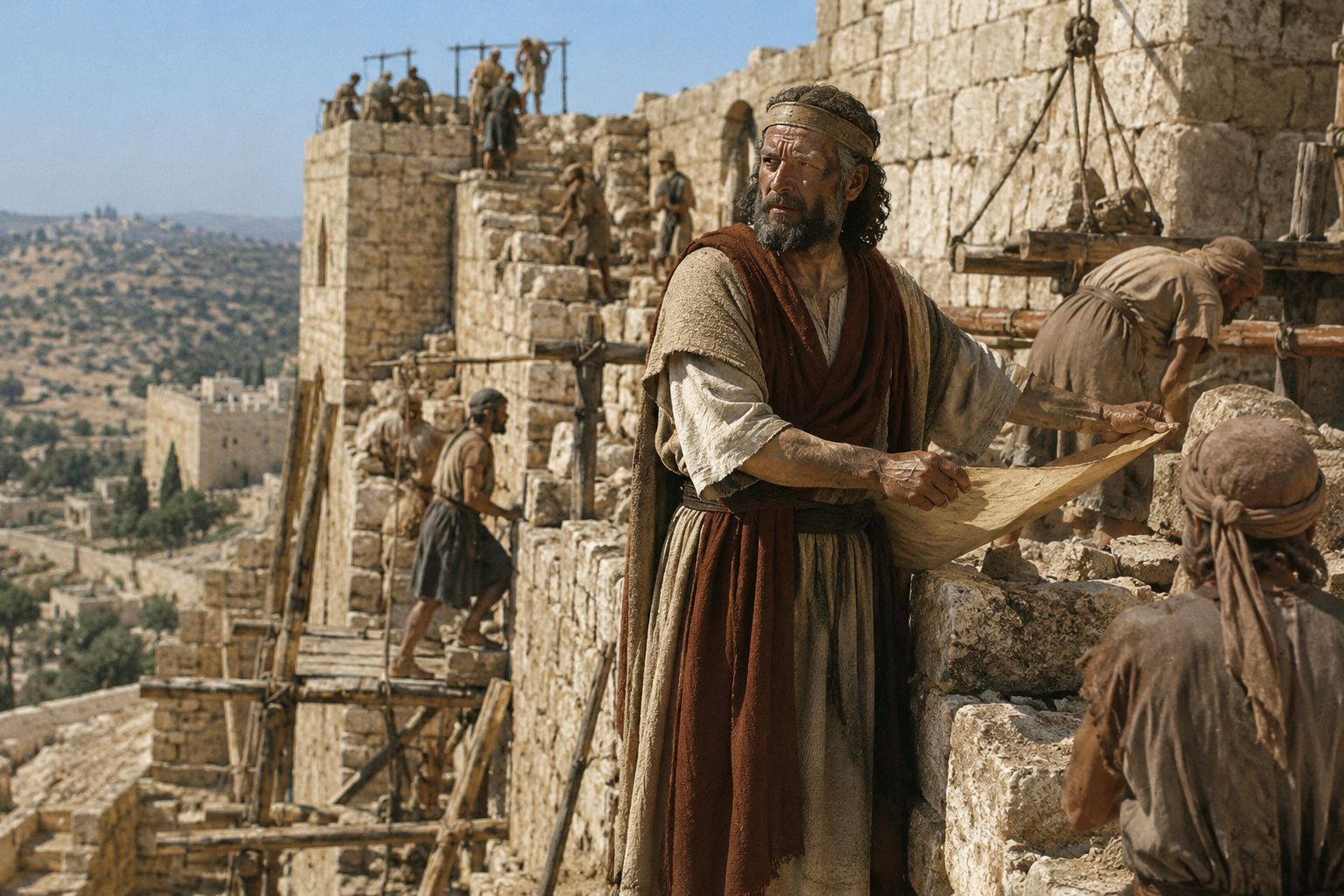
NEHEMIAH UNDER CONSTRUCTION
JUST A FEW NOTES NOW
WILL FINISH IF THE LORD WILLS
Nehemiah 1:1 The words of Nehemiah the son of Hacaliah. Now it happened in the month Chislev, in the twentieth year, while I was in Susa the capitol,
GOD'S MAN POSITIONED
FOR GOD'S WORK
The words of Nehemiah the son of Hacaliah - Unlike Ezra, Nehemiah tells much of his story in the first person, giving the book the character of a personal memoir. We will hear what Nehemiah saw, what he felt, how he prayed, and what he did. Yet behind the actions of Nehemiah stands the providential hand of God, a recurring emphasis throughout the book (Neh 2:8, 18; 4:14-15; 6:16). Nehemiah (Nechemyah) means “Yahweh comforts” or “Yahweh has comforted.” His name is remarkably appropriate. Jerusalem's people were living amid disgrace and ruins, but God was about to bring comfort through the servant He had prepared for the task. Nehemiah was not a priest like Ezra nor identified as a prophet. He was a layman serving in the Persian government, yet God would use him to accomplish an extraordinary work. The son of Hacaliah distinguishes this Nehemiah from others bearing the same name (cf. Ezra 2:2; Neh 3:16). Little else is known about Hacaliah. The important point is that this is presented as the account of an identifiable historical individual living at a particular time and place.
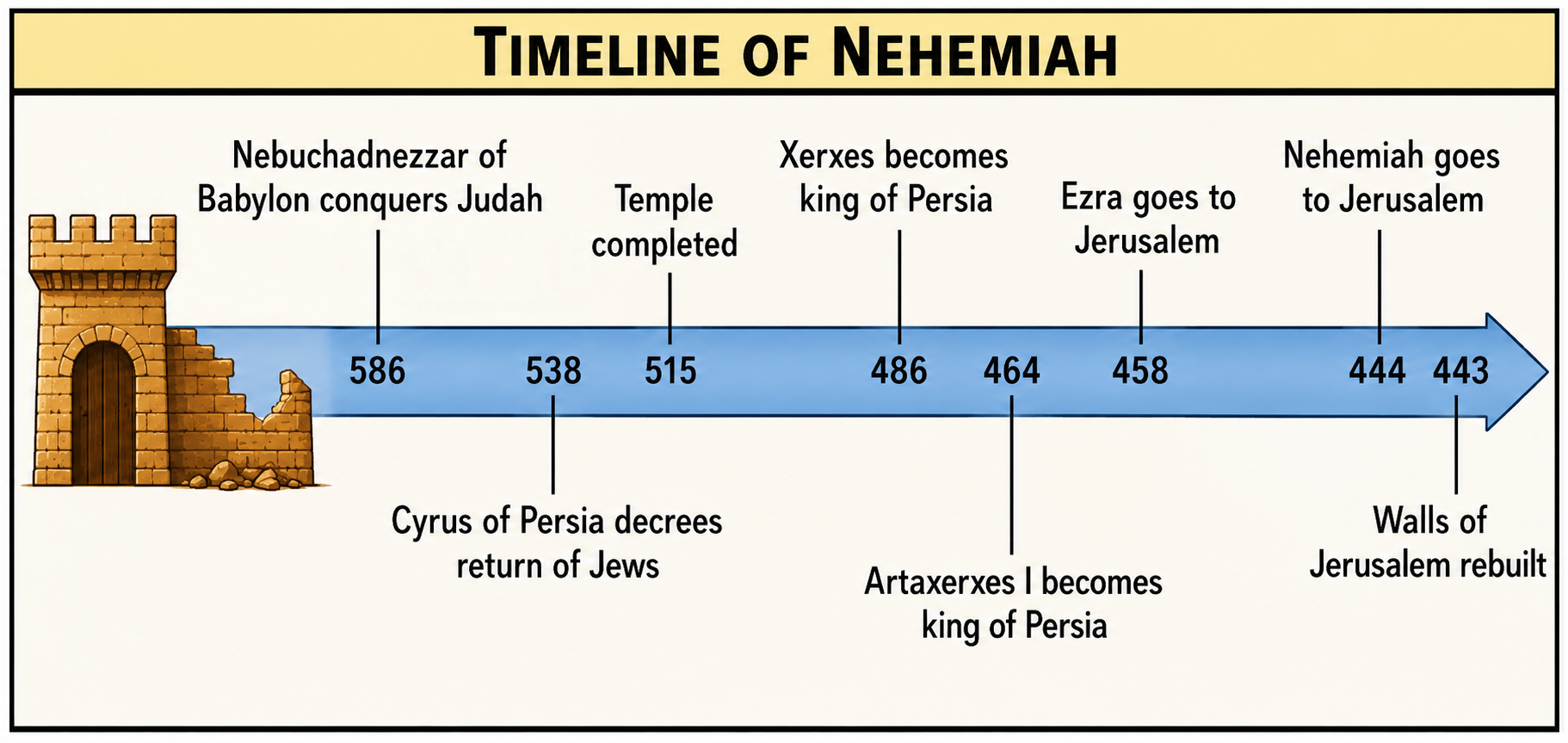
Now it happened in the month Chislev, in the twentieth year - Chislev corresponds approximately to November–December. Nehemiah later dates his conversation with King Artaxerxes to Nisan, approximately March–April (Neh 2:1). Thus about four months separate Nehemiah's receipt of the disturbing news from Jerusalem and his appearance before the king. Those months are significant. Nehemiah did not hear the problem and immediately rush into action. He first sat down, wept, mourned, fasted, and prayed (Neh 1:4). Before Nehemiah became a builder of walls, he became an intercessor on his knees. In the twentieth year refers to the twentieth year of King Artaxerxes I, generally dated to 445/444 B.C. (cf. Neh 2:1). Jerusalem had already experienced significant restoration. The first group of Jewish exiles had returned under Zerubbabel beginning in 538/537 B.C., and the temple had been rebuilt and completed in 516 B.C. (Ezra 6:15). Ezra arrived later, in the seventh year of Artaxerxes, about 458/457 B.C. (Ezra 7:7-8). It follows that Nehemiah's story occurs roughly thirteen years after Ezra's arrival and more than ninety years after the first return from Babylon. The temple stood again, but Jerusalem remained vulnerable and disgraced because its walls were broken down and its gates burned (Neh 1:3).
Don't miss the point that Nehemiah dates the events by the Persian calendar ("month of Chislev," roughly Nov–Dec) and by "the twentieth year" (of King Artaxerxes, per v.1 in context with 2:1), showing this is history rooted in real time and place.
While I was in Susa the capitol - Susa (also called Shushan) was one of the principal royal residences of the Persian Empire, located in what is now southwestern Iran (cf. Esther 1:2; Da 8:2). The Hebrew word translated capitol (birah) refers to a fortress, citadel, or palace complex. Thus Nehemiah was not living amid Jerusalem's ruins. He was serving in one of the centers of power of the greatest empire of his day. At the end of the chapter we discover his position: “I was the cupbearer to the king” (Neh 1:11). This was a position of considerable trust and access. Nehemiah was therefore living in relative security and privilege while his fellow Jews in Jerusalem were living in “great distress and reproach” (Neh 1:3). That contrast is important. Nehemiah could easily have reasoned, “Jerusalem's problems are hundreds of miles away and are not my responsibility.” Instead, the distress of God's people became his distress. There is also a wonderful display of divine providence because the man God would use to rebuild Jerusalem's walls was already positioned beside the king who could authorize and supply the project (Neh 2:4-9). Before Nehemiah knew there was a problem, God had already placed him where he would have access to the solution.
Today's position may be God's
preparation for tomorrow's assignment.
🙏 THOUGHT - One takeaway for us today is to remember that Nehemiah 1:1 reminds us that God often prepares His servant before revealing His assignment. We may not understand why God has placed us where we are, given us particular abilities, introduced certain people into our lives, or opened particular doors. Esther experienced the same truth when Mordecai asked, “Who knows whether you have not attained royalty for such a time as this?” (Esther 4:14).
And notice where revival and rebuilding begin. Nehemiah will eventually rise and build, but first he sits down and weeps. Before his hands touch Jerusalem's stones, his heart is touched by Jerusalem's need. Before he speaks to the king, he speaks to the King of heaven.
Bob Utley - "Nehemiah" This brief phrase is a title for the whole book. His name (BDB 637) means, "YHWH comforts." He was a close counselor ("cup bearer") to Artaxerxes I, who reigned from 464 to 423 B.C. By request he was sent to Judah to establish order, stability, and protection. ▣ "the month of Chislev" This is equivalent to our November ‒ December. Note the date mentioned in Neh. 2:1 is a few months earlier (see note at Neh. 2:1). Ancient Near Eastern Calendars ▣ twentieth year" Ezra 7:7 shows that Ezra had been in Jerusalem for 13 years. ▣ "Susa" This was the ancient capital of Elam. It became the winter palace of Persian kings (cf. Xenophon, Cyropaedia 8.6.22). It was the location of the book of Esther (cf. Esth. 1:2). It was earlier called Shushan.
Steven Cole - The Man Who Cried About a Wall (Nehemiah 1:1-11)
People cry about a lot of things. They cry at weddings. Parents cry when their children leave home. Sometimes they cry at the birth of their children and grandchildren. They cry at sad movies. Today we’re going to look at a man who cried about a broken wall.
I’m going to begin by making an assumption that I hope is true of everyone here—that you want to be used by God. Included in that assumption is that you have come to know Jesus Christ as your Savior and Lord by trusting in His shed blood to cover your sins. You cannot serve the Lord until you have done that. But if you have done that, the Bible is clear that you have been given a spiritual gift to use in service for the Lord (1 Pet. 4:10-11). It is a great blessing when you see the Almighty God, creator of heaven and earth, use you in some capacity to serve the Lord Jesus!
But there’s much more to serving God than just talking about it. God wants to use each one of us, but He also wants to develop us into people who are more usable to Him. As we look at the life of Nehemiah, we will learn many qualities of service and leadership. The book falls into two broad sections: Rebuilding the Wall (chapters 1-7); and, Rebuilding the People (chapters 8-13).
Nehemiah arrived in Jerusalem in 444 B.C., about 13 years after Ezra had returned there. He was a great leader whom God used to pull off a phenomenal feat: he instilled a vision in God’s remnant in Jerusalem to rebuild the walls of the city. In spite of much opposition and numerous hurdles, they accomplished the task in just 52 days. The temple had been rebuilt for about 70 years, but the walls that Nebuchadnezzar had destroyed in 586 B.C. were still in ruins, leaving the city defenseless against enemy attacks. As we saw in Ezra 4:11-23, an attempt at rebuilding the walls had been made a few years before. But when some Samaritans and other pagan residents of the land had complained, Artaxerxes issued a decree to stop the project, which these enemies had done with force of arms.
In November/December, 444 B.C., Nehemiah was serving as cupbearer to this same Artaxerxes at his winter capital in Susa when he had a life-changing conversation with his brother, Hanani, and some other men who had just come from Jerusalem. Nehemiah inquired about the condition of the city and the people. They responded, “The remnant there in the province who survived the captivity are in great distress and reproach, and the wall of Jerusalem is broken down and its gates are burned with fire” (Neh 1:3).
Nehemiah knew most of these facts before this. The wall and gates had been destroyed over 140 years before. But this graphic firsthand description of the scene by Nehemiah’s brother, including the news of things after the ban by Artaxerxes, devastated Nehemiah. He wept, mourned, fasted, and prayed for days, entreating God to do something about these deplorable conditions. God responded by doing something—through Nehemiah! We learn that …
The person God uses has a burden for His people, a vision for His purpose, and a commitment to His purpose.
First, Nehemiah saw the great need, which burdened his heart. He also saw what God wanted to accomplish. And, he committed himself to see it through in spite of the many difficulties.
1. The person God uses has a burden for His people.
When God wants to use you in some capacity, the first thing He does is to burden your heart with the situation. Perhaps, like Nehemiah, you will have known in general about the need for a long time. But then you hear about the specifics of it or you see it firsthand and you can’t put it out of your mind. When you compare the date of Neh 1:1 with the date of Neh 2:1, you discover that Nehemiah did not hear about this need and immediately rush in before the king with his request to go back to Jerusalem and rebuild the wall. Rather, he waited on God in prayer for four months before the opportunity arose to talk with the king. Note three things about Nehemiah’s burden:
A. NEHEMIAH’S BURDEN STEMMED FROM FEELING THE PEOPLE’S GREAT NEED.
Other Jews in Babylon had probably heard about the conditions in Jerusalem, shaken their heads and said, “My, my! That’s too bad!” They went back to their work in Babylon thinking, “What a tragedy!” But they were not burdened by the need of God’s people in the land.
But the man that God used to do something about it not only heard about the need. He felt their need. He wept, mourned, fasted and prayed for days about what he had heard. He just couldn’t put it out of his mind. God used that burden as the basis for action.
Maybe you’re wondering, “The needs are so many and so great! I can’t possibly respond to them all. How do I discern which particular need God wants me to get involved with?”
Two thoughts: First, don’t let the immensity of the needs paralyze you so that you don’t do anything. Sometimes you hear about the overwhelming needs around the world and run for cover because there is no way to respond to them all. Out of emotional survival, we throw up a barricade around our hearts that blocks all of the needs from moving us. We end up engrossed in our own pursuit of pleasure and ignore the needs of others.
Matthew 9:36-38 says, “Seeing the people, He felt compassion for them, because they were distressed and dispirited like sheep without a shepherd. Then He said to His disciples, ‘The harvest is plentiful, but the workers are few. Therefore beseech the Lord of the harvest to send out workers into His harvest.’” So we need to pray, “Lord, give me the eyes of Jesus to see the needs of people. Give me the heart of Jesus to feel compassion for them. And raise up workers for the harvest to meet these overwhelming needs!”
Second, don’t commit yourself impetuously to something just because the need is there. The needs are simply endless. You don’t have to respond to all of the world’s needs. Nobody could do that. Rather, wait on God in prayer until He burdens your heart with a particular need that you can do something about. Alan Redpath wrote, “Recognition of need must be followed by earnest, persistent waiting upon God until the overwhelming sense of world need becomes a specific burden in my soul for one particular piece of work which God would have me do” (BORROW Victorious Christian Service [Revell], p. 31). So we need to pray continually that God would give us a heart to feel the burden of hurting people’s needs and the willingness to get involved where we can offer some help.
B. NEHEMIAH’S BURDEN WAS FOCUSED BY SEEING THE PEOPLE’S GREAT SIN.
Nehemiah was realistic in assessing the problem. He quickly realized that at the heart of things was not a lack of organization, although they desperately needed someone to organize things, which Nehemiah subsequently did. The root problem was not a lack of resources, although the project required resources. The root problem was sin. So he prayed, “confessing the sins of the sons of Israel which we have sinned against You; I and my father’s house have sinned. We have acted very corruptly against You and have not kept the commandments, nor the statutes, nor the ordinances which You commanded Your servant Moses” (Neh 1:6b-7).
The Bible is clear that at the root of all our global and personal problems is sin. Why are there wars and terrorist attacks? Sin. Why are there famine and disease? Sin. Why are governments and businesses riddled with greed and corruption? Sin. Why is the mission task of the church not fulfilled? Sin. On the personal level, why do couples argue and have problems communicating? Sin. Why do kids from Christian homes rebel against God and their parents? Sin. Whatever the problem, you can trace its roots back to sin, either to the original sin of Adam and Eve, or directly to the sins of the people with the problems. If God is going to use us to help alleviate any great need, we need to keep clear in our focus, that at the root of the problem is human sin.
But it’s not just the sins of others that we need to be aware of. We also need to be aware of and confess our own sins. Nehemiah included himself with the sins of the people. Staying aware of our own sins keeps us humbled before God and others so that we don’t sit in judgment on them. We are sinners who have been shown mercy. We go to other sinners and offer God’s mercy.
But we dare not get distracted from the root problem. If we start thinking that the real need is better organization or more funds or better methods, we’ll start at the wrong place. The root need is for repentance on the part of God’s people, who have forgotten His purpose and are living for their own purpose. And lost people need repentance so that they can be reconciled to God. Nehemiah’s burden stemmed from feeling the people’s great need. It was focused by seeing the people’s and his own great sin.
C. NEHEMIAH’S BURDEN WAS LIGHTENED BY SEEING THE PEOPLE’S GREAT GOD.
He begins his prayer addressing God: “I beseech You, O Lord God of heaven, the great and awesome God, who preserves the covenant and lovingkindness for those who love Him and keep His commandments” (Neh 1:5). Toward the conclusion he reminds God (and himself) of God’s promise to gather His people from the most remote parts where He has scattered them for their disobedience. Then he prays (Neh 1:10), “They are Your servants and Your people whom You redeemed by Your great power and by Your strong hand.” Five times in that verse he repeats “you” and “your” as if to say, “These aren’t my people, God; they’re Your people.” God wants us to feel the burden for others, but then He wants us to roll that burden back on Him, remembering that it is not our power, but His power, that redeems them.
What if you honestly don’t have a burden for God’s people or for lost people? What does that mean? What should you do? It could mean that you are not born again, because you are not concerned about the things that God is concerned about. If that is your condition, you need to repent of your sins and trust in Christ to save you.
If you are born again but do not feel burdened for the lost or for God’s people, it probably means that you have become so caught up with seeking the things that the world seeks that you are not seeking first God’s kingdom and righteousness (Matt. 6:33). You need to go before God and get your priorities in line with His priorities. He does not save us so that we can live happy lives pursuing the American dream. He saves us so that He can use us to further His purpose. That leads to the second quality of the person God uses:
2. The person God uses has a vision for His purpose.
If Nehemiah had lacked a vision of God’s purpose, when he heard about the conditions in Jerusalem he would have said, “Why be bothered about Jerusalem? We live in Babylon and have lived here for over 100 years. What’s the big deal about Jerusalem anyway? Why not just settle down and worship God here?”
But Nehemiah knew something about what God wanted to do with His people (Neh 1:9): “I … will bring them to the place where I have chosen to cause My name to dwell.” Babylon would not do. God’s purpose involved His name or His glory being made known in Jerusalem.
God’s purpose in this age involves the church. Jesus said, “I will build My church” (Matt. 16:18). Revelation 5:9 says that Jesus purchased for God with His blood men from every tribe and tongue and people and nation. But why does He want to save people from around the globe? Be careful how you answer! We live in such a man-centered age that we easily can fall into the error of thinking that God’s purpose is to save people because He loves them and wants them to be happy. But that is a man-centered goal. God’s purpose is not man-centered; it is God-centered. God does love people and He wants them to be happy, but not as the final end in itself. Saving people is a means toward God’s purpose, but it is not the end of God’s purpose.
As Paul makes clear in Ephesians 1-3, God’s purpose involves building His church for the sake of His name or His glory. He wants to display the riches of His glorious grace and His manifold wisdom through the church to all of the angelic hosts (Eph. 1:6, 10-12, 14; Eph 3:8-11). God’s chief purpose is to further His own glory through the joy of salvation that His people experience in Him.
One of the most profound, life-changing books that you could ever read is John Piper’s ONLINE God’s Passion for His Glory [Crossway Books], which is built around and includes the full text of Jonathan Edwards’ The End for Which God Created the World. I will warn you: it is not easy, light reading! Grappling with the truths that Edwards presents makes your brain ache! He argues that the end for which God created the world is, “first, that the glory of God might be magnified in the universe, and, second, that Christ’s ransomed people from all times and all nations would rejoice in God above all things” (Piper, p. 31).
The life-transforming truth is that God’s glory and His people’s joy in Him fit together. As Piper puts it, “The further up you go in the revealed thoughts of God, the clearer you see that God’s aim in creating the world was to display the value of His glory, and that this aim is no other than the endless, ever-increasing joy of his people in that glory” (p. 32). He goes on to show how the Great Commission fits with God’s purpose: “If the exhibition of God’s glory and the deepest joy of human souls are one thing, then world missions is a declaration of the glories of God among all the unreached peoples, with a view to gathering worshippers who magnify God through the gladness of radically obedient lives” (p. 42, italics his). He sums up, “In other words, rejoicing in God and glorifying God are one, and that one thing is the aim of world missions” (p. 43).
When God’s people are in great distress and reproach and the wall between them and the pagan world is broken down, God is not glorified through His people because His people are not living any differently than the world lives. The wall symbolizes the distinctive difference between God’s people and worldly people in the way we think, the values we hold, and the way we relate to God and to one another (see 1 Pet. 2:9-12).
Thus God’s purpose is to magnify His name or His glory through His people. He does that when His people not only know and dutifully obey Him, but when they joyfully know and obey Him (Piper, p. 75). As John Piper often states, “God is most glorified in us when we are most satisfied in him.” If you want God to use you, ask Him to give you a burden for His people and a vision for His purpose. Finally,
3. The person God uses has a commitment to His purpose.
Nehemiah didn’t hear about the sad conditions in Jerusalem and say, “That’s too bad! I hope that somebody does something about it.” Rather, he was willing to commit himself to the task and to stick with it in spite of numerous difficulties. Note two things about Nehemiah’s commitment:
A. HE WAS WILLING TO COUNT THE WORLD AS LOSS FOR THE SAKE OF GOD’S PURPOSE.
Nehemiah notes that he was cupbearer to the king (Neh 1:11). The cupbearer was a high position in the court. His responsibility was to choose and taste the wine before it was served to the king to make sure that it was not poisoned. He would have been a handsome man, well-trained in court etiquette. He would have to be a friendly companion, willing to lend an ear and even to give advice to the king. Since he enjoyed closest access to the king, he was a highly trusted man. Early documents also reveal that the cupbearer could be the keeper of the royal signet, be in charge of administration of the accounts, and even serve as second to the king (see Edwin Yamauchi, BORROW Expositor’s Bible Commentary [Zondervan], 4:683).
Nehemiah lived in the palace at Susa with the king. Excavations have shown that it was built with cedar, gold, silver, and ivory. The walls were decorated with artistically colored glazed bricks and relief designs of winged bulls (Donald K. Campbell, BORROW Nehemiah: Man in Charge [Victor Books], pp. 7-8). Nehemiah would have eaten the best food, worn the best clothes, and lived in very comfortable quarters. It was a cushy job! We do not know why he had not returned with the remnant with Ezra 13 years before. Perhaps, like Daniel and his friends, he had been conscripted into the king’s service as a young man and was not free to leave.
But now when he hears about the distress of God’s people and the dishonor to God’s name, he cannot be happy in this great job and these luxurious surroundings. He was willing to give it all up, make the difficult journey to Jerusalem, and to set about the stressful job of mobilizing the people to rebuild the walls so that God’s name would be honored among His people.
Was it a costly sacrifice? Yes and no. Yes, he had to give up all of the comforts that he enjoyed and endure a lot of hardship. But, no, in that he could no longer be happy doing what he had been doing. He found great joy in doing what God wanted him to do. Like Paul, he counted it all rubbish so that he might gain Christ.
John Paton and his wife gave up the comforts of their Scottish homes and the relationships with their loved ones to take the gospel to the cannibals of the New Hebrides Islands in the South Seas. When she lay there dying after complications of childbirth, her last words were, “Oh that my dear mother were here! She is a good woman, my mother, a jewel of a woman.” Then she saw that another missionary was standing nearby. She exclaimed, “Oh, Mr. Copeland, I did not know that you were there! You must not think that I regret coming here, and leaving my mother. If I had the same thing to do over again, I would do it with far more pleasure, yes, with all my heart. Oh, no! I do not regret leaving home and friends, though at the time I felt it keenly” (John G. Paton Autobiography [Banner of Truth], pp. 84-85).
B. HE WAS WILLING TO OVERCOME THE OBSTACLES FOR THE SAKE OF GOD’S PURPOSE.
The rest of the book of Nehemiah is an account of how he overcame one obstacle after another. There was overt and covert opposition from enemies. There were problems within the ranks that could have stopped the work. But Nehemiah persisted and the wall was completed in 52 days!
If you try to do anything in service for the Lord, you will face obstacles and opposition. Some of it will come from the world, but the most difficult opposition often comes from within the church. You have to realize up front that you will encounter problems and commit yourself to God and His purpose to endure.
Conclusion
I want to challenge all of us, but especially those who are young: Don’t throw away your life to achieve the American dream of financial security, early retirement, and a motor home, so that you can spend your final years driving around to capture all of the National Parks on videotape. Spend your life for the only purpose that lasts: to see the nations glorify God for His great mercy in Christ (Rom. 15:9-12)! Ask God to give you a burden for His people, a vision for His purpose, and a commitment to His purpose.
Discussion Questions
- With all of the overwhelming needs in the world, how can a person know where God wants him/her to focus?
- How can we fight and shrug off the subtle but aggressive worldliness that keeps seeping into the church?
- Why is it important to realize that God’s purpose is primarily His glory, not our happiness? Why are these two things not ultimately in conflict?
- Is it really a sacrifice to lose the world in order to gain Christ? If not, why do we cling so tightly to the things of this world?
Brian Bell - Originally Nehemiah was a part of Ezra in the Hebrew bible. The story continues.
The Returns:
- Trip #1 49,897 people return [Zerubbabel leads, 538bc] [purpose rebuild temple]
- Trip #2 1,754 return [Ezra is in] (80 yrs. later) [purpose to rebuild the people]
- Trip #3 Nehemiah leads (14 yrs. later) [purpose to rebuild the wall]
The Book Outline:Nehemiah can be broken up:
Nehemiah 1-6 The Physical Construction of the Wall around Jerusalem.
Nehemiah 7-13 The Spiritual Restoration of the People.
Another way of looking at it is: Neh 1:1-2:10 Cupbearer. Neh 2:11-Neh 6 Foreman. Neh 7-13 Governor. 3 roles...1 man...1 heart for God.
NEHEMIAH’s QUESTION (Neh 1:1-3)
The setting (1) Was in Sushan/Susa the winter capitol of Persia (E. of Babylon 200 mi.). This is also the setting for Esther just a few years earlier.
The Man: What do you know about this man…How do you picture him…Maybe you picture him wearing a construction hat? Nehemiah = Comfort of Yahweh. He was born in captivity over in Babylon. He was a Jewish Patriot & Persian Statesman.
He was a Cupbearer (vs.11)
The Egyptians, Persians, Assyrians, & even some Jewish Monarchs had cupbearers. (Solomon did)
1 Kings 10:4,5And when the queen of Sheba had seen all the wisdom of Solomon, the house that he had built, the food on his table, the seating of his servants, the service of his waiters and their apparel, his cupbearers, and his entryway by which he went up to the house of the LORD, there was no more spirit in her.
Why is this such an off-handed mention of his occupation? Humility? The apocryphal book of Tobit (1:22), which comes from the Persian period, speaks of one cupbearer as, The signet, administrator & treasurer under Sennacherib. In the ancient world the cupbearer was an influential official w/direct & constant access to the king. Not only in the kings presence but had a relationship of familiarity. What does the cupbearer do? (Drinks the kings cup to check for poison) Remember the Butler & the Baker in Gen.40 w/ Joseph? Then he restored the chief butler to his butler-ship again, and he placed the cup in Pharaoh's hand. Gen.40:21 Was this an important job? You bet your king's life it was! Literally the king’s life was completely in his hand (or in his plate). I see Nehemiah’s life as a total life of sacrifice every time he took a drink. But Nehemiah in his humility has to tell us what he did for a living so the next chapter makes sense in his talking to the king. (Neh 2:1,2)
We are often called to be cupbearers or as McManus says, we’re called to be mushroom eaters. (asking, why did that 1st guy eat that 1st mushroom, sea cucumber, raw oyster, or jellyfish?) Were they hungry? Starving? trapped at sea long enough? It’s putting a value to risk & sacrifice. It’s living courageous lives. McManus said, John the Baptist was mushroom eater, and it cost him his life. Jesus, too, was a mushroom eater, and he found himself nailed to a tree. Neither Man saw his 35th birthday. Both of them point to the barbarian way. [The Barbarian Way, pg. 53]
Nehemiah is about to give up a life as a wealthy official to build a wall. He will leave the most beautiful city in the known world to move to a city that had been in ruins for many years. He leaves the protection from the most powerful city to move to a city that is no longer powerful. He was willing to sacrifice his own comfort to serve God & His people. Nehemiah was like Christ then in that they both...left a highly exalted position to identify w/the plight of Gods people & lead them to restoration. Both had prayerful dependence on God. He later becomes the Governor of Judah (Neh 10:1).
Matthew Henry - Introduction - his book continues the history of the children of the captivity, the poor Jews, that had lately returned out of Babylon to their own land. At this time not only the Persian monarchy flourished in great pomp and power, but Greece and Rome began to be very great and to make a figure. Of the affairs of those high and mighty states we have authentic accounts extant; but the sacred and inspired history takes cognizance only of the state of the Jews, and makes no mention of other nations but as the Israel of God had dealings with them: for the Lord's portion is his people; they are his peculiar treasure, and, in comparison with them, the rest of the world is but as lumber. In my esteem, Ezra the scribe and Nehemiah the tirshatha, though neither of them ever wore a crown, commanded an army, conquered any country, or was famed for philosophy or oratory, yet both of them, being pious praying men, and very serviceable in their day to the church of God and the interests of religion, were really greater men and more honourable, not only than any of the Roman consuls or dictators, but than Xenophon, or Demosthenes, or Plato himself, who lived at the same time, the bright ornaments of Greece. Nehemiah's agency for the advancing of the settlement of Israel we have a full account of in this book of his own commentaries or memoirs, wherein he records not only the works of his hands, but the workings of his heart, in the management of public affairs, inserting in the story many devout reflections and ejaculations, which discover in his mind a very deep tincture of serious piety and are peculiar to his writing. Twelve years, from his twentieth year (ch. 1:1) to his thirty-second year (ch. 13:6), he was governor of Judea, under Artaxerxes king of Persia, whom Dr. Lightfoot supposes to be the same Artaxerxes as Ezra has his commission from.
This book relates, I. Nehemiah's concern for Jerusalem and the commission he obtained from the king to go thither, ch. 1,2. II. His building the wall of Jerusalem notwithstanding the opposition he met with, ch. 3,4. III. His redressing the grievances of the people, ch. 5. IV. His finishing the wall, ch. 6. V. The account he took of the people, ch. 7. VI. The religions solemnities of reading the law, fasting, and praying, and renewing their covenants, to which he called the people (ch. 8-10). VII. The care he took for the replenishing of the holy city and the settling of the holy tribe, ch. 11,12. VIII. His zeal in reforming various abuses, ch. 13. Some call this the second book of Ezra, not because he was the penman of it, but because it is a continuation of the history of the foregoing book, with which it is connected (v. 1). This was the last historical book that was written, as Malachi was the last prophetical book, of the Old Testament.
Jamieson - Nehemiah the son of Hachaliah—This eminently pious and patriotic Jew is to be carefully distinguished from two other persons of the same name—one of whom is mentioned as helping to rebuild the walls of Jerusalem (Ne 3:16), and the other is noticed in the list of those who accompanied Zerubbabel in the first detachment of returning exiles (Ezr 2:2; Ne 7:7). Though little is known of his genealogy, it is highly probable that he was a descendant of the tribe of Judah and the royal family of David.
in the month Chisleu—answering to the close of November and the larger part of December.
Shushan the palace—the capital of ancient Susiana, east of the Tigris, a province of Persia. From the time of Cyrus it was the favorite winter residence of the Persian kings.
Nehemiah 1:2 that Hanani, one of my brothers, and some men from Judah came; and I asked them concerning the Jews who had escaped and had survived the captivity, and about Jerusalem.
- Hanani (KJV): Ne 7:2
- I asked (KJV): Ps 122:6-9 Ps 137:5,6
- that had escaped (KJV): Ezr 9:8,9,14 Jer 44:14 Eze 6:9 Eze 7:16 Eze 24:26,27
Related Passages:
Nehemiah 7:2 then I put Hanani my brother, and Hananiah the commander of the fortress, in charge of Jerusalem, for he was a faithful man and feared God more than many.
Psalm 122:6-9 Pray for the peace of Jerusalem: “May they prosper who love you. 7 “May peace be within your walls, And prosperity within your palaces.” 8 For the sake of my brothers and my friends, I will now say, “May peace be within you.” 9For the sake of the house of the LORD our God, I will seek your good.
Psalm 137:5; 6 If I forget you, O Jerusalem, May my right hand forget her skill. 6 May my tongue cling to the roof of my mouth If I do not remember you, If I do not exalt Jerusalem Above my chief joy.
Ezra 9:8-9 “But now for a brief moment grace has been shown from the LORD our God, to leave us an escaped remnant and to give us a peg in His holy place, that our God may enlighten our eyes and grant us a little reviving in our bondage. 9 “For we are slaves; yet in our bondage our God has not forsaken us, but has extended lovingkindness to us in the sight of the kings of Persia, to give us reviving to raise up the house of our God, to restore its ruins and to give us a wall in Judah and Jerusalem.
Ezekiel 6:9 “Then those of you who escape will remember Me among the nations to which they will be carried captive, how I have been hurt by their adulterous hearts which turned away from Me, and by their eyes which played the harlot after their idols; and they will loathe themselves in their own sight for the evils which they have committed, for all their abominations.
NEHEMIAH CARED
ENOUGH TO ASK
that Hanani, one of my brothers, and some men from Judah came; and I asked them concerning the Jews who had escaped and had survived the captivity, and about Jerusalem - Nehemiah is living securely in Susa, hundreds of miles from Jerusalem, but his heart is still in Jerusalem. When Hanani and other men arrive from Judah, Nehemiah immediately asks about two things: God's people and God's city. He wants to know about “the Jews” and “Jerusalem.” His questions reveal his priorities before we ever see his actions.
Hanani, one of my brothers - Hanani may have been Nehemiah's literal brother rather than simply a fellow Jew, especially since Nehemiah later entrusts him with responsibility over Jerusalem (Neh 7:2). His name means approximately “Yahweh is gracious” or “Yahweh has been gracious.” Hanani apparently had firsthand knowledge of conditions in Judah. His arrival would become the human means God used to place the burden of Jerusalem upon Nehemiah's heart. What may have appeared to be an ordinary visit was actually an important link in God's providential plan. God sometimes changes the direction of a person's life through a seemingly ordinary conversation.
Some men from Judah came - These men had apparently traveled from Judah to Susa, a considerable journey. They brought no indication that they had come specifically to recruit Nehemiah. They simply arrived with information. Yet notice God's providence. In Neh 1:1, Nehemiah is in exactly the right place to influence the Persian king. In Neh 1:2, the right people arrive with exactly the information that will awaken him to Jerusalem's need. God is quietly arranging circumstances before Nehemiah has any idea what He is about to do.
Geographical distance had not
produced spiritual indifference
I asked them - This little statement tells us much about Nehemiah. He cared enough to ask. He could have remained comfortably uninformed. Life in Susa was undoubtedly easier than life in devastated Jerusalem. But geographical distance had not produced spiritual indifference. Nehemiah did not begin by announcing what he intended to do. He began by asking questions and listening. Before he developed a plan, he sought an accurate understanding of the problem. There is an important principle here. A burden often begins with a willingness to know. Sometimes we avoid asking because knowing may create responsibility. Nehemiah asked even though the answer might disturb his comfortable life.
Concerning the Jews who had escaped and had survived the captivity - These were the Jewish remnant who had survived the Babylonian exile and were now living in Judah. Some had remained in the land through the years of exile, while others had returned following Cyrus' decree (Ezra 1:1-4). The language escaped and survived reminds us of the devastating judgment Judah had experienced. Jerusalem had been destroyed, the temple burned, and many inhabitants killed or carried into Babylon (2Ki 25:8-12; 2Chr 36:17-21). Yet there was still a remnant. God's judgment had been severe, but His covenant purposes had not failed (cf. Isa 10:20-22; Jer 23:3).
And about Jerusalem - Nehemiah asks not only about the people but also about Jerusalem, the city uniquely associated with God's covenant purposes, His temple, and His Name (1Ki 11:36; Ps 48:1-2; 87:1-3). The temple had already been rebuilt (Ezra 6:15), but Jerusalem itself remained vulnerable. Nehemiah is about to learn that “the wall of Jerusalem is broken down and its gates are burned with fire” (Neh 1:3). A city without defensive walls in the ancient world was exposed, vulnerable, and disgraced. Thus the physical condition of Jerusalem reflected the humiliation of God's people.
Nehemiah's question reveals Nehemiah's heart. He was physically in Persia but emotionally and spiritually identified with God's people in Judah. Before Nehemiah saw the broken walls, God began breaking his heart. Compare Daniel, another Jewish exile who prospered in a foreign empire yet continued to orient his heart toward Jerusalem (Da 6:10; 9:2-19). Neither prosperity nor position caused these men to forget God's people and God's purposes.
🙏 THOUGHT - Do we care enough to ask? It is easy to remain comfortable when we remain uninformed. Nehemiah's life was about to be profoundly disrupted because he asked a simple question and was willing to hear an uncomfortable answer. We sometimes pray, “Lord, use me,” while unconsciously avoiding situations that might inconvenience us. Nehemiah teaches us to be willing to ask, “What is the need?” and then to allow God to determine what our response should be.
What we care enough to ask about
often reveals what we truly care about.
Bob Utley - "brothers" The Hebrew word (BDB 26) can mean nationality, kinsman, or full brother (cf. Neh. 7:2). ▣ "some men from Judah" This apparently was an official delegation from the Jewish community seeking help from a relative at the Persian court. ▣ "concerning the Jews" Nehemiah asked about how the returnees were doing and about the conditions in Jerusalem.
Nehemiah's brother Hanani (later mentioned in Neh 7:2) arrives from Judah with others. Nehemiah immediately asks about "the Jews who escaped, who had survived the exile" and about Jerusalem for his heart is with his homeland even though he's never lived there.
Ryrie - Hanani. Evidently a blood brother (7:2), he brought Nehemiah the report of conditions in Jerusalem due to the opposition recorded in Ezra 4:23-24.
Brian Bell - What does just this question already tell you about Nehemiah? He cared for both Gods people and Gods city (which he’s never personally seen)
Matthew Henry - What a tribe Nehemiah was of does nowhere appear; but, if it be true (which we are told by the author of the Maccabees, 2 Maccabees 1:18) that he offered sacrifice, we must conclude him to have been a priest. Observe,
I. Nehemiah's station at the court of Persia. We are here told that he was in Shushan the palace, or royal city, of the king of Persia, where the court was ordinarily kept (v. 1), and (v. 11) that he was the king's cup-bearer. Kings and great men probably looked upon it as a piece of state to be attended by those of other nations. By this place at court he would be the better qualified for the service of his country in that post for which God had designed him, as Moses was the fitter to govern for being bred up in Pharaoh's court, and David in Saul's. He would also have the fairer opportunity of serving his country by his interest in the king and those about him. Observe, He is not forward to tell us what great preferment he had at court; it is not till the end of the chapter that he tells us he was the king's cup-bearer (a place of great trust, as well as of honour and profit), when he could not avoid the mentioning of it because of the following story; but at first he only said, I was in Shushan the palace. We may hence learn to be humble and modest, and slow to speak of our own advancements. But in the providences of God concerning him we may observe, to our comfort,
1. That when God has work to do he will never want instruments to do it with.
2. That those whom God designs to employ in his service he will find out proper ways both to fit for it and to call to it.
3. That God has his remnant in all places; we read of Obadiah in the house of Ahab, saints in Caesar's household, and a devout Nehemiah in Shushan the palace.
4. That God can make the courts of princes sometimes nurseries and sometimes sanctuaries to the friends and patrons of the church's cause.
II. Nehemiah's tender and compassionate enquiry concerning the state of the Jews in their own land, v. 2. It happened that a friend and relation of his came to the court, with some other company, by whom he had an opportunity of informing himself fully how it went with the children of the captivity and what posture Jerusalem, the beloved city, was in. Nehemiah lived at ease, in honour and fulness, himself, but could not forget that he was an Israelite, nor shake off the thoughts of his brethren in distress, but in spirit (like Moses, Acts 7:23) he visited them and looked upon their burdens. As distance of place did not alienate his affections from them (though they were out of sight, yet not out of mind), so neither did,
1. The dignity to which he was advanced. Though he was a great man, and probably rising higher, yet he did not think it below him to take cognizance of his brethren that were low and despised, nor was he ashamed to own his relation to them and concern for them.
2. The diversity of their sentiments from his, and the difference of their practice accordingly. Though he did not go to settle at Jerusalem himself (as we think he ought to have done now that liberty was proclaimed), but conformed to the court, and staid there, yet he did not therefore judge nor despise those that had returned, nor upbraid them as impolitic, but kindly concerned himself for them, was ready to do them all the good offices he could, and, that he might know which way to do them a kindness, asked concerning them. Note, It is lawful and good to enquire, "What news?" We should enquire especially concerning the state of the church and religion, and how it fares with the people of God; and the design of our enquiry must be, not that, like the Athenians, we may have something to talk of, but that we may know how to direct our prayers and our praises.
Jamieson - Hanani, one of my brethren, came, he and certain men of Judah—Hanani is called his brother (Ne 7:2). But as that term was used loosely by Jews as well as other Orientals, it is probable that no more is meant than that he was of the same family. According to Josephus, Nehemiah, while walking around the palace walls, overheard some persons conversing in the Hebrew language. Having ascertained that they had lately returned from Judea, he was informed by them, in answer to his eager enquiries, of the unfinished and desolate condition of Jerusalem, as well as the defenseless state of the returned exiles. The commissions previously given to Zerubbabel and Ezra extending only to the repair of the temple and private dwellings, the walls and gates of the city had been allowed to remain a mass of shattered ruins, as they had been laid by the Chaldean siege.
Nehemiah 1:3 They said to me, “The remnant there in the province who survived the captivity are in great distress and reproach, and the wall of Jerusalem is broken down and its gates are burned with fire.”
- the province (KJV): Ne 7:6 Ne 11:3 Ezr 2:1 Ezr 5:8 Es 1:1
- in great (KJV): Ne 9:36,37 Ps 44:11-14 Ps 137:1-3 Isa 32:9-14 La 1:7 La 3:61 La 5:1
- reproach (KJV): 1Ki 9:7 Ps 79:4 Isa 43:28 Jer 24:9 Jer 29:18 Jer 42:18 Jer 44:8-12
- the wall (KJV): Ne 2:17 2Ki 25:10 Isa 5:5 Isa 64:10,11 Jer 5:10 Jer 39:8 Jer 52:14
They said to me, “The remnant there in the province who survived the captivity are in great distress and reproach, and the wall of Jerusalem is broken down and its gates are burned with fire.”
Bob Utley - "the wall of Jerusalem is broken down and its gate burned with fire" In the ancient world, this was the calamity of total defenselessness. This refers either to the original destruction of the city by Nebuchadnezzar II in 586 B.C. (cf. II Kgs. 25:10) or the contemporary destruction of partially reconstructed walls; both positions quote Ezra 4:7-24 (esp. Neh. 1:23).
The report is grim: the remnant in Jerusalem is "in great trouble and shame," and the city's wall is broken down, its gates burned. This likely refers to a relatively recent setback (possibly the failed rebuilding attempt recorded in Ezra 4:23), not merely the original 586 BC destruction decades earlier but the wound feels fresh and current.
Henry Morris - broken down. The wall of Jerusalem had apparently been at least partially built by Zerubbabel (Ezra 4:12; Ezra 5:3,8). Many years had passed, however, and the returning exiles had encountered continuing serious opposition from the people of the land, so their wall had fallen into decay by Nehemiah's time. Therefore Nehemiah sought and obtained approval to rebuild and finish the wall (Nehemiah 2:8).
Brian Bell - Why were broken down walls so important? I have a few broken boards in my cedar fence at home that need mending… but it’s not the highest on my priority list. Un-walled cities in ancient times had no defense against enemies. They were thus dismissed as insignificant cities. So, for Jerusalem to lack walls was a disgrace to the city God has chosen. And it brought dishonor to the Lord. What the walls were to Jerusalem, are our lives are before God.
Is there any rebuilding/reconstruction needed in the walls of your life? Anything in your life left in ruins? - usually starts with a crack. Then a loose piece of stone or mortar. Then a hole. Next weeds of carnality start growing in there. Now, the enemy has gained access into your life. It’s time to rebuild that wall in your life. It’s a necessary hedge or wall of protection. A wall encloses: regarding purity Solomon says, a garden enclosed is my sister, my spouse, a spring shut up, a fountain sealed. A wall divides: its a protective & restrictive barrier that only you can set up in your life that help you to maintain your convictions. There are spiritual Hedges provided by God. Job 1:9,10 So Satan answered the LORD and said, Does Job fear God for nothing? Have You not made a hedge around him, around his household, and around all that he has on every side? Only if God lowers the hedge, and that for His own purposes, can disaster strike. There are spiritual Hedges we must plant/build. Prov. 25:28 Whoever has no rule over his own spirit Is like a city broken down, without walls.
Matthew Henry - Informed of Their Deplorable Condition Neh 1:3
III. The melancholy account which is here given him of the present state of the Jews and Jerusalem, v. 3. Hanani, the person he enquired of, has this character given of him (ch. 7:2), that he feared God above many, and therefore would not only speak truly, but, when he spoke of the desolations of Jerusalem, would speak tenderly. It is probable that his errand to court at this time was to solicit some favour, some relief or other, that they stood in need of. Now the account he gives is,
1. That the holy seed was miserably trampled on and abused, in great affliction and reproach, insulted upon all occasions by their neighbours, and filled with the scorning of those that were at ease.
2. That the holy city was exposed and in ruins. The wall of Jerusalem was still broken down, and the gates were, as the Chaldeans left them, in ruins. This made the condition of the inhabitants both very despicable under the abiding marks of poverty and slavery, and very dangerous, for their enemies might when they pleased make an easy prey of them. The temple was built, the government settled, and a work of reformation brought to some head, but here was one good work yet undone; this was still wanting. Every Jerusalem, on this side the heavenly one, will have some defect or other in it, for the making up of which it will required the help and service of its friends.
Nehemiah 1:4 When I heard these words, I sat down and wept and mourned for days; and I was fasting and praying before the God of heaven.
- I sat down (KJV): 1Sa 4:17-22 Ezr 10:1 Ps 69:9,10 Ps 102:13,14 Ps 137:1 Da 9:3 Zep 3:18 Ro 12:15
- the God (KJV): Ne 2:4 Ezr 5:11,12 Da 2:18 Jon 1:9
GODLY
GRIEF
When I heard these words, I sat down and wept and mourned for days; and I was fasting and praying before the God of heaven.
Bob Utley - "sat down and wept and mourned. . .fasting and praying" These were four signs of intense mourning in the Ancient Near East. Grieving Rites ▣ "for days" Nehemiah's mourning, fasting, and praying went on for days. He was a man of prayer. His lengthy prayer here is to be compared to his very brief prayer of Neh. 2:4. There is a time for prolonged prayer and a time for brief prayer. Prayer is a way for humans to show their faith and trust in the faithful, trustworthy God. Prayer is the outward manifestation of a biblical world view and faith! ▣ "the God of heaven" This was the Persian Zoroastrian title for Ahura Mazda, but the Jews had taken it and applied it to YHWH. See note at Ezra 1:2. Notice the covenant name in Neh. 1:5.
Nehemiah's response models godly grief: he weeps, mourns for days, fasts, and prays. He doesn't rush to action or complain BUT brings his distress to God first. This sets the emotional and spiritual tone for the whole book: crisis drives him to prayer, not panic.
Jamieson - The recital deeply affected the patriotic feelings of this good man, and no comfort could he find but in earnest and protracted prayer, that God would favor the purpose, which he seems to have secretly formed, of asking the royal permission to go to Jerusalem.
Knowing the Will of God Through Prayer and Fasting— Soon after Israel had invaded Palestine in the days of Joshua, the Israelites were tricked into signing an unscriptural peace treaty with a group of deceitful pagans. The cause for this tragic error is clearly stated in God’s Word, “Then the men … did not ask counsel of the Lord” (Jos9:14). These pagans, the Gibeonites, brought only trouble to Israel. See Jos0:4–15; 2 Sa21:1–14.
It therefore becomes immediately obvious that one of the most important factors in knowing God’s will for our lives is to pray. “If any of you lacks wisdom, let him ask of God, who gives to all liberally and without reproach, and it will be given to him” (James 1:5). See also Ps143:8, 10; Ja4:2.
In the light of these passages it is evident a Christian must pray to know God’s will. In other Bible verses fasting is linked with prayer.
Meaning of fasting: to fast is to abstain for a period of time from some important and necessary activity in our lives.
Purpose of fasting: this is done that we might spend that time in prayer before God.
Kinds of fasting: one may, for a time, refrain from sleep (2 Cor. 6:5; 2 Cor 11:27), marital sex (1 Co7:1–5), or food (Matt. 4:1, 2).
Ryrie - Nehemiah's prayer involved (1) pleading the lovingkindness of God (Heb., hesed; see note on Hos. 2:19); (2) confessing sin (notice that Nehemiah, like Ezra, 9:5-15, and Daniel, 9:3-19, identifies himself with his people); (3) acknowledging the rightness of God's judgment (on vv. 8-9, cf. Lev. 26:33-45 and Deut. 30:1-5); and (4) asking for success in the next step (which would require the king, this man of v. 11, to reverse the decision he had made as recorded in Ezra 4:21).
Examples of biblical fasting: Moses (Deut. 9:9, 18, 25–29); Elijah (1 Kin. 19:8); Daniel (Dan. 9:3; Dan 10:3); Ezra (Ezra 10:6); Nehemiah (Neh. 1:4); and Paul (2 Cor. 6:5; 2 Cor 11:27).
Brian Bell - NEHEMIAH’s CONTEMPLATION - He was immediately burdened…Distance didn’t make a Difference. It was approx. 400 miles away. He was burdened for his city…are you for yours? He didn’t say, hey Hanani (huh`NAY`nigh), not my problem! No, He turned tears into prayers. He turned from man to God. He prayed about this for 4 months (dates in Neb 1:1 & Neh 2:1; Dec.-April) Do we ever mourn for God’s church today? Have we ever sat down, wept, mourned, prayed or fasted for the state of the Church? G. Cambell Morgan said, We should deal much more successfully with men if, like Nehemiah, we dealt more largely with God. Meet & conquer your enemies before you see them. (in prayer)
Matthew Henry - Fasting and Praying Thereupon Neh 1:4
IV. The great affliction this gave to Nehemiah and the deep concern it put him into, v. 4.
1. He wept and mourned. It was not only just when he heard the news that he fell into a passion of weeping, but his sorrow continued certain days. Note, The desolations and distresses of the church ought to be the matter of our grief, how much soever we live at ease.
2. He fasted and prayed; not in public (he had no opportunity of doing that), but before the God of heaven, who sees in secret, and will reward openly. By his fasting and praying,
(1.) He consecrated his sorrows, and directed his tears aright, sorrowed after a godly sort, with an eye to God, because his name was reproached in the contempt cast on his people, whose cause therefore he thus commits to him.
(2.) He eased his sorrows, and unburdened his spirit, by pouring out his complaint before God and leaving it with him.
(3.) He took the right method of fetching in relief for his people and direction for himself in what way to serve them. Let those who are forming any good designs for the service of the public take God along with them for the first conception of them, and utter all their projects before him; this is the way to prosper in them.
Nehemiah 1:5 I said, “I beseech You, O LORD God of heaven, the great and awesome God, who preserves the covenant and lovingkindness for those who love Him and keep His commandments,
- the great (KJV): Ne 4:14 De 7:21 1Ch 17:21 Ps 47:2 Da 9:4-19
- keepeth (KJV): Ex 20:6 De 7:9 1Ki 8:23 Heb 6:13-18
RIGHT THEOLOGY PRECEDES
RIGHT PETITION
I said, “I beseech You, O LORD God of heaven, the great and awesome God, who preserves the covenant and lovingkindness for those who love Him and keep His commandments - His prayer opens with worship, addressing "the LORD, the God of heaven, the great and awesome God." He grounds his appeal in God's character especially His covenant faithfulness ("steadfast love") toward those who love and obey him.
Bob Utley - I said" Nehemiah's prayer is similar to Ezra's in Neh. 9:5-15 and Dan. 9:4-19. These prayers focus on God's character and His people's sin. <Bible prayers> v5-11; Neh2:4 (Ge 15:2; Hab 3:1) ▣ I beseech You - This Hebrew INTERJECTION (BDB 58) introduces strong pleas for help and forgiveness (cf. Neh. 1:5,11; Gen. 50:17; Exod. 32:31; 2 Kgs. 20:3; Ps. 116:4; Ps 118:25; Dan. 9:4; Jonah 1:14; Jonah 4:2). ▣ "the great and awesome God" The first ADJECTIVE (BDB 152) originally meant to make a strong cord by twisting several cords together. It came to mean "make strong." The Hebrew root is used of God in Neh. 8:6; Neh 9:32; Deut. 3:24; Deut 5:24; Deut 9:26; Deut 11:2; Deut 32:3, which reflects Moses' words in Deut. 1:10; Deut 4:14. ▣ "who preserves the covenant and lovingkindness" The first VERB (BDB1036, KB 1581, Qal ACTIVE PARTICIPLE) means "to keep," "ro watch," "to preserve." ▣ "to those who love Him and keep His commandments" Notice the conditional element (i.e., "if. . .then"), human response is required (cf. Exod. 20:6; Deut. 5:10; Deut 7:6-9; Deut 10:12-13; Deut 11:1,22; Deut 13:3; Deut 19:9; Deut 30:15-16,19-20; Jos. 22:5; Jdg. 5:31; 1 Kgs. 3:2,3; 2 Chr. 20:7; Ps. 5:11; Ps 69:36; Ps 103:17-18; Ps 119:132: 145:20; Jer. 2:2,33; Dan. 9:2-3,4; John 14:15,21,23; John 15:10; 1 John 5:3). Divine love enables covenant performance. Love is a choice and an action as well as an emotion (cf. Neh. 1:8-9).
Brian Bell - NEHEMIAH PRAYER (Neh 1:5-11) We find here that he is a man of prayer (10 times in this book). The book starts & ends in prayer. It shows him praying day & night. (Neh 1:6) Prayer should be as natural to the believer as breathing. Did you know that our knees don’t knock when we kneel on them? (Neh 1:5-11) What did Nehemiah think about his God? He believed in a Great God who…He believed in a great God who kept His promises (Neh 1:5,8,9) Jer.29:10 For thus says the LORD: After 70 years are completed at Babylon, I will visit you & perform My good word toward you, & cause you to return to this place.
Matthew Henry - With a Particular Account of His Prayer Neh 1:5-11
We have here Nehemiah's prayer, a prayer that has reference to all the prayers which he had for some time before been putting up to God day and night, while he continued his sorrows for the desolations of Jerusalem, and withal to the petition he was now intending to present to the king his master for his favour to Jerusalem. We may observe in this prayer,
I. His humble and reverent address to God, in which he prostrates himself before him, and gives unto him the glory due unto his name, v. 5. It is much the same with that of Daniel, ch. 9:4. It teaches us to draw near to God,
1. With a holy awe of his majesty and glory, remembering that he is the God of heaven, infinitely above us, and sovereign Lord over us, and that he is the great and terrible God, infinitely excelling all the principalities and powers both of the upper and of the lower world, angels and kings; and he is a God to be worshipped with fear by all his people, and whose powerful wrath all his enemies have reason to be afraid of. Even the terrors of the Lord are improvable for the comfort and encouragement of those that trust in him.
2. With a holy confidence in his grace and truth, for he keepeth covenant and mercy for those that love him, not only the mercy that is promised, but even more than he promised: nothing shall be thought too much to be done for those that love him and keep his commandments.
Nehemiah 1:6 let Your ear now be attentive and Your eyes open to hear the prayer of Your servant which I am praying before You now, day and night, on behalf of the sons of Israel Your servants, confessing the sins of the sons of Israel which we have sinned against You; I and my father’s house have sinned.
- thine ear (KJV): 1Ki 8:28,29 2Ch 6:40 Ps 34:15 Ps 130:2 Da 9:17,18
- day and night (KJV): 1Sa 15:11 Ps 55:17 Ps 88:1 Lu 2:37 Lu 18:7 1Ti 5:5 2Ti 1:3
- confess (KJV): Ezr 9:6,7 Ezr 10:11 Ps 32:5 Isa 64:6,7 La 3:39-42 Da 9:4,20 1Jn 1:9
- both I (KJV): 2Ch 28:10 2Ch 29:6 Ps 106:6 Isa 6:5 La 5:7 Eph 2:3
let Your ear now be attentive and Your eyes open to hear the prayer of Your servant which I am praying before You now, day and night, on behalf of the sons of Israel Your servants, confessing the sins of the sons of Israel which we have sinned against You; I and my father’s house have sinned.
Bob Utley - "Let Your ear. . .Your eyes" The first VERB (BDB 224, KB 243) is a Qal JUSSIVE (command, cf. Neh. 1:11). The second (BDB 834 KB 986) is a Qal PASSIVE PARTICIPLE. This anthropomorphic language is very common in the Bible (cf. Neh. 1:11). From the Bible we know that God is spirit. He has no physical body. However, the only vocabulary we have is physical. We speak of God as if He were a human person, but He is not. He is personal, but not physical. Be careful of literalism in reading these human, earthly, temporal passages about the eternal, spiritual God! God Described As Human ▣ "Your servant" This is an honorific title used for Moses, Joshua, and David. Notice the play between the SINGULAR (Nehemiah) and the PLURAL (the people, cf. Neh. 1:10,11). It is this interplay that allows confessional corporate prayers. It is this interplay that allows one sinless servant to die on behalf of the whole (Isaiah 53). My Servant ▣ "I am praying. . .day and night" Persistence in prayer is highlighted here (cf. Matt.7:7-8; Luke 18:2-8). Neh. 2:1 shows he prayed almost three months. ▣ "confessing sins. . .I and my fathers house" Confession is an important element of prayer (cf. 1 John 1:9). We are responsible for our individual sins and the sins of our society (cf. 2 Chr. 29:6; 2 Chr 30:7-9; Isa. 6:5). The term "confessing" (BDB 392) is used of acknowledging sin (cf. Neh. 1:6; Neh 9:2-3; Ezra 10:1; Dan. 9:2-3). Nehemiah identified himself with his people's sin, as did Ezra (9:5-15). This prayer is much like Moses' in Exod. 32:30-33 or Daniel's in Dan. 9:4-19. Confession/Profession
Nehemiah asks God to hear his prayer, made "day and night" for Israel. Crucially, he confesses sin — not just the nation's sins in the abstract, but includes himself and his family ("I and my father's house have sinned"). He specifically names the failure to keep God's commandments given through Moses. This is corporate confession with personal ownership, not self-righteous distancing.
BSB - Nehemiah combined active and determined leadership with a commitment to confession and prayer as he led the people in the aftermath of the cruel exile in Babylon (cf. 2:4; 4:4, 5, 9; 6:9, 14; 9:1-3; 13:14, 22, 29, 31). Although Nehemiah's confession was primarily for "the sins of the children of Israel," he expressed the confession in the first person: "which we have sinned against You."
Brian Bell - He believed in a great God to confess to & be forgiven by (Neh 1:6b,7) Just like Ezra, Nehemiah identifies himself with the sins & sorrows of the nation.
Matthew Henry - His general request for the audience and acceptance of all the prayers and confessions he now made to God (Neh 1:6): "Let thy ear be attentive to the prayer, not which I say (barely saying prayer will not serve), but which I pray before thee (then we are likely to speed in praying when we pray in praying), and let they eyes be open upon the heart from which the prayer comes, and the case which is in prayer laid before thee." God formed the eye and planted the ear; and therefore shall he not see clearly? shall not he hear attentively?
III. His penitent confession of sin; not only Israel has sinned (it was no great mortification to him to own that), but I and my father's house have sinned, v. 6. Thus does he humble himself, and take shame to himself, in this confession. We have (I and my family among the rest) dealt very corruptly against thee, v. 7. In the confession of sin, let these two things be owned as the malignity of it-that it is a corruption of ourselves and an affront to God; it is dealing corruptly against God, setting up the corruptions of our own hearts in opposition to the commands of God.
Nehemiah 1:7 “We have acted very corruptly against You and have not kept the commandments, nor the statutes, nor the ordinances which You commanded Your servant Moses.
- dealt (KJV): Ne 9:29-35 Ps 106:6 Da 9:5,6
- corruptly (KJV): 2Ch 27:2 Ho 9:9 Zep 3:7 Rev 19:2
- the commandments (KJV): Lev 27:34 De 4:1 De 5:1 De 6:1 De 28:15 1Ki 2:3 Ps 19:8,9 Ps 119:5-8
- which thou (KJV): De 4:5 2Ch 25:4 Ezr 7:6 Da 9:11,13 Mal 4:4
We have acted very corruptly against You and have not kept the commandments, nor the statutes, nor the ordinances which You commanded Your servant Moses.
Bob Utley - "the commandments, nor the statutes, nor the ordinances" These terms all refer to God's word through Moses (cf. Neh. 1:5,7,9). A good place to see all the terms used to describe God's law is Ps. 19:7-9 and even more extensively in Ps. 119. ▣ "Your servant Moses" See My Servant
Matthew Henry - The pleas he urges for mercy for his people Israel.
1. He pleads what God had of old said to them, the rule he had settled of his proceedings towards them, which might be the rule of their expectations from him, v. 8,9. He had said indeed that, if they broke covenant with him, he would scatter them among the nations, and that threatening was fulfilled in their captivity: never was people so widely dispersed as Israel was at this time, though at first so closely incorporated; but he had said withal that if they turned to him (as now they began to do, having renounced idolatry and kept to the temple service) he would gather them again. This he quotes from Dt 30:1-5, and begs leave to put God in mind of it (though the Eternal Mind needs no remembrancer) as that which he guided his desires by, and grounded his faith and hope upon, in praying this prayer: Remember, I beseech thee, that word; for thou hast said, Put me in remembrance. He had owned (Neh 1:7), We have not kept the judgments which thou commandedst thy servant Moses; yet he begs (Neh 1:8), Lord, remember the word which thou commandedst thy servant Moses; for the covenant is often said to be commanded. If God were not more mindful of his promises than we are of his precepts we should be undone. Our best pleas therefore in prayer are those that are taken from the promise of God, the word on which he has caused us to hope, Psa. 119:49.
Nehemiah 1:8 “Remember the word which You commanded Your servant Moses, saying, ‘If you are unfaithful I will scatter you among the peoples;
- Remember (KJV): Ps 119:49 Lu 1:72
- If ye transgress (KJV): Lev 26:33-46 De 4:25-27 De 28:64 De 32:26-28 1Ki 9:6,7
NEHEMIAH BEGINS
HIS MODEL PRAYER
Remember the word which You commanded Your servant Moses, saying, ‘If you are unfaithful I will scatter you among the peoples;
Bob Utley - "Remember" Nehemiah is entreating God to remember (BDB 269, KB 269, Qal IMPERATIVE, cf. Neh. 4:8; Neh 5:19; Neh 6:14; Neh 13:14,22,29,31) His words to Moses. Moses also called on YHWH to remember His promises to the Patriarchs (e.g., Exod. 32:13; Deut. 9:27). Mankind's hope is in God's character, promises, covenants, and word! ▣ "if you are unfaithful" The "if" is implied, but is not in the MT. This VERB (BDB 591, KB 612, Qal IMPERFECT) implies that they will be unfaithful. There is no "if" in the MT (the conditional "if" is present in Neh. 1:9). Human disobedience deserves a divine response (cf. Lev. 26:27-45; Deut. 30:1-10). Miracle of miracles, the response is love and forgiveness, not wrath and judgment. The New Covenant of Jer. 31:31-34 and Ezek. 36:22-38 changes the basis of covenant requirements. ▣ "I will scatter you" The VERB (BDB 806, KB 718, Hiphil IMPERFECT) was used to describe exile (cf. Deut. 4:27; Deut 28:64; Deut 29:28). The judgment (cf. Lev. 26:33) we now see in a way for God's word to be spread among the nations so that they may know and turn to YHWH. Often the terms "scatter" and "gather" are used together to describe YHWH's justice and love (cf. Neh. 1:8-9; Isa. 11:12; Jer. 23:1-3; Ezek. 11:17; Ezek 20:34,41; Ezek 28:25; Ezek 29:13; Ezek 34:12-13).
Nehemiah appeals to God's own word (ALWAYS THE BEST PRACTICE), recalling the promise given through Moses (echoing Deuteronomy 30:1–5 and Leviticus 26:1-46): if Israel is unfaithful, they'll be scattered; but if they return to God and obey, He will regather them "from the farthest parts of the heavens" to the place He has chosen. Nehemiah prays God's promises back to Him giving us a model of prayer grounded in Scripture.
Brian Bell - In Neh 1:8,9 He reminds the Lord of His gracious promises. Not that God forgot, but the plea is to activate His Word.
Nehemiah 1:9 but if you return to Me and keep My commandments and do them, though those of you who have been scattered were in the most remote part of the heavens, I will gather them from there and will bring them to the place where I have chosen to cause My name to dwell.’
- if ye turn (KJV): Lev 26:39-42 De 4:29-31 De 30:2-5 Jer 29:11-14
- yet will I (KJV): 1Ch 16:35 Ps 106:47 Ps 147:2 Isa 11:12 Isa 56:8 Jer 12:15 Jer 31:10 Jer 32:37 Jer 50:19,20 Mt 24:31
- will bring (KJV): Jer 3:14 Eze 36:24
- the place (KJV): De 12:5,21 1Ki 9:3 Ezr 6:12
but if you return to Me and keep My commandments and do them, though those of you who have been scattered were in the most remote part of the heavens, I will gather them from there and will bring them to the place where I have chosen to cause My name to dwell.’
Bob Utley - "if you return to Me" This is the VERB (BDB 996, KB 1427, Qal PERFECT) which denotes repentance. Notice that repentance is from sin and to God. Repentance in the Old Testament ▣ "and keep My commandments" Notice repentance is clearly seen in a change of actions, as well as a change of mind, (cf. Neh. 1:5). Obedience is evidence of true repentance. ▣ "in the most remote part of the heavens" This is a metaphor for those Jews who were exiled to the farthest place (cf. Deut. 30:4). The heavens here would refer to the rising and setting of the sun (i.e., one end of the earth to the other, cf. Ps. 19:6). ▣ "I will gather them" This is the opposite of exile (cf. Deut. 30:4; Isa. 43:6; Isa 48:20; Isa 62:11). ▣ "the place where I have chosen to cause My name to dwell" This is a Deuteronomic phrase. It refers to Jerusalem for the site for the temple (e.g., Deut. 12:5,11,14,21; Deut 14:23,24; Deut 16:2,6,11; Deut 26:2). The ark of the covenant was where YHWH dwelt between the wings of the cherubim.
Nehemiah 1:10 “They are Your servants and Your people whom You redeemed by Your great power and by Your strong hand.
- Now these (KJV): Ex 32:11 De 9:29 Isa 63:16-19 Isa 64:9 Da 9:15-27
- whom (KJV): Ex 15:13 De 15:15 Ps 74:2
- thy strong (KJV): Ex 6:1 Ex 13:9 Ps 136:12 Da 9:15
NEHEMIAH APPEALS TO
GOD'S REPUTATION
They are Your servants and Your people whom You redeemed by Your great power and by Your strong hand
Nehemiah reminds God (and himself) that Israel is "your servants and your people," redeemed by God's own power ("great power and strong hand"). This is an appeal to God's reputation and prior redemptive work, not to Israel's merit.
Bob Utley - "redeem" The VERB padah (BDB 804, KB 911, Qal PERFECT) means "to purchase," "to redeem" (cf. Hos. 7:13; Micah 6:4). This is a reference to the Egyptian deliverance (cf. Deut. 7:8; Deut 9:26; Deut 13:5; Deut 15:15; Deut 21:8; Micah 6:4). Ransom/Redeem ▣ "by Thy great power and Thy strong hand" This phrase is also used of YHWH's deliverance of His people from Egypt (cf. Deut. 3:24; Deut 5:24; Deut 9:26,29; Deut 11:2). This deliverance from Egypt and the conquest of Canaan was prophesied in Gen. 15:12-21. For "Thy strong hand" see note at Neh. 1:6.
Brian Bell - He believed in a great God who hears His people when they call out to Him (Neh 1:10,11) It seems like he’s joined here by a little band of prayer warriors that saw & joined in on his prayer. (Neh 1:10) Here’s how to grow a prayer meeting…pray till others are praying with you.
Matthew Henry - . He pleads the relation wherein of old they stood to God: "These are thy servants and thy people (v. 10), whom thou hast set apart for thyself, and taken into covenant with thee. Wilt thou suffer thy sworn enemies to trample upon and oppress thy sworn servants? If thou wilt not appear for thy people, whom wilt thou appear for?" See Isaiah 63:19. As an evidence of their being God's servants he gives them this character (v. 11): "They desire to fear thy name; they are not only called by thy name, but really have a reverence for thy name; they now worship thee, and thee only, according to thy will, and have an awe of all the discoveries thou art pleased to make of thyself; this they have a desire to do," which denotes,
(1.) Their good will to it. "It is their constant care and endeavour to be found in the way of their duty, and they aim at it, though in many instances they come short."
(2.) Their complacency in it. "They take pleasure to fear thy name (so it may be read), not only do their duty, but do it with delight." Those shall graciously be accepted of God that truly desire to fear his name; for such a desire is his own work.
3. He pleads the great things God had formerly done for them (v. 10): "Whom thou hast redeemed by thy great power, in the days of old. Thy power is still the same; wilt thou not therefore still redeem them and perfect their redemption? Let not those be overpowered by the enemy that have a God of infinite power on their side."
Lastly, He concludes with a particular petition, that God would prosper him in his undertaking, and give him favour with the king: this man he calls him, for the greatest of men are but men before God; they must know themselves to be so (Psa. 9:20), and others must know them to be so. Who art thou that thou shouldst be afraid of a man? Mercy in the sight of this man is what he prays for, meaning not the king's mercy, but mercy from God in his address to the king. Favour with men is then comfortable when we can see it springing from the mercy of God.
Nehemiah 1:11 “O Lord, I beseech You, may Your ear be attentive to the prayer of Your servant and the prayer of Your servants who delight to revere Your name, and make Your servant successful today and grant him compassion before this man.” Now I was the cupbearer to the king.
- Let now (KJV): Ne 1:6 Ps 86:6 Ps 130:2
- who desire (KJV): Pr 1:29 Isa 26:8,9 Heb 13:18
- grant (KJV): Ne 2:8 Ge 32:11,28 Ge 43:14 Ezr 1:1 Ezr 7:6,27,28 Pr 21:1
- For I was (KJV): The office of cup-bearer was one of great trust, honour, and emolument, in the Persian court. To be in such a place of trust he must have been in the king's confidence; for no eastern potentate would have a cup-bearer to whom he could not trust his life, poison being often administered in that way. It was an office much desired, because it gave access to the king in those seasons of hilarity when men are most disposed to grant favours. Ne 2:1 Ge 40:2,9-13,21,23 Ge 41:9
O Lord, I beseech You, may Your ear be attentive to the prayer of Your servant and the prayer of Your servants who delight to revere Your name, and make Your servant successful today and grant him compassion before this man.” Now I was the cupbearer to the king The "cupbearer" (cf. the "chief butler," Gen. 40:20, which uses the same Hebrew word) frequently enjoyed considerable influence. His duties of selecting and tasting the king's wine gave him constant access to the king.
Nehemiah asks for success in a specific, imminent moment: he requests favor "in the sight of this man," the king (Artaxerxes), since he served as the king's cupbearer. This final line reveals his position and sets up chapter 2, where he'll ask the king for permission to return and rebuild. The prayer moves from broad confession to a very concrete request, thus showing how private prayer prepares for a specific act of courage.
Bob Utley - "O" - This is a Hebrew INTERJECTION (BDB 58), often translated "O" (cf. Exod. 32:31; Neh. 1:5,11; Ps. 118:25 [twice]; Dan. 9:4). ▣ Lord" This is the Hebrew word adon (BDB 10), which denotes "owner," "master," "husband," or "lord." ▣ "Your ears" See note at Neh. 1:6. ▣ "who delights to revere Your name" "Delight" (BDB 343) denotes "have pleasure in" (cf. Mal. 3:1). It describes a valid covenantal response and a true follower of YHWH in 1 Chr. 28:9 ("and with a willing mind," BDB 343). It basically describes the direction of the heart. It shows the object of personal desire. The term "revere" (BDB 431, KB 432, Qal INFINITIVE CONSTRUCT), means "reverential awe and respect" (cf. Exod. 18:21; Exod 20:20; Deut. 4:10; Jos. 4:24; Isa. 29:13). This respect for God is lived out in covenant obedience and worship. ▣ "Your name" In Hebrew thought and theology the name represents the character of the person, so too, God's names. ▣ "grant him compassion" The VERB (BDB, 733, KB 678) is a Qal IMPERATIVE used as an entreaty for God's actions. The term "compassion" (BDB 933) is used here in a specialized sense of God working on a socially superior person (here Artaxerxes I) to grant the request of a servant (here Nehemiah, cf. Ps. 146:46; Dan. 1:9). ▣ "this man" This refers to Artaxerxes I, who Nehemiah served. See Kings of Persia ▣ "cupbearer" This title (BDB 1052 I) means close servant, like a butler. Originally it referred to one who tasted the wine (BDB 1052 II) and food so as to assure it was not poisoned (cf. Xenophon, Cyropaedia 1.3.9), but like "eunuch," it became a general term for close servant (cf. Gen. 40:1,2,9,20,23; Gen 41:9; 1 Kgs. 10:5; 2 Chr. 9:4). The Septuagint translates this term as "eunuch."
Jamieson on the cupbearer - This officer, in the ancient Oriental courts, was always a person of rank and importance; and, from the confidential nature of his duties and his frequent access to the royal presence, he possessed great influence.
Ryrie - The cupbearer tasted the king's wine to be certain it was not poisoned; thus he was a trusted servant who had frequent access to the king.
Chapter Summary - The chapter models a pattern from bad news to grief to prayer rooted in God's character and promises to honest confession to a bold, specific request. It sets up Nehemiah not as a priest or prophet, but as a layman in a secular job whom God uses because his heart is broken for God's people and city, and because he brings that burden to God before acting on it.
Brian Bell - At the end of Neh 1:11 we find a great prayer we can pray as we go forth into our daily calling, let Your servant prosper this day, I pray, & grant him mercy in the sight of this man. You’ve heard of the prayer of Jabez…this is the the Prayer of Nehemiah-bez. We all have an Artaxerxes (this man) to deal with on a daily basis, that we should be prepared (in prayer) to meet. Pray…but then be prepared to work. He was not content merely to get answers to prayer; he wanted to be an answer to prayer. (Warren Wiersbe, With the Word, pg. 264.) Alexander Whyte (Bible Characters of the OT & NT) wrote of Nehemiah, he will not begin till he has counted the cost & then he will not stop till he has finished the work. Many problems. A run down city. A weak nation. But one man made the difference
I read about David Livingstone. Scottish doctor, missionary, & explorer considered one of the most important European explorers of Africa in the early/mid 1800’s. Latin grammer at age 10 in the machine shop. He originally wanted to become a missionary to China. Problems there, so he went to Africa. He saw something written on a map that grabbed his heart…written across the map of Africa from the middle to the far south…Unexplored Territory. One man that made an incredible difference. [maps/medicine/missions work] God is still seeking men & women willing to sacrifice to do his work. Are you available?
His sterling character stood the acid test, for he was a man of dependence upon God. And that’s all you need to be, a man/women completely dependent on God…That’s it...are you available? Here I am Lord, send me. For the eyes of the LORD run to and fro throughout the whole earth, to show Himself strong on behalf of those whose heart is loyal to Him. 2 Chron.16:9 What steps can you take this week to strengthen your prayer life? Weep, Pray, & make yourself available.