Nehemiah 2:2
Nehemiah 2:3
Nehemiah 2:4
Nehemiah 2:5
Nehemiah 2:6
Nehemiah 2:7
Nehemiah 2:8
Nehemiah 2:9
Nehemiah 2:10
Nehemiah 2:11
Nehemiah 2:12
Nehemiah 2:13
Nehemiah 2:14
Nehemiah 2:15
Nehemiah 2:16
Nehemiah 2:17
Nehemiah 2:18
Nehemiah 2:19
Nehemiah 2:20
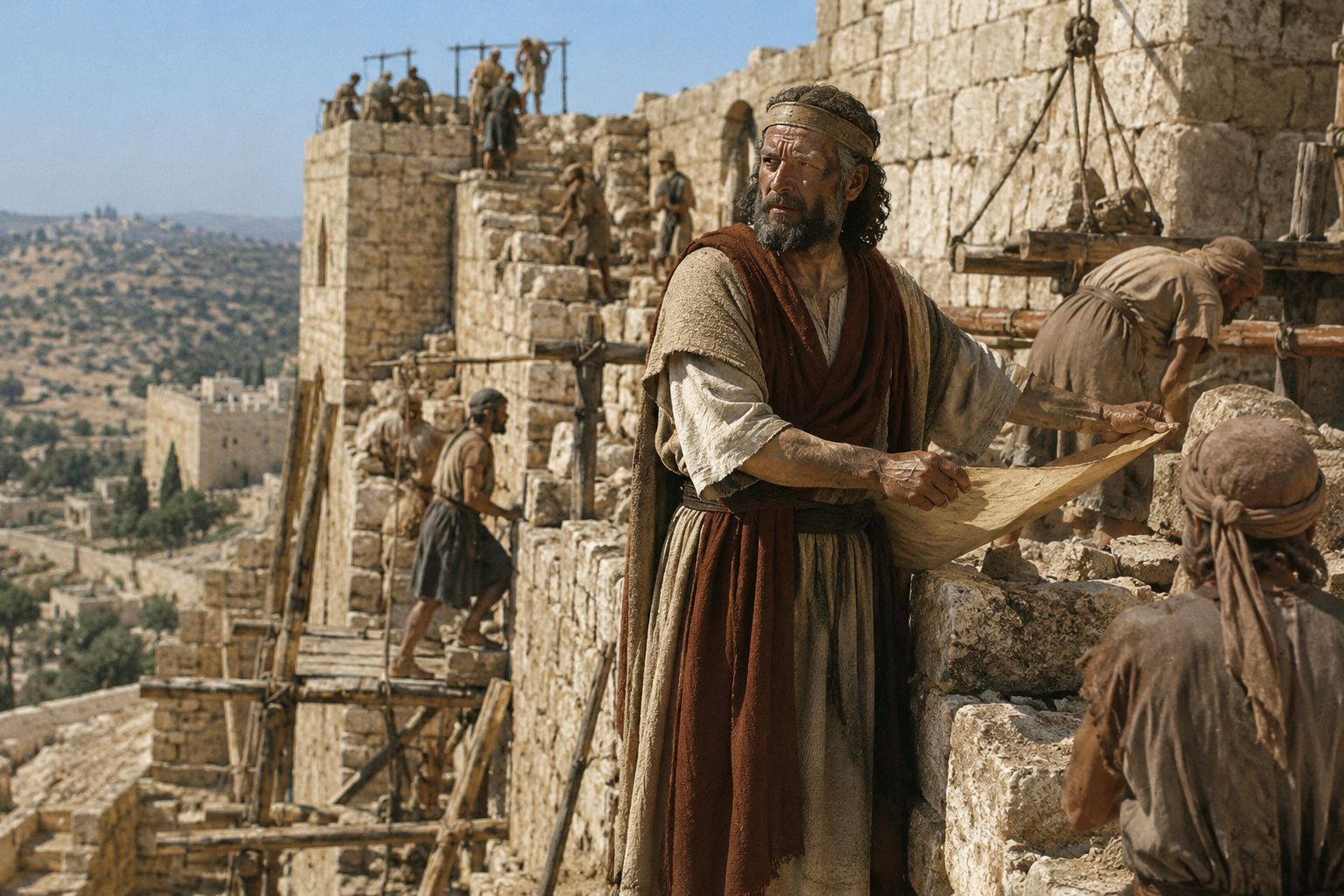
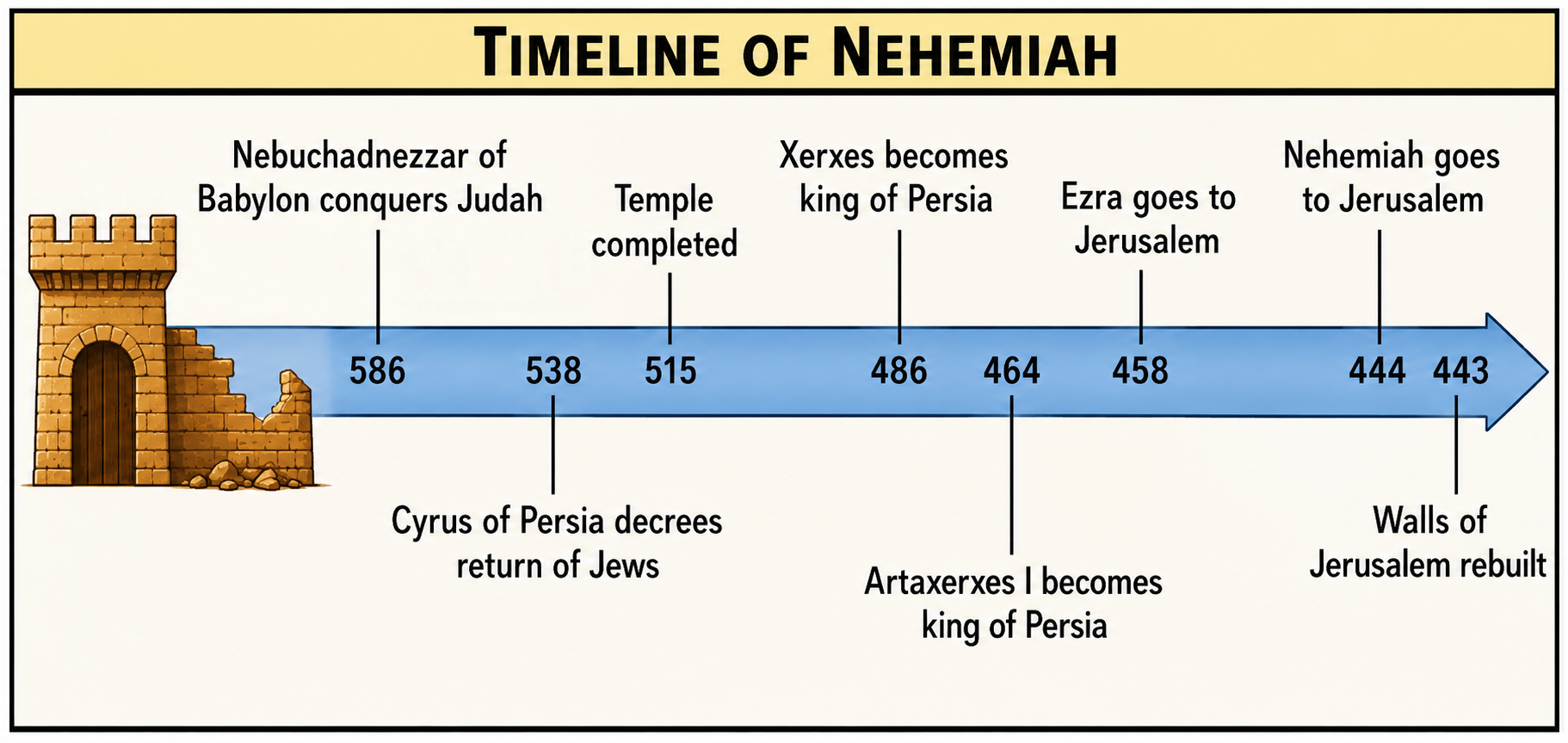
NEHEMIAH UNDER CONSTRUCTION
JUST A FEW NOTES NOW
WILL FINISH IF THE LORD WILLS
Nehemiah 2:1 And it came about in the month Nisan, in the twentieth year of King Artaxerxes, that wine was before him, and I took up the wine and gave it to the king. Now I had not been sad in his presence.
- Nisan (KJV): Es 3:7
- the twentieth (KJV): Ne 1:1 Ezr 7:1,7
- I took up (KJV): Ne 1:11 Ge 40:11,21
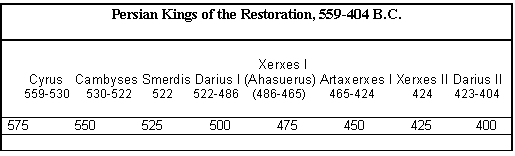
And it came about in the month Nisan, in the twentieth year of King Artaxerxes, that wine was before him, and I took up the wine and gave it to the king. Now I had not been sad in his presence.
Bob Utley - "Nisan" This would have been March ‒ April, three months after Hanani's news. It shows the length of Nehemiah's prayer and fasting. ▣ "in the twentieth year" There were two calendars in use by the Jews in this Persian period, which started at different times of the year (Nisan and Tishri). This causes the dates possibly to be off one year. ▣ "wine" The Persian kings were known for their drinking parties, yet because of Neh. 2:6, "the Queen" being included, this may have been a private meal. ▣ "I had not been sad in his presence" It was a dangerous thing to show personal emotion in the king's presence (cf. Neh. 2:2c; Esther 4:2). Possibly Nehemiah planned this encounter! Notice the parallel between the cupbearer of Pharaoh (cf. Gen. 40:7ff) and Nehemiah.
Nisan. This would mean the first day of the month Nisan, which was the first month of the religious year of Israel. The twentieth year of Artaxerxes is generally accepted as 445 B.C., in terms of more or less standard secular chronology. This date is important as the starting date of the uniquely significant prophecy of the seventy weeks (see notes on Daniel 9:25-27).
wine. Nehemiah was the king's cupbearer (Nehemiah 1:11), evidence of the high degree of trust placed in him by Artaxerxes. The use of poison as a means of assassination was common in antiquity.
Ryrie - Nisan (Mar.-Apr.) of 444 B.C., four months after Nehemiah began praying, but still in the twentieth year of Artaxerxes's reign (1:1), since his official year began and ended in Tishri (Sept.-Oct.). For months of the year, see note on Ex. 12:2.
Brian Bell - Title on Nehemiah 2:1-20: 3 + 3
- 3 qualities of a great leader: Waiting, Praying, Asking.
- 3 essentials to Christian Service: Investigation, Cooperation, Determination.
WAITING - Nehemiah didn’t up and quit his job & then make haste to Jerusalem. Suetonius (Roman historian, just after time of Christ) said, Make haste slowly. No, he prayed & worked faithfully for 4 months. He waited to approach the king in the Lord’s time. Is there anything he is asking you to wait for right now? How are you dealing with it? Need some tips? (Nehemiah Nuggets) 3 scriptures that help us not to rush into things:
- Stand still and see the salvation of the LORD. Ex.14:13
- Sit still my daughter, until you know how the matter will turn out; for the man will not rest until he has concluded the matter this day. Ruth 3:18
- Be still and know that I am God. Ps.46:10
Waiting on the Lord is not wasting time but investing time. Working is easier than waiting…but wait any ways. A Latin Proverb, Impulse manages all things badly. We’re in such a hurry. Annual cost of running red lights (in medical bills, car repairs, etc) $7 billion. Average amount of time saved by running a red light: 50 seconds. (U.S. Department of Transportation, cited in Hope Health Letter (2/96). "To Verify," Leadership.) Do you have faith to wait?Let these Scriptures seep in:
- Is. 28:16 Whoever believes will not act hastily.
- Is.30:18b Blessed are all those who wait for Him.
- Hab .2:1-3 I will stand my watch And set myself on the rampart, And watch to see what He will say to me, And what I will answer when I am corrected. Then the LORD answered me and said: "Write the vision And make it plain on tablets, That he may run who reads it. For the vision is yet for an appointed time; But at the end it will speak, and it will not lie. Though it tarries, wait for it; Because it will surely come, It will not tarry.
Faith + Patience ≠ laziness. In what area is the lord asking you to wait in?
Matthew Henry's Concise - Nehemiah's Request to the King (2:1-8)
Our prayers must be seconded with serious endeavours, else we mock God. We are not limited to certain moments in our addresses to the King of kings, but have liberty to go to him at all times; approaches to the throne of grace are never out of season. But the sense of God's displeasure and the afflictions of his people, are causes of sorrow to the children of God, under which no earthly delights can comfort. The king encouraged Nehemiah to tell his mind. This gave him boldness to speak; much more may the invitation Christ has given us to pray, and the promise that we shall speed, encourage us to come boldly to the throne of grace. Nehemiah prayed to the God of heaven, as infinitely above even this mighty monarch. He lifted up his heart to that God who understands the language of the heart. Nor should we ever engage in any pursuit in which it would be wrong for us thus to seek and expect the Divine direction, assistance, and blessing. There was an immediate answer to his prayer; for the seed of Jacob never sought the God of Jacob in vain.
Steven Cole - The Realities of Serving God (Nehemiah 2:1-20)
One of the refreshing marks of young people is their idealism. Even if you know from years of experience that a young person’s ideals are not practical, his zest can inspire faith and hope in those of us who may have lost our vision somewhere in the many battles of life. Someone has said, “Ideals are like the stars. We never reach them but, like the mariners on the sea, we chart our course by them” (Carl Schurz, Reader’s Digest [5/84], p. 66).
But as you mature, you learn that the real world isn’t quite as perfect as you had once envisioned. One jaded pastor put it, “Originally my life’s goal was a huge silver banner with the words, ‘Win the World for Christ!’ Eventually it became, ‘Win one or two people.’ Now it’s, ‘Try not to lose too many.’” While it is overly pessimistic, there is a grain of wisdom buried in his comment and we would do well to think about it before we rush into any service for the Lord.
We’ve all heard of Murphy’s Law: “If anything can go wrong, it will.” There are many variations of it:
“The other line moves faster. This applies to all lines: bank, supermarket, tollbooth, customs. If you change lines, then the line that you were originally in moves faster!”
“All papers that you save will never be needed until such time as they are disposed of, when they become essential.”
“When you’re working on your car, any tool dropped will roll under the car to the car’s geographic center.”
Or, as one wag summed up, “Murphy was an optimist!”
All of these statements are exaggerations, of course. But they make us chuckle because they resemble somewhat the real world we live in. Things don’t always go smoothly, even when we have prayed about it beforehand. Following Jesus does not guarantee a trouble-free life. In fact, it often gets us into deeper trouble. But, part of maturity is learning to deal with the world as it is, not as we would like it to be.
That applies in the realm of Christian service. It’s easy for a young person or a new Christian to become very idealistic about serving the Lord. Whether it is an opportunity to teach Sunday School, to serve on a church committee, to work with the youth group, to go on a short-term missions trip, or to go into some kind of full-time Christian work, it’s easy to get stars in your eyes. “It will be wonderful to serve the Lord! I’ll be working with other Christians who also love the Lord. It will be so different from my job in the world working with all those worldly pagans!” And so we jump in, only to find out that the water isn’t just warm; sometimes it is scalding hot! Not anticipating the realities, many grow disillusioned and quit. One of the main reasons missionaries return from the mission field is conflicts with their fellow workers.
Nehemiah 2 has some helpful insights on the realities of serving God. Even though Nehemiah was doing God’s will, it wasn’t all smooth and rosy. Studying his life will help us, on the one hand, not to be overly idealistic and thus vulnerable to disillusionment; and, on the other hand, to be realistic while not giving in to cynicism and dropping out. Nehemiah faced real problems, but he moved through them to great accomplishments. Our chapter shows us three things:
To serve God realistically, we must learn to wait on Him, to work with people, and to wrestle wisely with problems.
Waiting on God, working with people of all sorts, and wrestling wisely with a steady stream of problems are essentials of finishing the course that God has set before us.
1. To serve God realistically, we must learn to wait on Him.
The chapter begins with a chronological note that, compared with Neh 1:1, shows us that four months elapsed between the time that Nehemiah heard the report of Jerusalem until his opportunity to speak to the king. During that time, Nehemiah was so burdened by the news that he wept, mourned, fasted, and prayed for God to do something about the grievous situation in Jerusalem.
Compared to other men in the Bible whom God used, four months was a pretty short wait. Abraham waited over 25 years for God to give him Isaac. Joseph spent time as Potiphar’s slave and then two years in prison before God elevated him to second beneath Pharaoh. Israel was enslaved for 400 years in Egypt. Moses spent 40 years in the desert before God used him to bring Israel out of Egypt. Then the nation spent 40 more years in the wilderness. David spent his twenties running from King Saul. The apostle Paul spent three years alone in Arabia and more years in obscurity in Tarsus before the Lord began to use him in a more significant manner. Those whom God uses must learn to wait on Him.
Waiting is hard! It seems like life is too short, anyway. Time’s a wasting! And then, God puts you on hold. What do you do while you wait? Nehemiah did three things.
A. WHILE WAITING, NEHEMIAH PRAYED.
The prayer that we looked at last week (Neh 1:5-11) was not a one-shot deal. It is a summary of what Nehemiah prayed over and over again during those four months as the burden for God’s glory and God’s people in Jerusalem weighed upon him. Throughout the book, we find Nehemiah praying no less than 11 times in 13 chapters (Neh 1:5-11; Neh 2:4; Neh 4:4, 9; Neh 5:19; Neh 6:9, 14; Neh 13:14, 22, 29, 31).
Many of these are just sentence prayers, like the one in our text (Neh 2:4), but they reflect the fact that in any and every situation, Nehemiah looked to God in prayer. He is an example of a man who prayed without ceasing (1 Thess. 5:17). The Greek word translated “without ceasing” does not mean without any break, which would be impossible. It is used of a hacking cough and of repeated military assaults. It means that prayer should be something we return to again and again until we obtain an answer.
Note Nehemiah’s prayer in Neh 2:4. The king notices that Nehemiah is sad in his presence, which was a breach of protocol. Kings liked to be surrounded by happy people. This could have caused Nehemiah to lose his job or even his life. Some think that he deliberately staged this sadness, in light of his prayer in Neh 1:11. Or, I think that his request in 1:11 was a daily prayer for four months, but on this particular day, Nehemiah inadvertently let his sorrow over Jerusalem show on his face, leading to this encounter. The gravity of his situation is seen in that he was “very much afraid” (Neh 2:2). It was the opportunity that he had been waiting for, but when it actually came, he was terrified. How did he handle it?
“So I prayed to the God of heaven. And I said to the king….” It had to be a silent, instantaneous cry of “Help, Lord!” Or, “Lord, give me wisdom now!” This quick sentence prayer rested on four months of extended praying. It shows that Nehemiah depended on the Lord in every situation. As 2:8 shows, Nehemiah didn’t attribute the king’s favorable response to good luck. Rather, “the king granted them to me because the good hand of my God was on me.” As Proverbs 21:1 states, “The king’s heart is like channels of water in the hand of the Lord. He turns it wherever He wishes.” Or, as Hudson Taylor said, “It is possible to move men through God by prayer alone” (cited by Charles Swindoll, BORROW Hand Me Another Brick [Thomas Nelson Publishers], p. 43).
One reason God makes us wait on Him is to teach us to depend on Him in prayer. If He immediately granted everything we ask for, we’d grab the goodies and forget God. But when we wait on God in prayer, we learn to seek God Himself and to depend upon Him in ways that we never would learn any other way. And, when the answer finally comes, we realize that it is because of one reason: “the good hand of our God was upon us.” Thus we give Him all the glory He deserves.
B. WHILE WAITING, NEHEMIAH DEVELOPED PATIENCE.
Waiting reveals our impatience and teaches us to be patient. Patience is a fruit of the Spirit that God wants to develop in all of His children, but especially in leaders. An impatient leader can cause a lot of problems if he reacts impetuously in a crisis.
Derek Kidner (Ezra & Nehemiah Tyndale Old Testament Commentaries [IVP], p. 78) observes that Nehemiah’s waiting on God in prayer in chapter 1 was remarkable in light of his natural bent for swift, decisive action, and “it shows where his priorities lay.” He didn’t hear about the scene in Jerusalem and immediately rush into the king’s presence asking for a year’s leave of absence because God had called him to Jerusalem. For four months he concealed this heavy burden from the king and presented it to God in private, until God finally opened the opportunity to talk with the king. Only then did Nehemiah move ahead.
His patience is also seen when he arrived in Jerusalem. He could have ridden into town with his retinue of soldiers and announced, “I have come to help you rebuild the wall! We’ll have a meeting in one hour to disclose my plan!” But he waited three days before doing anything, and even then he moved cautiously, keeping his purpose concealed until the right moment.
Many pastors, especially when they’re fresh out of seminary, bursting with great ideas for reforming the church, move too quickly and meet resistance. The metaphor of sowing and reaping should teach us that we need patiently to sow God’s Word into lives, and that change takes time. Nehemiah prayed and he was patient as he waited on God to work.
C. WHILE WAITING, NEHEMIAH PLANNED.
The chapter shows that Nehemiah had been doing a lot of advance thinking and planning. When the king asked how long he would be gone, Nehemiah didn’t vaguely say, “Well, that’s up to the Lord!” He gave him a definite time. While we later learn (Neh 5:14) that he was in Jerusalem for 12 years, probably he finished the wall, then returned to report to Artaxerxes, and then came back to serve as governor.
Not only did Nehemiah give the king a definite time, he also laid out some definite requests that show that he had been doing some careful planning (Neh 2:7-8). He requested letters from the king to the governors of the provinces to allow him to pass through their territory. He asked for a letter to the keeper of the king’s forest, to get timber for making repairs to the walls and gates, and for a house for himself. When he got to Jerusalem, he assessed the situation firsthand and obviously did some thoughtful planning as to how to approach the project.
Prayer and planning are not at odds with each other. Many Christians think that it’s unspiritual to plan. They will say, “Let’s just trust the Lord,” which being interpreted means, “I don’t have a clue about how we’re going to move from here to there!” It’s true that we can go to the other extreme of being so elaborate in our plans that we trust the plans, not the Lord. But Nehemiah shows the biblical balance of waiting on God in prayer, but also thinking and planning about what he would do when God opened the door.
Thus while you wait on the Lord, you pray, you develop patience, and you plan.
2. To serve God realistically, we must learn to work with people.
It’s easy to be idealistic about serving God until you meet the actual people that you have to work with! Suddenly you realize the truth that Linus shouted, “I love mankind; it’s people I can’t stand!” I often joke that the ministry would be great if it weren’t for the people! Sometimes I envy those guys with a radio ministry. They just talk into a microphone in a quiet studio and never have to relate to all the cranky people in their radio audience!
But the ministry involves people. Many pastors bomb out of ministry because they’ve never learned how to work with people. They’re abrasive or insensitive and when people react against them, they develop a persecution complex. But Nehemiah was sensitive to people and he responded with tact. But when needed, he confronted with uncompromising strength. There are three types of people he dealt with in our chapter:
First, Nehemiah knew how to work with an unbelieving king. This was an especially difficult situation in that the king was Nehemiah’s boss who literally had the power to make Nehemiah’s head roll! That’s why Nehemiah was very much afraid when the king asked him why he was sad in his presence. You didn’t rain on this man’s parade without sometimes severe consequences! Also, the king had previously stopped the work on the wall in Jerusalem (Ezra 4:21). The decrees of the kings of the Medes and Persians were proverbial about being unchangeable. Now Nehemiah wants to convince this Persian king to reverse his policy about Jerusalem! It was no easy task!
How did Nehemiah do it? As we’ve seen, he moved the king through private prayer. It is amazing how God can soften the hearts of the most difficult people if we will spend time asking Him to do so! Talk to God before you go to talk to a difficult person.
Also, Nehemiah had gained the king’s respect through his competence on the job. The king’s inquiry about how soon Nehemiah could return shows that he wanted him to come back! Nehemiah’s trustworthy character and his loyalty to the king had been obvious over the time that he had worked for the king. Every Christian should be a witness on the job first by godly character and competence, and only second by verbal witness.
Also, Nehemiah was tactful and sensitive in how he spoke to the king. He never mentions Jerusalem by name—that would have been a sore spot with the king! He refers to it in personal terms, as the place of his fathers’ tombs, a point that this pagan king could relate to. If you have to speak to an unbelieving boss about a difficult subject, think about how he will receive it and speak in a manner that he is certain to identify with.
Also, Nehemiah knew how to relate to demoralized believers. The Jews in Jerusalem believed in God and His covenant promises, at least intellectually. But they had lost hope. They had tried to rebuild the wall, but had been shot down. They were likely to resist this outsider coming in and telling them to try something that they knew could not be done. Some may not even have seen the need. Others would warn that if you tried to rebuild the wall, you’re only going to stir up the opposition of the surrounding governors.
Nehemiah’s careful, secretive preparations once he got to Jerusalem show that he anticipated some resistance to his proposal. So he spent three days doing his homework and thinking about how to present this in a way that would overcome the objections. After that he called the Jewish leaders and people together and began by stating the problem very plainly (Neh 2:17): “You see the bad situation we are in, that Jerusalem is desolate and its gates burned by fire.” He also identified himself with them in the problem. It wasn’t their problem; it was our problem. He didn’t blame them for things but neither did he gloss over the fact that we have a problem.
Then, he appealed to a need that they all felt, “that we may no longer be a reproach.” They all knew that a defenseless Jerusalem was a joke to the surrounding neighbors. They sensed that Nehemiah had come to seek their welfare (Neh 2:10). Finally, he told them how God already had been favorable as seen in the king’s favorable response. Perhaps he showed them the letters from the king and the requisition for the timber. Their instant response was that of hope: “Let us arise and build!”
There’s an art to working with people and learning to motivate them to accomplish great things for God. Some leaders err by becoming people-pleasing politicians. They want everyone’s approval, so they tell people what they want to hear rather than what they need to hear. But they erode trust because people quickly realize that they are manipulative and do not speak the truth.
Other leaders err by telling it like it is, but without sensitivity and tact. They don’t take the time to listen to people and understand where they’re at and how they feel about things. When people react against their leadership, they label them as disobedient and move on. Nehemiah should teach us to combine wisdom and tact with plain truth.
The third group of people that Nehemiah had to work with was the enemies. Sanballat was the governor of Samaria to the north. Tobiah, whose name is Jewish (“Yah is good”), ruled the Ammonites to the east. Geshem was the leader of the Arabs to the south. They all opposed a fortified Jerusalem because it threatened their political positions. They didn’t care at all about the plight of the Jews, much less about the name of the Lord being exalted in Jerusalem. So they were very displeased (Neh 2:10) and joined together to ridicule the project and accuse the people of rebellion against the king (Neh 2:19).
Nehemiah demonstrates both wisdom and courage in dealing with these enemies. He was wise in that he sensed, “This is no time for diplomacy. I need to meet these enemies head-on.” Any meeting to hear their concerns or to work out a compromise would have been a mistake. So Nehemiah courageously confronted them and drew the line between them and God’s people so that they could not join the project with the goal of sabotaging it. He didn’t use the clout of the king’s letters, but rather spiritual clout: “The God of heaven will give us success” (Neh 2:20).
Any time God’s people say, “Let’s arise and build,” the enemy will say, “Let’s arise and stop them.” J. Sidlow Baxter writes, “There is no winning without working and warring. There is no opportunity without opposition” (Explore the Book, Six Volumes in One [Zondervan], 2:230). A godly leader must have the discernment to know when to work with people and when to confront and oppose them. Early in my ministry, a veteran pastor, Ray Ortlund, told me, “You’ve got to decide where you want to give blood.” It is good counsel!
Thus to serve God realistically, you must learn to wait on Him and to work with people. Finally,
3. To serve God realistically, we must learn to wrestle with problems.
Any time you try to do anything significant for God, there will be problems. The enemy will see to that! We’ve already seen how Nehemiah dealt with the problem of the enemies. But also, he had to face the problem of the destroyed wall.
He began with a realistic firsthand appraisal of the situation. In one place, the rubble was so bad that he couldn’t ride his horse or mule through the debris. As the leader, he needed to know exactly how bad things were so that he could develop a realistic, practical plan of action. Nehemiah didn’t gloss over the problems. He describes it to the people as “a bad situation.”
Again, we need balance here. Some leaders are so sanguine that they refuse to acknowledge how bad things are. People in the trenches feel that he’s out of touch and it undermines his leadership. Other leaders are so engulfed by the problems that they lose hope. Nehemiah realistically saw the problem and, as we will see, broke it down into manageable units in order to get the job done.
Conclusion
So to serve God realistically, we must wait on Him for His timing, work with different sorts of people, and wrestle with problems. Just because it is the Lord’s work and He is on our side does not mean that everything will work out smoothly and effortlessly. We need both the idealism of what God wants to do and the realism that there will be major hurdles to overcome. But it’s worth all the hassles. My parents used to have the little plaque on the wall by the door that said, “Only one life, ’twill soon be past; only what’s done for Christ will last.” I hope that all of you will know the joy of serving Him in spite of the inevitable difficulties.
Discussion Questions
- How can we guard ourselves from disappointment and cynicism when things do not go well in our service for God?
- When do we cross the line from proper planning to excessive planning? What factors can we watch out for?
- How can a person who does not work well with people learn this essential skill? What steps would you advise?
- How can you know when to be diplomatic and when to confront boldly? What guidelines should we follow? (Check out Jesus’ various interactions with people in this regard.)
Nehemiah 2:2 So the king said to me, “Why is your face sad though you are not sick? This is nothing but sadness of heart.” Then I was very much afraid.
- Why is thy (KJV): Ge 40:7
- sorrow (KJV): Pr 15:13
- Then I (KJV): Probably the king spoke as if he had some suspicion that Nehemiah harboured some bad design, and that his face indicated some conceived treachery, or remorse; and, indeed, the words rendered sad, and sorrow of heart, might be rendered evil, and wickedness of heart.
So the king said to me, “Why is your face sad though you are not sick? This is nothing but sadness of heart.” Then I was very much afraid.
Bob Utley - "I was very much afraid" It was inappropriate to bring up personal matters to the King (cf. Esth. 4:2). Also, this same King had ruled against rebuilding the walls of Jerusalem earlier (cf. Ezra 4:23). This shows Nehemiah's faith and fear.
Ryrie - A sad countenance was not tolerated in the royal presence, so Nehemiah had good reason to be afraid (cf. Est. 4:2).
Brian Bell - SECOND QUALITY OF A GREAT LEADER - PRAYING (Neh 2:2-4) Why was Nehemiah afraid? What was the rule of the day? No one was to appear before the king w/sadness or bad news.
Esther 4:1,2 When Mordecai learned all that had happened, he tore his clothes and put on sackcloth and ashes, and went out into the midst of the city. He cried out with a loud and bitter cry. He went as far as the front of the king's gate, for no one might enter the king's gate clothed with sackcloth.
You could lose you life for having one bad day at the office. My, how some have perfected the act of sadness among others. Each time you speak to them it is the whoa is me syndrome. Often simply seeking attention (I’m not referring to those legitimately sad)
Through fear…a splendid courage. His secret?…Prayer. He was effective in his 911 Prayers because he spent much time alone w/the Lord. i.e. all of chapter And 4 months worth so far. Regular times of prayer must be the context for all our instant prayers. Do you talk to God like this throughout your day? Interesting to note, Nehemiah could come to the God’s Throne of Grace any time, but he had to wait an invitation before Artaxerxes throne?
Nehemiah 2:3 I said to the king, “Let the king live forever. Why should my face not be sad when the city, the place of my fathers’ tombs, lies desolate and its gates have been consumed by fire?”
- Let the king (KJV): Far from wishing ill to my master, I wish him to live for ever. 1Ki 1:31 Da 2:4 Da 3:9 Da 5:10 Da 6:6,21
- the city (KJV): Ne 1:3 Ps 102:14 Ps 137:6 La 2:9
- the place (KJV): 2Ch 21:20 2Ch 28:27 2Ch 32:33
I said to the king, “Let the king live forever. Why should my face not be sad when the city, the place of my fathers’ tombs, lies desolate and its gates have been consumed by fire?”
Bob Utley - "Let the king live forever" This VERB (BDB 310, KB 309; Qal IMPERFECT) is used in a JUSSIVE sense. This was a common hyperbole of respect and best wishes in addressing Near Eastern monarchs (cf. 1 Kgs. 1:31; Dan. 2:4; Dan 3:9; Dan 5:10; Dan 6:6,21). Special Topic: Forever ('olam) ▣ "fathers' tombs" Notice that he never says "Jerusalem." The Persian Kings also buried their fathers. ▣ "its gates have been consumed by fire" The Jews had always been supportive of the Persian kings who allowed them to return to Judah. Possibly the Persian Empire needed some military outposts in this region as a buffer against Egypt, which at this time was currently in revolt. The VERB (BDB 37, KB 46, Pual PERFECT) could refer to (1) the destruction by Nebuchadnezzar's army in 586 B.C. (cf. 2 Kgs. 25:10) (2) a more recent destruction of the Jews' attempt to rebuild the walls (cf. Ezra 4:7-24). In typical Rabbinical Jewish fashion, he answers a question, w/a question. (not demanding) Tombs – why does he mention this? A pagan monarch wouldn’t be moved to sorrow over the ruins of Jerusalem, but would show respect for the dead.
Nehemiah 2:4 Then the king said to me, “What would you request?” So I prayed to the God of heaven.
- For what (KJV): 1Ki 3:5 Es 5:3,6 Es 7:2 Mk 10:51
- So I prayed (KJV): Ne 1:4,11 2Sa 15:31 Pr 3:6 Php 4:6
Then the king said to me, “What would you request?” So I prayed to the God of heaven.
Excellent practical example of 1Th 5:17.
Bob Utley - "So I prayed" This instant prayer for wisdom and a favorable hearing from Artaxerxes I is quite a contrast to the three month fasting prayer of Neh. 1:4-2:1. Both have their appropriate place.
Believer's Study Bible - vv. 4-7) The decree of Artaxerxes to restore and rebuild Jerusalem in the twentieth year of his reign (cf. 1:1, note) marks the beginning of the "seventy weeks" foretold by Daniel (cf. Dan. 9:24, note). The month "Nisan" corresponds to March-April. Nehemiah waited some four months in the confident hope that God would provide an opportunity for him to make his appeal to the king (vv. 2, 3). Note his brief prayer before answering the king's timely question (v. 4), even though he had a definite strategy already in mind (vv. 7, 8).
Ryrie - Though Nehemiah's prayer was (of necessity) brief and silent, it had been preceded by a long period of petition to the Lord (1:4-11).
Nehemiah 2:5 I said to the king, “If it please the king, and if your servant has found favor before you, send me to Judah, to the city of my fathers’ tombs, that I may rebuild it.”
- If it please (KJV): Ezr 5:17 Es 1:19 Es 5:8 Es 7:3 Es 8:5
- and if thy (KJV): Ru 2:13 2Sa 14:22 Pr 3:4
I said to the king, “If it please the king, and if your servant has found favor before you, send me to Judah, to the city of my fathers’ tombs, that I may rebuild it.
Bob Utley - Nehemiah is asking for both (1) a personal favor (i.e., send me back to my God's city to rebuild it Qal IMPERFECT used in a COHORTATIVE sense) (2) a political need (i.e., a walled city with a faithful population in an area of the empire currently in revolt, i.e., Egypt)
445BC: the start date for Daniel's 70 weeks in Dan 9:25. Note Nehemiah asks for permission to rebuild THE CITY, not the Temple...thus corresponding exactly to Dan 9:25 - “So you are to know and discern that from the issuing of a decree to restore and rebuild Jerusalem until Messiah the Prince there will be seven weeks and sixty-two weeks; it will be built again, with plaza and moat, even in times of distress.. But the Jews would not recognize the time (KAIROS: a fixed and definite time when things are brought to crisis, a specific opportunity) of His visitation (Luke 19:44) - "and they will level you to the ground and your children within you, and they will not leave in you one stone upon another, because you did not recognize the time of your visitation.”
Henry Morris - build it. Nehemiah's request and commission were not to build the temple, which was already completed, but the city, especially its walls (Daniel 9:25).
Brian Bell - THIRD QUALITY OF A GREAT LEADER - ASKING (Neh 2:5-10)
He needed safe passage & building materials. He answers the king confidently & respectfully. Which of these 2 do you struggle with? If you were telling the story to a friend would it come across too confident w/no respect? Like, (with attitude) then I told that king…] Or would you show respect only & leave off any confidence? [uh, uh, uh, I don’t need anything Mr.King Sir!] Remember you’re one of The Kings kids. When you speak up for your King, or on behalf of Him, or as an ambassador from Him…Speak up, with respect.
So he asks for 2 things:SEND ME (Neh 2:5,6 AND GIVE ME Neh 2:7-10) Whenever God wants to get a work done, He uses willing people. (He can override of course) Nehemiah had been planning his work carefully, so he was able to give the king satisfactory answers. It is not clear thinking & organization OR Prayer. But instead… Prayer + clear thinking & organization. They are not opposites but allies, best friends.
Nehemiah was very thorough as a leader. He knew the time schedule & even had his building list made. He even knew the name of the keeper of the forest. (Neh 2:8)
Nehemiah 2:6 Then the king said to me, the queen sitting beside him, “How long will your journey be, and when will you return?” So it pleased the king to send me, and I gave him a definite time.
the queen (KJV): Heb. the wife, It was probably Esther who was present at this time, and who seconded Nehemiah's request.
So it pleased (KJV): Ne 2:4 Ne 1:11 Isa 58:12 Isa 61:4 Isa 65:24
I set him a time (KJV): It is probable that this time was no more than six months, or a year; after which he either returned, or had his leave of absence lengthened, as we find he was twelve years governor of the Jews. Ne 5:14 Ne 13:6
Then the king said to me, the queen sitting beside him, “How long will your journey be, and when will you return?” So it pleased the king to send me, and I gave him a definite time.
Bob Utley - "the queen" Ctesias (a Greek who lived at the Persian court) tells us that Artaxerxes I had one Queen, whose name was Damaspia (and three concubines). The rare term "Queen" (BDB 993) is used only here and in Ps. 45:9. The Septuagint translates it as "concubine," but it has the DEFINITE ARTICLE and even the Septuagint translates it "Queen" in Ps. 45:9. ▣ "'How long will your journey be'"The exact time envisioned by Nehemiah is not stated, but it probably was a short time. As it turned out, from Neh. 5:14 and 13:6, he stayed for 12 years. I am sure he returned from time to time to the Persian court.
Henry Morris - the queen. This apparently arbitrary reference to the queen may have been inserted because she was Queen Esther. Some scholars believe her husband Ahasuerus was the same as Artaxerxes (both being titles rather than personal names). Others believe Artaxerxes was either Esther's son or stepson. In any case, the reputation of Artaxerxes was unusually benign for an ancient emperor, and this may have been in part a result of Esther's influence.
Ryrie - Since it was not customary for the queen to appear at formal banquets, her presence indicates that this was a private affair. I gave him a definite time. Nehemiah probably agreed to return after a relatively short time, which was later extended, for he stayed 12 years (5:14).
Nehemiah 2:7 And I said to the king, “If it please the king, let letters be given me for the governors of the provinces beyond the River, that they may allow me to pass through until I come to Judah,
- let letters (KJV): Ne 2:9 Ezr 6:6 Ezr 7:21
- that they may (KJV): Ezr 8:22
And I said to the king, “If it please the king, let letters be given me for the governors of the provinces beyond the River, that they may allow me to pass through until I come to Judah,
Bob Utley - "let letters be given me for the governors" This VERB (BDB 678, KB 733, Qal IMPERFECT) is used in a JUSSIVE sense. Nehemiah wanted documented authority in light of the opposition of the surrounding regions (i.e., Ammon, Samaria, cf. Ezra 4).
Ryrie - 2:7-9 These letters, granting concessions to Nehemiah, form the decree of Dan. 9:25. the fortress protected the Temple. the house. I.e., the governor's home. Nehemiah was also given an armed escort (v. 9). See note on Ezra 8:22.
Brian Bell - GIVE ME (Neh 2:7-10) How does this relate to Ezra 8:22 who, for integrity’s sake, wouldn’t ask this from the king? Ezra refused military protection for a testimony to the faithfulness of God (i.e. God will take care of his own) Nehemiah on the other hand was a governor on official business; he could not travel without his military escort.
Nehemiah 2:8 and a letter to Asaph the keeper of the king’s forest, that he may give me timber to make beams for the gates of the fortress which is by the temple, for the wall of the city and for the house to which I will go.” And the king granted them to me because the good hand of my God was on me.
- the wall (KJV): Ne 2:17 Ne 3:1-32
- the house (KJV): Ne 3:7 Ne 7:2
- the king (KJV): Ne 2:18 Ge 32:28 Ezr 5:5 Ezr 6:22 Ezr 7:6,9,27,28 Pr 21:1 Isa 66:14 Da 1:9 Ac 7:10 Ac 26:22 2Co 8:16
and a letter to Asaph the keeper of the king’s forest, that he may give me timber to make beams for the gates of the fortress which is by the temple, for the wall of the city and for the house to which I will go.” And the king granted them to me because the good hand of my God was on me.
Bob Utley - "the king's forest" Many assume that this refers to the cedars of Lebanon, but this would have been very expensive lumber for wall and gate timber. It seems to refer to a local royal forest because (1) a Jew is in charge of it (Asaph) and (2) the term used to refer to it is a Persian term for "royal garden," possibly one of Solomon's (at Etham, cf. 2 Kgs. 25:4) ▣ "the fortress which is by the temple" This same fortress within the city is mentioned in Neh. 7:2. The Jebusites also had a citadel within the walls, which Josephus calls "Baris" (Antiq. 15.11.4). In the NT it was a fortress like this next to the temple in which Roman soldiers were garrisoned year round (Fortress Antonio, cf. Acts 21:37; Acts 22:24). ▣ "because the good hand of my God was on me" Nehemiah knew the ultimate source was the God of Israel. Nehemiah's God is the one to be praised (cf. Neh. 2:18; Ezra 1:1; Ezra 6:14,22; Ezra 7:27-28; Ezra 9:9). God uses human instrumentality, both Jews (Moses, Exod. 3:8-10) and non-Jews (i.e., Cyrus), believers and unbelievers, to accomplish His redemptive purposes for all mankind (cf. Gen. 12:3; Exod. 19:5-6).
Believer's Study Bible - The "king's forest" was probably a wooded area near Jerusalem. Asaph, a Jew, was a keeper. The "house that I will occupy" is an allusion to the governor's residence. Nehemiah assumes that his request to the king necessitates appointment as governor of Judah.
Brian Bell - He trusted in the Lords strong hand (Neh 1:10) & in His good hand (Neh 2:8) to accomplish this great task. See discussion of this great truth The Hand of the LORD.
Nehemiah 2:9 Then I came to the governors of the provinces beyond the River and gave them the king’s letters. Now the king had sent with me officers of the army and horsemen.
- to the governors (KJV): Ne 2:7
- Now the (KJV): Ezr 8:22
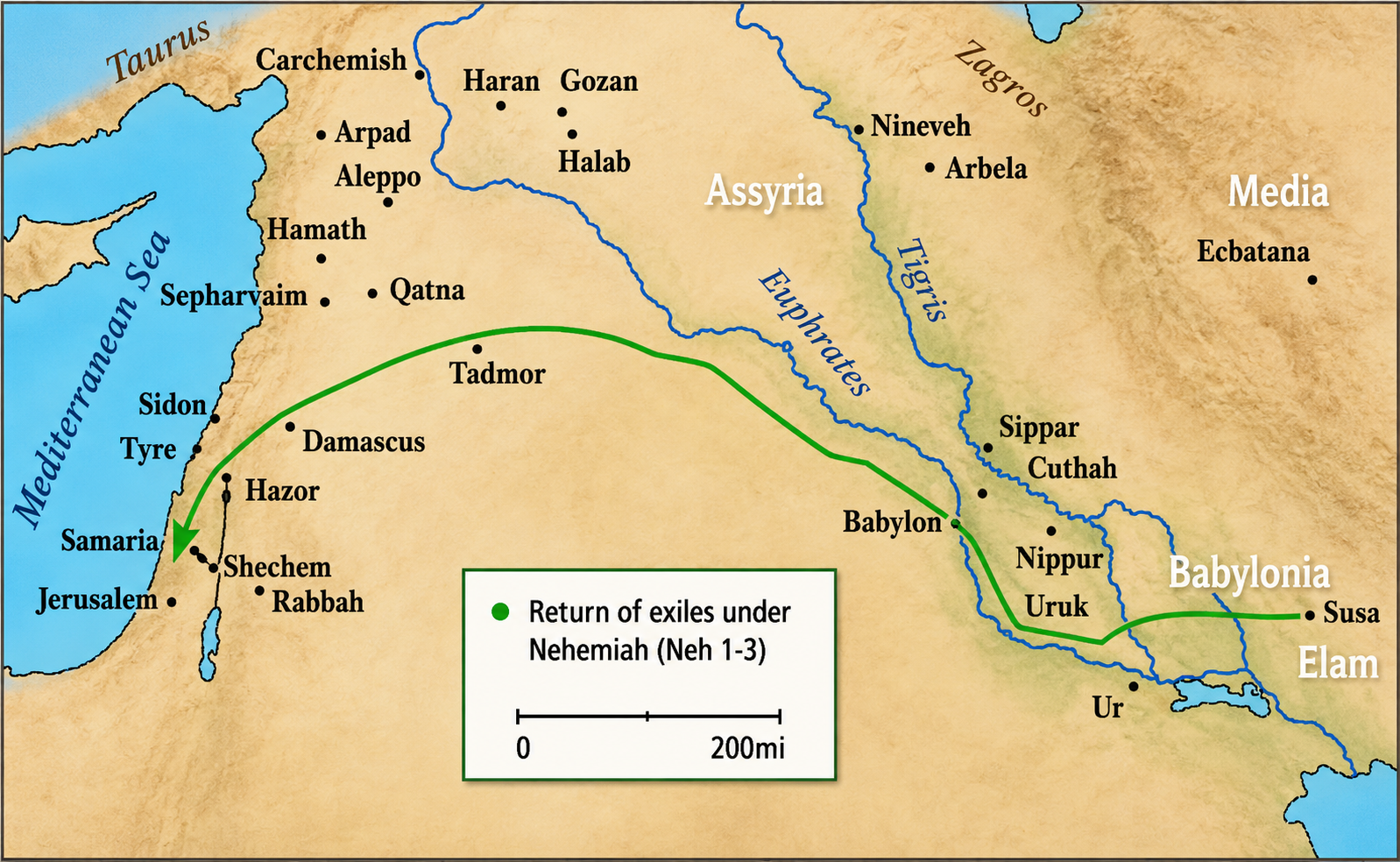
RETURN OF EXILES FROM BABYLON
Then I came to the governors of the provinces beyond the River and gave them the king’s letters. Now the king had sent with me officers of the army and horsemen.
Bob Utley - "the king had sent with me officers of the army, and horsemen" Ezra did not ask for an official escort (cf. Ezra 8:22). Nehemiah used all the official clout he could muster. They were both spiritual men, but functioning in different roles (Ezra — political/spiritual leader, and Nehemiah — political/administrative leader).
Matthew Henry's Concise - Nehemiah Comes to Jerusalem (Neh 2:9-18)
When Nehemiah had considered the matter, he told the Jews that God had put it into his heart to build the wall of Jerusalem. He does not undertake to do it without them. By stirring up ourselves and one another to that which is good, we strengthen ourselves and one another for it. We are weak in our duty, when we are cold and careless.
Nehemiah 2:10 When Sanballat the Horonite and Tobiah the Ammonite official heard about it, it was very displeasing to them that someone had come to seek the welfare of the sons of Israel.
- Sanballat (KJV): Ne 2:19 Ne 4:1-3,7 Ne 6:1
- Horonite (KJV): Isa 15:5 Jer 48:5,34
- the servant (KJV): Pr 30:22 Ec 10:7
- the Ammonite (KJV): Ne 13:1
- it grieved (KJV): Nu 22:3,4 Ps 112:10 Ps 122:6-9 Pr 27:4 Eze 25:6-8 Mic 7:9,10,16,17 Ac 4:2 Ac 5:24 Ac 19:26,27
- there was come (KJV): Ezr 4:4-23
When Sanballat the Horonite and Tobiah the Ammonite official heard about it, it was very displeasing to them that someone had come to seek the welfare of the sons of Israel.
Bob Utley - "Sanballat" This Babylonian name (BDB 702, "May Sin [moon goddess] give life," cf. Neh. 2:10,19; Neh 3:33; Neh 4:1; Neh 6:1,2,5,12,14; Neh 13:28). He was governor of the province of Samaria. We know of him both from the Elephantine papyri and the Samaritan papyri. His children had YHWHistic names. The returning Jews rebuffed his offer of help (cf. Ezra 4:3), which infuriated him. ▣ "the Horonite" This means that he was from one of the two Canaanite cities called Beth-horon; both were located in the old tribal allocation of Ephraim (cf. Jos. 10:10-14). ▣ "Tobiah" His name means, "YHWH is my good" (BDB 375). He was an Ammonite enemy of Nehemiah and all returning Jews (cf. Neh. 2:10,19; Neh 3:35; Neh 4:1; Neh 6:1,12,14,17,19; Neh 13:4,7,8). ▣ "official" This is literally "slave," "servant" (BDB 713). This term became a title of honor and access to the court. It is interesting that who he served is not stated, so he was not a servant of Sanballat, but a person of leadership himself. It is just possible that he was governor of Ammon as Nehemiah was governor of Judah, both under the satrap of "the Province Beyond the River." His name occurs in some later lists of leaders of Ammon. If this is so, then these three enemies denoted that the leaders of the regions surrounding Judah were all hostile. ▣ "it was very displeasing to them" This is the same term (BDB 949) that was used in Neh. 2:3 to describe Nehemiah (cf. Neh. 13:8, where Nehemiah throws Tobiah's personal belongings out of a room in the temple). For other uses in the same sense see Gen. 48:17; 1 Sam 8:6; 1 Sam 18:8; Isa. 59:15; Jonah 4:1). Sanballat and Tobiah were still angry (BDB 949, KB 1269, Qal IMPERFECT) at their rejection of helping rebuild the temple (cf. Ezra 4:3). ▣ "the sons of Israel" In this idiom the term Israel (BDB 975, KB 442) refers to Jacob's new name after he wrestled with the angel (cf. Gen. 32:28). It can mean - El persisteth, El perseveres, El contendeth. All of the tribes of Israel came from his sons (cf. Gen. 49:3-27; Exod. 1:2-4, Joseph's two children, Ephraim and Manasseh, both became tribes, cf. Gen. 48:8-22).
Henry Morris - Sanballat was governor of the Persian province of Samaria. His name has been found on one of the famous Elephantine papyri, dated 407 B.C.
Believer's Study Bible - Sanballat is identified by the Jewish historian Josephus as "satrap of Samaria" under the Persians. He was probably one of the "governors" to whom Nehemiah brought letters (v. 9). Sanballat is called "the Horonite" to designate his birthplace or residence, i.e., either Upper or Lower Beth Horon, which formerly belonged to Ephraim (cf. Josh. 16:3, 5; Josh 18:13). During the time of Nehemiah it was held by the Samaritans. Tobiah was either the native chief of the Ammonites or the servant or secretary of Sanballat (6:17, 19). In either case, by making alliances with various Jewish nobles (6:17; 13:4, 28), both individuals sought to sabotage the efforts of Ezra and Nehemiah to fortify Jerusalem.
Ryrie - Sanballat. Also mentioned in the Elephantine Papyri as governor of Samaria, he assessed Nehemiah's arrival as a threat to Samaria's control of Judea. Tobiah. Probably an ex-slave, now governor of Ammon.
Nehemiah 2:11 So I came to Jerusalem and was there three days.
- Ezr 8:32
So I came to Jerusalem and was there three days.
Bob Utley - "three days" This was possibly a time of rest or prayer (cf. Ezra 8:15,32).
Believer's Study Bible - (vv. 11,12) The potential for both opposition from without and discouragement from within made secrecy essential to the initial development of plans (cf. also Neh 2:16).
Nehemiah 2:12 And I arose in the night, I and a few men with me. I did not tell anyone what my God was putting into my mind to do for Jerusalem and there was no animal with me except the animal on which I was riding. ve no portion, right or memorial in Jerusalem.”
- I arose (KJV): Ge 32:22-24 Jos 10:9 Jud 6:27 Jud 9:32 Mt 2:14
- neither (KJV): Ec 3:7 Am 5:13 Mic 7:5 Mt 10:16
- my God (KJV): This pious and noble-minded man attributes every thing to God. If he purposed any good, it was because God put it into his heart; if he did or received any good, it was because the good hand of his God was upon him; if he expected any good, it was because he earnestly prayed God to remember him for good. Ezr 7:27 Ps 51:18 Ps 122:6 Jer 31:33 Jer 32:40 2Co 8:16 Jas 1:16,17 Rev 17:17
And I arose in the night, I and a few men with me. I did not tell anyone what my God was putting into my mind to do for Jerusalem and there was no animal with me except the animal on which I was riding. ve no portion, right or memorial in Jerusalem.”
Bob Utley - This relates Nehemiah's initial secret inspection of the walls (cf. Neh. 2:16). ▣ "what my God was putting into my mind to do" Nehemiah believed that YHWH was guiding his thoughts and actions. He was a man of prayer, but also a man of action.
Brian Bell - Now, 3 essentials to Christian Service: Investigation, Cooperation, Determination.
INVESTIGATION (Neh 2:11-16) Feel it, experience it yourself. Before asking for help, he personally was acquainted with the needs. He’s forced to dismount & have to actually stumble over the debris. Horseback to on foot. Difference of watching ground zero on TV to standing next to it after 9-11. Such emotional ties. [St Patricks Cathedral, Bag Pipes, orange buckets]
Dedicated leaders are awake when others are asleep. They also see more in darkness than others see in the daylight. In the night...by night (Neh 2:12,13) - It was dark. This is when God has you wrestle in some dark Gethsemane prayer.
Nehemiah 2:13 So I went out at night by the Valley Gate in the direction of the Dragon’s Well and on to the Refuse Gate, inspecting the walls of Jerusalem which were broken down and its gates which were consumed by fire.
- the gate (KJV): Ne 2:15 Ne 3:13 2Ch 26:9
- the dung port (KJV): This was the gate on the eastern side of the city, through which the filth was carried to the brook Kidron and valley of Hinnom. Ne 3:13,14 Ne 12:31
- the walls (KJV): Ne 2:3,17 Ne 1:3 Jer 5:10
So I went out at night by the Valley Gate in the direction of the Dragon’s Well and on to the Refuse Gate, inspecting the walls of Jerusalem which were broken down and its gates which were consumed by fire.
Bob Utley - The locations are uncertain. We know from archeology that Nehemiah's walled city was much smaller than David's. "inspecting" This VERB (BDB 960 I, KB 1304, Qal ACTIVE PARTICIPLE) is often used in the sense of hope (Piel), so here it may denote inspection with a view of restoration.
Henry Morris - dragon well. Some modern versions, with no real justification, translate this as "jackal well." The Hebrew word, however, means "dragon," or at least some kind of monster. Most likely it refers to dinosaurs, that survived into historic times and gave rise to the worldwide legends of dragons (see notes on Job 40:15). The dragon well was known as such by the Jebusites who inhabited the region long before its conquest by Israel. Quite possibly the well was given its name by the first inhabitants who migrated there after the dispersion from Babel, when dinosaurs frequented the spring.
Believer's Study Bible - The "Serpent Well" is identified as either the well of Gihon or some spring in that vicinity because of its location between the "Valley Gate," which is the present "Jaffa Gate" on the western side of the city, and the "Refuse Gate," known by the same name today and located at the middle of the southern wall of Jerusalem.
Ryrie - 2:13-15 Nehemiah's nocturnal reconnaissance began at the SW Valley Gate, proceeded eastward to the King's Pool (probably the Pool of Siloam), then up the ravine (the Kidron Valley), because his donkey or mule could not make it over the rubble of the eastern wall. It is unclear from verse 15 whether he then turned westward, then S, making the complete circuit back to his original starting point, or whether he retraced his steps S, then W, back to the Valley Gate.
Gates. --The following is a complete list of the gates named in the Bible and by Josephus, with the reference to their occurrence:--
1. Gate of Ephraim. 2 Chr 25:23; Nehe 8:16; 12:39
This is probably the same as the--
2. Gate of Benjamin. Jere 20:2; 37:13; Zech 14:10If so, it was 400 cubits distant from the--
3. Corner gate. 2 Chr 25:23; 2 Chr 26:9; Jere 31:38; Zech 14:10
4. Gate of Joshua, governor of the city. # 2 Kin 23:8
5. Gate between the two walls. 2 Kin 25:4; Jere 39:4
6. Horse gate. Nehe 3:28; 2 Chr 23:15; Jere 31:40
7. Ravine gate (i.e. opening on ravine of
Hinnom). 2 Chr 26:9; Nehe 2:13,15; 3:13
8. Fish gate. 2 Chr 33:14; Nehe 3:13;
Zeph 1:10
9. Dung gate. Nehe 2:13; 3:13
10. Sheep gate. Nehe 3:1,32; 12:39
11. East gate. Nehe 3:29
12. Miphkad.# Nehe 3:31
13. Fountain gate (Siloam?). Nehe 12:37
14. Water gate. Nehe 12:37
15. Old Gate. Nehe 12:39
16. Prison gate. Nehe 12:39
17. Gate Harsith (perhaps the Sun; Authorized Version East gate).
Jere 19:2
18. First gate. Zech 14:10
19. Gate Gennath (gardens). Jos B.J. v. 4, - 4.
20. Essenes' gate. Jos. B.J. 4, - 2.
To these should be added the following gates to the temple: --
Gate Sur, 2 Kin 11:6
called also gate of foundation. 2 Chr 23:5
Gate of the guard, or behind the guard,
2 Kin 11:6,19; called the high gate.
2 Kin 15:35; 2 Chr 23:20; 2 Chr 27:3
Gate Shallecheth. 1 Chr 26:16
At present the chief gates are --
1. The Zion's gate and the dung gate, in the south wall;
2. St. Stephen's gate and the golden gate (now walled up), in the east wall;
3. The Damascus gate and
4. Herod's gate, in the north wall; and
5. The Jaffa gate, in the west wall.
Nehemiah 2:14 Then I passed on to the Fountain Gate and the King’s Pool, but there was no place for my mount to pass.
- the gate of the fountain (KJV): The gate leading either to the fountain of Siloam, on the east of the city, or to that of Gihon, on the west. Ne 3:15 2Ki 18:17 2Ki 20:20 2Ch 32:30
- the king's pool (KJV): Probably the aqueduct made by Hezekiah to bring the waters of Gihon to the city of David.
Then I passed on to the Fountain Gate and the King’s Pool, but there was no place for my mount to pass.
Bob Utley - "but there was no place for my mount to pass" This was because of debris.
Nehemiah 2:15 So I went up at night by the ravine and inspected the wall. Then I entered the Valley Gate again and returned.
- the brook (KJV): The brook Kidron, 2Sa 15:23 Jer 31:38-40 Joh 18:1
- the gate (KJV): The gate leading to the valley of Jehoshaphat, east of the city, through which the brook Kidron flows. It was by this gate he went out; so that he went round the whole of the city, and entered by the same gate. Ne 2:13
So I went up at night by the ravine and inspected the wall. Then I entered the Valley Gate again and returned.
Nehemiah 2:16 The officials did not know where I had gone or what I had done; nor had I as yet told the Jews, the priests, the nobles, the officials or the rest who did the work.
- the rulers (KJV): Ne 2:12
The officials did not know where I had gone or what I had done; nor had I as yet told the Jews, the priests, the nobles, the officials or the rest who did the work.
Bob Utley - Notice the different groups mentioned. Normally Jews, priests, Levites, and temple servants made up the categories of people, but here (1) the Jews (general population of the returnees) (2) the priests (3) the nobles (tribal/clan leaders, cf. Neh. 4:14; Neh 6:17; Neh 13:17; 1 Kgs. 21:8) (4) the officials (probably governmental appointees) (5) the rest (workers, both slaves and returnees)
Nehemiah 2:17 Then I said to them, “You see the bad situation we are in, that Jerusalem is desolate and its gates burned by fire. Come, let us rebuild the wall of Jerusalem so that we will no longer be a reproach.”
- Ye see (KJV): La 2:2,8,9 La 3:51
- come (KJV): Ezr 5:1,2 Ezr 10:2-4 Isa 35:3,4
- a reproach (KJV): Ne 1:3 1Sa 11:2 Ps 44:13 Ps 79:4,12 Ps 89:50,51 Jer 24:9 La 3:45,46 Eze 5:14 Eze 22:4,5
Then I said to them, “You see the bad situation we are in, that Jerusalem is desolate and its gates burned by fire. Come, let us rebuild the wall of Jerusalem so that we will no longer be a reproach - Nebuchadnezzar had destroyed the walls in 586 B.C.
Bob Utley - Come, let us rebuild" The first VERB (BDB 229, KB 246, Qal IMPERATIVE) is a call to action; the second (BDB 124, KB 139, Qal IMPERFECT) is used in a COHORTATIVE sense.
Brian Bell - COOPERATION (Neh 2:17,18) Secure others to help you. Nehemiah didn’t believe in a one-man band. He challenged the leaders to work with him, not for him. 1 can chase a 1000, but 2 put 10,000 to flight. Deut.32:30 paraphrase
The motive? To not be a reproach (Neh 2:17b). He sought the Glory of God & the Good of the nation. If you are a Leader here are some questions. (Adapted from Warren Weirsbe, pg.35) Do you have a burden first in your heart for the work the Lord has given you to do? (Neh 2:12) Next, are you willing to sacrifice to see it accomplished? Are you patient in gathering the facts & planning the work? Are you willing to allow others to help you & learn along w/you, or are you a lone ranger? Are people following you or the Lord?
If the Lord has you as a Follower in a ministry… Do you listen to your leader? Do you share his/her burdens? Do you cling to the past & are afraid of God doing something new? Are you cooperating w/the enemy in any way? Do you tend to be a destroyer or a builder?
Nehemiah 2:18 I told them how the hand of my God had been favorable to me and also about the king’s words which he had spoken to me. Then they said, “Let us arise and build.” So they put their hands to the good work.
- the hand (KJV): Ne 2:8
- So they strengthened (KJV): 2Sa 2:7 1Ch 11:10 1Ch 19:13 2Ch 32:5 Ezr 6:22 Hag 1:13,14 Eph 6:10 Php 2:13
Related passage:
Philippians 2:13 for it is God who is at work in you, both to will and to work for His good pleasure.
I told them how the hand of my God had been favorable to me and also about the king’s words which he had spoken to me. Then they said, “Let us arise and build.” So they put their hands to the good work.
Bob Utley - Nehemiah explained to the Jerusalem leadership how God had opened the heart of the Persian king to allow and support the rebuilding. This combination of God and king spurred them on to vigorous effort (i.e., "they strengthened their hands for good," BDB 304, Piel IMPERFECT).
Nehemiah 2:19 But when Sanballat the Horonite and Tobiah the Ammonite official, and Geshem the Arab heard it, they mocked us and despised us and said, “What is this thing you are doing? Are you rebelling against the king?”
- Sanballat (KJV): Ne 2:10 Ne 6:1,2
- Geshem (KJV): Ne 6:9, Gashmu
- they (KJV): Job 30:1 Ps 44:13,14 Ps 79:4 Ps 80:6 Jer 20:8 Mk 5:40 Heb 11:36
- will ye rebel (KJV): Ne 6:6 Ezr 4:15,16 Lu 23:2 Joh 19:12 Ac 24:5
But when Sanballat the Horonite and Tobiah the Ammonite official, and Geshem the Arab heard it, they mocked us and despised us and said, “What is this thing you are doing? Are you rebelling against the king?
Bob Utley - Here is a list of the enemies of Nehemiah's rebuilding project. (1) Sanballat the Horonite (2) Tobiah the Ammonite (3) Geshem the Arab ▣ "they mocked us and despised us" The first VERB (BDB 541, KB 532, Hiphil IMPERFECT) is always used in a negative sense (e.g., Neh. 4:1; 2 Chr. 30:10; Job 21:3; Ps 22:7). The second VERB (BDB 102, KB 117, Qal IMPERFECT) means "to regard with contempt" (cf. 2 Chr. 36:16; Esth. 3:6; Ps. 22:6,24; Isa. 53:5). ▣ "Geshem the Arab" We know of him from several extra-canonical references. He was a powerful Arab leader, possibly "King of Kedar." See full note in NIDOTTE, vol. 4, pp. 675-676. ▣ "Are you rebelling against the King" This was an accusation of treason against Persia (cf. Neh. 6:6).
Believer's Study Bible - "Geshem the Arab" (cf. 6:6) is known from several inscriptions as a powerful, semi-independent vassal of Persia. The alignment of Sanballat, Tobiah, and Geshem against the leadership of Ezra and Nehemiah means that Judah was literally surrounded by opposition: Sanballat (north), Tobiah (east), and Geshem (south). Cf. 4:1, note.
Ryrie - Geshem. A powerful chieftain of Dedan in NW Arabia. Nehemiah was surrounded by enemies who tried to intimidate him by insinuating that he wanted to rebel against the king of Persia.
Matthew Henry's Concise - The Opposition of the Adversaries (Neh 2:19,20) - The enmity of the serpent's seed against the cause of Christ is confined to no age or nation. The application to ourselves is plain. The church of God asks for our help. Is it not desolate, and exposed to assaults? Does the consideration of its low estate cause you any grief? Let not business, pleasure, or the support of a party so engage attention, as that Zion and her welfare shall be nothing to you.
Nehemiah 2:20 So I answered them and said to them, “The God of heaven will give us success; therefore we His servants will arise and build, but you have no portion, right or memorial in Jerusalem.”
- The God (KJV): Ne 2:4 2Ch 26:5 Ps 20:5 Ps 35:27 Ps 102:13,14 Ps 122:6 Ec 7:18
- ye have no (KJV): Ezr 4:3 Ac 8:21
- memorial (KJV): Ex 28:29 Lev 2:2 Lev 24:7 Nu 10:10 Isa 56:5 Zec 6:14 Ac 10:4,31 When Nehemiah had prayed for the relief of his countrymen, and perhaps in David's words, Ps 51:18, he did not sit still and say, "Let God now do his own work, for I have no more to do;" but set himself to do what he could towards it; and here we find that the people were of one heart with Nehemiah. Our prayers must be seconded with our serious endeavours, or else we mock God. Nearly four months had passed, namely, from Chisleu to Nisan (November to March), before Nehemiah made his application to the king for leave to go to Jerusalem; either because the winter was not a proper time for such a journey, and he would not make a motion till he could pursue it, or because it was so long before his month of waiting upon the king came, and there was no coming into his presence until called for, Es 4:11. We are not thus limited to certain moments in our addresses to the King of kings, but have liberty of access to him at all times; to the throne of grace we never come unseasonably.
So I answered them and said to them, “The God of heaven will give us success; therefore we His servants will arise and build, but you have no portion, right or memorial in Jerusalem.”
Bob Utley - "The God of heaven will give us success" This is the same term (BDB 852 II, KB 1026, here a Hiphil IMPERFECT) used in Neh. 1:11 (Hiphil IMPERATIVE). NIDOTTE, vol. 3, p. 804, gives several usages: (1) success to those who know and obey God's law, Jos. 1:8; 1 Chr. 22:13; Ps. 1:3 (2) success of God's word to accomplish its task, Isa. 55:11 (3) success of the vicarious, substitutionary work of the Suffering Servant, Isa. 53:10 (4) success of those who diligently seek God, 2 Chr. 26:5; Ps. 118:25. All of these reflect the truth of Neh. 2:20, all true success comes from God and is available for those who seek, know, and obey Him! ▣ This was a second painful rejection of the semi-YHWHistic pagans' help. The first being in Ezra 4:1-5 with the rebuilding of the temple and now with the rebuilding of the walls of the city. ▣ "no portion, right or memorial in Jerusalem" The first term "portion" (BDB 324) means "no share or interest in," implying no obligation (e.g., Gen. 31:14; 2 Sam. 20:1; 2 Chr. 10:16). The second term "right" (BDB 842) is used in a rare judicial sense or a legal right to (cf. 2 Sam. 19:28; NIDOTTE, vol. 3, p. 749). The third term "memorial" (BDB 272) means "proof of citizenship" (cf. Esth. 6:1). It can also mean "remembrance of so as to make one part of." All three of these, taken together, imply that Nehemiah rejects any past claims they have, any current claim they might make. They have no part with the faithful remnant that returned!
Brian Bell - Well, when ever you are shown the needs, decided to meet that need, & then rise to the occasion…then opposition is usually aroused. (Neh 2:19,20)
DETERMINATION (Neh 2:19,20) Push through trouble. Who are these guys?
- Sanballat – chief political enemy of Nehemiah. He was governor of Samaria. Hear his attitude in Neh 4:1,2. A letter found by archeologists dated to 407 BC confirmed his position.
- Tobiah – is thought to be a Jew w/lands in Gilead. [name means pleasing to Jehovah] :( He has many family ties in Jerusalem. The phrase Ammonite official refers to his position, not his race.
- Geshem – probably chief of the Arabs, south of Palestine.
The weapon of ridicule is the only weapon some carry…and boy they can wield it well. This is the very weapon enemies used back in Ezra 4. Ridicule is a very effective means to discourage us from acting. A smirk, a raised eyebrow, or a mocking laugh have kept many Christians from teaching Children’s Church, playing an instrument, following a call to the mission field, or moving towards full time ministry.
Have you ever run into a Sanballat or a Tobiah? They have many descendants in society today…ever meet one? I remember being discouraged from moving out here. What have you been talked out of? Embarrassed by? Will you pray about doing them again?
This means encouragement must go so far, if the opposite is true. Who on the other hand has been quiet the encouragement to you? (Gary Ansdell w/Is.61)
Nehemiah performed no signs, no wonders, nor any prophesy’s, he just faithfully did his work & prepared a city for the coming of the Messiah. Da 9:25.