Amos 8:2
Amos 8:3
Amos 8:4
Amos 8:5
Amos 8:6
Amos 8:7
Amos 8:8
Amos 8:9
Amos 8:10
Amos 8:11
Amos 8:12
Amos 8:13
Amos 8:14
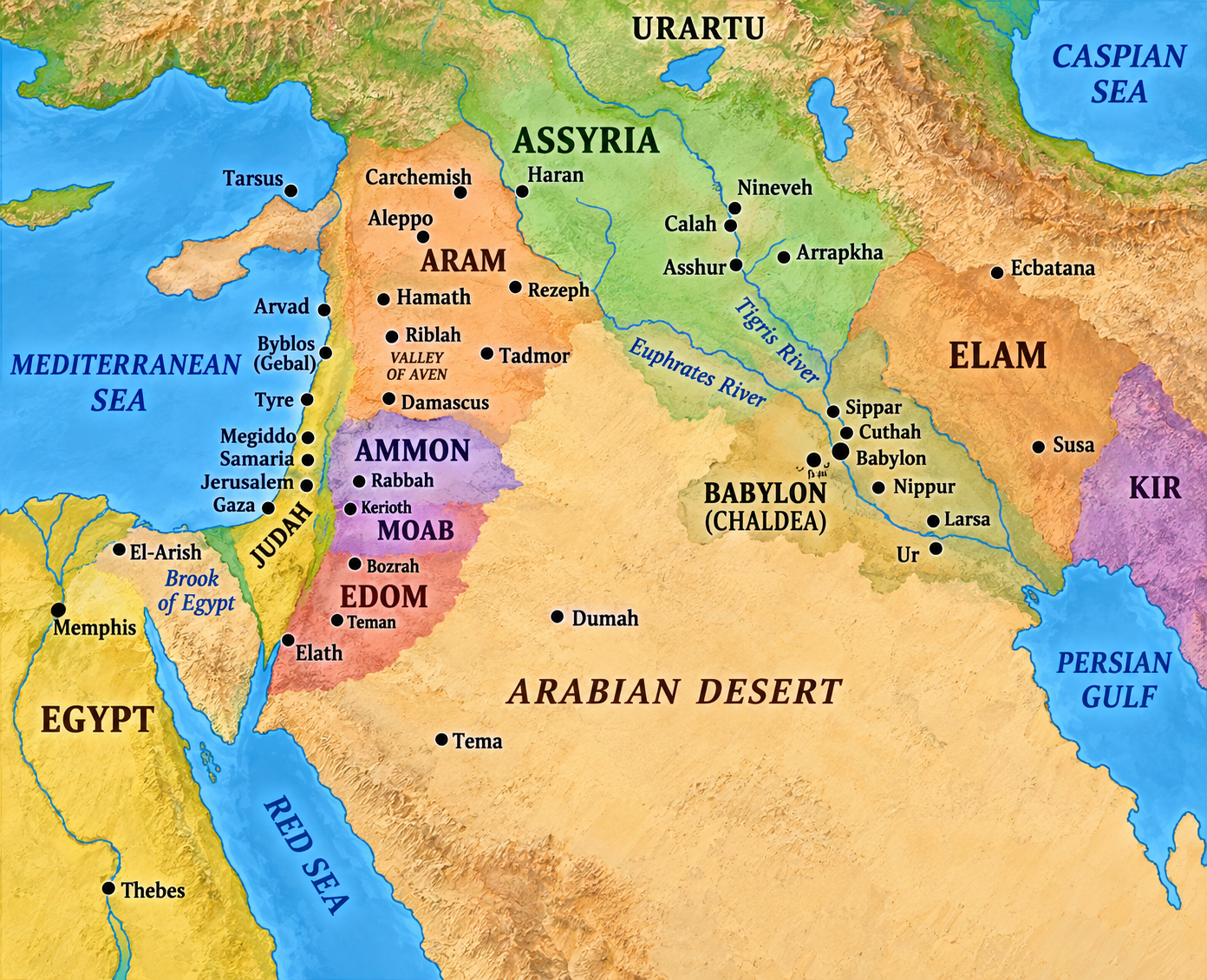

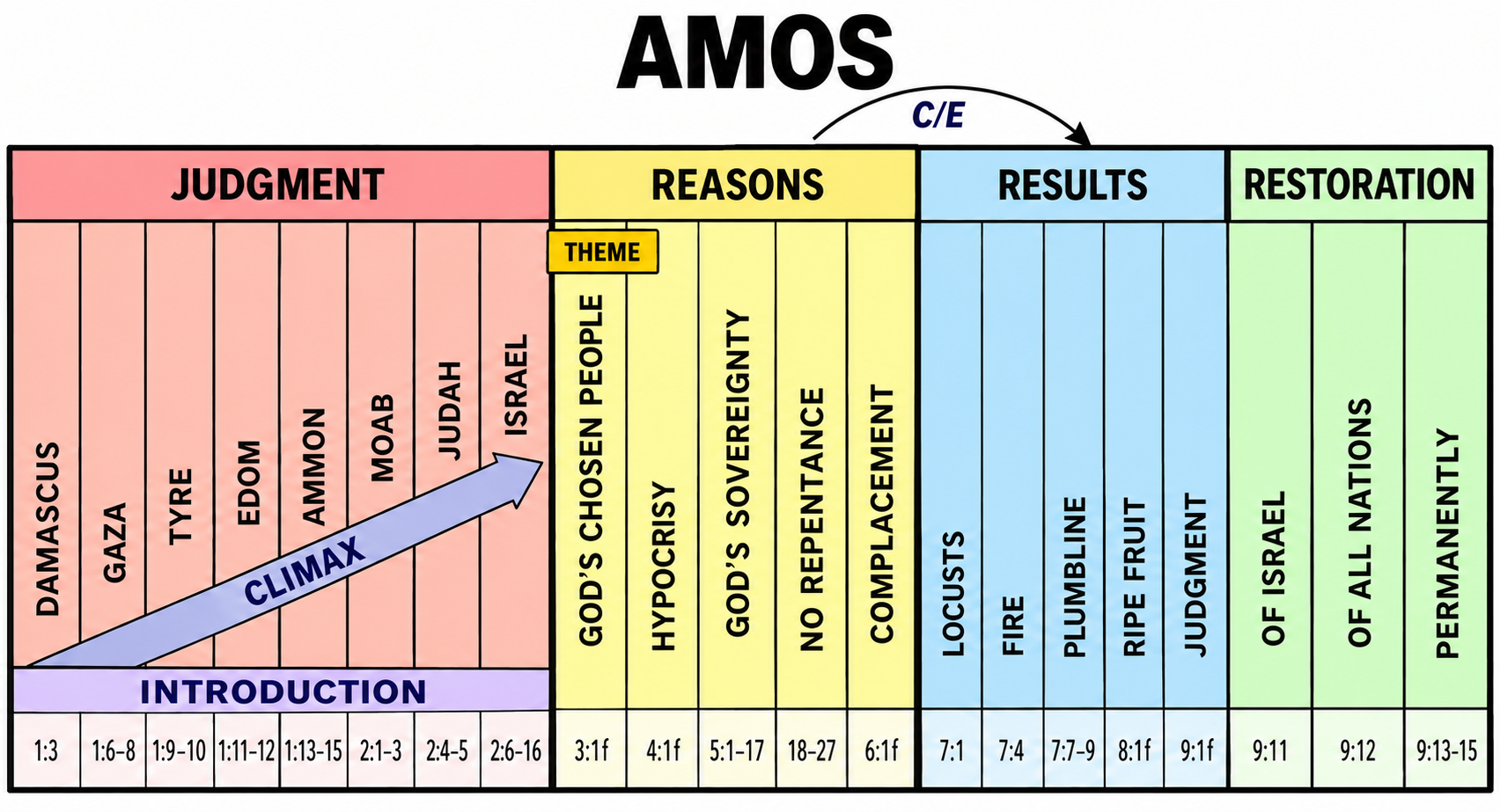
Click chart to enlarge
From Hampton Keathley IV
Amos 8:1 Thus the Lord GOD showed me, and behold, there was a basket of summer fruit.
KJV Thus hath the Lord GOD shewed unto me: and behold a basket of summer fruit.
NET The sovereign LORD showed me this: I saw a basket of summer fruit.
NLT Then the Sovereign LORD showed me another vision. In it I saw a basket filled with ripe fruit.
ESV This is what the Lord GOD showed me: behold, a basket of summer fruit.
BGT οὕτως ἔδειξέν μοι κύριος καὶ ἰδοὺ ἄγγος ἰξευτοῦ
LXE And behold a fowler's basket.
CSB The Lord GOD showed me this: A basket of summer fruit.
NIV This is what the Sovereign LORD showed me: a basket of ripe fruit.
- Am 7:1,4,7
Related Passages:
Jeremiah 1:11-14 he word of the LORD came to me saying, “What do you see, Jeremiah?” And I said, “I see a rod of an almond tree.” 12Then the LORD said to me, “You have seen well, for I am watching over My word to perform it.” 13The word of the LORD came to me a second time saying, “What do you see?” And I said, “I see a boiling pot, facing away from the north.” 14Then the LORD said to me, “Out of the north the evil will break forth on all the inhabitants of the land.
Amos 2:6-7 Thus says the LORD, “For three transgressions of Israel and for four I will not revoke its punishment, Because they sell the righteous for money And the needy for a pair of sandals. 7“These who pant after the very dust of the earth on the head of the helpless Also turn aside the way of the humble; And a man and his father resort to the same girl In order to profane My holy name.
Amos 5:21-24 21“I hate, I reject your festivals, Nor do I delight in your solemn assemblies. 22“Even though you offer up to Me burnt offerings and your grain offerings, I will not accept them; And I will not even look at the peace offerings of your fatlings. 23“Take away from Me the noise of your songs; I will not even listen to the sound of your harps. 24“But let justice roll down like waters And righteousness like an ever-flowing stream.
Amos 7:1; 4; 7 Thus the Lord GOD showed me, and behold, He was forming a locust-swarm when the spring crop began to sprout. And behold, the spring crop was after the king’s mowing. (7:4) Thus the Lord GOD showed me, and behold, the Lord GOD was calling to contend with them by fire, and it consumed the great deep and began to consume the farm land.
(7:7) Thus He showed me, and behold, the Lord was standing by a vertical wall with a plumb line in His hand.
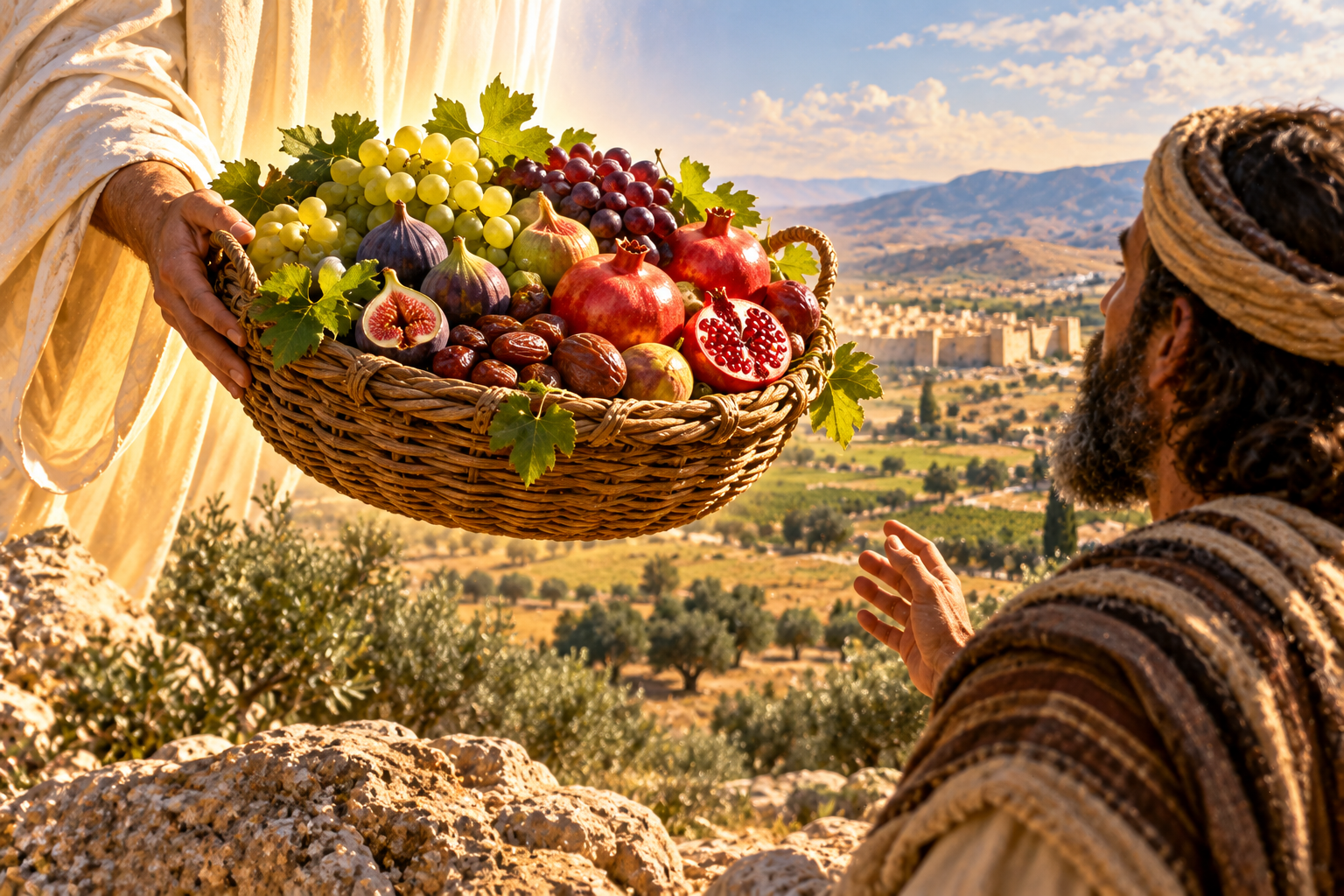
AMOS' VISION #4:
BASKET OF SUMMER FRUIT
Thus the Lord GOD (adonay Jehovah/yahweh) showed me, and behold, (hinneh; LXX - idou) there was a basket of summer fruit (qayits) - Lord God (sovereign LORD) is revealing his next message to Amos through this vision. Amos is not imagining a symbolic illustration of his own invention. Vision #4 seems somewhat ordinary, harmless picture compared to devastating locusts (Am 7:1–3), consuming fire (Am 7:4–6), and an ominous plumb line (Am 7:7–9).
KJV Bible Commentary - The vision of the basket of summer fruit advances the thought given by the vision of the plumb line in the preceding chapter. That vision set forth the certainty of God’s judgment because of Israel’s divergence from His standard. This vision shows that Israel is ripe for judgment, and it will come very soon.
The object itself seems unremarkable, but its significance will become clear in the following verse. This is a recurring feature of biblical revelation: God uses ordinary objects to communicate extraordinary truths (Jeremiah saw an almond branch and a boiling pot - Jer 1:11–14; Zechariah saw a lampstand and olive trees - Zec 4:1–6). The significance of each vision lies not in the appearance of the object, but in the message God attaches to each one.
Bob Utley - Summer fruit (qayits) is the last fruit of the season, which over ripens very quickly in the heat and was appropriate imagery for the spiritual rottenness of the Israeli nation. They were over-ripe for judgment!
David Guzik on Summer fruit - This was fruit that was ripe, and would not keep long. Just as the time is short for summer fruit, so the time is short for Israel. Ripe fruit is close to being thrown out, and a similar judgment will come upon “rotten” Israel.
NET NOTE - The basket of summer fruit (also in the following verse) probably refers to figs from the summer crop, which ripens in August-September. See O. Borowski, Agriculture in Iron Age Israel, 115.
Behold (02009) hinneh is an interjection meaning behold, look, now; if. "It is used often and expresses strong feelings, surprise, hope, expectation, certainty, thus giving vividness depending on its surrounding context." (Baker) Hinneh generally directs our mind to the text, imploring the reader to give it special attention. In short, the Spirit is trying to arrest our attention! And so hinneh is used as an exclamation of vivid immediacy (e.g., read Ge 6:13)! Hinneh is a marker used to enliven a narrative, to express a change a scene, to emphasize an idea, to call attention to a detail or an important fact or action that follows (Isa 65:17, Ge 17:20, 41:17). The first use of hinneh in Ge 1:29 and second in Ge 1:31 - "And God saw all that He had made, and behold, it was very good. And there was evening and there was morning, the sixth day." Hinneh is oftn used in the idiom "Here I am" in Ge 22:1, 7,11 Ge 27:1,18, Ge 31:11, Ge 46:2 Ex 3:4 1Sa 3:4, 3:16, 12:3, 2Sa 1:7, Isa 52:6, Isa 58:9. Hinneh is used most often to point out people but also to point out things (Ge 31:41, 17:4). God uses hinneh to grab man's attention before He brings destruction (Ge 6:13, 17). God uses hinneh when He establishes covenants (Ge 9:9, 15:12, 17 [when Jehovah cut the Abrahamic covenant], Ge 17:4, cp Ge 28:13, 15), when He provided a sacrificial substitute for Isaac (foreshadowing His giving us His only Son!) (Ge 22:13). Hinneh marks the "chance (The Providence of God)" arrival of Boaz at the field where Ruth was gleaning (Ru 2:4-read about this "chance romance" - Indeed, "Behold!"). Hinneh is used to announce the Lord’s sending of a child as a sign and a prophecy of Immanuel-Emmanuel, the Messiah (Isa. 7:14). In fact W E Vine says that it is notable that when behold (hinneh) is used in Isaiah, it always introduces something relating to future circumstances.
HINNEH IN AMOS - Amos 2:13; Amos 4:2; Amos 4:13; Amos 6:11; Amos 6:14; Amos 7:1; Amos 7:4; Amos 7:7; Amos 7:8; Amos 8:1; Amos 8:11; Amos 9:8; Amos 9:9; Amos 9:13
Spurgeon reminds us that "Behold is a word of wonder; it is intended to excite admiration. Wherever you see it hung out in Scripture, it is like an ancient sign-board, signifying that there are rich wares within, or like the hands which solid readers have observed in the margin of the older Puritanic books, drawing attention to something particularly worthy of observation." I would add, behold is like a divine highlighter, a divine underlining of an especially striking or important text. It says in effect "Listen up, all ye who would be wise in the ways of Jehovah!"
Hinneh is translated in the Septuagint with the interjection idou (strictly speaking a command in the second person aorist imperative, middle voice) a demonstrative particle (used 1377 times in the Septuagint and NT) which is found especially in the Gospels of Matthew and Luke "and giving a peculiar vivacity to the style by bidding the reader or hearer to attend to what is said: "Behold! See! Lo!" (Thayer) The command is calling for urgent attention. Do this now! Don't delay! It could be loosely paraphrased "Pay attention!" or "Listen up!" to arouse attention.
Summer fruit (07019) (qayits) is a masculine noun meaning “summer” or “summer fruit.” It is probably related to a root meaning “to cut,” since summer was the season for cutting and gathering ripe fruit, especially figs. The two meanings are closely connected: the season is named for its harvest, and the harvest for its season. Cognates are common throughout the Semitic languages, including Ugaritic qẓ and Arabic qāẓa, “to be very hot.” The noun occurs 20 times in the Old Testament, and the related denominative verb qîṣ, “to spend the summer,” occurs once (Isa 18:6). Its uses are divided about equally between “summer” and “summer fruit.” The Aramaic equivalent qayiṭ appears in Daniel 2:35, and the Septuagint renders the Hebrew with various words for summer, heat, or harvest.
QAYITS - 20V - fruit(1), summer(11), summer fruit(5), summer fruits(3). Gen. 8:22; 2 Sam. 16:1; 2 Sam. 16:2; Ps. 32:4; Ps. 74:17; Prov. 6:8; Prov. 10:5; Prov. 26:1; Prov. 30:25; Isa. 16:9; Isa. 28:4; Jer. 8:20; Jer. 40:10; Jer. 40:12; Jer. 48:32; Amos 3:15; Amos 8:1; Amos 8:2; Mic. 7:1; Zech. 14:8
1. The summer season.
Qayiṣ is the dry, hot season of the year (roughly May through October), paired with ḥōrep, “winter,” as one of the two seasons that make up the year. God created both: “You have made summer and winter” (Ps 74:17). After the flood He promised that “summer and winter... shall not cease” (Ge 8:22), and Zechariah pictures living waters flowing from Jerusalem in the millennial kingdom “in summer as well as in winter” (Zec 14:8). The pairing “summer and winter” became a way of saying “all the time,” the unbroken faithfulness of God through every season. Because of the heat, wealthy Israelites built separate summer residences, which Amos marked for destruction: “I will also smite the winter house together with the summer house” (Am 3:15).
2. The heat of summer as a metaphor.
Summer’s scorching dryness supplied vivid word pictures. David described the weight of unconfessed sin: “my vitality was drained away as with the fever heat of summer” (Ps 32:4). Proverbs uses summer to show what is out of place: honor fits a fool as well as “snow in summer” (Pr 26:1). In Daniel, the shattered statue becomes “like chaff from the summer threshing floors,” swept away without a trace (Da 2:35).
3. The season of harvest and diligence.
Summer was harvest time, and qayiṣ is often paired with qāṣîr, “harvest” (Pr 6:8; 10:5; Jer 8:20). The ant is a model of wisdom because it “prepares her food in the summer” (Pr 6:8; 30:25), and “he who gathers in summer is a son who acts wisely” (Pr 10:5). The lesson is that opportunities are seasonal, and the wise do not waste them.
4. Summer fruit as provision and hope.
The noun often refers to the fruit gathered in summer, probably figs. Ziba brought summer fruit to sustain David as he fled from Absalom (2 Sa 16:1,2). After Jerusalem fell, Gedaliah encouraged the scattered Judeans to return and gather summer fruit, and they gathered it “in great abundance” (Jer 40:10, 12), a sign that life could go on. One of the earliest Hebrew inscriptions, the Gezer Calendar (10th century BC), names one month of the agricultural year simply “the month of qayiṣ,” the summer fruit harvest.
5. Summer fruit as a sign of judgment.
The same image that normally speaks of abundance can also announce disaster. The destruction of Moab is pictured as the ruin of its summer fruit before the harvest (Isa 16:9; Jer 48:32). Micah lamented that searching for a godly man was like looking for fruit in an orchard after the summer harvest, when nothing is left (Mic 7:1). Isaiah compared proud Samaria to the first-ripe fig before summer, eagerly picked and swallowed by whoever sees it (Isa 28:4). Most poignantly, Jeremiah voiced Judah’s despair over a season of opportunity that had passed without repentance: “Harvest is past, summer is ended, And we are not saved” (Jer 8:20).
6. The basket of summer fruit (Amos 8:1–2).
In Amos’s fourth vision, the LORD showed him “a basket of summer fruit (qayiṣ),” then declared, “The end (qets) has come for My people Israel. I will spare them no longer.” The message turns on a wordplay between qayiṣ, (קַיִץ) “summer fruit,” and qets, (קֵץ) “end.” The two words probably sounded even more alike in the dialect of the northern kingdom, so the pun would have been unmistakable to Amos’s hearers. The summer fruit (qayits) announces the end (qets). Some have taken qēṣ here to mean “harvest” or have suggested the basket was empty, but the most natural reading is the wordplay itself. Israel was like ripe summer fruit: it had reached its full season and was ready to be gathered, not for blessing but for judgment. The symbol of a good harvest became a sign that the nation’s time had run out. The same “end” theme appears in the Day of the LORD passages that follow, in which songs become wailing and feasts become mourning (Am 8:3, 10).
THOUGHT: Summer fruit is at its best only for a short time, and then it spoils. Israel’s privileges had ripened into a season of decision, but the people let it pass. Jeremiah’s lament still warns every generation: “Harvest is past, summer is ended, And we are not saved” (Jer 8:20). The time to respond to God is while it is still “today” (Heb 3:13–15; 2 Co 6:2).
C H Spurgeon - A basket of summer fruit
“Thus hath the Lord God shewed unto me: and behold a basket of summer fruit. And he said, Amos, what seest thou? And I said, A basket of summer fruit. Then said the Lord unto me, The end is come upon my people of Israel; I will not again pass by them any more.” Amos 8:1, 2
For thousands of years the Lord came not, although sin was rampant and the darkness dense, nothing could excite the Lord to an unwise haste. Nor on the other hand did he stay beyond the proper hour; for when the fulness of time was come, God sent forth his Son, born of a woman, made under the law. In heaven we shall probably discover that Christ came to die for our sins precisely at the only fitting moment, that in fact redemption’s work could not have been so wisely accomplished at the gates of the garden of Eden as on Calvary; and that the reign of Herod and the Roman Caesar afforded the most fitting era for the sacrifice of the Cross. And so shall it be with regard to the second advent of our blessed Lord and Master. We are apt to say, “Why are his chariots so long in coming? Do not the virgins sleep because the bridegroom tarries, the wise as well as the foolish, have they not all slumbered and slept?” And many are the servants who say in their heart, “My Lord delayeth his coming,” and are ready therefore to beat their fellow-servants, to drink and to be drunken; but cheer your hearts, you who look for his appearing. He will not come too hastily, for why should the sun arise until darkness has had its hour? Nor will he delay his appearing one moment beyond the proper time, for should not the sun beam forth in the morning? We know and are persuaded that when he shall stand a second time upon the earth, it shall be as much the fulness of time for him to come, as it was the fulness of time when he came at first.
MORE TAKEAWAYS FROM SPURGEON'S SERMON...A basket of summer fruit
1. Most Memorable Direct Quotes from Spurgeon
On God's perfect timing
“God always times his decrees. He is never before his time, and he never is so much as a single hour behind.”
“God will not give it to thee in thy time, but in his.”
“He will not send to thee his mercies before their date.”
On providence and suffering
“The hour of thy extremity shall be the hour of God's opportunity.”
“We are immortal till our work is done.”
“There is no more blessed way of living than the life of faith upon a covenant-keeping God.”
“Things are not left to chance: no blind fate rules the world.”
On the ripening of believers
“The sorest tribulation which ever exercises a believer is a ripening dispensation.”
“In fact, without affliction no Christian ever can ripen.”
“We may grow in some things by prosperity; but true ripeness in grace can only be obtained in adversity.”
“He becomes less worldly, he shakes off more and more the cares which once were chains to him.”
On spiritual maturity
“Religion is not a theory to him now; it is a matter of fact.”
“The asperities of his youth give way to cordial kindness in his old age.”
On sin and judgment
“There is a ripening in holiness till we are gathered by the hand of Jesus for heaven, and a ripening in sin till we are swept away.”
“Some fruits ripen very quickly, and those that ripen slowly ripen surely, and the gathering time shall come.”
“If you take the road, you must take the end.”
2. Memorable Takeaways in Contemporary Language - the following are applications from Spurgeon's sermon, but are not verbatim quotes.
1. God is never early, never late, but always perfectly on time. His purposes mature according to His wisdom, not our impatience (Ec 3:11; Gal 4:4).
2. God's delays are not evidence of His indifference. The believer can trust His timing even when deliverance seems long overdue (Ps 27:14; Isa 40:31).
3. What we call a delay, God may call preparation. The trial may be accomplishing something that an immediate deliverance could never produce (Jas 1:2–4).
4. God sometimes bruises His fruit to make it sweeter. Just as the sycamore fruit was pierced to assist its ripening, affliction can deepen the believer's spiritual maturity (Heb 12:10–11).
5. Affliction is not always evidence that God is displeased; it may be evidence that He is preparing us for greater usefulness. The heavenly Gardener knows how to cultivate the fruit of righteousness (Jn 15:2; Heb 12:11).
6. Prosperity may increase our possessions, but adversity often increases our spiritual maturity. Trials teach dependence upon God in ways that comfort rarely does (2 Cor 12:9–10).
7. The older believer should become sweeter, not merely older. True spiritual maturity is reflected not only in greater knowledge but also in greater patience, kindness, and compassion (Col 3:12–14).
8. A ripening Christian becomes less attached to earth and more attracted to heaven. The things once considered indispensable gradually lose their hold upon the heart (Col 3:1–4).
9. Every passing day is a day of spiritual development or deterioration. Spurgeon's contrast challenges us to consider the direction in which our lives are moving (2 Pe 3:18; Heb 3:13).
10. The same sun that ripens good fruit also hastens the decay of rotten fruit. God's providences may soften one heart while another becomes increasingly hardened (Ro 2:4–5).
11. Sin rarely remains stationary; tolerated sin tends to produce increasing hardness of heart. What once troubled the conscience may eventually become acceptable (Heb 3:13).
12. God's patience must never be mistaken for His approval. The delay of judgment is an opportunity for repentance, not permission to continue in sin (Ro 2:4–5; 2 Pe 3:9).
13. The harvest is certain, even when its timing is unknown. Every life is moving toward an appointed meeting with God (Heb 9:27).
14. A nation's prosperity is no guarantee of its permanence. Spurgeon warns that moral corruption can undermine even the most powerful societies (Pr 14:34).
15. The ultimate question is not simply how long we have lived, but what kind of fruit our lives are producing. The Lord desires fruit that glorifies Him (Jn 15:8; Gal 5:22–23).
Amos 8:1–8 Today in the Word
“The time is ripe” is an English idiom suggesting “sufficiently advanced, especially for a particular action or purpose” or “ready for execution, action, or use.” Practically, it means “the most favorable time to do something,” as in, “Since Joe was in a good mood, I judged that the time was ripe to ask him for the favor I needed.”
In today’s reading, “the time is ripe” for God’s judgment on Israel (Amos 8:2). The main image in this fourth vision of Amos is a basket of fruit (Amos 8:1). God showed it to the prophet as a confirmation of the coming judgment. The idea of “ripeness” means that this was not a random or sudden decision of God, but rather that it had been a long time coming. Like the slow process of fruit growing and ripening toward a harvest, the nation’s sins—including its rejection of God’s prophets and their warnings—had been accumulating and deepening toward a harvest of judgment (Amos 8:3).
This message is aimed especially at rich oppressors (Amos 8:4–6). Their pride and brutality are seen in the picture of them trampling the needy and doing away with the poor. Instead of repenting and seeking the Lord, they were waiting impatiently for holy days and Sabbaths to be over so that they could get back to doing business. They showed no respect for the rhythms of community life as established by God. They showed no respect for people, seeing them only as a source of profit. Perhaps they were workaholics—at the very least they had put money at the center of their lives. What’s worse, they were guilty of dishonest weights and measures, not to mention price–gouging. “Selling even the sweepings” was the exact opposite of the Law’s compassionate principle of gleaning, in which the poor were allowed to harvest “leftovers” from the fields (see Lev. 19:9–10).
Justice would be done on these sins and others (Amos 8:7–8). God would not forget. As surely as the annual rising and receding of the Nile River, a flood of judgment would overwhelm Israel.
Apply the Word
A number of godly business principles can be derived from today’s passage. The significance of honesty and integrity stand out. Other principles include the importance of rest (not being a workaholic), the importance of respecting people (customers are more than a source of revenue), the fact that the bottom line is about more than money (price–gouging is immoral), and the truth that our ultimate accountability is to the Lord (and you can be sure He’ll see that justice is done).
Amos 8:1-10 TODAY IN THE WORD
The LORD has sworn by the Pride of Jacob: “I will never forget anything they have done.” - Amos 8:7
Two days ago we looked at three visions that Amos received. In today’s reading, Amos was shown another vision. This time it consisted of a basket of ripe fruit--the Lord explained that, like this fruit, Israel was ripe for judgment (Amos 8:2). This moment had come after many years of patient waiting and pleading. God had acted according to His own timetable and was now declaring through Amos that Israel’s time had run out. Yet even in this ominous pronouncement, God’s grace was still evident. The actual fall of Samaria would not come for approximately another ten years.
The Bible often speaks of God’s patience toward the sinner, noting that He does not take any pleasure in the death of the wicked (Ezek. 18:23; 33:11). He is a gracious and compassionate God who is slow to anger and abounding in love (Ex. 34:6). Yet He is also a God who is not afraid to judge. He had appointed a day of judgment for Samaria--and when that day finally came, the sounds of worship in the temple would turn to wailing and bodies would be flung everywhere (Amos 8:3).
The reason for this devastation was given in Amos 8:4-6. It had been prompted by Israel’s disregard for the needy. They had “trampled” on the needy by using unfair business practices, including giving less than their poor customers had paid for, price fixing, and using dishonest scales. They treated others as property to be bought and sold and were so greedy that they collected the dirty sweepings of wheat that fell on the threshing floor and sold them (Amos 8:6).
Even worse, they did all this while appearing to obey God’s Law. Although they refrained from doing business during the Sabbath as the Law had commanded, their heart was not in it. Instead, they were eager for the day to end so that they could get back to maximizing their profits (Amos 8:5).
TODAY ALONG THE WAY
We can misread God’s patience and conclude that He does not care about our sin. But God’s kindness is meant to lead us toward repentance (Ro 2:4).
Ripe for Judgment By Rev. Peter Grainger Amos 8:1–14, especially Amos 8:2
“The end has come upon My people Israel; I will not pass by them anymore.”
Introduction: Imagine turning up at church for a Harvest Thanksgiving Service only to discover it is a Funeral Service; and, even worse, says the preacher, it’s your funeral service for you are about to die and there is nothing you can do about it. That is the kind of shock that Amos receives and then communicates to the people of Israel in the fourth of the five visions he receives from the Lord. “Amos, what do you see?” the Lord asks. “A basket of summer fruit,” Amos answers (v. 2). But they are in for a terrible surprise for the Lord says, using a play on very similar sounding words in the original Hebrew, that they are the fruit, about to be plucked and consumed. After decades of opportunity to change their ways and countless warnings from the prophets, it is now too late. The people of Israel, God’s chosen people, are ripe for judgment. Harvest-time is here. So look with me at the two sides of the process—sowing and then reaping.
1. Sowing the Seeds (vv. 4–6). Here, the Lord describes what the people of Israel, and especially the leaders of Israel, have sown: the seeds of selfishness and self-interest. They have one goal in life and that is to make money, to make a profit. Now, nothing is wrong with making money providing that it’s not your goal in life, or more accurately your god.
A. Profit before People. When you put profit before people it is always the poor who suffer and who you profit by, for they have no money or power with which to fight back. Like the game of Monopoly, the weaker players and their possessions are swallowed up by the stronger. Compassion goes out of the window and with it honesty and integrity. So in the days of Amos, the rich landowners swallowed up the landholdings of the poor, land that was supposed to be safeguarded in perpetuity for each family by the Law of Moses. And, in telling words, the poor are even sold into slavery and forced to eat wheat mixed with the sweepings from the floor (v. 6).
B. Profit before God. The great tragedy in Israel was not social injustice, for such things went on in every country in the ancient world. No, the tragedy in Israel was that they should have known better and so should have done better. They knew the one true God who had revealed His laws to them. However, instead of setting an example to the rest of the nations, they had followed the example of the rest of the nations.
2. Reaping the Results (vv. 7–14). There is nothing new in the Lord’s charges against the people of Israel. They heard them before, not only through Amos, but through many other prophets. Now finally what they had sown had come to fruition, harvest-day, judgment-day had arrived. No more forgiveness or mercy is available. The Lord’s judgment is expressed in terms of three natural phenomena which people in those days feared above all else—earthquake (v. 8), eclipse (vv. 9–10) and famine (vv. 11–14). The third of these (famine) is not literal but a picture of a spiritual hunger and thirst. Whether the other two are literal or not is unclear but we should note two things:
A. The Effects of the Fall on Creation and Humans. In Romans 8, the apostle Paul writes of all creation groaning as a result of sin and likewise human beings, in particular, Christians, groaning also—both in anticipation of a final restoration by God of how things should be and once were.
B. God Uses Natural Disasters to Warn of Greater Disaster. In Amos 4, we read that the Lord reminds the people of Israel that in the past he withheld rain and sent famine, struck down their crops with diseases and sent locusts, sent plagues and invading armies—all with one purpose: to get the people to return to Him. Yet they did not listen, and no one heeded the final judgment was about to come.
Conclusion: Thankfully, the Book of Amos doesn’t stop here, but looks forward in its final chapter to an unending harvest and a restoration of God’s people. However, with these Scriptures before us today, how do you need to respond? Have you placed profit before people and before God? Do you live for the stuff you can attain? Do you feel a spiritual famine in your life because you have neglected God’s Word? The fulfillment of the restoration of God’s people was completed in Jesus Christ; won’t you turn to Him in repentance and faith?
THE PREDICTION OF ISRAEL’S FALL Amos 8:1–14 Croft Pentz
A. THE DEGRADATION—8:1–3
1. Picture—v. 1. God showed Amos a basket of ripe fruit. God often spoke in parables, even in the Old Testament.
2. Prophecy—v. 2. “Then the Lord said, ‘This fruit represents my people Israel—ripe for punishment. I will not defer their punishment again’ ” (LB). God would send His punishment and judgment. His patience only goes so far—Gen. 6–8.
3. Punishment—v. 3. “The riotous sound of singing in the temple will turn to weeping then. Dead bodies will be scattered everywhere. They will be carried out of the city in silence. The Lord has spoken” (LB).
B. THE DESCRIPTION—8:4–10
God describes the sins of Israel.
1. Dishonest—v. 4. “Listen, you merchants who rob the poor, trampling on the needy” (LB). God cannot stand dishonesty. Note Rev. 21:8.
2. Deceit—v. 5. “You who long for the Sabbath to end and the religious holidays to be over, so you can get out and start cheating again—using your weighted scales and undersized measures” (LB). All types of cheating are sin, and God must judge and punish them.
3. Designs—v. 6. “You who make slaves of the poor, buying them for their debt of a piece of silver or a pair of shoes, or selling them your moldy wheat” (LB).
4. Deeds—v. 7. God said He would not forget the sinful, crooked living and practices of the people.
5. Destruction—vv. 8–10. Judgment would come. No one sins without paying for it—Rom. 6:23, Gal. 6:7–8.
C. THE DOOM—8:11–14
1. Famine—vv. 11–13. A famine of God’s Word. To guard against such a famine, we must:
a. Hide His Word—Ps. 119:11
b. Study His Word—2 Tim. 2:15
c. Know His Word—1 Peter 3:15
d. Use His Word—Heb. 4:12
e. Success through His Word—Josh. 1:8
2. Fall—v. 14. “And those who worship the idols of Samaria, Dan, and Beersheba shall fall and never rise again” (LB).
|
Vision |
Passage |
Central message |
|---|---|---|
|
Locusts |
Am 7:1–3 |
Judgment threatened, but withheld following intercession |
|
Consuming fire |
Am 7:4–6 |
Judgment threatened, but withheld following intercession |
|
Plumb line |
Am 7:7–9 |
Israel measured and judgment announced |
|
Basket of summer fruit |
Am 8:1–3 |
Israel's end has arrived |
|
The LORD beside the altar |
Am 9:1–4 |
Judgment cannot be escaped |
The progression is from judgment delayed (God relents in first two) to judgment declared with the plumbline, and finally to judgment imminent.
Amos 8:2 He said, “What do you see, Amos?” And I said, “A basket of summer fruit.” Then the LORD said to me, “The end has come for My people Israel. I will spare them no longer.
KJV And he said, Amos, what seest thou? And I said, A basket of summer fruit. Then said the LORD unto me, The end is come upon my people of Israel; I will not again pass by them any more.
NET He said, "What do you see, Amos?" I replied, "A basket of summer fruit." Then the LORD said to me, "The end has come for my people Israel! I will no longer overlook their sins.
NLT "What do you see, Amos?" he asked.I replied, "A basket full of ripe fruit." Then the LORD said, "Like this fruit, Israel is ripe for punishment! I will not delay their punishment again.
ESV And he said, "Amos, what do you see?" And I said, "A basket of summer fruit." Then the LORD said to me, "The end has come upon my people Israel; I will never again pass by them.
BGT καὶ εἶπεν τί σὺ βλέπεις Αμως καὶ εἶπα ἄγγος ἰξευτοῦ καὶ εἶπεν κύριος πρός με ἥκει τὸ πέρας ἐπὶ τὸν λαόν μου Ισραηλ οὐκέτι μὴ προσθῶ τοῦ παρελθεῖν αὐτόν
LXE And he said, What seest thou, Amos? And I said, A fowler's basket. And the Lord said to me, The end is come upon my people Israel; I will not pass by them any more.
CSB He asked me, "What do you see, Amos?" I replied, "A basket of summer fruit." The LORD said to me, "The end has come for My people Israel; I will no longer spare them.
NIV "What do you see, Amos?" he asked. "A basket of ripe fruit," I answered. Then the LORD said to me, "The time is ripe for my people Israel; I will spare them no longer.
- Amos (KJV): Am 7:8 Jer 1:11-14 Eze 8:6,12,17 Zec 1:18-21 5:2,5,6
- A basket (KJV): De 26:1-4 2Sa 16:1,2 Isa 28:4 Jer 24:1-3 40:10 Mic 7:1
- the end (KJV): Jer 1:12 Jer 5:31 La 4:18 Eze 7:2 3:7,10 12:23 29:8
- I will not (KJV): Am 7:8
Related Passages:
Amos 7:7- 8 Thus He showed me, and behold, the Lord was standing by a vertical wall with a plumb line in His hand. 8 The LORD said to me, “What do you see, Amos?” And I said, “A plumb line.” Then the Lord said, “Behold I am about to put a plumb line In the midst of My people Israel. I will spare them no longer.
Jeremiah 1:11-14 (SIMILAR WORDPLAY AS IN AMOS 8:1-2) The word of the LORD came to me saying, “What do you see, Jeremiah?” And I said, “I see a rod of an almond tree.” 12 Then the LORD said to me, “You have seen well, for I am watching over My word to perform it.” 13 The word of the LORD came to me a second time saying, “What do you see?” And I said, “I see a boiling pot, facing away from the north.” 14 Then the LORD said to me, “Out of the north the evil will break forth on all the inhabitants of the land.
Genesis 15:16 “Then in the fourth generation they will return here, for the iniquity of the Amorite is not yet complete.”
2 Kings 17:5-6 Then the king of Assyria invaded the whole land and went up to Samaria and besieged it three years. 6 In the ninth year of Hoshea, the king of Assyria captured Samaria and carried Israel away into exile to Assyria, and settled them in Halah and Habor, on the river of Gozan, and in the cities of the Medes.
Amos 7:8 The LORD said to me, “What do you see, Amos?” And I said, “A plumb line.” Then the Lord said, “Behold I am about to put a plumb line In the midst of My people Israel. I will spare them no longer.
Romans 2:4 Or do you think lightly of the riches of His kindness and tolerance and patience, not knowing that the kindness of God leads you to repentance?
Lamentations 4:18 They hunted our steps So that we could not walk in our streets; Our end drew near, Our days were finished For our end had come.
Hosea 11:1-4; 8 When Israel was a youth I loved him, And out of Egypt I called My son. 2 The more they called them, The more they went from them; They kept sacrificing to the Baals And burning incense to idols. 3 Yet it is I who taught Ephraim to walk, I took them in My arms; But they did not know that I healed them. 4 I led them with cords of a man, with bonds of love, And I became to them as one who lifts the yoke from their jaws; And I bent down and fed them....(11:8) How can I give you up, O Ephraim? How can I surrender you, O Israel? How can I make you like Admah? How can I treat you like Zeboiim? My heart is turned over within Me, All My compassions are kindled.
Hosea 11:9-11 I will not execute My fierce anger; I will not destroy Ephraim again. For I am God and not man, the Holy One in your midst, And I will not come in wrath. 10 They will walk after the LORD, He will roar like a lion; Indeed He will roar And His sons will come trembling from the west. 11 They will come trembling like birds from Egypt And like doves from the land of Assyria; And I will settle them in their houses, declares the LORD.
GOD'S HARVEST OF JUDGMENT
HAS ARRIVED - NO STAY OF EXECUTION
He said, “What do you see, Amos?” And I said, “A basket of summer fruit (qayits) - God is not asking because He lacks information. He is directing Amos' attention to the object that carries His message. The question invites Amos to identify what is before him so that God can explain its spiritual significance.
Warren Wiersbe makes a good point - After his painful encounter with Amaziah, Amos received further messages from the Lord; for it’s just like the Master to encourage His servants after they’ve been through tough times (see Acts 18:9–11; 27:21–26; 2 Tim. 4:16). (Bible Exposition Commentary)
The fruit was ripe,
and so was Israel's judgment.
Then the LORD said to me, “The end (qets; LXX - peras - end, conclusion) has come for My people Israel - NIV picks up on the agricultural metaphor = "The time is ripe for my people Israel." The message turns on a wordplay (paronomasia) between qayits, (קַיִץ) “summer fruit,” and qets, (קֵץ) “end.” There is a similar a similar wordplay oracle in Jeremiah 1:11–12. The meaning of Amos' fourth vision is revealed for what appeared to be an ordinary basket of ripe summer fruit becomes a solemn announcement that Israel's time has run out. The LORD is not merely warning that judgment might occur someday, but declares that the time has arrived. Note that even in judgment Yahweh does not disavow Israel as His possession, His people.
Boice on the wordplay - “So when Amos replies to the Lord that he sees a basket of ripe qayis, God replied “Qes!” An end is to come upon Israel.”
Warren Wiersbe - It was the end of the harvest for the farmers, and it would be the end for Israel when the harvest judgment came (see Jer. 1:11–12 for a similar lesson). “The harvest is past, the summer is ended, and we are not saved” (Jer. 8:20). There comes a time when God’s long-suffering runs out (Isa. 55:6–7) and judgment is decreed. (Bible Exposition Commentary)
Bob Utley - "The end has come for My people Israel'" The VERB (Qal PERFECT) denotes that the covenant between YHWH and Abraham's descendants will be abrogated with the northern tribes. The pain of YHWH can be sensed in the covenant phrase, "My people Israel"( cf. Hosea 11:1-4,8), but it will not be completely abrogated. There is hope (cf. Amos 9:7-15; Hosea 11:9-11). To allow the appearance of the covenant to continue would be cruel. YHWH's judgment, as painful as it was, was an act of love with a real potential of restoration (cf. Amos 9:14-15)!
Israel had mistaken God's patience
for permission to continue in sin.
The Hebrew wordplay between qayits (summer fruit) and qets (end) makes the message unforgettable. There is a progression in these visions. In Amos 7:7–8, Amos sees a plumb line, and God announces that He will no longer spare Israel. Now Amos sees summer fruit, and God announces that Israel's end has arrived. Just as the fruit has reached maturity and is ready to be gathered, Israel has reached the appointed time of judgment. The plumb line revealed the certainty of judgment; the summer fruit reveals that judgment has reached its appointed time. The basket of summer fruit represents Israel's approaching end. Just as the fruit has reached the final stage of ripeness, Israel has reached the final stage of divine forbearance. It is a bit ironic that the basket that appeared to symbolize abundance actually announced the end of Israel's prosperity.
NET NOTE - There is a sound play here. The Hebrew word קֵץ (qets, “end”) sounds like קָיִץ (qayits, “summer fruit”). Possibly they were pronounced alike in the Northern dialect of Hebrew. This is a case where the vision is not the prophecy, but simply the occasion for a prophecy. The basket of summer fruit is only relevant as a means to get Amos to say qayits (קָיִץ) as an occasion for the Lord to say qets (קֵץ) and make the prophecy. Cf. Jer 1:11-14; Amos 7:7-8.
The fruit is ripe,
and so is Israel's judgment.
I will spare (abar; LXX - parerchomai - pass by, neglect, overlook) them no longer - NET = "The end has come for my people Israel! I will no longer overlook their sins." Literally, it conveys the idea, “I will no longer continue to pass over him.” For years God had patiently warned His people through His prophets, but they had repeatedly refused to repent. Now comes the dreadful declaration: “I will spare them no longer.” The nation had reached the end of its season of divine forbearance. The tragedy of Israel was not that God failed to warn His people, but that His people failed to heed His warnings. Yet this is not the end of God’s purposes for Israel. Even in judgment He promised, “I will not totally destroy the house of Jacob” (Am 9:8), and Amos closes with the promise that God will raise up the fallen booth of David and plant His people in their land, never again to be uprooted (Am 9:11–15; cf. Lev 26:44–45; Ro 11:29). The end had come for apostate Samaria, but not for God’s covenant faithfulness to Israel. See related discussion of What happened to the lost tribes of Israel? | GotQuestions.org.
Bob Utley - "will spare them no longer" This phrase is very emphatic. Literally, it is "I will never (Hiphil IMPERFECT) again pass by them" (BDB 716, KB 778, Qal INFINITIVE CONSTRUCT). The Covenant is broken (cf. Amos 7:8)! His people have rejected Him by their amalgamation with Canaanite fertility worship for the last time. In Ge 15:16 the Amorites of the Promised Land were rejected because of their godless lifestyle. Now YHWH's own people are being turned out because of their similar godless lifestyle. God's patience coming to an end. This is clearly seen in Isa. 6:9-13; Jer. 15:5-9 and Ezek. 7:2-9. (EDITORIAL COMMENT - Utley's note implies there is no hope for Israel but even in Amos we see God gives hope for He will raise up “the fallen booth of David” (Am 9:11), bring back the captivity of His people (Am 9:14), and plant them in their land, “and they will not again be rooted out from their land” (Am 9:15). James quotes Amos 9:11,12 at the Jerusalem Council (Acts 15:16,17). The final fulfillment comes when Messiah reigns on David’s throne in the millennial kingdom. Utley is amillennial! Israel broke the Mosaic covenant and incurred its curses (Lev 26; Dt 28). Even those chapters promise that God would not reject Israel completely or break His covenant with them (Lev 26:44,45). The Abrahamic and Davidic covenants rest on God’s unconditional promise, and they remain in force: “the gifts and the calling of God are irrevocable” (Ro 11:29; cf. Jer 31:35–37). Here the comparison with the Amorites (Ge 15:16) breaks down. Both were expelled from the land for their wickedness (cf. Lev 18:24–28), but the Amorites had no covenant promise of restoration. Israel does.)
🙏 THOUGHT — Are You Thinking Lightly or Presuming Upon God's Patience? Dear follower of Christ, the basket of summer fruit reminds us that God's patience must never be mistaken for His approval of sin. Israel had enjoyed years of prosperity, security, and divine forbearance, yet the people repeatedly ignored God's warnings and refused to repent. Could we be guilty of the same dangerous presumption? We may enjoy good health, financial stability, comfortable homes, and outward success while quietly allowing compromise, complacency, disobedience or spiritual indifference to take root in our hearts. Paul reminds us that God's kindness and patience are intended to lead us to repentance (Ro 2:4). The writer of Hebrews warns us not to harden our hearts when we hear God's voice (Heb 3:7, 8, 15). And John assures believers that when we confess our sins, God is faithful and righteous to forgive us and cleanse us from all unrighteousness (1 Jn 1:9). The proper response to God's patience is not presumption, but repentance, not complacency, but obedience and not delay, but a humble heart that responds to His Word today! Remember that our gracious heavenly Father disciplines us as His children for our good, that they may share His holiness and bring forth the peaceful fruit of righteousness (Heb 12:10,11). May we never confuse His patience with permission to drift from Him (cf Backsliding), but instead continually confess, repent and return to the Savior Who loves us and calls us to walk in His ways (Jn 14:15).
Spare (pass) (05674)(abar) - qal. pass through; niphal be forded; piel. cause to pass through or over; hiphil. make pass through. The main idea of this verb is that of movement; as a rule it is the movement of one thing in relation to some other object which is stationary, moving, or motivating. Some have said that the simplest translation of ʿābar is “to pass,” but this does not really cover the various nuances that ʿâbar may carry with it. It is used about 550 times.
ABAR IN AMOS - Amos 5:5, Amos 5:17, Amos 6:2, Amos 7:8, Amos 8:2, Amos 8:5
Root and basic meaning
ʿĀbar occurs in all the Semitic languages, in every period of their history, including biblical Hebrew and Aramaic. With about 550 occurrences, it is one of the most common verbs in the Old Testament. Its root idea is spatial movement: moving over, through, beyond, or away from something. From this simple idea comes a remarkable range of meanings, literal, metaphorical, and spiritual. The first occurrence is in the account of the Flood: “But God remembered Noah and all the beasts and all the cattle that were with him in the ark; and God caused a wind to pass over the earth, and the water subsided” (Genesis 8:1).
1. Simple movement: to go on, pass along
In its simplest sense, ʿābar means to go on or move forward. Abraham invited his heavenly visitors to rest and eat, “and after that you may go on” (Genesis 18:5). He also begged them, “My Lord, if now I have found favor in your sight, please do not pass your servant by” (Genesis 18:3). Abram “passed through the land as far as the site of Shechem” (Genesis 12:6), and the psalmist speaks of “whatever passes through the paths of the seas” (Psalm 8:8).
2. Crossing from one place to another
Very often, ʿābar describes crossing a barrier to reach the other side. Jacob “arose and crossed the Euphrates River” as he fled from Laban (Genesis 31:21). The word is used again and again of Israel crossing the Jordan into the Promised Land, the great barrier that had to be overcome to receive the covenant promise: “Moses My servant is dead; now therefore arise, cross this Jordan, you and all this people, to the land which I am giving to them, to the sons of Israel” (Joshua 1:2). It can also mean passing through a territory, as when Moses asked Sihon, “Let me pass through your land” (Numbers 21:22), or when Micah pictures the remnant of Jacob moving among the nations “like a lion among the beasts of the forest... which, if he passes through, tramples down and tears” (Micah 5:8). Amos used the word when he warned Israel not to “cross over to Beersheba,” one of the shrines of corrupt worship (Amos 5:5).
In the causative (Hiphil) stem, ʿābar means to cause someone or something to pass over, as when God caused the wind to pass over the waters (Genesis 8:1). It is also used of the abomination of making a child “pass through the fire” in pagan sacrifice (Deuteronomy 18:10), and, in a holy sense, of devoting the firstborn to the LORD (Exodus 13:12).
3. Metaphorical uses
The idea of movement extends naturally into metaphor. To “pass beyond” can mean to exceed. Jeremiah charged Judah’s wicked, “They also excel in deeds of wickedness” (Jeremiah 5:28), literally “pass beyond” in evil. Time and life “pass away”: “When the days of mourning for him were past” (Genesis 50:4). The naive “go on” heedlessly into danger (Proverbs 22:3). Money that “passes” is current currency, as when Abraham paid “four hundred shekels of silver, commercial standard” (Genesis 23:16). Merchants “passing over” the sea are seafarers (Isaiah 23:2), and “flowing” myrrh is literally myrrh that “passes” like liquid (Song of Solomon 5:5). In the intensive stem, the verb is used of overlaying with gold (1 Kings 6:21). In the causative stem, God can “transfer” a kingdom from one ruler to another (2 Samuel 3:10), a king can “put away” idolatry (1 Kings 15:12), and the psalmist prays, “Turn away my eyes from looking at vanity” (Psalm 119:37).
4. Spiritual uses: transgressing, and passing by sin
To transgress. Spiritually, ʿābar describes stepping across the boundary of God’s law, moving outside or beyond what the covenant allows. When Israel tried to enter Canaan after God had forbidden it, Moses asked, “Why then are you transgressing the commandment of the LORD, when it will not succeed?” (Numbers 14:41). Idolatry is described as “transgressing His covenant” (Deuteronomy 17:2). Hosea, Amos’s contemporary, wrote of Israel: “But like Adam they have transgressed the covenant; there they have dealt treacherously against Me” (Hosea 6:7). Positively, Israel could also “enter into” (literally “pass into”) the covenant (Deuteronomy 29:12), and Balaam confessed he could not “go beyond” the word of the LORD (Numbers 22:18).
To pass by sin, to overlook it. Most important for Amos is a related sense: to “pass by” a sin, meaning to overlook it or let it go unpunished. Solomon writes, “A man’s discretion makes him slow to anger, and it is his glory to overlook a transgression” (Proverbs 19:11). Micah celebrates God’s mercy in exactly these terms: “Who is a God like You, who pardons iniquity and passes over the rebellious act of the remnant of His possession? He does not retain His anger forever, because He delights in unchanging love” (Micah 7:18). In the causative stem, God makes sin “pass away.” When David confessed his sin, “Then David said to Nathan, ‘I have sinned against the LORD.’ And Nathan said to David, ‘The LORD also has taken away your sin; you shall not die’” (2 Samuel 12:13). Literally, the LORD “caused your sin to pass over.”
God passing by in mercy, and passing through in judgment
Two great scenes in the Exodus use ʿābar in contrasting ways. On the night of the Passover, God said, “For I will go through the land of Egypt on that night, and will strike down all the firstborn in the land of Egypt, both man and beast; and against all the gods of Egypt I will execute judgments—I am the LORD” (Exodus 12:12). Later, at Sinai, God passed by Moses, not in judgment but in self-revelation and mercy: “Then the LORD passed by in front of him and proclaimed, ‘The LORD, the LORD God, compassionate and gracious, slow to anger, and abounding in lovingkindness and truth’” (Exodus 34:6). The same verb can describe God passing through in judgment or passing by in mercy.
End (07093) qets is a masculine noun derived from the verb qāṣaṣ (H7112), “to cut off.” Its basic idea is the point at which something is cut off or comes to a stop. It occurs about 67 times in the Old Testament, from Genesis through the Prophets, and a cognate appears in Ugaritic. Qēṣ almost always refers to an end in time. The related word qāṣeh (H7097) is the usual term for a physical edge or boundary, and qēṣ only occasionally has a spatial sense.
QETS - 61V - after(3), after*(1), course*(1), end(52), endless*(1), farthest(2), farthest border(1), goal(1), highest peak(1), interval*(1), later(1), limit(2). Gen. 4:3; Gen. 6:13; Gen. 8:6; Gen. 41:1; Exod. 12:41; Num. 13:25; Deut. 9:11; Deut. 15:1; Deut. 31:10; Jdg. 11:39; 2 Sam. 14:26; 2 Sam. 15:7; 1 Ki. 2:39; 1 Ki. 17:7; 2 Ki. 19:23; 2 Chr. 8:1; 2 Chr. 18:2; 2 Chr. 21:19; Neh. 13:6; Est. 2:12; Job 6:11; Job 16:3; Job 22:5; Job 28:3; Ps. 39:4; Ps. 119:96; Eccl. 4:8; Eccl. 4:16; Eccl. 12:12; Isa. 9:7; Isa. 13:5; Isa. 23:15; Isa. 23:17; Isa. 37:24; Jer. 34:14; Jer. 42:7; Jer. 50:26; Jer. 51:13; Lam. 4:18; Ezek. 7:2; Ezek. 7:3; Ezek. 7:6; Ezek. 21:25; Ezek. 21:29; Ezek. 29:13; Ezek. 35:5; Dan. 8:17; Dan. 8:19; Dan. 9:26; Dan. 11:6; Dan. 11:13; Dan. 11:27; Dan. 11:35; Dan. 11:40; Dan. 11:45; Dan. 12:4; Dan. 12:6; Dan. 12:9; Dan. 12:13; Amos 8:2; Hab. 2:3
1. The end of a period of time.
Most often, qēṣ appears in the phrase “at the end of” (miqqēṣ), meaning “after.” The period can be indefinite, as in “in the course of time” (Ge 4:3, the word’s first appearance; 1 Ki 17:7; Neh 13:6), or exact: forty days (Ge 8:6), ten days (Jer 42:7), two years (Ge 41:1; 2 Chr 21:19), and even 430 years, when Israel left Egypt “at the end of four hundred and thirty years, to the very day” (Ex 12:41). A related idiom marks the end of every year (2 Sa 14:26).
2. The end of a life.
Qēṣ can refer to death, the “end” of an individual. David prayed, “LORD, make me to know my end... let me know how transient I am” (Ps 39:4), and Job, in his despair, asked, “What is my end, that I should endure?” (Job 6:11). The word reminds us that every human life has a God-appointed limit.
3. The end of a people in judgment.
Theologically, qēṣ is most significant in contexts of divine judgment. The first is the Flood: “The end of all flesh has come before Me” (Ge 6:13). The prophets use the same language of nations. Amos’s fourth vision announces, “The end has come for My people Israel” (Am 8:2), with a wordplay on qayiṣ, “summer fruit.” Ezekiel later echoes Amos almost word for word against Judah: “An end! The end is coming on the four corners of the land” (Ezek 7:2–6). It also describes the end of Babylon (Jer 51:13) and Jerusalem’s lament, “Our end drew near, our days were finished, for our end had come” (Lam 4:18).
4. The appointed end of history.
In Daniel and Habakkuk, qēṣ takes on a technical, eschatological sense. Daniel repeatedly speaks of “the time of the end” (ʿēt qēṣ) (Da 8:17, 19; 11:35, 40; 12:4, 9). The angel told him to “seal up the book until the end of time” (Da 12:4, 9), and the prophecy of the seventy weeks says that “even to the end there will be war” (Da 9:26). Habakkuk adds that the vision “hastens toward the goal (qēṣ)” and will not fail (Hab 2:3). In these passages, qēṣ is not merely a stopping point but a goal: the appointed climax toward which God is directing history.
5. A limit or boundary.
Figuratively, qēṣ can mean a limit. Job asked whether his friends’ “windy words” had any limit (Job 16:3). The psalmist said, “I have seen a limit to all perfection; Your commandment is exceedingly broad” (Ps 119:96): every earthly excellence has its boundary, but God’s Word has none. In a few passages it denotes the farthest point in space, as when Sennacherib boasted of reaching Lebanon’s “farthest lodging place” (2 Ki 19:23; Isa 37:24).
6. That which has no end.
Several passages use qēṣ with a negative to describe what never ends. Some are burdens: “there was no end to all his labor” (Ecc 4:8), and “the writing of many books is endless” (Ecc 12:12). But the most glorious is the Messiah’s reign: “There will be no end to the increase of His government or of peace, on the throne of David and over his kingdom” (Isa 9:7). Judgment brings Israel’s sinful kingdom to its qēṣ, but the kingdom of David’s greater Son will have none (cf. Lk 1:33).
THOUGHT: Qēṣ reminds us that everything in this fallen world moves toward an end set by God: our days (Ps 39:4), the nations (Am 8:2), and history itself (Da 12:4). Yet the same word declares that one thing will never end: the reign of Christ (Isa 9:7). The question is not whether the end will come, but whether we belong to the kingdom that has no end.
Amos 8:3 “The songs of the palace will turn to wailing in that day,” declares the Lord GOD. “Many will be the corpses; in every place they will cast them forth in silence.”
KJV And the songs of the temple shall be howlings in that day, saith the Lord GOD: there shall be many dead bodies in every place; they shall cast them forth with silence.
NET The women singing in the temple will wail in that day." The sovereign LORD is speaking. "There will be many corpses littered everywhere! Be quiet!"
NLT In that day the singing in the Temple will turn to wailing. Dead bodies will be scattered everywhere. They will be carried out of the city in silence. I, the Sovereign LORD, have spoken!"
ESV The songs of the temple shall become wailings in that day," declares the Lord GOD. "So many dead bodies!" "They are thrown everywhere!" "Silence!"
BGT καὶ ὀλολύξει τὰ φατνώματα τοῦ ναοῦ ἐν ἐκείνῃ τῇ ἡμέρᾳ λέγει κύριος πολὺς ὁ πεπτωκὼς ἐν παντὶ τόπῳ ἐπιρρίψω σιωπήν
LXE And the ceilings of the temple shall howl in that day, saith the Lord God: there shall be many a fallen one in every place; I will bring silence upon them.
CSB In that day the temple songs will become wailing"-- this is the Lord GOD's declaration. "Many dead bodies, thrown everywhere! Silence!"
NIV "In that day," declares the Sovereign LORD, "the songs in the temple will turn to wailing. Many, many bodies--flung everywhere! Silence!"
- the songs (KJV): Am 8:10 Am 5:23 Ho 10:5,6 Joe 1:5,11,13 Zec 11:1-3
- many (KJV): Am 4:10 Isa 37:36 Jer 9:21,22 Na 3:3
- they shall (KJV): Am 6:9,10 Jer 22:18
- with silence (KJV): Heb. be silent, Lev 10:3 Ps 39:9
Related Passages:
2 Kings 17:5-6 (THE DAY OF THE LORD - NEAR FULFILLMENT) Then the king of Assyria invaded the whole land and went up to Samaria and besieged it three years. 6 In the ninth year of Hoshea, the king of Assyria captured Samaria and carried Israel away into exile to Assyria, and settled them in Halah and Habor, on the river of Gozan, and in the cities of the Medes.
Amos 5:23 “Take away from Me the noise of your songs; I will not even listen to the sound of your harps.
Amos 6:9-10 (DESCRIBES THE WIDESPREAD CARNAGE) And it will be, if ten men are left in one house, they will die. 10 Then one’s uncle, or his undertaker, will lift him up to carry out his bones from the house, and he will say to the one who is in the innermost part of the house, “Is anyone else with you?” And that one will say, “No one.” Then he will answer, “Keep quiet. For the name of the LORD is not to be mentioned.”
Amos 8:10 “Then I will turn your festivals into mourning And all your songs into lamentation; And I will bring sackcloth on everyone’s loins And baldness on every head. And I will make it like a time of mourning for an only son, And the end of it will be like a bitter day.
James 4:13-14 Come now, you who say, “Today or tomorrow we will go to such and such a city, and spend a year there and engage in business and make a profit.” 14 Yet you do not know what your life will be like tomorrow. You are just a vapor that appears for a little while and then vanishes away.
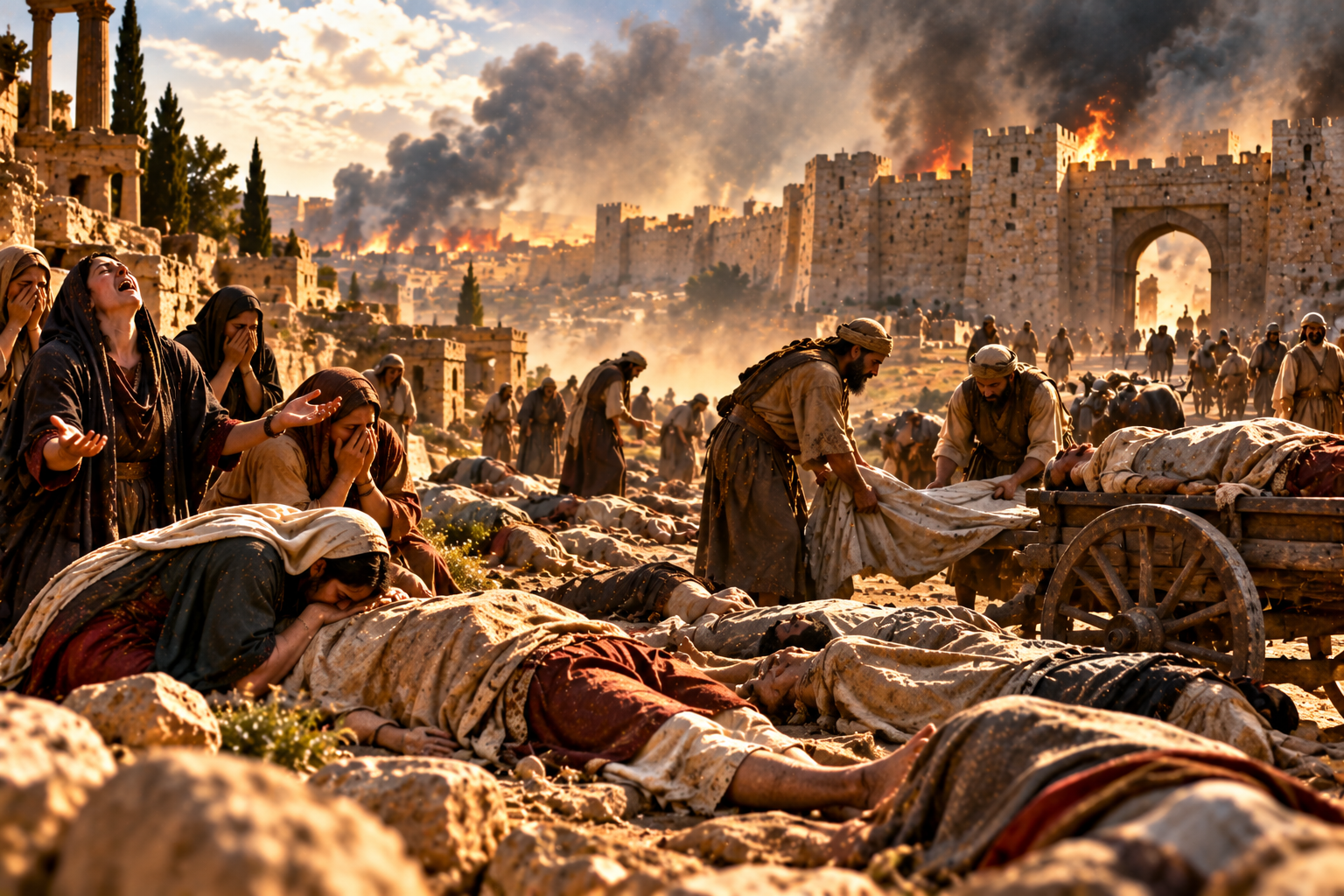
"Many dead bodies, thrown everywhere" (CSB)
WHEN CELEBRATION
TURNS TO LAMENTATION
The songs of the palace (hekal = temple; LXX - naos - a building regarded as a dwelling place for a divine being) will turn to wailing (yalal; LXX - hololuzo only in Jas 5:1 - making a loud, inarticulate cry as reaction to desperate circumstances) in that day,” declares the Lord GOD (adonay Jehovah/yahweh) - NET = "The women singing in the temple will wail in that day." This verse describes the "harvest" that Israel's sin sowing would reap (Gal 6:6-7, Hos 8:7)! What a terrifying transformation! The songs that once filled Israel's palaces would be replaced by cries of anguish. Earlier Amos had condemned the wealthy for their luxurious lifestyles, including their elaborate musical entertainment (Am 6:4–6). They reclined on beds of ivory, enjoyed extravagant meals, drank wine from sacrificial bowls, and improvised songs to the sound of the harp. Yet they were not grieved over the spiritual and moral ruin of their nation. Now God announces that their songs will become wailing. The Hebrew verb translated “turn to wailing” is yalal, meaning to howl, wail, or cry out in grief. It describes intense lamentation rather than ordinary sadness. The sounds of celebration will be replaced by the sounds of mourning.
In that day (WHENEVER YOU READ A TIME PHRASE IN SCRIPTURE, PAUSE AND ASK "WHAT TIME IS IT?") points to the time when God's announced judgment would be executed, the Day of the LORD. Recall that Israel had even longed for the day of the LORD, apparently expecting it to bring them victory and blessing. But Amos had warned them: “Alas (WOE) you who are longing for the day of the LORD, For what purpose will the day of the LORD be to you? It will be darkness and not light” (Am 5:18). The judgment day would be consummated in the Assyrian conquest in 722 BC (2 Ki 17:5–6). Further descriptions of that day are found in...
Amos 8:9 It will come about in that day,” declares the Lord GOD, “That I will make the sun go down at noon And make the earth dark in broad daylight.
Amos 8:13 “In that day the beautiful virgins And the young men will faint from thirst.
Bob Utley - "will turn to wailing" The VERB (Hiphil PERFECT with waw) occurs several times in the section of Jeremiah dealing with judgment on the surrounding nations (cf. Jer. 47:2; 48:20,31,39; 49:3; 51:8). He seems to follow Isaiah's usage (cf. Isa. 13:6; 14:31; 15:2,3; 16:7[twice]; Isa 23:1,6,14). A good translation of this outcry over death and destruction could be "wail," "howl," "shriek." The eighth century minor prophets used this imagery several times in relation to YHWH's coming judgment -- Hosea 7:14, Joel 1:5,11,13 (date unknown, possibly early post-exilic), Amos 8:3, Micah 1:8
KJV Bible Commentary - The fact is that the songs will be turned into howlings and wailing because of the dead bodies that will be strewn about everywhere. In view of such death and devastation, the only fitting response will be mourning, or silence. They shall cast them forth with silence. So deep will be the grief that at this time words will utterly fail those whose responsibility it is to dispose of the bodies, and they will go about their work in silence (vs. 3).
Many will be the corpses; in every place they will cast (shalak/salak; LXX - epipipto - throw upon) them forth in silence (has; LXX - siope - silence) - The Hebrew expression is stark and forceful. The word pegarim refers to dead bodies or corpses. The emphasis falls upon their great number, so many that they would be cast out rather than even given a proper burial (cf Jer 9:22). The language recalls Amos 6:9–10, where the prophet describes a house in which even ten people may die and the remains must be carried out. Here the devastation extends throughout the land. The people who had enjoyed luxury, security, and abundance would face a catastrophe that neither wealth nor political power could prevent. Those still alive might be in such a state of shock at the appalling scene that they could not even speak. Alternatively, the New Jerusalem Bible (Am 8:3NJB) renders "in silence" as an imperative "Keep silent!" which prompts Hubbard to say "the scene was so macabre that ‘Hush!’ was the only proper word to voice." (See Joel and Amos - Page 232)
In Every Place emphasizes the widespread nature of the catastrophe. No palace was too magnificent, no city too fortified, and no household too prosperous to escape the consequences of God's announced judgment.
They will cast (shalak/salak; LXX - epipipto - throw upon) them forth in silence (has; LXX - siope - silence) - NLT - "They (DEAD BODIES) will be carried out of the city in silence." NET - "There will be many corpses littered everywhere! Be quiet!"
The closing words of Amos 8:3 are haunting. The Hebrew is extremely compressed, literally “He casts out (šālak)... Hush!” The final word, has, is an interjection meaning “Hush!” or “Be silent!” Amos used it earlier, where the one removing the dead from a house warns, “Keep quiet” (Am 6:10). The text does not say why silence is commanded. Some see the stunned silence of survivors overwhelmed by the number of dead. Others see fear in the presence of divine judgment, since has elsewhere calls for silence before the LORD on His day of judgment (Zeph 1:7; Hab 2:20; Zec 2:13). Still others suggest that the sheer scale of death had made ordinary mourning and burial impossible. What is clear is the dramatic contrast within the verse: it begins with songs and ends with silence, and between them lie wailing and death.
Bob Utley - "they will cast them forth in silence" This refers to abnormal burial practices (i.e. no professional wailing nor any wailing at all) because of invasion and siege. This phrase is related to Amos 6:10 (the same INTERJECTION is used, BDB 245, "hush").
NET NOTE - Heb "Many corpses in every place he will throw out." The subject of the verb is probably impersonal, though many emend the active (Hiphil) form to a passive (Hophal): "Many corpses in every place will be thrown out."
🙏 THOUGHT — Are You Celebrating While Ignoring Spiritual Danger? Beloved, Amos presents a sobering picture of a nation whose songs of celebration were about to become cries of anguish. Israel enjoyed prosperity, pleasure, and outward security, yet remained tragically indifferent to its spiritual condition. Could we become so absorbed in the comforts and pleasures of life that we fail to recognize the dangers of spiritual complacency? There is nothing wrong with enjoying God's blessings, but there is great danger in allowing those blessings to distract us from the Blesser Himself. Moses warned Israel not to forget the LORD when their houses were filled with good things and their prosperity increased (Dt 8:11–14). Jesus likewise warned about the deceitfulness of riches and the worries and pleasures of life that can choke spiritual fruitfulness (Mk 4:18–19; Lk 8:14). James reminds us that life is a vapor that appears for a little while and then vanishes away (Jas 4:14). The tragedy is not that we enjoy God's blessings, but that we might enjoy them while neglecting the God Who gave them! May we continually examine our hearts, cultivate gratitude, pursue righteousness, and remember that our ultimate security is not found in earthly prosperity but in our unchanging Savior (Mt 6:33; Col 3:1–4). Let us rejoice in the Lord, but never allow our rejoicing to become an excuse for ignoring His Word or tolerating sin in our lives.
Wailing (howling) (03213) yalal is a verb that means to howl with loud crying and shrill shouting sounds of sorrow. To howl with a wailing tone. This verb is found only in the prophets and most often in the context of divine judgment, especially the coming Day of the Lord. Thus it is not surprising that this verb is often used as an expression of mourning, distress or dismay! Yahal is frequently paired with the verb za'aq (Isa 14:31, Jer 25:34, 47:2, 48:20, 31, Ezek 21:12, Hos 7:14) which means "cry out" and denotes a cry for help out of deep distress or because of some unbearable circumstance
Yalal is frequently translated in the Septuagint with the verb hololuzo (Isa 13:6, 14:31, 15:2, 3, 16:7, 23:1, 14, 52:5, 65:14, Jer 48:20, 31, Ezek 21:12, Hos 7:14, Amos 8:3, Zech 11:2), an onomatopoetic word that describes making a loud and inarticulate cry of either jubilation or terror, especially as a reaction to desperate circumstances. The lone NT use by James describes a vivid warning to the rich "Come now, you rich weep (aorist imperative) and howl (hololuzo - imperative sense) for your miseries which are coming upon you." (James 5:1)
Webster says howl describes a long, loud, doleful cry uttered by an animal such as a dog or wolf. Wail describes a prolonged high-pitched cry of pain, grief, or anger.
Amos 8:4 Hear this, you who trample the needy, to do away with the humble of the land,
KJV Hear this, O ye that swallow up the needy, even to make the poor of the land to fail,
NET Listen to this, you who trample the needy, and do away with the destitute in the land.
NLT Listen to this, you who rob the poor and trample down the needy!
ESV Hear this, you who trample on the needy and bring the poor of the land to an end,
BGT ἀκούσατε δὴ ταῦτα οἱ ἐκτρίβοντες εἰς τὸ πρωὶ πένητα καὶ καταδυναστεύοντες πτωχοὺς ἀπὸ τῆς γῆς
LXE Hear now this, ye that oppress the poor in the morning, and drive the needy ones by tyranny from the earth,
CSB Hear this, you who trample on the needy and do away with the poor of the land,
NIV Hear this, you who trample the needy and do away with the poor of the land,
- Hear (KJV): Am 7:16 1Ki 22:19 Isa 1:10 28:14 Jer 5:21 28:15
- swallow (KJV): Am 2:6 5:11 Ps 12:5 14:4 56:1 140:12 Pr 30:14 Isa 32:6,7 Mt 23:14 Jas 5:6
Related Passages:
Exodus 23:6 “You shall not pervert the justice due to your needy brother in his dispute.
Deuteronomy 10:18 “He executes justice for the orphan and the widow, and shows His love for the alien by giving him food and clothing.
Proverbs 14:31 He who oppresses the poor taunts his Maker, But he who is gracious to the needy honors Him.
Proverbs 22:22-23 Do not rob the poor because he is poor, Or crush the afflicted at the gate; 23For the LORD will plead their case And take the life of those who rob them.
Isaiah 1:16-17 “Wash yourselves, make yourselves clean; Remove the evil of your deeds from My sight. Cease to do evil, 17 Learn to do good; Seek justice, Reprove the ruthless, Defend the orphan, Plead for the widow.
Deuteronomy 15:7-11 “If there is a poor man with you, one of your brothers, in any of your towns in your land which the LORD your God is giving you, you shall not harden your heart, nor close your hand from your poor brother; 8 but you shall freely open your hand to him, and shall generously lend him sufficient for his need in whatever he lacks. 9 “Beware that there is no base thought in your heart, saying, ‘The seventh year, the year of remission, is near,’ and your eye is hostile toward your poor brother, and you give him nothing; then he may cry to the LORD against you, and it will be a sin in you. 10 “You shall generously give to him, and your heart shall not be grieved when you give to him, because for this thing the LORD your God will bless you in all your work and in all your undertakings. 11 “For the poor will never cease to be in the land; therefore I command you, saying, ‘You shall freely open your hand to your brother, to your needy and poor in your land.’
Amos 2:6-7 Thus says the LORD, “For three transgressions of Israel and for four I will not revoke its punishment, Because they sell the righteous for money And the needy for a pair of sandals. 7 “These who pant after the very dust of the earth on the head of the helpless Also turn aside the way of the humble; And a man and his father resort to the same girl In order to profane My holy name.
Micah 6:8 He has told you, O man, what is good; And what does the LORD require of you But to do justice, to love kindness, And to walk humbly with your God?
James 2:1-6 My brethren, do not hold your faith in our glorious Lord Jesus Christ with an attitude of personal favoritism. 2 For if a man comes into your assembly with a gold ring and dressed in fine clothes, and there also comes in a poor man in dirty clothes, 3 and you pay special attention to the one who is wearing the fine clothes, and say, “You sit here in a good place,” and you say to the poor man, “You stand over there, or sit down by my footstool,” 4 have you not made distinctions among yourselves, and become judges with evil motives? 5 Listen, my beloved brethren: did not God choose the poor of this world to be rich in faith and heirs of the kingdom which He promised to those who love Him? 6 But you have dishonored the poor man. Is it not the rich who oppress you and personally drag you into court?
Galatians 6:10 So then, while we have opportunity, let us do good to all people, and especially to those who are of the household of the faith.
James 1:27 Pure and undefiled religion in the sight of our God and Father is this: to visit orphans and widows in their distress, and to keep oneself unstained by the world.
1 John 3:17-18 But whoever has the world’s goods, and sees his brother in need and closes his heart against him, how does the love of God abide in him? 18Little children, let us not love with word or with tongue, but in deed and truth.
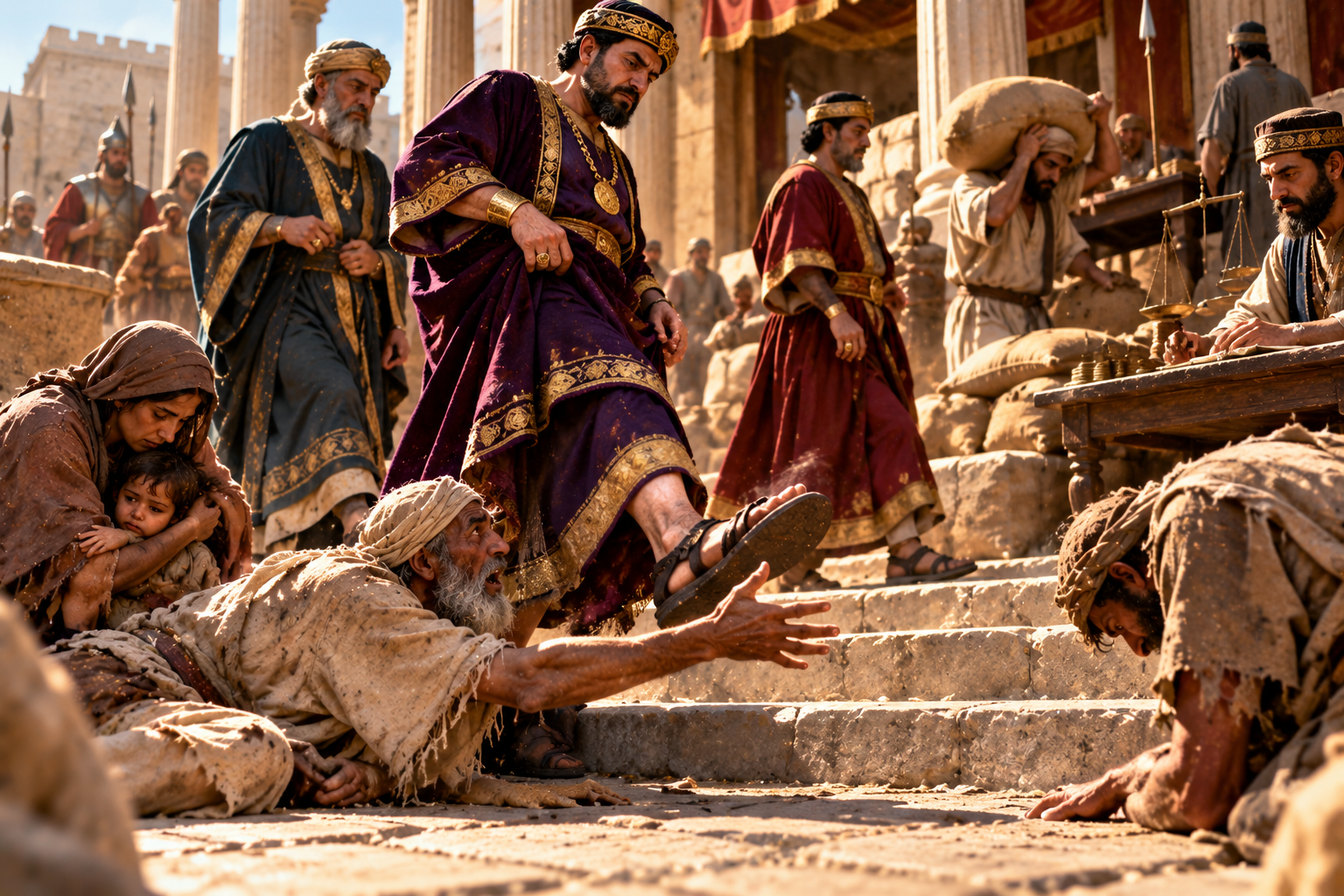
"Hear this, you who trample the needy"
THE SIN OF CRUSHING
THE HELPLESS
Amos now exposes one of the principal reasons for God's judgment: the wealthy and powerful were enriching themselves at the expense of the poor and defenseless. The nation enjoyed remarkable prosperity, but that prosperity was accompanied by widespread injustice, exploitation, and contempt for the vulnerable. The people whom God had commanded Israel to protect were instead being crushed by those who possessed economic power.
Wiersbe adds "The reason was simple: Israel had broken God’s law and failed to live by His covenant. The first table of the Law has to do with our relationship to God and the second table with our relationship to others, and Israel had rebelled against both. They did not love God, and they did not love their neighbors (Matt. 22:36–40)." (Bible Exposition Commentary)
Hear (shama; LXX - akouo - hear and heed) this - God issues a command to listen to these words with the implication of heeding and obeying. However, in this context, it is too late for Israel to obey them for the summer fruit is ripe for harvesting! God has spoken again and again (hear - Am 3:1; 4:1; 5:1; 8:4) but Israel has repeatedly refused to listen. So now the very ones who had closed their ears to the cries of the poor are now commanded to open their ears to the voice of God. Notice the irony that those who refused to listen to the helpless must now listen to the Almighty. They would not hear the cries of the needy, but they could not escape the voice of the LORD. This verb is used in Amos 2:7 “These who pant after the very dust of the earth on the head of the helpless." The needy are treated as though they are obstacles to be crushed rather than human beings deserving dignity and justice.
Bob Utley - "Hear" This is the Hebrew term Shema (BDB 1033, KB 1570, Qal IMPERATIVE). It means "to hear so as to do." It is often used of prayer (cf. Deut. 6:4-6; Amos 3:1,13; 4:1; 5:1).
you who trample the needy - Trample (sha'aph) a word whose range of meaning includes panting after, eagerly pursuing, or seeking to swallow up. In contexts involving oppression (as is the case now), it conveys the idea of aggressively pursuing or crushing another person.
NET NOTE - trample - Most scholars now understand this verb as derived from the root II שָׁאַף (sha’af, “to crush; to trample”), an alternate form of שׁוּף (shuf), rather than from I שָׁאַף (sha’af, “to pant, to gasp”; cf. KJV, ASV, NASB).
Bob Utley - Verse 4 refers to subjugation (i.e. "trample" or "crush" Qal PARTICIPLE) of the poor ("the needy" parallel to "the humble of the land" and "the helpless. . .the needy," cf. Amos 8:6) by the rich and politically powerful (cf. Amos 2:7; 5:11,12). The JPSOA suggests an emendation to the MT of this verse, which reads, "who on every new moon devour the needy, and on every sabbath the humbled of the land" (i.e. vv. 4-5).
Needy ('ebyon; LXX - penes - used of one who has few possessions and consequently must work hard to support himself; distinguished from ptochos - beggar) describes those who lack adequate resources and are dependent upon others for help. It often refers to people who are economically vulnerable and easily exploited. These were individuals who lacked the wealth, influence, and social standing necessary to defend themselves against powerful adversaries. Instead of showing compassion, Israel's wealthy citizens exploited their vulnerability. God had specifically commanded His people to protect the poor and administer justice without partiality (Ex 23:6; Dt 15:7–11). Those who should have protected the needy were profiting from their helplessness. The poor were not being overlooked by accident; they were being exploited for advantage.
Amos 8:4 opens the final indictment, “Hear this, you who trample the needy,” and 8:6 repeats the charge of 2:6, “to buy... the needy for a pair of sandals.” The repetition frames Amos’s message: from his first indictment of Israel to his last, the treatment of the ʾebyôn is the evidence against the nation. Those whom God had pledged to protect were treated as cheap merchandise, worth no more than a pair of sandals.
to do away with (“put an end to”; “exterminate”) the humble of the land - To do away with (shabath) can mean to cease, stop, or bring to an end and in this context conveys the destructive result, or possibly the deliberate purpose, of the oppressors' conduct. Their treatment of the vulnerable threatened to eliminate their ability to survive and remain established in the land. Humble ('anaw) refer to one who is afflicted, lowly, and in some contexts, it emphasizes material poverty or social vulnerability while in others, it describes the spiritual quality of humility. In this context it clearly describes the economically and socially vulnerable, those who were least able to resist exploitation. Greed had become so deeply rooted in Israel's society that the poor were treated as expendable. The next two verses explain how the oppression described in Amos 8:4 was taking place. Amos 8:4 identifies the victims; Amos 8:5–6 exposes the methods of their exploitation. Recall that Amos had begun his indictment of Israel with similar accusations, such as selling "the righteous for money And the needy for a pair of sandals." (Amos 2:6,7).
Amos addresses those “who trample the needy, to do away with the humble of the land.” The Hebrew text itself reflects the overlap between these words. The consonants are written as ʿanwê (“the humble”), and the margin reads ʿaniyyê (“the afflicted”). Both are true: the people being crushed were both poor and humble. The merchants of Samaria were not merely taking advantage of them; they were trying to “make them cease” (šābat) from the land altogether. Ironically, the verb is related to “Sabbath,” the very day these merchants could hardly wait to end (Am 8:5)!!!
Why is this sin so offensive to God? The underlying principle is that every human being possesses dignity because humanity was created in God's image (Ge 1:26–27). Poverty does not diminish that dignity. Wealth does not increase it. Social influence does not determine it. The value of a person is not measured by what he possesses, but by the God in Whose image he was created. Therefore, exploiting the vulnerable is not merely a social offense. In summary, It is a moral offense against the Creator.
Do we treat people differently according to
their wealth, influence, or ability to benefit us?
🙏 THOUGHT — How Do We Treat Those Who Cannot Benefit Us? Amos reminds us that God takes seriously the way we treat those who are poor, vulnerable, or unable to defend themselves. Israel's wealthy citizens had become so consumed with personal gain that they were willing to trample the needy and destroy the livelihoods of the humble. Could we be guilty of a subtler form of the same sin? Do we treat people differently according to their wealth, influence, or ability to benefit us? Are we scrupulously honest in our business dealings, or are we tempted to take advantage of someone who may not recognize an unfair transaction? James warns against showing favoritism toward the wealthy while dishonoring the poor (Jas 2:1–6). Solomon reminds us that whoever oppresses the poor insults their Maker, while whoever is gracious to the needy honors Him (Pr 14:31). And Paul commands believers to do good to all people, especially those of the household of faith (Gal 6:10). Our treatment of those who can do nothing for us often reveals more about our spiritual condition than our treatment of those who can do much for us. May we never be content with outward religious activity while neglecting justice, compassion, and integrity in our daily lives. Remember that genuine faith expresses itself not merely in what we profess with our lips, but also in how we treat those whom God has placed in our path (Jas 1:27; 1 Jn 3:17–18).
Our treatment of those who can do nothing for us often reveals
more about our spiritual condition than our treatment of those who can do much for us.
Needy (034) ebyon is an adjective, often used as a noun, meaning “needy” or “poor.” It describes a person who lacks what is necessary for life and must depend on others. Its origin is uncertain. Some connect it with the verb ʾābâ, “to be willing, to desire,” so that the ʾebyôn is one who wants or longs for what he does not have. Others suggest it was borrowed from Egyptian. As Humbert observed, the word expresses not only lack but also expectation: the ʾebyôn is the one who stretches out his hand, asking for help. It occurs 61 times in the Old Testament, most often in the Psalms (23 times), followed by Deuteronomy (7), Job (6), and Amos and Isaiah (5 each). It is one of several Hebrew words for the poor. ʿĀnî emphasizes affliction, dal weakness or a low position, and rāš destitution, while ʾebyôn stresses need. It often appears in the pair “poor and needy” (ʿānî wĕʾebyôn) (Dt 24:14; Ps 40:17; Jer 22:16; Ezek 16:49). The Septuagint usually renders it penēs (“poor, laboring person”), and sometimes ptōchos (“beggarly poor”), the word Jesus used in “Blessed are you who are poor” (Lk 6:20).
EBYON - 60X/58V - needy(45), needy one(2), poor(12), poor man(1). Exod. 23:6; Exod. 23:11; Deut. 15:4; Deut. 15:7; Deut. 15:9; Deut. 15:11; Deut. 24:14; 1 Sam. 2:8; Est. 9:22; Job 5:15; Job 24:4; Job 24:14; Job 29:16; Job 30:25; Job 31:19; Ps. 9:18; Ps. 12:5; Ps. 35:10; Ps. 37:14; Ps. 40:17; Ps. 49:2; Ps. 69:33; Ps. 70:5; Ps. 72:4; Ps. 72:12; Ps. 72:13; Ps. 74:21; Ps. 82:4; Ps. 86:1; Ps. 107:41; Ps. 109:16; Ps. 109:22; Ps. 109:31; Ps. 112:9; Ps. 113:7; Ps. 132:15; Ps. 140:12; Prov. 14:31; Prov. 30:14; Prov. 31:9; Prov. 31:20; Isa. 14:30; Isa. 25:4; Isa. 29:19; Isa. 32:7; Isa. 41:17; Jer. 2:34; Jer. 5:28; Jer. 20:13; Jer. 22:16; Ezek. 16:49; Ezek. 18:12; Ezek. 22:29; Amos 2:6; Amos 4:1; Amos 5:12; Amos 8:4; Amos 8:6
1. Material need.
At its most basic, ʾebyôn describes someone who has fallen on hard times. He may have lost his family land and have to eat what grows wild in the fallow seventh year (Ex 23:11). He may lack clothing (Job 31:19) or food (Ps 132:15; Isa 14:30), or he may have been driven into debt (Dt 15:7–9). Job wept for such people: “Was not my soul grieved for the needy?” (Job 30:25).
2. A person needing legal protection.
Because the needy had no money or influence, they were easy to exploit, so God built protection for them into the Law. Judges were forbidden to “pervert the justice due to your needy brother” (Ex 23:6), the word’s first occurrence. In the year of release, debts were canceled (Dt 15:1–4), and Israel was commanded to lend generously to the needy anyway, because “the poor will never cease to be in the land” (Dt 15:7–11). A poor hired worker had to be paid the same day (Dt 24:14–15). Gleaning laws, the sabbatical year, and the jubilee all served to keep a poor Israelite from permanently losing his inheritance (Lev 19:9–10; 25:25–41).
3. The oppressed, in the prophets.
The prophets repeatedly indicted Israel for violating those protections. Amos uses ʾebyôn five times, more than any other prophet. Israel sold “the righteous for money and the needy for a pair of sandals” (Am 2:6), and Samaria’s wealthy women “crush the needy” (Am 4:1). Amos pairs the “needy” with the “righteous” (ṣaddîq) (Am 2:6; 5:12), implying that the oppressed poor were the ones in the right. Jeremiah says that defending “the cause of the afflicted and needy” is what it means to know the LORD (Jer 22:16; cf. 5:28). Ezekiel names neglect of the needy as part of Sodom’s guilt (Ezek 16:49) and lists their oppression among the abominations deserving death (Ezek 18:12).
4. The godly poor who depend on God.
In the Psalms, ʾebyôn often takes on a spiritual meaning, describing righteous sufferers oppressed by enemies, with no help but God. David repeatedly prays, “I am afflicted and needy” (Ps 40:17; 70:5; 86:1; 109:22). This is not a confession of financial poverty but of helpless dependence. God’s response is sure: “the needy will not always be forgotten” (Ps 9:18). “Because of... the groaning of the needy, now I will arise” (Ps 12:5), and He “stands at the right hand of the needy” (Ps 109:31). Hannah sang of the God who “lifts the needy from the ash heap to make them sit with nobles” (1 Sa 2:8; Ps 113:7). Isaiah calls the LORD “a defense for the needy in his distress” (Isa 25:4).
5. The Messiah, champion of the needy.
Psalm 72 portrays the ideal King, ultimately fulfilled in Messiah, as the one who will “save the children of the needy and crush the oppressor” (Ps 72:4). “He will deliver the needy when he cries for help... and the lives of the needy he will save” (Ps 72:12–13). In the coming kingdom, “the needy of mankind will rejoice in the Holy One of Israel” (Isa 29:19).
THOUGHT: How a people treats the needy reveals what it truly believes about God (Pr 14:31). The Christ who “though He was rich, yet for your sake He became poor” (2 Co 8:9) calls His people to the same compassion (Jas 2:5, 15–16; 1 Jn 3:17). Yet the deeper lesson of ʾebyôn is that every one of us comes to God as needy, with empty hands and no claim, but only a cry for His mercy (Ps 40:17). Only those who know their own need can truly care for the needy.
Only those who know their own need
can truly care for the needy.
Humble (lowly, wretched)(06041) ani is an adjective, often used as a noun, meaning “poor, afflicted, humble.” It comes from the verb ʿānâ (H6031), “to be bowed down, afflicted, humbled.” The picture is of someone pressed down by circumstances, people, or suffering. It occurs about 75 times in the Old Testament, concentrated in the Psalms, Isaiah, and the Prophets. It often stands beside ʾebyôn, “needy,” in the pair “afflicted and needy” (Dt 24:14; Ps 40:17), and beside dal, “poor, weak.” Each word has its own emphasis: ʾebyôn stresses need, dal stresses weakness or low standing, and ʿānî stresses affliction, the distress and powerlessness of someone who is being pressed down. Proverbs distinguishes them: “Do not rob the poor (dal) because he is poor, or crush the afflicted (ʿānî) at the gate” (Pr 22:22). The closely related ʿānāw (H6035) means “humble, meek,” and the two are often written interchangeably in the Hebrew text. The Septuagint renders ʿānî with ptōchos (“poor”), penēs (“needy”), tapeinos (“lowly”), and, in Zechariah 9:9, praus (“gentle, meek”).
ANI - 72V - afflicted(42), afflicted one(1), humble(3), lowly(1), needy(2), needy and poor(1), oppressed(1), poor(19), poor man(2), who is humble(1), wretched(1). Exod. 22:25; Lev. 19:10; Lev. 23:22; Deut. 15:11; Deut. 24:12; Deut. 24:14; Deut. 24:15; 2 Sam. 22:28; Job 24:4; Job 24:9; Job 24:14; Job 29:12; Job 34:28; Job 36:6; Job 36:15; Ps. 9:18; Ps. 10:2; Ps. 10:9; Ps. 12:5; Ps. 14:6; Ps. 18:27; Ps. 22:24; Ps. 25:16; Ps. 34:6; Ps. 35:10; Ps. 37:14; Ps. 40:17; Ps. 68:10; Ps. 69:29; Ps. 70:5; Ps. 72:2; Ps. 72:4; Ps. 72:12; Ps. 74:19; Ps. 74:21; Ps. 82:3; Ps. 86:1; Ps. 88:15; Ps. 109:16; Ps. 109:22; Prov. 15:15; Prov. 16:19; Prov. 22:22; Prov. 30:14; Prov. 31:9; Prov. 31:20; Eccl. 6:8; Isa. 3:14; Isa. 3:15; Isa. 10:2; Isa. 10:30; Isa. 14:32; Isa. 26:6; Isa. 32:7; Isa. 41:17; Isa. 49:13; Isa. 51:21; Isa. 54:11; Isa. 58:7; Isa. 66:2; Jer. 22:16; Ezek. 16:49; Ezek. 18:12; Ezek. 18:17; Ezek. 22:29; Amos 8:4; Hab. 3:14; Zeph. 3:12; Zech. 7:10; Zech. 9:9; Zech. 11:7; Zech. 11:11
1. The poor laborer who lives day to day.
In the Law, the ʿānî is often a poor worker with no property and no reserves. A hired servant who is “afflicted and needy” must be paid before sunset, “for he is poor and sets his heart on it” (Dt 24:14–15). When lending to “the poor among you,” Israel was forbidden to charge interest and had to return a cloak taken as a pledge before nightfall, because it was his only covering (Ex 22:25–27). The ʿānî, like the stranger, had a right to the gleanings of field and vineyard (Lev 19:10), and Israel was commanded to “freely open your hand to your brother, to your needy and poor in your land” (Dt 15:11).
2. The socially oppressed.
Because the ʿānî had no power to defend himself, he was an easy target. Isaiah charged Judah’s leaders: “The plunder of the poor is in your houses. What do you mean by crushing My people and grinding the face of the poor?” (Isa 3:14–15). Judges deprived “the needy of justice” and robbed “the poor of My people of their rights” (Isa 10:2). Habakkuk pictures the wicked as those who “devour the oppressed in secret” (Hab 3:14). God measured righteousness by this standard: the righteous man “keeps his hand from the poor” (Ezek 18:17), while neglecting the afflicted marks ungodliness (Job 24:9; Isa 58:7). Zechariah summarized the prophets’ call: “do not oppress the widow or the orphan, the stranger or the poor” (Zec 7:10).
3. The afflicted sufferer.
The word can also describe physical or emotional suffering. Exiled Jerusalem is “afflicted, who are drunk, but not with wine” (Isa 51:21), and the psalmist cries, “I was afflicted and about to die from my youth on” (Ps 88:15). Outward affliction often drives the sufferer to God: “This poor man cried, and the LORD heard him and saved him out of all his troubles” (Ps 34:6; cf. 25:16; 69:29). In the great messianic psalm of the cross, Messiah Himself is the ʿānî: God “has not despised nor abhorred the affliction of the afflicted” (Ps 22:24).
4. God’s afflicted people under His care.
In the Psalms and Isaiah, the ʿānî often become a description of God’s own faithful people, who are oppressed by the wicked but sustained by the LORD. He “does not forget the cry of the afflicted” (Ps 9:12). “The hope of the afflicted” will not perish forever (Ps 9:18). He delivers “the afflicted from him who is too strong for him” (Ps 35:10). Asaph calls Israel God’s “turtledove” and pleads, “Do not forget the life of Your afflicted forever” (Ps 74:19). Isaiah declares that “the LORD has comforted His people and will have compassion on His afflicted” (Isa 49:13).
5. Humble and lowly.
Finally, ʿānî describes an inner disposition of humility before God, closely related to ʿānāw. God “saves an afflicted (humble) people, but haughty eyes You abase” (Ps 18:27; 2 Sa 22:28). He “gives grace to the afflicted” but scoffs at the scoffers (Pr 3:34). Both James and Peter quote that verse from the Septuagint: “God is opposed to the proud, but gives grace to the humble (tapeinos)” (Jas 4:6; 1 Pe 5:5). The LORD looks to the one “who is humble and contrite of spirit, and who trembles at My word” (Isa 66:2). Most remarkably, Zechariah describes the coming King as ʿānî: “your king is coming to you; He is just and endowed with salvation, humble, and mounted on a donkey” (Zec 9:9). Matthew cites this prophecy at Jesus’ triumphal entry, using the Septuagint’s praus, “gentle” (Mt 21:5; cf. Mt 11:29).
THOUGHT: The God who defends the ʿānî chose to become one. Israel’s King came “humble, and mounted on a donkey” (Zec 9:9), was “despised and forsaken of men” (Isa 53:3), and cried from the cross as the afflicted One Whom God did not despise (Ps 22:24). Those who follow Him are called to share His lowliness (Mt 11:29; Php 2:5–8) and to care for the afflicted as He does (Pr 14:21). God still “gives grace to the humble” (Jas 4:6).
Amos 8:5 saying, “When will the new moon be over, So that we may sell grain, And the sabbath, that we may open the wheat market, To make the bushel smaller and the shekel bigger, And to cheat with dishonest scales,
KJV Saying, When will the new moon be gone, that we may sell corn? and the sabbath, that we may set forth wheat, making the ephah small, and the shekel great, and falsifying the balances by deceit?
NET You say, "When will the new moon festival be over, so we can sell grain? When will the Sabbath end, so we can open up the grain bins? We're eager to sell less for a higher price, and to cheat the buyer with rigged scales!
NLT You can't wait for the Sabbath day to be over and the religious festivals to end so you can get back to cheating the helpless. You measure out grain with dishonest measures and cheat the buyer with dishonest scales.
ESV saying, "When will the new moon be over, that we may sell grain? And the Sabbath, that we may offer wheat for sale, that we may make the ephah small and the shekel great and deal deceitfully with false balances,
BGT οἱ λέγοντες πότε διελεύσεται ὁ μὴν καὶ ἐμπολήσομεν καὶ τὰ σάββατα καὶ ἀνοίξομεν θησαυροὺς τοῦ ποιῆσαι μικρὸν μέτρον καὶ τοῦ μεγαλῦναι στάθμια καὶ ποιῆσαι ζυγὸν ἄδικον
LXE saying, When will the month pass away, and we shall sell, and the sabbath, and we shall open the treasure, to make the measure small, and to enlarge the weight, and make the balance unfair?
CSB asking, "When will the New Moon be over so we may sell grain, and the Sabbath, so we may market wheat? We can reduce the measure while increasing the price and cheat with dishonest scales.
NIV saying, "When will the New Moon be over that we may sell grain, and the Sabbath be ended that we may market wheat?"-- skimping the measure, boosting the price and cheating with dishonest scales,
- When (KJV): Nu 10:10 28:11-15 2Ki 4:23 Ps 81:3,4 Isa 1:13 Col 2:16
- new moon (KJV): or, month
- be gone (KJV): Mal 1:13
- and the (KJV): Ex 20:8-10 Ne 13:15-21 Isa 58:13 Ro 8:6,7
- set forth (KJV): Heb. open
- making (KJV): Lev 19:36 De 25:13-16 Pr 11:1 16:11 20:23 Eze 45:10-12 Mic 6:10,11
- falsifying the balances by deceit (KJV): Heb. perverting the balances of deceit, Ho 12:7
Related Passages:
Leviticus 19:35-36 ‘You shall do no wrong in judgment, in measurement of weight, or capacity. 36 ‘You shall have just balances, just weights, a just ephah, and a just hin; I am the LORD your God, who brought you out from the land of Egypt.
Deuteronomy 25:13-16 “You shall not have in your bag differing weights, a large and a small. 14 “You shall not have in your house differing measures, a large and a small. 15 “You shall have a full and just weight; you shall have a full and just measure, that your days may be prolonged in the land which the LORD your God gives you. 16 “For everyone who does these things, everyone who acts unjustly is an abomination to the LORD your God.
Proverbs 11:1 A false balance is an abomination to the LORD, But a just weight is His delight.
Proverbs 16:11 A just balance and scales belong to the LORD; All the weights of the bag are His concern.
Proverbs 20:10, 23 Differing weights and differing measures, Both of them are abominable to the LORD. (20:23) Differing weights are an abomination to the LORD, And a false scale is not good.
Hosea 12:7 A merchant, in whose hands are false balances, He loves to oppress.
Micah 6:10-11 “Is there yet a man in the wicked house, Along with treasures of wickedness And a short measure that is cursed? 11 “Can I justify wicked scales And a bag of deceptive weights?
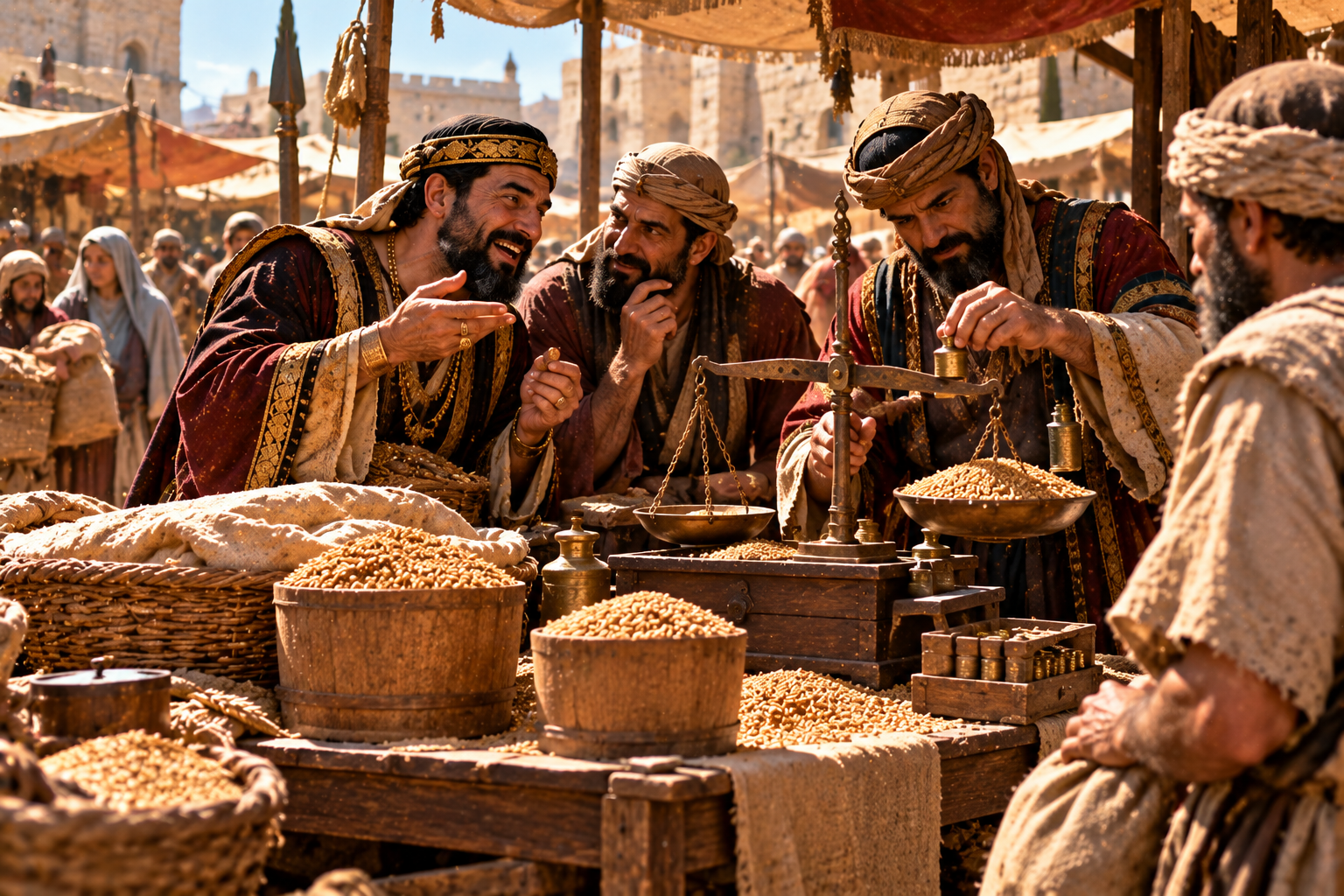
Merchants Eager to Cheat Customers
RELIGION ON THE OUTSIDE
REBELLION ON THE INSIDE
This verse is a devastating exposure of religious hypocrisy! The merchants of Israel outwardly observed the new moon festivals and the Sabbath, but inwardly they could hardly wait for these sacred occasions to end so they could return to their dishonest business practices.
saying, “When will the new moon (hodes/chodesh) be over - NLT - "You can't wait for the Sabbath day to be over and the religious festivals to end." Apparently work was prohibited during the new moon festival, just as it was on the Sabbath. Their bodies were present at religious observances, but their hearts were already in the marketplace. They were not merely eager to resume legitimate business. The new moon (chodesh) marked the beginning of a new month in Israel's religious calendar. The Hebrew word chodesh can refer to a month or to the new moon that marks its beginning. The new moon was associated with special sacrifices and religious observances (Nu 28:11–15). It was a time when Israel was to acknowledge the LORD and remember its covenant relationship with Him. The merchants, however, regarded the occasion as an inconvenience. Their question was not, “How may we honor the LORD?” It was, “When will this religious observance be over so we can get back to business?” The passage assumes that these observances interrupted their commercial activity. While the Sabbath prohibition against ordinary work is explicit in the Law, the precise restrictions governing commerce at every new moon observance are less clearly specified. The important point is the attitude of the merchants. They were physically observing a religious occasion while mentally calculating their next opportunity for profit. Israel was externally religious, internally greedy.
Their worship was an interruption
rather than a delight.
Their worship was an interruption rather than a delight. Their hearts were in the marketplace even while their bodies were engaged in religious observance. This recalls God's indictment through Isaiah: “These people draw near with their words And honor Me with their lip service, But they remove their hearts far from Me” (Isa 29:13). Jesus later applied the same principle to religious hypocrisy (Mt 15:7–9). Their religious observance restrained their business activities, but it did not restrain their sinful desires.
So that (term of purpose/result) we may sell grain - The merchants were eager to resume selling their agricultural products. The problem was not that these men were merchants. The problem was that they were dishonest merchants. Their desire for profit had become more important than their obedience to God. In essence these cheaters viewed the religious calendar as an obstacle to making money. The tragedy is their lack of internal transformation. Their religious observance had not changed their hearts, because their hearts were still controlled by greed.
Thomas Constable- People who focus intently on what they will do after worship is over do not engage in true worship, or enter into the spirit of worship. (THOUGHT - Are you convicted by that comment? Could it be your favorite NFL team on Sunday Afternoon?)
And the sabbath (sabbat), that we may open the wheat market - Frankly, I am surprised they were willing to hold off business on either the New Moon or the Sabbath for they certainly where not obeying other commands in the Mosaic Covenant. Presumably, the wanted to maintain at least a facade of piety or religiosity, but it was all utter hypocrisy! Their true god was mammon and their credo was "gain at any cost!" (See depiction of The Worship of Mammon by Evelyn De Morgan)
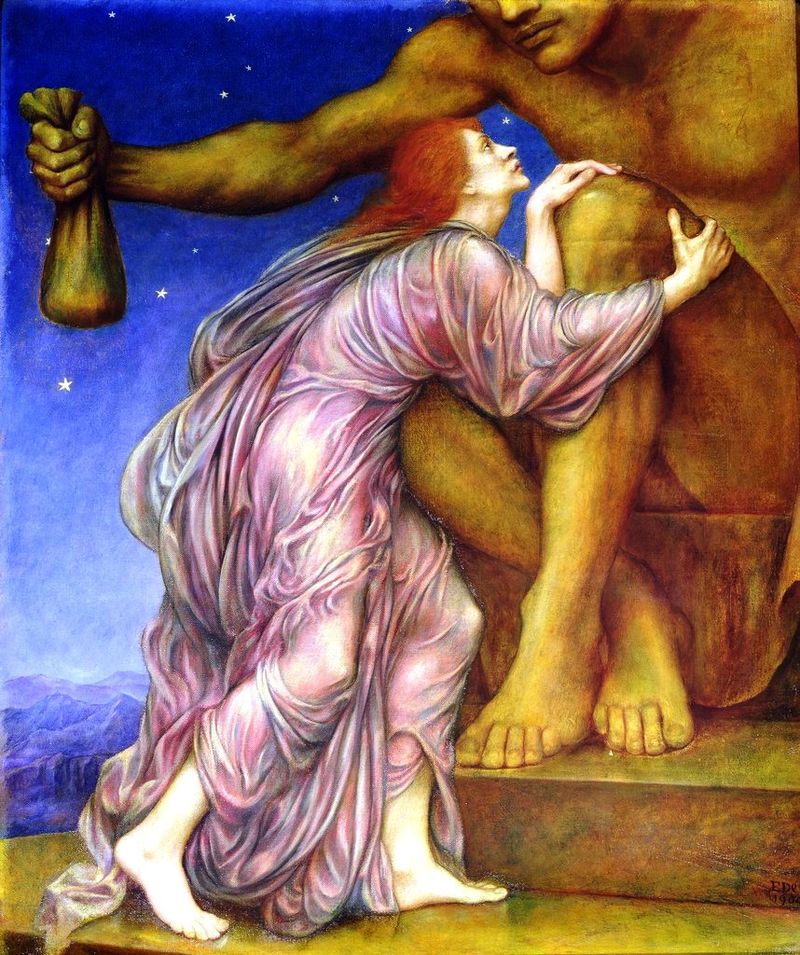
The Sabbath was established by God as a day of rest and worship (Ex 20:8–11). It was also intended to provide rest for servants, laborers, and even animals (Ex 23:12). But these merchants regarded the Sabbath as an obstacle to financial gain. They were not rejoicing in the opportunity to rest and honor the LORD but were counting the hours until they could resume business. They were impatient to resume cheating their customers! The merchants' attitude resembles that condemned in Nehemiah's day, when traders violated the Sabbath by selling their merchandise in Jerusalem (Neh 13:15–22). Their abject hypocrisy was that they were keeping the Sabbath externally while breaking God's moral commandments internally. The fourth commandment concerned honoring the Sabbath. The eighth commandment prohibited stealing (Ex 20:15). The ninth prohibited bearing false witness (Ex 20:16). These merchants could observe one religious requirement outwardly while violating God's commands concerning honesty and justice.
John Walton on the clash between economic and religious concerns -- As Nehemiah discovered several centuries later in Persian-period Jerusalem, the desire of merchants to conduct business sometimes makes their compliance with religious law and Sabbath regulations a matter for complaint or even circumvention (see comment on Neh 10:31). There were religious festivals in surrounding cultures (see comment on Ex 20:8–11), but only Israel was commanded to obey the sabbath law and cease all work (see comment on Ex 31:12–17). This restriction on trade caused friction and apparently contributed to corrupt business practices as a way of “making up” the losses.
To make the bushel (ephah) smaller - NET - "When will the Sabbath end, so we can open up the grain bins? We're eager to sell less for a higher price, and to cheat the buyer with rigged scales!" NLT - "You measure out grain with dishonest measures." Amos describes the first method of their deception. Bushel is a dry measure used for grain which was approximately 20–22 liters ( although ancient measures varied). In this case the merchants deliberately reduced the quantity of grain they provided so that the customer believed he was purchasing a full ephah, but would secretly be receiving less resulting in dishonest profit. Such a practice was a direct violation of God's command concerning honest weights and measures (Lev 19:35–36). in short these men honored God's holy days with their calendars while dishonoring God's holy character with their conduct. Their dishonesty was especially harmful to the poor, who could least afford to lose even a small portion of their food.
Bob Utley - The wealthy, powerful, and influential could not wait for the religious assemblies (i.e. "new moon," cf. Num. 28:11; 2 Kgs. 4:23 and "sabbath," cf. Exod. 31:13-17) to be over so they could instigate their illegal, improper, and unjust schemes toward the poor: to make the bushel smaller, the shekel bigger, use dishonest scales, sell the husk of the wheat (those grain heads that fell in the dirt, or under-developed grain that fell through the sieve, cf. Amos 9:9) with the wheat. All of these refer to cheating the poor when they buy food (cf. Lev. 19:35-36; Deut. 25:13-16; Prov. 20:10). The VERBS "sell" nd "open" are both COHORTATIVE. These merchants' desire to exploit is so strong that their actions are the commands of their own hearts. ▣ "the new moon" This refers to the ancient custom of observing a religious holiday at the first of the month (cf. Nu 28:11; 2 Kgs. 4:23). Remember, the Jews went by the lunar calendar.
And the shekel (šeqel) bigger - The shekel was a unit of weight used in commercial transactions, particularly for weighing silver before coinage became common. The Hebrew word šeqel is related to the verb saqal, meaning to weigh. The merchants were manipulating both sides of the transaction. They made the ephah smaller so that customers received less grain. They made the shekel bigger so that customers had to pay more silver. The result was that the customer was cheated twice, receiving less than he purchased and paying more than he owed. What makes their conduct particularly reprehensible is that the victims were often the needy and humble whom Amos had just described. They gave their customers less grain for more money, then called the difference profit but God called it injustice. In effect, the shekel, a measure God had set by His own sanctuary standard, had been turned into a tool of oppression.
David Guzik has a convicting comment - Cheating and dishonesty in business is not a small sin, nor is it a sin excused of “necessity.” God sees it and takes account.
NET NOTE - “to make small the ephah and to make great the shekel.” The “ephah” was a unit of dry measure used to determine the quantity purchased, while the “shekel” was a standard weight used to determine the purchase price. By using a smaller than standard ephah and a heavier than standard shekel, these merchants were able to increase their profit (“sell less for a higher price”) by cheating the buyer.

And to cheat with dishonest scales (Lit - balances of deception) - Hebrew = “and to cheat with deceptive scales”; NLT - "You measure out grain with dishonest measures and cheat the buyer with dishonest scales." This describes the deliberate distortion of weighing instruments. Cheat is related to the idea of bending, twisting, or perverting while scales refers to a balance used for weighing merchandise or payment. The merchants were not making accidental mistakes. By manipulating measures, increasing prices, and falsifying scales, they enriched themselves at the expense of the poor. Amos exposes the tragic contradiction between outward religious observance and inward moral corruption. God commanded Israel to use honest balances, honest weights, and honest measures (Lev 19:35–36). Deuteronomy likewise condemned dishonest weights and measures, declaring that those who practice such things are an abomination to the LORD (Dt 25:13–16). Their dishonest scales revealed their dishonest hearts. Their heart was so deceived that they could observe a holy day and still conduct an unholy business.
Thomas Constable - Archaeologists have found at Tirzah, the first capital of Israel (1 Kings 14:17; 15:21, 33; et al.), the remains of shops from the eighth century B.C. that contain two sets of weights: one for buying and one for selling.
NET NOTE - Rigged scales may refer to bending the crossbar or shifting the center point of the scales to make the amount weighed appear heavier than it actually was, thus cheating the buyer.
Bob Utley - "dishonest scales" This CONSTRUCT (BDB 24, 941) denotes unfair and dishonest commercial enterprises, especially against the poor (cf. Micah 6:10-11). YHWH hates this falsehood (cf. Prov. 11:1). It is never "business is business" with God or His people! Exploitation reveals a heart of self, greed, and fallenness.
Billy Smith - These people regarded cereals and human beings equally as stock for sale. Their practices were both dishonest and inhumane. (See Amos: An Exegetical and Theological Commentary - Page 146)
Their bodies were present at religious observances,
but their hearts were consumed with greed.
🙏 THOUGHT — Does Your Conduct on Monday Match Your Worship on Sunday? Amos exposes the tragic inconsistency of people who outwardly honored God's appointed days while inwardly longing to return to dishonest business practices. Their bodies were present at religious observances, but their hearts were consumed with greed. Could we be guilty of a similar inconsistency? We may faithfully attend church, participate in Bible studies, sing hymns, and speak about our love for Christ, yet conduct ourselves differently when money, business, or personal advantage is involved. Do we demonstrate the same integrity in private transactions that we profess in public worship? (See Integrity - A Whole Heart) Are we completely honest when no one is watching, or are we tempted to bend the truth when doing so might benefit us financially? Solomon reminds us that a false balance is an abomination to the LORD, while a just weight is His delight (Pr 11:1). Paul commands us to do everything in the name of the Lord Jesus and to work heartily as for Him (Col 3:17, 23–24). James warns us against merely hearing God's Word without putting it into practice (Jas 1:22). The authenticity of our worship is revealed not only by what we profess with our lips, but by how we conduct ourselves when the worship service is over. Lord, give us hearts that love You sincerely, hands that deal honestly, so that our lives that demonstrate His righteousness in every transaction and relationship, all for Your glory and in Jesus' Name. Amen.
Remember, the Lord Who hears our prayers on Sunday
also sees our practices on Monday!
Bushel (0374) ephah is a dry measure which is transliterated as ephah which was the equivalent of 10 omers (omer = 2 quarts) (Ex 16:36). "There were ten ephahs in a homer (which is thought to be a donkey load) and ten omers in one ephah. The seah was probably one-third of an ephah. The ephah was the same as the liquid measure, the bath. There is much uncertainty in the size of the bath and ephah." (TWOT) Although there is uncertainty, most authorities state that an ephah was from 50-60% of a bushel. Moses had Aaron save one-tenth of an ephah of manna as a memorial (Ex 16:36). For a sin offering, one-tenth of an ephah of fine flour was required (Lev 5:11) and also for the offering on the day of Aaron’s anointing (Lev 6:20; cf. Nu 5:15; 28:5). In Ezek this is increased to one-sixth ephah for some offerings (Ezek 45:13; 46:14). Also, a cereal offering of one ephah was to accompany each bull or ram offered according to Ezek 45:24; 46:5, 11. Ephah is translated as bushel(1), differing measures(2), ephah(33), measure(2).
Shekel (08255) (šeqel) is a masculine noun from the verb šāqal (H8254), “to weigh.” It is the basic unit of weight in the Old Testament and occurs about 88 times. For most of Israel’s history, the shekel was a weight, not a coin. Silver and gold were weighed out on a balance, as when Abraham “weighed out for Ephron the silver” (Ge 23:16) and Jeremiah “weighed out the silver on the scales” (Jer 32:9–10). Stamped coins did not appear in Judah until the Persian period, and the familiar silver shekel coins came later still. The same root appears in the Aramaic teqel written on Belshazzar’s wall, “TEKEL: you have been weighed on the scales and found deficient” (Da 5:25, 27).
SEQEL - 88X/54V - shekel(42), shekels(46). Gen. 23:15; Gen. 23:16; Exod. 21:32; Exod. 30:13; Exod. 30:15; Exod. 30:24; Exod. 38:24; Exod. 38:25; Exod. 38:26; Exod. 38:29; Lev. 5:15; Lev. 27:3; Lev. 27:4; Lev. 27:5; Lev. 27:6; Lev. 27:7; Lev. 27:16; Lev. 27:25; Num. 3:47; Num. 3:50; Num. 7:13; Num. 7:19; Num. 7:25; Num. 7:31; Num. 7:37; Num. 7:43; Num. 7:49; Num. 7:55; Num. 7:61; Num. 7:67; Num. 7:73; Num. 7:79; Num. 7:85; Num. 7:86; Num. 18:16; Num. 31:52; Jos. 7:21; 1 Sam. 9:8; 1 Sam. 17:5; 1 Sam. 17:7; 2 Sam. 14:26; 2 Sam. 24:24; 2 Ki. 7:1; 2 Ki. 7:16; 2 Ki. 7:18; 2 Ki. 15:20; 1 Chr. 21:25; 2 Chr. 3:9; Neh. 5:15; Neh. 10:32; Jer. 32:9; Ezek. 4:10; Ezek. 45:12; Amos 8:5
1. A standard of weight.
The shekel was the base unit of a system of weights shared throughout Canaan and Mesopotamia, though its exact weight varied by time and place. In Israel it weighed roughly 10 to 13 grams, about four-tenths of an ounce. Many dome-shaped stone shekel weights from Judah in the 8th and 7th centuries BC average about 11.3 grams. Its subdivisions and multiples were:
- gerah: 1/20 shekel (Ex 30:13; Ezek 45:12)
- beqaʿ: half a shekel (Ex 38:26)
- quarter shekel (1 Sa 9:8) and third of a shekel (Neh 10:32)
- mina: 50 shekels, or 60 in the Babylonian system (Ezek 45:12)
- talent: 3,000 shekels (Ex 38:25–26)
The shekel measured weight in general, not just money: the spices of the anointing oil (Ex 30:23–24), the bronze of the tabernacle (Ex 38:29), daily food rations during a siege (Ezek 4:10), and even Absalom’s hair, which weighed “two hundred shekels by the king’s weight” (2 Sa 14:26).
2. Several standards.
Scripture refers to at least two, and possibly three, standards. The “shekel of the sanctuary” (šeqel haqqōdeš), used about 25 times in Exodus through Numbers, was the official standard for sacred payments: “every valuation shall be according to the shekel of the sanctuary” (Lev 27:25). Absalom’s hair was weighed by “the king’s weight” (2 Sa 14:26). Abraham’s silver was “current with the merchant” (Ge 23:16), which may point to a commercial standard, though it may simply mean silver in a form merchants accepted. The existence of an official sanctuary standard was a safeguard: God’s own weight was the measure for honest dealing.
3. Payments and valuations. Many shekel amounts in Scripture reveal the economic and spiritual values of Israel’s life:
Temple contribution: half a shekel per man aged 20 and over, the same for rich and poor, “to make atonement for yourselves” (Ex 30:13–15). In Nehemiah’s day it was a third of a shekel (Neh 10:32).
Redemption of the firstborn: five shekels (Nu 3:47; 18:16).
Vow valuations: from fifty shekels for an adult man to three for an infant girl (Lev 27:3–7).
A slave’s value: thirty shekels (Ex 21:32). Zechariah’s “thirty shekels of silver,” the contemptuous wage paid to the rejected Shepherd, echoes this price (Zec 11:12–13). It was fulfilled when Judas betrayed Jesus for “thirty pieces of silver” (Mt 26:15; 27:9–10).
4. Land purchases.
Abraham paid 400 shekels for the cave of Machpelah (Ge 23:15–16). Omri bought the hill of Samaria for two talents (6,000 shekels) of silver (1 Ki 16:24). David bought Araunah’s threshing floor and oxen for fifty shekels of silver (2 Sa 24:24), and paid 600 shekels of gold for the larger temple site (1 Chr 21:25). Jeremiah bought his cousin’s field at Anathoth for seventeen shekels as a pledge that God would restore the land (Jer 32:9–15).
5. Honest weights and God’s justice.
Because silver was weighed, business depended on honest weights, and the Law insisted on them: “You shall have just balances, just weights” (Lev 19:35–36). “You shall not have in your bag differing weights, a large and a small” (Dt 25:13–16). Proverbs is even more pointed: “A false balance is an abomination to the LORD” (Pr 11:1), and “all the weights of the bag are His concern” (Pr 16:11; cf. 20:10, 23). Hosea and Micah condemned merchants with deceitful scales (Hos 12:7; Mic 6:10–11), and Ezekiel called for just weights in the restored nation (Ezek 45:10–12).
THOUGHT: The weights we use in daily life are a matter of worship, because “a just balance and scales belong to the LORD” (Pr 16:11). Israel kept its festivals but rigged its scales (Am 8:5). In Daniel, God weighed a king on His own scales and found him deficient (Da 5:27), and every person will be weighed the same way (1 Sa 2:3). Thankfully, the One who was valued at thirty shekels (Zec 11:12) paid a price no shekel could measure, for we were redeemed “not with perishable things like silver or gold, but with precious blood” (1 Pe 1:18–19).
QUESTION - What was the significance of the new moon in Bible times?
ANSWER - The significance of the new moon in Bible times is that it marked the beginning of a new month (the Hebrew calendar is lunar-based), and it was a time when the Israelites were to bring an offering to God. The beginning of the month was known not by astronomical calculations but by the testimony of messengers appointed to watch for the first visible appearance of the new moon. As soon as the first sliver was seen, the fact was announced throughout the whole country by signal fires on the mountaintops and the blowing of trumpets. The Hebrew word for “month” (hodesh) literally means “new moon.”
In Numbers 28:11, the New Moon offering is commanded for the first time: “On the first of every month, present to the Lord a burnt offering of two young bulls, one ram and seven male lambs a year old, all without defect.” Each of the animal sacrifices was to be accompanied by a grain offering and a drink offering (verses 12–14). In addition to burnt offerings, a goat was to be sacrificed to the Lord as a sin offering (verse 15). The New Moon festival marked the consecration to God of each new month in the year. New Moon festivals were marked by sacrifices, the blowing of trumpets over the sacrifices (Numbers 10:10), the suspension of all labor and trade (Nehemiah 10:31), and social or family feasts (1 Samuel 20:5).
As with any religious ritual, there was a danger of observing the New Moon festivals without a true heart to follow God. Later in their history, the Israelites continued to observe the New Moon festivals outwardly, even after their hearts had turned cold toward God. They readily parted with their bulls and lambs and goats, but they would not give up their sins. They relied on the outward observations to cleanse them, even though there was still evil in their hearts. God had severe words for such hypocrisy: “Stop bringing meaningless offerings! Your incense is detestable to me. New Moons, Sabbaths and convocations—I cannot bear your worthless assemblies. Your New Moon feasts and your appointed festivals I hate with all my being. They have become a burden to me; I am weary of bearing them” (Isaiah 1:13–14). Sin is hateful to God, and no amount of ritual or ceremony or sacrament can make up for a sinful heart. “Behold, you delight in truth in the inward being” (Psalm 51:6, ESV; see also Hosea 6:6).
Observance of New Moon festivals and their sacrifices is no longer required. When the perfect Sacrifice, the spotless Lamb of God, appeared, He rendered the observation of these ordinances no longer necessary. All the righteous requirements of the Law were fulfilled by Him (Matthew 5:17), and His work on the cross means that no longer are sacrifices for sin required. Paul reminds us of this fact: “Do not let anyone judge you by what you eat or drink, or with regard to a religious festival, a New Moon celebration or a Sabbath day. These are a shadow of the things that were to come; the reality, however, is found in Christ” (Colossians 2:16–17).
Amos 8:6 So as to buy the helpless for money And the needy for a pair of sandals, And that we may sell the refuse of the wheat?”
KJV That we may buy the poor for silver, and the needy for a pair of shoes; yea, and sell the refuse of the wheat?
NET We're eager to trade silver for the poor, a pair of sandals for the needy! We want to mix in some chaff with the grain!"
NLT Then you enslave poor people for one piece of silver or a pair of sandals.
ESV that we may buy the poor for silver and the needy for a pair of sandals and sell the chaff of the wheat?"
BGT τοῦ κτᾶσθαι ἐν ἀργυρίῳ πτωχοὺς καὶ ταπεινὸν ἀντὶ ὑποδημάτων καὶ ἀπὸ παντὸς γενήματος ἐμπορευσόμεθα
LXE That we may buy the poor for silver, and the needy for shoes; and we will trade in every kind of fruit.
CSB We can buy the poor with silver and the needy for a pair of sandals and even sell the chaff!"
NIV buying the poor with silver and the needy for a pair of sandals, selling even the sweepings with the wheat.
- Am 8:4 2:6 Lev 25:39-42 Ne 5:1-5,8 Joe 3:3,6
Related Passages:
Exodus 21:2 “If you buy a Hebrew slave, he shall serve for six years; but on the seventh he shall go out as a free man without payment.
Leviticus 19:35-36 ‘You shall do no wrong in judgment, in measurement of weight, or capacity. 36 ‘You shall have just balances, just weights, a just ephah, and a just hin; I am the LORD your God, who brought you out from the land of Egypt.
Leviticus 25:39-43 ‘If a countryman of yours becomes so poor with regard to you that he sells himself to you, you shall not subject him to a slave’s service. 40 ‘He shall be with you as a hired man, as if he were a sojourner; he shall serve with you until the year of jubilee. 41 ‘He shall then go out from you, he and his sons with him, and shall go back to his family, that he may return to the property of his forefathers. 42 ‘For they are My servants whom I brought out from the land of Egypt; they are not to be sold in a slave sale. 43 ‘You shall not rule over him with severity, but are to revere your God.
Deuteronomy 15:12-15 “If your kinsman, a Hebrew man or woman, is sold to you, then he shall serve you six years, but in the seventh year you shall set him free. 13“When you set him free, you shall not send him away empty-handed. 14 “You shall furnish him liberally from your flock and from your threshing floor and from your wine vat; you shall give to him as the LORD your God has blessed you. 15 “You shall remember that you were a slave in the land of Egypt, and the LORD your God redeemed you; therefore I command you this today.
Amos 2:6 Thus says the LORD, “For three transgressions of Israel and for four I will not revoke its punishment, Because they sell the righteous for money And the needy for a pair of sandals.
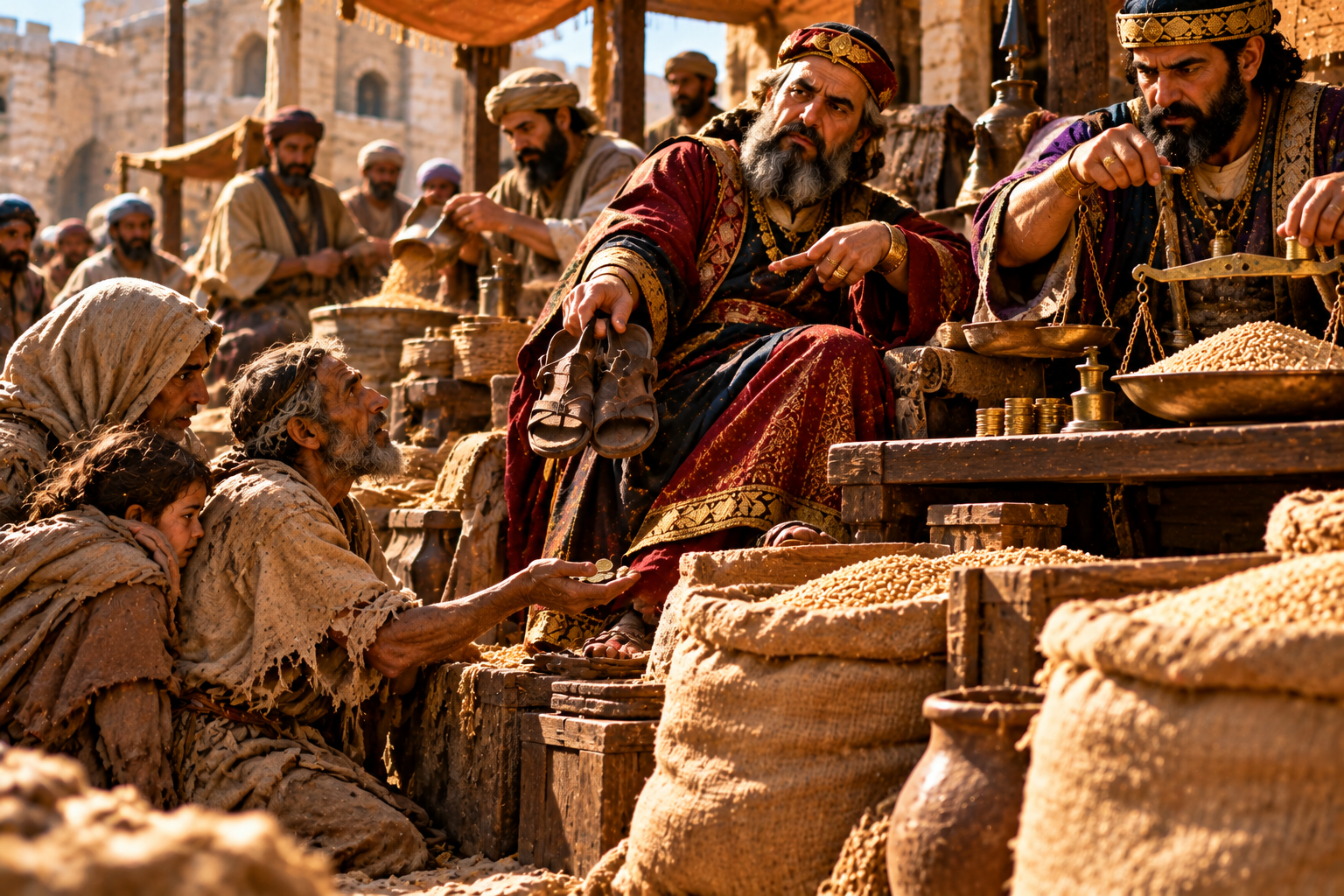
Buying the Needy for a Pair of Sandals
WHEN MONEY MATTERS
MORE THAN MERCY
Amos exposes the ultimate objective of Israel's dishonest merchants. Their greed went far beyond manipulating weights and measures. They were exploiting the financial desperation of the poor to acquire control over their lives, even reducing human beings to the status of merchandise.
So as to buy the helpless for money - NLT - "Then you enslave poor people for one piece of silver" Trade silver for the poor refers to the slave trade. The merchants are not buying land, livestock, or grain BUT are buying human beings! Helpless (dal דַּל), describes someone who is poor, weak, lowly, or economically vulnerable and emphasizes a person's lack of resources and ability to defend himself.
In Israel's economic system, a person overwhelmed by debt could become subject to debt-servitude. The Mosaic Law regulated such arrangements and required humane treatment, including release provisions for fellow Israelites (Ex 21:2; Lev 25:39–43; Dt 15:12–15). The merchants were deliberately exploiting poverty for financial advantage. They manipulated prices and measures, increased the financial burdens of the poor, and then sought to acquire control over ("buy the helpless" ~ enslave) those who could no longer pay.
And the needy for a pair of sandals - This expression repeats an accusation Amos made near the beginning of his prophecy in Amos 2:6 The wealthy sought to purchase the helpless for something as insignificant as a pair of sandals. The expression “for a pair of sandals” is striking for sandals were ordinary articles of clothing that were comparatively inexpensive. The point Amos is making is that human beings were being treated as though their freedom and dignity were worth almost nothing! It was sad that a pair of sandals had become more important to these merchants than the welfare of a human being created in the image of God (Ge 1:26, 27). When greed rules the heart, human beings become cheap and possessions become precious.
The poor were not merely customers to these merchants
They had become opportunities for exploitation and enslavement.
NET NOTE on Amos 2:6 - Perhaps the expression “for a pair of sandals” indicates a relatively small price or debt. Some suggest that the sandals may have been an outward token of a more substantial purchase price. Others relate the sandals to a ritual attached to the transfer of property, signifying here that the poor would be losing their inherited family lands because of debt (Ruth 4:7; cf. Deut 25:8–10). Still others emend the Hebrew form slightly to נֶעְלָם (ne’lam, “hidden thing”; from the root עָלַם, ’alam, “to hide”) and understand this as referring to a bribe.
Robert Chisholm on a pair of sandals - These sandals might refer to the custom of giving one’s sandals as a kind of mortgage deed or title to confirm the legal transfer of land (cf. Ruth 4:7). The meaning would then be that the poor were being sold for either money or land. Such hardheartedness against Israel’s own people, not against a foreign nation, was rebellion against God’s covenant which called for generosity and openhandedness toward the poor (Deut. 15:7–11). (See The Bible Knowledge Commentary Minor Prophets - Page 43)
And that we may sell the refuse of the wheat NLT - "And you mix the grain you sell with chaff swept from the floor." The Hebrew expression translated “refuse of the wheat” is mappal bar where the noun mappal is associated with what falls or drops away. In this context, it refers to the inferior material associated with grain, commonly understood as sweepings or refuse. The word bar refers to grain, particularly wheat. In short, the merchants were so consumed with profit that they even sought to sell material of inferior quality. Some interpreters understand this as selling grain sweepings mixed with dirt or chaff. Others understand it more generally as marketing the lowest-quality remnants of the grain supply. Either way it describes a despicable practice!
Amos is not merely condemning dishonest accounting, but obviously is exposing a deeper spiritual problem. The merchants had abandoned the fear of the LORD. They were willing to observe religious festivals outwardly while violating God's commandments in their commercial dealings. They appeared religious. But their conduct revealed hearts dominated by greed. Jesus later warned: “You cannot serve God and wealth” (Mt 6:24). Paul likewise declared that the love of money is a root of all sorts of evil (1 Ti 6:10). In short, Israel's greatest poverty was not financial, but spiritual. They possessed wealth but lacked righteousness. They possessed grain but lacked mercy. They maintained religious observances but lacked genuine devotion to the LORD.
🙏 THOUGHT — Do We Value People More Than Possessions? Amos exposes the tragic consequences of a heart controlled by greed (cf Col 3:5 greed = idolatry). The wealthy merchants of Israel had become so consumed with making money that they were willing to cheat their customers, exploit the helpless, and reduce the needy to the value of a pair of sandals. Could we be guilty of a subtler form of the same sin? Do we ever place financial gain above honesty (e.g., on our tax returns), personal convenience above compassion, or material possessions above the welfare of others? Jesus warned that we cannot serve both God and mammon (Mt 6:24), and Paul reminds us that the love of money is a root of all sorts of evil (1 Ti 6:10). Solomon declares that whoever oppresses the poor insults his Maker, while whoever is gracious to the needy honors Him (Pr 14:31). And John asks how the love of God can abide in someone who possesses the world's goods but closes his heart against a brother in need (1 Jn 3:17,18). The true measure of our spiritual wealth is not how much we possess, but how faithfully we use what God has entrusted to us for His glory and the good of others. May we never allow the pursuit of possessions to diminish our compassion for people created in God's image. "For you know the grace of our Lord Jesus Christ, that though He was rich, yet for your sake He became poor, so that you through His poverty might become rich." (2 Cor 8:9). Those who have been enriched by Christ's grace should be eager to extend Christlike grace to others! Let it be so in our lives, Lord. Amen
Amos 8:7 The LORD has sworn by the pride of Jacob, “Indeed, I will never forget any of their deeds.
AMPC The Lord has sworn by [Himself Who is] the Glory and Pride of Jacob, Surely I will never forget any of their [rebellious] deeds.
KJV The LORD hath sworn by the excellency of Jacob, Surely I will never forget any of their works.
NET The LORD confirms this oath by the arrogance of Jacob: "I swear I will never forget all you have done!
NLT Now the LORD has sworn this oath by his own name, the Pride of Israel: "I will never forget the wicked things you have done!
ESV Amos 8:7 The LORD has sworn by the pride of Jacob: "Surely I will never forget any of their deeds.
BGT ὀμνύει κύριος καθ᾽ ὑπερηφανίας Ιακωβ εἰ ἐπιλησθήσεται εἰς νεῖκος πάντα τὰ ἔργα ὑμῶν
LXE The Lord swears against the pride of Jacob, None of your works shall ever be forgotten.
CSB The LORD has sworn by the Pride of Jacob: I will never forget all their deeds.
NIV The LORD has sworn by the Pride of Jacob: "I will never forget anything they have done.
- sworn (KJV): Am 6:8 De 33:26-29 Ps 47:4 68:34 Lu 2:32
- I will (KJV): Ex 17:16 1Sa 15:2,3 Ps 10:11 Isa 43:25 Jer 17:1 31:34 Ho 7:2 8:13 9:9
Related Passages:
Hebrews 6:10 (IN CONTRAST TO GOD NOT FORGETTING EVIL DEEDS, HE DOES NOT FORGET THE GOOD WORKS OF HIS CHILDREN) For God is not unjust so as to forget your work and the love which you have shown toward His name, in having ministered and in still ministering to the saints.
Amos 4:2 (OATH #1 IN AMOS) The Lord GOD has sworn by His holiness, “Behold, the days are coming upon you When they will take you away with meat hooks, And the last of you with fish hooks.
Amos 6:8 (OATH #2 IN AMOS) The Lord GOD has sworn by Himself, the LORD God of hosts has declared: “I loathe the arrogance of Jacob, And detest his citadels; Therefore I will deliver up the city and all it contains.”
1 Samuel 15:29 “Also the Glory of Israel will not lie or change His mind; for He is not a man that He should change His mind.”
Hebrews 6:13-14 For when God made the promise to Abraham, since He could swear by no one greater, He swore by Himself, 14 saying, “I WILL SURELY BLESS YOU AND I WILL SURELY MULTIPLY YOU.”
Exodus 2:24 So God heard their groaning; and God remembered His covenant with Abraham, Isaac, and Jacob.
Proverbs 15:3 The eyes of the LORD are in every place, Watching the evil and the good.
Psalm 47:4 He chooses our inheritance for us, The glory of Jacob whom He loves. Selah.
Psalms 139:1-4 For the choir director. A Psalm of David. O LORD, You have searched me and known me. 2 You know when I sit down and when I rise up; You understand my thought from afar. 3 You scrutinize my path and my lying down, And are intimately acquainted with all my ways. 4 Even before there is a word on my tongue, Behold, O LORD, You know it all.
Ecclesiastes 12:14 For God will bring every act to judgment, everything which is hidden, whether it is good or evil.
Jeremiah 16:17 “For My eyes are on all their ways; they are not hidden from My face, nor is their iniquity concealed from My eyes.
Jeremiah 31:34 “They will not teach again, each man his neighbor and each man his brother, saying, ‘Know the LORD,’ for they will all know Me, from the least of them to the greatest of them,” declares the LORD, “for I will forgive their iniquity, and their sin I will remember no more.”
Amos 2:6-7 Thus says the LORD, “For three transgressions of Israel and for four I will not revoke its punishment, Because they sell the righteous for money And the needy for a pair of sandals. 7“These who pant after the very dust of the earth on the head of the helpless Also turn aside the way of the humble; And a man and his father resort to the same girl In order to profane My holy name.
THE GOD WHO NEVER
FORGETS INJUSTICE
The LORD has sworn by the pride of Jacob (see note) - This is Yahweh's third oath in Amos (Amos 4:2; 6:8). The sins that Israel's merchants considered profitable transactions were offenses that God solemnly declared He would never forget. Their victims may have lacked the power to obtain justice, and their dishonest dealings may have escaped human courts, but nothing escaped the searching eyes of the LORD.
Has sworn (shaba' שָׁבַע), meaning to swear an oath or make a solemn declaration which emphasizes the certainty and binding character of a statement. When human beings swear an oath, they ordinarily appeal to someone greater than themselves as a witness to the truthfulness of their words. However, when God swears, His oath carries absolute authority because His character is perfectly truthful and His power is unlimited. The writer of Hebrews explains that when God made His promise to Abraham, He swore by Himself because He could swear by no one greater (Heb 6:13). In short, God's oath underscores the certainty of what He is getting ready to say.
By the pride (gaon; LXX - huperephania - conscious effort to appear conspicuously above others) of Jacob (see note) - What exactly is God swearing by? There are two principal interpretations:
(1) The pride of Jacob refers to Israel's national arrogance. This is favored by the NET = "The LORD confirms this oath by the arrogance of Jacob." This interpretation understands the expression as referring to Israel's self-confidence, wealth, and national pride. The difficulty with this interpretation is that divine oaths ordinarily appeal to something appropriate to God's own majesty or authority, making an oath by Israel's sinful arrogance unusual.
(2) The pride of Jacob refers to the LORD Himself (cf Amos 6:8). This interpretation is favored by the NLT - "Now the LORD has sworn this oath by his own name" This interpretation finds support in passages where God is described as the glory or pride of His people. For example, Ps 47:4 speaks of “the glory of Jacob whom He loves.” 1Sa 15:29 says "the Glory of Israel will not lie or change His mind; for He is not a man that He should change His mind.” In this interpretation, the LORD is swearing by Himself, using a title that emphasizes His relationship with Israel. Whichever interpretation one favors, the point is indisputable that God solemnly guarantees that Israel's persistent injustice will not escape His judgment.
NET NOTE explains why the NET favors pride as referring to Isael's arrogance - In an oath one appeals to something permanent to emphasize one’s commitment to the promise. Here the LORD sarcastically swears by the arrogance of Jacob (ED: IT SEEMS THAT THE LXX - huperephania which describes conscious effort to appear conspicuously above others MIGHT LEND SUPPORT THIS INTERPRETATION), which he earlier had condemned (Amos 6:8), something just as enduring as the LORD’s own life (see Amos 6:8) or unchanging character (see Amos 4:2). Other suggestions include that the Lord is swearing by the land, his most valuable possession (cf. Isa 4:2; Ps 47:4); that this is a divine epithet analogous to “the Glory of Israel” (1Sa 15:29); or that an ellipsis should be understood here, in which case the meaning is the same as that of Amos 6:8 (“The Lord has sworn [by himself] against the arrogance of Jacob”).
Bob Utley - "The Lord has sworn by the pride of Jacob" In Amos YHWH swears several times as a way to show that His words are true: (1) "The Lord God has sworn by His holiness," Amos 4:2; (2) "The Lord God has sworn by Himself," Amos 6:8; (3) "The Lord has sworn by the pride of Jacob," Amos 8:7. This phrase has several possibilities: (1) God's glory in the descendants of Jacob (cf. 1 Sam. 15:29). The TEV translates this as "The Lord, the God of Israel, has sworn". (2) since no where else does God swear by another person, this may mean, "the Lord, of whom Israel is so proud, has sworn" (UBS, Handbook, p. 165). (3) that the people of Jacob had become so permanently wicked that YHWH could swear by their settled condition (cf. Amos 6:8)
Indeed, I will never forget (shakach/shakah; LXX - epilanthanomai - lose remembrance of something) any of their deeds - NET = "I swear I will never forget all you have done!" ESV = "Surely I will never forget any of their deeds." The Hebrew expression is emphatic for it combines the negative particle lo' with the verb shakach, meaning to forget, and an expression conveying enduring or perpetual duration. This does not mean that God might otherwise have forgotten Israel's sins. God is omniscient so nothing escapes His knowledge (Ps 139:1–4; Heb 4:13). Rather, the language of remembering and forgetting frequently expresses whether God will take action concerning something. When God remembers His covenant, He acts in faithfulness to His promises (Ex 2:24). When God declares that He will not remember forgiven sins, He promises not to hold them against those He has forgiven (Jer 31:34; Heb 10:17). Here, the expression has the opposite significance. God will not overlook Israel's persistent injustice or leave it unaddressed. The upshot is that the LORD's refusal to forget means that the day of accountability is certain. The oppressors may have forgotten their victims, but God had forgotten neither the victims nor the oppression.
Time does not erase our sin.
Only the blood of Jesus does!
Bob Utley - I will never forget any of their deeds" This is a very strong and emphatic statement. (1) a HYPOTHETICAL PARTICLE, (אט) (2) a Qal IMPERFECT VERB, "to forget" (3) the NOUN "everlasting," "perpetuity" - These exploitative merchants will answer for the crimes against both their covenant brothers and sisters and their covenant God!
Any of their deeds (actions, works, conduct) emphasizes the comprehensive nature of God's knowledge. ANY means in essence "all" their evil actions, whether "big" or "small" and would include the motives behind their actions. As Yahweh declares in Jeremiah 16:17 "My eyes are on all their ways; they are not hidden from My face, nor is their iniquity concealed from My eyes." This reminds me of Hebrews 4:13 which says "there is no creature hidden from His sight, but all things are open and laid bare to the eyes of Him with whom we have to do (to give an account)." The bottom line is that the God Who sees every deed will ultimately judge every deed according to His perfect righteousness. The unscrupulous merchants thought they were getting away with dishonesty because judgment had not yet come but here God declares that He has not forgotten the deeds which warrant His judgment. One is reminded of the sobering words in Ecclesiastes 12:14 "For (explaining Eccl 12:13) God will bring every act to judgment, everything which is hidden, whether it is good or evil."
🙏 THOUGHT — Beloved, are you living Coram Deo, before the face of God, with a continual, conscious awareness that He sees everything? In this verse Amos reminds us that nothing escapes the searching eyes of our omniscient God (cf Pr 15:3). Israel's merchants may have believed that their dishonest transactions were hidden from others, but God solemnly declared that He would never forget their deeds. Could we sometimes conduct ourselves as though God sees our worship but not our business dealings, our public behavior but not our private conduct, or our outward actions but not our inward motives (cf 1Co 4:5)? He sees everything (Heb 4:13)! This truth should produce holy fear/reverence (cf command to conduct ourselves in fear in 1Pe 1:17, perfecting holiness in the fear of God - 2Co 7:1). On the other hand God's ever watchful eye should also bring tremendous comfort. The same God Who sees every sin also sees every act of faithfulness, every sacrifice made in secret, and every kindness shown to someone who cannot repay us (Mt 6:4; Heb 6:10). And what a glorious assurance we possess in Christ! Although God knows every one of our sins, He promises that through the finished work of our Savior, our forgiven sins will be remembered no more (Heb 10:17). The God Who forgets none of the unrepentant sinner's deeds promises NEVER to hold the forgiven believer's sins against him! Hallelujah! Thank You Jesus! May this wonderful truth lead us neither to presumption nor complacency, but motivate us to pursue an attitude of gratitude, humility, integrity, and a sincere desire to please the One Who loved us and gave Himself for us (Gal 2:20; 2 Cor 5:9, Col 1:10).
Forget (07911) shakach/shakah means to forget, ignore, to cease to care, (Niphal) to be forgotten, (Piel) to cause to forget, (Hiphil) to make or cause to forget, (Hithpael) to be forgotten. Shakach/shakah "indicates that something has been lost to memory, or a period of time has softened the memory of it....It is an especially important word with respect to God and His people: God never forgets them (Isa. 49:15); they are not to forget their God, His covenant, and His deeds (Deut. 4:9, 23, 31; 6:12; 8:11; 9:7; 25:19; 32:18). But God does not pass over, wink at, or forget the wickedness of His people (Lam. 5:20; Amos 8:7). Those who forget God wither away (Job 8:13), as well as all the nations who forget Him. The helpless must not be left alone (Ps. 10:12). God’s Law must not be forgotten (Ps. 119:61, 83, 93). Wisdom’s teachings are not to be forgotten (Prov. 3:1; 4:5)." (Warren Baker - The Complete Word Study Dictionary: OT)
QUESTION - What is the Pride of Jacob (Amos 8:7)? | GotQuestions.org
ANSWER - Amos 8:7 says, “The LORD has sworn by the Pride of Jacob: “I will never forget anything they have done.’ ” What is this “Pride of Jacob”?
Interpreters are divided on the understanding of this phrase.
First, some suggest the Pride of Jacob is a reference to Israel’s sins, in which the wicked took unabashed pride.
Others suggest the Pride of Jacob is a title of God. The latter is probably the better interpretation.
The Pride of Jacob was the One to whom Jacob, the nation’s forefather, looked for strength. A similar title is found in 1 Samuel 15:29, where God is referred to as “the Glory of Israel.”
To say, “The LORD has sworn by the Pride of Jacob,” means that the Lord has sworn by Himself (cf Amos 6:8). The Bible speaks of God swearing by Himself in Hebrews 6:13–14: “For when God made a promise to Abraham, since he had no one greater by whom to swear, He swore by Himself, saying, ‘Surely I will bless you and multiply you’ ”
But what has the Lord sworn by Himself? Amos 8:7 says, “I will never forget anything they have done.” This is the Lord’s promise to deal with the sins of the people. He would not let their rejection of Him go unpunished; rather, judgment would soon come.
Some confusion arises due to the same phrase, “pride of Jacob,” being used in two other passages. First, in Psalm 47:4 we read, “He chose our heritage for us, the pride of Jacob whom he loves.” Here, the phrase is in reference to the land of Israel rather than to God. Second, “pride of Jacob” is used in Amos 6:8 in reference to actual, sinful pride: “I abhor the pride of Jacob and hate his strongholds.” The city of Samaria served as Israel’s capital, and “stronghold” likely refers to that city. They were trusting in their city’s defenses rather than in God.
In summary, the “Pride of Jacob” in Amos 8:7 is a reference to God Himself. The Lord makes a solemn promise, based on His own character and faithfulness, that He would bring judgment against Israel. “Do not be deceived: God cannot be mocked. A man reaps what he sows” (Galatians 6:7).
Amos 8:8 “Because of this will not the land quake And everyone who dwells in it mourn? Indeed, all of it will rise up like the Nile, And it will be tossed about And subside like the Nile of Egypt.
KJV Shall not the land tremble for this, and every one mourn that dwelleth therein? and it shall rise up wholly as a flood; and it shall be cast out and drowned, as by the flood of Egypt.
NET Because of this the earth will quake, and all who live in it will mourn. The whole earth will rise like the River Nile, it will surge upward and then grow calm, like the Nile in Egypt.
NLT The earth will tremble for your deeds, and everyone will mourn. The ground will rise like the Nile River at floodtime; it will heave up, then sink again.
ESV Shall not the land tremble on this account, and everyone mourn who dwells in it, and all of it rise like the Nile, and be tossed about and sink again, like the Nile of Egypt?"
BGT καὶ ἐπὶ τούτοις οὐ ταραχθήσεται ἡ γῆ καὶ πενθήσει πᾶς ὁ κατοικῶν ἐν αὐτῇ καὶ ἀναβήσεται ὡς ποταμὸς συντέλεια καὶ καταβήσεται ὡς ποταμὸς Αἰγύπτου
LXE And shall not the land be troubled for these things, and shall not every one who dwells in it mourn? whereas destruction shall come up as a river, and shall descend as the river of Egypt.
CSB Because of this, won't the land quake and all who dwell in it mourn? All of it will rise like the Nile; it will surge and then subside like the Nile in Egypt.
NIV "Will not the land tremble for this, and all who live in it mourn? The whole land will rise like the Nile; it will be stirred up and then sink like the river of Egypt.
- the land (KJV): It may be that an earthquake is here intended; the rising and falling of the ground, with a wave-like motion, and its leaving its proper place and bounds, in consequence of an earthquake, being justly compared to the swelling, overflowing, and subsiding of the Nile. Ps 18:7 Ps 60:2-3 114:3-7 Isa 5:25 Isa 24:19,20 Jer 4:24-26 Mic 1:3-5 Na 1:5,6 Hab 3:5-8 Hag 2:6,7
- every one (KJV): Am 8:10 9:5 Jer 12:4 Ho 4:3 10:5 Mt 24:30
- rise (KJV): Am 9:5 Isa 8:7,8 Jer 46:8 Da 9:26
Related Passages:
Amos 5:16-17 Therefore thus says the LORD God of hosts, the Lord, “There is wailing in all the plazas, And in all the streets they say, ‘Alas! Alas!’ They also call the farmer to mourning And professional mourners to lamentation. 17 “And in all the vineyards there is wailing, Because I will pass through the midst of you,” says the LORD.
Psalm 18:7 Then the earth shook and quaked; And the foundations of the mountains were trembling And were shaken, because He was angry.
Psalm 60:2-3You have made the land quake, You have split it open; Heal its breaches, for it totters. 3 You have made Your people experience hardship; You have given us wine to drink that makes us stagger.
Psalm 46:1-3 For the choir director. A Psalm of the sons of Korah, >set to Alamoth. A Song. God is our refuge and strength, A very present help in trouble. 2 Therefore we will not fear, though the earth should change And though the mountains slip into the heart of the sea; 3 Though its waters roar and foam, Though the mountains quake at its swelling pride. Selah.
Psalm 114:7 Tremble, O earth, before the Lord, Before the God of Jacob,
Isaiah 57:20 But the wicked are like the tossing sea, For it cannot be quiet, And its waters toss up refuse and mud.
Amos 1:1 The words of Amos, who was among the sheepherders from Tekoa, which he envisioned in visions concerning Israel in the days of Uzziah king of Judah, and in the days of Jeroboam son of Joash, king of Israel, two years before the earthquake.
Isaiah 5:25 On this account the anger of the LORD has burned against His people, And He has stretched out His hand against them and struck them down. And the mountains quaked, and their corpses lay like refuse in the middle of the streets. For all this His anger is not spent, But His hand is still stretched out.
Jeremiah 4:24-26 I looked on the mountains, and behold, they were quaking, And all the hills moved to and fro. 25 I looked, and behold, there was no man, And all the birds of the heavens had fled. 2 6I looked, and behold, the fruitful land was a wilderness, And all its cities were pulled down Before the LORD, before His fierce anger.
The Land will Quake and the People will Mourn
THE LAND THAT COULD
NO LONGER REMAIN STILL
Because (term of explanation) of this will not the land quake (ragaz; LXX - tarasso - lit be shaken, fig. be troubled) - "On account of this" - What is this and what is it explaining? In context this is the wicked deeds (Am 8:4-7). Now God announces the consequences of their national sin, which reflects His righteous response for their persistent covenant rebellion. The land will quake is a bit ironic for the nation that had remained unmoved by God's repeated warnings would soon be shaken by His judgment!
David Allan Hubbard - The rhetorical question presupposed the crimes described in the previous verses....now they were asked by the question-form to confirm the rightness of the announced judgment. Yahweh, through the prophet, was saying in effect, ‘What else can anyone expect? What else is the reasonable response to such flagrant injustice but the shaking of the very land which you have corrupted?’ (Joel and Amos)
Carroll on this - What is the this (zōʾt) to which God refers and that triggers his wrath? The term signals an inclusio with the first two words of the section in v. 4 (šimʿû zōʾt, Hear this).. Although some believe that it refers to the oath in the preceding verse,276 more likely this refers to the injustices described in vv. 4–6 and their terrible impact on the weak. (The Book of Amos - Page 122)
Quake (ragaz רָגַז) means to tremble, shake, or be disturbed and can describe physical trembling, emotional agitation, or the shaking associated with divine judgment. This earthquake imagery is particularly striking because Amos began his prophecy with a reference to an earthquake, Amos 1:1 dating his prophetic ministry to two years before the earthquake. An earthquake is especially appropriate as a symbol of judgment because it destroys the illusion of stability. The ground beneath one's feet, normally regarded as secure, suddenly becomes unstable. Thus, when God shakes the nation, the things in which the people had trusted in suddenly prove powerless to protect them. The language may evoke an actual earthquake, but the surrounding imagery also communicates the comprehensive upheaval of divine judgment. We should not assume that Amos 8:8 predicts only a particular seismic event.
J Vernon McGee - Some commentators think this refers to an earthquake. That is possible, and I certainly wouldn’t want to rule that out. However, I think it is the fact that God is coming down hard upon them in judgment that makes the land tremble. (See Thru the Bible Vol. 28: The Prophets Amos/Obadiah)
Carroll - The verb (rgz) is used for shaking the ground (e.g., Pss 18:7 [MT 18:8]; 77:18 [MT 77:19]; Joel 2:10),279 so it likely refers to an earthquake. The superscription mentions an earthquake (1:1), and several passages in the book may depict its destructive power (2:13; 3:14–15; 4:11, 13; 6:9–11; 9:1, 5, 9). Some scholars, however, see this clause as figurative of something gone awry in the land (cf. Prov 30:21), partly because the second part of the verse seems incongruous with such a disaster (see below).280 It might allude to warfare, since the same verb is used in the context of overwhelming military conflict (1 Sam 14:15; Joel 2:10; cf. the verb rʿš, Jer 8:16; 51:28–30). Nevertheless, the significance of a literal earthquake in the book makes that the best option. Yahweh is announcing an imminent earthquake as part of his punishment (which will also include an invasion) (The Book of Amos - Page 122)
Thomas McComiskey sees quake as figurative - The striking metaphor of an earthquake represents the calamity Amos has referred to throughout the book. (Hosea, Amos, Micah)
Israel's merchants had shaken the foundations of justice,
and now God announced that the land itself would be shaken.
And everyone who dwells in it mourn ('abal - lament, grieve)? - The question is rhetorical. God is not asking whether the land might tremble. He is announcing that it certainly will. The expected answer is an emphatic Yes! Mourn ('abal) is commonly associated with sorrow over death, disaster, or national calamity. Everyone means everyone! The consequences will not be limited to a few dishonest merchants. The entire society will experience the devastation. Obviously, this does not mean that every individual Israelite was equally guilty of the particular sins described in Amos 8:4–6. Amos is describing the mourning associated with the far-reaching consequences of national judgment. The bitter irony is that those who would refused to mourn over their sin would soon mourn over the consequences of their sin! (cf Hos 8:7, Gal 6:7-8)
Hadjiev - The grieving is caused by a massive cosmic disturbance. Shall not the land tremble on this account …? refers to an earthquake.

Comparison with annual flooding of Nile
Indeed, all of it will rise up like the Nile - The imagery now shifts from an earthquake to the annual flooding of the Nile River, an occurrence for which the Nile was famous. Its waters rose about twenty-five feet during its annual flooding stage, overflowing the banks, spreading across the surrounding land, and eventually receding. For Egypt, this annual inundation was essential to agricultural productivity as it watered the crops adjacent to the river. But Amos uses a term of comparison (simile) of the Nile flooding and subsiding to help his hearers understand how overwhelming the upheaval of the nation would be in the day of judgment.
John Walton on rising like the Nile. There is a three- month inundation cycle in the flow of the Nile River (from August to October). The increase in volume is the result of monsoon rains in Ethiopia that swell the Nile and its tributaries. Although the height of the inundation is irregular, the Egyptians early in their history learned to make efficient use, through irrigation canals and other means, of whatever the rise of the Nile brought to them.
Andrew Hill - The heavy seasonal rains and melting snows at the headwaters of the Nile caused annual flooding of the river in Egypt, as much as 25 feet above its normal level during flood-stage. The point of the prophet’s illustration is that, like the rising flood of the Nile River, Israel will be helpless under the “flood” of God’s judgment. (See Minor Prophets: Hosea through Malachi - Page 201)
Just as the Nile could rise and spread across the landscape, so the land of Israel (ALL OF IT) would experience a devastating upheaval. The picture is therefore of the entire land rising and falling like the Nile. The land that seemed stable would be disturbed like the waters of a mighty river. The comparison is especially powerful because the rising and falling of the Nile was beyond human control. Israel could not prevent God's appointed judgment any more than the Egyptians could command the annual movement of their great river.
And it will be tossed about (garas גָּרַשׁ) - Tossed about can mean to drive out, thrust away, expel and is used elsewhere for the restless movement of waters. Isaiah 57:20 describes the wicked as being like the tossing sea, whose waters cast up refuse and mud. Here the image is of violent movement and instability, depictiing Israel as being disturbed and displaced like surging water. The nation would undergo a profound upheaval disrupting its political stability, economic prosperity, and social structures. The people who believed themselves secure will discover that their security was an illusion. The nation that had refused to be moved by God's warnings would now be moved by God judgment, by forces beyond its control.
Bob Utley on tossed - Because this VERB (garas, Niphal PERFECT with waw) is used to describe Jonah being driven from the presence of YHWH (cf. Jonah 2:4), it may be imagery for exile from the Promised Land (cf. Amos 9:1-4,5). This same word was used of YHWH driving the Canaanites out of the Promised Land, but now Israel is being removed for her sins and idolatry (cf. Gen. 15:12-21)!
And subside like the Nile of Egypt - Subside (shaqa' - שָׁקַע) means to sink or settle, completing the movement introduced earlier of the land rising, being tossed about and then sinking or subsiding, all of this resembling the swelling and receding of the Nile and powerfully conveying a picture of overwhelming instability. What once appeared firmly established is now subject to forces that cause it to rise and fall. The people of Israel had placed their confidence in wealth, military strength, fortified cities, and outward religious observances none of which would provide stability when God's judgment fell on them.
Billy Smith - “Since the rise and fall of the Nile usually extended over a few months, some national upheaval lasting a considerable period of time is implied by the analogy. Sometimes the flooding of the Nile was highly destructive. Amos may have been comparing the destructiveness of social injustice, civil strife, economic exploitation, and religious shallowness in Israel to the destruction caused by the inundation of the Nile. The flooding of the Nile occurred repeatedly, as did the social, civil, economic, and religious problems of society. (See Amos, Obadiah, Jonah - Volume 19 - Page 147)
Carroll on the Nile metaphor - The language of the second line is puzzling. Cripps calls the association of the earthquake with the rising and falling of the Nile “a perplexing simile,” and Eidevall calls it a “strange image.”285 One would expect any comparison to be about swift, strong action. The Nile rises and falls, but that process takes months. This line, however, is not about the devastating shock of an earthquake, which is over quickly. The lesson likely concerns the irresistible force of that huge river that periodically impacted a vast territory. Such is the case in Jer 46:7–8, where the Nile is compared to a vast army (cf. the Euphrates for the Assyrian invasion in Isa 8:7–8). The simile portrays the unmatchable power of Yahweh in his judgment, as do the three hymnic passages (4:13; 5:8–9; 9:5–6) (The Book of Amos - Page 122)
NET NOTE - The entire verse is phrased in a series of rhetorical questions that anticipate the answer, “Of course!” (For example, the first line reads, “Because of this will the earth not quake?”). The rhetorical questions entrap the listener in the logic of the judgment of God (cf. Amos 3:3-6; 9:7). The rhetorical questions have been converted to affirmative statements in the translation for clarity.
So whether literal or figurative, the point is clear that the imagery of an earthquake and the surging Nile portrays a nation overwhelmed by forces it cannot control. Those who refused to tremble at God's Word (cf Isa 66:2) would soon tremble under His judgment.
🙏 THOUGHT — Beloved we are living in tumultous times (the year is 2026), wars, uprisings, rebellion against authority, etc. which begd the question for all of us "In what am I going to trust when everything begins to shake?" Amos description reminds us how quickly the things we regard as secure can become unstable. Israel trusted in its prosperity, fortified cities, military strength, and outward religious observances, yet God announced that the entire land would quake under His judgment. What are you (am I) trusting when the foundations of your (my) life begin to shake? Is our confidence anchored in our financial resources, physical health, comfortable circumstances, or carefully constructed plans? None of these is necessarily wrong, but none can provide the ultimate security that belongs to God Alone! The psalmist declares that God is our refuge and strength, a very present help in trouble, and therefore we need not fear even though the earth should change and the mountains slip into the sea (Ps 46:1–3). The writer of Hebrews reminds us that God will ultimately shake what can be shaken, so that what cannot be shaken may remain, and that believers are receiving a kingdom that cannot be shaken (Heb 12:26–28). The world around us will tremble, but the Rock beneath us will never move! When personal and global circumstances become uncertain, we need to remember that our Savior is the same yesterday, today, and forever (Heb 13:8). With eyes on Jesus and eternity, may the Spirit enable us to continually place our confidence not in the temporary securities of this passing world (1Jn 2:17), but in the unchanging character, unfailing promises, and sovereign power of our faithful God (1Th 5:24, Heb 10:23, Ps 18:2; Pr 3:5,6).
Mourn (056) abal (from abal = to mourn) means to be in mourning process and speaks of actions and persons. As discussed more below the root verb abal describes mourning for the dead as did Jacob when he thought Joseph had died (Ge 37:34). Obstinate Israel heard the sad word in Ex 33:3 and went into mourning (Ex 33:4). Israel mourned after God killed the spies who gave a bad report in their foray to Canaan (Nu 14:39).
ABAL - 38V - Gen. 37:34; Exod. 33:4; Num. 14:39; 1 Sam. 6:19; 1 Sam. 15:35; 1 Sam. 16:1; 2 Sam. 13:37; 2 Sam. 14:2; 2 Sam. 19:1; 1 Chr. 7:22; 2 Chr. 35:24; Ezr. 10:6; Neh. 1:4; Neh. 8:9; Job 14:22; Isa. 3:26; Isa. 19:8; Isa. 24:4; Isa. 24:7; Isa. 33:9; Isa. 66:10; Jer. 4:28; Jer. 12:4; Jer. 12:11; Jer. 14:2; Jer. 23:10; Lam. 2:8; Ezek. 7:12; Ezek. 7:27; Ezek. 31:15; Dan. 10:2; Hos. 4:3; Hos. 10:5; Joel 1:9; Joel 1:10; Amos 1:2; Amos 8:8; Amos 9:5
TWOT on the root verb abal - ʾābal describes mourning rites for the dead, though often, in its thirty-nine occurrences, it is used figuratively, "The land mourneth" (Isaiah 24:4). Some propose a separate meaning, "to dry up," when ʾābal parallels yābēsh (Jeremiah 12:4; Jeremiah 23:10; Amos 1:2; KB, p. 6): but "mourning" is contextually preferable (Jeremiah 12:11). Biblical mourning for the dead (expressed by abal, sāpad, etc.) involved emotion, usually expressed audibly (Jeremiah 22:18; Jeremiah 48:36) and visibly (Genesis 37:34; Psalm 35:14; Micah 1:8), especially for the decease of important leaders (2 Chr. 35:24-25; Ezek 31:15). Professional mourning women could be hired (Jeremiah 9:17; Eccles. 12:5), or the emotion could be merely simulated (2 Sa 14:2, ʾābal, Hithpael, "feign oneself a mourner"; Matthew 11:17). Yet the OT forbad such pagan exhibitions as tearing one's hair or flesh for the dead (Leviticus 19:28; Leviticus 21:5; but see Jeremiah 16:6; Jeremiah 41:5); for the OT gave an underlying assurance of immortality (Psalm 73:24; Job 19:25-27, Proverbs 15:24) and held out the prospect of bodily resurrection (Psalm 16:9-11; Isaiah 26:19; Daniel 12:2). (Theological Wordbook of the Old Testament online)
Quake (be disturbed, troubled)(07264) ragaz is a verb whose primary meaning is “to quake, shake, tremble.” From that physical sense come the ideas of being agitated, disturbed, or stirred up, and of shaking with fear, anger, grief, or excitement. It occurs about 41 times in the Old Testament. Most uses describe agitation that grows out of a deep emotion: the body or the earth shakes because something powerful is at work. Related words include the noun rōgez, “agitation, turmoil, wrath” (Job 3:26; Hab 3:2), and the adjective raggāz, “trembling” (Dt 28:65). The Septuagint renders rāgaz with words such as seiō (“to shake”), tarassō (“to trouble”), and orgizō (“to be angry”).
1. Creation shaking before God.
Most often rāgaz describes the physical shaking of the created world, usually in response to the LORD’s presence or anger. The earth shook when God came to David’s rescue (Ps 18:7; 2 Sa 22:8). The mountains quaked when His anger burned against His people (Isa 5:25). He stretched out His hand over the sea and “made the kingdoms tremble” (Isa 23:11). Before the Day of the LORD, “the earth quakes, the heavens tremble” (Joel 2:10).
2. People trembling in fear.
Rāgaz also describes human fear before God and His works. After the Exodus, “the peoples have heard, they tremble” (Ex 15:14). God put the dread of Israel on the nations, “who will... tremble and be in anguish because of you” (Dt 2:25). Joel sounded the alarm: “Let all the inhabitants of the land tremble, for the day of the LORD is coming” (Joel 2:1; cf. Isa 64:2). In the last days the nations “will come trembling out of their fortresses” (Mic 7:17). Even the prophet trembled at God’s revelation: “I heard and my inward parts trembled” (Hab 3:16).
3. Trembling with awe at God’s goodness and rule.
Not all trembling comes from terror. The nations will “fear and tremble because of all the good and all the peace” God gives Jerusalem (Jer 33:9). The psalmist calls the whole earth to respond to God’s reign: “The LORD reigns, let the peoples tremble” (Ps 99:1).
4. Stirred by anger or grief.
Rāgaz can describe anger. Joseph warned his brothers, “Do not quarrel on the journey” (Ge 45:24), and a fool “rages” in a dispute with a wise man (Pr 29:9). Psalm 4:4 commands, “Tremble, and do not sin,” which the Septuagint translates, “Be angry, and do not sin.” Paul quotes that version in Ephesians 4:26. The same verb describes the deepest grief: when David heard of Absalom’s death, “the king was deeply moved,” and he wept (2 Sa 18:33).
5. Disturbing or rousing someone.
Rāgaz can mean to disturb or rouse someone from rest. Samuel asked Saul, “Why have you disturbed me by bringing me up?” (1 Sa 28:15). God promised Israel a place where they would “not be disturbed again” (2 Sa 7:10; 1 Chr 17:9). Sheol is pictured as “excited” to meet the king of Babylon, who had once “made the earth tremble” (Isa 14:9, 16).
6. Raging in rebellion against God.
Finally, rāgaz can describe defiant rage against God, literally “shaking oneself” against Him. The LORD said of Sennacherib, “I know... your raging against Me... I will put My hook in your nose” (2 Ki 19:27–28; Isa 37:28–29). The God who makes the earth quake cannot be shaken by those who rage against Him.
Application to Amos 8:8. After the LORD swore He would never forget the merchants’ deeds (Am 8:7), He asked, “Because of this will not the land quake (rāgaz) and everyone who dwells in it mourn?” The land itself would convulse under the weight of Israel’s injustice, rising and sinking like the Nile in flood (cf. Am 9:5). Amos’s ministry was dated “two years before the earthquake” (Am 1:1), and that literal earthquake was remembered for centuries (Zec 14:5). It became a warning of a greater shaking to come.
THOUGHT: One day God will shake “not only the earth, but also the heaven” (Heb 12:26–27; Hag 2:6), and everything that can be shaken will be removed. Only those who belong to Christ have “a kingdom which cannot be shaken” (Heb 12:28). The right response is the trembling of reverence now, the humble person “who trembles at My word” (Isa 66:2), rather than the trembling of terror later (Rev 6:15–17).
Amos 8:9 “It will come about in that day,” declares the Lord GOD, “That I will make the sun go down at noon And make the earth dark in broad daylight.
KJV And it shall come to pass in that day, saith the Lord GOD, that I will cause the sun to go down at noon, and I will darken the earth in the clear day:
NET In that day," says the sovereign LORD, "I will make the sun set at noon, and make the earth dark in the middle of the day.
NLT "In that day," says the Sovereign LORD, "I will make the sun go down at noon and darken the earth while it is still day.
ESV "And on that day," declares the Lord GOD, "I will make the sun go down at noon and darken the earth in broad daylight.
BGT καὶ ἔσται ἐν ἐκείνῃ τῇ ἡμέρᾳ λέγει κύριος ὁ θεός καὶ δύσεται ὁ ἥλιος μεσημβρίας καὶ συσκοτάσει ἐπὶ τῆς γῆς ἐν ἡμέρᾳ τὸ φῶς
LXE And it shall come to pass in that day, saith the Lord God, that the sun shall go down at noon, and the light shall be darkened on the earth by day:
CSB And in that day-- this is the declaration of the Lord GOD-- I will make the sun go down at noon; I will darken the land in the daytime.
NIV "In that day," declares the Sovereign LORD, "I will make the sun go down at noon and darken the earth in broad daylight.
- that I (KJV): This is supposed to refer to an eclipse; and Abp. Usher has shown that about eleven years after Amos prophesied there were two great eclipses of the sun, one at the feast of tabernacles, and the other some time before the passover. Am 4:13 5:8 Job 5:14 Isa 13:10 29:9,10 59:9,10 Jer 15:9 Mic 3:6 Mt 24:29 Rev 6:12 8:12
- and I (KJV): Ex 10:21-23 Mt 27:45 Mk 15:33 Lu 23:44
Related Passages:
Amos 5:18-20 Alas, you who are longing for the day of the LORD, For what purpose will the day of the LORD be to you? It will be darkness and not light; 19 As when a man flees from a lion And a bear meets him, Or goes home, leans his hand against the wall And a snake bites him. 20 Will not the day of the LORD be darkness instead of light, Even gloom with no brightness in it?
Amos 4:13 (GOD'S SOVEREIGN CONTROL OVER NATURE) For behold, He who forms mountains and creates the wind And declares to man what are His thoughts, He who makes dawn into darkness And treads on the high places of the earth, The LORD God of hosts is His name.
Amos 5:8 (GOD'S SOVEREIGN CONTROL OVER NATURE) He who made the Pleiades and Orion And changes deep darkness into morning, Who also darkens day into night, Who calls for the waters of the sea And pours them out on the surface of the earth, The LORD is His name.
Amos 9:6 (GOD'S SOVEREIGN CONTROL OVER NATURE) The One who builds His upper chambers in the heavens And has founded His vaulted dome over the earth, He who calls for the waters of the sea And pours them out on the face of the earth, The LORD is His name.
God Makes the Earth Dark at Daylight
WHEN GOD TURNS
DAY INTO NIGHT
It will come about in that day,” declares the Lord GOD (adonay Jehovah/yahweh) - In that day (5x - Amos 2:16, 8:3, 9, 13, 9:11, cf day in Am 1:14, 3:14, 4:2, 5:18-20, 6:3) frequently introduces a decisive occasion of divine intervention or judgment, in this case clearly pointing to Israel's coming judgment in 722 BC. In that day also recalls Amos' earlier warning concerning the Day of the LORD which Amos says will be "darkness and not light." (Amos 5:18). The irony is that the day Israel expected to be its brightest ("you...are longing for the day of the LORD" - Amos 5:18) would become its darkest. See Bob Utley's SPECIAL TOPIC: THAT DAY which notes how this time phrase can have negative (most common) and positive implications (cf Amos 9:11 describing that day which will be when God restores Israel's fortunes in the end times).
That I will make the sun go down at noon - Some writers consider this to be an eclipse but others are not sure. The Creator takes control of His creation (cf Amos 4:13, Amos 5:8), the sun, once again emphasizing His sovereign action and not an accident of "mother nature." In this section we see that the God Who governs the heavenly bodies also governs the destiny of nations. This is significant because Israel had placed its confidence in earthly sources of security.
At Noon (tsohorayim) means midday and is the time when the sun ordinarily stands high in the sky and daylight is at or near its greatest intensity. Thus darkness at noon is extraordinary for it is a dramatic reversal of what people naturally expect. There is a bit of a pun in this event for Israel was enjoying the "sunshine of prosperity" while the "darkness of judgment" was on their horizon!
David Guzik - Because of the reference to celestial catastrophe, many think Amos is now looking forward to the circumstances surrounding the ultimate day of the LORD. (ED: While that is possible, I think that is not the main thrust for the context would favor that Amos is speaking of a near fulfillment of the Day of the LORD . To be sure darkness will characterize the future fulfillment of the Day of the LORD - see Isa. 13:9,10; Joel 2:30, 31 Zeph 1:15)
And make the earth dark in broad daylight - Throughout Scripture, darkness can symbolize judgment, calamity, mourning, and the withdrawal of blessing. One of the plagues upon Egypt was supernatural darkness (Ex 10:21–23). Isaiah described the coming day of the LORD using the darkening of the sun, moon, and stars (Isa 13:9–10). Joel likewise associated the day of the LORD with darkness and cosmic disturbances (Joel 2:1–2, 10, 31). These passages demonstrate that cosmic darkness is a recurring biblical image of divine judgment. In Amos, the darkness is particularly significant because Israel had anticipated the Day of the LORD as a day of triumph. But God had already warned that it would be darkness rather than light (Am 5:18–20). In fact, the darkness of Amos 8:9 is the fulfillment in imagery of the warning announced in Amos 5:18–20.
Is Amos describing a literal eclipse as suggested by several commentators? We cannot be sure, but it is interesting that an eclipse recorded in Assyrian chronology occurred on June 15, 763 BC, which would have been during the general time of Amos' ministry (cf "two years before the earthquake" in Amos 1:1). Alternative interpretations include that this was figurative language for national catastrophe. The figure of darkening of the sun then could symbolize the sudden collapse of Israel's prosperity and security. Or it could be prophetic imagery with both literal and symbolic associations.
The darkness of our circumstances
can never extinguish the light of our Savior!🙏 THOUGHT — Where Is Your Hope When the Light Suddenly Goes Out? Amos reminds us how suddenly life can change. Israel was basking in the sunshine of prosperity when God announced that darkness would fall at noon (Am 8:9). Perhaps you have known a similar season, when a serious illness, a family crisis, or a financial reversal suddenly darkened bright circumstances. It is important to emphasize that such trials are not always divine punishment (Jn 9:1,2,3), but they do remind us how fragile our earthly security is. Yet “God is our Refuge and Strength, a very present help in trouble” (Ps 46:1), and even in the valley of the shadow of death we need fear no evil, for He is with us (Ps 23:4). Jesus promises that whoever follows Him “will not walk in the darkness, but will have the Light of life” (Jn 8:12). The darkness of our circumstances can never extinguish the light of our Savior! So trust Him not only when the sun is shining, but also when the shadows deepen, for nothing can separate His children from His love (Ro 8:35–39; Heb 13:8).
Amos 8:9–14 Today in the Word
We’re familiar with symbols or signs of grief or mourning in American culture. People wear dark clothes to a funeral. The hearse is black. Sending flowers is an appropriate remembrance. The body is typically displayed in a coffin. A gravestone marks the spot where the deceased is laid to rest.
In the Israelite culture of Amos’s day, typical symbols or signs of grief or mourning included tearing one’s garment, wearing sackcloth, shaving one’s head, and sitting in ashes. The death of an only son would have led to particularly intense grief. This is one of the pictures God used to communicate the severity of His judgment in today’s reading, which follows up on yesterday’s by giving a more extended description of “that day” (Amos 8:3, 9), that is, the “day of the LORD.” The images in this passage are poetic, hyperbolic, and sometimes apocalyptic.
Amos 8:9 through Amos 8:11 focus on what God will do. From a human perspective, He will do things that are unexpected or even impossible, like making the sun go down at noon. Because of the people’s self–deception and unresponsive hearts, they will be shocked when He turns their feasting into mourning and singing into weeping. He will overturn their empty rituals and bring judgment instead. It will be as bad as the death of an only son—the grief and bitterness will be violent when they grasp the brokenness of the covenant relationship. They had been taking for granted and rejecting the prophecies of Amos and others, not understanding that it was a privilege for them even to be receiving God’s words. In “that day,” there would be a “famine of hearing the words of the LORD.”
Amos 8:12 through Amos 8:14 highlight the effects of God’s judgment as mirrored in people’s actions. They will desperately search everywhere for the word of the Lord, but they won’t find it. Prophets won’t be sent; God will be “silent.” Those who took their spiritual sustenance from false idols will find themselves spiritually thirsty and starving. Having regarded God and His words so carelessly, they will discover His true worth and learn again the true meaning of the covenant relationship.
Apply the Word
Amazing as it is, the one true God wants a genuine relationship with us! He desires our time and attention and worship because He loves us and knows what is best for us. All the empty rituals in the world can’t substitute for hearts that hunger and thirst for Him (Matt. 5:6). Spend time today worshiping the Lord and thanking Him for sending His Word. May we never take for granted the rich feast He has provided for us!
Amos 8:10 “Then I will turn your festivals into mourning And all your songs into lamentation; And I will bring sackcloth on everyone’s loins And baldness on every head. And I will make it like a time of mourning for an only son, And the end of it will be like a bitter day.
KJV And I will turn your feasts into mourning, and all your songs into lamentation; and I will bring up sackcloth upon all loins, and baldness upon every head; and I will make it as the mourning of an only son, and the end thereof as a bitter day.
NET I will turn your festivals into funerals, and all your songs into funeral dirges. I will make everyone wear funeral clothes and cause every head to be shaved bald. I will make you mourn as if you had lost your only son; when it ends it will indeed have been a bitter day.
NLT I will turn your celebrations into times of mourning and your singing into weeping. You will wear funeral clothes and shave your heads to show your sorrow-- as if your only son had died. How very bitter that day will be!
ESV I will turn your feasts into mourning and all your songs into lamentation; I will bring sackcloth on every waist and baldness on every head; I will make it like the mourning for an only son and the end of it like a bitter day.
BGT καὶ μεταστρέψω τὰς ἑορτὰς ὑμῶν εἰς πένθος καὶ πάσας τὰς ᾠδὰς ὑμῶν εἰς θρῆνον καὶ ἀναβιβῶ ἐπὶ πᾶσαν ὀσφὺν σάκκον καὶ ἐπὶ πᾶσαν κεφαλὴν φαλάκρωμα καὶ θήσομαι αὐτὸν ὡς πένθος ἀγαπητοῦ καὶ τοὺς μετ᾽ αὐτοῦ ὡς ἡμέραν ὀδύνης
LXE and I will turn your feasts into mourning, and all your songs into lamentation; and I will bring up sackcloth on all loins, and baldness on every head; and I will make them as the mourning of a beloved friend, and those with them as a day of grief.
CSB I will turn your feasts into mourning and all your songs into lamentation; I will cause everyone to wear sackcloth and every head to be shaved. I will make that grief like mourning for an only son and its outcome like a bitter day.
NIV I will turn your religious feasts into mourning and all your singing into weeping. I will make all of you wear sackcloth and shave your heads. I will make that time like mourning for an only son and the end of it like a bitter day.
- I will turn (KJV): Am 8:3 5:23 6:4-7 De 16:14 1Sa 25:36-38 2Sa 13:28-31 Job 20:23 Isa 21:3,4 22:12-14 Da 5:4-6 Ho 2:11 Na 1:10
- sackcloth (KJV): Isa 15:2,3 Jer 48:37 Eze 7:18 27:30,31
- as the (KJV): Jer 6:26 Zec 12:10 Lu 7:12,13
- a bitter (KJV): Job 3:5
Related Passages:
Amos 5:1 Hear this word which I take up for you as a dirge, O house of Israel:
Amos 5:23 “Take away from Me the noise of your songs; I will not even listen to the sound of your harps.
Amos 6:4-6 Those who recline on beds of ivory And sprawl on their couches, And eat lambs from the flock And calves from the midst of the stall, 5 Who improvise to the sound of the harp, And like David have composed songs for themselves, 6 Who drink wine from sacrificial bowls While they anoint themselves with the finest of oils, Yet they have not grieved over the ruin of Joseph.
Amos 8:3 “The songs of the palace will turn to wailing in that day,” declares the Lord GOD. “Many will be the corpses; in every place they will cast them forth in silence.”
Genesis 37:34-35 So Jacob tore his clothes, and put sackcloth on his loins and mourned for his son many days. 35Then all his sons and all his daughters arose to comfort him, but he refused to be comforted. And he said, “Surely I will go down to Sheol in mourning for my son.” So his father wept for him.
Leviticus 19:27-28 7‘You shall not round off the side-growth of your heads nor harm the edges of your beard. 28‘You shall not make any cuts in your body for the dead nor make any tattoo marks on yourselves: I am the LORD.
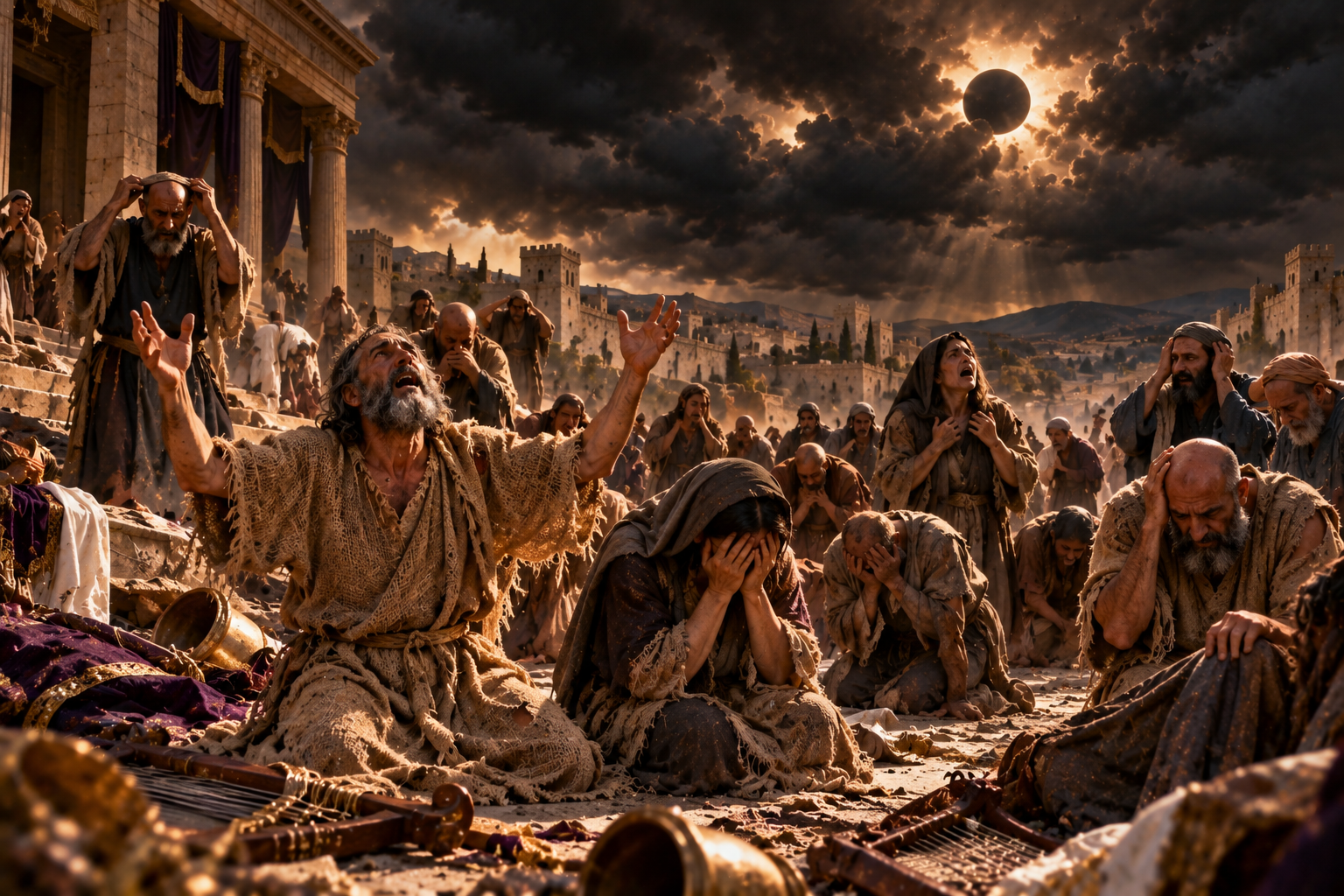
Joy will be Turned to Mourning
WHEN JOY TURNS
TO SORROW
Then - When? This expression of time picks up the previous expression of time in that day. See Utley's SPECIAL TOPIC: THAT DAY.
I will turn (haphak; LXX - metastrepho - turning something to its opposite state) your festivals (chaq; LXX - heorte - day or days marked by periodic celebration,) into mourning (ebel; LXX - penthos - outward expression of sorrow) - NET - "I will turn your festivals into funerals." Don't miss the three "I will's" in one verse. God is in full control behind the scenes of each of these actions. Turn (haphak) means change or overturn and in context speaks of a dramatic reversal in the character of Israel's religious celebrations. God had established appointed festivals for Israel as opportunities to remember His goodness and celebrate His covenant faithfulness (Lev 23:1–44). But Israel had corrupted its worship through idolatry, hypocrisy, injustice and oppression, which prompted Yahweh to declare “I hate, I reject your festivals, Nor do I delight in your solemn assemblies." (Am 5:21). Obviously even after being warned, Israel continued hypocritically to celebrate the festivals all the while refusing to mourn over their sins. They had maintained religious ceremonies while neglecting righteousness. They had preserved the outward forms of worship while abandoning the obedience that genuine worship required (cf 2Ti 3:5).
Bob Utley - This is a series of mourning rites (i.e. funeral songs, sackcloth, baldness) over YHWH's judgments of Israel's worship times. Their worship will be turned to bitter mourning, like the death of an only son (cf. Jer. 6:26; Zech. 12: 10).
And all your songs into lamentation - All means all! Lamentation (qinah קִינָה used in Amos 5:1) is a dirge or mournful song, especially one associated with death. Songs of celebration will become funeral dirges. Music that once expressed joy will become an expression of sorrow. Earlier Amos had condemned the wealthy for their luxurious entertainment and musical indulgence while remaining indifferent to the ruin of Joseph (Am 6:4–6). In Amos 8:3, God announced that the songs of the palace would become wailing. Recall God's command in Amos 5:23 to remove the noise of its songs because He rejects worship divorced from righteousness.
🙏 THOUGHT - There is a spiritual lesson here. Israel was able to sing songs even with sinful ("sin full") hearts. The same thing can happen on Sunday, because music reaches into our heart. However, music does not necessarily cleanse our heart! God was not impressed by the beauty of voices when our lives contradict the message of our worship.
And I will bring sackcloth (saq) on everyone’s loins - Hebrew = “I will place sackcloth on all waists.” Sackcloth (saq שַׂק) refers to coarse fabric, often made from animal hair and was commonly worn as an outward expression of mourning, humiliation, distress, or repentance. Mourners wore sackcloth (funeral clothes) as an outward expression of grief. The irony is that the sackcloth was uncomfortable clothing, which was in dramatic contrast with the fine garments the wealthy were wearing. On everyone's loins describes sackcloth being worn around the waist or body of not just a few but everyone which depicts the widespread nature of the mourning. Those who once dressed for celebrations will now dress for grief. Furthermore, the wealthy who had enjoyed luxurious clothing would be reduced to the same outward signs of sorrow as everyone else. In short, garments of luxury would give way to garments of lamentation. Recall that pagans of Nineveh put on sackcloth in reflecting their repentance in response to Jonah's warning of judgment (Jon 3:5–8). Sadly, the people of Israel put on sackcloth not for repentance but for mourning. While a repentant person may mourn, clearly outward mourning by itself is not necessarily indicative of inward repentance.
And baldness on every head - Baldness (qorchah קָרְחָה) refers to the removal of hair. In the ancient Near East, shaving the head or removing hair could function as an outward sign of grief. Amos describes this practice as part of the nation's coming mourning. God's judgment will be so overwhelming that sorrow will become visible throughout the nation. (See GRIEVING RITES)
NET NOTE - Heb “and make every head bald.” This could be understood in a variety of ways, while the ritual act of mourning typically involved shaving the head (although occasionally the hair could be torn out as a sign of mourning). Shaving the head or tearing out one’s hair was a ritual act of mourning. See Lev 21:5; Deut 14:1; Isa 3:24; 15:2; Jer 47:5; 48:37; Ezek 7:18; 27:31; Mic 1:16.
Bob Utley - "baldness" Because of Israel's connection with the Canaanite fertility cults, this could refer to "shaving" (cf. Moab, Isa. 15:2; Jer. 48:37; Philistia, Jer. 47:5; and Phoenicia, Ezek. 27:31), which had cultic connotations (cf. Lev. 21:5). But it could also refer to the pulling out of the hair of the head as a sign of mourning (cf. Micah 1:16; Ezek. 7:18).
And I will make it like a time of mourning (ebel; LXX - penthos - outward expression of sorrow) for an only son - In ancient Israel, the death of a son was an occasion of profound grief. But the death of an only son carried an additional dimension of sorrow. The parents lost not only a beloved child but also their only male heir, with the attendant loss of family continuity and future expectations. The comparison therefore communicates grief of extraordinary intensity. Jeremiah uses similar language: “Make mourning as for an only son, A lamentation most bitter” (Jer 6:26). Zechariah likewise describes mourning as one mourns for an only son (Zec 12:10). The point is not that parents love an only child more than other children. Rather, the image emphasizes the unique and devastating character of such a loss in its ancient cultural setting. In short, God selects one of the most heartbreaking experiences imaginable to communicate the intensity of Israel's coming sorrow.
It is interesting to compare mourning for an only son in Amos 8:9 and Zechariah 12:10. In Amos, the image describes the intensity of national grief associated with judgment. In Zechariah, the mourning is associated with looking upon the One Who has been pierced and being saved from judgment! The New Testament applies the piercing language of Zechariah 12:10 to Jesus Christ (Jn 19:37).
And the end (acharith) of it will be like a bitter (mar; LXX - odune = remorse from a guilty conscience) day - What is the end of it? It refers to that day, the day of judgment (Amos 8:9). Recall that in Amos 8:2, God declared “The end has come for My people Israel.” Now Amos describes this end as a bitter day, where bitter (mar) means painful, grievous. Bitter can describe literal bitterness of taste or figurative bitterness associated with intense suffering and here clearly describes the painful conclusion of the announced judgment. In Amos 8:9-10 note all the reversals associated with the Day of the LORD - daylight to darkness, songs to lamentation, festivals to mourning and joy to bitterness, together emphasizing the complete transformation of Israel's circumstances.
Bob Utley - "a bitter day" This word (BDB 600) is used at the grief over a death (cf. Amos 5:16-17). They were expecting just the opposite (cf. Amos 5:18-20)! This is a veiled reference to "that day," "the Day of the LORD." See note at Amos 2:16.
The Lord seeks not merely the sound of our songs,
but the surrender of our hearts!
🙏 THOUGHT — Does Your (my) Worship Reflect a Heart That Truly Honors God? Amos shows us a people whose festivals were busy and whose songs filled the air, while their hearts were far from the LORD (Am 5:21–23; 8:10). Could we be guilty of the same inconsistency? We may attend church faithfully, sing beautiful hymns and choruses, and join Bible studies all the while allowing pride, dishonesty, bitterness, unforgiveness or complacency to remain unchallenged (unconfessed) in our lives. Jesus warned that people can honor God with their lips while their hearts are far from Him (Mt 15:8, 9). Genuine faith shows itself in obedience and compassion (Jas 1:22, 27), and the sacrifice God desires is “a broken and a contrite heart” (Ps 51:17). The Lord seeks not merely the sound of our songs, but the surrender of our hearts! Let us never allow religious activity to replace genuine repentance. Instead, let us confess our sins promptly (1 Jn 1:9) and offer ourselves wholly holy to Him (Ro 12:1, 2), resting in the hope that our Savior will one day turn every sorrow into everlasting joy (Jn 16:20-22; Rev 21:4). After prayerfully pondering this THOUGHT, you might want to take a moment to worship and play this modern chorus by Matt Redman - The Heart of Worship. -
"I'm coming back to heart of worship,
it's all about You, it's all about You, Jesus."
Sackcloth (08242) saq means sack or sackcloth refers to a thick, coarse cloth, dark in color and typically woven from goat's hair and sometimes camel's hair. Sackcloth was worn traditionally to demonstrate mourning or despair; to convey the message dramatically. Sackcloth was used as a garment by mourners and those who wished to express contrition. It was worn in such a way as to leave the breast free for beating. As a garment of grief and self-abasement, sackcloth was sometimes the dress of the prophet who preached a message of repentance (cf. Rev. 11:3). Such a sight would be a call to trembling and repentance. Both Elijah and John, preachers of repentance, wore garments of camel's skin (2 Kings 1:8; Matthew 3:4). Persons might tear their clothes as well, especially at the death of a son. The word is also used of sacks used to transport various items of merchandise (Gen. 42:25, 27, 35)
Gilbrant - Sackcloth was worn by mourners who lamented either because of a national catastrophe (2 Ki. 6:30ff; Lam. 2:10) or a personal tragedy (Gen. 37:34; Job 16:15; Joel 1:8). For example, the elders of Jerusalem "cast up dust upon their heads; they have girded themselves with sackcloth" because of God's wrath which had come upon their nation (Lam. 2:10). Also, when Jacob was told that his beloved son Joseph had been mauled by a wild animal, he "rent his clothes, and put sackcloth upon his loins, and mourned for his son many days" (Gen. 37:34). The wearing of sackcloth symbolized a person's passionate desire for mercy from God (Dan. 9:3). The shape of the saq was possibly similar to a loincloth or a beanbag, while its dark color signified lamentation, grief and sorrow. Isaiah compared metaphorically the dark color of a sackcloth with the darkness of Israel's sky on account of their sin (Isa. 50:3). The darkness of the sackcloth contrasted the colorful garments worn at festive times and celebrations. Therefore, the absence of color signified sadness, while the presence of color signified joy. A saq could also be used as a holder of items such as food (Gen. 42:25, 27, 35; Lev. 11:32; Josh. 9:4) or as a blanket for covering (2 Sam. 21:10; Joel 1:13). (Complete Biblical Library)
See What is the meaning of sackcloth and ashes? | GotQuestions.org
Mourning (060) ebel is a masculine noun meaning “mourning,” the outward expression of grief, especially for the dead. It comes from the verb abal, “to mourn, lament,” which is used both of people and, poetically, of the land itself “mourning” under God’s judgment (Am 1:2; Hos 4:3). The adjective ʾābēl (H57) describes a person who is mourning, as when Jacob refused comfort and said, “Surely I will go down to Sheol in mourning for my son” (Ge 37:35); used as a noun, it means “mourners” (Isa 57:18; 61:2–3). The noun ʾēbel occurs about 24 times. The Septuagint usually translates it with penthos, the same word the New Testament uses for mourning (Jas 4:9; Rev 21:4). Unlike private sorrow, ʾēbel usually describes visible, public grief marked by set periods, sackcloth, dust, special garments, and wailing.
EBEL - 24X/22V - mourn(1), mourning(23). Ge 27:41; Gen. 50:10; Gen. 50:11; Deut. 34:8; 2 Sam. 11:27; 2 Sam. 14:2; 2 Sam. 19:2; Est. 4:3; Est. 9:22; Job 30:31; Eccl. 7:2; Eccl. 7:4; Isa. 60:20; Isa. 61:3; Jer. 6:26; Jer. 16:7; Jer. 31:13; Lam. 5:15; Ezek. 24:17; Amos 5:16; Amos 8:10; Mic. 1:8
1. The period and rites of mourning for the dead.
Israel observed set periods of mourning. Joseph observed seven days of mourning for Jacob, and the Canaanites named the place Abel-mizraim, “mourning of Egypt” (Ge 50:10–11). Israel wept for Moses until “the days of weeping and mourning for Moses came to an end” after thirty days (Dt 34:8). Esau planned to kill Jacob once “the days of mourning for my father” were past (Ge 27:41), and Bathsheba’s mourning for Uriah ended before David took her as his wife (2 Sa 11:27). Mourning had its own clothing: the wise woman of Tekoa wore “mourning garments” (2 Sa 14:2). Mourning for “an only son” was proverbial as the deepest grief imaginable (Jer 6:26).
2. National mourning in calamity.
ʾĒbel also describes the grief of a whole people facing disaster. When Haman’s decree was published, “there was great mourning among the Jews, with fasting, weeping and wailing” (Est 4:3). David’s victory over Absalom “was turned to mourning for all the people” because the king was grieving his son (2 Sa 19:2). Micah lamented Samaria’s coming fall with “a mourning like the ostriches” (Mic 1:8).
3. Joy turned into mourning (judgment).
A recurring prophetic pattern is that God’s judgment reverses celebration into grief. Job lamented, “my harp is turned to mourning” (Job 30:31), and Jerusalem cried, “our dancing has been turned into mourning” (Lam 5:15). Amos used ʾēbel twice of the coming judgment on Israel: professional mourners and even farmers would be summoned to wail in every street (Am 5:16), and God declared, “I will turn your festivals into mourning... and I will make it like a time of mourning for an only son” (Am 8:10). The very feasts that Israel’s religious leaders enjoyed would become funerals, and the grief would be like the bitterest loss a family could know. James echoes the same reversal as a call to repentance: “Let your laughter be turned into mourning (penthos)” (Jas 4:9).
4. Mourning turned into joy (restoration).
The most hopeful uses of ʾēbel describe God reversing grief. The Jews’ month of danger “was turned for them from sorrow into gladness and from mourning into a holiday” (Est 9:22). Looking ahead to Israel’s regathering, the LORD promised, “I will turn their mourning into joy and will comfort them” (Jer 31:13). Messiah was anointed “to comfort all who mourn... giving them... the oil of gladness instead of mourning” (Isa 61:2–3), and in the coming kingdom, “the days of your mourning will be over” (Isa 60:20).
5. The wisdom of the house of mourning.
Ecclesiastes uses ʾēbel in a surprising way: “It is better to go to a house of mourning than to go to a house of feasting, because that is the end of every man, and the living takes it to heart” (Ecc 7:2; cf. 7:4). Mourning sobers the heart in a way feasting cannot, a lesson Israel’s revelers in Amos never learned (Am 6:4–6).
THOUGHT: The same God who said He would turn Israel’s festivals into mourning (Am 8:10) also promises to turn His people’s mourning into joy (Jer 31:13). The difference is repentance and grace. Jesus said, “Blessed are those who mourn, for they shall be comforted” (Mt 5:4), using the verb pentheo, related to penthos. Those who mourn over their sin now will one day see God wipe every tear from their eyes, “and there will no longer be any death; there will no longer be any mourning (penthos)” (Rev 21:4).
BALDNESS - Dictionary of Biblical Imagery (online)
“In all Israel there was not a man so highly praised for his handsome appearance as Absalom” (2 Sam 14:25 NIV). The next verse shows that one of the chief reasons he was so admired was his luxuriant head of hair. Similarly, white hair is a significant characteristic shared by the Ancient of Days (Dan 7:9) and the risen Christ (Rev 1:14).
By contrast, the absence of hair was a cause for shame. For the prophet Elisha to be jeered at and described as “you baldhead” (2 Kings 2:23) was obviously an insult, though whether his baldness was due to natural hair loss or a shaved tonsure is not clear. Apart from this the Bible views the shaving of the head as a mark of mourning (e.g., Jer 16:6) and as evidence of God’s judgment, both on his own people (e.g., Is 3:17, 24; 7:20; 22:12; Ezek 7:18; Amos 8:10; Mic 1:16) and on their enemies (e.g., Is 15:2; Jer 47:5; 48:37; Ezek 27:31; 29:18). The reference in Micah evokes the image of the vulture, whose pale, down-covered head contrasts with the well-feathered heads of other birds.
To shave the head as a sign of mourning is forbidden for priests on the grounds that it would compromise their holy calling and “profane the name of their God” (Lev 21:5; Ezek 44:20). The same reason lies behind the prohibition in Deuteronomy 14:1 against any of God’s holy people shaving the front of their heads “for the dead.”
Letting the hair grow was one of the conditions attached to the vow made by a Nazirite (Num 6:5). Such hair was seen as dedicated to the Lord (Num 6:9) and was to be shaved off when the period of the vow came to an end (Num 6:18) or if accidentally defiled (e.g., if someone suddenly died in the Nazirite’s presence). The phenomenal strength of Samson, the most famous Nazirite in the Bible, is linked with the length of his hair (Jdg 16:17–22). The apostle Paul and his companions are recorded as having shaved their heads for ritual purposes (Acts 18:18; 21:24).
Amos 8:11 “Behold, days are coming,” declares the Lord GOD, “When I will send a famine on the land, Not a famine for bread or a thirst for water, But rather for hearing the words of the LORD.
KJV Behold, the days come, saith the Lord GOD, that I will send a famine in the land, not a famine of bread, nor a thirst for water, but of hearing the words of the LORD:
NET Be certain of this, the time is coming," says the sovereign LORD, "when I will send a famine through the land– not a shortage of food or water but an end to divine revelation!
NLT "The time is surely coming," says the Sovereign LORD, "when I will send a famine on the land-- not a famine of bread or water but of hearing the words of the LORD.
ESV "Behold, the days are coming," declares the Lord GOD, "when I will send a famine on the land-- not a famine of bread, nor a thirst for water, but of hearing the words of the LORD.
BGT ἰδοὺ ἡμέραι ἔρχονται λέγει κύριος καὶ ἐξαποστελῶ λιμὸν ἐπὶ τὴν γῆν οὐ λιμὸν ἄρτου οὐδὲ δίψαν ὕδατος ἀλλὰ λιμὸν τοῦ ἀκοῦσαι λόγον κυρίου
LXE Behold, the days come, saith the Lord, that I will send forth a famine on the land, not a famine of bread, nor a thirst for water, but a famine of hearing the word of the Lord.
CSB Hear this! The days are coming-- this is the declaration of the Lord GOD-- when I will send a famine through the land: not a famine of bread or a thirst for water, but of hearing the words of the LORD.
NIV "The days are coming," declares the Sovereign LORD, "when I will send a famine through the land-- not a famine of food or a thirst for water, but a famine of hearing the words of the LORD.
- but (KJV): 1Sa 3:1 28:6,15 Ps 74:9 Isa 5:6 30:20,21 Eze 7:26 Mic 3:6 Mt 9:36
Related Passages:
Amos 4:2 (DAYS ARE COMING - HERE "BAD" DAYS) The Lord GOD has sworn by His holiness, “Behold, the days are coming upon you When they will take you away with meat hooks, And the last of you with fish hooks.
Amos 9:13 (DAYS ARE COMING - HERE "GOOD" DAYS) “Behold, days are coming,” declares the LORD, “When the plowman will overtake the reaper And the treader of grapes him who sows seed; When the mountains will drip sweet wine And all the hills will be dissolved.
Deuteronomy 8:3 “He humbled you and let you be hungry, and fed you with manna which you did not know, nor did your fathers know, that He might make you understand that man does not live by bread alone, but man lives by everything that proceeds out of the mouth of the LORD.
Deuteronomy 32:46-47 (THE WORD WAS THEIR LIFE!) he said to them, “Take to your heart (MEMORIZE IT!) all the words with which I am warning you today, which you shall command your sons to observe carefully, even all the words of this law. 47 “For it is not an idle word for you; indeed it is your life. And by this word you will prolong your days in the land, which you are about to cross the Jordan to possess.”
Psalm 74:9NET We do not see any signs of God's presence; there are no longer any prophets and we have no one to tell us how long this will last.
Psalm 74:9NLT We no longer see your miraculous signs. All the prophets are gone, and no one can tell us when it will end.
Psalm 74:9NIV We are given no miraculous signs; no prophets are left, and none of us knows how long this will be.
Mark 4:24-25 And He was saying to them, “Take care what you listen to (ESV - Pay attention to what you hear). By your standard of measure it will be measured to you; and more will be given you besides. 25 “For whoever has, to him more shall be given; and whoever does not have, even what he has shall be taken away from him.”
Amos 2:4 Thus says the LORD, “For three transgressions of Judah and for four I will not revoke its punishment, Because they rejected the law of the LORD And have not kept His statutes; Their lies also have led them astray, Those after which their fathers walked.
Amos 2:12 “But you made the Nazirites drink wine, And you commanded the prophets saying, ‘You shall not prophesy!’
Amos 7:12-13 Then Amaziah said to Amos, “Go, you seer, flee away to the land of Judah and there eat bread and there do your prophesying! 13 “But no longer prophesy at Bethel, for it is a sanctuary of the king and a royal residence.”
2 Timothy 4:3-4 For the time will come when they will not endure sound doctrine; but wanting to have their ears tickled, they will accumulate for themselves teachers in accordance to their own desires, 4 and will turn away their ears from the truth and will turn aside to myths.
1 Samuel 3:1 Now the boy Samuel was ministering to the LORD before Eli. And word from the LORD was rare in those days, visions were infrequent.
1 Samuel 28:6 When Saul inquired of the LORD, the LORD did not answer him, either by dreams or by Urim or by prophets.
God Will Put an End to Divine Revelation
A FAMINE WORSE THAN HUNGER:
WHEN HEAVEN FALLS SILENT
Behold, (hinneh; LXX - idou = Look!) days are coming declares the Lord GOD (adonay Jehovah/yahweh) - Behold (hinneh) introduces a solemn announcement requiring careful consideration. And now God announces another dimension of judgment. It is interesting that Jeremiah also used an identical phrase repeatedly warning the Southern Kingdom Judah that days are coming (Jer 7:32; 9:25; 16:14; 19:6; 23:5; 30:3; 31:27, 31, 38)
When I will send a famine (ra'ab) on the land - Famine (ra'ab רָעָב) refers to hunger or severe scarcity of food and was a familiar threat in the ancient world. Agricultural societies depended upon adequate rainfall, productive harvests, and reliable food supplies. A prolonged drought or failed harvest could bring widespread suffering. Amos had already described God's use of physical deprivation to warn Israel. In Amos 4:6, He gave the people cleanness of teeth and lack of bread. In Amos 4:7,8, He withheld rain, causing cities to stagger in search of water. Yet the repeated refrain was “Yet you have not returned to Me.” Those earlier judgments were intended to awaken Israel to its deadly spiritual condition. But the nation refused to repent. Therefore, now God announces another famine declaring I will send. So it comes directly from the sovereign LORD. This is not an unfortunate decline in religious interest BUT a divinely announced withdrawal of prophetic revelation. The God Who had graciously sent His prophets now announces that His people will experience the dreadful absence of His Word.
The irony is that Israel was experiencing considerable economic prosperity under Jeroboam II. But they had little appetite for the Word of God. Now the LORD announces that the Word they had neglected and even rejected (Amos 2:4) would become scarce. Israel had full tables but empty hearts, and soon it would discover that prosperity could not replace the Word of God.
Not a famine for bread or a thirst for water God now explains that He is not speaking primarily about physical deprivation. This distinction recalls Moses' words in Deuteronomy 8:3 declaring "that man does not live by bread alone, but man lives by everything that proceeds out of the mouth of the LORD." In Amos 2:12, they commanded the prophets not to prophesy. In Amos 7:12, 13, Amaziah ordered Amos to leave Bethel and stop prophesying there.
But (term of contast) rather for hearing (shama; LXX - akouo) the words of the LORD - It is notable that Amos does not say there will be a famine of religious activity, of feasts or of festivals but for hearing the words of the LORD. Israel had plenty of of religious activity, but they repeatedly rejected the genuine Word of God delivered through His prophets (Am 2:4, Am 2:12, Am 7:12,13). Israel had commanded God's messengers to stop speaking, and now they would get the desire of their evil hearts! The Word rejected would be the Word withdrawn! As we often say their punishment fit their crime!
M. Daniel Carroll - 8:11 speaks to the deprivation of communication from God (See The Book of Amos - Page 122)
Thomas McComiskey - Having rejected the word for not realizing its great value, they will lose it forever (cf. Pr 1:24–27; Lk 17:22; Jn 7:34). The church must realize the preciousness of God’s Word. We must obey and honor it, because it points to the source of life. (see Hosea, Amos, Micah)
Israel had plenty of false religion
but a paucity of the true Word.
Most writers think the famine is lack of divine revelation (prophets cease speaking), some like G Campbell Morgan have another view - "The condition described is that of being deaf to the words of Jehovah, not able to hear them. It is not a case of God withholding His revelation; but of people being in such a state that they do not see it, do not hear the words.” While that could certainly be true, it is reasonable to consider the famine for the hearing to be a combination of lack of revelation and lack of understanding the revelation they had already received (e.g., see Gotquestions' comment below).
The irony is that they had rejected
what they now desired!
The passage does not necessarily mean that every written portion of Scripture would disappear or that no individual could ever know anything about God. Rather, in its historical setting, it points to the withdrawal or scarcity of authoritative prophetic communication from the LORD.
🙏 THOUGHT - Note also that the Hebrew verb for hearing (shama) does mean that the Word of God is to go in one ear and out the other, but that the word that enters the ear should enter the heart and result in obedience. (Jas 1:22, Mt 7:24-27) The goal of hearing God's Word is not so much for information, but for transformation. The Word of God is not to make us "smarter sinners" but to make us more like our Savior!
Warren Wiersbe on a famine...for hearing the words of the LORD means Israel would have "no light in the darkness, no nourishment for the soul, no direction for making decisions, no protection from the lies of the Enemy." (Bible Exposition Commentary)
David Alan Hubbard - The indispensable, life-giving quality of the divine word is what the comparison conveyed. No-one could live without the power and guidance of the divine words any more than anyone could live without the nourishment of bread and the refreshment of water. As usual in judgment speeches, the punishment here fitted the crime: rejection of the prophetic word (cf. Amos 2:12; 7:12–13) forced withdrawal of that word. (SEE Joel and Amos - Page 237)
Thomas Constable - If we do not listen to the Word of God, we may not be able to hear the Word of God (cf. Luke 17:22; John 7:34). This does not mean that God would remove all copies of His Word from them, but that when they sought a word of help, advice, or comfort from Him, they would not get it (cf. King Saul). Prophets would not bring God’s words to them anymore.
Is There a Modern Application? Amos 8:11 originally addressed the northern kingdom of Israel and announced a specific historical judgment. We should therefore avoid claiming that every period of biblical illiteracy or spiritual decline is a direct fulfillment of this prophecy. Nevertheless, the principle remains profoundly relevant. A society may possess thousands of churches, countless religious publications, and extraordinary access to Scripture while displaying little genuine hunger to hear and obey God's Word. The danger is not merely that Bibles become unavailable. It is that people become indifferent to the truth they possess. Paul warned Timothy that a time would come when people would not endure sound doctrine but would accumulate teachers who told them what they wanted to hear (2 Ti 4:3,4). While this is not identical to the judgment announced in Amos, the spiritual danger is similar. People may reject the truth because it confronts their desires. A Bible on the shelf is no substitute for the Word of God treasured in the heart and obeyed in daily life.
Gleason Archer (page 301) writes some sobering (almost prophetic) words declaring that "the basic warning to northern Israel applies with continuing application to national apostasy wherever a nation or people puts aside the authority of Holy Scripture and lives in rebellion against God (ED: AMERICA ARE YOU LISTENING?!)...“Whatsoever things were written aforetime were written for our learning,” wrote Paul in Romans 15:4.”
J Vernon McGee adds "God tells any church or any nation that, if they will not hear His Word after He has given it to them, He will withdraw it from them. I think we can see this happening in America. There has been a rejection of the Word of God. The churches have turned to liberalism, and the Word of God is no longer preached. There has come a famine of the Word of God. So many of the formerly great churches of this country, the great downtown churches, have turned from the Word of God. As a consequence, many of them have had to close shop. Others are just barely operating, and many of them are operating in the red. Even those which have stayed open have lost their influence and have lost their drawing power. Actually, very little of the Word of God is getting out in this land today. There is a Gideon Bible in every room in every hotel and motel in this country. Nearly everyone owns a Bible. But who is studying it? Who is reading it? Who is believing it? I think we are beginning to see the famine of the Word of God in this country. (SEE Thru the Bible Vol. 28: The Prophets Amos/Obadiah)
The question is not merely whether we possess the Word of God,
but whether the Word of God possesses our hearts!🙏 THOUGHT — Are You Hungry for the Word of God? Amos warns of a day when people who had repeatedly rejected God’s Word would desperately seek it and not find it (Am 8:11–12). Could we be taking for granted one of our greatest privileges? Scripture has never been more accessible, yet accessibility does not guarantee appetite. We can own many Bibles and hear countless sermons while our hearts grow indifferent. Job treasured God’s words more than his necessary food (Job 23:12). Jeremiah ate them, and they became the joy and delight of his heart (Jer 15:16). The psalmist found them sweeter than honey and more desirable than gold (Ps 19:10), and Peter urges us to long for the pure milk of the Word so that we may grow (1 Pe 2:2). The question is not merely whether we possess the Word of God, but whether the Word of God possesses our hearts! A starving soul does not need more entertainment or distraction (which is a "strategy" of some modern churches!). It needs the life-giving Word of God (Dt 32:47, Jn 6:63), which reveals God’s character, exposes our sin, and allows the Holy Spirit to tranform us into the image of Jesus (Ps 119:105; 2Ti 3:16, 17, 2Co 3:18, Eph 4:23). May our prayer continually be, “Open my eyes, that I may behold Wonderful things from Your law” (Ps 119:18).
Behold (02009) hinneh is an interjection meaning behold, look, now; if. "It is used often and expresses strong feelings, surprise, hope, expectation, certainty, thus giving vividness depending on its surrounding context." (Baker) Hinneh generally directs our mind to the text, imploring the reader to give it special attention. In short, the Spirit is trying to arrest our attention! And so hinneh is used as an exclamation of vivid immediacy (e.g., read Ge 6:13)! Hinneh is a marker used to enliven a narrative, to express a change a scene, to emphasize an idea, to call attention to a detail or an important fact or action that follows (Isa 65:17, Ge 17:20, 41:17). The first use of hinneh in Ge 1:29 and second in Ge 1:31 - "And God saw all that He had made, and behold, it was very good. And there was evening and there was morning, the sixth day." Hinneh is oftn used in the idiom "Here I am" in Ge 22:1, 7,11 Ge 27:1,18, Ge 31:11, Ge 46:2 Ex 3:4 1Sa 3:4, 3:16, 12:3, 2Sa 1:7, Isa 52:6, Isa 58:9. Hinneh is used most often to point out people but also to point out things (Ge 31:41, 17:4). God uses hinneh to grab man's attention before He brings destruction (Ge 6:13, 17). God uses hinneh when He establishes covenants (Ge 9:9, 15:12, 17 [when Jehovah cut the Abrahamic covenant], Ge 17:4, cp Ge 28:13, 15), when He provided a sacrificial substitute for Isaac (foreshadowing His giving us His only Son!) (Ge 22:13). Hinneh marks the "chance (The Providence of God)" arrival of Boaz at the field where Ruth was gleaning (Ru 2:4-read about this "chance romance" - Indeed, "Behold!"). Hinneh is used to announce the Lord’s sending of a child as a sign and a prophecy of Immanuel-Emmanuel, the Messiah (Isa. 7:14). In fact W E Vine says that it is notable that when behold (hinneh) is used in Isaiah, it always introduces something relating to future circumstances.
HINNEH IN AMOS - Amos 2:13; Amos 4:2; Amos 4:13; Amos 6:11; Amos 6:14; Amos 7:1; Amos 7:4; Amos 7:7; Amos 7:8; Amos 8:1; Amos 8:11; Amos 9:8; Amos 9:9; Amos 9:13
Spurgeon reminds us that "Behold is a word of wonder; it is intended to excite admiration. Wherever you see it hung out in Scripture, it is like an ancient sign-board, signifying that there are rich wares within, or like the hands which solid readers have observed in the margin of the older Puritanic books, drawing attention to something particularly worthy of observation." I would add, behold is like a divine highlighter, a divine underlining of an especially striking or important text. It says in effect "Listen up, all ye who would be wise in the ways of Jehovah!"
Hinneh is translated in the Septuagint with the interjection idou (strictly speaking a command in the second person aorist imperative, middle voice) a demonstrative particle (used 1377 times in the Septuagint and NT) which is found especially in the Gospels of Matthew and Luke "and giving a peculiar vivacity to the style by bidding the reader or hearer to attend to what is said: "Behold! See! Lo!" (Thayer) The command is calling for urgent attention. Do this now! Don't delay! It could be loosely paraphrased "Pay attention!" or "Listen up!" to arouse attention.
Famine (07458) raab means hunger, or famine which is a drastic, usually widespread food shortage, an extreme scarcity of food. Ra'ab means "hunger" as opposed to "thirst". In some areas the cause is overpopulation, but it is usually a failure of crops that results in a serious shortage of nutritional foods. The first famine is described in Genesis 12:10 "Now there was a famine in the land; so Abram went down to Egypt to sojourn there, for the famine was severe in the land." God allows or causes famines and clearly He was testing Abram's faith at this time. We see a repeat in Genesis 26:1 "Now there was a famine in the land, besides the previous famine that had occurred in the days of Abraham. So Isaac went to Gerar, to Abimelech king of the Philistines." Not only did famines occur in Canaan but Egypt also suffered cycles of famine (Ge 41:27, 30, 31). In Ps 105:16 "He called for a famine upon the land" and the result was that Jacob took his family to Egypt! (cf Ge 50:20) God is sovereign in History! Famine can be the discipline of God on His people (Isa. 5:13). Through His prophet Ezekiel God warned Judah (the 10 northern tribes having already been taken off into captivity by Assyria in 722BC) "Son of man (Ezekiel), if a country sins against Me by committing unfaithfulness, and I stretch out My hand against it, destroy its supply of bread, send famine against it, and cut off from it both man and beast even though these three men, Noah, Daniel and Job were in its midst, by their own righteousness they could only deliver themselves,” declares the Lord GOD." (Ezekiel 14:13-14) Famine is frequently mentioned in the terrible triad "sword, famine, and pestilence," (Jer. 14:13, 27:8, 13, 18, 32:24, 36, 34:17, 38:2, 42:17, 22, 44:13, Ezek 6:11), Famine is used figuratively of spiritual nourishment, God declaring "I will send a famine on the land, Not a famine for bread or a thirst for water, But rather for hearing the words of the LORD. sword, famine, and pestilence. Amos mentions a famine of the Word of God, not food, that the Lord will send!" (Amos 8:11). The line between famine and plenty in Palestine depends mainly on the rains coming at the right time and in the proper supply, famine was an ever-present threat.
In summary raab is a prolonged scarcity of food, accompanied by extreme hunger. It is listed as one of God’s ‘four sore acts of judgment’ along with the sword (war), evil beasts, and pestilence (Eze 14:21). It is also a divine judgment in Jeremiah, along with the sword (fourteen times), and with the sword and pestilence (fifteen times). In Dt 28:48, hunger is one of the many curses God will send for disobedience. Famine may lead to disease (Jer 14:18) and, most gruesome of all, cannibalism of one’s own offspring (Dt. 28:47-57). Other attendant judgments may be captivity (Jer 15:2), exile (Ezek 5:12), nakedness (Dt. 28:47)
God used a "famine" as a means
of judgment (Jer 5:12),
of warning (1Ki 17:1), (Elijah)
of correction (2Sa 21:1),
of punishment (Jer 14:12),
of humbling (Dt 8:3)
of expressing sovereign control (Ru 1:1)
QUESTION - What does it mean that there will be a famine of hearing the words of God? Gotquestions.org
ANSWER - We typically understand a famine as a lack of food or water, but Amos 8:11 speaks cryptically of a famine of the hearing of the Word of God: “‘The days are coming,’ declares the Sovereign Lord, ‘when I will send a famine through the land—not a famine of food or a thirst for water, but a famine of hearing the words of the Lord.’”
To better understand a difficult message, it’s often helpful to understand the messenger. Amos, along with Hosea, Isaiah, and Micah, prophesied during the eighth century BC. The Jews had split into two nations, the northern kingdom, Israel, and the southern kingdom, Judah. It is interesting to note that Amos had no formal theological training; he was a farmer who raised livestock and sycamore figs (Amos 7:14). Interesting, too, is the fact that Amos, who resided in Judah, was sent by God to preach in the northern kingdom. As is often the case among a rebellious people, Amos’s calls for national repentance were met with hostility (Amos 7:12). Let us begin by examining the eighth chapter of Amos in its entirety (SEE Amos 8:1-14).
Just as the harvest marks the end of the season, the basket of summer fruit signifies the coming judgment in which the rebellious people reap the bitter harvest they have sown (Amos 8:1–3). Ensnared by economic prosperity and fueled by greed, dishonest merchants added to their coffers by making merchandise of the poor (Amos 8:4–6). Rather than honoring the Lord, these dishonest merchants considered acts of worship as unwelcome business interruptions. None of this had escaped God’s attention. He had witnessed their deeds, and He knew the hardness of their hearts.
As is always the case, the unrepentant who refuse God’s mercy must face His wrath (Amos 8:7). Verse 9 tells of cosmic signs that indicate the dawning of the Day of the LORD. The Day of the LORD occurs before the millennial reign of Christ Jesus; this is the dark time in which God pours out His wrath upon the earth (ED: WHILE I AGREE WITH THIS FUTURE FULFILLMENT, IN CONTEXT AMOS SEEMS TO BE WARNING OF THE NEAR FULFILLMENT BY THE ASSYRIAN INVASION). The prophet’s graphic imagery of death and destruction reminds us that God’s wrath is a terrible spectacle to behold (Amos 8:8–14).
Among the judgments of those days, God will send a famine: a famine of hearing God’s Word. This is surely a severe judgment, as people will seek the Lord and not find Him. Those who rejected the prophets will no longer be able to find a prophet. Those who despised God’s Word will have God’s Word hidden from them. They will hunger and thirst for a message from God, but too late. Like the virgins in Jesus’ parable, they will come to the door of the wedding feast and find it closed. “Lord, Lord,” they will say, “open the door for us!” (Matthew 25:11). The only word they hear will be, “Truly I tell you, I don’t know you” (verse 12).
To some degree, the famine of God’s Word is with us now. A growing number of pastors are abandoning sound biblical teachings and the message of the cross. Rather than telling people they are lost sinners in desperate need of salvation, these false teachers proclaim glowing messages of prosperity, self-esteem, or political activism. Under the inspiration of the Holy Spirit, the apostle Paul warned, “For the time is coming when people will not endure sound teaching, but having itching ears they will accumulate for themselves teachers to suit their own passions, and will turn away from listening to the truth and wander off into myths. As for you, always be sober-minded, endure suffering, do the work of an evangelist, fulfill your ministry” (2 Timothy 4:3–5ESV). Bible study bathed in prayer is the believer’s best preventative against spiritual famine.
In biblical days prophets were astir while the world was asleep; today the world is astir while church and synagogue are busy with trivialities. —Abraham Joshua Heschel
Adrian Rogers - There was a famine in the land, a sore famine. It was a time of hunger. And it speaks to me of this day and of this age. Now indeed, it is sad to see people going without food, but the Bible speaks in the book of Amos of a greater famine for the Word of God. You might be interested to turn to Amos 8:11 and look at one of the most poignant passages, in my estimation, in the Bible. In Amos 8:11, the Bible says, “Behold, the days come, saith the Lord GOD, that I will send a famine in the land, not a famine of bread, nor a thirst for water, but of hearing the words of the LORD.” (Amos 8:11) We’re living in that age; we’re living in that time. Now we here in the buckle on the Bible Belt hear more of the Word of God than most people. But I want to tell you that America is a vast desert where there is a famine for the Word of God, and there are multiplied millions around this world, indeed billions, who have never heard the gospel in all of its purity and all of its power.
John G Butler - Spiritual Famine
“Behold, the days come, saith the Lord GOD, that I will send a famine in the land, not a famine of bread, nor a thirst for water, but of hearing the words of the LORD.” (Amos 8:11)
AMOS gave a very somber message to the Israelites in this verse. It was about the judgment of a spiritual famine. We note the cautioning about the judgment, the character of the judgment, and the coming of the judgment.
Cautioning about the judgment. “Behold, the days come, saith the Lord GOD.” The beginning of the verse shows the grace of God in that He warns of coming judgment. The warning is to give time for people to repent and thus avoid the judgment. God is ever doing this. The trouble with man is that he seldom heeds the warnings. But when judgment comes, no one can complain; for God has duly warned mankind of the coming judgment.
Character of the judgment. “I will send a famine … of hearing the words of the LORD.” This is not what we usually consider a famine. Usually, we think a famine is one of physical food. But this judgment is a famine of spiritual food. This judgment will remove the preaching and teaching of the Word of God from the land. This judgment will remove the Scriptures from society. It will take the Bible away from man. It is one of the worst judgments for mankind.
Coming of the judgment. This judgment finally came to Israel because they did not repent. God’s prophets were taken off the scene, and the Word of God was removed. People walked in spiritual darkness in Israel. The same is happening in our land. The Bible is ruled out of school and society by our courts. Churches are barren of the Word. The minister no longer majors on preaching and teaching the Word. Rather, he is a public relations man, a decorative piece at social events, and someone to have handy to marry and bury people. The pulpit is empty, and the Sunday School classrooms are staffed by people who do not know the Word and cannot teach it. The church program majors on entertainment, not on Bible exposition. Ignorance of the Bible prevails. It is time to repent and turn back to God and His Word.
Henry Blackaby - Spiritual Famine - Amos 8:11 Experiencing God Day by Day: Daily Devotional - Page 180
One way God communicates is through silence. The Israelites blatantly ignored and rejected God's Word to them, and God responded by sending a famine. This famine was far more severe than a shortage of food and water. Instead, they were deprived of His words of life.
God's silence may be hardly noticeable at first. You may still remember times when God spoke to you, but you gradually realize you’ve not heard His voice for a long time. If you realize you are in a “drought,” immediately seek God and ask Him what adjustments your life requires so you can once again enjoy fellowship with Him. It may be that you disobeyed His last instructions to you and that He is waiting on your obedience before giving you a new direction. It may be that there is unconfessed sin in your life or that you have a damaged relationship (Isa. 1:15; 1 Pet. 3:7). It is possible that you have done too much talking in your prayer times and that He wants you to listen. God's silences can be powerful times for Him to communicate with you.
God is God! Because He is God, when He speaks He expects a listening ear and an eager response. He will not be mocked! (Gal. 6:7). When we ignore Him, He may withhold His voice until we repent and get right with Him. The prophet Isaiah assured King Asa, “The Lord is with you while you are with Him. If you seek Him, He will be found by you; but if you forsake Him, He will forsake you.”
Living in Poverty—John Henry Jowett
We leave our places of worship, and no deep and inexpressible wonder sits upon our faces. We can sing these lilting melodies, and when we go out into the streets our faces are one with the faces of those who have left the theaters and the music halls. There is nothing about us to suggest that we have been looking at anything stupendous and overwhelming... And what is the explanation of the loss? Preeminently our impoverished conception of God.
Norman Geisler - When Critics Ask - AMOS 8:11—What does Amos mean when he says there will be a famine of hearing the words of the Lord?
PROBLEM: Because of the sin of Israel, God pronounced through His prophet Amos that He would bring judgment upon the people. One aspect of that judgment was that there would be a famine of hearing the words of the Lord. However, there is no indication from history that the Hebrew Scriptures were destroyed or removed from Israel at this time. To what does the “famine” in hearing the words of the Lord refer?
SOLUTION: This verse addresses the lack of messengers from God, such as His prophets. Israel had not only despised the messengers of God, but had put many of them to death for their words. In God’s judgment upon Israel, there would come a time when Israel would seek for help and guidance, but God would be silent (compare Ezek. 7:26 and Micah 3:7). He would not send any messengers to them. Although they would still have the written Hebrew Scriptures, there would be a famine of the words of the Lord through His prophets.
G Campbell Morgan - I will send a famine . . . of hearing the words of the Lord. Amos 8.11
After the encounter with Amaziah, Amos proclaimed the fact that judgment was nigh at hand, as he described the vision of "a basket of summer fruit." The figure revealed the ripeness of the hour, as to the fullness of Israel's sin, and as to the harvest of Divine wrath. In an impassioned address he denounced the money-makers for their greed and cruelty; and described the terror of the Divine judgment. Then, in one of the most striking passages in prophetic literature, he described the curse which follows courses of wilful wickedness, such as the nation had been guilty of. They would experience a famine—not, let it be observed, of the words of Jehovah, but "of hearing the words of Jehovah." The condition described is that of being deaf to the words of Jehovah, not able to hear them. It is that of the death of spiritual sensibility. It is not a case of God withholding His revelation; but of people being in such a state that they do not see it, do not hear the words. When this is so, the soul does not cease to need what that word only can supply; and so men hunt for it, search for it, but to no avail. The issue is that of the failing of strength, even in the strongest; "the fair virgins and the young men faint for thirst." Here we have an explanation of the feverishness, the restlessness of human life. Men wander and travel, and seek for any and every new sensation to satisfy the craving of their deepest life. But all to no purpose. Only the words of Jehovah can meet the need, and when there is a famine of hearing them, the end is destruction.
Gleason Archer - Does the prophecy in Amos 8:11–12 refer only to Israel? If so, has it been fulfilled? Are “the words of the Lord” (v.11) those that we have in the Bible today? - New International Encyclopedia of Bible Difficulties
The ministry of Amos was to the apostate northern kingdom of Israel, near the close of the reign of King Jeroboam II (793–753 B.C.). The earlier portion of Amos 8 deals quite specifically with the approaching downfall of Samaria which took place about thirty-three years later, in 722 B.C., when the Assyrians destroyed both the city and the northern kingdom as an independent state.
Amos 8:11–12 reads: “ ‘Behold, days are coming, declares the Lord Yahweh, when I will send a famine on the land, not a famine for bread or a thirst for water, but rather for hearing the words of Yahweh. And people will stagger from sea to sea, and from the north even to the east; they will go to and fro to seek the word of Yahweh, but they will not find it.’ ” This warning refers to the final decade of Israel’s history (i.e., of the northern kingdom), during which the government, the clergy, and the people all sought in vain for some words of comfort and guidance from the Lord Yahweh but found none. (This parallels the final frantic efforts of King Saul just beforethe battle of Mount Gilboa, to receive some word from the Lord [cf. 1 Sam. 28:6]. Because of his stubborn rebellion and disobedience, Saul had forfeited all right to receive direction from God.)
In this context “the words of the Lord” were not the Hebrew Scriptures that had thus far been revealed; rather, they were the words of special guidance the people were seeking from God in this coming crisis. The prophecy was, of course, fulfilled during the last tragic years when the kingdom of the Ten Tribes, founded by Jeroboam I back in 931 B.C., finally came to a close, never to rise again. The kingdom of Judah, however, continued for another 135 years under the Davidic dynasty and later experienced a rebirth after the Babylonian captivity.
It should be added, however, that the basic warning to northern Israel applies with continuing application to national apostasy wherever a nation or people puts aside the authority of Holy Scripture and lives in rebellion against God. Those who do not heed the teaching of the Bible find that they have no more access to God’s mercy or favor and receive no comfort or deliverance from Him when disaster closes in on them. “Whatsoever things were written aforetime were written for our learning,” wrote Paul in Romans 15:4.
F B MEYER - Amos 8:11 I will send a famine in the land,… of hearing the words of the Lord.
Israel will not listen to God’s prophets, and their voices would be silenced. This was a just retribution. As they were not willing to have the word of God, so there should be a famine of that word. The word of God was precious in the days of Samuel, because there was no open vision; so should it be again. And perhaps this privation will one day be meted out to our beloved country. There is a much larger proportion of our population outside than inside our churches; and men proudly eschew God’s Word. It may be that the message of the Gospel will almost cease from among them, and be replaced—as in so many instances is now the case—by the dry husks of morality and ceremonialism. Then they shall run to and fro to seek the word of the Lord, and shall not find it.
We may question ourselves, whether we feed enough on God’s Word. If we would grow strong, we must feed, not on condiments and sweetmeats, not on tit-bits and scraps, not on versicles and pious sentences; but on the strong meat of the Word, on the doctrines, histories, types of Scripture. Oh for more hunger and thirst for these! Would you have it so? No child will enjoy its meals who is constantly being surfeited with sweets between times. Beware lest you cloy your appetite with the painted sweetmeats of the world.
It is worth notice, that if men have not God, they will find some substitute. They will swear by the sin of Samaria, and say, Thy God, O Dan; thy manner, O Beersheba. This is why palmistry, spiritualism, so-called Christian science, are just now so much in vogue. Man’s nature is made for God, and hungers for a substitute
Amos 8:11-14 TODAY IN THE WORD
Not a famine of food or a thirst for water, but a famine of hearing the words of the LORD. - Amos 8:11
Not long ago, an article in Newsweek magazine described the tragic journey of Badia Omar, an Ethiopian woman who watched two of her five children die due to famine-related causes. She and her husband had once owned 200 sheep, 25 cows, and one goat. But when a deadly combination of drought and famine claimed their possessions, her husband abandoned the family. In desperation, Badia left the lowland region that had been their home and made an 18-day journey in order to find food.
Although her story may seem strange to those of us who live in a more prosperous country, it would have been very familiar to the people of Amos’s day. Drought and famine often caused entire populations to uproot and migrate from one place to another. God’s own people had initially gone down to Egypt because of such a famine. Few calamities in the ancient world were as devastating.
In today’s passage, however, Amos warns of an even worse disaster. Because God’s people had not listened to the warnings of the prophets, the Lord promised to send “a famine of hearing the words of the Lord” (Amos 8:11). In a sense, God permitted the people of Israel to have their own way. They had not wanted to listen to the message of the prophets, and so God said that He would silence them. Only then would God’s people develop a “hunger” for His Word. Like Badia, they would wander throughout the land in a futile search, not for food, but for someone who would proclaim the Word of the Lord (Amos 8:12).
TODAY ALONG THE WAY
Some experience a “famine” of the Word of God because they live in countries closed to God’s Word. How much more tragic is the case of those who have easy access to the Scriptures and suffer a spiritual famine out of neglect. The very availability of the Bible causes them to take it for granted. Write out or memorize Job 23:12 and place it near your Bible to remind you of its importance: “I have not departed from the commands of his lips; I have treasured the words of his mouth more than my daily bread.”
Amos 8:11 Spiritual Famine
READ: 1 Peter 2:1-10
I will send a famine on the land, not a famine of bread, nor a thirst for water, but of hearing the words of the Lord. —Amos 8:11
In the novel No Blade of Grass, a destructive virus attacks the grasses of the world. Not just the grass in lawns but all grasses, including wheat, barley, rye, oats, and rice. In a matter of months, the world is plunged into famine and its brutal companion, violence. People begin by fighting, then killing, for food.
The novel depicts a scene that has been lived out in the real world in recent famines and is terrifying when seen on TV news networks. Yet I can only imagine what it’s like.
The prophet Amos spoke of a different kind of famine. He called it a famine of “hearing the words of the Lord” (8:11). While a lack of food can lead to disease and death, a famine of the Word can produce eternal consequences. Without access to God’s Word, we lack wisdom for life and the message of eternal life in Christ. As Christians, we need “the pure milk of the Word, that [we] may grow thereby” (1 Peter 2:2). We can identify with the prophet when he said, “Your words were found, and I ate them, and Your word was to me the joy and rejoicing of my heart” (Jer. 15:16).
The world is starving for the knowledge of the God who can satisfy the needs of the human heart. Let’s help fill their hearts by sharing His Word. —Bill Crowder (Reprinted by permission from Our Daily Bread Ministries. Please do not repost the full devotional without their permission.)
Give us, O Lord, a strong desire
To look in Your Word each day;
Help us to hide its truths in our heart,
Lest from His path our feet would stray.
—Bosch
Without a heart for God, we cannot hear His Word
Amos 8:12 “People will stagger from sea to sea And from the north even to the east; They will go to and fro to seek the word of the LORD, But they will not find it.
KJV And they shall wander from sea to sea, and from the north even to the east, they shall run to and fro to seek the word of the LORD, and shall not find it.
NET People will stagger from sea to sea, and from the north around to the east. They will wander about looking for a revelation from the LORD, but they will not find any.
NLT People will stagger from sea to sea and wander from border to border searching for the word of the LORD, but they will not find it.
ESV They shall wander from sea to sea, and from north to east; they shall run to and fro, to seek the word of the LORD, but they shall not find it.
BGT καὶ σαλευθήσονται ὕδατα ἕως θαλάσσης καὶ ἀπὸ βορρᾶ ἕως ἀνατολῶν περιδραμοῦνται ζητοῦντες τὸν λόγον κυρίου καὶ οὐ μὴ εὕρωσιν
LXE And the waters shall be troubled from sea to sea, and from the north to the east shall men run hither and thither, seeking the word of the Lord, and they shall not find it.
CSB People will stagger from sea to sea and roam from north to east, seeking the word of the LORD, but they will not find it.
NIV Men will stagger from sea to sea and wander from north to east, searching for the word of the LORD, but they will not find it.
- shall run (KJV): Pr 14:6 Da 12:4 Mt 11:25-27 Mt 12:30 Mt 24:23-26 Ro 9:31-33 Ro 11:7-10 2Ti 3:6,7
Related Passages:
Proverbs 1:24-28 “Because I called and you refused, I stretched out my hand and no one paid attention; 25 And you neglected all my counsel And did not want my reproof; 26 I will also laugh at your calamity; I will mock when your dread comes, 27 When your dread comes like a storm And your calamity comes like a whirlwind, When distress and anguish come upon you. 28 “Then they will call on me, but I will not answer; They will seek me diligently but they will not find me,
Hosea 5:6 They will go with their flocks and herds To seek the LORD, but they will not find Him; He has withdrawn from them.
1 Samuel 28:6 When Saul inquired of the LORD, the LORD did not answer him, either by dreams or by Urim or by prophets.
Proverbs 14:6 A scoffer seeks wisdom and finds none, But knowledge is easy to one who has understanding.
Daniel 12:4 “But as for you, Daniel, conceal these words and seal up the book until the end of time; many will go back and forth, and knowledge will increase.”
Matthew 11:25-27 At that time Jesus said, “I praise You, Father, Lord of heaven and earth, that You have hidden these things from the wise and intelligent and have revealed them to infants. 26 “Yes, Father, for this way was well-pleasing in Your sight. 27 “All things have been handed over to Me by My Father; and no one knows the Son except the Father; nor does anyone know the Father except the Son, and anyone to whom the Son wills to reveal Him.
Romans 9:31-33 but Israel, pursuing a law of righteousness, did not arrive at that law. 32 Why? Because they did not pursue it by faith, but as though it were by works. They stumbled over the stumbling stone, 33 just as it is written, “BEHOLD, I LAY IN ZION A STONE OF STUMBLING AND A ROCK OF OFFENSE, AND HE WHO BELIEVES IN HIM WILL NOT BE DISAPPOINTED.”
Romans 11:7-10 What then? What Israel is seeking, it has not obtained, but those who were chosen obtained it, and the rest were hardened; 8 just as it is written, “GOD GAVE THEM A SPIRIT OF STUPOR, EYES TO SEE NOT AND EARS TO HEAR NOT, DOWN TO THIS VERY DAY.” 9 And David says, “LET THEIR TABLE BECOME A SNARE AND A TRAP, AND A STUMBLING BLOCK AND A RETRIBUTION TO THEM. 10 “LET THEIR EYES BE DARKENED TO SEE NOT, AND BEND THEIR BACKS FOREVER.”
Isaiah 55:6,11 Seek the LORD while He may be found; Call upon Him while He is near. 7Let the wicked forsake his way And the unrighteous man his thoughts; And let him return to the LORD, And He will have compassion on him, And to our God, For He will abundantly pardon....11 So will My word be which goes forth from My mouth; It will not return to Me empty, Without accomplishing what I desire, And without succeeding in the matter for which I sent it.
Jeremiah 15:16 Your words were found and I ate them, And Your words became for me a joy and the delight of my heart; For I have been called by Your name, O LORD God of hosts.
Jeremiah 29:13 ‘You will seek Me and find Me when you search for Me with all your heart.
John 4:13-14 Jesus answered and said to her, “Everyone who drinks of this (LITERAL) water will thirst again; but whoever drinks of the (SPIRITUAL) water that I will give him shall never thirst; but the water that I will give him will become in him a well of water springing up to eternal life.”
People Will Stagger from Sea to Sea
WHEN GOD'S WORD
CANNOT BE FOUND
People will stagger (nua; LXX - saleuo - shake, cause to move to and fro, cause to waver or totter) from sea to sea - Stagger means to move back and forth, wander, sway, or reel and describes the unsteady movement of someone who is disoriented, exhausted, or distressed. In context stagger portrays people moving restlessly in search of something they desperately need, and in context that need is a Word from the LORD. They are pictured as staggering in their search for spiritual nourishment implying desperation and instability. We cannot miss the irony for when God graciously sent His prophets, Israel refused to listen. But now when the people seek divine revelation, they find themselves wandering without direction. From sea to sea emphasizes the great distances people will travel in their search. Their search for God's Word will be extensive, exhausting, and unsuccessful.
J Vernon McGee - The distraught people will wander from sea to sea seeking the Word of God but will not find it. God in His great love for His chosen people had sent His Word by prophet after prophet, but they had rejected His Word, persecuted and even slain His prophets. Now one of God’s judgments will be His silence. (See Thru the Bible Vol. 28: The Prophets -- Amos/Obadiah)
John Walton on sea to sea. In their staggering search for water (ED: I THINK THE "WATER OF THE WORD"!) during the drought , the people will search from one end of the kingdom to the other. From “sea to sea” is used fairly often to distinguish east and west (from the Mediterranean in the west to the Dead Sea or Jordan River) by the biblical writers (see Ps 72:8; Zech 9:10).
Bob Utley - This shows a frantic but futile search for God. What shocking imagery! God has been seeking mankind in love, but there will come a day when they will not be able to find Him. Humans were created to need fellowship with God (cf. Gen. 1:26-27). Hell is the removal of the possibility of being with Him! ▣ "from sea to sea" For a speaker in Palestine, this would refer to the Mediterranean to the Dead Sea. It is not very far physically, but it signifies from one end of the country to the other.
Those who refused to walk in the light of God's Word
would eventually stagger in the darkness of its absence.
And from the north even to the east - They stagger from the north to the east, emphasizing the extent and futility of their search, as people were looking everywhere they can, even willing to travel considerable distances. There is a spiritual principle here and it is that no amount of human effort can obtain divine revelation when God has determined to withhold it.
They will go to and fro to seek (baqas; LXX - zeteo - searching for what is lost, present tense = continually) the word of the LORD - This again emphasizes their searching activity across a wide area. The same verb appears in Job 1:7 (Job 2:2), where Satan describes "roaming about (going to and fro) on the earth and walking around on it.”" The people will not merely make one attempt to obtain God's Word. They will continue searching but will move from place to place.
But they will not find it - These are among the most sobering words in the book of Amos. The tragedy is that God has announced its withdrawal as an act of judgment. This recalls Proverbs 1:24–28, where wisdom calls but is rejected, and those who refused to listen later seek wisdom without finding it. There is also a connection with 1 Samuel 28:6, where Saul inquired of the LORD but received no answer. Saul had repeatedly disobeyed God's commands and rejected divine instruction. His later inability to obtain an answer illustrates the terrible consequences of persistent rebellion.
There is a principle in Amos 8:11,12 - The privilege of hearing God's Word should never be treated as something we can indefinitely postpone responding to. The warning concerns the danger of persistent rejection of God's Word and the presumption that opportunities to hear and respond to God's Word will always remain unchanged.
🙏 THOUGHT — Are You Treasuring the Word While You Have It? Amos paints a heartbreaking picture of people staggering from sea to sea in search of the Word of God they had once rejected (Am 8:12, 2:4, 2:12, 7:12,13). Could we be taking that privilege for granted in America? We have Bibles in our homes, Scripture on our phones, and countless sermons online, yet we can still neglect what God has spoken. Moses reminded Israel that “man does not live by bread alone,” but by every word from the mouth of the LORD (Dt 8:3), and Jesus answered the tempter with those very words (Mt 4:4). That Word is “living and active,” able to judge the thoughts and intentions of the heart (Heb 4:12). James warns that hearing without doing is self-deception (Jas 1:22–25), and Jesus declared, “blessed are those who hear the word of God and observe it” (Lk 11:28). The tragedy is not simply lacking access to God’s Word, but possessing it abundantly while neglecting its transforming power! So let the word of Christ richly dwell within you (Col 3:16), and remember that the written Word leads us to the living Word, Jesus Christ, Who Alone has “words of eternal life” (Jn 6:68). Those who treasure God’s Word today will never regret the time they spent listening to His voice!
"When people forsake God, they replace Him with something else--some sort of idol. Those who do not find their satisfaction in God will always be hungering and thirsting for something to fill the voic, the God-shaped vaccum that He Alone can fill. The tragedy of it all is that not only will they never find true satisfaction apart from Him but also they will reap the awful judgment of rejecting Him."
Those who treasure God’s Word today will never regret
the time they spent listening to His voice!
Stagger (shake, stagger, wander, wave)(05128) nua means shake, stagger, sway, tremble, to move or jerk quickly and involuntarily up and down or back and forth, often as a sign of fear or anguish in a person. Some of the uses mean to wander in a nomadic, random (Ge 4:12; Ps 59:16]; Pr 109:10) or make wander (Nu 32:13; 2Sa 15:20; Ps 59:12,16). Sailors in a stormy sea are said to "stagger" like drunkards (Ps. 107:27); the ways of an adulterer are called "unstable" (Prov. 5:6); beggars "totter" along in uncertainty (Ps. 109:10); lips "quiver" (1 Sam. 1:13); heads "wag" as a sign of contempt and insult (Lam. 2:15; Zeph. 2:15); and at times, doorposts, people, idols and the earth "tremble" (Isa. 6:4; Exo. 20:18; Isa. 19:1; 24:20, respectively).
TWOT - Primary idea is of a repetitive, to and fro movement. These movements can be on a relatively small scale expressed by ideas such as shaking, reeling, or swaying. Or they can be on a geographic scale calling for meanings such as "to wander about."
NUA - 36V - disturb(1), moving(1), reels(1), scatter(1), set trembling(1), shake(4), shaken(4), shook(1), stagger(3), staggered(1), swing to and fro(1), to and fro(1), tremble(1), trembled(2), unstable(1), vagrant(2), wag(2), wander(5), wandered(2), wave(4). Gen. 4:12; Gen. 4:14; Exod. 20:18; Num. 32:13; Jdg. 9:9; Jdg. 9:11; Jdg. 9:13; 1 Sam. 1:13; 2 Sam. 15:20; 2 Ki. 19:21; 2 Ki. 23:18; Job 16:4; Job 28:4; Ps. 22:7; Ps. 59:11; Ps. 59:15; Ps. 107:27; Ps. 109:10; Ps. 109:25; Prov. 5:6; Isa. 6:4; Isa. 7:2; Isa. 19:1; Isa. 24:20; Isa. 29:9; Isa. 37:22; Jer. 14:10; Lam. 2:15; Lam. 4:14; Lam. 4:15; Dan. 10:10; Amos 4:8; Amos 8:12; Amos 9:9; Nah. 3:12; Zeph. 2:15
Seek the LORD - The Old Testament uses three Hebrew roots for “seeking” God: bāqaš, dāraš, and šāḥar. Bāqaš often describes seeking God’s presence and favor, as at the tent of meeting (Ex 33:7) and in promises that returning exiles and even many nations will seek the LORD (Hos 3:5; Zep 2:3; Zec 8:21–23). Dāraš is the word in Amos’s call, “Seek Me that you may live” (Am 5:4, 6), and it is often linked with obeying God’s commandments (1 Chr 28:8–9; Ps 119:2, 10). It warns that the wicked do not seek Him (Ps 10:4) and that some seek Him with wrong motives (Isa 58:2). Šāḥar, related to the word for dawn, pictures seeking God early and earnestly (Ps 63:1; Pr 8:17). Two of the roots appear together in the great promise, “you will seek the LORD your God, and you will find Him if you search for Him with all your heart and all your soul” (Dt 4:29; cf. Jer 29:13).
Seeking God is not merely visiting a sanctuary or performing ritual. It is a wholehearted response that involves repentance, faith, faithful living, worship, and perseverance. In Amos 5:4, dāraš is a Qal imperative, a direct command and a call to repentance addressed to people who already knew the LORD but had reduced religion to empty ritual at Bethel and Gilgal (Am 5:5). It is parallel to “Seek good and not evil, that you may live” (Am 5:14), suggesting that seeking God and seeking good are inseparable, because the LORD Himself is good (Ps 100:5; 106:1). Behind every human search stands the God who seeks fellowship with those made in His image (Ge 3:8) and promises, “Return to Me... and I will return to you” (Zec 1:3; Mal 3:7).
In Amos 5:4, God commands Israel to seek (dāraš) Him while He may be found (cf. Isa 55:6). In Amos 8:12, the people will seek (bāqaš) the word of the LORD “but they will not find it.” Those who refused to seek God when He invited them would later seek Him and find only silence (cf. Pr 1:28, which uses šāḥar: “they will seek me diligently but they will not find me”).
Amos 8:13 “In that day the beautiful virgins And the young men will faint from thirst.
KJV In that day shall the fair virgins and young men faint for thirst.
NET In that day your beautiful young women and your young men will faint from thirst.
NLT Beautiful girls and strong young men will grow faint in that day, thirsting for the LORD's word.
ESV "In that day the lovely virgins and the young men shall faint for thirst.
BGT ἐν τῇ ἡμέρᾳ ἐκείνῃ ἐκλείψουσιν αἱ παρθένοι αἱ καλαὶ καὶ οἱ νεανίσκοι ἐν δίψει
LXE In that day shall the fair virgins and the young men faint for thirst;
CSB In that day the beautiful young women, the young men also, will faint from thirst.
NIV "In that day "the lovely young women and strong young men will faint because of thirst.
- De 32:25 Ps 63:1 Ps 144:12-15 Isa 40:30-31 Isa 41:17-20 Jer 48:18 La 1:18 Lam 2:10,21 Ho 2:3 Zec 9:17
Related Resources:
Deuteronomy 32:25 ‘Outside the sword will bereave, And inside terror– Both young man and virgin, The nursling with the man of gray hair.
Psalm 63:1 A Psalm of David, when he was in the wilderness of Judah. O God, You are my God; I shall seek You earnestly; My soul thirsts for You, my flesh yearns for You, In a dry and weary land where there is no water.
Lamentations 1:18 “The LORD is righteous; For I have rebelled against His command; Hear now, all peoples, And behold my pain; My virgins and my young men Have gone into captivity.
Lamentations 2:10; 21 The elders of the daughter of Zion Sit on the ground, they are silent. They have thrown dust on their heads; They have girded themselves with sackcloth. The virgins of Jerusalem Have bowed their heads to the ground. (2:21) On the ground in the streets Lie young and old; My virgins and my young men Have fallen by the sword. You have slain them in the day of Your anger, You have slaughtered, not sparing.
Beautiful virgins and young men will faint from thirst
WHEN YOUTH AND STRENGTH
ARE NOT ENOUGH
In that day (5x - Amos 2:16, 8:3, 9, 13, 9:11, cf day in Am 1:14, 3:14, 4:2, 5:18-20, 6:3) - What day? The near fulfilment of the Day of the LORD. This phrase connects the verse with the preceding announcements of judgment, especially in that day (Amos 8:9) and continues the description of Israel's approaching judgment. The day that would bring darkness to the land (Amos 8:9) would also bring weakness to its inhabitants.
the beautiful (yapheh) virgins (bethulah) - The noun bethulah refers to a young woman, commonly understood as a virgin. The adjective yapheh means beautiful, attractive, or pleasing in appearance. Amos deliberately identifies young women who possess the attractiveness and vitality ordinarily associated with youth. Youthful beauty is associated with health, and the promise of life. But none of these qualities can protect a person from the consequences of national judgment. Physical vitality is no substitute for spiritual vitality.
And the young men - Young men in the prime of life emphasizes youth, vigor, and physical strength. Young men would ordinarily be expected to endure hardships better than the elderly or infirm, yet Amos declares that even they will faint.
One is reminded of Isaiah 40:30-31 “Though youths grow weary and tired, And vigorous young men stumble badly.”Yet those who wait for the LORD Will gain new strength; They will mount up with wings like eagles, They will run and not get tired, They will walk and not become weary." The point is that even human strength has limits, but God's power does not.
Will faint from thirst - Will faint means to become weak, or be overwhelmed and describes a condition in which strength fails. These are not merely people who feel thirsty but are people whose thirst (probably spiritual thirst) has become so severe that they can no longer remain standing. The imagery emphasizes the hopelessness of their condition. Regarding thirst, is this physical (literal) or spiritual (figurative)? The immediate context (Am 8:11,12) favors understanding the thirst primarily in relation to the famine of God's Word, while not excluding the physical suffering associated with national catastrophe.
Amos 8:14 “As for those who swear by the guilt of Samaria, Who say, ‘As your god lives, O Dan,’ And, ‘As the way of Beersheba lives,’ They will fall and not rise again.”
KJV They that swear by the sin of Samaria, and say, Thy god, O Dan, liveth; and, The manner of Beersheba liveth; even they shall fall, and never rise up again.
NET These are the ones who now take oaths in the name of the sinful idol goddess of Samaria. They vow, 'As surely as your god lives, O Dan,' or 'As surely as your beloved one lives, O Beer Sheba!' But they will fall down and not get up again."
NLT And those who swear by the shameful idols of Samaria-- who take oaths in the name of the god of Dan and make vows in the name of the god of Beersheba-- they will all fall down, never to rise again."
ESV Those who swear by the Guilt of Samaria, and say, 'As your god lives, O Dan,' and, 'As the Way of Beersheba lives,' they shall fall, and never rise again."
BGT οἱ ὀμνύοντες κατὰ τοῦ ἱλασμοῦ Σαμαρείας καὶ οἱ λέγοντες ζῇ ὁ θεός σου Δαν καὶ ζῇ ὁ θεός σου Βηρσαβεε καὶ πεσοῦνται καὶ οὐ μὴ ἀναστῶσιν ἔτι
LXE they who swear by the propitiation of Samaria, and who say, Thy god, O Dan, lives; and, Thy god, O Bersabee, lives; and they shall fall, and shall no more rise again.
CSB Those who swear by the guilt of Samaria and say, "As your god lives, Dan," or "As the way of Beer-sheba lives"-- they will fall, never to rise again.
NIV They who swear by the shame of Samaria, or say, 'As surely as your god lives, O Dan,' or, 'As surely as the god of Beersheba lives'-- they will fall, never to rise again."
RSV Those who swear by Ashimah of Samaria, and say, `As thy god lives, O Dan,' and, `As the way of Beersheba lives,' they shall fall, and never rise again."
NAB Those who swear by the shameful idol of Samaria, "By the life of your god, O Dan!" "By the life of your love, O Beersheba!" those shall fall, never to rise again.
GWN How horrible it will be for those who swear by Ashimah, the idol of Samaria, and say, "I solemnly swear, Dan, as your god lives...." "I solemnly swear as long as there is a road to Beersheba...." Those who say this will fall and never get up again.
- swear (KJV): Ho 4:15 Zep 1:5
- sin (KJV): De 9:21 1Ki 12:28,29,32 13:22-34 14:16 16:24 2Ki 10:29 Ho 8:5,6 Hos 10:5 Hos 13:2,16
- manner (KJV): Heb. way, Ac 9:2 18:25 19:9,23 24:14
- Beersheba (KJV): Am 8:5
- shall fall (KJV): De 33:11 2Ch 36:16 Ps 36:12 140:10 Pr 29:1 Isa 43:17 Jer 25:27 51:64
Related Passages:
Hosea 4:15 Though you, Israel, play the harlot, Do not let Judah become guilty; Also do not go to Gilgal, Or go up to Beth-aven And take the oath: “As the LORD lives!”
Zephaniah 1:5 “And those who bow down on the housetops to the host of heaven, And those who bow down and swear to the LORD and yet swear by Milcom,
Deuteronomy 9:21 “I took your sinful thing, the calf which you had made, and burned it with fire and crushed it, grinding it very small until it was as fine as dust; and I threw its dust into the brook that came down from the mountain.
1 Kings 12:28 So the king consulted, and made two golden calves, and he said to them, “It is too much for you to go up to Jerusalem; behold your gods, O Israel, that brought you up from the land of Egypt.”
Hosea 8:5; 6 He has rejected your calf, O Samaria, saying, “My anger burns against them!” How long will they be incapable of innocence? 6 For from Israel is even this! A craftsman made it, so it is not God; Surely the calf of Samaria will be broken to pieces.
Hosea 10:5 The inhabitants of Samaria will fear For the calf of Beth-aven. Indeed, its people will mourn for it, And its idolatrous priests will cry out over it, Over its glory, since it has departed from it.
Deuteronomy 6:13 “You shall fear only the LORD your God; and you shall worship Him and swear by His name.
Deuteronomy 10:20 “You shall fear the LORD your God; you shall serve Him and cling to Him, and you shall swear by His name.
2 Chronicles 36:16 but they continually mocked the messengers of God, despised His words and scoffed at His prophets, until the wrath of the LORD arose against His people, until there was no remedy.
They will fall and not rise again
THE FATAL FOLLY
OF FALSE WORSHIP
What a devastating conclusion to Amos 8! The chapter began with a basket of summer fruit announcing that Israel's end had come (Am 8:1–2), and it ends with the solemn declaration that those who persist in idolatrous worship will fall and never rise again.
As for those who swear by the guilt of Samaria - NET - "These are the ones who now take oaths in the name of the sinful idol goddess of Samaria." In the ancient world, swearing by a deity's name was an act of religious allegiance. It invoked the deity as a witness and acknowledged that deity's authority. Israel was commanded to fear the LORD and swear by His name (Dt 6:13; 10:20). Therefore, the act of swearing was not inherently sinful. The issue was the object of the oath. These Israelites were swearing by idols rather than demonstrating exclusive allegiance to Yahweh. Their oaths revealed where their confidence rested.
By the guilt of Samaria - Guilt ('ashmah אַשְׁמָה) ordinarily means guilt, offense, or wrongdoing. However, the expression has generated considerable discussion among commentators. Why would people swear by “guilt”? The most likely explanation is that the word refers to an idolatrous object that had become the source of Samaria's guilt. RSV = "Those who swear by Ashimah of Samaria." Ashimah is described in 2 Kings 17:29–30, so RSV and several commentators think the Hebrew word for "guilt" (ashmah) is an allusion to the idol Ashimah.
NET NOTE - Heb “the sin [or “guilt”] of Samaria.” This could be a derogatory reference to an idol-goddess popular in the northern kingdom, perhaps Asherah (cf. 2 Chr 24:18, where this worship is labeled “their guilt”), or to the golden calf at the national sanctuary in Bethel (Hos 8:6, 10:8). Some English versions (e.g., NEB, NRSV, CEV) repoint the word and read “Ashimah,” the name of a goddess worshiped in Hamath in Syria (see 2 Kgs 17:30).
Bob Utley - This guilt of Samaria refers to (1) the golden calves (cf. 1 Kgs. 12:28; Hosea 8:5-6; 10:5) set up at the cities of Dan and Bethel by Jeroboam I (922 B.C.). They were meant to rival the temple in Jerusalem as a worship site for YHWH. All of the kings of the northern tribes are condemned by the prophets because of these shrines. OR (2) There is another possible understanding of this text based on the consonental Masoretic Text. It has the phrase, "the Ashima of Samaria" (cf. 2 Kgs. 17:30). If so, this then would refer to the female fertility goddess of Canaan or Syria (see NKJV, NJB footnotes, cf. 2 Kgs. 17:30). Whichever reference is correct, it reflects the improper worship of the Northern Ten Tribes, Israel.
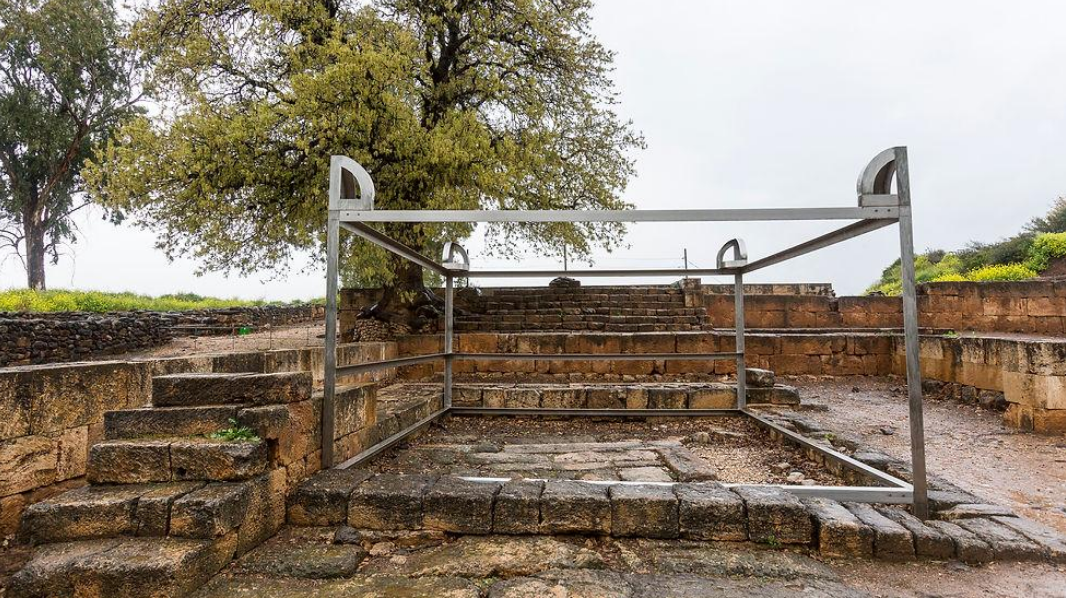
The Ruins of the Altar at Dan
Who say, ‘As your god lives, O Dan,’ - NET - They vow, 'As surely as your god lives, O Dan." Dan was one of the principal centers of the northern kingdom's counterfeit worship. (1Ki 12:26–30, 2Ki 10:29). “As your god lives, O Dan” reveals that the people continued to invoke the deity associated with that shrine. The people had created a god they could see, but that god could neither speak nor save.
NET NOTE - Your god is not identified. It may refer to another patron deity who was not the God of Israel, a local manifestation of the Lord that was worshiped by the people there, or, more specifically, the golden calf image erected in Dan by Jeroboam I (see 1 Kgs 12:28-30).
And, ‘As the way of Beersheba lives,’ - NET - "or 'As surely as your beloved one lives"" Recall that in Amos 5:5 they were told not to " cross over to Beersheba." Presumably some in Israel did resort to Beersheba. Why would someone swear by the “way” of Beersheba? In some ways (see interpretations below) Beersheba had become associated with religious practices condemned by Amos. The people apparently were making religious journeys to places like Beersheba (even though it was in Judah), but their worship was not bringing them into genuine fellowship with the LORD. Once again we see irony in that Israelites were walking to manmade "sacred" places while refusing to walk on God's highway of holiness. And since Dan was far in the North of Israel and Beersheba was far south (even in Judah), clearly the people were willing to travel long distances for their false worship! Their problem was that while they traveled far to worship, their hearts remained far from God.
Andrew Hill - It is possible the expression (way of Beersheba) refers to some rite of pilgrimage to a pagan shrine in Beersheba. Hubbard’s (1989:225) comment that the epithet “ ‘Beersheba’s way’ could well be a succinct expression for all that the pilgrimage stood for” is cogent. Dan was the northernmost city in the territory of Israel and Beersheba was the southernmost city of Judah, so Amos makes reference to “the whole circle of gods worshiped everywhere in Israel (and Judah), from Dan to Beer-sheba” (Andersen and Freedman 1989:830). (See Minor Prophets: Hosea through Malachi - Page 201)
David Allan Hubbard feels "The combination of Dan and Beersheba was Amos’ way of tarring the entire land (Judg. 20:1), far north to deep south, with the brush of idolatry." (Joel and Amos)
Several interpretations have been proposed.
1. The pilgrimage route to Beersheba - Some commentators understand the phrase as referring to the religious pilgrimage made to Beersheba. Under this interpretation, the people had elevated their religious journeys into objects of misplaced confidence. They believed that traveling to a revered shrine demonstrated their devotion. The phrase would then emphasize the religious importance attached to the pilgrimage itself.
2. The worship practiced at Beersheba - Other interpreters understand “the way of Beersheba” as a reference to the religious practices or cultic traditions associated with that location. The word derekh can refer not only to a physical road but also to a manner of life or pattern of conduct. Under this interpretation, the phrase describes allegiance to the worship practiced at Beersheba.
3. A traditional oath formula - Some scholars suggest that the expression preserves a religious oath whose precise original significance is no longer clear. This possibility reminds us that ancient religious formulas do not always correspond neatly to modern expectations. The precise meaning remains uncertain.
NET NOTE - The MT reads, “As surely as the way [to] Beer Sheba lives,” or “As surely as the way lives, O Beer Sheba.” Perhaps the term דֶּרֶךְ (derekh, “the way”) refers to the pilgrimage route to Beersheba (see S. M. Paul, Amos [Hermeneia], 272), or it may be a title for a god. The notion of pilgrimage appears elsewhere in the book (cf. Amos 4:4-5; 5:4-5; 8:12). The translation above assumes an emendation to דֹּדְךָ (dodkha, “your beloved” or “relative”; the term also is used in 6:10) and understands this as referring either to the Lord (since other kinship terms are used of him, such as “Father”) or to another deity that was particularly popular in Beer Sheba. Besides the commentaries, see S. M. Olyan, “The Oaths of Amos 8:14” Priesthood and Cult in Ancient Israel, 121-49.
Dan was located in the far north. Beersheba was located in the south. The familiar biblical expression “from Dan to Beersheba” described the extent of the land of Israel (Jdg 20:1; 1 Sa 3:20; 2 Sa 3:10).
Sunukijan - The expression “from Dan to Beersheba” encompasses the full extent of the land; Judges. 20:1; 1 Sam. 3:20; 2 Sam. 3:10; 17:11; 24:2, 15; 1 Kings 4:25; 2 Chron. 30:5.) But their imploring would be futile. God would remain silent. And they would fall, never to rise again (cf. Amos 5:2). (See The Bible Knowledge Commentary Minor Prophets - Page 43)
They will fall and not rise again - These words are terminal! They announce the collapse of those who persist in idolatrous worship. In short, the gods they trusted to uphold them would prove powerless to prevent their fall and powerless to raise them up!
Amos 8:14 reminds us that religious activity is not necessarily evidence of genuine faith. Sincerity in worship does not make false worship true. Those who build their confidence upon false gods will eventually discover that their foundation cannot stand.
🙏 THOUGHT — What Are You Trusting to Keep You Standing? Amos closes this chapter with a sobering warning: those who swore by the idols of Samaria, Dan, and Beersheba “will fall and not rise again” (Am 8:14). Their shrines and traditions could not save them when judgment came. Could we be guilty of a subtler idolatry, placing our ultimate confidence in finances, health, achievements, religious traditions, or even our own spiritual knowledge rather than in the Lord Himself? Anything we elevate above God is an idol, even a good thing (Ex 20:3, Ezek 14:3, Lk 14:26). An idol is anything we trust, love, or fear more than God. Whatever we cannot live without, other than God, has become our god. John warns, “guard yourselves from idols” (1 Jn 5:21). Paul calls greed idolatry (Col 3:5), and Jesus says we cannot serve both God and wealth (Mt 6:24). Those who trust in idols become as lifeless as the objects of their devotion (Ps 115:4–8). But the LORD is our rock, fortress, and deliverer (Ps 18:2), and He “is able to keep you from stumbling, and to make you stand in the presence of His glory” (Jude 24). Israel’s false gods could not keep their worshipers from falling, but our faithful God keeps His children standing! So let us renounce every rival object of trust and cling to Jesus Christ, Who holds us securely and always lives to intercede for us (Jn 10:27–29; Heb 7:25). Play Standing on the Promises of God.
Norman Geisler - When Critics Ask - AMOS 8:14—Does this contradict the Bible’s teaching on the resurrection? (See comments below from Job 7:9.)
PROBLEM: The Scriptures teach that all people will be raised bodily from the tomb (cf. Dan. 12:2; 1 Cor. 15:22; Rev. 20:4–6). Indeed, Jesus said that one day “all who are in the graves will hear His voice and come forth” (John 5:28–29). However, Job seems to say just the opposite, when he wrote: “he who goes down to the grave does not come up” (cf. also Job 14:12; Isa. 26:14; Amos 8:14).
SOLUTION: As the first set of passages clearly reveals, there will be a resurrection of all the dead, both the just and the unjust (Acts 24:15; cf. John 5:28–29). Job himself expressed belief in the resurrection, declaring, “After my skin is destroyed, this I know, that in my flesh I shall see God” (Job 19:26). What he meant when he spoke of someone going down to the grave and not coming up (7:9) is explained in the very next verse. “He shall never return to his house” (v. 10). In other words, those who die do not return to their mortal lives again. Indeed, the resurrection is to an immortal life (1 Cor. 15:53), not to the same mortal life one had before.
Job 14:12 does not deny there will be any resurrection, but simply that there will be none until “the heavens are no more,” that is until the end of the age. But, that is precisely when the resurrection will take place, namely “at the time of the end” (Dan. 11:40; cf. 12:1–2; John 11:24). In fact, the passage actually teaches resurrection. For Job simply spoke of being hidden in the grave by God until an appointed time when God would again remember him (14:13) in the resurrection.
Likewise, the Isaiah passage (Isa. 26:14) does not deny the resurrection. Here too the resurrection is affirmed in the succeeding verse which states clearly, “Your dead shall live; together with my dead body they shall arise” (v. 19). Obviously, then verse 14 means “they will not live” until the resurrection. The memory of the wicked will perish from the earthly scene. Not until the heavenly scene dawns will they be raised again.
Also, some texts which may appear to deny the resurrection (e.g., Amos 8:14) simply refer to the enemies of God falling, never to rise to oppose Him. They will never resume their former sway over God’s people. In short, God overthrew them irretrievably.