Genesis 25:2
Genesis 25:3
Genesis 25:4
Genesis 25:5
Genesis 25:6
Genesis 25:7
Genesis 25:8
Genesis 25:9
Genesis 25:10
Genesis 25:11
Genesis 25:12
Genesis 25:13
Genesis 25:14
Genesis 25:15
Genesis 25:16
Genesis 25:17
Genesis 25:18
Genesis 25:19
Genesis 25:20
Genesis 25:21
Genesis 25:22
Genesis 25:23
Genesis 25:24
Genesis 25:25
Genesis 25:26
Genesis 25:27
Genesis 25:28
Genesis 25:29
Genesis 25:30
Genesis 25:31
Genesis 25:32
Genesis 25:33
Genesis 25:34
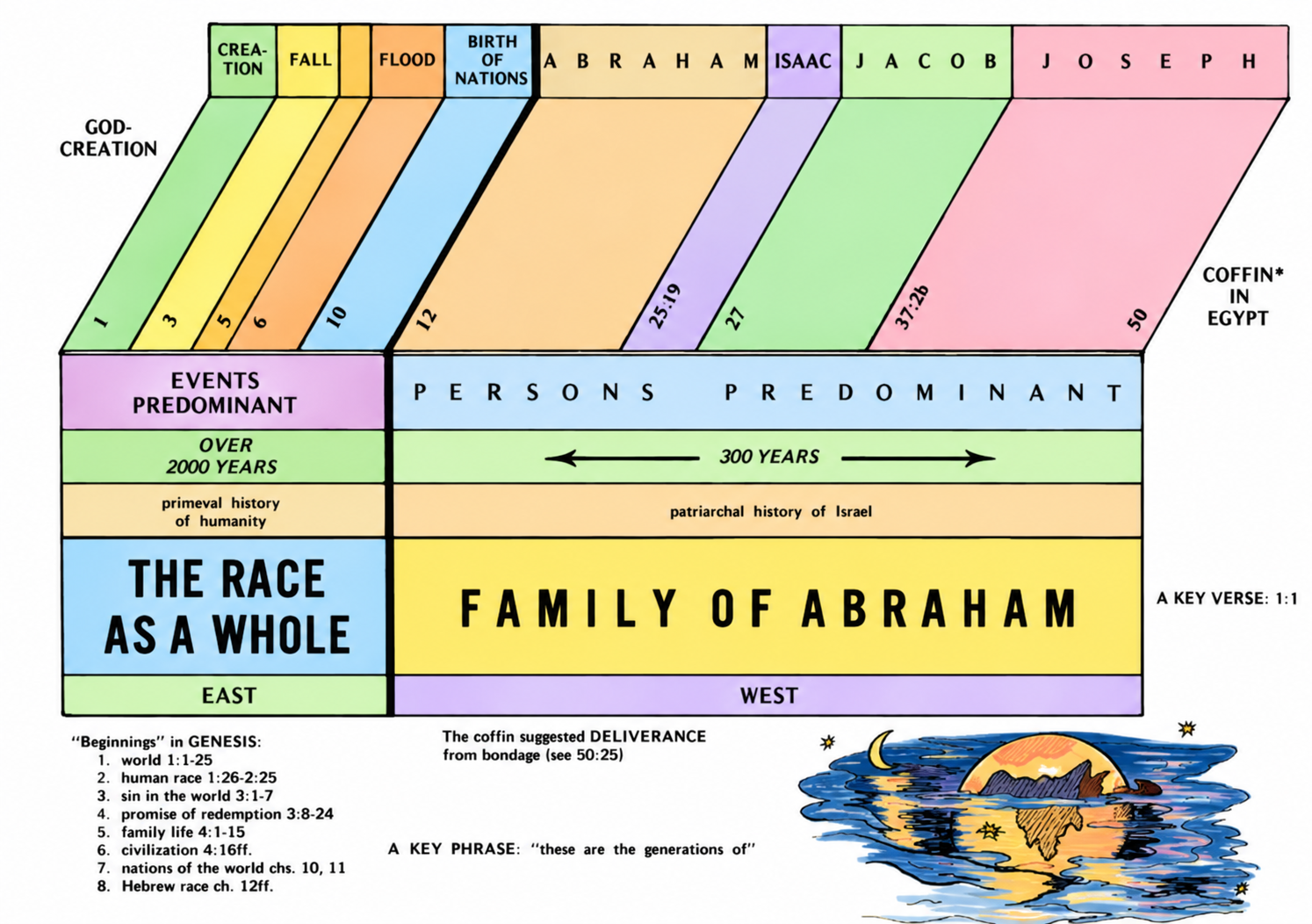
Click chart to enlarge
Chart from recommended resource Jensen's Survey of the OT - used by permission
| Summary Chart of The Book of Genesis |
||||||||
| Focus | Foundation Events (Four Events) (Events Predominant) |
Foundation People (Four People) (People Predominant) |
||||||
| Divisions | Creation (Ge 1-2) |
Fall (Ge 3-5) |
Flood (Ge 6-9) |
Nations (Ge 10-12) |
Abraham's Faith (Ge 12-24) |
Isaac's Family (Ge 25-26) |
Jacob's Conflicts (Ge 27-36) |
Joseph's Calamity (Ge 37-50) |
| Topics | Beginning of the Human Race (Race As A Whole) |
Beginning of the Hebrew Race (Family of Abraham) |
||||||
| Faithfulness of Mankind (Noah) |
Faithfulness of One Man's Family (Abraham) |
|||||||
| Historical | Biographical | |||||||
| Place | Eastward From Eden to Ur |
Westward From Canaan to Egypt |
||||||
| Time | ~2000+ Years (20% of Genesis) (~4004-2090BC) |
About 300 Years 193 Yr in Canaan, 93 Yr in Egypt (80% of Genesis) (2090-1804BC) |
||||||
| Primeval History of Humanity |
Patriarchal History of Israel |
|||||||
| Author | Moses | |||||||
Genesis 25:1 Now Abraham took another wife, whose name was Keturah.
- Ge 23:1,2 28:1 1Ch 1:32,33
- NOTE: All active Scripture links on preceptausting have two functions: (1) hold mouse over to read the passage and (2) click the link to see the in depth commentary on that passage (all NT verses & many OT verses). Ex: click 2Ti 3:16.
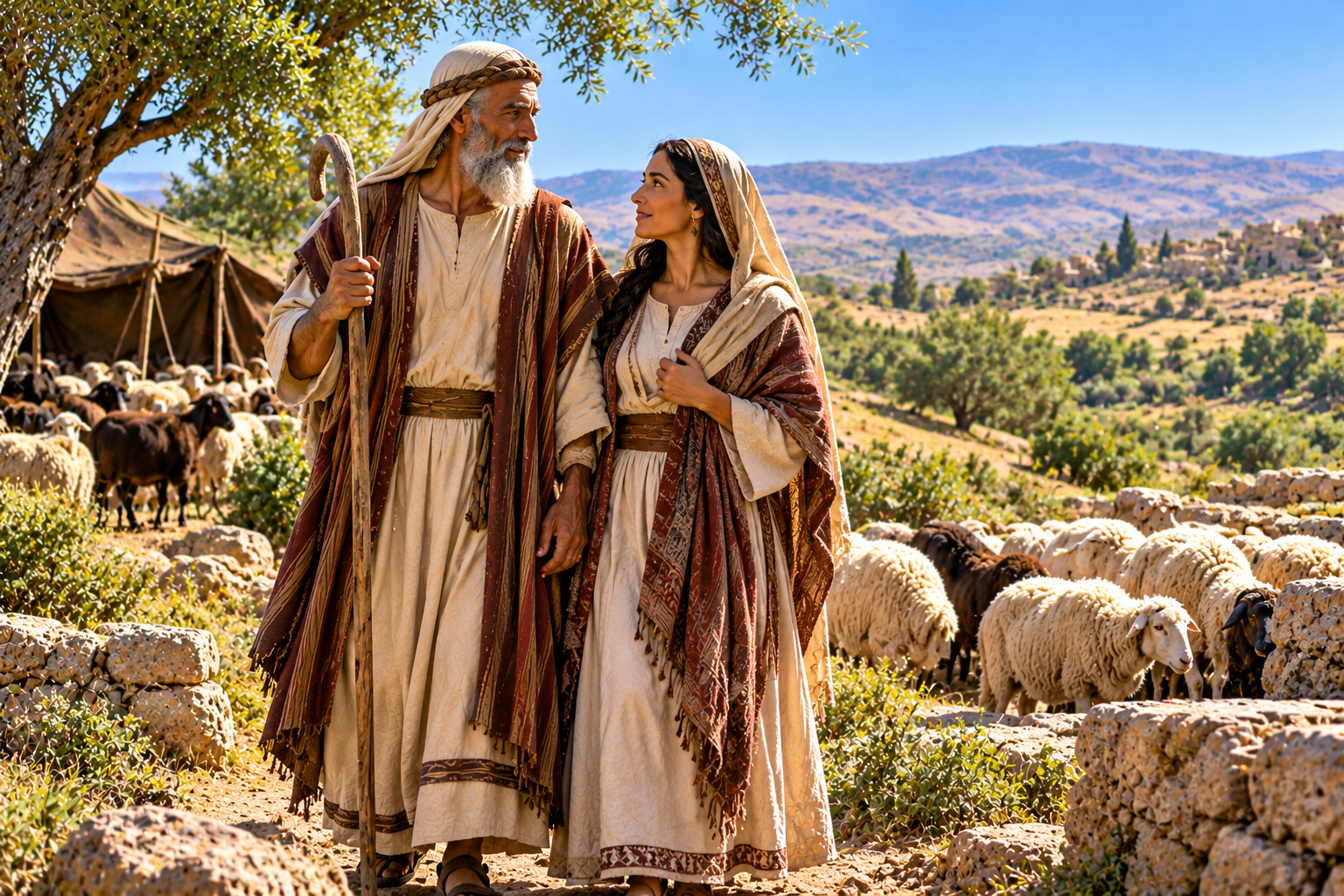
ABRAHAM STILL FRUITFUL
IN OLD AGE
Now Abraham took another wife, whose name was Keturah - The Hebrew expression translated "took another wife" indicates that Abraham entered into another marital relationship. Interestingly, Keturah is called a wife (Hebrew ishshah) in Genesis 25:1, but she is described as a concubine (Hebrew pilegesh) in 1 Chronicles 1:32. Genesis 25:6 also refers to Abraham's concubines in the plural. These descriptions are not necessarily contradictory. Keturah may have been recognized as a wife while occupying a secondary position in the household, particularly regarding inheritance rights. This distinction becomes important in Genesis 25:5–6, where Abraham gives all that he has to Isaac but provides gifts to the sons of his concubines and sends them eastward.
Whose name was Keturah – The name Keturah (Hebrew qeturah) is commonly understood to mean "incense" or "fragrance," deriving from a Hebrew root associated with the burning of incense or the rising of fragrant smoke. Scripture provides no additional biographical information about her background, family, or personal faith. Nevertheless, she occupies an important place in the biblical record because she became the mother of six sons born to Abraham (Ge 25:2). This expansion of Abraham's family recalls God's earlier promise: Genesis 17:4–5 – God declared that Abraham would become "the father of a multitude of nations." Although the covenant line would continue specifically through Isaac (Ge 17:19–21; 21:12), Abraham's descendants would extend far beyond Isaac's family.
John Currid - ‘Keturah’ is a name that means ‘spices’ or ‘incense’.262 It is no wonder that her descendants have names that are related to areas of the spice trade in Arabia. ‘Sheba’ and ‘Dedan’ are well known as regions associated in antiquity with the caravan trade, with spices being a prime commodity; both are located in the Arabian Peninsula. (Genesis)
NET NOTE - Abraham had taken another wife. These events are not necessarily in chronological order following the events of the preceding chapter. They are listed here to summarize Abraham’s other descendants before the narrative of his death.
Matthew Henry - “All the days, even of the best and greatest saints, are not eminent days, some slide on silently, and neither come nor go with observation.”
Henry Morris - Keturah. The home and background of Keturah are unknown. Like Hagar, she is called a concubine (Genesis 25:6; 1 Chronicles 1:32) to emphasize that her sons were not to inherit the promises centered in Isaac. However, God had also promised (Genesis 17:4) that Abraham would be a father of many nations. When his body was miraculously rejuvenated at age 100 to father Isaac, he remained "young" for many more years, eventually begetting six more sons by Keturah.
Ryrie - Keturah was a concubine (cf. v. 6; 1 Chron. 1:32), suggesting to some that Abraham may have married her while Sarah was still living.
Matthew Henry Concise - Ge 25:1-10. All the days, even of the best and greatest saints, are not remarkable days; some slide on silently; such were these last days of Abraham. Here is an account of Abraham's children by Keturah, and the disposition which he made of his estate. After the birth of these sons, he set his house in order, with prudence and justice. He did this while he yet lived. It is wisdom for men to do what they find to do while they live, as far as they can. Abraham lived 175 years; just one hundred years after he came to Canaan; so long he was a sojourner in a strange country. Whether our stay in this life be long or short, it matters but little, provided we leave behind us a testimony to the faithfulness and goodness of the Lord, and a good example to our families. We are told that his sons Isaac and Ishmael buried him. It seems that Abraham had himself brought them together while he lived. Let us not close the history of the life of Abraham without blessing God for such a testimony of the triumph of faith.
QUESTION - Who was Keturah in the Bible? - GotQuestions.org
ANSWER - Keturah was Abraham’s second wife, following the death of Sarah, his first wife (Genesis 23:2; 25:1). We know little about Keturah, other than her name and the names of the sons she bore to Abraham (Genesis 25:2; 1 Chronicles 1:32–33).
There has been some debate as to whether Keturah was Abraham’s wife or his concubine, since she is described as each in different places in Scripture. Genesis 25:1 says that Keturah was his wife; 1 Chronicles 1:32 calls her his concubine. Genesis 25:6 also implies that Keturah was a concubine. A concubine was a woman who willingly entered into an exclusive relationship with a man for the purposes of meeting his sexual needs or providing children for him (Hagar was considered a concubine of Abraham’s). The woman was often a slave or a single female without male protectors. A concubine did not have equal status as a wife, but, unlike a prostitute, she was provided for and considered the sole property of the man. Because Keturah was in a monogamous relationship with Abraham, she could properly be considered his “wife,” although she had a lesser rank than Sarah had enjoyed.
It could also be that Keturah had begun her relationship with Abraham as a concubine and was then promoted to official “wife status” after the death of Sarah. This would explain the differing biblical descriptions of her role. However, Keturah, the concubine-become-wife, is never referred to in Scripture with the same respect and honor that is given to Sarah as Abraham’s wife (1 Peter 3:6).
Keturah’s sons were Zimran, Jokshan, Medan, Midian, Ishbak, and Shuah (Genesis 25:2). The descendants of Midian (the Midianites) later become a big part of Israel’s history; in fact, Moses married a Midianite (Exodus 2:15–21). All Keturah’s sons received “gifts” from Abraham (Genesis 25:6), but none shared in the inheritance of Isaac (verse 5). Keturah’s sons became the fathers of Arabian tribes living east of Israel.
QUESTION - How many wives did Abraham have? - GotQuestions.org
ANSWER - Abraham had a principal wife, Sarah (Genesis 11:29), and two secondary wives, Hagar and Keturah (Genesis 16:3; 25:1).
Abraham’s first wife was Sarah. She alone would possess legal rights and social standing as Abraham’s wife, and only her child Isaac would become the rightful heir to the family inheritance.
Sarah, who was unable to bear children, gave her Egyptian servant, Hagar, to Abraham as a concubine, although the Bible also calls Hagar Abraham’s wife (Genesis 16:1–4). A concubine was a woman, often a servant or slave, who lived with a man as if she were his wife, having sexual relations with him and bearing his children. When one’s wife was unable to produce an heir, taking a concubine was a common solution in ancient times. But a concubine held “secondary wife status,” lower than that of the primary wife. The concubine’s position, while subordinate to her master and mistress, was permanent. Concubines were provided for and protected as part of the family.
Hagar gave Abraham a son, whose name was Ishmael, but he was not to be the son of God’s covenant (Genesis 17:1–14). It was through Abraham and Sarah’s child Isaac that God had promised to establish His everlasting covenant (Genesis 17:15–19).
Keturah was Abraham’s second wife after the death of Sarah: “Abraham had taken another wife, whose name was Keturah. She bore him Zimran, Jokshan, Medan, Midian, Ishbak and Shuah” (Genesis 25:1–2). Like Hagar, Keturah was called both “wife” and “concubine” in Scripture (1 Chronicles 1:32). As a “wife,” Keturah was married to Abraham in the legal sense, living in a sexual union with him. Yet, as a “concubine” she held a rank inferior to Sarah’s. Keturah may have first become Abraham’s concubine when Sarah was still alive but was later elevated to the position of wife after Sarah passed away.
Before Abraham died, he gave all his material possessions and the blessings of the covenant to Isaac, the child God had promised to him and Sarah. To the sons of Hagar and Keturah, Abraham gave only gifts from his house and then sent them away to live in the country east of Israel (Genesis 25:5–11).
Does the fact that Abraham had three wives prove that God condones polygamy? No. God’s ideal pattern for the marriage relationship has always been a monogamous union between one man and one woman (Genesis 1:27; 2:24). From the time of Lamech (Genesis 4:19), people engaged in polygamy, but it was never God’s design. Even though the practice is not expressly forbidden in Scripture, its consequences were often harmful and problematic (Deuteronomy 17:17; 1 Kings 11:1–3; Judges 8:30—9:57; 1 Samuel 1:1–7).
The Bible does not explicitly clarify why God tolerated polygamy among His people. One reason may have been to provide a secure home for unmarried women who had no other safe way to provide for themselves in the male-dominated, patriarchal society of the ancient world. At that time in history, women were not educated or trained for employment and thus depended on male members of their families to protect and support them. With prostitution, slavery, or starvation as the only other choices, many unmarried women turned to concubinage.
Polygamy also served to develop the growth of humanity at a much faster rate, fulfilling God’s command to “be fruitful and increase in number; multiply on the earth and increase upon it” (Genesis 9:7). Perhaps God tolerated polygamy in ancient times to solve some of these problems, but the New Testament clearly specifies God’s ideal intent for marriage to be the union of one man and one woman for life (Ephesians 5:22–33; 1 Timothy 3:2, 12; Titus 1:6).
Related Resource:
Gleason Archer - Was Keturah Abraham’s second wife (Gen. 25:1) or merely his concubine (1 Chron. 1:32)?
Genesis 25:1 states that after Sarah’s death Abraham took to himself a wife (ʾiššāh) whose name was Keturah (Qeturah). Verse 2 gives the names of six sons she bore to him in his old age. Abraham lost Sarah when she was 127, and when he was 137 (Gen. 23:1; cf. 17:17). How soon after Sarah’s death Abraham married Keturah, we have no way of knowing; but the six sons she bore him became ancestors of various Arabian tribes, and she is honored to this day by the Arab race as their ancestral mother.
There is really no discrepancy in 1 Chronicles 1:32, even though the term pîleg̱eš is used there rather than ʾiššah. Genesis 25:6 also refers to Keturah by implication as a pîleg̱eš to Abraham; for after v.5 has made it clear that God had confirmed Isaac, Sarah’s son, as his principal heir, v.6 records: “But to the sons of his concubines [the plural pîlag̱ešîm presumably includes Hagar as well as Keturah], Abraham gave gifts while he was still living, and sent them away from his son Isaac eastward, to the land of the East” (NASB). Obviously the term pîleg̱eš was used to indicate that although Keturah was the only lawfully wedded wife Abraham had (hence his ʾiššāh) during this twilight period of his life, she had a secondary status in relationship to Sarah, since only Sarah had been chosen by God to be the mother of Isaac, Abraham’s only heir under the promise of the covenant. As for pîleg̱eš itself, it was a non-Semitic term of unknown origin, but which seems to have had the basic meaning of “secondary wife” (Ludwig Koehler and Walter Baumgartner, Lexicon in Veteris Testament Libros [Leiden: E. J. Brill, 1958], p. 761).
Norman Geisler - When Critics Ask
GENESIS 25:1—Why does Genesis 25:1 call Keturah Abraham’s wife, while 1 Chronicles 1:32 calls her his concubine?
PROBLEM: Genesis 25:1 says, “Abraham again took a wife, and her name was Keturah.” However, 1 Chronicles 1:32 states, “Now the sons of Keturah, Abraham’s concubine.” Was Keturah Abraham’s wife, or was she merely one of his concubines?
SOLUTION: The contradiction is only apparent, and the problem can be easily solved by closer consideration.
First, although in Genesis 25:1 the normal Hebrew word for wife (ishshah) is used, it is also the normal word for woman. It is not necessary to take the word in this case to mean wife, especially in light of verse 6 and the statement in 1 Chronicles 1:32 that Keturah was his concubine. Genesis 25:1 can be read simply as, “And Abraham took another woman” as his concubine.
Second, although 1 Chronicles employs the Hebrew word for concubine (pilegesh) in reference to Keturah, Genesis 25:6 uses the same word when referring to the mothers of all his other sons apart from Isaac. This would obviously include Keturah as one of his concubines. Additionally, Genesis 25:1 begins with a Hebrew word (vayoseph) which can be translated, “And adding” or “And in addition to.” Since Genesis 24:67 clearly states that Sarah, Abraham’s wife, had died, verse 1 of chapter 25 could not mean that Abraham was adding to his number of wives. It is more reasonable to take this word as indicating that Abraham was adding to his number of concubines by taking another woman (ishshah).
GENESIS 25:1–2—How could Abraham have children naturally here when years before he needed a miracle to have Isaac?
PROBLEM: As early as Genesis 17, Abraham “laughed” when God told him he would have a son (Isaac) by Sarah, since he was “a hundred years old” (v.17). But here in Genesis 25, many years later, he has children by Keturah, the wife he took after Sarah died (vv. 1–2).
SOLUTION: There are two possibilities here, either one of which would explain this difficulty.
First, the Genesis 17 text does not say Abraham laughed because he knew he was too old to have children, but because Sarah was past childbearing age (cf. 17:17; 18:12). There was no sure way for a man in ancient times to know he was no longer fertile, as there was for a woman when her periods ceased. Since Abraham was only 100 here, and he lived to be 175, it is reasonable to assume that he was still fertile. By comparison, men who live till 80 today are still fertile in their 60s.
Second, even if it took a miracle on Abraham (as well as on Sarah) to restore fertility, there is no reason that his fertile state could not have lasted for many years into the future. Once animated, his virile powers could have lasted for decades. After all, he lived 75 more years. In any event, the imagined contradiction here is simply not established.
Sunset Genesis 25:1-10 Oswald Chambers - Not Knowing Where (Borrow Complete Works of Oswald Chambers page 912)
That low man seeks a little thing to do,
Sees it and does it:
This high man, with a great thing to pursue.
Dies ere he know it.
That low man goes on adding one to one,
His hundred’s soon hit:
This high man, aiming at a million,
Misses an unit.
That, has the world here—should he need the next,
Let the world mind him!
This, throws himself on God, and unperplexed,
Seeking shall find him.
Browning
It is not what a man achieves, but what he believes and strives for that makes him noble and great. Hebrews 11 impresses this aspect of the life of faith over against the life of human perfection. The first thing faith in God does is to remove all thought of relevant perfection. Some lives may seem humanly perfect and yet not be relevant to God and His purpose. The effect such lives leave is not of a reach that exceeds its grasp, but of a completed little circle of their own. It takes a man completely severed from God to be perfect in that way. There is a difference between a perfect human life lived on earth and a personal life with God lived on earth; the former gasps that for which it reaches, the latter is grasped by that which it never can reach. The former chains us to earth by its very completeness; the latter causes us to fling ourselves unperplexed on God. The difference is not a question of sin, but the paradox of the incomplete perfection of a right relationship to God.
1. The Region of the Irrelevant (Genesis 25:1-4)
One of the most striking features in Abraham’s life is its irrelevancy. If we take Abraham to be the embodiment of an idea, say, of sanctification, we will have to cut out much that God puts in. The irrelevant things in Abraham’s life are evidences of that half-conscious living which proves that his mind was not taken up with himself. The greatest thing in Abraham’s life is God, not “Abraham-ism.” The whole trend of his life is to make us admire God, not Abraham.
The outstanding characteristic in the life of a saint is its irrelevance, an irrelevance which is amazingly relevant to the purpose of God. If you become a devotee to a principle, you become a religious lunatic; you are no longer loyal to the life of Jesus, but loyal only to the logic of your convictions about Him. A fanatic dismisses all irrelevancy in life. We say that a lunatic is a man who has lost his reason; a lunatic is a man who has lost everything but his reason. A madman’s explanation of things is always complete. The main thing is life, not logic. It is the irrelevant running all through life that makes it what it is worth.
One of the dangers of the so-called Higher Christian Life movements* is the idea that God wants to produce specimens to put in His museum. You can often find better specimens in the world than in the Church. Think of the men and women you know who have not been through the crisis you have been through, and your human reason tells you they are infinitely better than you are, they are more unselfish, never irritable or upset, and yet they would not dream of saying what you have to say, that you are loyal to Jesus Christ. The irrelevancy of your life and the relevancy of theirs will produce perplexity in your mind until you remember that you are not called to produce one of God’s specimens; you are called to live in perfect relationship to God so that the net result of your life is not admiration for you, but a longing after God. Christian perfection is not, and never can be, human perfection. Christian perfection is the perfection of a relationship to God which shows itself in the total irrelevancy of human life.
If you get off on the line of personal holiness or Divine healing or the Second Coming of Our Lord, and make any of these your end, you are disloyal to Jesus Christ. Supposing the Lord has healed your body and you make Divine healing your end, the dead set of your life is no longer for God but for what you are pleased to call the manifestation of God in your life. Bother your life! “It can never be God’s will that I should be sick.” If it was God’s will to bruise His own Son, why should it not be His will to bruise you? The thing that tells is not relevant consistency to an idea of what a saint’s life is, but abandonment abjectly to Jesus Christ whether you are well or ill.
Much of our life is irrelevant to any and every mind saving God’s mind. When you obey the call of God the first thing that strikes you is the irrelevancy of the things you have to do, and you are sure to be brought up full butt against the perfect human specimens. The net result of such lives does not leave you with the “flavour” of God at all, it leaves you with the idea that God is totally unnecessary—by human effort and human devotion we can reach the standard God wants. Well, in a fallen world it cannot be done. Paul refers to this in 2 Corinthians 4:3-4—“the god of this world hath blinded the minds of the unbelieving . . .” (rv), i.e., they have the perfection of the human, but never once have they seen the perfection of God.
Beware of taking your conception of a saint from deductions from certain Scriptures, and always clarify your views by meditation on John 17. God wants to do with the saints what His Son prayed He would do—make them one with Himself (v. 21).
Genesis 25:2 She bore to him Zimran and Jokshan and Medan and Midian and Ishbak and Shuah.
- she bare (KJV): 1Ch 1:32,33 Jer 25:25, Zimri
- Midian (KJV): Ge 36:35 37:28,36 Ex 2:15,16 18:1-4 Nu 22:4 25:17,18 31:2,8 Jud 6:1-8:35
- Shuah (KJV): Job 2:11
Related Passages:
Hebrews 11:12 Therefore there was born even of one man, and him as good as dead at that, as many descendants AS THE STARS OF HEAVEN IN NUMBER, AND INNUMERABLE AS THE SAND WHICH IS BY THE SEASHORE.
ABRAHAM THE FATHER
OF MANY NATIONS
She bore to him Zimran and Jokshan and Medan and Midian and Ishbak and Shuah – When Isaac was conceived, Abraham was approximately 100 years old, and Paul described his body as being "as good as dead" with respect to his natural ability to father a child (Ro 4:19; cf. Heb 11:11–12). Yet Genesis 25:2 records that Abraham subsequently fathered six additional sons through Keturah. The text does not explain the physiological circumstances of these later births.
And Midian – Midian is the most historically significant of Keturah's six sons in the subsequent biblical narrative. His descendants became known as the Midianites, a people who appear repeatedly throughout Israel's history.
Moses fled from Egypt to the land of Midian, where he married Zipporah, the daughter of a priest of Midian (Ex 2:15–22). Later, Midianite leaders were involved in opposition to Israel during the wilderness journey (Nu 22:4–7; 25:16–18). During the period of the judges, the Midianites oppressed Israel for seven years until God raised up Gideon to deliver His people (Jdg 6:1–6; 7:19–25).
Thus, the descendants of Abraham through Midian would eventually become both benefactors and adversaries of Israel. This is a striking reminder that physical descent from Abraham did not automatically guarantee participation in the covenant blessings specifically promised through Isaac and Jacob (Ge 17:19–21; Ro 9:6–8).
Ryrie adds that "Many of these names have been identified with various Arab tribes, fulfilling God's promise to Abraham that he would be the father of many nations (see 17:4)."
QUESTION - How many sons did Abraham have? - GotQuestions.org
ANSWER - In all, Abraham had eight sons.
Abraham’s first son was Ishmael through Hagar, his wife’s Egyptian maid (Genesis 16:1–4).
Abraham’s second son was Isaac through Sarah, his wife (Genesis 21:1–3). Isaac was the son God had promised Abraham (Genesis 15:4–5).
After Sarah died, Abraham had six sons through Keturah, another concubine: Zimran, Jokshan, Medan, Midian, Ishbak, and Shuah (Genesis 25:1, 6). Keturah’s sons became the fathers of Arabian tribes living east of Israel.
Some people claim that the Bible makes an error in regards to the number of Abraham’s sons. In Genesis 22:2, God speaks to Abraham after the birth of Ishmael, referring to Isaac as “your son, your only son, whom you love.” Then Hebrews 11:17 identifies Isaac as Abraham’s “one and only son.” And Galatians 4:22 mentions only Isaac and Ishmael: “It is written that Abraham had two sons.” How could Abraham be said to have an “only son” and “two sons,” when in reality he had eight sons?
There is no true contradiction in the above passages. Isaac was the only son who was promised to Abraham and through whom Abraham would become the father of many nations (Genesis 12:1–3; 17:1–8; 21:12). Also, Isaac was the only son of Sarah and Abraham—Sarah being specifically mentioned in the prophecies of Genesis 17:16–21 and 18:10. In addition, Isaac is the only son born in an official marriage: Hagar and Keturah were both concubines. While God blessed the concubines’ sons for Abraham’s sake, those sons had no part in the inheritance. Isaac was the one and only rightful heir to the promise (Genesis 15:4–5; 25:5).
Genesis 22:2 and Hebrews 11:17 both refer to Isaac as Abraham’s “only son” because those passages concern God’s promise and covenant. Since Abraham’s other seven sons are not part of the covenant, they are irrelevant to the issue and not mentioned as sons. Abraham had other sons, but only one son of promise.
The main theme in Galatians is justification by faith, apart from the Law. Galatians 4:22 mentions two sons, Isaac and Ishmael, in an allegory to highlight the contrast between the old covenant of law and the new covenant of grace. The former leads to bondage while the latter to freedom and life. Paul’s reasoning is as follows: Ishmael was the son of Hagar, a slave, and thus symbolizes bondage and slavery to the Law. Ishmael was the product of a human effort to bring about God’s blessing; Ishmael equals the works of the Law. Isaac was born to the free woman, Sarah, and thus symbolizes freedom and life. Isaac was born in God’s time, according to God’s promise, without the scheming or interference of man; Isaac equals the gift of grace. This passage in Galatians 4 is meant to teach a spiritual lesson (verse 24), not to give a detailed account of Abraham’s life and how many actual sons he had. Mentioning the other six sons would not have served any meaningful purpose in Paul’s allegory.
Spiritually speaking, Abraham has many, many sons. The Bible points to the faith of Abraham (Genesis 15:6) and states that “those who have faith are children of Abraham” (Galatians 3:7; cf. verse 9). Those who exercise the same faith that Abraham had are showing themselves to be like him, spiritually, and so can be rightly called his “children.” All who trust in Christ, as Zacchaeus did, become true sons of Abraham (Luke 19:9). “The promise comes by faith, so that it may be by grace and may be guaranteed to all Abraham’s offspring . . . to those who have the faith of Abraham. He is the father of us all” (Romans 4:16).
QUESTION - What is the significance of Midian in the Bible? - GotQuestions.org
ANSWER - After his wife Sarah died, Abraham married a woman named Keturah, who bore him six sons: Zimran, Jokshan, Medan, Midian, Ishbak and Shuah (Genesis 25:1–2). The fourth son, Midian, had five sons: Ephah, Epher, Hanok, Abida, and Eldaah (Genesis 25:4; 1 Chronicles 1:33). Their nomadic descendants came to be known as the Midianites, distant relatives of the Israelites who often oppressed Israel (Judges 6:2).
One reason the land of Midian is significant is that it was the destination to which Moses fled after killing an Egyptian (Exodus 2:15), fearing that Pharaoh would have him killed. At that time, Midian was probably located in the Sinai Peninsula, as well as holding territory to the east of the Gulf of Aqaba. Later, the Midianites may have inhabited the land between Edom and Paran, on the way to Egypt (1 Kings 11:18). By the time of the judges, the Midianites seem to have located further north, to the east of Gilead. In Midian, Moses married Zipporah, the daughter of a priest of Midian (Exodus 2:15–21; 18:1). Moses stayed in Midian, tending sheep until God appeared to him in a burning bush and instructed him to lead Israel out of their bondage in Egypt (Exodus 3:1–10).
After Moses became the leader of the Israelites, his Midianite father-in-law, Jethro, was a source of wisdom and guidance to Moses (Exodus 18:17–24). He visited Moses in the wilderness, saw that he was carrying too great a burden, and gave him some good suggestions. While visiting Moses and hearing all God had done for the children of Israel, Jethro said, “Praise be to the Lord, who rescued you from the hand of the Egyptians and of Pharaoh, and who rescued the people from the hand of the Egyptians. Now I know that the Lord is greater than all other gods, for he did this to those who had treated Israel arrogantly” (Exodus 18:10–11). Then Jethro offered a burnt offering and other sacrifices to the Lord (verse 12). This may imply that, before this event, Jethro was a priest of a Midianite god, but, having seen the miracles God did for Israel, he converted to the worship of Yahweh and took that faith back with him to Midian.
Later, during the time of the exodus, Midian partnered with neighboring Moab in attacking Israel. Numbers 22 recounts the story of Balak, king of Moab, conspiring with the elders of Midian to hire a wicked prophet, Balaam, to put a curse on Israel for them. Although greedy for the money Balak offered, Balaam could only prophesy the truth God spoke to him.
During the time of the judges, Midian is also associated with other enemies of God who tried to overthrow Israel (Judges 6:33). Because of Israel’s refusal to obey God, He handed them over to the Midianites for seven years (Judges 6:1). Then the Lord raised up a leader named Gideon who conquered the Midianites with an army of only 300 men (Judges 7). The Ephraimites brought the heads of Midian’s leaders, Oreb and Zeeb, to Gideon. That victory over Midian reminded the people of Israel that the Lord was their defender (Judges 7:2, 25)
One of the Lord’s final instructions to Moses was “Take vengeance on the Midianites for the Israelites” (Numbers 31:1). Even though the Lord used the wickedness of pagan nations to punish disobedient Israel, He did not leave the pagans unpunished. God works so closely in the affairs of men that He uses their own wickedness against them. God used the stubbornness of Pharaoh to bring judgment on Egypt because of their cruelty to the Hebrews (Exodus 7:3–5). He used the wicked Babylonians to punish His people because of the Israelites’ idolatry, but God later destroyed Babylon because of their own wickedness (Jeremiah 25:7–11; Isaiah 13:19). In the same way, God used Midian as He wished: He first used Midian to protect Moses, then to punish His disobedient people, and then He finally decimated them for their evil ways. Midian is another reminder that the sovereign Lord is Ruler over all His creation, even using evildoers to fulfill His plans (Isaiah 46:9–11).
Genesis 25:3 Jokshan became the father of Sheba and Dedan. And the sons of Dedan were Asshurim and Letushim and Leummim.
- Sheba (KJV): 1Ki 10:1 Job 6:19 Ps 72:10
- Dedan (KJV): Jer 25:23 49:8 Eze 25:13 27:20
- Asshurim (KJV): 2Sa 2:9 Eze 27:6
ABRAHAM'S EXPANDING
FAMILY TREE
Jokshan became the father of Sheba and Dedan. And the sons of Dedan were Asshurim and Letushim and Leummim - Moses continues tracing the descendants of Abraham through Keturah, demonstrating the expanding fulfillment of God's promise that Abraham would become "the father of a multitude of nations" (Ge 17:4–6).
Sheba – The name Sheba appears several times in the Old Testament and is associated with a wealthy trading people famous for gold, spices, precious stones, and other valuable merchandise (1Ki 10:1–2; Ps 72:10, 15; Isa 60:6; Eze 27:22–23). The kingdom of Sheba is generally associated with ancient Saba in southwestern Arabia, in the region of modern Yemen. However, we must be careful not to assume that every biblical reference to Sheba identifies the descendants of Jokshan, since Genesis 10:7 and Genesis 10:28 also mention individuals named Sheba in other genealogical lines.
Dedan – Dedan appears elsewhere in Scripture in association with Arabian caravan merchants and desert peoples (Isa 21:13; Jer 25:23; Eze 27:20). Ancient Dedan is commonly associated with the oasis region of al-Ula in northwestern Arabia, an important center along Arabian trade routes. As with Sheba, however, another Dedan appears in the genealogy of Cush (Ge 10:7), so not every later reference can be confidently assigned to Jokshan's descendants.
And the sons of Dedan were Asshurim and Letushim and Leummim – These three names are unusual because their Hebrew forms have plural endings (-im), suggesting that they may designate tribal groups or clans rather than merely three individual sons.
NET NOTE - The names Sheba and Dedan appear in Gen 10:7 as descendants of Ham through Cush and Raamah. Since these two names are usually interpreted to be place names, one plausible suggestion is that some of Abraham’s descendants lived in those regions and took names linked with it.
Genesis 25:4 The sons of Midian were Ephah and Epher and Hanoch and Abida and Eldaah. All these were the sons of Keturah.
- Ephah (KJV): Isa 60:6
Related Passages:
1 Chronicles 1:33 The sons of Midian were Ephah, Epher, Hanoch, Abida and Eldaah. All these were the sons of Keturah.
MIDIANITES RELATIVES WHO
BECOME RIVALS
The sons of Midian were Ephah and Epher and Hanoch and Abida and Eldaah. All these were the sons of Keturah - Midian became the ancestor of the Midianites, a people who would play a significant role in Israel's subsequent history. The listing of his five sons further demonstrates the expanding fulfillment of God's promise that Abraham would become "the father of a multitude of nations" (Ge 17:4–6).
Ephah – Ephah was Midian's first son. His name appears again in Isaiah 60:6, where the prophet describes camels from Midian and Ephah bringing gold and frankincense to Zion.
The descendants of Midian would appear repeatedly in Israel's history, sometimes in surprising roles.
- Moses found refuge in Midian after fleeing Egypt and married Zipporah, the daughter of a priest of Midian (Ex 2:15–22).
- Midianite traders were involved in Joseph's journey to Egypt, although Genesis also refers to Ishmaelites in the account (Ge 37:25–28, 36).
- Midian became an enemy of Israel during the wilderness period (Nu 25:16–18; 31:1–12).
- The Midianites oppressed Israel for seven years until God raised up Gideon to deliver His people (Jdg 6:1–6; 7:19–25).
Genesis 25:5 Now Abraham gave all that he had to Isaac
- Mt 11:27 28:18 Joh 3:35 17:2 Ro 8:17,32 9:7-9 1Co 3:21-23 Ga 3:29 4:28 Col 1:19 Heb 1:2 Isaac typified the Son of God, "whom HE hath appointed Heir of all things."
Related Passages:
Genesis 17:19-21 But God said, “No, but Sarah your wife will bear you a son, and you shall call his name Isaac; and I will establish My covenant with him for an everlasting covenant for his descendants after him. 20 “As for Ishmael, I have heard you; behold, I will bless him, and will make him fruitful and will multiply him exceedingly. He shall become the father of twelve princes, and I will make him a great nation. 21 “But My covenant I will establish with Isaac, whom Sarah will bear to you at this season next year.”
Now Abraham gave all that he had to Isaac God had already chosen Isaac. Genesis 17:21: “But My covenant I will establish with Isaac, whom Sarah will bear to you at this season next year.” Although Abraham had eight named sons, Ishmael through Hagar, Isaac through Sarah, and six sons through Keturah (Ge 16:15; 21:2–3; 25:1–4), Isaac alone received Abraham's principal inheritance.
All that he had – The Hebrew expression kol asher lo emphasizes the comprehensive nature of Isaac's inheritance. Abraham had accumulated considerable wealth, including flocks, herds, silver, gold, servants, and other possessions (Ge 13:2; 24:35). Earlier, Abraham's servant had testified that the LORD had greatly blessed his master and that Abraham had given everything he possessed to Isaac (Ge 24:35–36). Genesis 25:5 confirms this arrangement. However, "all that he had" must be understood in light of the following verse, which explains that Abraham also gave gifts to the sons of his concubines (Ge 25:6). Thus, the statement does not mean that Isaac received every individual possession without exception. Rather, Isaac received the principal estate and the status of Abraham's primary heir, while the other sons received gifts.
The distinction between inheritance and gifts – This is crucial to understanding the passage. Abraham did not leave his other sons entirely without provision. Genesis 25:6 specifically states that he gave gifts to the sons of his concubines and sent them away from Isaac. The distinction was therefore between the principal heir and those who received lesser provisions. Isaac's inheritance was unique because it involved far more than material possessions. He was the divinely appointed heir of the Abrahamic covenant, which included God's promises concerning descendants, the land of Canaan, and blessing (Ge 12:1–3; 13:14–17; 17:7–8).
BSB - Although Abraham had many sons, Isaac was the son of promise, and he would receive Abraham's possessions. Abraham cared for his other sons, but he dispersed them; this is further evidence of God's displeasure with polygamy and the pain associated with its practice.
🙏 THOUGHT – The Greatest Inheritance Is Not Material. Abraham possessed considerable wealth, but the most important inheritance he passed to Isaac was not silver, gold, livestock, or servants. It was the privilege of standing in the covenant line through which God would fulfill His promises (Ge 17:19–21; 26:2–5). Material possessions can enrich a person's circumstances, but only a relationship with the living God can enrich a person's eternity! Parents often devote enormous energy to providing financial security for their children, and Scripture recognizes the value of responsible provision (Pr 13:22; 2Co 12:14). Yet what could be more important than passing on the truth of God's Word and demonstrating a life of genuine faith? Moses commanded Israel to teach God's words diligently to their children (Dt 6:6–7), and Paul commended the sincere faith that had been evident in Timothy's grandmother Lois and mother Eunice (2Ti 1:5; 3:14–15). Are you more concerned about what you will leave to your children than what you will leave in your children? Remember that possessions eventually perish, but the Word of God endures forever (Isa 40:8; 1Pe 1:24–25). The greatest legacy is not what we leave behind in a bank account, but the truth of God we faithfully pass on to the next generation!
Sunset Genesis 25:1-10 Oswald Chambers - Not Knowing Where (Borrow Complete Works of Oswald Chambers page 912)
2. The Reign of the Irrevocable (Genesis 25:5-7)
Ishmael is the son born of the wrong way of doing God’s will. If we try to do God’s will through our own effort, we produce Ishmael. Much of our modern Christian enterprise is “Ishmael,” i.e., it is born not of God, but of an inordinate desire to do God’s will in our own way—the one thing Our Lord never did.
Ishmael, as we have seen, had to be dismissed and disciplined until he was willing to become subservient and be utilised for God’s purposes; and the natural has to be put completely under, dismissed and denied, until it is willing to be subjected to God, not to our ideas of relevancy. We put sin in the wrong place. Remember, we cannot touch sin. The Atonement of the Lord alone touches sin. We must not tamper with it for one second. We can do nothing with sin; we must leave God’s Redemption to deal with it. Our part has to do with “Ishmael,” i.e., the natural. The natural has to be denied, not because it is bad and wrong, but because it has nothing to do with our life of faith in God until it is turned into the spiritual by obedience. It is the attitude of the maimed life, which so few of us understand.
GENESIS 25:7 READ: Genesis 25:5-11
THE century plant gets its name from the long intervals between flowerings when nothing seems to be happening. Yet those periods, which range from five to one hundred years, are as much a part of the plant's existence as its times of blooming.
The same is true of the believer's life. Look at Abraham. He is called "the friend of God" (James 2:23) and is a model of faith (Hebrews 11:8-19). With those impressive credentials, you would expect him to have a complete spiritual biography. Yet in the little more than twelve chapters that describe his life, almost nothing is recorded about his first seventy-five years. And of his remaining one hundred years, only a few blossoms of faith, courage, intercession, bravery, and consecration are recorded (Genesis 12-25).
So what was this spiritual giant doing during most of his 175 years on earth? He was providing for his family, carrying out his daily duties, and going for long periods without any spiritual mountaintop experiences.
So it is with us. The external significance of our lives probably consists of a few short "bloomings" separated by long periods of ordinary existence. That's encouraging. If the saints of the Bible were ordinary people of faith, then we too can do great things for God.—DJD (Reprinted by permission from Our Daily Bread Ministries. Please do not repost the full devotional without their permission.)
Lord, I need to accept that ordinary times are as much a part of Your plan for me as are extraordinary times. May I persevere in doing good even when I receive no glory or recognition for it.
Genesis 25:5 A FATHER'S LEGACY
And Abraham gave all that he had unto Isaac. Genesis 25:5
Fathers are being honored today, and yet, to have parental responsibility entails awesome obligations. Primarily, our text refers to Abraham's unstinting generosity to his son Isaac, but one can also see the general principle that fathers are constantly giving to their children by their example! Most of this is done so gradually and subtly that they do not realize what they are leaving to the next generation. However, little ones quickly notice enmity between a father and a mother, discourtesy to neighbors, unkindness toward the poor, lack of love to God, or evil speaking concerning friends and acquaintances. These acts and attitudes greatly influence children.
A little fellow with bright eyes and brown curly hair was at-tending Sunday school when the discussion turned to the subject of Heaven. "Dick," said the teacher, "whom do you want to meet first when you get to Glory?" The startling reply was, "Oh, but I'm not going there!" "Not going there?" said the teacher. "No," said the boy calmly and decisively, "Mama and sister are, but I want to go with Papa!" Some time later the teacher met Dick's father who was their family physician. He repeated the incident and then added pointedly, "And now, Doctor, just where ARE you going?" Confirmed unbeliever that he was, the physician nervously paced the floor with tears in his eyes. "It's just like Dick to say that," he sighed remorsefully, "I'll have to change my ways I guess. I have noticed that he always wants to be with me and be like me!"
Father, you are constantly "giving" to your children. Take inventory — what legacy of Christian influence and grace are you leaving your offspring? (Reprinted by permission from Our Daily Bread Ministries. Please do not repost the full devotional without their permission.)
You're setting an example
Every day in all you do,
For the little boy who's waiting
To grow up to be like you!
—E. Guest
What they leave IN their children should concern parents more than what they leave TO them.
Genesis 25:6 but to the sons of his concubines, Abraham gave gifts while he was still living, and sent them away from his son Isaac eastward, to the land of the east.
- concubines (KJV): Ge 25:1 16:3 30:4,9 32:22 35:22 Jud 19:1,2,4
- gifts (KJV): Ps 17:14,15 Mt 5:45 Lu 11:11-13 Ac 14:17
- sent (KJV): Ge 21:14
- east country (KJV): Arabia Deserta, which was eastward of Beer-sheba, where Abraham dwelt. Judges 6:3 Job 1:1,3
Related Passages:
Judges 6:3 For it was when Israel had sown, that the Midianites (from Abraham through Esau) would come up with the Amalekites (from Abraham through Esau and Eliphaz) and the sons of the east (probably the sons of Abraham's concubines) and go against them.
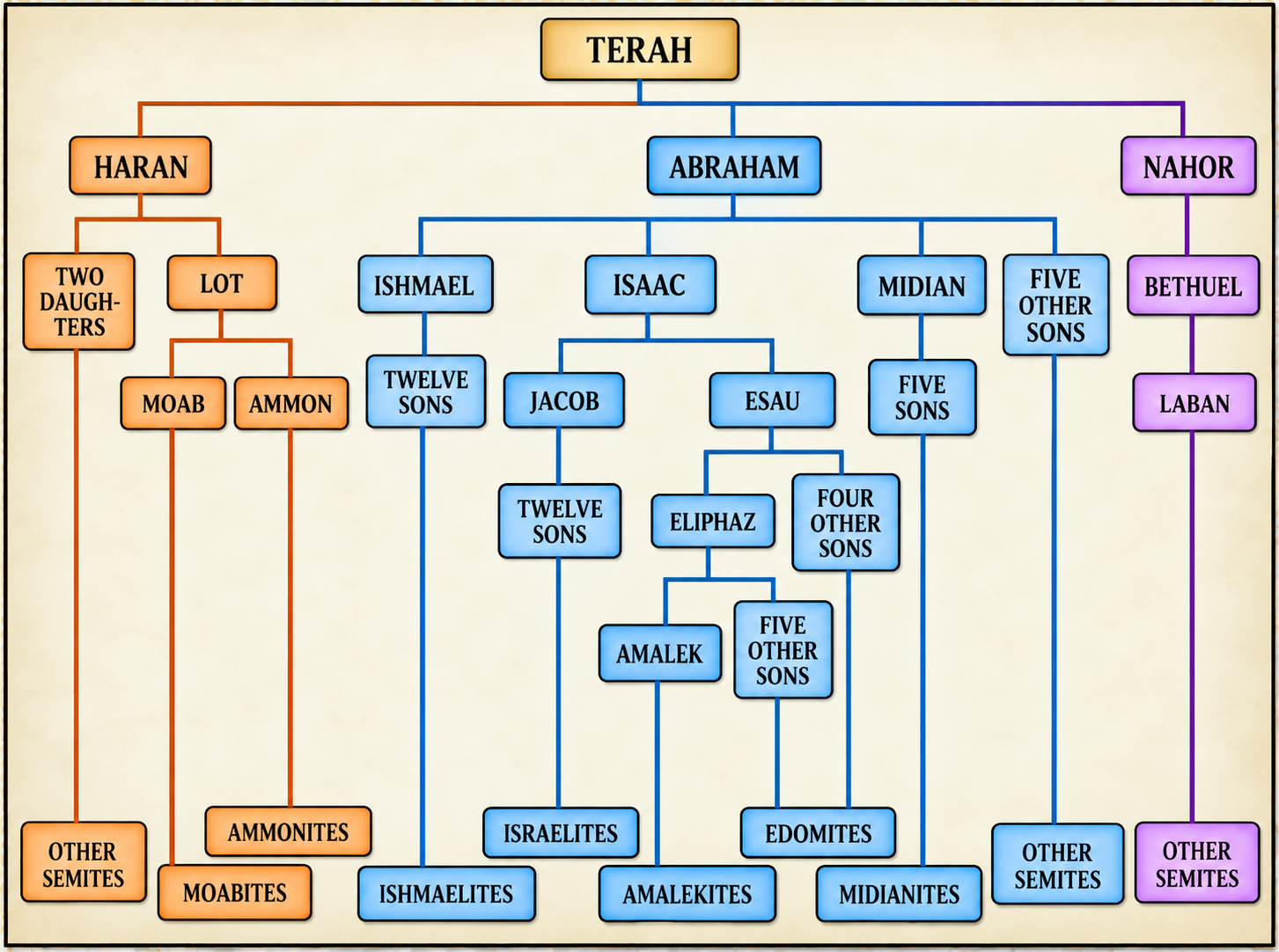
Most of the "-ITES" at bottom of family tree became enemies of Israel
GIFTS FOR SONS
INHERITANCE FOR ISAAC
but to the sons of his concubines , Abraham gave gifts while he was still living, and sent them away from his son Isaac eastward, to the land of the east - This statement provides an important qualification to the preceding verse, which declares that Abraham gave all that he had to Isaac (Ge 25:5). Abraham had other sons besides Isaac, including Ishmael through Hagar and six sons through Keturah (Ge 16:15; 25:1–4). Although Keturah is called Abraham's "wife" in Genesis 25:1, she is specifically identified as his "concubine" in 1 Chronicles 1:32. This was not necessarily contradictory terminology, since a concubine could be recognized as a wife while occupying a secondary position in the household, particularly concerning inheritance rights.
Concubine (pilegesh) refers to a woman who had a recognized marital relationship with a man but did not possess the same social or legal standing as a primary wife. The plural "concubines" may refer to Hagar and Keturah, although the text does not explicitly identify both women in this verse. What is clear is that Abraham distinguished between Isaac, the divinely appointed covenant heir, and his other sons.
Abraham gave gifts while he was still living – Abraham did not completely disinherit his other sons or leave them without provision. Instead, he gave them gifts during his lifetime, presumably consisting of material possessions from his considerable wealth (Ge 13:2; 24:35). Scripture does not specify the nature or value of these gifts. The timing is significant. By distributing these gifts while he was still living, Abraham personally established the inheritance arrangements rather than leaving the matter unresolved until after his death. This likely helped prevent future disputes over the estate, although Moses does not explicitly state that this was Abraham's motivation. The contrast with Genesis 25:5 is deliberate. Isaac received the principal inheritance, while the other sons received gifts.
John Currid - Abraham designates Isaac as the sole heir: Abraham ‘gave everything’ to him. According to ancient Near-Eastern law, the father had the right to make such a determination. The Code of Hammurabi, Law no. 171 says, ‘… if the father during his lifetime has never said “My children!” to the children whom the slave bore him, after the father has gone to [his] fate, the children of the slave may not share in the goods of the paternal estate along with the children of the first wife’. According to this law, the right of inheritance must be designated ‘during his lifetime’; our biblical text tells us that Abraham acts ‘while he is yet living’. (Genesis)
And sent (shalach) them away from his son Isaac – Abraham not only provided for his other sons but also separated them geographically from Isaac undoubtedly to make Isaac's position more secure sothey would supplant Isaac as the rightful heir. Along. Sent (shalach) conveys the idea of sending away or dispatching. This action served to distinguish Isaac from Abraham's other descendants and preserve his position as the principal heir. The separation recalls God's earlier instruction concerning Ishmael, when He told Abraham that his descendants would be named through Isaac (Ge 21:12). However, the circumstances were different. Ishmael had been sent away in response to the conflict involving Sarah and Hagar (Ge 21:9–14), whereas Genesis 25:6 describes Abraham's arrangements for his other sons in connection with the distribution of his estate.
Eastward, to the land of the east (qedem) – NET - "sent them off to the east, away from his son Isaac." NLT "sent them off to a land in the east, away from Isaac." ESV "he sent them away from his son Isaac, eastward to the east country." This geographical detail is important because it helps explain the subsequent development of peoples associated with Abraham's descendants. The Hebrew expression qedem means "east" or "eastward," while the phrase "land of the east" refers generally to territories east of Canaan rather than to a precisely defined political region. The descendants of Keturah, particularly the Midianites, became associated with regions east and southeast of Canaan, including areas of the Arabian Peninsula (Ge 25:2–4; 37:25–28; Ex 2:15–22). Later, Judges 6:3 refers to the Midianites, Amalekites (descendants of Esau), and "sons of the east" invading Israel. The geographical separation also reinforced the distinction between the land promised to Isaac and his descendants and the territories occupied by Abraham's other sons. God had specifically promised the land of Canaan to Abraham and his covenant descendants (Ge 17:7–8; 26:3–4). Abraham's other sons were sent eastward, but Isaac remained associated with the land of promise.
Ryrie - Though Abraham provided for all his children by giving them gifts (probably starter flocks and herds), he dismissed them and made Isaac his principal heir.
Concubine (06370) pilegesh concubine in the Bible was a true wife but of secondary rank and does not as is not a "kept mistress." The concubine did not cohabit with a man UNLESS she was married to him. Although she cohabitated with the husband, the man could repudiate and send her away with a small gift. However, clearly having a concubine is a variation of polygamy which is the practice of having more than one wife at the same time. In Judges 19 in the days when everyone did what was right in his own eyes, the Levite had a concubine and is referred to as son-in-law in Jdg 19:5 and the concubine's father is referred to as his father-in-law in Jdg 19:4, so clearly the Bible is teaching the concubine was married to the Levite. We see a stratification between wife and concubine in 1Ki 11:3 where Solomon "had seven hundred wives, princesses, and three hundred concubines, and his wives turned his heart away." To sleep with a king's concubine would have indicated plans to usurp the throne (2 Sam. 3:7; 16:21, 22; cf. 1 Ki. 2:21-24). Men who are known to have had concubines include some famous Biblical characters (as an aside I note Joseph and Daniel and none of the prophets are in this list -- just pondering that thought!) - Nahor (Ge 22:24), Abraham (Ge 25:6), Jacob (Ge 35:22), Eliphaz (Ge 36:12), Saul (2Sa 3:7), David (2Sa 5:13; 15:16; 16:21), Solomon (1Ki. 11:3), Caleb (1Chr 2:46), Manasseh (1Chr 7:14), Rehoboam (2Chr. 11:21), Abijah (2Chr 13:21) and Belshazzar (Da 5:2). Many of these men were kings and in ancient times a concubine was often a sign of wealth and a status symbol. Concubinage seems to have evolved with men who sought concubines because their wives could not bear children (Abraham Ge 16:1-16 Jacob Ge 30:4-5 So she [Rachel] gave him her maid Bilhah as a wife, and Jacob went in to her. Bilhah conceived and bore Jacob a son.") and in both situations the wives presented their maidservants to their own husbands. It is notable that Isaac did not have a concubine because Rebekah was not barren. This practice degenerated (that's a good way to look it) into a regular custom amony the Jews. It is surprising that unfaithfulness of a concubine was not considered a true act of adultery (Lev. 19:20). When a son had intercourse with the concubine of his father, a type of family punishment was inflicted on him (Gen. 35:22; 1 Chr. 5:1). It was not the penalty of death demanded for adultery with the father's wife, though.Children of a concubine were not viewed as illegitimate. They were considered part of the family, and, in fact, their names occasionally appear in the family's genealogies (Gen. 22:24).
East (06924) qedem is a masculine noun from the root qādam, which carries two ideas: “to confront or meet,” and “to precede,” either in place or in time. From the second idea the noun takes two main senses. Geographically it means east or eastern, the direction one faces when “in front.” Temporally it means ancient times, aforetime, of old, the past being pictured as what lies “before” a person. It occurs 61 times in the Old Testament.
QEDEM - 59V - ancient(4), ancient times(3), before(1), before his of old(1), earliest times(1), East(1), east(26), east side(1), eastward(1), eternal(1), everlasting(1), formerly(1), forward(1), gone(1), long ago(1), old(16), times*(2). Gen. 2:8; Gen. 3:24; Gen. 10:30; Gen. 11:2; Gen. 12:8; Gen. 13:11; Gen. 25:6; Gen. 29:1; Num. 23:7; Num. 34:11; Deut. 33:15; Deut. 33:27; Jos. 7:2; Jdg. 6:3; Jdg. 6:33; Jdg. 7:12; Jdg. 8:10; Jdg. 8:11; 1 Ki. 4:30; 2 Ki. 19:25; Neh. 12:46; Job 1:3; Job 23:8; Job 29:2; Ps. 44:1; Ps. 55:19; Ps. 68:33; Ps. 74:2; Ps. 74:12; Ps. 77:5; Ps. 77:11; Ps. 78:2; Ps. 119:152; Ps. 139:5; Ps. 143:5; Prov. 8:22; Prov. 8:23; Isa. 2:6; Isa. 9:12; Isa. 11:14; Isa. 19:11; Isa. 37:26; Isa. 45:21; Isa. 46:10; Isa. 51:9; Jer. 30:20; Jer. 46:26; Jer. 49:28; Lam. 1:7; Lam. 2:17; Lam. 5:21; Ezek. 11:23; Ezek. 25:4; Ezek. 25:10; Jon. 4:5; Mic. 5:2; Mic. 7:20; Hab. 1:12; Zech. 14:4
As a direction, qedem marks the location of Eden: “The LORD God planted a garden toward the east, in Eden; and there He placed the man whom He had formed” (Genesis 2:8; cf. 3:24). It also describes the land of Abraham’s travels (Genesis 12:8; 13:11) and the “sons of the east,” a region known for its wise men (Genesis 29:1; 1 Kings 4:30; Job 1:3). The East can also carry negative overtones. It is where Babel was built (Genesis 11:2), where Israel’s hostile neighbors lived (Numbers 23:7; Judges 6:3, 33), and a source of superstition (Isaiah 2:6).
As a time word, qedem points back to God’s works before and at creation (Proverbs 8:22-23; Deuteronomy 33:15; Psalm 55:19). It also recalls His saving acts in Israel’s history, such as the Exodus (Malachi 3:4) and the Davidic era (Nehemiah 12:46). The psalmists remember these works in times of distress: “I shall remember the deeds of the LORD; surely I will remember Your wonders of old” (Psalm 77:11; cf. 44:1; 74:2, 12; 143:5). The most significant use describes the Messiah’s eternal origins: “But as for you, Bethlehem Ephrathah, too little to be among the clans of Judah, from you One will go forth for Me to be ruler in Israel. His goings forth are from long ago, from the days of eternity” (Micah 5:2).
Occasionally qedem simply means front or before, as in “You have enclosed me behind and before, and laid Your hand upon me” (Psalm 139:5; cf. Isaiah 9:12).
Qedem differs from related words. ʿôlām emphasizes perpetuity, zāqēn age, and rīʾshôn primacy. Qedem instead often evokes an idyllic or foundational past. A related directional form, qēdmâ (“eastward”), stresses direction toward the east, while mizrāḥ (“sunrise”) stresses the location where the sun rises.
QUESTION - What is a concubine? - GotQuestions.org
ANSWER - In the Bible, a concubine is a woman who lives with a man as if she were a wife, but without having the same status as a wife. Concubines in the patriarchal age and beyond held an inferior rank—they were “secondary” wives. A concubine could not marry her master because of her slave status, although, for her, the relationship was exclusive and ongoing. Early on, it seems that concubines were used to bear children for men whose wives were barren (see Genesis 16:1–4). Later, it seems that concubines were kept simply for sexual pleasure (see 2 Chronicles 11:21). Concubines in Israel possessed some of the same rights as legitimate wives, without the same respect.
Although it’s true the Bible nowhere explicitly condemns concubinage, a condemnation can be found implicitly from the beginning of time. According to Genesis 2:21-24, God’s original intent was for marriage to be between one man and one woman, and that has never changed (Genesis 1:27). As a matter of fact, a study of the lives of men like King David and King Solomon (who had 300 concubines; 1 Kings 11:3) reveals that many of their problems stemmed from polygamous relationships (2 Samuel 11:2-4).
The Bible never explains why God allowed men to have concubines. He allowed divorce and polygamy, too, although neither was part of His original plan for marriage. Jesus said God allowed divorce because of the hardness of men’s hearts (Matthew 19:8). We can assume the same hardness of heart led to polygamy and concubinage.
We can also surmise a reason based on the culture of the day. Unmarried women in ancient times were completely dependent on their family members, such as their fathers, brothers, etc. If for some reason a woman had no family members or her husband had died or divorced her, she would be left with few options for survival. Most women in ancient times were uneducated and unskilled in a trade. Providing for themselves was very difficult, and they were vulnerable to those who would prey upon them. For many women in dire situations, becoming a concubine was a much more suitable option than prostitution, homelessness, or death. At least a concubine would be provided a home and afforded a certain amount of care.
It appears God allowed the sin of concubinage, in part, to provide for women in need, although it was certainly not an ideal situation. Sin is never ideal. Christians should be reminded that, just because God allows a sin for a time, it does not mean God is pleased with it. Many Bible narratives teach that God can take what some people mean for evil and use it for good (e.g., Genesis 50:20).
Related Resource:
Genesis 25:7 These are all the years of Abraham’s life that he lived, one hundred and seventy-five years.
- Ge 12:4
Related Passages:
Genesis 15:15 “As for you, you shall go to your fathers in peace; you will be buried at a good old age.
A CENTURY OF
WALKING BY FAITH
These are all the years of Abraham’s life that he lived, one hundred and seventy-five years - The expression emphasizes the complete span of his life, from birth to death. Abraham's story began in Ur of the Chaldeans, but the biblical narrative focuses particularly on God's call to leave his homeland and journey to the land that God would show him (Ge 11:27–32; 12:1–4). From that moment forward, Abraham's life became a remarkable testimony to the faithfulness of God and the obedience of faith.
One hundred and seventy-five years – Abraham lived 175 years, a remarkably long life by modern standards, although shorter than the lifespans recorded for many earlier patriarchs. His father Terah lived 205 years (Ge 11:32), Isaac would live 180 years (Ge 35:28), and Jacob would live 147 years (Ge 47:28). Abraham was seventy-five years old when he departed from Haran in obedience to God's call (Ge 12:4). Thus, he spent approximately one hundred years living in the land to which God had called him, although he never possessed the entire land God had promised.
Abraham did not die prematurely but lived to see Isaac reach adulthood, marry Rebekah, and become the father of Esau and Jacob. Since Isaac was sixty when the twins were born (Ge 25:26), Abraham would have been 160 years old at their birth and therefore lived another fifteen years after their arrival. This means they surely must have heard their grandfather's stories about God's promises in Genesis 12:1-3 (et al).
Abraham's greatness was not that he never failed,
but that he trusted the God Who never fails!
NET NOTE - Heb “and these are the days of the years of the lifetime of Abraham that he lived.” The normal genealogical formula is expanded here due to the importance of the life of Abraham.
🙏 THOUGHT – It Is Not How Long You Live, but How Faithfully You Live - Abraham lived 175 years, but the significance of his life cannot be measured merely by the number of years he spent on earth. His enduring legacy was his faith in the God Who called him, guided him, corrected him, and kept His promises to him (Ge 12:1–4; 15:6; 22:1–18). Moses later prayed, "Teach us to number our days, that we may present to You a heart of wisdom" (Ps 90:12). The real tragedy is not dying young, but living long without living for God! Are you simply accumulating years, or are you investing your remaining days in what will matter for eternity? Paul reminds us that although our outer man is decaying, our inner man is being renewed day by day (2Co 4:16), and the psalmist declares that the righteous can still bear fruit in old age (Ps 92:12–15). Whether God grants us many years or few, our calling remains the same: to walk by faith, obey His Word, and finish the course He has appointed for us (2Co 5:7; 2Ti 4:7–8). A life well lived is not measured by its duration, but by its devotion to the Lord!
A life well lived is not measured by its duration,
but by its devotion to the Lord!
Genesis 25:8 Abraham breathed his last and died in a ripe old age, an old man and satisfied with life; and he was gathered to his people.
KJV Then Abraham gave up the ghost, and died in a good old age, an old man, and full of years; and was gathered to his people.
NET Then Abraham breathed his last and died at a good old age, an old man who had lived a full life. He joined his ancestors.
NLT and he died at a ripe old age, having lived a long and satisfying life. He breathed his last and joined his ancestors in death.
ESV Abraham breathed his last and died in a good old age, an old man and full of years, and was gathered to his people.
BGT καὶ ἐκλιπὼν ἀπέθανεν Αβρααμ ἐν γήρει καλῷ πρεσβύτης καὶ πλήρης ἡμερῶν καὶ προσετέθη πρὸς τὸν λαὸν αὐτοῦ
LXE And Abraam failing died in a good old age, an old man and full of days, and was added to his people.
CSB He took his last breath and died at a ripe old age, old and contented, and he was gathered to his people.
NIV Then Abraham breathed his last and died at a good old age, an old man and full of years; and he was gathered to his people.
- gave (KJV): Ge 25:17 35:18 49:33 Ac 5:5,10 12:23
- good (KJV): Ge 15:15 35:28,29 47:8,9 49:29 Judges 8:32 1Ch 29:28 Job 5:26 42:17 Pr 20:29 Jer 6:11
- gathered (KJV): Ge 25:7 35:29 49:33 Nu 20:24 27:13 Jud 2:10 Ac 13:36
Related Passages:
Genesis 15:15 “As for you, you shall go to your fathers in peace; you will be buried at a good old age.
Hebrews 11:13 All these died in faith, without receiving the promises, but having seen them and having welcomed them from a distance, and having confessed that they were strangers and exiles on the earth.
Genesis 35:29 Isaac breathed his last and died and was gathered to his people, an old man of ripe (sabea) age; and his sons Esau and Jacob buried him.
1 Chronicles 29:28 Then he (DAVID) died in a ripe old age, full (sabea) of days, riches and honor; and his son Solomon reigned in his place.
Job 42:17 And Job died, an old man and full (sabea) of days.
Genesis 47:9 So Jacob said to Pharaoh, “The years of my sojourning are one hundred and thirty; few and unpleasant have been the years of my life, nor have they attained the years that my fathers lived during the days of their sojourning.”
Psalm 91:16 “With a long life I will satisfy him And let him see My salvation.”
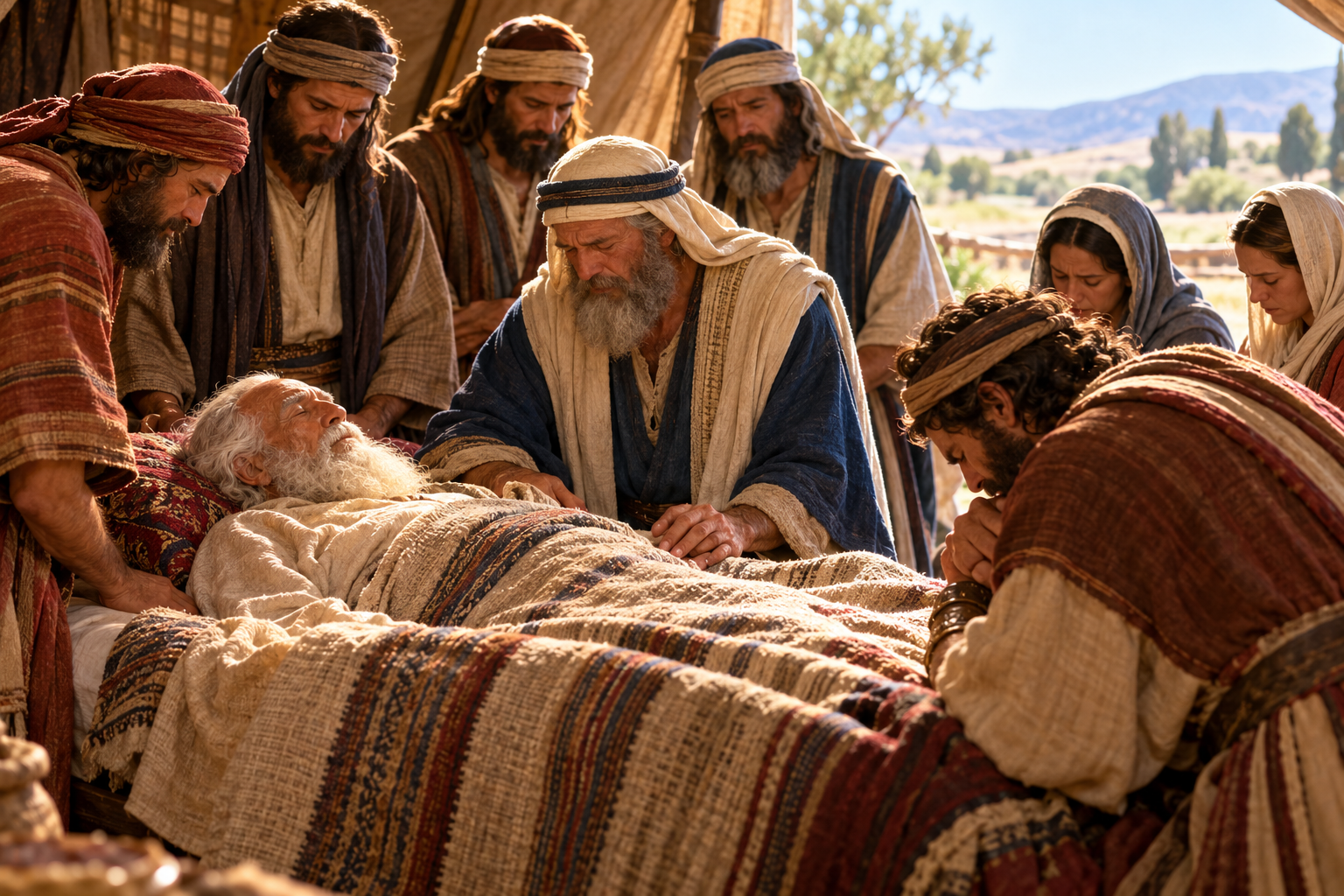
DYING A DEATH
FULL OF YEARS
Abraham breathed his last and died in a ripe old age, an old man and satisfied with life - KJV - "died in a good old age, an old man, and full of years" NET - "an old man who had lived a full life".
Breathed his last describes quiet exhaling of life, the same verb used of Ishmael (Ge 25:17), Isaac (Ge 35:29), and Jacob (Ge 49:33). Today we might say "he expired."
Ripe old age is literally “in a good gray-headedness." Abraham’s old age was not merely long but good. Recall Pr 16:31 says "A gray head is a crown of glory; It is found in the way of righteousness.'
An old man - At 175 Abraham lived far fewer years than his ancestors Terah (205) and Shem (600), but he lived seventy-five years longer than his hundred-year-old son’s birth would have suggested possible (Ge 21:5). He had spent a full century as a pilgrim in Canaan (Ge 12:4).
While Abraham ceased in the OT, he is mentioned in 70 verses in the NT (first Mt 1:1) and only Moses is mentioned more times (80x/79v).
Satisfied (sabea) with life - Satisfied is used of someone who has eaten enough (Dt 8:10). The Hebrew text says only “satisfied,” and the translators supply “with life.” The Septuagint reads "full (pleres) of days (hemera)." I like the thought of full of days as it reminds me of Moses' prayer (we should all frequently pray!) "So teach us to number our days, (not our years) that we may present to You a heart of wisdom." (Ps 90:12) Abraham was not worn out by life. He was content with it. Kitto says he “had finished the business of life; and was quite willing to die... and stood with girded loins, ready to depart.” It reminds me of the truth that the life of God's men and women is immortal until they have accomplished the work (Rev 11:7) God had ordained for them from the foundation of the world (Eph 2:10) Abraham’s grandson Jacob offers a sobering contrast for late in life he lamented, “few and unpleasant have been the years of my life” (Ge 47:9).
Abraham's secret was that his satisfaction rested in the God of the promises,
not in the complete fulfillment of those promises during his lifetime
What was the secret of Abraham's satisfied life? Abraham’s contentment did not come from having received everything God had promised. He owned only a burial plot in Canaan, and his descendants were still few. “All these died in faith, without receiving the promises, but having seen them and having welcomed them from a distance” (Heb 11:13). Abraham's secret was that his satisfaction rested in the God of the promises, not in the complete fulfillment of those promises during his lifetime. Simeon expressed the same settled peace: “Now Lord, You are releasing Your bond-servant to depart in peace, according to Your word; for my eyes have seen Your salvation” (Lk 2:29, 30). Beloved, mark it down that every believer who knows Christ can likewise finish life satisfied, and say with Paul “having the desire to depart and be with Christ, for that is very much better” (Php 1:23). The best is yet to come.
Victor Hamilton - “It is one thing to live a long life. It is another thing to live a long life that is also a happy life. This obituary notice about Abraham draws attention to the fact that Abraham died not only at an elderly age but in a frame of mind filled with inner shalom and satisfaction. That is the thrust of the phrase full of days or ‘contented.’ (See The Book of Genesis, Chapters 18-50 - Page 61)
Adam Clarke summarizes Abraham's life - Above all as a man of God, he stands unrivaled; so that under the most exalted and perfect of all dispensations, the Gospel of Jesus Christ, he is proposed and recommended as the model and pattern according to which the faith, obedience, and perseverance of the followers of the Messiah are to be formed. Reader, while you admire the man, do not forget the God that made him so great, so good, and so useful. Even Abraham had nothing but what he had received; from the free unmerited mercy of God proceeded all his excellences; but he was a worker together with God, and therefore did not receive the grace of God in vain. Go thou, believe, love, obey, and persevere in like manner.”
Warren Wiersbe - He also died “full of years” (Gen. 25:8KJV). This suggests more than a quantity of time; it suggests a quality of life. James Strahan translates it “satisfied with life” (Hebrew Ideals, 197). Abraham, who was flourishing and fruitful to the very end, fulfilled the picture of old age given in Psalm 92:12–15. How few people really experience joy and satisfaction when they reach old age! When they look back, it is with regret; when they look ahead, it is with fear; and when they look around, it is with complaint.An anonymous wit claimed that he would rather be “over the hill” than under it. But death is not a threat to the person who trusts Jesus Christ and lives by His Word. Old age can be a time of rich experience in the Lord and wonderful opportunities to share Him with the next generation (Ps. 48:13–14; 78:5–7). (Bible Exposition Commentary)
and he was gathered to his people - NLT - "age, joining his ancestors in death" Notice that Scripture does not say Abraham was merely gathered to the dead, but rather “to his people.” This expression is significant, for it suggests that although his ancestors had died physically, they had not ceased to exist. Death had ended their earthly lives, but it had not annihilated their personal existence. Moreover, Abraham was buried in the cave of Machpelah (Ge 25:9,10), far from the burial places of many of his ancestors. Thus, being “gathered to his people” cannot be explained simply as being placed in a family tomb. The expression points beyond the grave to the continuing existence of those who have departed this earthly life. This truth is consistent with Jesus' declaration that God is “not the God of the dead but of the living,” referring specifically to Abraham, Isaac, and Jacob (Mt 22:31,32; Lk 20:37,38). Although these patriarchs had been physically dead for centuries, they were still alive to God! Similarly, Moses and Elijah appeared with Jesus at the Transfiguration, demonstrating their continuing conscious existence after physical death (Mt 17:1,2,3). In summary while death is the end of earthly life, it is not the end of personal existence! The biblical expression “gathered to his people” is therefore consistent with the truth that physical death does not mean annihilation. While this expression alone does not establish every detail of the intermediate state, it harmonizes with the fuller revelation of Scripture that human existence continues beyond the grave (Lk 16:19–31; Php 1:21,22,23; 2Co 5:6,7,8).
John Currid - gathered to his people - This expression appears only in the Pentateuch, and it is used of some of the major biblical figures at death: Ishmael (Ge 25:17), Isaac (Ge 35:29), Jacob (Ge 49:29), Aaron (Nu 20:26) and Moses (Dt. 32:50). It is to be equated with the later Hebrew phrase, ‘to lie down with one’s fathers’ (see 2Sa 7:12; 1Ki 2:10). (Genesis)
It is one thing to live a long life. It is another thing to live a long life that is also a happy (blessed) life. This obituary notice about Abraham draws attention to the fact that Abraham died not only at an elderly age but in a frame of mind filled with inner shalom and satisfaction. That is the thrust of the phrase full of years.
The New Testament places great significance on the life and legacy of Abraham. He is honored as “the friend of God” (James 2:23), identified as “our father Abraham” (James 2:21; cf. Mt 3:9), presented as a classic illustration of justification by faith (Ro 4; Gal 3), and held up as an outstanding example of living, obedient faith (Heb 11:8–19; James 2:21–23). Thus, Abraham's life provides a powerful testimony to the truth that genuine faith not only believes God's promises but also demonstrates its reality through obedience to God's Word.
NET NOTE - Heb “And he was gathered to his people.” In the ancient Israelite view he joined his deceased ancestors in Sheol, the land of the dead.
Henry Morris - Abraham died at 175 years of age (Genesis 25:7), which by this time was considered a very great age, even though his father Terah had lived to 205. Human longevity had greatly declined since the Flood but was still significantly greater than in the modern world. to his people. Since none of his people had been buried in this location, this phrase clearly indicates the belief that "his people" were still alive somewhere. In fact, this place of departed spirits was later called "Abraham's bosom" (Luke 16:22).
Satisfied (07649) sabea is “an adjective meaning full, satisfied, abounding.” It is “derived from the verb śābaʿ (HED #7881), ‘to be sated,’” and “has cognates in Akkadian, Arabic, Jewish Aramaic, Syriac and Mandaean.” “This adjective is used ten times in the OT. In each case it conveys the idea of being full and satisfied.” The ten occurrences are Genesis 25:8; 35:29; Deuteronomy 33:23; 1 Samuel 2:5; 1 Chronicles 29:28; Job 10:15; 14:1; 42:17; Proverbs 19:23; and 27:7. Although the root starts with a full stomach, the adjective “generally refers to sating of nonphysical desires.” In the Septuagint, the phrase “full of days” is usually plērēs hēmerōn, “full of days.”
SABEA - 10V - full(4), ripe(1), sated(2), satisfied(3). Gen. 25:8; Gen. 35:29; Deut. 33:23; 1 Sam. 2:5; 1 Chr. 29:28; Job 10:15; Job 14:1; Job 42:17; Prov. 19:23; Prov. 27:7
Physical Fullness
“In two contexts, śābēaʿ refers to the sating of physical desires.” The proverb observes how fullness dulls appetite: “A sated man loathes honey, but to a famished man any bitter thing is sweet” (Proverbs 27:7). In Hannah’s song, “God’s justice is so pervasive that society can be overturned so that ‘they that were full’ by unjust means will be reduced to hiring themselves out as laborers”: “Those who were full hire themselves out for bread, but those who were hungry cease to hunger. Even the barren gives birth to seven, but she who has many children languishes” (1 Samuel 2:5). Here the word “indicates a general prosperity, the possession of an abundance of wealth.” God can reverse that abundance in a moment, a theme Mary echoes: “He has filled the hungry with good things; and sent away the rich empty-handed” (Luke 1:53).
Full of Days: A Life Completed
“The adjective is used in formulaic summaries of lives which were lived to old age, that the person died ‘full of days.’” It “indicates fullness of life in years and in satisfaction”:
Genesis 25:8 “Abraham breathed his last and died in a ripe old age, an old man and satisfied with life; and he was gathered to his people.”
Genesis 35:29 “Isaac breathed his last and died and was gathered to his people, an old man of ripe age; and his sons Esau and Jacob buried him.”
1 Chronicles 29:28 “Then he died in a ripe old age, full of days, riches and honor; and his son Solomon reigned in his place.”
Job 42:17 “And Job died, an old man and full of days.”
The verb śābaʿ appears in the same formula of David at the transfer of the kingdom (1 Chronicles 23:1) and of the godly priest Jehoiada (2 Chronicles 24:15). This fullness is a gift of God’s covenant faithfulness: “With a long life I will satisfy him and let him see My salvation” (Psalm 91:16). The psalmist also prays, “O satisfy us in the morning with Your lovingkindness, that we may sing for joy and be glad all our days” (Psalm 90:14).
Full of Turmoil and Disgrace: The Dark Side of Fullness
Job uses the same word ironically. The patriarchs died “full of days,” but Job laments that humanity is “few of days” and full of trouble: “Man, who is born of woman, is short-lived and full of turmoil” (Job 14:1). “The general condition of humankind is a fullness of turmoil.” In his anguish, Job also describes himself as saturated with shame: “If I am wicked, woe to me! And if I am righteous, I dare not lift up my head. I am sated with disgrace and conscious of my misery” (Job 10:15). Here śābēaʿ “refers to a satiation, an overabundance of disgrace, a consciousness of misery.” The book’s ending is significant. The man who once felt full of turmoil and disgrace “died, an old man and full of days” (Job 42:17). God changed what filled his life.
Full of God’s Favor and Rest
“A life that is lived in pursuit of pleasing Yahweh is described as full.” In Moses’ blessing, Naphtali is “satisfied with favor, and full of the blessing of the LORD”: “Of Naphtali he said, ‘O Naphtali, satisfied with favor, and full of the blessing of the LORD, take possession of the sea and the south’” (Deuteronomy 33:23). This “indicates a fullness or satisfaction of God’s approval and favor.” “A person who fears Yahweh can rest sated, for he is safe”: “The fear of the LORD leads to life, so that one may sleep satisfied, untouched by evil” (Proverbs 19:23). “A fullness or sufficiency of sleep comes to those who fear God.”
The Danger of Fullness Without God
Related forms of the root warn that being full can lead to forgetting the Giver. Moses cautions Israel: “When you have eaten and are satisfied, you shall bless the LORD your God for the good land which He has given you” (Deuteronomy 8:10). Hosea describes what happened when Israel did not: “As they had their pasture, they became satisfied, and being satisfied, their heart became proud; therefore they forgot Me” (Hosea 13:6). Agur prays for this reason: “That I not be full and deny You and say, ‘Who is the LORD?’” (Proverbs 30:9).
True Satisfaction
The root reaches its highest meaning in satisfaction found in God Himself: “As for me, I shall behold Your face in righteousness; I will be satisfied with Your likeness when I awake” (Psalm 17:15). The Suffering Servant is satisfied by the result of His own sacrifice: “As a result of the anguish of His soul, He will see it and be satisfied” (Isaiah 53:11). Jesus promises the same fullness to those who long for God: “Blessed are those who hunger and thirst for righteousness, for they shall be satisfied” (chortazō, Matthew 5:6). He also invites, “I am the bread of life; he who comes to Me will not hunger” (John 6:35).
Summary - Śābēaʿ describes being filled to sufficiency. That fullness can be physical (food, wealth), temporal (a long life brought to completion), or spiritual (God’s favor, peaceful rest). It can also be tragic (fullness of turmoil and disgrace). Abraham, Isaac, David, and Job died “full of days,” not because they had everything they wanted, but because God had filled their lives with His faithfulness. The deepest fullness comes only from God, who satisfies the longing soul (Psalm 107:9).
QUESTION - What does it mean that someone was gathered to his people?
ANSWER - The phrase gathered to his people is an ancient way of referring to death. The death of Abraham is described this way: “Then Abraham breathed his last and died at a good old age, an old man and full of years; and he was gathered to his people” (Genesis 25:8). The New Living Translation is less idiomatic, simply saying that Abraham “joined his ancestors in death.”
Other persons in the Bible whose death is described as being “gathered to his people” include Ishmael (Genesis 25:17), Isaac (Genesis 35:29), Jacob (Genesis 49:33), Aaron (Numbers 20:24), and Moses (Numbers 27:13). A related idiom is found in Genesis 15:15, where God tells Abram, “You shall go to your fathers in peace; you shall be buried in a good old age” (ESV). In Genesis 47:30, Jacob speaks of a future time when he would “rest” (CSB) or “lie down” (NASB) with his fathers. Go to your ancestors, gathered to your people, and rest with your fathers are all poetic, periphrastic references to physical death.
Some speculate that gathered to his people is a reference to the remains of the deceased being taken to a family burial site. In some cases, this could be its primary meaning. However, there are other cases in which the “gathering” cannot refer to a physical location: Abraham, Moses, and Aaron were all buried far from where their ancestors were, yet they are all said to have been “gathered to their people.”
A better view is that gathered to his people refers to joining past generations in death. Biblically, it also refers to the gathering of the spirits of the dead in one place in the afterlife—that place being Sheol. The biblical patriarchs knew that the grave awaited them, just as it had awaited all their ancestors before them, but they also knew that there was an existence beyond the grave. The consistent teaching of Scripture is that there is life after death: “The dust returns to the ground it came from, and the spirit returns to God who gave it” (Ecclesiastes 12:7). This truth is implied in the Hebrew idiom gathered to his people.
Another teaching that can be inferred from gathered to his people is that, even after death, souls retain their individuality. When he died, Isaac did not cease being Isaac; rather, his spirit or soul was taken to another place where his ancestors had already gone. Isaac was not joining an impersonal collective or some kind of cosmic consciousness—he was joining a crowd of individual people he knew.
Note, in Genesis 15:15, in His words to Abram, “You . . . will go to your ancestors in peace and be buried at a good old age,” that God alludes to both Abram’s spiritual fate and his physical fate. Abram’s spirit would go to be with his ancestors; meanwhile, his body would be buried.
God’s plan is not to leave the body and soul separated forever. We will all one day be “gathered to our people,” but the Bible promises resurrection: “Multitudes who sleep in the dust of the earth will awake: some to everlasting life, others to shame and everlasting contempt” (Daniel 12:2). For those who, like Daniel, are justified by faith, the resurrection will be a blessed event. They, like Daniel, have this promise: “You will rest, and then at the end of the days you will rise to receive your allotted inheritance” (Daniel 12:13).
Walter Kaiser - Hard Sayings page 98 - Ge 25:8 What Does “Gathered to His People” Imply?
What was the Old Testament saints’ concept of life after death? Did they have a clear belief in life after death? If so, what did it involve? For example, was it a ghostly existence? Did it involve personal, conscious awareness? Did they expect the spirit to be joined with a body? At what point? All of these questions are relevant to understanding this text about Abraham.
The expression “to be gathered to one’s people” is similar to another expression, “to go to one’s fathers,” found in Genesis 15:15. The former phrase is found frequently—for example, here in Genesis 25:8, 17; 49:29, 33; Deuteronomy 32:50; and 2 Kings 22:20.
Do these phrases simply mean, as many scholars claim, that the Old Testament individual was laid to rest in the family grave? Is it true that there was no thought of an afterlife?
By Abraham’s time, the human life span had been so curtailed, due to the physical effects of the Fall, that 175 years was regarded as a “good old age.” What happened after Abraham died? Was he simply buried with his ancestors, end of story? Unfortunately, too many carelessly conclude that this is precisely the case.
Actually, the expression “he was gathered to his people” or “he went to his fathers” cannot mean that he was buried with his relatives and ancestors. In Genesis 25:8–9 such an analysis is impossible, because we know that none of Abraham’s kin, except his wife, was buried at the cave of Machpelah.
In the Old Testament, those who have already died are regarded as still existing. The event of being “gathered to one’s people” is always distinguished from the act of burial, which is described separately (Gen 25:8–9; 35:29; 49:29, 31, 33). In many cases only one ancestor was in the tomb (1 Kings 11:43; 22:40) or none at all (Deut 31:16; 1 Kings 2:10; 16:28; 2 Kings 21:18), so that being “gathered to one’s people” could not mean being laid in the family sepulcher.
Readers of the text should not infer something special from the use of Sheol in some of these texts. In every one of the sixty-five instances of Sheol in the Old Testament, it refers simply to “the grave,” not to the shadowy region of the netherworld. The writer of the book of Hebrews in the New Testament supports the notion that the patriarchs expected an afterlife:
All these people [from Abel to Abraham] were still living by faith when they died. They did not receive the things promised; they only saw them and welcomed them from a distance. And they admitted that they were aliens and strangers on earth. People who say such things show that they are looking for a country of their own. If they had been thinking of the country they had left, they would have had opportunity to return. Instead, they were longing for a better country—a heavenly one. Therefore God is not ashamed to be called their God, for he has prepared a city for them. (Heb 11:13–16)
Here is a clear testimony that through faith these early participants in the promises of God were fully expecting to enjoy life after death. While the full revelation of the life hereafter and the resurrection of the body awaited a later unveiling in the Old and New Testaments, the common assertion that the Old Testament saint knew nothing at all about such a possibility is an error caused by preconceptions.
In Genesis 17:8 Abraham was given a promise by God: “The whole land of Canaan, where you are now an alien, I will give as an everlasting possession to you and your descendants after you.” The rabbis reasoned that since Abraham never actually enjoyed the fulfillment of this promise, he would be raised from the dead to possess the land.
While this reasoning is curious, it is not all that far off. It is no more fanciful than the reasoning of our Lord in reminding the Sadducees—who did not believe in the resurrection—that the God of Abraham, Isaac and Jacob was not the God of the dead but of the living. Thus the patriarchs were not to be counted out of the hope of resurrection (Mt 22:23–32). The believer’s relationship to God carries with it life in the body now and immortality in the future.
If some object that such concepts are too “developed” for the primitive times and minds of Old Testament people, we need only remind each other that life after death was already the overriding passion of the Egyptian culture. It was to be a life of material things, with real bodies, real wine, women and song. That concept had been imaged in the pyramid monuments for a thousand years before Abraham arrived in Egypt. How, then, could the afterlife be an impossible concept for him?
Other evidences of the belief of a real life after death are afforded by the stern warnings from Mosaic times about any dabbling in necromancy, the cult of contacting the dead. What harm would there have been in fooling around with something that had no reality? Already in the middle of the second millennium B.C., the Israelites knew the afterlife was real, and thus they were warned not to be involved in any contacting of individuals who had passed beyond this world.
Abraham died and was buried. But he also joined a community of believers who had gone on before. No details of the nature of that community are given at this point. But these expressions, “to be gathered to one’s people” and “to go to one’s fathers,” are not a mere euphemism for death without any clear theological import. The evidence argues to the contrary.
See also comment on GENESIS 5:23–24; JOB 19:23–27; PSALM 49:12, 20; ECCLESIASTES 3:19–21.
True Satisfaction in God
Abraham breathed his last and died at a good old age, an old man and full of years. Genesis 25:8
Thirty years ago, I participated in an activity at an unemployment workshop that I still remember today. My fellow laid-off coworkers and I were asked to write our retirement speeches. Huh? We were looking for work and far from retirement age. But the facilitator revealed the purpose of the activity by saying, “Your speech will probably have little to do with your work.” She explained to us that a job really isn’t the center of our lives. And while we may be grieving the loss of a job, our lives mean much more than being employed.
The details about the end of Abraham’s life remind me of this lesson. He died at a “ripe old age” and had lived a “long and satisfying life” (Genesis 25:8 nlt). Throughout Scripture, we read about Abraham’s faithfulness in following God’s instructions, but we don’t read much about his work. The faith the patriarch displayed (Ge 15:6) reminds me of the Teacher’s conclusion in Ecclesiastes: “To the person who pleases him, God gives wisdom, knowledge and happiness” (Eccl 2:26). The Teacher said this after considering the meaning of life and how one can find enjoyment in the midst of work or toil (Eccl 2:24-25).
Even during times of loss and anxiety brought by unemployment, it’s helpful to reflect on Abraham’s example and the Teacher’s words—pointing us to true satisfaction found only in God. -- Katara Patton (Reprinted by permission from Our Daily Bread Ministries. Please do not repost the full devotional without their permission.)
Reflect & Pray
What do you believe you’ll be known for? How does focusing on your legacy help you live today?
Dear God, please remind me to live faithfully as I walk with You—experiencing satisfaction in Your presence.
Today's Insights - Abraham’s faith journey began when he was seventy-five years old: “Abram went, as the Lord had told him; and Lot went with him. Abram was seventy-five years old when he set out from Harran” (Genesis 12:4). He took his last breath one hundred years later: “Abraham lived for 175 years, and he died at a ripe old age, having lived a long and satisfying life. He breathed his last and joined his ancestors in death” (25:7-8 nlt). What a beautiful end-of-life scene! Yet, while Abraham’s dying “at a ripe old age” or “full of years” (niv) was an accomplishment, he’s most known for being “fully persuaded that God had power to do what he had promised” (Romans 4:21). One doesn’t have to be full of years to be full of faith. Today, as we experience times of loss and hardship, our true quality of life and satisfaction comes from faith in the living God, who has revealed Himself in Jesus.
J J Knapp - Old, and Full of Years Gen. 25:8
If ever a ripened sheaf was carried into the heavenly barns, it was certainly Abraham, when he entered eternity at the age of a hundred seventy-five years old. He lived by faith more than anyone of us, which can only justify us before God, and it was in that faith that he gave up the ghost, in a calm peacful dying, as is proven so clearly from the words wherewith the Scriptures describe his passing away, to teach us also the way of a blessed dying.
An old man and full of year. The latter does not just mean that he had attained to a high age, but that he was satisfied of what earthly existence had to offer. His heart desired nothing anymore of this earth. He had thankfully enjoyed all that it had offred him. Now the desire of his soul no longer went out to it; he no longer cleaved with all his might to the good of this earth. This was a blessed old age. When there is a grey-headed one amongst us who clings to the world that is regressing from him because his soul still hungers for the things of time and sense, it is a sad spectacle. Contrarily, how elevating it is when there is an aged person in our circles, who is truly tired of life, who does not ask anything of it anymore, because he has found a place of rest in eternity, yea, in the Eternal One Himself!
Nowadays there is also amongst the younger generations a tiredness of life that is hopelessness. Whoever lives in luxury and has enjoyed already everything in his youth of what life has to offer; whoever also has paralyzed his moral strength by the service of sin, is tired of life before his time and despises it, yea, may even seek death in sinful suicide. To be tired of life is an idea that only belongs to those who wander already at the borders between the visible and the invisible world. It should be purely as a kind of homesickness for a better mother country above the clouds, pure as the desire of the holy apostle who longed to be released and to be with Christ. We do not only hear then of a being free from the earthly things, but also of a soul’s unity with the heavenly.
When the last hour has come for such satisfied ones, they wait for it with a peaceful mind, and once they have passed away, it can be said of them as it was said of Abraham, They gave up the ghost and died. Their death is an act. The breath of life is not taken from them, but they return it in God’s hand, from whom they received it at their birth. They do not submit to death as a fate but they die actively, they translate in clear consciousness from time into eternity to be gathered with the people of God for whom there remaineth a rest.
James Smith - THE SATISFIED LIFE “Full of years” (Gen. 25:8).
This is a choice and suggestive phrase. It is not synonimous for longevity. Abraham lived to be 175; Isaiah, 180; Job, 140; David, 70; Jehoida, 130 (2 Chron. 24:15); yet same expression is used for all. Read “satisfied” for “full”—really its meaning—and you have the true meaning of the term. And he acted like a satisfied man. No desperate clinging to life, no unwillingness to go. He was like one who, having had enough at the table, blesses the Giver of the feast, pushes back his chair, gets up, and goes away without a struggle, or with out the least resistance—SATISFIED!
What had he got? He went out of Mesopotamia expecting a country and a nation. But he dies with no possession save a grave, and with no further sight of posterity than his son Isaac, and his two grandsons, who were fifteen years old when he died. Then why was Abraham satisfied and not sickened with life? He lived the following life—a life:
1. Filled with God (Psa. 105:40; 107:9).
2. He lived in enjoyment of the unmerited favour of God. “Satisfied with favour” (Deut. 33:23). His faith was counted for righteousness.
3. He daily received the mercies of God (Psa. 90:14).
4. He lived a life of trust in God. Is noted for his faith.
5. He lived a life of communion with God, in spite of many hindrances.
6. He lived a life of busy service for God.
7. And he lived in the full certainty of going to God. Ponder over the phrase, “Gathered to his people.”
Alexander Maclaren - After all communion we dwell as upon islands, dotted over a great archipelago, each upon his little rock with the sea dashing between us; but the time comes when, if our hearts are set upon that great Lord whose presence makes us one, there shall be no more sea and all the isolated rocks shall be parts of a great continent.… If we cultivate that sense of detachment from the present and of having our true affinities in the unseen, if we dwell here as strangers because our citizenship is in heaven, then death will not drag us away from our associates nor hunt us into a lonely land, but will bring us where closer bonds shall knit the “sweet societies” together, and the sheep shall couch close by one another because all gathered round the one Shepherd. Then many a tie shall be re-woven, and the solitary wanderer meet again the dear ones whom he had “loved long since and lost awhile.”
Alexander Maclaren - Full of [satisfied with] years Gen. 25:8
Scaffoldings are for buildings, and the moments and days and years of our earthly lives are scaffolding. What are you building inside it? What kind of a structure will be disclosed when the scaffolding is knocked away? Days and years are ours, that they may give us what eternity cannot take away—a character built upon the love of God in Christ, and molded into His likeness.
Has your life helped you to do that? If so, you have got the best out of it, and your life is completed, whatever may be the number of its days. Quality, not quantity, is the thing that determines the perfectness of a life. Has your life this completeness?
Sunset Genesis 25:1-10 Oswald Chambers - Not Knowing Where (Borrow Complete Works of Oswald Chambers page 912)
3. The Realm of the Irreproachable (Genesis 25:8)
The Hebrews regarded life as complete when it was full of days and riches and honour. Age was looked upon as a sign of favour. Whenever a nation becomes unspiritual, it reverses this order, the demand is not for old age but for youth. This reversal in the modern life of to-day is indicative of apostasy, not of advance.
Abraham’s life wore to a tranquil sunset. He is described as “full of years,” i.e., satisfied with life. He had seen, felt, believed, loved, suffered enough, earth had no more to offer him. Through God’s goodness he found goodness in everything. Bitterness and cynicism are born of broken gods; bitterness is an indication that somewhere in my life I have belittled the true God and made a god of human perfection.
Norman Geisler - When Critics Ask
GENESIS 25:8—Did the Hebrews have a concept of life after death at such an early point in their history?
PROBLEM: Critical scholars assert that the early Hebrews had a very rudimentary religion that over the centuries would undergo great evolutionary development before ultimately arriving at a concept of life after death. However, this phrase implies that the Hebrews had a concept of immortality at a very early stage in the development of the nation.
SOLUTION: First of all, this criticism is based on the highly problematic premise that there is an evolutionary development of religion, with highly developed monotheism being very late. Recent archaeological findings at Ebla, however, contradict such speculation showing that monotheism was a very early belief (even before 2000 B.C.). Furthermore, the expression “gathered to his people” certainly seems to indicate more than merely being buried close to his kinsmen. In fact, since Abraham had left his homeland in Ur of the Chaldees to go to the land which God promised him, it would be contrary to Abraham’s life to have his body returned to the land of his father’s house for burial. The idea that the soul continued to live after the death of the body was a belief held by many peoples in the time of Abraham, including the Sumerians, the Babylonians, the Egyptians, and others.
In addition, this is not the only early reference to the concept of life after death. The Book of Job is probably the oldest book of the OT, with the events of the book dating back to the time of Abraham and the patriarchs of Israel. Yet, as early as Job, we find not only the concept of life after death, but also the concept of a bodily resurrection. In Job 19:25–26 we find Job expressing his confidence that, though he may not see his personal vindication in this life, he knew that God would ultimately make things right. This confidence moved him to express his conviction that he would indeed stand before God even after his physical demise; “For I know that my Redeemer lives, and He shall stand at last on the earth; And after my skin is destroyed, this I know, that in my flesh I shall see God.” This verse shows that the concept of life after death was a very early conviction, and that the people of God also believed in the resurrection of the body.
G Campbell Morgan - Abraham gave up the ghost, and died in a good old age, an old man, and full.—Gen. 25.8.
That is a great word, especially if we leave it as it is in the Hebrew Bible, with-out the addition of the words, "of years." Abraham died full, not of years only, or principally, but of life, of experience, of all the great things. By faith he had abandoned much, but he had gained far more. He had come to know God; to walk with Him, to talk with Him; to enter into a true fellowship with Him in all the great processes of His heart. "He was called the friend of God" (Jas. 2.23). Such life is full whatever it seems to lack. The man whose vision is bounded by the things of time and sense might well say that Abraham died singularly empty. As the writer of the letter to the Hebrews said, he "died in faith, not having received the promises." For a hundred years he had sojourned in a land given to him in a covenant, but he had not possessed it according to the standards of human possession. Surely he had little of earthly gain in which to boast, and he had given up very much when he left Ur of the Chaldees. Nevertheless, he died full, for in his fellowship with God he had learned to measure time by eternity,to value the things of sense by those of spirit. To such a man death is but passing on to wait the accomplishment of the Divine purposes, and the fulfilment of the promises of God on the other side. So the fulness of Abraham was that of a wealth which death could not touch. The fulness which men gain who live by sight and not by faith, is a fulness of which they are emptied in death. They leave their possessions behind them. The men of faith carry their fulness with them. It is a great thing thus to die—full.
Genesis 25:9 Then his sons Isaac and Ishmael buried him in the cave of Machpelah, in the field of Ephron the son of Zohar the Hittite, facing Mamre,
- Isaac (KJV): Ge 21:9,10 35:29
- in the cave (KJV): Ge 23:9-20 49:29,30 50:13
Related Passages:
Romans 4:20; 21 yet, with respect to the promise of God, he did not waver in unbelief but grew strong in faith, giving glory to God, (4:21) and being fully assured that what God had promised, He was able also to perform.
Hebrews 11:9-10 By faith he (ABRAHAM) lived as an alien in the land of promise, as in a foreign land, dwelling in tents with Isaac and Jacob, fellow heirs of the same promise; 10 for he was looking for the city which has foundations, whose architect and builder is God.
Hebrews 11:13 All these died in faith, without receiving the promises, but having seen them and having welcomed them from a distance, and having confessed that they were strangers and exiles on the earth.
Hebrews 11:16 But as it is, they desire a better country, that is, a heavenly one. Therefore God is not ashamed to be called their God; for He has prepared a city for them.
Genesis 23:17-18 So Ephron’s field, which was in Machpelah, which faced Mamre, the field and cave which was in it, and all the trees which were in the field, that were within all the confines of its border, were deeded over 18to Abraham for a possession in the presence of the sons of Heth, before all who went in at the gate of his city.
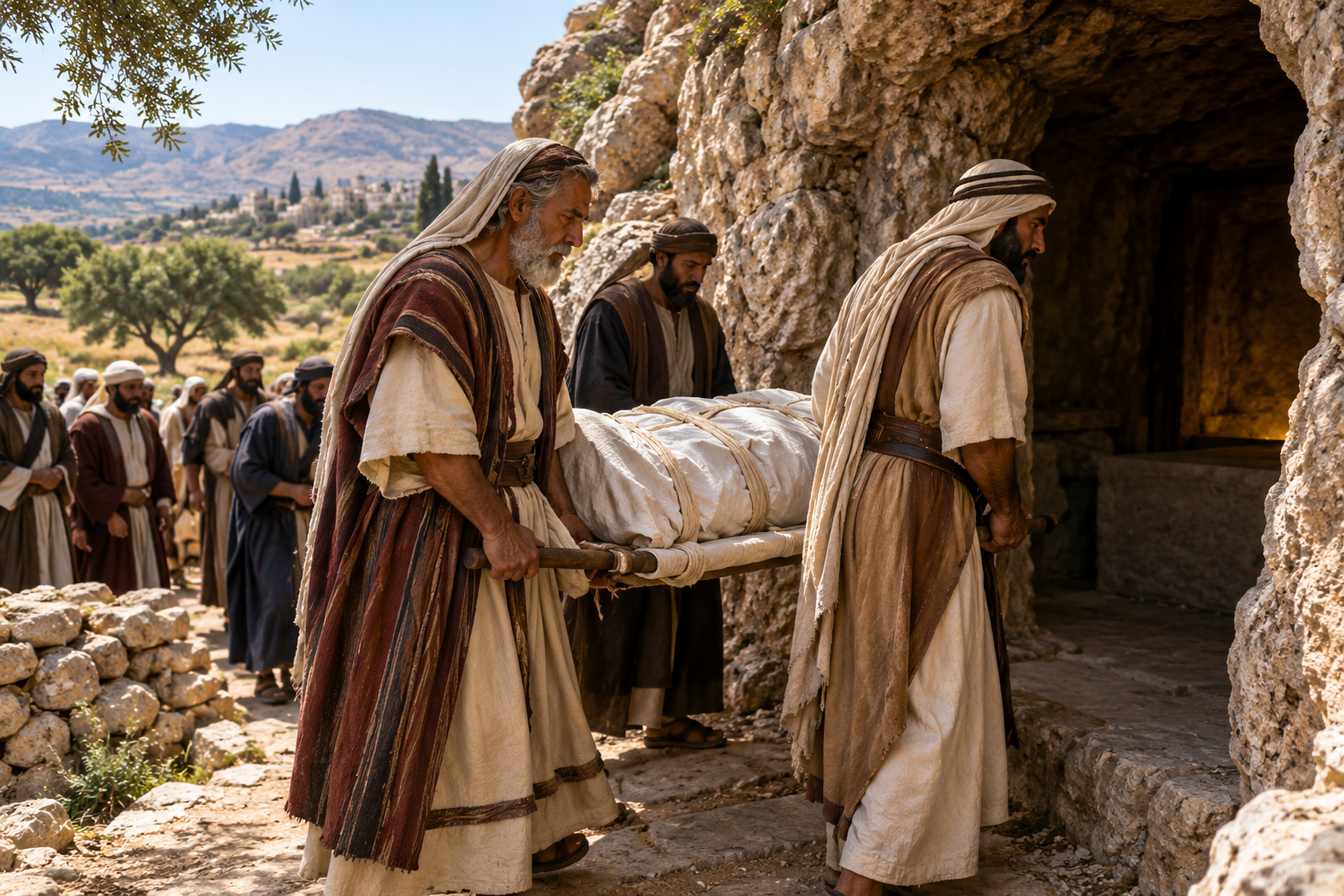
DEATH OF THE PATRIARCH
BUT NOT OF THE PROMISE
Then his sons Isaac and Ishmael buried him in the cave of Machpelah - This is a remarkable detail in the account of Abraham's death. Isaac and Ishmael, the two sons whose lives had been marked by family conflict and separation, now stand together to bury their father. Years earlier, Ishmael and his mother Hagar had been sent away from Abraham's household because of the conflict surrounding Isaac, the son of promise (Ge 21:9–14). Yet here, many years later, the two brothers are reunited at their father's burial.
Notice that Isaac is mentioned first, even though Ishmael was the older brother (Ge 16:16; 21:5). This order is consistent with Isaac's position as the son through whom God's covenant promises would be fulfilled (Ge 17:19–21; 21:12). Ishmael was Abraham's son and received God's blessing, but Isaac was the heir of the covenant.
Several commentaries see this reuniting of Isaac and Ishmael as reconciliation of prior conflict. However, the text does not explicitly say that their relationship had been restored. What we can say with certainty is that whatever differences had separated these brothers, they came together to honor their father in death. Their presence together at Machpelah is a touching conclusion to Abraham's earthly story.
In the field of Ephron the son of Zohar the Hittite - This was the very burial place Abraham had purchased from Ephron the Hittite following Sarah's death (Ge 23:3–20). Abraham had insisted on purchasing the property at its full price rather than accepting it as a gift (Ge 23:9–16). Significantly, this burial plot was the only piece of the Promised Land that Abraham possessed by legal purchase during his lifetime. Although God had promised him the entire land of Canaan, Abraham died possessing only a burial place in that land (Ge 12:7; 13:14–17; Acts 7:5).
Yet Abraham's death did not nullify God's promise! The patriarch died without seeing the complete fulfillment of what God had promised, but he died believing that God would fulfill His Word (Heb 11:8–13). His burial in Machpelah testified to his enduring connection with the land God had promised to his descendants.
Facing Mamre - Mamre was near Hebron, a location closely associated with Abraham's life and his fellowship with the LORD (Ge 13:18; 18:1). It was here that Abraham had built an altar and received the LORD's remarkable promise concerning the birth of Isaac (Ge 18:1–14). Now, near that same place, Abraham's earthly pilgrimage comes to an end.
Henry Morris - Isaac and Ishmael. Isaac and Ishmael were thus reconciled by this time. Perhaps it was their father's death which reunited them.
🙏 THOUGHT – Faith That Outlives the Faithful - Abraham died without seeing the complete fulfillment of God's promises, but his death did not mean those promises had died with him! God's faithfulness is not limited by the length of our earthly lives. Abraham believed God when he could not see how His promises would be fulfilled (Ro 4:20,21), and Hebrews reminds us that he and the other patriarchs died in faith, without receiving the fullness of what had been promised (Heb 11:13). The death of God's servant never means the death of God's promises! Are you trusting God for something that has not yet come to pass? Remember that God's timetable extends beyond our lifetime, and His faithfulness extends from generation to generation (Ps 100:5; Lam 3:22–23). Our responsibility is not to see every promise fulfilled in our lifetime, but to remain faithful to the One Who made the promises (Heb 10:23).
Abraham owned only a grave in the Promised Land when he died,
but he trusted the God Who had promised him the whole land!
QUESTION - What is the significance of the cave of Machpelah? - GotQuestions.org
ANSWER - The cave of Machpelah, also called the Cave of the Patriarchs, is located near the ancient city of Hebron in Israel. The cave of Machpelah is the burial place of Abraham and Sarah, Isaac and Rebekah, and Jacob and Leah. While in Canaan, Abraham purchased a burial place for his wife, Sarah, after her death. The field he bought had belonged to a Hittite named Ephron. “So Ephron’s field in Machpelah near Mamre—both the field and the cave in it, and all the trees within the borders of the field—was deeded to Abraham as his property” (Genesis 23:17–18). Later, Abraham’s sons buried him in the same spot (Genesis 25:9–10), and Jacob and Esau buried Isaac in the cave of Machpelah, per his instructions. And, in Egypt, Jacob gave his sons a solemn command to bury him in Canaan on the family property: “Bury me with my fathers in the cave in the field of Ephron the Hittite, the cave in the field of Machpelah, near Mamre in Canaan, which Abraham bought along with the field as a burial place from Ephron the Hittite. There Abraham and his wife Sarah were buried, there Isaac and his wife Rebekah were buried, and there I buried Leah. The field and the cave in it were bought from the Hittites” (Genesis 49:29–32).
Today, the cave of Machpelah is inaccessible, but the area over the cave is the site of a large mosque called the Ibrahimi Mosque or, alternately, the Sanctuary of Abraham. The place is sacred to Muslims and Jews, and both groups have separate, limited access to the building.
For Christians today, there is no major significance to the cave of Machpelah other than historical interest. Abraham and Isaac and Jacob and their wives are not at Machpelah but in heaven in the presence of the Lord Jesus Christ, the Messiah to whom they looked forward with faith and anticipation. God is “not the God of the dead, but of the living” (Mark 12:27). The fact that all the patriarchs of Israel desired to be buried in Canaan shows their faith in God’s promise to give the land of Canaan to their family. Their faith, rather than their tomb, is the most fitting monument for Christians.
Sunset Genesis 25:1-10 Oswald Chambers - Not Knowing Where (Borrow Complete Works of Oswald Chambers page 912)
4. The Reunion of the Irreconcilable (Genesis 25:9-10)
Ishmael and Isaac are re-united at the grave of their father. Ishmael—strong, rugged, human perfection; Isaac—meditative, incomplete visionary, but on the trail of God. These two unite at the burial of Abraham, the Friend of God††, whom God will not forsake. “Gathered to his people” means gathered to the unseen world. This is immortality in direct statement in the Old Testament.
Genesis 25:10 the field which Abraham purchased from the sons of Heth; there Abraham was buried with Sarah his wife.
- The field (KJV): Ge 23:16
- there (KJV): Ge 49:31
Related Passages:
Genesis 23:16 Abraham listened to Ephron; and Abraham weighed out for Ephron the silver which he had named in the hearing of the sons of Heth, four hundred shekels of silver, commercial standard.
Genesis 49:29-32 Then he (Jacob) charged them and said to them, “I am about to be gathered to my people; bury me with my fathers in the cave that is in the field of Ephron the Hittite, 30 in the cave that is in the field of Machpelah, which is before Mamre, in the land of Canaan, which Abraham bought along with the field from Ephron the Hittite for a burial site. 31 “There they buried Abraham and his wife Sarah, there they buried Isaac and his wife Rebekah, and there I buried Leah– 32 the field and the cave that is in it, purchased from the sons of Heth.”
ABRAHAM'S SMALL POSSESSION
GOD'S EVERLASTING PROMISE
The field which Abraham purchased from the sons of Heth - Moses repeats the fact that Abraham had purchased this burial property (Ge 23:16-20). Abraham had legally acquired the field and the cave of Machpelah from Ephron the Hittite in the presence of witnesses at the city gate (Ge 23:10–18). The transaction established Abraham's rightful ownership of this small portion of Canaan. The one piece of land Abraham owned was a funeral plot! God had promised Abraham and his descendants the land of Canaan as an everlasting possession (Ge 13:14-17; 17:8), yet Abraham lived as an alien and sojourner in the very land God had promised him (Ge 23:4; Heb 11:9). He never witnessed the full realization of the land promise during his earthly pilgrimage. Nevertheless, his death did not invalidate God's covenant, for the fulfillment of God's promises does not depend on the lifespan of His servants. Abraham died, but God's covenant promises remained alive!
Their bodies rested in the cave of Machpelah,
but God's promises did not rest in the grave with them!
There Abraham was buried with Sarah his wife - What a fitting conclusion to one of the greatest love stories of all time! Abraham and Sarah had shared a remarkable pilgrimage of faith, leaving their homeland in Ur of the Chaldees in obedience to God's command, living as strangers in the land of Canaan, enduring many years of childlessness, witnessing the miraculous birth of Isaac, and learning repeatedly that nothing is too difficult for the LORD (Ge 12:1–5; 18:14; 21:1-3). Sarah had died approximately 38 years earlier, at the age of 127, when Abraham was about 137 (Ge 17:17; 23:1). Now, it was fitting that at the age of 175, Abraham would be laid to rest beside the wife who had accompanied him throughout their journey of faith (Ge 25:7). Their shared burial place would eventually become the family tomb of the patriarchs for Isaac and Rebekah, as well as Jacob and Leah, would also be buried there (Ge 35:27–29; 49:29–32; 50:13). The cave at Machpelah became a lasting testimony to the continuity of God's covenant promises through successive generations.
There is also a beautiful contrast between Abraham's earthly circumstances and his eternal expectations. Although he possessed only a small burial plot in Canaan, he was looking for the city whose architect and builder is God (Heb 11:10). His hope in God's heavenly provision did not cancel God's literal promise of the land to his descendants. Rather, Scripture presents both truths as part of God's unfolding purposes (Ge 17:8; Heb 11:13–16).
🙏 THOUGHT – God's Promises Outlive God's People - What a powerful reminder that God's promises do not expire when God's people expire! The LORD had promised Abraham the land of Canaan, and even though Abraham died possessing only a burial plot, God's covenant remained unchanged (Ge 17:7,8). Indeed, centuries later, God identified Himself as the God of Abraham, Isaac, and Jacob, affirming His continuing relationship with the patriarchs (Ex 3:6; Mt 22:31,32). Are you discouraged because you have not yet seen God accomplish what you hoped He would? Remember that God's faithfulness is measured not by our clocks or calendars but by His unchanging character (Nu 23:19; Heb 10:23). Abraham's only purchased possession in the Promised Land was a grave, but his faith rested in the God Who had promised him the entire land! We may not live to see everything God has promised, but we can die trusting that He will keep every word!
QUESTION - Why was a burial place so important in the Bible? Gotquestions.org
ANSWER - In Genesis 49:29-32, we read Jacob’s instructions about his burial place: “I am to be gathered to my people; bury me with my fathers in the cave that is in the field of Ephron the Hittite, in the cave that is in the field at Machpelah, to the east of Mamre, in the land of Canaan, which Abraham bought with the field from Ephron the Hittite to possess as a burying place. There they buried Abraham and Sarah his wife. There they buried Isaac and Rebekah his wife, and there I buried Leah—the field and the cave that is in it were bought from the Hittites.” Obviously, Jacob was very concerned with his burial place, and he knew the exact history of the spot he had chosen. When Joseph was approaching death, he also gave instructions concerning his remains (Genesis 50:25).
One reason the burial place was so important
to the patriarchs has to do with God’s promise of the land.
One reason the burial place was so important to the patriarchs has to do with God’s promise of the land. God had promised that Abraham’s descendants would possess the land where he had been buried (Genesis 12:1-3). Jacob knew that, if he was buried in Canaan, his tomb would forever remain within the Promised Land. The fact that Abraham, Isaac, and Jacob would all be buried there—three generations—emphasized their belief in God’s promise to give this land to their family.
In ancient times, it was considered an honor
to be buried in a family plot.
A second important reason was that Jacob wanted to be buried with his family. Still today, many people prefer to be laid to rest alongside family members as a sign of love and solidarity. In ancient times, it was considered an honor to be buried in a family plot. Many a king’s death is recorded as he “rested with his ancestors” (e.g., 2Ki 14:16; 2Chr 21:1). Jacob’s desire to be buried with his wife, father, and grandfather naturally displayed his deep love for them.
A third reason Jacob desired to be buried in the cave of Machpelah was that it was land he and his family owned. Jacob’s grandfather had purchased it from the Hittites. Though Jacob had been given land in Egypt to live in, he did not consider it his own. His home was in Canaan, the land where he had been born and raised and where he wished to be buried.
A fourth reason for the patriarchs’ insistence on their burial place in Canaan was that they held on to the hope of a future kingdom. Hebrews 11:9-10 says, “By faith [Abraham] went to live in the land of promise, as in a foreign land, living in tents with Isaac and Jacob, heirs with him of the same promise. For he was looking forward to the city that has foundations, whose designer and builder is God.” Heb 11:16 adds, “But as it is, they desire a better country, that is, a heavenly one. Therefore God is not ashamed to be called their God, for he has prepared for them a city.”
The patriarchs understood that their death was not the end of life. Instead, God had a future kingdom prepared (Da 7:27), one where the Lord God will reign as King.
Genesis 25:11 It came about after the death of Abraham, that God blessed his son Isaac; and Isaac lived by Beer-lahai-roi.
- after (KJV): Ge 12:2 Ge 17:19 Ge 22:17 Ge 50:24,
- La-hai-roi, Ge 16:14 Ge 24:62
Related Passages:
Genesis 22:17 indeed I will greatly bless you, and I will greatly multiply your seed as the stars of the heavens and as the sand which is on the seashore; and your seed shall possess the gate of their enemies.
Genesis 16:10-12 Moreover, the angel of the LORD said to her (Hagar), “I will greatly multiply your descendants so that they will be too many to count.” 11 The angel of the LORD said to her further, “Behold, you are with child, And you will bear a son; And you shall call his name Ishmael, Because the LORD has given heed to your affliction. 12 “He will be a wild donkey of a man, His hand will be against everyone, And everyone’s hand will be against him; And he will live to the east of all his brothers.”
Genesis 16:13-14 Then she called the name of the LORD who spoke to her, “You are a God who sees”; for she said, “Have I even remained alive here after seeing Him?” 14Therefore the well was called Beer-lahai-roi; behold, it is between Kadesh and Bered.
Genesis 24:62-63 (THE SITE ISAAC MET REBEKAH) Now Isaac had come from going to Beer-lahai-roi; for he was living in the Negev. 63 Isaac went out to meditate in the field toward evening; and he lifted up his eyes and looked, and behold, camels were coming.
Genesis 24:62 Now Isaac had come from going to Beer-lahai-roi; for he was living in the Negev.
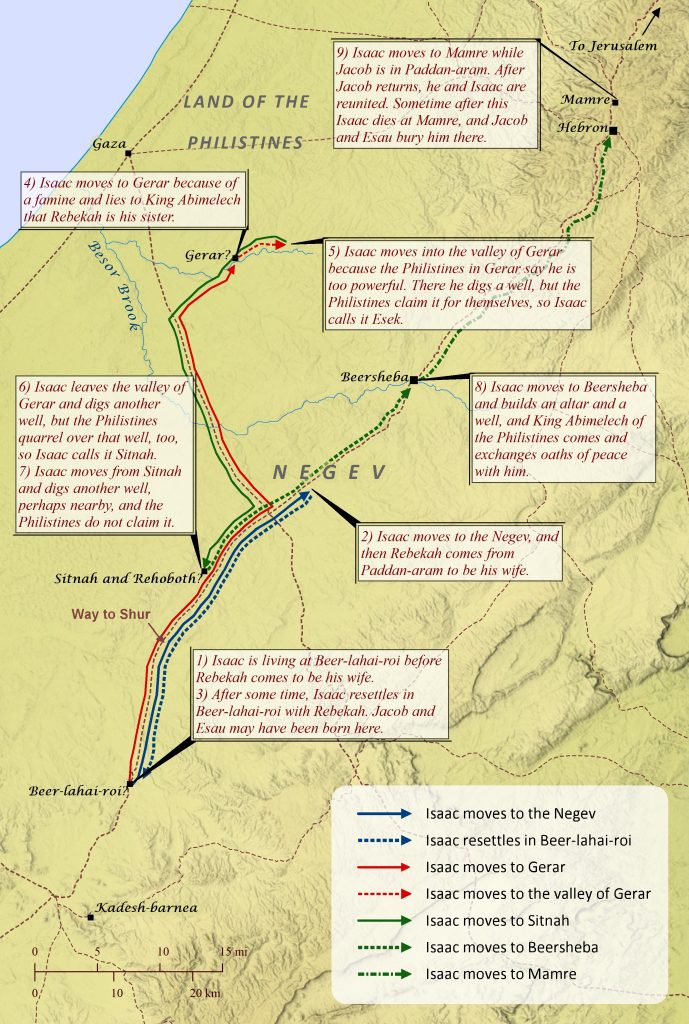
THE BLESSING CONTINUE TO FLOW
FROM ABRAHAM TO ISAAC
It came about after the death of Abraham - This marks a major transition in the unfolding history of redemption. Abraham, the great patriarch and first recipient of God's covenant promises did not interrupt the redemptive purpose of God, for He had promised that His covenant would continue through Isaac the son of promise (Ge 17:19, 21; 21:12). God buries His servants, but He never buries His promises! Abraham's earthly pilgrimage had ended, but God's covenant purposes were moving forward exactly as He had ordained. God buried His servant Abraham, but did not bury His promises to Abraham!
John Currid - after the death of - The clause ‘after the death of’ appears only here in the Pentateuch. It later occurs in Joshua 1:1 (referring to the death of Moses), Judges 1:1 (the death of Joshua) and 2 Samuel 1:1 (thee death of Saul). It signifies the end of an era or period with the death of the major figure of the time. Thus, the major section of the narrative dealing with Abraham is closing, and a new era—centring on Isaac, Jacob and Esau—will soon begin. (Genesis)
God buries His workmen
and carries on His work.
This is the simple but significant truth taught in this verse that immediately follows the burial of Abraham.
that God blessed his son Isaac - Moses specifically attributes Isaac's blessing to God Himself. The Hebrew verb barak conveys the idea of bestowing favor, benefit, and prosperity. This blessing was not simply a natural inheritance from father to son but the continuation of God's covenant. God had previously declared to Abraham, "I will establish My covenant with him (ISAAC) for an everlasting covenant for his descendants after him" (Ge 17:19). This blessing would include God's provision during famine, His reassurance concerning the Abrahamic covenant, and His multiplication of Isaac's possessions (Ge 26:2–5, 12–14, 24).
Sailhamer - "In the short span of one chapter, the writer shows how Isaac's entire life was a repetition of that which happened to Abraham. Thus the lesson is that God's faithfulness in the past can be counted on in the present and the future. What he has done for the fathers, he will also do for the sons. (See The Pentateuch as Narrative: A Biblical-Theological Commentary)
W H Griffith-Thomas - The second half of Genesis contains the generations of Ishmael (Ge 25:12–18), of Isaac (Ge 25:19–35:29), of Esau (Ge 36:1–43), and of Jacob (Ge 37:2–50:26). The record deals very briefly with the stories of Ishmael and Esau, the brevity indicating the definite purpose of Genesis, which is to show the fulfilment of the promise to Abraham and the development of God’s purpose of redemption (Ge 3:15).
NET NOTE - God blessed Isaac. The Hebrew verb “bless” in this passage must include all the gifts that God granted to Isaac. But fertility was not one of them, at least not for twenty years, because Rebekah was barren as well (see v. 21).
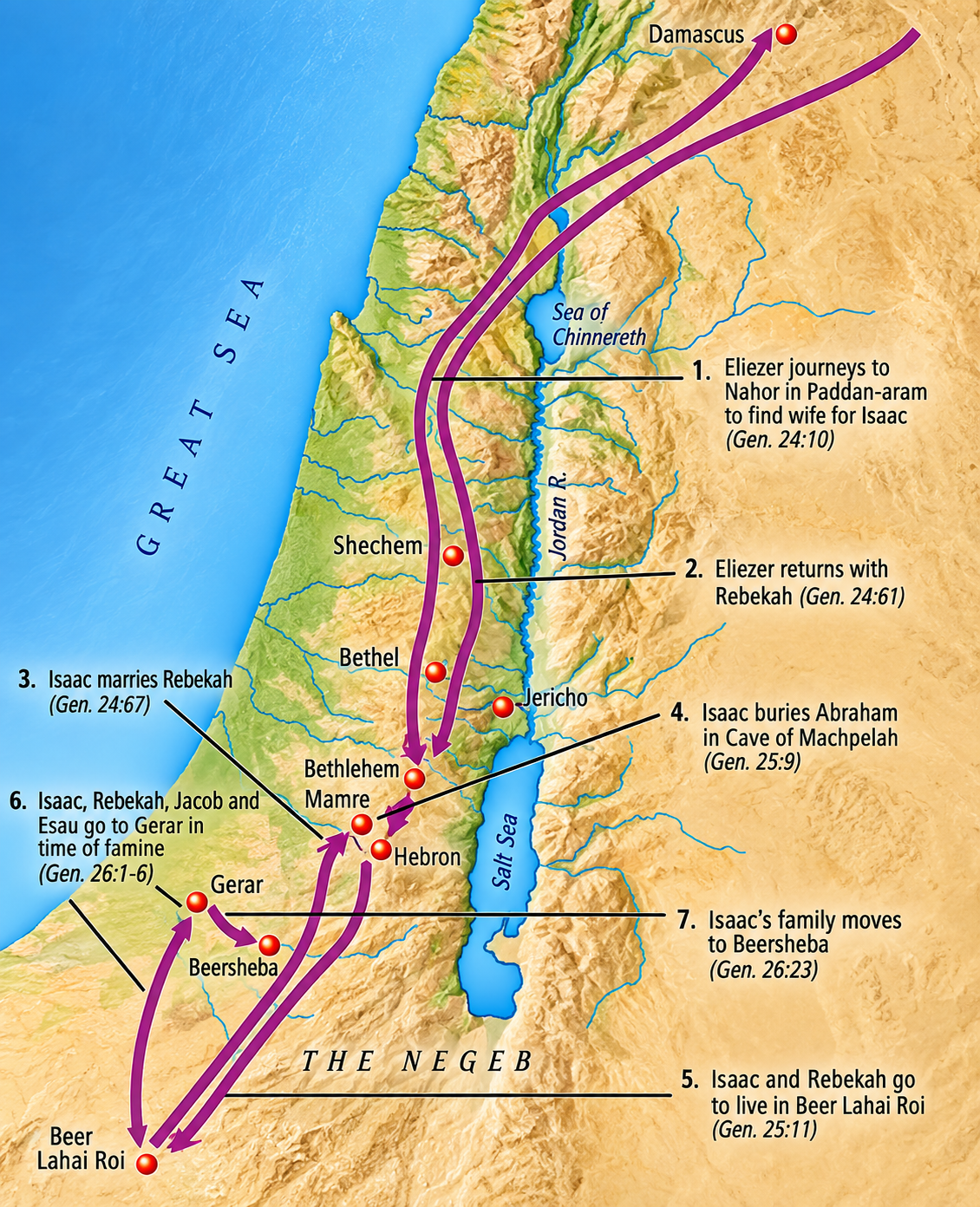
After Abraham's death Isaac and Rebekah went to Beer-lahai-roi
And Isaac lived by Beer-lahai-roi - This geographical detail is more significant than it might first appear. Beer-lahai-roi means approximately "the well of the Living One Who sees me" or "the well of Him Who lives and sees me." The name originated when Hagar, fleeing from Sarah, encountered the Angel of the LORD near a spring in the wilderness (Ge 16:7–14). There she acknowledged the God Who had seen her in her distress, and the well received its memorable name. Isaac had previously come from Beer-lahai-roi before meeting Rebekah (Ge 24:62–67). Now Moses tells us that Isaac was living near this same location following Abraham's death. The text does not explicitly explain why Isaac chose to reside there, but the place name provides a striking reminder of God's watchful care.
Archaeologists have yet to locate Beer-lahai-roi with certainty. It was evidently somewhere south of Beersheba in the Negev, “between Kadesh and Bered” (Ge 16:14), on the road to Shur toward Egypt (Ge 16:7). Some have proposed ʿAin Muweilih, a spring on the caravan route west of Kadesh-barnea, but no identification has been confirmed. It is a fitting place for the son of promise to live. God had blessed Isaac (Ge 25:11), and his home was beside a well named for the truth that God sees and cares for His own. The same God who saw a frightened Egyptian slave in the wilderness continued to watch over Abraham’s heir. He still sees each of His children today (Ps 33:18; 1Pe 3:12).
Hagar had encountered the God Who sees the afflicted at Beer-lahai-roi, and now Isaac, the son of promise, dwells near that same well. The God Who saw Hagar in her distress was the same God Who blessed Isaac after his father's death! God's watchful care extends beyond individual lives and generations (Ps 33:18; 121:4).
Spurgeon - Isaac dwelt there, and made the well of the living and all-seeing God his constant source of supply. The usual tenor of a man’s life, the dwelling of his soul, is the true test of his state. Let us learn to live in the presence of the living God. Let us pray the Holy Spirit that this day, and every other day, we may feel, “Thou God seest me.” May the Lord Jehovah be as a well to us, delightful, comforting, unfailing, springing up into eternal life. The bottle of the creature cracks and dries up, but the well of the Creator never fails., Happy is he who dwells at the well, and so has abundant and constant supplies near at hand! Glorious Lord, constrain us that we may never leave Thee, but dwell by the well of the living God!
C H Spurgeon - “Isaac dwelt by the well Lahai-roi.” —Genesis 25:11
Hagar had once found deliverance there and Ishmael had drank from the water so graciously revealed by the God who liveth and seeth the sons of men; but this was a merely casual visit, such as worldlings pay to the Lord in times of need, when it serves their turn. They cry to him in trouble, but forsake him in prosperity. Isaac dwelt there, and made the well of the living and all-seeing God his constant source of supply. The usual tenor of a man’s life, the dwelling of his soul, is the true test of his state. Perhaps the providential visitation experienced by Hagar struck Isaac’s mind, and led him to revere the place; its mystical name endeared it to him; his frequent musings by its brim at eventide made him familiar with the well; his meeting Rebecca there had made his spirit feel at home near the spot; but best of all, the fact that he there enjoyed fellowship with the living God, had made him select that hallowed ground for his dwelling. Let us learn to live in the presence of the living God; let us pray the Holy Spirit that this day, and every other day, we may feel, “Thou God seest me.” May the Lord Jehovah be as a well to us, delightful, comforting, unfailing, springing up unto eternal life. The bottle of the creature cracks and dries up, but the well of the Creator never fails; happy is he who dwells at the well, and so has abundant and constant supplies near at hand. The Lord has been a sure helper to others: his name is Shaddai, God All-sufficient; our hearts have often had most delightful intercourse with him; through him our soul has found her glorious Husband, the Lord Jesus; and in him this day we live, and move, and have our being; let us, then, dwell in closest fellowship with him. Glorious Lord, constrain us that we may never leave thee, but dwell by the well of the living God.
QUESTION - Why was a father's blessing so highly valued in the Old Testament?
ANSWER - The book of Genesis emphasizes the blessing of a father to his sons. The patriarchs Abraham, Isaac, and Jacob all gave formal blessings to their children—and, in Jacob’s case, to some grandchildren. Receiving a blessing from one’s father was a high honor, and losing a blessing was tantamount to a curse.
An Old Testament blessing of a father to his sons included words of encouragement, details regarding each son’s inheritance, and prophetic words concerning the future. For example, Isaac’s blessing on Jacob (which was meant for Esau) gave him the earth’s bounty and authority over his brother (Genesis 27:28-29). It also promised that those who blessed Jacob would be blessed, and those who cursed him would receive a curse—words that echo God’s promise to Abraham in Genesis 12:3.
When Esau discovered that Jacob had deceived his father and had received the blessing meant for Esau, he was distraught and asked, “Have you not reserved a blessing for me?” (Genesis 27:36). Isaac’s words to Esau reinforced Jacob’s superiority but also prophesied that Esau would one day rebel against Jacob’s rule (Ge 27:39-40).
When Jacob blessed his twelve sons, he also made predictions regarding their future (Genesis 49). The Bible records the direct fulfillment of many of these predictions, revealing the supernatural ability given to Jacob as the father of the twelve tribes.
In one of his blessings, Jacob said, “Judah, your brothers shall praise you; your hand shall be on the neck of your enemies; your father’s sons shall bow down before you” (Genesis 49:8). The blessing also included a prediction that kings would come from Judah and that one King would eventually receive “the obedience of the nations” (verse 10). Judah’s descendants later became the tribe from which King David came and in whose land Jerusalem was located. Jesus Christ would also come from the tribe of Judah (Matthew 1:3).
Another example of a supernatural prediction in Jacob’s blessing is found in his words to Issachar: “He saw that a resting place was good, and that the land was pleasant” (Genesis 49:15). Issachar’s family would later inherit lower Galilee, including the Valley of Jezreel, which included rich, productive farmland.
Jacob’s youngest son also received a prophecy that was later fulfilled: “Benjamin is a ravenous wolf, in the morning devouring the prey and at evening dividing the spoil” (Genesis 49:27). The tribe of Benjamin would produce many military leaders in Israel, including Ehud, King Saul, and Saul’s son Jonathan, revealing a strong, warlike personality (Judges 5:14; 20:16; 1 Chronicles 8:40; 2 Chronicles 14:8; 17:17).
A patriarch’s final blessing was important in biblical times as a practical matter of inheritance rights. In addition, some final blessings included prophetic statements that reveal God’s supernatural power at work through the men of His choosing.
Related Resources:
QUESTION - What is the biblical significance of Beer Lahai Roi? - GotQuestions.org
ANSWER - Beer Lahai Roi is a place first mentioned in Genesis 16. God had promised Abram children, but it had been years and still no children had come. Abram’s wife, Sarai, suggests that Abram take Sarai’s slave girl Hagar and have a child with her. In the thinking of the day, the slave girl would have the child for her mistress. (We see the same sort of thinking with Jacob and his wives and their slave women in Genesis 30.)
The plan is successful, and Hagar conceives. However, as might be expected, strife and jealousy ensue. Hagar feels prideful, and Sarai blames Abram. Abram tells Sarai to deal with the situation however she sees fit. So she mistreats Hagar, and Hagar runs away, fleeing into the desert. Then we read of the origin of Beer Lahai Roi as a place name:
“The angel of the LORD found Hagar near a spring in the desert; it was the spring that is beside the road to Shur. And he said, ‘Hagar, slave of Sarai, where have you come from, and where are you going?’
“‘I’m running away from my mistress Sarai,’ she answered.
“Then the angel of the LORD told her, ‘Go back to your mistress and submit to her. . . . I will increase your descendants so much that they will be too numerous to count.’
“The angel of the LORD also said to her:
‘You are now pregnant
and you will give birth to a son.
You shall name him Ishmael,
for the LORD has heard of your misery. . . .’
“She gave this name to the LORD who spoke to her: ‘You are the God who sees me,’ for she said, ‘I have now seen the One who sees me.’ That is why the well was called Beer Lahai Roi; it is still there, between Kadesh and Bered” (Genesis 16:7–14).
Beer Lahai Roi literally means “the well of him that lives and sees me” or “the well of the vision of life.” Regardless of the exact translation, Hagar named the location thus because the Living God saw her situation and intervened to give her hope and comfort.
The same location is mentioned two other times as the place where Isaac was living. Genesis 24:62 says, “Now Isaac had come from Beer Lahai Roi, for he was living in the Negev,” and Genesis 25:11 adds, “After Abraham’s death, God blessed his son Isaac, who then lived near Beer Lahai Roi.”
When Moses recorded the incident involving Hagar and the angel, it was more than 400 years later. Apparently, the well was still known to people in Moses’ day, and it went by the same name. The use of the name Beer Lahai Roi would have illustrated to the Hebrews that Abram and his family had been active in the land of Canaan long before the exodus and that God, through Moses, was simply bringing the people back in fulfillment of His promise to Abram. He is the Living God who saw the plight of the Egyptian slave Hagar, and He also saw the plight of the Israelites when they were enslaved in Egypt.
Beer Lahai Roi can also be a reminder to us that the Living God sees our plight. When we were enslaved by sin and under the sentence of death, He saw us—that is, He knew our condition and had pity. El Roi, the God Who Sees, has done everything necessary to save us, coming to us in a manger, which led to a cross and a glorious resurrection.
Genesis 25:12 Now these are the records of the generations of Ishmael, Abraham’s son, whom Hagar the Egyptian, Sarah’s maid, bore to Abraham;
- Ge 16:10-15 17:20 21:13 Ps 83:6
Related Passages:
Genesis 16:10-15 Moreover, the angel of the LORD said to her, “I will greatly multiply your descendants so that they will be too many to count.” 11 The angel of the LORD said to her further, “Behold, you are with child, And you will bear a son; And you shall call his name Ishmael, Because the LORD has given heed to your affliction. 12 “He will be a wild donkey of a man, His hand will be against everyone, And everyone’s hand will be against him; And he will live to the east of all his brothers.” 13 Then she called the name of the LORD who spoke to her, “You are a God who sees”; for she said, “Have I even remained alive here after seeing Him?” 14 Therefore the well was called Beer-lahai-roi; behold, it is between Kadesh and Bered. 15 So Hagar bore Abram a son; and Abram called the name of his son, whom Hagar bore, Ishmael.
Genesis 17:20 “As for Ishmael, I have heard you; behold, I will bless him, and will make him fruitful and will multiply him exceedingly. He shall become the father of twelve princes, and I will make him a great nation.
Genesis 21:18 “Arise, lift up the lad (ISHMAEL), and hold him by the hand, for I will make a great nation of him.”
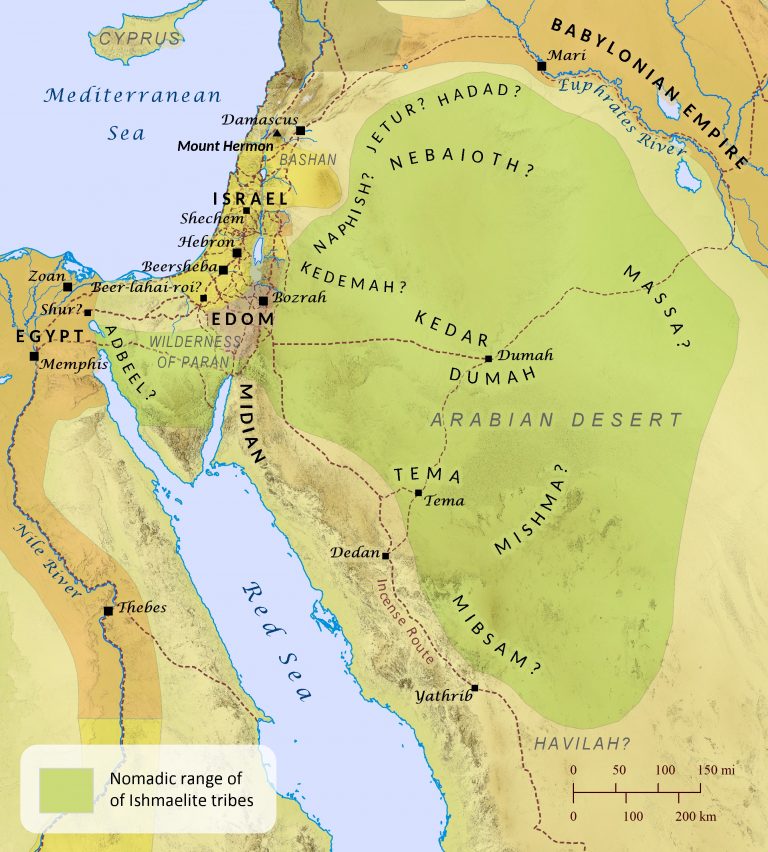
Nomadic Range of Ishmael’s Descendants
Source: Biblemapper
WHAT GOD PROMISED
GOD PERFORMED
Now these are the records of the generations (toledoth) of Ishmael, Abraham’s son, whom Hagar the Egyptian, Sarah’s maid, bore to Abraham - This genealogy (Ge 25:12–16) records the fulfillment of God's earlier promise concerning Ishmael (Ge 17:20). Although Ishmael was not the son through whom God would establish His covenant (Ge 17:19–21), he was not forgotten or excluded from God's providential blessing. God had specifically promised Abraham that Ishmael would be fruitful, would multiply exceedingly, and would become the father of twelve princes and a great nation (Ge 17:20). Genesis 25:13–16 names exactly twelve sons of Ishmael, demonstrating that God's promise was fulfilled precisely as He had spoken. The genealogy is therefore far more than a list of ancient names but is a testimony to the faithfulness of God, Who keeps His promises even to those outside the covenant line of Isaac.
Warren Wiersbe - Ishmael pictures the “natural” or unsaved person (1 Cor. 2:14), who is outside the faith and hostile to the things of God. But Isaac pictures those who have trusted Jesus Christ and experienced the miraculous new birth by the power of God (1 Peter 1:22–23). “Now we, brethren, as Isaac was, are the children of promise” (Gal. 4:28KJV). Ishmael was born a slave, but Isaac was born free (Gal 4:21–31; 5:1–2); and Ishmael was born poor, but Isaac was born rich. Every believer in Jesus Christ shares all the blessings of the Spirit in Christ (Eph. 1:3) and is part of Christ’s glorious inheritance (Eph 1:11, 18). (Bible Exposition Commentary)
Allen Ross - The last four toledoth sections of the Book of Genesis follow a definite pattern: the lines in each generation that are not chosen lines are traced before the narrative returns to the chosen line. Immediately after the death report of Abraham we have the tôledôt of Ishmael, which is a brief listing of names (Ge 25:12–18). Once this account has been completed, the narrative returns to the main line, the tôledôt of Isaac (Ge 25:19–35:29). This section concerns the record of Isaac, how the blessing had in fact passed to him, but essentially focuses on Jacob. After the Jacob stories come to their intended conclusion, that is, reporting how Jacob with his family and his flocks settled in the Land of Promise, the narrative turns to the next generation. First we have the tôledôt of Esau (two tôledôt headings for a complete tracing of the Edomites), in which the descendants and vassals of Edom are listed (Ge 36:1–8 and Ge 36:9–37:1). Once this line has been surveyed, the narrative returns to the main line, to the tôledôt of Jacob (Ge 37:2–50:26). This last section of the book is essentially the story of Joseph, although Jacob figures in it at the beginning and the end. Since the Joseph story is unique within the Book of Genesis, I treat that section in a separate part. In this part I consider the rest of the patriarchal narratives. (Creation and Blessing: A Guide to the Study and Exposition of Genesis)
NET NOTE - This is the account of Ishmael. The Book of Genesis tends to tidy up the family records at every turning point. Here, before proceeding with the story of Isaac’s family, the narrative traces Ishmael’s family line. Later, before discussing Jacob’s family, the narrative traces Esau’s family line (see Gen 36)
The twelve sons of Ishmael are twelve witnesses
that God never forgets a promise He has made!
whom Hagar the Egyptian, Sarah’s maid, bore to Abraham - Moses carefully identifies Ishmael's parentage, reminding readers of the circumstances surrounding his birth (Ge 16:1–16). Ishmael was Abraham's firstborn son, born through Hagar as a result of Abraham and Sarah's attempt to obtain the promised offspring through human planning rather than waiting for God's appointed time. Nevertheless, human failure did not nullify divine faithfulness! Although Ishmael was not the heir of the covenant, God heard Abraham's prayer for him (Ge 17:18–20) and faithfully fulfilled His promise concerning Ishmael's descendants.
QUESTION - Who was Ishmael in the Bible? - GotQuestions.org
ANSWER - Ishmael is considered a patriarch of Islam based upon legends that have developed around him and information found in the Qur’an. But what does the Bible tell us about Ishmael?
Ishmael was the firstborn son of Abraham. God had appeared to Abraham and promised that he would have a son and that he would be the father of many nations (Genesis 15). However, as time went on, Abraham had no children. His wife, Sarah, had been unable to conceive, and they began to question just how the promise would be fulfilled.
In Genesis 16 Sarah suggests that Abraham should have a child with her slave Hagar, an Egyptian. Apparently, this was a somewhat common practice at the time (also practiced in Genesis 30 by Jacob’s wives): the wife would give a female slave to her husband, but any children born would be counted as the children of the wife (perhaps an ancient version of surrogacy). While this may have seemed like a workable solution for Abraham and Sarah, in actuality it caused more problems than it solved.
Hagar did conceive a child with Abraham. When Hagar knew she was pregnant, she began to “despise” Sarah, and Sarah appealed to Abraham for help. Abraham told Sarah to do as she saw fit, so she began to mistreat Hagar, and Hagar ran away (Genesis 16:4–6).
The angel of the Lord found Hagar in the desert and told her to return to Sarah. He then told her about her yet unborn son: “You are now pregnant and you will give birth to a son. You shall name him Ishmael, for the Lord has heard of your misery. [Ishmael means “God hears.”] He will be a wild donkey of a man; his hand will be against everyone and everyone’s hand against him, and he will live in hostility toward all his brothers” (Genesis 16:11–12). So Hagar went back and bore a son; Abraham was 86 years old.
In Genesis 17, when Abraham is 99 years old (making Ishmael approximately 13), God appeared to him once again and reiterated the promise that he would be the father of many nations. God told Abraham that Sarah, who was 90 years old, will have a son. Abraham had a hard time believing this and asked that God would fulfill His promises through Ishmael (verse 18). From this we can see that Abraham genuinely loved Ishmael. But God said the promise will be fulfilled through a son that Sarah will bear: “Your wife Sarah will bear you a son, and you will call him Isaac. I will establish my covenant with him as an everlasting covenant for his descendants after him. And as for Ishmael, I have heard you: I will surely bless him; I will make him fruitful and will greatly increase his numbers. He will be the father of twelve rulers, and I will make him into a great nation. But my covenant I will establish with Isaac, whom Sarah will bear to you by this time next year” (verses 19–21).
In Genesis 21, Sarah’s son, Isaac, is born, and once again problems arise. Sarah sees Ishmael mocking the young Isaac, and she demands action from Abraham: “Get rid of that slave woman and her son, for that woman’s son will never share in the inheritance with my son Isaac” (verse 10).
“The matter distressed Abraham greatly because it concerned his son. But God said to him, ‘Do not be so distressed about the boy and your slave woman. Listen to whatever Sarah tells you, because it is through Isaac that your offspring will be reckoned. I will make the son of the slave into a nation also, because he is your offspring’” (Genesis 21:11–13). Once again, Abraham’s love for his son Ishmael comes through, and God promises to bless Ishmael. Abraham gathered some provisions and sent Hagar and Ishmael away. After the provisions had been exhausted, Hagar and Ishmael were overcome with grief, assuming that they would die in the desert. “God heard the boy crying, and the angel of God called to Hagar from heaven and said to her, ‘What is the matter, Hagar? Do not be afraid; God has heard the boy crying as he lies there. Lift the boy up and take him by the hand, for I will make him into a great nation.’ Then God opened her eyes and she saw a well of water. So she went and filled the skin with water and gave the boy a drink” (verses 17–19). Once again, God appeared to Hagar and promised that Ishmael will be a great nation. Finally, we are told that “God was with the boy as he grew up. He lived in the desert and became an archer. While he was living in the Desert of Paran, his mother got a wife for him from Egypt” (verses 20–21).
Upon Abraham’s death, he left everything to Isaac, but Ishmael did help his half-brother bury Abraham (Genesis 25:9). Genesis 25:12–18 lists the descendants of Ishmael. They are indeed numerous, divided into twelve tribes, and, as God had earlier revealed, “They lived in hostility toward all the tribes related to them” (verse 18). Ishmael lived a total of 137 years (verse 17).
Genesis 25 is the last mention of Ishmael as an individual (except for later genealogies); however, his descendants continue to be mentioned in relation to Israel. Esau marries a descendant of Ishmael since his mother did not want him to marry Canaanite women (see Genesis 28:6–8; 36:3). Ishmaelites are mentioned as a people group in Genesis 37—Joseph’s brothers sold him to Ishmaelite traders who took him to Egypt as a slave. Ishmaelites are mentioned incidentally a few more times in the Old Testament (as well as other, unrelated men named Ishmael), but the New Testament is silent about him. Ishmael is not held up as an example either to be followed or avoided.
Islamic lore reports that Abraham took Hagar and Ishmael to Mecca, and Ishmael is considered a patriarch of Islam. While it is not accurate to say that all Arabs are descended from Ishmael, many probably are. There is still a great deal of strife between the descendants of Isaac and those who see Ishmael as their father. One wonders how things might have been different had Abraham simply trusted God to bring about His promise without any added “help” from Abraham and Sarah.
Genesis 25:13 and these are the names of the sons of Ishmael, by their names, in the order of their birth: Nebaioth, the firstborn of Ishmael, and Kedar and Adbeel and Mibsam
- the names (KJV): 1Ch 1:29-31
- Nebajoth (KJV): Ge 36:3 Isa 60:7
- Kedar (KJV): Ps 120:5 Song 1:5 Isa 21:16,17 42:11
Related Passages:
1 Chronicles 1:29-31 These are their genealogies: the firstborn of Ishmael was Nebaioth, then Kedar, Adbeel, Mibsam, 30 Mishma, Dumah, Massa, Hadad, Tema, 31 Jetur, Naphish and Kedemah; these were the sons of Ishmael.
Isaiah 60:7 “All the flocks of Kedar will be gathered together to you, The rams of Nebaioth will minister to you; They will go up with acceptance on My altar, And I shall glorify My glorious house.
GOD'S PROMISE FULFILLED
NAME BY NAME
And these are the names of the sons of Ishmael - This begins the list of the 12 sons of Ishmael fulfilling the promise of Ge 17:20 that he would "become the father of twelve princes." (like 12 sons of Jacob and Nahor) Once again we see the faithfulness of the God Who cannot lie (Nu 23:19; Titus 1:2).
By their names, in the order (toledoth) of their birth - The careful recording of each son's name emphasizes that God's promise was fulfilled through real individuals and successive generations. The expression translated "in the order of their birth" reflects the Hebrew toledot, referring to generations, descendants, or family history. The names preserve the historical development of Ishmael's family into the tribal groups described in Genesis 25:16.
NET NOTE- The meaning of this line is not easily understood. The sons of Ishmael are listed here “by their names” and “according to their descendants.”
Nebaioth, the firstborn of Ishmael, and Kedar and Adbeel and Mibsam - Nebaioth is explicitly identified as Ishmael's firstborn. His descendants are commonly associated with Arabian tribal populations, and his name appears again in Isaiah's prophetic description of nations bringing their wealth and flocks to Zion (Isa 60:7). Isaiah mentions Nebaioth alongside Kedar, indicating that these names continued to identify recognizable peoples many centuries after Ishmael's death.
Kedar - Kedar became one of the best-known tribes descended from Ishmael. His descendants were associated with nomadic pastoral life, particularly sheep and goats (Isa 60:7; Jer 49:28–29). The name Kedar appears repeatedly in the Old Testament, sometimes representing Arabian peoples more broadly. The psalmist speaks of dwelling among the tents of Kedar (Ps 120:5), while Solomon's bride compares her dark appearance to the tents of Kedar (Song 1:5). Jeremiah also identifies Kedar as a people dwelling in the eastern desert regions (Jer 49:28–33). These references demonstrate the continuing historical significance of Ishmael's descendants.
And Adbeel and Mibsam – These are the third and fourth sons of Ishmael. Unlike Nebaioth and Kedar, Scripture provides little additional information concerning their individual histories. Adbeel and Mibsam are also named in the parallel genealogy of 1 Chronicles 1:29.
Generations (genealogical registration)(08435) toledoth from yalad = to bear, bring forth, beget) This word carries with it the notion of everything entailed in a person's life and that of his or her progeny.
TWOT The precise meaning of this derivative of yālad "to bring forth," will be discussed below. It occurs only in the plural, and only in the construct state or with a pronominal suffix. In the KJV it is always translated "generations" except for one case (two in the RSV) where it is rendered "birth." RSV generally translates it "generations" but occasionally uses "genealogy." In six occurrences it renders it as "descendants" and once as "history."
The common translation as "generations" does not convey the meaning of the word to modern readers. The English word "generation" is now limited almost entirely to two meanings: (1) the act of producing something or the way it is produced; (2) an entire group of people living at the same period of time, or the average length of time that such a group of people live. Neither of these meanings fits the usage of tôlēdôt.
As used in the OT, tôlēdôt refers to what is produced or brought into being by someone, or follows therefrom. In no case in Genesis does the word include the birth of the individual whose tôlēdôt it introduces (except in Genesis 25:19, where the story of Isaac's life is introduced by reference to the fact that he was the son of Abraham). After the conclusion of the account in which Jacob was the principal actor, Genesis 37:2 says, "These are the tôlēdôt of Jacob" and proceeds to tell about his children and the events with which they were connected.
In line with these usages it is reasonable to interpret Genesis 2:4, "These are the tôlēdôt of heaven and earth," as meaning, not the coming of heaven and earth into existence, but the events that followed the establishment of heaven and earth. Thus the verse is correctly placed as introducing the detailed account of the creation and fall of man. It is not a summary of the events preceding Genesis 2:4.
The often repeated statement that the book of Genesis is divided into natural sections by the word tôlēdôt does not work out on close examination. Sometimes, as in Genesis 36:9, it merely introduces a genealogical table.
In Genesis 10:32; Genesis 25:13; Exodus 6:16, 19 and in eight of the nine occurrences in 1 Chronicles the word is introduced by the preposition l and in Exodus 28:10 it is introduced by k. The significance of the prepositions is not clear, particularly since we have no other evidence relating to the history of the sons of Ishmael (Genesis 25:13) or the arrangement of the stones on the breastplate (Exodus 28:10). Therefore we do not know in accordance with what principle the arrangement was made. In both cases the word "birth" must be considered to be only a guess. (TWOT online)
QUESTION - Who are the descendants of Ishmael? - GotQuestions.org -
ANSWER - Ishmael was a son of Abraham, born of Sarah’s maidservant Hagar in an attempt to bring into the world the son God had promised to Abraham and Sarah. Later, Isaac was born to Abraham and Sarah, and Hagar and Ishmael were driven away because of Ishmael’s attitude toward Isaac (Genesis 21:9–10, 14). But God still had plans for Ishmael.
God promised Hagar that Ishmael, as a son of Abraham, would become a great nation (Genesis 21:17–18). The fulfillment is recorded in Genesis 25:12–18—Ishmael had twelve sons who became great rulers and eventually a nation of people. That came about in this way: Hagar, who was Egyptian herself, found a wife from Egypt for her son, and Ishmael settled in the desert of Paran (Genesis 21:21). Ishmael’s descendants “settled in the area from Havilah to Shur, near the eastern border of Egypt as you go toward Ashur” (Genesis 25:18). The Bible lists Ishmael’s sons as Nebaioth, Kedar, Adbeel, Mibsam, Mishma, Dumah, Massa, Hadad, Tema, Jetur, Naphish, and Kedemah (Ge 25:13–15).
The descendants of Ishmael became known as Arabs,
which basically means “nomads.”
The area of Havilah where Ishmael’s descendants lived is in the northern part of the Arabian Peninsula; Shur is a wilderness area between Beersheba in the Negev Desert and Egypt. Isaiah 60:7 mentions the descendants of Nebaioth and Kedar as those who raise flocks. The descendants of Ishmael became known as Arabs, which basically means “nomads.” From the beginning, the descendants of Ishmael were a warlike people, as “they lived in hostility toward all the tribes related to them” (Genesis 25:18). This fulfilled God’s earlier word that Ishmael would be “a wild donkey of a man; his hand will be against everyone and everyone’s hand against him, and he will live in hostility toward all his brothers” (Genesis 16:12).
Later, others settled in the Arabian Peninsula as well, including the descendants of Keturah’s sons (1 Chronicles 1:32–33) and some of Esau’s descendants, among them the Amalekites (Genesis 36:12).
There is a popular theory common among Muslims and some Christians that Arabian Muslims are direct descendants of Ishmael. In fact, Muhammad was a major proponent of this idea, claiming to be a descendant of Ishmael according to the Quran. There is most likely some truth in this theory. According to missionary and author Kenneth Fleming, “what we know for certain seems to support the theory that the Ishmaelites are, at the very least, a major element in the Arab genetic line. Old records clearly link the north Arabians with Ishmael’s descendants” (“Ishmael and the Bible,” Emmaus Journal 13:2, 2004). But it’s unlikely that all of those in Arabia are descendants of Ishmael, as the descendants of Keturah and the children of Esau also lived in the Arabian Peninsula.
Although some modern Arabians could trace their lineage back to Ishmael, not all Arabians are descendants of Ishmael as Muslims try to claim. We know from the Bible that God made Ishmael into a great nation. His descendants can share in the blessings of Abraham by putting their faith in Jesus Christ for salvation.
QUESTION - What is the significance of Kedar in the Bible? - GotQuestions.org
ANSWER - Kedar is the name of Ishmael’s second son (Genesis 25:13, 1 Chronicles 1:29). The other instances of Kedar in the Bible refer to the Arabian descendants of Kedar and/or the territory where they settled.
A few details about Kedar are mentioned:
• Apparently, Kedar was known for dark-colored tents: “Dark am I, yet lovely, daughters of Jerusalem, dark like the tents of Kedar, like the tent curtains of Solomon” (Song of Songs 1:5). Since the people of Kedar were known for their tents, we can assume that they were also nomadic.
• God uses Kedar as an example for Israel. Israel had exchanged God for a false god. No other country had ever changed her gods. Kedar had remained faithful to her false gods, but Israel had been unfaithful to the true God (Jeremiah 2:10).
• Kedar was a trading partner of Tyre (Ezekiel 27:21). Since this passage is in the lament over the fall of Tyre, it would appear that Kedar was a significant trading partner.
In several passages of Scripture, Kedar is the recipient of divine judgment:
• Isaiah 21:16–17: “This is what the Lord says to me: ‘Within one year, as a servant bound by contract would count it, all the splendor of Kedar will come to an end. The survivors of the archers, the warriors of Kedar will be few.’ The Lord, the God of Israel, has spoken.”
• Jeremiah 49:28: “Concerning Kedar and the kingdoms of Hazor, which Nebuchadnezzar king of Babylon attacked: This is what the Lord says: ‘Arise, and attack Kedar and destroy the people of the East.’”
• Isaiah 60:7: “All Kedar’s flocks will be gathered to you, the rams of Nebaioth will serve you; they will be accepted as offerings on my altar, and I will adorn my glorious temple.” In other words, the flocks that Kedar owns will one day belong to Israel.
• The faithful Israelite would view the territory of Kedar as a place of banishment from the Lord: “Woe to me that I dwell in Meshek, that I live among the tents of Kedar!” (Psalm 120:5).
Isaiah 42:11 looks forward to a future day when those in such areas as Kedar will join in praise to God. Regardless of their history, people of every tribe, tongue, people, and nation will be included in the Body of Christ (Revelation 4:9–10).
QUESTION - What is a toledot? - GotQuestions.org
ANSWER - The Hebrew word toledot (also seen as toldot) is most often translated “generations.” Toledot is the story or genetic line that came from—generated from—a person or event.
Genesis lists nine specific toledot:
– Creation – Genesis 2:4
– Adam – Genesis 5:1
– Noah and his sons – Genesis 6:9; 10:1, 32
– Shem – Genesis 11:10
– Terah – 11:27
– Ishmael – Genesis 25:12-13; 1 Chronicles 1:29
– Isaac – Genesis 25:19
– Esau – Genesis 36:1, 9
– Jacob – Genesis 37:2
Toledot can have slightly different meanings depending on the context. In Genesis 2:4, it’s used somewhat metaphorically as “heaven and earth” don’t literally procreate. Instead, the word refers to the events that came about with the advent of heaven and earth—namely, all of human history.
In the other instances in Genesis, toledot identifies both the progeny of these men and the stories that ensued in their time—we might say the “era” in which they lived. The toledot or generations don’t necessarily end when the next begin; they’re more layered, each encompassing those that come after.
In other places, the word is used more narrowly to mean a family line both from the direction of the patriarch down (Exodus 6:16; Numbers 1; 3:1; Ruth 4:18) and from a contemporary figure back (1 Chronicles 7:2, 4, 9; 8:28; 9:9, 34; 26:31).
Moses wrote the book of Genesis while the Israelites were wandering in the desert. The stories gave the Israelites a place in history—an identity—which was important for a people coming out of four hundred years of slavery in a foreign country. Knowing the toledot they came from gave the Israelites context for what God was asking of them when they entered the Promised Land and linked later Israelites to the great men and the mighty deeds of long before. Most of all, the toledot showed them how God had worked in the past and how He was sure to work in the present.
Genesis 25:14 and Mishma and Dumah and Massa,
- Dumah (KJV): Isa 21:11,16
THREE MORE NAMES AFFIRM
GOD'S UNCHANGING PROMISE
and Mishma and Dumah and Massa - Together, Mishma ("hearing"), Dumah ("silence"), and Massa ("burden") illustrate the historical expansion of Ishmael's family. Although the biblical record gives us few details about their individual lives, their names are preserved as part of the fulfillment of God's promise to Abraham.
Genesis 25:15 Hadad and Tema, Jetur, Naphish and Kedemah.
GOD'S PROMISE COMPLETED
NAME BY NAME
Hadad and Tema, Jetur, Naphish and Kedemah - Together with their seven brothers, they became the founders of the tribal divisions associated with Ishmael's descendants. Genesis 25:16 describes their settlements and encampments, indicating that the promise involved not simply numerous offspring but the development of organized tribal communities.
Genesis 25:16 These are the sons of Ishmael and these are their names, by their villages, and by their camps; twelve princes according to their tribes.
- twelve (KJV): Ge 17:20,23
Related Passages:
Genesis 17:20 “As for Ishmael, I have heard you; behold, I will bless him, and will make him fruitful and will multiply him exceedingly. He shall become the father of twelve princes, and I will make him a great nation.
Joshua 21:45 Not one of the good promises which the LORD had made to the house of Israel failed; all came to pass.
TWELVE PRINCES
ONE FAITHFUL GOD
These are the sons of Ishmael and these are their names, by their villages, and by their camps - Villages (chatser) refers to an enclosure, settlement, village, or courtyard. In this context, the plural describes the settlements associated with Ishmael's descendants. God's promise to multiply Ishmael had resulted not simply in a large family but in developing communities with recognizable settlements.
Twelve princes according to their tribes - What God predicted in Genesis 17:20 ("twelve princes"), He documented in Genesis 25:16! These twelve princes were tribal leaders, not necessarily kings ruling independent kingdoms. The phrase "according to their tribes" indicates that Ishmael's descendants had developed into twelve distinct tribal divisions, each associated with one of his sons. What makes this especially remarkable is that God made this promise before Isaac was born. At that time, Ishmael was Abraham's only son, and Abraham had pleaded, "Oh that Ishmael might live before You!" (Ge 17:18). God answered Abraham's concern by promising blessing to Ishmael while making clear that His covenant would be established through Isaac (Ge 17:19–21).
John Sailhamer on twelve - “As with other lists of names throughout Genesis, the number twelve appears to be a deliberate attempt to set these individuals off as founders of a new and separate people." (See The Pentateuch as Narrative: A Biblical-Theological Commentary)
Genesis 25:17 These are the years of the life of Ishmael, one hundred and thirty-seven years; and he breathed his last and died, and was gathered to his people.
- these are (KJV): Ge 25:7-8
- gathered (KJV): Ge 15:15
Related Passages:
Genesis 25:7-8 These are all the years of Abraham’s life that he lived, one hundred and seventy-five years. 8Abraham breathed his last and died in a ripe old age, an old man and satisfied with life; and he was gathered to his people.
Genesis 37:35 Then all his sons and all his daughters arose to comfort him, but he refused to be comforted. And he said, “Surely I will go down to Sheol in mourning for my son.” So his father wept for him.
ISHMAEL'S
FINAL BREATH
These are the years of the life of Ishmael - Literally “And these are the days of the years of Ishmael.”
One hundred and thirty-seven years; and he breathed his last and died, and was gathered to his people - Moses concludes the account of Ishmael's life by recording his age at death, 137 years. Ishmael was Abraham's firstborn son, born when Abraham was 86 years old (Ge 16:16), fourteen years before Isaac's birth (Ge 21:5). Although Ishmael was not the son through whom God would establish His covenant, he nevertheless experienced the fulfillment of God's promise to bless him, multiply his descendants, and make him the father of twelve princes (Ge 17:20; 25:13–16). His death at 137 years marks the conclusion of a life that began under difficult circumstances but remained under God's providential care.
NET NOTE - “And he was gathered to his people.” In the ancient Israelite view he joined his deceased ancestors in Sheol, the land of the dead.
he breathed his last (expired) and died - YLT - "he expireth," KJV = "he gave up the ghost." (Used 10x in KJV Ge 25:8; Ge 25:17KJV; Ge 35:29KJV; Lam 1:19KJV; Mk 15:37KJV; Mk 15:39KJV; Lk 23:46KJV; Jn 19:30KJV; Acts 5:5KJV; Acts 12:23KJV) The same expression describes Abraham's death in Genesis 25:8 and Isaac's death in Genesis 35:29. Scripture gives us insufficient information to make a definitive judgment about his eternal destiny.
To be gathered to his people occurs elsewhere in connection with the deaths of Isaac (Ge 35:29), Jacob (Ge 49:29, 33), Aaron (Nu 20:24), and Moses (Nu 27:13; Dt 32:50). The expression cannot mean that he was buried where his father had been buried. His long life reminds us that the length of our days is far less important than what we do with the days God gives us! Moses prayed, "Teach us to number our days, that we may present to You a heart of wisdom" (Ps 90:12). James reminds us that our earthly life is like a vapor that appears for a little while and then vanishes away (Jas 4:14). Are you simply counting your years, or are you making your years count for eternity?
John Currid - The three verbs, ‘expired’, ‘died’ and ‘gathered’, were all applied to Abraham in 25:8. This is a formula used in Genesis for the deaths of famous Hebrew leaders (see 35:29). Its use here in the case of Ishmael is unique, for he is not one of the promised seed or line. (Genesis)
T. M. Constance - To be gathered is not to cease to exist, but to continue to exist in another place. Here we learn some of the first facts in the history of the soul after death. Burial and the grave is the first stop in that of the body. “God is not the God of the dead but of the living” (Matthew 22:32; Mark 12:27; Luke 20:38). The faithful of all past ages live with God. The doctrine of immortality runs throughout the Bible. It is said of Enoch, “God took him.” Here again this does not mean Enoch ceased to exist. Elijah is also an illustration of this. This life is a pilgrimage, and men from the beginning of time have looked for a heavenly country or home. The Hebrew hope of heaven was that of resting in Abraham’s bosom. (Explorer's Bible Study)
Genesis 25:18 They settled from Havilah to Shur which is east of Egypt as one goes toward Assyria; he settled in defiance of all his relatives.
KJV And they dwelt from Havilah unto Shur, that is before Egypt, as thou goest toward Assyria: and he died in the presence of all his brethren.
NET His descendants settled from Havilah to Shur, which runs next to Egypt all the way to Asshur. They settled away from all their relatives.
NLT Ishmael's descendants occupied the region from Havilah to Shur, which is east of Egypt in the direction of Asshur. There they lived in open hostility toward all their relatives.
ESV They settled from Havilah to Shur, which is opposite Egypt in the direction of Assyria. He settled over against all his kinsmen.
BGT κατῴκησεν δὲ ἀπὸ Ευιλατ ἕως Σουρ ἥ ἐστιν κατὰ πρόσωπον Αἰγύπτου ἕως ἐλθεῖν πρὸς Ἀσσυρίους κατὰ πρόσωπον πάντων τῶν ἀδελφῶν αὐτοῦ κατῴκησεν
LXE And he dwelt from Evilat to Sur, which is opposite Egypt, until one comes to the Assyrians; he dwelt in the presence of all his brethren.
CSB And they settled from Havilah to Shur, which is opposite Egypt as you go toward Asshur. He lived in opposition to all his brothers.
NIV His descendants settled in the area from Havilah to Shur, near the border of Egypt, as you go toward Asshur. And they lived in hostility toward all their brothers.
YLT and they tabernacle from Havilah unto Shur, which is before Egypt, in thy going towards Asshur; in the presence of all his brethren hath he fallen.
- Havilah (KJV): Ge 2:11 10:7,29 20:1 21:14,21
- as thou (KJV): Ge 13:10
- toward (KJV): 2Ki 23:29 Isa 19:23,24
- died (KJV): Heb. fell, Ge 14:10 Ps 78:64
- in the (KJV): Ge 16:12
Related Passages:
Genesis 16:11-12 The angel of the LORD said to her further, “Behold, you are with child, And you will bear a son; And you shall call his name Ishmael, Because the LORD has given heed to your affliction. 12 “He will be a wild donkey of a man, His hand will be against everyone, And everyone’s hand will be against him; And he will live to the east of all his brothers.”
ISHMAEL'S DESCENDANTS:
THE PROPHECY FULFILLED
They settled from Havilah to Shur - The plural "they" refers to the twelve tribal groups descended from Ishmael (Ge 25:12–16). This statement demonstrates that God's promise to make Ishmael a great nation was not merely a prediction of numerous descendants but included their development into recognizable peoples occupying identifiable territories (Ge 17:20; 21:18).
Havilah – The precise location of Havilah is uncertain. The name appears elsewhere in Scripture, including Genesis 2:11 and Genesis 10:7, 29, but these references do not necessarily identify the same geographical location. In the present context, Havilah is generally understood to refer to a region associated with the Arabian Peninsula, possibly in northern or eastern Arabia. We should be cautious about assigning it a precise location because the biblical evidence does not permit certainty.
Shur which is east of Egypt as one goes toward Assyria – Heb “which is by the face of,” or near the border. Shur was a wilderness region east of Egypt, near the northeastern frontier of Egypt and the Sinai Peninsula (Ge 16:7; Ex 15:22; 1Sa 15:7). Significantly, Hagar encountered the Angel of the LORD near a spring on the way to Shur when she fled from Sarah (Ge 16:7–14). It was there that God announced the birth of Ishmael and described the future character of his descendants (Ge 16:11–12).
He settled in defiance of all his relatives - Literally - "upon the face of all his brothers." NIV - "they lived in hostility toward all their brothers." CSB = "He lived in opposition to all his brothers." Thisrecalls the prophecy given concerning Ishmael before his birth. In Genesis 16:12, the Angel of the LORD declared that Ishmael would be "a wild donkey of a man," that his hand would be against everyone, and everyone's hand against him, and that he would live in the presence of all his brothers.
The Hebrew expression in Genesis 25:18 is closely related to the language of Genesis 16:12. The final clause can be understood as indicating that Ishmael or his descendants settled "in the presence of" or "over against" their relatives. The NASB's rendering, "in defiance of all his relatives," emphasizes the adversarial aspect suggested by the earlier prophecy. However, the Hebrew expression itself does not necessarily mean that Ishmael's descendants were engaged in continuous warfare with every neighboring people. The language can describe their geographical position in relation to their relatives, while the context of Genesis 16:12 suggests a pattern of independence and conflict. The significance is that what God foretold concerning Ishmael before his birth is now reflected in the historical description of his descendants.
While there is some ambiguity about the meaning, the line probably
does give a hint of the Ishmaelite-Israelite conflicts to come.
NET NOTE - Heb "upon the face of all his brothers." This last expression, obviously alluding to the earlier oracle about Ishmael (Gen 16:12), could mean that the descendants of Ishmael lived in hostility to others or that they lived in a territory that was opposite the lands of their relatives. While there is some ambiguity about the meaning, the line probably does give a hint of the Ishmaelite-Israelite conflicts to come.
Bob Utley - Havilah to Shur - This area would control the caravan routes from Egypt to Assyria/Babylon. It was suitable to nomadic, tent-dwelling people. ▣ "he settled in defiance of all his relatives" The phrase "in defiance" has a wide semantical field. Its basic meaning is "face," "presence," or metaphorically "before." It is used earlier in this verse to mean "over against" or "opposite" a geographical location, but here it denotes opposition to other people. This is a fulfillment of Ge 16:12, which describes the rather inhospitable, nomadic attitude of Ishmael and his descendants. This phrase is interpreted in many different ways. It is even possible that this refers to military raids against his neighboring relatives.
It is important, however, not to extend this prophecy beyond what Scripture actually teaches. Ge 16:12 and Ge 25:18 describe Ishmael and his descendants in their ancient historical setting. They should not be used to make sweeping claims about the character or behavior of all modern Arab peoples. The populations and histories of the Middle East are far more complex than a single genealogical line.
HAVILAH - Havilah (Hebrew Chaviylah, 02341, possibly meaning "circle" or "sandy region") is the name of two individuals and one or more geographical regions in the Old Testament. Two men named Havilah are identified in the genealogies of Genesis: one was a son of Cush, a descendant of Ham (Ge 10:7; 1Chr 1:9), and the other was a son of Joktan, a descendant of Shem (Ge 10:29; 1Chr 1:23). Geographically, Havilah is first mentioned as a land associated with the Pishon River, noted for its gold, bdellium, and onyx stone (Ge 2:11–12). It is later identified as one boundary of the territory occupied by Ishmael's descendants, extending from Havilah to Shur, east of Egypt (Ge 25:18). The same geographical limits appear in the description of the Amalekites (1Sa 15:7). Scholars have proposed several locations for Havilah, including regions of northern and southern Arabia, particularly Yemen, the area near the Persian Gulf, and territories bordering ancient Babylonia. Other suggestions place the Havilah of Genesis 2 in regions farther north or near northeastern Africa. Its exact geographical location remains uncertain, and the biblical references do not necessarily designate the same region. In Genesis 25:18, Havilah most likely refers to a region associated with Arabia, forming one extremity of the territory inhabited by Ishmael's descendants.
The Prophecy and Its Fulfillment
|
God's prophecy |
Historical description |
|---|---|
|
Genesis 16:12 – Ishmael would live in the presence of his brothers, with relationships marked by opposition |
Genesis 25:18 – His descendants settled over against their relatives |
|
Genesis 17:20 – Ishmael would become the father of twelve princes |
Genesis 25:16 – Twelve princes are named according to their tribes |
|
Genesis 21:18 – God would make Ishmael a great nation |
Genesis 25:18 – His descendants occupied a broad geographical region |
Genesis 25:19 Now these are the records of the generations of Isaac, Abraham’s son: Abraham became the father of Isaac;
- Abraham (KJV): 1Ch 1:32 Mt 1:2 Lu 3:34 Ac 7:8
Related Passages:
1 Chronicles 1:32 The sons of Keturah, Abraham’s concubine, whom she bore, were Zimran, Jokshan, Medan, Midian, Ishbak and Shuah. And the sons of Jokshan were Sheba and Dedan.
Matthew 1:2 Abraham was the father of Isaac, Isaac the father of Jacob, and Jacob the father of Judah and his brothers.
Luke 3:34 the son of Jacob, the son of Isaac, the son of Abraham, the son of Terah, the son of Nahor,
Acts 7:8 “And He gave him the covenant of circumcision; and so Abraham became the father of Isaac, and circumcised him on the eighth day; and Isaac became the father of Jacob, and Jacob of the twelve patriarchs.
Genesis 17:19 But God said, “No, but Sarah your wife will bear you a son, and you shall call his name Isaac; and I will establish My covenant with him for an everlasting covenant for his descendants after him.
Genesis 26:2-5; 24 The LORD appeared to him and said, “Do not go down to Egypt; stay in the land of which I shall tell you. 3 “Sojourn in this land and I will be with you and bless you, for to you and to your descendants I will give all these lands, and I will establish the oath which I swore to your father Abraham. 4 “I will multiply your descendants as the stars of heaven, and will give your descendants all these lands; and by your descendants all the nations of the earth shall be blessed; 5because Abraham obeyed Me and kept My charge, My commandments, My statutes and My laws.” (26:24) The LORD appeared to him the same night and said, “I am the God of your father Abraham; Do not fear, for I am with you. I will bless you, and multiply your descendants, For the sake of My servant Abraham.”
Isaiah 46:9-10 “Remember the former things long past, For I am God, and there is no other; I am God, and there is no one like Me, 10 Declaring the end from the beginning, And from ancient times things which have not been done, Saying, ‘My purpose will be established, And I will accomplish all My good pleasure’;
ISAAC: THE COVENANT
CONTINUES
Now these are the records of the generations (toledoth) of Isaac - Moses introduces another major division in Genesis with the familiar Hebrew expression elleh toledot, meaning "these are the generations" or "these are the records of the generations." This formula serves as an important structural marker throughout Genesis (Ge 2:4; 5:1; 6:9; 10:1; 11:10, 27; 25:12, 19; 36:1; 37:2). The genealogy of Ishmael has just been completed (Ge 25:12–18), and now Moses returns to the covenant line through Isaac. This reflects a recurring literary pattern in Genesis: the narrative first traces a line that will not carry forward the central covenant story, then returns to the chosen line. For example, Cain's descendants are described before the narrative returns to Seth (Ge 4:17–26; 5:1–32), and Esau's descendants are recorded before the account turns to Jacob's family (Ge 36:1–43; 37:2).
John Currid - The statement, ‘And these are the generations of …’ is an oft-repeated formula in Genesis (see Ge 6:9; 10:1; 11:10, 27; etc.). It serves two functions. First, it introduces genealogical data. And, second, it normally precedes a new block of narrative material—a new story is being introduced.(Genesis)
Warren Wiersbe - Genesis is a record of ten successive “generations.” The ten different generations (toledoth) are noted in Genesis 2:4; 5:1; 6:9; 10:1; 11:10; 11:27; 25:12, 19; 36:1; 37:2. Generations come and go, but the Lord remains and never changes. “Lord, You have been our dwelling place in all generations” (Ps. 90:1, NKJV). (Bible Exposition Commentary)
Bob Utley - "Now these are the records of the generations of Isaac" This is the same characteristic phrase discussed in Gen. 25:12, but here it relates to the covenanter and is therefore, highly expanded. See note at Gen. 5:1.
Isaac, Abraham's son – This designation emphasizes Isaac's relationship to Abraham and his unique position in God's covenant purposes. Isaac was not Abraham's only son, for Ishmael and the six sons of Keturah were also his descendants (Ge 16:15; 25:1–4). Yet Isaac was the son whom God had specifically promised to Abraham and Sarah when they were beyond the normal age of childbearing (Ge 17:15–19; 18:10–14). The New Testament repeatedly identifies Isaac as the child of promise (Ro 9:7–9; Gal 4:28). His birth was a demonstration of God's supernatural power and faithfulness, for what Abraham and Sarah could not accomplish through natural ability, God accomplished according to His Word (Ge 21:1–3; Heb 11:11–12). Isaac's significance therefore rested not merely in his physical descent from Abraham but in God's sovereign designation of him as the covenant heir.
Bob Utley - "Abraham's son: Abraham became the father of Isaac" This is an unusual repetitive statement. Rashi says the doublet was used to dispel the rumor that Isaac was the child of Abimelech (by Sarah). The rabbis also state that Isaac looked just like Abraham in the face in order to dispel this rumor which was started by the event in Gen. 20:1-18.
Abraham became the father of Isaac - At first glance, this statement may appear repetitive for Moses has already identified Isaac as Abraham's son, so why repeat that Abraham fathered Isaac? The repetition serves to emphasize the continuity of the covenant line. The reader is reminded that Isaac was the promised son born to Abraham, the man with whom God had established His covenant. This is especially significant because the preceding verses described numerous other descendants of Abraham through Keturah and Ishmael. The Hebrew construction is direct and emphatic reading "Abraham fathered Isaac" and clearly establishes the genealogical connection through whom God's covenant promises would continue. In fact, God had declared before Isaac's birth that He would establish His covenant with him as an everlasting covenant for his descendants after him (Ge 17:19). Later, God would personally reaffirm those promises to Isaac, including the promise of the land, numerous descendants, and blessing to the nations (Ge 26:2–5, 24).
The Significance of Isaac in God's Redemptive Plan:
- He was the promised son, born according to God's Word rather than human expectation (Ge 17:19; 21:1–3).
- He was the designated covenant heir, even though Abraham had other sons (Ge 17:19–21; 25:5).
- He was the son Abraham offered in obedience to God's command, demonstrating Abraham's confidence that God could even raise the dead (Ge 22:1–18; Heb 11:17–19).
- He became the father of Jacob, through whom the covenant promises would continue to the twelve tribes of Israel (Ge 25:21–26; 28:13–15).
The patriarchs were mortal,
but the God Who made the covenant is eternal!
The covenant promises did not originate with Isaac, nor did they depend on his personal accomplishments. They were graciously given by God and continued according to His sovereign purposes. Genesis 25:19 marks the transition from Abraham's generation to Isaac's. Yet the central theme remains unchanged: the faithfulness of God. Abraham had died, but God's covenant was still in effect. Isaac would eventually die, but the covenant would continue through Jacob. Jacob would die, but God's promises concerning Israel would remain.
Related Resources:
- Covenant: Abrahamic versus Mosaic
- Covenant: New Covenant in the Old Testament
- Covenant: Why the New is Better
- Covenant: Abrahamic vs Old vs New
🙏 THOUGHT – God's Work Does Not End When His Servants Die - Abraham had completed his earthly pilgrimage, but God's purposes were far from finished. The covenant promises now continued through Isaac, just as God had declared before Isaac was born (Ge 17:19–21; 25:19). God's servants come and go, but God's purposes continue from generation to generation! Moses died, but God raised up Joshua to lead Israel into the Promised Land (Dt 34:5–9; Josh 1:1–5). David died, but God continued His purposes through Solomon and ultimately through the promised Son of David, Jesus Christ (2Sa 7:12–16; Lk 1:32,33). Are you concerned about what will happen to your family, your ministry, or the spiritual work you have invested your life in after you are gone, remembering that you are immortal until your work for God is accomplished (Rev 11:7)? However, the work of God never ultimately depends on the life of any one servant of God! Our responsibility is to faithfully complete His good works for us in Christ Jesus (Eph 2:10) and to teach His Word to the next generation (Ps 78:4–7; 2Ti 2:2), trusting that the God Who began His good work will accomplish His purposes according to His perfect will (Php 1:6; 1Th 5:24, Isa 46:9,10).
The servant may die and his earthly work may cease, but the Sovereign God
lives forever, and His work continues from generation to generation!
Genesis 25:20 and Isaac was forty years old when he took Rebekah, the daughter of Bethuel the Aramean of Paddan-aram, the sister of Laban the Aramean, to be his wife.
- when he (KJV): Ge 22:23 24:67
- the Syrian (KJV): Ge 24:29 28:5,6 31:18,20,24 35:9 De 26:5 Lu 4:27
Related Passages:
Genesis 24:50-51 Then Laban and Bethuel replied, “The matter comes from the LORD; so we cannot speak to you bad or good. 51 “Here is Rebekah before you, take her and go, and let her be the wife of your master’s son, as the LORD has spoken.”
ISAAC AND REKEBAH
A MARRIAGE MADE IN HEAVEN
And - This small hinge word connects this passage with the previous one.
Isaac was forty years old when he took Rebekah - Rebekah is the woman whom Abraham's servant had brought from Mesopotamia in the remarkable account recorded in Genesis 24. Isaac's marriage was an essential development in the continuation of God's covenant promises. God had promised Abraham that his descendants would be multiplied through Isaac (Ge 17:19; 21:12), and the fulfillment of that promise required Isaac to have offspring. The events surrounding Rebekah's selection demonstrate God's providential guidance, particularly in the servant's prayer and the remarkable circumstances of its answer (Ge 24:12–27, 50–51). Isaac's marriage at forty also establishes the chronology for the next verse, where Moses records Rebekah's barrenness. Since Isaac was sixty when Esau and Jacob were born (Ge 25:26), Isaac and Rebekah experienced twenty years of marriage before the birth of their sons! Thus, the very couple through whom God had promised to continue Abraham's descendants would experience a prolonged period in which that promise appeared humanly impossible. "Isaac was apparently the only monogamous patriarch among the first three: Abraham, Isaac, and Jacob." (Constable)
NET NOTE - Some valuable information is provided here. We learn here that Isaac married thirty-five years before Abraham died, that Rebekah was barren for 20 years, and that Abraham would have lived to see Jacob and Esau begin to grow up. The death of Abraham was recorded in the first part of the chapter as a “tidying up” of one generation before beginning the account of the next.
Bob Utley - "Isaac was forty years old when he took Rebekah" When one compares Gen. 25:20 with Gen. 25:26 it is obvious that Isaac was sixty years old at the birth of Jacob.
The daughter of Bethuel the Aramean of Paddan-aram - Rebekah was the daughter of Bethuel, who was the son of Nahor, Abraham's brother, and Milcah (Ge 22:20–23; 24:15, 24). Consequently, Rebekah belonged to Abraham's extended family. This was significant because Abraham had specifically instructed his servant not to obtain a wife for Isaac from the Canaanites among whom he lived, but to seek a wife from his own relatives (Ge 24:3,4). The biblical narrative emphasizes that God providentially directed the servant to Rebekah, whose character was demonstrated by her willingness to provide water not only for the servant but also for his camels (Ge 24:17, 18, 19, 20). Her hospitality, diligence, and willingness to leave her homeland to marry Isaac were noteworthy features of her introduction. Rebekah's decision to depart with the servant (Ge 24:58) also involved a significant act of trust, for she was leaving her family and homeland (much like Abram left Ur of the Chaldees) to marry a man she had not yet met.
Of Paddan-aram – (Hebrew commonly understood as the "plain" or "field of Aram") refers to a region of northern Mesopotamia associated with Abraham's relatives, particularly the area around Haran (Ge 24:10; 28:2, 10; 29:4, 5). The name is sometimes associated with Aram-naharaim, meaning "Aram of the two rivers," although the geographical expressions are not necessarily identical in their precise extent. This was the region from which Rebekah came and to which Jacob would later travel to obtain a wife (Ge 28:1–5; 29:1–30). The geographical reference reminds us that God's covenant purposes were unfolding through people living in different regions, yet He was directing their circumstances toward the fulfillment of His promises.
Bob Utley - "Bethuel the Syrian of Paddan-aram" The word "Syrian" is often translated "Armenian" (BDB 74). It seems to be the district surrounding the town of Haran. Paddan-aram (BDB 804 and BDB 74) means "the plains of Aram," which denotes the same area as "Aram-naharaim" of Gen. 24:10.
The sister of Laban the Aramean - Moses specifically identifies Rebekah as Laban's sister, anticipating Laban's important role in the subsequent history of Jacob. Laban had already appeared in Genesis 24, where he participated in the negotiations surrounding Rebekah's marriage (Ge 24:29, 30, 31, 50–55). He would later become Jacob's father-in-law and employer, and his dealings with Jacob would involve repeated deception, particularly concerning the marriages to Leah and Rachel and the terms of Jacob's employment (see Ge 29:15–30; 30:25–43; 31:6–7). Thus, the reference to Laban is not incidental, but introduces a family connection that will become central to the unfolding narrative of Genesis.
To be his wife - Thisrecalls the moving conclusion of Genesis 24, for when Isaac first saw Rebekah, he brought her into Sarah's tent, took her as his wife, loved her, and was comforted after his mother's death (Ge 24:67). The statement that Isaac loved Rebekah is especially significant, for it reveals genuine affection within a marriage arranged through family involvement and divine providence. Isaac and Rebekah's union would become the setting for both the continuation of God's covenant promises and sadly significant family struggles, especially the parental favoritism that later divided their household (Ge 25:28; 27:1–46).
God’s delays are not necessarily God’s denials,
and His timing is never late
🙏 THOUGHT – God’s Guidance Does Not Guarantee an Easy Road - Isaac’s marriage to Rebekah came about through God’s remarkable providential guidance, yet they endured twenty years of childlessness before God answered Isaac’s prayer (Ge 24:27, 50–51; 25:20–21, 26). A door opened by God does not mean the path beyond it will be free of difficulties! Scripture repeatedly shows that God’s will may include seasons of waiting and testing. Think of Abraham (Ge 12:4; 21:5), Joseph (Ge 37:23–28; 41:39–46), and Hannah (1Sa 1:5–20). Are you reading delays as evidence that God has abandoned His promises? God’s delays are not necessarily God’s denials, and His timing is never late (Ec 3:11; Hab 2:3). Keep trusting His character, obeying His Word, and praying, confident that He will accomplish His purposes in His perfect time (Ps 27:14; Ro 8:28; Php 4:6, 7).
The Chronology of Isaac's Marriage
|
Event |
Isaac's age |
Scripture |
|---|---|---|
|
Birth of Isaac |
0 |
Ge 21:5 |
|
Death of Sarah |
37 |
Ge 17:17; 23:1 |
|
Marriage to Rebekah |
40 |
Ge 25:20 |
|
Birth of Esau and Jacob |
60 |
Ge 25:26 |
|
Death of Abraham |
75 |
Ge 21:5; 25:7 |
|
Death of Isaac |
180 |
Ge 35:28–29 |
Notice that Isaac's marriage occurred approximately three years after Sarah's death. Genesis 24:67 specifically connects his marriage to Rebekah with the comfort he experienced following his mother's death. Even more striking is the twenty-year interval between Isaac's marriage and the birth of his sons. God had provided the promised son with a wife, but He had not yet provided the promised son with children! The stage is thus set for the account of Isaac's persistent prayer and God's gracious answer in Genesis 25:21.
QUESTION - Who was Rebekah in the Bible? - GotQuestions.org
ANSWER - Rebekah in the Bible was the wife of Isaac and mother of Jacob and Esau. We first meet Rebekah in Genesis 24:15, where she is identified as “the daughter of Bethuel son of Milkah, who was the wife of Abraham’s brother Nahor.” This would have made Rebekah a great-niece to Abraham and second cousin to Isaac.
Abraham had been looking for a wife for his son, Isaac, but he was unwilling for Isaac to marry a Canaanite—Abraham and his family were living in Canaan at the time. So Abraham sent his servant to his own kinsmen, to the city of Nahor, to find a wife for Isaac. The servant came to a well and prayed that God would give him success in this mission. Specifically, he prayed that whichever young woman provided water for him and his camels would be God’s choice to be Isaac’s wife. As the servant was praying, along came a beautiful young virgin named Rebekah, who not only gave the servant a drink but also watered his camels, providing the sign to Abraham’s servant that she was the appointed bride (Genesis 24:10–28).
Everything was settled peaceably between Abraham’s servant and Rebekah’s father—and her brother, Laban—and the servant took Rebekah back to Isaac. Isaac and Rebekah were married (Genesis 24:67), but for many years Rebekah could not have children. Isaac prayed for his wife; the Lord answered his prayer, and Rebekah became pregnant (Genesis 25:21). Rebekah became the mother of Jacob and Esau, the first twins mentioned in the Bible (Genesis 25:22–24). From these twins came two conflicted nations.
God gave Rebekah a prophecy during her pregnancy. She had noticed that the twins were struggling against one another in her womb, and she asked the Lord why they were fighting. The Lord told her that two nations were in her womb and that those nations would be at odds with one another (Genesis 25:22–23). This prophecy came true. Jacob, whose name was later changed to Israel (Genesis 32:28), became the father of the twelve tribes of Israel. Esau became the father of the Edomites, who warred against Israel for ages and were finally wiped out (Obadiah 1:1–21).
Esau was born first, and he was Isaac’s favorite son (Genesis 25:28). The younger Jacob was Rebekah’s favorite. As the firstborn, Esau was due the birthright, but he had despised it and traded it to Jacob for a bowl of stew (Genesis 29–34). When the time came for the blessing to be given, Rebekah helped Jacob deceive Isaac, and the blessing did indeed fall to the younger son instead of to the elder (cf. Genesis 27:1–40).
When Esau discovered Jacob and Rebekah’s deceit, he planned to kill Jacob. Rebekah devised a plan to help save her favorite son, but it again involved deceiving her husband, Isaac. Rebekah made up an excuse to send Jacob to her brother, Laban, to look for a wife for himself (Genesis 27:41–46). Deceit was apparently a family trait.
Rebekah’s marriage to Isaac was the result of God’s providence, her pregnancy was an answer to prayer, and the lives of her sons fulfilled prophecy. Rebekah’s choice to lie and deceive her husband is an example of how wrongdoing in human beings does not thwart the plans of God and how God can ultimately bring about His will, through His mercy and wisdom, despite our sin (see Genesis 50:20).
QUESTION - What is the difference between a blessing and a birthright (Genesis 25)? - GotQuestions.org
ANSWER - When twins Jacob and Esau were born, Esau came first, technically making him the firstborn. As the firstborn son, Esau automatically held the “birthright.” A birthright was an honor given to the firstborn, bestowing “head of household” status and the right to inherit his father’s estate. The son with the birthright would receive a double portion of whatever was passed down (see Deuteronomy 21:17). Yet, even before the twins were born, the Lord predicted that Esau would serve Jacob (Genesis 25:23).
Later in Genesis 25, Esau sold his birthright, giving it up for a meal because he was hungry. “Thus Esau despised his birthright” (Genesis 25:29-35). When the time came for Isaac to bless his sons, Jacob deceived his father into giving him Esau’s blessing instead (Genesis 27).
A blessing could be given regardless of birthright. However, a greater blessing was given to the one who held the birthright. After Jacob’s deception, Esau complained that “he took my birthright, and now he’s taken my blessing!” (Genesis 27:36). Esau begged his father for some type of blessing to be given to him, and he did receive a secondary, inferior blessing (Ge 27:38-40).
An interesting parallel took place later in the life of Jacob. Jacob’s son Joseph had two sons, Ephraim and Manasseh. Manasseh was the elder son and should have had the birthright. But when Jacob bestowed his blessing upon his grandsons, he crossed his hands, much to Joseph’s surprise, placing his right hand on the younger son. In this way, Ephraim, the younger son, received the greater blessing (Genesis 48).
In Genesis 49, Jacob gave blessings to each of his 12 sons. Reuben, the firstborn, had forfeited his birthright due to an egregious sin (verse 4). The birthright was instead given to Joseph’s sons (1 Chronicles 5:1). All of Jacob’s sons received some sort of blessing.
While a birthright belonged to the firstborn son, anyone could receive a blessing. In the time of the patriarchs, such blessings acted as a “last will and testament” and were highly prized as a means of revealing God’s will.
QUESTION - Who were the Arameans? - GotQuestions.org
ANSWER - Aram was the Hebrew designation for the nation of Syria, so the Arameans mentioned in the Bible are Syrians. In fact, some translations such as the ESV and KJV, when translating the Hebrew word for “Aramean,” substitute the word Syrian instead (see 2 Kings 7:6). The Arameans lived on an elevated tableland, and the topography is reflected in the fact that the word Aram comes from a root meaning “heights.” Aram Naharaim in Genesis 24:10 means “highland of the two rivers.”
The borders of Aram encompassed a broad region immediately to the northeast of Israel, extending to the Euphrates River and including Mesopotamia. Among the major cities inhabited by ancient Arameans were Damascus (Genesis 14:15) and Hamath (Numbers 13:21). Much later, Syrian Antioch was built and is mentioned in the New Testament (Acts 11:19; 13:1). The various kingdoms comprising ancient Aram gradually unified under Damascus, which grew to be the most dominant of the Aramean kingdoms.
When Abraham sought a wife for his son Isaac, he sent a servant to the land of Aram to find Rebekah (Genesis 24:10; 25:20). Laban, Jacob’s father-in-law, is called an Aramean in Genesis 31:20. Jacob himself is called “a wandering Aramean” in Deuteronomy 26:5, since both his mother and his grandfather were from Mesopotamia and therefore considered Arameans by the Hebrews.
During the reign of King David, the Arameans of Damascus came to the help of another group of Syrians. David defeated them, and the Arameans were forced to pay tribute (2 Samuel 8:5–6). Later, the Arameans joined forces with the Ammonites in war against Israel (2 Samuel 10). The Israelites defeated Aram again and kept them in subjugation. This arrangement lasted through the reign of King Solomon (1 Kings 4:21).
After the time of Solomon, the Arameans were a perennial thorn in Israel’s side. They fought Israel during King Ahab’s time, and Israel won (1 Kings 20). In another battle, however, they killed Ahab (2 Chronicles 18:34). They raided Israel (2 Kings 6:8) and later laid siege to the capital, Samaria (verse 24). Elisha predicted the atrocities that the Arameans would commit (2 Kings 8:12). The Arameans fought King Joram of Israel and wounded him (2 Kings 8:28). And they fought King Joash of Judah and wounded him (2 Chronicles 24:23–25). The eventual fall of Jerusalem at the hands of Babylon was aided by the Arameans (2 Kings 24:2).
In a wonderful demonstration of God’s grace and power, Elisha healed Naaman the Syrian of leprosy (2 Kings 5). Naaman, the commander of the army of the king of Aram, was an enemy of Israel, but he humbled himself enough to seek the Lord’s help. Naaman discovered that God is merciful to all those who call upon Him—even Arameans—and that discovery drastically changed Naaman’s worldview: “Now I know that there is no God in all the world except in Israel” (2 Kings 5:15).
Nahor (Hebrew: Nachor, “snorting”) is the name of two men in Abraham’s family, as well as a city in Mesopotamia associated with his relatives.
1. Nahor, Abraham’s grandfather: The son of Serug and father of Terah, making him the grandfather of Abraham, Nahor, and Haran. He is included in the genealogy of Jesus Christ (Ge 11:22–25; 1Ch 1:26; Lk 3:34).
2. Nahor, Abraham’s brother: The son of Terah and brother of Abraham and Haran. He married Milcah, the daughter of his brother Haran, and remained in Mesopotamia rather than accompanying Abraham to Canaan. His descendants included Bethuel, the father of Rebekah, who became Isaac’s wife. Thus, Nahor was Rebekah’s grandfather and an important link in the family lineage of the patriarchs (Ge 11:26–29; 22:20–23; 24:15, 24).
3. The city of Nahor: A settlement in Mesopotamia associated with Nahor’s family, mentioned when Abraham’s servant traveled there to find a wife for Isaac. Its precise location is uncertain, but it is traditionally associated with the region of Haran in northern Mesopotamia (Ge 24:10).
Summary: Nahor was both the name of Abraham’s grandfather, an ancestor of Christ, and Abraham’s brother, whose descendants played a significant role in the patriarchal family through Rebekah, Isaac’s wife.
Milcah is the name of two women in the Old Testament.
1. Milcah, wife of Nahor: The daughter of Haran and wife of her uncle Nahor, Abraham’s brother. She bore Nahor eight sons, including Bethuel, the father of Rebekah. Thus, Milcah was Abraham’s niece, Nahor’s wife, and the grandmother of Rebekah, who became Isaac’s wife (Ge 11:29; 22:20–23; 24:15, 24, 47).
2. Milcah, daughter of Zelophehad: One of five daughters of Zelophehad from the tribe of Manasseh. Because their father died without sons, these daughters appealed to Moses for the right to inherit his property. The LORD upheld their request, establishing an important principle concerning inheritance rights for daughters when there were no sons (Nu 26:33; 27:1–7; 36:1–12; Josh 17:3–4).
Summary: The first Milcah was an important member of Abraham’s extended family and an ancestor of Rebekah, Isaac’s wife. The second Milcah was one of Zelophehad’s five daughters whose appeal resulted in a significant provision in Israel’s inheritance laws.
Genesis 25:21 Isaac prayed to the LORD on behalf of his wife, because she was barren; and the LORD answered him and Rebekah his wife conceived.
- entreated (KJV): 1Sa 1:11,27 Ps 50:15 Ps 65:2 Ps 91:15 Isa 45:11 58:9 65:24 Lu 1:13
- because (KJV): Ge 11:30 15:2,3 16:2 17:16-19 1Sa 1:2 Lu 1:7
- and the (KJV): 1Ch 5:20 2Ch 33:13 Ezr 8:23 Ps 145:19 Pr 10:24
- and Rebekah (KJV): Ro 9:10-12
Related Passages:
1 Samuel 1:11; 27 She made a vow and said, “O LORD of hosts, if You will indeed look on the affliction of Your maidservant and remember me, and not forget Your maidservant, but will give Your maidservant a son, then I will give him to the LORD all the days of his life, and a razor shall never come on his head.” (1:27) “For this boy I prayed, and the LORD has given me my petition which I asked of Him.
Psalm 50:15 Call upon Me in the day of trouble; I shall rescue you, and you will honor Me.”
Psalm 65:2 O You who hear prayer, To You all men come.
Psalm 91:15 “He will call upon Me, and I will answer him; I will be with him in trouble; I will rescue him and honor him.
ISAAC PRAYED
GOD OPENED REBEKAH'S WOMB
Isaac prayed (athar; LXX - deomai - ask urgently, seek, beg someone in relation to something) to the LORD on behalf of his wife – Prayed (athar) conveys the idea of making earnest supplication or entreaty and is frequently used of prayer offered in response to a pressing need (Ex 8:8, 30; 10:18; Jdg 13:8). Significantly, the same Hebrew verb appears twice in this verse, first describing Isaac's prayer and then the LORD's favorable response. The repetition emphasizes the relationship between Isaac's earnest petition and God's gracious answer.
Isaac could have pulled a "Hagar two step" in respond to Rebekah's barrenness by seeking another wife or a concubine (cf Ge 16:1–4). Instead, Isaac took his problem to the LORD in prayer! Isaac knew that God's covenant promises concerning Abraham's descendants were to continue through him (Ge 17:19; 21:12; 26:3–5). His prayer was therefore a request consistent with God's revealed will especially regarding the Abrahamic Covenant.
John Currid - Isaac and Rebekah do not resort to concubinage (ED: the "Hagar two step") to produce children. Rather, they seem to trust in the word and providence of God. What Isaac does is to ‘pray’. That verb is in the Qal stem, and when it appears that way in the Hebrew Bible, God is always the one being addressed. God responds by being ‘entreated’—that is the same verb as ‘prayed’ in Hebrew, but it is in the Niphal pattern / stem. It is what is called a ‘tolerative Niphal’, signifying that the subject grants the request or prayer. In the Bible this verb in this pattern is reserved for God’s work. It should also be observed that Isaac prays ‘in front of’ Rebekah. That phrase is a substantive that is used almost exclusively to denote physical positioning. Perhaps it signifies that Isaac is literally standing before his wife and interceding with God for her.(Genesis)
NET NOTE - The Hebrew verb עָתַר (ʿatar), translated “prayed” here, appears in the story of God’s judgment on Egypt in which Moses asked the Lord to remove the plagues. The cognate word in Arabic means “to slaughter for sacrifice,” and the word is used in Zeph 3:10 to describe worshipers who bring offerings. Perhaps some ritual accompanied Isaac’s prayer here.
Bob Utley - "Isaac prayed to the Lord on behalf of his wife, because she was barren" There were two major theological purposes for the Patriarchs having barren (BDB 785) wives: to show God's provision and to show that this was not of human effort, but by grace and not merit. The rabbis use this text to emphasize the power of intercessory prayer.
The expression "on behalf of his wife" emphasizes Isaac's intercession for Rebekah. Rather than blaming her for their childlessness, Isaac sought God's help for her. His example illustrates an important principle of marriage. A godly husband does not merely share his wife's burdens but actively brings those burdens before the throne of grace! (Eph 5:25; 1Pe 3:7; Heb 4:16).
Warren Wiersbe - It has well been said that the purpose of prayer is not to get our will done in heaven but to get God’s will done on earth. Even though every Jewish couple wanted children, Isaac wasn’t praying selfishly. He was concerned about God’s plan for fulfilling His covenant and blessing the whole world through the promised Messiah (Ge 3:15; 12:1–3). True prayer means being concerned about God’s will, not our own wants, and claiming God’s promises in the Word. (Bible Exposition Commentary)
Because she was barren – Rebekah's inability to conceive created a serious obstacle to the fulfillment of God's promise that Isaac would have descendants. Sarah had been barren for many years before God miraculously enabled her to conceive Isaac (Ge 11:30; 18:11–14; 21:1–3). The chronology makes the situation even more striking. Isaac was forty when he married Rebekah (Ge 25:20) and sixty when Esau and Jacob were born (Ge 25:26). Consequently, twenty years elapsed between their marriage and the birth of their sons. The text does not specify when Isaac began praying or how frequently he prayed during those years, but it clearly identifies prayer as the means through which he sought God's intervention.
Why would God permit barrenness in the very family through which He had promised countless descendants? Scripture does not explicitly explain every reason for Rebekah's infertility. Nevertheless, the narrative demonstrates that the continuation of the covenant family depended upon God's gracious intervention rather than merely upon human reproductive ability.
And the LORD answered (athar) him – The idea is that the LORD allowed Himself to be entreated. This does not suggest that Isaac persuaded a reluctant God to act against His will. Rather, God graciously responded to the prayer of His servant in accordance with His already revealed purposes. Notice the simplicity of the statement that Isaac prayed, and yet behind those few words lay years of waiting, disappointment, and dependence upon God. The divine name LORD (Yahweh) is significant because Isaac was praying to the covenant-keeping God (Ge 12:1–3; 17:19–21). God's answer was not an isolated act of kindness disconnected from His covenant but was another demonstration that His faithfulness to His covenant.
Rebekah his wife conceived – What had remained impossible for twenty years became reality through God's gracious intervention. The conception is supernatural in one sense but is not a supernatural event like the virgin conception of Jesus Christ (Mt 1:18–25). Rather, it presents God's intervention in overcoming Rebekah's barrenness within the ordinary marital relationship.
Warren Wiersbe - Isaac and Rebekah waited twenty years for a family, but no children came. The entire Book of Genesis emphasizes the sovereignty of God and the wisdom of His “delays.” Abraham and Sarah had to wait twenty-five years for Isaac to be born; Jacob had to labor fourteen years to obtain his two wives; and Joseph had to wait over twenty years before he was reconciled to his brothers. Our times are in His hands (Ps. 31:15), and His timing is never wrong....Conception, birth, and death are divine appointments, not human accidents, a part of God’s wise and loving plan for His own people (Pss. 116:15; 139:13–16). (Bible Exposition Commentary)
Prayed (06279) athar means to pray, entreat, or supplicate, with special emphasis on earnest pleading to God in a time of need. One lexicon summarizes it this way: “The fundamental meaning of this word is that of a cry to the Lord for deliverance.” The English word “entreat,” often used to translate it, means “to make an earnest prayer or request, to beseech, implore.” ʿĀtar is “a somewhat unusual entry in the vocabulary of prayer,” because “its Arabic cognate ʿatara means ‘to slaughter for sacrifice.’” That has led some scholars, including von Rad and Eichrodt, to suggest the Hebrew word “has a sacrificial basis.” The Septuagint usually translates it with euchomai, “to pray” (Exodus 8–10), the root of the familiar New Testament proseuchomai. Its passive Niphal form is translated with epakouō, “to hear with favor.” Paul uses epakouō when he quotes Isaiah 49:8: “At the acceptable time I listened to you, and on the day of salvation I helped you” (2 Corinthians 6:2). Related Hebrew prayer words include ḥānan (Hithpael) “to plead for grace,” pāgaʿ “to urge strongly,” pālal (Hithpael) “to pray,” shāʾal “to ask, request,” and ḥālâ (Piel) “to appease, entreat.”
ATHAR - 19V - answered(1), answered their prayers(1), entreat(2), entreated(2), listened to our entreaty(1), made supplication(2), make supplication(4), moved by his entreaty(1), moved by prayer(2), pray(2), prayed(1), respond(1). Gen. 25:21; Exod. 8:8; Exod. 8:9; Exod. 8:28; Exod. 8:29; Exod. 8:30; Exod. 9:28; Exod. 10:17; Exod. 10:18; Jdg. 13:8; 2 Sam. 21:14; 2 Sam. 24:25; 1 Chr. 5:20; 2 Chr. 33:13; 2 Chr. 33:19; Ezr. 8:23; Job 22:27; Job 33:26; Isa. 19:22
Active and Passive: Prayer Offered and Prayer Received
The most striking feature of ʿātar is the way its active and passive forms work together. The active forms (Qal and Hiphil) describe prayer offered to God. The passive Niphal describes “the prayer as received with favor by Yahweh, the marvelous display of his grace and condescension.” Genesis 25:21 uses both forms side by side. Literally, it reads: “Isaac entreated [Qal] Yahweh on behalf of his wife... and Yahweh was entreated [Niphal] of him.” The NASB renders it: “Isaac prayed to the LORD on behalf of his wife, because she was barren; and the LORD answered him and Rebekah his wife conceived” (Genesis 25:21). The same Niphal sense of God “being moved by entreaty” appears in Ezra 8:23: “So we fasted and sought our God concerning this matter, and He listened to our entreaty.” It also appears in Isaiah 19:22, which surprisingly applies it to Egypt: “The LORD will strike Egypt, striking but healing; so they will return to the LORD, and He will respond to them and will heal them.” A similar plea over barrenness occurs with Manoah: “Then Manoah entreated the LORD and said, ‘O Lord, please let the man of God whom You have sent come to us again that he may teach us what to do for the boy who is to be born’” (Judges 13:8).
The Plagues of Egypt
“Of the twenty occurrences of ʿātar eight are found in the theological contest of the plagues in Exodus 8–10.” Each time, Pharaoh asks Moses to entreat Yahweh for relief. For the frogs: “Then Pharaoh called for Moses and Aaron and said, ‘Entreat the LORD that He remove the frogs from me and from my people; and I will let the people go, that they may sacrifice to the LORD’” (Exodus 8:8). For the flies: “Pharaoh said, ‘I will let you go, that you may sacrifice to the LORD your God in the wilderness; only you shall not go very far away. Make supplication for me’” (Exodus 8:28). For the hail: “Make supplication to the LORD, for there has been enough of God’s thunder and hail; and I will let you go, and you shall stay no longer” (Exodus 9:28). For the locusts: “Now therefore, please forgive my sin only this once, and make supplication to the LORD your God, that He would only remove this death from me” (Exodus 10:17). Because Exodus 8:28 links entreaty with sacrifice, “such a relationship seems likely throughout this episode.”
Entreaty With and Without Sacrifice
Sacrifice sometimes accompanies ʿātar. At the end of the census plague, “David built there an altar to the LORD and offered burnt offerings and peace offerings. Thus the LORD was moved by prayer for the land, and the plague was held back from Israel” (2 Samuel 24:25; your source cites 24:15, but the ʿātar verse is 24:25). The burial of Saul’s bones may be a similar case: “...thus they did all that the king commanded, and after that God was moved by prayer for the land” (2 Samuel 21:14). However, “sacrifice need not always accompany prayer of entreaty.” The eastern tribes prayed in the heat of battle: “They were helped against them, and the Hagrites and all who were with them were given into their hand; for they cried out to God in the battle, and He was entreated for them, because they trusted in Him” (1 Chronicles 5:20). Manasseh, a captive in Babylon, prayed without sacrifice: “When he was in distress, he entreated the LORD his God and humbled himself greatly before the God of his fathers. When he prayed to Him, He was moved by his entreaty and heard his supplication, and brought him again to Jerusalem to his kingdom. Then Manasseh knew that the LORD was God” (2 Chronicles 33:12–13). In this passage “ʿātar is used along with ḥālâ ‘to appease,’ kānaʿ ‘to humble oneself’ (Niphal), pālal ‘to pray’ (Hithpael), and the noun teḥinnâ ‘supplication.’”
The Character of Biblical Prayer
The commentary emphasizes that biblical prayer is marked by freedom from “any trace of hollow pathos or high-flown flattery; rather its marks are a childlike simplicity, sincerity and confidence” toward Yahweh. “Biblical prayer is spontaneous, personal, motivated by need, unconditioned by time or place.” As Vriezen notes, “God could be approached anywhere (Ge 24) and at any moment of the day.” It also observes that “despite the detailed instructions for sacrifice, there is not a fixed liturgy of prayer. It was to be spontaneous.” The Lord is faithful to hear such entreaty: “Then he will pray to God, and He will accept him, that he may see His face with joy, and He may restore His righteousness to man” (Job 33:26). Similarly: “You will pray to Him, and He will hear you; and you will pay your vows” (Job 22:27).
Homonyms: “To Be Abundant”
A separate ʿātar root means “to be abundant” or “to multiply” and should not be confused with the prayer verb. It is used of an enemy’s kisses: “Faithful are the wounds of a friend, but deceitful are the kisses of an enemy” (Proverbs 27:6). It is also used of Edom’s boastful words: “And you have spoken arrogantly against Me and have multiplied your words against Me; I have heard it” (Ezekiel 35:13).
QUESTION - What is intercessory prayer? - GotQuestions.org
ANSWER - Quite simply, intercessory prayer is the act of praying on behalf of others. The role of mediator in prayer was prevalent in the Old Testament, in the cases of Abraham, Moses, David, Samuel, Hezekiah, Elijah, Jeremiah, Ezekiel, and Daniel. Christ is pictured in the New Testament as the ultimate intercessor, and because of this, all Christian prayer becomes intercession since it is offered to God through and by Christ. Jesus closed the gap between us and God when He died on the cross. Because of Jesus’ mediation, we can now intercede in prayer on behalf of other Christians or for the lost, asking God to grant their requests according to His will. “For there is one God and one mediator between God and men, the man Christ Jesus” (1 Timothy 2:5). “Who is he that condemns? Christ Jesus, who died—more than that, who was raised to life—is at the right hand of God and is also interceding for us” (Romans 8:34).
A wonderful model of intercessory prayer is found in Daniel 9. It has all the elements of true intercessory prayer. It is in response to the Word (v. 2); characterized by fervency (v. 3) and self-denial (v. 4); identified unselfishly with God’s people (v. 5); strengthened by confession (v. 5-15); dependent on God’s character (vv. 4, 7, 9, 15); and has as its goal God’s glory (vv. 16-19). Like Daniel, Christians are to come to God on behalf of others in a heartbroken and repentant attitude, recognizing their own unworthiness and with a sense of self-denial. Daniel does not say, “I have a right to demand this out of You, God, because I am one of your special, chosen intercessors.” He says, “I’m a sinner,” and, in effect, “I do not have a right to demand anything.” True intercessory prayer seeks not only to know God’s will and see it fulfilled, but to see it fulfilled whether or not it benefits us and regardless of what it costs us. True intercessory prayer seeks God’s glory, not our own.
The following is only a partial list of those for whom we are to offer intercessory prayers: all in authority (1 Timothy 2:2); ministers (Philippians 1:19); Jerusalem (Psalm 122:6); friends (Job 42:8); fellow countrymen (Romans 10:1); the sick (James 5:14); enemies (Jeremiah 29:7); those who persecute us (Matthew 5:44); those who forsake us (2 Timothy 4:16); and all men (1 Timothy 2:1).
There is an erroneous idea in contemporary Christianity that those who offer up intercessory prayers are a special class of “super-Christians,” called by God to a specific ministry of intercession. The Bible is clear that all Christians are called to be intercessors. All Christians have the Holy Spirit in their hearts and, just as He intercedes for us in accordance with God’s will (Romans 8:26-27), we are to intercede for one another. This is not a privilege limited to an exclusive Christian elite; this is the command to all. In fact, not to intercede for others is sin. “As for me, far be it from me that I should sin against the LORD by failing to pray for you” (1 Samuel 12:23).
Certainly Peter and Paul, when asking others to intercede for them, did not limit their request to those with a special calling to intercession. “So Peter was kept in prison, but the church was earnestly praying to God for him” (Acts 12:5). Notice it was the whole church that prayed for him, not just those with a gift of intercession. In Ephesians 6:16-18, Paul exhorts the Ephesian believers—all of them—on the fundamentals of the Christian life, which includes intercession “on all occasions with all kinds of prayers and requests.” Clearly, intercessory prayer is part of the Christian life for all believers.
Further, Paul sought prayer on his behalf from all the Roman believers in Romans 15:30. He also urged the Colossians to intercede for him in Colossians 4:2-3. Nowhere in any biblical request for intercession is there any indication that only a certain group of people could intercede. On the contrary, those who seek others to intercede for them can use all the help they can get! The idea that intercession is the privilege and calling of only some Christians is without biblical basis. Worse, it is a destructive idea that often leads to pride and a sense of superiority.
God calls all Christians to be intercessors. It is God’s desire that every believer be active in intercessory prayer. What a wonderful and exalted privilege we have in being able to come boldly before the throne of Almighty God with our prayers and requests!
God's Providence Does Not Eliminate the Need for Prayer - The marriage of Isaac and Rebekah was unmistakably associated with God's providential direction (Ge 24:27, 50–51). Nevertheless, this verse reveals that Rebekah was barren and that Isaac prayed to the LORD on her behalf (Ge 25:21). This reminds us that being in the center of God's will does not mean being exempt from difficulties, disappointments, or delays. God had led Isaac to Rebekah, but He had also ordained that the fulfillment of His promise would involve waiting and prayer. The very circumstances that seemed to threaten the promise became the setting in which God would demonstrate His faithfulness. This is an old testament example of the pervasive dynamic of the "Paradoxical Principle of 100% Dependent and 100% Responsible" (100/100)
God's Promises Do Not Make Prayer Unnecessary. God had already promised that Isaac would have descendants (Ge 17:19; 21:12). Why, then, did Isaac need to pray? Because God's promises are not intended to eliminate prayer but to encourage it! Isaac's prayer was consistent with what God had already revealed. He was not attempting to change God's eternal purposes but was depending upon God to accomplish what He had promised. A similar principle appears in Ezekiel 36:36–37, where God declares what He will accomplish for Israel and then indicates that He will be inquired of by the house of Israel to do it. God's sovereignty and human prayer are not competitors. The sovereign God ordains not only His purposes but also the means by which those purposes are accomplished, including the prayers of His people. Prayer is not a substitute for trusting God's promises; prayer is one of the ways we express our trust in those promises!
🙏 THOUGHT – When God’s Promise Meets a Seemingly Impossible Problem God had promised that His covenant would continue through Isaac (Ge 17:19; 21:12), yet year after year passed without a child. Isaac’s response was to pray for his wife, and God answered (Ge 25:21). When God’s promise meets an impossible problem, the proper response is not despair but prayer! Nothing is too difficult for the LORD (Jer 32:17), so bring your requests to Him with thanksgiving instead of anxiety (Php 4:6–7). Perhaps you have prayed for years about a marriage, a wandering child, or a lost loved one. Do not take God’s silence as a sign that He has stopped listening. God has not promised to grant every request as we wish, and even Paul received a different answer than the one he sought (2Co 12:7–10). The power of prayer lies not in our persuasion but in the God to Whom we pray! Keep bringing your burdens before His throne, trusting His wisdom, timing, and faithfulness (Heb 4:16; 1Jn 5:14–15).
Three Generations, Three Barren Women - An interesting pattern emerges in the patriarchal narratives.
|
Woman |
Husband |
Scripture |
|---|---|---|
|
Sarah |
Abraham |
Ge 11:30; 21:1–3 |
|
Rebekah |
Isaac |
Ge 25:21 |
|
Rachel |
Jacob |
Ge 29:31; 30:22–24 |
Each woman experienced barrenness, and in each case God intervened to enable conception. The repeated pattern emphasizes that the preservation and multiplication of the covenant family ultimately depended upon God's faithfulness and power.
This does not mean that infertility is always the result of a special divine testing or that every prayer for conception will be answered in the same manner. Scripture records these particular events as part of God's unfolding covenant purposes.
John Butler - PRAYER IN THE HOME - Sermon Starters
Genesis 25:21 “Isaac entreated the LORD for his wife, because she was barren; and the Lord was entreated of him, and Rebekah his wife conceived” (Genesis 25:21).
Prayer played an important part in the creation of the nation of Israel. If Rebekah does not conceive, Jacob is not born and there will be no twelve tribes or the nation of Israel. Isaac did not know all of that but he knew enough to pray about Rebekah’s problem.
FIRST—THE PLACE OF PRAYER
“Isaac entreated the LORD for his wife.” Rebekah was barren and so Isaac prayer that God would end the barrenness. For a woman to be barren in those days was a great calamity. Today with all the women’s movements and abortion, barrenness would not be considered a problem. But Isaac lived in better times and so he prayed that God would end the barrenness. Isaac, unlike most husbands, did not criticize his wife but prayed for his wife. We would have a lot better marriages and homes if husbands and wives did more praying than criticizing and complaining. Make prayer a big part of your home. It can improve every area of your home.
SECOND—THE PROMPTER OF PRAYER
“Isaac entreated the LORD for his wife, because she was barren.” The prompter of prayer was a problem. Generally when problems come most people do not pray. They fuss and fume, some will cuss and swear, still others will resort to booze to try and drown their troubles in drink when all they do is irrigate their troubles with drink. Prayer is the best way to confront our problems. It is a big problem solver. No matter the size of your problem, let it prompt you to pray. That is the best way to deal with our problems.
THIRD—THE POWER OF PRAYER
“The LORD was entreated of him, and Rebekah his wife conceived.” God answers prayer. We belittle God with our puny prayer life. Prayer does indeed change things. It can work wonders in our life, Isaac prayed and his wife went from barrenness to birthing. Rebekah had been barren for twenty years, but Isaac still prayed. Most of us would have given up and felt barrenness was to be Rebekah’s lot all her life. But Isaac did not give up, he prayed and believed God would work mighty on their behalf and God did. Do not underestimate the power of prayer. Many scoff at prayer, but wise men know that prayer can work great wonders. But if we do not pray, the wonders will not occur. Not praying is the way most people go today. And not praying really dishonors God, it says God cannot work wonders, it says that God is not powerful but weak. It shows our unbelief in the Word of God which exhorts us to pray and expect big things from God. Prayer brings God into the scene. When we leave out God we can expect to live a powerless life and be a victim of circumstances. But when we pray, the power of God is turned loose on our behalf.
Genesis 25:22 But the children struggled together within her; and she said, “If it is so, why then am I this way?” So she went to inquire of the LORD.
KJV And the children struggled together within her; and she said, If it be so, why am I thus? And she went to enquire of the LORD.
NET But the children struggled inside her, and she said, "If it is going to be like this, I'm not so sure I want to be pregnant!" So she asked the LORD,
NLT But the two children struggled with each other in her womb. So she went to ask the LORD about it. "Why is this happening to me?" she asked.
ESV The children struggled together within her, and she said, "If it is thus, why is this happening to me?" So she went to inquire of the LORD.
BGT ἐσκίρτων δὲ τὰ παιδία ἐν αὐτῇ εἶπεν δέ εἰ οὕτως μοι μέλλει γίνεσθαι ἵνα τί μοι τοῦτο ἐπορεύθη δὲ πυθέσθαι παρὰ κυρίου
LXE And the babes leaped within her; and she said, If it will be so with me, why is this to me? And she went to enquire of the Lord.
CSB But the children inside her struggled with each other, and she said, "Why is this happening to me?" So she went to inquire of the LORD.
NIV The babies jostled each other within her, and she said, "Why is this happening to me?" So she went to inquire of the LORD.
YLT and the children struggle together within her, and she saith, 'If it is right -- why am I thus?' and she goeth to seek Jehovah.
NKJ But the children struggled together within her; and she said, "If all is well, why am I like this?" So she went to inquire of the LORD.
NJB But the children inside her struggled so much that she said, 'If this is the way of it, why go on living?' So she went to consult Yahweh,
NRS The children struggled together within her; and she said, "If it is to be this way, why do I live?" So she went to inquire of the LORD.
- inquire (KJV): 1Sa 9:9 10:22 22:15 28:6 30:8 Eze 20:31 36:37
Related Passages:
1 Samuel 9:9 (Formerly in Israel, when a man went to inquire of God, he used to say, “Come, and let us go to the seer”; for he who is called a prophet now was formerly called a seer.)
PRENATAL STRUGGLE FORSHADOWS
FUTURE STRIFE BETWEEN JACOB AND ESAU
But - This term of contrast introduces an unexpected development. God had graciously answered Isaac's prayer, so one might expect the narrative to continue with uncomplicated joy. Instead, her long-awaited pregnancy was marked by extraordinary turmoil.
The children struggled (ratsats; LXX - skirtao - lept about, usually an expression of joy, but not in this context) together within her - Struggled (ratsats) describes violent jostling or struggling within Rebekah's womb. The same root is used elsewhere for crushing or breaking (Jdg 9:53; Ps 74:14; Isa 42:3). The word suggests something more intense than ordinary fetal movement and the Hebrew stem (Hithpoel) conveys repeated or vigorous struggling (The Greek verb skirtao is in he imperfect tense describing this action as occurring again and again). This is amazing that the struggle between Esau and Jacob began even before either child was born which clearly foreshadowed their later conflicts! And not only did it foreshadow strife interpersonal conflicts but it also foreshadowed interfamilial conflicts between the Edomites and the Israelites.
Bob Utley - "But the children struggled together within her" This is a violent VERB (Hithpolel IMPERFECT with waw). It is translated (NIDOTTE, vol. 3, 1191) (1) in Qal stem as crush, smash, abuse (2) in Niphal stem as crack, break, (3) in Hiphil and Piel stems as crush in pieces, (4) in Polel as oppress, (5) in Hithpolel as crush each other. This was a prophetic foreshadowing relating to Gen. 25:23.
🙏 THOUGHT - There is a principle here and it is that God's blessings do not necessarily remove difficulties from our lives. Sometimes the very circumstances through which God is accomplishing His purposes become the setting for unexpected trials. And one other point to remember is that yesterday's answered prayer does not eliminate today's need for prayer!
Henry Morris adds "Babies have real feelings, thoughts, and personalities even before birth. This is clear Biblically (Psalm 139:14-16; Ecclesiastes 11:5; Luke 1:44; etc.) and is being increasingly confirmed by modern scientific monitoring of embryonic children growing in the womb."
John Currid - Some of the rabbis explain that this verb really has the meaning of running or moving quickly, and so ‘… whenever she passed by the doors of the Torah (i.e. the Schools of Shem and Eber) Jacob moved convulsively in his efforts to come to birth, but whenever she passed by the gate of a pagan temple Esau moved convulsively in his efforts to come to birth’ (Rashi Commentary). (Genesis)
And she said, “If it is so, why then am I this way?” Rebekah's words express bewilderment and distress. The Hebrew wording is compressed and somewhat difficult to translate literally. It means something like "If this is so, why am I thus?" or "If this is the case, why is this happening to me?" There is no implication that she regretted becoming pregant or doubting the kindness of God. It is notable that both husband and wife responded to their respective difficulties by seeking the LORD.
Bob Utley - "and she said, 'If it is so, why then am I this way'" There has been much discussion over this idiomatic, ambiguous phrase (lit. "why this, I?"). The current theories are (1) She was asking why she was made pregnant by God and then was having such complications; at this point she did not know that she was carrying twins. (2) Her pregnancy was causing her great pain and she wondered why she had ever asked for this. (3) She was literally worried for her life amidst this problem pregnancy. (4) She feared that this turmoil would continue after she gave birth. The troubled pregnancy was a sign of trouble to come (a foreshadowing).
So she went to inquire (darash) of the LORD - Inquire (darash) means to seek or make inquiry and frequently describes approaching God for guidance, understanding, or direction (Dt 4:29; 1Sa 9:9; Ps 34:4; Isa 55:6). The text does not tell us the exact nature of her inquiry (see Utley below).
David Guzik has a caution on inquire - It is good to desire that the LORD would speak to us, but we must realize we do not hear perfectly from God. We can become far too confident in our ability to hear from the LORD, and forget that it is easy for us to stop listening when God wants to keep speaking. We may add to what the LORD is saying, or hear it clearly but misunderstand the timing or application of what the LORD says to us. In connection with God’s eternal word (as is the case with Rebekah here), God gave a unique gift to perfectly listen, a gift given only in connection with the revelation of His written, eternal word.
Bob Utley - "So she went to inquire of the Lord" This has also caused much discussion among the commentators. They ask where she went and who she asked! It is obvious that the text does not record this. Some assert that there was a set place for patriarchal worship. There has been much speculation about who she consulted. (1) Luther says she talked to Shem. (2) the rabbis say she talked to Melchizedek. (3) others assert that she spoke to Abraham. (4) still others believe it was Isaac. (5) possibly, it was simply personal prayer at a family altar (possibly even a sacrifice). (6) It is possible that this text and Gen. 28:22 imply holy attendants at sacred places (i.e., priests, Roland deVaux, Ancient Israel, vol. 2, p. 345).
Struggled (07533) ratsats literally means to crush (as a skull - Jdg 9:53), but most of the uses are figurative of crushing in the sense of oppression (Dt 28:33, Jdg 10:8), as in the exercising of authority or power in a burdensome, cruel, or unjust manner. Of King Asa oppressing his own people (2 Chr 16:10) Refers to nation of Egypt as a crushed reed (2 Ki 18:21, Isa 36:6).
Literally, ratsats describes the shattering of a golden bowl and a wheel at the well (Eccl 12:6) and the crushing of Abimelech’s skull by a millstone dropped from the tower at Thebez (Judg 9:53). Figuratively, it describes oppression: the wicked crushing the poor (Job 20:19; Amos 4:1), King Asa oppressing his own people (2 Chr 16:10), and God allowing foreign nations to crush Israel for idolatry and disobedience (Deut 28:33; Judg 10:8; Hos 5:11). Egypt is pictured as a “bruised” or “broken” reed that cannot be trusted (2 Kgs 18:21; Isa 36:6). In contrast, God’s Servant “will not break a bruised reed” (Isa 42:3), a prophecy Matthew applies to Jesus, the Spirit-anointed Deliverer (Isa 42:1, 7; Matt 12:20). God crushed the heads of Leviathan, showing Himself as Creator and Deliverer (Ps 74:14). Notably, rātsats describes Jacob and Esau “struggling” in Rebekah’s womb (Gen 25:22), a conflict that continued throughout their lives and their descendants’ history.
Bob Gass - Two Natures A Fresh Word for Today: 365 Insights for Daily Living - Page 71
Why am I thus? (Genesis 25:22)
Has your “flesh” been acting up lately? If so, welcome to the Kingdom of God! We all deal with it. Walking in the Spirit is a choice you’ll have to make every day (Gal 5:16), and some days will be harder than others! We see an illustration of this at the birth of Jacob and Esau. Listen: “And Rebecca his wife conceived. And the children struggled together within her, and she said, ‘Why am I thus?’ ”
Have you been asking that? If so, read on: “And the Lord said unto her, ‘Two nations are in thy womb … and the one … shall be stronger than the other’ ” (Genesis 25:22–23). The battleground will always be between the flesh and the Spirit. What you feed will grow; what you neglect will die—it’s that simple! Take another look at your greatest areas of defeat, and nine times out of ten you’ll find an unopened Bible and an empty prayer closet.
Even Paul said, “My new life tells me to do it right—but the old sin nature … still loves to sin. Oh, what a terrible predicament I am in! Who will free me from my slavery to this deadly lower nature? Thank God! It has been done by Jesus Christ our Lord. He has set me free!” (Romans 8:23–25TLB). There it is in black and white—the secret of victory: Jesus Christ!
SPEND TIME WITH HIM! DRAW CLOSER TO HIM! FEED ON HIS WORD, AND “WHATSOEVER HE SAITH UNTO YOU, DO IT!” (JOHN 2:5).
Genesis 25:23 The LORD said to her, “Two nations are in your womb; And two peoples will be separated from your body; And one people shall be stronger than the other; And the older shall serve the younger.”
- Two nations (KJV): Ge 17:16 24:60
- two manner (KJV): Ge 25:27 32:6 33:3 36:31 Nu 20:14
- the elder (KJV): Ge 27:29,40 2Sa 8:14 1Ki 22:47 1Ch 18:13 2Ch 25:11,12 Ps 60:8,9 Ps 83:5-15 Isa 34:1-17 63:1-6 Jer 49:7-22 Eze 25:12-14 35:1-15 Am 1:11,12 Ob 1:1-16 Mal 1:2-5 Ro 9:10-13
Related Passages:
Romans 9:10-13 And not only this, but there was Rebekah also, when she had conceived twins by one man, our father Isaac; 11 for though the twins were not yet born and had not done anything good or bad, so that God’s purpose according to His choice would stand, not because of works but because of Him who calls, 12 it was said to her, “THE OLDER WILL SERVE THE YOUNGER.” 13Just as it is written, “JACOB I LOVED, BUT ESAU I HATED.”
John Currid on Romans 9:10-13 - Paul uses the events recorded in Genesis 25 as an example to demonstrate God’s work of election. Before the boys were born God made a distinction: he chose Jacob and his descendants to receive his revelation, to be the ones through whom the Messiah would come and to be his covenant people. Esau and his lineage would receive none of it. And this distinction was not made because of human merit or innate human goodness (was Jacob really a better person than Esau?). Rather, the distinction was made by the mercy of God. (Genesis)
Abraham's Line - Virtually all the "-ITES" at bottom became enemies of Israel!
GOD'S ELECTION CONTRARY TO THE
ANCIENT CUSTOMS OF BIRTHRIGHT
The LORD said to her - Rebekah had gone to inquire of the LORD because of the extraordinary struggle taking place within her womb (Ge 25:22). Now God graciously answers her inquiry, revealing that the conflict she was experiencing was not merely physical but prophetically significant. Her unborn twins would become the ancestors of two distinct nations, and their relationship would be characterized by rivalry and an unexpected reversal of the customary order of inheritance. The text does not explain how God communicated His answer to Rebekah. What matters is that God revealed the meaning of a struggle that Rebekah could feel but could not understand! The LORD knew not only the identity of her unborn children but also the future history of the nations that would descend from them.
Bob Utley - "The Lord said to her" This is an extremely significant poetic word from the Lord to Rebekah. God had already promised children to Isaac (cf. Gen. 17:19; 21:12). This prophecy specifically delineates which one of the children would carry the family line. This is quoted in Rom. 9:10-12. One wonders why Isaac did not seem to follow this word from the Lord, for obviously Rebekah shared it with him when he tried to make Esau the inheritor in chapters 26 and 27.
Two nations (note) are in your womb - Notice that although Rebekah was carrying two individual children, God described them as two nations because each would become the ancestor of a distinct people. Esau would become the father of the Edomites (Ge 36:1, 8–9), while Jacob, whose name would later be changed to Israel, would become the father of the twelve tribes of Israel (Ge 32:28; 35:10–12, 22–26).
NET NOTE on two nations - By metonymy the two children in her womb are described as two nations of which the two children, Jacob and Esau, would become the fathers. The language suggests there would be a struggle between these nations, with one being stronger than the other. The oracle reveals that all of Jacob’s scheming was unnecessary in the final analysis. He would have become the dominant nation without using deception to steal his brother’s blessing.
And two peoples will be separated (parad; LXX - diastello - be distinguished) from your body - Will be separated (parad) emphasizes that the two children would develop into distinct peoples. In other words their descendants would not remain one unified nation. Israel and Edom would develop separate identities, territories, and histories. The Edomites eventually occupied the mountainous region of Seir, south and southeast of the Dead Sea (Ge 36:8; Dt 2:4–5). Israel would inherit the land of Canaan according to God's covenant promises to Abraham, Isaac, and Jacob (Ge 17:7–8; 26:3–4; 28:13–15).
Believer's Study Bible - This was predestination founded upon the foreknowledge of God (cf. Ro 8:29). God knew Esau and Jacob as they were formed in the womb.
And one people shall be stronger than the other - God foretells an unequal relationship between the two nations. The Hebrew expression does not explicitly identify which nation would be stronger in every historical circumstance. In fact, the subsequent history demonstrates that the relative political and military strength of Israel and Edom fluctuated. For example, Edom refused Israel passage through its territory during the wilderness journey (Nu 20:14–21). Later, David subdued Edom (2Sa 8:13–14), but Edom eventually rebelled against Judah's rule (2Ki 8:20–22). The prophecy therefore should not be interpreted as promising that Israel would always possess greater military power than Edom. Rather, it anticipates an enduring relationship of rivalry and unequal power between the two peoples.
And the older shall serve the younger - In the ancient patriarchal setting, the firstborn son ordinarily enjoyed special privileges, including the birthright and a greater inheritance (Dt 21:15–17). Yet God announced to Rebekah that the customary order would be reversed. Esau would be born first, but Jacob would be the one through whom the Abrahamic covenant would continue (Ge 25:24–26; 28:13–15).
W H Griffith-Thomas has an interesting note - The revelation of the Divine will concerning the two brothers (ver. 23) was evidently no secret. It is clear that both Esau and Jacob knew of it. This fact is in some respects the key to the true interpretation of this incident [i.e., vv. 29–34] (See Genesis 25:29-34 The Birthright) It follows that all of Jacob's scheming to obtain the blessing of the firstborm was unnecessary for God had already promised Jacob would be dominant!
It is interesting to note how often God’s choice falls on the younger son: Abel, Abraham, Jacob, Joseph, Ephraim, Moses, David, and Solomon. Warren Wiersbe adds "It is worth noting that, in the biblical record, God often rejected the firstborn and accepted the second-born. He rejected Cain and chose Abel (Gen. 4:1–15). He rejected Ishmael, Abraham’s firstborn, and chose Isaac. He bypassed Esau, Isaac’s firstborn, and chose Jacob (Rom. 9:8–13), and He chose Ephraim instead of Manasseh (Gen. 48). In Egypt, the Lord condemned all the firstborn (Ex. 11–12) and spared only those who were “twice-born” because they were protected by faith in the blood of the lamb." (Bible Exposition Commentary)
John H Sailhamer - Another important motif is present in this account: “The older shall serve the younger” (Ge 25:23). As far back as chapter 4 the narrative has portrayed God as choosing and approving the younger and the weaker through whom to accomplish his purpose and to bring about his blessing. The offering of the older brother Cain was rejected, whereas the offering of the younger brother Abel was accepted. The line of Seth, the younger brother, was the chosen line (Ge 4:26–5:8); Isaac was chosen over his older brother Ishmael (Ge 17:18–19); Rachel was chosen over her older sister Leah (Ge 29:18); Joseph the younger brother was chosen over all the rest (Ge 37:3); and Judah was chosen over his older brothers (Ge 49:8). Behind each of these “reversals” was the recurring theme of God’s sovereign plan of grace. The blessing was not a natural right, as a right of the firstborn son would be. Rather, God’s blessing was extended to those who had no other claim to it. They all received what they did not deserve. (See The Pentateuch as Narrative: A Biblical-Theological Commentary)
Henry Morris - serve the younger. This pre-natal revelation to Rebekah clearly instructed her that contrary to custom, the youngest of her twin sons was to be the spiritual leader of the family. His task was to transmit the divine promises to future generations. This information surely was shared with Isaac and later with Esau and Jacob. Yet both Isaac and Esau seem to have rejected this revelation and determined to attempt to convey these privileges to Esau.
Bob Utley - "And the older shall serve the younger" Like the barren wives of the Patriarchs this phrase shows that the promised seed will not be done in the normal way that the Semites performed inheritance rights (cf. Rom. 9:10-12).
Romans 9:10-12 And not only this, but there was Rebekah also, when she had conceived twins by one man, our father Isaac; 11 for though the twins were not yet born and had not done anything good or bad, so that God’s purpose according to His choice would stand, not because of works but because of Him who calls, 12 it was said to her, “THE OLDER WILL SERVE THE YOUNGER.” 1
Paul explains that this was so God's purpose according to His choice would stand, not because of works but because of Him Who calls (Ro 9:11). The central point is unmistakable: God's selection of Jacob as the covenant heir did not originate in Jacob's superior character or meritorious conduct. Indeed, the subsequent narrative reveals that Jacob himself was far from morally exemplary. His dealings with Esau and Isaac included deception and manipulation (Ge 25:29–34; 27:1–29). God's covenant purpose rested upon His sovereign grace, not upon Jacob's personal righteousness.
Did Esau himself literally serve Jacob? The Genesis narrative does not record Esau becoming Jacob's personal servant. Indeed, when Jacob returned from Paddan-aram, he approached Esau with repeated expressions of deference, calling him "my lord" and referring to himself as Esau's servant (Ge 32:4–5; 33:3–15). This does not invalidate God's prophecy. The statement was given in the context of two nations and two peoples. Its fulfillment is therefore especially evident in the later relationship between Israel and Edom. Under David, Edom was brought into subjection to Israel (2Sa 8:13–14; 1Ki 11:15–16). Edom later rebelled during the reign of Jehoram (2Ki 8:20–22), demonstrating that the historical relationship was not one of uninterrupted submission.
The selection of Jacob rather than Esau illustrates a recurring pattern in Genesis: God is not bound by human expectations concerning birth order.
- Abel's offering was accepted rather than Cain's (Ge 4:3–5).
- Isaac, not Ishmael, was designated the covenant heir (Ge 17:19–21).
- Jacob, not Esau, was chosen to continue the covenant line (Ge 25:23).
- Ephraim received the greater blessing rather than his older brother Manasseh (Ge 48:13–20).
QUESTION - What does it mean that “two nations are in your womb” in Genesis 25:23? Gotquestions.org
ANSWER - Genesis 25:19–26 describes the birth of Jacob and Esau. Abraham’s son Isaac was forty years old when he married Rebekah, but they did not have children until he was sixty (verses 20, 26). While Rebekah was pregnant, “the babies jostled each other within her” (verse 22). The young mother was puzzled and asked the Lord why this was happening to her. He explained, “Two nations are in your womb, and two peoples from within you will be separated; one people will be stronger than the other, and the older will serve the younger” (verse 23).
God revealed to Rebekah that she was carrying twins in her womb—two sons who would each become the progenitor or father of a nation. These two nations would be rivals—they would be divided, and one would be stronger than the other. Contrary to the cultural norm of the day, the younger son (Jacob) would be favored, and the older son (Esau) would serve the younger.
Through cunning and deception, Jacob, whose name means “deceiver” or “supplanter,” snatched for himself Esau’s birthright (Genesis 25:27–34) and blessing (Genesis 27:1–45). As the firstborn of the twins, according to custom, Esau should have held the “birthright,” or the position of head of the household with the right to inherit his father’s estate. Typically, he would have also been given a greater blessing at the time of his father’s passing. This blessing was akin to a last will and testament. But God had chosen Jacob over Esau to be heir to the covenant. Bible commentators note that this selection of Jacob instead of Esau was proof of God’s gracious and sovereign election in the lives of His people (see Romans 9:10–13). He chooses people not according to their human merit or worthiness but for His own purposes.
Two nations are in your womb was a prophetic announcement that Jacob was destined to become the father of the twelve tribes of Israel and patriarch of God’s chosen people. Conversely, Esau would become the progenitor of the nation of Edom (Genesis 25:30; 32:3; 36:1, 30). The sibling rivalry that had begun with jostling in the womb would continue throughout their lives and be inherited by the nations these twins would father.
Edom was Israel’s enemy throughout most of the nation’s history. King Saul and King David waged war against the Edomites, with David defeating them and pressing them into labor (1 Samuel 14:47–48; 2 Samuel 8:13–14). During Jehoram’s reign, Edom revolted against Judah and installed an independent king (2 Kings 8:20–22).
The Edomites continued to cause trouble for Israel, raiding Judah after it fell to the Babylonians (Ezekiel 25:12–14). Here, and later in Ezekiel 35:1–15, Edom is portrayed as a prototype of all of Israel’s later adversaries. As a result, God pronounced judgment on Edom (Jeremiah 49:7–22). Harking back to His love for Jacob and disapproval of Esau, God declared that Edom would become a wasteland left to desert jackals (Malachi 1:2–5).
God dealt harshly with the Edomites because of their pride (Obadiah 1:3), violence (Obadiah 1:10), and apathetic attitude toward Israel (Obadiah 1:11–12). In Obadiah, God’s judgment on Edom becomes a picture of worldwide judgment, assuring Israel that He will avenge all the wrongs done to His people (Obadiah 1:15–17).
As Rebekah’s twins, Jacob and Esau were siblings. The two nations that came from her womb were related by blood, like brothers (Deuteronomy 2:4–5). Because of their common ancestry, they should have been close and cared for one another, but they did not act like brothers. For this reason, God held Edom accountable for mistreating Israel, and His judgment on the nation was severe (see Amos 1:11).
As believers, we are members of God’s family—we are brothers and sisters in Christ. We are called to love one another and “lay down our lives for our brothers and sisters” (1 John 3:16–18). The biblical account of two nations in one womb directs God’s family to the way of love (Leviticus 19:18; Romans 13:8; 1 Thessalonians 4:9; 1 Peter 1:22). Whether friend or foe, relative or enemy, we are called to love (Matthew 5:43–44; John 13:34–35).
John Calvin - Genesis 25:23 God says that the contention between the twin brothers in Rebekah’s womb implies something far greater than itself; it means that there will be discord between the brothers and their posterity. The expression, two nations are in thy womb, is emphatic. Since Jacob and Esau were twins, and therefore of one blood, their mother did not suppose that they would become so separated that they would become heads of two, distinct nations. Yet God declares that dissension will take place between these brothers who were by nature joined together.
Second, he describes what will happen to their progeny. One nation will have victory over the other because they cannot be equal. The cause of the contest between them is because one is chosen by God and the other rejected. The reprobate gives way reluctantly to the godly, so it necessarily follows that the children of God must undergo many troubles and contests because of their adoption.
Third, the Lord affirms that the order of nature will be inverted. The younger son will be victor over the elder. This victory does not simply refer to earthly riches and wealth. Rather, this oracle teaches Isaac and Rebekah that the covenant of salvation will not be made with both brothers and their people but will be reserved only for the posterity of Jacob. In the beginning, the covenant promise is general and refers to all the seed of Abraham. Now it is restricted to one part of that seed.
John Calvin - Genesis 25:23 There is conflict between the children in Rebekah’s womb because God chooses to divide the seed of Isaac (of which the condition appears to be one and the same), adopting one part and rejecting the other. One part obtains the name and privilege of the church, while the rest are reckoned strangers. One part receives the blessing of which the other is deprived. We know that because later the descendents of Esau were cut off from the body of the church, while the covenant of grace was deposited in the family of Jacob.
If we seek the cause of this choice of God, it is not found in nature, for the origin of both nations was the same. It is not found in merit, either, because the heads of both nations were enclosed in their mother’s womb when the contention began. To humble the pride of the flesh, God determined to take away from men any reason for confidence or boasting. He might have brought forth Jacob first from the womb, but he made the other the first-born, who, at length, was to become the inferior brother.
Why does God by design invert the order that he himself appointed? It is to teach us that, without regard to dignity, Jacob was to be the heir of the promised benediction. He was gratuitously elected. God gave preference to Jacob over his brother Esau by making him the father of the church. Jacob was not granted this as a reward for his merits, nor did he obtain this by his own efforts. Rather, he was elected purely by the grace of God. But when an entire people are the subject of discourse, reference is made not to secret election, which is confirmed to a few, but to common adoption, which spreads as widely as the external preaching of the Word.
Genesis 25:24 When her days to be delivered were fulfilled, behold, there were twins in her womb.
WHAT GOD FORETOLD
REBEKAH DELIVERED
When her days to be delivered were fulfilled - Lit - "And her days were filled to give birth.” The expression "when her days to be delivered were fulfilled" is a familiar Hebrew way of describing the completion of pregnancy and the arrival of the appointed time for childbirth (cf. Ge 38:27; Lk 2:6). The narrative does not suggest that Rebekah's pregnancy was unusually long or that the delivery was delayed. Rather, Moses simply records that the time had arrived for the birth of her children.
Behold (hinneh) calls attention to something significant or noteworthy. Spurgeon say "Behold is a word of wonder; it is intended to excite admiration. Wherever you see it hung out in Scripture, it is like an ancient sign-board, signifying that there are rich wares within, or like the hands which solid readers have observed in the margin of the older Puritanic books, drawing attention to something particularly worthy of observation." I would add, behold is like a divine highlighter, a divine underlining of an especially striking or important text. It says in effect "Listen up, all ye who would be wise in the ways of Jehovah!"
There were twins in her womb - The birth of twins was significant as it began to fulfill the prophecy that they would become the ancestors of two distinct nations (Ge 25:23). The twins' birth was both an ordinary human event and an important milestone in the unfolding redemptive history.
Genesis 25:25 Now the first came forth red, all over like a hairy garment; and they named him Esau.
- Esau (KJV): Ge 27:11,16,23
Related Passages:
Genesis 27:11 Jacob answered his mother Rebekah, “Behold, Esau my brother is a hairy man and I am a smooth man.
Genesis 27:16 And she put the skins of the young goats on his hands and on the smooth part of his neck.
Genesis 27:23 He did not recognize him, because his hands were hairy like his brother Esau’s hands; so he blessed him.
ESAU: RED
AND HAIRY
Now the first came forth red (admoni) - Esau was the firstborn. In the ancient patriarchal world, being the firstborn ordinarily carried significant privileges, including a special inheritance and a position of family prominence (Dt 21:15–17). Esau therefore entered the world possessing the natural advantage of primogeniture, the recognized status of the firstborn. As we have already seen, Esau was first in the order of birth, but Jacob was God's chosen heir of the Abrahamic covenant (Ge 28:13–15; Ro 9:10–13).
Red (admoni) means "reddish" or "ruddy." It is used elsewhere to describe David's appearance (1Sa 16:12; 17:42). The description also anticipates the name Edom, which is related to the Hebrew word adom, meaning "red." Genesis 25:30 later explicitly connects the name Edom with Esau's request for the red stew prepared by Jacob. The association between Esau and the color red therefore becomes a recurring feature of his story. Esau was red at birth (Ge 25:25). Esau desired Jacob's red stew (Ge 25:30). Esau became known as Edom (Ge 25:30; 36:1). His descendants became the nation of Edom (Ge 36:8–9).
NET NOTE - Reddish. The Hebrew word translated “reddish” is אַדְמוֹנִי (ʾadmoni), which forms a wordplay on the Edomites, Esau’s descendants. The writer sees in Esau’s appearance at birth a sign of what was to come. After all, the reader has already been made aware of the “nations” that were being born.
Bob Utley - "the first came forth red" This term (admoni, "red") is related to the term in Genesis which speaks of the "dust" out of which God created man (cf. Ge 2:7), the "Adamah," which apparently also has the root idea of "red". The wordplay continues in Ge 25:30, where the red porridge is linked to the name "Edom", from which we get the nation which would come from Esau.
All over like a hairy (sear) garment - Esau's second distinguishing feature was his unusually hairy appearance at birth as if he were born with a hairy garment! This physical characteristic would later become central to the account of Jacob's deception of Isaac. (Ge 27:11–16, 21–23). "Hairiness seems to have been a mark of incivility in the ancient world, indicative of an animal-like nature." (Constable)
NET NOTE - Hairy. Here is another wordplay involving the descendants of Esau. The Hebrew word translated “hairy” is שֵׂעָר (sear); the Edomites will later live in Mount Seir, perhaps named for its wooded nature.
Bob Utley - "like a hairy garment; and they named him Esau" The term "hairy" (sear) sounds very much like the term "Seir", which is the earlier name for Edom. There is a double play on the words "red" and "hairy" and "Esau" and "Edom." This Hebrew description of a baby as red and hairy may not convey the right connotation to modern readers. This was not meant in any way to be negative. The term "hairy" (sear) implied a beautiful, impressive garment (e.g., Jos. 7:21,24 or a prophet's mantle (cf. 1 Kgs. 19:13,19; 2 Kgs. 2:8,13,14).
And they named him Esau - The Hebrew name Esav has an uncertain etymology. It has traditionally been associated with his unusually hairy appearance, but the precise linguistic derivation is not established. Some older explanations suggest meanings such as "hairy" or "rough," but these should be regarded as traditional interpretations rather than certain definitions of the name.
NET NOTE - The name “Esau” (עֵשָׂו, ʿesav) is not etymologically related to שֵׂעָר (seʿar), but it draws on some of the sounds.
Henry Morris - Esau. The newborn infants were given names corresponding to their remarkable appearance at birth, Esau meaning "hairy" and Jacob "heel-catcher" (perhaps, by extension--"supplanter").
Believers Study Bible - Esau," meaning "the hairy one," evidently had red hair. He is also associated with "red" (^adom, Heb.), which provides a pun with "Edom" (^edom, Heb., Gen 25:30). "Jacob" means "he grasps the heel" or "supplants." The description of their delivery from the womb foreshadows the struggles to come between the Israelites and Edomites (v. 26).
Red (0132) admoni from adom - to be red, is found only 3x in the OT - Ge 25:25; 1Sa 16:12; 1Sa 17:42. Admônî is “an adjective meaning red, ruddy,” and it “is related to the verb ʾādham and the adjective ʾādhōm.” It comes from the Hebrew root ʾ-d-m, meaning “to be red.” From the same root come Edom (ʾĕdôm), “red,” the name of Esau and his descendants, and the adjective ʾādōm, used of the “red stuff” Esau craved (Genesis 25:30). Many scholars connect the same root with ʾādām (“man,” Adam) and ʾădāmâ (“ground”), perhaps because of the reddish color of earth and skin. ʾAdmônî appears only three times in the Old Testament. It describes just two men, Esau and David: “Two people in the OT are described as ‘red’ or ‘ruddy’ in their appearance.” The source notes the cultural background: “Ugaritic literature and Egyptian art use the red-skinned appearance to denote the heroic quality of an individual.” In the same way, the bride in the Song of Solomon praises her beloved’s ruddy, healthy vigor with the related adjective ʾādōm: “My beloved is dazzling and ruddy, outstanding among ten thousand” (Song of Solomon 5:10). Jeremiah uses the verb of the princes of Jerusalem before the siege: “Her consecrated ones were purer than snow, they were whiter than milk; they were more ruddy in body than corals, their polishing was like lapis lazuli” (Lamentations 4:7).
Esau: Red at Birth, Red by Choice
“Esau is the prime example of someone who was red.” Moses writes: “Now the first came forth red, all over like a hairy garment; and they named him Esau” (Genesis 25:25). “Esau means ‘hairy,’ but he was also known by the name Edom which means ‘red.’ He may have been nicknamed because of his appearance, but he apparently received the name the day he requested a certain red stew from his brother Jacob.” Genesis records: “and Esau said to Jacob, ‘Please let me have a swallow of that red stuff there, for I am famished.’ Therefore his name was called Edom” (Genesis 25:30). The Hebrew is literally “the red, the red, this,” a repetition that pictures Esau’s crude, impatient hunger. The source draws the lesson: “The name Edom would then be a constant reminder that Esau had sold his birthright for a bowl of red stew.” The narrator’s verdict is blunt: “Then Jacob gave Esau bread and lentil stew; and he ate and drank, and rose and went on his way. Thus Esau despised his birthright” (Genesis 25:34). Afterward, Scripture identifies him by his nickname: “Now these are the records of the generations of Esau (that is, Edom)” (Genesis 36:1). “The Edomites, or ‘red ones,’ descended from Esau.”
The New Testament holds him up as a warning: “that there be no immoral or godless person like Esau, who sold his own birthright for a single meal” (Hebrews 12:16). Hebrews 12:16 called Esau a “profane person” (KJV), which the NIV translates “godless” which means “accessible to anyone,” the opposite of sacred or sanctified. The Latin profanus (English profane) means “outside the temple, common, ordinary.” Esau had no godly desires or standards and was so to speak accessible to anyone or anything. A successful man of the world, he ignored God’s will and “did his own thing.” Sounds very modern! The fact that he married two Hittite women is proof that he was not interested in the things of God (Ge 26:34,35). Isaiah later plays on Edom’s name, picturing the divine Warrior returning from judging Edom in garments stained red: “Who is this who comes from Edom, with garments of glowing colors from Bozrah?... Why is Your apparel red, and Your garments like the one who treads in the wine press?” (Isaiah 63:1–2).
David: The Ruddy Hero God Chose
“David is also described as ‘ruddy in appearance.’” At his anointing: “So he sent and brought him in. Now he was ruddy, with beautiful eyes and a handsome appearance. And the LORD said, ‘Arise, anoint him; for this is he’” (1 Samuel 16:12). Before Goliath: “When the Philistine looked and saw David, he disdained him; for he was but a youth, and ruddy, with a handsome appearance” (1 Samuel 17:42). David is “the other notable figure whose complexion was characterized as good-looking, bright-eyed, and ruddy.” The source observes, “The heroic quality of David denoted by mentioning his ruddy appearance is realized in this story (while Esau is not the hero in the Genesis account).” Goliath looked down on the ruddy youth, but God had already said that outward appearance was not the basis of His choice: “But the LORD said to Samuel, ‘Do not look at his appearance or at the height of his stature, because I have rejected him; for God sees not as man sees, for man looks at the outward appearance, but the LORD looks at the heart’” (1 Samuel 16:7).
Summary
The same adjective describes two men with very different destinies. Esau’s redness became a lasting name, Edom, that recalled a birthright traded for a bowl of red stew. David’s ruddy appearance belonged to the shepherd God chose for His heart, who defeated Goliath and became Israel’s king. The word itself describes only color and vigor. What separated the two men was what each did with God’s gift: one despised it, and the other was chosen by God, who looks at the heart.
Hairy (08181) sear. is “a masculine noun meaning hair.” It “refers to hair in general of animals and of men—either of the head or body.” It means “‘collective hair’ rather than a single strand, which is denoted by saʿărāh.” The single-strand word appears in the description of Benjamin’s slingers, who “could sling a stone at a hair and not miss” (Jdg 20:16). Śēʿār belongs to a family of words built on the idea of bristling or shaggy hair. These include śāʿîr, “hairy,” which is also the word for a male goat; Seir, the rugged land where Esau settled; and śeʿōrâ, “barley,” named for its bristly heads. The word is “used twenty-seven times, half of which are in Leviticus.” It “can be used in an inclusive sense of the whole head (Lev. 14:8, 9); or of the hair in specific body areas (Isa. 7:20).”
SEAR - 27V - hair(23), hairs(1), hairy(4). Gen. 25:25; Lev. 13:3; Lev. 13:4; Lev. 13:10; Lev. 13:20; Lev. 13:21; Lev. 13:25; Lev. 13:26; Lev. 13:30; Lev. 13:31; Lev. 13:32; Lev. 13:36; Lev. 13:37; Lev. 14:8; Lev. 14:9; Num. 6:5; Num. 6:18; Jdg. 16:22; 2 Sam. 14:26; 2 Ki. 1:8; Ezr. 9:3; Ps. 68:21; Cant. 4:1; Cant. 6:5; Isa. 7:20; Ezek. 16:7; Zech. 13:4
Esau: The Hairy Man
Esau was noted for his abundant hair from birth: “Now the first came forth red, all over like a hairy garment; and they named him Esau” (Genesis 25:25). His name probably plays on this word, and he later settled in Seir, “the hairy” or rugged country (Genesis 32:3; 36:8). His hairiness became central to Jacob’s deception: “Jacob answered his mother Rebekah, ‘Behold, Esau my brother is a hairy man and I am a smooth man’” (Genesis 27:11). Covered with goatskins, Jacob deceived his blind father: “He did not recognize him, because his hands were hairy like his brother Esau’s hands; so he blessed him” (Genesis 27:23).
Hair and the Diagnosis of Skin Disease
“On fifteen occasions, śēʿār refers to the priestly regulations in association with infectious skin diseases (Lev. 13–14).” Changes in the body hair were a key sign the priest looked for: “The priest shall look at the mark on the skin of the body, and if the hair in the infection has turned white and the infection appears to be deeper than the skin of his body, it is an infection of leprosy; when the priest has looked at him, he shall pronounce him unclean” (Leviticus 13:3). Again: “The priest shall then look, and if there is a white swelling in the skin, and it has turned the hair white, and there is quick raw flesh in the swelling” (Leviticus 13:10). One source observes, “This observance of a kind of quarantine was a great step forward in the Hebrews’ public health.” Cleansing required removing all hair: “The one to be cleansed shall then wash his clothes and shave off all his hair and bathe in water and be clean” (Leviticus 14:8). “It will be on the seventh day that he shall shave off all his hair: he shall shave his head and his beard and his eyebrows, even all his hair. He shall then wash his clothes and bathe his body in water and be clean” (Leviticus 14:9).
The Nazirite’s Dedicated Hair
“The other significant reference to hair is the dedication of the hair of the Nazirite.” The law states: “All the days of his vow of separation no razor shall pass over his head. He shall be holy until the days are fulfilled for which he separated himself to the LORD; he shall let the locks of hair on his head grow long” (Numbers 6:5). “It is not clear why the Nazirite vow required the hair to be uncut. Perhaps the length of the hair was to be a reminder and testimony of the length of the vow. When the time of the vow was over, his hair was to be burned with his sacrifice.” The law says: “The Nazirite shall then shave his dedicated head of hair at the doorway of the tent of meeting, and take the dedicated hair of his head and put it on the fire which is under the sacrifice of peace offerings” (Numbers 6:18).
Samson: Hair and Restored Usefulness
“Samson was to be a perpetual Nazirite (Judges 16:22) but was in some ways a sorry example.” He confessed his secret to Delilah: “A razor has never come on my head, for I have been a Nazirite to God from my mother’s womb. If I am shaved, then my strength will leave me and I will become weak and be like any other man” (Judges 16:17). After his fall, a quiet note of hope appears: “However, the hair of his head began to grow again after it was shaved off” (Judges 16:22). “But even Samson was used by the Lord in his repentance.” His final prayer was: “O Lord GOD, please remember me and please strengthen me just this time, O God, that I may at once be avenged of the Philistines for my two eyes” (Judges 16:28).
Absalom: Hair Admired, but Not His Undoing
“Absalom’s head of hair was of special note.” Scripture records: “When he cut the hair of his head (and it was at the end of every year that he cut it, for it was heavy on him so he cut it), he weighed the hair of his head at 200 shekels by the king’s weight” (2 Samuel 14:26). “But, contrary to the usual understanding, the text does not say that his hair was his undoing. It says his head was caught in the branches of the oak—how, is not related.” The text says: “For Absalom was riding on his mule, and the mule went under the thick branches of a great oak. And his head caught fast in the oak, so he was left hanging between heaven and earth, while the mule that was under him kept going” (2 Samuel 18:9).
Hair as Beauty and as Shame
In the Song of Songs, the lover “adoringly described his lover’s hair as ‘a flock of goats’ due to the black, sleek characteristics which correlated with the black-haired mountain goats of ancient Palestine”: “How beautiful you are, my darling, how beautiful you are! Your eyes are like doves behind your veil; your hair is like a flock of goats that have descended from Mount Gilead” (Song of Solomon 4:1). Forced removal of hair, by contrast, was humiliating. “Isaiah prophesied that God would use Assyria as an instrument of judgment to symbolically shave the hair of the faces, heads and legs of Israel, an act of shame in the ancient Near East”: “In that day the Lord will shave with a razor, hired from regions beyond the Euphrates (that is, with the king of Assyria), the head and the hair of the legs; and it will also remove the beard” (Isaiah 7:20). The shame of this act is shown when Hanun humiliated David’s envoys: “So Hanun took David’s servants and shaved off half of their beards, and cut off their garments in the middle as far as their hips, and sent them away... for the men were greatly humiliated. And the king said, ‘Stay at Jericho until your beards grow, and then return’” (2 Samuel 10:4–5).
The Prophet’s Hairy Garment
“Apparently prophets, such as Elijah (2 Ki. 1:8), wore garments made of sheep or camel hair, which helped to identify and legitimize their prophetic status (Zech. 13:4).” Elijah was identified this way: “They answered him, ‘He was a hairy man with a leather girdle bound about his loins.’ And he said, ‘It is Elijah the Tishbite’” (2 Kings 1:8). The Hebrew is literally “a lord of hair,” which could describe either his body or his garment. John the Baptist, who came “in the spirit and power of Elijah” (Luke 1:17), dressed the same way: “Now John himself had a garment of camel’s hair and a leather belt around his waist; and his food was locusts and wild honey” (Matthew 3:4). Zechariah 13:4 actually shows false prophets imitating this garment: “Also it will come about in that day that the prophets will each be ashamed of his vision when he prophesies, and they will not put on a hairy robe in order to deceive.” So the hairy robe identified true prophets, but false prophets could also wear it as a disguise. That point qualifies the source’s comment about false prophets prefeFrring fine linen.
A Final Word of Comfort
Scripture records how hair was examined, dedicated, admired, and shaved. Jesus adds that God cares even for the single strands: “But the very hairs of your head are all numbered” (Matthew 10:30).
QUESTION - Who was Esau in the Bible? - GotQuestions.org
ANSWER - Esau was Abraham’s grandson, the older twin born to Isaac and Rebekah (the younger was Jacob). Rebekah had a difficult pregnancy, and God told her it was because “two nations are in your womb; . . . one people will be stronger than the other, and the older will serve the younger” (Genesis 25:23).
Esau’s name means “hairy,” which described him at birth (Genesis 25:25). Esau’s twin was born holding Esau’s heel and was named Jacob, which means “supplanter”—someone who tricks another out of something for personal gain. The twins’ birth story served as a prophecy about their future.
Esau became a skillful hunter (Genesis 25:27), and his father favored him. His mother favored Jacob. Esau took his hunting seriously; one day he came in from hunting so tired and hungry that he thought he was going to die (our first indication that Esau was a whiner). His hunger, along with the tantalizing scent of the red lentil stew his brother was cooking, convinced him to give up his birthright when Jacob asked for it (verses 29–34). Because of his desire for red stew, Esau became known as “Edom,” which means “red.” The son with the birthright would receive a double portion of the family inheritance, so Esau’s giving up his birthright was a big deal. In order to fill his belly, Esau had “despised his birthright” (verse 34).
When Isaac neared the end of his life and was blind, he told Esau he wanted to bless him. Patriarchal blessings included encouragement and prophetic words about the future. Rebekah overheard her husband and told Jacob to pretend to be Esau so he could get Esau’s blessing instead. While Esau was hunting and preparing food as Isaac had requested, Rebekah fixed Isaac’s favorite recipe. She had Jacob wear Esau’s clothes and put baby goat skin on his hands and neck so he’d feel hairy like Esau (Genesis 27:14–16). Jacob brought Isaac the meal and pretended he was Esau, telling his father a series of lies. Isaac believed him and gave Jacob a wonderful blessing that included a prophecy that he would be lord over his brother (verse 29).
Later, when Esau brought his meal and Isaac realized Jacob had deceived him, Isaac was horrified (Genesis 27:33). Esau resorted to whining, pleading with his father for a blessing. Isaac couldn’t find much to say except that Esau would eventually “throw [Jacob’s] yoke from off your neck” (verse 40). This prophecy was fulfilled when Esau’s descendants revolted against Jacob’s descendants (2 Kings 8:20). Bitterness filled Esau, and he vowed to kill Jacob after their father died (verse 41). Rebekah heard about the plan and intervened, telling Jacob to move away.
Years later, when Jacob returned to Canaan, he feared Esau might try to kill him and his children. So he sent a lavish gift ahead of him and asked God to save him (Genesis 32:9–15). But he was wrong about Esau: “Esau ran to meet Jacob and embraced him; he threw his arms around his neck and kissed him. And they wept” (Genesis 33:4). The men couldn’t live in the same area because God had blessed them both so much with children, possessions, and livestock, so Esau moved to the hill country of Seir, an area south of the Dead Sea (Genesis 36:7–8).
In spite of the fact that the brothers made peace, Esau’s descendants, the Edomites (also called Idumeans), never got along with Jacob’s descendants, the Israelites. Edom regularly opposed and fought against Israel. A big part of the problem was that the Edomites were pagans and the Israelites followed God. The prophets Jeremiah and Obadiah said God would “bring disaster on Esau” (Jeremiah 49:8) and that the Edomites would be eventually destroyed (Obadiah 1:18).
What can we learn from Esau’s life? Esau focused more on earthly things than on the things of God. He would rather have his physical cravings satisfied than receive God’s blessings. The writer of Hebrews uses Esau as a negative example of godlessness: “See that no one is sexually immoral, or is godless like Esau, who for a single meal sold his inheritance rights as the oldest son. Afterward, as you know, when he wanted to inherit this blessing, he was rejected. Even though he sought the blessing with tears, he could not change what he had done” (Hebrews 12:16–17). This passage also shows how our actions have consequences, and sometimes those consequences are permanent, even after we have seen the folly of our ways.
The fact that Esau was the older brother, yet Jacob received the birthright, carries theological significance. Esau’s mother had been told before she gave birth to twins that “the older will serve the younger” (Genesis 25:23). So God’s choice—His election—was at work before either of the twins had done anything, good or bad. Paul uses this story to show that we are saved “not by works but by him who calls” (Romans 9:12). God’s sovereignty and election cannot be thwarted: “Just as it is written: ‘Jacob I loved, but Esau I hated.’ . . . It does not, therefore, depend on human desire or effort, but on God’s mercy” (verses 13 and 16, cf. Malachi 1:2–3).
Genesis 25:26 Afterward his brother came forth with his hand holding on to Esau’s heel, so his name was called Jacob; and Isaac was sixty yeaGrs old when she gave birth to them.
KJV And after that came his brother out, and his hand took hold on Esau's heel; and his name was called Jacob: and Isaac was threescore years old when she bare them.
NET When his brother came out with his hand clutching Esau's heel, they named him Jacob. Isaac was sixty years old when they were born.
NLT Then the other twin was born with his hand grasping Esau's heel. So they named him Jacob. Isaac was sixty years old when the twins were born.
ESV Afterward his brother came out with his hand holding Esau's heel, so his name was called Jacob. Isaac was sixty years old when she bore them.
BGT καὶ μετὰ τοῦτο ἐξῆλθεν ὁ ἀδελφὸς αὐτοῦ καὶ ἡ χεὶρ αὐτοῦ ἐπειλημμένη τῆς πτέρνης Ησαυ καὶ ἐκάλεσεν τὸ ὄνομα αὐτοῦ Ιακωβ Ισαακ δὲ ἦν ἐτῶν ἑξήκοντα ὅτε ἔτεκεν αὐτοὺς Ρεβεκκα
LXE And after this came forth his brother, and his hand took hold of the heel of Esau; and she called his name Jacob. And Isaac was sixty years old when Rebecca bore them.
CSB After this, his brother came out grasping Esau's heel with his hand. So he was named Jacob. Isaac was 60 years old when they were born.
NIV After this, his brother came out, with his hand grasping Esau's heel; so he was named Jacob. Isaac was sixty years old when Rebekah gave birth to them.
- And after (KJV): Ge 38:28-30
- took (KJV): Ho 12:3
- Jacob (KJV): Ge 27:36
- Isaac was (KJV): Ge 25:20
Related Resources:
Hosea 12:3 In the womb he took his brother by the heel, And in his maturity he contended with God.
Genesis 27:36 Then he said, “Is he not rightly named Jacob, for he has supplanted me these two times? He took away my birthright, and behold, now he has taken away my blessing.” And he said, “Have you not reserved a blessing for me?”
Genesis 25:20 and Isaac was forty years old when he took Rebekah, the daughter of Bethuel the Aramean of Paddan-aram, the sister of Laban the Aramean, to be his wife.

JACOB THE
HEEL GRABBER
Afterward his brother came forth Esau had emerged first, possessing the customary privileges associated with the firstborn (Ge 25:25). Jacob followed immediately afterward, but his entrance into the world was marked by an extraordinary detail.
With his hand holding ('achaz) on to Esau’s heel (āqēb) - This describes Jacob's hand gripping the heel of his brother as the twins were born. The Hebrew word for "heel" is aqeb which is closely related to the name Jacob (Ya'aqob), creating an intentional Hebrew wordplay. The physical act of grasping Esau's heel would later become associated with Jacob's attempts to obtain advantages ordinarily belonging to his older brother. The struggle that began in Rebekah's womb (Ge 25:22) continued into the moment of their birth.
Henry Morris - The prophet Hosea interprets Jacob's odd name as an evidence of his strength and power (Hosea 12:3), overtaking his older and more outwardly impressive brother as a result of his strength before God.
So his name was called Jacob - The Hebrew name Jacob (Ya'aqob) is associated in Genesis with the Hebrew word for "heel" (āqēb). The narrative clearly connects his name with the unusual circumstances of his birth.
Jacob (יַעֲקֹב, Ya’aqov) comes from the noun ‘āqēb, meaning “heel.” The name is usually understood as “heel-grabber,” and by extension “supplanter” or “one who overreaches.” It refers to his birth (Genesis 25:26). The related verb ‘aqav, “to supplant” or “to deceive,” explains Esau’s bitter wordplay in Ge 27:36 (cf. Jeremiah 9:4). Israel (יִשְׂרָאֵל, Yisra’el) is the name God gave him after he wrestled at Peniel. It combines the verb sarah, “to strive” or “to persist,” with El, “God,” and is usually rendered “he strives with God” or “God strives.” The giving of the name reads: “He said, ‘Your name shall no longer be Jacob, but Israel; for you have striven with God and with men and have prevailed’” (Genesis 32:28). God confirmed it at Bethel (Genesis 35:10). Hosea brings both names together in Hosea 12:3, 4. Unlike Abram, who was always called Abraham after his renaming, Jacob continues to be called by both names. Both names later became names for the nation descended from him.
Wiersbe adds "The name “Jacob” comes from a Hebrew word (yaaqob) that means “may God protect”; but because it sounds like the words aqeb (“heel”) and aqab (“watch from behind” or “overtake”), his name became a nickname: “he grasps the heel” or “he deceives.” Before birth, Jacob and Esau had contended; and at birth, Jacob grasped his brother’s heel. This latter action was interpreted to mean that Jacob would trip up his brother and take advantage of him. The prediction proved true. (Bible Exposition Commentary)
NET NOTE - The name Jacob is a play on the Hebrew word for “heel” (עָקֵב, āqēb). The name (since it is a verb) probably means something like “may he protect,” that is, as a rearguard, dogging the heels. It did not have a negative connotation until Esau redefined it. This name was probably chosen because of the immediate association with the incident of grabbing the heel. After receiving such an oracle, the parents would have preserved in memory almost every detail of the unusual births.
David Guzik on the name Jacob - Jacob referred to the way the second born was holding on to the heel of his brother. Additionally, the idea of a “heel-catcher” meant something in that day. It had the idea of “trickster,” “con-man,” “scoundrel,” or “rascal.” It wasn’t a compliment.
Ryrie on Jacob - Jacob means "heel catcher," "trickster," or "supplanter" (cf. Ge 27:36).
Bob Utley - "Afterward his brother came forth with his hand holding on to Esau's heel, so his name was called Jacob" The name Jacob (BDB 784) is related to "heel" (BDB 784). From Hosea 12:3 and from Esau's comment in Gen. 27:36 we recognize that the name Jacob evolved into "supplanter" or "usurper" (from a similar VERB and ADJECTIVE, BDB 784). It is not until his confrontation with God at the brook Jabbok years later that his name will be changed to "Israel" (cf. Gen. 32:28) and by implication his character.
And Isaac was sixty years old when she gave birth to them - Isaac was forty years old when he married Rebekah (Ge 25:20), and he was sixty when Esau and Jacob were born (Ge 25:26). Therefore, twenty years elapsed between Isaac's marriage and the birth of his sons. During that period, Isaac and Rebekah experienced the pain and disappointment of childlessness. Yet Isaac prayed to the LORD on behalf of his wife, and God graciously answered (Ge 25:21). The birth of the twins was therefore not merely the beginning of a new generation but the fulfillment of years of waiting and prayer.
It is interesting to note that Abraham was still alive when Esau and Jacob were born. Since Abraham was one hundred years old when Isaac was born (Ge 21:5), he would have been 160 at the twins' birth and would live another fifteen years before his death at 175 (Ge 25:7).
Bob Utley - "and Isaac was sixty years old when she gave birth to them" It is to be noted that he had waited twenty years, in faith, for this promised child. God was testing Isaac in the same way He had tested Abraham.
Holding (taking hold, grasping) (0270) 'achaz to grasp, take hold, take possession. First use is dramatic "ram caught in a thicket" (Ge 22:13, cf Ex 4:4) Figuratively of anguish taking hold ("gripped") someone( Ex 15:14) and "trembling grips them." (Ex 15:15). "Caught" in Jdg 1:6. "Seized him and slew him" (Jdg 12:6) Samson "took hold of the doors" (Jdg 16:3) and "Philistines seized him" (Jdg 16:21)
This verb appears 68 times, and its basic sense is “to take hold of.” Literally, it describes Jacob grasping Esau’s heel (Gen 25:26), Samson seizing the city gate (Judg 16:3), Ruth holding out her cloak for barley (Ruth 3:15), and men holding swords (Song 3:8). In architecture, it means “attached” or “fastened,” as with the temple side rooms joined by cedar beams (1 Kgs 6:10), the footstool attached to Solomon’s throne (2 Chr 9:18), the curtains of Xerxes’ palace (Esth 1:6), and the bolting of Jerusalem’s gates (Neh 7:3). It often carries the violent sense of “seize” or “catch.” It is used of Adoni-bezek (Judg 1:6), the Ephraimites at the Jordan fords (Judg 12:6), the ram caught in the thicket (Gen 22:13), the fish in a net (Eccl 9:12), and Job, whom God had “grasped... by the neck” (Job 16:12). It can also mean “selected,” as by lot (1 Chr 24:6) or as the Levites’ share of the plunder (Num 31:30, 47).
A common idiom is being seized by fear or anguish, often compared to labor pains. This happens to Israel’s enemies (Exod 15:14–15), to Israel facing exile (Jer 13:21), to Saul dying on the battlefield (2 Sam 1:9), and to the nations at the Day of the LORD (Isa 13:8–9). Metaphorically, the righteous “hold to” their way (Job 17:9), and a person may “grasp” wisdom or folly (Eccl 2:3; 7:18). Most precious of all, God takes hold of the believer’s right hand to guide him (Ps 73:23; 139:10). The Lord also takes hold of justice to bring judgment (Deut 32:41). In the Niphal stem, the verb means “to acquire property,” literally “to take for oneself.” It is closely related to the noun ʾăḥuzzâ, “possession” (Josh 22:9, 19), and is used almost always of land (Gen 34:10; 47:11, 27).
Heel (06119) āqēb literally means “heel.” It “usually speaks of a literal heel, either of a man or an animal; however, it can also have a more abstract nuance.” It is used five times of a man’s heel (Job 18:9, “a man caught by the heel”), four times of footprints or footsteps, and twice of horses’ hooves (Gen 49:17; Judg 5:22). From the idea of the heel as the back of the foot, the word “extends itself to describe... anything at the rear.” The same root gives the name Jacob (Yaʿăqōb), who was born grasping Esau’s heel (Gen 25:26). Esau later played on the name by calling Jacob one who “supplanted,” or overreached, him (Gen 27:36; cf. Hos 12:3).
ʿĀQĒB - 13v - footprints(1), footsteps(1), heel(4), heels(3), hoofs(1), rear guard(1), steps(1), trail(1). Gen. 3:15; Gen. 25:26; Gen. 49:17; Gen. 49:19; Jos. 8:13; Jdg. 5:22; Job 18:9; Ps. 41:9; Ps. 56:6; Ps. 77:19; Ps. 89:51; Cant. 1:8; Jer. 13:22
The Rear: Rear Guard, Ambush, and Shame
In military settings, ʿāqēb “denotes the rear guard of a troop... attacked, literally, at their heels” (Gen 49:19), where it is also used figuratively to mean “in the end.” At Ai, Joshua stationed a force at Israel’s ʿāqēb (Josh 8:13). One source reads this as “a rear guard to wait until the men of Ai had been drawn away,” while another sees it as “not so much a Hebrew rear guard (RSV) as an ambush, ‘liers in wait’ against Ai.” In Jeremiah 13:22, “thy heels made bare” appears to be a euphemism for the exposed buttocks of captives (cf. Jer 13:19), a picture of the shame of exile.
Footsteps: The Path One Walks
ʿĀqēb “may also connote the motion of the heel, i.e. a step,” or “the mark left by the heel, i.e. a footstep.” David’s enemies “watch his steps” (Ps 56:6). Foes reproach “the footsteps” of God’s anointed (Ps 89:51), “perhaps referring to King Jehoiachin as he was led captive in 597 b.c.” The word is used of a flock’s tracks (Song 1:8). It is even used of God, who led Israel through the Red Sea, yet “Your footsteps are not known” (Ps 77:19).
Metaphorical Uses: Betrayal and Pursuing Iniquity
To “lift up the heel” against someone, like a horse kicking its master, means “proving faithless and spurning” them. David uses this phrase of a trusted friend who betrayed him (Ps 41:9). Jesus applies the same verse to Judas (John 13:18). The phrase “iniquity at my heels” (Ps 49:5) pictures evil “dogging one’s steps.”
The Crowning Reference: Genesis 3:15
The “greatest of all references is the prophecy in Genesis 3:15, that mankind is to achieve victory over Satan and reconciliation with God at the price of Calvary, where the serpent will ‘bruise the heel’ of the seed of woman.” The serpent bruises the heel, a painful but not fatal wound, while the Seed crushes the serpent’s head. Paul echoes this promise in Romans 16:20.
Summary
ʿĀqēb starts with the heel and moves to whatever follows behind: the rear guard of an army, the footprint left on a path, the kick of a betrayer, and finally the wounded heel of the promised Seed who crushes the serpent’s head. Its relative ʿēqeb carries the idea of an “end” into the moral realm: consequences, rewards, and outcomes that follow from obedience.
John Barry - It only takes a few unwise actions to establish bad habits in our lives. We do something once or twice, and it becomes a normal part of our behavior. Often without us realizing it, these actions can embed themselves into our character and reputation. It’s far more difficult to break a habit than build one—a lesson that Jacob learned the hard way.
Jacob entered the world clinging to the heel of his older twin brother, Esau (Gen 25:26), and he seems to spend the remainder of their adolescence nipping at Esau’s heel in an attempt to overtake him. Eventually, through two acts of deceit, Jacob succeeded in depriving Esau of his rightful privileges as the firstborn. Jacob first took advantage of his brother’s hunger, persuading him to exchange his birthright for food (Gen 25:29–34). Then Jacob deceived his father, Isaac, and robbed Esau of his blessing (Gen 27:1–40). Twice he benefited from deceit. For Jacob, deception developed into a character flaw he would wrestle most of his life. Only a painful encounter with God Himself (Gen 32:22–32) made Jacob begin to recognize the error of his ways. (Jacob: Discerning God's Presence).
QUESTION - Who was Jacob in the Bible? - GotQuestions.org
ANSWER - Jacob’s life began with a struggle. As a twin in the womb with Esau, he jostled for position and was born grasping his brother’s heel. Jacob’s name is translated as “he deceives” (Genesis 25:26). When his mother, Rebekah, asked God during her pregnancy what was happening to her, God told her that there were two nations within her womb who would become divided. One would be stronger than the other, and the older would serve the younger (Genesis 25:23).
Jacob and Esau grew up together living a nomadic life. Esau became a fine hunter and loved to be out in the countryside while Jacob "was content to stay at home among the tents" (Genesis 25:27). Esau, being a hunter, was his father’s favorite as Isaac loved the wild game Esau brought home, while Jacob was favored by his mother (Genesis 25:28). This destructive favoritism would follow the family into the next generation, most notably with Jacob’s son Joseph. Such was Jacob’s favoritism for Joseph that it caused great resentment among his brothers and nearly cost Joseph his life.
When Isaac was old and his eyesight faded, he thought he was near to his death and made arrangements with Esau to pass on to him the blessings due to the firstborn son (Genesis 27:1-4). On hearing this, Rebekah devised a plan to deceive Isaac into blessing Jacob instead. Thus, Jacob received his father’s blessing in Esau’s place. Esau vowed he would kill Jacob for this as soon as the period of mourning for his father’s death ended (Genesis 27:41). As it turned out, his father did not die for about another twenty years (Genesis 35:27–29).
However, Rebekah became aware of Esau’s plan and warned Jacob. Rebekah also told Isaac that Jacob should find himself a wife from among his own people, so Isaac sent Jacob to his uncle Laban who lived in their ancestral home of Haran (Genesis 27:43). During Jacob’s journey, he had a dream of a ladder to heaven with God at the top and angels ascending and descending. This imagery is mirrored in Jesus’ words to His disciple Nathanael (John 1:51). God gave Jacob the assurance of His presence and reiterated His promise to Abraham (Genesis 28:13-15). As a result of this experience, Jacob renamed the place “Bethel,” meaning “house of God,” and he vowed to serve God.
After Jacob settled in Haran, Laban offered him payment for the work he had been doing as a shepherd looking after his flocks. Jacob offered to work for Laban for seven years in return for Laban’s daughter Rachel, whom he loved deeply. However, Jacob was to discover that his uncle Laban could be just as much a deceiver as he had been. On Jacob’s wedding night, Laban substituted his older daughter, Leah, for Rachel (Genesis 29:23-25). However, Laban agreed to give Jacob Rachel as well, provided Jacob finish the wedding week with Leah before taking Rachel as a wife, and then work another seven years for him. Jacob agreed to this plan. While both women remained Jacob’s wives, Jacob loved Rachel more than Leah (Genesis 29:30), a source of continued family strife.
While Rachel remained barren, Leah gave birth to Jacob’s firstborn son, Reuben. Then followed the birth of eleven more sons from Leah, Rachel, and their two handmaidens. These sons would be the progenitors of the twelve tribes of Israel. After the birth of Joseph, Rachel’s first child and Jacob’s eleventh, Jacob asked Laban to send him back to his homeland. Laban asked Jacob to remain, telling him to name his wages. Jacob requested only the specked and spotted sheep and goats from all Laban’s flocks that he tended, to make flocks of his own. It is unclear how or why it worked, but Jacob put striped branches in front of the flocks when they mated, and it resulted in specked and spotted offspring that he could claim for himself. Jacob did this only with the strong animals so that his flocks grew strong while Laban had weak flocks (Genesis 30:31–43). Jacob recognized that Laban and Laban’s sons' attitude toward him had changed. It was then that God commanded Jacob to return to the land of his fathers accompanied by His promise, “And I will be with you” (Genesis 31:3). Jacob left Haran, taking with him his wives and children and all the vast flocks he had accumulated. When Laban learned that Jacob left, he pursued him. But God told Laban in a dream to "be careful not to say anything to Jacob, either good or bad" (Genesis 31:24). Laban did ask Jacob why he’d left secretly and spoke of his power to harm Jacob were it not for God’s warning. He also accused Jacob of stealing his household idols. Continuing the legacy of deception, Rachel who had taken the idols unbeknownst to Jacob, concealed them from her father during his search. Laban and Jacob eventually parted company after swearing an oath not to invade one another’s lands.
Next Jacob had to face his brother, Esau. Though twenty years had passed since they had last seen each other, the memory of Esau’s threat to kill Jacob had never left him (Genesis 32:11). Jacob sent messengers ahead of him with gifts, instructing them to tell Esau that he was following after. The messengers returned to Jacob, telling him that Esau was coming to meet him along with four hundred men. Afraid that Esau was coming to destroy him, Jacob divided his family into two groups, hoping at least one group could escape attack. Jacob prayed for God to save him, reminding God that He had sent Jacob back to the land of Abraham and had promised to make him prosper and his descendants numerous (Genesis 32:9–12). Jacob selected more gifts for Esau, which he sent ahead with servants in waves, hoping to pacify Esau. That night he sent his wives and sons away from him as well. While alone, in the middle of the night and afraid for his life, Jacob wrestled with a man who he later learned was God (Genesis 32:22-31). The man touched Jacob’s hip, putting it out of socket, but at daybreak Jacob still refused to let the man go. He asked for a blessing and was told, "Your name will no longer be Jacob, but Israel, because you have struggled with God and with humans and have overcome" (Genesis 32:28). Jacob asked the man his name and then understood that He was God. Jacob named the place Peniel, recognizing that He had seen God and yet God had spared his life. This wrestling match and name change marked a new beginning for Jacob.
The reunion with Esau was not the attack he had feared: "Esau ran to meet Jacob and embraced him; he threw his arms around his neck and kissed him. And they wept" (Genesis 33:4). Esau offered to accompany Jacob the rest of the way. Jacob refused, citing the size of his family. Jacob also refused Esau’s offer to leave some of his men with the group. It seems that Jacob did not fully trust his brother Esau, and so, instead of meeting Esau in Seir, Jacob took his family another route where they finally purchased a plot of land and settled in El Elohe Israel or “Mighty is the God of Israel.” Though he had been given a new name, Jacob the deceiver was still wary of others who might be trying to deceive him. Here we see that the mind of those who plot to deceive is always suspicious of the motives of others and can never fully be at rest.
Genesis 34 records the rape of Jacob’s only daughter, Dinah, and the revenge her brothers Simeon and Levi carried out on the rapist’s entire community. Once again, we see how the deviousness of the parents is passed on to the children in the deceitful way they overcame their enemy. Jacob was angry with his sons and, in obedience to God’s guidance, moved his family back to Bethel (Genesis 35:1) where God reappeared to Jacob and confirmed His blessing (Genesis 35:9-13). In Jacob’s meeting with God, he received the promise that kings and many nations would come from him and that the land God had promised his forefathers would be his inheritance (Genesis 35:11-12).
Jacob and his family later moved from Bethel to Eder. On the way, Rachel gave birth to her second son, Jacob’s twelfth—Benjamin. Rachel died in childbirth. Jacob was reunited with his father, Isaac, in Mamre. When his father died, both Jacob and Esau buried him.
Similar to his mother, Jacob also had favorites. Rachel was his favorite wife, and her children—Joseph and Benjamin—were his favorite sons. In fact, Joseph was so favored that his brothers became jealous and sold him into slavery. But God was with Joseph, and he eventually fared well in Egypt and rescued his family, Jacob included, from famine. Jacob died in Egypt and was embalmed at Joseph’s request (Genesis 49:29—50:3). Joseph and his brothers took Jacob’s body back to Canaan to be buried alongside Abraham, Sarah, Isaac, Rebekah, and Leah. Prior to his death, Jacob had blessed his twelve sons and requested to be buried in the cave that Abraham had bought for burial. Jacob had also blessed Joseph’s two sons, giving the blessing of the firstborn to the younger son. Unlike his father who had been deceived into giving the blessing of the firstborn to Jacob, Jacob crossed his hands to purposefully give the uncustomary blessing.
The similarities in the lives of Abraham, Isaac, and Jacob are striking. In their stories we see the importance of family and the influence of example. Themes like deceit, favoritism, family strife, unexpected blessing, reconciliation, and faith flow through the narratives. Mostly, we see that God is faithful to His promises. He chooses to accomplish His kingdom purposes through sinful people who are willing to believe Him. He can make those sinful people new—giving Abram the name Abraham, Jacob the name Israel, and making those who believe in Jesus Christ new creations (2 Corinthians 5:17). Though our sinful patterns might still plague us, in Christ we find forgiveness for our sins as well as power to overcome. We are invited to participate in God’s work in the world. We have new names and can trust the promises of the God who proves Himself faithful time and time again.
Jacob’s name, "deceiver," does seem to characterize much of Jacob’s life. But he was also Israel, one to whom God made promises to which He remained faithful. God appeared to Jacob, and Jacob believed God’s promises. Despite Jacob’s faults, God chose him to be the leader of a great nation that still bears his name today. But for this, it is unlikely that we would know much about Jacob, who appears to be in the middle of events while the key players are those around him. There is no great wisdom or bravery in Jacob to speak of, and we are tempted to see him as little more than God’s passive instrument. If we are tempted to think that, because we aren’t in the spotlight performing great acts for God, we are unimportant to Him, then we should consider the life of Jacob and know that, in spite of our failings, God can and will still use us in His plan.
Genesis 25:27 When the boys grew up, Esau became a skillful hunter, a man of the field, but Jacob was a peaceful man, living in tents.
KJV And the boys grew: and Esau was a cunning hunter, a man of the field; and Jacob was a plain man, dwelling in tents.
NET When the boys grew up, Esau became a skilled hunter, a man of the open fields, but Jacob was an even-tempered man, living in tents.
NLT As the boys grew up, Esau became a skillful hunter. He was an outdoorsman, but Jacob had a quiet temperament, preferring to stay at home.
ESV When the boys grew up, Esau was a skillful hunter, a man of the field, while Jacob was a quiet man, dwelling in tents.
BGT ηὐξήθησαν δὲ οἱ νεανίσκοι καὶ ἦν Ησαυ ἄνθρωπος εἰδὼς κυνηγεῖν ἄγροικος Ιακωβ δὲ ἦν ἄνθρωπος ἄπλαστος οἰκῶν οἰκίαν
LXE And the lads grew, and Esau was a man skilled in hunting, dwelling in the country, and Jacob a simple man, dwelling in a house.
CSB When the boys grew up, Esau became an expert hunter, an outdoorsman, but Jacob was a quiet man who stayed at home.
NIV The boys grew up, and Esau became a skillful hunter, a man of the open country, while Jacob was a quiet man, staying among the tents.
YLT And the youths grew, and Esau is a man acquainted with hunting, a man of the field; and Jacob is a plain man, inhabiting tents;
- a cunning (KJV): Ge 10:9 21:20 27:3-5,40
- a plain man (KJV): Ge 6:9 28:10,11 31:39-41 46:34 Job 1:1,8 2:3 Ps 37:37
- dwelling (KJV): Heb 11:9
Related Passages:
Genesis 10:9 He (NIMROD) was a mighty hunter before the LORD; therefore it is said, “Like Nimrod a mighty hunter before the LORD.”
Hebrews 12:16 that there be no immoral or godless person like Esau, who sold his own birthright for a single meal.
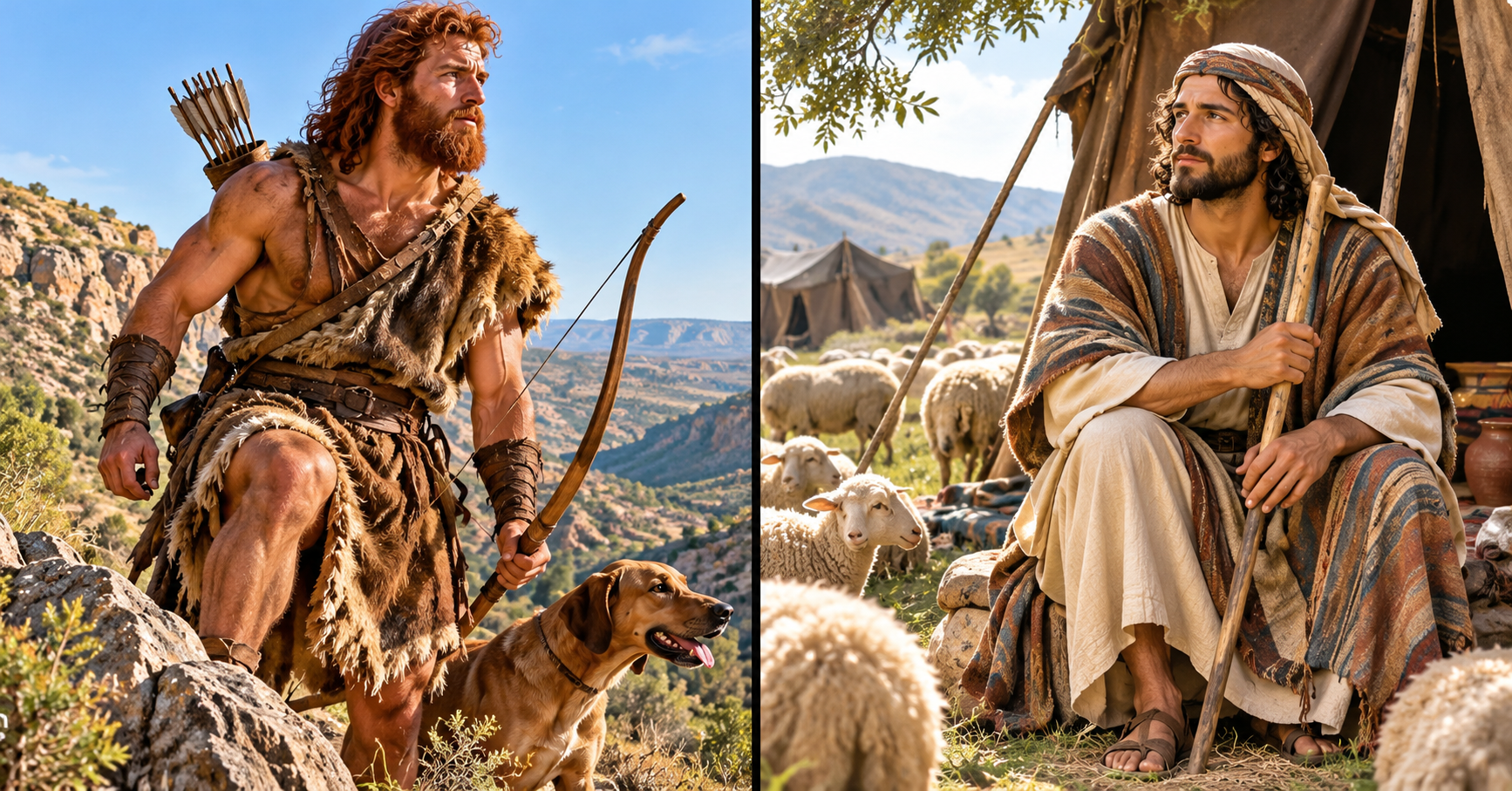
Esau A Skillful Hunter Jacob A Peaceful Man
TWO BROTHERS, TWO LIFESTYLES
TWO DISTINCT DESTINIES
When the boys grew up - Moses moves rapidly from the birth of Esau and Jacob to their development into adulthood. Although the twins shared the same parents, the same home, and the same upbringing, they developed strikingly different personalities, interests, and lifestyles. The contrast is particularly significant because God had already declared that two nations were in Rebekah's womb and that the older would serve the younger (Ge 25:23). Their differing characteristics now begin to distinguish the brothers whose descendants would become Edom and Israel. The narrative does not indicate how old the twins were when these characteristics became evident. It simply describes their established patterns of life as they matured.
Esau became a skillful hunter - The Hebrew expression is literally "a man knowing (yada) hunting" or "a man skilled in hunting." The verb yada meaning "to know," here conveys practical knowledge or proficiency. This description anticipates the next verse, where Moses explains that Isaac loved Esau because he had a taste for game (Ge 25:28). It also prepares the reader for Genesis 27, where Isaac asks Esau to hunt game and prepare a meal before receiving his blessing (Ge 27:3–4). Esau's hunting ability was not inherently sinful. Scripture does not condemn hunting as an occupation or activity. The significance of the description lies in its contrast with Jacob's lifestyle and its role in the unfolding family narrative.
Quoting an American writer, John Kitto describes Esau as one of the “rough sensual natures—men who, acting under the influence of present impulse, have no steadiness of character,” marked by “levity, sensuality, and passion.”
J Vernon McGee - "The boys grew." This fellow Esau was a cunning hunter, the outdoor boy, the athletic type. He is the one we would call the all-American boy today. He went in for sports. He went in for everything that was physical, but he had no understanding or capacity or desire for spiritual things. He was only interested in that which was physical. He represents the flesh. Jacob was a plain man. I think that you can make of that anything you want to. He lived indoors. He was mama's boy and was tied to her apron strings. You will notice that he did what she told him to do. Jacob is really a mama's boy. And this boy Esau is papa's boy. (See Thru the Bible - Genesis 16-33)
Henry Morris - The only hunters that the Bible mentions are Nimrod (Genesis 10:9) and Esau, and both were rebels against the will and revelation of God. Although God permits the eating of meat, the hunting of animals for sport is questionable at best. God cares even when a sparrow dies (Matthew 10:29). The family did not need game for meat since Isaac had great flocks and herds; neither did they need protection from wild animals, as Esau had to be a "cunning" hunter to find any to slay. He was simply a carnal, profane, licentious playboy (Hebrews 12:16).
A man of the field - The Hebrew expression describes Esau as a man whose activities centered on the open country. He was accustomed to outdoor life, physical exertion, and the pursuit of game. Esau's rugged lifestyle corresponded to his distinctive appearance at birth, when he emerged reddish and unusually hairy (Ge 25:25). His life was characterized by movement through the fields and wilderness rather than remaining primarily among the family tents.
But - This term of contrast introduces the deliberate contrast between the brothers.
Jacob was a peaceful (tam; LXX - aplastos - see note) man - NET - "Jacob was an even-tempered man,"' Peaceful is the Hebrew word tam which can mean blameless (Job 1:1) but in this context points to a settled, steady disposition rather than moral flawlessness, since Jacob’s later scheming shows he was not blameless in conduct. Jacob was hardly like the man who had a sign on his desk which said "Faith is living without scheming.” Subsequent narratives clearly reveals that Jacob was capable of manipulation and dishonesty (Ge 25:29–34; 27:18–29). In Genesis 25:27, however, the immediate contrast is between Esau's rugged outdoor life and Jacob's quieter, settled lifestyle. The NASB's "peaceful" emphasizes this contrast, while other translations use terms such as "quiet" or "plain." The word should not be interpreted as proof that Jacob was morally superior to Esau. Jacob may have been quieter in his lifestyle, but he was not necessarily purer in his character! This distinction is important because God's choice of Jacob was announced before either brother had done good or evil (Ro 9:10–12). His selection as the covenant heir was not based upon superior personal righteousness.
TECHNICAL NOTE - LXX - aplastos - lit "not moulded" something left in natural state. The LXX translators apparently understood tam here as a simple, uncomplicated, unpretentious temperament, a man “not molded” into anything artificial. That reading fits the contrast between the settled tent-dweller and the restless man of the field. It is ironic, though, in light of Jacob’s later scheming!
NET NOTE - The disjunctive clause juxtaposes Jacob with Esau and draws attention to the striking contrasts. In contrast to Esau, a man of the field, Jacob was civilized, as the phrase "living in tents" signifies. Whereas Esau was a skillful hunter, Jacob was calm and even-tempered (tam), which normally has the idea of "blameless."
Bob Utley - When the boys grew up, Esau became a skillful hunter, a man of the field; but Jacob was a peaceful man, living in tents" The focus of this passage is that they were very different in personality. Esau was content to be away from home; Jacob was content to be at home. Jacob is the one who fulfilled the normal expectations of a nomadic, patriarchal figure.
Living in tents - The Hebrew expression describes Jacob as dwelling among the tents, suggesting a more settled, domestic, and pastoral lifestyle. This does not mean that Jacob was idle or unwilling to work. The patriarchal household was organized around flocks, herds, servants, and extensive agricultural and pastoral responsibilities. Living in tents was a normal feature of the semi-nomadic life of Abraham and Isaac (Ge 12:8; 13:18; 26:25). Jacob's lifestyle was therefore consistent with the pastoral traditions of his family. The contrast is between two legitimate ways of life: Esau was primarily associated with hunting in the open country, while Jacob was associated with the tents and household.
Peaceful (08535) tam is an adjective from the verb tāmam, “to be complete, finished, whole.” It belongs to the same family as tōm and tummâ (“integrity,” Job 2:3, 9) and tamim (“blameless,” Gen 6:9; 17:1). There are 15 occurrences, almost all in poetry. The KJV usually translates it “perfect,” but the word “was used of quite flawed people,” so it does not mean “totally free from fault.” “The Hebrew writers would not think of sinless or philosophical perfection.” The core idea is wholeness: a person who is undivided, sound, and consistent in heart and conduct. Modern versions therefore use “blameless,” “upright,” or “having integrity.”
TAM - 15V - blameless(5), blameless man(1), complete(2), guiltless(3), integrity(1), peaceful(1), perfect one(2). Gen. 25:27; Exod. 26:24; Exod. 36:29; Job 1:1; Job 1:8; Job 2:3; Job 8:20; Job 9:20; Job 9:21; Job 9:22; Ps. 37:37; Ps. 64:4; Prov. 29:10; Cant. 5:2; Cant. 6:9
Moral Integrity Before God. The word “often carries a rather strong moral component.” It describes people who are “upright, righteous, having a clear conscience before God, with Job as a prime example” (Job 1:1; 9:20–22). In Job, the meaning “is not that he was really ‘perfect’ in the ultimate sense, but rather that he was ‘blameless’ (RSV) or ‘had integrity.’” The Septuagint translates it amemptos, “blameless,” the same term used of Zacharias and Elizabeth (Luke 1:6) and of believers (Phil 2:15). The psalmist urges, “Mark the blameless man” (Ps 37:37). The wicked shoot at the blameless from hiding (Ps 64:4), and men of bloodshed hate him (Prov 29:10).
Jacob, the “Plain” Man. Genesis 25:27 uses tām in an unusual way, contrasting Jacob with Esau, the skillful hunter. The KJV has “plain.” The revised versions give “quiet” or “harmless” (margin). BDB suggests “wholesome,” and others suggest “mature” or “dependable.” It describes “the mild manner of Jacob in contrast to his brother Esau, who was characterized by shedding blood.” Here the word points to a settled, steady disposition rather than moral flawlessness, since Jacob’s later scheming shows he was not blameless in conduct.
The Flawless Beloved. In the Song of Songs, tām appears “among a list of glowing terms describing the admirable qualities of the Shulamite lover” (Song 5:2; 6:9). “My perfect one” or “flawless one” expresses “the great esteem he holds for her beauty and perhaps that she is everything he could want in a wife.”
Summary. Tām describes wholeness rather than sinlessness. It is used of the person whose life is integrated and undivided before God (Job), the even-tempered man of steady character (Jacob), and the beloved who is everything her lover could desire (the Shulamite).
Esau and Jacob – A Study in Contrasts
|
Esau |
Jacob |
|---|---|
|
Firstborn |
Younger twin |
|
Reddish and hairy at birth |
Born grasping Esau's heel |
|
Skilled hunter |
Associated with the family tents |
|
Man of the field |
Quieter, settled lifestyle |
|
Favored by Isaac |
Favored by Rebekah |
|
Sold his birthright |
Obtained the birthright |
|
Ancestor of Edom |
Ancestor of Israel |
Genesis 25:27-34 What's Worth Keeping
For one morsel of food [Esau] sold his birthright. - Hebrews 12:16
A story is told of a man who loved old books. He met an acquaintance who had just thrown away a Bible that had been stored in the attic of his ancestral home for generations. "I couldn't read it," the friend explained. "Somebody named Guten- something had printed it." "Not Gutenberg!" the book lover exclaimed in horror. "That Bible was one of the first books ever printed. Why, a copy just sold for over two million dollars!" His friend was unimpressed. "Mine wouldn't have brought a dollar. Some fellow named Martin Luther had scribbled all over it in German."
This man treated as worthless that which was valuable. So did Esau. Although he was a nice fellow who enjoyed hunting and fishing and the great outdoors, Esau was "profane" because he sold his spiritual birthright "for one morsel of food" (Heb. 12:16). Only when it was too late to undo his wretched bargain did Esau realize that he had sacrificed the permanent on the altar of the immediate.
We had better be careful of the "bargains" we make in life. Our culture places a high price tag on what is worthless and throws away as worthless what is of eternal value. Ask the Lord to help you discern what's worth keeping and what is best discarded. - H W Robinson (Reprinted by permission from Our Daily Bread Ministries. Please do not repost the full devotional without their permission.)
The little choices we must make
Will chart the course of life we take;
We either choose the path of light,
Or wander off in darkest night.
- DJD
We pay a high price for cheap living.
Genesis 25:28 Now Isaac loved Esau, because he had a taste for game, but Rebekah loved Jacob.
KJV And Isaac loved Esau, because he did eat of his venison: but Rebekah loved Jacob.
NET Isaac loved Esau because he had a taste for fresh game, but Rebekah loved Jacob.
NLT Isaac loved Esau because he enjoyed eating the wild game Esau brought home, but Rebekah loved Jacob.
ESV Isaac loved Esau because he ate of his game, but Rebekah loved Jacob.
BGT ἠγάπησεν δὲ Ισαακ τὸν Ησαυ ὅτι ἡ θήρα αὐτοῦ βρῶσις αὐτῷ Ρεβεκκα δὲ ἠγάπα τὸν Ιακωβ
LXE And Isaac loved Esau, because his venison was his food, but Rebecca loved Jacob.
CSB Isaac loved Esau because he had a taste for wild game, but Rebekah loved Jacob.
NIV Isaac, who had a taste for wild game, loved Esau, but Rebekah loved Jacob.
YLT and Isaac loveth Esau, for his hunting is in his mouth; and Rebekah is loving Jacob.
- he did eat of his venison (KJV): Heb. venison was in his mouth, Ge 27:4,19,25,31
- Rebekah (KJV): Ge 27:6
Related Passages:
Genesis 27:3-4 “Now then, please take your gear, your quiver and your bow, and go out to the field and hunt game for me; 4 and prepare a savory dish for me such as I love, and bring it to me that I may eat, so that my soul may bless you before I die.”
Genesis 25:23 The LORD said to her, “Two nations are in your womb; And two peoples will be separated from your body; And one people shall be stronger than the other; And the older shall serve the younger.”
PARENTERAL PARTIALITY LEADS
TO A DIVIDED HOME
Now Isaac loved (ahab) Esau - Although the twins shared the same parents, they did not receive the same expressions of parental affection. Isaac favored Esau, while Rebekah favored Jacob. In this context, the contrast between the parents' preferences indicates favoritism rather than the absence of all affection for the other son. Scripture does not say that Isaac hated Jacob or that Rebekah hated Esau. Rather, each parent had a preferred son, creating a division within the family that would eventually produce devastating consequences.
Moses reveals that the differences in Ge 25:27 contributed to the parents' unequal affections. The brothers were different by temperament, but their parents made those differences a source of division!
J Vernon McGee - Here is the problem in the home. You feel that under these circumstances they are going to have trouble, and they are. When one parent is partial to one child and the other parent is partial to the other child, you have trouble. That is exactly what took place here. (See Thru the Bible Vol. 02: Genesis 16-33)
Constable adds "Adam failed in eating, Noah in drinking, and Isaac in tasting. Isaac became a “gourmand:” one who enjoys eating and often eats too much. “A marriage made in heaven (see Ge 24:1–67) can end in dysfunction when a spouse gives priority to taste in the mouth over a voice in the heart (see Ge 26:35).” (Quoting Waltke in Genesis: A Commentary - Page 363)
Because (term of explanation) he had a taste for game - Literally "because game was in his mouth." ESV - "because he ate of his game" NET - "because he had a taste for fresh game," The expression is commonly understood to mean that Isaac enjoyed eating the wild game Esau brought home. Moses does not say that Isaac preferred Esau because of his spiritual character, wisdom, obedience, or devotion to the LORD. Instead, the stated reason concerns Isaac's enjoyment of the food Esau provided. This does not necessarily mean that food was the only reason Isaac favored Esau, but it is the reason the inspired narrator specifically identifies. The detail becomes especially significant in Genesis 27, where the aging Isaac instructs Esau to hunt game and prepare a savory meal so that he may bless him before his death (Ge 27:1–4). Isaac's appetite becomes an important element in the circumstances surrounding the attempted blessing of Esau.
There is an interesting parallel between father and son. Esau would later exchange his birthright for a meal (Ge 25:29–34), while Isaac's preference for Esau was associated with his enjoyment of the meals Esau provided. Although the circumstances are different, both narratives draw attention to the influence of physical appetite. Isaac allowed his taste for Esau's game to influence his preference for Esau, while Esau would allow his appetite to influence his attitude toward his birthright! The danger was not the enjoyment of food itself, but the possibility of allowing physical desires to distort spiritual judgment.
NET NOTE - Heb “the taste of game was in his mouth.” The word for “game,” “venison” is here the same Hebrew word as “hunter” in the last verse. Here it is a metonymy, referring to that which the hunter kills.
Bob Utley - "Now Isaac loved Esau, because he had a taste for game" Isaac was a quiet, peaceful individual and it may be that his son, Easu, was all that he was not. It is surprising that Esau was his favorite, when obviously he knew the divine word from Gen. 25:23.
But (term of contrast) Rebekah loved Jacob - But introduces the contrasting preference. Unlike Isaac's preference for Esau, Moses does not explicitly state why Rebekah favored Jacob. Some interpreters suggest that her preference may have been influenced by the divine revelation she received before the twins were born, when God declared that the older would serve the younger (Ge 25:23). Others suggest that Jacob's quieter lifestyle and association with the family tents may have contributed to her affection. Both explanations are possible, but neither is explicitly stated in the text. What is certain is that Rebekah's favoritism would later lead her to assist Jacob in deceiving Isaac. When she overheard Isaac's intention to bless Esau, she devised a plan for Jacob to impersonate his brother and obtain the blessing (Ge 27:5–17). Her actions were particularly tragic because God had already revealed that the older would serve the younger. Rebekah did not need to resort to deception to accomplish what God had sovereignly declared! The consequences were severe. Esau became furious and planned to kill Jacob, forcing Rebekah to send her favored son away (Ge 27:41–45). Although Scripture does not explicitly state that Rebekah never saw Jacob again, the narrative records no subsequent reunion between them.
NET NOTE - The verb here is a participle, drawing attention to Rebekah’s continuing, enduring love for her son.
Bob Utley - but Rebekah loved Jacob" This favoritism is going to cause great problems in the family as it always does. But, it seems that Rebekah was trying to hold on to the divine promise of Ge 25:23. (ED COMMENT: If so, it shows her lack of trust in God's ability to fulfill His promises.)
The Danger of Favoritism Spanning Generations - One of the most sobering aspects of this account is that Jacob would later repeat a similar pattern in his own family. Genesis 37:3 records that Israel, that is, Jacob, loved Joseph more than all his other sons because Joseph was the son of his old age. Jacob's favoritism was visibly expressed through the special garment he gave Joseph. The result was predictable. Joseph's brothers recognized their father's preference, hated Joseph, and could not speak to him on friendly terms (Ge 37:4). Their resentment eventually contributed to their decision to sell Joseph into slavery (Ge 37:18–28). Thus, the favoritism Jacob experienced in his childhood home would later reappear in the family he raised. What Jacob suffered in one generation, he helped reproduce in the next! This illustrates how destructive family patterns can be repeated when they are not recognized and corrected.
A Spiritual Warning – Beware of Allowing Appetites to Govern Affections - Isaac's preference for Esau was associated with his enjoyment of the game Esau brought home. This detail raises a broader spiritual question: What influences our affections and judgments? It is possible to allow personal preferences, material benefits, or physical pleasures to influence how we evaluate others. James warns believers against showing favoritism based on outward circumstances (Jas 2:1–9). Although James addresses favoritism within the Christian assembly, the underlying principle applies more broadly: we must not allow superficial considerations to distort our treatment of others.
Henry Morris - Isaac loved Esau. In spite of God's commandment (Genesis 25:23) and Jacob's merits (Genesis 25:27), Isaac showed strong partiality to Esau and for the most carnal of reasons. He loved the venison Esau would bring home from the hunt. But God said: "Jacob have I loved" (Malachi 1:1-3; Romans 9:10-13).
Believer's Study Bible - The tendency of Isaac to favor Esau and the preferential feelings of Rebekah for Jacob laid the foundation for much sorrow. Parental partiality is a tragedy in any home, as is parent-child alignment against a spouse.
🙏 THOUGHT – Don’t Let Favoritism Fracture Your Family - Isaac loved Esau for the game he brought home, while Rebekah loved Jacob (Ge 25:28). That parental preference eventually led to deception, bitterness, threats of murder, and a divided family (Ge 27:5–45). Favoritism may begin quietly in the heart, but its consequences can echo through generations! Jacob later repeated the pattern by favoring Joseph, which stirred his brothers to hatred (Ge 37:3–4, 18–28). Are you favoring one child or grandchild who shares your interests or personality? As a father with 4 very diffent children I can vouch for how easy it is to fall into this trap and the consequences are not good! God shows no partiality (Ro 2:11), and He calls believers to love without favoritism (Jas 2:1–9; Eph 6:4). A parent’s calling is not to love every child because they are alike, but to love every child faithfully even when they are different! Ask the LORD to expose any hidden partiality in your heart (Ps 139:23–24; Col 3:12–14).
Genesis 25:29 When Jacob had cooked stew, Esau came in from the field and he was famished;
- and he (KJV): Judges 8:4,5 1Sa 14:28,31 Pr 13:25 Isa 40:30,31
WHEN PHYSICAL WEAKNESS BECOMES
AN OCCASION FOR SPIRITUAL FAILURE
When Jacob had cooked stew - Moses introduces one of the most consequential incidents in the lives of Esau and Jacob, an event that would reveal the contrasting priorities of the two brothers and result in Esau's surrender of his birthright (Ge 25:29–34). Cooked (zid) mean to boil or cook food amd the related noun stew (nazid) refers to a boiled dish or pottage. Genesis 25:34 later identifies the stew as being made with lentils, a common food in the ancient Near East. Jacob was engaged in an ordinary domestic activity, preparing a simple meal. Yet this seemingly insignificant circumstance would become the setting for a decision with far-reaching consequences. One of the most consequential decisions of Esau's life would be made not on a battlefield but over a bowl of stew! This reminds us that spiritually significant decisions are not always made during extraordinary circumstances. Sometimes they arise in the most ordinary moments of daily life. There is an interesting contrast between the brothers. Esau obtained food by hunting in the field, while Jacob prepared food among the tents. Their different lifestyles, introduced in Genesis 25:27, now intersect in a moment of physical need.
NET NOTE - Jacob cooked some stew. There are some significant words and wordplays in this story that help clarify the points of the story. The verb “cook” is זִיד (zid), which sounds like the word for “hunter” (צַיִד, tsayid). This is deliberate, for the hunter becomes the hunted in this story. The word זִיד means “to cook, to boil,” but by the sound play with צַיִד it comes to mean “set a trap by cooking.” The usage of the word shows that it can also have the connotation of acting presumptuously (as in boiling over). This too may be a comment on the scene. For further discussion of the rhetorical devices in the Jacob narratives, see J. P. Fokkelman, Narrative Art in Genesis (SSN). (Bolding added)
Allen Ross quips "The cunning hunter fell into a better hunter’s trap, becoming prey to his own appetite.” (Creation and Blessing: A Guide to the Study and Exposition of Genesis)
Esau came in from the field - The text does not specify whether Esau had been hunting, how long he had been away, or whether his efforts had been successful. Nevertheless, the context suggests that his physical exertion had left him intensely hungry and in a position of vulnerability to his physical desire. Obviously there is nothing inherently sinful about hunger. Hunger is a normal physical need, and Scripture recognizes the legitimacy of satisfying that need (Mt 12:1–8). The moral issue emerges in the following verses, when Esau allows his immediate appetite to outweigh the value of his birthright. The problem was not that Esau was hungry. The problem was what he was willing to sacrifice to satisfy his hunger!
Bob Utley - One wonders if this event was premeditated and had been repeated. Was Jacob looking for an occasion like this? The use of the term "cooked" (lit. "boiled," BDB 267, KB 268, Hiphil IMPERFECT with waw) may be a hint. The term regularly means to presume to have rights that are not legally theirs (NIDOTTE, vol. 1, p. 1094). Apparently this meal was prepared some distance away from the main campsite. The meal is called "stew," Gen. 25:29, BDB 268, a boiled pot of beans, cf. 2 Kgs. 4:38 "red stuff," Gen. 25:30, BDB 10 "lentil stew," Gen. 25:34, BDB 727, cf. 2 Sam. 17:28; 23:11; Ezek. 4:9
Physical Weakness Can Become
an Occasion for Spiritual Failure
And he was famished (ayeph; LXX - ekleipo - see below) - Famished (ayeph), meaning "weary," "faint," or "exhausted" and can describe physical weariness resulting from exertion as in Jdg 8:4–5 and 2Sa 16:14. The word does not mean that Esau was literally "starving to death," but does emphasize his exhaustion and intense physical need. This distinction becomes important in Genesis 25:32, where Esau declares that he is about to die leading him to question the value of his birthright. His statement may reflect exaggeration arising from his immediate distress, although the text does not provide enough information to determine precisely how severe his condition was. In short, Esau's hunger provides the setting for his lifechanging decision, but does not excuse that decision.
The Septuagint uses an interesting word for "famished," the verb ekleipo which means to be no longer in existence, fail, give out, to cease as state or event, fail, die out, to be deficient in one’s appearance, to die, to be wanting. Several of these nuancies might be applicable to Esau!
Esau was about to exchange
a lasting privilege for a passing pleasure!
The Israelites repeatedly complained about food during their wilderness journey, at times allowing their appetites to overshadow their appreciation for God's deliverance and provision (Nu 11:4–6; Ps 106:14,15). In striking contrast, Jesus refused to satisfy His hunger by acting independently of His Father's will during His temptation in the wilderness (Mt 4:1–4). Esau would surrender something valuable to satisfy his hunger, while Jesus refused to compromise obedience even when He was hungry. Esau allowed his appetite to govern his priorities; Jesus demonstrated that obedience to God must govern even our legitimate appetites!
Esau's experience illustrates the danger of allowing temporary physical or emotional conditions to dominate important decisions. Fatigue, hunger, anger, fear, and discouragement can impair our judgment and increase our susceptibility to temptation. This does not mean that every decision made under physical stress is sinful. Rather, it reminds us that we should exercise particular caution when immediate desires threaten to override enduring principles. Proverbs 19:2 warns against acting hastily without knowledge, while James 1:14,15 describes how desire can lead to sin when it is allowed to govern our actions. Never allow a temporary condition to determine a permanent consequence without first considering what God's Word says!
Beware of Making Major Decisions
During Moments of Weakness
🙏 THOUGHT – Don’t Let a Moment of Weakness Become a Lifetime of Regret (WOE!) - Esau came in from the field exhausted and hungry, and Jacob’s stew offered immediate satisfaction (Ge 25:29, 30). His hunger was legitimate, but his choice showed that he valued temporary relief more than his birthright (Ge 25:31–34; Heb 12:16, 17). Beware of making eternal decisions on the basis of temporary desires! How often are we tempted to compromise when we are tired, discouraged, lonely, or impatient? When Jesus was hungry after forty days of fasting, He refused to let appetite override obedience (Mt 4:1–4). Paul calls believers to self-control and to set their minds on things above (1Co 9:25–27; Col 3:1–4). God is faithful and provides a way of escape in every temptation (1Co 10:13). A moment of gratification is never worth a lifetime of regret! Ask the Lord for wisdom to see what is truly at stake and strength to choose obedience over appetite (Pr 3:5–6; Jas 1:5).
Beware of making eternal decisions
on the basis of temporary desires!
Famished (weary) (05889) ayeph for iph = to be exhausted) means faint, physically tired, usually used of people. Esau was famished from working in the fields that he sold his birthright to Jacob for some lentils (Ge. 25:29, 30). Because the people of Israel were faint from travel in the wilderness (Deut. 25:18), the Amalekites were able to attack their rear ranks. Gideon's 300 men were exhausted, but still pursued their Midianite enemies (Judg. 8:4f). When King David fled from Absalom, he and his men became weary and stopped to refresh themselves (2 Sam. 16:14; 17:29). Eliphaz accused Job of refusing to give aid to those who were weary (Job 22:7). In Proverbs 25:25, a weary soul is refreshed by cold water. The adjective also may refer to a weary animal (Isa. 46:1). Figuratively, when the adjective modifies the word "land," it refers to its dry condition. David likened his longing for the Lord to one being thirsty in the desert (Ps. 63:1); "My soul longs for You like a parched land" (Ps. 143:6). A godly man will be like "the shadow of a great rock in a weary land" (Isa. 32:2, NKJV). Prophetically, when the Lord regathers his people in the kingdom, "No one will be weary or stumble among them" (Isa. 5:27, NKJV); also, the Lord will satisfy the weary soul (Jer. 31:25). In the meanwhile, the Lord had promised his people rest for the weary, but they refused it (Isa. 28:12), and those who fight against Israel will be weary (Isa. 29:8).
AYEPH - 17X/17V - faint(2), famished(2), parched(2), weary(11). Gen. 25:29; Gen. 25:30; Deut. 25:18; Jdg. 8:4; Jdg. 8:5; 2 Sam. 16:14; 2 Sam. 17:29; Job 22:7; Ps. 63:1; Ps. 143:6; Prov. 25:25; Isa. 5:27; Isa. 28:12; Isa. 29:8; Isa. 32:2; Isa. 46:1; Jer. 31:25
God Alone Can Satisfy
When Jacob was cooking some stew, Esau came in [and] said to Jacob, . . . “I’m famished!” Genesis 25:29–30
A thousand dollars of food—jumbo shrimp, shawarma, salads, and more—was delivered to a homeowner. But the man wasn’t having a party. In fact, he didn’t order the smorgasbord; his six-year-old son did. How did this happen? The father let his son play with his phone before bedtime, and the boy used it to purchase the expensive bounty from several restaurants. “Why did you do this?” the father asked his son, who was hiding under his comforter. The six-year-old replied, “I was hungry.” The boy’s appetite and immaturity led to a costly outcome.
Esau’s appetite cost him a lot more than a thousand dollars. The story in Genesis 25 finds him exhausted and desperate for food. He said to his brother, “Let me have some of that red stew! I’m famished!” (v. 30). Jacob responded by asking for Esau’s birthright (v. 31). The birthright included Esau’s special place as the firstborn son, the blessing of God’s promises, a double portion of the inheritance, and the privilege of being the spiritual leader of the family. Giving in to his appetite, Esau “ate and drank” and “despised his birthright” (v. 34).
When we’re tempted and desire something, instead of letting our appetites lead us to costly mistakes and sin, let’s reach out to our heavenly Father—the One who alone satisfies the hungry soul “with good things” (Psalm 107:9). -- Marvin Williams (Reprinted by permission from Our Daily Bread Ministries. Please do not repost the full devotional without their permission.)
Reflect & Pray
When have you allowed temptation to cost you a great deal? Why can only God satisfy your deepest longings?
Dear God, please help me to remember my spiritual birthright when I’m tempted to sin.
Today's Insights - In the biblical world, the birthright of the firstborn son involved both special material benefits and spiritual privileges. The firstborn was entitled to a double portion of the paternal inheritance (Deuteronomy 21:17). More important, the firstborn was the head and spiritual leader of the family. The family line was maintained through the firstborn, even if other sons were named (see 1 Chronicles 7:1-4). In the case of Jacob and Esau, the birthright determined who would inherit the blessings of God’s covenant with Abraham—the inheritance of a land, a nation, and the line that would produce the Messiah. Although Jacob valued the birthright, he deceitfully took it from his brother (Genesis 27:35-36). But Esau’s willingness to abandon his spiritual birthright for immediate physical gratification showed that he “despised” spiritual things (25:34), thus disqualifying him as unfit to be the lineage from which the Messiah would come. He was considered “godless” (Hebrews 12:16). (Reprinted by permission from Our Daily Bread Ministries. Please do not repost the full devotional without their permission.)
Genesis 25:30 and Esau said to Jacob, “Please let me have a swallow of that red stuff there, for I am famished.” Therefore his name was called Edom.
KJV And Esau said to Jacob, Feed me, I pray thee, with that same red pottage; for I am faint: therefore was his name called Edom.
NET So Esau said to Jacob, "Feed me some of the red stuff– yes, this red stuff– because I'm starving!" (That is why he was also called Edom.)
NLT Esau said to Jacob, "I'm starved! Give me some of that red stew!" (This is how Esau got his other name, Edom, which means "red.")
ESV And Esau said to Jacob, "Let me eat some of that red stew, for I am exhausted!" (Therefore his name was called Edom.)
BGT καὶ εἶπεν Ησαυ τῷ Ιακωβ γεῦσόν με ἀπὸ τοῦ ἑψέματος τοῦ πυρροῦ τούτου ὅτι ἐκλείπω διὰ τοῦτο ἐκλήθη τὸ ὄνομα αὐτοῦ Εδωμ
LXE And Esau said to Jacob, Let me taste of that red pottage, because I am fainting; therefore his name was called Edom.
CSB He said to Jacob, "Let me eat some of that red stuff, because I'm exhausted." That is why he was also named Edom.
NIV He said to Jacob, "Quick, let me have some of that red stew! I'm famished!" (That is why he was also called Edom.)
YLT and Esau saith unto Jacob, 'Let me eat, I pray thee, some of this red red thing, for I am weary;' therefore hath one called his name Edom Red;
- Edom (KJV): i.e. red, Ge 36:1,9,43 Ex 15:15 Nu 20:14-21 De 23:7 2Ki 8:20
Related Passages:
Philippians 3:18; 19 For many walk, of whom I often told you, and now tell you even weeping, that they are enemies of the cross of Christ, 19 whose end is destruction, whose god is their appetite, and whose glory is in their shame, who set their minds on earthly things.
Hebrews 12:15-17 See to it that no one comes short of the grace of God; that no root of bitterness springing up causes trouble, and by it many be defiled; 16 that there be no immoral or godless person like Esau, who sold his own birthright for a single meal. 17 For you know that even afterwards, when he desired to inherit the blessing, he was rejected, for he found no place for repentance, though he sought for it with tears.
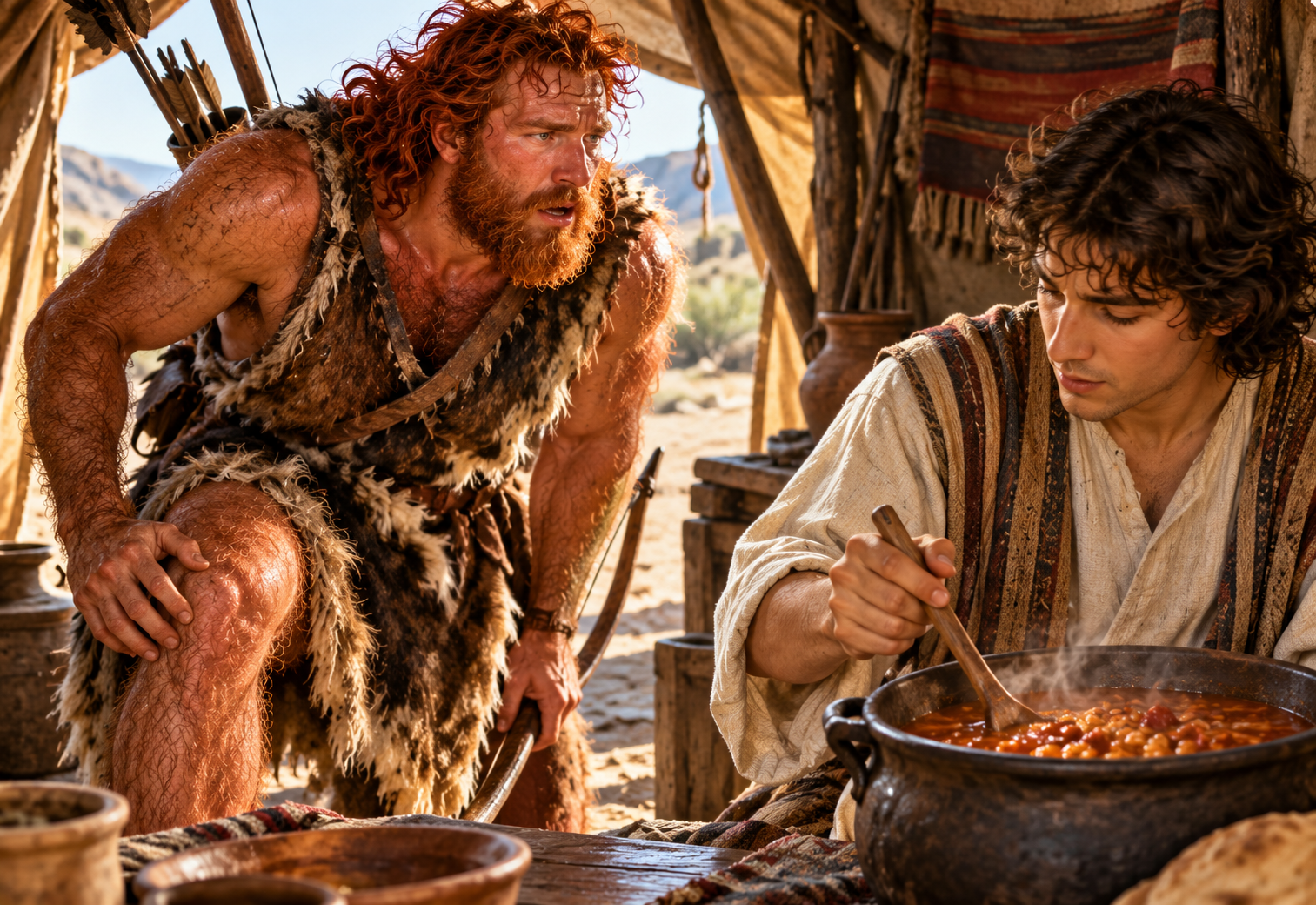
ESAU'S APPETITE: WHEN THE
URGENT ECLIPSES THE ETERNAL!
And - This strategic hinge word connects two life altering verses.
Esau said to Jacob - The aroma and appearance of Jacob's stew evidently attracted his attention, prompting an urgent request for food. It makes me think of putting food out to trap the critters in my yard! Esau initiates the conversation. Jacob has prepared the stew, but Esau's hunger creates the opportunity for Jacob to demand something far more valuable in return. The account illustrates how an ordinary physical need can become the occasion for a profound spiritual test.
“Please let me have a swallow (la'at) - KJV = "Feed me, I pray thee," NLT = "I'm starved! Give me some of that red stew!"The Hebrew expression is unusually vivid for verb la'at means to swallow or gulp down greedily and occurs only here in the Old Testament. The construction is emphatic, conveying something like, "Let me gulp down some of that red stuff!" Esau is not simply making a polite request for a meal. His language conveys urgency and an intense desire for immediate satisfaction. The NASB's "Please let me have a swallow" communicates the request, but the underlying Hebrew suggests a stronger sense of gulping or devouring. Esau's words reveal his immediate preoccupation with satisfying his hunger.
NET NOTE - The rare term לָעַט (la'at), translated “feed,” is used in later Hebrew for feeding animals (see Jastrow, 714). If this nuance was attached to the word in the biblical period, then it may depict Esau in a negative light, comparing him to a hungry animal. Famished Esau comes in from the hunt, only to enter the trap. He can only point at the red stew and ask Jacob to feed him. (Bolding added)
Bob Utley - "Please let me have a swallow of that red stuff there, for I am famished" This is a strong term for "eat." It literally means "to gulp down" (la'at Hiphil IMPERATIVE). Surely, Esau was not at the point of starvation, but he was weary (cf. Deut. 25:18; Jdg. 8:4,5). This is the first of several clues which show that Esau was not a bad man, but a secular-minded man (see Hard Sayings of the Bible, pp. 347-348). The things of faith and the responsibilities of home life were simply not a concern to him.
Of that red (ʾadōm) stuff there, for I am famished (ayeph; LXX - ekleipo - see note) - NIV - ""Quick, let me have some of that red stew! I'm famished!"" This seemingly ordinary exchange between two brothers would lead to one of the most consequential transactions in the patriarchal narratives: Esau's sale of his birthright (Ge 25:31–34). The Hebrew (hä´ädöm hä´ädöm) is literally “the red, the red, this,” a repetition that pictures Esau’s crude, impatient hunger. The repetition vividly portrays Esau's fixation on the appearance of the stew. He does not identify its ingredients or describe it as a carefully prepared meal. He simply wants the red food in front of him. Genesis 25:34 later identifies the dish as lentil stew, which could naturally have a reddish appearance. The emphasis on red also recalls Esau's appearance at birth. He had emerged from the womb reddish and unusually hairy (Ge 25:25). Thus, the narrative establishes an intentional connection between Esau's physical appearance, his appetite, and the name by which he and his descendants would become known.
Famished (ayeph; LXX - ekleipo - see note) means weary, faint, or exhausted and is the same word used in Genesis 25:29 to describe Esau when he returned from the field. His exhaustion was real, and his hunger was understandable. The text does not condemn him for wanting food. The moral issue becomes apparent in the next verses, when Esau demonstrates that satisfying his immediate appetite matters more to him than preserving his birthright (Ge 25:31–34). In Genesis 25:32, Esau will declare that he is about to die, a statement that may reflect the exaggeration of someone overwhelmed by physical discomfort. Scripture does not establish that he was literally on the verge of death.
Therefore his name was called Edom (’ĕdôm) - The name Edom would then be a constant reminder that Esau had sold his birthright for a bowl of red stew. The name is connected with Esau's repeated request for the red stew. Although Esau was already described as reddish at birth (Ge 25:25), this incident provides the explicit explanation for the name Edom. Esau would become the ancestor of the Edomites, who occupied the region of Seir, southeast of the Dead Sea (Ge 32:3; 36:1, 8–9). The connection between Esau and Edom is repeatedly emphasized in Genesis (Ge 36:1, 8, 19). An individual act involving a bowl of red stew thus becomes permanently associated with the name of an entire nation.
NET NOTE - Esau’s descendants would eventually be called Edom. Edom was the place where they lived, so-named probably because of the reddish nature of the hills. The writer can use the word “red” to describe the stew that Esau gasped for to convey the nature of Esau and his descendants. They were a lusty, passionate, and profane people who lived for the moment. Again, the wordplay is meant to capture the “omen in the nomen.”
Esau's words reveal a man focused on the present moment. He is exhausted, hungry, and eager for relief. There is nothing wrong with satisfying legitimate physical needs. But when immediate desires become more important than enduring spiritual values, they can lead to disastrous decisions. The writer of Hebrews later presents Esau as a warning, describing him as a godless person who sold his birthright for a single meal (Heb 12:16,17). The word translated "godless" is bebelos, conveying the idea of something profane or lacking proper regard for what is sacred. Esau treated his birthright as something common and expendable rather than something worthy of careful preservation. He allowed the urgency of his appetite to eclipse the importance of his inheritance!
🙏 THOUGHT – Don’t Let Your Appetite Become Your Master - Esau came in exhausted and demanded Jacob’s red stew, concerned only with his immediate hunger (Ge 25:29, 30). Moments later he traded his birthright for a single meal (Ge 25:31–34). What a tragic exchange: lasting value surrendered for temporary satisfaction! How often do we (I) let a physical desire, an emotional impulse, or a momentary pleasure override God’s Word? (Too often!) Paul warned of those whose god is their appetite (Php 3:18, 19), while Jesus refused to satisfy His hunger at the expense of obedience (Mt 4:1–4). Has some legitimate desire become so dominant that you would compromise your convictions to satisfy it? Walk (present imperative see our need to depend on the Holy Spirit to obey) by the Spirit and bring forth the supernatural fruit of self-control (Gal 5:16, 22,23), put sinful desires to death (also only possible as you depend on the Holy Spirit)(Col 3:5, cf Ro 8:13), and live with an eternal perspective (2Co 4:17,18), clearly a perspective Esua lacked! Never let what you want right now cost you what you will wish you had valued forever! WOE! The passing pleasures of this world (Heb 11:25, cf 1Jn 2:17) cannot compare with the lasting joy of knowing the Lord (Ps 16:11; Mt 6:19, 20, 21). See another man, Cain, who let his emotions become his master (Ge 4:5-7) and notice that God had told Cain he must (and therefore could) master his sin of anger, but he chose not to listen to God (Ge 4:8)
Red (0122) ʾadōm (אָדֹם) is “a masculine adjective meaning red, ruddy, the color of blood (red to reddish brown).” It “is derived either from the verbal root ʾādham, meaning ‘to be red,’ or from the noun dām ‘blood.’” It belongs to the same family as ʾadmônî (“ruddy,” Ge 25:25; 1 Sa 16:12) and ʾĕdôm (Edom, “red”). The Septuagint usually translates it with pyrros, “fiery red,” the word used of the red horse of Revelation 6:4. Because Hebrew has few color terms, “the precise shade is represented by the nouns it modifies.”
ADOM - 8X/7V - red(7), ruddy(1). Gen. 25:30; Num. 19:2; 2 Ki. 3:22; Cant. 5:10; Isa. 63:2; Zech. 1:8; Zech. 6:2
The meaning of the word is best demonstrated in 2 Kings 3:22. There the morning sun shone on the water the LORD had miraculously provided, and the Moabites saw it “as red as blood.” They took it for the blood of slaughtered armies and rushed to their own defeat. The word also describes the “red stuff,” the lentil stew for which Esau sold his birthright. The repetition ha-ʾādōm ha-ʾādōm in Genesis 25:30 gave him his nickname: “Therefore his name was called Edom.” It describes the red heifer whose ashes were used for purification (Num 19:2), a picture Hebrews applies to the cleansing blood of Christ (Heb 9:13–14). It describes the red or bay horses of Zechariah’s night visions (Zech 1:8; 6:2). In Song of Solomon 5:10, it describes “the health or attractiveness of a man”: “My beloved is dazzling and ruddy.” Finally, it describes the color of garments in Isaiah 63:2. There the divine Warrior, coming “from Edom,” is asked, “Why is Your apparel red?” His garments are stained like those of one treading the winepress, a deliberate wordplay between ʾādōm (“red”) and Edom.
Summary. ʾĀdōm covers the range from blood red to reddish brown, and the noun it modifies sets the shade. In Scripture it describes judgment (the blood-red water at Moab; the Warrior’s stained garments), cleansing (the red heifer), vigor and beauty (the ruddy beloved), and the “red stuff” that gave Esau his name and recorded his folly.
Edom (0123) ’ĕdôm literally means “red.” It comes from the root ʾ-d-m, the same root behind ʾādōm (“red”) and ʾadmônî (“ruddy”). The noun “occurs over 70 times in the Hebrew Bible” and “has three distinct semantic ranges; as a personal name (Esau); as a geographical locale, Edom; and as a collective for inhabitants of Edom.” In the Septuagint and New Testament the region is called Idumea (Idoumaia, Mark 3:8), the homeland of the Herodian dynasty.
Edom as Esau. The name first appears as Esau’s nickname, used four times in Genesis (Gen 25:30; 36:1, 8, 19, 43). He came out “red” at birth (Gen 25:25), and “the name was received upon the surrender of Esau’s birthright for a bowl of red stew” (Gen 25:30). “Genesis 36 tells us that he became the eponymous founder of the Edomite tribes.” The brothers’ rivalry, which began in the womb (Gen 25:22–23), foreshadowed their descendants’ history: “the continuous warring of the two is what is reflected in the ancestor narratives.”
Edom as a Land. Geographically, Edom designates “the land to the east of Judah,” traditionally stretching “from the Zered Valley south to Midian,” southeast of the Dead Sea, a region known for its “reddish sandstone.” Esau’s descendants were already settled there in Jacob’s day (Gen 32:3; 36:6–43), and “they had kings before Israel had any kings” (Gen 36:31–39). At the Exodus, Edom refused Israel passage “even though they were physically related to Israel” (Num 20:14–21). Even so, God commanded, “You shall not detest an Edomite, for he is your brother” (Deut 23:7). Edom’s political status shifted over time. Balaam foresaw its conquest (Num 24:18). David subdued it (2 Sam 8:13–14), but conflict continued (1 Kgs 11:14–16). It sometimes fought alongside Israel (2 Kgs 3:4–27). Amaziah captured its rock fortress Sela (2 Kgs 14:7; 2 Chr 25:11–12), and Elath was later restored to Judah (2 Kgs 14:22).
Edom under Judgment. In the prophets, Edom becomes the symbol of hostile brotherhood. It is condemned especially for rejoicing over Jerusalem’s fall to Babylon and for aiding it (Ps 137:7; Lam 4:21–22; Amos 1:11; the entire book of Obadiah). Malachi contrasts God’s love for Jacob with His judgment on Esau/Edom (Mal 1:2–4), a passage Paul cites to illustrate God’s sovereign choice (Rom 9:13).
Edom as a People. The noun also refers collectively to the Edomites as a nation, for example in the account of their subjugation under David (2 Sam 8:14). Your source cites 2 Sam 24:18 here, which appears to be a mistake. Similarly, the source’s Gen 25:24 reference is probably meant to be 25:25.
Summary. Edom is a name, a nation, and a land, all marked by “red.” It began as the nickname of a man who traded his birthright for red stew, and it became the name of a people whose long hostility toward their brother Israel brought God’s judgment.
EDOM - 101X/94V - Edom(94), Edomites(7). Gen. 25:30; Gen. 32:3; Gen. 36:1; Gen. 36:8; Gen. 36:9; Gen. 36:16; Gen. 36:17; Gen. 36:19; Gen. 36:21; Gen. 36:31; Gen. 36:32; Gen. 36:43; Exod. 15:15; Num. 20:14; Num. 20:18; Num. 20:20; Num. 20:21; Num. 20:23; Num. 21:4; Num. 24:18; Num. 33:37; Num. 34:3; Jos. 15:1; Jos. 15:21; Jdg. 5:4; Jdg. 11:17; Jdg. 11:18; 1 Sam. 14:47; 2 Sam. 8:14; 1 Ki. 9:26; 1 Ki. 11:14; 1 Ki. 11:15; 1 Ki. 11:16; 1 Ki. 22:47; 2 Ki. 3:8; 2 Ki. 3:9; 2 Ki. 3:12; 2 Ki. 3:20; 2 Ki. 3:26; 2 Ki. 8:20; 2 Ki. 8:21; 2 Ki. 8:22; 2 Ki. 14:7; 2 Ki. 14:10; 1 Chr. 1:43; 1 Chr. 1:51; 1 Chr. 1:54; 1 Chr. 18:11; 1 Chr. 18:12; 1 Chr. 18:13; 2 Chr. 8:17; 2 Chr. 21:8; 2 Chr. 21:9; 2 Chr. 21:10; 2 Chr. 25:19; 2 Chr. 25:20; Ps. 60:8; Ps. 60:9; Ps. 83:6; Ps. 108:9; Ps. 108:10; Ps. 137:7; Isa. 11:14; Isa. 21:11; Isa. 34:5; Isa. 34:6; Isa. 63:1; Jer. 9:26; Jer. 25:21; Jer. 27:3; Jer. 40:11; Jer. 49:7; Jer. 49:17; Jer. 49:20; Jer. 49:22; Lam. 4:21; Lam. 4:22; Ezek. 16:57; Ezek. 25:12; Ezek. 25:13; Ezek. 25:14; Ezek. 32:29; Ezek. 35:15; Ezek. 36:5; Dan. 11:41; Joel 3:19; Amos 1:6; Amos 1:9; Amos 1:11; Amos 2:1; Amos 9:12; Obad. 1:1; Obad. 1:8; Mal. 1:4
Swallow (03938) la'at indicating to swallow greedily, to devour. It indicates devouring greedily, voraciously. Laat appears only once in the Hebrew Bible, in Esau’s demand for Jacob’s stew (Ge 25:30), as a Hiphil (causative) imperative, ‘give me to swallow.’” The form is hallʿîṭēnî, literally “make me gulp” or “let me gulp it down.” Later Mishnaic Hebrew uses the same verb for force-feeding or cramming food into animals, such as stuffing fodder into a camel’s mouth. That usage suggests how crude Esau’s words sounded. He does not even name the dish. He simply says “the red, this red,” as one would point at fodder. The Septuagint softens the wording to geuson me, “let me taste.” The Hebrew is much blunter. Esau does include the polite particle nāʾ (“please”), but he pairs it with a word for gulping like an animal. His words show what was in his heart: in that moment his appetite was in control.
The single use of la'at illustrates a warning found throughout Scripture. Wisdom calls for decisive restraint: “And put a knife to your throat if you are a man of great appetite” (Pr 23:2). Paul describes those “whose end is destruction, whose god is their appetite, and whose glory is in their shame, who set their minds on earthly things” (Philippians 3:19). Esau’s hunger was natural. The tragedy was that he let a momentary craving outweigh something of lasting value. Lāʿaṭ is a rare, earthy verb for gulping food down greedily, the language of a starving animal rather than a thoughtful man. Its only biblical use captures Esau at his worst. He was ruled by his stomach, he spoke crudely about the food in front of him, and he was ready to trade his birthright for one hurried meal.
Esau's Appetite and Jesus' Temptation – A Striking Contrast
There is a noteworthy contrast between Esau's response to hunger and Jesus' response during His temptation in the wilderness. Esau returned from the field hungry and was willing to surrender his birthright for food (Ge 25:29–34). Jesus, after fasting forty days and forty nights, was hungry when Satan tempted Him to turn stones into bread (Mt 4:1–4). Jesus refused to act contrary to His Father's will merely to satisfy His physical appetite. Instead, He answered Satan with Scripture, affirming that man does not live by bread alone but by every word that proceeds from the mouth of God (Dt 8:3; Mt 4:4). The contrast is instructive. Esau placed immediate physical satisfaction above his birthright, while Jesus demonstrated perfect obedience to the Father's will even in a condition of intense hunger. Esau's appetite governed his decision; Jesus' obedience governed His appetite!
Beware of the Tyranny of the Immediate - Esau's repeated request for the "red stuff" illustrates how physical desires can dominate our attention until everything else seems unimportant. This is not limited to food. The same principle applies to money, pleasure, recognition, anger, and countless other desires that promise immediate satisfaction. Paul warns that those who set their minds on earthly things can become enslaved to their appetites (Php 3:18–19). In contrast, believers are instructed to set their minds on things above (Col 3:1–4). The issue is not whether we have legitimate desires, but whether those desires are submitted to God's Word. A desire becomes dangerous when satisfying it matters more than obeying God!
QUESTION - What is the significance of Edom in the Bible? - GotQuestions.org
ANSWER - Edom was an ancient kingdom that is mainly associated with Esau and his descendants in the Bible. Being descendants of Abraham, the Edomites were related to the Israelites. But they did not always act as brothers.
Located on the east side of the Arabah and extending down to the Dead Sea, Edom was first occupied by the Horites, who were later driven out by Esau’s descendants (M. G. Easton, Easton’s Bible Dictionary, New York: Harper & Brothers, 1893, entry for Edom). Numerous verses in the Bible equate the hill country of Seir with Edom, which would “suggest that Seir and Edom comprise an entity that should be viewed as one and the same in terms of their respective geographical locations” (Bruce Crew, “Did Edom’s Territories Extend West of Wadi Arabah?” Bible and Spade 15:1, 2002, p. 4). Interestingly, the name Edom means “red,” which is easily linked with Esau, who sold his birthright for red stew and thereby earned the name Edom (Genesis 25:30). In spite of the connection with Esau, many scholars believe that the kingdom of Edom was associated with red before Esau took control of it because of the red cliffs located in its area (W. Ewing, SBE Article on Edom/Edomites). Bozrah and Petra (or Sela) were notable cities in Edom, with Bozrah being the capital and central city of the kingdom.
The nation of Edom existed before the Israelites left Egypt, and the Lord commanded the Israelites not to attempt to take the land from the Edomites as they passed through, since He had given the land to Esau (Deuteronomy 2:1–5). Moses and the Israelites asked permission to cross through the land of Edom on their journey out of Egypt, but they were refused passage by the Edomite king (Numbers 20:14–21). From this point on in the Bible, Edom is mentioned as Israel’s enemy, and the two nations fought frequently.
Both Saul and David fought against the Edomites, with David conquering them and forcing them into labor (1 Samuel 14:47–48; 2 Samuel 8:13–14). During the reign of Jehoram, Edom rebelled against Judah and set up their own independent king (2 Kings 8:20–22). The Edomites continued to be a problem for the Israelites and even raided Judah after it fell to the Babylonians (Ezekiel 25:12–14). Because of Edom’s sin in raiding Judah and taking delight in Israel’s fall during the Babylonian Captivity, the Lord pronounced judgment on Edom (Jeremiah 49:7–22). God declared that Edom would be a wasteland, occupied only by wild animals (Malachi 1:2–5). This began to come to pass when Edom was pushed out of their land and taken over by the Nabateans (Craig Blaising, “Malachi,” Bible Knowledge Commentary: Old Testament, ed. by J. Walvoord and R. Zuck, David C. Cook, 1983. p. 1,576). God justly dealt with the Edomites because of their actions and attitude toward Israel.
The book of Obadiah deals specifically with Edom’s judgment. The Edomites were proud (Obadiah 1:3), violent (verse 10), and apathetic to the destruction of Israel (verse 11), and God promised a reckoning. After the Edomites were driven from their land by the Nabateans, they migrated to the southern part of Israel and became known as Idumeans. Much later in biblical history, Herod the Great, an Idumean, appears on the scene. It was Herod who tried to kill the infant Jesus in Bethlehem—through Herod, the rebellion of Edom continued.
In AD 70, the Idumeans joined the Israelites in their revolt against Rome, and they were wiped out when Jerusalem was destroyed. At that point, the descendants of Esau disappeared from human history, just as God had said. Although once a mighty kingdom among the red cliffs of its land, Edom was destroyed for its sin. It is the restored Israel who will one day possess the land of Edom and the “mountains of Esau” in the millennial kingdom of Christ (Obadiah 1:19,20,21).
Genesis 25:31 But Jacob said, “First sell me your birthright.”
WHEN AMBITION
EXPLOITS APPETITE
But Jacob said- The conjunction but introduces a startling contrast between the two brothers. Esau has just returned from the field exhausted and hungry, pleading for some of Jacob's red stew (Ge 25:29–30). Instead of simply offering his brother food, Jacob sees an opportunity to obtain something far more valuable. Jacob's response reveals that he is not merely interested in feeding his hungry brother. He wants to acquire Esau's birthright. This is the first recorded conversation between the brothers, and it immediately reveals a significant difference in their priorities. Esau is focused on satisfying his immediate physical appetite, while Jacob is focused on securing a future advantage. Esau was thinking about his next meal; Jacob was thinking about his future inheritance!
First sell me your birthright (bekorah - see also note) - First is yom (03117), ordinarily meaning "day," but here in a construction commonly understood as "first," "today," or "right now." Jacob is commanding (sell) an immediate transaction. He is unwilling to give Esau the stew until Esau agrees to surrender his birthright. The demand reveals Jacob's determination, for he does not even offer to discuss the matter later when Esau has recovered from his exhaustion. Instead, he insists that the exchange take place immediately. This urgency becomes even clearer in Genesis 25:33, where Jacob demands that Esau swear an oath confirming the agreement. Jacob evidently understands that an impulsive verbal promise might later be disputed, so he seeks a binding commitment, an oath. Jacob was not merely asking for a promise. He wanted a transaction that Esau could not easily reverse!
The birthright (bekorah) ordinarily belonged to the firstborn son and carried special privileges within the family. These commonly included a larger inheritance and a position of prominence or leadership within the household. Deuteronomy 21:15–17 later codified the firstborn son's right to a double portion of the paternal inheritance. Although that legislation was given centuries after Jacob and Esau, it illustrates the importance attached to firstborn status in ancient Israel. In Isaac's family, however, the birthright had an additional dimension because the family stood within the unfolding promises God had made to Abraham. God had promised Abraham descendants, a land, and blessing that would ultimately extend to all the families of the earth (Ge 12:1–3; 17:7–8). Those promises had been reaffirmed to Isaac (Ge 26:2–5). Consequently, the question of inheritance in this family involved more than material possessions.
A worthy objective does not
justify an unworthy method!
Since God had already promised Jacob's mother "the other would serve the younger" Jacob did not need to purchase God's sovereign choice. God's purpose concerning Jacob had already been declared! Paul later emphasizes that this declaration occurred before the twins had done anything good or bad, so that God's purpose according to His choice would stand (Ro 9:10–12). This means that God's covenant purpose was not dependent upon Jacob's ability to negotiate, manipulate, or deceive. Jacob's actions did not create God's choice. Rather, God's choice preceded Jacob's actions. To say it another way, divine sovereignty does not excuse human wrongdoing, nor does human manipulation establish God's purposes. God's promises never give us permission to disobey God's principles!
One brother undervalued what he had; the other overreached to acquire what he wanted. Scripture does not explicitly pronounce a moral verdict on Jacob's bargaining in Genesis 25:31, but his willingness to make food conditional upon Esau's surrender of a valuable right raises serious ethical concerns. Jacob's later deception of Isaac is plainly described in Genesis 27, and his subsequent life would involve painful consequences from family conflict and deceit. The crucial distinction is between valuing the right thing and pursuing it in the right way.
Warren Wiersbe - The fact that God had already determined to give the covenant blessings to Jacob didn’t absolve anybody in the family from their obligations to the Lord. They were all responsible for their actions, because divine sovereignty doesn’t destroy human responsibility. In fact, knowing that we’re the chosen of God means we have a greater responsibility to do His will. (Bible Exposition Commentary)
Scripture never allows a righteous goal
to excuse an unrighteous method.
🙏 THOUGHT – Never Do Wrong to Accomplish What Is Right - Jacob valued the birthright Esau was willing to surrender, but instead of helping his exhausted brother, he made it the price of a bowl of stew (Ge 25:29–31). His goal was worthy, but his method exposed his character. How often do we justify manipulation, exaggeration, or exploiting another’s weakness because our goal seems godly? (WOE!) Scripture never allows a righteous goal to excuse an unrighteous method. Paul rejects doing evil that good may come (Ro 3:8), and the LORD delights in the blameless (Pr 11:20). Abraham and Sarah tried to fulfill God’s promise through Hagar, with painful consequences (Ge 16:1–4). Jacob likewise grasped for what God had already promised him (Ge 25:23; 27:1–29). Are you trying to force an outcome God has called you to entrust to Him? Faith does not manipulate circumstances to make God’s promises come true; faith obeys God while trusting Him to fulfill His Word! (Ps 37:3–7; Pr 3:5,6).
Birthright (01062) bekorah is “a feminine noun meaning birthright, firstborn, right of firstborn.” It refers to “the position or rights of the first-born son in a family.” It comes from the root bākar, “to be first, to bear early fruit,” which also produces bekōr (“firstborn”) and bikkûrîm (“firstfruits”). The word occurs ten times. In some contexts it means the firstborn offspring of animals rather than the right itself (Gen 4:4; Deut 12:6; Neh 10:36). The Septuagint translates it prōtotokia, “birthright,” the word used in Hebrews 12:16 of Esau, “who sold his own birthright for a single meal.”.
BEKORAH - 10X/9V - birthright(9), firstborn(1). Gen. 25:31; Gen. 25:32; Gen. 25:33; Gen. 25:34; Gen. 27:36; Gen. 43:33; 1 Chr. 5:1; 1 Chr. 5:2; Neh. 10:36
The Rights of the Firstborn.
“The firstborn son was a symbol and proof of the strength and virility of his parents” (Deut 21:17; cf. Gen 49:3). “The rights of the first-born varied in the Ancient Near East,” but in Israel the firstborn received “a double portion.” So “if there were four sons, the first-born received 2/5; if six sons 2/7.” The law protected this right even against a father’s partiality. If a man had two wives and his firstborn was the son of the “hated” (less favored) wife, “the rights still had to pass to that son” (Deut 21:15–17). The birthright also determined order and honor in the family, as when Joseph seated his brothers “the firstborn according to his birthright” (Gen 43:33).
A Right That Could Be Lost.
“This right could be sold or forfeited through deception (Gen. 27:36) or grave sin (1 Chr. 5:1, 2).” “The most famous instance is Gen. 25:31, 32, 34, where Esau sells his birthright to Jacob for a dish of food.” Esau later complained that Jacob had taken “my birthright” and “my blessing,” playing on the similar-sounding Hebrew words bekōrāh and berākāh (Gen 27:36). Reuben, Jacob’s firstborn, “forfeited his position” when he defiled his father’s bed with Bilhah (Gen 35:22; 49:3–4). Simeon and Levi, next in line, were passed over for their treacherous violence at Shechem (Gen 34:25–30; 49:5–7). Judah sinned with Tamar but humbly confessed, “She is more righteous than I” (Gen 38:26). The source says that “the first born rights (and the messianic line) stayed with Judah,” but 1 Chronicles 5:1–2 is more precise. The birthright (the double portion) went to Joseph’s sons, Ephraim and Manasseh, while preeminence and the ruler’s line came from Judah (Gen 49:10).
Christ the Firstborn.
The Old Testament theme of the firstborn reaches its fullest meaning in Christ. He is “the firstborn of all creation” in rank and supremacy (Col 1:15), “the firstborn from the dead” (Col 1:18), and “the firstborn among many brethren” (Rom 8:29). Through Him, believers belong to “the church of the firstborn who are enrolled in heaven” (Heb 12:23).
Summary. Bekōrāh refers to the privileged position and double inheritance of the firstborn son. It was a valuable right protected by law, yet one that could be despised (Esau), forfeited through sin (Reuben, Simeon, Levi), or transferred by God’s sovereign choice (Jacob, Joseph’s sons, Judah). Its ultimate fulfillment is in Christ, the true Firstborn
Two Brothers, Two Spiritual Dangers
|
Esau |
Jacob |
|---|---|
|
Possessed the birthright |
Desired the birthright |
|
Focused on immediate hunger |
Focused on future advantage |
|
Failed to appreciate his privilege |
Sought to obtain the privilege through bargaining |
|
Was willing to surrender something valuable |
Was willing to capitalize on his brother's vulnerability |
|
Illustrates the danger of contempt for spiritual privilege |
Illustrates the danger of pursuing a worthy goal by questionable means |
Norman Geisler - When Critics Ask
GENESIS 25:31–33—Did Jacob purchase the birthright or get it by deception?
PROBLEM: This text says Esau was asked by Jacob to “sell” him the birthright. But Genesis 29:1ff tells how he got it by deception.
SOLUTION: Jacob purchased the “birthright,” but he got the “blessing” by deception. These are distinct things. So there is no real discrepancy.
Genesis 25:32 Esau said, “Behold, I am about to die; so of what use then is the birthright to me?”
- and what (KJV): Job 21:15 22:17 34:9 Mal 3:14
- birthright (KJV): Ex 22:9
Related Passages:
Deuteronomy 21:15-17“If a man has two wives, the one loved and the other unloved, and both the loved and the unloved have borne him sons, if the firstborn son belongs to the unloved, 16then it shall be in the day he wills what he has to his sons, he cannot make the son of the loved the firstborn before the son of the unloved, who is the firstborn. 17 “But he shall acknowledge the firstborn, the son of the unloved, by giving him a double portion of all that he has, for he is the beginning of his strength; to him belongs the right of the firstborn.
Esau said “Behold (hinneh), I am about to die - Behold draws Jacob's attention to Esau's condition in his emphatic declaration. Esau's conviction is that death was imminent or approaching. From Ge 25:29-30 we see Esau was physically depleted, but it does not state that he was literally starving to death. His declaration may therefore represent an exaggeration prompted by intense hunger and exhaustion. Another possibility is that Esau is reasoning that death is inevitable and that his birthright will ultimately be useless to him. The immediate context, however, strongly favors the interpretation that his present physical distress dominates his thinking. Esau's reaction is one we have all had from time to time for when physical discomfort or emotional distress becomes overwhelming, what seems urgent can crowd out what is truly important. Esau's reasoning illustrates the danger of allowing present circumstances to obscure future realities. He was hungry now but the birthright concerned privileges that would be realized more fully in the future. And since his appetite was immediate and tangible and his inheritance was future and less immediately satisfying, he chose what he could consume over what he should have treasured.
John Kitto on stew explains an Eastern custom: “there is never anything ready in eastern tents... for a sudden demand.” Esau therefore faced a long wait for food, which made Jacob’s lentils especially tempting to “a man who lived so much for the present.” Kitto adds this comment that Jacob “knew him to be of those to whom the present is all, and on whom the remote and the ideal make no impression.” Kitto does not excuse Jacob: “It is impossible to approve of Jacob’s conduct in this matter. It was sinister and unfraternal, and it was more—it was unfaithful.” Jacob should have trusted God to fulfill His promise in His own time. Still, Kitto reminds readers to see Jacob’s character “in its progress of development,” since the Jacob later “taught of God at Bethel, Mahanaim, and Peniel” became a very different man.
So of what use then is the birthright (bekorah - see note) to me?” - Literally “And what is this to me, a birthright?” This rhetorical question exposes the heart of Esau's spiritual failure. Esau's question reveals that he is evaluating the birthright solely by its immediate usefulness because it was of no value to relieve his hunger and thus was of little practical value.
What irony! 2Co 7:10, 11 teaches the result of a worldly sorrow = DEATH & it was just this quality of sorrow & remorse (Heb12:17) (even with tearts) that Essau later expressed when he realizes he has missed the blessing ("the sorrow of the world produces death.") The point is that even then he still was "godless", (Heb12:16) not even then desiring the God of the Blessing but reall only selfishly desiring the blessing of the Blesser. God says that He is a rewarder of those who diligently seek HIM, not HIS BLESSING, but HIM! (Heb11:6). He alone is the GOAL of our pressing on, our reaching forward to the finishing line, the upward call of God in Christ Jesus (Php3:14).
Bob Utley - "Behold, I am about to die; so of what use then is the birthright to me" This has been interpreted basically in three different ways: (1) an exaggeration (2) that he really expected to die (Qal INFINITIVE) at a young age (3) another example of his lack of concern for spiritual things. From the Nuzi Tablets of the same period we understand that the transfer of birthright was possible legally. We also see that it must have been a common occurrence because it is prohibited in Deut. 21:15-17. Later, Reuben will be replaced by Judah. Jacob may have been following in an inappropriate way the divine command of Gen. 25:23. It is hard to read the mind of Jacob in these accounts for he often comes across as a sincere but manipulative person.
Henry Morris - It would have taken Esau only a few minutes to fix himself something to eat. He probably meant that he would die some day and the birthright would be worthless to him then. He knew that Isaac might well (indeed should) decide eventually to give it to Jacob. This way, he would at least get a good meal out of it. Esau, literally, "despised his birthright" (Genesis 25:34). The amazing thing is that most modern Christians, like Isaac, tend to "love Esau," and regard Jacob as the culprit in this transaction. Jacob, of course, should have simply trusted God to work things out according to His will and promise, rather than trying to devise his own means for getting this accomplished. Jacob's sin, however, was simply that of insufficient faith and patience and since he meant it for good, could more easily be forgiven.
There is an interesting contrast between Esau and Moses. Esau was willing to sacrifice a future inheritance to satisfy an immediate appetite. Moses, by contrast, refused the privileges of Pharaoh's household and chose to suffer with God's people rather than enjoy the passing pleasures of sin (Heb 11:24–26). The difference was not that Moses lacked physical desires or opportunities for worldly pleasure, for he had both! Rather, he evaluated present circumstances in light of God's greater promises, "for he was looking to the reward." (Heb 11:26)
|
Esau's perspective |
The perspective of faith |
|---|---|
|
Focused on immediate hunger |
Looks beyond immediate circumstances |
|
Evaluated his birthright by present usefulness |
Values what God declares important |
|
Chose temporary satisfaction |
Is willing to endure temporary hardship |
|
Sold his birthright for one meal |
Moses rejected passing pleasures for a greater reward |
|
Demonstrated spiritual shortsightedness |
Demonstrates an eternal perspective |
🙏 THOUGHT - Dear believer, are you (am I) looking to the reward at the Bema Seat of Christ (2Co 5:10). If so that future focus should radically impact your present choices. If it does not, than you are living with at least a "touch" of the "Esau syndrome." See Vertical Vision should transform (and empower) Horizontal Living.
Don’t Let Today’s Hunger Rob You of Tomorrow’s Inheritance - Esau’s question, “Of what use then is the birthright to me?” shows a man letting his immediate condition decide the value of a lasting privilege (Ge 25:32–34). Esau’s problem was not that he had an appetite, but that his appetite had become more important than his inheritance! How often do temporary circumstances (and temptations of the world, the flesh and the devil) shape our spiritual priorities? We avoid discomfort by compromising, neglect God’s Word for earthly concerns, or trade lasting blessings for passing pleasures (cf Gal 6:7,8). Jesus warned that gaining the world is worthless if we forfeit our soul (Mk 8:36), and Paul calls us to fix our eyes on the eternal (2Co 4:17, 18, Col 3:1,2, cf Heb 12:2). Moses, unlike Esau, chose mistreatment with God’s people over sin’s passing pleasures, looking to the reward (Heb 11:24, 25, 26). Never measure the worth of an eternal treasure by its ability to satisfy a temporary appetite! Ask the Lord for discernment to tell the urgent from the truly important (Col 3:1-4; 1Jn 2:15–17)
QUESTION - Why is the birthright so emphasized in the Bible? - GotQuestions.org
ANSWER - The birthright is emphasized in the Bible because it honored the rights or privileges of the family’s firstborn son. After the father died, or in the father’s absence, the firstborn son assumed the father’s authority and responsibilities. However, the Bible also shows that the father could rescind the birthright and pass it on to a younger son. A good example of this is the case of Jacob and his twelve sons. Reuben was the eldest, but the birthright was given to Joseph’s sons. Even then, Jacob blessed the younger son, Ephraim, above the elder, Manasseh (Genesis 37:19-22; Genesis 49:1-4; Genesis 49:22-26).
In addition to assuming the leadership role in the family, the recipient of the birthright inherited twice that received by the other sons. In cases where a husband might have more than one wife, the birthright always went to the firstborn son of the father and could not be awarded to the son of a favorite wife without proper justification (Deuteronomy 21:15-17) or if the firstborn son’s mother was a concubine or a slave (Genesis 21:9-13; Judges 11:1-2).
The birthright of a king’s firstborn son included his succession to the throne (2 Chronicles 21:1-3). King Rehoboam of Judah violated this tradition by passing the birthright to Abijah, his favorite son. However, to avoid trouble with the older sons, the king paid them off (2 Chronicles 11:18-23).
As New Testament Christians, we have an inherited “birthright” status through Jesus Christ as the firstborn Son of God (Romans 8:29; Colossians 1:15; Revelation 1:5). As God’s only begotten Son, Jesus received the kingdom from His Father and is Lord of all (Acts 2:36; Philippians 2:9-11; Revelation 19:16). Christ promises to share with us His kingdom and inheritance (Romans 4:13; Galatians 3:29; Ephesians 1:18; Hebrews 11:16).
Christians are warned not to imitate Esau who, on impulse, gave away his birthright for a bowl of stew (Hebrews 12:16-17; Genesis 25:19-34). Because of his foolishness, Esau lost his birthright and the blessings of his father (Genesis 27). The lesson for us is to respect what is holy. We should never throw away what is important, godly, or honorable for the sake of temporary pleasure.
Our focus is to remain on Jesus, the appointed heir of all things (Hebrews 1:2; Psalm 2:7-8; Matthew 28:18). And we, through His grace and our faith in Him, are counted as joint heirs (Romans 8:17; Galatians 3:29; Titus 3:7).
Genesis 25:33 And Jacob said, “First swear to me”; so he swore to him, and sold his birthright to Jacob.
- Swear (KJV): Ge 14:22 24:3 Mk 6:23 Heb 6:16
- and he sold (KJV): Ge 27:36 36:6,7 Heb 12:16
Related Passages:
Genesis 21:22-24 Now it came about at that time that Abimelech and Phicol, the commander of his army, spoke to Abraham, saying, “God is with you in all that you do; 23 now therefore, swear to me here by God that you will not deal falsely with me or with my offspring or with my posterity, but according to the kindness that I have shown to you, you shall show to me and to the land in which you have sojourned.” 24 Abraham said, “I swear it.”
ESAU SWEARS A
COSTLY OATH
And Jacob said, “First swear to me” - First means before you receive a spoonful of soup! Jacob is not satisfied with Esau's verbal willingness to surrender his birthright. He insists (swear is in the imperative ~ command) upon an oath to confirm the transaction. Swear (shaba) means to bind oneself by an oath and in the patriarchal period, such oaths were considered to be solemn commitments that often invoked divine accountability and thus were not made casually (Ge 21:22-24; Ge 24:2–9). Jacob clearly recognizes the importance of securing an irrevocable commitment regarding the birthright. He is unwilling to rely upon an impulsive promise that Esau might later regret or attempt to deny.
So he swore to him - Hebrew is remarkably concise with no recorded hesitation, negotiation, or attempt to obtain food by another means. Esau simply swears which underscores the ease with which Esau relinquishes a privilege that should have been highly valued. Esau surely knew that his oath was a solemn, binding commitment. There is a good lesson here for all of us to be aware of the danger of making binding commitments under the influence of immediate physical or emotional pressure.
And sold (makar) his birthright (bekorah - see note) to Jacob - Sold (makar) is the ordinary word for selling or transferring something in exchange for payment. Esau’s sale was not a casual remark. Jacob insisted on an oath, “First swear to me,” and Esau swore, making the transaction binding (Ge 25:33). The Septuagint translates it with apodidomi, the same verb Hebrews uses when it warns against being “like Esau, who sold (apodidomi) his own birthright for a single meal” (Heb 12:16). Esau sold something priceless for something trivial.
NET NOTE - And sold his birthright (bekorah - see note). There is evidence from Hurrian culture that rights of inheritance were occasionally sold or transferred. Here Esau is portrayed as a profane person who would at the moment rather have a meal than the right to inherit. He will soon forget this trade and seek his father’s blessing in spite of it.
🙏 THOUGHT – Don’t Make a Permanent Sacrifice for a Temporary Satisfaction - How often do we (I) trade our (my) convictions for pleasure, our (my) integrity for advantage, or eternal priorities for urgent earthly concerns? Are you as convicted as I am? We have already noted that gaining the whole world is worthless if one forfeits his soul (Mk 8:36), for what is seen is temporary but what is unseen is eternal (2Co 4:17,18). Never sacrifice what you will value forever to satisfy what you desire for a moment! Ask the LORD for His Word and Spirit to give you wisdom, self-control, and faith to live in light of eternity (Col 1:9-14, 1Ti 4:7,8).
Sold (sell)( 04376) makar means to sell, to dispose of or transfer or be disposed of or transferred to a purchaser in exchange for money or other consideration.” It can be translated “to sell,” “to sell one’s self,” “to be given over,” and “to abandon.” It occurs about 80 times. The Septuagint usually translates it with apodidōmi or pipraskō, and both verbs are used in the New Testament for selling (Heb 12:16; Matt 13:46). “The first use is by Jacob calling on Esau to ‘sell me your birthright’” (Gen 25:31, 33). Esau’s oath turned that impulsive bargain into a binding transaction.
Ordinary Commerce. “A variety of items are sold in the OT”: cattle (Exod 21:35), sheep (Zech 11:5), houses (Lev 25:29), clothes (Prov 31:24), oil (2 Kgs 4:7), grain (Neh 10:31), and fish (Neh 13:15). “The Lord required fairness in the exchange, and warned, ‘Do not take advantage of each other’” (Lev 25:14 NIV).
The Sale of Persons. Mākar also “could describe the sale of person.” Joseph was sold to the Midianites (Gen 37:28), an act God later overruled for good (Gen 45:4–8; 50:20). A fellow Israelite who fell into debt and sold himself was to be treated “as a hired man,” not a slave (Lev 25:39–40). An Israelite sold to a foreigner could be redeemed (Lev 25:47–49). A man who married a woman taken as a prisoner of war could not sell her if he later rejected her (Deut 21:14). Kidnapping a person and selling him was a capital crime (Exod 21:16), and the law applies this specifically to stealing a fellow Israelite (Deut 24:7).
Land and the Kinsman-Redeemer. “If land in Israel was sold to cover debts, provision was made for the nearest kinsman (goel) to redeem it for that individual if he could not do it himself” (Lev 25:25–27). “In the Year of Jubilee, all property reverted to the original landowner or family” (Lev 25:28). “Property could not be permanently sold, for ultimately it belonged to Yahweh,” as God declared: “The land, moreover, shall not be sold permanently, for the land is Mine” (Lev 25:23). This law of redemption is the background for Boaz’s role as kinsman-redeemer (Ruth 4:3–10).
Figurative Use: Given Over. Mākar often describes being handed over to another’s power. When Israel turned to idols, God “sold them into the hands of their enemies” (Judg 2:14; 3:8; 4:2; 10:7; cf. Deut 32:30; Ps 44:12). Their bondage was the result of their own sin: “Behold, you were sold for your iniquities” (Isa 50:1). Ahab “sold himself to do evil in the sight of the LORD” (1 Kgs 21:20, 25), and Paul describes himself as “sold into bondage to sin” (Rom 7:14). Yet God promises, “You were sold for nothing and you will be redeemed without money” (Isa 52:3). That promise is fulfilled in Christ, our Kinsman-Redeemer, who bought us “with precious blood” (1 Pet 1:18–19; cf. 1 Cor 6:20).
Summary. Mākar is the ordinary word for selling, used of goods, land, animals, and sometimes people. God regulated it with fairness, redemption, and Jubilee, since the land and His people ultimately belong to Him. Figuratively, it describes being handed over to enemies or to sin. Esau “sold” his birthright for a meal, but the Redeemer paid the full price to buy back those who had sold themselves.
Esau's Transaction – A Study in Contrasts
|
What Esau surrendered |
What Esau received |
|---|---|
|
His firstborn privileges |
A single meal |
|
A significant family inheritance |
Temporary physical satisfaction |
|
Something of lasting value |
Something quickly consumed |
|
A privilege worthy of careful consideration |
Relief from immediate hunger |
|
A solemn right confirmed by an oath |
A bowl of lentil stew |
F B Meyer - Genesis 25:33 And he sold his Birthright.
Every one is born with a birthright, which the devil tries hard to make him barter away for a mess of pottage. In that birthright are included:—
Innocence and purity. — The child of the vilest ancestry enters this world unsullied by the filthy touch of unclean habit. But how eager Satan is to induce us to part with this for his unsatisfying pleasure.
The love of our kind. — Few are the children, of all the myriads of our race, that are not loved by some fond heart. In some cases the infant life is cradled in love. But Satan is glad when he can get the soul to break away from all earthly affection, which might possibly soften and refine it, and to renounce mother, sister, wife, child, for the drunkard’s cup, the wanton’s kiss.
The redemption of Jesus Christ. — Every one is born into a redeemed world; the propitiation of the blessed Lord, the blood that flowed on Calvary, the canceling of the effects of Adam’s sin, are for all. As all the world was affected by Adam’s sin, so all are included in God’s love in Jesus. But again Satan is eager to induce men to abjure and cast away these benefits; he blinds the eyes of those that believe not, so that they refuse to “behold the Lamb of God, which taketh away the sin of the world.”
The grace of the Spirit. — Every one may build up a strong and beautiful character by yielding to the Holy Ghost’s gracious promptings. That grace knocks, like sunshine, at the windows of every soul; but how often it is sold for a mess of pottage! The choice between these two is constantly being presented to us. God help us always to choose the divine, the spiritual, the eternal!
Genesis 25:34 Then Jacob gave Esau bread and lentil stew; and he ate and drank, and rose and went on his way. Thus Esau despised his birthright.
- eat (KJV): Ec 8:15 Isa 22:13 1Co 15:32
- thus Esau (KJV): Ps 106:24 Zec 11:13 Mt 22:5 26:15 Lu 14:18-20 Ac 13:41 Php 3:18,19 Heb 12:16,17
Related Passages:
Isaiah 53:3 He was despised (bazah) and forsaken of men, A man of sorrows and acquainted with grief; And like one from whom men hide their face He was despised (bazah), and we did not esteem Him.
1 Peter 1:4 to obtain an inheritance which is imperishable and undefiled and will not fade away, reserved in heaven for you,
Psalm 51:17 The sacrifices of God are a broken spirit; A broken and a contrite heart, O God, You will not despise (bazah).
Numbers 15:31 ‘Because he has despised (bazah) the word of the LORD and has broken His commandment, that person shall be completely cut off; his guilt will be on him.’”
2 Samuel 12:9-10 ‘Why have you (DAVID) despised (bazah) the word of the LORD by doing evil in His sight? You have struck down Uriah the Hittite with the sword, have taken his wife to be your wife, and have killed him with the sword of the sons of Ammon. 10 ‘Now therefore, the sword shall never depart from your house, because you have despised (bazah) Me and have taken the wife of Uriah the Hittite to be your wife.’
Malachi 1:6 ‘A son honors his father, and a servant his master. Then if I am a father, where is My honor? And if I am a master, where is My respect?’ says the LORD of hosts to you, O priests who despise (bazah) My name. But you say, ‘How have we despised (bazah) Your name?’
A FULL STOMACH AND
A FORFEITED BIRTHRIGHT!
Then Jacob gave Esau bread and lentil stew - Jacob gave Esau not merely stew but bread and lentil stew. Lentils were a nutritious, ordinary food. Nothing in the narrative suggests that this was an elaborate or expensive meal. That is precisely the point. Esau had surrendered the privileges of the firstborn in exchange for something commonplace, something that could be consumed in a few minutes. He traded an extraordinary privilege for an ordinary meal!
and he ate and drank, and rose and went on his way - Note the verbs - ate, drank, rose, went. There is no indication that Esau paused to consider the consequences. His stomach was full, but his heart was empty, and his immediate physical need was satisfied. It is interesting that there is no recorded expression of gratitude, reflection, hesitation, or regret. Esau had just surrendered his birthright, yet he proceeded as though nothing particularly significant had happened. In short, Esau treated the loss of his birthright as casually as he treated the consumption of his lunch!
NET NOTE - The style here is typical of Hebrew narrative; after the tension is resolved with the dialogue, the working out of it is recorded in a rapid sequence of verbs (“gave”; “ate”; “drank”; “got up”; “went out”). See also Gen 3:1-7 for another example.
Our choices reveal
what we really value!
Thus Esau despised (bazah; LXX - phaulizo from phaulos - to hold cheap, disparage, consider worthless) his birthright - Depised means Esau held the birthright with disdain and contempt! See discussion below regarding despised (bazah).
Bob Utley - "Thus Esau despised his birthright" The VERB (BDB 102, KB 117, Qal IMPERFECT with waw) denotes "to view as worthless" or even "view with contempt." The rabbis depict Esau as a very evil person. Hebrews 12:16 shows him as being spiritually immature. He took his spiritual and family life lightly.
NET NOTE - So Esau despised his birthright. This clause, which concludes the episode, is a summary statement which reveals the underlying significance of Esau’s actions. “To despise” means to treat something as worthless or with contempt. Esau’s willingness to sell his birthright was evidence that he considered it to be unimportant.
Barnhouse on Esau despising his birthright - History shows that men prefer illusions to realities, choose time rather than eternity, and the pleasures of sin for a season rather than the joys of God forever. Men will read trash rather than the Word of God, and adhere to a system of priorities that leaves God out of their lives. Multitudes of men spend more time shaving than on their souls; and multitudes of women give more minutes to their makeup than to the life of the eternal spirit. Men still sell their birthright for a mess of pottage. (Quoted by David Guzik)
David Guzik - Though Esau’s character was not the basis for God’s choosing (He chose Jacob over Esau before they were born), Esau’s character showed the ultimate wisdom of God’s choice.
Despised (0959) bazah comes “from a root meaning to accord little worth to something,” and “means to disdain or to hold in contempt.” It is used “to mean ‘despise’ in the sense of treating someone or something as totally insignificant or worthless.” The picture is “to raise the head loftily and disdainfully, to look down one’s nose at something (so to speak)!” The idea is that “one undervalues something or someone which implies contempt for that thing or person.” Bāzâ therefore describes more than a feeling. It is a judgment of value, and it shows in how a person treats what he has judged worthless. Bāzâ “means to treat things of value with contempt, as if they were worthless, the classic example being the very first use in Scripture in which Esau ‘despised his birthright’ and sold it for lentil stew!” The Septuagint translates Genesis 25:34 with phaulizō, “to regard as cheap, of no account.”
Note that when David (cf Acts 13:22b) sinned with Bathsheba, he DESPISED the Word of God. Nathan asked him "‘Why have you despised (bazah) the word of the LORD by doing evil in His sight? You have struck down Uriah the Hittite with the sword, have taken his wife to be your wife, and have killed him with the sword of the sons of Ammon. Note consequences in 2Sa 12:10 "‘Now therefore, the sword shall never depart from your house, because you have despised Me and have taken the wife of Uriah the Hittite to be your wife."
2 Chronicles 36:16 "but they (ISRAEL) continually mocked the messengers of God, despised (bazah) His words and scoffed at His prophets, until the wrath of the LORD arose against His people, until there was no remedy."
Despising God by Disobedience
Bāzâ is used most seriously of contempt toward God Himself. In Malachi, the priests despised God’s name and His altar: “‘A son honors his father, and a servant his master. Then if I am a father, where is My honor? And if I am a master, where is My respect?’ says the LORD of hosts to you, O priests who despise My name. But you say, ‘How have we despised Your name?’” (Malachi 1:6). “You are presenting defiled food upon My altar. But you say, ‘How have we defiled You?’ In that you say, ‘The table of the LORD is to be despised’” (Malachi 1:7). Larry Richards explains the principle: “Disobedience and other sins are portrayed in the OT as nothing less than evidences that we despise God. When we disobey, we show that we place little value on the Lord.”
Bruce Waltke writes, “The use of baza shows that disobedience to the Lord is based on ‘contempt, despising’ of him.” Nathan’s rebuke of David makes this point: “Why have you despised the word of the LORD by doing evil in His sight?” (2 Samuel 12:9). “Now therefore, the sword shall never depart from your house, because you have despised Me and have taken the wife of Uriah the Hittite to be your wife” (2 Samuel 12:10). (Waltke’s reference to “v. 19” should be v. 9.) The law treated defiant sin the same way: “Because he has despised the word of the LORD and has broken His commandment, that person shall be completely cut off; his guilt will be on him” (Numbers 15:31). To “despise an oath” is also “equated with breaking the Lord’s covenant” (Ezekiel 16:59; 17:16, 18). Persistent contempt brings judgment: “but they continually mocked the messengers of God, despised His words and scoffed at His prophets, until the wrath of the LORD arose against His people, until there was no remedy” (2 Chronicles 36:16).
Application to Esau
The narrator’s verdict. Moses ends the scene with a rapid series of verbs and then his own judgment: He ate, drank, rose, went, and despised. Esau shows no hesitation, no regret, and no second thoughts. He leaves the table as though nothing important had happened. That casual exit is what bāzâ looks like in practice. Esau did not rage against his birthright. He simply treated it as cheap. His words had already shown his attitude: “Of what use then is the birthright to me?” (Genesis 25:32).
Every deliberate sin repeats Esau’s exchange in that a momentary
appetite is valued above the Lord and His promises.🙏 THOUGHT - Beloved, Esau’s sin is ours. Lest we be too hard on him, let us ‘moderns’ consider what we do EVERY TIME we willfully sin against God! Every deliberate sin repeats Esau’s exchange in that a momentary appetite is valued above the Lord and His promises. Yet praise God the Gospel answers with one more use of bāzâ: “He was despised and forsaken of men, a man of sorrows and acquainted with grief; and like one from whom men hide their face He was despised, and we did not esteem Him” (Isaiah 53:3). Christ was despised so that people who have despised God might be forgiven and given an inheritance that is “imperishable and undefiled and will not fade away” (1 Peter 1:4, cf Ps 51:17). AMAZING GRACE INDEED!
LENTILS (Hebrew ʿădāšîm, 05742; Greek phakos)
Lentils are “a leguminous plant bearing seeds resembling small beans,” identified with the Arabic ʿadas, “a small, reddish bean, the product of Ervum lens, a dwarf leguminous plant, half a foot high, which is extensively cultivated in Palestine as a summer crop.” “There are three or four kinds of lentils, all of which are much esteemed in those countries where they are grown, viz., the south of Europe, Asia and north Africa.” Their flour “is highly nutritious,” and “lentil bread is eaten by the poor of Egypt.” In Palestine, lentils are “used in soup and as a ‘pottage’ known as mujedderah. This last is of a reddish-brown color and is without doubt the ‘pottage’ of Gen 25:34,” the red stew Jacob prepared and for which Esau sold his birthright (Gen 25:29–34).
Lentils appear elsewhere in Scripture as an everyday staple. They “were part of the provisions brought to David when fleeing from Absalom” (2 Sam 17:28), and they “were used in the making of the bread for the prophet Ezekiel” during his symbolic siege (Ezek 4:9). In “a plot of ground full of lentils,” Shammah, one of David’s mighty men, held his ground alone and “slew the marauding Philistines,” and “the LORD brought about a great victory” (2 Sam 23:11–12). Smith adds that lentils were much used during Lent and that “some are of opinion that from this usage the season derives its name.” Most scholars, however, trace “Lent” to the Old English lencten, “spring.”
Summary. A common, inexpensive food became the price of Esau’s birthright (Heb 12:16). The same humble crop was also a field one of David’s warriors thought worth defending to the death.
We are in constant danger of being tempted to give up something
very precious in order to indulge a sudden strong desire.
WHAT IS MY MESS OF POTTAGE? - Edith Schaeffer - Oh, stupid Esau! But what about me? What about you? What about us? “What is my mess of pottage?” How often do we ask this question of ourselves? It is important to verbalize the question. We are in constant danger of having the temptation to exchange something very precious—a priceless reality—for indulging our sudden violent desires. The violent desire may be involved with greed for eating and drinking, passion for money or material things, letting loose our anger in action and abandoning reason, giving in to depression without check, cursing God in despair or disappointment without even thinking of the trap which Satan set for Job and is setting for us, yielding to a sweeping sexual desire without waiting for the right framework. The “mess of pottage” that is dangerous to you and to me is any temptation to give in to violent speech or action or choice of direction, based on the fulfillment of the “feelings” of the immediate moment which will demonstrate vividly to anyone watching—angels or human people or demons—that we despise the promises of the Living God for our future.
Time after time we have the opportunity for demonstrating the reality of our belief in the truth of truth, of our trust in God’s promises. Time after time we can demonstrate by our responses and our choices that we really believe that no suffering for the present can be compared with the glories that are ahead of us in the plan of God. We have a miniscule amount of time to demonstrate this in times when it is hard to do so. We have such a short time to “run with patience,” because when the race is over, the patience is not needed and cannot be a proof of our love and confidence in God. (See A Way of Seeing - Page 89) (Bolding added)
David Guzik Spiritually speaking, many today despise their birthright. Ephesians 1:3–14 shows us a treasury of riches that are ours by birthright in Jesus:
• Every spiritual blessing
• The blessing of being chosen in Jesus
• Adoption into God’s family
• Complete acceptance by God in Jesus
• Redemption from our slavery to sin
• True and total forgiveness
• The riches of God’s grace
• The revelation and knowledge of the mystery of God’s will
• An eternal inheritance
• The guarantee of the indwelling Holy Spirit
Far too many neglect or trade away this birthright for cheap entertainment, momentary popularity, or passing pleasures.
Thomas Constable - God has given Christians special promises as well (e.g., His presence, strength, provisions, fruitfulness, glorification, rewards). How might we “despise” these? By living primarily for the present rather than for the future.
QUESTION - What was the story of Jacob and Esau? - GotQuestions.org
ANSWER - Jacob and Esau were the sons of Isaac and Rebekah and the first twins mentioned in the Bible. Even before they were born, they were struggling together in the womb of their mother. Their prenatal striving foreshadowed later conflict (Genesis 25:21-26).
The twins grew up very different. Jacob was “a quiet man, staying among the tents” and his mother’s favorite. Esau was “a skillful hunter, a man of the open country” and his father’s favorite. One day, Esau returned from hunting and desired some of the lentil stew that Jacob was cooking. Jacob offered to give his brother some stew in exchange for his birthright—the special honor that Esau possessed as the older son, which gave him the right to a double portion of his father’s inheritance. Esau put his temporary, physical needs over his God-given blessing and sold his birthright to Jacob (Genesis 25:27-34).
When the time came for Isaac to bestow his blessing on his sons, Jacob and his mother contrived to deceive Isaac into blessing Jacob in Esau’s place. When Esau found that his blessing had been given to Jacob, he threatened to kill his brother, and Jacob fled (Genesis 27:1 - 28:7). Years later, Jacob and Esau met and were reconciled (Genesis 33).
Both Jacob and Esau were fathers of nations. God changed Jacob’s name to Israel (Genesis 32:28), and he became the father of the 12 tribes of Israel. Esau’s descendants were the Edomites (Genesis 36). Edom was a nation that plagued Israel in later years and was finally judged by God (Obadiah 1:1-21).
In the New Testament, Esau’s choice to sell his birthright is used as an example of ungodliness—a “godless” person who will put physical desires over spiritual blessings (Hebrews 12:15-17). By his negative example, Esau teaches us to hold fast to what is truly important, even if it means denying the appetites of the flesh. Both Old and New Testaments use the story of Jacob and Esau to illustrate God’s calling and election. God chose the younger Jacob to carry on the Abrahamic Covenant, while Esau was providentially excluded from the Messianic line (Malachi 1:2-3; Romans 9:11-14).