Genesis 26:2
Genesis 26:3
Genesis 26:4
Genesis 26:5
Genesis 26:6
Genesis 26:7
Genesis 26:8
Genesis 26:9
Genesis 26:10
Genesis 26:11
Genesis 26:12
Genesis 26:13
Genesis 26:14
Genesis 26:15
Genesis 26:16
Genesis 26:17
Genesis 26:18
Genesis 26:19
Genesis 26:20
Genesis 26:21
Genesis 26:22
Genesis 26:23
Genesis 26:24
Genesis 26:25
Genesis 26:26
Genesis 26:27
Genesis 26:28
Genesis 26:29
Genesis 26:30
Genesis 26:31
Genesis 26:32
Genesis 26:33
Genesis 26:34
Genesis 26:35
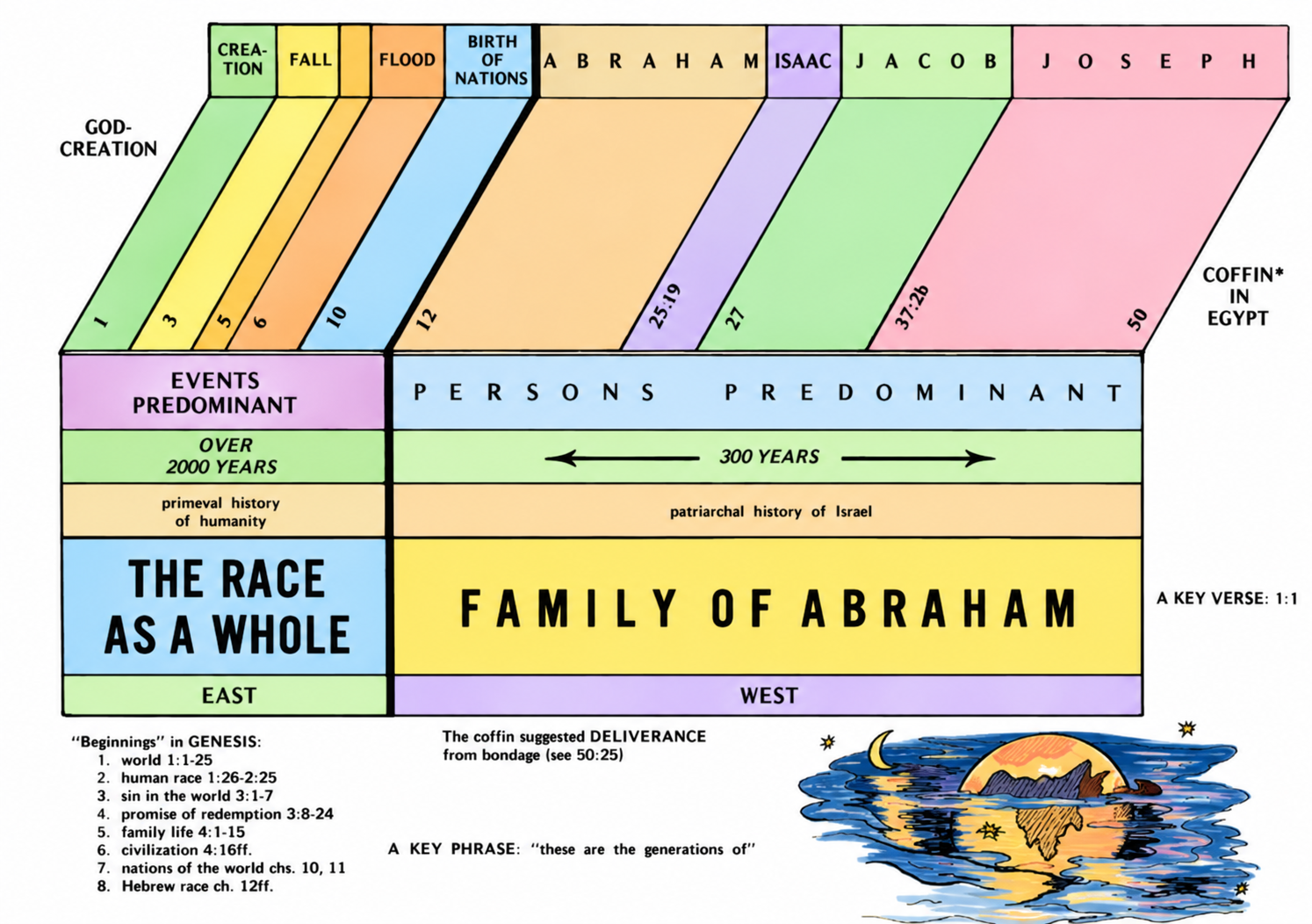
Click chart to enlarge
Chart from recommended resource Jensen's Survey of the OT - used by permission
| Summary Chart of The Book of Genesis |
||||||||
| Focus | Foundation Events (Four Events) (Events Predominant) |
Foundation People (Four People) (People Predominant) |
||||||
| Divisions | Creation (Ge 1-2) |
Fall (Ge 3-5) |
Flood (Ge 6-9) |
Nations (Ge 10-12) |
Abraham's Faith (Ge 12-24) |
Isaac's Family (Ge 25-26) |
Jacob's Conflicts (Ge 27-36) |
Joseph's Calamity (Ge 37-50) |
| Topics | Beginning of the Human Race (Race As A Whole) |
Beginning of the Hebrew Race (Family of Abraham) |
||||||
| Faithfulness of Mankind (Noah) |
Faithfulness of One Man's Family (Abraham) |
|||||||
| Historical | Biographical | |||||||
| Place | Eastward From Eden to Ur |
Westward From Canaan to Egypt |
||||||
| Time | ~2000+ Years (20% of Genesis) (~4004-2090BC) |
About 300 Years 193 Yr in Canaan, 93 Yr in Egypt (80% of Genesis) (2090-1804BC) |
||||||
| Primeval History of Humanity |
Patriarchal History of Israel |
|||||||
| Author | Moses | |||||||
Genesis 26:1 Now there was a famine in the land, besides the previous famine that had occurred in the days of Abraham. So Isaac went to Gerar, to Abimelech king of the Philistines.
- the first (KJV): Ge 12:10
- And Isaac (KJV): Ge 25:11
- Abimelech (KJV): Ge 20:2 21:22-32
Related Passages:
Genesis 12:10 Now there was a famine in the land; so Abram went down to Egypt to sojourn there, for the famine was severe in the land.
Ruth 1:1 Now it came about in the days when the judges governed, that there was a famine in the land. And a certain man of Bethlehem in Judah went to sojourn in the land of Moab with his wife and his two sons.
Psalm 105:16 (RESULTED IN JACOB TAKING FAMILY TO EGYPT) And He called for a famine upon the land; He broke the whole staff of bread.
Genesis 41:56-57 When the famine was spread over all the face of the earth, then Joseph opened all the storehouses, and sold to the Egyptians; and the famine was severe in the land of Egypt. 57The people of all the earth came to Egypt to buy grain from Joseph, because the famine was severe in all the earth.
Genesis 42:1-3 1Now Jacob saw that there was grain in Egypt, and Jacob said to his sons, “Why are you staring at one another?” 2He said, “Behold, I have heard that there is grain in Egypt; go down there and buy some for us from that place, so that we may live and not die.” 3Then ten brothers of Joseph went down to buy grain from Egypt.
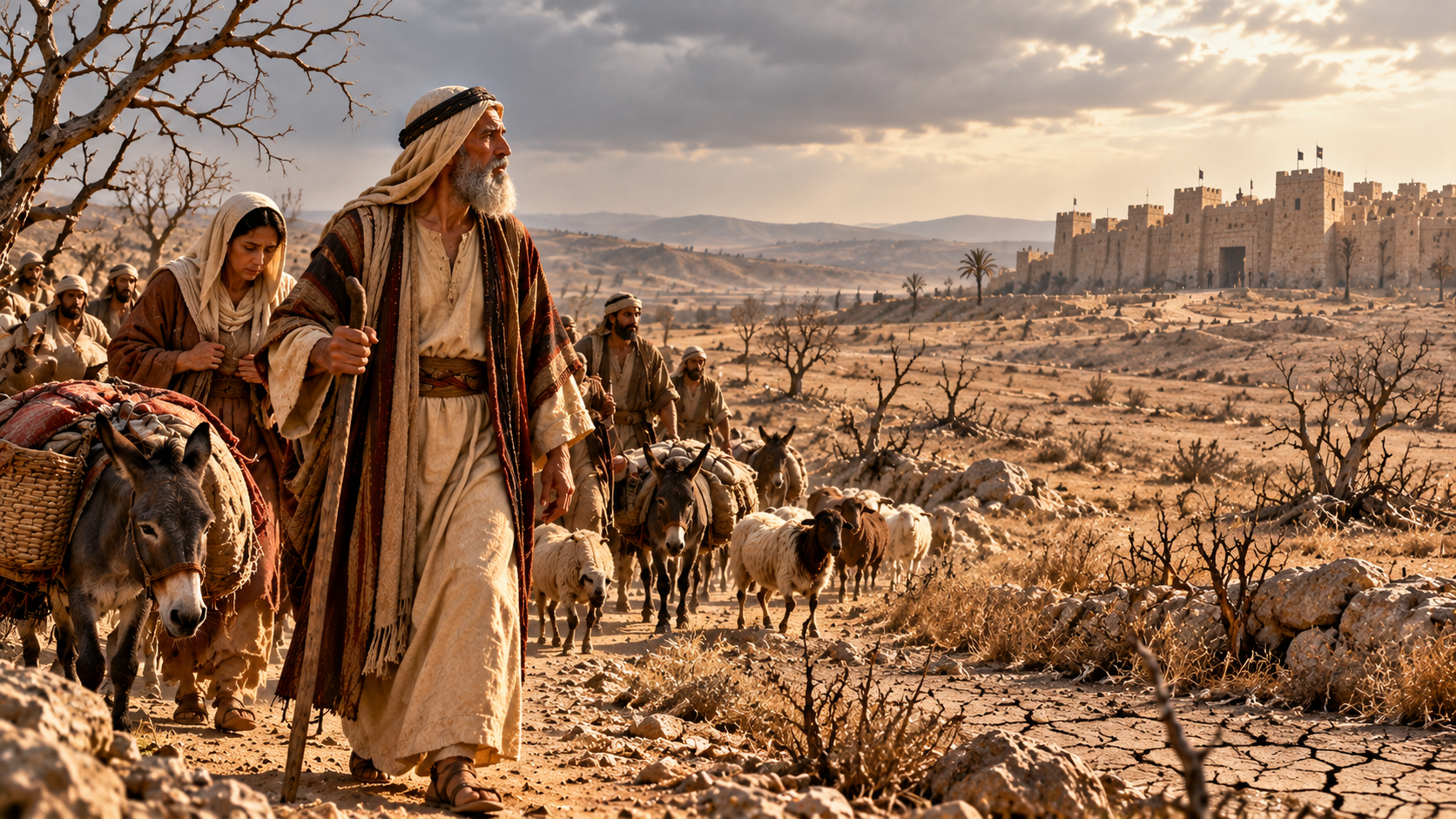
Famine in the Land of Canaan
WHEN FAITH IS TESTED
BY CIRCUMSTANCES
Now there was a famine (raab; LXX - limos) in the land, besides the previous famine (raab) that had occurred in the days of Abraham - od is. He is sovereign even over famines, as the psalmist declares, “And He called for a famine upon the land; He broke the whole staff of bread” (Psalm 105:16). In a sense, each famine is a test of faith. Abraham faced his test when “there was a famine in the land; so Abram went down to Egypt to sojourn there, for the famine was severe in the land” (Genesis 12:10). Now Isaac faces his. Like father, like son. Abraham was tested, and now Isaac would be tested. And for a wealthy pastoral household such as Isaac's, a prolonged famine threatened not only daily sustenance but also the survival of his flocks, herds, servants, and family.
Abraham's journey to Egypt led to a serious moral failure. Fearing that the Egyptians would kill him because of Sarah's beauty, he instructed her to identify herself as his sister (Ge 12:11–13). Although Abraham's statement had a factual basis, since Sarah was his half-sister (Ge 20:12), he used it deceptively to conceal their marriage. The consequences were serious, and God intervened to protect Sarah and preserve His covenant purposes (Ge 12:14–20). Now Isaac faces a similar crisis, and the reader naturally wonders whether he will respond differently from his father. This does not mean that children are inevitably destined to repeat their parents' sins. It does, however, illustrate how patterns of fear and unbelief can reappear in successive generations.
Trials are permitted to come into the life of the best and holiest of men,
and it is by this means that God sometimes teaches His most precious lessons.
--W H Griffith-Thomas
So - Term of conclusion. The famine led Isaac to conclude that he needed to look elsewhere for food, so he went to Gerar, apparently on his way toward Egypt as his father had done (Ge 12:10).
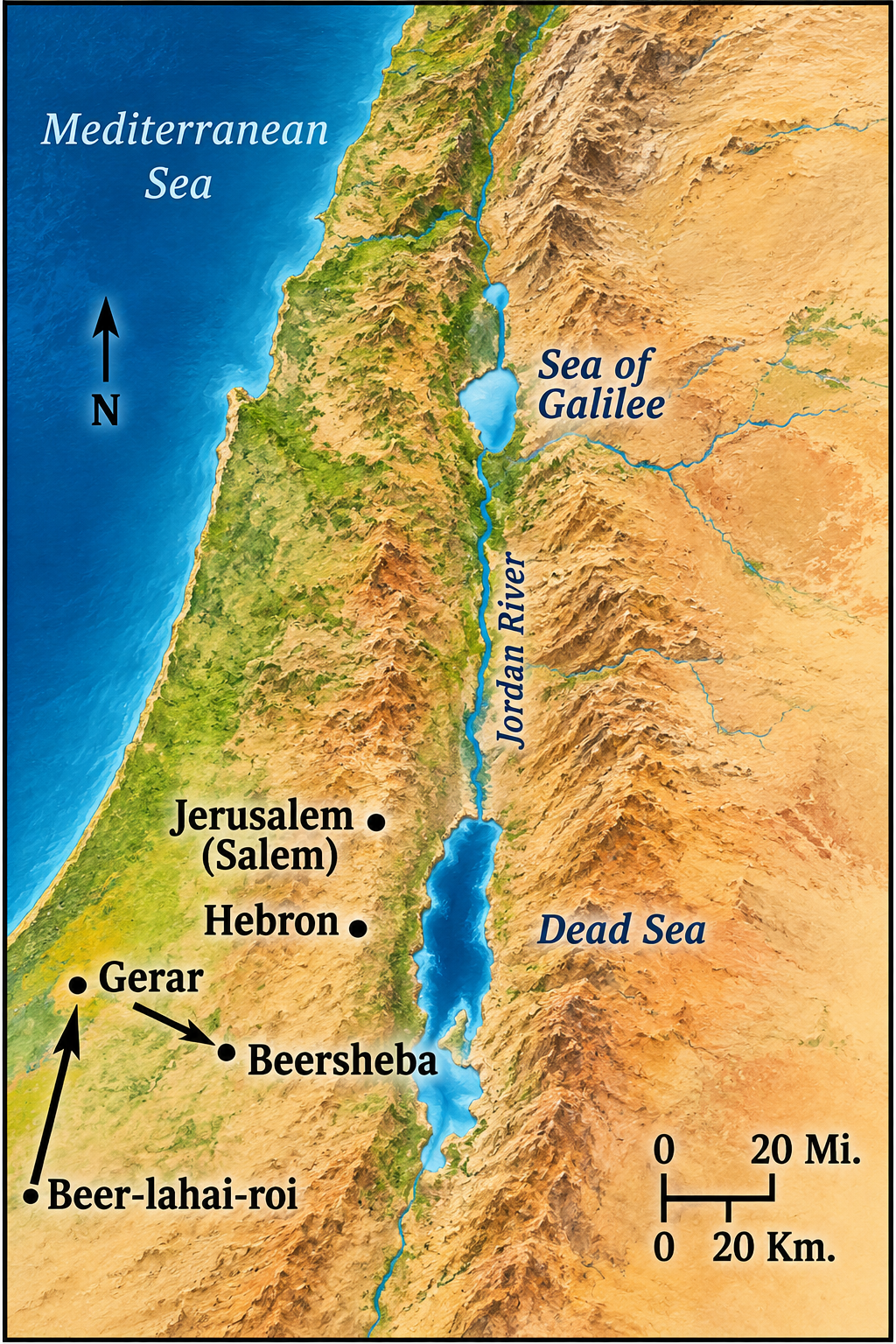
Isaac went to Gerar - The question arises as to whether Isaac was right in taking this journey? Had he had consulted God about it? Had God somehow communicated it to him? We cannot say, but Moses does not say anything negative or critical about Isaac leaving for Gerar.
Gerar was located in the southern region of Canaan, associated with the territory of the Philistines. Its precise archaeological identification remains debated, although it is commonly associated with the region southwest of Beersheba. Gerar also held significance in Abraham's history. Abraham had previously lived in Gerar and had encountered an Abimelech there (Ge 20:1–18).
to Abimelech king of the Philistines - The name Abimelech (Hebrew Abimelek, 040) is commonly understood to mean "my father is king" or "father of the king." Abraham had previously encountered an Abimelech who ruled Gerar (Ge 20:2; 21:22–34). Now Isaac encounters a ruler bearing the same name. Was this the same individual? Scripture does not explicitly answer that question. Some interpreters believe that Abimelech may have been a royal title used by successive rulers, somewhat like Pharaoh in Egypt. Others understand the name as belonging to different kings or possibly the same long-lived ruler. (See page 99 for Gleason Archer's answer to the question - Were there Philistines in Palestine by Abraham’s time?)
Abraham had to trust God during famine (Ge 12:10). Isaac would have to trust God during famine (Ge 26:1–6). Later, Jacob's family would experience another famine that would lead them to Egypt (Ge 41:56–57; 42:1–3). In each case, the hardship became part of the unfolding history through which God accomplished His purposes.
Bob Utley - "So Isaac went to Gerar, to Abimelech king of the Philistines" The Philistines were a mercenary people from the islands of the Aegean. They attempted to invade Egypt, but were repulsed and so they settled in the southwestern coast of Palestine, somewhere around 1200 B.C. Because the name Abimelech is mentioned earlier in Gen. 21:22, this must have been the common name to denote all of the Philistine kings. This is similar to the use of Hadad in Syria and Pharaoh in Egypt. It is surely possible that (1) there were earlier Philistine tradesmen in Canaan, (2) that a Canaanite group merged with the Philistines and this name is an anachronism and (3) Philistines are listed in Ge 10:6-20 coming from Ham and the Canaanites, not Japheth (Islands of the Aegean). It is possible the name refers to several groups associated with Palestine/Canaan (NIDOTTE, vol. 4, p. 1049).
Warren Wiersbe has an excellent comment - When Abraham arrived in Canaan, he found a famine in the land and faced his first serious test of faith (12:10–13:4). His solution was to abandon the place God had chosen for him, the place of obedience, and to run to Egypt, thus establishing a bad example for his descendants who were prone to imitate him (see Note). The safest place in the world is in the will of God, for the will of God will never lead us where His grace can’t provide for us. Unbelief asks, “How can I get out of this,” while faith asks, “What can I get out of this?” (Bible Exposition Commentary)
Note - Whenever they were in trouble, the Jews clamored to go back to Egypt (Ex. 16:1–3; 17:1–4; Num. 11; 14). During the declining days of the kingdom, instead of trusting God, the rulers of Judah often turned to Egypt for help (Isa. 30:1–2; 31:1; Jer. 42:13ff; Hosea 7:11).
John Walton - Philistines in Palestine. Large numbers of Philistines entered Canaan after the invasion of the Sea Peoples (1200 B.C.) broke Egyptian control over the area. In this context they are mentioned in the records of Ramses III (1182–1151 B.C.). They established a pentapolis of five major city-states (Gaza, Gath, Ashdod, Ekron, Ashkelon) along the southern coastal plain and quickly gained political control over nearby regions as well (Judg 15:11). Their mention in Genesis may reflect an earlier group that settled in Canaan prior to 1200 B.C., or it may be an anachronism based on their presence in the Gerar region in later periods (see Gen 21:32), earlier people of the vicinity being referred to by the name known to later readers. Archaeological evidence of their presence is found in the introduction of new pottery types, grave goods (such as the sarcophagi with human features) and new architectural designs.
Life Application Study Bible - The Philistines would become some of Israel's fiercest enemies. The Philistines were one group of a number of migrating sea peoples from the Aegean Sea who had settled in Palestine. They arrived by way of Crete and Cyprus and were used as mercenaries by Canaanite rulers. These people, living along the southwest coast, were few but ferocious in battle. Although friendly to Isaac, this small group was the forerunner of the nation that would plague Israel during the time of Joshua, the judges, and David. This King Abimelech was not the same Abimelech that Abraham encountered (chapters 20-21). Abimelech may have been a dynastic name of the Philistine rulers. (See Life Application Study Bible - Page 4904)
Famine (07458) raab means hunger, or famine which is a drastic, usually widespread food shortage, an extreme scarcity of food. Ra'ab means "hunger" as opposed to "thirst". In some areas the cause is overpopulation, but it is usually a failure of crops that results in a serious shortage of nutritional foods. The first famine is described in Genesis 12:10. God allows or causes famines and clearly He was testing Abram's faith at this time. We see a repeat in Genesis 26:1. Not only did famines occur in Canaan but Egypt also suffered cycles of famine (Ge 41:27, 30, 31). In Ps 105:16 "He called for a famine upon the land" and the result was that Jacob took his family to Egypt! (cf Ge 50:20) God is sovereign in History! Famine can be the discipline of God on His people (Isa. 5:13). Through His prophet Ezekiel God warned Judah (the 10 northern tribes having already been taken off into captivity by Assyria in 722BC) "Son of man (Ezekiel), if a country sins against Me by committing unfaithfulness, and I stretch out My hand against it, destroy its supply of bread, send famine against it, and cut off from it both man and beast even though these three men, Noah, Daniel and Job were in its midst, by their own righteousness they could only deliver themselves,” declares the Lord GOD." (Ezekiel 14:13-14) Famine is frequently mentioned in the terrible triad "sword, famine, and pestilence," (Jer. 14:13, 27:8, 13, 18, 32:24, 36, 34:17, 38:2, 42:17, 22, 44:13, Ezek 6:11), Famine is used figuratively of spiritual nourishment, God declaring "I will send a famine on the land, Not a famine for bread or a thirst for water, But rather for hearing the words of the LORD. sword, famine, and pestilence. Amos mentions a famine of the Word of God, not food, that the Lord will send!" (Amos 8:11). The line between famine and plenty in Palestine depends mainly on the rains coming at the right time and in the proper supply, famine was an ever-present threat.
In summary raab is a prolonged scarcity of food, accompanied by extreme hunger. It is listed as one of God’s ‘four sore acts of judgment’ along with the sword (war), evil beasts, and pestilence (Eze 14:21). It is also a divine judgment in Jeremiah, along with the sword (fourteen times), and with the sword and pestilence (fifteen times). In Dt 28:48, hunger is one of the many curses God will send for disobedience. Famine may lead to disease (Jer 14:18) and, most gruesome of all, cannibalism of one’s own offspring (Dt. 28:47-57). Other attendant judgments may be captivity (Jer 15:2), exile (Ezek 5:12), nakedness (Dt. 28:47)
God used a "famine" as a means
of judgment (Jer 5:12),
of warning (1Ki 17:1), (Elijah)
of correction (2Sa 21:1),
of punishment (Jer 14:12),
of humbling (Dt 8:3)
of expressing sovereign control (Ru 1:1)
Famine is always under divine control,
being planned and used by Yahweh.
NET NOTE - This account is parallel to two similar stories about Abraham (see Gen 12:10–20; 20:1–18). Many scholars do not believe there were three similar incidents, only one that got borrowed and duplicated. Many regard the account about Isaac as the original, which then was attached to the more important person, Abraham, with supernatural elements being added. For a critique of such an approach, see R. Alter, The Art of Biblical Narrative, 47–62. It is more likely that the story illustrates the proverb "like father, like son" (see T. W. Mann, The Book of the Torah, 53). In typical human fashion the son follows his father's example of lying to avoid problems. The appearance of similar events reported in a similar way underscores the fact that the blessing has now passed to Isaac, even if he fails as his father did.
Cyril Hocking - ISAAC TESTED
ALTHOUGH Isaac lived longer than Abraham, Jacob or Joseph, there is far less recorded of his life than of theirs. Indeed, chapter 26 is the only chapter of Genesis exclusively devoted to his experiences. The chapter records three incidents.
(i) The famine, Ge 26:1–11.
This is linked with the earlier famine in the days of Abraham, Ge 26:1; 12:10, thereby stressing that Isaac was subjected to exactly the same testing as his father. Abraham had failed the test, but had been characterized mainly by obedience 26:5. Isaac imitated his father’s obedience for he did as God commanded, Ge 26:2, 6. Alas, he also imitated Abraham’s lack of faith, cowardly fear and cunning deception. Isaac’s fear was altogether unfounded. God had promised to be with him, Ge 26:3, so he should not have feared what men would do to him, Heb. 13:15–16. As it was, nobody attempted to touch Rebecca, even though the couple were in Gerar for “a long time”, Ge 26:8. Isaac should have learnt from his father’s mistake, for God had earlier shown Abraham’s deceit to be unnecessary. Do we learn from others’ mistakes?
(ii) The wells, Ge 26:12–25.
n the basis of this section, we may associate Isaac’s name with wells, as we do Abraham’s with altars, and Jacob’s with pillars. The herdsmen of Gerar contested Isaac’s right to the new wells dug by his herdsmen, and he withdrew to fresh pastures, Ge 26:19–22. In view of the offer made to his father, Ge 20:15, Isaac could have claimed the right to dwell where he wished in Gerar. To avoid trouble, however, he waived his rights. This was meekness, and not weakness; see Ge 26:16. The Lord requires that we follow Isaac’s example in turning the other cheek, Matt. 5:39, and has left us His own example, Luke 9:56. “Let your moderation (gentleness, sweet reasonableness, yieldingness) be known unto all men”, Phil. 4:5. Where the Lord’s interests are at stake we must yield nothing, Gal. 2; where our interests are at stake we must yield all, 1 Cor. 8 and 9.
(iii) The covenant, Ge 26:26–33.
Recognizing that the Lord was with Isaac, Abimelech sought and made a non-aggression pact with him; cf. Ge 26:22–32. Truly, “When a man’s ways please the Lord, he maketh even his enemies to be at peace with him”, Prov. 16:7.
John Butler - Genesis 26—Difficulties of Isaac. Four major difficulties for Isaac are recorded in this chapter. •Famine: this first difficulty caused Isaac to move to Philistia. •Failure: Isaac failed to be honest about his wife in Philistia, and like his father Abraham, lied about his wife and said she was his sister. •Foes: the Philistines became Isaac’s foes and gave Isaac much trouble especially regarding the wells he dug. Water was at a premium in the area and wells were most valuable. •Family: this family difficulty had to do especially with Esau’s marriages—Esau had married some unsavory women, and they were a grief to his parents.
Warren Wiersbe - True faith is always tested, either by temptations within us or trials around us (James 1:1–18), because a faith that can’t be tested can’t be trusted. God tests us to bring out the best in us, but Satan tempts us to bring out the worst in us. In one form or another, each new generation must experience the same tests as previous generations, if only to discover that the enemy doesn’t change and that human nature doesn’t improve. Abraham is mentioned eight times in this chapter, and you find the word “father” six times. Isaac was very much his father’s son. Abraham Lincoln was right: “We cannot escape history.”....We can never successfully run away from trials, because God sees to it that His children learn the lessons of faith regardless of where they go. We can never grow in faith by running from difficulty, because “tribulation produces perseverance; and perseverance, character …” (Rom. 5:3,4NKJV). Like David, we may wish we had “wings like a dove” so we could “fly away and be at rest” (Ps. 55:6NKJV), but if we did, we’d always be doves when God wants us to “mount up with wings as eagles” (Isa. 40:31KJV). (Bible Exposition Commentary)
Goldingjay - The original blessing theme is explicitly resumed in chapter 26. Here Yahweh appears, commands, and promises, as he had to Abraham (26:2–5; cf. 12:1–3). Although Isaac made mistakes very like his father’s (26:6–11; cf. 12:10–20; 20:1–18), he also received blessings very like his father’s (26:12–14, cf. 13:1–4). He was involved in strife like his father (26:15–22; cf. 13:5–13; 21:25–32), but he was reassured by Yahweh and he worshipped like his father (26:23–25; cf. 13:14–18; 21:33) and was acknowledged by the nations like his father (26:26–33; cf. 14:19–20; 21:22–24). Indeed, it is explicitly because Yahweh committed himself to Abraham, because Abraham obeyed him, and as the God of Abraham, that Yahweh appears to Isaac (26:3, 5, 24). Nevertheless, there is one distinctive motif characteristic of the Isaac narrative, the promise “I will be with you” (26:3) or “I am with you” (26:24). It reappears in the form of Abimelek’s acknowledgment of Isaac, “Yahweh is with you” (26:28), as it had featured in Abimelek’s acknowledgment of Abraham (21:22). It reappears in the Jacob material in the chapters that follow (28:15, 20; 31:3, 5, 42; 35:3), and constitutes the distinctive aspect to the promise and experience of Yahweh’s blessing as this is portrayed in the Isaac narrative. [“Patriarchs,” pp. 17–18]
Abraham and Isaac – Similar Trials, Similar Temptations
|
Abraham |
Isaac |
|---|---|
|
Experienced famine in Canaan (Ge 12:10) |
Experienced famine in Canaan (Ge 26:1) |
|
Went down to Egypt (Ge 12:10) |
Was commanded not to go to Egypt (Ge 26:2) |
|
Concealed his marriage to Sarah (Ge 12:11–13) |
Concealed his marriage to Rebekah (Ge 26:7) |
|
Later encountered Abimelech in Gerar (Ge 20:1–18) |
Encountered Abimelech in Gerar (Ge 26:1) |
|
Received God's covenant promises (Ge 12:1–3; 17:1–8) |
Received reaffirmation of those promises (Ge 26:3–5) |
|
Experienced God's protection despite failure |
Experienced God's protection despite failure |
The parallels are striking, but they should not obscure the individual responsibility of each patriarch.
QUESTION - Who were the Philistines? - GotQuestions.org
ANSWER - The Philistines were an aggressive, warmongering people who occupied territory southwest of Israel between the Mediterranean Sea and the Jordan River. The name “Philistine” comes from the Hebrew word Philistia, and the Greek rendering of the name, palaistinei, gives us the modern name “Palestine.” The Philistines are first recorded in Scripture in the Table of Nations, a list of the patriarchal founders of seventy nations descended from Noah (Genesis 10:14). It is thought that the Philistines originated in Caphtor, the Hebrew name for the island of Crete and the whole Aegean region (Amos 9:7; Jeremiah 47:4). For unknown reasons, they migrated from that region to the Mediterranean coast near Gaza. Because of their maritime history, the Philistines are often associated with the “Sea Peoples.” The Bible records that the Philistines had contact with both Abraham and Isaac as early as 2000 B.C. (Genesis 21:32, 34; 26:1, 8).
After Isaac’s involvement with the Philistines (Genesis 26:18), they are next mentioned in passing in the book of Exodus shortly after the Israelites crossed the Red Sea: “When Pharaoh let the people go, God did not lead them on the road through the Philistine country, though that was shorter. For God said, ‘If they face war, they might change their minds and return to Egypt’” (Exodus 13:17).
The “road through the Philistine country” refers to a route later known as the Via Maris or “the Way of the Sea,” one of three major trade routes in ancient Israel. This coastal road connected the Nile Delta with Canaan and Syria and beyond, into the Mesopotamian region of southwest Asia.
The Old Testament indicates that around the 13th century B.C., during the days of Samuel and Samson, the Philistines moved inland from the coast of Canaan. There, they built their civilization primarily in five cities: Gaza, Ashkelon, Ashdod, Gath, and Ekron (Joshua 13:3). These cities were each governed by a “king” or “lord” (from the Hebrew word seren, also rendered as “tyrant”). These kings apparently formed a coalition of equals. Each king retained autonomous control of his city, such as when Achish, king of Gath, dealt with David (1 Samuel 27:5-7), but they worked in concert in times of national emergency (Judges 16:5).
From the very beginning, the Philistines were either allies or deadly enemies of God’s people. They played a pivotal role in the lives of Samson (Judges 13:1; 14:1), Samuel (1 Samuel 4:1), Saul (1 Samuel 13:4), and David (1 Samuel 17:23).
The Philistines were known for their innovative use of iron, which was superior to the bronze used by the Israelites for weapons and implements. Even as late as the time of Saul (1050 - 1010 B.C), the Israelites were forced to rely on the Philistines to sharpen or repair their iron tools (1 Samuel 13:19-21). With their more advanced armaments and aggressive military policy, the Philistines continually thwarted Israel’s development as a nation. For nearly 200 years, the Philistines harassed and oppressed the Israelites, often invading Israel’s territory. The children of Israel simply could not deal with the Philistines’ overwhelming military might. This only came to an end when Samuel and then David, through the guidance of God, were able to defeat the Philistines (1 Samuel 7:12-14; 2 Samuel 5:22-25).
The Old Testament indicates that the Philistines worshiped three gods: Ashtoreth, Dagon, and Baal-Zebub—each of which had shrines in various cities (Judges 16:23; 1 Samuel 31:10; 2 Kings 1:2). Archaeological findings show that Philistine soldiers carried images of their gods into battle (2 Samuel 5:21). Apparently, they were also a superstitious people who respected the power of Israel’s ark of the covenant (1 Samuel 5:1-12).
The Philistines were infamous for their production and consumption of alcoholic beverages, especially beer. Ancient Philistine ruins contain numerous breweries and wineries, as well as countless beer mugs and other drinking vessels. Samson’s wedding feast, recorded in the book of Judges, illustrates the Philistine practice of holding week-long drinking parties; the Hebrew word misteh, translated “feast” in Judges 14:10, means “drinking feast.”
The Israelites frequently referred to the Philistines as “uncircumcised” (Judges 15:18; 1 Samuel 14:6; 2 Samuel 1:20), meaning, at that time, those who had no relationship with God. They were not God’s chosen people and were to be strictly avoided as a contaminating evil.
Today, the word philistine is used as an epithet to refer to an unrefined, dull person. In truth, the Philistines of history were not unsophisticated or uncultured. They were an advanced seafaring people who, for several generations, were years ahead of Israel.
With the exception of Jeremiah chapter 47, there are very few prophetic references to the Philistines. In the end, the Philistines were assimilated into Canaanite culture. They eventually disappeared from the biblical record and from history altogether, leaving behind the name “Palestine” as a testimony of their existence.
Related Resource:
PHILISTINES (compilation of several articles) - Philistines (Pelishtim; singular Pelishti, H6430) are mentioned about 286 times in the Old Testament, more than any other neighboring people. Their land is called Pelesheth, “Philistia” (H6429; Ps 60:8; 87:4; 108:9), and the name Palestine comes from it. The name is usually explained as “migrants” or “wanderers,” which fits the biblical statement that they came from elsewhere. The Septuagint uses Phylistieim in the Pentateuch, Joshua, and Judges. From Samuel onward it usually translates the name as allophyloi, “foreigners.” Scripture repeatedly calls them “uncircumcised” (Jdg 14:3; 1Sa 17:26, 36; 31:4), which set them apart from Israel and most of their Semitic neighbors.
Origin. The Table of Nations lists them among the descendants of Mizraim (Egypt), connected with the Casluhim and the Caphtorim (Ge 10:14; 1Ch 1:12). The prophets state that they came from Caphtor: “Are you not as the sons of Ethiopia to Me, O sons of Israel?” declares the LORD. “Have I not brought up Israel from the land of Egypt, and the Philistines from Caphtor and the Arameans from Kir?” (Am 9:7; cf. Jer 47:4). The Caphtorim drove out the Avvim, who lived in villages as far as Gaza (Dt 2:23). Caphtor is most often identified with Crete, though some have proposed Cyprus or Cilicia (the Septuagint reads “Cappadocia”). The Philistines are also linked with the Cherethites (Kerethim) of the coast (1Sa 30:14; Eze 25:16; Zep 2:5). The Septuagint renders that name “Cretans.”
The land and the five cities. Philistia was the fertile coastal plain of southwest Canaan. It ran about 40 miles from the Brook of Egypt (Shihor) north to Ekron and was about 10 to 20 miles wide (Jos 13:2-3). The terrain suited war chariots, and the plain carried the main trade road between Egypt and Syria. Its power centered in five cities, the Pentapolis: Gaza, Ashkelon, Ashdod, Ekron, and Gath. Each was ruled by a “lord” (seren, H5633), a title found only for Philistine rulers and possibly related to the Greek tyrannos (Jos 13:3; Jdg 16:5; 1Sa 5:8; 29:6). The five lords acted together in war (1Sa 6:16-18). In later periods the rulers are called “kings” (Jer 25:20; Zec 9:5).
Religion. Their chief god was Dagon, with temples at Gaza (Jdg 16:23) and Ashdod (1Sa 5:1-5; 1Ch 10:10). They also worshiped Ashtaroth (1Sa 31:10) and Baal-zebub, the god of Ekron (2Ki 1:2-6). Older writers took Dagon to be a fish-god. Most scholars now connect the name with Semitic dagan, “grain,” and see him as a god of grain or storm. The humiliation of Dagon before the ark is famous: “But when they arose early the next morning, behold, Dagon had fallen on his face to the ground before the ark of the LORD. And the head of Dagon and both the palms of his hands were cut off on the threshold; only the trunk of Dagon was left to him” (1Sa 5:4). The Philistines carried idols into battle (2Sa 5:21), announced victories in their temples (1Sa 31:9), and were known for divination: “they are soothsayers like the Philistines” (Isa 2:6; cf. 1Sa 6:2).
In the patriarchal period. Genesis places Philistines at Gerar under Abimelech, with Phicol his army commander and Ahuzzath his adviser (Ge 21:32, 34; 26:1, 8, 14-18, 26). Abraham and later Isaac made covenants with them. These were peaceful, pastoral neighbors, quite unlike the warlike Philistines of Judges and Samuel. Some scholars explain this as an earlier wave of Aegean settlers. Others think Genesis uses the name by which the region was known when the book was written.
Exodus and conquest. God led Israel away from the coastal road: “Now when Pharaoh had let the people go, God did not lead them by the way of the land of the Philistines, even though it was near; for God said, ‘The people might change their minds when they see war, and return to Egypt’” (Ex 13:17; cf. Ex 15:14). Philistia was part of the Promised Land and was allotted to Judah (Jos 15:45-47), but Joshua never conquered it (Jos 13:2-3). Judah captured Gaza, Ashkelon, and Ekron (Jdg 1:18), but did not keep them. God left the Philistines in the land for a purpose: “They were for testing Israel, to find out if they would obey the commandments of the LORD, which He had commanded their fathers through Moses” (Jdg 3:4; cf. Jdg 3:1-3).
The judges. Shamgar struck down 600 Philistines with an oxgoad (Jdg 3:31). Later the Philistines dominated Israel for forty years (Jdg 13:1). Samson, a Danite, harassed them alone. His story includes his Philistine wife from Timnah, the foxes and the burned fields, and Delilah of the valley of Sorek. He died pulling down Dagon’s temple at Gaza (Jdg 13-16).
Samuel and Saul. At Aphek the Philistines defeated Israel, killed Hophni and Phinehas, and captured the ark (1Sa 4). Plagues at Ashdod, Gath, and Ekron forced them to send it back with a guilt offering (1Sa 5-6). Samuel later routed them at Mizpah and set up the stone Ebenezer, and cities from Ekron to Gath were restored to Israel (1Sa 7:10-14). Israel’s demand for a king came largely from this threat (1Sa 8:20; 9:16). The Philistines had garrisons in Israel’s hill country and controlled ironworking: “Now no blacksmith could be found in all the land of Israel, for the Philistines said, ‘Otherwise the Hebrews will make swords or spears’” (1Sa 13:19; cf. 13:20-22). Jonathan’s attack at Michmash broke their hold for a time (1Sa 14). In the valley of Elah, Goliath of Gath challenged Israel in bronze armor carrying an iron-tipped spear. David answered him: “You come to me with a sword, a spear, and a javelin, but I come to you in the name of the LORD of hosts, the God of the armies of Israel, whom you have taunted” (1Sa 17:45). Later, fleeing Saul, David took refuge with Achish king of Gath, who gave him Ziklag (1Sa 27:1-7). The Philistine lords would not let David fight with them (1Sa 29). They then defeated Israel on Mount Gilboa, killed Saul and his sons, and hung their bodies on the wall of Beth-shan (1Sa 31).
David and the monarchy. After David was crowned and took Jerusalem, he defeated the Philistines twice in the valley of Rephaim (2Sa 5:17-25). He then subdued them, taking Gath and its towns (2Sa 8:1; 1Ch 18:1). His men killed several giants descended from “the Rapha,” Goliath’s relatives among them (2Sa 21:15-22). Philistia lay within Solomon’s dominion (1Ki 4:21). Later the kings fought over the border towns: the Philistines held Gibbethon (1Ki 15:27). Jehoshaphat received tribute from them (2Ch 17:11), but they raided Judah under Jehoram (2Ch 21:16-17). Uzziah tore down the walls of Gath, Jabneh, and Ashdod (2Ch 26:6). They took towns in the Shephelah under Ahaz (2Ch 28:18). Hezekiah struck them as far as Gaza (2Ki 18:8).
Assyrian and later periods. Assyrian records call the region Palastu or Pilistu and name Philistine kings. One is Padi of Ekron, whom Hezekiah held prisoner until Sennacherib forced his release in 701 BC. Sargon’s general (the Tartan) captured Ashdod in 711 BC (Isa 20:1). Egypt and Babylon later fought over Philistia, and Nebuchadnezzar devastated it about 604 BC. After the exile some Jews married women of Ashdod, and their children spoke “the language of Ashdod” (Ne 13:23-24). The Philistines disappear as a distinct people during the Persian and Greek periods. Their name survived in the Greek and Roman Palaestina.
The prophets. Nearly every major prophet pronounced judgment on Philistia (Isa 14:29-31; Jer 25:20; 47:1-7; Am 1:6-8; Zep 2:4-7). The charge was their long hostility toward God’s people: “Thus says the Lord GOD, ‘Because the Philistines have acted in revenge and have taken vengeance with scorn of soul to destroy with everlasting enmity’” (Eze 25:15). Yet the prophets also hold out hope for a remnant: “And I will remove their blood from their mouth and their detestable things from between their teeth. Then they also will be a remnant for our God, and be like a clan in Judah, and Ekron like a Jebusite” (Zec 9:7). One psalm even names Philistia among the nations to be enrolled as citizens of Zion: “I shall mention Rahab and Babylon among those who know Me; behold, Philistia and Tyre with Ethiopia: ‘This one was born there’” (Ps 87:4).
David’s Cherethites and Pelethites. David’s bodyguard, commanded by Benaiah, was called “the Cherethites and the Pelethites” (2Sa 8:18; 15:18; 20:7; 1Ki 1:38, 44). Many scholars take these as Cretans and Philistines serving as foreign mercenaries, alongside Ittai and the 600 Gittites from Gath (2Sa 15:18-22). Others take the words as military terms, perhaps “executioners” and “runners,” and see the guards as native Israelites. The question is still debated.
J R Miller - Isaac the Peacemaker Genesis 26
Isaac was a child of old age, his father being a hundred, and his mother ninety, when he was born. His name means "laughter," thus being a constant reminder of the gladness of his mother's heart when she learned that she was to have a son. It is a good thing to be a joy, to make life a song, wherever one goes. As to character, Isaac was meek, gentle, and contemplative; perhaps not very ambitious—yet diligent, lowly in spirit, peace-loving. Isaac would probably not make a name for himself in the modern world, with its intense commercialism and its fierce driving—but God would see quite a number of the Beatitudesshining in his character and disposition, nevertheless.
After the extraordinary incident of Abraham's sacrifice, when Isaac was bound upon the altar as an offering to God, he must always have considered his life, as in a special sense belonging to God. One who had served as a model for an artist in painting a picture of Jesus on His cross, said that ever afterwards the impression remained with him—he never could forget that for a number of hours he had represented the Master in His act of supreme devotion and sacrifice. In a still more real way—had Isaac been given to God, and had he given himself to God, and he must always have regarded his life as redeemed—an innocent animal died in his place.
Everyone who accepts of Jesus Christ as his Savior, has an experience just as real. He stands before God guilty, condemned. Then an offering is made for him. One takes his place on the altar and dies for his sins. He is redeemed now, not merely to go free—but to take his place as a living sacrifice. He is no longer his own, to do his own will—but bought with a price and belonging therefore to God.
In the chapter we are now reading, we see Isaac in a characteristic phase of his life—as a peacemaker. A famine had driven him into the Philistine country. Isaac seems to have repeated two mistakes of Abraham in this journey in the country of the Philistines. He fled to another land to escape the famine, when probably he ought to have braved it out where he was, trusting God to care for him. He seems to have intended to go all the way to Egypt, as Abraham had done—but before he had gone so far—God appeared to him and told him not to go there—but to stop where he was. So he remained in the land of the Philistines.
Isaac then had the same trouble among the people of Gerar, that Abraham had in Egypt. Hisbeautiful wife attracted the attention of the men; and Isaac, fearful of being killed for the sake of Rebekah, lied about her, as Abraham had lied about Sarah, saying, "She is my sister." The falsehood was exposed at length, to Isaac's dishonor. It seems strange, that precisely the same blot should be on the names of two men. We should learn a second time here—that the only safe way in any danger, is the way of truth. A lie will never make a safe refuge for us.
"The man became rich, and his wealth continued to grow until he became very wealthy. He had so many flocks and herds and servants that the Philistines envied him. So all the wells that his father's servants had dug in the time of his father Abraham, the Philistines stopped up, filling them with earth!" Isaac was prospered in the land of the Philistines. He sowed there and reaped large harvests—a hundredfold, because the Lord added His blessing to Isaac's labor, and to the fertility of the soil. He increased in wealth and prosperity, his flocks and herds greatly multiplying. The result was envy on the part of the Philistines. It is always so. When one has special success, others envy him and become his enemies, ofttimes treating him meanly and wickedly. There is plenty of the same wicked spirit in modern times, and in any community examples of it can be found.
The Philistines showed their envy towards Isaac—by filling the WELLS which Abraham had dug—with dirt. Wells were very important in those days and in that Eastern country. Water was scarce; there were few rivers or streams, and it was necessary to dig wells to get water both for themselves and for their flocks. To have a well in the desert was therefore a great benefaction. Someone asked Mohammed, "What shall I do to make my name immortal?" "Dig a well," was the answer. In the desert wastes of the East—a well is a great blessing. Neither man nor beast could live but for the wells. The Philistines did great harm, therefore, to Isaac and to the country when they stopped up the wells.
The king of the Philistines at last commanded Isaac to leave his land. He frankly gave the reason for this expulsion, "For you are much mightier than we." The king was afraid of Isaac; for with the remarkable prosperity that was attending him—he would soon be able to overpower the inhabitants of the country and drive them out. That is the way the Philistine king, the indwelling-sin in us, tries to do with anything good that is beginning to grow in our heart. He would drive it out. There is a great deal of this crowding out of the good, in the lives of Christians, by the evil that still remains in them. God is not desired to take full possession of us and to occupy our whole life. Too many professing Christians are careful not to yield unreservedly to the Spirit of God. The world is envious of Christ, and does not intend to let Him dwell in men's hearts and lives.
In the time of the strifes and enmities which arose—we see Isaac's peace-loving spirit. He might have resisted Abimelech's command, refusing to leave the Philistine country. Some people like to contend for their rights. They fight against all encroachments upon them. They are continually in some contention—quarreling with somebody. They boast of the fact that they never allow anyone to impose on them. The world calls this a manly spirit—but Jesus said, "Blessed are the peacemakers: for they shall be called the children of God." Here, twenty centuries before Christ came, we find Isaac living out this Beatitude.
"Isaac departed"—that is, he moved on when he was told to move on, rather than contendfor his right to stay there. We should not fail to get the lesson: it would be better for us to suffer wrongfully, than engage in contention and strife. This is the way the Master did. He let Himself be a "way," a road, on which others walked to better things. It is thus that He would have His followers live. This is the upward way.
Isaac moved on, and now we see him clearing out the old wells which his father had dug—but which the Philistines had filled up. There is continual opportunity for us in this world, to open out old wells which have been filled up, and rendered useless. The Evil One is always trying to destroy the fountains of good in a community. It is sad to see a church building unused, falling into decay, in which once the gospel was preached every Lord's Day. It is a sad thing to know of a home where once there was a family altar which has been torn down—the old well of grace and goodness, having been filled up. It is a holy work to clear out these wells, that again the water of life may flow in them to quench thirst and to make life.
Besides cleaning out and opening up the old wells, Isaac's servants dug also a new well, and found there a fountain of springing water. Wherever we go these days, we should seek to dig a well, to start some blessing which has not been there before. Someone says that he who makes two blades of grass grow where only one had grown before, is a benefactor. No one should be content to live anywhere, even for a little while, and not do something which will make his stay there a blessing. It is not always necessary literally to dig a well—that may not be the best thing to do. But there are other things that one may do—which will make the neighborhood more beautiful, a better place to live in.
Perhaps one may plant a tree which will grow and cast a grateful shade long after he who planted it has gone to his rest. Thackeray in a story tells of one of his characters whose custom was to keep his pockets filled with acorns when he walked over his estate, and whenever he found a spot that was bare and empty—he would plant one of these so that at length an oak would grow up to adorn the place. It was said by a friend of a Christian girl who died when a little past twenty, "Everywhere she went—flowers grew in the path behind her." She was an encourager, an inspirer, a comforter, a bearer of burdens, wherever she was known.
There are countless ways of starting a blessing in a neighborhood in which one is living. One does not need to have millions, and to found a great public library, endow a church, or open a well, in order to start a blessing. Just living a sweet life is a way of digging a well, whose waters will refresh others. To find an unhappy home—and change it into a home of love and peace—is to set going a blessing whose influence will go on forever. To change one unhappy person into happiness, one discontented man into contentment, one anxious woman into quiet peace, to help a little child—is to dig a well which shall become an enduring blessing. We should never allow a day to pass—without doing a kindness which shall make some heart gladder, some spirit braver, stronger, better. Wherever you go, tomorrow, any day—be sure you dig a well.
Although Isaac had moved on to avoid trouble with the Philistines, they persistently followed him, and wherever he settled, they continued to disturb him. Wherever his servants dug a well, the herdsmen of Gerar would claim it and try to take it. Isaac would then quietly give up the well, rather than have a struggle over it, and would dig another a little farther on. His enemies would then strive for that too, and then Isaac would again move on and dig another. All this showed Isaac's wonderful patience, his inoffensive spirit, and how willing he was tomake sacrifices for the sake of peace.
Some who read this chapter may consider Isaac as lacking in manliness; but was he not doing what Jesus long afterwards, in His Sermon on the Mount, taught His disciples to do? "But I tell you, Do not resist an evil person. If someone strikes you on the right cheek, turn to him the other also. And if someone wants to sue you and take your tunic, let him have your cloak as well. If someone forces you to go one mile, go with him two miles. Give to the one who asks you, and do not turn away from the one who wants to borrow from you." Matthew 5:39-42
At last Isaac got beyond the spitefulness of the Philistines. He seems by his inexhaustible patience to have literally worn out their persistent greed. "He moved on from there and dug another well, and no one quarreled over it." Isaac then made this well a memorial of his gratitude, for he called it Rehoboth, "room." "For now the Lord has given us room and we will flourish in the land," he said. Patience had wrought at length its perfect work.
Isaac's peaceful spirit was approved in heaven, and the Lord appeared to him at Beer-sheba, blessing him and renewing to him the promise which had been given to Abraham. There Isaac built an altar and worshiped the Lord. There also he pitched his tent and his servants dug a well. Again we have the tent, the altar, the well—emblems of a true and good home.
Genesis 26:2 The LORD appeared to him and said, “Do not go down to Egypt; stay in the land of which I shall tell you.
- appeared (KJV): Ge 12:7 Ge 17:1 Ge 18:1,10-20
- dwell (KJV): Ge 12:1 Ps 37:3
Related Passages:
Genesis 12:7 The LORD appeared to Abram and said, “To your descendants I will give this land.” So he built an altar there to the LORD who had appeared to him.
Genesis 17:1 Now when Abram was ninety-nine years old, the LORD appeared to Abram and said to him, “I am God Almighty; Walk before Me, and be blameless.
Genesis 18:1 Now the LORD appeared to him by the oaks of Mamre, while he was sitting at the tent door in the heat of the day.
Psalm 37:3 Trust in the LORD and do good; Dwell in the land and cultivate faithfulness.
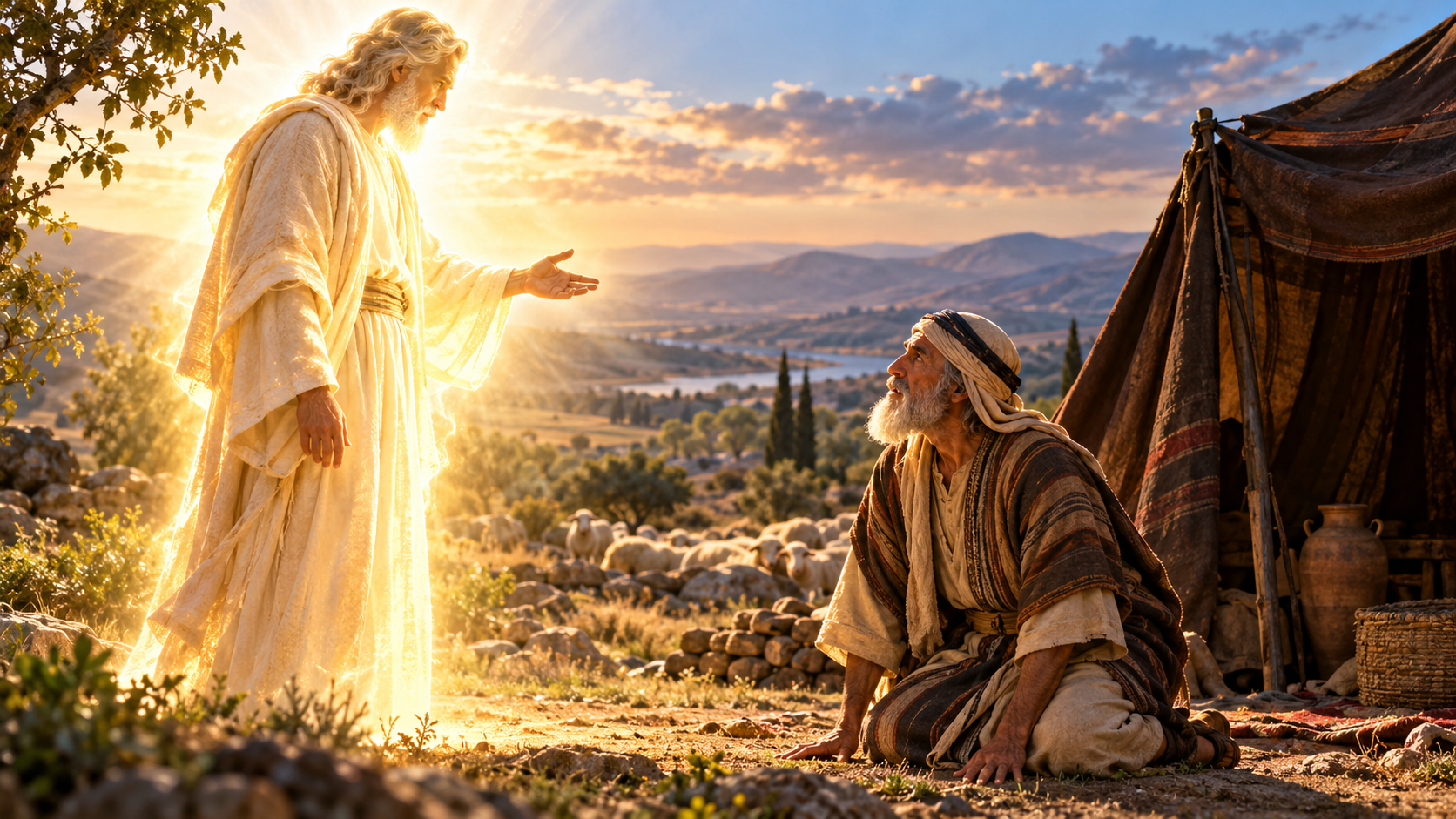
Possible Appearance of Yahweh to Isaac - the Text Does not specifically say.
GOD'S COMMAND IN A FAMINE
CALLS FOR TRUSTING HIS WORD
W H Griffith-Thomas - Although Isaac lived the longest of all the patriarchs less is recorded of him than of the others. This is the only chapter exclusively devoted to his life....Like the rest of us, Isaac's experiences were marked by light and shade, by sin and discipline, by grace and mercy. The chapter before us is full of illustrations of how difficulties should and should not be met.
The LORD appeared to him and said - This is the language of a theophany. In the midst of famine, uncertainty, and potential danger, the LORD graciously appeared to Isaac. This is the first recorded divine appearance of Yahweh to Isaac in Genesis (but see note below), marking a significant moment in the continuation of the Abrahamic covenant. How did Yahweh appear? The text does not explain the visible form in which the LORD manifested Himself to Isaac.
For clarification, in Genesis 22:13-18 the Angel of the LORD spoke to Abraham as was getting ready to sacrifice Isaac. The text describes only audible but no visible communication. Nevertheless, strictly speaking one could say that Isaac bound on the altar experienced a manifestation of the LORD on Mt. Moriah.
Henry Morris - This is apparently the first time in over fifty years that God had appeared to Isaac; here He confirmed the covenant made with Abraham and Isaac on Mount Moriah. It was also the first famine in the land of promise since Abram had gone down to Egypt over a century earlier. Isaac, unused to such testings, now needed special assurance.
Do not go down to Egypt; stay in the land of which I shall tell you - While Abraham had gone to Egypt when he experienced a famine in the Promised Land, Yahweh now gives explicit instructions to Isaac. The first instruction is a clear "no go" prohibition (used in a jussive sense). Regarding the phrase go down traveling from Canaan to Egypt was commonly described as going down, reflecting both geographical direction and the conventional language of travel toward Egypt. Yahweh adds that would give Isaac additional instructions about where he was to go. Notice that Yahweh’s command calls Isaac to trust Him and stay put in a land of famine. The very next verse gives him the reasons he can trust Him.
Jon Courson - I know there can be a famine in your soul. It happens to me as well. But resist the temptation to wander into Egypt in those times because if you do, you’ll get burned and miss God’s blessing. (See Jon Courson's Application Commentary)
NET NOTE - Do not go down to Egypt. The words echo Ge 12:10, which reports that "Abram went down to Egypt," but state the opposite.
One might ask why would they even go to Egypt in a famine? During periods of famine, Egypt was frequently an attractive destination because agriculture along the Nile depended upon the river's annual flooding rather than solely upon local rainfall. Although Egypt also experienced famines, its irrigation-based agricultural system could provide greater food security during droughts affecting Canaan. In short, while Egypt was a logical destination for Isaac to consider, Yahweh said "No way" (pun intended)!
A place that promises material security is
not necessarily the place of spiritual obedience!
🙏 THOUGHT - There is a principle here. From a purely human perspective, Egypt may have looked like the safer place to be during a famine, with its abundant grain fed by the Nile. But going there was not God’s will for Isaac. The most secure place is not where circumstances look most favorable, but in the center of God’s will, which is simply obedience to God. Centuries later Isaiah warned against the same reasoning: “Woe to those who go down to Egypt for help and rely on horses, and trust in chariots because they are many and in horsemen because they are very strong, but they do not look to the Holy One of Israel, nor seek the LORD!” (Isaiah 31:1). Isaac’s obedience was rewarded in the very land of famine: “Now Isaac sowed in that land and reaped in the same year a hundredfold. And the LORD blessed him” (Genesis 26:12). As Solomon wrote, “Trust in the LORD with all your heart and do not lean on your own understanding. In all your ways acknowledge Him, and He will make your paths straight” (Proverbs 3:5-6). Beloved, in the trial you are going through (or getting ready to go through), whose understanding are you leaning on?
God's revealed Word must take precedence
over human reasoning whenever the two conflict.
Egypt in the Lives of the Patriarchs
|
Patriarch |
Circumstance |
God's direction or recorded action |
|---|---|---|
|
Abraham |
Famine in Canaan |
Went down to Egypt; no prior divine command to go is recorded (Ge 12:10) |
|
Isaac |
Famine in Canaan |
Explicitly commanded not to go to Egypt (Ge 26:2) |
|
Jacob |
Famine and Joseph's invitation |
God reassured him about going to Egypt (Ge 46:2–4) |
The contrast demonstrates that God's guidance must be understood in its particular historical and covenant context.
QUESTION - What is a theophany? What is a Christophany? - GotQuestions.org
ANSWER - A theophany is a manifestation of God in the Bible that is tangible to the human senses. In its most restrictive sense, it is a visible appearance of God in the Old Testament period, often, but not always, in human form. Some of the theophanies are found in these passages:
1. Genesis 12:7-9 – The Lord appeared to Abraham on his arrival in the land God had promised to him and his descendants.
2. Genesis 18:1-33 – One day, Abraham had some visitors: two angels and God Himself. He invited them to come to his home, and he and Sarah entertained them. Many commentators believe this could also be a Christophany, a pre-incarnate appearance of Christ.
3. Genesis 32:22-30 – Jacob wrestled with what appeared to be a man, but was actually God (vv. 28-30). This may also have been a Christophany.
4. Exodus 3:2 - 4:17 – God appeared to Moses in the form of a burning bush, telling him exactly what He wanted him to do.
5. Exodus 24:9-11 – God appeared to Moses with Aaron and his sons and the seventy elders.
6. Deuteronomy 31:14-15 – God appeared to Moses and Joshua in the transfer of leadership to Joshua.
7. Job 38–42 – God answered Job out of the tempest and spoke at great length in answer to Job’s questions.
Frequently, the term “glory of the Lord” reflects a theophany, as in Exodus 24:16-18; the “pillar of cloud” has a similar function in Exodus 33:9. A frequent introduction for theophanies may be seen in the words “the Lord came down,” as in Genesis 11:5; Exodus 34:5; Numbers 11:25; and Num 12:5.
Some Bible commentators (ED: YOURS TRULY) believe that whenever someone received a visit from “the angel of the Lord,” this was in fact the pre-incarnate Christ. These appearances can be seen in Genesis 16:7-14; Genesis 22:11-18; Judges 5:23; 2 Kings 19:35; and other passages. Other commentators believe these were in fact angelophanies, or appearances of angels. While there are no indisputable Christophanies in the Old Testament (ED: IN THE SENSE THAT THE TEXT SPECIFICALLY STATES "THIS IS THE CHRIST"), every theophany wherein God takes on human form foreshadows the incarnation, where God took the form of a man to live among us as Emmanuel, “God with us” (Matthew 1:23).
John Butler - DIVINE INSTRUCTIONS Genesis 26:2 - Sermon Starters
“And the Lord appeared unto him, and said, Go not down into Egypt; dwell in the land which I shall tell thee of” (Genesis 26:2).
The famine did not keep God away. Trials do not mean God has left us. During the famine God came to Isaac with some excellent orders.
FIRST—THE PRIVILEGE FROM GOD
“The Lord appeared unto him.” When God tested Isaac with a famine He did not forsake Isaac. He “appeared unto him” with Divine instructions. This is a Divine privilege for Isaac, but responsibility which comes with privilege is spoken next in these instructions. It is always a privilege to have God appear as He did to Isaac. We can endure anything if God is with us. When I was a lad, I was not afraid to go anywhere if Dad went with me. So it is with the believer. He need not fear a thing if God is with him as He was with Isaac. Our problem today is that we do not want God around. His appearance is not welcomed. The ACLU will show up and shoo Him away or they will get the courts of the land to run God off the premises. But the presence of God is extremely valuable. It enlightens us in what to do and where to go. Moses so valued the presence of God that he would not move if God did not go with him (Exodus 33:15).
SECOND—THE PRECEPT FROM GOD
“Go not down into Egypt, dwell in the land which I shall tell thee of.” Privilege brings responsibility and Isaac soon learned that the privilege of God appearing to him met precepts of responsibility. The precepts were two in number.
• The restriction precept. “Go not down into Egypt.” There are many negative commands from God. But they are all for our good. Egypt represents the world. The world is “down.” While Egypt is down from Israel geographically, it is also “down” spiritually. It is where Abraham picked up Hagar and the problems he got with her. She may have looked like a real asset but she turned out to be a real problem instead. Also in Egypt, Abraham lied about his wife. The world does not have a wholesome influence upon the believer’s character. It is “down” in character and we need to stay out of Egypt. Of course Satan will tell us that God is nothing but a kill-joy and his commands are all negative and restrictive. That was his approach to Eve and he hasn’t changed. But he is still wrong, though clever.
• The residence precept. “Dwell in the land that I shall tell thee of.” It is unfortunate that verse 3 is divided from verse 2. It keeps one from seeing the entire message of the residence precept. The word “dwell” means to settle down. God would show Isaac where to settle down and it was not Gerar. It was the land of Canaan. In the next verse God says to “sojourn” in Gerar. The word “sojourn” means a temporary stay. Isaac disobeyed, as verse 6 indicates. But our text is plain. It tells Isaac where to reside on a permanent basis. And it is neither Egypt or Gerar. God wants His people to live in an holy place.
Genesis 26:3 “Sojourn in this land and I will be with you and bless you, for to you and to your descendants I will give all these lands, and I will establish the oath which I swore to your father Abraham.
- Sojourn (KJV): Ge 26:12-14 20:1 Ps 32:8 37:1-6 39:12 Heb 11:9,13-16
- I will be (KJV): Ge 28:15 39:2,21 Isa 43:2,5 Php 4:9
- unto thee (KJV): Ge 12:1,7 13:15,17 15:18 17:8
- oath (KJV): Ge 22:16,18 Ps 105:9 Mic 7:20 Heb 6:17
Related Passages:
Genesis 24:1 Now Abraham was old, advanced in age; and the LORD had blessed Abraham in every way.
Genesis 26:12-14 Now Isaac sowed in that land and reaped in the same year a hundredfold. And the LORD blessed him, 13 and the man became rich, and continued to grow richer until he became very wealthy; 14 for he had possessions of flocks and herds and a great household, so that the Philistines envied him.
1 Peter 1:1 Peter, an apostle of Jesus Christ, To those who reside as aliens (SOJOURNERS LIKE ISAAC), scattered throughout Pontus, Galatia, Cappadocia, Asia, and Bithynia, who are chosen (cf 1Pe 2:11).
Genesis 22:16-18 and said, “By Myself I have sworn, declares the LORD, because you have done this thing and have not withheld your son, your only son, 17 indeed I will greatly bless you, and I will greatly multiply your seed as the stars of the heavens and as the sand which is on the seashore; and your seed shall possess the gate of their enemies. 18 “In your seed all the nations of the earth shall be blessed, because you have obeyed My voice.”
YAHWEH'S "I WILL'S"
TO ASSURE ISAAC
Sojourn (gur) in this land and I will be with you and bless (barak; LXX - eulogeo) you - The verse contains one command, two assurances, and two covenant declarations. Yahweh first gives Isaac a command tied to two promises. Gur means to dwell as a temporary resident or alien, so Isaac is to stay in a land he does not yet own and trust God to provide. Obedience is how Isaac would experience these two promises, God’s presence for protection and His blessing for prosperity. God later reaffirmed both promises to Isaac at Beersheba: “The LORD appeared to him the same night and said, ‘I am the God of your father Abraham; do not fear, for I am with you. I will bless you, and multiply your descendants, for the sake of My servant Abraham’” (Genesis 26:24). The same principle appears in the prophets: “If you consent and obey, you will eat the best of the land” (Isaiah 1:19). The "I will's" emphasize that Isaac's ability to survive the famine is not upon him but upon the LORD's faithfulness to fulfill His Word.
🙏 THOUGHT - Beloved, are you just singing the hymn “Trust and Obey,” or are you truly living it? “Trust and obey, for there’s no other way to be happy in Jesus, but to trust and obey.”
The distinction between promise and possession is crucial. God had promised Abraham the land of Canaan (Ge 12:7; 13:14–17; 15:18–21; 17:8), but Abraham and Isaac did not possess the entire promised territory during their lifetimes. Abraham himself had described his status as that of a stranger and sojourner when he purchased a burial place for Sarah (Ge 23:4). Hebrews 11:9 explains that Abraham lived in the land of promise as in a foreign land, dwelling in tents with Isaac and Jacob, fellow heirs of the same promise. Thus, Isaac was commanded to remain in a land that was his by divine promise but not yet fully his by historical possession.
I will be with you - The LORD does not promise Isaac that the famine will immediately end. He does not explain precisely how Isaac's household will be sustained. Instead, He promises something even more fundamental: His own presence. This assurance is particularly important because Isaac is living in potentially hostile territory under a foreign ruler (Ge 26:1). He faces uncertainty regarding food, safety, and the future of his household. What a remarkable assurance. God did not first remove the famine; He promised His presence in the midst of it!
God did not promise Isaac the absence of adversity;
He promised His presence in the midst of adversity!
The same assurance appears repeatedly throughout Scripture at decisive moments in redemptive history.
- God assured Jacob of His presence when Jacob departed from the land (Ge 28:15).
- God promised Moses His presence when commissioning him to deliver Israel (Ex 3:12).
- God assured Joshua of His presence as Israel prepared to enter Canaan (Jos 1:5).
- God promised His presence to Jeremiah when calling him to prophetic ministry (Jer 1:8).
The believer today also enjoys the assurance of God's abiding presence through Christ (Mt 28:20; Heb 13:5),
And bless (barak) you - This means God will bestow favor or confer benefits. In the immediate context, the promise includes God's provision and protection even during a famine. Genesis 26:12–14 subsequently records that Isaac sowed in the land and reaped a hundredfold, and that the LORD blessed him with increasing prosperity.
Bob Utley - "I will be with you and bless you" This again is a reaffirmation, not only of God's presence (cf. Gen. 28:15; 31:3), but His blessings and a reaffirmation of the covenant.
For (term of explanation) to you and to your descendants (zera - lit = "seed"; LXX - sperma) I will give all these lands - Isaac is to remain in the land because God has determined to give it to him and his descendants (cf Ge 13:15, Ge 17:8). Here the promise concerns Isaac's descendants through the covenant line that would continue through Jacob (Ge 28:13–15; 35:9–12). All these lands refers to the territory promised in Ge 15:18-21.
NET NOTE - The Hebrew verb גּוּר (gur) means “to live temporarily without ownership of land.” Abraham’s family will not actually possess the land of Canaan until the Israelite conquest hundreds of years later. I will be with you and I will bless you. The promise of divine presence is a promise to intervene to protect and to bless. To you and to your descendants. The Abrahamic blessing will pass to Isaac. Everything included in that blessing will now belong to the son, and in turn will be passed on to his sons. But there is a contingency involved: If they are to enjoy the full blessings, they will have to obey the word of the Lord. And so obedience is enjoined here with the example of how well Abraham obeyed.
And I will establish (qum) the oath (shebuah; LXX - horkos - a formal and binding statement) which I swore (shaba; LXX - omnuo - from a basic meaning grasp a sacred object thus, swear, affirm, confirm by oath) to your father Abraham - Here the LORD confirmed to Isaac the covenant He had made with Abraham. The principal promises to the patriarchs are written in the following Scriptures: (1) to Abraham, Ge 12:1-3,7; 13:14-18; 15; 17:1-8,15-22; 22:15-18; (2) to Isaac, Ge 26:1-5; 28:13-15; and (3) to Jacob, Ge 28:13-15; 35:11,12. SEE NOTE BELOW for distinction of an OATH and a COVENANT.
NET NOTE on I will establish - The Hiphil stem of the verb קוּם (qum) here means “to fulfill, to bring to realization.” For other examples of this use of this verb form, see Lev 26:9; Num 23:19; Deut 8:18; 9:5; 1 Sam 1:23; 1 Kgs 6:12; Jer 11:5.
Bob Utley - "and I will establish the oath which I swore to your father Abraham" This is a reference to God's special promises to Abraham which are found in Genesis 12; 15; 17; and 22. The VERB "establish" (qum Hiphil PERFECT) is used several times in Genesis. to establish or ratify a covenant, cf. Ge 6:18; 9:9,11; 17:7,19,21 and to give effect to or confirm the covenant, Gen. 26:3 (note Lev. 26:9; Deut. 8:18)
Genesis 26:3 is a decisive passage for understanding the continuity of the Abrahamic covenant. God does not introduce a new covenant that replaces the one made with Abraham. He explicitly confirms the oath already sworn to Abraham. The promises concerning descendants, land, and blessing are transmitted to Isaac and subsequently reaffirmed to Jacob (Ge 28:13–15; 35:9–12).
The certainty of the covenant rested not upon Abraham's strength, Isaac's faithfulness, or Israel's future performance, but upon the unchanging character of the God who swore the oath!
🙏 THOUGHT - God did not promise to bless Isaac after the famine ended. He promised to bless him in the middle of it, saying “Sojourn in this land and I will be with you and bless you” (Ge 26:3). Isaac obeyed, and that same year he reaped a hundredfold (Ge 26:12). Our God still provides and protects in seasons of scarcity: “And my God will supply all your needs according to His riches in glory in Christ Jesus” (Php 4:19). Beloved, are you facing a famine? Stay where He has placed you and trust Him, because His blessing does not depend on the weather!
TECHNICAL NOTE - Distinction of OATH and COVENANT -
Oath (shebuah) This noun appears thirty times in the OT, with the KJV translating it as "oath" twenty-nine times, and as "curse" once (Isaiah 65:15).
SHEBUAH - 30X - curse(1), oath(25), oaths(1), perjury*(1), swear(1), sworn(1). Gen. 24:8; Gen. 26:3; Exod. 22:11; Lev. 5:4; Num. 5:21; Num. 30:2; Num. 30:10; Num. 30:13; Deut. 7:8; Jos. 2:17; Jos. 2:20; Jos. 9:20; Jdg. 21:5; 1 Sam. 14:26; 2 Sam. 21:7; 1 Ki. 2:43; 1 Chr. 16:16; 2 Chr. 15:15; Neh. 6:18; Neh. 10:29; Ps. 105:9; Eccl. 8:2; Eccl. 9:2; Isa. 65:15; Jer. 11:5; Ezek. 21:23; Dan. 9:11; Hab. 3:9; Zech. 8:17
An oath, shebuah, should be contrasted to a covenant, berît, in order to better understand both. An oath in the OT is a solemn verbal statement or pledge that is affrmed, while the covenant is the substance of an agreement itself. In the Hebrew idiom, one would swear (shaba') an oath (shebuah), e.g. Ge 26:3, "I [God] will perform an oath (shebuah) which I swore (shaba') unto Abraham." A covenant, however, would be either established (Hiphil of qdm, literally, "caused to stand") as in Genesis 17:19, or it would be cut (kārat) as in Jeremiah 31:31, "I [God] will make (cut) a new covenant with the House of Israel."
Oaths were made by Jehovah to show the absolute certainty of his performance of that which he promised (e.g. to Abraham, Genesis 26:3; and Isaac, Psalm 105:9). Since a verbal promise from God is absolutely certain of fulfillment, we might properly inquire why God made oaths when he spoke with the patriarchs and David? It cannot be that the unchangeable one wished to prevent himself from later changing his mind. No! The answer must be that he made the oaths both for the benefit of the patriarchs and those who would follow them, including us who are alive today. They are a teaching method of God, a gracious instrument to help the weak faith of every generation to believe that God will someday absolutely accomplish his promises to his people, despite discouraging external circumstances.
Oaths were made by men or women to attest to their innocence before judges (Exodus 22:11 [H 10]); to vow to perform some future action (Joshua 2:17, 20, to spare Rahab): to solemnize peace treaties (Joshua 9:20); to renew their devotion to the Lord (2 Chron. 15:15); and to pledge loyalty to an important personage (Neh. 6:18, here sworn literally: For many in Judah were masters of oath to him).
Although the shebû‘â was basically an unalterable attestation, nevertheless there was a limited possibility to remit or be freed from an unfortunate oath. In Genesis 24:8 Abraham pronounces a circumstance under which his servant would be "clear" (nāqâ) of his oath to Abraham to take a bride for Isaac, namely, if the woman refused to go with Isaac. Thus, circumstances beyond one's control which made the oath impossible to fulfill were recognized by Abraham as leaving one clear of his oath.
In Joshua 2:17, 20 the two spies declare to Rahab that they will be "blameless" and "guiltless" (both nāqâ!) of their oath to save her family if any of them go outside the house marked by the red rope during the battle. Thus they make their oath conditional, valid only if the condition or conditions stated at the time of the swearing are kept.
Numbers 30 is devoted entirely to the subject of oaths (shebû‘â, Numbers 30:2 [H 3], 10 [H 11], 13 [H 14]). A gracious provision is made for a father or a husband to declare an oath made by his daughter or wife void provided that he so declared it void on the day that he heard it uttered. After that it was forever too late—for oaths were serious business, especially in a nomadic society without court records and verbatim testimony.
In the perplexing case of Jephthah's "vow," nādar ("to willingly give") and neder ("a vow to give a gift freely"), rather than shābaʿ or shebû‘â, are used and hence the instance sheds little additional light on the study at hand. (SEE online Theological Wordbook of the Old Testament.)
P G Matthew - Stay in this land for a while, and I will be with you and will bless you. —Genesis 26:3
Genesis 26 begins, “Now there was a famine in the land.” That speaks of a trial of faith. There was a famine in the land, the land that God promised to his own people. It was not Babylon or Egypt, it was the Promised Land that was experiencing famine. The Sovereign Lord himself sent it to test Isaac.
So also it is by divine ordination that trials enter our lives. God’s purpose is to test us to see whether we will persevere by faith despite difficult circumstances. We are to live not by sight but by faith—faith in the God who called us to this land.
Initially, though, “Isaac went to Abimelech king of the Philistines in Gerar.” Why? Isaac was en route to Egypt, just like everybody else, to solve his problem. His thinking seemed so logical, so correct, so obvious, that he felt no need for prayer. Why should he pray when the answer was so evident? And so this man did not pray, just like his father did not pray in Genesis 12.
Isaac did not ask God for guidance in this matter. Nevertheless, God, who is rich in mercy, came to him and said, “Don’t do it.” He encouraged Isaac, “Live in the land where I tell you to live. Stay in this land, and I will be with you and will bless you.”
There are times when we think that the answer to our problem is very clear, but God’s perfect will may be the exact opposite of what we are proposing. That is why we must not rely on our own understanding, but seek God’s guidance.
Notice, though, that to embrace God’s will and stay in the land requires greater faith. Going to Egypt did not require any faith; it was the natural thing to do, and all the pagans were headed there. But God strengthened Isaac in his faith, saying, “Trust me. Remember the covenant. Remember the promise. I will do everything for the fulfillment of that promise. Exercise faith in me.” What was the outcome? Isaac obeyed, settled down, planted crops, and harvested one hundredfold.
Walter Kaiser - Obedience the Way to Blessing? - see Hard Sayings page 100
Did God grant his gracious gifts to Abraham on the basis of works? Are we to surmise that Old Testament men and women got salvation the old-fashioned Smith-Barney way: “They earned it”?
It is the word because in Genesis 26:3–5 that causes us to raise our eyebrows and see this as a hard saying. There does appear to be a tension here between the free and unconditional offer of the promise to Abraham and the promise conditioned on Abraham’s keeping all God’s commands, decrees and laws. Surely law and grace are on a theological collision course.
There are five key passages that are cited as demonstrating that the patriarch Abraham performed the requirements of God and in return God offered to him the everlasting covenant as a gift for his obedience: Genesis 12:1; 17:1, 9–14; 22:16; 26:3–5. Some have added additional commands to this list, but generally these are not as directly related to the promise-plan as the five already cited.
The difficulty of this argument for conditionality and earning the promise is the stress the text makes on God’s actively conferring this covenant on Abraham. In one of the most dramatic scenes in the patriarch’s life, Genesis 15:12–21 depicts Abraham as being only a passive party to the formalization of the covenant, while the Lord, appearing as a “smoking firepot with a blazing torch,” passes between the pieces of the animals in the act of making a covenant with Abraham. It is well worth noting that only God passed between the pieces and therefore obligated himself. Had this been a bilateral covenant in which the covenant depended equally on both parties fulfilling their sides of the bargain, then both God and Abraham would have had to move between the pieces of the animals divided in half and thus say in effect, “May it happen to me what has happened to these animals if I do not uphold my side of the covenant.”
So how shall we explain the disparity that now seems to intrude, requiring obedience from Abraham if the covenant is to be maintained?
The answer will be this: promise and blessing still precede the command to obey and to keep the commands of God. Obedience is no more a condition for Abraham than it is for the church living under the command “If you obey my commands, you will remain in my love” (Jn 15:10) or “If you love me, you will obey what I command” (Jn 14:15).
The promise does not oppose God’s law, either in Abraham’s gift of the promise or in our gift of eternal life. The promise-giver who initiated the covenant with the patriarchs is the same one who gave the commandments, laws and statutes. Obedience, then, was not a condition for receiving the promise-blessing of God but was instead the evidence of real participation in that same promise. Because God was faithful, it was possible for these patriarchs to receive the promised blessings even if they themselves did not participate in them through their own belief. Even those who were not personal participants in the benefits of the covenant still had to pass on these benefits to those who followed in the line of the seed of the patriarchs. That belief was most easily demonstrated by the way in which individuals obeyed God—just as John puts it in his Gospel for the believing community of the New Testament.
Therefore, the alleged conditional elements in the Abrahamic (and Davidic) covenant never threatened the constituent elements of the promise, nor did they add any stipulations to them. The matter of duty or obedience, which indeed is intimately bound up with the promise, is a matter of outcome and sequel rather than a prior condition to being a participant in its benefits by faith.
The most remarkable text expressing the unconditional nature of the promise is Leviticus 26:44–45—“Yet in spite of this [the sins of disobedience], … I will not reject them or abhor them so as to destroy them completely, breaking my covenant with them. But for their sake I will remember the covenant with their ancestors.” Surely that sounds as if it is indeed an unconditional covenant!
See also comment on LEVITICUS 18:5; MICAH 6:6–8; JAMES 2:24.
John Butler - Sermon Starters ENCOURAGEMENT FOR ISAAC Genesis 26:3
“Sojourn in this land, and I will be with thee, and will bless thee; for unto thee, and unto thy seed, I will give all these countries, and I will perform the oath which I sware unto Abraham thy father” (Genesis 26:3).
This is part of the speaking that occurred when God appeared to Isaac (Genesis 26:2) in Gerar. It was a reaffirmation of the promises given to Abraham and to Isaac via the covenant. It was a great encouragement to Isaac, for in the time of trial and testing it is easy to think God has forgotten us or is punishing us and is taking away all those promises upon which we had built all our hopes. So God’s appearance to Isaac was a real encouragement to obey the precepts of God.
FIRST—THE PRECEPT FOR ISAAC
“Sojourn in this land.” Note two things about this precept.
- • The particulars of the precept. “Sojourn in this land.” The previous verse should not be separated from this verse. In the previous verse is the command to “dwell” in the promised land. “Dwell” means to settle down, “Sojourn” is a temporary dwelling. Stay temporarily in Gerar and go no farther towards Egypt is the the precept.
- • The place of the precept. The precept came before the promises. If you want promises, expect precepts with them and be more concerned about the precepts than the promises if you want to experience the promises.
SECOND—THE PROMISES FOR ISAAC
“I will be with thee, and will bless thee; for unto thee, and unto thy seed, I will give all these countries, and I will perform the oath which I sware unto Abraham thy father.” There are at least five wonderful promises in our text.
- • Presence of God. “I will be with thee.” This is the best promise and it was really needed then for Isaac had let the famine move him to Gerar and he could easily think God had forsaken him as is easy to do in time of trial.
- • Prosperity from God. “I will … bless thee.” This was evident in what Abimelech said in Genesis 26:28. If God is blessing you, it will be evident to others.
- • Property from God. “Unto thy seed, I will give all these countries.” This says God will give the Jews Canaan and the surrounding lands as God had promised Abraham earlier. Satan, through the Arabs, is really fighting this promise as they do not want the Jews to be in the land at all, but God will have the final say.
- • Progeny from God. “Seed.” this is an indirect promise but nevertheless it is as sure as any promise. If the land is for Isaac’s seed then God must preserve and provide for the seed which He has done.
- • Performance of God. “I will perform the oath which I sware unto Abraham thy father.” This is in reference to Genesis 15:7–21. God keeps His word. If God promises, God will deliver.
Genesis 26:4 “I will multiply your descendants as the stars of heaven, and will give your descendants all these lands; and by your descendants all the nations of the earth shall be blessed;
KJV And I will make thy seed to multiply as the stars of heaven, and will give unto thy seed all these countries; and in thy seed shall all the nations of the earth be blessed;
NET I will multiply your descendants so they will be as numerous as the stars in the sky, and I will give them all these lands. All the nations of the earth will pronounce blessings on one another using the name of your descendants.
- multiply (KJV): Ge 13:16 Ge 15:5,18 Ge 17:4-8 Ge 18:18 Ge 22:17 Heb 11:2
- seed shall (KJV): Ge 12:2,3 22:18 Ps 72:17 Ac 3:25 Ga 3:8,16
Related Passages:
Genesis 12:1-3 Now the LORD said to Abram, “Go forth from your country, And from your relatives And from your father’s house, To the land which I will show you; 2 And I will make you a great nation, And I will bless you, And make your name great; And so you shall be a blessing; 3 And I will bless those who bless you, And the one who curses you I will curse. And in you all the families of the earth will be blessed.”
Genesis 13:16 “I will make your descendants as the dust of the earth, so that if anyone can number the dust of the earth, then your descendants can also be numbered.
Genesis 15:5 And He took him outside and said, “Now look toward the heavens, and count the stars, if you are able to count them.” And He said to him, “So shall your descendants be.”
Genesis 15:18 On that day the LORD made a covenant with Abram, saying, “To your descendants I have given this land, From the river of Egypt as far as the great river, the river Euphrates:
Genesis 17:4-8 “As for Me, behold, My covenant is with you, And you will be the father of a multitude of nations. 5“No longer shall your name be called Abram, But your name shall be Abraham; For I have made you the father of a multitude of nations. 6 “I will make you exceedingly fruitful, and I will make nations of you, and kings will come forth from you. 7 “I will establish My covenant between Me and you and your descendants after you throughout their generations for an everlasting covenant, to be God to you and to your descendants after you. 8 “I will give to you and to your descendants after you, the land of your sojournings, all the land of Canaan, for an everlasting possession; and I will be their God.”
Genesis 18:18 since Abraham will surely become a great and mighty nation, and in him all the nations of the earth will be blessed?
Genesis 22:17 indeed I will greatly bless you, and I will greatly multiply your seed as the stars of the heavens and as the sand which is on the seashore; and your seed shall possess the gate of their enemies. 18 “In your seed all the nations of the earth shall be blessed, because you have obeyed My voice.”
Acts 3:25 “It is you who are the sons of the prophets and of the covenant which God made with your fathers, saying to Abraham, ‘AND IN YOUR SEED ALL THE FAMILIES OF THE EARTH SHALL BE BLESSED.’

GOD PASSES THE
COVENANT TO ISAAC
I will multiply your descendants (zera - lit = "seed"; LXX - sperma) as the stars of heaven - This is one of the clearest reaffirmations of the Abrahamic covenant to Isaac. In the midst of famine, God reminds Isaac that His purposes extend far beyond the immediate crisis. Notice the three divine declarations: "I will multiply ... I will give ... all the nations ... shall be blessed." These promises concern Isaac's descendants, their land, and God's worldwide purpose of blessing. "multiply" is rabah (Strong's #7235), meaning to become numerous, increase greatly, or multiply abundantly.
Bob Utley - "as the stars of heaven" This had been mentioned earlier to Abraham in Gen. 15:5 and 22:17. The other two metaphors used by God to describe their fruitfulness were the sand of the sea and the dust of the earth.
Descendants (zera) is singular (literal = "seed") and in some context refers to a single seed or descendant and thus can function as a prophecy of the Messiah (as in Ge 22:18, Acts 3:25 cf Gal 3:16). In the present context zera refers to a collective group of descendants as the stars clearly emphasize a multitude of descendants, as in Ge 15:5. God's promised multiplication will far exceed what Isaac could presently imagine. The promise also anticipates the formation of the nation of Israel through Jacob, whose name would later be changed to Israel (Ge 32:28; 35:10–12). In short, God's promise was not limited by Abraham's old age, Sarah's barrenness, Rebekah's barrenness, or Isaac's present famine!
and will give your descendants (zera - lit = "seed"; LXX - sperma) all these lands - The LORD explicitly promises to give the lands to Isaac's descendants. The statement repeats the promise of Genesis 26:3 and reinforces the geographical character of the Abrahamic covenant specified in Ge 15:18 (cf Ge 17:8). The land promised to Abraham is now explicitly promised to Isaac's descendants. These must have been incredible promises to the ears of Isaac would was currently Isaac is experiencing famine in the very region God has promised! Yahweh will later repeat the land promise to Jacob in Genesis 28:13. You can mark it down that from a literal, grammatical-historical interpretation (see explanation), the land promise refers to the geographical inheritance given specifically to the nation of Israel and not to the church as some commentaries suggest by spiritualizing "Israel" as representative of the church. The New Testament reveals additional spiritual blessings available to Gentiles through faith in Christ (Gal 3:8, 9, 14), but it does not explicitly declare that the church replaces ethnic Israel as the recipient of every national and territorial promise. Paul emphasizes that God's gifts and calling regarding ethnic Israel are irrevocable (Ro 11:28, 29).
and by your descendants (zera - lit = "seed"; LXX - sperma) all the nations (goy, plural "goyim"),of the earth shall be blessed (barak; LXX - eulogeo) - This is the third great covenant promise and the one with the widest scope. The expression "all the nations of the earth" demonstrates that God's covenant with Abraham and his descendants was never intended to benefit Israel alone. From the beginning, God's redemptive purpose included the nations (Gentiles) of the world.
The promise has both a broad historical dimension and a specific messianic fulfillment. Through Israel, God gave the world the Scriptures, the covenants, and the promises (Ro 3:1–2; 9:4–5). Most importantly, the Messiah came through the line of Abraham, Isaac, and Jacob (Mt 1:1–2; Ro 9:5). Paul identifies Jesus Christ as the ultimate fulfillment of the promised seed through whom the blessing comes to the nations. Galatians 3:16 – "Now the promises were spoken to Abraham and to his seed. He does not say, 'And to seeds,' as referring to many, but rather to one, 'And to your seed,' that is, Christ."
NET NOTE - The Hitpael is understood here as reflexive/reciprocal, “will bless [i.e., pronounce blessings on] themselves/one another.” It could possibly it could mean “they may find/receive blessing;” see the note at Gen 22:18. Elsewhere the Hitpael of the verb “to bless” is used with a reflexive/reciprocal sense in Deut 29:18; Ps 72:17; Isa 65:16; Jer 4:2. For examples of blessing formulae utilizing an individual as an example of blessing see Gen 48:20 and Ruth 4:11. For the meaning of the Niphal in formulations of the Abrahamic covenant see notes at Gen 12:3; 18:18; 28:14. NASB presents the traditional passive rendering “will be blessed” with a note that it may mean “bless themselves.”
How often do we let our present circumstances
overshadow God’s promises?
🙏 THOUGHT – Look Beyond the Famine to the Faithfulness of God - Isaac stood in a land of famine, yet God promised him countless descendants, the land itself, and blessing to all nations through his seed (Ge 26:1-4). Isaac could see the famine, but not yet the fulfillment. How often do we let our present circumstances overshadow God’s promises? Abraham believed God even when things looked hopeless, “being fully assured that what God had promised, He was able also to perform” (Ro 4:21). Faith does not pretend the famine is unreal. Faith knows God’s faithfulness is greater than the famine (and whatever the "famine" is in your life!) We have not been given Isaac’s promises of land and descendants, but we have promises just as sure: His abiding presence, His all sufficient grace, and a future inheritance which is imperishable and undefiled and will not fade away, reserved in heaven for us (Heb 13:5–6; 2Co 12:9; 1Pe 1:3–5). God’s promises are measured by the unchanging character of the One Who made them, not by what we can see (Nu 23:19; Heb 10:23, 1Th 5:24). When circumstances seem to contradict His Word, trust the Promiser rather than the appearances! (Heb 11:1, 6)
When circumstances seem to contradict His Word,
trust the Promise Keeper rather than the appearances!
Blessed (01288) barak is a verb which literally can mean to kneel (to go to one's knees - Camel in Ge 24:11, Solomon in 2Chr 6:13) as contrasted with standing position or even a bowing at the waist). And so barak can refer to an act of adoration sometimes on bended knee. To give divine blessings (Ge 1:22, 9:1-7) To esteem greatly or adore God for His blessings (Ge 24:48, Ps 103:1) To invoke blessings upon another (Ge 24:60, 27:4, 27)
The Greek (Septuagint) usually translates barak with the verb eulogeo (from eú = good, well + logos = word. English = eulogize, eulogy = commendatory formal statement or set oration; high praise; to extol) means literally to a good word and so to speak a good word of , to speak well or favorably of someone (especially God - Lk 1:64, 1Cor 14:16) or some thing. To say something commendatory, to praise, to extol.
BARAK IN GENESIS - Gen. 1:22; Gen. 1:28; Gen. 2:3; Gen. 5:2; Gen. 9:1; Gen. 9:26; Gen. 12:2; Gen. 12:3; Gen. 14:19; Gen. 14:20; Gen. 17:16; Gen. 17:20; Gen. 18:18; Gen. 22:17; Gen. 22:18; Gen. 24:1; Gen. 24:11; Gen. 24:27; Gen. 24:31; Gen. 24:35; Gen. 24:48; Gen. 24:60; Gen. 25:11; Gen. 26:3; Gen. 26:4; Gen. 26:12; Gen. 26:24; Gen. 26:29; Gen. 27:4; Gen. 27:7; Gen. 27:10; Gen. 27:19; Gen. 27:23; Gen. 27:25; Gen. 27:27; Gen. 27:29; Gen. 27:30; Gen. 27:31; Gen. 27:33; Gen. 27:34; Gen. 27:38; Gen. 27:41; Gen. 28:1; Gen. 28:3; Gen. 28:6; Gen. 28:14; Gen. 30:27; Gen. 30:30; Gen. 31:55; Gen. 32:26; Gen. 32:29; Gen. 35:9; Gen. 39:5; Gen. 47:7; Gen. 47:10; Gen. 48:3; Gen. 48:9; Gen. 48:15; Gen. 48:16; Gen. 48:20; Gen. 49:25; Gen. 49:28;
Three Promises That Span the Scriptures
|
Promise to Isaac |
Old Testament development |
New Testament significance |
|---|---|---|
|
Multiplied descendants |
Israel becomes a great nation (Ex 1:7; Dt 1:10) |
God's covenant purposes for Israel remain significant (Ro 11:25–29) |
|
A geographical land |
Reaffirmed to Jacob and his descendants (Ge 28:13; 35:12) |
God's faithfulness to His promises remains unchanged (Ro 11:28–29) |
|
Blessing to all nations |
Repeated to Jacob (Ge 28:14) |
Fulfilled redemptively through Christ (Gal 3:8, 14, 16) |
Notice that the three promises are related, but they are not identical. The multiplication of descendants concerns the development of the covenant people. The land promise concerns a geographical inheritance. The blessing to the nations concerns God's worldwide redemptive purpose, culminating in Christ.
Genesis 26:5 because Abraham obeyed Me and kept My charge, My commandments, My statutes and My laws.”
- -Ge 12:4 Ge 17:23 Ge 18:19 Ge 22:16-18 Ps 112:1,2 128:1-6 Mt 5:19 Mt 7:24 1Co 15:58 Ga 5:6 Heb 11:8 Jas 2:21
Related Passages:
Genesis 15:6 Then he believed in the LORD; and He reckoned it to him as righteousness.
Genesis 22:16-18 and said, “By Myself I have sworn, declares the LORD, because you have done this thing and have not withheld your son, your only son, 17 indeed I will greatly bless you, and I will greatly multiply your seed as the stars of the heavens and as the sand which is on the seashore; and your seed shall possess the gate of their enemies. 18 “In your seed all the nations of the earth shall be blessed, because you have obeyed My voice.”
A REMARKABLE DIVINE
TESTIMONY OF ABRAHAM'S LIFE
Because - Term of explanation. God is still speaking and explains why His covenant promises could now pass to Isaac.
Abraham obeyed Me and kept (shamar; LXX - phulasso - guard, protect, watch over) My charge, My commandments (mitsvah), My statutes (chuqqah/ḥuqqâ) and My laws (torah) - Abraham's obedience did not earn or merit the transmission of God's covenant promises to Isaac, but it did play a significant role in God's reaffirmation of those promises to the son of promise. Here we see the complementary truths of God's sovereignty and man's responsibility. God sovereignly established the covenant by grace, while Abraham responded in faith and obedience. In short, Abraham did not earn God's covenant by his obedience; rather, his obedience demonstrated the genuineness of the faith by which he received God's promises!
Abraham obeyed (shama; LXX - hupakouo - listen to, obey) Me - Literally "Abraham heard Me." The verb shama means to hear but in this context demonstrates that obedience is closely connected with the hearing. In other words it is not in one ear and out the other! In other words in Hebrew shama refers not just to hearing but to doing. In Ge 15:6 Abraham believed. In Ge 22:16 he obeyed. Abraham's faith was not merely agreement with God's Word; it was demonstrated by action in response to God's Word! Abraham's faith was the root but his obedience was the fruit.
Kept (shamar; LXX - phulasso - guard, protect, watch over) My charge - Charge (mishmereth), referring to something entrusted to another person's care, an obligation, or a responsibility to be faithfully observed. Abraham did not treat divine revelation casually but sought to preserve and obey what God had commanded. The same language appears elsewhere in the Pentateuch in connection with Israel's responsibility to keep God's instructions (Lev 18:30; Nu 3:7,8). Why is this so important? Becuase it is possible to possess considerable knowledge of Scripture without responding obediently to its teaching. James warns against being merely hearers of the Word who deceive themselves (Jas 1:22). Jesus similarly declared that those who love Him will keep His commandments (Jn 14:21). Genuine reverence for God's Word expresses itself in obedience.
Kept...my commandments (mitsvah) - Commandments emphasizes God's authority to direct the conduct of His servants. For example God commanded Abraham to offer Isaac, the son of promise e (Ge 21:12; Ge 22:2). This created an extraordinary test of Abraham's faith and yet he obeyed, trusting that God was able even to raise Isaac from the dead if necessary (Heb 11:17–19). Abraham trusted God's promises enough to obey God's commands, even when obedience appeared to threaten the fulfillment of those promises!
Kept...My statutes (chuqqah/ḥuqqâ) refers to an ordinance, prescribed requirement, or established regulation and emphasizes an authoritative requirement that is to be observed. In later biblical usage, statutes frequently refer to specific regulations given to Israel under the Mosaic covenant (which of course was not given until much later). God's commands and requirements existed before Sinai. God had given instructions to Adam (Ge 2:16–17), Noah (Ge 6:13–22; 9:1–7), and Abraham (Ge 12:1–4; 17:9–14; 22:1–2). In other words, Abraham obeyed God's revealed requirements, but he was not living under the Mosaic covenant, which would be established centuries later. Paul explicitly distinguishes the promise made to Abraham from the Law that came 430 years afterward (Gal 3:17).
Kept...My laws (torah) - Although torah frequently refers to the Mosaic Law, its basic meaning is broader and can refer to instruction given by God or to authoritative teaching that directs human conduct. In Genesis 26:5, the plural form refers to divine instructions Abraham was responsible to obey. It would be incorrect to conclude that Abraham possessed the complete Mosaic Law, including all the ceremonial and civil regulations later given to Israel.
NET NOTE - My charge, my commandments, my statutes, and my laws. The language of this verse is clearly interpretive, for Abraham did not have all these laws. The terms are legal designations for sections of the Mosaic law and presuppose the existence of the law. Some Rabbinic views actually conclude that Abraham had fulfilled the whole law before it was given (see m. Qiddushin 4:14). Some scholars argue that this story could only have been written after the law was given (C. Westermann, Genesis, 2:424–25). But the simplest explanation is that the narrator (traditionally taken to be Moses the Lawgiver) elaborated on the simple report of Abraham's obedience by using terms with which the Israelites were familiar. In this way he depicts Abraham as the model of obedience to God's commands, whose example Israel should follow.
The MISHNAH'S third division Kiddushin (4.14) makes a specious interpretation of Ge 26:5, wrongly concluding: "and we find that Abraham our father had performed THE WHOLE LAW BEFORE IT WAS GIVEN, for it is written, 'Because that Abraham obeyed my voice and kept my charge, my commandments, my statues, and my laws.'" How blinded can one be? James 2:10 makes it crystal clear that "whoever keeps the whole law and yet stumbles in one point, he has become guilty of all." And Abraham stumbled several times which completely invalidates the Mishnah's false interpretation! James goes on to ask a rhetorical question "Was not Abraham our father justified by works when he offered up Isaac his son on the altar?" The answer is yes! Abraham faith was shown to be true saving faith by his subsequent works. We see the same dynamin in Ephesisans 2:8-9 (FAITH) linked with Ephesians 2:10 (WORKS).
F B Meyer - Genesis 26:5 Because that Abraham obeyed My Voice and kept My Charge.
It is awful to realize how our sins may repeat themselves in our children. Here is Isaac following in the precise steps of Abraham, who had acted in a similar manner towards Sarah when entering Egypt. In each case there was a sad lapse of faith; but it was even worse for Isaac, with Abraham’s example to warn him. But a man may pass blessings on to his children, as well as the sad entail of evil habits.
He leaves the blessing of the divine covenant. — God had entered into covenant with Abraham, and was prepared to fulfill its provisions to his son. “I will be a God to thee, and to thy seed after thee.” So a godly ancestor may be able to secure for all his seed a share in the divine grace and favor. The spirit that is put on him does not depart from his seed, or his seed’s seed for ever.
The blessing of his prayer. — It is impossible to over-estimate the effect of a good man’s prayers; they are as streams or trees, which go on flowing and bearing fruit long after they were originated. The legacy of a good man’s prayers is of priceless worth. He may have long since passed to his rest; but God remembers them, and answers them in blessings to the next generation. How often in this chapter we read that “God blessed Isaac.”
The blessing of a noble name. — We may all leave that, if we can transmit nothing else. To have had a father that knew God, walked with God, pleased God; who was on intimate terms with Him, and could speak to Him, as a man with his friend — illumined the ordinary nature and existence of Isaac with unearthly beauty. Let us live so that our children may be ranked as nobles, because they bear our name.
Genesis 26:6 So Isaac lived in Gerar.
Related Passages:
Genesis 20:1-2 Now Abraham journeyed from there toward the land of the Negev, and settled between Kadesh and Shur; then he sojourned in Gerar. 2 Abraham said of Sarah his wife, “She is my sister.” So Abimelech king of Gerar sent and took Sarah.
Genesis 26:2 The LORD appeared to him and said, “Do not go down to Egypt; stay in the land of which I shall tell you.
THE OBEDIENCE
OF ISAAC
So Isaac lived in Gerar - This brief verse contains only five words in English, yet it records a significant act of obedience. God had commanded Isaac not to go down to Egypt but to remain in the land He would designate (Ge 26:2–3). Isaac's response is simple and decisive: "So Isaac lived in Gerar." No argument, no negotiation, no recorded delay. Isaac remained where God had directed him and thus demonstrated his faith by obeying.
TECHNICAL NOTE - God commanded Isaac to sojourn (gur; LXX paroikeo), that is, to live as a resident alien with no ownership of the land (Ge 26:3). Isaac obeyed and “lived” (yashab; LXX katoikeo; “settled,” ESV, NET, CSB) in Gerar (Ge 26:6). The two ideas are not in conflict. The patriarchs settled in the land while remaining sojourners in it (cf. Ge 20:1; 37:1). Hebrews brings both Greek verbs together to describe their faith: “By faith he lived as an alien (paroikeo) in the land of promise, as in a foreign land, dwelling (katoikeo) in tents with Isaac and Jacob, fellow heirs of the same promise” (Heb 11:9). Isaac could settle, but only as a stranger waiting for what God had promised.
Gerar was not necessarily an ideal place to live. The region was experiencing famine, and Isaac was living among people who did not share his covenant relationship with the LORD. Yet Gerar was where God had directed him to remain.
Jon Courson - A border town, Gerar is the closest one can get to Egypt without crossing the line. God tells Isaac to stay in the Land, and what does Isaac do? He dwells right on the edge. Do you know anyone who might do this from time to time? How about you? How about me? We see how far we can go, how close we can get to the education, ethics, or entertainment of Egypt and still remain in the Promised Land to which we are called. (See Jon Courson's Application Commentary)
Gerar (Hebrew gerar, possibly “lodging place” or “region”) was an ancient town and district on Canaan’s southern border. It lay in the Philistine plain south of Gaza and reached toward Beersheba (Ge 10:19; 21:32; 26:23, 26). Abimelech was its king when Abraham sojourned there (Ge 20:1-2) and when Isaac did likewise during a famine (Ge 26:1, 6). Both patriarchs passed off their wives as their sisters at Gerar (Ge 20:2; 26:7). Both also made a treaty with Abimelech before settling at Beersheba (Ge 21:22-34; 26:26-33). Gerar was rich pastoral country, and there God prospered Isaac: “Now Isaac sowed in that land and reaped in the same year a hundredfold. And the LORD blessed him” (Ge 26:12). The nearby “valley of Gerar” is where Isaac reopened his father’s wells and his herdsmen quarreled over them (Ge 26:17-22). Gerar was still a town in the days of Asa, who defeated the Ethiopian army and pursued it as far as Gerar (2Ch 14:13-14). Older writers placed the site at Umm Jerrar, southwest of Gaza. Most archaeologists now identify it with Tel Haror (Tell Abu Hureira), northwest of Beersheba. Genesis calls the area Philistine (Ge 21:32, 34; 26:1). The large Philistine settlement came later than the patriarchs, so Genesis may be using the name the region bore when it was written, or these may have been earlier Aegean settlers.
Genesis 26:7 When the men of the place asked about his wife, he said, “She is my sister,” for he was afraid to say, “my wife,” thinking, “the men of the place might kill me on account of Rebekah, for she is beautiful.”
KJV And the men of the place asked him of his wife; and he said, She is my sister: for he feared to say, She is my wife; lest, said he, the men of the place should kill me for Rebekah; because she was fair to look upon.
NET When the men of that place asked him about his wife, he replied, "She is my sister." He was afraid to say, "She is my wife," for he thought to himself, "The men of this place will kill me to get Rebekah because she is very beautiful."
NLT When the men who lived there asked Isaac about his wife, Rebekah, he said, "She is my sister." He was afraid to say, "She is my wife." He thought, "They will kill me to get her, because she is so beautiful."
ESV When the men of the place asked him about his wife, he said, "She is my sister," for he feared to say, "My wife," thinking, "lest the men of the place should kill me because of Rebekah," because she was attractive in appearance.
- She is my sister (KJV): Ge 12:13 Ge 20:2,5,12,13 Pr 29:25 Mt 10:28 Eph 5:25 Col 3:9
- fair (KJV): Ge 24:16
Related Passages:
Genesis 12:13 “Please say that you are my sister so that it may go well with me because of you, and that I may live on account of you.”
Genesis 20:2 Abraham said of Sarah his wife, “She is my sister.” So Abimelech king of Gerar sent and took Sarah.
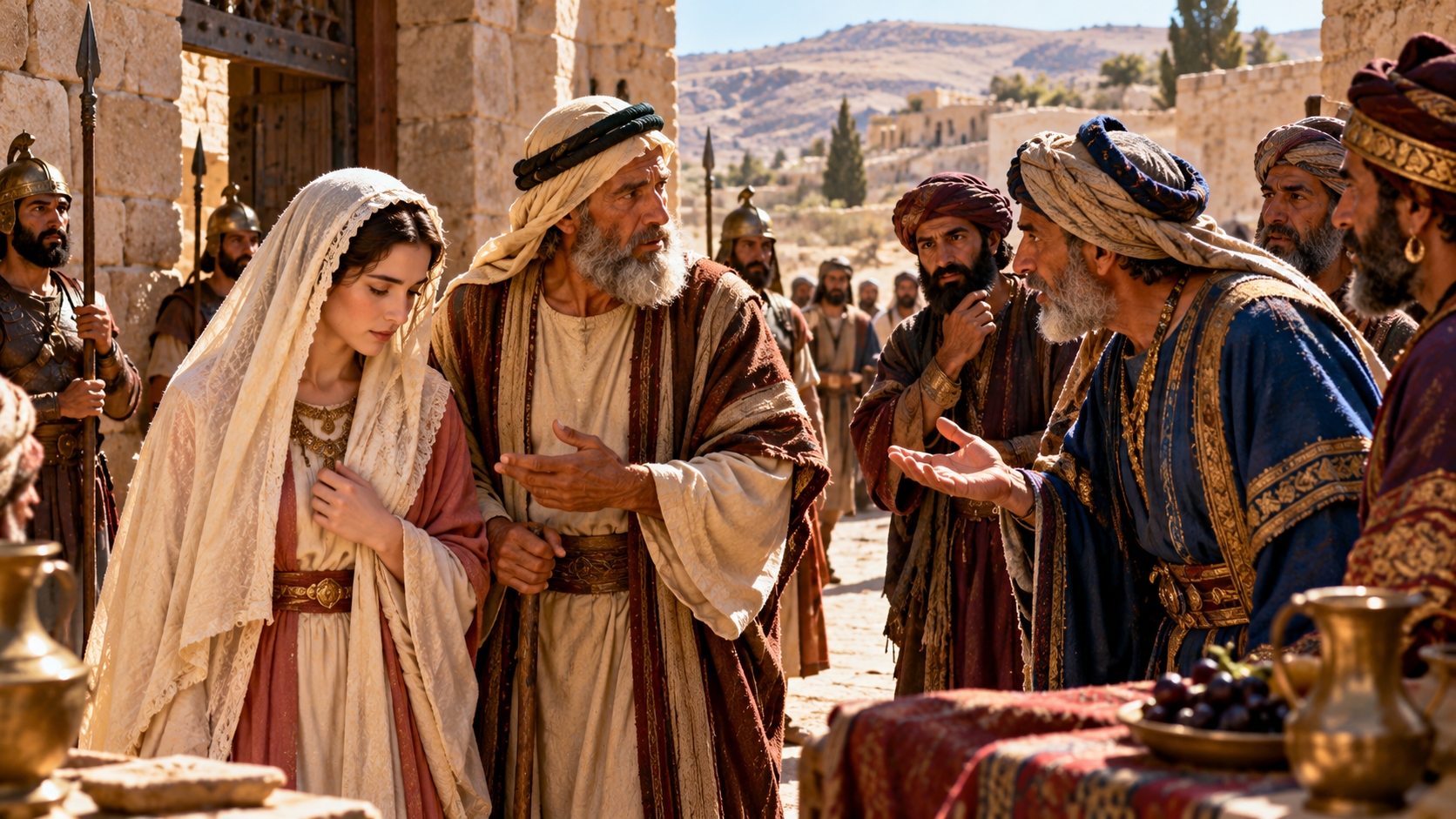
WHAT GOES AROUND
COMES AROUND
When the men of the place asked about his wife, he said, “She is my sister,” for he was afraid to say, “my wife,” - The previous verse was entitled "The Obedience of Isaac" but note how quickly we come to "The Disobedience of Isaac." What a striking contrast with Genesis 26:6, where Isaac obeyed God's command to remain in Gerar! Now Isaac lies about Rebekah, just as his father Abraham had lied about Sarah on two separate occasions (Ge 12:11–13; Ge 20:2). However, Rebekah, unlike Sarah, was not actually her husband’s sister. Rebekah was his cousin. Isaac trusted God enough to remain in Gerar, but not enough to tell the truth about Rebekah! Although the men's inquiry about his wife does not reveal their motives or suggest any actual threat, Isaac interpreted their questions as a potential danger to his life. His fear of what might happen overshadowed his faith in what God had promised! How quickly the man who trusted God enough to stay in Gerar became afraid to trust Him enough to tell the truth!
Isaac and Rebekah were likely childless at this time for it would have been difficult to pull off this ruse if they had Jacob and Esau! Kids are not very good about keeping secrets.
Isaac may well have heard of his father's use of this same deception and followed his example. What a sobering reminder of the powerful influence a father can have upon his son, not only through his faith and obedience, but also through his failures! WOE!
Elijah courageously confronted the prophets of Baal, yet afterward fled in fear from Jezebel (1Ki 18:20–40; 19:1–3). Peter boldly confessed Jesus as the Christ, yet later denied Him three times (Mt 16:16; 26:69–75). These examples remind us that yesterday's obedience does not guarantee today's faithfulness. A past victory of faith does not eliminate the need for present dependence upon God.
Life Application Study Bible - Isaac was afraid that the men in Gerar would kill him to get his beautiful wife, Rebekah. So he lied, claiming that Rebekah was his sister. Where did he learn that trick? He may have known about the actions of his father, Abraham (see 12:10-13 and 20:1-5). Parents help shape the world's future by the way they shape their children's values. The first step toward helping children live right is for the parents to live right. Your actions are often copied by those closest to you. What kind of example are you setting for your children? (See Life Application Study Bible - Page 4904)
J Vernon McGee - In Gerar he must have seen the men casting glances toward Rebekah; so he says to her, “You tell them that you’re my sister, not my wife.” The difference between Abraham and Isaac is that Abraham told half a lie and Isaac told a whole lie. The one he is telling was cut out of the whole cloth. (See Thru the Bible)
David Guzik on the vulnerability of spiritual highs - Isaac went from such a high spiritual experience (Genesis 26:1–5) to such blatant sin because of the weakness of his own flesh, and also because of the bad example of his father.. Peter, with his confession and wrong counsel to Jesus, was a perfect example of how sin can follow upon an outpouring of God’s blessing. For good reason, 1 Corinthians 10:12 says: Therefore let him who thinks he stands take heed lest he fall. The Bible doesn’t teach we are bound by what are known as generational curses, but it is often the case that the sins of the fathers are found in the children, because those sins of the flesh have been nurtured in the same environment and patterned by a previous generation. (See also What does the Bible say about breaking generational curses? and Can God break the cycle of generational sin? - GotQuestions.org)
Thinking, “the men of the place might kill me on account of Rebekah, for she is beautiful (Hebrew, literally ‘good in appearance’).”- One might subtitle this episode “When Faith Gives Way to Fear.” Isaac allowed an imagined danger to overshadow God's explicit promise, “I will be with you (PROTECT YOU) and bless you” (Ge 26:3). Although the text records no actual threat against his life, Isaac feared what the men might do and resorted to deception to protect himself. His fear of what might happen became greater than his confidence in what God had promised! How easily fear can transform a possibility into a seeming certainty, prompting us to compromise our convictions rather than trust the Lord! As Proverbs 29:25 warns, “The fear of man brings a snare, But he who trusts in the LORD will be exalted.”
When faced with danger, Isaac, like his father Abraham, resorted to situational ethics, allowing fear and self-preservation to justify deception. In both cases, the desired end was used to excuse sinful means, revealing a failure to trust fully in God's promised protection.
Jon Courson - Does any of this ring a bell? Abraham said the same thing at the same exact spot concerning his own wife (Genesis 20:2). Let every father be convicted and challenged. You see, the problem with going to the border is this: Your son will follow you. Camp out in Gerar, and that’s where your son will most likely choose to dwell. Walk righteously, on the other hand, and your son will most likely follow in your footsteps to the Land of blessing. (See Jon Courson's Application Commentary)
Bob Utley - "She is my sister, for he was afraid to say, 'my wife'" In Abraham's case this was a half-truth, but in Isaac's it is uncertain because in this verse (and Gen. 26:9) his action is attributed to his personal fear. It shows a lack of faith on Isaac's part because God had promised to be with him and protect him. Yet, in the midst of Isaac's unbelief, as with Abraham, God was faithful.
Henry Morris - Critics allege that this is merely another version of the story of Abraham's experience in Gerar (Genesis 20:1-8). This is not possible; the scribal "redactors" whom these same critics think brought the different components of Genesis together would have been far too shrewd to deliberately create such an obvious barrier to its acceptance by their readers. The event must have taken place as described. Isaac and Rebekah repeated the same fabrication that Abraham and Sarah had attempted over a century earlier for essentially the same reasons and with essentially the same results--human rebuke for their deception, but God's protection in spite of it.
Warren Wiersbe - Isaac could flee from famine, but when he put himself into a situation that offered no escape, he had to turn to deception to protect himself. Abraham committed this same sin twice, once in Egypt (Gen. 12:14–20) and once in Philistia (chap. 20). Remember, faith is living without scheming; and telling lies seems to be one of humanity’s favorite ways to escape responsibility....Isaac’s was the greater sin, because he knew what had twice happened to his father, and Rebekah was not his sister. Abraham told a half-truth while Isaac blatantly lied. Why did Isaac lie? Because he was afraid his pagan host would kill him in order to obtain his beautiful wife. His lie was evidence of his unbelief; for if he had claimed the covenant promise when he prayed for children (25:21), why couldn’t he claim that same covenant promise to protect himself and his wife?....The American preacher Phillips Brooks said, “Truth is always strong, no matter how weak it looks; and falsehood is always weak, no matter how strong it looks.” Truth is cement; falsehood is whitewash. (Bible Exposition Commentary)
Related Resource:
- See article on Ge 12:11-13 Sarai is My Sister? page 89 Hard Sayings
Genesis 26:8 It came about, when he had been there a long time, that Abimelech king of the Philistines looked out through a window, and saw, and behold, Isaac was caressing his wife Rebekah.
KJV And it came to pass, when he had been there a long time, that Abimelech king of the Philistines looked out at a window, and saw, and, behold, Isaac was sporting with Rebekah his wife.
NET After Isaac had been there a long time, Abimelech king of the Philistines happened to look out a window and observed Isaac caressing his wife Rebekah.
NLT But some time later, Abimelech, king of the Philistines, looked out his window and saw Isaac caressing Rebekah.
ESV When he had been there a long time, Abimelech king of the Philistines looked out of a window and saw Isaac laughing with Rebekah his wife.
- a window (KJV): Judges 5:28 Pr 7:6 Song 2:9
- sporting (KJV): Pr 5:18,19 Ec 9:9 Isa 62:5
Related Passages:
Numbers 32:23 “But if you will not do so, behold, you have sinned against the LORD, and be sure your sin will find you out.
Hebrews 4:13 And there is no creature hidden from His sight, but all things are open and laid bare to the eyes of Him with whom we have to do.
Genesis 39:17 Then she spoke to him with these words, “The Hebrew slave, whom you brought to us, came in to me to make sport of me;
Exodus 32:6 So the next day they rose early and offered burnt offerings, and brought peace offerings; and the people sat down to eat and to drink, and rose up to play (.
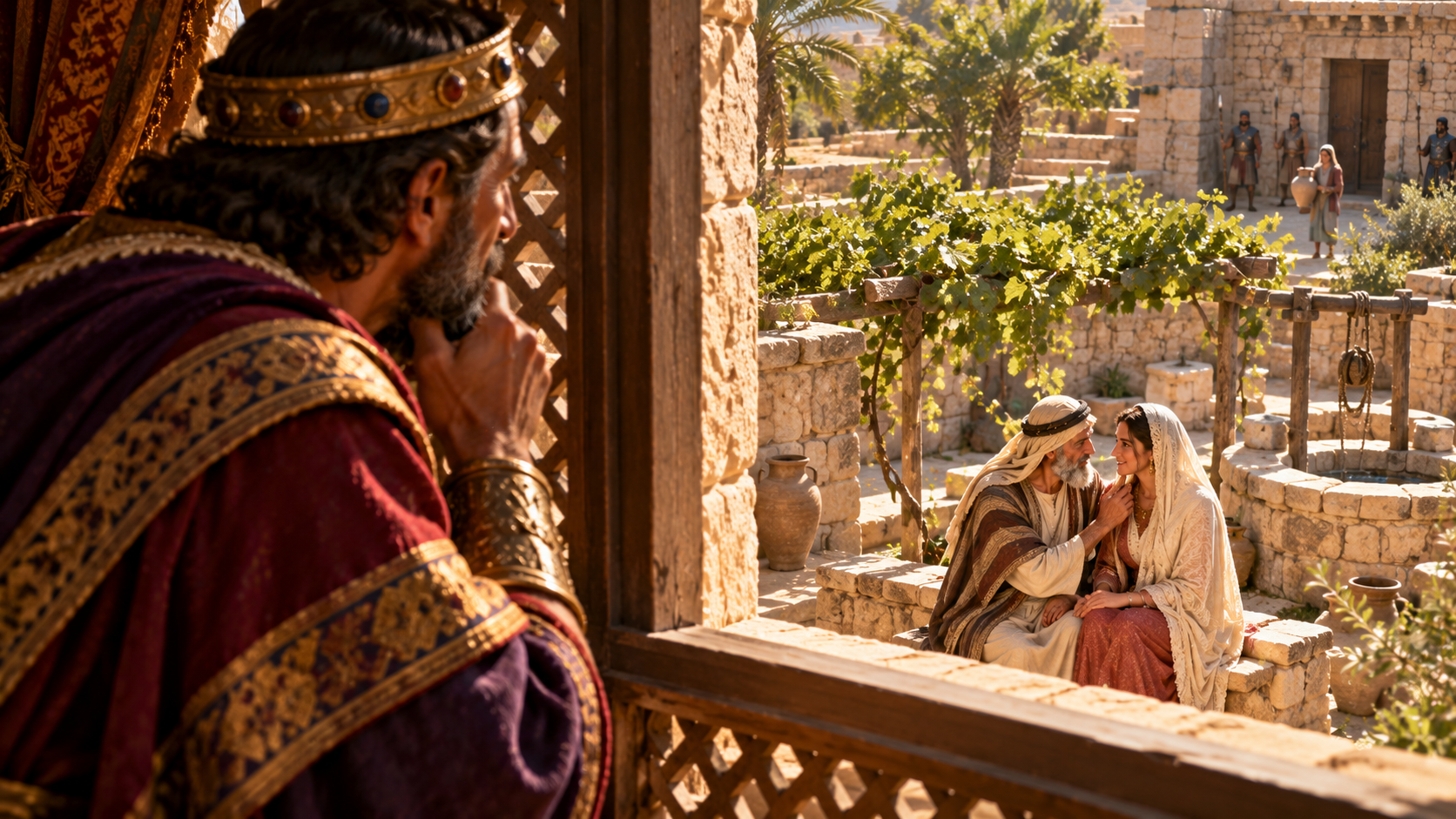
The Ruse is Over!
UNEXPECTED EXPOSURE
OF ISAAC'S DECEPTION
It came about, when he had been there a long time - Isaac's deception lasted for a long time! What makes this amazing is that God protected Rebekah during this time and let no man touch her.
Gordon Wenham points out "That Isaac and Rebekah enjoyed a long unmolested stay in Gerar shows that his fears were unfounded." (See Genesis 16-50, Volume 2 - Page 190)
That Abimelech king of the Philistines looked out through a window, and saw, and behold (hinneh), Isaac was caressing (tsachaq; LXX - paizo - to play amorously with) his wife Rebekah - KJV = "sporting with." ESV " laughing with." ("In this context the Hebrew verb “to laugh” implies laughing as they caress affectionately." ESV Study Bible) So however you interpret "caressing" the point is clear that Isaac and Rebekah were clearly acting in an intimate way that would only be proper between spouses! Numbers 32:23 warns, "Be sure your sin will find you out." In what appears to be an ordinary circumstance, Abimelech happens to look through a window and observes Isaac behaving affectionately toward Rebekah in a manner that reveals their true relationship. Isaac's words concealed the truth, but his actions revealed it! What Isaac had attempted to hide out of fear was exposed by a seemingly chance observation, yet surely we can see the providential hand of God at work, protecting Rebekah and preserving His covenant promises despite Isaac's failure of faith!
NET NOTE on caressing - The Hebrew word מְצַחֵק (mtsakheq), from the root צָחַק (tsachaq, “laugh”), forms a sound play with the name “Isaac” right before it. Here it depicts an action, probably caressing or fondling, that indicated immediately that Rebekah was Isaac’s wife, not his sister. Isaac’s deception made a mockery of God’s covenantal promise. Ignoring God’s promise to protect and bless him, Isaac lied to protect himself and acted in bad faith to the men of Gerar.
Bob Utley - This term "caressing" (Piel PARTICIPLE) is from the same root as the name for Isaac, which means "to laugh" or "to play" (cf. Gen. 17:17,19; 18:12; 21:6,9). Here it has a sexual connotation as it does in Ge 39:17 and Ex 32:6.
It is always better to trust God with the consequences of telling the truth
than to trust a lie to protect us from the consequences we fear!
Caressing (06711) tsachaq is a primary verb meaning “to laugh.” It occurs 13 times. Eleven are in Genesis, one is in Exodus, and one is in Judges. A related later form, sachaq (H7832), carries the same range of meaning and occurs 36 times, mostly in the poetic and prophetic books. The word is related to Ugaritic ṣḥq, “to laugh.” It is also the root of the name Isaac (Yitschaq, H3327), “he laughs.” In the simple (Qal) stem, tsachaq means “to laugh,” whether in disbelief or in joy. In the intensive (Piel) stem it broadens to “play,” “make sport,” “jest,” or “mock,” and in some contexts it carries sexual overtones.
TSACHAQ - 12V - caressing(1), entertained*(1), jesting(1), laugh(4), laughed(2), make sport(2), mocking(1), play(1). Gen. 17:17; Gen. 18:12; Gen. 18:13; Gen. 18:15; Gen. 19:14; Gen. 21:6; Gen. 21:9; Gen. 26:8; Gen. 39:14; Gen. 39:17; Exod. 32:6; Jdg. 16:25
Laughter of disbelief and of joy. All of the Qal uses are connected with Isaac’s birth, and each one turns on the name of the promised son. When God promised Abraham a son by Sarah, “Then Abraham fell on his face and laughed, and said in his heart, ‘Will a child be born to a man one hundred years old? And will Sarah, who is ninety years old, bear a child?’” (Ge 17:17). Sarah reacted the same way when she overheard the promise: “Sarah laughed to herself, saying, ‘After I have become old, shall I have pleasure, my lord being old also?’” (Ge 18:12). The LORD exposed her unbelief with a searching question: “And the LORD said to Abraham, ‘Why did Sarah laugh, saying, “Shall I indeed bear a child, when I am so old?” Is anything too difficult for the LORD? At the appointed time I will return to you, at this time next year, and Sarah will have a son’” (Ge 18:13-14). A year later her laughter of doubt became laughter of joy: “Sarah said, ‘God has made laughter for me; everyone who hears will laugh with me’” (Ge 21:6). God had turned the laughter of disbelief into the laughter of delight. Every time the parents spoke their son’s name, they remembered that nothing is too hard for the LORD.
Jesting and mocking. In the Piel, tsachaq often has a negative sense. When Lot warned his sons-in-law of Sodom’s coming destruction, “he appeared to his sons-in-law to be jesting” (Ge 19:14). They mistook a warning from God for a joke. At Isaac’s weaning feast, “Sarah saw the son of Hagar the Egyptian, whom she had borne to Abraham, mocking” (Ge 21:9). The pun is pointed: Ishmael was “Isaac-ing” Isaac, making a joke of the child of laughter. Some versions soften the word to “playing” (RSV), but Paul’s inspired commentary supports the sense of hostile mockery: “But as at that time he who was born according to the flesh persecuted him who was born according to the Spirit, so it is now also” (Gal 4:29). The Philistines used the blinded Samson the same way: “It so happened when they were in high spirits, that they said, ‘Call for Samson, that he may amuse us.’ So they called for Samson from the prison, and he entertained them” (Jdg 16:25).
Sexual overtones. In several passages the Piel describes intimate or sensual behavior. Potiphar’s wife accused Joseph with this word: “See, he has brought in a Hebrew to us to make sport of us; he came in to me to lie with me, and I screamed” (Ge 39:14; cf. 39:17). At Sinai the people’s worship of the golden calf ended the same way: “So the next day they rose early and offered burnt offerings, and brought peace offerings; and the people sat down to eat and to drink, and rose up to play” (Ex 32:6). The Septuagint translates this with paizō (G3815), “to play.” Paul quotes the verse as a warning against idolatry, and he follows it immediately with a warning against immorality: “Do not be idolaters, as some of them were; as it is written, ‘The people sat down to eat and drink, and stood up to play.’ Nor let us act immorally, as some of them did” (1Co 10:7-8).
Genesis 26:8. This background explains the word in our verse: “It came about, when he had been there a long time, that Abimelech king of the Philistines looked out through a window, and saw, and behold, Isaac was caressing his wife Rebekah” (Ge 26:8). Translations render it “caressing” (NASB, NIV), “laughing with” (ESV), “fondling” (RSV), and “sporting with” (KJV). The behavior was plainly what passes between husband and wife, not between brother and sister. That is why Abimelech immediately concluded, “Behold, certainly she is your wife!” (Ge 26:9). The Hebrew contains another wordplay: Yitschaq metsacheq, “Isaac was isaac-ing.” The son whose name means “laughter” was caught in the act that matched his name, and his deception came apart.
Summary. Tsachaq traces a progression in Isaac’s own life. At his birth it was laughter of unbelief turned to joy (Ge 17:17; 21:6). At his weaning it was mockery from the son of the flesh (Ge 21:9). In Gerar it was the tender laughter of marriage that exposed his lie (Ge 26:8). The God who gave Sarah reason to laugh still turns sorrow into joy: “Then our mouth was filled with laughter and our tongue with joyful shouting; then they said among the nations, ‘The LORD has done great things for them’” (Ps 126:2).
John Butler - Sermon Starters SIN EXPOSED! Genesis 26:8
“It came to pass, when he had been there a long time, that Abimelech king of the Philistines looked out at a window, and saw, and, behold, Isaac was sporting with Rebekah his wife” (Genesis 26:8).
Isaac had lied about Rebekah saying she was his sister, not his wife. This was done to protect his life from the foul creatures of Gerar. It was a repeat of Abraham’s sin, but it was exposed.
FIRST—THE PREDICTION OF THE EXPOSURE
“It came to pass.” “Be sure your sin will find you out” (Numbers 32:23). Sin has a built in exposure feature. It is impossible to keep sin from being exposed. God is omniscience and you cannot hide anything from Him and if He knows, it will “came to pass” that others will know. Isaac should have learned that even though his father tried this sin twice it was exposed and He was caught. Today, Abraham’s sin and Isaac’s sin are exposed to multitudes who read the Bible. Immoral sins cannot be concealed. Pregnancy and other indications expose it. President Kennedy could not conceal his immoral conduct. He thought he was so clever to wait till his wife was out of the country before he dallied with some of the girls in the White House swimming pool but it got out. Sin cannot be concealed.
SECOND—THE PATIENCE IN THE EXPOSURE
“Long time.” Isaac may have thought because his lie had gone for a long time without being exposed that he was home free with his sin. But sin is patience in exposing itself. And sooner or later your sin will squeak and squeal and you will be exposed. Time is no security against exposure. Something will happen that will expose the sin though it has been a “long time” since the sin was committed.
THIRD—THE PROVIDENCE FOR THE EXPOSURE
“Abimelech … looked out at a window and saw.” Providence does not work well for evil. It works against evil and exposes it. Sometimes it seems as if providence is helping us conceal our sin, but that is a mirage and it will someday happen that providence will expose your sin. Isaac unwittingly was not careful about showing affection for his wife and Abimelech just happened to look out a window in a building where he was. That ended the game of deception.
FOURTH—THE PERFORMANCE FOR THE EXPOSURE
“Isaac was sporting with Rebekah his wife.” It was normal and proper that Isaac show affection for Rebekah. But this action was used of God to help expose his lie. Liars have a poor memory and cannot keep their stories straight as most people know. It is impossible to remember all the details of a lie. There is the story of the talkative lady who heard a preacher preach on the fact that sin will be exposed sooner or later. She was so angry at the preacher’s sermon that she jumped to her feet and said, “I pushed my old man down the steps and killed him years ago and nobody has found out yet.” She unwittingly exposed herself and verified Numbers 32:23.
Genesis 26:9 Then Abimelech called Isaac and said, “Behold, certainly she is your wife! How then did you say, ‘She is my sister’?” And Isaac said to him, “Because I said, ‘I might die on account of her.’”
ISAAC'S DECEPTION
DISCLOSED
Then - Marks progression in the narrative.
Abimelech called Isaac and said, “Behold (hinneh), certainly she is your wife! - Abimelech was no fool and confronts Isaac with righteous indignation! He immediately recognized that Rebekah was Isaac's wife, not his sister. The affectionate behavior he had witnessed was clearly that of a husband toward his wife, not a brother toward his sister. Isaac's words had disguised their relationship, but his actions had given him away!
Bob Utley - "And Abimelech said" Both the Abimelech of Abraham's day and the Abimelech of Isaac's day come across as much more morally and ethically sensitive than the Patriarchs. This may imply that at this stage of history the Canaanites had some degree of spirituality.
How then did you say, ‘She is my sister’?” - Abimelech confronts Isaac with a penetrating question: Why did you lie about Rebekah? Having discovered their true relationship, he demands an explanation for Isaac's deliberate deception. What an embarrassing moment for Isaac! The pagan king is confronting the man of God about his dishonesty! Isaac had feared what the Philistines might do to him, but now he must explain why he failed to tell them the truth. How tragic when the conduct of a believer gives an unbeliever reason to question his integrity!
And Isaac said to him, “Because I said, ‘I might die on account of her - Isaac now gives an honest explanation for his earlier dishonesty: he feared for his life! He had convinced himself that acknowledging Rebekah as his wife might lead the men of Gerar to kill him (Ge 26:7). Notice that Isaac does not claim anyone had actually threatened him. His deception was motivated by what he feared might happen rather than by anything the text says had happened. How ironic that Isaac finally tells the truth in order to explain why he had told a lie! His fear of man had become greater than his confidence in God's promise, "I will be with you and bless you" (Ge 26:3). When fear replaces faith, we may resort to sinful means to protect ourselves from dangers that exist only in our imagination!
William MacDonald - When the deceit was exposed and rebuked, Isaac confessed. Confession leads to blessing. (Borrow Believer's Bible Commentary)
Jon Courson - On one hand, Isaac is to be corrected for his cowardice. “I lied about my wife because I didn’t want to die for her,” he said. Yet the biblical command is the exact opposite: “Husbands love your wives even as Christ loved the church, and gave Himself for it” (Ephesians 5:25). In other words, husbands, just as Christ died on the Cross for His Bride, we are to die to our own desires, our own dreams, our own intentions, our own pleasures. On the other hand, Isaac is to be commended for his candor. He didn’t try to rationalize, justify, or put a positive spin on his lie. He simply said, “I lied because I was afraid.”(See Jon Courson's Application Commentary)
Genesis 26:10 Abimelech said, “What is this you have done to us? One of the people might easily have lain with your wife, and you would have brought guilt upon us.”
KJV And Abimelech said, What is this thou hast done unto us? one of the people might lightly have lien with thy wife, and thou shouldest have brought guiltiness upon us.
NET Then Abimelech exclaimed, "What in the world have you done to us? One of the men might easily have had sexual relations with your wife, and you would have brought guilt on us!"
NLT "How could you do this to us?" Abimelech exclaimed. "One of my people might easily have taken your wife and slept with her, and you would have made us guilty of great sin."
BGT εἶπεν δὲ αὐτῷ Αβιμελεχ τί τοῦτο ἐποίησας ἡμῖν μικροῦ ἐκοιμήθη τις τοῦ γένους μου μετὰ τῆς γυναικός σου καὶ ἐπήγαγες ἐφ᾽ ἡμᾶς ἄγνοιαν
LXE And Abimelech said to him, Why hast thou done this to us? one of my kindred within a little had lain with thy wife, and thou wouldest have brought a sin of ignorance upon us.
- Ge 12:18-19 Ge 20:9-10
Related Passages:
Genesis 12:18-19 Then Pharaoh called Abram and said, “What is this you have done to me? Why did you not tell me that she was your wife? 19 “Why did you say, ‘She is my sister,’ so that I took her for my wife? Now then, here is your wife, take her and go.”
Genesis 20:9-10 Then Abimelech called Abraham and said to him, “What have you done to us? And how have I sinned against you, that you have brought on me and on my kingdom a great sin? You have done to me things that ought not to be done.” 10 And Abimelech said to Abraham, “What have you encountered, that you have done this thing?”
THE PAGAN KING REBUKES
THE COVENANT PATRIARCH
Abimelech said, “What is this you have done to us? - The NET captures the force of Abimelech's indignant question: “What in the world have you done to us?” Abimelech is understandably outraged! Isaac's deception had not only endangered Rebekah but had also exposed the entire community to the possibility of serious guilt before God (Ge 26:10). What Isaac considered a means of protecting himself could have brought disastrous consequences upon others. How ironic that a pagan king must rebuke the covenant patriarch for conduct that could have led others into sin! Isaac was thinking primarily of his own safety, while Abimelech recognized the potential consequences for his people. "The king also realizes that even if it were done in ignorance, the act would have been wrong." (Currid)
🙏 THOUGHT - Beloved, file this away next time you consider sinning willfully: Our sins seldom affect only ourselves; they often place others in danger as well! Think of sin as a stone thrown into a still pond. The initial splash may be small, but the ripples spread outward, reaching far beyond the point of impact. So too, the consequences of our sin often extend far beyond ourselves, touching the lives of family, friends, and even those we never intended to harm. Sin is never as private as we imagine, nor are its consequences as limited as we suppose! (Joshua 7:1-5; Genesis 26:7-11; Galatians 6:7,8).
Ripple Effect of our Sin!

One of the people might easily have lain with your wife, and you would have brought guilt (asam) upon us - Septuagint has " a sin of ignorance upon us." The NLT makes Abimelech's concern especially clear: "One of my people might easily have taken your wife and slept with her, and you would have made us guilty of great sin." Abimelech recognizes the serious consequences of Isaac's deception. Although he does not know Ge 12:3, he is in effect avoiding the curse promised in Ge 12:3 to those who abuse Abraham and his descendants! Believing Rebekah to be unmarried, one of the men might have entered into a sexual relationship with her, unknowingly committing adultery and bringing guilt upon the community. Isaac lied to protect himself from a danger he imagined, but in doing so he exposed his wife and others to a very real danger! What a tragic irony that the pagan king demonstrates greater moral sensitivity in this situation than the covenant patriarch! Abimelech's rebuke also recalls the earlier incident involving Abraham and Sarah, when God warned another Abimelech against taking a married woman (Ge 20:3–7). Sin is never as private as we imagine, for our attempts to protect ourselves through disobedience may become the very means by which others are harmed!
Gordon Wenham on brought guilt notes that guilt (asam) "is rarely used in the abstract as here; most frequently it denotes the guilt offering (cf. Lev 5:15–25), one of the most costly sacrifices demanded for serious sins such as adultery (Lev 19:21,22). Isaac’s behavior, Abimelek argues, far from bringing divine blessing on the nations (cf. 26:4), has actually brought him and his people into a most dangerous situation.(See Genesis 16-50, Volume 2 - Page 190)
NET NOTE - might easily have lain with - Heb “almost lied down with.” The verb שָׁכַב (shakhav) “to lie down” can imply going to bed to sleep or be a euphemism for sexual relations. Here the verb is modified by the prepositional phrase with כ (kaf; “like, as”) and מְעַט (meʿat; “little, brief”). When כִּמְעַט (kimʿat) modifies a perfect verb it means that someone almost did something (Ps 73:2; 119:87; Prov 5:14); with an imperfect verb it means to do something soon. This verse uses a perfect verb. Most translations employ a modal translation: “one of the people might easily (or “might soon”) have laid with your wife.” But the perfect verb is not typically modal, unless marked by other factors. The vav plus perfect consecutive (or veqatal) may be modal; or the perfect may be modal if signaled by another word such as אִם (ʾim; “if”) or לוּ or לוּלֵא (lu or luleʾ; “would that,” “unless”). If כִּמְעַט (kimʿat), which is not commonly used, can mark the perfect verb as modal, then “one of the people might have gone to bed with her” would be an appropriate translation. The options “it might have happened” and “it nearly happened” are fairly close in meaning.
W H Griffith Thomas - Is there anything sadder in this world than that a child of God should be rebuked by a man of the world? The corruption of the best is indeed the worst, and when a believer sins and his sin has to be pointed out to him by25 men who make no profession whatever of religion, this is indeed to sound the depths of sorrow and disappointment.
John Butler - Sermon Starters IMMORALITY CONDEMNED Genesis 26:10
“And Abimelech said, What is this thou hast done unto us? One of the people might lightly have lain with thy wife, and thou shouldest have brought guiltiness upon us” (Ezekiel 18:30).
Abimelech has found out the truth about Isaac’s relationship to Rebekah. He rebukes Isaac and in so doing gives us a good exhortation about the sin of immorality.
FIRST—THE CAUSE OF INIQUITY
“Thou hast done unto us.” Sin begets sin. “None of us liveth to himself and no man dieth to himself” (Romans 14:7). And sin seems to have more influence than righteousness. Your godly ways will be emulated by few people but you iniquitous ways will be emulated by multitudes. Isaac’s lie about Rebekah could have caused immorality in Gerar. Abimelech was very upset with Isaac in this case. Too bad Abimelech was not upset with others in his country who, like many (Hollywood as an example) in our land, were influencing people to sin.
SECOND—THE CHARACTERIZING OF EVIL
“Lightly have lain with thy wife.” “Lightly” is the mild way the world describes sin. They play it down and try to make it sound less offensive then it really is. ‘Playboy’ magazine and Hollywood do not even call immorality a sin. Condoms and other devices are not concerned about the evil of the act but only the unwanted physical results from the acts. Joseph correctly called the immorality “Great wickedness” (Genesis 39:9). I once heard a preacher call immorality a ‘stubbing of the toe,’ but is is more than that, it is the breaking of every bone in your body, a great fall from which it is nearly impossible to recover. Sin is often described in terms of Abimelech’s tongue, but he missed the boat on this one.
THIRD—THE CORRUPTION OF GERAR
“One of the people might lightly have lain with thy wife.” Abimelech described here the character of the people he ruled. They were an ungodly bunch who would commit immorality with abandon. They were a people without moral convictions. It was not a good place in which to live and Isaac’s fears are justified (Genesis 26:7). The people of this community would kill to have immoral relations. Our country cannot throw stones for abortion is killing to have sexual relations.
FOURTH—THE CONDEMNATION OF IMMORALITY
“Guiltiness upon us.” Abimelech is trying to be so pious though he is a big hypocrite. But he does speak the truth here. Immorality does bring guilt. It brings guilt before God and it brings the heavy load of guilt upon the sinner. Many of our insane asylums are full of people who cannot handle the heavy load of guilt that immorality brings upon a person. Of course, the experts and the news media will not say anything about that. Abimelech was right. Immorality produces guilt. Satan would tell us it produces gladness, but no guile, especially moral guile, produces anything but guilt.
Genesis 26:11 So Abimelech charged all the people, saying, “He who touches this man or his wife shall surely be put to death.”
KJV And Abimelech charged all his people, saying, He that toucheth this man or his wife shall surely be put to death.
NET So Abimelech commanded all the people, "Whoever touches this man or his wife will surely be put to death."
NLT Then Abimelech issued a public proclamation: "Anyone who touches this man or his wife will be put to death!"
ESV So Abimelech warned all the people, saying, "Whoever touches this man or his wife shall surely be put to death."
BGT συνέταξεν δὲ Αβιμελεχ παντὶ τῷ λαῷ αὐτοῦ λέγων πᾶς ὁ ἁπτόμενος τοῦ ἀνθρώπου τούτου ἢ τῆς γυναικὸς αὐτοῦ θανάτου ἔνοχος ἔσται
LXE And Abimelech charged all his people, saying Every man that touches this man and his wife shall be liable to death.
CSB So Abimelech warned all the people with these words: "Whoever harms this man or his wife will certainly die."
NIV So Abimelech gave orders to all the people: "Anyone who molests this man or his wife shall surely be put to death."
YLT and Abimelech commandeth all the people, saying, 'He who cometh against this man or against his wife, dying doth die.'
- touches: Ge 20:6 Ps 105:15 Pr 6:29 Zec 2:8
Related Passages:
Genesis 20:6 Then God said to him in the dream, “Yes, I know that in the integrity of your heart you have done this, and I also kept you from sinning against Me; therefore I did not let you touch (naga) her.
Psalm 105:15 “Do not touch (naga) My anointed ones, And do My prophets no harm.”
Proverbs 6:29 So is the one who goes in to his neighbor’s wife; Whoever touches (naga) her will not go unpunished.
Zechariah 2:8 For thus says the LORD of hosts, “After glory He has sent me against the nations which plunder you, for he who touches (naga) you, touches (naga) the apple of His eye.
KING'S COMMAND RE: REBEKAH
DON'T TOUCH HER!
So Abimelech charged all the people, saying, “He who touches (naga; LXX - hapto/haptomai - to harm 1Jn 5:18; to touch a woman ~ have sexual intercourse 1Co 7:1) this man or his wife shall surely be put to death - NIV - "Anyone who molests" CSB = "Whoever harms" Abimelech was understandably upset when Isaac confessed his deception, yet rather than punishing him, the king demonstrated remarkable restraint and even extended royal protection to Isaac and Rebekah! Ancient Near Eastern kings possessed considerable authority and could impose severe punishment, so Abimelech's response is especially noteworthy. Instead of condemning Isaac, he issued a decree threatening death to anyone who harmed him or his wife (cf God's warning "you shall surely die" in Ge 20:7). What remarkable irony! Isaac had lied because he feared the Philistines might kill him, but now the Philistine king threatened death to anyone who harmed him! Later Abimelech affirms "we have not touched you." (Ge 26:29) And surely we should not overlook the providential hand of God, Who had promised Isaac, "I will be with you and bless you" (Ge 26:3). Although Isaac had failed to trust that promise fully, the LORD remained faithful to His word. Isaac's fear led him into deception, but God's faithfulness provided the very protection Isaac had tried to secure through his lie! What a beautiful reminder that God's faithfulness is greater than our failures, although His grace never excuses our disobedience!
Victor Hamilton - "Abimelech issues a command that demonstrates his moral sensitivity....The verb “touch” here is a double entendre. To touch Isaac means to abuse him physically, to injure him. To touch Rebekah means to abuse her sexually (cf. Ge 20:6)....Interestingly, Abimelech’s decree covers both Isaac and Rebekah. Rebekah deserves protection, but Abimelech is also merciful to a two-faced deceiver like Isaac. (The Book of Genesis, Chapters 18-50 - Page 90)
Michael Currid - Throughout the ancient Near East the death penalty was a common sentence for adultery (Laws of Eshnunna no. 28; Code of Hammurabi no. 129) (Genesis)
John MacArthur - A pagan king imposing the death penalty on anyone troubling Isaac or Rebekah suggests God was at work to preserve His chosen seed (cf. vv. 28, 29). Cf. Ps 105:14, 15. (See MacArthur Study Bible)
NET NOTE on touches - Heb “strikes.” Here the verb has the nuance “to harm in any way.” It would include assaulting the woman or killing the man.
Allen Ross - So Isaac, like Abraham, received God’s great promise, but in fear he deceived Abimelech and made a mockery of the promised blessing. Fear mocks faith; faith boldly laughs in triumph. But a person who truly believes God’s promises obeys His statutes, precepts, and commands. (See The Bible Knowledge Commentary Law - Page 31)
Touch (strike)(05060) naga related noun nega used in Ge 11:1 = "one more plague") means to touch (Isa 6:7, Da 8:18, of cohabitation Ge 20:6, adultery - Pr 6:29, Ru 2:9), to reach or finally even to strike (Job 1:19; Isa. 53:4; Ezek. 17:10, figuratively of God's judgment - 1 Sa 6:9, Job 1:11, Job 19:21, literally actually producing harm - Ge 26:11, Josh 9:19, 2 Sa 14:10). The idea is to have physical contact (with persons or something else - 1 Ki 6:27, Esther 5:2). First use in Ge 3:3 Eve misquoted God's command that they cannot "eat from it (correct) or touch it (incorrect), or you will die." (Lesson - Memorize the Word of Truth word perfect!) Isaiah uses it of the Suffering Servant describing our Messiah - "Surely our griefs He Himself bore, And our sorrows He carried; Yet we ourselves esteemed Him stricken, Smitten of God, and afflicted." (Isa. 53:4)
John Butler - Sermon Starters MORAL LAW Genesis 26:11
“And Abimelech charged all his people saying, He that toucheth this man or his wife shall surely be put to death” (Genesis 27:11).
After Isaac had beguiled Abimelech and was exposed, he confessed why he lied. Abimelech was very upset about the reason for the lie because it spoke ill of his people. So Abimelech made a law especially for Isaac and Rebekah to protect them. The law was a good law as far as it went, but it did not go far enough.
FIRST—THE SOCIETY FOR THE LAW
“Charged all his people.” In our land we have so many laws passed that do not apply to the legislatures, but to the helpless laity. In the case of our text, no one was exempt, it was “all” the people. A moral law of such character ought to indeed apply to everyone. No one should be exempt to moral laws. God’s laws are universal in application. So is salvation. It matters not who you are, you get saved through Jesus Christ or you do not get saved. The selectivity of this law is wrong in “this man or his wife.” The law needed to apply to all men and their wives. But like our country we are gifted at excluding many from the laws. It is alright for Hollywood to engage in illicit sex but if some teacher gets involved with some student then it is wrong. That is what we call hypocrisy. “All his people” is the needed in both aspects of the application.
SECOND—THE STANDARDS IN THE LAW
“He that toucheth.” This is pretty high standards. It was ‘hands off.’ We need more strict standards like that. We would not have the moral problems we do if ‘hands off’ was the law. Our reduced standards do not make for better behavior but for worse behavior. God’s standards are very high but they are holy. But few people embrace God’s standards of holiness.
THIRD—THE SEVERITY OF THE LAW
“Shall surely be put to death.” That is too strict for most people but adultery fosters abortion which kills the innocent unborn. The law of Moses demanded death for adultery (Leviticus 20:10). Our lenient punishment is not an expression of love but an expression of lack of love. Leniency fosters corruption not purity. You will never have holiness in society without hardness in punishment. Folk sin when they think they will not be punished for it. Satan is busy trying to air condition hell in order to dupe people into hell.
FOURTH—THE SPOUSE IN THE LAW
“He that toucheth this man or his wife.” Abimelech did not exclude Isaac in the law. It may be a protection law for the male but the principle is that both the male and female are involved. We sometimes exclude the male and only speak of the female. A young high school student said to a youth speaker that he got a girl in trouble. The youth speaker corrected the boy and said he got both the boy and girl in trouble. The male is as involved as well as the female.
Genesis 26:12 Now Isaac sowed in that land and reaped in the same year a hundredfold. And the LORD blessed him,
KJV Then Isaac sowed in that land, and received in the same year an hundredfold: and the LORD blessed him.
NET When Isaac planted in that land, he reaped in the same year a hundred times what he had sown, because the LORD blessed him.
NLT When Isaac planted his crops that year, he harvested a hundred times more grain than he planted, for the LORD blessed him.
ESV And Isaac sowed in that land and reaped in the same year a hundredfold. The LORD blessed him,
NIV Isaac planted crops in that land and the same year reaped a hundredfold, because the LORD blessed him.
- an hundredfold: Ps 67:6 Ps 72:16 Ec 11:6 Zec 8:12 Mt 13:8,23 Mk 4:8 1Co 3:6 2Co 9:10,11 Ga 6:7,8
- blessed: Ge 26:3,29 24:1,35 30:30 Job 42:12
Related Passages:
Psalm 67:6 The earth has yielded its produce; God, our God, blesses us.
Matthew 13:8 “And others fell on the good soil and *yielded a crop, some a hundredfold, some sixty, and some thirty.
Mark 4:8 “Other seeds fell into the good soil, and as they grew up and increased, they yielded a crop and produced thirty, sixty, and a hundredfold.”
Genesis 24:1 Now Abraham was old, advanced in age; and the LORD had blessed Abraham in every way.
THE BLESSING
OF OBEDIENCE
Now Isaac sowed in that land and reaped in the same year a hundredfold - What a remarkable harvest! Isaac sowed his seed in the very land that had been afflicted by famine (Ge 26:1), and although the text does not explicitly state whether the famine was still continuing, the agricultural conditions had clearly been unfavorable. Yet Isaac reaped an astonishing hundredfold return in the very year he planted! Such an extraordinary harvest was no mere coincidence, for the next phrase explicitly declares, “And the LORD blessed him.” Here we see the good hand of the LORD upon Isaac's life, fulfilling His earlier promise, “I will be with you and bless you” (Ge 26:3). Isaac had obeyed God's command to remain in the land rather than flee to Egypt (Ge 26:2, 6), and now he experienced the LORD's abundant provision. The land that had threatened Isaac with famine became the very place where God blessed him with extraordinary abundance! What a striking reminder that God's ability to provide is never limited by the apparent scarcity of our circumstances! As Jeremiah 32:17 declares, “Ah Lord GOD! Behold, Thou hast made the heavens and the earth by Thy great power and by Thine outstretched arm! Nothing is too difficult for Thee.” When God determines to bless, even a famine-stricken field can yield a hundredfold harvest!
🙏 THOUGHT - Isaac's obedience was followed by Yahweh's abundant blessing. While believers under the New Covenant are not promised a hundredfold material return for their obedience, the principle remains that obedience to God is never without blessing, although that blessing may be spiritual rather than material, eternal rather than temporal, and sometimes experienced even in the midst of suffering (Jn 14:21; Jas 1:12; 1Pe 3:14). God's blessings do not always come in the form we expect, but obedience to Him is never in vain!
Gordon Wenham "Only here is any one of the patriarchs said to have sown and harvested crops, though it is quite common for bedouin to do this in the Near East. It confirms that the LORD is indeed looking after Isaac; he did not need to enter Egypt to escape the famine (v 1). His hundredfold yield, the best to be expected in Palestine (cf. Matt 13:8), was another sign of divine blessing. (See Genesis 16-50, Volume 2 - Page 190)
Victor Hamilton - Isaac’s reaping of a hundredfold is to be contrasted with the famine in Canaan that precipitated this whole affair. A wasteland is only a few miles away, but here is Isaac, now a farmer, harvesting a bountiful crop. (See The Book of Genesis, Chapters 18-50 - Page 94)
And the LORD blessed (barak; LXX - eulogeo) him - Isaac's extraordinary hundredfold harvest was unmistakable evidence of the LORD's blessing upon his life. Moses leaves no doubt about the source of Isaac's remarkable prosperity: It was not merely favorable weather, fertile soil, or superior farming techniques, but the gracious hand of Yahweh! As noted above God was fulfilling His earlier promise to Isaac (Ge 26:3). Notice that Isaac still had to sow the seed, but it was the LORD Who granted the extraordinary increase. Isaac was responsible to plant, but only God could provide the hundredfold harvest! Here again we see the complementary truths of human responsibility and divine sovereignty. (See "Paradoxical Principle of 100% Dependent and 100% Responsible) Isaac faithfully performed his part, while Yahweh graciously supplied what human effort alone could never guarantee. As Psalm 127:1 reminds us, "Unless the LORD builds the house, They labor in vain who build it." Human hands may sow the seed, but it is the hand of God that gives the increase!
Gordon Wenham “The LORD blessed him.” Though there have been many promises of divine blessing in Genesis, this is only the third time the narrator has noted that the blessing has become a reality (cf. Ge 24:1; Ge 25:11), thus fulfilling the promise to Isaac in Ge 26:3, anticipating Abimelek’s recognition of God’s blessing on Isaac (Ge 26:29), and anticipating the great theme of chap. 27." (See Genesis 16-50, Volume 2 - Page 190)
Bob Utley - "the Lord blessed him" This is a direct theological recognition that it was God and not Isaac's husbandry that was the source of blessing.
Henry Morris - This is the first mention of seed-sowing in the Bible. Seed-sowing in the Bible is commonly symbolic of Christian witnessing, and this aspect is paramount in the first mention of seed-sowing in the New Testament (Matthew 13:23). In both cases, it is providentially significant that the good seed brought forth a hundredfold.
J Vernon McGee on hundredfold - It was an earthly blessing. Later on when God put them into that land, He told them He would bless them in their basket; that is, it would be filled with foodstuff. God made that promise good when they were walking in fellowship with Him. We must remember that He is not promising us that blessing. He has promised spiritual blessings to us. We are told that we are blessed with all spiritual blessings, and that is our portion today. But that blessing is on the same terms. It depends on our walk with God. If you will permit Him, He wants to bless you abundantly in your spiritual life. (See Thru the Bible Genesis 16-33)
W H Griffith Thomas - This marked Divine blessing following soon after his deliberate sin is at first sight a difficulty, for we naturally ask how God's favour could possibly rest upon him so quickly after the discovery of his grievous error. The answer may be found in a somewhat frequent experience of the people of God. They are often permitted to receive publicly a measure, and a great measure, of the Divine blessing even when they may not be in private fully faithful to the Divine will. God may at times honour His people in the sight of men while dealing with them in secret on account of their sins. As Richard Cecil once said, 'A minister of Christ is often in highest honour of men for the performance of one half of his work, while God is regarding him with displeasure for the neglect of26 the other half.' It seems to have been something like this with Isaac. In the presence of his enemies the Philistines God indeed 'prepared a table' before him, but it is pretty evident from what follows that God had other ways of dealing with him on account of his sin. God may not suffer His servants to be dishonoured before the world, but He will take care to discipline them in faithfulness, and even with severity in the secret of His fellowship with them. (Genesis 26:1-33 Isaac)
Genesis 26:12-18 The Old Wells
Many years ago a magazine published a story about a man who visited a small town on Cape Cod. He bought an old homestead that had fallen into disrepair and planned to improve the property by digging a new well. An elderly farmer, however, who had known the place in its original glory, said, “Why don’t you open up the old well? There used to be plenty of good sweet water in it.”
The suggestion seemed to be a good one, so the owner told the workmen to clean out the old well. A few days later it began to fill up again with fresh and delicious water.
This account reminded me of the story in Genesis 26. Isaac “dug again the wells” of his father Abraham, which the wicked Philistines had stopped up, and found there the same refreshment as his ancestors had.
I see a spiritual parable in all of this. There is nothing wrong with the old truths of the Bible that our fathers believed and clung to. The world and the devil have tried to clog up our spiritual resources with manmade theories, worldly thinking, and skepticism about the Bible’s inspiration.
With the enlightenment of the Holy Spirit, let us clean out the ageless wells of truth so that the water may freely flow again. The old wells of biblical truth will satisfy us. (Reprinted by permission from Our Daily Bread Ministries. Please do not repost the full devotional without their permission.)
'Mid the storms of doubt and unbelief we fear,
Stands a Book eternal that the world holds dear;
Thru the restless ages it remains the same—
'Tis the book of God, and the Bible is its name!
—Carr
The Bible may be old, but its truth is always new
Genesis 26:13 and the man became rich, and continued to grow richer until he became very wealthy;
KJV And the man waxed great, and went forward, and grew until he became very great:
NET The man became wealthy. His influence continued to grow until he became very prominent.
NLT He became a very rich man, and his wealth continued to grow.
ESV and the man became rich, and gained more and more until he became very wealthy.
NIV The man became rich, and his wealth continued to grow until he became very wealthy.
- And the man waxed great (KJV): Dr. Adam Clarke remarks, that there is a strange and observable occurrence of the same term in the original, which is literally, "And the man was GREAT, and he went, going on, and was GREAT, until that he was exceeding GREAT." How simple is this language, and yet how forcible!
- waxed great (KJV): Ge 24:35 Ps 112:3
Related Passages:
James 1:17 Every good thing given and every perfect gift is from above, coming down from the Father of lights, with whom there is no variation or shifting shadow.
GOD CONTINUED TO
BLESS ISAAC RICHLY
And the man became rich - In an agrarian economy, where wealth was closely tied to the productivity of the land, a hundredfold harvest would have represented an extraordinary increase in Isaac's material prosperity, perhaps making him substantially wealthier in a single growing season! What makes this even more remarkable is that Isaac had been living in a land recently afflicted by famine (Ge 26:1). While others had experienced scarcity, Isaac enjoyed extraordinary abundance. Yet Moses is careful to identify the true source of his prosperity: “And the LORD blessed him” (Ge 26:12). Isaac's wealth was not simply the result of agricultural skill or favorable circumstances, but a tangible expression of Yahweh's covenant blessing. The God Who had commanded Isaac to remain in the land was more than able to provide abundantly for him in that very land! Nevertheless, we must not turn Isaac's experience into a universal promise of material prosperity for believers today. (See What does the Bible say about the prosperity gospel?) God may bless His children with abundance or sustain them through adversity (Php 4:11–13). The measure of God's blessing is not always the abundance of our possessions, but the certainty of His presence and faithfulness!
NET NOTE on rich - Heb "great." In this context the statement refers primarily to Isaac's material wealth, although reputation and influence are included. Heb "and he went, going and becoming great." The construction stresses that his growth in possessions and power continued steadily.
and continued to grow richer until he became very wealthy - Recall that just prior to this growth in wealth Isaac had committed a willful sin, lying about Rebekah as his sister. The point is that his sin did not prevent God from blessing him. None of us will ever achieve perfection in this life, so it is comforting to know that while we may "blow it" from time to time, God does not automatically remove His good hand of blessing.
Here we see the progressive nature of Isaac's prosperity, for did not merely become wealthy, but he continued to increase in wealth until he became exceedingly prosperous! But recall what had happened just before this remarkable blessing. Isaac had deliberately lied about Rebekah, claiming she was his sister because he feared for his life (Ge 26:7–9). Yet his failure of faith did not cause God to withdraw His covenant blessing!
🙏 THOUGHT - What an encouraging reminder of the grace and faithfulness of our God! None of us will attain sinless perfection in this life (1Jn 1:8–10), and even the most mature believers sometimes stumble. Thankfully, our failures do not automatically cancel God's gracious purposes or cause Him to withdraw His good hand from our lives. As Paul reminds us, "If we are faithless, He remains faithful; for He cannot deny Himself" (2Ti 2:13). Of course, this does not mean that God overlooks or approves of our sins, for He disciplines those whom He loves (Heb 12:5–11), and unconfessed sin can disrupt our fellowship with Him (Ps 32:3–5). Nevertheless, God's faithfulness is greater than our failures, and His grace is not exhausted by our imperfections! What a comfort to know that when we stumble, we can confess our sins, receive His forgiveness, and continue walking in His grace (1Jn 1:9). Our failures may interrupt our fellowship with God, but they do not terminate His faithfulness toward us!
Believer's Study Bible - Isaac's progress and growth into greatness was surprising in view of his lack of wisdom in dealing with his children, and his lying (v. 7). However, as he grew older, he bent his will to conform to that of Yahweh (vv. 2-5).
Genesis 26:14 for he had possessions of flocks and herds and a great household, so that the Philistines envied him.
KJV For he had possession of flocks, and possession of herds, and great store of servants: and the Philistines envied him.
NET He had so many sheep and cattle and such a great household of servants that the Philistines became jealous of him.
NLT He acquired so many flocks of sheep and goats, herds of cattle, and servants that the Philistines became jealous of him.
ESV He had possessions of flocks and herds and many servants, so that the Philistines envied him.
NIV He had so many flocks and herds and servants that the Philistines envied him.
- had possession (KJV): Ge 12:16 13:2 Job 1:3 Job 42:12 Ps 112:3 Ps 144:13,14 Pr 10:22
- envied (KJV): Ge 37:11 1Sa 18:9 Job 5:2 Ps 112:10 Pr 27:4 Ec 4:4
Related Passages:
Psalm 112:3 Wealth and riches are in his house, And his righteousness endures forever.
Proverbs 10:22 It is the blessing of the LORD that makes rich, And He adds no sorrow to it.
Genesis 37:11 His brothers were jealous of him, but his father kept the saying in mind.
James 3:16 For where jealousy and selfish ambition exist, there is disorder and every evil thing.
THE DOWNSIDE OF
ISAAC'S PROSPERITY
For (term of explanation) - Explains Isaac's prosperity. Isaac's extraordinary prosperity was evident in his abundant flocks, herds, and large household, all tangible expressions of the LORD's blessing (Ge 26:12,13).
He had possessions of flocks and herds and a great household, so that the Philistines envied (qanah; LXX - zeloo - filled with jealousy) him - Rather than rejoicing in his prosperity, the Philistines became envious! Here we see a classic manifestation of the fallen flesh, which is often tempted to resent the success and blessings of others, especially when they appear to possess more than we do. Envy does not merely desire what another person has, but secretly (or overtly as shown in v15) resents the fact that the other person has it! In this case, the Philistines' envy would soon express itself in hostility, as they stopped up the wells Abraham's servants had dug (Ge 26:15). How revealing! What began as envy in their hearts soon became opposition through their actions! Proverbs 14:30 warns, "A tranquil heart is life to the body, But passion is rottenness to the bones." James likewise identifies jealousy as a source of disorder and evil (Jas 3:14–16).
🙏 THOUGHT Are we genuinely able to rejoice when God blesses someone else, especially when their blessings exceed our own? Romans 12:15 commands us to "Rejoice with those who rejoice." Oh, how we need to continually rely on the enabling power of the Holy Spirit! Envy turns another person's blessing into our bitterness, while love enables us to celebrate God's goodness to others!
Victor Hamilton - Of course, whenever an outsider moves in and becomes very prosperous in someone else’s backyard, the natives feel resentment—the Philistines were envious of him. That Isaac would lie to them is bad enough. That he would subsequently prosper beyond them is worse again. The Gerarites are envious of his success at farming. (See The Book of Genesis, Chapters 18-50 - Page 94)
Life Application Study Bible - Jealousy is a dividing force strong enough to tear apart the mightiest of nations or the closest of friends. It forces you to separate yourself from what you were longing for in the first place. When you find yourself becoming jealous of others, try thanking God for their good fortune. Before striking out in anger, consider what you could lose—a friend, a job, a spouse? (See Life Application Study Bible - Page 4904)
Genesis 26:14-22 Living Peacefully -
Isaac lived among the Philistines, who proved to be ornery neighbors. He had grown so rich and powerful that they feared him and asked him to leave their territory. Being “much mightier” than they (Genesis 26:16), Isaac could have refused, but he acquiesced and moved into a nearby valley where his father Abraham had dug some wells years before.
The Philistines had stopped up the wells after the death of Abraham. Each time Isaac reopened a well they claimed it for themselves, even though they had not been using it. They were just being contentious. But Isaac kept moving on till he entered an area where the Philistines no longer contested his right to the water.
I’ve encountered people like that. When my brothers and I played catch as young boys, we had to be very careful about our throws, because the neighbor would confiscate any balls that went into his yard.
It’s difficult to like such people, but Jesus went so far as to say that we must love them, pray for them, and be good to them (Matthew 5:44). It may not be easy, and those ornery persons may not change. Yet, according to Romans 12:18, we must still do all we can to live peacefully with everyone.
We know there will be times of stress
With people who must have their way;
But we should always choose to love,
To live at peace, and for them pray.
—D. De Haan
Try to live at peace with others even though they want to fight with you.
Genesis 26:15 Now all the wells which his father’s servants had dug in the days of Abraham his father, the Philistines stopped up by filling them with earth.
KJV For all the wells which his father's servants had digged in the days of Abraham his father, the Philistines had stopped them, and filled them with earth.
NET So the Philistines took dirt and filled up all the wells that his father's servants had dug back in the days of his father Abraham.
NLT So the Philistines filled up all of Isaac's wells with dirt. These were the wells that had been dug by the servants of his father, Abraham.
ESV (Now the Philistines had stopped and filled with earth all the wells that his father's servants had dug in the days of Abraham his father.)
NIV So all the wells that his father's servants had dug in the time of his father Abraham, the Philistines stopped up, filling them with earth.
- his father's (KJV): Ge 21:30
Related Passages:
Genesis 21:30 He said, “You shall take these seven ewe lambs from my hand so that it may be a witness to me, that I dug this well.”
ENVIOUS PHILISTINES
CUT WATER SUPPLY
Now all the wells (beer) which his father’s servants had dug in the days of Abraham his father, the Philistines stopped up by filling them with earth - In the arid environment of southern Canaan, wells were essential for survival and prosperity. Without a dependable water supply, Isaac could not sustain his extensive flocks, herds, and household (Ge 26:14). To stop up his wells was therefore no minor act of mischief but was a deliberate attempt to undermine the very resources upon which his prosperity depended! Why would the Philistines do such a thing? The preceding verse gives us the answer: “The Philistines envied him” (Ge 26:14). Their envy had now progressed from an attitude of the heart to an act of open hostility. Rather than rejoicing in Isaac's prosperity, they sought to diminish it by destroying his access to water.
Victor Hamilton - In an attempt to arrest Isaac’s phenomenal gains the Philistines filled with dirt the wells that Abraham had dug a generation earlier. This action will put an end to Isaac’s success! (See The Book of Genesis, Chapters 18-50 - Page 94)
To possess a well was to possess a means of survival
To lose a well could threaten one's very livelihood!
How vividly this illustrates the destructive nature of envy! Envy is not content merely to desire what another possesses; it may seek to deprive him of what God has given! These wells had originally been dug by Abraham's servants, making their destruction an especially provocative act against Isaac's inherited resources. The Philistines, whose power in this region was still relatively limited, apparently regarded Isaac's growing wealth and influence as a threat. Their hostility would soon culminate in Abimelech's demand that Isaac leave their territory (Ge 26:16). Yet Isaac would respond not by retaliating, but by moving away and reopening wells elsewhere (Ge 26:17,18).
What a striking contrast between the envy that seeks to destroy another's blessing and the faith that trusts God to provide even when others act unjustly! As Proverbs 14:30 reminds us, "A tranquil heart is life to the body, But passion is rottenness to the bones." BEWARE! Envy poisons the heart before it ever harms the person it envies!
WELL – The Hebrew word be'er generally refers to a well or artificially excavated water source, while ayin and ma'yan more commonly describe natural springs or fountains. However, Scripture does not always sharply distinguish between wells and springs. In ancient Palestine, wells were commonly dug through soil or excavated into limestone rock, sometimes with stone walls around their openings and large stones covering them (Ge 29:2–10). Water was ordinarily drawn with ropes and buckets or waterskins (Ge 24:14–20; Jn 4:11), and troughs were provided for watering livestock. In the arid climate of Canaan, wells were indispensable for drinking water, sustaining flocks and herds, and supporting agricultural prosperity. Consequently, possession of a productive well represented considerable wealth, and disputes over water rights could provoke serious conflict (Ge 21:25–30; 26:15–22). To possess a well was to possess a means of survival; to lose a well could threaten one's very livelihood! This explains why the Philistines' deliberate filling of Isaac's wells was such a hostile act (Ge 26:15). Wells also carry spiritual significance in Scripture, particularly in Jesus' conversation with the Samaritan woman, where He contrasts ordinary well water with the living water that He alone provides (Jn 4:10–14).
Well (pit, cistern)(0875) beer may come from the verb ba’ar, “to make distinct” or “to make plain” (Dt 1:5; 27:8; Hab 2:2), but the connection is uncertain. The word means a well or pit, and in the Old Testament it usually refers to a source of water. Some wells were natural springs (Ge 16:14; Ex 2:15), and others were dug by hand (Ge 21:25, 30; 26:15, 18). In a dry land, finding water was cause for rejoicing and even song: “Then Israel sang this song: ‘Spring up, O well! Sing to it!’” (Nu 21:17). A flowing well of “living water” was especially prized (Ge 26:19). Because water was scarce, wells were also a source of conflict, as when the herdsmen of Gerar quarreled with Isaac’s servants (Ge 26:19-21). Drawing water was usually women’s work, so the well became a meeting place. There Abraham’s servant met Rebekah (Ge 24:11-20), Jacob met Rachel (Ge 29:2-10), and Moses met Zipporah (Ex 2:15-21). When not in use, a well could be covered with a stone (Ge 29:2-3), and a covered well once hid David’s messengers (2Sa 17:18-21). The same word describes the tar pits of the Valley of Siddim (Ge 14:10). It is also used figuratively for the pit of destruction: “But You, O God, will bring them down to the pit of destruction; men of bloodshed and deceit will not live out half their days. But I will trust in You” (Ps 55:23; cf. Ps 69:15). In Proverbs it pictures a man’s own wife: “Drink water from your own cistern and fresh water from your own well” (Pr 5:15; cf. SS 4:15). The adulteress, by contrast, is “a deep pit… a narrow well” (Pr 23:27). Be’er also appears in place names such as Beersheba (Ge 21:31), Beer (Nu 21:16), and Beer-elim (Isa 15:8).
Genesis 26:16 Then Abimelech said to Isaac, “Go away from us, for you are too powerful for us.”
- mightier (KJV): Ex 1:9
Related Passages:
Exodus 1:9-11 He said to his people, “Behold, the people of the sons of Israel are more and mightier than we. 10 “Come, let us deal wisely with them, or else they will multiply and in the event of war, they will also join themselves to those who hate us, and fight against us and depart from the land.” 11 So they appointed taskmasters over them to afflict them with hard labor. And they built for Pharaoh storage cities, Pithom and Raamses.
Exodus 10:28 Then Pharaoh said to him, “Get away from me! Beware, do not see my face again, for in the day you see my face you shall die!”
ABIMELECH SEEKS TO
OSTRACIZE ISAAC
Then Abimelech said to Isaac, “Go away from us, for (term of explanation) you are too powerful for us - The extraordinary prosperity that God had graciously bestowed upon Isaac was now perceived as a threat by the Philistines. His rapidly expanding flocks, herds, and household had made him not only wealthy but also increasingly influential (Ge 26:12–14). Instead of recognizing God's blessing upon Isaac, the Philistines responded with envy (Ge 26:14), hostility (Ge 26:15), and finally outright rejection.
Gordon Wenham Abimelek expels him merely because “you have become much too powerful for us,” a term used only here and in Exod 1:7, 20 of the Israelites in Egypt. The Egyptian Pharaoh would later say, “Get away from me,” just as Abimelek said to Isaac.(See Genesis 16-50, Volume 2 - Page 190)
Sometimes the blessings of God upon one person's life expose
the envy lurking in another person's heart!
Abimelech's words are especially revealing: “You are too powerful for us.” The man who had previously feared that the Philistines might kill him (Ge 26:7) was now regarded by their king as too powerful to remain among them! What a remarkable reversal! Isaac had feared the Philistines, but now the Philistines feared Isaac! Notice also that Isaac had not sought to become a threat to his neighbors. He had simply remained where God commanded him and experienced the LORD's abundant blessing. Yet his very prosperity provoked resentment and opposition. Sometimes the blessings of God upon one person's life expose the envy lurking in another person's heart!
NET NOTE - You have become much more powerful. This explanation for the expulsion of Isaac from Philistine territory foreshadows the words used later by the Egyptians to justify their oppression of Israel (see Exod 1:9).
Adam Clarke observes, that this is the first instance on record of what was termed among the Greeks, ostracism, i.e., the banishment of person from the state, of whose power, influence, or riches, the people were jealous.
Genesis 26:17 And Isaac departed from there and camped in the valley of Gerar, and settled there.
KJV And Isaac departed thence, and pitched his tent in the valley of Gerar, and dwelt there.
NET So Isaac left there and settled in the Gerar Valley.
NLT So Isaac moved away to the Gerar Valley, where he set up their tents and settled down.
ESV So Isaac departed from there and encamped in the Valley of Gerar and settled there.
NIV So Isaac moved away from there and encamped in the Valley of Gerar and settled there.
Related Passages:
Romans 12:17-21 Never pay back evil for evil to anyone. Respect what is right in the sight of all men. 18 If possible, so far as it depends on you, be at peace with all men. 19 Never take your own revenge, beloved, but leave room for the wrath of God, for it is written, “VENGEANCE IS MINE, I WILL REPAY,” says the Lord. 20 “BUT IF YOUR ENEMY IS HUNGRY, FEED HIM, AND IF HE IS THIRSTY, GIVE HIM A DRINK; FOR IN SO DOING YOU WILL HEAP BURNING COALS ON HIS HEAD.” 21 Do not be overcome by evil, but overcome evil with good.
ISAAC DEPARTS AT
ABIMELECH'S COMMAND
And Isaac departed from there and camped in the valley (nachal = a wadi) of Gerar, and settled there - Rather than retaliating or asserting his growing power, Isaac quietly departed, demonstrating a willingness to surrender his immediate rights rather than escalate the conflict. His response anticipates the wisdom of Ro 12:18: “If possible, so far as it depends on you, be at peace with all men.” Isaac's greatest security was not in the wealth he possessed or the power others feared, but in the LORD Who had promised, “I will be with you and bless you” (Ge 26:3).
What a remarkable response to Abimelech's demand that Isaac leave because he had become too powerful for the Philistines! Rather than retaliating, asserting his rights, or using his considerable resources to resist, Isaac quietly departed and settled in the valley of Gerar. Although Isaac had the power to resist, he chose the path of peace rather than confrontation! His response illustrates the wisdom of Ro 12:18: “If possible, so far as it depends on you, be at peace with all men.”
Isaac understood, at least on this occasion, that he did not need to fight for every advantage or defend every possession. After all, his prosperity had come from the LORD, not from the favor of the Philistines. If God had blessed him in one place, He was certainly able to bless him in another! Isaac's willingness to yield also anticipates the principle expressed in Pr 15:1: “A gentle answer turns away wrath, But a harsh word stirs up anger.” This was not necessarily weakness or cowardice on Isaac's part, but a peaceful response consistent with confidence in God's provision. The man who earlier allowed fear to overcome his faith (Ge 26:7) now demonstrated a willingness to trust God rather than insist upon his own rights. Isaac could afford to surrender his position because he had not surrendered God's promise! His greatest security was never in the wells he possessed, the wealth he accumulated, or the power others feared, but in the unchanging word of Yahweh: “I will be with you and bless you” (Ge 26:3).
🙏 THOUGHT - Beloved, when our security rests in God's promises, we can relinquish our rights without relinquishing our peace!
NET NOTE - the valley of Gerar - This valley was actually a wadi (a dry river bed where the water would flow in the rainy season, but this would have been rare in the Negev). The water table under it would have been higher than in the desert because of water soaking in during the torrents, making it easier to find water when digging wells. However, this does not minimize the blessing of the LORD, for the men of the region knew this too, but did not have the same results.
Warren Wiersbe - In every difficult situation of life, it requires discernment to know whether God wants us to be confronters like Abraham or peacemakers like Isaac; for God can bless and use both approaches. (Bible Exposition Commentary)
Life Application Study Bible - The desolate Gerar area was located on the edge of a desert. Water was as precious as gold. A person who dug a well was staking a claim to the land. Some wells had locks to keep thieves from stealing the water. To fill in someone's well with dirt was an act of war; it was one of the most serious crimes in the land. Isaac had every right to fight back when the Philistines ruined his wells, yet he chose to keep the peace. In the end, the Philistines respected him for his patience. (See Life Application Study Bible - Page 4904)
Valley (Brook, wadi) (05158) nachal is a wadi, a dry valley or streambed that runs with water during the rainy season. The first biblical use is Genesis 26:17: “And Isaac departed from there and camped in the valley of Gerar, and settled there.” The word can also describe a wadi full of rushing water, or even the rushing water itself: “He took them and sent them across the stream. And he sent across whatever he had” (Ge 32:23). Sometimes naḥal means a permanent stream or river: “These you may eat, whatever is in the water: all that have fins and scales, those in the water, in the seas or in the rivers, you may eat” (Lev 11:9). Once in Scripture it refers to a miner’s shaft: “He sinks a shaft far from habitation, forgotten by the foot; they hang and swing to and fro far from men” (Job 28:4).
The Pentateuch consistently distinguishes waterways outside Egypt from those inside Egypt. Those outside Egypt are called naḥal (13 times) and nāhār (13 times). Those inside Egypt are called ye’or, the word for the Nile and its channels. This distinction reflects the firsthand knowledge one would expect from a mature eyewitness.
Naḥal is used figuratively for things that appear and disappear suddenly or that rush on with overwhelming force. Examples are the glory of the nations (Isa 66:12), the strength of an invader (Jer 47:2), and the power of the enemy: “The cords of death encompassed me, and the torrents of ungodliness terrified me” (Ps 18:4). Even “ten thousand rivers of oil” do not please God if the worshiper’s heart is not right (Mic 6:7). God gives the godly abundant delight: “They drink their fill of the abundance of Your house; and You give them to drink of the river of Your delights” (Ps 36:8). The age to come is pictured as streams flowing in the desert: “Then the lame will leap like a deer, and the tongue of the mute will shout for joy. For waters will break forth in the wilderness and streams in the Arabah” (Isa 35:6).
Martyn Lloyd-Jones has 7 chapters (over 80 pages) on Revival based on Genesis 26:17-18. If you are interested borrow his book Revival.
Jon Courson - …Called to be an apostle… Romans 1:1 Jon Courson's Application Commentary - Page 865
To this day, the Spirit continues to appoint apostles (ED: BUT NOT IN SAME SENSE AS IN FIRST CENTURY)—missionaries who are ‘sent out’ with the message of the Gospel. ‘What a great calling that is,’ you say. But you know what? A call to be a drywaller, a science teacher, or a repairman is just as holy and just as important if you’re doing what God has opened up for you and you’re doing it for Him. Whether you’re a baker, banker, mechanic, or cook, yours is an important calling because of the need for brothers and sisters to serve in all kinds of arenas and locations.
Please don’t think you’re missing it if you’re not a missionary. If the Lord wants you selling insurance or pouring cement, be at peace about it, saying, ‘Lord, if this is what You have for me, I’ll do it for Your glory. I’ll be salt and light, and I’ll do it as unto You.’
Herein is a problem, folks: there’s a tendency for us to think everyone should have our calling. If I’m called to be a missionary, everyone should be a missionary; if I’m called to be a teacher, everyone should be a teacher. Not true. That’s not the way it works in the Body of Christ. The Lord calls each of us uniquely, individually, and personally.
How can you know what your calling is? Very simple: what’s flowing from your life presently? What comes easy to you? What’s working out supernaturally for you?
Isaac dug a well in order to water his flock. But the inhabitants of the land challenged his right to be there. So he called that well ‘Esek’ or ‘Contention,’ moved down the road, dug another well, and struck water once more. A second time, the inhabitants came out and said, ‘This is our territory. Get out of here.’ So Isaac named the well ‘Sitnah,’ or ‘Hatred,’ and went down the road a little further. He dug a third well, and this time no one bothered him, so he called the name of this well ‘Rehoboth’ or ‘There’s room for me’ (see Genesis 26).
I have found life basically follows such a pattern. You dig and strike some water. There’s some refreshment and good things happen, but it becomes strife or hatred. So you go down the road and dig a second time, and again there are problems. Eventually, however, if you don’t give up, you’ll find your Rehoboth.
Isaac had the job of watering sheep. He didn’t agonize over it. He didn’t complain about it. He just tended to what was at hand, and he ended up at Rehoboth. That’s the key. Do what’s before you. Say, ‘Lord, here I am. You’ve allowed me to do this, and I’m going to do it as unto You. And if there’s strife or hatred, I’ll just move down the road and dig again until I find Rehoboth.’
God has a Rehoboth for every one of us.
Don’t give up on seeking yours.
James Smith - REHOBOTH; OR, VICTORY THROUGH YIELDING Genesis 26:17–28
To own a well in Palestine was to possess a fortune. To be in possession of the Well of Salvation is to own the good fortune of everlasting refreshing and delight. Observe the—
I. Trial of Faith. “Isaac’s servants digged, and found a well; and the herdmen of Gerar did strive, saying, The water is ours.” Well-digging—seeking to open up for ourselves sources of blessing—is a very common occupation. Not every well we dig will yield contentment. This one had to be named “Contention” (v. 20). They digged another; it also brought strife with increased force, and was called “Hatred.” It was a severe trial to Isaac to spend so much labour on these wells and to let others claim the water. Isaac strove not, but meekly journeyed farther back into the valley. This is one of the hardest lessons we as Christians have to learn, to resist not the evil done against our own personal interests. It is so natural for us to “stand up for our rights.” Fall back, and make room for God. “Not rendering railing for railing, but contrariwise” (1 Peter 3:9).
II. Compensation of God. “They digged another well, and called it Rehoboth, for the Lord hath made room for us.” By calmly yielding and trusting they found the—
1. PROVISION OF THE LORD. “The Lord hath made room for us.” The Lord alone can make room for us. He knows when, and where, and what room we do need. When the Lord does make room for us He makes room for every gift and talent we have, room for every holy desire and every pure affection. It takes room of His making to meet all the needs of man as an immortal spirit. He has made room for us—
(1) In the Atoning Death of Christ.
(2) In the Glorious Gospel.
(3) Room in His Loving Heart.
(4) Room in His Heavenly Home. The Lord hath made room for us; let us enter in and take possession of His fulness in Jesus Christ.
2. PROMISE OF THE LORD. “The Lord appeared unto him, and said, I will bless thee.” Isaac sought not his own, and the blessing of the meek came upon him. The herdmen of Gerar took the wells from him, but they could not rob him of the blesssing of God. Our afflictions and trials often drive us back to the place of blessing prepared for us by the Lord. The meek shall inherit—
3. PRESENCE OF THE LORD. “The Lord said, Fear not, I am with thee.” Let us not strive nor cry when the men of the world seek to rob us of some of the wells of our earthly comforts. The bulls of Bashan often pitch the meek believer into fatter pastures. Abiding in His presence we shall be hid from the strife of tongues, and kept as the apple of His eye. Take no thought for your life. “Seek ye first the kingdom of God, … and all these things shall be added” (Matt. 6:33). The Lord will make room for us.
4. POWER OF THE LORD. “They said, We saw certainly that the Lord was with thee.” When Christians are found seeking not their own, but the good of others, others will see certainly that the Lord is with them. Isaac showed his faith in God by refusing to strive for the wells he himself had dug. “My God shall supply all your need” (Phil. 4:19). When shall this selfish, spirit-grieving hunt after worldly honours and preferments come to an end on the part of Christians? Has it come to an end with you? The Lord will make room for us; let us cast all our care upon Him. As a servant of Jesus Christ have you found your Rehoboth—room made for you by the Lord?
Genesis 26:18 Then Isaac dug again the wells of water which had been dug in the days of his father Abraham, for the Philistines had stopped them up after the death of Abraham; and he gave them the same names which his father had given them.
KJV And Isaac digged again the wells of water, which they had digged in the days of Abraham his father; for the Philistines had stopped them after the death of Abraham: and he called their names after the names by which his father had called them.
NET Isaac reopened the wells that had been dug back in the days of his father Abraham, for the Philistines had stopped them up after Abraham died. Isaac gave these wells the same names his father had given them.
NLT He reopened the wells his father had dug, which the Philistines had filled in after Abraham's death. Isaac also restored the names Abraham had given them.
ESV And Isaac dug again the wells of water that had been dug in the days of Abraham his father, which the Philistines had stopped after the death of Abraham. And he gave them the names that his father had given them.
NIV Isaac reopened the wells that had been dug in the time of his father Abraham, which the Philistines had stopped up after Abraham died, and he gave them the same names his father had given them.
- and he (KJV): Ge 21:31 Nu 32:38 Ps 16:4 Ho 2:17 Zec 13:2
Related Passages:
Genesis 21:31 Therefore he called that place Beersheba, because there the two of them took an oath.
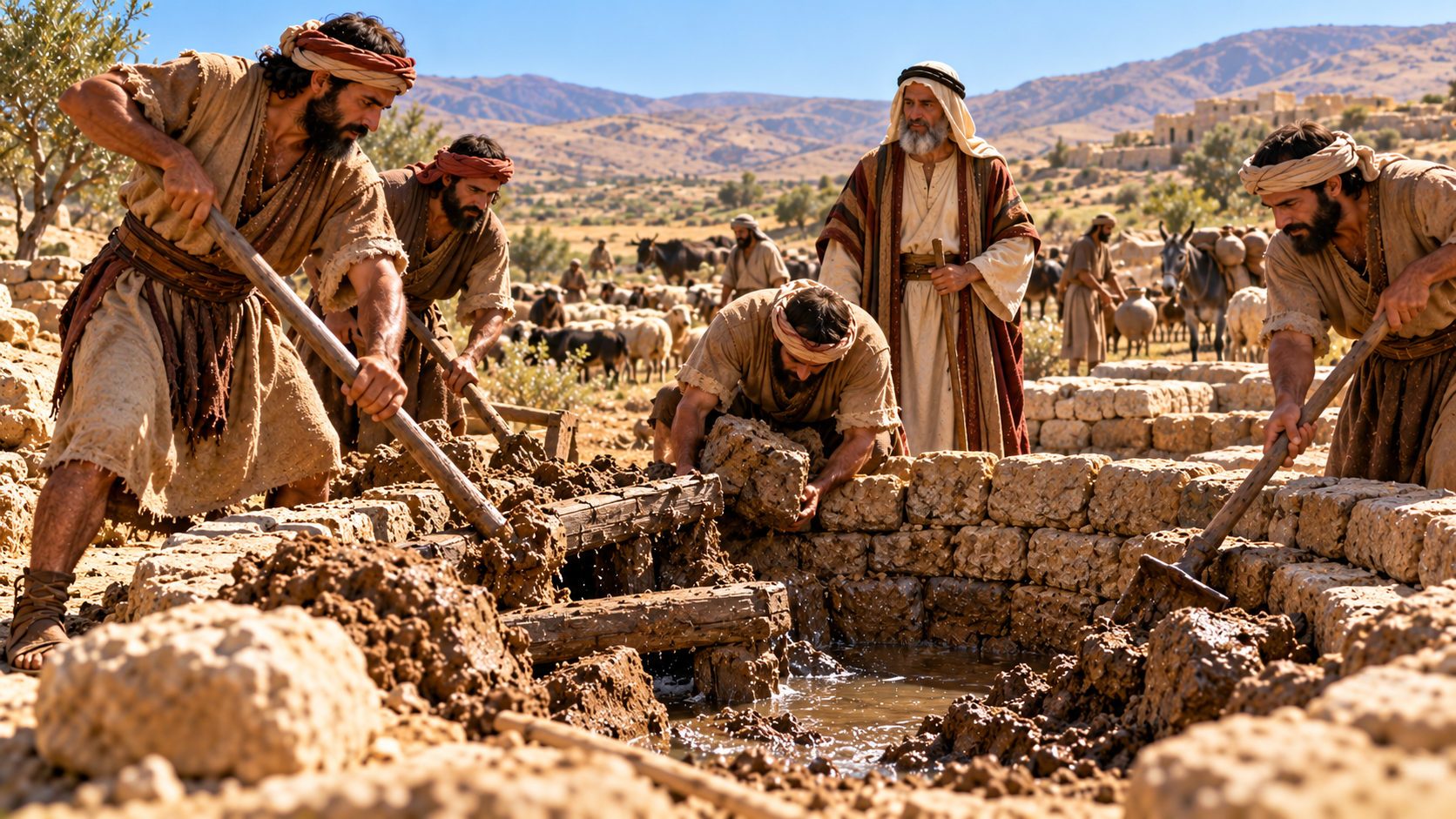
ISAAC REDIGS
ABRAHAM'S WELLS
Then - This marks progression in the narrative. Isaac's willingness to yield to Abimelech's command to depart did not mean that he ceased to act but rather, he continued to move forward, trusting in the LORD's promised provision.
Isaac dug again the wells of water which had been dug in the days of his father Abraham, for the Philistines had stopped them up after the death of Abraham; and he gave them the same names which his father had given them - Having peacefully withdrawn from the immediate vicinity of Abimelech, Isaac now begins again in the valley of Gerar, directing his efforts toward reopening the wells originally dug by his father Abraham. These wells had been deliberately filled with earth by the Philistines after Abraham's death. Rather than allowing the hostility of the Philistines to discourage him, Isaac patiently undertakes the difficult work of restoring what had been destroyed. The Philistines had filled the wells with earth, but they could not remove the water God had placed beneath the earth!
Notice also that Isaac gave the restored wells the same names Abraham had originally given them. This seemingly minor detail emphasizes the continuity between father and son, reminding us that Isaac was not establishing an entirely new heritage but preserving what had been entrusted to him. The God Who had provided for Abraham was the same God Who had promised to bless Isaac (Ge 26:3–5). Isaac did not need to invent a new source of blessing, but just needed to reopen the wells that had already supplied his father!
🙏 THOUGHT - Isaac’s experience teaches a practical lesson. Has anyone ever blocked your progress or undercut your work? Isaac didn’t fight back, and he didn’t walk away. He went back and patiently dug out the wells his father had dug, the ones the Philistines had filled in, and he left the outcome to God (Ge 26:18). Sometimes the godly response is not to retaliate but to keep going: “Let us not lose heart in doing good, for in due time we will reap if we do not grow weary” (Gal 6:9). The enemy may fill in the wells, but faith keeps on digging!
and he gave them the same names which his father had given them - Isaac not only reopened the wells that the Philistines had stopped up, but also carefully preserved the names his father Abraham had originally given them. Earlier, Abraham had named a place Beersheba, meaning “well of the oath” or “well of seven,” commemorating his covenant with Abimelech and the seven ewe lambs that served as a witness to his ownership of a well (see Ge 21:28–31). Although Genesis 26:18 does not identify the individual wells Isaac reopened, the preservation of their original names underscores his respect for his father's heritage and the continuity of God's covenant promises from Abraham to Isaac (Ge 26:3–5). These were more than convenient sources of water. They were tangible reminders of God's provision for the preceding generation. Isaac was not merely reopening his father's wells but in a sense was preserving his father's legacy! By retaining their original names, Isaac acknowledged the history associated with them rather than claiming all the credit for himself. There is a valuable spiritual principle here: Each generation must personally appropriate the truth of God's promises while faithfully preserving the spiritual heritage entrusted to it. As Psalm 78:4 reminds us, God's people are to tell the coming generation of His mighty works. The wells of yesterday must be kept open for the generations of tomorrow!
Warren Wiersbe - In the Bible, wells sometimes symbolize blessings from the hand of the Lord (Gen. 16:14; 21:19; 49:22; Ex. 15:27; Num. 21:16–18; Prov. 5:15; 16:22; 18:4; Song 4:15; Isa. 12:3; John 4:14).9 The church keeps looking for something new, when all we need is to dig again the old wells of spiritual life that God’s people have depended on from the beginning—the Word of God, prayer, worship, faith, the power of the Spirit, sacrifice, and service—wells that we’ve allowed the enemy to fill up. Whenever there’s been a revival of spiritual power in the history of the church, it’s been because somebody has dug again the old wells so that God’s life-giving Spirit can be free to work.(Bible Exposition Commentary)
David Guzik - There is a powerful illustration here of the spiritual life. The spiritual resources that sustained previous generations are available for us today, if we will seek them with faith, work, and commitment....Using this as a spiritual illustration, we might say that the wells of peace, of power, of grace, of wisdom, of transformation are all available for the believer today as they were for previous generations. The question is whether a present generation will have the faith, the work, and the commitment to dig the wells again.
John Butler - WELLS Genesis 26:18 - Sermon Starters
“Isaac digged again the wells of water, which they had digged in the days of Abraham his father; for the Philistines had stopped them after the death of Abraham; and he called them names after the names by which his father had called them” (Genesis 26:18).
There is not nearly as much written in the Scripture about Isaac as there is about Isaac’s father, Abraham, and about Isaac’s son Jacob. But what is written of Isaac is most instructive. One of the things written about him had to do with wells. Our text sums up the details of Isaac’s well digging. It speaks of three things about the wells.
FIRST—THE DIGGING OF THE WELLS
“Isaac digged again the wells of water, which they had digged in the days of Abraham his father.” Digging is hard work. Digging a well was especially hard work in those days. They did not have machinery to help dig a well. You did it the old-fashioned way of hauling the dirt by hand. Wells were deep and this required much perspiration in the digging. Good things do not come without effort. Labor not lofting produces blessing. God has a habit of giving his blessings to those who are not afraid of work. “The best way to fit ourselves for great things … is to bend our back and wills to humble toil” (Maclaren). If you are short on success maybe the reason is your unwillingness to labor. Many folk like the commandment about resting on the Sabbath but seem to not realize that the command came with a condition, namely, “Six days shalt thou labor” (Exodus 20:9).
SECOND—THE STOPPING OF THE WELLS
“The Philistines had stopped them after the death of Abraham.” There are always people in society who are oppose the good. They are non-diggers. Such people seem to have the news media and politicians on their side. Modern day Philistines stop the wells of the Gospel with the dirt of modernism that denies the virgin birth, the inspiration of the Scripture, the deity of Christ, the need of salvation by all, and other important truths. Modern day Philistines stop the wells of holiness by their filthy pornography and dirty magazines. Modern day Philistines in our churches stop the wells of every program to advance the water of life to needy souls.
THIRD—THE NAMING OF THE WELLS
“He called them after the names by which his father had called them.” Abraham had given the wells some good names and Isaac would revive the names. The lesson is that we need to get back to using the same terminology our forefathers used. We need to call sin by its right names. Abortion is pro-murder not pro-choice. Homosexuality is an abominable lifestyle not an alternative lifestyle. Gambling is wicked and harms society. It does not help society as the politicians think. Political-correct terminology is not holy terminology. It is wicked terminology that would take Christ out of Christmas and God out of the schools. The old names were truthful, not deceitful.
Lappin's Sermon Outlines - GOD’S USE FOR THE SECOND GENERATION
“And Isaac digged again the wells of water, which they had digged in the days of Abraham his father; for the Philistines had stopped them after the death of Abraham: and he called their names after the names by which his father had called them.” Gen. 26:18.
INTRODUCTION.—Isaac, second of the patriarchs, holds a common place in history. This text indicates the work he had to do.
His mission was such as falls to many—such as falls to the present generation in our Central States.
I. To dig again the wells—agriculturally.
II. To dig again the wells—educationally.
III. To dig again the wells—religiously.
Genesis 26:19 But when Isaac’s servants dug in the valley and found there a well of flowing water,
KJV And Isaac's servants digged in the valley, and found there a well of springing water.
NET When Isaac's servants dug in the valley and discovered a well with fresh flowing water there,
NLT Isaac's servants also dug in the Gerar Valley and discovered a well of fresh water.
ESV But when Isaac's servants dug in the valley and found there a well of spring water,
NIV Isaac's servants dug in the valley and discovered a well of fresh water there.
- a well of flowing water,: Heb. living, Song 4:15 Joh 4:10-11 Jn 7:38
Related Passages:
Song of Solomon 4:15 “You are a garden spring, A well of fresh water, And streams flowing from Lebanon.”
John 4:10-11 Jesus answered and said to her, “If you knew the gift of God, and who it is who says to you, ‘Give Me a drink,’ you would have asked Him, and He would have given you living water.” 11 She *said to Him, “Sir, You have nothing to draw with and the well is deep; where then do You get that living water?
John 7:38 “He who believes in Me, as the Scripture said, ‘From his innermost being will flow rivers of living water.’”
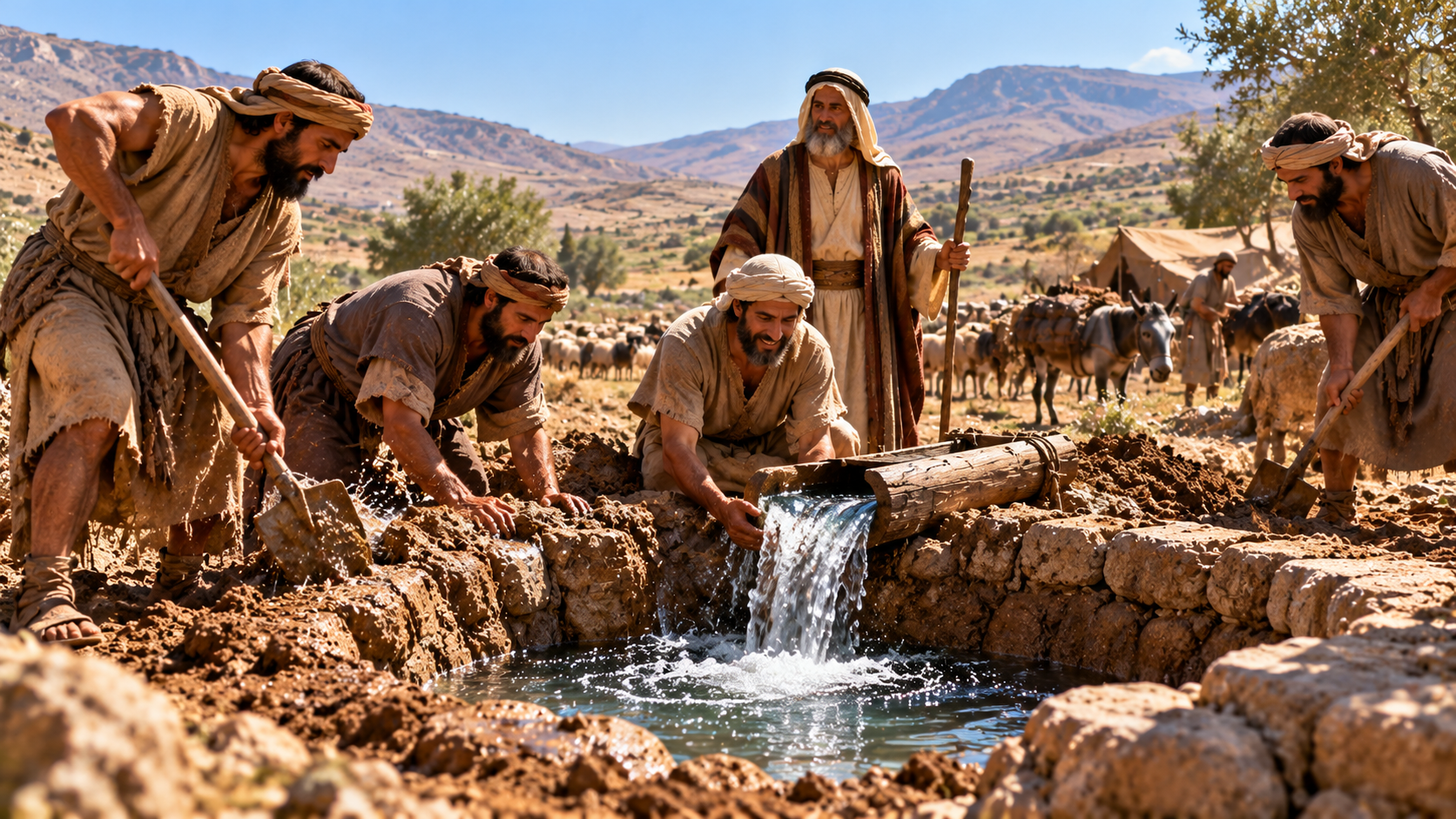
ISAAC'S SERVANTS
DISCOVER LIVING WATER
But when - This introduces a striking contrast with the reopened wells of Abraham.
Isaac’s servants dug in the valley (nachal = a wadi) and found there a well (beer) of flowing water - In addition to reopening Abraham's old wells, Isaac's servants made a wonderful discovery of a well containing flowing water! The Hebrew word nachal describes a valley or streambed, often a wadi, a channel that may remain dry for much of the year but carry water after seasonal rains. The Hebrew expression translated “flowing water” is literally “living water” (mayim chayyim), referring to fresh, naturally supplied water, as distinguished from stagnant water collected in a cistern. In the arid environment of Gerar, such a discovery was extraordinarily valuable, providing a potentially dependable source of water for Isaac's growing household and livestock.
Victor Hamilton - Isaac’s wells are so valuable because they contain not just water, but springing water, that is, a spring that provides a constant supply of running water.(See The Book of Genesis, Chapters 18-50 - Page 94)
The Philistines could fill Abraham's old wells with earth, but they could not prevent God from providing a fresh source of water! What a beautiful reminder of the LORD's faithfulness! Isaac had peacefully yielded to Abimelech's demand to depart (Ge 26:16,17), yet the God Who had promised, “I will be with you and bless you” (Ge 26:3), continued to provide for him.
There is also an instructive spiritual parallel, though not the primary meaning of the passage: Jesus later spoke of the “living water” that He alone gives, water that becomes “a well of water springing up to eternal life” (Jn 4:10–14). Earthly wells sustain physical life, but only Christ can give the living water that satisfies the deepest thirst of the human soul!
NET NOTE - flowing water - Heb "living." This expression refers to a well supplied by subterranean streams (see Song 4:15).
Flowing (02416) chay comes from the verb chayah (H2421), “to live.” It occurs more than 200 times in the Old Testament and has two main uses. As a noun it means “life.” As an adjective it means “living” or “alive.” Genesis 26:19 uses the adjective with “water”: “But when Isaac’s servants dug in the valley and found there a well of flowing water.” The Hebrew is mayim chayyim, literally “living water.” This was water from a spring or underground source that kept moving and renewing itself. Still water collected in a cistern was a different thing. For a herdsman in the dry Negev, finding living water was a rare gift, which explains why the herdsmen of Gerar were so quick to claim the well (Ge 26:20).
Living water in the Law and the Prophets. Because it was fresh and constantly renewed, living water was required in some cleansing rites: “The priest shall also give orders to slay the one bird in an earthenware vessel over running water” (Lev 14:5; cf. Lev 15:13; Nu 19:17). The prophets made it a picture of God Himself. Jeremiah contrasts the living spring with man-made cisterns: “For My people have committed two evils: They have forsaken Me, the fountain of living waters, to hew for themselves cisterns, broken cisterns that can hold no water” (Jer 2:13; cf. Jer 17:13). Zechariah looks ahead to the Messianic age: “And in that day living waters will flow out of Jerusalem, half of them toward the eastern sea and the other half toward the western sea; it will be in summer as well as in winter” (Zec 14:8).
Life as span, state, and quality. As a noun, chay, usually in the plural chayyim, can mean a point in one’s lifetime (“In the six hundredth year of Noah’s life,” Ge 7:11). It can mean the whole of one’s days (“all the days of your life,” Ge 3:14; cf. Ge 23:1). It can also mean the state of being alive as opposed to dead: “I call heaven and earth to witness against you today, that I have set before you life and death, the blessing and the curse. So choose life in order that you may live, you and your descendants” (Dt 30:19). It points beyond this present life as well: “Many of those who sleep in the dust of the ground will awake, these to everlasting life, but the others to disgrace and everlasting contempt” (Da 12:2). In combination with other nouns it describes a kind of life: “the breath of life” (Ge 2:7), “the tree of life” (Ge 2:9), “the way of life” (Jer 21:8). The adjective has some vivid idioms. “Living” flesh is raw meat (1Sa 2:15) or exposed raw flesh in a skin disease (Lev 13:10). “At this time next year” is literally “at the time of life,” that is, when the year comes back around: “I will surely return to you at this time next year; and behold, Sarah your wife will have a son” (Ge 18:10).
The living God. The most important use of chay describes the LORD. He is the living God, set against lifeless idols: “For who is this uncircumcised Philistine, that he should taunt the armies of the living God?” (1Sa 17:26). The psalmist also praises Him: “The LORD lives, and blessed be my rock; and exalted be the God of my salvation” (Ps 18:46). Because He alone has life in Himself, He swears by His own life: “but indeed, as I live, all the earth will be filled with the glory of the LORD” (Nu 14:21; cf. Dt 32:40). People swear “as the LORD lives” (Jdg 8:19), calling on Him as witness. The thirsting psalmist joins the images of water and the living God: “As the deer pants for the water brooks, so my soul pants for You, O God. My soul thirsts for God, for the living God; when shall I come and appear before God?” (Ps 42:1-2).
The feminine chayyah. The related feminine form chayyah means a “living creature,” usually an animal, and especially a wild beast as opposed to livestock (Ge 1:24-25; 8:1). It is the word Joseph’s brothers used in their lie: “and we will say, ‘A wild beast devoured him’” (Ge 37:20). Ezekiel uses it for the four “living beings” around God’s throne (Eze 1:5).
New Testament fulfillment. The Septuagint usually renders chay with zaō (ζάω, G2198), “to live,” and Jesus took up the Old Testament image of living water for Himself: “Jesus answered and said to her, ‘If you knew the gift of God, and who it is who says to you, “Give Me a drink,” you would have asked Him, and He would have given you living water’” (Jn 4:10). John explains that this water is the Spirit: “He who believes in Me, as the Scripture said, ‘From his innermost being will flow rivers of living water.’ But this He spoke of the Spirit, whom those who believed in Him were to receive” (Jn 7:38-39). The Bible ends where Zechariah pointed: “Then he showed me a river of the water of life, clear as crystal, coming from the throne of God and of the Lamb” (Rev 22:1). Here “life” is zōē (ζωή, G2222). Isaac’s well of “living water” in Gerar is a small earthly picture of the inexhaustible life God gives to all who come to Him.
CHAY - 218V - alive(38), flowing(2), fresh(1), green(1), life(7), live(44), lives(54), living(63), living one(4), living thing(6), man living(1), next(2), next year(2), raw(6), renewed(1), running(6), next year(1), vigorous(1), who lives(1). Gen. 1:20; Gen. 1:21; Gen. 1:24; Gen. 1:28; Gen. 2:7; Gen. 2:19; Gen. 3:20; Gen. 6:19; Gen. 8:21; Gen. 9:3; Gen. 9:10; Gen. 9:12; Gen. 9:15; Gen. 9:16; Gen. 18:10; Gen. 18:14; Gen. 25:6; Gen. 26:19; Gen. 42:15; Gen. 42:16; Gen. 43:7; Gen. 43:27; Gen. 43:28; Gen. 45:3; Gen. 45:26; Gen. 45:28; Gen. 46:30; Exod. 4:18; Exod. 21:35; Exod. 22:4; Lev. 11:10; Lev. 11:46; Lev. 13:10; Lev. 13:14; Lev. 13:15; Lev. 13:16; Lev. 14:4; Lev. 14:5; Lev. 14:6; Lev. 14:7; Lev. 14:50; Lev. 14:51; Lev. 14:52; Lev. 14:53; Lev. 15:13; Lev. 16:10; Lev. 16:20; Lev. 16:21; Num. 14:21; Num. 14:28; Num. 16:30; Num. 16:33; Num. 16:48; Num. 19:17; Deut. 4:4; Deut. 4:10; Deut. 5:3; Deut. 5:26; Deut. 12:1; Deut. 31:13; Deut. 31:27; Deut. 32:40; Jos. 3:10; Jos. 8:23; Jdg. 8:19; Ruth 2:20; Ruth 3:13; 1 Sam. 1:26; 1 Sam. 2:15; 1 Sam. 14:39; 1 Sam. 14:45; 1 Sam. 15:8; 1 Sam. 17:26; 1 Sam. 17:36; 1 Sam. 18:18; 1 Sam. 19:6; 1 Sam. 20:3; 1 Sam. 20:14; 1 Sam. 20:21; 1 Sam. 25:6; 1 Sam. 25:26; 1 Sam. 25:29; 1 Sam. 25:34; 1 Sam. 26:10; 1 Sam. 26:16; 1 Sam. 28:10; 1 Sam. 29:6; 2 Sam. 2:27; 2 Sam. 4:9; 2 Sam. 11:11; 2 Sam. 12:5; 2 Sam. 12:18; 2 Sam. 12:21; 2 Sam. 12:22; 2 Sam. 14:11; 2 Sam. 14:19; 2 Sam. 15:21; 2 Sam. 18:14; 2 Sam. 19:6; 2 Sam. 22:47; 1 Ki. 1:29; 1 Ki. 2:24; 1 Ki. 3:22; 1 Ki. 3:23; 1 Ki. 3:25; 1 Ki. 3:26; 1 Ki. 3:27; 1 Ki. 8:40; 1 Ki. 12:6; 1 Ki. 17:1; 1 Ki. 17:12; 1 Ki. 17:23; 1 Ki. 18:10; 1 Ki. 18:15; 1 Ki. 20:18; 1 Ki. 20:32; 1 Ki. 21:15; 1 Ki. 22:14; 2 Ki. 2:2; 2 Ki. 2:4; 2 Ki. 2:6; 2 Ki. 3:14; 2 Ki. 4:16; 2 Ki. 4:17; 2 Ki. 4:30; 2 Ki. 5:16; 2 Ki. 5:20; 2 Ki. 7:12; 2 Ki. 10:14; 2 Ki. 19:4; 2 Ki. 19:16; 2 Chr. 6:31; 2 Chr. 10:6; 2 Chr. 18:13; 2 Chr. 25:12; Job 12:10; Job 19:25; Job 27:2; Job 28:13; Job 28:21; Job 30:23; Ps. 18:46; Ps. 27:13; Ps. 38:19; Ps. 42:2; Ps. 52:5; Ps. 55:15; Ps. 56:13; Ps. 58:9; Ps. 69:28; Ps. 84:2; Ps. 116:9; Ps. 124:3; Ps. 142:5; Ps. 143:2; Ps. 145:16; Prov. 1:12; Eccl. 4:2; Eccl. 4:15; Eccl. 6:8; Eccl. 7:2; Eccl. 9:4; Eccl. 9:5; Cant. 4:15; Isa. 8:19; Isa. 37:4; Isa. 37:17; Isa. 38:11; Isa. 38:19; Isa. 49:18; Isa. 53:8; Isa. 57:10; Jer. 2:13; Jer. 4:2; Jer. 5:2; Jer. 10:10; Jer. 11:19; Jer. 12:16; Jer. 16:14; Jer. 16:15; Jer. 17:13; Jer. 22:24; Jer. 23:7; Jer. 23:8; Jer. 23:36; Jer. 38:16; Jer. 44:26; Jer. 46:18; Lam. 3:39; Ezek. 5:11; Ezek. 14:16; Ezek. 14:18; Ezek. 14:20; Ezek. 16:48; Ezek. 17:16; Ezek. 17:19; Ezek. 18:3; Ezek. 20:3; Ezek. 20:31; Ezek. 20:33; Ezek. 26:20; Ezek. 32:23; Ezek. 32:24; Ezek. 32:25; Ezek. 32:26; Ezek. 32:27; Ezek. 32:32; Ezek. 33:11; Ezek. 33:27; Ezek. 34:8; Ezek. 35:6; Ezek. 35:11; Dan. 12:7; Hos. 1:10; Hos. 4:15; Amos 8:14; Zeph. 2:9; Zech. 14:8
Ian Paisley - The War for the Weils—Esek
“And Isaac’s servants digged in the valley, and found there a well of springing water … and they called the name of the well Esek; because they strove with him.” Genesis 26:19, 20
When Deborah and Barak won the great victory they both burst into song. In that song they referred to the War for the Wells with the words:
“The noise of the archers in the places of drawing water” Judges 5:11.
The same thought of war for the water of the well is found in the blessing of Jacob on his son Joseph.
“Joseph is a fruitful bough even a fruitful bough by a well whose branches run over the wall; The archers have sorely grieved him, and shot at him, and hated him” (Genesis 49:22–23).
This war for water is also seen in the battle which Amalek waged against Israel in Exodus 17.
In the life of Isaac we have this war highlighted in a very special way in Genesis chapter 26.
The uncircumcised filled up the wells. The enemies of the Gospel today are busy in the uncircumcised succession stopping the flow of the gospel of salvation. Old wells are stopped. Old pulpits are no longer the channels through which the Gospel supply can flow.
Esek—Contention, Strife
In verse fifteen we are informed “For all the wells which his father’s servants had digged in the days of Abraham his father, the Philistines had stopped them, and filled them with earth” Genesis 26:15. By filling them with earth the water was contained and eventually stopped.
Isaac however, was determined to open the water supply. There is a vast difference between Isaac and Abraham. In the Companion Bible we have the following useful note “In the days of Abraham his father. Isaac a placid character: shown by his obedience (22 v 8), his meekness in betrothal (24), his mourning for his mother (24 vs 63–67), his following in his father’s steps to Gerar (20 v 1) in denying his wife there (20), his finding an Abimelech and Phichol there, and digging wells there, renewing the oath and renaming the well.” Although different from his father, Isaac was nonetheless a contender.
I. Our Father’s Enemies Must Be Re-Engaged in Conflict
The enemies of Isaac’s father must still be opposed and every effort made to undo their evil work. Today there are too many who want to forget the past enemies and allow their evil deeds and the pernicious results of their works to remain unchallenged and unopposed.
“And Isaac digged again the wells of water, which they had digged in the days of Abraham his father; for the Philistines had stopped them after the death of Abraham.” verse 18.
The work of our fathers has to be done all over again by us. The foes of our fathers are our foes. There is no difference in the war, the battles and the issues at stake are still the same. We must all be Isaacs. We must retrace our fathers’ steps and at the very point where the devil has succeeded in destroying their victories, we must draw sword and recapture the lost territory. The cries of those who relish no disturbance must not be heeded. We are under marching orders. Remember meek men like Isaac and Moses are not weak men.
II. Our Father’s Language Must Be Re-Employed in Conflict
Notice what Isaac did, verse 18: “And be called their names after the names by which his father called them.”
Today the language of our fathers is rejected. Sound words and sound speech is repudiated. Hence the craving for new Bibles and new translations. The old doctrines of God’s Sovereignty, man’s responsibility, total depravity, election by grace, the necessity of the work of the Holy Ghost in regeneration and sanctification, the necessity of a definite atonement, the power and preciousness of the blood of the Lamb, the preservation of the saints and many other Biblical truths must be recovered from their burial places and resurrected with great power to their proper places of preeminence in the Gospel Scheme.
We must return to the old paths, the paths of our fathers, if we are going to find wells of springing water. The tough, rough language of the prophets must be re-employed in our witness. The velvet tongue has no place in the faithful pulpit of today. The contemporary religion vocabulary needs to be totally shunned. God make us all Isaacs.
III. Our Father’s Heritage Must Be Recovered in the Conflict
Isaac recovered what his father had gained but which subsequently had been taken over by the enemy. We must take the offensive and refuse to allow the enemy to hold on to that which he has stolen and subverted. The apostates of ecumenical Protestantism are usurpers. They must be driven back and the Gospel wells re-opened so that the wilderness may rejoice and blossom as the rose with the unadulterated Gospel of the Water of life.
This means Esek—strife and contention which cannot be avoided.
Genesis 26:20 the herdsmen of Gerar quarreled with the herdsmen of Isaac, saying, “The water is ours!” So he named the well Esek, because they contended with him.
KJV And the herdmen of Gerar did strive with Isaac's herdmen, saying, The water is ours: and he called the name of the well Esek; because they strove with him.
NET the herdsmen of Gerar quarreled with Isaac's herdsmen, saying, "The water belongs to us!" So Isaac named the well Esek because they argued with him about it.
NLT But then the shepherds from Gerar came and claimed the spring. "This is our water," they said, and they argued over it with Isaac's herdsmen. So Isaac named the well Esek (which means "argument").
ESV the herdsmen of Gerar quarreled with Isaac's herdsmen, saying, "The water is ours." So he called the name of the well Esek, because they contended with him.
NIV But the herdsmen of Gerar quarreled with Isaac's herdsmen and said, "The water is ours!" So he named the well Esek, because they disputed with him.
- quarreled with: Ge 21:25
Related Passges:
Genesis 21:25 But Abraham complained to Abimelech because of the well of water which the servants of Abimelech had seized.
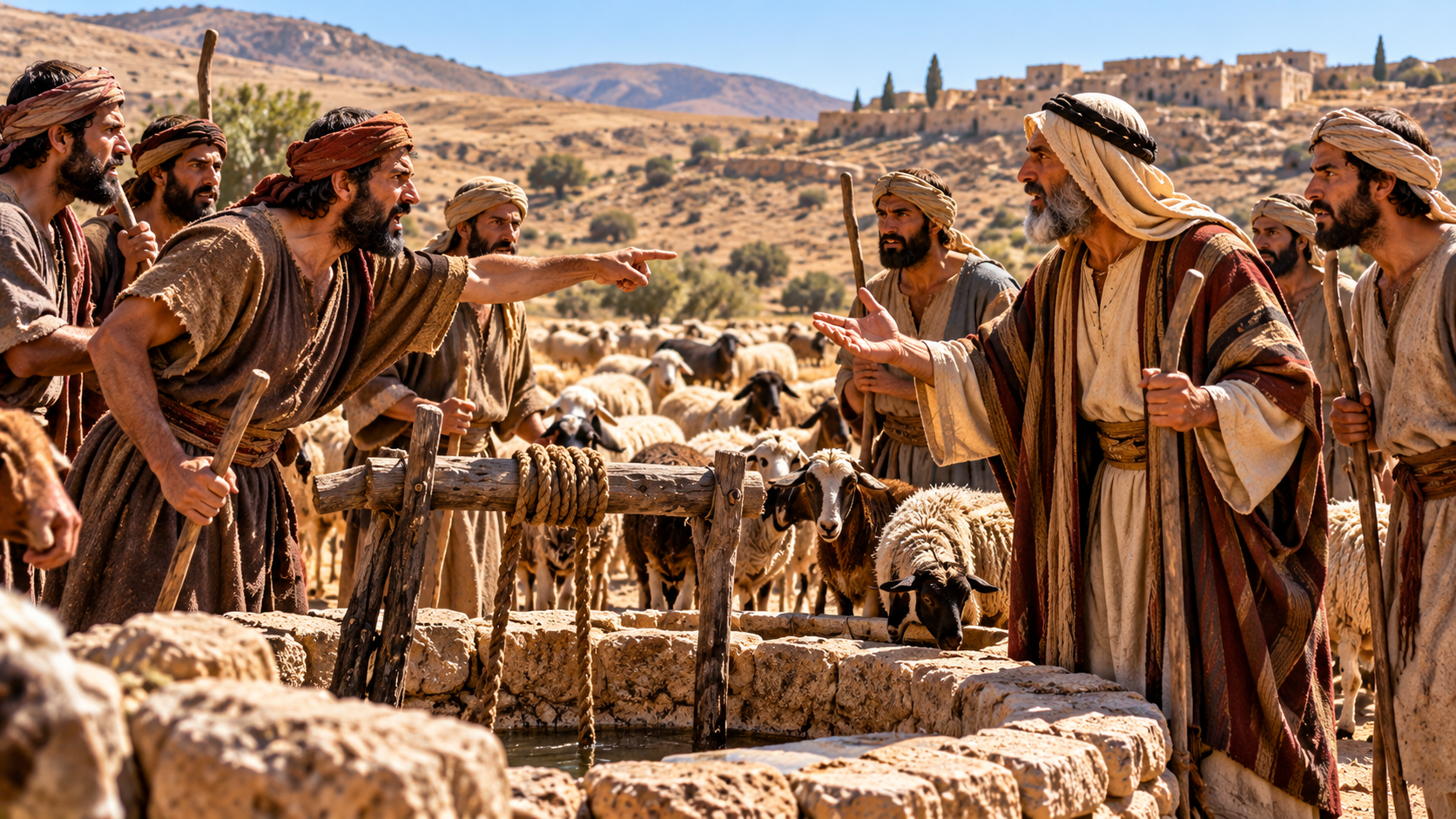
MORE WATER FIGHTS
OVER WATER RIGHTS
the herdsmen of Gerar quarreled (riyb; LXX - machomai - "word wars" Jn 6:52) with the herdsmen of Isaac, saying, “The water is ours!” - No sooner had Isaac's servants discovered a valuable well of flowing water (Ge 26:19) than the local herdsmen challenged their right to it! Although Isaac's servants had done the work of digging and discovering the water, the herdsmen of Gerar immediately asserted their own claim of ownership. Their emphatic declaration, “The water is ours!”, reveals that this was more than a minor disagreement. In a region where water was essential for the survival of people and livestock, control of a productive well represented a significant economic advantage. The Hebrew verb translated “quarreled” (riyb; LXX - machomai) means to contend, dispute, or strive, and, as the NET Note observes, it frequently describes conflicts with legal implications. And the Septuagint translates it with machomai which means warring with words!
How ironic that the very water Isaac's servants had discovered became the occasion for yet another conflict! The Philistines had already demonstrated their envy by stopping up Abraham's wells (Ge 26:14,15), and now their herdsmen sought to claim the newly discovered water. Isaac's servants did the digging, but the herdsmen of Gerar demanded the drinking! Yet Isaac would once again refuse to escalate the dispute, choosing instead to move on and dig another well (Ge 26:21). His conduct illustrates the wisdom of Pr 20:3: “Keeping away from strife is an honor for a man, but any fool will quarrel.” Not every legitimate right must be defended at the cost of peace, especially when we trust the LORD to provide what others seek to take away!
So he named the well Esek (NLT - "which means "argument") because (term of explanation) they contended with him - As frequently occurs in the Old Testament, the name given to a place commemorates a significant event associated with it. Esek (only here in OT) means “contention,” “dispute,” or “quarrel,” and aptly described the conflict.
Gordon Wenham - When his servants dug a well, the Gerarites claimed it. “So the well was called ‘Quarrel.’ ” Naming a water source after an unhappy incident that occurred in its vicinity is also a feature of the wilderness wanderings. Three watering holes between the Red Sea and Sinai are named in Exodus (Ex 15:22–27; Ex 17:1–7). (See Genesis 16-50, Volume 2 - Page 190)
Because (term of explanation)identifies the reason Isaac chose this particular name. The well would serve as a lasting reminder of the contention over its water rights. Interestingly, Isaac did not name the well after its abundant supply of living water, but after the hostility that accompanied its discovery! What should have been remembered as a place of provision became known as a place of contention! Yet Isaac's response is equally instructive. Rather than fighting to retain possession of the well, he allowed the dispute to end and moved on to dig another (Ge 26:21). Isaac was learning that he did not need to win every argument in order to enjoy God's blessing.
🙏 THOUGHT - Sometimes the greatest victory is not winning the dispute, but refusing to let the dispute rob us of our peace! As we saw earlier Paul's exhortation is apropos “If possible, so far as it depends on you, be at peace with all men” (Ro 12:18).
NET NOTE - The name Esek means "argument" in Hebrew. The following causal clause explains that Isaac gave the well this name as a reminder of the conflict its discovery had created. In the Hebrew text there is a wordplay, for the name is derived from the verb translated "argued."
J Vernon McGee on water - my friend, water is the explanation for the differences between God’s children in any church—the water of the Word of God. There is a great difference in the lives of believers who study God’s Word. And there will be a struggle. I think that you will always have to pay a price if you are really going to study the Word of God. The devil will permit you to do anything except get into the Word of God.(See Thru the Bible Genesis 16-33)
Iain Paisley - The War of the Wells—Sitnah
“And they digged another well, and strove for that also; and he called the name of it—Sitnah.” Genesis 26:21
The first well, Esek, brought strife and contention, the second well, Sitnah, brought more opposition. Opposition intensifies when we succeed in getting the gospel water supply flowing. The devil will contend every inch of the ground.
The second well was evidently more contested than the first. So much so that Isaac had to forsake the new well and remove to another well site. Like the apostles persecuted in one city, he fled unto another, Isaac thwarted in Sitnah, did not give up. He kept on digging. There is no discharge in this war. We must not give up even when forced to retreat. A Sovereign God ruleth over all and in the end victory will be ours as it was for Isaac.
We must learn that:
Gospel Work Is Ceaseless Work
The work of digging gospel wells and drawing gospel water is ceaseless work. It cannot and must not be stopped. To stop is to surrender and to surrender is to die.
Nothing must be permitted to come in the way of our pursuit of this work. Opposition of the fiercest kind must spur us on, rather than slow us down.
Gospel Work Is Contested Work
There is always strife where the gospel is preached. Christ came, He told us Himself, not to bring peace but a sword. Where life is there will always be the battle which comes with the exercise of the same.
When there is a possibility of the gospel well flowing, Satan will use every means and every method to destroy the same.
The offence of the Cross never ceases.
To stop the gospel is Satan’s aim for it is the gospel which is the power that stops him. As light dispels darkness so gospel light dispels the darkness of hell’s presence and all underlying principalities.
Gospel work leaves its scars as well as its songs.
Gospel Work Is Constraining Work
We do not choose the field, the Lord chooses it for us. We work under the constraints of His will and the providential circumstances which He permits to prevail at the time.
These constrain us to change our plans. We are forced from one field of service to another. There is a time to dig and a time to leave off digging and to seek another well site.
This has always been the way in God’s work and always will be.
We will always have our Sitnahs.
Retreat is often the strategy for victory.
Genesis 26:21 Then they dug another well, and they quarreled over it too, so he named it Sitnah.
KJV And they digged another well, and strove for that also: and he called the name of it Sitnah.
NET His servants dug another well, but they quarreled over it too, so Isaac named it Sitnah.
NLT Isaac's men then dug another well, but again there was a dispute over it. So Isaac named it Sitnah (which means "hostility").
ESV Then they dug another well, and they quarreled over that also, so he called its name Sitnah.
NIV Then they dug another well, but they quarreled over that one also; so he named it Sitnah.
Related Passages:
Proverbs 19:11: A man’s discretion makes him slow to anger, And it is his glory to overlook a transgression.
James 1:19-20 This you know, my beloved brethren. But everyone must be quick to hear, slow to speak and slow to anger; 20for the anger of man does not achieve the righteousness of God.
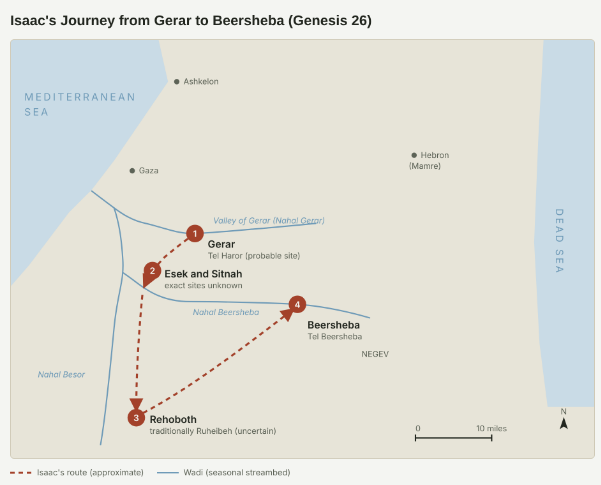
ANOTHER WELL
ANOTHER STRIFE
Then - This temporal expression marks the progression of the narrative and highlights Isaac's godly resilience in the face of repeated opposition.
They dug another well (beer), and they quarreled (riyb; LXX - machomai - of physical combat and word battles Jn 6:52) over it too, so he named it Sitnah - Once again Isaac's servants diligently dug a well, and once again the local herdsmen challenged their right to its water! What a test of Isaac's patience and perseverance! Having already surrendered the well named Esek, Isaac might reasonably have expected that the next well would be free from contention. But the opposition continued.
Sitnah (only here in OT) means “hostility,” “accusation,” or “opposition” and is related to the Hebrew root satan, meaning “to oppose” or “act as an adversary.” Once again Isaac refused to allow yesterday's conflict to prevent tomorrow's progress. Rather than retaliating or insisting upon his rights, he continued to demonstrate remarkable restraint and perseverance. Isaac's response illustrates the wisdom of Proverbs 19:11: “A man's discretion makes him slow to anger, And it is his glory to overlook a transgression.” Of course, overlooking an offense does not mean that injustice is acceptable or that believers must always surrender their legitimate rights. But Isaac recognized that maintaining peace was more important than winning every dispute.
NET NOTE - The name Sitnah is derived from a Hebrew verbal root meaning "to oppose; to be an adversary" (cf. Job 1:6). The name was a reminder that the digging of this well caused "opposition" from the Philistines.
Jon Courson - With the exception of Moses, there is not a man in the Old Testament meeker than Isaac. After all, when Ishmael taunted and teased him, did Isaac fight back? No. When his dad laid him on the altar to sacrifice him, did thirty-year-old Isaac try to escape? No. When his father’s servant selected a bride for him, did Isaac question his choice? No. When Abimelech rebuked him, did he rationalize his cowardice? No. When his water rights were challenged, did he stand his ground? No. “Blessed are the meek,” Jesus said, “for they shall inherit the earth” (Matthew 5:5). And here we see that happening. Isaac is a man of remarkable meekness. And he will indeed inherit earthly blessings. (See Jon Courson's Application Commentary - Page 128)
R C Sproul - Water: A Symbol of Grace
Then they dug another well, but they quarreled over that one also; so he named it Sitnah. [Gen. 26:21]
Genesis 2 calls attention to the well of water that sprang up in Eden and became four rivers that went, figuratively speaking, to the four corners of the earth. Throughout the Bible water is frequently a symbol of God’s grace and provision. In the last chapter of the Bible, the water of life is seen flowing from the throne of the Lamb to provide life to all nations (Rev. 22:1–2).
We saw (p. 114) that Abraham built altars everywhere he went as a sign of his ministry to the unconverted. The image of Isaac’s ministry is the well. At the beginning of Genesis 26 we read of another famine in the land. Under God’s guidance (v. 3) Isaac took his family to Gerar for safety. The people there were undisciplined, and Isaac feared them. As had Abraham, Isaac told that Rebekah was his sister, but the truth soon emerged that she was his wife (though his sister by adoption, Gen. 24:59–60).
God blessed Isaac in Gerar, and soon those who lived there ordered him to move on. “You are too powerful for us,” they said (Ge 26:12–16). So Isaac moved to the Valley of Gerar and dug a well, but the inhabitants took it away from him (Ge 26:17–20). He moved on and dug another well, but they quarreled over it too (Ge 26:21). Finally he moved to Rehoboth and dug a well, and they left him alone (Ge 26:22).
At this well God appeared to Isaac. God reiterated the patriarchal covenant, and Isaac built an altar and established public worship (Ge 26:23–25). A little “garden of Eden” was restored. Then the king of Gerar, who had driven Isaac out, asked to make a covenant with him. Why? “We saw clearly that the LORD was with you.” So Isaac made a covenant with them, including them in the extended family of the LORD, and feasted together. Then Isaac’s servants reported that they had found yet another well. When persecuted, Isaac did not hit back. Instead he continued about this business of providing water. Eventually God changed the hearts of his adversaries, and many souls were saved.
Coram Deo How do you plan to change the hearts of adversaries to the faith? Only God by his Spirit changes hearts, but he most often uses human means. Isaac’s ministry was the well; by what means will you reach out to the lost? Ask God to give you the opportunity, love, and courage to “give away a well” and see lost souls come to him.
Genesis 26:22 He moved away from there and dug another well, and they did not quarrel over it; so he named it Rehoboth, for he said, “At last the LORD has made room for us, and we will be fruitful in the land.”
KJV And he removed from thence, and digged another well; and for that they strove not: and he called the name of it Rehoboth; and he said, For now the LORD hath made room for us, and we shall be fruitful in the land.
NET Then he moved away from there and dug another well. They did not quarrel over it, so Isaac named it Rehoboth, saying, "For now the LORD has made room for us, and we will prosper in the land."
NLT Abandoning that one, Isaac moved on and dug another well. This time there was no dispute over it, so Isaac named the place Rehoboth (which means "open space"), for he said, "At last the LORD has created enough space for us to prosper in this land."
ESV And he moved from there and dug another well, and they did not quarrel over it. So he called its name Rehoboth, saying, "For now the LORD has made room for us, and we shall be fruitful in the land."
NIV He moved on from there and dug another well, and no one quarreled over it. He named it Rehoboth, saying, "Now the LORD has given us room and we will flourish in the land."
- the LORD has made room for us: Ps 4:1 18:19 Ps 118:5
- we will be fruitful: Ge 17:6 28:3 41:52 Ex 1:7
Related Passages:
Psalms 4:1 For the choir director; on stringed instruments. A Psalm of David. Answer me when I call, O God of my righteousness! You have relieved me in my distress; Be gracious to me and hear my prayer.
Psalm 18:19 He brought me forth also into a broad place; He rescued me, because He delighted in me.
Psalm 118:5 From my distress I called upon the LORD; The LORD answered me and set me in a large place.
Genesis 17:6 (YAHWEH TO ABRAHAM) “I will make you exceedingly fruitful, and I will make nations of you, and kings will come forth from you.
WELL, WELL, WELL...
FINALLY A GOOD WELL!
He moved away from there and dug another well (beer) Once again we see Isaac surrender his legitimate rights (his men had dug the wells) rather than escalating the conflict. After all, it was his servants who had labored to dig the wells, yet twice the herdsmen of Gerar had claimed the water and provoked disputes (Ge 26:20–21). One wonders what his conversations were like with God. Clearly, Isaac was trusting in the LORD to provide water for his entourage and his herds. How easy it would have been for Isaac, a man of considerable wealth and influence, to assert his rights and confront his adversaries! Instead, he quietly moved away and instructed his servants to dig yet another well. Isaac chose to surrender his rights rather than surrender his peace!
One cannot help but wonder what conversations Isaac may have had with the LORD during these repeated disappointments. Although Scripture does not record his prayers on these occasions, his actions are consistent with a growing confidence in Yahweh's promise, “I will be with you and bless you” (Ge 26:3).Isaac had an enormous responsibility to provide water for his household, servants, flocks, and herds. Yet each time a well was contested, he moved on, apparently confident that another source of water could be found. Isaac could relinquish the wells because he trusted the God Who supplied the water!
His conduct reminds us of Abraham's gracious response to Lot when he allowed his nephew to choose the better-looking land rather than quarrel over grazing rights (Ge 13:8–12). Both accounts illustrate the principle that those who trust God's promises need not insist upon every personal advantage. As Pr 3:5,6 exhorts us, “Trust in the LORD with all your heart, And do not lean on your own understanding. In all your ways acknowledge Him, And He will make your paths straight.” When we are confident that the LORD is our Provider, we can hold our possessions loosely because we hold His promises firmly!
And they did not quarrel (riyb; LXX - machomai - of physical combat and word battles Jn 6:52) over it - As the saying goes, “The third time is the charm!” After two successive disputes over the wells named Esek (“contention”) and Sitnah (“hostility”), Isaac's servants finally dug a well that the herdsmen of Gerar did not contest (Ge 26:20–22). What a welcome change! Isaac's patient perseverance had finally brought him to a place where he could enjoy God's provision without further conflict.
Notice that Isaac did not achieve this peaceful outcome by overpowering his adversaries, demanding his rights, or retaliating against those who had wronged him. Instead, he repeatedly yielded and continued digging. Isaac did not win the battle over the first two wells, but by refusing to fight, he eventually found a well worth keeping! His experience beautifully illustrates the wisdom of Proverbs 16:32: “He who is slow to anger is better than the mighty, And he who rules his spirit, than he who captures a city.” While Scripture does not promise that every conflict will eventually disappear, Isaac's experience reminds us that patient perseverance and a willingness to pursue peace can bear wonderful fruit. Sometimes the greatest victory is not defeating those who oppose us, but continuing faithfully until God opens a door that no one contests!
so he named it Rehoboth (broad places, room), for (term of explanation) he said, “At last the LORD has made room for us, and we will be fruitful in the land - Isaac's declaration is a statement of his faith in God's omnipotence to provide land and to provide prosperity. Notice Isaac did not say we MIGHT be fruitful but we will be fruitful! He was confident in Jehovah!
The name Rehoboth is derived from a Hebrew root meaning “to be wide” or “to be spacious.” After the contentious wells of Esek and Sitnah, Isaac finally discovers a place where there is sufficient room for his growing household and livestock. Notice the explanatory word “for,” which introduces Isaac's reason for naming the well Rehoboth. Even more significant is Isaac's acknowledgment of the true source of his favorable circumstances: “The LORD has made room for us.” Isaac does not credit his servants' persistence, his own ingenuity, or the absence of opposition, but Yahweh's gracious provision! And notice the confidence. Isaac does not say, “We might be fruitful,” but “We will be fruitful!” This is a remarkable expression of faith in the God Who had promised to be with him and bless him (Ge 26:3).
Treasury of Scripture Knowledge - The wells in Arabia are generally dug in the rock: their mouths are about six feet in diameter, and they are from nineteen to twenty feet in depth. But Niebuhr informs us, that many wells are from 160 to 170 feet deep.
NET NOTE - The name Rehoboth is derived from a verbal root meaning "to make room" (rachab - grow wide). The name was a reminder that God had made room for them. The story shows Isaac's patience with the opposition; it also shows how God's blessing outdistanced the men of Gerar. They could not stop it or seize it any longer.
Life Application Study Bible - Three times Isaac and his men dug new wells. When the first two disputes arose, Isaac moved on. Finally room was available for everyone. Rather than start a huge conflict, Isaac compromised for the sake of peace. Would you be willing to forsake an important position or valuable possession to keep peace? Ask God for the wisdom to know when to withdraw and when to stand and fight. (See Life Application Study Bible - Page 4904)
Jon Courson - Every one of you without exception has a Rehoboth awaiting you. But the enemy will try to discourage you through contention and strife. Why does God allow this to happen? Because He has a two-fold task: Not only to prepare a place for you, but to prepare you for the place. That means you’ll go through some trying times, some stretching points, some questions—but you must not throw in the towel and give up. You keep digging, move down the road, dig again, move down the road, dig again—and eventually you’ll find your Rehoboth. I promise.(See Jon Courson's Application Commentary - Page 128)
Warren Wiersbe on Rehoboth - All of us would like to find our “Rehoboth” (enlargement) where we have plenty of room and no contention, but Isaac’s Rehoboth was found only after he endured conflict. It’s through difficulties that God enlarges us for the larger places He prepares for us. “Thou hast enlarged me when I was in distress” (Ps. 4:1, KJV). When the troubles of our hearts are enlarged and we trust God, then the Lord can enlarge us (25:17) and bring us “into a large place” (18:19, KJV). If we want “room,” we have to suffer, because that’s the only way we can grow and feel at home in the larger place God gives us when we’re ready for it. (Bible Exposition Commentary)
G Campbell Morgan - Gen. 26:22
In these words we have a revelation of the character of Isaac, and an indication of the nature of his faith. He was a quiet, placid man, not given to making any great ventures, not given to restlessness. His was the pastoral habit, that loved to dwell peaceably, digging wells and so providing for the needs of those of his people and his cattle who were dependent upon him as the head of his tribe. But he was a man of persistence. He would not engage in strife with those who stole his wells,but he would quietly go on digging until they were tired of stealing. When his persistence found its reward in a well which his enemies did not appropriate; he called it Rehoboth, and attributed his victory to Jehovah, saying: "Jehovah hath made room for us, and we shall be fruitful in the land." All this is very valuable, as it helps us to see that faith expresses itself in different ways, according to differing temperaments. The faith of Abraham was ever of the high, adventurous order, and was the means by which God could lead him to great experiences. The faith of Jacob was always that of restlessness, but it was faith, and so was the vantage ground which God found for the perfecting of the man, and for using him. That of Isaac was restful, persistent devotion to immediate duty, and it was the principle which made it possible for God to give room in the land to the people He had chosen. God needs, and will honour and use, the adventurous faith of Abraham, the restless faith of Jacob, and the patient, persistent faith of Isaac.
Iain Paisley - Winning the War of the Wells—Rehoboth
“And he removed from thence, and digged another well, and strove for that also: and he called the name of it Rehoboth.” Genesis 26:22
The resolution and battle of Isaac was not in vain. Harried by the enemy, eventually he won the victory and room was made for him to do his spade work unmolested.
At the end of the day gospel truth will take the throne and the satanic opposition will learn the power of Jehovah’s curse and lick the dust.
Rehoboth—the Present of the Lord’s Victory
“for now the Lord”
Note the word “now”. Here is the present blessing in the now today. What a blessed “present” that was to Isaac. The past had brought its Eseks with their strife and contentions, quickly followed by its Sitnahs with more opposition, leading to retreat. But the past Eseks and Sitnahs had given place to the now, the present, Rehoboth. Victory had been gained and gained handsomely.
Rehoboth—the Power of the Lord’s Victory
“The Lord hath made room for us”
The enemy had cleared Isaac out of Sitnah. He had to withdraw as the Philistines overran the well and entrenched themselves in possession with the slogan “the water is ours”.
But Isaac’s spade did not slack, and what the Philistines did at Sitnah was totally reversed at Rehoboth.
The victory was not Isaac’s but the Lord’s. Jehovah made room in the land of the Philistines for the well to refresh Isaac’s large encampment. “And the man waxed great, and went forward, and grew until he became very great: For he bad possession of flocks, and possession of herds, and great store of servants: and the Philistines envied him.” Genesis 26:13–14.
What a supply of water that must have been!
Rehoboth—the Promise of the Lord’s Victory
“We shall be fruitful in the land”
Already the Lord had made Isaac fruitful “Then Isaac sowed in that land, and received in the same year an hundredfold: and the Lord blessed him” verse 12. Now an even greater fruitfulness was anticipated because of the bountiful supply of water. The desert most certainly would soon blossom as the rose.
The blessing of the Lord always maketh rich and addeth no sorrow with it. Blessed Rehoboth! may we know how to dwell there.
Genesis 26:23 Then he went up from there to Beersheba.
- Beersheba: Ge 21:31 46:1 Judges 20:1
Related Passages:
Genesis 21:31 Therefore he called that place Beersheba, because there the two of them took an oath.
Genesis 22:19 So Abraham returned to his young men, and they arose and went together to Beersheba; and Abraham lived at Beersheba.
Judges 20:1 Then all the sons of Israel from Dan to Beersheba, including the land of Gilead, came out, and the congregation assembled as one man to the LORD at Mizpah.
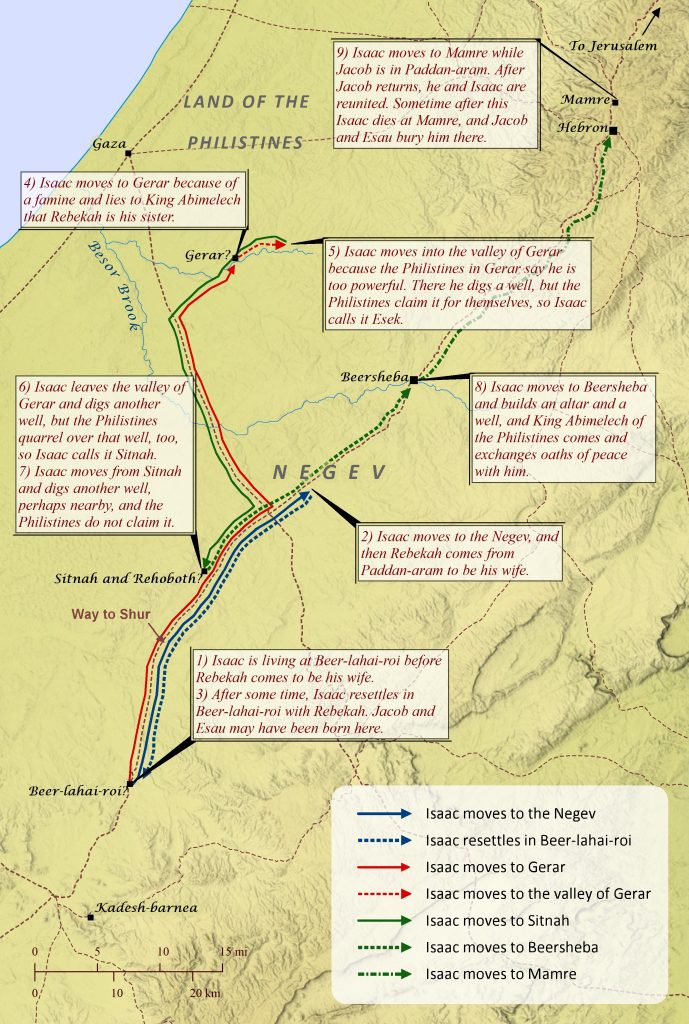
FROM REHOBOTH
TO BEERSHEBA
Then - This temporal expression marks progress in the narrative but does not tell us how much time lapsed between Rehoboth and Beersheba.
He went up from there to Beersheba - Having finally found sufficient room for his household and livestock at Rehoboth, Isaac now travels to Beersheba, a place Abraham had lived (Ge 21:21-34), and where Isaac may have lived with his parents. The expression went up reflects the geographical ascent toward Beersheba, located in the southern region of Canaan (see map above). Beersheba ("well of the oath” or “well of seven,”) was where Abraham had made a covenant with Abimelech and commemorated the agreement by giving him seven ewe lambs (Ge 21:28–32). Abraham had also planted a tamarisk tree there and called upon “the name of the LORD, the El Olam, the Everlasting God” (Ge 21:33). Thus, Isaac was returning to a place closely associated with his father's worship and God's covenant faithfulness. Moses does not explain why Isaac left Rehoboth, but his arrival at Beersheba prepares the reader for Isaac's divine encounter in the next verse (Ge 26:24).
QUESTION - What is the significance of Beersheba in the Bible? - GotQuestions.org
ANSWER - Beersheba was a city in ancient Israel in the southern part of the land. To the south of Beersheba was the Negev Desert, so Beersheba marked the southernmost boundary of cultivated land in Israel. The proverbial phrase from Dan to Beersheba is used nine times in the Old Testament to describe whole of the Promised Land—Dan being in the north, and Beersheba in the south (Judges 20:1; 1 Samuel 3:20; 2 Samuel 3:10; 17:11; 24:2, 15; 1 Kings 4:25; 1 Chronicles 21:2; 2 Chronicles 30:5). The distance from Dan to Beersheba was approximately 270 miles.
Beersheba is mentioned in Genesis 21:31 as the place where Abraham made a treaty with Abimelech, king of the Philistines in Gerar. Abraham had moved his family to the “region of the Negev and lived between Kadesh and Shur. For a time he stayed at Gerar” (Genesis 20:1). Abimelech saw that Abraham’s wife, Sarah, was beautiful and took her into his harem, not knowing that she was married to Abraham. Because of this, God put a curse on Abimelech’s household and warned him in a dream that Sarah was married (verses 3, 17–18). Abimelech quickly returned Sarah to her husband along with bountiful peace offerings (verses 14–15).
Abimelech and Abraham eventually formed an alliance wherein Abimelech said to Abraham, “God is with you in everything you do. Now swear to me here before God that you will not deal falsely with me or my children or my descendants. Show to me and the country where you now reside as a foreigner the same kindness I have shown to you” (Genesis 21:22–23). Abraham agreed.
A short time later, Abraham complained to Abimelech that the king’s servants had taken over a well in Beersheba that belonged to Abraham’s people. So Abimelech gave the well back to Abraham, who gave the king seven ewe lambs as a seal of their covenant. This happened at Beersheba, and it was the treaty that gave the place its name: Beersheba means “the well of the seven” or “the well of the treaty.” At that time, “Abraham planted a tamarisk tree in Beersheba, and there he called on the name of the Lord, the Eternal God. And Abraham stayed in the land of the Philistines for a long time” (Genesis 21:33–34).
Beersheba also figures into the story of Abraham’s son, Isaac. Following in his father’s footsteps, Isaac moved into the land of the Philistines when there was a famine in Canaan (Genesis 26). When he began to settle there, he found that all the wells his father’s servants had dug had been filled up with dirt by the Philistines. He reopened those wells and dug some new ones (Ge 26:18–22). After that, Isaac went to Beersheba. There the Lord appeared to him as He had done to his father Abraham and made him the same promise of a multitude of descendants (Ge 26:23,24). As Abraham had done, Isaac built an altar and called upon the name of the Lord. In a repeat performance, Abimelech arrived and asked for another treaty with Isaac, identical to the one made with Abraham. Isaac agreed. He prepared a feast for the king, and the two swore an oath of peace to each other (Ge 26:30,31). On the same day, Isaac’s servants discovered water in a new well they were digging (verse 32), and Isaac called the place Shibah, which means “oath” or “seven” (Ge 26:33). In this way, Isaac perpetuated the name his father had given the place, and Beersheba became the name of the town that would later be built near the wells that Abraham and Isaac had named.
Years later, in the division of the Promised Land, the area around Beersheba was part of the inheritance of the tribes of Simeon and Judah (Joshua 15:20–28; 19:1–2). Beersheba was a place where several people came into contact with God. Isaac (Genesis 26:24) and Jacob (Genesis 46:2) both heard from God in dreams they had at Beersheba. Hagar (Genesis 21:17) and Elijah (1 Kings 19:5) were in the wilderness of Beersheba when God spoke to them.
Beersheba was also the place where Samuel’s two wicked sons served as leaders (1 Samuel 8:1–3). It was this perversion of the judgeship that led Israel to demand a king (1 Samuel 8:6–9). By the time of the prophet Amos, in the reign of King Uzziah, Beersheba seems to have become a center of false worship, and the prophet warns those who would truly worship the Lord, “Do not journey to Beersheba” (Amos 5:5). Today, the spot where Beersheba once stood is marked by ancient ruins; several ancient wells have been discovered in the area, and they still produce water.
When God reveals His will to us or rescues us in some way,
we can create a personal “Beersheba” in our hearts.
🙏 THOUGHT - Beersheba can be seen as symbolizing those events in our lives that cause us to call upon the name of the Lord. Tragedy strikes, heartaches happen, and the Lord shows Himself strong on our behalf (2 Chronicles 16:9). The date or place where we experienced a turning point becomes a memorial in our hearts, much as Beersheba’s altar, well, and tamarisk tree were to Abraham and Isaac. When God reveals His will to us or rescues us in some way, we can create a personal “Beersheba” in our hearts. Then, when times of doubt or conflict come, we can return there over and over in our hearts for assurance that God is fulfilling His plan.
BEERSHEBA (Multiple Dictionaries)
Beersheba (Be’er Sheba) means “well of seven” or “well of the oath.” The name joins be’er, “well” (H875), with sheba, “seven” (07651). Sheba is closely related to the verb shaba, “to swear” (07650), which literally means “to bind oneself by seven.” Both meanings come together in the account of how the town was named. Abraham gave Abimelech seven ewe lambs as a witness that he had dug the well, and the two men made a covenant: “Therefore he called that place Beersheba, because there the two of them took an oath” (Ge 21:31). Abraham then worshiped there: “Abraham planted a tamarisk tree at Beersheba, and there he called on the name of the LORD, El Olam, the Everlasting God” (Ge 21:33). A generation later Isaac renewed the covenant with Abimelech. That same day his servants found water, and the name was confirmed: “So he called it Shibah; therefore the name of the city is Beersheba to this day” (Ge 26:33).
Beersheba was home to all three patriarchs. Abraham lived there after offering Isaac (Ge 22:19). The LORD appeared to Isaac there (Ge 26:24). Jacob set out from Beersheba for Haran (Ge 28:10). Years later he stopped there to worship on his way to Egypt: “So Israel set out with all that he had, and came to Beersheba, and offered sacrifices to the God of his father Isaac” (Ge 46:1). The surrounding wilderness is where God opened Hagar’s eyes to a well (Ge 21:14-19). It is also where Elijah fled from Jezebel and was fed by an angel (1Ki 19:3-8).
Beersheba was first allotted to Judah (Jos 15:28) and was later given to Simeon (Jos 19:2; 1Ch 4:28). It marked the southern edge of settled land, so “from Dan to Beersheba” became the standard phrase for the whole land of Israel: “Then all the sons of Israel from Dan to Beersheba, including the land of Gilead, came out, and the congregation assembled as one man to the LORD at Mizpah” (Jdg 20:1; cf. 1Sa 3:20; 2Sa 24:2). Samuel’s corrupt sons served as judges there (1Sa 8:2). Zibiah, the mother of King Joash, came from Beersheba (2Ki 12:1). By Amos’s day the patriarchs’ place of worship had become a center of false religion: “But do not resort to Bethel and do not come to Gilgal, nor cross over to Beersheba; for Gilgal will certainly go into captivity and Bethel will come to trouble” (Am 5:5; cf. Am 8:14). After the exile, Jews resettled there (Ne 11:27, 30). Beersheba is not mentioned in the New Testament.
The biblical town is usually identified with Tel Beersheba (Tell es-Seba), about 2½ miles east of the modern city. The site has been excavated, and it includes a large well near the city gate. Today Beersheba is a major Israeli city and the main city of the Negev.
Genesis 26:24 The LORD appeared to him the same night and said, “I am the God of your father Abraham; Do not fear, for I am with you. I will bless you, and multiply your descendants, For the sake of My servant Abraham.”
KJV And the LORD appeared unto him the same night, and said, I am the God of Abraham thy father: fear not, for I am with thee, and will bless thee, and multiply thy seed for my servant Abraham's sake.
NET The LORD appeared to him that night and said, "I am the God of your father Abraham. Do not be afraid, for I am with you. I will bless you and multiply your descendants for the sake of my servant Abraham."
NLT where the LORD appeared to him on the night of his arrival. "I am the God of your father, Abraham," he said. "Do not be afraid, for I am with you and will bless you. I will multiply your descendants, and they will become a great nation. I will do this because of my promise to Abraham, my servant."
ESV And the LORD appeared to him the same night and said, "I am the God of Abraham your father. Fear not, for I am with you and will bless you and multiply your offspring for my servant Abraham's sake."
NIV That night the LORD appeared to him and said, "I am the God of your father Abraham. Do not be afraid, for I am with you; I will bless you and will increase the number of your descendants for the sake of my servant Abraham."
- I am the God of your father Abraham: Ge 15:1 17:7 24:12 28:13 31:5 Ex 3:6 Mt 22:32 Ac 7:32
- Do not fear, for I am with you: Ge 26:3,4 Ge 13:16 Ge 22:19 Ps 27:1-3 Ps 46:1,2 Isa 12:2 41:10,13-15 43:1,2 Isa 44:2 51:7,12 Lu 12:32 Heb 13:6 Rev 1:17
Related Passages:
Genesis 26:2 Now there was a famine in the land, besides the previous famine that had occurred in the days of Abraham. So Isaac went to Gerar, to Abimelech king of the Philistines. 2 The LORD appeared to him and said, “Do not go down to Egypt; stay in the land of which I shall tell you.
Genesis 26:3 “Sojourn in this land and I will be with you and bless you, for to you and to your descendants I will give all these lands, and I will establish the oath which I swore to your father Abraham.
Genesis 15:1 After these things the word of the LORD came to Abram in a vision, saying, “Do not fear, Abram, I am a shield to you; Your reward shall be very great.”
Genesis 21:17 God heard the lad crying; and the angel of God called to Hagar from heaven and said to her, “What is the matter with you, Hagar? Do not fear, for God has heard the voice of the lad where he is.
Genesis 46:3 He said, “I am God, the God of your father; do not be afraid to go down to Egypt, for I will make you a great nation there.
Psalm 27:1-3 A Psalm of David. The LORD is my light and my salvation; Whom shall I fear? The LORD is the defense of my life; Whom shall I dread? 2 When evildoers came upon me to devour my flesh, My adversaries and my enemies, they stumbled and fell. 3 Though a host encamp against me, My heart will not fear; Though war arise against me, In spite of this I shall be confident.
Psalms 46:1-2 For the choir director. A Psalm of the sons of Korah, >set to Alamoth. A Song. God is our refuge and strength, A very present help in trouble. 2 Therefore we will not fear, though the earth should change And though the mountains slip into the heart of the sea;
Luke 12:32 “Do not be afraid, little flock, for your Father has chosen gladly to give you the kingdom.
Revelation 1:17 When I saw Him, I fell at His feet like a dead man. And He placed His right hand on me, saying, “Do not be afraid; I am the first and the last,
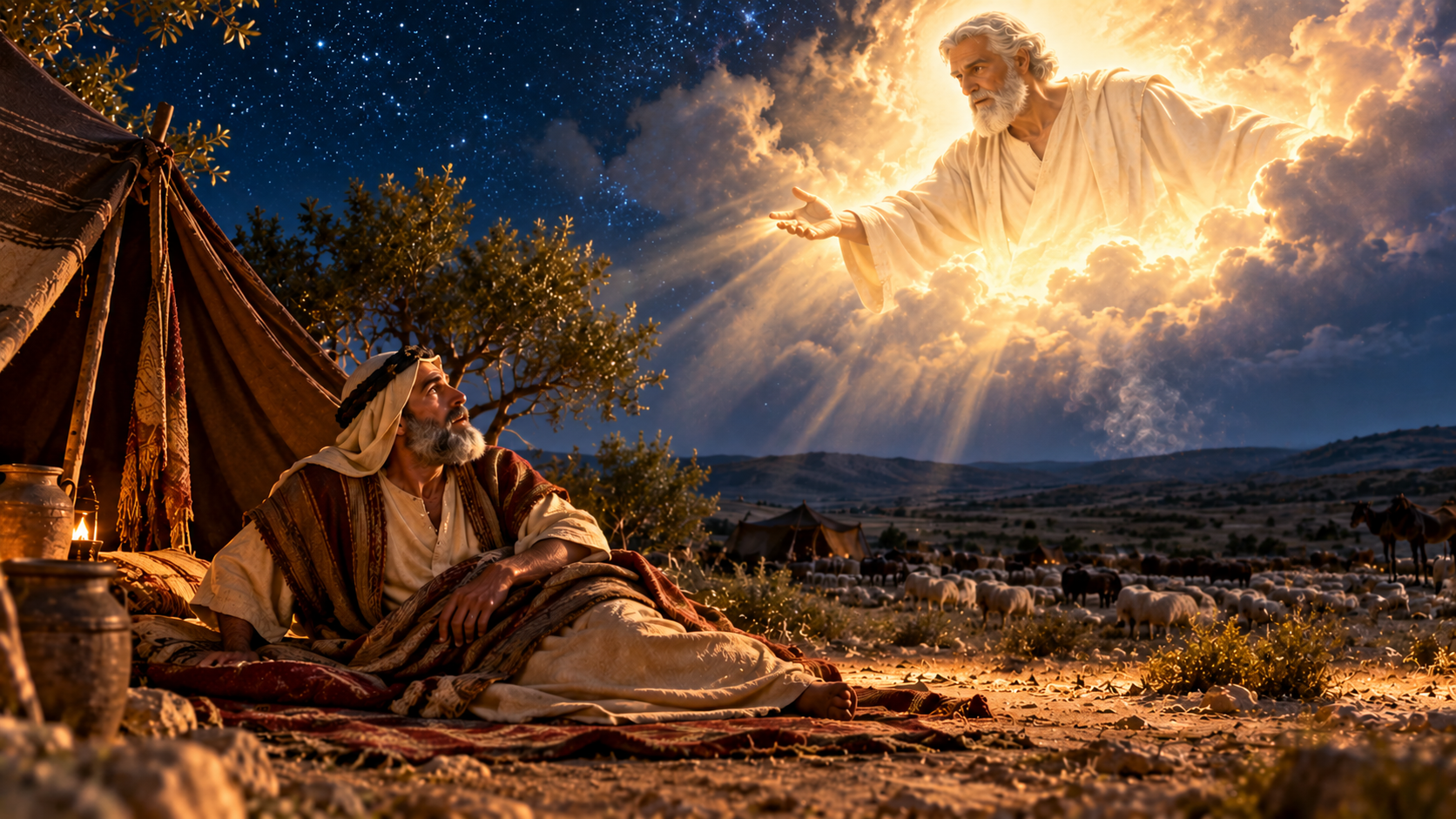
A NOCTURNAL THEOPHANCY
AT BEERSHEBA
The LORD appeared to him the same night - This is the second appearance of Yahweh to Isaac (Ge 26:2). What is the same night? The expression “the same night” most naturally refers to the night Isaac arrived at Beersheba (Ge 26:23), although the text does not explicitly state the precise time of his arrival. What is especially significant is that Yahweh takes the initiative to appear to Isaac, reaffirming His presence and the covenant promises originally given to Abraham. This divine appearance introduces three reassuring declarations - I am...I am...I will.
Victor Hamilton points out that "Unlike either his father or his son, however, Isaac does not receive a new name." (See The Book of Genesis, Chapters 18-50 - Page 94)
Bob Utley - "The Lord appeared to him the same night and said" This is the second time YHWH appears to Isaac (cf. Gen. 26:2). Here it was in a dream at night (cf. Gen. 15:5,12; 21:12,14; 22:1-3; 26:24). Many of the revelations in Genesis are recorded in poetry, as is Gen. 26:24 (cf. Gen. 12:1-3; 15:1,18; 17:1-2,4-5; 35:10,11-12).
and said, “I am the God of your father Abraham - God emphasizes the continuity of God's covenant relationship from Abraham to Isaac. Although Abraham had died (Ge 25:7, 8), the God of Abraham was still very much alive and actively fulfilling His promises! Notice the present tense, “I am,” not “I was,” the God of your father Abraham. Centuries later, Jesus appealed to God's declaration, “I am the God of Abraham, and the God of Isaac, and the God of Jacob,” to affirm the reality of the resurrection, declaring, “He is not the God of the dead but of the living” (Mt 22:31,32; cf. Ex 3:6)
Do not fear, for I am with you - Recall Isaac had feared the Philistines might kill him in Ge 26:7 if they found out Rebekah was his wife. The "for" (term of explanation) explains why Isaac had no reason to fear men. God was with him. In Ge 26:3 Yahweh said "I will be with you" and here He say "I am with you."
🙏 THOUGHT - Beloved, we have no need to live in fear of men, for the living God is with us! One of our Lord's glorious names is Immanuel, “God with us” (Mt 1:23). And even more wonderfully, Paul declares that the mystery now revealed to believers is “Christ in you, the hope of glory” (Col 1:27). Hebrews 13:5, 6 reinforces this precious truth: “For He Himself has said, ‘I WILL NEVER DESERT YOU, NOR WILL I EVER FORSAKE YOU,’ so that we confidently say, ‘THE LORD IS MY HELPER, I WILL NOT BE AFRAID. WHAT WILL MAN DO TO ME?’” Indeed, what can man ultimately do to those whose lives are in the hands of the sovereign God? (Jn 10:28,29) Men may threaten, persecute, or even kill the body, but they cannot frustrate God's eternal purposes (Mt 10:28–31; Ro 8:35–39). In a very real sense, we are immortal until God has accomplished His appointed purposes for our lives! Revelation 11:7 provides a striking illustration, for the beast is permitted to kill the two witnesses only “when they have finished their testimony.” This does not promise freedom from suffering or premature death from a human perspective, but it does remind us that our lives are never outside God's sovereign control (cf Da 5:23b). The safest place in the universe is not a place free from danger, but a life in the center of God's will trusting the One Who has promised never to leave us or forsake us! (Heb 13:5b).
I will bless (barak; LXX - eulogeo) you - This reaffirms God's promise in Ge 26:3. And surely by now Isaac has come to understand this blessing from his time in Gerar, where God protected him and prospered him. The LORD had protected him despite his deception concerning Rebekah (Ge 26:7-10,11), granted him an extraordinary hundredfold harvest (Ge 26:12), and prospered him until he became exceedingly wealthy (Ge 26:13,14). Yet notice that God does not say, “I have blessed you,” but “I will bless you.” The promise looks forward, assuring Isaac that the blessings he had already experienced were not the end of God's gracious dealings with him.
And multiply your descendants (zera - lit = "seed"; LXX - sperma) - God's mathematics call for multiplication, not just addition! Jehovah reiterates the promise of Ge 26:4 where He promised to multiply Isaac's descendants as the stars of heaven, reaffirming the Abrahamic Covenant (Ge 15:5; Ge 22:17). Although Isaac had only two sons, God's promise envisioned an innumerable multitude through Jacob, the father of the twelve tribes of Israel (Ge 35:10–12). What began with one man would become a nation, because God's promises are never limited by man's arithmetic!
What began with one man would become a nation,
because God's promises are never limited by man's arithmetic!
For the sake of My servant Abraham - NLT = "I will do this because of my promise to Abraham, my servant." What does this mean? He is not saying because he had earned the blessing but for the sake of Abraham. This means that God would bless Isaac and multiply his descendants because of the covenant promises He had already made to Abraham. The blessing was grounded in God's faithfulness to His covenant, not in Isaac's (or Abraham's) personal merit or obedience.
Victor Hamilton - "The point is made that Isaac is so honored because of Abraham (Ge 26:5, 24b). God is not initiating anything with Isaac. He is perpetuating what he started with Abraham." (See The Book of Genesis, Chapters 18-50 - Page 94)
Streams in the Desert - Page 17 - “And the Lord appeared unto Isaac the same night.” (Gen. 26:24.)
APPEARED the same night,” the night on which he went to Beer-sheba. Do you think this revelation was an accident? Do you think the time of it was an accident? Do you think it could have happened on any other night as well as this? If so, you are grievously mistaken. Why did it come to Isaac in the night on which he reached Beer-sheba? Because that was the night on which he reached rest. In his old locality, he had been tormented. There had been a whole series of petty quarrels about the possession of paltry wells. There are no worries like little worries, particularly if there is an accumulation of them. Isaac felt this. Even after the strife was past, the place retained a disagreeable association. He determined to leave. He sought change of scene. He pitched his tent away from the place of former strife. That very night the revelation came. God spoke when there was no inward storm. He could not speak when the mind was fretted; His voice demands the silence of the soul. Only in the hush of the spirit could Isaac hear the garments of his God sweep by. His still night was his starry night.
My soul, hast thou pondered these words, “Be still, and know”? In the hour of perturbation, thou canst not hear the answer to thy prayers. How often has the answer seemed to come long after! The heart got no response in the moment of its crying—in its thunder, its earthquake, and its fire. But when the crying ceased, when the stillness fell, when thy hand desisted from knocking on the iron gate, when the interest of other lives broke the tragedy of thine own, then appeared the long-delayed reply. Thou must rest, O soul, if thou wouldst have thy heart’s desire. Still the beating of thy pulse of personal care. Hide thy tempest of individual trouble behind the altar of a common tribulation and, that same night, the Lord shall appear to thee. The rainbow shall span the place of the subsiding flood, and in thy stillness thou shalt hear the everlasting music.—George Matheson.
Tread in solitude thy pathway,
Quiet heart and undismayed.
Thou shalt know things strange, mysterious,
Which to thee no voice has said.
While the crowd of petty hustlers
Grasps at vain and paltry things,
Thou wilt see a great world rising
Where soft mystic music rings.
Leave the dusty road to others,
Spotless keep thy soul and bright,
As the radiant ocean’s surface
When the sun is taking flight.
—(From the German of V. Schoffel) H. F.
R C Sproul - The Promise to Isaac GENESIS 26:17–35
“The LORD appeared to him the same night and said, ‘I am the God of Abraham your father. Fear not, for I am with you and will bless you and multiply your offspring for my servant Abraham’s sake’ ” (Gen. 26:24).
A century after the Persians conquered Babylon and allowed the Jewish exiles to return to Palestine, King Artaxerxes of Persia allowed Nehemiah to supervise the rebuilding of Jerusalem’s wall (Neh. 1:1–2:8). During this operation, Nehemiah’s God-given success became a target for foreign envy and opposition. Yet Nehemiah trusted in the Lord and persevered in his task (4:1–7:4).
Perhaps Nehemiah found encouragement from Isaac, who faced similar trouble. Though he sinned while in Gerar, God blessed Isaac, moving Abimelech to cast him out of his territory (Gen. 26:12–16). This Abimelech may be the same one who made a covenant with Abraham, but more than likely he is his descendant, because “Abimelech” is probably a title—not a proper name. In any case, this king of Gerar evidently cared little for the pact he or his father made with Abraham, and he envied Isaac to the point of expulsion.
Whenever the Lord grants us great success, we should not be surprised if people envy us. Opposition will often come from non-believers, but unfortunately, other Christians may become jealous too (Num. 12). In either case, our response must be the same. Like Isaac, we are to continue trusting the Father and doing His work. Today’s passage shows that it was not enough for the people of Gerar to expel Isaac, they also kept stealing the wells the patriarch dug to support his entourage (Gen. 26:17–21). However, Isaac did not give up. The Lord continued to bless him, and he was quick to credit God with his success, which finally prompted Abimelech to renew the covenant with Abraham’s family (vv. 22–33).
Genesis 26 depicts Isaac in an ambivalent fashion. His timidity was his greatest weakness here, and it lead to his reprimand from Abimelech (vv. 1–11). No doubt it also made it easier for the people of Gerar to steal his wells (vv. 17–21). But his disposition also made him inclined to do the right thing, namely, make peace with his enemies (Matt. 5:9). Thus, as John Calvin comments, we learn from Isaac “that if any have estranged themselves from us, they are not to be repelled when they again offer themselves to us.”
CORAM DEO Isaac’s quiet nature is one biblical example of the maxim: “Our greatest strength is also our greatest weakness.” Peter’s eagerness to make himself heard also manifests this principle (Matt. 16:13–23). Take time today to consider that aspect of your personality that is a great strength and has brought you many benefits. Thank God for this gift. Try also to see how it is a weakness so that you may not think more highly of yourself than you ought (Rom. 12:3).
Genesis 26:25 So he built an altar there and called upon the name of the LORD, and pitched his tent there; and there Isaac’s servants dug a well.
- So he built an altar: Ge 8:20 Ge 12:7 Ge 13:18 Ge 22:9 Ge 33:20 Ge 35:1 Ex 17:15
- called: Ps 116:17
Related Passages:
Genesis 8:20 Then Noah built an altar to the LORD, and took of every clean animal and of every clean bird and offered burnt offerings on the altar. (FIRST ALTAR IN BIBLE)
Genesis 12:7,8 The LORD appeared to Abram and said, “To your descendants I will give this land.” So he built an altar there to the LORD who had appeared to him. 8 Then he proceeded from there to the mountain on the east of Bethel, and pitched his tent, with Bethel on the west and Ai on the east; and there he built an altar to the LORD and called upon the name of the LORD.
Genesis 13:18 Then Abram moved his tent and came and dwelt by the oaks of Mamre, which are in Hebron, and there he built an altar to the LORD.
Genesis 22:9 Then they came to the place of which God had told him; and Abraham built the altar there and arranged the wood, and bound his son Isaac and laid him on the altar, on top of the wood.....22:14 Abraham called the name of that place The LORD Will Provide, as it is said to this day, “In the mount of the LORD Will Provide (Jehovah Jireh).”
Genesis 33:19-20 He bought the piece of land where he had pitched his tent from the hand of the sons of Hamor, Shechem’s father, for one hundred pieces of money. 20 Then he (JACOB) erected there an altar and called it El-Elohe-Israel.
Genesis 35:1 Then God said to Jacob, “Arise, go up to Bethel and live there, and make an altar there to God, who appeared to you when you fled from your brother Esau.”
Genesis 35:21 Then Israel journeyed on and pitched his tent beyond the tower of Eder.
Exodus 17:15 Moses built an altar and named it the LORD is My Banner (Jehovah Nissi);
Genesis 4:26 To Seth, to him also a son was born; and he called his name Enosh. Then men began to call upon the name of the LORD.
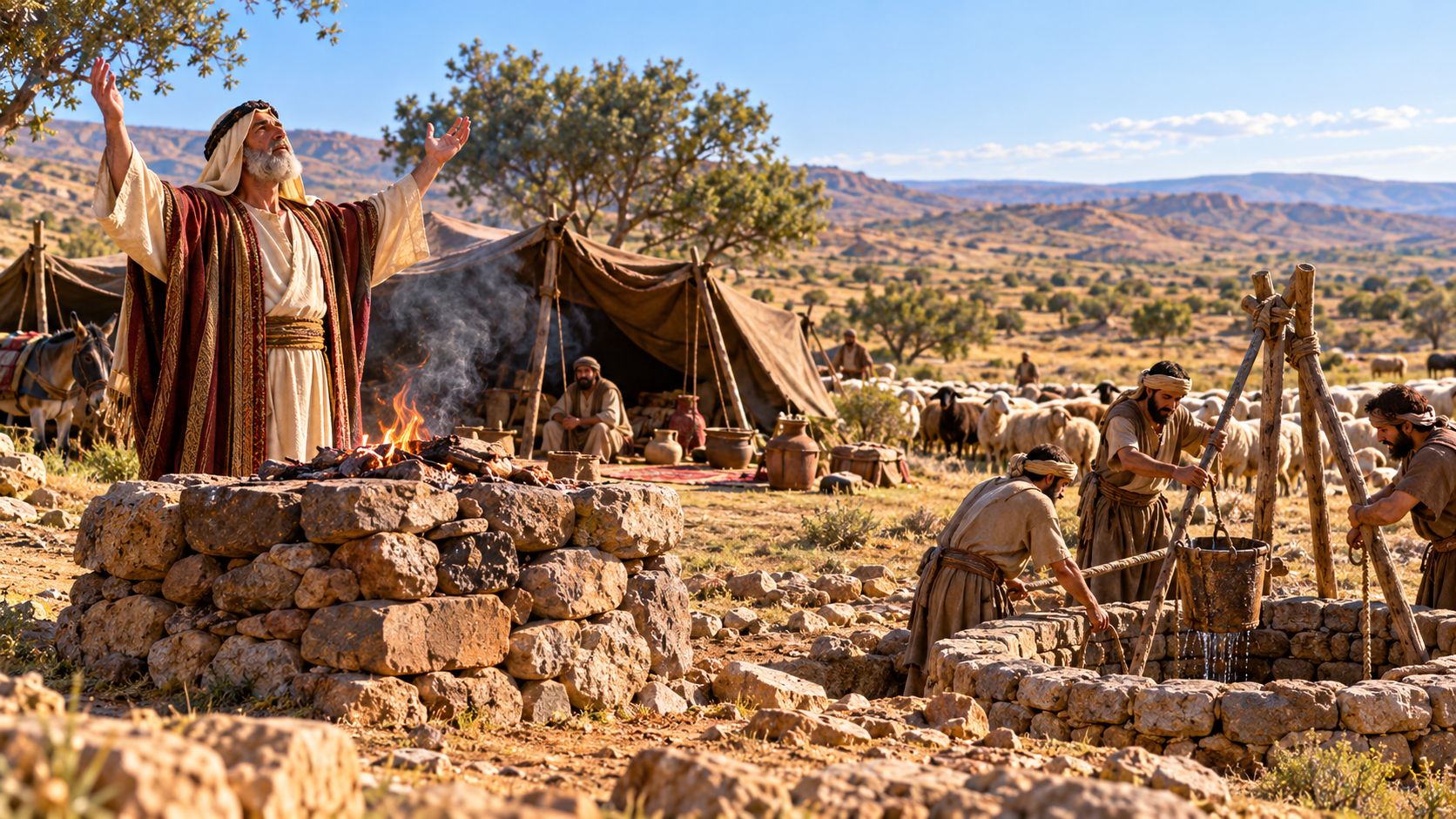
ISAAC BUILDS AN
ALTAR TO JEHOVAH
So he built an altar there - This is Isaac's response to the appearance of Yahweh.
W H Griffith Thomas - The altar and the home sum up everything that is true in life. First the altar and then the home, not first the home and then the altar. God must be first in everything.
Bob Utley - The sites of YHWH's personal revelations became sacred places. Altars were built in these places and they became places of worship, prayer, and sacrifice (cf. Gen. 8:20; 12:7,8; 13:4,18; 22:9).
and called upon the name of the LORD - His actions recall Abraham, who had likewise called upon the name of the LORD at Beersheba (Ge 21:33). Isaac follows his father's example. To call on the Name of the LORD means to approach God in faith, acknowledging Who He is and seeking Him in worship, prayer, and dependence. The expression involves more than simply speaking God's name; it reflects a personal response to His revealed character. In the context of Yahweh's revealing Himself to Isaac, this represents an act of worship (cf Ge 21:33)
Calling upon the Name of the LORD takes on additional significance in the New Testament, where calling upon the Lord is associated with faith in Jesus Christ and salvation (Ro 10:9-12,13).
And pitched his tent there - This suggests that he intended to establish a residence rather than merely stop for the night. Note the order is Isaac first built an altar, then pitched his tent. Worship preceded settling down! The imagery of living in tents underscores the pilgrim nature of God’s people in a fallen world. Hebrews 11:9 describes Abraham "By faith he lived as an alien in the land of promise, as in a foreign land, dwelling in tents with Isaac and Jacob, fellow heirs of the same promise."
The ultimate fulfillment of pitching one's tent appears in the Person and work of Jesus Christ. In the New Testament, John uses this exact concept to describe the Incarnation, explaining that "And the Word became flesh, and dwelt (skenoo - tabernacled) among us, and we saw His glory, glory as of the only begotten from the Father, full of grace and truth." (John 1:14).
Warren Wiersbe - Isaac was wealthy enough to be able to build himself a fine house, but his tent identified him as a pilgrim and stranger in the land (Heb. 11:8-10, 13-16). A fugitive is fleeing from home; a vagabond has no home; a stranger is away from home; but a pilgrim is heading home. The tent identified Isaac as a pilgrim, and the altar announced that he worshiped Jehovah and was heading to the heavenly kingdom. (Bible Exposition Commentary)
and there Isaac’s servants dug a well - Worship preceded work, but work had to be done for they needed a source of water. Faith in God's provision does not eliminate the necessity of human effort. Isaac trusted Yahweh to provide, but his servants still had to dig! Faith looks to God for the blessing while faithfully doing the work He has placed before us!
Henry Morris - According to records, this is the only altar built by Isaac. God appeared to him again after he returned to Beersheba ("well of the covenant") where he had lived in his closest fellowship with God. The well had belonged to Abraham, and it was accepted as such by the Philistines (still a relatively small body of settlers that had come from their own homeland in Crete), so Isaac knew he was now justified in staying there. The ancient town of Beer-sheba has been partially excavated, and visitors today are shown a well claimed to be that of Abraham and Isaac.
NET NOTE - Heb "called in the name of." The expression refers to worshiping the LORD through prayer and sacrifice (see Ge 4:26; 12:8; 13:4; 21:33). See G. J. Wenham, Genesis (WBC), 1:116.
GENESIS 26:25
In the early 1900s, a policeman was walking his beat in Chicago when he observed a man standing before a little mission. He had removed his hat, and the officer thought he was acting rather strangely. Thinking the man might be drunk or ill, the policeman approached him. He noticed that his eyes were closed, so he nudged him and said, "What's the matter, Mac? Are you sick?" The man looked up and smiled. "No, sir. My name is Billy Sunday I was converted right here in this mission. I never pass this way without taking the opportunity, if possible, to stand quietly for a moment and whisper a prayer of thanksgiving."
In the Old Testament, altars were often erected as memorials of praise. They hallowed a certain spot where a devout worshiper had encountered God. That was true of the one built by Isaac recorded in Genesis 26. While we no longer follow this practice today, some places do hold a blessed spiritual significance for us. As we occasionally return to them, our hearts are lifted in praise to the Lord for His goodness. —H. G. B.
LET PRAISE BE NOT AN INCIDENT BUT AN ATTITUDE OF LIFE.
QUESTION - What does it mean to call upon the name of the Lord? GOTQUESTIONS.ORG
ANSWER - The first mention in Scripture of people calling on the name of the Lord is Genesis 4:26: “Seth also had a son, and he named him Enosh. At that time people began to call on the name of the Lord.” Here, to call on the name of the Lord means that people began to gather for corporate worship and seeking the help of the Creator. Cain’s family line is contrasted with Seth’s: descendants of Cain began to practice herding (Ge 4:20), music production (Ge 4:21), and metallurgy (Ge 4:22). At the same time, the world was becoming more and more wicked (Ge 4:19 and Ge 4:23). Seth’s descendants stood out from their corrupt society in that they began to call on the name of the Lord.
When Abram entered Canaan, he camped between Ai and Bethel. There, “he built an altar to the Lord and called on the name of the Lord” (Genesis 12:8). In other words, Abram publicly thanked God, praised His name, and sought His protection and guidance. Years later, Abraham’s son Isaac built an altar to the Lord in Beersheba and also “called on the name of the Lord” (Genesis 26:25).
To call on the name of the Lord is to invoke His proper name “in audible and social prayer and praise” (Albert Barnes). To call on the name of the Lord is to approach Him in thanksgiving, worship, and petition, and in so doing proclaim the name of God. To call on the name of the Lord is to pray “in a more public and solemn manner” (Matthew Poole). Those who are children of God will naturally call on the name of the Lord.
Calling on the name of the Lord is basic for salvation and presupposes faith in the Lord. God promises to save those who, in faith, call upon His name: “Everyone who calls on the name of the Lord will be saved” (Romans 10:13; cf. Joel 2:32). Everyone who invokes the name of God for mercy and salvation, by or in the name of Jesus, shall be saved (Acts 2:21). “There is salvation in no one else! God has given no other name under heaven by which we must be saved” (Acts 4:12NLT).
Using a person’s name expresses familiarity and helps connect one person to another. The first thing we do upon meeting someone is to extend a hand and introduce ourselves. This builds familiarity for future interactions. To call upon the name of the Lord is a sign of knowing Him and a way of connecting to Him. There is a difference between knowing about God and knowing Him personally. Calling on the name of the Lord indicates personal interaction and relationship. When we call upon the name of the Lord, as a form of worship, we recognize our dependence upon Him.
What saves a person is not the action, per se, of “calling upon” the name of Jesus; what saves is God’s grace in response to one’s personal faith in the Savior being called upon. Calling on the name of the Lord is more than a verbal expression; it is also shown in the heart and in deed through repentance. “If you declare with your mouth, ‘Jesus is Lord,’ and believe in your heart that God raised him from the dead, you will be saved” (Romans 10:9). “Repent, then, and turn to God, so that your sins may be wiped out” (Acts 3:19).
Calling on the name of the Lord is to be a lifelong pursuit (Psalm 116:2). God commands us to call on Him in times of trouble (Psalm 50:15). The one who “dwells in the shelter of the Most High will rest in the shadow of the Almighty” (Psalm 91:1) and has God’s promise of blessing: “‘Because he loves me,’ says the Lord, ‘I will rescue him; I will protect him, for he acknowledges my name. He will call on me, and I will answer him; I will be with him in trouble, I will deliver him and honor him’” (Ps 91:14,15).
Those who refuse to call upon the name of the Lord are also described in Scripture, along with the results of their disobedience: “Will the workers of iniquity never learn? . . . They refuse to call upon the Lord. There they are, overwhelmed with dread, where there was nothing to fear” (Psalm 14:4–5, BSB).
Even as rebellious or ignorant people neglect to call upon the name of the Lord, He is willing to hear them and accept them. God wants to be found; He is ready to be known: “I was ready to be sought by those who did not ask for me; I was ready to be found by those who did not seek me. I said, ‘Here I am, here I am,’ to a nation that was not called by my name” (Isaiah 65:1ESV; cf. Romans 10:20).
In 1 Corinthians 1:2, those who call upon the name of the Lord are identified as believers: “To the church of God in Corinth, to those sanctified in Christ Jesus and called to be his holy people, together with all those everywhere who call on the name of our Lord Jesus Christ—their Lord and ours.” Calling on the name of the Lord is one of the marks of a Christian.
In summary, those who call on the name of the Lord are those who recognize Him as Savior. Whether it is a first-time calling upon Jesus’ name for forgiveness of sins or a continuous calling as the relationship progresses and grows, giving Him lordship over our lives in surrender to His will, calling on the name of the Lord is vital to spiritual life. Ultimately, calling on the name of the Lord is a sign of humility and dependence on God our Creator and Redeemer.
QUESTION - What is an altar? - GotQuestions.org
ANSWER - An altar is any structure upon which offerings such as sacrifices are made for religious purposes. It was usually a raised platform with a flat surface. There are over four hundred references to altars in the Bible. The word altar is first used in Genesis 8:20 when Noah built an altar to the Lord after leaving the ark. However, the idea was present as early as Genesis 4:3–4 when Cain and Abel brought their sacrifices to the Lord. They most likely presented their offerings on some type of altar, even though the word altar is not used in that passage.
An altar always represented a place of consecration. Before God gave His Law to Moses, men made altars wherever they were out of whatever material was available. An altar was often built to commemorate an encounter with God that had a profound impact upon someone. Abram (Genesis 12:7), Isaac (Genesis 26:24–25), Jacob (Genesis 35:3), David (1 Chronicles 21:26), and Gideon (Judges 6:24) all built altars and worshiped after having a unique encounter with God. An altar usually represented a person’s desire to consecrate himself fully to the Lord. God had worked in a person’s life in such a way that the person desired to create something tangible to memorialize it.
During times of Israel’s rebellion and idolatry, the Lord’s altars fell into disrepair. The prophet Elijah, confronting the prophets of Baal on Mt. Carmel, “repaired the altar of the Lord, which had been torn down” (1 Kings 18:30). Elijah’s restoration of the altar was significant, given the rampant paganism of his day. Also, in spite of the fact that he was living in a divided kingdom, the prophet symbolized the unity of God’s people in his construction: “Elijah took twelve stones, one for each of the tribes descended from Jacob, to whom the word of the Lord had come, saying, ‘Your name shall be Israel.’ With the stones he built an altar in the name of the Lord” (1 Kings 18:31–32). It was on this rebuilt altar that God rained down fire and put the Baal-worshipers to shame (verses 38–39).
Sometimes God Himself commanded that an altar be built after He had delivered someone in a miraculous way (Deuteronomy 27:4–7; Exodus 30:1). Such an altar would be a memorial to help future generations remember the mighty works of the Lord. Because atonement is God’s work, the Law specified that an altar made of stones must be made with natural, uncut stones, “for you will defile it if you use a tool on it” (Exodus 20:25).
When God gave instructions for the tabernacle, He also gave detailed instructions for the kind of altar the courtyard should contain (Exodus 27:1–8). On this altar, the people made sacrifices that God accepted as atonement for their sin. It was to have four horn-like projections, one at each corner. It had to be large enough to hold sacrifices of bulls, sheep, and goats. For the temple that Solomon built, the altar was made of pure gold (1 Kings 7:48).
In the broadest sense, an altar is merely a designated place where a person consecrates himself to someone or something. Many church buildings have “altars” for prayer, communion, weddings, and other sacred purposes. Some Christians create their own “altars” for personal worship as visible reminders of Romans 12:1, which says to “present yourself as a living sacrifice.”
We can ask the Lord what areas of our lives He is requiring that we
offer to Him. We can symbolically lay that on the altar and let go.
🙏 THOUGHT - Every human heart has an invisible altar where the war between the flesh and the spirit rages. When we surrender areas of our lives to the control of the Holy Spirit, we are in effect laying that area on the altar before God. It can help to visualize Abraham’s altar where he offered his son Isaac to the Lord (Genesis 22:9). We can ask the Lord what areas of our lives He is requiring that we offer to Him. We can symbolically lay that on the altar and let go. We don’t need a flat-topped surface; we can surrender our lives to God on the altar of our hearts at any time.
CALL ON HIS NAME - This phrase implies participation in a worship setting (BDB 894, KB 1128, cf. Gen. 4:26; 12:8; 21:33; 26:25; Exod. 34:5; Isa. 12:4; Joel 2:32; Acts 2:21; 7:59; 22:16; Rom. 10:9-13; also note Ps. 50:15; Isa. 55:6; Jer. 33:3). The name would represent His person, His character! By calling on Him we acknowledge our need for Him and our desire to be like Him and pleasing to Him. This phrase denotes a desire for fellowship (cf. Isa. 43:1; 45:3,4)!
The NIDOTTE, vol. 4, p. 150, has a good list related to YHWH's name.
1. it can be praised, Joel 2:26
2. it can be loved, Ps. 5:11
3. it can be declared, Ps. 22:22
4. it can be feared, Mal. 4:2
5. it can be waited on, Ps. 52:9
6. it can be proclaimed, Isa. 12:4
7. it can be walked on, Mic. 4:5
8. it can be blasphemed, Isa. 52:5
9. it can be polluted, Jer. 34:16
10. it can be profaned, Ezek. 36:21-23
God's people can reflect Him positively or negatively, but we do reflect Him (cf. Matt. 5:13-16)!
Genesis 26:26 Then Abimelech came to him from Gerar with his adviser Ahuzzath and Phicol the commander of his army.
KJV Then Abimelech went to him from Gerar, and Ahuzzath one of his friends, and Phichol the chief captain of his army.
NET Now Abimelech had come to him from Gerar along with Ahuzzah his friend and Phicol the commander of his army.
NLT One day King Abimelech came from Gerar with his adviser, Ahuzzath, and also Phicol, his army commander.
ESV When Abimelech went to him from Gerar with Ahuzzath his adviser and Phicol the commander of his army,
NIV Meanwhile, Abimelech had come to him from Gerar, with Ahuzzath his personal adviser and Phicol the commander of his forces.
- Abimelech (KJV): Ge 20:3 21:22-32
- Phichol (KJV): Phichol, as well as Abimelech, "father king," seems to have been a name of office or dignity among the Philistines; for it is not probable that they were the same as are mentioned in the days of Abraham (ch. 21:22, 32.)
Related Passages:
Genesis 21:22-24 Now it came about at that time that Abimelech and Phicol, the commander of his army, spoke to Abraham, saying, “God is with you in all that you do; 23 now therefore, swear to me here by God that you will not deal falsely with me or with my offspring or with my posterity, but according to the kindness that I have shown to you, you shall show to me and to the land in which you have sojourned.” 24 Abraham said, “I swear it.”
Proverbs 16:7 When a man’s ways are pleasing to the LORD, He makes even his enemies to be at peace with him.
ABIMELECH'S
REMARKABLE REVERSAL
Then - Marks progression in the narrative from explusion to invitation! Don't miss the significance of this "then." When is "then?" As W H Griffith Thomas says "'Then Abimelech went,' that is, when Isaac had returned to the pathway of God's will, those who were formerly his enemies came to him and bore their testimony to the presence of God with him."
Abimelech came to him from Gerar with his adviser Ahuzzath and Phicol the commander of his army - Why did Abimelech come to Isaac at Beersheba? The answer is given in Genesis 26:28, 29. Abimelech and his officials recognized that the LORD was with Isaac and wanted to establish a formal covenant of peace with him. The man they had previously expelled because he was too powerful (Ge 26:16) was now someone whose friendship they sought!
Bob Utley - "Abimelech. . .Phicol" Although these names are exactly the same as in Gen. 21:22, it has been about 75-80 years and obviously cannot refer to the same men (ED: NOT EVERYONE AGREES - SOME SUGGEST IT COULD BE THE SAME MEN). From the introduction to Psalm 34 it seems obvious that these are titles instead of proper names.
Iain Paisley - The Peace of the War of the Wells
“Then Abimelech went to him from Gerar, and Ahuzzath one of his friends, and Phichol the chief captain of his army.” Genesis 26:26
The war of the wells came to an abrupt end and peace broke out unexpectedly for Isaac.
The Framing of the Peace
Peace came from the very source of the war, Gerar. It was the herdsmen of Gerar who drove Isaac away (verses 20 and 21). Now the King of Gerar leads a peace envoy.
What a surprise for Isaac! He goes out and lo and behold, Abimelech the king of the Philistines, his friend Ahuzzah and his chief captain Phichol have come to sue for peace. No wonder Isaac exclaims, “Wherefore came ye to me, seeking ye hate me and sent me away from you?”
“And they said, We saw certainly that the Lord was with thee: and we said, Let there be now an oath betwixt us, even betwixt us and thee, and let us make a covenant with thee: That thou wilt do us no hurt, as we have not touched thee, and as we have done unto thee nothing but good, and have sent thee away in peace: thou art now the blessed of the Lord” Genesis 26:28 and 29.
Strange language from fierce enemies. But when a man’s ways please the Lord he makes his enemies to be at peace with him.
The Feast of the Peace
“And he made them a feast and they did eat and drink.” Genesis 26:30
Isaac immediately reciprocated. The hospitality of his father Abraham was practised by his son Isaac. A great feast was set on.
The feast ended with the signing of the peace treaty, “And they rose up betimes in the morning and sware one to another: and Isaac sent them away, and they departed from him in peace” verse 31.
And so the war of the wells ended.
The Fullness of the Peace
“And it came to pass the same day, that Isaac’s servants came and told him concerning the well which they had digged, and said unto him. We have found water. And he called it Shebah: therefore the name of the city is Beersheba unto this day.” Genesis 26:32–33
The fullness of the peace was manifested in yet another well and what a well! A well of such magnitude that it was eventually able to water the city of Beersheba.
God always crowns His work with the richest of encouragements.
The framing of the peace, and the feast of the peace had their fullness demonstrated in springing water, sufficient for the whole of a great new city, and blessed fullness indeed. So the war ended and peace reigned gloriously at last.
Genesis 26:27 Isaac said to them, “Why have you come to me, since you hate me and have sent me away from you?”
KJV And they said, We saw certainly that the LORD was with thee: and we said, Let there be now an oath betwixt us, even betwixt us and thee, and let us make a covenant with thee;
NET They replied, "We could plainly see that the LORD is with you. So we decided there should be a pact between us– between us and you. Allow us to make a treaty with you
NLT They replied, "We can plainly see that the LORD is with you. So we want to enter into a sworn treaty with you. Let's make a covenant.
ESV They said, "We see plainly that the LORD has been with you. So we said, let there be a sworn pact between us, between you and us, and let us make a covenant with you,
NIV They answered, "We saw clearly that the LORD was with you; so we said, 'There ought to be a sworn agreement between us'--between us and you. Let us make a treaty with you
- seeing (KJV): Ge 26:14,16 Jud 11:7 Ac 7:9,14,27,35 Rev 3:9
- sent me (KJV): Ge 26:16
WHEN ENEMIES
COME CALLING
Isaac said to them, “Why have you come to me, since you hate (sane; LXX - miseo - hostility of people for each other ) me and have sent me away from you - Isaac asks the obvious question! After all, Abimelech had previously ordered him to leave Gerar because he had become too powerful (Ge 26:16), and the Philistines had repeatedly disputed his wells (Ge 26:15, 20,21). Now the very men who had rejected him suddenly appear at Beersheba seeking an audience!
Genesis 26:28 They said, “We see plainly that the LORD has been with you; so we said, ‘Let there now be an oath between us, even between you and us, and let us make a covenant with you,
KJV And they said, We saw certainly that the LORD was with thee: and we said, Let there be now an oath betwixt us, even betwixt us and thee, and let us make a covenant with thee;
NET They replied, "We could plainly see that the LORD is with you. So we decided there should be a pact between us– between us and you. Allow us to make a treaty with you
NLT They replied, "We can plainly see that the LORD is with you. So we want to enter into a sworn treaty with you. Let's make a covenant.
ESV They said, "We see plainly that the LORD has been with you. So we said, let there be a sworn pact between us, between you and us, and let us make a covenant with you,
NIV They answered, "We saw clearly that the LORD was with you; so we said, 'There ought to be a sworn agreement between us'--between us and you. Let us make a treaty with you
- the LORD has been with you: Ge 21:22-23 39:5 Jos 3:7 2Ch 1:1 Isa 45:14 60:14 61:6,9 Ro 8:31 1Co 14:25 Heb 13:5
- Let there now be an oath: Ge 21:31,32 24:3,41 31:49-53 Heb 6:16
Related Passages:
Genesis 21:22-23 Now it came about at that time that Abimelech and Phicol, the commander of his army, spoke to Abraham, saying, “God is with you in all that you do; 23 now therefore, swear to me here by God that you will not deal falsely with me or with my offspring or with my posterity, but according to the kindness that I have shown to you, you shall show to me and to the land in which you have sojourned.”
Deuteronomy 29:12 that you may enter into the covenant with the LORD your God, and into His oath which the LORD your God is making with you today,
Deuteronomy 29:14 “Now not with you alone am I making this covenant and this oath,
WHEN GOD'S PRESENCE AND
BLESSING BECOMES EVIDENT
They said, “We see plainly that the LORD has been with you; so we said, ‘Let there now be an oath (alah) between us, even between you and us, and let us make (karath - cut) a covenant (beriyth) with you - NET = "So we decided there should be a pact between us" This is a surprising admission from the pagan Philistines and see plainly emphasizes their certainty that Yahweh is with Isaac. They could not ignore Isaac's extraordinary prosperity and growing influence (Ge 26:12-16). What is surprising is that they did not attribute Isaac's success to Isaac but to Isaac's LORD. Clearly Isaac had in some way given a witness to the pagans of the existence and power of Jehovah. Even earlier Abimelech had acknowledged “God is with you in all that you do” (Ge 21:22).
Notice who initiates the covenant. The same Philistines who had driven Isaac away now come to him, “We see plainly that the LORD has been with you” (Ge 26:28). They want to be bound by oath to the man God is blessing. This is a small fulfillment of God’s promise to Abraham: “And I will bless those who bless you, and the one who curses you I will curse” (Ge 12:3). The pattern also points to God’s Own oath to us in the New Covenant - “For men swear by one greater than themselves, and with them an oath given as confirmation is an end of every dispute. In the same way God, desiring even more to show to the heirs of the promise the unchangeable purpose of His, interposed with an oath” (Heb 6:16,17).
Recognizing God's favor upon Isaac, Abimelech proposes a formal covenant secured by an oath. His motive appears primarily practical: establishing peaceful relations with a man whose power and prosperity were increasing. And so Abimelech sought security through a covenant with the man whom God had already blessed through His covenant!
CUTTING COVENANT - The word for make (karath) literally means “to cut” and reflects the ancient practice of cutting a covenant using sacrificial animals. The two parties would walk between the divided pieces of the animal, acting out the curse, saying in effect “So may it be done to me (death) if I break this covenant.” God Himself did this with Abraham (Ge 15:9,10, 17). God later warned covenant breakers that He would give “the men who have transgressed My covenant, who have not fulfilled the words of the covenant which they made before Me, when they cut the calf in two and passed between its parts” (Jer 34:18). The Gerar covenant follows the full pattern. The Philistines first propose the terms: “that you will do us no harm, just as we have not touched you” (Ge 26:29). A covenant meal follows: “Then he made them a feast, and they ate and drank” (Ge 26:30). Then come the sworn oaths: “In the morning they arose early and exchanged oaths; then Isaac sent them away and they departed from him in peace” (Ge 26:31). Here “exchanged oaths” is shaba, “to swear,” the root behind the name Beersheba ("well of oath" where "oath" = seven, thus "well of seven-fold oath")(Ge 26:33). Click here for a chart summarizing the foundational truths of Biblical covenents.
What is the relationship between oath and covenant? The two words are two sides of one agreement. Thus the covenant (beriyth) is the agreement itself giving the relationship and its terms. The oath (alah) is the sworn sanction that binds the parties to keep it. ‘Alah often means a “curse” (Nu 5:21; Dt 29:19-21) and so in an oath, each party in effect is calling down a curse on himself if he breaks his word. In short, the covenant states what each side promises, and the oath states what happens to the one who breaks it and together they make the agreement legally binding and sacred. (See Covenant: Introduction)
Bob Utley - "We see plainly that the Lord has been with you" There are several grammatical features of this verse. This is the theological purpose of the blessing of the Patriarchs. It was not to give them more physical things, but to show others their unique relationship to YHWH (cf. Gen. 26:29c).
Victor Hamilton - Abimelech’s confession may be compared with that of Jethro (Exod. 18:10–11), Rahab (Josh. 2:9–11), or Namaan (2 Ki. 5:15), all recognitions by Gentiles of the power and presence of Yahweh with his people. There is no evidence, however, that Abimelech became a follower of Yahweh....Isaac’s relationship with Abimelech now provides three parallels with Abraham’s relationship with the earlier Abimelech. The first parallel is the wife-sister deception (Ge 20:2–18 and Ge 26:1–16); the second is the dispute over wells (Ge 21:25–26 and Ge 26:15–22); the third is the treaty with the Philistine king (Ge 21:27–34 and Ge 26:28–31). (See The Book of Genesis, Chapters 18-50 - Page 94)
COVENANT in Dictionary of Biblical Imagery- The image of covenant or agreement is the primary way in which the Bible portrays the relationship between God and his people and (to a lesser extent) to the human race in general. While many horizontal relationships are described as covenantal (including marriage and various pacts between friends or among enemies), the Bible’s imagery of covenant focuses primarily on the covenant between God and humankind.
The Covenants of Genesis. We catch the first hints of the covenant motif in Genesis 2, where God establishes what is sometimes called a “covenant of works” with Adam and Eve. It is a covenant that establishes the obligations of the creature toward God, as well as an outline of the consequences for disobeying. God’s part of the covenant is to establish Adam and Eve in a perfect world where all their needs are met by divine provision. Adam and Eve’s debt of gratitude can be paid by obeying God’s injunction not to eat from the forbidden tree upon penalty of death (Gen 2:16–17). This language of command will be an important part of the imagery of the covenant throughout the Bible.
The second covenant that we read about is the one God makes with Noah immediately after the flood. Here the language is much more explicitly covenantal: “Behold, I establish my covenant with you and your descendants after you, and with every living creature that is with you … that never again … shall there be a flood to destroy the earth” (Gen 9:8–11 RSV). This is a covenant with the entire creation, including nature as well as people-“a covenant between me and all flesh that is upon the earth” (Gen 9:17 RSV). The sign of this covenant is the rainbow, “a sign of the covenant between me and the earth” (Gen 9:13).
While these are true covenants, the covenant of redemption and grace that governs the Bible begins with Abraham, and it is here that the main image patterns of the covenant become firmly established. Right at the outset, in the story of the call of Abraham, the most obvious rhetorical pattern is the language of command and promise: “Go from your country and your kindred and your father’s house to the land that I will show you. And I will make of you a great nation, and I will bless you, and make your name great, so that you will be a blessing” (Gen 12:1–2 RSV). The command implies an obligation of obedience on the human party in the covenant. The promise is essentially one of blessing, which extends to a range of things, including land, descendants and the presence and protection of God. As Abraham obeys, a third motif is added to command and promise in the form of reward. This motif begins with Genesis 12:7, where God rewards Abraham for his obedience by renewing and extending the covenant. Thereafter in the book of Genesis the renewal of the covenant in the form of command, promise and reward punctuates the action.
An important aspect of the covenant in Genesis and later is that it is an agreement between unequals. God is the sovereign being who initiates the covenant, who announces its conditions to people and who rewards the human recipients of the covenant with promise and blessing. Every time we hear the contractual language of the covenant as it enters the action, we sense at once that the speaking voice is a transcendent one, coming to earth from above, and that the covenant is something conferred upon the human recipient. In that sense it is a covenant of grace, as seen especially in the case of Jacob, who receives the covenant promise at Bethel before he has done anything meritorious that might deserve his receipt of it (Gen 28:13–15). Similarly in the ritual “cutting of the covenant” between God and Abraham, Abraham sleeps; and God alone, in the form of a smoking pot and flaming torch, passes between the animal carcasses, symbolic of the fact that the covenant belongs to God alone (Gen 15:7–21). There is a sense too in which God himself is the chief blessing conferred by the covenant, as hinted at when God tells Abraham “I am your shield, your very great reward” (Gen 15:1 NIV).
The imagery of promise and reward is noteworthy for its extravagant magnitude or abundance. The descendants promised to Abraham are variously compared to the dust of the earth (Gen 13:16), the stars in the heavens (Gen 15:5) and the sand on the seashore (Gen 22:17). God promises to make of Abraham “a great nation” (Gen 12:2), and from the covenant line “all the nations of the earth” shall be blessed (Gen 22:18). The same magnitude is present when the covenant promise is extended to Isaac (Gen 26:4) and Jacob (Gen 28:14).
Related Resources:
- Covenant: As It Relates to Marriage
- Covenant: Why Study It?
- Covenant: Introduction
- Lesson 1 Covenant: Summary Table
- Lesson 2 Covenant: The Exchange of Robes
- Lesson 3 Covenant: The Exchange of Armor and Belts
- Lesson 4 Covenant: Solemn and Binding
- Lesson 5 Covenant: A Walk Into Death
- Lesson 6 Covenant: The Oneness of Covenant
- Covenant: Oneness Notes
- Lesson 7 Covenant: Withholding Nothing from God
- Lesson 8 Covenant: Abrahamic versus Mosaic
- Lesson 9 Covenant: New Covenant in the Old Testament
- Lesson 10 Covenant: Why the New is Better
- Lesson 11 Covenant: Abrahamic vs Old vs New
- New Covenant in the Old Testament
Genesis 26:29 that you will do us no harm, just as we have not touched you and have done to you nothing but good and have sent you away in peace. You are now the blessed of the LORD.’”
KJV That thou wilt do us no hurt, as we have not touched thee, and as we have done unto thee nothing but good, and have sent thee away in peace: thou art now the blessed of the LORD.
NET so that you will not do us any harm, just as we have not harmed you, but have always treated you well before sending you away in peace. Now you are blessed by the LORD."
NLT Swear that you will not harm us, just as we have never troubled you. We have always treated you well, and we sent you away from us in peace. And now look how the LORD has blessed you!"
ESV that you will do us no harm, just as we have not touched you and have done to you nothing but good and have sent you away in peace. You are now the blessed of the LORD."
NIV that you will do us no harm, just as we did not molest you but always treated you well and sent you away in peace. And now you are blessed by the LORD."
- not (KJV): Ge 26:11,14,15
- the blessed (KJV): Ge 26:12 12:2 21:22 22:17 24:31 Ps 115:15
Related Passages:
Genesis 12:2-3 And I will make you a great nation, And I will bless you, And make your name great; And so you shall be a blessing; 3 And I will bless those who bless you, And the one who curses you I will curse. And in you all the families of the earth will be blessed.”
Genesis 24:31 And he said, “Come in, blessed of the LORD! Why do you stand outside since I have prepared the house, and a place for the camels?”
Genesis 31:29 “It is in my power to do you harm, but the God of your father spoke to me last night, saying, ‘Be careful not to speak either good or bad to Jacob.’
Genesis 31:52 “This heap is a witness, and the pillar is a witness, that I will not pass by this heap to you for harm, and you will not pass by this heap and this pillar to me, for harm.
WHEN GOD'S BLESSING
CANNOT BE DENIED
That you will do us no harm, just as (term of comparison) we have not touched you and have done to you nothing but good and have sent you away in peace - Abimelech is having a case of selective memory loss, portraying the Philistines as having treated Isaac with nothing but kindness, conveniently overlooking their envy, their stopping up of Abraham's wells, and their repeated disputes over water (Ge 26:14–21). Yes, Abimelech had protected Isaac from personal harm (Ge 26:11), but his claim that they had done him “nothing but good” was clearly an exaggeration! How easily fallen human nature remembers its own kindness while forgetting its unkindness!
You are now the blessed (barak; LXX - eulogeo) of the LORD - The Philistines are not pronouncing but announcing a blessiing. Here they reveal the real reason for his visit. The evidence of Yahweh's blessing upon Isaac was simply undeniable! His words echo God's original promise to Abraham: “I will bless you, And make your name great” (Ge 12:2). Both promises were being fulfilled in Isaac's life, and remarkably, a pagan king openly acknowledged Yahweh as the source! Abimelech wisely preferred friendship with the man God had blessed rather than continued hostility toward him. Isaac's prosperity had become a testimony to Yahweh's faithfulness, so that the blessing of the servant brought glory to the Master!
God's blessing upon Isaac was so unmistakable that even
his former adversaries acknowledged the LORD as its source!
This story reminds me of Peter's words in 1 Pe 3:16NLT - "But you must do this in a gentle and respectful way. Keep your conscience clear. Then if people speak evil against you, they will be ashamed when they see what a good life you live because you belong to Christ."
🙏 THOUGHT – When Our Conduct Becomes a Witness - Can Unbelievers See Christ in You? Beloved, Isaac never preached a sermon to Abimelech, yet his life bore unmistakable testimony to the living God! The pagan king confessed, “We see plainly that the LORD has been with you” (Ge 26:28). What about our lives? Do unbelieving neighbors, coworkers, and family members see evidence that we belong to Jesus Christ? Not necessarily through material prosperity, as in Isaac's case, but through our godly, Christ-like behavior -- our integrity, kindness, humility, perseverance in trials, and willingness to forgive. Jesus commanded, “Let your light shine before men in such a way that they may see your good works, and glorify your Father who is in heaven” (Mt 5:16). Peter likewise exhorts believers to maintain excellent conduct among unbelievers so that they might glorify God (1Pe 2:12). Of course, our conduct must be accompanied by a readiness to speak of Christ and the hope we have in Him (1Pe 3:15). The ultimate goal of our witness is not that unbelievers would be impressed with us, but that they would be drawn to the Savior who lives in us! (Acts 4:14, 2Co 4:5,7, 1Cor 2:1,2,5).
The greatest testimony is not when unbelievers say, “What a wonderful person!”
but when they say, “What a wonderful Savior!”
C H Spurgeon - “THOU ART NOW THE BLESSED OF THE LORD” —Genesis 26:29. (NOTE: This is only an excerpt from the introduction)
THESE words truly describe the position of many whom I address at this time. There are hundreds here upon whom my eye can rest, and to any one of whom I might point with this finger, or rather, to whom I might extend this hand, to give a hearty shake, and say, “Thou art now the blessed of the Lord.” I need not say it in the same spirit, nor for the same reason, that the Philistines did. They had behaved basely towards Isaac, and now that he had prospered, they urged him to forget the past. They meant, “This is why we trust that you will deal kindly with us, and overlook our hard usage; for, in spite of all, God has so blessed you that you need not be fretful and pettish, and remember what we have done.” I am glad that I am under no necessity to strive to make up a quarrel in this way. These many years we have dwelt in peace, and have enjoyed sweet fellowship together. You have borne with my weakness often, and bestowed upon me a wealth of affection which I am sure I do not deserve. So, though I use the language of Abimelech and his friends, my motive is a very different one. Yet the truth is the same concerning many a one here: “Thou art now the blessed of the Lord.”
There is, however, much force in the argument which these Philistines used. If God has richly blessed us, notwithstanding all our faults and failures, surely we should learn to forgive many injuries done to ourselves. If the Lord forgives us our debt of ten thousand talents, we must be willing to forgive our fellow-servant his debt of a hundred pence. Child of God, if you are now the blessed of the Lord, you will often turn a blind eye towards the offences of your fellow-men. You will say, “God has so blessed me, that I can well overlook any wrongs that you have inflicted, any hard words that you have said. I am now the blessed of the Lord; so let bygones be bygones.” May you have grace given you to do that now, if any of you have had a little squabble with any other! If there have been any difficulties between any of you, I would hope that, before I really get into my subject, while with my finger I point you out, and say to each one of you, “Thou art now the blessed of the Lord,” you will immediately say, “As surely as that is true, I do from my very heart forgive all who have offended me, whether Philistines, or Israelites, or Gentiles. How can I do otherwise who myself have received such grace while so unworthy?”
Remember, that this was spoken by the Philistine king as a reason why he wished to have Isaac for a friend. In your choice of friends, choose those who are the friends of God. If you would have a blessing upon your friendship, select a man whom God has blessed. Look out for one who is a disciple of Christ, and say, “Thou art now the blessed of the Lord; therefore I seek thine acquaintance. Come under my roof; you will bring a blessing with you. Speak to me in the street; your morning word will be a benediction to me.” It was the old custom with apostolic men to say, as they entered a house, “Peace be unto this house.” We have given up all idea of blessing our fellow-men in that way. But why have we done so? Is it from a want of love, or a want of faith in our own prayer that God would make it even so? For my part, I value a good man’s blessing. As I drove up a hill, in the country, some time ago, a poor man and his wife were walking down the hill. I had never seen them before; but the woman pulled her husband by his coat; they both stood and looked at me, and at last she said, quite loudly, “It’s him, God bless him!” and although her greeting was not quite grammatical, it evidently came from her heart, and I felt happier for it, as I went on my way. I saw her afterwards, and asked her the reason of her words. “Why,” she said, “I have read your sermons for many a year, and I could not help saying, ‘God bless him!’ when I saw you, for you have been a blessing to me.” Thus that humble woman, being blessed of the Lord, became a blessing to me; and we all of us, even the most obscure, who know the grace of God, might daily be like a great benediction in the midst of the people. When you think of your minister, say sometimes, “God bless him!” it will do him good to hear it. Say to your friend, “God bless you!” Say to your children, “God bless you, my dear boy! The Lord bless you, my dear girl!” They will be the better for it, if you yourself are the blessed of the Lord. You, grandsires, lay your hands on the children’s heads, and bless them; they will not forget it when they grow up. It may be that you will have done much more for them than you have thought. Concerning his flock the Lord says, “I will make them and the places round about my hill a blessing; and I will cause the shower to come down in his season; there shall be showers of blessing.” God’s people are blessed that they may bless; therefore, for the sake of others, as well as for your own, seek that my text may be abundantly true of you. Make this your prayer—
“Lord, I hear of showers of blessing,
Thou art scattering full and free;
Showers, the thirsty land refreshing;
Let some droppings fall on me,
Even me.”
It was for this reason that the Philistines sought the friendship of Isaac, because they could truly say to him, “Thou art now the blessed of the Lord.”
I want not so much to preach from this text as to ask every believer in Christ to feel that it is personally true. Once you were condemned; but, being in Christ Jesus, “there is therefore now no condemnation.” “Thou art now the blessed of the Lord.” Once you were at enmity against God; but now, being reconciled to God by the death of his Son, you are his friend: “Thou art now the blessed of the Lord.” “Ye were sometimes darkness, but now are ye light in the Lord.” How great the change for the man or woman to whom we can say “Thou art now the blessed of the Lord”!
HERE ARE SOME MEMORABLE QUOTATIONS FROM SPURGEON'S SERMON:
On forgiving others (Ge 26:27-29)
“If God has richly blessed us, notwithstanding all our faults and failures, surely we should learn to forgive many injuries done to ourselves. If the Lord forgives us our debt of ten thousand talents, we must be willing to forgive our fellow-servant his debt of a hundred pence.”
On being a blessing (Ge 26:3-4)
“God’s people are blessed that they may bless; therefore, for the sake of others, as well as for your own, seek that my text may be abundantly true of you.”
“We all of us, even the most obscure, who know the grace of God, might daily be like a great benediction in the midst of the people.”
On prosperity (Ge 26:12-14)
“Prosperity is not always a token of blessing. It may be the proof of the Lord’s favour, and it may not be. God sometimes gives most to those on earth who will have nothing in heaven; as if, seeing that he cannot bless them in eternity, he would let them enjoy the poor sweets of time.” (WOE!)
On meekness and yielding the wells (Ge 26:17-22)
“I do believe that there is nothing that has such power over ungodly men as meekness of spirit, quietness of behaviour, patience of character, and the continual conquest over an evil temper.”
“Anger hath a temporary sovereignty, that melts in the heat of the sun. Quietness of spirit is king over all the land. If thou canst rule thyself, thou canst rule the world. Isaac conquered by his meekness.”
“‘What!’ you say, ‘are we not to stick up for ourselves?’ That depends upon whose you are; if you are your own, take care of yourselves; but if you are Christ’s, let him take care of you. ‘But,’ you say, ‘if you tread on a worm, it will turn.’ But surely you will not make a worm your pattern?”
On envy (Ge 26:14)
“How strange it is that men, who do not care to be blessed of God themselves, envy those who are blessed of Him!”
Envied, then feared, then sought (Ge 26:26-28)
“You will first be envied; after that you will be feared; and after that you will be sought after, and your company will be desired. If you can only keep as firm as Isaac did, never losing your temper, but always being gentle, and meek, and kind, you will conquer.”
“To be identified with those who have been blessed of the Lord is worth more than all the favours of the world... If men despise you, it matters little when God has blessed you.”
On the covenant (Ge 26:3, 24)
“The covenant is the top and bottom of all theology. He that is master of the knowledge of the covenants has the key of true divinity.”
On the altar before the tent (Ge 26:25)
“Keep up the altar of God in your home, and keep to the right order—the altar first, and the tent second.”
“It is a pity that there are so many houses nowadays without roofs—I mean, houses of Christian people without family prayer.”
On Isaac’s lie being found out (Ge 26:7-10)
“It is one mark of a child of God, that when he does wrong, he gets a whipping. If I were in the street, and saw strange boys breaking windows, I would say, ‘Go home, or I will find a policeman for you.’ But if it were my own boy, I would chastise him myself.”
“Whenever your sins make you smart, thank God; for it is better to smart than it is to sin, and better that the smart should wean you from sin than that something sweet should come in to make you the slave of that sin for ever.”
On trials (Ge 26:20-22)
“So, tried heart, when foes press around thee, and one thing after another seems to go wrong, do not begin to write bitter things against thyself, as though God had forsaken thee. Remember that it is of the Lord that thou art blessed, and not of men.”
“Like Isaac, after you have drunk of the waters of ‘contention’ and ‘hatred’, you will be brought to Rehoboth, where you shall have ‘room’.”
On Esau and grieving parents (Ge 26:34-35)
“What if Abraham has his Ishmael? Yet God blessed him. What if Isaac has his Esau? Yet God blessed him. Bear bravely this trial. Take it to the Lord in prayer. Give God no rest, day or night, till he save thy boy, and bring back thy girl.”
On present blessing
“Why not have two heavens, a heaven here and a heaven there? What is the difference between a believer’s life here and a believer’s life there? Only this: here Christ is with us, and there we are with Christ.”
“The blessings which God has for his chosen are not of that slow-footed kind which never catch us up.”
The closing appeal
“He that believeth in Jesus hath all the blessing which Jesus can give to him; forgiveness for the past; grace for the present; and glory for the future.”
Spurgeon’s sermon “Thou Art Now the Blessed of the Lord” on Genesis 26:29 also has illustrations from the John Bunyan story and the wounded chaplain story which might be good if you want an illustration.
Genesis 26:30 Then he made them a feast, and they ate and drank.
KJV nd he made them a feast, and they did eat and drink.
NET So Isaac held a feast for them and they celebrated.
NLT So Isaac prepared a covenant feast to celebrate the treaty, and they ate and drank together.
- Ge 19:3 Ge 21:8 Ge 31:54 Ro 12:18 Heb 12:14 1Pe 4:9
Related Passages:
Genesis 19:3 Yet he urged them strongly, so they turned aside to him and entered his house; and he prepared a feast for them, and baked unleavened bread, and they ate.
Genesis 21:8 The child grew and was weaned, and Abraham made a great feast on the day that Isaac was weaned.
Genesis 31:54 Then Jacob offered a sacrifice on the mountain, and called his kinsmen to the meal; and they ate the meal and spent the night on the mountain.
Exodus 18:12 Then Jethro, Moses’ father-in-law, took a burnt offering and sacrifices for God, and Aaron came with all the elders of Israel to eat a meal with Moses’ father-in-law before God.
Exodus 24:11 Yet He did not stretch out His hand against the nobles of the sons of Israel; and they saw God, and they ate and drank.
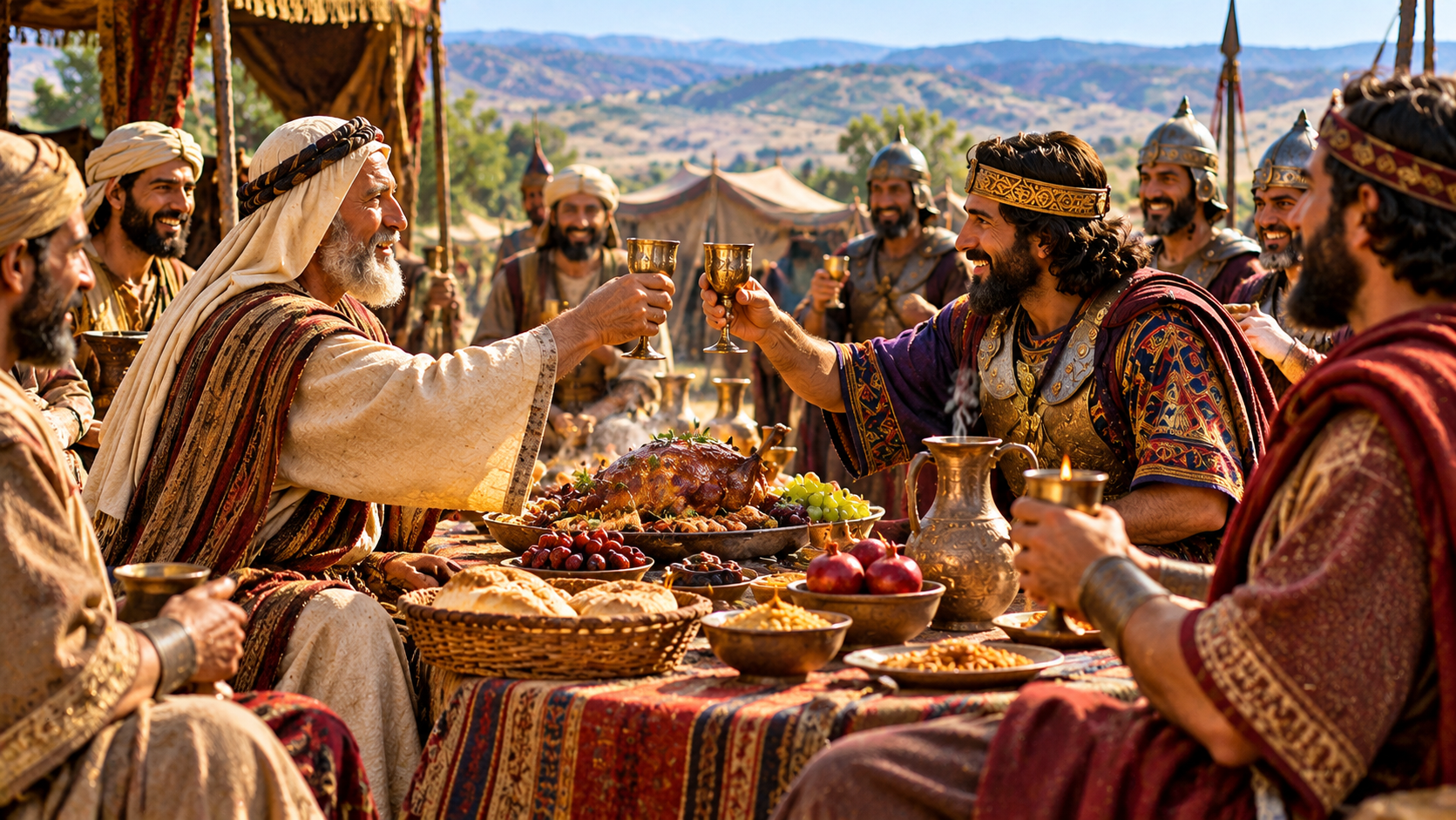
CELEBRATING COVENANT WITH
HOSPITALITY INSTEAD OF HOSTILITY!
Then he made them a feast, and they ate and drank - These were the very men who had driven Isaac from Gerar, yet instead of confronting them with their past mistreatment, Isaac welcomed them to his table! In the ancient Near East, sharing a meal often accompanied the establishment of peaceful relations and cutting of a covenant (cf. Ge 31:44-46, 54). (Related Resource - Covenant Meal)
Victor Hamilton on the feast - This meal is not simply a courtesy extended by Isaac to Abimelech as host to visitor. It is, rather, an integral element of the covenant-making process, in which, in a sense, the individual offering the meal admits the other individual to his family circle. The counterpart to Isaac’s meal given to and shared with Abimelech (i.e., a visible sign of covenant making) is Abraham’s gift of animals to Abimelech (Ge 21:28). (See The Book of Genesis, Chapters 18-50 - Page 94)
🙏 THOUGHT – Beloved, how do we respond when someone who has mistreated us suddenly seeks reconciliation? Do we rehearse their offenses, demand an apology, or seize the opportunity to retaliate? Isaac's example reminds us that forgiveness does not require pretending the wrong never occurred (Ge 26:27), but it does call us to relinquish personal vengeance (Ro 12:17-19). As Paul exhorts, “If possible, so far as it depends on you, be at peace with all men” (Ro 12:18). Grace is often most clearly displayed when we extend kindness to those who have shown us none! And we are never more like our heavenly Father then when we (enabled by His Spirit) sincerely extend forgiveness to those who do not deserve it!
MEAL in Dictionary of Biblical Imagery- People in the ancient Near East customarily ate two meals each day, a light midday lunch and the main meal in the evening after work. Breakfast was a light snack, not usually considered a meal proper. A meal was never simply a time to ingest food and quench thirst; at meals people displayed kinship and friendship. Meals themselves-the foods served, the manner in which that was done and by whom-carried socially significant, coded communication. The more formal the meal, the more loaded with messages. The messages had to do with honor, social rank in the family and community, belonging and purity, or holiness. Social status and role were acted out in differentiated tasks and expectations around meals, and the maintenance of balance and harmony at meals was crucial to the sense of overall well-being. Among God’s chosen people, meals became ways of experiencing and enjoying God’s presence and provision.
Recognizing References and Allusions to Meals. Biblical references to meals are sometimes indirect. Passages in which invitations are given to enter or lodge in a house almost always imply an invitation to a meal as well (e.g., Lk 19:1–10). Mention of any of the following also usually indicates a meal: food, breaking of bread, drink, cup, eating “before the Lord,” sitting, reclining, table, anointing with oil and foot washing or hand washing. In addition, several types of special meals occur: ceremonial meals, ritual meals, festive banquets like wedding banquets, farewell meals and, in the NT, Greek symposium-style meals. Meals differed according to occasion (everyday or festive), time, place (temple or home, wilderness or kosher space), persons present (family or associates, guests present or not).
Social and Religious Boundaries and Meals. The meal became a place where Jews “drew the line” between insiders and outsiders in their families, communities and ethnic group. Gentiles and strangers either were excluded or had to undergo special ritual cleansing in order to participate in even ordinary meals. There were strict limitations on food, its preparation and its consumption, distinguishing between the ritually clean and the unclean. Concern for holiness, which gave rise to the kosher (kashrut) laws of later Judaism, reflect the Jewish conviction that God is present at meals. To eat defiled food or to eat with an “unclean” person would be inappropriate and dishonoring to God.
Sacredness and Meals. Special covenant meals held to seal and dramatize the ratification of a covenant were sacred, and God’s presence was assumed. Feasts were important to Israel’s worship and to the cultural rhythm of the year. These included ritual meals held to signify and remember events of God’s protection and intervention in the past (as in the Passover meal, Deut 16:1–8), and to accompany offerings and gifts celebrating God’s present provision for the people. These meals are said to be held “before the LORD” or “in the presence of the LORD,” and the people are encouraged to “rejoice before the LORD” (Deut 12:12, 17–18; 14:26; 16:11, 15; Lev 23:40).
God’s presence was expected, awaited and enjoyed at everyday meals in devout Jewish households; all meals were sacred because God had provided them. There were no strictly secular meals: “In Judaism table fellowship means fellowship before God” (Jeremias, 115).
When Jesus gives thanks before breaking bread (e.g., Lk 9:10–17), he performs (and transforms) the blessing that was an integral part of every proper meal. The meal was a joyful time, and joyfulness and cheer could be symbolized in a meal (Prov 15:15). God’s provision and care become tangible in the meal. Just as Yahweh demonstrated his love and care by feeding the people in the wilderness, so Jesus feeds the multitudes (Lk 9:10–17 par.) at miraculous meals. Abundant provision becomes a picture of God’s kingdom, of salvation, and of God’s love (Is 25:6).
Royal Meals: Power and Honor. Special meals were held to celebrate a king’s coronation (1 Chron 29:22) and to celebrate victories after battle (see Is 55:1–5 and 61:6 for figurative uses). The down-side of a victory meal is the defeat that it demonstrates for the conquered (see the grotesque, symbolic victory feast in Ezek 39:17, 20). Verbs evoking meals or eating (“consume,” “eat up,” “devour”) can be used to describe slander, defeat and judgment, as in the Apocalypse: “Come, gather together for the great supper of God, so that you may eat the flesh of kings, generals, and mighty men, of horses and their riders, and the flesh of all people, free and slave, small and great” (Rev 19:17–18 NIV; cf. Ps 27:2; Is 51:3, 17–23; 56:9–12; Jer 12:9; Lk 22:30).
Meals and Eschatological Intimacy with God. In Revelation the picture of a meal for people of all nations, celebrating God’s final victory and judgment, recalls Isaiah’s vision: “On this mountain the LORD Almighty will prepare a feast of rich food for all peoples, a banquet of aged wine-the best of meats and the finest of wines. On this mountain he will destroy the shroud that enfolds all peoples, the sheet that covers all nations; he will swallow up death forever” (Is 25:6–7 NIV). The eschatological meal announces the wideness of God’s mercy and universal scope of God’s salvation (Mt 8:11; Lk 13:29; Is 61:3) and ultimate blessing (Mt 26:9; Mk 14:25; Lk 22:18; Rev 3:20; 19:9; 22:17). Rich feasting and universal fellowship is the very opposite of the pale and silent shroud of death.
Church Meals: Remembering and Previewing. Meals were central to the life of the early church. Luke summarizes the earliest days of the church: “They broke bread in their homes and ate together with glad and sincere hearts, praising God and enjoying the favor of all the people” (Acts 2:46, 47 NIV). Ordinary hospitality became a crucial way of supporting and sustaining missionaries and introducing newcomers to Jesus and the Way. Such meals challenged believers to cross and forsake traditional boundaries between gender, rank, religion and ethnicity. Meals became a way of demonstrating and celebrating their new kinship in Jesus’ family. The Lord’s Supper and agape (love) meals were central expressions of their life together, and anything that marred the fellowship of the meal was to be avoided (Cor 10–11; Jude 12; 1). These meals were foretastes of the sweet fellowship with Jesus and one another to which the church looked forward when the kingdom would come in its fullness.
See also BANQUET; DRINKING; EATING; FEAST, FEASTING; FOOD; HUNGER; SUPPER; THIRST.
BIBLIOGRAPHY. M. Douglas, “Deciphering a Meal” in Implicit Meanings (London: Routledge & Kegan Paul, 1966); J. Jeremias, New Testament Theology (New York: Scribners, 1971); J. H. Neyrey, “Ceremonies in Luke-Acts: The Case of Meals and Table-Fellowship” in The Social World of Luke-Acts: Models for Interpretation, ed. J. H. Neyrey (Peabody, MA: Hendrickson, 1991) 361–87.
Genesis 26:31 In the morning they arose early and exchanged oaths; then Isaac sent them away and they departed from him in peace.
KJV And they rose up betimes in the morning, and sware one to another: and Isaac sent them away, and they departed from him in peace.
NET Early in the morning the men made a treaty with each other. Isaac sent them off; they separated on good terms.
NLT Early the next morning, they each took a solemn oath not to interfere with each other. Then Isaac sent them home again, and they left him in peace.
ESV In the morning they rose early and exchanged oaths. And Isaac sent them on their way, and they departed from him in peace.
NIV Early the next morning the men swore an oath to each other. Then Isaac sent them on their way, and they left him in peace.
- In the morning they arose early: Ge 19:2 21:14 22:3 31:55
- exchanged oaths: Ge 14:22 Ge 21:23,31,32 25:33 31:44 1Sa 14:24 20:3,16,17 30:15 Heb 6:16
Related Passages:
Genesis 21:23 now therefore, swear to me here by God that you will not deal falsely with me or with my offspring or with my posterity, but according to the kindness that I have shown to you, you shall show to me and to the land in which you have sojourned.”
Genesis 21:27 Abraham took sheep and oxen and gave them to Abimelech, and the two of them made a covenant.
Genesis 21:31 Therefore he called that place Beersheba, because there the two of them took an oath.
Genesis 21:32 So they made a covenant at Beersheba; and Abimelech and Phicol, the commander of his army, arose and returned to the land of the Philistines.
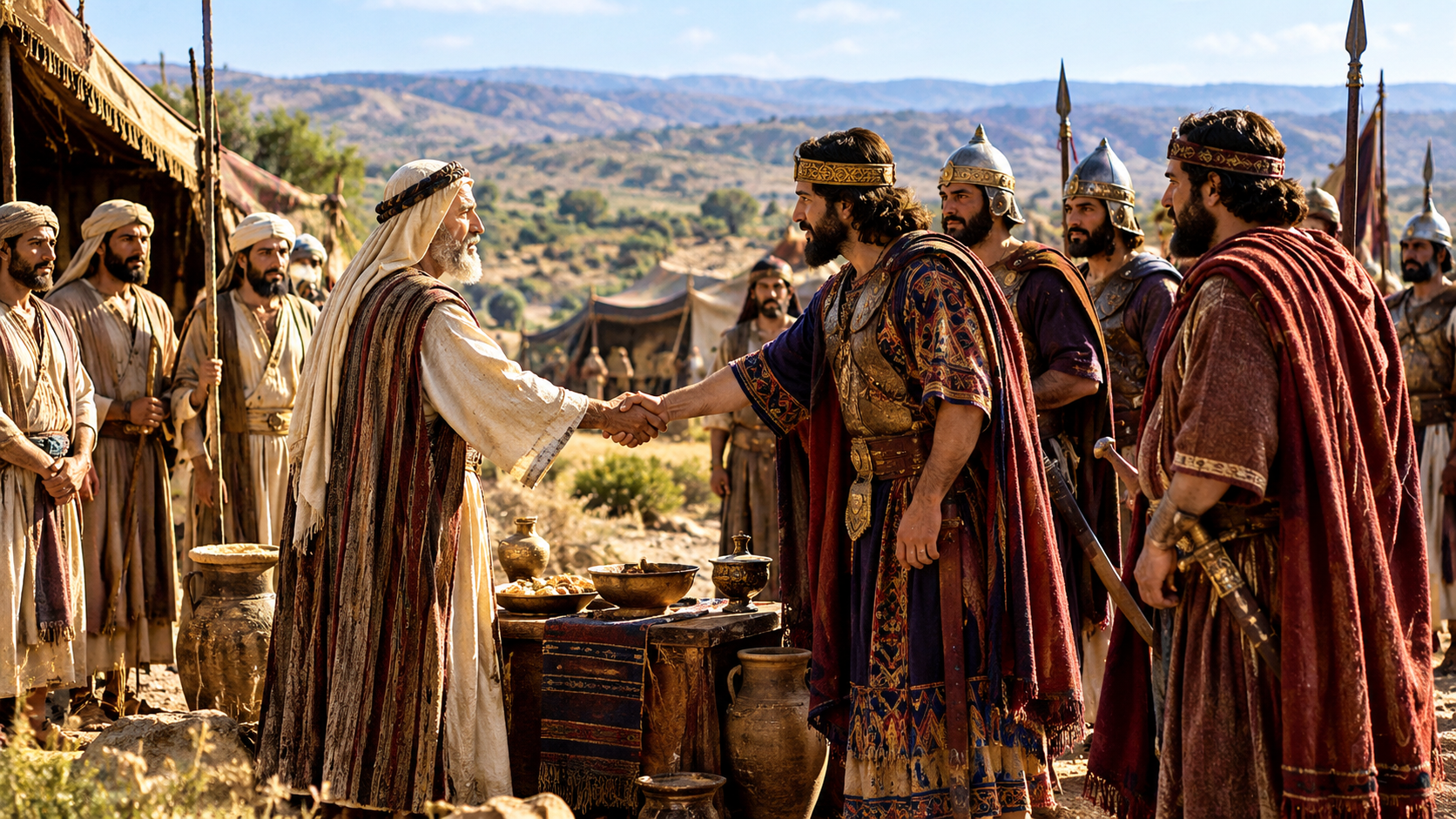
Striking hands is a general expression of an agreement made (Ezra 10:19; Eze 17:18, etc.)
THE COVENANT SEALED
BY OATHS
In the morning they arose early - Arose early” is shakam (H7925), to rise early or start early. In Genesis it often marks prompt, purposeful action, especially in matters involving God’s will (Ge 19:27; 21:14; 28:18). His father showed the same promptness: “So Abraham rose early in the morning and saddled his donkey, and took two of his young men with him and Isaac his son” (Ge 22:3). The point is that neither side delayed. They settled the covenant first thing in the morning, after the feast of the night before (Ge 26:30).
and exchanged oaths (shaba; LXX - omnuo - from a basic meaning grasp a sacred object thus, swear, affirm, confirm by oath) - The Hebrew reads literally “and they got up early and they swore an oath, a man to his brother." The phrase shows how far the relationship between Isaac and Abimelech had changed. Now they formally ratified their covenant by exchanging solemn oaths. (SEE NOTE above for distinction between an OATH and a COVENANT.) Their oaths were binding promises intended to prevent future hostility. Interestingly, Isaac's father Abraham had entered into a similar covenant with Abimelech at Beersheba (Ge 21:22–32). Now the next generation follows a similar pattern. Men who had envied Isaac (Ge 26:14), stopped up his wells (Ge 26:15), and quarreled with his herdsmen (Ge 26:20-21) now bound themselves to him as if he were family! The word shaba is also the root of Beersheba, “well of the oath.”
Then Isaac sent them away - Sent...away (shalach) draws a striking reversal because earlier Abimelech had ordered, “Go away from us, for you are too powerful for us” (Ge 26:16). Isaac reminded him of it: “Why have you come to me, since you hate me and have sent me away from you?” (Ge 26:27). Now Isaac, the one once sent away, sends the king away. He does it with peace, not revenge. Isaac had every human reason for bitterness, yet he answered injury with hospitality and an oath of peace. He lived out what Paul would later command: “If possible, so far as it depends on you, be at peace with all men” (Ro 12:18).
and they departed from him in peace (shalom; LXX - soteria - safety, preservation) - Peace (shalom) means more than the absence of conflict as well as wholeness and well-being in a relationship. What a striking contrast with Genesis 26:16, when Abimelech commanded Isaac to leave Gerar! Previously Isaac had departed under pressure but now Abimelech departs voluntarily, with peaceful relations established. The Hebrew word shalom conveys peace and well-being. The chapter that recorded hostility over wells now records a covenant sealed with peace! As Solomon wrote, “When a man’s ways are pleasing to the LORD, He makes even his enemies to be at peace with him” (Pr 16:7).
🙏 THOUGHT – Beloved, Isaac's experience reminds us that reconciliation (See reconciliation) often takes more than pleasant words. Isaac and Abimelech made definite commitments and sealed them with solemn oaths (Ge 26:28-31). In the same way, when we seek to repair damaged relationships, our actions should prove our words sincere: “Little children, let us not love with word or with tongue, but in deed and truth” (1Jn 3:18; cf. Mt 5:37; Eph 4:25). We cannot control how the other person responds. But we can act with integrity, keep our promises even when it costs us (Ps 15:4), and refuse to keep the hostility going (Ro 12:18). Peaceful words are valuable, but faithful actions make our words believable!
Isaac did not win peace by fighting for his wells. He won it by yielding, moving on, and trusting God. Then God brought his enemies to him asking for peace. “Blessed are the peacemakers, for they shall be called sons of God” (Mt 5:9). Is there someone you need to “send away in peace” today?
Genesis 26:32 Now it came about on the same day, that Isaac’s servants came in and told him about the well which they had dug, and said to him, “We have found water.”
- We have found water.: Ge 26:25 Pr 2:4,5 10:4 13:4 Mt 7:7
Related Passages:
Genesis 26:25 So he built an altar there and called upon the name of the LORD, and pitched his tent there; and there Isaac’s servants dug a well.
Isaiah 41:17-18 “The afflicted and needy are seeking water, but there is none, And their tongue is parched with thirst; I, the LORD, will answer them Myself, As the God of Israel I will not forsake them. 18 “I will open rivers on the bare heights And springs in the midst of the valleys; I will make the wilderness a pool of water And the dry land fountains of water.
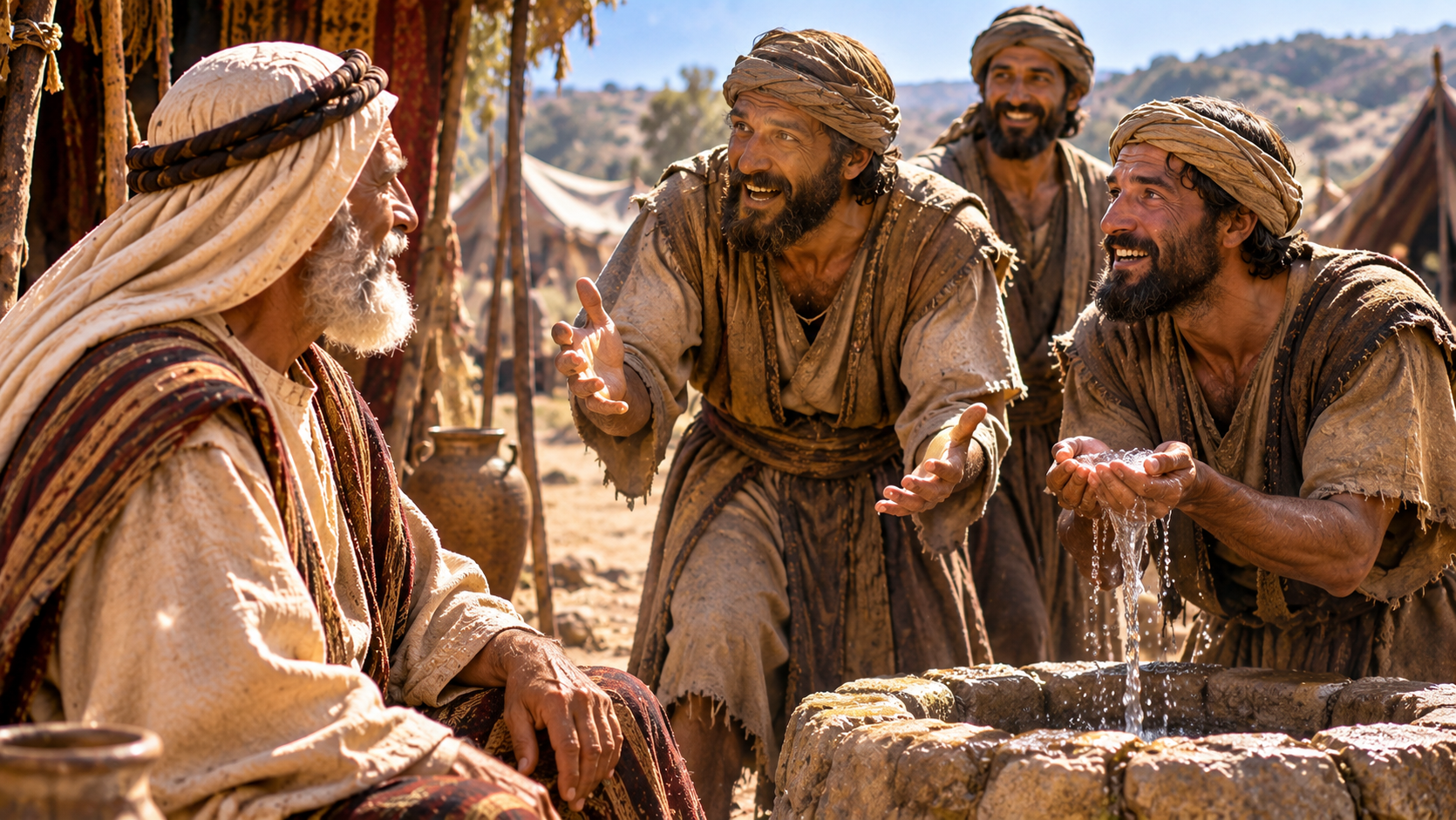
GOOD NEWS
FROM THE WELL
Now it came about on the same day - Note the timing. It is deliberate. On the very day Isaac made peace with his enemies and sent them away in peace (Ge 26:31), God gave him water. Moses records the two events together to show God’s hand in both. The covenant with Abimelech secured Isaac’s right to the well, and the discovery of water gave him the means to live on the land.
that Isaac’s servants came in and told him about the well which they had dug, and said to him, “We have found water - Remember that in this arid land water was more important than gold for water was life! Earlier, Isaac's servants had encountered bitter opposition over the wells at Esek and Sitnah (Ge 26:20–21). Now, at Beersheba, they had begun digging in Ge 26:25 and now announce the discovery of water without any recorded dispute. The servants had faithfully performed the labor of digging (Ge 26:25), and their efforts had succeeded. The text does not explicitly identify this discovery as a miracle, but its timing beautifully complements the account of God's blessing upon Isaac. God's promise of blessing did not eliminate the need to dig, and the servants' faithful labor was rewarded with water! Moses' narrative unveils a progression - The altar came first, then the tent, then the well. Worship came before shelter and before water.
TECHNICAL NOTE - If you read the Septuagint translation, you will be surprised that it says "we have NOT found water." This is not what the Hebrew Masoretic Text says! So how can we explain such a major difference? The Septuagint translators apparently read the Hebrew lo (“to him,” in “said to him”) as lo’ (which means “not”), because the two words sound alike. The Masoretic Text, followed by virtually all English versions, reads “said to him, ‘We have found water’” and this fits the context, because Isaac names the well in celebration in the next verse (Ge 26:33).
🙏 THOUGHT - Isaac sought peace and put worship first, and God supplied what he needed, on the same day. God still meets His people this way: “But seek first His kingdom and His righteousness, and all these things will be added to you” (Mt 6:33). Wells in the desert don’t come from human effort alone. Beloved, has God given you “water” today? Then, like Isaac, give the place a name and remember His faithfulness (Ge 26:33)!
Iain Paisley - The Climax of the War of the Wells
“And it came to pass the same day, that Isaac’s servants came, and told him concerning the well which they had digged, and said unto him, We have found water. And he called it Shebah: therefore the name of the city is Beersheba unto this day.” Genesis 26:32–33
The fourth and last well “Sheba” is climatic in every sense.
In the night of the day when the victory of Beer-Sheba was obtained there is a series of climatic events.
I. The Vision
“And the Lord appeared unto him the same night, and said, I am the God of Abraham thy father: fear not, for I am with thee, and will bless thee, and multiply thy seed for my servant Abraham’s sake.” Genesis 26:24
Here we have a Christophany of Christ, an appearance before His Incarnation.
Although Isaac suffered from failing physical eyesight, there was nothing wrong with his spiritual eyesight. He saw the Lord. What a reward for faithful digging and recovering the wells of Abraham which had been taken over by the enemy.
II. The Blessing
“And the Lord appeared unto him the same night, and said, I am the God of Abraham thy father: fear not, for I am with thee, and will bless thee, and multiply thy seed for my servant Abraham’s sake.” Genesis 26:24
The God of Abraham blessed him there. His blessing always maketh rich. Note its threefold character:
1. The blessing of God’s presence “Fear not I will be with thee”.
2. The blessing of God’s provision “and will bless thee”.
3. The blessing of God’s promise “and multiply thy seed for my servant Abraham’s sake”.
The promise so long in fulfilment to both Abraham and Isaac, was to be mightily fulfilled in Jacob’s and Esau’s seeds.
III. The Altar
“And he builded an altar there and called upon the name of the Lord” Genesis 26:25
The building of altars characterised Abraham’s pilgrimage. Not so with Isaac. This is the one reference to Isaac’s altar building.
On the other hand his son Jacob’s pilgrimage was characterised by the erection of pillars rather than altars.
To Isaac the altar was appropriate to mark the place of the appearing of God. The Incarnation was in order to the Imputation, and Imputation in order to the Reconciliation. The birth and the bleeding of Christ are inseparable.
At the place of the altar we meet God and by the altar we remember and mark that meeting by prayer.
IV. The Tent
“And pitched his tent there” Genesis 26:25
The tent is the dwelling place of the pilgrim. It is a very movable habitation, a type of our physical frame. “Nightly, we pitch our tent a days march nearer home”.
By the altar in the place where God appears and we see the vision, and receive the blessing, is the place, the blessed place to pitch our tents.
Near the cross I’ll watch and want, Hoping, trusting ever.
V. The Well
“And there Isaac’s servants digged a well” Genesis 26:25
Note carefully the three “theres” of the text. “He builded an altar there“, “And pitched his tent there“, “and there Isaac’s servants digged a well”.
This extra special emphasis should be noted. The altar first, the tent second, the well third. The altar speaks of sacrifice and supplication, the tent of sanctuary and security, the well of service and supply. All stand on redemption ground where God meets with His people.
The blessings of altar and tent should spur us to dig the well.
Five in Scripture is the number of grace and the centre of this five which marks the all important key is THE ALTAR.
The cross is the centre of all God’s dealings with sinful man. Only there can we meet God and commune with Him.
Genesis 26:33 So he called it Shibah; therefore the name of the city is Beersheba to this day.
KJV And he called it Shebah: therefore the name of the city is Beersheba unto this day.
NET So he named it Shibah; that is why the name of the city has been Beer Sheba to this day.
NLT So Isaac named the well Shibah (which means "oath"). And to this day the town that grew up there is called Beersheba (which means "well of the oath").
ESV He called it Shibah; therefore the name of the city is Beersheba to this day.
NIV He called it Shibah, and to this day the name of the town has been Beersheba.
- so: Ge 21:31
- Beersheba: i.e. the well of the oath, Ge 26:28
Related Passages:
Genesis 21:31 Therefore he called that place Beersheba, because there the two of them took an oath.
Genesis 26:28 They said, “We see plainly that the LORD has been with you; so we said, ‘Let there now be an oath between us, even between you and us, and let us make a covenant with you,
THE WELL OF THE OATH
A NAME WORTH REMEMBERING
So - Term of conclusion, in light of the good news of discovery of a well.
He called it Shibah - Shibah probably means "oath" in this context, because after the well was dug, the servants of Abimelech and the servants of Isaac swore oaths to each other to live in peaceful relations. Isaac’s covenant and new well renewed and confirmed the name Abraham had given. Like father, like son. What God had done for Abraham at this place, He did again for Isaac. Abraham had named a place to remember God’s faithfulness, so Isaac named it to remember too. Every generation must dig again (so to speak) the wells of its fathers and know for itself the God of its fathers. A family’s faith cannot be inherited secondhand. Isaac had to meet God at Beersheba himself (Ge 26:24). Beloved, are you drawing from the wells of your spiritual heritage, or only living off the memory of them? This recalls the great words of Yahweh in Jer 6:16 "“Stand by the ways and see and ask for the ancient paths, Where the good way is, and walk in it; And you will find rest for your souls. But they said, ‘We will not walk in it.’'
Therefore the name of the city is Beersheba to this day - NLT = "And to this day the town that grew up there is called Beersheba (which means "well of the oath")." Beersheba means “well of the oath” or “well of seven.” The expression “to this day” indicates that the name remained in use when Moses recorded the account. The phrase to this day shows that these events had become fixed landmarks in Israel’s memory (cf. Ge 19:37-38; 32:32; 35:20). Long after his day people still labeled this site as Isaac had named it. Beersheba became a center of patriarchal worship. Jacob later returned there on his way to Egypt: “So Israel set out with all that he had, and came to Beersheba, and offered sacrifices to the God of his father Isaac” (Ge 46:1). It also became the southern landmark of the whole land, in the phrase “from Dan to Beersheba” (Jdg 20:1).
What began as a place associated with Abraham's covenant now becomes associated with Isaac's covenant as well. Two generations, two solemn agreements, and one enduring testimony to God's faithfulness!
Life Application Study Bible - With his enemies wanting to make a peace treaty, Isaac was quick to respond, turning the occasion into a celebration. We should be just as receptive to those who want to make peace with us. When God's influence in our lives attracts people—even enemies—we must take the opportunity to reach out to them with God's love. (See Life Application Study Bible - Page 4904)
🙏 THOUGHT – Beloved, there is a beautiful spiritual application in the naming of Isaac's well and its association with Beersheba. The name preserved the memory of God's faithful dealings with both Abraham and Isaac. Just as Isaac's well recalled Yahweh's faithfulness, we too should remember and recount what God has done in our lives, especially when He allows us to discover a “well of water,” whatever form that unexpected provision or blessing might take! The psalmist exhorts us to “Remember His wonders which He has done” (Ps 105:5). In a world where spiritual forgetfulness comes all too easily (and I can personally vouch for that!), deliberately recalling God's past faithfulness strengthens our present confidence in His promises for the future (Ps 77:11–12). Perhaps we need to name a few “wells” in our own lives, precious reminders of times when God unmistakably demonstrated His goodness and faithfulness. Yesterday's testimonies of God's faithfulness should become tomorrow's encouragements to trust Him!
Shibah (07656) - Designating the well Isaac names in Ge 26:33, "Shibah" can mean either "oath" or "seven" and may be related to the verb shaba, "to swear," "to bind oneself," although some prefer to relate it to a theoretical root shv', meaning "to be full" (KB, 4:1401). The Septuagint translates the noun with horkos, "oath," but the Latin Vulgate uses the accusative of abundantia, "fullness," "abundance." Syriac and Tigre both translate with a word meaning "abundance." "Shibah" probably means "oath" in this context, because after the well was dug, the servants of Abimelech and the servants of Isaac swore oaths to each other to live in peaceful relations. There may be a wordplay with the root shv' so that the name of the well brought to mind both "oath" and "fullness." The Lord had led Isaac and his servants to this location and blessed them. An altar was also built in the same location (vv. 23-33). The location was given the fuller name Beer-Sheba, meaning "well of the oath (fullness)." (Complete Biblical Library)
Norman Geisler - When Critics Ask
GENESIS 26:33—Was Beersheba named by Abraham or later by Isaac?
PROBLEM: In Genesis 21:31 Abraham named this city Beersheba (“Well of the Oath”). But later (in Gen. 26:33), Isaac gave it the same name. But it is highly unlikely that two different people at two different times would call the same place by the same name.
SOLUTION: This is not unlikely at all for two reasons. First, the second person was the son of the first person and may have been familiar with his father’s experience there. Second, Isaac’s similar experience may have occasioned the memory of the name his father gave to this same place. So it is not at all uncommon that Isaac would have later renewed the name his father had earlier given to this important place in their lives.
LESSONS FROM LIFE OF ISAAC IN GENESIS 26 -- W H Griffith Thomas - Genesis 26:1-33 Isaac
Isaac's life, as recorded in this chapter, is full of simple yet searching lessons for people who, like him, are called upon to live ordinary, every-day lives.
1. The Secret of true living is here revealed.—
God must at all costs be first. Divine revelation30 is the foundation of all true life, and Divine guidance is its only safety. Not a step must be taken without His direction, not a work undertaken without His grace and blessing. 'In the beginning God' must actuate and dominate every life that seeks to live to His glory. It is a profound mistake to think that we need only concern ourselves with God's will in the great events, the crises of life. The story of Isaac shows with unmistakable clearness that there is nothing too trivial for God's guidance, and nothing too small for the need of His grace and power.
2. The need of strength of character is here emphasised.—
There is always a very serious peril in being the son of a great father. Life is apt to be made too easy, and the son often occupies his father's position without having had his father's experience. Isaac entered upon his inheritance without having passed through the various ways of discipline that Abraham experienced, and the result was that things were so easy for him that he did not realise the need of individuality of character and definite personal assertion of himself in the Divine life. In opening the wells that had been filled up he was copying Abraham's example without obtaining Abraham's success, and he was doubtless thereby taught that it was necessary for him to have a personal hold on God and duty for himself instead of merely imitating what his father had done. It is always dangerous when life is made too simple and easy for young people; 'it is good for a man to bear the yoke in his youth,' and31 it was the absence of this yoke that doubtless ministered in great measure to that weakness of character which seems to have marked Isaac almost throughout his whole life.
3. The importance of separation from the world is here seen.—
As long as Isaac was in or near Gerar he did not experience much happiness. He was envied, thwarted, and opposed by the jealous Philistines. He was wanting not only in happiness but also in power, for it was not until he returned to Beersheba that Abimelech came to him bearing testimony to his conviction that God was with Isaac and blessing him. Thus for happiness, comfort and power with others, separation from the world is an absolute necessity. There is no greater mistake possible than to imagine that we can be one with the world and yet influence them for Christ. Lot found out this mistake to his cost, and so it has ever been. Separation from the world, paradoxical though it may seem, is the only true way of influencing the world for Christ. We must be in the world but not of the world if we would glorify God, bring blessing to our own souls, and be the means of blessing to others.
4. The spirit of meekness is here illustrated.—
It is noteworthy that all through his life Isaac's temperament was of a passive rather than of an active nature. During his childhood he was subject to the insults of Ishmael, in his manhood he was taken to Moriah and bound there for sacrifice, and a wife was chosen for him by his father. He accepted the rebuke of Abimelech with meekness, he and32 his servants yielded to the Philistines about the well, and in his later life we can see the same spirit of passive yielding in his relations with Rebekah and his two sons. And yet in spite of all this meekness the Philistines testified to him as a man of power and might, and begged that he would not do them any harm. What a testimony this is to the spirit of true gentleness and meekness. The world thinks very little of meekness, but it is one of the prime graces of Christianity. 'Let your sweet reasonableness be known unto all men' is the apostolic word echoing the Master's beatitude, 'Blessed are the meek for they shall inherit the earth.' Not only so, but this meekness is an echo of God's own life, for does not the Psalmist say 'Thy gentleness hath made me great'? As the French aphorism truly says, La douceur est une force. Meekness means the self-sacrifice of our own desires and interests, and in this spirit of gentleness is the secret of truest character and finest victory over self and others. Egoism is always a cause of weakness, for a constant consideration of ourselves is so absorbing that it tends to rob us of the very finest powers of our character. On the other hand, as we cease to regard self and concentrate attention upon others we find our own character becoming stronger as it becomes more unselfish, and with that is quickly added influence over others, and a beautiful recommendation of the grace of our Lord Jesus Christ.
Genesis 26:34 When Esau was forty years old he married Judith the daughter of Beeri the Hittite, and Basemath the daughter of Elon the Hittite;
KJV And Esau was forty years old when he took to wife Judith the daughter of Beeri the Hittite, and Bashemath the daughter of Elon the Hittite:
NET When Esau was forty years old, he married Judith the daughter of Beeri the Hittite, as well as Basemath the daughter of Elon the Hittite.
NLT At the age of forty, Esau married two Hittite wives: Judith, the daughter of Beeri, and Basemath, the daughter of Elon.
ESV When Esau was forty years old, he took Judith the daughter of Beeri the Hittite to be his wife, and Basemath the daughter of Elon the Hittite,
NIV When Esau was forty years old, he married Judith daughter of Beeri the Hittite, and also Basemath daughter of Elon the Hittite.
- And Esau (KJV): Ge 36:2,5,13
- the daughter (KJV): Ge 24:3 Ex 34:16 1Co 7:2 Heb 12:16
- Bashemath (KJV): Ge 36:2
Related Passages:
Genesis 24:3-4 and I will make you swear by the LORD, the God of heaven and the God of earth, that you shall not take a wife for my son from the daughters of the Canaanites, among whom I live, 4 but you will go to my country and to my relatives, and take a wife for my son Isaac.”
Genesis 25:20 Isaac was forty years old when he took Rebekah, the daughter of Bethuel the Aramean of Paddan-aram, the sister of Laban the Aramean, to be his wife.
Deuteronomy 7:3-4 “Furthermore, you shall not intermarry with them; you shall not give your daughters to their sons, nor shall you take their daughters for your sons. 4 “For they will turn your sons away from following Me to serve other gods; then the anger of the LORD will be kindled against you and He will quickly destroy you.
Genesis 28:9 and Esau went to Ishmael, and married, besides the wives that he had, Mahalath the daughter of Ishmael, Abraham’s son, the sister of Nebaioth.
Hebrews 12:15-16 See to it that no one comes short of the grace of God; that no root of bitterness springing up causes trouble, and by it many be defiled; 16 that there be no immoral or godless person like Esau, who sold his own birthright for a single meal.
ESAU'S MARRIAGES:
TWO TROUBLING CHOICES
When Esau was forty years old - Esau married at the same age as his father Isaac (Ge 25:20), but the similarity ends there! Abraham had carefully arranged for Isaac to marry a woman from his own relatives rather than from the Canaanites (Ge 24:3–4). Esau followed his father's timing for marriage but not his family's spiritual priorities!
He married Judith the daughter of Beeri the Hittite, and Basemath the daughter of Elon the Hittite - Double trouble. Two wives, two pagans, one example of polygamy (taking 2 wives at once), following the pattern of polygamy that began with Lamech (Ge 4:19). Both were Hittites, descendants of Heth, son of Canaan (Ge 10:15). That made them Canaanites, the very people Abraham had forbidden as wives for the covenant line. Whereas Isaac had followed Abraham's warning (Ge 24:3), Esau followed his flesh with no evidence he even sought his Isaac's guidance. Esau's choices foreshadow further reveal his disregard for the family's spiritual heritage (Ge 25:34). Esau had treated his birthright with contempt (Ge 25:34), and now he treated the covenant line the same way. Later he took a third wife (Ge 28:9).
Victor Hamilton - Esau’s errors are threefold. He has contracted the marriage himself, thus bypassing his parents; he married exogamously rather than endogamously; he has gone against the honor of his clan group by intermarrying with the native women. (See The Book of Genesis, Chapters 18-50 - Page 94)
TECHNICAL NOTE - Esau’s wives are named differently in Genesis 36:2-3: “Adah the daughter of Elon the Hittite, and Oholibamah the daughter of Anah… also Basemath, Ishmael’s daughter.” Genesis 28:9 also calls Ishmael’s daughter Mahalath. The most common explanation is that these women had more than one name, which was not unusual in the ancient Near East. Some interpreters also suggest that names were changed at marriage. Adah daughter of Elon (36:2) is probably the Basemath daughter of Elon of 26:34.
🙏 THOUGHT – Beloved, Esau's marriages remind us that decisions with lifelong consequences must be guided by spiritual priorities rather than personal preference alone. Scripture warns believers against binding relationships that compromise their devotion to God (2Co 6:14), and Paul teaches that a Christian widow who remarries must marry “only in the Lord” (1Co 7:39). The question is not merely, “Is this person attractive or compatible?” but, “Will this relationship strengthen or weaken my walk with Christ?” A decision that satisfies today's desires may bring tomorrow's sorrow.
Norman Geisler - When Critics Ask
GENESIS 26:34—How many wives did Esau have?
PROBLEM: Genesis 26:34 states that Esau married Judith the daughter of Beeri the Hittite, and Basemath the daughter of Elon the Hittite. However, Genesis 36:2–3 states that Esau’s wives were Adah the daughter of Elon the Hittite, Aholibamah the daughter of Anah, and Basemath, Ishmael’s daughter. Did Esau marry Elon’s daughter Basemath or his daughter Adah? Did Esau have two, three, or four wives?
SOLUTION: The wives of Esau were four—Judith, the daughter of Beeri; Basemath, who was also named Adah, the daughter of Elon; Aholibamah the daughter of Anah; and Basemath the daughter of Ishmael. The reason Judith is not mentioned in Genesis 36:2–3 is because she bore him no children, and Genesis 36 is a statement of “the records of the generations of Esau” (Gen. 36:1, NASB). Also, it was a common practice for men and women to be known by more than one name. Apparently, Basemath, the daughter of Elon, was also named Adah and is so identified in Genesis 36:2 in order to distinguish her from Basemath the daughter of Ishmael. So Esau had four wives.
Genesis 26:35 and they brought grief to Isaac and Rebekah.
KJV Which were a grief of mind unto Isaac and to Rebekah.
NET They caused Isaac and Rebekah great anxiety.
NLT But Esau's wives made life miserable for Isaac and Rebekah.
ESV and they made life bitter for Isaac and Rebekah.
NIV They were a source of grief to Isaac and Rebekah.
- Which (KJV): Ge 6:2 Ge 27:46 Ge 28:1,2,8
Related Passages:
Genesis 27:46 Rebekah said to Isaac, “I am tired of living because of the daughters of Heth; if Jacob takes a wife from the daughters of Heth, like these, from the daughters of the land, what good will my life be to me?”
Proverbs 17:25 A foolish son is a grief to his father And bitterness to her who bore him.
Genesis 28:1-2 So Isaac called Jacob and blessed him and charged him, and said to him, “You shall not take a wife from the daughters of Canaan. 2 “Arise, go to Paddan-aram, to the house of Bethuel your mother’s father; and from there take to yourself a wife from the daughters of Laban your mother’s brother.
ESAU'S CHOICES BRING
HEARTACHE TO PARENTS
and they brought grief (LXX - epizo - quarrel, wrangle, angrily dispute, strive with harsh words) to Isaac and Rebekah - Literally - "And they were a bitterness in spirit." ESV = "they made life bitter" (cf Ge 27:46). Esau's marriages to Hittite women brought continuing distress to both parents. Rebekah would later lament, “I am tired of living because of the daughters of Heth” (Ge 27:46). Grief is morah (used only here) from marar which means to be bitter. Grief describes an emotional response of strong disappointment and sorrow of spirit over Esau's choices. This was not a passing disappointment but a lasting inward bitterness for Isaac and Rebekah. The Hebrew grammar points to the wives themselves as the cause: they were a bitterness. Their Canaanite ways, values, and gods would have clashed constantly with the faith of Abraham’s household.
It is notable that even Isaac, who favored Esau, could not approve of his choice. Nevertheless in the very next chapter Isaac still seeks to give Esau the covenant blessing (Ge 27:1-4). Let's face it, favoritism in a family can blind a father to what his own heart already knows (been there, done that!) It is interesting that when Jacob received the covenant blessing, Isaac instructed him not to take a wife from the Canaanites!
It is also notable that Esau eventually noticed his parents’ displeasure (how could he miss it?), but his answer was still superficial: “So Esau saw that the daughters of Canaan displeased his father Isaac; and Esau went to Ishmael, and married, besides the wives that he had, Mahalath the daughter of Ishmael Abraham’s son” (Ge 28:8, 9).
Henry Morris - Here is further proof of God's wisdom in choosing Jacob. Esau disregarded both God's primeval principle of monogamy and principle to marry one who believed in the true God. Instead he married two pagan Hittite women whose idolatry and ungodliness grieved his parents. Even more tragically, Isaac seems to have made no attempt to prevent this and was still resolved to give Esau his patriarchal blessing.
Life Application Study note - Most parents can be a storehouse of good advice, because they have a lifetime of insight into their children's character. You may not agree with everything your parents say, but at least talk with them and listen carefully. This will help avoid the hard feelings Esau experienced. (See Life Application Study Bible - Page 4904)
🙏 THOUGHT - Beloved, there is an unchanging principle of human behavior: Our choices may be personal, but their consequences are seldom private! Esau's decisions brought bitterness not only into his own life but into the entire household (Ge 26:34–35). Conversely, the godly choices of children bring great joy to their parents. As John declared, “I have no greater joy than this, to hear of my children walking in the truth” (3Jn 4). Beloved, if you are a parent grieving over a child's wayward choices, do not lose heart! The God who met Jacob at Bethel (Ge 28:10–15) is still able to reach a wandering son or daughter. Keep praying, keep loving, and keep entrusting your child to the God whose grace can reach where your words cannot! I have 4 children and the 2 youngest are still wandering far from the Lord in their 40's!