
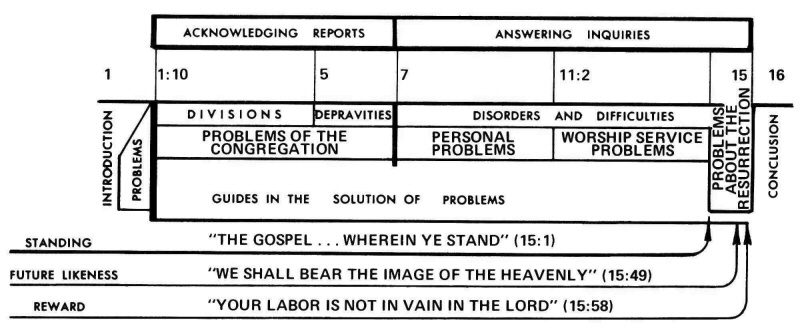
1 CORINTHIANS - PROBLEMS OF A LOCAL CHURCH
Click chart to enlarge
Charts from Jensen's Survey of the NT - used by permission
1 Corinthians 15:58 Therefore, my beloved brethren, be steadfast, immovable, always abounding in the work of the Lord, knowing that your (the) toil is not in vain in the Lord. (NASB: Lockman)
Greek: Hoste, adelphoi mou agaphetoi, hedraioi ginesthe, (2PPMM) ametakinetoi, perisseuontes (PAPMPN) en to ergo tou kuriou pantote, eidotes (RAPMPN) hoti o kopos humon ouk estin ( 3SPAI) kenos en kurio.
Amplified: Therefore, my beloved brethren, be firm (steadfast), immovable, always abounding in the work of the Lord [always being superior, excelling, doing more than enough in the service of the Lord], knowing and being continually aware that your labor in the Lord is not futile [it is never wasted or to no purpose]. (Amplified Bible - Lockman)
Barclay: So then, beloved brothers, show yourselves steady, immovable, always excelling in the work of the Lord, knowing that in the Lord your toil does not go for nothing. (Westminster John Knox Press)
Easy to Read Version - So, my dear brothers and sisters, stand strong. Don't let anything change you. Always give yourselves fully to the work of the Lord. You know that your work in the Lord is never wasted.
Gordon Clark paraphrase: Therefore we should mortify emotion, be steadfast, unchangeable, not erratic and scatterbrained, easily discouraged, and should multiply our good works (Ed: His good works in and through us) in the knowledge that the Lord will make them profitable.
ESV: Therefore, my beloved brothers, be steadfast, immovable, always abounding in the work of the Lord, knowing that in the Lord your labor is not in vain. (ESV)
Expositor's Bible Commentary: Now, my brothers and sisters, in the light of these sublime truths, be steadfast in doing the Lord’s work, knowing that he will reward you at his coming. (Paraphrase from Harold Mare)
KJV: Therefore, my beloved brethren, be ye stedfast, unmoveable, always abounding in the work of the Lord, forasmuch as ye know that your labour is not in vain in the Lord.
NET: So then, dear brothers and sisters, be firm. Do not be moved! Always be outstanding in the work of the Lord, knowing that your labor is not in vain in the Lord. (NET Bible)
NIV: Therefore, my dear brothers, stand firm. Let nothing move you. Always give yourselves fully to the work of the Lord, because you know that your labor in the Lord is not in vain. (NIV - IBS)
NLT: So, my dear brothers and sisters, be strong and immovable. Always work enthusiastically for the Lord, for you know that nothing you do for the Lord is ever useless. (NLT - Tyndale House)
Phillips: And so brothers of mine, stand firm! Let nothing move you as you busy yourselves in the Lord's work. Be sure that nothing you do for him is ever lost or ever wasted. (Phillips: Touchstone)
Wuest: So that, my brethren beloved, keep on becoming steadfast, unmovable, always abounding in the work of the Lord, knowing that your fatiguing labor is not unproductive of results, as this labor is done in the Lord. (Eerdmans Publishing - used by permission)
Young's Literal: o that, my brethren beloved, become ye stedfast, unmovable, abounding in the work of the Lord at all times, knowing that your labour is not vain in the Lord.
THEREFORE, MY BELOVED BRETHREN : Hoste, adelphoi mou agaphetoi:
- 2Co 7:1 2Pe 1:4, 2Pe 1:5, 2Pe 1:6, 7, 2Pe 1:8, 9 2Pe 3:14
MOTIVATION FOR
MINISTRY
Therefore (hoste) is used frequently in 1Corinthians- 1Co1:7; 3:7, 21; 4:5; 5:1, 8; 7:38; 10:12; 11:27, 33; 13:2; 14:22, 39; 15:58. The following uses of hoste serve to introduce practical conclusions emanating from the preceding doctrines - 1Co 3:21, 4:5, 7:38, 11:33, 14:39.
Doctrinal declarations (The Gospel, the Resurrection, Glorification, etc in 1Co 15:1-57) should always lead to dutiful directives (directive = intended to guide, govern or influence). Stated another way, our sure future hope (resurrection/glorification) should serve to animate and energize present ethical behavior (see 1Jn 3:2, 1Jn 3:3).
The great Puritan writer Thomas Watson writes…
Meditation on the heavenly kingdom, would be a spur to diligence. [Glory possesses an immeasurable stimulus.]
Always give yourselves fully to the work of the Lord, because you know that your labor in the Lord is not in vain. 1Cor 15:58.
When the mariner sees the haven, he plies harder with his oars. Just so, when we have a sight and prospect of glory, we should be much in prayer and watching (cp Mt 26:41); it should add wings to duty (cp Is 40:31), and make the lamp of our devotion burn brighter (cp Mt 5:14). (Lords Prayer)
A T Robertson writes that in 1Co 15:58 Paul declares the "Practical result of this great assurance (Ed: A sure Resurrection and Victory over death). They must get rid of the unsettled and unfruitful state of mind caused by habitual skepticism, and must learn to be firmly seated, so as to be able to resist the false teaching and other hostile forces that would carry them away (Col 1:23). Let there be less speculation and more work. (Critical and Exegetical Commentary on the First Epistle of the Corinthians)
Someone has said "If Jesus did not rise from the dead, then nothing in life really matters. But if He did rise from the dead, then nothing else in life really matters!"
Spurgeon introduces his sermon on this verse with the following thoughts…
THE apostle had been putting forth all his strength to prove the doctrine of the resurrection, yet he was not diverted from his habitual custom of making practical use of the doctrine which he established. He proves his point, and then he goes on to his "therefore," which is always an inference of godliness. He is the great master of doctrine: if you want the Christian creed elaborated, and its details laid out in order, you must turn to the epistles of Paul; but at the same time he is always a practical teacher. Paul was not like those who hew down trees and square them by rule and system, but forget to build the house therewith. True, he lifts up a good axe upon the thick trees, but he always makes use of that which he hews down, he lays the beams of his chambers, and forgets not the carved work thereof. He brings to light the great stones of truth, and cuts them out of the live rock of mystery; but he is not content with being a mere quarryman, he labors to be a wise master builder, and with the stones of truth to erect the temple of Christian holiness. If I shift the figure I may say that our apostle does not grope among the lower strata of truth, hunting out the deep things and spending all his force upon them, but he ploughs the rich upper soil, he sows, he reaps, he gathers in a harvest, and feeds many. Thus should the practical ever flow from the doctrinal like wine from the clusters of the grape. The Puritans were wont to call the end of the sermon, in which they enforced the practical lessons, the "improvement" of the subject; and, truly, the apostle Paul was a master in the way of "improvement." Hence in this present chapter, though he has been dealing with the fact of resurrection, and arguing with all his might in defense of it, he cannot close till he has said, "Therefore, my beloved brethren, be ye steadfast, unmoveable, always abounding in the work of the Lord." (Motives for Steadfastness)
MORE ON WHY THE "THEREFORE" IS HERE…
First Corinthians 15:58 is a command issued in light of the marvelous truth associated with the resurrection (see related resource: The Two Resurrections - "First" and "Second"). Doctrine of the resurrection is used by Paul to spur believers onward in their dutiful service in (and to) the Lord. Christ has won the battle over sin and death, which should motivate all believers to live with a sure sense of the hope because of Christ's resurrection from the dead. In Acts Paul clearly links the resurrection with hope, Luke recording that when he perceived…
that one part were Sadducees and the other Pharisees, Paul began crying out in the Council, "Brethren, I am a Pharisee, a son of Pharisees; I am on trial for the hope and resurrection of the dead!" (Acts 23:6)
Comment: Remember that in the NT, "hope" (elpis [word study]) is not like our secular word ("I hope it won't be a rainy day tomorrow.") but reflects an absolute assurance of future good, specifically that God will do "good" to us in the future.
And again in his defense before the governor Felix, Paul linked his hope to the truth of the resurrection of the dead which in turn served as a motivating force in his life and ministry…
(Paul declared that) having a hope in God, which these men cherish themselves, that there shall certainly be a resurrection of both the righteous and the wicked. In view of this (similar to the "therefore" in 1Cor 15:58 - In light of the truth of a future resurrection and a future judgment), I also do my best to maintain always a blameless conscience both before God and before men (He does his best because he is motivated by belief in the resurrection and judgment). (Acts 24:15,16)
Ellicott on therefore "So then" or "Consequently," "as the victory is thus assured"" Exhortation flowing from the thankful assurance of the last (1Cor 15:57) and the immediately preceding verses (St. Paul's First epistle to the Corinthians - Online)
Alan Carr remarks that "The word therefore draws our minds back to all that Paul has said in these verses (Ed: For context read 1Co 15:1-57). He is telling us that the hope (Ed: Not a "hope so" but an absolute assurance of future good) we possess is a motivator to spiritual action for God’s glory (Ed: Cp 1Jn 3:2, 1Jn 3:3). Being saved, sure and secure does not mean that we can just sit back and rest in what we have to wait on the rapture or death. Being saved means we are to get to work for the glory of God! Knowing the truth about God and salvation is a powerful motivator for service. You see, belief always affects behavior! Believing the right things about Jesus and about the future will cause us to get busy for His glory. (Walking in Absolute Hope)
Ryrie agrees noting that "A firm belief in the resurrection and a solid hope for the future gives incentive for service in the present."
John Piper (in a Jan, 2006 sermon in which he announced to his congregation his recent diagnosis of prostate cancer) writes that…
Paul intends—God intends—that there be a practical effect of what he has said. He intends for the effect to be verse 58. And the word “therefore” shows that he intends for verse 58 to happen because we know and remember 1Cor 15:51, 52, 53, 54, 55, 56, 57 (Ed: Take a moment to read these great passages. Consider committing them to memory. See Memorizing His Word). Christ has come. He has died for you. He took all your sins on himself. He satisfied the demands of the law for you. The sting of death is removed. There is no condemnation. No hell. No fear. Though your body be laid in the grave, Christ will come and the trumpet will sound, and this mortal body will put on immortality and this decomposing, decaying body will become imperishable. Death is swallowed up in a great, blood-bought, Christ-wrought victory. To die is gain. Away from the body, at home with the Lord.
THEREFORE …
Verse 58 is God’s will for my life—and yours. And Paul says, it happens THEREFORE, that is, because you know and remember what is in verses 51-57. Therefore our obedience to verse 58 rests largely on our reading and memorizing these verses. If you know it and you believe and you meditate on it (Ed: See related resources: Meditate and Primer on Biblical Meditation) and memorize it and remember it, it will fill your mind and your heart in such a way that verse 58 happens. (1 Corinthians 15:51-58 How God's Word Produces Our Work) (Bolding and color added)
Disciple's Study Bible - Hope concerning the future victory of Christ, with the abolishing of death and the establishing of God's kingdom, encourages faithfulness. Such hope makes possible unmovable steadfastness of character and joyful abandon to the work of the Lord. After all, faithful labor has promise of eternal reward.
Charles Hodge - Such being the truth and importance of the doctrine of the resurrection, Christians should be firm in sticking to it, not letting themselves be moved by the specious objections of philosophy falsely so called. They should remember that if the dead do not rise, then Christ did not rise; and if Christ did not rise, their faith is in vain, and they are still in the power of sin. But as Christ has risen, and as his resurrection illustrates that of his people and makes it certain, what is more natural and proper than that they should give themselves fully to the work of the Lord? (An Exposition of the First Epistle to the Corinthians - Online)
Bob Deffinbaugh makes a good point stating "First, the comfort which Paul communicates on the basis of our Lord’s death and resurrection is intended to comfort only Christians… "therefore, my beloved brethren". And then he says that their toil is not in vain “in the Lord.” One of the saddest things to observe at a funeral is a preacher giving comfort to non-Christians by using Bible texts addressed to Christians. These words are addressed to Christians, and the hope which Paul speaks of is for Christians only. Death has no power, no sting, to those who are “in Christ.” I must ask you, my friend, do you know for certain that you are “ in Christ,” and that you will spend eternity in the presence of God? If not, then receive God’s gift of salvation in the person and work of Jesus Christ, who suffered, died, and rose again in your place. Second, true doctrine (the doctrine of the gospel, of the resurrection of Christ, of the resurrection of the dead) gives us stability ("… steadfast, immovable… "), even in the midst of troubled times and in the face of false teaching. False teaching destabilizes Christians; true doctrine stabilizes us (1Corinthians 15 A Refresher Course on the Resurrection of the Dead)
John Calvin - Having satisfied himself that he had sufficiently proved the doctrine of the resurrection, he now closes his discussion with an exhortation; and this has much more force, than if he had made use of a simple conclusion with an affirmation… he says that their labor is not in vain, for this reason, that there is a reward laid up for them with God. This is that exclusive hope which, in the first instance, encourages believers, and afterwards sustains them, so that they do not stop short in the race (cp Heb 12:1). Hence he exhorts them to remain steadfast, because they rest on a firm foundation, as they know that a better life is prepared for them in heaven. (1 Corinthians 15:51-58)
A W Pink writes that using therefore "the apostle is here drawing a conclusion from all that precedes, particularly from what is said in 1Cor 15:56, 57. Divine grace, through the death and resurrection of Christ, has judicially delivered the believer from both the guilt and dominion of sin, and from the whole curse of the Law… "Therefore" is as logical and necessary as the one in Romans 6:12, and what follows that passage enables us to understand our present one. "Neither yield ye your members as instruments of unrighteousness unto sin; but yield yourselves unto God as those that are alive from the dead, and your members as instruments of righteousness unto God": that is, conduct yourselves practically in harmony with what is true of you (in Christ) legally… Legally, "victory" is ours now, as our justification by God demonstrates. Experientially, we have been freed from the dominion of sin, and are delivered, in measure, from its enticing power, for there is now that in us which hates and opposes it. At death, sin is completely eradicated from the soul; and at resurrection its last trace will have disappeared from the body. From his exposition of the grand truth of resurrection the apostle made practical application, exhorting the saints to walk in newness of life." (The Work of the Lord)
Walvoord adds that "It should be clear that Paul is presenting this truth (in 1Cor 15) as an imminent hope (See notes on Imminent or the discussion on imminency). On the basis of its expectation, he urges the brethren to serve the Lord faithfully. (Post-tribulationism Today)
Ryrie writes that "Paul also made this teaching of the rapture (Ed: Referring to 1Co 15:51 which many interpret as an allusion to the rapture. See related resource - The Rapture) a basis for steadfastness in the Lord’s service (BORROW Ryrie, Charles - Biblical theology of the New Testament) Knowledge of the future should breed consistency throughout one’s life. (BORROW Ryrie: The Final Countdown: God's Blueprint for Future Events)
Considering the difficulties Paul had experienced with the church at Corinth it is amazing that he is still able to refer to them as beloved brethren. Alan Carr sums up some of the difficulties noting that "The church at Corinth was a church fraught with problems. There were divisions in church; sin was being tolerated; false doctrine abounded and strange, fleshly practices dominated their worship. Paul wrote this book to address their problems and to bring the Corinthian believers back into line with orthodox faith and practice. The chapter before us today is an example of what I am talking about. According to 1Cor 15:12, there were some in Corinth that denied the reality of the resurrection. Paul spends the remainder of this great chapter declaring the awesome doctrine of the resurrection and laying a solid foundation for our hope as believers." (1Cor 15:58 Sermon)
D Edmond Hiebert in his commentary on First Peter writes that the NT writes frequently based their exhortation to "Christian duties in the consciousness of the impending end. In the New Testament, that eschatological hope is frequently used to motivate Christian conduct (Mt. 24:45-25:13; Mk 13:33-37; Ro 13:11-14; 1Cor. 15:58; Heb 10:25; Jas 5:8-9; 1Jn 2:28) (Ed: See study on The Sanctifying Effect of the Blessed Hope). The return of our Lord has always furnished the supreme motive for consistent Christian living. (Ed: Therefore it should not surprise us to learn that approximately one of every 20 NT passages deals either directly or indirectly with the Second Coming.)
My beloved brethren (only other use of this specific phrase by Paul is in Php 4:1) - This title makes it clear that Paul is full of tenderness and affection for the Corinthians. This title speaks of saints, set apart ones, those who are the privileged recipients of this closing exhortation (which is not directed to unbelievers). This truth should prompt us to perseverance in the faith because privilege always has responsibilities that must not be ignored. Further, it is fascinating that Paul expresses his sincere love for these saints in spite of their many aberrations in belief and behavior. In fact it is worth emphasizing that Paul expresses his unconditional (agape) love for these less than perfect saints in Corinth by calling them beloved three times in this epistle (1Co 4:14; 10:14; 15:58). In addition, he addresses them affectionately as brethren in multiple passages (25 times or more than 10% of the 207 uses in the NAS NT! Read through these uses and notice that a number are in the context of reproof, etc - 1Co 1:10,11, 26; 2:1; 3:1; 4:6; 6:5, 8; 7:24, 29; 8:12; 10:1; 11:33; 12:1; 14:6, 20, 26, 39; 15:1, 6, 31, 50, 58; 15, 20. Note that 1Co 16:11, 12 uses "brethren" but not referring to the Corinthians). What an example Paul presents for the Corinthian (and all) saints to imitate (1Co 4:16, 1Co 11:1) by exhibiting love to one another in spite of doctrinal differences (assuming of course that we agree on the essential doctrines of salvation). (See the importance of believers loving one another - Jn 13:34, 35! cf Jn 15:12, 17. I wonder why Jesus mentioned this command so often in His last major teaching time with His disciples even as He prepared Himself for the greatest demonstration of love in all eternity [Jn 15:13, Jn 10:11, 15, Ro 5:8, Ep 5:2, 1Jn 4:7, 8, 9, 10, 11, 12]? [Obviously you recognized that question as rhetorical!] Study also loving one another [this vital NT teaching would make an excellent sermon… or even a sermon series!] in the NT epistles [note emphasis by Paul] = Ro 12:10, Ro 13:8, Gal 5:13, Eph 4:2, 1Th 3:12, 1Th 4:9, 2Th 1:3 [Paul ], Heb 10:24, 1Pe 1:22)
Godet feels that in using beloved brethren "Paul seeks to get near those hearts which he may have repelled by his great severity (Commentary on St. Paul's First Epistle to the Corinthians - Online)
Thomas Edwards writes that "Under the influence of the hopes and triumphs now recounted, the Apostle's soul melts into tenderness. A still greater change of tone from excited indignation to sympathetic gentleness in 2Co 7:1. There it is produced by an enumeration of God's promises. (1 Corinthians 15 Commentary - 1886)
Beloved (27) (agapetos from agapao = to love, agape = unconditional love enabled by the Spirit - Gal 5:22) means beloved, dear, very much loved. Agapetos is love called out of one’s heart by preciousness of the object loved. Agapetos is used only of Christians as united with God or with each other in love.
God the Father uses this same word describing Jesus declaring that "This is My beloved Son, in whom I am well-pleased." (Mt 3:17)
In fact the first 9 uses in the NT are of God the Father speaking of Christ, His beloved Son. This gives you some idea of the preciousness of the word "beloved"! This truth makes it even more incredible that Paul described the saints at Corinth (and by application all believers of all ages) as "brethren beloved (agapao) by God, His choice." (1Th 1:4).
Beloved is a term of endearment and is someone that you love, and someone you are deeply devoted to. In the context of the New Testament agape love speaks of God’s divine and infinite love, a love that seeks the ultimate spiritual welfare of the one loved. Agapetos could be translated “divinely loved ones.”
Agapetos - 61 uses in NT - Mt. 3:17; 12:18; 17:5; Mk. 1:11; 9:7; 12:6; Lk. 3:22; 20:13; Acts 15:25; Ro 1:7; 11:28; 12:19; 16:5, 8, 9, 12; 1 Co. 4:14, 17; 10:14; 15:58; 2Co. 7:1; 12:19; Eph 5:1; 6:21; Phil. 2:12; 4:1; Col. 1:7; 4:7, 9, 14; 1Th 2:8; 1Ti 6:2; 2Ti 1:2; Philemon 1:1, 16; Heb 6:9; Jas 1:16, 19; 2:5; 1Pe 2:11; 4:12; 2Pe 1:17; 3:1, 8, 14, 15, 17; 1Jn. 2:7; 3:2, 21; 4:1, 7, 11; 3Jn. 1:1, 2, 5, 11; Jude 1:3, 17, 20
Brethren (80) (adelphos from a = prefix which speaks of unity + delphus = womb) means literally one born from the same womb. Literally it is a male having the same father and mother. Adelphos describes a close association of a group of persons having well-defined membership and in the NT often refers to fellow believers in Christ united by the bond of affection. It can also refer to a fellow countryman or a fellow Jew, but clearly in this context refers to fellow believers.
BE STEADFAST, IMMOVABLE, ALWAYS ABOUNDING IN THE WORK OF THE LORD: hedraioi ginesthe, (2PPMM) ametakinetoi, perisseuontes (PAPMPN) en to ergo tou kuriou pantote:
- Steadfast - Ru 1:18 Ps 55:22 78:8,37 112:6 Col 1:23 2:5 1Th 3:3 Heb 3:14 2Pe 3:17,18
- Abounding - Php 1:9 4:17 Col 2:7 1Th 3:12 4:1 2Th 1:3)
- Work - 1Co 16:10 Jn 6:28,29 Php 2:30 1Th 1:3 Tit 2:14 Heb 13:21)
FUTURE HOPE
SHOULD MOTIVATE
PRESENT FAITHFULNESS
Be (1096)(ginomai) means to come into existence (Jn 1:3), to cause to become, to come to acquire or experience a state (this latter sense being the primary meaning in the present passage). Paul uses the present imperative (and middle voice) which is a command calling for continual attention to steadfastness and "immobility" in our faith. One constant danger in evangelical churches where sound doctrine is preached, is to forget the basic tenet that doctrine determines (and demands) duty. In other words, in the present context, the grand truths Paul has just presented in 1Cor 15:1-57 regarding the resurrection and glorification of the saints calls for congruent conduct. Biblical truth was never meant just for information, but for transformation. Saints, beloved brethren, need to live with a sober sense of responsibility and accountability in the light of this great doctrine.
As R L Dabney says the assurance of the hope (certainty) of the saint's future resurrection "stimulates evangelical labors".
Beloved brother or sister, let me ask you, has the truth about the resurrection spurred you on toward steadfastness, immovability, and superabounding service in and for the Lord? If not, you might consider re-reading 1Cor 15:1-57 slowly and meditatively meditatively, asking the Spirit to teach you and empower you to pursue steadfastness, immovability and supernatural service. Paul is teaching in this section that the resurrection doctrine should stimulate service to the Savior. Always keep in the back of your mind that…
THE BEST IS
YET TO COME!
H A Ironside once remarked "They tell me that occupation with these precious truths that have to do with the coming of the Lord Jesus Christ may have a tendency to make people heady and theoretical, and no longer useful in the church of God here on earth, but I do not know anything that should so grip the soul and put one to work for God as the knowledge of the truth we have just been considering."
Archibald Robertson is probably correct when he says the sense of the verb ginomai in this passage is "not 'continue to be,' but, 'become, prove yourselves to be' (1Co 10:32, 11:1). They have still much to learn; they are not yet stable either in belief or behavior (1Co 15:2, 33). They need to be perfected in the faith in order to become steadfast in the faith. (A Critical and Exegetical Commentary on the First Epistle to the Corinthians - online) (Bolding added)
Vine agrees with Robertson writing that "The verb ginomai, rendered “be ye (1Co 15:58KJV)," means “become ye,” i.e., prove yourselves to be, indicating that up to this time their spiritual state had presented a contrast to what is now enjoined upon them. (Collected writings of W. E. Vine. Nashville: Thomas Nelson)
Morris adds that it might be translated "become" because "Paul sets before his readers a state from which they were as yet all too far, and urges them to continue in it (Ed: be = present tense). (1 Corinthians: An Introduction and Commentary. Tyndale New Testament Commentaries)
In light of the truth that death is no longer victorious over believers and no longer has a sting (1Cor 15:55, 56), we should be motivated to a life of unswerving faith and commitment to the Lord.
Sound doctrine about our future
makes for sound living in the present.
And given the inestimable worth of words of truth, it is not surprising that with some of his last precious words, Paul warned his young disciple, Timothy, about two men…
Hymenaeus and Philetus, men who have gone astray from the truth saying that the resurrection has already taken place, and thus they upset the faith of some. (2Ti 2:18)
Thus Paul is warning Timothy (and all of us) that false doctrine concerning the resurrection can upset (overturn, overthrow) a believer's faith (see Paul's "apologetic" [see the "but now" of v20 in the following passages] against false teaching regarding the resurrection - 1Co 15:12-20).
It is a Biblical maxim that error destabilizes
while truth stabilizes our faith.
The emphasis in our pulpits should be on presentation of sound doctrine that equips saints for "sound" Christ-like living (cp Eph 4:12, 13)! It seems that many pulpits have deviated from this basic Biblical mandate and have allotted more of the preaching time to stories, illustrations, props, etc, than to the proclamation of the "pure milk of the word", seemingly forgetting that it is only the "pure milk" that will bring about growth "in respect to salvation". (1Pe 2:2)
THOUGHT - When was the last time you taught on the faith stabilizing, hope building, service motivating truth of the doctrine of the resurrection? Lord, help our pastors and pulpits return to "stand by the ways and see and ask for the ancient paths, where the good way is, and walk in it (so that the sheep may) find rest for (their) souls" (Jer 6:16). In Jesus' Name. Amen.
Clarke offers a helpful word picture of what it means to be steadfast "be settled; confide in the truth of this doctrine of the resurrection, and every thing that pertains to it, as confidently as a man sits down on a seat, which he knows to be solid, firm, and safe; and on which he has often sat. (Adam Clarke Commentary)
Piper adds that "Steadfast means steady as you move forward. Keep on going and don’t let up. Don’t be given to fits and starts. Put your hand on the plow and don’t take it off till your work is done. Steady movement forward till your work is done. (Sermon)
Ryrie writes that "Knowledge of the future should breed consistency throughout one’s life. The words steadfast, unmovable, and always show clearly that such labors are not to be spasmodic or lacking in continuity. No “off again, on again” kind of Christian living and witness is permitted. (BORROW Ryrie: The Final Countdown: God's Blueprint for Future Events)
Constable - This chapter began with a review of the gospel message from which some in the church were in danger of departing by denying the resurrection. The charge to remain steadfast therefore probably means to remain steadfast in the gospel as the Lord and the apostles had handed it down to them. Paul’s readers should not move away from it but should remain immovable in it. They should also increase their efforts to serve the Lord even as Paul had done (1Co 15:10). Rather than living for the present (1Co 15:32) believers should live in the present with the future clearly in view (cf. 1 Cor 1:9; 9:26). One day we will have to give an account of our stewardship (1Co 3:12-15). (1 Corinthians Expository Commentary)
Fred Hartman (Friends of Israel Ministry) comments that "Resurrection is a doctrinal truth. Without resurrection we have no hope. In dealing with the doctrinal doubts in the Corinthian church, Paul based his assertions on the gospel truths he had earlier taught. He reminded the Corinthians that their eternal security rested on this point of doctrine—and so does ours… Doctrine does make a difference, whether it is the doctrine of resurrection, the Rapture, atonement, or some other cardinal truth. The false doctrines of the cults lead multitudes astray. Strong doctrinal teaching of biblical truth strengthens rather than divides. If the teaching of doctrine in our churches were strengthened, believers would better understand what they believe and why, and they would be better equipped to resist the winds of false doctrine and error. Yes, we need Jesus. And we need the Bible. But we also need to understand clearly what we believe. True doctrine is as important to us as it was to the Corinthian church, and we must heed doctrine today as never before."
Steadfast (1476) (hedraios from hedra = chair, seat, abode, place) is a word that originally was used to speak of one who was sitting (sedentary) and later came to be used figuratively of that which is firm, settled, steady, unshakeable, stable. It refers to something that is firmly fixed in place, secure and generally permanent. Vine says the metaphorical use (as in 1Co 15:58) describes one who is characterized by "moral fixity". Hedraios describes one who is firmly established in their opinions.
Leon Morris says that "Hedraioi (firm) was used in 1Co 7:37 of having ‘settled the matter’; there is the thought of stable purpose, something that will not easily be disturbed, for the person’s whole bent is behind it (cf. Col 1:23). Let nothing move you underlines this thought. The Corinthians were prone to fickleness, shifting without reason from one position to another. Let them get a firm grip on the truth of the resurrection, on God’s final plan for all people and all things, and they will not be so readily shaken. (Vol. 7: 1 Corinthians: An Introduction and Commentary. Tyndale New Testament Commentaries. Downers Grove, IL: InterVarsity Press)
The English dictionary says that steadfast describes that which is constant; firm; resolute; not fickle or wavering (unwavering), determined in purpose, loyalty, etc. Steadfast is from an old English word meaning "standing firm". Here are some synonyms for steadfast - abiding, constant, dedicated, dependable, enduring, established, faithful, firm, fixed, immovable, intent, loyal, persevering, reliable, resolute, single-minded, stable, stalwart, staunch, steady, unfaltering, unflinching, unswerving, unwavering, wholehearted. The antonyms include faltering, unstable, vacillating, wavering.
Vine writes that "The word hedraios, “steadfast,” literally means firmly seated, but implies a fixed purpose of heart, as against allurements to evil; ametakinetos, unmoveable, suggests adherence to the faith, as against forces that would turn them aside from it and so from allegiance to Christ. (Vine, W. Collected writings of W. E. Vine. Nashville: Thomas Nelson)
Isaiah reminds us that…
The steadfast of mind Thou wilt keep in perfect peace (Hebrew = "Shalom, shalom" - cf "the peace of God, which surpasses all comprehension" Php 4:7), because he trusts in Thee (That is why he is "steadfast of mind" - because he trusts in God) .
Stayed upon Jehovah, hearts are fully blest,
finding, as He promised, perfect peace and rest.”
Like a River Glorious by Francis Havergal
David declared…
My heart is steadfast, O God; I will sing, I will sing praises, even with my soul. (Ps 108:1)
The psalmist writes…
He (the righteous Ps 112:6) will not fear evil tidings; His heart is steadfast, trusting in the LORD
Comment: Note again the association of trust/faith/belief and steadfastness. So here in 1Cor 15:58, the righteous (righteous by grace through faith - cf Ge 15:6) man's belief in the blessed truth of the resurrection and an eternal glorified life undergirds steadfastness of one's heart/mind. Note also that while we use our mind to take in truth, that truth imbibed must sift down into our heart (see study of kardia, see also discussion of Pr 4:23), our "spiritual control center", for that is what will determine whether we prove ourselves to be saints who are steadfast or vacillating.
In a parallel passage the writer of Hebrews encourages his vacillating Jewish readers (on whether to hold fast in faith to Messiah or return to their visible rituals)…
This hope (The good news of the gospel of Jesus Christ - which here in 1Cor 15:58 includes the hope of the resurrection and glorification in the twinkling of an eye - 1Co 15:52) we have as an anchor of the soul (and anchor helps the boat remain "steadfast" in rough/stormy seas!), a hope both sure and steadfast and one which enters within the veil, where Jesus has entered as a forerunner for us, having become a high priest forever according to the order of Melchizedek.
Comment: Because our future hope is sure and steadfast, believers can continue steadfast in this present life.
John MacArthur says that hedraios…
It denotes being totally immobile and motionless. Obviously Paul is talking about our being moved away from God’s will, not to our being moved within it. Within His will we are to be always abounding in the work of the Lord. But we should not move a hairbreadth away from His will… If our confident hope in the resurrection wavers, we are sure to abandon ourselves to the ways and standards of the world. If there are no eternal ramifications or consequences of what we do in this life, the motivation for self-less service and holy living is gone. On the other hand, when our hope in the resurrection is clear and certain we will have great motivation to be abounding in the work of the Lord. (MacArthur, J: 1Corinthians. Chicago: Moody Pressh)
Hedraios is used only 3 times in the NT, here in 1Co 15:58 and in…
But he who stands firm (hedraios) in his heart, being under no constraint, but has authority over his own will, and has decided this in his own heart, to keep his own virgin daughter, he will do well. (1Co 7:37).
if (first class conditional - assumes what follows is true) indeed you continue (present tense = continually, as the general direction of your life) in the faith (study "the faith") firmly established and steadfast (hedraios), and not moved away (metakineo) from the hope of the gospel that you have heard, which was proclaimed in all creation under heaven, and of which I, Paul, was made a minister. (Col 1:23).
Comment: This passage uses hedraios as one of the "markers" of genuine salvation.
Kenneth Wuest explains that: The word “if” here is not ean, an unfulfilled, hypothetical condition used with the subjunctive mode, presenting the possibility of a future realization, but ei with the indicative, having here the idea of “assuming that you continue in the faith.” That is, continuance in the gospel as it was preached by Paul would show that the person was saved and thus would be presented holy, without blemish, and unchargeable before God. That is, Paul was here addressing truly born-again Colossians, not unsaved professors of Christianity who would follow the Colossian heresy. Heretics would not so be presented, only true believers. It is not the retention of salvation that is in the apostle’s mind, but the possession of it that would be shown by their continuance in the gospel. Expositors says; “This is directed against the false teacher’s assurance that the gospel they had heard needed to be supplemented if they wished to attain salvation." (Wuest Word Studies - Eerdman Publishing Company Volume 1, Volume 2, Volume 3 - used by permission)
John MacArthur writes that: "Of all the marks of a genuine Christian presented in Scripture, none is more significant than the one Paul mentions here. People give evidence of being truly reconciled when they continue in the faith firmly established and steadfast. The Bible repeatedly testifies that those who are truly reconciled will continue in the faith. In the parable of the soils, Jesus described those represented by the rocky soil as “‘those who, when they hear, receive the word with joy; and these have no firm root; they believe for a while, and in time of temptation fall away’ ” (Luke 8:13). By falling away they gave evidence that they were never truly saved. In John 8:31, “Jesus therefore was saying to those Jews who had believed Him, ‘If you abide in My word, then you are truly disciples of Mine.’ ” Speaking of apostates, the apostle John writes in 1 John 2:19, “They went out from us, but they were not really of us; for if they had been of us, they would have remained with us; but they went out, in order that it might be shown that they all are not of us.” After hearing some difficult and challenging teaching from Him, many of Jesus’ so called disciples “withdrew, and were not walking with Him anymore” (John 6:66). By so doing, they gave evidence that they had never truly been His disciples. Perseverance is the hallmark of the true saint.
C H Spurgeon in his sermon Stand Fast (Colossians 1:23) writes that: the battle does not end when by a desperate rush a man has come to Christ. In many it assumes a new form; the enemy now attempts to drag the trembler from his refuge, and eject him from his stronghold. It is difficult to get at the hope of the gospel; but quite as difficult to keep it so as not to be moved away from it. If Satan spends great power in keeping us from the hope, he uses equal force in endeavoring to drag us away from it, and equal cunning in endeavoring to allure us from it. Hence the apostle tells us not to be moved away from the hope of the gospel: the exhortation is needful in presence of an imminent danger.
Do not think that in the moment when you believe in Christ the conflict is over, or you will be bitterly disappointed. It is then that the battle renews itself, and every inch of the road swarms with foemen. Between here and heaven you will always have to fight more or less, and frequently the severest struggle will be at a time when you are least prepared for it. There may be smooth passages in your career, and you may for a while be like your Savior in the wilderness, of Whom it is said, “Then the devil departed from Him, and angels came and ministered unto Him”; but you may not therefore cry, “My mountain standeth firm, I shall never be moved”; for fair weather may not outlast a single day. Do not grow secure, or carnally presumptuous. There is but a short space between one battle and another in this world. It is a series of skirmishes even when it does not assume the form of a pitched battle. He that would win heaven must fight for it. He that would take the new Jerusalem must scale it, and if he has the wit to take Jacob’s ladder and set it against the wall and climb up that way, he will win the city. “The kingdom of heaven suffereth violence, and the violent take it by force” At this time our subject is not the winning, but the wearing; not the taking but the holding of the fort: “Be not moved away,” you that have come to it, “Be not moved away from the hope of the gospel.” (Ed note: If you are in need of encouragement to continue in the faith read Spurgeon's practical message - Stand Fast)
Matthew Henry comments that steadfast in this passage means "firm, fixed in the faith of the gospel, that gospel which he had preached and they had received, namely, That Christ died for our sins, and arose again the third day, according to the scriptures (1Co 15:3, 4), and fixed in the faith of the glorious resurrection of the dead, which, as he had shown, had so near and necessary a connection with the former. "Do not let your belief of these truths be shaken or staggered. They are most certain, and of the last importance.'' Note, Christians should be steadfast believers of this great article of the resurrection of the dead. It is evidently founded on the death of Christ. Because he lives, his servants shall live also, Jn. 14:19. And it is of the last importance; a disbelief of a future life will open a way to all manner of licentiousness, and corrupt men's morals to the last degree. It will be easy and natural to infer hence that we may live like beasts, and eat and drink, for to-morrow we die… Note, Christians should live in the most firm expectation of a blessed resurrection. This hope should be an anchor to their souls, firm and sure, Heb 6:19.
Immovable (277) (ametakinetos from a = conveys negation + metakineo = move away, from kineo - to move - root of our English word kinetic as in kinetic energy) means literally not moved away from one place to another, and in the present passage expresses Paul's desire that they prove themselves to be saints who could not be moved away from the truth concerning the resurrection.
In other words, the Corinthian saints were not to be moved from their spiritual "moorings" (Webster's 1828 dictionary says "moorings" are "the anchors, chains and bridles laid athwart the bottom of a river or harbor to confine a ship." Interesting picture!)
John Butler associates immovable with faithfulness in times of troubles noting that "Troubles, persecution, difficulties, etc. often cause one to compromise and move away from the right position. (Analytical Bible Expositor: I & II Corinthians)
Piper adds that "Immovable means don’t get knocked over by sudden blows. Keep your balance. Stand strong and unshaken when the rains come down and the floods come up and the winds blow and beat against your house. Be like a boulder that can’t get washed away. Be like a tree that can’t get blown down. (Sermon)
Thomas Edwards writes that "The word "unmoved" denotes resistance to the special attempt to overthrow their faith in the doctrine of the resurrection. It is implied that an attempt of the kind has been intentionally made in the Corinthian church, cf 1Co 15:32, 33, 34. (1Corinthians 15 Commentary - 1886)
Paul uses hedraios and metakineo in the closely related passage Col 1:23 (see above), where metakineo is preceded by a negative particle ("me"), which conveys in essence the same meaning as the adjective ametakinetos used in the passage we are studying.
Ellicott commenting on "be ye firm (stable), unmovable" notes that "the second epithet (immovable) presenting on the negative side, the idea of stability… implied in the first (be ye firm) (St. Paul's First epistle to the Corinthians)
Clarke - let nothing move you away from this hope of the Gospel (Ed: Your future resurrection and glorification) which is given unto you. What I tell you I receive from God; your false teachers cannot say so: in a declaration of God you may unshakingly confide. (Ref)
Robertson and Plummer comment that Paul says "unmoveable (here only), not akinetoi, 'unmoved': they must not allow themselves to be loosed from their moorings. (A Critical and Exegetical Commentary on the First Epistle to the Corinthians) (Bolding and italics added)
Marvin Vincent comments on "Steadfast, unmovable. The former refers to their firm establishment in the faith; the latter to that establishment as related to assault from temptation or persecution. Fixedness is a condition of abounding in work. All activity has its center in rest (1 Corinthians 15 Commentary)
The call to be immovable is reminiscent of Paul's exhortation in Ephesians…
As a result (Ep 4:11, Ep 4:12, 13), we are no longer to be children, tossed here and there by waves and carried about by every wind of doctrine, by the trickery of men, by craftiness in deceitful scheming but speaking the truth in love, we are to grow up in all aspects into Him who is the head, even Christ (Eph 4:14, 15).
Jamieson sums up Paul's command to be…
steadfast—not turning aside from the faith of the resurrection of yourselves.
unmovable—not turned aside by others
A W Pink says that "unmovable" "is a word implying testing and opposition. Suffer not the allurements of the world nor the baits of Satan to unsettle you. Be not shaken by the trials of this life. Be patient and persevering whatever your lot. Seek grace to say of all troubles and afflictions, what Paul said of bonds and imprisonments—"none of these things move me." And why should they? None of them impugn God’s faithfulness. Moreover, they work for us "a far more exceeding and eternal weight of glory while we look not at the things which are seen." Then be unwavering in your expectations and "be not moved away from the hope of the Gospel," no matter what opposition you encounter. Notwithstanding your discouraging failures, the backslidings of fellow Christians, the hypocrisy of graceless professors, "hold fast the confidence and rejoicing of the hope firm unto the end" (Heb 3:6).(Read his full discussion regarding "The Work of the Lord")
False teaching (and/or false belief) whether it is in regard to the resurrection (cf 1Co 15:12) or some other Biblical doctrine, has the potential to "shake the faith" of believers. And so in his second letter to the Thessalonians, Paul's goal is to teach the truth regarding the Day of the Lord so that the saints at Thessalonica would…
not be quickly shaken (literally of an earthquake in Ac 16:26; of a ship at anchor slipping its mooring in the midst of a heavy wind; figuratively in one's mind to be moved to and fro, agitated, disturbed) from (their) composure or be disturbed (in a state of fear associated with surprise, startled) either by a spirit or a message or a letter as if from us, to the effect that the day of the Lord has come. (2Th 2:2)
BE FIRMLY ROOTED…
BE FRUITFUL
Paul now adds two participial clauses (abounding… knowing) to specify what should accompany steadfastness and immovability. The point is that the saints were not only to be firm and immovable in regard to the doctrinal truths regarding the resurrection, but were also to be fruitful in the field in which the Lord had placed them. As Keith Krell points out below "This grammar leads to a simple three point conclusion: what we should be, what we should do, and what we should know." (note).
Always (3842) (pantote from pas = all + tote = then) means at all times. Paul does not allow for exceptions to his charge that readers prove themselves steadfast and immovable. In essence, Paul is saying there is no room for slackers! A "lazy Christian" is in Paul's theology an oxymoron (combination of contradictory or incongruous words, like "cruel kindness"). Better stated, lazy Christians are in fact disobedient Christians. However, be careful, lest you allow this statement to place you under a legalistic yoke. Yes, Christians are called into active service for their Lord (cf 2Ti 2:3,4, 2Ti 2:6), but such service is only possible in the Lord (in the sphere of His enabling Spirit and always adequate grace).
Kistemaker adds that "To express constancy and emphasis he adds the word always which, in the original, he places last in the clause for emphasis. (Exposition of the First Epistle to the Corinthians. Grand Rapids: Baker Book House)
John Butler adds that always "allows for no deviation from our tasks. We must be faithful at all times or it is not faithfulness. (Analytical Bible Expositor: I & II Corinthians)
He is no fool who gives up what he cannot keep
to gain what he cannot lose.
Jim Elliot (1927-1956)
John Piper writing of David Brainerd (Missionary to American Indians) in a section subtitled "A Passion to Finish Well" observed that Brainerd always…
strove to be, as Paul says, “abounding in the work of the Lord” (1Co 15:58). April 17, 1747
“O I longed to fill the remaining moments all for God! Though my body was so feeble, and wearied with preaching and much private conversation, yet I wanted to sit up all night to do something for God. To God the giver of these refreshments, be glory forever and ever; Amen” (p. 246).
February 21, 1746:
“My soul was refreshed and comforted, and I could not but bless God, who had enabled me in some good measure to be faithful in the day past. Oh, how sweet it is to be spent and worn out for God!” (p. 366).
(The Hidden Smile of God: The Fruit of Affliction in the Lives of John Bunyan, William Cowper, and David Brainerd. Wheaton, Ill.: Crossway Books) (Piper's on Brainerd's life Oh, That I May Never Loiter On My Heavenly Journey!)
Mark Hitchcock comments that "So many (followers of Christ) today are unstable and unsettled in Christian work. Knowing about Christ's coming and future events should cure that problem. Realizing that Christ could return at any time should make us enthusiastic about serving the Lord. The Bible is clear:"WAITERS ARE WORKERS! When Christ comes we are to be "dressed in readiness" with our "lamps lit" (Luke 12:35). (BORROW 101 Answers to the Most Asked Questions About the End Times)
Illustration - Dr. H. A. Ironside was to preach a prophetic message in a certain church. A godless man entered the service late and took a seat near the front. After the meeting this man approached Dr. Ironside and said,
"I'm glad you agree with me."
"Oh, you hold to the Second Coming, do you?" asked the preacher.
"Oh, yes," was the quick reply.
'Well, does it hold you?"
The man was clearly taken aback. "What do you mean?" he asked.
"I mean has it gripped you-has it made a difference in your life?" explained Dr. Ironside.
The man shot back a retort, "Who has been telling you about me?"
Abounding (4052) (perisseuo) from perissos = abundant, exceeding some number, measure, rank or need, over and above) means to flow over the edges all around, to cause exceed a fixed amount, to exceed the requirements, to superabound, to overflow, to be in affluence, to excel or to be in abundance. The implication conveyed by this word is that of being considerably more than what would be expected.
Perisseuo - 39x in 35v -Mt 5:20; 13:12; 14:20; 15:37; 25:29; Mk 12:44; Lk 9:17; 12:15; 15:17; 21:4; John 6:12, 13; Acts 16:5; Ro 3:7; 5:15; 15:13; 1Co 8:8; 14:12; 15:58; 2Co 1:5; 3:9; 4:15; 8:2, 7; 9:8, 12; Eph 1:8; Php 1:9, 26; 4:12, 18; Col 2:7; 1Th 3:12; 4:1, 10
John Butler comments that abounding in the work of the Lord "necessitates fervency. We are not only to always be serving but also to abound in service. “Always abounding” says to serve as much as you can and as often as you can. This is not the language of do-just-enough-to-get-by. It is the language of being involved in as much labor for the Lord as possible and at all times. Some may caution against burnout and overwork. That is definitely not the problem in Christian service today. The problem today is trying to get believers to do any service for any length of time. (Analytical Bible Expositor: I & II Corinthians)
Leon Morris commenting on always abounding adds that "The Christian life is an abundant life. There is nothing cramped or narrow in the genuine Christian experience. (1 Corinthians: An Introduction and Commentary)
Thomas Edwards writes that "Faith in a resurrection produces a consciousness of boundless and endless power for work. In the case of a believer, youth's large dreams never contract into commonplace achievement. The thought of finality in life and work gives place to the hope of an eternal enlargement of sphere, ever-increasing powers, ever more effective service. Perisseuo has always a comparative meaning. Here it expresses the thought of infinity of aim. We have had several intimations in the course of the Epistle that the Apostle considered the root of the evils that were sapping the Christianity of the Corinthians to be spiritual lethargy. From this sprang their pride, their factions, their tolerance of immoral lives, their intolerance of honest errors of judgment, their unspiritual conception of truth, and their impatient scorn of doctrines not materialistic. (1 Corinthians 15 Commentary - 1886)
A W Pink adds that "The Greek for "always abounding in the work of the Lord" conveys the idea of quality more than quantity, progressive improvement rather than multiplicity of works—"continually making advance in true piety" (Mt. Henry). Excel in it is the thought: rest not satisfied with present progress and attainments, but each fresh day endeavour to perform your duty better than on the previous one. This lifelong task of mortification and sanctification is called "the work of the Lord" because it is the one which He has assigned us, because it can be performed only in His strength, and because it is that which is peculiarly well pleasing in His sight. That duty can only be discharged in a right spirit as faith apprehends the Christian’s union with Christ, and then thankfully acts accordingly. There cannot be any Gospel holiness without such a realization. There can be no evangelical obedience until the heart is really assured that Christ has removed death’s "sting" for us and has taken away from the Law the "strength of sin. Only then can the believer serve God in "newness of spirit": that is, in loving gratitude, and not from dread or to earn something. Only then will he truly realize that as in the Lord he has "righteousness" for his justification, so in Him he has "strength" (Isaiah 45:22) for his walk and warfare. Thus the opening "Therefore" of our verse not only draws a conclusion which states the obligation entailed by the inestimable blessings enumerated in the context, but also supplies a power motive for the performance of that obligation—a performance which is to be regarded as a great privilege. Since "Christ died for our sins (verse 3), since He be "risen from the dead, and become the first fruits of them that slept" (verse 20), since we shall be "raised in glory" and "bear the image of the heavenly," let our gratitude be expressed in a life of practical holiness. (The Work of the Lord)
Perisseuo carries the idea of exceeding the requirements, of overflowing or overdoing. It means to exceed a fixed number of measure, to be left over and above a certain number or measure. It means to have or to be more than enough, to be extremely rich or abundant. To exceed or remain over (as used in loaves left over after feeding the 5000 [Mt 14:20 = "left over"]! When Jesus supplies for our need (cf when we are "in the Lord"), there is more than enough so that in a sense, some is even left over! How quick we are to forget this basic principle! The picture conveyed by perisseuo is of a river overflowing its banks! Beloved, would you describe your work of/in the Lord as like an overflowing river or more like a "Dead Sea"?! Dear child of God, if the "Dead Sea" describes the productivity of your Christian life, take a moment to ponder the well known (true) saying…
ONLY ONE LIFE
'TWILL SOON PASS
ONLY WHAT'S DONE
IN CHRIST WILL LAST!
John Piper adds that "Abounding in the work of the Lord means do lots of it. Abound in means “overflow with.” Fill your days with things that count for Christ. Pray and dream and plan and then work, work … work while it is day. This happens, Paul says, because you have heard and believe 1Cor 15:51, 52, 53, 54, 55, 56, 57. You have read and memorized and meditated on and believed deep in your soul that death is swallowed up in victory… : Death is swallowed up in victory because of Christ. Therefore, be steadfast, immovable, and work your fanny off for Christ and His kingdom. I said to the elders, “Settling it in your mind and heart by grace that Christ is real is a wonderfully energizing thing.”That’s what the “therefore” of verse 58 means. Know the Christ Who conquered your death, and know how He did it—read that, memorize that—and then pray, and God will give you peace and strength and a passion for His cause in the world. I am deeply thankful for your prayers. (Sermon)
Henry Martyn (see bio), was a British missionary to India who was heard to say, "Let me burn out for God" which he did before he reached the young age of thirty–five. This beloved brother clearly understood his purpose for living and abounded in the work of the Lord. May his tribe increase! Martyn's final journal entry shortly before he fell asleep in Jesus gives us a sense of why he was such a "1Corinthians 15:58" type of man. He wrote "Oh! when shall time give place to eternity? When shall appear that new heaven and new earth wherein dwelleth righteousness? There, there shall in no wise enter in anything that defileth: none of that wickedness which has made men worse than wild beasts, none of those corruptions which add still more to the miseries of mortality, shall be seen or heard of any more." (Written Oct 6. He fell asleep in Jesus on Oct 16, 1812). (And all God's people shout "Hallelujah! Thank You Jesus for the liberating, motivating truth of Your Resurrection!)
THOUGHT - Father, by Thy Spirit, rekindle a sobering, stimulating sense of eternity within our hearts (Eccl 3:11NLT), so that we might live (and work) with an awareness of the brevity of time and the imminency and endlessness of eternity with Christ and in Christ. Amen
It is worth noting that this same verb perisseuo pictures the way the God "dispenses" grace, Paul recording that…
In Him (Christ) we have redemption through His blood, the forgiveness of our trespasses, according to the riches of His grace, which He lavished (perisseuo - He exceeded the requirements, His grace was like a river overflowing its banks!) upon us. (Eph 1:7, 8)
MacArthur comments: Because God has so abundantly overdone Himself for us who deserve nothing from Him, we should determine to overdo ourselves (if that were possible) in service to Him, to whom we owe everything. What a word Paul gives to the countless Christians who work and pray and give and suffer as little as they can! How can we be satisfied with the trivial, insignificant, short–lived things of the world? How can we “take it easy” when so many around us are dead spiritually and so many fellow believers are in need of edification, encouragement, and help of every sort? When can a Christian say, “I’ve served my time, I’ve done my part; let others do the work now”? Reasonable rest is important and necessary. But if we err, Paul is saying, it should be on the side of doing more work for the Lord, not less. Leisure and relaxation are two great modern idols, to which many Christians seem quite willing to bow down. In proper proportion recreation and diversions can help restore our energy and increase our effectiveness. But they also can easily become ends in themselves, demanding more and more of our attention, concern, time, and energy. More than one believer has relaxed and hobbled himself completely out of the work of the Lord. (MacArthur, J: 1Corinthians. Chicago: Moody Press)
Surely as we consider the amazing, sufficient, superabounding grace He has poured out on us, we cannot help but respond with grateful, surrendered hearts and wills and pour out ourselves, even excelling in our labor for (and in) Him.
Paul addressing the saints at Philippi used perisseuo in his prayers for them declaring…
And this I pray, that your love may abound still more and more in real knowledge and all discernment (Php 1:9)
In his exhortation to the saints at Thessalonica Paul wrote…
may the Lord cause you to increase and abound in love for one another, and for all people, just as we also do for you (1Th 3:12)
Finally then, brethren, we request and exhort you in the Lord Jesus, that as you received from us instruction as to how you ought to walk and please God (just as you actually do walk), that you excel still more. (1Th 4:1)
Calvin adds that "the hope of a resurrection makes us not be weary in well doing."
Work (2041) (ergon) describes activity in which one exerts strength or faculties to do or perform something. Believers must remain vigilant lest they fall into the trap of thinking that although they are saved by grace alone through faith alone, they can now merit favor with God by performing works (or conversely to think I do not deserve His grace when I sin!). Good works that are "God works", works acceptable to God, are those which are initiated by and empowered by His grace and Spirit (cf Jn 6:28, 29). These good works are always the result of salvation and not the means of salvation. Good works are the evidence of a genuine, living faith (as James emphasizes).
Vine comments that "work refers to what is done, and may be easy and pleasant; labor refers to the doing of it, the pains taken, the strength spent. Where love is the motive, labor is light (cp. 1Th 1:3). (Collected writings of W. E. Vine. Nashville: Thomas Nelson)
Pink writes "always abounding in the work of the Lord" (means we are) constantly occupied in doing those good works which honour God. More specifically: "Whether therefore ye eat or drink, or whatsoever ye do, do all to the glory of God" (1Co 10:31). (Ibid)
In regard to the work of the Lord, Paul has a similar description in the next chapter writing…
Now if Timothy comes, see that he is with you without cause to be afraid; for he is doing the Lord's work, as I also am. (1Cor 16:10)
Comment: We see that it is not "our" work but "His" work. As privileged members of His family, we have been invited to join Him in His work. Amazing grace indeed!
Adam Clarke has an interesting comment declaring that "The work of the Lord is obedience to His holy word; every believer in Christ is a workman of God. He that works not (Ed: That is, he that does not work in such a way as… ), to bring glory to God (cf Mt 5:16) and good to man, is not acknowledged as a servant of Christ; and if he be not a servant, he is not a son; and if not a son, then not an heir (Ed: Clarke is not saying works save a man, but that they do demonstrate that a man is genuinely saved. See related notes on James 2:14-26 discussing the relation between faith and works and a faith that works). And he must not only work, but abound in that work; ever exceeding his former self (Ed: In fact "self" per se can accomplish nothing of eternal good, cf Jn 15:5); and this, not for a time, but always; beginning, continuing, and ending every act of life to God's glory and the good of his fellows. (Commentary)
John MacDuff - The more of practical holiness now, the more of transcendent blessedness hereafter. The original one pound deposit may, by diligent trading, gain me ten pounds, (Luke 19:16.) As "the sleep of the laboring man" is said to be "sweet," so, sweeter will be the rest of glory to those who have toiled bravely, and worked earnestly. Not one trifling seed of all I sow can be lost. It will spring up at last, and yield an hundredfold of recompense, to the praise, and honor, and glory of God. (Compare Gal 6:8, Rev 22:12)
Of the Lord - Whose work is it? The Lord's. Whenever accolades come our way or others seek to bestow "glory" on us for doing "the work of the Lord", we need to be quick to remember that it is His work, His honor, and His glory. We need to remember that we are not adequate in ourselves but that any adequacy we demonstrate in ministry is from Him through His enabling Spirit (cf 2Cor 3:5,6).
Psalm 115:1 Not to us, O LORD, not to us, But to Your name give glory because of Thy lovingkindness, because of Thy truth.
Ellicott comments that "the sphere in which (cf Php 1:26, Col 2:7, et al) the abounding was to be displayed was… the work belonging to Him (possessive genitive) and which He has, as it were, ever at hand for His servants (to carry out) What the work (ergon) is will, in each case, be more nearly defined by the context (cf 1Co 16:10, Php 2:30): here it is general and inclusive… ") (St. Paul's First epistle to the Corinthians)
John Angell James in his sermon on Christian Activity writes that the work of the Lord - refers to Christian zeal. It is an exhortation to activity in the cause of Christ at large, an injunction requiring us to advance the glory of the Redeemer, by promoting the spread and the influence of his gospel in the earth. In the very next chapter the phrase is undoubtedly employed to express this idea, "Now if Timothy comes unto you, see that he may be with you without fear, for he works the work of the Lord as I also do." (1Co 16:10KJV) Let no one, however, imagine that he can do anything acceptable unto the Lord in the way of zeal, except his zeal be the offspring of true faith. (INITIATED AND EMPOWERED BY THE HOLY SPIRIT! Jn 6:63 - “It is the Spirit who gives life; the flesh profits nothing; the words that I have spoken to you are spirit and are life.")
Thomas Edwards sees this work even as a stewardship bestowed on believers writing that of the Lord means "doing the work which the Lord Jesus Christ entrusts to them (cf Eph 2:10), and which, therefore, is rendered to Him. They must give an account of their stewardship. Resurrection involves judgment. (1Corinthians 15 Commentary - 1886)
W E Vine offers an important word of warning that the busy modern church needs to soberly ponder "The work of the Lord is to be distinguished from work for the Lord. The Lord’s work is that which He gives us to do (cf Eph 2:10, Jn 15:5). Much may be done for Him which we imagine to be service rendered to Him, but which is not conformed to His will and therefore is not His work in reality (cp 1Co 3:10, 11 [the foundation] with the future evaluation of our work = 1Co 3:14,15) The motive may be sincere and the activity constant, but we need to be sure that what is done is according to the Scriptures of truth, for only that can be work given by Him to be wrought. The fulfillment of our daily occupation as that to which the Lord has called us, is as much the Lord’s work as that of a spiritual character in which we also engage (Ed: Beloved, does this not encourage your heart? When you do your daily work with a Col 3:23 mindset, "knowing that from the Lord you will receive the reward of the inheritance. It is the Lord Christ whom you serve." Col 3:24) . Only as we realize that (truth) can we be “always abounding” in it. Work He gives us to do is not merely preaching, teaching, etc. What is called “the trivial round, the common task” takes on a much higher aspect if it is given us by Him. The exhortation was given to every member of the assembly in Corinth and is for every child of God. Moreover, the command is given in view of the Lord’s return. It is that coming day of review and reward which we need to keep before us, directing our energies to fulfill all as from Him as well as for Him (cp 2Co 5:9, 2Co 5:10, 1Ti 4:7, 1Ti 4:8). (Collected writings of W. E. Vine. Nashville: Thomas Nelson)
Ray Stedman echoes Vine's comments on the work of the Lord reminding each of us that "When you go back to your work do not see it as simply a way by which you earn your living. It has been given to you as an opportunity for you to have a ministry in which you witness, you demonstrate a changed life, a heart at peace, the radiant joy of fellowship with a living Lord on your face, and love pouring out of your heart to those who, like you, have struggled and lost frequently in the rat race of life (See Mt 5:14, 15, 5:16). That is what God sends us out to do as Christians. He has given us a work, not that we might make notable achievements which men applaud, and in which we make a name for ourselves. What God looks for is how are we behaving towards others? How do we show a loving spirit, a gracious, forgiving attitude, a willingness to return good for evil, an ability to speak a word of release to those who are prisoners of their own habits, to set free those who are oppressed by wrong, hateful attitudes, to bind up the brokenhearted, and to open the eyes of the blind? That is the work of the Lord. That is why God gives us contact with others. That is why God has given us our work. (The Victory of the Mystery)
Thomas Brooks has an interesting discussion on rewards in heaven and relates it to Paul's exhortation in 1Cor 15:58…
If this were not a truth that I have been all this while asserting (rewards in heaven), why then, when men meet with this exhortation (1Co 15:58), they may say, "Why, it is no great matter whether we are steadfast, unmoveable, and always abounding in the work of the Lord or not; for if we are, we shall never advance our reward in heaven, we shall never add pearls to our glorious crown, we shall never add one mite to our happiness and blessedness; and if we are not, we shall be as high in heaven, and our reward as great, and our crown as weighty, as theirs shall be who are steadfast, unmoveable, and always abounding in the work of the Lord." [2Cor. 7:1, and 2Co 9:6; 2Pe 3:18; Jn 15:8; 2Pe 1:5, 6, 7.]
And so the denial of degrees of glory in heaven will take off also the edge of all those other exhortations of perfecting holiness, of sowing liberally, of growing in grace, of bringing forth much fruit, and of adding virtue to virtue, etc. Yes, this will cut the throat of all divine endeavors; for who will labor to be rich in grace, and to be much in service, and to abound in all the fruits of righteousness and holiness, when none of all this will turn to a man's advantage in the eternal world? If he who sows little shall have as great a harvest as he who sows much; if he who is dull and negligent in the work of the Lord shall have as great a reward as he who is active and abundant in the work of the Lord; if those trees of righteousness which bring forth much fruit shall have no greater a recompense than those trees of righteousness which bring forth many leaves of profession but little fruit, etc., who would sow much, and who would be active and abundant in the work of the Lord, and who would bring forth much fruit? truly but few, if any. (Ed: While I would generally agree, remember that all such "willing" to sow, etc, is initially to be the work of Holy Spirit [cp Php 2:13] - the "trap" is to do "our" works, not God's works - see Good Deeds)
The truth that I have been laboring to make good, namely, that there shall be different degrees of glory in heaven, and that God will proportion men's reward to their work, and that he will measure out happiness and blessedness to them at last, according to the different measures of grace bestowed upon his people, and according to the work, service, and faithfulness of his people in this world; this truth, I say, held forth in its luster and glory, is a marvelous encouragement, and a mighty provocation to all sincere Christians—to labor after the highest pitches in Christianity, and to be very eminent in grace and holiness; for what man is there, who will not reason thus, "the more grace the more glory; the more holiness the more happiness; the more work the more wages; and the greater my service shall be here, the greater shall be my reward hereafter. Therefore, O my soul! grow in grace, perfect holiness, and abound in the work and service of the Lord, knowing that your labor shall not be in vain in the Lord." And thus I have given you the reasons that prove that there shall be degrees of glory in heaven. (Thomas Brooks - The Crown and Glory of Christianity - The Necessity, Excellency, Rarity, and Beauty of Holiness - 1662) (Related Resource: Your Eternal Reward Triumph and Tears at the Judgment Seat of Christ by Erwin W. Lutzer) (Amazon.com Randy Alcorn's = In Light of Eternity Perspectives on Heaven - insights on heaven, rewards and how to live in light of eternity!)
As the psalmist aptly affirms…
Not to us, O LORD, not to us, but to Thy name give glory because of Thy lovingkindness, because of Thy truth. (Ps 115:1, cf Is 42:8, Ex 34:14)
Lord (2962) (kurios from kuros = might or power) in context most likely refers to Jesus and alludes to His sovereign power and absolute authority. Lord signifies that Jesus is the believer's Owner and Master, the implication being that we are His bondservants. The NT use (especially Paul's use) of bondservant (Greek = doulos) conveys the picture of the slave's inseparable/binding tie with his Master, which in turn emphasizes that the bondservant belongs to Jesus, is obligated to do His will and in the final analysis has his will altogether consumed in the will of His loving Master. In short, the word bondservant pictures one's absolute surrender and total devotion to the Master!
THOUGHT - Does "bondservant" describe your relationship with the Master, Jesus?
And so we see that the designation "Lord" is not merely a name that composes a title, but signifies a call to action so that every saint should willingly, reverently bow down to Jesus Christ. If Christ is our Lord, we are to live under Him (and in Him, cf Acts 17:28), consciously, continually submitting our wills to His will as His loyal, loving bondservants ("love slaves"), always seeking first His Kingdom and His righteousness (Mt 6:33). According to this practical working "definition", beloved, we all need to ask ourselves "Is Jesus Christ my Lord?". Do I arise each day, acknowledging that this is the day the Lord hath made? (Ps 118:24) Do I surrender my will to His will as I begin the day? (cp Ro 12:1, Ro 12:2) Beloved, don't misunderstand. None of us have "arrived" in this area of Jesus as Lord of every facet of our lives. And it is precisely for that reason that Peter commands us at the end of his second epistle to continually "grow (present imperative - keep on growing) in the grace (unmerited favor, power to live the supernatural, abundant life in Christ) and knowledge (not just intellectual but transformational) of our Lord and Savior Jesus Christ. To Him be the glory, both now and to the day of eternity. Amen." (2Pe 3:18) So do not be discouraged. Don't "throw in the towel" as they say. Keep on keeping on, pressing (continually = present tense) "on toward the goal for the prize of the upward call of God in Christ Jesus." (Php 3:14)
In his closing prayer in the epistle of Hebrews, the writer prays…
Now the God of peace, Who brought up from the dead the great Shepherd of the sheep through the blood of the eternal covenant, even Jesus our Lord, equip you in every good thing (GOD'S SOVEREIGN PROVISION) to do (OUR RESPONSIBILITY) His will, working in us that which is pleasing in His sight, through Jesus Christ, to Whom be the glory forever and ever. Amen. (Hebrews 13:20, 21)
Comment: This prayer illustrates the Biblical balance regarding good works, on one side, the believer working (to do His will = man's responsibility) and, on the other hand, God sovereignly providing all we need (both the "equipment" and the empowerment) for the work He calls us to do (equip you in every good thing… working in us… through Jesus Christ). In 1Cor 15:58, Paul is calling for the believers at Corinth (and by application, all believers) to make the choice to abound in the work of the Lord, but always keeping in mind that it is ultimately the Lord of the work Who makes the abounding of the work possible and productive (not in vain in the Lord).
Andrew Murray writes "This work of the Lord is no easy one (ED: SEE VERB "TOIL" BELOW). It cost Christ His life to conquer sin and Satan and gain the risen life. It will cost us our life, too--the sacrifice of the life of nature. It needs the surrender of all on earth to live in the full power of resurrection newness of life (Ed: This power is supplied by the indwelling Spirit as we yield to Him, allow ourselves to be filled by Him and walk by Him. "LET GOD AND LET'S GO!" NOT "LET GOD AND LET GO"). The power of Sin, and the world, in those around us is strong, and Satan does not yield his servants an easy prey to our efforts. It needs a heart in close touch with the risen Lord (cp the idea of abiding in Christ in Jn 15:5), truly living the resurrection life (IN DEPENDENCE ON THE HOLY SPIRIT), to be steadfast, unmovable, always abounding in the work of the Lord. But that is a life that can be lived--because Jesus lives (Ed: AND HIS SPIRIT LIVES IN US TO GIVE US THE DESIRE AND POWER - Php 2:13NLT. And it is also the example of the life Jesus the God-Man left for us to follow in His steps - in other words, as a Man, Jesus surrendered to the empowerment of the Holy Spirit [see Lk 4:1,2, Lk 4:14, this last verse marking the inception of His three year ministry!], the pattern we must continually seek to emulate. See discussion of Walking Like Jesus Walked! see "summary" of Jesus 3 year ministry in Acts 10:37-39). (Working for God)
KNOWING THAT YOUR TOIL IS NOT IN VAIN IN THE LORD: eidotes (RAPMPN) hoti o kopos humon ouk estin (3SPAI) kenos en kurio:
- Vain - Ps 73:13 Ga 4:11 Php 2:16 1Th 3:5
- In the Lord - Mt 10:40, 41, 42 25:31-40 Php 1:11 Heb 13:15,16
WORKING FOR JESUS IS NOT AN
"EXERCISE IN FUTILITY!"
Godet comments that "The apostle closes by indicating the motive which should always stimulate believers anew in the fulfillment of this task (the indefatigable perseverance which should characterize their work). (Ref online)
Knowing (1492) (eido or oida, the latter being the perfect tense of the obsolete eido) literally means perception by sight (perceive, see) as in Mt 2:2 where the wise men "saw His star". The meaning of eido is somewhat difficult to convey but in general this type of "knowing" is distinguished from ginosko (and epiginosko, epignosis), the other major NT word group for knowing, because ginosko (et al) refers to knowledge obtained by experience ("experiential knowledge"). In contrast eido more often refers to knowledge which is intuitive, although this distinction is not always crystal clear. The idea of eido/oida is to be very sure of something or to know it very well (as in Eph 5:5). And so Paul is reminding the saints that they know very well that their labor for the sake of the Lord will not be an "exercise in futility" but an exercise in fruitfulness "that will last" (cf Jn 15:8NIV, Jn 15:16NIV).
Ellicott comments knowing "is a causal participle specifying that which, by the nature of the case, would most quicken the abounding -- the clear knowledge, brought home to each hearer and reader by the teaching of this chapter and all the inferences which it suggests (cf 1Co 15:32) that no toil would be empty and without fruit (cf 1Co 15:10), in Him in Whom "all shall be made alive" and before Whose judgment-seat all will be made manifest and receive according to what he has done in the body (2Co 5:10) (St. Paul's First epistle to the Corinthians)
Paul is saying that his readers knew intuitively, beyond a shadow of doubt the truth about toil… in the Lord. (See 1Co 3:8 2Ch 15:7 Ps 19:11 Ga 6:9-).
Spurgeon comments “Ye know,” because Christ has risen, and because you also shall rise and because there is a reward of grace laid up in store for you. The Lord’s people may die, but the Lord’s church never dies, and the Lord himself, the ever-living One, it always with us, blessed be his holy name!
A W Pink adds that "A second motive to inspire the performance of this duty is contained in the closing clause of our verse: "forasmuch as ye know that your labor is not in vain in the Lord." He will be no man’s Debtor: every sincere effort of gratitude—however faulty its execution—is valued by Him and shall be recompensed. "God is not unrighteous to forget your work and labor of love which ye have showed toward His name" (Heb 6:10). The Christian should be fully assured that a genuine endeavour to do God’s will and promote His glory will receive His smile, produce peace of conscience and joy of heart here, and His "well done" hereafter. "In the keeping of His commandments there is great reward." This was the motive which animated Moses in his great renunciation (Heb 11:24, 25, 26): "he had respect unto the recompense of the reward." (The Work of the Lord)
Thomas Edwards writes that "They knew by this time, from the Apostle's argument, that the quick (living) and the dead will appear before Christ (ED: BELIEVERS ONLY AT BEMA, ONLY UNBELIEVERS AT GREAT WHITE THRONE). Faithfulness will be rewarded with participation (ED: WHAT A BLESSED PRIVILEGE) in Christ's glory; for the fire will test every man's work (cf. 1Co 3:13; 1 Cor 4:5). The Apostle began the discussion by declaring that, if there is no resurrection of the dead, his preaching and their faith are equally vain. He closes his argument with an appeal to their Christian conscience and their conviction that, because there will be a resurrection, their humble toil from day to day in the work of the Lord will be no more in vain than their faith in Christ, no more in vain than the ministry of apostles, no more in vain than Christ's death and atonement. (1Corinthians 15 Commentary - 1886)
John Butler adds that "If you listen to the world, you will not know of this promise. You will have to get into the Word of God to “know” this blessed promise about Christian service. (Analytical Bible Expositor: I & II Corinthians)
As Pink alluded to earlier, but worth reiterating, the writer of Hebrews gave a similar word of assurance/encouragement to the wavering, embattled Hebrew Christians, reminding them that…
God is not unjust so as to forget your work and the love which you have shown toward His name, in having ministered and in still ministering to the saints. (Heb 6:10)
Toil (2873) (kopos from kopto = chop, hew, cut down, strike; figuratively to lament which apparently came from the idea of striking one's breast) (See related verb kopiao used in 1 Cor 4:12, 1 Cor 15:10, 1 Cor 16:16) is first of all a smiting as a sign of sorrow, then the sorrow itself. Kopos thus describes a state of discomfort or distress, trouble, difficulty, transferring the sense of the primary meaning which is beating. Kopos describes "intense labor united with trouble, toil" (Thayer), laboring even to the point of exhaustion (not "burn out" but extreme weariness).
THOUGHT - There is a very interesting and vitally important spiritual dynamic "hidden" in this last phrase of 1 Cor 15:58 "the work of the Lord, knowing that your toil is not in vain in the Lord" - Notice first it is His work, not your work! (cf Eph 2:10). Secondly, notice that you still must toil. You are 100% responsible for this toil. But thirdly, this toil is "in (locative of sphere) the Lord" thus you are 100% dependent on His provision, His power. 100% Responsible. 100% Dependent. His provision is the power of His Spirit indwelling us and enabling us to toil to the point of exhaustion. This spiritual dynamic is all through the Bible, even in the OT. Psalm 127:1 says "Unless the LORD builds the house (GOD'S PROVISION), They labor in vain who build it (MAN'S RESPONSIBILITY); Unless the LORD guards the city (GOD'S PROVISION), The watchman keeps awake in vain (MAN'S RESPONSIBILITY)." Do you see it? Not once but twice this crucial spiritual dynamic is clearly stated. It is a little more subtle here in 1 Cor 15:58, but as you meditate on the passage, this spiritual dynamic is clearly taught. This is NOT passive Christianity as in pietism, but active Christianity as in the Bible. You can see this pattern repeatedly in Paul's life as for example in Colossians 1:29 "For this purpose (Col 1:28) also I labor, striving (PAUL'S PART) according to His power, which mightily works within me (GOD'S PROVISION)." (FOR CONTEXT SEE Col 1:27-28) This begs the question, are you learning to depend wholly on the Holy Spirit's empowerment of and for your ministry, even a ministry that may work you to the point of complete exhaustion? If you have not learned this vital truth, then you will end up becoming completely exhausted, burnt out and even tempted to "throw in the towel" because your work is in vain because it is NOT in the Lord!
John's use of the related verb kopiao in his description of Jesus gives us a good sense of the meaning of this word group (and if it was "good enough" for Jesus to experience, it's good enough for us beloved!)…
So He came to a city of Samaria called Sychar, near the parcel of ground that Jacob gave to his son Joseph and Jacob’s well was there. So Jesus, being wearied (kopiao in the perfect tense - signifies that Jesus had become weary at some point and His weariness was still present - cf 1Pe 2:21, 1Co 11:1) from His journey, was sitting thus by the well. It was about the sixth hour. (Jn 4:5-6)
Comment - Notice that even though Jesus was wearied, He does not "take a break" but uses this encounter as the opportunity of a lifetime to teach this woman (and us) about living water! A corollary thought is that the most "golden" of opportunities may be given us by God when we are most weary. In those moments, we can hardly take any credit for the results/effects. When we are weak, then we are strong (cf 2 Cor 12:9-10; See Spiritual Paradoxes in the Christian Life).
J C Ryle said that "Activity in doing good is one recipe for being cheerful Christians; it is like exercise to the body, and it keeps the soul in health."
Butler draws an interesting conclusion which is at least worth pondering (even if you may not completely agree with him) that the picture of laboring to the point of exhaustion in our service for the Lord "means that much so-called Christian service is not included in this promise. Note it is not results that are the condition for the promise, rather it is labor. This is encouraging for those who have labored much but had few results (ED; ONE THINKS OF ADONIRAM JUDSON) (Analytical Bible Expositor: I & II Corinthians)
Paul knew what it meant to work hard for the Lord and was not asking them (or us) to do anything he had not done, writing in his second epistle…
Are they servants of Christ?-I speak as if insane-I more so; in far more labors (kopos), in far more imprisonments, beaten times without number, often in danger of death. (2Co 11:23)
Another example of kopos with this sense is found in Psalm 107 where we read…
He humbled their heart with labor (Lxx = kopos). They stumbled and there was none to help. (Ps 107:12)
Comment: "In eastern prisons men are frequently made to labor like beasts of the field. As they have no liberty, so they have no rest. This soon subdues the stoutest heart, and makes the proud boaster sing another tune. Trouble and hard toil are enough to tame a lion. God has methods of abating the loftiness of rebellious looks; the cell and the mill make even giants tremble." Spurgeon's note
Kopos referring to labor conveys the sense that the labor involves toil, fatigue, suffering, weariness and sorrow. It thus speaks of an intense effort which can be united with trouble. In short kopos conveys the idea of arduous toil involving sweat and fatigue and emphasizes the weariness which follows as a result of the straining of all of one's powers to the utmost. The idea of abounding in this verse brings to mind Oswald Chambers well known devotional My Utmost for His Highest.
As Dwight Edwards says, Paul's call to toil in the Lord "is not to say that we never take time to rest and relax. But we must be willing to "go on duty" whenever God should call."
Thomas Brooks - The Greek (of "toil") is "labor unto weariness." The apostle would have them labor unto weariness; "For," says he, "it is not in vain." It will turn to a good account; it will yield you much of heaven here, and make you high in heaven hereafter. Grace is bettered and made more perfect by acting. Neglect of our graces is the ground of their decrease and decay. Wells are the sweeter for drawing. (The Unsearchable Riches of Christ)
How can weary workers abound in the work of the Lord? Isaiah speaks words of encouragement to Israel (Isa 40:1) which are applicable to NT saints and provide an apt answer to our question…
He gives strength to the weary, and to him who lacks might He increases power. Though youths grow weary and tired, and vigorous young men stumble badly, Yet those who wait for the LORD will gain new strength. They will mount up with wings like eagles. They will run and not get tired. They will walk and not become weary. (Isa 40:29, 30, 31)
In a similar teaching Paul when faced with a thorn that vexed him sorely (Read context - 2Co 12:1, 2, 3, 4, 5, 6, 7, 8), cried out to the Lord three times that the thorn might depart, to which His Lord replied…
"My grace is sufficient for you,
for power is perfected in weakness."
Most gladly, therefore, I will rather boast about my weaknesses, that the power of Christ may dwell in me. Therefore I am well content with weaknesses, with insults, with distresses, with persecutions, with difficulties, for Christ's sake; for when I am weak, then I am strong. (2Cor 12:9, 2Co 12:10)
Kistemaker adds that
The word labor (Ed: NAS = toil - kopos) is often used by Paul in a missionary setting (Ed: see uses of kopos below which are used in a "missionary setting" Jn 4:38; 1Co 3:8 1Th 1:3; 2:9; 3:5) and means working with his own hands for his own support (1Co 4:12) “and for activity in the Christian community as a whole.” Such labor given freely in service to the Lord is never in vain because the Lord himself blesses his servants (Mt. 19:29). (Ibid)
(Jesus speaking) I sent you to reap that for which you have not labored (kopiao); others have labored (kopiao), and you have entered into their labor (kopos). (Jn 4:38)
Now he who plants and he who waters are one; but each will receive his own reward according to his own labor (kopos). (1Co 3:8)
I have been in labor (kopos) and hardship, through many sleepless nights, in hunger and thirst, often without food, in cold and exposure. (2Co 11:27)
constantly bearing in mind your work of faith and labor (kopos) of love and steadfastness of hope in our Lord Jesus Christ in the presence of our God and Father, (1Th 1:3)
For you recall, brethren, our labor (kopos) and hardship, how working (kopos) night and day so as not to be a burden to any of you, we proclaimed to you the gospel of God. (1Th 2:9)
For this reason, when I could endure it no longer, I also sent to find out about your faith, for fear that the tempter might have tempted you, and our labor (kopos) should be in vain. (1Th 3:5)
For God is not unjust so as to forget your labor (kopos) and the love which you have shown toward His name, in having ministered and in still ministering to the saints. (Heb 6:10)
God promises reward in this life (here) and the life to come (hereafter) for doing the work of the Lord. (cf 2Co 5:9, 2Co 5:10, see also Rev 22:1-, 1Cor 10:31)
Whatever you do , do your work (present imperative = continually - see our need to depend on the Holy Spirit to obey) heartily (NET = "work at it with enthusiasm" - sounds similar to "abounding"), as FOR the Lord rather than FOR men, knowing (same verb oida/eido used in 1Co 15:58) that FROM the Lord you will receive the reward of the inheritance. It is the Lord Christ Whom you serve (douleuo - SEE NOTE BELOW) (cf "work of the Lord" = He is the Master over His work and it is He Whom we serve). (Col 3:23, 24)
TECHNICAL NOTE from NET BIBLE - The form of the term δουλεύετε (douleuete) is ambiguous; it can be read as either indicative or imperative. In favor of the indicative: (1) it seems to explain better the first part of v. 24, esp. “from the Lord” which would then read as: “because you know that you will receive your inheritance from the Lord as a reward for it is the Lord you are serving.” The “for” is supplied to make the relation explicit (it is actually added in many MSS—D1 Ψ 075 𝔐—but the best ms evidence is against its inclusion). (2) With the imperative, one might expect ὡς τῷ κυρίῳ (hōs tō kuriō), as for example in Eph 6:7. In favor of the imperative: (1) an imperative resumes the ἐργάζεσθε (ergazesthe) in v. 23a and forms a chiasm with it; (2) an imperative makes more sense of the γάρ (gar) in v. 25a; (3) an imperative relates equally well to the preceding statement; (4) a parallel can be found in Rom 12:11 which uses an imperatival participle δουλεύοντες (douleuontes) with the dative τῷ κυρίῳ. For an elaboration of these points see M. J. Harris, Colossians and Philemon (EGGNT), 185–86.
One Christian leader adds that "The highest reward for man’s toil is not what he gets for it, but what he becomes by it."
My favorite use of kopos is the last one given in the form of a promise (a "reward")…
And I heard a voice from heaven, saying, "Write, 'Blessed are the dead who die in the Lord from now on!'" (Ed: And this promise applies to every person who dies safe "in the Lord") "Yes," says the Spirit, "that they may rest (anapauo = to cause to cease from movement or labor to recover strength, emphasizing the restorative character of the rest. Hallelujah!) from their labors (kopos), for their deeds follow with them (Ed: In other words their deeds are not in vain)." (Rev 14:13)
Kopos - 18x in NAS -- Mt 26:10; Mk 14:6; Lk 11:7; 18:5; Jn 4:38; 1Co 3:8; 15:58; 2Co 6:5; 10:15; 11:23, 27; Gal 6:17; 1Th 1:3; 2:9; 3:5; 2Th 3:8; Re 2:2; 14:13. NAS = bother, 3; bothers, 1; labor, 7; labors, 4; toil, 2; trouble
Not in vain - Paul had already instructed the saints at Corinth about rewards (1Co 3:8-14). Labor for (in) the Lord will be rewarded. This assurance should be a great stimulant for selfless service which all too often may seem to be thankless, as no one expresses gratitude or appreciation and results/fruit may not be obvious. Paul is saying it pays/will pay (present/future) to serve the Lord (cf 1 Ti 4:8), and even if you do not realize any "reward" on earth, the promise is that in eternity you will clearly see that your labor was not in vain.
THOUGHT - So weary worker in Christ, be encouraged and re-energized as you meditate on this sure word of promise that what you are doing now for and in the Lord will yield future fruit that lasts throughout eternity! (cf Jn 15:16 "fruit that will last" = NIV) (See the classic sermon by Dr R G Lee "Pay Day - Someday")
Remember Paul's closing salvo to his young disciple Timothy…
The hard-working (kopiao) farmer ought to be the first to receive his share of the crops (fruit = karpos). (2Ti 2:6)
Right Now Counts Forever!
Harvest day is coming
weary worker for the Lord!
Not (3756) (ouk) signifies absolutely negation ( = absolutely not). The point is that genuine good works will absolutely never be worthless or without value in God's "ledgers". What we sow now, we will reap throughout eternity (cf Gal 6:7,8). Since this is true…
let us not lose heart (ekkakeo [word study]) in doing good (kalos), for in due time (kairos) we shall reap if we do not grow weary (ekluo). So then, while we have opportunity, let us do good to all men, and especially to those who are of the household of the faith. (Gal 6:9, 10, cf Jesus' charge to the wise man or woman in Mt 6:19, 20, 21 and Paul's command to Timothy and all of his ilk in 1Ti 4:7, 8, Observe especially the time phrases associated with the promise in 1Ti 4:8!)
Morris comments on not in vain writing…
No matter how great the temptation to compromise, do not yield!
No matter how demanding and difficult may be the work to which God has called us, do not quit!
There will be a day of resting and reward, but not yet (He 4:9, He 4:11; He 6:10). (Defender's Study Bible notes online)
Vain (2756) (keno) means literally to be without something material and thus means empty or without content. It was used with this literal meaning (as in Mk 12:3 "they took him and beat him and sent him away empty handed"). More often kenos is used figuratively referring to things that lack effectiveness and thus are futile, useless, of no purpose or without result. Kenos is used in this sense to refer to endeavors, labors, acts, which result in nothing and thus are vain, fruitless, without effect and will not succeed. Kenos can refer to being devoid of intellectual, moral, or spiritual value.
Vine comments that kenos literally means "empty, and has special reference to quality (see 1Co 15:10 and 1Co 15:14); mataios, vain (1Co 15:17), signifies void of result. Were there no resurrection, all would be void of quality and of effect. (Collected writings of W. E. Vine. Nashville: Thomas Nelson)
Kenos - 18x in 16v - Notice that the present passage is the third use of kenos in chapter 15 (1Co 15:10, 14, 58). Mk 12:3; Luke 1:53; 20:10,11; Acts 4:25; 1Co 15:10, 14, 58; 2Co 6:1; Gal 2:2; Ep 5:6; Php 2:16; Col 2:8; 1Th 2:1; 3:5; Jas 2:20. NAS = empty (2), empty-handed (4), foolish (1), futile things (1), vain (10).
There is a sense in which 1 Cor 15:58 is an "answer" to Paul's earlier statement in this same chapter…
Now I make known to you, brethren, the gospel which I preached to you, which also you received, in which also you stand, by which also you are saved, if you hold fast the word which I preached to you, unless you believed in vain. (1Cor 15:1,2)
Warren Wiersbe in alludes to the issue of "in vain" in his comments on Ecclesiastes writing "Vanity of vanities," lamented Solomon, "all is vanity!" (Eccl 1:2). Solomon liked that word vanity; he used it thirty-eight times in Ecclesiastes as he wrote about life under the sun. The word means emptiness, futility, vapor, that which vanishes quickly and leaves nothing behind. From the human point of view ("under the sun"), life does appear futile, and it is easy for us to get pessimistic. The Jewish writer Sholom Aleichem once described life as "a blister on top of a tumor, and a boil on top of that." You can almost feel that definition! The American poet Carl Sandburg compared life to "an onion—you peel it off one layer at a time, and sometimes you weep." And British playwright George Bernard Shaw said that life was "a series of inspired follies." What a relief to turn from these pessimistic views and hear Jesus Christ say, "I have come that they may have life, and have it to the full" (John 10:10). Or to read Paul's majestic declaration, "Therefore, my dear brothers, stand firm. Let nothing move you. Always give yourselves fully to the work of the Lord, because you know that your labor for the Lord is not in vain" (1Co 15:58). Life is not in vain if it is lived according to the will of God…
D Thomas writes that. "here is a work that must succeed. Every true thought, earnest prayer, godly deed, carry in themselves success. As all the elements and forces of this world go to build up a new stratum around the globe's surface, for geologists of coming ages to study, so all that I do and think and say in the work of the Lord goes to give blessedness to my being… "Therefore," says Paul, "were this life our all, our spiritual labour might be considered vain." What boots our striving after knowledge, our efforts to build up a noble character, if the grave be our end? But there is a future, and in it there is a full reward. All the waters of holy thought and effort we now receive into our being go to make a well within us that shall spring up to everlasting life. (The Biblical illustrator Online)
Andrew Murray "Paul adds: 'Forasmuch as ye know that your labor is not vain in the Lord.' I have spoken more than once of the mighty influence that the certainty of reward for work, in the shape of wages or riches, exerts on the millions of earth's workers. And shall not Christ's workers believe that, with such a Lord, their reward is sure and great? The work is often difficult and slow, and apparently fruitless. We are apt to lose heart, because we are working in our strength and judging by our expectations. Let us listen to the message: 'O ye children of the resurrection life, be ye always abounding in the work of the Lord, forasmuch as ye know your labor is not in vain in the Lord.' 'Let not your hands be weak; your work shall be rewarded.' 'You know that your labor is not vain in the Lord.' (Working for God)
IT'S ALWAYS TOO SOON TO QUIT
BELEAGUERED SAINT!
Listen to Paul's wise advice on how saints should "hangeth thou in there" so that they might fully, fruitfully, "redeem the time" (Eph 5:16)…
And let us not lose heart (word study) in doing good, for in due time we shall reap if we do not grow weary (become so tired and weary as to give out. Literally, "to be loosened or relaxed," like the limbs of the weary. So first we lose heart and then we lose strength to carry on. Lord of the harvest, strengthen our weak hearts and weary limbs to fight the good fight TO THE END!). So then, while we have opportunity, let us do good to all men, and especially to those who are of the household of the faith. (Gal 6:9, Gal 6:10)
Comment: Dear weary believer, don't lose your motivation to accomplish the goal God has "re-created" you for in Christ (cf Ep 2:10 and ultimately Ro 8:29, Php 3:14). What's the implication? Believers can indeed become despondent and discouraged. (Ps 42:11 gives us God's timeless antidote for a "Mr. Faintofheart" affect!) Why might believers become weary and want to "throw in the towel" and cease ''doing good''? There are surely many reasons but among them are truths like "all those who desire to live godly in Christ Jesus will be persecuted" (2Ti 3:12), etc. See other verses that allude to loosing heart - 2Co 4:1,16; Lk 18:1, 2, 3, 4, 5, 6, 7, 8; Ep 3:13; 2Th 3:13, Heb 12:3, 4, 5, Rev 2:3, cf Ps 27:13 which alludes indirectly to the power of the resurrection to renew one's mind! Let us consider praying for one another to ''… not lose heart in doing good'', praying also that we will remember that ''… in due time we shall reap if we do not grow weary.'' Pray that ''… while we have opportunity, let us do good to all men, and especially to those who are of the household of the faith.'')
Steven Cole acknowledges that from time to time all saints "will grow weary in the battle. You will often feel as if your efforts are not accomplishing anything of lasting value. You will often feel like quitting. When you get wounded, you will be tempted to drop out of any kind of service. At such times, remember Paul’s climatic words at the end of his great chapter on the resurrection (1Cor 15:58) (Sermons on Ephesians 4:7-10)
Devotional Illustration: Don't Quit Son! (1Co 15:56, 57 58, Gal 6:9). (See related devotional)
Quitting may ease the pain for a little while, but will burden you with regret for the rest of your life.
Ignacy Jan Paderewski, the famous Polish composer-pianist, was once scheduled to perform at a great American concert hall for a high-society extravaganza. In the audience was a mother with her fidgety nine-year-old son. Weary of waiting, the boy slipped away from her side, strangely drawn to the Steinway on the stage. Without much notice from the audience, he sat down at the stool and began playing “chopsticks.” The roar of the crowd turned to shouts as hundreds yelled, “Get that boy away from there!” When Paderewski heard the uproar backstage, he grabbed his coat and rushed over behind the boy. Reaching around him from behind, the master began to improvise a countermelody to “chopsticks.” As the two of them played together, Paderewski kept whispering in the boy's ear, “Keep going. Don't quit, son… don't stop… don't stop.”
As we talked about yesterday, we all have times where we feel like giving in. Life becomes overwhelming, the devil’s attacks never cease, and we are weary from fighting so hard. So what do we do? Do we give into Satan’s temptations and quit fighting against him? God forbid!
Just as Paderewski stood over the young boy, encouraging him to go on, so God stands over us, encouraging us to keep going. The Lord is saying to us, “Don’t quit, my child. Don’t give in. It’s only for a little while longer. I’m coming soon.”
Also, when the boy was playing his version of chopsticks, he did not know the composer would be playing along soon. He just played with all his might. In much the same way, in the midst of our struggles or times of weariness, our song may not sound beautiful (we may not think our effort is making a difference). But Christ is working behind the scenes, perfecting our song.
You may not be able to see where God is or how He is working, but trust me, He is at work. If you are following His commands and walking with Him, you do n’t have to question His sovereignty in your life.
What has you feeling overwhelmed today?
Christian, do not give up.
Do not believe the lie that once you quit,
everything will be better.
The devil always presents the other side as more relaxing, peaceful, and more enjoyable. But what he does not show you is the heartache and pain that comes when you stop living for the Lord.
Determine today that no matter what comes in your life, you will not quit. Do not let the devil trick you into thinking giving up is the answer. Trust that God is working in your life and that He will work all things out in the end. (The , January 30, 2009 devotional from Daily in the Word) (Bolding and color added for emphasis).
OF AND IN
THE LORD
In the Lord - Paul has already stated that it is not "our" work per se, but the work "of the Lord", the implication being that we as members of His privileged family (Jn 1:12, 13) have been invited to share in His work. Now, he states the "how" of that work. In other words, he explains how we are able to carry out good work, stating that it is "in the Lord". The idea is in the "sphere" of the Lord (see locative of sphere). Think of yourself as a fish that lives in an aquarium. That fish functions best (in fact, only) when it is in the sphere of the "fish bowl". So too, believers function best (and only - cf Jn 15:5) when in the sphere of Christ. In the Lord speaks of the believer's identity or oneness with Christ, Who is now our life (Col 3:4). We are to now strengthened by the grace that is in Christ Jesus (2Ti 2:1, cf Eph 3:16) which is more than sufficient (2Co 12:9, 2Co 12:10; 2Co 3:5, 6, 2Ti 3:16 ,2Ti 3:17), to enable us to complete the good work (aka, "God work", see study of Good Deeds) He has prepared for us even before we were born into His family (cf Ep 2:10).
Vine agrees writing that "In the Lord denotes in the sphere and under the direction of His authority and control. Only thus can any service be of true quality and fruitfulness. (Collected writings of W. E. Vine. Nashville: Thomas Nelson)
A W Pink adds that in the Lord "means in union with and dependence upon Him."
Adam Clarke echoes these comments writing "you must not only work, but you must labour-put forth all your strength; and you must work and labour in the Lord-under His direction, and by His influence; for without Him ye can do nothing (Jn 15:5). And this labour cannot be in vain; you shall have a resurrection unto eternal life: not because you have laboured, but because Christ died and gave you grace to be faithful.
How does one work "in the Lord"? Paul helps us understand the supernatural dynamic of God (His grace and Spirit) working in and through us…
But by the grace of God I am what I am, and His grace toward me did not prove vain; but I labored even more than all of them, yet not I, but the grace of God with me. (1Co 15:10)
For this purpose also I labor (kopiao), striving (who labors and strives?) according to His power, which mightily works within me (Who enables the labor and striving?). (Col 1:29).
Comment: John Piper asks "Where shall we get the energy to persevere and not grow weary in this labor? Again Paul answers: “For this I toil, striving with all the energy which he mightily inspires within me” (Col 1:29RSV). We exert ourselves and toil, but the energy comes from God when we trust in Him and seek His glory. It is a supernatural toil." (From A Godward life : Savoring the supremacy of God in all life. Sisters, Or.: Multnomah Publishers) (Bolding addded)
Butler commenting on the phrase in the Lord adds this caution "Do not confuse many things you do as serving the Lord. Many do their church work for personal recognition and glory. Make sure the Lord is Who you are serving and not self. (Analytical Bible Expositor: I & II Corinthians)
Andrew Murray - 'In the Lord.' The expression is a significant one. Study it in Romans 16 where it occurs ten times, where Paul uses the expressions: 'Receive here in the Lord;' 'my fellow-worker in Christ Jesus;' 'who are in Christ, in the Lord;' 'beloved in the Lord;' 'approved in Christ;' 'who labor in the Lord;' 'chosen in the Lord.' (see Ro 16:2, 8, 11, 12, 13, 22)The whole life and fellowship and service of these saints had the one mark--they were, their labors were, in the Lord. Here is the secret of effectual service. Your labor is not 'in vain in the Lord.' As a sense of His presence and the power of His life is maintained, as all works are wrought in Him, His strength works in our weakness; our labor cannot be in vain in the Lord. Christ said: 'He that abideth in Me, and I in him, the same bringeth forth much fruit.' (Jn 15:5) Oh! let not the children of this world, with their confidence that the masters whose work they are doing will certainly give them their due reward, put the children of light to shame. Let us rejoice and labor in the confident faith of the word: 'Your labor is not in vain in the Lord. Wherefore, beloved brethren, be ye always abounding in the work of the Lord.' (Working for God)
EXPERIENCING
GOD
In his modern Christian Classic "Experiencing God", Henry Blackaby encourages us to follow Jesus' example as we seek to do the work of God…
The first thing Jesus recognized is that His Father was always at His work. God did not create the world and then just leave it to run all by itself. He is not just sitting in some heavenly place passively observing all the activity on earth. God is orchestrating history. He is present and in the middle of all history. God is the One who is at work redeeming a lost world. His desire is to involve His people and His servants. Paul described this relationship to the church at Corinth (2Cor 5:17-20)
God has been at work in our world. He is presently at work in our world. Because of His love He wants us to have the privilege of working with Him as His ambassadors. God, however, is the One who is present to do His work through us.
Not only did Jesus acknowledge that His Father was working, but He also said that His Father now had Him [Jesus] working. Then Jesus described His approach to knowing and doing God’s will. I would outline it like this:
Jesus’ Example
- The Father has been working right up until now.
- Now the Father has Me working.
- I do nothing on My own initiative.
- I watch to see what the Father is doing.
- I do what I see the Father already is doing.
- You see, the Father loves Me.
- He shows Me everything that He, Himself, is doing.
The Father’s Work Through Jesus - This description of Jesus’ reveals several of the key elements in the Seven Realities of Experiencing God. God is at work. He pursues a love relationship and invites Jesus to be involved with Him by revealing what He is doing. Jesus then makes the adjustment to do what His Father is doing. Jesus spoke several times about this relationship:
• “My doctrine is not Mine, but His who sent Me.” (John 7:16)
• “When you lift up the Son of Man, then you will know that I am He, and that I do nothing of Myself; but as My Father taught Me, I speak these things.” (John 8:28)
• “If I do not do the works of My Father, do not believe Me; but if I do, though you do not believe Me, believe the works, that you may know and believe that the Father is in Me, and I in Him.” (John 10:37-38)
• “For I have not spoken on My own authority; but the Father who sent Me gave Me a command, what I should say and what I should speak.” (John 12:49)
• “The words that I speak to you I do not speak on My own authority; but the Father who dwells in Me does the works.” (John 14:10)
• “For I have given to them the words which You [the Father] have given Me.” (John 17:8)
Later, Peter recognized that this was the relationship Jesus had with His Father. He explained, “Jesus of Nazareth, a Man attested by God to you by miracles, wonders and signs which God did through Him in your midst” (Acts 2:22, italics added). God the Father did His work through Jesus the Son.
Jesus realized that He could do nothing by Himself. Yet with the Father at work in Him, He could do anything. If Jesus was that dependent on the Father, then you and I should realize we are even more dependent on God the Father to be working in and through us. (Recommendation - If you have never done the study Experiencing God, I cannot encourage you to working through the lessons with other saints who do not want their work to be in vain! See this link - Experiencing God)
In his book Practical Christianity, A W Pink sought to make a clear distinction between work of/in the Lord and work for the Lord (he makes some interesting points with which you may or may not agree!) - Our present design is twofold: to censure a misuse, and to explain the meaning of the following verse: “Therefore, my beloved brethren, be ye steadfast, unmovable, always abounding in the work of the Lord; forasmuch as ye know that your labour is not in vain in the Lord” (1Co 15:58). In the heedless hurry of this slipshod age not a few have taken those words as though they read, “Work for the Lord,” and have used them as a slogan for what is now styled “Christian service,” most of which is quite unscriptural—the energy of the flesh finding an outlet in certain forms of religious activities. In this day of pride and presumption it has been quite general to speak of engaging in work for the Lord, and to entertain the idea that He is beholden to such people for the same, that were their labours to cease, His cause would not prosper. To such an extent has this conceit been fostered that it is now a common thing to hear and read of our being “co-workers with God” and “co-operators” with Him… But it is likely to be asked, Does not Scripture itself speak of the saints, or at least ministers of the Gospel, being "co-workers with God"? The emphatic answer is No, certainly not. (Read his full discussion regarding "The Work of the Lord")
Dan T Lioy notes that Paul affirms to the saints at Corinth (and to you and I beloved) that "Their efforts would never be wasted, since in Christ they would bear eternal fruit and reap a heavenly reward. From this it is clear that only in Christ can work and leisure be enjoyable, beneficial, and fulfilling for people of faith. (Life and Death in Biblical Perspective An Examination of Genesis 5, Ecclesiastes 1, and 1Corinthians 15:50-58)
OUR TOIL IS EITHER…
VANITY OF VANITIES
OR
NOT IN VAIN IN THE LORD
Wiersbe comments on 1 Corinthians 15 - Paul’s hymn of praise to the Lord as well as his closing admonition to the church. Because of the assurance of Christ’s victory over death, we know that nothing we do for Him will ever be wasted or lost. We can be steadfast in our service, unmovable in suffering, abounding in ministry to others, because we know our labor is not in vain. 1Co 15:58 is the answer to Ecclesiastes, where 38x Solomon used the sad word vanity. “Vanity of vanities, all is vanity!” wept Solomon; but Paul sang a song of victory! (BEC)
Eaton adds a comment regarding Solomon's despair over "all the fruit of (his) labor for which (he) had labored" (Eccl 2:20) writing that Solomon's "only conclusion is that it is all useless. An abyss of despair results. He ‘allowed [his] heart to despair’ (as the Hebrew verb may be translated). This is one of the most moving points of the Old Testament, the antithesis of the New Testament’s ‘not in vain in the Lord’ (1 Corinthians 15:58).
William Barclay (The Daily Study Bible Series. The Westminster Press ) commenting on 1Co 15:58 notes that "Finally, at the end of the chapter, Paul does what he always does. Suddenly the theology becomes a challenge; suddenly the speculations become intensely practical; suddenly the sweep of the mind becomes the demand for action. he ends by saying,
“If you have all that glory to look forward to,
then keep yourself steadfast in God’s faith and service,
for if you do, all your effort will not be in vain.”
The Christian life may be difficult, but the goal is infinitely worth the struggle.
A hope so great and so divine,
May trials well endure;
And purge the soul from sense and sin,
As Christ Himself is pure.
NEEDED:
CHRISTIANS LIVING WITH
A SENSE OF IMMINENCY & URGENCY
Why? Because… we must all (speaking of believers) appear before the judgment seat (bema) of Christ, that each one (each individual - speaks of every single one of us standing alone before our righteous Judge) may be recompensed (komizo) for his deeds in the body, according to what he has done, whether good (agathos) or bad (phaulos). (2Co 5:10)
John MacArthur speaks of the urgency we should all sense in light of the brevity of this present life and the certainty of the rapture and resurrection and glorification and the judgment seat of Christ…
Until you get a sense of the coming of Jesus Christ (Ed: See Imminency of His Return, or imminency), you may never get a sense of real urgency in service. Many Christians, though they know better, live as if Christ was never going to come. They live as if there was no urgency at all. And someday, even as a believer, when Christ comes and resurrects you, and you go to be with Him, there's going to be what the Bible calls the judgment seat of Christ. (Abolishing Death The Ultimate Triumph)
Comment: Scripture frequently describes the brevity of our life on earth. It would be good for all believers to periodically ponder the passages on this quickly "passing life"! - Here are some Scriptures on the Shortness of our lives: Job 7:6, 7, 9:25, 26, 14:1, 2; Ps 37:, 39:5, 6 Ps 90:4-6, 9, 10 Ps 102:3, 11, Ps 103:15,16 Ps 144:4 Isa 38:12,13 40:6,7 Jas 1:10, 11, James 4:14, 1Pe 1:24, 2Ki 19:26.
Keith Krell sums up Paul's exhortation noting that…
After affirming his readers, Paul launches into one command (“be steadfast, immovable”) with two participles (“abounding” and “knowing”) used as imperatives. This grammar leads to a simple three point conclusion: what we should be, what we should do, and what we should know.
1. What we should be. Paul commands us to “be steadfast, immovable.” Like the Corinthians we are prone to be impatient, easily discouraged, and lazy. We let the circumstances of life blow us out of the water. We allow financial setbacks or job problems to depress us. Yet, Paul says, “Get a grip on the resurrection and on God’s final plan for believers, and you will not be so readily shaken.” We will be firmly rooted in what we know to be true about life and death because we have confidence in the resurrection. It gives solid footing.
We won’t be swayed by every idea that comes along about this life and the afterlife. We can stand firm. We know who we are, why we’re here on earth, and where we’re headed in the future.
2. What we should do. Paul urges us to be “always abounding in the work of the Lord.” The verb “abounding” pictures something flowing over the edges on all sides. No one gets to the Olympics, much less walks away with a medal, who did not give himself or herself fully to their sport. The commitment of those athletes is phenomenal. They give up privileges, educational goals, relationships, sleep, favorite foods, anything, because of the goal that is before them of securing a place on the victor’s stand. So also no one will hear Jesus say, “Well done, good and faithful servant,” if he does not give himself fully to the work of the Lord.
3. My own heart is blessed when I see individuals in this church giving themselves fully to the work of the Lord. I’m not talking about our pastors; they get paid for being good; I’m talking about people who are good for nothing. Such members serve God out of the love and gratitude of their hearts. I’m literally amazed sometimes when I see men and women who work fifty plus hours a week then devoting hours to working in Awana, kid’s choir, or teaching a children’s Sunday school class. I’m likewise amazed when I see a mother with three or four children keeping house, serving as a taxi driver, holding down a part-time job, and then, on top of all that, volunteering in Women’s Ministries, MOPS, or our military ministry. That’s something of what it means to be “always abounding in the work of the Lord.”
4. What we should know. (Transformed More than Meets the Eye - 1 Corinthians 15:50-58)
Frederic Godet adds that Paul's "last words sum up the whole chapter, and at the same time form the transition to the following verses (Ed: Which include instructions respecting the collection for the poor saints in Jerusalem - 1Co 16:1, 2, 3, 4), which directly remind the Corinthians of one of the works to be done for the Lord. (Commentary Online)
Karl Shaw tells in his book Oddballs And Eccentrics, about Charles Radclyffe, the fifth Earl of Derwentwater, England. Shaw calls Radclyffe a gamomaniac. Are you familiar with that term? Gamomania is an obsessive disorder characterized by persistent proposals of marriage. Charles Radclyffe proposed on fifteen occasions to the reluctant Countess of Newburgh, who became so annoyed by the constant harassment that she bolted herself in her home and gave her servants instructions to throw him off the property on sight.
The Earl finally found a way into her house by climbing on to her roof and lowering himself down the chimney into her drawing room where, black from soot, he made his sixteenth marriage proposal. This time his persistence paid off and she agreed to marry him. Sixteen rebuffs and he had to climb down a chimney before she accepted his proposal. That is the kind of determination we need as we endeavor to serve Christ and make our lives count for Him. Paul put it this way,
"Therefore, my beloved brethren, be ye stedfast, unmoveable, always abounding in the work of the Lord, forasmuch as ye know that your labour is not in vain in the Lord" (1 Corinthians 15:58).
BEHIND THE BUILDING - Where we were working was hot, dirty, and it smelled bad. We had traveled thousands of miles to do some work projects, and on this day we were painting the back of a classroom building at a school for the deaf. The only people who would ever see this part of the building would be the guy who cut the grass and any unfortunate person who would have to work on the septic pit.
Yet, as the young adults diligently painted away, one of the girls, Melissa, put it in perspective by saying, “Nobody will ever come back here to see this, but God will see it. So let’s make it look nice.” And so we did.
Sometimes we sit at our desk and think no one sees our work. Or we stand at a line assembling item after endless item. Perhaps we take care of crying babies in the church nursery. Or we live the best Christian life we can—without anyone noticing.
Often our work is “behind the building.” But if that is what God has called us to do, we need to work with all our heart. As part of our calling to love others deeply (1Pe 4:8), offer hospitality (1Pe 4:9), and use our gifts to serve others (1Pe 4:10), our task is to work with God’s strength to bring praise and glory to God, not ourselves. The important thing is that God likes what He sees. - Dave Branon (Our Daily Bread, Copyright RBC Ministries, Grand Rapids, MI. Reprinted by permission. All rights reserved)
Though others may not observe us
And see how we serve God today,
Our job as servants of Jesus
Is to please Him in every way. —Branon
No service for Christ goes unnoticed by Him.
TOO SOON TO QUIT - Chris Couch was only 16 years old when he first qualified to play golf at its highest level on the PGA Tour. He was quickly declared the next golfing prodigy and a surefire success for years to come.
Life, however, turned out to be more of a grind. Chris did not enjoy a sprint to success but endured a marathon that would take 16 years and 3 different stints on “mini-tours.” Tempted to quit, Couch persevered and finally, at age 32, became a Tour winner for the first time when he captured the New Orleans Open in a thrilling finish. His persistence had paid off, but it had not been easy.
In his book A Long Obedience in the Same Direction, Bible teacher Eugene Peterson reminds us that the Christian life has much more in common with a marathon than with a 100-meter dash. Peterson says we are called to persevere in “the long run, something that makes life worth living.”
With the grace and strength of Christ, we too can “run with endurance” this race of life (Heb. 12:1). And, with our Lord’s example to help and encourage us, we can, like the apostle Paul, run to win the prize of “an imperishable crown” (1Cor. 9:25). (Our Daily Bread, Copyright RBC Ministries, Grand Rapids, MI. Reprinted by permission. All rights reserved)
It’s always too soon to quit.
O for a faith that will not shrink,
Though pressed by every foe,
That will not tremble on the brink
Of any earthly woe. —Bathurst
Run the race with eternity in view.
Newspaper copy editor Robert Manry piloted the smallest ship ever to sail the Atlantic Ocean. The trip aboard the Tinherbelle was long and difficult. He dared not sleep in the shipping lanes. The rudder broke several times. He was washed overboard often, saved only by the rope he had tied to himself and to his 13-foot vessel. Finally, after 78 days, Manry approached Falmouth, England. He thought only of tying up to some dock, finding a hotel room, and getting some sleep. But an enthusiastic crowd had other ideas. A fleet of about 300 small boats came out to greet him, all blowing their horns in salute. Forty thousand well-wishers lined the docks, cheering him on. What a welcome he received!
Something like that awaits faithful Christians who have weathered life's storms and remained true to the Savior. When these believers finally reach heaven's shore, they will be given an abundant entrance into the everlasting kingdom where they will come into the presence of Christ Himself. —D. C. Egner (Our Daily Bread, Copyright RBC Ministries, Grand Rapids, MI. Reprinted by permission. All rights reserved)
Gaining Heaven more than compensates
for the losses of earth.
Be Steadfast - (Lehman Strauss writes) In olden times a vessel would need assistance in order to reach port safely. In such cases, a “forerunner” went from the ship to shore with a strong rope which he fastened securely to a huge immovable rock. Once joined to the rock safe at shore, the vessel was thus brought in. Christ is the Christian’s Forerunner who has gone “within the veil,” into the very presence of God the Father. His presence there is our guarantee that we too will be there when He comes again for us. He is our hope. He said: “If I go and prepare a place for you, I will come again, and receive you unto myself; that where I am, there ye may be also” (John 14:3). It is that Man within the veil, Christ Himself, the “Anchor,” who sustains and steadies His people down here in this troubled sea.
His oath, His covenant, His blood,
Support me in the whelming flood.
When all around my soul gives way,
He then is all my hope and stay.
Oh my brother, lay hold of this blessed hope. Never relax your grip upon it. Christ’s presence in heaven, and the hope of His coming again, are warrant enough for assurance, and adequate ground for stedfast endurance. The tendencies of our day are toward drifting. We urgently need the divine anchor of the soul to hold us steady, “steadfast, unmoveable, always abounding in the work of the Lord, forasmuch as ye know that your labor is not in vain in the Lord” (1Cor 15:58). Since Christ our Forerunner has left the ship, and fastened the anchor to the throne of God in the Holy of holies, we shall be kept steadfast
We have an anchor that keeps the soul,
Steadfast and sure while the billows roll,
Fastened to the Rock which cannot move,
Grounded firm and deep in the Saviour’s love.
An article in Workstyle magazine emphasized the importance of getting ready for a trip beforehand. It gave guidelines on carrying the right amount of clothing, selecting the kind you will need, and being prepared for variations in weather. It gave specific directions for packing a suitcase by rolling garments into "logs," folding sweaters a certain way, and properly packing shirts or dresses. The article suggested that a person who is going on a journey should spend quality time in preparation. If he does, he'll be ready to go.
There are some parallels in the Christian's preparation for the journey to heaven, It would be unwise, for example, to wait until the hour of departure to start thinking about the journey We must get ready now. We need to spend quality time preparing for the day we meet the Lord. We can best do this by investing our life in doing God's will, Concluding his instruction on the resurrection, the apostle Paul advised believers to be "steadfast, immovable, always abounding in the work of the Lord" (1Cor. 15:58). As we do, we will be packing for heaven. —D C Egner (Our Daily Bread, Copyright RBC Ministries, Grand Rapids, MI. Reprinted by permission. All rights reserved)
Heaven is a prepared place
for a prepared people.
Recreated 1 Corinthians 15:51-58
One day an assistant of the famous chemist Michael Faraday accidentally knocked a little silver cup into a beaker of very strong acid. In almost no time the silver object disappeared. The great chemist was summoned. He quickly put a certain chemical into the jar, and in a moment every particle of silver came together at the bottom. Removing the shapeless mass, he sent it to a silversmith, who recreated a cup that shone as bright as ever.
What Michael Faraday did in his laboratory is but a small picture of what our mighty God will do on resurrection day for all His saints. He will miraculously restore the bodies of all who have died in Christ. This is the mystery the apostle Paul spoke about in 1 Corinthians 15. He said that when Christ returns, the living saints will be changed in the twinkling of an eye, and the dead will be raised with incorruptible bodies. The apostle wrote, “.then shall be brought to pass the saying., Death is swallowed up in victory.” I like to think that Paul imagined hearing the triumphant voices of the saints on that great day. Those who do not die will be instantly changed, and will exclaim, “O death, where is thy sting?” Those who rise from the tomb in resurrection bodies will shout, :”O grave, where is thy victory?” What a marvelous picture of triumph! How the saints will radiate the glory of the Lord on resurrection day as they are changed into His perfect likeness!
In an age of doubt and skepticism, let us affirm with joyous confidence the words of the Apostles’ Creed: “I believe in the resurrection of the body!” - H.G.B. (Our Daily Bread, Copyright RBC Ministries, Grand Rapids, MI. Reprinted by permission. All rights reserved)
Driven by Gratitude - What’s the greatest novel ever written? Many readers would vote for Leo Tolstoy’s War and Peace, which, depending on the edition, can run well over 1,000 pages. Even after his novel was finished, Tolstoy continued to write—often until he was on the brink of exhaustion, unable to sleep, and on the verge of a breakdown.
One day a friend asked him why he kept writing and driving himself to the edge of exhaustion. He reminded Tolstoy that he was a wealthy Russian count with servants at his beck and call, and that he had a secure future.
Tolstoy explained that he kept writing because he was the slave of an inner compulsion and had a consuming desire deep within his bones. He felt that he had to keep writing or else he would go mad.
The apostle Paul experienced a similar compulsion, except that his drive was God-motivated. As he explained to his friends in Corinth, “the love of Christ compels us” (2Co 5:14). His was a burning passion, an emotional fire, a spiritual force that made him share the good news of Jesus and His death and resurrection.
Such dedicated zeal has characterized many of our Lord’s followers throughout the years. May a spark of that fire burn in our own hearts. by Vernon C. Grounds (Our Daily Bread, Copyright RBC Ministries, Grand Rapids, MI. Reprinted by permission. All rights reserved)
Fill Thou my life, O Lord my God,
In every part with praise,
That my whole being may proclaim
Thy being and Thy ways.
—Bonar
The good news is too good to keep to yourself.
A PREACHER who was growing weary in the ministry had a dream. He saw himself pounding away at a huge chunk of granite with a pickax. It was his job to break it into small pieces. But as hard as he tried, he couldn't chip off even a tiny piece. At last, tired and disappointed, he decided to give up.
Just then a stranger appeared and said, "Weren't you given orders to do that work? Your duty is to give it your best regardless of what happens." The minister, with renewed determination, grabbed the pickax, lifted it high in the air, and gave the granite a crushing blow. It broke into a thousand pieces.
The dream helped the preacher realize the importance of not giving up. Perhaps the next "blow" will be the one that makes a life-and-death difference in someone's spiritual life.
The Lord wants us to keep working at our God-given task no matter how difficult it might be. Even when success seems remote or impossible, we are to remain steadfast, assured that there will be an ample reward for those who persevere.
It is easy to grow tired in our service for the Lord. We may even become so discouraged that we're tempted to quit. At such times, it is good to remember God's promise spoken by the apostle Paul: "And let us not grow weary while doing good, for in due season we shall reap if we do not lose heart" (Galatians 6:9).—R W DeHaan (Our Daily Bread, Copyright RBC Ministries, Grand Rapids, MI. Reprinted by permission. All rights reserved)
In September of 2000, I attended the 100th-anniversary celebration of a small Bible college in Ohio. When the school began in 1900 with a handful of students and very little money, few observers thought it would last. A year after the doors opened, the founder died during a typhoid epidemic, and the school’s prospects appeared dim.
A century later, some people wondered if the founder would have been surprised to find the school thriving. Whether or not he thought the institution would last for 100 years, everyone attending the celebration agreed that he expected the results to last forever.
He knew that his work for God
was of eternal value.
That’s an assurance you and I can share as we live for the Lord. At the conclusion of a stirring passage on immortality and our victory in Christ over death, Paul concluded by saying, “Therefore, my beloved brethren, be steadfast, immovable, always abounding in the work of the Lord, knowing that your labor is not in vain in the Lord” (1Corinthians 15:58).
Because our labor for Christ is never worthless or futile, we can find encouragement to keep honoring and serving Him in all that we do. J. B. Phillips summed it up well when he said, “Nothing you do for Him is ever lost or ever wasted.” - David C McCasland (Our Daily Bread, Copyright RBC Ministries, Grand Rapids, MI. Reprinted by permission. All rights reserved)
Service done in Jesus' name
Lasts for all eternity,
For God's Spirit does the work,
Using folks like you and me. —D. De Haan
Work done for God
endures long after the worker dies.
A traveler visiting Amsterdam was intrigued by a chiming tower in the middle of the city Every hour when the melody was played on the chimes, he would watch and listen. He became so interested that he asked permission to climb to the tower room to watch the musician. Once he got there, however, he didn't hear any music. All he heard was the thump and bang of the keys. In the chime room there was nothing but a terrible clatter, yet beautiful music floated across the city. In a small way this illustrates the difference between what we see happening in our lives and the beautiful work God is accomplishing in us as He works through us. Often in the clatter and thump of life, we wonder what is happening. But if we are faithful to God and obedient to His Spirit, others will see and hear the beauty and harmony of Christ's life in us. Let's hope in God. No matter how discordant things seem, He keeps the melody playing. —P R. Van Gorder
Spurgeon - When Christ Returns -(Devotional Thoughts associated with 1Cor 15:58) - I am reminded of Sir Christopher Wren, the great English architect, when he cleared away old St. Paul’s to make room for his splendid new edifice. He was compelled to use battering rams against the massive walls. The workmen kept on battering and battering. An enormous force was brought to bear on the walls for many days and nights, but it did not appear to have made the least impression on the ancient masonry. Yet, the wise architect knew what he was doing. He instructed the workmen to keep on incessantly. Thus, the ram fell again and again against the rocky wall until, at length, the whole mass was disintegrating and coming apart. Then, the results of each stroke began to show. At one blow it reeled, at another it quivered, with the next it moved visibly, and with the final impact it fell over amid clouds of dust. Do you think these last strokes did all the work? No, it was the combination of blows, the first as truly as the last. Keep on with the battering ram.
I hope to keep on until I die. Mark you, I may die without seeing the errors of the hour totter and fall, but I will be perfectly content to sleep in Christ, for I have a sure expectation that this work will succeed in the end. I will be happy to have done my share, even if I personally see little apparent results.
Lord, let Your unseen work be apparent to Your servants, and we will be content that Your glory should be reserved for our children. “Stand fast,” my beloved, in incessant labors, for the results are sure.
A W Tozer - NOT IN VAIN - Those who are active in Christian service must beware of two opposite pitfalls: the elation that comes with success on the one hand, or the discouragement that comes with failure, on the other.
These may be considered by some as trivial, but the history of the Christian ministry will not support this conclusion. They are critically dangerous and should be guarded against with great care.
The disciples returned to Christ with brimming enthusiasm, saying, “Lord, even the devils are subject unto us through thy name,” and He quickly reminded them of another being who had allowed success to go to his head.
“I beheld Satan as lightning fall from heaven,” He said. “In this rejoice not, that the spirits are subject unto you; but rather rejoice, because your names are written in heaven.”
The second of these twin dangers need not be labored. Every minister of the gospel knows how hard it is to stay spiritual when his work appears to be fruitless. Yet he is required to rejoice in God as certainly when he is having a bad year as when he is seeing great success, and to lean heavily upon Paul’s assurance that “your labour is not in vain in the Lord.”