1 Peter 1:2
1 Peter 1:3
1 Peter 1:4
1 Peter 1:5
1 Peter 1:6
1 Peter 1:7
1 Peter 1:8
1 Peter 1:9
1 Peter 1:10
1 Peter 1:11
1 Peter 1:12
1 Peter 1:13
1 Peter 1:14
1 Peter 1:15
1 Peter 1:16
1 Peter 1:17
1 Peter 1:18
1 Peter 1:19
1 Peter 1:20
1 Peter 1:21
1 Peter 1:22
1 Peter 1:23
1 Peter 1:24
1 Peter 1:25
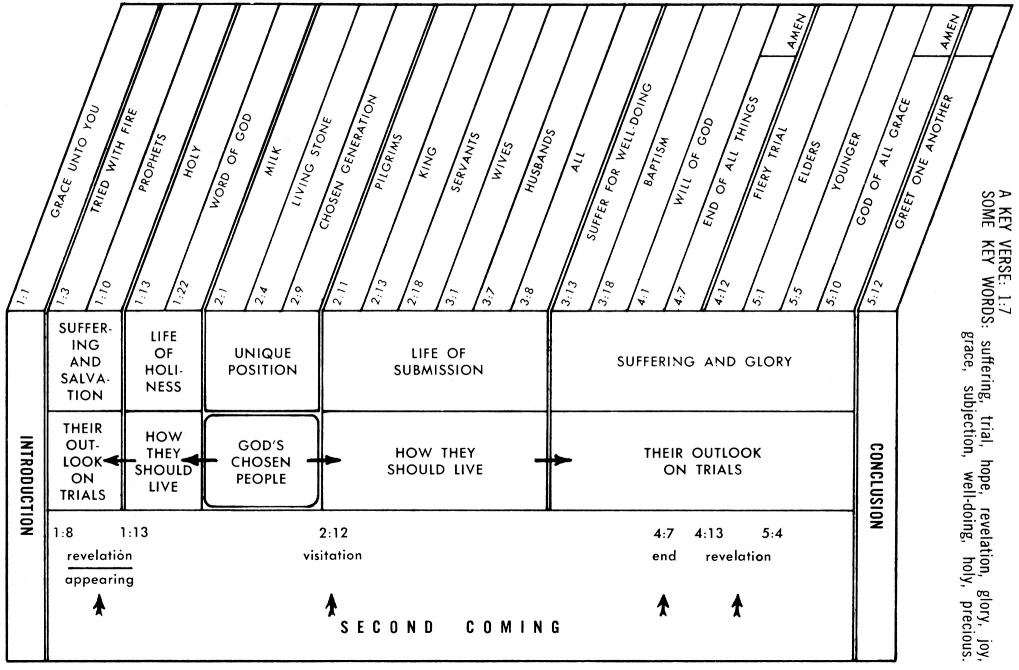
1 Peter: Trials, Holy Living & The Lord's Coming
Click chart to enlarge
Chart from Jensen's Survey of the NT - used by permission
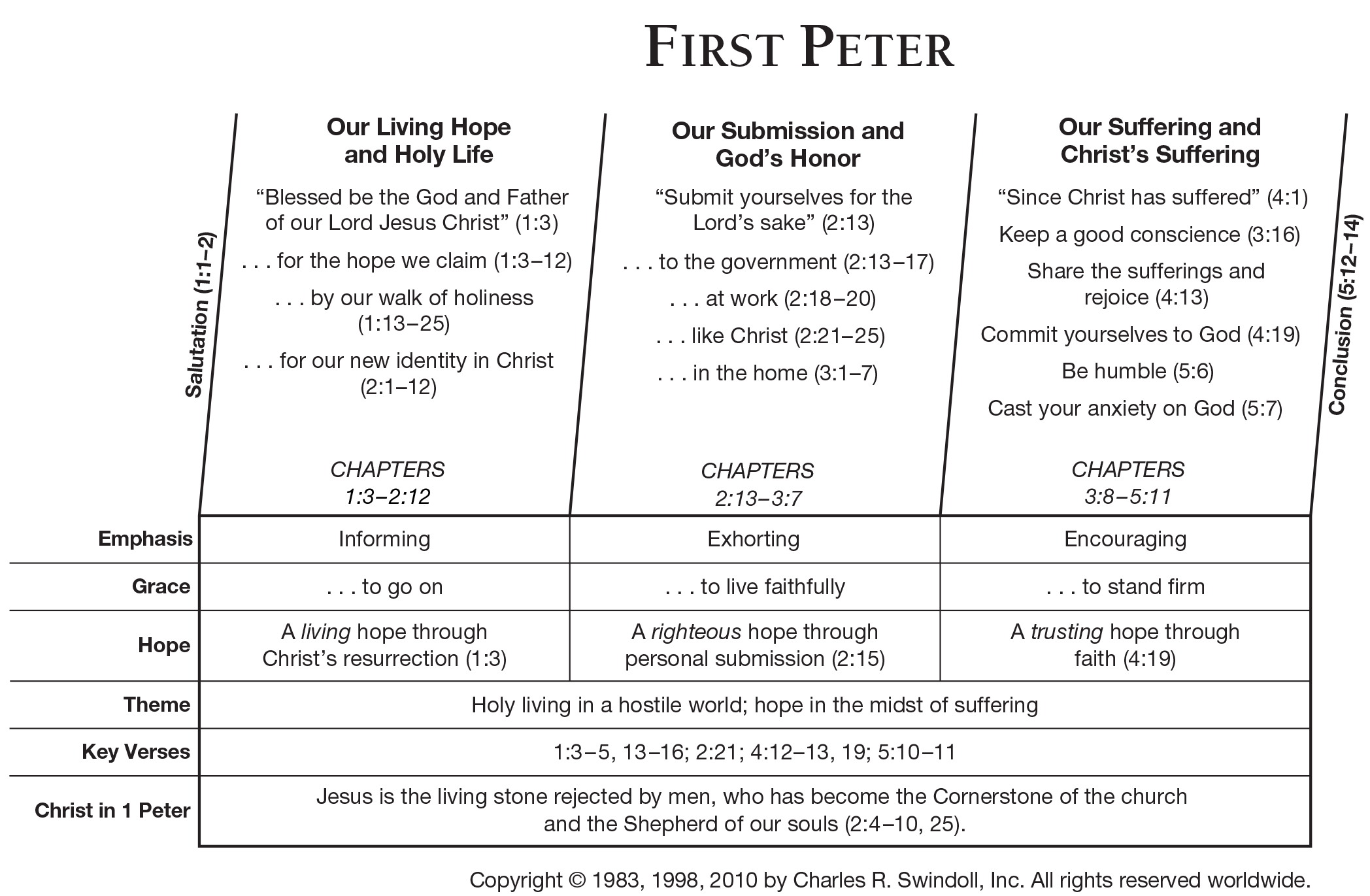
See Another Chart from Charles Swindoll
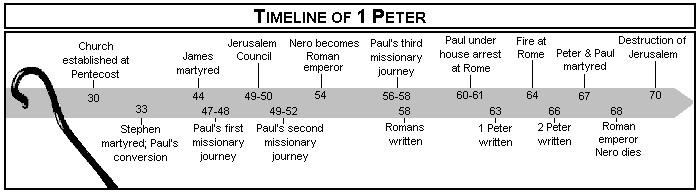
Source: Borrow Ryrie Study Bible
Click to enlarge
PART I: DOCTRINAL FOUNDATION
I. The Opening Salutation (1Pe 1:1-2)
A. The Writer (1Pe 1:1a)
B. The Readers (1Pe 1:1b-2a)
1. True character of the readers (1Pe 1:1b)
2. Geographical location of the readers (1Pe 1:1c)
3. Spiritual supports for the readers (1Pe 1:2a)
C. The Greeting (1Pe 1:2b)
II. The Thanksgiving for Our Salvation (1Pe 1:3-12)
A. The Description of Salvation (1Pe 1:3-5)
1. The author of salvation (1Pe 1:3a-b)
a. His relation to the Savior (1Pe 1:3a)
b. His act of mercy to the saved (1Pe 1:3b)
2. The nature of salvation (1Pe 1:3c-4a)
a. The living hope grounded in Christ's resurrection (1Pe 1:3c)
b. The glorious inheritance awaiting believers (1Pe 1:4a)
3. The certainty of salvation (1Pe 1:4b-5)
a. The safekeeping of the inheritance (1Pe 1:4b)
b. The preservation of the heirs (1Pe 1:5)
B. The Experiences Relating to Salvation (1Pe 1:6-9)
1. The paradoxical nature of the experiences (1Pe 1:6-7)
a. The experience of exultation (1Pe 1:6a)
b. The experience of distress (1Pe 1:66-7)
1. The nature of the distress (1Pe 1:6b)
2. The purpose behind the trials (1Pe 1:7)
a. The testing of faith (1Pe 1:7a)
b. The outcome of the testing (1Pe 1:7b)
2. The sustaining relations of believers (1Pe 1:8-9)
a. Their dual relation to Jesus Christ (1Pe 1:8)
b. Their experiential relation to their salvation (1Pe 1:9)
C. The Magnification of Salvation (1Pe 1:10-12)
1. The magnification through prophetic research (1Pe 1:10-12a)
a. Their intensive search (1Pe 1:10a)
b. Their prophetic function (1Pe 1:10b)
c. Their personal perplexity (1Pe 1:11)
1. The time and circumstances (1Pe 1:11a)
2. The sufferings and the glories (1Pe 1:11b)
d. Their restricted ministry (1Pe 1:12a)
2. The magnification through Christian proclamation (1Pe 1:12b)
3. The magnification through angelic inquiry (1Pe 1:12c)
PART 2: PRACTICAL EXHORTATION
I. Exhortations in View of Our Salvation (1Pe 1:13-2:10)
A. The Life Arising from Salvation (1Pe 1:13-2:3)
1. The Christian life in relation to God (1Pe 1:13-21)
a. A life of steadfast hope (1Pe 1:13)
1. The supports of hope (1Pe 1:13a)
2. The call to hope (1Pe 1:13b)
b. A life of personal holiness (1Pe 1:14-16)
1. The foundation for personal holiness (1Pe 1:14a)
2. The call to personal holiness (1Pe 1:14b-15)
a. The negative demand of holiness (1Pe 1:14b)
b. The positive call to holiness (1Pe 1:15)
3. The justification of the call to holiness (1Pe 1:16)
c. A life of motivated reverence (1Pe 1:17-21)
1. The basis for reverent living (1Pe 1:17a)
2. The call for reverent living (1Pe 1:17b)
3. The knowledge that motivates reverence (1Pe 1:18-21)
a. The means of our redemption (1Pe 1:18-19)
b. The nature of the Redeemer (1Pe 1:20)
c. The characteristics of the redeemed (1Pe 1:21)
2. The Christian life in relation to the brethren (1Pe 1:22-25)
a. The experience of inner purification (1Pe 1:22a)
b. The duty of mutual love (1Pe 1:22b)
c. The foundation in personal regeneration (1Pe 1:23-25)
1. The fact of their regeneration (1Pe 1:23a)
2. The nature of their regeneration (1Pe 1:23b-25a)
3. The evangelization leading to their regeneration (1Pe 1:25b) (D Edmond Hiebert)
1 Peter 1:10 As to this salvation, the prophets who prophesied of the grace that would come to you made careful search and inquiries (NASB: Lockman)
Greek: Peri es soterias exezetesan (3PAAI) kai exraunesan (3PAAP), prophetai oi peri tes eis humas charitos propheteusantes, (AA PMPN )
Phillips: The prophets of old did their utmost to discover and obtain this salvation. They did not find it, but they prophesied of this grace that has now come to you. (Phillips: Touchstone)
Wuest: Concerning which salvation prophets conducted an exhaustive inquiry and search, those who prophesied concerning the particular grace destined for you
Young's Literal: concerning which salvation seek out and search out did prophets who concerning the grace toward you did prophecy,
AS TO THIS SALVATION, THE PROPHETS: peri es soterias … prophetai:
- Ge 49:10; Da 2:44; Hag 2:7; Zec 6:12; Mt 13:17; Lk 10:24; 24:25, 26, 27; Lk 24:44; Acts 3:22, 23, 24; 7:52; 10:43; 13:27, 28, 29; 28:23; 2Pet 1:19 20, 21
- 1 Peter 1 Resources - Multiple Sermons and Commentaries
- 1 Peter 1:10-12 What's So Great About Salvation? - Steven Cole
- 1 Peter 1:10 The Greatness of Our Salvation - John MacArthur
Spurgeon - See you not your privilege, then? You have what prophets had not. You enjoy what angels desire to see. They cannot enjoy what you do Rightly does our hymn put it: —
“Never did angels taste above
Redeeming grace and dying love.”
And you have, this very day.
Salvation (4991) (soteria [word study] from soter = savior, deliverer click sozo) and in the OT conveyed the ideas of deliverance from present danger or trouble especially from defeat in battle as well as giving a foretaste by the righteous, after death, of the enjoyment of the age to come. It is into a world such as this that the gospel of salvation came.
Salvation means not just escape from the penalty of sin but includes the ideas of safety, deliverance from slavery, preservation from danger or destruction.
Soteria - 46x in 45v - Mark 16:8; Luke 1:69, 71, 77; 19:9; John 4:22; Acts 4:12; 7:25; 13:26, 47; 16:17; 27:34; Rom 1:16; 10:1, 10; 11:11; 13:11; 2 Cor 1:6; 6:2; 7:10; Eph 1:13; Phil 1:19, 28; 2:12; 1 Thess 5:8f; 2 Thess 2:13; 2 Tim 2:10; 3:15; Heb 1:14; 2:3, 10; 5:9; 6:9; 9:28; 11:7; 1 Pet 1:5, 9f; 2:2; 2 Pet 3:15; Jude 1:3; Rev 7:10; 12:10; 19:1. NAS = deliverance(2), preservation(1), salvation(42).
Prophets (4396) (prophetes from pró = before or forth + phemí = tell) were persons in the OT inspired to proclaim or reveal God's will or purpose, through utterance of divinely inspired revelation. A prophet was one who would foretell future events and also one who would exhort, reprove, and even threaten individuals or nations as the ambassador of God and the interpreter of His will to men. The important point to remember is that the prophet spoke not his own thoughts but what he received from God, even though he retained his own consciousness and personality in his forth telling. The prophets were carried along by the Holy Spirit (2Pe 1:21)
As someone has said “The modern church is a ‘non-prophet’ organization.”
Prophetes - 144x in 138v -
Matt 1:22; 2:5, 15, 17, 23; 3:3; 4:14; 5:12, 17; 7:12; 8:17; 10:41; 11:9, 13; 12:17, 39; 13:17, 35, 57; 14:5; 16:14; 21:4, 11, 26, 46; 22:40; 23:29ff, 34, 37; 24:15; 26:56; 27:9; Mark 1:2; 6:4, 15; 8:28; 11:32; Luke 1:70, 76; 3:4; 4:17, 24, 27; 6:23; 7:16, 26, 39; 9:8, 19; 10:24; 11:47, 49f; 13:28, 33f; 16:16, 29, 31; 18:31; 20:6; 24:19, 25, 27, 44; John 1:21, 23, 25, 45; 4:19, 44; 6:14, 45; 7:40, 52; 8:52f; 9:17; 12:38; Acts 2:16, 30; 3:18, 21ff; 7:37, 42, 48, 52; 8:28, 30, 34; 10:43; 11:27; 13:1, 15, 20, 27, 40; 15:15, 32; 21:10; 24:14; 26:22, 27; 28:23, 25; Rom 1:2; 3:21; 11:3; 1 Cor 12:28f; 14:29, 32, 37; Eph 2:20; 3:5; 4:11; 1 Thess 2:15; Titus 1:12; Heb 1:1; 11:32; Jas 5:10; 1 Pet 1:10; 2 Pet 2:16; 3:2; Rev 10:7; 11:10, 18; 16:6; 18:20, 24; 22:6, 9
Mills writes that = The paroemia (short, pithy saying or adage) ‘familiarity breeds contempt,’ holds true for Christianity as well, for I suppose most believers eventually incline to treating their salvation as commonplace. This section’s instruction is intended to counter this tendency by inviting meditation on salvation’s incomprehensible privilege. The section makes tandem arguments to establish the wonder of the grace of salvation-arguing first that the great prophets of the Old Testament were deeply awed by the wonder of the truths about the coming age of grace revealed through them, the grace which all believers experience. The point made is thus simple yet powerful-each believer is in a more privileged position than the Old Testament prophets like Isaiah, Jeremiah, Ezekiel, and Daniel, more privileged than even David and Moses, as our Lord Himself taught (Luke 10:24). The wonder of this position is confirmed, so the epistle argues in the second place, by the fact that angels yearn to examine the glories of this privilege. When these tandem truths are assimilated, there is no room for complacency. This section challenges all believers to meditate on the absolute wonder of being saved, and, besides being an exercise in worshipful thanksgiving, the epistle will use this as the basis for its appeal to sanctified Christian living." (Mills, M. I Peter : A study guide to the First Epistle by Peter. Dallas: 3E Ministries)
WHO PROPHESIED OF THE GRACE THAT WOULD COME TO YOU: prophetai oi peri tes eis humas charitos propheteusantes (AAPMPN):
- 1 Peter 1 Resources - Multiple Sermons and Commentaries
- 1 Peter 1:10-12 What's So Great About Salvation? - Steven Cole
- 1 Peter 1:10 The Greatness of Our Salvation - John MacArthur
Spurgeon - Observe, dear brethren, that the prophets did not speak without due consideration, but they “enquired and searched diligently” into the meaning of that salvation of which they “testified beforehand.” Holy Scripture must not be read by us carelessly. We ought to peer, and pry, and search into it to get at its hidden meaning, and the prophecies as well as the rest of the Word are to be searched into by us upon whom the ends of the earth have come… Observe, also, that this divine revelation is of great interest to the holy angels before the throne of God; they stand gazing down as if they were trying to understand the wondrous mystery of redemption, and the great and glorious gospel of the grace of God.
Prophesied (4395) (propheteuo from pró = before or forth + phemí = tell) means in this case to speak under inspiration and foretell things to come or to declare truths through the inspiration of God’s Holy Spirit.
Propheteuo - 28x in 27v - Matt 7:22; 11:13; 15:7; 26:68; Mark 7:6; 14:65; Luke 1:67; 22:64; John 11:51; Acts 2:17f; 19:6; 21:9; 1 Cor 11:4f; 13:9; 14:1, 3ff, 24, 31, 39; 1 Pet 1:10; Jude 1:14; Rev 10:11; 11:3. NAS = prophesied(5), prophesies(3), prophesy(16), prophesying(3), prophetesses(1).
The prophet was a proclaimer who spoke out the counsel of God with clearness, energy, and authority which spring from the consciousness of speaking in God’s name and having received a direct message from Him to deliver.
Grace (5485)(charis) refers to unmerited favor and in this context alludes to grace in the form of the appearing of Jesus similar to the passage as in Titus where Paul records that
the grace of God has appeared, bringing salvation to all men instructing us to deny ungodliness and worldly desires and to live sensibly, righteously and godly in the present age looking for the blessed hope and the appearing of the glory of our great God and Savior, Christ Jesus (Titus 2:11, 12, 13-see note Ti 2:11; 12; 13). (See related resource Messianic Prophecies)
Comment: So when Jesus appeared the first time, He brought grace, and when He appears the second time He also brings grace (1Pe 1:14)
Charis has several meanings in the NT dependent on the context.
(1) a quality that adds delight or pleasure or a winning quality or attractiveness that invites a favorable reaction = graciousness, attractiveness, charm, winsomeness (Luke 4:22, Colossians 4:6)
(2) a beneficent disposition toward someone, and specifically in the NT defines God's attitude toward human beings = kindness, grace, favor, helpfulness, gracious care/help, goodwill (John 1:16, Eph 2:8)
(3) practical application of goodwill = (a sign of) favor, gracious deed/gift, benefaction (Acts 24:27, 25:9, 2Cor 8:4, Eph 4:29)
(4) exceptional effects produced by God's favor = ability, power to transform, enabling power (Romans 12:6, 1Cor 15:10)
(5) response to generosity or beneficence = verbal thank offering, thanks, gratitude (1Cor 15:57)
The Grace of God (Lk 2:40; Acts 11:23; 13:43; 14:26; 20:24; Ro 5:15; 1Co 1:4; 3:10; 15:10; 2 Cor 1:12; 6:1; 8:1; 9:14; Gal 2:21; Col 1:6; Titus 2:11; Heb 2:9; 12:15; 1Pe 4:10; 5:12) expresses the Source of the Grace, God Himself, "the God of all grace" (1Pe 5:10) Who reigns as sovereign on "the throne of grace" (Heb 4:16), and Who Alone "gives grace and glory" (Ps 84:11).
The "grace of God" is described as…
Glorious (Ep 1:6)
Abundant (Acts 4:33)
Rich (Ep 1:7)
Manifold (many-sided, multi-colored, variegated) (1Pe 4:10)
Sufficient (sufficing, enough, adequate - there is never a shortage) (2Cor 12:9)
The prophesied coming "grace of God" which "has appeared" is no less than the Messiah, Who through His suffering and sacrifice has flung wide open the flood gates of salvation by grace to all who would receive and believe.
MADE CAREFUL SEARCH AND INQUIRY: peri es soterias exezetesan (3PAAI) kai exeraunesan (3PAAI):
- 1Pe 1:11; Pr 2:4; Da 9:3; Jn 5:39; 7:52; Acts 17:11
- 1 Peter 1 Resources - Multiple Sermons and Commentaries
- 1 Peter 1:10-12 What's So Great About Salvation? - Steven Cole
- 1 Peter 1:10 The Greatness of Our Salvation - John MacArthur
The prophets not only spoke to the situation of their contemporaries, but they also spoke of the longed-for messianic times. In predicting the future, they did not always understand their utterances. The clearest example is Daniel and his visions (Da 8:27; 12:8) and his study of other prophets (Da 9:2). The prophets longed to see the messianic age and so searched into what they could know of it (cf. Lk 10:24) but their divine inspiration did not bestow omniscience.
Careful search (1567) (ekzeteo from ek = intensifies the meaning of zetéo = seek, the preposition "ek" in compound always seems to denote that the seeker finds or at least exhausts his powers of seeking) means to seek out, search diligently for anything lost, to seek in order to obtain or know and to exert considerable effort and care in learning something.
Ekzeteo - 7x in 7v -
Luke 11:50, 51; Acts 15:17; Rom 3:11; Heb 11:6; 12:17; 1 Pet 1:10. NAS = charged(2), made careful*(1), searches(1), seek(2), seeks(1), sought(1).
Ekzeteo - 106v in Septuagint (LXX) -
Gen 9:5; 42:22; Exod 18:15; Lev 10:16; Deut 4:29; 12:5, 30; 17:4, 9; 23:21; Josh 2:22; 22:23; 1 Sam 20:16; 2 Sam 4:11; 1 Kgs 2:40; 2 Kgs 22:13; 2 Chr 1:5; 12:14; 14:4, 7; 15:2, 13; 17:3f; 19:3; 20:3f; 25:20; 26:5; 28:23; 30:19; 31:21; Ezra 4:2; 6:21; 9:12; 10:16; Esth 8:12; Ps 9:10, 12; 10:3, 13; 14:2; 22:26; 25:10; 27:4; 31:23; 34:4, 10; 44:21; 53:2; 61:7; 69:32; 77:2; 78:7, 34; 105:45; 111:2; 119:2, 10, 22, 33, 45, 56, 94, 100, 145, 155; 122:9; 142:4; Prov 11:27; 27:21; 29:10; Eccl 1:13; Isa 1:12, 17; 8:19; 9:13; 16:5; 31:1; Jer 10:21; 29:13; 37:7; Ezek 3:18, 20; 33:6, 8; 34:6, 8, 10ff; 39:14; Dan 9:3, 13; Hos 5:6; 7:10; 10:12; Amos 5:4ff, 14; 9:12; Mic 6:8; Zech 8:21f; Mal 2:7;
Inquiry (1830) (exereunao from ek = an intensifier and ereunao = to search into, investigate, explore) means to search diligently for something, especially for something hidden like miners engaged in digging for precious metals in the bowels of the earth. This word was first used to tell of a dog sniffing out something with his nose. The Septuagint (Lxx), Greek translation of the OT Hebrew, uses this verb Solomon recording that
"If you seek her as silver, and search (exereunao) for her (referring to wisdom) as for hidden treasures (it was the custom to bury valuables in the ground or in holes in the rocks)." (Pr 2:4)
See a good description of the effort spent in searching the earth for precious metals in Job 28:1-28) What is emphasized is the diligent effort that must be made to obtain wisdom. The tragedy is that too often men show more zeal in acquiring material wealth than spiritual treasures.
The two verbs taken together give emphatic expressing to the earnestness with which enlightenment was sought.
Solomon, the richest, wisest man (other than Jesus) who ever lived, extols the value of diligently digging for wisdom writing "If you seek her as silver, and search (Lxx = exereunao) for her (referring to wisdom) as for hidden treasures (it was the custom to bury valuables in the ground or in holes in the rocks)." (Pr 2:4) What is emphasized is the diligent effort that must be made to obtain wisdom. The tragedy is that too often men show more zeal in acquiring material wealth than spiritual treasures. The Septuagint translates hapas here with the rare verb exereunao (ek = an intensifier + ereunao = to search into, investigate, explore) used in the NT only in 1 Peter 1:10 and meaning to search diligently for something, especially for something hidden like miners engaged in digging for precious metals in the bowels of the earth. This word was first used to tell of a dog sniffing out something with his nose. The Septuagint uses exereunao 5 times in the great Psalm 119 where it translates the word "observe" - Read the passages with this verb in mind - it gives a new "nuance" on what it means to "observe" God's testimonies, law, precepts, commandments = Ps. 119:2; Ps. 119:34; Ps. 119:69; Ps. 119:115; Ps. 119:129.
THOUGHT - Now let's apply because truth not applied is in one ear and out the other (aka James 1:22). Do you just skim over God's Word so that you can "satisfy" your goal of reading through the Bible in a year? Do you read it superficially so you can check that box in your list of activities in your quiet time? The verb exereunao calls us to "dig into" the precious Word, more precious in fact than gold, but too often we barely scratch the surface for we more constrained by our fallen flesh to go out into the world and "dig for gold!" Little wonder that so many believers are spiritual paupers and their faith is weak and their walk is like a yo-yo on a string! We go to cross fit to train our bodies, but too often we fail to go the old rugged Cross to train our souls! Tomorrow morning begin a new discipline (under grace not law), a discipline enabled by the Spirit, and begin to "dig in" to the living and active Word of God as if your spiritual life depended on it (because it does! cf Jesus' words Mt 4:4, Lk 4:4). I am a retired medical doctor and would write prescriptions like this "Take 1 tablet q.d. for 30 days." Now that I am retired, I more often treat the soul, so let me prescribe that you try this "discipline" for "1 q.d. x 30 days" and see what a difference it makes in your spiritual vitality and your walk in Christ. I dare you! (under grace of course!).
Exereunao in the Septuagint -
Jdg. 5:14; 1 Sam. 23:23; 1 Chr. 19:3; Est. 1:1; Ps. 64:6; Ps. 109:11; Ps. 119:2; Ps. 119:34; Ps. 119:69; Ps. 119:115; Ps. 119:129; Prov. 2:4; Lam. 3:40; Joel 1:7; Amos 9:3; Obad. 1:6; Zeph. 1:12
And so we see Peter encouraged his readers by reminding them that the prophets of old eagerly anticipated the great salvation that his readers were experiencing. The prophets did not fully understand this salvation which was perfected when Christ came and gave Himself a sacrifice for our sins… it was then that the grace of God became evident (grace had always been there in the OT but they saw it only thru a mirror dimly) and that with Messiah's appearing, suffering, death & resurrection, that the prophets & all righteous (by their faith) men of old were made perfect (He 11:39, 40).
OT saints only saw salvation (Messiah) from a distance. They were neither fully certain nor secure until Christ came. They trusted in hope (hope in OT often equates with "trust"), looking ahead for a conscience freed from sin, looking to the promise of a New Covenant with a New Heart and a New Spirit dwelling within them. Oh, the privilege of NT saints… now we each can go into God’s presence and we can sit down before Him and, with the apostle Paul, say, “Abba, Father.”
We have access to God. How then can one who begins to understand the greatness of his salvation go on sinning against such marvelous grace? Let us conduct ourselves accordingly as aliens to the ungodliness & worldly desires for Christ is now our peace in the midst of the storm (Jn 16:33)
1 Peter 1:11 seeking to know what person or time the Spirit of Christ within them was indicating, as He predicted the sufferings of Christ and the glories to follow * (NASB: Lockman)
Greek: eraunontes (PAPMPN) eis tina e poion kairon edelou (3SIAI) to en autois pneuma Christou promarturomenon (PMPMSN) ta eis Christon pathemata kai tas meta tauta doxas
GWT: So they tried to find out what time or situation the Spirit of Christ kept referring to whenever he predicted Christ's sufferings and the glory that would follow. (GWT)
Phillips: They tried hard to discover to what time and to what sort of circumstances the Spirit of Christ working in them was referring. For he foretold the sufferings of Christ and the glories that should follow them. (Phillips: Touchstone)
Wuest: searching as to what season or character of season the Spirit of Christ who was in them was making plain when He was testifying beforehand concerning the sufferings of Christ and the glories which would come after these sufferings
Young's Literal: searching in regard to what or what manner of time the Spirit of Christ that was in them was manifesting, testifying beforehand the sufferings of Christ and the glory after these,
SEEKING TO KNOW WHAT PERSON OR TIME THE SPIRIT OF CHRIST WITHIN THEM WAS INDICATING : eraunontes (PAPMPN) eis tina e poion kairon edelou (3SIAI) to en autois pneuma Christou:
- 1Peter 3:18,19; Romans 8:9; Galatians 4:6; 2Peter 1:21; Revelation 19:10
- 1 Peter 1 Resources - Multiple Sermons and Commentaries
- 1 Peter 1:10-12 What's So Great About Salvation? - Steven Cole
- 1 Peter 1:10 The Greatness of Our Salvation - John MacArthur
Seeking to know (2045) (ereunao/eraunao the root word of exereunao in the previous verse) means to make thorough examination, to make a careful or thorough effort to learn something. It means to search, examine, investigate, inquire, find out. In short, ereunao connotes the activity of examining, investigating, studying to determine the meaning.
It is notable that 3 of the 6 uses relate to the exercise on the part of men by which they examine the Scriptures with utmost care. This verb ought to emblazoned on the heart of every believer that we might always seek to know "What saith the Lord?"!
Jesus used ereunao in His chastising challenge to the Jews declaring "You search (ereunao) the Scriptures, because you think that in them you have eternal life; and it is these that bear witness of Me and you are unwilling to come to Me, that you may have life. (Jn 5:39, 40) As an aside, the reason these very religious men searched but could find no life was because they did not have the illumining ministry of the Holy Spirit!
1Pe 1:11 can be interpreted in one of two ways which accounts for the difference in the translations where NASB translates it as ""what person or time" and NIV has "time and circumstances".
In either event, the present tense of "seeking" pictures the prophets as returning continually to the problem that their predictions created for them. Note for example (Da 12:8,9), where Daniel was told that his words were "sealed till the time of the end." The prophets knew that the Messiah would be coming, but they had no knowledge when he would app ear or what the circumstances of his appearance would be. The Old Testament prophets had predicted that Messiah would experience both suffering and glory. However, they did not understand how His suffering and glory would fit together. It is possible to understand that mystery only after Jesus' earthly ministry.
M J Harris on ereunao/eraunao - (related to ereō, ask, inquire), as well as the almost synonymous exereunaō, signified originally: (a) tracking by animals; sniff out, track down (Homer, Od. 19, 436; Empedocles, Frag. 101); then (b) in the human sphere to trace out, examine, search out, search, e.g. in connection with a house search, a judicial hearing, and especially a scientific, philosophical and religious investigation (this particularly in Plato and Philo). anexereunētos means unsearchable, unfathomable (once in Heraclitus). Hellenistic forms without change of sense include eraunaō, exeraunaō, etc. In the LXX, while rendering other Heb. terms, the word (including the composite form) sometimes translates hapas (mostly piel), meaning → seek, search thoroughly, and expresses, for instance, Laban’s angry search for his missing household gods (Ge 31:35), the plundering search of houses (1Ki. 20:6), but also the quest for wisdom and discernment (Pr 2:4) and the contrite examination of one’s way of life (Lam 3:40). God and his thoughts cannot be searched out (Jdt. 8:14)… (Philo) uses the word to describe learned investigation of the thought and exegesis of the OT (Det. Pot. Ins. 13:57; Cherubin 14). The Qumran sect regarded searching the Scriptures as its main task in order in this way to fathom the will of God (New international dictionary of New Testament theology)
Carl Henry on use of ereunao/eraunao in 1Cor 2:10 - The mention of the Spirit who “searches” (ereunai) recalls Francis Thompson’s “The Hound of Heaven” (Homer uses ereunaō of animals “sniffing out” their quarry, and Aristotle of men searching homes and possessions). No human “search and arrest” effort matches the investigative thoroughness of the Spirit’s testing of human desires and determinations. The Spirit who penetrates God’s innermost being is the selfsame Spirit who searches the heart of man (Ro 8:27; cf. Pr. 20:27). Gerhard Delling observes that Plato and Philo use ereunaō of academic, scientific, philological and philosophical investigations (“Ereunaō,” 2:656). The believer is under mandate to search the Spirit-given Scriptures, for they are the locus of divine revelation (John 5:39). The perspicacity (Acuteness of discernment or understanding) of Scripture is sound doctrine. The Bible was—and is still—addressed to the multitudes, to masses of the poor, uneducated and even enslaved. The emphasis on the Holy Spirit as the sovereign Interpreter of Scripture is not intended to deny this, or to compensate for any alleged opaqueness of Scripture. (God, Revelation, and Authority Volume 4)
Ereunao is found 6 times in the NT…
John 5:39 "You search the Scriptures, because you think that in them you have eternal life; and it is these that bear witness of Me;
John 7:52 They answered and said to him, "You are not also from Galilee, are you? Search, and see that no prophet arises out of Galilee."
Romans 8:27 (note) and He who searches the hearts knows what the mind of the Spirit is, because He intercedes for the saints according to the will of God.
1 Corinthians 2:10 For to us God revealed them through the Spirit; for the Spirit searches all things, even the depths of God. (Vincent: "Not, searches in order to discover; but of the ever active, accurate, careful sounding of the depths of God by the Spirit.")
1 Peter 1:11 (note) seeking to know what person or time the Spirit of Christ within them was indicating as He predicted the sufferings of Christ and the glories to follow.
Revelation 2:23 (note) 'And I will kill her children with pestilence; and all the churches will know that I am He who searches the minds and hearts; and I will give to each one of you according to your deeds.
Ereunao - 15x in 14v in the Septuagint (Reading through these OT uses gives one a sense of the meaning of this verb) - Ge 31:33, 35, 37; 44:12; Deut 13:14; Judg 6:29; 2 Sam 10:3; 1 Kgs 20:6; 2 Kgs 10:23; Pr 20:27; Jer 50:26; Joel 1:7
Jesus Christ clearly did not come into existence at His incarnation as some cults falsely teach. To the contrary, Peter teaches that the Messiah in the Person of the Holy Spirit (Ro 8:9), took up temporary residence within the writers of the OT and as explained in his second epistle, enabled them to write very specific, detailed prophecies of His glorious salvation (2Pe 1:20, 21).
The Messianic prophecies were not the product of the imaginations of the prophets but were communicated by the "Spirit of Christ within them." David for example was conscious of God's Spirit at work in him enabling him to speak under the Spirit's guidance writing
"The Spirit of the LORD spoke by me, and His word was on my tongue." (2Sa 23:2).
Peter emphasizes that the the Holy Spirit is not an impersonal influence, but a personal Being.
Was indicating (1213) (deloo from delos = manifest) means to make plain by words and thus to declare. It means to make some matter known that was unknown or not communicated previously. It means to show clearly, to signify, to make manifest, visible, clear, or plain and to make known. When spoken of things past it means to tell, relate or impart information (as in 1Cor 1:11;see note Col 1:18). Although deloo is used most often in reference to declarations through articulate language, it is also used often of any kind of indirect communication. When spoken of things future or hidden, deloo means to reveal, show or bring to light.
Deloo means to make something known by making evident what was either unknown before or what may have been difficult to understand. The imperfect tense in this verse emphasizes repeated action in the past and thus pictures the successive disclosures that the Spirit revealed to the prophets. The Spirit of Christ repetitively set before the prophets very specific truths concerning the coming Messiah, here emphasizing His sufferings and His glories.
Deloo is used 7 times in the NT…
1 Corinthians 1:11 For I have been informed concerning you, my brethren, by Chloe's people, that there are quarrels among you.
1 Corinthians 3:13 each man's work will become evident; for the day will show it, because it is to be revealed with fire; and the fire itself will test the quality of each man's work.
Colossians 1:8 (note) and he also informed us of your love in the Spirit.
Hebrews 9:8 (note) The Holy Spirit is signifying this, that the way into the holy place has not yet been disclosed, while the outer tabernacle is still standing,
Hebrews 12:27 (note) And this expression, "Yet once more," denotes the removing of those things which can be shaken, as of created things, in order that those things which cannot be shaken may remain.
1 Peter 1:11 (note) seeking to know what person or time the Spirit of Christ within them was indicating as He predicted the sufferings of Christ and the glories to follow.
2 Peter 1:14 (note) knowing that the laying aside of my earthly dwelling is imminent, as also our Lord Jesus Christ has made clear (of something divinely communicated) to me.
Deloo is used 28 times in the Septuagint (LXX) (Ex. 6:3; 33:12; Deut. 33:10; Jos. 4:7; 1 Sam. 3:21; 1 Ki. 8:36; 2 Chr. 6:27; Est. 2:22; Ps. 25:14; 51:6; 147:20; Isa. 42:9; Jer. 16:21; Dan. 2:5f, 9, 11, 16, 23ff, 28ff, 47; 4:18; 7:16). Here are some uses in the Septuagint (LXX)
Exodus 6:3 and I appeared to Abraham, Isaac, and Jacob, as God Almighty, but by My name, LORD, I did not make Myself known (deloo) to them.
Exodus 33:12 Then Moses said to the LORD, "See, Thou dost say to me, 'Bring up this people!' But Thou Thyself hast not let me know (deloo) whom Thou wilt send with me. Moreover, Thou hast said, 'I have known you by name, and you have also found favor in My sight.'
Esther 2:22 But the plot became known (deloo) to Mordecai, and he told Queen Esther, and Esther informed the king in Mordecai's name.
Psalm 25:14 The secret of the LORD is for those who fear Him, And He will make them know (deloo) His covenant. (Spurgeon's Note)
Psalm 51:6 Behold, Thou dost desire truth in the innermost being, And in the hidden part Thou wilt make me know (deloo) wisdom. (Spurgeon's Note)
Psalm 147:20 He has not dealt thus with any nation and as for His ordinances, they have not known (deloo) them. Praise the LORD! (Spurgeon's Note)
Isaiah 42:9 "Behold, the former things have come to pass, Now I declare new things; Before they spring forth I proclaim (Lxx = deloo = make them known) them to you."
Daniel 2:25 Then Arioch hurriedly brought Daniel into the king's presence and spoke to him as follows: "I have found a man among the exiles from Judah who can make the interpretation known (deloo) to the king!"
AS HE PREDICTED THE SUFFERINGS OF CHRIST AND THE GLORIES TO FOLLOW: promarturomenon (PMPMSN) ta eis Christon pathemata kai tas meta tauta doxas:
- sufferings Psalm 22:1-21; 69:1-21; 88:1-18; Isaiah 52:13,14; 53:1-10; Daniel 9:24, 25, 26; Zechariah 13:7; Luke 24:25, 26, 27,44
- glories Genesis 3:15; 49:10; Psalms 22:22-31; 69:30, 31, 32, 33, 34, 35, 36; 110:1, 2, 3, 4, 5, 6; Isaiah 9:6,7; 49:6; Isaiah 53:11,12; Daniel 2:34,35,44; 7:13,14; Zechariah 8:18-21; 14:9; John 12:41; Acts 26:22,23
- 1 Peter 1 Resources - Multiple Sermons and Commentaries
- 1 Peter 1:10-12 What's So Great About Salvation? - Steven Cole
- 1 Peter 1:10 The Greatness of Our Salvation - John MacArthur
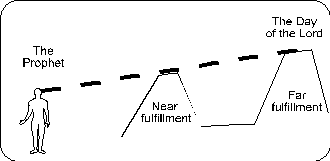
Here is a diagrammatic representation of suffering and glory of Messiah (Bible.org)
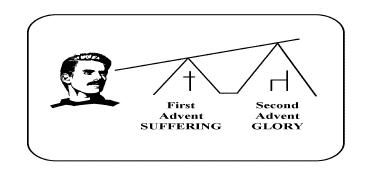
Near and far fulfillment schematic diagram
Predicted (4303) (promarturomai from pró = before + marturomai = to witness, affirm, attest) means to witness or testify or declare beforehand. The present tense indicates this was a continuous witness.
"Some men seem destined for power
Some men seem born to great fame
But the Son of God was destined
To die on a cross of shame
He left all the splendor of glory
Yet he knew on a cross he would die
For compelled by a love transcending
He was born to be crucified"-- Bill Gaither
Jesus Himself emphasized this same pattern ("Cross before Crown") asking the rhetorical question --
"Was it not necessary for the Christ to suffer these things and to enter into His glory?" (Lk 24:26)
There is no crown before the cross, no resurrection before crucifixion, and no glory before shame.
The predictions of the sufferings of the Messiah begin with the first prophecy of the Messiah, when God told Satan
"I will put enmity between you and the woman, and between your seed (Satan) and her Seed (Messiah). He (Messiah) shall bruise you (Satan) on the head, and you shall bruise Him (Messiah) on the heel". (Ge 3:15)
This verse is the first reference in this epistle to the sufferings of Christ. As Peter seeks to encourage these Christians to be faithful in the face of their suffering, he repeatedly reminds them of Christ’s steadfast example (1Pe 1:19, 21, 2:4, 6, 7, 8, 21, 24, 3:18, 4:1, 13, 5:1- see notes 1Pe 1:19; 21; 2:4; 6; 7; 8; 21; 24; 3:18; 4 :1; 13; 5:1)
Old Testament prophets spoke of Jesus, but could not put together the clues in their own writings to explain the timing of sufferings and glories.
Was it not necessary for the Christ to suffer these things and to enter into His glory? (Lk 24:26)
The writings of the prophets contain both "near" and "far" aspects. Yet the prophets were unable to understand the time significance of their prophecies or to understand fully the relation of the sufferings of the Messiah to his glory.
Glories to follow - Glory in the plural most refers to the various aspects of Messiah's glorification including His resurrection, His ascension, His resumption of glory on His Father's throne, His return, His reign in glory and His glory as Judge of all.
The OT prophets did not understand that these two events (suffering then glory) would be separated by at least 2000 years. They saw the two mountain peaks, the mount of Calvary (eg Isa 53:5), where Jesus suffered, and the mount of Olives (eg Zech 14:4), where He will return in glory at the end of the "Great Tribulation". But they did not see the valley which lay between, which is the church age (a hidden "mystery" in the OT but a revealed "mystery" in the NT -- Ep 3:4, 5, 6-see notes Ep 3:4; 5; 3:6), this present age of grace which gives us a clearer perspective than the prophets.
Peter reminded his readers that the prophets had predicted that Jesus Christ's life, as their own lives, would include suffering followed by glory. He mentioned this to encourage them to realize that their experience was not abnormal. We need to remember that sufferings and glories are not at all incompatible, but that the "cross" is to be endured even as a future "crown" is to be anticipated. We will suffer now but praise God, glory follows (1Pe 5:10)
Because we know the Who (Jesus) and the when (Jesus’ day) of these Old Testament prophecies, they should be of far more interest to us than they were even in the day of the prophets. Prophecy is not given to satisfy our curiosity but to stimulate a hunger for holiness. Does Peter's teaching make you curious or hungry?
The doctrine of a suffering Messiah was neglected by the Jews of the first century, and the preaching by the church of the Cross and suffering of Messiah proved a definite stumbling block to them (Ro 9:33; 1Pe 2:9) (cf 1Cor 1:23, Gal 5:11)
1 Peter 1:12 It was revealed, to them that they were not serving themselves, but you, in these things which now have been announced to you through those who preached the gospel to you by the Holy Spirit sent from heaven --things into which angels long to look. (NASB: Lockman)
Greek: hois apekalupethe (3SAPI) hoti ouch heautois humin de diekonoun (3PIAI) auta, a nun aneggele (3SAPI) himin dia ton euaggelisamenon (AMPMPG) humas [en] pneumati hagio apostalenti (APPNSD) ap' ouranou, eis a epithumousin (3PPAI) aggeloi parakupsai. (AAN)
Phillips: It was then made clear to them that they were dealing with matters not meant for themselves, but for you. It is these very matters which have been made plain to you by those who preached the Gospel to you by the same Spirit sent from Heaven - and these are facts to command the interest of the very angels (Phillips: Touchstone)
Wuest: to whom it was revealed that not for themselves were they ministering these things which now have been reported to you through those who have announced the glad tidings to you by the Holy Spirit who was sent down on a commission from heaven, which things angels have a passionate desire to stoop way down and look into [like the cherubim above the mercy seat who gazed at the sprinkled blood and wondered at its meaning].
Young's Literal: to whom it was revealed, that not to themselves, but to us they were ministering these, which now were told to you (through those who did proclaim good news to you,) in the Holy Spirit sent from heaven, to which things messengers do desire to bend looking.
IT WAS REVEALED TO THEM THAT THEY WERE NOT SERVING THEMSELVES BUT YOU: hois apekaluphthe (3SAPI) hoti ouch heautois humin de diekonoun (3PIAI):
- 1 Peter 1 Resources - Multiple Sermons and Commentaries
- 1 Peter 1:10-12 What's So Great About Salvation? - Steven Cole
- 1 Peter 1:10 The Greatness of Our Salvation - John MacArthur
"to whom it was revealed that not for themselves were they ministering these things" (Wuest)
Spurgeon…
They, as well as the prophets, are deep students of the unsearchable mysteries of Christ.
See the kind of preaching that we should all desire to hear, and that all God’s ministers should aim at: “them that have preached the gospel unto you with the Holy Ghost sent down from heaven.” Nothing but a gospel full of the energy of the Holy Ghost, and set on fire by him, can effect the eternal purposes of God; but this is the kind of preaching that will live, and that will also make men live. God send it to every church and congregation throughout the world! Amen.
Revealed (601) (apokalupto from apó = from + kalupto = cover, conceal, English = apocalypse - see study of apokalupsis English = apocalypse) literally means to remove the cover from and so the idea is to remove that which conceals something. Almost all of the NT uses have a figurative use, especially to some aspect of spiritual truth that was heretofore hidden but now has the "lid removed" so that it can be seen (understood). Note the passive voice here, which indicates it was God Who did the revealing.
Apokalupto - 26x in 26v - reveal(5), revealed(20), revelation is made(1). Mt 10:26; 11:25, 27; 16:17; Lk 2:35; 10:21, 22; 12:2; 17:30; Jn 12:38; Ro 1:17, 18; 8:18; 1Cor 2:10; 3:13; 14:30; Gal 1:16; 3:23; Eph 3:5; Phil 3:15; 2 Thess 2:3, 6, 8; 1 Pet 1:5, 1Pe 1:12-note; 1Pe 5:1.
Apokalupto - 86x in the Septuagint (LXX) - Gen 8:13; Ex 20:26; A number of the following uses refer to "uncovering" nakedness! - Lev 18:6, 7, 8, 9, 10, 11, 12, 13, 14, 15, 16, 17, 18, 19; 20:11, 17, 18, 19, 20, 21; Num 5:18; 22:31; 24:4, 16; Deut 22:30; 27:20; Josh 2:19; Jdg 5:2; Ruth 3:4, 7; 4:4; 1 Sam 2:27; 3:7, 21; 9:15; 20:2, 13; 22:8, 17; 2 Sam 6:20, 22; 7:27; 22:16; Job 41:13; Ps 29:9; 37:5; 98:2; 119:18; Prov 11:13; 27:5; Song 4:1; Isa 3:17; 47:2; 52:10; 53:1; 56:1; Jer 11:20; 13:26; 20:12; Lam 2:14; 4:22; Ezek 13:14; 16:36f, 57; 21:24; 22:10; 23:10, 18, 29; Dan 2:19, 22, 28ff, 47; 10:1; 11:35; Hos 2:10; 7:1; Amos 3:7; Mic 1:6; Nah 2:7; 3:5.
Here are a few very interesting OT (Lxx) uses of apokalupto…
The prophet Amos records ""Surely the Lord God does nothing unless He reveals (Lxx = apokalupto) His secret counsel to His servants the prophets." (Amos 3:7)
Isaiah asks "Who has believed our message? And to whom has the arm of the Lord been revealed (Lxx = apokalupto)? (Isa 53:1)
The prophets had this truth of Messiah's coming revealed to them but as the question implies, in spite of these and other revealed prophecies, most of Israel would not recognize the Servant when He appeared.
The prophet Daniel recorded that "the mystery" of Nebuchadnezzar's dream and the interpretation (which foretold of Messiah's crushing of all kingdoms - click schematic summary) "was revealed to Daniel in a night vision. Then Daniel blessed the God of heaven… who reveals the profound and hidden things. He knows what is in the darkness, and the light dwells with Him." (Da 2:19, 22)
Daniel went on to explain to Nebuchadnezzar that "there is a God in heaven who reveals (Lxx = apokalupto - present tense = continuously) mysteries, and He has made known to King Nebuchadnezzar what will take place in the latter days. This was your dream and the visions in your mind while on your bed. As for you, O king, while on your bed your thoughts turned to what would take place in the future; and He who reveals (Lxx = apokalupto - present tense = continuously) mysteries has made known to you what will take place." (Da 2:28-29)
To all this revelation the pagan king responded "The king answered Daniel and said, “Surely your God is a God of gods and a Lord of kings and a Revealer of mysteries, since you have been able to reveal this mystery.” (Da 2:47)
The Spirit revealed to the prophets that the prophecies would not be fulfilled in their lifetimes. Therefore, as the prophets continued to speak and write God’s words, and as they labored and faced persecution, they were serving not themselves but their words were for another era, to be understood by the believers in Peter’s day, as well as believers today.
Serving (1247) (diakoneo [word study] derivation uncertain - cp diakonis = in the dust laboring or running through the dust or possibly diako = to run on errands; see also study of related noun - diakonia) means to minister by way of rendering service in any form or to take care of by rendering humble service. Diakoneo gives us our English words diaconate (an official body of deacons) and deacon.
Diakoneo means to render assistance or help by performing certain duties often of a humble or menial nature, like serving by waiting on tables. The picture is one in which the prophets have spread a table so that others might "feast" on the rich spiritual food found in the Messianic prophecies. They knew that these prophecies spoke of a future Savior Who would come and thus they were really writing for those who are on this side of the cross.
IN THESE THINGS WHICH NOW HAVE BEEN ANNOUNCED TO YOU THROUGH THOSE WHO PREACHED THE GOSPEL TO YOU BY THE HOLY SPIRIT SENT FROM HEAVEN-: a nun aneggele (3SAPI) humin dia ton euaggelisamenon (AMPMPG) humas en pneumati hagio apostalenti (APPNSD) ap ouranou:
- Isa 53:1; Da 2:19,22,28,29,47; 10:1; Am 3:7; Mt 11:25,27; 16:17; Lk 2:26; Ro 1:17; 1Cor 2:10; Gal 1:12,16) (Da 9:24; 12:9,13; Heb 11:13,39,40
- Jn 15:26; 16:7, 8, 9, 10, 11, 12, 13, 14, 15; Acts 2:4,33; 4:8,31; 10:44; 2Cor 1:22; 6:6; 1Th 1:5,6; Heb 2:4
- Pr 1:23; Isa 11:2, 3, 4, 5, 6; 32:15; 44:3, 4, 5; Joel 2:28; Zec 12:10; Jn 15:26; Acts 2:17,18
- 1 Peter 1 Resources - Multiple Sermons and Commentaries
- 1 Peter 1:10-12 What's So Great About Salvation? - Steven Cole
- 1 Peter 1:10 The Greatness of Our Salvation - John MacArthur
PREACHING BY THE POWER
OF THE HOLY SPIRIT
In these things - What things? the things now announced = the great salvation Peter had unveiled in the preceding verses.
Announced (312) (anaggello/anangello from aná = on, upon + aggéllo = to tell, declare, from ággelos = messenger) means to announce, make known, declare, tell of things done, to report, to set forth, to proclaim.
Preached the gospel (2097) (euaggelizo from eu = good, well + aggelos = messenger - aggéllo = to bring tidings see related word euaggelion = good news) those who "evangelized" you or who proclaimed the "good news" (euaggelion) which originally referred to a reward for good news and later became the good news itself. The word euaggelion was in just as common use in the first century as our words good news today. “Have you any good news for me today?” would have been a common question.
In its secular use euaggelion described good news of any kind and prior to the writing of the New Testament, had no definite religious connotation in the ancient world until it was taken over by the "Cult of Caesar" which was the state religion and in which the emperor was worshipped as a god (see more discussion of this use below). The writers of the New Testament adapted the term as God's message of salvation for lost sinners
TDNT - This verb (euaggelizo), usually in the middle, with dative or accusative of person, a peri to introduce the message, and sometimes a preposition denoting the recipient, is used for bringing news, especially of a victory or some other joyous event, in person or by letter. Often, especially in war, the news may be false. Words like salvation may be combined with it, but also, in secular Greek, the idea of fate or luck. The messenger may come with an oracle, and this yields the thought of “promise” or even “threat.” We also find the term used for announcing in the royal palace the arrival of the divine man Apollonius. The ideas of victory and liberation provide links with the NT, but the NT knows nothing of luck, and Jesus, unlike the divine man, is himself the content of the message. Furthermore, in both the OT and NT the term has an actuality of pronouncement that is not found in the secular sense of revealed promise.
By the Holy Spirit is a phrase one might easily overlook but which emphasizes that the proclamation of the gospel by men was by or in a power beyond themselves. These preachers were vessels used and empowered by the Holy Spirit to proclaim glad tidings.
THOUGHT - The story is told of C H Spurgeon (the "prince of preachers") who would ascend several stairs to his elevated preaching podium and on every step would say to himself "I need the Holy Spirit...I need the Holy Spirit..." If the "prince of preachers' needed the Holy Spirit, we surely need Him! The corollary is beware of preaching when you have grieved (Eph 4:30) or quenched (1Th 5:19) the Holy Spirit. Perhaps when you stand up to proclaim the holy Gospel, you might say "I confess ____. I repent of ______," so that you might be a forgiven, holy vessel enabled by the Holy Spirit to proclaim the good news with supernatural power and boldness!
Paul reminded the Thessalonians that "our gospel did not come to you in word only, but also in power and in the Holy Spirit (1Th 1:5) Even as great a theologian and preacher as Paul acknowledged his need for and dependence upon the Holy Spirit.
To the Corinthians Paul wrote "my message and my preaching were not in persuasive words of wisdom, but in demonstration of the Spirit and of power that your faith should not rest on the wisdom of men, but on the power of God (1Co 2:4-5, see also Ro 1:16; Ro 15:18, 19)
The Spirit Who used the OT prophets to predict Messiah's coming also used (and still uses) the NT preachers to proclaim the fact of His coming, the same Spirit prompting and authenticating the message of both.
THOUGHT - Are you continually filled with the Holy Spirit and the Holy Word? That is the ONLY way you can truly live the Christian (Christ in you, living through you) life! See Filled with His Spirit/Richly Indwelt with His Word - Chart Comparing
Sent (649) (apostello from apo = away from + stello = to send) is in the aorist tense which denotes a definite event in the past, which is the Spirit's coming on the Day of Pentecost, a day when Peter himself experienced the Spirit's anointing to proclaim the gospel in power (Acts 1:1, 2, 3, 4 cf Acts 2:33)
Apostello - 132x in 130v - Matt 2:16; 8:31; 10:5, 16, 40; 11:10; 13:41; 14:35; 15:24; 20:2; 21:1, 3, 34, 36f; 22:3f, 16; 23:34, 37; 24:31; 27:19; Mark 1:2; 3:14, 31; 4:29; 5:10; 6:7, 17, 27; 8:26; 9:37; 11:1, 3; 12:2ff, 13; 13:27; 14:13; Luke 1:19, 26; 4:18, 43; 7:3, 20, 27; 9:2, 48, 52; 10:1, 3, 16; 11:49; 13:34; 14:17, 32; 19:14, 29, 32; 20:10, 20; 22:8, 35; 24:49; John 1:6, 19, 24; 3:17, 28, 34; 4:38; 5:33, 36, 38; 6:29, 57; 7:29, 32; 8:42; 9:7; 10:36; 11:3, 42; 17:3, 8, 18, 21, 23, 25; 18:24; 20:21; Acts 3:20, 26; 5:21; 7:14, 34f; 8:14; 9:17, 38; 10:8, 17, 20, 36; 11:11, 13, 30; 13:15; 15:27, 33; 16:35f; 19:22; 26:17; 28:28; Rom 10:15; 1 Cor 1:17; 2 Cor 12:17; 2 Tim 4:12; Heb 1:14; 1 Pet 1:12; 1 John 4:9f, 14; Rev 1:1; 5:6; 22:6. Usage: puts(1), send(17), send forth(3), sending(3), sends(1), sent(104), sent… away(1), set(1).
THINGS INTO WHICH ANGELS LONG TO LOOK: eid a epithumousin (3PPAI) aggeloi parakupsai (AAN):
- Ex 25:20; Da 8:13; 12:5,6; Lk 15:10; Eph 3:10; Rev 5:11
- 1 Peter 1 Resources - Multiple Sermons and Commentaries
- 1 Peter 1:10-12 What's So Great About Salvation? - Steven Cole
- 1 Peter 1:10 The Greatness of Our Salvation - John MacArthur
"into which things the angels have a passionate desire to look carefully" (Wuest)
Spurgeon - “Angels long to catch a glimpse of these things.” Angels have never sinned; consequently, they need no atonement or forgiveness. Never having been defiled, they need not be washed. Yet they take a deep interest in the work of the Lord Jesus Christ. What, then, shall I say of the madness of those who are defiled by sin but have no interest in the fountain where they can be washed whiter than snow? Let us note furthermore, so that it may humble us, that angels have keen intellects. They far excel us. Yet, though they have learned so much about the gospel, they still desire to look into it. Does anyone suppose that he knows all about the gospel and does not need further hours of study, thought, and prayer? Poor miserable fool! Angels, who are vastly superior to us in intelligence, desire to learn and know more. This is a grand thing. As the angels are such deep students of the things of God, let us try to be the same.
Things into which relates back to so great a salvation Peter has unveiled in the preceding verses. Those same great truths concerning Messiah that stimulated the search of the prophets of old, likewise are the the objects of intense angelic interest.
In (1Cor 4:9) Paul taught that he was a spectacle (Gk = theatron = theater, a place where drama and other public spectacles were exhibited) to the world, both to angels and to men." This is a sobering truth, as well as amazing, to realize that Christians are on a stage, as it were, being carefully watched by an audience that even includes the angels! And yet they still "long to look" into the mysteries of our great salvation.
Long (1937)(epithumeo) means to fix the desire upon or have one's affections directed toward something. The present tense of epithumeo portrays a present, continued passionate desire or intense yearning to comprehend more of the mystery of the salvation of mankind.
To look (3879) (parakupto from pará = beside, aside + kúpto = bend forward, stoop) means to stoop or bend beside or sideways in order to look into. It means to look at with head bent forward, to look into with the body bent, to stoop and look into and figuratively to look carefully into, to inspect curiously or with a focus on satisfying one's curiosity. The idea was to down and look into in order to see something exactly.
Parakupto is used 5 times in the NT: (Luke 24:12; John 20:5, 11; Jas 1:25; 1 Pet 1:12) and is translated in the NAS as: look, 1; looks intently, 1; stooped and looked, 1; stooping and looking, 2.
Notice what motivated this degree of curiosity that one would stoop and bend over to see something…
(Luke 24:12) But Peter got up and ran to the tomb; stooping and looking in, he *saw the linen wrappings only; and he went away to his home, marveling at what had happened.
(John 20:5) and stooping and looking in, he *saw the linen wrappings lying there; but he did not go in.
(John 20:11) But Mary was standing outside the tomb weeping; and so, as she wept, she stooped and looked into the tomb;
James used parakupto to describe the "one who looks intently (contemplative, meditative gazing) at the perfect law, the law of liberty… " (Jas 1:25) Comment: So on one hand, the verb literally describes the bodily posture (at the empty tomb) and on the other, is used figuratively of a man "stooping over" the Word of God.
Parakupto - 6x in the Septuagint - Ge 26:8; Jdg 5:28; 1Kgs 6:4; 1Chr 15:29; Pr 7:6; Song 2:9
Parakupto in some uses meant "to lean over the railing". For example it n the Septuagint in the context of the return of "the ark of the covenant of the Lord… to the city of David" Scripture records that "Michal the daughter of Saul looked out of (parakupto) the window, and saw King David leaping and making merry; and she despised him in her heart." (1Chr 15:29).
Parakupto pictures the angels gazing carefully by the side of these great truths of salvation, "stooping" over in order to look, looking even with their heads bowed forward.
Wuest adds that "the angels peer into the mysteries of Church truth from beside it, like the cherubim bending over the Mercy Seat where man has access to God through a substitutionary sacrifice that cleanses him from sin. They are not participants in the salvation but spectators of it." (Wuest, K. S. Wuest's Word Studies from the Greek New Testament: Eerdmans)
Parakupto describes John when he came to the empty tomb of His Lord, "stooping" in order to get a better view (Jn 20:5) and Mary who "stooped and looked into the tomb" (Jn 20:11 ).
These uses of parakupto imply a willingness to exert or inconvenience oneself to obtain a better perspective.
Vincent says that parakupto "Used by Aristophanes to picture the attitude of a bad harp-player. Here it portrays one stooping and stretching the neck to gaze on some wonderful sight."
It is amazing to realize that even God's holy angels are (present tense) continually observing with great interest, the unfolding of the drama of human redemption. Perhaps this picture helps one understand Jesus' teaching that "there is joy in the presence of the angels of God over one sinner who repents." (Lk 15:10)
Stop and think for a moment that here we find the angels with all their associated glory and yet Peter says that their eyes are continually fixed on the earth. There is a greater glory yet to be fulfilled, and the angels cannot wait to witness it. They, like the prophets of old, do not seem to understand in advance just how these things will come to pass.