2 Peter 1:2
2 Peter 1:3
2 Peter 1:4
2 Peter 1:5
2 Peter 1:6
2 Peter 1:7
2 Peter 1:8
2 Peter 1:9
2 Peter 1:10
2 Peter 1:11
2 Peter 1:12
2 Peter 1:13
2 Peter 1:14
2 Peter 1:15
2 Peter 1:16
2 Peter 1:17
2 Peter 1:18
2 Peter 1:19
2 Peter 1:20
2 Peter 1:21
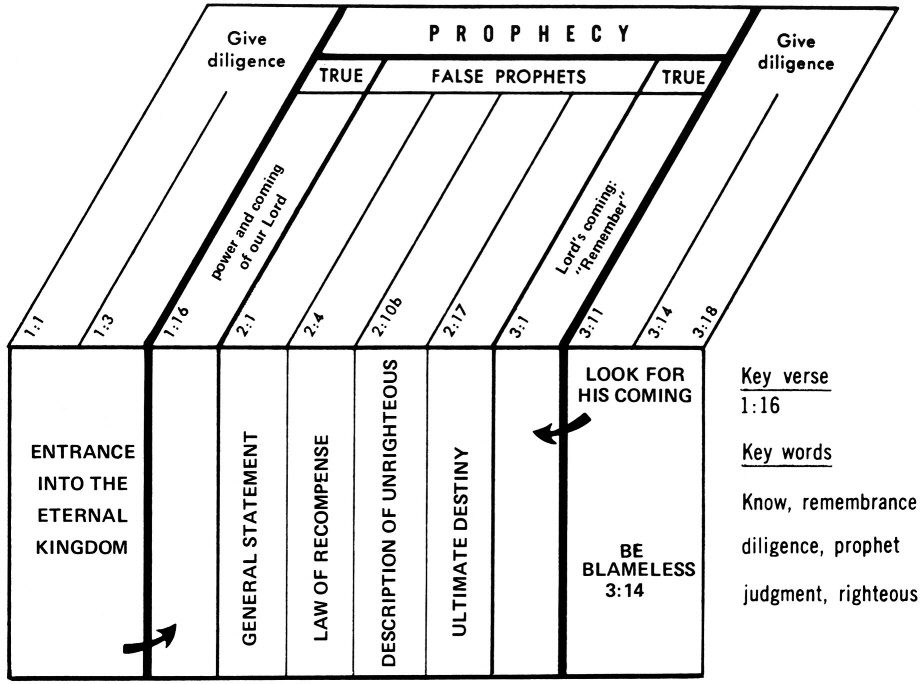
2 Peter: True and False Prophecy
Click chart to enlarge
Chart from Jensen's Survey of the NT - used by permission
|
2 PETER |
||||||||
| Cultivation of Christlike Character |
Condemnation of False Teachers |
Confidence in the Return of Christ |
||||||
| Greeting to Saints 2Pe 1:1-2 |
Growth in Christ 2Pe 1:3-14 |
Grounds |
Danger of |
Demise of |
"Decor" of |
Mockers in |
Manifest |
Maturity in light of that |
| Know Your Salvation |
Know |
Know Your Adversaries |
Know |
|||||
| True Prophecy (True Knowledge) |
False Prophets (False Teachers) |
Final Prophecy (Day of the Lord) |
||||||
| Holiness | Heresy | Hope | ||||||
| Development of Faith |
Denunciation of False Teachers |
Design of The Future |
||||||
2 Peter 1:19 So we have the prophetic word made more sure, to which you do well to pay attention as to a lamp shining in a dark place, until the day dawns and the morning star arises in your hearts. (NASB: Lockman)
Greek: kai echomen (1PPAI) bebaioteron ton prophetikon logon, o kalos poieite (2 PPAI) prosechontes (PAPMPN) os luchno phainonti (PAPMSD) en auchmero topo, eos ou hemera diaugase (3SAAS) kai phosphoros anateile (3SAAS) en tais kardiais humon
Amplified: And we have the prophetic word [made] firmer still. You will do well to pay close attention to it as to a lamp shining in a dismal (squalid and dark) place, until the day breaks through [the gloom] and the Morning Star rises ([10] comes into being) in your hearts. (Amplified Bible - Lockman)
DRB: And we have the more firm prophetical word: whereunto you do well to attend, as to a light that shineth in a dark place, until the day dawn and the day star arise in your hearts.
ESV: And we have something more sure, the prophetic word, to which you will do well to pay attention as to a lamp shining in a dark place, until the day dawns and the morning star rises in your hearts, (ESV)
ISV: Thus we regard the message of the prophets as confirmed beyond doubt, and you will do well to pay attention to it, as to a lamp that is shining in a gloomy place, until the day dawns and the morning star rises in your hearts.
KJV: We have also a more sure word of prophecy; whereunto ye do well that ye take heed, as unto a light that shineth in a dark place, until the day dawn, and the day star arise in your hearts:
NLT: Because of that, we have even greater confidence in the message proclaimed by the prophets. Pay close attention to what they wrote, for their words are like a light shining in a dark place--until the day Christ appears and his brilliant light shines in your hearts. (NLT - Tyndale House)
Phillips: The word of prophecy was fulfilled in our hearing! You should give that word your closest attention, for it shines like a lamp amidst all the dirt and darkness of the world, until the day dawns, and the morning star rises in your hearts. (Phillips: Touchstone)
Wuest: And we have the prophetic word as a surer foundation, to which you are doing well to pay attention, as to a lamp which is shining in a squalid place, until day dawns and a morning star arises in your hearts.
Young's Literal: And we have more firm the prophetic word, to which we do well giving heed, as to a lamp shining in a dark place, till day may dawn, and a morning star may arise -- in your hearts;
AND SO WE HAVE: kai echomen (1PPAI):
- 2 Peter 1 Resources - Multiple Sermons and Commentaries
- 2 Peter 1:19-21 The Solid Foundation - Steven Cole
- 2 Peter 1:19-21 The Sure Word, Part 2 - John MacArthur
- 2 Pe 1:16-21 The Only Sure Word - John Sherwood
Have (2192) (echo) means to have, hold or possess and the present tense indicates that it is a continuous and abiding precious possession of all believers.
The rendering of the NASB translation (as does the ISV - see verses above) tends to suggest that the eyewitness account confirmed the Scriptures. However the literal Greek word order is crucial “And we have more firm the prophetic word.”
This Greek word order supports the interpretation that Peter is ranking Scripture over experience.
The prophetic word (Scripture) in other words is more complete, more permanent, and more authoritative than the experiences of anyone, even the experience of the Transfiguration, as grand as that must have been. The Word of God is a more reliable verification of the teachings about the Person, atonement, and second coming of Christ than even the genuine first hand experiences of the apostles themselves! How privileged we are today to have the full revelation of God in His holy word. Oh, how we should seek with all our heart to love His law and meditate on it all the day long (Ps 119:97-note). Remember that it is filled with God's precious and magnificent promises!.
Vincent explains the 2 possible ways to interpret this verse "We may explain either (a) as Revised, we have the word of prophecy made more sure, i.e., we are better certified than before as to the prophetic word by reason of this voice; or (b) we have the word of prophecy as a surer confirmation of God’s truth than what we ourselves saw, i.e., Old-Testament testimony is more convincing than even the voice heard at the transfiguration. The latter seems to accord better with the words which follow" (Bolding added)
Interestingly A T Robertson tends to favor Vincent's first explanation. I would agree with Vincent rather than Robertson for the context (specifically the next two verses 2Pe 1:20, 21) favors the latter. Why? Because Peter goes on to speak of that which makes the OT scriptures unmistakably reliable, specifically their divine inspiration which emphasizes the sure, trustworthy origin of the prophetic word. In short, as valid as Peter's experience was, the written Word of God is more sure as testified to by numerous passages…
Every word of God is tested. He is a shield to those who take refuge in Him. (Pr 30:5)
The words of the LORD are pure words; as silver tried in a furnace on the earth, refined seven times. (Ps 12:6-note)
The law of the LORD is perfect, restoring the soul;
The testimony of the LORD is sure, making wise the simple.
The precepts of the LORD are right, rejoicing the heart;
The commandment of the LORD is pure, enlightening the eyes.
The fear of the LORD is clean, enduring forever;
The judgments of the LORD are true; they are righteous altogether. (Ps 19:7-note, Ps 19:8-note, Ps 19:9-note)
THE PROPHETIC WORD [MADE] MORE SURE: bebaioteron ton prophetikon logon:
- Ps 19:7-9; Isa 8:20; 41:23;41:26 Lk 16:29, 30, 31; Jn 5:39; Acts 17:11
- 2 Peter 1 Resources - Multiple Sermons and Commentaries
- 2 Peter 1:19-21 The Solid Foundation - Steven Cole
- 2 Peter 1:19-21 The Sure Word, Part 2 - John MacArthur
- 2 Pe 1:16-21 The Only Sure Word - John Sherwood
Note that there is no Greek verb for "made", which has been added by the NAS translators. Literally the text reads "more certain the prophetic word".
Prophetic (4397) (prophetikos from pró =before or forth + phemí = tell) means pertaining to a foreteller ("prophetic"). It refers to that which was uttered (and recorded) by the prophets.
Word (3056) (lógos from légō = to speak intelligently source of English "logic, logical") means something said and describes a communication whereby the mind finds expression in words. (Click in depth study of lógos)
The phrase "prophetic word" refers not just to the OT major and minor prophets, but to the entire OT as a whole. Of course, all of the OT was written by “prophets” in the truest sense, since they spoke and wrote God’s Word, which was the task of a prophet, and they looked forward, in some sense, to the coming Messiah. In the Gospels for example we read…
And (Jesus) beginning with Moses and with all the prophets, He explained to them (Cleopas and another follower of Jesus on the road to Emmaus) the things concerning Himself in all the Scriptures (synonymous with the entire Old Testament) (Lk 24:27).
Now He (Jesus after entering through the walls into the room where the 11 disciples were shut in) said to them, "These are My words which I spoke to you while I was still with you, that all things which are written about Me in the Law of Moses and the Prophets and the Psalms must be fulfilled." (Lk 24:44)
(Jesus speaking) "You (Jews) search the Scriptures, because you think that in them you have eternal life; and it is these that bear witness of Me (John 5:39)
Comment: The Lord was speaking of the Old Testament Scriptures, for there was nothing else at that time. These Scriptures are replete with testimonies of the coming Christ. (Click all 52 NT uses of the word Scriptures)
More sure (949) (bebaios) means fixed, sure, certain (known or proven to be true) or to something that can be relied on not to cause disappointment because it is reliable.
The idea in the Greek is
“We have the prophetic word as a surer foundation than even the signs and wonders which we have seen."
Peter is saying that…
"Here is the second line of evidence to give you confidence in what I have been saying."
Bebaios has the special nuance (taken from the commercial world) of what is legally guaranteed and is found frequently in the papyri of the settlement of a business transaction. Paul has a parallel thought
For whatever was written in earlier times was written for our instruction, so that (term of purpose or result) through perseverance and the encouragement of the Scriptures we might have hope." (Ro 15:4-note).
Morris summarizes this section writing that…
As sure as Peter was of what he had seen and heard, this was only his own experience and could only be given as a personal testimony to others. Thus, he stressed that God's written Word, available to all in the holy Scriptures, was more sure than any personal experience he or others might have. It is not in Peter or Paul as men, no matter how sincere or holy they may be, that we must trust, but in Christ as revealed (not in our experience, either) in God's written Word. (Morris, Henry: Defenders Study Bible - Online Notes)
Click for an in depth analysis of the translation/interpretation of this verse.
TO WHICH YOU DO WELL TO PAY ATTENTION: o kalos poieite (2 PPAI) prosechontes (PAPMPN):
- You do well - Ac 15:29 Jas 2:8 3Jn 1:6
- 2 Peter 1 Resources - Multiple Sermons and Commentaries
- 2 Peter 1:19-21 The Solid Foundation - Steven Cole
- 2 Peter 1:19-21 The Sure Word, Part 2 - John MacArthur
- 2 Pe 1:16-21 The Only Sure Word - John Sherwood
“You do well” was a common way of suggesting that a person do something (i.e., “You ought to do this”).
Peter is saying that this is the appropriate attitude a believer should have to the prophetic word. He desires their continued study of Scripture as the safeguard against errors of the false teachers in chapter 2.
To pay attention (4337) (prosecho from pros = toward + echo = have or hold) means to hold the mind or the ear toward something and so to pay attention.
In non-biblical writings the primary meaning of prosecho was to "have in close proximity to" especially referring to mental processes as in the saying ‘turn one’s mind to.’ Such a person would be in a state of alert.
Prosecho was also a nautical term meaning to hold a ship in a direction, to sail towards. Thus Peter is saying in a sense to hold your course toward your final destination. To keep holding your mind like a lamp in a dark stormy night on the glimmer of the distant lighthouse which keeps the ship on course so that it doesn't crash. Peter was warning believers that since they would be exposed to false teachers, they must pay careful attention to Scripture.
In today’s experience oriented society many people, including Christians, seek to determine truth by the way God has worked in their own lives. But for Peter the splendor of his experience of the transfiguration faded as he spoke of the surety of the written revelation of the prophets. It is an amazing assessment of the validity of holy Scripture that Peter declares it to be more dependable than a voice from heaven heard with the natural ear.
As an aside, if you have never studied the Bible inductively or you are uncertain of the meaning of inductive study, you might take a moment and read the overview tutorial entitled Inductive Bible Study.
Peter was saying you will do well if you make it a habit (present tense = lifestyle) to keep before your mind the living and active Word of Truth which in the context of this letter would expose the error of false teachers.
AS TO A LAMP SHINING : os luchno phainonti (PAPMSD) :
- a lamp shining - Ps 119:105 Pr 6:23 Isa 9:2 60:1,2 Mt 4:16 Lu 1:78,79 Joh 1:7-9 5:35 8:12 Eph 5:7,8
- 2 Peter 1 Resources - Multiple Sermons and Commentaries
- 2 Peter 1:19-21 The Solid Foundation - Steven Cole
- 2 Peter 1:19-21 The Sure Word, Part 2 - John MacArthur
- 2 Pe 1:16-21 The Only Sure Word - John Sherwood
Related Resource: The following passages are some great cross references. Hold your pointer over each or click to read in context. They will make you want to bless the LORD from the depths of your soul - Isa 9:2; 60:1,2; Mt 4:16; Lk 1:78,79; Jn 1:7,8;9 5:35; 8:12; Ep 5:7,8
Lamp (3088) (luchnos/lychnos) literally refers to a portable lamp fed with oil and not to a candle. The lamp was usually placed on a stand in the house. A number of the uses of luchnos (as in the present passage) are figurative or metaphorical (see below).
Thayer…
(from Homer down); “a lamp, candle”, that is placed on a stand or candlestick (Latin candelabrum): Mt 5:15; Mark 4:21; Lk 11:36; Lk 12:35; Rev 22:5; phos luchnon, Rev 18:23; opposed to phos luchiou Rev 22:5; aptein luchnou (Lk 8:16; 11:33; 15:8).
To a “lamp” are likened —
(1) the eye, which shows the body which way to move and turn, Mt 6:22; Lk 11:34
(2) the prophecies of the OT, inasmuch as they afforded at least some knowledge relative to the glorious return of Jesus from heaven down even to the time when by the Holy Spirit that same light, like the day and the daystar, shone upon the hearts of men, the light by which the prophets themselves had been enlightened and which was necessary to the full perception of the true meaning of their prophecies, 2Pe 1:19;
(3) to the brightness of a lamp that cheers the beholders a teacher is compared, whom even those rejoiced in who were unwilling to comply with his demands, John 5:35;
(4) Christ, who will hereafter illumine his followers, the citizens of the heavenly kingdom, with his own glory, Revelation 21:23.
TDNT - The luchnos is a lamp, originally an open bowl, then a closed lamp in various forms, usually put on a stand to give better light, the luchnía being the stand. Both words are common in the Septuagint (LXX) (cf. the seven-branched candelabra, a luchnía with seven luchnoi). The lamp is a common metaphor in the OT. It denotes length of life (2Sa 21:17), the source of divine help (Job 29:3), and the law (Ps 119:105). The lamp of the wicked will be put out (Job 18:6).
Luchnos - 27x in the LXX -
Ex 25:37; 27:20; 30:7f; 37:20, 23; 39:37; 40:4, 25; Lev 24:2, 4; Num 4:9; 8:2f; 1 Sam 3:3; 2 Sam 21:17; 22:29; 1 Kgs 7:49; 2 Kgs 8:19; 1 Chr 28:15; 2 Chr 4:20f; 13:11; 21:7; 29:7; Job 18:6; 21:17; 29:3; Ps 18:28; 119:105; 132:17; Pr 6:23; 31:18; Jer 25:10; Dan 5:1; Zeph 1:12; Zech 4:2.
Here are two figurative uses of luchnos…
Thy word is a lamp (luchnos) to my feet, and a light to my path. (Ps 119:105-note)
Spurgeon: Thy word is a lamp unto my feet. We are walkers through the city of this world, and we are often called to go out into its darkness; let us never venture there without the light giving word, lest we slip with our feet. Each man should use the word of God personally, practically, and habitually, that he may see his way and see what lies in it. When darkness settles down upon all around me, the word of the Lord, like a flaming torch, reveals my way. Having no fixed lamps in eastern towns, in old time each passenger carried a lantern with him that he might not fall into the open sewer, or stumble over the heaps of ordure which defiled the road. This is a true picture of our path through this dark world: we should not know the way, or how to walk in it, if Scripture, like a blazing flambeau, did not reveal it. One of the most practical benefits of Holy Writ is guidance in the acts of daily life: it is not sent to astound us with its brilliance, but to guide us by its instruction. It is true the head needs illumination, but even more the feet need direction, else head and feet may both fall into a ditch. Happy is the man who personally appropriates God's word, and practically uses it as his comfort and counselor, -- a lamp to his own feet.
For the commandment is a lamp (luchnos), and the teaching is light; and reproofs for discipline are the way of life (Pr 6:23)
Luchnos - 14x in 14v in the NT in the NAS - lamp(13), lamps(1).
Matthew 5:15-note nor does anyone light a lamp and put it under a basket, but on the lampstand, and it gives light to all who are in the house.
Comment: In context the light of the lamp is compared to the light of one's life, which for believers is to shine forth so that the spiritually dark world can see the light of the world in us the (only) hope for (future) glory.
Matthew 6:22-note "The eye is the lamp of the body; so then if your eye is clear, your whole body will be full of light.
Comment: Clearly figurative (metaphorical) use comparing to the eye which admits light and which enables understanding (as the brain processes that which the eye lets in).
Mark 4:21 And He was saying to them, "A lamp is not brought to be put under a basket, is it, or under a bed? Is it not brought to be put on the lampstand?
Luke 8:16 "Now no one after lighting a lamp covers it over with a container, or puts it under a bed; but he puts it on a lampstand, so that those who come in may see the light.
Luke 11:33 "No one, after lighting a lamp, puts it away in a cellar nor under a basket, but on the lampstand, so that those who enter may see the light. 34 "The eye is the lamp of your body; when your eye is clear, your whole body also is full of light; but when it is bad, your body also is full of darkness… 36 "If therefore your whole body is full of light, with no dark part in it, it will be wholly illumined, as when the lamp illumines you with its rays."
Luke 12:35 Be (present imperative = The "Captain's" [Jesus'] Command to make it your habitual practice to be… ) dressed in readiness, and keep your lamps lit.
Comment: Figurative use of lamps - The idea is that the servant of Christ is to be about his Master’s business until He returns. Be active. Be diligent. Be filled with the Spirit. Live in constant expectancy of our Bridegroom's return, our Lord's Second Coming which is always imminent! Be watchful about the future. Although you are in the present, determine to keep living in "the future tense" (so to speak), for if you are it will be more difficult for the the world, the flesh and the devil to ensnare you, dear child of the Living God!
Note: "Your" is placed near the beginning of the sentence for emphasis = emphasize our personal responsibility to choose to be ready! Whatever others do, YOU stay dressed and keep your lamps lit!
Compare some interesting parallel passages - Ex 27:20, 21; Lev 24:2; Ps 18:28
Barnes: Be ready at all times to leave the world and enter into rest, when your Lord shall call you. Let every obstacle be out of the way; let every earthly care be removed, and be prepared to follow him into his rest. Servants were expected to be ready for the coming of their lord. If in the night, they were expected to keep their lights trimmed and burning.
Wiersbe: Jewish weddings were held at night (Ed: Thus the need for lamps), and a bridegroom’s servants would have to wait for their master to come home with his bride. The new husband would certainly not want to be kept waiting at the door with his bride! But the servants had to be sure they were ready to go to work, with their robes tucked under their girdles so they were free to move (see 1Pe 1:13, 14, 15-note). But the remarkable thing in this story is that the master serves the servants! In Jewish weddings, the bride was treated like a queen and the groom like a king; so you would not expect the “king” to minister to his staff. Our King will minister to His faithful servants when He greets us at His return, and He will reward us for our faithfulness. (Wiersbe, W: Bible Exposition Commentary - New Testament. 1989. Victor)
Luke 15:8 "Or what woman, if she has ten silver coins and loses one coin, does not light a lamp and sweep the house and search carefully until she finds it?
John 5:35 "He was the lamp that was burning and was shining and you were willing to rejoice for a while in his light.
Comment: Metaphorical description of John the Baptist! Application - Are you a "lamp" (living forth and even speaking forth the Word of Truth and Life) in the spiritual darkness of this world whether that is your home, your school, your business, etc? Let your light shine like John the Baptist!
2Pe 1:19 So we have the prophetic word made more sure, to which you do well to pay attention as to a lamp shining in a dark place, until the day dawns and the morning star arises in your hearts.
Comment: The prophetic word (prophecy is not just that which is spoken before but also that which is spoken forth - so here the reference is not just to OT prophecies of things to come but by extension refers to all of the recorded "spoken" forth words of God) is able to give spiritual understanding to those whose mind is opened by the Spirit.
Revelation 18:23-note and the light of a lamp will not shine in you any longer; and the voice of the bridegroom and bride will not be heard in you any longer; for your merchants were the great men of the earth, because all the nations were deceived by your sorcery.
Revelation 21:23-note And the city has no need of the sun or of the moon to shine on it, for the glory of God has illumined it, and its lamp is the Lamb.
Revelation 22:5-note And there will no longer be any night; and they will not have need of the light of a lamp nor the light of the sun, because the Lord God will illumine them; and they will reign forever and ever.
Shining (5316) (phaino) means to illuminate, give light, shine forth as a luminous body. Shining is present tense (continuous action) which pictures the OT prophetic "lamp" as still shedding its light. The lamp that is shining brightly is the Old Testament, which in the NT is usually indicated by the term "Scriptures [word study]". (Click all 52 uses of the term "Scriptures "used as a synonym of a part or all of the Old Testament)
IN A DARK PLACE: en auchmero topo:
- 2 Peter 1 Resources - Multiple Sermons and Commentaries
- 2 Peter 1:19-21 The Solid Foundation - Steven Cole
- 2 Peter 1:19-21 The Sure Word, Part 2 - John MacArthur
- 2 Pe 1:16-21 The Only Sure Word - John Sherwood
Related Resource:
- Torrey's topic "Spiritual Blindness"
- What is spiritual blindness?
Place (5117) (topos) means an area of any size (space, place, room), a defined place, the present use being in a geographical or topographical sense, such as a place, a part of a country or even the entire world. Peter combines this word with the adjective below to describe the murky darkness of the fallen world which obscures the truth until the lamp of divine revelation shines forth.
Dark (850) (auchmeros from auchmós = drought produced by excessive heat, dust as in a place where water is evaporated by drought) means dry, without rain parched. The idea is obscure or murky (murky = characterized by a heavy dimness or obscurity caused by or like that caused by overhanging fog or smoke), dismal, dark, squalid (squalid = marked by filthiness and degradation from neglect or poverty and implies sordidness as well as baseness and dirtiness).
Auchmeros pertains to being not only dark, but also dirty and miserable
Auchmeros is used only here in the NT and is not found in the Septuagint (LXX).
Auchmeros does not imply absolute darkness, but that which is dingy, dirty, dusty and filthy as a result of neglect. Dirty things are things devoid of brightness. The light of the (prophetic) lamp exposes the squalid state of the spiritually dark world.
The New Testament writers records that…
the light shines in the darkness, and the darkness did not comprehend (or overcome) it. (John 1:5)
"And this is the judgment, that the light is come into the world, and men loved the darkness rather than the light; for their deeds were evil. For everyone who does evil hates the light, and does not come to the light, lest his deeds should be exposed. But he who practices the truth comes to the light, that his deeds may be manifested as having been wrought in God." (John 3:19, 20, 21)
(Jesus instructed Paul to take the Word of the Gospel to the Gentiles) "to open their eyes so that they may turn from darkness to light and from the dominion of Satan to God, in order that they may receive forgiveness of sins and an inheritance among those who have been sanctified by faith in Me." (Acts 26:18)
(Paul explained to the Colossians that the Gospel of Jesus Christ, the Living Word) "delivered us from the domain (authority and power) of darkness, and transferred us to the kingdom of His beloved Son," (Colossians 1:13-note)
Peter does not specifically identify the "dark place" and commentators have advanced several interpretations. It seems most natural however to view this dark place as the world as it presently exists.
The NT frequently refers to the present darkness of this world as shown in these passages…
(Paul explains that) our struggle is not against flesh and blood, but against the rulers, against the powers, against the world forces of this darkness, against the spiritual forces of wickedness in the heavenly places. (Eph 6:12-note)
(Paul explains to the saints at Thessalonica that) "you, brethren, are not in darkness, that the day should overtake you like a thief; for you are all sons of light and sons of day. We are not of night nor of darkness" (1Th 5:4ff-note)
(John explains that) On the other hand, I am writing a new commandment to you, which is true in Him and in you, because the darkness is passing away, and the true light is already shining. (1Jn 2:8)
To summarize, Peter is almost certainly using "dark place" as a metaphor to describe this corrupt world system. However "advanced" our secular civilization becomes, this world in its willful rebellion to God (Whose essence is Light), lies in the darkness of sin, ignorance, despair and death which keeps people from seeing God's truth until His light shines into their hearts.
Vincent on a dark place - A peculiar expression. Lit., a dry place. Only here in New Testament. Rev. gives squalid, in margin. Aristotle opposes it to bright or glistering. It is a subtle association of the idea of darkness with squalor, dryness, and general neglect.
Wiersbe adds that the Greek word auchmeros "is the picture of a dank cellar or a dismal swamp. Human history began in a lovely Garden, but that Garden today is a murky swamp. What you see when you look at this world system is an indication of the spiritual condition of your heart. We still see beauty in God’s creation, but we see no beauty in what mankind is doing with God’s creation. Peter did not see this world as a Garden of Eden, nor should we."
UNTIL THE DAY DAWNS: eos ou hemera diaugase (3SAAS):
- The day dawns - 2Co 4:4-6 1Jn 5:10
- 2 Peter 1 Resources - Multiple Sermons and Commentaries
- 2 Peter 1:19-21 The Solid Foundation - Steven Cole
- 2 Peter 1:19-21 The Sure Word, Part 2 - John MacArthur
- 2 Pe 1:16-21 The Only Sure Word - John Sherwood
Dawns (1306) (diaugazo from diá = through + augázo = shine) means literally to shine through. This word was used to describe daylight breaking through the darkness of night, picturing the first gleams of the sun piercing the darkness.
The day Peter is referring to here is when Christ returns in glory to establish His 1000 Messianic Kingdom. (See notes on The Millennium 1, The Millennium 2, The Millennium 3)
Vincent adds that "the verb (diaugazo) is compounded of dia = through, and auge = sunlight, thus carrying the picture of light breaking through the gloom."
Diligent use of the prophetic lamp will be needed only until the day dawns. The word "until" indicates that we are now in the period of waiting, at the end of which prophecy upon its fulfillment will pass away as taught by Paul (1Cor 13:8-note). In other words, the truths in the Bible will continue to point to the source of all truth, Christ, until He returns in glory (At His Second Coming recorded in Revelation 19:13-note John records that Christ is "clothed with a robe dipped in blood; and His name is called The Word of God.")
AND THE MORNING STAR ARISES IN YOUR HEARTS: kai phosphoros anateile (3SAAS) en tais kardiais humon :
- Morning star arises - Rev 2:28 Rev 22:16
- 2 Peter 1 Resources - Multiple Sermons and Commentaries
- 2 Peter 1:19-21 The Solid Foundation - Steven Cole
- 2 Peter 1:19-21 The Sure Word, Part 2 - John MacArthur
- 2 Pe 1:16-21 The Only Sure Word - John Sherwood
LOOKING FOR THE
BRIGHT MORNING STAR
Morning Star (KJV = Day-star) (5459) (phosphoros from phos = light + phero = to bring; English = phosphorus = a substance that glows in the dark) means light bringing, light bearer or bringer or bringing morning light.
The Latin Vulgate translates "phosphoros" with the word "Lucifer".
The day-star or morning-star was the name that Greeks assigned to the planet Venus which was the brightest object in the sky apart from the sun and moon and appeared sometimes as the evening star and sometimes as the morning star. In the desert the morning star is so brilliant that it appears as though the sun were about to rise.
Vine adds that phosphoros "is used of the morning star, as the light–bringer, 2 Pet. 1:19, where it indicates the arising of the light of Christ as the Personal fulfilment, in the hearts of believers, of the prophetic Scriptures concerning His Coming to receive them to Himself. (Vine, W E: Vine's Complete Expository Dictionary of Old and New Testament Words. 1996. Nelson)
In the context these images (day dawning and morning star arising) point to the parousia or the appearing of Jesus Christ.
Consider the following parallel passages…
Because of the tender mercy of our God, with which the Sunrise (KJV = Dayspring = Messiah) from on high shall visit us, TO SHINE UPON THOSE WHO SIT IN DARKNESS AND THE SHADOW OF DEATH, to guide our feet into the way of peace." (Lk 1:78+)
Comment: This was partially fulfilled at Messiah's first coming but will be fulfilled at His return, His light driving away the spiritual darkness of this present evil age
"I, Jesus, have sent My angel to testify to you these things for the churches. I am the root and the offspring of David, the bright morning star." (Rev 22:16+).
Comment: Many evangelical commentators feel that Isaiah 14:12 is a reference to Satan. In that verse the Hebrew and the Greek Septuagint (Hebrew = heylel = Strong's # 1966 ; LXX translates it with the Greek word heosphoros = bringer of morn, the morning star) are translated Lucifer meaning "light bearer" who represents the counterfeit morning star. Here in the Revelation 22:16, Christ triumphantly proclaims that He is the true "Morning Star". And so we see the final conquest of the counterfeit, the serpent of old, just as was prophesied in the promise in Genesis 3:15 where Moses recorded that the Seed of the woman would crush the head of the serpent. Hallelujah!
and then (at the end of the Great Tribulation) the sign of the Son of Man (the sign = the glory of Christ) will appear in the sky, and then all the tribes of the earth will mourn, and they will see the SON OF MAN COMING ON THE CLOUDS OF THE SKY with power and great glory (the fulfillment of the Shekinah glory described in Genesis) (Mt 24:30+)
(Jesus declares that to those who overcome = those who believe as shown by 1John 5:4-5+) 'I will give him the morning star" (Revelation 2:28) (Comment: Christ will give His Own presence to His people, cf 1Th 4:16+, 1Th 4:17+)
Much as a lamp at night anticipates and is outshined by the bright morning star, so Old Testament prophecy looks ahead to the coming of Christ “the bright Morning Star” Who will outshine all things.
Christians today have the light of Christ within their hearts. At Christ's Second Coming, He will bring all believers into a perfect day. His outward coming will bring light to all people. On this day, the spirits of the godly will take on “an illuminating transformation” as the light of Christ fills them.
Arises (393) (anatello from aná = up + téllo = set out for a goal) means to cause to arise, spring up, be up. It was used especially of things in natural creation, like the rising of the sun or moon.
Hearts (2588) (kardia) is not used to refer literally to the physical heart in the NT but describes the seat of the desires, feelings, affections, passions, impulses. Kardia refers to the causative source of a person’s psychological life in its various aspects, and with special emphasis upon thoughts—‘heart, inner self, mind.' "Heart" refers to the the volition (your will), the mind, the desires, etc., though the facility of the intellect may be slightly more emphasized in Scripture. In Hebraic thought the heart is the center of intellectual activity.
John MacArthur comments on kardia noting that…Throughout Scripture, as well as in many languages and cultures throughout the world, the heart is used metaphorically to represent the inner person, the seat of motives and attitudes, the center of personality. But in Scripture it represents much more than emotion, feelings. It also includes the thinking process and particularly the will. In Proverbs we are told, “As [a man] thinketh in his heart, so is he” (Pr 23:7, KJV). Jesus asked a group of scribes, “Why are you thinking evil in your hearts?” (Mt 9:4; cf. Mk 2:8; 7:21)… The heart is the control center of mind and will as well as emotion… The problem that caused God to destroy the earth in the Flood was a heart problem. “Then the Lord saw that the wickedness of man was great on the earth, and that every intent of the thoughts of his heart was only evil continually” (Gen. 6:5)… God has always been concerned above all else with the inside of man, with the condition of his heart." ( MacArthur, J: Matthew 1-7 Chicago: Moody Press)
The second coming of Christ will have not only an externally transforming impact on the universe (2Pe 3:7, 8, 3:9, 10, 11, 12, 13-See notes 2Pe 3:7-8, 3:9, 10, 11-13), but also an internally transforming impact (in your hearts) on those believers who are alive when Jesus returns, forever removing any of their remaining doubts. The perfect, albeit limited, revelation of the Scriptures will be replaced with the perfect and complete revelation of Jesus Christ at the second coming (Jn 14:7, 8, 9, 10, 11; 21:25). Then the Scriptures will have been fulfilled and believers, will be made like Christ, John recording this encouraging truth…
Beloved, now we are children of God, and it has not appeared as yet what we shall be. We know that, when He appears, we shall be like Him, because we shall see Him just as He is. And everyone who has this hope fixed on Him purifies himself, just as He is pure. (1Jn 3:1-note, 1Jn 3:2-note)
At that time believers will have perfect knowledge and all prophecy will be abolished
for now we see in a mirror dimly, but then face to face; now (we) know in part, but then (we) will know fully just as (we) also have been fully known. (1Cor 13:14)
Hiebert has an interesting comment on the somewhat difficult to interpret phrase "in your hearts" writing that "The truth that Christ is coming again must first arise in their hearts, like the morning star, giving assurance of coming day. Assured of His anticipated return, they will be alert to detect the gleams of dawn breaking through the darkness. Those who disregard the light of prophecy will not understand the significance of these harbingers of coming day. Such a living hope must have a transforming impact upon daily life. (See related article - Vertical Vision Empowers Horizontal Living)
2 Peter 1:20 But know this first of all, that no * prophecy of Scripture is a matter of one's own interpretation, (NASB: Lockman)
Greek: touto proton ginoskontes, (PAPMPN) hoti pasa propheteia graphes idias epiluseos ou ginetai; (3SPMI)
Amplified: [Yet] first [you must] understand this, that no prophecy of Scripture is [a matter] of any personal or private or special interpretation (loosening, solving). (Amplified Bible - Lockman)
KJV: Knowing this first, that no prophecy of the scripture is of any private interpretation.
NLT: Above all, you must understand that no prophecy in Scripture ever came from the prophets themselves (NLT - Tyndale House)
Wuest: Knowing this first, that every prophecy of scripture is not of a particular or limited meaning.
Young's Literal: this first knowing, that no prophecy of the Writing doth come of private exposition,
BUT KNOW THIS FIRST OF ALL: touto proton ginoskontes (PAPMPN):
- 2Pe 3:3 Ro 6:6 13:11 1Ti 1:9 Jas 1:3
- 2 Peter 1 Resources - Multiple Sermons and Commentaries
- 2 Peter 1:19-21 The Solid Foundation - Steven Cole
- 2 Peter 1:19-21 The Sure Word, Part 2 - John MacArthur
- 2 Pe 1:16-21 The Only Sure Word - John Sherwood
First of all (4413) (proton) means first in in time, place, order or importance. This is of primary importance (and it is placed first in the Greek sentence for emphasis). The upshot is that what Peter is going to say is very important! Recognition that Scripture is not of human origin is an absolute priority!
But introduces a contrast with those who spoke moved by the Holy Spirit (1:21). Literally the Greek says "this first knowing".
Know (1097) (ginosko) refers to the act of acquiring by experience rather than intuitively. The basic meaning of ginosko indicates the taking in knowledge in regard to something or someone. The knowledge however in ginosko goes beyond the merely factual. By extension, ginosko frequently was used of a special relationship between the person who knows and the object of the knowledge. For example, in certain contexts ginosko even referred to the intimate relationship between husband and wife and between God and His people.
There is a process in getting spiritual knowledge and it primarily involves obedience to the Word of God. As I obey the truth I have heard (choosing to deny my flesh choosing God's way regardless of the cost), I began to "assimilate" that truth. This principle was taught by Jesus Who plainly stated that…
"If anyone is willing to DO His will, he will KNOW (ginosko) of the teaching, whether it is of God or whether I speak from Myself." (Jn 7:17)
Do you see the link Jesus establishes between "doing" and "knowing"? As this truth becomes an experiential part of my thinking, the product is gnosis and the process of is ginosko. Like Wayne Barber likes to say, most of us want the final product "spiritual gnosis" but not many of us want to walk through the sometimes painful process of ginosko to obtain the gnosis. If this explanation confuses you like it did me when I first heard this teaching, persevere and I think you will see that this principle is Biblical.
THAT NO PROPHECY OF SCRIPTURE IS OF ONE'S OWN INTERPRETATION: hoti pasa propheteia graphes idias epiluseos ou ginetai; (3SPMI):
- 2 Peter 1 Resources - Multiple Sermons and Commentaries
- 2 Peter 1:19-21 The Solid Foundation - Steven Cole
- 2 Peter 1:19-21 The Sure Word, Part 2 - John MacArthur
- 2 Pe 1:16-21 The Only Sure Word - John Sherwood
No is the Greek word (ou) that conveys absolute negation.
Scripture (1124)(see in depth study of graphe) refers to the Word of God inspired by His Spirit and communicated to and through men who recorded His Word for us to read.
The verb "is" (1096) (ginomai = to cause to become become or to come into existence) means to come into existence or to originate.
Peter's point is that absolutely no portion of Scripture came into existence based on the prophet's own ideas or thoughts, as was the case of false prophecies. Peter is saying in essence what a man thinks or wants has absolutely nothing to do with divine prophecy. When the prophets sat down to write, they did not give their own thoughts on events or their own conclusions.
Much of the confusion on this passage originates from the word "interpretation" which is misleading because that word normally refers to how one understands a passage. Peter however (as explained more below) is not referring to the explanation of Scripture but to the origin of Scripture!
The NKJV has the word "origin" in its marginal note referring to the word "interpretation" which is retained in the translation.
Some of the "interpretations" of this passage are ridiculous, such as the view that right to interpret of Scripture belongs to the church and that individuals should not study it!
Other interpretation by commentaries I highly respect are somewhat askew on this particular verse. Thus J Vernon McGee (who I highly recommend otherwise) writes that…
What Peter is saying here is that no portion of the Scripture is to be interpreted apart from other references to the same subject. (McGee, J V: Thru the Bible Commentary: Nashville: Thomas Nelson)
Dr McGee's explanation is a true statement and a vital exercise to assure accurate interpretation of Scripture (Scripture being the best commentary on Scripture) but that is not the meaning of 2 Peter 1:20 as shown by the immediate context (see below).
Similarly the Ryrie Study Bible offers this explanation of 2 Peter 1:20 writing that…
Several meanings are possible: (1) prophecies must be interpreted in the light of other Scriptures; (2) prophecies are often capable of several fulfillments; (3) prophecies must be interpreted only with God's help, since they were given only as the prophets were moved by God and not by any impulse of man. (The Ryrie Study Bible: New American Standard Translation: 1995. Moody Publishers)
Again, while these 3 statements are true, they are not what Peter is saying in this verse for all three focus on the idea of "interpretation". To reiterate, Peter is not teaching us about how the Bible is to be interpreted but how the Scriptures originated.
Prophecy (4394) (propheteia from pró = before or forth + phemí = to tell) has the literal meaning of speaking forth, with no connotation of prediction or other supernatural or mystical significance. The gift of prophecy is simply the gift of preaching, of proclaiming the Word of God.
Propheteia is a discourse emanating from divine inspiration and declaring the purposes of God, whether by reproving and admonishing the wicked, or comforting the afflicted, or revealing things hidden; esp. by foretelling future events
Propheteia is not used here in the sense of prediction but in its basic and broader meaning of speaking forth, of proclaiming a message. Peter is referring here to ALL the OT Scriptures.
One's own (2398) (idios) (KJV = "private") basically denotes that which belongs to an individual, in contrast to that which belongs to another. It means pertaining to self, private, properly one’s own.
It was the mark of a false teacher to speak ''his own thing'' or ''from himself''.
Some religious groups have taught that what Peter is teaching is that only certain “spiritual leaders” may interpret Scripture (picking up on the idea of "private") and they have used this verse as their defense. But Peter was not writing about the interpretation of Scripture, but about the origin of Scripture as explained in the next note below.
Interpretation (1955) (epilusis from epi = up + luo = to loose) literally means ''a release", a loosening, an untying, as of hard knots of scripture and denotes a solution, explanation or interpretation.
Epilusis conveys the idea of a “loosing” as if to say no Scripture is the result of any human being privately “untying” and “loosing” the truth. No prophecy came into being through anyone's personal (private) disclosure. No true prophecy springs forth from the private reasoning of the man speaking or writing. The idea is that men did not bring forth or birth the ideas of Scripture. The writers of Scripture did not put their own construction upon the ‘God–breathed’ words they wrote. No prophet is a "self starter" as it were in regard to the writing of God's Word. No one starts a prophecy by himself.
In sum, Peter’s point is not about how to interpret Scripture, but rather how Scripture originated and what its source was.
The false prophets "untied and loosed" their own ideas. But no part of God’s revelation was unveiled or revealed from a human source or out of the prophet’s unaided understanding.
The NLT although a paraphrase accurately conveys the meaning of this verse in context…
"no prophecy in Scripture ever came from the prophets themselves."
As an aside with some practice and attention to the context, one can often use a paraphrase like the NLT (this is my recommendation over other popular versions like the Message as this latter is a very loose translation at best) to help understand or interpret a specific passage. The Amplified Bible also can also function as a virtual "mini" commentary. However, this does take some practice and one needs to be a Berean because sometimes the paraphrases and even the more literal Amplified may be somewhat misleading.
In the present case, the NLT is saying that no message of Scripture was originated and sent forth by men’s own wisdom and will. Rather, the godly men through whom Scripture was revealed and recorded were divinely instructed and carried along by the Holy Spirit (in 2Pe 1:21).
The strongest argument supporting this interpretation is the context. In the next verse (the original Greek did not have verses) Peter begins with "for" introducing the explanation for what he has just stated in (v20) and clearly this explanation speaks to the origin of Holy Scripture, not to a man's interpretation of it. The ultimate source was the Holy Spirit. End of argument. (see related discussion on inspiration of Scripture in notes on 2Timothy 3:16-17).
Morris writes that…
The meaning here is that no true prophecy springs forth from the private reasoning of the man speaking or writing. He may or may not understand the meaning and intent of his writing in terms of his own current situation, but its ultimate meaning involves far more than that. This would especially be true for Messianic predictions (1Pe 1:10, 11, 12-note) but also applies to "all Scripture… given by inspiration of God" (2Ti 3:16, 17-note). (Morris, Henry: Defenders Study Bible. World Publishing)
R. C. Sproul adds that
“Private interpretation never meant that individuals have the right to distort the Scriptures. With the right of private interpretation comes the sober responsibility of accurate interpretation. Private interpretation gives us license to interpret, not to distort.”
Calvin said
''They did not blab their inventions or their own accord or according to their own judgments.''
The false prophets of Jeremiah's day were charged with doing precisely this (Jer 23:16, 17, 21, 22, 25, 26, Ezek 13:3, 4, 5, 6)
Hampton Keathley III comments on this section…
No passage of Scripture tells us as much about the how of inspiration as does this passage in 2 Peter. Though all of 2 Peter 1 does not deal with the how of inspiration, there are four important things that it would be well to note about this first chapter and its context.
First, there is the context and purpose of this passage. Since God has given us all things that pertain to life and godliness through the great and precious promises, i.e., the Word of God, Peter was writing to challenge his readers to diligence in becoming fruitful in their knowledge of the Savior (1:3-11). In other words, faith must not stand still; it must grow. Further, he wanted to remind them and us that our faith does not stand on the shifting sands of man’s cleverly devised fables or human ideas. Rather, it is grounded in the marvelous revelation of God in the Living Word, the Lord Jesus Christ, and in the written Word, the prophetic Word of God to which we do well to pay close attention.
2 Peter 1:12, 13, 14, 15, 16, 17, 18, 19, 20, 21
In the process of setting forth this focus, Peter mentions his personal experience of seeing the majestic glory of the transfiguration of Christ when he heard from heaven, “This is my dear Son, in whom I am delighted” (2Pe 1:16, 17). But He goes on to teach us something that is tremendously important, especially in our day when so much is made regarding personal experiences which often take precedence over Scripture. Note that in verse 19 Peter writes, “Moreover, we possess the prophetic word as an altogether reliable thing. You do well if you pay attention to this…” We need to ask, “More sure than what?” More sure than even his experience of seeing Christ’s transfiguration. Now that which Peter, James, and John saw has become a part of the record of the Word and provides important revelation of the person of Christ. But the point is, our experiences, as bonafide as they may be, never take precedence over the authoritative Word of God because it is more sure, steadfast, and reliable. The Word is our authority and it alone must judge our experiences and determine faith and practice.
The NIV’s translation of 2Pe 1:20 is much closer to the original Greek, more in accord with the preceding and following context, and clearly expresses the truth to be gleaned here. It reads, “Above all, you must understand that no prophecy of Scripture came about by the prophet’s own interpretation.” This simply declares that whatever the prophets wrote or whatever we find in the Word, it was not the product of the author’s own ideas or human opinion. In verses 16-19, the issue being discussed is the source of the apostolic message. Was it human fable, or was it from God? Verse 20 answers the first part of this question. It was not from man. The second part of the question is found in the next verse. Note the connecting and explanatory “For” of 2Pe 1:21.
Verse 21 teaches us that both God and man were involved in the production of the Bible, but in such a way that God was not only the ultimate source, but He both directed the writing and guaranteed the accuracy of the product. The human authors actively spoke God’s Word and they were more than dictation machines, but to insure the accuracy of what was spoken, the human authors were moved and carried along by the Holy Spirit. “Moved” is pheromenoi, a Greek passive participle meaning, “to be carried, be borne along.” This word was used of a ship being carried along by the wind in its sail in Acts 27:15, 17.
Catching the import of this, Ryrie writes:
Though experienced men, the sailors could not guide it so they finally had to let the wind take the ship wherever it blew. In the same manner as that ship was driven, directed, or carried about by the wind, God directed and moved the human writers He used to produce the books of the Bible. Though the wind was the strong force that moved the ship along, the sailors were not asleep and inactive. Similarly, the Holy Spirit was the guiding force that directed the writers who, nevertheless, played their own active roles in writing the Scriptures. (Basic Theology)
This verse, then, teaches us two things regarding the “How” of inspiration: (a) The will of the human authors never directed the writings of the Bible and (b) the Holy Spirit as the ultimate source ensured the accuracy of what they wrote in every way.
The Breadth of Inspiration - 2Pe 1:3, 4 I can pray this because his divine power has bestowed on us everything necessary for life and godliness through the rich knowledge of the one who called us by his own glory and excellence. 4 Through these things he has bestowed on us his precious and most magnificent promises, so that by means of what was promised you may become partakers of the divine nature, after escaping the worldly corruption that is produced by evil desire.
It is clear from 2Pe 1:4 and the reference to “his precious and most magnificent promises” that Peter has the Word of God in view in these two verses. First, there is the declaration that God “has bestowed on us everything necessary for life and godliness.” Second, life and godliness come through the knowledge of God and the Lord Jesus, but such knowledge comes through the Word, the precious promises. In essence then, this points us to the breadth of what God’s Word covers, “everything pertaining to life and godliness.”
While God does not reveal everything that He could reveal, many things He has chosen to keep to Himself (Dt 29:29), the Bible does cover all that man needs for life and godliness through its revelation of God and of Jesus our Lord. We have everything we need, nothing is missing. (The Word-Filled Life Bible.org)
2 Peter 1:21 for no prophecy was ever made by an act of human will, but men moved by the Holy Spirit spoke from God. (NASB: Lockman)
Greek: ou gar thelemati anthropou enechthe (1API) propheteia pote, alla hupo pneumatos hagiou pheromenoi (PPPMPN) elalesan (3PAAI) apo theou anthropoi.
Amplified: For no prophecy ever originated because some man willed it [to do so—it never came by human impulse], but men spoke from God who were borne along (moved and impelled) by the Holy Spirit. (Amplified Bible - Lockman)
KJV: For the prophecy came not in old time by the will of man: but holy men of God spake as they were moved by the Holy Ghost.
NLT: or because they wanted to prophesy. It was the Holy Spirit who moved the prophets to speak from God. (NLT - Tyndale House)
Phillips: No prophecy came because a man wanted it to: men of God spoke because they were inspired by the Holy Spirit. (Phillips: Touchstone)
Wuest: For not by the desire of man did prophecy come aforetime, but being carried along by the Holy Spirit, men spoke from God.
Young's Literal: for not by will of man did ever prophecy come, but by the Holy Spirit borne on holy men of God spake.
FOR NO PROPHECY WAS EVER MADE BY AN ACT OF HUMAN WILL: ou gar thelemati anthropou enechthe (1API) propheteia pote:
- Lk 1:70 2Ti 3:16 1Pe 1:11
- 2 Peter 1 Resources - Multiple Sermons and Commentaries
- 2 Peter 1:19-21 The Solid Foundation - Steven Cole
- 2 Peter 1:19-21 The Sure Word, Part 2 - John MacArthur
- 2 Pe 1:16-21 The Only Sure Word - John Sherwood
Deffinbaugh makes the interesting observation that…
When you look through the New Testament to read the final, parting words of the apostles, you will discover that all of them turn the focus of their readers to the Word of God, not that they have not always done so, but that they do so especially in the light of their absence (see 2Pe 1:19, 20, 21; 2Ti 3:15, 16, 17, 4:2, 3, 4; 1Jn 2:18, 19, 20, 21, 22, 23, 24, 25, 26, 27, 28, 29). (Paul’s Parting Words in Acts 20:1-38) - e.g. see Acts 20:17, 18, 19, 20, 21, 22, 23, 24, 25, 26, Don't miss Acts 20:27, 28, 29, 30, 31 32 = "the Word of His grace"!)
No (3756) (ou) is the Greek word which means absolutely none (i.e., "absolutely no prophecy was ever made… "). Furthermore ou is placed first in the Greek sentence for even greater emphasis. Peter could not have been much clearer! God is the Author of His Word!
Peter explains the previous statement of why no prophet starts a prophecy himself. He is not a self-starter but a "Spirit-supercharged" man.
Ever (4218) (pote ) means at some time or another (past or future) and in this context referring to some time in the past.
Prophecy (4394) (propheteia from pró = before or forth + phemí = to tell, to speak) has the literal meaning of speaking forth, with no connotation of prediction or other supernatural or mystical significance. Propheteia can refer to either spoken or written words.
Related Resources:
- Dictionary Discussion of Prophecy (see esp ISBE Article)
- Baker's Evangelical Dictionary of Biblical Theology - Prophecy
Propheteia is used here in 2Peter 1:20 not primarily in the sense of prediction but in its more basic and broader meaning of speaking forth, of proclaiming a message.
Mounce writes that…
A prophecy can be a prediction about the future, but in the majority of its uses it refers to authoritative speech that has its origin with God. It can refer to prophetic words (Rev 19:10) or activities (11:6).
Propheteia refers to the words of the prophets of the OT (Mt 13:14, 2 Pet. 1:20) and in the NT church (1Co 14:6), where it is seen as a gift of the Holy Spirit (Ro 12:6; 1Co 12:10; 13:2; 14:22, 23, 24, 25).
Prophecy should be respected, but it should also be tested (1Th 5:20, 21; cf. 1Co 14:29, 30, 31, 32). That is, while prophecy carries some authority, it is ultimately subject to the authority of the apostles and their writings. The gift of prophecy may never contradict the authoritative Word of God, such as is found in Revelation (Re 1:3; 22:19). (Mounce's Complete Expository Dictionary of Old & New Testament Words. Grand Rapids, MI: Zondervan or Computer version)
BDAG (summarized)…
1. act of interpreting divine will or purpose, prophetic activity (Re 11:6)
2. 2. the gift of interpreting divine will or purpose, gift of prophesying (Ro 12:6, 1Co 12:10, 13:2, 8, 14:22, 1Th 5:20, Re 19:10)
3. the utterance of one who interprets divine will or purpose, prophecy… a. of OT inspired statement (Mt 13:14, 2Pe 1:20, 21)… b. of inspired statements by Christian prophets… in the form of a prophetic saying (1Co 14:6, 1Th 5:20, 1Ti 1:18, 4:14, Re 1:3) (Arndt, W., Danker, F. W., & Bauer, W. A Greek-English Lexicon of the New Testament and Other Early Christian Literature or Wordsearch)
Liddell-Scott says propheteia is…
the gift of interpreting the will of the gods, Orac. ap. Luc. II. in N.T., the gift of expounding scripture, of speaking and preaching.
UBS says propheteia is…
preaching the message of God, the gift of preaching the message of God; an inspired message or utterance; intelligible preaching, an intelligible message (as opposed to speaking in tongues
Thayer defines propheteia as
discourse emanating from divine inspiration and declaring the purposes of God, whether by reproving and admonishing the wicked, or comforting the afflicted, or revealing things hidden; especially by foretelling future events. Used in the NT
(1) of the utterances of the OT prophets: Mt 13:14; 2Pe 1:20,21
(2) of the prediction of events relating to Christ’s kingdom and its speedy triumph, together with the consolations and admonitions pertaining thereto: Rev 11:6; 22:19; the spirit of prophecy, the divine mind, to which the prophetic faculty is due, Rev 19:10; Rev 1:3; 22:7,10,18;
(3) of the endowment and speech of the Christian teachers called prophetai (see prophetes, II. 1 f.): Ro 12:6; 1Cor 12:10; 13:2; 14:6,22; plural the gifts and utterances of these prophets, 1Co 13:8; 1Th 5:20 specifically, of the prognostication of those achievements which one set apart to teach the gospel will accomplish for the kingdom of Christ, 1Ti 4:14; plural 1Ti 1:18.
Vine writes that…
"Though much of OT prophecy was purely predictive, see Micah 5:2, e.g., and cp. John 11:51, prophecy is not necessarily, nor even primarily, fore-telling. It is the declaration of that which cannot be known by natural means, Mt 26:68, it is the forth-telling of the will of God, whether with reference to the past, the present, or the future, see Ge 20:7; Dt. 18:18; Rev 10:11; Rev 11:3. …
In such passages as 1Co 12:28; Ep 2:20, the 'prophets' are placed after the 'Apostles,' since not the prophets of Israel are intended, but the 'gifts' of the ascended Lord, Ep 4:8, 11; cp. Acts 13:1…the purpose of their ministry was to edify, to comfort, and to encourage the believers, 1Co 14:3, while its effect upon unbelievers was to show that the secrets of a man's heart are known to God, to convict of sin, and to constrain to worship, 1Co 14:24, 25.
With the completion of the canon of Scripture prophecy apparently passed away, 1Co 13:8, 9 (Ed: But see MacArthur below). In his measure the teacher has taken the place of the prophet, cp. the significant change in 2Pe 2:1. The difference is that, whereas the message of the prophet was a direct revelation of the mind of God for the occasion, the message of the teacher is gathered from the completed revelation contained in the Scriptures." (Vine, W E: Vine's Complete Expository Dictionary of Old and New Testament Words. 1996. Nelson)
The gift of prophecy is simply the gift of preaching, of proclaiming the Word of God. God used many Old and New Testament prophets to foretell future events, but that was never an indispensable part of prophetic ministry.
Paul gives perhaps the best definition of the prophetic gift stating that…
one who prophesies speaks to men for edification and exhortation and consolation. (1Co14:3).
Peter’s admonition also applies to that gift when he states…
Whoever speaks, let him speak, as it were, the utterances of God (1Pe 4:11).
John MacArthur notes that the related verb…
propheteuo means to speak forth, to proclaim. It assumes the speaker is before an audience, and could mean “to speak publicly.” The connotation of prediction was added sometime in the Middle Ages. Although many of the prophets made predictions, that was not their basic ministry and the idea is not involved in the original terms used to describe them and their work. The original terms, in fact, did not necessarily carry the idea of revelation. God revealed a great deal of His Word through the prophets, but much of their ministry was simply proclaiming, expounding, and exhorting with revelation already given. The biblical prophets sometimes revealed (see 1Ti 4:14; 2Pe 1:21) and sometimes only reiterated what had already been revealed. A prophet of God, therefore, is simply one who speaks forth God’s Word, and prophecy is the proclaiming of that Word. The gift of prophecy is the Spirit–given and Spirit–empowered ability to proclaim the Word effectively.
Since the completion of Scripture, prophecy has no longer been the means of new revelation, but has only proclaimed what has already been revealed in Scripture.
(MacArthur, J: 1Corinthians. Chicago: Moody Press) (Bolding and color added for emphasis).
NIDNTT writes that…
Prophetes is a noun made up of the stem -phē-, to say, proclaim, which always has a religious connotation, and the prefix pro-, which as a temporal adv. has the meaning of before, in advance. This may suggest the meaning: one who predicts, one who tells beforehand. It appears to be confirmed by the use of prophēmi, to predict, proclaim in advance. However, prophēmi is not found until very late, and so has no value as etymological evidence. Indeed, when one examines the combination of pro- with verbs of speech in earlier writings, it is evident that in no case does the object of the vb. point to the future. (Brown, Colin, Editor. New International Dictionary of NT Theology. 1986. Zondervan)
Propheteia - 19x in 19v - NAS = prophecies(1), prophecy(15), prophesying(1), prophetic utterance(1), prophetic utterances(1).
Matthew 13:14 "In their case the prophecy of Isaiah is being fulfilled, which says, 'YOU WILL KEEP ON HEARING, BUT WILL NOT UNDERSTAND; YOU WILL KEEP ON SEEING, BUT WILL NOT PERCEIVE;
Romans 12:6-note Since we have gifts that differ according to the grace given to us, each of us is to exercise them accordingly: if prophecy, according to the proportion of his faith
Comment: Here propheteia refers to the gift of prophecy which is the Spirit-endowed skill of publicly proclaiming God’s Word. In one sense all believers since their possess the Spirit, are equipped to speak forth the Word of God, but some believers are specifically given the ability to do so as for example in public proclamation and preaching of the gospel. (See also John MacArthur Romans 12:6-7 Ministry of Spiritual Gifts, Part 2 )
1 Corinthians 12:10 and to another the effecting of miracles, and to another prophecy, and to another the distinguishing of spirits, to another various kinds of tongues, and to another the interpretation of tongues.
1 Corinthians 13:2 If I have the gift of prophecy, and know all mysteries and all knowledge; and if I have all faith, so as to remove mountains, but do not have love, I am nothing.
1 Corinthians 13:8 Love never fails; but if there are gifts of prophecy, they will be done away; if there are tongues, they will cease; if there is knowledge, it will be done away.
Comment: Those who feel prophecy was a temporary sign gift base their interpretation primarily on this passage. John MacArthur assumes "that prophecy is a permanent edifying gift." (Commentary on 1Corinthians)
1 Corinthians 14:6 But now, brethren, if I come to you speaking in tongues, what will I profit you unless I speak to you either by way of revelation or of knowledge or of prophecy or of teaching?
1 Corinthians 14:22 So then tongues are for a sign, not to those who believe but to unbelievers; but prophecy is for a sign, not to unbelievers but to those who believe.
1 Thessalonians 5:20-note do not despise prophetic utterances.
Comment: The speaking forth of the truth of God's Word is the primary intent of this passage. Paul is not primarily referring to "new revelation". He knew that prophecy or speaking forth of the Word of Truth (especially sound doctrine) which was already revealed in the Old and New Testaments was essential for the spiritual health of the Body of Christ, thus the command not to look down upon it or despise it! We are seeing a movement in modern Christianity, in which many churches are minimizing the importance of the Bible (it's not "seeker friendly"!) and are in a very practical sense, "despising" prophetic utterances! The modern church desperately needs to read and heed the timeless truth in Jeremiah (Jer 6:16)!
1 Timothy 1:18 This command I entrust to you, Timothy, my son, in accordance with the prophecies previously made concerning you, that by them you fight the good fight,
John MacArthur comments: Timothy had a confirmation to live up to. Timothy’s calling had been confirmed through prophecies. Prophets in the New Testament era spoke the revelation of God’s will to the early church. Prophecy is the gift of proclaiming God’s Word. In one sense, anyone who preaches or teaches God’s Word is a prophet. Unlike present-day teachers and preachers, however, New Testament prophets occasionally received direct revelation from God. While doctrine was the province of the apostles (cf.. Acts 2:42), prophets seem to be the instruments God used to speak of practical issues (cf. Acts 21:10, 11). (MacArthur, John: 1Timothy Moody Press)
1 Timothy 4:14 Do not neglect the spiritual gift within you, which was bestowed on you through prophetic utterance with the laying on of hands by the presbytery.
John MacArthur Comments: There was a public affirmation of his gift through direct revelation from God (cf.. 1Ti 1:18), though the circumstances of that utterance are not given in Scripture. It likely took place, however, shortly after Timothy met Paul on the apostle’s second missionary journey (Acts 16:1, 2, 3). Timothy’s prophetic call was reminiscent of that of Paul himself (cf.. Acts 13:2). In our day, God’s call comes not through special revelation, but through providence. If God wants a man in the ministry, He will give him that desire and open a door of opportunity for him. (MacArthur, John: 1Timothy Moody Press)
God gave that gift to Timothy, and then articulated that gift through the prophecies and then confirmed it by the laying on of hands on Timothy as an act of confirmation by the elders. So the elders laid their hands confirming Timothy to the ministry because God Himself through the voice of the prophets through prophecies had articulated Timothy's ministry. (Fighting the Noble War--Part 2 -- John MacArthur)
2 Peter 1:20 But know this first of all, that no prophecy of Scripture is a matter of one's own interpretation, 21 for no prophecy was ever made by an act of human will, but men moved by the Holy Spirit spoke from God.
Revelation 1:3-note Blessed is he who reads and those who hear the words of the prophecy, and heed the things which are written in it; for the time is near.
Tony Garland comments: This book is not merely an allegory or devotional treatise extolling the eventual victory of good over evil. The events described within this book are bona fide prophecy and include the prediction of actual historical events. (Ref)
Revelation 11:6-note These have the power to shut up the sky, so that rain will not fall during the days of their prophesying; and they have power over the waters to turn them into blood, and to strike the earth with every plague, as often as they desire.
Revelation 19:10-note Then I fell at his feet to worship him. But he said to me, "Do not do that; I am a fellow servant of yours and your brethren who hold the testimony of Jesus; worship God. For the testimony of Jesus is the spirit of prophecy."
Comment: The idea of "spirit of prophecy" is that "Genuine prophecy reports God’s own revelation of Christ and never deviates from Scripture." (MacArthur)
Tony Garland has a lengthy comment on spirit of prophecy: All revelation given by God through His prophets was by the Spirit.
“The Spirit of the LORD spoke by me, and His word was on my tongue” (2S. 23:2).
“But truly I am full of power by the Spirit of the LORD, and of justice and might, to declare to Jacob his transgression and to Israel his sin” (Mic. 3:8).
When Jesus referred to David’s statement in Psalm 110, He said, “How then does David in the Spirit call Him “Lord”?” (Mt 22:43). Peter said, “this Scripture had to be fulfilled, which the Holy Spirit spoke before by the mouth of David concerning Judas” (Acts 1:16).
Jesus said it would be by “the Spirit of truth who proceeds from the Father” that the apostles would receive testimony concerning Him (John 15:26), “He will tell you things to come” (John 16:13).
The NT prophet Agabus “stood up and showed by the Spirit that there as going to be a great famine throughout all the world” (Acts 11:28).
Later, he took Paul’s belt, bound his own hands and feet, and said, “Thus says the Holy Spirit, ‘So shall the Jews at Jerusalem bind the man who owns this belt, and deliver him into the hands of the Gentiles’ ” (Acts 21:11).
Two passages written by Peter, by the power of the Spirit, are of particular importance:
(1Pe. 1:10,11, 12) Peter indicates that it was “the Spirit of Christ who was in” the prophets that testified. Thus, the Spirit of Jesus was the empowering source of their testimony. Yet Peter also indicates that the Spirit “testified beforehand the sufferings of Christ and the glories that would follow.” In other words, the message which the Spirit testified concerned Jesus Christ.
(2Pe 1:19, 20, 21) Peter indicates that all prophecy came by the Spirit. When the prophets spoke, God spoke by His Spirit. They were moved (pheromenoi) by the Holy Spirit. It was not their own will, but God’s initiative which produced their inspired testimony. They were born along by God’s Spirit much like a ship is driven by wind and weather (Acts 27:15). They were not in ultimate control, but were vessels which God moved according to His purpose (John 3:8). (A Testimony of Jesus Christ)
Revelation 22:7-note "And behold, I am coming quickly. Blessed is he who heeds the words of the prophecy of this book."
Tony Garland writes: In order to keep the words of the prophecy of this book, believers must:
1. Guard the text from tampering and corruption.
2. Guard the proper interpretation of the words. “Believers are called to guard or protect the book of Revelation. It must be defended against detractors who deny its relevance, against critics who deny its veracity and authority, as well as against confused interpreters who obscure its meaning.” See Systems of Interpretation..
3. Apply the lessons of the book to their own lives (Lk 6:46; Jn 14:15; 15:10).
4. Promulgate the message of the book to the church and to those who have not heard. (note)
Revelation 22:10-note And he said to me, "Do not seal up the words of the prophecy of this book, for the time is near.
Revelation 22:18-note I testify to everyone who hears the words of the prophecy of this book: if anyone adds to them, God will add to him the plagues which are written in this book;
Revelation 22:19-note and if anyone takes away from the words of the book of this prophecy, God will take away his part from the tree of life and from the holy city, which are written in this book.
There are only 6 uses of propheteia in the Septuagint (LXX) - 2Chr 15:8; 32:32; Ezra 5:1; 6:14; Neh 6:12; Jer 23:31
Ezra 5:1 When the prophets, Haggai the prophet and Zechariah the son of Iddo, prophesied to the Jews who were in Judah and Jerusalem in the name of the God of Israel, who was over them,
Ezra 6:14 And the elders of the Jews were successful in building through the prophesying of Haggai the prophet and Zechariah the son of Iddo. And they finished building according to the command of the God of Israel and the decree of Cyrus, Darius, and Artaxerxes king of Persia.
Nehemiah 6:12 Then I perceived that surely God had not sent him, but he uttered his prophecy against me because Tobiah and Sanballat had hired him.
Jeremiah 23:31 "Behold, I am against the prophets," declares the LORD, "who use their tongues (Lxx translates with propheteia = prophecies) and declare, 'The Lord declares.'
SCRIPTURE:
DIVINE ORIGIN
HUMAN OPERATION
Made (5342) (phero) means to bear, bring forth (see discussion of the second use of phero below)
What was "borne along"? In context phero refers to bearing along or conveying a divine proclamation (prophecy). The bearing along was not the result of men's power but of the Spirit.
Deffinbaugh - Prophets did not originate prophecy; they were instruments of the Holy Spirit who used them to speak from God. Prophecy does not begin with man’s will but with God’s will. Thus, the interpretation of prophecy must not be subject to man’s will. Conversely, man’s will must be subject to the Scriptures, as the Spirit of God makes their meaning clear. (Peter’s Readiness to Remind)
Beloved, don't miss what this verse is saying - Simply stated, Peter is teaching that the Scriptures are inspired by God (cf 2Ti 3:16, 17-note). Stated another way, what Peter is saying (in essence) in 2Peter 1:20, 21 is that one Author guided the Biblical writers through the process of recording His Words with their pens. Indeed, the resulting inarguable unity of the 66 books is another amazing proof of the divine inspiration and authority of the entire Bible! Hallelujah! (See A W Pink's The Divine Inspiration of the Bible)
Will (2307)(thelema [word study] from thelo = to will with the "-ma" suffix indicating the result of the will = "a thing willed") generally speaks of the result of what one has decided. One sees this root word in the feminine name "Thelma." In its most basic form, thelema refers to a wish, a strong desire, and the willing of some event. (Note: See also the discussion of the preceding word boule for comments relating to thelema).
Zodhiates says that thelema is the…
Will, not to be conceived as a demand, but as an expression or inclination of pleasure towards that which is liked, that which pleases and creates joy. When it denotes God's will, it signifies His gracious disposition toward something. Used to designate what God Himself does of His own good pleasure. (Zodhiates, S. The Complete Word Study Dictionary: New Testament. AMG)
Thelema has both an objective meaning (“what one wishes to happen” or what is willed) and a subjective connotation (“the act of willing or desiring”). The word conveys the idea of desire, even a heart’s desire, for the word primarily expresses emotion instead of volition. Thus God’s will is not so much God’s intention, as it is His heart’s desire.
Thelema - 62x in 58v -
Mt 6:10; 7:21; 12:50; 18:14; 21:31; 26:42; Mark 3:35; Luke 12:47; 22:42; 23:25; Jn 1:13; 4:34; 5:30; 6:38, 39, 40; 7:17; 9:31; Acts 13:22; 21:14; 22:14; Ro 1:10-note; Ro 2:18-note; Ro 12:2-note; Ro 15:32-note; 1Cor 1:1; 7:37; 16:12; 2Cor 1:1; 8:5; Gal 1:4; Ep 1:1-note, Ep 1:5-note, Ep 1:9-note, Ep 1:11-note; Ep 2:3-note; Ep 5:17-note; Ep 6:6-note; Col 1:1-note, Col 1:9-note; Col 4:12-note; 1Th 4:3-note; 1Th 5:18-note; 2Ti 1:1-note; 2Ti 2:26-note; He 10:7-note, He 10:9-note, He 10:10-note, He 10:36-note; He 13:21-note; 1Pe 2:15-note; 1Pe 3:17-note; 1Pe 4:2-note, 1Pe 4:19-note; 2Pe 1:21-note; 1Jn 2:17; 5:14; Rev 4:11-note. NAS = desire(1), desires(1), will(57).
Note that Peter does not say "was never interpreted", reiterating the teaching in v20 that the speaking forth of God's word did not originate with the speaker.
Click for an in depth study on Inspiration and Inerrancy.
The verbs "made… moved" are both the same phero and both in the passive voice (action exerted on the men from without). In other words it was not man's that originated the Scriptures. And yet Peter explains that men were involved in the process for the Holy Spirit bore them along as they wrote, guarding them from writing error and guiding them to write God's Word to us.
Prophecy is of divine origin, not of one’s private origination. As Scripture is not of human origin, neither is it the result of human will. The emphasis in the phrase is that no part of Scripture was ever at any time produced because men wanted it to be produced. The Bible is not the product of human effort. To the contrary, even the human writers of Scripture wrote that sometimes they wrote things (under divine inspiration) that even they could not fully understand.
"As to this salvation, the prophets who prophesied of the grace that would come to you made, careful, searches & inquiries seeking to know what person or time the Spirit of Christ within them was indicating as He predicted the sufferings of Christ and the glories to follow" (1 Pet 1:10,11-note).
Even though they had incomplete understanding of what they wrote, the human authors were still faithful to write what God had revealed to them
"in many portions and in many ways". (see notes of Hebrews 1:1-2)
Words derived from the will of man not only deceive the perpetrator's own heart but they also poison the hearer. And this is exactly the scenario Peter is building up to in Chapter 2, one of the clearest exposes of false teachers in the entire Word of God. This same type of deceptive teaching was found in the OT, for example in Jeremiah where God compared their false, deceptive teaching to straw (God's word like a hammer, fire Jer 23:29) which offered no spiritual benefit to the hearers and in fact led them astray (see Jer 23:25-26,27,28-29,32).
BUT MEN MOVED BY THE HOLY SPIRIT SPOKE FROM GOD: alli hupi (by, under) pneumatos hagiou pheromenoi (PPPMPN) elalesan (3PAAI) api theou anthropoi:
- Lk 1:70; 2Ti 3:16; 1Pe 1:10,11, Jos 14:6; 1Ki 17:18,24; Nu 16:28; 2Sa 23:2; Micah 3:7; Rev 19:10 Mk 12:36; Acts 1:16; 3:18; 28:25; Heb 3:7; 9:8; 10:15)
- Torrey's Topic Inspiration of the Holy Spirit
- 2 Peter 1 Resources - Multiple Sermons and Commentaries
- 2 Peter 1:19-21 The Solid Foundation - Steven Cole
- 2 Peter 1:19-21 The Sure Word, Part 2 - John MacArthur
- 2 Pe 1:16-21 The Only Sure Word - John Sherwood
But (alla) (term of contrast) means "on the contrary" which presents a strong antithesis to the idea that prophecy originated from the mind & will of men. Peter supports Paul's doctrine that Scripture is not a man-made creation but represents the words breathed by God (see notes on inspiration of Scripture in 2Ti 3:16,17-note. The Holy Spirit and not the will of men was the Source of Holy Scripture. In the OT alone, the human writers refer to their writings as the words of God over 3800 times.
These "Men" (the human instruments who "transcribed" as it were the the Words of God) were continually carried or borne along by the Spirit of God.
Moved (5342) (phero) means to bear or carry of a ship carried along by the wind. Phero is in the present tense meaning that they were continually carried or borne along. The passive voice conveys the sense that they were not borne along by their own power but by an external source, in this case by the Holy Spirit.
Luke describes the ship taking Paul to Rome being caught in the dangerous wind known as Euraquilo recording that…
And after they had hoisted it up, they used supporting cables in undergirding the ship; and fearing that they might run aground on the shallows of Syrtis, they let down the sea anchor, and so let themselves be driven (phero) along. (Acts 27:17)
This is a beautiful figurative use of the phero picturing these men being moved along like ships by the Ruach HaKodesh (OT Hebrew words for the "Holy Spirit") are a picture of the PROPHETS who were "vessels" raising their sails so to speak (they were not inanimate ships but were receptive and obedient "vessels" nevertheless) and the Holy Spirit filling them and carrying their craft along in the direction HE wished. Men spoke but what they spoke was from God. So these prophets were continually being moved along by the Spirit, much as the Spirit moved over the waters at Creation: [Ge 1:2]
"and the Spirit of God was moving over (LXX uses the related verb epiphero) the surface of the waters."
"To assure verbal precision God, in communicating His revelation, must be verbally precise, and inspiration must extend to the very words. This does not mean that God dictated every word. Rather His Spirit so pervaded the mind of the human writer that he chose out of his own vocabulary and experience precisely those words, thoughts and expressions that conveyed God's message with precision. In this sense the words of the human authors of Scripture can be viewed as the word of God." (LaSor, Hubbard and Bush, Old Testament Survey, p. 15)
Spoke from God (2980) (laleo [word study] originally referred to sounds like chatter of birds, prattling of children and then came to be used of the highest form of speech.
Though the human writers of Scripture were active (spoke is in the "active voice" indicating the subject carries out the action) rather than passive in the process of writing Scripture, God the Holy Spirit superintended their writing so that, through their own personalities, thought processes, and vocabulary, the words they composed and recorded were without error and were the exact words God wanted written. The original copies of Scripture are therefore inspired, i.e., God-breathed (cf. 2 Ti 3:16) and inerrant, i.e., without error. Peter defined the process of inspiration which created an inerrant original text (cf Pr 30:5 Ps 12:6, 18:30, 19:7)
John Piper comments
"Yes, men spoke. They spoke with their own language and style. But Peter mentions two other dimensions of their speaking. First, they spoke from God. What they have to say is not merely from their own limited perspective. They are not the origin of the truth they speak; they are the channel. The truth is God's truth. Their meaning is God's meaning. Second, not only is what they spoke from God, but how they spoke it is controlled by the Holy Spirit. "Men, moved by the Holy Spirit, spoke from God." God did not simply reveal truth to the writers of Scripture and then depart in hopes that they might communicate it accurately. Peter says that in the very communicating of it they were carried by the Holy Spirit. The making of the Bible was not left to merely human skills of communication; the Holy Spirit Himself carried the process to completion… But what about the New Testament? Did the apostles and their close associates (Mark, Luke, James, Jude and the writer to the Hebrews) experience divine inspiration as they wrote? Were they "carried" by the Holy Spirit to speak from God? The Christian church has always answered yes. Jesus said to his apostles in John 16:12, 13,
"I have many more things to say to you, but you cannot * bear them now. 13 "But when He, the Spirit of truth, comes, He will guide you into all the truth; for He will not speak on His own initiative, but whatever He hears, He will speak; and He will disclose to you what is to come."
Then the apostle Paul confirms this when he says of his own apostolic teaching in 1Cor 2:12,13, "Now we have received, not the spirit of the world, but the Spirit who is from God, so that we may know the things freely given to us by God, 13 which things we also speak, not in words taught by human wisdom, but in those taught by the Spirit, combining spiritual thoughts with spiritual words." In 2Co 13:3 he said that Christ speaks in him. And in Gal 1:12 he said, "For I neither received it from man, nor was I taught it, but I received it through a revelation of Jesus Christ." If we take Paul as our model for what it meant to be an apostle of Christ, then it would be fair to say that the New Testament as well as the Old is not merely from man but also from God. The writers of the Old Testament and New Testament spoke as they were moved by the Holy Spirit." (Read the entire sermon The Holy Spirit: Author of Scripture) (Bolding and links added)
Related Resources:
- What does it mean that the Bible is inspired?
- Is the Bible truly God's Word?
- What does it mean that the Bible is God-breathed?
- Who wrote the Bible?
- Are the writings of the Apostle Paul inspired (see 1 Corinthians 7:12)?
- What is Verbal Plenary Preservation?
- Is there proof for the inspiration of the Bible?
- What are the different theories of biblical inspiration?
- Did the writers of the New Testament regard their writings as Scripture?
- How do we know that the Bible is the Word of God, and not the Apocrypha, the Qur'an, the Book of Mormon, etc.?
- What is tota scriptura?
- What is Bibliology?
- How and when was the canon of the Bible put together?
- How do we decide which books belong in the Bible since the Bible does not say which books belong in the Bible?
- What is the rhema word?
- Is the original Bible still in existence?
Always Right - A weatherman boasted, "I'm 90 percent right—10 percent of the time." That's a ridiculous statement, but some people resort to that type of doubletalk to cover up a poor record.
The Bible's prophetic record, though, truly is accurate. Let's look at a few examples.
The Lord Jesus was born in the city of Bethlehem (Micah 5:2) of a virgin (Isaiah 7:14) at the time specified (Da 9:25-note). Infants in Bethlehem were massacred as prophesied (Jeremiah 31:15). Jesus went down into Egypt and returned (Hosea 11:1). Isaiah foretold Christ's ministry in Galilee (Isaiah 9:1, 2). Zechariah predicted His triumphal entry into Jerusalem on a colt (Zechariah 9:9) and His betrayal for 30 pieces of silver (Zech 11:12, 13). David had never seen a Roman crucifixion, yet in Psalm 22, under divine inspiration, he penned a graphic portrayal of Jesus' death. Isaiah 53 gives a detailed picture of our Lord's rejection, mistreatment, death, and burial. These few prophecies (and there are many more) should impress us with the reliability of the Bible.
Since these predictions have all been fulfilled, let us also accept with confidence what the Bible says about the future. Remember, we have a book of prophecy that is right—all of the time!—Richard De Haan (Copyright RBC Ministries, Grand Rapids, MI. Reprinted by permission. All rights reserved)
I'll trust in God's unchanging Word
Till soul and body sever;
For though all things shall pass away,
His Word shall stand forever! —Luther
You can trust the Bible—God always keeps His word.
Windtalkers - Their contribution to victory in World War II was enormous, but few people even knew about them. In 1942, the US Army recruited and trained 29 young Navajo Indians and sent them to a base surrounded in secrecy. These people, who were called "windtalkers," had been asked to devise a special code in their native language that the enemy couldn't break. They succeeded, and the code was never broken. It secured and greatly speeded up war communications. For 23 years after the war, that secret code remained classified in case it might be needed again.
By contrast, the Bible was not sent down to us in some unbreakable code impossible to understand. Although it contains rich imagery, vivid metaphors, and the record of magnificent visions, it was written by human authors to give people the message of God's love and salvation.
That message is clear and unmistakable. The biblical writers were moved by God's Spirit to record exactly what He wanted us to know. For centuries people have been freed from their sin and guilt by believing His message.
We owe a great debt to the windtalkers. We owe an even greater debt to the writers of Scripture, who received God's Word and wrote it down. So let's read it often. —David C. Egner (Copyright RBC Ministries, Grand Rapids, MI. Reprinted by permission. All rights reserved)
When reading God's Word, take special care
To find the rich treasures hidden there;
Give thought to each line, each precept clear,
Then practice it well with godly fear. —Anon.Many who have been blind to the truth have found that reading the Bible is a real eye-opener.