2 Peter 2:2
2 Peter 2:3
2 Peter 2:4
2 Peter 2:5
2 Peter 2:6
2 Peter 2:7
2 Peter 2:8
2 Peter 2:9
2 Peter 2:10
2 Peter 2:11
2 Peter 2:12
2 Peter 2:13
2 Peter 2:14
2 Peter 2:15
2 Peter 2:16
2 Peter 2:17
2 Peter 2:18
2 Peter 2:19
2 Peter 2:20
2 Peter 2:21
2 Peter 2:22
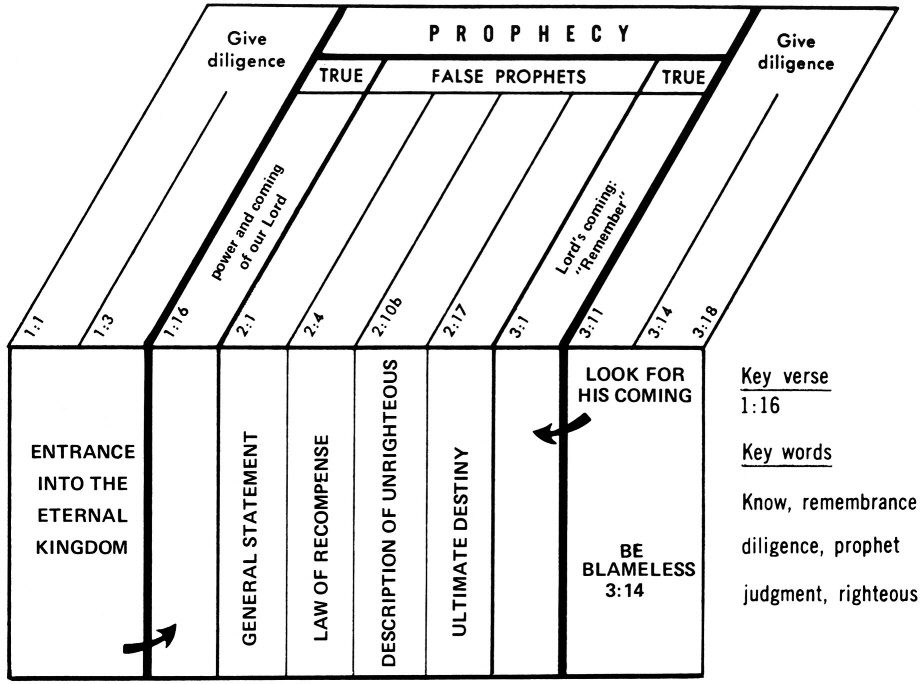
2 Peter: True and False Prophecy
Click chart to enlarge
Chart from Jensen's Survey of the NT - used by permission
|
2 PETER |
||||||||
| Cultivation of Christlike Character |
Condemnation of False Teachers |
Confidence in the Return of Christ |
||||||
| Greeting to Saints 2Pe 1:1-2 |
Growth in Christ 2Pe 1:3-14 |
Grounds |
Danger of |
Demise of |
"Decor" of |
Mockers in |
Manifest |
Maturity in light of that |
| Know Your Salvation |
Know |
Know Your Adversaries |
Know |
|||||
| True Prophecy (True Knowledge) |
False Prophets (False Teachers) |
Final Prophecy (Day of the Lord) |
||||||
| Holiness | Heresy | Hope | ||||||
| Development of Faith |
Denunciation of False Teachers |
Design of The Future |
||||||
2 Peter 2:2 Many will follow their sensuality, and because of them the way of the truth will be maligned (NASB: Lockman)
Greek: kai polloi exakolouthesousin (3PFAI) auton tais aselgeiais, di' ous e hodos tes aletheias blasphemethesetai; (3SFPI)
Amplified: And many will follow their immoral ways and lascivious doings; because of them the true Way will be maligned and defamed. (Amplified Bible - Lockman)
NET: And many will follow their debauched lifestyles. Because of these false teachers, the way of truth will be slandered. (NET Bible)
NLT: Many will follow their evil teaching and shameful immorality. And because of them, Christ and his true way will be slandered. (NLT - Tyndale House)
Phillips: Many will follow their pernicious teaching and thereby bring discredit on the way of truth. (Phillips: Touchstone)
Wuest: And many will follow their licentious conduct to its consummation, on account of whom the way of the truth will be reviled
Young's Literal: and many shall follow out their destructive ways, because of whom the way of the truth shall be evil spoken of,
AND MANY WILL FOLLOW: kai polloi exakolouethesousin (3PFAI) auton:
- Mt 24:10, 11, 12, 13; Mt 24:24 Mk 13:22; 1Jn 4:5, Acts 20:30 1Jn 2:18,19; Rev 12:9; 13:8,14
- 2 Peter 2 Resources - Multiple Sermons and Commentaries
- 2 Peter 2:1-3 A Portrait of False Teachers, Pt. 1 - John MacArthur
- 2 Peter 2:1-3 A Portrait of False Teachers, Pt. 2 - John MacArthur
And many follow - This is a sad statement, especially the quantifying adjective MANY! Church wake up!
Many (4183) (polus) refers to much in regard to number, quantity, amount. Peter pictures the "success" of the false teachers in attracting and leading astray "great crowds" of people. Keep in mind that these "great crowds" are not from among the pagans but from the Church, where heresies and cults usually have their greatest impact. Someone has said that most of the new members to Mormonism come out of conservative churches!
Follow (1811) (exakoloutheo from ek = out or to intensify + akolouthéo = follow) means to follow out, yield to, copy after, conform to, imitate. The preposition "ek" in the compound verb gives the force of following out, of close pursuance of. Peter has the only uses of this verb in the NT, 2 in a negative sense and one in a positive sense (2 Pe 1:16).
Exakoloutheo - 3x in 3v -
2 Pe 1:16-note For we did not follow cleverly devised tales when we made known to you the power and coming of our Lord Jesus Christ, but we were eyewitnesses of His majesty.
2 Pe 2:2 Many will follow their sensuality, and because of them the way of the truth will be maligned;
2 Pe 2:15-note forsaking the right way, they have gone astray, having followed the way of Balaam, the son of Beor, who loved the wages of unrighteousness;
Exakoloutheo - 4x in the Septuagint - Job 31:9; Isa. 56:11; Jer. 2:2; Amos 2:4
Job 31:9 “If my heart has been enticed (Lxx = exakoloutheo - "If my heart has gone forth after another man's wife") by a woman, Or I have lurked at my neighbor’s doorway,
Comment: This use gives us a great insight into this verb, for here it translates the Hebrew verb pathah which means to entice, seduce, deceive! Notice the "target" = the heart! Look out! Those in 2 Peter 2 are following false teachers, and notice the first think it says they follow - "their sensuality." We must continually GUARD OUR HEARTS from seductive attacks! (Pr 4:23-note).
Amos 2:4 Thus says the LORD, “For three transgressions of Judah and for four I will not revoke its punishment, Because they rejected the law of the LORD And have not kept His statutes; Their lies also have led them astray, Those after which their fathers walked. ((Lxx = exakoloutheo - "which their fathers followed" - what did their fathers follow after? Lies?)
THEIR SENSUALITY: tais aselgeiais:
- 2 Peter 2 Resources - Multiple Sermons and Commentaries
- 2 Peter 2:1-3 A Portrait of False Teachers, Pt. 1 - John MacArthur
- 2 Peter 2:1-3 A Portrait of False Teachers, Pt. 2 - John MacArthur
Sensuality (766)(aselgeia from aselges = licentious <> a = negates next word + selges = continent) originally referred to any excess or lack of restraint but came to convey the idea of shameless excess and the absence of restraint, especially with sexual excess. Thus like koite, aselgeia was used almost exclusively of especially lewd sexual immorality, of uninhibited and unabashed lasciviousness. It refers to the kind of sexual debauchery and abandonment that characterizes much of modern society and that is often flaunted almost as a badge of distinction! Aselgeia refers to uninhibited sexual indulgence without shame and without concern for what others think or how they may be affected (or infected).
Aselgeia is clearly a "key word" in this chapter as Peter uses it 3x (of 10 NT uses -- in the present verse, 2Pe 2:7-note, 2Pe 2:18-note)
Aselgeia - 10x in 10v - Mark 7:22; Rom 13:13; 2 Cor 12:21; Gal 5:19; Eph 4:19; 1 Pet 4:3; 2 Pet 2:2, 7, 18; Jude 1:4. NAS = licentiousness(1), sensual(1), sensuality(8).
Barclay says that Plato described aselgeia as
“impudence” and another writer as “preparedness for every pleasure.” Basil said it was “a disposition of the soul incapable of bearing the pain of discipline.” The great characteristic of aselgeia is this—the bad man usually tries to hide his sin; but the man who has aselgeia in his soul does not care how much he shocks public opinion so long as he can gratify his desires. Sin can get such a grip of a man that he is lost to decency and shame. He is like a drug taker who first takes the drug in secret, but comes to a stage when he openly pleads for the drug on which he has become dependent. A man can become such a slave of liquor that he does not care who sees him drunk. A man can let his sexual desires so master him that he does not care who sees him satisfy them… Josephus ascribed it to Jezebel when she built a temple to Baal in Jerusalem." (Barclay, W: The Daily Study Bible Series. The Westminster Press)
Licentious individuals think only of satisfying their lusts and whatever they touch is stained by this base, animalistic appetite.
MacArthur writes that…
Aselgeia (sensuality) refers to total licentiousness, the absence of all moral restraint, especially in the area of sexual sins. One commentator says the term relates to “a disposition of the soul incapable of bearing the pain of discipline.” The idea is that of unbridled self–indulgence and undisciplined obscenity… All people initially recognize at least some standard of right and wrong and have a certain sense of shame when they act against that standard. Consequently, they usually try to hide their wrongdoing. They may continually fall back into it but still recognize it as wrong, as something they should not be doing; and conscience will not let them remain comfortable. But as they continue to overrule conscience and train themselves to do evil and to ignore guilt, they eventually reject those standards and determine to live solely by their own desires, thereby revealing an already seared conscience. Having rejected all divine guidelines and protection, they become depraved in mind and give themselves over to sensuality. Such a person cares nothing about what other people think—not to mention about what God thinks—but only about what gratifies the cravings of his own warped mind. (MacArthur, J: Ephesians. Chicago: Moody Press)
To summarize, aselgeia pictures a man dominated by shameless greed and animal lusts, the sheer self-indulgence to which he is so enslaved that he has lost all sense of shame. It reminds one of Jeremiah's description of the faithless in Judah:
"Were they ashamed because of the abomination they had done? They certainly were not ashamed, and they did not know how to blush" (Jer 6:15, 8:12).
These men acknowledge no restraints and dare to do whatsoever their caprice desires or their petulance suggests.
Scripture defines "sensuality" as one of the
the deeds of the flesh (Gal 5:19-note)
Sensuality's source proceeds from
"from within out of the heart of men" and the effect is to "defile the man." (Mk 7:22, 23, 24).
Believers are instructed to
behave properly as in the day… not in sexual promiscuity and sensuality. (Ro 13:13-note)
On the other hand the Gentiles
having become callous have given themselves over to sensuality for the practice of every kind of impurity with greediness" (Ep 4:19-note)
This verse clearly shows the controlling effect sensual thoughts can have on one's behavior.
Jude's description parallels Peter's, describing
certain persons (who) have crept in unnoticed, those who were long beforehand marked out for this condemnation, ungodly persons who turn the grace of our God into licentiousness (aselgeia) and deny our only Master and Lord, Jesus Christ. (Jude 1:4)
Hiebert comments that…
it is apparent that these false teachers were antinomians (Ed note: "against the law" or "instead of the law") who relaxed the moral restraints of the gospel on the cravings of the flesh. heretical teaching does not always lead to immoral conduct, but there is often a connection… Because of the evil nature of the unregenerate heart, such antinomian teaching can spread its contagion almost anywhere… It is sadly true that ''no doctrine, however senseless and monstrous, which under the guise of a religious faith ministers to the sensual appetites of men, will ever want followers (quoting Lillie).'
Note that the KJV reading "their pernicious ways" reflects the Textus Receptus manuscript but this reading has little support among most modern scholars.
AND BECAUSE OF THEM THE WAY OF THE TRUTH: di ous he hodos tes aletheias:
- 2Peter 2:15,21; Ps 18:21; 119:30, 139:24, Isa 35:8; Jer 6:16; 18:15 Mt 7:14; 22:16; Mk 12:14; Jn 14:6; Acts 9:2, 13:10; 16:17; 18:26; 19:9; 22:4, 24:14, 22
- 2 Peter 2 Resources - Multiple Sermons and Commentaries
- 2 Peter 2:1-3 A Portrait of False Teachers, Pt. 1 - John MacArthur
- 2 Peter 2:1-3 A Portrait of False Teachers, Pt. 2 - John MacArthur
Their disciples will be like the false teachers and, bringing their sexual immorality into the churches, will cause "the way of truth" to be defamed.
The Way (3598) (hodos) has the definite article ("he") in the Greek which defines this as a very specific Way not just any way. Compare Jesus declaration that…
I am the way (Greek = he hodos = the specific way), and the truth, and the life; no one comes to the Father, but through Me. (John 14:6) (Comment: There are not many "ways" to God, but one exclusive way, graciously available to those who have ears to hear and eyes to see).
The Way was a common early name for the Christian faith. Luke first alludes to the Way in Acts 9…
Now Saul, still breathing threats and murder against the disciples of the Lord, went to the high priest, and asked for letters from him to the synagogues at Damascus, so that if he found any belonging to the Way, both men and women, he might bring them bound to Jerusalem. (Acts 9:1-2 cp the Way in Acts 19:9, 23, 24:14, 22)
Truth (225) (aletheia from a = without + lêthô = conceal which means that which is hidden) describes that which is out in open, which is true & which contains nothing that hidden that will cause it to self destruct.
Aletheia - 109x in 98v - Other uses by Peter - 1 Pet 1:22; 2 Pet 1:12; 2:2
Gilbrant on aletheia - One of the principal terms for expressing the concept of “truth” in the Greek language is alētheia. Originally the word denoted something which was not hidden or a disclosure of something which was hidden. In Greek philosophy the word often carries the sense of that which really exists, “the reality behind all apparent reality.” Therefore, it has been customary to conclude from this that there is a marked contrast between the Greek and Hebrew view of the nature of “truth.” According to this view, in classical Greek alētheia stands in opposition to that which is only apparent or perceived to be real. The Hebrew notion of truth points to that which is sure and reliable as the “truth.” No doubt this is substantially correct. But it would be erroneous to assume that alētheia should solely or principally imply a philosophic concept of reality. Obviously Greeks as well as Hebrews needed a word which decisively expressed truth as over against falsehood and deceit. Such a concrete sense can also be discovered in the Greek alētheia just as it can in the Hebrew ’ĕmeth. Both of these terms have distinct shades of meaning which are worthwhile to investigate. Alētheia functions in various contexts. To the philosophers it expressed “being” in the absolute sense of the word, i.e., “existence.” Historians used the term to signify real events as distinct from myths. In forensic language (legal) the term characterizes an accurate assessment of a fact, in contrast to an incorrect observation or assertion. Alētheia not only stands for irrefutable facts, but it also expresses the truth itself, that which is unattainable to the human mind and which can only be perceived in ecstasy or through divine revelation. (Complete Biblical Library Greek-English Dictionary)
The Christian faith is "the way of truth" and Jesus is the Way, the Truth. It is not only a correct thought or "truth" but it is the "Highway (to Heaven)", the road, route, mode and means of true life which is ultimately the ONLY life which gives lasting eternal meaning to our present earthly existence. True (righteous) doctrine must issue in true (righteous) living. True knowledge of God should lead to a God honoring lifestyle. The Christian faith has an intellectual aspect that must find practical expression in daily life. A living knowledge of God's truth must result in godly living.
WILL BE MALIGNED: blasphemethesetai [FPI]:
- 2Peter 2:12; Acts 14:2; Jude 1:10, 15
- 2 Peter 2 Resources - Multiple Sermons and Commentaries
- 2 Peter 2:1-3 A Portrait of False Teachers, Pt. 1 - John MacArthur
- 2 Peter 2:1-3 A Portrait of False Teachers, Pt. 2 - John MacArthur
Maligned (987) (blasphemeo) means to speak in a disrespectful way that demeans, denigrates, maligns or hurts the reputation of another.
Blasphemeo - 34x in 34v - be spoken of as evil(1), blaspheme(4), blasphemed(6), blasphemers(1), blasphemes(3), blaspheming(4), dishonored(1), hurling abuse(3), malign(2), maligned(1), revile(3), reviling(1), slandered(1), slanderously reported(1), spoken against(1), utter(1).
Matt 9:3; 26:65; 27:39; Mark 2:7; 3:28f; 15:29; Luke 12:10; 22:65; 23:39; John 10:36; Acts 13:45; 18:6; 19:37; 26:11; Rom 2:24; 3:8; 14:16; 1 Cor 10:30; 1 Tim 1:20; 6:1; Titus 2:5; 3:2; Jas 2:7; 1 Pet 4:4; 2 Pet 2:2, 10, 12; Jude 1:8, 10; Rev 13:6; 16:9, 11, 21.
Peter says that because of the lascivious lifestyles of "so called saints" and "church goers", the watching world will judge the whole church based on their evil behavior with the result that the reputation of Christianity and God Himself are slandered and denigrated. Not only that, but the lost world smugly justifies (at least in their warped way of thinking) their own licentious behavior. They mock and scoff at the gospel of Jesus Christ because of nominal "Christians" who do not follow the Lord Whom they claim as Savior.
Such men and women are like "salt (that) has become tasteless… no longer good for anything except to be thrown out and trampled under foot by men. (Mt 5:13- note).
These licentious men and women are like the Jews Paul described as
You who boast in the Law through your breaking the Law, do you dishonor God? For "THE NAME OF GOD IS BLASPHEMED AMONG THE GENTILES BECAUSE OF YOU," just as it is written." (Ro 2:23; 2:24- see notes Ro 2:23; 2:24) (cf Titus 1:16-note, Titus 2:5-note)
In his first epistle Peter said that if we claim Christ as Lord the way we behave is important and so he instructs all genuine believers:
Keep your behavior excellent among the Gentiles, so that in the thing in which they slander you as evildoers, they may because of your good deeds, as they observe them, glorify God in the day of visitation." (see note1Pe 2:12-note, cf 1Pe 3:16-note, 1Pe 4:15-note)
2 Peter 2:3 and in their greed they will exploit you with false words; their judgment from long ago is not idle, and their destruction is not asleep. (NASB: Lockman)
Greek: kai en pleonexia plastois logois humas emporeusontai; (3PFMI) hois to krima ekpalai ouk argei, (3SPAI) kai e apoleia auton ou nustazei. (3SPAI)
Amplified: And in their covetousness (lust, greed) they will exploit you with false (cunning) arguments. From of old the sentence [of condemnation] for them has not been idle; their destruction (eternal misery) has not been asleep. (Amplified Bible - Lockman)
NET: And in their greed they will exploit you with deceptive words. Their condemnation pronounced long ago is not sitting idly by; their destruction is not asleep. (NET Bible)
NLT: In their greed they will make up clever lies to get hold of your money. But God condemned them long ago, and their destruction is on the way. (NLT - Tyndale House)
Phillips: In their lust to make converts these men will try to exploit you too with their bogus arguments. But judgment has been for some time hard on their heels and their downfall is inevitable. (Phillips: Touchstone)
Wuest: And in the sphere of covetousness, with fabricated words they will exploit you, for whom from ancient times their judgment has not been idle [i.e., it is being prepared], and their destruction is not sleeping. (Eerdmans)
Young's Literal: and in covetousness, with molded words, of you they shall make merchandise, whose judgment of old is not idle, and their destruction doth not slumber.
AND IN THEIR GREED: kai en pleonexia:
- 2 Peter 2:14;15 Isa 56:11; Jer 6:13; 8:10; Ezekiel 13:19; Micah 3:11; Mal 1:10; Ro 16:18; 1Ti 3:3,8; 6:5; Titus 1:7,11; 1Pet 5:2; Jude 1:11
- 2 Peter 2 Resources - Multiple Sermons and Commentaries
- 2 Peter 2:1-3 A Portrait of False Teachers, Pt. 1 - John MacArthur
- 2 Peter 2:1-3 A Portrait of False Teachers, Pt. 2 - John MacArthur
In (en) - in the sphere of (the atmosphere of, the influence of) Peter describes the atmosphere as it were that surrounds and governs the aims and actions of the false teachers.
Greed (covetousness) (4124) (pleonexia from pleon = more + echô = have) literally means to have more and is thus strong desire to acquire more and more material possessions, especially that which is forbidden. It is a desire to have more irrespective of one's need and is always used in bad sense. It describes an insatiable selfishness.
Pleonexia - 10x in 10v - NAS = covetousness(1), deeds of coveting(1), greed(7), greediness(1).
Mark 7:22; Luke 12:15; Rom 1:29; 2 Cor 9:5; Eph 4:19; 5:3; Col 3:5; 1 Thess 2:5; 2 Pet 2:3, 14.
Contentment is the opposite of covetousness. Attacking covetousness lays the ax to a root cause of sin because pleonexia is the root of the other sins listed in this verse. When contentment replaces covetousness, the latter cannot give rise to the process that culminates in an act of sin.
Greed is what you desire and what you desire more of becomes your ''god'' and you end up serving (latreuo) that ''god.'' In God's sight, greed is worshipping the god mammon, and "you cannot serve God and mammon" (Mt 6:24-note)
Pleonexia always has a bad sense and depicts an insatiable craving and grasping for more of something which one does not have a just right. It has been described as ruthless self-seeking and is thus a sin with a very wide range. If it is the desire for money, it leads to theft. If it is the desire for prestige, it leads to evil ambition. If it is the desire for power, it leads to sadistic tyranny. If it is the desire for a person, it leads to sexual sin. It has been defined as the spirit in which a man is always ready to sacrifice his neighbor to his own desires. Greed is the sin of always wanting more, whether it be more things or more pleasures.
Later in this chapter Peter uses pleonexia to explains that these men have
a heart trained in greed (2Pe 2:14-note).
Peter had encountered somewhat of a similar heart attitude in Simon Magus in (Acts 8:18-20).
Now when Simon saw that the Spirit was bestowed through the laying on of the apostles' hands, he offered them money, saying, "Give this authority to me as well, so that everyone on whom I lay my hands may receive the Holy Spirit." But Peter said to him, "May your silver perish with you, because you thought you could obtain the gift of God with money!
Paul in contrast to these false teachers defended the integrity of his ministry in his letter to the Thessalonian church stating that
we never came with flattering speech, as you know, nor with a pretext for greed --God is witness" (1Th 2:5-note).
Similarly he reminded the Ephesian elders that he had
coveted no one's silver or gold or clothes." (Acts 20:33)
Thus we see a dramatic contrast in the heart of a false and true teacher in the area of greed. Scripture recognizes that the Christian worker has the right to financial support from his labors (eg Mt 10:10, Gal 6:6, 1Ti 5:17, 18), but it condemns a mercenary spirit that turns the ministry of the Word into a pleasant way of personal gain!
A great illustration of greed is shown by a trick natives use to catch monkeys -- first the natives hollow out a coconut with an opening just large enough for the monkey’s paw. Then they fill the coconut with some appetizing bait like fruit or nuts and tie it to a tree. At night the monkey reaches into the coconut for the bait, only to find he cannot pull his paw out the opening because his fist is filled with delectable goodies. Of course, he could let go and escape quite easily—but he doesn’t want to forfeit the prize and so in the end he is captured because of his greed. In the same way a covetous person is never satisfied with what he has, and he is usually envious of what other people have. This is idolatry, for covetousness puts things in the place of God. Thou shalt not covet is the last of the Ten Commandments (Ex 20:17). Yet this sin can make us break all of the other nine! A covetous person will dishonor God, take God’s name in vain, lie, steal, and commit every other sin in order to satisfy his sinful desires. And such is the heart of these evil false teachers.
Related Resources:
- Why is "You shall not covet" in the Ten Commandments?
- What is the lust of the eyes?
- What are some modern forms of idolatry?
- You shall not covet
THEY WILL EXPLOIT YOU WITH FALSE WORDS: humas emporeusontai [FMI] plastois logois:
- 2 Peter 2 Resources - Multiple Sermons and Commentaries
- 2 Peter 2:1-3 A Portrait of False Teachers, Pt. 1 - John MacArthur
- 2 Peter 2:1-3 A Portrait of False Teachers, Pt. 2 - John MacArthur
How will the false teacher's greed be manifest? Peter describes their deception and it begins with what they "say".
The New Living Translation although a paraphrase is quite blunt stating that
they will make up clever lies to get hold of your money
Young's Literal says that
with molded words of you they shall make merchandise
Exploit (1710) (emporeuomai from en = in + poreúomai = to go, to trade from poros = a passing) literally means to go in, then to travel about and so to travel about as a merchant or trader on a large scale. It means to do business or to trade involving either buying and/or selling. The KJV translates it to "make merchandise".
Emporeuomai was used in secular Greek both in the sense of travel and of traveling for business reasons. Here in 2 Peter, the verb is clearly used in a negative sense to refer to doing business by "misrepresenting the merchandise" so to speak. In this figurative use in verse 3 emporeuomai pictured the deceiving of others for one's own advantage.
Gilbrant adds - In the Koine period it sometimes had the connotation of “exploit.” Thus, Polybius (38.12.10) told of a certain Critolaus who exploited a mob by his eloquent speaking. In the Septuagint (Lxx) emporeuomai appears 11 times translating several Hebrew words for traveling and trading. Apparently, as in the Greek world, those who traveled were associated with those who traded and bartered goods for a living. Emporeuomai normally refers to trade in the commercial sense (e.g., Genesis 42:34; Amos 8:6). In one place it is used figuratively of trade in wisdom (Proverbs 3:14). (Complete Biblical Library Greek-English Dictionary)
James uses it in this sense to describe one who would seek to "engage in business and make a profit." (Jas 4:13+) And he explains how short-sighted it is to be seeking earthly treasure in light of the fact that "you do not know what your life will be like tomorrow. You are just a vapor that appears for a little while and then vanishes away." (Jas 4:14+)
In keeping with the cheating that often attended such trading, emporeuomai readily came to denote commercialization or deceptive exploitation.
There are 11 uses of emporeuomai in the Septuagint (LXX)
Ge 34:10, 21; 42:34; 2 Chr. 1:16; 9:14; Prov. 3:14; 31:14; Ezek. 27:13, 21; Hos. 12:1; Amos 8:6
These false teachers skillfully use their fabricated ("plastic") arguments as counterfeit coinage so to speak in order to make a profitable bargain. They seek to make a personal profit out of their unwary devotees. They are not concerned one whit for the well being of the sheep, but only desire to fleece the sheep and shear their "wool"! And they are masters at this shady "commerce"! As they carry out their nefarious trade, they turn God's house into a marketplace or an ''emporium" (a large and often ostentatious retail shop offering for sale a wide variety of merchandise!).
These hucksters commercialize Christianity and exploit the deceived masses (remember many will follow them). Do we not see this deadly "virus" of greed and deception on so-called "Christian" television spreading like an out of control forest fire, destroying everything and everyone in it's path. The amazing thing is that people will support these false teachers but won't give a penny to legitimate ministries! The people supporting these charlatans are doing so because they think that if they give, they are going to get something back. Whatever happened to doing everything solely for the purpose of glorifying our Heavenly Father? Peter is sounding a trumpet call for the church to wake up: "Oh saints stand fast in the truths in chapter 1 so that you might be able to recognize and resist in the evil day!" The "evil day" has arrived.
As you might well imagine, false teachers use False words
False (4112) (plastos from plasso = to form, fashion or mold any soft substance such as wax or clay) refers to words that are false in view of the fact that they are made-up or fabricated. These words are mentally constructed by these liars without any basis in fact.
BDAG writes that plastos means "to being mentally constructed without a basis in fact, fabricated, false"
Plastos was used in the papyri of a forged contract and by Josephus for falsified documents.
In other words (no pun intended) the words of these deceivers are carefully fabricated and molded to achieve their purpose - exploitation. These words are "artificially formed" specifically for the purpose of deceiving and leading the hearer astray. Their words are twisted like "plastic" so that the meaning is not orthodox. As someone has well said these false teachers use our Christian vocabulary but they do not use our theological dictionary!
The modus operandi of these spiritual charlatans is as old as the garden of Eden where we see their father's (cf John 8:44) technique. First Satan questioned God's Word and His commandment (as an aside, do you not see why serious Bible study including verbatim memorization of the Word of Truth is so vital for believers? Are you memorizing Scripture? If not, you must begin - your spiritual life depends on it!)…
Hath God truly said? (Genesis 3:1)
Then the Liar denied God's Word of warning…
You shall not surely die! (Genesis 3:4)
Finally the Deceiver slipped in the fabricated lie (plastic words)…
You shall be as God. (Genesis 3:5)
Just as Satan spoke "Christianeze" using the accepted "evangelical vocabulary", false teachers will also use orthodox words like "Jesus" (but Peter says they actually "deny" Him), “salvation,” “inspiration,” etc, but they do not mean what true teachers mean when they use these words.
The exploitation comes when the immature and untaught hear these preachers and teachers or read their books and think that they are proclaiming sound doctrine when they are really speaking "plastic" deception.
Remember that if you don't stand on the truth of God's word, you may fall for anything that sounds good.
THEIR JUDGMENT FROM LONG AGO IS NOT IDLE: hois to krima ekpalai ouk argei (PAI):
- 2 Pe 2:1; 2:9 Dt 32:35; Isa 5:19; 30:13,14; Hab 3:3; Lk 18:8; 1 Th 5:3; 1 Pe 2:8; Jude 1:4 ,7, 15
- 2 Peter 2 Resources - Multiple Sermons and Commentaries
- 2 Peter 2:1-3 A Portrait of False Teachers, Pt. 1 - John MacArthur
- 2 Peter 2:1-3 A Portrait of False Teachers, Pt. 2 - John MacArthur
It is only fitting that Peter concludes this opening description of the false teachers with a description of their true doom. Peter has more to say about these evil men but first he assures them on their certain judgment.
Judgment (2917) (krima) denotes the result of the action produced by the verb krino which means "to judge". In Greek the suffix –ma indicates the result of judging. The judicial action has already taken place against these sinister men and the "result of the judging" or the verdict has been rendered as "Guilty as charged!". Their judgment and doom has been announced long ago (cf. Ps1:4, 5, 6-note).
Krima - 27x in 27v - NAS = condemnation(8), judgment(15), judgments(1), lawsuits(1), sentence(1), sentence of condemnation(1), way(1).
Mt 7:2; Mk 12:40; Luke 20:47; 23:40; 24:20; John 9:39; Acts 24:25; Rom 2:2f; 3:8; 5:16; 11:33; 13:2; 1 Cor 6:7; 11:29, 34; Gal 5:10; 1 Tim 3:6; 5:12; Heb 6:2; Jas 3:1; 1 Pet 4:17; 2 Pet 2:3; Jude 1:4; Rev 17:1; 18:20; 20:4.
Not idle - The Greek word for "not" conveys the sense of absolutely no way! Delay is not denial!
Idle (691) (argos) (only found here in the NT) means "not" working but is modified by the absolute negative (ou) in the Greek and literally reads their judgment is "not not working". In other words it is "working" and states categorically that the divine verdict, unlike some of the sentences of earthly judges (that are occasionally reversed or overturned by a higher court) has not become inert so to speak.
J B Phillips picks up the idea paraphrasing it as "judgment has been for some time hard on their heels."
AND THEIR DESTRUCTION IS NOT ASLEEP: kai he apoleia auton ou nustazei (PAI):
- Torrey's topic Punishment of the Wicked
- 2 Peter 2 Resources - Multiple Sermons and Commentaries
- 2 Peter 2:1-3 A Portrait of False Teachers, Pt. 1 - John MacArthur
- 2 Peter 2:1-3 A Portrait of False Teachers, Pt. 2 - John MacArthur
And just in case these deceived deceivers thought clemency was just around the corner, Peter tightens the proverbial noose irrevocably by adding that their executioner "Mr. Destruction" is not dosing off.
Destruction (684) (apoleia) refers to destruction of persons, objects, or institutions. Apoleia in this context refers to eschatological (future events) judgment, a judgment which is not as some falsely teach extinction or annihilation but ruination. In other words apoleia does not depict loss of one's being but a loss of well being, separation from God, and an utterly hopeless ruin and loss of all that gives worth to one's existence. Imagine existing forever and never being able to fulfill the purpose for which you were created! This tragic thought should motivate all believers to undertake radical evangelism lest any of those we have conduct would suffer such a dire, eternal fate!
Apoleia - 18x in 17v - NAS = destruction(13), destructive(1), perdition(1), perish(1), waste(1), wasted(1).
Matt 7:13; 26:8; Mark 14:4; John 17:12; Acts 8:20; Rom 9:22; Phil 1:28; 3:19; 2 Thess 2:3; 1 Tim 6:9; Heb 10:39; 2 Pet 2:1, 3; 3:7, 16; Rev 17:8, 11.
The "doctrine" of the false teachers is potentially deadly as pictured the same word apoleia (2Pe 2:1-note) And here in verse 3, Peter personifies destruction (apoleia) as the very "executioner" of those who introduce destructive (apoleia) heresies. They will literally reap what they sow! And this "executioner" will not doze off or nod asleep, oblivious to his duty to vindicate the truth and holiness of God. This "executioner" is wide awake and waiting for the orders to "drop the guillotine" which produces a physical and spiritual separation of the false teachers from God forever and ever.
In the introductory remarks to chapter 2, Peter writes that…
false prophets also arose among the people, just as there will also be false teachers among you, who will secretly introduce destructive heresies, even denying the Master who bought them, bringing swift destruction (apoleia) upon themselves. (see note 2 Peter 2:1)
The New English Bible paraphrases it
Perdition waits for them with unsleeping eyes
What a picture! Parenthetically the certainty of judgment is a good reminder for both saints and sinners for God is an impartial Judge and
he who does wrong will receive the consequences of the wrong which he has done, and that without partiality." (Col 3:25-note)
Saints of course will not be judged for sins for the blood of Christ has paid for them in full, but Paul reminds us that saints
must all appear before the judgment seat of Christ, so that each one may be recompensed for his deeds in the body, according to what he has done, whether good or bad. (phaulos = worthless, good for nothing) (2Cor 5:10-note, Ro 14:10, 11, 12-note cf 1Cor 3:11, 12, 13, 14, 15).
The unsaved including these false teachers will appear at another judgment, the Great White Throne Judgment (one that follows the Millennium)
11 And I saw a great white throne and Him who sat upon it, from whose presence earth and heaven fled away, and no place was found for them.
12 And I saw the dead, the great and the small, standing before the throne, and books were opened; and another book was opened, which is the book of life; and the dead were judged from the things which were written in the books, according to their deeds.
13 And the sea gave up the dead which were in it, and death and Hades gave up the dead which were in them; and they were judged, every one of them according to their deeds.
14 And death and Hades were thrown into the lake of fire. This is the second death, the lake of fire.
15 And if anyone's name was not found written in the book of life, he was thrown into the lake of fire. (See notes Revelation 20:11; 12; 13; 14; 15)
As Peter said in his first epistle
If you address as Father the One Who impartially judges according to each one's work, conduct yourselves in fear during the time of your stay on earth (1Pe 1:17-note)
Asleep (3573) (nustazo) means to almost be asleep, to become drowsy, to slumber, to doze off or to nod off. Destruction is not slumbering or dozing off so as to miss its appointment with these men! When wicked men are successful and the coffers are overflowing with their ill gotten gains, and these evil deeds are seemingly unrequited (unrecompensed), these deceived deceivers tend to imagine that the Judge of all men is asleep. Wrong!
Solomon reminds us of the deception of "delay" in punishment writing that
because the sentence against an evil deed is not executed quickly, therefore the hearts of the sons of men among them are given fully to do evil." (Eccl 8:11).
Postponed punishment only makes evil people think they can get away with more and more evil but Peter says the executioner sleepeth not!
Plastic Words: A New York City couple received through the mail two tickets to a smash Broadway hit. Oddly, the gift arrived without a note, and they wondered who had sent it. But they still attended the show and enjoyed it immensely. Returning to their apartment, they discovered that their bedroom had been ransacked. Valuable furs and jewels were missing. On the pillow was this simple note: "Now you know." Like that nameless thief, a false teacher knows what people want and appeals to their desires (2Peter 2). He doesn't wear a lapel pin to warn of his lies, but he comes disguised as a representative of the truth. He claims he will enrich lives, but those who follow him often learn at a high cost that they have been deceived.
Jesus, however, is a Teacher we can trust completely. He offers us the gift of eternal life because He truly loves us. Accepting His gift of salvation is the first step in protecting ourselves from the deceptive gifts that false teachers offer. But even believers can be deceived by false teaching. That's why God's Word exhorts us to study the Scriptures (1Pe 2:2-note), test what we hear (1Jn 4:1), and grow in the faith (2Pe 1:5, 6, 7, 8, 9-see notes 2Pe 1:5; 1:6; 1:7; 1:8; 1:9). That way, we won't suddenly discover that our spiritual life is in disarray. --H W Robinson (Our Daily Bread, Copyright RBC Ministries, Grand Rapids, MI. Reprinted by permission. All rights reserved)
Since savage wolves, consumed with greed,
Seek simple sheep on which to feed,
Wise are those wary lambs who graze
Close by their Shepherd's watchful gaze.-Gustafson
Not all gifts are free… some have hidden price tags.