2 Peter 2:2
2 Peter 2:3
2 Peter 2:4
2 Peter 2:5
2 Peter 2:6
2 Peter 2:7
2 Peter 2:8
2 Peter 2:9
2 Peter 2:10
2 Peter 2:11
2 Peter 2:12
2 Peter 2:13
2 Peter 2:14
2 Peter 2:15
2 Peter 2:16
2 Peter 2:17
2 Peter 2:18
2 Peter 2:19
2 Peter 2:20
2 Peter 2:21
2 Peter 2:22
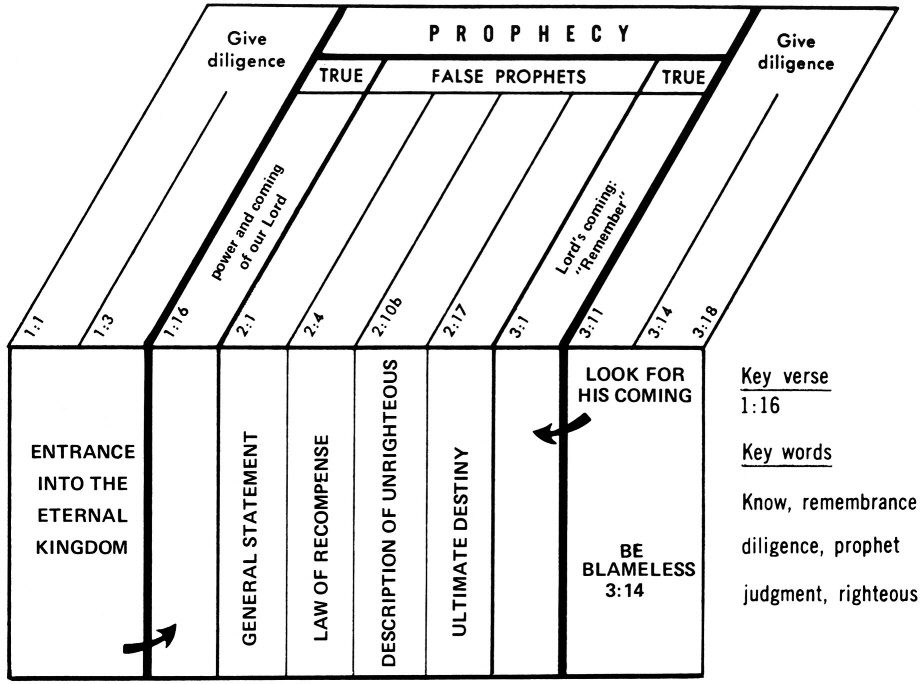
2 Peter: True and False Prophecy
Click chart to enlarge
Chart from Jensen's Survey of the NT - used by permission
|
2 PETER |
||||||||
| Cultivation of Christlike Character |
Condemnation of False Teachers |
Confidence in the Return of Christ |
||||||
| Greeting to Saints 2Pe 1:1-2 |
Growth in Christ 2Pe 1:3-14 |
Grounds |
Danger of |
Demise of |
"Decor" of |
Mockers in |
Manifest |
Maturity in light of that |
| Know Your Salvation |
Know |
Know Your Adversaries |
Know |
|||||
| True Prophecy (True Knowledge) |
False Prophets (False Teachers) |
Final Prophecy (Day of the Lord) |
||||||
| Holiness | Heresy | Hope | ||||||
| Development of Faith |
Denunciation of False Teachers |
Design of The Future |
||||||
2 Peter 2:9 then the Lord knows how to rescue the godly from temptation, and to keep the unrighteous under punishment for the day of judgment, (NASB: Lockman)
Greek: oiden (3SRAI) kurios eusebeis ek peirasmou rhuesthai, (PMN) adikous de eis hemeran kriseos kolazomenous (PPPMPA) terein, (PAN)
Amplified: Now if [all these things are true, then be sure] the Lord knows how to rescue the godly out of temptations and trials, and how to keep the ungodly under chastisement until the day of judgment and doom, (Amplified Bible - Lockman)
NET: —if so, then the Lord knows how to rescue the godly from their trials, and to reserve the unrighteous for punishment at the day of judgment, (NET Bible)
NLT: So you see, the Lord knows how to rescue godly people from their trials, even while punishing the wicked right up until the day of judgment. (NLT - Tyndale House)
Phillips: then you may be absolutely certain that the Lord knows how to rescue a good man surrounded by temptation, and how to reserve his punishment for the wicked until his day comes. (Phillips: Touchstone)
Wuest: The Lord knows how to be delivering the godly out of testing and temptation but to be reserving the unrighteous for the day of judgment to be punished.
Young's Literal: The Lord hath known to rescue pious ones out of temptation, and unrighteous ones to a day of judgment, being punished, to keep
THEN THE note KNOWS: oiden (3SRAI) kurios:
- Job 5:19; Ps 34:15, 16, 17, 19-notes; 1Cor 10:13
- 2 Peter 2 Resources - Multiple Sermons and Commentaries
- 2 Peter 2:4-10 Judgment and Mercy - Steven Cole
- 2 Peter 2:5-10a Divine Judgment on False Teachers, Pt. 2 - John MacArthur
Then is added by the translators to help us see that Peter is now drawing a conclusion.
The Amplified Version conveys the idea well
"Now if all these things are true, then be sure..."
Know (1492) (eido) literally means perception by sight (perceive, see) as in Mt 2:2 where the wise men "saw His star". Peter uses it here in the sense what one knows absolutely and finally. The meaning of eido is somewhat difficult to convey but in general this type of "knowing" is distinguished from ginosko (and epiginosko, epignosis), the other major New Testament word for knowing, because ginosko refers to knowledge obtained by experience or "experiential knowledge" whereas eido often refers to more intuitive knowledge, although the distinction is not always crystal clear.
Eido is not so much by experience as an intuitive insight that is "drilled into your heart" so to speak. Eido is that perception, that being aware of, that understanding, that intuitive knowledge that only the Holy Spirit of God can give you. That is what Paul is pleading for God to unleash in the heart of these saints.
As Peter has proven from the Scriptures with the illustrations of Noah and Lot, God assuredly knows (1492) (oida = absolute knowledge, without a doubt, perfect tense = emphasizes the permanent state of His absolute knowing) how to deliver the godly. The conditional sentence Peter began in 2:4 is now brought to its logical conclusion of deliverance for the godly and punishment for the unrighteous.
For the first time in this chapter Peter calls God "Lord" (kurios) a word that specifically emphasizes His supreme authority, absolute ownership and sovereign power. He has supreme authority over both the godly and the unrighteous and the sovereign power to fulfill His responses to both.
Lord (2962) (kurios) relates to possession of power or authority. It is the one who has absolute ownership and uncontested power. It is the one who is in charge by virtue of possession (owner). There are over 6,000 uses of kurios in the Septuagint (LXX), the Greek version of the Old Testament, most being used to translate YHWH the Hebrew word for Jehovah. In the New Testament there are 717 references to kurios. Of the New Testament references to kurios, 275 occur in the writings of Paul. Luke used kurios 210 times in his Gospel and in Acts.
In the earliest Greek kurios meant "to have power or authority." Later it came to describe one who is in control. As classical Greek developed, it became a title for men of importance. Since the gods of ancient Greece were neither creators nor lords of their fate, pagan deities were not called "lord" until much later.
By the time of Christ, kings had come to be called "lord." This was true of the Roman Emperor Caligula (A.D. 37-41). It was also true of Candace, the fabled queen of upper Egypt (see Acts 8:27). So too Herod the Great, Herod Agrippa I, and Herod Agrippa II were called "lord."
Kurios is used to describe human relationships. Jesus described the relationship of slaves to their lords (Mt 10:24; 25:19). The Apostle Paul told slaves to obey their masters or lords as a sign of the slaves' faith in Christ (Ep 6:6, 9-see notes Ep 6:5, 6:9; Col 3:22). The same relationship is discussed in Galatians 4:1.
HOW TO RESCUE THE GODLY FROM TEMPTATION: eusebeis ek peirasmou rhuesthai (PMN):
- Ps 4:3; 12:1; 32:6; 2Ti 3:12; Titus 2:14
- 2 Peter 2 Resources - Multiple Sermons and Commentaries
- 2 Peter 2:4-10 Judgment and Mercy - Steven Cole
- 2 Peter 2:5-10a Divine Judgment on False Teachers, Pt. 2 - John MacArthur
Rescue (4506) (rhuomai or ruomai or rhyomai is derived from rhúo = to draw, drag along the ground) is the same word rhuomai discussed in verse 5 (click). Click word study on rhuomai.
Rhuomai is used 17 times in the NT - Matt. 6:13; 27:43; Lk. 1:74; Rom. 7:24; 11:26; 15:31; 2 Co. 1:10; Col. 1:13; 1 Thess. 1:10; 2 Thess. 3:2; 2 Tim. 3:11; 4:17f; 2 Pet. 2:7, 9
Rhuomai means to draw or snatch to oneself and invariably refers to a snatching from danger, evil or an enemy. This basic idea of rescuing from danger is pictured by the use describing a soldier’s going to a wounded comrade on the battlefield and carrying him to safety (he runs to the cry of his comrade to rescue him from the hands of the enemy). Rhuomai emphasizes greatness of peril from which deliverance is given by a mighty act of power
Rhuomai means to rescue, deliver, as when we first became believers and the Lord...
"delivered (rhuomai) us from the domain (exousia = the right and the might = executive power, jurisdiction) of darkness (skotos = spiritual darkness ruled by Satan), and transferred (removed us from. one place to another, causing a change in someone's official position) us to the kingdom (denoting sovereignty, royal power, dominion) of His beloved Son" (Click for in depth discussion of Col 1:13) Since rhuomai means to draw to oneself, here we see the great picture that God drew us out of Satan’s kingdom to Himself. That event was the new birth. We are not gradually, progressively delivered from Satan’s power. When we placed our faith in Christ, we were instantly delivered.
A great example is wading in a rushing river and suddenly being caught in the current utterly helpless. As you cry out someone hears you and holds out their hand as you go rushing by. As you lie their beside the river safe in the presence of the one who pulled you out, you still are in the presence of the dangerous rushing current...you can hear it...you can see it...but you've been DELIVERED FROM DANGER and you are now safe. How foolish to walk right back into that current and let it sweep you away!
Peter assured his readers and us that God knows how to “be delivering the godly out of testing and temptation” (Wuest) so that we may live victoriously under whatever conditions we encounter.
The present tense indicates the continuous action and middle voice the great truth that God initiates the deliverance Himself and participates in the process (See Spurgeon's note below on this point)! Suffering Christians anywhere and at any time can find consolation in the fact that their Lord knows all about their plight.
Godly (2152) (eusebes) is related to "godliness" (see related word studies of related words - eusebeia; eusebos) and means to be profoundly reverent or respectful, devout or pious. Peter used this word in (Acts 10:2, cp Ac 10:7) describing Cornelius as "a devout (eusebes) man and one who feared God" which helps one understand the character of "the godly" as those who fear the Lord which is manifest in their daily conduct. God has the ability and power to rescue (present tense = continually) them "out of" (ek) not just "away from" (which would have been the preposition "apo") temptation.
Temptation (3986) (peirasmos) (Click word study of peirasmos) means a testing, a trial or a putting to the test. It is a morally neutral word that can describe a test or trial for good (Js 1:2, Jas 1:12) or for evil (Mt 26:41), the goal of the test depending on the intent of the one giving the test. When the scriptural context clearly indicates the testing is an enticement to evil, the word is most frequently translated as temptation which carries a negative connotation.
Related Resources:
- What does the Bible say about deliverance?
- What is the full armor of God?
- Do Christians have the authority to rebuke the devil?
- What is deliverance ministry, and is it biblical?
- How much emphasis should be given to demonic deliverance in the Christian life?
- Spiritual strongholds - what is the biblical view?
Spurgeon in Faith's Checkbook (July 12) writes that
The godly are tempted and tried. That is not true faith which is never put to the test. But the godly are delivered out of their trials, and that not by chance, nor by secondary agencies, but by the LORD Himself. He personally undertakes the office of delivering those who trust Him. God loves the godly or godlike, and He makes a point of knowing where they are and how they fare. Sometimes their way seems to be a labyrinth, and they cannot imagine how they are to escape from threatening danger. What they do not know, their LORD knows. He knows whom to deliver, and when to deliver, and how to deliver. He delivers in the way which is most beneficial to the godly, most crushing to the tempter, and most glorifying to Himself. We may leave the "how" with the LORD and be content to rejoice in the fact that He will, in some way or other, bring His own people through all the dangers, trials, and temptations for this mortal life to His own right hand in glory. This day it is not for me to pry into my LORD's secrets but patiently to wait His time, knowing this, that though I know nothing, my heavenly Father knows.
AND TO KEEP THE UNRIGHTEOUS UNDER PUNISHMENT FOR THE DAY OF JUDGMENT: adikous de eis hemeran kriseos kolazomenous (PPPMPA) terein (PAN):
- 2Pet 3:7; Ro 2:5; 2Cor 5:10 ,11
- 2 Peter 2 Resources - Multiple Sermons and Commentaries
- 2 Peter 2:4-10 Judgment and Mercy - Steven Cole
- 2 Peter 2:5-10a Divine Judgment on False Teachers, Pt. 2 - John MacArthur
Keep (5083) (tereo used 4x in 2Pe) (Click word study of tereo) means to observe attentively, guarding as one would a prisoner, awaiting the sentencing (the "crisis" cf "krisis" below) that will send them to their eternal prison (v4).
Remember that the subject is still God Himself Who will continually (tereo is in the present tense calling for continuous unbroken action) guard the unrighteous. The present tense conveys the truth that God also has the continuing knowledge and power to guard or reserve the wicked unto the judgment. The point Peter is making very clearly is that you do not need to be concerned that the wicked will ever get beyond God's judicial control and will surely stand before Him in the final day when he will consign them to the final eternal fate that they have "earned". The false teachers may seem successful (for “many” follow them), but in the end, they will be condemned. Their judgment is being prepared now (“lingereth not,” see note 2 Peter 2:3) and what is prepared will be reserved and applied on the last day. What a contrast between the false teachers and the true children of God!
The wicked are reserved for hell and hell is in turn reserved for the wicked (2Pe 2:17). By way of radical contrast believers have an inheritance reserved (Peter uses same verb tereo) for us (2Pe 1:4) because Jesus Christ is preparing a home for us in heaven (Jn 14:1, 2, 3). We are not looking for judgment, but for the coming of the Lord to take His people home to glory!
“For God has not destined us for wrath, but for obtaining salvation through our Lord Jesus Christ, Who died for us, so that whether we are awake or asleep, we will live together with Him.” (1Th 5:9–10)
Unrighteous (94) (adikos from a = without + díke =justice) unjust, wicked, treacherous and worst of all those men and women falling short of the righteousness required by God because they lack the imputed (reckoned) righteousness that comes only by faith in the "Righteous Branch" (Jer 23:5) the Lord Jesus Christ.
Under punishment (2849) (kolazo from kolos = abridged, shortened, dwarf, "mutilated") means literally to cut short, to lop, to prune or to trim (such as trees). The figurative use conveys the idea of to impede, to curtail, to punish, to chastise or keep in line.
The sense of punishing probably comes by way of trimming, i.e., cutting off what is superfluous. Punishment is designed to cut off what is bad or disorderly. It may be, however, that the idea of punishment is originally identical with that of maiming. It is often used of the punishment of slaves.
In Classical Greek writings kolazo was used to do someone an injury, as described of polytheists who penalize their cult images by locking them up (Dg 2:8). Kolazo was used of an apocalyptic place of punishment. The verbal form was used as a noun (kolazontes) to describe constables or police. Aristotle limited the related word kolasis to disciplinary action but this limited meaning is not reflected in general usage.
TDNT adds that
This means “to cut short,” “to lop,” “to trim,” and figuratively a. “to impede,” “restrain,” and b. “to punish,” and in the passive “to suffer loss.” A common use is for divine chastisement. In inscriptions the deity punishes those who violate cultic laws. Some classical authors regard evil as divine retribution. Philo finds in beneficence and retribution the two primary powers of being, though God would rather forgive than punish, and punishes only those who are not amenable to reason. Punishment brings blessing by freeing from a false frame of soul." (Kittel, G., Friedrich, G., & Bromiley, G. W. Theological Dictionary of the New Testament. Eerdmans)
Kolazo is present tense (continuously under punishment) and passive voice (the punishment being inflicted from an outside force or source, which of course is God Himself).
Since Peter mentions this "punishment" in the context of "the day of judgment" rather that for example the "day of death" it seems that Peter means that this "punishment" refers to the intermediate state between the death of the wicked (during which time their "holding tank" is the "hot" or "punishment" side of Sheol or Hades - see Lk 16:23, 24) and the final day of judgment at the Great White Throne.
Luke has the only other NT use (one use in Lxx - Da 6:13) of kolazo...
Acts 4:21 And when they had threatened them further, they let them go (finding no basis on which they might punish them) on account of the people, because they were all glorifying God for what had happened;
Day (2250) (hemera) is amplified by Luke who teaches that God
"has fixed a day in which He will judge the world in righteousness through a Man Whom He has appointed, having furnished proof to all men by raising Him from the dead." (Acts 17:31)
Judgment (2920) (krisis from krino = to judge, to separate, pick out, pronounce an opinion concerning right or wrong) is that event which distinguishes, discriminates, divides, separates or decides, especially distinguishing between good & evil, right & wrong in the present context passing an adverse sentence.
The final judgment on the wicked is the Great White Throne Judgment (Re 20:11, 12, 13, 14, 15-see notes Re 20:11; 12; 13; 14; 15) where all the ungodly of all the ages will be raised, judged and cast into the lake of fire. It will indeed be a "crisis" from which their is no escape for the wicked false teachers.
2Peter 2:10 and especially those who indulge the flesh in its corrupt desires and despise authority. Daring, self-willed, they do not tremble when they revile angelic majesties, (NASB: Lockman)
Greek: malista de tous opiss sarkos en epithumia| miasmou poreuomenous (PMPMPA) kai kuriotetos kataphronountas. (PAPMPA) Tolmetai, authadeis, doxas ou tremousin (3PPAI) blasphemountes, (PAPMPN)
Amplified: And particularly those who walk after the flesh and indulge in the lust of polluting passion and scorn and despise authority. Presumptuous [and] daring [self-willed and self-loving creatures]! They scoff at and revile dignitaries (glorious ones) without trembling, (Amplified Bible - Lockman)
NET: especially those who indulge their fleshly desires and who despise authority. Brazen and insolent, they are not afraid to insult the glorious ones, (NET Bible)
NLT: He is especially hard on those who follow their own evil, lustful desires and who despise authority. These people are proud and arrogant, daring even to scoff at the glorious ones without so much as trembling. (NLT - Tyndale House)
Phillips: Let me show you what these men are really like - His judgment is chiefly reserved for those who have indulged all the foulness of their lower natures, and have nothing but contempt for authority. These men are arrogant and presumptuous - they think nothing of scoffing at the glories of the unseen world. (Phillips: Touchstone)
Wuest: But [He knows how to reserve for the day of judgment to be punished] especially those who proceed on their way, hot in pursuit of the flesh [the totally depraved nature] in the sphere of the passionate desire of that which defiles, and who disdain authority. Presumptuous, arrogant, they do not tremble when defaming those in exalted positions.
Young's Literal: and chiefly those going behind the flesh in desire of uncleanness, and lordship despising; presumptuous, self-complacent, dignities they are not afraid to speak evil of,
AND ESPECIALLY THOSE WHO INDULGE THE FLESH: malista de tous opiso sarkos en epithumia miasmou poreuomenous (PMPMPA):
- Ro 8:1; Ro 8:4,5 Ro 8:12,13 ; 2Cor 10:3; Heb 13:4
- 2 Peter 2 Resources - Multiple Sermons and Commentaries
- 2 Peter 2:4-10 Judgment and Mercy - Steven Cole
- 2 Peter 2:5-10a Divine Judgment on False Teachers, Pt. 2 - John MacArthur
Especially (3122) (malista) means most of all, especially, particularly and indicates that the assured punishment applies especially to the false teachers. Alternatively it could signify that God's punishment will fall upon them with "special" severity which is the sense the New Living Translation conveys
"He is especially hard on those who follow their own evil, lustful desires".
In the following discussion Peter explains why these men are guilty or as Phillip's paraphrases it "Let me show you what these men are really like" first addressing their conduct.
Wuest's paraphrase describes these men as
"especially those who proceed on their way, hot in pursuit of the flesh [the totally depraved nature] in the sphere of the passionate desire of that which defiles"
Especially those who indulge the flesh is more literally rendered "especially those who walk after the flesh" where the word "after" is (opiso) which describes a position behind something or someone and in the present context refers to a position behind or in back of "the flesh" which is in a sense personified as the "leader" of these evil men.
For example, opiso is used several times in the NT describing "following after" Jesus in (Mt 4:19).
Another good illustration of the meaning of opiso is Paul's description of certain persons in (1Ti 5:15) who "have already turned aside to follow (opiso) Satan."
So you begin to get a clear picture of the spiritual dynamic. The word for "walk" in "walk after" is poreuomai which pictures one going from one place to another as if on a journey.
Poreuomai is present tense which pictures these men continually, persistently following the pathway described as "after the flesh".
Far from being true leaders, these false teachers to the contrary are eager followers, here pictured as following after the lead of their flesh rather than the leading of the Spirit of God. In Romans 8 Paul contrasts those who walk according to the flesh not the Spirit:
For those who are according to the flesh set their minds on the things of the flesh, but those who are according to the Spirit, the things of the Spirit. For the mind set on the flesh is death, but the mind set on the Spirit is life and peace, because the mind set on the flesh is hostile toward God; for it does not subject itself to the law of God, for it is not even able to do so, and those who are in the flesh cannot please God. However, you are not in the flesh but in the Spirit, if indeed the Spirit of God dwells in you. But if anyone does not have the Spirit of Christ, he does not belong to Him....for if you are living according to the flesh, you must die; but if by the Spirit you are putting to death the deeds of the body you will live." (cf notes Romans 8:5; 8:6; 8:7;8:8' 8:9; 8:13) (See related - Chart contrasting in the flesh vs in the Spirit)
Calvin says that
To walk after the flesh, is to be given up to the flesh, like brute animals, who are not led by reason and judgment, but have the natural desire of their flesh as their chief guide.
Flesh (4561) (sarx) is one of those terms that can be confusing if one is not careful to note the context in which it is used. For example flesh can refer to literal physical flesh of a human being as in the description of the incarnation of Jesus: "The Word became flesh..." (Jn 1:14).
In contrast, in the present context sarx refers to the "totally depraved nature" (Wuest translation), with its disposition to sin. Flesh, ethically refers to that part of man which, because of the fall, is opposed to God and to holiness. The depraved nature of man does not want to submit to any kind of authority. “Do your own thing!” is its insistent message, and many people follow it. The important thing is to take care of yourself—“number one”—and to use other people as tools for the achievement of your own selfish goals. The flesh is like an animal who smells out its prey stimulated on by its basic drive of hunger with its only goal being to satisfy this basic urge with neither thought nor care for consequences. Such animalistic behavior certainly suggest that that person is not a Christian. Sadly, such people pose as Christian teachers and their poison is deadly like Jim Jones and Guiana. They lead others astray, promising freedom but leading to addiction and slavery to sin.
John Piper defines flesh as
"the old ego that is self-reliant and does not delight to yield to any authority or depend on any mercy. Flesh craves the sensation of self-generated power and loves the praise of men....in its conservative form it produces legalism -- keeping rules by its own power for its own glory.... (in its more liberal form) produces grossly immoral attitudes and acts (Gal 5:19, 20, 21 - (see notes Ga 5:19; 20; 21) The Flesh is the proud and unsubmissive root of depravity in every human heart which exalts itself subtly through proud, self-reliant morality, or flaunts itself blatantly through self-assertive, authority-despising immorality."
Man’s fallen nature encourages pride. When the ego is at stake, these apostates will stop at nothing in order to promote and protect themselves. Their attitude is completely opposite that of our Lord who willingly emptied Himself to become a servant, and then died as a sacrifice for our sins (Php 2:7, 8-see notes Php 2:7; 2:8). These men that Peter described were presumptuous, which means they were “very daring and bold” in the way they spoke about those in positions of dignity. There is a boldness that is heroic, but there is also a boldness that is satanic.
Because of Christ’s saving work on our behalf, the sinful flesh no longer reigns over us, to debilitate us and drag us back into the pit of depravity into which we were all born.
Matthew Henry has a scathing description what it means that these men "walk after the flesh":
"they follow the devices and desires of their own hearts, they give up themselves to the conduct of their own fleshly mind, refusing to make their reason stoop to divine revelation, and to bring every thought to the obedience of Christ; they, in their lives, act directly contrary to God’s righteous precepts, and comply with the demands of corrupt nature. Evil opinions are often accompanied with evil practices; and those who are for propagating error are for improving in wickedness. They will not sit down contented in the measure of iniquity to which they have attained, nor is it enough for them to stand up, and maintain, and defend, what wickedness they have already committed, but they walk after the flesh, they go on in their sinful course, and increase unto more ungodliness and greater degrees of impurity and uncleanness too; they also pour contempt on those whom God has set in authority over them and requires them to honour.
IN ITS CORRUPT DESIRES: en epithumia miasmou:
- Ro 1:24, 25, 26, 27; 1Co 6:9; Eph 4:19; 5:5; Col 3:5; 1Th 4:7; Jude 1:4,6, 7, 8,10,16
- 2 Peter 2 Resources - Multiple Sermons and Commentaries
- 2 Peter 2:4-10 Judgment and Mercy - Steven Cole
- 2 Peter 2:5-10a Divine Judgment on False Teachers, Pt. 2 - John MacArthur
Desires (1939) (epithumia from verb epithumeo =set heart upon) (Click word study of epithumia) defines a passionate craving or a strong impulse directed toward an object (epi = toward). It is a craving or great desire to do or have something. Although it can mean a good desire the present context epithumia is to strongly desire to have what belongs to someone else (to covet) and/or to engage in an activity which is morally wrong, unlawful or "forbidden".
Corrupt (3394) (miasmos from miaino) means stain, contamination, defilement, pollution, corruption. It is the state of being tainted or stained by evil. The Greek can be taken one of two ways, either their defiling desires or desires for defilement or corruption.
TDNT has this note on the root verb miaino writing that it is...
a. Neutrally this word means “to paint in color.” b. Censoriously it means “to stain,” first literally, then in a cultic sense, i.e., with guilt or demonic processes. Washings are designed to remove such stains. In the OT defilement is with alien cults, dead bodies, etc., and unclean persons can stain others or holy objects. The LXX uses miaino for “to declare unclean.” Since the NT no longer thinks in cultic terms, the word is very rare....Miasmos. This is “defilement” as an action or state, first cultic, then moral. The one NT use is in 2Peter 2:10, in which it is licentious passion that defiles. (Kittel, G., Friedrich, G., & Bromiley, G. W. Theological Dictionary of the New Testament. Eerdmans)
Thayer defines miasmos as
vices the foulness of which contaminates one in his intercourse with the ungodly mass of mankind.
J. Vernon McGee adds that miasmos
"means in the defilements—the defilements of uncleanness. This is a picture of those who are really lower than animals. They are those who delight in that which is vulgar, vile, and vicious. They relish that type of thing. (McGee, J V: Thru the Bible Commentary: Thomas Nelson or Logos)
AND DESPISE AUTHORITY: kai kuriotetos kataphronountas (PAPMPA) kuriotetos:
- Nu 16:12, 13, 14, 15; Dt 17:12,13; 21:20,21; 1Sa 10:27; 2Sa 20:1; 1Ki 12:16; Ps 2:1, 3, 4, 5-Spurgeon's note; Ps 12:4-Spurgeon's note; Jer 2:31; Lk 19:14; Ro 13:1-5; 1Pe 2:13,14
- 2 Peter 2 Resources - Multiple Sermons and Commentaries
- 2 Peter 2:4-10 Judgment and Mercy - Steven Cole
- 2 Peter 2:5-10a Divine Judgment on False Teachers, Pt. 2 - John MacArthur
Despise (2706) (Kataphroneo from katá = against or denoting evil + phronéo = to think) means to think down upon or against and so to despise, to think lightly of, neglect, not care for, hold in contempt or feel contempt for someone or something because it is thought to be bad or without value contempt felt in the mind which is displayed in injurious action. What these men despise is authority or as one has translated it "and lordship despising".
The present tense indicates this heart attitude is their lifestyle or their habitual attitude of "thinking down on" or "against" something with the result that it is ignored.
Authority (2963) (kuriotes which comes from kurios = Lord, owner, master) means lordship, ruling power, one who possesses dominion, civil power, authority or magistracy. It can refer to supernatural beings that possess dominion and authority (See notes Ephesians 1:21, Colossians 1:16).
Kuriotes is found 4 times in the NT...
Ephesians 1:21 (note) far above all rule and authority and power and dominion, and every name that is named, not only in this age, but also in the one to come.
Colossians 1:16 (note) For by Him all things were created, both in the heavens and on earth, visible and invisible, whether thrones or dominions or rulers or authorities-- all things have been created by Him and for Him.
2 Peter 2:10 (note) and especially those who indulge the flesh in its corrupt desires and despise authority. Daring, self-willed, they do not tremble when they revile angelic majesties,
Jude 1:8 Yet in the same manner these men, also by dreaming, defile the flesh, and reject authority, and revile angelic majesties.
MacArthur adds that
"The false teachers identified with Christ outwardly, but they would not live under His lordship. The two major characteristics of false teachers are emphasized in this verse: 1) lust and 2) arrogance."
Wuest concurs adding that
we may conclude that by ‘despise government’ is meant a despising of the Lordship of Christ, which was the central theme of the apostolic teaching and preaching.
DARING: tolmetai:
- KJV: "presumptuous"
- Nu 15:30; Jude 1:8
- 2 Peter 2 Resources - Multiple Sermons and Commentaries
- 2 Peter 2:4-10 Judgment and Mercy - Steven Cole
- 2 Peter 2:5-10a Divine Judgment on False Teachers, Pt. 2 - John MacArthur
Daring (5113) (tolmetes related to tolmao = to deal boldly from tolma = boldness) means bold, venturous, reckless, daring, audacious (recklessly bold, fearless) and brazenly doing that which defies what is right and has no concern for the consequences for oneself or others. They are presumptuous men who have contempt of law, religion, or decorum. There is a daring that is heroic, but there is also a daring that is satanic. Tolmetes can have a positive meaning (but of course that is not Peter's intent) such as a bold, daring or enterprising person.
Tolmetes is found only here in Scripture.
Barclay adds that
There are two kinds of daring. There is the daring which is a noble thing, the mark of true courage. There is the daring which is an evil thing, the shameless performance of things which are an affront to decency and right. As the character in Shakespeare had it: “I dare do all becomes a man. Who dares do more is none.” The bad man is he who has the audacity to defy the will of God as it is known to him. (Barclay, William: New Testament Words:. Westminster John Know Press, 1964) (Bolding added)
SELF-WILLED: authadeis:
- Ge 49:6; Titus 1:7
- 2 Peter 2 Resources - Multiple Sermons and Commentaries
- 2 Peter 2:4-10 Judgment and Mercy - Steven Cole
- 2 Peter 2:5-10a Divine Judgment on False Teachers, Pt. 2 - John MacArthur
Self willed (829) (authades from auto = himself + hedone from hedone = sensual pleasure, from handano = to please; English = hedonism = the doctrine that pleasure or happiness is the sole or chief good in life; doctrine that moral value can be defined in terms of pleasure or that the pursuit of pleasure is the highest good) (Click word study on authades) meaning bluntly that these men lived to please themselves and includes an implication of obstinacy so that they stubbornly insist on doing that which pleases themselves. This is the attitude of being so obsessed with one’s own wishes that nothing else can be taken into consideration. They were not so much crowd pleasers as they were self pleasers. They will allow nothing to stand in the way of their own self-gratification. Their "motto" is "I do it my way."
Authades is an unusually strong adjective that denotes an arrogant self-interest that asserts its own will with utter disregard for how others might be affected. These men are so pleased with themselves that nothing else pleases them and they care to please nobody. They obstinately maintain their own opinion or assert their own right but are reckless of the rights, feelings, and interests of others. They regulate their life with no respect to others. Clearly the man who is authades is an unpleasant character. He is intolerant, condemning everything that he cannot understand and thinking that there is no way of doing anything except his. They were so arrogant that they would even defy God to get what they wanted!
Proverbs 21:24 describes them perfectly:
"Proud," "Haughty," "Scoffer," are his names, who acts with insolent pride."
While outwardly, they appeared to serve God and minister to the people, inwardly they fed their own egos and feathered their own nests.
Trench adds that the authades man
"obstinately maintains his own opinion, or asserts his own rights, while he is reckless of the rights, opinions and interests of others."
Barclay adds that
"The man who is authades is stubbornly and arrogantly and even brutally determined on his own way. The bad man is he who has no regard for either human appeal or divine guidance." (Barclay, William: New Testament Words:. Westminster John Know Press, 1964)
THEY DO NOT TREMBLE WHEN THEY REVILE ANGELIC MAJESTIES: doxas ou tremousin (3PPAI) blasphemountes (PAPMPN):
- Ex 22:28; Eccl 10:6,7; Eccl 10:20 Acts 23:5; Jude 1:8,10
- 2 Peter 2 Resources - Multiple Sermons and Commentaries
- 2 Peter 2:4-10 Judgment and Mercy - Steven Cole
- 2 Peter 2:5-10a Divine Judgment on False Teachers, Pt. 2 - John MacArthur
Tremble (5141) (tremo) means to be afraid. The trembling spoken of in this word is predominantly physical. These evil men are so brazen that they don't even experience a quiver (the Greek negative here is ou and indicates the absolute absence of tremor) of fear or awe even though railing at dignities.
Revile (987) (blasphemeo from blapto = to hurt, harm or injure + pheme = report from phemi = make known one's thoughts, declare) (Click word study of blasphemeo) denotes the utterance of speech which defames and injures the reputation of another. When applied to men, the verb means revile, slander or injure the reputation of another. When applied to supernatural beings, blaspheme is an accurate translation. They continually (present tense) speak evil, ridiculing and blaspheming. This action is a clear indicator of the arrogance of these men.
Angelic majesties translates "doxa" could refer to the slander of earthly dignitaries such as church leaders, which might well be expected from such shameless peddlers of error. On the other hand, it could refer to the blaspheming of angels, as suggested by the NASB translation. This view has some support since the parallel passage in Jude 8-10 is speaks of angels.
I like the more literal and somewhat less dogmatic NET translation
"they are not afraid to insult the glorious ones."
Wuest paraphrases it "they do not tremble when defaming those in exalted positions."
They speak evil of that which is sacred, that which is holy. As the respected Lutheran commentator Lenski notes "doxa" could conceivably even include brazen "attacks on the glories of our Lord & Savior Jesus Christ." It is therefore prudent to keep in mind that although the NASB makes it sound like there is no ambiguity, the other translations are more open minded and less dogmatic.
Wiersbe sums up these men as described in this section:
"The picture here is of proud people who try to build themselves up while they try to tear down everybody else. They show no respect for authority and are not afraid to attack and defame people in high positions." (Wiersbe, W: Bible Exposition Commentary. 1989. Victor)
2 Peter 2:11 whereas angels who are greater in might and power do not bring a reviling judgment against them before the Lord. (NASB: Lockman)
Greek: opou aggeloi ischui kai dunamei meizones ontes (PAPMPN) ou pherousin (3PPAI) kat' auton para kuriou blasphemon krisin.
Amplified: Whereas [even] angels, though superior in might and power, do not bring a defaming charge against them before the Lord (Amplified Bible - Lockman)
NET: yet even angels, who are much more powerful, do not bring a slanderous judgment against them before the Lord. (NET Bible)
NLT: But the angels, even though they are far greater in power and strength than these false teachers, never speak out disrespectfully against the glorious ones. (NLT - Tyndale House)
Phillips: Yet even angels, who are their superiors in strength and power, do not bring insulting criticisms of such things before the Lord. (Phillips: Touchstone)
Wuest: Whereas angels, being greater in power and might, are not bringing against them from the presence of the Lord reproachful judgment.
Young's Literal: whereas messengers, in strength and power being greater, do not bear against them before the Lord an evil speaking judgment;
WHEREAS ANGELS WHO ARE GREATER IN MIGHT AND POWER: hopou aggeloi ischui kai dunamei meizones ontes (PAPMPN):
- Ps 103:20-Spurgeon's note; Ps 104:4-Spurgeon's note; Da 6:22; 2Th 1:7; Jude 1:9
- 2 Peter 2 Resources - Multiple Sermons and Commentaries
- 2 Peter 2:4-10 Judgment and Mercy - Steven Cole
- 2 Peter 2:5-10a Divine Judgment on False Teachers, Pt. 2 - John MacArthur
Angels (32) (aggelos) means a messenger...who speaks and acts in place of one who has sent him. Angels have considerable authority in this present world (Da 10:13; Mt 18:10), and our present inhabited earth, is ruled by angels (see notes on the prince of the power of the air in Ep 2:2). The chief fallen angel is Satan, who is also prince of this world.
Although the Greek word aggelos can refer to men, in this context Peter is referring to transcendent (exceeding usual limits) beings with power to carry out various missions or tasks. Aggelos are created supernatural beings that attend upon or serve as a messengers of a superior supernatural entity. Peter's mention of "angels" would doubtless have gotten the attention of his readers since those with a Jewish background knew the high esteem Jews ascribed to angelic being.
- Created by God and Christ -Nehemiah 9:6; Colossians 1:16
- Worship God and Christ -Nehemiah 9:6; Philippians 2:9-11; Hebrews 1:6
- Are ministering Spirits -1 Kings 19:5; Psalms 68:17; 104:4; Luke 16:22; Acts 12:7-11; 27:23; Hebrews 1:7,14
- Communicate the will of God and Christ -Daniel 8:16,17; 9:21-23; 10:11; 12:6,7; Matthew 2:13,20; Luke 1:19,28; Acts 5:20; 8:26; 10:5; 27:23; Revelation 1:1
- Obey the will of God -Psalms 103:20; Matthew 6:10
- Execute the purposes of God -Numbers 22:22; Psalms 103:21; Matthew 13:39-42; 28:2; John 5:4; Revelation 5:2
- Execute the judgments of God -2 Samuel 24:16; 2 Kings 19:35; Psalms 35:5,6; Acts 12:23; Revelation 16:1
- Celebrate the praises of God -Job 38:7; Psalms 148:2; Isaiah 6:3; Luke 2:13,14; Revelation 5:11,12; 7:11,12
- The law given by the ministration of -Psalms 68:17; Acts 7:53; Hebrews 2:2
ANNOUNCED
- The conception of Christ -Matthew 1:20,21; Luke 1:31
- The birth of Christ -Luke 2:10-12
- The resurrection of Christ -Matthew 28:5-7; Luke 24:23
- The ascension and second coming of Christ -Acts 1:11
- The conception of John the Baptist -Luke 1:13,36 --
- Minister to Christ -Matthew 4:11; Luke 22:43; John 1:51
- Are subject to Christ -Ephesians 1:21; Colossians 1:16; 2:10; 1 Peter 3:22
- Shall execute the purposes of Christ -Matthew 13:41; 24:31
- Shall attend Christ at his second coming -Matthew 16:27; 25:31; Mark 8:38; 2 Thessalonians 1:7
- Know and delight in the gospel of Christ -Ephesians 3:9,10; 1 Timothy 3:16; 1 Peter 1:12
- Ministration of, obtained by prayer -Matthew 26:53; Acts 12:5,7
- Rejoice over every repentant sinner -Luke 15:7,10
- Have charge over the children of God -Psalms 34:7; 91:11,12; Daniel 6:22; Matthew 18:10
- Are of different orders -Isaiah 6:2; 1 Thessalonians 4:16; 1 Peter 3:22; Jude 1:9; Revelation 12:7
- Not to be worshipped -Colossians 2:18; Revelation 19:10; 22:9
- Are examples of meekness -2 Peter 2:11; Jude 1:9
- Are wise -2 Samuel 14:20
- Are mighty -Psalms 103:20
- Are holy -Matthew 25:31
- Are elect -1 Timothy 5:21
- Are innumerable -Job 25:3; Hebrews 12:22
Greater (3173) (meizon) greater, more, older
Might (2479) (ischus) (Click word study of ischus) is exceptional capability, indwelling strength, especially as dwells in persons or things and gives them influence or value. Ischus refers to “power as an enduement.” Ischus is the inherent ability, power or force which stresses the factuality of the ability, not necessarily the accomplishment. A muscular man’s big muscles display his might, even if he doesn’t use them. It is the reserve of strength. Ischus therefore conveys the sense of endowed power or ability. The idea is that it is the active efficacy of the might that is inherent in God, His indwelling strength. Ischus is that strength which one has in possession or ability. One might think of ischus as God's latent power. It is His capability to function effectively. He is able!
Ischus is found 10 times in the NT - Mk. 12:30, 33; Lk. 10:27; Eph. 1:19; 6:10; 2 Thess. 1:9; 1 Pet. 4:11; 2 Pet. 2:11; Rev. 5:12; 7:12
Power (1411) (dunamis from dunamai = to be able, to have power, English = dynamic, dynamo, dynamite) power especially achieving power. It refers to intrinsic power or inherent ability, the power or ability to carry out some function, the potential for functioning in some way (power, might, strength, ability, capability), the power residing in a thing by virtue of its nature. Dunamis is the implied ability or capacity to perform. It conveys the idea of effective, productive energy, rather than that which is raw and unbridled.
Note that words derived from the stem duna— all have the basic meaning of “being able,” of “capacity” in virtue, of an ability.
Dunamis is the word generally used of divine energy. Scripture uses dunamis to describe deeds that exhibit the ability to function powerfully (deeds of power, miracles, wonders) (eg, see Mt 11:20, 23, 13:54, 58, etc)
The angels are greater in might and power than the false teachers of v10. These latter presume to speak evil of the holy angels. But, the holy angels do not presume to speak reproachfully of fallen angels.
DO NOT BRING A REVILING JUDGMENT AGAINST THEM BEFORE THE LORD: ou pherousin (3PPAI) kat auton para kuriou blasphemon krisin:
- 2 Peter 2 Resources - Multiple Sermons and Commentaries
- 2 Peter 2:4-10 Judgment and Mercy - Steven Cole
- 2 Peter 2:5-10a Divine Judgment on False Teachers, Pt. 2 - John MacArthur
Bring (5342) (phero = a primary verb) carry or bear, literally as one would carry a load, here figuratively of "bearing" a blasphemous accusation, carrying it (present tense = continually) into the presence (para = beside, alongside, figuratively meaning before, in the sight of or the presence of the Lord the Judge) of the Lord (kurios = absolute authority and sovereign power). The angels are reviled by the false teachers, but the false teachers are not reviled by the angels for even the angels, though greater in strength and power, know better than to intrude into a sphere that is not within their authority. Undoubtedly the angels are cognizant of Satan's rebellion and are fully convinced of the seriousness of revolting against God’s authority. If God judged the rebellious angels, how much more will He judge these rebellious false teachers! Woe!
Reviling (989) (blasphemos from blapto = to hurt, harm or injure + pheme = report from phemi = make known one's thoughts, declare) (Click word study of related verb blasphemeo) describes speech which defames and injures the reputation of another - slandering or injuring the reputation. This action is a clear indicator of the arrogance of these men.
Judgment (2920) (krisis from krino = to separate, pick out, pronounce an opinion concerning right or wrong) (also used in 2Pe 2:4, 9, 11, 3:7) means to decide a question of legal right or wrong, and thus determine the innocence or guilt of the accused and assign appropriate punishment or retribution. Angels as powerful as they are in the supernatural realm do not possess this authority. How absurd that these false teachers presume to exercise this authority in their rash and self-confident railings against "the glorious ones" in verse 10.
John Calvin adds that the false teachers show
"their rash arrogance, because they dared to assume more liberty than even angels."
Reviling judgment is variously translated as
"evil speaking judgment" (Young's Literal)
"insulting criticisms" (Phillips)
"defaming charge" (Amplified)
"slanderous judgment" (NET Bible)
"speak out disrespectfully" (NLT)
"reproachful judgment." (Wuest)
Just contemplate for a moment the audacity of these men who dare to do what holy angels shrink from doing! And think too of the corresponding judgment that will justifiably repay such defiance! No believer should be so boldly foolish as to mock or command the power of supernatural demons, especially Satan and yet we do hear this type of thing in modern day Christendom!
Jude 1:8-9 is a close parallel and most observers feel this is the specific occasion Peter is alluding to in less detail than Jude:
"Yet in the same way these men, also by dreaming, defile the flesh, and reject authority, and revile angelic majesties but Michael the archangel, when he disputed with the devil and argued about the body of Moses, did not dare pronounce against him a railing judgment, but said, "The Lord rebuke you!"