
Peter by Rubens
"Looking for new heavens and a new earth"
(2Pe 3:13)
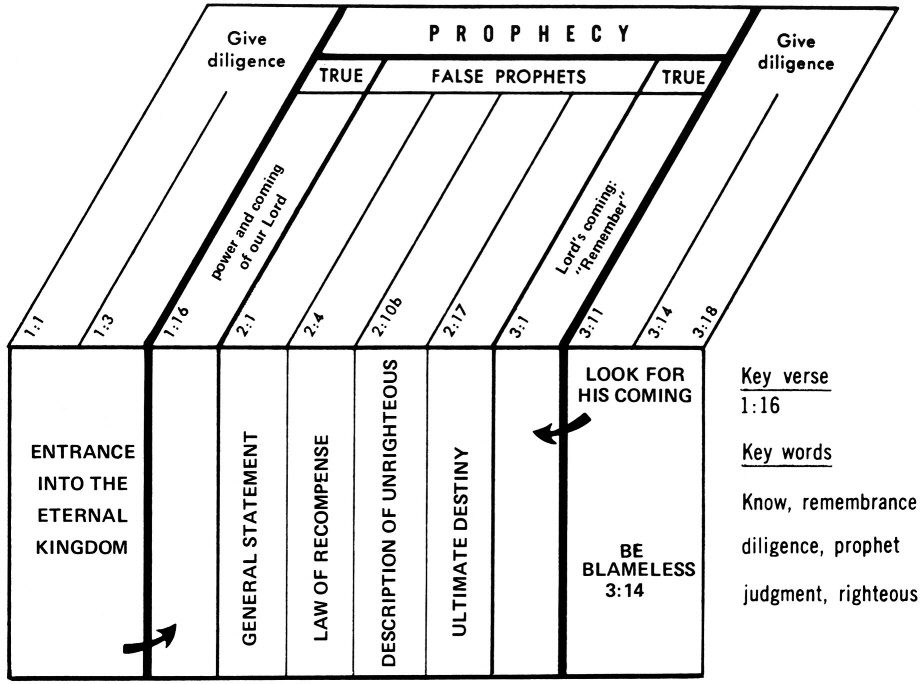
2 Peter: True and False Prophecy
Click chart to enlarge
Chart from Jensen's Survey of the NT - used by permission
Charles Swindoll's Chart - right side of page
| FIRST PETER | SECOND PETER |
| Letter of consolation | Letter of Warning |
| Encouragement for the Church | Error in the Church |
| Main teaching: Comfort for Suffering Saints | Main teaching: Exposure of False Teachers |
| Suffering of Christ | Glory of Christ |
| Christ - His Redemptive Title | Lord - His Title of Dominion |
| Hope - Enables us to Face Trials | Full Knowledge - Enables us to Recognize Error |
| External Opposition | Internal Opposition |
| Hostility | Heresy |
| Danger from Without | Danger from Within |
| Hope in the Lord's Return | Certainty of the Lord's Return |
| Walk in Holiness as God is Holy | Growth in Grace and Knowledge of Christ |
| "Pain with a Purpose" | "Poison in the Pew" |
|
Adapted from Jensen's Survey of the New Testament and Wilkinson and Boa's Talk Thru the Bible |
|
|
2 PETER |
||||||||
| Cultivation of Christlike Character |
Condemnation of False Teachers |
Confidence in the Return of Christ |
||||||
| Greeting to Saints 2Pe 1:1-2 |
Growth in Christ 2Pe 1:3-14 |
Grounds |
Danger of |
Demise of |
"Decor" of |
Mockers in |
Manifest |
Maturity in light of that |
| Know Your Salvation |
Know |
Know Your Adversaries |
Know |
|||||
| True Prophecy (True Knowledge) |
False Prophets (False Teachers) |
Final Prophecy (Day of the Lord) |
||||||
| Holiness | Heresy | Hope | ||||||
| Development of Faith |
Denunciation of False Teachers |
Design of The Future |
||||||
- See Introduction to 2 Peter by Dr John MacArthur Title, Author, Date, Background, Setting, Historical, Theological Themes, Interpretive Challenges, Outline by Chapter/Verse. Excellent overview. Here is MacArthur's assessment of the often disputed authorship of Second Peter:
The author of 2 Peter is the Apostle Peter (see Introduction to 1 Peter). In 1:1, he makes that claim; in 3:1, he refers to his first letter; in 1:14, he refers to the Lord’s prediction of his death (John 21:18,19); and in 1:16–18, he claims to have been at the Transfiguration (Matt. 17:1–4). However, critics have generated more controversy over 2 Peter’s authorship and rightful place in the canon of Scripture than over any other NT book. The church fathers were slow in giving it their acceptance. No church father refers to 2 Peter by name until Origen near the beginning of the third century. The ancient church historian, Eusebius, only included 2 Peter in his list of disputed books, along with James, Jude, 2 John, and 3 John. Even the leading Reformers only hesitatingly accepted it.
The question about differences in Greek style between the two letters has been satisfactorily answered. Peter wrote that he used an amanuensis, Silvanus, in 1 Peter (cf. 1 Pet. 5:12). In 2 Peter, Peter either used a different amanuensis or wrote the letter by himself. The differences in vocabulary between the two letters can be explained by the differences in themes. First Peter was written to help suffering Christians. Second Peter was written to expose false teachers. On the other hand, there are remarkable similarities in the vocabulary of the two books. The salutation, “grace to you and peace be multiplied,” is essentially the same in each book. The author uses such words as “precious,” “virtue,” “putting off,” and “eyewitness,” to name just a few examples, in both letters. Certain rather unusual words found in 2 Peter are also found in Peter’s speeches in the Acts of the Apostles. These include “obtained” (1:2; Acts 1:17); “godliness” (1:3,6,7; 3:11; Acts 3:12); and “wages of iniquity” (2:13,15; Acts 1:18). Both letters also refer to the same OT event (2:5; 1 Pet. 3:18–20). Some scholars have pointed out that there are as many similarities in vocabulary between 1 and 2 Peter as there are between 1 Timothy and Titus, two letters almost universally believed to have been written by Paul.
The differences in themes also explains certain emphases, such as why one letter teaches that the second coming is near, and one deals with its delay. First Peter, ministering especially to suffering Christians, focuses on the imminency of Christ as a means of encouraging the Christians. Second Peter, dealing with scoffers, emphasizes the reasons why that imminent return of Christ has not yet occurred. Other proposed differences invented by the critics, such as the contradiction between including the resurrection of Christ in one letter and the Transfiguration of Christ in the other, seem to be contrived.
Moreover, it is seemingly irrational that a false teacher would spuriously write a letter against false teachers. No unusual, new, or false doctrines appear in 2 Peter. So, if 2 Peter were a forgery, it would be a forgery written by a fool for no reason at all. This is too much to believe. The conclusion to the question of authorship is that, when the writer introduced the letter and referred to himself as Peter, he was writing the truth.
Nero died in a.d. 68, and tradition says Peter died in Nero’s persecution. The epistle may have been written just before his death (1:14; ca. a.d. 67–68).
OVERVIEWS AND INTRODUCTIONS:
- 2 Peter: In the Face of Falsehood - Ray Stedman - "The Bible without the Spirit leads to a dead, institutional Christianity. The Spirit without the Bible leads to groundless fanaticism. We need both the Spirit and the Word to effectively Adventure through the Bible."
- 2 Peter Introduction - John MacArthur
- Second Peter - Charles Swindoll
- Second Peter: Introduction, Argument, and Outline - Daniel Wallace
- Overview of 2 Peter including detailed outline and chapter/section summaries - James Van Dine
- Key to 2 Peter - William Orr
- Intro to 2 Peter - the NIV Study Bible
- Myer Pearlman's through the Bible - 2 Peter
- Synthetic Bible Study - 2 Peter - James Gray
- 2 Peter Introduction - True Knowledge - Wil Pounds
- 2 Peter Introduction - NIV Study Bible
DICTIONARY ARTICLES:
- Baker Theological Evangelical - 2 Peter, Theology of 2 Peter
- American Tract Society Peter, Epistles of
- Easton's Bible Dictionary Peter, Second Epistle of
- Fausset Bible Dictionary Peter, the Epistles of
- Hastings' Dictionary of the Bible Peter, Second Epistle of
- Hastings' Dictionary of the NT Peter Epistles of
- Morrish Bible Dictionary Peter, Second Epistle of
- Smith Bible Dictionary Peter, Second Epistle o
- International Standard Bible Encyclopedia Peter, the Second Epistle of
- McClintock and Strong's Bible Encyclopedia Peter, Second Epistle Of
- The Nuttall Encyclopedia Peter, the Second Epistle of
- Holman Bible Dictionary - 2 Peter
- Bridgeway Bible Dictionary - Peter, letters of
- 1911 Encyclopedia Britannica Epistles of Peter
- Kitto Biblical Cyclopedia Peter epistles of
Key Words: See importance of key words - learn how to mark key words and the associated discipline of how to interrogate them with 5W/H questions. Practice "interrogating" key words as well as term of conclusion (therefore), term of explanation (for), terms of purpose or result (so that, in order that, that, as a result), terms of contrast (but, yet), expressions of time (including then; until, after) and terms of comparison (like, as). You will be amazed at how your Teacher, the Holy Spirit, will illuminate your understanding, a spiritual blessing that will grow the more you practice! Be diligent! Consider the "5P's" - Pause to Ponder the Passage then Practice it in the Power of the Spirit. See also inductive Bible study - observation (Observe With a Purpose), Interpretation (Keep Context King, Read Literally, Compare Scripture with Scripture, Consult Conservative Commentaries), and then be a doer of the Word with Application. Do not overlook "doing the word" for if you do you are deluding yourself, and are just a "smarter sinner," but not more like the Savior! As Jesus said "blessed are those who hear the word of God, and observe it." (Lk 11:28+, cf James 1:22+),
- Know/knowledge - 2 Pet 1:2, 1:3, 1:5, 1:6, 1:8, 1:12, 1:14, 1:16, 1:20, 2:9, 2:12, 2:20, 2:21, 3:3, 3:17, 3:18
- Remember/remind - 2 Pe 1:12, 13, 3:1, 3:2
- Diligent/diligence - 2 Pe 1:5, 10, 15, 3:14
- Lord - 2 Pe 1:2, 8, 11, 14, 16, 2 Pe 2:9, 11, 20, 2 Pe 3:2, 8, 9, 10, 15, 18
See discussion on marking key words. To help your study print out the Observation Worksheet on 2 Peter with double spaced text for marking Key Words, making lists, taking notes that you can later transfer to your Bible
Dr. Kenneth Gangel offers a summary of the reasons Peter wrote his second letter.
This final impassioned plea to grow in Christian maturity (2Pe 1:5, 6, 7, 3:18) and guard against false teachers was precipitated by the fact that [Peter’s] time was short (2Peter 1:13, 14, 15) and that these congregations faced immediate danger (2Peter 2:1, 2, 3). He also desired to refresh their memories (2Peter 1:13) and stimulate their thinking (2Peter 3:1, 2) so they would remember his teaching (2Peter 1:15).... And he encouraged his readers with the certainty of Christ’s return (2Peter 3:1-16). (Today in the Word)
A Dr. Congdon once approached Bible teacher R. A. Torrey, complaining he could get nothing out of his Bible study.
“Please tell me how to study it so that it will mean something to me.”
“Read it,” replied Dr. Torrey.
“I do read it.”
“Read it some more.”
“How?”
“Take some book and read it twelve times a day for a month.”
Torrey recommended Second Peter. Dr. Congdon later said,
“My wife and I read 2 Peter three or four times in the morning, two or three times at noon, and two or three times at dinner. Soon I was talking 2 Peter to everyone I met. It seemed as though the stars in the heavens were singing the story of 2 Peter. I read 2 Peter on my knees, marking passages. Teardrops mingled with the crayon colors, and I said to my wife,
“See how I have ruined this part of my Bible.”
“Yes,” she said, “but as the pages have been getting black, your life has been getting white.”
John Calvin - "The majesty of the Spirit of Christ exhibits itself in every part of the epistle" (of Second Peter).
J Sidlow Baxter - "Peter is distinctively the apostle of hope, as is Paul of faith, James of works and John of love....There are always two tests of Christian genuineness. The doctrinal test is 'What is the attitude to the person and work of Christ?' The practical test is 'What is the resultant character and conduct?' Both tests appear in Second Peter. Note the two dangers indicated in the first chapter. There is the danger of life without growth (2Peter 1:3-8); and there is the danger of knowledge without practice (2Peter 1:9-14). Life never remains static: it either goes forward or backward. Life without growth becomes atrophy. Similarly knowledge without practice becomes blindness instead of vision (2Peter 1:9). It is vital to be members of the 'progressive party.'...To be forewarned is to be forearmed says the old proverb. Study carefully Peter's forewarning in 2Peter 2:1-3ff. It is a point of incidental interest that in 2Pe 2:14 and 2Pe 2:18 the word translated as "be beguiling" (enticing) and "allure" (entice) in the Greek is literally to take with a bait - a relic from Peter's fishing days. "Beware," says Peter in effect, 'Your most dangerous deceivers are those who come with a tasty bait and a concealed hook!' Let this second chapter convince us that wherever there is a Divine truth which saves, there will be a Satanic counterfeit which damns: so will it be until the arch-deceiver is flung into the abyss. What a scathing exposure is this second chapter! There is no "mincing of words" or "beating about the bush." There can be no tolerance of that which, inside the very Church itself, dishonors Christ and ruins soul. There can be no "dainty handling" of false teachers! A viper can be a gorgeous creature to look at, but once let its poison fang get you, or its strangle-coils enwrap you...! Peter sees the issue with Spirit-anointed clearness. There can be no compromise. Remember, this second chapter is not merely Peter speaking; it is the Spirit of God. It may well make some of us think deeply. When easy-going kindness lounges in the place of righteous indignation, and allows Christ-dishonoring false doctrine to play havoc inside the Church, kindness has ceased to be Christian, it has become disguised disloyalty, camouflaged cowardice, or a moral wasting-disease." (Baxter's Explore the Book-J. Sidlow Baxter-recommended)
Henrietta Mears - Seven steps go up from faith, and the last one is love. These steps are the Christian virtues every Christian should have. Let’s climb slowly and thoughtfully up this flight of stairs and see how far we have gone. To your faith add goodness, knowledge, self-control, perseverance, godliness, brotherly kindness and love (see 2 Peter 1:5–7). This is the result of our precious faith. The fuller the measure of these virtues, the greater will be our knowledge of Jesus Christ our Lord. Know Christ, for to know Him is life eternal, and in none other is there salvation (see Acts 4:12). Peter says that “he that lacketh these things is blind, and cannot see afar off” (2 Peter 1:9). If we do not have these virtues, we will be nearsighted Christians, unfit for enlistment in God’s army. Be sure of your position in Christ. Don’t ever doubt your calling in Him. Make every effort to put God’s call and choice beyond all doubt. Make every effort in prayer, in study and in talking with older Christians. Life is full of so much uncertainty, but you do not have to be uncertain in spiritual things. A spiritual certainty produces a stability in life; then “ye shall never fall” (2 Peter 1:10). Someone has said each Christian is a seven-story building with a strong foundation. Add story to story, but be sure to make faith your foundation. If you try to build without the proper base, the building will become top heavy. To be sure, faith is the foundation grace. But a foundation is of little use if no building follows. Peter, like Paul, warns Christians not to stand still. Don’t remain babies in Christ, tripping over every teaching. Grow strong. During especially tough economic times, it is not unusual to see the framework of a building standing stark and gaunt, weeds growing around it, abandoned by the workers who had begun a good work but because the economy became depressed, the work had stopped before the building was finished. The foundation was substantial and adequate, but for years it was entirely useless because nothing was added to make it habitable. A Christian’s ambition should be to have a full life. Then, Peter says, “so an entrance shall be ministered unto you abundantly into the everlasting kingdom of our Lord and Saviour Jesus Christ” (2 Peter 1:11). (What the Bible is All About - Recommended Resource)
- 2 Peter Precept Ministries International - Download lesson 1 of this 8 part inductive study of 2 Peter
- See multiple articles on topic - Inductive Bible Study
Wayne Barber
- 2 Peter Introduction - Protected from Error
- 2 Peter 1 - Importance of Spiritual Knowledge
- 2 Peter 1 - Faith is Precious
- 2 Peter 1 - Seven Characteristics of Godly Life
- 2 Peter 1 - Established by Word of God
- 2 Peter 1 - A Word of Certainly in Time of Trouble
- 2 Peter 2 - Beware of Snakes Around the Water
- 2 Peter 3 - Willful Ignorance
- 2 Peter 3 - Be Ready for the Day of the LORD
Kay Arthur
- 2 Peter - OT Prophets- Repent & Obey
- 2 Peter 1 - Peter's Purpose
- 2 Peter 1 - Divine Nature & Flesh
- 2 Peter 1 - How Shall We Live?
- 2 Peter 1 - Which World is REAL?
- 2 Peter 1 - Weary in Well-Doing?
- 2 Peter 2 -How to Spot False Teachers
- 2 Peter 2 -False Teachers- Here, Increasing
- 2 Peter 3 - Mockers are Not New
These onsite in depth verse by verse and phrase by phrase commentary notes are written from a literal, conservative, millennial, and evangelical perspective. There is heavy emphasis on Greek word studies with frequent use of devotionals and sermon illustrations.
2 Peter 1:2
2 Peter 1:3
2 Peter 1:4
2 Peter 1:5
2 Peter 1:6
2 Peter 1:7
2 Peter 1:8
2 Peter 1:9
2 Peter 1:10
2 Peter 1:11
2 Peter 1:12
2 Peter 1:13
2 Peter 1:14
2 Peter 1:15
2 Peter 1:16
2 Peter 1:17
2 Peter 1:18
2 Peter 1:19
2 Peter 1:20
2 Peter 1:21
2 Peter 2:2
2 Peter 2:3
2 Peter 2:4
2 Peter 2:5
2 Peter 2:6
2 Peter 2:7
2 Peter 2:8
2 Peter 2:9
2 Peter 2:10
2 Peter 2:11
2 Peter 2:12
2 Peter 2:13
2 Peter 2:14
2 Peter 2:15
2 Peter 2:16
2 Peter 2:17
2 Peter 2:18
2 Peter 2:19
2 Peter 2:20
2 Peter 2:21
2 Peter 2:22
2 Peter 3:2
2 Peter 3:3
2 Peter 3:4
2 Peter 3:5
2 Peter 3:6
2 Peter 3:7
2 Peter 3:8
2 Peter 3:9
2 Peter 3:10
2 Peter 3:11
2 Peter 3:12
2 Peter 3:13
2 Peter 3:14
2 Peter 3:15
2 Peter 3:16
2 Peter 3:17
2 Peter 3:18
Explanation - The following list includes not only commentaries but other Christian works by well known evangelical writers. Most of the resources below are newer works (written after 1970) which previously were available only for purchase in book form or in a Bible computer program. The resources are made freely available by archive.org but have several caveats - (1) they do not allow copy and paste, (2) they can only be checked out for one hour (but can be checked out immediately when your hour expires giving you time to read or take notes on a lengthy section) and (3) they require creating an account which allows you to check out the books free of charge. To set up an account click archive.org and then click the picture of the person in right upper corner and enter email and a password. That's all you have to do. Then you can read these more modern resources free of charge! I have read or used many of these resources but not all of them so ultimately you will need to be a Berean (Acts 17:11+) as you use them. I have also selected works that are conservative and Biblically sound. If you find one that you think does not meet those criteria please send an email at https://www.preceptaustin.org/
Second Peter and Jude : an expositional commentary by Hiebert, D. Edmond - One of my favorite expositors!
Rosscup - He takes conservative positions, even seeing Jude as following Peter’s second epistle. He usually has something clarifying on a verse and displays considerable awareness of views and issues. Preachers and lay readers will find his present work worth the time.
Be alert (2 Peter, 2 & 3 John, Jude) by Wiersbe, Warren Or here - Be alert - His commentaries will always yield good material for preaching and teaching.
Cyril Barber - A timely treatment of 2 Peter, 2 and 3 John, and Jude. Exposes those who are merchandisers of error, teachers of false doctrine, and deceivers of those whose lack of knowledge of God's Word makes them easy prey to cultists.
The Bible Exposition Commentary - Ephesians through Revelation - Warren Wiersbe
Rosscup - One of America’s most appreciated staunchly evangelical Bible conference teachers gives diligent, refreshing expositions. These are all of his 23 separate, earlier books in the “Be” series on the New Testament. He strikes a particular appeal with lay people as he crystallizes sections, deals with some of the verses, handles certain problems and backgrounds and applies principles. He is premillennial.
With the Word by Wiersbe, Warren 430 ratings Old and New Testament.
Amazon.com - A fresh approach which not only offers trustworthy exposition, but also provides a book-by-book, chapter-by-chapter tour through the glory of the Bible. This highly readable personal "conversation" with Scripture guides you through each book, helping you reap the rich, life-changing applications on every page. You will be encouraged to develop your own personal Bible reading program and learn the power of meditation on its truth.
Wiersbe's Expository Outlines on the New Testament by Wiersbe, Warren W
Cyril Barber - This is a book of exceptional merit. Pastors, missionaries, and Christian workers will profit from its use. Wiersbe introduces each book of the NT, provides an outline, and then furnishes his readers with a chapter-by-chapter discussion of the contents. The homiletic style is a “plus.” Recommended.
Cyril Barber - An Introduction and Commentary. Revised ed. Tyndale New Testament Commentaries. Grand Rapids: William B. Eerdmans Publishing Co., 1987. The original edition appeared in 1968 and has served Bible students well for more than two decades. This revision contains the same helpful level of scholarship which made the first edition so valuable. The elucidation of the text is such that all readers will benefit from this insightful work.
1 & 2 Peter : a self-study guide by Jensen, Irving
Conquering through conflict : a study of 2 Peter : Bible study guide by Swindoll, Charles
Books of 1 & 2 Peter : between the rock and a hard place Max Lucado
Epistles of peter and of jude by Kelly, J. N. D
Rosscup - This is one of the better commentaries for the serious student. Kelly shows good scholarship and insight, and usually is helpful on problems. He has taught at Oxford University. He posits a date of A. D. 64 for I Peter but is not firm on authorship by Peter. He feels that Peter did not author II Peter, but that it was written later (ca. 100–110). But he is excellent in exegesis of the text and grappling with issues and views. On many verses he has a lot to contribute.
First & Second Peter by Barbieri, Louis - Everyman's Bible Commentary Series
James Rosscup - A 126-pp., brief exposition by a former professor of Bible at Dallas Seminary. Barbieri surveys with some reference to historical setting and awareness of Greek, dealing concisely with certain of the problem passages. The work is geared for devotional reading or a quick summation for lay Bible studies.
Cyril Barber - An excellent volume to place in the hands of laypeople. Barbieri makes available a clear, thematic, biblically sound exposition of the text
Jude, 2 Peter by Bauckham, Richard (Word Biblical Commentary series)
Rosscup - Some will not think the work evangelical. It has discussion looking at the Greek exegesis in some detail and with competence and showing a high familiarity with literature on the epistles as well as extra-biblical sources he feels pertains. In some cases he offers a spread of possibilities on views and arguments on problems. His bibliography is extensive. He will disturb many readers with his denial of authorship by Peter (he says the church at Rome produced it), and his view that the early readers would not disrespect it for being pseudonymous but take its message to heart as “a faithful mediator of the apostolic message” (pp. 161–62). Bauckham’s view of inspiration is hazy, and he leaves students unsure whether he feels that any of the predictions or statements in the two epistles are objectively, actually true. In his thinking II Peter is dependent on Jude. The work is flawed in some of its doctrinal content but impressive in its help on exegesis and highly regarded in the academic community.
Opening up 2 Peter by Anderson, Clive,
1 Peter, 2 Peter, Jude - Life Application Bible Commentary - 1&2 Peter, Jude. Often has nice practical applications.
2 Peter & Jude by Harvey, Robert W and Philip H Towner - IVP Commentary Series 4 ratings
The message of 2 Peter & Jude : the promise of His coming by Lucas, R. C from Bible Speaks Today series
The second epistle general of Peter, and the general epistle of Jude : an introduction and commentary by Green, Michael,
Cyril Barber - An Introduction and Commentary. Revised ed. Tyndale New Testament Commentaries. Grand Rapids: William B. Eerdmans Publishing Co., 1987. The original edition appeared in 1968 and has served Bible students well for more than two decades. This revision contains the same helpful level of scholarship which made the first edition so valuable. The elucidation of the text is such that all readers will benefit from this insightful work.
2 Peter and Jude : a handbook on the Greek text by Davids, Peter H 8 ratings
Gene L. Green, professor of New Testament, Wheaton College and Graduate School - Davids provides an expert exegetical travel guide for those rediscovering these neglected gems in the canon.
Stanley E. Porter, professor of New Testament, McMaster Divinity College - This astute and useful grammatical handbook goes beyond simply parsing forms and labeling constructions. Davids brings in some of the latest linguistic research—including elements of verbal aspect theory—to help him as he explicates these important epistles.
I & II Peter and Jude : introduction and commentary by Cranfield, C. E. B
James Rosscup - Cranfield is an outstanding exegete and offers comments of a critical, exegetical nature that are concise but helpful. One could wish so great a master had said more detail, as he does on Romans.
2 Peter and Jude by Gardner, Paul,
Rosscup - One can be impressed with this, among brief efforts, for some sensible, flowing exposition after convictions that the Apostle Peter wrote 2 Peter and Jude, the half brother of Jesus, wrote the letter of Jude. The work can be frequently clear (2 Pet. 1:20–21), or nebulous (as on the status of those who need to make sure, 2 Pet. 1:9–10, or how or when the angels sinned in 2:4). Overall the commentary is mediocre in covering issues. But stimulating thoughts appear on how Jude, much neglected, is relevant today for preaching (145–46).
The Communicator's Commentary. James, 1, 2 Peter, Jude by Cedar, Paul A., Now know as Preacher's Commentary - can have some helpful illustrations.
1 and 2 Peter, Jude by Hillyer, N - New International Biblical Commentary (Here is a review of Hillyer's work on 2 Peter in Understanding the Bible Series - 8 ratings)
The Preacher's outline & sermon Bible : New Testament, King James Version - Helpful notes and cross-references if you are preaching or teaching this small book.
The theology of the letters of James, Peter, and Jude
KJV Bible Commentary Judges - Hindson, Edward E; Kroll, Woodrow Michael. This is not a study Bible per se, but a one volume commentary with over 3000 pages of comments covering the entire OT/NT. There is no restriction on length of time one can use, but there is no copy and paste function. These are excellent conservative comments that interpret Scripture from a literal perspective. User reviews - it generally gets 4/5 stars from users. Recommended.
The King James Study Bible Second Edition (2013) (Thomas Nelson) contributing editors (only first is listed) include Wayne A. Brindle. There is no restriction on length of time one can use, but there is no copy and paste function.
Zondervan NIV Study Bible - (2011) 2570 pages - Use this one if available as it has more notes than edition below. One hour limit
NIV Study Bible by Barker, Kenneth L; Burdick, Donald W (1995) 2250 pages. This is the first edition. This resource has been fully revised in 2020. One hour limit
NKJV Study Bible: New King James Version Study Bible (formerly "The Nelson Study Bible - NKJV") by Radmacher, Earl D; Allen, Ronald Barclay; House, H. Wayne (1997, 2007); 917 ratings Very helpful notes. Conservative. There is no restriction on length of time one can use, but there is no copy and paste function.
Believer's Bible Commentary - OT and NT - MacDonald, William (1995) 2480 pages. Conservative. Literal. Often has very insightful comments. John MacArthur, says "Concise yet comprehensive - the most complete single-volume commentary I have seen." Warren Wiersbe adds "For the student who is serious about seeing Christ in the Word." One hour limit.
Rosscup - This work, originally issued in 1983, is conservative and premillennial, written to help teachers, preachers and people in every walk of life with different views, explanation and application. The 2-column format runs verse by verse for the most part, usually in a helpfully knowledgeable manner, and there are several special sections such as “Prayer” in Acts and “Legalism” in Galatians. The premillennial view is evident on Acts 1:6, 3:20, Romans 11:26, Galatians 6:16, Revelation 20, etc.
HCSB Study Bible : Holman Christian Standard Bible - General Editor Jeremy Royal Howard (2010) 2360 pages. Conservative. Good notes. Include Holmans excellent maps. One hour limit
Life Application Study Bible: Old Testament and New Testament: New Living Translation. Has some very helpful notes especially with application of texts. 4,445 ratings One hour limit
The MacArthur study Bible - John MacArthur. Brief but well done notes for conservative, literal perspective. 1,275 ratings
ESV study Bible - Excellent resource but not always literal in eschatology and the nation of Israel 6,004 ratings
The David Jeremiah Study Bible - (2013) 2208 pages. 2,272 ratings Logos.com - "Drawing on more than 40 years of study, Dr. David Jeremiah has compiled a legacy resource that will make an eternal impact on generations to come. 8,000 study notes. Hundreds of enriching word studies"50+ Essentials of the Christian Faith" articles."
Wycliffe Bible Commentary - Charles Pfeiffer - 1560 pages (1962). 214 ratings Less detailed than the KJV Bible Commentary. Conservative. Notes are generally verse by verse but brief.
Rosscup - Conservative and premillennial scholars here have been experts in their fields. The work contains brief introductions and attempts to give a verse-by-verse exposition, though it does skip over some verses. The treatments vary with the authors, but as a whole it is a fine one-volume commentary for pastors and students to use or give to a layman. Outstanding sections include, for example: Whitcomb on Ezra-Nehemiah-Esther; Culver on Daniel; Ladd on Acts; Harrison on Galatians; Johnson on I Corinthians; and Ryrie on the Johannine Epistles.
The Defender's Study Bible : King James Version by Morris, Henry M. Excellent notes by well known creationist. 45 ratings
New Bible Commentary - (1994) See user reviews
Compact Bible commentary by Radmacher, Earl D; Allen, Ronald Barclay; House, H Wayne, et al - 954 pages. 424 ratings Multiple contributors to the comments which are often verse by verse. The comments are brief but meaty and can really help your study through a given book. A sleeper in my opinion.
The Experiencing God Study Bible: the Bible for knowing and doing the will of God - Blackaby, Henry (1996) 1968 pages - CHECK THIS ONE! Each chapter begins with several questions under the title "PREPARE TO MEET GOD." Then you will interesting symbols before many of the passages. The chapter ends with a "DID YOU NOTICE?" question. This might make a "dry chapter" jump off the page! Read some of the 48 ratings
Disciple's study Bible: New international version 54 ratings Not that helpful for verse by verse study. Focuses on application of Christian doctrines. 10,000 annotations; doctrinal summaries, "Life Helps" section relate doctrine to everyday discipleship.
The Living Insights Study Bible : New International Version - Charles Swindoll. Notes are good but somewhat sparse and not verse by verse.
The Apologetics Study Bible Understand Why You Believe by Norman Geisler
NIV archaeological study Bible (2005) 2360 pages 950 ratings (See also Archaeology and the Bible - OT and NT)
NIV Cultural Backgrounds Study Bible. Bringing to Life the Ancient World of Scripture Keener, Craig and Walton, John. Editors (2017)
The Holman illustrated study Bible 120 ratings Includes the excellent Holman maps but otherwise of little help in serious study.
Zondervan King James Version commentary - New Testament
NIV Celebrate Recovery Study Bible
Daily Study Bible for Women : New Living Translation
The Woman's Study Bible : the New King James Version
The Study Bible for Women : Holman Christian Standard Bible
Daily Study Bible for Men : New Living Translation
NIV Topical Study Bible : New International Version
The Ryrie Study Bible - Charles Ryrie (1978) 2142 pages. Conservative. 216 ratings
The Hebrew-Greek key study Bible : New American standard study by Strong, James, 1822-1894; Zodhiates, Spiros
The New Inductive Study Bible : updated New American Standard Bible - Introductions of each book give suggestions how to perform an inductive study on that specific book. Not strictly speaking a "study Bible" with notes but a Bible to help you study inductively. Has wide margins for making notes. This is one that works best in "paper," not digitally.
With the Word - Devotional Commentary - Warren Wiersbe - 428 ratings
Evangelical Commentary on the Bible - Judges by Andrew Boling (20 pages); editor Walter Elwell (1989) 1239 pages. User reviews. (See also Boling's 380 page commentary on Judges the Anchor Bible Series)
Halley's Bible Handbook Henry H. Halley - (2000) 2720 pages (much larger than original edition in 1965 and no time limit on use). (Halley's Bible handbook : an abbreviated Bible commentary - one hour limit 1965 872 pages)
Rosscup - A much-used older evangelical handbook bringing together a brief commentary on Bible books, some key archaeological findings, historical background, maps, quotes, etc. It is helpful to a lay Bible teacher, Sunday School leader, or pastor looking for quick, pertinent information on a Bible book. This is the 72nd printing somewhat revised. Halley packed in much information. Unger’s is better overall, but that is not to say that Halley’s will not provide much help on basic information.
The Shaw Pocket Bible Handbook - Editor - Walter Elwell (1984) 408 pages.
"This hardback is small in size but packed full of content: Brief summaries of every book of the bible, cultural, archaeological and historical info, word definitions, pictures, maps and charts." Worth checking!
The Lion handbook to the Bible - (1999) 822 pages. This resource is absolutely loaded with very nice color pictures and charts.
Wiersbe's Expository Outlines on the New Testament by Wiersbe, Warren W
Cyril Barber - This is a book of exceptional merit. Pastors, missionaries, and Christian workers will profit from its use. Wiersbe introduces each book of the NT, provides an outline, and then furnishes his readers with a chapter-by-chapter discussion of the contents. The homiletic style is a “plus.” Recommended.
Wiersbe's expository outlines on the Old Testament by Wiersbe, Warren W 113 ratings
"Even the most difficult Scriptures come alive as Warren Wiersbe leads you book-by-book through the Old Testament and helps you to see the "big picture" of God's revelation. In this unique volume, you will find: • Introductions and/or outlines for every Old Testament book • Practical expositions of strategic chapters • Special studies on key topics, relating the Old Testament to the New Testament • Easy-to-understand expositions that are practical, preachable, and teachable If you have used Dr. Wiersbe's popular BE series, you know how simple and practical his Bible studies are, with outlines that almost teach themselves. If not, you can now discover a wonderful new resource. This work is a unique commentary on every book of the Old Testament. It contains new material not to be found in the BE series.
The Bible knowledge background commentary : Matthew-Luke by Evans, Craig A - This resource will give you very interesting insights and is worth checking on individual passages.
Harper study Bible : the Holy Bible, Revised Standard Version
The Jewish Study Bible - Only OT - Interesting Jewish perspective.
The Student Bible : New International Version
Hebrew-Greek key word study Bible : New international version
Key word commentary : thoughts on every chapter of the Bible by Water, Mark
Eerdmans' Family Encyclopedia of the Bible (1978) 344 pages
Eerdmans' Handbook to the Bible (1983) 688 pages
Tyndale Handbook of Bible charts & maps by Wilson, Neil
Bible Handbook and A-Z bible encyclopedia
International Children's Bible field guide : answering kids' questions from Genesis to Revelation by Richards, Larry
The illustrated guide to Bible customs & curiosities by Knight, George W. (George William),
Today's handbook of Bible times & customs by Coleman, William L
Unger's Commentary on the Old Testament (Volume 2 - Isaiah - Malachi) by Unger, Merrill Frederick, 1909- (1981) 972 pages.
The new Unger's Bible dictionary by Unger, Merrill Frederick, 1909-
Nelson's illustrated encyclopedia of Bible facts by Packer, J. I. (James Innell); Tenney, Merrill C.
Survey of the Bible : introductory insights, background studies, book-by- book survey by Unger, Merrill Frederick
The parallel New Testament and Unger's Bible handbook : produced for Moody monthly by Unger, Merrill (1975) 744 pages 4 ratings
The Hodder Bible handbook by Unger, Merrill
Nelson's expository dictionary of the Old Testament by Unger, Merrill
Kregel Bible handbook : a full-color guide to every book of the Bible by Kerr, William 3 ratings
The new encyclopedia of Christian quotations by Water, Mark
New Testament words - William Barclay - very interesting resource - covers about 70 NT Greek words in Barclay's unique style
Zondervan handbook to the Bible
Zondervan illustrated Bible backgrounds commentary - Matthew, Mark, Luke - 552 pages. (2002) See user reviews.
Zondervan illustrated Bible backgrounds commentary - John
Zondervan illustrated Bible backgrounds commentary - Isaiah, Jeremiah, Lamentations, Ezekiel, Daniel
Dictionary of Paul and his letters 180 ratings IVP Series
The Dictionary of Paul and His Letters is a one-of-a-kind reference work. Following the format of its highly successful companion volume, the Dictionary of Jesus and the Gospels, this Dictionary is designed to bring students, teachers, ministers and laypeople abreast of the established conclusions and significant recent developments in Pauline scholarship. No other single reference work presents as much information focused exclusively on Pauline theology, literature, background and scholarship. In a field that recently has undergone significant shifts in perspective, the Dictionary of Paul and His Letters offers a summa of Paul and Pauline studies. In-depth articles focus on individual theological themes (such as law, resurrection and Son of God), broad theological topics (such as Christology, eschatology and the death of Christ), methods of interpretation (such as rhetorical criticism and social-scientific approaches), background topics (such as apocalypticism, Hellenism and Qumran) and various other subjects specifically related to the scholarly study of Pauline theology and literature (such as early catholicism, the center of Paul's theology, and Paul and his interpreters since F. C. Baur). Separate articles are also devoted to each of the Pauline letters to hermeneutics and to preaching Paul today.
Dictionary of the later New Testament & its developments 71 ratings IVP Series
The third of IVP's critically acclaimed series of dictionaries of the New Testament provides focused study on the often-neglected portions of the New Testament: Acts, Hebrews, the General Epistles, and Revelation. Furthermore, its scope goes beyond the life of the New Testament church to include the work of the apostolic fathers and early Christianity up through the middle of the second century.
Dictionary of New Testament background 79 ratings IVP Series
In a time when our knowledge of the ancient Mediterranean world has grown by leaps and bounds, this volume sets out for readers the wealth of Jewish and Greco-Roman background that should inform our reading and understanding of the New Testament and early Christianity. The Dictionary of New Testament Background takes full advantage of the flourishing study of the Dead Sea Scrolls and offers individual articles focused on the most important scrolls. In addition, the Dictionary encompasses the fullness of second-temple Jewish writings, whether pseudepigraphic, rabbinic, parables, proverbs, histories or inscriptions. Articles abound on aspects of Jewish life and thought, including family, purity, liturgy and messianism. The full scope of Greco-Roman culture is displayed in articles ranging across language and rhetoric, literacy and book culture, religion and cults, honor and shame, patronage and benefactors, travel and trade, intellectual movements and ideas, and ancient geographical perspectives. No other reference work presents so much in one place for students of the New Testament. Here an entire library of scholarship is made available in summary form.
Dictionary of deities and demons in the Bible (DDD) - 950 pages (1995) Read some of the 65 ratings (4.8/5 Stars). A definitive in depth resource on this subject. Very expensive to purchase.
NOTE - All of these resources can be borrowed from archive.org. This list also includes resources to help study the Bible.
See also the list of Word Study Resources
The Complete Word Study Dictionary: New Testament by Zodhiates, Spiros - This is my "go to" resource for Greek word studies. One on the best lexicons for laymen. Highly Recommended for Greek Word Studies to aid your interpretation of a passage.
Analytical Lexicon of the Greek New Testament by Friberg, Timothy. Shorter definitions than Zodhiates but does an excellent job in summarizing the various nuances of a specific Greek word. One of my favorites.
Shorter Lexicon of the Greek New Testament by Gingrich, F. Wilbur. Similar to Friberg but shorter definitions. Gingrich however gives more Scriptures for each nuance, whereas Friberg generally gives only one representative Scripture.
The New Linguistic and Exegetical Key to the Greek New Testament by Rogers, Cleon - This book is a gold mine of little gems on individual Greek words in any NT passage you are studying. If you have time it is always worth checking out! I use it in my Greek word studies all the time.
New Testament Words - William Barclay - 59 ratings very interesting resource - covers about 70 NT Greek words in Barclay's unique style. On page 289 there is a helpful index of English words with the corresponding Greek word, in turn followed by the places Barclay described them in New Testament Words and in his Daily Study Bible series (see list of DSB commentaries here). E.g., take the Greek word for "Covetousness" which is pleonexia and is found in New Testament Words on page 61 and pp 233-235 and is also described in the Daily Study Bible entries for : Mark 7:14-23; Ro 1:28-32; Eph. 4:17-24; Col. 3:5. So you can click the DSB commentary on Mark 7 and scroll down to Mark 7:14 to see Barclay's entry for pleonexia which concludes "Pleonexia ( G4124) is that lust for having which is in the heart of the man who sees happiness in things instead of in God." Interesting!
Greek-English lexicon of the New Testament : based on semantic domains - Louw Nida. Brief but nice definitions. Not easy to use - you need to know some Greek. Classifies Greek words into 93 "semantic domains" (see list on page XXV) and if you can categorize the word you are looking for in one of the domains, it can help find the specific word you are interested in.
Kittel's Theological Dictionary of the New Testament : abridged in one volume (TDNT) - Classic ("Little Kittel") work summarizing the 10 volume set by Kittel. For most of us the abridged definition is "more than enough!"
A Greek-English lexicon of the New Testament, and other early Christian literature; by Bauer, Walter, More detailed definitions but need to know Greek. Zodhiates and Friberg much easier to use.
Liddell and Scott's Greek-English lexicon, abridged : the little Liddell by Liddell, Henry George. The abridged version. You need to know Greek to use.
Exegetical dictionary of the New Testament (Volume 1 - A thru E); Exegetical dictionary of the New Testament (Volume 3- P thru ...) Volume 2 not available. I do not find this adds much to the easier to use resources like Zodhiates and Friberg.
A pocket lexicon to the Greek New Testament by Souter, Alexander. Brief definitions. Need to know some Greek. Not that helpful.
Vine's Expository Dictionary of Old Testament and New Testament Words - pdf. The old standby. You can also borrow Vine's complete expository dictionary of Old and New Testament words
Theological wordbook of the Old Testament by Harris, R. Laird - 229 ratings (5/5 Stars) One of the best OT lexicons for laymen.
Here is another link to the TWOT which has no time limit on use and does allow copy and paste. Can be downloaded as PDF.
Hebrew honey : a simple and deep word study of the Old Testament by Novak, Alfons, (332 pages) Indexed by English words. No Strong's numbers to help you determine if you are researching the correct Hebrew word. Here is a "work around" - go to page 289 and see if there is an annotation of the Scripture you are studying. E.g., say you want to see if there is anything for "heart" in Ezek 11:19. In the Scripture list find an entry for Ezek 11:19 with the English word "Heart." Now go look up "Heart" (on page 123). It does take some effort, but you might glean an insight not described in other Hebrew lexicons.
Nelson's Expository Dictionary of the Old Testament by Unger, Merrill. Indexed by English word and then any related Hebrew nouns or verbs. Definitions are solid and geared to the lay person.
Zondervan NASB exhaustive concordance - 1589 pages
Pocket dictionary for the study of New Testament Greek by DeMoss, Matthew S. If you want to dig a little deeper into Greek. 66 ratings
Analytical concordance to the Holy Bible : containing about 311,000 references, subdivided under the Hebrew and Greek original with the literal meaning and pronunciation of each by Young, Robert,
The Englishman's Greek concordance of the New Testament by Wigram, George
Synonyms of the New Testament by Trench, Richard Chenevix - or click here for list of 108 entries.
Girdlestone's Synonyms of the Old Testament - click for list of 127 entries
The Holman guide to interpreting the Bible by Dockery, David S
Foundations for biblical interpretation : a complete library of tools and resources
Expository Dictionary of Bible Words by Richards, Larry, 33 ratings It is does not go into great depth on the Greek or Hebrew words but does have some excellent insights.
Basic Bible Interpretation : a Practical Guide to Discovering Biblical Truth by Roy Zuck. Recommended.
How to Study Your Bible by Arthur, Kay (CLICK HERE for many other resources from Kay Arthur). The basics of inductive Bible study succinctly described. Recommended. This is the original edition not the new edition.
Living by the Book by Howard G. Hendricks - A classic. An entertaining and informative read that is guaranteed to invigorate your Bible study. Recommended.
Teaching to Change Lives by Howard Hendricks, Howard 561 ratings
The Christian Educator's Handbook on Teaching by Kenneth Gangel and Howard Hendricks 21 ratings
How can I understand the Bible? by DeHaan, Mart (52 page booklet)
The New How to Study Your Bible Workbook (2010) by Arthur, Kay, - Note that this workbook is the companion to the New How to Study Your Bible book (not the same as the one linked above).
Jensen's Survey of Bible (online) by Jensen, Irving 140 ratings (NT) 133 ratings (OT) This is a classic and in conjunction with the following three resources should give you an excellent background to the Bible book you are studying. Jensen has some of the best Book charts available and includes "key words." He also gives you some guidelines as to how to begin your inductive study of each book.
Discover the Bible for Yourself by Arthur, Kay 93 ratings - Proven methods to read, mark, and study God's Word. Introductions to set the stage for each book of the Bible. Maps and charts to add historic and geographic dimension. Word studies for NASB and NIV translations. Definitions and explanations to simplify interpretation. "Things to Think About" for personal application. This resource will inspire and guide anyone interested in creating a personal study of God's Word.
What the Bible is all about by Mears, Henrietta. This is a classic and is filled with "pearls" from this godly teacher of God's Word.
Talk thru the bible by Wilkinson, Bruce The Wilkinson & Boa Bible handbook : the ultimate guide to help you get more out of the Bible
How to profit from Bible reading by Jensen, Irving 2 ratings
Simply understanding the Bible by Jensen, Irving 8 ratings
Enjoy your Bible by Jensen, Irving 5 ratings
Independent Bible study by Jensen, Irving 14 ratings
MacArthur Study Bible - Topic "How to Study the Bible" - John MacArthur
MacArthur's Introductions to all 66 Books - includes a helpful discussion of "Interpretative Challenges"
Swindoll's introductions to all 66 Books - Answers the following questions - Who wrote the book? Where are we? Why is this book so important? What's the big idea? How do I apply this? He also includes a helpful Book Overview chart (right upper corner of page).
How to Get the Most from God's Word by John MacArthur 16 ratings
Journey of the Bible : the remarkable story of how the Bible came from God to you by Jensen, Irving
- 2 Peter Outline – 2 Peter
- How Do I Grow As A Christian – 2 Peter 1:1-11
- 2 Peter – 2 Peter 1:1
- Why I Am A Christian – 2 Peter 1:12-21
- False Teachers: Their Deeds and Destiny – 2 Peter 2:1-3
- The Judgment of God – 2 Peter 2:4-11
- A Portrait of Spiritual Deceivers – 2 Peter 2:12-17
- Preachers Who Cannot Deliver – 2 Peter 2:18-22
- Things God Wants Me To Remember – 2 Peter 3:1-13
- Until Then – 2 Peter 3:14-18
Read his fascinating brief biography - Henry Alford and Phil Johnson's related comments
James Rosscup writes that Alford's series on the New Testament "contains much that is valuable in the Greek New Testament...though all of the Greek New Testament words have been changed to English throughout." (Commentaries for Biblical Expositors: An Annotated Bibliography of Selected Works).
Charles Haddon Spurgeon (see his comments in following entry on Alford).
Editorial Note: If you are not proficient in Greek, you will find this work considerably more useful than the following work by Alford, because in this volume he translates the Greek and Latin into English. While the "The Greek New Testament" is longer (e.g., English version of 1John = 66 pages compared to Greek version = 94 pages in part because the latter includes comments of more technical nature), the substance of the commentary is otherwise similar to that found in the "NT for English Readers".
James Rosscup writes that "This was the great work in the life of the versatile Dean of Canterbury. An outcome of this production was the New Testament for English Readers (4 vols.). Alford was a Calvinist, conservative and premillennial, though not dispensational. He takes a literal interpretation of the thousand years in Rev. 20 and has a famous quote there, is strong on sovereign election as in Ro 8:29, 30 and 1Pe 1:2, but, unfortunately, holds to baptismal regeneration in such texts as Titus 3:5 and John 3:5. He shows a great knowledge of the Greek text and faces problems of both a doctrinal and textual nature." (Commentaries for Biblical Expositors: An Annotated Bibliography of Selected Works)
John Piper writes ""When I’m stumped with a...grammatical or syntactical or logical [question] in Paul, I go to Henry Alford. Henry Alford...comes closer more consistently than any other human commentator to asking my kinds of questions."
Charles Haddon Spurgeon writes that this text "is an invaluable aid to the critical study of the text of the New Testament. You will find in it the ripened results of a matured scholarship, the harvesting of a judgment, generally highly impartial, always worthy of respect, which has gleaned from the most important fields of Biblical research, both modern and ancient, at home and abroad. You will not look here for any spirituality of thought or tenderness of feeling; you will find the learned Dean does not forget to do full justice to his own views, and is quite able to express himself vigorously against his opponents; but for what it professes to be, it is an exceedingly able and successful work. The later issues are by far the most desirable, as the author has considerably revised the work in the fourth edition. What I have said of his Greek Testament applies equally to Alford’s New Testament for English Readers,* which is also a standard work." (Spurgeon, C. H. Lectures to my Students, Vol. 4: Commenting and Commentaries; Lectures Addressed to the students of the Pastors' College, Metropolitan Tabernacle)
- 2 Peter Commentary - 109 page PDF commentary - Recommended. Has numerous quotes from respected, conservative expositors and commentaries. Below are some excepts...
OVERVIEW
Ray Stedman: "This letter was very likely written from the same place as the first letter, when Peter was a prisoner, perhaps of Nero of Rome. At least, it is evident that he is in great danger, because in this letter he says that he feels the time is drawing near when he is to put off his body -- his tent, his habitation -- to go and be with the Lord. And he says the Lord himself showed him this, as recorded for us at the close of the Gospel of John. The Lord Jesus had said to Peter that there would come a time when men would bind his hands and lead him where he did not desire to go. Peter understood this to mean that he was to suffer and die as our Lord died, on a cross. And tradition tells us that Peter was indeed crucified, that he was so humbled by the fact that he was counted worthy to die the same kind of a death that the Lord Jesus did, that he begged his captors to crucify him upside down."
Jones: "We have here a letter written in the early days of the Christian church to a number of Christian people. They were scattered abroad, we gather from the first Epistle, throughout a considerable part of the then civilized and known world. It is a letter written to people who were confronted by difficulties and by problems. The first Epistle, in the same way exactly as this Epistle, makes it quite clear that the object that the Apostle had in mind when he wrote both these letters was to comfort and to encourage and to strengthen these people. They faced difficulties, both from without and within, for their world, as one is never tired of pointing out, was a world very similar to ours… In particular, questions were being raised as to the value of the promises of God. An essential part of the preaching of the Gospel, from the very beginning, was the message of the second coming of our Lord and of the various things that would accompany it. All those first preachers preached a Gospel of judgment. You remember how often we are told in the Gospels and the book of the Acts of the Apostles that their message in the first instance was that men and women should flee from the wrath to come. The Gospel was always presented in terms of judgment. It was put in that historical form, it was emphasized and stressed that this self-same Jesus who had been crucified and buried, and who had risen again, would likewise come again in judgment, and that when He came He would judge the world,, and that therefore all should make certain of being found in a right relationship to Him. But these false teachers and others had crept into the churches and they were raising questions and queries."
INTRODUCTION - 2 Peter 1
Roper: "We are told four things in this introduction. First, we are told the author is Simon Peter. Simon was his Aramaic name; Peter was his Greek name. Both words mean essentially the same thing: rock. If Peter were living today we would probably call him Rocky. He has the same endearing qualities as the hero in the movie 'Rocky' -a sort of rough exterior, and yet, I think, inside, a sensitive heart. He was a man who, outwardly, acted indifferently-he seemed to be very calloused at times, not too sensitive to people's needs-yet inside he had a very soft heart toward the Lord's things, and a desire to be what God intended him to be. By the time he wrote this book he was an old man, probably in his seventies. He was one of the apostles, one of the twelve the Lord called into a relationship with him. After the Lord's resurrection Peter was in Jerusalem for a time preaching, and, as a result of the persecution that broke out after the stoning of Stephen, he traveled to the north and settled in what today is Turkey - There he planted churches and ministered to the body of Christ. Shortly after Paul's death, he went to Rome. It was there that he lost his life, probably within a year of writing this letter. In fact, he may have been in prison at the time he wrote it, and he certainly was facing death, as he indicates in this book. As far as we know from tradition, Peter was crucified upside down outside the city of Rome, on the Ostian Way."
- Put on Faith 2 Peter 1:3-9
- Put on Goodness 2 Peter 1:3-9
- Put on Knowledge 2 Peter 1:3-9
- Put on Self-Control 2 Peter 1:3-9
- Put on Perseverance 2 Peter 1:3-9
- Put on Godliness 2 Peter 1:3-9
- Put on Brotherly Kindness 2 Peter 1:3-9
- Put On Love 2 Peter 1:3-9
- Is the Bible Really Trustworthy? 2Pe 1:20-21
- The Bible....The Book That is Different 2Pe 1:20-21
Dr. Jack L. Arnold earned a doctorate of systematic theology from Dallas Theological Seminary in 1966 and founded Equipping Pastors International in 1997 before his extraordinary death in 2005. For forty years, he pastored churches and meticulously researched and prepared sermons. "When I go to heaven..." were Jack Arnold's last words before dying instantly in the pulpit from a heart attack. The extraordinary event made international headlines.
- 2 Peter 1 Gods Gift to Prevent Apostasy
- 2 Peter 1:2-4 Foundations for Growth
- 2 Peter 1:5-11 Making Election Certain
- 2 Peter 1:12-21 Revelation, an Antidote to Heresy
- 2 Peter 2:1-3 False Teachers
- 2 Peter 2-4-10a Doom and Deliverance
- 2 Peter 2:10b-16 Caricature of False Prophets
- 2 Peter 2:17-22 Apostate Teachers
- 2 Peter 3:1-9 Mockers of the Second Advent
- 2 Peter 3:10-13 Consummation of the World
- 2 Peter 3:14-18 Commands in View of Christs Coming
D Edmond Hiebert - Prints the author's own translation. Barclay defends Petrine authorship of 1 Peter but not of 2 Peter. Valuable for its numerous helpful word studies and background material. Barclay holds that Christ's descent into Hades gave those who there heard Him a second chance.
Comment: I appreciate Barclay's unique insights on Greek words, but clearly his teaching about a "second chance" is NOT sound doctrine! Be an Acts 17:11 Berean with Barclay. See discussion of his orthodoxy especially the article "The Enigmatic William Barclay".
James Rosscup writes that Barnes "includes 16 volumes on the Old Testament, 11 on the New Testament. The New Testament part of this old work was first published in 1832–1851. Various authors contributed. It is evangelical and amillennial...Often the explanations of verses are very worthwhile." (Commentaries for Biblical Expositors: An Annotated Bibliography of Selected Works)
C H Spurgeon "Albert Barnes is a learned and able divine, but his productions are unequal in value, the gospels are of comparatively little worth, but his other comments are extremely useful for Sunday-school teachers and persons with a narrow range of reading, endowed with enough good sense to discriminate between good and evil....Placed by the side of the great masters, Barnes is a lesser light, but taking his work for what it is and professes to be, no minister can afford to be without it, and this is no small praise for works which were only intended for Sunday-school teachers." (Spurgeon, C. H. Lectures to my Students, Vol. 4: Commenting and Commentaries; Lectures Addressed to the students of the Pastors' College, Metropolitan Tabernacle)
John Cereghin - Valuable commentary that had a wide sale when first published by this Presbyterian pastor.
- II Peter 1:1-11 Usefulness & Fruitfulness
- II Peter 2:1-11 Wrath & Rescue
- II Peter 2:12-22 Animal Appetites
- II Peter 3:1-9 1 Day is as a 1000 Years
- II Peter 3:10-18 What Manner of Persons ought you to Be
- 2 Peter 1: 1-2 A Greeting to the Saints
- 2 Peter 1: 1-4 The Wonder of Salvation
- 2 Peter 1: 3-4 The Grace afforded the Saints
- 2 Peter 1: 5-8 The Growth of the Saints
- 2 Peter 1: 9-11 The Guidance for the Saints
- 2 Peter 1: 12-15. The Gratitude for the Saints
- 2 Peter 1: 16-21. The Gospel of the Saints
James Rosscup writes "This work (Gnomon), originally issued in 1742, has considerable comment on the Greek, flavoring the effort with judicious details about the spiritual life. It has much that helps, but has been surpassed by many other commentaries since its day." (Commentaries for Biblical Expositors: An Annotated Bibliography of Selected Works)
Represents Combination of Bengel's Gnomon (above) and Comments by more modern expositors (in brackets) to make this more usable for those who do not read Greek.
Spurgeon comments on the goal to make Bengel's Gnomon (listed above) more accessible -- "Such is the professed aim of this commentary, and the compilers have very fairly carried out their intentions. The whole of Bengel’s Gnomon is bodily transferred into the work, and as 120 years have elapsed since the first issue of that book, it may be supposed that much has since been added to the wealth of Scripture exposition; the substance of this has been incorporated in brackets, so as to bring it down to the present advanced state of knowledge. We strongly advise the purchase of this book, as it...will well repay an attentive perusal. Tischendorf and Alford have contributed largely...to make this one of the most lucid and concise commentaries on the text and teachings of the New Testament" (Spurgeon, C. H. Lectures to my Students, Vol. 4: Commenting and Commentaries; Lectures Addressed to the students of the Pastors' College, Metropolitan Tabernacle)
Spurgeon - Adopted by the Wesleyan Conference as a standard work, and characterized by that body as marked by “solid learning, soundness of theological opinion, and an edifying attention to experimental and practical religion. Necessary to Methodist Students.
Resources that Reference 2 Peter on the largest Bible Study Resource on the Web
James Rosscup gives Bigg's commentary on 1 Peter high marks (and he also recommends 2Peter but no additional comments): "This is probably the second best older study on I Peter from the standpoint of the Greek text. Selwyn is the other. As other ICC works, it deals with details of philology, grammar and possible views on problems." (Commentaries for Biblical Expositors: An Annotated Bibliography of Selected Works)
John Cereghin - A most thorough commentary on the Greek text. He defends Petrine authorship (242-247); urges the translation “our God and Savior” (250-252); teaches baptismal regeneration (260ff); holds it probable that Peter “received every one of St. Paul’s Epistles within a month or two of its publication (301); maintains that the “faith” was a “body of doctrine” (325).
- 2 Peter 1 - A Critical and Exegetical Commentary
- 2 Peter 2 - A Critical and Exegetical Commentary
- 2 Peter 3 - A Critical and Exegetical Commentary
Parting Counsels: An Exposition of the First Chapter
of the Second Epistle of the Apostle Peter
With Four Additional Discourses
1856
Recommended
James Rosscup writes "Brown was minister of Broughton Place, Edinburgh (1829–58), at which post he died. He gives rich, solid comments verse by verse and can refresh any Christian in his devotional times or help a preacher pull together facets of truth and how they relate to life. To Brown, making the calling and election sure refers not to seeing to their existence but to the evidence of them (page 53). Some, however, feel that they are saved when they are far from it (see Brown's discussion of this important topic). He is helpful on furnishing the virtues in verses 5–8. After 225 pages the rest of the book is given to other discourses on how Christians may have proper assurance of salvation, pray for the preacher (Ephesians 6:19), etc." (Commentaries for Biblical Expositors: An Annotated Bibliography of Selected Works)
John Cereghin - We always think of Brown as a Puritan born out of due time. Everything he has left us is massive gold. He is both rich and clear, profound and perspicuous! The material covering chapter 1 (more than 300 pages) is rich, clear and worthy attention.
- Preface
- Table of Contents
- 2 Peter 1:1-11 The Apostle's Exhortation
- 2 Peter 1 Who? The Persons Addressed
- 2 Peter 1 What? The Duty Enjoined - Making their Calling and Election Sure
- 2 Peter 1 How? The Manner in Which the Duty Enjoined is to Be Done...By Adding...
- 2 Peter 1 Why? Motives for Complying with the Apostle's Exhortation
- 2 Peter 1:12-21 The Apostle's Resolutions and the Grounds of Them
- Index of Additional Discourses - 1John 3:19-22, 2Ti 1:12, 2Co 4:6, Eph 6:19 303
Spurgeon - We liked Burkitt better when we were younger. He is, however, a homely and spiritual writer, and his work is good reading for the many. Burkitt is somewhat pithy, and for a modern rather rich and racy, but he is far from deep, and is frequently common-place. I liked him well enough till I had read abler works and grown older. Some books grow upon us as we read and re-read them, but Burkitt does not. Yet so far from depreciating the good man, I should be sorry to have missed his acquaintance, and would bespeak for him your attentive perusal.
Spurgeon on Calvin - Of priceless value....Calvin is a tree whose “leaf also shall not wither;” whatever he has written lives on, and is never out of date, because he expounded the word without bias or partiality.
John Cereghin - 1895. An excellent commentary for the lay student by a conservative British scholar. Has valuable introductions and concise comments.
Frequent brief word studies and occasional illustrations
- 2 Peter 1-3 Survey - Representative excerpts...
2 Peter 1:6 Godliness – eusebeia (Ed: My note) (“well” + “worship”) – reverence, respect; piety towards God. The word means literally “worship well”, it means to worship God correctly. But a person who has “godliness” not only acts correctly towards God, but also treats people correctly as well. Because you have a relationship with God, because you know how much He is worth, you do the things that are right, the things that God wants you to be doing.
Warren Wiersbe writes,"We must never get the idea that godliness is an impractical thing, because it is intensely practical. The godly person makes the kinds of decisions that are right and noble. He does not take an easy path simply to avoid either pain or trial. He does what is right because it is right and because it is the will of God."
Summary: An awareness of God that affects my actions.
2 Peter 2:16 - When Balak first sent for Balaam, Balaam left on his donkey, but when the donkey saw the angel of death about to slaughter Balaam for going with a wrong heart, the donkey stopped in his tracks. At one point Balaam yells at the donkey, and God opens the donkey’s mouth and it speaks to rebuke Balaam.
Illustration - Two Horses - Two horses were walking back to the paddock after a days training. One says to the other “I can’t understand why we are so slow, we come from good stock, we have the best of food, great trainers, and yet we come last in every race.” There was a dog running along side them who overheard and said “I know what your problem is. I have seen you race and it looks to me as if you race off at the start really fast and use up all your energy and then you have nothing left. What you should do is pace yourselves and when all the other horses are knackered, put in a spurt and you’re sure to win. What do you think of that?”. The horses looked at one another and said “WOW, a talking dog!” I still think the hilarious thing about Balaam is that he didn’t seem to be bothered by his donkey talking to him! In fact, he talked back to the donkey!
Lesson - God even uses donkeys. Next time you think that God could never use someone as lowly and as stupid and as unimportant as you, think of Balaam’s donkey. If God can use a donkey, surely He can use you! - 2 Peter 1:5-11 Sermon - Representative excerpts...
Introduction - When Peter wrote his second letter it was just prior to his death in Rome at the hands of Emperor Nero. Peter is aware that he is going to die soon. (2 Peter 1:14). He has a great concern that his readers stay strong in the Lord, even after he’s gone. This man has walked with Jesus for over thirty years now. So when he’s going to talk about what it takes to be spiritually strong, I want to pay attention. It’s kind of like your doctor telling you to eat a healthy diet in order to have a healthy life.
Illustration - Ten Important Dieting Facts
1. If you eat something, but no one else sees you eat it, it has no calories.
2. When drinking a diet soda while eating a candy bar, the calories in the candy bar are canceled by the diet soda.
3. When you eat with someone else, calories don't count as long as you don't eat more than they do.
4. Foods used for medicinal purposes never count (e.g., hot chocolate, toast, Sara Lee cheesecake.
5. If you fatten up everyone else around you, then you look thinner.
6. Movie-related foods do not have calories because they are part of the entertainment package and not part of one's personal fuel. e.g. milk duds, buttered popcorn, junior mints and Tootsie Rolls.
7. Cookie pieces contain no calories. The process of breaking the cookie causes calorie leakage.
8. Late-night snacks have no calories. The refrigerator light is not strong enough for the calories to see their way into the calorie counter.
9. If you are in the process of preparing something, food licked off knives and spoons have no calories. e.g. peanut butter on a knife, ice cream on a spoon.
10. Food of the same color have the same number of calories. Examples are spinach and pistachio ice cream, mushrooms and white chocolate. Chocolate is a universal color and may be substituted for any other.
If I went on a diet based on these ideas, do you think I’d lose any weight? If I want to lose real weight, I need to go on a real diet. In the same way, if I want to grow as a Christian, I need to be serious about having the right things in my spiritual diet.2 Peter 1:11 - Lesson - Grow or die - It seems that if we aren’t growing as a Christian, we’re dying as one.
Illustration - A wife became quite concerned over her husband’s declining health. His color was very pale and lifeless and he had a terrible lack of energy for even the simplest of tasks. After much prodding and conjoling, she persuaded him to go to the doctor to find out what his problem might be. The doctor examined him carefully and ran a full battery of tests to determine the exact natures of the man’s illness. After evaluating the test results, he called the woman into his office to give his prognosis. Your husband is suffering from a rare form of anemia. Without proper treatment, he could be dead in a matter of just a few weeks,” he informed the very anxious wife. He went on to say, “However it can be successfully treated with the right care and diet. With the proper course of treatment, I am happy to report that you can expect full recovery.” The wife was very relieved and asked what kind of action was necessary. The doctor gave his prescription, “You will need to get up every morning and fix a complete breakfast of pancakes, eggs, bacon, etc. Make sure that he has a home-cooked lunch each afternoon of fresh-baked bread and homemade soup. For dinner prepare a meal of fresh salad, old-fashioned meat and potatoes, fresh vegetables and perhaps homemade pie or cake for dessert. Because his immune system is so compromised, you will need to keep the house scrupulously clean. It will also be important to keep his stress level very low, so avoid any kind of confrontation or argument.” The wife emerged from the doctor’s office and with tears rolling down her cheeks, she faced her husband. The husband took one look at his wife and said very seriously, “The news is bad isn’t it? What did the doctor say?” With a choked voice, the sobbing wife told her beloved husband, “The doctor says, you’re gonna die”.Growth as a Christian shouldn’t be something we see as optional. It’s something we spend the rest of our life doing. It is kind of like riding a bicycle uphill. If you stop pedalling, you’re going to go backwards.
Excellent Exposition which functions much like a verse by verse commentary (equivalent to >150 pages). Recommended. There are few excerpts from his sermons to give you a sense of the qualityand practicality of Pastor Cole's exposition.
- 2 Peter 1:1-2 The Foundation for Our Faith - excerpt
So we could sum up the theme of 2 Peter by saying, “Growing Christians will be knowing Christians.” We will be growing to know sound doctrine. (Peter shows that holding to false doctrine always results in final judgment.) But also, we will be growing to know God as He has revealed Himself in the person of Jesus Christ, through the apostolic witness to Christ, contained in the New Testament. J. Sidlow Baxter (Explore the Book [Zondervan], 6:309, italics his) writes that the purpose of the letter is, “by reminder and re-emphasis, to ground its readers more firmly in the epignosis or ‘full-knowledge’ of saving truth as it is in Christ Jesus; and thereby to reinforce their faith against the imperiling counterfeits of that time.” Kenneth Gangel (The Bible Knowledge Commentary [Victor Books], 2:862) writes, “The purpose of 2 Peter is to call Christians to spiritual growth so that they can combat apostasy as they look forward to the Lord’s return.”.....Since Peter is here laying the foundation for the rest of his letter, he wants his readers to be experiencing multiplied grace and peace in the knowledge of God and of Jesus as Lord. He will devote all of chapter 2 to warn about the danger of false teachers. As Michael Green states (The Second Epistle of Peter and the Epistle of Jude[Eerdmans], p. 62), “A deeper knowledge of the Person of Jesus is the surest safeguard against false doctrine.”
Conclusion - Make sure that these truths are not just theoretical for you. Have you received genuine faith in Jesus, the same kind of faith that the apostles had? Have you trusted in Him as your only basis for being righteous in God’s sight? Do you know Him as your God and Savior? Are you submitting to Him as your Lord and Master? Do you experience His grace and peace on an increasing level? Are you growing to know God through knowing Jesus as Lord? This is the foundation for our faith: the apostolic witness to Jesus Christ as our God and Savior, through whom we receive all the blessings of salvation.
- 2 Peter 1:3-4 Our All-Sufficient Resources in Christ - excerpt
Many years ago, Crowfoot, the chief of the Blackfoot confederacy in southern Alberta, Canada, gave the Canadian Pacific Railroad permission to cross the Blackfoot land from Medicine Hat to Calgary. In return, the railroad gave Crowfoot a lifetime pass to ride on the railway. He put it in a leather case and wore it around his neck for the rest of his life. But there is no evidence that he ever used it to travel anywhere on the Canadian Pacific trains.We may chuckle at the chief’s neglecting to use his pass, but many Christians are just like him in not availing themselves of the unlimited promises of God. They may put them on a plaque on the wall, but practically they never actually use God’s promises in their daily lives. But in our text, Peter wants us to know that…God has granted to us everything we need for life and godliness through knowing Christ and trusting in His all-sufficient promises. That statement sounds pretty good. You wouldn’t think that among Bible-believing Christians it would be controversial in any way. But, sad to say, it is. Back in 1991, John MacArthur published Our Sufficiency in Christ [Word Publishing]. In the preface, he anticipated that the book would be controversial due to a widespread lack of confidence in Christ’s sufficiency in the contemporary church. He wrote (p. 19), “Too many Christians have tacitly acquiesced to the notion that our riches in Christ, including Scripture, prayer, the indwelling Holy Spirit, and all the other spiritual resources we find in Christ simply are not adequate to meet people’s real needs.”....
So when Peter says that we are partakers of the divine nature, he does not mean that we become “little gods,” as some false teachers assert. There is always an inherent difference between the eternal Creator and His finite creation. Rather, Peter means that we share in the very life of God, so that His moral excellence progressively becomes ours. Finally, when we see Jesus, we will be like Him, apart from all sin. In the meanwhile, we are to be growing in holiness (1 John 3:2-3). In verse 4 Peter states what God has done for us, imparting His very life to us so that we may become holy. In verses 5-7, he spells out our responsibility to grow in godliness....At the moment that we are born again, so that God’s life dwells in us, we are set apart from this evil world unto God. We now belong to Him. We share in His nature, which includes moral excellence. Due to sin, the world is morally like rotting garbage. People in the world live for their lusts, whether it be sex or greed or self-centered pride. But God’s precious and great promises deliver us from that corruption (Col. 1:13).
- 2 Peter 1:5-7 Growing in Godliness - excerpt
The late Ray Stedman told of asking a boy how old he was. Quick as a flash he said, “I’m twelve, going on thirteen, soon be fourteen.” That boy was eager to grow up! Most Christians want to grow in the Lord, especially when they are new in the faith. But often, as time goes on, the enthusiasm to grow begins to fade. We settle into a humdrum routine and grow spiritually complacent. We’re like an old farmer I read about (“Our Daily Bread”), who often described his Christian experience by saying, “Well, I’m not making much progress, but I’m established!” One spring when he was hauling some logs, his wagon wheels sank down to the axles in mud. As he sat there viewing the dismal situation, a neighbor who had always felt uncomfortable with the farmer’s worn-out testimony came by. He called out, “Brother Jones, I see you’re not making much progress, but you must be content because you’re well established!” It was a way of pointing out, “You’re stuck!”
If you’re stuck spiritually, God wants you to grow. Even if you’ve been a Christian for many years, the New Year should be a year of growth in godliness. Until you’re perfectly like Jesus Christ, which won’t happen until you see Him, you still have room to grow. In our text, Peter gives us some wise counsel about growing in godliness. But you won’t grow without deliberate discipline and effort. It’s interesting that Peter, a man known in the gospels for his impetuosity, here sets forth a deliberate, disciplined approach to spiritual growth. If Peter the impetuous fisherman could become a disciplined, godly man, then anyone else can do the same. He’s saying, "Because God has imparted new life and spiritual riches to us in Christ, we should be diligent to grow in godliness.".....
Peter says (2 Peter 1:5), “Applying all diligence….” The word “applying” occurs only here in the New Testament and means, “to bring in besides.” The idea is, “God has given you His life and all of His promises. Now, you bring in diligence so that you may grow.” D. A. Carson explains (Becoming Conversant with the Emerging Church [Zondervan], p. 228), “the dominant biblical pattern is neither ‘let go and let God’ nor ‘God has done his bit, and now it’s all up to you,’ but rather, ‘since God is powerfully at work in you, you yourself must make every effort.’” As Paul said (Phil. 2:12-13), “work out your salvation with fear and trembling; for it is God Who is at work in you, both to will and to work for His good pleasure.” In other words, spiritual growth involves God’s resources as the foundation, but also our responsible effort in addition.
- 2 Peter 1:8-11 The Benefits of Growing in Godliness - excerpt
In 1981, I read the two-volume autobiography of C. H. Spurgeon. He was an amazing man whom God used mightily. One day as I was jogging in the woods, I asked the Lord one of those “far beyond all you can ask or think” prayers. I prayed, “Lord, use me as You used Spurgeon!” I didn’t hear any voice, but almost instantly the thought popped into my mind, which I believe was from the Lord, “Which Spurgeon? Charles or John?” I stopped jogging and just stood there so I could think about the implications of that question. John Spurgeon was the father of the famous Charles. He was a faithful pastor in England for many years. He actually outlived his famous son. If it had not been for the famous Charles Spurgeon, no one would have ever heard of John Spurgeon. Yet, he and thousands of others like him were godly, fruitful servants of the Lord. It was as if the Lord was saying to me, “You focus on being as faithful and godly as John Spurgeon and leave it to Me as to whether you become as influential as Charles Spurgeon!” Peter is telling us, “Focus on growing in godliness and you will be fruitful in your Christian life.”
- 2 Peter 1:12-15 Necessary Reminders - excerpt
Thomas Schreiner (The New American Commentary, 1, 2 Peter, Jude [Broadman], p. 309) says, “Believers know the gospel, and yet they must, in a sense, relearn it every day.” Milton Vincent has a helpful little book, A Gospel Primer [self-published], in which he makes the point that we need to preach the gospel to ourselves every day. Jerry Bridges makes the same point (“Four Essentials for Finishing Well,” in Stand, ed. by John Piper and Justin Taylor [Crossway Books], pp. 22-28). Let your heart be warmed often by the gospel and by other essential truths, such as those that Peter rehearses for us here.....Conclusion - So, no matter where you’re at in the Lord, Peter is saying that you need sound teachers to remind you often of the basic truths of the faith so that you stay on course. By way of applying his words, I would encourage you to do several things: (1) Read the Bible through over and over. The godly George Muller is said to have read it through over 200 times! (2) Memorize key portions of the Bible through frequent repetition. (3) Regularly sit under the faithful ministry of the Word. We have so many wonderful resources available online! (4) Read solid books that will help you grow to know Christ better. I know—none of these suggestions are original or new. I’m just reminding you of what you already know!
- 2 Peter 1:16-18 The Foundation of Our Faith - excerpt...
This leads me to ask, “How do you know that your faith in Christ is true?” If someone says that chanting a Buddhist mantra works for him, is that equally true? In other words, what is the foundation of our faith? Does it rest on personal experience: “Jesus changed my life”? While I hope that Jesus has changed your life, I also hope that you see that your faith needs a more substantial foundation than that. Mormons, Jehovah’s Witnesses, Buddhists, and many with other belief systems can point to changed lives. How do we know that biblical Christianity is the only truth that will get us right with God and give us eternal life? - 2 Peter 1:19-21 The Solid Foundation - excerpt...
Years ago, a math professor named Peter Stoner wrote a little book, Science Speaks [Moody Press, 1963]. In it, he assigns probabilities to a number of biblical prophecies and then calculates the odds that these things could have happened by sheer chance. In one chapter, he takes just eight prophecies concerning Jesus Christ and uses very conservative estimates to determine how probable it is that anyone who might have lived from the time of those prophecies down to the present could have fulfilled them all. His answer is, 1 in 1017. How big is that number? To illustrate, Professor Stoner says (pp. 106-107), take 1017 silver dollars and lay them on the face of Texas. They will cover the entire state two feet deep. Now mark one of those silver dollars, stir it into the whole mix, blindfold a man and tell him he can go as far as he wants, but he has to pick just one. His chances of picking the marked silver dollar are the same chance that the prophets would have had of writing just these eight prophecies (apart from divine inspiration) and having them all come true in one man. He goes on to show that if you take 16 prophecies, the odds increase to 1 in 1045, an unimaginably huge number. It would involve a ball of silver dollars extending 30 times as far as from the earth to the sun! And that’s just 16 prophecies, not the 300 which Jesus fulfilled!
- 2 Peter 2:1-3 Beware of False Teachers!
- 2 Peter 2:4-10 Judgment and Mercy - excerpt...
I heard of a pastor who was talking with a colleague about the destruction of Sodom and Gomorrah. The colleague said, “Well, if that’s the way God really is, then I’m not going to believe in Him!” That is strange logic! Not believing in God doesn’t make Him go away. Yet I’ve often heard people dismiss God’s judgment by saying, “I believe in a God of love. He would never judge anyone, except maybe the worst of the worst of sinners.” Or, some will say, “I don’t believe in the Old Testament God of judgment. I believe in Jesus, who never condemned anyone.” Really? Jesus spoke more often and more graphically about hell than anyone else in the Bible. He used the story of Sodom’s destruction to warn about the final judgment when He returns (Luke 17:29-32). The entire Bible, from Genesis to Revelation, reveals a God who will bring judgment on sinners, but who shows mercy to those who repent of their sins and trust in Him. The apostle Peter wrote his second letter to help churches stand against some false teachers who were infiltrating their ranks. These teachers not only promoted false doctrine, but also ungodly living. He alludes to them (2 Pe 2:10) when he says that they indulged the flesh in its corrupt desires and despised authority, including the authority of the Master who bought them (2 Pe 2:1). They exploited people in the church with sensuality and greed (2:2-3). At the root of their false teaching was a denial of the second coming of Jesus Christ in power and glory to judge the world (2 Pe 3:3-13). They even encouraged people toward sexual “freedom” (2 Pe 2:19), assuring them that a loving God would never judge anyone. In our text, Peter wants his readers to know that although God’s judgment may be delayed, it is absolutely certain......
Many years ago, I conducted a funeral for a man from my church. On the little brochure that the funeral home prints up for such occasions was John 3:16, printed as follows: “For God so loved the world that He gave His only begotten Son, so that whoever believes in Him shall have eternal life.” But they left out some crucial words: “shall not perish but have eternal life”! I don’t know whether the family or the funeral home was responsible for the omission, but I didn’t let it go. I pointed out during the service that while God has provided forgiveness of sins and eternal life for all who will believe in Jesus, the verse also warns that all who do not believe in Jesus will perish. Jesus didn’t come and die on the cross just to give us warm, fuzzy feelings about God’s love. He offered Himself to pay the penalty for sin that we deserved to rescue us from the wrath to come (1 Thess. 1:10). The angels who sinned, the world under the flood, and the destruction of Sodom and Gomorrah are there to warn us that God will surely judge all that have sinned against Him. The preservation of Noah and the rescue of Lot give us the hope that if we trust in Christ and turn from our sins, God will mercifully spare us from the judgment to come. Believe in Jesus Christ and you will not perish, but have eternal life!
- 2 Peter 2:10b-22 A Sad Portrait to Study - excerpt...
"....Our evangelical culture has followed our morally lax worldly culture by mistaking God’s grace to mean that we get a daily allotment of free passes for sin. We wrongly think that grace means that God is like an indulgent parent who isn’t bothered by our sin. Over the years I have repeatedly been accused of not understanding grace because I have taught that salvation results in a life of obedience to God (Titus 2:11-14); a lifestyle of sin is evidence that we are not truly saved (1 John 3:4-10)."
- 2 Peter 3:1-7 Mockers and the Coming Judgment - excerpt...
A woman who worked for the Internal Revenue Service at times had to communicate with delinquent taxpayers. On one occasion she called Anchorage and was patched through to a ham operator in the Aleutian Islands. Two hours later the ham operator raised the taxpayer’s home base and from there reached him at sea with his fishing fleet. After the woman identified herself as being with the IRS in Utah, there was a long pause. Then over the static from somewhere in the North Pacific came: “Ha! Ha! Come and get me!” (In Reader’s Digest, “Life in These United States,” 10/82) A lot of people scoff at God and the warning of His coming judgment like that fisherman scoffed at the IRS. They somehow think that either it will never happen because it hasn’t happened yet or that if it ever does happen, they’ll be okay. And while few are so bold as openly to scoff at God and the judgment, many do so practically by living as if they will never stand before Him to give an account. The idea of facing Him in judgment is so far from their minds that it never affects how they live......
The early church lived with the expectancy that Christ could return in their time (1 Thess. 4:15). That is no wonder, since the 260 chapters of the New Testament have about 300 references to Christ’s coming and only four books (Galatians, Philemon, 2 & 3 John) lack any specific reference to it (The MacArthur Study Bible[Nelson Bibles], ed. by John MacArthur, p. 1928; The MacArthur New Testament Commentary, 2 Peter & Jude [Moody Publishers], p. 117). But even by the mid-60’s, when Peter wrote, skeptics were becoming disillusioned that Christ had not returned, and some were so bold as to attack openly the very idea that He ever would return. But Calvin rightly pointed out that you cannot take away the promise of Christ’s return without destroying the very core of the gospel. He said (p. 415),"… for when that is taken away, there is no gospel any longer, the power of Christ is brought to nothing, the whole of religion is gone. Then Satan aims directly at the throat of the Church, when he destroys faith in the coming of Christ. For why did Christ die and rise again, except that he may some time gather to himself the redeemed from death, and give them eternal life?".;...
If you are a Christian—a follower of Jesus—the bottom line has to be, “What does God’s Word say?” It clearly says that God created the world by His word, judged the world at the flood by His word, and will judge the ungodly when Christ returns by His word. Thus we must stand firm on these truths and out of love warn everyone to flee the wrath to come. - 2 Peter 3:8-9 Why Doesn't Christ Return? - excerpt...
An atheist farmer often ridiculed those who believe in God. He wrote a letter to the local newspaper in which he scoffed, “I plowed on Sunday, planted on Sunday, cultivated on Sunday, and hauled in my crops on Sunday; but I never went to church on Sunday. Yet I harvested more bushels per acre than anyone else, even those who are God-fearing and never miss a service.” The editor printed the man’s letter and then added this remark: “God doesn’t always settle His accounts in October.” (Taken from “Our Daily Bread,” date unknown.) Do you ever wonder why God delays judgment on this wicked world? Why doesn’t Christ return to judge the world as He promised? But then you realize, “What if He had returned to judge the world while I was still an unbeliever? I would have been lost!” And so while we join millions of believers down through the centuries in praying, “Your kingdom come,” we have to be content to leave the timing in God’s hands......
Conclusion - The recent massive recall of Toyotas reminds me of a blurb I read years ago (“Our Daily Bread,” 11/81) about a Christian woman who held a high position in General Motors. On her office door was a sign: “One Maker ultimately recalls all His products.” We’re all going to stand before God to give an account. Don’t let the delay in the recall lull you into thinking that it won’t happen. It only seems delayed because God’s perspective of time is radically different than our perspective. And, because of His patience, He waits for all to come to repentance. But, as Peter goes on to say, “The day of the Lord will come like a thief….” Don’t be caught off guard. Repent of your sins and come to Christ while you may. - 2 Peter 3:10-13 Living in Light of That Day- excerpt...
I’m always amazed at how fascinated everyone is by biblical prophecy. One night when I was in the Coast Guard, I was sitting alone in the bridge of the cutter on radio watch when the chief came up to get some paperwork. I was reading First Peter. The chief looked over my shoulder and asked, “Whatcha reading?” Then he answered his own question, “Oh, Peters huh? You ought to read Revelations. It’s really [expletive meaning “cool” deleted].” I thought, “Here is this thoroughly pagan man who thinks that thebook of the Bible that describes God’s awful wrath and judgment against sinners is a cool book!” People are drawn to prophecy like moths to the fire, not realizing that biblical prophecy warns sinners to repent and flee from God’s coming wrath.....
Peter is not interested here in setting forth a detailed, chronological account of the end times, so that we can draw up prophecy charts. Rather, he is driving home one main point: This world and all that it treasures is going to burn. God is going to re-create a new heavens and new earth in which righteousness dwells. So, you need to make a basic choice: Do you want to live for everything that is certain to be destroyed, or do you want to live so that you will have an inheritance in that new heavens and earth?.....
“Holy” conduct (2 Pet. 3:11) means conduct that is distinct from this evil world. It doesn’t necessarily mean being weird. I’ve seen Christians who are distinct because they’re weird. But they would be weird whether they were Christians or not. If we’re weird, it should be because we live in obedience to God’s Word. We hold to the values that the Bible teaches us to live by. We live in light of eternity, not for all of the junk that’s going to burn. We value people above things. We treasure Christ above all else......Conclusion - A mother once went to the youth pastor of her church and said, “I can’t get my daughter to clean up her room. Is there anything you can do to help?” He said, “I think so.” He announced to the youth group that he was going to come over unannounced and take a picture of each teenager’s room and put it on the bulletin board. (This was a few years ago; today he’d put it on Facebook or “You Tube”!) Suddenly, every kid’s room became much cleaner! Peter is saying, “Christ is coming back suddenly and unexpectedly. Make sure that your life is clean and ready for His coming! Live in holiness in light of that day!”
- 2 Peter 3:14-16 Diligent Perseverance in Light of That Day- excerpt...
One of the benefits of reading Christian biographies is to see how great men of God from the past persevered through overwhelming trials and difficulties to finish their course (2 Tim. 4:7; Heb. 12:1). Seeing their faith and perseverance puts my puny trials in perspective. William Carey described himself as a plodder. But by plodding, this English cobbler went to India in 1794 and was able to translate the entire Bible into six languages and portions of the Bible into 29 other languages. He never attended high school or college, but he established the first Christian college in Asia, which continues today. He failed for two years to become ordained, because his preaching was boring. He had to overcome opposition in England to the idea of missions before he went to India. His first wife went insane after arriving in India. Both she and his second wife died, along with some of his children. His partner mismanaged the mission’s funds. He faced numerous other setbacks, including a fire that destroyed years of translation work. He survived malaria, dysentery, cholera, tigers, and cobras, laboring for 41 years in India without a furlough (see Christian History, Issue 36). The lives of Adoniram Judson, who went to Burma in the early 1800’s and Hudson Taylor, whose mission pioneered into inland China in the mid-1800’s are also stories of incredible perseverance in the face of overwhelming trials and disappointments. You can’t read stories like these and complain about minor (or even major) trials! They help you to persevere in following Christ. Peter was a concerned shepherd who wanted his readers to persevere.....
When the Lord returns, it will mean salvation not only for us, but also for all who have believed through our witness and through our efforts in world missions. Any discomfort that we have to endure through trials now will be more than worth it when we see in heaven those whom the Lord has saved because of our sacrifice. David Livingstone, who spent his life enduring hardship to take the gospel to Africa, wrote (from, “Global Prayer Digest,” July, 1984):For my own part, I have never ceased to rejoice that God has appointed me to such an office [missionary]. People talk of the sacrifice I have made in spending so much of my life in Africa. Can that be called a sacrifice which is simply paid back as a small part of a great debt owing to our God, which we can never repay? Is that a sacrifice which brings its own blest reward in healthful activity, the consciousness of doing good, peace of mind, and a bright hope of a glorious destiny hereafter? Away with the word in such a view, and with such a thought! It is emphatically no sacrifice. Say rather it is a privilege. Anxiety, sickness, suffering, or danger, now and then, with a foregoing of the common conveniences and charities of this life, may make us pause, and cause the spirit to waver, and the soul to sink; but let this only be for a moment. All these are nothing when compared with the glory which shall hereafter be revealed in and for us. I never made a sacrifice.
So to persevere, we need to make God’s focus our focus. He is delaying Christ’s return because He is patiently waiting for the lost to come to salvation. If our focus is on reaching sinners with the gospel, our trials will not seem so big.....
So Peter’s message to us is: God’s day of judgment is coming. That fact should motivate us to diligent perseverance. To persevere, maintain the hope of His coming; maintain the holiness needed for a clear conscience; develop a heart for the lost; and, lay hold of the help that comes from understanding the Scriptures. - 2 Peter 3:17-18 Guarding, Growing, Glorifying- excerpt...Every Christian should aim at finishing well. Steadfastness and perseverance are huge themes in the New Testament. One lesson from Jesus’ parable of the sower is that it’s easy to begin well. The seed on the rocky ground sprang up quickly. The seed on the thorny ground seemed to be doing well for a while. But neither of them persevered to bring forth fruit. Only the seed on the good soil bore fruit with perseverance (Luke 8:15). In the context of persecution, false prophets, and lawlessness, Jesus said, (Matt. 24:13), “But the one who endures to the end, he will be saved.”.....
Conclusion - At the 1968 Olympics in Mexico City, the last of the marathon runners were being carried off the field to first aid stations about an hour after the winner had crossed the finish line. Just a few spectators remained in the stands when they suddenly heard the sound of sirens and police whistles. All eyes turned to the gate to see John Stephen Akhwari, wearing the colors of Tanzania, limping into the stadium. His leg was bloodied and bandaged from a bad fall. He hobbled around the track past the finish line as the crowd rose and applauded as if he were the winner. Someone later asked him why he had not quit, in view of his injury and the fact that he had no chance of winning a medal. He replied, “My country did not send me 7,000 miles to start the race. They sent me 7,000 miles to finish it.” (From, Leadership, Spring, 1992, p. 49.) Christ didn’t give His life for you just to start the Christian life. He gave His life so that you would finish it and finish it well. You will do so if you guard yourself from spiritual error, grow in the grace and knowledge of Him, and live to glorify His name.
Click critique of his theological persuasion.
James Rosscup - This old, conservative Wesleyan Methodist work is good devotionally and aggressive for righteous living. Laypeople can find it still valuable today. It is Arminian in viewpoint and thus helpful, for example, in showing the reader how this approach deals with texts involving the eternal security question. The work contains much background material from many sources on all books of the Bible.
Spurgeon - Adam Clarke is the great annotator of our Wesleyan friends; and they have no reason to be ashamed of him, for he takes rank among the chief of expositors. His mind was evidently fascinated by the singularities of learning, and hence his commentary is rather too much of an old curiosity shop, but it is filled with valuable rarities, such as none but a great man could have collected....If you have a copy of Adam Clarke, and exercise discretion in reading it, you will derive immense advantage from it, for frequently by a sort of side-light he brings out the meaning of the text in an astonishingly novel manner. I do not wonder that Adam Clarke still stands, notwithstanding his peculiarities, a prince among commentators. I do not find him so helpful as Gill, but still, from his side of the question, with which I have personally no sympathy, he is an important writer, and deserves to be studied by every reader of the Scriptures. He very judiciously says of Dr. Gill, “He was a very learned and good man, but has often lost sight of his better judgment in spiritualizing the text;” this is the very verdict which we pass upon himself, only altering the last sentence a word or two; “He has often lost sight of his better judgment in following learned singularities;” the monkey, instead of the serpent, tempting Eve, is a notable instance.
Published 1871 - Probably best older commentary on prophetic passages as it tends to interpret more literally.
James Rosscup - This is a helpful old set of 1863 for laypeople and pastors to have because it usually comments at least to some degree on problems. Though terse, it provides something good on almost any passage, phrase by phrase and is to some degree critical in nature. It is evangelical....Especially in its multi-volume form this is one of the old evangelical works that offers fairly solid though brief help on many verses. Spurgeon said, “It contains so great a variety of information that if a man had no other exposition he would find himself at no great loss if he possessed this and used it diligently” (Commenting and Commentaries, p. 3). Things have changed greatly since this assessment! It is primarily of help to pastors and lay people looking for quick, though usually somewhat knowledgeable treatments on verses.
Spurgeon - A really standard work. We consult it continually, and with growing interest. Mr. Fausset’s portion strikes us as being of the highest order.
John Cereghin - A conservative exposition. He defends Petrine authorship (xlixff); argues for the deity of Christ (619); holds that assurance in Scripture is doubly sure (622); identifies the elements as “the world’s component materials” (627); holds that Paul’s Epistles were already known as “Scripture” (628).
UNABRIDGED VERSION
Expository notes from a modern commentator. Conservative. Evangelical.
Sermons from one of the best known Baptist preachers of the twentieth century.
- 2 Peter 1:1-4 The Life of Faith
- 2 Peter 1:15-21 The Infallible Word of God
- 2Peter 1:16-21 Preparing the Expository Sermon (Lecture)
- 2 Peter 1:1-11 Our Calling and Election
- 2 Peter 1:16-21 God's Infallible Book
- 2 Peter 1:21 Modern Science and the Bible
- 2 Peter 1:21 Christ and Science
- 2 Peter 2:4-9 Fallen Angels and Men
- 2 Peter 3:1-4 The Time On God's Clock
- 2 Peter 3:1-9 Jesus is Coming Again
- 2 Peter 3:1-18 The End of the World
- 2 Peter 3:4 The Promised Coming
- 2 Peter 3:4 Where is the Promise of His Coming?
- 2 Peter 3:5-13 The World On Fire
- 2 Peter 3:8 The Time On God's Clock
- 2 Peter 3:9 Lest Any Perish
- 2 Peter 3:10-13 When The World Is On Fire
- 2 Peter 3:18 Growing in Grace
- Standing on the Promises: Preface
- Second Peter Is Not Second Class
- 2 Peter 1:1-4 The Gospel According to Peter
- 2 Peter 1:5-7 The Pursuit of Christian Character
- 2 Peter 1:8-11 A Secured Faith that Keeps the Saints from Stumbling
- 2 Peter 1:12-21 Peter’s Readiness to Remind
- 2 Peter 2:1-3 False Teachers
- 2 Peter 2:3b-10a The Certainty of Deliverance and Destruction
- 2 Peter 2:10-22 The Teachers’ Hall of Shame
- 2 Peter 3:1-13 Scoffers, the Second Coming, and Scripture
- 2 Peter 3:14-16 Peter and Paul
- 2 Peter 3:14-18 Scripture Twisters
Click below for more than 100 devotionals, quotes, illustrations archived by chapter. Spurgeon's Expositions are also present on this page. Here are some examples of the material you will find on this page...
Tony Evans on "Divine Nature" (2 Peter 1:4) - YOU’RE like an old car that has had a new motor placed inside. When you look at the vehicle, it looks like the same old car. But there is a new life source within it, a new motor. When you have a new motor you don’t need to be concerned about changing spark plugs or connecting wires. All you have to do is understand you have a whole new motor. Many of us are trying to live our Christian lives by changing spark plugs on Monday, checking connections on Tuesday, changing wires on Wednesday, working on the gas line on Friday, and replacing the belt on Saturday. But all of the work was taken care of when you got the new motor. - Tony Evans
Henrietta Mears speaks of applying all diligence (2 Peter 1:5) "It is difficult to steer a parked car, so get moving."
Quotes and Illustrations related to false teaching
Quotes and Illustrations related to divine punishment
Today in the Word - Long-distance runner Paavo Nurmi of Finland was an Olympic champion, winning twelve medals (nine of them gold) in the 1920, 1924, and 1928 Games. Nurmi was famous not only for his achievements, but also for running with a stopwatch in his hand to check his performance. It’s good to know how you’re doing along the way if you want to win a long-distance race. Peter would probably have liked Nurmi’s commitment to excellence. The apostle was determined to win his own race--the Christian race--and help other believers to do the same. Since we’re also in the same race, we need to pay close attention to Peter’s teaching.
2 Peter 1:21 - The Bible is the only book whose Author is always present when it is read.
When reading God's Word, take special care
To find the rich treasures hidden there;
Give thought to each line, each precept clear,
Then practice it well with godly fear.
—Anon.Many who have been blind to the truth have found that reading the Bible is a real eye-opener.
Check out the following links for more material of a similar nature...
- 2 Peter 1:1-11 Growth Is Intentional
- 2 Peter 1:12-21 God's Word Is Essential
- 2 Peter 1:12-21 With Trust
- 2 Peter 2:1-22 Jude 1:1-25 The Aggressiveness of Defeat and the Faithfulness of God
- 2 Peter 2:1-3; Jude 16-25 On Guard
- 2 Peter 3:1-18 The Righteous Patience of God
- 2 Peter 3:3-13,17-18 With Anticipation
James Rosscup - Though this work is generally helpful on historical background, it is often not of great assistance on the original text or problem passages. It skips over these many times. It is generally conservative, but not always. The value is greater on some books because the authors have done an excellent work: Kellogg on Leviticus; Blaikie on Joshua and I, II Samuel; Plummer on the pastorals, James and Jude. Some sections are by radical liberals, for example George A. Smith on Isaiah and the Minor Prophets. By and large, the student will do better to use a detailed set like The Expositor’s Bible Commentary plus individual best works on the different Bible books or sections of Scripture.
Following available on this page
- 2 Peter 1:1-4 The Saving Knowledge of God
- 2 Peter 1:5-11 Who Shall Ascend into the Hill of the Lord?
- 2 Peter 1:12-18 The Voice Heard in the Holy Mount
- 2 Peter 1:19-21 The Lamp Shining in a Dark Place
Following available on this page
- 2 Peter 2:1-9 The Lord Knoweth How to Deliver
- 2 Peter 2:10-16 By Their Fruits Ye Shall Know Them
- 2 Peter 2:17-22 Altogether Become Abominable
Following available on this page
- 2 Peter 3:1-4 As Were the Days of Noah
- 2 Peter 3:5-7 Judgment to Come
- 2 Peter 3:8,9 The Lord is Not Slack
- 2 Peter 3:10-13 What Manner of Persons Ought Ye to Be?
- 2 Peter 3:14-18 Be Ye Steadfast, Unmovable
Hiebert - Greek text. Important for linguistic study of the epistles. Defends Johannine authorship. The viewpoint is essentially conservative.
Rosscup - This is a thorough exegesis of the Greek text. It is considered to be one of the standard tools for exegetical study.
John Cereghin - Technical commentary on the Greek text. He denies the authenticity of II Peter (83-105); admits Christ is called God (123); gives background of the Greek words and phrases; holds that the Parousia is both a judgment on the wicked and a triumph for the kingdom (146); admits that Paul’s Epistles are classed with the Old Testament as Scripture (147), holds that II Peter borrowed from Jude (225); thinks that the reference to “angels” goes back to Genesis 6 through the Book of Enoch (239ff).
John Cereghin - Brief conservative comments. He defends Petrine authorship (109); holds that “the divine choice and call do not make human effort unnecessary” (117); teaches the premillernnial coming of the Lord (127); thinks that the “elements melting” does not mean literal fire but judgment (132).
James Rosscup - Gill (1697–1771), a pastor of England, wrote these which are two-column pages, ca. 900–1,000 pages per volume, Originally they were 9 volumes, folio. He also wrote Body of Divinity, 3 volumes, and several other volumes. His commentary is evangelical, wrestles with texts, is often wordy and not to the point but with worthy things for the patient who follow the ponderous detail and fish out slowly what his interpretation of a text is. He feels the thousand years in Revelation 20 cannot begin until after the conversion of the Jews and the bringing in of the fullness of the Gentiles and destruction of all antiChristian powers (volume 6, p. 1063) but in an amillennial sense of new heavens and new earth coming right after Christ’s second advent (1064–65), and the literal thousand years of binding at the same time. He feels the group that gathers against the holy city at the end of the thousand years is the resurrected wicked dead from the four quarters of the earth (i.e. from all the earth, etc. (1067).
Spurgeon - Beyond all controversy, Gill was one of the most able Hebraists of his day, and in other matters no mean proficient...His ultraism is discarded, but his learning is respected: the world and the church take leave to question his dogmatism, but they both bow before his erudition. Probably no man since Gill’s days has at all equalled him in the matter of Rabbinical learning.
Well done brief notes from an modern expositor.
Spurgeon - A Christian man wishing for the cream of expository writers could not make a better purchase. Ministers, as a rule, should not buy condensations, but get the works themselves.
James Rosscup - This evangelical work, devotional in character, has been in constant demand for about 280 years. Its insight into human problems is great, but it often does not deal adequately with problems in the text. The one-volume form eliminates the Biblical text and is thus less bulky. It has sold very well. The late Wilbur M. Smith, internationally noted Bible teacher, seminary professor and lover of books, tabbed this “The greatest devotional commentary ever written”. Henry was born in a Welch farmhouse, studied law, and became a Presbyterian minister near London. He wrote this commentary in the last 13 years before he died at 52 in 1714. The first of six volumes was published in 1708. He completed through Acts, and the rest of the New Testament was done by 14 clergymen.
- Peter 1:1-11 Are You Sure?
- 2 Peter 1:3-4 Promises, Promises
- 2 Peter 1:3-11 Who Will Be Elected?
- 2 Peter 1:5-8 What You Need Beyond Faith
- 2 Peter 1:5-12 Make YOUR Election Sure
- 2 Peter 1:10-15 Remember What You Learned
- 2 Peter 1:16 Weird Stories
- 2 Peter 2:1-16 Party Animals
- 2 Peter 1:16-19 Debunking Christmas
- 2 Peter 1:16-21 Truth Or Fiction
- 2 Peter 1:16-21 Is Christianity A Cult?
- 2 Peter 1:20-21 Mistakes in the Bible?
- 2 Peter 2:1-3 Jesus vs. Scientology
- 2 Peter 2:1-16 Party Animals
- 2 Peter 2:6-9 Let's Compromise
- 2 Peter 2:17-22 Freedom and Depravity
- 2 Peter 3:1- 9 Would YOU Have Believed It?
- 2 Peter 3:10-18 Like A Thief In the Night
- 2 Peter 3:3-14 Why I Believe in the Second Coming
Informative notes. Emphasizes inductive Bible study.
- 2 Peter 1:1-4 His Divine Power is Given!
- 2 Peter 1:5-11 Our Faithful Growth in Christ!
- 2 Peter 1:12-21 Paying Attention to Christ!
- 2 Peter 2:1-3 The Problem of False Teachers!
- 2 Peter 2:4-11 False Teachers Will be Judged and Destroyed!
- 2 Peter 2:12-16 The Characteristics of False Teachers!
- 2 Peter 2:17-22 False Teachers are Deceptive!
- 2 Peter 3:1-9 God Promises Christ's Return to us!
- 2 Peter 3:10-13 Christ will Certainty Return Unexpectedly!
- 2 Peter 3:14-18 The Exhortation to Remain In Christ
S Lewis Johnson was a professor at Dallas Theological Seminary and his sermons are highly esteemed by other expositors. A bit wordy, but always worth checking as he is soundly conservative.
- 2 Peter 1:1-4 God's Great Gift for the Days of Apostasy 3
- 2 Peter 1:5-11 Making Your Calling and Election Sure
- 2 Peter 1:12-21 The Dependability of Prophecy
- 2 Peter 2:1-3 Satan's Fifth Column
- 2 Peter 2:4-9 The Angels That Sinned
- 2 Peter 2:4-10 Noah, Lot - God's Deliverance
- 2 Peter 2:10-16 Balaam and the Apostates
- 2 Peter 2:17-22 The Apostasy of False Teachers
- 2 Peter 3:1-9 Is It God's Will that None Perish?
- 2 Peter 3:10-18 Day of the Lord and Day of God
John Cereghin - A practical and devotional exposition. Reprinted from the 1904 edition.
Cyril Barber - This is one of the finest devotional expositions of these NT books. First published in 1905, it has retained its value in spite of the passing of the years. It offers an irenic and encouraging discussion of Peter’s letters that has not been equaled. Readers will soon find that Jowett possessed a remarkable grasp of the Greek text, a wide acquaintance with the literature produced up to his time, and these he blends with a skillful use of hymnody. His exposition deserves a place in every expository preacher’s library. Recommended (The Minister's Library, Volume 3)
- 2 Peter 1:1-2 Liberty! Equality! Fraternity!
- 2 Peter 1:1-4 The Christian’s Resources.
- 2 Peter 1:5-9 Diligence in the Spirit
- 2 Peter 1:12-15 The Sanctification of the Memory
- 2 Peter 1:16-18 The Transfigured Jesus
- 2 Peter 1:19-21 The Mystery of the Prophet
- 2 Peter 2:1 Destructive Heresies
- 2 Peter 2:20, 21 Worse Than the First
- 2 Peter 3:3, 4, 8, 9 The Leisureliness of God
- 2 Peter 3:10-14 Preparing for the Judgment
- 2 Peter 3:18 Growing in Grace
Excellent Exposition - Highly Recommended
- Introduction to 2Peter
- 2 Peter 1:1-2, 12-15 The Reality of Our Salvation
- 2 Peter 1:1-2, 12-15 The Reality of Our Salvation - Study Guide (see dropdown)
- 2 Peter 1:1-2 Facing the Modern Deceivers
- 2 Peter 1:1 Our Precious Faith, Part 1
- 2 Peter 1:2 Our Precious Faith, Part 2
- 2 Peter 1:3-7 Our Precious Faith, Part 3
- 2 Peter 1:5-11 Tests of Assurance from 1 John, Part 1
- 2 Peter 1:5-11 Tests of Assurance from 1 John, Part 2
- 2 Peter 1:5-11 Tests of Assurance from 1 John, Part 3
- 2 Peter 1:3-7 Riches of our Salvation
- 2 Peter 1:3-7 Riches of our Salvation - Study Guide (see dropdown)
- 2 Peter 1:5-7 Virtue and Assurance, Part 1
- 2 Peter 1:5-11 Reasons People Lack Assurance, Part 1
- 2 Peter 1:5-11 Reasons People Lack Assurance, Part 2
- 2 Peter 1:5-11 Reasons People Lack Assurance, Part 3
- 2 Peter 1:8-11 Virtue and Assurance, Part 2
- 2 Peter 1:12-21 Revelation of Our Salvation
- 2 Peter 1:12-15 Rewadof Our Salvation - Study Guide (see dropdown)
- 2 Peter 1:12-15 A Ready Reminder
- 2 Peter 1:16-18 Revelation of Our Salvation - Study Guide (see dropdown)
- 2 Peter 1:16-18 The Sure Word, Part 1
- 2 Peter 1:19-21 The Sure Word, Part 2
- 2 Peter 2:1-3 A Portrait of False Teachers, Pt. 1
- 2 Peter 2:1-3 A Portrait of False Teachers, Pt. 2
- 2 Peter 2:3b-5 Divine Judgment on False Teachers, Pt. 1
- 2 Peter 2:5-10a Divine Judgment on False Teachers, Pt. 2
- 2 Peter 2:10b-14 Creatures Born to Be Killed, Pt. 1
- 2 Peter 2:15-18a Creatures Born to Be Killed, Pt. 2
- 2 Peter 2:18b-22 Creatures Born to Be Killed, Pt. 3
- 2 Peter 3:1-4 The End of the Universe, Part 1
- 2 Peter 3:1-4 The End of the Universe, Part 2
- 2 Peter 3:14-18 The End of the Universe, Part 3
- 2 Peter 3:1-4 The Certainty of the Second Coming Pt 1
- 2 Peter 3:1-9 The Certainty of the Second Coming Pt 2
- 2 Peter 3:10 The Certainty of the Second Coming Pt 3
- 2 Peter 3:11-13 Living in Anticipation of Christ's Return Pt 1
- 2 Peter 3:14-18 Living in Anticipation of Christ's Return Pt 2
JOHN MACARTHUR'S QUESTIONS AND
ANSWERS ON 2 PETER
- 2 Peter 1:20 Can Believers Understand the Bible on Their Own?
- 2 Peter 2 False Teachers Bought By God
- 2 Peter 3 A Thousand Years in God’s Perspective
- 2 Peter 3 Does God Always Get What He Wants?
Who is Alexander Maclaren (1826-1910)?
- 2 Peter 1:1 Like Precious Faith
- 2 Peter 1:3 Man Summoned by God's Glory and Energy
- 2 Peter 1:4 Partakers of the Divine Nature
- 2 Peter 1:5 The Power of Diligence
- 2 Peter 1:11, 15 Going Out and Going In
- 2 Peter 2:1 The Owner and His Slaves
- 2 Peter 3:14 Be Diligent
- 2 Peter 3:18 Growth
Mp3's Only corresponding to his famous "Thur the Bible Program."
Theological Journals - An annual $50 (or $5/month) fee (click here) is required to view the entire article but will give you access to literally thousands of conservative articles. Search by book You can also search by chapter like: John 1 or Gen. 2 You can also search by simple or complex references like: James 1:2 or Hebrews 1:1-3,6; 5:4. For example, here is a four part series on 2 Peter by the excellent expositor D. Edmond Hiebert...
- 2 Peter 1:5-11 The Necessary Growth in the Christian Life
- 2 Peter 1:19-21 The Prophetic Foundation for the Christian Life
- 2 Peter 2:1-3 A Portrayal of False Teachers
- 2 Peter 3:14-18a Directives for Living in Dangerous Days
THE FOLLOWING JOURNAL ARTICLES ARE FREE ON THE INTERNET
- The Sufficiency of Scripture for Life and Godliness 2 Peter 1:1-4
- Richard Bauckham, "2 Peter: a supplementary bibliography," Journal of the Evangelical Theological Society 25.1 (March 1982): 91-93.
- Michael J. Gilmour, "2 Peter In Recent Research: A Bibliography," Journal of the Evangelical Theological Society 42.4 (Dec. 1999): 673-678.
- Donald Guthrie, "Recent Literature on the Petrine Epistles," Themelios 1.1 (Oct. 1962): 13-23.
- William G. Hupper, "Additions to 'a 2 Peter bibliography'," Journal of the Evangelical Theological Society 23.1 (March 1980): 65-66.
- Michael J. Kruger, "The Authenticity of 2 Peter," Journal of the Evangelical Theological Society 42.4 (Dec. 1999): 645-671.
- Terrance Callan, "The Soteriology of the Second Letter of Peter," Biblica 82 (2001): 549-559.
- Terrance Callan, "The Christology of the Second Letter of Peter," Biblica 82 (2001): 253-263.
- Terrance Callan, "The Style of the Second Letter of Peter," Biblica 84 (2003): 202-224.
- Terrance Callan, "Use of the Letter of Jude by the Second Letter of Peter,"Biblica 85 (2004): 42-64.
- J. Daryl Charles, "The Language and Logic of Virtue in 2 Peter 1:5-7," Bulletin for Biblical Research 8 (1998): 55-73.
- J. Daryl Charles, "The Angels under Reserve in 2 Peter and Jude," Bulletin for Biblical Research 15.1 (Spring 2005): 39-48.
- Walter M. Dunnett, "The hermeneutics of Jude and 2 Peter: the use of ancient Jewish traditions," Journal of the Evangelical Theological Society 31.3 (Sept. 1988): 287-292.
- Michael J. Gilmour, "Reflections on the Authorship of 2 Peter," The Evangelical Quarterly 73.4 (Oct.-Dec. 2001): 291-309.
- Michael Green, 2 Peter Reconsidered, 1961. London: The Tyndale Press, 1968. Pbk. ISBN: 0851110207. pp.37.
- P. H. R. van Houwelingen, "The Authenticity of 2 Peter: Problems and Possible Solutions," European Journal of Theology 19.2 (2010): 119-129.
- The Authorship of Second Peter (Hampton Keathley IV)
- Is 2 Peter Peter’s? (Wayne Stiles)
- A Brief Note on a Textual Problem in 2 Peter 3:10 (Dr. Daniel B. Wallace)
- The Canonicity of Second Peter
- A Test Case for Conjectural Emendation: 2 Peter 3:10d - Aaron K Tresham
- Top 5 Commentaries on the Books of 2 Peter and Jude by Keith Mathison
- Best Commentaries on 2 Peter & Jude - Challies Dot Com
- Select Comments from Jim Rosscup: Commentaries For Biblical Expositors (recommended resource)
- Bauckham, Richard J. Jude, 2 Peter (Word Biblical Commentary). Waco, TX: Word Books, 1983. 357 pp. - Some will not think the work evangelical. It has discussion looking at the Greek exegesis in some detail and with competence and showing a high familiarity with literature on the epistles as well as extra-biblical sources he feels pertains. In some cases he offers a spread of possibilities on views and arguments on problems. His bibliography is extensive. He will disturb many readers with his denial of authorship by Peter (he says the church at Rome produced it), and his view that the early readers would not disrespect it for being pseudonymous but take its message to heart as “a faithful mediator of the apostolic message” (pp. 161–62). Bauckham’s view of inspiration is hazy, and he leaves students unsure whether he feels that any of the predictions or statements in the two epistles are objectively, actually true. In his thinking II Peter is dependent on Jude. The work is flawed in some of its doctrinal content but impressive in its help on exegesis and highly regarded in the academic community.
- Gangel, Kenneth. “2 Peter,” in Bible Knowledge Commentary, ed. John F. Walvoord and Roy B. Zuck, Volume II. Wheaton: Victor Books, 1985. - A brief but often substantial tracing of the message verse by verse, dealing with problems fairly well or at least giving views. Gangel uses Greek word study (1:5, epichoregeo), feels the blind in 1:9 are carnal but saved, apparently favors saying that “they” in 2:20 refers to unstable, unsaved people who were “listeners” in verse 18, but gives four views, etc. He is premillennial in his “day of the Lord” concept in 3:10–13.
- Gardner, Paul. 2 Peter and Jude (Focus on the Bible). Geanies House, Fearn, Ross-shire, Scotland: Christian Focus Publications, 1998. - One can be impressed with this, among brief efforts, for some sensible, flowing exposition after convictions that the Apostle Peter wrote 2 Peter and Jude, the half brother of Jesus, wrote the letter of Jude. The work can be frequently clear (2 Pet. 1:20–21), or nebulous (as on the status of those who need to make sure, 2 Pet. 1:9–10, or how or when the angels sinned in 2:4). Overall the commentary is mediocre in covering issues. But stimulating thoughts appear on how Jude, much neglected, is relevant today for preaching (145–46).
- Green, Michael E. The Second Epistle General of Peter and the General Epistle of Jude (Tyndale New Testament Commentary). Grand Rapids: Eerdmans, 1968. - An articulate evangelical commentary, upholding the Petrine authorship after a careful weighing of evidence, then explaining the text carefully though concisely. It rates as one of the best overall brief works.
- Hiebert, D. E. Second Peter and Jude. Greenville, SC: Unusual Publications, 1989. 324 pp. -He takes conservative positions, even seeing Jude as following Peter’s second epistle. He usually has something clarifying on a verse and displays considerable awareness of views and issues. Preachers and lay readers will find his present work worth the time.
- Lloyd-Jones, D. M. Expository Sermons on Peter. Carlisle, PA: Banner of Truth Trust, 1983. 263 pp. Trust, 1983. 263 pp. Rp 1999. - The book gives 25 sermons preached in 1946–47, the preacher’s first series through a book of Scripture. He delivered the messages at Westminster Chapel, London. He usually includes 1–4 verses in a sermon and moves through the epistle. One is soon aware that Lloyd-Jones has much insight, explaining the essentials of the text adeptly and developing how these have vital force for living in this world. The book is a primer for expositors and refreshing for Christians in general.
- Lucas, Dick, and Christopher Green. The Message of 2 Peter & Jude (The Bible Speaks Today). Downers Grove, IL: IVP. 1995. - Lucas, a fine expository preacher, did the two introductions, Green the verse by verse comments. Little is done before 2 Peter to define in any substantial way who the false teachers are, but their characteristics are made clear both in 2 Peter and Jude. The Apostle Peter is assumed as the author (2 Pet.) and Jude the half brother of Jesus (Jude). The commentary expounds details in an eminently lucid way, clearly setting forth points and giving content that can foster growth along lines of productive godliness (2 Pet. 1:5–7 is worth the read, as are remarks about unorthodox teaching and life-style in 2 Pet. 2). Green does not view the corrupt teachers of 2:20–22 as ever having been truly saved (122), but only as having known in public confession, or claim. He gives six points of counsel on how to deal with such cases in the church (120–21). For both books, the practical exposition is quite well-done, useful for pastors, students, and lay people.
- Wuest, Kenneth S. In These Last Days: Studies in the Greek Text of II Peter, John and Jude For the English Reader. Grand Rapids: Eerdmans, 1957. - This work is recommended as a very good simple book to give to a layman to stimulate his study. It is also good for the pastor and Sunday school teacher because it deals with the Greek word meanings verse-by-verse and has a warm devotional strain.
- See Introduction to 2 Peter by Dr John MacArthur - Title, Author, Date, Background, Setting, Historical, Theological Themes, Interpretive Challenges, Outline by Chapter/Verse. Excellent overview.
- William Orr's Key to 2 Peter
- James Gray's "Synthetic Bible Study" on 2 Peter
- Intro to 2 Peter from the NIV Study Bible
- Book of Second Peter Overview - Charles Swindoll Overview Chart on right side of page
- Myer Pearlman's through the Bible - 2 Peter
- 2 Peter In the Face of Falsehood - Ray Stedman
TEACHER NOTES
- 2 Peter study #1
- 2 Peter study #2
- 2 Peter study #3
- 2 Peter study #4
- 2 Peter study #5
- 2 Peter study #6
- 2 Peter study #7
- 2 Peter study #8
LECTURE NOTES
- 2 Peter study #1
- 2 Peter study #2
- 2 Peter study #3
- 2 Peter study #4
- 2 Peter study #5
- 2 Peter study #6
- 2 Peter study #7
- 2 Peter study #8
Here is an excerpt to give you a sense of what you can find in these devotionals from multiple sources -
HOW TO GROW IN GRACE (2 Peter 3:18) HABIT: FAITHFULNESS - It is a law of nature that where there is no growth, there is no life. That principle applies as much to our spiritual lives as it does to plants and children. The way we grow in our spiritual formation is to “grow in the grace and knowledge of our Lord and Savior Jesus Christ” (2 Peter 3:18). But what does that mean? If grace is entirely God’s gift to us, how can we take the initiative to “grow in grace”?
As the nineteenth-century theologian Archibald Alexander explains, “Just so far as any soul increases in spiritual knowledge, in the same degree it grows in grace.”* To grow in grace requires that we be diligent in the acquisition of spiritual knowledge, both experiential and intellectual, that allows us to grow in wisdom—knowledge of our spiritual state, knowledge of God’s Word and knowledge of Christ. (Read the full devotional) (See also Archibald Alexander's full essay entitled 2 Peter 3:18 - Growth in grace)
CHRISTIAN LIBRARY
- False Teachers
- Character of False Teachers
- 2 Peter 1
- 2 Peter 2
- 2 Peter 3
- Deity of Jesus in 2 Peter
- Introduction to 2 Peter (Includes timeline)
- The Global Message of 2 Peter
- What is heresy?
- 2 Peter 3:10 Like a Thief in the Night
- NT Theology and Key Dates
- 2 Peter; Principle #1; 2 Pet. 1:1-7; Life and Godliness: Drawing on God's power, we are to do all we can to become mature followers of Jesus Christ. Video
- 2 Peter; Principle #2; 2 Pet. 1:8-15; God's Standard of Righteousness: To continue to mature in our Christian lives, we are to measure our progress regularly with God's standard of righteousness. Video
- 2 Peter; Principle #3; 2 Pet. 1:16-21; The Word of God: Our basic criteria for discerning God's will must be grounded on God's truth as revealed by the Holy Spirit and recorded in Scripture. Video
- 2 Peter; Principle #4; 2 Pet. 2:1-22; False Teachers: We are to be on guard against false teachers who may infiltrate the church of Jesus Christ. Video
- 2 Peter; Principle #5; 2 Pet. 3:1-9; Looking for Christ's Return: Even though Jesus Christ has not returned for nearly two thousand years, we should not become apathetic in looking for His return. Video
- 2 Peter; Principle #6; 2 Pet. 3:10-18; Motivation to Holiness: Since Christ will definitely return at some moment, all believers should stay ready by leading godly lives. Video
- 2 Peter Sermons - most Mp3
- Russell Smith - 2 Peter 1:3-15 Don't Listen to Them
- John Frame - 2 Peter 3:18 Grow in Grace and Knowledge (another sermon)
- Book of 2 Peter - Bible Survey
- Questions about 2 Peter
- 2 Peter 1:3 What is the effectual calling/call?
- 2 Peter 1:3-8 What is spiritual growth? What is progressive sanctification?
- What is spiritual maturity? How can I become more spiritually mature?
- 2 Peter 1:4 In what ways are believers partakers of the divine nature?
- What does Peter mean when he tells us to make our calling and election sure in 2 Peter 1:10?
- Is eternal security biblical?
- What is conditional security?
- Can a Christian lose salvation?
- Is there such a thing as an ex-Christian?
- 2 Peter 1:19 What does it mean that the Bible is infallible? What is biblical infallibility?
- 2 Peter 1:20-21 Did the writers of the New Testament regard their writings as Scripture?
- What does 2 Peter 1:20 mean about interpreting Scripture?
- 2 Peter 1:21 What does it mean that the Bible is God-breathed?
- Why is it important to believe in biblical inerrancy?
- What is the doctrine of the sufficiency of Scripture? What does it mean that the Bible is sufficient?
- Does the Bible contain errors, contradictions, or discrepancies?
- Do I have to believe the Bible is inerrant to be saved?
- Does the inerrancy of the Bible only apply to the original manuscripts?
- What does it mean that the Bible is infallible? What is biblical infallibility?
- 2 Peter 2 How can I recognize a false teacher / false prophet?
- Should Christians judge the teachings of their leaders?
- What is apostasy and how can I recognize it?
- 2 Peter 2:5 What was it like in the days of Noah?
- 2 Peter 3:8 What is God's relationship to time?
- 2 Peter 3:10 What is the day of the Lord?
- 2 Peter 3:10 What does the Bible say about the end of the world?
- Is Jesus coming soon?
- What does it mean that heaven and earth will pass away?
- How can I overcome my fear of the end of days?
- What does the Bible mean when it refers to the end of the age?
- Does Bible prophecy predict that there will be a World War 3 (III, three) before the end times?
- 2 Peter 3:18 What does it mean to grow in grace?
- 2 Peter 3:18 How can I become more like Christ?
- How can I become more Christ-like?
- HCSB Study Bible : Holman Christian Standard Bible BORROW- Well done conservative notes.
- Representative excerpts of study notes...
2 Peter 1:3-4 Peter next reminded his readers of the resources they had through knowing Christ. He provides believers everything they need for life and godliness. "Life" (Gk zoe) is eternal life, whereas "godliness" (Gk eusebeia) is godly living; the latter cannot be obtained without the former. The divine call of believers served as a foundation for Peter's appeal for godly living. Christ calls to Himself those whom God has saved, and this calling is brought about by His own glory and goodness. Christ's "glory" (Gk doxa) and "goodness" (Gk arete) combine and seem to refer to the moral excellence of Christ. By these—by Christ's glory and goodness—He has given us very great and precious promises. The content of these great promises includes sharing in the divine nature. Peter did not mean that believers become gods or that they share in the divine nature of God in every way. He meant that they participate in God's moral excellence and will one day be morally perfected. Participation in the divine nature is possible only after escaping the corruption in the world because of evil desires. Jesus Christ offers the only way of escape from the rebellion of this evil world system that is opposed to and alienated from God.
2 Peter 1:5-7 Because of God's generous provision in Christ, Peter encouraged his readers to build upon their foundation of faith—their initial acceptance of God's love—with the Christian virtues of goodness... knowledge... self-control... endurance... godliness... brotherly affection, and love. These graces, sometimes called the "ladder of faith," are the fruit of sharing in the divine nature. Each successive quality seems to spring from the previous one.
2 Peter 1:8-9 Useful and fruitful Christians have an abundance of the qualities mentioned in verses 5-7. On the other hand, those who lack them are blind and shortsighted because they have forgotten the cleansing from their past sins; they deliberately forget the background from which God delivered them. "Past sins" refers to sins committed before professing faith in Christ.
2 Peter 1:10-11 Because of God's grace, gifts, and the knowledge of Christ (vv. 3-9), Peter commanded his readers to make every effort to prove the reality of their calling and election to salvation; they would do so by godly living (vv. 5-7). Two results follow: (1) they will never stumble, or they "will be spared a disastrous coming to grief" (Green, 2 Peter & Jude, 83); (2) they will receive a glorious entry into the eternal kingdom of our Lord and Savior Jesus Christ.
- 2 Peter 2 Sermons - Mp3 only but excellent - following sermons are available
- The Foundation Of Faith - 2 Peter 1:1-2
- God's Provision For Spiritual Growth - 2 Peter 1:3-4
- Pursuing Spiritual Growth - 2 Peter 1:5-7
- Pursuing Spiritual Growth (Part 2) - 2 Peter 1:8-11
- The Power & Coming Of Our Lord Jesus Christ (Pt 1) - 2 Peter 1:12-18
- The Power & Coming Of Our Lord Jesus Christ (Pt 2) - 2 Peter 1:19-21
- The Dangers Of False Teachers - 2 Peter 2:1-3
- The Certainty Of Punishment For False Teachers - 2 Peter 2:4
- The Certainty Of Punishment For False Teachers - 2 Peter 2:5
- The Certainty Of Punishment For False Teachers - 2 Peter 2:6-9
- The Truth About False Teachers (Part 1) - 2 Peter 2:10a
- The Truth About False Teachers (Part 2) - 2 Peter 2:10b-13a
- The Truth About False Teachers (Part 3) - 2 Peter 2:13b-14b
- The Truth About False Teachers (Part 4) - 2 Peter 2:14b-16
- The Truth About False Teachers (Part 5) - 2 Peter 2:17-18
- The Truth About False Teachers (Part 6) - 2 Peter 2:19-22
- The Return Of Christ (Part 1) - 2 Peter 3:1-4
- Waiting for the Coming of the Lord - 2 Peter 3:1-14
- The Return Of Christ (Part 2) - 2 Peter 3:5-7
- The Return Of Christ (Part 3) - 2 Peter 3:8-10
- God's Purpose in His Patience - 2 Peter 3:8-9
- The Return Of Christ (Part 4) - 2 Peter 3:10-13
- The Return Of Christ (Part 5) - 2 Peter 3:12b
- The Return Of Christ (Part 6) - 2 Peter 3:14-15a
- Spiritual Stability (Part 1) - 2 Peter 3:15b-16
- Spiritual Stability (Part 2) - 2 Peter 3:17-18
- 2 Peter 1:1 | Faith; the Gift of Grace
- 2 Peter 1:1 The Unsearchable Riches of Christ
- 2 Peter 1:1 Preciousness of Faith
- 2 Peter 1:4 The Promises of God
- 2 Peter 1:5-7 Spiritual Depression: Discipline
- 2 Peter 1:12-16 | The Facts of Christmas
- 2 Peter 3:1-18 The Gospel and the Modern World
- 2 Peter 1:3-4 God’s Royal Gifts to His People
- 2 Peter 1:5-7 Christian Growth in Faith
- 2 Peter 1:8-11 Are You Saved?
- 2 Peter 1:12-15 St. Peter: Christ’s True Pastor
- 2 Peter 1:16-18 The Second Coming of King Jesus
- 2 Peter 1:19-21 God’s People Live by God’s Word
- 2 Peter 2:1-3 False Pastors of the Synago
- 2 Peter 2:1-2 Our Confession: Jesus Is Lordgue of Satan
- 2 Peter 2:4-10a The Lord Jesus Is Both Savior and Judge
- 2 Peter Introduction - Brief Notes on Verses and Outlines (Pdf) See above for Mp3's
Rosscup - Morgan was an evangelical master at surveying a book and giving its message within a brief compass. He introduces each book with a chart giving an analysis and synthesis.....Morgan deals with the Bible chapter by chapter, with nearly 300 words on each. He devotes 400 pages to the Old Testament, 150 to the New Testament. It is a stimulating broad evangelical coverage of Scripture, if the reader is looking for synthesis rather than detail. Morgan was a master expositor in the early part of this century. Some of the effort is so general it is of little help except to those looking for sketchy treatment. It is evangelical and premillennial. Morgan is better in such works as The Crises of the Christ.
- Overview of 2 Peter
- Exposition on the Whole Bible 2 Peter 1
- Exposition on the Whole Bible 2 Peter 2
- Exposition on the Whole Bible 2 Peter 3
Note that the word or phrase (based on the KJV translation) links to the corresponding note on that word or phrase
- 2 Peter 1:1 like precious faith God and our Saviour
- 2 Peter 1:2 multiplied knowledge
- 2 Peter 1:3 all things to glory and virtue
- 2 Peter 1:4 precious promises divine nature
- 2 Peter 1:5 add to your faith virtue
- 2 Peter 1:7 brotherly kindness charity
- 2 Peter 1:8 barren
- 2 Peter 1:10 calling and election sure
- 2 Peter 1:12 in remembrance
- 2 Peter 1:13 stir you up
- 2 Peter 1:14 my tabernacle shewed me
- 2 Peter 1:16 cunningly devised fables coming
- 2 Peter 1:17 excellent glory
- 2 Peter 1:19 more sure word day star
- 2 Peter 1:20 first prophecy private interpretation
- 2 Peter 1:21 spake moved
- 2 Peter 2:1 false teachers damnable bought them
- 2 Peter 2:2 pernicious ways evil spoken of
- 2 Peter 2:4 angels that sinned
- 2 Peter 2:5 eighth person, a preacher the flood
- 2 Peter 2:6 overthrow
- 2 Peter 2:7 just Lot conversation
- 2 Peter 2:8 righteous man
- 2 Peter 2:11 railing accusation
- 2 Peter 2:14 cursed children
- 2 Peter 2:15 Balaam
- 2 Peter 2:16 dumb ass speaking
- 2 Peter 2:17 wells mist of darkness
- 2 Peter 2:18 great swelling words clean escaped live in error
- 2 Peter 2:19 servants of corruption
- 2 Peter 2:20 latter end is worse
- 2 Peter 2:21 known the way of righteousness
- 2 Peter 2:22 proverb
- 2 Peter 3:1 second epistle pure mindsremembrance
- 2 Peter 3:2 words which were spokencommandment of us
- 2 Peter 3:3 first last days their own lusts
- 2 Peter 3:4 the promise of his comingbeginning of the creation
- 2 Peter 3:5 willingly are ignorant heavens were of old in the water
- 2 Peter 3:6 overflowed perished
- 2 Peter 3:7 which are now
- 2 Peter 3:8 thousand years
- 2 Peter 3:9 slack concerning his promise
- 2 Peter 3:10 day of the Lord heavens shall pass away
- 2 Peter 3:12 hasting unto the coming heavens being on fire elements
- 2 Peter 3:13 his promise dwelleth righteousness
- 2 Peter 3:14 found of him
- 2 Peter 3:15 hath written unto you
- 2 Peter 3:16 wrest other scriptures
- 2 Peter 3:17 wicked
- 2 Peter 3:18 grow in grace
- 2 Peter 1:1
- 2 Peter 1:2
- 2 Peter 1:4
- 2 Peter 1:5–7
- 2 Peter 1:7
- 2 Peter 1:9
- 2 Peter 1:10
- 2 Peter 1:13
- 2 Peter 1:15
- 2 Peter 1:16
- 2 Peter 1:17
- 2 Peter 1:19
- 2 Peter 1:20
- 2 Peter 1:21
- 2 Peter 2:1
- 2 Peter 2:2
- 2 Peter 2:3
- 2 Peter 2:4
- 2 Peter 2:5
- 2 Peter 2:7
- 2 Peter 2:9
- 2 Peter 2:10
- 2 Peter 2:13
- 2 Peter 2:14
- 2 Peter 2:15
- 2 Peter 2:16
- 2 Peter 2:17
- 2 Peter 2:18
- 2 Peter 2:19
- 2 Peter 2:20–22
- 2 Peter 2:21
- 2 Peter 2:22
- 2 Peter 3:1
- 2 Peter 3:3
- 2 Peter 3:4
- 2 Peter 3:5–6
- 2 Peter 3:5
- 2 Peter 3:6
- 2 Peter 3:7
- 2 Peter 3:8
- 2 Peter 3:9
- 2 Peter 3:10
- 2 Peter 3:12
- 2 Peter 3:13
- 2 Peter 3:15
- 2 Peter 3:16
- 2 Peter 3:17
- 2 Peter 3:18
JAMES SMITH - equivalent of 27 pages (on one HTML page) of multiple well done detailed outlines covering the entire epistle
- Article - 2 Peter 2:4 - Reserved Unto Judgment!
- 2 Peter - Handfuls of Purpose - the following articles are on this page (see example below on 2 Peter)
- A GLORIOUS EQUALITY - 2 Peter 1:1-2
- THE KNOWLEDGE OF THE LORD THE ONLY SOURCE OF BLESSING - 2 Peter 1:2, 3
- "SHARERS IN THE VERY NATURE OF GOD" - 2 Peter 1:4
Introduction.
Bold. These are indeed bold words. They are staggering. This was the fondest dream of the Ancients. They thought it a possibility only for Emperors and such exalted personages. But now "You," the common crowd, the ordinary folk! Only an original phrase for an old truth. Just another way of speaking of regeneration.
Sharers. Note the W. rendering. "Become sharers in the very nature of God."
Ministry of Wealth. Connect verse 3 with verse 4. This wealth brings blessing. The ministry of this wealth is to effect—
a. A Deliverance—from corruption. A wonderful escape.
b. A Glorious Adoption into the Family of God.
"Earthly Cravings."
1. Is (W.) for "lust."
2. Thus lust means more than animal appetite; it means an earthly ambition.
1. Note how he piles up the adjectives.
2. Promises
a. Size=great. Exceeding great.
b. Quality—precious.
3. Isaac Watts lay dying. He observed, in conversation with a friend, that he remembered an aged minister who used to say that the most learned and knowing Christians, when they came to die, have only the same plain promise of the Gospel for their support as the common and unlearned. "And so," he said, "I find it. It is the plain promises that do not require much labor and pains to understand them, for I can do nothing now but look unto my Bible for some promise to support me, and live upon that."
Peter, now that he was old, emphasized the value of the promises of God.
Oh, it is blessed, if the promises become more precious to us the older we become!
Profound and Original Conception. What a profound and original conception is this: Vital participation in His own sacred and glorious nature!
I. The Negative Aspect.
1. No Exclusiveness in God.
a. In all human society there is an unhappy tendency to exclusiveness and self-absorption.
b. It has been said that "the end of human law is to prevent the dispersion of the benefits which certain groups of men have made their own."
c. The end of Divine Law is to diffuse the wealth of God, even to the being and life of God.
2. No Divine Nature in Man.
a. What do you mean by saying "there is the Divine in all men?" Are you referring to God's image, or God's Life?
b. Oh, the need of care just now.
c. His image remains in us, though marred (1 Corinthians 11:7). But not an atom of His Life. We are dead, lifeless, so far as the Life of God is concerned.
3. No Absorption in God.
a. Partaking does not mean absorption.
b. This is the dream of extravagant mysticism.
c. Absorption, as a drop of water which goes back into the ocean and is lost? That can never be.
d. For there will always be "I" and "Thou"—two separate and distinct personalities.
4. No Sharing in Essential Attributes.
a. Shareholders, not of the essence of God so as to be deified.
b. Shareholders, not of the essential, but the moral attributes of God.
c. Shareholders, but not as Christ. In Him dwelt the fullness of the Godhead bodily.
5. No Absolute, but a Growing Participation. This participation is a growing thing. Therefore not absolute.
II. The Positive Aspect. We become sharers in the Divine Nature by becoming—
1. Partakers of the Promises (1:4, with Ephesians 3:6). Thus we have the ministry of the Word in regeneration (1 Peter 1:23). How? By becoming—
2. Partakers of Christ (Hebrews 3:14).
a. "Companion" (literally) of Christ.
b. Shareholders (literal) in Christ.
c. How?
3. By Partaking of Bread (1 Corinthians 10:7).
a. That is, by taking Christ, who is the Bread of Life.
b. This is an act of faith.
c. How?
4. By Partaking of Holy Spirit (Hebrews 6:4).
a. What a wonderful phrase!
b. Surely when the Holy Spirit enters, we become partakers of the Holy Spirit.
III. The Blessed Results.
1. As to Character. Partakers of His holiness (Hebrews 12:10).
2. As to Living. Partakers of His sufferings (1 Peter 4:13).
3. As to Consolation. Partakers of His comfort (2 Corinthians 1:7).
4. As to Service. Partakers of His hope (1 Corinthians 9:10).
- SPIRITUAL SHORTSIGHTEDNESS or, Spiritual Advancement in Grace and Holiness. 2 Peter 1:5-9
- SPIRITUAL CERTAINTY. 2 Peter 1:10, 11
- TWO REASONS FOR MINISTERIAL URGENCY. 2 Peter 1:12-15
- THE TRUTH OF OUR CHRISTIAN FAITH. 2 Peter 1:15-21
- APOSTASY. 2 Peter 2
- THE LEISURELINESS OF GOD. 2 Peter 3:1-9
- HURRYING UP THE GLORIOUS TIME. 2 Peter 3:10-14
- GROWTH. 2 Peter 3:15-18
- 2 Peter 1:1 Devotional - see April 24 entry
"Precious faith." 2 Peter 1:1
Truly is faith the crowning grace of all, and a most costly and precious fruit of the renewed mind. From it springs every other grace of a gracious soul. It has been designated the 'queen' grace, because a royal train ever attends it. Faith comes not alone, nor dwells alone, nor works alone. Where faith in Jesus is, there also are love, joy, peace, long-suffering, patience, godly sorrow, and every kindred perfection of the Christian character, all blending in the sweetest harmony, all uniting to celebrate the glory of God's grace, and to crown Jesus Lord of all. Is it, then, surprising that this should be distinguished from all the others by the term "precious faith"? No! that must needs be precious which unfolds the preciousness of everything else. It makes the real gold more precious, and it transmutes everything else into gold. It looks to a "precious Christ" It leads to His "precious blood." It relies upon the "precious promises." And its very trial, though it be by fire, is "precious." It so changes the nature of the painful, the humiliating, and the afflictive, as to turn a Father's frown, rebuke, and correction, into some of the costliest mercies of life. Precious grace, that bids me look upon God in Christ as reconciled; and which, in the absence of all evidence of sight, invites me to rest upon the veracity of God! which takes me in my deepest poverty to Jesus, my true Joseph, having in His hands and at His disposal all the treasures of grace and glory! These are some of the characteristics of this royal grace. "Being justified by faith, we have peace with God, through our Lord Jesus Christ." By faith I can not only say that Jesus died for sinners, but that He died for me. Faith makes the great atonement mine. Faith appropriates to itself all that is in Christ. It lays its hand upon the covenant of grace, and exclaims, "All things are mine." Oh, to see one bowed to the dust under a sense of sin, yet by faith traveling to the blood and righteousness of the Lord Jesus for salvation, and finding it too- to mark the power of this grace in sustaining the soul in deep waters, holding it up in perilous paths- is a spectacle on which God Himself must look down with ineffable delight.
- 2 Peter 1:4 Devotional - The Jewelry of the Bible!
The promises of God are the jewelry of the Bible!
Every page of the sacred volume is rich and sparkling with these divine assurances of Jehovah's love, faithfulness, and power towards His people. Upon no spot in this wilderness world can the Christian plant his foot, strange and untrodden though that path may be — but a gem from this casket meets his eye, the sight of which inspires his heart with confidence, his spirit with comfort, his soul with hope!
Imagine what would have been the condition of God's children apart from the divine promises of which the blessed volume is so full. What must have been the desolateness, the sadness, and the sinking — did we not have the divine assurances of God's Word to rely on; by which we are . . .
guided in our march heavenward,
upheld in weakness,
cheered in depression, and
conducted step by step to final blessedness.
The promises are comprehensive in their character, and adapted to all the varied circumstances of our individual history. Child of God, you cannot conceive of . . .
any condition in which you may be placed,
any circumstance by which you may be surrounded,
any sorrow by which you may be depressed,
any perils that may confront you,
any darkness that may overshadow you,
or any needs that you may have —
in which you may not find some precious promises of His blessed Word which meet your case!
The promises of Scripture are exceedingly precious, because they are all signed and sealed with the heart's blood of Jesus! They are the throbbings of the infinite love of Jesus! The promises are but echoes of His heart sounding from each page of the sacred volume!
If you are sin-burdened or sorrow-stricken — just stretch forth your hand and receive these precious jewels as they flow out from the open casket of God's Word!
The promises have stanched many a bleeding wound.
The promises have dried many a falling tear.
The promises have calmed many a disturbed mind.
The promises have guided feet through many a labyrinth.
The promises have shed light on many a lonely path.
The promises, like voices of music, have broken sweetly on many a dreary night of weeping and woe.
We have these rich clusters of precious promises bending down from the Tree of Life!
We may pluck them at all times, in all seasons, and under all circumstances!
- 2 Peter 1:5-8 Devotional -
HOW many Christian professors limit their spiritual knowledge to the first elements of truth! They seem never to pass beyond the alphabet of the gospel. But if we desire the advancement of the Divine life within us, we must know more of Jesus—we must discern more beauty in our Beloved—we must see more of the glory of our Incarnate God—we must know more of the love and grace of the Father in the gift of His dear Son—we must, in a word, grow in the knowledge of God and of Christ. Thus the soul will be established. Every step within the great sanctuary of truth will confirm the believing heart in the divinity and the vastness, the riches and the glory, of its treasures. That no such affluence of wisdom and knowledge, and truth and holiness, could flow from any other source than Deity, would be a reflection disarming every assault upon the faith of the Christian of its virulence and power. There can be no real establishment apart from growth in spiritual knowledge. Oh seek to be rooted and grounded in the faith! Do not be always a babe in knowledge, a mere dwarf in understanding, but go forward in the use of all God's ordained means of faith, until you "come in the unity of the faith, and of the knowledge of the Son of God, unto a perfect man, unto the measure of the stature of the fullness of Christ." And overlook not your individual responsibility in this matter of establishment. The Christian is here cast upon his own endeavor. He is to rouse himself to the great task; to labor as though the achievement of that task were of a power solely his own. "Work out your oven salvation"—"It is God that works in you"—are words which at once link human accountability and individual responsibility with Divine power and accomplishment. Let every Christian professor feel that God has given him this work to do—that he is responsible for its being done and that all grace is laid up in Jesus for its performance, and the church of God would go forth in the great work of her Head, "fair as the moon, clear as the sun, and terrible as an army with banners." Christian reader, persevere! Angels whisper—persevere! Saints, bending from their thrones in glory, whisper—persevere! God bids you—persevere! The Holy Spirit earnestly speaks—"Be you steadfast, immoveable, always abounding in the work of the Lord; forasmuch as you know that your labor is not in vain in the Lord."
- 2 Peter 1:19 TWILIGHT– Day-dawn Before Sunrise of Spiritual Life
- 2 Peter 2:7 The Inner Life - Wells Without Water - lengthy article
- 2 Peter 3:14 Devotional -
IS not the anticipation of the coming glory most sanctifying? Ought it not to have so powerful an influence upon our minds, as to lessen the value of the things that are seen and temporal, and enhance the value of those which are unseen and eternal? We are at present in a state of nonage—children under tutors and governors. But before long we shall attain our full age, and shall be put in possession of our inheritance. And because we are children, we are apt to think as children, and speak as children, and act as children—magnifying things that are really small, while diminishing those that are really great. Oh, how little, mean, and despicable will by and by appear the things that now awaken so much thought, and create so much interest! Present sorrows and joys, hopes and disappointments, gains and losses—will all have passed away, leaving not a ripple upon the ocean they once agitated, nor a footprint upon the sands they once traversed. Why, then, allow our white garments to trail upon the earth? If glory is before us, and so near, why so slow in our advance to meet it? Why so little of its present possession in our souls? Why do we allow the "Bright and Morning Star" to sink so often below the horizon of our faith? Why, my soul, so slow to arrive at heaven, with heaven so full in view? Oh, to press our pillow at night, composed to slumber with this sweet reflection—"Lord, if I open my eyes no more upon the rising sun, I shall open them upon that risen Sun that never sets—awaking in Your likeness." Oh, to be looking for, and hastening unto, the coming of the Lord; that blessed hope, that glorious epiphany of the Church, which shall complete, perfect, and consummate the glorification of the saints! How should the prospect of certain glory stimulate us to individual exertion for Christ! What a motive to labor! With a whole eternity of rest in prospect, how little should we think of present toil and fatigue for the Savior! Shall we, then, be indolent in our Master's cause? Shall we in selfishness wrap our graces as a mantle around us, and indolently bury our talents in the earth? Shall we withhold our property from the Lord, complaining that the calls of Christian benevolence are so many, the demands so pressing, and the objects so numerous? Oh, no! It cannot, it must not be. Let us live for Christ—labor for Christ—suffer for Christ—and, if needs be, die for Christ—since we shall, before long and forever, be glorified with Christ. And who can paint that glory?
- 2 Peter 1:10, 11 Devotional -
- The doctrine of an assured belief of the pardon of sin, of acceptance in Christ, and of adoption into the family of God, has been, and yet is, regarded by many as an attainment never to be expected in the present life; and when it is expressed, it is viewed with a suspicion unfavorable to the character of the work. But this is contrary to the Divine word, and to the concurrent experience of millions who have lived and died in the full assurance of hope. The doctrine of assurance is a doctrine of undoubted revelation, implied and expressed. That it is enforced as a state of mind essential to the salvation of the believer, we cannot admit; but that it is insisted upon as essential to his comfortable and holy walk, and as greatly involving the glory of God, we must strenuously maintain. Else why these marked references to the doctrine? In Col. 2:1, 2, Paul expresses "great conflict" for the saints, that their "hearts might be comforted, being knit together in love, and unto all riches of the full assurance of understanding." In the Epistle to the Hebrews, 7:11, he says, " We desire that every one of you do show the same diligence to the full assurance of hope unto the end." In chap. 10:22, he exhorts them, "Let us draw near with a true heart, in full assurance of faith." And to crown all, the apostle Peter thus earnestly exhorts, "Why the rather, brethren, give diligence to make your calling and election sure." We trust no further proof from the sacred word is required to authenticate the doctrine. It is written as with a sunbeam, "The Spirit itself bears witness with our spirit, that we are the children of God."
It is the duty and the privilege of every believer diligently and prayerfully to seek the sealing of the Spirit. He rests short of his great privilege, if he slights or undervalues this blessing. Do not be satisfied with the faint impression, which you received in conversion. In other words, rest not content with a past experience. Many are satisfied with a mere hope that they once passed from death unto life, and with this feeble and, in many cases, doubtful evidence, they are content to pass all their days, and to go down to the grave. Ah, reader, if you are really converted, and your soul is in a healthy, growing, spiritual state, you will want more than this. And especially, too, if you are led into deeper self-knowledge—a more intimate acquaintance with the roughness of the rough way, the straitness of the strait path, you will want a present Christ to lean upon, and to live upon. Past experience will not do for you, save only as it confirms your soul in the faithfulness of God. "Forgetting those things that are behind," you will seek a present pardon, a present sense of acceptance; and the daily question, as you near your eternal home, will be, "how do I now stand with God?—is Jesus precious to my soul now?—is He my daily food?—what do I experience of daily visits from and to Him?—do I more and more see my own vileness, emptiness, and poverty, and His righteousness, grace, and fullness?—and should the summons now come, am I ready to depart and to be with Christ?" As you value a happy and a holy walk—as you would be jealous for the honor and glory of the Lord—as you wish to be the "salt of the earth," the "light of the world"—to be a savor of Christ in every place—oh, seek the sealing of the Spirit. Rest not short of it—reach after it—press towards it: it is your duty—oh that the duty may be your privilege; then shall you exclaim with an unfaltering tongue, "Abba; Father," "my Lord my God!"
2 Peter 1:19 - Until the day dawn - THERE awaits the believer such a day as earth never saw, but as earth will surely see—the daybreak of glory. Oh, what a day is this! It will be "as the light of the morning, when the sun rises, even a morning without clouds." Grace now yields its long-held empire, and glory begins its brilliant and endless reign. The way-worn "child of the day" has emerged from the shadows of his pilgrimage, and has entered that world of which it is said, "there shall be no night there." Contemplate some of the attributes of this day of glory.
It will be a day of perfect knowledge. When it is said that there will be no night in heaven, it is equivalent to the assertion that there will be no intellectual darkness in heaven; consequently there will be perfect intellectual light. It is said that we shall then "know every as also we are known." The entire history of God's government will then be spread out before the glorified saint, luminous in its own unveiled and yet undazzling brightness. The mysteries of providence, and the yet profounder mysteries of grace, which obscured much of the glory of that government, will then be unfolded to the wonder and admiration of the adoring mind. The misconceptions we had formed, the mistakes we had made, the discrepancies we had imagined, the difficulties that impeded us, the controversies that agitated us, all, all will now be cleared up—the day has broken, and the shadows have fled forever. Oh, blessed day of perfect knowledge, which will then give me reason to see that all the way along which my God is now leading me, through a world of shadows, is a right way; and that where I most trembled, there I had most reason to stand firm; and that where I most yielded to fear, there I had the greatest ground for confidence; and that where my heart was the most collapsed with grief, there it had the greatest reason to awaken its strings to the most joyous melody.
It will be a day of perfect freedom from all sorrow. It must be so, since it is written, that "God shall wipe away all tears from their eyes; and there shall be no more death, neither sorrow, nor crying, neither shall there be any more pain; for the former things are passed away." What a cluster of sweet hopes is there! What a collection of bright beams, throwing, in focal power, their splendor over that cloudless day! Child of sorrow! sick ones dear to Christ! bereaved mourners! hear you these precious words, and let music break from your lips! God will dry your tears. As the mother comforts her sorrowing one, so God will comfort His. Yes, child of grief, there will be no more weeping then; for—oh, ecstatic thought!—"God shall wipe away all tears from their eyes." And "there shall be no more death." No more rending asunder of affection's close and tender ties; no more separations from the hearts we love; the mourners no more go about the streets; for death is now swallowed up in victory! "Neither sorrow, nor crying." Grief cannot find existence or place in an atmosphere of such bliss. No frustrated plans, no bitter disappointments, no withered hopes, no corroding cares, there mingle with the deep sea of bliss, now pouring its tide of joyousness over the soul. "Neither shall there be any more pain." Children of suffering! hear you this. There will be no more pain racking the frame, torturing the limbs, and sending its influence through the system, until every nerve and fibre quivers with an indescribable agony. "The former things are passed away."
It will be a day of perfect freedom from all sins. Ah! this methinks will be the brightest and sweetest of all the joys of heaven. The Canaanite will no more dwell in the land. Inbred corruption will be done away; the conflict within us will have ceased; no evil heart will betray into inconsistencies and sorrows; not a cloud of guilt will tarnish the unsullied purity of the soul. You holy ones of God! weeping, mourning over indwelling and outbreaking sin, the last sigh you heave will be a glad adieu to pollution—to be tormented with it no more, to be free from it forever. "I shall be satisfied, when I awake, with your likeness." This is heaven indeed.
2 Peter 3:18 "But grow in grace, and in the knowledge of our Lord and Savior Jesus Christ." - There is an idea fatal to all true sanctification, which some believers, especially those who are young in experience, are prone to entertain- that nothing is to be done in the soul after a man has believed, that the work of conversion having taken place, all is accomplished. So far from this being the case, he has but just entered upon the work of sanctification- just started in the race, just buckled on the armor. The conflict can hardly be said to have begun in conversion; and, therefore, to rest composed with the idea that the soul has nothing more to do than to accept of Christ as his salvation- that there are no corruptions to subdue- no sinful habits to cut off no long-existing and deeply imbedded sins to mortify, root and branch- and no high and yet higher degrees in holiness to attain, is to form a most contracted view of the Christian life- such a view as, if persisted in, must necessarily prove detrimental to the spiritual advance of the believer. The work of sanctification, beloved, is a great and a daily work. It commences at the very moment of our translation into the kingdom of Christ on earth, and ceases not until the moment of our translation into the kingdom of God in heaven. The notion, so fondly cherished by some, of perfect sinlessness here, is as fatal to true sanctification as it is contrary to God's word. They know but little of their own heart, who do not know that sin, in the language of Owen, "not only still abides in us, but is still acting, still laboring to bring forth the deeds of the flesh;"- who do not know that in their "flesh there dwells no good thing," that "that which is born of the flesh is flesh," and will retain its fleshly nature and propensities to the very last. Let us not exult "as though we had already attained, or were already perfect,"- let us not be "ignorant of Satan's devices," one of which is to build us up in the belief that, in the present life, a man may cease from the work of mortification. The Lord keep the reader from cherishing so erroneous an idea. The work of sanctification is the work of a man's life. "When sin lets us alone (as has been remarked), we may let sin alone." But when is the day, yes, when is the hour, that sin does not strive for the mastery, and in which the believer can say he has completely slain his enemy? He may "through the Spirit, mortify the deeds of the body," and if he does, "he shall live;" but, as the heart is the natural and luxuriant soil of every noxious weed of sin, and as another springs up as soon as one is cut down, yes, as the same root appears again above the surface, with new life and vigor, it requires a ceaseless care and vigilance, a perpetual mortification of sin in the body, until we throw off this cumbrous clay, and go where sin is known no more.
COMPILATION OF COMMENTARIES
Explanation - Click link below and retrieve comments from 36 separate commentaries on ONE PAGE on this one verse. Most of these are older commentaries like Matthew Henry, etc. but are generally conservative. To go to the next verse simply click "2 John 1:2" in the upper right corner. If you want to go to a specific verse here is the URL - https://www.studylight.org/commentary/2-peter/1-1.html. E.g., if you want to go to 2 Peter 1:3, simply change the URL (this is in the address box at top of the page) and you change "1-1" to "1-3" (https://www.studylight.org/commentary/2-peter/1-3.html)
- An Exposition of 2 Peter
- Spurgeon - “Full of quaintnesses, holy wit, bright thought, and deep instruction. We like Adams better in commenting than in preaching. His great work is quite by itself, and in its own way remains unrivalled. We know no richer and racier reading.”
- 2Peter 1 - A Critical and Exegetical Commentary
- 2Peter 2 - A Critical and Exegetical Commentary
- 2Peter 3 - A Critical and Exegetical Commentary
- Speaker's Commentary on 2 Peter - Chapter 1
- Speaker's Commentary on 2 Peter - Chapter 2
- Speaker's Commentary on 2 Peter - Chapter 3
John Cereghin - Fronmuller, G. F. C., The Epistles General of Peter and the Epistle General of Jude, Lange’s Commentary on the Holy Scriptures, 1867, 53 pages. Conservative Lutheran exposition. He defends Petrine authorship (4-7); explains the divine nature (12); stresses that inspired prophets were “borne along by the Holy Ghost” (21); does not think that the word “angels” refers to Genesis 6 (27); teaches that a lapse from the state of grace is possible (37); holds that the old heavens and earth shall be renovated into better (46).
James Rosscup - The treatments of books within this evangelical set vary in importance. Generally, one finds a wealth of detailed commentary, background, and some critical and exegetical notes. Often, however, there is much excess verbiage that does not help particularly. On the other hand, it usually has something to assist the expositor on problems and is a good general set for pastors and serious lay people though it is old.
James Rosscup - This dispensationally oriented work is not verse-by-verse, but deals with the exposition on a broader scale, treating blocks of thought within the chapters. Cf. also Arno C. Gaebelein, Gaebelein’s Concise Commentary on the Whole Bible (I Volume, Neptune, NJ: Loizeaux, 1985), the Annotated Bible revised. The author was a popular evangelical Bible teacher of the first part of the century, much like H. A. Ironside in his diligent but broad, practical expositions of Bible books. Gaebelein was premillennial and dispensational, and editor for many years of Our Hope Magazine.
- 2 Peter 1:1-7; Life and Godliness: Drawing on God's power, we are to do all we can to become mature followers of Jesus Christ. Video
- 2 Peter 1:8-15; God's Standard of Righteousness: To continue to mature in our Christian lives, we are to measure our progress regularly with God's standard of righteousness. Video
- 2 Peter 1:16-21; The Word of God: Our basic criteria for discerning God's will must be grounded on God's truth as revealed by the Holy Spirit and recorded in Scripture. Video
- 2 Peter 2:1-22; False Teachers: We are to be on guard against false teachers who may infiltrate the church of Jesus Christ. Video
- 2 Peter 3:1-9; Looking for Christ's Return: Even though Jesus Christ has not returned for nearly two thousand years, we should not become apathetic in looking for His return. Video
- 2 Peter 3:10-18; Motivation to Holiness: Since Christ will definitely return at some moment, all believers should stay ready by leading godly lives. Video
James Rosscup - Gill (1697–1771), a pastor of England, wrote these which are two-column pages, ca. 900–1,000 pages per volume, Originally they were 9 volumes, folio. He also wrote Body of Divinity, 3 volumes, and several other volumes. His commentary is evangelical, wrestles with texts, is often wordy and not to the point but with worthy things for the patient who follow the ponderous detail and fish out slowly what his interpretation of a text is. He feels the thousand years in Revelation 20 cannot begin until after the conversion of the Jews and the bringing in of the fullness of the Gentiles and destruction of all antiChristian powers (volume 6, p. 1063) but in an amillennial sense of new heavens and new earth coming right after Christ’s second advent (1064–65), and the literal thousand years of binding at the same time. He feels the group that gathers against the holy city at the end of the thousand years is the resurrected wicked dead from the four quarters of the earth (i.e. from all the earth, etc. (1067).
Spurgeon - Beyond all controversy, Gill was one of the most able Hebraists of his day, and in other matters no mean proficient...His ultraism is discarded, but his learning is respected: the world and the church take leave to question his dogmatism, but they both bow before his erudition. Probably no man since Gill’s days has at all equalled him in the matter of Rabbinical learning.
- Introduction
- 2 Peter 1 Commentary
- 2 Peter 2 Commentary
- 2 Peter 3 Commentary
- Introduction
- 2 Peter 1 Commentary
- 2 Peter 2 Commentary
- 2 Peter 3 Commentary
James Rosscup - He is staunchly evangelical, showing good broad surveys based on diligent study, practical turns, even choice illustrations. In prophecy he is premillennial dispensational....Many preachers have found that Ironside works, read along with heavier books on details of exegesis, help them see the sweep of the message and prime their spirits for practical relevance.
John Cereghin - Ironside, Harry A., Expository Notes on the Epistles of James and Peter, 1947, 41 pages. Brief devotional exposition. He attacks hyper-Calvinism (68); denounces the error of “soul sleep” (73); suggests that angels may refer to Genesis 6 (82-83); teaches the Premillennial coming of Christ (98). A practical and devotional exposition. Reprinted from the 1904 edition.
- Introduction
- 2 Peter 1 Commentary
- 2 Peter 2 Commentary
- 2 Peter 3 Commentary
Hiebert - Prints author's new translation. Twenty wordy lectures by a noted Plymouth Brethren scholar of the past century. Provides an important study of the text with numerous comments and illustrations of the religious scene from a perspective of intense loyalty to the Scriptures.
- Introduction
- 2 Peter 1 Commentary
- 2 Peter 2 Commentary
- 2 Peter 3 Commentary
JOHN LILLIE
Spurgeon - “Dr. Schaff says: ‘Though very different from the immortal work of Archbishop Leighton on the First Epistle of Peter, these lectures breathe the same reverential spirit and devotional fervor, while they are much more full and thorough as an exposition.”
Commentary on 2 Peter "Heavy" on the Greek - need to be able to read it.
Rosscup: Mayor, J. B. The Epistles of Jude and Second Peter: The Greek Text with Introduction, Notes and Comments. Grand Rapids: Baker, 1979. - This is quite a good older work on the Greek exegesis by the man who did an outstanding commentary on James. Mayor is more for serious students who know the Greek and are ready to read more technical detail on verses without being overcome.
D Edmond Hiebert - This massive volume contains an unsurpassed accumulation of details concerning these two epistles, setting forth parallels to the language from all Greek literature. The work of a painstaking liberal scholar, the volume is a mine of information for the diligent, discerning student.
- Introduction
- 2 Peter 1 Commentary
- 2 Peter 2 Commentary
- 2 Peter 3 Commentary
- Introduction
- 2 Peter 1 Commentary
- 2 Peter 2 Commentary
- 2 Peter 3 Commentary
- Introduction
- 2 Peter 1 Commentary
- 2 Peter 2 Commentary
- 2 Peter 3 Commentary
John Cereghin - A liberal interpretation. He thinks that II Peter was a forgery written in the second century (173ff); admits the writer called Christ God (177); holds that cleansing comes through baptism (182).
The upshot is BE A BEREAN with this commentary (Acts 17:11+)!
- Introduction
- 2 Peter 1 Commentary
- 2 Peter 2 Commentary
- 2 Peter 3 Commentary
- Introduction
- 2 Peter 1 Commentary
- 2 Peter 2 Commentary
- 2 Peter 3 Commentary
- Introduction
- 2 Peter 1 Commentary
- 2 Peter 2 Commentary
- 2 Peter 3 Commentary
- Introduction
- 2 Peter 1 Commentary
- 2 Peter 2 Commentary
- 2 Peter 3 Commentary
- Introduction
- 2 Peter 1 Commentary
- 2 Peter 2 Commentary
- 2 Peter 3 Commentary
- Introduction
- 2 Peter 1 Commentary
- 2 Peter 2 Commentary
- 2 Peter 3 Commentary
- Introduction
- 2 Peter 1 Commentary
- 2 Peter 2 Commentary
- 2 Peter 3 Commentary
- Introduction
- 2 Peter 1 Commentary
- 2 Peter 2 Commentary
- 2 Peter 3 Commentary
AMILLENNIAL
- Introduction
- 2 Peter 1 Commentary
- 2 Peter 2 Commentary
- 2 Peter 3 Commentary
GEORGE MEISINGER
- 2 Peter 1:1-2: Christ is God, Savior and Lord
- 2 Peter 1:3-4: True Knowledge of Him Who Called Us
- 2 Peter 1:5-7: Seven Virtues of Christian Growth
- 2 Peter 1:8-11: Apply These Virtues with Diligence
- 2 Peter 1:12-15: A Reminding of God's Basic Truths
- 2 Peter 1:16-18: Evidence and Assurance of the Truth
- 2 Peter 1:19-21: God's Word, a Lamp in a Dark Place
- 2 Peter 1:4 The Habit of Recognizing God's Provision
- 2 Peter 1:4 The Habit of Wealth
- 2 Peter 1:5 - Get A Move On
- 2 Peter 1:5 - Take the Initiative
- 2 Peter 1:8 Make a Habit of Having No Habits
- 2 Peter 1:5,7 You Won't Reach It On Tiptoe
- 2 Peter 1:5 Devotional Add to your faith virtue. - Our lesson presents us with a splendid sum in addition. The graces are to be added, one to another. Faith comes first; but faith cannot stand-alone, so we add to our faith virtue - that is, manliness, with all the noble qualities that apply to manliness. Next we are to add knowledge - knowledge, of course, of the true kind, wisdom for life, spiritual knowledge, knowledge of God and of God’s will. Self-control comes next - this is the key of all noble life. No matter how strong we are, or how much we know, if we have not self-control, something is wanting. He that can rule himself is strong, while he that lacks self-mastery, no matter what other gifts he may have, is pitiably weak. Self-control produces another element - patience, patience in suffering. Another quality to be added to patience is Godliness - Godlikeness. Then comes brotherly kindness - affectionateness to those among whom we mingle. Last of all - love, the crowning gift and blessing. To have these elements of character is to be ready for life.
- 2 Peter 1:5-11 Reasons People Lack Assurance, Part 1
- 2 Peter 1:5-11 Reasons People Lack Assurance, Part 2
- 2 Peter 1:5-11 Reasons People Lack Assurance, Part 3
- 2 Peter 1:5-11 Tests of Assurance from 1 Jn - Part 1
- 2 Peter 1:5-11 Tests of Assurance from 1 Jn - Part 2
- 2 Peter 1:5-11 Tests of Assurance from 1 Jn - Part 3
- 2 Peter 1:5-7 Virtue and Assurance Pt 1
- 2 Peter 1:8-11 Virtue and Assurance Pt 2
- 2 Peter 1:8 Growing Qualities
- 2 Peter 1:16 Night Vision Series: The Enemy - The Da Vinci Code - 1
- 2 Peter 1:16 Night Vision Series: The Enemy - The Da Vinci Code - 2
2 Peter 1:5-8 HOW many Christian professors limit their spiritual knowledge to the first elements of truth! They seem never to pass beyond the alphabet of the gospel. But if we desire the advancement of the Divine life within us, we must know more of Jesus—we must discern more beauty in our Beloved—we must see more of the glory of our Incarnate God—we must know more of the love and grace of the Father in the gift of His dear Son—we must, in a word, grow in the knowledge of God and of Christ. Thus the soul will be established. Every step within the great sanctuary of truth will confirm the believing heart in the divinity and the vastness, the riches and the glory, of its treasures. That no such affluence of wisdom and knowledge, and truth and holiness, could flow from any other source than Deity, would be a reflection disarming every assault upon the faith of the Christian of its virulence and power. There can be no real establishment apart from growth in spiritual knowledge. Oh seek to be rooted and grounded in the faith! Do not be always a babe in knowledge, a mere dwarf in understanding, but go forward in the use of all God's ordained means of faith, until you "come in the unity of the faith, and of the knowledge of the Son of God, unto a perfect man, unto the measure of the stature of the fullness of Christ."
And overlook not your individual responsibility in this matter of establishment. The Christian is here cast upon his own endeavor. He is to rouse himself to the great task; to labor as though the achievement of that task were of a power solely his own. "Work out your oven salvation"—"It is God that works in you"—are words which at once link human accountability and individual responsibility with Divine power and accomplishment. Let every Christian professor feel that God has given him this work to do—that he is responsible for its being done and that all grace is laid up in Jesus for its performance, and the church of God would go forth in the great work of her Head, "fair as the moon, clear as the sun, and terrible as an army with banners." Christian reader, persevere! Angels whisper—persevere! Saints, bending from their thrones in glory, whisper—persevere! God bids you—persevere! The Holy Spirit earnestly speaks—"Be you steadfast, immoveable, always abounding in the work of the Lord; forasmuch as you know that your labor is not in vain in the Lord."
- 2 Peter 1:12-15: A Reminding of God's Basic Truths
- 2 Peter 1:16-18: Evidence and Assurance of the Truth
- 2 Peter 1:19-21: God's Word, a Lamp in a Dark Place
FRANCIS BOURDILLON, 1864
GREGG ALLEN
PURITAN MEDITATION
- 2 Peter 1:20-21 Is the Bible Really Trustworthy?
- 2 Peter 1:19-21 The Bible....The Book That is Different
- 2 Peter 2 Quotes & Illustrations on false teaching
- 2 Peter 2 Quotes & illustrations on divine judgment
- 2 Peter 2:1 How to Spot a Counterfeit
- 2 Peter 2:1-3 False Prophets: Their Method, Manner and Motive
- 2 Peter 2:1-3 False Teachers
- 2 Peter 2:3b-10a Certainty of Deliverance and Destruction
- 2 Peter 2:10-22 The Teachers’ Hall of Shame
GREGG ALLEN
- 2 Peter 2:1: Destructive Heresies in Today's Church
- 2 Peter 2:2-3: Influence of False Teachers Today
- 2 Peter 2:4-5: The Certainty of God's Judgments
- 2 Peter 2:2 Devotional - Many shall follow their pernicious ways. - This chapter is full of painful pictures. Life has its un-soothing side. Sin is in the world, and wherever there is sin there will be sorrow. But in the midst of this chapter of warnings is one sentence, which brings great comfort to those who are exposed to dangers and sufferings: "The Lord knoweth how to deliver the godly out of temptation." No matter amid what enmities and perils, we have to live we need not be afraid. The wise man says, "The name of the Lord is a strong tower: the righteous runneth into it, and is safe." The Psalms tell us that under the shadow of God’s wings we may take refuge, that the Lord is our keeper, and that He who keepeth us never sleeps. Some people think they cannot be good in the place they live because of the evil about them, but Christ knows how to deliver the godly out of temptation wherever duty calls them to go. We may never choose to live amid dangers, but if our duty calls us into such places, we may be sure of protection.
ARCHIBALD G BROWN, 1878, East London Tabernacle
- 2 Peter 2:1 2:1b 2:1c 2:1d
- 2 Peter 2:2 2:2b 2:2c 2:2d
- 2 Peter 2:3 2:3b 2:3c 2:3d
- 2 Peter 2:4 2:4b 2:4c 2:4d
- 2 Peter 2:5 2:5b
- 2 Peter 2:6 2:6b 2:6c
- 2 Peter 2:7
- 2 Peter 2:8 2:8b
- 2 Peter 2:9
- 2 Peter 2:10 2:10b 2:10c 2:10d 2:10e
GRANT RICHISON
- 2 Peter 2:11
- 2 Peter 2:12
- 2 Peter 2:13
- 2 Peter 2:14 2:14b 2:14c
- 2 Peter 2:15
- 2 Peter 2:16
- 2 Peter 2:17
- 2 Peter 2:18
- 2 Peter 2:19
- 2 Peter 2:20
- 2 Peter 2:21
- 2 Peter 2:22
- 2 Peter 2:10-13 Characteristics of False Teachers
- 2 Peter 2:17-19: The Deceptions of False Teaching
- 2 Peter 2:20-22 Awful Judgment of False Teachers
- 2 Peter 2:12-13
- 2 Peter 2:14
- 2 Peter 2:15-16
- 2 Peter 2:17
- 2 Peter 2:18
- 2 Peter 2:19
- 2 Peter 2:20-21
- 2 Peter 2:22
- 2 Peter 3:1 3:1b 3:1c 3:1d
- 2 Peter 3:2 3:2b
- 2 Peter 3:3
- 2 Peter 3:4
- 2 Peter 3:5 3:5b
- 2 Peter 3:6
- 2 Peter 3:7
- 2 Peter 3:8 3:8b 3:8c
- 2 Peter 3:9 3:9b 3:9c
- 2 Peter 3:10 3:10b 3:10c
- 2 Peter 3:11
- 2 Peter 3:12
- 2 Peter 3:13
- 2 Peter 3:14 3:14b 3:14c 3:14d
- 2 Peter 3:15 3:15b 3:15c
- 2 Peter 3:16 3:16b 3:16c
- 2 Peter 3:1 Devotional - I stir up your pure minds by way of remembrance. - It is well that our minds shall be often stirred up and kept in remembrance of things we ought not to forget. Jesus recognized this when He gave the Lord’s Supper. We cannot conceive how much the Communion has done through the Christian centuries to keep the name of Christ precious in this world of care and sin. Some one visiting the studio of an artist observed some highly colored stones lying on his table. When asked why he had these stones always before him, the artist said it was to keep his eye up to tone. For the same reason we need to keep before us always high ideals of life. Otherwise our minds are apt to drift away from the things that are best. Some one says that the little sentence, "That will do," has done more harm than any other sentence in the English language. Being satisfied with the thing that merely "will do" is fatal to our doing the best. It is well, therefore, to have our pure minds continually stirred up by way of remembrance, "lest we forget."
- 2 Peter 3:1-4 The Certainty of the Second Coming Pt 1
- 2 Peter 3:1-9 The Certainty of the Second Coming Pt 2
SAMUEL DAVIES (from "Jesus Christ, the Only Foundation" 1757)
GREGG ALLEN
- 2 Peter 3:11-13 Living in Anticipation of Christ's Return Pt 1
- 2 Peter 3:14-18 Living in Anticipation of Christ's Return Pt 2
- 2 Peter 3:18 Growth in Grace - Hindrances to Christian Progress
- 2 Peter 3:18 - Growth in grace—Signs of it—Practical directions how to grow in grace—Hindrances to it
- 2 Peter 3:18 - Growth in Grace - short version
- 2 Peter 3:18 Thoughts on Religious Experience
- 2 Peter 3:18 Desiring Spiritual Maturity
- 2 Peter 3:18 The Last Words for the Last Sunday of the Year
- 2 Peter 3:18 Growth
- 2 Peter 3:18 Lectures to Young People - Grow in Grace
- 2 Peter 3:18 - Growth in Grace - (from his book "Holiness")
- 2 Peter 3:18 Growth (See His book LECTURES TO YOUNG PEOPLE)
SERMON BY VERSE
Peter’s “precious” things:—
- 1 Pet. 1:7. Trial of faith much more precious.
- 1 Pet. 1:19. The precious blood of Christ.
- 1 Pet 2:4, 6. The living stone, precious.
- 1 Pet 2:7. He (Christ) is precious.
- 2 Pet. 1:1. Precious faith.
- 2 Pet 1:4. Precious promises.
2 Peter 1:4.
- In regeneration, the corruption is escaped.
- In reformation, only the pollution is escaped.
2 Peter 1:6.
- Temperance is the virtue of prosperity.
- Temperance—moderation—is the silken string running through the pearl chain of all the virtues.
2 Peter 1:11.
- Many Christians say, “If I can take a back-seat in heaven, I shall be satisfied.” But is God satisfied?
2 Peter 1:19.
- The Bible does not say, as many seem to think, that prophecy is a dark place which we will do well to avoid, but rather that it is like a light shining in a dark place.
2 Peter 3:18
- “Grow in grace.” The old age of grace is maturity, not decay; advance, not decline; perfection, not imbecility. We go from strength to strength.
- Without grace, there can be no saving knowledge.
More technical comments
Updated December 6, 2018
- 2 Peter 1:1-11 Investment Advice
- 2 Peter 1:2 How Do You Know?
- 2 Peter 1:2 Real Wisdom
- 2 Peter 1:2 - The Promise Of Peace
- 2 Peter 1:2-11 Focus On The Process
- 2 Peter 1:2-11 Keeping The Wonder
- 2 Peter 1:3 Trivial Pursuits
- 2 Peter 1:3 Everything We Need
- 2 Peter 1:3 Everything We Need and More
- 2 Peter 1:3-16 Confidence In Scripture
- 2 Peter 1:4 Promises, Promises
- 2 Peter 1:5-6 Know to Grow
- 2 Peter 1:5-11 The Journey Begins
- 2 Peter 1:5 Keep Going
- 2 Peter 1:5 Pursuing Knowledge
- 2 Peter 1:6 Spectator Risks
- 2 Peter 1:6 Gradual Growth
- 2 Peter 1:8 No Interest?
- 2 Peter 1:8 Holy Fruit
- 2 Peter 1:8 The Garden
- 2 Peter 1:8 Preparing Or Enjoying
- 2 Peter 1:9 Identity Crisis
- 2 Peter 1:10 A No Fail Recipe
- 2 Peter 1:10 Preparing or Enjoying?
- 2 Peter 1:1-11 Travel Light
- 2 Peter 1:1-11 A No-Fail Recipe
- 2 Peter 1:11 Travel Light
- 2 Peter 1:1-11 Character At Play
- 2 Peter 1:11 Gradual Growth
- 2 Peter 1:12–21 The Power of Simple Words
- 2 Peter 1:12-21 Don't Forget
- 2 Peter 1:12 Reminders
- 2 Peter 1:16-21 Imagine That!
- 2 Peter 1:16-21 Always Right
- 2 Peter 1:16-21 Punxsutawney Phil
- 2 Peter 1:19 Hearing God
- 2 Peter 1:20 Shakespeare’s Translation
- 2 Peter 1:21 The Bible
- 2 Peter 1:21 With Compliments
- 2 Peter 1:21 Always Right
- 2 Peter 1:21 Windtalkers
- 2 Peter 1:21 Perfect Predictions
- 2 Peter 1:21 The Value Of Prophecy
- 2 Peter 2:1-3,12-19 Dressed To Deceive
- 2 Peter 2:1 Bad Gifts - 2
- 2 Peter 2:1 Bad Gifts
- 2 Peter 2:4 Our Lord's Return
- 2 Peter 2:7 Hatred for Sin
- 2 Peter 2:9 God Remembers
- 2 Peter 3 Don't Despair, Share
- 2 Peter 3:1-13 Are You Ready?
- 2 Peter 3:1-13 Are You Ready? - 2
- 2 Peter 3:1-13 All Aboard
- 2 Peter 3:2-15 Mount St. Helens Syndrome
- 2 Peter 3:3-4 Beyond What We Can See
- 2 Peter 3:4 Fire Mountain
- 2 Peter 3:4 Fun Loving Audience
- 2 Peter 3:7 Rainbows
- 2 Peter 3:8 The Time Machine
- 2 Peter 3:8–15 Waiting on God
- 2 Peter 3:9 In Praise Of Slowness
- 2 Peter 3:9 Sowing Seed With Tears
- 2 Peter 3:10 A Storm is Coming!
- 2 Peter 3:10 Bad News?
- 2 Peter 3:10 - Krakatoa
- 2 Peter 3:10-18 The Blessed Hope
- 2 Peter 3:10-12 Colonel Davenport
- 2 Peter 3:10 Is This a Cause for Fear?
- 2 Peter 3:10-18 The Growth Chart
- 2 Peter 3:11 Loosening Our Grip
- 2 Peter 3:11 Leaning Towers
- 2 Peter 3:11 Prediction of the Future
- 2 Peter 3:11 Day Unknown
- 2 Peter 3:12 Twenty-Seven Percent
- 2 Peter 3:13 Heaven, Not Mars
- 2 Peter 3:13 Chess Master
- 2 Peter 3:13 The Land Of And
- 2 Peter 3:14 The Ermine (read this one!)
- 2 Peter 3:14 Are You Ready?
- 2 Peter 3:15 Mount St. Helens Syndrome
- 2 Peter 3:16 Dangerous Distortions
- 2 Peter 3:17 Beware!
- 2 Peter 3:18 Seeds & Soils
- 2 Peter 3:18 Get To Know Jesus
- 2 Peter 3:18 Gradual Growth
- 2 Peter 3:18 Let's Get Growing
- 2 Peter 3:18 Time to Grow Up
- 2 Peter 3:18 The Highest Goal
- 2 Peter 3:18 ''Measure Me''
- 2 Peter 3:18 How A Tree Grows
- 2 Peter 3:18 How Tall Are You?
- 2 Peter 3:18 - Keep Reaching For The Top
- 2 Peter 3:18 Rules for Good Health
- 2 Peter 3:18 A Work In Progress
- 2 Peter 3:18 The Challenge Of Confinement
Rosscup - This work, later called Preaching Through the Bible (Baker Book House), is rich in its applications and exhortations, though often not particularly helpful for the reader who is looking for exposition that stays right with the text. Treatment of the texts is sermonic.
Baptist pastors.
- 2 Peter 1 :1-11 The Truth of an Excellent Life - David Cook
- 2 Peter 1 :1-15 Seven Traits of Excellence - Donald Cantrell
- 2 Peter 1 :12-21 The Wonderful Word of God - David Cook
- 2 Peter 1 :1-4 God's Provision for Practical Christian Growth - Part 1 - Johnny Hunt
- 2 Peter 1 :16-21 The Authority of Scripture - Dennis M. Davidson
- 2 Peter 1 :3-8 Precious Promises - Dennis M. Davidson
- 2 Peter 1 :5-7 Evidence of Christian Growth - Johnny Hunt
- 2 Peter 1 :5-7 God's Provision for Pratical Christian Growth - Part 2- Johnny Hunt
- 2 Peter 1 :8-15 Life and Death - Dennis M. Davidson
- 2 Peter 1 :8-9 Evidence of Spiritual Growth - Johnny Hunt
- 2 Peter 2 :1-2 Witness - Warn - Waken - David Cook
- 2 Peter 2 :7-8 Unchanged - Alan Stewart
- 2 Peter 3 :1-13 What Are You Thinking About? -David Cook
- 2 Peter 3 :14-18 Give Your Heart To Jesus - David Cook
- 2 Peter 3 :14-18 Found In Him - Dennis M. Davidson
- 2 Peter 3 :1-7 Remember The Basics - Dennis M. Davidson
- 2 Peter 3 :18 Growing in the Lord - Alan Stewart
- 2 Peter 3 :8-9 God's Merciful Will - Dennis M. Davidson
- 2 Peter 1:1-4 Liberating Promises
- 2 Peter 1:5-11 Confirm Your Election
- 2 Peter 1:12-19 Listen to the Eyewitness of His Majesty
- 2 Peter 1:20,21 Men Moved by the Holy Spirit Spoke from God
- 2 Peter 1:20-21 The Holy Spirit: Author of Scripture
- 2 Peter 2:1-10 Destruction Is not Sleeping
- 2 Peter 2:11-22 Better Never to Have Known the Way
- 2 Peter 3:1-10 Where Is the Promise of His Appearing?
- 2 Peter 3:10-14 What Sort of Persons Ought You To Be?
- 2 Peter 3:15-18 Grow in Grace and in the Knowledge of Our Lord
2 Peter 1 Critical and Exegetical Notes - scroll down for following entries
- 2 Peter 1:1-4 Homiletics
- 2 Peter 1:1-4 Suggestive Notes and Sermon Sketches
- 2 Peter 1:5-11 Homiletics
- 2 Peter 1:5-11 Suggestive Notes and Sermon Sketches
- 2 Peter 1:12-15 Homiletics
- 2 Peter 1:12-15 Suggestive Notes and Sermon Sketches
- 2 Peter 1:16-21 Homiletics
- 2 Peter 1:16-21 Suggestive Notes and Sermon Sketches
2 Peter 2 Critical and Exegetical Notes - scroll down for following entries
- 2 Peter 2:1-8 Homiletics
- 2 Peter 2:1-8 Suggestive Notes and Sermon Sketches
- 2 Peter 2:9-22 Homiletics
- 2 Peter 2:9-22 Suggestive Notes and Sermon Sketches
2 Peter 3 Critical and Exegetical Notes - scroll down for following entries
- 2 Peter 3:1-7 Homiletics
- 2 Peter 3:1-7 Suggestive Notes and Sermon Sketches
- 2 Peter 3:8-13 Homiletics
- 2 Peter 3:8-13 Suggestive Notes and Sermon Sketches
- 2 Peter 3:14-18 Homiletics
- 2 Peter 3:14-18 Suggestive Notes and Sermon Sketches
ILLUSTRATIONS SUMMARIZED
John Cereghin - Caffin, B.C., and S.D.F. Salmond, II Peter and Jude in The Pulpit Commentary, n.d., 107 pages. Homiletical expositions. They defend Petrine authorship and authenticity (ixiii); favor the view that Christ is called God (2); stress universal redemption (43); argue that the phrase “other scriptures” shows Paul’s Epistles were ranked with the Old Testament (71).
James Rosscup - Many authors contributed to this work that had the aim of giving preachers material on introduction, verse by verse exposition, a section on homiletics, and a section of collected homilies (outlines, etc.) by various preachers, which can stimulate thought. It moves through one small section of Bible verses after another.
2 Peter 1 Expositional Commentary
- Homilies below on one page
- 2 Peter 1:1 Peter's Primacy
- 2 Peter 1:1-2 Divine Blessing by Human Channels
- 2 Peter 1:1-2 Address and Salutation
- 2 Peter 1:1-4 The Address
- 2 Peter 1:2,3 Increase of Spiritual Life Dependent on the Knowledge of God
- 2 Peter 1:3-4 The Bounty of God
- 2 Peter 1:3-11 The Christian Virtues in Their Completeness
- 2 Peter 1:4 The Sanctifying Power of the Promises
- 2 Peter 1:4 Partakers of a Divine Nature
- 2 Peter 1:5-7 True Christian Character
- 2 Peter 1:5-11 Exhortation to Earnest Effort
- 2 Peter 1:5-11 Personal Diligence Needed for Sanctification
- 2 Peter 1:12-15 The Saint's Earnest Endeavor to Enforce Spiritual Truth
- 2 Peter 1:12-21 Putting in Mind
- 2 Peter 1:12-21 Reasons for Diligence in His Apostolic Work
- 2 Peter 1:16-18 Witness to Christ
- 2 Peter 1:16-18 Certainty Concerning Christ the Secret of Spiritual Earnestness
- 2 Peter 1:16-21 Threefold Testimony to the Truth of Christianity
- 2 Peter 1:19 The Lamp and the Dawn
- 2 Peter 1:21 God's Voice in the Bible
2 Peter 2 Expositional Commentary
- Homilies below on one page
- 2 Peter 2:1-9 Warning Against False Teachers
- 2 Peter 2:1 Denying the Master
- 2 Peter 2:5 A Preacher of Righteousness
- 2 Peter 2:9 Deliverance and Condemnation
- 2 Peter 2:1-22 False Teachers
- 2 Peter 2:10-22 Description of the False Teachers
- 2 Peter 2:15 The Sinner's Hire
- 2 Peter 2:19 Slaves Promise Liberty!
- 2 Peter 2:21 The Way of Righteousness
2 Peter 3 Expositional Commentary
- Homilies below on one page
- 2 Peter 3:1-9 The Divine Commandment
- 2 Peter 3:1-10 Fact of Second Coming, Especially in Its Accompaniments
- 2 Peter 3:1-9 The Divine Commandment
- 2 Peter 3:4 The Promise of His Coming
- 2 Peter 3:8 The Eternal's Independence of Time
- 2 Peter 3:10-13 Destiny and Duty
- 2 Peter 3:11-18 Duty in View of Second Coming
- 2 Peter 3:11-18 Exhortations
- 2 Peter 3:13 The Abode of Righteousness
- 2 Peter 3:14 Diligence
- 2 Peter 3:14-18 A Tender Concluding Appeal
- 2 Peter 3:15 Divine Longsuffering
- 2 Peter 3:18 Growth
Peninsula Bible Church
- 2 Peter 1:1-4 How Can We Survive In A Corrupt World?
- 2 Peter 1:5-11 How Can We Mature in a Corrupt World?
- 2 Peter 1:12-21 How Can We Be Certain Jesus Is The Christ?
- 2 Peter 2:1-11 How Should We Handle False Teachers?
- 2 Peter 2:12-16 How Dangerous Are The False Teachers?
- 2 Peter 2:17-22 What Are The Wages Of The False Teachers?
- 2 Peter 3:1-7 How Should We Answer The Mockers?
- 2 Peter 3:8-13 How Can We Deal With Our Own Doubts?
- 2 Peter 3:14-18 What Should We Do Until Christ's Return?
Greek Word Study
- Introduction
- 2 Peter 1 Commentary
- 2 Peter 2 Commentary
- 2 Peter 3 Commentary
- 2 Peter overview: Dangers to the Church From Within
- 2 Peter 1:1-2: Christ is God, Savior and Lord
- 2 Peter 1:3-4: True Knowledge of Him Who Called Us
- 2 Peter 1:5-7: Seven Virtues of Christian Growth
- 2 Peter 1:8-11: Apply These Virtues with Diligence
- 2 Peter 1:12-15: A Reminding of God's Basic Truths
- 2 Peter 1:16-18: Evidence and Assurance of the Truth
- 2 Peter 1:19-21: God's Word, a Lamp in a Dark Place
- 2 Peter 2:1: Destructive Heresies in Today's Church
- 2 Peter 2:2-3: Influence of False Teachers Today
- 2 Peter 2:4-5: The Certainty of God's Judgments
- 2 Peter 2:10-13a: The Characteristics of False Teachers
- 2 Peter 2:17-19: The Deceptions of False Teaching
- 2 Peter 2:20-22: The Awful Judgment of False Teachers
- 2 Peter 3:1-7: A Reminder and Warning to Believers
- 2 Peter 3:8-10: The Lord Desires Repentance for All
- 2 Peter 3:11-14: Anticipating the Soon Coming of the Lord
- 2 Peter 3:15-16: Be Diligent in Faith and Truth
- 2 Peter 1:2-11 Growing In Grace
- 2 Peter 1:3 What We Need For Life
- 2 Peter 1:1-4 Precious Promises of God
- 2 Peter 1:1-11 How the Christian Grows
- 2 Peter 1:16-21 Experiential Religion
- 2 Peter 3:1 By Way of Remembrance
- 2 Peter 3:7-10 Day the Earth Melts
- 2 Peter 3:14-15 Closing the Books on 1998
- 2 Peter 3:18 Growing In Jesus Christ
- 2 Peter 3:18 Keys to Spiritual Growth
Click here to access the 17 titles listed below - the Pdf has 211 pages of sermons. Rogers is conservative, pithy and practical! He is one of the stellar expositors of the twentieth century. Highly recommended to aid your sermon and teaching preparation. Illustrations in green font.
- How to Be Sure You Are Sure—2 Peter 1:1–10; 2:22; 3:18
- How to Build Stability Into Your Life—2 Peter 1:1–11
- Blessed Assurance—2 Peter 1:12–21
- How to Be Sure You Are Sure—2 Peter 1:16–21
- How to Spot a Counterfeit—2 Peter 2:1–3
- Unmasking False Prophets—2 Peter 2:1–9
- The Character of a Counterfeit—2 Peter 2:9–15
- The Character of a Counterfeit—2 Peter 2:9–15
- Three Marks of an Apostate—2 Peter 2:9–16
- Sick Hogs and Dirty Dogs—2 Peter 2:17–22
- A New World Order—2 Peter 3
- What Is the World Coming To?—2 Peter 3
- There Is a New World Coming—2 Peter 3:1–5
- There’s a New World Coming—2 Peter 3:1–13
- There Is a New World Coming—2 Peter 3:3–7, 10–13
- How to Stay Together When the World Comes Apart—2 Peter 3:10–18
- How to Stay Together When the World Comes Apart—2 Peter 3:10–18
- 2 Peter 1:1,2 A Revelation That Brings Transformation
- 2 Peter 1:2-4 Appropriating The Promises
- 2 Peter 1:3-4 The Promises Are Found In Him
- 2 Peter 1:5-11 The Clothing Of The Father
- 2 Peter 1:12-21 Overwhelming Evidence
- 2 Peter 2:1-9 Characteristics Of False Teachers
- 2 Peter 2:1-3 A Nation Deceived
- 2 Peter 2:4-9 Noah vs Lot - What's The Difference?
- 2 Peter 2:10-22 Building And Battling
- 2 Peter 3:1-9 Are We In The Last Days?
- 2 Peter 3:10-13 Quickening The Day
- 2 Peter 3:14 Be Found By Him In Peace
- 2 Peter 3:14-18 Grow
SERMON AUDIO - pdf transcripts - variable quality. Be a Berean.
- 2 Peter 1 Sermons - 564 sermon PDFS
- 2 Peter 2 Sermons - 211 sermon PDFS
- 2 Peter 3 Sermons - 302 sermon PDFS
Example excerpt from sermon entitled Standing Firm - So be thankful for the good things the Lord gives us in this life to enjoy. But do not give the full and final affections to them as if they were your life, as if this present world was your life. It isn’t. If you know Christ, your life is there, above, with Him, and that is where our sights must be set. Scarlett’s father, Gerald O’Hara, was wrong- “The land is the only thing in the world worth working for, worth 8 fighting for, worth dying for, because it's the only thing that lasts".....Gerald O'Hara, Gone With The Wind.
If you are not familiar with this great saint see John Piper's summary — Brothers We Must Not Mind a Little Suffering)
Scroll down page for specific sermon.
- 2 Peter 1:1,2 Peter's Salutation to the Saints
- 2 Peter 1:3 Everything Needful Provided for Us
- 2 Peter 1:4 The Preciousness of the Promises
- 2 Peter 1:5-9 The Christian's Graces
- 2 Peter 1:10-11 Making Our Calling and Election Sure
- 2 Peter 1:12-15 A Pastoral Admonition
- 2 Peter 1:16 The Truth and Certainty of the Gospel
- 2 Peter 1:19 The Testimony of Prophecy
- 2 Peter 2:4-9 God the Punisher of Sin
- 2 Peter 2:20, 21 Apostates in a Worse State than Ever
- 2 Peter 3:7 The Day of Judgment
- 2 Peter 3:8,9 God's Forbearance
- 2 Peter 3:10-14 The Day of Judgment (2)
- 2 Peter 3:17, 18 Grow in Grace
- 2 Peter 1:2-4 The Knowledge of God
- 2 Peter 1:3,4 Exceeding Rich and Precious Promises
- 2 Peter 1:2-8 The Knowledge of Him
- 2 Peter 1:16-21 The More Sure Word
- 2 Peter 2:1-3 Early Church Heresies
- 2 Peter 2:18,19 Slaves of Corruption
- 2 Peter 2:3 Whose Damnation Slumbereth Not
- 2 Peter 3:3-14 Atomic Reaction
- 2 Peter 3:4 The Lord is Not Slack
- 2 Peter 3:4-15 If So What Then?
- 2 Peter 3-10 How Should We then Live?
- Study Guide for 2Peter
- 2 Peter 1-3 Through the Bible Series
COMMENTARY
- 2 Peter 1:1–2 Peter, Servant of Jesus
- 2 Peter 1:2-11 Faith for Sanctification
- 2 Peter 1:3–11 Good Works and Assurance
- 2 Peter 1:1-11 Goodness and Faith
- 2 Peter 1:3–4 His Divine Power
- 2 Peter 1:5–7 Supplement Your Faith
- 2 Peter 1:8–9 Unfruitful and Blind
- 2 Peter 1:10–11 Make Your Election Sure
- 2 Peter 1:12 A Helpful Reminder
- 2 Peter 1:13–15 One Final Reminder
- 2 Peter 1:16–18 Eyewitnesses of Majesty
- 2 Peter 1:19–21 The Prophecy of Scripture
- 2 Peter 2:1 False Prophets
- 2 Peter 2:1 Destructive Heresies
- 2 Peter 2:2–3 In Their Greed
- 2 Peter 2:4 When Angels Sinned
- 2 Peter 2:5–8 Condemned to Extinction
- 2 Peter 2:9–10a The Lord Knows How
- 2 Peter 2:10b–11 The Glorious Ones
- 2 Peter 2:12–13 Blots and Blemishes
- 2 Peter 2:14 Full of Adultery
- 2 Peter 2:15–16 Gain from Wrongdoing
- 2 Peter 2:17 Waterless Springs
- 2 Peter 2:18–19 Slaves of Corruption
- 2 Peter 2:20–22 Entangled Again
- 2 Peter 3:1–2 Remember the Word
- 2 Peter 3:3–4 His Coming
- 2 Peter 3:5–6 By Means of These
- 2 Peter 3:7 By the Same Word
- 2 Peter 3:8 God and Time
- 2 Peter 3:8-10 The Certainty of Judgment
- 2 Peter 3:9–10 The Lord is Patient
- 2 Peter 3:10-18 The Canon of the Bible
- 2 Peter 3:11–12 Holiness and Godliness
- 2 Peter 3:13 According to His Promise
- 2 Peter 3:14 Be Diligent
- 2 Peter 3:15–16 Our Beloved Brother Paul
- 2 Peter 3:17 Second Peter
- 2 Peter 3:17–18 Grace and Knowledge
- 2 Peter 1:1, 2 Peter 1:4 Three Precious Things
- 2 Peter 1:1-4: Faith and Life
- 2 Peter 1 Exposition
- 2 Peter 1:11 Particular Election
- 2 Peter 2 Exposition
- 2 Peter 2:4 Fallen Angels a Lesson to Fallen Men
- 2 Peter 2:9 The Lord's Knowledge, Our Safeguard
- 2 Peter 2: The Lord's Knowledge our Safeguard - Study Notes
- 2 Peter 3 Exposition
- 2 Peter 3:8 God's Estimate of Time
- 2 Peter 3:10-11 The World on Fire
- 2 Peter 3:15 God's Longsuffering: An Appeal to the Conscience
- 2 Peter 3:17 The Ever-Present Crisis
- 2 Peter 3:18 A Psalm for the New Year
- 2 Peter 3:18 Growth in Grace
- Intro, Authorship, Occasion and Time, Outline
- 2 Peter 1 Commentary
- 2 Peter 2 Commentary
- 2 Peter 3 Commentary
- Bibliography
These are the non-revised version.
Chapter 1
- The Salutation - 2 Peter 1:1-2
- Simon Peter - 2 Peter 1:1
- Knowledge of God and of Jesus - 2 Peter 1:2
- Participation in the Divine Nature - 2 Peter 1:3-11
- Covenant Privileges - 2 Peter 1:3-4
- Everything we need for life and godliness - 2 Peter 1:3
- Participate in the divine nature - 2 Peter 1:4
- Faith . . . love - 2 Peter 1:5-7
- Ineffective and unproductive - 2 Peter 1:8
- Anyone does not have them - 2 Peter 1:9
- Make your calling and election sure - 2 Peter 1:10-11
- Truth of the Spirit - 2 Peter 1:12-21
- The Spirit's Purpose - 2 Peter 1:12-15
- Tent of this body - 2 Peter 1:12-13
- Make every effort - 2 Peter 1:14-15
- Eyewitnesses of His Majesty - 2 Peter 1:16-18
- The Word of the Prophets - 2 Peter 1:19-21
- We have the word of the prophets made more certain - 2 Peter 1:19
- By the prophet's own interpretation - 2 Peter 1:20
- Carried along by the Holy Spirit - 2 Peter 1:21
Chapter 2
- False Teachers and Their Destructive Heresies - 2 Peter 2:1-22
- Seductions of False Teachers - 2 Peter 2:1-3
- Even denying the sovereign Lord who bought them - 2 Peter 2:1
- Shameful ways - 2 Peter 2:2
- Greed - 2 Peter 2:3
- Righteous Judgment of False Teachers - 2 Peter 2:4-10
- Angels when they sinned - 2 Peter 2:4
- Preacher of righteousness - 2 Peter 2:5
- Sodom and Gomorrah - 2 Peter 2:6
- Lot, a righteous man - 2 Peter 2:7-8
- The Lord knows how to rescue godly men - 2 Peter 2:9
- Condemnation of False Teachers - 2 Peter 2:10-22
- Slander celestial beings - 2 Peter 2:10-12
- In their pleasures while they feast with you - 2 Peter 2:13
- Eyes full of adultery - 2 Peter 2:14
- Way of Balaam - 2 Peter 2:15
- A beast without speech - 2 Peter 2:16
- Springs without water - 2 Peter 2:17
- Entice people who are just escaping - 2 Peter 2:18
- They promise them freedom - 2 Peter 2:19
- If they have escaped the corruption - 2 Peter 2:20-22
- Better . . . not to have known the way of righteousness - 2 Peter 2:21
- A dog . . . A sow - 2 Peter 2:22
Chapter 3
- The Consummation of the Kingdom - 2 Peter 3:1-16
- Spirit's Purpose Reiterated - 2 Peter 3:1-2
- Second letter - 2 Peter 3:1-2
- Absolute Certainty of Christ's Return - 2 Peter 3:3-10
- The last days - 2 Peter 3:3
- This coming he promised? - 2 Peter 3:4
- God is intimately involved with his creation - 2 Peter 3:5-6
- World of that time - 2 Peter 3:6
- By the same word - 2 Peter 3:7
- A day . . . a thousand years - 2 Peter 3:8
- The Lord is not slow in keeping his promise - 2 Peter 3:9
- Day of the Lord - 2 Peter 3:10
- How Then Shall We Live? - 2 Peter 3:11-16
- The day of God - 2 Peter 3:11-12
- A new heaven and a new earth - 2 Peter 3:13-14
- Patience means salvation - 2 Peter 3:15
- Other Scriptures - 2 Peter 3:16
- Closing Blessing - 2 Peter 3:17-18
- Lawless men - 2 Peter 3:17
- Grow in . . . knowledge - 2 Peter 3:18
Transcripts average about 5 pages of sermon notes.
- Introduction to 2 Peter
- 2 Peter 1:1-2
- 2 Peter 1:3-4
- 2 Peter 1:5-11
- 2 Peter 1:12-15
- 2 Peter 1:16-21
- 2 Peter 2:1-3
- 2 Peter 2:4-9
- 2 Peter 2:9-14
- 2 Peter 2:15-22
- 2 Peter 3:1-2
- 2 Peter 3:3-9
- 2 Peter 3:10-13
- 2 Peter 3:14-18
Devotional Commentary with many Application points
- Introduction
- 2 Peter 1:1
- 2 Peter 1:1b
- 2 Peter 1:1c
- 2 Peter 1:1d
- 2 Peter 1:1e
- 2 Peter 1:1f
- 2 Peter 1:1g
- 2 Peter 1:2
- 2 Peter 1:2b
- 2 Peter 1:2c
- 2 Peter 1:2d
- 2 Peter 1:3
- 2 Peter 1:3b
- 2 Peter 1:3c
- 2 Peter 1:3d
- 2 Peter 1:3e
- 2 Peter 1:3f
- 2 Peter 1:4
- 2 Peter 1:4b
- 2 Peter 1:4c
- 2 Peter 1:4d
- 2 Peter 1:4e
- 2 Peter 1:4f
- 2 Peter 1:4g
- 2 Peter 1:4h
- 2 Peter 1:4i
- 2 Peter 1:4j
- 2 Peter 1:5
- 2 Peter 1:5b
- 2 Peter 1:5c
- 2 Peter 1:5d
- 2 Peter 1:5e
- 2 Peter 1:5f
- 2 Peter 1:6
- 2 Peter 1:6b
- 2 Peter 1:6c
- 2 Peter 1:7
- 2 Peter 1:7b
- 2 Peter 1:7c
- 2 Peter 1:8
- 2 Peter 1:8b
- 2 Peter 1:8c
- 2 Peter 1:8d
- 2 Peter 1:8e
- 2 Peter 1:9
- 2 Peter 1:9b
- 2 Peter 1:9c
- 2 Peter 1:9d
- 2 Peter 1:9e
- 2 Peter 1:10
- 2 Peter 1:10b
- 2 Peter 1:10c
- 2 Peter 1:10d
- 2 Peter 1:10e
- 2 Peter 1:11
- 2 Peter 1:11b
- 2 Peter 1:11c
- 2 Peter 1:11d
- 2 Peter 1:12
- 2 Peter 1:12b
- 2 Peter 1:12c
- 2 Peter 1:12d
- 2 Peter 1:12e
- 2 Peter 1:13
- 2 Peter 1:13b
- 2 Peter 1:14
- 2 Peter 1:14b
- 2 Peter 1:14c
- 2 Peter 1:15
- 2 Peter 1:15b
- 2 Peter 1:16
- 2 Peter 1:16b
- 2 Peter 1:16c
- 2 Peter 1:16d
- 2 Peter 1:17
- 2 Peter 1:18
- 2 Peter 1:19
- 2 Peter 1:19b
- 2 Peter 1:19c
- 2 Peter 1:20
- 2 Peter 1:20b
- 2 Peter 1:21
- 2 Peter 2:1
- 2 Peter 2:1b
- 2 Peter 2:1c
- 2 Peter 2:1d
- 2 Peter 2:2
- 2 Peter 2:2b
- 2 Peter 2:2c
- 2 Peter 2:2d
- 2 Peter 2:3
- 2 Peter 2:3b
- 2 Peter 2:3c
- 2 Peter 2:3d
- 2 Peter 2:4
- 2 Peter 2:4b
- 2 Peter 2:4c
- 2 Peter 2:4d
- 2 Peter 2:5
- 2 Peter 2:5b
- 2 Peter 2:6
- 2 Peter 2:6b
- 2 Peter 2:6c
- 2 Peter 2:7
- 2 Peter 2:8
- 2 Peter 2:8b
- 2 Peter 2:9
- 2 Peter 2:10
- 2 Peter 2:10b
- 2 Peter 2:10c
- 2 Peter 2:10d
- 2 Peter 2:10e
- 2 Peter 2:11
- 2 Peter 2:12
- 2 Peter 2:13
- 2 Peter 2:14
- 2 Peter 2:14b
- 2 Peter 2:14c
- 2 Peter 2:15
- 2 Peter 2:16
- 2 Peter 2:17
- 2 Peter 2:18
- 2 Peter 2:19
- 2 Peter 2:20
- 2 Peter 2:21
- 2 Peter 2:22
- 2 Peter 3:1
- 2 Peter 3:1b
- 2 Peter 3:1c
- 2 Peter 3:1d
- 2 Peter 3:2
- 2 Peter 3:2b
- 2 Peter 3:3
- 2 Peter 3:4
- 2 Peter 3:5
- 2 Peter 3:5b
- 2 Peter 3:6
- 2 Peter 3:7
- 2 Peter 3:8
- 2 Peter 3:8b
- 2 Peter 3:8c
- 2 Peter 3:9
- 2 Peter 3:9b
- 2 Peter 3:9c
- 2 Peter 3:10
- 2 Peter 3:10b
- 2 Peter 3:10c
- 2 Peter 3:11
- 2 Peter 3:12
- 2 Peter 3:13
- 2 Peter 3:14
- 2 Peter 3:14b
- 2 Peter 3:14c
- 2 Peter 3:14d
- 2 Peter 3:15
- 2 Peter 3:15b
- 2 Peter 3:15c
- 2 Peter 3:16
- 2 Peter 3:16b
- 2 Peter 3:16c
- 2 Peter 3:17
- 2 Peter 3:17b
- 2 Peter 3:17c
- 2 Peter 3:17d
- 2 Peter 3:18
- 2 Peter 3:18b
- 2 Peter 3:18c
- 2 Peter 3:18d
- 2 Peter 3:18e
- Introduction
- 2 Peter 1 Commentary
- 2 Peter 2 Commentary
- 2 Peter 3 Commentary
John Cereghin - Williams, Nathaniel Marshman, Commentary on the Epistles of Peter, An American Commentary, 1888. Quite full but concisely written; a rewarding exposition by a conservative Baptist scholar. (Source)
This commentary goes verse by verse, phrase by phrase. Very nice.
- 2Peter 1:1 Introduction
- 2Peter 1:2-4 - "The Power & The Promise"
- 2Peter 1:5a - "The Fruitful Life"
- 2Peter 1:5b-7 - "The Growing Christian Character"
- 2Peter 1:8-11 - "Zealous For God/Prove Your Faith"
- 2Peter 1:12-15 - "Always Remember The Truth"
- 2Peter 1:16-19 - "Our Salvation Is No Blind Leap"
- 2Peter 1:2 - 2:1a - "The Warning About False Teachers"
- 2Peter 2:1b-3 - "The Enemy Within The Camp"
- 2Peter 2:4-9 - "God’s Sure Judgment"
- 2Peter 2:10-13 - "A Profile Of A False Teacher"
- 2Peter 2:14-17 - "Avoid Balaam’s Way"
- 2Peter 2:18-22 - "Freedom = Responsibility In Christ"
- 2Peter 3:1-4 - "A Call To Remember His Promised Return"
- 2Peter 3:3-4 - "A Glimpse Into Some of Today's False Prophets"
- 2Peter 3:4 - "What Is This Coming He Promised?"
- 2Peter 3:4 - "The Rapture"
- 2Peter 3:4 - "The Second Coming"
- 2Peter 3:4 - "The Tribulation (The first half) - False Peace"
- 2Peter 3:4 - (The last 3 1/2 years) "The Seal Judgments and God’s Grace"
- 2Peter 3:4 - "The Whore of Mystery Babylon"
- 2Peter 3:4 - "The Seven Trumpet Judgments"
- 2Peter 3:4 - Tribulation: "The Last 7 plagues"
- 2Peter 3:4 - "Christ’s Second Physical Coming"
- 2Peter 3:4 - "The Millennial Reign of Christ"
- 2Peter 3:4 - "The New Heavens and New Earth"
- 2Peter 3:5-6 - "A Sure Hope - God’s True Word"
- 2Peter 3:7-9 - "Time Keeps On Slippin'.... Into The Future"
- 2Peter 3:10-13 - "How Much Do You Appreciate Your Salvation?"
- 2Peter 3:14-18 - "Christ, The Resurrection And The Life"
|
2 PETER 1 |
||
| Peter's Primacy | J.R. Thomson | 2 Peter 1:1 |
| Address and Salutation | U.R. Thomas | 2 Peter 1:1, 2 |
| Apostolic Faith | J. Irons. | 2 Peter 1:1-2 |
| Divine Blessing by Human Channels | U.R. Thomas | 2 Peter 1:1, 2 |
| Faith and Life | C. H. Spurgeon. | 2 Peter 1:1-2 |
| Life Through the Knowledge of Christ | W. Wilson, M. A. | 2 Peter 1:1-2 |
| Like Precious Faith | A. Maclaren, D. D. | 2 Peter 1:1-2 |
| Like Precious Faith | A. Symson. | 2 Peter 1:1-2 |
| Multiplied Grace Desired for Others | A. Symson. | 2 Peter 1:1-2 |
| Of Faith | Isaac Barrow, D. D. | 2 Peter 1:1-2 |
| Precious Faith | A. Symson. | 2 Peter 1:1-2 |
| The Author and His Readers | T. Adams. | 2 Peter 1:1-2 |
| The Knowledge of God in Christ | R. W. Dale, LL. D. | 2 Peter 1:1-2 |
| The Nature of Saving Faith | R. South, D. D. | 2 Peter 1:1-2 |
| The Preciousness of Faith | J. Burns. | 2 Peter 1:1-2 |
| The Salutation | Thos. Adams. | 2 Peter 1:1-2 |
| The Value of Faith | The Congregational Pulpit | 2 Peter 1:1-2 |
| Man Summoned by God's Glory and Energy | Alexander Maclaren | 2 Peter 1:3 |