2 Timothy 1:2
2 Timothy 1:3
2 Timothy 1:4
2 Timothy 1:5
2 Timothy 1:6
2 Timothy 1:7
2 Timothy 1:8
2 Timothy 1:9
2 Timothy 1:10
2 Timothy 1:11
2 Timothy 1:12
2 Timothy 1:13
2 Timothy 1:14
2 Timothy 1:15
2 Timothy 1:16
2 Timothy 1:17
2 Timothy 1:18
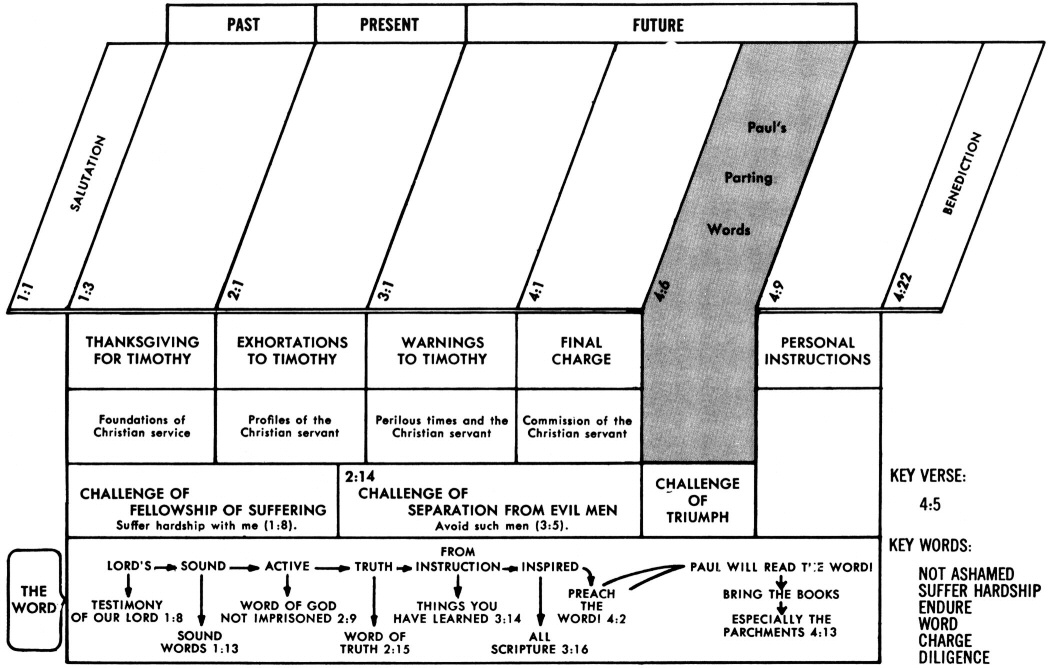
ENDURANCE AND SEPARATION IN THE MINISTRY
Click chart to enlarge
Charts from Jensen's Survey of the NT - used by permission
Second Timothy - Swindoll
| 2 TIMOTHY | |||
| 2 Timothy 1:1-18 | 2 Timothy 2:1-26 | 2 Timothy 3:1-17 | 2 Timothy 4:1-22 |
| Retain the Standard |
Rightly Divide the Word |
Difficult Times Will Come |
Preach the Word |
| PAST | PRESENT | FUTURE | |
| Foundation of Christian Service |
Pictures of Christian Servant |
Dangerous Times for Christian Servant |
Commission of Christian Servant |
| Unashamed as a Witness: Guard the Gospel |
Unashamed as a Workman: Suffer for the Gospel |
Adequate as a Workman: Continue in the Gospel |
Awarded as a Workman: Preach the Gospel |
| Power of the Gospel |
Perseverance of the Gospel Message | Protection of the Gospel |
Proclamation of the Gospel |
| Reminder | Requirements | Resistance | Requests |
| Encouragement in Ministry |
Examples in Ministry |
Exhortations in Ministry |
Exhortations to Fulfill Ministry |
| Commendation & Charge |
Commission to Fulfill |
Conflict to Face |
Course to Finish |
|
Compiled from Jensen's Survey of the NT and Wilkinson's Talk Thru the Bible |
|||
2 Timothy 1:3 I thank (1SPAI) God, Whom I serve (1SPAI) with a clear conscience the way my forefathers did, as I constantly remember * (1SPAI) you in my prayers night and day (NASB: Lockman)
Greek: Charin echo (1SPAI) to theo o latreuo (1SPAI) apo progonon en kathara| suneidesei, os adialeipton echo (1SPAI) ten peri sou mneian en tais deesesin mou nuktos kai hemeras,
Amplified: I thank God Whom I worship with a pure conscience, in the spirit of my fathers, when without ceasing I remember you night and day in my prayers, (Amplified Bible - Lockman)
KJV: I thank God, whom I serve from my forefathers with pure conscience, that without ceasing I have remembrance of thee in my prayers night and day;
NLT: Timothy, I thank God for you. He is the God I serve with a clear conscience, just as my ancestors did. Night and day I constantly remember you in my prayers. (NLT - Tyndale House)
Phillips: I thank the God of my forefathers, Whom I serve with a clear conscience, as I remember you in my prayers. Every day and every night (Phillips: Touchstone)
Wuest: I constantly have a spirit of thanksgiving to God, to Whom I am constantly rendering sacred service from the time of my forebears with a pure conscience, how unceasingly I have you in my mind in my petitions for needs, day and night (Eerdmans)
Young's Literal: I am thankful to God, whom I serve from progenitors in a pure conscience, that unceasingly I have remembrance concerning thee in my supplications night and day,
I (continually) THANK GOD: Charin echo (1SPAI) to theo:
- See Torrey's Topic for excellent cross references on the healthy spiritual discipline of "THANKSGIVING"
A PAULINE ATTITUDE
OF GRATITUDE
I thank God - Paul lived with a continual attitude of gratitude. And so it is only fitting that he break into a chorus of thanksgiving. What is the context (this is why it is important to read the entire chapter/book before beginning to interpret individual passages = to first establish the context rather than too quickly glancing at the study notes or the commentaries which will "steal" your joy of self discovery!)? Where is Paul as he gives thanks to God (To answer check the context)? In prison (2Ti 1:8), in chains (2Ti 1:16), in Rome (2Ti 1:17). Incarcerated like a criminal (Why? 2Ti 1:12 What "reason" [note "for this reason" = term of conclusion] Why does Paul suffer "these things"? In context he is suffering for the gospel - cp 2Ti 1:10 11 12) and most likely in a dark, damp, dungeon (see ancient prisons in following paragraph). So how is it possible for Paul to manifest a spirit of thankfulness in such dire straits? From the context, we can deduce that he is enabled by the Spirit of Christ Who indwelt him 2Ti 1:14 and Who empowered him 2Ti 1:7, 2Ti 1:8 [Acts 1:8-note] and he was depending on God's gift of grace in Christ 2Ti 1:3 which strengthened him - cp 2Ti 2:1-note. Thus supernaturally supplied, he was able to manifest an attitude of genuine gratitude, a "count it all joy" attitude (cp Jas 1:2-note, Acts 5:41). What else do we know about Paul from 2Ti 4:6-note? And so here we find Paul suffering for the Gospel and aware that his life would soon end, and yet he was supernaturally enabled to maintain this attitude of thankfulness to God! Paul continually sought to model what he taught (2Ti 3:10, 11-note), and in one of his first letters (the letter to the Thessalonians), Paul had explained that "in everything (we are to) give thanks (present imperative = command as our habitual practice - remember what God commands, He always enables!) for this is God's will for us in Christ Jesus" (note "in Christ Jesus" speaks of our inseparable union with Christ [see in Christ]! Christ is our supernatural Source!)" (1Th 5:18-note).
Thank - This is actually 2 words in Greek, and could be literally rendered "having" (echo) "grace" (charis). The present tense pictures Paul's continual attitude of thankfulness. Gratitude should not be an occasional "accident" but a continuous attitude for a saved sinner, for we are are objects of God's grace and it is only fitting that He be the object of our gratitude.
God's giving deserves
our thanksgiving!
THOUGHT - Are you in dark, dreary "prison like" circumstance today? Do you feel like your life is being poured out? Let me encourage you to lean on the everlasting arms of His grace and His Spirit, and supernaturally enabled to make the conscious choice to give thanks to Him for His grace, mercy and peace and the promise of life in Christ Jesus? It is good for us to remember that… When an attitude of gratitude is absent from our heart, joy will not be far behind in departing. On the other hand, joy thrives in the soul offering thanksgiving. So let us pause to think of what God has done, and then we will find that we always have cause to thank Him.
Some thankful quotes…
- In thanking God, we fasten upon His favors to us; in praising and adoring God, we fasten upon His perfections in Himself. - Matthew Henry
- Thanksgiving is good but thanks-living is better. - Matthew Henry
- It is only with gratitude that life becomes rich. -Dietrich Bonhoeffer (From a man who was martyred for His Lord!)
- It ought to be as habitual to us to thank as to ask. - C. H. Spurgeon
- How worthy it is to remember former benefits when we come to beg for new. - Stephen Charnock
- Prayer without thanksgiving is like a bird without wings. - William Hendriksen
- Thankfulness is a flower which will never bloom well excepting upon a root of deep humility. - J. C. Ryle
We are the objects of God's grace.
Let Him be the object of our gratitude.
Harper's Bible Dictionary gives us some insight into what Paul's physical circumstances may have been like - Prison Conditions: Despite various efforts to promote reforms, conditions in ancient prisons were often harsh. Most prisoners wore chains; their feet might be shackled, their hands manacled or even attached to their neck by another chain, and their movements further restricted by a chain fastened to a post. The existence of laws prohibiting chains that were too short or too restrictive indicates that jailers sometimes employed such practices. The very word ‘chains’ became a synonym for imprisonment. Some prisoners were also kept in wooden stocks, devices to restrain the feet, hands, or even the neck of an individual (see Acts 16:24). Prisons often were very dark (see Isaiah 42:7); the inner area of the prison mentioned in Acts 16:24 was probably without windows. Although solitary confinement was known, prisoners generally were kept grouped together, accused and condemned, men and women alike. Overcrowding was not infrequent (Isaiah 24:22). Prisons often had poor air circulation, a lack of hygienic facilities, rats and vermin, and food of poor quality. Unscrupulous guards might at times use the withholding of food or even outright torture to extort money from prisoners or their relatives. Although various rulers, especially in Roman Imperial times, struggled to prevent such abuses, the quality of prison life largely remained the responsibility of local officials, and conditions undoubtedly varied considerably from place to place." (Achtemeier, P. J., Harper & Row, P., & Society of Biblical Literature. Harper's Bible dictionary. San Francisco: Harper & Row)
See also excellent article on "Prison" in Hastings' Dictionary of the New Testament
And yet, despite such dismal, depressing conditions, Paul was filled with a spirit of thanksgiving to God! May his tribe increase!
A PROPER PERSPECTIVE
PRODUCES PRAISE
ILLUSTRATION - After one of the terrible battles of the Civil War, a dying Confederate soldier asked to see the chaplain. When the chaplain arrived, he supposed the young man would wish him to beseech God for his recovery; but it was very different. First the soldier asked him to cut off a lock of his hair for his mother, and then he asked him to kneel down and thank God.
"What for?" asked the surprised chaplain.
"For giving me such a mother. Thank God that I am a Christian. And thank God for giving me grace to die with. And thank God for the Home He has promised me over there."
And so the chaplain knelt down by the dying man, and in his prayer he had not a single petition to offer, but only praise and gratitude.—Christian Herald
WHOM I (continually) SERVE: ho latreuo (1SPAI):
- 2 Timothy 1 resources - Multiple Sermons and Commentaries
Serve (3000) (latreuo from latris = one hired or latron = reward, wages) means to work for reward, for hire or for pay, to be in servitude, render cultic service. Latreuo was used literally for bodily service (e.g., workers on the land, or slaves), and figuratively for “to cherish.”
In the NT the idea is to render service to God, to worship, to perform sacred services or to minister to God in a spirit of worship (in fact in the NT uses below, note several passages clearly associate worship with serving.)
THOUGHT - In light of the secular meaning "to work for reward" certainly that is not a disciple's main motive - we serve Him because we love Him), but it is a gift of His amazing grace that not only has He saved us, but that one day He will reward us. This is what I would call grace (saved us) upon grace (rewards us)! Amazing indeed!
I Serve = present tense emphasizing the habit of Paul was that of ministering and serving God in a spirit of worship. In short, Paul's day to day life was one dominated and directed by an attitude of worship. When daily life is lived as an act of worship to the Most High God, otherwise "mundane" chores take on an entirely different significance. Oh, to live such a God focused, God glorifying life! Amen
Latreuo - 21 times in 21v. NAS Usage = offer service (1), serve (15), served (1), serving (1), worship (1), worshiper (1),worshipers (1). Observe several associations with worship. Note the frequency in Hebrews. Note that serving has a "negative" aspect (idols) but more often the positive aspect of orientation toward God.
Matthew 4:10 Then Jesus said to him, "Go, Satan! For it is written, 'YOU SHALL WORSHIP THE LORD YOUR GOD, AND SERVE HIM ONLY.'"
Luke 1:74 To grant us that we, being rescued from the hand of our enemies, Might serve Him without fear,
Luke 2:37 and then as a widow to the age of eighty-four (Anna - Lk 2:36, 38). She never left the temple, serving night and day with fastings and prayers.
THOUGHT - O my, what a model of devotion! Now the "temple" never leaves us, for we are the "temple" of God wherever we go. Are we conscious of this truth? Do we take advantage of our high and holy privilege? Do we praise Him and pray to Him, serving Him night and day? I am convicted! Notice what motivated Anna in Lk 2:38! What [Who] we are looking for will [should] radically impact how we are living - for time or for eternity, for Savior or for Self?!
Luke 4:8 Jesus answered him, "It is written, 'YOU SHALL WORSHIP THE LORD YOUR GOD AND SERVE HIM ONLY.'"
Acts 7:7 "'AND WHATEVER NATION TO WHICH THEY WILL BE IN BONDAGE I MYSELF WILL JUDGE,' said God, 'AND AFTER THAT THEY WILL COME OUT AND SERVE ME IN THIS PLACE.'
Acts 7:42 "But God turned away and delivered them up (paradidomi - Be careful! God may give you over to what you desire to worship! Read Exodus 20:1-6 for a "refresher!") to serve the host of heaven; as it is written in the book of the prophets, 'IT WAS NOT TO ME THAT YOU OFFERED VICTIMS AND SACRIFICES FORTY YEARS IN THE WILDERNESS, WAS IT, O HOUSE OF ISRAEL?
Acts 24:14 "But this I admit to you, that according to the Way which they call a sect I do serve the God of our fathers, believing everything that is in accordance with the Law and that is written in the Prophets;
Acts 26:7 the promise (Acts 26:6) to which our twelve tribes hope to attain, as they earnestly serve God night and day. And for this hope, O King, I am being accused by Jews. (What was the hope of the genuine believers in ancient Israel? The coming of the Messiah and His kingdom = Acts 1:6; 3:22-24; 13:23-33; Ge 3:15; Isa 7:14; 9:6; Da 7:14; Mic 5:2; Titus 2:13; 1Pe 1:11, 12).
Acts 27:23 "For this very night an angel of the God to whom I belong and whom I serve stood before me,
Romans 1:9 (note) For God, whom I serve in my spirit (How did Paul "serve" God? What was his act of devotion?) in the preaching of the gospel of His Son, is my witness as to how unceasingly I make mention of you,
Romans 1:25 (note) For they exchanged the truth of God for a lie, and worshiped and served (cp Acts 7:42 above) the creature rather than the Creator, who is blessed forever. Amen.
for we are the true circumcision (Jews who have been circumcised in heart, not just literal flesh! cp Ro 2:28-29, Col 2:11-12), who worship in the Spirit of God and glory in Christ Jesus and put no confidence in the flesh, (Observe: Worship in Spirit and truth - cp John 4:23, 24)
2 Timothy 1:3 (note) I thank God, whom I serve with a clear conscience the way my forefathers did, as I constantly remember you in my prayers night and day (Observe: What makes serving/worship acceptable? Note again the phrase "night and day"? What is he saying about one's lifestyle?)
Hebrews 8:5 (note) who (Heb 8:1-4) serve a copy and shadow of the heavenly things, just as Moses was warned by God when he was about to erect the tabernacle; for, "SEE," He says, "THAT YOU MAKE all things ACCORDING TO THE PATTERN WHICH WAS SHOWN YOU ON THE MOUNTAIN."
Hebrews 9:9 (note) which (What is "which?" Heb 9:8) is a symbol for the present time. Accordingly both gifts and sacrifices are offered which cannot make the worshiper (verb is used as a noun - note again the present tense speaks of one's lifestyle) perfect in conscience,
Hebrews 9:14 (note) how much more (Much more than what? Heb 9:13) will the blood of Christ, who through the eternal Spirit offered Himself without blemish to God, cleanse your conscience from dead works to serve the living God?
Observe: Condition of real worship, in spirit and truth - a clean conscience. What is the implication for us before we begin to "worship" on Sunday mornings? Do we not need to confess and seek clean hands and pure heart? cp Ps 24:3-4. Is this a common practice in churches today?)
Hebrews 10:2 (note) Otherwise (What's the contrast? Heb 10:1), would they not have ceased to be offered, because the worshipers, having once been cleansed, would no longer have had consciousness of sins?
Hebrews 12:28 (note) Therefore, since we receive a kingdom which cannot be shaken, let us show gratitude, by which we may offer to God an acceptable service with reverence and awe; (Observe: A lofty motive to stimulate genuine worship. We are "practicing" for eternity future!)
Hebrews 13:10 (note) We have an altar, from which those who serve the tabernacle have no right to eat.
Revelation 7:15 (note) "For this reason, they are before the throne of God; and they serve Him day and night in His temple; and He who sits on the throne shall spread His tabernacle over them. (Observe: Even in eternity, our "lifestyle" is to be one of continual worship/service!)
Revelation 22:3 (note) And there shall no longer be any curse; and the throne of God and of the Lamb shall be in it, and His bond-servants shall serve Him; (Observe: And some say heaven will be boring! They either have not read or do not understand this verse!)
In the non-apocryphal Septuagint latreuo describes the service of the priests. The service/worship as in the NT uses in some contexts refers to worship of idols rather than God. There are over 100 uses of latreuo in the Septuagint (LXX)
Ex 3:12; 4:23; 7:16; 8:1, 20; 9:1, 13; 10:3, 7-8, 11, 24, 26; 12:31; Ex 20:5; 23:24f; Lev 18:21; Num 16:9; Deut 4:19, 28; 5:9; 6:13; 7:4, 16; Deut 8:19; 10:12, 20; 11:13, 16, 28; 12:2; 13:2, 6, 13; 17:3; 28:14, 36, 47-48; Deut 29:18, 26; 30:17; 31:20; Josh 22:5, 27; 23:7, 16; 24:2, 14-15, 18-22, 24, 31; Jdg 2:11, 13, 19; 3:6-7; 2Sam 15:8; 2 Ki 17:12, 16, 33, 35; 2Ki 21:21; 2 Chr 7:19; Ezek 20:32; Dan 3:12, 14, 17-18, 28; 4:1; 6:16, 20, 26; Da 7:14
In secular Greek latreuo meant to work for wages, then to serve without wages. It originally referred predominantly to physical work then later was used more generally.
Vine adds that latreuo, and its corresponding noun latreia (word study), originally signified the work of a hired servant, as distinguished from the compulsory service of the slave. In the course of time this word group largely lost the significance of work as a hired servant, and in Scripture took on the sense of adoration in addition to free (freewill) obedience.
John MacArthur explains that latreuo "might best be translated “to render respectful spiritual service.” True worship goes beyond praising God, singing hymns, or participating in a worship service. The essence of worship is living a life of obedient service to God. “Do not neglect doing good and sharing,” exhorts the writer of Hebrews, “for with such sacrifices God is pleased” (Heb 13:16-note). True worship involves every aspect of life. (Ed: Read that statement again!) (MacArthur, J. Philippians. Chicago: Moody Press) (Bolding added)
Latreuo can therefore convey either the idea of worship or service and frequently appears to mean both which suggests that service (to God) cannot be truly separated from worship (of God)!
Beloved, remember Bob Dylan was correct when he sang the song You Gotta' Serve Somebody!
WORSHIP OF GOD
AND
WORKS OF GOOD
Many Christians desire to "worship" the Lord on Sunday but are too busy to "serve" Him at other times. The New Testament knows nothing of such a dichotomy or compartmentalization of our spiritual life from our secular life. In other words our secular life always includes our spiritual life. On the other hand notice that the order in Scripture is first “worship” and then “serve”. Acknowledgment of God Himself must have precedence over activity in His service. Service to God derives its effectiveness from engagement of the heart with God. Any true worshipper of God is also a servant, ready to do his Master's bidding, discharging his or her priestly duties. The corollary truth is that good works should be those initiated by and empowered by the Spirit of God, so that we engage in the works that God has prepared for each of us even before the foundation of the world (see good works in Eph 2:10-note, cp Jesus' formula for works that will endure throughout eternity). These thoughts beg the question beloved - Are you busy doing "good" works that really are not "God's" works? Even as we were saved by grace through faith, we are to carry out good works by grace through faith (see Paul's formula for good works in 1Cor 15:10-note). (See also related discussion - Good Deeds)
Anna the prophetess exemplifies latreuo in action for even though she was "a widow … age of eighty-four… she never left the temple (I would call this an example of "abiding"!), serving (latreuo) night and day with fastings and prayers." (Lk 2:37)
Comment: How did Anna serve? With fastings and prayers! From Anna's beautiful example, we can readily see how the serving aspect of latreuo overlaps with the idea of worship.
Paul's introduction to the Romans conveys a similar nuance: "For God, Whom I serve in my spirit ("with my whole spirit" Amp) in the preaching of the gospel of His Son (So what is Paul's service?), is my witness as to how unceasingly I make mention of you. (Ro 1:9-note)
Comment: Paul served God "holistically" beginning with his spirit, for he knew that those who worship Him must worship Him in spirit and in truth (Jn 4:24). God pleasing and God honoring service calls for total, unreserved commitment on the part of the worshiper (cp our "holistic" spiritual service [latreia] of worship in Ro 12:1-note).
MacDonald comments on Paul's use of latreuo noting that for the great apostle this worshipful service "was not that of a religious drudge (to do hard, menial, monotonous work), going through endless rituals and reciting prayers and liturgies by rote. It was service bathed in fervent, believing prayer. It was willing, devoted, tireless service, fired by a spirit that loved the Lord Jesus supremely. It was a flaming passion to make known the Good News about God’s Son. (Believer's Bible Commentary: Old and New Testaments. Nashville: Thomas Nelson)
Writing to the Philippians Paul warned them to beware of the false circumcision (probably Judaizers who wanted to add works to faith) declaring "we are the true circumcision (Ro 2:28 29-note), who worship (latreuo - render sacred service and obedience) in the Spirit of God (true worship is supernatural, in the power of the Holy Spirit and not through prescribed physical rituals, cf Isaiah 29:13) and glory (kauchaomai = boast with exultant joy about what one is most proud of - 35/37 uses of this word are by Paul) in Christ Jesus and put no confidence in the flesh (sarx = man’s fallen, unredeemed humanness which pictures human ability apart from God). (Philippians 3:3-note)
Comment: In this passage in Philippians we see that worship (latreuo) is supernatural (prompted by the Spirit), not prompted by culture, fear, tradition, desire for popularity, etc and is far more than acts of praise and the singing of hymns, but includes the living of a life of obedient service to God.
The writer of Hebrews asks "(If the ashes of a heifer had such power to cleanse from one of the most serious forms of outward defilement) how much more will the blood of Christ, who through the eternal Spirit offered Himself (voluntary, self-offering) without blemish (spotless - perfectly righteous, sinless , perfectly and voluntarily obedient to the Father’s will) to God, cleanse your conscience (the superior nature of Messiah’s sacrifice is seen in its deeper effect. While the Levitical ritual accomplished only formal ritual expiation, and left the inner man untouched, the sacrifice of Messiah reaches the very center of the moral and spiritual being of the individual thus doing its work where only an eternal spirit can do it) from dead works (the character of the works done by the individual is changed in that before salvation, the sinner did so-called "good works" in the strength of his own sinful nature. They were dead works. After salvation has wrought its mighty transformation within the individual, the good works are motivated, empowered, and produced by the Holy Spirit and are, therefore, living works produced by one who serves the living God) to serve (latreuo) the living God?" (He 9:14- note)
The blood of Christ frees men from lifeless works (see discussion of Good Deeds) -- Before salvation, the sinner did so-called good works in the strength of his or her own sinful nature. But they were dead works. After salvation has wrought its mighty transformation within the individual, the good works are motivated, empowered, and produced by the Holy Spirit, by the one who has the "Word of Christ richly" dwell within them (Col 3:16-note). They are, therefore, living works, most appropriate for serving (latreuo) the living God.
Therefore, since we receive (literally "are receiving" = a continuous process) a kingdom which cannot be shaken (asaleutos = immovable thus firm, unchangeable and enduring), let us show gratitude (literally "let us be having grace") (this great truth that we will never be taken from this kingdom and it will never be taken from us should inspire fervent worship and adoration), by which we may offer to (latreuo) God an acceptable (euarestos [word study] = to be well pleasing = that which God wills and recognizes) service (latreuo) with reverence (eulabeia = caution, circumspection, discretion = internal attitude of reverence toward) and awe (deos = timid apprehension of danger; while another word for fear, phobos, is the terror which seizes one when the danger appears. In a primitive forest an undefined sense of possible danger possesses one and makes his heart beat quickly at every rustle of a leaf. This is deos. When a wild beast is distinctly heard close at hand, the deos becomes phobos - thus deos has to do with the apprehension felt due to being in God’s presence) for our God is a consuming (katanlisko = consume wholly - God's anger burns against those who reject the privileges offered in the New Covenant) fire. (He 12:28, 29-note)
Notice that our motive for latreuo is gratitude… worshipful, reverential, awe filled service should spring from a heart overflowing with thankfulness. Dearly beloved, how would you describe your "latreuo" before the living God -- living or dead works of worship?
Hodges reminds us of this loyalty and allegiance of Paul to fulfill his sacred duties: "Shut up in prison, cut off in a final way from active ministry, he nonetheless finds the joy of the priestly ministry of prayer both in praise (cp - the sacrifice of praise He 13:15-note) and in intercession."
Edwards rightly observes that "One of our primary tasks and privileges as believer-priests (1Pe 2:9) is that of serving God with a clear conscience going to God on behalf of men in the form of intercession. Paul took this priestly service seriously. (2 Timothy: Call to Completion)
WITH A CLEAR CONSCIENCE: en kathara suneidesei:
- Acts 23:1; 24:16; Romans 1:9-note; Romans 9:1-note; 2Cor 1:12; 1Ti 1:5;19; Heb 13:18
- 2 Timothy 1 resources - Multiple Sermons and Commentaries
CLEAR
CONSCIENCE
In Acts Luke records that "Paul, looking intently at the Council, said, “Brethren, I have lived my life with a perfectly good conscience before God up to this day.” (Acts 23:1)
Comment: In view of this (What? Check context = Ac 24:15), I also do my best (Askeo [present tense = continually] = exercise myself, exert all my diligence, study and industry) to maintain always a blameless (aproskopos = not leading others into sin or causing them to stumble) conscience both before God and before men. (Ac 24:16).
With - This word is the Greek word en which is usually translated as the English preposition in and here it conveys the idea that the spiritual sphere in which his worshipful service was offered - it was in the "atmosphere" (background) of a completely cleansed conscience.
Clear (2513) (katharos; English = catharsis = purifying, cleansing, a term used in psychology and counseling for a cleansing of the mind or emotions - a "soul cleansing" if you will; cathartic = any substance used to induce purging or to cleanse a wound or infected are in order to make it pure; Cathar = member of a medieval sect which sought the purging of all evil from its members) literally describes that which is free of dirt and thus clean.
Katharos describes that which is free from admixture or adulteration and thus is pure and in an ethical sense that which is “free from corrupt desire, sin, and guilt." In short, it describes that which is clean, pure, clear, in a natural sense unsoiled, unalloyed and free of adulterating matter and then that which is free from moral guilt. Thus a "katharos" conscience is one that is free from sin and guilt, from every admixture of what is false with the result that it is sincere, blameless and unstained.
Katharos - 27x in 23v in NAS - Mt 5:8; 23:26; 27:59; Lk 11:41; John 13:10 11; 15:3; Acts 18:6; 20:26; Ro 14:20; 1Ti 1:5; 3:9; 2Ti 1:3; 2:22; Titus 1:15; Heb 10:22; Jas 1:27; 1Pe 1:22; Rev 15:6; 19:8, 14; 21:18, 21. NAS = clean(12), clear(3), innocent(1), pure(10).

Conscience is like a sundial
When the truth of God shines on it,
It points in the right direction.
Where is your "sundial" pointing today dear reader?
Conscience (4893) (suneidesis is derived from sun/syn = with + eido = know) literally means a "knowing with", a co-knowledge with oneself or a being of one's own witness in the sense that one's own conscience "takes the stand" as the chief witness, testifying either to one's innocence or guilt. It describes the witness borne to one's conduct by that faculty by which we apprehend the will of God. In Classic Greek suneidesis occurs in legal contexts of witnesses who share testimony. In a reflexive sense suneidēsis signifies “consciousness” (in a neutral sense) and from that it means “inner consciousness” or conscience. Conscience carries moral implications as it serves a monitor of the “knowledge” of right from wrong. Suneidesis is especially a Pauline word (20/30 uses). Many texts reading suneidesis occur in a forensic (legal) context (e.g., Ro 2:15; Ro 9:1). Often the conscience becomes the “court of appeal” where the believer makes moral decisions. The believer’s conscience controlled by the Spirit (Ro 9:1; cf. 2 Co 1:12) is important in helping the Christian make right decisions. Since the conscience is a legitimate point of the appeal of the gospel (2 Co 4:2; cf. 2Cor 5:11), it is only natural to expect that the believer’s life is to be marked with a conscience that has been “cleared” by the transforming power of the Gospel. A clear conscience signals faithfulness, especially among those in leadership (cf. 1 Ti 1:5, 19; 3:9; cf. 1 Pe 3:16). One trademark of the opponents of the faith is a “seared conscience” (1 Ti 4:2; Titus 1:15). They resist sound teaching and their behavior reflects their stubbornness (cf. Titus 1:16).
See 5 page article in New International Dictionary of New Testament Theology on CONSCIENCE
Colin G. Kruse - The conscience is not to be equated with the voice of God or even the moral law, rather it is a human faculty which adjudicates upon human action by the light of the highest standard a person perceives. Seeing that all of human nature has been affected by sin, both a person’s perception of the standard of action required and the function of the conscience itself (as a constituent part of human nature) are also affected by sin. For this reason conscience can never be accorded the position of ultimate judge of one’s behavior. It is possible that the conscience may excuse one for that which God will not excuse, and conversely it is equally possible that conscience may condemn a person for that which God allows. The final judgment therefore belongs only to God (cf. 1 Cor. 4:2–5). Nevertheless, to reject the voice of conscience is to court spiritual disaster (cf. 1 Ti 1:19). We cannot reject the voice of conscience with impunity, but we can modify the highest standard to which it relates by gaining for ourselves a greater understanding of the truth. (See online in The Second Epistle of Paul to the Corinthians - TNTC) (See also Kruse's note on CONSCIENCE in Paul's Letter to the Romans - Page 141)
Suneidesis - 30x in 29v in NAS - Acts 23:1; 24:16; Ro 2:15; 9:1; 13:5; 1Co. 8:7, 10, 12; 1Cor 10:25, 27, 28; 2Co. 1:12; 4:2; 5:11; 1Ti 1:5, 19; 3:9; 4:2; 2Ti 1:3; Titus 1:15; Heb 9:9, 14; 10:2, 22; 13:18; 1Pet. 2:19; 3:16, 21. NAS = conscience(24), conscience'(4), consciences(1), consciousness(1).
Only use in Septuagint - Eccl 10:20NET Do not curse a king even in your thoughts (Lxx = sunedesis) - English of Septuagint = Even in thy conscience, curse not the king;
Related Resources:
- More notes on conscience under Romans 2 Commentary
- In Depth Discussion of Conscience - including multiple quotes, illustrations, etc related to conscience
- Baker Evangelical Dictionary Conscience
- Girdlestone's Lexicon - Conscience
- Conscience R A Torrey topic
- Nave Topical Bible Conscience
- Thompson Chain Reference Guilty Conscience Conscience
- Devotional on conscience by F B Meyer
- Diverse Kinds of Conscience
- What does it mean to have a seared conscience?
- See excellent message by Adrian Rogers - A Clean Conscience
- Conscience by William Arnot in his discussion of Proverbs 28:1
- Conscience: The Voice of God Within by Timothy Lin
- American Tract Society Conscience
- Bridgeway Bible Dictionary Conscience
- Charles Buck Dictionary Conscience
- Easton's Bible Dictionary Conscience
- Holman Bible Dictionary Conscience
- Hastings' Dictionary of the Bible Conscience
- Hastings' Dictionary of the NT Conscience
- King James Dictionary Conscience
- Morrish Bible Dictionary Conscience
- Vines' Expository Dictionary Conscience
- Webster Dictionary Conscience
- Watson's Theological Dictionary Conscience
- 1911 Encyclopedia Britannica Conscience
- International Standard Bible Encyclopedia Conscience
- McClintock and Strong's Bible Encyclopedia Conscience (2) Conscience
Webster defines conscience as the sense or consciousness of the moral goodness or blameworthiness of one’s own conduct, intentions, or character together with a feeling of obligation to do right or be good.
The Greek noun suneidesis is the exact counterpart of the Latin con-science, “a knowing with,” a shared or joint knowledge. It is our awareness of ourselves in all the relationships of life, especially ethical relationships. We have ideas of right and wrong; and when we perceive their truth and claims on us, and will not obey, our souls are at war with themselves and with the law of God
Suneidesis is that process of thought which distinguishes what it considers morally good or bad, commending the good, condemning the bad, and so prompting to do the former and avoid the latter.
To have a "clear conscience" does not mean that we have never sinned or do not commit acts of sin. Rather, it means that the underlying direction and motive of life is to obey and please God, so that acts of sin are habitually recognized as such and faced before God (1Jn 1:9, cp David's attitude Ps 139:23 24, cp Ps 19:13-note) Spurgeon commenting on these passages in Ps 139 says…
He (David) will have God Himself search him, and search him thoroughly, till every point of his being is known, and read, and understood; for he is sure that even by such an investigation there will be found in him no complicity with wicked men. He challenges the fullest investigation, the innermost search: he had need be a true man who can put himself deliberately into such a crucible. Yet we may each one desire such searching; for it would be a terrible calamity to us for sin to remain in our hearts unknown and undiscovered.
Try me, and know my thoughts. Exercise any and every test upon me. By fire and by water let me be examined. Read not alone the desires of my heart, but the fugitive thoughts of my head. Know with all penetrating knowledge all that is or has been in the chambers of my mind. What a mercy that there is one being who can know us to perfection! He is intimately at home with us. He is graciously inclined towards us, and is willing to bend His omniscience to serve the end of our sanctification. Let us pray as David did, and let us be as honest as he. We cannot hide our sin: salvation lies the other way, in a plain discovery of evil, and an effectual severance from it.
And see if there be any wicked way in me. See whether there be in my heart, or in my life, any evil habit unknown to myself (Ed: cp a "clean conscience"). If there be such an evil way, take me from it, take it from me. No matter how dear the wrong may have become, nor how deeply prejudiced I may have been in its favour, be pleased to deliver me therefrom altogether, effectually, and at once, that I may tolerate nothing which is contrary to thy mind. As I hate the wicked in their way, so would I hate every wicked way in myself.
And lead me in the way everlasting. If thou hast introduced me already to the good old way, be pleased to keep me in it, and conduct me further and further along it. It is a way which thou hast set up of old, it is based upon everlasting principles, and it is the way in which immortal spirits will gladly run for ever and ever. There will be no end to it world without end. It lasts for ever, and they who are in it last for ever. Conduct me into it, O Lord, and conduct me throughout the whole length of it. By thy providence, by thy word, by thy grace, and by thy Spirit, lead me evermore.
Think and be careful what thou art within,
For there is sin in the desire of sin:
Think and be thankful, in a different case,
For there is grace in the desire of grace.
--John Byron, 1691-1763.
Edwards explains that "A "clear conscience" consists in being able to say that there is no one (God or man) whom I have knowingly offended and not tried to make it right (either by asking forgiveness or restoration or both). ). Acts 24:16. Christ spoke of this very issue in the Sermon on the Mount where He made it clear that our priestly service must be done with a clear conscience to be acceptable before God. "Therefore, if you bring your gift to the altar and there remember that your brother has something against you, leave your gift there before the altar and go your way. First be reconciled to your brother and then come and offer your gift." Mt. 5:23 24 25-note. We are being told here that a clear conscience must precede priestly service. (2 Timothy Call to Completion)
Paul wanted Timothy to have no doubt that he endured his present physical afflictions, as he had countless others, because of his unswerving faithfulness to the Lord, not as a consequence of unfaithful, ungodly living. So as Paul neared his death, he could testify that his conscience did not accuse or condemn him. His guilt was forgiven, and his devotion was undivided. To continually reject God’s truth causes the conscience to become progressively less sensitive to sin, as if covered with layers of unspiritual scar tissue. Paul’s conscience was clear, sensitive, & responsive to its convicting voice. Click on the books below to study the NT picture of conscience.
Conscience is like a window that let's in the light. When the window becomes soiled, the light gradually becomes darkness. Once conscience is defiled (Titus 1:15-note), it gradually gets worse, and eventually it may be so "seared" that it has no sensitivity at all (1Ti 4:2). Then it becomes an "evil conscience" (He 10:22-note), one that functions just the opposite of a good conscience (1Pe 3:16-note).
J C Ryle in his comments on a woman caught in adultery (Jn 8:1-11) speaks of
The power of conscience. We read of the woman's accusers, that when they heard our Lord's appeal, "being convicted by their own conscience, they went out one by one, beginning at the eldest, even into the last." Wicked and hardened as they were, they felt something within which made them cowards. Fallen as human nature is, God has taken care to leave within every man a witness that will be heard.
Conscience is a most important part of our inward man, and plays a most prominent part in our spiritual history. It cannot save us. It never yet led any one to Christ. It is blind, and liable to be misled. It is lame and powerless, and cannot guide us to heaven. Yet conscience is not to be despised. It is the minister's best friend, when he stands up to rebuke sin from the pulpit. It is the mother's best friend, when she tries to restrain her children from evil and quicken them to good. It is the teacher's best friend, when he presses home on boys and girls their moral duties. Happy is he who never stifles his conscience, but strives to keep it tender! Still happier is he who prays to have it enlightened by the Holy Spirit, and sprinkled with Christ's blood. (John - chapter 8)
(Ryle in "Looking Unto Jesus") We need inward peace. So long as our conscience is asleep, deadened by indulged sin, or dulled and stupefied by incessant pursuit of the things of this world—so long can that man get on tolerably well without peace with God. But once let conscience open its eyes, and shake itself, and rise, and move—and it will make the stoutest child of Adam feel ill at ease. The irrepressible thought that this life is not all—that there is a God, and a judgment, and a something after death, an undiscovered destiny from which no traveler returns—that thought will come up at times in every man's mind, and make him long for inward peace.
It is easy to write brave words about "eternal hope," and strew the path to the grave with flowers. Such theology is naturally popular: the world loves to have it so. But after all, there is something deep down in the heart of hearts of most men, which must be satisfied. The strongest evidence of God's eternal truth, is the universal conscience of mankind. Who is there among us all, who can sit down and think over the days that are past—school days, and college days, and days of middle life, their countless things left undone that ought to have been done, and done that ought not to have been done—who, I say, can think over it all without shame, if indeed he does not turn from the review with disgust and terror, and refuse to think at all? We all need peace. (Ryle Looking Unto Jesus!)
(Ryle in "Without Christ") Moreover, to be "without Christ" is to be without peace. Every man has a conscience within him, which must be satisfied before he can be truly happy. So long as this conscience is asleep or half dead, so long, no doubt, he gets along pretty well. But as soon as a man’s conscience wakes up, and he begins to think of past sins and present failings and future judgment, at once he finds out that he needs something to give him inward rest. But what can do it? Repenting and praying and Bible reading, and church going, and sacrament receiving, and self–mortification may be tried, and tried in vain. They never yet took off the burden from anyone’s conscience. And yet peace must be had!
There is only one thing can give peace to the conscience, and that is the blood of Jesus Christ sprinkled on it. A clear understanding that Christ’s death was an actual payment of our debt to God, and that the merit of that death is made over to man when he believes, is the grand secret of inward peace. It meets every craving of conscience. It answers every accusation. It calms every fear. It is written "These things I have spoken unto you, that in Me you might have peace." "He is our peace." "Being justified by faith, we have peace with God through our Lord Jesus Christ" (Jn 16:33; Eph 2:14; Ro 5:1). We have peace through the blood of His cross: peace like a deep mine—peace like an ever–flowing stream. But "without Christ" we are without peace. (Without Christ)
J C Philpot writes that there can be
there is a receiving of the gospel as the word of men into the natural CONSCIENCE; for there is a natural conscience as well as a spiritual conscience. This is very evident from the language of the apostle when speaking of the Gentiles–
"Who show the work of the law written in their hearts, their conscience also bearing witness, and their thoughts the meanwhile accusing or excusing one another." (Ro 2:15.)
And do we not read of those in the case of the woman taken in adultery, who were
"convicted by their own conscience, and went out one by one, beginning at the eldest, even to the last." (Jn 8:9.)
The apostle also speaks of
"commending himself to every man's conscience, in the sight of God." (2Co 4:2.)
Now as he preached to thousands, he could not have done this unless there was a conscience in every man, as well as in every good man. Scarcely anything seems to approach the work of grace so nearly as this; and yet we see in the cases of Saul, Ahab, and Herod, that there may be the deepest convictions of conscience and yet no saving conversion to God. Thus there is a receiving the gospel into the natural conscience, producing moral convictions, and a work that seems at first sight to bear a striking similarity to the work of God upon the soul; and yet the whole may be a mere imitation of grace, a movement of nature floating upon the surface of the mind, and at times touching upon the domain of conscience, yet not springing out of the word of God as brought with a divine power into the heart. (The Word of Men and the Word of God)
Archibald Alexander - Peace of conscience is a fruit of reconciliation with God. The blood which reconciles, when sprinkled on the conscience, produces a sweet peace which can be obtained in no other way. If the atonement of Christ satisfies the law which condemned us, and we are assured that this atonement is accepted for us, conscience, which before condemned, as being the echo of the law, is now pacified. (The Peace of God)
John Calvin - The torture of a bad conscience is the hell of a living soul… There is no greater torment than an evil conscience.
See excellent message by Adrian Rogers - A Clean Conscience
Timothy Lin - In the mid 1950’s near Ashville, NC, an adult male walked into the police station and openly confessed to a murder he had committed 13 years earlier. He gave the deceased person’s name and related to the authorities how he had murdered this person by shooting him in the back of the head with an arrow. The police reviewed his story from their files and found that the local coroner had ruled the deceased man’s death to be from natural causes. However, when they dug up the dead man’s remains, they found a hole in the base of his skull made by an arrow. The murderer was brought to justice, not by the police, but by his own conscience… At the Children’s Hospital seven-year-old Jimmy was a constant troublemaker. One day a weekly visitor who knew him well said to him, “Jimmy, if you are a good boy for a week, I will give you a quarter when I come back.” A week later she again stood by Jimmy’s bed and said, “Jimmy, I am not going to ask the nurse how you have behaved. You must tell me yourself. Do you deserve to have the quarter?” There was a moment’s silence. Then from under the sheets came a small voice saying, “Gimme a penny.” This illustrates that conscience speaks very clearly even in small children, (Conscience: The Voice of God Within - {I'm not sure I fully agree with all his points - Be a Berean} - Lin has more on conscience on page 50-54 in Genesis - Biblical Theology)
Kenneth Osbeck writes that "The conscience has been described as the “rudder of the soul” or the believer’s “principle within.” One of the prime responsibilities of Christian living is to keep the conscience clear as to the things of God so that we might live worthy lives before our fellowmen. But the conscience must be continually enlightened and developed by an exposure to God’s Word if it is to serve as a reliable guide for our lives. A conscience that is allowed to become hardened and insensitive to sin will ultimately lead to spiritual and moral disaster. We must allow God to develop our consciences and then our consciences are able to develop us. (Osbeck, K. W. Amazing Grace: 366 Inspiring Hymn Stories for Daily Devotions. Kregel Publications)
I Want a Principle Within
by Charles Wesley
I want a principle within of watchful, Godly fear,
A sensibility of sin, a pain to feel it near.
Help me the first approach to feel of pride or wrong desire,
To catch the wand’ring of my will and quench the Spirit’s fire.
From Thee that I no more may stray, no more Thy goodness grieve,
Grant me the filial awe, I pray, the tender conscience give.
Quick as the apple of an eye, O God, my conscience make!
Awake my soul when sin is nigh and keep it still awake.
Almighty God of truth and love, to me Thy pow’r impart;
The burden from my soul remove, the hardness from my heart.
O may the least omission pain my reawakened soul,
And drive me to that grace again which makes the wounded whole.
Conscience is the judgment which we pronounce on our own conduct by putting ourselves in the place of a bystander. (Adam Smith)
Here are a number of truisms regarding conscience all from anonymous sources…
A good conscience is a soft pillow.
A quiet conscience sleeps in thunder.
Conscience warns us as a friend before it punishes us as a judge.
The best tranquillizer is a clear conscience.
When a man says he has a clear conscience it often means he has a bad memory.
When a man won't listen to his conscience, it may be because he doesn't want advice from a total stranger.
When you have only one thing on your conscience, it is probably a silencer.
A guilty conscience is a hell on earth, and points to one beyond.
A guilty conscience needs no accuser.
Quite often when a man thinks his mind is getting broader it is only his conscience stretching. (John Blanchard - Complete Gathered Gold: A Treasury of Quotations for Christians - One of the best resources for Christian quotes which I have ever read)
THE DANGER OF A
SUPPRESSED CONSCIENCE
John MacArthur tells a tragic story to illustrating the grave danger of suppressing our conscience:
In 1984 an Avianca Airlines jet crashed in Spain. Investigators studying the accident made an eerie discovery. The "black box" cockpit recorders revealed that several minutes before impact a shrill, computer-synthesized voice from the plane's automatic warning system told the crew repeatedly in English, "Pull up! Pull up!"
The pilot, evidently thinking the system was malfunctioning, snapped, "Shut up, Gringo!" and switched the system off. Minutes later the plane plowed into the side of a mountain. Everyone on board died.
When I saw that tragic story on the news shortly after it happened, it struck me as a perfect parable of the way modern people treat guilt--the warning messages of their consciences.
The wisdom of our age says guilt feelings are nearly always erroneous or hurtful; therefore we should switch them off. But is that good advice? What, after all, is the conscience--this sense of guilt we all seem to feel?
The conscience is generally seen by the modern world as a defect that robs people of their self-esteem. Far from being a defect or a disorder, however, your ability to sense your own guilt is a tremendous gift from God. He designed the conscience into the very framework of the human soul. It is the automatic warning system that cries, "Pull up! Pull up!" before you crash and burn.
The conscience, Puritan Richard Sibbes wrote in the seventeenth century, is the soul reflecting upon itself. Conscience is at the heart of what distinguishes the human creature. People, unlike animals, can contemplate their own actions and make moral self-evaluations. That is the very function of conscience.
The conscience is an innate ability to sense right and wrong. Everyone, even the most unspiritual heathen, has a conscience: “When Gentiles who do not have the Law do instinctively the things of the Law, these, not having the Law, are a law to themselves, in that they show the work of the Law written in their hearts, their conscience bearing witness, and their thoughts alternately accusing or else defending them” (Rom. 2:14–15, emphasis added).
The conscience entreats us to do what we believe is right and restrains us from doing what we believe is wrong. The conscience is not to be equated with the voice of God or the law of God. It is a human faculty that judges our actions and thoughts by the light of the highest standard we perceive. When we violate our conscience, it condemns us, triggering feelings of shame, anguish, regret, consternation, anxiety, disgrace, and even fear. When we follow our conscience, it commends us, bringing joy, serenity, self-respect, well-being, and gladness.
The word conscience is a combination of the Latin words scire (“to know”) and con (“together”). The Greek word for “conscience” is found more than thirty times in the New Testament—suneidēsis, which also literally means “co-knowledge.” Conscience is knowledge together with oneself; that is, conscience knows our inner motives and true thoughts. Conscience is above reason and beyond intellect. We may rationalize, trying to justify ourselves in our own minds, but a violated conscience will not be easily convinced.
Multitudes today respond to their conscience by attempting to suppress it, overrule it, or silence it.
The Hebrew word for conscience is leb, (see also lebab) usually translated “heart” in the Old Testament. The conscience is so much at the core of the human soul that the Hebrew mind did not draw a distinction between conscience and the rest of the inner person. Thus when Moses recorded that Pharaoh “hardened his heart” (Exod. 8:15), he was saying that Pharaoh had steeled his conscience against God’s will. When Scripture speaks of a tender heart (cf. 2 Chr. 34:27), it refers to a sensitive conscience. The “upright in heart” (Ps. 7:10) are those with pure consciences. And when David prayed, “Create in me a clean heart, O God” (Ps. 51:10), he was seeking to have his life and his conscience cleansed.....
Multitudes today respond to their conscience by attempting to suppress it, overrule it, or silence it. They conclude that the real blame for their wrong behavior lies in some childhood trauma, the way their parents raised them, societal pressures, or other causes beyond their control. Or they convince themselves that their sin is a clinical problem, not a moral one—and therefore define their alcoholism, sexual perversion, immorality, or other vices as “diseases.” To respond to the conscience with such arguments is tantamount to telling the conscience, “Shut up, Gringo!”
It is possible virtually to nullify the conscience through repeated abuse. Paul spoke of people whose consciences were so convoluted that their “glory is in their shame” (Phil. 3:19; cf. Rom. 1:32). Both the mind and the conscience can become so defiled that they cease making distinctions between what is pure and what is impure (cf. Tit. 1:15). After so much violation, the conscience finally falls silent. Morally, those with defiled consciences are left flying blind. The annoying warning signals may be gone, but the danger certainly is not; in fact, the danger is greater than ever.
Furthermore, even the most defiled conscience will not remain silent forever. When we stand in judgment, every person’s conscience will side with God, the righteous judge. The worst sin-hardened evildoer will discover before the throne of God that he has a conscience which testifies against him.
The conscience, however, is not infallible. Nor is it a source of revelation about right and wrong. Its role is not to teach us moral and ethical ideals, but to hold us accountable to the highest standards of right and wrong we know. The conscience is informed by tradition as well as by truth, so the standards it holds us to are not necessarily biblical ones (1 Cor. 8:6–9). The conscience can be needlessly condemning in areas where there is no biblical issue. In fact, it can try to hold us to the very thing the Lord is trying to release us from (Rom. 14:14, 20–23). The conscience, to operate fully and in accord with true holiness, must be informed by the Word of God. So even when guilt feelings don’t have a biblical basis, they are an important spiritual distress sign. If they’re only signaling a weak conscience, that should spur us to seek the spiritual growth that would bring our conscience more in harmony with God’s Word.
The conscience reacts to the convictions of the mind and therefore can be encouraged and sharpened in accordance with God’s Word. The wise Christian wants to master biblical truth so that the conscience is completely informed and judges right because it is responding to God’s Word. A regular diet of Scripture will strengthen a weak conscience or restrain an overactive one. Conversely, error, human wisdom, and wrong moral influences filling the mind will corrupt or cripple the conscience.
In other words, the conscience functions like a skylight, not a light bulb. It lets light into the soul; it does not produce its own. Its effectiveness is determined by the amount of pure light we expose it to, and by how clean we keep it. Cover it or put it in total darkness and it ceases to function. That’s why the apostle Paul spoke of the importance of a clear conscience (1 Tim. 3:9) and warned against anything that would defile or muddy the conscience (1 Cor. 8:7; Tit. 1:15).
Or, to switch metaphors, our conscience is like the nerve endings in our fingertips. Its sensitivity to external stimuli can be damaged by the buildup of callouses or even wounded so badly as to be virtually impervious to any feeling. Paul also wrote of the dangers of a calloused conscience (1 Cor. 8:10), a wounded conscience (v. 12), and a seared conscience (1 Tim. 4:2). (BORROW The Vanishing Conscience - 2005 - one wonders what he would title it in 2025 - perhaps "Gone Conscience!")(See John MacArthur's full article "The Conscience Revisited")
Conscience is a dainty, delicate creature, a rare piece of workmanship of the Maker. Keep it whole without a crack, for if there be but one hole so that it break, it will with difficulty mend again. (S. Rutherford)
The Christian can never find a “more faithful adviser, a more active accuser, a severer witness, a more impartial judge, a sweeter comforter, or a more inexorable enemy.” (Bp. Sanderson.)
A gnawing conscience keeps the memory terribly alert. (W. E. Sangster)
Conscience in everything: — Trust that man in nothing who has not a conscience in everything. (Sterne)
Conscience is the still small voice that makes you feel still smaller. (James A. Sanaker)
Conscience makes cowards of us; but conscience makes saints and heroes too. (J. Lightfoot)
Conscience is a marvelous gift from God, the window that lets in the light of His truth. If we sin against Him deliberately, that window becomes dirty, and not as much truth can filter through. Eventually, the window becomes so dirty that it no longer lets in the light. The Bible calls this a defiled, seared conscience… Do you keep a clean conscience? It is a part of your inner being that responds to God's truth. When you sin, the window of your conscience becomes dirty and filters out truth. Avoid sin in your life and live with a clean conscience. Every day feed yourself truth from the Word of God. (Wiersbe, W: Prayer, Praise and Promises: Ps 51:3-6)
Hurt not your conscience with any known sin. - S. Rutherford
Conscience is that faculty in me which attaches itself to the highest that I know, and tells me what the highest I know demands that I do.
When there is any debate, quit. There is no debate possible when conscience speaks.
Once we assuage our conscience by calling something a “necessary evil,” it begins to look more and more necessary and less and less evil. - Sidney J. Harris
Conscience is God’s spy and man’s overseer. -John Trapp
A good conscience and a good confidence go together. -- Thomas Brooks
Conscience is a small, still voice that makes minority reports. -- Franklin P. Jones
Conscience is also what makes a boy tell his mother before his sister does.
Pop used to say about the Presbyterians, 'It don't prevent them committing all the sins there are, but it keeps them from getting any fun but of it.' - Christopher Morley
The late General Omar Bradley was more serious in commenting on conscience
"The world has achieved brilliance without conscience," he conceded. "Ours is a world of nuclear giants and ethical infants."
On the subject of conscience Martin Luther declared before the court of the Roman Empire at Worms in 1521
"My conscience is captive to the Word of God… I am more afraid of my own heart than of the pope and all his cardinals. I have within me the great pope, Self."
When a person comes to faith in Christ, his conscience becomes acutely sensitive to sin. No longer as a Christian can he sin with impunity. The story is told about an old Indian chief who was converted. Later a missionary asked him:
"Chief, how are you doing spiritually? Are you experiencing victory over the devil?"
"It's like this," the chief replied. "I have two dogs inside me: a good dog and a bad dog. They are constantly fighting with each other."
"Which dog wins?" asked the puzzled missionary.
"Whichever one I feed the most," retorted the wise old man. His conscience was being shaped by the Scriptures.
Billy Graham set out the importance of a clear conscience
"To have a guilty conscience is a feeling. Psychologists may define it as a guilt complex, and may seek to rationalize away the sense of guilt, but once it has been awakened through the application of the law of God, no explanation will quiet the insistent voice of conscience."
C H Spurgeon spoke frequently about conscience as seen in the following quite pithy quotations… beloved if you are contemplating sinning as you read this or are caught in the web of some sin, may the Holy Spirit of the Living God convict you of sin, righteousness and the judgment to come, not only for your sake of your Christian life but even more so for the sake of His name…
Conscience may tell me that something is wrong, but how wrong it is conscience itself does not know. Did any man's conscience, unenlightened by the Spirit, ever tell him that his sins deserved damnation? Did it ever lead any man to feel an abhorrence of sin as sin? Did conscience ever bring a man to such self-renunciation that he totally abhorred himself and all his works and came to Christ?
A man sees his enemy before him. By the light of his candle, he marks the insidious approach. His enemy is seeking his life. The man puts out the candle and then exclaims, "I am now quite at peace." That is what you do. Conscience is the candle of the Lord. It shows you your enemy. You try to put it out by saying, "Peace, peace! Put the enemy out!" God give you grace to thrust sin out!
Conscience is like a magnetic needle, which, if once turned aside from its pole, will never cease trembling. You can never make it still until it is permitted to return to its proper place.
I recollect the time when I thought that if I had to live on bread and water all my life and be chained in a dungeon, I would cheerfully submit to that if I might but get rid of my sins. When sin haunted and burdened my spirit, I am sure I would have counted the martyr's death preferable to a life under the lash of a guilty conscience
O believe me, guilt upon the conscience is worse than the body on the rack. Even the flames of the stake may be cheerfully endured, but the burnings of a conscience tormented by God are beyond all measure unendurable.
This side of hell, what can be worse than the tortures of an awakened conscience?
He was a fool who killed the watchdog because it alarmed him when thieves were breaking into his house. If conscience upbraids you, feel its upbraiding and heed its rebuke. It is your best friend.
Give me into the power of a roaring lion, but never let me come under the power of an awakened, guilty conscience. Shut me up in a dark dungeon, among all manner of loathsome creatures—snakes and reptiles of all kinds—but, oh, give me not over to my own thoughts when I am consciously guilty before God!
Fire such as martyrs felt at the stake were but a plaything compared with the flames of a burning conscience. Thunderbolts and tornadoes are nothing in force compared with the charges of a guilty conscience.
When a swarm of bees gets about a man, they are above, beneath, around, everywhere stinging, every one stinging, until he seems to be stung in every part of his body. So, when conscience wakes up the whole hive of our sins, we find ourselves compassed about with innumerable evils: sins at the board and sins on the bed, sins at the task and sins in the pew, sins in the street and sins in the shop, sins on the land and sins at sea, sins of body, soul, and spirit, sins of eye, of lip, of hand, of foot, sins everywhere. It is a horrible discovery when it seems to a man as if sin had become as omnipresent with him as God is.
The conscience of man, when he is really quickened and awakened by the Holy Spirit, speaks the truth. It rings the great alarm bell. And if he turns over in his bed, that great alarm bell rings out again and again, "The wrath to come! The wrath to come! The wrath to come! "
Nothing can be more horrible, out of hell, than to have an awakened conscience but not a reconciled God—to see sin, yet not see the Savior—to behold the deadly disease in all its loathsomeness, but not trust the good Physician, and so to have no hope of ever being healed of our malady.
I would bear any affliction rather than be burdened with a guilty conscience.
It is a blessed thing to have a conscience that will shiver when the very ghost of a sin goes by—a conscience that is not like our great steamships at sea that do not yield to every wave, but, like a cork on the water, goes up and down with every ripple, sensitive in a moment to the very approach of sin. May God the Holy Spirit make us so! This sensitiveness the Christian endeavors to have, for he knows that if he has it not, he will never be purified from his sin.
There are thousands of people in this country who would be greatly troubled in their minds if they did not go to church twice on Sundays. And they get comfort in this because their conscience is dead. If their conscience were really awakened, they would understand that there is no connection between conscience and outward forms.
QUESTION - What is the conscience? | GotQuestions.org
ANSWER - The conscience is defined as that part of the human psyche that induces mental anguish and feelings of guilt when we violate it and feelings of pleasure and well-being when our actions, thoughts and words are in conformity to our value systems. The Greek word translated “conscience” in all New Testament references is suneidesis, meaning “moral awareness” or “moral consciousness.” The conscience reacts when one’s actions, thoughts, and words conform to, or are contrary to, a standard of right and wrong.
There is no Hebrew term in the Old Testament equivalent to suneidēsis in the New Testament. The lack of a Hebrew word for “conscience” may be due to the Jewish worldview, which was communal rather than individual. The Hebrew considered himself as a member of a covenant community that related corporately to God and His laws, rather than as an individual. In other words, the Hebrew was confident in his own position before God if the Hebrew nation as a whole was in good fellowship with Him.
The New Testament concept of conscience is more individual in nature and involves three major truths. First, conscience is a God-given capacity for human beings to exercise self-evaluation. Paul refers several times to his own conscience being “good” or “clear” (Acts 23:1; 24:16; 1 Corinthians 4:4). Paul examined his own words and deeds and found them to be in accordance with his morals and value system, which were, of course, based on God’s standards. His conscience verified the integrity of his heart.
Second, the New Testament portrays the conscience as a witness to something. Paul says the Gentiles have consciences that bear witness to the presence of the law of God written on their hearts, even though they did not have the Mosaic Law (Romans 2:14-15). He also appeals to his own conscience as a witness that he speaks the truth (Romans 9:1) and that he has conducted himself in holiness and sincerity in his dealings with men (2 Corinthians 1:12). He also says that his conscience tells him his actions are apparent to both God and the witness of other men’s consciences (2 Corinthians 5:11).
Third, the conscience is a servant of the individual’s value system. An immature or weak value system produces a weak conscience, while a fully informed value system produces a strong sense of right and wrong. In the Christian life, one’s conscience can be driven by an inadequate understanding of scriptural truths and can produce feelings of guilt and shame disproportionate to the issues at hand. Maturing in the faith strengthens the conscience.
This last function of the conscience is what Paul addresses in his instructions regarding eating food sacrificed to idols. He makes the case that, since idols are not real gods, it makes no difference if food has been sacrificed to them or not. But some in the Corinthian church were weak in their understanding and believed that such gods really existed. These immature believers were horrified at the thought of eating food sacrificed to the gods, because their consciences were informed by erroneous prejudices and superstitious views. Therefore, Paul encourages those more mature in their understanding not to exercise their freedom to eat if it would cause the consciences of their weaker brothers to condemn their actions. The lesson here is that, if our consciences are clear because of mature faith and understanding, we are not to cause those with weaker consciences to stumble by exercising the freedom that comes with a stronger conscience.
Another reference to conscience in the New Testament is to a conscience that is “seared” or rendered insensitive as though it had been cauterized with a hot iron (1 Timothy 4:1-2). Such a conscience is hardened and calloused, no longer feeling anything. A person with a seared conscience no longer listens to its promptings, and he can sin with abandon, delude himself into thinking all is well with his soul, and treat others insensitively and without compassion.
As Christians, we are to keep our consciences clear by obeying God and keeping our relationship with Him in good standing. We do this by the application of His Word, renewing and softening our hearts continually. We consider those whose consciences are weak, treating them with Christian love and compassion.
QUESTION - What does it mean to have a good conscience? GOTQUESTIONS
ANSWER - In 1 Timothy 1:3–11, the apostle Paul instructs his protégé Timothy on how to deal with false teachers in the church. After giving a brief description of their false teachings (verses 3–4), Paul explains why he wants Timothy to stop these destructive and divisive ideas from spreading: “The goal of this command is love, which comes from a pure heart and a good conscience and a sincere faith” (1 Timothy 1:5).
The motivation behind Paul’s instruction to Timothy is love. Instead of demonstrating love for one another, the believers in Ephesus were wasting time in “endless discussion” and “meaningless speculations,” arguing about “myths and spiritual pedigrees” that did nothing to “help people live a life of faith in God” (1 Timothy 1:4, NLT). They were so caught up in controversy that they missed the higher calling—to love God first and then others (Matthew 22:35–40; 1 John 3:11; 4:7; 1 Corinthians 13:13).
As vital as it is to be doctrinally correct, it is equally important to have our heart attitudes and resulting behaviors right before God. Our mission is not to be right and show others they are wrong. Love is the true goal. The quality of love should define our lives and motivate our actions above all else. In 1 Timothy 1:5, Paul lists three foundational attributes necessary to cultivate love: a pure heart, a good conscience, and a sincere faith. These were virtues the false teachers had “turned away from” (1 Timothy 1:6NLT).
So, what does it mean to have a good conscience? The original Greek word (agathos) that Paul uses in 1 Timothy 1:5, rendered as “good” in English, refers to moral excellence. The “conscience” (suneidesis in Greek) is the psychological faculty or internal capability that allows a person to distinguish between right and wrong. It is the inner judge written on the believer’s heart (see Jeremiah 31:33) that accuses and convicts when we do wrong and approves when we do right (see Romans 2:14–15).
A person with a good conscience lives and behaves according to a God-given moral code of excellence; he or she possesses upright inner convictions and is able to discern between right and wrong. Paul charges Timothy, “Cling to your faith in Christ, and keep your conscience clear. For some people have deliberately violated their consciences; as a result, their faith has been shipwrecked” (1 Timothy 1:19, NLT).
It is possible to have either a good conscience or a conscience that is “defiled” or “corrupted” through rebellion (Titus 1:15). When we receive Jesus Christ as Lord and Savior, His blood purifies “our consciences from sinful deeds so that we can worship the living God” (Hebrews 9:14, NLT). Our guilty consciences “have been sprinkled with Christ’s blood to make us clean” (Hebrews 10:22, NLT).
Warren Wiersbe compares a good conscience, or a clean conscience, “to a window that lets in the light of God’s truth” (SEE Bible Exposition Commentary SEE PAGE 395 AND RELATED NOTE ON PAGE 913 "MAINTAIN A GOOD CONSCIENCE"). The more we study God’s Word, the more light we let in and the more sensitive we become to right and wrong. Paul informs Timothy that the false teachers, those who “abandon the faith and follow deceiving spirits and things taught by demons,” have persisted in their sin and rebellion against God to the point of having their consciences “seared as with a hot iron” (1 Timothy 4:1–2). The light of God’s truth is shut out from such hearts.
SEE ALSO How can I get a clear conscience? | GotQuestions.org
The concept of having a good conscience had a somewhat different meaning for the believers in Ephesus: “For first-century people, conscience dealt with a person’s conduct within the chosen group. A good conscience meant living according to the standards and practices which the group (in this case the church) deemed proper and acceptable. It meant living without shame among one’s peers or companions” (Larson, K., SEE Holman New Testament Commentary - 1 & 2 Thessalonians, 1 & 2).
Nowadays, we view having a good conscience and the ability to discern right from wrong mainly from an individual perspective. But in ancient times the word carried the weight of responsibility and answerability. The apostle Peter seems to have in mind this sense of accountability among peers when he instructs, “And if someone asks about your hope as a believer, always be ready to explain it. But do this in a gentle and respectful way. Keep your conscience clear. Then if people speak against you, they will be ashamed when they see what a good life you live because you belong to Christ” (1 Peter 3:15–16NLT).
THE WAY MY FOREFATHERS DID AS I CONSTANTLY REMEMBER YOU: apo progonon os adialeipton echo (1SPAI) ten peri sou mneian:
- Ro 1:9-note; 1Th 1:2,3-note; 1Th 3:10-note
- 2 Timothy 1 resources - Multiple Sermons and Commentaries
PAUL'S GOOD MEMORY
OF TIMOTHY
Is there not a clue here for all of us who make disciples? That's rhetorical of course, because clearly the disciple maker should continually remember the disciple(s). The best way to remember them is to do so before the throne of God, interceding for God's grace and power in and on them by His Word and His Spirit, all for the glory of the Father.
Forefathers (4269) (progonos from pros = before + ginomai = to be) (only other NT use 1Ti 5:4) is literally born before or born earlier and thus refers to forefathers or ancestors. Paul does not explain specifically whom he meant by forefathers, but he obviously was speaking of godly men with clear consciences who had lived in former times.
I constantly remember you - Remember is more literally "holding in memory" because it is two words in Greek (echo - hold in present tense - continually) plus mneia (below). Recall the context - Suffering in prison (2Ti 1:8-note, "parents" - 2Ti 1:16-note), deserted by all in Asia (2Ti 1:15-note), staring death in the face (2Ti 4:6-note) and in face of this manifold affliction his concern extends outward not inward. This is the mark of a Spirit filled man, for this other centered mentality in face of personal sufferings is not naturally possible but necessitates dependence on a supernatural Source, the indwelling Spirit Who is continually energizing believers giving them the desire and the power to please God (cf Php 2:13NLT+) It follows that Paul's "others" mindset is not evidence of a strong man but a Strong God, Who is faithful to strengthen us when we are weakest (cp 2Ti 4:17-note 2Co 12:9-note, 2Co 12:10-note) See Spiritual Paradox in the Christian Life
Constantly (88) (adialeiptos from a = without + dialeipo = leave an interval or gap) means unceasing, unintermitting, continual, without intermission, incessant. This adjective is not used in a strict literal sense to imply there was never a break in his praying. Note that this word is similar to adialeiptos (see study) (Strong's #89) Adialeiptos has only one other NT use "that I have great sorrow and unceasing grief in my heart"(Ro 9:2-note)
Here in 2 Timothy the context conveys the idea that Paul never omitted an occasion to pray. He "left the phone off of the hook" so to speak and was always ready to converse with God. He heard of a need or sensed a need and his first reflex was to pray. What a model for believers today. Oh how much more peace we would have if we would take it first to God in prayer before we act or speak.
As you can also discern Paul is writing a very personal letter, one which unmistakably shows the personal affection Paul had for Timothy ("beloved son" "longing to see you", etc - 2Ti 1:3, 4, 5, 6-see note 2Ti 1:3; 1:4; 1:5; 1:6; "my son" see 2Ti 2:1-note; "make every effort to come to me soon" - 2Ti 4:9-note).
Remember (3417) (mneia) means a recalling to mind = memory, recollection, remembrance. Mneia is used only seven times and conveys specific reference to certain people in each case (e.g., Ro 1:9; Eph 1:16). Only Paul used mneia, and in six instances he related his prayerful intercession for brethren or congregations. The word implies that he “mentioned” their names while praying for their welfare. In the other instance, the Thessalonian church had Paul “in good remembrance” which includes the idea that there was a good relationship between them (1 Th 3:6). 7v - Ro 1:9; Eph. 1:16; Phil. 1:3; 1 Th. 1:2; 1 Th. 3:6; 2 Ti 1:3; Philemon 1:4
Who's Praying? - Jim Cymbala's (of the Brooklyn Tabernacle) daughter had been running from God for a long time. Chrissy had rebelled against her family, had left home, and was living as far from God as she could. But one night, this teenager awoke with the distinct feeling that someone was praying for her. And someone was. The entire congregation of the church her father pastored was talking to God about her. During their weekly prayer meeting, a member suggested they should all pray for Chrissy. Two days later, she came home. The first question she had for her startled father was this: "Who was praying for me?" She begged forgiveness and recommitted her life to Christ. In the apostle Paul's second letter to Timothy, he told the young first-century pastor that he was praying for him night and day (2Ti 1:3). Timothy was facing some big challenges, so it must have been encouraging to know that Paul was praying specifically for him. Are there some people we know who are in bondage to sin as Chrissy was, or who are facing a challenge as Timothy was? Are we willing to spend some concentrated time praying for them? Are we confident that God will answer? To influence others for God, intercede with God for others.
Commit to pray and intercede—
The battle's strong and great is the need;
And this one truth can't be ignored:
Our only help comes from the Lord.
—Sper
IN MY PRAYERS NIGHT AND DAY: en tais deesesin mou nuktos kai hêmeras:
- 1Sa 12:23
- 2 Timothy 1 resources - Multiple Sermons and Commentaries
Related Resources:
- Pithy Prayer Phrases
- Prayer - Greek Words for Prayer
- Prayer Devotionals and Illustrations
- Prayer Hymns and Poems
- Prayer Quotes
What an encouragement this must have been to Timothy to know that Paul was praying without ceasing for his young disciple.
THOUGHT - Are you praying for anyone on a regular basis? Are you aware of anyone praying for you on a regular basis? Are you praying for anyone on a regular basis?
Prayers (1162) (deesis) refers to urgent requests or supplications to meet a need and are exclusively addressed to God. Deesis prayers arise from one's sense of need (which reflects a humble heart) and in knowing what is lacking. This individual's plea is in turn made to God to supply for the need. Deesis in the New Testament always carries the idea of genuine entreaty and supplication before God. It implies a realization of need and a petition for its supply. In Classical Greek deesis (in contrast to the Biblical uses) was not restricted to sacred uses, but was employed of requests preferred to men.
Deesis is used 18 times in the NT (click for all verses) (See Torrey's Topic "Intercessory Prayer") There are 54 uses in the non-apocryphal Septuagint (LXX) (1 Ki. 8:28, 30, 38, 45, 52, 54; 9:3; 2 Chr. 6:19, 21, 29, 35, 39-40; Esther 4:17; Job 8:6; Job 16:20; 27:9; 36:19; 41:3; Ps. 5:2; 6:9; 17:1; 22:24; 28:2, 6; 31:22; Ps 34:15; 39:12; 40:1; 55:1; 61:1; 66:19; 86:6; 88:2; 102:1, 17; 106:44; Ps 115:18; 119:169; 130:2; 140:6; 141:1; 142:2, 6; 143:1; 145:19; Isa 1:15; Jer. 3:21; 11:14; 14:12; Lam. 3:56; Dan. 2:18; 4:33; 9:3, 17, 23)
Deesis was used by the angel who assured the godly father of John the Baptist,
Do not be afraid (stop fearing indicating he already was fearful), Zacharias (means "Jehovah remembers"), for your petition (deesis - specifically their need for God to open his wife's womb) has been heard, and your wife Elizabeth (means "my God is an oath") will bear you a son, and you will give him the name John (means “Jehovah has shown grace”) (Luke 1:13).
Luke uses deesis again of the disciples of John the Baptist, who were said to “often fast and offer prayers (deesis)" (Luke 5:33).
Deesis was used by Paul of his “prayer for the salvation of his fellow Israelites…
Brethren, my heart's (deepest, consuming) desire and my prayer prayer (deesis - conveys idea of pleading and entreaty, of persistent petition) to God for them is for their salvation. (Ro 10:1-note).
In Paul's letter to the saints at Philippi, he wrote these encouraging words…
I thank (eucharisteo > Eucharist used of Lord’s Supper when believers give thanks to God in remembrance of Christ’s substitutionary sacrifice on the cross) my (reflects Paul's deep intimacy) God in all my remembrance of you, always offering prayer (deesis) with joy in my every prayer (deesis) for you all, in view of your (joint) participation (with me) in the gospel from the first day (when Lydia opened her home for the preaching of the Word) until now. (Php 1:3 4 5-note)
In fact Paul used deesis two more times in the short letter to Philippi once of their prayers for him and the last use encouraging believers to pray instead of worry…
For I know that this shall turn out for my deliverance through your prayers (deesis) and the provision of the Spirit of Jesus Christ" (Php 1:19-note)
Be anxious (stop fretting and worrying - implying you already are - about even one thing) for nothing (absolutely nothing because Nothing is outside of God's sovereign control or too difficult for Him to handle), but in everything by prayer (proseuche = the essence of this word for prayer is worship) and supplication (deesis - definite requests issuing as a cry for personal needs) with thanksgiving (instead of a spirit of rebellion against what God allows) let your requests (such prayer is the antidote to worry and cure for anxiety) be made known to God. (Philippians 4:6-note)
Comment: Be anxious in nothing, prayerful in everything, thankful for anything
Stayed upon Jehovah,
Hearts are fully blessed;
Finding, as He promised,
Perfect peace and rest.
(Play Like a River Glorious)
by Frances Ridley Havergal
In Paul's first epistle to Timothy he wrote…
First of all, then, I urge that entreaties (deesis) and prayers, petitions and thanksgivings, be made on behalf of all men, 2 for kings and all who are in authority, in order that we may lead a tranquil and quiet life in all godliness and dignity. (1Timothy 2:1 2)
And once again in this first letter to Timothy…
Now she who is a widow indeed, and who has been left alone (Gk verb = monoo = perfect tense = completely and permanently alone, forsaken, desolate and without resources) has fixed her hope (permanently) on God, and continues (perseveres constantly) in entreaties (deesis - petitions for her needs) and prayers night and day. (1Timothy 5:5)
Deesis is used to describe the character of our Lord's prayers, the writer of Hebrews recording that…
In the days of His flesh, He offered up both prayers (deesis) and supplications with loud crying and tears to the One able to save Him from death, and He was heard because of His piety. (Heb 5:7 see note)
In a well known verse on the effect of prayer, James writes…
Therefore (marks a turn from speaking to individuals to the entire congregation - confess is plural), confess (present imperative = we are to continually confess our sins. Thus confession is not optional but is necessary to cleanse one's soul) your sins (paraptoma = slips, false steps, offenses, sins) to one another, and pray for one another, so that you may be healed. The effective (energeo = gives us word energy) prayer (deesis) of a righteous man can accomplish much (literally “is very strong”; Amplified = "makes tremendous power available [dynamic in its working]")." (James 5:16)
John MacArthur comments on this passage in James writing that…
Weak prayers come from weak people; strong prayers come from strong people. The energetic prayers of a righteous man are a potent force in calling down the power of God for restoring weak, struggling believers to spiritual health. To further demonstrate the power of righteous prayer and provide an illustration that captures the essence of his discussion, James turns to … Elijah. (Macarthur J. James. Moody)
From a review of these NT uses of deesis one can see that one of the main characteristics of this type of prayer is that it originates from one's needs such as: Zacharias' petition for his barren wife Elizabeth (Lk 1:13), Paul's prayer for the salvation of his fellow (Ro 10:1 see note), righteous men praying for those who have " trespassed" God's boundaries (James 5:16)
How is your intercessory prayer life?
Charles Simeon observed that…
It is scarcely ever that we can intercede with fervor unless we enjoy habitual nearness to God.
Intercession is standing in other people's shoes
and representing them before God.
If you are discipling someone take Paul's example and write them a note or email to let them know that you are praying for them "night and day" (but only if you actually are) as such a message will encourage them to be all they can be for the Lord.
Teach Me, Lord, to Intercede!
Lord, I see the countless millions
In the land far o'er the sea,
Dying with no hope of Jesus,
Lost through all eternity;
And I feel so weak and helpless
As I view this desperate need,
Humbly, Lord, I do beseech Thee,
Teach me, now, to intercede.
Lord, I see my friends and neighbors
In a death march toward the grave;
Not one thought of Christ, who bought them,
Nor the priceless gift He gave;
Then I feel my own undoneness
Viewing thus this crying need,
And I cry with heartfelt anguish,
"Teach me, Lord, to intercede."
Lord, I have no wealth to bring Thee,
And my talents are so few;
But I long for all to know Thee,
Love Thee as we ought to do.
So while men with brains and talents
Warn the wicked of their need,
I, within my secret closet,
Close to God, would intercede.
—Anna Van Buren Prat, in Way of Holiness
Below are the 18 uses of deesis in the NT. Even a cursory study of the uses of deesis in the context of these NT passages helps give one a sense of the meaning of this word for prayer.
Luke 1:13 But the angel said to him, "Do not be afraid, Zacharias, for your petition has been heard, and your wife Elizabeth will bear you a son, and you will give him the name John.
Luke 2:37 and then as a widow to the age of eighty-four. And she never left the temple, serving night and day with fastings and prayers.
Luke 5:33 And they said to Him, "The disciples of John often fast and offer prayers; the disciples of the Pharisees also do the same; but Yours eat and drink."
Romans 10:1 (note) Brethren, my heart's desire and my prayer to God for them is for their salvation.
2 Corinthians 1:11 you also joining in helping us through your prayers, that thanks may be given by many persons on our behalf for the favor bestowed upon us through the prayers of many.
2 Corinthians 9:14 while they also, by prayer on your behalf, yearn for you because of the surpassing grace of God in you.
Ephesians 6:18 (note) With all prayer and petition pray at all times in the Spirit, and with this in view, be on the alert with all perseverance and petition for all the saints,
Philippians 1:4 (note) always offering prayer with joy in my every prayer for you all,
Philippians 1:19 (note) For I know that this shall turn out for my deliverance through your prayers and the provision of the Spirit of Jesus Christ,
Philippians 4:6 (note) Be anxious for nothing, but in everything by prayer and supplication with thanksgiving let your requests be made known to God.
1 Timothy 2:1 First of all, then, I urge that entreaties and prayers, petitions and thanksgivings, be made on behalf of all men,
1 Timothy 5:5 Now she who is a widow indeed, and who has been left alone has fixed her hope on God, and continues in entreaties and prayers night and day.
2 Timothy 1:3 (note) I thank God, whom I serve with a clear conscience the way my forefathers did, as I constantly remember you in my prayers night and day,
Hebrews 5:7 (note) In the days of His flesh, He offered up both prayers and supplications with loud crying and tears to the One able to save Him from death, and He was heard because of His piety.
James 5:16 Therefore, confess your sins to one another, and pray for one another, so that you may be healed. The effective prayer of a righteous man can accomplish much.
1 Peter 3:12 (note) "For the eyes of the Lord are upon the righteous, And His ears attend to their prayer, But the face of the Lord is against those who do evil."
Night (3571) (nuktos) defines the period between sunset and sunrise.
Day (2250) (hemera) defines the period between sunrise and sunset.
Night and day - (9 NT uses of this phrase = Mk 5:5; Lk 2:37; Acts 20:31; 26:7; 1Th 2:9; 3:10; 2Th 3:8; 1Ti 5:5; 2Ti 1:3)
This phrase is not literally 24/7 but is a figure of speech re-enforcing the idea that Paul is constantly remembering Timothy in his prayers. Some of Paul's prayers are being offered during the long hours of the night in his dark dungeon, while other prayers for Timothy ascend to God during the day. It is notable that Paul always uses this order --"night and day."
It is good to pray for individuals; it is good also to tell them that you pray for them. Does it encourage you when another saint tells you they have prayed or are regularly praying for you? Imagine how Timothy must have felt knowing beyond a shadow of a doubt that this great man of God was interceding with the Almighty on his behalf.
Genuine concern for others
is the mark of a great spiritual coach.
It should be noted that some commentators take the night and day as modifying Paul's longing to see Timothy.
The Psalmist David declared…
Evening and morning and at noon, I will complain and murmur, And He will hear my voice. (Ps 55:17)
Spurgeon comments: Evening and morning, and at noon, will I pray. Often but none too often. Seasons of great need call for frequent seasons of devotion. The three periods chosen are most fitting; to begin, continue, and end the day with God is supreme wisdom. Where time has naturally set up a boundary, there let us set up an altar stone. The psalmist means that he will always pray; he will run a line of prayer right along the day, and track the sun with his petitions. Day and night he saw his enemies busy (Psalms 55:10), and therefore he would meet their activity by continuous prayer.
And cry aloud. He would give a tongue to his complaint; he would be very earnest in his pleas with heaven. Some cry aloud who never say a word. It is the bell of the heart that rings loudest in heaven. Some read it, "I will nurse and murmur;" deep heart thoughts should be attended with inarticulate but vehement utterances of grief. Blessed be God, moaning is translatable in heaven.
A father's heart
reads a child's heart.
And He shall hear my voice. He is confident that he will prevail; he makes no question that he would be heard, he speaks as if already he were answered. When our window is opened towards heaven, the windows of heaven are open to us.
Have but a pleading heart
and God will have a plenteous hand.
Paul practiced what he preached for writing to the Thessalonian saints he commanded them to
Pray (present imperative = commands continual prayer ~ an attitude of prayer), without ceasing. (1Th 5:17-note)
Pray
Without Ceasing
Having trouble praying without ceasing? Not even sure what this description means in a practical sense? A good audio overview is available from Dr John Piper - on the following link right click, select "Save Target As", then save to your computer or Ipod - Mp3 Audio - Pray Without Ceasing.
Unceasing prayer is a frequent theme in the NT… In the following passages related to praying without ceasing, notice the repetitive use of the present imperative and the present tense.
Seek (Qal imperative) the LORD and His strength; Seek (Qal imperative) His face continually. (1 Chronicles 16:11)
Ask (present imperative = commands continual asking), and it shall be given to you; seek (present imperative = commands continual seeking), and you shall find; knock (present imperative = commands continual knocking), and it shall be opened to you. (see note Matthew 7:7)
Keep watching (present imperative = commands continual attention to) and praying (present imperative = command to continue in an attitude of prayer), that you may not enter into temptation; the spirit is willing, but the flesh is weak. (Matthew 26:41)
Now He was telling them a parable to show that at all times they ought to pray (present tense = continually, as the habit of their life) and not to lose heart (Luke 18:1)
But keep on the alert (present imperative = commands continual attention) at all times, praying (present tense = continually, as the habit of their life) in order that you may have strength to escape all these things that are about to take place, and to stand before the Son of Man. (Luke 21:36)
rejoicing in hope, persevering in tribulation, devoted to (imperative sense, present tense - always be prayerful) prayer (See note Romans 12:12)
With all prayer and petition pray (present tense = continually, as the habit of their life) at all times in the Spirit, and with this in view, be on the alert with all perseverance and petition for all the saints (See note Ephesians 6:18)
Devote (present imperative = commands continual attention to) yourselves to prayer, keeping alert in it with an attitude of thanksgiving (see note Colossians 4:2)
Therefore I want the men in every place to pray (present tense = continually, as the habit of their life), lifting up holy hands, without wrath and dissension. (1 Timothy 2:8)
The end of all things is at hand; therefore, be of sound judgment and sober spirit (both verbs aorist imperative = do this now! don't delay!) for the purpose of prayer. (see note 1 Peter 4:7)
Pray without ceasing - Out of approximately 667 recorded prayers in the Bible, there are about 454 recorded answers. This should encourage and motivate us to pray without ceasing!
Guy King comments on this section writing that…
If only we could come to a practical realization of the fact that we cannot do anything greater for one another than to pray! Paul is so thankful to God that, in spite of everything, it still remains possible for him to help his young protégé by praying for him "without ceasing". It is good to notice, in passing, that to pray without ceasing was the very thing he told his converts to do, 1Th 5:17 (see note).
So here is a preacher who practices what he preaches. Would that all we preachers were as consistent: all too many of us, alas, are somewhat like the Scribes and Pharisees of Matthew 23:3, in that we "say, and do not".
To do anything, even to pray, "without ceasing" - with the exception of breathing - seems an impossibility; but an old papyrus letter dug up from ancient Eastern sands helps us to get the meaning. I expect you know that these excavations have, through an inspired discovery of the late Professor Deissmann, thrown a flood of light upon the nature and meaning of the New Testament Greek. In one such, the writer complains of an "incessant cough" - meaning, of course, not that the poor man barked without stopping, but with constant recurrence. It is the same word as Paul uses, and which indicates not that he is continually at it, without interruption, but that he is constantly at it, whenever he gets the chance. (2 Timothy 1:3-7 Grandmotherly Religion)
Prayer Patrol - I was headed out the door one morning when my wife Sue said, "Don't forget to pray for Julie. She has a big test today." It's not unusual for Sue to give me a reminder like that before I leave. "Don't worry," I replied, "I'll be on prayer patrol!"
In reality, we all need to be on prayer patrol all the time. When we are, we follow in the tradition of patrol members like Daniel, who prayed despite opposition (Daniel 6:10-note); the widow Anna, who prayed night and day (Luke 2:36-37); Paul, who prayed for his friends in Rome (Ro 1:9 see note); and Cornelius, a God-fearing soldier who did double-duty by being in constant prayer (Acts 10:1-2).
God's Word contains our marching orders for being on prayer patrol. Some of them are:
Pray without ceasing (1Th 5:17-note).
Continue steadfastly in prayer (Ro 12:12-note).
Pray morning, noon, and night (Ps. 55:17) (Spurgeon's note)
Pray always and do not get discouraged (Luke 18:1).
It's not difficult to find enough things to pray about. There are needs everywhere. The tough part is following through on our commitment to pray. Remind yourself throughout the day that you have a job to do. People are counting on you. You're on prayer patrol. —Dave Branon (Our Daily Bread, Copyright RBC Ministries, Grand Rapids, MI. Reprinted by permission. All rights reserved)
Commit to pray and intercede--
The battle's strong and great's the need;
And this one truth can't be ignored:
Our only help comes from the Lord. --Sper
Praying frequently will lead to praying fervently.
Jim Cymbala’s daughter had been running from God for a long time. Chrissy had rebelled against her family, had left home, and was living as far from God as she could. But one night, this teenager awoke with the distinct feeling that someone was praying for her. And someone was. The entire congregation of the church her father pastored was talking to God about her. During their weekly prayer meeting, a member suggested they should all pray for Chrissy. Two days later, she came home. The first question she had for her startled father was this: “Who was praying for me?” She begged forgiveness and recommitted her life to Christ.
In the apostle Paul’s second letter to Timothy, he told the young first-century pastor that he was praying for him night and day (1:3). Timothy was facing some big challenges, so it must have been encouraging to know that Paul was praying specifically for him. Are there some people we know who are in bondage to sin as Chrissy was, or who are facing a challenge as Timothy was? Are we willing to spend some concentrated time praying for them? Are we confident that God will answer? --Dave Branon (Our Daily Bread, Copyright RBC Ministries, Grand Rapids, MI. Reprinted by permission. All rights reserved)
Who’s praying? We all should be.
Commit to pray and intercede—
The battle's strong and great's the need;
And this one truth can't be ignored:
Our only help comes from the Lord. —Sper
To influence others for God, intercede with God for others.
See many other Prayer Devotionals and Illustrations
2 Timothy 1:4 longing (PAP) to see (AAN) you, even as I recall (RPP) your tears, so that I may be filled (1SAPS) with joy (NASB: Lockman)
Greek: epipothon (PAPMSN) se idein, (AAN) memnemenos (RPPMSN) sou ton dakruon, hina charas plerotho, (1SAPS)
KJV: Greatly desiring to see thee, being mindful of thy tears, that I may be filled with joy;
NLT: I long to see you again, for I remember your tears as we parted. And I will be filled with joy when we are together again. (NLT - Tyndale House)
Phillips: I have been longing to see you, for I can't forget how moved you were when I left you, and to have you with me again would be the greatest possible joy. (Phillips: Touchstone)
Wuest: greatly longing to see you, remembering your tears, in order that I may be filled with joy,
Young's Literal: desiring greatly to see thee, being mindful of thy tears, that with joy I may be filled,
LONGING TO SEE YOU: epipothon (PAPMSN) se idein (AAN):
- 2Ti 4:9; 4:21; Ro 1:11; 15:30, 31, 32; Php 1:8; 2:26; 1Th 2:17, 18, 19, 20; 3:1
- 2 Timothy 1 resources - Multiple Sermons and Commentaries
Longing (1971) (epipotheo from epi = intensifies + potheo = to yearn) means to have a strong desire for something, with implication of need. It mean to long for, have great affection for, yearn for someone or something.
Epipotheo - 9x in NAS - Ro 1:11; 2Co 5:2; 9:14; Php 1:8; 2:26; 1Th 3:6; 2Ti 1:4; Jas 4:5; 1Pe 2:2. NAS - desires(1), long for(2), long to(1), longing for(1), longing to(3), yearn for(1).
Vincent comments that the prefixed preposition epi "does not mark the intensity of the desire, but its direction."
Epipotheo was a favorite word with Paul describes a strong desire, an intense craving of possession, a great affection for, a deep desire, an earnest yearning for something with implication of need. Here it describes the natural yearning of personal affection. Paul loved Timothy as a man loves his own son and he longed for the joy of renewed fellowship with him face to face. The force of the original Greek sentence emphasizes that the direction of Paul's desire is for Timothy. This yearning is further nourished by his constant remembrance of Timothy's tears.
Paul was continuously (present tense) longing to see Timothy. Why? For one reason he had no one else of kindred spirit (Philippians 2:20 see note, cf 1Ti 1:15] Timothy was his beloved spiritual son. (cf 3Jn 1:4). How it must have touched Timothy’s heart to read that not only was Paul praying for him but was also earnestly longing to see him! This is a mark of Paul's special love and esteem for Timothy (kindred spirit) and speaks eloquently of the graciousness, tenderness, and humility of Paul. Paul expressed a similar feeling for the Roman church writing
I long (epipotheo - present tense = continually have a heartfelt longing) to see you in order that I may impart some spiritual gift to you, that you may be established (resulting in your being stabilized)." (see note Romans 1:11).
Writing to the church at Philippi Paul had the following encouraging words (similar to the encouragement he had for Timothy)…
"God is my witness (calling on God to be his witness expresses his deep sincerity of the truth of his following declaration), how I long for (epipotheo = present tense = continually, habitually have a heartfelt longing) you all with the affection (tender mercies, tenderheartednesses - the strongest Greek word for compassionate love - involves one's entire being) of Christ Jesus." (Php 1:8-note)
Paul used epipotheo to express his desire to be with Jesus writing
For indeed in this house we groan, longing (epipotheo) to be clothed with our dwelling from heaven. (2Cor 5:2)
Peter exhorts his readers to lay aside list of several sins (1Peter 2:1- note - If you lose your appetite for the Word, the loss of which will "stunt" your spiritual growth, then you need to do a little personal inventory check to see if any of the sins listed in verse 1 are dulling your "appetite" for "pure milk")…
like newborn babes, long for (epipotheo - intensely yearn, thirst for; aorist imperative = This in NOT optional! Do this, do it now and do it effectively! It's urgent because the vitality of your daily walk and growth in Christ-likeness depends on the intake of "quality" nutrients, sound [healthy] doctrine! The idea is believers should now crave for and delight in) the pure (unadulterated, no additive) milk of the word, that by it you may grow (be nourished and nurtured so that you make progress in holiness) in respect to salvation (the ultimate goal toward which all spiritual growth in this life is moving is conformity to the image of our Lord Jesus Christ)." (1Pe 2:2-note)
Here are the other 4 uses of epipotheo in the NT (see the other 5 above)…
2 Corinthians 9:14 while they also, by prayer on your behalf, yearn for you because of the surpassing grace of God in you.
Philippians 2:26 (note) because he was longing for you all and was distressed because you had heard that he was sick.
1 Thessalonians 3:6 (note) But now that Timothy has come to us from you, and has brought us good news of your faith and love, and that you always think kindly of us, longing to see us just as we also long to see you,
James 4:5 Or do you think that the Scripture speaks to no purpose: "He jealously desires the Spirit which He has made to dwell in us"?
Epipotheo is used in the not-apocryphal Septuagint (LXX) in the 9 verses (Deut 13:8; 32:11; Ps 42:1; 62:10; 84:2; Ps 119:20, 131, 174; Jer 13:14) The use of epipotheo in several psalms helps paint a beautiful picture…
Psalm 42:1 As the deer pants (epipotheo = present tense = continually) for the water brooks, so my soul pants (epipotheo = present tense = continually) for Thee, O God.
Spurgeon comments: As the hart pants after the water brooks, so pants my soul after the, O God. As after a long drought the poor fainting hind longs for the streams, or rather as the hunted hart instinctively seeks after the river to lave its smoking flanks and to escape the dogs, even so my weary, persecuted soul pants after the Lord my God. Debarred from public worship, David was heartsick. Ease he did not seek, honour he did not covet, but the enjoyment of communion with God was an urgent need of his soul; he viewed it not merely as the sweetest of all luxuries, but as an absolute necessity, like water to a stag. Like the parched traveller in the wilderness, whose skin bottle is empty, and who finds the wells dry, he must drink or die -- he must have his God or faint. His soul, his very self, his deepest life, was insatiable for a sense of the divine presence.
As the hart brays
so his soul prays.
Give him his God and he is as content as the poor deer which at length slakes its thirst and is perfectly happy; but deny him his Lord, and his heart heaves, his bosom palpitates, his whole frame is convulsed, like one who gasps for breath, or pants with long running. Dear reader, dost thou know what this is, by personally having felt the same? It is a sweet bitterness. The next best thing to living in the light of the Lord's love is to be unhappy till we have it, and to pant hourly after it -- hourly, did I say? thirst is a perpetual appetite, and not to be forgotten, and even thus continual is the heart's longing after God. When it is as natural for us to long for God as for an animal to thirst, it is well with our souls, however painful our feelings. We may learn from this verse that the eagerness of our desires may be pleaded with God, and the more so, because there are special promises for the importunate and fervent.
Psalm 84:2 My soul longed (Lxx = epipotheo = present tense = continually) and even yearned for the courts of the LORD; My heart and my flesh sing for joy to the living God.
Spurgeon: My soul longs, it pines, and faints to meet with the saints in the Lord's house. The desire was deep and insatiable -- the very soul of the man was yearning for his God.
The word faints signifies to be consumed with longing, as the Latins say, deperire aliquem amore (he is dying of love), that is, he so vehemently loves, and is enflamed with so great a desire to obtain the loved object, that he wastes and pines away unless his wish is gratified. Therefore, an ardent longing is meant, which so torments and burns the mind, that flesh and marrow waste away, so long as it is not permitted to enjoy the thing desired. Mollerus.
Psalm 119:131 I opened my mouth wide and panted, for I longed (epipotheo = imperfect tense = over and over again) for Thy commandments.
Spurgeon comments: I opened my mouth, and panted. So animated was his desire that he looked into the animal world to find a picture of it. He was filled with an intense longing, and was not ashamed to describe it by a most expressive, natural, and yet singular symbol. Like a stag that has been hunted in the chase, and is hard pressed, and therefore pants for breath, so did the Psalmist pant for the entrance of God's word into his soul. Nothing else could content him. All that the world could yield him left him still panting with open mouth.
For I longed for thy commandments. Longed to know them, longed to obey them, longed to be conformed to their spirit, longed to teach them to others. He was a servant of God, and his industrious mind longed to receive orders; he was a learner in the school of grace, and his eager spirit longed to be taught of the Lord.
This is a desire which God will satisfy. "Open thy mouth wide, and I will fill it": Psalms 81:10. --Thomas Manton
Edwards observes that "There is a direct correlation here between the amount of time Paul spent praying for Timothy (2Ti 1:3b) and the amount of affection he felt for him (2Ti 1:4). One of the best ways to increase our heartfelt love for other believers is to pray for them frequently and intensely. (2 Timothy: Call to Completion)
Similarly a great way to motivate someone you are discipling is to let them know your true feelings of affection and love for them.
AS I RECALL YOUR TEARS: se idein (AAN) memnemenos (RPPMSN) sou ton dakruon:
- 2 Timothy 1 resources - Multiple Sermons and Commentaries
Recall (3403) (mimnesko is derived from mnaomai) means to to recall information from memory, remember, recollect, remind oneself. The perfect tense indicates that this is Paul's abiding attitude. Paul still remembers Timothy's tears (and the effect it must have had on Paul).
Hiebert writes that Paul "does not specify the occasion for those tears, but the context implies that it was the bitterness of parting from his revered leader, apparently at Paul's last arrest, that caused the tears. They were genuine tears of love and concern as his spiritual father was being torn from him. Stimulated by this memory, Paul longs for reunion, "that I may be filled with joy." To see Timothy again would be joy indeed. "Paul's memories afford him great joy as he sits in his dismal dungeon, but once more to get to see Timothy, his beloved Timothy, will fill Paul's cup of joy to the very brim. Gratitude is coupled with anticipated joy" (Lenski).
Tears (1144) (dakruon) literally refers to liquid flowing from the eyes (the lacrimal glands) and representing a manifestation of strong emotion, usually of grief. In Scripture tears are shed as marks of humility (cf Acts 20:19). On the other hand it is noteworthy that Paul does not rebuke Timothy for his tears, as though they were unmanly or as though there was no place for strong emotions in Christianity.
In Scripture tears are more frequently associated with mental distress than with physical pain.
ISBE notes that "Eastern (occidental) peoples show none of the restraint of emotion in lamentation which is characteristic of modern Occidentals, and there are many records of this manifestation of woe, even among men accustomed to hardships and warfare, such as David and his soldiers. (Orr, J: The International Standard Bible Encyclopedia: 1915 edition)
Several Bible paraphrases versions (e.g., see NLT, Phillips in table above) add their "interpretation" explaining that Timothy's tears were related to the fact that he had been forced to part company with Paul in the past. While this is certainly a reasonable possibility, the Scripture does not state this in the original Greek text. One needs to be aware that the Bible versions that are paraphrases do function in a sense as "mini-commentaries" but as such they are such to the vagaries of the author's interpretation. Therefore it is important to always check a more literal translation such as the NAS, ESV, KJV, NKJV, etc. If you do not know the degree of "literalness" of your current version, then click chart comparing a number of popular translations for degree of literalness. Remember this simple rule of thumb - the more literal the translation, the closer it is to the original Greek or Hebrew manuscripts and the less interpretative.
As alluded to above, Paul had a similar bond with the elders of the Ephesian church as demonstrated at his farewell address to them at Miletus where "they began to weep aloud and embraced Paul, and repeatedly kissed him" (Acts 20:37)
I agree with J. H. Jowett who said:
Tearless hearts can never be heralds of the passion. When our sympathy loses its pang, we can no longer be the servants of the passion.
Tears flow freely
from the fountain of a love-filled heart.
Tearless hearts
can never be the heralds of the passion.
- James S. Stewart
SO THAT I MAY BE FILLED WITH JOY: hina charas plerotho (1SAPS):
- Torrey's Topic "joy"
- 2 Timothy 1 resources - Multiple Sermons and Commentaries
So that (2443) (hina) introduces the purpose for which Paul wanted to see Timothy.
Imagine now how such a letter must have stirred Timothy's heart when he opened it and saw how Paul "longed to see" him. Timothy had no doubt about Paul's love for him. Are you a "Timothy" in someone else's life? Does your godly life cause them to long to be in your presence because of your effect on their affect?
Filled (4137) (pleroo [word study]) conveys more than just filling something up, as when someone pours water in a glass up the rim.
First, it was often used of the wind filling a sail and thereby carrying the ship along (picture a "joy" empowered saint).
Second, pleroo carries the idea of permeation, and was used of salt’s permeating meat in order to flavor and preserve it (picture a "joy" permeated saint).
Third, pleroo has the connotation of total control & domination by that which fills. So if jealousy fills it controls (Acts 5:17,18). If the Spirit fills He controls ( Ephesians 5:18 see note). (picture a "joy" controlled saint).
See related topic: Joy - Fruit of the Spirit
Joy (5479) (chara [word study] from chairo = to rejoice) refers to an experience of gladness, delight, rejoicing, a feeling of inner happiness.
Secular dictionaries define joy as the emotion evoked by well-being, success, or good fortune or the emotion evoked by the prospect of possessing what one desires. The world's definition of joy is therefore virtually synonymous with the definition of happiness, for both of these "emotions" are dependent on what "happens".
Certainly there is joy in human life, such as joy when one experiences a victory (" We will sing for joy over your victory, and in the name of our God we will set up our banners. May the LORD fulfill all your petitions." Psalm 20:5 Spurgeon's comment) or reaps a bountiful harvest (see Isaiah 9:3), but more often the Bible speaks of joy in a spiritual sense. For example, Nehemiah declared to the down in the mouth (not very filled with joy) Jews that "The joy of the Lord is your strength" (Nehemiah 8:10). Similarly, David pleaded with God to “restore to me the joy of Thy salvation” (Psalm 51:12 Spurgeon's Comment). It is not surprising that joy and rejoicing are found most frequently in the Psalms (about 80 references) and the Gospels (about 40 references).
C. S. Lewis got a bit closer to the Biblical meaning when he called joy an
unsatisfied desire which is itself more desirable than any other satisfaction.
Lewis' statement is a bit obtuse but Lewis then goes on to add that joy "must be sharply distinguished both from happiness and from pleasure". Ultimately Lewis' experienced joy when he discovered that Jesus was the wellspring of all joy.
C H Spurgeon in his sermon on the well known verse in Nehemiah 8:10 that speaks of the "joy of the LORD" comments that…
Springing from the Lord as its source, it will necessarily be of a very elevated character. Since man fell in the garden, he has too often sought for his enjoyments where the serpent finds his. It is written, “upon your belly shall you go and so shall you eat dust all the days of your life”—this was the serpent’s doom. And man, with infatuated ambition, has tried to find his delight in his sensual appetites and to content his soul with earth’s poor dust. But the joys of time cannot satisfy an undying nature, and when a soul is once quickened by the eternal Spirit, it can no more fill itself with worldly mirth, or even with the common enjoyments of life than can a man snuff up wind and feed on it. But, Beloved, we are not left to search for joy. It is brought to our doors by the love of God our Father—joy refined and satisfying, befitting immortal spirits. God has not left us to wander among those unsatisfactory things which mock the chase which they invite. He has given us appetites which carnal things cannot content, and He has provided suitable satisfaction for those appetites. He has stored up at His right hand pleasures forevermore, which even now He reveals by His Spirit to those chosen ones whom He has taught to long for them. Let us endeavor to analyze that special and peculiar pleasure which is here called “The joy of the Lord.” It springs from God, and has God for its object. The Believer who is in a spiritually healthy state rejoices mainly in God Himself. He is happy because there is a God, and because God is in His Person and Character what He is. All the attributes of God become well-springs of joy to the thoughtful, contemplative Believer. For such a man says within his soul, “All these attributes of my God are mine. His power is my protection. His wisdom is my guidance. His faithfulness, is my foundation. His Grace is my salvation.” He is a God who cannot die, faithful and true to His promise. He is all love, and at the same time infinitely just, supremely holy. Why, the contemplation of God to one who knows that this God is His God forever and ever is enough to make the eyes overflow with tears because of the deep, mysterious, unutterable bliss which fills the heart. (The Joy of the LORD, the Strength of His People)
Joy then is the deep-down sense of well-being that abides in the heart of the person who knows all is well between himself and the Lord. It is not an experience that comes from favorable circumstances but even occurs when those circumstances are the most painful and severe as Jesus taught His disciples declaring…
Truly, truly, I say to you, that you will weep and lament, but the world will rejoice; you will be sorrowful, but your sorrow will be turned to joy. 21 "Whenever a woman is in travail she has sorrow, because her hour has come; but when she gives birth to the child, she remembers the anguish no more, for joy that a child has been born into the world. 22 "Therefore you too now have sorrow; but I will see you again, and your heart will rejoice, and no one takes your joy away from you. (John 16:20-22)
Believers have the Resident Source of joy within for as as Paul teaches
the fruit of the Spirit is love, joy, peace, patience, kindness, goodness, faithfulness (Galatians 5:22 - see notes)
Emotional fluctuations cannot disturb this Source of joy. Note Paul’s statement of this confidence (Philippians 3:20 see note).
In the epistle to the Philippians joy is like a golden thread Paul interweaves throughout this epistle (Click for all 12v with "joy") As Bengel says “The whole letter is ‘I rejoice,’ and ‘Rejoice!’”
The Christian life is to be a life of joy. It is founded on faith in Jesus, whose life on earth began as "good news of great joy for all people" (Luke 2:10). The theme of joy is underscored by the 59 uses of joy and the 74 uses of rejoice in the New Testament (as noted above most are in the Gospels) always to signify a feeling of happiness that is based on spiritual realities.
Joy is God’s gift to believers. Paul speaks of more than just a mood. This is a deep confidence that was rooted in God’s sovereign control of the universe, His on unchanging divine promises and eternal spiritual realities including the assurance of ultimate victory for those in Christ.
Joy is a part of God’s own nature and Spirit that He manifests in His children.
Joy is the inevitable overflow of receiving Jesus Christ as Savior and of the believer’s knowing His continuing presence and having a sense of well being experienced by one who knows all is well between himself and the Lord (1 Peter 1:8 see note).
Joy not only does not come from favorable human circumstances but is sometimes greatest when those circumstances are the most painful and severe.
God’s joy is full, complete in every way. Nothing human or circumstantial can add to it or detract from it. But it is not fulfilled in a believer’s life except through reliance on and obedience to the Lord.
Although joy is a gift of God through His Spirit to those who belong to Christ, it is also commanded of them “Rejoice in the Lord always; again I will say, rejoice!” Paul commands (Philippians 4:4 see note cf Phil 3:1 see note). Because joy comes as a gift from Him, the command obviously is not for believers to manufacture or try to imitate it but to delight in the blessing they already possess (Ro 14:17 see note; Phil 4:4 - note). The command is to gratefully accept and revel in this great blessing they already possess.
Warren Wiersbe defines joy as
that inward peace and sufficiency that is not affected by outward circumstances. (A case in point is Paul’s experience recorded in Phil 4:10-20.) This "holy optimism" keeps him going in spite of difficulties.
Matthew Henry defines joy as
cheerfulness in conversation with our friends, or rather a constant delight in God
Donald Campbell former President of Dallas Theological Seminary says
Joy (chara) is a deep and abiding inner rejoicing which was promised to those who abide in Christ (Jn 15:11). It does not depend on circumstances because it rests in God’s sovereign control of all things (cf. Romans 8:28 see note)
William MacDonald says
Joy is contentment and satisfaction with God and with His dealings. Christ displayed it in John 4:34 (fulfilled in Jn 17:4)
Adam Clarke defines joy as
"The exultation that arises from a sense of God’s mercy communicated to the soul in the pardon of its iniquities, and the prospect of that eternal glory of which it has the foretaste in the pardon of sin."
Beet defines joy as
triumphant overflow of Christian gladness.
Barclay adds that…
It is not the joy that comes from earthly things, still less from triumphing over someone else in competition. It is a joy whose foundation is God.
Joy is the byproduct of obedience. (Source Unknown) (Ed: Nothing like unconfessed sin to steal your joy!)
Those that look to be happy must first look to be holy. --Richard Sibbes
God is not otherwise to be enjoyed than as He is obeyed. --John Howe
Haydn, the great musician, was once asked why his church music was so cheerful, and he replied:
When I think upon God, my heart is so full of joy that the notes dance and leap, as it were, from my pen, and since God has given me a cheerful heart it will be pardoned me that I serve Him with a cheerful spirit.
Men have pursued joy in every avenue imaginable. Some have successfully found it while others have not. Perhaps it would be easier to describe where joy cannot be found:
• Not in Unbelief — Voltaire was an infidel of the most pronounced type. He wrote: “I wish I had never been born… (and at his death cried out desperately) I am abandoned by God and man! I will give you half of what I am worth if you will give me six month's life. Then I shall go to hell; and you will go with me. O Christ! O Jesus Christ!”
• Not in Pleasure — Lord Byron lived a life of pleasure if anyone did. He wrote: “The worm, the canker, and grief are mine alone.”
• Not in Money — Jay Gould, the American millionaire, had plenty of that. When dying, he said: “I suppose I am the most miserable man on earth.”
• Not in Position and Fame — Lord Beaconsfield enjoyed more than his share of both. He wrote: “Youth is a mistake; manhood a struggle; old age a regret.”
• Not in Military Glory — Alexander the Great conquered the known world in his day. Having done so, he wept in his tent, before he said, “There are no more worlds to conquer.”
• Where then is real joy found? — the answer is simple, in Christ alone. (The Bible Friend, Turning Point, May, 1993)
As a third-century man was anticipating death, he penned these last words to a friend:
It’s a bad world, an incredibly bad world. But I have discovered in the midst of it a quiet and holy people who have learned a great secret. They have found a joy which is a thousand times better than any pleasure of our sinful life. They are despised and persecuted, but they care not. They are masters of their souls. They have overcome the world. These people are the Christians—and I am one of them.
The eternal effect of a Christian filled with the Joy of the Lord:
Many years ago when the great missionary Adoniram Judson was home on furlough, he passed through the city of Stonington, Connecticut. A young boy playing about the wharves at the time of Judson’s arrival was struck by the man’s appearance. Never before had he seen such a light on any human face. He ran up the street to a minister to ask if he knew who the stranger was. The minister hurried back with him, but became so absorbed in conversation with Judson that he forgot all about the impatient youngster standing near him. Many years afterward that boy—who could never get away from the influence of that wonderful face—became the famous preacher Henry Clay Trumbull. In a book of memoirs he penned a chapter entitled: “What a Boy Saw in the Face of Adoniram Judson.” That lighted countenance had changed his life. Even as flowers thrive when they bend to the light, so shining, radiant faces come to those who constantly turn toward Christ!
It takes 72 muscles to frown—only 14 to smile!
Adrian Rogers - A Clean Conscience - 1 Timothy 1:18-19
I. The Characteristics of the Conscience
First of all, I want to talk to you about the characteristics of the conscience. And, we're going to be studying in many passages of Scripture. And, if you're not nimble with your fingers to find these passages, then maybe you want to get just a pen and a piece of paper, and jot them down, because you're not going to be able to remember everything. And, you need to go back, and refer to these, and it'll be a good study for your family devotions this week—to study many of these scriptures. But, what is the conscience?
Like that warning system, the conscience is not an enemy. Your conscience is the very framework of your soul. God did not give animals a conscience. God gave human beings a conscience. As a matter of fact, animals cannot make moral judgments. Animals are candy right and smack wrong. An animal does good—you give him a little reward. If he does bad, you may chastise him. And, that's the way animals learn. But, human beings can make moral judgments. Somebody has said that, "Man is the only creature of God that can blush, and he's the only one that needs to."
Even the heathen have a conscience. Even those who don't know God have a conscience. Romans 2:14, and following—listen to what Paul said about the Gentiles—and when he says Gentiles, he's talking about the heathen: "For when the Gentiles, which have not the law"—that is, the law of God, the Ten Commandments—"do by nature the things contained in the law, these, having not the law, are a law unto themselves: which shew the work of the law written in their hearts, their conscience also bearing witness" (Romans 2:14-15). And so, you have a conscience, and your conscience is that which is in you that judges your actions—that judges your thoughts—according to the highest standards you have.
And, if you violate your conscience, you're going to pay the price. There will be anguish. There will be regret. There will be fear. There will be disquietude. But, if you follow your conscience, you find joy, and serenity, and self-respect. In the Old Testament, the word conscience is often translated, "heart." Heart—that's the inner part of a man. When the Bible says that Pharaoh hardened his heart, it just simply means that he steeled his conscience (Exodus 8:15).
A little boy, when asked to describe conscience, said, "Well, conscience is that thing that feels bad when everything else feels good." Well, that's not the best definition of conscience, because it's too negative. Or, a mother, who was a homeschooler, was trying to teach her boy the difference between conscious and conscience—they sound alike. And, she was trying to get the boy to know the difference, and to spell the difference between conscious and conscience. And, she said, "Son, do you know the difference?" He said, "Yes, I do." He says, "Conscious is when you are aware of something, and conscience was when you wish you weren't."
There is a difference, and I pray that you will have a consciousness of your conscience, and you will know that there is something that God put in you.
A. Kinds of Conscience
Now, listen. The Bible mentions various kinds of conscience.
1. A Good Conscience
First of all, a good conscience. Look at our text, again. The Bible says, here, having "a good conscience" (1 Timothy 1:19). A good conscience is a wonderful thing. A good conscience means that you know that you have made everything right. When Paul was being interrogated and persecuted for preaching the gospel, he could stand before the council, and he could say, in Acts 24:16: "And herein do I exercise myself, to have always a conscience void to offence toward God, and toward men" (Acts 24:16). Can you say that, right now? "God, as I stand here, there is no offense between Thyself and myself and any other human being." That, friend, is a good conscience.
Bill Gothard said this: "A good conscience is that inner freedom of spirit and assurance from knowing that you have a transparency toward everyone, that no one is able to point a finger at you, and accuse you of wrongs toward him that you've not made right." What a freedom that is! It gives such great liberty. Because, that doesn't mean that people are not going to accuse you. You're going to get accused. And, the more you live for the Lord Jesus, and the more you're like the Lord Jesus, the more they're going to come down on you like a hammer. But, when they do, it's so important that you have a good conscience.
Now, listen to 1 Peter 3—and, by the way, turn to this one, and mark it. It's such a great one. He's talking about the trouble you're going to get into as a Christian. And, I've told you, many times, that Jesus Christ did not come to get you out of trouble; He came to get into trouble with you. Now, look, in 1 Peter 3:13—he asks this question: "And who is he that will harm you, if ye be followers of that which is good?" Now, he doesn't say, "You won't suffer." He says, "You won't be harmed," because the next verse says, "But and if ye suffer for righteousness' sake, happy are ye:"—"Did I read that right, Pastor? Suffer... happy, in the same sentence?" Yes, "but... if ye suffer for righteousness' sake, happy are ye: and be not afraid of their terror, neither be troubled;"—but now, listen to this—"but sanctify the Lord God in your hearts: and be ready always to give an answer to every man that asketh you a reason of the hope that is in you with meekness and fear:"—now, listen to this next part—"having a good conscience; that, whereas they speak evil of you, as of evildoers, they may be ashamed that falsely accuse your good conversation in Christ" (1 Peter 3:13-16).
Do you know what that means in plain English? They're going to come against you. They cannot harm you, but you will suffer. But, if you suffer, be happy. Don't be afraid. Keep your eyes unto the Lord Jesus Christ, and make absolutely sure that everything they say about you is false; and, for His name's sake, have a good conscience. And, they will say some bad things, but make absolutely certain that you're void of offense toward man and toward God. And, that removes the fear. You cannot be terrified by your adversaries.
You see—it's a bad conscience that puts fear in your life. Adam and Eve were walking with God in the garden; and then, sin came in, and their conscience was defiled. And, they lost a good conscience. And, therefore, when God came into the Garden of Eden again, Adam and Eve hid themselves. And, Adam's first recorded words, after he sinned, were these: "I was afraid" (Genesis 3:10). Now, if your conscience is not right, you'll be afraid. "The wicked flee when no man pursueth" (Proverbs 28:1).
Do you know why some people won't come to church? The same reason that Adam hid in the garden: They don't want to see God. They don't want to face God. The reason that some people don't want to pray? Do you know why you have difficulty sometime having a quiet time? You don't want to look God in the face. Your conscience bothers you. Friend, when your conscience is clear, you long for fellowship; you want fellowship with God. But, it's the defiled conscience that brings that fear into your life.
You know, David said, in Psalm 51—after he'd sinned, and committed adultery with Bathsheba, he said, "My sin is ever before me" (Psalm 51:3). Night and day, the thing that David had done reverberated through his soul: "My sin is ever before me" (Psalm 51:3). He lived with fear. You know, every time he saw a couple of people whispering, he wondered, "I wonder, do they know?" Every time a messenger would come to the palace: "I wonder, have I been found out?" If they had telephones in that day, every time the telephone rang, David would have jumped: "My sin is ever before me" (Psalm 51:3). You see, friend, that conscience? That is a good conscience—just gives that great peace. A sleeping pill will never take the place of a good conscience. A good conscience is such a soft pillow.
Trust me no tortures which the poets feign
Can match the fierce unutterable pain
He feels, who night and day devoid of rest
Carries his own accuser in his breast. (Decimus Junius Juvenal)
Flattery cannot heal a bad conscience; and, friends, slander can't hurt one. You've got to have a good conscience.
2. A Defiled Conscience
Now, there's another kind of conscience—not only a good conscience, but you can have a defiled conscience. Put this scripture down: Titus 1:15: "Unto the pure all things are pure: but unto them that are defiled and unbelieving is nothing pure; but even their mind and conscience is defiled" (Titus 1:15). You cannot always let your conscience be your guide, unless God guides your conscience. You can have a defiled conscience.
Your conscience is like a sundial. It's no better than the light that shines upon it. Don't go out in the middle of the night, and look at your sundial with a flashlight, if you want to know what time it is. Your conscience is like that; it's no better than the light that shines upon it. Or, your conscience is like a thermostat. It registers wherever it's set.
So, the headhunter in the jungle sets his conscience, his thermostat, in one place. He doesn't feel bad when he lops off someone's head. He feels right good about it. Or, your conscience is like a skylight. I just put a skylight in my house to let some light in. Now, the skylight only operates if you keep it in the light, and if you keep it clean. And, that's the way your conscience is. If you put it in darkness, or in dirt, then it doesn't operate as it ought.
Now, that's the reason Paul told Timothy, in 1 Timothy 3:9, "You are to hold the mystery of the faith in a pure conscience" (1 Timothy 3:9)—a pure conscience. Because your conscience can be defiled, you've got to have a pure conscience. Now, sometimes, a man will do wrong, and he'll say, "My conscience doesn't bother me." Well, that's not the last question. His conscience may be defiled; and, like a thermostat, it may be set at the wrong place.
3. A Seared Conscience
A good conscience; a defiled conscience—but it can get worse: You can have a seared conscience. First Timothy 4:2—Paul warned the young warrior about some that he would come up against. He talked about those people who would speak "lies in hypocrisy." And, why? "Having their conscience seared with a hot iron" (1 Timothy 4:2).
You know how the doctor, or the dentist, or the surgeon, can take an extremely hot tool, and burn flesh? He can cauterize flesh so as to stop bleeding. But, when he does, he damages the nerve endings there. And, some have cauterized their conscience; they have seared their conscience. They have taken the white-hot poker of willful disobedience, and have thrust it down deep into the soul; and, they have seared their conscience. So, not only is it defiled; it's just dead. They don't feel anything anymore.
4. An Evil Conscience
But, that's still not the lowest point that a man can get. He can go from a good conscience, to a defiled conscience, to a seared conscience. But, you know, the worst kind of a conscience to have is an evil conscience. Hebrews 10:22—Paul is talking about worshipping our Lord, and he says, "Let us draw near with a true heart in full assurance of faith, having our hearts sprinkled from an evil conscience" (Hebrews 10:22).
An evil conscience—what is an evil conscience? This is the final state of depravity. Not only does a man have a defiled conscience, where he may not know exactly what is right or wrong, but he operates according to his high standards. Or, not only may a man have a seared conscience, where he ceases to feel even those high standards that he's set for himself, but he can drop so low that he actually gets an evil conscience. And, what is an evil conscience? An evil conscience is one that willfully declares, "What is good is bad, and what is bad is good." It approves evil, and disapproves right. Isaiah 5:20—listen to it: "Woe unto them that call evil good, and good evil; that put darkness for light, and light for darkness; that put bitter for sweet, and sweet for bitter!" (Isaiah 5:20). That's the bottom rung.
II. The Corruption of the Conscience
Now, we talked about the conscience described, and I've given you various kinds. Let me talk to you about the conscience defiled, the conscience considered, and the conscience corrupted. How does your conscience get defiled?
Now, Paul told Timothy, "Timothy, keep a good conscience, because if you don't, you're going to have a shipwreck, son. Or, you're going to be like that abeyant pilot: you're going to plow into a mountain" (1 Timothy 1:19).
What happens to a man's conscience? Do you know what is wrong in America, today? We've corporately lost our national conscience. You know, sin, today, has never been more outrageous, and more overlooked. If you could back yourself out of this generation 20 years ago, and then just suddenly come into it, you would be shocked, and you would be outraged. But, you're not shocked and outraged anymore. We're like the frog slowly being boiled to death in the kettle. Drugs, prostitution, pornography, sexual perversion, crime—these things are epidemics. Gang violence—our streets are war zones. The criminals are becoming both younger and bolder—younger and bolder. And, our system—our prison system—is overcrowded. We don't have enough room to warehouse the criminals.
But, even the grossest sin is never described for what it is: a transgression against a righteous and a holy God. We're trying to look at it as some socioeconomic problem that can be solved with midnight basketball, bouncing a ball. Why is it that we never come to see what it is? What has happened to the old-fashioned word sin, which is against a supremely holy God?
In the book that I reference, The Vanishing Conscience, MacArthur tells about a Mr. Bob Vernon, who was an Assistant Police Chief in Los Angeles. And, he described some of the people that he has to deal with, and here's what he called them: moral flatliners. Do you know when the line goes flat, and the patient is dead, and that little line goes beep, beep, beep? He calls them moral flatliners. He talks about young people who have adopted crime as a career, and those heinous acts they can commit with no apparent remorse.
He gave an example—a youngster that he had arrested. He was a member of a gang, and he had adopted the name Cool Aid. And, what this boy had done—there was a school parade, and a float, and some homecoming people were on the float. This young man walks up with a gun, and begins to shoot at them, and to wound them, seriously wound them—one, critically wounded. He didn't try to hide it. They put the finger on him. They arrested him. They took him down to the station, and they interrogated Cool Aid. They said, "Why did you do that? What was your motive?" "Well," he said, "I needed to get arrested, because," he said, "I need to go to prison. Well," he said, "I need some medical treatment. I can get it there." He said, "I've got venereal disease." He said, "They can treat that there." He said, "Also, I need some dental work." He said, "So, they'll do that dental work, while I'm there." He said, "Also," he said, "you know, I need to get buffed up, buffed out. That is I want, too: I want to lift weights. I want to build myself up. And so," he said, "you know, when I go to prison, I can get into the gymnasium; and, I can do this. I can build up my body. But," he said, "before I went, I had to get a rep"—r-e-p—that's a reputation. "So, I got me a reputation, so, when I go to prison, I'll be known as the enforcer." He had it all figured out. He was a moral flatliner: had no remorse, no thought at all about taking a gun, and shooting people. That, friend, is an evil conscience—no conscience at all.
And, that's the kind of a world that we're living in today. I mean, we, today, are proud of our sin. At the checkout counter, look at the tabloids, the headlines: what do they scream? Perversion, adultery, gluttony, extravagancy, arrogance, selfishness, drunkenness, immorality, anger—all kinds of vice. These things are worn as badges of honor. The tee-shirts that people are wearing, with filth, and vulgarity, and profanity! I mean, they boast about it. What has happened to us? Corporately, we have lost our conscience.
A. Self-Determination
Turn to Romans 1. Let me show you what happens, if we ever live in a Romans 1 society. We're living in one. And, I want you to see how a man defiles his conscience, how a man corrupts his conscience, and how society corrupts a conscience. Romans 1—begin in verse 18: "For the wrath of God is revealed from heaven against all ungodliness and unrighteousness of men, who hold the truth in unrighteousness;"—now, the word hold literally means, "who suppress, who repress, who smother the truth." Why is this? Why is God so angry with these people? Verse 19—"because..."—look at it—"because that which may be known of God is manifest in them; for God hath shewed it unto them" (Romans 1:18-19 Anybody knows that God exists, and anybody knows that God is great. That's the reason why the Bible says, "The fool hath said in his heart, There is no God" (Psalm 14:1). It "is manifest in them"—that's their conscience. "God hath shewed it unto them"—that's creation. Conscience and creation say God exists. Every man, every woman: "That which may be known of God is manifest in them... For the invisible things of him from the creation of the world are clearly seen,"—you don't have to be a rocket scientist—"being understood by the things that are made, even his eternal power and Godhead; so that they are without excuse"—now, you have, here, mankind's self-determination. Man says, "No God for me. I don't want this God." And so, he just willfully turns his back on God.
B. Self-Deception
Now, that is self-determination, and it leads to self-deception. Look, in verse 21: "Because that, when they knew God, they glorified him not as God, neither were thankful; but became vain in their imaginations, and their foolish heart"—that is, their conscience—"was darkened"—their foolish heart was darkened. Now, nature abhors a vacuum. And, if man doesn't believe what is right, he's going to believe what is wrong. And so, he becomes selfishly indifferent. He's not thankful. He doesn't value God. Then, he gets a sort of a sophisticated ignorance. Look, in verse 22: "Professing themselves to be wise, they became fools." And then, he goes into shameful idolatry—verse 23 and following: "And changed the glory of the uncorruptible God into an image made like to corruptible man, and to birds, and fourfooted beasts, and creeping things" (Romans 1:18-23).
You say, "Well, we're past that." Oh no, we're not. We're in the middle of it. We're now worshipping Mother Earth rather than Father God. Listen, folks. This is not old-fashioned. This is not out-of-date. This is 20th-century.
C. Self-Destruction
So, what you have is mankind's, first of all, self-determination; then, his self-deception; and then, his self-destruction. Now, we're talking about the demise of the conscience.
1. Sexually Perverted
Look, if you will, in verse 26: "For this cause God gave them up unto vile affections: for even their women did change the natural use into that which is against nature: and likewise also the men, leaving the natural use of the woman, burned in their lust one toward another; men with men working that which is unseemly, and receiving in themselves that recompence of their error which was meet" (Romans 1:26-27). They became sexually perverted, because their conscience has been kicked to death. This speaks of the unnatural, and vile, and filthy sins of Sodom. The Bible has so much to say about that.
2. Socially Perverted
But now, not only did they become sexually perverted—they become socially perverted. Look, if you will, in verse 28 and following—"And even as they did not like to retain God in their knowledge, God gave them over to a reprobate mind, to do those things which are not convenient; being filled with all unrighteousness, fornication, wickedness, covetousness, maliciousness; full of envy, murder, debate, deceit, malignity; whisperers, backbiters, haters of God, despiteful, proud, boasters, inventors of evil things, disobedient to parents, without understanding, covenantbreakers, without natural affection, implacable, unmerciful" (Romans 1:28-31). For further information, read this morning's newspaper, or any national newspaper.
3. Spiritually Perverted
Self-destruction: sexually perverted, socially perverted and spiritually perverted. Now, coming to verse 32: "Who knowing the judgment of God, that they which commit such things are worthy of death, not only do the same, but have pleasure in them that do them" (Romans 1:32). Where do we get our kicks? Where do we get our jollies in society today? Where does modern entertainment center? In sex, in perversion, in drunkenness, in debauchery—that's where we get our pleasure. Not only do we do these things, we have pleasure in those that do them, and we have smothered our conscience; we have kicked our conscience to death, individually and corporately.
III. The Cleansing of the Conscience
Now, here's the third and final thing. I have talked to you about the conscience—the characteristics of the conscience. I have talked to you about the corruption of the conscience: how a person can get a conscience that is either defiled, or deadened, or depraved. Now, let me talk to you about the cleansing of the conscience. It is so important—so important—that you have a good conscience, that you can say, "Hey, nothing between my soul and the Savior; nothing between me and my neighbor." How wonderful! How do you do that?
A. You Need to Get Saved
First of all, if you're not saved, you need to get saved. That's an old-fashioned word, isn't it? But, it's a good one. You need to get saved. Put this verse in your margin—Hebrews 9:14: "How much more shall the blood of Christ, who through the eternal Spirit offered himself without spot to God, purge your conscience from dead works to serve the living God?" (Hebrews 9:14). Oh, it is the precious blood of Jesus Christ, who by the Holy Spirit died in agony and blood upon that cross. When you accept Him, when you receive Him, the blood of Jesus becomes a divine detergent to save me from wrath, and make me pure. And, the blood purges, cleanses, your conscience—the precious blood of Jesus! Christians are not just nice people—they're new creatures. Second Corinthians 5:17 says: "Therefore if any man be in Christ, he is a new creature" (2 Corinthians 5:17).
B. You Need Assurance of Your Salvation
And, when this happens, then you have assurance. We talk a lot about the assurance of salvation. And, some of you are saved, but you don't have any assurance. And, you know why you don't have any assurance? You don't deserve any assurance, because your conscience is defiled. Listen to Hebrews 10:22: "Let us draw near with a true heart in full assurance of faith, having our hearts sprinkled from an evil conscience" (Hebrews 10:22). If a person says, "Well, yes, I have received Christ as my personal Savior and Lord; yes, I did that; yes, I trusted Him; but, I still have all these nagging doubts," you'd better go back and find out if you have that pure conscience.
Get saved.
C. You Need to Confess and Forsake Every Known Sin
Now, if you, as a Christian, have allowed your conscience as a Christian to become defiled, then you need to confess and forsake every known sin. God's Word says, in Proverbs 28:13: "He that covereth his sins shall not prosper: but whoso confesseth and forsaketh them shall have mercy" (Proverbs 28:13). You cover them, and God will uncover them. You uncover them, and God will cover them. Hallelujah! "He that covereth his sins shall not prosper: but whoso confesseth and forsaketh them shall have mercy" (Proverbs 28:13). Get saved, and God—the Holy Spirit of God—will purge your conscience. If you stumble, and fall, and fail, immediately uncover that. Confess it to the Lord.
I was in my study yesterday, and I was working on a deadline to get a book to the publisher. I had to put it Air Express. And, I'm sitting there, and Joyce says, "Adrian, come in here, please. I want to ask you something." And, she brought me in there. I said, "Da da da da da," and I was huffy with her—"Da da da da da da da da da"—went back, and sat down, working on a Christian book. And, God said, "Adrian, go tell her you're sorry. Go tell her you were rude, and ask her to forgive you." And, I had to do that. But, friend, the juices started to flow again. The joy was there again.
You see, when you try to cover it, or smother it, all you do is just harden your heart. You've got to keep your heart tender toward the Lord. "If we confess our sins, he is faithful and just to forgive us our sins, and to cleanse us from all unrighteousness" (1 John 1:9). And, you need to ask forgiveness—to have a clean conscience—to any one that you've wronged—not only to God, but to others. Matthew 5:23, 24: "Therefore if thou bring thy gift to the altar, and there rememberest that thy brother hath ought against thee;"—not if you have anything against him; if he's got anything against you—"leave there thy gift before the altar, and go thy way; first be reconciled to thy brother, and then come and offer thy gift" (Matthew 5:23-24).
Or, if there's somebody, on the other hand, that you need to get forgiveness from, or somebody that you need to give forgiveness to, our Lord says, in Matthew 6:14, 15: "For if you forgive men their trespasses, your heavenly Father will also forgive you: but if ye forgive not men their trespasses, neither will your Father forgive your trespasses" (Matthew 6:14-15).
And, if possible, you need to make restitution. If you've done somebody wrong, and it's in your hand to make restitution, you need to do it. Listen to Numbers 5:6, 7: "Speak unto the children of Israel, when a man or woman shall commit any sin that men commit, to do a trespass against the LORD, and that person be guilty; then they shall confess their sin which they have done: and he shall recompense his trespass with the principle thereof, and add unto it the fifth part thereof, and give it unto him against whom he hath trespassed" (Numbers 5:6-7). Make restitution. That's why Zacchaeus said, "Lord, if I've defrauded any man, I'll restore to him fourfold" (Luke 19:8). Make restitution.
When I was a little boy, we had a roomer living with us—a woman. She was a roomer who rented a room in our house. I was a little fellow. I don't even think I'd started school yet. But, I went into her room. And there, on her dresser, I saw some Indianhead pennies, and I took them. When I got to be a grown man, I got saved. God, by His grace, saved me. I was a teenage boy, when I was saved, really. But, one day, I was praying, and, the Lord said, "You're a thief." "Well, God, you forgave me." "I know, but have you ever written to Vera, and told her that you stole from her, and asked her to forgive you, and to make restitution?" I realized I hadn't. It was the hardest and yet the sweetest thing I'd done in a long time—just to sit down, and say, "I went into your room, took something that was yours, and I'm sorry. Here's some money. I hope it's enough to cover the value of those antique coins. But, I'm so sorry." That was, in a way, embarrassing, but so sweet, so sweet—to have a conscience devoid of offense toward God, toward man.
And, when that happens, they can say anything they want about you, but you say, "It's all right. There is nothing between my soul and the Savior, nothing between my soul and my mate." And, friend, that is a powerful way to live. What joy, what strength! And, if, today, that warning system is saying to you, "Pull up! Pull up! Pull up!" don't switch it off. Listen to it. If you don't, you may make shipwreck.
Conclusion
Let's bow in prayer. We've sung, today, about God's amazing grace. It's so wonderful—glorious, marvelous grace that rescued me! And, God's grace wants to rescue you today, and you can be saved, saved, saved, for sure, and saved forever, if you will repent of your sin, and trust Christ as your personal Savior and Lord.
Pray a prayer like this: "O God, I know that You love me, and I know that You want to save me. And, I know, Lord, that You have my welfare in Your heart. Jesus, thank You that You love me so much that You took my sins and paid for them with Your blood." Thank our Lord Jesus. "I believe You're the Son of God. I, now, by faith, open my heart. I receive You into my life as my Lord and Savior. Forgive my sin; save me, Lord Jesus." Pray that from your heart: "Forgive my sin, and save me, Lord Jesus. Save me; purge my conscience. Save me, Lord Jesus." Did you ask Him? Then, pray this way: "Thank You for saving me. I receive it by faith. I don't look for a sign. I don't ask for a feeling. I stand on Your Word. I receive it by faith. You're my Lord and Savior, right now. And now, Lord Jesus, give me the courage and the strength to make this public.
Help me never to be ashamed of You. In Your name I pray. Amen."