2 Timothy 1:2
2 Timothy 1:3
2 Timothy 1:4
2 Timothy 1:5
2 Timothy 1:6
2 Timothy 1:7
2 Timothy 1:8
2 Timothy 1:9
2 Timothy 1:10
2 Timothy 1:11
2 Timothy 1:12
2 Timothy 1:13
2 Timothy 1:14
2 Timothy 1:15
2 Timothy 1:16
2 Timothy 1:17
2 Timothy 1:18
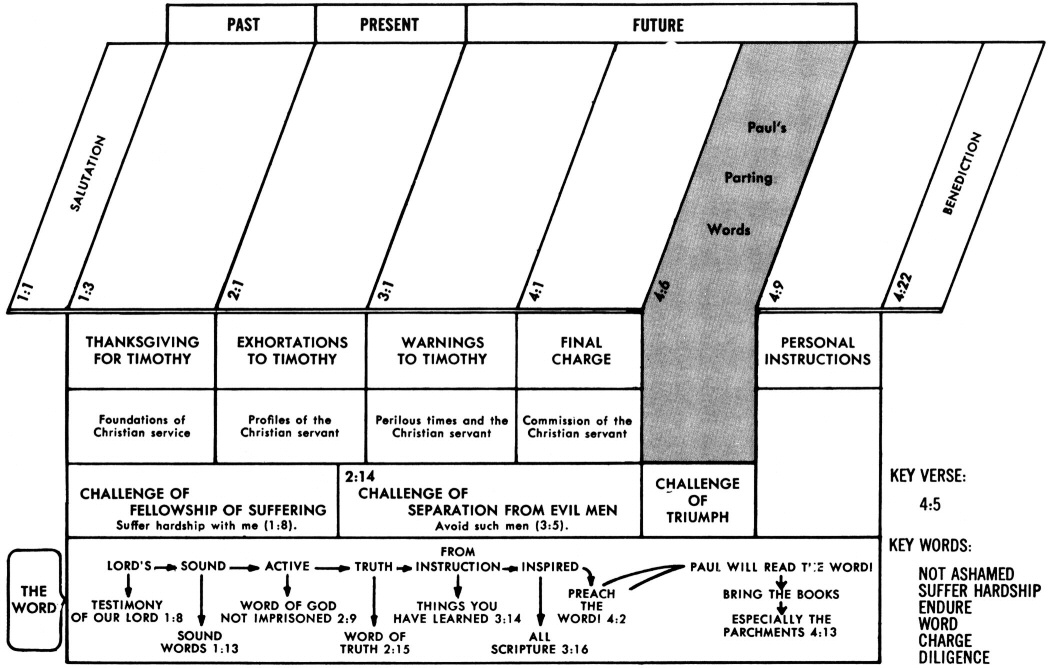
ENDURANCE AND SEPARATION IN THE MINISTRY
Click chart to enlarge
Charts from Jensen's Survey of the NT - used by permission
Second Timothy - Swindoll
| 2 TIMOTHY | |||
| 2 Timothy 1:1-18 | 2 Timothy 2:1-26 | 2 Timothy 3:1-17 | 2 Timothy 4:1-22 |
| Retain the Standard |
Rightly Divide the Word |
Difficult Times Will Come |
Preach the Word |
| PAST | PRESENT | FUTURE | |
| Foundation of Christian Service |
Pictures of Christian Servant |
Dangerous Times for Christian Servant |
Commission of Christian Servant |
| Unashamed as a Witness: Guard the Gospel |
Unashamed as a Workman: Suffer for the Gospel |
Adequate as a Workman: Continue in the Gospel |
Awarded as a Workman: Preach the Gospel |
| Power of the Gospel |
Perseverance of the Gospel Message | Protection of the Gospel |
Proclamation of the Gospel |
| Reminder | Requirements | Resistance | Requests |
| Encouragement in Ministry |
Examples in Ministry |
Exhortations in Ministry |
Exhortations to Fulfill Ministry |
| Commendation & Charge |
Commission to Fulfill |
Conflict to Face |
Course to Finish |
|
Compiled from Jensen's Survey of the NT and Wilkinson's Talk Thru the Bible |
|||
2 Timothy 1:8 Therefore do not be ashamed (2SAPS) of the testimony of our Lord or of me His prisoner, but join with me in suffering (2SAAM) for the gospel according to the power of God, (NASB: Lockman)
Greek: me oun epaischunthes (2SAPS) to marturion tou kuriou hemon mede eme ton desmion autou, alla sugkakopatheson (2SAAM) to euaggelio kata dunamin theou,
GWT: So never be ashamed to tell others about our Lord or be ashamed of me, his prisoner. Instead, by God's power, join me in suffering for the sake of the Good News. (GWT)
KJV: Be not thou therefore ashamed of the testimony of our Lord, nor of me his prisoner: but be thou partaker of the afflictions of the gospel according to the power of God;
NLT: So you must never be ashamed to tell others about our Lord. And don't be ashamed of me, either, even though I'm in prison for Christ. With the strength God gives you, be ready to suffer with me for the proclamation of the Good News. (NLT - Tyndale House)
Phillips: So never be ashamed of bearing witness to our Lord, nor of me, his prisoner. Accept, as I do, all the hardship that faithfulness to the Gospel entails in the strength that God gives you. (Phillips: Touchstone)
Wuest: Therefore, do not begin to be ashamed of the testimony borne by our Lord, nor of me His prisoner, but be a partaker with me in my sufferings for the sake of the good news, [being a partaker of these sufferings] according to the power of God, (Eerdmans)
YLT: therefore thou mayest not be ashamed of the testimony of our Lord, nor of me his prisoner, but do thou suffer evil along with the good news according to the power of God,
THEREFORE: oun:
A WORTHY
CONCLUSION
Therefore (oun) is a conjunction that is important to note when observing the text because it often denotes that what it introduces is the result of or an inference from what precedes and is translated as so, therefore, consequently, accordingly, then. (Click discussion of term of conclusion - always pause and ask what the author is concluding)
In this context therefore refers to the divinely bestowed gift and resources Paul has just mentioned and the result predicated on those truths. "Therefore" indicates that this instruction is based on and follows out of the preceding statement of incentive regarding the power, love and discipline God has given us…
“In light of those immeasurable blessings,” the apostle was saying, “you have no reason to be ashamed."
Because of Timothy’s call, gift, and provision of power, love, and discipline, he had every reason to stand against any opponents, unashamed of the gospel, and unashamed of his imprisoned mentor.
DO NOT BE ASHAMED: me… epaiscunthes (2SAPS):
- 2 Ti 1:12 1:16, 2:12 Ro 1:16, Mk 8:38 Lk 9:26 1Pe 4:16, 1 Jn 2:28, Rev 12:11
DON'T BE ASHAMED
OF PAUL OR JESUS
This is Paul's first instruction in this letter ("kindle afresh the gift" in verse 6 not an instruction but an exhortation - Paul was encouraging Timothy to stir up something he already possessed). Notice Paul's excellent example of exhorting (encouraging - impelling one toward the future) in the first 7 verses of this letter before he gives Timothy a specific instruction.
Do you encourage others before you begin to give them instructions?
Ashamed (1870) (epaischunomai from epi = upon or used to intensify the meaning of the following word + aischunomai from aischos = disfigurement & then disgrace) means to experience a painful feeling or sense of loss of status because of some particular event or activity. It describes one's consciousness of guilt or of exposure or the fear of embarrassment that one's expectations may prove false. Epaischunomai is associated with being afraid, feeling shame which prevents one from doing something, a reluctance to say or do something because of fear of humiliation, experiencing a lack of courage to stand up for something or feeling shame because of what has been done.
Epaischunomai is used 11 times in the NT in the NASB - Mark 8:38; Luke 9:26; Rom 1:16; 6:21; 2 Tim 1:8, 12, 16; Heb 2:11; 11:16. In Septuagint 3x - Ps 118:6, Job 34:19, Is 1:29
Webster adds that to be ashamed is to experience the painful emotion caused by consciousness of guilt, shortcoming, or impropriety, to experience the condition of humiliating disgrace or disrepute, or to experience something that brings censure or reproach. Another source states that ashamed is
Almost exclusively moral in significance; confusion or abashment through consciousness of guilt or of its exposure. Often including also a sense of terror or fear because of the disgrace connected with the performance of some action. Capacity for shame indicates that moral sense (conscience) is not extinct." (ISBE, 1918).
The 1828 Webster's adds ashamed is
Confused by a consciousness of guilt or of inferiority; by the mortification of pride; by failure or disappointment… (and that "shame" is) "A painful sensation excited by a consciousness of guilt, or of having done something which injures reputation; or by of that which nature nature or modesty prompts us to conceal. Shame is particularly excited by the disclosure of actions which, in the view of men, are mean and degrading. Hence it it is often or always manifested by a downcast look or by blushes, called confusion of face.
The aorist tense and subjunctive mood when used with a negative particle ("me" = not) conveys the idea of a prohibition designed to prevent an action from arising. It could be phrased "Don't begin to be ashamed." In other words Paul was not telling Timothy to stop being ashamed as if he already was ashamed.
Marvin Vincent writes that…
The feeling expressed by (epaischunomai) has reference to incurring dishonor or shame in the eyes of men. It is “the grief a man conceives from his own imperfections considered with relation to the world taking notice of them; grief upon the sense of disesteem” (“South, ” cit. by Trench). Hence it does not spring out of a reverence for right in itself, but from fear of the knowledge and opinion of men. (Vincent, M. R. Word studies in the New Testament. Vol. 1, Page 3-342)
Bengel notes that "shame is the companion of fear; if fear is overcome, disgraceful shame flees away."
Kenneth Wuest agrees writing that…
The exhortation, “Be not ashamed,” does not mean that Timothy was ashamed. Had that been the case, Paul would have used the present imperative, which with the negative, forbids the continuance of an action already going on. Here he uses the aorist subjunctive with the negative which forbids the doing of an act not yet begun. (Wuest, K. S: Wuest's Word Studies from the Greek New Testament: For the English Reader. Grand Rapids: Eerdmans) (Bolding added)
So Paul is saying do not be ashamed of the gospel of Christ. Do not yield to the temptation to become ashamed. He must not.
Paul then encourages (exhortation) Timothy with his example, explaining that of he had been appointed as a preacher and an apostle and a teacher of the gospel and that…
"For this reason I also suffer these things, but I am not ashamed (epaischunomai); for I know Whom I have believed and I am convinced that He is able to guard what I have entrusted to Him until that day." (2Ti 1:12-note) (Compare same thoughts in this chapter in 2 Ti 1:12,16 (notes 2 Ti 1:12 1:16) It was not so much "what" Paul knew (and he surely knew theology better than any other man) but it was "Who" he knew. May we all grow in intimacy with our Lord, so that Jesus alone becomes our ultimate source of comfort and strength. What you know you hold, but Who you know holds you!
Paul goes on to give the example of Onesiphorus in order to encourage Timothy writing…
The Lord grant mercy to the house of Onesiphorus for he often refreshed me, and was not ashamed of (epaischunomai) my chains; but when he was in Rome, he eagerly searched for me, and found me." (see notes 2 Timothy 1:16; 1:17)
Paul knew there would be many challenges when Timothy preached the word not fearing men but fearing God (Pr 29:25) and that he might be tempted to feel shame for taking a bold stand. (Ps 40:9) Timothy had surely heard this admonition before, for in Paul's first missionary journey through Timothy's hometown he had declared…
Through many tribulations we must enter the kingdom of God. (Acts 14:21,22)
Remember that at the time this letter was written being a Christian not only brought almost universal criticism but frequently persecution, imprisonment and even death.
Jesus after asking what would it profit one to gain the whole world and forfeit his soul and what would one give in exchange for their soul, then warned that…
whoever is ashamed (epaischunomai - Bible Knowledge Commentary adds "will not identify with Him or believe on Him") of Me and My words (which of course would include the Gospel) in this adulterous and sinful generation, the Son of Man will also be ashamed (epaischunomai) of him when He comes in the glory of His Father with the holy angels. (Mark 8:38)
The interpretation of this passage is radically split between those who feel Jesus is saying those who are ashamed are unbelievers and others who say they are believers who will only suffer loss of rewards. I favor the former interpretation (eg, see the preceding context - especially "forfeit his soul" - to aid your interpretation) Literally, of course, the glorified Christ cannot experience the sense of shame, but the idea at the root is the same. It will be as if he should feel himself disgraced before the Father and the holy angels in owning any fellowship with those who have been ashamed of him. Jesus gives this warning because He knows that a major deterrent against total commitment to His testimony, the gospel, is the fear of shame. It is completely irrational for a creature to be ashamed of his Creator, for a sinner to be ashamed of his Savior.
Jamieson comments on Jesus' warning writing that
The sense of shame is one of the strongest in our nature, one of the social affections founded on our love of reputation, which causes instinctive aversion to what is fitted to lower it, and was given us as a preservative from all that is properly shameful… But when Christ and “His words”—Christianity, especially in its more spiritual and uncompromising features—are unpopular, the same instinctive desire to stand well with others begets the temptation to be ashamed of Him, which only the ‘expulsive power’ of a higher affection can effectually counteract… He will render to that man his own treatment; He will disown him before the most august of all assemblies, and put him to “shame and everlasting contempt” (Daniel 12:2-note). “Oh shame, to be put to shame before God, Christ, and angels!” [Bengel]." (Jamieson, R., et al: A Commentary, Critical and Explanatory)
William Barclay adds that "if by our lives we disown him, even though with our lips we confess him, the day must come when he cannot do other than disown us. (Daily Study Bible Series)
Spurgeon aptly put it - You will never glory in God till first of all God has killed your glorying in yourself.
In Hebrews we read the encouraging truth that…
both He (Jesus) who sanctifies (makes men holy, initially in salvation and then daily in sanctification) and those who are (continually being) sanctified (sanctification) are all from one Father; for which reason He (Jesus) is not ashamed (epaischunomai - He blushes not to acknowledge all His true followers as His brethren) to call them brethren (to acknowledge Himself as of the same family)" (see note Hebrews 2:11)
Comment: This an amazing, encouraging truth for as Barnes notes Jesus is not ashamed "As it might be supposed that One so exalted and pure would be. It might have been anticipated that the Son of God would refuse to give the name “brethren” to those who were so humble, and sunken and degraded as those whom He came to redeem. But He is willing to be ranked with them, and to be regarded as one of their family." Augustine put it well: "God makes of sons of men sons of God, because God hath made of the Son of God the Son of man
The last NT use of epaischunomai is found in Hebrews where we read that of those who "died in faith" that
as it is, they desire (orego = stretching out after, yearning after; present tense = continually) a better country, that is a heavenly one. Therefore God is not (ouk = absolutely not) ashamed to be called their God; for He has prepared a city for them. (see note Hebrews 11:16)
As Barnes comments - "We are not to suppose that God is ever “ashamed” of anything that he does. The meaning here is, that they had acted in such a manner that it was fit that he should show toward them the character of a Benefactor, Protector, and Friend."
Paul knowing the potential cost of living out and speaking forth the gospel of Jesus Christ boldly declared to the saints at Rome…
"Thus, for my part, I am eager to preach the gospel to you also who are in Rome for I am not ashamed (epaischunomai) of the gospel (though espousing its cause subjects one to the contempt of the Jew and of the Greek, to whom the gospel is a stumbling-block and foolishness), for it is the power (inherent effective ability to accomplish the intended purpose - see study of dunamis) of God for salvation to everyone who believes, to the Jew first and also to the Greek." (see note Romans 1:16)
And Paul says that the potential to experience shame should "flee away" in light of the spirit of power, love and sound mind God has granted us in (v7). Our natural reluctance to face the onslaught of a Christ-rejecting world can be overcome by the supernatural resource of God's resurrection power which gives life and victory to our mortal bodies.
A W Tozer wrote that…
Little by little evangelical Christians these days are being brainwashed. One evidence is that increasing numbers of them are becoming ashamed to be found unequivocally on the side of truth. They say they believe but their beliefs have been so diluted as to be impossible of clear definition.
The Bible has a great deal to say about suffering and most of it is encouraging.
Samuel Johnson (1709–1784) wrote that…
Shame arises from the fear of men, conscience from the fear of God.
Suffering… is the badge of the true Christian. - Dietrich Bonhoeffer
There is a certain kind of maturity that can be attained only through the discipline of suffering. - D. A. Carson
Do not kick against suffering, for in so doing you may be fighting against God. - Spurgeon
Life without struggle and difficulty is thin and tasteless. How can a noble life be constructed if there be no difficulty to overcome, no suffering to bear? -Spurgeon
He who can touch the secret springs of the heart, apart from circumstances and conditions, has often made a man glad when he has been racked with pain, or when he has been in the depths of poverty, or when he has been suffering at the demoniacal hands of inquisitors. - Spurgeon
I believe that one of the sweetest joys under heaven comes out of the severest suffering when patience is brought into play. - Spurgeon
There is a great want about all Christians who have not suffered. Some flowers must be broken or bruised before they emit any fragrance. - Robert Murray M’Cheyne
When missionary Dan Crawford's body was found, a well worn New Testament was found in the coat pocket of that great missionary to Africa. Inside he had penned the words of a man unashamed of the testimony of His Lord
I cannot do it alone!
The waves dash fast and high;
The fog comes chilling around,
And the light goes out in the sky.
But I know that we two shall win in the end—
Jesus and I.
Coward and wayward and weak,
I change with the changing sky,
Today so strong and brave,
Tomorrow too weak to fly.
But He never gives up,
So we two shall win in the end:
Jesus and I.
(Note: Some have attributed this poem to Corrie Ten Boom)
As you ponder "In what ways am I ashamed of Jesus, His Cross and His Gospel?" click the links to the hymns and spiritual songs below be overwhelmed by the love of God Who was not ashamed to send His only Son to die on a cruel, shameful Cross in our stead…
Our God Reigns
It was our sin and guilt that bruised and wounded Him.
It was our sin that brought Him down.
When we like sheep had gone astray our Shepherd came
And on His shoulders bore our shame.
Jesus, Thy Blood and Righteousness…
Jesus, Thy blood and righteousness
My beauty are, my glorious dress;
’Midst flaming worlds, in these arrayed,
With joy shall I lift up my head.
Bold shall I stand in Thy great day;
For who aught to my charge shall lay?
Fully absolved through these I am—
From sin and fear, from guilt and shame.
Savior, Again to Thy Dear Name
Grant us Thy peace upon our homeward way;
With Thee began, with Thee shall end the day.
Guard thou the lips from sin, the hearts from shame,
That in this house have called upon Thy Name.
Before Thy Throne, O God, We Kneel
Before Thy throne, O God, we kneel;
Give us a conscience quick to feel,
A ready mind to understand
The meaning of Thy chastening hand;
Whate’er the pain and shame may be,
Bring us, O Father, nearer Thee.
To the old rugged cross I will ever be true;
Its shame and reproach gladly bear;
Then He’ll call me some day to my home far away,
Where His glory forever I’ll share.
Stand Up, Stand Up for Jesus
Stand up, stand up for Jesus, the solemn watchword hear;
If while ye sleep He suffers, away with shame and fear;
Where’er ye meet with evil, within you or without,
Charge for the God of battles, and put the foe to rout.
On March 28, 1997, pastor Eugenio Nij of San Raymundo, Guatemala, was arrested and imprisoned on charges of assault and attempted murder. The charges were completely false--no evidence was produced. Yet Eugenio remained in prison despite petitions signed by hundreds of townspeople. In jail Eugenio continued to minister. He told Pulse magazine: “I’ve preached thirty or forty times in the fifty days I’ve been here… I’ve also been able to comfort fellow prisoners, some of whom have confessed their crimes to me while others are innocent. There have been twenty to thirty conversions… As a minister, I find this a special experience from God.” (Today in the Word)
Suffering for the Gospel - Early in the morning on January 23, 1999, a group of about sixty Hindu fundamentalists shattered the windows of Graham Staines’s jeep. Graham, longtime director of a leprosy mission in India, and his sons, Philip and Timothy, were participating in a Bible conference in the village Monoharpur. After breaking the windows, the fanatics poured gasoline over the vehicle and set it on fire. Graham and his sons died, though not instantly, as many heard screams coming from the blaze. Days later, Graham’s wife, Gladys, made a public statement forgiving the murderers of her husband and sons. She also expressed hope that the guilty individuals would be touched by the love of Christ. India was stunned by her spirit of forgiveness, as well as her commitment to stay on and direct the mission. Gladys has this advice for future missionaries: “Make very sure of your call from God and, once you’re sure of it, be very prepared for whatever, even if it costs your life.” The strength, love, and commitment of the Staines family teach us much about a godly response to suffering, the focus of today’s devotion.
We suffer in the knowledge of reward and victory. Jesus promised: “Blessed are those who are persecuted because of righteousness, for theirs is the kingdom of heaven” (Matt. 5:10-12; 2 Thess. 1:4-5; Heb. 10:32-39; Rev. 2:10). (Today in the Word)
OF THE TESTIMONY OF OUR LORD: to marturion tou kuriou hemon:
- Ps 19:7; Jn 15:27; 19:35; 1Ti 2:6; 1Jn 4:14; 1Jn 5:11,12; Rev 1:2; Rev 12:11; 19:10)
David said "The testimony of the LORD is sure, making wise the simple." (Ps 19:7)
Testimony (3142) (marturion source of English "martyr") means evidence, proof. The content of what a witness tells. Marturion is is the declaration of facts which confirms or makes something known. Marturion is an objective act, circumstance or statement that provides evidence or certifies the truthfulness of something. The content of what is witnessed or said. (See also marturia/martyria)
The verb martureo describes the act of giving the evidence, whereas maturion refers to the content of the statement or to a piece of evidence.
Testimony (marturion) means just that—a testimony or witness. A person can only testify to what he himself has seen or heard or experienced. A witness in a courtroom is to report only what he knows objectively, factually, and personally. He is not to speculate, guess, or deduce.
Testimony (marturion) is essentially synonymous with the Gospel in several Scriptures - 2 Cor 2:1 = "testimony of God", 1 Cor 1:6 = " testimony concerning Christ," 2 Ti 1:8 = "the testimony of our Lord", 1 Ti 2:6 = "the testimony given at the proper time" (in context more specifically this refers the atoning work of Christ, which is a critical component of the Gospel); see also Mt 24:14 ("Gospel of the kingdom" - "a testimony") and Acts 4:33 (resurrection is a critical component of the Gospel)
In later centuries (after the first century AD) marturion came to be used as a description of martyrdom. Edward Myers says "The word originally referred to one who was a legal witness but came to refer to one whose testimony for Jesus ends in death." (Eerdman's Dictionary of the Bible).
Testimony is a solemn attestation as to the truth of a matter, a declaration of truth or fact. Testimony is proof or demonstration of some fact, evidence, piece of evidence. The Gospel itself is a testimony (Mt 24:14) which begs the question are you (as the Spirit enables) faithfully giving a testimony to the truth of Jesus? In Mk 6:11 (Lk 9:5) the testimony is given by actions not words and even the disciple's standing before authorites (for Jesus' sake) would in effect be a testimony. Opposition can lead to an opportunity to give a testimony of Jesus (Lk 21:12, 13). Luke records that "with great power (the enabling, emboldening power of the Holy Spirit) the apostles were giving testimony to the resurrection of the Lord Jesus, and abundant grace was upon them all." (Acts 4:33) In Acts 7:44 marturion refers to the tablets of the 10 commandments ("the tabernacle of testimony") James 5:3 refers to the inanimate but very real testimony or witness of treasures to the apathetic, unbelieving rich when Jesus returns.
Friberg - an objective act, circumstance, or statement that serves as a means of proof evidence, testimony, witness (Acts 4.33); tent of testimony (Acts 7.44); for a testimony, to provide evidence, certify (Mt 8.4)
Zodhiates - Testimony, witness, proof, the declaration which confirms or makes something known (Matt. 8:4; 10:18; 24:14; Mark 1:44; 6:11; 13:9; Luke 5:14). Condemnatory testimony (Luke 9:5; 21:13; 2 Cor. 1:12; 2 Th 1:10; 1 Tim. 2:6; James 5:3). In the Class. Gr., used also for proof. In the NT usage, it is the witness or the testimony of Christ (1 Cor. 1:6 [cf. 2 Tim. 1:8]). The meaning is that the preacher bases what he says on his own intimate or personal knowledge, and the gospel is preached as a narrative of truth, a declaration of facts. This form of expression distinguishes martúrion from the teaching of Christian doctrine (Acts 4:33; Heb. 3:5; Sept.: Deut. 31:26; Josh. 22:27). The preaching of the gospel in 1 Cor. 2:1 is called martúrion, the witness of God (Acts 7:44; Rev. 15:5).
Marturion refers to the firsthand authentication of a fact and provides information about a person or an event concerning which the speaker has direct knowledge. Christ made known the truth about sin, righteousness and the judgment to come and men gnashed their teeth at Him (and they will at us also!).
Moulton and Milligan - The words of the sepulchral epitaph “the witness of an upright life,” have a modern ring about them.
In law testimony is the evidence given by a witness, especially orally in court under oath or affirmation.
The etymology of testimony is from Latin testimonium "evidence, proof, witness, attestation," from testis "a witness, one who attests" + -monium, suffix signifying action, state, condition.
In the Septuagint (Lxx) marturion is found over 290 times, with most in Exodus, Numbers, and Leviticus. It may refer to the two tablets of commandments (Ex. 31:18; 32:15) as well as the tent of the testimony (Ex. 29:4, 10f.; 40:2ff.; Lev. 4:4ff.; Num. 4:25ff) and also the box or ark of the testimony, (Ex. 40:3; 5:21; Lev. 16:2; Nu 4:5) and has the sense of the piece of evidence which calls to mind a particular event, or of the deeds.
Marturion over 225 verses in the Septuagint - Ge 21:30; 31:44; Exod. 16:34; 25:10, 16, 21f; 26:33f; 27:21; 28:43; 29:4, 10f, 30, 32, 42, 44; 30:6, 16, 18, 20f, 26, 36; 31:7, 18; 32:15; 33:7; 35:12, 21; 36:37; 38:8, 21, 30; 39:40; 40:2f, 5f, 12, 20ff, 24, 26, 30, 34f; Lev. 1:1, 3, 5; 3:2, 8, 13; 4:4f, 7, 14, 16, 18; 6:16, 26, 30; 8:3f, 31, 33, 35; 9:5, 23; 10:7, 9; 12:6; 14:11, 23; 15:14, 29; 16:2, 7, 13, 16f, 20, 23, 33; 17:4ff, 9; 19:21; 24:3; Num. 1:1, 50, 53; 2:2, 17; 3:7f, 10, 25, 38; 4:3ff, 15, 23, 25f, 28, 30f, 33, 35, 37, 39, 41, 43, 47; 5:17; 6:10, 13, 18; 7:5, 89; 8:9, 15, 19, 22, 24, 26; 9:15; 10:3, 11; 11:16; 12:4f; 14:10; 16:18f, 42f, 50; 17:4, 7f, 10; 18:2, 4, 6, 21ff, 31; 19:4; 20:6; 25:6; 27:2; 31:54; Deut. 4:45; 6:17, 20; 31:14f, 19, 26; Jos. 4:16; 18:1; 19:51; 22:27f, 34; 24:27; Ruth 4:7; 1 Sam. 9:24; 13:8, 11; 20:35; 1 Ki. 8:4; 2 Ki. 11:12; 17:15; 23:3; 1 Chr. 6:32; 9:21; 23:32; 29:19; 2 Chr. 1:3, 13; 5:5; 23:11; 24:6; 34:31; Neh. 9:34; Job 15:34; 16:8; Ps. 25:10; 78:5, 56; 80:1; 81:5; 93:5; 99:7; Ps 119:2, 14, 22, 24, 31, 36, 46, 59, 79, 88, 95, 99, 111, 119, 125, 129, 138, 144, 146, 152, 157, 167-168; 122:4; 132:12; Prov. 29:14; Isa. 55:4; Jer. 30:20; 44:23; Hos. 2:12; Amos 1:11; Mic. 1:2; 7:18; Zeph. 3:8
Marturion was used to refer to a witness of God which was placed on a par with commandments, statutes, judgments....
(Dt 6:17) “You should diligently keep the commandments of the LORD your God, and His testimonies and His statutes which He has commanded you.
(Dt 6:20) “When your son asks you in time to come, saying, ‘What do the testimonies and the statutes and the judgments mean which the LORD our God commanded you?’
Psalm 119 repeatedly refers to the testimonies of the Lord (Meditate on these uses [Ps 119:99] - Especially ask how does the psalmist responds to God's testimonies?)
2 How blessed are those who observe His testimonies, Who seek Him with all their heart.
14 I have rejoiced in the way of Your testimonies, As much as in all riches.
22 Take away reproach and contempt from me, For I observe Your testimonies.
24 Your testimonies also are my delight; They are my counselors. Daleth.
31 I cling to Your testimonies; O LORD, do not put me to shame!
36 Incline my heart to Your testimonies And not to dishonest gain.
46 I will also speak of Your testimonies before kings And shall not be ashamed.
59 I considered my ways And turned my feet to Your testimonies.
79 May those who fear You turn to me, Even those who know Your testimonies.
88 Revive me according to Your lovingkindness, So that I may keep the testimony of Your mouth. Lamedh.
95 The wicked wait for me to destroy me; I shall diligently consider Your testimonies.
99 I have more insight than all my teachers, For Your testimonies are my meditation.
111 I have inherited Your testimonies forever, For they are the joy of my heart.
119 You have removed all the wicked of the earth like dross; Therefore I love Your testimonies.
125 I am Your servant; give me understanding, That I may know Your testimonies.
129 Your testimonies are wonderful; Therefore my soul observes them.
138 You have commanded Your testimonies in righteousness And exceeding faithfulness.
144 Your testimonies are righteous forever; Give me understanding that I may live. Qoph.
146 I cried to You; save me And I shall keep Your testimonies.
152 Of old I have known from Your testimonies That You have founded them forever. Resh.
157 Many are my persecutors and my adversaries, Yet I do not turn aside from Your testimonies.
167 My soul keeps Your testimonies, And I love them exceedingly.
168 I keep Your precepts and Your testimonies, For all my ways are before You. Tav.
Gilbrant notes that in Classical Greek "This noun generally denotes that which serves as testimony, evidence, or proof. Among the classical authors marturion, unlike the rest of its word group, seldom if ever refers to the legal realm of witness. It denotes the objective testimony, its content, or a piece of evidence—proof which can confirm a fact or statement (see Strathmann, “marturion,” Kittel, 4:474-508). In the Septuagint marturion occurs more than 290 times (250, Kittel) but mostly in Exodus, Leviticus, and Numbers. It refers to the two tablets of the testimony, the Sinaitic commandments (Exodus 31:18; 32:15); the tent of the testimony (Exodus 29:4,10ff.; 40:42ff.; Leviticus 4:4ff.; Numbers 4:25ff.); and the ark of the testimony (Exodus 40:3; 5:21; Leviticus 16:2; Numbers 4:5). As God’s self-testimony contained in the Mosaic covenant, marturion is a way of knowing God. Josephus and Philo used marturion more in the manner of the classical authors than the expanded connotation of the Septuagint (see Coenen, “Witness,” Colin Brown, 3:1038-47). (Complete Biblical Library Greek-English Dictionary)
Marturion - 19x in 19v - NAS = testimony(19), witness(1).
Matthew 8:4 And Jesus said to him, "See that you tell no one; but go, show yourself to the priest and present the offering that Moses commanded, as a testimony to them."
Matthew 10:18 and you will even be brought before governors and kings for My sake, as a testimony to them and to the Gentiles.
Matthew 24:14 "This gospel of the kingdom shall be preached in the whole world as a testimony to all the nations, and then the end will come.
Mark 1:44 and He said to him, "See that you say nothing to anyone; but go, show yourself to the priest and offer for your cleansing what Moses commanded, as a testimony to them."
Comment: Without the formal testimony of the priests the people would not receive the leper as officially clean.
Mark 6:11 "Any place that does not receive you or listen to you, as you go out from there, shake the dust off the soles of your feet for a testimony against them."
Mark 13:9 "But be on your guard; for they will deliver you to the courts, and you will be flogged in the synagogues, and you will stand before governors and kings for My sake, as a testimony to them.
Luke 5:14 And He ordered him to tell no one, "But go and show yourself to the priest and make an offering for your cleansing, just as Moses commanded, as a testimony to them."
Luke 9:5 "And as for those who do not receive you, as you go out from that city, shake the dust off your feet as a testimony against them."
Luke 21:13 "It (Lk 21:12) will lead to an opportunity for your testimony.
Comment - To their testimony of the truth of Christ and His gospel which could lead to their martyrdom. "The blood of the martyrs is the seed of the church."
Acts 4:33 And with great power the apostles were giving (imperfect tense - over and over again) testimony to the resurrection of the Lord Jesus, and abundant grace was upon them all.
Comment - The great power was the supernatural provision by the Spirit which is why they could not stop giving their testimony. O, for a Spirit filled church in America with "great power" that can't be stopped from proclaiming the truth of the resurrection! Amen.
Acts 7:44 "Our fathers had the tabernacle of testimony in the wilderness, just as He who spoke to Moses directed him to make it according to the pattern which he had seen.
1 Corinthians 1:6 even as the testimony concerning Christ was confirmed in you,
MacArthur - Christ’s witness is settled and confirmed in us when we trust in Him as Lord and Savior. At that moment, and forever after that moment, we stand in God’s grace.
2 Corinthians 1:12 For our proud confidence is this: the testimony of our conscience, that in holiness and godly sincerity, not in fleshly wisdom but in the grace of God, we have conducted ourselves in the world, and especially toward you.
MacArthur - This is a reference to the moment of salvation when the gospel was heard and believed and settled in the heart. At that moment, the enabling of 2 Cor 1:4 took place, because one became a recipient of the grace of God.
2 Thessalonians 1:10 when He comes to be glorified in His saints on that day (Second Coming), and to be marveled at among all who have believed-- for our testimony to you was believed.
Comment - Paul, et al, had proclaimed certain facts and borne witness to the power of those facts.
1 Timothy 2:6 who gave Himself as a ransom for all, the testimony given at the proper time.
2 Timothy 1:8 Therefore do not be ashamed of the testimony of our Lord or of me His prisoner, but join with me in suffering for the gospel according to the power of God,
Hebrews 3:5 Now Moses was faithful in all His house as a servant, for a testimony of those things which were to be spoken later;
James 5:3 Your gold and your silver have rusted; and their rust will be a witness against you and will consume your flesh like fire. It is in the last days that you have stored up your treasure!
Revelation 15:5 After these things I looked, and the temple of the tabernacle of testimony in heaven was opened,
Comment - “the ark of the Testimony” (Ex. 30:26; 21:7) from which it derived the name tabernacle of the Testimony.
In the context of this epistle, this phrase, "the "testimony of our Lord" is a reference to the gospel and is used this way in the following NT passages
And this gospel of the kingdom shall be preached in the whole world for a testimony (marturion) to all the nations, and then the end shall come. (Matthew 24:14)
When will this testimony be preached in the whole world? Remembering that Scripture is always the best commentary on Scripture (Click for discussion of this principle), in the Revelation (at the midpoint of Daniel's Seventieth Week, often called the "Tribulation") John records his "testimony"…
"And I saw another angel flying in midheaven, having an eternal gospel to preach to those who live on the earth, and to every nation and tribe and tongue and people and he said with a loud voice, "Fear God, and give Him glory, because the hour of His judgment has come; and worship Him who made the heaven and the earth and sea and springs of waters." (see notes Revelation 14:6; 14:7)
Luke records the beginning of the spread of the gospel from the first church in Jerusalem writing that…
"with great power (dunamis = intrinsic power which Jesus had stated must be present for witnessing in Acts 1:8 where power = dunamis) the apostles were giving (imperfect tense = over and over) witness to the resurrection of the Lord Jesus (the very thing the Sanhedrin had forbidden them to do - the apostles were not ashamed of the testimony our Lord), and abundant grace was upon them all." (Acts 4:33)
John records his punishment for preaching the gospel testifying…
I, John, your brother and fellow partaker in the tribulation and kingdom and perseverance (hupomone = remaining under = patiently enduring affliction without giving up) which are in Jesus, was on the island called Patmos, because of the word of God (the gospel) and the testimony of Jesus. (the gospel)" (see note Revelation 1:9).
John later describes the scene in heaven which illustrates the cost some had to pay for taking a stand and not being ashamed of the testimony of our Lord…
"I saw the souls of those who had been beheaded because of their testimony of Jesus (the gospel) and because of the word of God (the gospel)" (see note Revelation 20:4)
OR OF ME HIS PRISONER: mede eme ton desmion autou:
Prisoner (1198)(desmios from deo = to bind) is an adjective, primarily denoting binding, bound, then, as a noun, the person bound, a captive or prisoner, one who was a deprived of liberty and kept in prison or some other form of custody as a punishment for a crime, while awaiting trial, or for some other reason. Click description of ancient prisons.
Desmios - 16x in 16v - Matt 27:15f; Mark 15:6; Acts 16:25, 27; 23:18; 25:14, 27; 28:17; Eph 3:1; 4:1; 2 Tim 1:8; Philemon 1:1, 9; Heb 10:34; 13:3
Paul may be in a Roman dungeon but he is foremost the prisoner of the Lord Jesus who had sovereign control of his life.
As Dwight Edwards writes, Paul's "chains were not clamped on by an oppressive Roman government, but by the hand of a loving, faithful Father Who was working it all to Paul's ultimate good and His glory. And so Paul was able to avoid bitterness toward the Roman authorities, for he did not see them as acting on their own. He had developed 50-20 vision which Joseph describes in Ge 50:20, "but as for you, you meant evil against me; but God meant it for good." (Bolding added)
BUT JOIN WITH ME IN SUFFERING: alla sugkakopatheson (2SAAM):
A COMMANDING INVITATION
TO SUFFER!
Join with me in suffering (4777) (sugkakopatheo from sun = with + kakos = evil + pathos = passion) literally means to suffer hardship, evil or affliction along with someone. It means to suffer something bad or base, to suffer ill treatment along with some else. It means to undergo the same type of suffering as others do, to join with them in suffering, to assume one’s share of suffering or to suffer together.
Paul like a wartime general uses the aorist imperative which is a command calling for immediate and urgent action. "Timothy, do this now, without hesitation" is the idea.
As a side note this letter has the most commands of any pastoral epistle - 2 Timothy has 31 second person singular imperatives compared with 30 in the longer 1 Timothy and 12 in Titus.
Note the little preposition sun (Click in depth discussion) which means "with". Sun pictures an intimate union. When Timothy suffered for the gospel, Paul's heart (while he was alive) was knit with Timothy's and suffered along with him (1Cor 12:26). Then as well as today, when anyone is persecuted for the sake of His Name, Jesus is there as He explained to Saul on the Damascus Road in Acts…
"And it came about that as (Paul) journeyed, he was approaching Damascus, and suddenly a light from heaven flashed around him; 4 and he fell to the ground, and heard a voice saying to him, "Saul, Saul, why are you persecuting Me?" 5 And he said, "Who art Thou, Lord?" And He said," I am Jesus whom you are persecuting, 6 but rise, and enter the city, and it shall be told you what you must do." (Acts 9:3-6).
Because Jesus is in covenant with those who have placed their faith in Him, He is obligated to be their avenger, which is the truth that Paul discovered on the Damascus Road. What an encouragement to Timothy and to us is this truth that Jesus is there when persecution comes and even when everyone else deserts us (cf notes (cf 2Ti 4:16; 17- notes 2Ti 4:16; 17, Hebrews 13:5, 6-note) Jesus has always "been there" for His suffering saints.
Daniel records Nebuchadnezzar's amazing vision after Shadrach, Meshach and Abed-nego (who refused to bow and worship the image of Nebuchadnezzar) were thrown into the midst of the furnace of blazing fire.
"Then Nebuchadnezzar the king was astounded and stood up in haste; he responded and said to his high officials, "Was it not three men we cast bound into the midst of the fire?" They answered and said to the king, "Certainly, O king." He answered and said, "Look! I see four men loosed and walking about in the midst of the fire without harm, and the appearance of the fourth is like a son of the gods (NKJV translates this "like the Son of God")!" (Daniel 3:24-25-note).
Although not everyone agrees that the "fourth" man in the fire was the Preincarnate Messiah, I think the evidence supports this premise. For example, the Septuagint (Greek translation of the Hebrew OT) reads "the fourth is like the Son of God". While one cannot be dogmatic, many excellent conservative commentators agree that this person was most likely the preincarnate Lord Jesus or the Angel of the LORD.
Church tradition says that most of the apostles died as martyrs. Paul is concerned that in the face of vicious, deadly opposition, Timothy might be afraid to boldly proclaim the gospel. This is not an unreasonable consideration in light of the fact that all who were in Asia turned away from Paul (in prison) and Demas deserted him (see note 2 Timothy 4:10-note)
Did Timothy keep the faith and finish his course? In the epistle to the Hebrews we read that "Timothy has been released" (see note Hebrews 13:23-note) which suggests that Timothy had endured hardship and fulfilled his ministry, unashamed of the gospel even to the point of suffering imprisonment.
This call to join with me has the ring of a teacher (Paul) calling on his disciple (Timothy) to follow in his steps. In both the secular Greek and the Jewish cultures disciples (Students of rabbis or philosophers, normally committed to memorizing and living according to their master’s teachings) were called to follow in their teachers’ steps. Ultimately both Paul and Timothy were disciples of
How incredible that Timothy and you and I have "been considered worthy to suffer shame for His name" (Acts 5:41)
Paul is inviting Timothy (& all genuine disciples of Christ) to join a not too popular club "The Pain of Shame Club". And Paul uses the Aorist imperative construction which is a command to do this now, without hesitation, even conveying a sense of urgency.
Bear evil treatment along with me Timothy, for afflictions will come upon those who preach and profess the Gospel, for even though the Gospel is a Gospel of peace, men are corrupt and depraved (see note Romans 1:28-note) and the Gospel brings a sword (Mt 10:34), division (Jn 7:43, 10:19 Mt 10:35 Lk 12:51), and trouble (Acts 16:20KJV). Tribulation arises on account of the Gospel; and this suffering should be endured patiently, and constantly, for he sake of the Gospel. Do we really understand Paul's 'invitation" in 21st Century America? Our Lord Jesus made it clear that we would have trouble. (Jn 16:33) Paul repeatedly affirmed that suffering for the gospel was the expected lot of believers (see note 2 Timothy 3:12-note). He had consistently proclaimed this truth throughout his ministry (Acts 14:21,22; 1Th 3:4; Philippians 1:29 [note], etc). Christians today must not be blind to this plain teaching of Scripture and must avoid surprise when opposition to the gospel produces a personal attack.
Wuest - The exhortation is “Be a fellow-partaker with us (the Lord and Paul) with respect to our sufferings for the gospel’s sake.” The sufferings are those that are a natural accompaniment of the preaching of the gospel. Paul alludes to the same thing in Colossians 1:24 (see note). (Wuest's Word Studies from the Greek New Testament)
John R. Scott gives a modern example of one who suffered for the gospel observing that…
Few men of this century have understood better the inevitability of suffering than Dietrich Bonhoeffer. He seems never to have wavered in his Christian antagonism to the Nazi regime, although it meant for him imprisonment, the threat of torture, danger to his own family, and finally death. He was executed by direct order of Heinrich Himmler in April 1945, in the Flossenburg concentration camp, only a few days before it was liberated. It was the fulfillment of what he had always believed and taught: "Suffering, then, is the badge of true discipleship. The disciple is not above his master. Following Christ means 'passio passiva' suffering because we have to suffer. That is why Luther reckoned suffering among the marks of the true church, and one of the memoranda drawn up in preparation for the Augsburg Confession similarly defines the Church as the community of those "who are persecuted and martyred for the gospel's sake"… Discipleship means allegiance to the suffering Christ, and it is therefore not at all surprising that Christians should be called upon to suffer." (John R. Scott, Christian Counter Culture)
Am I a Soldier of the Cross?
click to play
Am I a soldier of the cross, a follower of the Lamb?
And shall I fear to own His cause, or blush to speak His name?
Must I be carried to the skies on flowery beds of ease?
While others fought to win the prize, and sailed through bloody seas.
Sure I must fight if I would reign, Increase my courage Lord.
I'll bear the toil, endure the pain, supported by thy Word.
---- Isaac Watts
FOR THE GOSPEL ACCORDING TO THE POWER OF GOD: to euaggelio kata dunamin theou:
Spurgeon comments that "The old man eloquent" feels his soul kindling as he describes the glories of the gospel, eternal in its purpose, matchless in its achievements. He sits on the brink of the grave, and sings of One who hath abolished death. Faith in the resurrection could alone suggest such a triumphant exclamation. (The Interpreter)
Gospel (2098) (euaggelion from eú = good + aggéllo = proclaim, tell) means literally "good news," and in the New Testament describes "the power of God for salvation to everyone who believes, to the Jew first and also to the Greek." (Ro 1:16-note) (Click word study of euaggelion)
Wuest gives these added insights on euaggelion explaining that "Gospel” comes from the Saxon word "gode-spell" [gode meaning good & “spell” = a story, a tale]. Euaggelion was in just as common use in the first century as our words good news. “Have you any good news (euaggelion) for me today?” must have been a common question. Our word GOSPEL today has a definite religious connotation. In the ordinary conversation of the first century, it did not have such a meaning. However, it was taken over into the Cult of the Caesar where it acquired a religious significance. The Cult of the Caesar was the state religion of the Roman empire, in which the emperor was worshipped as a god. When the announcement of the emperor’s birthday was made, or the accession of a new Caesar proclaimed, the account of either event was designated by the word euaggelion. Thus, when the Bible writers were announcing the good news of salvation, they used the word euaggelion which word meant to the 1st century readers “good news.”
Vine - The gospel, like the kingdom of God, does not make progress with “outward show.” Its methods do not make an appeal to the natural mind. Its ministry involves hardships, inevitable to all who faithfully proclaim it, as was the case with Him who constitutes it subject. Collected writings of W. E. Vine)
According to - This is the Greek preposition kata which is not out of but according to His infinite power. To illustrate the principle imagine that I am a billionaire and I give you ten dollars, I have given you out of my riches. Now on the other hand, if I give you a million dollars, I have given to you according to my riches. The first $10 gift was only a portion (and a small one at that) but the second was a proportion of my wealth. In the first gift, I would take it out of my riches, and thus would be like the wealthy Mr. Rockefeller who would give his caddy a dime after carrying his clubs for 18 holes! God is not that way and He gives "according to" His power, which is where the illustration breaks down for God's riches and power are infinite and inexhaustible. Does this truth boggle your mind even a little? It should beloved for His resources are what we now have access to!
What is the infinite power of God which is available to believers today? Better "Who is the power?" This is none other than the Holy Spirit Who indwells and empowers believers for supernatural service that simply cannot be accomplished with our natural strength! So what is the upshot? It is vital and needful that we daily seek to be continually filled with the Spirit (Eph 5:18-note), avoiding whatever would grieve (Eph 4:30-note) or quench (1 Thes 5:19-note) the Spirit's power in us, for if we do we may have a form of godliness but will lack the supernatural power (cp 2 Ti 3:5) and will produce absolutely no fruit that endures for eternity (John 15:5, 16).
Power (1411) (dunamis) of God enables us to suffer hardship and affliction for the gospel. God gives us in Christ Jesus and the Spirit Who indwells us. It is an inherent ability which gives us the potential to carry out whatever God calls us to do, including to suffer.
Dunamis - 119x in 115v - Matt 7:22; 11:20f, 23; 13:54, 58; 14:2; 22:29; 24:29f; 25:15; 26:64; Mark 5:30; 6:2, 5, 14; 9:1, 39; 12:24; 13:25f; 14:62; Luke 1:17, 35; 4:14, 36; 5:17; 6:19; 8:46; 9:1; 10:13, 19; 19:37; 21:26f; 22:69; 24:49; Acts 1:8; 2:22; 3:12; 4:7, 33; 6:8; 8:10, 13; 10:38; 19:11; Rom 1:4, 16, 20; 8:38; 9:17; 15:13, 19; 1 Cor 1:18, 24; 2:4f; 4:19f; 5:4; 6:14; 12:10, 28f; 14:11; 15:24, 43, 56; 2 Cor 1:8; 4:7; 6:7; 8:3; 12:9, 12; 13:4; Gal 3:5; Eph 1:19, 21; 3:7, 16, 20; Phil 3:10; Col 1:11, 29; 1 Thess 1:5; 2 Thess 1:7, 11; 2:9; 2 Tim 1:7f; 3:5; Heb 1:3; 2:4; 6:5; 7:16; 11:11, 34; 1 Pet 1:5; 3:22; 2 Pet 1:3, 16; 2:11; Rev 1:16; 3:8; 4:11; 5:12; 7:12; 11:17; 12:10; 13:2; 15:8; 17:13; 18:3; 19:1. NAS = ability(4), meaning(1), mightily(1), mighty(1), miracle(2), miracles(17), miraculous powers(3), power(83), powers(6), strength(2), wealth(1).
Dunamis conveys the idea of effective, productive energy, rather than that which is raw and unbridled. God gives every believer the same supernatural power which was manifest in Jesus’ life and which resurrected Him from the dead. We have at our "disposal" this same resurrection power beloved! And notice that it given to us "according to", which is explained below. In Acts we see the disciples manifesting this power in boldly witnessing, not fearing persecution or imprisonment. And what was their source of this power? The Holy Spirit had come upon them as Jesus had prophesied in (Acts 1:8) where He declared that they would receive
receive power when the Holy Spirit has come upon you; and you shall be My witnesses both in Jerusalem, and in all Judea and Samaria, and even to the remotest part of the earth. (see commentary)
Today every believer has been baptized by (identified with) the Holy Spirit (1 Corinthians 12:13) and thus he or she has access to the same power the believers in the early church had. There is no difference in the power available to us today beloved (although certain miraculous works appear to have been restricted to this unique transition time in history as outlined in the book of Acts - beloved please do not be sidetracked - the greatest miracle of a dead sinner being resurrected to newness of life is still a reality and this should be our desire and focus). Do we really believe we have access to God's supernatural power? Why then do so few of us experience this divine power? Could it be that we resist, quench and/or grieve the Spirit of God Who gives us this power? Could it be that we are not letting the Word of Christ dwell in us richly (more than a verse or two in the morning), obeying (under grace not law) that Word as directed (filled, controlled) by the Holy Spirit? Or perhaps we are like the saints at Ephesus who must have been instructed about their source of inherent spiritual power and yet Paul was still moved by the Spirit to pray for them to know this power deep within their innermost being, praying that…
18 the eyes of your heart may be enlightened, so that you may know what is the hope of His calling, what are the riches of the glory of His inheritance in the saints,
19 and what is the surpassing greatness of His power toward us who believe. These are in accordance with the working of the strength of His might
20 which He brought about in Christ, when He raised Him from the dead (how great is the power available to us? Here Paul equates it with resurrection power and secondly states that it is a power greater than that of any spiritual forces arrayed against us - far above all power - we are seated with Him according to Ephesians 2:6 [note]), and seated Him at His right hand in the heavenly places,
21 far above all rule and authority and power and dominion, and every name that is named, not only in this age, but also in the one to come.
22 And He put all things in subjection under His feet, and gave Him as head over all things to the church,
23 which is His body, the fulness of Him who fills all in all. (see notes Ephesians 1:18; 1:19; 1:20; 1:21; 1:22; 1:23)
Hiebert comments that "lest Timothy, naturally inclined to be timid, might feel that this made a demand beyond his abilities, Paul reminds him that the suffering is to be "according to the power of God." The reference may be either to the power which God imparts (2Ti 1:7) or the power which belongs to God and He has exhibited in our salvation (2Ti 1:9). From the context the latter reference seems preferable but surely both thoughts are involved. That power which God has displayed in working our own salvation He also imparts to us to be enabled to suffer for the Gospel. The test of our power lies in our ability to suffer for the Gospel. (2 Timothy by D. Edmond Hiebert)
F. B. Meyer - God’s soldiers must be brave and unflinching in meeting the opposition of the world. When once we realize that the stores which reside in God are at the disposal of our faith, we too shall be invulnerable and irresistible."
Warren Wiersbe - Years ago, I read about a Christian who was in prison because of his faith. He was to be burned at the stake, and he was certain he would never be able to endure the suffering. One night, he experimented with pain by putting his little finger into the candle flame. It hurt, and he immediately withdrew it. “I will disgrace my Lord,” he said to himself. “I cannot bear the pain.” But when the hour came for him to die, he praised God and gave a noble witness for Jesus Christ. God gave him the power when he needed it, and not before. (Wiersbe, W: Bible Exposition Commentary. 1989. Victor)
Hodges rightly notes that "We can bear less than we think if we trust our strength, more than we think if we trust His."
Knock, Knock! - A knock came at the door of the home of a man who had a young family. When the father answered the door, he was greeted by someone he had never met—a friendly man from a nearby church who had stopped by to say hello.
His pleasant demeanor and kind words impressed the dad, and the two agreed to meet again. When they did, the visitor introduced the man to the gospel of Jesus Christ. Both he and his wife trusted Jesus as Savior.
That changed everything. The couple began attending church, and all six of their children became believers in Christ. Eventually the dad became a Sunday school teacher and a deacon.
One of this couple’s daughters grew up to attend the same Christian college I attended. That student’s name was Sue, and from the first time I saw this cute girl from Grand Rapids, I was smitten. The man who had answered the door eventually became my father-in-law. That door-to-door ambassador changed not just one man, but an entire family—and the results continue to reverberate.
Paul encouraged us, "Let your speech always be with grace, seasoned with salt, that you may know how you ought to answer each one" (Col. 4:6).
Whose life, whose future, will you impact? — Dave Branon
Lord, lay some soul upon my heart,
And love that soul through me;
And may I nobly do my part
To win that soul for Thee. —Tucker
The Good News of Christ is too good to keep to yourself.