2 Timothy 2:2
2 Timothy 2:3
2 Timothy 2:4
2 Timothy 2:5
2 Timothy 2:6
2 Timothy 2:7
2 Timothy 2:8
2 Timothy 2:9
2 Timothy 2:10
2 Timothy 2:11
2 Timothy 2:12
2 Timothy 2:13
2 Timothy 2:14
2 Timothy 2:15
2 Timothy 2:16
2 Timothy 2:17
2 Timothy 2:18
2 Timothy 2:19
2 Timothy 2:20
2 Timothy 2:21
2 Timothy 2:22
2 Timothy 2:23
2 Timothy 2:24
2 Timothy 2:25
2 Timothy 2:26
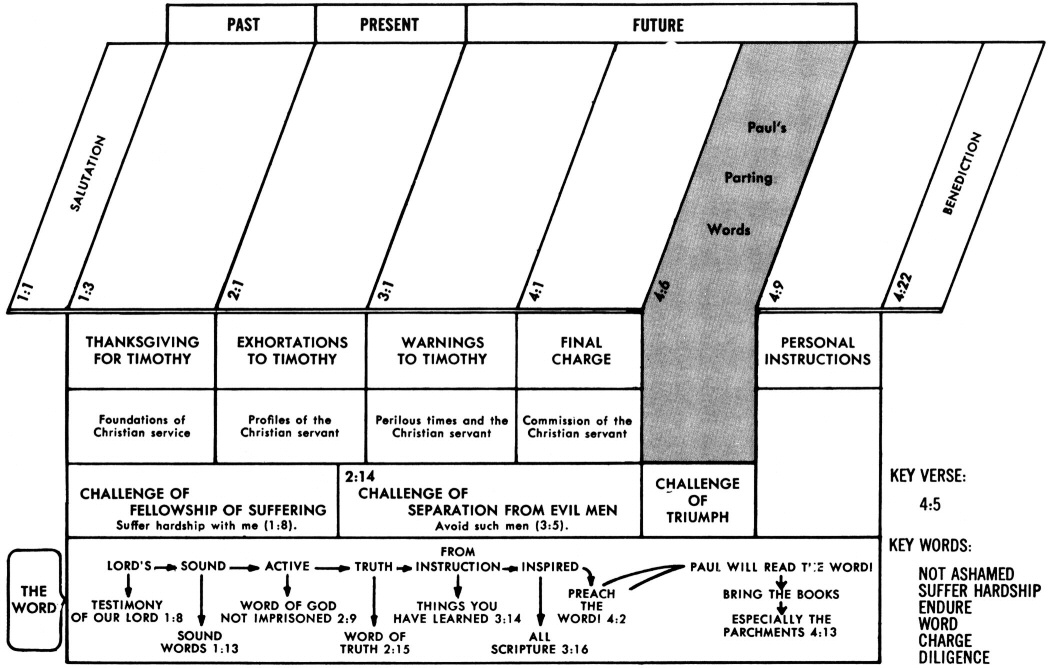
ENDURANCE AND SEPARATION IN THE MINISTRY
Click chart to enlarge
Charts from Jensen's Survey of the NT - used by permission
Second Timothy - Swindoll
| 2 TIMOTHY | |||
| 2 Timothy 1:1-18 | 2 Timothy 2:1-26 | 2 Timothy 3:1-17 | 2 Timothy 4:1-22 |
| Retain the Standard |
Rightly Divide the Word |
Difficult Times Will Come |
Preach the Word |
| PAST | PRESENT | FUTURE | |
| Foundation of Christian Service |
Pictures of Christian Servant |
Dangerous Times for Christian Servant |
Commission of Christian Servant |
| Unashamed as a Witness: Guard the Gospel |
Unashamed as a Workman: Suffer for the Gospel |
Adequate as a Workman: Continue in the Gospel |
Awarded as a Workman: Preach the Gospel |
| Power of the Gospel |
Perseverance of the Gospel Message | Protection of the Gospel |
Proclamation of the Gospel |
| Reminder | Requirements | Resistance | Requests |
| Encouragement in Ministry |
Examples in Ministry |
Exhortations in Ministry |
Exhortations to Fulfill Ministry |
| Commendation & Charge |
Commission to Fulfill |
Conflict to Face |
Course to Finish |
|
Compiled from Jensen's Survey of the NT and Wilkinson's Talk Thru the Bible |
|||
2 Timothy 2:1 You therefore my son be strong (2SPPM) in (by means of) the grace that is in Christ Jesus . (NASB: Lockman)
Greek: Su oun, teknon mou, endunamou (2SPPM) en te chariti te en Christo Iesou,
Amplified: So you, my son, be strong (strengthened inwardly) in the grace (spiritual blessing) that is [to be found only] in Christ Jesus. (Amplified Bible - Lockman)
CEV: Timothy, my child, Christ Jesus is kind, and you must let him make you strong. (CEV)
ESV: You then, my child, be strengthened by the grace that is in Christ Jesus,
KJV: Thou therefore, my son, be strong in the grace that is in Christ Jesus.
ICB: Timothy, you are like a son to me. Be strong in the grace that we have in Christ Jesus.
NLT: Timothy, my dear son, be strong with the special favor God gives you in Christ Jesus. (NLT - Tyndale House)
TEV: As for you, my son, be strong through the grace that is ours in union with Christ Jesus.
Wuest: As for you, therefore, my child, be clothed with inward strength by the grace which is in Christ Jesus
Young's Literal: Thou, therefore, my child, be strong in the grace [that is] in Christ Jesus,
YOU THEREFORE MY SON: Su oun teknon mou:
- 2Ti 1:2; 1Ti 1:2, 18, Php 2:22
- 2 Timothy 2 Resources - Multiple Sermons and Commentaries
- 2 Timothy 2:1 Strong in Grace - Steven Cole
- 2 Timothy 2:2 Handing Off the Truth - Steven Cole
- 2 Timothy 2:1-4 Advice to a Young Disciple - Study Guide - 4 studies in dropdown - John MacArthur
- 2 Timothy 2 Paul's Portrait of a Leader - John MacArthur
- 2 Timothy 2 Portrait of a Leader - John MacArthur
- 2 Timothy 2:1-2: Elements of a Strong Spiritual Life 1 - John MacArthur
ESV Study Bible comments on 2Ti 2:1-13 - This section resumes the call to Spirit-empowered boldness.
You (4771) (su) is emphatic (first word in Greek sentence) which signifies Paul is making a direct appeal to Timothy. In other words by emphasizing you, Paul is placing personal responsibility squarely on the shoulders of Timothy! Given the preceding context 2Ti 1:15, 1:16-18, it would be easy for Timothy to rationalize and minimize his responsibility to be a faithful disciple maker. While we may not have a similar degree of spiritual warfare as did Timothy, we can still fall into the trap of "Well, that's the job of the paid clergy. I'm too busy to disciple. I don't have enough training to disciple," etcetera!
Spurgeon - This is an exhortation to everyone of us, not only to have grace, but to be strong in it. There are many professing Christians who are content so long as they are just saved. We are not content with being barely alive spiritually. We do not wish to have our life shivering with cold, but we seek after comfort as well as existence. We seek to be in health as well as to be in life. So should it be with the Christian. He should pray, “Lord, make me strong in the grace that is in Christ Jesus.”
John Phillips adds that "Timothy was a steward. He would be held accountable one day for his stewardship." And so will every disciple of Jesus. Will we hear "Well done, you obeyed My command to make disciples"? (Mt 28:18-20)
Paul speaking from his "longing" heart (2Ti 1:4) adds the tender affirmation my son/child (teknon) for he knows that to truly motivate others, one must express genuine and unqualified concern for their full spiritual blessing and let them know that they are loved without reservation.
How are you motivating your children in the Lord...with legalism or love?
Son (5043) (teknon) (See discussion of my beloved son/child - 2Ti 1:2) refers to a child as viewed in relation to his parents or family and takes on special theological significance when the Bible calls believers the children of God. not because of our "childlikeness" but to affirm the fact that we are members of God's family and thus heirs (Ro 8:15; Ro 8:16; Ro 8:17) to the "family fortune". In a similar sense Timothy having been "bequeathed" the "family" treasure of the gospel was to guard it with his life. New Testament disciples are called children of their teachers, because the latter by their instruction nourish the minds of their pupils and mold their characters so that they take on "family characteristics".
Charles Simeon introduces his sermon on this text asking - "HOW shall it be that all of us, who are assembled here this day, should ever get to heaven, so weak as we are, and so corrupt, and in the midst of so many and great dangers? I look back to the Apostle’s days; and find, that when he was in prison at Rome, “all the converts that were of Asia, turned away from him;” but that one pious man, “Onesiphorus, sought him out with great diligence,” to relieve his necessities, and to comfort his soul. Now, if reduced to such straits as the Apostle Paul was, for the Gospel’s sake, how should we hope to stand? How should we avoid the apostasy of the many, and retain the fidelity of the few? This instruction the Apostle gives to his beloved Timothy: “Thou, therefore, my son, (seeing how hard it is to stand in times of severe trial,) be strong in the grace that is in Christ Jesus:” that is, ‘know that there is grace treasured up for thee in Christ: and, in dependence upon that, thou shalt be able to sustain all the trials that shall come upon thee.’ (2 Timothy 2:1 Strength in the Grace of Christ)
Hiebert comments that "the tender address my child reminds him that what is now to be urged upon him comes from the tender, yearning heart of his spiritual father. (2 Timothy by D. Edmond Hiebert).
Therefore (3767) (oun) refers to what has gone before and introduces a logical result or inference from the preceding discourse (See discussion of the importance of pausing to ponder terms of conclusion). With that in mind what had Paul just related that dictated that Timothy needed to be strong in grace in Christ?
Although chapter breaks tend to "disrupt" the flow of thought in a letter, if one observes the context, it is obvious that Paul had just given Timothy the reminder of the spiritual defection stating "that all who are in Asia turned away" which would surely have been disheartening to his young disciple (2Ti 1:15, cp 2Ti 1:12). But Paul had also contrasted the defection with the example of loyal, faithful Onesiphorus (2Ti 1:16-18).
In addition, in a more general context Paul had made it very clear throughout chapter 1 that carrying the treasure of the gospel would bring suffering (see 2Ti 1:8, 12). So Paul begins this exhortational-instructional portion of the letter by emphasizing the need for personal "extrinsic" empowerment for ministry. Paul is not appealing to Timothy to "pull himself up by his bootstraps" so to speak or to "get a grip" on his emotions and courage in his own strength (see below).
John Gill on therefore and my son - The illative particle, "therefore", shows the connection between this and the preceding chapter; the appellation, "thou, my son", expresses the apostle's tender affection for Timothy, and is the rather used to engage his attention to the advice he was about to give him; which is, that since he had received the true grace of God, and unfeigned faith dwelt in him (2Ti 1:5); and since he had such gifts (2Ti 1:6-7), qualifying him for the work of the ministry; and since so good a thing as the glorious Gospel of the blessed God was committed to his trust (2Ti 1:14); and since there were so many who had departed from it, and so few that abode by it (2Ti 1:15), he would have him. (2 Timothy 2 Commentary)
Paul uses multiple pictures in this chapter to illustrate various facets of the Christian life and each one is worthy of mediation:
- Son/Child (2Ti 2:1)
- Teacher (2Ti 2:2)
- Soldier (2Ti 2:3,4 - note 2:3; 2:4)
- Athlete (2Ti 2:5 )
- Farmer (2Ti 2:6 )
- Prisoner (2Ti 2:9 , 2Ti 2:10)
- Workman (2Ti 2:15 )
- Vessel (2Ti 2:21)
- Bondservant (2Ti 2:24)
BE STRONG IN (BY MEANS OF) THE GRACE THAT IS IN CHRIST JESUS: endunamou (2SPPM) en te chariti te en Christo Iesou:
- 2Ti 1:7; Josh 1:7; Hag 2:4; 1Co 16:13; 2Pe 3:18
- See Torrey's Topic "Grace"
- 2 Timothy 2 Resources - Multiple Sermons and Commentaries
- 2 Timothy 2:1 Strong in Grace - Steven Cole
- 2 Timothy 2:2 Handing Off the Truth - Steven Cole
- 2 Timothy 2:1-4 Advice to a Young Disciple - Study Guide - 4 studies in dropdown - John MacArthur
- 2 Timothy 2 Paul's Portrait of a Leader - John MacArthur
- 2 Timothy 2 Portrait of a Leader - John MacArthur
- 2 Timothy 2:1-2: Elements of a Strong Spiritual Life 1 - John MacArthur
TIMOTHY'S (AND OUR) GREAT NEED:
TO BE EMPOWERED FOR MINISTRY
You therefore my son be (divine passive, but we still have to be willing to receive it and be) continually strengthened with inner strength by means of the grace which is in (and from) Christ Jesus via His "Administrator" (Executive), the Holy Spirit.
MacArthur feels this is the main "admonition in the first part of the letter. Paul is calling for Timothy to overcome his apparent (Ed: This is not 100% clear, 2Ti 1:7 possibly alluding to his personal timidity) drift toward weakness and renew his commitment to his ministry." (MacArthur Study Bible)
Our Translations = be strong through the grace that is ours in union with Christ Jesus (TEV), be clothed with inward strength (Wuest), find your strength in the grace which is in Christ Jesus (Barclay), you must let Him make you strong (CEV), be strong with the special favor God gives you in Christ Jesus (NLT), be strong (strengthened inwardly) in the grace (spiritual blessing) that is [to be found only] in Christ Jesus" (AMP)
The fact that Paul uses the same verb (endunamoo) in Eph 6:10 (also present imperative, passive voice) in the context of spiritual warfare certainly points to the fact that Timothy would experience spiritual resistance, especially as he sought to pass on the baton in 2Ti 2:2). If our enemy cannot keep us from becoming believers (and he cannot), he will seek to keep us from truly making disciples of Jesus because he knows that this will produce a spiritually dynamic church.
Adam Clarke - Though the genuine import of the word grace is favor, yet it often implies an active principle communicated from God; light directing how to act, and power enabling to act according to the light. (2 Timothy 2 Commentary)
Albert Barnes on be strong - (comments on same verb endunamoo also in present imperative, passive voice in Eph 6:10) = To be “strong in the Lord,” is: (1)to be strong or courageous in His cause; (2) to feel (Ed: Trust, believe, rely on the truth) that He is our strength, and to rely on Him and His promises. (Ephesians 6 Commentary)
Matthew Henry writes that "Those who have work to do for God (Ed: Which is EVERY genuine believer - cp Eph 2:10) must stir up themselves to do it (Ed: 100% our responsibility to make this choice - God will encourage us and even give us the desire and power but will not FORCE us), and strengthen themselves for it (Ed: More accurately "be strengthened" or willing trust, rely on and receive from Christ via His CEO so to speak, the Holy Spirit, the grace which equates with spiritual power to accomplish God's desire for our life. In short we are 100% dependent on God while at the same time 100% responsible to complete the good work God has prepared for us in Christ Jesus. This is another way of saying we must "abide in the Vine" in ALL genuine spiritual [supernatural] work)....Be strong, not confiding in thy own sufficiency, but in the grace that is in Jesus Christ....When Peter promised rather to die for Christ than to deny him he was strong in his own strength; had he been strong in the grace that is in Christ Jesus, he would have kept his standing better. Observe, 1. There is grace in Christ Jesus; for the law was given by Moses, but grace and truth came by Jesus Christ, John 1:17. There is grace enough in him for all of us. 2. We must be strong in this grace; not in ourselves, in our own strength, or in the grace we have already received, but in the grace that is in Him, and that is the way to be strong in grace." (Note that "Ed:" identifies notes or comments I have added for amplification of Henry's notes).
Be strong (be empowered, be enabled, be strengthened inwardly) (1743) (endunamoo from en = in + dunamoo = strengthen) in simple terms means to put power in (like a car needs gas for power) and thus to make strong or vigorous, to strengthen (active voice) or to be (passive voice) strengthened, enabled or empowered.
This word is found only in biblical and ecclesiastical Greek. The idea is to cause one to be able to function or to accomplish something. It can refer to physical strengthening as in (Heb 11:34) but more often endunamoo refers to spiritual or moral strengthening as in the case of Abraham who
with respect to the (humanly speaking impossible) promise of God (of the birth of Isaac in his old age by Sarah), he did not waver (was not divided, did not vacillate between two opinions - belief and unbelief - implies mental struggle) in unbelief, but grew strong (endunamoo [aorist passive indicative - passive = strength from without, from God] = was endued with strength or empowered from God) in faith (Godly faith is not full understanding but full trust), giving glory to God (Ro 4:20)
Comment: Isaac was the result of a biological miracle performed by God in answer to Abraham’s faith. Godly faith glorifies God and thus the One Who even gives the faith receives all the glory.
Dunamóo is derived from dúnamis which means to be able or to have power (Click in depth word study of dunamis).
Related Resource: Wayne Barber on endunamoo
Dúnamis refers to inherent strength residing in a thing by virtue of its nature. The best spiritual example is the "gospel" which is the inherent, omnipotent power of God operating in the salvation of a lost soul that accepts it (Ro 1:16).
Dúnamis (Study this great word at dunamis) means power in the sense of that which overcomes resistance or effects a change.
Dúnamis is used in the NT to speak of miracles or supernatural acts which have in them the inherent power of God or in which one sees His supernatural power exerted in their performance.
Endunamoo - 7x in NAS = Acts 9:22; Ro 4:20; Eph. 6:10; Phil 4:13; 1Ti 1:12; 2Ti 2:1; 2Ti 4:17. NAS = grew strong, 1; increasing in strength, 1; strengthened, 2; strengthens, 1; strong, 2.
Endunamoo is used only once in the Septuagint (Lxx) in the description of Gideon as he was being prepared for battle...
Judges 6:34 So the Spirit of the LORD came upon (Hebrew = labash = wrap around by implication to put on a garment or clothe oneself, array, used figuratively of "clothing" one's self with the Holy Spirit! Lxx = endunamoo - strengthened or empowered) Gideon; and he blew a trumpet, and the Abiezrites were called together to follow him.
Comment: What a beautiful parallel between being clothed with Holy Spirit and being empowered for spiritual work (cp Jesus' promise to his disciples -Lk 24:49)! Surely this is a pattern all God's servants should seek to emulate - being continually filled with and strengthened by the Spirit of Christ, for apart from His enablement, the servant, no matter how sincere and diligent in his own strength, can accomplish absolutely nothing of eternal value (Jn 15:5), nothing which brings glory to the Lord (Mt 5:16).
In commanding on Timothy to be strong, note that Paul is not telling Timothy to "gut it up" and summon up his own natural strength. Paul is asking him to "be strengthened" to be made strong, which speaks not of natural but of supernatural strength to carry out supernatural "good works."
Timothy is to let the Lord's grace give him the needed strength (cp 2Cor 12:9). Endunamoo is in the passive voice, which indicates that Paul is not telling Timothy to be strong in his own strength (as would be active voice indicating the subject performs the action in this case of making himself strong). The passive voice indicates that the source of strengthening comes from without or from a source independent of the subject, specifically from the supernatural grace that is in Christ via His Spirit (cp Heb 10:29) and that Timothy needs to renounce self effort and "tap in to" God's provision daily and moment by moment. Beloved, if we rely on ourselves (our natural strength) to accomplish spiritual (supernatural) work, we are doomed to a work of futility at best and failure at worst.
Don Anderson comments on tense, voice, mood of be strong - By present it means that every minute, sitting here right now, you must avail yourself to the power. Just like we are aware that this light is on, and it is on because it is connected to the power and the power is on. You throw the switch, the power goes off. When you quench and grieve the Spirit of God, the power (the lights) goes off in our lives. The challenge of the Christian life is to live everyday in total, complete dependence upon his enabling power. To “be strong” in the passive sense, rather than the active, means that Timothy is going to be acted upon by someone. He is passive. God (Ed: The Spirit of God is God's "CEO" Who carries out the actions from the Father through the Son) is acting upon him to provide the strength necessary to live life successfully. So if I tried to translate it so that I communicated the command, it is keep in touch with the power and do not try to do it on your own. It is John 15:5 in big, bold letters. “Without me you can do nothing.” It is Phil. 4:13. “I can do all things through him who strengthens me.” So, what is the key to command number one? It is continuous cooperation with God. It is clinging and committing and allowing God to be the one. You and I to be successful, must be dependent and wait for him. Remember what Paul said to the Galatians in 2:20? “I have been crucified with Christ and I no longer live, but Christ lives in me.” Why does Timothy need to be strengthened by means of grace? Stop and think about it. When you get through seeing these three illustrations of what he will go through (2Ti 2:3-6) it will be a miracle if he survives. And God is going to get the glory. Grace is always needed to have the courage and the conviction to stand and speak boldly against the culture and to be willing to have these other things all be true of you. You cannot do that in your own strength. And the strength comes from the indwelling Holy Spirit. Ken Hutcheson who played with the Seattle Seahawks for years is a pastor in Washington and has written a book on the church and he says, “And when God’s work is done by God’s people in God’s way, empowered by God’s mighty, indwelling Spirit, look out, Jack!” We are a force to be contended with. Oswald Chambers said, “God never gives strength for tomorrow, or for the next hour, but only for the strain of the minute.” What is the key to that? Every minute of the day is a declaration of dependence so you can be a candidate for that.(2 Timothy 2:1-7 Legacy: What Am I Passing On? )
Wuest tries to picture the idea translating it "be clothed with inward strength". Paul is saying be strengthened or be made strong. Do you see the important distinction brought out by the passive voice?
THOUGHT - THINK ABOUT YOUR CAR...YOU DRIVE UP TO THE GAS STATION WHEN YOU ARE LOW ON FUEL....YOU PUT THE GAS IN YOUR CAR...YOUR CAR'S ENGINE IS "STRENGTHENED" BY POWER FROM A SOURCE THAT IS OUTSIDE THE CAR. Note that this is not "Let go, Let God," but is more Biblically "Let God and Let's go" (so to speak). In other words believers are supernaturally empowered, but we are still responsible individually to work out our salvation in fear and trembling!
Paul issues this important directive as a command (imperative mood) to be carried out continually (present tense). Timothy is to be like a "vessel" and to allow the Lord to fill him with His power and strength (cp Eph 5:18). Remember that God is opposed to the proud but gives grace to the humble (James 4:6) and that when we are weak (in our strength), then and only then are we strong (His strength)! (2Cor 12:9) So even though endunamoo is passive voice, this experience of being made strong still involves "co-operation" of the one being strengthened. In other words, the believer is not just a passive recipient of this strength, but must actively, continually appropriate (trust in, rely on, submit to, surrender to, yield to) the source of strength that comes from the grace that is in Christ Jesus. It is not simply "Let go and let God." The believer is not simply a passive recipient of Christ's strength, but must willingly receive, continually rely and depend on the Source of strength in God's "grace which was granted us in Christ Jesus from all eternity" (2Ti 1:9 ). Remember that pride in general and unconfessed sin will effectively "shut down: this flow of divine grace.
Jerry Bridges explains be strengthened this way...
Grammatically, Paul’s words be strengthened (be strong in) are in the form of what we may call “a passive imperative.” The passive voice indicates something done to us, not by us, while the imperative mood is used to command someone to do something. When we want someone to do something, we ordinarily use the active voice, not the passive. For example, when Paul urged Timothy to “preach (present imperative) the word” (2Ti 4:2), he used the active imperative. But Paul’s words be strengthened indicate that something is to be done to Timothy. He’s to be strengthened by something outside himself. That something is “the grace that is in Christ Jesus.” (Ed: How is this grace "distributed" to believers today? Through the effective working of the indwelling Spirit of Christ, the "Spirit of Grace" [Heb 10:29b])
We usually associate grace with the first bookend (Ed: Christ's Perfect Righteousness Imputed or Reckoned to the believer's "spiritual account"), thinking of verses like Ephesians 2:8: “For by grace you have been saved through faith.” But grace in the New Testament is actually much broader—it includes all the blessings God has given us through Christ. Those blessings can generally be classified under two categories: privileges and power.
The grace in 2Timothy 2:1 is the blessing of power. It’s the same category of grace we see in 2Corinthians 12:9 as the Lord tells Paul, “My grace is sufficient [continually enough, continually suffices] for you, for my power [dunamis -supernatural inherent ability to accomplish] is made perfect in weakness,” and Paul responds, “Therefore I will boast all the more gladly of my weaknesses, so that the power [dunamis] of Christ may rest upon me.” Here God equates His grace with His power; power that can be experienced only through human weakness. So when Paul wanted Timothy to be strengthened by the same divine power he had experienced, he urged Timothy to be strengthened by grace.
How is Timothy to respond to this command? By faith (Ed: Which includes renouncing confidence in our own natural "power" and relying wholly on the Holy Spirit's supernatural enabling power) he’s to rely on the power of the Holy Spirit (Ed: Reliance) instead of his own resolutions, self-effort, or will-power (Ed: Renunciation). He is to acknowledge that without Christ he can do nothing (John 15:5).
Just as he must look outside himself to Christ’s righteousness for his standing before God (Ed: "Bookend" #1), he must also look outside himself to the power of the Holy Spirit for his strength to live the Christian life. And the same is true for us. (The Bookends of the Christian Life -Jerry Bridges, Bob Bevington) (Ebook) (Highly recommended if you are truly seeking to "walk the talk"!) (Consider using this book for a Bible Study - you can download a free Study Guide The Bookends of the Christian Life) (Bolding added)
Comment: Jerry Bridges' preceding lucid, logical explanation begs several questions:
- "Are you frustrated with your Christian life?"
- "Do you feel powerless over certain sins in your life?"
- "Who are you relying on to live the supernatural life
- you have been called to live to the glory of God?"
Remember that Paul has already told Timothy that God has...given you a spirit of...power. (2Ti 1:7) and yet here we see that Timothy and you and I are to believe and receive and walk in the power (experience it = "experiential truth") that is already ours (by virtue of our position - "in Christ"! = "positional truth") because of the sure promise of God Who cannot lie (Nu 23:19, Malachi 3:6). In other words Timothy doesn't so much need to pray for power but he needs to learn to rely and totally depend on the power that is available to him in Christ, Whose Spirit indwells him (Ro 8:9) and Who is the source of that power which os based on grace (it's unmerited). Does this make sense? If not see (2Ti 2:7-note) where God says if we continually consider (continually seek to understand, giving careful consideration to) what Paul writes, He will give us understanding into these truths so vital to the "victorious" Christian walk (So let us humble ourselves and ask Him to do just that beloved)!
Paul teaches a similar truth in issuing a command (present imperative) to the saints at Ephesus to prepare them for the intense spiritual war with their powerful (but not omnipotent) supernatural foe, the devil..
be (passive voice ~ indicates this enablement comes from without, from God) strong (endunamoo - present tense = continually be strengthened with supernatural enabling power) in (Notice the Source - in) the Lord...(Why?) for (term of explanation) our struggle is not against flesh and blood... (Ep 6:10, Eph 6:11, Eph 6:12, also see sermon on Ep 6:10,12).
Luke uses this same verb in describing Paul's conversion writing that "Saul kept (imperfect tense) increasing in strength (endunamoo - passive voice = was being empowered - progressively increasing in strength as Jewish opposition grew) and confounding (this word in English implies temporary mental paralysis caused by astonishment or profound abasement) the Jews who lived at Damascus by proving ("knitting together" - continually putting together in his mind the OT clues and concluding Jesus was the Messiah) that this Jesus is the Christ. (Acts 9:22)
In his first letter to Timothy Paul (probably alluding to his empowerment in Acts) thanked "Christ Jesus our Lord, Who" had "strengthened (endunamoo)" him, because He considered (him) faithful, putting (him) into service. (1Ti 1:12)
God’s sovereign purpose for Paul and for all believers works through personal faith. Until Paul was turned by the Holy Spirit from self-righteous works to faith alone in Christ, he could not be empowered and used by God.
In his last words to Timothy, Paul illustrated his personal example of being strong in the grace that is in Christ Jesus writing that in the face of everyone deserting him (as might happen to Timothy or any disciple who retains the standard of sound words),
the Lord stood with me (fulfilling His promise never to “leave or forsake” His children) and strengthened (endunamoo) me, in order that through me the proclamation might be fully accomplished, and that all the Gentiles might hear; and I was delivered out of the lion's mouth. (2Ti 4:17)
Paul is saying to Timothy in essence that "in your weakness He will be your strength". It is worth noting that endunamoo is used in (Acts 9:22) at the beginning of Paul's public ministry, where we noted above that he "kept increasing in strength" and then is used here in 2 Timothy 4:17 which marks the end of his public ministry—a poignant picture of this Paul's continual dependence upon the sustaining strength of the Lord!
BE SELF SUFFICIENT
IN CHRIST'S SUFFICIENCY!
Paul reminds the saints at Philippi that he had learned the secret of contentment (Php 4:11, 12)
I can do all things through Him Who strengthens (endunamoo - continually strengthens) him (Php 4:13).
Comment: Notice the balance in this passage - Our part is to "do" (albeit even that is enabled by the Spirit!) and God's part is to continually enable us by His Spirit Who indwells us. We can't "do" unless He first "does"! Jettison any hope or aspiration that you can do anything of eternal value in your strength - replace your self reliance with Spirit reliance. How? By faith. By believing He will enable you to do whatever it is He prompts you to do. You still have the choice to say "Yes" or "No." God will not force you (He might discipline you but He will not force you!)
I like how the Amplified Version paraphrases Php 4:13...
I am ready for anything and equal to anything through Him (Ed: Christ is the "key" - His indwelling Spirit Ro 8:9) Who infuses inner strength into me; I am self-sufficient in Christ’s sufficiency.
Comment: To be sure it Christ in us the Hope of Glory but according to Paul it is the Spirit of Christ and so the Spirit is the Member of the Trinity Who enables us. However since the Trinity is a unity, the entire Godhead is involved as the great Puritan writer John Owen explained...
Everything God does He does as the triune God. Each Person of the Trinity is involved in every action of God. Yet at the same time each Person has a special role to fulfill in that work....There is no good that we receive from God but it is brought to us and wrought in us by the Holy Spirit. Nor is there in us any good towards God, any faith, love, obedience to His will, but what we are enabled (Ed: Note not "helped" which implies we have some ability and just need a little "push" but enabled) to do so by the Holy Spirit. (Pneumatologia, Or, A Discourse Concerning the Holy Spirit)
John MacArthur commenting on Phil 4:13 adds that Paul does not "mean that he could physically survive indefinitely without food, water, sleep, or shelter. What he is saying is that when he reached the limit of his resources and strength, even to the point of death, he was infused with the strength of Christ. He could overcome the most dire physical difficulties because of the inner, spiritual strength God had given him. (MacArthur, J. Philippians. Chicago: Moody Press)
Dear reader. Are you weak today? in distress? insulted? in difficulty? persecuted? Then consider imitating Paul and "boast" about it for you are on the pathway of empowerment, for
He (Jesus) has said My grace is sufficient (adequate, enough, possessing unfailing strength, sufficing) for you, for power (dunamis) is perfected (teleo in the present tense = continually perfected, brought to the intended end) in weakness. (To which Paul responded) Most gladly, therefore, I will rather boast about my weaknesses, that the power (dunamis) of Christ may dwell in me...for when I am weak, then I am strong. (2Cor 12:9 ,2Cor 12:10)
Let us therefore humbly submit to and thankfully accept (this is very difficult for me and a lesson I have to continually "re-learn") the circumstances and/or people God sends into our life as the vessels He will use to cause us to continually rely on His grace and His power (dunamis).
The flow of God’s power into the believer’s life
Compared with the issue of physical health
by Dr. D. Martyn Lloyd-Jones
Now I suggest that that is analogous to this whole subject of power in one’s life as a Christian. Health is something that results from right living. Health cannot be obtained directly or immediately or in and of itself. There is a sense in which I am prepared to say that a man should not think of his health as such at all. Health is the result of right living, and I say exactly the same thing about this question of power in our Christian lives.
Or let me use another illustration. Take this question of preaching. No subject is discussed more often than power in preaching. “Oh, that I might have power in preaching,” says the preacher and he goes on his knees and prays for power. I think that that may be quite wrong. It certainly is if it is the only thing that the preacher does. The way to have power is to prepare your message carefully. Study the Word of God, think it out, analyze it, put it in order, do your utmost. That is the message God is most likely to bless—the indirect approach rather than the direct. It is exactly the same in this matter of power and ability to live the Christian life. In addition to our prayer for power and ability we must obey certain primary rules and laws.
I can therefore summarize the teaching like this. The secret of power is to discover and to learn from the New Testament what is possible for us in Christ. What I have to do is to go to Christ. I must spend my time with Him. I must meditate upon Him, I must get to know Him. That was Paul’s ambition—“that I might know Him.” I must maintain my contact and communion with Christ and I must concentrate on knowing Him.
What else? I must do exactly what He tells me. I must avoid things that would hamper. If in the midst of persecution we want to feel as Paul felt, we must live as Paul lived. I must do what He tells me, both to do and not to do. I must read the Bible, I must exercise, I must practise the Christian life, I must live the Christian life in all its fullness.
--from Spiritual Depression: Its Causes and Cure: page 298-99, 1965
Grace (5485) (charis) (Click for in depth word study of charis) is often described as God's unmerited favor, which is true, but unfortunately this is the extent of many people's understanding of God's great grace.
I like to think of grace in "three tenses" and all three of which are "God's unmerited favor"- Past tense grace (God's unmerited favor in our salvation - Eph 2:8-9 = grace for our justification), Present tense grace (describing supernatural resurrection power available to us now enabling us to live this supernatural life - 1 Cor 15:10, 2Cor 1:12 = grace for our sanctification) and Future tense grace (producing the future resplendent glory which will be ours at Christ's return - 1Pe 1:13 = grace for glorification). And there is one other use of grace which we will experience throughout eternity (see Eph 2:7).
Warren Wiersbe writes that 1Cor 15:10 ("But by the grace of God I am what I am, and His grace toward me did not prove vain; but I labored even more than all of them, yet not I, but the grace of God with me.") was "the secret of Paul's great ministry" and I would agree. Couple this truth with the event that occurred in 2 Cor 12 and we see how a firm foundation was laid for Paul to learn to continually depend on God's amazing, all sufficient grace. Recall that Second Corinthians was written about 56AD, but the event of his being caught up to the third heaven occurred 14 years earlier (2 Cor 12:2-3), roughly 42AD, which would have been after his conversion but before his 3 great missionary journeys which were enabled by the supernatural grace and power he had learned in 2 Cor 12:9-10. Here is an (approximated "timeline" because the Bible text does not give us specific dates) giving an overview of Paul's life...
32AD - Stephen's stoning Acts 7:58, 8:1
33AD - Persecution of church (Acts 8:1-3; Phil 3:6)
34AD - Conversion on the Road to Damascus (Acts 9:1-9) Goes to Damascus (Acts 9:10-19) Note that Acts 9:22 says "Saul kept increasing (endunamoo in the imperfect tense) in strength" (endunamoo)
35AD - Travels to Arabia and remains there (Gal 1:17)
46AD - Barrnabas travels to Tarsus in order to seek Saul (Acts 11:25)
56AD - 2Corinthians Written
W E Vine says the grace Paul describes in 2Ti 2:1 "is not here grace to the guilty but the gracious favor of God in its enabling power and effect, which is to be found alone in Christ (Ed: And "dispensed" by His Spirit, the Spirit of Grace - Heb 10:29)...Only as we live in the enjoyment of the power of this grace can we devotedly and faithfully discharge the service committed to us. There is adequate grace to meet our every need." (Vine, W. Collected writings of W. E. Vine. Nashville: Thomas Nelson ) (Bolding added)
Someone once said that grace is everything for nothing to those who don't deserve anything.
In the grace that is in Christ Jesus indicates that the grace is the inward source of a believer's strength. Thus in is probably instrumental and could be translated by means of or in the power of His grace. In 2 Cor 12:9 Jesus associates His grace with His supernatural power, the power to accomplish a task which cannot be accomplished with our natural strength (cp 2Cor 9:8).
Williams paraphrases it this way "in the spiritual blessing that comes through union with" Christ Jesus.
Today's English Version (TEV) paraphrase is similar and emphasizes the Source of this grace is "in union with Christ Jesus."
Our Source of strength is Christ Jesus, "the Word...full of grace and truth...of His fulness we have all received and grace upon grace...grace and truth were realized through Jesus Christ. (Jn 1:14-17).
All believers need to be mindful of our spiritual resources and resist the tendency (temptation) to rely on our own strength or otherwise we will experience discouragement, weariness, and disillusionment because spiritual warfare is a supernatural battle, which is hard and which will not stop until we are glorified.
So in this chapter, Paul is reminding Timothy of the Source of His strength and the necessity to rely on the Source rather than self, a message frequently recorded in Scripture (Joshua 1:6-7, 1Chr 22:13, 1Cor 16:13, see Ep 6:10-note & sermon Eph 6:10).
Ray Stedman on "the grace that is in Christ Jesus" - I submit to you that those are much more than mere religious words; they are words of great, practical value. The only way you can keep your inner life strong is by a relationship to the Living God (Ed: cp Jn 15:5). That has been proven again and again in human history. If you think you can stand against the forces of today's world by leaning on your friends, your family, your guru, your psychiatrist, or your counselor, you will find they will crumble when you need them most (Ed: cp 1Cor 10:12). The only reliable source of strength in a day in which the world is falling apart is what Paul calls here, "The grace that is in Christ Jesus." (Soldier's, Athletes, and Farmers)
We sing about the grace that is in Christ Jesus in the words of the hymn Solid Rock - "On Christ the solid Rock I stand; all other ground is sinking sand." Those words express Paul's intent - not your strength Timothy, but Christ's strength and our desperate need to continually be depending on, relying on (standing on) the power that is in the grace that Christ provides and is dispensed by the Spirit of Christ Who indwells every believer.
Spurgeon comments on "grace...in Christ" -- Christ has grace without measure in Himself, but He hath not retained it for Himself. As the reservoir empties itself into the pipes, so hath Christ emptied out His grace for His people. "Of His fulness have all we received, and grace for grace." (Jn 1:16) He seems only to have in order to dispense to us. He stands like the fountain, always flowing, but only running in order to supply the empty pitchers and the thirsty lips which draw nigh unto it. Like a tree, He bears sweet fruit, not to hang on boughs, but to be gathered by those who need. Grace, whether its work be to pardon, to cleanse, to preserve, to strengthen, to enlighten, to quicken, or to restore, is ever to be had from Him freely and without price; nor is there one form of the work of grace which He has not bestowed upon His people. As the blood of the body, though flowing from the heart, belongs equally to every member, so the influences of grace are the inheritance of every saint united to the Lamb; and herein there is a sweet communion between Christ and his Church, inasmuch as they both receive the same grace. Christ is the head upon which the oil is first poured; but the same oil runs to the very skirts of the garments, so that the meanest saint has an unction of the same costly moisture as that which fell upon the head. This is true communion when the sap of grace flows from the stem to the branch, and when it is perceived that the stem itself is sustained by the very nourishment which feeds the branch. As we day by day receive grace from Jesus, and more constantly recognize it as coming from Him, we shall behold Him in communion with us, and enjoy the felicity of communion with Him. Let us make daily use of our riches, and ever repair to Him as to our own Lord in covenant, taking from him the supply of all we need with as much boldness as men take money from their own purse. (Spurgeon, C H: Morning and Evening) (Bolding added)
J Vernon McGee comments on Paul's command writing - "I love this—be strong in grace. My friend, if you think that you can grit your teeth and go out and live the Christian life on your own, you’re in for a great disappointment. If you feel that you can follow a few little rules or some clever gimmicks to make you a mature Christian, then you have fallen into a subtle trap of legalism. Paul gives no rules, and the Word of God has no rules to tell the child of God how to live the Christian life. We are saved by grace, and now we are to live by the grace of God and be strong in that grace....When I hear Christians say, “I don’t do this, and I don’t do that, and I am following a set of rules,” I immediately recognize that they know very little about the grace of God. They are trying to live the Christian life in their own strength. Paul says, “Be strong in the grace that is in Christ Jesus." (McGee, J V: Thru the Bible Commentary: Nashville: Thomas Nelson) (Bolding added)
William MacDonald - To be strong in the grace that is in Christ Jesus means to be courageous with the strength which His grace provides, to go on faithfully for the Lord with the undeserved ability that comes through union with Him. (Believer's Bible Commentary)
Observe carefully that Grace permeates this short epistle (as it should permeate our life) -- Paul opened with a benediction for grace (2 Timothy 1:2) reminded Timothy that he was saved by grace (2 Timothy 1:9) and closed with his final written words of blessing - "grace be with you". (2 Timothy 4:22).
How would Timothy "succeed" in ministry? How could he possibly be able to suffer hardship as a good soldier? Would he succeed because he studied enough, prayed enough, taught enough, endured enough, etc?
No, there was only one way to fulfill his ministry. The way he began...by the grace that is in Christ. This grace is embodied in Christ Jesus Who imparts it to all who are in union with Him, just as the vine imparts its life and fruitfulness to the branches that are abiding in union with it, for as Jesus said "apart for Me (and His "sap" of empowering grace) you can do nothing" (Jn 15:5). As believers we exist in the sphere of grace through our union with Christ (cp Ro 5:2). It's the grace of God that empowers believers. It's God's grace that would enable Timothy and us to please and serve God--otherwise we could do nothing of eternal value.
Peter prayed that "grace and peace be multiplied" to his readers (who were believers) "in the knowledge (epignosis = full, complete knowledge) of God and of Jesus our Lord (2Peter 1:2).
From Peter's prayer for his readers, one can deduce that the deeper and wider the channel through which knowledge of the Lord flows, the more grace and peace will be multiplied, assuming that this "head knowledge" becomes "heart knowledge", leading to obedience motivated by love not legalism. The more we study and trust and obey the "gospel of the grace of God" (Acts 20:24), the more grace shall we derive from the "Word of His grace" (Acts 14:3).
John Piper adds that "knowing God is the means by which His grace and peace become large and powerful in our lives. If you want to enjoy God's peace and be the aroma of his grace in the world, your knowledge of Him has to grow. Grace is not a mere deposit. It is a power that leads to godliness (Titus 2:11, 12 see notes Ti 2:11, 2:12) and eternal life (cf Ep 2:8,9 - Ep 2:8-note; 2:9-note). And where knowledge of the glory and excellence of God languishes, grace does not flow. The channel from God's infinite reservoir of grace into and through our lives is knowledge of God. We do not study the Scripture for its own sake, but because through it comes the knowledge of God and through that, grace and peace are multiplied in your heart..." But knowledge alone will not open the floodgates of grace. We must obey what we know. To say it another way: Because we belong to Christ, we are continually in the sphere of grace (grace in which we stand - see Romans 5:2 - note). But to enjoy the sphere of blessing, we must live in the sphere of obedience. Peter ends his second epistle with a command to "grow in the grace and knowledge of our Lord and Savior Jesus Christ" (2Pe 3:18 ). Spurgeon adds that "an increase of love to Jesus and a more perfect apprehension of His love to us is one of the best tests of growth in grace. (Liberating Promises - Desiring God) (Bolding added)
In Faith's Checkbook Spurgeon comments on the truth that "The LORD gives grace and glory" (Ps 84:11): "Grace is what we need just now, and it is to be had freely. What can be freer than a gift? Today we shall receive sustaining, strengthening, sanctifying, satisfying grace. He has given daily grace until now, and as for the future, that grace is still sufficient. If we have but little grace the fault must lie in ourselves; for the LORD is not straitened, neither is He slow to bestow it in abundance. We may ask for as much as we will and never fear a refusal. He giveth liberally and upbraideth not. The LORD may not give gold, but He will give grace: He may not give gain, but He will give grace. He will certainly send us trial, but He will give grace in proportion thereto. We may be called to labor and to suffer, but with the call there will come all the grace required; What an "end" is that in the text -- "and glory!" We do not need glory yet, and we are not yet fit for it; but we shall have it in due order (Ed: But compare 2Cor 3:18 "from glory to glory."). After we have eaten the bread of grace, we shall drink the wine of glory. We must go through the holy, which is grace, to the holiest of all, which is glory. These words and glory are enough to make a man dance for joy. A little while -- a little while, and then glory forever!" (Bolding added)
The way upward to the throne of grace to receive grace in the nick of time is downward in our estimation of our abilities and our strength. Spurgeon (Faith's Checkbook) commenting on the fact that "God is opposed to the proud but gives grace to the humble" (James 4:6, 1Pe 5:5, Pr 3:34) that
Humble hearts seek grace, and therefore they get it.
Humble hearts yield to the sweet influences of grace, and so it is bestowed on them more and more largely.
Humble hearts lie in the valleys where streams of grace are flowing, and hence they drink of them,
Humble hearts are grateful for grace and give the LORD the glory of it, and hence it is consistent with His honor to give it to them.
Come, dear reader, take a lowly place. Be little in thine own esteem, that the LORD may make much of thee. Perhaps the sigh breaks out, "I fear I am not humble." It may be that this is the language of true humility. Some are proud of being humble, and this is one of the very worst sorts of pride. We are needy, helpless, undeserving, hell-deserving creatures, and if we are not humble we ought to be. Let us humble ourselves because of our sins against humility, and then the LORD will give us to taste of His favor.
It is grace which makes us humble,
and grace which finds in this humility
an opportunity for pouring in more grace.Let us go down that we may rise. Let us be poor in spirit that God may make us rich. Let us be humble that we may not need to be humbled but may be exalted by the grace of God." Spurgeon adds that "Our troubles have always brought us blessings, and they always will. They are the black chariots of bright grace." "Our LORD will give us grace to follow the most difficult paths of duty without a stumble. He can fit our foot for the crags so that we shall be at home where apart from God we should perish." "It seems that Jehovah's way is to lower those whom He means to raise and to strip those whom He intends to clothe. If it is His way, it is the wisest and best way. If I am now enduring the bringing low, I may well rejoice, because I see in it the preface to the lifting up. The more we are humbled by grace, the more we shall be exalted in glory. That impoverishment which will be overruled for our enrichment is to be welcomed. (Bolding added)
Commenting on "My grace is sufficient" (2Cor 12:9,10) Spurgeon writes "Our weakness should be prized as making room for divine strength. We might never have known the power of grace if we had not felt the weakness of nature. Blessed be the LORD for the thorn in the flesh, and the messenger of Satan, when they drive us to the strength of God. This is a precious word from our LORD's own lip. It has made the writer laugh for joy. God's grace enough for me! I should think it is. Is not the sky enough for the bird and the ocean enough for the fish? The All-Sufficient is sufficient for my largest want. He who is sufficient for earth and heaven is certainly able to meet the case of one poor worm like me. Let us, then, fall back upon our God and His grace. If He does not remove our grief, He will enable us to bear it. His strength shall be poured into us till the worm shall thresh the mountains, and a nothing shall be victor over all the high and mighty ones. It is better for us to have God's strength than our own; for if we were a thousand times as strong as we are, it would amount to nothing in the face of the enemy; and if we could be weaker than we are, which is scarcely possible, yet we could do all things through Christ. (Bolding added)
TODAY IN THE WORD - THE PARADOX OF THE CHRISTIAN LIFE - Got milk? About 95 percent of Americans recognize this marketing slogan from the ad campaign touting milk's health benefits. Over 200 celebrities, including many sports heroes, have been featured in ads sporting a milk mustache. Dairy farmers want adults and kids to know that milk makes you strong! Got grace? That's the secret of spiritual strength found in today's key verse: “Be strong in grace.” Such instruction sounds simple, but these words convey the paradoxical nature of the Christian life—it requires God's grace and human effort. Without question, God's grace is preeminent. We are saved and called by His grace (1Ti 1:9). If God hadn't first reached out to us, we never would have been able to reach back. But God's work doesn't erase our responsibility to live in Christ. That's the “be strong” part of verse one. Life in grace is both a gift to receive and a command to follow. Paul explains to Timothy how to be strong in grace by using three different metaphors. First, he tells Timothy to be a strong soldier for Christ (2Ti 2:3). Soldiers expect bad food, bad weather, and danger itself. They are ready to suffer, and they expect to sacrifice. We, too, should expect that the Christian life requires sacrifice because we're living not to please ourselves but our commanding officer, Jesus Christ (2Ti 2:4). We must also be strong like the Greek Olympian who “competes according to the rules” (2Ti 2:5). Historically, in the ancient Greek Olympic games, in order to participate in the games, these athletes had to complete a ten-month training period and sign an oath that they had done so. We need an athlete's endurance and stamina for the race set before us (cf. Heb. 12:1). When we feel like quitting, we can remember our eternal rewards and continue to the finish. Finally, pastors specifically should be like the hardworking farmer (2Ti 2:6). The farmer is able to enjoy produce from his fields. As pastors work hard, they deserve a share of their labors. APPLY THE WORD - Have you been surprised by hardship and suffering in your life? Have you often been angry at God for allowing it? Ask God for the strength of the soldier. Do you feel exhausted by the race you're running in the Christian life? Do you feel like slowing down or quitting? Ask God for the stamina of the athlete. Are you serving Christ faithfully and wondering when you'll see the harvest? Ask God for the faithfulness of the farmer. (Ed Note: While we are to ASK, remember that we have already RECEIVED - the commandment BE STRONG IN THE GRACE comes "pre-packaged" with the enablement, the indwelling Spirit of grace and His all sufficient power. But we need to rely on His supernatural supply source and asking for it is one sure way of expressing our dependence on our Father for our supply of daily bread and our belief that He will supply it in our time of need, because such an answer would be in keeping with His will - 1Jn 5:14-15 - and ultimately would bring Him great glory - Mt 5:16) (Moody Bible Institute)
What Comes Naturally? - The story is told about an elderly man who retired after many years in the British Army. One day a man who knew about his long and distinguished military career decided to play a prank on him. As the old soldier walked down the street with his arms full of packages, the jokester sneaked up behind him and shouted, "Attention!" Without hesitation, the military man dropped his arms to his side, and every package went tumbling to the sidewalk. Without a conscious thought, the veteran was doing what comes naturally for a soldier.
Similarly, as believers in Christ, we should respond in a manner that corresponds with our new life. Our behavior is to be more and more in line with the example of Jesus' life. We still must deal with sinful desires, so we need to discipline ourselves to be the kind of person God wants us to be. Like a soldier or athlete in training (2 Timothy 2:3-5), we need to practice repeatedly until doing what's right comes naturally.
Through faith in Christ we are children of the heavenly Father. By the power of the indwelling Spirit, therefore, let us develop the habit of submitting to God's Word. Then, in every situation of life we will increasingly find that obeying Him is "doing what comes naturally." — Richard De Haan (Our Daily Bread, Copyright RBC Ministries, Grand Rapids, MI. Reprinted by permission. All rights reserved)
Lord, may our lips and lives express
The blessed gospel we profess;
So let our works and virtues shine
And speak of Him who is divine. —Anon.When we walk with Christ,
we become more like Him.
I love Annie Johnson Flint's poem on grace below (click here for more of her poetry)
HE GIVETH MORE GRACE
by Annie Johnson Flint
He gives more grace when the burdens grow greater.
He sends more strength when the labors increase,
To added affliction He addeth His mercy,
To multiplied trials, His multiplied peace.
When we have exhausted our store of endurance,
When our strength has failed 'ere the day is half done
When we reach the end of our hoarded resources
Our Father's full giving is only begun.
His love has no limit, His grace has no measure.
His power no boundary known unto men;
For out of His infinite riches in Jesus
He giveth and giveth and giveth again.
2 Timonty 2:2 And the things which you have heard (2SAAI) from me in the presence of many witnesses, entrust ("deposit") (AMM) these to faithful (trustworthy, reliable) men who will be (3SFMI) able (competent) to teach (AAN) others also. (NASB: Lockman)
Greek: kai a ekousas (2SAAI) par' emou dia pollon marturon, tauta parathou (AMM) pistois anthropois, hoitines hikanoi esontai (3SFMI) kai heterous didaxai. (AAN)
Amplified: And the [instructions] which you have heard from me along with many witnesses, transmit and entrust [as a deposit] to reliable and faithful men who will be competent and qualified to teach others also. (Amplified Bible - Lockman)
Barclay: and entrust the things which you have heard from me, and which are confirmed by many witnesses, to faithful men who will be competent to teach others too. (Westminster Press)
GWT: You’ve heard my message, and it’s been confirmed by many witnesses. Entrust this message to faithful individuals who will be competent to teach others. (GWT)
KJV: And the things that thou hast heard of me among many witnesses, the same commit thou to faithful men, who shall be able to teach others also.
NLT: You have heard me teach many things that have been confirmed by many reliable witnesses. Teach these great truths to trustworthy people who are able to pass them on to others. (NLT - Tyndale House)
Phillips: Everything that you have heard me preach in public you should in turn entrust to reliable men, who will be able to pass it on to others. (Phillips: Touchstone)
Weymouth: All that you have been taught by me in the hearing of many witnesses, you must hand on to trusty men who shall themselves, in turn, be competent to instruct others also.
Wuest: and the things which you heard from me personally in the presence of many witnesses, these things commit as a trust to trustworthy men who are of such a character as to be capable of teaching others also
Young's Literal: and the things that thou didst hear from me through many witnesses, these things be committing to stedfast men, who shall be sufficient also others to teach
AND THE THINGS WHICH YOU HAVE HEARD IN THE PRESENCE OF MANY WITNESSES: kai a ekousas (2SAAI) par emou dia pollon marturon:
2Ti 1:13; 3:10,14 1Ti 4:14; 6:12, Php 4:9
- 2 Timothy 2 Resources - Multiple Sermons and Commentaries
- 2 Timothy 2:1 Strong in Grace - Steven Cole
- 2 Timothy 2:2 Handing Off the Truth - Steven Cole
- 2 Timothy 2:1-4 Advice to a Young Disciple - Study Guide - 4 studies in dropdown - John MacArthur
- 2 Timothy 2 Paul's Portrait of a Leader - John MacArthur
- 2 Timothy 2 Portrait of a Leader - John MacArthur
- 2 Timothy 2:1-2: Elements of a Strong Spiritual Life 1 - John MacArthur
OUR MISSION
Related Resources -
- Dawson Trotman - Born to Reproduce - short biography of a man on fire for Jesus! May his life stir our passion for winning souls and making disciples. In Jesus' Name and for His glory. Amen.
- Dawson Trotman (Pdf format which includes a link to his audio message) - If there ever was a man who epitomized the truth of 2 Timothy 2:2, it was Dawson Trotman, the founder of the Navigators - a must read & listen!
- Dawson Trotman - The Need of the Hour
- How to Make Disciples 8 Part Series by Gene Warr (Pdf and Audio)
- Operation Multiplication 4 Part Series by Billie Hanks, Jr. (Pdf and Audio)
- The Art of Personal Witnessing 13 Part Series by Lorne Sanny (Pdf and Audio)
- Master Plan of Evangelism 3 Part Series by Robert Coleman (Pdf and Audio)
Other translations...
You have heard me teach many things that have been confirmed by many reliable witnesses (NLT)
Everything that you have heard me preach in public (Phillips)
And the [instructions] which you have heard from me along with many witnesses (Amplified)
You and many others have heard what I have taught (ICB)
You’ve heard my message, and it’s been confirmed by many witnesses (GWT)
THE CRITICAL IMPORTANCE
OF THE THINGS YOU HEAR
What you hear will determine what you believe and what you believe will determine how you behave. So make sure what you hear is "in the presence of many witnesses" (so to speak) because the witnesses can attest to the soundness and purity of the doctrine proclaimed. Sound (healthy) doctrine leads to Sound (healthy) souls!
Spurgeon - This is the true apostolic succession—one minister brings another to Christ, and then charges that other to train other preachers and teachers to carry on the blessed work of evangelization.
Vincent Cheung writes - Of course a godly example is important. Paul mentions his own example (cp 1Cor 11:1, 2Ti 3:10-11) and instructs Timothy to set a good example before others, and insists that overseers must be above reproach in their behavior and lifestyle. But words and doctrines are infinitely more important than actions. First, without doctrines, we cannot even tell which actions are commendable and which are condemnable. Good and evil actions are distinguished by doctrines. Actions do not speak louder than words, because they do not speak at all. They are interpreted by words and doctrines. If they speak at all, it is because words speak for them. Second, actions are not what ministers of the Gospel declare to the world and entrust to reliable men. When it comes to perpetuating the power to save and sanctify, we pass on words and doctrines, not actions and examples, for only the gospel can save, and the gospel is an intellectual message about God, man, and Jesus Christ, expressed in spoken and written words. A godly example is important, but its importance is frequently misunderstood and exaggerated. It does not directly contribute to the propagation of the Gospel. Rather, we set a godly example before the world and the church because by it we honor God, so that we ought to live godly lives even when there is no one watching us, and by it we illustrate (not declare, since the actions themselves are silent and without meaning) the gospel that we preach. (Reflections on 2 Timothy)
And links naturally with Timothy's being empowered in grace, enabling him to transmit the precious deposit of the things...heard which in context refers to the Gospel. We cannot pass on something which we don't possess. Timothy was to pass on the things which Paul had poured into him.
The fact that these things were heard in the presence of many witnesses indicates that there were others who could testify to the truth, trustworthiness and validity of the things Paul taught. They were not private communications, restricted to an inner group. There is herein a noteworthy principle: One of the tests of trustworthy doctrine is that the teacher is willing to expound it publicly as well as privately. Note for example how most of the cults refuse to do this but rather seek their converts through secret initiations.
Witnesses (3144) (martus/martys) describes those who have heard Paul's words and are competent and willing to confirm his statements.
The point Paul is making is his teaching was not a matter of private discourse, restricted to some select inner group, but heard by many (polus = much in number or quantity) who could testify to the "soundness" of the doctrines he taught. The apostles had no private esoteric doctrines privately communicated to their successors as was true in many of the "secret cults" of that day and is a characteristic of many of the cults today.
Presence of many witnesses - Discipleship may occur in large groups, small groups, or one-on-one encounters and in the use of this passage Paul emphasizes a group setting. The question we must ask ourselves constantly is "Am I being obedient to the Lord's command to make disciples?" (Mt 28:18-20). In that famous passage often referred to as the "Great Commission" note the "steps" -
(1) Go
(2) Make disciples (the only "step" which is an actual command) - make learners (not "make born again" persons - that is good but what Jesus is calling for is "born again" persons who are also learners, cf Mt 28:20).
(3) Baptize - speaks of true believers where water baptism reflects spiritual baptism (Ro 6:3)
(4) Teach - Not to be hearers but doers.
How is this possible? It is possible because Jesus' command to "Go" is linked to His promise of "Lo!" (see Mt 28:20KJV) Jesus is with us until the end of the age, enabling us by the indwelling Spirit of Christ (cp Acts 1:8, Ro 8:9). The implication is that these "steps" are taken with a conscious awareness that we are not able to complete the good works created for us to walk in (Eph 2:10) unless we depend on, lean on, abide in, yield to, surrender to, rely upon...Christ Jesus (and His Spirit) Who promises to be with us to the end! (Jn 15:5, cf 2Co 3:5, 6).
The things...heard refers back to "the good thing committed (entrusted)" (2 Ti 1:14, Young's Literal), specifically the Gospel. Lenski aptly remarks, “The apostle evidently did not expect the future teachers of the Church to produce new or different teaching. The Gospel is changeless in all ages."
We are to be good stewards of the sound doctrine taught to us by those who discipled us and pass that treasure on to faithful men.
Have heard (akouo) which means to hear with attention and to hear effectually as to perform or grant what is spoken. In short, this is not a description of "in one ear and out the other!" The aorist tense speaks of a past completed (effective) action and in context sums up as a historic fact the many occasions when Timothy had heard Paul present the standard of sound words in the Gospel (2Ti 1:13, e.g. see Acts 20:7, 8, 9, 10, 11, 12) in the presence of other witnesses.
DISCIPLESHIP:
PREREQUISITE
PROCESS
PRODUCT
Dwight Edwards writes that
This great verse (2Ti 2:2) contains three major sections, each dealing with a different time period. We see the prerequisite for discipleship, the process of discipleship, and the product of discipleship. The prerequisite (past event). "And the things that you have heard from me among many witnesses..." We cannot pass on something which we don't possess. Timothy was to pass on the things which Paul had poured into him. These "things" are the approximate equivalent to "the standard of sound words" of 2 Ti1:13 and "the good deposit" of 2 Ti1:14....The significant point is that preparation always precedes presentation. Every man or woman God has used significantly has undergone a period of intense spiritual preparation. Moses, Elijah, John the Baptist, and Paul among many others spent a significant amount of time being prepared by God before He sent them forth into divine service. Thus we also must not neglect the time of our spiritual training and preparation. It is only by allowing the spirit of God to hone and sharpen us that our lives will have the keen cutting edge which God can use in His skillful hand. Timothy is to take what Paul has poured into his life and let it overflow into the lives of others.
The Process (Present Event): "commit these to faithful men" - Timothy is to take what Paul has poured into his life and let it overflow into the lives of others...
The Product (future event) "who will be able to teach others also." Here is the end product of the process of discipleship. If done properly, it will breed warriors for the faith who will go forth to the battle for men's souls. They themselves will be involved in equipping still other faithful warriors for the conflict. And thus the process of spiritual reproduction and multiplication is set in motion; a process which has the potential to fulfill the first command ever given to man. "Be fruitful and multiply and fill the earth and subdue it" (Ge 1:28)." This process also is the key to fulfilling the last command given to man before Christ's ascension, "Go, therefore, and make disciples of all the nations" (Mt 28:18-20, Acts 1:8)" (Bolding and color added) (Dwight Edwards' Notes - be patient - may take a while to load or you may need to re-enter the URL - when page comes up scroll down page until you arrive at outline and notes)
What if instead of making disciples, we actually made (God "makes" them of course thru using us) disciples who were reproducers, in other words, EACH disciple we in turn made disciples who were also reproducers (aka 2 Ti 2:2)? What might God's Spirit be pleased to do for the glory of the Gospel and the Lord Jesus Christ?.
2 Ti 2:2 The things which you (younger man) have heard from me (older man) in the presence of many witnesses, entrust these to faithful men (other young men) who will be able to teach others (other young men) also. (NOTICE - 4 GENERATIONS!!! - Paul > Timothy > Faithful Men > Others! Indeed we have lost "the way" the Bible teaches to make disciples!
Greg Ogden has some fascinating and convicting "mathematics" regarding making disciples -
The question that has served as the driving force behind this book is, How can we grow self-initiating, reproducing, fully devoted followers of Jesus Christ? The most befuddling challenge contained in this question and the conundrum few have solved centers around reproducing. Perhaps an even greater challenge than growing fully devoted followers of Christ is growing fully devoted followers who reproduce. Reproduction is the key to fulfilling the Great Commission, "Go therefore and make disciples of all nations" (Matthew 28:19).
Any credible definition of discipling should contain within it the concept of reproduction. Gary Kunhe has written, "Discipleship training is the spiritual work of developing spiritual maturity and spiritual reproductiveness in the life of a Christian." Kunhe says this same thing from the angle of one who is setting the disciple-making pace: "A multiplier is a disciple who is training his spiritual children to reproduce themselves." We must raise the bar so that there is a new normative expectation. To train a disciple is to train a reproducer.
Along these lines of reproduction, you have likely seen the charts that compare evangelism by addition to evangelism by multiplication (see figure 7.1)
Here is the difference between making converts and making disciples who reproduce.
WINNING SOULS vs
DISCIPLING "REPRODUCERS"Year
Soul Winner
Reproducing Disciple
16
5840
65,536
To interpret the chart (Ed Note: The original chart begins at year one and goes through year 16, but only year 16 is shown), let us suppose an evangelist operated out of an addition strategy. If an evangelist won one person a day to Christ for the next sixteen years (365 per year) there would be 5,840 decisions for Christ. If that same evangelist took a multiplication or reproductive approach, the tactics would be quite different. Instead of continuing to win one person a day, the evangelist would become a discipler. The discipler would win one person per year and spend the year discipling that person to maturity in Christ, which includes reproduction. At the end of that first year the same discipler would win another person and follow the same process. The multiplication occurs when the person discipled during the first year is also able to bring another to Christ and walk with him or her so that new convert is capable of reproducing as well.
The numbers after two years of multiplication are not very remarkable. Only four fully devoted followers would have been produced. By comparison the evangelist has continued to add one person a day over the two years and is up to 730 new converts. But if the multiplication approach (discipler) were to go on for sixteen years, there would be 65,536 followers of Christ, each of whom has been equipped to reproduce themselves. After sixteen years the addition approach would have yielded only 5,840 followers. The addition approach makes it the responsibility of the lone evangelist to win and nurture. Follow-up, or grounding the new believers in this model, becomes a numerical impossibility, whereas with the multiplication model, follow-up is built in.
These multiplication tables are impressive on paper. Carry them out for thirty years, and you will quickly see we can have easily discipled this entire planet a few times over and spread to nearby galaxies. As impressive as these addition or multiplication charts are, in my experience they don't work in real life. For a couple of decades I lived with the frustration that I was not seeing those in whom I was investing equipped to disciple others. My usual approach was to meet with someone one-on-one on a weekly basis. My hope was to encourage a deepening faithfulness to Christ and to empower the individual to reproduce in another, and so on, thus multiplying effectiveness. Our agenda would include mutual sharing about the growing edges of our faith; learning and practicing the basic spiritual disciplines, such as the devotional elements of prayer and Bible study and Scripture memory; exploring the implications of obedience to Christ in the spheres of family, work, church or inner struggles; studying a foundational book such as John Stott's Basic Christianity; and coaching the person in a church-related ministry. But there was no multiplication. (Greg Ogden - Transforming Discipleship: Making Disciples a Few at a Time - Recommended reading)
Related Resources:
- Make Disciples 1
- Make Disciples 2 - Begins study of Five Most Important Passages for Believers
- Make Disciples 3 - Chart comparing Filled with the Spirit and the Word
- Make Disciples 4
- Make Disciples 5
- Make Disciples 6
- Make Disciples 7
- Make Disciples 8
ENTRUST TO FAITHFUL MEN: parathou (AMM) pistois anthropois:
- 2Ti 1:14; 1Ti 1:18; 5:22
- Nu 12:7; 1Sa 2:35; Neh 7:2; Ps 101:6; Pr 13:17; Jer 23:28; Mt 24:25; Lk 12:42; 16:10, 11, 12; 1 Co 4:2; Col 1:7; 1Ti 1:12; Heb 2:17; 3:2,3; Rev 2:10, 11, 12, 13, 1Ti 6:20
- 2 Timothy 2 Resources - Multiple Sermons and Commentaries
- 2 Timothy 2:1 Strong in Grace - Steven Cole
- 2 Timothy 2:2 Handing Off the Truth - Steven Cole
- 2 Timothy 2:1-4 Advice to a Young Disciple - Study Guide - 4 studies in dropdown - John MacArthur
- 2 Timothy 2 Paul's Portrait of a Leader - John MacArthur
- 2 Timothy 2 Portrait of a Leader - John MacArthur
- 2 Timothy 2:1-2: Elements of a Strong Spiritual Life 1 - John MacArthur
- Faithfulness - Baker's Evangelical Dictionary of Biblical Theology
- Faithfulness - Torrey's Topical Textbook
Other translations - Teach these great truths to trustworthy men (TLB), entrust them to reliable people (TEV), Teach these great truths to trustworthy people (NLT), transmit and entrust [as a deposit] to reliable and faithful men (AMP), these things commit as a trust to trustworthy men (Wuest)
Ps 145:4 alludes to the passing on of sound doctrine from one generation to another - "One generation shall praise Thy works to another, and shall declare Thy mighty acts."
John Phillips - In this verse we have the Holy Spirit's formula for church growth-the formula that Paul followed. Paul used no clever tricks....His method was like Christ's. The Lord poured Himself into a dozen men who, when filled with the Holy Spirit, poured themselves into others.
OUR MISSION IS CLEAR:
TRAIN OTHERS TO TRAIN OTHERS
Paul had instructed Timothy to "guard what (had) been entrusted to" or deposited with him for safe, faithful keeping and protection. In the present verse Paul gives a practical example of how Timothy is to protect the "deposit". Now he "should in turn entrust to reliable men, who will be able to pass it on to others." (Phillips)
The solemnity and seriousness of this transfer of the words Timothy had heard is highlighted by Jesus' use of the same verb in Luke 12:48 where He declares that "From everyone who has been given much, much will be required; and to whom they entrusted much, of him they will ask all the more." The context speaks of differing degrees of punishment for the unregenerate, those who reject Christ's free gift. Warren Wiersbe adds that Luke 12:48 can be applied in principle to believers at the Judgment Seat of Christ for "Jesus is stating a general principle: the more we have from God, the greater our accountability before God." (cp 1Cor 3:13-15).
William MacDonald commenting on Luke 12:48 agrees writing that "The principle is that the greater the privilege, the greater the responsibility. For believers, it means that there will be degrees of reward in heaven. For unbelievers, it means that there will be degrees of punishment in hell." (Ibid)
Entrust (3908) (paratithemi from para = beside + tithemi = place) (see also study of related noun paratheke) literally means to place something beside, to set alongside or place before someone.
Louw-Nida says it means "to give or to provide for, with the implication of placing something in front of a person, normally food - 'to give food to, to provide with food.' (Mark 6:41; 8:6, 7; Luke 9:16; 10:8; 11:6; Acts 16:34; 1 Cor. 10:27; Septuagint = Ge 18:8; 24:33; 2 Sa 12:20).
Metaphorically, paratithemi in the context of a teacher, meant to set or lay before, to propound, deliver (Mt. 13:24, 31 = "presented another parable", Acts 17:3 = "giving evidence").
It was used in Greek meaning to give someone something in trust and so to "deposit" with another. It conveys the picture of a precious treasure being deposited as a trust into the hands of other persons.(Lk 12:48 = "to whom they entrusted much"; 1 Ti 1:18 = "This command I entrust to you, Timothy"; 2 Ti 2:2; 1 Pe 4:19 = "shall entrust their souls to a faithful Creator"). Those to be entrusted with the message in 2 Ti 2:2 must be faithful, reliable and trustworthy men “who will not swerve aside because of fear or favor, who will not compromise with the spirit of the age through which they are passing.”
In the sense of to commend (Acts 14:23 Acts 20:32).
Greek writers use paratithemi figuratively of teaching when a teacher sets before students a new concept to learn or evaluate.
Entrust is in the aorist imperative which is a command calling for immediate attention - "Just do it!," "Do this now!," "Don't delay!," "Don't procrastinate!"
Many of the uses in the Septuagint are literal and speak of setting something (like food) before someone (2 Samuel 12:20).
Webster on entrust - to confer a trust on; especially : to deliver something in trust to; to commit to another with confidence; put into someone’s care. To confer a trust upon <entrusted him with responsibility for completing the work>
Paratithemi is sometimes translated commend which mends to entrust for care or preservation. The sense is to deposit what belongs to one into the hands of another.
Gilbrant - In classical Greek the compound word means something “set alongside, set before,” or “give someone something in trust.” In Koine Greek the word is used in the same senses as found in classical Greek. It translates the Hebrew word sîm in the Septuagint, which also means “serve, set forth” as a law, and “entrust” something to someone (e.g., Deuteronomy 4:44). (Complete Biblical Library Greek-English Dictionary)
Friberg's summary of paratithemi - (1) active and literally, of food place or set before someone (Mk 6.41, 8:6; Lk 9:16; 10:8; 11:6; Acts 16:34; 1 Cor 10:27); figuratively, of teaching expound, point out, tell (Mt 13.24, 31); (2) middle; (a) as a commercial technical term for giving something to someone in trust for safekeeping commit, deposit, entrust; figuratively in the NT (Lk 12:48, 23.46; Acts 14:23; 20:32; 1 Ti 1:18; 2 Ti 2:2; 1 Pt 4:19); (b) present evidence, show to be true (Acts 17.3, 28:23) (Analytical Lexicon)
Paratithemi is used 19x in the NT and is translated as: commend, 1; commended, 1; commit, 1; entrust, 3; entrusted, 1; giving evidence, 1; presented, 2; serve, 1; served, 2; set before, 5; set...before, 1)
Matthew 13:24 Jesus presented another parable to them, saying, "The kingdom of heaven may be compared to a man who sowed good seed in his field.
Matthew 13:31 He presented another parable to them, saying, "The kingdom of heaven is like a mustard seed, which a man took and sowed in his field;
Mark 6:41 And He took the five loaves and the two fish, and looking up toward heaven, He blessed the food and broke the loaves and He kept giving them to the disciples to set before them; and He divided up the two fish among them all.
Mark 8:6 And He directed the people to sit down on the ground; and taking the seven loaves, He gave thanks and broke them, and started giving them to His disciples to serve to them, and they served them to the people. 7 They also had a few small fish; and after He had blessed them, He ordered these to be served as well.
Luke 9:16 Then He took the five loaves and the two fish, and looking up to heaven, He blessed them, and broke them, and kept giving them to the disciples to set before the people.
Luke 10:8 "Whatever city you enter and they receive you, eat what is set before you;
Luke 11:6 for a friend of mine has come to me from a journey, and I have nothing to set before him';
Luke 12:48 but the one who did not know it, and committed deeds worthy of a flogging, will receive but few. From everyone who has been given much, much will be required; and to whom they entrusted much, of him they will ask all the more.
Luke 23:46 And Jesus, crying out with a loud voice, said, "Father, INTO YOUR HANDS I COMMIT MY SPIRIT." Having said this, He breathed His last. (Quoting Ps 31:5)
Acts 14:23 When they had appointed elders for them in every church, having prayed with fasting, they commended them to the Lord in whom they had believed.
Acts 16:34 And he brought them into his house and set food before them, and rejoiced greatly, having believed in God with his whole household.
Acts 17:3 explaining and giving evidence that the Christ had to suffer and rise again from the dead, and saying, "This Jesus whom I am proclaiming to you is the Christ."
Acts 20:32 "And now I commend you to God and to the word of His grace, which is able to build you up and to give you the inheritance among all those who are sanctified.
1 Corinthians 10:27 If one of the unbelievers invites you and you want to go, eat anything that is set before you without asking questions for conscience' sake.
1 Timothy 1:18 This command I entrust to you, Timothy, my son, in accordance with the prophecies previously made concerning you, that by them you fight the good fight,
2 Timothy 2:2 The things which you have heard from me in the presence of many witnesses, entrust these to faithful men who will be able to teach others also.
1 Peter 4:19 Therefore, those also who suffer according to the will of God shall entrust their souls to a faithful Creator in doing what is right.
Paratithemi 19v in the Septuagint -
Ge 18:8; 24:33; 30:38; 43:31, 32; Ex 19:7; 21:1; Lev. 6:4, 10; Deut. 4:44; 1Sa 9:24; 21:6; 28:22; 2Sa 12:20; 2Ki 5:24; 6:22, 23; 2Chr. 16:10; Ps. 31:5; Pr 23:1.
Here are some representative uses (Note what was "entrusted" to Israel by God via Moses, cp NT use in 1Ti 1:18, 2Ti 2:2)...
Ex 19:7 So Moses came and called the elders of the people, and set before them all these words which the LORD had commanded him.
Ex 21:1 "Now these are the ordinances which you are to set before them:
Deut 4:44 Now this is the law which Moses set before the sons of Israel;
Ps 31:5 (Quoted by Jesus on the Cross) "Into Your hand I commit (paratithemi) my spirit; You have ransomed me, O LORD, God of truth."
As shown below the NT uses paratithemi to describing setting of food before those who were hungry. How apropos then that in the figurative use, paratithemi refers to setting the "food" of God's Word before those who are hungry, setting the table for them so to speak that they might partake of the very bread of life!
The TDNT has the following note regarding paratithemi writing that "In the ancient Gk. and Jewish sphere, as well as the ancient Roman, one finds the legal device whereby an object can be entrusted to another’s keeping for a specific period. This object was to be kept free, unused and undamaged until restoration. The trustworthiness of the trustee was thus most important. But there was, too, a stringent penalty for embezzlement, and the special wrath of the gods was also invoked. The legal formulae soon came to be used in a transferred sense, e.g., “to entrust someone to the care or protection of someone,” Diod. S., 17, 23, 5; "to submit words as entrusted goods" (Ed note: as here in 2 Timothy)...(In the Septuagint paratithemi is used 19 times including use as) "a term in commercial law “to give money to someone for safekeeping,”...The responsibility of the trustee for the money handed to him is regulated in Ex 22:7-13... When the psalmist in Psalm 31:5 prays "into Thy hands I commit [Lxx = paratithemi] my spirit", as one who is persecuted, though innocent, he sets himself under the protection of the faithful God."...(the Jewish Historian in using paratithemi...) lays special emphasis on the honesty which, grounded on fear of God and the conscience, must hold sway in trusts." (Kittel, G., Friedrich, G., & Bromiley, G. W. Theological Dictionary of the New Testament. Erdman) (Bolding added)
The TDNT appropriately adds that "All that man is and has he should regard as something entrusted to him by God."
As illustrated by the following passages, and as used in the present verse by Paul, paratithemi meant to entrust or commit for safekeeping with the implication that one was committing to another with confidence. It can convey (as in our present passage) the idea of investing or charging someone with a duty or responsibility. It can convey the idea of putting something into the care or protection of someone. This is very similar to use of paratithemi in classical Greek to describe anything being deposited with a friend for the purpose of safekeeping.
When used with the idea of commit (as by Jesus on the Cross) paratithemi conveys the may express the general idea of delivering into another’s charge or the special sense of transferring to a superior power or to a special place of custody.
In Matthew 13:24 Jesus used paratithemi in the context of teaching, Matthew recording that...
He presented (place before them) another parable to them, saying, "The kingdom of heaven is like a mustard seed, which a man took and sowed in his field
Comment: I love this picture! The Teacher (the Master and all who would imitate His example and teach others) in effect sets the table (frequently the literal meaning of paratithemi - e.g., see Mk 6:41) with a spiritually nutritious meal of solid meat (Heb 5:14) and pure milk (1Pe 2:2). He does not force anyone to eat! We cannot do that. Only the Holy Spirit can stimulate in them a desire for spiritual truth, but even then they still must consciously, volitionally, personally and individually respond to the invitation to eat (cp Isaiah 55:1-3
In Mark 6:41 Jesus uses paratithemi to describe setting the table with food...
"And He took the five loaves and the two fish, and looking up toward heaven, He blessed the food and broke the loaves and He kept giving them to the disciples to set before them; and He divided up the two fish among them all."
In Luke 12:48 we see paratithemi used with the idea of trusting something into one's care, Luke recording...
but the one who did not know it, and committed deeds worthy of a flogging, will receive but few. From everyone who has been given much, much will be required; and to whom they entrusted much, of him they will ask all the more.
Comment: While the parable's main point teaches that there will be variable degrees of punishment for all who reject Jesus, the principle of accountability holds for believers, who are stewards of God's gracious gifts (spiritual and otherwise) and we will also be held responsible for how we dispensed with God's gifts, this accounting occurring at the Bema Seat of Christ (2Cor 5:10-note). See also Rev 22:12-note = “Behold (Aorist Imperative of eido = Look! See! PAY ATTENTION!!!), I am coming (present tense = already on My way = speaks of imminence = does not mean "soon" but describes that which could occur at any time!) quickly, and My reward (misthos = for good or bad) is with Me, to render (apodidomi = pay back, recompense - amazing that Jesus would "pay us" for good works His Spirit initiates and empowers! How great is our God!) to every man (hekastos = each individually -- one on one with Jesus!) according to what he has done.
In probably the most notable use of paratithemi Luke (Luke 23:46) records Jesus' words from the cross...
And Jesus, crying out with a loud voice, said, "Father, INTO YOUR HANDS COMMIT MY SPIRIT ." Having said this, He breathed His last.
Paul in his last words to the elders of the church at Ephesus (Acts 20:32) said...
And now commend you to God and to the word of His grace, which is able to build you up and to give you the inheritance among all those who are sanctified.
Paul in this first epistle to Timothy (1Timothy 1:18) said...
This command entrust to you, Timothy, my son, in accordance with the prophecies previously made concerning you, that by them you fight the good fight,
Peter (see note 1 Peter 4:19) in a use that parallels that of our Lord's on the cross wrote that those believers...
also who suffer according to the will of God shall entrust their souls to a faithful Creator in doing what is right.
In the secular Greco-Roman world, paratithemi was used as a banking term meaning to deposit something valuable as a trust or for protection. The point of this specific verb is that truth is not simply to be given away but is to be carefully deposited, much like we might make a monetary deposit in a promising investment.
Thus as we pass on the "baton" of God's truth to the next "runner" we dare not fail to communicate the sober responsibility that accompanies reception and transmittal of this truth for the eternal truths of God's matchless Word are not on an equal par with other interesting and valuable information. Thus we must never forget or fail to communicate to others that the word of God is a "good deposit" for which God will call us into account one day. And on that day the burning question will not be "How much did you know?" But "How fully do you obey what you knew?"
Paul is commanding Timothy even with a sense of urgency (aorist imperative conveys urgency ~ do this and do it effectively!) to deposit the "good deposit" (NIV; see note 2 Timothy 1:14) (Gk word paratheke derived from the verb paratithemi) to trustworthy (pistos - trustworthy, dependable, reliable, worthy of placing one's confidence in) men. These are not just any believer but were to be men who could be trusted, who would pass the gospel "deposit" on to other men. These were to be men Timothy could place his confidence in...men who would be sure to follow through to the end even if it cost them their life. They must prove themselves worthy of this eternal investment by their faithfulness, the dividing line between mediocrity and excellence in Christian living. Note that the requirement is not eloquence, charisma, intellect, or natural talent even though these tend to attract men's attention and praise. Instead Paul commanded Timothy to look for faithful men, through whom there is no limit what God can do.
Vincent Cheung on passing the baton - The words that Timothy received from Paul could be entrusted to reliable men, and these men can in turn "teach" others. That is, Timothy has been taught by Paul, but in order to pass on Paul's teachings, it is unnecessary to pass on Paul's person to others. To pass on the things that he said – his words, ideas, propositions, doctrines – is to pass on Paul's teachings. The same teachings can then be passed on by the same method. The Christian faith is taught, not caught, and it is taught by the use of words. Timothy was taught by Paul mainly in the sense that Paul spoke words to him about Christian ideas and doctrines. It is a common error to exaggerate the difference between being taught by someone in person and being taught by someone by his words. It is supposed that the physical proximity of a person imparts something that is otherwise unobtainable. This is unbiblical and irrational. Jesus says, "The words I have spoken to you are spirit and they are life" (John 6:63). He tells Philip that anyone who has seen him has seen the Father, and explains, "The words I say to you are not just my own. Rather, it is the Father, living in me, who is doing his work" (John 14:9-10). A person's words are sufficient to represent the person. Thus to receive words from Paul is to be taught by Paul himself. This simple insight carries powerful implications for us. This is because we also have the words of Paul. (Reflections on 2 Timothy)
John Wesley said, "If I had 300 men who feared nothing but God, hated nothing but sin, and were determined to know nothing among men except Jesus Christ and Him crucified; I would set the world on fire."
Paul used the same verb (paratithemi ) when he exhorted and admonished the Ephesian elders upon his departure, saying "now I commend (paratithemi ~ "I deposit you") you to God and to the word of His grace, which is able to build you up and to give you the inheritance among all those who are sanctified." (Acts 20:32)
Vine notes that "There is no hint here, or anywhere else in the New Testament, of apostolic succession. The apostle is arranging for the maintenance and the perpetuation of the faith. Nor is there any intimation, in the charge here given, of a communication of an official right to preach. Timothy was not commissioned to consecrate men, or to impart authority to them, he was to hand on the truth as he had received it." (Vine, W. Collected writings of W. E. Vine. Nashville: Thomas Nelson )
A pastor’s ministry is never to be a “one-man show”. He must be continually raising up people in ministry around him, and pushing ministry down to others who strengthened by grace in Christ can perform "good works". Serving the Lord is not an onerous burden but a gracious privilege that must be shared with faithful men.
Don Anderson on leaving a legacy - Henrietta Mears is Christian Ed Director in Hollywood Presbyterian Church in Hollywood, California. She is famous for touching three men’s lives. The First one was Robert Munger, Presbyterian Minister, you may know him by the little book he wrote My Heart, Christ’s Home. And then the second one you might know a little better by the name of Bill Bright who was the Executive Director for Campus Crusade for Christ. And the third one is just as well known, Billy Graham. All three of those men had an encounter at Forest Home Christian Conference Center which was the conference center for Hollywood Presbyterian Church and Henrietta Mears was instrumental in those guys being away for a period of time to get their heads together. While Billy Graham was in Los Angeles after his first crusade he spent time before the Lord at Forest Home and it was through those decisions that he came back and resigned the presidency of Northwestern College and went into fulltime evangelism. That lady was responsible for a whole lot of that. And she made this statement, “Your influence is negative or positive, never neutral.” And what a sobering thought for each of us. (2 Timothy 2:1-7 Legacy: What Am I Passing On? )
DO BUSINESS
UNTIL I RETURN!
J Vernon McGee comments "As sons of God (Mt 5:9, Lk 20:36, Ro 8:14, Ro 8:19, Ga 3:26) we ought to be concerned about our Father’s business. The Lord Jesus in His humanity as a boy said (quoting from KJV translation), “I must be about my Father’s business.” Well, I have become a son of God—not like the Lord Jesus, but I’ve become a son of God through faith in Christ. “But as many as received him, to them gave he power [the authority] to become the sons of God, even to them that [do no more nor less than] believe on his name” (John 1:12). Now that I am a son of God I am interested in my Father’s business. By the way, are you interested in your Father’s business? And the main business is getting out the Word of God (cp Ps 40:9, , Jonah 3:2, Lk 9:60, Ro 10:14, 15, Col 1:25, 2Ti 4:1, 2Ti 4:2, 2Ti 4:3, 4, 2Ti 4:5). But we need to recognize that we need the grace of God (Acts 14:26; 20:24; Ro 5:15; 1Co 3:10; 15:10; 2Co 1:12; Titus 2:11; Titus 2:12; He 12:15; 1Pe 5:12) to do the business of God—as well as in every facet of our lives as His children." As Jesus taught His disciples in Luke "Do business...until I come back." (Lk 19:13) (McGee, J V: Thru the Bible Commentary: Nashville: Thomas Nelson)
To faithful men - What is their chief characteristic? They can be trusted to retain the standard of sound words (2Ti 1:13) and guard through the Holy Spirit Who indwells them the treasure that has been entrusted to them (2Ti 1:14) and secondly they are adequate, qualified and competent to teach ("pass the baton" to) other trustworthy men (in essence this is the fulfillment of Jesus' great charge to go and make disciples or learners - not just "smarter sinners" but "learners who obey" [see esp v20 that follows] - Mt 28:18, 19, 20, cp Paul's example in 2Ti 3:10, 11, 2Ti 3:12).
E. K. Simpson writes that...The torch of heavenly light must be transmitted unquenched from one generation to another, and Timothy must count himself an intermediary between apostolic and later ages.
Spurgeon - The minister of Christ should feel like the old keeper of Eddystone lighthouse. Life was failing fast, but summoning all his strength, he crept round once more to trim the lights before he died. May the Holy Ghost enable his servants to keep the beacon fire blazing, to warn sinners of the rocks, shoals, and quicksands which surround them.
Faithful (4103) (pistos [word study] from peitho [word study] = to persuade - induce one by words to believe, have confidence) is something or someone who is worthy of faith or keeps promises and is applied to God, humans, His Word, etc. As used by Paul, pistos is speaking of men who will prove themselves reliable, worthy of trust and dependable in fulfilling the ministry that has been entrusted to them (see Col 4:17). As explained below these are men who live up to the acronym F.A.T., Faithful, Available and Teachable.
Pistos - 67 uses in NT -
Mt. 24:45; 25:21, 23; Lk 12:42; 16:10, 11, 12; 19:17; Jn 20:27; Ac 10:45; 13:34; 16:1, 15; 1Co 1:9; 4:2, 17; 7:25; 10:13; 2Co 1:18; 6:15; Ga 3:9; Ep 1:1; 6:21; Col 1:2, 7; 4:7, 9; 1Th 5:24; 2Th 3:3; 1Ti 1:12, 15; 3:1, 11; 4:3, 9, 10, 12; 5:16; 6:2; 2Ti 2:2, 11, 13; Titus 1:6, 9; 3:8; He 2:17; 3:2, 5; 10:23; 11:11; 1Pe 1:21; 4:19; 5:12; 1Jn 1:9; 3 Jn. 1:5; Re 1:5; 2:10, 13; 3:14; 17:14; 19:11; 21:5; 22:6
Vincent gives a nice summary of the meaning of pistos, faithful, writing that it is used
(1), of one who shows Himself faithful in the discharge of a duty or the administration of a trust (Mt 24:45). Hence, trustworthy (2Ti 2:2). Of things that can be relied upon (2Ti 2:11). (2), Confiding; trusting; a believer (Gal 3:9; Acts 16:1; 2Co 6:15; 1Ti 5:16) (Word Studies in the New Testament)
Webster says that "Faithful" means firm in adherence to whatever one owes allegiance and implies unswerving adherence to a person (in our case the Captain of the hosts, our Lord Jesus Christ) or to the promise by which a tie was contracted (cp the truths inherent in the Biblical doctrine of Covenant = Solemn and Binding, A Walk Into Death, Oneness of Covenant)
Timothy was a trustworthy man according to Paul who testified...
of his proven worth that he served with me in the furtherance of the gospel like a child serving his father. (Php 2:22)
Sammy Tippit's exhortation to make disciples - (Speaking of his days in Hahn Baptist Church in West Germany) I saw not only lasting fruit, but also multiplying fruit. Most of those men and women are not only growing in Christ, but they are also serving the Lord as lay people and vocational ministers in many congregations. The greatest joy of my ministry has been to watch those people become spiritual multipliers. The last and great commission Jesus gave His followers before ascending to the Father was to make disciples (Mt 28:18-20). The objective of the church was not to build an organization, but to build an organism made up of people who had decided to follow Jesus (Ed: A great description of a disciple is a follower of Jesus!) and learn of Him. The objective became "people," to win people and grow them in Christ so that they could in turn win others. Every man and woman was to become a soul winner and a disciple maker.
Any church doing less than that
has ceased to fulfill Christ's objective for His church.
If a bakery does not produce baked goods, there is something radically wrong with it. By the same token, there is something radically wrong with the church that is not winning people to Christ and helping them grow spiritually. The church must enable every member of its congregation to win souls and make disciples. God never intended for the pastor to win all the souls and teach all the classes. Revival will produce a well-mobilized laity for God's glory. (From his book "Fire in Your Heart")
Related Resources:
- Tom Nelson's overview on Discipleship
- Greek Word Study on Disciple
- Robert Morgan - PURPOSE IN LIFE Matthew 28:18-20
- Commentary on Mt 28:19
- What is the difference between a Christian and a disciple?
- What is the difference between a disciple and apostle?
- What is Christian discipleship?
- Why is making disciples important?
The Value of One - When Harvey Penick died at the age of 90, the world of golf lost one of its greatest teachers. Although his books have sold millions of copies, he was remembered most for his direct impact on people.
An Associated Press story stated, "Penick refused to teach methods or group lessons, instead applying his wisdom to the talents of individual players." Tom Kite, the leading money winner in PGA Tour history, was 13 when he began working with Penick. Ben Crenshaw began learning the game from Penick at the age of 6.
Penick, who could have spent his life speaking to crowds, chose to invest himself in people--many of them children--one at a time.
The apostle Paul modeled this kind of unselfish mentoring relationship with a young man named Timothy. Then he urged Timothy to do the same with others. He wrote, "The things that you have heard from me . . . commit these to faithful men who will be able to teach others" (2Ti 2:2).
Face to face--person to person--one to one. This is the most effective way of teaching. It goes beyond the telling of facts to communicating genuine interest and love.
Why not begin today to invest yourself in someone who needs a spiritual teacher, mentor, and friend? — David C. McCasland (Our Daily Bread, Copyright RBC Ministries, Grand Rapids, MI. Reprinted by permission. All rights reserved)
To help another person grow,
You have to pay a price;
It takes the giving of yourself--
And that means sacrifice. --DJDOne who follows Christ
is to lead the way for another.
Never Underestimate the Power of Passing on the Word of God to Trustworthy Men - Noted Bible teacher E. Schuyler English told of Michael Billester, a Bible distributor who visited a small hamlet in Poland shortly before World War II. Billester gave a Bible to a villager, who was converted by reading it. The new believer then passed the Book on to others. The cycle of conversions and sharing continued until 200 people had become believers through that one Bible. When Billester returned in 1940, this group of Christians met together for a worship service in which he was to preach the Word. He normally asked for testimonies, but this time he suggested that several in the audience recite verses of Scripture. One man stood and said, "Perhaps we have misunderstood. Did you mean verses or chapters?" These villagers had not memorized a few select verses of the Bible but whole chapters and books. Thirteen people knew Matthew, Luke, and half of Genesis. Another person had committed to memory the Psalms. That single copy of the Bible given by Billester had done its work. Transformed lives bore witness to the power of the Word.
WHO WILL BE ABLE TO TEACH OTHERS ALSO: hoitines hikanoi esontai (3PFMI) didaxai (AAN) kai heterous:
- 2Ti 2:24;25 Ezra 7:10; 25 Mal 2:7; Mt 13:52; 1Ti 3:2, 3, 4, 5, 6, 7, 8, 9; 4:6; Titus 1:5, 6, 7, 8, 9
- 2 Timothy 2 Resources - Multiple Sermons and Commentaries
- 2 Timothy 2:1 Strong in Grace - Steven Cole
- 2 Timothy 2:2 Handing Off the Truth - Steven Cole
- 2 Timothy 2:1-4 Advice to a Young Disciple - Study Guide - 4 studies in dropdown - John MacArthur
- 2 Timothy 2 Paul's Portrait of a Leader - John MacArthur
- 2 Timothy 2 Portrait of a Leader - John MacArthur
- 2 Timothy 2:1-2: Elements of a Strong Spiritual Life 1 - John MacArthur
LEGACY: WHAT AM
I PASSING ON?
The word "legacy" according to Webster means a gift by will, especially of money or other personal property; something transmitted by or received from an ancestor or predecessor or from the past. L Estrange said "Good counsel is the best legacy a father can leave to his child." Paul as a spiritual father has passed on to his son Timothy not just "good counsel" but the best counsel one could ever pass on to another human being. How is this transfer realized? By obeying Jesus' command to make disciples? Beloved, young, middle aged or older saint in the Lord, this truth begs the question - What will your legacy be throughout eternity? Are you actively, intentionally making disciples of Jesus, men and women who will be able to teach others also? One day we must all stand before the Bema Seat where our works will be evaluated by the perfect Judge (2Ti 4:1). Will your (my) works pass His test? More to the point, will I be found faithful (obedient) to Jesus' last great command to make disciples? There are two passages in the Revelation of Jesus Christ where John says our tears will be wiped away. I don't know the "why" of the need to wipe away our tears, but I cannot help but speculate that it might be because we neglected Jesus' charge to make disciples. (Just something to ponder).
See my notes on "Make Disciples," a task the Spirit laid on my heart as I approach age 70 and near the end of my race. My greatest desire is to be pleasing to Him and to see the Word and the Spirit raise up faithful men who will be able to teach others also, not simply teaching them a Bible study (as good as that is) but truly making disciples thus obeying the Commander in Chief's command! (Mt 28:18-20)
- Make Disciples 1
- Make Disciples 2 - Begins study of Five Most Important Passages for Believers
- Make Disciples 3 - Chart comparing Filled with the Spirit and the Word
- Make Disciples 4
- Make Disciples 5
- Make Disciples 6
- Make Disciples 7
- Make Disciples 8
Spurgeon - Timothy receives his ministry from Paul. He is to commit it to faithful men, and these are to hold it in custody to teach to others also.
But there are some who say that all Christians should be teachers. I answer, if the whole body were a mouth, where would the ear be? The mouth is, after all, only a vacuum. If the whole body is mouth, there will be no body at all. If all are to be shepherds, where are the sheep? If all are to sow, where are we to find the ground? No, we must be careful to pray God to continue the ministry in our midst, for without it we miss many blessings.
Paul Bucknell's convicting discussion on 2 Timothy 2:2 - The Plan of Discipleship - a pithy practical paper worth perusing!
Other Translations = who will, in turn, pass them on to others (TLB), who will have the ability to teach others as well (NAB), who will be competent to teach others as well (NET), who will be competent and qualified to teach others also (AMP), these things commit as a trust to trustworthy men who are of such a character as to be capable of teaching others also (Wuest), faithful individuals who will be competent to teach others (GWT)
The OT Scribe Ezra is a beautiful example of a trustworthy man who fulfills the ministry granted to him and teaches others also, Scripture recording ...
For (see end of Ezra 7:9 for the effect that this verse explains) Ezra had set his heart to study the law of the LORD, and to practice it, and to teach His statutes and ordinances in Israel. (Ezra 7:10-see in depth exposition of this passage)
Able (2425) (hikanos from the root hik- = “to reach [with the hand],” “to attain”, `reaching to', `attaining to'; hence, `adequate') refers to that which reaches or arrives at a certain standard and in context refers to men who meet the standard and are fit, qualified and able to "teach" (didasko).
The primary meaning of hikanos is sufficient, and hence comes to be applied to number and quantity and so means many or enough.
In reference to time hikanos means long.
Hikanos means worthy or sufficient for an honor, a place or a position.
Untrained, unqualified believers are not be placed in teaching positions, which so often happens in churches today. In a frantic rush to increase our numbers, we often fill empty teaching slots with men who lack adequate training. In our pursuit for quantity we sacrifice quality and the church languishes in mediocrity.
Friberg's summary -from a root hik- and related to ikneomai (reach, attain); used of implied measurement that reaches to a certain stage sufficient, enough, adequate; (1) of number and quantity large (enough), considerable, much (Mk 10.46); substantivally to. hikanos the amount of money needed for release from custody, bond, bail (Acts 17.9); idiomatically = literally do what is enough, i.e. please, satisfy ( MK 15.15); (2) of time considerable, long (Lk 8.27); plural, of days or years many, considerable number of (Acts 9.23); (3) of persons fit, worthy (Mt 8.8); qualified, adequate, competent ( 2 Co 2.16)
Gingrich - 1. sufficient, adequate, large enough or simply large, much. Large Mk 10:46; Ac 11:24, 26. a large sum of money Mt 28:12.a very bright light Acts 22:6. the punishment is severe enough 2 Cor 2:6. Of time long, considerable Lk 8:27; 23:8; Ac 14:3; 27:9; many Ac 9:23, 43 ; Ro 15:23 it is enough Lk 22:38. satisfy Mk 15:15. pledge, security, bond Ac 17:9. enough, as long as one wishes Ac 20:11 .—2. fit, appropriate, competent, able, worthy Mt 3:11; Lk 7:6; Jn 1:27 v.l.; 1 Cor 15:9; 2 Cor 2:16; 3:5.
Hikanos - 41x in NAS - able, 1; adequate, 2; aloud, 1; considerable, 4; enough, 1; fit, 4; good many, 1; large, 1; large sum, 1; length, 1; long, 5; long while, 1; many, 9; number, 1; pledge, 1; satisfy, 1; sizeable, 1; some, 1; sufficient, 1; very bright, 1; worthy, 2
Mt 3:11; 8:8; 28:12; Mk. 1:7; 10:46; 15:15; Lk. 3:16; 7:6, 12; 8:27, 32; 20:9; 22:38; 23:8, 9; Acts 8:11; 9:23, 43; 11:24, 26; 12:12; 14:3, 21; 17:9; 18:18; 19:19, 26; 20:8, 11, 37; 22:6; 27:7, 9; 1Co. 11:30; 15:9; 2Co. 2:6, 16; 3:5; 2Ti 2:2.
Hikanos has been variously used from the time of the Greek tragic dramatists in the basic sense of adequate (sufficient for a specific requirement), sufficient (enough to meet the needs of a situation or a proposed end), enough (in or to a degree or quantity that satisfies or that is sufficient or necessary for satisfaction), qualified (fitted as by training or experience for a given purpose), competent (having the capacity to function or develop in a particular way) to do a thing or large enough. As illustrated in selections below, the NT usage corresponds to these secular uses.
Hikanos - 27x in non-apocryphal Septuagint (LXX) -
Ge. 30:15; 33:15; Exod. 4:10; 12:4; 36:7; Lev. 5:7; 12:8; 25:26, 28; Ruth 1:20, 21; 1Ki 16:31; 2Ki. 4:8; 2Chr 30:3; Job 21:15; 31:2; 40:2; Prov. 25:16; 30:15; Is 40:16; Jer. 48:30; Ezek. 34:18; Joel 2:11; Obad. 1:5; Nah. 2:12; Hab. 2:13; Zech. 7:3.
Note that some Septuagint uses have nuances of meaning not found in the NT uses. For example in Ruth the Septuagint translators selected hikanos to translate God's Name, the Almighty (Shaddai - see study)...
And she said to them, "Do not call me Naomi; call me Mara, for the Almighty has dealt very bitterly with me. I went out full, but the LORD has brought me back empty. Why do you call me Naomi, since the LORD has witnessed against me and the Almighty (Lxx = hikanos with definite article = "the Adequate One") has afflicted me?" (hikanos meaning sizeable, considerable, competent, ample, adequate, enough, large enough or sufficient. Take those meanings and plug them into the Name of God. Naomi is saying my God is "the Sufficient (One)", "the (One Who is large) Enough", "the Adequate One", etc. It is as if by using Shaddai (seldom used outside of Genesis and Job), Naomi is expressing trust in Him even in the midst of her pain. Would it be that we could all see God as ample, adequate, competent, large enough, sufficient, etc when we are experiencing adversity. Open our eyes LORD to see Thee as Who Thou truly art -- "Large Enough" for any and every trial and affliction we will ever encounter. Click notes Ruth 1:20-21)
In Exodus we see the Israelites had to be restrained from bringing materials for the building of the Tabernacle...
For the material they had was sufficient (Hebrew = day = sufficiency; Lxx = hikanos) and more than enough for all the work, to perform it. (Exodus 36:7)
John the Baptist declared in (Mt 3:11) that...
He who is coming after me is mightier than I, and am not fit to remove His sandals; He will baptize you with the Holy Spirit and fire.
In a similar statement (Mt 8:8) the centurion told Jesus...
Lord, I am not worthy for You to come under my roof, but just say the word, and my servant will be healed.
Mark (Mark 15:5) uses hikanos to describe Pilate's acquiescence to the wishes of the Jews writing...
Wishing to satisfy (to content) the crowd, Pilate released Barabbas for them, and after having Jesus scourged, he handed Him over to be crucified.
Luke uses hikanos far more than any other writer in Scripture, most often conveying a semi-quantitative sense...
Now as He approached the gate of the city, a dead man was being carried out, the only son of his mother, and she was a widow; and a sizeable crowd from the city was with her. (Lk 7:12)
And He began to tell the people this parable: "A man planted a vineyard and rented it out to vine-growers, and went on a journey for a long time." (Lk 20:9)
They said, "Lord, look, here are two swords ." And He said to them, "It is enough." (Lk 22:38)
for he was a good man, and full of the Holy Spirit and of faith. And considerable numbers were brought to the Lord." (Acts 11:24)
Hikanos can refer to a pledge (something given as security for the performance of an act; a binding promise or agreement to do), Luke recording...
And when they had received a pledge (hikanos) from Jason and the others, they released them." (Acts 17:9)
Vincent comments that Hikanos here means: "Bail, either personal or by a deposit of money. A law term. They engaged that the public peace should not be violated, and that the authors of the disturbance should leave the city." )
A T Robertson adds: "receive a pledge" was "A Greek idiom = Latin satis accipere, to receive the sufficient (bond), usually money for the fulfillment of the judgment.
Writing to the Corinthians (2Cor 3:5) Paul declares...
Not that we are adequate (sufficient - No one in his own strength is adequate or competent to serve God in the ways and with the power that Paul has been describing) in ourselves to consider anything as coming from ourselves, but our adequacy (related noun hikanotes - only God can make a person adequate to do his work, and Paul realized that it...) is from God,
Teach (1321) (didasko from dáo= know or teach; English = didactic; see study of related noun didaskalia and the adjective didaktikos) (click for study of related word didaskalía) means to provide instruction or information in a formal or informal setting. Didasko does not mean simply the impartation of facts, but instruction given in such a way so as to shape the will of those being taught, the "molding" being the product of the content taught. Here we see the picture of "sound doctrine" being perpetuated through a successful teaching ministry which exercises care to "retain the standard" of the apostolic principles of faith and practice.
In this verse Paul gives the formula for spiritual multiplication: Paul was the first generation, Timothy the second, faithful men the third and others the fourth. Someone has said we should be looking for those men (and women) who are F.A.T. or Faithful, Available and Teachable and invest ourselves heavily in their lives. Then they will be fit, adequate and qualified to teach others also.
In 1835 the visiting Frenchman Alexis de Tocqueville gave a penetrating analysis of the greatness of America. He said
I sought for the greatness and genius of America in her commodious harbors and her ample rivers — and it was not there. I sought in the fertile fields and boundless forest — in her rich mines and vast world commerce — and it was not there. I sought for the greatness and genius of America in her democratic Congress and her matchless Constitution — it was not there. Not until I went into the churches of America and heard her pulpits flame with righteousness did I understand the secret of her genius and power. America is great because America is good — and if America ever ceases to be good, America will cease to be great. (Bolding added)
If America is weak spiritually, it is because the pulpits are "weak" doctrinally. And if the pulpits are weak, it is because its leaders have not been faithful men and they have failed to instruct by mouth with the intent to pass on the passion and purity of doctrine of Paul and Timothy to the next generation.
Conversely, if the church in America is to be strong (and parenthetically to experience Spirit driven, Word centered revival it so desperately needs), its leaders must "be strong in the grace that is in Christ Jesus", imbued with His power (Acts 1:8), allowing "the word of Christ" to "richly dwell within" so that they would be "with all wisdom teaching and admonishing one another" (Colossians 3:16).
Leaders can become strong only if they are carefully built up in "the Word of His grace" as noted above (Acts 20:32). This was the principle and practice predicted in Ps 145:4 (Spurgeon's note)
One generation shall praise Thy works to another, and shall declare Thy mighty acts.
Dawson Trotman who founded the Navigators was a "faithful man" whom God used mightily to equip other faithful men who would teach others. Preaching at Trotman's funeral Billy Graham said
I think Dawson Trotman has personally touched more lives [for Christ's sake] than anybody that I have ever known. (Click Born to Reproduce to read Trotman's biography)
William Barclay - The teacher is a link in the living chain which stretches unbroken from this present moment back to Jesus Christ. The glory of teaching is that it links the present with the earthly life of Jesus Christ
This is the way to pass on the torch of the light of the knowledge of God in Christ. Paul taught Timothy who will teach others who will teach still others, an endless chain.
A dramatic example of the power of the principle of multiplication of faithful men began (as far as we have record) with a Sunday School teacher named Mr. Kimball, who in 1858 was burdened to lead a Boston shoe clerk named D. L. Moody to new life in Christ.
Don Anderson in Legacy: What Are We Passing On to Others? writes "Our key verse is going to be verse 2 when we get there. I believe that every believer has the responsibility to be sure that during his or her lifetime they have done something that has eternal ramifications that allows their legacy to live on into the next generation. Every one of us is like a link in a chain. There is a generation behind us which we inherited. There is a generation in front of us who is going to inherit what we leave. But this generation counts for everything. It is our responsibility to do this. In great urgency, God is saying the same thing. And Paul is saying the same thing to young Timothy. Be sure that you keep things intact and pass on the message. Now how concerned are you about the legacy that you are going to leave? You say, well, I have never really thought about it. You have thought about your will haven’t you? You have probably thought about a lot of other things that, if in the event of a premature accident and you die, that things are cared for. You have planned those things. But have you ever taken time –and I have never heard anybody speak on this before as a Christian, to sit down and realize your greatest responsibility is your legacy? What is it that you are going to leave to your family, to your friends, and to others? Steven Lawson has written several great books. His latest book is called The Legacy- Ten Core Values Every Father Must Leave His Child. In the book there is a study that is performed contrasting a couple who are not Christian and a couple who are Christian and their descendants. What they did was take a guy by the name of Max Jukes, who was an atheist, his wife was not a believer, and they traced their 1,200 descendants. And then they took Jonathan Edwards who preached that great sermon Sinners in the Hands of an Angry God and his wonderful, godly wife Sarah, and traced their descendants. What I want to do is to help you understand one thing. Sincerity is not enough. You are making decisions in your life right now that determine your legacy. Therefore, be very careful, because listen to the two.
Jukes first of all:
* 440 lives of outright debauchery
* 310 paupers and vagrants
* 190 public prostitutes
* 130 convicted criminals
* 100 alcoholics
* 60 habitual thieves
* 55 victims of impurity
* 7 murderers
Total cost of their making their journey down here on earth to the state of New York was one million two hundred thousand dollars!
Are you ready for Jonathan Edwards?
* 300 clergymen, missionaries, or theological professors
* 120 college professors
* 110 lawyers
* 60 physicians
* 60 authors of good books
* 30 judges
* 14 presidents of universities
* numerous giants in American industry
* 3 U.S. congressmen
* 1 vice-president of the United States
Choices, decisions, make the impact on the legacy that you and I are going to leave. (2 Timothy 2:1-7 Legacy: What Am I Passing On? )
While the following illustration is not strictly speaking discipleship, it does emphasize the impact that our life can have on another if we are faithful to pass on the message of the Gospel - Dwight L. Moody became a faithful evangelist and while in England in 1879 God used his message of sound doctrine to awaken an evangelistic zeal in the heart of F. B. Meyer, pastor of a small church, who later visited American and while preaching on a college campus was used by the Spirit to bring a student named J. Wilbur Chapman to saving knowledge of Christ. Chapman, engaged in YMCA work employed a former baseball player, Billy Sunday, to do evangelistic work and while leading a revival in Charlotte, N. C. so stirred the hearts of a group of local (faithful) men that they prayed and planned another evangelistic campaign which came to fruition when God brought Mordecai Hamm to preach. During this revival, a young man named Billy Graham heard the Gospel and yielded his life to Christ. It may be that you dear reader are one of the tens of thousands who has been led to Christ through the ministry of Billy Graham. Only eternity will reveal the tremendous impact of that one trustworthy Sunday School Teacher who invested his life in the lives of others. O, that God might grant America more "Mr. Kimball's", "faithful men who will be able to teach others also"!
Like seed, God's Word must be continually planted in the hearts of faithful followers of Christ, who in turn will pass it on to others. As they do, the process of sowing and reaping will continue until the Lord of the harvest returns. Someone has taught you the truths of the gospel and helped you to understand the teachings of the Bible. Are you planting seeds for the next harvest? We are to be channels of God's truth, not reservoirs.
O teach me, Lord, that I may teach
The precious things Thou dost impart;
And wing my words, that they may reach
The hidden depths of many a heart.
--Havergal
The Next Planting - When I was a child, it was a family custom to look for the first ripe tomato in our garden. Somehow that first red tomato (often allowed to finish ripening on the kitchen window sill) always seemed to taste the best.
As the summer wore on, my mother found a variety of ways to serve the tomatoes that followed: stewed, sliced for sandwiches, and even breaded fried green tomatoes. Many quarts were canned for winter use in spaghetti and goulash.
One thing was never neglected: Dad always saved some of the seeds from his prized tomato plants for the next year's planting. Thus a harvest was assured, year after year.
I think Paul had that principle in mind when he told Timothy to commit the truths of the gospel to faithful believers who would be able to "teach others also" (2Ti 2:2). Like seed, God's Word must be continually planted in the hearts of faithful followers of Christ, who in turn will pass it on to others. As they do, the process of sowing and reaping will continue until the Lord of the harvest returns.
Someone has taught you the truths of the gospel and helped you to understand the teachings of the Bible. Are you planting seeds for the next harvest? --D C Egner (Our Daily Bread, Copyright RBC Ministries, Grand Rapids, MI. Reprinted by permission. All rights reserved)
O teach me, Lord, that I may teach
The precious things Thou dost impart;
And wing my words, that they may reach
The hidden depths of many a heart. --HavergalWe are to be channels of God's truth,
not reservoirs.
He Did It - At the memorial service for LeRoy Eims, longtime staff member with The Navigators, I pondered why hundreds of colleagues and friends had come from across the US to pay tribute. Why did so many people love him so deeply?
As a young Christian, LeRoy had been challenged to disciple others one-on-one. He took seriously Paul’s charge to Timothy: “The things that you have heard from me among many witnesses, commit these to faithful men who will be able to teach others also” (2Ti 2:2). LeRoy embraced that clear, simple command of Scripture and practiced it faithfully for more than 50 years.
Scores of people who packed the church that afternoon had lived in LeRoy and Virginia Eims’ home. They had been embraced, encouraged, and instructed by him. As his spiritual children, they had multiplied his ministry by investing themselves in others, just as he had in them.
One sentence in a written tribute captured the essence of the man: “His life was characterized by singleness of purpose, great creativity and a wonderful sense of humor.”
LeRoy’s example spurs us on to a lifetime of faithfully following the Lord. He did it! And by God’s grace, so can we. — David C. McCasland (Our Daily Bread, Copyright RBC Ministries, Grand Rapids, MI. Reprinted by permission. All rights reserved)
It is in loving—not in being loved—
The heart is blessed;
It is in giving—not in seeking gifts—
We find our quest. —Anon.
You can teach more with your life than with your lips.
An Unbroken Chain - Whenever I meet a Christian for the first time, I'm interested in learning how he came to trust Jesus as his Savior. Each person has a different story to tell, but they all testify that they learned the truth because of the efforts of others—their parents, pastors, Sunday school teachers, Bible club leaders, friends, writers. Someone has rightly observed that the body of Christ grows through "an unbroken chain of teachers."
In today's Scripture we learn that Timothy became a believer through the influence of his grandmother Lois, his mother Eunice, and the teaching of Paul (2 Timothy 1:5; 2:2). The apostle told Timothy to become part of that chain and "commit these truths to faithful men who will be able to teach others also" (v.2).
The "faithful men" Paul had in mind were probably church elders, yet he was expressing a principle that applies to every believer. We had to receive the truth from someone; now it is our gracious privilege and solemn duty to transmit that truth to others.
Think of yourself as a link in the living chain that extends from the time Jesus lived on earth to the present. We must keep that chain strong by telling others about Him so that the gospel will reach to future generations.— Herbert Vander Lugt (Our Daily Bread, Copyright RBC Ministries, Grand Rapids, MI. Reprinted by permission. All rights reserved)
Give me a passion for souls, dear Lord,
A passion to save the lost;
O that Thy love were by all adored,
And welcomed at any cost. —ToveyThe good news is meant to be shared.
Becoming A Mentor- According to Homer's Odyssey, when King Odysseus went off to fight in the Trojan war, he left his son Telemachus in the hands of a wise old man named Mentor. Mentor was charged with the task of teaching the young man wisdom.
More than 2,000 years after Homer, a French scholar and theologian by the name of François Fénelon adapted the story of Telemachus in a novel titled Télémaque. In it he enlarged the character of Mentor. The word mentor soon came to mean "a wise and responsible tutor"—an experienced person who advises, guides, teaches, inspires, challenges, corrects, and serves as a model.
Second Timothy 2:2 describes spiritual mentoring, and the Bible gives us many examples. Timothy had Paul; Mark had Barnabas; Joshua had Moses; Elisha had Elijah.
But what about today? Who will love and work with new Christians and help them grow spiritually strong? Who will encourage, guide, and model the truth for them? Who will call young believers to accountability and work with God to help mold their character?
Will you become one whom God can use to impart wisdom and to help others grow toward maturity? — David H. Roper (Our Daily Bread, Copyright RBC Ministries, Grand Rapids, MI. Reprinted by permission. All rights reserved)
THINKING IT OVER
Who has helped you to grow in your faith?
How did that person help you?
By teaching, example, or friendship?
To whom can you be a mentor?
God teaches us so that we can teach others.
Pupil Or Teacher? - A college student was having difficulty with his studies, so he finally decided to talk to his professor. He complained, "I'm studying hard. I'm doing my best, but I just can't retain what I read or try to memorize. Do you think it would help if I hired a tutor?"
Clearly understanding the young man's problem, the instructor replied, "No, I wouldn't recommend that at all. You don't need a teacher, you need a pupil!" He knew that learning is enhanced when we share our knowledge with others.
This professor's advice reminds me of believers who know many Bible facts but still have a poor understanding of scriptural truths. They attend church every Sunday, listen faithfully to religious broadcasts, enroll in Bible correspondence courses, and study the Scriptures personally; yet they seem to lack a working knowledge of the Bible. What's the problem? They never do anything with the information! They don't need to be taught more; they need to tell others what they have learned. As they put it into practice, they will fully grasp it.
Do you discuss the truths of God's Word with others? If not, it's time you stopped being just a pupil and started being a teacher. — Richard De Haan (Our Daily Bread, Copyright RBC Ministries, Grand Rapids, MI. Reprinted by permission. All rights reserved)
Until you tell someone what you have learned,
Your study may not stand the test;
But when the Spirit's truth you have discerned,
By teaching it you'll know it best. --Hess
A good way to learn God's truth is to teach it to others.