2 Timothy 4:2
2 Timothy 4:3
2 Timothy 4:4
2 Timothy 4:5
2 Timothy 4:6
2 Timothy 4:7
2 Timothy 4:8
2 Timothy 4:9
2 Timothy 4:10
2 Timothy 4:11
2 Timothy 4:12
2 Timothy 4:13
2 Timothy 4:14
2 Timothy 4:15
2 Timothy 4:16
2 Timothy 4:17
2 Timothy 4:18
2 Timothy 4:19
2 Timothy 4:20
2 Timothy 4:21
2 Timothy 4:22
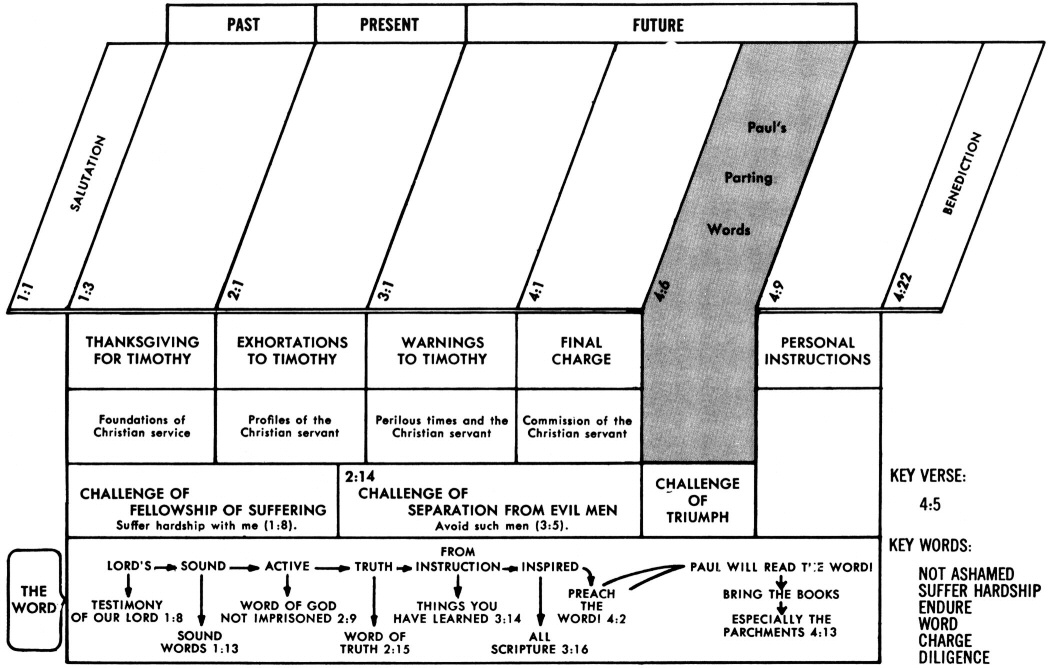
ENDURANCE AND SEPARATION IN THE MINISTRY
Click chart to enlarge
Charts from Jensen's Survey of the NT - used by permission
Second Timothy - Swindoll
| 2 TIMOTHY | |||
| 2 Timothy 1:1-18 | 2 Timothy 2:1-26 | 2 Timothy 3:1-17 | 2 Timothy 4:1-22 |
| Retain the Standard |
Rightly Divide the Word |
Difficult Times Will Come |
Preach the Word |
| PAST | PRESENT | FUTURE | |
| Foundation of Christian Service |
Pictures of Christian Servant |
Dangerous Times for Christian Servant |
Commission of Christian Servant |
| Unashamed as a Witness: Guard the Gospel |
Unashamed as a Workman: Suffer for the Gospel |
Adequate as a Workman: Continue in the Gospel |
Awarded as a Workman: Preach the Gospel |
| Power of the Gospel |
Perseverance of the Gospel Message | Protection of the Gospel |
Proclamation of the Gospel |
| Reminder | Requirements | Resistance | Requests |
| Encouragement in Ministry |
Examples in Ministry |
Exhortations in Ministry |
Exhortations to Fulfill Ministry |
| Commendation & Charge |
Commission to Fulfill |
Conflict to Face |
Course to Finish |
|
Compiled from Jensen's Survey of the NT and Wilkinson's Talk Thru the Bible |
|||
2 Timothy 4:1 I solemnly charge you in the presence of God and of Christ Jesus, who is to judge the living and the dead, and by His appearing and His kingdom: (NASB: Lockman)
Greek: Diamarturomai (1SPMI) enopion tou theou kai Christou Iesou, tou mellontos (PAPMSG) krinein (PAPMSG) zontas (PAPMPA) kai nekrous, kai ten epiphaneian autou kai ten basileian autou;
BBE: I give you orders, before God and Christ Jesus, who will be the judge of the living and the dead, and by his revelation and his kingdom;
GWT: I solemnly call on you in the presence of God and Christ Jesus, who is going to judge those who are living and those who are dead. I do this because Christ Jesus will come to rule <the world>. (GWT)
KJV: I charge thee therefore before God, and the Lord Jesus Christ, who shall judge the quick and the dead at his appearing and his kingdom;
Phillips: I urge you, Timothy, as we live in the sight of God and of Christ Jesus (whose coming in power will judge the living and the dead) (Phillips: Touchstone)
Wuest: I solemnly charge you as one who is living in the presence of our God, even Christ Jesus, the One who is on the point of judging the living and the dead, I solemnly charge you as not only living in His presence, but also by His appearing and His kingdom
Young's Literal: I do fully testify, then, before God, and the Lord Jesus Christ, who is about to judge living and dead at his manifestation and his reign--
I SOLEMNLY CHARGE: Diamarturomai (1SPMI) :
- Torrey's Topic Second Coming
- 2 Ti 2:14;1 Ti 5:21; 6:13
- 2 Timothy 4 Resources - Multiple Sermons and Commentaries
- 2 Timothy 4:1-5 Why Preaching Is Essential - Steven Cole
- 2 Timothy 4:1-5 My Major Task And Yours - Steven Cole
- 2 Timothy 4:1-5 Preaching & Hearing God's Word - Steven Cole
- 2 Timothy 4:1-5 Handing off the Baton (preached as he retired and passed the baton) - Steven Cole
- 2 Timothy 4:1-8 The Priorities of a Faithful Teacher - Study Guide - John MacArthur
- 2 Timothy 4:1-3 The Pastor's Priorities - Q & A's- John MacArthur
- 2 Timothy 4:1-5 Ministry in an Age of Itching Ears- John MacArthur
- 2 Timothy 4:1: Marks of the Faithful Preacher 1- John MacArthur
Other translations - I do fully testify (YLT); I give you this charge (NIV); I solemnly appeal (ISV); I charge thee (ASV); I solemnly implore you (Weymouth); I solemnly call on you (GWT); I strongly urge (ALT); I give you orders (BBE); I adjure you (Moffatt); Before God and Jesus Christ I give you a command (ICB)
Paraphrase 2Ti 4:1-9 (Walter Lock - International Critical Commentary) - Final appeal based on the coming judgment and the writer’s approaching death. You have followed me loyally thus far: I charge you to follow me further, and to remain true to the truth until the end. As in the sight of God and of Christ Jesus who shall come to judge us all whether living or dead, as you would be ready to welcome His Appearing, as you would hope to share His Kingdom, I charge you, preach the message of the Gospel, stand up to your task boldly, in season and out of season, whether you are welcome or unwelcome, refute false teaching, rebuke wrong-doers, pass censure on those who refuse to obey, encourage those who do, never failing in patience, using every method of teaching. For a time will come when men will not tolerate the sound teaching, nay, led, each by his own caprice, they will pile teacher upon teacher, and burden upon burden on their own backs; with ears always itching for some novelty, they will refuse to listen to the simple truth, they will turn aside to listen to all those empty legends. But do you keep calm, keep self-restrained in all things, be ready to face suffering: your work is to preach good tidings, preach them fully; your task is a task of ministry, perform it to the full. For I shall have to leave you to yourself: my life-blood is on the point of being poured out as a libation to God: the moment is close at hand when I must strike my tent and be gone. Yes: I have fought my fight, and it was the right fight: I have come to the end of the course; I have kept faith with my Master. So henceforth there is stored up safely for me the crown of a righteous life: the Lord will award it to me on that great day: yes, but not only to me, but also to all who have set their hearts on His appearing. We shall be together with Him whom we love.
A SOLEMN, SERIOUS
COMMAND
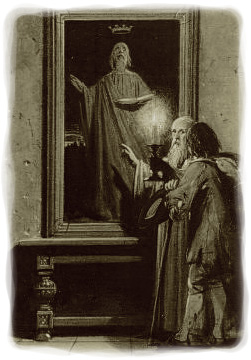
The picture above is based on a book written by another man in prison, John Bunyan, having been imprisoned for preaching the Word of God. John Bunyan redeemed the time in prison, making the most of his opportunity to pen the words of Pilgrim's Progress which was for many years only second to the Bible in number of copies sold. Paul words in this epistle are his last words and last words always need to receive our full attention, for it is not likely the speaker will waste even one syllable knowing that his time is near. In the picture Christian the main character in Pilgrim's Progress is taken into the house of the One called "Interpreter" (Bunyan's name for the Holy Spirit) and he is shown many profitable things, but the first is a portrait on the wall. Like a gifted art critic, observe the picture carefully, noting the following...
(1) His face is solemn, grave, deeply earnest, serious, and sober minded in appearance.
(2) Notice his eyes are lifted to heaven.
(3) The best of books, the Bible is in his hand.
(4) His back is to the world.
(5) His hands are lifted as if he is pleading with men.
(6) Over his head is suspended a golden crown.
Christian then asked Interpreter what the picture signified, and Bunyan goes on to explain...
The man whose picture this is, is one of a thousand: (1) he can beget children (1 Cor 4:15), (2) travail in birth with children (Gal 4:19 "formed" = morphoo = describes a little child who needs to mature until the very image of Christ be impressed upon his heart), and (3) nurse them himself when they are born. And whereas thou seest him with his eyes lift up to heaven, the best of books in his hand, and the law of truth writ on his lips: it is to show thee, that his work is to know, and unfold dark (not illuminated, easily understood) things to sinners; even as also thou seest him stand as if he pleaded with men. And whereas thou seest the world as cast behind him, and that a crown hangs over his head; that is to show thee, that slighting and despising the things that are present, for the love that he hath to his Master’s service, he is sure in the world that comes next, to have glory for his reward. Now, said the Interpreter, I have showed thee this picture first, because the man whose picture this is, is the only man whom the Lord of the place where you are going has authorized to be your Guide in all difficult places you may meet with in the way: Therefore take good heed to what I have shown thee, and bear well in your mind what thou hast seen, lest in your journey you meet with some that pretend to lead you right, but their way goes down to death.
See Ken Pul's commentary below on Bunyan's "Portrait of a Minister"
J I Packer said "Certainty about the great issues of the Christian faith and conduct is lacking all along the line. The outside observer sees us staggering on from gimmick to gimmick and stunt to stunt like so many drunks in a fog, not knowing at all where we are or which way we should be going. - Preaching is hazy; heads are muddled; hearts fret; doubts drain strength; uncertainty paralyzes action....Unlike the first Christians who in three centuries won the Roman world, and those later Christians who pioneered the Reformation, and the Puritan awakening and the Evangelical revival, and the great missionary movement of the last century, we lack certainty. Why is this? We blame the external pressures of modern secularism, but this is like Eve blaming the serpent. The real truth is that we have grieved the Spirit...we stand under divine judgment. For two generations our churches have suffered from a famine of hearing the words of the Lord."
I solemnly charge you - The present tense indicates that Timothy is to understand what follows as a continuously solemn charge. In other words, Timothy is to keep these words "ringing in his ears" and so to must all believers. Paul gives 4 aspects of why this is such a solemn charge.
John Stott - “The verb diamartyromai has legal connections and can mean ‘testify under oath’ in a court of law, or to ‘adjure’ a witness to do so.”
Spurgeon was gripped by the solemnity of Paul's charge once saying "Gracious God, help me to write and preach this sermon just as if it were my last; if indeed it be not.” The Prince of Preachers believed preaching to be a spiritual enterprise – a Holy Spirit endeavor. Spiritual assignments require spiritual attention. Therefore, the Spirit is the sine qua non of gospel preaching, the one ingredient to the preaching event that without which nothing else matters. “The Holy Spirit is absolutely essential,” Spurgeon would say. “Without Him our office is a mere name.” (Letters, 198)
Iain Murray in his book The Forgotten Spurgeon, recounts “The true explanation of Spurgeon’s ministry, then, is to be found in the person and power of the Holy Spirit. He was himself deeply conscious of this. It was not men’s admiration he wanted, but he was jealous that they should stand in awe of God. ‘God has come unto us, not to exalt us, but to exalt Himself.’” (Murray, The Forgotten Spurgeon, 38.)
The preaching task is made effective only by a spiritual means – the attention and anointing of the Holy Spirit. The preacher longs for the Spirit’s attendance, that the Spirit might engage and apprehend the souls of men. “Our hope of success, and our strength for continuing the service, lie in our belief that the Spirit of the Lord rest upon us.” (Lectures, 197)
The Spirit must attend. The Spirit makes the dull minds, bright. He makes the dry bones, flesh. And He makes the dead men, live. Only with the Spirit comes an otherworldly power to our otherwise weak and mortal preaching. “We cannot do it without power,” said Spurgeon. (All-Round, 29)
Solemnly charge (diamarturomai) also has a legal nuance so the picture is of the aged apostle calling his young disciple Timothy to the front of God's judicial bench and charging him under oath with the awesome task of proclaiming God's Word to hearers who in a similar way will one day stand in front of that fearsome bench for judgment by Christ Jesus Who will return to reign over all -- either at the Bema Seat Judgment of believers (2Co 5:10, 1Co 3:11 12 13 14 15) or the Great White Throne Judgment of non-believers (Rev 20:11-14).
Solemnly charge (1263) (diamarturomai from diá = intensifies meaning conveying idea of "thoroughly" + marturomai = witness, bear witness) means to thoroughly bear witness (give a thorough testimony), testify earnestly or repeatedly (in this passage in the present tense), to charge as it if before witnesses (here God and Christ Jesus), to exhort earnestly and with authority in matters of extraordinary importance (here the integrity of the message proclaimed). It carries the idea of giving a forceful order or directive. Giving full, clear testimony.
Gary Hill points out that diamarturomai always occurs in the Greek middle voice. This emphasizes witnessing done with a high level of self-involvement, i.e. with strong personal interest motivating it. (The Discovery Bible).
Gilbrant on uses in Classical Greek and the Septuagint - Formally, the deponent verb diamarturomai comes from the preposition dia plus the verb marturomai, “witness, affirm” (cf. martureō [3113], “bear witness”). The dia functions in an intensifying capacity, thus diamarturomai means first of all “charge to witness, invoke as a witness.” This was used both in reference to gods and men in classical Greek; in this sense it was synonymous with marturomai. Other meanings stemming from this include “ ‘to declare emphatically,’ whether with ref.(erence) to facts or truths . . . or in the sense of a summons, admonition, or warning” (Strathmann, “marturomai,” Kittel, 4:511; cf. Liddell-Scott). In a general sense it means “protest solemnly” (against someone or something [especially false]; Liddell-Scott). Except for three instances diamarturomai translates a form of the Hebrew word ‛ûdh meaning either “warn” or “call as a witness.” The Lord instructed Moses to go down from Mount Sinai and “warn” the people to consecrate themselves (Exodus 19:10 [Septuagint only]). The recurrent idea of “call a witness” and “admonish or warn” converge typically in Deuteronomy 4:26. Here God called heaven and earth as His witnesses against Israel. If Israel became idolatrous or corrupt God declared surely He would not let their sin go unpunished (cf. Deuteronomy 8:19; 30:19; 31:28; 32:46). Thus diamarturomai carries the idea of a “solemn warning,” i.e., a certainty verified by witnesses. The prophets and seers and covenant decrees “warned” or “testified to” Israel of the consequences of sin (2 Kings 17:13,15; cf. 2 Chronicles 24:19; Nehemiah 9:26). God himself testified against Israel; still she refused to listen (Psalms 50:7; 81:8; cf. Jer 6:10; Mal 2:14). (Complete Biblical Library Greek-English Dictionary)
Diamarturomai -15x in the NT - Translated in the KJV and the NAS...
KJV as - charge, 3; testify, 11; witness, 1. In the is is translated - solemnly charge, 3; solemnly testified, 2; solemnly testifies, 1; solemnly testifying, 3; solemnly to testify, 1; solemnly warned, 1; solemnly witnessed, 1; testified, 1; testify solemnly, 1; warn, 1.
NAS = Usage: solemnly to testify(1), solemnly charge(3), solemnly testified(2), solemnly testifies(1), solemnly testifying(3), solemnly warned(1), solemnly witnessed(1), testified(1), testify solemnly(1), warn(1).
Diamarturomai - here are the NT uses
Luke 16:28 for I have five brothers-- that he may warn them, lest they also come to this place of torment.'
Acts 2:40 And with many other words he solemnly testified and kept on exhorting them, saying, "Be saved from this perverse generation!"
Acts 8:25 And so, when they had solemnly testified and spoken the word of the Lord, they started back to Jerusalem, and were preaching the gospel to many villages of the Samaritans.
Acts 10:42 "And He ordered us to preach to the people, and solemnly to testify that this is the One who has been appointed by God as Judge of the living and the dead.
Acts 18:5 But when Silas and Timothy came down from Macedonia, Paul began devoting himself completely to the word, solemnly testifying to the Jews that Jesus was the Christ.
Acts 20:21 solemnly testifying to both Jews and Greeks of repentance toward God and faith in our Lord Jesus Christ… 23 except that the Holy Spirit solemnly testifies to me in every city, saying that bonds and afflictions await me. 24 "But I do not consider my life of any account as dear to myself, in order that I may finish my course, and the ministry which I received from the Lord Jesus, to testify solemnly of the gospel of the grace of God.
Acts 23:11 But on the night immediately following, the Lord stood at his side and said, "Take courage; for as you have solemnly witnessed to My cause at Jerusalem, so you must witness at Rome also."
Acts 28:23 And when they had set a day for him, they came to him at his lodging in large numbers; and he was explaining to them by solemnly testifying about the kingdom of God, and trying to persuade them concerning Jesus, from both the Law of Moses and from the Prophets, from morning until evening.
1Thessalonians 4:6 (note) and that no man transgress and defraud his brother in the matter because the Lord is the avenger in all these things, just as we also told you before and solemnly warned you.
1 Timothy 5:21 I solemnly charge you in the presence of God and of Christ Jesus and of His chosen angels, to maintain these principles without bias, doing nothing in a spirit of partiality.
2 Timothy 2:14 (note) Remind them of these things, and solemnly charge them in the presence of God not to wrangle about words, which is useless, and leads to the ruin of the hearers.
2 Timothy 4:1 (note) I solemnly charge you in the presence of God and of Christ Jesus, who is to judge the living and the dead, and by His appearing and His kingdom:
Hebrews 2:6 (note) But one has testified somewhere, saying, "What is man, that Thou rememberest him? Or the son of man, that Thou art concerned about him?
Diamarturomai - 25x in the Septuagint -
Ex 18:20; 19:10, 21; 21:29; Deut. 4:26; 8:19; 30:19; 31:28; 32:46; 1 Sam. 8:9; 2Ki. 17:13, 15; 2Chr. 24:19; Neh. 9:26, 34; 13:21; Ps. 50:7; 81:8; Jer. 6:10; 32:10, 44; Ezek. 16:2; 20:4; Zech. 3:6; Mal. 2:14
Paul is laying a mandate upon Timothy that must be obeyed, as if Paul were the commanding general and Timothy his chief officer of battle operations. In using this verb Paul is seeking Timothy's undivided attention to the matter at hand. Paul had used diamarturomai two times prior to admonish Timothy
I solemnly charge you in the presence of God and of Christ Jesus and of His chosen angels, to maintain these principles without bias, doing nothing in a spirit of partiality (1Ti 5:21).
Remind them of these things, and solemnly charge them in the presence of God not to wrangle about words, which is useless and leads to the ruin of the hearers. (2Ti 2:14).(cf 1Ti 6:13).
The first NT use of diamarturomai is found in the teaching on Lazarus and the rich man who both end up in Hades (Sheol), except that the rich man is on the hot side and so he pleads with Abraham
I beg you, Father (Abraham), that you send him (Lazarus) to my father's house-- for I have five brothers-- that he may warn (diamarturomai ) them, lest they also come to this place of torment. (Lk 16:27, 28)
What a picture diamarturomai presents of the serious nature of Paul's charge to Timothy.
One of most concentrated uses of diamarturomai in Scripture is found in Paul's admonition laden farewell speech to the Ephesian elders where Paul reminds them that he has been
solemnly testifying to both Jews and Greeks of repentance toward God and faith in our Lord Jesus Christ… (Acts 20:21)
Paul also related that "the Holy Spirit solemnly testifies to me in every city, saying that bonds and afflictions await me… I do not consider my life of any account as dear to myself, in order that I may finish my course, (cf 2Ti 4:7) and the ministry which I received from the Lord Jesus (cf 2Ti 4:5), to testify solemnly of the gospel of the grace of God. (Acts 20:21, 23, 24)
It therefore behooves all saints to seriously consider the accounting that we will shortly give to Jesus Christ of the stewardship entrusted to each of us.
Paul elaborates on this truth in (1Cor 4:5) "Therefore do not go on passing judgment before the time, but wait until the Lord comes who will both bring to light the things hidden in the darkness and disclose the motives of men's hearts; and then each man's praise will come to him from God."
In all your Christian work always check your motives (cf Ps 139:23, Ps 90:12)
As an aside, any good Jew familiar with the Septuagint (as Timothy must have been) would recognize Paul's verb diamarturomai (in the Lxx or Septuagint, the Greek of the Hebrew OT) from the solemn warning by Moses to Israel:
I call heaven and earth to witness against (diamarturomai) you today, that I have set before you life and death, the blessing and the curse. So choose life in order that you may live, you and your descendants. (Dt 30:19)
In 2 Timothy 4:1 Paul calls two witnesses - the Father and the Son!
The IVP Bible background commentary adds that "An oath sworn by a deity or deities was considered especially binding and dangerous to break; in the same way, a charge witnessed by a deity or deities was sacred and inviolable. A broken oath would be avenged by the god whose name was violated; for Jewish people and Christians, the ultimate judgment was in the coming day of the Lord."
Considering this background (which Timothy was surely cognizant of), we can rest assured that Timothy's ears, heart and mind were fully focused on the commands that followed.
THOUGHT - Do I have a similar sense of reverential awe of God and the Judge Who is standing right at the door (Jas 5:9 "the Judge is standing right at the door."), regarding my stewardship and accountability for the treasure entrusted to me? (cf 2Ti 13, 14)
A W Pink comments that this "pressing injunction was enforced by the solemn consideration brought before him at the beginning of the chapter: the living and the dead should be judged at the appearing of his Master. But how could that judgment be a powerful persuasive unto fidelity and diligence unless his ministry was to be thoroughly reviewed in that Day? Wherein lay its solemnity unless he would have to give a full account of his stewardship? (from An exposition of the Sermon on the Mount)
The solemnity of this charge should encourage us to do our work carefully and faithfully and also deliver us from the fear of man (Pr 29:25) for, in the final analysis, Christ Jesus is the only Judge that matters. Finally, the realization that God will one day judge our works (1Cor 3:13) should motivate and encourage us to keep going even when we face (out of season) difficulties (Gal 6:9, 1Cor 15:58, He 12:3, 4). We are serving Him, not ourselves.
Lord please give us eternal vision like Paul and a whole heart like David, that we might appreciate the solemnity of each moment of life and of each choice (cp Da 1:8) to obey the Spirit or the flesh. Guide us so that this is not done out of legalism or by our might or our power but by Thy grace and Thy Spirit, for the sake of Your Kingdom and the renown of Your Son, Christ Jesus. Amen.
Stephen Olford - Paul employs this language to bring home to Timothy the seriousness of the calling of a preacher. He directs the young man’s attention to God and the Lord Jesus Christ, in whose presence the charge is issued and received. He reminds him that he is to preach the Word conscientiously because of the eternal accountability of the preacher: “I charge you therefore before God and the Lord Jesus Christ, who will judge the living and the dead at His appearing.…” The appearing refers, of course, to the Lord’s second coming when every believer will have to give account of himself before the judgment seat of Christ (2 Cor. 5:10). Nothing will be hidden before the glorious brightness of the Savior’s presence in that day. Paul says, “Each one’s work will become manifest; for the Day will declare it, because it will be revealed by fire; and the fire will test each one’s work, of what sort it is. If anyone’s work which he has built on it endures, he will receive a reward. If anyone’s work is burned, he will suffer loss; but he himself will be saved, yet so as through fire” (1 Cor. 3:13–15). When a servant of God preaches, he cannot afford to be influenced by the reaction of his congregation, or the opposition of his critics: he is accountable to his Lord alone, before whom he will stand or fall in that coming day. No one can preach with eternal values in view and be anything less than conscientious....Paul has already reminded Timothy that “if we endure, we shall also reign with Him. If we deny Him, He also will deny us” (2 Tim. 2:12). In that coming kingdom, faithful servants of the Master are going to be given places of lasting responsibility. These positions will be determined by the way they have served the Lord here upon earth. Dr. Donald Guthrie points out that “there are many passages in which Paul expounds his idea of rewards for believers,” and that this whole concept of eternal responsibility “leaves room for degrees of rewards” (Rom. 14:12; 1 Cor. 3:8; 2 Cor. 4:17; Gal. 6:7; Col. 1:5; 2 Tim. 4:8). How can any preacher of the Word contemplate such solemn facts and be less than conscientious and transparent in his accountability and responsibility as a preacher? (Anointed Expository Preaching)
Olford adds "What, then, is this awesome task of “expository preaching”? Let us start with three definitions.
1. The Westminster Directory (1645) states that “the true idea of [expository] preaching is that the preacher should become a mouthpiece for his text, opening it up and applying it as a word from God to his hearers … in order that the text may speak … and be heard, making each point from his text in such a manner ‘that [his audience] may discern [the voice of God].’ ”
2. Our own definition reads: Expository preaching is the Spirit-empowered explanation and proclamation of the text of God’s Word with due regard to the historical, contextual, grammatical, and doctrinal significance of the given passage, with the specific object of invoking a Christ-transforming response.
3. Paul exhorts: “Be diligent to present yourself approved to God, a worker who does not need to be ashamed, rightly dividing the word of truth” (2 Tim. 2:15)."
William Arp writes about The Seriousness of the Command observing that…
Paul begins his exhortation to Timothy by “charging” him to preach the Word. The word for “charge” (2 Ti 4:1) shows the seriousness of Paul’s exhortation. It describes an emphatic declaration or affirmation. It reinforces a binding obligation. Before Paul gives Timothy his responsibility, he emphasizes the seriousness of his charge. Charging him before God and Jesus Christ seems to indicate that Timothy is accountable to them as he carries out this responsibility. They will see all that he does. He is responsible to them. He also writes that Jesus Christ will judge Timothy’s ministry. He will evaluate his ministry in these difficult times. This shows the solemnity of Timothy’s responsibility. Both the words used and the witnesses mentioned point out the importance of Paul’s charge to Timothy. (The Priority of Preaching in Problem Times - Journal of Ministry and Theology - Spring, 1997)
IN THE PRESENCE OF GOD AND OF CHRIST JESUS: enopion tou theou kai Christou Iesou:
- 2 Timothy 4 Resources - Multiple Sermons and Commentaries
- 2 Timothy 4:1-5 Why Preaching Is Essential - Steven Cole
- 2 Timothy 4:1-5 My Major Task And Yours - Steven Cole
- 2 Timothy 4:1-5 Preaching & Hearing God's Word - Steven Cole
- 2 Timothy 4:1-8 The Priorities of a Faithful Teacher - Study Guide - John MacArthur
- 2 Timothy 4:1-3 The Pastor's Priorities - Q & A's- John MacArthur
- 2 Timothy 4:1-5 Ministry in an Age of Itching Ears- John MacArthur
- 2 Timothy 4:1: Marks of the Faithful Preacher 1- John MacArthur
PREACHING
CORAM DEO
Coram Deo is a Latin phrase translated "in the presence of God"
In the presence of God - This picture needs no explanation, but does call for us to stop and ponder the awe and holiness and majesty of being in the presence of God when we step up to the pulpit to proclaim the Word of Truth. May this picture never leave the pastor's mind and heart and may the Spirit use this truth to motivate a careful, reverential handling of God's Holy Word! Amen.
Presence of God (9x in 8v in NAS) -
Ps 68:8 Eccl 5:2 Lk 1:19 1Ti 5:21 1Ti 6:13 2Ti 2:14 2Ti 4:1 Heb 9:24
In the presence of God and of Christ Jesus - Would it be that this would be our watch word. our lodestone or our warp and our woof. Coram Deo (in the presence of God) living!
Ge 6:8 But Noah found favor in the eyes of the LORD.
Ge 16:13 Then she called the name of the LORD who spoke to her, "Thou art a God who sees"; for she said, "Have I even remained alive here after seeing Him?" (See study El Roi: God Who Sees)
Deut 11:11 "But the land into which you are about to cross to possess it, a land of hills and valleys, drinks water from the rain of heaven, 12 a land for which the LORD your God cares; the eyes of the LORD your God are always on it, from the beginning even to the end of the year.
Ps 33:18 Behold, the eye of the LORD is on those who fear Him, on those who hope for His lovingkindness,
Spurgeon: For this is a greater wonder than hosts and horses, a surer confidence than chariots or shields. The eye of the Lord is upon them that fear him. That eye of peculiar care is their glory and defense. None can take them at unawares, for the celestial watcher foresees the designs of their enemies, and provides against them. They who fear God need not fear anything else; let them fix their eye of faith on him, and his eye of love will always rest upon them. Upon them that hope in his mercy. This one would think to be a small evidence of grace, and yet it is a valid one. Humble hope shall have its share as well as courageous faith. Say, my soul, is not this an encouragement to thee? Dost thou not hope in the mercy of God in Christ Jesus? Then the Father's eye is as much upon thee as upon the elder born of the family. These gentle words, like soft bread, are meant for babes in grace, who need infant's food.
Ps 34:15 The eyes of the LORD are toward the righteous, And His ears are open to their cry.
Spurgeon: The eyes of the Lord are upon the righteous. He observes them with approval and tender consideration; they are so dear to him that he cannot take his eyes off them; he watches each one of them as carefully and intently as if there were only that one creature in the universe. His ears are open unto their cry. His eyes and ears are thus both turned by the Lord towards his saints; his whole mind is occupied about them: if slighted by all others they are not neglected by him. Their cry he hears at once, even as a mother is sure to hear her sick babe; the cry may be broken, plaintive, unhappy, feeble, unbelieving, yet the Father's quick ear catches each note of lament or appeal, and he is not slow to answer his children's voice.
Ps 113:5 Who is like the LORD our God, Who is enthroned on high, 6 Who humbles Himself to behold the things that are in heaven and in the earth?
Ps 139:2 Thou dost know when I sit down and when I rise up; Thou dost understand my thought from afar. 3 Thou dost scrutinize my path and my lying down, And art intimately acquainted with all my ways.
Job 34:21 "For His eyes are upon the ways of a man, And He sees all his steps.
Job 31:4 "Does He not see my ways, And number all my steps?
Pr 5:21 For the ways of a man are before the eyes of the LORD, And He watches all his paths.
Pr 15:3 The eyes of the LORD are in every place, Watching the evil and the good.
Jer 16:17 "For My eyes are on all their (Israel's) ways; they are not hidden from My face, nor is their iniquity concealed from My eyes.
Jer 23:24 "Can a man hide himself in hiding places, So I do not see him?" declares the LORD. "Do I not fill the heavens and the earth?" declares the LORD.
Zech 4:10 "For who has despised the day of small things? But these seven will be glad when they see the plumb line in the hand of Zerubbabel-- these are the eyes of the LORD which range to and fro throughout the earth."
Heb 4:13 And there is no creature hidden from His sight, but all things are open and laid bare to the eyes of Him with whom we have to do.
1 Peter 3:12 "FOR THE EYES OF THE LORD ARE UPON THE RIGHTEOUS, AND HIS EARS ATTEND TO THEIR PRAYER, BUT THE FACE OF THE LORD IS AGAINST THOSE WHO DO EVIL."
All service should be carried out with the realization that it is watched by God’s all-seeing eye. It would do us all good to occasionally reflect on the fact that one day we will face God and our works will be judged.
Presence (1799) (enopion from en = in + ops = face, eye, countenance) and so literally meaning in the face of, in front of, before or in the presence (sight) of and used primarily by Luke, Paul and John (in the Revelation). Being in sight. Before the face and thus the idea of face to face! Of doing something in someone’s presence.
It is as if Paul is summoning his young protégé into the very presence of God the Father and the glorified Son of God to receive this solemn charge. Face to face with the Holy One of Israel! The Greek construction also allows the rendering “in the presence of God, even Christ Jesus.” The Father and Son are linked together in a grammatical form that emphasizes their equality.
All service should be carried out with the realization that it is watched by God’s all-seeing eye. It would do us all good to occasionally reflect on the fact that one day we will face God and our works will be judged (even the motives of those works! 1 Cor 4:5)
Enopion can be summarized into three basic meanings
1) in front of, before, a position in a spatial sense, in the presence of (Lk 1:19; Acts 10:30, Rev 3:8, 7:15)
2) in the sight of, in the presence of (Lk 23:14, Jn 20:30, Acts 10:33, 1Ti 6:12, Re 3:5, 13:13)
3) in the opinion of, in the judgment of (Lk 16:15, 2Co 8:21)
Wuest writes that enopion "was used in such expressions as, “the case will be drawn up against you in the court at Heracleopolis in the presence of,” “deliver personally,” “I gave notice in person.” It is used of one who does or says something in the presence of someone else, and does it with the consciousness that that one has him in sight and mind. Paul delivered this solemn charge to Timothy, conscious of the fact that he was doing so in the sight of God, and he wished Timothy to ever so regard the charge. (Wuest's Word Studies from the Greek New Testament: Eerdmans)
MacArthur adds that interesting note that "The phrase in the presence of parallels a common format used in Roman courts and legal documents and would have been familiar to Timothy and others of that day. A typical summons might have begun: “The case will be drawn up against you in the court at Hierapolis, in the presence of the honorable judge Festus, chief magistrate.”
God and Christ Jesus - This connective "and" clearly supports the deity of Jesus Christ.
God (2316)(theos) in the Biblical context refers to the supreme being described in the OT and amplified in the NT in Jesus, the Son of God. Theos is used for “god” in the Greco-Roman world, whose pantheon was made up of dozens of so-called deities (which were not really gods at all!). In the Septuagint when the the plural Elohim refers to the true God, it is consistently translated with the singular theos. "The reason for this was that at the time the Sept. translation was made, Greek idolatry was the prevailing superstition, especially in Egypt under the Ptolemies. Their gods were regarded as demons, i.e., intelligent beings totally separate and distinct from each other. If the translators rendered the name of the true God by the pl. theoi, they would have given the heathen under Greek culture an idea of God inconsistent with the unity of the divine essence and conformable to their own polytheistic notions. However, by translating the Hebr. Elohim as “God,” they inculcated the unity of God and at the same time did not deny a plurality of persons in the divine nature." (Zodhiates)
Christ (Anointed One)(5547)(Christos from chrio = to rub or anoint, consecrate to an office) means one who has been anointed, symbolizing appointment to a task. The majority of the NT uses refer to Jesus (exceptions = "false Christs" - Mt 24:24, Mk 13:22).
NIDNTT - Christ is derived via the Latin Christus from the Greek Christos, which in the Septuagint and the NT is the Greek equivalent of the Aramaic mešîha’. This in turn corresponds to the Hebrew mashiach/masiah and denotes someone who has been ceremonially anointed for an office. The Greek transliteration of mešîhā’ is Messias, which like Iēsous is made declinable by the added -s. (New International Dictionary of New Testament Theology)
Jesus (2424)(Iesous) is transliteration of the Greek Iesous, which in turn is the transliteration of the Hebrew name Jehoshua (Yehoshua) or Jeshua (Yeshua) which mean Jehovah is help or Jehovah is salvation. Stated another way the Greek Iesous corresponds to the OT Jehoshua (Yehoshua) which is contracted as Jeshua (Yeshua). As discussed below, most of the NT uses of Iesous refer to our Lord Jesus. In the Gospels the single Name Jesus (Iesous) is used as His personal Name and is found 538 times. In the Epistles Jesus is usually (but not always - e.g., Ro 3:26; 4:24; 1Cor 12:3; 2Cor 11:4; Phil 2:10; 1Th 4:14; Heb 7:22; 10:19, etc) used in combination with Christ or Lord (see next paragraph). Jesus is known by Christ alone some 44 times in the Gospels.
Gregory Brown - God and Christ would be watching Timothy to see if he faithfully discharged his duties, and this is true for each of us. God is watching and one day he will judge us based on our faithfulness. Did we faithfully study and interpret his Word? Did we share it with others? Faithful workmen will be approved by God (2 Tim 2:15). (Commentary)
Alan Carr introduces his sermon on 2 Tim. 4:1-4 I’LL TAKE THE OLD PATHS - Jer. 6:16. Ill. We need the old paths, because only those paths handed down by God will get the job done for Jesus. We live in a dangerous time, a time when men have chosen to leave the old paths behind and walk in ways of their own invention. Many “mainstream denominations” have walked away from the path of godliness and sound doctrine, and have headed down the path of worldliness and manmade doctrine. It is obvious that some “Baptists” are willing to abandon the old paths as well. Let me stand forth tonight and say that I am not! We still believe and preach the same doctrines handed down to us by the Apostles. I don’t know what you want to do, but I’ll take the old paths! (How we got what we have – see 2 Tim. 2:2). Listen in as Paul gives Timothy some timely advise about walking in the old paths.
Preaching in the sight of God: — Bishop Latimer having one day preached before King Henry VIII. a sermon which displeased his majesty, he was ordered to preach again on the next Sabbath, and to make an apology for the offence he had given. After reading his text, the bishop thus begun his sermon: “Hugh Latimer, dost thou know before whom thou art this day to speak? To the high and mighty monarch, the king’s most excellent majesty, who can take away thy life if thou offendest; therefore, take heed that thou speakest not a word that may displease. But then consider well, Hugh, dost thou not know from whence thou comest — upon whose message thou art sent? Even by the great and mighty God! who is all present! and who beholdeth all thy ways! and who is able to cast thy soul into hell! Therefore, take care that thou deliverest thy message faithfully.” He then proceeded with the same sermon he had preached the preceding Sabbath, but with considerably more energy. The sermon ended, the Court were full of expectation to know what would be the fate of this honest and plain dealing bishop. After dinner the king called for Latimer, and, with a stern countenance, asked him how he dared to be so bold as to preach in such a manner. He, falling on his knees, replied, his duty to his God and his prince had enforced him thereto, and that he had merely discharged his duty and his conscience in what he had spoken. Upon which the king, rising from his seat, and taking the good man by the hand, embraced him, saying, “Blessed be God I have so honest a servant!” (Biblical Illustrator)
Alan Carr - 2 Timothy 4:1-8 THE VIEW FROM THE END ZONE Intro: I love to watch football games and one of my favorite parts of a ball game is the after game interviews. You know, they will interview players and coaches from both the winning and the losing teams. The winners always say something like this: “Well, it was a good day for football. We were able to execute our game plan and everything just came together for us.” The losers sometimes say things like: “Well, it just wasn’t a good day for us. We weren’t able to execute and our game plan never came together like we thought it would. Those other guys just had a better day.”
Calling the game is much easier when you’re standing in the end zone! It is always easier to look back and see what you did right and what you did wrong. Life is a lot like that too! It’s not easy to look ahead and see what’s going to happen. We all come to the field to win, but there are times when we must walk away having lost the big game. As I read these verses, I am aware that Paul is standing in the end zone of his life and he is looking back over the game he has played. These verses are as close as we will get to an after the game interview with Paul. However, for all intents and purposes, his ministry is over. He is sitting in a Roman prison, with nothing to look forward to but his execution at the hands of the Roman government. Paul knows his time is up, but he wants to give us an interview before he leaves for glory. I’m glad he did! You see, here is a man who played a good game! He didn’t fumble the ball. He had not been tackled by the enemy. He had stumbled but a few times and he has reached the end zone of his life with his ministry and his testimony intact. I think he might have something to say that we might be interested in. I would like for us to listen in to these powerful words of the great Apostle. He is, in effect, writing his own epitaph. You know what an epitaph is don’t you? It is those words your loved ones, hopefully they will choose the words and not your enemies, have carved into your headstone when you die. I think of an epitaph I read one time that went: “Here lies Lester Moore. Four slugs from a forty-four. No Les. No Moore.” Or the headstones I saw down in the cemetery of Gilboa Methodist Church. These grace date from the late 1,700's. On a few there are hands with the index finger pointing toward heaven. Indicating, I suppose, where they think the deceased might have gone to. But, on a few, there is the picture of hands chained together at the wrist, with the index fingers pointing down towards Hell.
I think if Paul could have supervised the chiseling of any inscription into his headstone, it would have been the words of verse 7. This great man writes his own epitaph before his death. In these words of these verses, we find the after game interview of a faithful servant of Jesus Christ. He breaks the entire Christian life down into three neat, clear components. What he has to say to us about his walk with the Lord will help you and me with our own walk with the Lord, as we too inch ever closer to our own end zone experience. Notice what was important to Paul as he stood in the end zone of life.
This Is What We Want - In April, 1985, I visited in a couple’s home who told me how they had been fans of Dr. Gene Scott from Southern California, and what a great preacher he was. They hadn’t been at church for a while, so I went to visit them. When I arrived, Dr. Scott was on TV—they’d purchased a satellite dish in order to stay current with his teaching. After some chit-chat, the husband turned to me and said, “You’re probably wondering why you haven’t seen us at church lately. Right then, Dr. Scott held up a book about the lost city of Atlantis and the pyramids, and the husband looked at me and said, “This is what we want in Bible teaching, and we haven’t ever heard this taught in any of the churches we’ve been in!” John Underhill, Spokane, WA
ILLUSTRATION OF THE SOLEMN NATURE OF PREACHING WITH A SENSE OF URGENCY - There is always this measure of urgency and immediacy in God's call to men. Yesterday has gone forever. Tomorrow may not come. All we have is today. God lives in the present tense of time. He described Himself to Moses as "I AM" (Exod. 3:14). The Lord Jesus declared His deity in similar terms (John 8:58). In a lesser sense we, too, live in the present. In our experience the future becomes the present and the present becomes the past. The present is the living instant through which the ever-oncoming future becomes the endlessly receding past. It is in the present that we experience time. The present presents us with that fleeting moment of time when we can transact business with God.
In 1871, D. L. Moody began a series of messages on Bible characters at Farwell Hall in Chicago. Large crowds were soon attending the meetings. On the fifth Sunday night, he preached to the largest congregation he had ever addressed in that city. He preached on the text: "What shall I do with Jesus which is called Christ?" (Mt 27:22) At the close of the service he did not call for an immediate decision. He said, "I wish you would take this text home with you and turn it over in your minds during the week, and next Sabbath we will come to Calvary and we will decide what to do with Jesus of Nazareth." He considered that to be one of the greatest mistakes of his life. For between those two Sundays the great Chicago fire broke out.
Even as Mr. Moody went home from the service that Sunday night, he saw the glare of flames and knew it meant ruin to Chicago. About one o'clock Farwell Hall was destroyed and soon afterward his own church on Illinois Street went up in flames. When he arrived home, the family retired but within an hour a loud call summoned everyone on their street to flee for their lives. The fire had leaped across the river and was bearing down on them. Only what could be carried in their hands could be saved.
On the twenty-second anniversary of the great fire, Moody was again addressing a large Chicago audience. "I have never dared to give an audience a week to think of their salvation since," he said, recalling the fateful previous occasion. "If they were lost, they might rise up in judgment against me. I remember Mr. Sankey's singing and how his voice rang when he came to that pleading verse:
Today the Savior calls,
For refuge fly!
The storm of judgment falls
And death is nigh!
"I have never seen that congregation since, I have hard work to keep back the tears today. I have looked over this audience, and not a single one is here that I preached to that night. But, I want to tell you of one lesson I learned that night, which I have never forgotten, and that is, when I preach, to press Christ upon the people then and there, and try to bring them to a decision on the spot. I would rather have that right hand cut off than to give an audience now a week to decide what to do with Jesus."
It was a decision with which Paul would have fully agreed. Pilate never had another opportunity to decide for Christ. Blind Bartimaeus recognized that it was now or never for him. Jesus of Nazareth was passing by (Luke 18:37) and would never come that way again. Felix imagined he could make a decision for Christ at any time he pleased. "Go thy way for this time," he said to God's ambassador in bonds, "when I have a convenient season, I will call for thee" (Acts 24:25). He never had such a "convenient season."
I LOVE “GOD MARKERS” OR “DIVINE SIGNPOSTS” IN MEN’S LIVES – HERE IS ONE THAT WAS SPOKEN TO DWIGHT L MOODY AND GOD'S SPIRIT USED TO PUT WINDS INTO HIS SAILS AND FIRE IN HIS HEART FOR THE REST OF HIS LIFE AND HIS INCREDIBLE CHRIST GLORIFYING MINISTRY…
Dwight L Moody said
“The world has yet to see what God can do with a man fully consecrated to him. By God’s help, I aim to be that man.”
Henry Varley, the British evangelist, was the man who challenged Moody with those now-famous words. Like Moody, Varley had a parent die while he was young, was converted to Christ in his teens, was unordained, and gave up business to devote himself to evangelistic labors. Here is Varley's version of the story...
During the afternoon of the day of conference Mr. Moody asked me to join him in the vestry of the Baptist Church. We were alone, and he recalled the night’s meeting at Willow Park and our converse the following morning. “Do you remember your words?” he said. I replied, “I well remember our interview, but I do not recall any special utterance.” “Don’t you remember saying, ‘Moody, the world has yet to see what God will do with a man fully consecrated to him?’ ” “Not the actual sentence,” I replied.
“Ah,” said Mr. Moody, “those were the words sent to my soul, through you, from the Living God. As I crossed the wide Atlantic, the boards of the deck of the vessel were engraved with them, and when I reached Chicago, the very paving stones seemed marked with ‘Moody, the world has yet to see what God will do with a man fully consecrated to him.’ Under the power of those words I have come back to England, and I felt that I must not let more time pass until I let you know how God had used your words to my inmost soul.” (From Mark Fackler Christian History Magazine).
George Whitten elaborates on this story and the famous phrase...
One of my favorite ministers of the Gospel is D.L. Moody. He tells a story about having heard Pastor Henry Varley once say that, “The world has yet to see what God will do with and for and through the man who is fully and wholly consecrated to Him.”
As Moody pondered the pastor’s words, He realized something. Pastor Varley did not say that God would use an intelligent person. He didn’t say an educated person, nor did he say a person who was ultimately gifted. What the wise pastor said was that the person with whom God will work with and for and through will be the person “who is fully and wholly consecrated to Him”. (REMINDS ME OF GOD'S PROMISE TO KING ASA - 2 Chr 16:9)
This radically changed Moody’s ministry… and ours too, for that matter. We realized that God isn’t looking for people with amazing minds or hands or voices or computer skills. He’s not looking for those who are wearing the nicest suits or dresses at church. And He’s not looking for the people with the highest grade point averages at the local Christian College. What God is really looking for, are people who are simply sold out for Him!
One of the great secrets to a successful walk with the Lord, is understanding total commitment to Yeshua (Jesus). But being totally committed requires us to daily take up our cross (Mk 8:34, Lk 9:23) — leave the past behind us — and despite all the obstacles the enemy tries to throw in our path, press forward for the Lord and His work ("press on toward the goal for the prize of the upward call of God in Christ Jesus." Php 3:14)!
THOUGHT - Let us all dear pastor, dear teacher, dear believer however gifted, seek today to consecrate ourselves to the Lord, doing so in total dependence on His grace and His Spirit to even enable such a solemn consecration. Eternity will be richer and fuller for all who choose to walk the Calvary Road!
Ken Puls' Notes and Commentary on John Bunyan's Portrait of a Minister (BOLD ADDED)
The first lesson that the Interpreter (ED: BUNYAN'S DEPICTION OF THE HOLY SPIRIT) sets before Christian is to show him a picture hanging in a private room. Christian notices immediately that the man portrayed in the picture is a man with a very grave countenance. This man represents a true minister of the Gospel and his countenance speaks to the seriousness of his calling before God. This minister knows and understands his responsibilities as a watchman and shepherd of Christ's flock (cf Jn 21:15-17). He is aware that his vocation involves real dangers as well as great rewards.
The Interpreter speaks of the Gospel minister as "one of a thousand" who "can beget children, travel in birth with children, and nurse them himself with they are born," alluding to Paul's description of his ministry:
I do not write these things to shame you, but as my beloved children I warn you. For though you might have ten thousand instructors in Christ, yet you do not have many fathers; for in Christ Jesus I have begotten you through the gospel. Therefore I urge you, imitate me (1 Corinthians 4:14-16).
This minister not only speaks truth and teaches truth, but he looks upon the people, with whom God has entrusted him, as his children in the faith, as those whom he must watch over, guard, feed and protect. In Galatians 4:19 Paul also speaks of the church as his "little children, for whom I labor in birth again until Christ is formed in you."
Bunyan's portrait provides a six-fold description of a true Gospel minister:
1. His eyes are lifted up to Heaven.
The Gospel minister has his eyes fixed upon Jesus. (ED: MARK IT DOWN) Jesus is preeminent in his life and ministry. The beauty of holiness and the glory of God manifest in the person and work of Christ are the focus of his affections. The minister looks intently to his Lord, who is even now exalted at the right hand of His Father in heaven. We see this fixed gaze described in the book of Hebrews:
Looking unto Jesus, the author and finisher of our faith, who for the joy that was set before Him endured the cross, despising the shame, and has sat down at the right hand of the throne of God (Hebrews 12:2).
(ED THOUGHT - LOOKING = APHORAO = LITERALLY MEANS TO LOOK AWAY FROM BUT THEN GIVES US THE PICTURE OF GIVING ATTENTION TO ONE THING, IN THIS CASE ONE PERSON, JESUS CHRIST, TO THE EXCLUSION OF ALL ELSE. IDEA OF DIRECTING ONE'S ATTENTION WITHOUT DISTRACTION. UNDIVIDED ATTENTION. WE GIVE A SIGN TODAY WITH TWO FINGERS POINTING TO MY EYES AND THEN POINT THEM TO THE OTHER PERSON'S EYES - STOP LOOKING ALL AROUND! LOOK AT ME!).
2. The best of books is in his hand.
The Gospel minister is committed to God's Word. He does not preach his ideas, his opinions, or his agenda, but only seeks by God's grace, as God gives him light, to expound and declare the Scriptures in their completeness. Bunyan, no doubt, had his own pastor in mind as he composed his description of a minister set upon God's Word. He relates in Grace Abounding to the Chief of Sinners:
At this time, also, I sat under the ministry of holy Mr. Gifford, whose doctrine, by God's grace, was much for my stability. This man made it much his business to deliver the people of God from all those faults and unsound rests that, by nature, we are prone to take and make to our souls. He pressed us to take special heed that we took not up any truth upon trust—as from this, or that, or any other man or men—but to cry mightily to God that He would convince us of the reality thereof, and set us down therein, by His own Spirit, in the holy Word; for, said he, if you do otherwise when temptations come, if strongly, you, not having received them with evidence from heaven, will find you want that help and strength now to resist as once you thought you had. [Grace Abounding to the Chief of Sinners, par. 117]
(ED THOUGHT - REGARDING USE OF THE WORD FOR "AGENDAS" - I KNOW A PASTOR WHO PREACHED ON Pr 29:18 AND USED THE TERM "VISION" TO LAUNCH OFF INTO HIS "AGENDA" FOR THE CHURCH, NOT PREACHING THE ACTUAL TEXT OF THE VERSE! WITHIN A YEAR OR TWO THE CHURCH ENDED IN A SPLIT, LARGELY OVER HIS "AGENDA.")
3. The Law of Truth is written upon his lips.
The Gospel minister is a man committed to speaking God's truth that he might turn himself and others from sin. He is one like Levi of whom the prophet Malachi spoke:
The law of truth was in his mouth,
And injustice was not found on his lips.
He walked with Me in peace and equity,
And turned many away from iniquity.
(Malachi 2:6)
The Interpreter explains that these first three characteristics demonstrate that the minister's work is to "know and unfold dark things to Sinners." To do this the minster must have his gaze upon Christ and his grasp upon the pure Word of God.
4. The World is cast behind him.
The Gospel Minister is not enamored or encumbered by the philosophies and allurements of the world. His joy and satisfaction is in knowing and serving Christ. Many who call themselves pastors today seem to come offering the world on a platter. They extol health, wealth, success and prosperity in the place of humility, sacrifice, self-denial and service. But this is not the way of a true minister. A true minister values Jesus more than anything this world can offer. As the man in Jesus' parable, who found a treasure hidden in a field and sold all he had so he could buy the field (Matthew 13:44), the minister has cast the world behind him for the sake of following Christ.
5. He stands as if He is pleading with men.
A true minster of the Gospel also has a heart for the lost. He longs to see others come to Christ and find the same joy, peace and satisfaction that he enjoys. He understands that eternal realities are at stake for the souls of his hearers—life and death, heaven and hell—and his heart burns with a desire to warn men to flee from the wrath to come.
6. A Crown of Gold hangs over his head.
The Gospel minster can endure the hardship and suffering of this life, because he knows he has reward in heaven. Jesus, for the joy that was set before Him, endured the cross (Hebrews 12:2b); so the Gospel minster, for the eternal joy and glory of heaven, can forsake the world and seek first God's kingdom.
These last three characteristics show that a true minister despises the things of the present for the love of His Master. He is a man who lives by faith, knowing that the eternal blessings and promises of God are far greater than the false, temporal attractions of sin. He is able to slight this present world, because his hope is in the world to come (cf Php 3:20). He is looking to that glory and reward of heaven, who is Jesus Christ Himself.
I close with two important points of application from this lesson in the House of the Interpreter:
1. It is of primary importance that we seek out true and faithful shepherds to guide and watch over our souls. As we have already seen with Christian's encounters with Evangelist and Worldly Wiseman, it is a great advantage to recognize and follow godly counsel, and folly to disregard it. Some of Christian's most discouraging moments that follow in this allegory occur when he fails to heed this first lesson. We need to "take good heed" and "bear well in mind" what Bunyan is teaching here if we are to avoid pretenders and pitfalls. Only a minster of this description is fit to be a Guide to those on the Way. Only this kind of pastor will be prepared to help his flock along the difficult places in the Way. We must pray that God will teach us to prize and cherish such men who will care for our souls. We must pray that God will continue to raise up such men to serve as Gospel ministers.
2. All believers should strive to imitate the godly character of the Gospel minister. This portrait is a fitting representation not just for a minister of the Gospel, but it sets forth a character that every true minister of the Gospel longs to see flourish in the people he shepherds. Paul said to the Corinthians: "Imitate me" (1 Corinthians 4:16 and 11:1). Christ gave the church pastors and teachers
for the equipping of the saints for the work of ministry, for the edifying of the body of Christ, till we all come to the unity of the faith and of the knowledge of the Son of God, to a perfect man, to the measure of the stature of the fullness of Christ (Ephesians 4:12-13).
Paul told the Colossians of his labors in the gospel:
Him we preach, warning every man and teaching every man in all wisdom, that we may present every man perfect in Christ Jesus. To this end I also labor, striving according to His working which works in me mightily (Colossians 1:28-29).
We must not be content to seek spiritual maturity, godliness and zeal for ministry only in pastors and elders, but labor and persevere by God's grace until these fruits are born and flourishing in all the church.
- From Chapter 23 of A Guide to John Bunyan's The Pilgrim's Progress
WHO IS TO JUDGE THE LIVING AND THE DEAD: tou mellontos (PAPMSG) krinein (PAPMSG) zontas (PAPMPA) kai nekrous:
- Ps 50:6; 96:13; 98:9; Mt 16:27; 25:31-46; Jn 5:22-27 Acts 10:42; Ac 17:31; Ro 2:16; 14:9, 10, 11; 1Co 4:4;4:5 2Co 5:9;10 2Th1:7;1:8, 1:9, 1:10 1Pe 4:5; Rev 20:11, 12, 13, 14, 15
- 2 Timothy 4 Resources - Multiple Sermons and Commentaries
- 2 Timothy 4:1-5 Why Preaching Is Essential - Steven Cole
- 2 Timothy 4:1-5 My Major Task And Yours - Steven Cole
- 2 Timothy 4:1-5 Preaching & Hearing God's Word - Steven Cole
- 2 Timothy 4:1-8 The Priorities of a Faithful Teacher - Study Guide - John MacArthur
- 2 Timothy 4:1-3 The Pastor's Priorities - Q & A's- John MacArthur
- 2 Timothy 4:1-5 Ministry in an Age of Itching Ears- John MacArthur
- 2 Timothy 4:1: Marks of the Faithful Preacher 1- John MacArthur
Who is about to (present tense = pictures this judgment as continually coming) judge (impending judgment pictured by Darby's translation)
THE JUDGE IS ABOUT
TO OPEN THE DOOR!
James writes that "Do not complain, brethren, against one another, so that you yourselves may not be judged; behold (ATTENTION GRABBER!), the Judge is standing right at the door. (James 5:9) Paul says the Judge is Jesus for John explains "For not even the Father judges anyone, but He has given all judgment to the Son." (Jn 5:22).
Is (3195) (mello) means to be about to do something, so this phrase in Greek is most literally rendered is about to be judging suggesting the idea of imminency, (impending, the old meaning was of that which is "overhanging" which gives a vivid picture of the return of Christ) or that Christ is about to judge momentarily, which gives another reason for Paul’s solemn charge to Timothy. This truth conveys a sense of urgency to the task at hand. The present tense signifies continuous action.
THOUGHT - Dear pastor (dear flock), how do you approach Sunday morning's message? With a sense of urgency and solemnity, not knowing for which of your hearers this may be the last proclamation of the Word they may receive? What a glorious and awesome responsibility every pastor bears! And for those who hear the Word, they will be held responsible for how they did or did not respond to the Word. So yes, Paul addresses primarily preachers but does not give a pass to those to whom the message is preached!
Judge (2919) (krino) primarily signifies to distinguish, to decide between (in the sense of considering two or more things and reaching a decision), to make up one's mind, to separate, to discriminate. to distinguish between good and evil, right and wrong, without necessarily passing an adverse sentence, although that is often what is usually involved. Krino has various shades of meaning which must be determined from the context.
Jesus said "For not even the Father judges anyone, but He has given all judgment to the Son." (Jn 5:21)
W E Vine - The text used by the A.V. here (2Ti 4:1KJV) supports the erroneous idea that Christ will judge the living and the dead together at His appearing and His kingdom. The Scriptures nowhere teach that the judgment of the living and dead will be simultaneous. The judgment of the living will take place when the Lord comes to receive His Church to Himself and will be exercised at the “Judgment Seat of Christ,” when every believer will have the counsels of his heart made manifest and every one will have his praise from God (1 Cor. 4:5). The judgment of the dead is not a matter of reward but of condemnation, and will take place after the 1,000 years of the Millennial reign of Christ on the earth (Rev. 20:5). The charge to Timothy, given “in the sight of God and of Christ” and in view of the fact that He is to be the judge of all men, first the living and then the dead, is further given by reason of His appearing and the establishment of His kingdom. The life of the believer should ever be lived in view of these things. They need to be kept constantly in mind, as they have an all-important bearing upon the character, effects and issue of all service. (Collected Writings)
The following distinct judgments will be presided over by Christ Jesus the Lord:
(1) The judgment of believers at the Bema seat or Judgment seat not for the purpose of judging sin but determining rewards.
Paul writes
For we must all appear before the judgment seat of Christ, that each one may be recompensed for his deeds in the body, according to what he has done, whether good or bad (not kakos = evil like the Textus Receptus but phaulos = worthless, of no account, impossibility of any true gain ever coming forth from) (2Cor 5:10) (cf Ro 14:10,11, 1Cor 3:10, 11, 12, 13, 14, 15).
(2) The judgment of the nations referred to as the judgment of the sheep (believers) and the goats (unbelievers) at the end of the Great Tribulation (Mt 24:21), separating believers from unbelievers, only the former being allowed to enter into the Millennial Kingdom. (Mt 25:31-46).
(3) Jews alive at the end of the great tribulation will also be judged apparently at this same time to determine which Jews will go into the Messianic Kingdom (cf Ezek 20:33-41). (Click for in depth tabular and pictorial exposition of Daniel's Seventieth Week which includes a discussion of this end time judgment)
(4) The Great White Throne judgment of unbelievers, which is the final judgment following the 1000 year reign of Christ and immediately preceding "a New Heaven and a New earth" (See Re 20:11, 12, 13, 14, 15, 21:1, 2- notes Rev 20:11, 20:12, 20:13, 20:14, , 20:15, 21:1; 21:2). (Click for timeline and chart that includes this end time judgment)
Related Resource:
CHRIST JESUS THE JUDGE OF
THE LIVING AND THE DEAD
We find the phrase the living and the dead in 2 other NT passages and both refer to Jesus as the Judge of all mankind, believers (2 Cor 5:10 and Ro 14:10,12) and unbelievers:
Acts 10:42 “And He ordered us to preach to the people, and solemnly to testify that this is the One who has been appointed by God as Judge of the living and the dead.
1 Peter 4:5 but they will give account to Him who is ready to judge the living and the dead.
As alluded to above, the Apostle John affirms Jesus has been given the authority by the Father to serve as Judge over all mankind...
Truly, truly, I say to you, an hour is coming and now is, when the dead will hear the voice of the Son of God, and those who hear will live “For just as the Father has life in Himself, even so He gave to the Son also to have life in Himself; and He gave Him authority to execute judgment, because He is the Son of Man. “Do not marvel at this; for an hour is coming, in which all who are in the tombs will hear His voice, and will come forth; those who did the good deeds to a resurrection of life, those who committed the evil deeds to a resurrection of judgment. “I can do nothing on My own initiative. As I hear, I judge; and My judgment is just, because I do not seek My own will, but the will of Him who sent Me. (John 5:25-30)
John MacArthur on living and dead - Christ will ultimately judge all men in three distinct settings: (1) the judgment of believers after the Rapture; (2) the sheep and goats judgment of the nations, in which believers will be separated from unbelievers (Mt. 25:31–33), for entrance into the millennial kingdom; and (3) the Great White Throne judgment of unbelievers only (Rev. 20:11–15). Here, the apostle is referring to judgment in a general sense, encompassing all those elements.
Living (2198) (zao) refers to natural physical life in opposition to death. In the NT zao refers to supernatural, spiritual life in those who have been born again. Note present tense = continually living.
Dead (3498) (nekros from nékus = a corpse; English - necropsy, necrophobia, etc, verb = nekroo) describes literally one who has breathed their last and figuratively (the more common NT use) speaks of the spiritual condition of unsaved men, spiritually dead to God because of sin.
Some favor this phrase living and the dead as a reference to believers some of whom are alive at the return of Jesus and others who have already died in Christ (John MacArthur for example takes this approach). This phrase however could refer to the spiritually dead (whether physically alive or dead) for as Paul wrote to the Ephesians we all "were dead in our transgressions" until God "made us alive together with Christ (by grace you have been saved)" (Ep 2:4, cf Ep 2:1, Col 2:13, John 5:25, 27, Rev 20:12, 13)
Jesus said "Do not marvel at this; for an hour is coming, in which all who are in the tombs shall hear His voice, and shall come forth; those who did the good deeds to a resurrection of life (the living), those who committed the evil deeds to a resurrection of judgment (the dead). I can do nothing on My own initiative. As I hear, I judge; and My judgment is just, because I do not seek My own will, but the will of Him who sent Me. (Jn 5:28, 29, 30)
Roy Zuck, et al on the living and the dead - Reference to Jesus as Judge of the living and the dead is found in a context where eschatological judgment is motivation for authentic ministry. In light of the defections that will increase as the end of the age approaches, Paul exhorted Timothy to practice a bold ministry of the Word (including preaching, being prepared, correcting, rebuking, and encouraging) with patience and careful instruction (2 Ti 4:1–2). As Judge, Christ will evaluate the ministries of those entrusted with the gospel. Believers will be judged and rewarded for their faithfulness, and unbelievers will be judged for their lack of faith. The kingdom’s consummation for the elect will follow the judgment at the end of the age (2 Ti 2:12; cf. 1 Th 2:12; 2 Th 1:4–5; Gal. 5:21; 1 Cor. 6:9–10; 15:50; Eph. 5:5). Jesus’ resurrection guarantees and qualifies Him to be not only the Judge of all the living and the dead, but also the Ruler of His kingdom. This may also have been behind the association of His descendancy from David with His resurrection in 2 Timothy 2:8 (cf. Acts 13:33; 17:31; Heb. 1:3; 10:12–13). (A Biblical Theology of the NT - page 347).
Wayne Grudem comments on the judgment of believers - It is important to realize that this judgment of believers will be a judgment to evaluate and bestow various degrees of reward, but the fact that they will face such a judgment should never cause believers to fear that they will be eternally condemned....Will all the secret words and deeds of believers, and all their sins, also be revealed on that last day? We might at first think so, because, Paul says that when the Lord comes he will “bring to light the things now hidden in darkness and will disclose the purposes of the heart. Then every man will receive his commendation from God” (1 Cor. 4:5; compare Col. 3:25). However, this is a context that talks about “commendation” or praise (ἔπαινος) that comes from God, so it may not refer to sins. And other verses suggest that God will never again call our sins to remembrance: “You will cast all our sins into the depths of the sea” (Mic. 7:19); “as far as the east is from the west, so far does he remove our transgressions from us” (Ps. 103:12); “I will not remember your sins” (Isa. 43:25); “I will remember their sins no more.” (Heb. 8:12; cf. Heb 10:17). (Systematic Theology)
Related Resouces:
- What is the Great White Throne Judgment?
- What does it mean that judgment begins at the house of God?
- What is the Judgment Seat of Christ / Bema Seat of Christ?
- What happens at the final judgment?
- What are all the different judgments in the Bible?
- What does the Bible say about when God will judge us?
F B Meyer - Our Daily Homily - The Lord Jesus Christ, who shall judge the quick and the dead at his appearing. - Professor Rendel Harris reminds us that an early piece of Christian literature, called the Second Epistle of Clement, opens with these words: “Brethren, we ought to think of Jesus Christ as God, as the Judge of quick and dead. And we ought not to think meanly of our salvation; for when we think meanly of Him, meanly also do we expect to receive.” In the view of this holy soul there was a very deep and necessary connection between creed and character. Those who esteem Him most worthily will derive most from Him.
Large thoughts of Christ are necessary to holiness. — Unless we think of Christ as the Ideal Man, in whom there was no flaw or stain, how can we make Him the model of our daily life? Unless we think of Him as the Son of God, able to subdue all things to Himself, how can we dare to hope to become like Him? “I should die, O my Lord,” cried a saint in a moment of religious ecstasy, “if I thought that I should fail of loving Thee with all my heart.”
Large thoughts of Christ are necessary to prayer. — He that cometh to God must believe that He is, and that He is the Rewarder. Bethink thee well before thou openest thy lips in the first entreaty, who He is whom thou addressest, and forthwith great and far-reaching petitions will naturally form themselves within thine heart.
Large thoughts of Christ are necessary for Christian work. — The solid belief that Christ has redeemed our race, and that the Father has given Him the kingdom over all the world, is absolutely necessary before there can be any enthusiastic effort on our part to make Him King and secure for Him actually the kingdom, the power, and the glory.
In Pilgrim’s Progress, John Bunyan describes a scene in which Christian enters the house of one called “Interpreter” (who represents the Holy Spirit). In this house he is shown many “profitable” things. The first such is a picture which is described as follows:
Christian saw the picture a very grave person hang up against the wall; and this was the fashion of it: It had eyes lifted up to heaven, the best of books in his hand, the law of truth was written upon its lips, the world was behind its back; it stood as if it pleaded with men, and a crown of gold did hang over its head.
After Christian asked what the picture meant, Interpreter explained:
The man whose picture this is, is one of a thousand: he can beget children (1 Cor 4:15), travail in birth with children (Gal 4:19), and nurse them himself when they are born. And whereas thou seest him with his eyes lift up to heaven, the best of books in his hand, and the law of truth writ on his lips: it is to show thee, that his work is to know, and unfold dark things to sinners; even as also thou seest him stand as if he pleaded with men. And whereas thou seest the world as cast behind him, and that a crown hangs over his head; that is to show thee, that slighting and despising the things that are present, for the love that he hath to his Master’s service, he is sure in the world that comes next, to have glory for his reward. Now, said the Interpreter, I have showed thee this picture first, because the man whose picture this is, is the only man whom the Lord of the place whither thou art going hath authorized to be thy guide in all difficult places thou mayest meet with in the way: wherefore take good heed to what I have showed thee, and bear well in thy mind what thou hast seen, lest in thy journey thou meet with some that pretend to lead thee right, but their way goes down to death.
AND BY HIS APPEARING: kai ten epiphaneian autou:
- 2Ti 4:8; Col 3:4; 1Th 4:15;16 1Ti 6:14; Titus 2:13; Heb 9:27,28;1Pe 1:7;1:13 5:4; 1Jn 2:28; Rev 1:7
- 2 Timothy 4 Resources - Multiple Sermons and Commentaries
- 2 Timothy 4:1-5 Why Preaching Is Essential - Steven Cole
- 2 Timothy 4:1-5 My Major Task And Yours - Steven Cole
- 2 Timothy 4:1-5 Preaching & Hearing God's Word - Steven Cole
- 2 Timothy 4:1-8 The Priorities of a Faithful Teacher - Study Guide - John MacArthur
- 2 Timothy 4:1-3 The Pastor's Priorities - Q & A's- John MacArthur
- 2 Timothy 4:1-5 Ministry in an Age of Itching Ears- John MacArthur
- 2 Timothy 4:1: Marks of the Faithful Preacher 1- John MacArthur
- Table comparing the Rapture to the Second Coming
- Imminency, Imminent
ONE DAY SOON JESUS
WILL "SHINE FORTH!"
And by His appearing - Paul is clearly referring to Messiah's Second Coming. In the ancient world this word described an emperor visiting a town. Very fitting picture of the King of kings returning to take His throne and rule over the world He created and then redeemed! (Rev 19:11-15,16 = the Stone in Da 2:34-35, Da 2:45, Mt 24:30, et al).
Appearing (2015) (epiphaneia from epi = upon + phaino = to shine; Click study of verb epiphaino; English = epiphany = the manifestation of a supernatural or divine reality or any moment of great or sudden revelation) literally means to shine upon and so describes a manifestation or appearance. This word was often used by the Greeks of a glorious manifestation of the gods, and especially of their advent to help. In the NT it is used only of the appearing of Christ.
It has been estimated that about 1 in 20 verses in the New Testament speak either directly or indirectly about the Second Coming of Jesus Christ. What one is looking for will (should) determine what one is living for!
Thayer notes that epiphaneia is used in the NT of "the `advent' of Christ -- not only that which has already taken place and by which his presence and power appear in the saving light he has shed upon mankind (2Ti 1:10) but also that illustrious return from heaven to earth hereafter to occur."
BDAG adds that epiphaneia was used as a "technical term relating to transcendence it refers to a visible and frequently sudden manifestation of a hidden divinity, either in the form of a personal appearance or by some deed of power or oracular communication by which its presence is made known (Arndt, W., Danker, F. W., & Bauer, W. A Greek-English Lexicon of the New Testament)
Epiphaneia was used to describe the dawning of light upon the darkness and also conveyed the idea of a sudden appearance upon the scene. Thus Paul informed the Thessalonians that the "lawless one will be revealed whom the Lord will slay with the breath of His mouth and bring to an end by the (sudden) appearance of His coming." (2Th 2:8)
Barclay has several notes on epiphaneia (there is some duplication in the following compilation) writing that epiphaneia was used of Roman emperors whose
"accession to the throne of the Empire was his epiphaneia (cf Mt 25:31); and in particular—and this is the background of Paul’s thought here—it was used of a visit by the Emperor to any province or town. The emperor’s appearance in any place was his epiphaneia. Obviously when the Emperor was due to visit any place, everything was put in perfect order” (cf 1 Jn 2:28, cf 2 Cor 7:1)… (In Comments on James 5 Barclay says) The New Testament also uses the word epiphaneia (Titus 2:13; 2 Timothy 4:1; 2 Thessalonians 2:9). In ordinary Greek this word has two special usages. It is used of the appearance of a god to his worshipper; and it is used of the accession of an emperor to the imperial power of Rome. So, then, when this word is used of Jesus, it means that his Second Coming is God appearing to his people, both to those who are waiting for him and to those who are disregarding him… (In Barclay's comments on 2Ti 4 he says) Epiphaneia was used in two special ways. It was used for the manifest intervention of some god; and it was specially used in connection with the Roman Emperor. His accession to the throne was his epiphaneia; and in particular--and this is the background of Paul's thought here--it was used of his visit to any province or town. Obviously when the Emperor was due to visit any place, everything was put in perfect order. The streets were swept and garnished and all work was brought up-to-date so that the town might be fit for epiphaneia. So Paul says to Timothy: "You know what happens when any town is expecting the epiphaneia of the Emperor; you are expecting the epiphaneia of Jesus Christ. Do your work in such a way that all things will be ready whenever he appears." The Christian should so order life that at any moment he is ready for the coming of Christ. (In another note on 2Ti 1:10 Barclay says the Gospel) was full displayed through Christ's appearance. The word Paul uses for appearance is one with a great history. It is epiphaneia, a word which the Jews repeatedly used of the great saving manifestations of God in the terrible days of the Maccabean struggles, when the enemies of Israel were deliberately seeking to obliterate him. In the days of Onias the High Priest there came a certain Heliodorus to plunder the Temple treasury at Jerusalem. Neither prayers nor entreaties would stop him carrying out this sacrilege. And, so the story runs, as Heliodorus was about to set hands on the treasury, "the Lord of Spirits and the Prince of Power caused a great epiphaneia… For there appeared unto them an horse with a terrible rider upon him… and he ran fiercely and smote at Heliodorus with his forefeet… And Heliodorus fell suddenly to the ground and was compassed with great darkness" (2 Maccabees 3:24-30). What exactly happened we may never know; but in Israel's hour of need there came this tremendous epiphaneia of God. When Judas Maccabaeus and his little army were confronted with the might of Nicanor, they prayed: "O Lord, who didst send thine angel in the time of Hezekiah king of Judea, and didst slay in the host of Sennacherib an hundred fourscore and five thousand (compare 2 Kings 19:35-36), wherefore now also, O Lord of Heaven, send a good angel before us for a fear and a dread unto them; and through the might of thine arm let those be stricken with terror, that come against thy holy people to blaspheme." And then the story goes on: "Then Nicanor and they that were with him came forward with trumpets and with songs. But Judas and his company encountered the enemy with invocation and prayer. So that, fighting with their hands and praying unto God with their hearts, they slew no less than thirty and five thousand men; for through the epiphaneia of God they were greatly cheered" (2 Maccabees 15:22-27). Once again we do not know exactly what happened; but God made a great and saving appearance for his people. To the Jew epiphaneia denoted a rescuing intervention of God. To the Greek epiphaneia was an equally great word. The accession of the Emperor to his throne was called his epiphaneia. It was his manifestation. Every Emperor came to the throne with high hopes; his coming was hailed as the dawn of a new and precious day, and of great blessings to come. The gospel was fully displayed with the epiphaneia of Jesus (2Ti 1:10); the very word shows that he was God's great, rescuing intervention and manifestation into the world (William Barclay's Daily Study Bible) (List of pages on which Barclay has notes on epiphaneia)
Epiphaneia - 3x in the non-apocryphal Septuagint (LXX) - 2Sa 7:23; Esther 5:1; Amos 5:22 and
Epiphaneia - 6x in the NT. NAS Usage: appearance(1), appearing(5)..
2 Thessalonians 2:8 And then that lawless one (the antichrist, man of sin, little horn) will be revealed whom the Lord will slay with the breath of His mouth and bring to an end by the appearance of His coming; (cf note Revelation 19:11)
1 Timothy 6:14 that you keep the commandment without stain or reproach until the appearing of our Lord Jesus Christ,
2 Timothy 1:10 (note) but now has been revealed by the appearing of our Savior Christ Jesus, who abolished death, and brought life and immortality to light through the gospel,
2 Timothy 4:1 I solemnly charge you in the presence of God and of Christ Jesus, who is to judge the living and the dead, and by His appearing and His kingdom… 4:8 in the future there is laid up for me the crown of righteousness, which the Lord, the righteous Judge, will award to me on that day; and not only to me, but also to all who have loved His appearing.
Titus 2:13 (note) looking for the blessed hope and the appearing of the glory of our great God and Savior, Christ Jesus
Epiphaneia in Trench's Synonyms - Epiphaneia is used only twice in the Septuagint but frequently in 2Maccabees, where it always refers to God's supernatural apparitions in aid of his people. In secular Greek, epiphaneia always refers to the gracious appearances of the higher powers who aided humans. Epiphainein also was used in the same way, though sometimes it had a much humbler meaning. Epiphaneia is used only six times in the New Testament, always in Paul's writings. On five occasions the Authorized translators translated it as "appearing," but on the sixth (2Thessalonians 2:8) they seem to have shrunk from what they thought was a tautology "appearance of his coming" and instead translated epiphaneia tes parousias as "brightness of his coming," thus giving epiphaneia an improper meaning. On one occasion (2 Timothy 1:10, and so epiphainein, Titus 2:11; Titus 3:4), epiphaneia refers to our Lord's first epiphany, his "appearance [epiphaneia] in the flesh," but on all other occasions it refers to his second appearing in glory, the "appearance [epiphaneia] at his parousia"(2 Thessalonians 2:8), "the glorious appearing [epiphaneia] of our great God." In comparison, apokalypsis is the more comprehensive and grander word. It depicts the progressive and immediate unveiling of the otherwise unknown and unknowable God to his church throughout the ages. This revelation is imparted to the body that is thereby designated or constituted as his church, the object of his more immediate care that is called to spread this knowledge of him to the rest of mankind. The world may know something of God (his eternal power and Godhead) from the things that are seen, things that except for the darkening of the human heart through sin would reveal him more clearly (Romans 1:20). But there is no apokalypsis except to the church. The epiphaneiai are contained in the apokalypsis as separate points or moments. If God is to be immediately known to humans, he must in some shape or other appear to those whom he has chosen for this honor. Epiphanies must be theophanies as well. The church has claimed as such not only the communications of the type recorded in Genesis 18:1; Genesis 28:13, but also all of those instances where the angel of the Lord or of the covenant appears. The church has regarded all of these as pre-incarnate appearances of the Son of God, the most glorious epiphany that has yet occurred, though Christ's second coming will be an even more glorious epiphany. (Revelation - Trench's Synonyms of the New Testament)
Brian Bill - Epiphaneia was used in two special ways. It was used for the manifest intervention of some god; and it was specially used in connection with the Roman Emperor. His accession to the throne was his epiphaneia; and - it was used of his visit to any province or town. Obviously when the Emperor was due to visit any place, everything was put in perfect order. The streets were swept and garnished and all work was brought up-to-date so that the town might be fit for epiphaneia. So Paul says to Timothy: “You know what happens when any town is expecting the epiphaneia of the Emperor; you are expecting the epiphaneia of Jesus Christ. Do your work in such a way that all things will be ready whenever he appears.” So we should so order our life that at any moment we are ready for the coming of Christ.
Paul had earlier used epiphaneia to describe Messiah's first coming in which salvation was revealed "by the appearing of our Savior Christ Jesus" (2Ti 1:10). In the present context "His shining upon" clearly is referring to Christ's future visible return when
no creature (will be) hidden from His sight, but all things (will be) open and laid bare to the eyes of Him with whom we have to" give an account (cf He 4:13).
John gives us a preview of the awesome nature of this moment, writing
BEHOLD, HE IS COMING WITH THE CLOUDS, and every eye will see Him, even those who pierced Him; and all the tribes of the earth will mourn over Him. Even so. Amen. (Re 1:7)
Matthew describing Messiah's return adds that "then the sign of the Son of Man will appear (phaino - shine) in the sky, and then all the tribes of the earth will mourn, and they will see the SON OF MAN COMING ON THE CLOUDS OF THE SKY with power and great glory. (Mt 24:30,31)
If we are convinced that Christ’s return is inevitable, we too like Timothy will be powerfully motivated by that fact (cf 1Jn 3:2, 1Jn 3:3, see notes on Titus 2:11-14- Titus 2:11; 12; 13;14) Christ's last words to mankind in fact were "Behold, I am coming quickly." (Re 22:20). This begs the question "Would you be ready to see Him if He came back today?" (cf 1 John 2:28).
Dwight Edwards exhorts all believers writing that "We live in the shadow of Christ's return and our lives should be governed by an attitude of anticipation. The man who is gripped by this perspective finds it difficult to squander his precious hours on earthly trinkets while millions of eternal souls still lie in the balance. Robert Moffatt put it well when he wrote, "We have all eternity to celebrate our victories but one short hour before sunset in which to win them."
Today in the Word notes that "Biblical prophecy provides some of the greatest encouragement and hope available to us today. Just as the Old Testament is saturated with prophecies concerning Christ’s first advent, so both testaments are filled with references to the second coming of Christ. One scholar has estimated that there are 1,845 references to Christ’s second coming in the Old Testament, where 17 books give it prominence. In the 260 chapters of the New Testament, there are 318 references to the second advent of Christ—an amazing 1 out of every 30 verses. Twenty-three of the 27 New Testament books refer to this great event. For every prophecy in the Bible concerning Christ’s first advent, there are 8 which look forward to His second!"
C H Spurgeon was once addressed by a young preacher once complained to Spurgeon that he did not have as big a church as he deserved. Spurgeon's replied with a question "How many do you preach to?" to which the young preacher replied "Oh, about a hundred". And what did Spurgeon say to him? Solemnly Spurgeon said "That will be enough to give account for on the day of judgment."
Joe Stowell - Dirty Windows - A friend of mine, Bud Wood, founded Shepherds Home in Wisconsin for boys and girls with developmental disabilities. The original ministry opened its doors in 1964 to 36 children, providing them a loving residential environment and a school that would focus on their unique needs, helping them to reach their potential. Most importantly, this ministry started with a primary goal of sharing God’s love with the residents and encouraging them toward a personal and growing walk with Jesus. Many of those original residents, now adults, still reside at Shepherds. The home, now known as Shepherds Ministries, has grown to include vocational training and a variety of other ministries all clustered around that central passion for delivering and living out the gospel.
I remember Bud asking me one time, “Hey, Joe, do you know what our biggest maintenance problem at Shepherds is?”
“I have no idea,” I replied.
“Dirty windows. Our kids press their hands and faces against the windows because they’re looking to the sky to see if today might be the day that Jesus will return for them and take them to His home where they will be healed and complete.”
I love that! Talk about having your priorities in the right place. One of the hallmarks of a committed follower of Jesus is a longing for His return.
That’s what Paul anticipates as he writes to Timothy in the waning days of his earthly ministry. He acknowledges that he is “being poured out like a drink offering” and humbly states, “I have fought the good fight, I have finished the race, I have kept the faith” (2 Timothy 4:6-7). But rather than spending his last days looking in the rearview mirror, Paul continues to look forward to the “crown of righteousness, which the Lord . . . will award to me on that day” (2 Timothy 4:8).
Notice that the crown isn’t some merit award for Paul’s years of distinguished service. It isn’t the “Church Planter of the Year” trophy. And it isn’t exclusive to Paul. He makes that plainly clear when he adds, “and not only to me, but also to all who have longed for his appearing.” The “crown of righteousness” is available to all followers of Christ who live righteously because they have organized their lives around longing for Him to return—with the expectation that it could be any minute now!
That longing and expectation will change our priorities as well. It will make us think a whole lot less about how to build our kingdom and a whole lot more about His. It will pull our attention away from materialism and the accumulation of earthbound possessions and point us toward investment in that which is eternally significant. It will lift us from our anxieties and even the weight of this life’s difficulties, reminding us each day that something better awaits us. And 1 John 3:2-3 reminds us that our hope in the Lord’s return will motivate us toward purity, so that we want to be righteously pure and ready when Jesus comes for us.
You may have decorated your windows for Christmas, but have you gone to them recently to see if the Jesus of Christmas is coming back again for you? Go ahead, smudge up a window or two! Life will be wonderfully different if you keep your eyes to the sky!
YOUR JOURNEY…
How often do you spend time thinking about the return of Jesus?
How would it change your plans for the next 24 hours if you genuinely believed that Jesus could arrive at any moment? How about the next week? What about the next year?
What steps can you take to regularly remind yourself that Jesus could be returning at any moment? What would it look like to “smudge up some windows” as you watch for Christ’s return in your home?
AND HIS KINGDOM: kai ten basileian autou:
- Lk 19:12;15, 23:42; 2Pe 1:11, 17
- 2 Timothy 4 Resources - Multiple Sermons and Commentaries
- 2 Timothy 4:1-5 Why Preaching Is Essential - Steven Cole
- 2 Timothy 4:1-5 My Major Task And Yours - Steven Cole
- 2 Timothy 4:1-5 Preaching & Hearing God's Word - Steven Cole
- 2 Timothy 4:1-8 The Priorities of a Faithful Teacher - Study Guide - John MacArthur
- 2 Timothy 4:1-3 The Pastor's Priorities - Q & A's- John MacArthur
- 2 Timothy 4:1-5 Ministry in an Age of Itching Ears- John MacArthur
- 2 Timothy 4:1: Marks of the Faithful Preacher 1- John MacArthur
HIS KINGDOM
COMING
How often we have prayed "Thy Kingdom come." Well, Paul says His Kingdom is indeed coming! The question is are you ready to greet the King? If "Yes" than you will in fact reign with the King, but if "No" you will be forever separated from the King (2 Th 1:8-9, Mt 7:21-23, Rev 20:10-14).
Other translations - When He appears to set up His Kingdom (NLT); Jesus Christ will come to rule the world (GWT); Jesus has a kingdom, and he is coming again (ICB); and establishes His kingdom (JNT); in the light of His appearance and His reign (Moffatt);
because He is coming to rule as King (TEV)
Kingdom (932) (basileia from basileus = a sovereign, king, monarch) denotes sovereignty, royal power, dominion and by metonymy (as in the present context) refers to the territory or people over whom a king rules.
The Kingdom of Heaven/God is the sphere in which God is acknowledged as King (In hearts giving Him obedience). In this sense (and as elaborated on below) the Kingdom has a spiritual aspect, a present physical aspect, and a future eternal aspect (beginning with the millennium, cf Mt 25:31,34), all of course depending on the context of the passage in which basileia is found. Paul is careful to remind us that the Kingdom of Heaven/God is not in observance of ordinances, external and material, but in the deeper matters of the heart, which are spiritual and essential (Ro 14:17)
Study uses of the "Kingdom" most of which refer to the Kingdom of Heaven/God. - 162x in 154v -
Matt 3:2; 4:8, 17, 23; 5:3, 10, 19f; 6:10, 33; 7:21; 8:11f; 9:35; 10:7; 11:11f; 12:25f, 28; 13:11, 19, 24, 31, 33, 38, 41, 43ff, 47, 52; 16:19, 28; 18:1, 3f, 23; 19:12, 14, 23f; 20:1, 21; 21:31, 43; 22:2; 23:13; 24:7, 14; 25:1, 34; 26:29; Mark 1:15; 3:24; 4:11, 26, 30; 6:23; 9:1, 47; 10:14f, 23ff; 11:10; 12:34; 13:8; 14:25; 15:43; Luke 1:33; 4:5, 43; 6:20; 7:28; 8:1, 10; 9:2, 11, 27, 60, 62; 10:9, 11; 11:2, 17f, 20; 12:31f; 13:18, 20, 28f; 14:15; 16:16; 17:20f; 18:16f, 24f, 29; 19:11f, 15; 21:10, 31; 22:16, 18, 29f; 23:42, 51; John 3:3, 5; 18:36; Acts 1:3, 6; 8:12; 14:22; 19:8; 20:25; 28:23, 31; Rom 14:17; 1 Cor 4:20; 6:9f; 15:24, 50; Gal 5:21; Eph 5:5; Col 1:13; 4:11; 1 Thess 2:12; 2 Thess 1:5; 2 Tim 4:1, 18; Heb 1:8; 11:33; 12:28; Jas 2:5; 2 Pet 1:11; Rev 1:6, 9; 5:10; 11:15; 12:10; 16:10; 17:12, 17f
See also related discussion on the Kingdom of Heaven - 32x in 31v in the NAS -
Matt 3:2; 4:17; 5:3, 10, 19f; 7:21; 8:11; 10:7; 11:11f; 13:11, 24, 31, 33, 44f, 47, 52; 16:19; 18:1, 3f, 23; 19:12, 14, 23; 20:1; 22:2; 23:13; 25:1)
Kingdom of God - 66x in 55v in the NAS -
Matt 12:28; 19:24; 21:31, 43; Mark 1:15; 4:11, 26, 30; 9:1, 47; 10:14f, 23ff; 12:34; 14:25; 15:43; Luke 4:43; 6:20; 7:28; 8:1, 10; 9:2, 11, 27, 60, 62; 10:9, 11; 11:20; 13:18, 20, 28f; 14:15; 16:16; 17:20f; 18:16f, 24f, 29; 19:11; 21:31; 22:16, 18; 23:51; John 3:3, 5; Acts 1:3; 8:12; 14:22; 19:8; 28:23, 31; Rom 14:17; 1 Cor 4:20; 6:9f; 15:50; Gal 5:21; Col 4:11; 2 Thess 1:5.
Related Resources:
- What is the kingdom of God?
- What is the difference between the Kingdom of God and the Kingdom of Heaven?
- What did Jesus mean when He said, “The kingdom of God is within you” (Luke 17:21KJV)?
- What does it mean to seek first the kingdom of God?
- What does it mean that a person will not inherit the kingdom of God (1 Corinthians 6:9-11)?
- Kingdom of God • Kingdom Of God (Of Heaven), The • Kingdom of Heaven
- Kingdom of Heaven - Fausset's Bible Dictionary
- Kingdom of Heaven - Nave's Topical Bible
- Kingdom of Heaven - American Tract Society Bible Dictionary
- Kingdom, Kingdom of God, Kingdom of Heaven - Morrish Bible Dictionary
In this present age preceding the coming Messianic (see note Millennium) Kingdom, the Kingdom of God is the sphere in which God is acknowledged as King in hearts of those who give Him obedience. In summary, the Kingdom of God and Christ has a spiritual aspect, a present physical aspect, and a future eternal aspect.
This phrase in context refers to the kingdom that the Messiah will set up when He returns thus inaugurating the glorious righteous 1000 year reign of the Messiah. The kingdom now is the sphere in which, at any given time, Christ's rule is acknowledged. And so here we see two additional facts ("His appearing… His kingdom") the contemplation of which should stimulate Timothy (and us) to faithful proclamation of the gospel of God, that men might receive it and be saved from the wrath to come.
In Warren Wiersbe’s Meet Yourself in the Psalms, he tells about a frontier town where a horse bolted and ran away with a wagon carrying a little boy. Seeing the child in danger, a young man risked his life to catch the horse and stop the wagon. The child who was saved grew up to become a lawless man, and one day he stood before a judge to be sentenced for a serious crime. The prisoner recognized the judge as the man who, years before had saved his life; so he pled for mercy on the basis of that experience. But the words from the bench silenced his plea "Young man, then I was your savior (cf 2Ti 1:10); today I am your judge (cf He 9:27, 28-notes), and I must sentence you to be hanged." One day Jesus Christ will say to rebellious sinners "During that long day of grace, I was the Savior, and I would have forgiven you. But today I am your Judge. Depart from me, ye cursed, into everlasting fire!” (Mt 25:41, Re 20:11, 12, 13,1 4, 15-see notes Rev 20:11; 12; 13; 14;15)
McGee sums this section up by noting that "Paul is saying, In view of the fact that you, Timothy, are going to stand before Him to have your life judged, this is what you are to do.” These instructions to Timothy are just as pertinent in our day as at the time they were given by the mouth of Paul. This is what God is saying to you and me right now." (McGee, J V: Thru the Bible Commentary: Thomas Nelson)
A W Tozer has a prayer in his chapter on "Holiness" (from "The Attributes of God") that is apropos in light of the truths in this last chapter of 2 Timothy:
Oh God, time is running, flying like a frightened bird. The bird of time is on the wing and has a little way to flutter. The wine of life is oozing drop by drop, and the leaves of life are falling one by one. Soon, before the Ineffable every man must appear to give an account for the deeds done in the body. Oh, Father, keep upon us a sense of holiness that we can’t sin and excuse it, but that repentance will be as deep as our lives. This we ask in Christ’s name. Amen.
For those of you who were raised in a more liturgical church Paul's phraseology probably recalls to your mind the familiar words from the Nicene Creed: (An excellent creed but "one baptism for the remission of sins" in my humble opinion does not refer to remission of sins vis-à-vis a man's work of being baptized into water for this act although clearly instructed by our Lord Jesus is more accurately interpreted as a symbolic picture and public proclamation of the Holy Spirit's supernatural work of baptizing believers into mystical union with Christ upon exercise of personal saving faith, the act of faith in Christ's finished work resulting in remission of sins and reckoning of Christ's righteousness to our spiritual account -- cf Gal 3:27, Ro 6:3, 4-see notes Ro 6:3; 6:4, Col 2:11, 12- notes)
Ray Pritchard applies this passage writing that…
For the preacher, these are awesome words because they tell us that God pays attention to what happens in the pulpit. Every pastor stands in the very presence of God as he delivers his message to his people. Someday he will give an account for what he has said week by week, sermon by sermon. There is a real sense in which the preacher has an audience of one—God. He first must preach so that the Lord is pleased with his message. If the Lord is pleased, it matters not what men say. If the Lord is not pleased, the applause of millions will make no difference…
… the pastor’s first priority must be the public ministry of the Word of God. Nothing else can be more important than this. And nothing else can take its place. A pastor may be an able administrator, a charming personality, a good fundraiser, a gifted counselor and a popular storyteller. He may be well-liked and even sought after in the community. All those things are well and good, and they are not to be despised. But the pastor must first of all be a man of the Word. In the early days of the church, a dispute arose between the Greek-speaking widows and the Aramaic-speaking widows in Jerusalem that threatened to consume all the time and energy of the apostles and take them away from more important tasks. Their solution was simple: “So the Twelve gathered all the disciples together and said, ‘It would not be right for us to neglect the ministry of the word of God in order to wait on tables. Brothers, choose seven men from among you who are known to be full of the Spirit and wisdom. We will turn this responsibility over to them and will give our attention to prayer and the ministry of the word.’” That’s Acts 6:2, 3, 4. Taking care of the widows is important; it’s vital and necessary. If you were a Greek-speaking widow, and you hadn’t eaten in two days, nothing would matter to you more than food. Then as now, the church must care for its widows. But for the leaders, the ministry of the Word comes first. The pastor must give himself to prayer and the ministry of the Word. First things first!
Shortly after I came as your pastor in August 1989, we invited the three living former pastors back to preach at Calvary as part of our 75th anniversary celebration. That’s how I met John Emmans, who was the pastor here from 1952-1958. In those days the church was located a few blocks from here and was much smaller than it is now. It was called Madison Street Bible Church. Pastor Emmans was a great Bible preacher who loved to preach expository sermons through books of the Bible. When he came to the church, he was a young man and the leaders of the church were quite a bit older than he was. One of the elders was a man by the name of R. E. Nicholas. Mr. Nicholas was a fine businessman who is remembered as one of the developers of downtown Oak Park. He was also a godly man, an elder of this church, and he understood the principle of “First Things First.” Pastor Emmans told me that when he came to our church, the elders (led by Mr. Nicholas) gave him a sign to put on his office door that read, “Do not disturb. In study and in prayer.” They told him that they knew there would be many demands on his time, and they knew that it would be easy to get involved in peripheral matters that would drain his time and energy. Giving him the sign was a way of saying, “We want you to keep the main thing the main thing. Put this sign on your door and we’ll see that you are not disturbed. We want a pastor who studies and prays.”
God bless those elders. They had the right idea. And may I say that our elders today have the same idea. I know it’s very popular to talk about the pastor as the CEO of the church, but you won’t find that in the New Testament. The pastor is to be a shepherd and a teacher first and foremost. Our elders understand that whatever blessing we have experienced has come because for 88 years, this church has preached the Word, correcting, rebuking, encouraging, with patience and with careful instruction. As the 12th pastor of this church, I am happy to say that this church was preaching the Word long before I arrived on the scene 14 years ago this week. By God’s grace, it will continue until Jesus returns. (2 Timothy 4:1-5: Preach the Word!)
F B Meyer has the following homily on the Lord Jesus Christ, the soon coming righteous Judge…
Professor Rendel Harris reminds us that an early piece of Christian literature, called the Second Epistle of Clement, opens with these words: “Brethren, we ought to think of Jesus Christ as God, as the Judge of quick and dead. And we ought not to think meanly of our salvation; for when we think meanly of Him, meanly also do we expect to receive.” In the view of this holy soul there was a very deep and necessary connection between creed and character. Those who esteem Him most worthily will derive most from Him.
Large thoughts of Christ are necessary to holiness. — Unless we think of Christ as the Ideal Man, in whom there was no flaw or stain, how can we make Him the model of our daily life? Unless we think of Him as the Son of God, able to subdue all things to Himself, how can we dare to hope to become like Him? “I should die, O my Lord,” cried a saint in a moment of religious ecstasy, “if I thought that I should fail of loving Thee with all my heart.”
Large thoughts of Christ are necessary to prayer. — He that cometh to God must believe that He is, and that He is the Rewarder. Bethink thee well before thou openest thy lips in the first entreaty, who He is whom thou addressest, and forthwith great and far-reaching petitions will naturally form themselves within thine heart.
Large thoughts of Christ are necessary for Christian work. — The solid belief that Christ has redeemed our race, and that the Father has given Him the kingdom over all the world, is absolutely necessary before there can be any enthusiastic effort on our part to make Him King and secure for Him actually the kingdom, the power, and the glory. (Meyer, F. B. Our Daily Homily)
"He shall come again with glory to judge both the quick and the dead: Whose kingdom shall have no end"