Colossians 2:2
Colossians 2:3
Colossians 2:4
Colossians 2:5
Colossians 2:6
Colossians 2:7
Colossians 2:8
Colossians 2:9
Colossians 2:10
Colossians 2:11
Colossians 2:12
Colossians 2:13
Colossians 2:14
Colossians 2:15
Colossians 2:16
Colossians 2:17
Colossians 2:18
Colossians 2:19
Colossians 2:20
Colossians 2:21
Colossians 2:22
Colossians 2:23
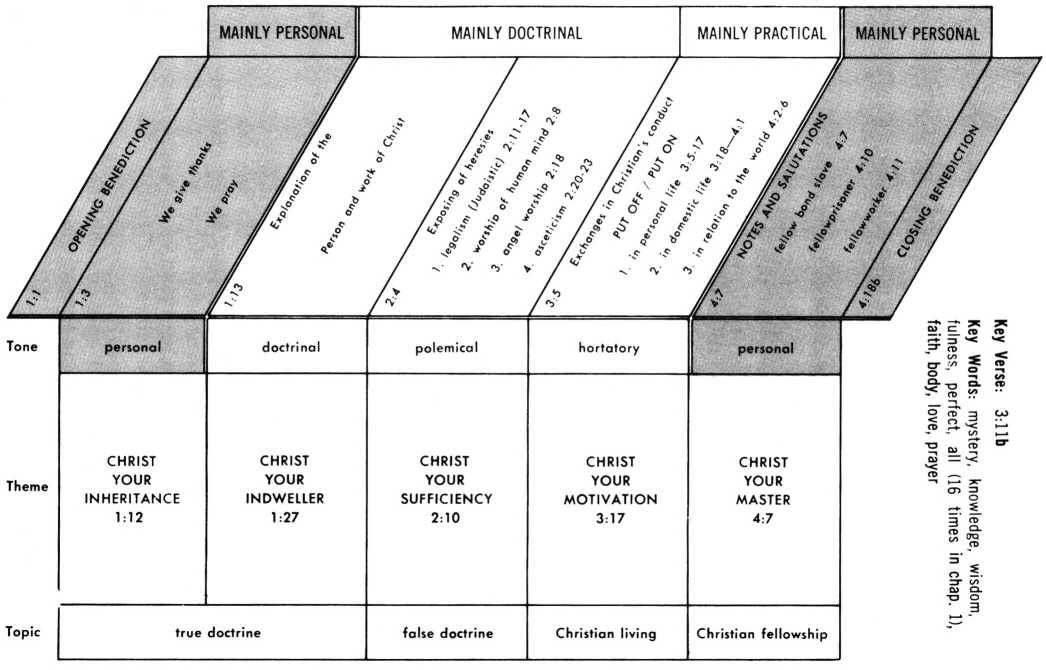
CHRIST IS ALL IN ALL
Click chart to enlarge
Charts from Jensen's Survey of the NT - used by permission
Colossians Overview - Click Chart on right side
| Christ Preeminent in All Things Supreme Lord - Sufficient Savior |
|||
| Colossians 1 | Colossians 2 | Colossians 3 | Colossians 4 |
| Supremacy of Christ |
Submission to Christ |
||
| Doctrinal and Corrective |
Practical and Reassuring |
||
| What Christ Did For Us |
What Christ Does Through Us |
||
| Christ Our Lord |
Christ Our Life |
Christ our Love |
|
| Christ the Head of the Body |
Christ the Lord of the Universe |
Christ the Head of the Home |
|
| Instruction | Warnings | Exhortations | Reminders |
| Reconciliation | Creation | Submission | Conversation |
| His Person and Word |
His Peace and Presence |
||
Colossians 2:11 and in Him you were also circumcised (API) with a circumcision made without hands in the removal of the body of the flesh by the circumcision of Christ (NASB: Lockman)
Greek: En ho kai perietmêthête (2PAPI) peritome acheiropoieto en te apekdusei tou somatos tes sarkos, en te peritome tou Christou,
Amplified: In Him also you were circumcised with a circumcision not made with hands, but in a [spiritual] circumcision [performed by] Christ by stripping off the body of the flesh (the whole corrupt, carnal nature with its passions and lusts). (Amplified Bible - Lockman)
Barclay: In him you have been circumcised with a circumcision not made by man’s hands, a circumcision which consists in putting off the whole of that part of you which is dominated by sinful human nature, which you were able to do by the circumcision which belongs to Christ. (Westminster Press)
Lightfoot: In him too you have the true circumcision—the circumcision which is not made with hands but wrought by the Spirit—the circumcision which divests not of a part only but of the whole carnal body—the circumcision which is not of Moses but of Christ.
Phillips: In Christ, you were circumcised, not by any physical act, but by being set free from the sins of the flesh by virtue of Christ's circumcision. (Phillips: Touchstone)
Wuest: in Whom you were circumcised by a circumcision not effected by hand, in the putting off and away from yourselves the body of the flesh in the circumcision of Christ,(Eerdmans Publishing - used by permission)
Young's Literal: in whom also ye were circumcised with a circumcision not made with hands, in the putting off of the body of the sins of the flesh in the circumcision of the Christ,
AND IN HIM YOU WERE ALSO CIRCUMCISED WITH A CIRCUMCISION MADE WITHOUT HANDS: En ho kai perietmêthête (2PAPI) peritome acheiropoieto:
- You were circumcised - Ezek 44:7,9
- Circumcision made without hands - Acts 7:48;17:24; Eph 2:11; Heb 9:24
- Colossians 2 Resources - Multiple Sermons and Commentaries
- Colossians 2:8-23 The Sufficiency of Christ - John MacArthur
- Colossians 2:8-23 The Sufficiency of Christ Alone - John MacArthur
- Colossians 2:10-15: Complete in Christ - John MacArthur
In Him also you were circumcised with a circumcision not made with hands, but in a [spiritual] circumcision [performed by] Christ (Amp)
In union with Christ you were circumcised, not with the circumcision that is made by human beings, but with the circumcision made by Christ, which consists of being freed from the power of this sinful self. (GNB)
It was a spiritual procedure—the cutting away of your sinful nature (NLT)
in Him you have been circumcised with no material circumcision that cuts flesh from the body (Moffatt)
In him also you were circumcised with a spiritual circumcision (NRSV)
in the putting off of the sinful nature (NIV)
n Colossians 2:9-15 Paul explains that a believer has been made complete in Christ through identification with the death, burial, and resurrection of Christ (Col 2:11, 12), out of which arise some significant benefits (Col 2:13, 14, 15). When confronted with false teaching, most of us attack it and try to point out what is wrong with it. Paul's approach is to "accentuate the positive" and thus he reviews what the saints already possess in Christ. You will never possess any more of Christ than you do the moment of salvation, so the question is what more does a saint need to "succeed" in this life? For most of us the answer is that we need to discover more of what it means to be "in Christ" and to have Christ in us "the hope of glory", which is a lifelong process. The concept of the believer's indissoluble union with Christ, made real in personal experience, takes lifeless theory out of refrigeration and sets it in the full blaze of the warmth of intimate fellowship with the Son. I would add that since it is the Holy Spirit Whose job it is to glorify Christ, for believers to truly possess their possessions ("complete in Christ") we must become very sensitive to the vital role the Spirit of Jesus plays in enabling us to achieve our "Christ potential" (cp similar ideas - progressive sanctification, growth in holiness, present tense salvation). We need to realize that even the God-Man Jesus lived the supernatural life in dependence upon the Holy Spirit. Below are some articles that expand on this important topic (there is some overlap):
- Spirit-Filled Believers Are Like Artesian Wells
- The Holy Spirit-Walking Like Jesus Walked!
- Our Anointing - The Holy Spirit
- A Spirit Filled Church
- Ephesians 5:18 Commentary
- Make Disciples 1
- Make Disciples 2
- Make Disciples 3
- Make Disciples 4
- Make Disciples 5
- Make Disciples 6
- Make Disciples 7
- Make Disciples 8
In Him in union with Christ or identified with Christ, we too were "circumcised". Thus the Jewish NT has "Also it was in union with Him that you were circumcised"
Were circumcised (4059) (peritemno from perí = around + témno = cut off - see study of peritome) means literally to cut something off or away ("to cut off around"), signifying a removal of that which has been cut away.
In Col 2:11 Paul is using the well known procedure of circumcision not to describe the physical act but to describe spiritual circumcision ("without hands") that is wrought by the Spirit and results in spiritual rebirth. Paul used the concept of circumcision similarly in Romans 2:24-29, addressing the Jews who had the Law and physical circumcision and yet transgressed the Law, because they were not spiritually circumcised.
TDNT - Non-biblical Use. Attested from the days of Homer, peritémnō means “to cut around,” “to make incisions,” “to encircle with a view to robbing” (e.g., cattle or lands), and then, as a ritual technical term, “to circumcise.”
Thayer - to circumcise, cut off one's prepuce (used of that well-known rite by which not only the male children of the Israelites, on the eighth day after birth, but subsequently also `proselytes of righteousness' were consecrated to Jehovah and introduced into the number of his people.
Peritemno - 17x in 15v - circumcise(4), circumcised(10), circumcision(1), receive circumcision(1), receives circumcision(1).
Note the predominance of uses in Galatians - correct teaching on circumcision was a crucial issue in that epistle to counter the false teaching that one could only be saved by "Christ plus" something, in this case circumcision (see Acts 15:1, 5).
Luke 1:59 And it happened that on the eighth day they came to circumcise the child, and they were going to call him Zacharias, after his father.
Luke 2:21 And when eight days had passed, before His circumcision, His name was then called Jesus, the name given by the angel before He was conceived in the womb.
John 7:22 "For this reason Moses has given you circumcision (not because it is from Moses, but from the fathers), and on the Sabbath you circumcise a man.
Acts 7:8 "And He gave him the covenant of circumcision (Ge 17:11 says it is the sign of the covenant); and so Abraham became the father of Isaac, and circumcised him on the eighth day; and Isaac became the father of Jacob, and Jacob of the twelve patriarchs.
Acts 15:1 Some men came down from Judea (to the church at Antioch) and began teaching the brethren, "Unless you are circumcised according to the custom of Moses, you cannot be saved."
Comment: These "Judiazers" came down because they got wind of the Gentile conversions from the First Missionary Journey - and they demanded they added "circumcision" to salvation by faith alone! This spurred the pivotal Jerusalem Council to address this heresy.
Acts 15:5 But some of the sect of the Pharisees who had believed stood up, saying, "It is necessary to circumcise them and to direct them to observe the Law of Moses." (Read Peter's strong refutation of this deadly, heretical teaching - Acts 15:7-11)
Acts 16:3 Paul wanted this man to go with him; and he took him and circumcised him because of the Jews who were in those parts, for they all knew that his father was a Greek.
Acts 21:21 and they have been told about you, that you are teaching all the Jews who are among the Gentiles to forsake Moses, telling them not to circumcise their children nor to walk according to the customs.
1 Corinthians 7:18 Was any man called when he was already circumcised? He is not to become uncircumcised. Has anyone been called in uncircumcision? He is not to be circumcised.
Galatians 2:3 But not even Titus, who was with me, though he was a Greek, was compelled to be circumcised.
Galatians 5:2 Behold I, Paul, say to you that if you receive circumcision, Christ will be of no benefit to you.
3 And I testify again to every man who receives circumcision, that he is under obligation to keep the whole Law. (Ed: Something that no one can do, except Jesus!)
Galatians 6:12 Those who desire to make a good showing in the flesh try to compel you to be circumcised, simply so that they will not be persecuted for the cross of Christ.
13 For those who are circumcised do not even keep the Law themselves, but they desire to have you circumcised so that they may boast in your flesh.
Colossians 2:11 and in Him you were also circumcised with a circumcision made without hands, in the removal of the body of the flesh by the circumcision of Christ;
Peritemno - 41x in 37v in the non-apocryphal Septuagint -
Gen 17:10-14, 23-27; 21:4; 34:15, 17, 22, 24; Ex 4:25; 12:44, 48; Lev 12:3; Deut 10:16; Josh 5:2-4, 7, 8; 21:42; 24:30; Esther 8:17; Jer 4:4; 9:25
Of these Jews, Paul declares
"he is not a Jew who is one outwardly (or just because one is born of Jewish parents and is a descendant of Abraham, has gone through the Jewish ceremony of circumcision and externally conforms to the Law like the Pharisees); neither is circumcision that which is outward (external, a physical thing, something visible, that which may be seen) in the flesh. But he is a Jew who is one inwardly; and circumcision is that which is of the heart, by the Spirit, not by the letter (not by the written code, a spiritual and not a literal matter, real circumcision is heart- circumcision); and his praise is not from men, but from God." (Ro 2:28-29-note)
The NLT paraphrases it
"No, a true Jew is one whose heart is right with God. And true circumcision is not a cutting of the body but a change of heart produced by God's Spirit. Whoever has that kind of change seeks praise from God, not from people."
In Philippians Paul wrote that true believers (Jew and Gentile)
"are the true circumcision, who worship in the Spirit of God and glory in Christ Jesus and put no confidence in the flesh" (Php 3:3-note)
Again Paul reminds the Galatians that
neither is circumcision anything, nor uncircumcision, but a new creation ("the result of a new birth and a new nature in Christ Jesus, the Messiah" Amplified) (Gal 6:15)
The NLT paraphrase says
"It doesn't make any difference now whether we have been circumcised or not. What counts is whether we really have been changed into new and different people."
Paul's instruction regarding spiritual circumcision was not new, but was taught repeatedly in the Old Testament.
Although circumcision was required by the Mosaic law, the rite was neglected during the days when the people of Israel wandered in the wilderness. Perhaps this was a sign that the nation had broken their covenant with God through their disobedience. The rite was resumed when they entered the land of Canaan, with Joshua performing the ritual on the generation born in the wilderness (Joshua 5). The Hebrew people came to take great pride in circumcision; in fact, it became a badge of their spiritual and national superiority. This practice fostered an exclusivist mentality instead of a missionary zeal to reach the Gentiles which was God's original intent for His "chosen" people.
A daily prayer of a strict Jewish male was to thank God that he was neither a woman, a Samaritan, nor a Gentile. Gentiles came to be regarded by the Jews as the “uncircumcision,” a term of disrespect implying that non-Jewish peoples were outside the circle of God’s love. As discussed below, God applied the very same term ("uncircumcised") to describe His "chosen" people. The terms “circumcised” and “uncircumcised” became emotionally charged symbols to Israel and their Gentile neighbors. This issue later brought discord into the fellowship of the New Testament church and especially caused confusion about how one obtained genuine salvation.
The Jews should have known the true meaning of circumcision for Moses and the prophets used the term “circumcised” as a symbol for purity of heart and readiness to hear and obey. For example, through Moses the Lord challenged the Israelites to submit to
Circumcise then your heart (clearly speaking of a inward, spiritual work not an external fleshly work), and stiffen your neck no more. (Dt 10:16).
An uncircumcised heart reflected a will that was hardened toward God’s commands.
Circumcision as first prescribed in (Ge 17:10, 11, 12, 13, 14) meant to cut away the fleshly part of the male sexual organ, that part which might hold disease in its folds and so potentially might pass the disease on to the wives. Thus physical circumcision had an important role in the preservation of God’s people physically.
Nelson's Study Bible has an interesting thought on physical circumcision noting that
Since the Canaanite worship system involved sexual excess, the distinctive sign on the body of the male Hebrew would be a significant reminder not to participate in the rituals of the Canaanites. (Radmacher, E. D., Allen, R. B., & House, H. W. The Nelson Study Bible: NKJV. Nashville: Thomas Nelson)
In any event, the more significant meaning of circumcision was as a symbol of the need for the heart to be cleansed from sin’s deadly disease. This "cutting" needed to happen internally, for God was calling for the removal of the "body of flesh", which was the predisposition to sin (inherited from Adam) and which kept man from being spiritually devoted to God. It seems that God selected the reproductive organ as the location of the symbol for man’s need of cleansing for sin, because it is the instrument most indicative of his depravity, since by it he reproduces generations of sinners. In any event, physical circumcision was a sign of being under God’s covenant with Abraham, a covenant that was entered into by faith, not by works. We find Abraham entering that unconditional covenant with Jehovah in (Gen 15:6) where Moses records that Abraham "believed (he "leaned his whole weight upon", he said in essence "Amen, Lord" or "so be it Lord") in the LORD and He reckoned [God imputed Christ's righteousness or placed it on Abraham's account] it to him as righteousness."
In the midst of a series of warnings to Israel regarding punishment for disobedience to the LORD, Moses records a ray of hope in God's gracious promise that
If they confess their iniquity and the iniquity of their forefathers, in their unfaithfulness which they committed against Me, and also in their acting with hostility against Me— I also was acting with hostility against them, to bring them into the land of their enemies—or if their uncircumcised heart becomes humbled (conveys the basic sense of being lowly, meek) so that they then make amends for their iniquity, then I will remember My covenant with Jacob, and I will remember also My covenant with Isaac, and My covenant with Abraham as well, and I will remember the land (this is the same covenant Abraham entered into by faith not works). (Lev 26:40, 41, 42)
The cause of Israel’s rebellion was an “uncircumcised heart,” a heart that had never been changed by the Lord and one which refused to bow (to be humbled) before Him.
In Deuteronomy Moses commands Israel
"Circumcise then your heart (clearly speaking of a inward, spiritual work not an external fleshly work), and stiffen your neck no more." (Dt 10:16)
Without circumcision of heart, true fear of God and true love of God are both impossible. Again in Deuteronomy Moses gives a prophesy that the day will come when
the LORD your God will circumcise your heart and the heart of your descendants, to love the LORD your God with all your heart and with all your soul, in order that you may live. (Dt 30:6)
What God's law demanded, God's grace would enable. This verse primarily refers to the future salvation of Jews alive at the return of Christ, when by faith they will have their hearts circumcised. In the intervening centuries, God has partially fulfilled this promise, as there have always been physical Jews who by faith received God's promise of new life in Christ.
In the OT, they were looking forward to the Cross, whereas in the NT they (and all believers today) look back to the finished work of Christ on the Cross. Thus circumcision of heart defines an internal work by God and is another description of true salvation, a salvation that imparts to that individual a new will that now desires to to obey God instead of to rebel against Him. This promise of a new heart would allows the Israelites to love the Lord with all their heart and soul, and receives it fullest expression in the New Covenant (see Jer 31:31, 32, 33, 34, Ezek 11:19, 36:26 discussed in the topic New Covenant in the Old Testament).
This internal circumcision is what Jesus was referring to when He declared
"You blind Pharisee, first clean the inside of the cup and of the dish, so that the outside of it may become clean also." (Mt 23:26)
Jeremiah addressing faithless, unbelieving Judah and Jerusalem declared
"Circumcise yourselves to the Lord and remove the foreskins of your heart, men of Judah and inhabitants of Jerusalem, lest My wrath go forth like fire and burn with none to quench it." (Jer 4:4)
As Biblical history records they refused to heed the warning and were utterly defeated by Nebuchadnezzar.
Jeremiah characterized rebellious Israel as having “uncircumcised” ears declaring
"To whom shall I speak and give warning, that they may hear? Behold, their ears are closed (Hebrew literally = uncircumcised) and they cannot listen. Behold, the word of the LORD has become a reproach to them." (Jer 6:10)
Through Jeremiah the LORD later says
"Behold, the days are coming, that I will punish all who are circumcised and yet uncircumcised (i.e., physically circumcised but not spiritually circumcised - then he mentions even some Gentile lands which practiced physical circumcision and puts "Judah" in the midst of these nations they loathe!)-- Egypt, and Judah, and Edom, and the sons of Ammon, and Moab, and all those inhabiting the desert who clip the hair on their temples; for all the nations are uncircumcised (referring to the fact that most of the Gentiles were physically uncircumcised), and all the house of Israel are uncircumcised of heart. (referring to spiritual circumcision)" (Jer 9:25-26)
The Jews boasted in the covenant sign of circumcision, but it was only in their flesh. The true spiritual circumcision God desired had never reached their hearts. In a similar way, people today who depend on baptism and some other church sacrament (ordinance), and yet who have never repented and trusted Christ, are in the same situation as the Jews in Jeremiah’s day - they think they’re a part of the divine covenant, but their confidence is false and they stand deceived and in imminent danger of entering into a Christ-less eternity.
Due to the passing down of teaching from one rabbi to another over the centuries ("traditions of men" = paradosis) the true meaning and requirement of circumcision specified in Ge 17:11 had been lost. And so by the first century we find rabbinical "traditions" (which were considered on a plane with the inspired Word) teaching such fallacies as:
“No circumcised Jewish man will see hell”
“Circumcision saves us from hell.”
The Midrash (non-inspired Jewish writings after return from Babylon with the purpose being to "fill in the gaps" of the Torah - and here is an example of their gross misinterpretation of the Word of Truth) says “God swore to Abraham that no one who was circumcised would be sent to hell. Abraham sits before the gate of hell and never allows any circumcised Israelite to enter.”
In Acts Stephen infuriated his Jewish audience with the indictment that
"You men who are stiff-necked (literally "hard necked" and thus obstinate, stubborn, rebellious) and uncircumcised in heart and ears are always resisting the Holy Spirit; you are doing just as your fathers did." (Acts 7:51)
Comment: Their uncircumcision in heart and ears marks the Jews as just like the unsaved Gentiles (who were often referred to as the "uncircumcision"). Their sin had never been forgiven. They were as unclean before God as the uncircumcised Gentiles they detested and they therefore stood themselves condemned before God.
A crisis erupted in the church at Antioch when Paul and Barnabas returned from the First Missionary Journey (Acts 13:4, Second = Acts 15:35, Third = Acts 18:23), and gave a report of numerous Gentile conversions (men who were physically uncircumcised - and this was the point of contention)...
“some men (Judaizers) came down from Judea and began teaching the brethren, "Unless you are circumcised according to the custom of Moses, you cannot be saved." (Acts 15:1)
(At the Jerusalem council that followed the events of Acts 15:1 we read) But certain ones of the sect of the Pharisees who had believed, stood up, saying, “It is necessary to circumcise them, and to direct them to observe the Law of Moses.” (Acts 15:5)
Comment: Circumcision and keeping the Law was the supposed means of obtaining perfect righteousness before God were the two great errors of first century Judaism
The Judaizers insisted that a believer from a non-Jewish background (Gentile) must first become a Jew ceremonially (by being circumcised) before he could be admitted to the Christian brotherhood. A council of apostles and elders was convened in Jerusalem to resolve the issue (Acts 15:6-29). Among those attending were Paul, Barnabas, Simon Peter, and James, a leader of the Jerusalem church. To insist on circumcision for the Gentiles, Peter argued, would amount to a burdensome yoke (Acts 15:10,19). This was the decision handed down by the council, and the church broke away from the binding legalism of Judaism which demanded physical circumcision and obedience to the Law.
In Romans 2 Paul discussed (and refuted) the false belief that obedience to the Law saves (Ro 2:12-24) and the false belief that physical circumcision saves (Ro 2:25-29). In Romans 2:28, 29 discussed earlier, Paul teaches that there is a difference between being Abraham’s physical descendants and Abraham’s spiritual children. Jesus had said the same thing to the Pharisees,
“I know that you are Abraham's (physical) offspring” (Jn 8:37).
But then He went on to say,
"If you are Abraham's children, do the deeds of Abraham (believe like Abraham did and become his spiritual children also).” (Jn 8:39).
MacArthur has an interesting comment that "God selected the reproductive organ as the location of the symbol for man’s need of cleansing for sin, because it is the instrument most indicative of his depravity, since by it he reproduces generations of sinners. (MacArthur Study Bible)
Paul's use of the metaphor of circumcision implies that the "persuasive arguments" in Colossians had an element of Jewish traditions of men (Col 2:16, 17-notes) Paul leaves no doubt that the Colossians were freed from this physical rite which only removed a portion of the body. In contrast the "circumcision by Christ" has resulted in removal of the (entire) body of the flesh.
Due to the passing down of teaching from one rabbi to another over the centuries ("traditions of men") the true meaning and requirement of circumcision had been lost. And so by the first century we find rabbinical "traditions" teaching such fallacies as:
“No circumcised Jewish man will see hell” and “Circumcision saves us from hell.”
The Midrash (Midrash from Hebrew meaning to “search out” = implication of discovering truth not seen on the surface. Refers to a group of Jewish OT commentaries between AD400-1200) says “God swore to Abraham that no one who was circumcised would be sent to hell. Abraham sits before the gate of hell and never allows any circumcised Israelite to enter.”
Charles Hodge gives an excellent principle writing that “Whenever true religion declines, the disposition to lay undo stress on external rites is stressed. The Jews when they lost their spirituality supposed that circumcision had the power to save them.” Apostasy always moves the religious focus from the inward to the outward, from humble obedience to empty formality.
Be aware that many so called "scholars" equate circumcision with baptism, reasoning that baptism has taken the place of the OT rite of circumcision. But Paul teaches that if we are Christians, we have been both circumcised and baptized, using both of these primarily with their spiritual meaning as discussed in these notes.
Eadie comments that "the blessing described in the verse had been already enjoyed, for they were and had been believers in Him in Whom they are complete. Through their living union with Christ, they had enjoyed the privilege, and were enjoying the results of a spiritual circumcision. Why then should they suffer the incision of a sharp flint or a glittering knife—in itself, at best, but a sign—when they had already experienced the blessing of a circumcision that drew no blood, and gave no pain—a circumcision “not made with hands”?...The circumcision made without hands is plainly opposed to that which is made with hands (Ep 2:11-note) This idea of a spiritual circumcision was no novel one, for it occurs in the Old Testament in different forms. When Israel was yet in the wilderness, the Divine command was given—“Circumcise the foreskin of your heart,” and at the same period the Divine promise was made—“And the Lord thy God will circumcise thine heart and the heart of thy seed, to love the Lord thy God with all thine heart and with all thy soul, that thou mayest live.” The prophet Jeremiah repeats the injunction—“Circumcise yourselves to the Lord, and take away the foreskins of your heart, ye men of Judah and inhabitants of Jerusalem.” He also describes a part of the population thus—“Behold, their ear is uncircumcised;” nay, he declares that the whole house of Israel are “uncircumcised in the heart.” Ezekiel speaks of men “uncircumcised in heart and uncircumcised in flesh.” Stephen, in his address, used this ancient phraseology, and calls his audience “uncircumcised in hearts and ears.” (Colossians 2 Commentary)
Ray Stedmann writes: I will never forget an incident that occurred a number of years ago here at the church. A young man came to my office carrying a thick Bible under his arm, which he had been reading. Looking at me very earnestly, he said to me, "Would you circumcise me?" After I had picked myself up from the floor, I explained to him why, one, he did not need physical circumcision, and, two, what circumcision meant. I pointed out that it was an eloquent symbol when it was properly understood. (Read the full sermon Beware!))
Circumcision (4061) (peritome fperí = around + témno = cut off) refers literally to cutting and removal of the foreskin. As discussed below both the Old and New Testament also use the concept of circumcision in a figurative or metaphorical sense. (See also exposition of Scriptures on Circumcisionn)
Peritome - 36x in 32v - Jn. 7:22f; Acts 7:8; 10:45; 11:2; Ro 2:25ff; 3:1, 30; 4:9ff; 15:8; 1 Co. 7:19; Gal. 2:7ff, 12; 5:6, 11; 6:15; Eph. 2:11; Phil. 3:3, 5; Col. 2:11; 3:11; 4:11; Tit. 1:10
Made without hands (886) (acheiropoietos from a = without + cheír = hand, + poieo = to make) means literally not made with hands and figuratively not made in a human sense. It is used only 3x in all of Scripture and refers to Jesus' resurrection body (Mk 14:58), the believer's promised glorified resurrection body (2 Cor 5:1) and spiritual circumcision of the heart by the Spirit (Col 2:11) when one by grace believes in the Messiah and is born again.
In this use Paul refutes the persuasive arguments of those who demanded a literal circumcision by human hands. Clearly this word indicates an internal, supernatural, divine transaction.
Acheiropoietos - 3x in Scripture
Mark 14:58 "We heard Him say, 'I will destroy this temple made with hands, and in three days I will build another made without hands.'"
2 Corinthians 5:1 For we know that if the earthly tent which is our house is torn down, we have a building from God, a house not made with hands, eternal in the heavens.
Colossians 2:11 and in Him you were also circumcised with a circumcision made without hands, in the removal of the body of the flesh by the circumcision of Christ;
This same phrase (made without hands) is used in Mk 14:58 in reference to the "temple", in 2Cor 5:1 in reference to the "house" and in Heb 9:11 to the "tent".
Eadie comments that the saints at Colossae "had everything which it was alleged they wanted, and everything already in Christ. The heretical preceptors had enjoined upon them the rite of circumcision, but the apostle shows that it would be really a superfluous ceremony, since they had already experienced a nobler circumcision than that of the knife—for it was executed by no material hand. They were, in short, the “true circumcision” (Colossians 2 Commentary)
John Gill comments that
"This circumcision "is that of the heart, in the spirit; every man, though he may be circumcised in the flesh, is uncircumcised in heart, until he is circumcised by Christ and his Spirit; which is done, when he is pricked to the heart, and thoroughly convinced of sin, and the exceeding sinfulness of it; when the callousness and hardness of his heart is taken off and removed, and the iniquity of it is, laid open, the plague and corruption in it discerned, and all made naked and bare to the sinner's view; and when he is in pain on account of it, is broken and groans under a sense of it, and is filled with shame for it, and loathing and abhorrence of it: now this is effected not "by the hand of man", this is not done by any creature whatever; not by angels, who rejoice at the repentance of sinners, but cannot produce it; nor by ministers of the Gospel, who at most are but instruments of regeneration and conversion; nor by men themselves; this is not by might or power of man, by the strength of his free will, but by the Spirit of God: for though men are sometimes exhorted to circumcise themselves, as in (Dt 10:16 Jer 4:4) in order to convince them of the corruption of their nature, and the need they stand in of spiritual circumcision; yet whereas there is an utter disability in them to effect it, and they need the power and grace of God for that purpose, the Lord has graciously promised his people to do it himself for them, (Dt 30:6); so that this circumcision is in the name sense made without hands, as the human nature of Christ is said to be a tabernacle not made with hands, that, is of men, but of God, being what God has pitched, and not man; and it stands opposed to circumcision in the flesh, which was made with hands, (Ep 2:11-note); and by some instrument, as a sharp knife or stone."
In summary, the physical circumcision God had called for was always meant to be an external sign of an internal change of heart resulting in a love for God. In this verse Paul explains the figurative meaning of circumcision as the "cutting off" of Christ from the living via Crucifixion. Paul shows that physical circumcision is not what counts (Ro 2:28, 29-notes). There must be faith in the living God (Ro 4:3-note). Those of the circumcision (physical Jews) who believe in the Lord Jesus Christ are the true Israel of God (Gal 6:16) (Click analysis of the phrase Israel of God)
S Lewis Johnson explains The figure of circumcision (Col 2:11)....
The introduction of the figure of circumcision is somewhat surprising. It may, however, be the result of some stress by the Gnostic-Judaizers upon the necessity of undergoing circumcision (cf. Col 2:16,17). The apostle’s answer leaves no doubt that he regarded the Colossians as freed from this rite. They have experienced a deeper circumcision—one not made with hands, spiritual (cf. Ep 2:11). The use of circumcision in other than a crassly literal sense is not strange for the Biblical writers. Inward circumcision of the heart is an Old Testament concept (cf. Deut 10:16; 30:6 ; Jer 4:4; 6:10 ; 9:26 ; Ezek 44:7, 9). The use of the aorist tense in the verb perietmēthēte (AV, “were circumcised”) points most likely to the conversion of the Colossians. At that time they were circumcised spiritually.
Just what does this mean? The Old Testament rite signifies separation from sin and the flesh and consecration to God. The rite was performed once, but that which it signified was to be maintained daily. This emphasis finds its illustration in the experiences of Israel in the land, as recorded in Joshua. Circumcised at Gilgal, the nation often returned in its campaigns to this spot and renewed its consecration to God (cf. Josh 5:1, 2, 3, 4, 5, 6, 7, 8, 9). According to the New Testament it signified:
(1) the righteousness of faith (Ro 4:9, 10, 11, 12);
(2) the putting off of the body of fleshen tē apekdusei tou sōmatos tēs sarkos is the best interpretation of circumcision’s meaning here. It means the putting off of the fleshly nature of man, or the crucifixion of the old man, as Paul puts it elsewhere (cf. Ro 6:5, 6). Sarx has its ethical meaning here, referring to man’s human nature in its creaturely state, the seat of sin. Its equivalence to the term palaios anthropos (AV, “old man”) is suggested by the use of the root apekduo (apekduomai - word studyi AV, “put off”) in this verse and in Col 3:9 (cf. Col 2:15 ) in Col 2:15 comes from the same root as the noun apekdusei. It refers to the divestiture of evil powers from our Lord, but, while they have been defeated through the work of the cross, they still abide. The Christian has been delivered from the power of the flesh, but it still abides with us..
When did this circumcision, this putting off of the old man, occur? The apostle says it took place in him, that is, en tē peritomē tou Cristou (AV, “in the circumcision of Christ”). This last phrase can hardly be anything other than his death, as the following words show.
What, then, has Paul said in the verse? That, comparable to the Old Testament rite of circumcision in which the flesh was cut away from the bodies of the Israelites in token of possession by the God of Israel, so believers in union with Christ in His death have died with Him to the old man and its relationship with Adam and sin. This has freed them from the thraldom of Sinn. The flesh, while still with us, has been spoiled and stripped of its legal power over us, and we may enjoy deliverance as we believe the liberating message. The glory of the work of Christ is that it not only deals with our sins, it deals with our natures. Our sins find their forgiveness in the blood; our persons find their freedom in the cross. (Studies in the Epistle to the Colossians — Part VII The Complete Sufficiency of Union with Christ -- By S. Lewis Johnson, Jr.)
Related Resources on Circumcision:
- "Spiritual Circumcision" - Circumcision Of the Heart (See also note below)
- Scriptures on Circumcision
- Circumcision by R K Harrison
- Circumcision by R A Torrey
- What Does the Bible Say about Circumcision?
- Is baptism the New Covenant equivalent of circumcision?
- American Tract Society Circumcision
- Bridgeway Bible Dictionary Circumcision
- CARM Theological Dictionary Circumcision
- Easton's Bible Dictionary Circumcision
- Fausset Bible Dictionary Circumcision
- Holman Bible Dictionary Circumcision
- Hastings' Dictionary of the Bible Circumcision
- Hastings' Dictionary of the NT Circumcision, Circumcision
- Morrish Bible Dictionary Circumcision
- Hawker's Poor Man's Dictionary Circumcision
- People's Dictionary of the Bible Circumcision
- Smith Bible Dictionary Circumcision
- Wilson's Bible Types Circumcision
- Webster Dictionary Circumcision
- Watson's Theological Dictionary Circumcision
- 1911 Encyclopedia Britannica Circumcision
- Condensed Biblical Cyclopedia Covenant of Circumcision
- International Standard Bible Encyclopedia Circumcision
- Kitto Biblical Cyclopedia Circumcision
- McClintock and Strong's Bible Encyclopedia Circumcision
- The Nuttall Encyclopedia Circumcision
- The Jewish Encyclopedia Circumcision
IN THE REMOVAL OF THE BODY OF THE FLESH BY THE CIRCUMCISION OF CHRIST: en te apekdusei tou somatos tes sarkos en te peritome tou Christou:
- Col 3:8,9; Ro 6:6; Eph 4:22) (Lk 2:21; 2Cor 5:17; Gal 2:20; 4:4,5; Eph 2:10, 11, 12, 13, 14, 15, 16, 17, 18
- See Torrey's Topic: Union w/ Christ
- Colossians 2 Resources - Multiple Sermons and Commentaries
- Colossians 2:8-23 The Sufficiency of Christ - John MacArthur
- Colossians 2:8-23 The Sufficiency of Christ Alone - John MacArthur
- Colossians 2:10-15: Complete in Christ - John MacArthur
but in a [spiritual] circumcision [performed by] Christ by stripping off the body of the flesh (the whole corrupt, carnal nature with its passions and lusts). (Amp)
a circumcision which consists in putting off the whole of that part of you which is dominated by sinful human nature which you were able to do by the circumcision which belongs to Christ (Barclay)
but by the complete stripping of your natural self. This is circumcision according to Christ. (NJB)
which consists of being freed from the power of this sinful self (GNB)
when you threw off your sinful nature in true Christian circumcision (Weymouth)
It was through Christ’s circumcision, that is, his death, that you were made free from the power of your sinful self (NCV)
by stripping off the corrupt nature in the circumcision performed by Christ (ISV)
KJV adds body of the sins of the flesh The addition of the sins is an interpolation and is absent from all the most authentic MSS.
- See in depth discussion of the important concept of Circumcision of the Heart
Removal (555) (apekdusis, noun form of verb apekduomai [word study] = put off from oneself in turn from apo = away from + ekduo = to come out of something, e.g., clothing or armor) (Only use in Scripture) means a putting off, a getting out of or stripping off of for example an old garment with the preposition "apo" adding the idea of casting the garments away from. The imagery is that of discarding or divesting oneself of a piece of filthy clothing which is not a bad metaphor of our corrupt flesh nature inherited from Adam. Clearly Paul's use of apekdusis in this passage is figurative.
BDAG says apekdusis is "found nowhere independently of Paul; does not reappear until Eustath. ad Il. p. 91, 28; s. Nägeli 50)."
Friberg on apekdusis - as an action, of clothes stripping off, undressing; figuratively, of believers being set free from their sinful nature through union with Christ putting off, removal
Vincent apekdusis "is a strong expression for wholly putting away from one's self."
Paul is saying then that in this "spiritual circumcision", the body of the flesh is taken off like an old garment and cast away, setting oneself free from it's dominion and power over us. Paul uses the verb form (apekduomai) in the next chapter when he commands the saints at Colossae:
Do not lie (present imperative with a negative see our need to depend on the Holy Spirit to obey) to one another, since you laid aside the old self (man) with its evil practices and have put on the new self (man) who is being renewed (present tense = continuously, a process) to a true knowledge according to the image of the One who created him" (Col 3:9-note)
Kenneth Wuest paraphrases this passage: "Stop lying to one another, having stripped off and away from yourselves and for your own advantage the old, antiquated, outworn, decrepit, useless man [that person you were before you were saved] with his evil practices, and having clothed yourselves with the new man [the person you are after you are saved] who is constantly being renewed, with a resulting advanced and perfect experiential knowledge which is according to the image of the One who created him" (Wuest Word Studies - Eerdman Publishing Company Volume 1, Volume 2, Volume 3 - used by permission)
Wuest goes on to explain that "Lie is present imperative in a prohibition, forbidding the continuance of an action already going on. It is, “Stop lying to one another.” These Colossian saints had carried over into the new life, the sin of lying. They should stop lying because they had put off the Old Man with his practices, that person they were before they were saved, and had put on the New Man, that person they were now in Christ Jesus, this new person being constantly renewed with respect to a complete and perfect knowledge which is according to the image of the One who created him. Lightfoot says: "Which is ever being renewed unto perfect knowledge, the true knowledge in Christ, as opposed to the false knowledge of the heretical teachers." (Wuest Word Studies - Eerdman Publishing Company Volume 1, Volume 2, Volume 3 - used by permission)
Body (4983) (soma) can mean a literal living human body (or animal), and here is used of the human body looked upon in its material constitution.
Flesh (4561)(sarx) is a complex word as it can have various meanings in Scripture depending on the context. In the present context, the idea is that the body of the flesh is "the body which consists of the flesh" where flesh (sarx) does not mean literal physical flesh but is used in the moral or ethical sense to describe that aspect of men which is the seat of sin with its evil, corrupt desires and passions. Flesh is that "force in men that makes for evil."
For example writing to the Galatians Paul exhorts them to "walk (present imperative - a command to make this your daily practice, so we cannot even walk by the Spirit unless the Spirit gives us the desire and power - Php 2:13NLT-note), then our part/responsibility [in Php 2:12-note] is to "work out [(present imperative] our salvation and walk or conduct our lives...) by the Spirit, and you will not carry out the desire of the flesh" (Gal 5:16-note) indicating that the flesh has strong desires that are hostile to God and opposed to the Spirit. (Related Resource: see our need to depend on the Holy Spirit to obey these commands and ANY command!)
John MacArthur explains that "The body of the flesh refers to the sinful, fallen human nature totally dominating believers before salvation. Christians have been cleansed of that sinful dominance and been given a new nature created in righteousness, having been circumcised with a circumcision made without hands, that is, not physical but spiritual. At salvation, “our old self was crucified with Him, that our body of sin might be done away with, that we should no longer be slaves to sin” (Ro 6:6). As a result, “if any man is in Christ, he is a new creature; the old things passed away; behold, new things have come” (2Co 5:17). Nowhere is it expressed any better than in the words of Paul when he wrote, “We are the true circumcision, who worship in the Spirit of God and glory in Christ Jesus and put no confidence in the flesh” (Php 3:3). Believers have been freed from sin’s dominance and judgment, though not yet from its presence. (MacArthur, J. Colossians. Chicago: Moody Press)
Spurgeon "The Jew boasts that he is a circumcised man, but you have spiritually all that circumcision meant literally. Even though you have not the wounded your flesh, you have more than that, for you have the death of the flesh and your very flesh has been buried with Christ. All that circumcision can possibly mean you have in Christ. (Exposition of Colossians)
John Piper explains that in Colossians 2:11...
Paul compares the saving work of God in us with the practice of circumcision. He says it’s like that, only this is a circumcision made “without hands” : it’s a spiritual thing he is talking about, not a physical one. And he says that what is being cut away is not the male foreskin, but the “body of the flesh.” In Paul’s language that’s probably a reference to sin-dominated, ego-dominated use of the body. What is cut away in this spiritual circumcision “without hands” is the old unbelieving, blind, rebellious self and its use of the body for sin. And that way, Paul is saying, God makes a person his very own. (Buried and Raised in Baptism Through Faith)
Kenneth Wuest rightly states that "The expression, “the body of the sins of the flesh,” needs careful study. The words “of the sins,” are not in the best texts, so that the expression is “the body of the flesh.” Lightfoot, Expositors, Alford, and Vincent concur in the teaching that the body here is the physical body, and the flesh is indwelling sin. The body that was put off when the Colossian saints were saved was the physical body as dominated by the totally depraved nature. This body, while still the possession of the believer, was put off in the sense that it was rendered inoperative so far as the constant control of the evil nature was concerned. Paul states the same truth in Romans 6:6 when he says: “Knowing this, that our old self was crucified with Him in order that the body possessed by sin might be rendered inoperative, so that henceforth we are not yielding an habitual slave’s obedience to sin.” The power of the sinful nature was broken, and it was deprived of its control over the body." (Wuest Word Studies - Eerdman Publishing Company Volume 1, Volume 2, Volume 3 - used by permission)
Wiersbe writes...
Jewish circumcision removed but a small part of the flesh, but the Holy Spirit has put off the whole “body of the sins of the flesh” and made us new creatures in Christ (Col. 2:11). (Be Equipped)
When we trusted Christ to save us, the Spirit of God performed “spiritual surgery” that enables us to have victory over the desires of the old nature and the old life. Circumcision removes only a part of the body, but the true “spiritual circumcision” puts off “the body of the sins of the flesh” (Col. 2:11) and deals radically with the sin nature. (Be Obedient)
The Christian’s circumcision is in contrast to that of the Jews. They had external physical surgery, while believers have internal “spiritual surgery” on their hearts. The Jews’ surgery involved only a part of the body; while for the believer, the whole “body of the sins of the flesh” (Col. 2:11) was removed. When you accept this fact and reckon on it, you have victory over sins of the flesh that would enslave you. Faith “in the working of God” (Col. 2:12, NKJV) can give you overcoming power. (Be Strong).
The heart needs “spiritual surgery” if it is to love the Lord and obey Him (Dt 30:6; 10:16; Jer. 4:4; Ro 2:25, 26, 27, 28, 29). Every child of God has experienced this (Col 2:11) and, by faith, can live victoriously. When we receive the Word in our hearts (Dt 30:11, 12, 13, 14), we have both the desire and the dynamic to obey God and glorify Him. The heart of victory is the heart! (With the Word Bible Commentary)
This body of the flesh has been put off in the sense that it has been rendered inoperative. Thus in Romans Paul writes that
our old (unrenewed self, old man, our sinful, corrupt nature with evil passions and propensities) self was crucified with Him, that our body (which is the "instrument") of sin (body of sin is regarded as an organized power, acting through the members of the body) might be done away with (made ineffective and inactive for evil, deprived of its former power over us), that we should no longer be slaves to sin. (see note Romans 6:6)
The flesh (old self, old man, "corrupted humanity") can no longer reign like a dictatorial king over us as it once did when we were unregenerate ("spiritually uncircumcised"), for its power has been broken by the circumcision in Christ.
Eadie explains how the peculiar phrase the body of flesh contrast with true physical circumcision "in the manual circumcision only a portion of one member of the material body was cut off, but in the spiritual circumcision, the whole flesh which is the seat and habitation of sin is cast away and laid aside. The entire slough which encircles the spirit and enslaves it is rolled off, newness of life is felt, and the believer walks no longer after the flesh, is no longer carnal, or does its deeds...It is plain that the spiritual circumcision is not different from regeneration, or the putting off the old man and putting on the new man. (Colossians 2 Commentary)
In a parallel teaching Paul writes that
those who belong to Christ Jesus have crucified the flesh with its passions and desires (see note Galatians 5:24)
The corrupt passions of the flesh have been put to death (circumcised, taken off, cast away) and now they are as though they were dead and have no power over us. Note that the evil nature is not totally eradicated, and we still commit sins, and will do so until we are glorified. The difference is that now that we are circumcised in Christ, we may still sin but we have a choice to not sin and we have the power to resist the impulse to commit sins.
The flesh has no more power over the believer than he allows it to have and this is why Paul says
Put on (aorist imperative - Do this now! Don't delay! Clothe yourself with - see our need to depend on the Holy Spirit to obey) the Lord Jesus Christ (we are complete in Him and He is all the garment we need), and make no provision (present imperative with a negative see our need to depend on the Holy Spirit to obey = stop thinking about sinning beforehand, stop anticipating the pleasure it will give, don't premeditate on how you will satisfy your corrupt desires, put a stop to planning for or thinking about gratifying the evil cravings of your old fallen nature!!!) for (indulging) the flesh in regard to its lusts. (Romans 13:14+)
THOUGHT - Beloved are you (periodically or persistently) failing to PUT ON Christ and instead giving in to the strong temptation of your fallen flesh (James 1:14-15+) to making provision to commit some pet pleasurable sin? Do not be deceived (James 1:16+ - present imperative with a negative). Sin will kill your fellowship with God and with your spouse and with other believers! (1 Jn 1:6-7+) Don't do it! Repent! Turn around now! Put on (ENERGIZED BY THE HOLY WORD AND THE HOLY SPIRIT) the presence and power and provision of your Redeemer Who will guide you back to green pastures of sweet fellowship (Ps 23:2-3). Notice the powerful pattern of prevention in Romans 13:14. What do I mean? The pattern is to exalt Christ, delight in Christ, worship Christ, seek Christ, etc, etc, which serves as a strong "preventative" to exalting, delighting, worshiping or seeking SELF! The Scottish theologian Thomas Chalmers described this same pattern in a sermon on the expulsive power of a new affection (see discussion). We see a similar pattern in John 3:30+ where the order is critical. I hear so many folks place emphasis on the second half of that passage "I must decrease." Beloved, the old "I" will decrease when (AND ONLY WHEN) "HE" (CHRIST) increases! The hymn writer was correct that "The things of this earth grow strangely dim in the light of His glory and grace." God grant us all by Thy Spirit the desire and power to see Christ increasing in our lives, in our hearts, in our minds, that He might be our all in all. In His Name. Amen.
In summary, Paul teaches that the physical body dominated by the evil nature is put away in favor of a physical body now dominated by the divine nature. (see note Romans 6:13; 6:14).
Fleshly circumcision removed only a portion of the physical body (Lk 2:21+). In contrast spiritual circumcision thru Christ results in the "body" or the whole corrupt, carnal nature being put away like a garment which is taken off and laid aside. Some feel this could just as easily refer to Christ's physical death.
Circumcision (4061) (peritome from perí = around + témno = cut off) refers to cutting and removal of the foreskin, literally or figuratively (of the "foreskin" of the heart)
Circumcision of Christ (5547) - in this context the reference is to the "cutting off" of Christ which occurred on the Cross.
Newton has an interesting parallel between the OT shadow of circumcision and the NT reality...
The Old Testament practice of circumcision was a shadow. The "circumcision made without hands" is the substance. Let's see how this moves from the old to the new in Christ. By comparison...
The old is external, while the new is internal.
The old is nationalistic in covenant with the nation, while the new is individual in union with Christ.
The old affects the body as a cutting away of the foreskin, while the new affects the heart in the removal of the body of flesh.
The old requires an officiator in a priest, the new is done without hands as a divine act.
The old is limited to males, the new is limited only to those who believe, male and female.
The old is a human act, the new is a divine act.
The old has temporal results that cannot change the heart, the new is the regenerative work of the Spirit making a person alive in Christ.
The old is a ritual that cannot impart life, while the new applies the death and resurrection in all its power to give a new standing with God.
The old secures nothing eternal, while the new secures forgiveness of sins and eternity with Christ.
The old was applied due to family heritage, while the new is applied only through faith in Christ. (Sermons from the Epistle to the Colossians)
Barnhouse explains that...
On the eighth day of His life on earth our Lord Jesus Christ was taken to the temple and circumcised. The eternal Son, sent from the Father, placed Himself under the law that He might redeem them that were under the law (Gal. 4:4, 5). His heart was all holiness and needed no circumcising, since it was impossible for our Lord Jesus to sin. His circumcision was His first suffering for us. It was not, of course, redemptive suffering for sin, which was accomplished only on the cross. But read again Colossians 2:11, a parallel to our text in Romans and a key to Biblical teaching on holiness: “In him also you were circumcised with a circumcision made without hands, by putting off the body of flesh in the circumcision of Christ” (Col. 2:11).
The baptism of the Holy Spirit places us in the circumcision of Christ, and the circumcision of Christ puts off the body of the sins of the flesh. (Barnhouse, D. G. God's Freedom : Romans 6:1-7:25. Grand Rapids, MI.: William B. Eerdmans Publishing Company)
Eadie adds that circumcision of Christ is not that which He performs but that...
that circumcision which belongs to Him, in contradistinction to that which belonged to Moses or to the law. The spiritual circumcision is a blessing which specially belongs to Christ—is of His providing, and is to be enjoyed only in fellowship with Him. That of Moses was made with hands, and was a seal of the Abrahamic or national covenant—that of Christ is no chirurgical (archaic term which meant "surgical") process, but is spiritual and effectual in its nature. The mark in the foreskin was the token of being a Jew, but the off-thrown body of the flesh was the index of one's being a Christian. Though the scar of circumcision might attest a nationality, it was no certificate of personal character—“all are not Israel who are of Israel;” but, wherever “the flesh” was parted with, there was the guarantee of individual purity and progress. The charter of Canaan was limited to the manual circumcision, but the “true circumcision” are thereby infefted (invested with heritable property) in a heavenly inheritance. The Hebrew statute was for the man-child eight days old, but the Christian privilege has no distinction of age, or sex, or nation; for it belongs to every one in Christ. And it was, and is, a chief blessing—the death of sinful principle and the infusion of a higher life—the possession of a new nature, which has Christ for its source, ay, and Christ for its pattern.
Thus the flesh is thrown off, and the spirit assumes the predominance, with its quickened susceptibilities, its healthful activities, and its intense aspirations—thinking, feeling, and acting, in harmony with its sphere and destiny (Ed note: Beloved of the Father, you might read that last sentence again pondering the profundity therein and the practical application to our daily walk in Christ). And if such a collection of spiritual blessings has been received, why be subjected to a legal ceremony which could be at best but a faint type of them? Surely if they had received the thing signified, they need not now degrade themselves by submitting to a sign, which was in itself only a painful and bloody symbol of the Hebrew nationality and covenant. (Colossians 2 Commentary)
|
CIRCUMCISION |
|
| Jews | Believing Jew & Gentile |
| External | Internal—heart/ears/lips |
| Only part of body | Whole “body of the flesh” |
| Performed by hands | Performed without hands |
Colossians 2:12 having been buried with Him in (the) baptism in which you were also raised up with Him through faith in the working of God, Who raised Him from the dead (NASB: Lockman)
Greek: suntaphentes (AAPMPN) auto en to baptismo, en o kai sunegerqete (2PAPI) dia tes pisteos tes energeias tou theou tou egeirantos (AAPMSG) auton ek nekron;
Amplified: [Thus you were circumcised when] you were buried with Him in [your] baptism, in which you were also raised with Him [to a new life] through [your] faith in the working of God [as displayed] when He raised Him up from the dead. (Amplified Bible - Lockman)
NLT: For you were buried with Christ when you were baptized. And with him you were raised to a new life because you trusted the mighty power of God, who raised Christ from the dead. (NLT - Tyndale House)
Wuest: having been entombed with Him in the placing into [Christ by the Holy Spirit], in which act of placing into [Christ] you were also raised with Him through your faith in the effectual working energy of the God who raised Him out from among the dead. (Eerdmans Publishing - used by permission)
Young's Literal: being buried with him in the baptism, in which also ye rose with him through the faith of the working of God, who did raise him out of the dead.
HAVING BEEN BURIED WITH HIM IN BAPTISM: suntaphentes (AAPMPN) autôi en tôi baptismati :
- Buried with Him - Ro 6:4,5
- In baptism - Ro 6:3; 1Cor 12:13; Gal 3:27; Eph 4:5; Titus 3:5,6
- Colossians 2 Resources - Multiple Sermons and Commentaries
- Colossians 2:8-23 The Sufficiency of Christ - John MacArthur
- Colossians 2:8-23 The Sufficiency of Christ Alone - John MacArthur
- Colossians 2:10-15: Complete in Christ - John MacArthur
Related Passages:
Romans 6:3 Or do you not know that all of us who have been baptized into (IDENTIFIED WITH) Christ Jesus have been baptized into His death?
1 Corinthians 12:13 For by one Spirit we were all baptized into one body, whether Jews or Greeks, whether slaves or free, and we were all made to drink of one Spirit.
Galatians 3:27 For all of you who were baptized into (IDENTIFIED WITH) Christ have clothed yourselves with Christ.
BURIED WITH CHRIST
Having been buried with (4916) (sunthapto from sun/syn = with - speaks of intimate union + thapto = perform funeral rites, inter, bury) means to bury with someone or bury (together) with and in context refers to a believer's burial with Christ and thus our participation in His death by virtue of union (sun/syn ~ intimate union) with Him. Sunthapto is in the aorist tense which pictures our identification as a completed event in the past as was the circumcision in the previous verse.
With Him - With Christ. As He was laid in the tomb, so were we!
In baptism - There is disagreement on whether this is literal baptism in water or spiritual baptism into Christ's death (Ro 6:3-4+). I favor that Paul is speaking of the glorious (and mystical) spiritual baptism of every believer that occurred at the moment of our salvation/regeneration in Christ when we placed our faith personally (see James 2:14ff on what constitutes genuine, saving faith) in His fully atoning, substitutionary work for each of us, having fully and once for all (He 7:27+, He 9:12+, He 9:26+, He 9:28+, He 10:10+), paid the price of redemption with His precious blood (1Pe 1:18, 19+) shed on that old rugged Cross.
Max Anders - No religious ritual can make us alive with Christ. Paul picks two familiar rituals in these verses, but he clearly is not talking about the physical acts of circumcision and baptism. Instead, he is talking about the spiritual reality behind the physical rite. The Jews were masters at physical rites. In Genesis 17, God instituted circumcision as a physical sign of the Abrahamic covenant. Every male was to be circumcised as tangible testimony that he was in a covenant relationship with Yahweh. The Jews began mistakenly to think that the physical ritual was sufficient all by itself. (Holman New Testament Commentary)
Richard R. Melick, Jr. on buried with Him in baptism - Paul related the concept of circumcision to baptism. The primary stress lies on the spiritual experience of believers in their union with Christ. The three points of identification with Christ are death, burial, and resurrection. The many references to “in him” and “with him” demonstrate that this is done vicariously, as believers accept the work of Christ on their behalf. Clearly, it is at the time of salvation that this spiritual circumcision was performed. (New American Commentary – Volume 32: Philippians, Colossians, Philemon) (Bolding added)
John Woodhouse on buried with Him in baptism - In the context of Col 2:12, therefore, where the death of Jesus is clearly in mind but there is no other allusion at all to 'baptism' as Christians usually understand that term today, it seems probable that 'the baptism' to which Paul refers is, again, Jesus' death, or possibly the believers' participation in that death ('overwhelmed with the overwhelming experience with which [he was] overwhelmed'). In neither case would the reference have anything to do with a literal washing or immersion in water. 'In Christ' believers have shared in his death, fully and completely: they have been 'buried with him'. (Focus on the Bible Commentary – Colossians & Philemon: So Walk In Him)
One reference combines both meanings stating buried with Him in baptism means "Jointly entombed with Christ; sharing in His experience. (ED: NOW THEY GO ON TO LITERAL BAPTISM) Baptism is not a magic rite, but an act of obedience in confessing our faith. Baptism symbolizes our experience of death to the old life and resurrection to the new life (Ro 6:3-5). Baptism is an outward expression of an inward experience. (KJV Bible Commentary)
Warren Wiersbe has an excellent explanation on buried with Him in baptism - Keep in mind that in the New Testament, the word baptize has both a literal and a figurative meaning. The literal meaning is "to dip, to immerse," The figurative meaning is "to be identified with." For example, the Jewish nation was "baptized unto Moses" when it went through the Red Sea (1 Cor. 10:1-2). There was no water involved in this baptism, because they went over on dry land. In this experience, the nation was identified with Moses. Paul used the word baptism in a figurative sense in this section of his letter—for no amount of material water could bury a person with Christ or make him alive in Christ. Water baptism by immersion is a picture of this spiritual experience. When a person is saved, he is immediately baptized by the Spirit into the body of Christ (1 Cor. 12:12-13) and identified with the Head, Jesus Christ. This identification means that whatever happened to Christ also happened to us. When He died, we died with Him. When He was buried, we were buried. When He arose again, we arose with Him—and we left the grave clothes of the old life behind (Col. 3:1-14). (Bible Exposition Commentary) (Bolding added)
Charles Swindoll on buried with Him in baptism - Believers participate in His death spiritually by identifying with Him through faith, and they participate physically by submitting to baptism as an external sign of a spiritual reality, thereby reenacting the events of Christ's burial and resurrection.
Baptism (908) (baptisma from bapto = to dip as one does a cloth into a dye changing the color - see study of related verb baptizo) is used primarily in the spiritual sense signifying our identification with Christ. And so when we were buried with Him in baptism a supernatural transaction took place. This transaction was placed on our account so to speak the moment we by faith believed (through faith) in Christ. It is as if one was transported back in time, nailed on the Cross with Christ, buried with Him in the tomb, and raised with Him to walk in newness of life. Thus Paul declares that
we have been buried with Him through baptism into death, so that as Christ was raised from the dead through the glory of the Father, so we too might walk in newness of life. For if we have become united with (planted) Him in the likeness of His death, certainly we shall also be in the likeness of His resurrection. (Ro 6:4, 5, 6-see notes Ro 6:4; 6:5).
Baptisma - 4x in the NT - Mk. 7:4; Col. 2:12; Heb. 6:2; 9:10
The above interpretation of baptism does not denigrate the significance of water baptism. In water baptism, immersion portrays burial with Christ, and coming out of the water depicts the resurrection by the power of God to “live a new life” and represents our public testimony of what took place spiritually when we initially believed. Neither the physical act of baptism nor the water saves anyone. Baptism in water was appointed by our Lord (Mt 28:19), and was to be a public confession of faith in Him on the part of those who responded to the gospel (cp Acts 2:41).
THOUGHT- The question then is have you been baptized as an act of obedience to your Lord? You are under grace, not law, but grace transforms and empowers you to live a new life of obedience and blessing. If you refuse water baptism, obviously it does not mean that you are not truly regenerate/born again, but it does mean you will miss the inner joy that comes from knowing you have been obedient to your Lord Who paid the price to allow you the privilege of undergoing water baptism as a symbol of your new life in Him.
MacDonald has some interesting thoughts: Baptism is burial, the burial of all that we were as children of Adam. In baptism we acknowledge that nothing in ourselves could ever please God, and so we are putting the flesh out of God’s sight forever. But it does not end with burial. Not only have we been crucified with Christ and buried with Him, but we have also risen with Him to walk in newness of life. All of this takes place at the time of conversion. (Believer's Bible Commentary: Thomas Nelson)
It is sad that many modern Bible versions translate this passage in such a way it that might mislead some to believe that this circumcision in Christ actually happened WHEN they were physically, literally baptized with water. NIV, NRSV, NASB, NKJV, KJV have an accurate rendering of the original Greek. Others such as NCV, NLT, ICB, TLB, TEV, GWT are less discriminating.
For example, both the New Century Version (NCV) and the International Children's Bible (ICB) translate this verse "When you were baptized, you were buried with Christ." Unfortunately, this translation could be used by someone to say that physical baptism brought about the spiritual results. The original NLT has "For you were buried with Christ when you were baptized." Someone could say that when I was literally baptized, the physical act of baptism resulted in my being buried with Christ. This is incorrect and adds works to faith which alone saves.
Baptism into Christ occurs when we place our faith in Him and the Spirit accomplishes regeneration or rebirth and He takes us "out of Adam" and places us "into Christ." Baptism into water as an act to procure or assure salvation is a dead work emanating from the fallen flesh which can produce no good work (cf Ro 7:18-note).
Related Resources:
- Is baptism necessary for salvation? | GotQuestions.org
- Does 1 Peter 3:21 teach that baptism is necessary for salvation? | GotQuestions.org
- What does it mean that there is only one baptism (Ephesians 4:5)? | GotQuestions.org
- Does the Bible teach believer’s baptism/credobaptism? | GotQuestions.org
- Does John 3:5 teach that baptism is necessary for salvation? | GotQuestions.org
- What is the importance of Christian baptism? | GotQuestions.org
- What does the Bible say about infant baptism / paedobaptism? | GotQuestions.org
- Does Acts 2:38 teach that baptism is necessary for salvation? | GotQuestions.org
- Does Galatians 3:27 teach that baptism is necessary for salvation? | GotQuestions.org
- What is the Catholic understanding of baptism? | GotQuestions.org
- Is baptism the New Covenant equivalent of circumcision? | GotQuestions.org
IN WHICH YOU WERE ALSO RAISED UP WITH HIM THROUGH FAITH IN THE WORKING (energy) OF GOD WHO RAISED HIM FROM THE DEAD: en o kai sunêgerthête (1API) dia tes pisteos tês energeias tou theou tou egeirantos (AAPMSG) auton ek nekron:
- In which you were also raised up - Col 3:1,2; Ro 6:8, 9, 10, 11; 7:4; 1Cor 15:20; Eph 1:20; 2:4, 5, 6; 5:14
- Through faith in the working of God - Ro 4:3, 5:1, 10:9, Lk 17:5;Jn 1:12,13; 3:3, 4, 5, 7; Acts 14:27; Eph 1:19; 2:8; Php 1:29; He 12:2
- dead Acts 2:24; Ro 4:24; Heb 13:20,21
- Colossians 2 Resources - Multiple Sermons and Commentaries
- Colossians 2:8-23 The Sufficiency of Christ - John MacArthur
- Colossians 2:8-23 The Sufficiency of Christ Alone - John MacArthur
- Colossians 2:10-15: Complete in Christ - John MacArthur
You were also raised up with Him - Our "mystical" but spiritually, and in God's eyes, very real resurrection with Christ (through faith) provides the framework for the believer's power and ability (cp the working of God) to live a new kind of life in Christ, a supernatural life that throws off the old "flesh" clothes (Col 3:8-note, Col 3:9-note, Ep 4:22-note, He 12:1--note, 1Pe 2:1-note) and puts on the new "Christ clothes" (Col 3:10-note, Col 3:12, 13, 14-note), and so Paul commands his readers based on this glorious truth...
Therefore if (first class conditional = a fulfilled condition = can be translated "Since"...) you have been raised up with Christ, keep seeking ( present imperative= make this your habitual practice, e.g., when you get up in the AM, ponder how today you will seek and set! Your day will be infused with Him and you will have a new motivation to live for eternity rather than for time!) the things above, where Christ is, seated at the right hand of God. Set your mind (present imperative = habitually - here we see the believer's faith in Christ is imminently logical and reasonable and deserves our most serious thoughts and meditation - see our need to depend on the Holy Spirit to obey) on the things above, not on the things that are on earth. (Col 3:1-note, Col 3:2-note)
Paul again emphasizes our new power to live a supernatural life of victory over the old tireless tyrant "Sin" in Romans 6 and 7...
8 Now if (since) we have died with Christ, we believe that we shall also live with Him, 9 knowing that Christ, having been raised from the dead, is never to die again; death no longer is master over Him.10 For the death that He died, He died to Sin, once for all; but the life that He lives, He lives to God.11 Even so consider (logizomai in the present imperative = see our need to depend on the Holy Spirit to obey = make this your habitual practice to ponder the great truths of Romans 6:1, 2, 3-note, Ro 6;4, 5-note, Ro 6:6, 7-note, Ro 6:8, 9-note - digest them, internalize them, walk in the power they provide as the Spirit renews your mind [Ep 4:23-note, 2Co 3:18, 4:16, Col 3:10-note, Col 3:16-note] and strengthens your inner man to pragmatically and truly experience a walk in victory over Sin and the strong desires [epithumia {word study}] that it shouts out to your mind and heart) yourselves to be dead to Sin, but alive to God in Christ Jesus. (Ro 6:8, 9-note, Ro 6:10-note, Ro 6:11-note)
Therefore, my brethren, you also were made to die to the Law through the body of Christ, so that (purpose clause - always stop and ask what is being explained - interrogate with the 5W'S & H) you might be joined to another, to Him who was raised from the dead, in order that (another explanation - and what an incredible one to those who were formerly hostile toward God!) we might bear fruit for God. (Ro 7:4-note)
Were...raised up with (4891) (sungeiro from sún = together ~ intimate union + egeíro = to raise) means to be roused (from death) in company with and figuratively as used by Paul means to revivify spiritually. Plutarch has a writing which uses sunegeiro in a secular sense meaning "waking up together". Practically this truth means that we now can walk in His resurrection power. The aorist tense indicates that this co-resurrection is a past completed event.
J Vernon McGee comments that "Lord Lyndhurst was the Lord Chancellor of Great Britain and possessed a sharp legal mind. He made this statement: “I know pretty well what evidence is; and I tell you, such evidence as that for the Resurrection has never broken down yet.” The death and resurrection of Christ is an historical fact. When Christ died you and I died with Him; He took our place. And when He was raised, we were raised in Him, and we are now joined to a living Christ. It is so important for us to see that we are joined to a living Savior. It is so important to keep in mind that no outward ceremony brings us to Christ. The issue is whether or not we are born again, whether we really know Christ as Savior. If we do know Him, we are identified with Him. Identification with Christ is “putting off the body of the sins of the flesh by the circumcision of Christ,” which is a spiritual circumcision. When you put your trust in the Lord Jesus Christ, the Holy Spirit baptizes you into the body of Christ. It is by this baptism that we are identified with Christ, and we are also “risen with him”—joined to the living Christ. (McGee, J V: Thru the Bible Commentary: Thomas Nelson)
Faith (4102) (pistis) (word study) that saves in Scripture is not just mental assent to truth but a firm conviction and a surrender to that truth productive of a conduct consistent with the surrender. In sum, faith shows itself genuine by a changed life. Paul is saying that faith is the means by which a believer experiences identification with Christ's resurrection.
Through faith - The preposition through (dia) is used as a marker of instrumentality and in context explains how your spiritual resurrection was accomplished. The ordinance of water baptism as commonly practiced in most evangelical churches is the outward symbol of this inward spiritual transaction, symbolizing the death of the old self in the death of Christ and the resurrection to life in participation in His risen life. Nothing less than this makes a true Christian. Paul does not say that the new life in Christ is caused or created by the act of water baptism.
The working of God - As discussed more below, this working describes the operative power or effectual working which in context is clearly the same divine, supernatural power which brought Christ back from the dead (cp Ep 1:19-note, Ep 1:20-note) and which now energizes each believer, making it possible to fulfill the commands (for example the commands beginning in Col 3:5 -see note)
Working (1753) (energeia from en = in + érgon = work) describes working, efficiency or active, effective power and is exclusively a Pauline word used only to describe superhuman power, whether of God or of the devil; of God. Energeia is found in the classic Greek writings first in Aristotle describing diabolic influences. And so in In Hellenism, as in Philo, the word group energeia/energeo (noun/verb) is used of cosmic or physical forces at work in man or the world around.
Energeia - 8x in NT - Ep 1:19; 3:7; 4:16; Php 3:21; Col. 1:29; 2:12; 2Th 2:9, 11 and is rendered by the NAS as activity(1), exertion(1), influence(1), working(4).
Energeia is found in the classic Greek writings first in Aristotle describing diabolic influences. And so in In Hellenism, as in Philo, the word group energeia/energeo (noun/verb) is used of cosmic or physical forces at work in man or the world around.
Believers are now enabled to obey the command to...
work out (present imperative = command to make this our lifestyle - keep on carrying it out to the goal - see our need to depend on the Holy Spirit to obey) your salvation with fear and trembling (self-distrust, with serious caution, tenderness of conscience, watchfulness against temptation, timidly shrinking from whatever might offend, dishonor or discredit the name of God and of Christ our Savior. It is not a slavish terror, but a wholesome, serious caution that takes heed lest one falls, constantly aware of the deceitfulness of the heart and of the insidiousness and power of inward corruption of the flesh) for it is God who is at work in you, both to will and to work for His good pleasure." (see notes Philippians 2:12, 2:13)
Vincent writes that "There is a saving work which God only can do for you; but there is also a work which you must do for yourselves (Php 2:12-note, Ezek 36:27b). The work of your salvation is not completed in God's work in you (Php 2:13-note, Ezek 36:27a). God's work must be carried out by yourselves. “Whatever rest is provided by Christianity for the children of God (Jn 1:11, 12, 13, 11:52, Ro 8:16-note, Ro 8:21-note, Ro 9:8-note, Php 2:15-note, 1Jn 3:1, 2, 10, 5:2), it is certainly never contemplated that it should supersede personal effort. And any rest which ministers to indifference is immoral and unreal - it makes parasites and not men. Just because God worketh in him, as the evidence and triumph of it, the true child of God works out his own salvation - works it out having really received it - not as a light thing, a superfluous labor, but with fear and trembling as a reasonable and indispensable service” (Drummond, “Natural Law in the Spiritual World,” p. 335). Human agency is included in God's completed work. In the saving work of grace, God imparts a new moral power to work.
God had power to raise Christ from the dead and He has power (energy) to give us new life in Christ by faith.
McGee adds that "salvation is accomplished by the resurrection power of God (2Cor 1:10, 13:4, Gal 6:14, Php 3:10-note). It’s not some philosophy; it’s not some gimmick; it’s not some little system; it’s not the taking of some course that will enable you to live for God." (Ibid)
Wuest has this note "To understand this verse we must go back to Ro 6:3, 4 (see notes), where Paul says: "Do you not know that so many of us as were placed in Jesus Christ, were introduced into His death? Therefore we were buried with Him by this aforementioned introduction into His death in order that just as Christ was raised up from among the dead by the glory of the Father, even so we also may be able to order our behavior in the energy of a new life imparted." The believing sinner’s identification with Christ in His death, broke the power of indwelling sin. His identification with Him in His resurrection, resulted in the impartation of the divine nature. The baptism (placing, introduction into) is that effected by the Holy Spirit. The baptism in our Colossian passage is the same. Thus, risen with Him does not refer to our future physical resurrection, but to that spiritual resurrection from a sinful state into divine life. This was in answer to our faith in the operation of God who raised Christ from the dead. It is only fair to the reader to say that the authorities the author is consulting, all see water baptism in this passage. The words, “the placing into,” give the sense in which the Greek reader of the first century would understand this text. (Wuest Word Studies - Eerdman Publishing Company Volume 1, Volume 2, Volume 3 - used by permission)
Raised Him from the dead - This great event means many things, but one of the most important is that it provides the Father's confirmation of his acceptance of the Son’s substitutionary death. As an aside, note that all three persons of the Trinity were active in Christ’s resurrection: the Father (Acts 2:24; 3:15; 4:10; 5:30; 10:40; 13:30, 33, 34, 37; 17:31), the Spirit (Ro 8:11-note) and the Son (John 2:19, 20, 21, 22; 10:17,18)
Raised (1453) (egeiro) means to waken, rouse from sleep, from sitting or lying, from disease, from death, from inactivity, from ruins. It means to lift up, raise up, arise again, stand up. Metaphorically, egeiro is used in the NT to describe to awaken from sluggishness or lethargy (Ro 13:11-note). It also refers as in the present use to be awakened up from death and so to be raised from the dead. The Thessalonian's acceptance and belief in the resurrection as an act of God, gave them confidence in the certainty of Christ’s return in power.
Raised Him from the dead - This is the grand proof of Christ's divine Sonship which Paul also emphasized in the first lines of his grand epistle to the Romans declaring that Jesus
was established (openly designated, marked out, declared) with (literally "in") power (in a striking, triumphant and miraculous manner) as the Son of God by the resurrection from the dead according to the Spirit of holiness. (Ro 1:4-note)
The Resurrection was the guarantee of God’s power to carry out the rescue of those who are His and to judge those who are not, for as Luke recorded in Acts...
He has fixed a day in which He will judge the world in righteousness through a Man Whom He has appointed, having furnished proof to all men by raising Him from the dead. (Acts 17:31) (Note: The Scriptures generally attribute the resurrection of Jesus to the activity of the Father - Acts 2:24; 3:15; 4:10; 5:30,31; 10:40,41)
And so the certainty (cf 500 witnesses did not lie in 1Co 15:6) of Christ's resurrection past carries the promise of His future return (cp Acts 1:11, Da 7:13, 14, Mt 24:30, 25:31, Mk 13:26, Jn 14:3, 1Th 1:10-note, 1Th 4:16-note, 2Th 1:7, 8, 9, 10, Re 1:7-note)! If the one promise was fulfilled literally, the other promise is just as certain (cp "blessed hope" Titus 2:13-note).
Calvin writes that Paul "makes mention of Christ’s resurrection, on which the hope of our resurrection (1Th 4:13, 14-note, 1Th 4:15, 16-note, 1Th 4:17, 18-note) is founded, for death everywhere besets us. Hence, unless we learn to look to Christ, our minds will give way at every turn. By the same consideration, he admonishes them that Christ is to be waited for from heaven, because we will find nothing in the world to bear us up, while there are innumerable trials to overwhelm us."
Warren Wiersbe reminds us that Paul's desire was for the church to keep Christ's return at the forefront of her thinking (for what you are looking for will certainly affect what you are living for) and so in his first letter to the Thessalonians we note that...
Every chapter in 1 Thessalonians ends with a reference to the return of Jesus Christ, and that truth is applied to daily living. An eager looking for His return is an evidence of salvation (1Th 1:9-note, 1Th 1:0-note), a motivation for soul winning (1Th 2:17, 18, 19, 20-note), and an encouragement for holy living (1Thes 3:11, 12, 13-note). This truth is a comfort in sorrow (1Thes 4:18-note) and a stimulus to have more confidence in the Lord (1Th 5:23, 24-note). (Wiersbe, W. W. With the Word: Nashville: Thomas Nelson)
Dead (3498) (nekros from nékus = a corpse; English - necropsy, necrophobia, etc) describes literally one who has breathed their last and figuratively (the more common NT use) speaks of the spiritual condition of unsaved men, spiritually dead to God because of sin (Ep 2:1-note).
Nekros - 124x in NT - corpse(1), dead(124), dead man(3), dead men(1), dead men's(1). Matt. 8:22; 10:8; 11:5; 14:2; 17:9; 22:31f; 23:27; 27:64; 28:4, 7; Mk. 6:14; 9:9f, 26; 12:25ff; Lk. 7:15, 22; 9:7, 60; 15:24, 32; 16:30f; 20:35, 37f; 24:5, 46; Jn. 2:22; 5:21, 25; 12:1, 9, 17; 20:9; 21:14; Acts 3:15; 4:2, 10; 5:10; 10:41f; 13:30, 34; 17:3, 31f; 20:9; 23:6; 24:21; 26:8, 23; 28:6; Rom. 1:4; 4:17, 24; 6:4, 9, 11, 13; 7:4, 8; 8:10f; 10:7, 9; 11:15; 14:9; 1 Co. 15:12f, 15f, 20f, 29, 32, 35, 42, 52; 2 Co. 1:9; Gal. 1:1; Eph. 1:20; 2:1, 5; 5:14; Phil. 3:11; Col. 1:18; 2:12f; 1 Thess. 1:10; 4:16; 2 Tim. 2:8; 4:1; Heb. 6:1f; 9:14, 17; 11:19, 35; 13:20; Jas. 2:17, 26; 1 Pet. 1:3, 21; 4:5f; Rev. 1:5, 17f; 2:8; 3:1; 11:18; 14:13; 16:3; 20:5, 12f
Colossians 2:13 When you were (PAP) dead in your transgressions and the uncircumcision of your flesh, He made you alive together (AAI) with Him having forgiven (AMP) us all our transgressions (NASB: Lockman)
Greek: kai humas nekrous ontas (PAPMPA) [en] tois paraptomasin kai te akrobustia tes sarkos humon, sunezoopoiesen (3SAAI) humas sun auto, charisamenos (AMPMSN) hemin panta ta paraptomata
Amplified: And you who were dead in trespasses and in the uncircumcision of your flesh (your sensuality, your sinful carnal nature), [God] brought to life together with [Christ], having [freely] forgiven us all our transgressions, (Amplified Bible - Lockman)
Barclay: God made you alive with him, when you were dead in your sins and were still uncircumcised Gentiles. He forgave you all your sins, (Westminster Press)
Lightfoot: Yes, you—you Gentiles who before were dead, when you walked in your transgressions and in the uncircumcision of your unchastened carnal heathen heart—even you did God bring alive together with Christ, then and there freely forgiving all of us—Jews and Gentiles alike—all our transgressions
Wuest: And you being dead with reference to your trespasses and the uncircumcision of your flesh, He gave life together with Him, having in grace forgiven you all your trespasses
Young's Literal: And you -- being dead in the trespasses and the uncircumcision of your flesh -- He made alive together with him, having forgiven you all the trespasses,
AND WHEN YOU WERE DEAD: kai humas nekrous ontas (PAPMPA):
- Were dead - Lk 9:60; 15:24;32, Ro 6:13; 2Cor 5:14,15; Ep 2:1, 5,6 Eph 5:14; 1Ti 5:6; Heb 6:1; 9:14; Jas 2:17,20,26
- Colossians 2 Resources - Multiple Sermons and Commentaries
- Colossians 2:8-23 The Sufficiency of Christ - John MacArthur
- Colossians 2:8-23 The Sufficiency of Christ Alone - John MacArthur
- Colossians 2:10-15: Complete in Christ - John MacArthur
Related Passages:
Ephesians 2:1; 5; 6+ And you were dead in your trespasses and sins, 5 even when we were dead in our transgressions, made us alive together with Christ (by grace you have been saved), 6 and raised us up with Him, and seated us with Him in the heavenly places in Christ Jesus,
WE WERE
SPIRITUALLY DEAD
When you were dead - When? When you were without Christ, walking around, living your life as if God did not exist, ignoring God's plan of redemption and desire to make spiritually dead men alive in Christ by grace through faith. When? When you were constantly in grave danger of eternal separation from the glory of God (2Th 1:6, 7, 8, 9, 10) should God ordain that your next breathe be your last breath (Ge 2:7, Job 12:10, Ps 104:29-note, Ps 146:4-note, Is 42:5, Acts 17:25)!
Why were you dead? Paul goes on to explain, that it is because your transgressions and unregenerate nature.
Apart from Christ,
we were spiritually dead.
Were (5607) (eimi = verb of existence) is present tense indicating that before Christ we were "continually" dead and in context refers not to physical but to spiritual death.
Dead (3498) (nekros from nékus = a corpse; English - necropsy, necrophobia, etc) describes literally one who has breathed their last and figuratively (the more common NT use) speaks of the spiritual condition of unsaved men, spiritually dead to God because of sin (Ep 2:1-note).
To be spiritually dead means to be separated from the living God, the author and giver of all life. If we die physically while we are still spiritually dead, we will be eternally separated from God, under His wrath, which would be the most horrible existence imaginable.
Death in the Bible always means separation,
not cessation.
In the garden God had warned Adam
from the tree of the knowledge of good and evil you shall not eat, for in the day that you eat from it you shall surely die. (Gen 2:17, 3:3, 4, 19, 5:5).
Adam ate and Adam died (first spiritually and later physically - Ge 5:5) and
Therefore, just as through one man (Adam is held responsible, not Eve) sin entered into (Implying it was not in the world before it "entered") the world, and death through sin, and so death spread to all men, (Why did death spread to every person ever born?) because all (Greek = without exception) sinned. (Ro 5:12-note)
Paul explained that
the wages of sin is death, but (always note contrasts - this one is especially notable!) the free gift of God is eternal life (available today!) in (in the sphere of, the atmosphere of, Christ our life -Col 3:4) Christ Jesus our Lord. (Ro 6:23-note)
To be a "spiritual corpse" means to be unable to respond to spiritual stimuli, just as one who is physically dead is unable to respond to physical stimuli.
Albert Barnes explains the corpse analogy noting that "A corpse is insensible. It sees not, hears not, and feels not. The sound of music and the voice of friendship and of alarm, do not arouse it. The rose and the lily breathe forth their fragrance around it, but the corpse perceives it not. The world is busy and active around it, but it is unconscious of it all. It sees no beauty in the landscape; hears not the voice of a friend; looks not upon the glorious sun and stars; and is unaffected by the running stream and the rolling ocean. So with the sinner in regard to the spiritual and eternal world. He sees no beauty in religion; he hears not the call of God; he is unaffected by the dying love of the Saviour; and he has no interest in eternal realities. In all these he feels no more concern, and sees no more beauty, than a dead man does in the world around him. Such is, in “fact,” the condition of a sinful world. There is, indeed, life, and energy, and motion. There are vast plans and projects, and the world is intensely active. But in regard to religion, all is dead. The sinner sees no beauty there; and no human power can arouse him to act for God, anymore than human power can rouse the sleeping dead, or open the sightless eyeballs on the light of day. The same power is needed in the conversion of a sinner which is needed in raising the dead; and one and the other alike demonstrate the omnipotence of him who can do it."
The Bible which is the source of spiritual truth makes no sense to a "spiritual corpse", a so called natural man (referring to one's physical birth in the line of Adam and contrasted with the spiritual man who is thus because he is in Christ by the new birth) cannot understand spiritual truth (1Cor 2:11, 12, 13, 14, 15, 16). The spiritually dead person who is still in Adam (cp 1Co 15:22 for the two "addresses" of every person ever born) is dominated by the world, the flesh, and the devil and most tragic of all
shall not see life (referring to eternal life in God's presence) but the wrath of God abides on him. (Jn 3:36)
IN YOUR TRANSGRESSIONS AND THE UNCIRCUMCISION OF YOUR FLESH: tois paraptomasin kai te akrobustia tes sarkos humon :
- Colossians 2 Resources - Multiple Sermons and Commentaries
- Colossians 2:8-23 The Sufficiency of Christ - John MacArthur
- Colossians 2:8-23 The Sufficiency of Christ Alone - John MacArthur
- Colossians 2:10-15: Complete in Christ - John MacArthur
TWO CAUSES OF OUR
SPIRITUALLY DEAD CONDITION
In your transgressions and the uncircumcision of your flesh - The preposition "in" identifies this as a locative of sphere, like the "atmosphere" we inhaled or walked in. Transgressions are is a steps out of the appointed way of God, trespassing on forbidden ground, stepping out of line of conduct God's holiness demands and deviating from His truth and His righteous standard. A near synonym is trespass ( from Old French - tres =across [Latin - trans] + passer = to pass) which means to make inroads upon the property, territory, or rights of another and implies an unwarranted, unlawful, or offensive intrusion. There is a subtle distinction between sin and transgression -- The idea behind transgression is that we have crossed a line, challenging God's boundaries. The idea behind sin is that we have missed a mark, God's standard that calls for perfection, every time! The second phrase uncircumcision of your flesh especially reminded the Gentile Colossians that before they met Christ, they “were at that time separate from Christ, excluded from the commonwealth of Israel, and strangers to the covenants of promise, having no hope and without God in the world” (Eph. 2:12).
Transgressions (3900) (paraptoma from para = aside + pipto = fall) is literally a falling aside or beside to stumble on something (so as to loose footing) and in its figurative ethical usage (all uses in the NT) it describes a "false step", a violation of moral standards or a deviation from living according to what has been revealed as the right way to live. Paraptoma describes what a person has done in transgressing the will and law of God by some false step or failure.
Paraptoma - 23x in 20v - Matt. 6:14, 15; 18:35; Mk. 11:25, 26; Rom. 4:25; 5:15, 16, 17, 20; 11:11, 12; 2 Co. 5:19; Gal. 6:1; Eph. 1:7; 2:1, 5; Col. 2:13; Jas. 5:16
Paraptoma is akin to parapipto, to fall beside a person or thing, to fall away, to deviate from the right path, or to turn aside (He 6:6-note). The basic idea of paraptoma is that of stumbling or falling so as to lose one's footing
The Hebrew word (pesha' - 6588) translated as“trespass means “a stepping aside from the (correct) path” (Ge 31:36; Ex. 22:9), but the Septuagint does not use paraptoma to translate pesha'.
Thayer writes that paraptoma means 1. properly, a fall beside or near something; but nowhere found in this sense. 2. tropically, a lapse or deviation from truth and uprightness; a sin, misdeed (R. V. trespass, `differing from hamartema in figure not in force'
Vine writes that paraptoma "primarily “a false step, a blunder” (para, “aside,” pipto, “to fall”), then “a lapse from uprightness, a sin, a moral trespass, misdeed,” is translated “fall” (KJV) in Ro 11:11 (note), of the sin and “downfall” of Israel in their refusal to acknowledge God’s claims and His Christ; by reason of this the offer of salvation was made to Gentiles... (Vine's Complete Expository Dictionary of Old and New Testament Words)
Paraptoma conveys the idea of a false step and so is translated a transgression (transgress in English means to to go beyond or overstep a limit or boundary and is from Latin trans- across + gradi = to step).
NIDNTT says that in Classical Greek "the noun paraptoma (Polybius onwards) means oversight, error, mistake (unintentional). Here the originally fig. sense was that someone deviated to the one side or the other. (Brown, Colin, Editor. New International Dictionary of NT Theology. 1986. Zondervan)
ISBE says that transgression/trespass means "To pass over, to go beyond one’s right in place or act; to injure another; to do that which annoys or inconveniences another; any violation of law, civil or moral; it may relate to a person, a community, or the state, or to offenses against God. The Hebrew 'asham ("sin"), is used very frequently in the Old Testament when the trespass is a violation of law of which God is the author. (ISBE Article)
And so in sum, the idea behind transgressions is that one has crossed a line, challenging God's boundaries. We were dead in them because we overstepped God's boundaries in our rebellion against Him.
Uncircumcision (203) (akrobustia from ákron = the extreme + búo = cover) refers literally to the male prepuce or foreskin. In this specific use Paul is referring to the "uncircumcised" Gentiles (most of the Colossian believers were Gentiles). Paul is using akrobustia figuratively, in a negative sense of lack of relationship with God and the perfect righteousness His law demands. Akrobustia was also used as a term of scorn and derision by Jews, for they equated uncircumcision with being a pagans, non-Jewish peoples or Gentiles.
Akrobustia - 20x in 17v - Acts 11:3; Ro 2:25, 26, 27; 3:30; 4:9, 10, 11; 1 Co. 7:18, 19; Gal. 2:7; 5:6; 6:15; Eph. 2:11; Col. 2:13; 3:11
Flesh (4561) sarx has a number of meanings but in this context it is the "bad" meaning. And the root of the problem is our fallen flesh, that entity within us which John Piper describes as "the old ego that is self-reliant and does not delight to yield to any authority or depend on any mercy. It craves the sensation of self-generated power and loves the praise of men...in its conservative form it produces legalism -- keeping rules by its own power for its own glory...we see that the flesh also (in its more liberal form) produces grossly immoral attitudes and acts (as defined in Gal 5:19-21+)...The flesh is the proud and unsubmissive root of depravity in every human heart which exalts itself subtly through proud, self-reliant morality, or flaunts itself blatantly through self-assertive, authority-despising immorality." (Walk by the Spirit)
Adrian Rogers calls the flesh "King Self" - There is a cruel despot that wants to rule over your life and keep you in bondage. He is, beyond the shadow of doubt, your worst enemy. And, if you want to see more about him, then go look in the mirror. His name is Self—King Self. His throne is the human heart. His kingdom consists of three people: I, myself, and me. He comes from a dynasty. It began with Adam, and it continues on down to this present age. Self wants to rule in your heart. Now, let me tell you something: When self is on the throne, Christ is on the cross; when Christ is on the throne, self is on the cross. There needs to be a crucifixion of King Self. Now, his majesty, King Self, was born a king. He came into this world wanting to rule and wanting self-attention. He cried when he was yet a baby and wanted to be served. Like it or not, we are all, by nature, self-centered. Now, you may think that your problem in life is your weakness. Your problem in life is not your weakness; your problem in life is the strength of King Self, who is ruling over you, if you've not yet put King Self to death. Now, with all of this in mind, I'm here to tell you that we need a complete change of thinking. What we need is a mind transplant—not a brain transplant. That's not possible, but a mind transplant is. (The Crucifixion of King Self Philippians 2:1-11 goto page 75)
In the parallel passage in Ephesians, Paul explains that
"you were (your former state of being continually) dead (dead in your soul, dead towards God, dead in law; and exposed to eternal death) in your trespasses (special acts) and sins (all forms and phases of sin - more general word), in which you formerly walked (habitually conducted your life) according to the course of this world (under the sway of the tendency of this present evil age), according to the prince of the power of the air, of the spirit (you were obedient to and under the control of the demons) that is now working (constantly energizing) in the sons of disobedience (accursed children 2Pe 2:14-note, the careless, the rebellious, the unbelieving, who go against the purposes of God). Among them we too all formerly lived in the lusts of our flesh (our behavior governed by our corrupt and sensual nature), indulging (implies carrying out or accomplishing) the desires of the flesh and of the mind (the faculty of thought & understanding, especially moral understanding - our cravings dictated by our senses and our dark imaginings), and were by nature (implies innately - born with a sinful nature) children (emphasizing our connection by birth, cf Jn 1:12) of wrath, even as the rest. But God (praise God for this great phrase), being rich (overflowing, abundant, abounding) in mercy, because of His great love with which He loved us, even when we were dead in our transgressions (deviations from truth and uprightness), made us alive together (in fellowship and in union) with (suzoopoieo - aorist = past completed action, active = God did it of His own volition, indicative = a real event) Christ (God gave us the very life of Christ Himself, the same new life with which God quickened in Christ when He arose) by grace (His undeserved favor and mercy. Mt Henry writes that "Grace in the soul is a new life in the soul. As death locks up the senses, seals up all the powers and faculties, so does a state of sin, as to any thing that is good. Grace unlocks and opens all, and enlarges the soul") you have been saved (aorist tense = definite event in the past, rescued from danger, delivered from judgment, healed, made well spiritually, kept safe from eternal destruction), and raised us up with Him and seated us with Him in the heavenly places, in Christ Jesus." (Ep 2:1-6+)
Related Resources:
Steven Cole - If I told you that I was going to go over to the cemetery and preach to the dead bodies there, you’d rightly think, “Steve has lost it!” And yet really, that’s what we’re doing whenever we speak to lost people about the Savior. Outside of Christ, people aren’t just spiritually misguided or weak or ignorant. They’re dead! They don’t just need to be persuaded to believe in Jesus. They need the Holy Spirit to convict them of sin, righteousness, and judgment (John 16:8-11) and they need God to make them alive from the dead.
So, as someone has said, before we get people saved, we need to get them lost. If they do not see that they are hopelessly dead in their sins, they will not see their need for new life. If they think that they’re doing okay spiritually, they may welcome a little guidance or assistance with their problems. But they won’t see their desperate need for new life.
So although lost people do not realize it, they have three crucial needs: (1) They are spiritually dead, alienated from God, so they need new life. (2) They are under God’s just condemnation because of their sin, so they need forgiveness. (3) They are living under Satan’s power, in his domain of darkness, so they need deliverance and victory over the forces of evil. In our text, Paul reminds the Colossians of these three great needs that God met for them in Christ. Paul is continuing to show the superiority of Christ over everything else, including the rules-keeping religion of the false teachers. Empty religion has no saving power, but Christ crucified and risen from the dead is all-powerful.
HE MADE YOU ALIVE TOGETHER WITH HIM: humon sunezoopoiesen (3SAAI) humas sun auto:
- Ps 71:20; 119:50; Jn 5:21; 6:63; Ro 4:17; 8:11; 1Cor 15:36,45; 2Cor 3:6; 1Ti 6:13
DEAD MEN MADE
ALIVE WITH CHRIST
He made you alive together with Him - Who is "He"? The Father (and surely the Spirit working in concert - Jn 3:6). The Him of course is Christ. I love the preposition sun/syn which Paul uses twice to emphasize of intimacy we have with Christ. Believers are in a very special intimate personal relationship with the Lord Jesus Christ. Amazing grace indeed! The picture of made you alive together with Him is that there is such a connection between Christ and those whom the Father has given to Him, that His resurrection from the grave involved their resurrection to spiritual life. It was like raising up the head and the members of the whole body together. He rose. We rose!
Puritan Thomas Goodwin used to say, “There are but two men standing before God: Adam and Christ. And these two men have all other men hanging at their girdles (belts).” Every person ever born is either in Adam (dead spiritually) or in Christ (alive spiritually).
Steven Cole - Becoming a Christian isn’t a matter of deciding to turn over a new leaf. It isn’t a self-improvement project or a resolution to try harder. No amount of persuasion can talk a spiritual corpse into spiritual life, because dead sinners cannot understand God’s truth (1 Cor. 2:14; John 8:43). They do not have spiritual ears to hear. No amount of efforts on the part of the corpse will bring about his own resurrection, because corpses aren’t able to do anything. God must impart new life to a dead sinner by His power....There’s a huge difference between death and life. Spiritually, there’s a huge difference between dead religion and new life in the risen Savior. Do you have new life in Christ? Has God made you alive from the dead, so that you responded by saying, “Yes, Lord, I believe in You; I receive You as my Savior and Lord”? (See John 1:12-13.) If not, you may be just a good, religious person who is a walking spiritual corpse. You need life from God!
Made alive together with Him (4806) (suzoopoieo from sun/syn = together with, speaking of close, intimate union + zoopoiéo = make alive in turn from zoós = alive + poiéo = to make) is in the aorist tense, indicating past completed action. As alluded to above Paul doubles down on sun/syn (sunezoopoiesen humas sun auto) because He wants to make certain his readers understand that they are in a new and intimate relationship with Christ. Christ is all they will ever need and He is theirs and they are His and this oneness or union (See The Oneness of Covenant) should serve to stabilize them in the turbulent seas of false teachings. (See Related topic - in Christ and in Christ Jesus and in Christ)
Throughout the New Testament we find this intimate union of the believer with Christ affirmed --
- We are crucified with Him (Gal 2:20-note).
- We die with Him (Ro 6:3-note, Ro 6:4-note).
- We rise with Him (Ro 6:4, 5-note, Ep 2:6-note).
- We live with Him (Ro 6:8-note, 2Ti 2:11-note, Col 3:4-note).
- We reign with Him (2Ti 2:12-note, Eph 2:6-note, Re 20:4-note).
- We are joint heirs with Him (Ro 8:17-note).
- We share His sufferings on earth (Acts 9:16+, 1Pe 2:21-note, 2Co 1:5+, 1Pe 4:13-note)
- We share His glory with Him on His throne (Re 3:21-note).
An understanding of "all the treasures of wisdom and knowledge" (Col 2:3+) in Christ is a sure protection against "persuasive arguments" (Col 2:4+).
Salvation is not the improvement of the old nature,
but is the impartation of a new nature
-- Cf divine nature in 2Pe 1:4+
J Vernon McGee makes the comment that "There are all kinds of gimmicks and systems that are set before us today to enable us to live the Christian life. I know people who have been to Bible conferences where the Christian life is taught, and at home they have a drawer filled with notebooks. But they are not doing so well in living the Christian life. Why not? Because we need to recognize this one important thing that Paul is saying here: we are joined to the living Christ. Now, if you are joined to Him, my friend, you are going to live as if you are. How close are you to Him? Do you walk with Him? Do you turn to Him in all the emergencies of this life? Is He the One who is the very center of your life? (Thru the Bible Commentary)
HAVING FORGIVEN US ALL OUR TRANSGRESSIONS: charisamenos (AMPMSN) hemin panta ta paraptomata:
J. B. Phillips “He has forgiven you all your sins: Christ has utterly wiped out the damning evidence of broken laws and commandments which always hung over our heads, and has completely annulled it by nailing it over his own head on the cross.”
- Having forgiven - Ps 32:1; Isa 1:18; 55:7; Jer 31:34; Acts 13:38,39; 2Cor 5:19; Heb 8:10-12; 1Jn 1:7, 8, 9; 2:12
- Colossians 2 Resources - Multiple Sermons and Commentaries
- Colossians 2:8-23 The Sufficiency of Christ - John MacArthur
- Colossians 2:8-23 The Sufficiency of Christ Alone - John MacArthur
- Colossians 2:10-15: Complete in Christ - John MacArthur
Having forgiven (charizomai) us all our transgressions - How many? All (no exceptions) - past, present, future. Why can we be absolutely certain of this total forgiveness? Because of Jesus' word tetelestai on the Cross just before He gave up His spirit John recording " Therefore when Jesus had received the sour wine, He said, “It is finished!” ( tetelestai) And He bowed His head and gave up His spirit." (John 19:30+) Having forgiven is a verb (charizomai) which pictures the fact that we are forgiven by grace (charis). The aorist tense speaks of a past completed action (the moment you believed you were completely forgiven). The middle voice pictures God not only initiating the action of forgiveness but participating in the carrying out of the forgiveness. God is personally interested and involved in your forgiveness in Christ!
Having forgiven (5483) (charizomai from charis = grace, undeserved merit or favor) has the basic meaning of to give. To grant as a favor. To give gratuitously, generously, graciously and in kindness. To have a favor freely, willingly and unconditionally bestowed. It means to bestow as a gift of grace or out of grace. To give out of grace. To give help to those who don't deserve it. To show grace by providing undeserved help to someone unworthy (see Ep 4:32-note) Vine adds charizomai means "to bestow a favor unconditionally...then to remit a debt, and hence to forgive...Charizomai primarily denotes to show a favor (charis)...In each case the idea of a free, unconditioned act is involved, and in all save one or two cases this is the dominant thought, cp. Acts 27:24; Philemon 1:22 (Vine, W. Collected writings of W. E. Vine. Nashville: Thomas Nelson)
Charizomai - 23x in 19v - bestowed(1), forgave(2), forgive(3), forgiven(4), forgiving(2), freely give(1), given(1),graciously forgave(1), granted(5), hand(2), things freely given(1).Lk. 7:21, 42f; Acts 3:14; 25:11, 16; 27:24; Rom. 8:32; 1 Co. 2:12; 2 Co. 2:7, 10; 12:13; Gal. 3:18; Eph. 4:32; Phil. 1:29; 2:9; Col. 2:13; 3:13; Philemon 1:22
Charizomai is used of the act of pardoning which is done as a favor and in kindness. Note the change of pronoun from you to us, referring to believers in general, including himself. This change from the second to the first person, or vice versa, is common in Paul's writings. The act of forgiving is simultaneous with the quickening, though logically forgiveness precedes making us alive.
Webster adds that the idea inherent in forgiveness is "to pardon; to remit, as an offense or debt; to overlook an offense, and treat the offender as not guilty. The original and proper phrase is to forgive the offense, to send it away, to reject it, that is, not to impute it, [put it to] the offender. But by an easy transition, we also use the phrase, to forgive the person offending."
All our transgressions - All (pas) means the sum total, without exception. God in Christ has not just pardoned our "worst" sins or a percentage of our sins, but the sum total of them our transgressions against Him, for had He left even one that was not forgiven we would have remained guilty of them all (Jas 2:10)! This is good news indeed and a truth which should liberate all of us from past failures no matter how heinous or awful they might have been. Yes, our past may leave us with the sequelae of consequences, but not with a deficit of divine forgiveness. Our sin "debt account" has been paid in full by our Redeemer (Jn 19:30 = where "It is finished!" = tetelestai meaning "Paid in full!" and this verb is perfect tense which speaks of the permanence of Christ's full payment)! "Hallelujah!"
Transgressions (3900) (side slips, false steps, trespasses, lapses, deviations, unintentional errors, willful transgressions) (paraptoma from parapipto = fall aside, fall away in turn from para = aside + pipto = fall) fall) is literally a falling aside or beside or to stumble on something (so as to lose footing). In the figurative/ethical sense (all the NT uses) paraptoma describes an ethical "false step", a violation of moral standards or a deviation from living according to what has been revealed as the right (righteous) way to live. Paraptoma is a false step out of the appointed way, a trespass on forbidden ground, a stepping out of line of true (God honoring) conduct, a deviation from truth and uprightness as revealed in God's Word of Truth. There is a subtle distinction between sin and transgression -- The idea behind transgression is that we have crossed a line, challenging God's boundaries. We were dead because we overstepped God's boundaries in our rebellion against Him. The idea behind sin is that we have missed a mark, God's holy standard that calls for perfection, every time (cp Jas 2:10, Gal 3:10, cp Eccl 7:20, 1Ki 8:46, Isa 53:6, Ps 130:3, Pr 20:9)!
Paul teaching on God's forgiveness is not only liberating truth but motivating truth, for as Paul exhorts his readers in chapter that
just as the Lord forgave you, so also should you. (Col 3:13+)
Wiersbe commenting on God's forgiveness as a motivator for believers to forgive writes that. "An unforgiving spirit is the devil’s playground, and before long it becomes the Christian’s battleground. (ED: SEE PAUL'S WARNING IN 2Cor 2:11+ IN THE CONTEXT OF FORGIVENESS - 2Cor 2:10) If somebody hurts us, either deliberately or unintentionally, and we do not forgive him, then we begin to develop bitterness within (cp Ep 4:31+), which hardens the heart (He 3:13+). We should be tenderhearted and kind (Ep 4:32+), but instead we are hardhearted and bitter (cp one who "comes short of the grace of God" He 12:15+). Actually, we are not hurting the person who hurt us; we are only hurting ourselves. Bitterness in the heart makes us treat others the way Satan treats them, when we should treat others the way God has treated us (ED: As we see here in Colossians). In His gracious kindness, God has forgiven us, and we should forgive others. We do not forgive for our sake (though we do get a blessing from it) or even for their sake, but for Jesus’ sake. Learning how to forgive and forget is one of the secrets of a happy Christian life. (See The Wiersbe Bible Commentary: New Testament)
Leave It Buried -A 10-year-old boy wanted to be a pastor when he grew up. One day, when the family's black cat died, he had an opportunity to do some "practice preaching" by conducting a funeral.
The boy found a shoebox and put the kitten inside it. When he placed the cover on the box, however, the tail wouldn't fit in. So he cut a hole in the lid so that the long furry tail could stick out. Then he rounded up his friends, preached a short sermon he had carefully prepared, and buried the cat in a shallow grave.
When the service was over, he noticed that the tip of the pet's tail was still sticking out of the ground. Every 2 or 3 days curiosity would get the better of him, and he would secretly pull up the cat by the tail and then rebury it. Eventually the tail came off, and the body finally remained buried!
How many of us do this with our forgiven sins? We confess our sins, but we continue to drag them up and weep over them, even though God considers the ugly things buried once and for all (Jeremiah 31:34; Colossians 2:13, 14; 1John 1:9). As a result, we are not joyful or productive in our Christian life and service. Please — leave the "cat" buried! —Henry G. Bosch (Our Daily Bread, Copyright RBC Ministries, Grand Rapids, MI. Reprinted by permission. All rights reserved)
God has buried my sins where no mortal can see;
He has cast all of them in the depths of the sea—
In the deep, silent depths, far away from the shore
Where they never may rise up to trouble me more.
—Anon.
The only sure place to bury sin is at the foot of the cross
Several famous people were asked what they felt was the saddest word in the English language. Here’s what some of them said…
Poet T. S. Eliot:
“The saddest word in the English language is, of course, ‘saddest.’”
Lyricist Oscar Hammerstein II:
“But.”
Writer John Dos Passos quoted John Keats:
“Forlorn! the very word is like a bell.”
Psychiatrist Karl Menninger:
“Unloved.”
Statesman Bernard M. Baruch:
“Hopeless.”
President Harry Truman quoted John Greenleaf Whittier:
“For of all sad words of tongue or pen, the saddest are these: ‘It might have been!’”
Alexandra Tolstoy:
“The saddest word in all languages, which has brought the world to its present condition, is ‘atheism.’”
Put all of these answers together and you have a faint picture of a soul without Christ. I think of that word which Keats used so dramatically—“forlorn.” It is the English form of the Dutch word verloren, which means “lost.” But the Word of God, through the apostle Paul, gives the ultimate description, “without Christ, being aliens from the commonwealth of Israel, and strangers from the covenants of promise, having no hope, and without God in the world” (Ephesians 2:12). (Source unknown)
HOW COULD ISRAELITES CIRCUMCISE THEIR HEART?
So circumcise (mul) your heart, and stiffen your neck no longer - (Deuteronomy 10:16) - While this is not actually a command in the Hebrew, the instruction nevertheless conveys that sense and a parallel passage in Jer 4:4 is definitely a command to the Jews to "circumcise yourselves." Clearly the reference to circumcision of one's heart signifies that this is a figure of speech and not literal circumcision as described and prescribed in Genesis 17. In short, this passage calls for "spiritual surgery," and of the type that only Yahweh Himself could accomplish. Remember that God had given five requirements/commandments in Dt 10:12+. However God never gives commandments without providing the means to obey the commandments. To say it another way God's commandments always include His enablements! In Dt 30:6+ we see it is the LORD Who would "circumcise" their heart. While this latter passage is a prophecy that will be filled at the end of this age, one can deduce that the call for Israel to circumcise their hearts is a call for them to trust God to carry out this transaction. How does this take place? Look first at Stephen's sermon in Acts 7:51+ addressed to his non-believing Jewish persecutors...
“You men who are stiff-necked and uncircumcised in heart and ears are always resisting the Holy Spirit; you are doing just as your fathers did.
Notice how Stephen's words parallel the words of Moses in Dt 10:16+. Specifically notice that they both passages allude to the heart, either uncircumcised and or as a call to circumcise your heart. Notice also that both passages speak of stiff-necked ("stiffen your neck no longer"). So what can we conclude from Stephen's words that helps explain the charge in Dt 10:16? Note that Stephen states that his hearers were always resisting the Holy Spirit and says this is what their fathers had also done. In context the phrase "as your fathers did" is a reference to their Jewish "fathers" in the Old Testament. Compare the continual resistance of the fathers to the Holy Spirit in Nehemiah 9:30 ("You bore with them for many years, and admonished them by Your Spirit through Your prophets, yet they would not give ear.") and Isaiah 63:10 ("they rebelled and grieved His Holy Spirit"). Based on these observations, one can deduce that in the Old Testament it was the Holy Spirit Who was active in performing the radical spiritual surgery necessary to circumcise a heart. Paul supports the premise that was the Holy Spirit Who was the active Agent in spiritual circumcision, writing in Romans 2:29+ (cf Col 2:11+)
"But he is a Jew who is one inwardly; and circumcision is that which is of the heart, by the Spirit, not by the letter; and his praise is not from men, but from God."
And since we know from Genesis 1:2 (among many other OT passages) that the Holy Spirit was active in the OT, it follows that the charge to circumcise their hearts was a charge that only the Holy Spirit could accomplish. Further, it would seem to fair when comparing spiritual circumcision with other Scriptures, that circumcision of the heart is synonymous with genuine salvation. And so if we look at the "salvation" of Abraham in Genesis 15:6+ we read...
Then he believed in the LORD; and He reckoned it to him as righteousness.
Abraham was declared righteous by God by faith. It therefore is Biblically logical to say that Abraham had a circumcised heart and that the only way the Israelites could receive a "circumcised heart" would be by faith, a faith just like Abraham had. How many of the Israelites received circumcised hearts? It is difficult to say with certainty but OT history supports that most of the nation had uncircumcised hearts (were not saved). One other point that should be made is that while the Spirit was active in the OT and in bringing about "salvation," the Spirit did not permanently indwell OT believers as He does every NT believer. As an aside we know the Spirit did occasionally indwell men in the OT including Joshua of whom God Himself said he was "a man in whom is the Spirit." (Nu 27:18) How much of Joshua's life did the Spirit indwell him? The Bible does not say so we will have to wait until we arrive in Heaven to answer questions like that (cf Dt 29:29).
Related Resource:
- See also circumcision of the heart discussed in Joshua 22.
- What was the role of the Holy Spirit in the Old Testament? | GotQuestions.org
Guzik - All males among Israel had to be circumcised eight days after they were born. But this minor surgery was merely a symbol for the real work of cutting away the flesh God that desired; the work of taking our hearts inclined after the flesh and giving us hearts inclined after the Spirit. This theme (stiffen your neck no longer.) would be repeated later in the prophets. "Circumcise yourselves to the Lord, and take away the foreskins of your hearts." (Jeremiah 4:4). To fulfill God’s law, it takes more than being given a command – it takes an inner transformation, a transformation that only God can bring. God commands them to do something that only He could do in them to show them the need to have the inner transformation, and to compel them to seek Him for this inner work. Israel is said to have uncircumcised hearts in Leviticus 26:41, Jeremiah 9:26, and Ezekiel 44:7 and Ezek 44:9. (Deuteronomy 10)
Nelson Study Bible - Circumcision was a physical sign of the covenant; faith and repentance were spiritual signs. Since the Canaanite worship system involved sexual excess, the distinctive sign on the body of the male Hebrew would be a significant reminder not to participate in the rituals of the Canaanites. But circumcision was to be done within as well as without. Marking the body as a sign of dedication to the Lord is unimportant unless there is a change of heart. The covenant administered by Moses required a spiritual change (Dt 30:6).
MacArthur - Moses called the Israelites to cut away all the sin in their hearts, as the circumcision surgery cut away the skin. This would leave them with a clean relationship to God (cf. 30:6; Lv 26:40, 41; Jer 4:4; 9:25; Ro 2:29).
ESV Study Bible - Here, circumcision symbolizes removing the stubbornness that prevents the heart from properly loving God (cf. Ex 6:12, where “uncircumcised lips” do not speak well; Jer. 6:10, where “uncircumcised ears” do not hear clearly). This is a command beyond any human’s competence to fulfill (see Dt. 30:6).
NET Note - Heb "circumcise the foreskin of" (cf. KJV, ASV, NRSV). Reference to the Abrahamic covenant prompts Moses to recall the sign of that covenant, namely, physical circumcision ( Gen 17:9–14). Just as that act signified total covenant obedience, so spiritual circumcision (cleansing of the heart) signifies more internally a commitment to be pliable and obedient to the will of God (cf. Deut 30:6; Jer 4:4; 9:26).
Circumcise (04135)(mul) means to cut short, to cut off, to circumcise with most uses in the Torah (Pentateuch) with 17 uses in Genesis but 8 uses are found in Joshua (see below). Its usage is continued in rabbinic and modern Hebrew. However, the verb "to cut off" is not found in other Semitic languages. The only derivative of mul is mûlôt found in Ex. 4:26 "So He let him alone. At that time she said, “You are a bridegroom of blood”–because of the circumcision.' The physical act of circumcision was introduced by God as a sign of the Abrahamic covenant (see Ge 17:10ff)
Mul - 32v - circumcise(4), circumcised(25), circumcising(1), cut off(3), shafts(1), surely be circumcised(1). Gen. 17:10; Gen. 17:11; Gen. 17:12; Gen. 17:13; Gen. 17:14; Gen. 17:23; Gen. 17:24; Gen. 17:25; Gen. 17:26; Gen. 17:27; Gen. 21:4; Gen. 34:15; Gen. 34:17; Gen. 34:22; Gen. 34:24; Exod. 12:44; Exod. 12:48; Lev. 12:3; Deut. 10:16; Deut. 30:6; Jos. 5:2; Jos. 5:3; Jos. 5:4; Jos. 5:5; Jos. 5:7; Jos. 5:8; Ps. 58:7; Ps. 118:10; Ps. 118:11; Ps. 118:12; Jer. 4:4; Jer. 9:25
Stiffen (07185)(qashah) means to be hard, to be hardened, to be stiff-necked. Coppes writes that "The root qāshî apparently arose from an agricultural milieu. It emphasizes, first, the subjective effect exerted by an overly heavy yoke, which is hard to bear, and secondarily, the rebellious resistance of oxen to the yoke." (TWOT) This passage gives a good picture of the meaning of qashah speaking of Israel which often stiffened their neck to Yahweh or His prophets - "“Yet they did not listen to Me or incline their ear, but stiffened their neck; they did more evil than their fathers." (Jer 7:26). So a stiffened neck (or hardened heart) does not listen but does evil! Woe! God keep all of us from falling into the deadly trap of a stiff neck or hard heart to Your loving truth, grace, and mercy in Jesus' Name. Amen Qashah in Deuteronomy - Deut. 1:17; Deut. 2:30; Deut. 10:16; Deut. 15:18
Deuteronomy 10:12-11:32
Circumcise your hearts, therefore, and do not be stiff-necked any longer. - Deuteronomy 10:16
TODAY IN THE WORD
Martin Luther once commented: “As it is now, people go to hear a sermon and leave again unchanged. They act like a sermon is only worth the time that it takes to hear it. No one thinks about learning anything from it or remembering it. Some people listen to sermons for three or four years and still don’t learn enough to respond to a single question about faith. More than enough has been written in books, but not nearly enough has been driven into our hearts.”
Luther was saying much the same thing as Moses in today’s verse: circumcise your hearts! Our reading today captures the greatness of God and of Israel’s calling as the people of God. He is the supreme Ruler of the entire universe, yet He’d specially chosen Israel: “The Lord set His affection on your forefathers and loved them. . . . He is your praise; He is your God, who performed for you those great and awesome wonders” (Dt 10:15, 21).
Therefore, because of God’s greatness and choice, the people were to circumcise their hearts (10:16). Circumcision was a physical sign of the covenant; as a metaphor, it also signifies submission and consecration. Moses might have said: “Stop being rebellious! Cease and desist! Instead, behave like the people of God you are! Bow to His rightful authority and pursue holiness.” That’s a daunting assignment, for it means no less than to be like God (cf. Matt. 5:48). God is just, fair, and holy; He defends the victimized and loves the stranger. How could they reach such lofty goals? “Fear the Lord your God and serve Him. Hold fast to Him and take your oaths in His name” (Dt 10:20; cf. Deuteronomy 30:6). Hold fast, or cling (NASB), is a powerful verb to describe trust and intimacy--it’s the same Hebrew word used in Genesis 2:24 to describe marriage.
TODAY ALONG THE WAY
Have you tied God’s words on your hand or bound them to your forehead? Have you fixed them in your heart and mind (11:18)?
Genesis 17:9 God said further to Abraham, "Now as for you, you shall keep My covenant, you and your descendants after you throughout their generations. 10 "This is My covenant, which you shall keep, between Me and you and your descendants after you: every male among you shall be circumcised. 11 "And you shall be circumcised in the flesh of your foreskin; and it shall be the sign of the covenant between Me and you. 12 "And every male among you who is eight days old shall be circumcised throughout your generations, a servant who is born in the house or who is bought with money from any foreigner, who is not of your descendants. 13 "A servant who is born in your house or who is bought with your money shall surely be circumcised; thus shall My covenant be in your flesh for an everlasting covenant. 14 "But an uncircumcised male who is not circumcised in the flesh of his foreskin, that person shall be cut off from his people; he has broken My covenant."
Circumcision (cutting away the male foreskin) was not entirely new in this period of history, but the special religious and theocratic significance then applied to it was entirely new, thus identifying the circumcised as belonging to the physical and ethnical lineage of Abraham (cf. Acts 7:8; Ro 4:11). Without divine revelation, the rite would not have had this distinctive significance, thus it remained a theocratic distinctive of Israel (cf. v13). There was a health benefit, since disease could be kept in the folds of the foreskin, so that removing it prevented that. Historically, Jewish women have had the lowest rate of cervical cancer. But the symbolism had to do with the need to cut away sin and be cleansed. It was the male organ which most clearly demonstrated the depth of depravity because it carried the seed that produced depraved sinners....This cleansing of the physical organ so as not to pass on disease... was a picture of the deep need for cleansing from depravity, which is most clearly revealed by procreation, as men produce sinners and only sinners. Circumcision points to the fact that cleansing is needed at the very core of a human being, a cleansing God offers to the faithful and penitent through the sacrifice of Christ to come. (MacArthur, J. J. The MacArthur Study Bible. Nashville: Word Pub) (Bolding added)
Circumcision was God’s appointed “sign of the covenant” (Ge 17:11), which signified Abraham’s covenanted commitment to the Lord—that the Lord alone would be his God, whom he would trust and serve. It symbolized a self-maledictory oath (analogous to the oath to which God had submitted himself; see Ge 15:17): “If I am not loyal in faith and obedience to the Lord, may the sword of the Lord cut off me and my offspring (Ge 17:14) as I have cut off my foreskin.” Thus Abraham was to place himself under the rule of the Lord as his King, consecrating himself, his offspring and all he possessed to the service of the Lord. (NIV Study Bible. Zondervan)
Leviticus 26:41+ I also was acting with hostility against them, to bring them into the land of their enemies-- or if their uncircumcised heart becomes humbled so that they then make amends for their iniquity, 42 then (Don't miss these critical expressions of time in your Bible reading!) I will remember My covenant with Jacob, and I will remember also My covenant with Isaac, and My covenant with Abraham as well, and I will remember the land.
Deuteronomy 10:16+ "Circumcise then your heart, and stiffen your neck no more."
Physical circumcision was important as the sign of the covenant (cf. Gen. 17:10 and Gen. 17:9, note), and was intended as an outward act bearing eloquent witness to the cutting away of the hardness of sin from the heart of man (cf. Jer. 6:10; Ex. 6:12). (Criswell, W A. Believer's Study Bible: New King James Version. 1991. Thomas Nelson)
The proper response to their election by the sovereign Lord was to circumcise their hearts (cf. Dt 30:6). An uncircumcised heart means a will that is hardened against God’s commands. It is another way of saying the person is stiff-necked or stubborn (cf. Dt 9:6KJV, Dt 9:13KJV; Dt 31:27KJV). Thus the command to circumcise their hearts assumes that human hearts are naturally rebellious and need correction. Though human hearts are slow to change, Moses warned the nation that no bribe or anything less than an inward transformation could satisfy the Lord, who is the great God. God’s treatment of the helpless (the fatherless . . . the widow, and the alien) further illustrates His absolutely just character (showing no partiality) and highlights His requirement for Israel to be just. (Walvoord, J. F., Zuck, R. B., & Dallas Theological Seminary. The Bible knowledge commentary : An Exposition of the Scriptures. Wheaton, IL: Victor Books) (Bolding added)
Deuteronomy 30:6+ "Moreover the LORD your God will circumcise your heart and the heart of your descendants, to love the LORD your God with all your heart and with all your soul, in order that you may live.
(Deut 30:1-5 prophesies of) The gathering of Jews out of all the countries of the earth (that) will follow Israel’s final redemption. Restoration to the Land will be in fulfillment of the promise of the covenant given to Abraham (see Ge 12:7; 13:15; 15:18, 19, 20, 21; 17:8) and so often reiterated by Moses and the prophets. (Circumcision of their heart is a) work of God in the innermost being of the individual is the true salvation that grants a new will to obey Him in place of the former spiritual insensitivity and stubbornness (cf. Jer. 4:4; 9:25; Ro 2:28, 29). This new heart will allow the Israelite to love the Lord wholeheartedly, and is the essential feature of the New Covenant. (MacArthur, J. J. The MacArthur Study Bible. Nashville: Word Pub) (Bolding added)
The promise that the Lord your God will circumcise your hearts (cf. Dt 10:16) means that God will graciously grant the nation a new will to obey Him in place of their former spiritual insensitivity and stubbornness. After returning to the Promised Land with a new heart they will remain committed to the Lord and therefore will experience abundant blessing (live). Loving Him wholeheartedly (cf. Dt 30:16, 20; see Dt 6:5), they would not fall back into apostasy as they had done before. A new heart is an essential feature of the New Covenant (cf. Ezek. 36:24, 25, 26, 27, 28, 29, 30, 31, 32-see notes), which will not be fulfilled for Israel as a nation until the return of Jesus Christ (cf. Jer. 31:31, 32, 33, 34). (Walvoord, J. F., Zuck, R. B., & Dallas Theological Seminary. The Bible knowledge commentary : An Exposition of the Scriptures. Wheaton, IL: Victor Books) (Bolding added)
Jeremiah 4:4 "Circumcise yourselves to the LORD and remove the foreskins of your heart, men of Judah and inhabitants of Jerusalem, lest My wrath go forth like fire and burn with none to quench it, because of the evil of your deeds."
Here the meaning of circumcision is the idea of purifying, separating from the sinful tendency of the flesh, that propensity inherited from Adam in which the unregenerate seeks only to please self, never God. In other words, God desires that the inward condition match one's outward profession, which pf course is not just an OT idea related to circumcision. God's intent has always been that the outward symbols (e.g., circumcision, baptism) should be signs of an inward reality of a new heart willing to and now able to obey Him. Mere outward conformity to the standards of the covenant does not please God
(MacArthur writes) This surgery (Ge 17:10, 11, 12, 13, 14) was to cut away flesh that could hold disease in its folds and could pass the disease on to wives. It was important for the preservation of God’s people physically. But it was also a symbol of the need for the heart to be cleansed from sin’s deadly disease. The really essential surgery needed to happen on the inside, where God calls for taking away fleshly things that keep the heart from being spiritually devoted to Him and from true faith in Him and His will. Jeremiah later expanded on this theme (Jeremiah 31:31, 32, 33, 34; cf. Deut. 10:16; 30:6; Ro 2:29). God selected the reproductive organ as the location of the symbol for man’s need of cleansing for sin, because it is the instrument most indicative of his depravity, since by it he reproduces generations of sinners. (The MacArthur Study Bible. Nashville: Word Pub) (Bolding added)
Jeremiah 9:25 "Behold, the days are coming," declares the LORD, "that I will punish all who are circumcised and yet uncircumcised (now he lists several examples of ancient nations that practiced circumcision and to Judah's dismay placed her right in the middle of the loathed Gentiles!)--26 Egypt, and Judah, and Edom, and the sons of Ammon, and Moab, and all those inhabiting the desert who clip the hair on their temples; for all the nations are uncircumcised, and all the house of Israel are uncircumcised of heart."
Conformity to the external standard of circumcision must be accompanied by "circumcision" of the heart to please God. To see how one can "circumcise the heart" see the teaching by Paul in Romans 2 and Colossians 2 (below).
Bible Knowledge Commentary - If personal achievement or ability would not please God (Jer 9:23), neither would outward conformity to religious rituals. God would punish those circumcised only in the flesh whether they were near or far (Ed: near = Jew; far = Gentile). Judah’s faith in her covenant sign (Ed: cp Ge 17:11) was a misplaced faith because people in some other nations also practiced this ritual-and they were not under God’s covenant. Judah’s actions exposed the fact that the nation was really uncircumcised of heart (cf. Jer 4:4).
Ezekiel 44:6 "And you shall say to the rebellious ones, to the house of Israel, 'Thus says the Lord GOD, "Enough of all your abominations, O house of Israel, 7 when you brought in foreigners, uncircumcised in heart (spiritual circumcision, a new heart) and uncircumcised in flesh, (physical circumcision) to be in My sanctuary to profane it, even My house (the Temple in Jerusalem), when you offered My food, the fat and the blood; for they made My covenant void-- this in addition to all your abominations. 8 "And you have not kept charge of My holy things yourselves, but you have set foreigners to keep charge of My sanctuary." 9 'Thus says the Lord GOD, "No foreigner, uncircumcised in heart and uncircumcised in flesh, of all the foreigners who are among the sons of Israel, shall enter My sanctuary.
Romans 2:28 For he is not a Jew who is one outwardly; neither is circumcision that which is outward in the flesh. 29 But he is a Jew who is one inwardly; and circumcision is that which is of the heart, by the Spirit, not by the letter; and his praise is not from men, but from God.
Due to the passing down of teaching from one rabbi to another over the centuries ("traditions of men") the true meaning and requirement of circumcision had been lost. And so by the 1st century we find rabbinical "traditions" teaching such fallacies as:
“No circumcised Jewish man will see hell” and “Circumcision saves us from hell.”
The Midrash says
“God swore to Abraham that no one who was circumcised would be sent to hell. Abraham sits before the gate of hell and never allows any circumcised Israelite to enter.”
Here Paul Paul corrects this serious error in rabbinical interpretation and also explains the somewhat enigmatic OT passages alluding to "circumcision of the heart", clearly stating that it is a spiritual circumcision performed by the Holy Spirit at the time one receives the Messiah as Savior. It is salvation by grace through faith -- in the OT it was placing one's faith in a prophesied, promised Deliverer as one looked forward to the Cross of Messiah and in the NT it is looking back to Messiah's finished work of redemption at Calvary. Colossians 2:11 (below) also amplifies the true meaning of the circumcision that God has always desired.
Colossians 2:9 (see notes Colossians 2:9-10, 2:11-12) For in Him all the fulness of Deity dwells in bodily form, 10 and in Him you have been made complete, and He is the head over all rule and authority; 11 and in Him you were also circumcised with a circumcision made without hands, in the removal of the body of the flesh by the circumcision of Christ; 12 having been buried with Him in baptism, in which you were also raised up with Him through faith in the working of God, who raised Him from the dead.
Circumcision is a cutting away of something and therefore signifies a removal of that which has been cut away. In this verse Paul is clearly using the well known procedure of circumcision not to describe the physical act but ["without hands"] to describe spiritual circumcision. Here Paul uses the circumcision metaphor to explain the same spiritual transaction he discussed in Romans 6:1-11(notes) which describes in detail of the events that occurred when we placed our faith in Christ. At that very moment we were "circumcised with a circumcision made without hands", we were "baptized into Christ" (Galatians 3:27 = identified with Christ) and we experienced a death, burial and resurrection by virtue of our very real spiritual union with Christ. (Col 2:11, 12, 13-notes)
Regarding the "removal of the body of the flesh" the Greek verb gives us the picture of taking off and putting away clothes. And so by analogy "the body of the flesh" is taken off like an old garment (by the Spirit at the time of salvation when Galatians 3:27 teaches we "clothed ourselves with Christ", we exchanged our filthy rags of righteousness for His garment of righteousness). At the moment of salvation, the "body of the flesh" was put off in the sense that it was rendered inoperative (Ro 6:6-note) and now can no longer reign like a cruel dictator over believers as it did when we were unregenerate. The ruling power of this old sinful nature has been broken (Ro 6:7-note, Ro 6:12,13, 14-note , Ro 6:18-note, Ro 6:22- note). Note that the evil nature is not eradicated, for we still sin, but the power of Sin (our old "dictator") has been broken, and as we yield to and are led by the Spirit of Christ (Ro 8:14- note Romans 8:14) we are enabled to walk in the power of the Spirit (Ro 8:4, 5, 6- notes 8:4, 8:5, 8:6) and "by the Spirit" to put "to death the deeds of the body" (note on Ro 8:13). "The flesh" now can exert no more power over a believer than he or she allows it to have.
In short the distinguishing features of the circumcision made without hands are:
(1) not external but internal and not made with hands,
(2) It divests not of part of the flesh, but of the whole body of carnal affections (the power of sin has been rendered inoperative so now we truly can say "no") and
(3) this circumcision is not of Moses nor of Abraham but of Christ.
Ray Stedman writes: "I will never forget an incident that occurred a number of years ago here at the church. A young man came to my office carrying a thick Bible under his arm, which he had been reading. Looking at me very earnestly, he said to me, "Would you circumcise me?" After I had picked myself up from the floor, I explained to him why, one, he did not need physical circumcision, and, two, what circumcision meant. I pointed out that it was an eloquent symbol when it was properly understood." (Beware! Colossians 2:8-15)
MacDonald on "circumcision made without hands") "This circumcision speaks of death to the fleshly nature. It is true positionally of every believer (the moment we receive Jesus as Lord and Savior), but should be followed by a practical mortifying of the sinful deeds of the flesh (Col 3:5-note). The apostle speaks of believers as the true circumcision (Phil. 3:3), in contrast to a party of Jewish legalists known as “the circumcision” (Gal. 2:12).(MacDonald, W., & Farstad, A. Believer's Bible Commentary : Old and New Testaments. Nashville: Thomas Nelson) (Bolding added)
Question: "What is circumcision of the heart?" (from Gotquestions)
Answer: The idea of “circumcision of the heart” is found in Romans 2:29. It refers to having a pure heart, separated unto God. Paul writes, “A Jew is one inwardly, and circumcision is a matter of the heart, by the Spirit, not by the letter.” These words conclude a sometimes confusing passage of Scripture regarding circumcision and the Christian. Verses 25-29 provide context:
“For circumcision indeed is of value if you obey the law, but if you break the law, your circumcision becomes uncircumcision. So, if a man who is uncircumcised keeps the precepts of the law, will not his uncircumcision be regarded as circumcision? Then he who is physically uncircumcised but keeps the law will condemn you who have the written code and circumcision but break the law. For no one is a Jew who is merely one outwardly, nor is circumcision outward and physical. But a Jew is one inwardly, and circumcision is a matter of the heart, by the Spirit, not by the letter. His praise is not from man but from God.”
Paul is discussing the role of the Old Testament Law as it relates to Christianity. He argues that Jewish circumcision is only an outward sign of being set apart to God. However, if the heart is sinful, then physical circumcision is of no avail. A circumcised body and a sinful heart are at odds with each other. Rather than focus on external rites, Paul focuses on the condition of the heart. Using circumcision as a metaphor, he says that only the Holy Spirit can purify a heart and set us apart to God. Ultimately, circumcision cannot make a person right with God; the Law is not enough. A person’s heart must change. Paul calls this change “circumcision of the heart.”
This concept was not original with the apostle Paul. As a Jew trained in the Law of Moses, he was certainly aware of this discussion from Deuteronomy 30. There, the Lord used the same metaphor to communicate His desire for a holy people: “And the LORD your God will circumcise your heart and the heart of your offspring, so that you will love the LORD your God with all your heart and with all your soul, that you may live” (Deuteronomy 30:6). Physical circumcision was a sign of Israel’s covenant with God; circumcision of the heart, therefore, would indicate Israel’s being set apart to love God fully, inside and out.
John the Baptist warned the Pharisees against taking pride in their physical heritage and boasting in their circumcision: “Do not think you can say to yourselves, 'We have Abraham as our father.' I tell you that out of these stones God can raise up children for Abraham” (Matthew 3:9).
True “children of Abraham” are those who follow Abraham’s example of believing God (Genesis 15:6). Physical circumcision does not make one a child of God; faith does. Believers in Jesus Christ can truly say they are children of “Father Abraham.” “If you belong to Christ, then you are Abraham’s seed, and heirs according to the promise” (Galatians 3:29).
God has always wanted more from His people than just external conformity to a set of rules. He has always wanted them to possess a heart to love, know and follow Him. That’s why God is not concerned with a circumcision of the flesh. Even in the Old Testament, God’s priority was a spiritual circumcision of the heart: “Circumcise yourselves to the LORD, circumcise your hearts, you men of Judah and people of Jerusalem, or my wrath will break out and burn like fire because of the evil you have done” (Jeremiah 4:4).
Both Testaments focus on the need for repentance and inward change in order to be right with God. In Jesus, the Law has been fulfilled (Matthew 5:17). Through Him, a person can be made right with God and receive eternal life (John 3:16; Ephesians 2:8-9). As Paul said, true circumcision is a matter of the heart, performed by the Spirit of God.