Daniel 5:2
Daniel 5:3
Daniel 5:4
Daniel 5:5
Daniel 5:6
Daniel 5:7
Daniel 5:8
Daniel 5:9
Daniel 5:10
Daniel 5:11
Daniel 5:12
Daniel 5:13
Daniel 5:14
Daniel 5:15
Daniel 5:16
Daniel 5:17
Daniel 5:18
Daniel 5:19
Daniel 5:20
Daniel 5:21
Daniel 5:22
Daniel 5:23
Daniel 5:24
Daniel 5:25
Daniel 5:26
Daniel 5:27
Daniel 5:28
Daniel 5:29
Daniel 5:30
Daniel 5:31
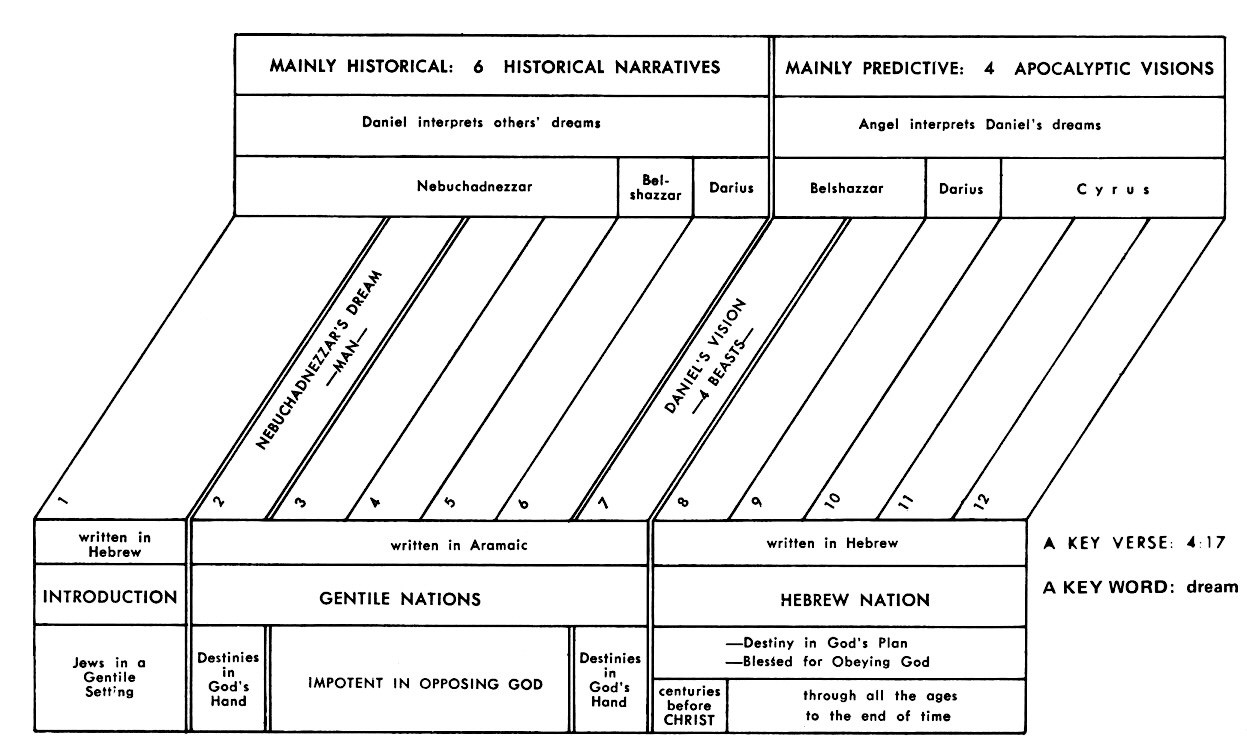
| Daniel 1 | Daniel 2:4-7:28 | Daniel 8-12 |
| Written in Hebrew |
Written in Aramaic |
Written in Hebrew |
|
Daniel's "No Compromise" Stand |
God's Prophetic Plan for Gentile Nations |
God's Prophetic Plan for Israel |
Daniel 5:1 Belshazzar the king held a great feast for a thousand of his nobles, and he was drinking wine in the presence of the thousand.
- Held: Ge 40:20 Es 1:3 Isa 21:4,5 22:12,14 Jer 51:39,57 Na 1:10 Mk 6:21,22
- Youtube video - Daniel 5 Handwriting on the Wall
- Daniel 5 Resources - Multiple Sermons and Commentaries
Related Passages:
Proverbs 16:18 Pride goes before destruction, And a haughty spirit before stumbling.
Isaiah 47:8-11 “Now, then, hear this, you sensual one, Who dwells securely, Who says in your heart, ‘I am, and there is no one besides me. I will not sit as a widow, Nor know loss of children.’ 9“But these two things will come on you suddenly in one day: Loss of children and widowhood. They will come on you in full measure In spite of your many sorceries, In spite of the great power of your spells. 10“You felt secure in your wickedness and said, ‘No one sees me,’ Your wisdom and your knowledge, they have deluded you; For you have said in your heart, ‘I am, and there is no one besides me.’ 11“But evil will come on you Which you will not know how to charm away; And disaster will fall on you For which you cannot atone; And destruction about which you do not know Will come on you suddenly.
Luke 12:19-20 ‘And I will say to my soul, “Soul, you have many goods laid up for many years to come; take your ease, eat, drink and be merry.”’ 20“But God said to him, ‘You fool! This very night your soul is required of you; and now who will own what you have prepared?’
1 Thessalonians 5:3 While they are saying, “Peace and safety!” then destruction will come upon them suddenly like labor pains upon a woman with child, and they will not escape.
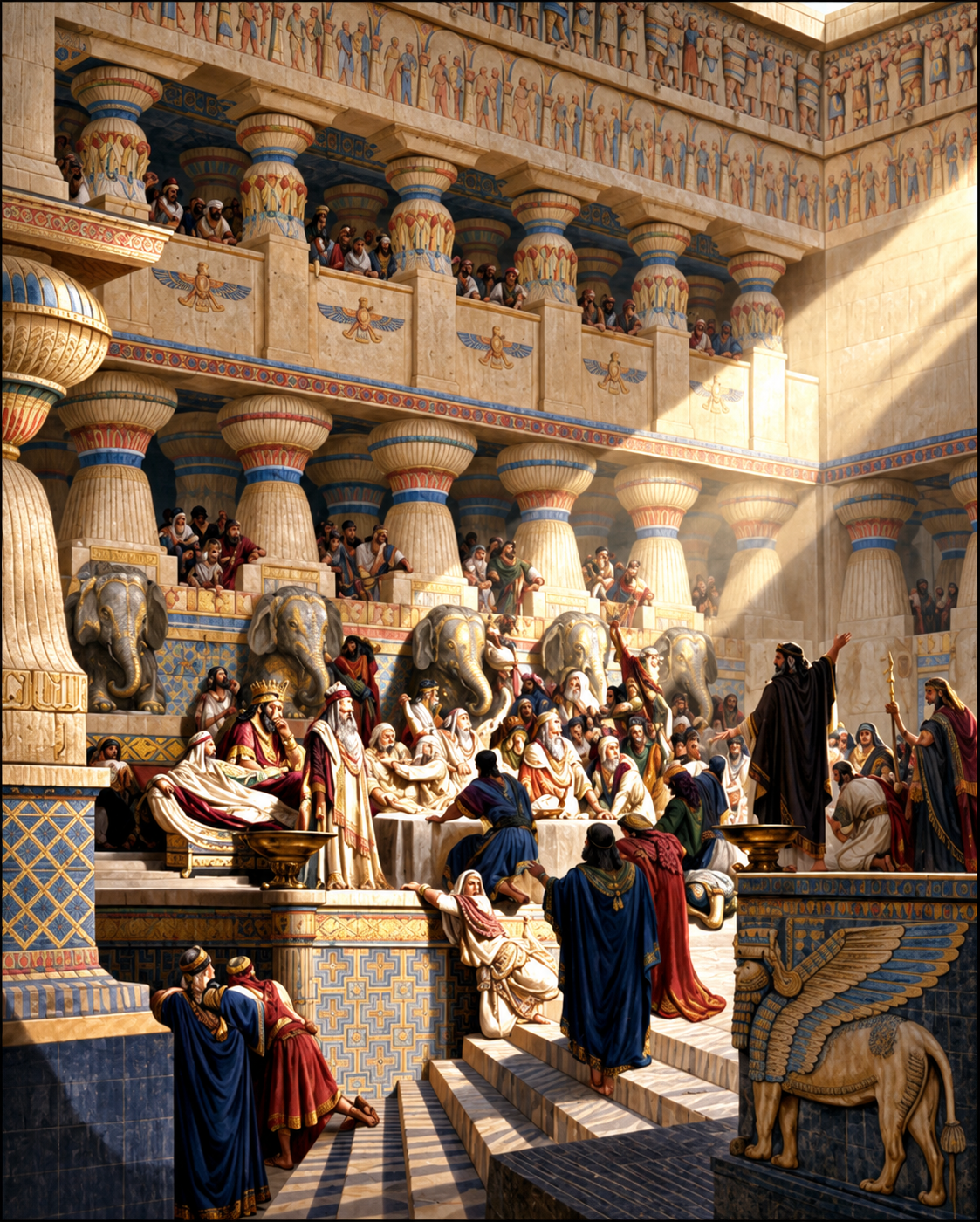
Belshazzar's great feast
THE CRITICS CRIED FOUL…
"BELSHAZZAR A KING?"
Belshazzar the king held a great feast for a thousand of his nobles, and he was drinking wine in the presence of the thousand - Daniel 5 opens with a dramatic contrast to Daniel 4. Nebuchadnezzar had learned through divine humiliation that the Most High rules over the realm of mankind (Da 4:34–37). Belshazzar, however, appears utterly unconcerned about the sovereignty of God. Instead, he is entertaining a thousand nobles at a lavish royal banquet. There is a striking irony in this scene. Belshazzar was surrounded by a thousand nobles, yet not one of them could protect him from the judgment that would arrive before the night was over (Da 5:30). His wealth, royal position, and apparent security could not change the decree of the Most High. The king was drinking to his prosperity while the clock was ticking toward his destruction. Belshazzar was feasting as though tomorrow were guaranteed, but before the night was over, he would discover that earthly security is no substitute for being right with the sovereign God.
Donald Campbell writes that Daniel 5 is "significant for its demonstration of the trustworthiness of the Book of Daniel, and by extension, all of Scripture. One writer claimed that this chapter is "notable for its historic inconsistencies." Bible critics have stumbled over the words of the chapter, "Belshazzar the king," because the ancient historians cited Nabonidus as the last king of Babylon and made no mention of Belshazzar. Is the Book of Daniel in error on this point? (Read on!)… When confronted with a supposed error in the Scriptures, therefore, the better part of wisdom is to withhold judgment until man's knowledge "catches up" with biblical statements. In every case the sacred record has been substantiated." (Borrow Daniel, decoder of dreams - well written, practical, recommended)
David Jeremiah adds "In the fifth chapter of the Book of Daniel, the story is told of Belshazzar, king of Babylon, who is said to have been slain during a drunken feast on the night Babylon fell. Secular history says the king of Babylon at that time was Nabonidus. Who is right? No one knew how to reconcile these two accounts until Sir Henry Rawlinson discovered an inscription on a cylinder found in the Euphrates River. It cleared up the problem. There were two kings of Babylon during Daniel’s later life, a father and a son. Nabonidus, who occupied a stronghold outside the city, had his eldest son, Belshazzar, as co-regent. He allowed him to use the royal title. Belshazzar was slain while defending the city; Nabonidus was spared. This detail explains Daniel 5:29, where it says: “Then at Belshazzar’s command, Daniel was clothed in purple, a gold chain was placed around his neck, and he was proclaimed the third highest ruler in the kingdom.” (See The Handwriting on the Wall - Page 19)
When does this chapter occur? About seventy years after the events of Daniel chapter 1 (which occurred in 605 BC), during the reign of the last king of Babylon, at the juncture of the fine gold, its breast and its arms of silver (Da 2:32, Da 2:39) representing the passage of the Gentile kingdoms from Babylon to Medo-Persia in 539 BC, substantiating the truth that God's Word of prophecy is true and that the God of the Word is sovereign for it is He Alone Who removes kings and establishes kings. (Da 2:21).
One other detail is that the Medo-Persian army led by Cyrus had undertaken a siege against Babylon and some sources report that it had been in effect for 4 months. Belshazzar foolishly thought no one could touch him. He was going to party. After all Babylon is reported to have enough grain to feed them for 20 years and the Euphrates River provided a reliable water supply. They had a false security, just like all unbelievers. Belshazzar was like the man in Pr 18:11 "A rich man's wealth is his strong city, And like a high wall in his own imagination." As Criswell says "The rich man imagines his wealth to be a strong defense to secure him from whatever storms of life may come, but that protection is only "in his own esteem," i.e., in his own estimation. In actuality, only God is a sure refuge (Pr 18:10).
| Proverbs 18:10,11 A DRAMATIC CONTRAST |
|||
| Righteous Pr 18:10 |
Trust in (see next) |
Name of Yahweh Jehovah |
Is Safe (Fact) |
| Rich Pr 18:11 |
Money (mammon) |
Imagines safe (Fiction) |
|
Both proverbs speak of a refuge - a sure refuge in God in Pr 18:10 but a shaky refuge in wealth in Pr 18:11.
Jesus warned against the snare of wealth in His Sermon on the Mount "No one (Greek = absolute negation) can (dunamai = has the inherent ability to continually [present tense]) serve (douleuo = be a slave, give up your rights to the will of your master!) two masters (kurios); for either he will hate the one and love (agapao) the other, or he will hold to one and despise (kataphroneo) the other. You (absolutely) cannot serve (douleuo) God and mammon (mammonas). (Mt 6:24)
James spoke to this humanistic mindset that characterizes all mankind "Yet you do not know what your life will be like tomorrow. You are just a vapor that appears for a little while and then vanishes away. Instead, you ought to say, "If the Lord wills, we shall live and also do this or that." (James 4:14, 15)
Life is fragile but the pagan mindset says "Let us eat, drink and be merry, for tomorrow we will die." (cp Lk 12:19) For Belshazzar it would not be tomorrow but today!
Some commentators date this chapter at more than 20 years after the end of Daniel 4. Certainly there has been a considerable time gap because King Belshazzar does not appear to have even known Daniel personally! (cp the new Pharaoh's ignorance of Joseph - Ex 1:8) In addition Daniel was no longer the chief of the magicians. Nevertheless his reputation persisted because he had not ceased to run with endurance (Heb 12:1, He 12:2) setting an example of excellence for all generations to come (cp Heb 6:11, 12).
Daniel 5 is the source of several sayings that are popular in the secular culture: (1) "the handwriting is on the wall" speaking of impending disaster that is so obvious only a fool could not see it coming and (2) A similar expression stating that "your days are numbered." (3) The description of one in great fear as "his knees are knocking"! (As someone once said "If your knees are knocking, kneel on them!")
Reading Daniel 5 is like seeing a catastrophic tsunami coming and not being able to do anything about it. Sin is deceptive (Heb 3:13) and Belshazzar was deceived and it cost him his life and his kingdom! Do not be deceived beloved brethren!
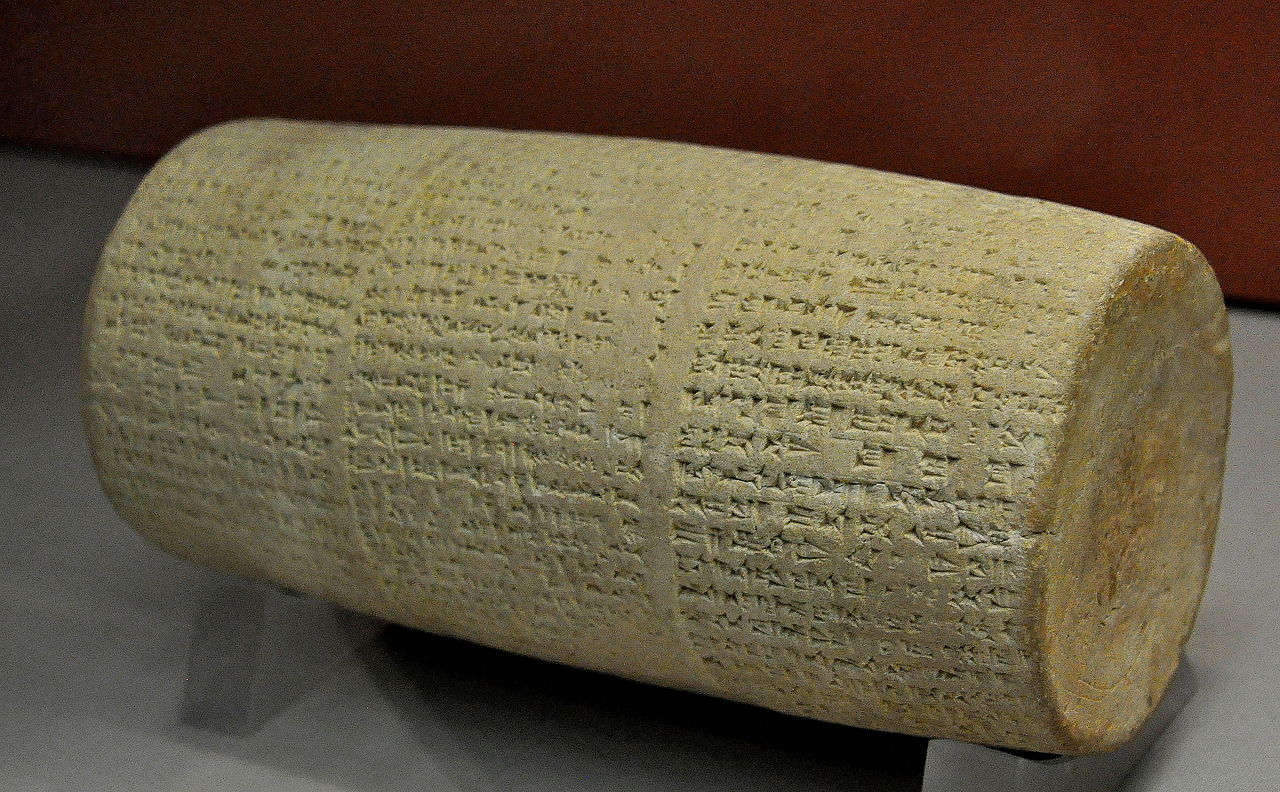
Belshazzar the king - Da 5:30, 31 identifies Belshazzar as the last king of Babylon. Skeptics and liberal critics prior to 1853 used the reference to this king in Daniel 5 as evidence that the entire book was a fraud. They reasoned that the historical record clearly demonstrated that a man named Nabonidus was the last king of Babylon (Reign = 556-539BC). They were convinced they had discovered another "error" in Daniel. That is, they were "convinced" until 1853 when archaeologists discovered a clay cylinder at Ur in Mesopotamia inscribed with the following prayer…
As for me, Nabonidus, king of Babylon, save me from sinning against your great godhead and grant me as a present a life long of days, and as for Belshazzar, the eldest son -my offspring- instill reverence for your great godhead in his heart and may he not commit any cultic mistake, may he be sated with a life of plenitude. (Wikipedia)

The inscription on the Nabonidus Chronicle helps understand how Belshazzar could be considered "co-regent" with Nabonidus…
The king (Nabonidus) was in Tema; the king’s son (Belshazzar), courtiers and army were in Babylonia.
Comment: Note that both the Nabonidus Cylinder and the Nabonidus Chronicle are inscribed in cuneiform script on clay tablets. Once again God's Word is proven inerrant and fully trustworthy.
Nabonidus Cylinder
Daniel actually substantiates the fact that Belshazzar was a co-regent with Nabonidus by offering "authority as third ruler in the kingdom" (Da 5:7) to anyone who could read and interpret the handwriting on the wall. He could not offer second in command because he was not first in command!
Once again we see that the Truth of God's Word is vindicated, as if God needed anyone to vindicate Him! The Bible is correct regardless of whether "confirmatory" ruins or artifacts are unearthed or not! It is not so much that archeology proves the Bible is correct but that the Bible proves archeology is correct. Or stated another way, never judge the Bible by history but history by the Word of God because History is "HIS-Story"! I am reminded of Jesus' words in the story of the rich man and Lazarus, where the rich man claims that if "someone goes to (his 5 brothers) from the dead, they will repent!" (Lk 16:30), to which Abraham replied "If they do not listen to Moses and the Prophets, neither will they be persuaded if someone rises from the dead." (Lk 16:31) External evidences are great, and God used apologetics in my coming to faith, but the Word of God stands unmatched as "evidence" for God, His Son Jesus Christ and His glorious Gospel of grace. Hallelujah!
Related resources on archaeology and the Bible:
- Bible Believer's Archaeology Belshazzar and Darius the Mede
- Bible Believer's Archaeology - #2
- List of artifacts significant to the Bible - from Wikipedia.
Josephus quotation of Berossus (a Hellenistic Babylonian writer, a priest of Bel, who lived around 300BC) provides us with one of the best summaries of royal lines that followed the death of Nebuchadnezzar (Reigned 43 years = 605-562BC)…
After beginning the wall of Which I have spoken, Nabuchodonosor (Nebuchadnezzar) fell sick and died, after a reign of forty-three years, and the realm passed to his son Evilmaraduch. This prince, whose government was arbitrary and licentious, fell a victim to a plot, being assassinated by his sister's husband, Neriglisar, after a reign of two years. On his death Nerighsar, his murderer, succeeded to the throne and reigned four years. His son, Laborosoardoch, a mere boy, occupied it for nine montlis, when, owing to the depraved disposition which he showed, a conspiracy was formed against him, and he was beaten to death by his friends. After his murder the conspirators held a meeting, and by common consent conferred the kingdom upon Nabonnedus (Nabonidus), a Babylonian and one of their gang. In his reign the walls of Babylon abutting on the river were magnificently built with baked brick and bitumen. In the seventeenth year of his reign Cyrus advanced from Persia with a large army, and, after subjugating the rest of the kingdom, marched upon Babylonia. Apprised of his coming, Nabonnedus led his army to meet him, fought and was defeated, whereupon he fled with a few followers and shut himself up in the town of Borsippa. Cyrus took Babylon (Da 5:31), and after giving orders to raze the outer walls of the city, because it presented a very redoubtable and formidable appearance, proceeded to Borsippa to besiege Nabonnedus. The latter surrendering, without waiting for investment, was humanely treated by Cyrus, who dismissed him from Babylonia, but gave him Carmania for his residence. There Nabonnedus spent the remainder of his life, and there he died." (Flavius Josephus, "Against Apion," in Josephus 1:221-25.)
Nabonidus the king of Babylon spent most of his reign (by some reports as long as 14 of his 17 years in power) in Tema (See also Tayma) in the middle of Arabia. In order to retain power in Babylon, he appointed his son Belshazzar as co-king or co-regent.
Related Resource:
The Apologetics Study Bible adds that "Until the latter half of the nineteenth century, Belshazzar's name was unattested except for the book of Daniel and works dependent on it (Baruch, Josephus). From other sources Nabonidus was known to have been the last king of Babylon, and some critics declared Belshazzar to be fictional. However, during the past 150 years abundant evidence has come to light (at least 37 archival texts) demonstrating that Belshazzar was a real person, the son of Nabonidus and ruler of Babylon during his father's extended absences." (Online The Apologetics Study Bible- Understand Why You Believe)
Jeremiah records a prophecy that relates to this chapter - "And now I have given all these lands into the hand of Nebuchadnezzar king of Babylon, My servant, and I have given him also the wild animals of the field to serve him. And all the nations shall serve him, and his son, and his grandson, UNTIL the time of his own land comes; THEN many nations and great kings will make him their servant." (Jer 27:7)
In Daniel 5 "the time" had come! In this same chapter Jeremiah gives another prophecy regarding the Temple vessels of Jehovah - "Yes, thus says the LORD of hosts, the God of Israel, concerning the vessels that are left in the house of the LORD, and in the house of the king of Judah, and in Jerusalem,'They shall be carried to Babylon, and they shall be there until the day I visit them,' declares the LORD. 'Then I will bring them back and restore them to this place.'" (Jer 27:21-22)
While some interpret "son and his grandson" in Jeremiah 27:7 to be Nabonidus and Belshazzar, there is a problem with this interpretation as Nabonidus does not appear to actually have been Nebuchadnezzar's son. Thomas Constable feels that this notation is a reference to Evil-Merodach (Jer 52:31) who was Nebuchadnezzar's son and to Belshazzar who was his grandson (as explained by Gaebelein below).
Arno Gaebelein writes that Nabonidus "had a daughter of Nebuchadnezzar for wife and therefore Belshazzar from his mother's side was the grandson of Nebuchadnezzar." (The prophet Daniel - a key to the visions and prophecies)
John Whitcomb - The final blow to critical objections to the historicity of the fifth chapter of Daniel came in 1924, when Sidney Smith of the British Museum published a cuneiform document known as the "Persian Verse Account of Nabonidus," which contains the statement that Nabonidus "entrusted the kingship" to Belshazzar. This crucially important statement reads as follows: "When the third year [553 B.C.] was about to begin, he [Nabonidus] entrusted the 'Camp' to his eldest son, the firstborn, the troops everywhere in the country he ordered under his command. He let everything go, entrusted the kingship [sarrutum] to him and, himself, he started out for a long journey.'" (SEE Daniel- Everyman's Bible Commentary - Page 71)
King Cyrus of Persia (Cyrus the Great) also refers to Belshazzar when he conquered Babylon in his writings: "A coward was put in charge as the king of this country … With evil intents he did away with the regular offerings to the gods … and desecrated the worship of the king of his gods, Marduk."
Thousand of his nobles (not even counting his wives and his concubines) - This was extravagant to the max but it was typical of the Persian kings who followed Babylon (see Esther 1:3-8). In fact oriental kings were notorious for their extravagant feasts, archaeological discoveries revealing that some Persian monarchs were known to dine daily with 15,000 guests at a meal. At Alexander the Great's marriage 10,000 guests attended his wedding dinner. Ashurnasirpal II had a banquet for 69,754 guests at a banquet dedicating his new capital city Calah in 1879 BC. Athanasius describes the food at these banquets writing that "1,000 animals are slaughtered daily for the king. These comprise horses, camels, oxen, asses, deer, and most of the smaller animals. Many birds are consumed, including Arabian ostriches, geese, and chickens."
Speaker's Commentary agrees that large numbers of attendees were well known in oriental banquets "15,000 men fed daily at the king's cost in the Persian courts; Alexander the Great once invited 10,000 to a wedding feast; Ptolemy Dionysus undertook the daily nurture of 1000 soldiers of Pompey the Great. It was usually at the close of the banquet proper that the drinking began: and it was so here. Belshazzar under the influence of wine became boastful and fool-hardy."
Renald Showers - On such occasions it was an Oriental custom for the king to sit at a separate table on an elevated platform where all the guests could see him. (The Most High God- A Commentary on the Book of Daniel)
Drinking wine - Security and sensuality are often harbingers of approaching ruin. The Medo-Persian army was already outside Babylon, and Nabonidus had either been captured or cut off from returning to the city. Belshazzar, ruling in his father’s place, was well aware of the threat. Yet, feeling secure behind Babylon’s massive walls, he had the hubris to hold a great feast, indulge freely in wine, and offer praise to Babylon’s so-called “gods.” While the enemy stood at the gates, Belshazzar celebrated as though Babylon were impregnable.
Belshazzar's greatest danger was not the army outside the walls,
but the false security inside them.
Stauffer summarizes the previous chapters "God is our Judge (Daniel 1), our Revealer (Daniel 2), Igniter (Daniel 3), and Gracious King (Daniel 4)."
James M. Boice entitles Daniel 5 “The Sin God Will Not Tolerate”, emphasizing of course that in truth there is no sin which God will tolerate.
- The Ball - Da 5:1
- The Gall - Da 5:2-4
- The Wall - Da 5:5-6
- The Call - Da 5:7-16
- The Fall - Da 5:17-31
Belshazzar's Feast, Da 5:1-31 (Don Robinson - Outline of the Book of Daniel)
- Da 5:1-4 - Belshazzar's Contribution to the Feast: Unrestrained Sensuality,
- Da 5:5-6 - God's Contribution to the Feast: Handwriting on the Wall
- Da 5:7-29 - Daniel's Contribution to the Feast: Announcement of Doom
- Da 5:30-31 - Darius's Contribution to the Feast: Destruction of Babylon
Norman Geisler - When Critics Ask - DANIEL 5:1—How can Daniel say the last king of Babylon was Belshazzar when history records that it was Nabonidus?
PROBLEM: Daniel 5 records the downfall of Babylon and identifies the king of Babylon as Belshazzar. However, neither Babylonian nor Greek historians record the existence of any such person. In fact, ancient historians report that Nabonidus was the last king of the Babylonian empire. Is Daniel’s record in error?
SOLUTION: Daniel’s historical record of Belshazzar has been confirmed by recent archaeological evidence. Nabonidus was the king of Babylon from 556 to 539 B.C. However, according to a cuneiform document known as the “Persian Verse Account of Nabonidus,” in the third year of his reign, about 553 B.C., Nabonidus departed from Babylon on a long journey and entrusted the rule of Babylon into the hands of his first born son, Belshazzar. When Cyrus overthrew Babylon, Nabonidus was in Tema in North Arabia. Since Belshazzar was the subordinate of Nabonidus, his name was forgotten, because the ancient Babylonian and Greek historians were primarily interested in the reigns of the official kings. Daniel’s record has proven to be amazingly accurate.
THE HANDWRITING OF DEATH - Croft Pentz Daniel 5:1–7, 17–18, 24–28
Despite God’s warnings, man continues to forget God. Belshazzar is an example of what happens to a man who neglects God. Man has forgotten God in all phases of his life.
1. THE FEAST—vv. 1–4
2. THE FEAR—vv. 5–7
3. THE FUTURE—vv. 17–18, 20–28
Never be so busy that you have no time for God. Man is foolish to think that he can live without God. Most men feel they will live in pleasure and then just a short time before death take time for God.
John Butler - Sermon Starters…
The Fall Of A King Daniel 5
GOD REJECTED - Da 5:1-4
There was a drinking party. King Belshazzar called for the sacred vessels taken out of the Temple in Jerusalem. While desecrating the sacred vessels the people also praised their false Gods. The true God was obviously being rejected.
THE PROPHET REMEMBERED - Da 5:5-12
This was a time of fear and confusion. The fingers of a man's hand appear and write on the wall.
This was also a time when others couldn't help. The Queen Mother remembered Daniel after all the wise men of Babylon could not tell the king the meaning of the writing on the wall. Isn't it interesting how often people turn to God only after all other possible sources of help have been depleted?
THE KING REBUKED - Da 5:13-31
Compliment - Da 5:13-16 - The king had heard of Daniel and his ability. He offered great reward if Daniel would interpret the writing on the wall.
Comparison - Da 5:17-23 - Daniel tells the story of Nebuchadnezzar who had been disciplined by God and repented, humbling himself before God. (See Daniel 4.) By contrast, Belshazzar rebelled against God and hadn't repented.
Condemnation - Da 5:24-31 - The handwriting on the wall was interpreted. Belshazzar is judged and found wanting. His kingdom was taken from him.
The Party's Over - Daniel 5
We use the expression "The Party's Over" to say that whatever a person has enjoyed doing has been completed. Reality has set in, and a person must face whatever consequences are facing him.
Belshazzar, a wicked king, was literally having a party. God was announcing that the party was over for Belshazzar. The enemy armies were outside the city. The Kingdom of Babylon was about to fall to the Medes and Persians.
CORRUPTION OF THE KING Da 5:1-4
The king was committing blasphemy by drinking out of containers dedicated to God (Jerusalem temple), and praising his gods of wood and stone.
CONFUSION IN THE COURT Da 5:5-16
The mysterious fingers appear on the wall. Everyone is in a panic. Nobody could read the writing. The queen mother suggests that Daniel be called in.
CONSULTATION WITH THE PROPHET Da 5:17-24
Daniel reminds Belshazzar of Nebuchadnezzar's rebellion against God, his judgment, restoration and repentance (See Daniel 4). Although Belshazzar knew these things, he rebelled against the Lord of heaven.
CONDEMNATION BY GOD Da 5:25-31
God finished Belshazzar's kingdom that night.
When God Crashes the Party By Dr. Denis Lyle
Scripture: Daniel 5:1–31, especially verse 27
You have been weighed in the balances, and found wanting. (NKJV)
Introduction: Have you ever felt like you were invincible? In adolescents, this perception is called personal fable, which appears when teenagers drive recklessly or take major risks without much forethought. Maybe you’re living in sin now, cheating on your spouse, or stealing from your company, but you feel safe because you think no one will ever know. Belshazzar felt the same way in the impregnable city of Babylon, and yet the very night of one of his biggest parties, the Lord took his life for his sins.
1. The Tragic Dissipation. This was a night of royal revelry for Belshazzar and his friends. Some feel this feast was given to boost morale as the enemy was at the gates; others tell us it was to honor one of the Babylonian gods. With rings on their fingers and bracelets on their arms, they were dressed in the finest clothing with opulent jewels. The atmosphere filled with fragrance of perfume. Music, dancing, drinking: it all sounds so up-to-date. Babylonian culture lacked restraint. They overindulged in food, drink, idol worship, sex, etc.
A. The Feast Belshazzar Threw. The feast was marked by intemperance (vv. 1, 5), as the royal party became drunk. The party was full of impropriety: the women mentioned were probably here for the purpose of a sexual orgy (v. 1). We also see impiety: the sacred vessels made by Solomon (see 2 Kin. 20:13) were used for this sinful indulgence of wine; it was blasphemy against the Lord and His sacred things. Idolatry is also clearly displayed: the gods of earthly things are praised (v. 4).
B. The Fingers Belshazzar Viewed. Suddenly, in the same hour (v. 5), the music stopped, the singing ended, the dance floor became silent, the party grinded to a halt. Every eye was riveted on the mysterious fingers writing on the wall. Why did God reveal His judgment in this way? Kings of Babylon were known for writing solemn decrees. Now God reveals to them that He is the true King upon the throne, and He, too, can issue solemn decrees!
C. The Fear Belshazzar Knew. The king’s countenance changed (v. 6). The jovial, drunken king lost his courage; his knees began to knock (v. 6), and he even cried out loud (v. 7) to bring in interpreters, but no magician or sorcerer could conjure up an explanation.
2. The Prophetic Revelation. Leave it to a woman to come up with the best ideas! The queen, having heard all the stories of Daniel’s great character and godliness, suggested that he be brought in to interpret the writing on the wall. Daniel responded in two ways:
A. Daniel Explains History. Daniel recounted the history of the kings and lays out charges against Belshazzar: he despised the light, not learning from his father’s mistakes (v. 22). He desecrated the vessels of the Lord (v. 23), and he defied the Lord by praising dead idols and not glorifying the Lord who held his life (v. 23).
B. Daniel Reveals Mystery. The writing on the wall contained a three-fold message from God. Daniel told him that MENE, meaning “numbered,” revealed that the empire would soon collapse. TEKEL, meaning “weighed,” meant that Belshazzar had been weighed on God’s scales and came up lacking! PERES, meaning “divided,” implied that God determined to shatter Belshazzar’s kingdom and to give it to Medo-Persia.
3. The Historic Consummation. Notice how solemn the words are here, “That very night Belshazzar, king of the Chaldeans, was slain” (v. 30). The Medo-Persians devised a scheme: they diverted the water of the Euphrates from its normal channel under the city walls. When the water was shallow enough to be forded, the soldiers entered beneath the city walls through this tunnel (cf. Is. 41:25; 45:1–4).
Conclusion: Looking at your own life, could God come and crash your party at any minute? Are you living in sin, thinking it will never catch up to you? My friends, God is not satisfied until we are completely devoted and obedient to Him. Belshazzar didn’t glorify the God that gave him breath, so God took it from Him. How long do we have on this earth? We should choose to glorify, to praise, and to serve the Lord with the lives He has given to us.
The God Who gives us breath
deserves the life that breath sustains.
Daniel 5:2 When Belshazzar tasted the wine, he gave orders to bring the gold and silver vessels which Nebuchadnezzar his father had taken out of the temple which was in Jerusalem, so that the king and his nobles, his wives and his concubines might drink from them.
- Gold - Da 1:2 2Ki 24:13 25:15 2Ch 36:10,18 Ezra 1:7-11 Jer 27:16-22 Jer 52:19
- Da 5:11,13,18 2Sa 9:7 2Ki 8:25-27 2Ch 11:20 15:16 Jer 27:7
- Daniel 5 Resources - Multiple Sermons and Commentaries
Related Passages:
Daniel 1:2 The Lord gave Jehoiakim king of Judah into his hand, along with some of the vessels of the house of God; and he brought them to the land of Shinar, to the house of his god, and he brought the vessels into the treasury of his god.
2 Chronicles 36:7; 10 Nebuchadnezzar also brought some of the articles of the house of the LORD to Babylon and put them in his temple at Babylon. (36:10) At the turn of the year King Nebuchadnezzar sent and brought him to Babylon with the valuable articles of the house of the LORD, and he made his kinsman Zedekiah king over Judah and Jerusalem.
Jeremiah 52:19 The captain of the guard also took away the bowls, the firepans, the basins, the pots, the lampstands, the pans and the drink offering bowls, what was fine gold and what was fine silver.
Leviticus 10:1-3 Now Nadab and Abihu, the sons of Aaron, took their respective firepans, and after putting fire in them, placed incense on it and offered strange fire before the LORD, which He had not commanded them. 2And fire came out from the presence of the LORD and consumed them, and they died before the LORD. 3Then Moses said to Aaron, “It is what the LORD spoke, saying, ‘By those who come near Me I will be treated as holy, And before all the people I will be honored.’” So Aaron, therefore, kept silent.
Daniel 5:22-23 “Yet you, his son, Belshazzar, have not humbled your heart, even though you knew all this, 23but you have exalted yourself against the Lord of heaven; and they have brought the vessels of His house before you, and you and your nobles, your wives and your concubines have been drinking wine from them; and you have praised the gods of silver and gold, of bronze, iron, wood and stone, which do not see, hear or understand. But the God in whose hand are your life-breath and all your ways, you have not glorified.
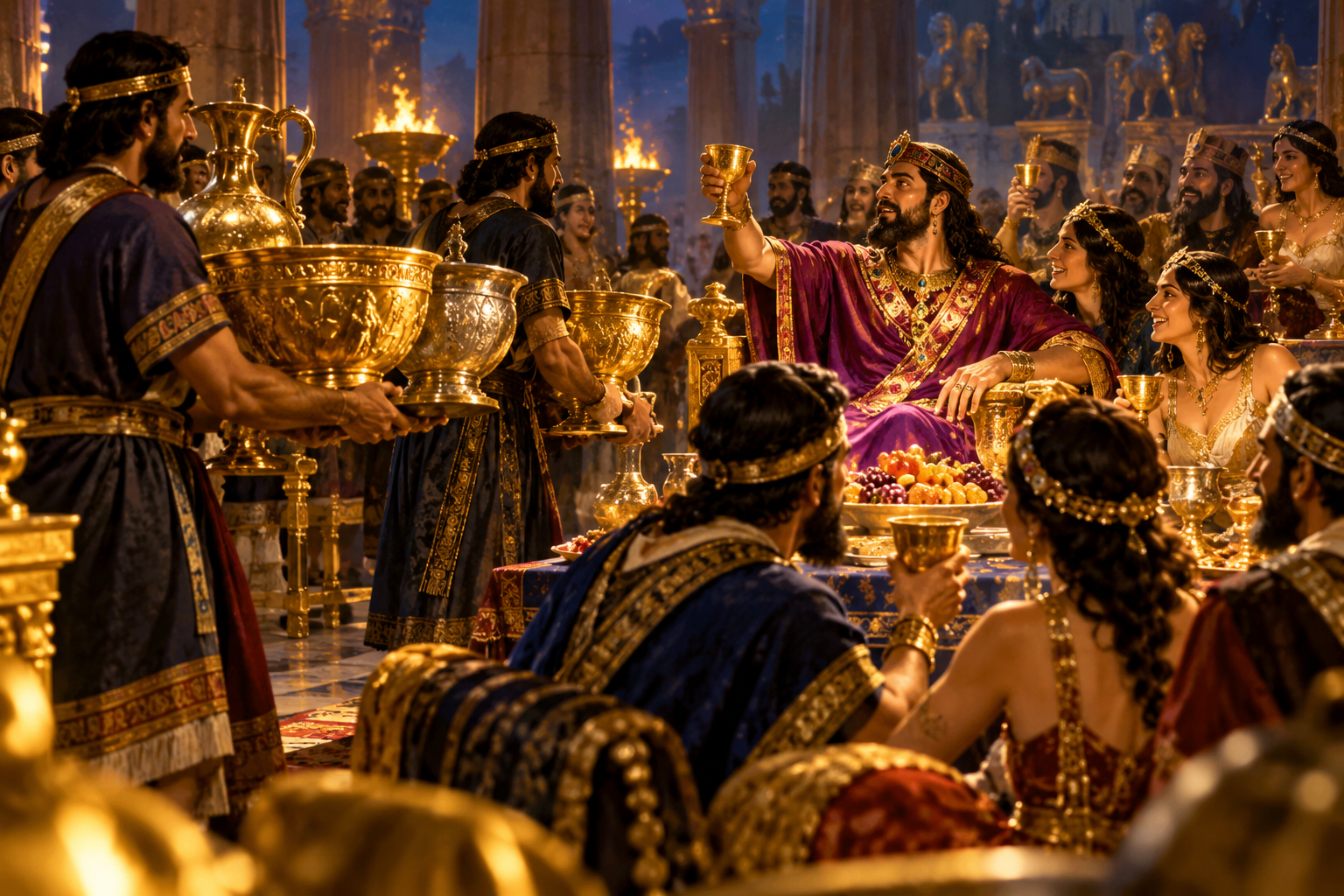
DESECRATING WHAT
BELONGS TO GOD
When Belshazzar tasted the wine, he gave orders to bring the gold and silver vessels which Nebuchadnezzar his father had taken out of the temple which was in Jerusalem, so that the king and his nobles, his wives and his concubines might drink from them - The NRSV translates it somewhat interpretatively (but I think accurately) "Under the influence of the wine" (cp paraphrase Contemporary English Version which is very interpretative = "He got drunk" [This highlights one of the reasons why serious Bible study should always be carried out using a more literal translation like NAS, ESV, NKJV-See Bible Versions compared for Literalness]). The expression suggests that under the influence of wine, Belshazzar made the reckless decision that follows. The wine did not create the pride in his heart, but it helped remove the restraints that might otherwise have kept that pride from expressing itself. There is an important progression in the chapter. Verse 1 describes indulgence; verse 2 moves toward sacrilege.
Belshazzar should have read Pr 20:1 and Pr 31:4 (cp Pr 23:29, 30, 31, 32, Hab 2:5)! Notice that this is the second mention of imbibing of "spirits" (Da 5:1, 2), emphasizing that the Spirit (speaking of "spirits ~ wine) clearly desires to for us to understand the background for the events in this chapter! We have spoken before about what occurs when one is "controlled" by various attitudes (anger, fear, etc) and agents (be they alcohol or mind altering drugs) (See notes on Da 3:17). "Do not be filled with (controlled by) wine, for that is dissipation, but be filled (continually) with the Spirit." (Eph 5:18)!
Alcohol may loosen the restraints, but also gives opportunity
for what is already residing in the heart to reveal itself.
Bob Deffinbaugh has an interesting anecdotal story - Understanding how things went from bad to worse in these verses is not difficult. As a college student, I worked several months for a caterer. One night we catered a banquet for a group of socialites in the city of Seattle. As the night wore on and the alcohol flowed freely, I saw and heard things I never would have expected or believed from people normally very proper and dignified. (The Hand of God in History)
He gave orders to bring the gold and silver vessels - When wine controls us we always act the part of the fool! Belshazzar (his name means "Bel Protect the King"!) shows his contempt for the Most High God (Da 3:26, Da 4:2, Da 5:18, 21). They were celebrating how powerful they were saying "We conquered the God of the Jews." This was a bad choice on Belshazzar's part and marked the "beginning of the end". Isaiah alludes to the effect of wine on one's judgment…
And these also reel with wine and stagger from strong drink: The priest and the prophet reel with strong drink. They are confused by wine, they stagger from strong drink. They reel while having visions. They totter (waver, stumble, used of one who is incapacitated and unable to render judgments with integrity) when rendering judgment. (Isaiah 28:7, cp Isa 5:11, 22)
Instead, there is gaiety and gladness, Killing of cattle and slaughtering of sheep, Eating of meat and drinking of wine: "Let us eat and drink, for tomorrow we may die." (Isaiah 22:13)
Comment: Not tomorrow but tonight for Belshazzar!
Gold and silver vessels (see Da 1:2, 2Chr 36:7, 10) - These holy vessels had been taken from the Temple in Jerusalem when Nebuchadnezzar conquered the city and placed them in the treasure house of his god (Da 1:2). They would eventually be returned to Jerusalem (Ezra 1:7–11). That detail now becomes critically important. The vessels had remained in Babylon for decades, apparently preserved and set apart rather than used for common purposes. But on this fateful night, Belshazzar deliberately brought these sacred vessels into his drunken banquet and used what had been consecrated to the true God to toast the false gods of Babylon. What had been preserved for decades was profaned in a single night.
Nebuchadnezzar had taken the vessels,
but Belshazzar would desecrate them.
Belshazzar’s goal may have been to demonstrate the supposed superiority of Babylon’s “gods” over the God of the Hebrews. But in doing so, he made a fatal mistake: he attempted to mock the very God who had given the holy vessels into Nebuchadnezzar’s hand in the first place (Da 1:2). Babylon’s victory over Jerusalem had never demonstrated the superiority of her gods; it had demonstrated the sovereignty of Israel’s God, Who had delivered Judah into Babylon’s hand. Belshazzar tragically mistook God’s sovereign permission for God’s defeat. Belshazzar was about to discover that the God he mocked was the God who held his very life and kingdom in His hands (Da 5:23).
Paul spoke of the deceitfulness of such the foolishness of mocking God writing…
Do not be deceived (planao in the present imperative with a negative = Stop being deceived!), God is not mocked (mukterizo from mukter = the nose, nostril) literally means to turn up one’s nose and thus pictures the idea of scorn!); for (term of explanation) whatever a man sows, this he will also reap. For (term of explanation) the one who sows to his own flesh shall from the flesh reap corruption (phthora = decay, not a sudden destruction owing to external violence, but a dissolution brought about by internal decay), but the one who sows to the Spirit shall from the Spirit reap eternal life (in this life and the life to come, cp 1Ti 4:8). (Gal 6:7, 8)
Contempt for what belongs to God
ultimately reveals contempt for God Himself.
His father (6x in 4v - Da 5:2, 11, 13, 18, 2Chr 36:10, Jer 52:19) - Belshazzar was almost certainly a grandson of Nebuchadnezzar, apparently through his mother’s line, while his biological father was King Nabonidus. Thus, the description of Nebuchadnezzar as Belshazzar’s “father” presents no difficulty. In Scripture, father can refer more broadly to an ancestor rather than exclusively to one’s immediate biological father. For example, David is described as the “father” of Jesus (Lk 1:31–32), although David lived approximately a thousand years before Christ. Gaebelein also notes that the Semitic languages did not have specific terms corresponding precisely to our English words “grandfather” and “grandson.” (Ref) Thus, referring to Nebuchadnezzar as Belshazzar’s “father” is entirely consistent with ancient Semitic usage.
The Apologetics Study Bible- Understand Why You Believe (Online) - "His predecessor" literally reads "his father" in the Aramaic text. Nebuchadnezzar is called Belshazzar's predecessor six times in this chapter (Da 5:2,11,13,18), and the king is designated as the "successor" (literally, "son") of Nebuchadnezzar once (Da 5:22). Babylonian sources record that Belshazzar was the son of Nabonidus. The apparent discrepancy may be explained by the use of the terms predecessor (or father) and successor (or son) in the Semitic languages. "Predecessor" could refer to one's immediate father, grandfather, ancestor, or as in the case of kings, the immediate predecessor. Likewise "successor" may mean one's immediate offspring, grandson, descendant, or the immediate successor. An example of the latter is Jehu's designation as the "son of Omri" in the Black Obelisk of Shalmaneser III. It is likely that Nabonidus wed a daughter of Nebuchadnezzar, making the great king both Belshazzar's "predecessor" and grandfather.
And his concubines -As described in Daniel 5:4, Belshazzar and his guests were practicing brazen idolatry, and throughout Scripture idolatry and immorality frequently travel together. Paul commands believers to put sexual immorality to death, even describing covetousness as idolatry (Col 3:5). He also associates sexual impurity with those who “do not know God” (1Th 4:5). Conversely, knowing God provides a powerful safeguard against surrendering to sensual desires. Gratitude to God is another important safeguard, for Paul contrasts sexual immorality, impurity, and filthy speech with giving thanks (Eph 5:3–4).
When men exchange the true God for gods of their own making, they remove the divine accountability they do not want and become increasingly free to justify the desires they do want. In that sense, “no God” readily follows from refusing to “know God.” Once God is displaced, the passing pleasures of the world, especially sensual and sexual pleasures, can readily take His place. The presence of Belshazzar’s wives and concubines at this drunken feast certainly adds to its atmosphere of sensual indulgence, although Daniel does not explicitly state that sexual activity or an orgy occurred (Da 5:2–4).
Daniel 5:3 Then they brought the gold vessels that had been taken out of the temple, the house of God which was in Jerusalem; and the king and his nobles, his wives and his concubines drank from them.
- Daniel 5 Resources - Multiple Sermons and Commentaries
Related Passages:
Proverbs 20:1 Wine is a mocker, strong drink a brawler, And whoever is intoxicated by it is not wise.
DESECRATING WHAT
GOD HAS CONSECRATED
Then - Then moves the narrative forward, but here it is not a step in a good direction.Then” marks the immediate response to Belshazzar's command in the preceding verse. What had been a drunken royal banquet now becomes an act of deliberate sacrilege. The next expression of time is suddenly and it belongs to God. In that very hour, the fingers of a man's hand appear and write on the wall (Da 5:5).
They brought the gold vessels that had been taken out of the Temple, the House of God (See Da 1:2) which was in Jerusalem; and the king and his nobles, his wives and his concubines drank from them. - For almost seventy years, God’s holy vessels had been stored away in the treasury of Babylon's god, apparently never used by Nebuchadnezzar for such a profane purpose. And remember that Babylon possessed God's vessels only because God had permitted Babylon to possess them. Belshazzar's big mistake was that he mistook divine permission for divine impotence.
Da 5:2 records the decision to sin while Da 5:3 records the execution of that decision. What Nebuchadnezzar had preserved as trophies, Belshazzar profaned as tableware. Between temptation and transgression, there is often a moment when the course can still be reversed. Belshazzar could have withdrawn his command. Even after the vessels were set before him, he could have reconsidered. He did not. The command became conduct, and desire became deed (compare James 1:14–15). When those sacred vessels touched their lips, Belshazzar and his guests crossed the line from drunken revelry into deliberate desecration. Vessels that had been kept for nearly seventy years were profaned in a moment.
The vessels were in Belshazzar's hands,
but Belshazzar was in God's hands.
Gaebelein comments that "This feast of wickedness and blasphemy needs no further annotations. But it shows the great decline morally in the great Babylonian empire. Nebuchadnezzar, no doubt, had handled the golden vessels of the house of the Lord most carefully. He had stored them away, fearing to misuse them. The grandson sent for these vessels to drink out of them wine with his harlots and to praise his idols."
The king and his nobles, etc - The sacrilege becomes corporate. It is worthy of note that one man of considerable renown apparently did not receive an invitation to the “Babylonian Ball (Brawl).” That man was Daniel. Indeed, as the chapter unfolds, Belshazzar seems virtually oblivious to the existence of this great prophet who had served as a trusted counselor to Nebuchadnezzar. Daniel was not wanted when the wine was flowing, but he was desperately needed when the handwriting appeared on the wall. When God suddenly interrupted the festivities and Babylon’s wise men had no answer, the forgotten prophet became the one man whose words the king desperately needed to hear. The world may ignore God’s servants in times of celebration, only to seek them out in times of crisis.
Daniel had no place at Belshazzar’s table,
but he would soon stand before Belshazzar’s throne.
🙏 THOUGHT - When the world throws a wild party, the children of God (Jn 1:12, 1:13, 1Jn 3:1, 1Jn 3:2, 1Jn 3:10, Ro 8:16, Php 2:15) are not invited (cp 1Pe 4:3, 4, 5), because darkness runs from the light (Jn 3:19, 20, 21, cp Jn 1:5!). We don’t fit in (2Co 6:14, 15, 16, 17, 18, 2Co 7:1) and our values only serve to irritate the revelers in their blatant debauchery - i.e., saints are "spoil sports"! We are not to be party goers, but "party showers" (lights exposing the folly and finality of darkness). Jesus exhorted us to be salt (which impedes corruption, but also can be an irritant! - Mt 5:13) and light (which exposes darkness and corruption - Mt 5:14, 15), but we are not to expect the world to love us (Jn 15:18-21) as we fulfill our purpose by carrying out our God appointed, God enabled "good works" in Christ Jesus (Ep 2:10, Mt 5:16)!
Contempt for what belongs to God
ultimately reveals contempt for God Himself.
Belshazzar and his band of carousers remind me of Paul's description of unbelievers in his letter to the Philippians (see esp v19)…
FOR (term of explanation) many walk (peripateo), of whom I often told you, and now tell you even weeping, that they are enemies (echthros) of the cross of Christ, whose end is destruction (apoleia), whose god is their appetite, and whose glory is in their shame (aischune), who set their minds (phroneo) on earthly things. (Php 3:18, 19)
Rich Cathers draws a pithy application from this picture of Belshazzar's abuse and misuse of God's holy vessels, writing…
Don’t abuse God’s vessels - You (believers) are those special, holy vessels. God wants you for special things, not drunken parties. (1Pe 1:15-16NLT) But now you must be holy in everything you do, just as God--who chose you to be his children--is holy. {16} For he himself has said, "You must be holy because I am holy."
The word “holy” means “set apart”. It means that something has been set apart for a special use. We usually consider our toothbrush to be “holy”. Most people would gag at the idea of using someone else’s toothbrush. God considers you “holy”. He wants you to be “holy”. He wants you to be used for His purposes. There was an old bumper sticker that read, “You touch-a my truck, I break-a you face”. The truck is meant for it’s owner’s use. God wants your body to be used for what He wants it used for.
Finally then, brethren, we request and exhort you in the Lord Jesus, that, as you received from us instruction as to how you ought to walk and please God (just as you actually do walk), that you may excel still more. 2 For you know what commandments we gave you by the authority of the Lord Jesus. 3 For this is the will of God, your sanctification; that is, that you abstain from sexual immorality (fornication)
It is God’s will that we be “holy”. Sanctification is that process where we become more and more like Jesus. Sanctification is the process of “holiness”. Fornication is defined as “sex outside of marriage”.
That each of you know how to possess his own vessel in sanctification (holiness) and honor, (1Th 4:1, 24 1Th 4:3, 1Th 4:4 KJV)
Our “vessel” is our body. Belshazzar abused the “vessels” of the Temple. God doesn’t want us to abuse our “vessels”. (Daniel 5)
As an aside look at the next verse…"not in lustful passion, like the Gentiles who do not know God." (1Th 4:5)
Comment: So what's the best "defense" against the strong lure of immorality? Look at the verse again. How do the Gentiles behave? Lustful passion, right? But the question is "why" do they behave this way? Paul says they "do not know God". So what the best defense against the offense of immorality? KNOW GOD! (Click for more discussion of this spiritual dynamic)
🙏 THOUGHT: Dear believer, under the New Covenant the emphasis is not upon sacred cups but upon sacred lives. You have been bought with a price and belong to God (1 Co 6:19,20). Belshazzar took what belonged to God and used it for his own pleasure. We should ask ourselves: Am I using the life that belongs to God for the purposes of God?
ILLUSTRATION - In the Netherlands
Observe the downward sequence which is typical of what can happen when we choose to presumptively sin!
DRUNKENNESS (Da 5:1)
↓
DEFIANCE (Da 5:2)
↓
DESECRATION (Da 5:3)
↓
IDOLATRY (Da 5:4)
↓
DIVINE JUDGMENT (Da 5:5)
And notice how quickly judgment follows.
Daniel 5:3: they drank from God's vessels.
Daniel 5:4: they praised their idols.
Daniel 5:5: “Suddenly” the fingers appeared.
Daniel 5:4 They drank the wine and praised the gods of gold and silver, of bronze, iron, wood and stone.
- praised: Da 5:23 4:37 Jdg 16:23,24 Isa 42:8 Ho 2:8, 9, 10, 11, 12, 13 Rev 9:20,21
- gold: Da 3:1-7,8-18 Ps 115:4-8 135:15, 16, 17, 18 Isa 40:19,20 42:17 46:6,7 Jer 10:4-9 Hab 2:19 Ac 17:29 19:24, 25, 26, 27, 28 Rev 9:20
- Daniel 5 Resources - Multiple Sermons and Commentaries
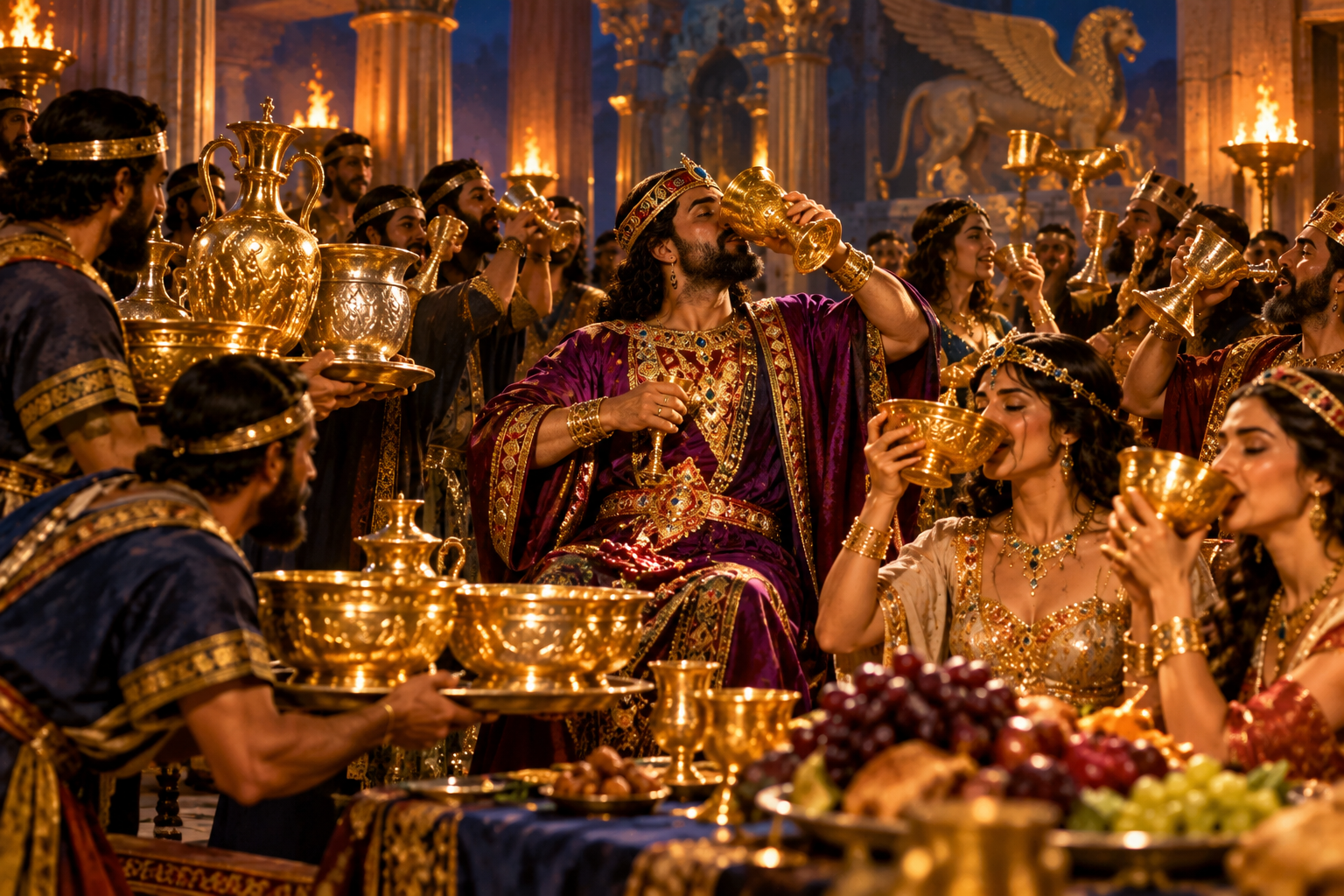
UNDER THE INFLUENCE…
BEWARE!
They drank the wine and praised the gods of gold and silver, of bronze, iron, wood and stone. - Perhaps they even struck up the royal band with music praising their pagan gods! What bitter irony: they praised gods that were not gods at all while blaspheming the only true and living God. And is that not often the way of the world? Belshazzar and his guests not only showed contempt for God by drinking from His holy vessels, but went a step further, using those sacred vessels while praising their idols. They took what belonged to God and used it to glorify what opposed God.
This was a praise service destined for a disastrous ending! How patient is our God, but His patience must never be mistaken for indifference. Belshazzar had been given ample light and ample opportunity, but he had deliberately refused to humble his heart (Da 5:22). Now he was about to receive the surprise of his life. The Judge was standing right at the door (Jas 5:9), and before the night was over, the hand of God would write Babylon’s king his final farewell message.
They raised their cups to gods who could not see,
unaware that the God who sees everything was about to raise His hand and write!
As an aside, you get a good clue as to what you worship by noting those things to which you devote the most time. It could be a football team (being from Texas, this is not uncommon) that the person lives for and looks forward to enjoying. But suddenly when the bottom drops out, where are the gods now. It's amazing that the very "gods" Belshazzar is worshiping are not the gods he turns to when the handwriting appears on the wall. Yes, he does go to his wise men, but their godless false religion offers no answers.
Belshazzar praised gods that had no breath
while defying the God Who gave him every breath.
Over 100 years earlier the prophet Isaiah (740-680BC) had recorded God's clear warning that relates to Belshazzar's blasphemous act…
I am the Lord, that is My name; I will not give My glory to another (cp Da 5:23), nor My praise to graven images. (Is 42:8)
It is interesting that several centuries earlier the Spirit records a similar bacchanalia (festival of Bacchus celebrated with dancing, song, and revelry) with similar results (!)…
Now the lords of the Philistines assembled to offer a great sacrifice to Dagon their god, and to rejoice, for they said, “Our god has given Samson our enemy into our hands.” When the people saw him, they praised their god, for they said, “Our god has given our enemy into our hands, Even the destroyer of our country, Who has slain many of us.” It so happened when they were in high spirits, that they said, “Call for Samson, that he may amuse us.” So they called for Samson from the prison, and he entertained them. And they made him stand between the pillars… 30 And Samson said, “Let me die with the Philistines!” And he bent with all his might so that the house fell on the lords and all the people who were in it. So the dead whom he killed at his death were more than those whom he killed in his life. (Jdg 16:23, 24, 25, 30)
Comment: Samson was to have been Jehovah's "vessel" (cf 2Ti 2:21), God's instrument to liberate His people from Philistine tyranny in the days of the judges (Jdg 20:25). God drew the line when these pagan revelers exalted their gods (as did Belshazzar) and impugned and denigrated the Name of Jehovah by mocking one of His chosen "vessels". God is simply not mocked!
And as John records in the Revelation of Jesus Christ the hearts of men do not get better (man is not evolving but devolving!) in the last days, especially the last 7 years of this present evil age (during Daniel's Seventieth Week). Even as idolatry was one of the main reasons for Babylon's fall, so too it will be one of the main reasons for the outpouring of God's final wrath…
The rest of mankind (Context = The sounding of the 6th Trumpet, equating with the 2nd Woe, announces the death and destruction of 1/3 of the earth's remaining population and in this passage John highlights the incomprehensible recalcitrance and hardness of heart of the surviving earth dwellers! ~ "Stone hearts and Stone Idols" [Henry Morris]), who were not killed by these plagues, did not repent of the works of their hands (problem is not their hands as much as their God opposing will - cp Ro 1:25), so as not to worship demons, and the idols of gold and of silver and of brass and of stone and of wood, which can neither see nor hear nor walk; and they did not repent of their murders nor of their sorceries nor of their immorality (Note the frequent association of idolatry with immorality! When you create a "god" of your own making, you soon create a "moral government" in which your deceived heart [Jer 17:9] establishes the rules of "right and wrong"! And most of them are wrong in God's eyes!) nor of their thefts. (Rev 9:20, Rev 9:21)
Comment: Tony Garland notes that "In the end, without God’s Holy Spirit, men become creative perverts, dangerous geniuses (Ge 11:6 - note that the context is the "birth" of the "first" Babylon [Babel - Nimrod's kingdom in Ge 10:10]), bent on creating their own hell in pursuit of what they incorrectly perceive to be wisdom and intelligence. “Professing to be wise, they became fools” (Ro 1:22)." It is almost as if the story of Belshazzar's experience of the Lord's wrath against the king's blasphemous sin and the decadent kingdom of Babylon was a foreshadowing of the outpouring of His righteous wrath on all the godless kingdoms of the world culminating (like Daniel 5) in the sudden, shocking, final and complete destruction of that blasphemous "prostitute" Babylon the great (Rev 14:8, Rev 16:19, Rev 17:5, Rev 18:2, Rev 18:21; See also Babylon of Old)
As we discover later in this chapter, Belshazzar knew about God and what He had done in Nebuchadnezzar’s life (Da 5:18–22). Daniel specifically declares, “Yet you, his son, Belshazzar, have not humbled your heart, even though you knew all this” (Da 5:22). What a sobering reminder that knowing about God is not the same as knowing God personally. Belshazzar possessed knowledge without submission, light without obedience, and truth without transformation.
Now this foolish king takes the holy vessels belonging to the God he knew about and deliberately uses them in an act of brazen defiance against Him. God is longsuffering and merciful, and He may permit sinners to continue in rebellion for a time (Eccl 8:11; Nu 32:23). But God’s patience should never be mistaken for God’s permission. There comes a time when mercy gives way to judgment. With this deliberate act of blasphemy, Belshazzar had crossed the line. The king who refused to humble himself before God would soon be humbled by God.
He had enough light to humble himself,
but instead used that light to increase his accountability.
Christians are not immune from "crossing the line", the apostle John teaching that…
If anyone sees his brother committing a sin not leading to death, he shall ask and God will for him give life to those who commit sin not leading to death. There is a sin leading to death (cp Ananias and Sapphira - Acts 5:1-11); I do not say that he should make request for this. (1Jn 5:16)
Gods of gold and silver, of bronze, iron, wood, and stone (cp Dt 4:28; 2Ki 19:18; Ps 115:4; Ps 135:15; Is 2:8; Is 17:8; 37:19; 44:10-20; Jer 1:16; 10:3, 4, 5; 25:6; Acts 7:41; 19:26) - It is fascinating, and perhaps more than coincidental, that the descending order of the metals used to describe these man-made idols resembles the sequence of metals in the great statue of Daniel 2, with wood being the obvious exception. Notice also that Daniel does not even dignify Babylon’s gods by naming them. Instead, he describes them simply by the materials from which they were made: gold, silver, bronze, iron, wood, and stone (Da 5:4). These supposedly powerful gods were nothing more than materials taken from God’s creation, fashioned by human hands, and then foolishly worshiped by the very men who had made them. What irony! The creature took what the Creator had made, fashioned it into a god, and then bowed down before it (Isa 44:9–20; Ro 1:22–25).
They worshiped the materials of creation
while mocking the Creator who made them.
Belshazzar thought his great city Babylon was impregnable. And from a humanistic viewpoint he had good reason to feel secure, for the square city was some 40 miles (or greater) in outer dimensions (some reports say it was 15 miles on each side) and enclosed by 2 sets of walls each 25 feet thick (25' thick--then a 40' space and then 25' thick) and reportedly as high as 350 feet (taller than a football field!). The walls were thick enough, that four chariots abreast could be driven around the tops of the walls. Just inside the outer walls was a moat, and inside the moat was another system of inner walls. And on top of the wall all around Babylon were towers that rose another 100 feet. The Euphrates River ran through the center of the city, from north to south, through great brass gates. In short, Babylon was one of the most imposing walled cities in the history of the world.
Belshazzar was indifferent to the imminent danger because he had placed his trust in "Babylon the great" city rather than in the Most High God Who had "won" the trust of his ancestor, King Nebuchadnezzar.
Belshazzar is a perfect picture of men and women in the last days just before God's wrath falls Paul writing "While they are saying, “Peace and safety!” then destruction will come upon them suddenly like labor pains upon a woman with child, and they will not escape." (1Th 5:3; see John's description above in Revelation 9)
Belshazzar felt as though nothing could shake his world or topple his kingdom. A similar sense of security characterized many Americans before the terrorist attacks of September 11, 2001. Life can foster that same illusion when we have never lost a job, faced a serious illness, suffered a financial crisis, or experienced some other life-altering event. When everything is going well, it is easy to become self-deceived: smug, confident, self-sufficient, and self-satisfied. Prosperity can quietly persuade us that tomorrow is guaranteed.
For the unbeliever, however, earthly security can never be absolute, for only a breath separates every person from eternity and, apart from Christ, eternal separation from the presence of the Lord (2Th 1:9,10). For believers, our eternal security is certain precisely because it is not anchored in this present world, which is passing away, but in Christ Jesus, our unshakable Rock and Redeemer. (See Eternal Security) Nevertheless, even believers must guard against developing the “Belshazzar mindset”, living as though present comfort guarantees future security and forgetting our continual dependence upon God.
Belshazzar trusted in walls that could be breached.
Believers trust in a Rock who can never be moved.
Renald Showers has an interesting analysis of Da 5:1-4 - The king was so confident of Babylon’s defenses that he decided to challenge this God. His defiling of the vessels was his way of shaking his fist at God and saying: “You have said that Babylon will fall to the Medo-Persians who are now encamped outside our gates. I am declaring to you that Babylon will not fall. Its defenses are impregnable. No one will be able to take it. My actions show you what I think of you and your prophecy.” Once again a pagan king was providing God with a splendid opportunity to demonstrate His sovereignty. (The Most High God- A Commentary on the Book of Daniel)
How Can We Profane What is Holy Today?
Our bodies. "Your body is a temple of the Holy Spirit... therefore glorify God in your body" (1 Corinthians 6:19–20). Paul even uses vessel language: each one should know how to possess "his own vessel in sanctification and honor" (1 Thessalonians 4:4), and a person who cleanses himself becomes "a vessel for honor, sanctified, useful to the Master" (2 Timothy 2:21). Sexual immorality, drunkenness, and abuse of the body take a vessel God has claimed and use it for other masters.
God's name. Using His name carelessly, as an exclamation, or to lend authority to our own agendas treats it as common (Exodus 20:7).
The tongue. "With it we bless our Lord and Father, and with it we curse men, who have been made in the likeness of God" (James 3:9–10). The same mouth that sings praise on Sunday can tear others down on Monday.
The Lord's Supper. Paul warned the Corinthians, who were turning the Lord's table into an occasion for gluttony and drunkenness, that eating "in an unworthy manner" brings guilt (1 Corinthians 11:20–29). The parallel with Belshazzar's feast is striking.
God's grace. Treating forgiveness as permission to sin turns "the grace of our God into licentiousness" (Jude 4; compare Romans 6:1–2).
Scripture. Twisting God's Word to support what we already want to believe, or quoting it to win arguments, mishandles something holy (2 Peter 3:16; 2 Timothy 2:15).
Marriage. "Marriage is to be held in honor among all, and the marriage bed is to be undefiled" (Hebrews 13:4).
The church. Paul calls the local congregation God's temple and warns anyone who would destroy it through division and worldliness (1 Corinthians 3:16–17).
Gifts and abilities. Talents God gave for His glory and others' good can be turned to self-promotion, just as Belshazzar used temple gold to toast his own gods.
The lesson of Daniel 5:22. Daniel's most searching charge was not that Belshazzar was ignorant but that he "had not humbled his heart, even though you knew all this." Knowing what is holy does not protect us. The danger, as you noted, often comes gradually, through small decisions that move from temptation to transgression. The remedy is the reverse: deliberately setting apart for God what already belongs to Him (Romans 12:1-2).
Romans 12:1-2 Therefore I urge you, brethren, by the mercies of God, to present your bodies a living and holy sacrifice, acceptable to God, which is your spiritual service of worship. 2 And do not be conformed to this world, but be transformed by the renewing of your mind, so that you may prove what the will of God is, that which is good and acceptable and perfect.
Daniel 5:5 Suddenly the fingers of a man's hand emerged and began writing opposite the lampstand on the plaster of the wall of the king's palace, and the king saw the back of the hand that did the writing.
- Suddenly - Da 4:31,33 Job 20:5 Ps 78:30,31 Pr 29:1 Lk 12:19,20 1Th 5:2,3
- Writing - Da 5:8,15,24, 25,2 6, 27, 28 Col 2:14 Rev 20:12, 13, 14, 15
- Daniel 5 Resources - Multiple Sermons and Commentaries
Related Passages:
Job 20:5 That the triumphing of the wicked is short, And the joy of the godless momentary?
Psalm 73:18-19 Surely You set them in slippery places; You cast them down to destruction. 19How they are destroyed in a moment! They are utterly swept away by sudden terrors!
Proverbs 29:1 A man who hardens his neck after much reproof Will suddenly be broken beyond remedy.
Luke 12:19-20 ‘And I will say to my soul, “Soul, you have many goods laid up for many years to come; take your ease, eat, drink and be merry.”’ 20 “But God said to him, ‘You fool! This very night your soul is required of you; and now who will own what you have prepared?’
1 Thessalonians 5:2-3 For you yourselves know full well that the day of the Lord will come just like a thief in the night. 3While they are saying, “Peace and safety!” then destruction will come upon them suddenly like labor pains upon a woman with child, and they will not escape.
Hebrews 10:31 It is a terrifying thing to fall into the hands of the living God.
Galatians 6:7 Do not be deceived, God is not mocked; for whatever a man sows, this he will also reap.
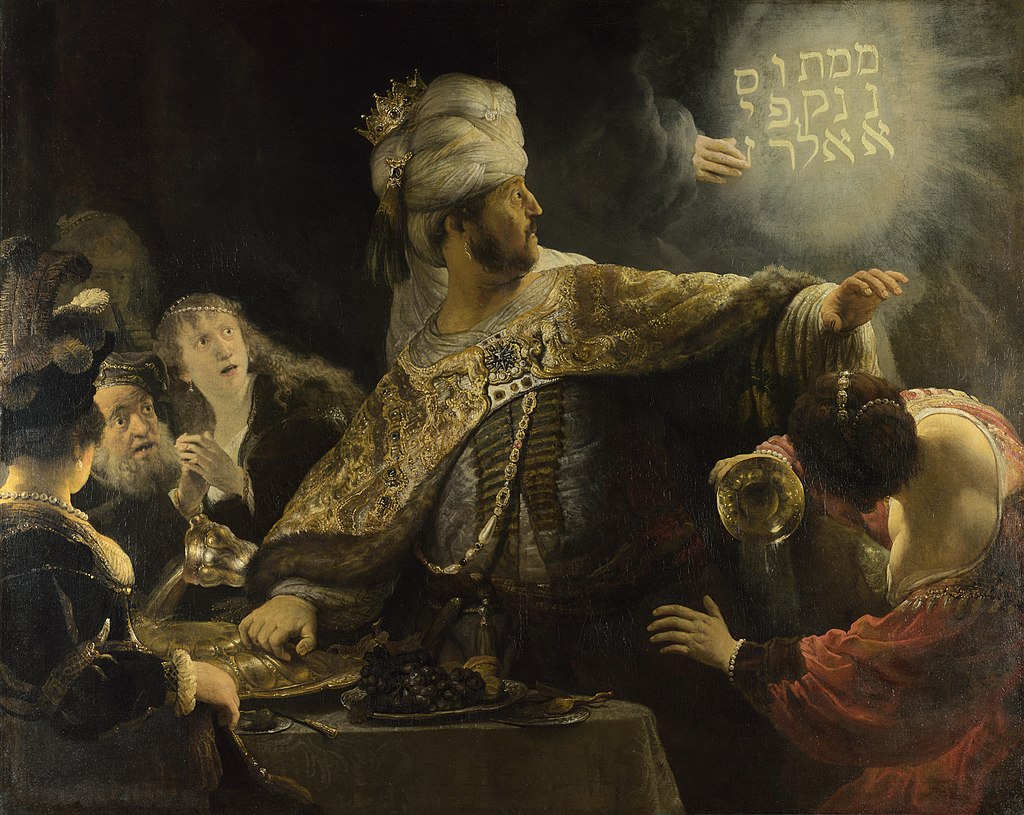
Rembrandt's painting - I would title this "Woe! Woe! Woe!"
FROM REVELRY TO REVELATION
TO RETRIBUTION!
Comment on Rembrandt's painting - Click the painting to see the detail better. Notice that the hand inscribing the writing on the wall is seen disappearing into a cloud on the left, indicating that the text has been written from right to left as was typical of Aramaic (and Hebrew). Moreover, the words appear in vertical columns, rather than horizontal lines. Instead of 1000 nobles, Rembrandt concentrates on a small group of figures staring at the wall and centers the attention on the profaning of the sacred gold vessels plundered from God's Holy Temple in Jerusalem. It was this act of desecration that led to his downfall but interestingly most contemporary depictions of this scene are principally concerned with the lavishness of the banquet but miss this vital theological point! Kudos to Rembrandt!
Belshazzar lifted God’s vessels to his lips,
and God lifted His hand to the wall.
Suddenly (KJV = "in the same hour") - Can you picture the scene? God interrupts the feast! Talk about instant sobriety! One moment Belshazzar and his nobles are drinking wine, desecrating the sacred vessels from God’s Temple, and praising lifeless gods of gold, silver, bronze, iron, wood, and stone (Da 5:1–4). The next moment, God breaks into their celebration. There is no warning, no messenger at the door, and no opportunity for Belshazzar to prepare. In an instant, the revelry stops and terror begins. Belshazzar lifted God’s vessels to his lips, and God lifted His hand to the wall.
Nebuchadnezzar was interrupted in the midst of his boasting
while Belshazzar was interrupted in the midst of his blaspheming.
There is a striking parallel with Nebuchadnezzar. He too was boasting in his pride when God suddenly interrupted him. “While the word was in the king’s mouth,” a voice came from heaven announcing that his sovereignty had been removed and that he would be driven from mankind until he recognized that the Most High rules over the realm of mankind (Da 4:30–32). Nebuchadnezzar was interrupted in the midst of his boasting while Belshazzar was interrupted in the midst of his blaspheming. In both cases, divine judgment arrived suddenly, precisely at the moment God had determined.
Belshazzar’s feast reminds us that God’s silence must never be mistaken for God’s absence. For years nothing had happened when Babylon possessed the sacred vessels, and for the first hours of this feast nothing happened while they drank and praised their idols. But suddenly everything changed. The God they had ignored made His presence unmistakably known.
One moment Belshazzar was raising his cup in defiance of God.
The next moment God was raising His hand in judgment.
Proverbs 29:1 A man who hardens his neck after much reproof will suddenly be broken beyond remedy.
Comment: The classic example is the antediluvian generation that rejected 120 years of Noah's preaching. "My Spirit shall not always strive with man," God had said (Ge 6:3), and finally they were suddenly destroyed in the great Flood.
Paul described another "suddenly"…
For you yourselves know full well that the day of the Lord will come just like a thief in the night. While they are saying, "Peace and safety!" then destruction will come upon them suddenly like birth pangs upon a woman with child; and they shall not escape. (1Th 5:2, 3)
The fingers of a man's hand emerged and began writing opposite the lampstand on the plaster of the wall of the king's palace, and the king saw the back of the hand that did the writing. - Belshazzar actually watched the mysterious hand as it wrote. This was not a dream like those given to Nebuchadnezzar (Da 2:1; 4:5), nor was it merely a vision occurring in the king’s mind. Something supernatural was visibly taking place before his eyes. The hand appeared without any visible body attached to it, making unmistakable the extraordinary nature of this divine intervention.
Belshazzar put his hands on what belonged to God,
so God put His hand on Belshazzar’s kingdom.
There is striking irony in the imagery of the hand. Babylonian hands had taken God’s holy vessels, and now Belshazzar and his guests held those vessels in their own hands as they dishonored the Most High God. In effect, human hands were challenging the God of heaven. Then suddenly another Hand appeared, the Hand that rules over the hands of men and that no one can restrain (Da 4:35). Belshazzar had lifted his hand against the Lord of heaven (Da 5:23), and now the Lord of heaven answered with His own Hand (Da 5:5, 24–28).
The hand that held God’s cup soon trembled
before the Hand that held his destiny.
Maclaren - There is something blood-curdling in the visibility of but a part of the hand and its busy writing. Whose was the body, and where was it? No wonder if the riotous mirth was frozen into awe, and the wine lost flavor. (Daniel 5:17-31 Mene, Tekel, Peres)
Dead idols are no match for the Living God! God is always able to vindicate His holy Name. When the Philistines placed the Ark of the Covenant in the temple of Dagon, their idol repeatedly fell helplessly before the Ark, ultimately lying with his head and hands broken off (1Sa 5:1–5). The explanation is unmistakable: “the hand of the LORD was heavy” upon the Philistines (1Sa 5:6–7).
The irony is especially striking in Daniel 5. The psalmist says of idols, “They have hands, but they cannot feel” (Ps 115:7). Belshazzar had just praised gods of gold, silver, bronze, iron, wood, and stone, gods possessing neither life nor power (Da 5:4, 23). Then suddenly the fingers of the Living God appeared! Babylon’s gods had hands that could do nothing; Daniel’s God needed only His finger to bring the festivities to a halt and pronounce the doom of an empire.
Babylon praised gods with hands that could do nothing;
then the Living God moved His finger, and an empire trembled.
Indeed, Scripture repeatedly uses “the finger of God” as a vivid expression of His supernatural power. Egypt’s magicians were forced to confess, “This is the finger of God” (Ex 8:19). The tablets of the Law were written by the finger of God (Ex 31:18), and Jesus used the expression in describing His power over demons (Lk 11:20; cf. Mt 12:28). What no idol could accomplish with its lifeless hands, the Living God could accomplish with a single finger!
When I was in medical training at Parkland Memorial Hospital in Dallas, Texas, there were a number of occasions I interviewed individuals who claimed to have seen various things on the walls of their hospital room. These patients usually received the diagnosis of "DT's" (delirium tremens)! Belshazzar was suffering from a case of "Divine DT's"!
John Whitcomb remarks that "Joyce Baldwin's (a famous writer on OT books! But be a Berean with her books - Acts 17:11) attempt to eliminate the supernatural element in the handwriting on the wall (in an otherwise basically conservative commentary) is both shocking and unconvincing." (SEE Daniel- Everyman's Bible Commentary - Page 71)
Plaster of the wall - Archaeology has shown that Babylonian palace walls could indeed be faced with white plaster, making this small detail quite appropriate to the historical setting. This was the same plaster on which the Babylonians would write about their great conquests and victories. God announces His impending judgment right at the place these pagans would otherwise look at and feel good about themselves.
It is interesting that the skeptics (they simply can't leave this book alone!) write that plaster walls were unheard of in ancient Babylon. Robert Koldewey (1855-1925) was a German archeologist who been excavating at the site of Babylon in southern Iraq in 1899 and continued this work for 18 years. In addition to his discovery of a Ziggurat identified as the temple of the Babylon false god Marduk, also found a huge room (55' x 169') big enough to house Belshazzar's party and remarkably, the room had walls made with plaster. At the end of the room was a niche in the wall where he believed the king sat so he would be elevated above and visible to all the party guests. (From "The Excavations At Babylon" - Read Online - Hint: click dropdown for Page 104 and scroll back a couple of pages to read Koldeway's comments on this room including his comments on Belshazzar! - For description of plaster on the walls see Page 88-89. [London: MacMillan, 1914]).
Opposite the lampstand - Why does Daniel include this seemingly incidental detail? The lampstand would have illuminated the plastered wall, placing God’s message where Belshazzar could see both the mysterious hand and its writing clearly. God’s message of judgment was not hidden in some dark corner of the palace. It was written in the light, directly before the king’s eyes.
Some have suggested that this lampstand may even have been the sacred golden lampstand taken from the Temple in Jerusalem. While the text does not identify it as such, if that were the case, the irony would be extraordinary: the light from God’s own sanctuary would illuminate God’s sentence of judgment upon the king who was desecrating God’s holy vessels!
There is another striking contrast. The lamp could illuminate the writing, but it could not illuminate its meaning. Belshazzar could see the words clearly, yet neither he nor his wise men could understand their significance. For that illumination he needed revelation from God through Daniel (Da 5:17–28). Physical light could reveal the letters, but only divine light could reveal the message.
The wall was flooded with light,
but Belshazzar remained in the dark.
God's light shines on the sin of man as Jesus says…
And this is the judgment, that the light is come into the world, and men loved the darkness rather than the light; for their deeds were evil. For everyone who does evil hates the light, and does not come to the light, lest his deeds should be exposed. But he who practices the truth comes to the light, that his deeds may be manifested as having been wrought in God. (Jn 3:19, 20, 21)
What light did Belshazzar possess? Daniel leaves no doubt that Belshazzar had been exposed to the light declaring…
Yet you, his son (Nebuchadnezzar spoken of as his "father" - the truth in Da 5:20, 21), Belshazzar, have not humbled your heart (cp Da 4:37), even though you knew all this, 23 but you have exalted yourself against the Lord of heaven; and they have brought the vessels of His house before you, and you and your nobles, your wives and your concubines have been drinking wine from them; and you have praised the gods of silver and gold, of bronze, iron, wood and stone, which do not see, hear or understand. But the God in whose hand are your life-breath and your ways, you have not glorified. (Da 5:22, 23)
Belshazzar knew about God but he refused to bow to Him, like everyone who refuses to believe in Jesus.
Matthew Henry - God's written word is enough to put the proudest, boldest sinner in a fright. What we see of God, the part of the hand that writes in the book of the creatures, and in the book of the Scriptures, should fill us with awful thoughts concerning that part which we do not see. If this be the finger of God, what is His arm when made bare? And what is He? The king's guilty conscience told him that he had no reason to expect any good news from heaven. God can, in a moment, make the heart of the stoutest sinner to tremble; and there needs no more than to let loose His own thoughts upon him; they will give him trouble enough. No bodily pain can equal the inward agony which sometimes seizes the sinner in the midst of mirth, carnal pleasures, and worldly pomp. Sometimes terrors cause a man to flee to Christ for pardon and peace; but many cry out for fear of wrath (Rev 6:16, 17), who are not humbled for their sins, and who seek relief by lying vanities. The ignorance and uncertainty concerning the Holy Scriptures, shown by many who call themselves wise, only tend to drive sinners to despair, as the ignorance of these wise men did.
Daniel 5 reminds us of Jesus' sobering words in Luke 12…
And He told them a parable, saying, "The land of a certain rich man was very productive. "And he began reasoning to himself, saying, 'What shall I do, since I have no place to store my crops?' "And he said, 'This is what I will do: I will tear down my barns and build larger ones, and there I will store all my grain and my goods. 'And I will say to my soul, "Soul, you have many goods laid up for many years to come; take your ease, eat, drink and be merry."' (cp Jas 4:13, 14, 15) "But God said to him, 'You fool! This very night (cp Pr 27:1) your soul is required of you; and now who will own what you have prepared?' "So is the man who lays up treasure for himself, and is not rich toward God." (Luke 12:16-21)
Comment: Notice Jesus' "definition" of a "fool" (literally without understanding especially in practical matters) = One who lays up treasure for self and is not rich toward God! Who among us has not at one time or another played the fool, deceptively trusting in the temporary treasures of this world instead of the eternal security in Christ?
Play the Gospel song Handwriting on the Wall. Here is also an old hymn…
Handwriting on the Wall
by Knowles Shaw
At the feast of Belshazzar and a thousand of his lords,
While they drank from golden vessels, as the Book of Truth records,
In the night, as they reveled in the royal palace hall,
They were seized with consternation—’twas the Hand upon the wall!Refrain
’Tis the hand of God on the wall!
’Tis the hand of God on the wall!
Shall the record be “Found wanting!”
Or shall it be “Found trusting!”
While that hand is writing on the wall?See the brave captive, Daniel, as he stood before the throng,
And rebuked the haughty monarch for his mighty deeds of wrong;
As he read out the writing—’twas the doom of one and all,
For the kingdom now was finished—said the Hand upon the wall!
RefrainSee the faith, zeal and courage, that would dare to do the right,
Which the Spirit gave to Daniel—’twas the secret of his might,
In his home in Judea, or a captive in the hall,
He understood the writing of his God upon the wall!
RefrainSo our deeds are recorded—there’s a Hand that’s writing now:
Sinner, give your heart to Jesus, to His royal mandates bow;
For the day is approaching—it must come to one and all,
When the sinners’ condemnation will be written on the wall!
Refrain
Daniel 5:6 Then the king's face grew pale and his thoughts alarmed him, and his hip joints went slack and his knees began knocking together.
- the king's: Da 5:9 2:1 3:19 Job 15:20-27 20:19-27 Ps 73:18-20 Isa 21:2-4
- Face: Da 5:9
- and his thoughts: Da 5:10 4:5,19 7:28) (Ps 69:23 Isa 13:7,8 21:3,4
- joints: Isa 5:27
- knees: Isa 35:3 Eze 7:17 Eze 21:7 Na 2:10 Heb 12:12
- Daniel 5 Resources - Multiple Sermons and Commentaries
Related Passages:
Leviticus 26:36 ‘As for those of you who may be left, I will also bring weakness into their hearts in the lands of their enemies. And the sound of a driven leaf will chase them, and even when no one is pursuing they will flee as though from the sword, and they will fall.
Job 15:20-24 “The wicked man writhes in pain all his days, And numbered are the years stored up for the ruthless. 21 “Sounds of terror are in his ears; While at peace the destroyer comes upon him. 22 “He does not believe that he will return from darkness, And he is destined for the sword. 23 “He wanders about for food, saying, ‘Where is it?’ He knows that a day of darkness is at hand. 24 “Distress and anguish terrify him, They overpower him like a king ready for the attack,
Proverbs 28:1 The wicked flee when no one is pursuing, But the righteous are bold as a lion.
Isaiah 13:7-8 Therefore all hands will fall limp, And every man’s heart will melt. 8 They will be terrified, Pains and anguish will take hold of them; They will writhe like a woman in labor, They will look at one another in astonishment, Their faces aflame.
Ezekiel 7:17 ‘All hands will hang limp and all knees will become like water.
Ezekiel 21:7 “And when they say to you, ‘Why do you groan?’ you shall say, ‘Because of the news that is coming; and every heart will melt, all hands will be feeble, every spirit will faint and all knees will be weak as water. Behold, it comes and it will happen,’ declares the Lord GOD.”
Nahum 2:10 She is emptied! Yes, she is desolate and waste! Hearts are melting and knees knocking! Also anguish is in the whole body And all their faces are grown pale!
Romans 2:15 in that they show the work of the Law written in their hearts, their conscience bearing witness and their thoughts alternately accusing or else defending them,
FROM ARROGANCE
TO ALARM
Then the king's face grew pale and his thoughts alarmed him, and his hip joints went slack and his knees began knocking together. How quickly man's bravado and boasting wilt in the presence of the Lord! Moments earlier Belshazzar was boldly drinking from God's holy vessels and praising his lifeless gods. Now the ESV says, “his color changed,” while the NLT vividly renders it, “his face turned pale with fright.” Indeed it did! The Aramaic literally conveys the idea that “his brightness changed for him.” The confident king suddenly lost his color, his composure, and his courage.
If we did not know the sequence of events in Daniel 5, we might almost diagnose a massive heart attack! And in a spiritual sense, this was indeed a “massive attack” by the Most High God upon Belshazzar's hardened heart. Nothing about his external circumstances had yet changed. Babylon's walls were still standing, the banquet hall was still filled with nobles, and the wine was still flowing. Only one thing had changed: God had made His presence known. And that was enough to change everything. The king who moments earlier feared neither God nor man was now terrified by the appearance of a hand!
One moment Belshazzar was mocking God without fear;
the next moment he was fearing God without mercy.
Arno Gaebelein - The feast of licentiousness became suddenly a feast of gloom and consternation. (The Prophet Daniel)
His hip joints when slack (KJV = his loins were loosed).The Aramaic literally refers to the “joints of his loins” becoming loose or slack, vividly portraying Belshazzar’s sudden physical collapse under overwhelming fear. The Septuagint uses osphus, a term referring to the loins or lower part of the body and, in some contexts, used euphemistically of the reproductive area. The essential picture, however, is unmistakable: the king was literally weak with fear. The man who moments earlier had boldly defied the God of heaven could scarcely hold himself upright when confronted with the mysterious handwriting on the wall!
He raised his cup against God, but
could hardly stand when God raised His hand against him.
Compare King Saul’s reaction after hearing Samuel’s terrifying announcement of impending judgment: “Then Saul immediately fell full length upon the ground and was very afraid” (1Sa 28:20). In both cases, the announcement of divine judgment reduced a powerful king to physical weakness.
Belshazzar's reaction to this "divine disturbance" reminds one of the reactions unbelievers will display during the Day of the Lord (which is really an extended period of God's judgment of mankind)…
Wail, for the Day of the LORD is near! It will come as destruction from the Almighty. Therefore all hands will fall limp, and every man’s heart will melt. They will be terrified, pains and anguish will take hold of them. They will writhe like a woman in labor. They will look at one another in astonishment, their faces aflame. (Isa 13:6, 7, 8)
His thoughts alarmed him - Frightened out of his mind! But why did Belshazzar’s thoughts so alarm him? The handwriting had not yet been interpreted! He did not yet understand MENE, MENE, TEKEL, UPHARSIN or know the dreadful sentence those words contained (Da 5:25–28). Yet before Daniel explained a single word, Belshazzar was already terrified. Why? Surely his conscience had something to say. Belshazzar knew what God had done to Nebuchadnezzar when that proud king exalted himself against heaven (Da 5:20-22). He also knew what he himself had just done. He had deliberately desecrated God’s holy vessels and “exalted” himself against the Lord of heaven (Da 5:23). He could not read the message, but he knew enough about the Author to fear what it might say!
Belshazzar could not read the handwriting,
but his conscience could already read the warning.
So it will ultimately be for every unbeliever who persists in rejecting God. Divine judgment may be unexpected in its timing, but no one who has rejected the light God has given can claim that God has never warned of judgment. Tragically, even after Daniel explained the handwriting, there is no record that Belshazzar repented. Instead, he proceeded with his promised rewards and honors (Da 5:29). He was frightened by God’s judgment but apparently remained unmoved toward God Himself.
We see a similar resistance to repentance in passages in Jer 38:19-24 and when Paul was before Felix…
But some days later Felix arrived with Drusilla, his wife who was a Jewess, and sent for Paul and heard him speak about faith in Christ Jesus. But as he was discussing righteousness, self-control and the judgment to come, Felix became frightened and said, "Go away for the present, and when I find time I will summon you." (Acts 24:24, 25, cf similar failure to repent in Rev 9:20,21, 16:9, 11)
A guilty conscience can fear the verdict
before it hears the sentence.
Knees began knocking - This is no mere idiom for mild nervousness. Belshazzar was trembling uncontrollably. His inward terror had become outwardly and physically visible before the thousand nobles gathered at his feast. The mighty king of Babylon was literally unstable with fear.
What a striking contrast with Daniel 3! There three Hebrew captives stood calmly before an enraged king and a blazing furnace because they trusted in the Most High God. Here in Daniel 5, the most powerful man in Babylon trembles before a few words written on a wall because he has defied that same God. Faith enabled three captives to stand before a furnace; fear left a king struggling to stand before a wall.
Moments earlier Belshazzar had been drinking freely in arrogant defiance of God. Before, he may have been too drunk to stand straight; now he was suddenly stone sober and too frightened to stand steady! The handwriting on the wall accomplished what no Babylonian army or counselor could have done: it brought the boastful king to trembling knees.
The three Hebrews stood because they feared God.
Belshazzar trembled because he did not.
It's too bad Belshazzar didn't respond as one person wisely advised…
If your knees are knocking,
kneel on them!
Wayne Barber aptly uses Belshazzar’s folly as a vivid picture of “The Peril of the Unbeliever.” Belshazzar illustrates the peril of possessing knowledge without faith, warning without repentance, prosperity without gratitude, and opportunity without response. He knew what God had done to Nebuchadnezzar, yet refused to humble himself (Da 5:22). He enjoyed the blessings of life while dishonoring the God who held his very breath in His hand (Da 5:23). And when judgment finally came, it came suddenly, when he least expected it. Belshazzar’s great peril was not that he lacked evidence about God, but that he rejected the light he already possessed. His story is a sobering reminder that delayed judgment does not mean canceled judgment.
The peril of the unbeliever is not merely that judgment is coming,
but that it may come while he still thinks all is well.
C H Spurgeon - Sermon Notes - Dan. 5:6—“His thoughts troubled him.”
To many men thinking is an unusual employment.
Yet it is a distinction of man that he can think.
No wonder that when thought is forced on some men they are troubled.
This trouble from thought is salutary: by it conviction and conversion may come; and, in any case, troubled thought is as the sounding of the tocsin, arousing the mind, and warning the soul.
Let us think of Belshazzar, and of ourselves. Of us, too, it may have been said, “His thoughts troubled him.” We must be in a bad way if we dare not face our own thoughts about ourselves. What must God’s thoughts of us be?
I. IT DID NOT APPEAR LIKELY THAT HIS THOUGHTS WOULD TROUBLE HIM.
1. He was an irresponsible and reckless monarch. He came of a fierce nation, and was born of a father who had been punished for his haughty spirit.
2. He had hardened his heart with pride (verses 22 and 23). Daniel said, “thou hast lifted up thyself against the Lord of heaven.”
3. He was drinking wine, and it had worked upon him (verse 2).
4. He was rioting in gay company: “his princes, his wives, and his concubines.” Such comrades as these usually chase all thought away, and help their leader in his recklessness.
5. He was venturing far in profanity (verse 3); daring to abuse the sacred vessels, in his banquets, as an expression of his contempt for Israel’s God, whom he despised in contrast with his “gods of gold, and of silver, of brass, of iron, of wood, and of stone.” Perhaps he had mentioned these in detail as the gods who had triumphed; at any rate, the prophet brings them forward with detestation in verse 4.
No man is rendered wise or thoughtful by the wine-cup.
No man is out of the reach of the arrows of God.
No conscience is so dead that he cannot arouse it.
Many other men in far lower positions exhibit equal pride of station and success; this is stimulated in much the same manner, and exhibited with much the same contempt for the things of God.
A parallel is easily drawn between Belshazzar and other proud ones.
II. YET WELL MIGHT HIS THOUGHTS TROUBLE HIM.
1. For what he saw was appalling: “fingers of a man’s hand over against the candlestick” (verse 5).
God sometimes gives men warnings which they must notice.
2. For what he could not see was suggestive. Where was the hand?
Where was the writer? What had he written? What did it mean? A terrible mystery was involved in his vision.
God gives men hints of something behind, which is yet to appear
3. For what he had done was alarming.
His own past flashed before him. His cruel wars, oppressions, blasphemies, and vices.
What he knew of his father’s career increased his terror.
What he had himself failed to do came before him: “The God in whose hand thy breath is, and whose are all thy ways, hast thou not glorified” (verse 23).
What he was then in the act of doing startled him. He was wantonly defying Jehovah, the God of Israel.
See him trembling before whom all trembled.
He has drunk a strange draught out of those holy cups.
III. AND MIGHT NOT YOUR THOUGHTS TROUBLE SOME OF YOU?
1. You are careless, riotous, fond of feasts, given to much wine. Does wantonness ever end well?
2. You are prosperous. Are not beasts fattened for the slaughter?
3. You are trifling with holy things. You neglect, or ridicule, or use without seriousness the things of God. Will this be endured? Will not the Lord be provoked to avenge this contempt?
4. You mix with the impure. Will you not perish with them?
5. Your father’s history might instruct you, or at least trouble you.
6. The sacred writing “over against the candlestick” is against you. Read the Holy Scripture, and see for yourself.
7. Specially, you have been weighed in the balances, and found wanting. Conscience beholds the scales in the hand of the infallible Judge.
Take heed that you do not fall into Belshazzar’s condition, to whom Daniel gave no counsel, but simply interpreted the sentences which sealed his doom.
As yet we dare preach the gospel to you, and we do. God’s thoughts are above your thoughts. He bids you repent of sin, and believe in his Son Jesus; and then your thoughts will cease to trouble you.
THOUGHTS AND FACTS
Such mystery of iniquity within,
That we must loathe our very thoughts, but for the cure
He hath devised,—the blessed Tree
The Lord hath shown us, that, cast in, can heal
The fountain whence the bitter waters flow.
Divinest remedy
Whose power we feel,
Whose grace we comprehend not, but we know.
Miss Havergal.
Conscience, from inaction, is like a withered arm in the souls of many; but the Lord of conscience will one day say to it. “Be thou stretched forth, and do thine appointed work.”
As the ant-hill, when stirred, sets in motion its living insects in every direction, so the conscience of the sinner, disturbed by the Spirit, or judgments of God, calls up before its vision thousands of deeds which fill the soul with agony and woe.—McCosh.
The Duke of Wellington once said that he could have saved the lives of a thousand men a year, had he had chaplains, or any religious ministers. The uneasiness of their minds reacted on their bodies, and kept up continual fever, once it seized upon their frames. It is our blessed office to tell of One who can “minister to a mind diseased,” whose grace can deliver from “an evil conscience,” and through whom all inward fear and trouble are removed.
Charles IX. of France, in his youth, had humane and tender sensibilities. The fiend who had tempted him was the mother who had nursed him. When she first proposed to him the massacre of the Huguenots, he shrunk from it with horror: “No, no, madam! They are my loving subjects.” Then was the critical hour of his life. Had he cherished that natural sensitiveness to bloodshed, St. Bartholomew’s Eve would never have disgraced the history of his kingdom, and he himself would have escaped the fearful remorse which crazed him on his death-bed. To his physician he said in his last hours, “Asleep or awake, I see the mangled forms of the Huguenots passing before me. They drip with blood. They make hideous faces at me. They point to their open wounds, and mock me. Oh, that I had spared at least the little infants at the breast!” Then he broke out in agonizing cries and screams. Bloody sweat oozed from the pores of his skin. He was one of the very few cases in history which confirm the possibility of the phenomenon which attended our Lord’s anguish in Gethsemane. That was the fruit of resisting, years before, the recoil of his youthful conscience from the extreme of guilt.—Austin Phelps.
Takeaways from "His Thoughts Troubled Him"....
1. A troubled conscience can be a mercy from God.
Belshazzar’s troubling thoughts were uncomfortable, but the greater danger would have been to feel nothing at all. Conviction is painful, but spiritual insensitivity is far more dangerous.
Better a conscience that troubles you than a conscience that no longer speaks to you.
2. We are in dangerous spiritual territory when we are afraid to be alone with our thoughts.
Spurgeon asks, in effect, If we cannot comfortably face our own thoughts about ourselves, what must God’s thoughts of us be?
If I am afraid to face my own thoughts about my life, how much more should I consider God’s thoughts about my life?
3. Pleasure can temporarily silence the conscience, but it cannot kill it.
Belshazzar surrounded himself with wine, wealth, women, music, and companions. All helped keep serious thoughts away until God interrupted the party.
The world can distract the conscience, but only God can cleanse it.
4. No heart is beyond God's ability to awaken.
Belshazzar was proud, intoxicated, blasphemous, and apparently spiritually hardened. Yet one movement of God's hand transformed the boastful king into a trembling man.
God can awaken in a moment the conscience a man has spent a lifetime trying to silence.
5. Sin remembered can become terrifying when judgment becomes real.
Once the hand appeared, Belshazzar suddenly had reasons to think about his past, his pride, his blasphemy, Nebuchadnezzar's experience, and the God he had refused to glorify (Da 5:22–23).
Sin can seem insignificant while we are committing it and terrifying when God calls it to account.
6. Belshazzar knew more than he obeyed.
This may be the most serious element of his guilt. Daniel said, “you...have not humbled your heart, even though you knew all this” (Da 5:22).
Nebuchadnezzar's humiliation should have been Belshazzar's warning.
Truth known but not obeyed increases accountability rather than decreasing guilt.
7. Yesterday's warning ignored may become tomorrow's judgment experienced.
Belshazzar had Nebuchadnezzar's history before him. He knew what God had done to a proud king, but he learned nothing from it.
Wise men learn from the discipline of others; fools insist on learning it for themselves.
8. Prosperity is a dangerous measure of God's approval.
Belshazzar was still king. The palace was still magnificent. The wine was still flowing. Yet his kingdom was only hours from collapse.
Everything can appear to be going well at the very moment everything is about to change.
9. Conscience resisted repeatedly becomes increasingly insensitive.
Early resistance to sin can weaken through repeated compromise until what once horrified us becomes tolerable.
Every time we silence conscience, its next warning becomes easier to silence.
10. The most frightening words in Daniel 5 may be “you knew.”
Belshazzar could not plead ignorance. He had received sufficient light and deliberately rejected it (Da 5:22).
The issue is not merely how much truth we know, but what we do with the truth we know.
Daniel 5:7 The king called aloud to bring in the conjurers, the Chaldeans and the diviners. The king spoke and said to the wise men of Babylon, "Any man who can read this inscription and explain its interpretation to me shall be clothed with purple and have a necklace of gold around his neck, and have authority as third ruler in the kingdom."
- aloud: Chal, with might, Da 4:14
- bring: Da 2:2 4:6 Ge 41:8 Isa 44:25,26 47:13
- be clothed: Da 5:16,29 2:6 Ge 41:42-44 Nu 22:7,17 24:11 1Sa 17:25
- necklace: Pr 1:9 Song 1:10 Eze 16:11
- third: Da 2:48 6:2,3 Es 3:1 10:2,3
- Daniel 5 Resources - Multiple Sermons and Commentaries
OFFERS OF PROMOTION ON
A SINKING SHIP
The king called aloud to bring in the conjurers, the Chaldeans and the diviners. The king spoke and said to the wise men of Babylon, "Any man who can read this inscription and explain its interpretation to me shall be clothed with purple and have a necklace of gold around his neck, and have authority as third ruler in the kingdom." - Belshazzar’s terror immediately turns into desperation. Called aloud (2 Aramaic words - qera = call or shout) - Literally he "called with power" conveying urgency! Baker writes the word for "aloud" "can mean a loud or powerful voice, such as Nebuchadnezzar’s herald (Dan. 3:4); a messenger from heaven (Dan. 4:14[11]); and King Belshazzar to his enchanters (Dan. 5:7). Once again we encounter Babylon's professional wise men, just as in Daniel 2 and Daniel 4. And once again they will prove incapable of interpreting a revelation that originated with God.
Clothed with purple - Purple was associated with royalty, wealth, and high social rank in the ancient world (Lam 4:5). But notice the almost tragic irony. The king who is about to lose his kingdom is offering Daniel the trappings of royalty in a kingdom whose hours are numbered! Belshazzar promises honor, status, and authority as though he still possesses a secure kingdom from which to bestow them. Yet before the night is over, his throne will be lost, his kingdom will belong to another, and Belshazzar himself will be dead (Da 5:30,31). How worthless are the world’s honors when the world that bestows them is passing away (1Jn 2:17)! Daniel understood what Belshazzar did not, that there is little value in being promoted in a kingdom that is about to perish. Belshazzar was handing out honors in a kingdom that God had already handed over!
Third ruler in the kingdom - As explained earlier (Ruler #1) = Nabonidus, (Ruler #2) = his son Belshazzar, (Ruler #3) = The decipherer of the handwriting. See the Jew Mordecai's exaltation (after the evil Haman was exposed) to second in authority under Ahasuerus, the Persian king (Esther 3:1, Esther 10:2, 3)
The Apologetics Study Bible- Understand Why You Believe (Online) - The fact that Belshazzar could offer only the "third highest position in the kingdom" (Da 5:16,29) is evidence that the author of Daniel had accurate knowledge of Nabonidus. Nabonidus was first in rank, followed by his son Belshazzar and then the decipherer of the handwriting would be third in rank.
🙏 THOUGHT - Belshazzar’s first instinct in crisis was to reach for the resources he already knew. He called for the wise men before he ever considered the God Who had written the message. There is a practical lesson here for all of us. When God allows something into our lives that we cannot understand, our natural tendency may be to look around before we look up, exhausting every human resource before turning to God in prayer. Human wisdom has its proper place, but it can never explain what only God can reveal or accomplish what only God can do. When confusion comes, where do I turn first? (cf Jas 1:5) Do I immediately begin calculating, searching, worrying, and seeking human counsel, asking Chatgtp or Claude (!!!), or do I first bring my uncertainty before the One Who already knows the beginning from the end? Prayer should not be our last resort after everything else has failed. It should be our first response because God never fails. When we do not know what to do, the wisest thing we can do is go first to the One Who does.
Daniel 5:8 Then all the king's wise men came in, but they could not read the inscription or make known its interpretation to the king.
- Da 2:27 4:7 Ge 41:8 Isa 47:9,12, 13, 14, 15
- Daniel 5 Resources - Multiple Sermons and Commentaries
Related Passages:
Daniel 2:27-28 Daniel answered before the king and said, “As for the mystery about which the king has inquired, neither wise men, conjurers, magicians nor diviners are able to declare it to the king. 28“However, there is a God in heaven who reveals mysteries, and He has made known to King Nebuchadnezzar what will take place in the latter days. This was your dream and the visions in your mind while on your bed.
Daniel 4:7 “Then the magicians, the conjurers, the Chaldeans and the diviners came in and I related the dream to them, but they could not make its interpretation known to me.
Genesis 40:8 Then they said to him, “We have had a dream and there is no one to interpret it.” Then Joseph said to them, “Do not interpretations belong to God? Tell it to me, please.”
Genesis 41:8 Now in the morning his spirit was troubled, so he sent and called for all the magicians of Egypt, and all its wise men. And Pharaoh told them his dreams, but there was no one who could interpret them to Pharaoh.
1 Corinthians 1:20 Where is the wise man? Where is the scribe? Where is the debater of this age? Has not God made foolish the wisdom of the world? 21 For since in the wisdom of God the world through its wisdom did not come to know God, God was well-pleased through the foolishness of the message preached to save those who believe.
1 Corinthians 2:14 But a natural man does not accept the things of the Spirit of God, for they are foolishness to him; and he cannot understand them, because they are spiritually appraised.
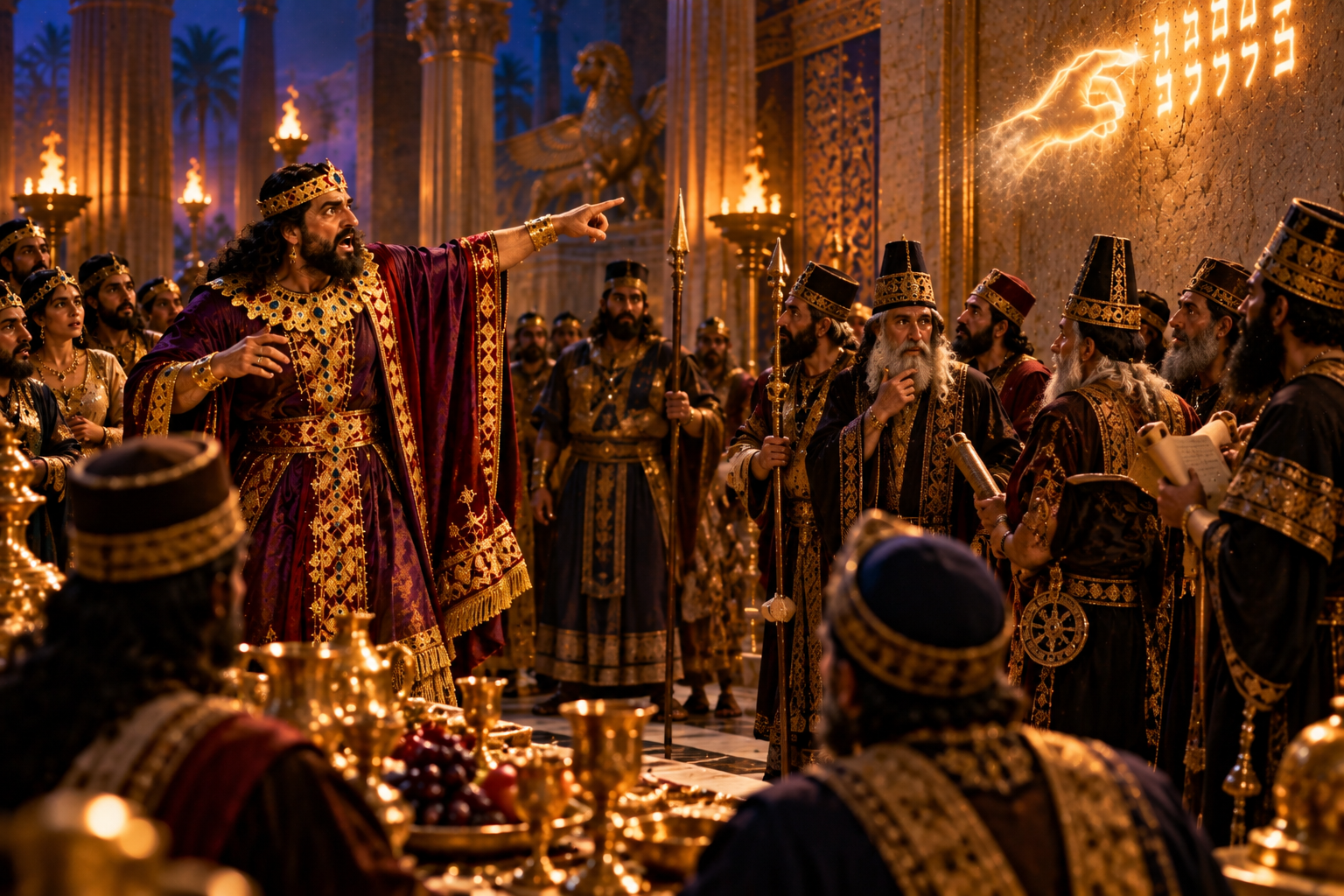
HUMAN WISDOM
"HITS THE WALL"
Then all the king's wise men came in, but they could not read the inscription or make known its interpretation to the king - Incredible! Not only were Babylon’s wisest men unable to interpret the message, they could not even read it! The intellectual elite of Babylon stood helpless before a few words written by the finger of God. Clearly, God had given a revelation that human wisdom alone could neither decipher nor explain. But their inability was no accident. God was exposing the bankruptcy of Babylon’s wisdom while preparing the stage for the sufficiency of His revelation through His servant Daniel. Once again, as in Daniel 2 and 4, Babylon’s wise men reached the end of their wisdom precisely where God’s servant began. God allowed every human resource to fail so that when the answer came, there could be no question about its Source. The wise men could not read the handwriting, but Daniel knew the One Who held the pen.
We see a similar scene in throne room of another world ruler (Pharaoh)…
Now in the morning his spirit was troubled, so he sent and called for all the magicians of Egypt, and all its wise men. And Pharaoh told them his dreams, but there was no one who could interpret them to Pharaoh. (Ge 41:8)
History repeats itself for the third time in Daniel (cp. Da 2:27; Da 4:7). Human wisdom is futile and has no ability to discern the mind and will of God.
For it is written, "I WILL DESTROY THE WISDOM OF THE WISE, AND THE CLEVERNESS OF THE CLEVER I WILL SET ASIDE." 20 Where is the wise man? Where is the scribe? Where is the debater of this age? Has not God made foolish the wisdom of the world? 21 For since in the wisdom of God the world through its wisdom did not come to know God, God was well-pleased through the foolishness of the message preached to save those who believe. (1Cor 1:19, from Isa 29:14, 1Co 1:20, 21)
Wise men - These men represent the wisdom of the world, which is powerless to comprehend the things of God apart from divine revelation (1Co 2:14). Just as in their previous encounters with divine mysteries, Babylon’s intellectual and religious elite once again proved utterly helpless (Da 2:27; 4:7). This was now their third major attempt to decipher a revelation from God, and the third time was certainly not the charm! In fact, we might say this was their third strike, for before the night was over, the Babylonian kingdom that employed them would itself be out of business! Once again God demonstrates that human wisdom reaches its limit precisely where divine revelation is required. The wisest men in Babylon could not read a few words from God, while Daniel, dependent upon God, would soon explain them with complete confidence.
Three divine mysteries, three failures, three strikes,
and Babylon’s wise men were out!
🙏 THOUGHT - The principle is that the wisdom of this world (cf Jas 3:15, 16 with Jas 3:17,18), by itself, cannot comprehend the things of God (1Co 2:14). What an incredible privilege believers possess! We have the mind of Christ (1Co 2:16) and the indwelling Holy Spirit (Ro 8:11), our divine Teacher, Who illuminates the truth of God’s Word (1Co 2:12, 16; Jn 16:13). Have you ever stopped to consider that your ability to open the Bible, read God’s words, and have the Spirit illuminate their meaning is an extraordinary privilege? We should never take it for granted! The Bible is not merely another book on our shelf but is the living Word of the living God, given to nourish (Mt 4:4), instruct, correct (2Ti 3:16), encourage, and transform us (2Co 3:18, Ro 12:2, cf Eph 4:23). How sad, then, when believers allow a day, or several days, to pass without taking advantage of this priceless privilege to let the "word of Christ richly dwell within" us. We possess a treasure the world (like the Babylonian wise men) cannot understand apart from the Spirit of God, yet too often we leave that treasure unopened! An unopened Bible is an unused privilege! Sin will keep you from this Book, or this Book will keep you from sin. A dusty Bible leads to a dirty life. On the other hand a Bible that is falling apart usually belongs to someone who isn’t! What a tragedy to possess the mind of Christ (1Co 2:16) and neglect the Word of Christ (Col 3:16, Ro 10:17).
Dust on the Bible is often evidence
of drought in the soul.
They could not read the inscription -Only four words, apparently Aramaic, the common international language of the day, and yet Babylon’s wisest men could neither read them nor interpret them! Commentators have offered various explanations for their inability to read what should have been familiar words, but the text itself does not tell us why. Whatever the explanation, the point is unmistakable: when God withheld understanding, the best and brightest of Babylon were helpless. These were not ignorant men. They represented the intellectual and religious elite of the empire, yet when confronted with divine revelation, they fell flat on their faces. Their failure vividly illustrates the spiritual principle that human wisdom, unaided by the Spirit of God, cannot comprehend the things of God (1Co 2:14). The problem was not a lack of intelligence, education, or expertise. What they needed was revelation from God, and that would come through His servant Daniel (surely an OT example of a Spirit filled man).
They knew the language of Babylon,
but they could not understand the language of heaven.
Rich Cathers has a humorous but practical insight…
Not everyone can give you the right advice. This is a spiritual thing. This is a “god-thing”. Only people who really know about God can tell you what’s going on. Illustration - Bob went to a psychiatrist. “Doc,” he said, “I’ve got trouble. Every time I get into bed, I think there’s somebody under it. I get under the bed; I think there’s somebody on top of it. Top, under, top, under… you gotta help me, I’m going crazy!” “Just put yourself in my hands for one year,” said the shrink. “Come to me three times a week, and I’ll cure your fears.” “How much do you charge?” “A hundred dollars per visit” the psychiatrist said. “I’ll sleep on it,” said Bob. Six months later the doctor met Bob on the street. “Why didn’t you ever come to see me again?” asked the psychiatrist. “For a hundred buck’s a visit? A friend cured me for free!” “Is that so! How?” “He told me to cut the legs off the bed!”
Be careful where you get your advice from. When it comes to making important decisions about your life, make sure you are trying to find out what God thinks. Our friends can mean well, but if they don’t know the Lord and don’t know God’s Word, we ought to be careful about listening to their advice. It is not an uncommon thing to hear about some couple getting a divorce because one spouse is asking their friends for advice, and their friends are giving them bad advice. Find a friend who knows God’s Word. Better yet, YOU get to know God’s Word. (Daniel 5)
Daniel 5:9 Then King Belshazzar was greatly alarmed, his face grew even paler, and his nobles were perplexed.
- greatly: Da 5:6 2:1 Job 18:11-14 Ps 18:14 Rev 6:15
- face: Da 5:6 10:8
- Perplexed: Ps 48:6 Isa 13:6-8 21:2-4 Jer 6:24 30:6 Mt 2:3
- Daniel 5 Resources - Multiple Sermons and Commentaries
WHEN FEAR FILLED
THE PALACE
Then King Belshazzar was greatly alarmed, his face grew even paler, and his nobles were perplexed -The Aramaic word translated alarmed is a recurring word in the Aramaic or “Gentile” section of Daniel (Da 2:4–7:28), occurring eleven times in ten verses (Da 2:25; 3:24; 4:5, 19; 5:6, 9, 10; 6:19; 7:15, 28). In Da 5:6 Belshazzar was “alarmed,” but now he is “greatly alarmed.” His fear is escalating! Ironically, the very men summoned to relieve the king’s fear only intensified it. Belshazzar expected answers, but Babylon’s wisest men had none. Their inability to explain the handwriting did not leave his fear where it was; their failure multiplied his fear.
His face grew even paler - Difficult as that is to imagine after Da 5:6! Belshazzar’s inward terror was becoming increasingly visible outwardly. His color had already changed, his hips had gone slack, and his knees were knocking. Now, after the failure of his wise men, his face became even paler. The king who had begun the evening flushed with wine was now pale with fear.
His nobles were perplexed - The terror was spreading. What began with one frightened king now affected the thousand nobles gathered before him (Da 5:1). Perplexed conveys the idea of confusion, astonishment, and bewilderment. The experts had failed, their king was visibly terrified, and the mysterious handwriting remained unexplained on the wall. Fear had moved from the king’s heart to the entire palace. The feast that began with a thousand celebrating was rapidly becoming a banquet of a thousand shaking!
Richard Baxter takes the terrifying image of the handwriting on Belshazzar’s wall and applies it to every unregenerate person who remains under God’s judgment: “What trembling, then, should seize on thee, who hast the hand of God himself against thee, not in a sentence or two, but in the very scope of the Scriptures, threatening the loss of an everlasting kingdom!” Belshazzar had only a few mysterious words written before his eyes, and he trembled even before he understood their meaning. The unbeliever today has something far clearer which is the repeated testimony of Scripture concerning sin, righteousness, the judgment to come, and eternal death (Jn 3:18, 36, Jn 16:8-11; Ro 2:5–8; Heb 9:27; Rev 20:11–15). The handwriting is no longer mysterious, for God has plainly revealed both the danger of remaining under His judgment and the way of salvation through faith in Christ (Mk 1:15, Ro 1:16, Acts 4:12, Jn 14:6, Acts 16:31, Ro 10:9,10, etc). Belshazzar trembled before a message he could not understand; how much more should men heed a warning God has made unmistakably clear.
Daniel 5:10 The queen entered the banquet hall because of the words of the king and his nobles; the queen spoke and said, "O king, live forever! Do not let your thoughts alarm you or your face be pale.
- Not let: Ge 35:17,18 1Sa 4:20-22 Job 13:4 21:34
- Daniel 5 Resources - Multiple Sermons and Commentaries
Related Passages:
Daniel 5:6 Then the king’s face grew pale and his thoughts alarmed him, and his hip joints went slack and his knees began knocking together.
THE QUEEN ENTERS AND
ATTEMPTS TO BRING CALM
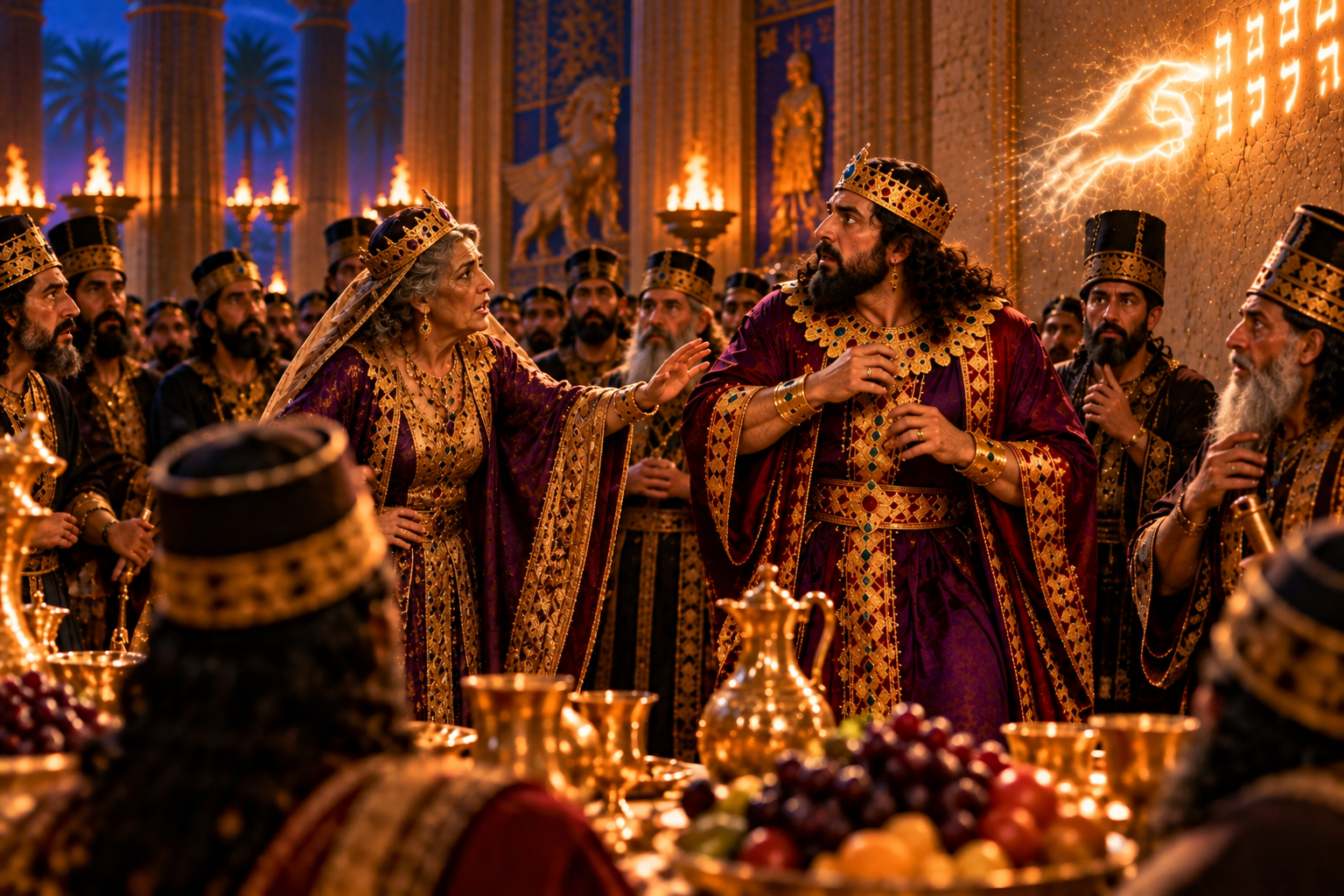
The queen entered the banquet hall because of the words of the king and his nobles; the queen spoke and said, "O king, live forever! Do not let your thoughts alarm you or your face be pale - NET = "Due to the noise caused by the king and his nobles." Evidently the commotion in the banquet hall had reached the queen, prompting her to enter and address the terrified king.
This queen was almost certainly not one of Belshazzar’s wives, for his wives and concubines were already participating in the banquet (Da 5:2–3). The term may designate the queen mother, an older woman of considerable status and influence at court. Various identifications have been proposed, including a wife or daughter of Nebuchadnezzar and the wife of Nabonidus, but the text does not identify her by name. What is clear is that she remembered what Belshazzar had forgotten (although he had heard about him) here was a man named Daniel in Babylon! She knew Daniel’s history and his extraordinary service during the reign of Nebuchadnezzar (Da 5:11,12).
Her absence from the banquet may also be significant. While the king, his nobles, wives, and concubines were indulging themselves, this older woman apparently remained elsewhere. Yet when Babylon’s wise men failed, the woman who had stayed away from the revelry brought the one piece of wisdom the revelers desperately needed.
Then comes one of the great ironies of the chapter. She greets Belshazzar with the conventional royal salutation, “O king, live forever!” (Da 2:4; 3:9; 6:6, 21; cf. 1Ki 1:31). But Belshazzar would not even live through the night (Da 5:30)! Her words, “Do not let your thoughts alarm you or your face be pale,” amount to something like, “Pull yourself together!” But Belshazzar had good reason to be terrified. The handwriting was still on the wall, and his final hours were rapidly slipping away.
Daniel 5:11 "There is a man in your kingdom in whom is a spirit of the holy gods; and in the days of your father, illumination, insight and wisdom like the wisdom of the gods were found in him. And King Nebuchadnezzar, your father, your father the king, appointed him chief of the magicians, conjurers, Chaldeans and diviners.
- Your father or, grandfather, Da 5:2
- Illumination: Da 2:11 2Sa 14:17 Ac 12:22 14:11 Rev 3:9
- chief: Da 2:48 4:9 Ac 16:16
- Daniel 5 Resources - Multiple Sermons and Commentaries
Related Passages:
Genesis 41:11-15 “We had a dream on the same night, he and I; each of us dreamed according to the interpretation of his own dream. 12“Now a Hebrew youth was with us there, a servant of the captain of the bodyguard, and we related them to him, and he interpreted our dreams for us. To each one he interpreted according to his own dream. 13“And just as he interpreted for us, so it happened; he restored me in my office, but he hanged him.” 14Then Pharaoh sent and called for Joseph, and they hurriedly brought him out of the dungeon; and when he had shaved himself and changed his clothes, he came to Pharaoh. 15Pharaoh said to Joseph, “I have had a dream, but no one can interpret it; and I have heard it said about you, that when you hear a dream you can interpret it.”
Genesis 41:38 (Pharaoh alluding to Joseph) Then Pharaoh said to his servants, “Can we find a man like this, in whom is a divine spirit?”
Daniel 4:8; 9; 18 “But finally Daniel came in before me, whose name is Belteshazzar according to the name of my god, and in whom is a spirit of the holy gods; and I related the dream to him, saying, (4:9) ‘O Belteshazzar, chief of the magicians, since I know that a spirit of the holy gods is in you and no mystery baffles you, tell me the visions of my dream which I have seen, along with its interpretation. (4:18) ‘This is the dream which I, King Nebuchadnezzar, have seen. Now you, Belteshazzar, tell me its interpretation, inasmuch as none of the wise men of my kingdom is able to make known to me the interpretation; but you are able, for a spirit of the holy gods is in you.’
Daniel 2:22 “It is He who reveals the profound and hidden things; He knows what is in the darkness, And the light dwells with Him.
FORGOTTEN BY THE KING
REMEMBERED FOR HIS CHARACTER
There is a man in your kingdom in whom is a spirit of the holy gods; and in the days of your father, illumination, insight and wisdom like the wisdom of the gods were found in him. And King Nebuchadnezzar, your father, your father the king, appointed him chief of the magicians, conjurers, Chaldeans and diviners - The queen functions somewhat like Pharaoh’s cupbearer, who suddenly remembered Joseph when Pharaoh faced a mystery none of his wise men could solve (Ge 41:9–15). In both cases, when human wisdom reached its limit, someone remembered a forgotten man of God who could provide the answer.
In whom is a spirit of the holy gods -The queen functions somewhat like Pharaoh’s cupbearer, who suddenly remembered Joseph when Pharaoh faced a mystery none of his wise men could solve (Ge 41:9–15). In both cases, when human wisdom reached its limit, someone remembered a forgotten man of God who could provide the answer.
In whom is a spirit of the holy gods - Like Nebuchadnezzar before her (Da 4:8–9), the queen recognized that there was something distinctly different about Daniel, something she regarded as supernatural. Speaking from her pagan perspective, she attributed Daniel’s extraordinary wisdom to “the holy gods” rather than explicitly to the Most High God. Her words therefore need not indicate personal faith in Daniel’s God, but they certainly demonstrate her profound respect for Daniel and his God-given abilities.
What a testimony to a lifetime of faithfulness! Daniel’s usefulness did not ultimately rest on natural ability, political position, or royal favor, but on what God had produced in a man who faithfully walked with Him. Daniel had apparently faded from prominence under Belshazzar, but his reputation had not disappeared. Kings changed, governments changed, circumstances changed, but Daniel’s character did not change. Decades of faithful living had created a testimony that remained even when Daniel himself had been largely forgotten. A godly reputation may take a lifetime to build, but it can speak when you are not even in the room.
Daniel lost his position in the palace,
but he never lost his testimony.
Ray Pritchard - When the party started, Daniel was nowhere to be found. No doubt he was in his room resting and praying. And why would they want Daniel in the first place? The world never invites the people of God to an orgy. After all, if you invite one of those narrow-minded, legalistic fundamentalists, sooner or later they are going to be offended and probably make a big scene. Better to leave them off the guest list altogether. But as we shall see, Daniel soon becomes the life of the party. (God’s Graffiti)
It is fascinating the the queen recognized something "different" about Daniel. Stortz has an interesting note that even unbelievers can recognize superior wisdom (cp Ezekiel 2:4, 5) writing…
I think of the men who were involved in the founding of our nation. Not all the Founding Fathers were Christians, but there was a reverence for and acceptance of the wisdom of the Word of God. They established a government based on the Scriptures. They based the laws of the land upon the Word of God. Many acknowledged the wisdom of God in the Scriptures even though they did not believe in Jesus Christ as their personal Lord and Savior. (See Daniel: The Triumph of God's Kingdom)
We as believers need to be salty salt (Mt 5:13) and bright beacons (Mt 5:14,15,16, Php 2:15, Col 4:5,6, 1Pe 3:14,15) in our Christian witness, so that those lost in the moral corruption and spiritual darkness of this present evil age know that one of God's children has been in their midst. God encouraged his prophet with these words…
I am sending you to them who are stubborn and obstinate children, and you shall say to them, ‘Thus says the Lord God.’ As for them, whether they listen or not—for they are a rebellious house—they will know that a prophet has been among them. (Ezek 2:4, 5)
Nebuchadnezzar, your father - Nebuchadnezzar was an ancestor of Belshazzar but not his literal father. The term father in Hebrew and Chaldee is frequently used to denote a progenitor, or ancestor, however remote.
Rich Cathers - Be a light in your world. Illustration - This is a story about a little girl who, on the way home from church, turned to her mother and said, “Mommy, the Preacher’s sermon this morning confused me.” The mother said, “Oh! Why is that?” The girl replied, “Well, he said that God is bigger than we are. Is that true?” “Yes, that’s true,” the mother replied. “He also said that God lives within us. Is that true, too?” Again the mother replied, “Yes.” “Well,” said the girl. “If God is bigger than us and He lives in us, wouldn’t He show through?” God wants people to see Him through us. God wants us to have a reputation of integrity. (Daniel 5)
Ray Pritchard - Not Invited to the Orgy (God’s Graffiti)
I pause here to make a point made a century ago by Joseph Parker, the famous London preacher. When the world throws an orgy, the children of God are not invited. We don’t fit in and our values would just be a nuisance when the world wants to party. But let a marriage break up, or let cancer hit, or let the children get in trouble, or the career hit the rocks, and who do they call? They call the faithful men and women who know the Lord. Daniel wasn’t invited to the party, but when God intervened and no one had the answer, suddenly Daniel was the one man the king wanted to hear from.
We never know our influence until a crisis comes. What an encouragement this is. You may be stuck in an office or a classroom or a factory or a neighborhood or a club or a family gathering where you are the only Christian. And you may feel overlooked and taken for granted, or possibly ridiculed and misunderstood. Bide your time, my Christian friend, and do not despair. Soon enough life will come tumbling in and the people who have no time for you will turn to you for answers. You may not be invited to every party, but you will get the call when trouble comes. When it happens, be bold to speak the truth in love.
Never underestimate the power of a godly life. When I preached this sermon, a woman who was attending our church for the first time came forward for prayer. Later I overheard her speaking to a friend she had known for several years. Evidently she understood this point perfectly because she commented to her friend, “I knew who to call this week.” She had called her friend, her friend invited her to church, and that’s why she came on Sunday. Even when we think no one is paying attention, the people of the world are watching us, and if we are faithful to the Lord, when trouble comes, they will know who to call.
Courage To Stand Alone - It was a morally dark night in Babylon—darker than your workplace, school, or community. King Belshazzar had willfully blasphemed God by desecrating the sacred goblets looted from the temple in Jerusalem. Now Babylon and Belshazzar were about to face God's judgment.
Yet in the midst of this gross darkness shone the light of a single witness—the prophet Daniel. Because of his reputation as a man with "the Spirit of the Holy God" (Da 5:11), he was summoned to interpret the mystifying message on the wall.
Daniel could have softened God's warning to give it a meaning the king and his court would rather hear. He could have omitted the part about judgment and death. But instead of muddling the message to please the king, Daniel remained true to God. Standing alone before Belshazzar and his drunken court, he boldly spoke the whole truth.
It took enormous courage for Daniel to do that, but the threat from an earthly king was nothing compared to his allegiance to the King of heaven. Daniel feared Belshazzar so little because he feared God so much.
When we share Daniel's heavenly perspective, we too will find that God gives us the courage to stand alone. — Haddon W. Robinson (Our Daily Bread, Copyright RBC Ministries, Grand Rapids, MI. Reprinted by permission. All rights reserved)
In need of strength, we melt into the crowd
And find that strength grows more elusive still;
Our courage gone, we call upon the Lord
And find our strength renewed to do His will.
—GustafsonDaniel could stand fearlessly before the king because he had faithfully walked with God.
When we know God stands with us, it doesn't matter who stands against us.
When we stand with God, we can stand firm before men.
When God is our confidence, circumstances cannot be our master.
When we fear God, we need not live in fear of men.
Since God holds our future, we need not fear what tomorrow holds.
When God is our Rock, the shaking around us need not shake us within.
Daniel 5:12 "This was because an extraordinary spirit, knowledge and insight, interpretation of dreams, explanation of enigmas and solving of difficult problems were found in this Daniel, whom the king named Belteshazzar. Let Daniel now be summoned and he will declare the interpretation."
- an extraordinary: Da 5:14 6:3 Ps 16:3 Pr 12:26 17:27 Col 1:29
- interpretation of: Da 5:16 1Ki 10:1-3 2Ch 9:1,2
- whom: Da 1:7, 4:8,19
- Daniel 5 Resources - Multiple Sermons and Commentaries
Related Passages:
Daniel 1:17 As for these four youths, God gave them knowledge and intelligence in every branch of literature and wisdom; Daniel even understood all kinds of visions and dreams.
DANIEL: A
KNOT UNTIER
This was because an extraordinary spirit, knowledge and insight, interpretation of dreams, explanation of enigmas and solving of difficult problems were found in this Daniel, whom the king named Belteshazzar. Let Daniel now be summoned and he will declare the interpretation - The queen continues her remarkable testimony concerning Daniel. Verse 11 emphasized his wisdom and character; verse 12 emphasizes his proven ability. Notice the important expression, “were found in this Daniel.” This was not speculation about what Daniel might be able to do. These qualities had been observed, tested, and repeatedly demonstrated throughout his long life. Daniel did not suddenly become useful to God when the crisis came. He was useful in the crisis because he had been faithful before the crisis. Decades had passed since the events of Daniel 2, kings had come and gone, and Daniel had apparently faded from prominence, but the qualities God had developed in him remained. His position had changed, but his character had not.
The queen therefore speaks with remarkable confidence: “Let Daniel now be summoned and he will declare the interpretation.” She does not say Daniel might be able to help. Daniel’s past faithfulness gave her confidence in his usefulness during the present crisis. Daniel’s reputation was not built in a day but was built by walking with God day after day. Crisis does not create character so much as reveal the character that has already been formed. When the crisis came, Daniel was ready because God had been preparing him through a lifetime of faithful obedience.
Daniel was ready for the moment
because he had walked with God for a lifetime.
How about you beloved - will you be ready for the moment?
An extraordinary spirit - Extraordinary carries the idea of something surpassing, excellent, or exceptional. There was something about Daniel that clearly distinguished him from the other wise men of Babylon. His distinction was not merely intellectual brilliance or natural ability, but a God-given quality of character, wisdom, discernment, and spiritual insight that had been demonstrated repeatedly throughout his life (Da 5:11, 12, 14). Daniel lived in the same pagan culture, served under the same kings, and faced many of the same pressures as those around him, yet he was different because the God he served was different. His excellence was not self-produced but reflected a Spirit produced life (cf 2Co 3:18) consistently surrendered to and empowered by God. What made Daniel extraordinary was not merely what he knew, but the God he knew.
🙏 THOUGHT - How would you like this to be your reputation with the pagans? Peter alludes this "Daniel type behavior" exhorting the believers…Keep your behavior (anastrophe) excellent among the Gentiles, (Why?) so that in the thing in which they slander you as evildoers, they may on account of your good deeds, as they observe them (Know that the unbelievers have their eyes on you looking for a chink in your armor, but also seeing the indisputable evidence of a supernatural life!), glorify God in the day of visitation. (1Pe 2:12)
Keep in mind that Daniel is now probably in his 80's and is still running his race with endurance (Hebrews 12:1, cp Ps 92:12, 13, 14). He had begun well, had run well and would finish well, like Paul who with his last words testified…
I have fought the good fight, I have finished the course, I have kept the faith. In the future there is laid up for me the crown of righteousness, which the Lord, the righteous Judge, will award to me on that day; and not only to me, but also to all who have loved His appearing (like Daniel - see Da 12:3, 13). (2Ti 4:7, 2Ti 4:8)
Explanation of enigmas (KJV = Showing of hard sentences) The expression describes the ability to unravel obscure, difficult, or puzzling matters and make their meaning clear. This ability was not something Daniel had suddenly acquired in old age. At the beginning of the book we were told that God gave Daniel and his companions knowledge and intelligence, and that Daniel possessed special understanding of visions and dreams (Da 1:17). What God had given Daniel as a young man was still evident decades later. Daniel could take what left others confused and, through God-given insight, make it understandable. Significantly, Daniel never presented himself as the source of this ability. Earlier he had declared, “There is a God in heaven who reveals mysteries” (Da 2:28). Daniel could explain mysteries because he knew the God Who reveals mysteries.
Daniel could make the mysterious clear
because he walked with the God to Whom nothing is mysterious.
Solving of difficult problems (KJV = and dissolving of doubts; YLT = "loosing of knots") This is one of the most colorful expressions in the verse. The underlying Aramaic literally conveys the picture of “untying knots.” What a wonderful description of Daniel’s God-given ability! A difficult problem can resemble a tangled knot and the more some people pull at it, the tighter and more confusing it becomes. Daniel, however, possessed God-given wisdom that enabled him to patiently untangle the tangled and make clear what others could not resolve. Once again, the emphasis should ultimately fall not on Daniel’s brilliance but on Daniel’s God. Daniel could untie the knots because he depended upon the One Who sees every strand, understands every complication, and knows exactly how they fit together.
🙏 THOUGHT- There is a practical lesson here. Life sometimes (how about OFTEN) presents us with circumstances that seem like hopelessly tangled knots. Our natural tendency is to pull harder, worry more, and attempt to solve everything ourselves, sometimes only tightening the knot. What we cannot unravel, God already understands.
When life becomes a knot we cannot untangle,
we can place it in the hands of the God Who sees every strand.
Let Daniel now be summoned and he will declare the interpretation -The queen urges Belshazzar to “make the call,” and notice her remarkable confidence. She does not say Daniel might be able to interpret the writing. She confidently declares, “he will declare the interpretation.” Daniel had spent a lifetime demonstrating that when God revealed a mystery, His servant could be trusted to faithfully make it known.
Think of all that had changed during Daniel’s long life. Babylon changed Daniel’s name. Kings changed Daniel’s position. Time changed Daniel’s age. But nothing changed Daniel’s character. From the young captive who “made up his mind that he would not defile himself” (Da 1:8) to the elderly prophet summoned before Belshazzar, Daniel remained a man who faithfully walked with God. Circumstances changed around Daniel, but they did not change the convictions within Daniel. His influence rose and fell, his rulers came and went, and his public prominence diminished, but his faithfulness endured.
Ray Pritchard "I do not know everything the king was thinking. But I do know this—a drowning man will grasp at anything. So the king called for Daniel and he came. Enter Daniel, a former slave, once a teenage hostage. Now he is an old man. All his life he has served in the court of the king of Babylon. More than once he had pulled Nebuchadnezzar out of a jam. Evidently he had been faithful to God all his life. Never once had he compromised his values even though he lived his entire adult life in a pagan land serving in a pagan government. Somehow he managed to keep his values intact while serving in Babylon. Now he is called for his last act of service to a Babylonian king"
Vance Havner - Daniel was not present as a guest at the feast of Belshazzar. He did not belong to the club and had no complimentary ticket to the orgy. He did not even drink ginger ale among the alcoholics! But he ended up the most honored of all because he was where he belonged until he was sent for. If more prophets stayed where they belong, they would be summoned when God writes on the wall. It is fashionable nowadays for the clergy to attend the suppers of Sodom and the grog-fests of Babylon, but they cannot decipher the heavenly hieroglyphics in the hour of doom.
Daniel 5:13 Then Daniel was brought in before the king. The king spoke and said to Daniel, "Are you that Daniel who is one of the exiles from Judah, whom my father the king brought from Judah?
- Are you - Da 5:11 1:21 2:48 8:1,27
- Da 2:25 6:13 Ezra 4:1 6:16,19,20 10:7,16
- father or, grandfather - Da 5:2,11,18
- Judah - Jn 7:1,3
- Daniel 5 Resources - Multiple Sermons and Commentaries
Related Passages:
Genesis 41:14-16 Then Pharaoh sent and called for Joseph, and they hurriedly brought him out of the dungeon; and when he had shaved himself and changed his clothes, he came to Pharaoh. 15 Pharaoh said to Joseph, “I have had a dream, but no one can interpret it; and I have heard it said about you, that when you hear a dream you can interpret it.” 16 Joseph then answered Pharaoh, saying, “It is not in me; God will give Pharaoh a favorable answer.”
Daniel 1:8 But Daniel made up his mind that he would not defile himself with the king’s choice food or with the wine which he drank; so he sought permission from the commander of the officials that he might not defile himself.
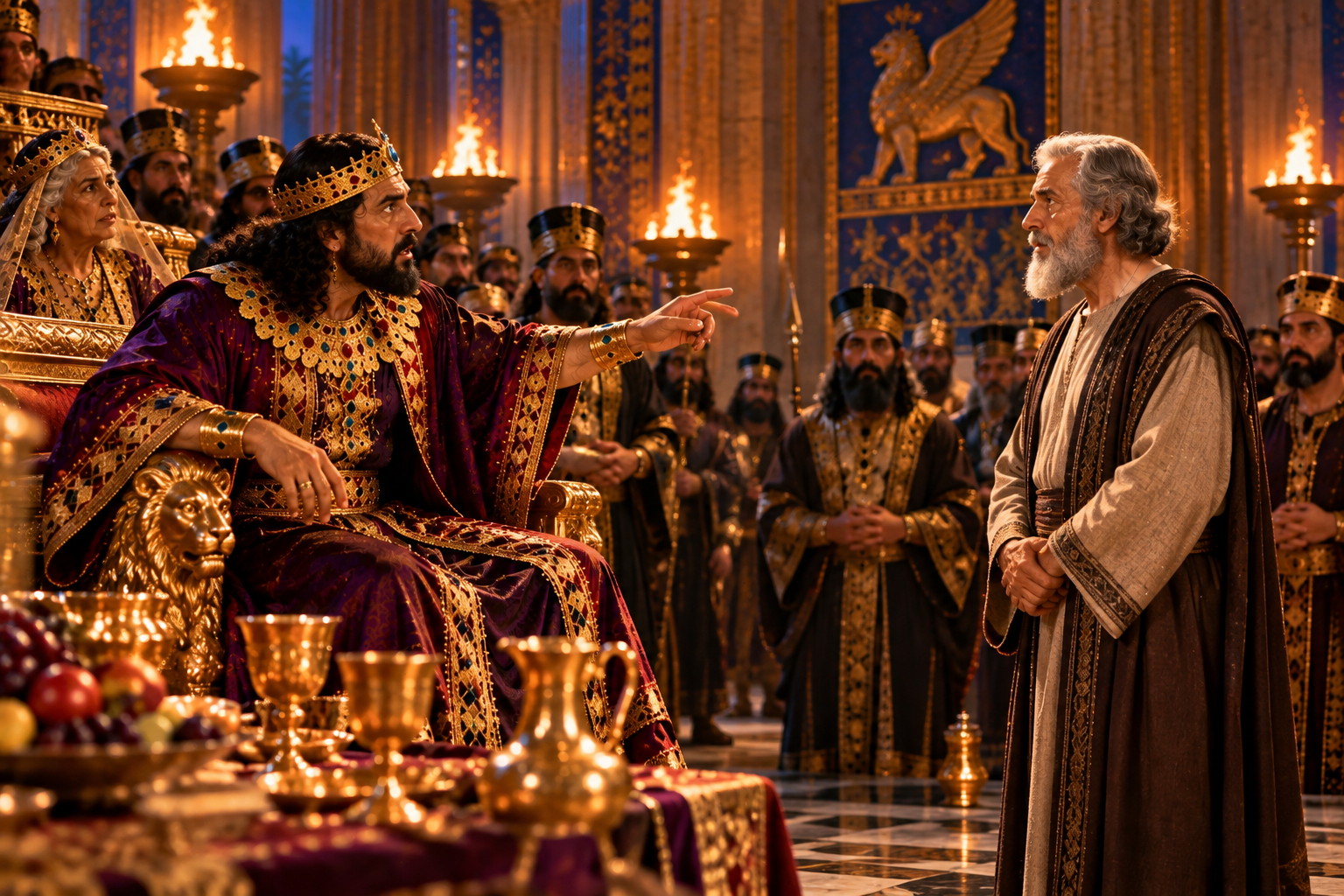
ARE YOU
THAT DANIEL?
Then Daniel was brought in before the king. The king spoke and said to Daniel, "Are you that Daniel who is one of the exiles from Judah, whom my father the king brought from Judah? - In context my father refers to Nebuchadnezzar, using father in the broader sense of an ancestor or forefather rather than necessarily a biological father. Notice the striking circumstances of Daniel’s appearance. Daniel did not seek an audience with the king. The king’s crisis sought Daniel. Daniel had apparently been living quietly outside the center of royal influence, but when God’s message appeared on the wall and Babylon’s wisdom failed, suddenly the forgotten prophet was summoned into the presence of the king.
God always has His servant ready when His message needs to be proclaimed. Daniel had not abandoned his calling simply because he had been removed from prominence. He remained available to speak God’s truth “in season and out of season” (2Ti 4:2). Daniel did not need a royal position to remain useful to God. He only needed to remain faithful and available.
Are you that Daniel… one of the exiles - Belshazzar exhibits a somewhat condescending attitude toward Daniel reminding him of his "roots" (an exile). Daniel did not need a position to have influence. He needed character, and character had been built over decades of walking with God.
🙏 THOUGHT on Are you that Daniel - What if someone who had heard about our life asked, “Are you THAT Christian?” The Christian whose integrity is unquestioned? The Christian who can be trusted when others cannot? The Christian who remains calm when everyone else is panicking? The Christian who speaks the truth even when the truth is uncomfortable or costly? The Christian who has walked faithfully with God, not merely for days or years, but for decades like Daniel? Daniel’s testimony reminds us that a godly reputation is built one faithful day at a time. We may never stand before kings or interpret handwriting on a wall, but every day we are writing a testimony with our lives. May those who know us see something of Daniel’s steadfastness and, more importantly, something of Daniel’s God. Dear Father, may his tribe increase, for Your glory and honor in Jesus' Name. Amen. Live today so that someday others can say, “Yes, you are THAT Christian.”
Daniel later says that he continued doing “the king’s business” (Da 8:27), indicating that he still held some governmental responsibility during Belshazzar’s reign. Yet Daniel 5 suggests that Belshazzar knew remarkably little about him. How striking that a man who had played such a prominent role under Nebuchadnezzar and had demonstrated extraordinary wisdom could apparently have faded so far from the king’s attention! Some older commentators interpreted this as evidence that Belshazzar was more occupied with pleasure than with the serious affairs of government and suggested that the queen mother, sometimes identified as Nitocris, exercised considerable influence in governmental matters. Such historical identifications, however, remain uncertain. What the biblical text clearly establishes is that the queen knew Daniel’s reputation far better than Belshazzar did (Da 5:10–12). There is a striking irony here. Belshazzar knew little about the man he desperately needed until the crisis came. Daniel may have been forgotten at court, but decades of faithful service had not erased his testimony. When Babylon’s wisdom failed and the king needed a word from God, someone remembered Daniel.
John Whitcomb - After the death of Nebuchadnezzar, Daniel may have been demoted from his high position. Thus, instead of referring to him as "chief governor over all the wise men of Babylon" (Da 2:48), Belshazzar speaks of him simply as "one of the exiles of Judah, whom my father the king brought from Judah." (SEE Daniel- Everyman's Bible Commentary - Page 71)
Babylon changed Daniel's circumstances,
but decades in Babylon never changed Daniel's convictions.
Daniel 5:14 "Now I have heard about you that a spirit of the gods is in you, and that illumination, insight and extraordinary wisdom have been found in you.
- Da 5:11,12
- Daniel 5 Resources - Multiple Sermons and Commentaries
THE POWER
OF A GODLY LIFE
Now I have heard about you that a spirit of the gods is in you, and that illumination, insight and extraordinary wisdom have been found in you - Belshazzar continues his address to Daniel by repeating what the queen has just told him.
Belshazzar was afraid. Before he had not even deigned to consult with this Hebrew exile! But now he was desperate and he was ready to listen to anyone who could help! Daniel was his last resort! How often we as believers find our unbelieving friends pay such little attention to us until they encounter an overwhelming life adversity or tragedy. Then they seek us out for prayer and counsel (And we are glad they do so! See Joseph Parker's note below). I am always reminded of the first words out of the mouth of individuals thrown into a sudden catastrophic situation for what you usually hear is something like "Oh God please. Oh God help!"
I have heard about you (cp "heard" Da 5:16) - The point is that Belshazzar knew about Daniel and his works, but to the king’s shame he did not know him personally. There is an interesting contrast between “I have heard about you” and the queen's statement that these qualities “were found in this Daniel” (Da 5:12). Daniel's reputation was well established, but apparently Belshazzar knew Daniel more by reputation than by relationship. Belshazzar had no excuse. He knew about God's prophet Daniel. He knew about the prophet's God and what He had done in Nebuchadnezzar's life (see Daniel's concluding statement = Da 5:22). Belshazzar's problem was that he did not know either the prophet or His God! (cp Jn 17:3)
Warren Wiersbe notes that "Daniel had “done the king’s business” in the third year of his reign (Da 8:1, 27), which would have been 554BC. What a tragedy that the ruler of the mighty city of Babylon should ignore one of the greatest men in history and turn to him only in the last hours of his life when it was too late. (Bible Exposition Commentary - Old Testament).
A spirit of the gods is in you -The phrase can also be rendered “the Spirit of God is in you,” but given Belshazzar’s pagan worldview, he probably had no true understanding of the Holy Spirit. He was most likely repeating the pagan assessment of Daniel that had circulated in the royal court (Da 5:11). But remember that Daniel was still just a man. We can admire his faithfulness, courage, wisdom, and godly character, but we must never become so enamored with Daniel that we lose sight of Daniel’s God. Daniel possessed extraordinary abilities because God had graciously given them to him. From the beginning we are told that God gave Daniel knowledge and intelligence and the ability to understand “all kinds of visions and dreams” (Da 1:17). The emphasis is not on what Daniel possessed naturally, but on what God bestowed supernaturally.
Thus Daniel 5 is not ultimately a story about the greatness of Daniel but about the greatness of Daniel’s God. Daniel was simply a “vessel for honor” (2Ti 2:21), prepared and available for the Master’s use. And in this critical hour, God chose that vessel to deliver His final warning to Belshazzar. God has a remarkable way of positioning His servants where they are needed, when they are needed. Daniel had been prepared through decades of faithful walking with God for this very moment.
Daniel was the vessel; God was the Source.
Daniel was the messenger; God had the message.
Ray Pritchard - We never know our influence until a crisis comes. What an encouragement this is. You may be stuck in an office or a classroom or a factory or a neighborhood or a club or a family gathering where you are the only Christian. And you may feel overlooked and taken for granted, or possibly ridiculed and misunderstood. Bide your time, my Christian friend, and do not despair. Soon enough life will come tumbling in and the people who have no time for you will turn to you for answers. You may not be invited to every party, but you will get the call when trouble comes. When it happens, be bold to speak the truth in love. Never underestimate the power of a godly life. (God’s Graffiti - January 2000)
🙏 THOUGHT -Perhaps you, dear reader, are the “Daniel” in someone else’s life. They have heard about God again and again, so they know ABOUT Him, yet they have never humbled themselves before Him and come to truly KNOW Him. Perhaps God has placed you in their life for such a time as this, not to condemn them, but to lovingly warn them that there is a judgment to come and to point them to the Savior Who bore judgment for sinners (Heb 9:27; 1Pe 2:24). Daniel did not soften God’s message to Belshazzar, but neither did he invent the message. He simply faithfully delivered what God had revealed. We are called to do the same, speaking “the truth in love” (Eph 4:15), remembering that the very warning of coming judgment is an expression of God’s mercy, for God warns before He judges. So do not remain silent simply because the truth may be uncomfortable. Someone God has placed in your life may need to hear from your lips that knowing ABOUT God is not the same as KNOWING God.
God’s warning of coming judgment is
itself an expression of His present mercy.
Joseph Parker comments on this event - Preachers of the Word, you will be wanted some day by "Belshazzar;" you were not at the beginning of the feast, but you will be there before the banqueting hall is closed; the king will not ask you to drink wine, but he will ask you to tell the secret of his pain and heal the malady of his heart. Abide your time. You are nobody now… Midway down the program to mention pulpit, or preacher, or Bible, would be to violate the harmony of the occasion. But the preacher, as we have often had occasion to say, will have his opportunity. They will send for him when all other friends have failed; may he then come fearlessly, independently, asking only to be made a medium through which divine communications can be addressed to the listening trouble of the world… O Daniel, preacher, speaker, teacher, thunder out God's word, if it be a case of judgment and doom; or whisper it, or rain in gracious tears, if it be a message of sympathy and love and welcome (Daniel 5 The People's Bible).
Daniel 5:15 "Just now the wise men and the conjurers were brought in before me that they might read this inscription and make its interpretation known to me, but they could not declare the interpretation of the message.
- Da 5:7,8 2:3-11 Isa 29:10, 11, 12 47:12
- Daniel 5 Resources - Multiple Sermons and Commentaries
WHEN HUMAN WISDOM
REACHES ITS LIMIT
Just now the wise men and the conjurers were brought in before me that they might read this inscription and make its interpretation known to me, but they could not declare the interpretation of the message - Belshazzar explains the problem and failure of his wise men. They could not declare it because it was a supernatural message from the Spirit of God and they were natural men. Paul writes "But a natural man does not accept the things of the Spirit of God, for they are foolishness to him; and he cannot understand them, because they are spiritually appraised." (1Cor 2:14) He then goes on to offer the same reward.
🙏 THOUGHT - God’s supernatural revelation cannot be rightly understood by natural intellect alone! A person may possess great intelligence, extensive education, and even considerable knowledge of the Bible, yet remain blind to its spiritual truth apart from the illuminating work of the Holy Spirit (1Co 2:12–14). Are you having difficulty comprehending the Bible? The first question is not simply, “How much have you studied?” but “Are you born again?” If you belong to Christ, you possess the indwelling Holy Spirit (Ro 8:9), the divine Teacher Who enables believers to understand and receive spiritual truth (Jn 16:13). This does not mean that every passage will immediately become clear or that every Christian will interpret every text correctly. Even mature believers encounter difficult passages, and some things God has chosen not to reveal (Dt 29:29; 2Pe 3:16). Therefore, we must prayerfully study the Word, compare Scripture with Scripture, and depend upon the Spirit rather than upon our intellect alone. As we faithfully study God’s Word and mature in Christ, we should increasingly “grow in the grace and knowledge of our Lord and Savior Jesus Christ” (2Pe 3:18). The Spirit Who inspired the Word is the Spirit Who illuminates the Word.
The Bible is not merely a Book to be analyzed by the mind,
but divine truth to be illuminated by the Spirit and received by the heart.
Daniel 5:16 "But I personally have heard about you, that you are able to give interpretations and solve difficult problems. Now if you are able to read the inscription and make its interpretation known to me, you will be clothed with purple and wear a necklace of gold around your neck, and you will have authority as the third ruler in the kingdom."
- interpretation: Ge 40:8
- Da 5:7 Ac 8:18
- Daniel 5 Resources - Multiple Sermons and Commentaries
DANIEL'S REPUTATION
PRECEDES HIM
But - The but marks the contrast with verse 15. The wise men could not. BUT I have heard that you can.
I personally have heard about you, that you are able to give interpretations and solve difficult problems - Belshazzar says that he had “heard” about Daniel, suggesting that although Daniel’s reputation had survived, the prophet himself was no longer prominent in the king’s immediate circle. More than two decades had passed since the death of Nebuchadnezzar, and kings, administrations, and circumstances had changed. Daniel apparently no longer occupied the place of prominence he once enjoyed, although he still performed some governmental service (Da 8:27). What is remarkable is that Daniel’s position had diminished, but his reputation had not. Years after his extraordinary service under Nebuchadnezzar, people still remembered the man who could interpret mysteries and “solve difficult problems.” Daniel reminds us that positions are temporary, but godly character can leave a testimony that endures long after the position is gone. And once again, Belshazzar had heard about Daniel, just as he had heard about Daniel’s God. Tragically, knowing about either was not the same as personally knowing the God Daniel served.
Daniel had lost his prominence,
but he had not lost his testimony.
Trapp - “This silly and shallow prince hath nothing to say but what was put into his mouth by his wiser grandmother (ED: HER RELATION WAS UNCERTAIN).” In other words, Belshazzar had little personal knowledge of Daniel and could only repeat the testimony of someone who knew Daniel better.
Maclaren goes a step farther describing this as "craven-hearted flattery addressed to Daniel by the king, who apparently had never heard of him till the queen spoke of him just before." (Daniel 5:17-31 Mene, Tekel, Peres)
Now if you are able to read the inscription and make its interpretation known to me, you will be clothed with purple and wear a necklace of gold around your neck, and you will have authority as the third ruler in the kingdom - Note the striking difference between the queen’s confidence and Belshazzar’s uncertainty. The queen had confidently declared, “Let Daniel now be summoned and he will declare the interpretation” (Da 5:12). Belshazzar, however, says, “if you are able.” The queen knew Daniel’s reputation. Belshazzar only knew what he had just been told.
You will be clothed... - Belshazzar repeats the reward he had previously offered to Babylon’s wise men (Da 5:7): royal purple, a gold necklace, and authority as the third ruler in the kingdom. But Daniel was not motivated by royal rewards. He had not come seeking wealth, position, or recognition. He had come as God’s messenger with God’s message. Note the irony in Belshazzar’s offer. He was promising Daniel promotion in a kingdom that had only hours left to exist! Before the night was over, Belshazzar would be dead and Babylon would fall (Da 5:30–31). How worthless are the world’s greatest honors when the world that bestows them is passing away (1Jn 2:17)! Belshazzar offered Daniel a higher position in a kingdom that was about to fall; Daniel served a King Whose kingdom could never fall.
Third ruler - This unusual expression fits remarkably well with what is known of Babylon’s political arrangement. Nabonidus, Belshazzar’s father, was the reigning king, while Belshazzar functioned as co-regent and exercised royal authority in Babylon during his father’s prolonged absence. Nabonidus therefore occupied the first position and Belshazzar the second. Consequently, the highest position Belshazzar could offer Daniel was third ruler in the kingdom. This also explains why Belshazzar could not offer Daniel the position Pharaoh had given Joseph, making him second only to Pharaoh (Ge 41:40–43). Second place was already occupied by Belshazzar himself.
F B Meyer - Our Daily Homily - Daniel 5:16
The perplexed world often turns to the Christian in its hours of anguish and terror. While the foe seems powerless, and the hall of life is full of light and song; while the merry feet chase the flying hours, and mirth is unrestrained; whilst the wine flows freely, and the courtiers whisper flattery—the servant of God may be left in obscurity and neglect, as Daniel by Belshazzar. At such times God Himself is an object of ridicule and scorn. But let a hand come from out the Infinite, and write on the walls of life’s palace in words of mystery, then the panic-stricken worldlings cry out for one in whom is the Spirit of the Holy God, and who can decipher the mysterious hieroglyphics, which to conscience forebode only disaster.
At such hours the child of God is kept in perfect peace. How should it be otherwise? He recognizes his Father’s handwriting, and can decipher his Fathers meaning. Amid the crash of falling kingdoms he is sure of his Father’s care. Oblivious of his own interests, he is only anxious to interpret the ways of God, to recall the sinner, and save the State.
The world has more respect for our religion than it cares to admit in its gay moods, and it is noticing us more than we dream. Some day those who treat you with least courtesy will send for you. Only be at peace, and rest in your Father’s Spirit. It shall be given you in that same hour what ye should speak. In the meanwhile, do not be surprised if you are led through many mysterious and trying experiences. It is only so that you can get the key to God’s secrets, or the clue to his mysteries. Above all, seek for the Spirit of God, that light and understanding and excellent wisdom may be found in thee.
Daniel 5:17 Then Daniel answered and said before the king, "Keep your gifts for yourself or give your rewards to someone else; however, I will read the inscription to the king and make the interpretation known to him.
- Keep - Da 5:29 Ge 14:23 2Ki 3:13 5:16,26 Ac 8:20
- Daniel 5 Resources - Multiple Sermons and Commentaries
DANIEL PROCEEDS TO GIVE…
LESSONS IN HISTORY, THEOLOGY AN READING
Then Daniel answered and said before the king, "Keep your gifts for yourself or give your rewards to someone else; however, I will read the inscription to the king and make the interpretation known to him - Daniel’s “sermon” would be short but certainly not sweet, pithy but penetrating! Before delivering God’s message, Daniel makes it unmistakably clear that he cannot be bought. Neither purple robes, gold necklaces, nor political promotion would influence what he was about to say.
Daniel’s response to Belshazzar is noticeably different from his response to Nebuchadnezzar. When Daniel interpreted Nebuchadnezzar’s disturbing dream, he was visibly distressed and even wished that its judgment might apply to the king’s enemies rather than to Nebuchadnezzar himself (Da 4:19). No such tenderness appears here. Why the difference? Belshazzar possessed greater light and had deliberately rejected it. He knew what God had done to Nebuchadnezzar, yet “you, his son, Belshazzar, have not humbled your heart, even though you knew all this” (Da 5:22). Worse, that very night he had openly profaned the vessels belonging to the God of heaven and praised lifeless idols (Da 5:23). Daniel therefore stands before him not primarily as a royal adviser but as God’s prophet delivering God’s verdict.
Keep your gifts (Nebuchadnezzar's offer Da 2:6) - Daniel’s response to Belshazzar is noticeably different from his response to Nebuchadnezzar. When Daniel interpreted Nebuchadnezzar’s disturbing dream, he was visibly distressed and even wished that its judgment might apply to the king’s enemies rather than to Nebuchadnezzar himself (Da 4:19). No such tenderness appears here. Why the difference? Belshazzar possessed greater light and had deliberately rejected it. He knew what God had done to Nebuchadnezzar, yet “you, his son, Belshazzar, have not humbled your heart, even though you knew all this” (Da 5:22). Worse, that very night he had openly profaned the vessels belonging to the God of heaven and praised lifeless idols (Da 5:23). Daniel therefore stands before him not primarily as a royal adviser but as God’s prophet delivering God’s verdict.
What a beautiful consistency we see across Daniel’s life. Daniel 1: Daniel would not compromise for the king’s food. Daniel 5: Daniel would not compromise for the king’s gold. More than sixty years had passed. Daniel had grown from a young captive into an elderly statesman, kings had come and gone, and circumstances had dramatically changed, but Daniel’s convictions had not changed. The young Daniel could not be bought with the king’s food; the old Daniel could not be bought with the king’s gold.
Daniel valued faithfulness to the King of kings
more than favor from the king of Babylon.
David Guzik - Remember that Daniel was troubled when he had to give Nebuchadnezzar bad news (Daniel 4:19). This isn’t the case here. (Ed: God will not strive with rebels forever [Ge 6:3, cp 2Cor 6:2]. There comes a day when the door of the ark is closed and all outside must perish eternally [Ge 7:16-17]. King Herod learned this truth. Acts 12:21-23) (Daniel 5 Commentary)
Rich Cathers- Lesson - Ministry is free. Jesus told His disciples: (Mt 10:8KJV) "Heal the sick, cleanse the lepers, raise the dead, cast out devils: freely ye have received, freely give." I think this goes beyond whether or not you get “paid” for ministry or for helping others. Why do you help others? Do you expect to get something in return? Sometimes we can find ourselves serving others to gain “respect”. And then when someone doesn’t show us any “respect”, we act surprised and think about quitting.
However, I will read the inscription to the king and make the interpretation known to him - Daniel is not being petulant, arrogant, or disrespectful. He is simply establishing his independence from the king’s reward while remaining completely willing to serve. In effect, Daniel says, “Keep your gifts, but I will still give you God’s message.” His refusal of the reward did not become a refusal of his responsibility. Notice also Daniel’s remarkable confidence. There is no “if I am able” in his response. Belshazzar had said, “if you are able” (Da 5:16), but Daniel confidently declares, “I will read...and make the interpretation known.” His confidence was not self-confidence but God-confidence. Daniel knew that the God Who had revealed mysteries throughout his life had not changed (Da 2:28). Daniel was therefore independent of the king but dependent upon God. Because he wanted nothing from Belshazzar, he was free to tell Belshazzar everything God wanted him to hear.
The psalmist writes "I will also speak of Your testimonies before kings and shall not be ashamed. (Ps 119:46).
Comment: This is part of his liberty; he is free from fear of the greatest, proudest, and most tyrannical of men. David was called to stand before kings when he was an exile; and afterwards, when he was himself a monarch, he knew the tendency of men to sacrifice their religion to pomp and statecraft; but it was his resolve to do nothing of the kind. (note)
A Profile of Courage - One of the most tragic, unforgettable nights in the Bible is described in Daniel 5:30, "That very night Belshazzar, king of the Chaldeans, was slain."
It took courage for Daniel to confront the king that night. The prophet had good reason to hedge a bit about the interpretation of the words supernaturally scrawled on the wall of the banquet room. A lesser man might have been bought off by the huge reward or intimidated by the threat of the king's vengeance. It would have been easier to go along with the national council of prophets of Babylon and plead ignorance about the inscription. Or, since the king was bewildered by the writing, Daniel could have read only part of it and left out the pronouncement of death and doom.
But Daniel was a profile of courage. With Belshazzar and a thousand drunken lords and dignitaries for his congregation, the brave old prophet declared God's whole counsel. What was the source of such courage? Daniel knew that he wasn't just standing before the king of Babylon; he was standing before the King of kings.
With God as our audience and Christ as our companion, we can say and do anything we ought. — Haddon W. Robinson (Our Daily Bread, Copyright RBC Ministries, Grand Rapids, MI. Reprinted by permission. All rights reserved)
Some will hate you, some will love you,
Some will flatter, some will slight;
Cease from man, and look above you,
Trust in God and do the right.
--Macleod
It's easy to stand with a crowd;
it takes courage to stand alone.
Daniel 5:18 "O king, the Most High God granted sovereignty, grandeur, glory and majesty to Nebuchadnezzar your father.
- O king: Da 3:17,18 4:22 6:22 Ac 26:13,19
- Most: Da 2:37,38 4:17,22-25,32 De 32:8 Ps 7:17 9:2 47:2 92:8 La 3:35,38 Ac 7:48
- Daniel 5 Resources - Multiple Sermons and Commentaries
Related Passages:
1 Corinthians 4:7 For who regards you as superior? What do you have that you did not receive? And if you did receive it, why do you boast as if you had not received it?
James 1:17 Every good thing given and every perfect gift is from above, coming down from the Father of lights, with whom there is no variation or shifting shadow.
THE MOST HIGH
GOD GRANTED GIFTS
O king, the Most High God granted sovereignty, grandeur, glory and majesty to Nebuchadnezzar your father - Before Daniel explains the handwriting in verses 25–28, he first gives Belshazzar a history lesson in verses 18–23. Why? Because Belshazzar needs to understand why the judgment has come before he hears what the judgment is. The handwriting on the wall was not an arbitrary outburst of divine anger. There was a moral and spiritual reason behind the verdict.
Daniel begins with the sovereignty of “the Most High God.” Nebuchadnezzar had possessed extraordinary sovereignty, grandeur, glory, and majesty, but notice the crucial verb: God “granted” them to him. Nebuchadnezzar’s greatness was real, but it was never self-made. Everything he possessed had been bestowed upon him by the Most High God (Da 1:2; 2:21, 37–38; 4:17, 25, 32).
Here is one of Daniel’s great recurring themes: God is sovereign even in granting sovereignty to earthly sovereigns. Kings may sit upon thrones, issue decrees, command armies, and rule nations, but behind every earthly throne stands the sovereign authority of the King of heaven. As Daniel had previously declared, God “removes kings and establishes kings” (Da 2:21). This history lesson was especially pointed for Belshazzar. If mighty Nebuchadnezzar owed everything to God, then Belshazzar certainly did as well. And if God could humble the great Nebuchadnezzar, Belshazzar had no reason to imagine that he was beyond God’s reach.
Every earthly sovereign rules
beneath the sovereignty of the Most High God.
Maclaren sets the stage for the indictment of this arrogant king - Daniel’s tone is noticeably stern. He has no reverential preface, no softening of his message. His words are as if cut with steel on the rock. He brushes aside the promises of vulgar decorations and honors with undisguised contempt, and goes straight to his work of rousing a torpid conscience. (Daniel 5:17-31 Mene, Tekel, Peres)
Daniel 5:19 "Because of the grandeur which He bestowed on him, all the peoples, nations and men of every language feared and trembled before him; whomever he wished he killed and whomever he wished he spared alive; and whomever he wished he elevated and whomever he wished he humbled.
- Bestowed: Da 3:4 4:22 Jer 25:9, 10, 11, 12, 13, 14 27:5, 6, 7 Hab 2:5 Ro 13:1
- whomever he wished: Da 2:12,13 3:6,20,21,29 Pr 16:14 Jn 19:11
- Daniel 5 Resources - Multiple Sermons and Commentaries
GOD'S GRANDEUR
GIVEN TO NEBUCHADNEZZAR
Because of the grandeur which He bestowed on him, all the peoples, nations and men of every language feared and trembled before him; whomever he wished he killed and whomever he wished he spared alive; and whomever he wished he elevated and whomever he wished he humbled - Once again the emphasis falls on God's sovereignty over men and nations, including the most powerful rulers on earth (Da 2:21). Notice again the source of Nebuchadnezzar’s greatness was grandeur “which He bestowed on him.” Nebuchadnezzar exercised enormous authority, but that authority was ultimately derived authority.
From a human perspective, Nebuchadnezzar appeared virtually absolute. Whomever he wished he killed or spared; whomever he wished he elevated or humbled. With a word he could determine whether another man rose or fell, lived or died. Yet Daniel is preparing Belshazzar for the great reversal in the next verse: the king who could humble others would himself be humbled by the Most High God (Da 5:20).
The implication for Belshazzar could hardly have been missed. His kingship was also a gift from the Most High God, whether he acknowledged that truth or not. The throne upon which he sat, the authority he exercised, and even the breath with which he boasted all ultimately came from God (Da 5:23). Nebuchadnezzar could decide the fate of men beneath him, but he could never escape the authority of the God above him.
Paul echoes the Most High God's sovereignty of rulers in the NT writing that…
Every person is to be in subjection to the governing authorities. For there is no authority except from God, and those which exist are established by God. (Ro 13:1)
Jesus reminded Pilate of where his authority came from declaring…
Jesus answered, “You would have no authority over Me, unless it had been given you from above; for this reason he who delivered Me to you has the greater sin.” (Jn 19:11)
He killed… he spared alive - This is only part of the “equation.” From the human perspective, Nebuchadnezzar appeared to possess the power of life and death. At his command a man could be executed or allowed to live. But Daniel will soon remind Belshazzar of the far greater reality: God is the One “in whose hand are your life-breath and all your ways” (Da 5:23).
Nebuchadnezzar might determine the circumstances surrounding another man’s death, but he could neither create life nor sustain a single breath apart from God. The same was true of Belshazzar, and it is true of every person ever born. Our next heartbeat and our next breath are ultimately dependent upon the God Who gives “life and breath and all things” (Acts 17:25).
What a sobering truth for Belshazzar! He was sitting on a throne, issuing commands as a king, while the very breath with which he gave those commands was a gift from the God he was defying!
Belshazzar used God-given breath
to defy the very God Who gave him breath.
Hannah's song eloquently speaks of God's sovereignty -
"The bows of the mighty are shattered, But the feeble gird on strength. "Those who were full hire themselves out for bread, But those who were hungry cease to hunger. Even the barren gives birth to seven, But she who has many children languishes. The LORD kills and makes alive; He brings down to Sheol and raises up. "The LORD makes poor and rich; He brings low, He also exalts."He raises the poor from the dust, He lifts the needy from the ash heap To make them sit with nobles, And inherit a seat of honor; For the pillars of the earth are the LORD'S, And He set the world on them. "He keeps the feet of His godly ones, But the wicked ones are silenced in darkness; For not by might shall a man prevail. (1Sa 2:4-9)
Moses writes "See now that I, I am He, And there is no god besides Me; It is I who put to death and give life. I have wounded, and it is I who heal; And there is no one who can deliver from My hand." (Dt 32:39)
Job 5:18 "For He inflicts pain, and gives relief; He wounds, and His hands also heal.
Ps 68:20 God is to us a God of deliverances; And to GOD the Lord belong escapes from death.
Jesus declares to John "Do not be afraid; I am the first and the last, and the living One; and I was dead, and behold, I am alive forevermore, and I have the keys of death and of Hades." (Rev 1:17-18)
Daniel 5:20 "But when his heart was lifted up and his spirit became so proud that he behaved arrogantly, he was deposed from his royal throne and his glory was taken away from him.
- When: Da 4:30-33,37 Ex 9:17 18:11 Job 15:25-27 40:11,12 Pr 16:5,18 Isa 14:12-17 Lk 1:51,52 18:14
- Lifted up: 1Sa 6:6 2Ki 17:14 2Ch 36:13 Jer 19:15 Heb 3:13
- deposed: Chaldean = made to come down, Isa 47:1 Jer 13:18 48:18 Eze 30:6
- Daniel 5 Resources - Multiple Sermons and Commentaries
GOD IS OPPOSED
TO THE PROUD
Heart lifted up - Puffed up or hardened (cp Ex 7:13, Isa 2:12, Pr 28:14). It is interesting that this same Aramaic verb (rum - 4x = Da 4:37, 5:19, 20, 23) is used in Da 4:37 where Nebuchadnezzar's declared "I Nebuchadnezzar… exalt… the King of heaven". One king (Nebuchadnezzar) was humbled and responded by lifting up the Most High God. The other king (Belshazzar) refused to be humbled instead and instead exalted himself over the Most High.
Everyone who is proud (high, exalted, haughty) in heart is an abomination to the Lord; Assuredly, he will not be unpunished. (Pr 16:5, cp Pr 18:12, Isa 5:15)
You save an afflicted people; but Your eyes are on the haughty whom You abase (bring down, humiliate, describes God's action of making one's heart and mind low, which is the best position for reception of His grace). (2Sa 22:28)
James 4:6 But He gives a greater grace. Therefore it says, “GOD IS OPPOSED TO THE PROUD, BUT GIVES GRACE TO THE HUMBLE.”
His heart… lifted up… spirit… proud… behaved arrogantly -Nebuchadnezzar’s fundamental problem was not political but spiritual. His heart was lifted up in pride. And because “God is opposed to the proud, but gives grace to the humble” (Jas 4:6), the Almighty brought this mighty monarch down from his throne and humbled him until he acknowledged that “the Most High is ruler over the realm of mankind” (Da 4:32).
Indeed, Nebuchadnezzar’s humiliation was itself an expression of divine grace. God brought him low in order that he might finally look up. The king had to be stripped of his illusion of self-sufficiency before he would acknowledge his dependence upon the Most High.
In this respect, Nebuchadnezzar’s experience illustrates a truth found in the testimony of every person who repents and believes in Christ. Before we were saved, we too were spiritually proud and self-sufficient, unwilling or unable to recognize the seriousness of our condition. God had to bring us, in one way or another, to the realization that we were desperately sin-sick, utterly unable to save ourselves, and in need of a salvation that could only be received by grace through faith (Eph 2:8–9).
Yes, we all had more than a “bit” of Nebuchadnezzar and Belshazzar in us! But God in His mercy brought us to repentance and faith, gave us new life, and made us new creatures in Christ (2Co 5:17). Sometimes the hand that brings us down is the very hand of grace that brings us to God.
God brought Nebuchadnezzar low
so that he would finally look up.
His spirit became so proud (KJV = "his mind hardened in pride") - Literally the idea is his spirit became strong or grew strong.
He was deposed from his royal throne - Why? Because of his pride and arrogance, the very sin of which Belshazzar was guilty. Belshazzar's sin of pride was against a "flood of light" for he was aware of the what and why that had befallen his pride filled grandfather! Sin is deceitful (cp Heb 3:13) and Belshazzar was deceived by the pride in his own heart!
Where Is Your Heart? - When a Michigan man entered the hospital for tests, he never would have guessed what the doctors would find. A routine chest x-ray revealed that the man's heart was on the wrong side of his chest. Because of a rare reversed-organ condition, his heart was not where it should be.
In Daniel 5, we read of a different kind of heart problem—one that is all too common. This chapter reminds us that pride is a spiritual condition in which the heart is in the wrong place.
Nebuchadnezzar and Belshazzar, two kings of Babylon, were told that they had misplaced hearts of arrogance and pride (Da 5:20,22). As a result, God judged both of them. Nebuchadnezzar was made low until he recognized that the Most High God ruled over all (Da 5:21), and Belshazzar was slain (Da 5:30).
We need to examine ourselves often to see if our heart is in the right place. Do we depend on God daily? Do we acknowledge that all we have and are is by His mercy and grace? Do we live as His grateful servants, yielding to His will? Only as we recognize the importance of genuine humility and acknowledge our dependence on Him can we have a heart that's "in the right place."
Where is your heart? — Mart De Haan (Our Daily Bread, Copyright RBC Ministries, Grand Rapids, MI. Reprinted by permission. All rights reserved)
Lord, pride, that fearful enemy,
So quickly takes control;
I plead, this day, Your pardoning grace
To cleanse my heart and soul. —DJD
Pride is the mother of all sins.
Daniel 5:21 "He was also driven away from mankind, and his heart was made like that of beasts, and his dwelling place was with the wild donkeys. He was given grass to eat like cattle, and his body was drenched with the dew of heaven until he recognized that the Most High God is ruler over the realm of mankind and that He sets over it whomever He wishes.
- driven: Job 30:3-7
- his heart was made like: Da 4:17,25,32,35,37 Ex 9:14, 15, 16 Ps 83:17,18 Eze 17:24
- Daniel 5 Resources - Multiple Sermons and Commentaries
GOD'S HUMBLING AND EXALTATION
OF NEBUCHADNEZZAR
He was also driven away from mankind, and his heart was made like that of beasts, and his dwelling place was with the wild donkeys. He was given grass to eat like cattle, and his body was drenched with the dew of heaven (Da 4:25,32,33) -What a dramatic reversal! The man who had lived in the magnificent palaces of Babylon was driven away from mankind. The king who had commanded nations now lived among animals. The man who had feasted at a royal table now ate grass like cattle. The monarch who had slept beneath a royal roof was drenched with the dew of heaven.
Divine humiliation was preparing the way for divine exaltation. Nebuchadnezzar had exalted himself, so God brought him down. Only after he humbled himself and acknowledged the sovereignty of the Most High was he restored (Da 4:34–37). The principle remains: “Humble yourselves, therefore, under the mighty hand of God, that He may exalt you at the proper time” (1Pe 5:6).
His dwelling place was with the wild donkeys - This is an additional detail not specifically mentioned in Daniel 4. Daniel 4 tells us that Nebuchadnezzar was driven away from mankind and lived with “the beasts of the field” (Da 4:32–33). Daniel 5:21 now adds that his dwelling was specifically associated with wild donkeys, animals that vividly picture life outside human society in the open country. Thus Daniel’s retelling supplies an additional detail concerning the king’s humiliation.
And what a contrast with Belshazzar! Nebuchadnezzar was humbled and eventually looked toward heaven; Belshazzar knew what had happened to him and still refused to humble his heart (Da 5:22).
Until - What an important time phrase (see expressions of time). Nebuchadnezzar and Belshazzar both deserved eternal separation from God (2Th 1:8, 9) but because of the longsuffering grace and mercy of God, Nebuchadnezzar came to a point of personal recognition that God is the only God, the only One deserving of the title Most High God. So in this tale of two kings, one repented and the other rejected! And such is the tale of every man ever born (Ro 5:12, Ep 2:1).
Nebuchadnezzar exchanged a palace for a pasture
UNTIL he learned that heaven rules.
Ruler over the realm of mankind… He sets over it whomever He wishes - This same phraseology is repeated 3 times in Daniel 4 (Da 4:17, 25, 32 all answering to Da 2:21).
Daniel 5:21 Power Struggle - The president of a company in Michigan had suffered a minor stroke, and he was not spending much time at the office. He didn't know that one of his sons, with the help of two vice presidents, was scheming to take over the firm. He learned of their plot just in time, though, and was able to retain control.
In some parts of the world, power struggles result in assassinations, bloody coups, or civil wars. We see power struggles in politics all the time. They also occur in neighborhoods, families, and even in churches.
Adonijah made a power move to grab the throne of Israel (1Ki 1:5, 6, 7, 8, 9, 10). But God had other plans. Bathsheba (David's wife) and Nathan the prophet were able to stop the takeover (1Ki 1:11-31), and God's appointed leader, Solomon, soon became king (1Ki 1:38-40; 2:12).
We need to remember that God rules over the kingdoms of earth (Dan. 5:21). He raises up leaders and brings them down, whether in politics or in the church. Sometimes it's necessary to replace an ineffective leader, but we must pursue that option only after careful thought and earnest prayer for God's direction. We should never become part of a move that serves the ambition of some power-hungry person instead of honoring the Lord who rules over all. — David C. Egner (Our Daily Bread, Copyright RBC Ministries, Grand Rapids, MI. Reprinted by permission. All rights reserved)
The Most High still rules over kingdoms of men,
He gives the control to whomever He will;
All people must bow to His sovereign plan,
And know that His purposes He will fulfill. —Hess
The most powerful position on earth
is kneeling before the Lord of the universe.
Daniel 5:22 "Yet you, his son, Belshazzar, have not humbled your heart, even though you knew all this,
- You: Da 5:18 Ps 119:46 Mt 14:4 Ac 4:8-13
- have: Ex 10:3 2Ch 33:23 36:12 Isa 26:10 Mt 21:32 Ac 5:29-33 1Pe 5:5,6
- though: Lk 12:47 Jn 13:17 Jas 4:6,17
- Daniel 5 Resources - Multiple Sermons and Commentaries
YOU KNEW BUT
DID NOT BOW
Yet you - This presents a striking contrast between Nebuchadnezzar's willingness to surrender his heart to God (Yes, admittedly God was somewhat instrumental is bringing him to the end of himself) versus Belshazzar's steadfast refusal to humble his heart.
This seems to be one of the key verse in Belshazzar's life. The key verse in Nebuchadnezzar's life was Belshazzar's (and every man's) only hope…Da 4:37… all His works are true and His ways just, and He is able to humble those who walk in pride.
Ray Pritchard - You should have known better, Daniel said. You should have learned from the past. But you managed to forget it, and thus the lessons of history were lost to you. (God’s Graffiti)
His son, Belshazzar, have not humbled your heart, even though you knew all this - Here is the heart of Belshazzar’s guilt: “you knew all this.” His sin was not committed in ignorance. He knew what had happened to Nebuchadnezzar. He knew how pride had brought that mighty king under the humbling hand of God, and yet he refused to learn the lesson. Like Pharaoh, who was asked, “How long will you refuse to humble yourself before Me?” (Ex 10:3), Belshazzar stubbornly refused to bow before God. The Aramaic word translated humbled (shepel) means to be low or brought low (Da 4:37; 5:19, 22). The Septuagint translates it with tapeinoo, meaning to make low, humble, or bring down. What a contrast! Belshazzar refused to bow low before God because his heart desired to rise high against God. But the God Who humbled Nebuchadnezzar was about to bring Belshazzar and his kingdom down in a single night. Nebuchadnezzar learned from God’s discipline. Belshazzar learned about it but learned nothing from it.
We often hear the saying, “Those who forget history are doomed to repeat it.” But Belshazzar had not forgotten history. He knew it and ignored it! His problem was not lack of information but failure to respond to revelation. In Belshazzar’s case we might modify the familiar saying -- Those who fail to respond to HIS-story are doomed! Belshazzar’s problem was not that he did not know; it was that he knew and would not bow.
Notice again the striking difference between Daniel’s dealings with Nebuchadnezzar and Belshazzar. When Daniel interpreted Nebuchadnezzar’s tree dream, he was “appalled for a while” by what was going to happen to the king (Da 4:19). He even urged Nebuchadnezzar to “break away from your sins” and practice righteousness (Da 4:27). Daniel had served Nebuchadnezzar for years and showed genuine concern for him. With Belshazzar the tone is markedly different. Daniel does not plead with him to reform. Instead, he rehearses the evidence against him and announces God’s verdict. Belshazzar had been given extraordinary light through what God had done to Nebuchadnezzar, “yet...you have not humbled your heart.” He had received warning through history but refused to respond to it. God is longsuffering, merciful, and abundant in lovingkindness, but His patience must never be mistaken for indifference toward sin (Ro 2:4–5; 2Pe 3:9). Belshazzar had been given light and opportunity, but he persisted in pride. The God Who had patiently warned was now the God Who would justly judge.
Before the worldwide flood Jehovah declares…
My Spirit shall not strive with man forever, because he also is flesh; nevertheless his days shall be one hundred and twenty years. (Ge 6:3)
Comment: Notice that God would give man 120 years before the judgment of the Flood would fall and He even provided them with His "Noah, a preacher of righteousness" (2Pe 2:5), the right man at the right time.
To the angel of the church at Thyatira (Rev 2:17) Jesus spoke directly even to wicked "Jezebel"…
I gave her time to repent; and she does not want to repent of her immorality. 'Behold, I will cast her upon a bed of sickness, and those who commit adultery with her into great tribulation, unless they repent of her deeds. (Rev 2:21, Rev 2:22)
Paul's words could be aptly spoken to Belshazzar and his proud, unrepentant spirit…
Or do you think lightly (Like Belshazzar!) of the riches of His kindness and tolerance and patience, not knowing that the kindness of God leads you to repentance? But because of your stubbornness and unrepentant heart you are storing up wrath for yourself in the day of wrath and revelation of the righteous judgment of God (Ro 2:4, Ro 2:5).
Donald Campbell remarks that "Belshazzar knew all about his grandfather Nebuchadnezzar's experience, but he did not learn from it. He did not profit in any way, did not heed the warning, did not learn from history and humble himself before God. As a sad result, judgment would fall very soon on this king and his kingdom. God expects men to respond to the light He gives. When they do not, judgment is the only alternative… God holds men responsible for the truth He reveals to them. To Belshazzar, only a comparatively small amount of truth was revealed, and he was held responsible. How much greater the responsibility and accountability of men today who are exposed to the Word of God by radio, television, the printed page, in churches, camps, conferences, and seminars—and yet do not believe!" (Borrow Daniel, decoder of dreams)
When a person knows about God and yet repeatedly refuses to humble his heart and bow before God’s will, judgment will ultimately follow. Belshazzar is a sobering example. His tragedy was not that he lacked light, but that he rejected the light he had received. As Daniel emphasizes, “you...have not humbled your heart, even though you knew all this” (Da 5:22). Nebuchadnezzar had also been proud and resistant. Yet over the years God repeatedly confronted him with unmistakable evidence of His sovereignty. He witnessed supernatural signs and wonders, experienced the faithfulness and godly testimony of Daniel and his friends, and finally experienced God’s severe but merciful discipline. Eventually Nebuchadnezzar looked toward heaven, acknowledged the Most High, and bowed before His sovereignty (Da 4:34–37).
Some twenty-five years later, Belshazzar presents a striking contrast. He knew what God had done to Nebuchadnezzar, but he refused to learn from it. He knew ABOUT God, but there is no evidence that he ever humbled himself before God. Instead, in his pride he deliberately profaned God’s holy vessels and exalted lifeless idols (Da 5:22–23). For reasons Scripture does not reveal, Belshazzar apparently had little personal acquaintance with Daniel until this final night, although the queen clearly knew Daniel’s extraordinary reputation (Da 5:10–12). We should not speculate beyond what Scripture tells us, but the irony is unmistakable: Belshazzar finally met Daniel when Daniel came not with an offer of deliverance but with an announcement of judgment. In that sense, Belshazzar discovered Daniel one chapter too late!
Belshazzar’s story illustrates one of Scripture’s most sobering truths. God’s kindness and patience are intended to lead sinners to repentance (Ro 2:4), but persistent rejection of that kindness does not eliminate judgment; it stores it up (Ro 2:5). Physical death is not the end, for judgment follows (Heb 9:27), and those who remain apart from Christ face eternal separation from the presence of the Lord (2Th 1:9).
Nebuchadnezzar and Belshazzar therefore present a striking contrast in their ultimate responses to God. Both were proud. Both received light. Both were confronted with the reality of the Most High God. Nebuchadnezzar was finally humbled and bowed; Belshazzar knew what had happened to Nebuchadnezzar and still refused to bow.
Nebuchadnezzar learned from God’s warning.
Belshazzar knew the warning and rejected the lesson.
Even though you knew all this (All the history of Nebuchadnezzar's humbling and restoration - Da 5:18, 19, 20, 21) - As James taught centuries later, its not the hearing of the word but the doing of the word which is important (Jas 1:22), adding "Therefore, to one who knows the right thing to do and does not do it, to him it is sin." (Jas 4:17)
Jesus taught the same principle declaring "Slave who knew his master’s will and did not get ready or act in accord with his will, will receive many lashes, (Lk 12:47)
Belshazzar had been exposed to the light of Nebuchadnezzar's humbling and exaltation by God. Greater light always brings greater degree of judgment/punishment as Jesus Himself taught…
Truly I say to you, it will be more tolerable for [the] land of Sodom and Gomorrah in the day of judgment, than for that city. (Mt 10:15)
Woe to you, Chorazin! Woe to you, Bethsaida! For if the miracles had occurred in Tyre and Sidon which occurred in you, they would have repented long ago in sackcloth and ashes. 22 "Nevertheless I say to you, it shall be more tolerable for Tyre and Sidon in [the] day of judgment, than for you. 23 "And you, Capernaum, will not be exalted to heaven, will you? You shall descend to Hades; for if the miracles had occurred in Sodom which occurred in you, it would have remained to this day. 24 "Nevertheless I say to you that it shall be more tolerable for the land of Sodom in [the] day of judgment, than for you." (Mt 11:21, 22, 23, 24, cp Lk 11:31, 32, Mt 12:41, 42, Lk 10:12, 13, 14, 15)
Warren Wiersbe - Like King Belshazzar and his guests, many people in our world today are unmindful of the lessons of the past, unintelligent when it comes to interpreting the present, and totally unprepared for the consequences that lie in the future. (Bible Exposition Commentary - Old Testament ).
Belshazzar is a tragic picture of countless men and women who remain indifferent or defiant toward God while devoting themselves to the modern “gods” of plenty, possessions, pleasure, prestige, position, and power. The names of the idols have changed, but the human heart has not. Like Belshazzar’s gods of gold, silver, bronze, iron, wood, and stone, these modern idols “do not see, hear or understand” (Da 5:23). They promise much but can neither give life nor save from death. What tragic irony! Men spend their lives grasping the things they can hold in their hands while refusing to honor the God Who holds their very life in His hand! Daniel told Belshazzar that he had failed to glorify “the God in whose hand are your life-breath and all your ways” (Da 5:23). Every heartbeat, every breath, every day, and every step ultimately depends upon Him (Acts 17:25, 28).
Belshazzar’s story therefore remains a solemn warning. God’s patience should never be mistaken for God’s approval, and His silence should never be mistaken for His absence. For every person who persists in rejecting the living God, the day of accountability is certain (Ro 2:4–6; Heb 9:27). The idols may be different, but the verdict has not changed. The handwriting is still on the wall!
Men cling to gods they can hold in their hands
while rejecting the God Who holds their life in His hand.
The writer of Hebrews echoes Jesus' stern warning writing…
How much severer punishment do you think he will deserve who has trampled under foot the Son of God, and has regarded as unclean the blood of the covenant by which he was sanctified, and has insulted the Spirit of grace? (Hebrews 10:29)
Comment: His point is how much greater punishment for the one who knows and tramples on the knowledge of God, and in so doing sins against a flood of divine light!
James Smith - Handfuls of Purpose - BELSHAZZAR’S DOOM; OR, SINNING AGAINST LIGHT DANIEL 5:22–31
A heathen genius once made a beautiful goblet, with a serpent coiled up at the bottom, with a pair of gleaming eyes, open mouth, and fang ready to sting, so that when the drinker emptied the cup the fearful thing suddenly appeared. Such are the pleasures of sin. At last they bite like a serpent. Such was the experience of Belshazzar at the end of his great godless feast (v. 1). Inflamed with wine, he demands that the holy vessels of the Lord be brought (v. 2), but in the same hour the hand of judgment appears (v. 5), and terror pierces his proud heart. Belshazzar is a solemn warning to those who are sinning against the light. Look at—
I. His Opportunity.
“O Belshazzar … thou knewest all this” (v. 22). All what? See chapter 4:27–34. He knew all about his father’s (or grandfather’s) pride and downfall, how he was humbled by God to the degrading life of a beast, and how when he looked up to Heaven his understanding returned again to him. He knew all this, yet went on in his life of sin and godlessness. Many sin in ignorance, but how many to-day are sinning against the “knowledge of the truth,” like the Scribes and Pharisees of old; living the darkness of sinful pleasure, rather than the light of God’s salvation.
II. His Guilt.
“He lifted himself up against the Lord of Heaven” (v. 23). It is easily seen how this was done. He simply ignored the light and warnings of God, and put material and sinful things in the place of the “Lord of Heaven.” The gods of silver, gold, brass, and iron had more influence over him than the “God of Heaven.” The present-day form of this is following certain popular opinions and ignoring the revelation of God’s will as declared in His Word. Lifting “himself up” by his own thoughts and works, and denying the Lord that bought him.
III. His Failure.
“Thou art weighed in the balances and found wanting” (v. 27). The weighing process may have occupied several years. The Lord is slow to wrath. Character is formed through a course of actions. By Him actions are weighed. Job once uttered this request, “Oh that I were weighed in an even balance.” God’s balances are always just. While the sinner is thoughtlessly going on in his evil course, God is silently weighing him in His unerring balance. He was found wanting. Wanting in faith, in love, and in submission to His will. Belshazzar was uninfluenced by all God’s providential dealings with him. Without any heart response, he “passed on and was punished.” Judas, and all like him, will ultimately find “their own place,” a place of their own preparing.
IV. His Doom.
“That night was Belshazzar … slain” (v. 30). In the night of his greatest glory—the night of his great delusion. While he feasted, the Medes and Persians stealthily entered the city, and an unexpected end suddenly came. Lust, unbelief, and indifference are no protection against the overwhelming power of rejected truth. Those weighed and found wanting by God are destitute of all power of resistance. The thunder cloud of God’s judgment may gather slowly, but when the lightning flash comes it will be sudden, irresistible, and fatal. How shall we escape if we neglect so great salvation?
Daniel 5:23 but you have exalted yourself against the Lord of heaven; and they have brought the vessels of His house before you, and you and your nobles, your wives and your concubines have been drinking wine from them; and you have praised the gods of silver and gold, of bronze, iron, wood and stone, which do not see, hear or understand. But the God in whose hand are your life-breath and your ways, you have not glorified.
- exalted: Da 5:3,4 2Ki 14:10 Isa 2:12 33:10 37:23 Jer 50:29 Eze 28:2,5,17 Eze 31:10 Hab 2:4 1Ti 3:6 Rev 13:5,6
- the Lord: Da 4:37 Ge 14:19 Ps 115:16
- and they: Da 5:2-4 1Sa 5:1-9
- praised: Jdg 16:23
- which: Ps 115:4-8 135:15-17 Isa 37:19 46:6,7 Hab 2:18,19 1Co 8:4
- in whose: Ge 2:7 Job 12:10 34:14,15 Ps 104:29 146:4 Isa 42:5 Ac 17:25,28,29
- in whose: Job 31:4 Ps 139:3 Pr 20:24 Jer 10:23 Heb 4:13
- You have not glorified: Ro 1:21, 22, 23
- Daniel 5 Resources - Multiple Sermons and Commentaries
THE GOD IN WHOSE HAND
IS YOUR LIFE-BREATH
But - Stark contrast with Nebuchadnezzar.
You have exalted yourself against the Lord of heaven; and they have brought the vessels of His house before you, and you and your nobles, your wives and your concubines have been drinking wine from them; and you have praised the gods of silver and gold, of bronze, iron, wood and stone, which do not see, hear or understand. But the God in whose hand are your life-breath and your ways, you have not glorified - Daniel now brings his indictment of Belshazzar to its climax. Notice at least four charges against the king.
(1) HE REFUSED TO HUMBLE HIMSELF DESPITE THE LIGHT HE HAD RECEIVED. Belshazzar knew what God had done in the life of Nebuchadnezzar, yet “you...have not humbled your heart, even though you knew all this” (Da 5:22). His problem was not ignorance but willful refusal to respond to known truth.
(2) HE DELIBERATELY EXALTED HIMSELF AGAINST GOD. Daniel does not merely say that Belshazzar failed to honor God. He declares, “you have exalted yourself against the Lord of heaven.” His desecration of the Temple vessels was therefore not an innocent mistake but an act of deliberate defiance. Belshazzar took vessels set apart for the worship of God and turned them into drinking cups for his drunken feast.
(3) HE WORSHIPED LIFELESS IDOLS. Belshazzar praised “the gods of silver and gold, of bronze, iron, wood and stone.” Daniel emphasizes their utter impotence: they “do not see, hear or understand.” Belshazzar gave glory to gods that could neither perceive his worship nor respond to it.
(4) HE FAILED TO GLORIFY THE GOD WHO HELD HIS VERY LIFE IN HIS HAND. This is perhaps the most penetrating charge of all. Belshazzar praised gods that could do nothing while refusing to honor “the God in whose hand are your life-breath and all your ways.” Every breath Belshazzar took was a gift from the very God he was defying.
What an incredible irony! Belshazzar lifted himself up against the God Who was holding him up! He used God-given breath to praise lifeless idols and to dishonor the living God Who gave him that breath.
Talbot - “If God held Belshazzar responsible, my friend, for the ray of light which shone across his pathway, what will He say to men living in the blaze of light which illuminates the world today? Every unconverted man in this country has more light than Belshazzar had.”
Exalted yourself - This is the same Aramaic verb used by Nebuchadnezzar when he confessed that God “is able to humble those who walk in pride” (Da 4:37). What Nebuchadnezzar finally learned, Belshazzar stubbornly refused to learn. How had Belshazzar exalted himself? By deliberately placing himself and his lifeless gods above the living God. He took vessels consecrated to the “Lord of heaven” and used them to praise gods of silver, gold, bronze, iron, wood, and stone (Da 5:23). In doing so, Belshazzar was not merely exalting idols over God but was ultimately exalting SELF over SAVIOR, asserting his own will against the will and authority of the Most High. Belshazzar lived as though he were master of his own fate and captain of his own soul. But Daniel was about to remind him of the sobering reality: Belshazzar was not even master of his next breath! His life-breath and all his ways were in the hand of the very God against Whom he had exalted himself (Da 5:23).
This is the essence of pride: living as though I belong to myself rather than acknowledging that I belong to the God Who made me, sustains me, and holds my life in His hand. As Solomon wrote "Pride goes before destruction, And a haughty spirit before stumbling." (Pr 16:18) William Henley's poem INVICTUS would be an apt description of Belshazzar...
Out of the night that covers me,
Black as the Pit from pole to pole,
I thank whatever gods may be
For my unconquerable soul.
In the fell clutch of circumstance
I have not winced nor cried aloud.
Under the bludgeonings of chance
My head is bloody, but unbowed.
Beyond this place of wrath and tears
Looms but the Horror of the shade,
And yet the menace of the years
Finds, and shall find, me unafraid (not apropos for Belshazzar).
It matters not how strait the gate,
How charged with punishments the scroll,
I am the master of my fate:
I am the captain of my soul.
Praised the gods of silver and gold… which do not see, hear or understand -Daniel was certainly not timid (2Ti 1:7)! Standing before a powerful pagan king, he boldly exposes the utter absurdity and vanity of Belshazzar’s idolatry. The king had spent the evening praising gods made of silver, gold, bronze, iron, wood, and stone, yet Daniel bluntly reminds him that these so-called gods could neither see their worshipers, hear their praises, nor understand anything at all (Ps 115:4–8; 135:15–18). Do you see the striking irony? Belshazzar’s gods were mute, but Daniel’s God had just spoken! The lifeless idols could not see what was happening in the banquet hall, but the living God saw everything. They could not hear Belshazzar’s blasphemous praise, but God heard every word. They could not understand what Belshazzar was doing, but God understood his heart perfectly. And while the idols remained silent, the finger of the living God wrote His verdict on the palace wall! Belshazzar had praised gods that could not speak, while refusing to glorify the God Who had now spoken unmistakably.
God is whose hand are your life-breadth - The NIV renders this somewhat interpretively, “the God who holds in his hand your life,” while an even more interpretive paraphrase would be, “the God Who gives you the breath of life and controls your destiny.” In Scripture, the hand frequently symbolizes power or authority. Daniel’s point is therefore breathtakingly simple: Belshazzar could not draw his next breath apart from the sustaining power of the God he was defying! (Job 12:10; Acts 17:25). Do not miss the irony of the hand. The same divine hand that sustained Belshazzar’s breath had now appeared on the palace wall to announce his judgment. The hand that gave him breath was the hand that wrote his verdict. And this is true of every person, sinner or saint. Every breath is a testimony to our complete dependence upon the Creator. Notice also the striking contrast between the absolute power of the living God and the abysmal powerlessness of Belshazzar’s dead idols. His gods could not see, hear, understand, speak, or sustain a single life. Little wonder that the Old Testament sometimes describes idols with the Hebrew word hebel, meaning vapor, breath, emptiness, vanity, something fleeting and ultimately unsatisfying (Dt 32:21; 1Ki 16:13, 26; 2Ki 17:15; Jer 2:5; 10:8, 15; 51:18; Jonah 2:8; Ps 31:6). What irony! Belshazzar devoted himself to “breath-like” idols while rejecting the God Who held his very breath in His hand!
🙏 THOUGHT - Beloved, Belshazzar’s idols may appear primitive to us, but are ours really so different? Anything we pursue for the satisfaction, security, significance, or pleasure that ultimately can be found only in God can become an idol. Why do we persist, even as believers, in chasing after hebel, after vapor, after the wind? The things of this world promise satisfaction but inevitably slip through our fingers. Vanity of vanities! All is vanity! (Eccl 1:2).
Notice the juxtaposition of man's responsibility (and accountability) (exalted yourself… God… you have not glorified) and God's sovereignty (in whose hand are your life-breath and your ways)! This should cause all of us to walk humbly with our God.
Many Scriptures echo this truth that our life is in the hands of the Most High God's sovereign control (truth that can either frighten or comfort)…
Man's steps are ordained by the LORD, How then can man understand his way? (Pr 20:24)
Since his (man's) days are determined, The number of his months is with Thee, And his limits Thou hast set so that he cannot pass. (Job 14:5)
Who among all these does not know That the hand of the Lord has done this, In whose hand is the life of every living thing, And the breath of all mankind? (Job 12:9, 10)
Ps 139:16 Thine eyes have seen my unformed substance; And in Thy book they were all written, The days that were ordained for me, When as yet there was not one of them.
These truths should cause us to have a reverential awe (holy fear) of God but can also give one a blessed assurance when our loved ones die, for we know that God has determined each of our days. Rest in this great truth about God and don't let thoughts like these bother you when a loved one dies - ''If only I'd done this or that''… ''If only I had prayed more.'' Simply bow before the sovereignty of God and know that God holds everyone's life-breath in His hand.
Guzik - The breath of the creature should praise the Creator, but Belshazzar blasphemed God with his breath. The ways of the creature should glorify the Creator, but Belshazzar used his ways to mock and offend God. Every creature owes something to the Creator. (Daniel 5 Commentary)
Have not glorified (God) (cp Ps 115:1) - Instead they ridiculed Him with their drunken orgy and their pagan praise of idols.
The most famous question in the Westminster Shorter Catechism is the first…
Q. What is the chief end of man?
A. Man's chief end is to glorify God, and to enjoy Him forever.
Belshazzar failed the glory test! Contrast Nebuchadnezzar acknowledgement even though a pagan king when he gave glory to God..
Surely your God is the God of gods and the Lord of kings (Da 2:47, cp Da 4:30)
John Whitcomb adds that "No pardon was available at all (contrast Da 4:27 for Nebuchadnezzar), for his conscience had become hopelessly seared, and his heart was judicially hardened." (SEE Daniel- Everyman's Bible Commentary - Page 71)
THOUGHT - How do we as believers glorify God? (cp Mt 5:16). When we carry out the good works that He prepared for us in eternity past (Eph 2:10) in Christ, the world will see those supernatural works and will be given a proper opinion of our supernatural God and Father. The world is watching and is in desperate need to see our Great God in and through our lives as we allow Christ in us to flow through us in our thoughts, words and deeds. The world is watching! (Cp 1Co 6:18, 1Co 6:19, 1Co 6:20)
G Campbell Morgan - Daniel 5:23 - In these words the sin of Belshazzar was stated in its deepest meaning. The scene represents him in the midst of a thousand of his lords, drinking wine out of vessels taken from the Temple of Jehovah, and offering worship in the act to gods of gold, of silver, of brass, of iron, of wood, and of stone. This man was the son of Nebuchadnezzar. He was familiar with the things that had happened to him. He knew through what experiences his father had been brought to acknowledgment of the Kingdom of the Most High. This, then, in itself, was an occasion and an act of defiant rebellion against that Kingdom. For that final act his doom was sealed. In that night he was slain. Daniel, now an old man, interpreted the mystic writing on the wall, and in these words revealed the true nature of Belshazzar's sin. There is tremendous force in the statement. It recognized the relation of the man to God. His breath—foul then, with obscenity and profanity—was in the hand of God; his ways—crooked and per-verse and rebellious—were yet under the Divine control. Yet this man had used his breath for blasphemy rather than for praise; and his ways had been those of self-indulgence, rather than those of fulfilling the will of God. Therefore he lost his pleasure, his power, and his life. With many different manifestations, this is the one sin which brings about human ruin. The breath of every man is in the hands of God, and so also are the ways of each. Let life respond to that fact, rather than rebel against it.
Daniel 5:24 "Then the hand was sent from Him and this inscription was written out.
- Da 5:5
- Daniel 5 Resources - Multiple Sermons and Commentaries
THE INSCRIPTION WAS
FROM GOD HIMSELF
The hand was sent from Him - Do not miss the striking repetition of hand. The hand writing on the wall was a divine messenger sent from the same God “in whose hand are your life-breath and all your ways” (Da 5:23). Belshazzar’s breath was in God’s hand, his ways were in God’s hand, and now a hand from God had appeared to announce his judgment. The king who had lifted his hand to desecrate God’s holy vessels was now confronted by the hand of the living God!
This inscription was written out - God’s verdict was not whispered in secret but written in plain sight on the palace wall. The reason for the judgment had been clearly stated by Daniel (Da 5:22–23), and now the verdict itself would be clearly interpreted by God’s prophet (Da 5:25–28). Belshazzar could neither deny the evidence nor plead ignorance. God had stated the charges through His prophet and written the verdict on the wall.
The hand Belshazzar had defied
was the hand that wrote his destiny.
Donald Campbell - Daniel proceeded to explain the handwriting that still remained on the wall. It has been said that Daniel could read it because he knew his Father's handwriting! (Borrow Daniel, decoder of dreams)
Daniel 5:25 "Now this is the inscription that was written out: 'MENE, MENE, TEKEL, UPHARSIN.'
- Daniel 5 Resources - Multiple Sermons and Commentaries
MENE, MENE,
TEKEL, UPHARSIN
Now this is the inscription that was written out: 'MENE, MENE, TEKEL, UPHARSIN.' - These mysterious words are related to familiar terms for weights or monetary units, but they also lend themselves to the corresponding verbal ideas Daniel explains in the following verses: MENE - numbered; TEKEL - weighed; UPHARSIN - divided (Da 5:26–28). Thus the inscription reads almost like God’s final accounting statement concerning Belshazzar and Babylon.
MENE - The days have been counted.
TEKEL - The king has been weighed.
UPHARSIN - The kingdom will be divided.
Notice the progression. First God counts the days of the kingdom. Then He weighs the character of the king. Finally He divides the kingdom and gives it to others. Time had run out, Belshazzar had come up deficient, and Babylon was about to pass into the hands of the Medes and Persians.
And MENE is repeated twice. The repetition adds solemn emphasis to the divine decree. Babylon’s days had been numbered, and the numbering was complete. Time's up! What Belshazzar imagined would continue had already reached its God-appointed end.
The imagery is sobering. Babylon’s accounts had been audited by heaven, and the balance was due. Belshazzar had spent his final night drinking, celebrating, and praising his lifeless gods, apparently unaware that heaven had already closed the books on his kingdom. The days had been counted, the king had been weighed, and the kingdom was about to be divided.
Adam Clarke - “Each word stands for a short sentence; mene signifies NUMERATION tekel, WEIGHING and peres, DIVISION.”
David Guzik - God had Belshazzar’s number, and it fell short. God weighed Belshazzar, and he came up light. God would therefore divide Belshazzar’s kingdom to the Medes and the Persians (Daniel 5 Commentary)
UPHARSIN (Parsin) - The initial “U” is the Aramaic conjunction meaning “and,” so upharsin means “and parsin.” Parsin is the plural form related to peres, the singular form Daniel uses when he explains the inscription in verse 28. The word contains a striking wordplay. The underlying root conveys the idea of dividing, so Daniel declares, “your kingdom has been divided.” But peres also sounds like the Aramaic designation associated with Persia. Daniel therefore moves immediately from the word divided to the identity of those who would receive the kingdom: “it has been given over to the Medes and Persians” (Da 5:28).
Thus one small word carries a double significance:
PERES - Your kingdom is DIVIDED.
PERES - Your kingdom is given to PERSIA.
What makes the wordplay especially dramatic is that Daniel was not describing some event in the distant future. The Persians were already at Babylon’s doorstep. That very night Belshazzar would be killed and Babylon would pass into the hands of the Medo-Persian power (Da 5:30,31). One word announced both Babylon’s division and Persia’s dominion.
Rich Cathers has an interesting comment (that I have read in several commentaries which make the point that Aramaic had no vowels which potentially could lead to a different reading) noting that…
The inscription was written in Aramaic, a language that the people understood. It wasn’t as it the message was in a foreign language; it was that they just didn’t understand it. To the person in the room looking at this, it looked as if a series of monetary values were being written on the wall.
Mene is the mina, about 50 shekels.
Tekel is the shekel
Upharsin is the half-shekel
Totaling 101 ½ shekels.
R A Torrey - Revival Addresses - “FOUND WANTING”
“TEKEL; Thou art weighed in the balances, and art found wanting.”—Daniel 5:25.
Any one who loves the drama should read the Bible, for the Bible is the most dramatic book that was ever written. There is nothing to compare with it in Eschylus or Sophocles or Euripides among the ancients, or in Shakespeare among the moderns, in striking situations, in graphic delineation, and in startling dénouement.
One of the most intensely interesting and at the same time suggestive scenes in the Bible is that described in Daniel 5—Belshazzar’s feast. Belshazzar was not the supreme king of Babylon. Nabonidus, his father, was king, and had associated him with himself on the throne; Belshazzar was second ruler in the kingdom. The critics used to tell us there never was such a king as Belshazzar; but Sir William Rawlinson dug up a tablet from Nabonidus himself, on which he speaks of his son Belsharuzzar; and again the critics, as so often before, were brought to grief by the discoveries of modern archæology.
But now Belshazzar was in supreme command in the city. His father Nabonidus had been shut outside the city walls by the forces of Cyrus. Puffed up by the pride of his newly-gotten power, Belshazzar makes a great banquet. The palace is a blaze of light. The long tables are set for more than a thousand guests. They are brilliant and dazzling with plates and cups and tankards of silver and gold, many-jewelled, reflecting back the light from countless candelabra. Reclining at the tables are the guests, with fingers and arms ringed and jewelled. The air is heavy with perfume and tremulous with the music of harp and dulcimer and sackbut. Between the tables the oriental women weave through the contortions and distortions of the Asiatic dance. Back and forth across the tables fly jest and repartee.
In the midst of this hilarity a strange and daring conceit enters the mind of the royal entertainer. Belshazzar whispers to his chief steward a secret command. The guests are all agog with curiosity to know what the mysterious mandate may be. Their curiosity is soon gratified; for the chief steward, followed by a host of retainers, comes in bearing in their arms the cups of gold and silver which Nebuchadnezzar had carried away from the temple of Jehovah after the sack of the city of Jerusalem. Belshazzar commands that the cups be filled with Babylonian wine, and passed from lip to lip—while he and his guests sing the praises of the gods of gold and of silver, of brass, of iron, of wood, and of stone.
The hilarity becomes more boisterous. Louder and louder thrum the instruments, faster and faster spin the feet of the dancers, swifter and swifter fly jest and repartee. Suddenly a hush like death falls upon the banqueting hall. One of the revellers, lifting his eyes to the wall, sees the fingers of a man’s hand writing. As he gazes in wonder he becomes the centre of observation, and all eyes turn in the same direction. Now the king turns and looks also. There, writing in characters of fire, are the mysterious fingers of an armless hand. Terror freezes Belshazzar to the very soul. In the graphic language of the prophet Daniel, “the king’s countenance was changed, and his thoughts troubled him, so that the joints of his loins were loosed, and his knees smote one against another.” In a few moments Belshazzar pulls himself together, and hoarsely cries, “Bring hither the astrologers, the Chaldeans, and the soothsayers.”
In come the magi of Babylon, splendidly apparelled, with proud and stately tread. Expectation rises high in their hearts. They think that by their cunning arts they can deceive the king, and gain new emoluments; but only for a moment. The look of confidence fades from their faces. The writing is beyond their art.
Again terror lays hold on Belshazzar. Again his countenance was changed in him. The queen-mother hears the confusion. She walks in with stately tread, and tries to reassure her royal son. “O king, live for ever: let not thy thoughts trouble thee, nor let thy countenance be changed: there is a man in thy kingdom, in whom is the spirit of the holy gods.” And she proceeds to sing the praises of Daniel. “Let Daniel be called, and he will show the interpretation.” Daniel is summoned. Belshazzar turns to him, and says, “O Daniel, I have heard of thee, that the spirit of the gods is in thee, and that light and understanding and excellent wisdom is found in thee. And I have heard of thee, that thou canst make interpretations, and dissolve doubts: now if thou canst read the writing, and make known to me the interpretation thereof, thou shalt be clothed with scarlet, and have a chain of gold about thy neck, and shalt be the third ruler in the kingdom.”
Daniel, with noble pride, scorns the proffered gifts. “Let thy gifts be to thyself, and give thy rewards to another. I will have none of them; but I will read yonder writing, and make known to thee the interpretation.” But first Daniel proceeds to rebuke the blasphemous daring of Belshazzar. He recalls the history of Nebuchadnezzar, his grandfather, and how God had humbled his stout-hearted pride. Then he says, “The God in whose hand thy breath is, and whose are all thy ways, hast thou not glorified though thou knewest all this: then was the part of the hand sent from Him; and this writing was written. And this is the writing that was written, MENE, MENE, TEKEL, UPHARSIN. This is the interpretation of the thing:
“MENE; God hath numbered thy kingdom, and finished it.
“TEKEL; Thou art weighed in the balances, and art found wanting.
“PERES; Thy kingdom is divided, and given to the Medes and Persians.”
Belshazzar calls for the royal robe, and it is placed on Daniel. A chain of gold is cast about his neck, and he is proclaimed next to Belshazzar, third ruler in the kingdom. The royal banquet goes on. The hilarity increases; but, hark! the tramp, tramp, tramp, tramp of soldiers’ feet in the streets of Babylon. The armies of Cyrus have turned the waters of the Euphrates, and have come in by the river-bed and the two-leaved gates of Babylon.
There is a crashing sound at the gate. The guests look round for a place to flee. But it is too late. Tramp, tramp, tramp, up the palace stairs, with a crash and a rush, the Persian and Median soldiers come in. Swords flash in air for a moment. Belshazzar looks up, and sees the sword over his head. It falls. Belshazzar is a corpse. “That night was Belshazzar the king of the Chaldeans slain.” I call your attention to one word on the wall:
“TEKEL; Thou art weighed in the balances, and art found wanting.”
In whose balances was Belshazzar weighed? The balances of God. Not in the balances of his own estimation of himself: he would never have been found wanting there. Not in the balances of public opinion: the men of Babylon would have said, “Belshazzar is the greatest of our statesmen, and the coming man.” Not in the balances of human philosophy. In the balances of God.
Every man and woman here to-night is to be weighed in the same balances, the balances of God. How much do you suppose that you weigh in the balances of God? I do not ask you how much you weigh in your own opinion of yourself. That is of no consequence, for many a man who thinks most of himself is of least account in the mind of God. I do not ask how much you weigh in the balances of public opinion. You may be a leading citizen and a chief magistrate, whom all delight to honour; but oftentimes that which is highly esteemed among men is abomination in the sight of God.
How much do you think you weigh in the balances of God? There are some of us who set much store by our morality, our culture, and our refinement; but if we knew how little we weighed in the balances of the eternal and all holy God, we would fall on our knees and cry, “God be merciful to me a sinner.”
Is there any way in which we can tell how much we weigh in the balances of God? There is. God has given to us the weights wherewith He weighs us.
Turn to Exodus 20 and you will get the first ten weights by which God weighs men—the well-known Ten Commandments. Let me read them.
“Thou shalt have no other gods before me.” What is a man’s god? A man’s god is the thing he thinks most of. If a man thinks more of money than anything else, money is his god; and many a citizen of Edinburgh worships Plutus, the god of wealth. Many a man is sacrificing conscience, sacrificing honour, sacrificing obedience to God, to gain money. You do things in business that you know are not according to the teachings of the Bible, things that you know are not pleasing to a holy God, because there is money in them. Gold is your god, and you are found wanting by the first of God’s commandments. There are men who worship gold just as really as if they had a sovereign hung up in their bedchamber, and said their prayers to it.
Many worship social position. How many are doing things in matters of dress and in matters of social life that are disapproved by conscience! But it is what society does; and they think that if they do not do the same they will lose their position in society. You are putting society before God. Society is your god. You are weighed and found wanting by the first of God’s laws.
Major Whittle once went, in Washington, to call upon a man who had been prominent in public and church life. He was showing Major Whittle over his beautiful new house. They came to a large and beautiful room, and Major Whittle asked, “What is this for?” The man was silent at first. “What is this for?” asked Major Whittle again. The man hung his head, and said, “Well, Major, if you must know, this is a ball-room.” “What! a ball-room. Do you mean to tell me that you have sunk so low that you have a ball-room in your house?” “Well, Major, I never thought I would come to this; but my wife and daughter said we were in society now, that this was the thing in Washington, and that we must have it to keep our position in Washington society.” Social position was their god; and that man paid for it dearly in the wreck and ruin of his home.
Many a man worships whisky. How many a man is sacrificing his brain-power, his business capacity, the respect of his fellow-citizens, the reverence of his wife and children, in devotion to the cursed whisky. I saw many a hideous god when I was traveling in India, all sorts of beastly images which men bow down before and worship, but I know no god more beastly, no god more disgusting than this god of whisky, upon the altar of which men are offering as a sacrifice their children and their interests.
How many a young man and young woman worships the god of pleasure. They are doing things for pleasure that their conscience disapproves of, things that hinder communion with God. They are sacrificing everything that they may have amusement and pleasure. Amusement is their god. Weighed and found wanting by the first weight of the ten commandments.
I have no time to dwell upon the second command: “Thou shalt not make unto thee any graven image, or any likeness of any thing that is in heaven above, or that is in the earth beneath, or that is in the water under the earth; thou shalt not bow down thyself to them, or serve them, for I the Lord thy God am a jealous God, visiting the iniquity of the fathers upon the children unto the third and fourth generation of them that hate Me, and showing mercy unto thousands of them that love Me, and keep My commandments.”
The Third Command—“Thou shalt not take the name of the Lord thy God in vain; for the Lord will not hold him guiltless that taketh his name in vain.”—How much do you weigh when you are weighed by that law! Oh, how many a man on your streets breaks that law! And men not only break it, but they think it a light matter. They think that law is of no consequence. When you approach men and speak to them about Christ, they will say, “Well, but I do not know that I need Christ. I am not a very bad man. I have never stolen anything. I have never killed anybody. I have never committed adultery. Oh, I do swear occasionally.” They think it a light matter, but God does not regard it so. “Thou shalt not take the name of the Lord thy God in vain; for the Lord will not hold him guiltless that taketh His name in vain.”
If there is any sin which shows that the very foundations of a man’s character are honey-combed and rotten, it is the sin of profanity. You cannot trust a profane swearer anywhere. A profane swearer is ripe for any crime. What is the only foundation for a sound character? Reverence for God; and when that is gone the foundation of character is gone. Character may not crumble away at once, as a building does not always fall the moment its foundation is rotten, in a measure, but it will fall. The foundation is gone. No man can swear profanely until he has gotten very, very low in the moral scale. A man has to go down pretty low (has he not?) to speak disrespectfully of his mother. We have seen men go pretty far into sin, and yet have so much manhood left that, when others spoke insultingly about their mother, they would resent it. A man has fallen very low who will speak lightly of his mother; but a man has got immeasurably lower before he will speak profanely of God. The purest mother is nothing to the all holy One. No mother ever loved a child, no mother ever sacrificed for a child, as God has loved you and made sacrifices for you; and if you can take God’s name upon your lips in profanity you are a vile wretch. I beseech of you get on your face before the eternal God before you sleep, and cry to Him for mercy.
But there are other ways of taking God’s name in vain besides profane swearing. Much that we call praying is taking God’s name in vain. Every time you have knelt down to pray and have had no thought of God in your heart while you take His name upon your lips, you have taken God’s name in vain. In the Church of England you go through those marvelously beautiful prayers in the ritual, but when you do it as a mere matter of form, with no thought of God in your mind, you have taken God’s name in vain. You repeat that wonderful prayer that the Master Himself taught us: “Our Father which art in heaven, hallowed be Thy name. Thy kingdom come. Thy will be done in earth as it is done in heaven. Give us this day our daily bread; and forgive us our trespasses as we forgive those that trespass against us. And lead us not into temptation, but deliver us from evil. For thine is the kingdom, and the power, and the glory, for ever and ever.” All the time you recite it you have not one thought what you are saying. It is downright appalling profanity:
The Fourth Command—“Remember the Sabbath day, to keep it holy. Six days shalt thou labour, and do all thy work, but the seventh day”—not the seventh day of the week, as some men say, daring to put into God’s Word what He did not put in, but the seventh day for rest after six days of work, without specifying which day of the week it should come. Of course it was the seventh day of the week with the Jew, in commemoration of the old creation; but with the Christian it is the first day of the week, in commemoration of the new creation through a Risen Lord. “The seventh day is the Sabbath of the Lord thy God; in it thou shalt not do any work, thou, nor thy son, nor thy daughter, thy manservant, nor thy maidservant, nor thy cattle, nor the stranger that is within thy gates: for in six days the Lord made heaven and earth, the sea, and all that in them is, and rested the seventh day; wherefore the Lord blessed the Sabbath day, and hallowed it.” There was a day when Scotchmen kept that law. It may be you do now; but, alas, in India I saw a thing that stirred my blood and sickened my heart. I saw Scotchmen—not merely Englishmen and Irishmen—I saw Scotchmen, from the land of the Covenanters, on God’s holy day, not in the house of God, but off playing golf, riding on their wheels, engaging in all manner of amusement. I do not know whether you do it at home or not; but the land, the city, the individual who forgets the Sabbath day has undermined the foundations of God’s favour and its own prosperity.
The Fifth Command—“Honour thy father and thy mother: that thy days may be long upon the land which the Lord thy God giveth thee.”—I wish I had time to dwell upon that; for we are getting into a day when the young think they know more than their parents, speaking lightly about “the old man” and “the old woman.” They think father and mother are old fogies, and that the young people know it all. They disobey their parents. The child who disobeys a parent will bring upon his own head the curse of God. There is only one law superior to the law of father and mother; and that is the law of God. Even those who are grown up, and do not treat the father and mother with the respect and consideration which they should, will reap what they sow. God have mercy upon the one, young or old, who breaks that commandment.
The Sixth Command—“Thou shalt not kill.”—How much do you weigh by that law? You say, “I am all right by that law. We have no murderers here.” Are you absolutely sure? “Why, certainly. Where do you think you are talking? Down in the Grassmarket?” No, I am talking in the Synod Hall; but there are other ways of killing people besides driving a dagger into their heart or firing a bullet into their brain. A husband can kill his wife by neglect, and cruelty, and unfaithfulness. How many a woman is hastening to an early grave, with a broken heart, because she has learned that the man who swore to be true to her is unfaithful.
One day I was talking with a very brilliant man, who was under the influence of liquor. I said to him, “John, you ought to take Jesus Christ.” “Oh,” was his reply, “you know I do not believe as you do. I am one of these new theologians. I have a broader theology than you have. I am one of those believers in the eternal hope. You do not believe that old-fashioned theology, do you? Now, honestly, suppose I should drop right down here now, what would become of me?” I said, “John, you would go straight to hell, and you would deserve to go.” “What have I done?” “I will tell you. You have got your wife’s heart under your heel, and you are grinding the life out of it. What is worse, you are trampling under foot the Christ of God, who died on the Cross of Calvary to save you.”
How many a son is killing his mother by his wild, dissolute life. I remember staying in a beautiful home, where there was everything that wealth could buy. One would have thought that the mistress of that home must be a perfectly happy woman. But she would rise in the middle of the night, and walk up and down the halls of her beautiful home with a breaking heart. A few months after she died. Why? She had a wandering boy. She did not even know where he was; and as I stood by her grave, with that wandering boy, who had come to her dying bed, I thought in my heart, “Murdered by her wayward son.”
Some of you are hastening your mother’s footsteps to the grave. You have not written your mother for six months. In Melbourne a man came rushing down the hall and said, “Oh, I have killed my mother.” He rushed into the inquiry room, and was led to Christ. Is there a man here who is killing his mother? Repent, take Christ; write to your mother to-night that you are saved.
There are other ways of murdering people. I do not know whether it is common in Scotland. I think, and I certainly hope, not. But it is common where Scotchmen have gone. How shall I describe it? The most appalling kind of murder in the world. Mothers murdering their own helpless babes, to escape the responsibility of what is one of the greatest privileges in the world, a large family. If there is any hand in the world that is scarlet with the blood of murder, it is that of the woman who murders her own unborn babe; and there are men who call themselves physicians who will act as helpers in this hellish business. Such a one ought not to put “M.D.” after his name, but “D.M.”—damnable murderer. In our country they hang them, which is just. Alas, they do not always catch them. I said this in an Australian city, and the wife of a physician was very indignant about it. But her indignation did not alter the truth of what I said. It only exposed a guilty party.
The Seventh Command—“Thou shalt not commit adultery.”—I cannot dwell on that. It needs to be dwelt upon, but not here. Simply let me say that there is no class of sins upon which God has set the stamp of his disapproval in a plainer way, by the fearful consequences that immediately follow the sins covered by this commandment. The woman untrue to her husband, the husband untrue to his wife: the curse of God always follows them. It may be done by legal means, under the cover of divorce laws that controvert God’s laws, but it does not lessen the sin. The meanest scoundrel that walks the earth, the meanest man alive, is the man who steps in, under any circumstances, between a man and his wife; and the meanest woman on earth is the one who steps in between another woman and her husband. Remember, furthermore, that our Saviour interpreted this law as applying not only to the overt act, but to the secret thought of the heart, when He said, “Whoso looketh on a woman to lust after her hath committed adultery with her already in his heart.”
The Eighth Command—“Thou shalt not steal.”—How much do you weigh, weighed by that law? Wait a moment. What is it to steal? To steal is to take property from another without giving an adequate equivalent in either property or money. For example, every man who sells goods under false pretenses is a thief. The man who sells a piece of cloth as being “all wool” when it is part cotton, is a thief. The man who employs labour, and takes advantage of the poor man’s necessity, and does not give him in pay a full equivalent for his labour, is a thief. Every labouring man who does not give to his employer, in good honest work, a fair equivalent for the wages paid to him, is a thief. The gambler who gambles and wins is a thief. Every time you bet on cards, on a horse race, on a boat race, every time you invest in pools or in a lottery, whether it be a public lottery or a church lottery, and win, you are a thief. The man who gambles and wins is a thief; the man who gambles and loses is a fool. So every gambler is either a thief or a fool.
The Ninth Command—“Thou shalt not bear false witness against thy neighbour.”—I know you do not like what I am saying, but that does not alter it; and you will not escape God by trying to forget what I say. But if you do not pay attention to my words, as far as they are true, they will rise up against you in the day of judgment.
How much do you weigh, weighed by that commandment? “Well,” you say, “I am all right by that, because I was never in court.” Does it say anything about court? Every time you tell anything about another that is derogatory to them, and is not true, you have broken this law of God. You hear a story, and do not take pains to find out whether it is true or not. Perhaps you add a bit to it, and go on and tell it, and it is not true. You have broken the law of God. You say, “I thought it was true.” It is not what you think: it is the fact. Whenever you hear anything against a neighbor, do not believe it until it is proven absolutely to be true; and even when it is, keep it to yourself, unless duty clearly demands the telling of it, which is very seldom.
Some of you say, “Did you hear that awful story about Mrs. ——? I was awfully sorry.” You lie. You were glad to hear it, or you would have kept it to yourself. The gossip, the slanderer, is viler than the vilest thief that walks your streets. The thief only steals money: the slanderer steals what money cannot buy—reputation.
The Tenth Command—“Thou shalt not covet thy neighbour’s house, thou shalt not covet thy neighbour’s wife, nor his manservant, nor his maidservant, nor his ox, nor his ass, nor anything that is thy neighbour’s.”—God’s law covers not only the overt act, but the covert thought of the heart as well. Many of you would not steal your neighbour’s horse, but you wish it was yours. You would not run off with your neighbour’s wife, but you wish she were yours. You would not rob your neighbour of his money, but you wish it was your money. You have broken the law of God.
How much do you weigh, weighed by the law of God? There are two other weights heavier than these. Matthew 7:12: “All things whatsoever ye would that men should do to you, do ye even so to them.” The so-called Golden Rule. How many talk about it, and how few keep it.
One day I was talking to a sea-captain. I asked him, “Captain, why are you not a Christian?” “The Golden Rule is a good enough religion for me,” he replied. “Do you keep it?” He dropped his head. He talked about it, but he did not keep it. Talking about it will not save you. Do you do it? Mind it does not merely put it negatively, “Do not do to others whatsoever ye would not that they should do to you.” That is Confucianism. The Christian rule is positive. “Do these things to them.” Sell goods to other people just the way you want other people to sell goods to you. Talk about other people behind their backs just as you want them to talk about you behind your back. Do you do it? Always? Then you are weighed and found wanting.
The heaviest weight of all is in Matthew 22:37, 38: “Thou shalt love the Lord thy God with all thy heart, and with all thy soul, and with all thy mind. This is the first and great commandment.” How much do you weigh by that law? Put God first in everything—in business, in politics, in social life, in study, in everything. Do you do it? Have you always done it? No, you say, I have not. Then you are weighed and found wanting, not only by breaking a law of God, but this is “the first and great command;” you have broken the first and greatest of God’s laws.
A minister asked me to talk to a young man who wanted to go into the ministry. He was a splendid-looking fellow. When he came to me, I said, “You want to go into the ministry. Are you a Christian?” “Why, of course I am. I was brought up a Christian, and I am not going back on the training of my parents.” “Have you been born again?” “What?” “Jesus says, ‘Except a man be born again, he cannot see the kingdom of God.’ ” “Well,” he said, “I have never heard of that before.” “Did you know that you had committed the greatest sin a man can commit?” “No, I never did.” “What do you think it is?” “Murder.” “You are greatly mistaken. Let us see what God says.” I turned to Matthew 22:37, 38, and read: “Thou shalt love the Lord thy God with all thy heart, and with all thy soul, and with all thy mind. This is the first and great commandment.” “Which commandment is it?” I asked. “The first and greatest.” “Have you kept it? Have you loved God with all your heart, and all your soul, and all your mind? Have you put God first in everything—in business, in pleasure, in social life, in politics?” “No, sir, I have not.” “What have you done then?” “I have broken this commandment.” “Which commandment is it?” “The first and greatest.” “What have you done then?” “I have broken the first and greatest of God’s commandments. I have committed the greatest sin a man can commit. But I never saw it before.”
How much do we weigh, every one of us, including the preacher? Every one of us is weighed and found Gospel comes in. I have preached up to this point wanting. What shall we do then? This is where the nothing but law. God has weighed the whole world in the balances and found it wanting, and in Christ He provided salvation for a wanting world.
God sent His Son, who kept that law, and then died for you and me who have broken it; and all you and I have to do is to take Christ into the balances with us. Christ can weigh up all the weights. When we take Christ into the balance with us, then we are weighed, and found not wanting.
Will you take Jesus Christ into the balances with you to-night? Woe to the man who is weighed in the balances of God for the last time without having Jesus Christ with him. This may be the last opportunity for some; it may at all events be the last opportunity which you will ever take. The time will come when you will be weighed and found wanting; and you will look back and say, “Oh, why did I not listen to the preacher?” You will remember this sermon and the text; and you will say, “Oh, if I only had improved the opportunity.”
Mr. Moody told a story I shall never forget. A man was set to watch a drawbridge. He had orders not to open the draw until a special train passed. Boat after boat came up and urged him to open the bridge and let them through. “No, I have my orders to wait till the special passes.” At last a friend came up and over-urged him, and he allowed himself to be persuaded. He threw the draw open. No sooner was the bridge well open and the vessels beginning to enter, than he heard the whistle of the special. He sprang to the lever, but he was too late. The train came on with lightning speed. He looked on as it dashed into the open chasm, he heard the shrieks of the injured and saw the corpses of the dead, and went mad. He never recovered his senses, but walked up and down the padded cell of the asylum, crying, “Oh! if I only had; oh! if I only had.” Had what? Obeyed orders. Men and women, reject Christ for the last time, and you will walk up and down the eternal madhouse wringing your hands, and saying, “Oh! if I only had; oh! if I only had!” Had what? Obeyed God, and accepted His Son as your Saviour. Will you do it now?
Daniel 5:26 "This is the interpretation of the message: 'MENE'--God has numbered your kingdom and put an end to it.
- God: Da 9:2 Job 14:14 Isa 13:1-14:32 21:1-10 47:1-15 Jer 25:11,12 Jer 27:7 50:1-51:64 Ac 15:18
- Daniel 5 Resources - Multiple Sermons and Commentaries
Related Passages:
Psalm 39:46 (DAVID) “LORD, make me to know my end And what is the extent of my days; Let me know how transient I am. 5 Behold, You have made my days as handbreadths, And my lifetime as nothing in Your sight; Surely every man at his best is a mere breath. Selah. 6 “Surely every man walks about as a phantom; Surely they make an uproar for nothing; He amasses riches and does not know who will gather them.
Psalm 90:12 (MOSES) So teach us to number our days, That we may present to You a heart of wisdom
James 4:14 Yet you do not know what your life will be like tomorrow. You are just a vapor that appears for a little while and then vanishes away.
Psalm 144:4 Man is like a mere breath; His days are like a passing shadow.
Job 7:6-7 “My days are swifter than a weaver’s shuttle, And come to an end without hope. 7“Remember that my life is but breath; My eye will not again see good.
Job 9:25; 26 “Now my days are swifter than a runner; They flee away, they see no good. 26 “They slip by like reed boats, Like an eagle that swoops on its prey.
Job 14:1-2 1“Man, who is born of woman, Is short-lived and full of turmoil. 2“Like a flower he comes forth and withers. He also flees like a shadow and does not remain.
Psalm 37:2 For they will wither quickly like the grass And fade like the green herb.
Psalm 90:10 As for the days of our life, they contain seventy years, Or if due to strength, eighty years, Yet their pride is but labor and sorrow; For soon it is gone and we fly away.
Psalm 103:15-16 As for man, his days are like grass; As a flower of the field, so he flourishes. 16 When the wind has passed over it, it is no more, And its place acknowledges it no longer.
Isaiah 40:6; 7 A voice says, “Call out.” Then he answered, “What shall I call out?” All flesh is grass, and all its loveliness is like the flower of the field. 7 The grass withers, the flower fades, When the breath of the LORD blows upon it; Surely the people are grass.
James 1:10-11 and the rich man is to glory in his humiliation, because like flowering grass he will pass away. 11 For the sun rises with a scorching wind and withers the grass; and its flower falls off and the beauty of its appearance is destroyed; so too the rich man in the midst of his pursuits will fade away.
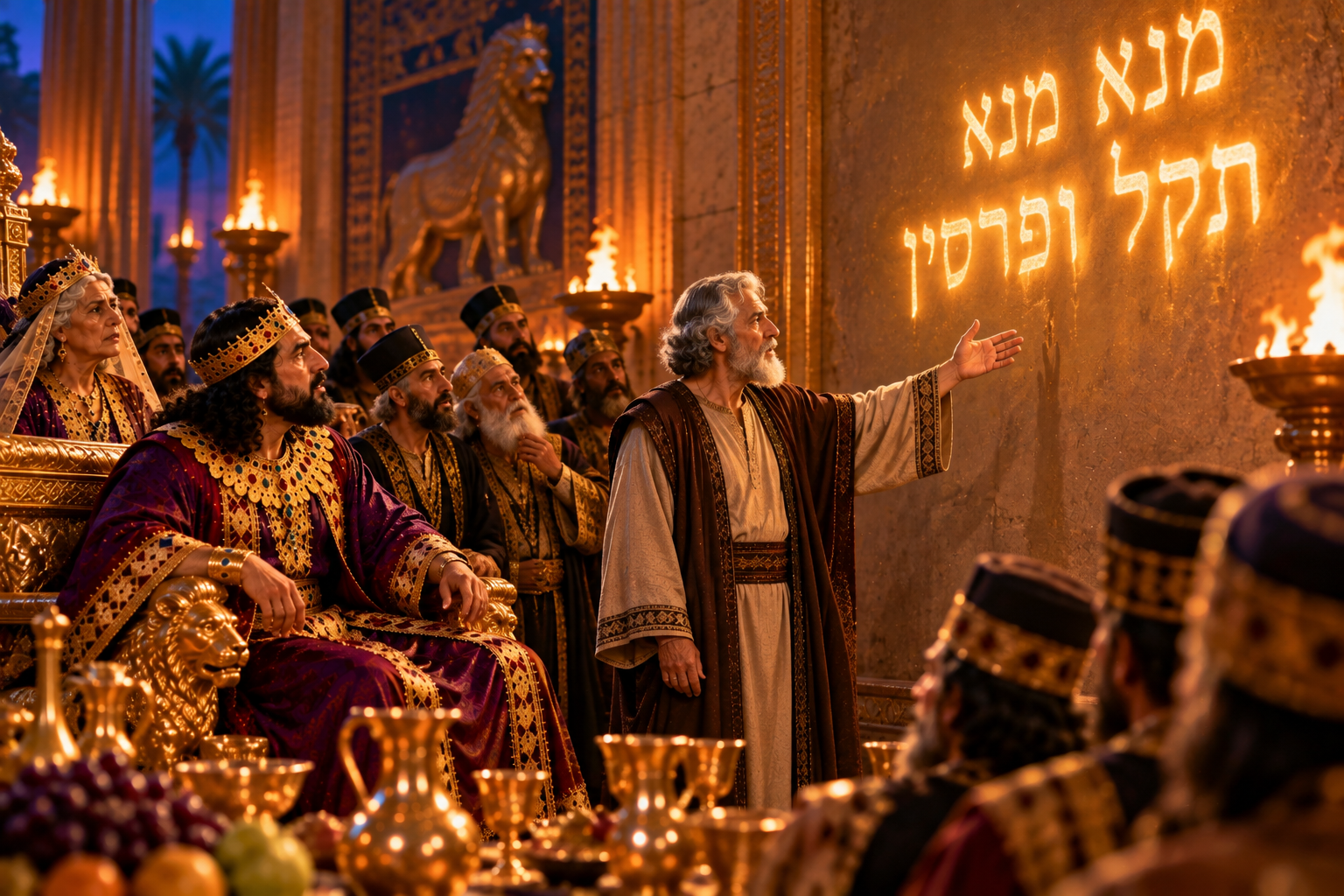
"YOUR NUMBER
IS UP!"
Or we could subtitle it "I've got your number!"
This is the interpretation of the message: 'MENE'--God has numbered your kingdom - The Aramaic verb numbered carries the idea of counting, numbering, or appointing. Daniel’s point is not simply that God knew how many days Babylon had existed, but that God had sovereignly determined how many days Babylon would exist. The kingdom had a divinely appointed beginning and a divinely appointed end (Da 2:21, 37–39). Belshazzar undoubtedly thought Babylon’s massive walls guaranteed many more years of security. But heaven’s calendar was different from Belshazzar’s calendar. God had counted every day of Babylon’s existence, and the final day had arrived. Not one day could be added beyond the number God had sovereignly allotted.
🙏 THOUGHT - There is a sobering personal application. Our days also are numbered, although we do not know the number. David prayed, “Make me to know my end and what is the extent of my days” (Ps 39:4), and Moses prayed, “Teach us to number our days, that we may present to You a heart of wisdom” (Ps 90:12). Belshazzar lived as though his days were unlimited. Wise men and women live remembering that God alone knows the number. The takeaway is since you do not know the days you have left, redeem the days you have left! (Redeem the Time)
And put an end to it - The countdown was finished. Belshazzar had crossed the line, and the announced judgment on his kingdom would no longer be postponed. In modern terminology, “Your number is up!” Belshazzar was still sitting on his throne, but in heaven the end of his kingdom had already been decreed.
Why is MENE repeated? - MENE! MENE! NUMBERED! NUMBERED! The repetition gives tremendous emphasis and certainty to the verdict. It recalls Joseph’s explanation of Pharaoh’s doubled dream: “the matter is determined by God, and God will quickly bring it about” (Ge 41:32). The repetition therefore underscores both the certainty and the imminence of what God had decreed. God's decision is settled. Judgment is imminent. Belshazzar had spent the evening as though he had countless days ahead of him. God informed him that the counting was already finished.
Belshazzar thought he was beginning another night of celebration;
God said he was finishing the last night of his kingdom.
Daniel 5:27 " 'TEKEL'--you have been weighed on the scales and found deficient.
- You: Job 31:6 Ps 62:9 Jer 6:30 Eze 22:18-20
- Have been weighed: Mt 22:11,12 1Co 3:13
- Daniel 5 Resources - Multiple Sermons and Commentaries
WEIGHED
AND WANTING!
TEKEL'--you have been weighed on the scales and found deficient - The imagery now changes from the counting room to the weighing room. With MENE, God numbered the days of the kingdom. With TEKEL, God weighs the king himself. Before announcing what will happen to Babylon, God reveals His assessment of Belshazzar. Picture the scene figuratively: Belshazzar is placed upon the scales of God. On human scales he appeared to be a man of considerable weight. He wore the crown, commanded nobles, possessed enormous wealth, lived behind the massive walls of Babylon, and exercised royal authority. In the eyes of men, Belshazzar was a heavyweight. But when God placed him on heaven’s scales, he was “found deficient.”
Belshazzar was a heavyweight in the eyes of men
but a lightweight on the scales of God.
This is one of the great dangers of evaluating ourselves by human standards. A person may carry enormous weight in the eyes of the world and still weigh very little on the scales of God. Wealth, position, power, reputation, education, and achievement may impress men, but none of them can satisfy the righteous standard of the Holy God. Belshazzar had been weighed, and he did not measure up. God had weighed his pride, his failure to humble himself despite what he knew, his desecration of the holy vessels, his idolatry, and his refusal to glorify the God Who held his very breath in His hand (Da 5:22–23). The evidence had been weighed, the scales had settled, and the verdict was “deficient.”
🙏 THOUGHT - Belshazzar reminds us that the important question is not “How do I measure up compared with other people?” but “How do I measure up against God’s perfect standard?” And the answer for every one of us is the same: “all have sinned and fall short of the glory of God” (Ro 3:23). Our only hope is not to somehow add enough weight to our side of the scales, but to flee by faith to Christ, Who Alone perfectly satisfied God’s righteous standard (2Co 5:21).
In first Samuel we read these words uttered by Hannah in her prayer…
Boast no more so very proudly. Do not let arrogance come out of your mouth, for the LORD is a God of knowledge, and with Him actions are weighed. (1Sa 2:3)
Job knew this great truth that God would one day weigh" the actions (including every thought, word and deed) and asked…
Let Him weigh me with accurate scales (Let Him weigh me in balances of justice), and let God know my integrity. (Job 31:6)
Let's not skip over God's scales too quickly thinking "poor Belshazzar"! God's searching eye weighs every heart (Pr 15:3, 2Chr 16:9, 1Sa 16:7, etc) including the heart of believers and we will one day stand before Christ's Bema Seat to…
be recompensed for his deeds in the body, according to what (we have) done, whether good or bad (not referring to sinful but worthless deeds). (2Co 5:10)
John Whitcomb writes that "The Egyptian Book of the Dead pictured men being weighed in balances after death to determine whether their sins outweighed their worthy deeds. But Scripture makes it plain that salvation is never determined that way, for none are worthy (Ro 3:23). Nevertheless, men are weighed by God to determine degrees of reward or punishment (1Sa 2:3; Job 31:6; Ps. 62:9; Pr 16:2). (SEE Daniel- Everyman's Bible Commentary - Page 71)
Found deficient - Campbell says "Belshazzar had been weighed in the balance of God and found too light in view of the blessings God had bestowed upon him. He was "found wanting" because he had not fulfilled what God expected of him as an earthly ruler. He had misused his position and privileges and had failed to acknowledge and glorify God. Solemn words again, "Belshazzar, you did not measure up!… The night of revelry and revelation became a night of retribution. (Borrow Daniel, decoder of dreams)
John Walvoord sees the events in Daniel 5 as a foreshadowing of the end of the times of the Gentiles when the King of kings returns "In many respects, modern civilization is much like ancient Babylon, resplendent with its monuments of architectural triumph, as secure as human hands and ingenuity could make it, and yet defenseless against the judgment of God at the proper hour. Contemporary civilization is similar to ancient Babylon in that it has much to foster human pride but little to provide human security. Much as Babylon fell… so the world will be overtaken by disaster when the Day of the Lord comes" (Chapter 5 Belshazzar’s Feast And The Fall Of Babylon)
Daniel 5:27 C H Spurgeon Faith's Checkbook Weighed and Found Wanting
'TEKEL'-- you have been weighed on the scales and found deficient
Some of you are hurting. Your earthly prospects grow dark, and it is midnight. Your business is failing. You have sickness in the house. Your darling wife languishes before your weeping eyes. Your children, by their ingratitude, have wounded your spirit.
You are a believer, and you know that God is testing and trying you. God wants you to know that a summertime religion is not sufficient. He wants you to see if your faith can stand the test of trial and trouble. Remember Job? What a scale he was weighed on! What weights of affliction were cast on him! He was a mountain of sore trouble, and yet he could bear them all. He came out of the scales as proof against all the weight that Satanic strength could hurl.
Is it this way with you? Can you say, “The Lord gave, and the Lord has taken away; blessed be the name of the Lord” (Job 1:21)? Can you submit to His will without murmuring? Can you still say, “Though He slay me, yet will I trust Him” (Job 13:15)? Remember, if your religion will not stand in adversity, it will not give comfort in the storm. You would be better without it; for with it, adversity deceives you. Without it, you might discover your true condition and seek the Lord as a penitent sinner. If a little adversity breaks you, what will happen when all God’s storms are let loose on your soul? “If you have run with the footmen, and they wearied you … how will you do in the floodplain of the Jordan” (Jer. 12:5)? If mere trials distress and grieve, what will you do when all the hurricanes of divine vengeance sweep across the earth and shake its pillars?
Dear friend, I want you to see how you handle your trials and troubles. Does your faith stand? Can you see God’s right hand even when it is wrapped in clouds? Can you discover the silver lining of tribulation’s black clouds? God help you to come out of the scales, for many are weighed in them and found wanting (Dan. 5:27).
Daniel 5:27 C H Spurgeon Morning and Evening
'TEKEL'-- you have been weighed on the scales and found deficient.
It is well frequently to weigh ourselves in the scale of God’s Word. You will find it a holy exercise to read some psalm of David, and, as you meditate upon each verse, to ask yourself, “Can I say this? Have I felt as David felt? Has my heart ever been broken on account of sin, as his was when he penned his penitential psalms? Has my soul been full of true confidence in the hour of difficulty as his was when he sang of God’s mercies in the cave of Adullam, or in the holds of Engedi? Do I take the cup of salvation and call upon the name of the Lord?” Then turn to the life of Christ, and as you read, ask yourselves how far you are conformed to his likeness. Endeavour to discover whether you have the meekness, the humility, the lovely spirit which he constantly inculcated and displayed. Take, then, the epistles, and see whether you can go with the apostle in what he said of his experience. Have you ever cried out as he did—“O wretched man that I am! who shall deliver me from the body of this death?” Have you ever felt his self-abasement? Have you seemed to yourself the chief of sinners, and less than the least of all saints? Have you known anything of his devotion? Could you join with him and say, “For me to live is Christ, and to die is gain”? If we thus read God’s Word as a test of our spiritual condition, we shall have good reason to stop many a time and say, “Lord, I feel I have never yet been here, O bring me here! give me true penitence, such as this I read of. Give me real faith; give me warmer zeal; inflame me with more fervent love; grant me the grace of meekness; make me more like Jesus. Let me no longer be ‘found wanting,’ when weighed in the balances of the sanctuary, lest I be found wanting in the scales of judgment.” “Judge yourselves that ye be not judged.” (Morning and Evening)
C H Spurgeon (Sermon) - The scales of judgement
“Tekel; Thou art weighed in the balances, and art found wanting.” Daniel 5:27.
Into those scales I must go. God will not take me on my profession. I may bring my witnesses with me; I may bring my minister and the deacons of the church to give me a character, which might be thought all-sufficient among men, but God will tolerate no subterfuge. Into the scales he will put me, do what I may; whatever the opinion of others may be of me, and whatever my own profession. And let me remember, too, that I must be altogether weighed in the scales. I cannot hope that God will weigh my head and pass over my heart—that because I have correct notions of doctrine, therefore he will forget that my heart is impure, or my hands guilty of iniquity. My all must be cast into the scales. Come, let me stretch my imagination, and picture myself about to be put into those scales. Shall I be able to walk boldly up and enter them, knowing whom I have believed, and being persuaded that the blood of Christ and his perfect righteousness shall bear me harmless through it all; or shall I be dragged with terror and dismay? Shall the angel come and say, “Thou must enter.” Shall I bend my knee and cry, “Oh, it is all right,” or shall I seek to escape? Now, thrust into the scale, do I see myself waiting for one solemn moment. My feet have touched the bottom of the scales, and there stand those everlasting weights, and now which way are they turned? Which way shall it be? Do I descend in the scale with joy and delight, being found through Jesus’ righteousness to be full weight, and so accepted; or must I rise, light, frivolous, unsound in all my fancied hopes, and kick the beam?
FOR MEDITATION: We all ought to check our weight before God does (2 Corinthians 13:5). The scales of God’s judgement will show in our favour only if Jesus Christ, the Rock of Ages, is in us. Do you need to put on weight?
Quotes from this sermon - The scales of judgement
Weighed by God
“Though they escape the scales on earth, they must surely be tried at the bar of God.”
“For nations there is a weighing time.”
“National sins demand national punishments.”
“The Lord God is the avenger of every one that is oppressed, and the executor of every one that oppresseth.”
Judge Yourself Now
“Let us judge ourselves that we may not be judged.”
“It is for us now to put ourselves through the various tests by which we may be able to discover whether we are, at this present time, short weight or not.”
Weighed in the Scales of God's Law
“There stands the law of God. This law is a balance which will turn, even were there but a grain of sand in it.”
“It is true to a hair. It moves upon the diamond of God’s eternal immutable truth.”
“There is not a man under the cope of heaven who has one grain of wit left, but must confess that he is short of the mark.”
“Thou art weighed in the balances and art found wanting.”
Christ Is Full Weight
“I can bring with me the perfect righteousness of Jesus Christ, and that is full weight.”
“I bring with me the full atonement, the perfect satisfaction of Jesus’ blood.”
“I can be weighed against the law, and yet sit securely.”
“Its demands... are fulfilled to the utmost in Christ.”
Weighed in the Scales of Conscience
“Conscience is not very readily cheated.”
“Do not cloak your sins.”
“A man who is afraid to examine himself, may rest assured that his ship is rotten.”
“Be true to yourselves.”
“Do not pretend to be serving God, while you are really indifferent and careless about it.”
Weighed by God's Word
“I would have every man also weigh himself in the scales of God’s Word.”
“Try yourselves by the sermon on the mount, you will find it a good scale in which to weigh your spirits.”
“Let me not have a counterfeit religion!”
“Give me that which is the current coin of the realm of heaven—thine own sterling grace.”
Weighed in Adversity
“He would have you see whether your faith can stand the test of trial and trouble.”
“A summer-time religion is not sufficient.”
“Though he slay me, yet will I trust in him.”
“If your religion will not stand the day of adversity... you would be better... without it than with it; for with it you are deceived.”
“See how you bear it—whether your faith then stands and whether you could see God’s right hand, even when it is wrapped in clouds.”
Weighed in Prosperity
“Many a man has endured the chills of poverty who could not endure sunny weather.”
“How many have been destroyed by prosperity?”
“The fumes of popularity have turned the brains of many a man.”
“Popular applause hath its foot in the sand, even when it hath its head among the stars.”
“Many have I known who in a cottage seemed to fear God but in a mansion have forgotten him.”
“It is no easy thing to stand the trial of prosperity.”
“What the storms of affliction never could accomplish, the soft hand and the witchery of prosperity has been able to perform.”
“It has been the Delilah that has shorn the locks and taken away the strength of many a Samson.”
“More the treacherous calm I dread,
Than tempests rolling over head.”Weighed by Temptation
“It is temptation that tries the Christian.”
“How can we tell the worthiness of the ship till she has been at sea in the storm?”
“You cannot know what you are till you have been through the practical test of every day life.”
The Final Weighing
“Those scales yonder are exact; I may deceive my fellows here, but deceive God I cannot then.”
“Those scales are true.”
“Whether I will or not, into those scales I must go.”
“God will not take me on my profession.”
“Whatever the opinion of others may be of me, and whatever my own profession.”
“I must be altogether weighed in the scales.”
“I would have you see yourselves as God sees you; for that after all, is your real state.”
“If God will try you, try yourselves; if he will judge you, judge your own hearts.”
TAKEAWAY: It matters little how highly we are rated in the scales of human opinion; the question that matters eternally is how we weigh in the balances of God.
Robert Morgan - From this Verse - Daniel 5:27 - “I Can’t Stand This”
Henry Venn was an Anglican clergyman, born near London and ordained in 1749, whose sermons fascinated the industrial and manufacturing classes of eighteenth-century England. The records of his ministry are sparse, but among them is this story:
One day at his church in Huddersfield, Venn preached from Daniel 5:27, describing the stubborn, pleasure-soaked reign of King Belshazzar. He described Belshazzar’s feast for a thousand lords, God’s handwriting on the wall, and Daniel’s thundering words to the vile monarch: “You have been weighed in the balances, and found wanting.”
In the congregation sat Mr. William Brook with his 19-year-old uncle, W. Mellor, who had been drawn into the church by noticing the great crowds. People on every side were weeping quietly as Venn pealed forth. As they left the church, neither man spoke. They silently walked to the nearby fields, then Mellor stopped, leaned against the wall of a farm building, and burst into tears, saying, “I can’t stand this.”
William later wrote: His conviction of sin was from that time most powerful, and he became quite a changed character. I was not so much affected at that time; but I could not after that sermon be easy in sin. I began to pray regularly; and so, by degrees, I was brought to seek salvation in earnest.
The people used to go in droves to Huddersfield Church. Some of them came out of church together; and they used to stop and talk over, for some time, what they had heard, before they separated to go to their homes. That place has been to me like a little heaven below.
I never heard a minister like him. He was most powerful in unfolding the terrors of the law. When doing so, he had a stern look that would make you tremble. Then he would turn off to the offers of grace, and begin to smile, and go on entreating till his eyes filled with tears.
Today’s Suggested Reading Daniel 5:25–31
TEKEL: You have been weighed in the balances, and found wanting. Daniel 5:27
D L Moody - WEIGHED IN THE BALANCES OF THE LAW
DAN. 5:27: “TEKEL; Thou art weighed in the balances, and art found wanting.”
THE history of this king, Belshazzar, is very short. Only one chapter tells us all we know about him. One short sight of his career is all we see. He just seems to burst upon the stage and then disappears. We are told that he gave a great feast, and at this feast he had a thousand of his lords, and they were drinking and praising the gods of silver, of gold, of brass, of iron, and of wood, out of the vessels which had been brought from the Temple at Jerusalem. As they were drinking out of these vessels of gold and silver from the house of God—I don’t know but what it was at the midnight hour—all at once came forth the fingers of a man’s hand and began to write upon the wall of the hall. The king turns deathly pale, his knees shake together, and he trembles from head to foot. Perhaps if some one had told him the time was coming when he would be put into the balance and weighed, he would have laughed at him. But he knows the fatal hour has come, and that hand has written his doom in the words, “Mene, mene, tekel, upharsin.” He calls the wise men of his kingdom, and the man who can interpret this will be made the third ruler of his kingdom, and be clothed in scarlet, and have a chain about his neck. One after another tried, but no uncircumcised eye could make it out. He was greatly troubled. At last one was spoken of who had been able to interpret the dream of his father, Nebuchadnezzar. He was told if he would send for Daniel he might interpret the writing. And now the prophet came in and looked upon the handwriting, and told him how his father had gone against God, and how he, Belshazzar, had gone against the Lord of Heaven, and how his reign was finished. And this was the writing: “Mene: God hath numbered thy kingdom and finished it; Tekel: Thou art weighed in the balances and art found wanting; Peres: thy kingdom is divided, and given to the Medes and Persians.” The trial is over, the verdict is rendered, and the sentence brought out. That very night the king was hurled from his throne. That very night the army of Darius came tearing down the streets, and you might have heard the clash of arms, shouts of war, and have seen the king’s blood mingling with the wine in that banquet hall.
Now I want to call your attention to that word “tekel.” We are weighed in the balance. Now you cavil at the Word of God; you make light when all is going well in the hour of your prosperity. But when the time of trial comes, and we are called into judgment, it will be altogether different. Suppose the sentence should come down from Heaven upon every man and woman in this Tabernacle to be weighed in the balance to-night, how would it be with you? Come, my friends, are you ready to be weighed to-night? Not in our own scales, but in God’s balance. Suppose the scales were dropped now from the kingdom of God; are you ready to step into the balance and be weighed? Are you willing to be weighed by the law? I can imagine some of you saying, “I wouldn’t be weighed by that law (meaning the decalogue); I don’t believe it.” Some men think we are away beyond the Mosaic law; we have got out of it. Why, Christ said in the fifth chapter of Matthew: “Think not that I am come to destroy the law, or the prophets; I am not come to destroy, but to fulfill.” “Heaven and earth may pass away, but My law shall never pass away;” but not until Heaven and earth shall be removed will the Word of God be removed. Now the commandments that I read to you to-night are as binding as ever they have been. Many men say that we have no need of the commandments, only the sermon on the mount. “Think not that I am come to destroy the law or the prophets; I am not come to destroy, but to fulfill.” Now, my friends, are you ready to be weighed by the law of God—by that majestic law? What is the first commandment? “Thou shalt have no other gods but Me.” Are you ready to be weighed by this commandment? Now, the question is, have you fulfilled, or are you ready to fulfill all the requirements of this law? A great many people say if they keep the commandments they don’t need Christ. But have you kept them? I will admit if you keep the commandments you can be saved by them; but is there a man in this audience who can truly say that he has done this? Young lady, can you say: “I am ready to be weighed by the law to-night?” Can you, young man? Now, suppose we have these commandments written upon pieces of iron. You know when you go into a grocery store you see them taking a weight and putting it into the scales against what you have bought. Now, suppose the pieces of iron as weights, and the law of God written on them. Take this first commandment, “Thou shalt have no other god but Me,” upon one of the weights. Put it in one of the scales and just step on the other. “Thou art weighed in the balances.” Is your heart set upon God to-night? Have you no other idol? Do you love Him above father or mother, the wife of your bosom, your children, home or land, wealth or pleasure? Have you got another god before Him? If you have, surely you are not ready to step in and be weighed against that commandment, “Thou shalt have no other god before Me.” That is the commandment of God, and it is binding to-night. Then take another. You will say there is no trouble about this one. We might go off to other ages or other lands, and we can find people who worship idols, but we have none here. But how many evils have we in our hearts? Many a man says, “Give me money and I will give you Heaven; what care I for all the glories and treasures of Heaven; give me treasures here. I don’t care for Heaven; I want to be a successful business man,” They make money and business their god. Although they don’t make gods of silver and gold, they bow before them. There are more men who worship silver and gold in Chicago than any other god. But take another one: “Thou shalt not take the name of the Lord thy God in vain.” Is there a swearing man ready to put the weight into the scales and step in? Young man, have you been taking the name of the Lord in vain to-day? What does He say? “The Lord will not hold him guiltless that taketh His name in vain.” I don’t believe men would ever have been guilty of swearing unless God had told them not to. They don’t swear by their friends, by their fathers and mothers, by their wives, by their children; but because God has forbidden it, man wants to show how he despises His law. “Thou shalt not take the name of the Lord thy God in vain.” Blasphemer, go into the scales, and see how quick you will fly out. You will be like a feather in the balance. A great many men think there is nothing very serious in swearing; they don’t think there’s much wrong in it. Bear in mind that He sees something in it when He says, “Thou shalt not take the name of the Lord thy God in vain.” You can not trifle with God. Some men say they never swear except when they get angry. Suppose you swear only once in six months, or a year—suppose you swear once in ten years, do you think God will hold you guiltless for that one act? A man that swears once shows that his heart is rebellious to God. What are you going to do, blasphemer? If the balances were here, and God told you to step in, what would you do?
But take the fourth commandment: “Remember the Sabbath day to keep it holy.” Suppose you could see the law written over those walls, “Remember to keep the Sabbath day holy,” could you say that you had observed it? Are you ready to be weighed by the weight, “Remember the Sabbath day to keep it holy?” Some of us may be professed Christians, but do we observe the Sabbath? If this country fail to keep the Sabbath holy, it will go the way of France, Mexico, and Spain. Every nation that gives up the Sabbath must go down. It is only a question of time with them. Look, when the children of Israel refused to obey the injunctions of the Lord in regard to the cultivation of their land, how He took them into bondage and kept them for seventy years, to let them know that God’s law was not to be trampled under their feet. Are you guilty or innocent in regard to this law: “Thou shalt keep the Sabbath day holy?” When I was in France, in 1867, I could not tell one day from another. On Sunday stores were open; buildings were being erected the same as on other days. See how quick that country went down. Only a few years ago it stood abreast of other nations, it stood side by side almost with England. But it didn’t have any respect for the Sabbath; it trampled God’s message under foot, and when the hour of battle came, God left them alone. My friends, every nation that tramples the Sabbath under its feet must go to ruin. Are you innocent or guilty? Do you keep the Sabbath day holy or not? I have been talking to those car conductors—and if there’s one class of men I pity more than another it is them—and they have to work on the Sabbath. Some of you are breaking this law by coming down here on Sunday in the cars. What will you do? Foot it—it will be better for you. I make a point of never allowing myself to break the Sabbath of any man. When I was in London—and it’s a pretty big city, you know—in my ignorance I made arrangements to preach four times at different places one Sunday. After I had made the appointments I found I had to walk sixteen miles, and I walked it, and I slept that night with a clear conscience. I want no hack-man to rise up in judgment against me. My friends, if we want to help the Sabbath, let business men and Christians never patronize cars on the Sabbath. I would hate to own stock in those horse-car companies, to be the means of taking the Sabbath from these men, and then have to answer for it at the day of judgment. No man can work seven days a week and save his soul. And the very best thing we have is being taken from these men by us Christians. Are you willing to step into the balance and be weighed against “Thou shalt keep the Sabbath day holy?”
Well, here is the fifth: “Honor thy father and mother.” Are you ready to be weighed against this? Have you honored them? Is there any one here to-night who is dishonoring father or mother? Now, I’ve lived nearly forty years, and I’ve learned one thing if I’ve learned nothing else: that no man or woman who treats disrespectfully father or mother ever prospers. How many young ladies have married against their father’s wishes, and gone off and just made their own ruin. I never knew one case that did not turn out bad. They brought ruin upon themselves. This is a commandment from Heaven: “Honor thy father and mother.” In the last days men shall be disobedient to parents, void of natural affection, and it seems as if we were living in those days now. How many sons treat their mothers with contempt—make light of their entreaties. God says, “Honor thy father and mother.” If the balances were placed in this hall, would you be ready to step into them against this commandment? You may make light of it and laugh at it, but, young man, remember that God will hedge your way. No man shall succeed that disobeys this commandment. But bear in mind, you are not going to be weighed only against this solitary commandment—every weight will be put in.
“Thou shalt not kill.” Most of you say, “That don’t touch me at all; I never killed any one; I’m no murderer.” Look at that sermon on the mount, which men think so much of. Look at it. Did you never in your heart wish a man dead who had done you an injury? That’s murder. How are you? Innocent or guilty? If you have, you are a murderer at heart. Now, come, my friends, are you ready to be weighed against the law? Ah, if most of us were weighed to-night we would find this word written against us, “Tekel; Thou art weighed in the balances, and art found wanting.”
But let us take another, “Thou shalt not commit adultery.” I don’t know any sin that afflicts us like this. It is a very delicate subject to approach, but I never preach without being compelled to touch upon it. Young men among us are being bound hand and foot with this evil. Young men, hear this law to-night, “Thou shalt not commit adultery.” Are you guilty even in thought? How many men have come into this Tabernacle but they are tied hand and foot, but who have been in the halls of vice, and some harlot, whose feet are fastened in hell, clings to him, and says, “If you give me up, I will expose you.” Can you step on the scales and take that harlot with you? “Thou shalt not commit adultery.” You may think that no one knows your doings; you may think that they are all concealed, but God knows it. He that covers his sins shall not prosper. Out with it to-night. Confess it to your God. Ask Him to snap the fetters that bind you to this sin; ask Him to give you victory over your passions, and shake yourself like Samson, and say, “By the grace of God I will not go down to hell with a harlot,” and God will give you power. “Thou shalt not commit adultery.” As I said the other night, I don’t know a quicker way to hell. How many men have by their lecherous life broken their mothers’ hearts, and gone down to their grave rotten, leaving the effect of sin to posterity!
Well, let us take up the next, “Thou shalt not steal.” How many have been stealing to-day? I may be speaking to some clerk, who, perhaps, to-day has taken five cents out of his employer’s drawer to buy a cigar; perhaps he took ten cents to get a shave, and thinks he will put it back to-morrow; no one will ever know it. If you have taken a penny, you are a thief. Do you ever think how those little stealings may bring you to ruin? Let an employer find it out. If he don’t take you into the courts, he will discharge you. Your hopes will be blasted, and it will be hard work to get up again. Whatever condition you are in, do not take a cent that does not belong to you. Rather than steal, go up to Heaven in poverty—go up to Heaven from the poor-house—and be honest rather than go through the world in a gilded chariot of stolen riches. A man who takes money that does not belong to him, never gets any comfort. He never has any pleasure, for he has a guilty conscience. “Thou shalt not steal.” Are you ready to be weighed to-night in the balances?
Then let us take the ninth commandment, “Thou shalt not bear false witness against thy neighbor;” or, in other words, thou shalt not be guilty of lying. If you had a chance to make two or three hundred dollars, are you not willing to go into a court and lie to get it? “Thou shalt not bear false witness against thy neighbor.” Are you ready to step into the balances against this?
Then take another, “Thou shalt not covet thy neighbor’s goods.” Are you innocent or guilty? How many times I used to covet that which belonged to other people before I was converted. I believe that is one of the greatest sins among us. My friends, how is it? Innocent or guilty? But suppose you are innocent of all these ten commandments, let us take that eleventh commandment of Christ’s, “A new commandment I give unto you; thou shalt love one another.” My friends, how is it to-night? Is love reigning in your hearts? Do you love your neighbors? Do you try to do them good, or are you living a life of selfishness, merely for yourself?
Now, I can imagine that nearly every man or woman is saying to himself or herself, “If we are to be judged by these laws how are we going to be saved?” Every one of them has been broken by all people. The moral man is just as guilty as the rest. There is not a moralist in Chicago who, if he steps into those scales, can be saved except he has been born again. “Except a man be born again he can not see the kingdom of God.” “Except ye repent ye shall all perish.” That is on one side of the scales, and he will see on the other, “Except ye be converted ye shall not enter the kingdom of God.” I have heard a good many pharisees saying, “These meetings are reaching the drunkards, and gamblers, and harlots; they are doing good;” but they don’t think they need these meetings. They are all right; they are moral men. “Except a man be born again he can not see the kingdom of God.” I don’t care how moral he is. Nicodemus was probably one of the most moral men of his day. He was a teacher of the law; yet Christ said: “Except a man be born again he can not see the kingdom of God.” I would a good deal rather preach to thieves, and drunkards, and vagabonds, than preach to self-righteous pharisees. You don’t have to preach to those men weeks and months to convince them that they are sinners. When a man learns that he has need of God, and that he is a sinner, it is very easy to reach him. But, my friends, the self-righteous pharisee needs salvation as much as any drunkard that walks the streets of Chicago. There is another class I want to speak of. If I had time I would just like to take up the different classes in the city. That class is the rum-sellers. Put the rum-sellers in the balances. They ignore God’s laws; but by and by He will say to them: “Tekel,” “Woe be to the man that put the bottle to his neighbor’s lips.” My friends, I would rather have that right hand cut off before I would give the bottle to a man; I would rather have my right arm cut off than deal out death and damnation to my fellow-men. If there is a poor drunkard summoned into eternity to-night, weighed in the balances, what would he hear? “No drunkard shall inherit the kingdom of God.” I can see how he would reel and stagger when he heard that. “No drunkard shall inherit the kingdom of Heaven.”
My friends, if you don’t repent of your sins and ask Him for mercy, there is no hope for you. Let me ask you to take this question home to yourself. If a summons should come at midnight to be weighed in the balances, what would become of your souls, because the law of God must be kept? Now, there are many of you only making professions. You belong to the First Methodist church, or you may be a member of a Baptist church, but are you ready to be weighed—ready to step into those scales? I think a great many would be found like those five foolish virgins. When the hour came they would be found with no oil in their lamps. If there is a person here to-night who has only an empty lamp, or is living on mere formalism, I beg of you to give it up. Give up that dead, cold, miserable lukewarmness. God will spit it out of His mouth. He will have none of it. Wake up. Some of you have almost gone to sleep while I have been trying to weigh you in the balances. God will weigh you, and then if you have not Christ, it will be “Tekel.”
I can imagine some of you saying: “I would just like Moody to put those tests to himself. I wonder what would become of him.” My dear friends, if God was to ask me I would tell Him, “I am ready.” I don’t say this in any spirit of egotism, of self-righteousness, remember. If you ask me if I have broken the law of Moses, I would answer, “Yes, sir.” Ask me if I have broken the commandments: “Yes, sir.” You may ask me then how I am ready to be weighed. If I step into the scales, the Son of God will step into the scales with me. I would not dare to go into them without Him. If I did, how quick the scales would go up. If a man has not got Christ, when the hour comes for him to be weighed, it will be “Tekel, tekel, tekel.” Are you, my friend, ready to be weighed? Suppose I put the question to every man and woman in this audience. How quick many of them would begin to color up. Oh, my friends, if you haven’t got Him, get Him. May God open your eyes and your minds to receive Him before you leave this Tabernacle. Christ kept the law; Christ was the end of the law. If He had broken the law He would have had to die for Himself; but He kept it, and we are enabled to be clothed in righteousness. My friends, it is the height of madness to go out of this hall to-night and run the risk of being called by God and have to answer without Him. Now is the day and hour to accept salvation, and then He will be with us. Then there will be no alarm with us. I pity those Christian people who are afraid of death. They need not be afraid of death if they have Him. When He is with us it is only a translation. We are absent from the body to be present with the Lord. Here is the Gospel of Jesus Christ. Will you be saved? If you do not, when by and by God summons you into these scales, it will be written over you, “Tekel, tekel; thou art weighed in the balances, and art found wanting.” My friends, what will you do? Remain as you are and be lost, or accept salvation and be saved?
Daniel 5:28 " 'PERES'--your kingdom has been divided and given over to the Medes and Persians."
- Your: Da 5:31 6:28 8:3,4,20 9:1 Isa 13:17 21:2 45:1,2
- Daniel 5 Resources - Multiple Sermons and Commentaries
Related Passages:
Genesis 41:32 “Now as for the repeating of the dream to Pharaoh twice, it means that the matter is determined by God, and God will quickly bring it about.
Job 31:6 Let Him weigh me with accurate scales, And let God know my integrity.
1 Samuel 2:3 “Boast no more so very proudly, Do not let arrogance come out of your mouth; For the LORD is a God of knowledge, And with Him actions are weighed.
Psalm 62:9 Men of low degree are only vanity and men of rank are a lie; In the balances they go up; They are together lighter than breath.
Psalm 90:12 So teach us to number our days, That we may present to You a heart of wisdom.
Proverbs 16:2 All the ways of a man are clean in his own sight, But the LORD weighs the motives.
Proverbs 21:2 Every man’s way is right in his own eyes, But the LORD weighs the hearts.
Daniel 2:21 “It is He who changes the times and the epochs; He removes kings and establishes kings; He gives wisdom to wise men And knowledge to men of understanding.
PROPHECY OF A
DIVIDED KINGDOM
PERES'--your kingdom has been divided and given over to the Medes and Persians - PERES is the singular form related to the plural PARSIN in upharsin (Da 5:25), the initial u meaning “and.” The words in the inscription are related to familiar terms for weights or monetary units, but Daniel interprets them through the corresponding verbal ideas: numbered, weighed, and divided. With PERES there is also a striking wordplay because the term sounds like the name associated with Persia, the power about to receive Babylon’s kingdom.
Has been divided -Notice that Daniel does not say “will be divided.” He speaks of the kingdom as though the division has already occurred. The judgment was so certain in the decree of God that Daniel could describe the future event as an accomplished fact. Belshazzar was still sitting on Babylon’s throne, but from heaven’s perspective his kingdom was already lost.
Ancient historical accounts describe the conquering forces gaining entrance to Babylon after the level of the Euphrates was lowered or diverted. If those accounts accurately describe the events of this very night, it is quite possible that while Daniel was announcing Babylon’s fall inside the palace, preparations for its conquest were already unfolding outside. Daniel itself, however, simply gives us the essential fact: “That same night Belshazzar the Chaldean king was slain” (Da 5:30).
Notice also God’s order: “You have been weighed.” Then, “Your kingdom has been divided.” The order is important because God’s judgment is never arbitrary. Before the sentence comes the assessment. Before the kingdom is divided, the king is weighed. God does not condemn Belshazzar without cause. Daniel has already presented the indictment (Da 5:22–23), God has rendered the assessment, and now He announces the sentence.
MENE - God counted the kingdom’s days.
TEKEL - God weighed the king.
PERES - God divided the kingdom.
The accounting was complete. The evidence had been weighed. The verdict had been rendered. Babylon’s final hour had come.
Belshazzar was celebrating his kingdom
while God was closing its account.
Given over - By whom? Clearly the Most High God (Da 2:21)
To the Medes and Persians - see Da 6:28.
Note the progression of the king's party -- Belshazzar was FEASTING. Then he was TREMBLING. Now he is LISTENING. Soon he will be WEIGHED. And before the night ends, he will be DEAD. What began as a banquet ends as a judgment scene! In other words the banquet hall became a courtroom, the wall became God's tablet, Daniel became God's spokesman, and Belshazzar became the defendant.
God did not need many words
to bring Babylon to an end.
David Guzik - Given to the Medes and Persians: The ancient Greek historian Herodotus relates that the Persian King Cyrus conquered Babylon by diverting the flow of the Euphrates into a nearby swamp. This lowered the level of the river so his troops marched through the water and under the river-gates. They still would not have been able to enter had not the bronze gates of the inner walls been left inexplicably unlocked. This was exactly what God predicted in Isaiah 44:28 to Isaiah 45:7 and Jeremiah 51:57-58. God opened the gates of the city of Babylon for Cyrus, and put it in writing 200 years before it happened! “In October 539 BC, Cyrus advanced into lower Mesopotamia and, leaving Babylon till last, conquered and occupied the surrounding territory. Seeing which way the wind was blowing, Nabonidus of Babylon deserted his city, leaving it in the charge of his son Belshazzar … the taking of Babylon was as bloodless and effortless as Daniel 5:1-31 implies.” (Motyer, in his commentary on Isaiah) The fall of mystery Babylon will be like the fall of real Babylon - sudden, sure, and in the midst of her worst blasphemies. “Empires do not stand by human might, man-made machines and missiles. There is not a wall high enough nor thick enough to prevent a nation from falling when God pronounces that nation’s doom.” (Strauss). (Daniel 5 Commentary)
Rodney Stortz comments "Think how risky it would be to tell a proud, rebellious king in front of all of his nobles that his kingdom is about to end. Belshazzar could have been so angry at the message that he would kill the messenger. If Daniel had that fear, he could have made up an interpretation of the handwriting on the wall that would have been more favorable, and no one would have ever known. He could have said, “That inscription means God loves you, and so do I.” But Daniel accepted the judgment of God as true and just; so he did not hide the message. I wish preachers today would not hide the message of God’s judgment upon the sins of men. Many must not believe God’s judgments are true or just, because they do not warn the people of the coming wrath of God. God’s coming judgment upon this nation ought to be resounding from the pulpits of our land. What nation can exist very long whose laws call evil good and good evil? (SEE Daniel: The Triumph of God's Kingdom)
Rich Cathers…
Lesson - How does your “kingdom” measure up? There is a sense in which this is true of all of us. We are all found “wanting”. We all come up a “bit short” to God’s standards. Jesus said,
(Mt 5:20KJV) For I say unto you, That except your righteousness shall exceed the righteousness of the scribes and Pharisees, ye shall in no case enter into the kingdom of heaven.
The Pharisees were the most strictly religious people that were around in Jesus’ day. Perhaps they were some of the most religious people ever. Jesus said you had to “out do” the Pharisees. Even they weren’t good enough.
He also said,
Mt 5:48KJV) Be ye therefore perfect, even as your Father which is in heaven is perfect.
Jesus said that the standard was perfection. We aren’t measured by our own standards, we are measured by God’s standards. We aren’t measured by comparing ourselves to other human beings. We are measured by comparing ourselves to God’s standards.
(Ro 3:20, 21, 22, 23 ICB) because no one can be made right with God by following the law. The law only shows us our sin. {21} But God has a way to make people right with him without the law. And God has now shown us that way which the law and the prophets told us about. {22} God makes people right with himself through their faith in Jesus Christ. This is true for all who believe in Christ, because all are the same. {23} All people have sinned and are not good enough for God's glory.
Every single one of us can be measured to God’s standards and found “wanting”.
(Ro 3:24, Ro 3:25 ICB) People are made right with God by his grace, which is a free gift. They are made right with God by being made free from sin through Jesus Christ. {25} God gave Jesus as a way to forgive sin through faith. And all of this is because of the blood of Jesus' death. This showed that God always does what is right and fair. God was right in the past when he was patient and did not punish people for their sins.
Instead of trying to measure up to God’s standards on our own, God offers us help. He offers to pay for our sins if we will learn to trust Him. How do you measure up? (Daniel 5)
Daniel 5:29 Then Belshazzar gave orders, and they clothed Daniel with purple and put a necklace of gold around his neck, and issued a proclamation concerning him that he now had authority as the third ruler in the kingdom.
- Da 5:7,16
- Daniel 5 Resources - Multiple Sermons and Commentaries
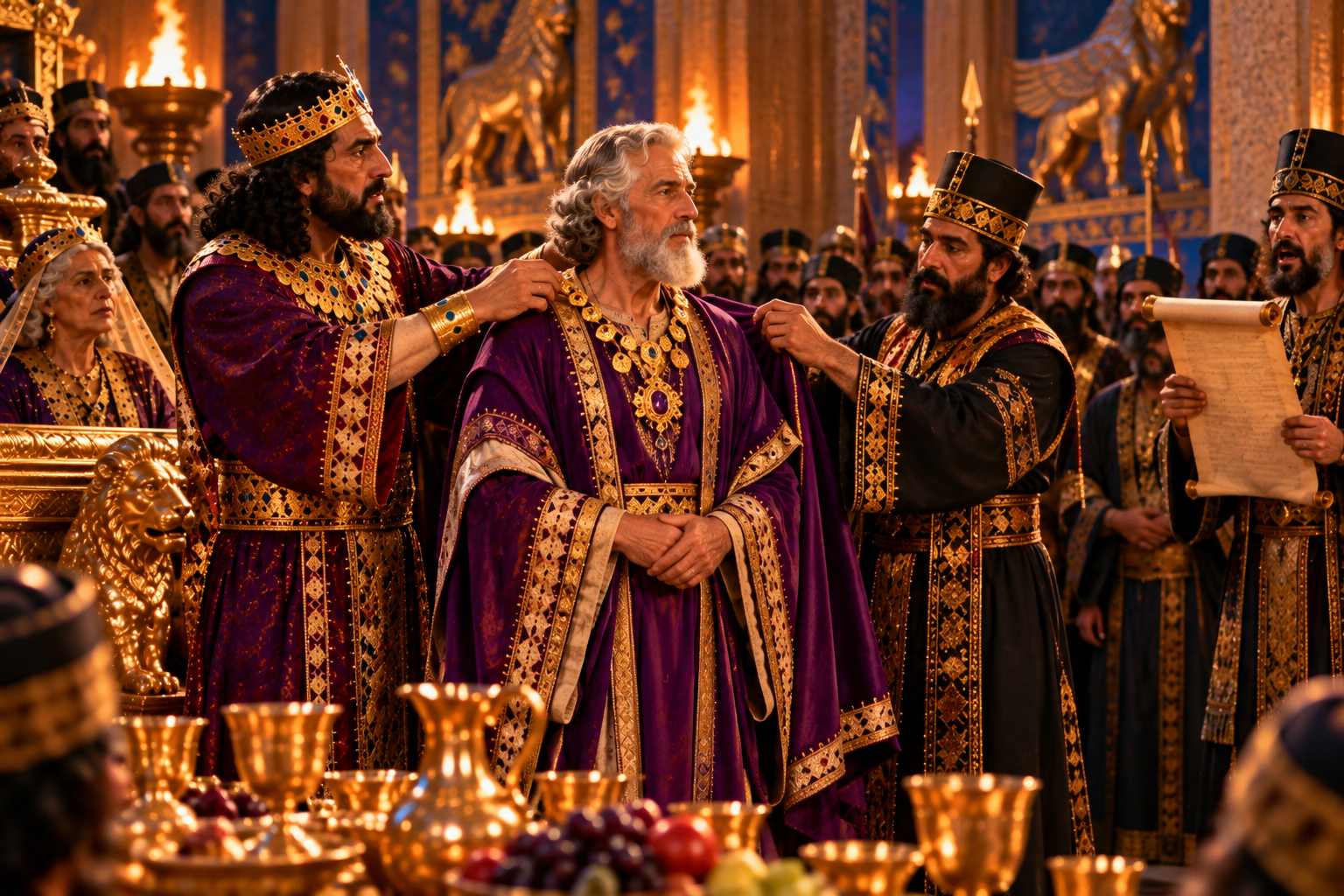
PROMOTION IN A KINGDOM
WITH NO TOMORROW!
Then Belshazzar - It is sad it did not read "Then Belshazzar repented" which would have honored God, but instead he sought to honor Daniel! His bestowal of honor was as they say "too little and too late." Judgment was already upon this deceived, foolish, hard hearted unrepentant king. Most of us relish the thought of a "promotion", but there are some promotions we do best to ignore and this is a prime example!
Gave orders, and they clothed Daniel with purple and put a necklace of gold around his neck, and issued a proclamation concerning him that he now had authority as the third ruler in the kingdom -Despite Daniel’s earlier refusal of Belshazzar’s rewards (Da 5:17), the king now orders that the promised honors be bestowed upon him anyway. Daniel is clothed in royal purple, given a gold necklace, and publicly proclaimed third ruler in the kingdom. Such insignia represented royal favor and delegated authority.
What incredible irony! Daniel received one of Babylon’s highest honors only hours, perhaps moments, before Babylon ceased to exist as an independent kingdom. Belshazzar was handing out promotions in a kingdom God had already handed over to another power! Daniel’s new royal insignia also publicly identified him with the highest levels of Babylonian government. Humanly speaking, one might imagine that such identification could have placed him in danger when the conquering regime took control. Yet Daniel not only survived Babylon’s fall, but soon occupied a prominent position under the new government (Da 6:1–3). Kings changed, kingdoms changed, governments changed, but God’s purpose for Daniel had not yet been completed.
This illustrates a comforting principle of divine providence: God’s servant is secure until God’s purpose for that servant is finished. That does not mean believers are exempt from suffering or martyrdom. Many faithful servants of God have died violently. It means that neither kings, armies, kingdoms, nor circumstances can terminate a life before God has accomplished what He sovereignly intends through that life (Ps 139:16).
We see this principle in the Revelation, where the two witnesses are "immortal" until their job is done (their "job description" specified 1260 days)
And when (not before!) they have finished their testimony (Rev 11:3, 4, 5, 6), the beast that comes up out of the abyss will make war with them, and overcome them and kill them. (Rev 11:7)
God’s servant is immortal until
God’s purpose for that servant is complete.
Warren Wiersbe - There are times when God gives warnings in order to bring sinners to repentance, such as when he sent Jonah to Nineveh (Jonah 3:1-10); but there are also times when His warnings are final and divine judgment is determined (Ed: Compare His declaration of judgment on Nineveh only 100 years later - Nahum 1:8-9). When God warned Nebuchadnezzar about his pride and unconcern for the poor, He gave the king a year in which to repent and seek God’s forgiveness (Da 4:28-33). The king refused to humble himself and judgment fell. But when Daniel confronted Belshazzar, he offered him no way of escape. (Bible Exposition Commentary - Old Testament ).
David Guzik - Daniel held this post for only a few hours. This shows how temporary the awards and accolades of this world are. In the kingdom that succeeded Belshazzar Daniel was also promoted, but that was due to God, not to Belshazzar. (Daniel 5 Commentary)
Did Belshazzar Repent? This is perhaps the most sobering feature of the verse. Daniel has just confronted him with his sin “You have not humbled your heart.” (Da 5:22) “You have exalted yourself against the Lord of heaven.” (Da 5:23) “The God in whose hand are your life-breath and your ways, you have not glorified.” (Da 5:23) What does Belshazzar do? The text does not record that he humbles himself. There is no recorded confession. No prayer. No repentance. Instead, he proceeds with the ceremony and gives Daniel the promised rewards. This stands in striking contrast with Nebuchadnezzar, who eventually lifted his eyes toward heaven, acknowledged God's sovereignty, and praised the King of heaven (Da 4:34–37). Nebuchadnezzar was humbled and eventually repented. Belshazzar was warned but there is no record of repenting.
Daniel 5:30 That same night Belshazzar the Chaldean king was slain.
- Da 5:1,2 Isa 21:4, 5, 6, 7, 8, 9 47:9 Jer 51:11,31,39,57
- Daniel 5 Resources - Multiple Sermons and Commentaries
Related Passages:
Proverbs 29:1 A man who hardens his neck after much reproof Will suddenly be broken beyond remedy.
Ecclesiastes 12:13-14 The conclusion, when all has been heard, is: fear God and keep His commandments, because this applies to every person. 14 For God will bring every act to judgment, everything which is hidden, whether it is good or evil.
Hebrews 9:27 And inasmuch as it is appointed for men to die once and after this comes judgment,
Hebrews 10:31 It is a terrifying thing to fall into the hands of the living God.
Proverbs 16:4-5 The LORD has made everything for its own purpose, Even the wicked for the day of evil. 5Everyone who is proud in heart is an abomination to the LORD; Assuredly, he will not be unpunished.
Ecclesiastes 8:11 Because the sentence against an evil deed is not executed quickly, therefore the hearts of the sons of men among them are given fully to do evil.
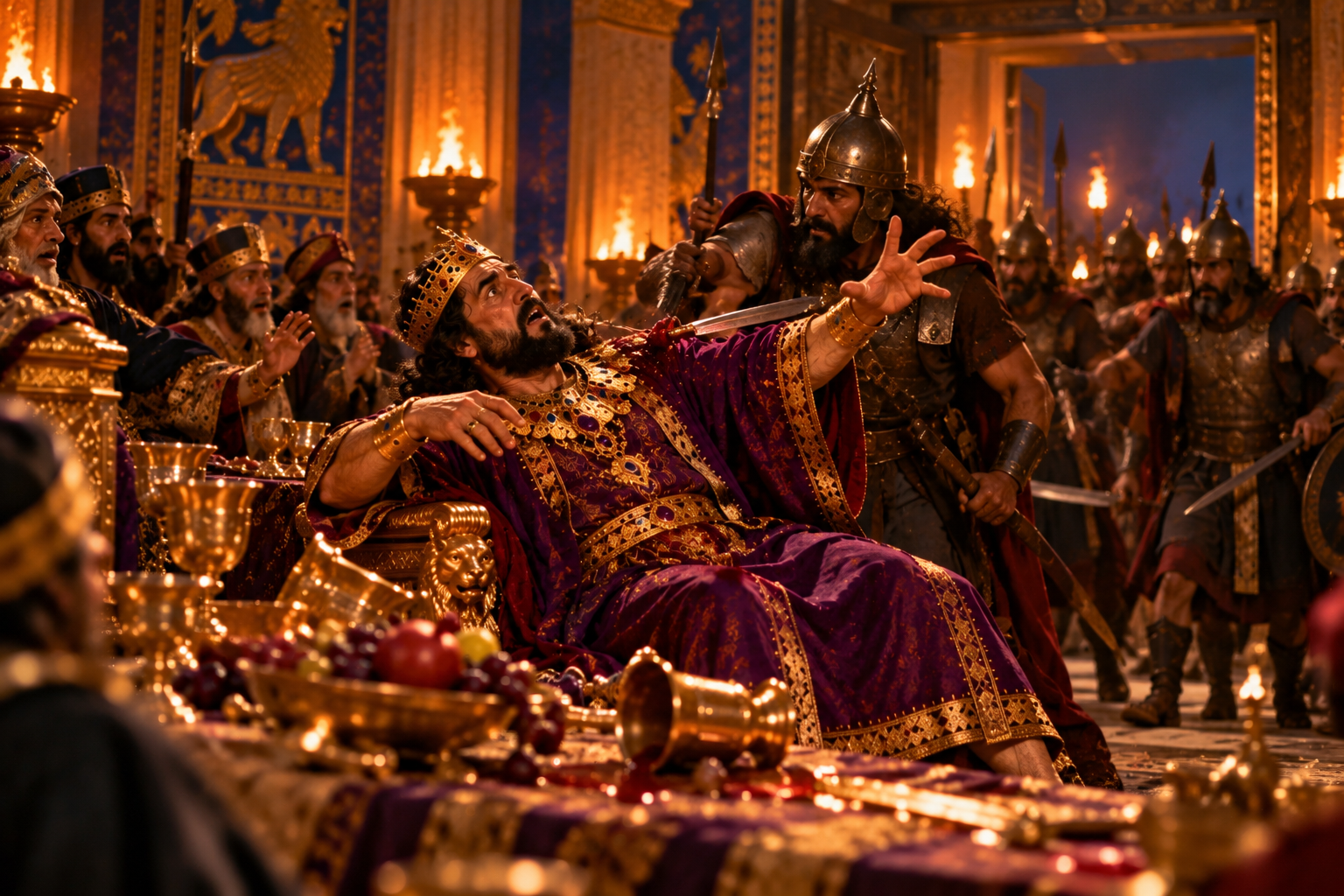
THE END OF A KING AND
THE KINGDOM
That same night -These words resonate ominously with “suddenly” at the beginning of the episode (Da 5:5). Suddenly the fingers appeared and wrote God’s verdict on the wall, and that same night the verdict was carried out. What God decrees will surely come to pass! Belshazzar had begun the evening feasting, drinking, boasting, and praising his lifeless gods. He had every expectation that tomorrow would arrive just like countless tomorrows before it. But there would be no tomorrow for Belshazzar. Before the night was over, the banquet would end, the kingdom would fall, and the king would be dead. God had been patient. Belshazzar knew what God had done to Nebuchadnezzar but refused to humble his heart (Da 5:22). God’s patience, however, must never be confused with indifference or approval. Scripture solemnly warns that God’s Spirit will not strive with man forever (Ge 6:3). There comes a point when divine patience gives way to divine judgment. And when that moment came for Belshazzar, God’s justice was swift and sure. There was no lengthy interval between the handwriting and its fulfillment. The king who had been drinking from God’s vessels only hours earlier was dead before sunrise.
“Suddenly” God wrote the verdict;
“that same night” God carried it out.
Belshazzar the Chaldean king was slain -What a dramatic contrast with the queen’s conventional greeting earlier that evening: “O king, live forever!” (Da 5:10). Belshazzar would not even live until morning. Once God’s verdict was rendered, the voice that had boasted against the Lord of heaven was silenced.
Consider the solemn progression:
Belshazzar was warned by God.
Belshazzar was weighed by God.
Belshazzar was found guilty by God.
Belshazzar was sentenced by God.
And that same night Belshazzar died.
Only moments earlier Daniel had reminded him of “the God in whose hand are your life-breath and all your ways” (Da 5:23). Belshazzar had spent his final evening using God-given breath to dishonor the God Who gave it. He breathed out praise to lifeless idols while refusing to glorify the living God Who sustained every breath he took. And then came his final breath. The God Who had sustained Belshazzar’s life no longer sustained it. The king who thought he controlled a kingdom discovered that he did not even control his next breath. The banquet ended. The boasting ended. The kingdom ended. And Belshazzar’s life ended. Belshazzar spent his last night using God-given breath to defy the God Who gave it, and then came his final breath.
TAKEAWAY - What a sobering reminder that every breath is a gift and every day is grace. We do not know which breath will be our last (Ps 39:4–5; Jas 4:14–15).
Ray Pritchard emphasizes that "Sinners like to believe that God will never punish them, or if punishment is coming, it is so far off in the distant future that they have plenty of time to repent and be ready to meet the Lord (cp Ec 8:11). This is a dangerous and even deadly attitude. God is not obligated to continually send his Spirit to convict us of our sin. The time may come when God says, “You have crossed the line,” and the Holy Spirit no longer works in a person’s heart. No one knows when that time is coming, and no one but God knows when the line has been crossed. But of this much we may be sure. The opportunity to get right with God ends with our death. After we die, there is only the judgment to come (He 9:27). It is foolish to presume upon the grace of God. He owes you nothing at all. If you reject his offer of salvation, there remains no other sacrifice for sin (He 10:26). If you turn away from Jesus, or if you put off trusting Him, where else will you go to have your sins forgiven? Those who take God’s grace for granted will end up eternally disappointed. (God’s Graffiti)
Belshazzar will have to give an account for his party--Party now, pay later. Since he had not humbled himself before God and did not know Him, he was assigned to the temporary "holding tank" of Sheol (Hell) and he will be resurrected one day to stand before the Judge of both great and small at the Great White Throne (Rev 20:11, 12, 13, 14, 15 - note especially Rev 20:12 where Belshazzar is "judged… according to his deeds", specifically his blasphemous toasting of his idols with God's holy vessels!) The pleasures of sin may last for a night, but accountability before God is eternal. What appears to be forgotten on earth remains perfectly recorded in heaven.
Ray Pritchard sums up the message of Daniel 5…
(1) Babylon became great because of the sovereign blessing of God.
(2) When they became great, their pride made them forget God.
(3) When they forgot God, they began to take Him for granted.
(4) When they took Him for granted, God judged them and they were no longer a great nation
Daniel 5 is in the Bible for a very particular reason—so that we will know that what happened to Babylon may also happen to us. Search through the rubble of history. See the great nations come and go: Babylon, Medo-Persia, Greece, Rome. And in the last hundred years the Communist empire and the Third Reich of Hitler have both come and gone.
The tendency of every great nation is the same:
To begin to believe that we will always be a superpower, to slowly push God out of the picture, to take him out of public life, to forbid the mention of his name, to ridicule those who still believe in him, to promote those who exalt man and down play God, to chafe at the absolutes, to rewrite the rule book, and to live by our own set of rules. Over time we take God for granted, turn to our own idols of technology, and begin to worship the things we make with our own hands.
In the end God judges that nation and it is no longer great. And note this biblical fact. Judgment often comes at the hands of another nation God raises up for that very purpose. (God’s Graffiti)
Compare the quick and sure judgment of ancient Babylon with the coming future judgment of Babylon the great city (Da 4:30, Rev 18:21)…
For this reason in one day her plagues will come, pestilence and mourning and famine, and she will be burned up with fire; for the Lord God who judges her is strong. And the kings of the earth, who committed acts of immorality and lived sensuously with her, will weep and lament over her when they see the smoke of her burning, standing at a distance because of the fear of her torment, saying, 'Woe, woe, the great city, Babylon, the strong city! For in one hour (repeated in Rev 18:17, Rev 18:19) your judgment has come.' (Rev 18:8, 9, 10)
The Apologetics Study Bible…Xenophon mentions that Babylon's Medo-Persian invaders "avenged themselves upon the wicked king" (Cyropaedia - go to page 261 to read Xenophon's detailed description of Babylon's fall), meaning they executed Belshazzar. (Online The Apologetics Study Bible- Understand Why You Believe)
The fall of Babylon as recorded by the ancient historians Herodutus, Berosus and Xenophon verifies this -
"Cyrus then dug a trench and diverted the flow of the Euphrates river into the new channel which led to an existing swamp. The level of the river then dropped to such a level that it became like a stream. His army was then able to take the city by marching through the shallow waters … The Babylonians at the time were celebrating intensely at a feast to one of their gods and they were taken totally by surprise."
Rich Cathers draws the following lesson from this pathetic ending of a powerful but prideful man…
Lesson - It’s not too late for you. You don’t have to resign yourself to thinking that it’s too late for you, that all his hopeless.
(2Co 6:1, 2 NLT) As God's partners, we beg you not to reject this marvelous message of God's great kindness. {2} For God says, "At just the right time, I heard you. On the day of salvation, I helped you." Indeed, God is ready to help you right now. Today is the day of salvation.
Illustration - Those inventive people, the Italians, have a custom. As midnight on New Year's Eve approaches, the streets are clear. There is no traffic; there are no pedestrians; even the policemen take cover. Then, at the stroke of 12, the windows of the houses fly open. To the sound of laughter, music and fireworks, each member of the family pitches out old crockery, detested ornaments, hated furniture and a whole catalogue of personal possessions which remind them of something in the past year they are determined to wipe out of their minds. -- House & Garden
Today, God is giving you a chance to throw out the old and bring in the new.
(2Cor 5:17KJV) Therefore if any man be in Christ, he is a new creature: old things are passed away; behold, all things are become new. (Daniel 5)
Daniel 5:31 So Darius the Mede received the kingdom at about the age of sixty-two.
- Da 6:1, 9:1
- Daniel 5 Resources - Multiple Sermons and Commentaries
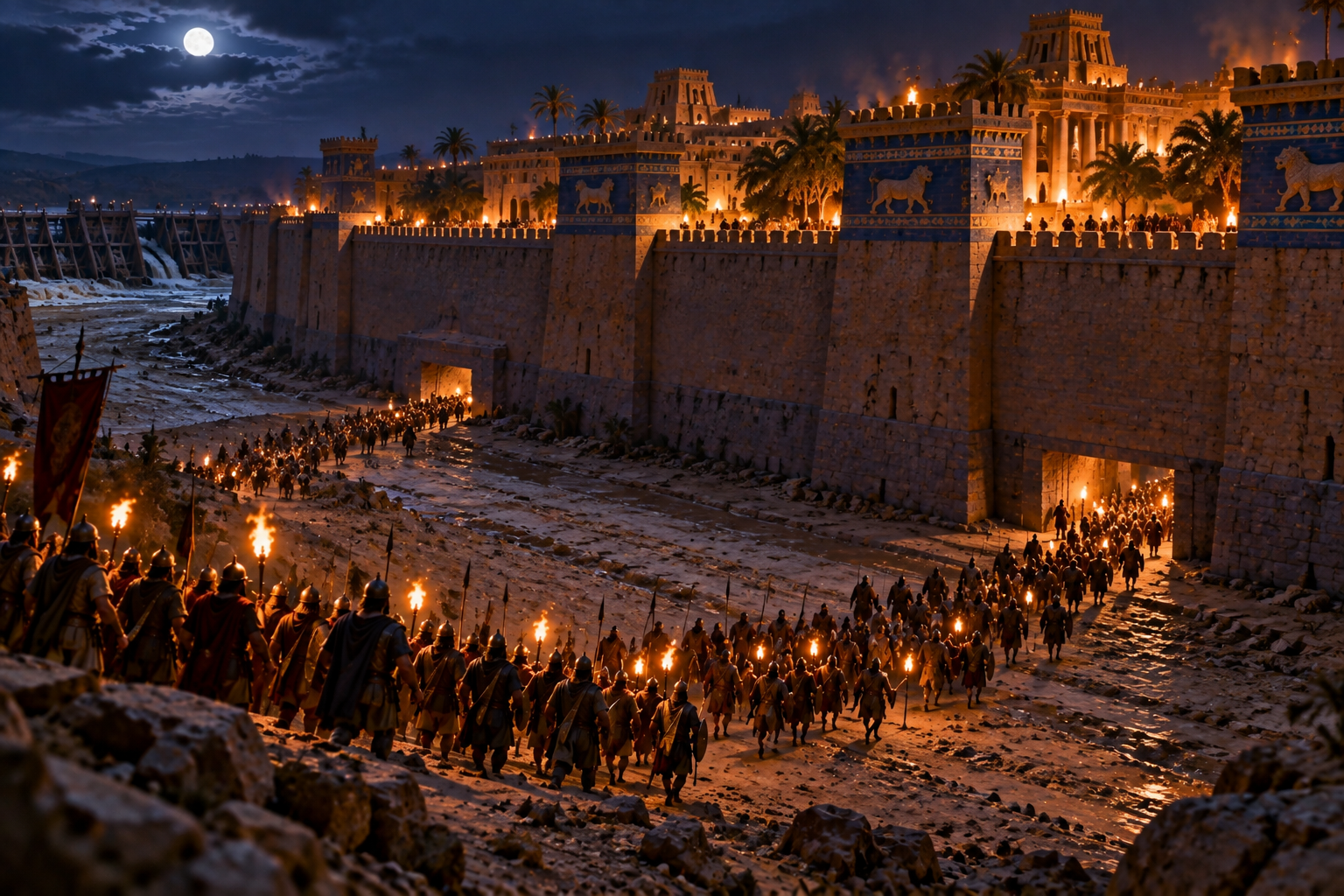
DARIUS THE MEDE
RECEIVED THE KINGDOM
Darius the Mede - God’s prediction becomes history almost immediately. Daniel had just declared that Belshazzar’s kingdom had been “given over to the Medes and Persians” (Da 5:28). Belshazzar was slain that very night (Da 5:30), and the next verse records that Darius the Mede received the kingdom (Da 5:31). The handwriting on the wall had become history!
The precise historical identity of Darius the Mede remains uncertain and has generated considerable discussion. Daniel clearly identifies him as “the Mede” (Da 5:31; 11:1) and later associates his reign with the larger Medo-Persian setting. Daniel 6:28 places Darius alongside Cyrus the Persian, although the precise relationship between the two rulers and the best way to understand that verse are debated.
Various identifications have been proposed, including that Darius was Gubaru/Gobryas, an official associated with the Persian conquest of Babylon, or that “Darius” was a throne name or title connected in some way with Cyrus himself. None of these proposals has achieved universal agreement. Therefore, it is wisest to affirm what Daniel clearly states while remaining cautious about what Daniel does not explain.
Guzik interprets Darius "as a sub-king under Cyrus the Persian. He is referred to in secular history as Gubaru (See Gobryas - Wikipedia)."
What God wrote on the wall that night
was written into history before the night was over.
At about the age of sixty-two - Why mention the age? While one cannot be dogmatic, it is possible that his age is given to allow one to differentiate this Darius from another Darius who some have postulated was the king. Many scholars have noted that the name Darius may have been a title of honor much like the term Caesar or Augustus was in the Roman Empire. The other Darius who some have considered might have been king was named Darius I Hystaspes who began to reign in 522BC. Darius I Hystaspes would have been a relatively young man at this time, surely under age 30, and so the fact that this "Darius the Mede" was 62 would effectively exclude him as the ruler at the beginning of the Medo-Persian empire. Now are you really confused? See the Table below and note that Cyrus (who defeated Babylon) and Darius the Mede were apparently in effect "co-regents" over the Medo-Persian empire (see Criswell's note below).
Daniel mentions this Darius in chapter 9 recording that "In the first year of Darius the son of Ahasuerus, of Median descent, who was made king over the kingdom of the Chaldeans." (Da 9:1)
As has been said, Daniel 5's description of the passing of the baton from the golden to the silver kingdom of Medo-Persia came to pass just as God had predicted. The point is that God's Word is sure (2Pe 1:19). God's Word never fails (Josh 21:45, 23:14). No Word from God is devoid of power (Lk 1:37ASV). If God says it, that settles it regardless of whether we believe it, understand it or agree with it!
Beloved of the Lord, Daniel 5 should cause all of us as believers…
to have a more stable, sure faith (Ro 10:17)
to have a greater knowledge of the greatness of our God that we might do exploits for His Name and His glory (cp Da 11:32b)
to daily determine to live in holy conduct and godliness (enabled by the Spirit) (2Pe 3:11)
Warren Wiersbe - Belshazzar forgot the Word of God and the lessons of history and lost his kingdom and his life. May we not make the same mistakes today! (Bible Exposition Commentary - Old Testament)
Considering the brevity of our life and the "longevity" of eternity, it behooves each of us to not ignore God's "handwriting" in our lives but to…
Redeem (exagorazo in the = continually, as the habitual practice of our life!) the time (kairos - see word study) for the days are evil (Eph 5:16)
See Redeem the Time
Let us all ask God to…
Teach us to number our days so that we may present to Him a heart of wisdom (Ps 90:12)
The Apologetics Study Bible- Understand Why You Believe (online) - According to the Nabonidus Chronicle, Babylon fell to the Medo-Persians on the sixteenth of the month Tishri, in the autumn of 539 B.C. The Greek historians Herodotus and Xenophon supply fascinating details about Babylon's fall. The Nabonidus Chronicle and the Cyrus Cylinder both agree with Daniel that Babylon was captured without a major battle and that the citizens readily accepted Persian rule (Da 6:1-3).
Darius was "made king" presumably as result of Cyrus granting him his regency. This would definitively exclude Darius I Hystaspes who in fact was of Persian not Median descent.
|
SUMMARY OF THE EARLY |
|||
| 539 Cyrus | 530 Cambyses | 522 Darius I Hystaspes | |
| 539 Darius the Mede (?Gubaru) 525 |
----- |
||
So how do we resolve Da 5:31, which liberal, unbelieving critics have called an obvious "error" and further evidence of the fraudulent nature of this book? First note that Da 5:28 says the kingdom will be divided and given over to the Medes and Persians. Darius is a Mede and Cyrus is a Persian and Da 6:28 says Daniel enjoyed success in the reign of Darius and in the reign of Cyrus the Persian. So the Spirit choose to mention Darius the Mede here even though historically it was Cyrus the Persian who defeated Babylon. There is no discrepancy or conflict for the one who has eyes to see and ears to hear what the Spirit is saying! (cp this phrase used seven times in addressing the churches in the Revelation = Rev 2:7, 11, 17, 29, 3:6, 13, 22)!
W A Criswell has a lengthy explanatory note stating that…At this point the most difficult historical problem in the book is confronted. None of the ancient historians and none of the cuneiform inscriptions have thus far confirmed the existence of a leader at that time named Darius. Our knowledge of the administration of Babylon following the Persian conquest is sketchy. It was made a Persian satrapy consisting of Babylonia and the Babylonian Empire west of the Euphrates ("Ebernari"). Cambyses, Cyrus's son, was declared king of Babylon but was shortly removed. An individual named Gubaru (not the same as Cyrus's general [Ed: his somewhat similar name Ugbaru has caused some confusion], who died in November, 539 B.C.) served as satrap. One named Gubaru is said to have appointed governors under him. Cyrus was soon engaged in military affairs that occupied him for most of the remainder of his reign. He consequently entrusted the administration of the empire to Gubaru. It may be Gubaru whom Daniel identifies as "Darius the Mede." Darius I ("the Great" = Darius I Hystaspes) was in his twenties when he began to reign in 522BC, and was not Median but Persian. Daniel intentionally distinguishes the Darius of his book by calling him "the Mede."… We know, however, that at least two of Cyrus's generals were Medes, and that he appointed Medes in administrative positions. The phrase "received the kingdom" (Da 5:31) can be translated "took over kingship." It has been suggested that "Darius" may have been a title meaning "The Royal One." (Believer's Study Bible: New King James Version. 1991. Thomas Nelson)
As described below in the extra-biblical account by the ancient historian Xenophon, Cyrus the Persian proved to be God's instrument of judgment against Belshazzar and Babylon the great just as God's Word had prophesied through Isaiah over 150 years before Cyrus was even born…
Thus says the Lord to Cyrus His anointed (Masiyah - gives us our word "messiah"), whom I have taken by the right hand (Pr 21:1), to subdue nations before him and to loose the loins of kings (cp Da 5:6); to open doors before him so that gates will not be shut (cp Da 5:30 - read below how this was fulfilled): I will go before you and make the rough places smooth; I will shatter the doors of bronze and cut through their iron bars. I will give you the treasures of darkness and hidden wealth of secret places, so that you may know that it is I, The Lord, the God of Israel, who calls you by your name. (Why does God anoint Cyrus to be His instrument of judgment?) For the sake of Jacob My servant, and Israel My chosen one, I have also called you by your name (What amazing mercy and grace - Israel was in exile because of her idolatry and failure to keep the Sabbath years, and yet God still had concern for them! He had not forsaken them because of His faithfulness to keep His covenant with Abraham, Isaac and Jacob. cp Nu 23:19). I have given you (Cyrus) a title of honor though you have not known Me. I am the Lord, and there is no other. Besides Me there is no God. I will gird you, though you have not known Me that men may know from the rising to the setting of the sun that there is no one besides Me. I am the Lord, and there is no other, the One forming light and creating darkness, causing well-being and creating calamity; I am the Lord who does all these. “Drip down, O heavens, from above, and let the clouds pour down righteousness. Let the earth open up and salvation bear fruit, and righteousness spring up with it. I, the Lord, have created it (This speaks of the time with His Righteous Branch, the Messiah, reigns during the Millennium). (Is 45:1-8)
Comment: What does this fulfilled prophecy say about the trustworthiness of the Word of God and the God of the Word? (cp Josh 23:14, Josh 21:45, Pr 30:5)
Jeremiah gives another prophecy (~605BC cp Jer 25:1, cp Da 1:1 = remember 3rd year by Babylonian reckoning which did not count first year of a king's rule) regarding Israel, Nebuchadnezzar and Babylon…
Therefore thus says the LORD of hosts, 'Because you have not obeyed My words, 9 behold, I will send (Notice Who is in control!) and take all the families of the north, 'declares the LORD,' and I will send to Nebuchadnezzar king of Babylon, My servant (Jer 27:6, 43:10), and will bring them against this land (Israel, specifically the Southern Kingdom of Judah and Benjamin), and against its inhabitants, and against all these nations round about; and I will utterly destroy them (This is exactly what happened to the Holy Temple in Jerusalem!), and make them a horror, and a hissing, and an everlasting desolation. 'Moreover, I will take from them the voice of joy and the voice of gladness, the voice of the bridegroom and the voice of the bride, the sound of the millstones and the light of the lamp. 11 'And this whole land (of Israel) shall be a desolation and a horror, and these nations (Israel as well as the Gentile nations) shall serve the king of Babylon seventy years. (cp Lev 23:3, 4, 5, Lev 26:33, 34, 35, 2Chr 36:20, 21) 12 'Then it will be when seventy years are completed I will punish the king of Babylon and that nation,' (as we see here in Da 5:30, 31) declares the LORD, 'for their iniquity, and the land of the Chaldeans; and I will make it an everlasting desolation. (Jer 25:8, 9, 10, 11, 12)
In spite of Babylon’s great defenses, it fell in one day’s time just as the sovereign, Most High God had foretold over 150 years earlier…
“Now, then, hear this, you sensual one, who dwells securely, who says in your heart, ‘I am, and there is no one besides me. I will not sit as a widow, nor know loss of children.’ But these two things will come on you suddenly in one day: Loss of children and widowhood. They will come on you in full measure In spite of your many sorceries, In spite of the great power of your spells. “You felt secure in your wickedness and said, ‘No one sees me,’ Your wisdom and your knowledge, they have deluded you; For you have said in your heart, ‘I am, and there is no one besides me.’ “But evil will come on you which you will not know how to charm away and disaster will fall on you for which you cannot atone and destruction about which you do not know will come on you suddenly. (Is 47:8, 9, 10, 11)
According to the Nabonidus Chronicle, Babylon fell to the Medo-Persian empire on the 16th of the month Tishri, in the autumn of 539BC.
Here are excerpts of Xenophon's historical account of the fall of Babylon…
(From page 261) When Cyrus appeared before Babylon he stationed his whole fore about the city and then rode around it himself in company with his friends and the staff-officers of the allies; but when he had taken survey of the walls, he prepared to draw off his arm from the city. But a deserter came out and told him that they were going to attack him as soon as he began to draw his army off. "For," the man went on, "your lines looked weak to those who observed them from the walls." And it was no wonder that they appeared so; for, encompassing walls of such extent, the lines necessarily had but little depth… (From the Index - "The walls of Babylon, according to Herodotus, were 40 miles in circumference, 335 feet high and 85 feet wide at the top, and were broken by 100 gates-25 on each side.")
When they had encamped, Cyrus called together his staff-officers and said: "Friends and allies, we have viewed the city on every side. But I am sure I cannot see how any one could take by storm walls so massive and so high; but the more men there are in the city, the sooner they can, I think, be brought by famine to capitulate, seeing that they will not come out and fight. Therefore, unless you have some other method to suggest, I propose that we use this method of laying siege to those gentlemen."
"But," said Chrysantas, "does not this river flow through the midst of the city? And it is more than two stadia in width."…
(Cyrus) erected many… towers (around the outside of the walls of Babylon)… so that he might have as many watch-towers as possible. Thus, then, his men were employed, while the enemy upon the walls (the Babylonians) laughed his siege-works to scorn, in the belief that they had provisions enough for more than 20 years. Upon hearing of this, Cyrus divided his army into 12 parts as if intending each part to be responsible for sentry duty during one month of each year; but the Babylonians, in their turn, when they heard of that, laughed much more scornfully still, at the thought of Phrygians and Lydians and Arabians and Cappadocians keeping guard against them for they considered all these to be more friendly to them than to the Persians. At last the ditches were completed. Then, when he heard that a certain festival had come round in Babylon, during which all Babylon was accustomed to drink and revel all night long, Cyrus took a large number of men, just as soon as it was dark, and opened up the heads of the trenches at the river. As soon as that was done, the water flowed down through the ditches in the night, and the bed of the river, where it traversed the city, became passable for men. When the problem of the river was thus solved, Cyrus gave orders to the his Persian colonels, infantry and cavalry, to marshal their regiments two abreast and come to him, and the rest, the allies, to follow in their rear, drawn up as before. They came, according to orders, and he bade his aides, both foot and horse, get into the dry channel of the river and see if it was possible to march in the bed of the river. And when they brought back word that it was, he called together the generals of both infantry and cavalry and spoke as follows:
"My friends," said he, "the river has made way for us and given us an entrance into the city. Let us, therefore, enter in with dauntless hearts, fearing nothing and remembering that those against whom we are now to march are the same men that we have repeatedly defeated, and that, too, when they were all drawn up in battle line with their allies at their side, and when they were all wide awake and sober and fully armed; whereas now we are going to fall upon them at a time when many of them are asleep, many drunk, and none of them in battle array. And when they find out that we are inside the walls, in their panic fright they will be much more helpless still than they are now… But come, to arms! And with the help of the gods I will lead you on. And do you, Gadatas and Gobryas, show the streets, for you are familiar with them. And when we get inside the walls, lead us by the quickest route to the royal palace."
"Aye," answered Gobryas and his staff, "in view of the revelry, it would not be at all surprising if the gates leading to the palace were open; for all the city is feasting this night. Still, we shall find a guard before the gates, for one is always posted there."
"We must lose no time, the," said Cyrus. "Forward, that we may catch the men as unprepared as we can."
When these words were spoken, they advanced. And of those they met on the way (Babylonians), some fell by their swords, some fled back into their houses, some shouted to them; and Gobryas and his men shouted back to them, as if they were fellow-revelers. They advanced as fast as they could and were soon at the palace.
And Gobryas and Gadatas and troops found the gates leading to the palace locked, and those who had been appointed to attack the guard fell upon them as they were drinking by a blazing fire, and without waiting they dealt with them as with foes. But, as a noise and tumult ensued, those within heard the uproar, and at the king's command to see what the matter was, some of them opened the gates and ran out.
And when Gadatas and his men saw the gates open they dashed in, in pursuit of the others as they fled back into the palace, and dealing blows right and left they came into the presence of the king; and they found him already risen with his dagger in his hand. And Gadatas and Gobryas and their followers overpowered him and those about the king perished also, one where he had sought some shelter, another while running away, another while actually trying to defend himself with whatever he could.
Cyrus then sent the companies of cavalry around through the streets and gave them orders to cut down all whom they found out of doors, while he directed whose who understood Assyrian to proclaim to those in the their houses that they should stay there, for if any one should be caught outside, he would be put to death.
While they were thus occupied, Gadatas and Gobryas came up and first of all they did homage to the gods, seeing that they had avenged themselves upon the wicked king (Belshazzar), and then they kissed Cyrus' hands and his feet with many tears of joy.
And when day dawned and those in possession of the citadels discovered that the city was taken and the king slain, they surrendered the citadels, too…
(Cyrus) furthermore ordered the heralds to make proclamation that all Babylonians deliver up their arms; and he ordered that wherever arms should be found in any house, all the occupants should be put to the sword. (Cyropaedia - see pp 261-277 for full description of Babylon's fall),
Herodotus has a parallel account of the fall of Babylon in The History of the Persian Wars written about 430BC…
He (Cyrus) turned the Euphrates by a canal into the basin, which was then a marsh, on which the river sank to such an extent that the natural bed of the stream became fordable…… Hereupon the Persians who had been left for the purpose at Babylon by the, river-side, entered the stream, which had now sunk so as to reach about midway up a man's thigh, and thus got into the town. Had the Babylonians been apprised of what Cyrus was about, or had they noticed their danger, they would never have allowed the Persians to enter the city, but would have destroyed them utterly; for they would have made fast all the street-gates which gave upon the river, and mounting upon the walls along both sides of the stream, would so have caught the enemy, as it were, in a trap. But, as it was, the Persians came upon them by surprise and so took the city. Owing to the vast size of the place, the inhabitants of the central parts (as the residents at Babylon declare) long after the outer portions of the town were taken, knew nothing of what had chanced, but as they were engaged in a festival, continued dancing and reveling until they learnt the capture but too certainly. Such, then, were the circumstances of the first taking of Babylon.” (Herodotus on Cyrus' capture of Babylon)
Dr Charles Dyer who has written extensively on Babylon in Scripture and in history remarks that…
If our tale of two cities (Jerusalem and Babylon) ended when Judah fell, it would seem as though the city of man had triumphed over the City of God. But the same prideful rebellion that caused confusion at Babel also brought about the fall of Babylon's kings. Babylon was like a haughty princess, tossing her head and proclaiming, "I did it my way"!
Babylon occupied the world's center stage for only about two generations. The city rose to fame in 612 B.C. when Babylonian armies destroyed the city of Nineveh, and Babylon supplanted Assyria as the dominant power in the Middle East. Less than a century later, in 539 B.C., Babylon was conquered by Medo-Persia and gradually slipped back into obscurity.
Seventeen days after Babylon fell to Cyrus's general, Cyrus himself entered the city. The average person in Babylon would not have noticed any major changes in daily affairs. Cyrus established Babylon as one of his capital cities and assumed the title "King of Babylon." (James B. Pritchard, Ancient Near Eastern Texts Relating to the Old Testament, 3d ed. Princeton: Princeton University Press, 1969, p316) He wisely tried to establish peace and to restore a sense of normality and order in the city (A K Grayson: Assyrian and Babylonian Chronicles, Texts from Cuneiform Sources)
When I (Cyrus) entered Babylon as a friend and [when] I established the seat of the government in the palace of the ruler under jubilation and rejoicing, Marduk, the great lord, [induced] the magnanimous inhabitants of Babylon [to love me], and I was daily endeavoring to worship him. My numerous troops walked around in Babylon in peace, I did not allow anybody to terrorize [any place] of the [country of Sumer] and Akkad. I strove for peace in Babylon and in all his [other] sacred cities. CYRUS, King of Babylon (Pritchard, Ancient Near Eastern Texts, p316)
Babylon remained at peace throughout the reign of Cyrus and his successor, Cambyses. Following the death of Cambyses, Darius I assumed control of the MedoPersian Empire. The citizens of Babylon rebelled against Darius, and he was forced to recapture the city on two separate occasions. After his second suppression of a revolt, Herodotus reports that "Darius destroyed their walls and reft away all their gates, neither of which things Cyrus had done at the first taking of Babylon." (Herodotus 3.159)
Though Babylon had fallen into difficult times, it continued to be an important and active city under the reign of the Medo-Persians. (Borrow The rise of Babylon : is Iraq at the center of the final drama?)
Gleason Archer - Is there any confirmation for the existence of “Darius the Mede”? New International Encyclopedia of Bible Difficulties page 286
“Darius the Mede” is first mentioned in Daniel 5:31: “So Darius the Mede received the kingdom [over the erstwhile Chaldean Empire] at about the age of sixty-two” (NASB). Some scholars, advocating a late date theory for the composition of Daniel, argue (1) that there never was a Median Darius, since he is never mentioned in any other ancient document preserved to us; (2) that the name Darius was picked up by the Maccabean author, who was confused about the real sequence in Persian History and mixed up a legendary Median king with Darius I (522–484), who was a Persian rather than a Mede; (3) that the author mistakenly supposed that it was the Medes who conquered Babylon (rather than Cyrus the Persian), and that under this legendary “Darius” they were supposed to have maintained a world empire for some years before they fell to the Persians.
In this way the Maccabean date advocates are able to account for the four “kingdoms” in Nebuchadnezzar’s dream (Dan. 2) as (1) Chaldean, (2) Median, (3) Persian, (4) Greek—which would have the advantage of extending the prophetic horizon of “Daniel” no farther than 165 B.C. (The problem with the traditional identification of the fourth kingdom with Rome is that it would presuppose genuine predictive prophecy—which cannot be permitted by rationalist higher criticism.) The tenability of the Maccabean date hypothesis rests on this explanation for “Darius the Mede.” Therefore Darius is a pretty important fellow and deserves our special attention.
No identification can be made out between Darius the son of Hystaspes and Darius the Mede for the following reasons:
1. Darius I was a Persian by birth, a cousin of King Cyrus; he was not a Median.
2. Darius was a young man when he assassinated the imposter Gaumata (who claimed to be Smerdis, the son of Cyrus) in 522. Darius could not have been 62; he was more likely in his twenties.
3. Darius did not precede Cyrus as king of Babylon; rather, he began his reign seven years after the death of Cyrus the Great; yet the liberal theory alleges that the author supposed that he came before Cyrus.
4. Such confusion as to the true nationality and time sequence of Darius the Great would have been unthinkable in the second-century B.C. Hellenistic world; for even in the Near East every schoolboy was required to read Xenophon, if not Herodotus, and other Greek historians from the fifth and fourth centuries B.C. Even in Hellenistic Palestine, these authors were widely read and admired. It is from Xenophon and Herodotus that we gain our information concerning Cyrus and Darius. Any Greek-writing author, or author within the Hellenistic orbit, who attempted to put Darius before Cyrus would have been laughed off the stage by the general public; and no credence would have been given to anything he wrote.
We must therefore conclude that Darius the Mede and Darius the Persian have nothing to do with each other, and that the confusion is in the minds of the late date theorists rather than in the mind of the author of Daniel. And yet it is true that no reference to “Darius the Mede” has been discovered as yet in the findings of archaeology. (Until the late nineteenth century, the same would have been true of Belshazzar, viceroy under his father Nabonidus. Maccabean date critics used to allege that he was another fictional character in Daniel, before the discovery of Babylonian tablets from that period, which confirm that Belshazzar was serving as junior king in the final years of Nabonidus’s reign.) Yet there is a very obvious and attractive identification to be found as we shall see.
There are several indications in the text of Daniel that Darius was not king in his own right but had been temporarily appointed to the throne by some higher authority. In 9:1 it is stated that Darius “was made king.” The passive stem (hophal) is used in the verb homlaḵ, rather than the usual mālaḵ (“became king”), which would have been used had he obtained the throne by conquest or by inheritance. In 5:31 we are told that Darius “received” (qabbēl) the kingship, as if it had been entrusted to him by a higher authority. It is also appropriate to point out that subordinate or vassal kings were similarly appointed by Cyrus according to the Behistun Rock inscription set up by Darius I in the late sixth century. (Thus Darius’s own forebear, Hystaspes, is said to have been “made king” during the time of Cyrus the Great.) As the incumbent of the time-honored throne of Babylon, it was only a matter of proper protocol for Cyrus’s appointee to assume in his official decrees the same titles as had always attached to that title. Thus the decree of 6:25 is addressed to the inhabitants of “all the earth” (ʾarʿāʾ could also be translated “land,” rather than being as comprehensive as “the earth”). Traditional titulary, going back to the time of Hammurabi (eighteenth century B.C.), was šár kiššati (“king of the universe”). Therefore this phrase need not be construed as implying that Darius was claiming to be king over all the inhabited world, including Persia itself, as some critics assumed.
Who, then, was Darius the Mede? In his careful study of the relevant archaeological documents, J.C. Whitcomb (Online source - Darius the Mede [Grand Rapids: Eerdmans, 1959]) has assembled all the texts referring to (1) Ugbaru, the general who engineered the capture of Babylon in 539 B.C.; (2) Gubaru, who is often referred to in tablets dating from 535 to 525 as the governor of Babylon; and (3) Gaubaruva, a leader mentioned in the inscriptions of Darius the Great. Ugbaru was not the same person as Gubaru (Xenophon spells his name as Gobryas but confuses him with Ugbaru) but an elderly general who died within a few weeks after the Fall of Babylon. Gaubaruva is plainly a later personage who came into prominence after Ushtani was appointed governor of Babylon in the late 520s. Concerning Gubaru, we have little evidence of his ethnic background, but he could very well have been a Mede. Certainly it was consistent with Cyrus’s policy to put talented and loyal Medes like General Harpagus into key positions in his government. As for the name “Darius” (Persian Dārayawush), it seems to be related to dara, which appears in Avestan as a term for “king.” Like augustus among the Romans, dārayawush (“the royal one”) may have been a special honorific title, which could also be used as a proper name (just as “King” may be a name in English).
It would appear, then, that right after the Fall of Babylon to the Medo-Persian troops, Cyrus’s presence was urgently needed in another front of his expanding empire. He therefore found it expedient to put Gubaru-Darius in charge, with the title King of Babylon, to rule for a year or so until Cyrus could return in person and celebrate a formal coronation as king in the temple of Marduk. After his year of rule as viceroy, then, Darius was retained as the governor of Babylon, but with the crown transferred to his overlord, Cyrus (who subsequently had his older son, Cambyses, crowned king of Babylon). It is clear from Daniel’s failure to mention any date later than Darius’s “first year” (9:1) that his reign must have been of very brief duration. It should be observed that an empire that lasted for only a single year introduces and element of utter implausibility into the Maccabean date hypothesis; for a one-year empire could hardly have been set up as number two in a series that included the Chaldean Empire, which lasted for 73 years, the Persian Empire, which lasted for 208 years, and the Greek Empire, which would have lasted for 167 years by 165 B.C.
We close this discussion with the episode that first ushers Darius onto the stage in Daniel’s narrative. Daniel 5 relates the dramatic episode of the divine handwriting on the wall of Belshazzar’s banquet hall. The third term in that fateful inscription is PERES, which Daniel himself (in v.28) interprets as “PERES—your kingdom has been divided [perîsaṯ, from the same p-r-s root as PERES] and given over to the Medes and Persians [Pārās]” (NASB). This double word-play on the root p-r-s makes it absolutely certain that the author of this book believed that kingdom number one (the Chaldean Empire) passed directly and immediately into the control of the Persians, allied with the Medes, as kingdom number two. This leaves no room for the critics’ theory of an earlier and separate Median Empire as being intended by the author of Daniel. That author must therefore have believed that kingdom number two was Persian (i.e., Medo-Persian), that kingdom number three (of Dan. 2) was the Macedonian-Greek-Syrian Empire, and that kingdom number four would overthrow and replace the Greek Empire. The only power that ever did that was the Roman Empire. Therefore, successful predictive prophecy cannot be eliminated from Daniel even by a Maccabean date hypothesis!
Norman Geisler - When Critics Ask - DANIEL 5:31—How can the Book of Daniel be inspired if it makes reference to a man that modern scholarship says never existed?
PROBLEM: According to Daniel 5:31, the kingdom of Belshazzar fell to the invading armies, and Darius the Mede took over as king. However, modern scholars have rejected the historical accuracy of the Book of Daniel. They argue that there never was a Darius the Mede, since there is no mention of such a person in ancient documents. Is this an error in Daniel’s historical account?
SOLUTION: Like the historical record of Belshazzar, which modern scholars questioned until archaeological evidence vindicated Daniel’s accuracy, Daniel has again recorded the existence of a man that other ancient historical documents omit.
Some modern scholars claim that the author of Daniel mistakenly thought that the Medes conquered Babylon instead of the Persians. They claim that this author then confused Darius I, king of Persia (521–486 B.C.) with the conqueror of Babylon and identified this figure as Darius the Mede. However, there is no reason to assume that the Book of Daniel is in error. Darius the Mede is a different person from Darius I of Persia. Darius the Mede was a subordinate to Cyrus the Great. Cuneiform texts refer to Darius the Mede as Gubaru who was appointed by Cyrus to be governor over all of Babylonia. The tendency to deny the historical accuracy of Daniel simply because there is currently no corroborating historical information stems from the antisupernatural bias of modern scholarship. Daniel’s historical record has proven to be a reliable source of information.