Ephesians 1:2
Ephesians 1:3
Ephesians 1:4
Ephesians 1:5
Ephesians 1:6
Ephesians 1:7
Ephesians 1:8
Ephesians 1:9
Ephesians 1:10
Ephesians 1:11
Ephesians 1:12
Ephesians 1:13
Ephesians 1:14
Ephesians 1:15
Ephesians 1:16
Ephesians 1:17
Ephesians 1:18
Ephesians 1:19
Ephesians 1:20
Ephesians 1:21
Ephesians 1:22
Ephesians 1:23

EPHESIANS - CHRIST AND THE CHURCH
Click chart to enlarge
Charts from Jensen's Survey of the NT - used by permission
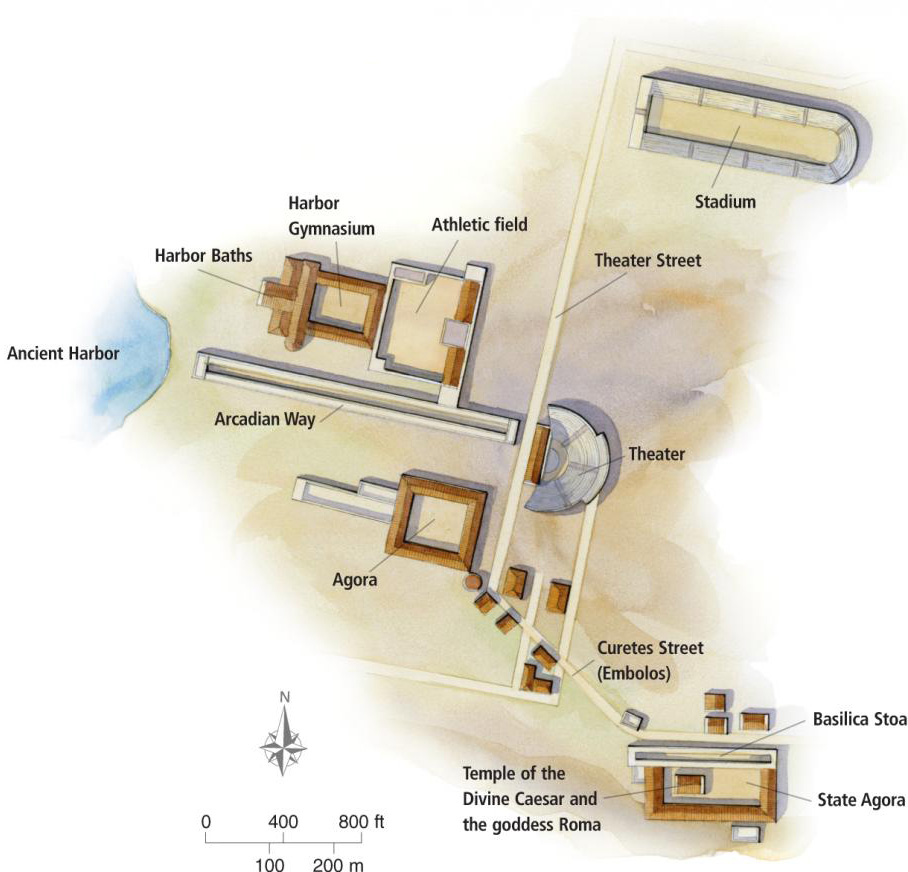
Ephesus in the Time of Paul (c. A.D. 60) (ESV.org)
Ephesians 1:3 Blessed be the God and Father of our Lord Jesus Christ, Who has blessed us with every spiritual blessing in the heavenly places in Christ, (NASB: Lockman)
Greek: Eulogetos o theos kai pater tou kuriou hemon Iesou Christou, o eulogesas (AAPMSN) hemas en pase eulogia pneumatike en tois epouraniois en Christo,
BGT Εὐλογητὸς ὁ θεὸς καὶ πατὴρ τοῦ κυρίου ἡμῶν Ἰησοῦ Χριστοῦ, ὁ εὐλογήσας ἡμᾶς ἐν πάσῃ εὐλογίᾳ πνευματικῇ ἐν τοῖς ἐπουρανίοις ἐν Χριστῷ,
Amplified: May blessing (praise, laudation, and eulogy) be to the God and Father of our Lord Jesus Christ (the Messiah) Who has blessed us in Christ with every spiritual (given by the Holy Spirit) blessing in the heavenly realm! (Amplified Bible - Lockman)
CSB Praise the God and Father of our Lord Jesus Christ, who has blessed us in Christ with every spiritual blessing in the heavens.
ESV Blessed be the God and Father of our Lord Jesus Christ, who has blessed us in Christ with every spiritual blessing in the heavenly places,
KJV Blessed be the God and Father of our Lord Jesus Christ, who hath blessed us with all spiritual blessings in heavenly places in Christ:
NET Blessed is the God and Father of our Lord Jesus Christ, who has blessed us with every spiritual blessing in the heavenly realms in Christ.
NIV Praise be to the God and Father of our Lord Jesus Christ, who has blessed us in the heavenly realms with every spiritual blessing in Christ.
NKJ Blessed be the God and Father of our Lord Jesus Christ, who has blessed us with every spiritual blessing in the heavenly places in Christ,
NLT: How we praise God, the Father of our Lord Jesus Christ, Who has blessed us with every spiritual blessing in the heavenly realms because we belong to Christ. (NLT - Tyndale House)
NLT (revised) All praise to God, the Father of our Lord Jesus Christ, who has blessed us with every spiritual blessing in the heavenly realms because we are united with Christ.
NRS Blessed be the God and Father of our Lord Jesus Christ, who has blessed us in Christ with every spiritual blessing in the heavenly places,
Phillips: Praise be to God for giving us through Christ every possible spiritual benefit as citizens of Heaven! (Phillips: Touchstone)
Wuest: May the God and Father of our Lord Jesus Christ be eulogized, the One Who conferred benefactions upon us in the sphere of every spiritual blessing in the heavenly places in Christ, (Eerdmans Publishing - used by permission)
Young's Literal: Blessed is the God and Father of our Lord Jesus Christ, Who did bless us in every spiritual blessing in the heavenly places in Christ
BLESSED BE THE GOD AND FATHER OF OUR LORD JESUS CHRIST: Eulogetos o theos kai pater tou kuriou hemon Iesou Christou:
- Blessed - Ge 14:20 1Ch 29:20 Neh 9:5 Ps 72:19 Da 4:34 Lk 2:28 2Co 1:3 1Pe 1:3 Rev 4:9, 10, 11 5:9, 10, 11, 12, 13, 14
- God - Eph 1:17 Jn 10:29,30 Jn 20:17 Ro 15:6 2Co 1:3, 2Cor 11:31 Php 2:11
- Ephesians 1 Resources - Multiple Sermons and Commentaries
- Ephesians 1:3 Blessed, We Bless - Steven Cole
- Ephesians 1:4 He Chose Us - Steven Cole
- Ephesians 1:3-14 A Church for the New Millennium - John MacArthur
- Ephesians 1:3-4: The Body Formed in Eternity Past-1 - John MacArthur
- Ephesians 1:4-6: The Body Formed in Eternity Past-2 - John MacArthur
- Ephesians 1:4-14: The Calling of the Church - John MacArthur
Related Passages:
2 Corinthians 1:3 Blessed be the God and Father of our Lord Jesus Christ, the Father of mercies and God of all comfort,
2 Corinthians 11:31 The God and Father of the Lord Jesus, He Who is blessed forever, knows that I am not lying.
1 Peter 1:3 Blessed be the God and Father of our Lord Jesus Christ, Who according to His great mercy has caused us to be born again to a living hope through the resurrection of Jesus Christ from the dead,
James 1:17 Every good thing given and every perfect gift is from above, coming down from the Father of lights, with Whom there is no variation or shifting shadow.
Galatians 3:9 (BLESSED US) So then those who are of faith are blessed with Abraham, the believer.
A CALL TO PRAISE GOD:
BLESS THE BLESSER
John MacArthur has an interesting introductory comment on verse 3 - Paul here presents six aspects of the divine blessing he is about to unfold: the blessed One, God; the Blesser, also God; the blessed ones, believers; the blessings, all things spiritual; the blessing location, the heavenly places; and the blessing Agent, Jesus Christ. (Ephesians Commentary)
Blessed be the God and Father of our Lord Jesus Christ - Literally "Blessed the God" (eulogetos ho theos) Paul begins this incredible letter with a Doxology, an interesting word which originates from Greek doxa = glory or opinion (from dokein = to seem, seem good) and -logia from logos = word, speaking. Doxology is "speaking glory". Even as the thoughts begin to come into his mind (Ephesians 1:3-14ff), Paul cannot control himself and must preface it all by "speaking glory" to God the Father (speaking a proper opinion of the Father). And we should do likewise. The doxologies in almost all the Epistles imply the real sense of grace experienced by the writers and their readers. Growing up in liturgical church, every Sunday we would sing the "Doxology" but as an unbeliever (below is the is one we used to sing every Sunday), I missed the true meaning and beauty of these words...
Praise God from whom all blessings flow;
Praise Him, all creatures here below;
Praise Him above, ye heavenly host:
Praise Father, Son, and Holy Ghost.
So Paul (from the adversity of imprisonment) is saying "Let God be well spoken of (adored, praised)...bless Him for His great goodness." When doctrine is rightly understood (as Paul surely understood what he would expound in verses 3-14) it will naturally (supernaturally) lead to doxology (short formula expressing praise to God). When we discover Who God is and what He has accomplished for us in His Son, we cannot help but bless His holy Name. Take a moment and sing the doxology to Him.
Notice that in Ephesians 1:3 Paul uses the entire related word family three times -- the adjective (eulogetos), the verb (eulogeo) and the noun (eulogia) and the sentence still makes supernatural sense but only to genuine believers not natural men (cf 1Cor 2:14).
In Ephesians 1:3-14 we encounter some of the most incredible truths in all of Scripture, so that many think that there is no section of Scripture with a greater concentration of truths than those written here. And although a cursory reading might suggest these verses are a kind of theological "maze", they are in fact very purposely laid out by divine inspiration which brings together the Trinity -- Ephesians 1:3-6 describes the will of the Father, Ephesians 1:7-12 describes the work of the Son, and Ephesians 1:13-14 describes the witness of the Spirit. Hallelujah!
Related Resource:
- Trinitarian Formulas and Expressions in Ephesians - ESV Study Bible Chart (Interesting!)
Findlay on Ephesians 1:3-14 - We enter this epistle through a magnificent gateway’, a golden chain’ of many links,
William Hendriksen likens it to ‘a snowball tumbling down a hill, picking up volume as it descends."
John Mackay ‘This rhapsodic adoration is comparable to the overture of an opera which contains the successive melodies that are to follow’.
Armitage Robinson suggests that it is ‘like the preliminary flight of the eagle, rising and wheeling round, as though for a while uncertain what direction in his boundless freedom he shall take’.
Spurgeon - We are not sitting here, and groaning, and crying, and fretting, and worrying, and questioning our own salvation. He has blessed us; and therefore we will bless him. If you think little of what God has done for you, you will do very little for him; but if you have a great notion of his great mercy to you, you will be greatly grateful to your gracious God.”...Our thanks are due to God for all temporal blessings; they are more than we deserve. But our thanks ought to go to God in thunders of hallelujahs for spiritual blessings. A new heart is better than a new coat. To feed on Christ is better than to have the best earthly food. To be an heir of God is better than being the heir of the greatest nobleman. To have God for our portion is blessed, infinitely more blessed than to own broad acres of land. God hath blessed us with spiritual blessings. These are the rarest, the richest, the most enduring of all blessings; they are priceless in value.”
John Stott sums up Ephesians 1:3-14 (one long and magnificent sentence in the Greek) -- "A gateway, a golden chain, a kaleidoscope, a snowball, a racehorse, an operatic overture and the flight of an eagle: all these metaphors in their different ways describe the impression of color, movement and grandeur which the sentence makes on the reader’s mind. The whole paragraph is a paean of praise, a doxology, or indeed a ‘eulogy’, for that is the word Paul uses. He begins by blessing God for blessing us with every conceivable blessing.” More particularly, he makes what seems to be a deliberate reference to the Trinity. For the origin of the blessing is the God and Father of our Lord Jesus Christ, who is also ‘our Father’ (verse 2); its sphere is God the Son, for it is in Christ, by virtue of our union with him, that God has blessed us; and its nature is spiritual, every spiritual blessing, a phrase which may well mean ‘every blessing of the Holy Spirit’, who as the divine executive applies the work of Christ to our hearts. As Charles Hodge put it, ‘These blessings are spiritual not merely because they pertain to the soul, but because derived from the Holy Spirit, whose presence and influence are the great blessing purchased by Christ’. (God's New Society: The Message of Ephesians)
Ray Stedman writes that "There is an unusual structure in this passage to which I'd like to call your attention. From Verse 3 through Verse 14 in the Greek text (not in the English) you have one complete, unbroken sentence filled with many adjectival phrases brought in to amplify and enrich it. If you want to get the effect of it, take a deep breath and try to read it through with one breath. You will see how much Paul has crammed into this great sentence. It's almost as though he is taking a walk through a treasure chamber, like those of the Pharaohs of Egypt, describing what he sees. He starts out with the most immediate and evident fact and tells us what that is. Then something else comes into view and he puts that in. And glory flashes upon glory here until he has this tremendously complicated sentence which includes vast and almost indescribable riches...You see, these are much more than mere doctrinal ambiguities, mere theological ideas. They are facts, foundational truths which undergird us in every moment of our life. And, unless you understand those facts, you can't utilize them, you can't benefit from them. In that way they are like natural laws. The laws of nature operate regardless of how we feel -- they are impersonal in that respect. I've been doing a bit of electrical work in an addition to my home, and I've discovered that electricity follows a pattern of its own and takes no notice of how I feel at the moment. That can be a shocking experience! It is not in the slightest degree impressed with my position as a pastor of Peninsula Bible Church. It doesn't hesitate to retaliate for any violation of its laws that I commit. It is up to me to discover how it works, and then to respect it, if I want to utilize it. The same thing is true of these great facts. They will do you not a particle of good if you don't discover what they are and believe them enough to operate on the basis of them. That is why we are having this study together. We couldn't possibly cover in one message all that is wrapped up in these great truths, and I don't want to attempt it. We want to take our time going through this passage so that we might grasp these fundamental facts. (Ephesians 1::3-14: Foundations)
Guzik - Moule wrote that the idea behind blessed is, “Praised with worshipping love.” The “us” includes both Jews and Gentiles in the church at Ephesus and beyond. It was important to point out that these blessings are for both Jewish and Gentile believers. First century Jews had a strong sense of being blessed, called, and predestined. Paul showed that these things are now given to Christians, be they Jew or Gentile.
This passage is in effect is a eulogy (literally a good word) and as MacArthur says "Because no one is truly good but God (Matt. 19:17), our supreme eulogy, our supreme praise, is for Him alone." See the great attribute of God - Good, Goodness.
Blessed (2128) (eulogetos from eu = good + logos = word - English "eulogy" = a speech or writing that praises someone highly) is the adjective describing the One Who is worthy of praise and in the NT is rightly used only of God and Christ Jesus. Rarely eulogetos is actually used as a Name for God -- "the Blessed One" (Mark 14:61).
Eulogetos - 8x in 8v - Mk 14:61; Luke 1:68 ( “Blessed be the Lord God of Israel, ); Ro 1:25 (the Creator, who is blessed forever. Amen.); Ro 9:5 (God blessed forever. Amen. ); 2 Cor 1:3 (Blessed be the God and Father of our Lord Jesus Christ,); 2Co 11:31 (The God and Father of the Lord Jesus, He who is blessed forever); Eph 1:3; 1Pe 1:3 (Blessed be the God and Father of our Lord Jesus Christ)
John Eadie - The verb ("be") is usually omitted. The adjective in the doxology is placed before the substantive, because being used as a predicate, and representing an abstract quality, the emphasis lies on it. Such is the invariable usage in the Old Testament—not God is blessed, but, from the position of the words—Blessed be God. At least thirty times does the formula occur (Eadie - Ephesians Commentary)
God blesses us by gifts; we bless Him by words
- Maclaren
Alexander Maclaren phrases it eloquently "God blesses us by gifts; we bless Him by words. The aim of His act of blessing is to evoke in our hearts the love that praises. We receive first, and then, moved by His mercies, we give. Our highest response to His most precious gifts is that we shall ‘take the cup of salvation, and call upon the name of the Lord,’ and in the depth of thankful and recipient hearts shall say, ‘Blessed be, God who hath blessed us.’ (Read sermon)
THOUGHT - In all things speak well of Him, whether in the midst of pain, struggle, trials, frustration, opposition or adversity. Speak well of Him. And we can speak well of Him in all such circumstances when we recall to our minds that He is always good, independent of what we are experiencing or how we might feel. (see His unchangeable attribute - Goodness). Does it not strike you as absolutely amazing that the creature can even bless the Creator? What a high and holy privilege believers have and yet far too often we allow this privilege to "atrophy" through infrequent use. Have you blessed the LORD today? Let David's words stir your soul...
Bless the LORD, O my soul;
And all that is within me, bless His holy name.
Bless the LORD, O my soul,
And forget none of His benefits
(Psalm 103:1-2)
(Play Bless the Lord)
Comment on Psalm 103:2 - "Forget none of His benefits" I like the NET = "Do not forget all His kind deeds!" and NLT = "May I never forget the good things He does for me." Why? One rease it sets our affection on the things above (Col 3:1-2, cf Dt 8:11) It engages the Expulsive Power of a New Affection, in this case an affection that is daily even moment by moment renewed because it is reviewed in praise and grateful adoration! The Septuagint is striking in that it gives us a negative command in the present imperative(kai me epilanthanou) (present imperative with a negative)! In other words it says something like "Stop forgetting...." or "Do not begin forgetting...." Of course the only way to obey that command is by daily depending on (being filled with) the Holy Spirit! He Alone is able to to direct the gaze of the eyes of our heart ever upward.
C H Spurgeon's Comment on blessing God is worth pondering beloved...
Psalm 103:1. Bless the Lord O my soul. Soul music is the very soul of music. The Psalmist strikes the best keynote when he begins with stirring up his inmost self to magnify the Lord. He soliloquizes, holds self-communion and exhorts himself, as though he felt that dullness would all too soon steal over his faculties, as, indeed, it will over us all, unless we are diligently on the watch. Jehovah is worthy to be praised by us in that highest style of adoration which is intended by the term bless -- "All Thy works praise thee, O God, but Thy saints shall bless thee." (Psalm 145:10) Our very life and essential self should be engrossed with this delightful service, and each one of us should arouse his own heart to the engagement. Let others forbear if they can: "Bless the Lord, O MY soul." Let others murmur, but do thou bless. Let others bless themselves and their idols, but do thou bless the LORD. Let others use only their tongues, but as for me I will cry, "Bless the Lord, O my soul."
And all that is within me, bless his holy name. Many are our faculties, emotions, and capacities, but God has given them all to us, and they ought all to join in chorus to His praise. Half-hearted, ill-conceived, unintelligent praises are not such as we should render to our loving Lord. If the law of justice demanded all our heart and soul and mind for the Creator, much more may the law of gratitude put in a comprehensive claim for the homage of our whole being to the God of grace. It is instructive to note how the Psalmist dwells upon the holy Name of God, as if His holiness were dearest to him; or, perhaps, because the holiness or wholeness of God was to his mind the grandest motive for rendering to Him the homage of his nature in its wholeness. Babes may praise the divine goodness, but fathers in grace magnify His holiness. By the Name we understand the revealed character of God, and assuredly those songs which are suggested, not by our fallible reasoning and imperfect observation, but by unerring inspiration, should more than any others arouse all our consecrated powers. (See study on the Names of the LORD) (Spurgeon's commentary on Psalm 103:1)
Psalm 103:2. Bless the LORD, O my soul. He is in real earnest, and again calls upon himself to arise. Had he been very sleepy before? Or was he now doubly sensible of the importance, the imperative necessity of adoration? Certainly, he uses no vain repetitions, for the Holy Spirit guides his pen; and thus he shews us that we have need, again and again, to bestir ourselves when we are about to worship God, for it would be shameful to offer him anything less than the utmost our souls can render. These first verses are a tuning of the harp, a screwing up of the loosened strings that not a note may fail in the sacred harmony.
And forget not all his benefits. Not so much as one of the divine dealings should be forgotten, they are all really beneficial to us, all worthy of Himself, and all subjects for praise. Memory is very treacherous about the best things; by a strange perversity, engendered by the fall, it treasures up the refuse of the past and permits priceless treasures to lie neglected, it is tenacious of grievances and holds benefits all too loosely. It needs spurring to its duty, though that duty ought to be its delight. Observe that he calls all that is within him to remember all the Lord's benefits. For our task our energies should be suitably called out. God's all cannot be praised with less than our all.
Reader, have we not cause enough at this time to bless Him Who blesses us? Come, let us read our diaries and see if there be not choice favours recorded there for which we have rendered no grateful return. Remember how the Persian king, when he could not sleep, read the chronicles of the empire, and discovered that one who had saved his life had never been rewarded. (see Esther 2:22, 6:1-10) How quickly did he do him honour! The Lord has saved us with a great salvation (Heb 2:3), shall we render no recompense? The name of ingrate is one of the most shameful that a man can wear; surely we cannot be content to run the risk of such a brand. Let us awake then, and with intense enthusiasm bless Jehovah. (Spurgeon's commentary on Psalm 103)
See some of Spurgeon's sermons related to the topic of blessing...
- Ephesians 1:3-4: Blessing for Blessing
- 1 John 5:13 The Blessing Of Full Assurance
- Psalm 68:19-20 Daily Blessings For God's People
- Romans 8:28 The True Christian's Blessedness
Our God and Father:
- Eph 1:17 Jn 10:29,30 Jn 20:17 Ro 15:6 2Co 1:3, 2Cor 11:31 Php 2:11
- Ephesians 1 Resources - Multiple Sermons and Commentaries
- Ephesians 1:3 Blessed, We Bless - Steven Cole
- Ephesians 1:4 He Chose Us - Steven Cole
- Ephesians 1:3-14 A Church for the New Millennium - John MacArthur
- Ephesians 1:3-4: The Body Formed in Eternity Past-1 - John MacArthur
- Ephesians 1:4-6: The Body Formed in Eternity Past-2 - John MacArthur
- Ephesians 1:4-14: The Calling of the Church - John MacArthur
OUR FATHER WHO
ART IN HEAVEN
Note not the God and Father, but our God and Father. The apostle John testifies "as many as received Him (Christ, Messiah as Savior and Lord), to them He gave the right to become children of God (the Father), even to those who believe in His name (John 1:12) In his first letter John writes:" See how great a love the Father has bestowed on us, that we would be called children of God; and such we are. For this reason the world does not know us, because it did not know Him." (1Jn 3:1)
Ray Stedman - There are four elements in this summary that I want you to note. Paul begins, first, with the One who is behind all these blessings, the God and Father of our Lord Jesus Christ. That is his starting point. And when a man begins with God you know that what he is going to say is in line with reality. Our problem is we don't start our thinking with God; we tend to start it with ourselves, with our experience, which is only a partial view of truth. Thereby we immediately narrow the range of our vision to what we are going through and what is happening to us, and we don't see this in relationship to the whole reality of life around us. Consequently we get twisted and deformed ideas of what is happening. The only proper way to view truth is to see it in relationship to all truth everywhere. And there is only one way to do that, and that is to start with God. Only God is great enough to encompass all truth. This is the difference between what the Bible calls "natural" thinking, as done by "the natural man," and the "spiritual" thinking of "the spiritual man." Natural thinking is always limited, always wrong to some degree, because it isn't large enough and broad enough to handle all the facts. But spiritual thinking is always God-centered, and, therefore, true, and to the extent that it is spiritual, it is true in every way. We need to learn to be spiritual thinkers about ourselves. This is where Paul begins. (Ephesians 1:1-14: God At Work)
F B Meyer has these devotional thoughts on "Father"...
IT WAS THUS THAT JESUS LIVED (Ephesians 1:3) There was no lack of either Grace or Peace in His human life, because He dwelt ever in the bosom of the Father. He spake no word, and wrought no deed of mercy, that was not derived from his Father. He refused to make one stone into bread, because so sure that his Father could not forget Him, but knew just what was needed for the body which He had provided for Him. The often upturned eye witnessed to the attitude of his spirit. There was never a film of separation or cloud of misunderstanding, for the Father never left Him alone for a single instant; not even when He cried, "My God, my God, why hast Thou forsaken Me." How could He, when Jesus did always those things which pleased Him? "Even so, Father," was the whisper with which He met all the incidents of his life, whether cloud or sun.
Let us learn to live thus towards the God and Father of our Lord Jesus Christ. There must always be an impassable gulf between His relationship to the Father and ours. But, withal, there are points of contact. He waits to reveal to us the Father, according to his own words (Mt 11:27). He longs to reproduce in us, by the Holy Ghost, His own spirit of Sonship, and to bring us to know His Father as our Father, His God as ours. There is no joy, which more satisfies His soul for its travail, than that His own should come so to know the name and character of His Father, and so to abide in it, as that the love with which the Father loved Him, may be in them as a warm and blessed experience. When this purpose is accomplished in us, our Marahs will be turned to Elims; and we shall be full of peace, since our Father has mixed our cups, appointed our paths, set our life-tasks, and whispers to our secret hearts that He is well pleased with us in Jesus. (Chapter 1 - The Father)
Father (3962) pater father, parent—1. lit.—a. of the immediate ancestor Mt 2:22; 10:21; Mk 5:40; 15:21; Jn 4:53; Ac 7:14; 1 Cor 5:1; Heb 12:9a . Plural parents Heb 11:23.—b. forefather, ancestor, progenitor Mt 3:9; 23:30, 32; Mk 11:10; Lk 1:73; 16:24; Jn 4:20; 8:39, 53, 56; Acts 3:13, 25; Ro 9:10; Heb 1:1.—2. fig. of spiritual parenthood or used in respectful address, etc. Acts 7:2a; Ro 4:11, 12a; 1 Cor 4:15; 10:1; 2 Pet 3:4.—3. of God—a. as Parent of humanity Mt 6:4; Lk 6:36; Jn 8:41f; 20:17c; Ro 1:7; 2 Cor 1:2, 3b; Col 1:2; Titus 1:4.—b. as Parent of Jesus Christ Mt 7:21; Mk 8:38; 14:36; Lk 2:49; Jn 4:21; 6:40; Ro 15:6; 2 Cor 11:31; Eph 1:3; Rev 2:28.—c. Often God is called simply (o`) path,r (the) Father, (the) Parent Gal 1:1; Eph 1:17; 2:18; 3:14; Phil 2:11; 1 Jn 1:2; 2:1, 15.—4. of Satan Jn 8:44.
WHO HAS BLESSED US WITH EVERY SPIRITUAL BLESSING: o eulogesas (AAPMSN) hemas en pase eulogia pneumatike:
- Ge 12:2-3 Ge 22:18 1Ch 4:10 Ps 72:17 Ps 134:3 Isa 61:9 Ga 3:9
- Ephesians 1 Resources - Multiple Sermons and Commentaries
- Ephesians 1:3 Blessed, We Bless - Steven Cole
- Ephesians 1:4 He Chose Us - Steven Cole
- Ephesians 1:3-14 A Church for the New Millennium - John MacArthur
- Ephesians 1:3-4: The Body Formed in Eternity Past-1 - John MacArthur
- Ephesians 1:4-6: The Body Formed in Eternity Past-2 - John MacArthur
- Ephesians 1:4-14: The Calling of the Church - John MacArthur
Related Passages:
1 Chronicles 4:10 (A BOLD PRAYER FROM JABEZ) Now Jabez called on the God of Israel, saying, “Oh that You would bless me indeed and enlarge my border, and that Your hand might be with me, and that You would keep me from harm that it may not pain me!” And God granted him what he requested.
Psalm 72:17 (Spurgeon) May his name endure forever; May his name increase as long as the sun shines; And let men bless themselves by him; Let all nations call him blessed.
Galatians 3:9 So then those who are of faith are blessed with Abraham, the believer. (See Ge 12:2-3)
Philippians 4:19 And my God will supply all your needs according to His riches in glory in Christ Jesus.
EVERY SPIRITUAL BLESSING:
BEYOND OUR IMAGINATION!
Swindoll quips "this letter skips the light hors d’oeuvres of the spiritual banquet and jumps straight into the main course." He encourages us to work "through this smorgasbord, taking our time to savor the profound truth it offers." (Insights on Galatians, Ephesians
Who has blessed (eulogeo in past tense) us with every spiritual blessing in the heavenly places in Christ - This letter is about riches, not exhaustible material wealth that can make itself wings, but the inexhaustible, infinite riches that every believer possesses in Christ as a present reality. Paul sums our riches in this verse with the phrase "every spiritual blessing" and then he proceeds to explain them and to tell us how we can draw on them for effective Christian living. We need to remember that man's "days are like grass; as a flower of the field, so he flourishes. When the wind has passed over it, it is no more; and its place acknowledges it no longer." (Psalm 103:15) In Isaiah God adds that "The grass withers, the flower fades, but the word of our God stands forever." And that word is that we are spiritually wealthy beyond our wildest dreams.
THOUGHT - God wants us to live accordingly so that the world might see it is to the praise of His glory and thereby might see the invisible God through the visible good works of His sons and daughters (Mt 5:16). May His Spirit open each of our eyes so that we experience the reality of "every spiritual blessing in the heavenly places in Christ" and then empower us to live them out in daily victory, all to the praise of the glory of His grace. Amen.
Did you notice that the verse is not future tense but past tense. Blessed is in the aorist tense which speaks of an effective action, one which was completed in the past. It is not that God will give us but that He has already given us. And while this is of course true, we also know that the "best is yet to come!" Hallelujah what a Savior! Hallelujah what a Blessed Hope!
This verse always brings to mind the song "I Can Only Imagine."
Observe that those who have been blessed are "us" - Paul affirms that he had experienced this blessing also. God has endowed us with the ability to succeed and live as more than conquerors in Christ (Ro 8:37) in this spiritual life in which we war with the flesh (Gal 5:16-17) and the devil's forces (Eph 6:10-12).
THOUGHT Why do so many saints seem to fall short of all that God desires for us and for which He has already made ample provision in Christ, by His Spirit and His Word?
Eadie comments that "us" obviously signifies...The persons blessed are the apostle and the members of that church addressed by him—he and they were alike recipients of divine favour. The eulogesas (blessing) stands in ideal contrast to the eulogetos—God blessed us, and we bless God; but His blessing of us is one of deed, our blessing of Him is only in word. He makes us blessed, we pronounce Him blessed. He confers on us well-being, we ascribe to Him wellbeing. Ours is benedicere, His is benefacere. The participle here, as in many places, has virtually a causal significance. We bless Him because He has blessed us. As the word expresses that divine beneficence which excites our gratitude, it must in a doxology have its widest significance. The enraptured mind selects in such a case the most powerful and intense term, to express its sense of the divine generosity. (Eadie - Ephesians Commentary)
THOUGHT - Why wouldn’t God put material blessings in this list of spiritual blessings? The answer is simple -- they don’t last for eternity, whereas the things not seen do last forever! What are you living for...the temporal or the eternal? Notice how this truth flies in the face of the horrible heresy of the so-called "prosperity gospel." We must continually be reminded that "The world is passing away, and also its lusts (desires); but the one who does the will of God lives forever." (1Jn 2:17).
C S Lewis - “The Christians who did most for the present world were precisely those who thought most of the next. It is since Christians have begun thinking less of the other world that they have become so ineffective in this. Aim at heaven and you get earth thrown in; aim at earth and you get neither.”
How vast the benefits divine which we in Christ possess!
We are redeemed from guilt and shame and called to holiness.
But not for works which we have done, or shall hereafter do,
Hath God decreed on sinful men salvation to bestow.
Paul is saying you may be as poor as a church mouse in the world's eyes but in the eyes of God, in terms of riches that will last forever, you are immeasurably wealthy. Even the national debt of America simply does not compare to your wealth for the former is material and temporal while the latter is spiritual and eternal.
Steven Cole - Why does God bless us with every spiritual blessing in Christ? It is so that we may in turn bless and glorify Him, the Giver of every good and perfect gift. Blessed by God, we bless God. (Ephesians 1:3 Blessed, We Bless)
Martyn Lloyd-Jones on every spiritual blessing “The first thing to observe is the way in which these blessings come to us. They come ‘in Christ.’ If you leave out the ‘in Christ’ you will never have any blessings at all. This is, of course, pivotal and central in connection with the whole of our Christian faith. Every blessing we enjoy as Christian people comes to us through the Lord Jesus Christ....You cannot be a Christian without being ‘in Christ’; Christ is the beginning as well as the end, He is Alpha as well as Omega; there are no blessings for Christians apart from Him. We must also emphasize that the blessings come exclusively in and through the Lord Jesus Christ. He has no assistant....Every blessing is in Him, not a single blessing comes from anywhere else. He is the only channel; there is only ‘one mediator between God and men, the man Christ Jesus’ (1 Timothy 2:5).....Christ is the sole Mediator of all blessings, the sole, exclusive channel through which they come. I repeat and stress this because I know in my own heart and experience, as I know it in the experience of others, how prone we are to forget this (ED: SEE Ps 103:2 WHERE "forget none of His benefits" in the Septuagint is a command present imperative with a negative see our need to depend on the Holy Spirit to obey), how liable we are to go into the presence of God in prayer without realizing the absolute necessity of going in and through Christ....Nothing matters so much as our relationship to the Lord Jesus Christ. That is why Paul keeps on reminding us of it; and we must never forget it. Without Him we are ‘yet in our sins.’ Every blessing we enjoy, everything good that we have achieved or experienced, all comes from Him. ‘Every thought of holiness is His alone.’ (All Spiritual blessings)
Lloyd-Jones goes on to explains and illustrate in the life of Jesus what Paul means by calling these blessings spiritual -- The second truth about these blessings, the Apostle goes on to emphasize, is that they are ‘spiritual.’...This is an important addition, an essential qualification. These blessings come from Christ, but they also come through the Spirit; they are blessings which are mediated to us from God through Christ via the Holy Spirit. It is by the Holy Spirit they become ours. Once more we cannot but pause in wonder and amazement at the perfection of this glorious plan of salvation worked out by the ‘economic Trinity’, the Father, the Son and the Holy Spirit, for our redemption. But the particular work of applying to us the salvation that is in Christ is done by the Holy Spirit. His purpose and function is to glorify the Lord Jesus Christ, and what He does is to make it possible for us to receive everything He has done for us and everything that He makes possible for us. Hence a good way of looking at the life of the Christian in this world is to look at the Lord Jesus Christ when He was here on earth. Although He was the eternal Son of God He came and took human nature unto Himself. Having decided to live His life in this world as a man, He did not employ the prerogatives of His Godhead in order to save us, but He lived His life among men. It was therefore necessary that He should have received the Holy Spirit, and in the Gospel according to John we are told that ‘The Spirit is not given by measure to him’ (Jn 3:34). At His baptism, when our Lord was setting out upon His public ministry, the Holy Ghost descended upon Him to enable Him and to anoint Him for His great task. That was necessary because He was living His life in this world as a man. Now the wondrous truth taught here is that, as the Holy Spirit filled His life and enabled Him to live as described in the Gospels, the same is possible for us through Him. The same Holy Spirit who dwelt in Him dwells in us as Christians, and not only so, He brings to us and fills us with the life of Christ Himself. Thus the blessings we enjoy as Christians are all blessings in and through the Holy Spirit. Such is the type of life, the quality of life, which we are meant to be living as Christians The Apostle John in a very striking verse in his First Epistle says that ‘as he is, so are we in this world’ (1Jn 4:17). We do not propose here and now to work this out in detail; but we know that the Holy Spirit comes and quickens us. Think of Christ in all His fulness, and think of the sinner in his sin—‘dead in trespasses and sins.’ How can such a person ever become spiritual? The Holy Spirit comes and quickens us. ‘You hath he quickened who were dead in trespasses and sins’ (Ephesians 2:1). He starts this enlightening process, He begins to give us an insight into spiritual things. (All Spiritual blessings)
Related Resource:
Ray Stedman gives an ILLUSTRATION of believers having every spiritual blessing in the "bank of heaven" -- "The epistle to the Ephesians ought to be a treasure store to which we go repeatedly anytime we get discouraged. I remember reading years ago about an old Navajo Indian who had become rich because oil had been found on his property. He took all the money and put it in a bank. His banker became familiar with the habits of this old gentleman. Every once in a while the Indian would show up at the bank and say to the banker, "Grass all gone, sheep all sick, water holes dry." The banker wouldn't say a word -- he knew what needed to be done. He'd bring the old man inside and seat him in the vault. Then he'd bring out several bags of silver dollars and say, "These are yours." The old man would spend about an hour in there looking at his money, stacking up the dollars and counting them. Then he'd come out and say, "Grass all green, sheep all well, water holes all full." He was simply reviewing his resources, that's all. That is where encouragement is found -- when you look at the resources which are yours, the riches, the facts which undergird your faith. As we go through this letter to the Ephesians I hope you will read it in that way. (Ephesians 1:3-14: Foundations) (ED: TO FOLLOW UP ON THAT ILLUSTRATION - UNFORTUNATELY HE WOULD NOT WITHDRAW ANY OF HIS RESOURCES FROM THE BANK! SO YES HE WAS RICH BUT HE WAS LIVING LIKE A POOR MAN!)
When we bless God we speak good of Him. When God blesses us, He bestows good to us. He speaks well of us. We bless Him with words. He blesses us with words and riches! All we can do is to speak well of Him because in ourselves we have nothing good to give (Except of course our love and our obedience). So remember that to obey is better than sacrifice (1Sa 15:22), so may we not praise Him with our lips on Sunday and go out of church and walk unworthily of our holy calling Monday through Saturday. Stated another way, God cannot bless us for our goodness, because we have none. He blesses us with His abundant goodness (cf Ro 2:4). Our heavenly Father lavishes (bestows with profusion on) us with every goodness, every good gift and every blessing in Christ (cf Jas 1:17). That is His gracious nature and our great need.
Every (3956)(pas) means all, whole, every, without exception. The Ephesians lived in a city of great (temporal) riches and Paul wanted them to understand what real (eternal) riches were, where to find them, and what to do with them.
The word every reminds of Peter's encouraging words "His (Jesus our Lord in context = 2Pe 1:2) divine power (He) has granted (not the usual word for "give" but doreomai which means to bestow gratuitously and in perfect tense speaks of permanence of this amazing gift!) to us everything (pas) pertaining to life and godliness, through (Note that the blessings are there for us to pursue and partake of, but here explains how and where we may appropriate "every spiritual blessing" - it is in...) the true knowledge of Him (Where is this found? The Scripture. Not books by men, but the Book by God. And it is not superficial knowledge but "true knowledge" or epignosis -- which is why inductive Bible study which teaches one how to dig into the Scriptures for oneself is so valuable and life changing) Who called us by His own glory and excellence. (2Pe 1:3)
Eadie comments that with the use of the word "all" (pas) - The circle is complete. No needed blessing is wanted—nothing that God has promised, or Christ has secured, or that is indispensable to the symmetry and perfection of the Christian character. (Ed: Do we really believe this is true? Does our life of faith demonstrate this belief?) And those blessings are all in the hand of the Spirit (AGREEING WITH DR MARTYN LLOYD-JONES). Christianity is the dispensation of the Spirit, and as its graces are inwrought by Him, they are all named “spiritual” (pneumatikos) after Him. It certainly narrows and weakens the doxology to confine those “blessings” wholly or chiefly to the charismata, or extraordinary gifts of the primitive Church, as Wells and Whitby do. Those gifts were brilliant manifestations of divine power, but they have long since passed away, and are therefore inferior to the permanent graces—faith, hope, and love. They were not given to all, like the ordinary donations of the Holy Ghost. Theodoret, with juster appreciation, long ago said, that in addition to such endowments—“the blessings referred to here are, the hope of the resurrection, the promises of immortality, the kingdom of heaven in reversion, and the dignity of adoption.” The blessings are stated by the apostle in the subsequent verses, and neither gifts, tongues, nor prophecy occupy a place in the succinct and glowing enumeration. (Eadie - Ephesians Commentary)
Alexander Maclaren commenting on every (pas) writes that Paul "calls upon us to bless God for all spiritual blessings. That is to say, there is no gap in His gift. It is rounded and complete and perfect. Whatever a man’s needs may require, whatever his hopes can dream, whatever his wishes can stretch out towards, it is all here, compacted and complete. The spiritual gifts are encyclopaediacal and all-sufficient. They, are not, segments, but completed circles. When God gives He gives amply. (sermon)
Alexander Maclaren adds that Paul "calls them ‘spiritual,’ not because they are, unlike material and outward blessings, gifts for the inner man, the true self, but because they are imparted to the waiting spirit by that Divine Spirit who communicates to men all the most precious things of God. They are ‘spiritual’ because the Holy Spirit is the medium of communication by which they reach men’s spirit. (sermon)
Eadie - The blessings are designated as spiritual, but in what sense?
1. Chrysostom, et al suppose that the apostle intends a special and marked contrast between the spiritual blessings of the new dispensation, and the material and temporal blessings of the old economy. Temporal blessings, indeed, were of frequent promise in the Mosaic dispensation—dew of heaven, fatness of the earth, abundance of corn, wine, and oil, peace, longevity, and a flourishing household. It is true that such gifts are not now bestowed as the immediate fruits of Christ's mediation, though, at the same time, godliness has “the promise of the life that now is.” But mere worldly blessings have sunk into their subordinate place. When the sun rises, the stars that sparkled during night are eclipsed by the flood of superior brilliance and disappear, though they still keep their places; so the blessings of this world may now be conferred, and may now be enjoyed by believers, but under the new dispensation their luster is altogether dimmed and absorbed by those spiritual gifts which are its profuse and distinctive endowments. If there be any reference to the temporal blessings of the Jewish covenant, it can only, as Calvin says, be “tacita antithesis.”
2. Others regard the adjective as referring to the mind or soul of man, such as Erasmus, et al express a doubtful acquiescence in this opinion.
This interpretation yields a good meaning, inasmuch as these gifts are adapted to our inner or higher nature, and it is upon our spirit that the Holy Ghost operates. But this is not the ruling sense of the epithet in the New Testament. It is, indeed, in a generic sense opposed to sarkikos (fleshly) in 1Co 9:11, and in Ro 15:27; while in 1Co 15:44, 45, 46 it is employed in contrast with psuchikos (soul, physical)—the one term descriptive of an animal body, and the other of a body elevated above animal functions and organization, with which believers shall be clothed at the last day. Similar usage obtains in Ep 6:12; 1Pe 2:5; 1Co 10:3, 4.
3. But in all other passages where, as in this clause, the word is used to qualify Christian men, or Christian blessings, its ruling reference is plainly to the Holy Spirit. Thus—spiritual gifts, Ro 1:11; a special endowment of the Spirit, 1Co 12:1, 1Co 14:1, etc.; spiritual men, that is, men enjoying in an eminent degree the Spirit, 1Co 2:15, 1Co 14:37; and also in Gal 6:1; Ro 7:14; Ep 5:19; Col 3:16; and in 1Co 2:13, “spiritual” means produced by or belonging to the Holy Spirit. Therefore the prevailing usage of the New Testament warrants us in saying, that these blessings are termed spiritual from their connection with the Holy Spirit. (Eadie - Ephesians Commentary)
WE MUST POSSESS
OUR POSSESSIONS
We are rich in Christ, but like all gifts they have to be received, and thus these blessings must be appropriated by grace through faith (obedience). We must live in the light of these blessings (faith that obeys). We must live like they are true because they are true. We have to come to the point where by faith we lay hold of these blessings and "possess our possessions" (think of "chose," "adopted as sons," "inheritance," "redemption," "forgiveness," etc). We need to be like Joshua in the Old Testament to whom Yahweh declared...
"Every place on which the sole of your foot treads, I have given it to you (past tense), just as I spoke to Moses." (Joshua 1:3)
Like Joshua, God has given us the "land" so to speak, but like Joshua, our responsibility is to "put one foot in front of the other" and walk out in faith, not by sight (2Cor 5:7), enabled by God's Spirit, to lay hold of our our "spiritual territory" in the heavenly places in Christ. In truth as we walk forth, it is not so much to inherit a "promised land," but a "promised life" in Christ!
S Lewis Johnson tells the story of William Penn stating "I don’t know how true it is, but the Indians said to Mr. Penn, “You can have as much as land as you can walk around in one day.” So, the story is that Mr. Penn got up early in the morning, I would’ve too. And he walked fast. And he walked over a wide territory. And at the end of the day he had encompassed, well not the state of Pennsylvania, but nevertheless a wide territory and one of the Indians said laconically later, so I’m told, “Paleface has had a long walk today.” Well, he was appropriating land that was a promise to him, as he appropriated it. And so here, the appropriation is to tread upon these great promises and make them ours. (Ephesians 1:1-2 Ephesians - Paul's Grandest Epistle)
Alexander Maclaren wrote "We may have as much of God as we will. Christ puts the key of the treasure-chamber into our hand, and bids us take all that we want. If a man is admitted into the bullion vault of a bank and told to help himself, and comes out with one cent, whose fault is it that he is poor? (ED:SEE ILLUSTRATION ABOVE)" (Read full sermon)
In another message Maclaren says of the "spiritual blessings" that "we possess them all today if our hearts are resting on Jesus Christ. The limit of the gift is only in ourselves. All has been given, but the question remains how much has been taken. Oh, Christian men and women, there is nothing that we require more than to have what we have, to posses what is ours, to make our own what has been bestowed.
Warren Wiersbe - When you trusted Jesus Christ as your Savior, God gave you “all spiritual blessings in heavenly places in Christ” (Eph. 1:3). You now have your inheritance! All you need do is appropriate that inheritance by faith (ED: AND THAT FAITH IS MANIFEST BY SPIRIT ENABLED OBEDIENCE) and draw on “His riches in glory” (Phil. 4:19). The Word of God is the “will” that tells you how rich you are, and faith (ED: THAT OBEYS) is the key that opens the vault so you can claim your inheritance. (Be Obedient Genesis 12-25: Learning the Secret of Living by Faith)
John Stott - We affirm with gratitude and joy that God has blessed us (eulogēsas, an aorist tense) in Christ with every spiritual blessing. That is, every blessing of the Holy Spirit (ED: SO STOTT ALSO AGREES THE "SPIRIT BLESSINGS" ARE FROM GOD AND IN CHRIST AND MADE EFFECTIVE BY THE SPIRIT) has been given us by the Father if we are in the Son. No blessing has been withheld from us. Of course we still have to grow into maturity in Christ (2Pe 3:18), and be transformed into his image (2Co 3:18), and explore the riches of our inheritance in Him. Of course, too, God may grant us many deeper and richer experiences of Himself on the way. Nevertheless already, if we are in Christ, every spiritual blessing is ours. Or, as the apostle puts it in Colossians, we ‘have come to fullness of life in him.’ (God's New Society: The Message of Ephesians)
John MacArthur has a very important statement we dare not miss in regard to "tapping into" our spiritual blessings in Christ "The key to living as a heavenly citizen while living in an unheavenly situation is walking by the Spirit. “Walk (ED: present imperative see our need to depend on the Holy Spirit to obey)by the Spirit,” Paul says, “and you will not carry out the desire of the flesh” (Gal. 5:16). When we walk in His power He produces His fruit in us: “love, joy, peace, patience, kindness, goodness, faithfulness, gentleness, self-control” (Gal 5:22–23). We receive our heavenly blessings by living in the power of God’s Holy Spirit."
Ray Stedman - Frequently throughout this letter you find the repeated phrase that everything occurs "to the praise of God's glory," i.e., in order that God should be praised, in order that his people should be so struck by the wonder of what has happened to them that their hearts reflect without limit and without their being able to prevent it -- the praise and the glory and the blessing of God. Now, you know that is not new. We all have learned that God is to be praised. We are to give thanks in all circumstances, etc. But most of us think of that as something we must make ourselves do. We have to do this because God needs it, His ego needs to be massaged every now and then by our praise, and unless we praise Him He won't operate. He gets upset and mad at us and doesn't run things right, and we have to butter him up a little bit to get him to work. That is really the basis upon which most of us act, at least much of the time, isn't it? But that isn't what this is talking about at all! It is saying that God has done such remarkable deeds that, if we once understand them, if it once breaks upon our dull intellects what it is that God has already done for us, what is already true of us right now, there will be nothing that we can do but stand in absolute awe and amazement, and say, "You mean that is true of me, Lord? I am overwhelmed! My God, how great thou art!" That is what God is after. That is what he wants to produce -- that sense of awe and amazement which causes us to stop and give thanks to a great and glorious God who has given us every spiritual blessing. (Read the entire sermon Ephesians 1:1-14: God At Work)
Homer Kent on the perversion of every spiritual blessing - Televangelists have often promised God will bless us with every material blessing. If you have enough faith, they claim, God will make you wealthy, and that wealth will be a blessing. That is simply not true. It is not true to life. Because we are His children, God is concerned with our welfare. He wants what is best for us. The truth is, material blessings are not always blessings. Sometimes, material things can be a curse rather than a blessing. Some of the most blessed people on earth have been poor, and some of the most miserable people on earth have been rich. It is also not true to the Bible. Read the Bible and you will discover that some of God’s most faithful men and women, experience the deepest poverty and the greatest pain. It is not material with which God blesses us but spiritual. Bod blesses us “with every spiritual blessing.”...Throughout the New Testament, we are reminded that we have two citizenships as Christians: a citizenship on earth and a citizenship in heaven. Much of what we do is based on our citizenship on earth. We pay taxes, we obey the laws of the land, we vote, we enjoy certain freedoms as we live in this earthly sphere as good citizens. But there are other things we do which are based on our citizenship in heaven. Only as we live as good citizens of heaven—that is, only as we maintain a live, vital, ongoing relationship with Christ—will we be able to enjoy the blessings that are ours as Christians. Warren Wiersbe offered a good illustration of this: the President of the United States. The President is not always seated at his desk in the White House, but that executive chair represents the sphere of his life and power. No matter where he is, he is the President, and he has certain powers, because he has the privilege of sitting at that desk. Likewise with the Christian: no matter where we are, we are seated in the heavenlies with Jesus, and that is the basis for our power and our blessings. How can we live in that heavenly sphere? That’s what the epistle of Ephesians will tell us. But at this point, Paul made this much clear: We will enjoy the blessings of the Christian life only as we live out our lives as good citizens of heaven. (The Glory of the Church )
Blessed (2127) (eulogeo from eu = good + logos = word) is the verb form meaning to speak well of, to celebrate with praises, to praise. As summarized below, God blesses men (with favor), who in turn (because of amazing grace) can bless God! Men can bless other men (e.g., in the form of prayer).
Zodhiates amplifies God's blessing of men noting that this means "to bless, i.e., to distinguish with favor, to act in man’s life and accomplish His purposes instead of allowing men to have their own way. When the subject is God, His speaking is action, for God’s speech is energy released. When God is said to bless us (eulogize or speak well of us), He acts for our good as He sees our need and not necessarily our desire. Therefore, He blesses by intervening. In Acts 3:26, God sent His Son to bless us, to intervene in our lives with what He planned to do for us. Eph. 1:3, referring to God who blessed us with all spiritual blessings, means the one who intervened and acted so that our spirits might be made conformable to His Spirit." (Complete Word Study Dictionary- New Testament)
Eulogeo summarized:
(1) To say something commendatory, speak well of, praise, extol. Man's duty (privilege) is to speak well of God (praise, thanksgiving) (Jas 3:9) 1828 Webster's says to praise means "to express approbation of personal worth or actions" and to bless means to pronounce a wish of happiness (or prosperity) to another.
(2) To ask (pray) for bestowal of special favor or divine favor on another (Lk 6:28, Ro 12:14, 1Cor 4:12, 1Pe 3:9), esp. of calling down God’s gracious power, bless (LXX). Consecrate or pronounce blessing on (Mt 26:26)
(3) To bestow a favor, provide with benefits, act graciously toward. God's action - confers favor, acts kindly toward (Eph 1:3, Acts 3:25, Heb 6:14).
TDNT The literal sense is “speaking well.” This yields the meaning “to extol.” We also find a use for “advocacy” in the papyri. The term may be used for the praise of humans by the gods, but more often for praise of the gods. The idea of blessing is extremely rare.
Blessing in the OT. Blessing is a most important concept in the OT and Judaism. Like cursing, it involves a transfer by acts and words. The Hebrew group barak, translated by eulogeo etc. in the LXX, denotes blessing, being blessed, and the individual blessings. A father has a power to bless which he may transmit to his heirs (Ge 27:1ff, Ge 48:15). This blessing takes the form of prayer to God (Gen. 49:25).....
Blessing becomes cursing if the commandments are not kept. The righteous who trust in God and do his will find blessing, but sinners cursing (Jer. 17:5, 7; Ps. 24:4-5). (Theological Dictionary of the New Testament- Abridged in One Volume)
The main uses of eulogeo are in the synoptic Gospels, where we see food, people, Jesus and God the Father are recipients of the blessing.
Jesus "blessed" food (Mt 14:19, Mk 6:41, 8:7, 14:22, Lk 9:16) and bread He dispensed to His disciples at the last Passover (Mt 26:26, Lk 24:30, same idea in 1Cor 10:16) Elizabeth called Mary mother of Jesus blessed for her honor of being mother of Messiah (Lk 1:41). The Jewish crowed "praised" (blessed) God when Zacharias was enabled to speak again after declaring his son's name would be John (the Baptist) (Lk 1:64) Simeon blessed God as He held His Son (Lk 2:28) and then he blessed Jesus' parents (Lk 2:34). Jesus commands (present imperative = as our habitual practice) us to bless those who persecute us (a supernatural feat only possible by one filled with an enabled by the Holy Spirit!) (Lk 6:28). Similarly Paul twice in one sentence commands (both times in the present imperative) Spirit filled believers (the only ones who could possibly genuinely obey this command!) to bless those who persecute us and not to curse them (Ro 12:14, same idea in 1Cor 4:12 and 1Pe 3:9). As an aside, this is a good marker of whether you have presented your body as a living sacrifice to God (Ro 12:1) and are truly filled with the Spirit (Eph 5:18) and walking by the Spirit (Gal 5:16)! Are you as convicted as I am as write these words? Jesus is blessed as the Messiah when he entered Jerusalem on Palm Sunday (Mt 23:39, 11:9-10, Lk 19:38 - He was blessed because they thought the Kingdom was coming!) and will not come again until the Jews say "blessed" again in the future (Mt 23:39, Lk 13:35). Mysterious Melchizedek blessed Abraham after his victory in Genesis 14 (Heb 7:1, 6-7). Isaac blessed Jacob and Esau (context was future blessings and so this blessing was by faith), as did Jacob to all Joseph's sons (Heb 11:20-21). James describes the human tongue as the organ that speaks blessing to God the Father (Jas 3:9). God blesses believers with every spiritual blessing in Christ (Eph 1:3). Believers are blessed of the Father because they inherit the Kingdom (Mt 25:34). Believing Gentiles and Jews are blessed just as was Abraham the believer (Gal 3:8), who was blessed by God which in context was manifest by multiplication of his offspring (Heb 6:14). Jesus gave a parting blessing to His disciples (Lk 24:50, 51) and they in turn began blessing (praising) God in the Temple after His Ascension (Lk 24:53). Peter tells his Jewish audience that Messiah was sent to bless them by turning them from their wicked ways (Acts 3:26). Believers are to "bless" audibly (in context conveying thanksgiving), not just in their spirit, so that others can respond in the worship with "Amen!"
Eulogeo - 41x in 38v in NAS (Translated: bless(9), blessed(25), blessing(3), giving a blessing(1), praise(1), praising(1), surely*(1).) -Matt 14:19; 21:9; 23:39; 25:34; 26:26; Mark 6:41; 8:7; 11:9, 10; Mk 14:22; Luke 1:42, 64; 2:28, 34; 6:28; 9:16; 13:35; 19:38; 24:30, 50, 51 53; John 12:13; Acts 3:26; Ro 12:14; 1Cor 4:12; 10:16; 14:16; Gal 3:9; Eph 1:3; Heb 6:14; 7:1, 6-7; 11:20-21; Jas 3:9; 1Pet 3:9
Eulogeo - 251 verses in non-apocryphal Septuagint -Gen 1:22, 28; 2:3; 5:2; 9:1; 12:2f; 14:19; 17:16, 20; 22:17; 24:1, 35, 48, 60; 25:11; 26:3, 12, 24; 27:4, 7, 10, 19, 23, 25, 27, 29ff, 33f, 38, 41; 28:1, 3, 6; 30:27, 30; 31:55; 32:26, 29; 35:9; 39:5; 47:7, 10; 48:3, 9, 15f, 20; 49:25, 28; Exod 12:32; 20:11, 24; 23:25; 39:43; Lev 9:22f; Num 6:23f; 22:6, 12; 23:11, 20, 25; 24:1, 9f; Deut 1:11; 2:7; 7:13; 8:10; 12:7; 14:24, 29; 15:4, 6, 10, 14, 18; 16:10, 15; 18:5; 21:5; 23:20; 24:13, 19; 26:15; 27:12; 28:3ff, 12; 30:16; 33:1, 11, 20; Josh 8:30; 14:13; 17:14; 22:6f, 33; 24:10; Judg 5:2, 9, 24; 13:24; Ruth 2:4, 19; 3:10; 1 Sam 2:9, 20; 9:13; 13:10; 23:21; 25:14, 33; 26:25; 2 Sam 2:5; 6:11f, 18, 20; 7:29; 8:10; 13:25; 14:22; 19:39; 21:3; 24:23; 1 Kgs 1:47; 2:45; 8:14, 55, 66; 10:9; 21:10, 13; 2 Kgs 4:29; 10:15; 1 Chr 4:10; 13:14; 16:2, 36, 43; 17:27; 18:10; 26:5; 29:10, 20; 2 Chr 6:3; 9:8; 20:26; 30:27; 31:8, 10; Neh 8:6; 9:5; 11:2; Job 1:10f, 21; 2:5; 11:2; 29:13; 31:20; 42:12; Ps 5:12; 16:7; 26:12; 28:9; 29:11; 34:1; 37:22; 45:2; 49:18; 62:4; 63:4; 65:10; 66:8; 67:1, 6f; 68:26; 72:15, 17; 96:2; 103:1f, 20ff; 104:1, 35; 107:38; 109:28; 112:2; 113:2; 115:12f, 15, 18; 118:26; 128:4f; 129:8; 132:15; 134:1, 3; 135:19f; 145:1f, 10, 21; 147:13; Prov 3:33; 11:25; 20:9; 22:8; 27:14; 28:20; 30:11; 31:30; Isa 12:1; 19:24f; 25:3, 5; 36:16; 38:18ff; 43:20; 51:2; 61:9; 64:11; 65:16, 23; Jer 4:2; 17:7; 31:23; Ezek 3:12; Dan 2:19f; 5:4, 23; Hag 2:19;
First use of eulogeo is God blessing man and woman (Ge 1:22, 28, 5:2), then the seventh day (Ge 2:3), Noah (Ge 9:1), Abraham (Ge 12:2, 3, 14:18, 17:16)
One very notable use is Genesis 12:3 where God promises Abram (Abraham) "I will bless those who bless you, And the one who curses you I will curse. And in you all the families of the earth will be blessed." Beloved, do you bless Israel today (not because they deserve it because they do not, but because God calls us to do it. Cp Ps 122:6)
Spiritual (4152) (pneumatikos from pneuma = spirit) refers to that which belongs to the supernatural world as distinguished from what belongs to the natural world. In other words the although the "blessing" might include a big checking and savings account (etc), the primary focus is the inexhaustible spiritual bank account readily available to every believer and waiting to drawn on. Too many "wealthy" saints who are supplied with every spiritual blessing are living like spiritual paupers. "In the New Testament pneumatikos (spiritual) is always used in relation to the work of the Holy Spirit."
Pneumatikos - 26x in 21v in NAS (Translated - spiritual(23), spiritual men(1), spiritual things(2).) - Ro 1:11; 7:14; 15:27; 1Cor 2:13, 15; 3:1; 9:11; 10:3, 4; 12:1; 14:1, 37; 15:44, 46; Gal 6:1; Eph 1:3; 5:19; 6:12; Col 1:9; 3:16; 1Pet 2:5
Blessing (2129) (eulogia - noun from eu = good, well + logos = word) is the act of speaking in favorable terms (praise) or the benefit of blessing. Here it speaks primarily of the spiritual benefits bestowed by God upon His family members. He confers every spiritual benefit upon His saints. He blesses because He is ready, willing and able to do so, not because we deserve His blessings or have earned them (it is all of grace). He is the source of all blessing, of every good thing. Goodness can only come from God because there is no source of goodness outside of God (the natural man bristles at truths such as this).
ILLUSTRATION OF "EVERY SPIRITUAL BLESSING" - Bill Bright, in his book Revolution Now says "sometime ago I was visiting in a West Texas community where my brother works for a major oil company. He took me out into the country to the largest pool of oil that has ever been discovered, until recent years. It is known as the Yates Way Pool (READ STORY). He showed me wells that were producing many thousands of barrels of oil a day. Then he told me the story of how this property was owned by a man named Yates, a sheep rancher. He used to graze his sheep over these rolling West Texas hills. He was living in poverty, on relief. It was during the depression years and there was not enough money to buy food and clothing for the family. I am sure that as he grazed his sheep he often wondered where his next meal would come from. Then one day an oil company sent a seismographic crew into the area, and they said "We believe there is oil on your property and we would like to drill a wild-cat test." He signed the contract and they begin to drill . At a 1,015 ft. they discovered oil. They did not discover a pool, they discovered an ocean of oil. The first well came in at around 8,000 barrels a day of oil. Now oil is worth about $3.00 per barrel. When you multiply 8K x 3, you get almost a quarter of a million dollars a day. But the next well was 180,000,000 barrels which would mean that about one half a million dollars worth of oil could be produced from that one well in a single day. Then there were many wells. They were everywhere! As a matter of fact, two years ago the government, after all these years, did a test on one of the wells and discovered that it still have the potental of flowing 125,000,000 barrels a day and Mr. Yates owned it all! It was all his, yet he was living in poverty on relief. Can you imagine - he was a multi-billionaire but he was living in poverty. I do not know of a better illustration of the Christian life than this. The moment we become the children of God, heirs of God, all the resources of God are made available to us." (AMEN OR O MY!)
ILLUSTRATION OF THE LIFE OF A MAN WHO HAD EARTHLY BLESSINGS AND DISCOVERED SPIRITUAL BLESSINGS - "In 1904, William Borden, a member of the Borden dairy family, finished high school in Chicago and was given a world cruise as a graduation present. Particularly while traveling through the Near East and Far East, he became heavily burdened for the lost. After returning home, he spent seven years at Princeton University, the first four in undergraduate work and the last three in seminary. While in school, he penned these words in the back of his Bible: “No reserves.” Although his family pleaded with him to take control of the business, which was foundering, he insisted that God’s call to the mission field had priority. After disposing of his wealth, he added “No retreat” after “No reserves.” On his way to China to witness to Muslims there, he contracted cerebral meningitis in Egypt and died within a month. After his death, someone looking through his Bible discovered these final words: “No regrets.”
QUESTION - . What are spiritual blessings?
ANSWER - Ephesians 1:3 says that we have been blessed with all spiritual blessings in Christ. What are these spiritual blessings, and what do they do for us? Contrary to some beliefs, they are not some mysterious power or cosmic connection reserved for a select few. They are the key benefits of a relationship with God through Jesus Christ.
The word blessing in Ephesians 1:3 is a translation of the Greek word eulogy,and it means “to speak well of.” Since God is the one acting in this verse, we can say that God has spoken good things about us, or pronounced good things for our benefit. The good things that God has decreed for us are probably beyond our ability to number, but we can outline a few by looking at the verses that follow the statement (Ephesians 1:4–13).
The first blessing listed is the election as saints. Ephesians 1:4 says that He has “chosen us in him before the foundation of the world, that we should be holy and without blame before him in love.” God has chosen to make us holy and blameless, and all because of His love, His good pleasure, and His grace (verses 5–6). What a blessing, that “even when we were dead in sins” (Ephesians 2:5), God chose to extend His grace to us and offer us salvation. This is even more amazing when we realize that He made that decision before sin even entered into the world.
The second blessing listed is found in Ephesians 1:5—our adoption as His sons. Not only has God chosen us to be made holy, but He grants us full status as His sons, with all the benefits thereof. John 1:12 says, “As many as received him, to them gave he power to become the children of God, even to them that believe on his name.” When we believe the gospel, we receive full access to the Father, able to call out to Him as His children.
The third spiritual blessing is in Ephesians 1:6, where we are made “accepted in the beloved.” The word is related to grace and gives the idea of making us graceful or favorable through Christ, the beloved of God. When we put on Christ, the Father sees His loveliness when He looks at us. The blood of Christ has taken away the guilt of our sins, and we stand before the Father as perfectly accepted.
This leads us right into the fourth blessing (Ephesians 1:7), the redemption through His blood. Redemption speaks of buying one’s freedom, paying a ransom. The price for our sins, the payment to buy us out of eternal condemnation, was fully paid by the blood of Christ. In Christ, we are no longer slaves to sin, but we become slaves to God. Since we are bought and paid for by His blood, we have an obligation to glorify God in our body and spirit (1 Corinthians 6:20).
Ephesians 1:7 also describes the fifth blessing, the forgiveness of sins. It is closely related to redemption, but looks at the other side of the coin. In paying the ransom for our sins, the debt of sin was canceled, and we were forgiven. We no longer have the burden of guilt for violating God’s holy laws.
The sixth spiritual blessing listed is knowing the mystery of His will (Ephesians 1:8–10). God has given us wisdom and insight through His Word and has shown us His desire to bring all things together to glorify Christ. Since all of creation was made by Him and is for His good pleasure (Revelation 4:11), the consummation of His plan is when everything and everyone is brought in line to glorify Him. By aligning ourselves with Him by faith, we become part of His perfect plan and purpose.
Ephesians 1:11 says that another blessing is the inheritance that is given to us through Christ. What is included in that inheritance? “But as it is written, Eye hath not seen, nor ear heard, neither have entered into the heart of man, the things which God hath prepared for them that love him” (1 Corinthians 2:9). The riches of glory, the presence of God, the eternal home – these don’t even scratch the surface of all the blessings that belong to our inheritance.
Another blessing is found in Ephesians 1:13, which is the sealing of the Holy Spirit. When we become God’s children, He places His mark of ownership on us, guaranteeing our eternal security. This is spoken of as the down-payment of our full redemption, to hold us until the day Christ brings us to Him.
The list could go on and on speaking of the privileges that are ours in Christ. We are laborers together with God (1 Corinthians 3:9); we are ambassadors bringing the message of reconciliation to a foreign land (2 Corinthians 5:20); and we are the bride of Christ (2 Corinthians 11:2). We have available to us the peace that passes understanding (Philippians 4:7) and the assurance that nothing is able to separate us from the love of God that is in Christ Jesus (Romans 8:39).
How do we access all of these blessings? They are readily accessible to everyone who is in Christ Jesus. The way to be in Christ is to repent, or turn away from our sins (Acts 17:30), confessing to God that we are sinners (Proverbs 28:13; Romans 10:9). When we believe that Christ died to take our punishment and now lives to give us new life (1 Corinthians 15:3–4), He grants us forgiveness of sins and all the blessings that accompany that salvation. GotQuestions.org
What Are the Spiritual Blessings in Ephesians 1:3? - Answer from preceptaustin.org
The phrase “spiritual blessings” (eulogia pneumatikē in Greek) refers to non-material, Holy Spirit-given benefits that come from being united with Christ. These blessings are not earthly or temporary, but heavenly, eternal, and rooted in our relationship with God through Jesus Christ. “Spiritual” (pneumatikos) means “of the Spirit” — that is, blessings that come from the Holy Spirit and pertain to the inner life and eternal realities. These blessings are not physical wealth or health, but the riches of God’s grace that transform the soul and secure our eternal inheritance.
Paul doesn’t leave us guessing—he lists many of these blessings in the verses that follow (Ephesians 1:4–14). Here is a breakdown:
| Verse | Spiritual Blessing | Description |
|---|---|---|
|
Eph 1:4 |
Election |
God chose us in Christ before the foundation of the world to be holy and blameless |
|
Eph 1:5 |
Adoption |
God predestined us to be adopted as His sons and daughters through Jesus |
|
Eph 1:6 |
Grace |
We are accepted in the Beloved and lavished with God’s grace |
|
Eph 1:7 |
Redemption and Forgiveness |
Through Christ’s blood, we are redeemed and forgiven of our sins |
|
Eph 1:9–10 |
Revelation of God’s Will |
God has made known to us the mystery of His will to unite all things in Christ |
|
Eph 1:11 |
Inheritance |
In Christ, we have obtained an eternal inheritance |
|
Eph 1:13–14 |
Sealing with the Holy Spirit |
Believers are sealed with the Holy Spirit as a guarantee of their inheritance |
Characteristics of These Blessings
- They are in Christ
Every blessing is mediated through Jesus. The phrase “in Christ” or “in Him” appears repeatedly (vv. 3, 4, 6, 7, 9, 10, 11, 13). Outside of Christ, these blessings are not available.
- They are spiritual, not material
These are not earthly riches, but heavenly realities—peace with God, forgiveness, adoption, and eternal life.
- They are in the heavenly places
The blessings are secured in heaven, where Christ is seated (Ephesians 2:6; Colossians 3:1–2). They are eternal and incorruptible.
- They are comprehensive
Paul says we have been blessed with “every spiritual blessing”—nothing is lacking. God has held nothing back from His children.
The blessings Paul describes are not future promises only (they are that), but present realities for those who are in Christ.
Ephesians 1:3 reminds us that true riches are found in Christ, not in the things of this world. These blessings are granted by the Father, secured by the Son, and applied by the Holy Spirit. They are the foundation of Christian identity and assurance. “For of His fullness we have all received, and grace upon grace.” (John 1:16) As believers, we are not waiting to be blessed—we already are. The challenge is to live in light of these blessings, setting our minds on things above (Colossians 3:1–2), and walking in the Spirit (Galatians 5:16).
IN THE HEAVENLY PLACES IN CHRIST: en tois epouraniois en Christo:
- Eph 1:20 2:6 3:10, 6:12
- Ephesians 1 Resources - Multiple Sermons and Commentaries
- Ephesians 1:3 Blessed, We Bless - Steven Cole
- Ephesians 1:4 He Chose Us - Steven Cole
- Ephesians 1:3-14 A Church for the New Millennium - John MacArthur
- Ephesians 1:3-4: The Body Formed in Eternity Past-1 - John MacArthur
- Ephesians 1:4-6: The Body Formed in Eternity Past-2 - John MacArthur
- Ephesians 1:4-14: The Calling of the Church - John MacArthur
SEEK THE THINGS
ABOVE
In heavenly places - this expression locates our wealth in a place that is our future home. Heavenly blessings call for a heavenly mindset while we are yet on earth, for such a mindset ("heartset") will motivate godly living in this present age (cf Titus 2:12-13) And so we see Paul command believers in Colossians 3:2 to "Set your mind (continually - present imperative see our need to depend on the Holy Spirit to obey) on the things above, not on the things that are on earth."
Note that saints have two new "supernatural addresses" - in heaven and in Christ! Why do so many saints live as spiritual paupers clinging vainly to an earth which is passing away and which is not our home? This is where Ephesians wants to take us - into the heavenly places in Christ; to show us the treasure of riches and blessings that are our possessions waiting to be possessed!
Eadie...The phrase (en tois epouraniois = in the heavenly) occurs four times besides—Ep 1:20; Ep 2:6; Ep 3:10; Ep 6:12. In all these places in this one epistle, the idea of locality is expressly implied, and there is no reason why this clause should be an exception. (Eadie - Ephesians Commentary)
Heavenly (2032) (epouranios compare uses in Heb 8:5 He 9:23) encompass the entire supernatural realm of God, His complete domain, and the full extent of His divine operation. Saints while on earth are aliens (1Pe 1:1, 1Pe 2:11 not in the sense of before we knew Christ = Ep 2:19, Col 1:21) and just passing through for as Paul writes...
our citizenship is in heaven, from which also we eagerly wait for a Savior, the Lord Jesus Christ; Who will transform the body of our humble state into conformity with the body of His glory, by the exertion of the power that He has even to subject all things to Himself. (Php 3:20, 21)
In (1722) (en) means in and in this phrase denotes the object of our faith is Christ, the Source of every spiritual blessing. Saints are "in" Christ and because of this covenantal, inseparable union are partakers of these benefits throughout this life and the life to come.
In the heavenly places is the place where believers receive “every spiritual blessing” because it is where the ascended, exalted Christ is (God "raised Him from the dead, and seated Him at His right hand in the heavenly places" - Ep 1:20), and where believers also are, since they are incorporated “in Him” (God "raised us up with Him, and seated us with Him in the heavenly places, in Christ Jesus" - Ep 2:6). In contrast to the present earthly realm, which represents experiential reality for the believer, the region designated by "the heavenly places" is the locus of the ascended Christ in His present state of exaltation, a spiritual (not figurative nor metaphorical but very real) reality in which believers currently share by virtue of their participation “in” Him as a result of their by faith entering into the New Covenant in His blood.
This truth of the believer’s present participation “in” Christ is amplified in Ephesians 2:5-6 where Paul uses 3 verbs that have the preposition "sun-" (picturing intimate union) in their prefix (suzoopoieo = "made alive together with Christ", sunegeiro = "raised up with Him" , sugkathizo = "seated with Him in the heavenly places in Christ Jesus"]) which describe the participation of believers with Christ in His resurrection and exaltation. This truth of the believer's present union with Christ is also explained by Paul in the well-known verse Galatians 2:20 (with reference to co-crucifixion). (see in depth discussion)
Mal Couch on in heavenly places - Just as believers are “in Christ,” so too are all of the spiritual blessings God has for believers. Not that those in Christ don’t experience blessings now, just that the full complement of blessings from God cannot be received this side of heaven. Once in His presence, the manifold blessings that are anticipated will be showered on every believer at the moment of final redemption. (Galatians & Ephesians: )
John Eadie has some interesting thoughts (I'm not sure I agree 100% but they are certainly worth pondering) on the meaning of in heavenly places...
We have seen that the idea of locality is distinctly implied in the phrase in the heavenly. Olshausen is in error when he says that “heavenly places” in Paul's writings signify heaven absolutely, for the phrase sometimes refers to a lower and nearer spiritual sphere of it; “He hath raised us up, and made us sit together with Christ in the heavenly places.” (Ep 2:6) Our session (seating) with Christ is surely a present elevation—an honour and happiness even now enjoyed. “We wrestle against principalities, against powers—against spiritual wickedness in heavenly places,” Ep 6:12. These dark spirits are not in heaven (Ed Comment: Note that the evil spirits still have access to God's throne - see Satan's final exclusion from heaven described in Re 12:7, Re 12:8, Re 12:9)...and our struggle with them is in the present life. There are, therefore, beyond a doubt, “heavenly places” on earth. Now the gospel, or the Mediatorial reign, is “the kingdom of heaven.” That kingdom or reign of God is “in us,” or among us (Ed Comment: cp Lk 17:21 - when we are born again we enter the spiritual aspect of the Kingdom of heaven = Jn 3:3, cp Ro 14:17 which describes present aspects of this "spiritual kingdom". This present aspect of the kingdom is but a "preview" which points toward the consummation of a visible earthly kingdom, when the King returns to rule righteously = cp Lk 17:24, Rev 11:15, Rev 19:11, Re 19:16, Rev 20:4).
Heaven is brought near to man through Christ Jesus. Those spiritual blessings conferred on us create heaven within us, and the scenes of Divine benefaction are “heavenly places;” for wherever the light and love of God's presence are to be enjoyed, there is heaven. If such blessings are the one Spirit's inworking,—that Spirit Who in God's name “takes of the things that are Christ's and shows them unto us,”—then His influence diffuses the atmosphere of heaven around us. “Our country is in heaven,” and we enjoy its immunities and prerogatives on earth. We would not vaguely say, with Ernesti, Teller, and Schutze, that the expression simply means the church. True, in the church men are blessed, but the scenes of blessing here depicted represent the church in a special and glorious aspect, as a spot so like heaven, and so replete with the Spirit in the possession and enjoyment of His gifts—so filled with Christ and united to Him—so much of His love pervading it, and so much of His glory resting upon it, that it may be called ta epourania (the heavenly). (Eadie - Ephesians Commentary)
In Christ - in the sphere of Christ (see locative of sphere). The first 14 verses of Ephesians 1 specify the spiritual address or sphere of "in Christ", "in Christ Jesus", "in Him" or "in the Beloved" eleven times! Clearly this truth is key (see key words) to the understanding of this chapter and this entire epistle. Remember that we once were "in Adam" (Ep 2:1, 2, 3-see notes Ep 2:1; 2:2; 2:3) but when we believed upon our Redeemer Christ Jesus as our Substitutionary and fully atoning Sacrifice, God transferred us from the kingdom of darkness "in Adam" and into the kingdom of light, of His dear Son, so that we are now "in Christ". This transfer was the outworking of the New Covenant in His blood, which is an important truth to remember when trying to understand the concept (truth) of "in Christ". Covenant is a solemn, binding agreement between two parties in which there is a co-mingling of lives and identities. The two become one just as a husband and wife become one new person and just as the mystical church becomes one with Christ, the church as His body of which He is the Head. And so we see the vital nature of the inseparable union pictured in the phrase "in Christ". It is no longer the believer who lives but Christ Who lives in the believer (Gal 2:20 ). It is no longer our life, but it is Christ our life (Col 3:4). We are no longer separate "branches" but attached to the Vine (Christ Jesus - see John 15, especially John 15:5) deriving our life and our purpose from HIm, for now Christ is our all in all, the very essence of our existence, now and forever. When others see us, they see Him (ideally, when we are being controlled by His Spirit). (For more thoughts on what the incomparable phrase "in Christ" in notes on Ephesians 1:1 "in Christ Jesus") (Watch and listen to the Youtube video of the beautiful song - In Christ Alone; In Christ Alone - another version)
In Christ expresses intimacy of a believers union with Christ. The preposition "in" is locative of sphere meaning that the believer's sainthood was (is) in the sphere of Christ, not because someone named them "saints" and not in the sphere of some worshipper of a pagan deity as the term was commonly used in the so-called "mystery" religions of Paul's day. Christ is the sphere in which the believer has his new life or as Paul phrases it in chapter 3, "Christ -- our life" (Col 3:4).
Related Resource:
- See study of meaning and significance of locative of sphere
Wuest commenting on the phrase in Christ observes that "Here again we have separation, for that which surrounds the believer, namely, Christ in whom he is ensphered, separates him from all else.(Wuest Word Studies - Eerdman Publishing Company Volume 1, Volume 2, Volume 3 - used by permission)
William MacDonald observes that "In Christ speaks of their spiritual position. When they were saved, God placed them in Christ, “accepted in the Beloved.” (Ep 1:6) Henceforth, they had His life and nature (see note 2 Peter 1:4). Henceforth, they would no longer be seen God as children of Adam (1Cor 15:22) or as unregenerate men, but He would now see them in all the acceptability of His own Son. The expression in Christ conveys more of intimacy, acceptance, and security than any human mind can understand. (MacDonald, W & Farstad, A. Believer's Bible Commentary: Thomas Nelson)
Spurgeon comments that "One of the first doctrines of our holy faith is that of the union of all believing souls with Christ. We are blessed with all spiritual blessings in Christ. Apart from Christ we are nothing (cp Jn 15:5); in Christ we have "all spiritual blessings" We are rich as Christ is rich, when we are united to him by the living bond of faith. Another great doctrine of Holy Scripture is that of election. We are blessed in Christ according as the Father "hath chosen us in him before the foundation of the world." Why did God choose any unto eternal life? Was it because of any holiness in them then existing, or foreseen to exist? No, by no means; for we read that: "According as he hath chosen us in him before the foundation of the world,"
Ray Stedman - The third element of this great verse is that the apostle points out that all this blessing is in Christ. All this comes to us in Christ, in the Person and the work of the Lord Jesus himself. This fact is going to be stressed again and again in this letter. No two words appear in it more frequently than "in Christ," or "in him." Over and over it is emphasized that everything comes to us through him. We must learn not to listen to those who claim to have God's blessing in their lives, and yet to whose thinking Christ is not central. They are deceived, and they are deceiving us if we accept what they say. The only spiritual blessing that can ever come to you from God must always come in Christ. There is no other way that it can come. So if you are involved with some group which sets aside the Lord Jesus Christ and tries to go "directly to God," and thus claim some of the great spiritual promises of the New Testament, you are involved in a group which is leading you into fakery and fraud. It is completely spurious! For God accomplishes spiritual blessing only in Christ. Physical blessings are available "to the just and the unjust alike," but the inner spirit of man can be healed and cured only in Christ, and there is no other way. (Read the entire sermon Ephesians 1:1-14: God At Work)
William Barclay adds "that when Paul spoke of the Christian being in Christ, he meant that the Christian lives in Christ as a bird in the air, a fish in the water, the roots of a tree in the soil. What makes the Christian different is that he is always and everywhere conscious of the encircling presence of Jesus Christ. (Daily Study Bible)
John Eadie writes that en Christo, in Christ..."might be viewed as connected with ta epournia (the heavenly), and their position at the end of the verse might warrant such an exegesis. Christ at once creates and includes heaven. But they are better connected with the preceding participle, and in that connection they do not signify, as Chrysostom and Luther suppose, “through Christ” as an external cause of blessing, but “in Him.”...The words are reserved to the last with special emphasis. The apostle writes of blessing—spiritual blessing—all spiritual blessing—all spiritual blessing in the heavenly places; but adds at length the one sphere in which they are enjoyed—in Christ—in living union with the personal Redeemer. God blesses us: if the question be, When? the aorist (aorist tense) solves it; if it be, With what sort of gifts? the ready answer is, “With all spiritual blessings”—en; and if it be, Where? the response is, “In the heavenly places”—en; and if it be, How? the last words show it, “in Christ”—en, the one preposition being used thrice, to point out varied but allied relations. If Christians are blessed, and so blessed with unsparing liberality and universal benefaction in Christ through the Spirit's influence upon them; and if the scenes of such transcendent enjoyment may be named without exaggeration “heavenly places”—may they not deeply and loudly bless the God and Father of our Lord Jesus Christ? And so the triune operation of the triune God is introduced: the Father Who blesses—the Son, in Whom those blessings are conferred—and the Spirit, by Whose inner work they are enjoyed, and from whom they receive their distinctive epithet. (Eadie - Ephesians Commentary)
Barclay goes on to explain that "A Christian always moves in two spheres. He is in a certain place in this world; but he is also in Christ. He lives in two dimensions. He lives in this world whose duties he does not treat lightly; but above and beyond that he lives in Christ. In this world he may move from place to place; but wherever he is, he is in Christ. That is why outward circumstances make little difference to the Christian; his peace and his joy are not dependent on them. That is why he will do any job with all his heart. It may be menial, unpleasant, painful, it may be far less distinguished than he might expect to have; its rewards may be small and its praise non-existent; nevertheless the Christian will do it diligently, uncomplainingly and cheerfully, for he is in Christ and does all things as to the Lord. We are all in our own Colosse, but we are all in Christ, and it is Christ who sets the tone of our living." Barclay describes an ideal state writing that "There is the life that is dominated by the Spirit of God. As a man lives in the air, he lives in Christ, never separated from him. As he breathes in the air and the air fills him, so Christ fills him. He has no mind of his own; Christ is his mind. He has no desires of his own; the will of Christ is his only law. He is Spirit-controlled, Christ-controlled, God-focused." (Daily Study Bible)
Spurgeon on in Christ -
All Believers Are In Christ “Accepted In The Beloved.” They are “in the Beloved,” then, or in Christ. How are believers in Christ? They are in Christ as their representative. Just as the whole human race was in the loins of Adam, so the whole elect people were in the loins of Christ. It is said by the apostle, “Levi was in the loins of Abraham when Melchisedec met him.” So were all of us in the loins of Jesus Christ — always there in him; for is it not written, “He shall see his seed”? And we are his seed. We spring in our new life from him. He is the corn of wheat which was cast into the ground to die, that it might not abide alone, and now it bringeth forth much fruit. We are in Christ, as the branch is in the vine, as the stone is in the building.
We are in Christ, as the members are in the head. He represents us. When we talk of counting heads, we mean counting the whole body; so Christ, the head, represents all the members, and he stands for us. We were in Christ, beloved, according to the words of the Holy Ghost — we were in Christ in our election, “according as he hath chosen us in him.” There is a personal election of every child of God, but that personal election is connected with Christ.
Christ be my first elect, he said,
Then chose our souls in Christ our head.
We were in Christ in the suretyship engagements of the eternal covenant. What Christ spoke before the world was, he spoke as for us. His prescient eye foresaw our existence, foreknow our ruin. He espoused us unto himself then, and stood, in the Council Chambers of Eternity, the Surety and Sponsor of his people’s souls.
We are in Christ, according to Scripture, by judicial dealing; that is to say, God deals with Christ as if he were dealing with us. “Awake, O sword”; against whom? Against the sinning sheep? No, “against the Shepherd, against the man that is my fellow, saith the Lord.” “For the chastisement of our peace was upon him, and with his stripes we are healed.” “All we, like sheep, have gone astray; we have turned every one to his own way, and the Lord hath laid upon him the iniquity of us all.” In him in the choice, in him in the covenant, and then in him in God’s dealings with Christ as a judge.
So now, further, blessed be his name, we are in him by a vital reunion. There is a living unity between Christ and his people, as between the husband and the wife, as between the branch and the stem. We are one with him by vital union. Have you realised this, believer? Do you seek to live as one that is one with Jesus? Do you try to act as one that has learned his unity to the heavenly One, to the Second Adam? It is so. If thou hast believed, thou art one with him.
And we are one with him by a fixed decree of God that never shall be broken. “Who shall separate us from the love of God which is in Christ Jesus our Lord?” Who shall tear one limb from the saved body of Jesus? Who shall out away one truly quickened branch from that celestial vine? He preserves those that are in him. He covers us with his feathers, and under his wings do we trust; his truth is our shield and buckler. You may divide, and you must divide, the dearest bonds of earth, but you shall never cut the knot that was tied in old eternity, which bound Christ to his people. “I in them, and they in me, that they may be perfect in one.” There shall never come a time when he will be ashamed to call them brethren, and never to one of them whom the Father hath given him shall there come a time when they shall refuse to call him Master and Lord. We are “in” him, then.
Now this is a great mystery. The apostle always speaks of it as such. But it is one of the most blessed mysteries in the whole compass of revelation. Dear friend, never forget that God does not deal with you as an individual; he deals with you as in Christ. If you stood as an individual, you must perish, for you will be sure to fall; you are so weak and frail and apt to sin, that, with the best resolutions and intentions, you would be sure to turn aside, and therefore the blessed Father has put you in a safer place; he has put you in Christ. And now your interests are Christ’s interests. As I have often told you, you cannot drown a man’s foot unless you can drown his head; and if our head is in heaven, we are safe. And he, our Head, is there. When your vessel tosses in the storm, you may hear a voice that saith, “Fear not, the barque is safe; thou carries Jesus and all his fortune.” Christ is one with his people; they must sink or swim together. Hath he not himself said it, “Because I live, ye shall live also”? (Spurgeon on Ephesians)
Guy King in his exposition of Philippians comments on the phrase in Christ writing that...
Herein lay
(a) Their (referring to the saints at Philippi but applicable to saints of all places and ages!) protection from evil life. The moral condition of a heathen city would be a constant peril to any new converts, especially as they themselves had but just recently come out of that very heathenism. Philippi may not have been so utterly debased as Corinth, or Rome, but its atmosphere must have been a subversive influence threatening any who would live pure and true. Yet, they could be kept safe. Christians must, of course, remain in such hostile surroundings, for CHRIST must have there, as Mt 5:13, 14- (note v13; v14) teaches, the salt, the light, and the testimony.
So He Himself prays "not that Thou shouldest take them out of the world, but that Thou shouldest keep them from the evil", John 17:15.
That keeping, that protection, is ministered to us in the fact of our being, not only "in the world", but more closely, "in Christ."
A shipwrecked man writes a message, and throws it into the sea, in the hope that it may reach some shore. But will not the water damage and destroy it? No; for, while it is cast into the sea, it is first sealed in a bottle - and so it arrives. Yes; in Philippi, with all its destructive influences, but "in Christ" - so they are secure, and so, in spite of all antagonistic forces, they arrive at "the haven where they would be." Herein lay also
(b) Their possibility of holy life. We are called not only to a negative but to a positive life - "eschew (abstain from) evil, and do good", as 1Pe 3:11 (note) says. But how can a holy life be lived in such unholy surroundings?
Mark that little water-spider going down to the bottom of that pond. It doesn't really belong there, even as we believers are: "in the world" ...but not of it, John 17:11, 16. The little creature has the queer, and amazing, ability of weaving a bubble of air around itself, and hidden in that it is able to pursue its way even amid such inimical conditions - in the water, but in the bubble!
So we come back to our glorious truth - in Philippi, but "in Christ"; then even in the midst of the most uncongenial surroundings, the Christ-life can be lived. (King, Guy: Joy Way: An Exposition of the Epistle of Paul to the Philippians, 1952, Christian Literature Crusade - Pdf) (Bolding added)
Guy King in his commentary on Colossians comments on their earthly and supernatural positions explaining...
Oh yes, I know they were at Colossae - breathing the fetid atmosphere of this typically pagan city. How could the fair flowers of fidelity and holiness flourish in such a place? Only because they enjoyed the nearer, purer air of being in Christ.
(ILLUSTRATION) The clever little water beetle is able to live in the muddy bed of the pond because it has the gift of weaving around itself a bubble of air. Thus it takes its own atmosphere down with it. I often invert a "let's pretend" story of a man shipwrecked on a desert island, who, happening to have his fountain pen still in his pocket, decides to write a message on a large island leaf to send to his people. Having thrown it into the sea, he could then only wait, and hope for the best. But, silly man, the leaf will soon be pulped and the message obliterated by the ocean. Oh, I forgot to mention that on his island he happened to find a bottle with a sealing top. So his SOS reached home, and led to his rescue, because though it was in the sea, it was in the bottle. Yes, although these Christians were in that Colossian sea of iniquity, they were kept safe and saintly because they were "in Christ".
It is one of Paul's chief inspired conceptions, so often reiterated through all his correspondence, that we are "in Him", "in the Lord", "in Christ". What amazing privilege and prediction is here! "Christ in you, the hope of glory", he says in Colossians 1:27 (note); and now it is the other side of the blessed truth: you in CHRIST, the hope of safety. (Colossians 1:1-2 His Tactful Approach - Pdf)
F B Meyer in his "Devotional Commentary of Ephesians" explains "in Him" writing that...
THE sponge, as it expands in its native seas, is in the clear warm water; and the water is in it. Thus there is a double In-ness between the Lord and the soul that loves Him. He is in the believer, as the sap is in the vine, and the spirit of energetic life in the body. But, in a very deep and blessed sense, the believer is in Christ. Of each of these sides of this marvellous truth there are many illustrations in this Epistle, so specially devoted to the study of the preposition in. We are dealing now with those passages only that assure us, as believers, of being in the Beloved.
WE ARE IN CHRIST, IN THE FATHER'S THOUGHT (see notes Ephesians 1:3; Ephesians 1:4, Ephesians 1:9, Ephesians 1:11) The disclosures made to the apostle Paul of God's hidden things, hidden from ages and generations, are perfectly overwhelming. He tells us that our connection with Christ, in the thought of God, is not a matter of yesterday, nor of the day before, but of eternity.
The foundations of the earth were not laid in a day. But, ere the aeons of creation began to revolve in their vast cycles, before the earth or the world was formed, God chose us in Christ. He chose Christ, and all those who, down the far vista of time, should answer to the attraction of his Spirit and become one with Him in a living faith.
How startling it would be if, according to a suggestion made by another, the geologist, mining deeply into the earth, should suddenly find, amid the footprints of animals long extinct, the initials of his own name cut in the primeval rock! How came those initials there? They must have been graven by the finger of the Creator! Ah, what a rush of awe would fill the breast! But a greater marvel than this awaits us here. For we learn that our names were engraven on the breastplate of the great High Priest before the amethyst or jacinth was wrought in the laboratory of Nature, among her oldest and rarest treasures.
Is there a doubt that we shall be ultimately holy and without blemish, when the stream that is to bear us thither started in eternal ages from the Father's heart? Let us at least get comfort from the thought that He who foreordained works all things after the counsel of his will...
IN CHRIST THE BLESSINGS OF REDEMPTION ARE STORED. (Ep 1:3, 6, 7, 14-see notes Ep 1:3, 1:6, 1:7, 1:13) All conceivable spiritual blessings needed by us for living a holy and useful life are stored in Jesus. We must therefore be in Him by a living faith to partake of them; as a child must be in the home, to participate in the provisions of the father's care. It is only they who know the meaning of the life hidden with Christ in God, and who abide in Christ, to whom God gives the key of his granary, and says, "Go in, and take what you will."
How can mortal man exhaust the wonderful gifts of our Father's grace? But they are all freely bestowed in the Beloved, in whom we also stand accepted. Who can estimate the meaning of redemption, which begins with the forgiveness of our trespasses, and ends in the rapture of the sapphire throne? But it is to be found only in Him and through his blood. What do we not owe to the sealing of the Spirit, by which our softened hearts get the impress of the Saviour's beloved face, and are kept safe until He comes to claim us? But the sealing is only possible to those who are in Him. All things are ours, but only when we are in Christ.
WE ARE IN CHRIST AS THE SPHERE OF DAILY LIFE AND EXPERIENCE (Ep 1:1, 3:17-see notes Ep 1:1, 3:17) It is the intention of God that we who believe should ever live in Christ Jesus, as the very element and atmosphere of our life; never travelling beyond the golden limits established by his Love, or Life, or Light: in Him as the root in the soil, or as the foundation in the rock. Always in his love, because never permitting in speech or act what is inconsistent with it. Always in his life, because ordering our activities by the laws of his being. Always in his light, because saturated by his bright purity, and illumined by his gentle wisdom. Oh to be always one of the faithful in Christ Jesus, and to be able to say with the Psalmist, "I have no good beyond Thee"! (Psalm 16:2)...
IN CHRIST AS THE CENTRE OF UNITY (Ep 1:10) It is the evident purpose of God to finish as He began. He began by choosing us in Christ. He will end by summing up all things in Him, both the things in the heavens and the things upon the earth. All the landscape focuses in the eye; all creation finds its apex in man; and all the story of the ages shall be consummated in our Lord, the Divine Man. (For Meyer's full discussion of "In Him" click Chapter 3 - "In Him")
><> ><> ><>
F B Meyer writes that...
IT WAS THUS THAT JESUS LIVED (Ep 1:3) - There was no lack of either Grace or Peace in His human life, because He dwelt ever in the bosom of the Father. He spake no word, and wrought no deed of mercy, that was not derived from His Father. He refused to make one stone into bread, because so sure that His Father could not forget Him, but knew just what was needed for the body which He had provided for Him. The often upturned eye witnessed to the attitude of his spirit. There was never a film of separation or cloud of misunderstanding, for the Father never left Him alone for a single instant; not even when He cried, "My God, my God, why hast Thou forsaken Me." How could He, when Jesus did always those things which pleased Him? "Even so, Father," was the whisper with which He met all the incidents of his life, whether cloud or sun.
Let us learn to live thus towards the God and Father of our Lord Jesus Christ. There must always be an impassable gulf between His relationship to the Father and ours. But, withal, there are points of contact. He waits to reveal to us the Father, according to His own words (Mt 11:27). He longs to reproduce in us, by the Holy Ghost, His own spirit of Sonship, and to bring us to know His Father as our Father, His God as ours. There is no joy, which more satisfies His soul for its travail, than that His own should come so to know the name and character of His Father, and so to abide in it, as that the love with which the Father loved Him, may be in them as a warm and blessed experience. When this purpose is accomplished in us, our Marahs will be turned to Elims; and we shall be full of peace, since our Father has mixed our cups, appointed our paths, set our life-tasks, and whispers to our secret hearts that He is well pleased with us in Jesus. (Devotional Commentary of Ephesians)
Alexander Maclaren has a convicting thought on why so few believers experience even a fraction of "every spiritual blessing in the heavenly places" noting that "heavenly places" "does not merely define the region of origin, the locality where they originated or whence they come. It does do that, but it does a great deal more. It does not merely tell us, as we often are disposed to think that it does, that ‘every good and every perfect gift is from above, and cometh down’ (James 1:17) — though that is perfectly true, but it means much rather that in order to get the gift we must go up. They are in the heavenly places, and they cannot live anywhere else. They have been sticking shrubs in tubs outside our public buildings this last week. How long will they keep their leaves and their freshness? How soon will they need to be shifted and taken back again to the sweeter air, where they can flourish? God’s spiritual gifts cannot grow in smoke and dirt and a polluted atmosphere. And if a professing Christian man lives his life on the low levels he will have very few of the heavenly gifts coming down to him there. And that is the reason — the reason above all others — why, with such a large provision made for all possible necessities and longings of all sorts, people who call themselves Christians go up and down the world feeble and poor, and with little enjoyment of their religion, and having verified scarcely anything of the great promises which God has given them.(Read full sermon)
Regarding the believers transposition from "in Adam" to now and forever "in Christ" Alexander Maclaren writes "You cannot separate between Him and His gifts, neither in the way of getting Him without them, nor in the way of getting them without Him. They are Himself, and in the deepest analysis all spiritual blessings are reducible to one — viz. that the Spirit of Jesus Christ-Himself shall dwell with us. Now, that union by which it is possible for poor, empty, sinful creatures to be filled with His fulness, animated with His life, strengthened with His omnipotence, and sanctified by His indwelling — that union is the very kernel of this Epistle to the Ephesians...Oh, brethren! it is well that all our treasures should be in one place. It is better that they should all be in One Person. And if only we will lay our poor emptiness by the side of His fulness there will pass over from that infinite abundance and sufficiency everything that we can require. We abide in Him by faith, by meditation, by love, by submission, by practical obedience, and, if we are wise, the effort of our lives will be to keep close to that Lord. As long as we keep touch with Him we have all and abound. Break the connection by wandering away, in thought and desire, by indulgence in sin, by letting earthly passions surge in and separate us from Him — break the connection by rebellion, by making ourselves our own ends and lords, and it is like switching off the electricity. Everything falls dead. You cannot have Christ’s blessing unless you take Christ. (Read full sermon)
In Morning and Evening, Spurgeon writes the following devotional on Ephesians 1:3...
All the goodness of the past, the present, and the future, Christ bestows upon his people. In the mysterious ages of the past the Lord Jesus was his Father's first elect, and in his election he gave us an interest, for we were chosen in him from before the foundation of the world. He had from all eternity the prerogatives of Sonship, as his Father's only-begotten and well-beloved Son, and he has, in the riches of his grace, by adoption and regeneration, elevated us to sonship also, so that to us he has given "power to become the sons of God." The eternal covenant, based upon suretyship (the security given against loss or damage - a guarantee that an obligation will be met) and confirmed by oath, is ours, for our strong consolation and security. In the everlasting settlements of predestinating wisdom and omnipotent decree, the eye of the Lord Jesus was ever fixed on us; and we may rest assured that in the whole roll of destiny there is not a line which militates against the interests of his redeemed. The great betrothal of the Prince of Glory is ours, for it is to us that he is affianced, as the sacred nuptials shall ere long declare to an assembled universe. The marvellous incarnation of the God of heaven, with all the amazing condescension and humiliation which attended it, is ours. The bloody sweat, the scourge, the cross, are ours for ever. Whatever blissful consequences flow from perfect obedience, finished atonement, resurrection, ascension, or intercession, all are ours by his own gift. Upon his breastplate he is now bearing our names; and in his authoritative pleadings at the throne he remembers our persons and pleads our cause. his dominion over principalities and powers, and his absolute majesty in heaven, he employs for the benefit of them who trust in him. His high estate is as much at our service as was his condition of abasement. He who gave himself for us in the depths of woe and death, doth not withdraw the grant now that he is enthroned in the highest heavens
Undeserved Blessings - Tennis superstar Arthur Ashe died of AIDS, which he contracted from a blood transfusion during heart surgery. More than a great athlete, Ashe was a gentleman who inspired and encouraged many with his exemplary behavior on and off the court.
Ashe could have become embittered and self-pitying in the face of his disease, but he maintained a grateful attitude. He explained, "If I asked, 'Why me?' about my troubles, I would have to ask, 'Why me?' about my blessings. Why my winning Wimbledon? Why my marrying a beautiful, gifted woman and having a wonderful child?"
Ashe's attitude rebukes those of us who often grumble, "Why me? Why is God allowing this to happen?" Even if we're suffering acutely, we must not forget the mercies God pours into our lives—such things as food, shelter, and friends—blessings that many are deprived of.
And what about spiritual blessings? We can hold the very Word of God in our hands and read it. We have the knowledge of His saving grace, the comfort of His Spirit, and the joyful assurance of life everlasting with Jesus.
Think about God's blessings and ask, "Why me?" Then your grumbling will give way to praise.—Vernon C Grounds (Our Daily Bread, Copyright RBC Ministries, Grand Rapids, MI. Reprinted by permission. All rights reserved)
Are you ever burdened with a load of care?
Does the cross seem heavy you are called to bear?
Count your many blessings, every doubt will fly,
And you will be singing as the days go by. —OatmanWith unwanted burdens come undeserved blessings.
Right Beneath Our Feet!- The Mount Morgan gold mine in Queensland, Australia, is one of the richest in the world. For many years, though, the original landowners lived in deep poverty on the mountain's barren surface. Even though the vast wealth was out-of-sight, it was beneath their feet all the time.
Many Christians live in a similar situation. They plod along and struggle through their spiritual lives, laboring every step of the way. They are unaware of the vast riches God has promised them, and therefore they do not claim them.
Grace, forgiveness, strength, wisdom, direction, the power to resist temptation, reconciliation, protection, lightened burdens—all these riches and many more are ours. But how do we become aware of them and claim them? The answer is: Prayerfully read the Bible and pay close attention when the Word of God is preached or taught.
Here's a suggestion. Whenever you read the Scriptures or hear them taught, look for the truths about "every spiritual blessing" God has given to you (Ephesians 1:3). When you discover a truth or a promise that clearly applies to you, say to yourself, "That's for me!" As you do, you'll be tapping into the riches of God that lie right beneath your feet. —D C Egner (Our Daily Bread, Copyright RBC Ministries, Grand Rapids, MI. Reprinted by permission. All rights reserved)
I look at the cross upon Calvary,
And O what a wonder divine!
To think of the wealth it holds for me—
The riches of heaven are mine. —Christiansen
© 1949 Singspiration, Inc.Children of the King have no reason to live like paupers.
Enough For Everyone- An elderly Scottish woman stood in the doorway of her cottage and basked in the light and warmth of the summer sun. According to author J. R. Caldwell, she shaded her eyes as she looked up and exclaimed, "I've got a whole sun to myself!"
Caldwell commented, "I could say the same. This is just one of the beautiful things in nature that you have as much as I have. [Likewise] you and I and millions of the redeemed have individually the whole heart of Christ. . . . There is room for all."
This truth is simple and self-evident, yet its implication is so profound that it almost overwhelms us. God's gracious gift of salvation can be experienced by all who believe (Eph. 1:3-19), and we can fully enjoy its blessings without diminishing their enjoyment by others. We who know Christ and His limitless provisions are not deprived, even though other believers are drawing on them too.
In a sense, every child of God can say, "I've got the Son all to myself." Joy, assurance, peace, and the awareness of His presence are just a few of the many benefits that are given without measure for every believer to enjoy.
Remember, if you are born again, God has given you "every spiritual blessing . . . in Christ" (v.3). –R W De Haan (Our Daily Bread, Copyright RBC Ministries, Grand Rapids, MI. Reprinted by permission. All rights reserved)
We're loaded with benefits daily,
Sent down from the Father above;
His mercies and blessings abounding
Are gifts of His marvelous love. –Anon.The well of God's blessings will never run dry.
Praise--Even In Pain -Terry Waite, a courageous British negotiator during an international hostage crisis, had gone to Lebanon to arrange the release of prisoners. But he himself was arrested and detained in solitary confinement.
Through long, lonely days and nights, he was unsure that his life would be spared. Nevertheless, every morning he offered as his own a prayer written in 1596 by Queen Elizabeth I. In it he expressed "most humble and hearty thanks for manifold mercies so abundantly bestowed upon me as well as for my creation, preservation, regeneration, and all other of Thy benefits and great mercies exhibited in Jesus Christ."
Is this how we react to hardships? When troubles engulf us, we plead with God for relief from suffering, for healing of disease, for comfort, for strength, and for the supply of our needs. Such petitions are certainly legitimate, and we should bring them to the Father. But do we remember, as Paul and Silas did from the depths of a jail cell, to offer thanks for God's lovingkindness? (Acts 16:25). Do we praise God for giving us life itself, as well as the blessed promise of eternal life?
When we acknowledge God's great mercies, we are able to offer Him praise--even in pain. --V C Grounds (Our Daily Bread, Copyright RBC Ministries, Grand Rapids, MI. Reprinted by permission. All rights reserved)
When upon life's billows you are tempest-tossed,
When you are discouraged, thinking all is lost,
Count your many blessings--name them one by one,
And it will surprise you what the Lord has done. --OatmanPraise comes naturally when you count your blessings.
Alexander Maclaren's exposition on Ephesians 1:3..
It is very characteristic of Paul’s impetuous fervour and exuberant faith that he begins this letter with a doxology, and plunges at once into the very heart of his theme. Colder natures reach such heights by slow degrees. He gains them at a bound, or rather, he dwells there always. Put a pen into his hand; and it is like tapping a blast furnace; and out rushes a fiery stream at white heat. But there is a great deal more than fervour in the words. In the rush of hid thoughts there is depth and method. We come slowly after, and try by-analyzing and meditation to recover some of the fervour and the fire of such utterances as this.
Notice that buoyant, joyous, emphatic reiteration: ‘Blessed,’ ‘blest,’ ‘blessings.’ That is more than the fascination exercised over a man’s mind by a word; it covers very deep thoughts and goes very far into the centre of the Christian life. God blesses us by gifts; we bless Him by words. The aim of His act of blessing is to evoke in our hearts the love that praises. We receive first, and then, moved By His mercies, we give. Our highest response to His most precious gifts is that we shall ‘take the cup of salvation, and call upon the name of the Lord,’ and in the depth of thankful and recipient hearts shall say, ‘Blessed be, God who hath blessed us.’
Now I think that I shall best bring out the deep meaning of these words if I simply follow them as they lie before us. I do not wish to say anything about our echo in blessing God, I wish to speak about the original sweet sound, His blessing to us.
I. And I note, first of all, the character and the extent or these blessings which are the constituents of the Christian life.
All spiritual blessings; says the Apostle.
Now, I am not going to weary you with mere exegetical remarks, but I do want to lay stress upon this, that, when the Apostle speaks about ‘spiritual blessings,’ he does not merely use that word ‘spiritual’ as defining the region in us in which the blessings are given, though that is also implied; but rather as pointing to the medium by which they are conferred. That is to say, he calls them ‘spiritual,’ not because they are, unlike material and outward blessings, gifts for the inner man, the true self, but because they are imparted to the waiting spirit by that Divine Spirit who communicates to men all the most precious things of God. They are ‘spiritual’ because the Holy Spirit is the medium of communication by which they reach men’s spirit.
And I may just pause for one moment — and it shall only be for a moment — to point out to you how inwoven into the very texture of the writer’s thoughts, and all the more emphatic because quite incidental, and needing to be looked for to be found, is here the evidence of his believing that the name of God was God the Father, Son, and Holy Spirit. For it is the Father Who is the Giver, the Son Who is the Reservoir, the Spirit Who is the Communicator, of these spiritual gifts. And I do not think that any man could have written these words of my text, the main purpose of which is altogether different to setting forth the mystery of the divine nature, unless he had believed in God the Father, Son, and Holy Ghost.
But, apart altogether from that, let me remind you in one sentence of how the gifts which thus come to men by that Divine Spirit derive their characteristic quality from their very medium of communication. There are many other blessings for which we have to say, ‘Blessed be God’; for all the gifts that come from ‘the Father of Lights’ are light, and everything that the Fountain of sweetness bestows upon mankind is sweet, but earthly blessings are but the shadow of blessing. They remain without us, and they pass. And if they were all for which we had to praise God, our praises had need to be often checked by sobs and tears, and often very doubtful and questioning. If there were none other but such, and if this poor life were all, then I do not think it would be true that it is ‘better to have loved and lost, Than never to have loved stall.’
It is but a quavering voice of praise, with many a sob between, that goes up to bless God for anything but spiritual blessings. Though it is true that all which comes from the Father of Lights is light, the sorrows and troubles that He sends have the light terribly muffled in darkness, and it needs strong faith and insight, to pierce through the cloud to see the gleam of anything bright beneath. But when we turn to this other region, and think of what comes to every poor, tremulous, human heart, that likes to take it through that Divine Spirit — the forgiveness of sins, the rectification of errors, the purification of lusts and passions, the gleams of hope on the future, and the access with confidence into the standing and place of children: oh, then surely we can say, ‘Blessed be God for spiritual blessings.’
But if the word which defines may thus seem to limit, the other word which accompanies it sweeps away every limit; for it calls upon us to bless God for all spiritual blessings. That is to say, there is no gap in His gift. It is rounded and complete and perfect. Whatever a man’s needs may require, whatever his hopes can dream, whatever his wishes can stretch out towards, it is all here, compacted and complete. The spiritual gifts are encyclopaediacal and all-sufficient, They, are not, segments, but completed circles. When God gives He gives amply.
II. So much, then, for the first point; now, in the second place, note the one divine act by which all these blessings have been bestowed.
‘Blessed be God who has given’; or, still more definitely, pointing to some one specific moment and deed in which the benefaction was completed, ‘Blessed be God who gave.’
When? Well, ideally in the depths of His own eternal mind the gift was complete ere ever the recipients were created to receive it, and historically the gift was complete in the act of redemption when He spared not His Own Son, but gave Him up unto the death for us all.
A man may destine an estate for the benefit of some community which for generations long may continue to enjoy its benefits, but the gift is complete when he signs the deed that makes it over.
Humphrey Chetham gave the boys in his school today their education when, centuries ago, he assigned his property to that beneficent purpose. So, away back in the mists of Eternity the gift was completed, and the signature was put to the deed when Jesus Christ was born, and the seal was added when Jesus Christ died. ‘Blessed be God who hath given.’
So, then, we may not only draw the conclusion which the Apostle drew, ‘how shall He not with Him also freely give us all things?’ (see notes Romans 8:32) but we can draw an even grander one, ‘Has He not with Him also freely given us all things?’ And we possess them all today if our hearts are resting on Jesus Christ. The limit of the gift is only in ourselves. All has been given, but the question remains how much has been taken. Oh, Christian men and women, there is nothing that we require more than to have what we have, to posses what is ours, to make our own what has been bestowed. You sometimes hear of some beggar, or private soldier, or farm laborer, who has come all at once into an estate that was his, years before he knew anything about it. There is such a boundless wealth belonging by right, and by the Giver’s gift, to every Christian soul; and yet, here are we, many of us, like the paupers who sometimes turn up in workhouses, all in rags, and with deposit-receipts for 200 or 300 pounds stitched into the rags, that they get no good out of. Here are we, with all that wealth, paupers still. Be, sure that you have what you have. Do you remember the exhortation to a valiant effort in one of the stories in the Old Testament —
‘Know ye that Ramoth-gilead is ours, and we take it not?’ (1Kings 22:3)
And that is exactly what is true about hosts of professing Christians who have not, in any real sense, the possession of what God has given them. It is well to ask, for our desires are the measures of our capacities. It is well to ask, but we very often ask when what is wanted is not that we should get more, but that we should utilize what we have. And we make mistakes therein, as if God needed to be besought to give, when all the while it is we who need to be stirred up to grasp and keep the things that are freely given to us of God.
III. In the next place, notice the one place where all these blessings are kept.
‘Blessed be God who has blessed us with all spiritual blessings-in heavenly places.’
‘In heavenly places’
Now that does not merely define the region of origin, the locality where they originated or whence they come. It does do that, but it does a great deal more. It does not merely tell us, as we often are posed to think that it does, that ‘every good and every perfect gift is from above, and cometh down’ (James 1:17) — though that is perfectly true, but it means much rather that in order to get the gift we must go up. They are in the heavenly places, and they cannot live anywhere else.
They have been sticking shrubs in tubs outside our public buildings this last week. How long will they keep their leaves and their freshness? How soon will they need to be shifted and taken back again to the sweeter air, where they can flourish?
God’s spiritual gifts cannot grow in smoke and dirt and a polluted atmosphere. And if a professing Christian man lives his life on the low levels he will have very few of the heavenly gifts coming down to him there. And that is the reason — the reason above all others — why, with such a large provision made for all possible necessities and longings of all sorts, people who call themselves Christians go up and down the world feeble and poor, and with little enjoyment of their religion, and having verified scarcely anything of the great promises which God has given them.
Brother, according to the old word with which the Mass used to begin, ‘Sursum corda’ — up with your hearts! The blessings are in the heavens, and if we want them we must go where they are. It is not enough to drink sparing draughts from the stream as it flows through the plain. Travel up to the headwaters, where the great pure fountain is, that gushes out abundant and inexhaustible. The gifts are heavenly, and there they abide, and thither we must mount if we would possess them.
Now that this understanding of the words is correct I think is clearly shown by a verse in the next chapter, where we find the very same phrase employed. In this connection the Apostle says that ‘God hath raised us up together in heavenly places in Christ Jesus.’ (Ephesians 2:6) That is to say, the true ideal of the Christian life is that, even here and now, it is a life of such intimate union and incorporation with Jesus Christ as that where He is we are, and that even whilst we tabernacle upon earth and move about amongst its illusions and changing scenes, in the depth of our true being we may be fixed, and sit at rest with Christ where He is.
Do not dismiss that as mere pulpit rhetoric. Do not say that it is mystical and incomprehensible, and cannot be reduced into practice amidst the distractions of daily life. Brethren, it is not so! Jesus Christ Himself said about Himself that He came down from heaven, and that though He did, even whilst He wore the likeness of the flesh, and was one of us, He was ‘the Son of Man which is in Heaven,’ when He lay in the manger, when He worked at the carpenter’s bench in Nazareth, when He walked with weary feet those blessed acres, when He hung, for our advantage, on the bitter Cross. And that was no incommunicable property of His mysterious nature, but it was the typical example of what it is possible for manhood to be. And you and I, if we are to possess in any measure corresponding with the gift of Christ the spiritual blessing which God bestows, must have our lives ‘hid with Christ in God,’ (see note Colossians 3:3) and sit together with Him in the heavenly places.
IV. Lastly, note the one Person in whom all spiritual blessings are enshrined.
‘In the heavenly places in Christ Jesus.’
You cannot separate between Him and His gifts, neither in the way of getting Him without them, nor in the way of getting them without Him. They are Himself, and in the deepest analysis all spiritual blessings are reducible to one — viz. that the Spirit of Jesus Christ-Himself shall dwell with us.
Now, that union by which it is possible for poor, empty, sinful creatures to be filled with His fulness, animated with His life, strengthened with His omnipotence, and sanctified by His indwelling — that union is the very kernel of this Epistle to the Ephesians.
I dare say I have often drawn your attention to the singular emphasis and repetition with which that phrase ‘in Christ’ occurs throughout the letter. Just take the two or three instances of it that I gather as I speak. In this first chapter we read, ‘the faithful in Jesus Christ,’ Then comes our text, ‘blessings in heavenly places in Christ.’ Then, in the very next verse, we read, ‘chosen us in Him.’ Then, a verse or two after, we have ‘accepted in the Beloved,’ which is immediately followed by, ‘in Whom we have redemption through His blood.’ Then, again, ‘that He might gather together in one all things in Christ, in whom also we have obtained the inheritance’
I need not make other quotations, but throughout the letter every blessing that can gladden or sanctify the human spirit is regarded by the Apostle as being stored and shrined in Jesus Christ: inseparable from Him, and therefore to be found by us only in union with Him. And that is the point of all which I want to say — viz. that, inasmuch as all spiritual blessings that a soul can need are hived (Ed note: stored up) in Him in Whom is all sweetness, the way, and the only way, to get them is that we too, should pass into Him and dwell in Jesus Christ. It is His own teaching: ‘I am the Vine, ye are the branches. Abide in Me. Separate. from Me ye can do nothing,’ (John 15:5)and get nothing, and are nothing.
Oh, brethren! it is well that all our treasures should be in one place. It is better that they should all be in One Person. And if only we will lay our poor emptiness by the side of His fulness there will pass over from that infinite abundance and sufficiency everything that we can require. We abide in Him by faith, by meditation, by love, by submission, by practical obedience, and, if we are wise, the effort of our lives will be to keep close to that Lord. As long as we keep touch with Him we have all and abound. Break the connection by wandering away, in thought and desire, by indulgence in sin, by letting earthly passions surge in and separate us from Him — break the connection by rebellion, by making ourselves our own ends and lords, and it is like switching off the electricity. Everything falls dead. You cannot have Christ’s blessing unless you take Christ.
And so, dear brethren, ‘abide in Me and I in you: There is nothing else that will make us blessed; there is nothing else that will meet all the circumference of our necessities; there is nothing else that will quiet our hearts, will sanctify our understandings.
Christ is yours if ‘ye are Christ’s.’ ‘Of His fulness have all we received,’ for it all became ours when we became His, and Christian growth on earth and heaven is but the unfolding of the folded graces that are contained in Him. We possess the whole Christ, but eternity is needed to disclose all the unsearchable riches of our inheritance in Him. (Expositions of Holy Scripture - Online Bible Download)
Steven Cole's sermon
I read recently of a treasure-hunting company that found a sunken galleon with hundreds of millions of dollars worth of coins. Of course, no sooner had they announced their find than some government claimed that the treasure really belonged to them, not to the finders. But, I’ve often thought that searching for lost treasures would be a fun job.
The Christian life is really a treasure hunt as you progressively discover the vast wealth that already is yours because you are now in Christ. From the moment He saves you, God bequeaths on you, as Paul puts it, “every spiritual blessing in the heavenly places in Christ.” Verse 3 is the opening topic phrase of a long sentence (in Greek) that runs down through verse 14. Some Greek scholars have called it one of the most complex Greek sentences in the en-tire Bible to sort out, as Paul piles phrase upon phrase to explain what some of those spiritual blessings are.
Throughout eternity we will go on discovering the riches of God’s grace, which He lavished upon us (Eph 1:7-8, cf Eph 2:7). We are spiritually rich in Christ beyond our capacity to imagine. One of the most important things for your spiritual growth is to ask God to open the eyes of your heart so that you will know “what are the riches of the glory of His inheritance in the saints” (Ep 1:17).
But, why does God lavish His blessings upon us? Is it all about us or is it about Him? One of the most important truths in Scripture to grasp is that God is passionate about His glory. John Piper explains this in many of his books, but especially in God's Passion for His Glory [Crossway Books], half of which is a reproduction of Jonathan Edwards’ treatise, “The End for Which God Created the World.” It is not an easy book to read (I have read it twice now), but it is worth grappling with! Edwards argues that because God is infinitely perfect, He must seek His own glory, because to seek the glory of any being or thing less perfect than God would be sin. For any creature, self-glorification is sin. But, because God is infinitely perfect, He would be unrighteous if He did not glory in that which is perfect, namely, in Himself.
So, why does God bless us with every spiritual blessing in Christ? It is so that we may in turn bless and glorify Him, the giver of every good and perfect gift. Blessed by God, we bless God.
Because God has blessed us with every spiritual blessing in the heavenly places in Christ, we should bless God.
To bless God as we should, we need to understand how He has blessed us.
1. God has blessed us with every spiritual blessing in the heavenly places in Christ.
Paul will unpack that idea in Ep 1:4-14, but today we will just seek to understand and apply verse 3.
A. The gospel begins with God, not with us.
From cover to cover, the Bible is a book that reveals to us who God is. It begins (Ge 1:1), “In the beginning God created the heavens and the earth.” It ends with the Revelation of Jesus Christ, the supreme manifestation of God to us. As He told His disciples (Jn 14:9), “He who has seen Me has seen the Father ….” Because God is a spirit, invisible in the brightness of His glory from our fallen human eyes, we cannot know Him through human philosophy or intuition. If we are to know Him, He must reveal Himself to us, which He has done in Christ.
The Bible shows that we must be radically God-centered. As Paul exclaims (Rom. 11:36), “For from Him and through Him and to Him are all things. To Him be the glory forever. Amen.” And so Paul begins this magnificent unfolding of the gospel by being radically God-centered. Note the repetition of God and Jesus Christ in these opening verses: “Paul, an apostle of Christ Jesus by the will of God”; “in Christ Jesus: (Ep 1:1). “Grace to you and peace from God our Father and the Lord Jesus Christ” (Ep 1:2). “Blessed be the God and Father of our Lord Jesus Christ…” (Ep 1:3). He continues (Ep 1:4), “He chose us,” (Ep 1:5) “He predestined us,” “through Christ Jesus to Himself,” “His will,” (Ep 1:6) “to the praise of the glory of His grace, which He freely bestowed on us in the Beloved.” Work your way through the rest of this long sentence and notice how radically God-centered it is.
Martyn Lloyd-Jones observes (God's Ultimate Purpose [Baker], p. 13),
“Much of the trouble in the Church today is due to the fact that we are so subjective, so interested in ourselves, so egocentric. That is the peculiar error of this present century.” He goes on to argue that the message of the Bible is to bring us back to God, to humble us before Him, so that we can see our true relationship to Him in all of His glory. He argues (ibid.), “We must not start by examining ourselves and our needs microscopically; we must start with God, and forget ourselves.”
When God opens your eyes to get a glimpse of Him in His glory, majesty, holiness, power, and wisdom, like Isaiah, you are instantly humbled in the dust to cry out (Isa. 6:5), “Woe is me, for I am ruined! Because I am a man of unclean lips, and I live among a people of unclean lips; for my eyes have seen the King, the Lord of hosts.” That glimpse of God shows you why you need the Savior. So we must begin by some understanding of who God is.
B. The gospel begins with God blessing us.
You do not understand the gospel if you think that you can bring anything or contribute anything to God in order to gain salvation. This is one of the greatest errors that keeps people from receiving God’s blessing of salvation: they think that they must be a good person or do some sort of good works in order to earn a place in heaven. But the good news is that you come to God just as you are and receive everything from Him as His gift. That is the meaning of the word, grace. If you do anything to deserve it or earn it, it is not grace. God’s grace means that He justifies the ungodly, on the basis of faith alone, not works (Ro 4:4, 5).
This goes back to the matter of God’s glory. If we could con-tribute anything toward our salvation, then we could share in the glory. But, if it all comes from God on the basis of His grace, then He gets all the glory. The giver gets the glory. So we can only come to God empty-handed, deserving His judgment, but pleading for grace through the merits of Jesus Christ. God is pleased to pour out the blessings of salvation on those who acknowledge that they do not deserve it. Then He gets all the glory. So we must come to God as those who are needy, asking Him to bless us.
C. The God who blesses us with salvation is the God and Father of our Lord Jesus Christ.
Why does Paul use this designation of God in this context? (He uses a similar phrase in 2Cor. 1:3; see, also, 1Pe 1:3.) I’m sure that there is much more here than I understand, but in part, Paul uses this designation to focus on the fact that while He was on this earth, the Lord Jesus, the eternal Son of God, depended on the Father for His every need. In His humanity, Jesus knew the Father and leaned upon His all-sufficiency for every need to show us how we should live in dependence on the Father.
Also, Jesus is the one and only mediator between the Father and us (1Ti 2:5). All that we receive from God, we must receive through the Son of God, the Lord Jesus Christ. In other words, the Father of our Lord Jesus Christ becomes our heavenly Father when we come to Him through His Son. The Son of God is eternally God, but He laid aside His glory and took on Himself the form of a servant, becoming obedient to death on the cross to secure our salvation (Php. 2:5, 6, 7-notes, Php 2:8, 9, 10, 11-notes). Thus all spiritual blessings come to us through the God and Father of our Lord Jesus Christ, through the obedience of the Son of God to His God and Father.
This means that there is no salvation outside of Jesus Christ. If good people can earn their salvation by their good deeds, then the Son of God did not need to leave His glory in heaven and come in obedience to the Father to die on the cross. Any system of salvation apart from Christ and the cross is false. It diminishes what Jesus Christ did for us, shedding His blood to secure all the blessings of heaven for us, even while we were yet sinners.
D. God has blessed us with every spiritual blessing in the heavenly places, not necessarily with every physical or material blessing on earth.
A modern heresy teaches that it is God’s will for all of His children to be healthy and wealthy in this life. The false prophets of this cult live in huge mansions, drive expensive cars, and indulge themselves in every flagrant luxury that they can, luring their gullible followers with promises of the same. It is completely anti-Christian! While God promises to meet our basic physical needs, He knows that our deepest need is spiritual, to be rightly related to Him. So He blesses us with every spiritual blessing in the heavenly places in Christ.
Our lives on this earth are short and uncertain, at best. But, we will spend eternity either with God in heaven or in hell under His judgment. As the story of the rich man and Lazarus illustrates (Luke 16:19-31), it is far better to live in dire poverty and suffering in this life and have eternal riches in heaven than to live in luxury in this life and spend eternity in the agonizing flames of hell. Or, as the apostle John puts it after telling us not to love the world or the things in the world (1Jn 2:17), “The world is passing away, and also its lusts; but the one who does the will of God lives forever.”
You may be thinking, “But isn’t this impractical? What good are spiritual blessings to me if I can’t live comfortably in this life? Isn’t this just ‘pie-in-the-sky-when-you-die’? Aren’t those who focus on heavenly blessings not much earthly good?”
Hardly! In fact, precisely the opposite is true. C. S. Lewis saw this when he wrote,
The Christians who did most for the present world were precisely those who thought most of the next. It is since Christians have begun thinking less of the other world that they have become so ineffective in this. Aim at heaven and you get earth thrown in; aim at earth and you get neither. (Source in Lewis unknown; cited on: http://www.monergism.com/thethreshold/ articles/onsite/sermonmanuscripts.html.)
Or, as Paul commands (Col. 3:1,2),
“Therefore if you have been raised up with Christ, keep seeking (present imperative see our need to depend on the Holy Spirit to obey) the things above, where Christ is, seated at the right hand of God. Set your mind (present imperative see our need to depend on the Holy Spirit to obey) on the things above, not on the things that are on earth.”
Our treasures or blessings are all in Christ, in the heavenly places. Our greatest need is spiritual and we have every spiritual blessing in Him.
If you’re still thinking, “But this is so impractical,” keep in mind that when Paul wrote this, he was in prison (Eph 3:1, 4:1, 6:20). Every time he moved he could hear and feel the heavy chains clanking around his wrist and his ankle. He could have been depressed and complaining about his circumstances. He could have said, “I don’t need spiritual blessings right now! I need to get out of this stinking cell and have my physical needs met!”
But, instead, he breaks into this doxology, praising God for giving him every spiritual blessing in the heavenly places in Christ. If understanding those blessings could sustain Paul in a Roman prison and give him the buoyant hope that he exudes in all of his letters, then this stuff is about as practical as you can get! It will sustain you in whatever difficulties you face.
E. God’s blessing us with every spiritual blessing in Christ shows us the all-sufficiency of Christ for our every need.
All blessings come to us in the person of Jesus Christ. Apart from Him, we can do nothing (John 15:5), but in Him we have every spiritual blessing. In Him “are hidden all the treasures of wisdom and knowledge,” and “in Him you have been made complete” (Col 2:3, Col 2:10). God’s “divine power has granted to us everything pertaining to life and godliness, through the true knowledge of Him who called us by His own glory and excellence” (2Pe 1:3).
Either these promises are pious platitudes that are of no practical value (as “Christian psychology” often insinuates), or these and many other Scriptures show us that God has given us in the person and work of Jesus Christ all that we need to face life’s problems. He has given us His Holy Spirit to indwell us and to produce in us the fruit of the Spirit: “love, joy, peace, patience, kindness, goodness, faithfulness, gentleness, self-control” (Gal. 5:22, Gal 5:23). These qualities describe an emotionally or psychologically whole person. Most of those qualities have a relational aspect, so that the person with these qualities will be able to get along harmoniously with others. These qualities are promised to every person who walks by the Holy Spirit (Gal. 5:16).
In other words, God does not say, “My Spirit will produce love in all of you, except for those who have never been loved and who have an anger problem. You’ll need therapy to work through your anger.” Or, “I will give joy to everyone except those who are clinically depressed. They may need Prozac if they want My joy.” He does not say, “Every Christian can experience My peace, except for those with an anxiety disorder. They’re going to need the insights of Carl Rogers to get through this thing!”
I’m not saying that counseling is wrong or that the use of psychotropic drugs is always wrong (although they should not be the first resort). I am saying that psychology has infiltrated the church and its effect has not been to direct hurting people to their spiritual blessings in Christ, but rather to human wisdom on how to cope with trials apart from reliance on God and repentance from sin. I have heard supposedly Christian psychologists say that to give Bible verses to a hurting person or to tell him to trust in God is worthless and even cruel advice! A Christian counselor should direct you to the all-sufficient Lord Jesus Christ and your spiritual riches in Him.
And I’m saying that before you take a drug to get over your problem, make sure that you have allowed your problem to drive you to greater dependence on Christ as your all in all. I read last week the story of a Christian woman suffering from severe anxiety and depression. Without even probing for the causes of her problems, her pastor told her to go to a doctor and get an anti-depressant. She followed his advice and felt better within a few weeks. But she did not confront the sin in her life that was at the root of her troubles. It was only years later when she started attending a church where sin is called sin and people are held accountable that she saw her own sin, confessed it, and began to be truly healed in Christ. (For more on Christians and psychology, I have two articles on the church web site.)
God directs trials into our lives so that we will learn not to trust in ourselves, but in God and His mighty power (2Co 1:8, 9). He uses trials to make us examine ourselves in a deeper way, so that we will root out any selfishness, pride, or sin. If we try to solve our problems without digging deeper into the treasure house of our riches in Christ, we have missed God’s purpose in sending those trials. So make it your lifelong quest to understand and be satisfied with Jesus Christ and all that God has made Him for your soul.
F. These blessings are for everyone that personally knows the Lord Jesus Christ.
Note the emphasis in these verses on “us”: He has blessed us in Christ (Ep 1:3). He chose us in Him (Ep 1:4). He predestined us to adoption as sons (Ep 1:5). He freely bestowed His grace on us in the Beloved (Ep 1:6). In Him, we have redemption and forgiveness according to the riches of His grace, which He lavished on us (Ep 1:7, 8). He made known to us the mystery of His will (Ep 1:9).
Who is “the us”? It is all of us who have come to know God’s abundant grace through faith in Jesus Christ. In other words, these blessings are not just for some super-saints. Rather, they are God’s gracious gift to every child whom He adopts into His family. While some of His children do not know and enjoy the blessings of their inheritance in Christ, they are just as much heirs as those that do enjoy these riches. So every Christian should diligently seek to discover, enjoy, and apply these vast riches in Christ Jesus.
To the extent that you understand and enjoy these riches, you will bless God for them.
2. Because God has blessed us with every blessing in Christ, we should bless God.
Paul uses the word “blessed” in two senses in this verse. When he says that God has blessed us with every spiritual blessing, he means that God has freely bestowed His good gifts on us in the person and work of His Son on our behalf.
But when we bless God, we cannot give Him anything that He lacks, because He has no lack. So our blessing God means to speak well of Him, or to praise Him for His glorious attributes and for His gracious actions toward us in Christ (Ps 103:1, 2, 3, 4, 5-Spurgeon's notes). We thank Him for all that He is to us and for all that He has done for us and for all that He promises yet to do for us throughout eternity. We bless Him by joyfully giving back to Him what He has first given to us, namely, our time, our talent, and our treasure.
When my children were little, they liked to bless me with some sort of gift on my birthday or at Christmas. Where did they get the money to buy me a gift? They got it from dear old dad! I gave them what they needed and they took my gift and returned it to me as their gift or blessing. I blessed them, but they also blessed me by their gifts.
So we bless God by offering up “a sacrifice of praise to God, that is, the fruit of lips that give thanks to His name.” We bless God when we “do not neglect doing good and sharing, for with such sacrifices God is pleased” (He 13:15, 16). We bless God when our hearts overflow with joy in Him because of His abundant grace towards us in Christ.
Conclusion
Martyn Lloyd-Jones states (ibid., p. 49), “there is no more true test of our Christian profession than to discover how prominent this note of praise and thanksgiving is in our life.”
To what extent do you find praise, adoration, thankfulness, and joy in God welling to the surface in your daily life? I’m not talking about glibly going around saying, “Praise the Lord” all the time. I am talking about heartfelt joy and satisfaction in Christ that floods into your soul. It should not be a rare experience!
If it is not as frequent as it ought to be, spend time meditating on Scriptures such as Ephesians 1 or Romans 8, which tell of the spiritual riches that are ours in Christ. Meditate on the Psalms, which are filled with the praises of God in the midst of life’s difficult trials. Allow your trials to drive you to a deeper experience of the all-sufficiency of Jesus Christ for your soul. Make it your life-long quest to “count all things to be loss in view of the surpassing value of knowing Christ Jesus [your] Lord” (Php 3:8). Being blessed with every spiritual blessing in the heavenly places in Christ, bless the God who has so blessed you! (Blessed, We Bless)
Ephesians 1:4 just as He chose us in Him before the foundation of the world, that we would be holy and blameless before Him. In love (NASB: Lockman)
Greek: kathoo exelechato (3SAMI) hemas en auto pro kataboles kosmou, einai (PAN) hemas hagious kai amomous katenopion autou en agaphe,
BGT καθὼς ἐξελέξατο ἡμᾶς ἐν αὐτῷ πρὸ καταβολῆς κόσμου εἶναι ἡμᾶς ἁγίους καὶ ἀμώμους κατενώπιον αὐτοῦ ἐν ἀγάπῃ,
Amplified: Even as [in His love] He chose us [actually picked us out for Himself as His own] in Christ before the foundation of the world, that we should be holy (consecrated and set apart for Him) and blameless in His sight, even above reproach, before Him in love. (Amplified Bible - Lockman)
CSB For He chose us in Him, before the foundation of the world, to be holy and blameless in His sight. In love
ESV even as he chose us in him before the foundation of the world, that we should be holy and blameless before him. In love
GWN Before the creation of the world, he chose us through Christ to be holy and perfect in his presence. 5 Because of his love he had already decided to adopt us through Jesus Christ. He freely chose to do this
KJV According as he hath chosen us in him before the foundation of the world, that we should be holy and without blame before him in love:
NAB as he chose us in him, before the foundation of the world, to be holy and without blemish before him. In love
NET For he chose us in Christ before the foundation of the world that we may be holy and unblemished in his sight in love.
NIV For he chose us in him before the creation of the world to be holy and blameless in his sight. In love
NJB Thus he chose us in Christ before the world was made to be holy and faultless before him in love,
NKJ just as He chose us in Him before the foundation of the world, that we should be holy and without blame before Him in love,
NLT: Long ago, even before He made the world, God loved us and chose us in Christ to be holy and without fault in his eyes. (NLT - Tyndale House)
NLT (Revised) Even before he made the world, God loved us and chose us in Christ to be holy and without fault in his eyes.
NRS just as he chose us in Christ before the foundation of the world to be holy and blameless before him in love.
Phillips: For consider what He has done - before the foundation of the world He chose us to become, in Christ, his holy and blameless children living within his constant care. (Phillips: Touchstone)
Wuest: even as He selected us out for himself in Him before the foundations of the universe were laid, to be holy ones and without blemish before His searching, penetrating gaze; in love (Eerdmans Publishing - used by permission)
Young's Literal: according as He did choose us in Him before the foundation of the world, for our being holy and unblemished before Him, in love,
JUST AS HE CHOSE US IN HIM BEFORE THE FOUNDATION OF THE WORLD:
- Just as He chose us in Him - Dt 7:6,7; Ps 135:4; Is 41:8,9; 42:1; 65:8, 9, 10; Mt 11:25,26; 24:22,24;24:31; Jn 10:16; Acts 13:48; 18:10; Ro 8:28,30,33; 9:23,24; 11:5,6; 2Th 2:13,14; 2Ti 2:10; Titus 1:1,2; Jas 2:5; 1Pe 1:2; 2:9
- Before the foundation of the world - Mt 25:34; Jn 17:24; Acts 15:18; 1Pe 1:20; Re 13:8; Rev 17:8
- Ephesians 1 Resources - Multiple Sermons and Commentaries
- Ephesians 1:3 Blessed, We Bless - Steven Cole
- Ephesians 1:4 He Chose Us - Steven Cole
- Ephesians 1:3-14 A Church for the New Millennium - John MacArthur
- Ephesians 1:3-4: The Body Formed in Eternity Past-1 - John MacArthur
- Ephesians 1:4-6: The Body Formed in Eternity Past-2 - John MacArthur
- Ephesians 1:4-14: The Calling of the Church - John MacArthur
Related Passages:
John 6:44 No one can come to Me, unless the Father who sent Me draws him; and I will raise him up on the last day.
Just as (2531) (kathos from kata = down + hos = as) is a marker of cause or reason but can also mark the mode or manner and here designates the ground (the mode) of the ‘blessing’.
Stott on He chose us in Him - The juxtaposition of the three pronouns is emphatic. God put us and Christ together in his mind. He determined to make us (who did not yet exist) his own children through the redeeming work of Christ (which had not yet taken place) (God's New Society: The Message of Ephesians)
Guzik - We dare not diminish what Paul writes here. Believers are chosen by God, and they are chosen before they have done anything or have been anything for God. The great light of this truth casts some shadows; namely, in trying to reconcile human responsibility with divine sovereignty. Yet the purpose of light is not to cast shadows but to guide our steps. The light of God’s selection gives us assurance to the permanence of His plan and His love towards us.
Eadie - “According as He chose us in Him.” The adverb kathos defines the connection of this verse with the preceding. That connection is modal rather than causal; kathos...may signify sometimes “because,” but the cause specified involves the idea of manner. Kathos, in classic Greek katha, is the later form (Phrynichus, ed. Lobeck, p. 426), and denotes, as its composition indicates, “according as.” These spiritual blessings are conferred on us, not merely because God chose us, but they are given to us in perfect harmony with His eternal purpose. Their number, variety, adaptation, and fulness, with the shape and the mode of their bestowment, are all in exact unison with God's pre-temporal and gracious resolution; they are given after the model of that pure and eternal archetype which was formed in the Divine mind (Eadie - Ephesians Commentary)
The words ἐξελέξατο ἡμᾶς, “He chose us,” are very comforting for the believer.
-- Harold Hoehner
Chose (1586) (eklego/eklegomai from ek = out, out of, out from + légo = select, choose) (see also word study on related word eklektos) means literally to select out, single out or choose out of. The idea in eklego speaks of the sizable number from which the selection is made. It implies the taking of a smaller number out of a larger. For example, in secular use, Virgil's Eclogues (from eklego) are short, selected excerpts taken from a larger collection of poems.
The word expresses in every case the idea that a part
has been claimed from a greater quantity,
by an independent act of decision for a particular purpose,
and that the remainder has been passed over.
A H Strong explained it this way - Election and sovereignty are only sources of good. Election is not a decree to destroy, it is a decree to save. When we elect a president, we do not need to hold a second election to determine that the remaining millions shall be non-presidents.
Mal Couch on chose - there is no indication of any dislike towards those not chosen. It is not a rejection with disdain. The choice of Levi for the priesthood does not imply anything negative about the other tribes (ED: E.g. SEE Dt 18:5 where same verb eklegomai is used and in same tense, voice, and mood as in Eph 1:4 with God as the subject in both uses!) When speaking of election, the Bible never contrasts it with reprobation. It only ever speaks of the ones who are chosen. It does not speak of those not chosen. (Galatians & Ephesians)
Eklego means to choose out for oneself, but not implying rejection of those not chosen. In the present passage this selection is the act of God by Himself choosing out from among mankind men and women for Himself. The aorist tense indicates a completed action by God in the past ("before the foundation of the world"). The middle voice is reflexive which signifies that God chose us by Himself and for Himself. In other words it was God's totally independent choice. Only a few translations pick up on this nuance. For example, Amplified has "Even as [in His love] He chose us [actually picked us out for Himself as His own]" and Wuest has "even as He selected us out for Himself in Him." The indicative mood is the mood of reality. This was an actual occurrence in eternity past.
The real problem is not why He had not chosen some, but why He chose any.
No wonder God is to be praised.
-- Harold Hoehner
Harold Hoehner - In the study of the word “to choose” several observations can be made. First, in most instances in the OT and NT, as it is here, God is the subject. Second, the subject did not choose in a vacuum but in the light of all known options. God chose “us” from the whole human race. Third, there is no indication of any dislike towards those not chosen. It is not a rejection with disdain. The choice of Levi for the priesthood does not imply anything negative about the other tribes. Furthermore, nowhere is election contrasted with reprobation. It speaks only of those who are chosen and nothing of those not chosen. Fourth, it is in the middle voice, as is in almost every instance, indicating a personal interest in the one chosen. Hence, God chose with great personal interest rather than a random impersonal choice. Fifth, the one who is chosen has no legal claim on the one who chooses. In fact, it is clear in Scripture that human beings come short of his glory and do not even seek him (Ro 3:10–11). God did not choose anyone because they were holy and thus had a legal claim to be chosen. On the contrary, all people are sinners and deserve rejection. There was no obligation on God’s part to choose anyone but He freely chose some and this is evidence of His great grace. The point is that if God had not taken the initiative, no one would have His everlasting presence and life. The real problem is not why He had not chosen some, but why He chose any. No wonder God is to be praised....This should comfort the believer, for he chose “us” from among the whole human race. Yet the chosen individuals are united with one another as a new family unit, the church, the body of Christ (2:11–3:13; 4:1–16; cf. Rom 8:29). (Ephesians: An Exegetical Commentary)
Oh, happy day, that fixed my choice
On Thee, my Saviour and my God!
Well may this glowing heart rejoice,
And tell its raptures all abroad.
--Philip Doddridge
Eklego - 22x in 20v in the NT - choose, 4; chose, 7; chosen, 8; made a choice, 1; picking, 1; select, 1. Mk 13:20; Lk 6:13; 9:35; 10:42; 14:7; Jn 6:70; 13:18; 15:16, 19; Acts 1:2, 24; 6:5; 13:17; 15:7, 22, 25; 1Co. 1:27, 28; Ep 1:4; Jas 2:5
Some of the uses of eklego refer to men choosing or selecting, several to Christ choosing His disciples and some to God choosing men who would be saved in Christ (1Co 1:27, 28, Ep 1:4, Jas 4:5 - notice who God choose! Fascinating!).
Mark 13:20 "Unless the Lord had shortened those days, no life would have been saved; but for the sake of the elect, whom He chose, He shortened the days.
Luke 6:13 And when day came, He called His disciples to Him and chose twelve of them, whom He also named as apostles:
Luke 9:35 Then a voice came out of the cloud, saying, "This is My Son, My Chosen One; listen to Him!"
Luke 10:42 but only one thing is necessary, for Mary has chosen the good part, which shall not be taken away from her."
Luke 14:7 And He began speaking a parable to the invited guests when He noticed how they had been picking out the places of honor at the table, saying to them,
John 6:70 Jesus answered them, "Did I Myself not choose you, the twelve, and yet one of you is a devil?"
COMMENT - Interesting! The "election" of Judas Iscariot was not unto salvation!
John 13:18 "I do not speak of all of you. I know the ones I have chosen (referring again to the choosing of His 12 disciples); but it is that the Scripture may be fulfilled, 'HE (JUDAS ISCARIOT) WHO EATS MY BREAD HAS LIFTED UP HIS HEEL AGAINST ME.'
John 15:16 "You did not choose Me but I chose you, and appointed you that you would go and bear fruit (EVIDENCE THAT ONE IS CHOSEN AND GENUINE BELIEVER), and that your fruit would remain (FOR ALL ETERNITY! cf Mt 6:19-21), so that whatever you ask of the Father in My name He may give to you.
John 15:19 "If you were of the world, the world would love its own; but because you are not of the world, but I chose you out of the world, because of this the world hates you.
Acts 1:2 until the day when He was taken up to heaven, after He had by the Holy Spirit given orders to the apostles whom He had chosen.
Acts 1:24 And they prayed and said, "You, Lord, who know the hearts of all men, show which one of these two You have chosen
Acts 6:5 The statement found approval with the whole congregation; and they chose Stephen, a man full of faith and of the Holy Spirit, and Philip, Prochorus, Nicanor, Timon, Parmenas and Nicolas, a proselyte from Antioch.
Acts 13:17 "The God of this people Israel chose our fathers and made the people great during their stay in the land of Egypt, and with an uplifted arm He led them out from it.
Comment: This "choice" is a reference to God's choosing of Abraham (cp Neh 9:7, Ge 12:1,2,3, 17:7, 8), Isaac and Jacob out of whom came the "chosen people", the nation of Israel (cp Dt 4:37, 7:6, 7,8, 9:5, 14:2, Ps 105:6, 7, 8, 9, 10, 11, 12 - note that this was an everlasting covenant and irregardless of the fact that many if not most of Israel were rebellious and not saved, there was always a righteous remnant by grace through faith, and the promise of God Who does not lie to give them "the land of Canaan as the portion of your inheritance awaits a yet future fulfillment. The Church is not Israel and will not receive the land of Israel. The Church actually receives something far better than the land of Israel, for the Church receives the life of Christ! See study explaining why [contrary to the teaching of much of the teaching in the modern church], the Church is not Israel!)
Acts 15:7 After there had been much debate, Peter stood up and said to them, "Brethren, you know that in the early days God made a choice among you, that by my mouth the Gentiles would hear the word of the gospel and believe.
Acts 15:22 Then it seemed good to the apostles and the elders, with the whole church, to choose men from among them to send to Antioch with Paul and Barnabas--Judas called Barsabbas, and Silas, leading men among the brethren,
Acts 15:25 it seemed good to us, having become of one mind, to select men to send to you with our beloved Barnabas and Paul,
1 Corinthians 1:27 but God has chosen the foolish things of the world to shame the wise, and God has chosen the weak things of the world to shame the things which are strong,
1 Corinthians 1:28 and the base things of the world and the despised God has chosen, the things that are not, so that He may nullify the things that are,
Ephesians 1:4 (NOTE THE 5 W'S THIS VERSE ANSWERS!) just as He (WHAT?) chose (WHO?) us (WHERE?) in Him (WHEN?) before the foundation of the world, (WHY?) that we would be holy and blameless before Him. In love
James 2:5 Listen, my beloved brethren: did not God choose the poor of this world to be rich in faith and heirs of the kingdom which He promised to those who love Him?
Comment: Who enters into the kingdom of God? Those who love Him. But doesn't this sound a little like "works based" salvation? In other words, it sounds like I merit God's bestowal of favor upon me because I have demonstrated my love to Him. No, that is backwards! The truth is that only those who are truly saved can truly love God, a love which is demonstrated by keeping His commandments (cp Jn 14:15). Or as Thomas Watson explained "Election is the cause of our vocation and vocation is the sign of our election."
The only way you and I can possibly keep His commandments, is by the infusion of His spiritual power by His Spirit which gives us not only the desire to keep His commandments but the necessary power to keep them (see Php 2:13NLT for "grace infusion" of desire and power!! Grace upon grace, with not a hint of personal merit. Humbling? Yes. And that is why the "wise....the things which are strong" (1Co 1:27, 28) and the rich of this world compose those whom God has chosen. Election is a mystery of mysteries, but if we are honest, the real "mystery" is why ANY are chosen! As Mark Webb said "Election keeps no one out of heaven who would otherwise have been there, but it keeps a whole multitude of sinners out of hell who would otherwise have been there." Blessed be God for His amazing display of grace to "foolish...weak...base" (1Co 1:27, 28), "poor" (Jas 2:5) sinners who are privileged to become saints made rich with all spiritual blessings in Christ. As Spurgeon explained "We are chosen as an afflicted people and not as a prosperous people, chosen not in the palace but in the furnace." (ED: AND THUS KEPT FROM THE "FURNACE," THE ETERNAL FURNACE!)".
Eklego is found 119 times in the non-apocryphal Septuagint Ge 6:2; 13:11; Num. 16:5, 7; 17:5; Deut. 1:33; 4:37; 7:7; 10:15; 12:5, 11, 14, 18, 21, 26; 14:2, 23, 24; 15:20; 16:2, 6f, 11, 15f; 17:8, 10, 15; 18:5f; 26:2; 30:19; 31:11; Jos. 9:27; 24:22; Jdg. 5:8; 10:14; 1 Sam. 2:28; 8:18; 10:24; 12:13; 13:2; 16:8, 9, 10; 17:8, 40; 2 Sam. 6:21; 16:18; 19:38; 24:12, 13, 14; 1 Ki. 3:8; 8:16, 44, 48; 11:13, 32, 34, 36; 14:21; 18:23, 25; 2 Ki. 21:7; 23:27; 1 Chr. 15:2; 16:41; 19:10; 21:10f; 28:4f; 2 Chr. 6:5f, 34, 38; 7:12, 16; 12:13; 33:7; 35:19; Neh. 1:9; 9:7; Job 29:25; 34:33; Ps. 33:12; 47:4; 65:4; 78:67f, 70; 84:10; 105:26; 132:13; 135:4; Prov. 24:32; Isa. 7:15f; 14:1; 40:20; 41:8f, 24; 43:10; 44:1f, 12; 49:7; 56:4; 58:5f; 65:12; 66:3f; Ezek. 20:38; Dan. 11:35; 12:10; Joel 2:16; Zech. 3:2)
NIDNTT notes Elect, Choose (NOTE - SEE 7 PAGE ARTICLE ON ELECT) - Two groups of words are used in the NT to describe the act of judgment or decision by which preference is given to one of several possibilities, people, or groups. They are haireomai and eklegomai in their various forms. The second group is much more frequent than the first, although neither occurs particularly often. Both are capable of expressing not only human choice, but the electing activity of God in a specifically theological sense. In the great majority of cases, however, it is clear that the latter meaning is intended. When the sense is that of commission to a particular task, giving the person concerned what is in effect a special position, kaleo and its derivatives (— Call) are used. For the definition of the limits of such a task, the word is horiz6 or prohorizd (— Determine, Appoint). Where it is a matter of appointment to a particular office or to a function within a certain order of precedence, kathistémi, paristeémi (— Determine, Appoint) or tassé (— Place, Put) are also found.
Eklegomai), pick out for oneself, choose (out); eklektos, chosen (out); eklogé,picking out, election, selection. cL 1. eklegomai (Hdt.) is the mid. of eklego, pick out, choose out a person or thing (from a sizeable number). The act. form does not occur at all in the NT and only occasionally in the LXX. It is derived from Jegd, count, collect, read (> Word). The verbal adj. eklektos, which is sometimes used absolutely (attested since Plato), denotes the person or thing upon whom the choice has fallen. The noun eklogé, derived from the vb. (likewise Plato) and originally meaning exclusively the act of choosing, can be used with the vbs. /Jambano, take, poieomai, do, or ginomai, here in the sense of arrive at. The words of this group are used in various contexts, but wherever they are found, it is evident that certain things common to them all are implied. First, there are several objects from which to choose; secondly, the person making the choice is not tied down by any circumstances which force his hand, but is free to make his own decision. Thirdly, the person making the choice — at least at the moment of choosing — has the person or thing to be chosen at his disposal. Moreover, the act of choosing (and thus the words of this group) includes a judgment by the chooser as to which object he considers to be the most suitable for the fulfilment of his purpose. It is not of vital importance whether it be objective criteria, orsubjective feelings and considerations which are paramount in making the decision.
2. Although these words originate in military vocabulary, by the time of Plato eklegomai and eklogé are already in use in a political sense (referring to elections). In every case it is a matter of electing people to perform a certain task, or administer a certain office. These include in the political sphere the presbytai, —> elders, for the administration of the polis (Plato, Rep., 536c; Polybius, 6, 10, 9), the archontes (Plato, Rep., 414a, — Beginning, art. arché NT 4), or other officials and people with public responsibilities (Plato, Laws, 802b). eklogé, however, is also used of the general conscription of men for military service (Polybius 5,63,11), and the selection of individuals from the whole army for a particularly difficult or glorious mission (Polybius 9, 13, 9). Prudence and experience, appropriate standing in society or sufficient wealth, courage and suitability constitute the conditions necessary in each instance, if a person is to be considered for election. But it is the election itself which makes it possible for him to take up his function and which at the same time lays .an obligation upon him. For election, whether of individuals or of a group, is regarded as a distinction (very occasionally it is used in a negative sense, implying especial severity). It is usually conducted in a manner in keeping with the concept of an aristocratic élite. It is always, however, accompanied by some kind of obligation or task concerned with the well-being of all the other members of the community of which the one elected forms part. Through its proper organs, the polis gives the individual who has special gifts the opportunity to develop these for the benefit of all. (NOTE - THIS IS JUST AN EXCERPT - SEE 7 PAGE ARTICLE ON ELECT
Wuest comments that "The genius of the word has in it the idea of not merely choosing, but that of choosing out from a number. The adjective eklektos comes from eklegomai and is translated by the words “chosen” and “elect.” The elect are “the chosen-out ones.” (Ed: Cp Greek meaning of the word "church" = ekklesia from ek = out + kaleo = call = "called out ones") Divine election refers therefore to the act of God in which He chooses out certain from among mankind for salvation. This election does not imply the rejection of the rest, but is the outcome of the love of God lavished upon those chosen-out. Cremer says that “it is unwarranted to give special prominence either to the element of selection from among others, or to that of preference above others. The main import is that of appointment for a certain object or goal.” (Wuest Word Studies - Eerdman Publishing Company Volume 1, Volume 2, Volume 3 - used by permission)(Bolding added)
Some quotes on election -
Carl F. H. Henry At the heart of the election doctrine throbs God's freedom.
A. M. Hunter What election means in simple terms is this: God chooses us before we choose him; God does not choose us because we deserve it; and God does not choose us to be his favorites but to be his servants.
Joseph Alleine You begin at the wrong end if you first dispute about your election. Prove your conversion, and then never doubt your election.
Thomas Manton Election is ascribed to God the Father, sanctification to the Spirit, and reconciliation to Jesus Christ... The Son cannot die for them whom the Father never elected, and the Spirit will never sanctify them whom the Father hath not elected nor the Son redeemed.
Sinclair Ferguson was correct when he said "Until we have come to the place where we can sing about election with a full heart we have not grasped the spirit of the New Testament teaching."
Robert B. Selph adds that "To either deny sovereign election or to store it away in some theological closet on shelves labeled 'good for nothing' or 'harmful' is to rob the people of God of the fullest view of God's glory and to limit the church's worship to the realms of human logic.
Martin Luther The saved are singled out not by their own merits, but by the grace of the Mediator.
C. H. Spurgeon It is one of the axioms of theology that if a man be lost God must not be blamed for it; and it is also an axiom of theology that if a man be saved God must have the glory for it.
Spurgeon - I believe the doctrine of election, because I am quite sure that if God had not chosen me I should never have chosen him; and I am sure he chose me before I was born, or else he never would have chosen me afterwards; and he must have elected me for reasons unknown to me, for I never could find any reason in myself why he should have looked upon me with special love.
Spurgeon - Whatever may be said about the doctrine of election, it is written in the Word of God as with an iron pen, and there is no getting rid of it.
Augustine said it this way - Thou didst seek us when we sought thee not; didst seek us indeed that we might seek Thee...Man is not converted because he wills to be, but he wills to be because he is ordained to election...God chooses us, not because we believe, but that we may believe.
John Blanchard As Christians we ought always to remember that the Lord called us to himself not because of our virtues, but in spite of our vices.
John Calvin God prepares his elect for hearing, and gives them ears for that purpose.
C. S. Lewis Amiable agnostics will talk cheerfully about man’s search for God. For me, they might as well talk about the mouse’s search for a cat … God closed in on me.
Swindoll - Our response to election should be like Queen Victoria’s reaction when she realized she would one day be queen: When she was young, Victoria was shielded from the fact that she would be the next ruling monarch of England lest this knowledge spoil her. When her teacher finally did let her discover for herself that she would one day be Queen of England, Victoria’s response was, “Then I will be good!” (Insights on Galatians, Ephesians
Why did God choose the church out of the mass of mankind who was dead in their trespasses and sins? The context indicates that He did it for the praise of His own glory (Ep 1:6; Ep 1:12 ; Ep 1:14). MacArthur explains it this way stating that...
Believers were chosen for the Lord’s glory before they were chosen for their own good. The very reason for calling out believers into the church was that “the manifold wisdom of God might now be made known through the church to the rulers and the authorities in the heavenly places” (Ep 3:10). (MacArthur, J: Ephesians. Chicago: Moody Press)
Paul explains why God saved any of us writing that...
(God) has saved us, and called us with a holy calling, not according to our works, but according to His own purpose and grace which was granted us in Christ Jesus from all eternity, (2Ti 1:9)
Later in 2 Timothy Paul explained to Timothy that...
“For this reason I endure all things (he is suffering the hardship of imprisonment as he writes) for the sake of those who are chosen, that they also may obtain the salvation which is in Christ Jesus and with it eternal glory” (2Ti 2:10).
Comment: Although Paul did not know who they were, his heart's desire was to reach the elect, those who had already been chosen by God from the foundation of the world, in order that they might take hold of the salvation for which they had been chosen. This verse puts a "damper" on those who say that since God knows who the elect are and they will be saved, we don't need to evangelize. Paul would strongly disagree.
John Arrowsmith said it this way. - In whatever dunghill God's jewels be hid, election will both find them out there and fetch them out from hence.
In Acts Luke although not using the verb eklego records a parallel though that...
And as many as had been appointed to eternal life believed” (Acts 13:48).
Jesus used eklego to explain to His apostles...
You did not choose (eklego) Me, but I chose (eklego) you, and appointed you, that you should go and bear fruit, and that your fruit should remain, that whatever you ask of the Father in My name, He may give to you. (John 15:16)
Comment: In case any pretense might exist among the disciples in terms of spiritual pride because of the privileges they enjoyed, Jesus made it clear that such privilege rested not in their own merit, but on His sovereign choice of them.
Wayne Grudem defines election as "an act of God before creation (Eph 1:4) in which He chooses some people to be saved, not on account of any foreseen merit in them, but only because of His sovereign good pleasure. (Systematic Theology)
Isaac Watts hymn emphasizes how election should be assuring and not disturbing...
Who shall the Lord's elect condemn?
'Tis God that justifies their souls,
And mercy like a mighty stream
O'er all their sins divinely rolls.
The Greek eklego corresponds to the Hebrew verb for choose (bachar [978] translated in Septuagint by eklego) and is applied often to God's selection or "election" of Abraham's seed to be His peculiar people...
Deut. 4:37 "Because He loved your fathers, therefore He chose (Hebrew bachar [978] translated in Septuagint with the verb eklego) their descendants after them. And He personally brought you from Egypt by His great power
Deut 7:6,7 "For you are a holy people to the LORD your God; the LORD your God has chosen (Hebrew bachar [978] translated in Septuagint with the verb eklego) you to be a people for His own possession out of all the peoples who are on the face of the earth. The LORD did not set His love on you nor choose you because you were more in number than any of the peoples, for you were the fewest of all peoples. (Comment: God chose the Jews simply out of His sovereign love as one of His divine attributes and not because they were so "lovely".
Isa. 41:8 "But you, Israel, My servant, Jacob whom I have chosen (Hebrew bachar [978] translated in Septuagint with the verb eklego), Descendant of Abraham My friend"
Ps. 33:12 Blessed is the nation whose God is the Lord, the people whom He has chosen (Hebrew bachar [978] translated in Septuagint with the verb eklego) for His own inheritance
Ps 47:4 He chooses (bachar translated by eklego) our inheritance for us, the glory of Jacob whom He loves. [Selah].
THREE CATEGORIES
OF ELECTION
John MacArthur alludes to this OT use of eklego in his excellent explanation of the three major kinds of election in the Bible...
(1) One is God’s theocratic election of Israel. “You are a holy people to the Lord your God,” Moses told Israel in the desert of Sinai; “the Lord your God has chosen you to be a people for His own possession out of all the peoples who are on the face of the earth” (Deut 7:6). That election had no bearing on personal salvation. “They are not all Israel who are descended from Israel,” Paul explains; “neither are they all children because they are Abraham’s descendants” (Ro 9:6, 7-notes). Racial descent from Abraham as father of the Hebrew people did not mean spiritual descent from him as father of the faithful (Ro 4:11).
(2) A second kind of election is vocational. The Lord called out the tribe of Levi to be His priests, but Levites were not thereby guaranteed salvation. Jesus called twelve men to be apostles but only eleven of them to salvation. After Paul came to Christ because of God’s election to salvation, God then chose him in another way to be His special apostle to the Gentiles (Acts 9:15; Ro 1:5).
(3) The third kind of election is salvational, the kind of which Paul is speaking in our present text. “No one can come to Me,” Jesus said, “unless the Father who sent Me draws him” (John 6:44). Helkuō (draws - 1670) carries the idea of an irresistible force and was used in ancient Greek literature of a desperately hungry man being drawn to food and of demonic forces being drawn to animals when they were not able to possess men.
Salvage yards use giant electromagnets to lift and partially sort scrap metal. When the magnet is turned on, a tremendous magnetic force draws all the ferrous metals that are near it, but has no effect on other metals such as aluminum and brass. In a similar way, God’s elective will irresistibly draws to Himself those whom He has predetermined to love and forgive, while having no effect on those whom He has not. (MacArthur, J: Ephesians. Chicago: Moody Press) (Bolding and numbering added for emphasis)
Spurgeon once sarcastically replied to those who feel that election precludes evangelization declaring...You are probably right. Please just paint a yellow cross on the back of everyone who is predestined to be saved, and I shall preach only to them.
John Eadie commenting on chose us writes that...The action belongs wholly to the past, as the aorist (aorist tense) indicates....The idea involved in this word lay at the basis of the old theocracy, and it also pervades the New Testament. The Greek term corresponds to the Hebrew bachar, of the Old Testament, which is applied so often to God's selection of Abraham's seed to be His peculiar people. Dt 4:37, 7:6, 7; Is 41:8; Ps 47:4, etc....The verb before us, with its cognate forms, is used frequently to indicate the origin of that peculiar relation which believers sustain to God, and it also assigns the reason of that distinction which subsists between them and the world around them. Whatever the precise nature of this choice may be, the general doctrine is, that the change of relation is not of man's achievement, but of God's, and the aorist points to it as past; that man does not unite himself to God, but that God unites man to Himself, for there is no attractive power in man's heart to collect and gather in upon it those spiritual blessings. But there is not merely this palpable right of initiation on the part of God; there is also the prerogative of sovereign bestowment, as is indicated by the composition of the verb and by the following pronoun, hemas—“us”—we have; others want. The apostle speaks of himself and his fellow-saints at Ephesus. If God had not chosen them, they would never have chosen God. (Eadie - Ephesians Commentary)
IN HIM
IN CHRIST
In Him (1722) (en) defines the sphere of the believer's new, eternal position (see locative of sphere). Who is "Him"? In context, this refers to Christ. God's election of sinners is in Christ.
In Him 31x in 30v in Paul's writings - Rom 4:5 Rom 4:24 Rom 9:33 Rom 10:11 Rom 10:14 Rom 15:12 1 Cor 1:5 1 Cor 2:11 2 Cor 1:19 2 Cor 1:20 2 Cor 5:21 2 Cor 13:4 Eph 1:4 Eph 1:7 Eph 1:9 Eph 1:10 Eph 1:13 Eph 3:12 Eph 4:21 Phil 1:29 Phil 3:9 Col 1:17 Col 1:19 Col 2:6 Col 2:7 Col 2:9 Col 2:10 Col 2:11 2 Th 1:12 1 Tim 1:16
John Calvin - “For if we are chosen in Christ, it is outside ourselves. It is not from the sight of our deserving, but because our heavenly Father has engrafted us, through the blessing of adoption, into the Body of Christ. In short, the name of Christ excludes all merit, and everything which men have of themselves.”
Harold Hoehner on in Him - It does not mean that God chose us through faith in Christ (διὰ τῆς εἰς αὐτον πίστεως) as suggested by Chrysostom because this would destroy God’s freedom of choice. If this were the case, believers by their faith would have a legal claim whereby God must choose them. Nor is it as the Barths,5 Bengel, and possibly even Calvin7 propose that Christ is the elect and we are in him because the object of the verb “chose” is “us” and not “Christ.” Nor is it because God, by means of his foresight or omniscience, knew who would have faith in him, which then became the basis of his election of them. This suggests more than the passage claims and, furthermore, verse 5 states that God’s selection was done on the basis of the good pleasure of his will. Rather it could be one of two views. One view is that it could be regarded as a dative of sphere, which connotes the idea that we are chosen in Christ as the head and representative of the spiritual community just as Adam is the head and representative of the natural community. The other view is that it could be relational or instrumental in the sense that God chose believers in connection with or through Christ’s work of redemption. (Allan, “The ‘In Christ’ Formula in Ephesians,” 57; Hendriksen, 75–76; Newman, “Election and Predestination in Ephesians 1:4–6a,” 238–39.) This latter interpretation is preferable because it expresses that God chose the believer for his glory and that it had to be done in connection with the redemption accomplished in Christ. God cannot bring sinful humans into his presence forever without Christ having paid for sin. (Ephesians: An Exegetical Commentary)
Related Resources:
- For more discussion of what it means to be "in Him" or "in Christ" see notes below on "In Christ" and see more Notes on In Christ
John Eadie commenting on in Him explains that this phrase...seems to point out the position of the hemas. Believers were looked upon as being in Christ their federal Head, when they were elected. To the prescient eye of God the entire church was embodied in Jesus—was looked upon as “in Him.” The church that was to be appeared to the mind of Him who fills eternity, as already in being, and that ideal being was in Christ. It is true that God Himself is in Christ (Jn 14:10, 11, 20), and in Christ purposes and performs all that pertains to man's redemption; but the thought here is not that God in Christ has chosen us, but that when He elected us, we were regarded as being in Christ our representative—like as the human race was in Adam, or the Jewish nation in Abraham. (Eadie - Ephesians Commentary)
Jesus Himself taught that..."No one can come to Me, unless the Father who sent Me draws him; and I will raise him up on the last day. (John 6:44)
Comment: Draws is the Greek word helkuo conveys the idea of an irresistible force and was used in ancient Greek literature of a desperately hungry man being drawn to food and of demonic forces being drawn to animals when they were not able to possess men. Although analogies always fall short of the such profound spiritual truth, one might think of this drawing of men to God as analogous an electromagnet in salvage yard drawing only the metal pieces with the non-metallic parts being unaffected. Cautionary note: beware of trying to rationalize the mystery of divine election versus human freedom.
The Puritan writer Thomas Goodwin writes that...It is absurd to think that anything in us could have the least influence upon our election. Some say that God did foresee that such persons would believe, and therefore did choose them; so they would make the business of salvation to depend upon something in us. Whereas God does not choose us FOR faith, but TO faith. “He hath chosen us, that we should be holy” (Ep 1:4), not because we would be holy, but that we might be holy.
Another Puritan writer Thomas Watson writes...Let us then ascribe the whole work of grace to the pleasure of God’s Will. God did not choose us because we were worthy, but by choosing us He makes us worthy...The purpose of God is the sovereign cause of all that good that is in man, and of all that external, internal and eternal good that comes to man. Not works past, for men are chosen from everlasting; not works present, for Jacob was loved and chosen before he was born; nor works foreseen, for men were all corrupt in Adam. All a believer’s present happiness, and all his future happiness springs from the eternal purpose of God.
Before the foundation of the world - A most glorious, mystery indeed! Similar phraseology is found in Mt 13:35; Jn 17:24; 1Pe 1:20, 1Co 2:7, 2Ti 1:9.
Related Passages:
Matthew 25:34 “Then the King will say to those on His right, ‘Come, you who are blessed of My Father, inherit the kingdom prepared for you from the foundation of the world.
John 17:24 “Father, I desire that they also, whom You have given Me, be with Me where I am, so that they may see My glory which You have given Me, for You loved Me before the foundation of the world.
Revelation 13:8 All who dwell on the earth will worship him, everyone whose name has not been written from the foundation of the world in the book of life of the Lamb who has been slain.
Revelation 17:8 “The beast that you saw was, and is not, and is about to come up out of the abyss and go to destruction. And those who dwell on the earth, whose name has not been written in the book of life from the foundation of the world, will wonder when they see the beast, that he was and is not and will come.
Eadie adds that...The phrase itself declares that this election is no act of time, for time dates from the creation. Prior to the commencement of time were we chosen in Christ. The generic idea, therefore, is what Olshausen calls Zeitlosigkeit, Timelessness, implying of course absolute eternity. The choice is eternal, and it realizes itself or takes effect in that actual separation by which the elect are brought out of the world into the church, and so become kletoi, hagioi, kai pistoi (called, holy, and faithful). Before that world which was to be lost in sin and misery was founded, its guilt and helplessness were present to the mind of God, and His gracious purposes toward it were formed. The prospect of its fall coexisted eternally with the design of its recovery by Christ (Eadie - Ephesians Commentary)
RELATED RESOURCES ON IN HIM/IN CHRIST:
- What does it mean to be in Christ?
- The Holy Spirit-Walking Like Jesus Walked!
- How does God see me in Christ?
- How should we live our lives in light of our identity in Christ?
- Covenant: The Oneness of Covenant
- Covenant: Oneness Notes
- The Believer's Position in Christ - Iain Gordon
- Oneness With Christ - Ruth Paxson - chapter from Called Unto Holiness
- Rivers of Living Water - Studies on believer's possessions in Christ by Ruth Paxson
- The Mystical Union with Immanuel - Abraham Kuyper (index to Work of the Holy Spirit)
- Vital Union with Christ - A T Pierson
- What Does God Think of Me Now? - 33 page booklet on believer's position in Christ
- Union with Christ - Charles Simeon
Before (4253) (pro) is a preposition which in this context marks a point of time prior to another point of time. If saints were chosen before the foundation of the world, what conclusion can we arrive at regarding human merit? Divine election is completely apart from personal merit. John underscores this transcendent, incomprehensible truth writing that our names as believers were
“written from the foundation of the world in the book of life of the Lamb who has been slain” (Rev 13:8)
Stedman considering the significance of "Chosen in him before the foundation of the world!" asks "Do you see what that does for our sense of identity as Christians? We are not afterthoughts in God's working. We are not accidental members of his body. There are no second class citizens in the church of Jesus Christ; we are all equal, chosen of the Father, selected to be members of his family, added to the new creation, the new order that God is producing in this world. What a fantastic privilege! It is not because of anything in us, as we'll see in a moment, but because of everything in him. (Ephesians 1::3-14: Foundations)
Spurgeon has an interesting comment writing that
"If God hadn't chosen me before the foundation of the world, He wouldn't choose me now!"
Foundation (2602) (katabole from katá = down + bállo = throw) is literally a throwing down. By God’s sovereign election, those who are saved were placed in eternal union with Christ before creation even took place, from all eternity.
Katabole - 11x in 11v - Matt 13:35; 25:34; Luke 11:50; John 17:24; Eph 1:4; Heb 4:3; 9:26; 11:11; 1 Pet 1:20; Rev 13:8; 17:8
World (2889) (kosmos) describes an apt and harmonious arrangement or constitution or order. Bible writers speak of the original state of the universe as one of a harmonious arrangement of things. They use the word kosmos not chaos (unformed matter).
Kosmos in Ephesians - Eph. 1:4; Eph. 2:2; Eph. 2:12
QUESTION - What does it mean that God chose us before the foundation of the world (Ephesians 1:4)?
ANSWER - In Paul’s letter to the Ephesians, he writes to help them understand who they are in Christ (Ephesians 1—3) and how they should walk as a result (Ephesians 4—6). In chapter 1, Paul identifies how God the Father, God the Son, and God the Holy Spirit work together for the salvation of the believer, changing our identity from children of wrath (Ephesians 2:1–3) to sons adopted in Christ (Ephesians 1:5). He explains that believers are blessed with every spiritual blessing in the heavenlies in Christ (Ephesians 1:3) and then shows how God accomplishes that blessing for those who have believed in Christ (Ephesians 2:8–9). First, Paul makes the remarkable statement that God chose us before the foundation of the world (Ephesians 1:4).
God the Father “chose us in [Christ] before the creation of the world to be holy and blameless in his sight” (Ephesians 1:4). The Father also “in love . . . predestined us for adoption to sonship through Jesus Christ, in accordance with his pleasure and will” (Ephesians 1:4–5). While the ideas of election (choosing) and predestination can be confusing, they are unmistakably taught by Paul. Believers are chosen or caused to be chosen (as per the middle voice of the aorist verb) before the foundation of the world. In other words, this determination of God took place before the world had even been created. Notice how far Paul is going to assert that this new, blessed position of the believer is not of one’s own doing. It began with God’s choice, and it shows that God is the basis of the believer’s blessing, not one’s own merits.
Historically, there have been two major interpretations of the concept of God’s choosing us. Behind Door #1, Calvinism teaches that God’s choosing means the believer has nothing to do with his own salvation: even the faith of the believer is itself a gift. Behind Door #2, Arminian teaching emphasizes the believer’s choice and suggests that God’s choice was based on God’s knowledge of what the believer would choose. If we simply take Paul’s words at face value, it would seem that neither of these theological conclusions is adequate. Paul asserts that God chose us before the foundation of the world (Ephesians 1:4), and Paul doesn’t even discuss God’s foreknowledge in Ephesians 1. Paul does reference God’s foreknowledge in Romans 8:29 as preceding predestination, but he does not discuss choosing (or election) in the Romans 8 context. It would seem that God’s choice is “according to the kind intention of His will” (Ephesians 1:5b, NASB 1995) and that His purpose is according to His choice (Romans 9:11) and not based on what we might or might not do. At the same time, we have been saved by grace through faith (Ephesians 2:8), and the faith is necessary.
Jesus’ explanation of salvation makes it conditional only upon belief in Him (e.g., John 3:15–16; 6:47), and He puts the responsibility on the one who is to believe. So there is a third door. Door #1 suggests God is sovereign, and man is not involved; Door #2 suggests that God is not expressing His sovereignty, and the choice is entirely up to the person. Door #3 suggests that God has expressed His sovereignty—He chose us before the foundation of the world (Ephesians 1:4)—and He places the responsibility of faith upon the individual (Ephesians 2:8). Both the sovereignty of God and the responsibility of humanity are evident in Paul’s letter to the Ephesians and in his explanation of how we came to be so greatly blessed. GotQuestions.org
QUESTION - What is the doctrine of election?
ANSWER - An election is a time when people choose who they want to fill certain positions from President on down. An election is a choice. The biblical doctrine of election teaches that God chooses to save some, and, by necessity, if He does not choose everyone, then there are some who are passed over. Those whom He has chosen to save are referred to as “the elect” (see, e.g., Mark 13:20).
The Bible teaches that God chooses people based on His own purposes and His desire to show grace to underserving sinners. Ephesians 1:4–6 says, “For he chose us in him before the creation of the world to be holy and blameless in his sight. In love he predestined us for adoption to sonship through Jesus Christ, in accordance with his pleasure and will—to the praise of his glorious grace, which he has freely given us in the One he loves.” He chose in love, in accordance with His pleasure and will, so that He would be glorified. God’s election has nothing to do with what the elect would or would not do.
God did not choose everyone. If He had, then everyone would come to faith in Christ. He chose some, and He left others to their own desires. Left to ourselves, all of us would continue in our rebellion and reject Christ. God chose to pursue some, convict them of their need, and lead them to faith. It is because of God’s choice that anyone comes to faith in Christ. Jesus said, “No one can come to me unless the Father who sent me draws them, and I will raise them up at the last day” (John 6:44).
This is a tough truth to get our minds around. We are tempted to think that we are more just and gracious than God and that He should have chosen everyone. We need to reject that temptation. We are in no place to judge God! It is not as though some are desperately crying out to Him for salvation and He rejects them because He has not chosen them. Those whom God does not choose continue doing exactly what they want—they rebel against God and try to stay as far away from Him as possible. He simply allows them to continue on the path they have freely and willfully chosen. He has, however, chosen to intervene in the lives of some and win them over. He does this so that He might show His love and kindness to people who are undeserving.
Some people think that God “chooses” based on the choices that He knows that the elect will make: He knows who will and who will not receive Christ, and He makes His choice based on that. But that would make people the ultimate choosers, with God simply following our choice. Biblically, it is the other way around. God chooses some based on His own purposes, and then, in response to His work in their lives, they choose Him. His choice is first and foundational. Without God’s election, no one would ever turn to Him.
Many Christians recoil at the doctrine of election the first time they hear it. But, upon further reflection, most believers will admit that God was at work in their lives, drawing them to Himself long before they were even aware of it. They will recognize that, if He had not intervened, they would have continued in unbelief. The hand of God, working in big ways and little ways, becomes more evident in hindsight.
Some object to the doctrine of election on the grounds that it stifles missionary and evangelistic activity. After all, if God has chosen to save some, then they will be saved whether or not anyone takes them the gospel—so why bother? This objection overlooks the truth that hearing and believing the gospel is the means that God uses to save those He has chosen to save. Paul believed and taught election (it is a New Testament doctrine), yet he was zealous like no other in his missionary endeavors. Because he knew that God had chosen to save people through the gospel, Paul proclaimed it boldly and was persecuted for it. He explains, “I endure everything for the sake of the elect, that they too may obtain the salvation that is in Christ Jesus” (2 Timothy 2:10). Paul endured persecution so that the elect will be saved, because the elect cannot be saved without hearing and believing the gospel. Through evangelism, God allows people to participate in His great plan of drawing a people unto Himself from every nation and language on earth. The doctrine of election frees us to share the gospel without pressure or fear of failure. When we share the gospel clearly, we have been obedient, and that is a success. The results are left to God.GotQuestions.org
QUESTION - How can I know if I am one of the elect?
ANSWER - While there are numerous ideas of precisely what election means in regards to salvation, the fact that believers are elect is indisputable (Romans 8:29-30; Ephesians 1:4-5, 11; 1 Thessalonians 1:4). Simply put, the doctrine of election is that God chooses/determines/elects/predestines who will be saved. It is not within the scope of this article to determine how election works. Rather, the question is “How can I know if I am one of the elect?” The answer is exceedingly simple: believe!
The Bible nowhere instructs us to be concerned regarding our status of elect vs. non-elect. Rather, God calls us to believe, to receive Jesus Christ as Savior, by grace through faith (John 3:16; Ephesians 2:8-9). If a person truly trusts in Jesus alone for salvation, that person is one of the elect. Whether belief secures election, or election causes belief – that is another debate. But what is sure is that belief is evidence of election. No one can receive Jesus as Savior unless God draws him or her (John 6:44). God calls/draws those whom He has predestined/elected (Romans 8:29-30). Saving faith is not possible without divine election. Therefore, saving faith is evidence of election.
The idea of a person wanting to be saved but being unable to, due to not being one of the elect, is absolutely foreign to the Bible. No one seeks after God’s plan of salvation on his own accord (Romans 3:10-18). Those without Christ are blind to their need for salvation (2 Corinthians 4:4). This only changes when God begins drawing a person to Himself. It is God who opens eyes and enlightens minds to the need for Jesus Christ as Savior. A person cannot repent (change the mind about sin and the need for salvation) unless God grants repentance (Acts 11:18). Therefore, if you understand God’s plan of salvation, recognize your need for it, and feel compelled to receive Jesus Christ as your Savior, then believe, and you are saved.
If you have received Jesus Christ as your Savior, trusting Him alone for salvation, believing that His sacrifice is the full payment for your sins – congratulations, you are one of the elect.GotQuestions.org
QUESTION - What does it mean to be in Christ?
ANSWER - Galatians 3:26-28 gives us insight into the phrase “in Christ” and what it means. "In Christ Jesus you are all children of God through faith, for all of you who were baptized into Christ have clothed yourselves with Christ. There is neither Jew nor Gentile, neither slave nor free, nor is there male and female, for you are all one in Christ Jesus." Paul is speaking to the Christians in Galatia, reminding them of their new identity since they placed their faith in Jesus Christ. To be "baptized into Christ" means that they were identified with Christ, having left their old sinful lives and fully embracing the new life in Christ (Mark 8:34; Luke 9:23). When we respond to the Holy Spirit’s drawing, He "baptizes" us into the family of God. First Corinthians 12:13 says, "For we were all baptized by one Spirit so as to form one body—whether Jews or Gentiles, slave or free—and we were all given the one Spirit to drink."
Several places in Scripture refer to the believer’s being "in Christ" (1 Peter 5:14; Philippians 1:1; Romans 8:1). Colossians 3:3 says, "For you have died, and your life is hidden with Christ in God." God is perfect justice. He cannot simply overlook or excuse our sin; that would not be just. Sin had to be paid for. All the wrath God holds toward evil was poured out on His own Son. When Jesus took our place on the cross, He suffered the punishment our sin deserves. His last words before He died were, "It is finished" (John 19:30). What was finished? Not merely His earthly life. As He proved three days later, that was not finished (Matthew 28:7; Mark 16:6; 1 Corinthians 15:6). What He finished on the cross was God’s plan to redeem His fallen world. When Jesus said, "It is finished," He was stating that He had successfully paid in full for every act of rebellion, past, present, and future.
To be "in Christ" means we have accepted His sacrifice as payment for our own sin. Our rap sheets contain every sinful thought, attitude or action we have ever committed. No amount of self-cleansing can make us pure enough to warrant forgiveness and a relationship with a holy God (Romans 3:10-12). The Bible says that in our natural sinful state we are enemies of God (Romans 5:10). When we accept His sacrifice on our behalf, He switches accounts with us. He exchanges our list of sins for His perfect account that is totally pleasing to God (2 Corinthians 5:21). A Divine Exchange takes place at the foot of the cross: our old sin nature for His perfect one (2 Corinthians 5:17).
To enter the presence of a holy God, we must be hidden in the righteousness of Christ. To be "in Christ" means that God no longer sees our imperfections; He sees the righteousness of His own Son (Ephesians 2:13; Hebrews 8:12). Only "in Christ" is our sin debt cancelled, our relationship with God restored, and our eternity secured (John 3:16-18, 20:31). (GOTQUESTIONS.ORG)
Related Resource:
- Who am I in Christ?
- What does it mean that Christ is in us? | GotQuestions.org
- What does it mean "to live is Christ" (Philippians 1:21)? | GotQuestions.org
THAT WE WOULD BE HOLY AND BLAMELESS BEFORE HIM:
- Holy - Ep 2:10; Luke 1:74,75; Jn 15:16; Ro 8:28,29; Col 3:12; 1Th 4:7; 2Ti 1:9; 2Ti 2:19; Titus 2:11,12; 2Pe 1:5, 6, 7, 8, 9, 10
- Blameless - Ep 5:27; 1Cor 1:8; Philippians 2:15; Colossians 1:22; 2 Peter 3:14
- Ephesians 1 Resources - Multiple Sermons and Commentaries
- Ephesians 1:3 Blessed, We Bless - Steven Cole
- Ephesians 1:4 He Chose Us - Steven Cole
- Ephesians 1:3-14 A Church for the New Millennium - John MacArthur
- Ephesians 1:3-4: The Body Formed in Eternity Past-1 - John MacArthur
- Ephesians 1:4-6: The Body Formed in Eternity Past-2 - John MacArthur
- Ephesians 1:4-14: The Calling of the Church - John MacArthur
Related Passages:
Luke 1:74; 75 To grant us that we, being rescued from the hand of our enemies, Might serve Him without fear, (1:75) In holiness and righteousness before Him all our days.
John 15:16 “You did not choose Me but I chose you, and appointed you that you would go and bear fruit, and that your fruit would remain, so that whatever you ask of the Father in My name He may give to you.
1 Thessalonians 1:4 knowing, brethren beloved by God, His choice of you;
Romans 8:28; 29 And we know that God causes all things to work together for good to those who love God, to those who are called according to His purpose. 29 For those whom He foreknew, He also predestined to become conformed to the image of His Son, so that He would be the firstborn among many brethren;
Colossians 3:12 So, as those who have been chosen of God, holy and beloved, put on a heart of compassion, kindness, humility, gentleness and patience;
Ephesians 5:27 that He might present to Himself the church in all her glory, having no spot or wrinkle or any such thing; but that she would be holy and blameless.
1 Corinthians 1:8 Who will also confirm you to the end, blameless in the day of our Lord Jesus Christ.
Philippians 2:15 so that (PURPOSE OF Php 2:14, enabled by Php 2:13NLT!) you will prove yourselves to be blameless and innocent, children of God above reproach in the midst of a crooked and perverse generation, among whom you appear as lights in the world,
2 Peter 3:14 (FUTURE LOOKING MOTIVATES PRESENT LIVING!) - Therefore, beloved, since you look for these things, be diligent (OUR RESPONSIBILITY - cf PROGRESSIVE SANCTIFICATION) to be found by Him in peace, spotless and blameless,
THE RESULT OF ELECTION
AND PREDESTINATION
That we would be holy and blameless - Paul explains the purpose God chose us - This privileged position should stimulate ever saint to passionately pursue holiness (cp He 12:14 where "sanctification" = holiness).
Spurgeon - We are chosen, not because we are holy, but that we may be made holy. The election precedes the character, and is indeed the moving cause in producing the character. Before the foundation of the world, God chose us in Christ, "that we should be holy and without blame before him in love." You see, then, beloved brethren and sisters, the end for which the Lord chose you by his grace....Here is the blessing of sanctification; we are chosen that we may be made holy. To what nobler end could we have been elected? Is not this the very highest of our heart’s desires, — “that we should be holy and without blame before him in love”?
We would be (1511) (einai = present tense infinitive mood of eimi = to be, to exist) is in the present tense which speaks of our continuous state. In context Paul is saying that all believers are in a position before God of being holy because they are all in Christ. Acting or living holy is another matter that requires daily presentation of one's self to God and moment by moment dependence on His enabling, transforming grace and His Spirit. The fact that believers are positionally holy is sound doctrine which is the basis for holy living.
Eadie explains that einai "is the infinitive of design—that we should be." (Eadie - Ephesians Commentary)
Holy (40) (hagios) is the same word used for saint. One cannot separate what we are called ("saint") with what we now are ("holy") in Christ. However, there is nothing more tragic than when a holy vessel that is used for unholy purposes. Are you wasting your life pursuing passing pleasures of sin and missing out on the present and eternal blessing inherent in pursuing holiness and godliness (He 12:14; 1Ti 4:7, 8-; 2Pe 1:5, 2Pe 1:6, 7, 2Pe 1:8, 9, 2Pe 1:10, 11). Here Paul states that every saint's position in Christ is that they are set apart from that which is secular, profane, evil and are set unto God Who is holy. Our new "sanctified" (set apart) position makes possible a walk in newness of life, a walk that is worthy of our calling as saints, such a walk being expounded in Ephesians 3-6.
Blameless (299) (amomos from a = without + momos = spot) (Click word study on amomos) is literally without blemish, free from faultiness. This picture reminds one of the Old Testament sacrificial animal which was required to be free of defects. Under Jewish law before an animal could be offered as a sacrifice it must be inspected and if any blemish was found it must be rejected as unfit for an offering to God. Only the best was fit to offer to God. In the Septuagint (LXX = Greek of the Hebrew OT) we see amomos used three times noting that the Nazarite "shall present his offering to the LORD: one male lamb a year old without defect (amomos) for a burnt offering and one ewe-lamb a year old without defect (amomos) for a sin offering and one ram without defect (amomos) for a peace offering" (Nu 6:14, cp Ex 29:1, Lev 1:3)
Amomos - 8x in 8v - Eph 1:4; 5:27; Phil 2:15; Col 1:22; Heb 9:14; 1 Pet 1:19; Jude 1:24; Rev 14:5
Barclay adds that amomos "...thinks of the whole man as an offering to God. It thinks of taking every part of our life, work, pleasure, sport, home life, personal relationships, and making them all such that they can be offered to God. This word does not mean that the Christian must be respectable; it means that he must be perfect. To say that the Christian must be amomos is to banish contentment with second bests; it means that the Christian standard is nothing less than perfection." (Daily Study Bible)
Paul reaffirms these same two glorious truths in his letter to the Colossians writing that...
He (Jesus) has now reconciled (transferred us from a state of hostility toward God to another quite different state, peace with God) you in His fleshly body through death, in order to present (place beside, put at God's disposal) you before Him holy (hagios) and blameless (amomos) and beyond reproach (Col 1:22)
Paul uses amomos in this letter writing that Jesus gave His life for us...
that He might present to Himself the church in all her glory, having no spot or wrinkle or any such thing; but that she should be holy (hagios) and blameless (amomos) (Ephesians 5:27)
In the Septuagint (LXX) translation of of Nu 6:14 amomos is used three times to describe the sacrificial animal that possesses a defect as unacceptable.
'And he shall present his offering to the LORD: one male lamb a year old without defect (amomos) for a burnt offering and one ewe-lamb a year old without defect (amomos) for a sin offering and one ram without defect (amomos) for a peace offering (Nu 6:14)
Amomos not only describes those in Christ, but is the same adjective used by Peter to describe the Lamb of God Who redeemed us not with perishable things like silver and gold...
but with precious (costly, of exceptional value) blood, as of a lamb unblemished (amomos) and spotless (of highest quality and without defect), the blood of Christ. (1 Peter 1:19 )
The writer of Hebrews asks rhetorically...
Hebrews 9:14 how much more will the blood of Christ, who through the eternal Spirit offered Himself without blemish (amomos) to God, cleanse your conscience from dead works to serve the living God?
Eadie writes that hagios and amomos are two adjectives which...
express the same idea, with a slight shade of variation. Dt 7:6, 14:2. The first (hagios) is inner consecration to God, or holy principle—the positive aspect; the latter (amomos) refers to its result, the life governed by such a power must be blameless and without reprehension—the negative aspect, as Alford and Ellicott term it.
The pulsation of a holy heart leads to a stainless life,
and that is the avowed purpose of our election.
That the words describe a moral condition is affirmed rightly by Chrysostom, et al...the eternal purpose not only pardons, but also sanctifies, absolves in order to renew, and purifies in order to bestow perfection. It is the uniform teaching of Paul, that holiness is the end of our election, our calling, our pardon and acceptance.
The phrase, “holy and without blame,” is never once applied to our complete justification before God; and, indeed, men are not regarded by God as innocent or sinless, for the fact of their sin remains unaltered; but they are treated as righteous—they are absolved from the penal consequences of their apostasy. It is no objection to our interpretation, which gives the words a moral, and not a legal or forensic signification, that men are not perfect in the present state....for though the purpose begins to take effect here, it is not fully wrought out here, and we would not identify incipient operation with final perfection. The proper view, then, is that perfection is secured for us—that complete restoration to our first purity is provided for us—that He who chose us before time began, and when we were not, saw in us the full and final accomplishment of His gracious purpose. When He elected us—He beheld realized in us His own ideal of restored and redeemed humanity. Men are chosen in Christ, in order to be holy and without blame. (1Th 4:7; Titus 2:14). (Eadie - Ephesians Commentary)
PRACTICE
YOUR
POSITION!
Holy and blameless before Him - Who is Him? He is the God Who is Holy, Holy, Holy (Isaiah 6:3, Rev 4:8)! The "thrice holy God" (Father, Son, Holy Spirit). Let us apply these incredible truths - may God grant us the enabling, transforming, supernatural grace of Christ Jesus (2Ti 2:1) dispensed by the Spirit of grace (Heb 10:29b) so that our practice corresponds to our position (holy and blameless)!
HOLY, HOLY, HOLY
Reginald Heber, 1826
Renditions:
Shane and Shane
Hymns Project
Men's Acappella
Holy, holy, holy! Lord God Almighty!
Early in the morning our song shall rise to Thee;
Holy, holy, holy, merciful and mighty!
God in three Persons, blessèd Trinity!
Before (2714) (katenopion from kata = down + en = in + ops = face, eye) is literally "down in the face" of someone. Saints are now holy and blameless "right down in the eye of" God. This is every believer's eternal position in Christ. The first 3 chapters of Ephesians emphasize our position (and possessions) in Christ and the last 3 chapters describe what our practice in Christ is to look like. Let us walk worthy. Let us live "Coram Deo" (before the face of God).
Katenopion - 3x in 3v - Eph 1:4; Col 1:22; Jude 1:24
IN LOVE:
- Ep 3:17; 4:2,15,16; 5:2; Gal 5:6,13,22; Col 2:2; 1Th 3:12; 1Jn 4:16
- Ephesians 1 Resources - Multiple Sermons and Commentaries
- Ephesians 1:3 Blessed, We Bless - Steven Cole
- Ephesians 1:4 He Chose Us - Steven Cole
- Ephesians 1:3-14 A Church for the New Millennium - John MacArthur
- Ephesians 1:3-4: The Body Formed in Eternity Past-1 - John MacArthur
- Ephesians 1:4-6: The Body Formed in Eternity Past-2 - John MacArthur
- Ephesians 1:4-14: The Calling of the Church - John MacArthur
In love (en agape) - This in a sense also seems to be a locative of sphere. He predestined us in the atmosphere or "sphere of His love." In truth it is more than an "atmosphere" for it is His inherent nature, His attribute, Who He is in essence, John writing simply "for God is love." (1Jn 4:8, 16)
Love (26) (agape) is unconditional, sacrificial love, the quality (and infinite quantity) of love which God Himself is and which He freely bestows in Christ. Such love is His "motive" for predestining us to be adopted into His family.
Since "In love" is the last phrase in verse 4, it (and other reasons) lead many to associate this phrase with Paul's preceding statement. However Nestle in his Greek text punctuates this verse in a way which suggests that "in love" is better interpreted as relating to what follows, thus, “in love He predestined us.” (Ep 1:5) In fairness, it should be noted that there are good expositors favoring the former and the latter interpretation. Indeed, does not love permeate both doctrines, election and predestination!
Eadie for example comments that "Saints enjoy the privilege and heritage of adoption. The source of this blessing is love, and that love, unrestrained and self-originated, has developed its power and attachment—“according to the good pleasure of His will." (Eadie - Ephesians Commentary)
F B Meyer writes the following devotional "God's Heritage in Humanity"...
"The Lord's portion is His people."-- Deu32:9.
"According as He hath chosen us in Him before the foundation of the world, that we should be holy and without blame before Him in love."-- Eph1:4.
WE DO not become God's property when we consecrate ourselves to Him, but only awake to see that we are already His, and assume that manner of life which they should live who are not their own, but have been bought with a price (1Cor 6:19-20). The three symbols of God's care of His own, as enumerated by Moses in his Song, are exquisitely beautiful.
"He kept him as the apple of his eye" (Deut 32:10). Almost instinctively we raise our hand to protect the eyes if anything threatens us, and it is thus with God's care to us. How carefully the eye is preserved from impurity and evil by the strong bony socket in which it is set, by the eyebrows and lashes which catch the dust and grit, by the eyelid closing over, and the tear-water washing it. Thus the soul which God loves may pass through the evil of the world without taint or soil, because of His gracious keeping power.
"As an eagle" (Deut 32:11). When the young eaglets are able to fly, but hover about their nest, unwilling to venture from the cliff, the mother-bird breaks up their eerie home, drives the fledglings forth on to the air, compels them to use their wings, flutters beneath to catch them if they are inclined to fall, and bears them up on her strong wings until they can fly alone. So it is in life that sometimes God has to break up the happy conditions to which we have been accustomed from our birth, and drive us forth. But it is for our good since only so can we acquire the glorious powers of sustained flight on the wings of the wind.
Divine leading (Deut 32:12). God teaches us to go as a mother her little child; His hand leads and guides our tottering steps (Hos 11:3-4).
The Epistle to the Ephesians gives us a list of the blessings, like a string of pearls, which God our Father, the Owner and Lover of our souls, heaps upon us, and is waiting for us to appropriate and use (Deu1:3). His love to us is no passing fancy, but the carrying out of an eternal purpose. He redeems us from the love and power of sin; He abounds towards us with the riches of His grace; we are kept and sealed by the Holy Spirit; and ultimately shall be presented before Him, without blemish, to the praise of His glory.
PRAYER - What can I lack if I have Thee, Who art all Good? Verily, the heart is restless, until it rest in Thee alone. AMEN. (Our Daily Walk)
Pastor Steven Cole's sermon
Do you rejoice in the doctrine of God’s sovereign election? Do you consider it a precious blessing from Him? You should be-cause Paul, writing under the inspiration of the Holy Spirit, did! When he exclaimed (Ep 1:3), “Blessed be the God and Father of our Lord Jesus Christ, who has blessed us with every spiritual blessing in the heavenly places in Christ,” the first blessing he goes on to mention is (Ep 1:4), “just as He chose us in Him before the foundation of the world….” We cannot praise God properly for His great salvation if we deny or dodge the truth of His choosing us.
There are many professing Christians who openly deny the doctrine of election. They always claim to be “moderate” or “balanced” in their views! Many others give a brief nod to the doctrine, but they quickly skirt around it because it is divisive and difficult to understand. But I would agree with Martyn Lloyd-Jones (God's Ultimate Purpose [Baker], 1979, p. 84) and long before him, John Calvin (John Calvin's Sermons on Ephesians [Banner of Truth], 1973, p. 25), who both pointed out that dodging what the Holy Spirit has put in Scripture for our understanding is sin. It is our business to come to grips with the inspired Word and allow it to speak to our hearts in the manner that God intended.
In order to do that, we must approach this truth with the right spirit before the Lord. If we come proudly to debate and prove that we are right (no matter which side we are on), we approach it wrongly. Rather, we must come with submissive hearts to God and His Word, asking Him to open our eyes to truth that the natural man cannot understand. If we come contending against God’s sovereignty because we think that it denies our free will, the words of Paul rebuke us (Ro 9:20), “On the contrary, who are you, O man, who answers back to God? The thing molded will not say to the molder, ‘Why did you make me like this,’ will it?” God put this truth front and center for our encouragement and upbuilding in the faith. But we must come with submissive, teachable hearts.
When you take Ephesians 1:3, 4 together, Paul is saying:
One of the greatest spiritual blessings that God has given to us is that He chose us in Christ before the foundation of the world, to be holy and blameless before Him.
Without any argument or apology, Paul begins enumerating our blessings in Christ by stating that God chose us and He pre-destined us to adoption as sons through Jesus Christ (Ep 1:4, 5). Limiting ourselves to verse 4, note first:
1. The doctrine of God’s choosing us for salvation is one of His greatest blessings because it guarantees our salvation.
What does election mean? Wayne Grudem (Systematic Theology p. 670, italics his) defines it as:
“Election is an act of God before creation in which he chooses some people to be saved, not on ac-count of any foreseen merit in them, but only because of his sovereign good pleasure."
The Greek verb translated “chose” means, “to select or pick for oneself” (all Greek lexicons). Note three things that stem from our text:
A. No one is ever capable or inclined to choose God unless God first chose him.
Election is unconditional in the sense that God did not base His choice on His foreknowledge of whether certain people would choose to believe in Christ. If He had done so, it would be a denial of His grace, because then their salvation would be based on something which they did in and of themselves. But Scripture is clear that salvation is totally by God’s grace (unmerited favor; Eph. 2:8, 9; Ro 9:11-18; Ro 11:5, 6-notes).
Also, if God’s choosing us were based on His foreknowledge that we would choose Him, then He really didn’t choose us at all. Rather, He only would have responded to our choosing Him by then choosing us. But this would make God’s plan of salvation depend on the choices of fallen sinners, rather than on His purpose and glory. It would be puzzling as to why Paul plainly states, “He chose us,” if in fact, it were the other way around.
As Martyn Lloyd-Jones points out (ibid., p. 83), there are only two possibilities: Either God chose us according to His good pleasure, “entirely apart from anything we have ever done or said or thought.” Or, He chose us because He foresaw that we would choose Him. He says, “There is no third possibility.” (Norman Geisler tries to propose a third alternative in Chosen But Free [Beth-any House], pp. 53-55. But he misrepresents the Calvinist view, never deals with the biblical meaning of foreknowledge, and uses faulty argumentation throughout. James White, The Potter's Freedom [Calvary Press], capably refutes Geisler on this point in chapter 2, “Determinately Knowing.)
Also, as Calvin points out (Calvin's Commentaries [Baker], on Eph 1:4, p. 198), “We were all lost in Adam; and therefore, had not God, through his own election, rescued us from perishing, there was nothing to be foreseen.” In other words, God would not have foreseen any lost people choosing of their own free will to be saved, because Scripture is clear that by nature we all were “fast bound in sin and nature’s night” (Charles Wesley, “And Can it Be?”). As Paul drives home (Ro 3:10, 11, 12), “There is none righteous, not even one; there is none who understands, there is none who seeks for God; all have turned aside, together they have be-come useless; there is none who does good, there is not even one.” Scripture also piles up metaphors such as being spiritually dead (Ep 2:1), blind (2Co 4:4), deaf (Mt. 13:14, 15), lame (Lk 14:21), hardened (Ep 4:17, 18, 19-notes), and enslaved (Jn 8:34, 35, 36; Ro 6:6), to show that as sinners, we had no inclination or ability to choose Christ or believe in Him.
Invariably, those who deny God’s sovereign, unconditional election also have to deny that sinners are unable to come to Christ by themselves (theologians call this, “total depravity”). They try to argue that God has given “prevenient” grace to all, so that they are able to respond to the gospel invitation. Otherwise, they say, it would be a sham for God to command men to believe in Christ when He knows that they are unable to do so.
Such reasoning fits with human logic, but not with the revealed Word of God. Jesus plainly stated (John 6:65), “no one can come to Me unless it has been granted him from the Father.” No one can means, no one is able. Clearly, the Father did not grant this to everyone, or Jesus’ statement would be needless. Jesus also said (Mt. 11:27), “no one knows the Son except the Father; nor does anyone know the Father except the Son, and anyone to whom the Son wills to reveal Him.” Knowing the Father depends on the Son of God choosing to reveal Him to the individual, which He does not do for everyone. But, what are the very next words out of Jesus’ mouth? “Come to Me, all who are weary and heavy-laden, and I will give you rest” (Mt. 11:28). Jesus saw no contradiction between saying, “No one can know or come, unless I will it; there-fore, come!” Neither should we! When Paul says, “God chose us,” we pervert Scripture if we twist it to mean, “We first chose God.”
B. It is only through Christ and what He did for us, not through anything in us, that we may be saved.
Paul says, “He chose us in Him.” As we saw in verse 3, all of the blessings that we receive from God come to us “in Christ.” Calvin explains (Commentaries, p. 198, italics his), “if we are chosen in Christ, it is not of ourselves…. In short, the name of Christ excludes all merit, and everything which men have of their own; for when he says that we are chosen in Christ, it follows that in ourselves we are unworthy.”
I regret having to detract from such glorious truth to refute error, but because error floods into the church, I must. Some say that verse 4 does not teach that God chooses individuals, but rather that He chose Christ and those who believe in Him, not individually, but in a group sense. Thus we make ourselves part of “the elect” when we choose Christ.
It should be evident that such teaching is only trying to dodge the plain meaning of the words of inspired Scripture. “He chose us” is not ambiguous! The “us” refers to persons or individuals in the church. There is no hint of Paul meaning, “What I’m really saying is that God only chose Christ and then we chose Him, so God really didn’t choose us.” Paul adds, “He chose us in Him,” to show that all of the spiritual blessings we receive center in Christ.
Spurgeon put it this way (Metropolitan Tabernacle Pulpit [Pilgrim Publications], 1986, 38:355):
“God called us in Christ. He justified us in Christ. He sanctified us in Christ. He will perfect us in Christ. He will glorify us in Christ. We have everything in Christ, and we have nothing apart from Christ.”
Again, the point of these words, “in Him,” is to take our thoughts away from anything in ourselves and to focus us on the merits and love of our Savior, who gave Himself for us. Although we must believe to be saved, salvation is not to be traced to our faith or to anything else in us. Rather, salvation is to be traced to God’s eternal purpose through Jesus Christ and all that He did for us. We were not chosen because of anything in us, but rather we were chosen in Him. Bless His name!
C. The blessing of salvation is part of God’s eternal plan to glorify Himself.
Paul adds that God chose us “before the foundation of the world.” He adds this time element because in this extended sentence (Ep 1:3-14), he is talking about God’s plan for the ages to glorify Himself through His plan of salvation. It is inconceivable that the all-wise Creator of the universe would create the world and place people on it without some sort of predetermined plan for the ages! We would say that a builder who tried to build a house without any sort of plan in mind beforehand and without any ability to accomplish his unplanned house was inept and crazy. Surely, then, God did not create the universe without a plan and the ability to carry out that plan. He would not leave such an important plan dependent on the rebellious will of humans.
And, when man fell into sin, God didn’t say, “Oh no, now I have to modify My plan!” If He had done so, then He would be a changeable being, not the immutable Sovereign of the universe. And, if He is not sovereignly in control of all events who knows whether He may have to change His plan again in the future? How could we even know whether His promises and plan would finally prevail, if He is not sovereign over all things, including the evil deeds of men?
This phrase, “before the foundation of the world,” is there for our comfort and assurance, so that we will bless God for His choosing us. It means that you were not an afterthought in the mind of God! It means that He set His love on you long before you ever existed or even before the world existed! It means that your name was written in the Lamb’s book of life before the foundation of the world (Rev. 13:8; Rev 17:8)! If your salvation depends on your choice of God, you can never be assured of it. But if it depends on God’s choice of you before He created the world, then it is a sure thing. The God who planned it before the world began will bring it to completion.
Some argue that if God chose us for salvation apart from anything that we do, it will lead people to say, “Then we can live as we please.” But our text shows that this is not so.
2. The doctrine of God’s choosing us for salvation is one of His greatest blessings because it guarantees our becoming holy and blameless before Him.
First, we must deal with a technical difficulty: do the words, “in love,” go with what precedes or with what follows? Many scholars understand the words to go with the preceding, “that we would be holy and blameless before Him in love” (KJV, NJKV; although the NASB, ESV, and NIV put the words with what follows). Taken this way, “in love” would refer to our love for God and for one another as a manifestation of God’s choosing us. The reasons for connecting the phrase with the preceding words are...
(1) In this context the modifying phrases always follow the action words (Ep 1:3,4, 6, 8, 9, 10). (2) The other five occurrences of ‘in love’ in Ephesians (Ep 3:17; 4:2, 15, 16; Ep 5:2) refer to human love rather than divine love. (3) Love fits well with holiness and blamelessness, for this would denote a balance between holiness and love. (Harold Hoehner, The Bible Knowledge Commentary [Victor Books], ed. by John Walvoord & Roy Zuck)
On the other hand, to connect the words “in love” with what follows fits well with God’s predestining us “to adoption as sons … according to the kind intention of His will.” In other words, God’s predestining us was not a mechanical, arbitrary process, but rather, it stemmed from His great love (Ro 5:8). So it is difficult to decide. Both are true biblically: God’s choosing us will result in our growth in love; and, His choosing us stems from His special love for His elect (Eph. 5:25; John 13:1; Deut. 7:7, 8).
God chose us “that we would be holy and blameless before Him.” Paul connects God’s calling or choosing us so that we will be holy in at least two other texts. In 2 Timothy 1:9 he writes that God “has saved us and called us with a holy calling, not according to our works, but according to His own purpose and grace which was granted us in Christ Jesus from all eternity.” And, in Romans 8:29, 30 (notes) he writes,
For those whom He foreknew, He also predestined to become conformed to the image of His Son, so that He would be the firstborn among many brethren; and these whom He predestined, He also called; and these whom He called, He also justified; and these whom He justified, He also glorified.
By the way, the word “foreknow” in the New Testament does not mean simply to know in advance. In that sense, God fore-knows everyone who has ever lived. Romans 8:29 (notes) (also, Ro 11:2; 1Pe 1:2, 1Pe 1:20; Acts 2:23) refers to God’s advance choice to know certain individuals in a relationship of love. Clearly, Paul is distinguishing those on whom God set His purpose to save from the rest of humanity. Thus God’s foreknowledge contains the concept of His foreordination of people and events.
God chose us to be holy and blameless. Both of these words look at our sanctification, but from slightly different angles. To be holy is to be set apart to God from all sin and from the evil influences of this world. We are to be distinct from the way that the world thinks and distinct from the values of those who are en-slaved to greed and various lusts. Blameless means to be without spot or blemish. Paul says that Christ’s aim for His church is (Eph 5:27) “that He might present to Himself the church in all her glory, having no spot or wrinkle or any such thing; but that she would be holy and blameless.” To be blameless is to have integrity. It means that you are the same in private as you are in public. You think and act the same when no one is watching as you do when the eyes of others are upon you.
Paul adds that we are to be holy and blameless before Him. That is the key, to live all of your life openly before God, knowing that (Heb. 4:13) “all things are open and laid bare to the eyes of Him with whom we have to do.” You live in the presence of God (“coram deo”). You have fellowship with the living God, knowing that He knows your every thought, word, and deed. Therefore, you quickly confess any sin and appropriate His cleansing blood (see 1Jn 1:1, 2, 3, 4, 5, 6, 7, 8, 9, 10).
While it is true that we will never be completely holy and blameless before God as long as we are in this body of sin (Ro 7), if we are God’s chosen people, we will be growing in holiness. And, however you interpret the phrase “in love,” the essence of holiness is love, because “love is the fulfillment of the law” (Ro 13:10). Love is the supreme virtue of the Christian life (1Co 13:4, 5, 6, 7-notes). It leads the list of the fruit of the Spirit (Gal. 5:22; Ga 5:23).
Sometimes we wrongly picture a holy person as being some-what relationally challenged. We may think of a hermit or monk, who distances himself from others and hardly speaks to others. But biblical holiness requires that we love one another, especially in our families and in the local church. We treat others as we would want to be treated. Paul links God’s choice of us with our holy, loving behavior in Colossians 3:12-13 (note)
So, as those who have been chosen of God, holy and beloved, put on a heart of compassion, kindness, humility, gentleness, and patience, bearing with one another, and forgiving each other, whoever has a complaint against anyone; just as the Lord forgave you, so also should you.
Conclusion
I originally thought that I should deal in this message with some of the common objections that are raised against the doctrine of election. But to do so would detract from the apostle’s aim for our text. (You may read many such defenses of election by going to monergism.com, under the subject, Election) Paul does not debate the matter or apologize for it or tiptoe around it. He states it as plainly as language could put it: ´He chose us." That is one of the greatest spiritual blessings that God has given to us because it guarantees our salvation and our holiness. You won’t experience the joy of that blessing if you fight with God’s Word over it.
In his wonderful book, A Pastor's Sketches ([Solid Ground Christian Books] vol. 1, p. 244, italics his), Ichabod Spencer, a Brooklyn pastor in the first half of the 19th century, tells of a pastor who had preached on the sovereignty of God. After the service, a well-educated woman came up to him and thanked him for his sermon. She said, “O sir, it has done me good. All my life I have been troubled with the doctrine of election. I have studied it for more than twenty years in vain. But now I know what has been the matter,--I have never been entirely wiling that God should be God.” Spencer concludes, “And when you are entirely willing that ‘God should be God,’ election will trouble you no longer.”
I found that to be true in my experience about 40 years ago. I thought that I was fighting Paul in Ro 9:18 (note), where he argues, “So then He has mercy on whom He desires, and He hardens whom He desires.” Paul next anticipates the argument of those who fight against the doctrine of election (Ro 9:19): “You will
say to me then, ‘Why does He still find fault? For who resists His will?’” In other words, if God sovereignly chooses those whom He saves and passes over the rest in their sin, how can He blame unbelievers for not believing? I used to go around and around with Paul, thinking, “Come on, Paul, answer that question!” I thought that his answer was a cop out
Then one day it was as if God tapped me rather strongly on the shoulder and said, “You’re not fighting with Paul. You’re fighting with Me! I did answer the question. You just don’t like My answer!” His answer is (Ro 9:20), “On the contrary, who are you, O man, who answers back to God? The thing molded will not say to the molder, ‘Why did you make me like this,’ will it?
I realized that I had not been willing to let God be God. I repented and submitted to what God’s Word plainly teaches (Ep 1:4):
He chose us in Him before the foundation of the world, that we would be holy and blameless before Him.
The doctrine of election became a source of joy and comfort in my Christian life. I pray that you will let God be God, submitting to His Word that is given for your joy in Christ, so that you will rejoice in the doctrine of election! (He Chose Us)