Ephesians 4:2
Ephesians 4:3
Ephesians 4:4
Ephesians 4:5
Ephesians 4:6
Ephesians 4:7
Ephesians 4:8
Ephesians 4:9
Ephesians 4:10
Ephesians 4:11
Ephesians 4:12
Ephesians 4:13
Ephesians 4:14
Ephesians 4:15
Ephesians 4:16
Ephesians 4:17
Ephesians 4:18
Ephesians 4:19
Ephesians 4:20
Ephesians 4:21
Ephesians 4:22
Ephesians 4:23
Ephesians 4:24
Ephesians 4:25
Ephesians 4:26
Ephesians 4:27
Ephesians 4:28
Ephesians 4:29
Ephesians 4:30
Ephesians 4:31
Ephesians 4:32

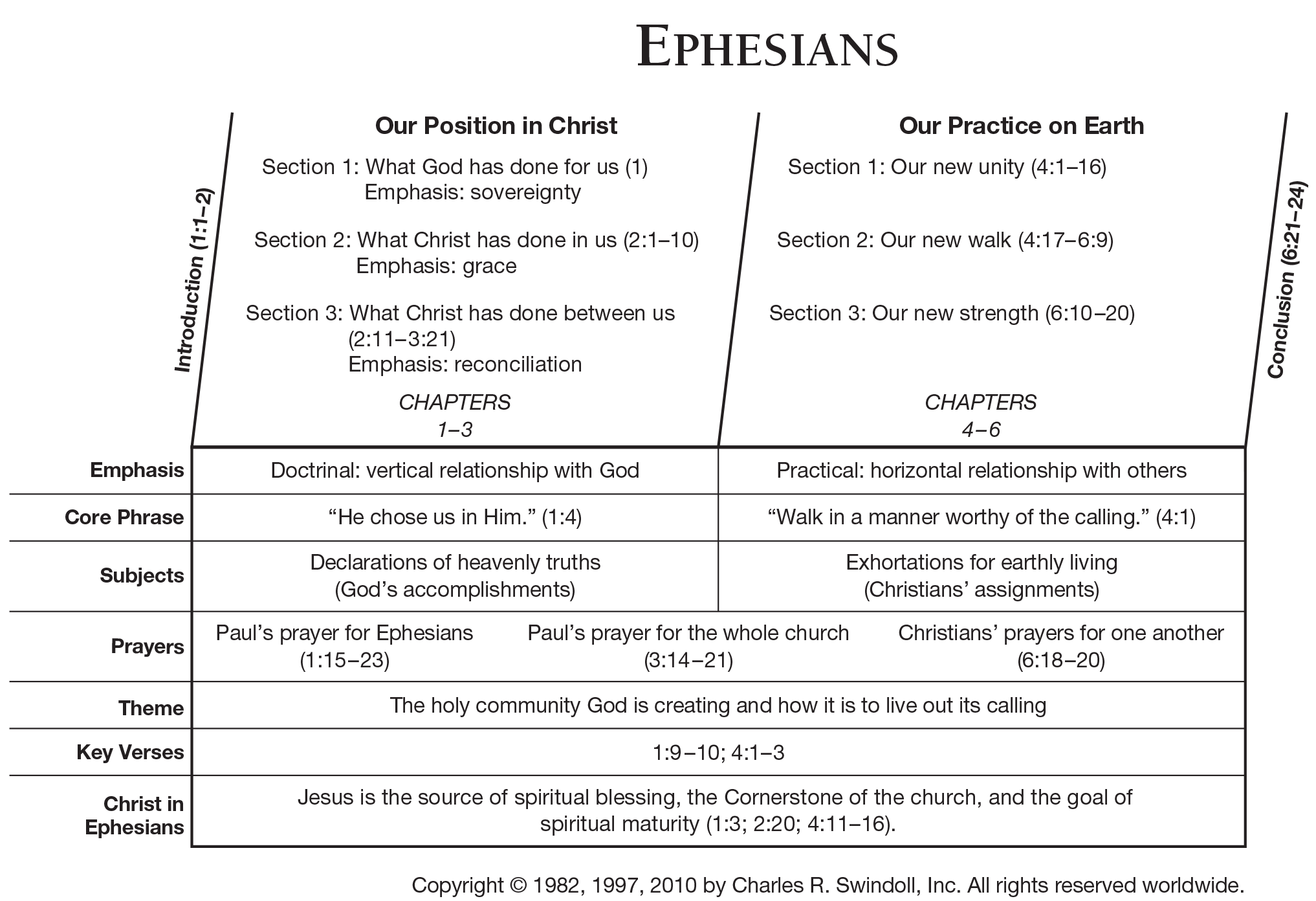
EPHESIANS - CHRIST AND THE CHURCH
Click chart to enlarge
Charts from Jensen's Survey of the NT - used by permission
Click chart by Charles Swindoll -Note "EMPHASIS" --
Ephesians 1-3 = Doctrinal: vertical relationship with God
Ephesians 4-6 = Practical: horizontal relationship with others
Ephesians 4:15 but speaking the truth in love, we are to grow up in all aspects into Him who is the head, even Christ, (NASB: Lockman)
Greek: aletheuontes (1PAAS) de en agape auxesomen (1PAAS) eis auton ta panta, os estin (3SPAI) e kephale, Christos
BGT ἀληθεύοντες δὲ ἐν ἀγάπῃ αὐξήσωμεν εἰς αὐτὸν τὰ πάντα, ὅς ἐστιν ἡ κεφαλή, Χριστός,
Amplified: Rather, let our lives lovingly express truth [in all things, speaking truly, dealing truly, living truly]. Enfolded in love, let us grow up in every way and in all things into Him Who is the Head, [even] Christ (the Messiah, the Anointed One). (Amplified Bible - Lockman)
BBE But saying true words in love, may come to full growth in him, who is the head, even Christ;
CSB But speaking the truth in love, let us grow in every way into Him who is the head-- Christ.
ESV Rather, speaking the truth in love, we are to grow up in every way into him who is the head, into Christ,
GWN Instead, as we lovingly speak the truth, we will grow up completely in our relationship to Christ, who is the head.
Hendriksen - but, adhering to the truth in love, may grow up in all things into Him Who is the Head, even Christ.
KJV But speaking the truth in love, may grow up into him in all things, which is the head, even Christ:
NKJV: but, speaking the truth in love, may grow up in all things into Him who is the head--Christ--
NLT: Instead, we will hold to the truth in love, becoming more and more in every way like Christ, who is the head of his body, the church. (NLT - Tyndale House)
NLT (revised) Instead, we will speak the truth in love, growing in every way more and more like Christ, who is the head of his body, the church.
NET But practicing the truth in love, we will in all things grow up into Christ, who is the head.
NIV Instead, speaking the truth in love, we will in all things grow up into him who is the Head, that is, Christ.
NRS But speaking the truth in love, we must grow up in every way into him who is the head, into Christ,
NAB Rather, living the truth in love, we should grow in every way into him who is the head, Christ,
NJB If we live by the truth and in love, we shall grow completely into Christ, who is the head
Phillips: But we are meant to hold firmly to the truth in love, and to grow up in every way into Christ, the head. (Phillips: Touchstone)
Wuest: but speaking the truth in love, may grow up into Him in all things, who is the Head, Christ,
Young's Literal: But we shall lovingly hold to the truth, and shall in all respects grow up into union with Him who is our Head, even Christ.
BUT SPEAKING THE TRUTH IN LOVE: aletheuontes (1PAAS) de en agape:
- But - Eph 4:25; Zech 8:16; 2Co 4:2; 2Co 8:8
- Speaking the truth - Jdg 16:15; Ps 32:2; Jn 1:47; Ro 12:9; Jas 2:15,16; 1Pe 1:22; 1Jn 3:18
- Ephesians 4 Resources - Multiple Sermons and Commentaries
- Ephesians 4:14-16 Vital Signs of a Healthy Body - Steven Cole
- Ephesians 4:13-16 - Wayne Barber
- Ephesians 4:11-16 Building the Body of Christ, Part 2 - John MacArthur
Related Passages:
Ephesians 4:25+ Therefore, laying aside falsehood, SPEAK TRUTH EACH ONE of you WITH HIS NEIGHBOR, for we are members of one another.
Zechariah 8:16 ‘These are the things which you should do: speak the truth to one another; judge with truth and judgment for peace in your gates.
2 Corinthians 4:2+ (but we have renounced the things hidden because of shame, not walking in craftiness or adulterating the word of God, but by the manifestation of truth commending ourselves to every man’s conscience in the sight of God.
1 Peter 1:22+ Since you have in obedience to the truth purified your souls for a sincere love of the brethren, fervently love one another from the heart,
1 John 3:18+ Little children, let us not love with word or with tongue, but in deed and truth.
"TRUTHING IN LOVE"
Martyn Lloyd-Jones makes an interesting statement regarding Ephesians 4:15-16- This is undoubtedly one of the most complicated statements the Apostle Paul ever wrote (ED: I WAS REALLY GLAD TO READ THAT BECAUSE I HAVE WRESTLED WITH THESE TWO PASSAGES FOR MUCH OF TODAY!). It is interesting to note that some of the commentators of the past, indeed some of the Fathers in the early church, had the temerity to suggest that Paul became somewhat muddled for once, and that his heart or his imagination ran away with him as he piled phrase upon phrase until he forgot what he had written at the beginning of the sentence. It certainly is an extremely difficult verse to read; and difficult to understand, unless we employ the key which the Apostle himself has already provided for us in his previous statements. For myself I feel confident that the Apostle was now bringing to a conclusion and grand climax the theme of the unity of Christians as members of the body of Christ, and he was so anxious that no part should be missing that he made so many additions as to produce a somewhat involved statement.
But speaking the truth (aletheuo) in love - But (term of contrast.) has the force of "but rather" or "but on the other hand'. In contrast ("but...") to being misled by false teachers they are to speak the truth in love. In these last two verses in this section on unity Paul describes the proper process of growth in the Christ. Speaking the truth is a single word, the verb aletheuo which is difficult to translate into English. Literally Paul says “truthing in love,” which has the idea of maintaining truth in love in both in speech and life (walking and talking in a truthful way). So they are not just speaking the truth but carrying out the truth and this is the recipe by which growth of the body is maximized and doctrinal error is minimized, for speaking the truth in essence pictures right doctrine in "shoe leather" so to speak. The added phrase is the "icing on the cake" so to speak for In love pictures the right spirit, in which our talking and walking are to occur. Believers are to have a great love of the truth, a great (Spirit enabled desire) to do the truth, but do the truth in love, also enabled by the Holy Spirit Who manifests His fruit in our lives (Gal 5:22+). Truth without love is brutality, but love without truth is hypocrisy.
The best way of eradicating error is to publish and practice truth.
-- William Arnot
Note also that speaking the truth is in the present tense signifying that believers are to continually be doing this as our lifestyle. However this is not possible in reliance on our natural strength, but only possible as we learn to rely on the Spirit to continually energize and enabled this "worthy walk," a walk like Jesus walked (cf Gal 5:16+, Ep 5:18+). This verb is in the active voice which calls for this attitude/action to be a continual choice of our will, a volitional choice. However our old man, our fallen flesh, does not want to choose to walk in selflessness but in selfishness. It follows that even our ability to make the right choice is energized by the Spirit. As Php 2:13NLT+ says it is "God (THE HOLY SPIRIT) Who is at work in you (energeo in the present tense - continually) giving you the desire to obey Him and the power to do (same verb energeo in the present tense continually do) what pleases Him." We still have to speak the truth in love, but enabled by the Spirit now we want to and we can and this pleases our Father in Heaven.
MacArthur on speaking the truth in love - "Authentic, mature believers whose lives are marked by love will not be victims of false teaching (Eph 4:14) but will be living authentically and proclaiming the true gospel to a deceived and deceiving world. The work of the church goes full swing, from evangelism to edification to evangelism, and so on and on until the Lord returns. The evangelized are edified, and they, in turn, evangelize and edify others."
Blaikie admonishes - Truth is the element in which we are to live, move, and have our being. ... But truth must be inseparably married to love; good tidings spoken harshly are not good tidings. The charm of the message is destroyed by the discordant spirit of the messenger. (See Ephesians 4 Commentary)
S Lewis Johnson illustrates "speaking the truth in love" - I love the little story of Howard Moody Morgan. G. Campbell Morgan had a number of children. Four or five of the men went into the ministry. Mr. Morgan was an outstanding expositor. They all were interested in the Bible. They were having a discussion around the table one time about what was the best translation. And this was many years ago, and I don’t know the translation they were talking about, but I do know that Mr. Morgan used the American Standard Version. And so he, undoubtedly, spoke for that. And the English Revised Version was also used. Somebody probably spoke for that and several other versions. And finally, Howard Moody Morgan, who also became a minister and was a minister in this country, spoke up and said, “Well, the translation I like best is mother’s translation.” And what he meant by that was, simply, his mother’s Christian life. And the way in which she translated the truth into Christian living. Well, that’s what I think Paul means when he says speaking the truth in love. (Ephesians 4:13-16 The Work of the Ministry - II)
Morris adds that "alētheuō in Eph 4:15 is normally understood as 'speaking the truth in love,' and this may be the sense of it. But in English we do not have a verb meaning 'to truth,' and it is worth bearing in mind that sometimes in the New Testament truth is a quality of action as well as of speech (e.g. Jn 3:21+). It is quite possible that the writer means that Christians are to act truly, and that if they do they will act in love" (Testaments of Love, 237)."
S F D Salmond writes that regarding in love "Is taken to express the idea that love is the element in which truth is to be spoken (or the truth confessed), it it is to conduce to unity and brotherliness. (Ephesians 4 Commentary )
Henry Alford writes that ‘In love’ is added, as the element in which the Christian ‘speaking the truth’ must take place; it is not and cannot be a ‘speaking the truth’ at all hazards—a fiat truthfulness: but must be conditioned by love: a true-seeking and true-being with loving caution and kind allowance—not breaking up, but cementing brotherly love by walking in truth.” (Ephesians 4 Commentary)
J Vernon McGee - The believer is to follow the truth in love; that is, he is to love truth, live it, and speak it. Christ is the truth and the believer must sail his little bark of life with everything pointed toward Christ. Christ is his compass and his magnetic pole. (Ephesians 4 Commentary)
Harold Hoehner on the phrase in love - Truth may be demonstrated in a harsh way but Paul is asking that it be done with love. The preposition ἐν denotes instrument, “with love.” The word “love” was discussed at 1:4 where it was defined as that which seeks the highest good in the one loved. Again, this is in contrast to the preceding verse, for deceit is used for selfish ends whereas truth with love considers the interest of others supremely important. Furthermore, with this in mind, believers are not to use truth in a retaliatory manner against the deceivers, but rather are to show and speak the truth with love. This manner of life is far more powerful than a life of deceit because it has no fear that hidden motives or facts will be revealed. It is a transparency that is wedded to love, love with truth that enables individual believers to grow harmoniously with other members of the body with the resulting growth of the whole body. (See Ephesians: An Exegetical Commentary)
William Hendriksen explains Paul's pattern of countering false teaching (Eph 4:14) - Now error is never overcome by mere negation. Over against the deceitfulness of the errorists the Ephesians should adhere to the truth, that is, practice integrity (ED: See note by Morris). And what ministry (Eph 4:12) can be more noble than that which, while resolutely opposing deceit, setting truthfulness "of life and lip" over against it, does all this in the spirit of love? There are two great enemies of a successful ministry, whether carried on among believers or among unbelievers. One is departure from truth, compromise with the lie, whether in words or deeds. The other is chilling indifference with respect to the hearts and lives, the troubles and trials, of the people whom one is ostensibly trying to persuade. Paul has the real solution: the truth must be practiced in love (Eph 3:18; 4:2; Eph 5:1, 2), which was exactly what he was constantly doing (2 Cor. 2:4; Gal. 4:16, 19+; 1Th 2:7-12); and telling others to do (1 Ti 4:11-13). In fact, love must mark all of life. By means of such behavior we will impart a blessing not only to others but to ourselves also, for we will "grow up in all things into him who is the head, even Christ." We must grow up into union with Him (ED: BY COVENANT WE ARE IN POSITIONAL UNION WITH HIM FOREVER - SEE Oneness of Covenant). The same intimacy of conscious oneness with Christ is stressed in Ro 6:5+, where the idea is expressed that believers are "grown together" with him. Such statements do not in any way obliterate the infinite distinction between Christ and Christians. They do not indicate identity but intimacy. (ED: I WOULD SAY THEY MARK BOTH IDENTITY AND INTIMACY) The distinction between believers and their Lord is clearly enunciated here, for the latter is called "the Head," while the former are designated "the entire body." " (Exposition of Galatians, Ephesians, Philippians).
Phillips on speaking the truth in love - We can go to two extremes. We can speak the truth but not in love, in which case we are being ungracious. Truth spoken in that spirit often offends and does little good because it alienates the people we are seeking to win. Or we can speak in love and suppress the truth, in which case we are being unfaithful. People who do not want to hurt someone’s feelings may say nothing and allow a sinful situation to continue. They suffer in silence. True love, however, will always speak at the right time, with the right words, in the right spirit, and using the right approach. Paul spoke the truth in love to the Ephesians. He got down to very practical issues later in chapter 4. He talked about lying, anger, stealing, unclean conversation, and marital relationships, but no one took offense because earlier he made so many warm and positive comments. None of the Ephesian Christians thought that Paul was being harsh or unkind. They all knew that he loved them. We can accept the truth from someone with whom we share mutual love. As Solomon said, “Faithful are the wounds of a friend” (Proverbs 27:6). (See Exploring Ephesians & Philippians: An Expository Commentary)
Lehman Strauss - While we insist upon a good confession we must live the truth in love. One can be fearless in standing for the truth and at the same time gentle and kind. Truth declared in a cold, contentious manner will neither preserve unity nor promote usefulness.
It is not enough that our tongues hold to the truth; the truth must hold our tongues in love.
-- Lehman Strauss
"John Bunyan said of Christians, “When all their garments are white the world will count them His,” and the skeptical German poet Heinrich Heine said to Christians, “You show me your redeemed life and I might be inclined to believe in your Redeemer.” The authentic life that speaks the gospel with a spirit of loving sacrifice will be eminently convincing." (See The MacArthur New Testament Commentary)
John Stott sums section up well - Thank God there are those in the contemporary church who are determined at all costs to defend and uphold God’s revealed truth. But sometimes they are conspicuously lacking in love. When they think they smell heresy, their nose begins to twitch, their muscles ripple, and the light of battle enters their eye. They seem to enjoy nothing more than a fight. Others make the opposite mistake. They are determined at all costs to maintain and exhibit brotherly love, but in order to do so are prepared even to sacrifice the central truths of revelation. Both these tendencies are unbalanced and unbiblical. Truth becomes hard if it is not softened by love; love becomes soft if it is not strengthened by truth. The apostle calls us to hold the two together, which should not be difficult for Spirit-filled believers, since the Holy Spirit is himself ‘the Spirit of truth’, and his firstfruit is ‘love’. There is no other route than this to a fully mature Christian unity. (The Message of Ephesians)
Speaking the truth (226) (aletheuo from alethes = true, real, actual, not counterfeit) in the only 2 NT uses (Gal 4:16+, Eph 4:15) means to speak reality (truth) into someone by making it a matter of record of what God deems is truth. Aletheuo describes the content of that which is true and so is in accordance with what actually happened. It describes the reality lying at basis of an appearance. Since verbs ending in the suffix -euo express the doing of an action signified by the corresponding noun, in this case signifies to speak the truth, be honest, be true in doctrine and profession, act genuinely.
Gary Hill on aletheuo - "Accordingly, alētheúō (literally, "to truth") includes Spirit-led confrontation to tell the truth, so others can also live in God's reality rather than personal illusion." "To truth" (alētheúō) seeks God's reality to become known in the inner man through faith ("God's inworked persuasion"). Note the close connection of the two terms in Eph 4:13-15. Learning new levels of truth happens through revelation which is often supra-logical and "by-passes" (supersedes) our natural senses. Telling truth affirms reality as God defines or sees it. (Discovery Bible)
Vincent - aletheuo is only here and Gal 4:16 ("Have I therefore become your enemy by telling you the truth?"). In classical Greek it means to be true, to arrive at truth, and to speak truth. Here the idea is rather that of being or walking in truth. Rev., in margin, dealing truly. (Ephesians 4 Word Studies in Greek)
Love (26) (agape) is unconditional, sacrificial love which is the love that that God is and so describes a divine love, a love which is commanded by God, empowered by His Spirit, activated by personal choice of our will, not based on our feelings toward the object of our love and manifested by specific actions (e.g., especially 1Cor 13:4-8+)
WE ARE TO GROW UP IN ALL [ASPECTS] INTO HIM WHO IS THE HEAD, EVEN CHRIST: auxesomen (1PAAS) eis auton ta panta, os estin (3SPAI) e kephale, Christos:
- We are to grow up in all aspects - Ep 2:21; Hos 14:5-7; Mal 4:2; 1Pe 2:2; 2Pe 3:18
- Into Him Who is the Head, even Christ - Ep 1:22; 5:23; Col 1:18,19
- Ephesians 4 Resources - Multiple Sermons and Commentaries
- Ephesians 4:14-16 Vital Signs of a Healthy Body - Steven Cole
- Ephesians 4:13-16 - Wayne Barber
- Ephesians 4:11-16 Building the Body of Christ, Part 2 - John MacArthur
Related Passages:
Ephesians 1:22 And He put all things in subjection under His feet, and gave Him as head over all things to the church,
Colossians 1:18 He is also head of the body, the church; and He is the beginning, the firstborn from the dead, so that He Himself will come to have first place in everything.
Ephesians 5:23 For the husband is the head of the wife, as Christ also is the head of the church, He Himself being the Savior of the body.
Colossians 2:19 and not holding fast to the head, from whom the entire body, being supplied and held together by the joints and ligaments, grows with a growth which is from God.
GROWING IN
GRACE
We are to grow (auxano) up in all aspects into Him Who is the Head (kephale), even Christ (Christos) - Paul has just mentioned the danger of remaining "spiritual babies." I
n all aspects into Him - Christ is the Aim and Goal of the growth of the body and in the next verse He is the Source of our growth (Ep 4:13+)
In is actually eis meaning into or unto. We are to grow up in all aspects unto Christ, describing the growth and maturity of all Christians as directed toward the goal of becoming like Christ.
Kephale as just stated speaks of the source, the origin, the leader, the one in authority. Christ controls every part of His body the church and is its inspiring, ruling, guiding, combining, sustaining power, the mainspring of its activity, the center of its unity, and the seat of its life. Is He Head in your local church body? We are members of His body and should look only to Him for guidance and provision! True spirituality comes from tenaciously holding on to Christ, the Head of His body.
Salmond explains that “This means more than that we are to grow into resemblance to Him, or that our growth is to be according to His example. It means that as He is the source from which the grace or power comes that makes it possible for us to grow, He is also the object and goal to which our growth in its every stage must look and is to be directed.” (Ephesians 4 Commentary)
Paul emphasizes that genuine growth in spirituality comes from holding onto Christ, the Head, drawing the supply of all our needs from His inexhaustible resources. Since the loss of the head destroys life, this word is used in the phrases relating to capital and extreme punishment.
John Eadie phrases it this way - The growth is to Him, and the growth is from Him—Himself its origin and Himself its end. The life that springs from Him as the source of its existence, is ever seeking and flowing back to Him as the source of its enjoyment. (Ephesians 4 Commentary)
Notice that "speaking the truth in love" is integrally associated in this verse with growing in Christlikeness.
THOUGHT - This association of speaking the truth in love and growing up in Christ begs the question - Am I growing in Christ-likeness? Am I more like Christ today than I was last month, last year, last decade? Does the fruit of the Spirit's love birthed by faith and obedience in my heart translate into loving action in my life and in so doing mimic the love of Christ? If so our lips and life are in synch (see above), speaking and showing love and growing in grace, growing in Christ-likeness which is living a life of integrity which is defined in English dictionaries as "an undivided or unbroken completeness or totality with nothing wanting." See Integrity - A Whole Heart, Daniel-Man of Integrity and Give Me An Undivided Heart.
Grow up (837) (auxano) means to grow or cause to grow or increase. For someone or something to grow, they must have the element of life within and must be acted upon by an outside power. This verb is in the form indicating an exhortation so that the idea could be "let us grow up" or "we should grow up".
Head (2776) (kephale) (The KJV properly capitalizes "head") is literally the part of the body that contains the brain. It rules and governs the human body. Figuratively as used in this verse, kephale refers to Christ as the Head of which the church is His body, each saint being a member of that body. Christ as the Head is the source of growth and well-being of each member.
Christ (5547) (Christos from chrio= to anoint, rub with oil, consecrate to an office) is the Anointed One, the Messiah, Christos being the Greek equivalent of the transliterated Hebrew word Messiah. The growth of the Body has Christ as its goal. He is the One into Whom all believers are to grow.
Truth for Today - APPLYING THE PRINCIPLES
Grow up in all things into Him who is the head—Christ. EPHESIANS 4:15
Spiritual growth is simply a matter of applying scriptural principles, but there are many who believe only spiritual giants experience a great increase in faith.
I have read about mystics who knelt and prayed for eight to ten hours, wearing holes in the wood floors. I have read about Robert Murray McCheyne, who would soil the pages of his Bible and the wood of his pulpit with great floods of tears. And I have read Power Through Prayer by E. M. Bounds, who spent countless hours in prayer. As I learned about these people, all I could think of was that I could never reach that level. But God uses each of us in different ways.
Spiritual growth is not some mystical achievement for a select few on a higher spiritual plane. Rather, it is simply a matter of glorifying God by confessing sin, trusting Him, bearing fruit, praising Him, obeying and proclaiming His Word, praying, and leading others to Christ. Those are the qualities every Christian needs in order to mature. When you focus on them, the Spirit of God will change you into the image of Christ, from one level of glory to the next. (John MacArthur)
'Measure Me''
Jesus increased in wisdom and stature. — Luke 2:52
Today's Scripture: Ephesians 4:11-16
“Can you measure me today?” Caleb, our paperboy, asked.
It was not the first time he had made that request. A few years ago I had mentioned to him how tall he was getting. Since then, we’ve often measured his height on the siding of our house. After all this time, he still wants me to measure him.
Measurements can be indicators of growth. And it’s a good idea to measure our spiritual growth. For instance: Do I spend time reading God’s Word and talking with Him each day? Do I look forward to fellowshiping with the Lord? What “fruit of the Spirit” is apparent in my life? Do I talk about Jesus with people who don’t know Him? How am I using my spiritual gift or gifts? Do I have a generous and giving spirit? How much better do I know God today than I did a year ago? These questions are good indicators of spiritual growth.
A child seems to grow up all of a sudden, but it’s actually a continual process. Just as Jesus grew in both wisdom and stature, we as believers are to continue to “grow in the grace and knowledge of our Lord and Savior Jesus Christ” (2 Peter 3:18). We are no longer to be children, but to “grow up in all things into Him who is the head—Christ” (Eph. 4:14-15). Have you measured yourself lately? By: Cindy Hess Kasper (Our Daily Bread, Copyright RBC Ministries, Grand Rapids, MI. Reprinted by permission. All rights reserved)
The child of God who reads the Word
And heeds the messages he's heard
Will grow in grace from day to day
And share with others on life's way.
—Hess
Salvation is the miracle of a moment; growth is the labor of a lifetime.
Like A Tree
He shall be like a tree planted by the rivers of water. —Psalm 1:3
Today's Scripture: Ephesians 4:11-16
In the quietness of my final years I plan to watch a tree grow—a birch tree I planted as a tiny sapling over 30 years ago. It stands now in mature splendor, just outside our picture window—beautiful in every season of the year.
So it is with our spiritual endeavors: We may have planted, watered, and fussed over our “saplings” (those we’ve mentored) for a time, but only God can make a “tree.”
Occasionally I hear from those I ministered to years ago, and discover to my delight that they have grown to maturity and have been greatly used of God—with no help from me. It’s a gentle reminder that I plant and water for a while, and help others “grow up in all things into Him who is the head—Christ” (Eph. 4:15). But only God “gives the increase” (1 Cor. 3:6-7).
German theologian Helmut Thielicke writes, “The man who doesn’t know how to let go, who is a stranger to quiet, confident joy in Him who carries out His purposes without us (or also through us or in spite of us), in Him who makes the trees grow . . . that man will become nothing but a miserable creature in his old age.”
So, at my age, I may yet tend a sapling or two, but mostly I will let go and watch them grow. By: David H. Roper (Our Daily Bread, Copyright RBC Ministries, Grand Rapids, MI. Reprinted by permission. All rights reserved)
A Prayer: Lord, I want to be used by You in others’ lives. Teach me from Your Word so that I can help others follow You. And enable me to let go and trust You to work in them. Amen.
Those who follow Christ can help others follow Him too.
It Takes Time to Grow
Speaking the truth in love, we will grow to become in every respect the mature body of him who is the head, that is, Christ. Ephesians 4:15
Today's Scripture & Insight: Ephesians 4:11–16
On her first day in preschool, young Charlotte was asked to draw a picture of herself. Her artwork featured a simple orb for a body, an oblong head, and two circle eyes. On her last day of preschool, Charlotte was again directed to draw a self-portrait. This one showed a little girl in a colorful dress, a smiling face with distinct features, and a cascade of beautiful red tresses. The school had used a simple assignment to demonstrate the difference that time can make in the level of maturity.
While we accept that it takes time for children to mature, we may grow impatient with ourselves or fellow believers who show slow spiritual growth. We rejoice when we see the “fruit of the Spirit” (Gal. 5:22–23), but are disheartened when we observe a sinful choice. The author of Hebrews spoke of this when he wrote to the church: “Though by this time you ought to be teachers, you need someone to teach you the elementary truths of God’s word all over again” (Heb. 5:12).
As we continue to pursue intimacy with Jesus ourselves, let’s pray for each other and patiently come alongside those who love God but who seem to struggle with spiritual growth. “Speaking the truth in love,” let’s continue to encourage one another, so that together we may “grow to become in every respect the mature body of him who is the head, that is, Christ” (Eph. 4:15). By: Cindy Hess Kasper (Our Daily Bread, Copyright RBC Ministries, Grand Rapids, MI. Reprinted by permission. All rights reserved)
Lord, we love You! In our walk with You, help us to receive and give encouragement.
Words of truth spoken in love can guide us all toward maturity in Christ.
Inseparable Twins - A seminary student got into a heated debate with his landlord. They were discussing the teachings of a theologian whom the landlord thought was a heretic. The student, on the other hand, considered himself a follower of the man and his doctrines.
With an attitude of superiority, the young man showed his landlord a well-marked copy of a theology book written by this man. The landlord, who had little education but was a devout Christian, was overwhelmed by the young fellow’s greater knowledge. As a result, he felt frustrated and defeated.
Similarly, it’s possible for us to misuse the great spiritual truths of Scripture to hurt others. Maybe we’ve received instruction from a prominent Bible teacher, gained special insights into the Word, or memorized key Scriptures we can quote with ease. This gives us the leverage either to put someone down or to build him up. If we misuse what we know, we may set Christians against each other and break up churches. Or we can use the truth to enlighten, edify, and enrich others when we accompany it with love.
Speaking the truth must never be separated from love (Ephesians 4:15). They’re inseparable twins! --Dennis J. De Haan (Our Daily Bread, Copyright RBC Ministries, Grand Rapids, MI. Reprinted by permission. All rights reserved)
Lord, I must speak the truth in love
If seeking hearts would hear it,
For speaking with self-righteous pride
May wound another's spirit. —Fasick
The truth may hurt,
but love helps ease the pain.
Ephesians 4:16 from Whom the whole body, being fitted and held together * by what every joint supplies, according to the proper working of each individual part, causes the growth of the body for the building up of itself in love (NASB: Lockman)
Greek: ex ou pan to soma sunarmologoumenon (PPPNSN) kai sumbibazomenon (PPPNSN) dia pases aphes tes epichoregias kat' energeian en metro enos ekastou merous ten auxesin tou somatos poieitai (3SPMI) eis oikodomen eautou en agape.
BGT ἐξ οὗ πᾶν τὸ σῶμα συναρμολογούμενον καὶ συμβιβαζόμενον διὰ πάσης ἁφῆς τῆς ἐπιχορηγίας κατ᾽ ἐνέργειαν ἐν μέτρῳ ἑνὸς ἑκάστου μέρους τὴν αὔξησιν τοῦ σώματος ποιεῖται εἰς οἰκοδομὴν ἑαυτοῦ ἐν ἀγάπῃ.
Barth - He is at work fitting and joining the whole body together. He provides sustenance to it through every contact according to the needs of each single part. He enables the body to make its own growth so that it builds itself up in love.’
BBE Through whom all the body, being rightly formed and united together, by the full working of every part, is increased to the building up of itself in love.
Amplified: For because of Him the whole body (the church, in all its various parts), closely joined and firmly knit together by the joints and ligaments with which it is supplied, when each part [with power adapted to its need] is working properly [in all its functions], grows to full maturity, building itself up in love. (Amplified Bible - Lockman)
CSB From Him the whole body, fitted and knit together by every supporting ligament, promotes the growth of the body for building up itself in love by the proper working of each individual part.
ESV from whom the whole body, joined and held together by every joint with which it is equipped, when each part is working properly, makes the body grow so that it builds itself up in love.
GWN He makes the whole body fit together and unites it through the support of every joint. As each and every part does its job, he makes the body grow so that it builds itself up in love.
KJV From whom the whole body fitly joined together and compacted by that which every joint supplieth, according to the effectual working in the measure of every part, maketh increase of the body unto the edifying of itself in love.
NKJV: from whom the whole body, joined and knit together by what every joint supplies, according to the effective working by which every part does its share, causes growth of the body for the edifying of itself in love.
NET From him the whole body grows, fitted and held together through every supporting ligament. As each one does its part, the body grows in love.
NIV From him the whole body, joined and held together by every supporting ligament, grows and builds itself up in love, as each part does its work.
NLT (revised) He makes the whole body fit together perfectly. As each part does its own special work, it helps the other parts grow, so that the whole body is healthy and growing and full of love.
NLT: Under his direction, the whole body is fitted together perfectly. As each part does its own special work, it helps the other parts grow, so that the whole body is healthy and growing and full of love. (NLT - Tyndale House)
NRS from whom the whole body, joined and knit together by every ligament with which it is equipped, as each part is working properly, promotes the body's growth in building itself up in love.
NAB from whom the whole body, joined and held together by every supporting ligament, with the proper functioning of each part, brings about the body's growth and builds itself up in love.
NJB by whom the whole Body is fitted and joined together, every joint adding its own strength, for each individual part to work according to its function. So the body grows until it has built itself up in love.
Phillips: For it is from the head that the whole body. as a harmonious structure knit together by the joints with which it is provided, grows by the proper functioning of individual parts to its full maturity in love. (Phillips: Touchstone)
Wuest: from whom all the Body constantly being joined closely together and constantly being knit together through every joint of supply according to the operative energy put forth to the capacity of each part, makes for increased growth of the Body resulting in the building up of itself in the sphere of love.
Young's Literal: Dependent on Him, the whole body—its various parts closely fitting and firmly adhering to one another— grows by the aid of every contributory link, with power proportioned to the need of each individual part, so as to build itself up in a spirit of love.
FROM WHOM THE WHOLE BODY, BEING FITTED AND HELD TOGETHER BY WHAT EVERY JOINT SUPPLIES: ex ou pan to soma sunarmologoumenon (PPPNSN) kai sumbibazomenon (PPPNSN) dia pases aphes tes epichoregias:
- From whom the whole body - Eph 4:12; John 15:5
- Being fitted and held together - Job 10:10,11; Ps 139:15,16; 1Co 12:12-28; Col 2:19
- Ephesians 4 Resources - Multiple Sermons and Commentaries
- Ephesians 4:14-16 Vital Signs of a Healthy Body - Steven Cole
- Ephesians 4:13-16 - Wayne Barber
- Ephesians 4:11-16 Building the Body of Christ, Part 2 - John MacArthur

BELIEVERS ARE BEING
FITTED TOGETHER
From Whom the whole (pas) body (soma), being fitted (sunarmologeo) and held together (sumbibazo) by what every joint (ligament) supplies (epichoregia) - NLT - "He makes the whole body fit together perfectly." Young's Literal has "Dependent on Him." From Whom refers to the Head, Christ from Whom or out of Whom as the Source the entire body derives its energy for growth. Body of course refers to the church and whole signifies no individual members are left out of the building process but all are involved. "No man or woman is an island" in this body. This body requires Christ directed collective coordination, a "three musketeers" approach of "three for one and one for all," so to speak (Latin - Unus pro omnibus, omnes pro uno). In the preceding verse Christ was the goal but here He is the source, exerting His unifying direction and power ultimately through His Spirit (cf Eph 4:3 = "the unity of the Spirit").
Both verbs being fitted and held together are present tense picturing continuous action by the Master Architect on His body. This fitting and holding together is ongoing. The divine passive of course speaks of Christ supernatural power causing the fitting and holding together. And yet as "living stones" (1Pe 2:5+) we each must be willing to allow the Christ to fit us just as He desires. So although the action is passive, it does require an act of our wills to submit to the hand of the Master! One other point to note is that both verbs have the "sun/syn-" prefix which speaks of intimacy and oneness of the members of the body fit and held in an ever increasing harmony, especially regarding the seven "one's" that are essential to unity in Eph 4:4-6.
Martyn Lloyd-Jones on being fitted - The expression means ‘parts fitted closely to each other’ in a kind of harmony. The word the Apostle actually uses means ‘several parts bound together’, fitting into one another. Speaking then of us as members of the Church, he says that the Head of the body is Christ and that we are members in particular; and as members we are articulated and fit into one another. Everything should be in the right position, ball and socket are to be articulated, fitly joined together. All these terms carry exactly the same meaning. The idea is of a number of parts not simply bound together, anyhow, somehow, but bound together as the various parts of our bodies are joined together. At this point a certain amount of knowledge of anatomy is helpful. In the case of a joint in the body there is a kind of cup on one bone and into that cup there fits a kind of ball at the end of another bone. The surfaces of both are smooth so that there is no friction, and everything works easily and harmoniously and in an effective manner. According to the Apostle’s teaching this should be true of the members of the Church. It is the way in which they are to grow up into Him in all things. The ideal condition of the Christian Church is that in which every member is what he is meant to be, fitting in with every other member and so preserving ‘the unity of the Spirit in the bond of peace’. There is to be no creaking, as it were, in the joints, no angularities; everything is to be ‘fitly joined together’. But the Apostle is not even content with that; he adds another term, ‘compacted’, which means ‘closely knit’, in order to drive home his point. It means ‘brought and held together’. It is a term which is often used in a figurative sense to suggest a kind of mental unity, sympathy of understanding, concord. In other words the Apostle is changing his emphasis slightly from the purely mechanical which we have in ‘fitly joined together’, to the notion of minds fitting in together, compacted, closely knit. This is essential, of course, for a true organic unity, and for proper functioning. Christ is the Head, and we as parts of the body are to be fitly joined together, and compacted.
By what every joint (NET, CSB = "every supporting ligament") supplies indicates that while the empowering for growth comes from the Head, the members of the Body are also involved in the process. The joints are in contact (the root idea of "joint" speaks of contact) with other parts of the body and serve as the channels which extend nourishment from Christ, the Head as dispensed by His Spirit to surrendered saints. The NLT paraphrase conveys this idea "As each part does its own special work, it helps the other parts grow."
Wayne Barber says it this way - "Whereas the joint is in contact with the Spirit and in contact with one another, look at the supply. The supply is that which Christ the head gives to each joint by the means of the Spirit for growth. In other words, I have everything I need for growth in the person of the Spirit of God. Christ will give me, through the Spirit, everything I need to fulfill my potential and grow. So there are two things in mind. There is the joint and the supply. That joint has to be tied in to that supply. Implied in Scripture here is that daily I have to be surrendered to the Spirit of God. There is no way I can grow up like I should unless I am surrendered to the Spirit of God because He is the means of divine supply. Now, the ligaments hold it all together. The head sends the message to the ligaments. Then the ligaments, controlling the bones, cause the whole joint to function. Now let me ask you a question. What would happen if you sprained a ligament? What happens if you break or fracture one of the bones? Immediately the whole process is shut down. Every single bone has to be doing exactly what its function is or the whole process is shut down....Paul is bringing out here is the necessity for every one of us to be about the things God has given us to do in the power of God’s Spirit receiving the messages through the Spirit from the Head. If anything happens to sprain that contact, to fracture the usage of that bone, then all of a sudden we have rendered the whole process obsolete....We need to be a church that is in contact with the Spirit of God, that is listening to the messages from the head which is Christ. We need to daily be filled with the Spirit of God, as Ephesians 5:18+ says. As we are controlled by the Spirit of God and as we are functioning in our gifts so that every single person is doing what God designed them to do, the whole body will grow up into what God wants it to be.
Vincent adds that "The present participles (being fitted and held together) denote present, continuous progress. The two participles represent respectively the ideas of harmony or adaptation and compactness or solidity. (Ephesians 4 Word Studies in Greek)
Wayne Barber explains being fitted together writing that "The word "fitted" means perfectly fitted. My wife and I are weak in a lot of areas. Some people have strengths and some people have weaknesses, and they get married. Diana and I have strengths that are the same and we have weaknesses that are the same. That sometimes is sort of difficult. But we don’t worry about it. Diana is gifted in areas, however, that I am not. Diana is gifted in the area of mercy. I have been accused of not having a merciful bone in my body, but Diana does. As she lets the Spirit of God work in her and I let the Spirit of God work in me, somehow God begins to put us and fit us together in a perfect way. That is the same way it is in the body of Christ. We need gifts of mercy, gifts of serving, and all these gifts functioning in the power of the Spirit of God to enable the body to grow up to take on the character of Jesus and to reach the stature of the fullness of Christ. So each individual member, when he refuses to let the Spirit of God control him, shuts down the process and begins to immediately affect the whole, according to the proper working of each individual part. Once we realize our responsibility to each other, once we begin to realize that the only way to fulfill that responsibility is according to the supply of the Spirit, that we are a joint that is in touch with Him and in touch with one another then something is going to happen.
Albert Barnes explains being fitted together writing that "The word here used means, to joint together, as a carpenter does the framework of a building. The materials are accurately and carefully united by mortices and tenons, so that the building shall be firm. Different materials may be used, and different kinds of timber may be employed; but one part shall be worked into another, so as to constitute a durable and beautiful edifice. So in the church. The different materials of the Jews and Gentiles; the people of various nations, though heretofore separated and discordant, become now united, and form an harmonious society. They believe the same doctrines; worship the same God; practise the same holiness, and look forward to the same heaven. (Ephesians 4 Commentary
Peter O'Brien on the whole body being fitted and held together "The notion of believers’ unity and their growing together as a collective whole is further accented by the following two verbs. The first, ‘joined together’, has already been used of the harmonious construction of the church as ‘a holy temple in the Lord’ (Ep 2:21+), while the second, ‘held together’, appears in Colossians, where it refers to the body knit together as a unity by the Head alone (Col 2:19+). The two verbs are virtually synonymous and indicate that there is an ongoing (ED: cf present tense), unified growth to the body. It is ‘not shapeless’, but is ‘ordered and united,...fitly framed and knit together." (See The Letter to the Ephesians)
William Blaikie puts it this way - "There is a jointing and joining of the various parts to each other, forming a symmetrical, compact, well-ordered building. The Church has many members in one body, and all members have not the same office. It is a co-operative body, each aiding in his own way and with his own talent. The Church is not a collection of loose stones and timbers; its members are in vital union with Christ, and ought to be in living and loving and considerate fellowship with each other." (Ephesians 4 Commentary)
Salmond explains that “The idea appears to be that the body is fitly framed and knit together by means of the joints, every one of them in its own place and function, as the points of connection between member and member, and the points of communication between the different parts and the supply which comes from the Head. The joints are the constituents of union in the body and the media of the impartation of the life drawn by the members from the head.” (Ephesians 4 Commentary)
In Colossians 2 Paul gives a parallel teaching describing those who are inflated in unspiritual minds explaining that they are "not holding fast (continually clinging to, adhering strongly to - implication = this takes effort) to the Head (Christ), from Whom the entire body, being supplied and held together by the joints and ligaments, grows with a growth which is from God. (Col 2:19+) Holding fast to the Head emphasizes the necessity for a moment-by-moment dependence on the Lord. Yesterday’s help will not do for today. We can’t grind grain with the water that has passed over the dam. It should also be added here that where Christians do hold to the Head, the result will be spontaneous action which will coordinate with other members of the Body. There will be a oneness and harmony that is supernaturally super!
Whole (3956)(pas) means all without exception and includes the ideas of oneness, a totality or the whole. Paul clearly focuses on the growth of the body as a whole, rather than individual believers. This adjective reiterates Paul's focus on the unity of the body in spite of the considerable diversity among the members.
Body (4983)(soma) is literally the living body of man or animals (Mt 5:29, 30, 6:22, 23 25, Jn 2:21 Ro 1:24 Ro 8:10 = "dead because of sin", Jas 3:3 1Co 6:18), sometimes to a dead body (corpse) (Mt 14:12, 27:59 Mk 15:43, 45 Lk 17:37 He 13:11), sometimes to sun, moon, stars (1Co 15:40), sometimes as the center of all mortal life which can experience immortality in the resurrection body (1Co 15:44), sometimes the "material" part of man distinct from the soul or spirit (1Th 5:23), sometimes referring to reproductive power (Ro 4:19, 1Co 6:13), to describe that which is "real" versus that which is shadow (Col 2:17) In Ephesians soma is used in a figurative sense to describe the "body" of Christ, the Church (Ep 1:23, Ep 4:12, Ep 4:16, Ep 5:23, Ep 5:30, cf Col 1:18, Col 1:24, Col 2:19, Ro 12:5 1Co 12:27, 1Co 10:17, 12:13, Ep 2:16, Ep 4:4, Col 3:15).
Being fitted...together (4883) (sunarmologeo from from sun = together, speaking of intimate union + harmologéo = join together in turn from harmós = joint + lógos = word, account, reckoning) means to be fitted or joined together with, literally used of the parts of the body or the stones of the building. In construction terms sunarmologeo represents the whole of the elaborate process by which stones are fitted together, this process including the preparation of the surfaces, the cutting, rubbing, and testing; the preparation of the dowels and the dowel holes and finally the fitting of the dowels with molten lead. In short it represents the careful joining of every component of a structure, each part is precisely cut to fit snugly, strongly, and beautifully with every other part. Nothing is out of place, defective, misshapen, or inappropriate. Now take those ideas and apply them to the church composed of individual saints ("living stones" see 1Pe 2:5+).
Held together (4822) (sumbibazo from sun = union + bibazo = to force) means to cause to come together, bring together, join together into unit, cause to be a unit, to unite, to cause to coalesce, to unite or knit together, to combine. It means to bring together by ligaments or joints.
Joint (860) (haphe from hápto = to connect, adjoin) refers to a juncture or point of contact of one part of body with another. Joints or parts of contact are very important among the members of Christ's body even as the joints are to the body (see Col 2:19l+). Spiritually, these joints receive their nourishment from the Head, Christ (Col 1:18+), but how we are joined together with other members of Christ's body affects the whole body of Christ, the Church.
Supplies (2024) (epichoregia from epichoregeo= give generously or lavishly)means literally to furnish or supply upon and refers to lavish or generous giving or furnishing abundantly not in a stingy manner. The root of epichoregia is the Greek choregia. In the ancient days in Greece at the great festivals the great dramatists like Euripides and Sophocles presented their plays; Greek plays all have a chorus; to equip and train a chorus was expensive, and public-spirited Greeks generously offered to defray the entire expenses of the chorus. (That gift is described by the word choregia.) Later, in war time, patriotic citizens gave free contributions to the state and choregia was used for this, too. In still later Greek, in the papyri, the word is common in marriage contracts and describes the support that a husband, out of his love, undertakes to give his wife. Choregia underlines the generosity of God, a generosity which is born of love, of which the love of a citizen for his city and of a man for his wife are dim suggestions.
William Barclay gives us his version of the historical background on this word group, writing that "epichoregeo "is one of the many Greek words which have a pictorial background. The verb epichoregein comes from the noun choregos, which literally means the leader of a chorus. Perhaps the greatest gift that Greece, and especially Athens, gave to the world was the great works of men like Aeschylus, Sophocles and Euripides, which are still among its most cherished possessions. All these plays needed large choruses and were, therefore, very expensive to produce. In the great days of Athens there were public-spirited citizens who voluntarily took on the duty, at their own expense, of collecting, maintaining, training and equipping such choruses. It was at the great religious festivals that these plays were produced. For instance, at the city of Dionysia there were produced three tragedies, five comedies and five dithyrambs (a passionate choral hymn in honour of Dionysus). Men had to be found to provide the choruses for them all, a duty which could cost as much as 3,000 drachmae (Ed note: A drachma was a Greek coin made of silver, roughly equivalent to the Roman denarius, and one denarius was approximately one day's wage, which makes 3000 drachmae equate with a relatively large sum of money, so large that only a very wealthy person could provide...which is an interesting thought when we look at the use in Peter. Certainly all who are in Christ now have access to "all the treasures of wisdom and knowledge." Col 2:3, and have abundant spiritual riches accessible for the "production" of abundant life and godliness as Peter explained in 2Pe 1:3,4+). The men who undertook these duties out of their own pocket and out of love for their city were called choregoi, and choregein was the verb used for undertaking such a duty. The word has a certain lavishness in it. It never means to equip in any cheese-paring and miserly way; it means lavishly to pour out everything that is necessary for a noble performance. Epichoregein (Ed note: note the prefix preposition epi which means "upon") went out into a larger world and it grew to mean not only to equip a chorus but to be responsible for any kind of equipment. It can mean to equip an army with all necessary provisions it can mean to equip the soul with all the necessary virtues for life. But always at the back of it there is this idea of a lavish generosity in the equipment. So Peter urges his people to equip their lives with every virtue; and that equipment must not be simply a necessary minimum, but lavish and generous. The very word is an incitement to be content with nothing less than the loveliest and the most splendid life." (Ephesians 4 Commentary) (Bolding added)
Vincent explains that the derivation of the verb (2Pe 1:5+) epichoregeo is "from choron, a chorus, such as was employed in the representation of the Greek tragedies. The verb originally means to bear the expense of a chorus, which was done by a person selected by the state, who was obliged to defray all the expenses of training and maintenance. In the New Testament the word has lost this technical sense, and is used in the general sense of supplying or providing." (Cp Gal. 3:5+, in 2Pe 1:11+ "abundantly supplied")
ACCORDING TO THE PROPER WORKING OF EACH INDIVIDUAL PART : kat' energeian en metro enos hekastou merous
- according to the proper working of each individual part - Eph 3:7; 1Th 2:13
- Ephesians 4 Resources - Multiple Sermons and Commentaries
- Ephesians 4:14-16 Vital Signs of a Healthy Body - Steven Cole
- Ephesians 4:13-16 - Wayne Barber
- Ephesians 4:11-16 Building the Body of Christ, Part 2 - John MacArthur
Related Passage:
Ephesians 3:7 of which I was made a minister, according to the gift of God’s grace which was given to me according to the working of His power.
DIVERSITY WITHOUT
DISCORDANCE
Discordance describes lack of agreement or consistency. It refers to a lack of agreement resulting in tension and strife and producing an absence of harmony. Paul describes the "miracle" of many members working in concord rather than discord. You might call this supernatural synergism of saints in the Savior.
According to the proper working (energeia) of each individual part (meros)- Phillips - "grows by the proper functioning of individual parts to its full maturity in love" More literally this reads "with power proportioned to the need of each individual part, so as to build itself up in a spirit of love." This phrase highlights the contribution of each member to the life and development of the body as a whole.
When you have the whole made up of many parts, each part influences that whole.
Wayne Barber - When you have a complex machine, if every part does not function properly, it can even lead to devastating results. I remember several years ago when the Challenger space shuttle going up. You remember what happened as it lifted off. I heard about the explosion and about the horrible tragedy of that event. The only thing that was wrong was an o-ring on the fuel tank had malfunctioned. It didn’t work properly. The computer system of the shuttle was fine. The pilots, everybody in the crew were fine. Everything else seemed to be in good order. One part did not function and it devastated the whole....when you have the whole and you have different parts, each part either directly or indirectly, by its reaction and its function, affects the whole. (Sermon)
Barber goes on to explain the phrase according to - Paul is showing you the measure by which each individual part participates "according to." In other words, it is going to be according to someone being submitted to the Spirit of God, filled with the Spirit of God, working out of his gifts which is God’s divine supply to minister to the body. It is going to be according to the energy of the Spirit within me that I am willing to release and tap into. It is going to be according to each one of you, as you are willing to let the Spirit of God control you, according to that measure that you are willing to go to, the extreme that you are willing to go to, that the whole body of Christ worldwide will grow up and mature into the stature of the fullness of Christ....It is not a matter of contending with one another. It is a matter of just being what God wants each individual to be. When the body’s joints are functioning properly, every joint contributing, then the body is being fitted and held together. (Sermon)
Wuest summarizes this somewhat complex sentence explaining that "The life of the Head flowing through the bands of supply, is constantly joining together and causing to grow together the individual members, this process being controlled or dominated by the operative energy put forth, the volume or strength of this operative energy coming from the Head of the Body, being determined by the capacity of each part to hold and allow to operate in him or her. That is, the degree to which this life of the Head flowing through the members operates, joining the members of the Body more closely together into a more compact organic union, is determined by the individual saint’s fellowship with the Lord and with his fellow saints. This more compactly built Body will show in the closer ties of Christian love and brotherhood as exhibited by the saints in their Christian experience."
What happens when each individual part of the Body of Christ does not function properly?
-- A Rhetorical Question
As Calvin said "If we want to be considered members of Christ, let no man be anything for himself, but let us all be whatever we are for the benefit of each other"
Guzik quips that "Some people think of the church as a pyramid, with the pastor at the top. Others think of the church as a bus driven by the pastor, who takes his passive passengers where they should go. God wants us to see the church as a body, where every part does its share." (Ephesians 4 Commentary)
S Lewis Johnson explains that "when we don’t really operate within the body, the body becomes a paralyzed body. If I don’t teach with my same irritating way, constantly, the body loses something. Isn’t that amazing to think that the body loses something if I don’t function? The body loses something if you don’t function. The body does not function perfectly if there are members in the body who are not functioning. There is a measure of paralysis in the body. So may God help us to come to know what our gifts are, and may God help us to exercise them and to exercise them in love. (Ephesians 4:13-16 The Work of the Ministry - II)
Proper working (1753) (energeia from energes = pertaining to being effective in causing something to happen) describes operative power, most often used of the active, productive power of God at work. It is effectual, efficient working. It refers to the working process.
Energeia in Ephesians - Eph. 1:5; Eph. 1:7; Eph. 1:15; Eph. 2:4; Eph. 2:8; Eph. 2:16; Eph. 2:18; Eph. 3:6; Eph. 3:10; Eph. 3:12; Eph. 3:16; Eph. 3:17; Eph. 4:6; Eph. 4:16; Eph. 4:18; Eph. 5:6; Eph. 5:17; Eph. 6:13
Each individual (1538) (hekastos from hékas = separate) every single one, each, every one, of any number separately.. This idea of singling out is expressed still more strongly by heís (one or individual) hékastos (each). There are 2 main uses - (1) Hekastos is used as an adjective qualifying a noun = each, every (Lk 6.44, Mt 16:27 = repay every man, Mt 26:22 = each one; Jn 19:23 - every soldier; Lk 4:40 = each one; Lk 16:5, Acts 2:3 = rested on each one; Acts 20:31; 1 Cor 12:18; Eph 4:7, 16, Col. 4:6; 1 Th. 2:11; 2 Th. 1:3); (2) Hekastos is used substantivally which means it functions as a noun (or as a distributive pronoun) = each one, every one (Mt 18:35, Mt 25:15, Mk. 13:34 = each one; Acts 4:35; Ro 2:6 = each person; Gal. 6:4 = each one; Phil 2:4; Heb 8:11 everyone...everyone;) Louw Nida - "each one of a totality in a distributive sense"
Hekastos in Ephesians - Eph. 2:14; Eph. 2:15; Eph. 2:16; Eph. 2:18; Eph. 4:4; Eph. 4:5; Eph. 4:6; Eph. 4:7; Eph. 4:16; Eph. 5:31; Eph. 5:33
Part (3313) (meros) is a division. Friberb - basic meaning part, share, translated according to the context; (1) as distinct from the whole part, piece (Lk 24:42); (a) as a part of a country district, region (Mt 2:22); (b) as a component of something side (of a boat or ship) (Jn 21:6); (c) as a political or religious group party (Acts 23:9); (d) as a line of business trade (Acts 19:27); (e) adverbially, with prepositions: ἀνὰ μ. in succession, one after the other (1Co 14:27); ἀπὸ μέρους in part, partly (Ro 11:25); with respect to time for a while (Ro 15:24); ἐκ μέρους individually, in part (1Co 12:27); ἐν μέρει in the matter of, with regard to (Col 2:16); κατὰ μ. in detail, part by part, point by point (Heb 9:5); (2) as a portion of the possible whole share, place (Rev 20:6) (Analytical Lexicon of the Greek New Testament )
Gilbrant - Primarily meros means “part” or “piece” as contrasted to the whole. The word is rooted in Grecian mythology whose goddess of fate, Moira, was believed to be one of several deities who apportioned good and evil to men. In its secular use meros has many shades of meaning, e.g., part of a body, building, land, district, and division of an army. Legally it describes a section of a document and identifies parties in a contract and court trial. In mathematics it describes fractions and is applied to the denominator as one part of a fraction. When objects or locations are being described it means “side” (cf. Exodus 26:26; John 21:6). Unlike meris, meros has a special adverbial sense; e.g., meros ti, “in part,” and to pleistos meros, “for the most part.” Used with different prepositions it can mean “partly, alternately, specially,” etc. Exact meanings must be determined from the context.
Its primary meaning carries over into the Septuagint. While meros is used for several Hebrew nouns, its most common use is to express locality; i.e., border, edge of road, or piece of land. In addition, it occurs frequently in describing parts of the tabernacle and its furnishings (Exodus 26:5,19,21,22,25,26,35). The religious use of the term is limited in the Septuagint, where it describes a part of God’s ways with men (Job 26:14) and the discretion of the wise man who reveals only part of his thoughts (Proverbs 29:11). In the New Testament meros is used most often to express physical locality, particularly with regards to the travels of Jesus and His disciples (cf. Matthew 2:22; 15:21; 16:13; Mark 8:10; Acts 2:10). The locality described was not limited to the part of a country or region, but could also refer to the “side” of a boat. In Ephesians 4 Paul used meros to refer to the “lower parts of the earth” (verse 9) as well as to the “parts” of the “body” of which Christ is the head (verse 16).
Meros is also used figuratively to mean “share of something” or “allotment.” This could have a negative connotation (e.g., the unfaithful servant was assigned a place among the unbelievers, Luke 12:46; cf. Revelation 21:6) or a positive promise (e.g., Luke 11:36; 1 Corinthians 13:9,10,12). Perhaps the most exciting example of this kind of promise was recorded by the apostle John: “Blessed and holy is he that hath part in the first resurrection: on such the second death hath no power, but they shall be priests of God and of Christ, and shall reign with him a thousand years” (Revelation 20:6). (Complete Biblical Library)
Meros - 40v -case(2), country(1), detail(1), district(3), districts(2), group(1), individually(1), part(11), partial(2), partially(1), parts(3), party(1), piece(1), place(3), portion(1), regions(1), respect(1), share(1), side(1), some degree(1), some points(1), trade(1), turn(1), while(1). Matt. 2:22; Matt. 15:21; Matt. 16:13; Matt. 24:51; Mk. 8:10; Lk. 11:36; Lk. 12:46; Lk. 15:12; Lk. 24:42; Jn. 13:8; Jn. 19:23; Jn. 21:6; Acts 2:10; Acts 5:2; Acts 19:1; Acts 19:27; Acts 20:2; Acts 23:6; Acts 23:9; Rom. 11:25; Rom. 15:15; Rom. 15:24; 1 Co. 11:18; 1 Co. 12:27; 1 Co. 13:9; 1 Co. 13:10; 1 Co. 13:12; 1 Co. 14:27; 2 Co. 1:14; 2 Co. 2:5; 2 Co. 3:10; 2 Co. 9:3; Eph. 4:9; Eph. 4:16; Col. 2:16; Heb. 9:5; Rev. 16:19; Rev. 20:6; Rev. 21:8; Rev. 22:19
Part Of The Crew
The effective working by which every part does its share causes growth of the body. —Ephesians 4:16
Today's Scripture: Ephesians 4:4-16
Have you ever watched a pit crew in action at an auto race? I had the opportunity to be in the pit area during a race, and I was impressed.
In less time than it takes for most of us to put our seatbelt on and adjust the mirror, the crew had changed four tires, filled the gas tank, washed the windshield, given the driver a drink, and made vital adjustments to the car. It happens so quickly and efficiently because each crew member knows his job and does it right.
Speaking at a chapel service before the race, chaplain Max Helton said to the drivers and their crews, “Imagine all the people it takes to put on a race. What if they all wanted to drive? It would be chaos.” It’s the same with the crew. If everyone wanted to change tires and no one wanted to fill the gas tank, the car wouldn’t have a very long ride.
Likewise, in the body of Christ we all have been equipped with different skills to do certain tasks (Eph. 4:7-16). We can’t all be pastors or teachers. Some of us have to “change the tires” and “wash the windshield.” And each job is as important as the other.
For the body of Christ to fulfill its purpose, we each need to concentrate on our part and do it the best we can. By: Dave Branon (Our Daily Bread, Copyright RBC Ministries, Grand Rapids, MI. — Reprinted by permission. All rights reserved)
God builds His church and makes it strong
By using you and me;
And if we all will do our part,
The world Christ's love will see.
—Sper
Teamwork divides the effort and multiplies the effect.
Are You Doing Your Part?
. . . the effective working by which every part does its share, causes growth of the body. —Ephesians 4:16
Today's Scripture: Ephesians 4:7-16
I was driving on a seldom-traveled road. Suddenly, my car slowed down, sputtered a moment, and with a final gasp, died. There I was, with only a screwdriver and a pair of pliers, miles away from a mechanic. And what I know about car engines you can put in your eye.
I lifted the hood of the car and looked around, but everything seemed in order. Then a friend came along. He jiggled the carburetor and said, “Plenty of gas.” He placed the screwdriver across some electrical connections and said, “Aha—no spark!” Soon he found a loose wire. One little screw had come loose, which caused the motor to stop running.
Just as little parts of an engine are vital to keep it running, every member of the body of Christ, the church, is important. Failure to do your part may hinder the whole body from functioning properly. Your failure to pray may result in loss of power. Your failure to witness may be the reason that someone doesn’t hear the gospel. Your failure to support your church financially may curtail the work of evangelism or missions. Your little part, if neglected, can result in big problems.
The work of every member of the body, however small, is needed. Are you doing your part? By: M.R. DeHaan (Our Daily Bread, Copyright RBC Ministries, Grand Rapids, MI. — Reprinted by permission. All rights reserved)
O Lord, help me in every way
To have a faithful heart;
Teach me to love and serve Your church,
And always do my part.
—Fitzhugh
Faithfulness in little things is a great thing.
The following story by an unknown author gives an interesting illustration of how one believer not exercising their gift in the Body can affect the message produced by the entire Body.
A Brokxn Kxy
Evxn though my typxwritxr is an old modxl, it works quitx wxll xxcxpt for onx of the kxys.
I havx many timxs wishxd that is workxd pxrfxctly.
It is trux that thxrx arx forty-onx kxys that function wxll xnough, but just onx kxy not working makxs thx diffxrxncx.
Somxtimxs it sxxms to mx that our church is somxthing likx my typxwritxr -- not all thx kxy pxoplx arx working propxrly.
As onx of thxm, you may say to yoursxlf, "Wxll, I am only onx pxrson, I don't makx or brxak thx church."
But it doxs makx a big diffxrxncx, bxcasx a church, to bx xffxctivx, nxxds thx activx participation of xvxry pxrson.
So, thx nxxt timx your xfforts arx not nxxdxd vxry much, rxmxmbxr my typxwritxr and say to yoursxlf, "I am a kxy pxrson in thx congrxgation and I am nxxdxd vxry much."
This is what happxns to thx wholx church, and multiply this by many timxs -- thx whole thing just doxs not makx sxnsx!
"Belovxd don't bx like a broken kxy."
HERE'S THE POINT DEAR BELOVED SAINT...
You must utilize your spiritual gift.
Saint, don't be an "ain't"!
The local body of Christ where you worship needs you
and cannot be the same without you!
Do you really believe that?
Are you a good steward of the gift God has entrusted to your care?
You are under grace, not law, but you are still accountable.
CAUSES THE GROWTH OF THE BODY FOR THE BUILDING UP OF ITSELF IN LOVE: ten auxesin tou somatos poieitai (3SPMI) eis oikodomen heautou en agape:
- for the building up of itself in love - Ep 4:15; 1:4; 3:17; 1Co 8:1; 13:4-9,13; 14:1; Gal 5:6,13,14,22; Phil 1:9; Col 2:2; 1Th 1:3; 3:12; 4:9,10; 2Th 1:3; 1Ti 1:5; 1Pe 1:22; 1Jn 4:16
- Ephesians 4 Resources - Multiple Sermons and Commentaries
- Ephesians 4:14-16 Vital Signs of a Healthy Body - Steven Cole
- Ephesians 4:13-16 - Wayne Barber
- Ephesians 4:11-16 Building the Body of Christ, Part 2 - John MacArthur
MEMBERS ACTIVELY PARTICIPATE
IN GROWTH OF THE BODY
Causes the growth of the body for the building up of itself in love - Causes in the present indicates it is a (continuous) process of growth. Growth predicates an object having the element of life within itself and being acted upon by an outside power or force to produce either natural growth (eg, "lilies of the field grow" - Mt 6:28+) or, in the metaphorical sense, spiritual growth, as in this verse. John the Baptist used the related verb auxano in his reference to Jesus, declaring "He must continually increase (auxano) and I must continually decrease." (Jn 3:30+) The body the church is a living organism, and its growth is produced by vital power within itself. Clearly the whole body (all individual members) is involved in this process of building, not simply those who are leaders or who have special ministries. In love (locative of sphere) describes the spiritual "atmosphere" within which the growth of the body occurs. Love also speaks of the Spirit's working in this supernatural growth.
John MacArthur explains how the growth occurs - "The noun growth (auxesis, used only here and in Col 2:19+) is present middle in form, indicating that the body produces its own growth through resident dynamics. As with all living organisms, spiritual growth in the church does not come from forces outside but from the vital power within that causes the growth of the body for the building up of itself. All of this is in love, which is always to be the spirit of the fellowship of believers. Above all things, the Body is to manifest love, and when it is built up according to this plan, the world will know it is the Body of Christ (John 13:34,35).(See MacArthur New Testament Commentary)
Barber adds "In other words, we (MEMBERS OF THE BODY) promote growth in a sense. If you want to see a church mature, the way to promote its maturity is for you yourself to grow up and mature in Christ.
A T Robertson on building up of itself in love - Modern knowledge of cell life in the human body greatly strengthens the force of Paul's metaphor. This is the way the body grows by cooperation under the control of the head and all "in love"
Gilbrant - In addition to the fact that a mature Christian will be stable and obedient, the last verse of the section shows this will result in a coordinated "body" with each member fulfilling his function. Just as the human body grows as a total organism with each part being involved, so the body of Christ grows as believers allow Christ His rightful place and as they do their part in the total process. Unfortunately, many modern congregations have adopted the unscriptural philosophy of "hiring" a pastor to perform all the ministry for the congregation. These congregations can grow only to a certain point because one person can accomplish only so much. How refreshing it is, though, to see a local assembly where most of the members are involved in some kind of ministry (ED: BECAUSE THEY HAVE BEEN EQUIPPED AND THEN FUNCTION IN THE MINISTRY THE LORD HAS GIVEN THEM - see Eph 4:12+). That church will be a growing assembly, meeting the needs of people in the area and reaching the lost for Christ. Believers need to be taught that full-time ministers are placed in the Church by Christ to help equip the saints so they in turn can minister and help others mature in the Lord. Even the first New Testament apostles were concerned about being able to give themselves to prayer and the ministry of the Word (Acts 6:4). A careful study of Acts chapter 6 will show that the apostles considered themselves "in the service of the Word" or "the deacon of the Word" (tē diakonia tou logou). The first obligation of occupational ministers must be to pray and to expound God's Word. (Complete Biblical Library)
Peter O'Brien explains that "‘(of) itself’ adds to the previous reference of the church’s active participation (though ultimately Christ is the Source of growth), while the words in love, which begin and end the paragraph, further underscore Paul’s emphasis on agape as the indispensable means of building the body. If it is only in love that the body increases, then it is only in love that true Christian ministry will contribute to the building of the body. The ‘spiritually gifted community is not only distinguished by its full possession of gifts through which divine energy flows, but it is also marked by its divine nature’. Love thus becomes the criterion for an assessment of the church’s true growth. Even the fullest demonstration of gifts has no spiritual value if love is lacking (cf. 1Co 13:4-8+). (See The Letter to the Ephesians_)
In love - This phrase occurs three times in Ephesians 4 (showing forbearance in love - Ep 4:2+, Ep 4:15, 16) which points to the glue (along with peace) by which unity is maintained. In Colossians we read "And beyond all these things put on love, which is the perfect bond (glue) of unity. (Col 3:14+)
Warren Wiersbe sums up this section writing that "Love is the circulatory system of the body. It has been discovered that isolated, unloved babies do not grow properly and are especially susceptible to disease, while babies who are loved and handled grow normally and are stronger. So it is with the children of God. An isolated Christian cannot minister to others, nor can others minister to him, and it is impossible for the gifts to be ministered either way. So, then, spiritual unity is not something we manufacture. It is something we already have in Christ, and we must protect and maintain it. Truth unites, but lies divide. Love unites, but selfishness divides. Therefore, “speaking the truth in love,” let us equip one another and edify one another, that all of us may grow up to be more like Christ. (See The Wiersbe Bible Commentary)
Causes (4160) (poieo) expresses action either as completed or continued. It refers to of an external action as manifested in the production of something tangible.
Growth (838) (auxesis) (Click related verb auxano) literally refers to increase and is here applied spiritually.
Body (4983) (soma) is an organized whole made up of parts and members.
Building up (3619) (oikodome from oikos = dwelling + doma = building) literally refers to the building of a house but figuratively to any sort of construction or building process. The word for “edification” describes the building up of the house (oíkos). A house is a building to shelter people. When one is in public worship, the paramount concern must be how all the believers should be built up and not how someone or a small group may selfishly benefit by the public experience. In Christian worship the individual worshiper ought to be concerned how he or she can spiritually benefit others by what he or she does and says.
Love (26) (agape) is unconditional, sacrificial love which is the love that that God is and so describes a divine love, a love which is commanded by God, empowered by His Spirit, activated by personal choice of our will, not based on our feelings toward the object of our love and manifested by specific actions (e.g., especially 1Cor 13:4-8)
Preach or Plow?
From [Christ] the whole body, joined and held together by every supporting ligament, grows and builds itself up in love, as each part does its work. Ephesians 4:16
Today's Scripture & Insight: Ephesians 4:4–16
According to the family legend, two brothers, one named Billy and the other Melvin, were standing on the family’s dairy farm one day when they saw an airplane doing some skywriting. The boys watched as the plane sketched out the letters “GP” overhead.
Both brothers decided that what they saw had meaning for them. One thought it meant “Go preach.” The other read it as “Go plow.” Later, one of the boys, Billy Graham, dedicated himself to preaching the gospel, becoming an icon of evangelism. His brother Melvin went on to faithfully run the family dairy farm for many years.
Skywriting signs aside, if God did call Billy to preach and Melvin to plow, as seems to be the case, they both honored God through their vocations. While Billy had a long preaching career, his success doesn’t mean that his brother’s obedience to his calling to plow was any less important.
While God does assign some to be in what we call full-time ministry (Ephesians 4:11–12), that doesn’t mean those in other jobs and roles aren’t doing something just as important. In either case, as Paul said, “each part [should do] its work” (v. 16). That means honoring Jesus by faithfully using the gifts He’s given us. When we do, whether we “go preach” or “go plow,” we can make a difference for Jesus wherever we serve or work. By: Dave Branon (Our Daily Bread, Copyright RBC Ministries, Grand Rapids, MI. — Reprinted by permission. All rights reserved)
How can you use your gifts to honor God in your vocation? How can you encourage others you know so they too can use their calling as a way to serve Jesus?
Help me, God, to be used right where You put me. Help me to see that my words, actions, and work ethic can profoundly affect others.
Part Of The Crew
Luke 2:1-24
The effective working by which every part does its share causes growth of the body. —Ephesians 4:16
Today's Scripture: Ephesians 4:4-16
Have you ever watched a pit crew in action at an auto race? I had the opportunity to be in the pit area during a race, and I was impressed. In less time than it takes for most of us to put our seatbelt on and adjust the mirror, the crew had changed four tires, filled the gas tank, washed the windshield, given the driver a drink, and made vital adjustments to the car. It happens so quickly and efficiently because each crew member knows his job and does it right.
Speaking at a chapel service before the race, chaplain Max Helton said to the drivers and their crews, “Imagine all the people it takes to put on a race. What if they all wanted to drive? It would be chaos.” It’s the same with the crew. If everyone wanted to change tires and no one wanted to fill the gas tank, the car wouldn’t have a very long ride.
Likewise, in the body of Christ we all have been equipped with different skills to do certain tasks (Eph. 4:7-16). We can’t all be pastors or teachers. Some of us have to “change the tires” and “wash the windshield.” And each job is as important as the other.
For the body of Christ to fulfill its purpose, we each need to concentrate on our part and do it the best we can. By: Dave Branon (Our Daily Bread, Copyright RBC Ministries, Grand Rapids, MI. — Reprinted by permission. All rights reserved)
God builds His church and makes it strong
By using you and me;
And if we all will do our part,
The world Christ's love will see.
—Sper
Teamwork divides the effort and multiplies the effect.
Stick Together
The whole body, joined and knit together . . . , causes growth of the body for the edifying of itself in love. —Ephesians 4:16
Today's Scripture: Ephesians 4:1-16
For years, scientists have wondered how fire ants, whose bodies are denser than water, can survive floods that should destroy them. How do entire colonies form themselves into life rafts that can float for weeks? A Los Angeles Times article explained that engineers from the Georgia Institute of Technology discovered that tiny hairs on the ants’ bodies trap air bubbles. This enables thousands of the insects, “which flounder and struggle in the water as individuals,” to ride out the flood when they cling together.
The New Testament speaks often of our need to be connected to other followers of Christ in order to survive and grow spiritually. In Ephesians 4, Paul wrote, “We should no longer be children, tossed to and fro and carried about with every wind of doctrine.” He added, “But, speaking the truth in love, may [we] grow up in all things into Him who is the head—Christ—from whom the whole body, joined and knit together by what every joint supplies, according to the effective working by which every part does its share, causes growth of the body for the edifying of itself in love” (vv.14-16).
Alone, we sink; but clinging and growing together in the Lord, we can ride out every storm.
Let’s stick together! By: David C. McCasland (Our Daily Bread, Copyright RBC Ministries, Grand Rapids, MI. — Reprinted by permission. All rights reserved)
We can’t avoid the tossing storms of life,
And we survive while carried to and fro;
We’ll stick together as we face the strife,
And in God’s strength the victory we shall know.
—Hess
Christians stand strong when they stand together.