Ephesians 4:2
Ephesians 4:3
Ephesians 4:4
Ephesians 4:5
Ephesians 4:6
Ephesians 4:7
Ephesians 4:8
Ephesians 4:9
Ephesians 4:10
Ephesians 4:11
Ephesians 4:12
Ephesians 4:13
Ephesians 4:14
Ephesians 4:15
Ephesians 4:16
Ephesians 4:17
Ephesians 4:18
Ephesians 4:19
Ephesians 4:20
Ephesians 4:21
Ephesians 4:22
Ephesians 4:23
Ephesians 4:24
Ephesians 4:25
Ephesians 4:26
Ephesians 4:27
Ephesians 4:28
Ephesians 4:29
Ephesians 4:30
Ephesians 4:31
Ephesians 4:32

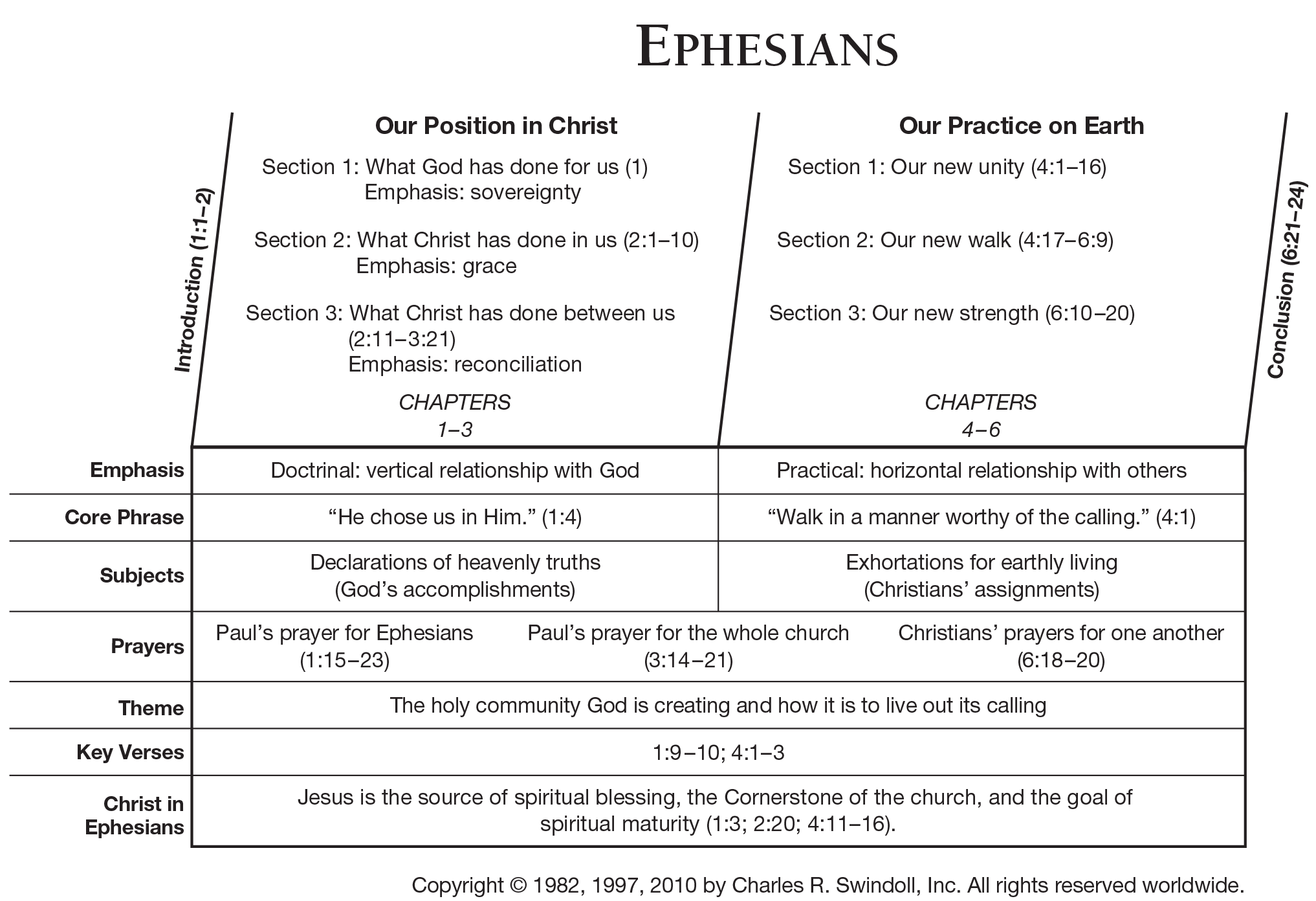
EPHESIANS - CHRIST AND THE CHURCH
Click chart to enlarge
Charts from Jensen's Survey of the NT - used by permission
Click chart by Charles Swindoll -Note "EMPHASIS" --
Ephesians 1-3 = Doctrinal: vertical relationship with God
Ephesians 4-6 = Practical: horizontal relationship with others
Ephesians 4:2 with all humility and gentleness, with patience, showing tolerance for one another in love, (NASB: Lockman)
Greek: meta pases tapeinophrosunes kai prautetos, meta makrothumias, anechomenoi (PMPMPN) allelon en agape,
BGT μετὰ πάσης ταπεινοφροσύνης καὶ πραΰτητος, μετὰ μακροθυμίας, ἀνεχόμενοι ἀλλήλων ἐν ἀγάπῃ,
Amplified: [Living as becomes you] with complete lowliness of mind (humility) and meekness (unselfishness, gentleness, mildness), with patience, bearing with one another and making allowances because you love one another. (Amplified Bible - Lockman)
NLT: Be humble and gentle. Be patient with each other, making allowance for each other's faults because of your love. (NLT - Tyndale House)
NLT (Revised) Always be humble and gentle. Be patient with each other, making allowance for each other's faults because of your love.
Phillips: Accept life with humility and patience, making allowances for each other because you love each other. (Phillips: Touchstone)
Wuest: with every lowliness and meekness, with longsuffering, bearing with one another in love,
Young's Literal: with all lowliness of mind and unselfishness, and with patience, bearing with one another lovingly,
KJV With all lowliness and meekness, with longsuffering, forbearing one another in love;
NKJ with all lowliness and gentleness, with longsuffering, bearing with one another in love,
ESV with all humility and gentleness, with patience, bearing with one another in love,
NET with all humility and gentleness, with patience, bearing with one another in love,
NIV Be completely humble and gentle; be patient, bearing with one another in love.
CSB with all humility and gentleness, with patience, accepting one another in love,
NRS with all humility and gentleness, with patience, bearing with one another in love,
NAB with all humility and gentleness, with patience, bearing with one another through love,
NJB With all humility and gentleness, and with patience, support each other in love.
GWN Be humble and gentle in every way. Be patient with each other and lovingly accept each other.
BBE With all gentle and quiet behaviour, taking whatever comes, putting up with one another in love;
WITH ALL HUMILITY AND GENTLENESS: meta pases tapeinophrosunes kai prautetos:
- Nu 12:3; Ps 45:4; 138:6; Pr 3:34; 16:19; Isaiah 57:15; 61:1, 2, 3; Zephaniah 2:3; Zechariah 9:9; Matthew 5:3, 4, 5; 11:29; Acts 20:19; 1Corinthians 13:4,5; Galatians 5:22,23; Colossians 3:12,13; 1Timothy 6:11; 2Timothy 2:25; James 1:21; 3:15, 16, 17, 18; 1Peter 3:15
- Ephesians 4 Resources - Multiple Sermons and Commentaries
- Ephesians 4:1-3 Preserving Unity - Steven Cole
- Ephesians 4:1: The Lowly Walk-1 - John MacArthur
- Ephesians 4:1: The Lowly Walk-1 Study Guide (see dropdown menu) - John MacArthur
- Ephesians 4:1: The Lowly Walk-2 - John MacArthur
Related Passages:
Numbers 12:3+ (Now the man Moses was very humble, more than any man who was on the face of the earth.)
TOTAL LOWLINESS
OF MIND
A Skevington Wood - The apostle now specifies four graces that evidence this essential proportion between calling and character: humility, gentleness, patience, and forbearance. These are all qualities necessary for good relations with others in the Christian community and beyond. (See The Expositor's Bible Commentary)
John Stott on these godly attributes in verse 2 - This is where he begins, and this is also where we should begin. Too many start with structures (and structures of some kind are indispensable), but the apostle starts with moral qualities. Certainly, in the quest for Christian unity, if we have to choose, we must say that the moral is more important than the structural. (See The Message of Ephesians)
Peter O'Brien points out that "In effect, the readers are being urged to cultivate the graces that were seen in perfection in Christ (ED: See Walking Like Jesus Walked!). Most occur in the ninefold list of the fruit of the Spirit in Galatians 5:22–23+, and exemplify the reconciliation that has been won for the readers through Christ’s death (Eph. 2:14–18+). (The Letter to the Ephesians)
With all humility (tapeinophrosune) and gentleness, (prautes);with patience (makrothumia), showing tolerance for one another in love - Paul begins with a commodity greatly despised in the ancient world (and recall these saints had once been in that world so this first trait is certainly a challenge and call for them to depend on the Spirit to pull this off!) As discussed below Paul even invents a new word for lowliness of mind. With means accompanied with. Then the adjective all (pas) means all without exception, and it modifies both humility and gentleness. Ponder that thought a moment. Are these attitudes (in totality) even humanly possible? Of course not, which why we must continually pray the preceding prayer (Eph 3:14-21) for ourselves and one another! We need Holy Spirit power to fill us every hour! Note that each of the attitudes in verse 2 reflect a Christ-like spirit which characterizes a "worthy walk" which contributes to the unity of the body. And keeping the context of Jew and Gentile now in one body, Paul is saying believing Jews are to lay aside their former "religious" pride and humbly regard their Gentile counterpart as their equal and not as their spiritual inferior.
"True humility is not putting ourselves down but rather lifting up others"
-- Dwight Edwards
Dwight Edwards (descendant of Jonathan Edwards) observed that "True humility is not putting ourselves down but rather lifting up others. If we concentrate on lifting up others, putting down ourselves will take care of itself. As we go through life exalting Christ and others, then genuine humility will be inevitable. If we exalt ourselves then God will take care of our humiliation for He promises to humble the proud. It is much less painful to do it the first way."
Hoehner has an interesting comment on all noting that this adjective "modifies both humility and gentleness. When this adjective is used with anarthrous singular nouns it can denote the highest degree, “full, greatest, all,” for example, “with all perseverance in prayer” (Eph 6:18)." (See Ephesians: An Exegetical Commentary)
Eadie writes that "The apostle now enforces the cultivation of those graces, the possession of which is indispensable to the harmony of the church: for the opposite vices — pride, irascibility, impatient querulousness—all tend to strife and disruption. On union the apostle had already dwelt in the second chapter as a matter of doctrine—here he introduces it as one of practice. (Eadie explains the "with" writing that) The first two nouns (humility and gentleness) are governed by one preposition, for they are closely associated in meaning, the “meekness” being after all only a phrase of the “lowliness of mind,” and resting on it. But the third noun (patience) is introduced with the preposition repeated, as it is a special and distinct virtue—a peculiar result of the former two—and so much, at the same time, before the mind of the apostle, that he explains it in the following clause. (Ephesians 4 Commentary)
Johnson writes that "In the Greek text (humility and gentleness) are associated together, one preposition has brought them into a relationship, one to another: “with lowliness and meekness.” Lowliness has to do with a low estimate of ourselves in the proper sense. Now that’s not the low estimate of ourselves when we ought not to have that. The Apostle will speak to that point in Romans 12. He will say, “We ought not to think of ourselves other than we really are.” But lowliness of mind is a proper attitude. And if you have any difficulty with lowliness of mind, I suggest you read chapter 2 verse 1 through verse 3 again and remember what you were: “And you hath he made alive, who were dead in trespasses and sins; Wherein in time past ye walked according to the course of this world, according to the prince of the power of the air, the spirit that now worketh in the sons of disobedience: Among whom also we all had our manner of life in times past in the lusts of our flesh, fulfilling the desires of the flesh and of the mind; and were by nature the children of wrath, even as others.” It’s easy to remember our lowliness if we just take a look at what we were, and we’ve not been delivered completely, yet. The work of sanctification is still proceeding. Confucius say, “Man who small potato get in stew,” [laughter] and most of us are pretty small potatoes, and therefore we don’t have any reason to be proud. (Unity of the Body)
Stott points out why humility is a crucial element of unity - Now humility is essential to unity. Pride lurks behind all discord, while the greatest single secret of concord is humility. It is not difficult to prove this in experience. The people we immediately, instinctively like, and find it easy to get on with, are the people who give us the respect we consider we deserve, while the people we immediately, instinctively dislike are those who treat us like dirt. In other words, personal vanity is a key factor in all our relationships. If, however, instead of manoeuvring for the respect of others (which is pride) we give them our respect by recognizing their intrinsic God-given worth (which is humility), we shall be promoting harmony in God’s new society. (See The Message of Ephesians)
Paul knows that humility promotes unity but that pride promotes disunity.
Humility (5012) (tapeinophrosune from tapeinos = low lying, then low or humble + phren = to think) means humiliation of mind, lowly thinking, a humble attitude, modesty (modesty = unassuming in the estimation of one’s abilities) or without arrogance. It is the opposite of pride. Contemplating what we were before grace lifted us from the miry clay (cf Eph 2:11-12 with Eph 2:1-3) should be a strong impetus to pursue a Spirit enabled humble attitude. In the Greek Word Paul may have coined we see that the sense of humility is "low mindedness" (WHICH IS WHY I LIKE THE KJV RENDERING BETTER - Eph 4:2KJV), an attitude that one is not too good to serve. Humility means putting Christ first, others second, and self last, because He put Himself last and has been exalted (cf Jas 4:10, 1Pe 5:5). First the cross, then the crown. The word tapeinophrosune indicates that one esteems (not makes) themselves as "small" and lacking sufficiency in themselves to walk worthy while at the same time recognizing the Spirit infused power and sufficiency of God enables a worthy walk. This trait is critical because Paul knows that humility promotes unity but that pride promotes disunity. As noted above, the Greeks did not think highly of this lowly word (pun intended) instead considering it as abject, servile, subservient attitude, or as F F Bruce says ‘the crouching submissiveness of a slave’.The ancient world considered this Christian virtue to be groveling and thus a trait to be held in contempt. They saw humility as a characteristic of weakness and cowardice, to be tolerated only in the involuntary submission of slaves. Christianity elevated humility to the supreme virtue because it was the supreme virtue of their Lord (Php 2:8, cf Mk 10:45), and because it provided the ultimate antidote for self-love that poisons all relationships. Wood adds "this euphonious noun was coined to stand over against the admired high-mindedness of the heathen."
Vine describes humility as "the subjection of self under the authority of and in response to the love of the Lord Jesus and the power of the Holy Spirit to conform the believer to the character of Christ. In contrast to the world’s idea of being “poor-spirited” (in Classical Greek tapeinos commonly carried that imputation), the Lord commends “the poor in spirit” (Mt 5:3+)." (Collected writings of W. E. Vine)
Someone has described humility as “insight into one’s own insignificance." While that sounds very "spiritual" the fact is that now in Christ our lives have unsearchable, unfathomable significance in Him! Humility is the mindset of the person who is not conceited but who has a right attitude toward himself. Humility before God and man is a virtue every child of God needs to cultivate by prayer, Scripture reading and dependence on the Spirit. The antithesis of Spirit enabled humility is a spirit of pride in human relations indicates a lack of humility before God. And recall that it was pride that caused the fall of the highest angel Satan (read Isaiah 14:13-16 - notice the 5 "I's" and remember the middle letter of sin is the "big I"!)
A missionary to India once said that "If I were to pick out two phrases necessary for spiritual growth, I would pick out these: 'I don't know' and 'I am sorry.' And both phrases are the evidences of deep humility."
Humility is not thinking less of ourselves but is really not thinking of ourselves at all. This supernatural attitude in believers has its source in our association with the Lord Jesus and the enablement of His Spirit. Humility makes believers conscious of their own nothingness and enables them to esteem others better than themselves, a good antidote for a spirit of disunity in the body. The opposite attitudes of conceit and arrogance, on the other hand promote disunity.
John Eadie writes that humility of mind "is lowliness of mind, opposed to haughty in mind Ro 12:16-note. It is that profound humility which stands at the extremest distance from haughtiness, arrogance, and conceit, and which is produced by a right view of ourselves, and of our relation to Christ and to that glory to which we are called. It is ascribed by the apostle to himself in Acts 20:19. It is not any one's making himself small as Chrysostom supposes, for such would be mere simulation. Every blessing we possess or hope to enjoy is from God. Nothing is self-procured, and therefore no room is left for self-importance. This modesty of mind, says Chrysostom, is the foundation of all virtue. (Ephesians 4 Commentary)
In his parting words to the Ephesians elders Paul used tapeinophrosune to describe his ministry among them Luke recording...
"And when they had come to him, he said to them, "You yourselves know, from the first day that I set foot in Asia, how I was with you the whole time, 19 serving (douleuo) the Lord (NOTE: HE SERVED THE LORD AS HE SERVED THEM) with all (NOTE THE "ALL" AS IN Eph 4:2!) humility (tapeinophrosune) and with tears and with trials which came upon me through the plots of the Jews (Acts 20:18,19+)
Comment - Do you see what Paul is doing in this letter calling for the Ephesians to practice humility? He is preaching what he had practiced in their midst (always a good pattern for a preacher to follow!) They had a wonderful example to emulate. And as Paul wrote to the Corinthians (who by the way were rife with "party strife" 1Co 1:12+) "Be (present imperative see our need to depend on the Holy Spirit to obey) imitators of me, just as I also am of Christ. ." (1Co 11:1+)
In his letter to the Philippians Paul gives us the Christ-like pattern for believers to follow (cf 1Jn 2:6+) using the same word tapeinophrosune to exhort the saints to...
Do nothing (HOW MUCH?) from selfishness (eritheia) or empty conceit (kenodoxia), but with humility of mind (tapeinophrosune) let each of you regard one another as more important than himself (JUST TRY TO DO THIS WITHOUT THE SPIRIT'S ENABLEMENT!); 4 do not merely look out for your own personal interests, but also for the interests of others. 5 Have this attitude (present imperative see our need to depend on the Spirit of Christ to obey, to in essence Walk Like Jesus Walked!) in yourselves which was also in Christ Jesus, 6 Who, although He existed in the form of God, did not regard equality with God a thing to be grasped, 7 but emptied Himself, taking the form of a bond-servant (doulos), and being made in the likeness of men. 8 And being found in appearance as a man, He humbled Himself by becoming obedient to the point of death, even death on a cross. (Php 2:3-8-notes Php 2:3; 2:4; 2:5; 2:6; 2:7; 2:8)
Comment - Notice the context of Paul's call for selfless living - it was in essence a call to unity just as here in Ephesians "Therefore if (SINCE) there is any encouragement in Christ, if (SINCE) there is any consolation of love, if (SINCE) there is any fellowship of the Spirit, if (SINCE) any affection and compassion, 2 make my joy complete (aorist imperative see our need to depend on the Holy Spirit to obey) by (1) being of the same mind, (2) maintaining the same love, (3) united in spirit, (4) intent on one purpose." (Php 2:1-2+)
Peter used tapeinophrosune in his exhortation to younger men writing...
You younger men, likewise, be subject to your elders; and all of you, clothe (egkomboomai = tie something on with a bow - used of a slave putting on an apron to keep his clothes clean) yourselves with humility (tapeinophrosune) toward one another, for GOD IS OPPOSED TO THE PROUD, BUT GIVES GRACE TO THE HUMBLE. Therefore humble (tapeinoo in the aorist imperative see need to depend on the Holy Spirit to obey) yourselves under the mighty hand of God, that He may exalt you at the proper time, (1Pe 5:5-6+)
Comment: When younger men willingly place themselves under the authority of the leaders, who are usually older, order and unity will be preserved and promoted! Too often there is a generation war in the church, with the older members resisting change and the younger members resisting the older people! Imagine a congregation where all the members have this humble spirit, esteeming others better then themselves and all exhibiting a willingness to perform menial but necessary tasks!
John the Baptist gives a good "formula" to ensure an every growing awareness of our humble state writing that...
"He (Jesus) must (not an option) increase (present tense = continually) , but I must decrease (present tense = continually). (John 3:30-in depth commentary)
To the saints at Rome Paul writes not to self deprecate yourself but to think rightly about yourself...
through the grace given to me I say to every man among you not to think more highly of himself than he ought to think; but to think so as to have sound judgment, as God has allotted to each a measure of faith. (Ro 12:3+)
J Vernon McGee offers the following illustration of humility of mind and adds a practical application -- The story is told of a group of people who went in to see Beethoven’s home in Germany. After the tour guide had showed them Beethoven’s piano and had finished his lecture, he asked if any of them would like to come up and sit at the piano for a moment and play a chord or two. There was a sudden rush to the piano by all the people except a gray-haired gentleman with long, flowing hair. The guide finally asked him, “Wouldn’t you like to sit down at the piano and play a few notes?” He answered, “No, I don’t feel worthy.” That man was Paderewski, the great Polish statesman and pianist and the only man in the group who was really worthy to play the piano of Beethoven. How often the saints rush in and do things when they have no gift for doing them. We say we have difficulty in finding folk who will do the work of the church, but there is another extreme—folk who attempt to do things for which they have no gift. We need to walk in lowliness of mind. (Thru the Bible Commentary)
Pentecost adds this charge does not just deal with the inflated religious egos of the Jews for "The Greeks prided themselves on being better than other men, and they considered it something to be proud of to acknowledge their superiority. A man so perverted not to think of himself as being a superior person was called by this word. If the army, successful in battle, took a number of captives whose lives they spared to become servants, these servants might rightly think of themselves by this word “humble-minded.” But for a Greek, never! (Pentecost, J. D. The Joy of Living: A study of Philippians. Kregel Publications)
Lenski - "The pagan and the secular idea of manhood is self-assertiveness, imposing one's will on others; when anyone stooped to others he did so only under compulsion, hence his action was ignominious [disgraceful]. The Christian ethical idea of humility could not be reached by the secular mind; it lacked the spiritual soil."
Jesus taught that humility is the pathway to exaltation by God for "everyone who exalts himself will be humbled, but he who humbles himself will be exalted." (Lk 18:14+) The cross comes before the crown.
With this (and other teaching of course) Jesus elevated humility which was so despised among the Greeks to the level of the supreme virtue. He also provided an antidote for the constant self-love that poisons relationships and creates disunity.
Humility of mind in its distilled essence means a mind brought low (but again not to the point of being self deprecating). Paul practiced what he preached as the following chart illustrates. Note Paul's estimate of self as he grew in the grace and knowledge of our Lord Jesus Christ. Clearly, the closer he drew to His Savior, the less significant self became and yet few men in the history of the world have had such impact on mankind as the apostle Paul. Obviously, humility does not equate with uselessness in God's program. To the contrary it is the man who is humble in mind who God can greatly use.
|
PROGRESSION of PAUL'S |
|
| 55AD | 1Cor 15:9 For I am the least of the apostles, who am not fit to be called an apostle, because I persecuted the church of God. |
| 61AD | Eph 3:8 To me, the very least of all saints, this grace was given, to preach to the Gentiles the unfathomable riches of Christ, |
| 63-66AD | 1Ti 1:15 It is a trustworthy statement, deserving full acceptance, that Christ Jesus came into the world to save sinners, among whom I am foremost of all. |
May we all be imitators of Paul's pattern (Heb 6:12)
"The humble person is not one who thinks meanly of himself; he simply does not think of himself at all!"
--Andrew Murray
As an aside, just try to do that for a day in your own natural strength! Of course it is impossible. Jesus must be our focus and His Spirit must enable that mindset throughout the day.
You may have heart this statement - Humility is that grace that, when you know you have it, you have lost it (MacArthur does not think this is really true and Moses own words in Nu 12:3+ would support that thought, but clearly when you are proud of your humility, you are not humble!). The truly humble person knows himself and accepts himself (Ro 12:3+). He yields himself to Christ to be a servant, to use what he is and has for the glory of God and the good of others. “Others” is a key idea in this section as the believer’s eyes are turned away from himself and focused on the needs of others.
Richards - "This (section) is perhaps Scripture’s clearest portrait of the “humility” called for in the Gospel. It is not a weak man’s surrender, but a strong man’s rejection of selfishness and determination to be actively concerned with the needs and interests of others." (He adds) It is good to know as we humble ourselves to follow Jesus that our "labor in the Lord is not in vain" (1Co 15:58). In Christ there are no empty, meaningless lives. (Expository Dictionary of Bible Words: Regency)
Barnes has an interesting description of humility as the estimation of "ourselves according to truth. It is a willingness to take the place which we ought to take in the sight of God and man; and, having the low estimate of our own importance and character which the truth about our insignificance as creatures and vileness as sinners would produce, it will lead us to a willingness to perform lowly and humble offices that we may benefit others. (Philippians 2)
Paul condemns false humility in his letter to the Colossians where there were individuals in their midst who were "delighting in self-abasement (tapeinophrosune)... inflated without cause by his fleshly mind....matters which have, to be sure, the appearance of wisdom in self-made religion and self-abasement (tapeinophrosune) and severe treatment of the body, but are of no value against fleshly indulgence." (Col 2:18, 23-see notes Col 2:18; Col 2:23)
ILLUSTRATION - When F. B. Meyer pastored Christ Church in London, Charles Spurgeon was preaching at Metropolitan Tabernacle, and G. Campbell Morgan was at Westminster Chapel. Meyer said, “I find in my own ministry that supposing I pray for my own little flock, ‘God bless me, God fill my pews, God send my flock a revival,” I miss the blessing; but as I pray for my big brother, Mr. Spurgeon, on the right-hand side of my church, ‘God bless him’; or my other big brother, Campbell Morgan, on the other side of my church, ‘God bless him’; I am sure to get a blessing without praying for it, for the overflow of their cups fills my little bucket.”
ILLUSTRATION - The opposite of humility of mind is illustrated by the story of the young Scottish minister who walked proudly into the pulpit to preach his first sermon. He had a brilliant mind and a good education and was confident of himself as he faced his first congregation. But the longer he preached, the more conscious everyone was that “the Lord was not in the wind.” He finished his message quickly and came down from the pulpit with his head bowed, his pride now gone. Afterward, one of the members said to him, “If you had gone into the pulpit the way you came down, you might have come down from the pulpit the way you went up.”
Many years ago the great Bible teacher William R. Newell was concluding a conference in China for China Inland Mission, and as he left he said to the mission’s leader, “Oh, do pray for me that I shall be nothing!” The director responded with a twinkle in his eye, “Newell, you are nothing! Take it by faith!”

Caspar Milquetoast
(click to enlarge)
MEEKNESS IS
NOT WEAKNESS
Caspar Milquetoast is a comic strip character created by H. T. Webster for his cartoon series The Timid Soul.[1] Webster described Caspar Milquetoast as "the man who speaks softly and gets hit with a big stick". The character's name is derived from a bland and fairly inoffensive food, milk toast, which, light and easy to digest, is an appropriate food for someone with a weak or "nervous" stomach.
Paul is not calling for believers to have the attitude of "Caspar Milquetoast!" Quite to the contrary, for in fact Paul is calling us to imitate him (1Cor 11:1+), just as he imitated Christ Jesus (Mt 11:29+)
Gentleness (meekness) (4240) (prautes from the adjective praus) describes the quality of not being overly impressed by a sense of one’s self-importance. Prautes is a quality of gentle friendliness - gentleness, meekness (as strength that accommodates to another's weakness), consideration, restrained patience, patient trust in the midst of difficult circumstances. Prautes suggests having one’s emotions under control (indicating the need for the strengthening of the Spirit) and is the opposite of self-assertion, rudeness, and harshness. Although prautes connotes meekness, it is not weakness but is knowing how to get angry at the right time and for the right reason. People who are angered at every nuisance or inconvenience to themselves know nothing of gentleness. See Vine's lengthy note.
Prautes - 11x in NT - consideration(1), gentleness(8), humility(1), meekness(1). 1Co. 4:21; 2Co. 10:1; Gal 5:23 (A FRUIT OF THE SPIRIT); Gal. 6:1; Ep 4:2; Col 3:12; 2Ti 2:25; TitUS 3:2; Jas 1:21; Jas 3:13; 1Pe 3:15
Galatians 5:22-23+ But the fruit of the Spirit is love, joy, peace, patience, kindness, goodness, faithfulness, 23 gentleness (prautes), self-control; against such things there is no law.
Galatians 6:1-2+ (PRACTICE OF THIS ATTITUDE WILL RESTORE/FOSTER UNITY) Brethren, even if anyone is caught in any trespass, you who are spiritual, restore (present imperative see our need to depend on the Holy Spirit to obey) such a one in a spirit of gentleness (prautes); each one looking to yourself, so that you too will not be tempted. (2) Bear (present imperative see our need to depend on the Holy Spirit to obey) one another’s burdens, and thereby fulfill the law of Christ.
2 Timothy 2:25+ (THE LORD'S BONDSERVANT - 2Ti 2:24) with gentleness (prautes) correcting those who are in opposition (THIS WILL PROMOTE UNITY - AT LEAST POTENTIALLY), if perhaps God may grant them repentance leading to the knowledge of the truth,
A gentle person is one whose emotions are under control. It describes the attitude that submits to God’s dealings without rebellion, and to man’s unkindness without retaliation. It is best seen in the life of our Lord Who said,
“Take (red = commands) My yoke upon you, and learn from Me, for I am gentle (praus) and humble (tapeinos = low) in heart; and you shall find rest for your souls” (Mt 11:29+).
Paul rightly ascribed prautes to His Lord during his time of ministry on earth, writing to the saints at Corinth
"Now I, Paul, myself urge you by the meekness (prautes) and gentleness (epieikeia = making allowances despite facts that might justify a negative response) of Christ-- I who am meek (tapeinos) when face to face with you, but bold toward you when absent!" (2Cor 10:1+)
Walter Wright comments on Jesus' gentleness writing "What an astonishingly wonderful statement! The One Who made the worlds, Who flung the stars into space and calls them by name, Who preserves the innumerable constellations in their courses, Who weighs the mountains in scales and the hills in a balance, Who takes up the isles as a very little thing, Who holds the waters of the ocean in the hollow of His hand, before Whom the inhabitants of the earth are as grasshoppers, when He comes into human life finds Himself as essentially meek and lowly in heart. It is not that He erected a perfect human ideal and accommodated Himself to it; He was that t "With longsuffering, forbearing one another." (Ephesians: An Encyclical Letter from the Heart of Christ Through the Heart of Paul to the Heart of the Church of All Time. Moody Press. 1954)
Harold Hoehner on gentleness says Barclay "states it well when he writes, “The man who is praus is the man who is always angry at the right time and never angry at the wrong time.” This term is used of the taming and training of animals. For instance, controlled by the master’s will, a well trained dog is always angry at the master’s foes and never angry at the master’s friends. Only the person who is controlled by the Spirit of God can truly be gentle—angry at the right time and never angry at the wrong time. When such a person is wronged, he or she does not seek revenge, but when a wrong has been committed toward a brother or sister, or the body of believers, he or she has the power to address the situation. In Ephesus, where there was the probability of great differences between believing Jews and Gentiles, believers needed to have both humility and gentleness." (See Ephesians: An Exegetical Commentary)
Albert Barnes - Meekness (gentleness) relates to the manner in which we receive injuries. We are to bear them patiently, and not to retaliate, or seek revenge. The meaning here is, that we adorn the gospel when we show its power in enabling us to bear injuries without anger or a desire of revenge, or with a mild and forgiving spirit. (Ephesians 4 Commentary) (Bolding added)
The meek person does not have to fly off the handle because he has everything under (Spirit) control. A perfect picture is found in our Lord Jesus Christ in Matthew 21. Quoting from the Septuagint (LXX = Greek of the Hebrew Old Testament) rendering of Zechariah 9:9, which predicts the Lord’s triumphal entry into Jerusalem, Matthew uses the adjective form of prautes (praus) to describe Jesus as “gentle (praus) and mounted on a donkey, even on a colt, the foal of a beast of burden” (Mt 21:5).
Meekness is a willingness to waive one's rights for a good cause, just as Jesus waived His rights to His rule as King as he rode into Jerusalem mounted on a donkey (see above). Set aside your rights! Do not demand that you be satisfied, but for the sake of the gospel of Jesus Christ be willing to suffer loss. Meekness is the opposite of rudeness and abrasiveness.
Meekness and weakness are not synonymous. Meekness says, "God, in this situation, You have a purpose. You're in control, sovereign, and ruling over all." Meekness is thus a willingness to stand and do the will of God regardless of the cost. Meekness sees everything as coming from God and accepting it without murmuring and without disputing (Php 2:14+), patiently submitting to every offense, without any desire for revenge or retribution! (See the example of our Lord as described by Peter - 1Pe 2:21, 22, 23+)
John Eadie writes that prautes is "is meekness of spirit in all relations, both toward God and toward man—which never rises in insubordination against God nor in resentment against man. It is a grace ascribed by the Saviour to Himself (Mt. 11:29+), and ascribed to Him by the apostle. (2Co 10:1+; Gal 5:23+). It is not merely that meekness which is not provoked and angered by the reception of injury, but that entire subduedness of temperament which strives to be in harmony with God's will, be it what it may, and, in reference to men, thinks with candour, suffers in self-composure, and speaks in the “soft answer” which “turneth away wrath” (Pr 15:1+) (Ephesians 4 Commentary)
James uses prautes in his discussion of a teachable spirit instructing his readers to "Therefore (to "achieve the righteousness of God" and manifest ourselves as "the firstfruits among His creatures") putting aside all filthiness and all that remains of wickedness, in humility (prautes) receive the word implanted, which is able to save your souls." (Jas 1:21+)
In the Sermon on the Mount Jesus used the adjective praus declaring "Blessed are the gentle (or "meek" = praus), for they shall inherit the earth. (Mt 5:5+)
MacArthur - Meekness is the opposite of violence and vengeance. The meek person, for example, accepts joyfully the seizing of his property, knowing that he has infinitely better and more permanent possessions awaiting him in heaven (Heb. 10:34). The meek person has died to self, and he therefore does not worry about injury to himself, or about loss, insult, or abuse. The meek person does not defend himself, first of all because that is His Lord’s command and example, and second because he knows that he does not deserve defending. Being poor in spirit and having mourned over his great sinfulness, the gentle person stands humbly before God, knowing he has nothing to commend himself. (See The MacArthur New Testament Commentary)
Ray Stedman describes meekness as "strength under control" adding that "It is real strength, but it does not have to display itself or show off how strong it is. This is what our Lord beautifully displayed He described himself as "meek and lowly in heart." The first curriculum of the Holy Spirit is that we must do what Jesus said, "take my yoke upon you and learn of me, for I am meek and lowly of heart." (Put on the New Col 3:12-17 )
In Greek literature prautes was sometimes used of a feigned, hypocritical concern for others that is motivated by self-interest. But in the New Testament it is always used of genuine consideration for others.
Prautes "denotes the humble and gentle attitude which expresses itself, in particular, in a patient submissiveness to offense, free from malice and desire for revenge...controlled strength, the ability to bear reproaches and slights without bitterness and resentment; the ability to provide a soothing influence on someone who is in a state of anger, bitterness and resentment against life...the word indicates an obedient submissiveness to God and His will, with unwavering faith and enduring patience displaying itself in a gentle attitude and kind acts toward others, and this often in the face of opposition. It is the restrained and obedient powers of the personality brought into subjection and submission to God’s will by the Holy Spirit (Gal 5:23)....the opposite of arrogance...the word stands in contrast to the term orge (wrath, anger as a state of mind)...It denotes the humble and gentle attitude which expresses itself, in particular, in a patient submissiveness to offense, a freedom from malice and desire for revenge...mildness, patient trust in the midst of difficult circumstances." (2Co 10:1) (Compiled from the Rogers, C L (originally by Fritz Rienecker): New Linguistic and Exegetical Key to the Greek New Testament. Zondervan. 1998)
Prautes was used in secular Greek writings to describe a soothing wind, a healing medicine, and a colt that had been broken. In each instance, there is power for a wind can become a storm, too much medicine can kill and a horse can break loose. Thus prautes describes power under control.
Prautes is an interesting word. Aristotle defined it as the correct mean between being too angry and being never angry at all. It is the quality of the man whose anger is so controlled that he is always angry at the right time and never at the wrong time. It describes the man who is never angry at any personal wrong he may receive, but who is capable of righteous anger when he sees others wronged.
Barclay comments on this verse writing that this man "will receive the word with gentleness. (humility = praǘtēs). Gentleness is an attempt to translate the untranslatable word praǘtēs. This is a great Greek word which has no precise English equivalent. Aristotle defined it as the mean between excessive anger and excessive angerlessness; it is the quality of the man whose feelings and emotions are under perfect control. Andronicus Rhodius, commenting on Aristotle, writes, “Praǘtēs is moderation in regard to anger … You might define praǘtēs as serenity and the power, not to be lead away by emotion, but to control emotion as right reason dictates.” The Platonic definitions say that praǘtēs is the regulation of the movement of the soul caused by anger. It is the temperament (krasis) of a soul in which everything is mixed in the right proportions. No one can ever find one English word to translate what is a one word summary of the truly teachable spirit. The teachable spirit is docile and tractable, and therefore humble enough to learn. The teachable spirit is without resentment and without anger and is, therefore, able to face the truth, even when it hurts and condemns. The teachable spirit is not blinded by its own overmastering prejudices but is clear-eyed to the truth. The teachable spirit is not seduced by laziness but is so self-controlled that it can willingly and faithfully accept the discipline of learning. Praǘtēs describes the perfect conquest and control of everything in a man’s nature which would be a hindrance to his seeing, learning and obeying the truth." (James 1 - Barclay's Daily Study Bible )
Meekness is that unassuming inner spirit of mildness and gentleness which is the opposite of haughtiness, harshness and self-assertiveness.
Trench adds that prautes “is closely linked with humility, and follows directly upon it (Eph 4:2; Col 3:12) because it is only the humble heart which is also the meek; and which, as such, does not fight against God, and more or less struggle and contend with Him. This meekness, however, being first of all meekness before God, is also such in the face of men, even of evil men, out of a sense that these, with the insults and injuries which they may inflict, are permitted and employed by Him for the chastening and purifying of His elect. This was the root of David’s (meekness) when Shimei cursed and flung stones at him—the consideration that the Lord had bidden him (2 Sa 16:11 hold pointer over blue ref for popup), that it was just for him to suffer these things, however unjustly the other might inflict them; and out of like convictions all true Christian (meekness) must spring. He that is meek indeed will know himself a sinner among sinners...and this knowledge of his own sin will teach him to endure meekly the provocations with which they may provoke him, and not withdraw himself from the burdens which their sin may impose (Synonyms)
F B Meyer - THE FRUIT OF THE SPIRIT--MEEKNESS --Eph. 4:1-2.
THE MEEK man, according to Luther, is the sweet-tempered man.
Meekness and lowliness are the two aspects of the same disposition, the one toward man, the other toward God. "Blessed are the meek," said our Lord, "for they shall inherit the earth." It is profoundly true, because to the meek and chastened, the sweet and tender spirit, there is an unfolding of the hidden beauty of the world which is withheld from the arrogant and proud. Here is a millionaire who has just purchased a beautiful and valuable picture, which he exhibits to all his friends, taking great care to tell them the price he has paid. To him it is written all over the canvas, "This picture cost me ten thousand pounds!" Does he really possess or inherit its beauty? In his employ is a girl with culture and keen artistic sense. Whenever she gets the chance she enters the room in order to absorb the inspiration of the picture into her soul. Does not she really own it? So it is that the meek inherit all that is good and beautiful. All is theirs, since they are God's.
One of the most exquisite gems in the Psalter is that beginning "Lord, my heart is not haughty, nor mine eyes lofty" (Ps 131:1). The writer describes himself as a weaned child, which at first works itself into a passion because of the change in its diet; but afterwards becomes soothed and quieted. This is the symbol of the meek and quiet spirit, which in the sight of God is of great Price.
To acquire this meekness of spirit, ask the Holy Spirit that He would keep your proud and vainglorious nature nailed to the Cross. Next, we must believe that the meek and lowly Jesus is in our hearts, and we must ask Him to live, think, and speak through us. Lastly, look to the Holy Spirit for His sacred fire to bum out all that is covetous, envious, proud, angry and malicious within our hearts, for these are the five elements of hell. Let us always take the low seat, confessing that we are not worthy to loose the shoe-latchet of our brethren.
PRAYER - Enable us, we beseech Thee, O God, to walk as Thy dear children. May all uncleanness, foolish talking, covetousness, bitterness, wrath and anger be put away from us, with all malice Make us meek, as our Saviour was. Deliver us from the spirit of retaliation. May we make peace, healing the strife and allaying the irritation of men, for Thy Name's sake. AMEN. (F. B. Meyer. Our Daily Walk)
Related Resource:
WITH PATIENCE, SHOWING TOLERANCE FOR ONE ANOTHER IN LOVE: meta makrothumias, anechomenoi (PMPMPN) allelon en agape:
- Patience, showing tolerance - Mark 9:19; Romans 15:1; 1 Corinthians 13:7; Galatians 6:2
- Ephesians 4 Resources - Multiple Sermons and Commentaries
- Ephesians 4:1-3 Preserving Unity - Steven Cole
- Ephesians 4:1: The Lowly Walk-1 - John MacArthur
- Ephesians 4:1: The Lowly Walk-1 Study Guide (see dropdown menu) - John MacArthur
- Ephesians 4:1: The Lowly Walk-2 - John MacArthur

LONGSUFFERING AND
PUTTING UP WITH OTHERS
Walter Wright is right - "There would be no need for the longsuffering and the forbearing were it not for the "one another."!!!
Peter O'Brien writes that "‘Patience’ (makrothumia) is that long-suffering which makes allowance for others’ shortcomings and endures wrong rather than flying into a rage or desiring vengeance. It is a fruit of the Spirit (Gal 5:22) and a necessary quality for maintaining right relationships within the body of Christ (cf. 1Th 5:14; 1Co 13:4; 2 Cor. 6:6)." (See The Letter to the Ephesians )
Patience (Longsuffering) (3115) (makrothumia from makros = long, distant, far off, large + thumos = temper, passion, emotion or thumoomai = to be furious or burn with intense anger) is literally long-temper (as opposed to short tempered), a long holding out under trial before giving in to passion, a tumultuous welling up of the whole spirit or a might emotion that seizes and moves the entire inner man. It is bearing patiently with the foibles, faults, and infirmities of others. It is a patient holding out under trial; a long-protracted restraint of the soul from yielding to passion, especially the passion of anger. Our old nature is so quick to take offense that we need longer "fuses". The new life in Christ enables one to endure with unruffled temper any wrong suffered without retaliation and to turn the other cheek. Makrothumia is "longsuffering towards aggravating people, such as God in Christ has shown towards us." (Stott)
Makrothumia - 14x in 14v - Ro 2:4; 9:22; 2 Cor 6:6; Gal 5:22; Eph 4:2; Col 1:11; 3:12; 1 Tim 1:16; 2 Tim 3:10; 4:2; Heb 6:12; Jas 5:10; 1 Pet 3:20; 2 Pet 3:15
Hoehner notes that God "stayed his wrath when he was wronged by human sin (Rom 2:4). Thus must the believer stay his or her impatience or vengeance when wronged by another believer, exhibiting patience one toward another, especially in the light of the union of believing Jews and Gentiles into one body. It is clear that patience is not only a virtue but a necessary ingredient for the life of Jewish and Gentile believers who comprise the body of Christ." (See Ephesians: An Exegetical Commentary)
Makrothumia is often used in the OT to translate the Hebrew phrase ('erekh 'appayim) which is literally “long of nose” (or “breathing”), and, as anger was indicated by rapid, violent breathing through the nostrils, “long of anger,” or “slow to anger.” This Hebrew phrase ('erekh 'appayim) and the Septuagint (LXX) translation as makrothumia (and the cognates makrothumos, makrothumeo) is included in the catalog of His attributes that runs through the OT like a refrain, a God "slow to anger" (Click for the 14 occurrences of this phrase in the OT).
Slow to anger - used to describe Yahweh (Praise God for this attribute!) - Ex 34:6; Nu 14:18; Neh. 9:17; Ps. 86:15; Ps. 103:8; Ps. 145:8; Joel 2:13; Jon. 4:2; Nah. 1:3;
Exodus 34:6+ Then the LORD passed by in front of him and proclaimed, “The LORD, the LORD God, compassionate and gracious, slow to anger (KJV = LONGSUFFERING), and abounding in lovingkindness and truth
Comment - In Eph 5:1+ believers are commanded to "be (present imperative see our need to depend on the Holy Spirit to obey) imitators of God, as beloved children." What better way then to imitate His longsuffering - after all He has been longsuffering with us, so can treat others with any less respect? O'Brien adds "Because of His forbearance with them, they ought to act in a similar manner towards others (cf. the parable of the wicked servant, Mt. 18:23–35; 1Th 5:14)."
Slow to anger - used to describe men - Pr. 14:29; Pr 15:18; Pr 16:32; Pr 19:11; Jas. 1:19
Makrothumia reflects an emotional calm in face of provocation or misfortune. It expresses the capacity to be wronged and not retaliate. It is the ability to hold one's feeling in restraint or bear up under the oversights and wrongs afflicted by others without retaliating. It is manifest by the quality of forbearance under provocation. Patience is the spirit which never gives up for it endures to the end even in times of adversity, exhibiting self-restraint such that it does not hastily retaliate a wrong. Vine says makrothumia is the opposite of anger. It follows that a lack of patience often leads to wrath or revenge.
John Eadie characterizes makrothumia as that temperament which "is opposed to irritability, or to what we familiarly name shortness of temper (Jas 1:19), and is that patient self-possession which enables a man to bear with those who oppose him, or who in any way do him injustice. He can afford to wait till better judgment and feeling on their part prevail, 2Co 6:6; Gal. 5:22; 1Ti 1:16; 2Ti 4:2. In its high sense of bearing with evil, and postponing the punishment of it, it is ascribed to God, Ro 2:4, 9:22. (Ephesians 4 Commentary)
Boice tells the story of "A rather pious individual once came to a preacher and asked him to pray for him that he might have patience. “I do so lack patience,” he said, trying to be humble as he said it. “I wish you would pray for me.” “I’ll pray for you right now,” the preacher replied. So he began to pray: “Lord, please send great tribulation into this brother’s life.” The man who had asked for prayer put a hand out and touched the preacher on the arm, trying to stop his prayer. “You must not have heard me rightly,” he said. “I didn’t ask you to pray for tribulation. I asked you to pray that I might have patience.” “Oh, I heard what you said,” the preacher answered. “But haven’t you read Romans 5:3+, "And not only so, but we glory in tribulations also, knowing that tribulation worketh patience (hupomone = put up with circumstances; makrothumia = put up with people)’? It means we acquire patience through the things that we suffer. I prayed that God would send tribulations so that you would have patience.” (Ephesians: An Expositional Commentary)
Brian Bell on Longsuffering - the opposite is a person w/a hair trigger temper, who explodes in fury, rage, & rejection at the slightest provocation. Every person has in his personality certain minefields, made of mines that are hidden beneath the surface. These are sensitive points where we respond out of proportion to the situation because these are areas wherein we are easily provoked. In some people’s field, there may be only 1 or 2 mines for every 10 acres of field. These people are rather easy to get along with.With other people, there is no safe passageway through their field, because it is wall-to-wall mines. They are touchy, sensitive, always getting angry, always getting upset, & always causing problems. Sproul
Albert Barnes has a pithy and practical comment on longsuffering (with thoughts overlapping with the next trait of forbearance) writing that...
The virtue here required is that which is to be manifested in our manner of receiving the provocations which we meet with from our brethren. No virtue, perhaps, is more frequently demanded in our intercourse with others.
We do not go far with any fellow-traveler on the journey of life before we find there is great occasion for its exercise. He has a temperament different from our own. He may be sanguine, or choleric, or melancholy; while we may be just the reverse. He has peculiarities of taste, and habits, and disposition, which differ much from ours. He has his own plans and purposes of life, and his own way and time of doing things. He may be naturally irritable, or he may have been so trained that his modes of speech and conduct differ much from ours. Neighbours have occasion to remark this in their neighbours; friends in their friends; kindred in their kindred; one church-member in another.
A husband and wife--such is the imperfection of human nature-can find enough in each other to embitter life if they choose to magnify imperfections and to become irritated at trifles; and there is no friendship that may not be marred in this way, if we will allow it.
Hence, if we would have life move on smoothly, we must learn to bear and forbear. We must indulge the friend that we love in the little peculiarities of saying and doing things which may be important to him, but which may be of little moment to us. Like children, we must suffer each one to build his playhouse in his own way, and not quarrel with him because he does not think our way the best.
All usefulness, and all comfort, may be prevented by an unkind, a sour, a crabbed temper of mind--a mind that can bear with no difference of opinion or temperament. A spirit of fault-finding; all unsatisfied temper; a constant irritability; little inequalities in the look, the temper, or the manner; a brow cloudy and dissatisfied--your husband or your wife cannot tell why--will more than neutralize all the good you can do, and render life anything but a blessing.
It is in such gentle and quiet virtues as meekness and forbearance that the happiness and usefulness of life consist, far more than in brilliant eloquence, in splendid talent, or illustrious deeds that shall send the name to future times.
It is the bubbling spring which flows gently; the little rivulet which glides through the meadow, and which runs along day and night by the farm-house, that is useful, rather than the swollen flood or the roaring cataract. Niagara excites our wonder; and we stand amazed at the power and greatness of God there, as he "pours it from his hollow hand." But one Niagara is enough for a continent or a world; while that same world needs thousands and tens of thousands of silver fountains, and gently-flowing rivulets, that shall water every farm, and every meadow, and every garden, and that shall flow on, every day and every night, with their gentle and quiet beauty.
So with the acts of our lives. It is not by great deeds only, like those of Howard --not by great sufferings only, like those of the martyrs--that good is to be done; it is by the daily and quiet virtues of life--the Christian temper, the meek forbearance, the spirit of forgiveness in the husband, the wife, the father, the mother, the brother, the sister, the friend, the neighbour--that good is to be done; and in this all may be useful. (Ephesians 4 Commentary)
J Vernon McGee writes that makrothumia "means “long-burning”—it burns a long time. We shouldn’t have a short fuse with our friends and Christian brethren. We shouldn’t make snap judgments. (Thru the Bible Commentary: Thomas Nelson - see Ephesians 4 Commentary)
Evans writes that(makrothumia "could be translated “large emotions,” signifying wells of endurance that will not dry up, no matter how much is drawn from them. The Christian with this patience will have refreshing water to sustain continual effectiveness even in the face of unrelenting pressures. Those with such patience and faith are those who receive or “inherit the promises.” (Briscoe, D. S., & Ogilvie, L. J. The Preacher's Commentary Series, New Testament. 2003; Thomas Nelson)
Calvin said makrothumia refers to that quality of mind that disposes us “to take everything in good part and not to be easily offended.”
Larry Richards - The NT contains many exhortations to be patient. But just what is patience? The Greek word group (makrothumeo/makrothumia) focuses our attention on restraint: that capacity for self-control despite circumstances that might arouse the passions or cause agitation....This is not so much a trait as a way of life. We keep on loving or forgiving despite provocation, as illustrated in Jesus' pointed stories in Mt 18." (Expository Dictionary of Bible Words: Regency)
William Barclay has a lengthy discussion explaining that makrothumia...
"... as the Greeks used it, usually meant patience with people. It is the ability not to lose patience when people are foolish, not to grow irritable when they seem unteachable. It is the ability to accept the folly, the perversity, the blindness, the ingratitude of men and still to remain gracious, and still to toil on...
This word has two main directions of meaning.
(a) It describes the spirit which will never give in and which, because it endures to the end, will reap the reward. Its meaning can best be seen from the fact that a Jewish writer used it to describe what he called “the Roman persistency which would never make peace under defeat.” In their great days the Romans were unconquerable; they might lose a battle, they might even lose a campaign, but they could not conceive of losing a war. In the greatest disaster it never occurred to them to admit defeat. Christian patience is the spirit which never admits defeat, which will not be broken by any misfortune or suffering, by any disappointment or discouragement, but which persists to the end.
(b) But makrothumia has an even more characteristic meaning than that. It is the characteristic Greek word for patience with men. Chrysostom defined it as the spirit which has the power to take revenge but never does so. Lightfoot defined it as the spirit which refuses to retaliate. To take a very imperfect analogy—it is often possible to see a puppy and a very large dog together. The puppy yaps at the big dog, worries him, bites him, and all the time the big dog, who could annihilate the puppy with one snap of his teeth, bears the puppy’s impertinence with a forbearing dignity. Makrothumia is the spirit which bears insult and injury without bitterness and without complaint. It is the spirit which can suffer unpleasant people with graciousness and fools without irritation.
The most illuminating thing about it is that it is commonly used in the New Testament of the attitude of God towards men (Romans 2:4; 9:22; 1 Timothy 1:16; 1 Peter 3:20). If God had been a man, he would have wiped out this world long ago; but he has that patience which bears with all our sinning and will not cast us off. In our dealings with our fellow men we must reproduce this loving, forbearing, forgiving, patient attitude of God towards ourselves. Paul asks the impenitent sinner if he despises the patience of God (Romans 2:4). Paul speaks of the perfect patience of Jesus to him (1 Timothy 1:16). Peter speaks of God’s patience waiting in the days of Noah (1 Peter 3:20). He says that the forbearance of our Lord is our salvation (2 Peter 3:15). If God had been a man, he would long since in sheer irritation have wiped the world out for its disobedience. The Christian must have the patience towards his fellow men which God has shown to him." (Galatians 5 - Barclay's Daily Study Bible)
In another note Barclay writes that makrothumia is "the ability to bear with them even when they are wrong, even when they are cruel and insulting. It is a great word. The writer of First Maccabees (8:4) says that it was by makrothumia that the Romans became masters of the world, and by that he means the Roman persistence which would never make peace with an enemy even in defeat, a kind of conquering patience. Patience is the quality of a man who may lose a battle but who will never admit defeat in a campaign" (2 Corinthians 6 - Barclay's Daily Study Bible)
Boles writes that makrothumia "refers to what we might call “staying power,” to endure hard events and obnoxious people. While the word was not frequently used in classical literature, it has a rich history in the LXX. “A man’s wisdom gives him patience” (Pr 19:11), with which he can calm a quarrel (Pr 15:18) or persuade a ruler (Pr 25:15). More importantly, patience makes a man like God, who is “righteous and strong and long-tempered” (Ps 7:12, LXX). One of the great truths about God is that he is “slow to anger” (makrothumos), repeated by Moses (Ex 34:6), David (Ps 103:8), Joel (2:13), Jonah (4:2), Nahum (1:3), and Nehemiah (9:17)...Patience is the even temper that comes from a big heart. It is not the “grit your teeth” kind of angry endurance; it is loving tolerance in spite of people’s weakness and failure. Love is patient (1 Cor 13:4) and so must Christians be (Eph 4:2)...the same divine quality that allows God to be patient with sinners (2 Pet 3:9) enables the Christian to endure the exasperating behavior of others. Perhaps the best way for us to “lengthen” the fuse on our tempers is to remember how much God has had to overlook and forgive in our own lives." (Boles, K. L. Galatians & Ephesians. The College Press NIV commentary Joplin, Mo.: College Press)
Makrothumia is patience in face of injustice and unpleasant circumstances without complaint or irritation. The short-tempered person speaks and acts impulsively and lacks self-control. When a person is longsuffering, he can put up with provoking people or circumstances without retaliating. It is good to be able to get angry, for this is a sign of holy character. But it is wrong to get angry quickly at the wrong things and for the wrong reasons. It is the attitude which endures another's exasperating conduct without flying off the handle. It is a negative term. It is holding back, restraining yourself from becoming upset or speaking sharply or shrilly to somebody be they your mate, your child, or whoever...despite their conduct you find difficult and exasperating.
Makrothumia always has to do with our reaction not to circumstances but to people that God allows (or sends) into our life! Because of the new nature you can be longsuffering with those with whom you otherwise could not be. What was heretofore IMPOSSIBLE is now ''HIM POSSIBLE''! Hallelujah! Remember though it is a product of prayer (Col 1:11-note)
After studying this definition you must wonder how can anyone manifest genuine makrothumia? The answer is they cannot, but God can. Paul explains that ""the fruit (click discussion of karpos) of the Spirit is love, joy, peace, patience (makrothumia - patiently putting up with people who continually irritate us. The Holy Spirit’s work in us increases our endurance), kindness, goodness, faithfulness" (Gal 5:22+)
George writes that makrothumia "is the ability to put up with other people even when that is not an easy thing to do. Patience in this sense, of course, is preeminently a characteristic of God, who is “long-suffering” with his rebellious creatures. He is the loving Lord who in the face of obstinate infidelity and repeated rejection still says of his people, “How can I give you up, Ephraim? How can I hand you over, Israel?” (Hos 11:8). Paul’s point is clear: if God has been so long-suffering with us, should we not display this same grace in our relationships with one another? This quality should characterize the life of every believer, but it has a special relevance for those who are called to teach and preach the Word of God. As Paul instructed Timothy, “Preach (all verbs in red = commands = only possible as one relies on the enabling power of the Spirit) the Word; be prepared in season and out of season; correct, rebuke and encourage—with great patience and careful instruction” (2Ti 4:2-note)." (George, T. The New American Commentary. Broadman & Holman Publishers.)
Longsuffering characterizes all labor that has love for its motive "Love is patient (verb form = makrothumeo), love is kind, and is not jealous; love does not brag and is not arrogant," (1Corinthian 13:4+)
Vine writes that If forbearance denotes delay in executing judgment, long-suffering denotes the particular disposition which delays it." (Collected writings of W. E. Vine)
PUTTING UP
WITH OTHERS
Showing tolerance is probably not the best rendering (in my opinion) but is more descriptively and accurately rendered forbearing with. We are to be those who put up with differences with other believers and we are to do it in unconditional love, not a possessing type of love but a giving type of love which seeks the highest good of the one who is the benefactor of this love (cf Jn 3:16+). Note also that some (Peter O'Brien) feel that this verb and "be diligent" in Eph 4:3 function as imperatives.
O'Brien has an interesting comment that showing tolerance "clarifies the meaning of ‘patience’. Mutual forbearance is the practical expression of patience. As believers bear with one another’s weaknesses and failures (cf. Ep 4:32) in the midst of tensions and conflicts, they show a lifestyle that is consistent with their divine calling. This kind of behaviour can spring only from God’s love—a point that is made plain by the additional words in love. The apostle has just prayed to God that his readers might be rooted and established in love (Ep 3:17). Now he addresses his urgent appeal to them to live accordingly. (See The Letter to the Ephesians)
Hoehner sums up the 4 traits of a worthy walk commenting that "there was undoubtedly some tension between Jewish and Gentile believers even though they were now united into one body. Therefore, Paul has explained how their walk must be exemplified by humility, gentleness, and patience, forbearing one another in love, and thus excluding resentment. Such qualities could only be accomplished by the power of the Spirit in their lives, individually (Ep 3:16) and corporately (Ep 2:22)." (See Ephesians: An Exegetical Commentary)
Showing tolerance (430) (anechomai from aná = in + écho = have) means literally to hold one’s self upright or firm against a person or thing, to put up with, to bear with (equanimity or evenness of mind especially under stress), to tolerate, to forbear. It pictures restraint under provocation and includes liberal allowance for the faults and failures of others. The present tense calls for this to be our lifestyle, something only possible as die to self and surrender daily to the Holy Spirit Who enables us to obey. The middle voice (reflexive) means that one is to have patience with or “to hold oneself up” till the provocation is past.
Paul also uses anechomai in the "practical" or exhortational last two chapters of his letter to the church at Colossae writing...
Colossians 3:12+ And so, as those who have been chosen of God, holy and beloved (he reminds them of their high position and privilege that connotes a serious responsibility), put on a heart of compassion, kindness, humility, gentleness and patience; 3:13+ bearing with (anechomai - present tense = continually, as a lifestyle indicating that we need to depend on the Holy Spirit to carry out this godly attribute) one another, and forgiving each other, whoever has a complaint against anyone; just as the Lord forgave you, so also should you. 14 Beyond all these things put on love, which is the perfect bond of unity.
Comment - So here we see in addition to peace a second "bond" of unity which is love.
The idea is to hold out in spite of persecution, threats, injury, indifference, or complaints and not retaliate. It conveys the sense of putting up with others and of undergoing something onerous or troublesome without giving in.
Paul encourages the saints to make allowance (tolerate, bear, endure) for the faults and failures of others, or differing personalities, abilities, and temperaments. Forbearance is not a question of maintaining a façade of courtesy while inwardly seething with resentment but is a Spirit empowered positive love to those who irritate, disturb, or embarrass you! Not a natural but a supernatural response!
Now we can understand why Paul prayed for the Ephesian saints to be strengthened by the Spirit in their inner man! (Eph 3:16+) This attitude and action is not possible naturally, but only supernaturally!
THOUGHT: How are you bearing up with the idiosyncrasies of your brethren at church, your spouse, your children, your co-workers, your fellow students, etc? You can't, He can and His empowering Spirit lives in you to transform your temperament and attitude to those who irritate you. Use those "irritations" as divine "pop tests" which a sovereign God allowed (or sent) that you might learn to walk "step by step" depending on His power. I am not saying "Let go, let God" (which is not biblically sound doctrine), but "Let God, let's go." His sovereignty, your responsibility is the Biblical pattern!
One another (240) (allelon from állos = another) means just what it says. It is like the sequoia trees of California which tower as high as 300 feet above the ground. You might be surprised to discover that these giant trees have unusually shallow root systems that reach out in all directions to capture the greatest amount of surface moisture. Their intertwining roots also provide support for each other against the storms. That's why the giant Sequoia trees usually grow in clusters. Seldom will you see a redwood standing alone, because high winds would quickly uproot it! That's what "one another" means!
In love - describes the spirit in which such forbearance was to be exercised, because to forbear without love could result in resentment. Stott observes that Paul "has prayed to God that we may be ‘rooted and grounded in love’ (Eph 3:17); now he addresses his appeal to us to see to it that we live a life of love....Love is the final quality, which embraces the preceding four, and is the crown and sum of all virtues. Since to love is constructively to seek the welfare of others and the good of the community, its ‘binding’ properties are celebrated in Colossians 3:14. Here, then, are five foundation stones of Christian unity. Where these are absent no external structure of unity can stand. But when this strong base has been laid, then there is good hope that a visible unity can be built. We may be quite sure that no unity is pleasing to God which is not the child of charity. " (See The Message of Ephesians)
John Eadie writes that "Retaliation was not to be allowed; all occasionally needed forbearance, and all were uniformly to exercise it. No acerbity of temper, sharp retort, or satirical reply was to be admitted. As it is the second word which really begins the strife, so, where mutual forbearance is exercised, even the first angry word would never be spoken. And this mutual forbearance must not be affected coolness or studied courtesy; it must have its origin, sphere, and nutriment “in love”—in the genuine attachment that ought to prevail among Christian disciples. (Ephesians 4 Commentary)
Love (26) (agape) (for more discussion see notes on 1Co 13:4) in the NT usually refers to unconditional (as in this verse), sacrificial, supernatural love, that quality of love that God is (1Jn 4:8,16), that love which God shows (Jn 3:16, 1Jn 4:9) and (to praise of the glory of His amazing grace - Ep 1:6-note) that quality of love that God's Spirit enables us as His children (Jn 1:12, Ro 8:16, 17-note) to manifest (see fruit of the Spirit - Gal 5:22-note). Do not "try" to "manufacture" this love, but instead learn daily (even moment by moment) to "die" ("to self", cp Mk 8:34, Lk 9:23, Ro 6:11-note, Ro 6:12, 13-note, Ro 6:14-note Ro 7:5, 6-note, Col 3:5-note, Php 2:12-note, Php 2:13-note, Ezekiel 36:27 = a promise associated with the New Covenant) that you might manifest this supernatural Christ-like love (cp Ep 5:1,2-note) to a lost, dying world (Eph 2:1, 2:2-note, Ep 2:3-note) in which even natural love is growing cold (cp "unloving" in 2Ti 3:3-note, Ro 1:31-note, cp Jesus' admonition regarding love in the last of the last days = Mt 24:12). (See John Piper's related sermon = The Greatest of These Is Love - Dying As a Means of Loving)
Agape love is empowered by the Holy Spirit, activated by a personal choice of our will, is not based on our feelings toward the object of our love and is manifested by specific actions especially as summarized in 1Corinthians 13
Love is (present tense - just try to accomplish this in dependence on your natural power! See need to depend on the Holy Spirit) patient (makrothumeo - the verb form of the attitude following humility and gentleness - note all of the verbal descriptions of love are present tense - all necessitate dependence on the Spirit!), love is kind (chresteuomai), and is not jealous (zeloo]); love does not brag (perpereuomai = self display, boast, praise oneself excessively) and is not arrogant (phusioo = inflated, puffed up, haughty), 5 does not act unbecomingly (aschemoneo = an ugly, indecent, improper, unseemly manner); it does not seek its own, is not provoked (paroxuno = aroused to anger, not "touchy"), does not take into account a wrong suffered, 6 does not rejoice in unrighteousness, but rejoices with the truth; 7 bears all things, believes all things, hopes all things, endures all things. (1Cor 13:4-7+)
In combination with showing tolerance, the idea is to love those who don't deserve it or who irritate, disturb or embarrass us. This supernatural, Christlike behavior is only possible by the strengthening of our inner man by the Holy Spirit.
Thomas à Kempis wrote that "If Christ is amongst us, then it is necessary that we sometimes yield up our own opinion for the sake of peace. Who is so wise as to have perfect knowledge of all things? Therefore trust not too much to thine own opinion, but be ready also to hear the opinions of others.
D L Moody quipped "There are two ways of being united -- one is by being frozen together, and the other is by being melted together. What Christians need is to be united in brotherly love, and then they may expect to have power."
Thomas Watson once wrote that "In the primitive times, there was so much love among the godly as set the heathen a-wondering, and now there is so little, as may set Christians a-blushing.
ILLUSTRATION - George Whitefield and John Wesley disagreed in matters of theology which could have led to great disunity. Below is a letter from Whitefield to Wesley illustrating Paul's charge to show "tolerance for one another in love" - My honored friend and brother...hearken to a child who is willing to wash your feet. I beseech you, by the mercies of God in Christ Jesus our Lord, if you would have my love confirmed toward you.… Why should we dispute, when there is no possibility of convincing? Will it not, in the end, destroy brotherly love, and insensibly take from us that cordial union and sweetness of soul, which I pray God may always subsist between us? How glad would the enemies of our Lord be to see us divided....Honored sir, let us offer salvation freely to all by the blood of Jesus, and whatever light God has communicated to us, let us freely communicate to others. (Comment: And all God's people should say "Amen" and carry out this same divine duty by His divine enablement!)
Ephesians 4:3 being diligent to preserve the unity of the Spirit in the bond of peace. (NASB: Lockman)
Greek: spoudazontes (PAPMPN) terein (PAN) ten enoteta tou pneumatos en to sundesmo tes eirenes;
BGT σπουδάζοντες τηρεῖν τὴν ἑνότητα τοῦ πνεύματος ἐν τῷ συνδέσμῳ τῆς εἰρήνης·
Amplified: Be eager and strive earnestly to guard and keep the harmony and oneness of [and produced by] the Spirit in the binding power of peace. (Amplified Bible - Lockman)
NLT: Always keep yourselves united in the Holy Spirit, and bind yourselves together with peace. (NLT - Tyndale House)
NLT (revised) Make every effort to keep yourselves united in the Spirit, binding yourselves together with peace.
Phillips: Make it your aim to be at one in the Spirit, and you will inevitably be at peace with one another. (Phillips: Touchstone)
Wuest: doing your best to safeguard the unanimity of the Spirit in the bond of peace. .
Young's Literal: in the uniting bond of peace, the unity given by the Spirit.
KJV Endeavouring to keep the unity of the Spirit in the bond of peace.
NKJ endeavoring to keep the unity of the Spirit in the bond of peace.
ESV eager to maintain the unity of the Spirit in the bond of peace.
NET making every effort to keep the unity of the Spirit in the bond of peace.
NIV Make every effort to keep the unity of the Spirit through the bond of peace.
CSB diligently keeping the unity of the Spirit with the peace that binds us.
NRS making every effort to maintain the unity of the Spirit in the bond of peace.
NAB striving to preserve the unity of the spirit through the bond of peace:
NJB Take every care to preserve the unity of the Spirit by the peace that binds you together.
GWN Through the peace that ties you together, do your best to maintain the unity that the Spirit gives.
BBE Taking care to keep the harmony of the Spirit in the yoke of peace.
BEING DILIGENT TO PRESERVE THE UNITY OF THE SPIRIT: spoudazontes (PAPMPN) terein (PAN) ten enoteta tou pneumatos:
- Being diligent - Ep 4:4; John 13:34; 17:21, 22, 23; Ro 14:17, 18, 19; 1Co 1:10; 12:12,13; 2Co 13:11; Co 3:13, 14, 15; 1Th 5:13; Heb 12:14; Jas 3:17,18
- Ephesians 4 Resources - Multiple Sermons and Commentaries
- Ephesians 4:1-3 Preserving Unity - Steven Cole
- Ephesians 4:1: The Lowly Walk-1 - John MacArthur
- Ephesians 4:1: The Lowly Walk-1 Study Guide (see dropdown menu) - John MacArthur
- Ephesians 4:1: The Lowly Walk-2 - John MacArthur
- Ephesians 4:2: The Lowly Walk-3- John MacArthur
- Ephesians 4:2: The Lowly Walk-4- John MacArthur
- Ephesians 4:2: The Lowly Walk-5- John MacArthur
- Ephesians 4:2-6: The Lowly Walk-6- John MacArthur
GUARDING SPIRITUAL UNITY
REQUIRES SUPERNATURAL EFFORT
Being diligent (spoudazo) to preserve (tereo) the unity (henotes) of the Spirit in the bond of peace - NJB "Do all you can to preserve." But remember "YOU" in your flesh can't! We must all, at all times rely wholly on the Holy Spirit to enable us to "pull this off," to accomplish this goal.
Amplified Version helps us see our need to depend on the Spirit Who made us one in Christ to now keep us one in Christ "Be eager and strive earnestly to guard and keep the harmony and oneness of [and produced by] the Spirit in the binding power of peace."
The call to unity permeates Paul's epistles:
In First Corinthians Paul writes " Now I exhort you, brethren, by the name of our Lord Jesus Christ, that you all agree, and there be no divisions among you, but you be made complete in the same mind and in the same judgment. (1Cor 1:10+)
In Second Corinthians Paul writes "Finally, brethren, rejoice, be made complete, be comforted, be like-minded, live in peace; and the God of love and peace shall be with you." (2Cor 13:11+, then compare the work of the Trinity in 2Co 13:14+)
In Romans Paul writes "So then let us pursue the things which make for peace (walls broken down between believers!) and the building up (instead of tearing down) of one another (See how to edify - Eph 4:29+, cf Acts 20:32+). (Ro 14:19+)
In Colossians Paul writes " And beyond all these things put on love, which is the perfect bond of unity. 15 And let the peace of Christ rule in your hearts, to which indeed you were called in one body; and be thankful." (Col 3:14-15+)
Keeping the unity is a difficult task!
To dwell above with saints we love,
O that will be glory
But to dwell below with saints we know,
Well, that's another story.
Being diligent (4704) (spoudazo form spoude = haste) conveys the idea hastening to do something with the implication of associated energy or with intense effort and motivation. This verb has an element of haste, urgency, or even a sense of crisis to it. It suggest zealous concentration and diligent effort. It also suggests difficulty and a resolute determination to overcome the difficulty. Brethren, the precious fruit of unity is not automatic but takes considerable effort to cultivate and propagate!
Spoudazo speaks of intensity of purpose followed by intensity of effort toward the realization of that purpose. Spoudazo is marked by careful unremitting attention or persistent application. The idea is give maximum effort, do your best, spare no effort, hurry on, be eager! Hasten to do a thing, exert yourself, endeavour to do it. It means not only to be willing to do with eagerness, but to follow through and make diligent effort. In other words spoudazo does not stop with affecting one's state of mind, but also affects one's activity. Spoudazo conveys the idea of exertion. It means to be conscientious, zealous and earnest in discharging a duty or obligation. It speaks of intensity of purpose followed by intensity of effort toward the realization of that purpose.
The present tense calls for the Gentile believers to keep on making every effort, eagerly seeking to guard the oneness of the body. As an aside, the only way we can accomplish this is by daily (continually) renouncing self-reliance (die to self) and relying wholly (surrendering daily) to the Holy Spirit Who enables us to obey! (see the Spirit's "energizing" work in Php 2:13NLT+). Clearly maintaining unity is going to entail that we continually work hard at it. Do we really understand this basic principle in our churches? The natural tendency is to disunity. The active voice indicates that this action (of striving earnestly) is a volitional choice or a choice all believers must make in their own heart to carry out (e.g., by manifesting the "worthy" traits mentioned in verse 2 - humility, gentleness, patience, tolerance in love).
Wuest says that spoudazo means "to make haste, do one’s best, take care, desire. The idea of making haste, being eager, giving diligence, and putting forth effort are in the word. The word speaks of intense effort and determination." (Wuest's Word Studies from the Greek New Testament)
Preserve (guard) (5083) (tereo from teros - a guard or warden) means to keep an eye on, keep something in view, to attend carefully, or to watch over it. Tereo speaks of keeping as the result of guarding something which is in one’s possession (in this case it is the Spirit's gift of unity to the Body of Christ, which when "unguarded" will manifest a natural "entropy," or tendency to dissipate, because of its three mortal enemies - the world, the flesh and the devil). And so tereo means to watch as one would some precious thing (unity is precious!).
In using the present tense Paul is calling for the saints at Ephesus to continually guard the unity of the body. Why would we need to guard the unity? The simple answer is that it is precious, it can to stolen by enemies, can be easily disturbed by saints refusing to seek it, etc. In short, we have to fight the good fight of faith to preserve unity in the local body. How do we continually guard the unity of the Spirit? There are many ways, but certainly one of the more important ways is watching our tongue, which has set many a church "ablaze" (For a "refresher" read James 3:2-7, 8, 9, 10 - read that last phrase again - "these things ought not to be this way" - disturbed unity is guaranteed if the tongue is not controlled by the Spirit). And so if we would guard the unity, we would do well to pray...
Set a guard, O LORD, over my mouth; Keep watch over the door of my lips. (Psalm 141:3)
Comment: Yes, we must all frequently pray this great prayer and then we must immediately "jettison" self-reliance (i.e., relying on our "self" control to control that "member" in us which is not controllable by the flesh [read James 3:8 again - just try to control it in your own "strength"!!!], but only by the Spirit!) and continually seek the filling (controlling) of the Holy Spirit (Eph 5:18-note), Who will enable us to "walk by the Spirit" for when we do, we will not carry out the desire of the flesh (Gal 5:16-note), all the while remembering that this will be a continual, ongoing war until the day we go home to Jesus (Gal 5:17-note). What's the natural "addendum" to that last statement? We need "fresh grace" EVERY morning, before we go to war (i.e., before we even say a single word to another person, spouse or otherwise!) We need to present ourselves in totality (no reservations, no qualifiers, no "rooms of our heart locked" so to speak) to God in the morning, agreeing we can live the supernatural life Christ has given us (Gal 2:20-note) without His supernatural "supply," the Spirit of Grace (Heb 10:29b).
Spurgeon: David's mouth had been used in prayer, it would be a pity it should ever be defiled with untruth, or pride, or wrath; yet so it will become unless carefully watched, for these intruders are ever lurking about the door. David feels that with all his own watchfulness he may be surprised into sin, and so he begs the Lord Himself to keep him. When Jehovah sets the watch the city is well guarded: when the Lord becomes the guard of our mouth the whole man is well garrisoned. Keep the door of my lips. God has made our lips the door of the mouth, but we cannot keep that door of ourselves, therefore do we entreat the Lord to take the rule of it. O that the Lord would both open and shut our lips, for we can do neither the one nor the other aright if left to ourselves. In times of persecution by ungodly men we are peculiarly liable to speak hastily, or evasively, and therefore we should be specially anxious to be preserved in that direction from every form of sin. How condescending is the Lord! We are ennobled by being door keepers for him, and yet he deigns to be a door keeper for us. Incline not my heart to any evil thing. It is equivalent to the petition, "Lead us not into temptation." O that nothing may arise in providence which would excite our desires in a wrong direction. The Psalmist is here careful of his heart. He who holds the heart is lord of the man: but if the tongue and the heart are under God's care all is safe. Let us pray that he may never leave us to our own inclinations, or we shall soon decline from the right.
Unity (1775) (henotes from heís = one + henós = of one) speaks of unanimity. It describes a state of oneness or of being in harmony and accord (cf similar Greek word Homothumadon which is a "key word" describing the first church in the Acts of the Spirit - see notes below discussing this great word). Henotes does not describe an external, ecclesiastical union, (cf ecumenicalism) but internal, spiritual unity. It means that Christians should be united in temper and affection, and not be split up in factions and parties (See discussion "of one mind" the spirit that dominated the church in Acts - could this be one of the reasons it was used so powerfully by God? See the Greek word Homothumadon). The Spirit in the Body has created a basic unity (our position in the Body because of the oneness wrought by the New Covenant) that nothing can destroy, even though believers can still behave (our experience) as if this fact is not true. And so Paul pleads for the saints at Ephesus (and all saints) to "burn" with zeal to guard the unity which Christ bought at Calvary and to live at peace with one another. The only other NT use of henotes is found in Eph 4:13+ and there are no uses in the Septuagint.
Jesus commanded His disciples (and us today) to manifest the sweet aroma of oneness "A new commandment I give to you, that you love one another, even as I have loved you, that you also love one another. By this all men will know that you are My disciples, if you have love for one another." (Jn 13:34)
Then Jesus prayed for this oneness of the Spirit in John 17 -- I do not ask in behalf of these alone, but for those also who believe in Me through their word; 21 that they may all be one; even as Thou, Father, art in Me, and I in Thee, that (DON'T MISS ONE OF THE PRIMARY PURPOSES OF UNITY - see quote by Watson) they also may be in Us; that the world may believe that Thou didst send Me. 22 "And the glory which Thou hast given Me I have given to them; that they may be one, just as We are one; (John 17:20-22)
And here in Ephesians, Paul says that the Father has answered the prayer of His Son and created a Body characterized by oneness (a positional truth, immutable, but one that must be acted upon). Now enabled by the Spirit, the members of that Body are to be diligent to produce the experiential fruit of that oneness (See the NT "one anothers") so that the lost see and God is greatly glorified!
THOUGHT - How is the unity, oneness, koinonia, homothumadon in your local church? May our Father grant us the enabling power from His Spirit, so that we fight for unity (that's a paradoxical statement for sure!), for the glory of the Lamb. Amen
Unity is not uniformity. Unity comes from within and is a spiritual grace, while uniformity is the result of pressure from without.
David wrote "(A Song of Ascents, of David.) Behold, how good and how pleasant it is For brothers to dwell together in unity!" (Ps 133:1)
O'Brien has an interesting and convicting comment on unity - Ultimately, the unity and reconciliation that have been won through Christ’s death (Eph 2:14–18) are part and parcel of God’s intention of bringing all things together into unity in Christ ("summing up of all things in Christ" - see Eph 1:9, 10). Since the Church (Christ's Body) has been designed by God to be the masterpiece of His goodness and the pattern on which the reconciled universe of the future will be modeled (see Eph 2:7), believers are expected to live in a manner consistent with this divine purpose. To keep this unity must mean to maintain it visibly. If the UNITY OF THE SPIRIT is real, it must be transparently evident, and believers have a responsibility before God (Ed: And we have the enabling power from the self-same Spirit) to make sure that this is so. To live in a manner which mars the unity of the Spirit is to do despite (injury) to the gracious reconciling work of Christ (Ed: And to His Gospel - see preceding discussion of Jesus' command and prayer for oneness). It is tantamount to saying that His sacrificial death by which relationships with God and others have been restored, along with the resulting freedom of access to the Father, are of no real consequence to us! (See The Letter to the Ephesians) (Bolding added)
We see this unity like a sweet aroma permeating the early church in the book of Acts...
Acts 1:14+ (Context is actually before the official birth of the church but clearly is a beautiful example of unity of believers and also is an answer to Jesus' petition for unity in John 17:22) These all with one mind (homothumadon/homothymadon from homos = one and the same + thumos = temperament, mind) were continually devoting themselves to prayer, along with the women, and Mary the mother of Jesus, and with His brothers.
Acts 2:46+ And day by day continuing with one mind (homothumadon) in the temple, and breaking bread from house to house, they were taking their meals together with gladness and sincerity of heart, 47 praising God, and having favor with all the people. And the Lord was adding to their number day by day those who were being saved.
Acts 4:32+ And the congregation of those who believed were of one heart and soul (psuche); and not one of them claimed that anything belonging to him was his own; but all things were common property to them.
Comment by R Kent Hughes: Sometimes we meet someone, and before a word is spoken we sense a oneness with him or her. If we are true believers, we share a fundamental unity in the core of our beings. This inner greatness also produced a unity of soul. “All the believers were one in… mind.” They shared the same basic mental focus and thought about many of the same things. This came about as the fundamental, inarticulate unity of their hearts effervesced upward into their souls! They were truly soul brothers and sisters. This was the greatest, most profound, most satisfying unity the world has ever seen! As a result, there was no division. This was astounding because, just a few days before, when 3,000 were converted, they came from everywhere! This does not mean these believers saw everything eye to eye. It is wrong to suppose, as sadly some do, that when believers dwell in unity they will carry the same Bible, read the same books, promote the same styles, educate their children the same way, have the same likes and dislikes—that they will become Christian clones. The fact is, the insistence that others be just like us is one of the most disunifying mind-sets a church can have because it instills a judgmental inflexibility that hurls people away from the church with lethal force. One of the wonders of Christ is that he honors our individuality while bringing us into unity.- (See Acts: The Church Afire )
Acts 5:12+ And at the hands of the apostles many signs and wonders were taking place among the people; and they were all with one accord (homothumadon) in Solomon's portico.
Acts 15:25+ it seemed good to us (the apostles and the elders with the whole church to choose men from among them to send to Antioch Acts 15:22), having become of one mind (homothumadon), to select men to send to you with our beloved Barnabas and Paul,
Comment: It was the believers’ great unity that enabled the spread of the gospel. That bonded band of brothers and sisters conquered the world—Christ-followers who sailed the oceans and marched the continents to both throne and dungeon. You can mark it down - When there is great unity, the church is "great" and greatly used by God!
The final NT use of the great unity word homothumadon is found in Romans where Paul prays...
Now may the God who gives perseverance and encouragement grant you to be of the same mind with one another according to Christ Jesus; 6 that with one accord (NIV = "a spirit of unity") (homothumadon from homos = one and the same + thumos = temperament, mind) you may with one voice glorify the God and Father of our Lord Jesus Christ. (Ro 15:5-6+)
Comment: Paul is not praying that we see everything "eye to eye" but rather that we regard one another with minds that are filled with and focused on one Lord - Ep 4:5+
John alluded to the unity of believers when he wrote...
If we say that we have fellowship with Him and yet walk in the darkness, we lie and do not practice the truth; but if we walk in the light as He Himself is in the light, we have fellowship with one another, and the blood of Jesus His Son cleanses us from all sin. (1 John 1:6-7)
King David painted a beautiful word picture of this unity in Psalm 133 writing...
Behold, how good and how pleasant (acceptable, beautiful) it is for brothers to dwell together in unity (Hebrew = yachad which emphasizes a plurality in unity!). It is like the precious oil upon the head, coming down upon the beard, even Aaron's beard, coming down upon the edge of his robes. It is like the dew of Hermon, coming down upon the mountains of Zion; for there the LORD commanded the blessing-- life forever. (Psalm 133:1-3)
Comment: David recalled a scene with obvious affection—the high priest being anointed with oil. He remember the oil poured over his head, running down his beard and onto his robes and he used this picture to poetically portray how unity overflows to others -- a picture he portrays as wonderfully refreshing.
Play this song by Paul Wilbur (and watch the response in the audience) - Hinei Ma Tov Umanaim
The Puritan Thomas Brooks rightly stated "Discord and division become no Christian. For wolves to worry the lambs is no wonder, but for one lamb to worry another, this is unnatural and monstrous."
John Calvin once said that "The unity of His servants is so much esteemed by God, that He will not have His glory sounded forth amidst discords and contentions."
ILLUSTRATION - The deadly effect of disunity illustrated...Two battleships met in the night and began to attack each other. In the conflict, a number of crewmen were severely wounded, and both vessels were damaged. As daylight broke, the sailors on the ships discovered to their amazement that both vessels flew the English flag. Many years earlier, just before the battle of Trafalgar in 1805, the British naval hero Lord Nelson learned that an admiral and a captain in his fleet were not on good terms. Sending for the two men, he placed the hands of the admiral and the captain together. Then, looking them both in the face, he said, “Look—yonder is the enemy!”
Barnes states that "there is always danger of discord where men are brought together in one society. There are so many different tastes and habits; there is such a variety of intellect and feeling; the modes of education have been so various, and the temperament may be so different, that there is constant danger of division. Hence the subject is so often dwelt on in the scriptures, See [1Co 2:1], seq. and hence there is so much need of caution and of care in the churches (Ephesians 4 Commentary)
In His high priestly prayer Jesus in John 17 prayed for unity, John recording...
"I do not ask in behalf of these alone (Jesus now prays for all believers of all generations), but for those also who believe in Me through their word (the written message of the apostles - the Word of God); 21 that they may all be one; even as Thou, Father, art in Me, and I in Thee, that they also may be in Us; that (here is the great purpose of Christian unity) the world may believe that Thou didst send Me. (From this petition it is clear that the propagation of the gospel of Christ is bound up for better or for worse with the degree of unity we display to the world. Christian unity is of the utmost importance!) 22 And the glory which Thou hast given Me I have given to them; that they may be one, just as We are one; 23 I in them, and Thou in Me, that they may be perfected (the idea of completeness not perfection) in unity, that the world may know that Thou didst send Me, and didst love them, even as Thou didst love Me. (John 17:20-23)
Comment: In John 17:17 Jesus emphasized that the critical importance of truth, the adherence to truth forming a firm foundation for Christian unity. Observe that the unity of believers with each other is compared with the perfect unity which the Son has with the Father. Such unity cannot be legislated or produced by the mechanics of an organization. It is produced and maintained by the Holy Spirit. These verses are misapplied by many who advocate a worldwide, ecumenical movement, with no regard for doctrinal heresies that exist in various sects and groups. Truth comes before unity. Unity without truth is hazardous.
Undoubtedly you have heard the famous quote by Augustine (others credit a man named Rupertus Meldenius with this quote)...
In essentials, unity. In non-essentials, liberty. In all things, charity. (I would add that if we cannot experience unity in diversity, there is no possibility of unity, for all believers differ in many ways).
Morris observes that "the only references to Christian "unity" in the New Testament--in so far as the word itself is concerned--are here in this chapter. "The unity of the faith" (Ephesians 4:13) is vital, but so is "the unity of the Spirit." There can be no real spiritual unity without doctrinal unity, and vice versa. In one sense, the two are synonymous because sound doctrine includes the doctrine of the Holy Spirit and His fruit produced in the lives of true believers (1Corinthians 1:10). (Morris, Henry: Defenders Study Bible. World Publishing)
Ruth Paxson adds that...
If someone asked what is the first essential of the Christian's walk, it would seem most fitting to say it was holiness. Did God not choose us in Christ that we should be holy? Then is not holiness the fundamental essential in the Body of Christ? The divine order in Ephesians is otherwise, and God's order can never be reversed.
Eph 4:2-16 shows that the first characteristic of a worthy walk is unity. What is the primary necessity for wholeness and health in a human body? It is the harmonious functioning of all the organs of the body; the perfect co-ordination in action of every part with every other part. A displacement of even an insignificant organ or the maladjustment of any parts of the body can cause disease and disability. A missionary in China began to have convulsions. She had the best of medical attention. She was told she had an incurable disease and advised to go home. On the way back to her station she consulted an osteopath. Two little bones were found to be out of adjustment, which caused pressure on the nerves. Quickly they were brought into unity through adjustment, and the incurable disease was cured.
So in the Church, the mystical Body of Christ, spiritual health is dependent upon the harmonious functioning of all the members and upon their perfect co-ordination in action. But what awful maladjustments we see in Christ's Body to-day! What sinful failure in co-ordination between its members! What shameful divisions over secondary matters which dishonor the Lord in the sight of the world! How desperately we need to come back to the divine standard set in Ephesians, and how humbly we need to acknowledge our failure and sin in not living according to it!
The Divine Standard - The unity to which God is calling His Church is distinctly defined and definitely declared. It is not a union of denominations or a federation of the churches of Christendom. Neither is it the unity of the Body. God nowhere asks us to make or to maintain the unity of the Body, for that is God's task. Through baptism with the Spirit the believer is united to Christ, the Head, and to every other member of the Body in an indissoluble bond, which unity is maintained by the indwelling Spirit. So with the making and keeping of the unity of the Body we have nothing to do. (Ed: While I agree the unity is supernatural [it "making" is all from God] and the Body will be preserved by God, nevertheless the NT is replete with passages that sound a similar call, a charge for believers to "be diligent to preserve the unity of the Spirit," something we can do only with the enabling power of the Holy Spirit! Perhaps this is simply a difference of semantics, but I think Paxson's comment is not entirely accurate.)
But with the outworking of God's eternal purpose for the completion of the Body; for its edification and sanctification; and for its manifestation of Christ in glory and power to the world, we have much to do, which requires the harmonious, effectual working of every member. Hence God's call to keep the unity which He now defines. (Ruth Paxson -The Wealth, Walk and Warfare of the Christian - Pdf)
Of the Spirit (4151) (pneuma) is what is known as subjective genitive (possessive case) indicating that the Source or Agent producing the unity is the Holy Spirit. Paul is describing the unity which is wrought by the Holy Spirit.
If one considers the fruit of the Spirit, it is reasonable to see how His production of supernatural fruit can help preserve the unity of which He is the Author...
the fruit of the Spirit is love, joy, peace, patience, kindness, goodness, faithfulness, gentleness, self-control; against such things there is no law. (Gal 5:22+, Gal 5:23+)
Comment: Note the similarity of this list to the attitudes and actions in which Paul is imploring saints to continually walk! Contrast the fruit of the flesh, especially "enmities, strife, jealousy, outbursts of anger, disputes, dissensions, factions, envying", any one of which can disrupt the unity of the body
Barnes writes the bond of peace refers to "the cultivation of that peaceful temper which binds all together. The American Indians usually spoke of peace as a "chain of friendship" which was to be kept bright. The meaning here is, that they should be bound or united together in the sentiments and affections of peace. It is not mere external unity; it is not a mere unity of creed; it is not a mere unity in the forms of public worship; it is such as the Holy Spirit produces in the hearts of Christians, when he fills them all with the same love, and joy, and peace in believing. The following verses contain the reasons for this. (Ephesians 4 Commentary)
McGee writes that since we have all been baptized into one body (1Cor 12:13) believers "are to keep the unity which the Holy Spirit has made. We cannot make that unity. We cannot join into an ecumenical movement to force a kind of unity. Only the Holy Spirit makes the unity, but we are to maintain it. All true believers in Christ Jesus belong to one body, and we should realize that we are one in Christ. (McGee, J V: Thru the Bible Commentary: Thomas Nelson) (Bolding added)
QUESTION - What is the importance of Christian unity?
ANSWER - Shortly before He went to the cross, Jesus prayed for unity among His followers: “Holy Father, protect them by the power of your name, the name you gave me, so that they may be one as we are one” (John 17:11).
Later in the same prayer, Jesus asked “that all of them may be one, Father, just as you are in me and I am in you. May they also be in us. . . . I have given them the glory that you gave me, that they may be one as we are one—I in them and you in me—so that they may be brought to complete unity” (John 17:21–23). Obviously, Christian unity is important to our Lord.
Jesus not only prayed for unity, but He gave the reasons that Christian unity is important: He asked that all believers may be in the Father and the Son, “so that the world may believe that you have sent me” (John 17:21). And then Jesus prayed for “complete unity” so that “the world will know that you sent me and have loved them even as you have loved me” (verse 23). When Christians are united in Christ, the world sees two things clearly: Jesus was sent by the Father, and Jesus loves His church.
In Romans 15:5–6, we see another, more general reason that Christian unity is important: “May the God of endurance and encouragement grant you to live in such harmony with one another, in accord with Christ Jesus, that together you may with one voice glorify the God and Father of our Lord Jesus Christ” (ESV). The bottom line is God’s glory. God’s people should be speaking with one voice in glorifying God.
Christian unity comes with Christian maturity, and it is always something that we strive to attain. Paul instructs us to “make every effort to keep the unity of the Spirit through the bond of peace” (Ephesians 4:3). Helping us toward that unity are the gifts of the Spirit. God has given each Christian different gifts, and their exercise in the edification of the church leads to more and more unity. One purpose of the gifts is that “we all reach unity in the faith and in the knowledge of the Son of God and become mature, attaining to the whole measure of the fullness of Christ” (Ephesians 1:13).
To promote Christian unity, God presents the church in 1 Corinthians 12:12–27 as a living body. The body has many members, each with specialized work to do, but all the parts are united in the Head of the Body, which is Christ (see Ephesians 4:15).
Christians naturally form local communities in which no one needs to rejoice or suffer alone (Romans 12:15; 1 Corinthians 12:26). Christians from many different backgrounds working in unity display the power of the gospel and the universality of its saving message (Galatians 3:26–28). Christians bring honor to God’s name by pursuing unity in the power of the Holy Spirit who brings us together as one through faith in Christ.
Christian unity is a virtue, but there are some things that can and should limit unity. We don’t pursue unity simply for the sake of unity; it is Christ and His truth that unite us. Scripturally, we are to separate from professed brothers and sisters in Christ who live in persistent, unrepentant sin (Matthew 18:15–17; 1 Corinthians 5:1–2) and from those who teach false doctrine (Revelation 2:14–15). “Watch out for those who cause divisions and put obstacles in your way that are contrary to the teaching you have learned. Keep away from them” (Romans 16:17).
As Ephesians 4:13 intimates, we won’t reach full Christian unity until we attain “to the whole measure of the fullness of Christ.” So we probably won’t fully realize Christian unity in this world. But we strive for it. The unity that faith in Christ brings extends God’s love on earth and demonstrates the truth of who Jesus is. Unity in the church also foreshadows the worship in heaven, where a great multitude “from every nation, tribe, people and language” stands before God and cries out with a loud voice, “Salvation belongs to our God, who sits on the throne, and to the Lamb” (Revelation 7:9–10). GotQuestions.org
“Paul’s vision of the body of Christ is of a unity which consists in diversity, that is, a unity which is not denied by diversity, but which would be denied by uniformity, a unity which depends on its diversity functioning as such – in a word, the unity of a body, the body of Christ.” James Dunn
“All Christians enjoy a unity of mission in which we have one Lord, one faith, and one baptism (Eph. 4:4–5). There is surely disunity in the visible church, but that is not as important as the reality of the unity that we enjoy by virtue of our shared communion in Christ.” R.C. Sproul, Everyone’s a Theologian
“If we fighting each other we can’t fight the enemy.”
“Alone we can do so little. Together we can do so much.”
“Satan always hates Christian fellowship; it is his policy to keep Christians apart. Anything which can divide saints from one another he delights in. He attaches far more importance to godly intercourse than we do. Since union is strength, he does his best to promote separation.” Charles Spurgeon
“The Church is everywhere represented as one. It is one body, one family, one fold, one kingdom. It is one because pervaded by one Spirit. We are all baptized into one Spirit so as to become, says the apostle, on body.” Charles Hodge
“Few things are sapping the strength of the church of Jesus Christ more than the unreconciled state of so many believers. So many have matters deeply imbedded in their craws, like iron wedges forced between themselves and other Christians. They can’t walk together because they do not agree. When they should be marching side by side through this world taking men captive for Jesus Christ, they are acting instead like an army that has been routed and scattered and whose troops in their confusion have begun fighting among themselves. Nothing is sapping the church of Christ of her strength so much as these unresolved problems, these loose ends among believing Christians that have never been tied up. There is no excuse for this sad condition, for the Bible does not allow for loose ends. God wants no loose ends.” Jay Adams
“No one is perfect—there are always going to be little things that people disagree about. Nevertheless, we should always get on our knees together and seek to maintain the unity of the Spirit and the bond of peace (Eph 4:3).” John F. MacArthur Jr
“Unity in essentials, liberty in non-essentials, charity in all things.” The Puritans (ED COMMENT - While this has a nice "ring" to it, I would challenge the last statement - "charity in all things" - one might misinterpret that as being so loving that we accept all things, which of course is not the intent, for anything that challenges sound doctrine MUST be firmly [as lovingly as possible] challenged! See related comment by John Trapp)
“One hundred religious persons knit into a unity by careful organizations do not constitute a church any more than eleven dead men make a football team. The first requisite is life, always.” A.W. Tozer (ED: I WOULD ADD - John 6:63).
“To gather with God’s people in united adoration of the Father is as necessary to the Christian life as prayer.” Martin Luther
QUESTION - How can a church achieve a true, biblical unity?
ANSWER - The Bible underscores the importance of “unity” and “oneness.” Unity with others is “good” and “pleasant” (Psalm 133:1). Unity is absolutely essential because the church is the “body of Christ” (1 Corinthians 12:27), and a body cannot be in disunity or disharmony with itself. If disunity occurs, it essentially ceases to be a body and becomes a disjointed group of individuals. Jesus’ plan for His church is people unified in the faith.
The secret to unity begins with how we view ourselves within the body and how we view others. The key verse that addresses this is Philippians 2:3: “Do nothing out of selfish ambition or vain conceit, but in humility consider others better than yourselves.” Disunity in a church is most often caused when we act selfishly and consider ourselves better than others. Paul goes on to explain further in the following verse: “Each of you should look not only to your own interests, but also to the interests of others.” Sadly, churches that experience disunity and are in conflict and turmoil are generally filled with people looking to their own needs, their own desires, and their own ambitions. Such behavior is characteristic of unbelievers, not those with the mind of Christ. Worldliness, not godliness, is the hallmark of the disunified church, as Paul reminded the Corinthians: “For you are yet carnal. For in that there is among you envyings and strife and divisions, are you not carnal, and do you not walk according to men?” (1 Corinthians 3:3).
But Paul tells us that we are to consider others’ needs before our own. In all modesty, humility and lowliness of mind, we are to “be completely humble and gentle; be patient, bearing with one another in love” (Ephesians 4:2). A church filled with such people cannot help but have peace, unity, and harmony. The truly humble person sees his own faults in light of the perfections of Christ; he does not seek to see the faults of others, but when he does, he speaks the truth in love and desires their sanctification so they will be built up in the image of Christ. He sees his own heart and the corruption that lies hidden there, along with impure motives and evil ambitions. But he does not seek to notice the errors, defects, and follies of others. He sees the depravity of his own heart and hopes charitably in the goodness of others and believes their hearts are more pure than his.
Most importantly, as Christians, we are to see one another in the light of the cross. Fellow Christians are those for whom Christ died a horrible and painful death so that He might exchange His righteous perfection for their sin (2 Corinthians 5:21). How can we not extend to them the love, compassion, and grace of our heavenly Father? How can we demean, criticize, and defame those covered with the precious blood of Christ? Were we not slaves to sin when He called us, hopelessly lost, dead in our own transgressions and sins (Ephesians 2:1)? But we are now slaves of Christ, slaves to righteousness, and as slaves of the Master, the task before us is not to quarrel and demand our needs be met but to reflect His grace and love to those who are also His by His mercy. A church full of such people enjoying their “common salvation” will be a true, biblical church unified in, and earnestly contending for, the “faith once delivered to the saints” (Jude 1:3). GotQuestions.org
QUESTION - . What is unity in Christ?
ANSWER - Unity is a state of oneness and harmony. All believers in Christ are united in Christ. We are in a relationship that unites us with Him and with every other believer.
Jesus prayed for His disciples—all who would believe in Him for all the ages—“that all of them may be one, Father, just as you are in me and I am in you” (John 17:21). Some look at the great divisions among Christian denominations and refer to this as Christ’s great “unanswered prayer.” However, Scripture is clear that all believers are united with Christ because of our relationship with Him and with all other believers. We are all in the same family, even it at times we do not act like it. Therefore, unity in Christ has two aspects—one is objective fact, and one is subjective experience.
Objective and subjective unity can be true for any number of groups, teams, or even families. All the members of a football team are unified by their membership in the group. They do not win or lose games individually. The individuals contribute to the group, but it is the group that wins or loses—that is the objective fact. However, there may be times that the team does not act in a unified way. Selfishness and rivalry may creep up, and, when it does, it is impossible for the team to act as a unit—this is the subjective aspect. The behavior of individuals on the team is not matching the fact of their unity with every other member of the team.
All who believe in Christ are part of His body, the church. The New Testament is clear on this. Ephesians 5:30 says it plainly: “For we are members of his body.” Whether a Christian feels like it or not, he or she is part of Christ’s body and therefore unified with every other believer. Paul uses the analogy of the body in 1 Corinthians 12:12–21:
“Just as a body, though one, has many parts, but all its many parts form one body, so it is with Christ. For we were all baptized by one Spirit so as to form one body—whether Jews or Gentiles, slave or free—and we were all given the one Spirit to drink. Even so the body is not made up of one part but of many.
“Now if the foot should say, ‘Because I am not a hand, I do not belong to the body,’ it would not for that reason stop being part of the body. And if the ear should say, ‘Because I am not an eye, I do not belong to the body,’ it would not for that reason stop being part of the body. If the whole body were an eye, where would the sense of hearing be? If the whole body were an ear, where would the sense of smell be? But in fact God has placed the parts in the body, every one of them, just as he wanted them to be. If they were all one part, where would the body be? As it is, there are many parts, but one body.
“The eye cannot say to the hand, ‘I don’t need you!’ And the head cannot say to the feet, ‘I don’t need you!’”
The human body is a unified whole. If one part does not work right, the whole body suffers. If a person smashes his thumb with a hammer, it is not just the thumb in isolation that hurts. Other parts of the body may hurt, too, and the functioning of the whole body is impaired. This is true even when a person does not know about the malfunctioning part. If an internal organ is not functioning properly, damage may be done to the body before any pain or obvious illness is present.
In the same way, the church has unity in Christ. As part of His body, each member has a particular job to do and a place to belong. When any individual member is not fulfilling his or her purpose in the body, the whole body suffers. All the members are united, and because of that unity, when one acts in an individualistic or selfish manner (i.e., acts as if he is not part of the body), the whole body suffers because, regardless of his actions, the individual member is still in unity with all the others in the body.
Many of the commands in the New Testament direct Christians to live up to their position and demonstrate their unity in Christ. Christians are not commanded to become one in Christ—that is already an objective reality. Christians are told to make their subjective experience match the objective fact. Paul pleads with the Philippians for this kind of unity: “Therefore if you have any encouragement from being united with Christ, if any comfort from his love, if any common sharing in the Spirit, if any tenderness and compassion, then make my joy complete by being like-minded, having the same love, being one in spirit and of one mind. Do nothing out of selfish ambition or vain conceit. Rather, in humility value others above yourselves, not looking to your own interests but each of you to the interests of the others” (Philippians 2:1–4). If Christians, who are members of the same team, see themselves in competition with each other, then they are not playing as teammates. They are not living in light of the unity that exists.
Unity in Christ means that all believers are in a relationship with Christ and, by extension, to every other believer. All believers are united with each other whether they know it or not, like it or not, or feel like it or not. The challenge of Christian unity is to live up to the truth of that reality. Since we are all members of one body, we need to live like it. This means subordinating our individual needs to the needs of the body at large and using our individual gifts for the good of the whole body.
Unity in Christ does not mean that all differences between churches or denominations need to be abolished. Individual churches and denominations can keep their individual distinctives and emphases while still working together in areas where they agree. For instance, an evangelical Baptist church and an evangelical Presbyterian church will be in agreement on the gospel and the essentials of the faith, but because of different beliefs about baptism, it would be impossible for these two churches to simply unite as one church. It might be possible for a church to take a neutral position on infant baptism; however, it is hard to see how a church could teach that parents should baptize their babies (as do Presbyterian churches) and simultaneously teach that parents should not baptize their babies (as in Baptist churches). While these two groups could never unite as a single local church or denomination, they can still cooperate in other ministry endeavors, and individuals within each local body can fellowship with and love each other. GotQuestions.org
Related Resources: from gotquestions.org
- What does it mean to be in one accord?
- What is the purpose of the church?
- What does the Bible say about solidarity?
- What is the Christian community?
- What are some Bible verses about unity? | GotQuestions.org
- What does the Bible say about division? | GotQuestions.org
On Church Unity - by Jared Longshore
Unity is a thing to be maintained. Ephesians 4:3 says to be “eager to maintain the unity of the Spirit.” Unity must be kept, preserved, and guarded. If you kick your feet up on this one and just go with the flow, you will find yourself in a divided kingdom fast quick and in a hurry. Here are six tools for the task of maintaining church unity. (Editorial Note: the numbers in parentheses below refer to the The 1689 Confession - click this link and then scroll down to the specific number - for example "1.10" in "Be ruthlessly biblical" is found first under Chapter 1 and then scroll down to point #10).
- Be ruthlessly biblical. Maintain church unity without the Bible? A ship lost at sea has a better chance of finding the harbor without a compass. Surely we need love. But the Bible determines the meaning of love. Surely we need forgiveness. But Scripture details what forgiveness looks like. Undoubtedly we need the Spirit, but He will not slay disunity without His Sword. Does Jesus have an opinion about the situation at hand? If He does, then let us stand with Him. If Christ has not sounded forth clearly on the issue, then why all the fuss? The 1689 Confession emphasizes the authority and sufficiency of Scripture by saying, “The supreme judge, by which all controversies of religion are to be determined… and in whose sentence we are to rest, can be no other but the Holy Scripture” (1.10).
- Cultivate an understanding of the privileges and responsibilities of church membership. The 1689 Baptist Confession says this of believers: “Being united to one another in love, they have communion in each others gifts and graces, and are obliged to the performance of such duties, public and private, in an orderly way, as do conduce to their mutual good” (27.1). Do the members of your church understand they have the privilege and responsibility of caring for the other members? Do they see that they have received this duty directly from the hand of their Savior?
- Tell your brother his fault if he sins against you. Don’t tell others his fault. Don’t post the biblical principle he missed on Facebook. Tell him his fault (Matthew 18:15-17). It takes courage to go to someone when wrongdoing occurs. The easy thing to do is walk away. This is especially the case when the first or second go at conflict resolution fails. The 1689 Confession provides counsel for what we ought to do in such situations: “No church members, upon any offence taken by them, having performed their duty required of them towards the person they are offended at, ought to disturb any church-order, or absent themselves from the assemblies of the church, or administration of any ordinances, upon the account of such offence at any of their fellow members, but to wait upon Christ, in the further proceeding of the church” (26.13).
- Be slow to speak. The problem with being quick to speak is not that you will say things you don’t mean. The problem is that you will say things you do mean. And the things you say will likely be ungodly and wrong. We ought to be slow to speak our mind and careful when drawing conclusions. If we hastily embrace conclusions about another brother, sister, or church, then we will begin to find all sorts of supports for our conclusions. We will find other examples of our complaint from the quick words of Mr. Talkative and his dear wife Mrs. Speak-a-Lot.
- Pay close attention to the law. Don’t put a should where God has not. Much of our disunity comes from people not living up to our standards. But are our standards His standards? Careful attention to the law also helps us respond appropriately to various sins. Every sin is evil. Every sin can send us to hell. But not every sin is equally grievous or harmful. Moral equivalency is the death knell to church unity.
- Pay close attention to the gospel. The gospel lifts our eyes up from the mess we have made to Christ. The kindness of the Lord leads us to repentance. The righteous life, death, and resurrection of Jesus enables us to forgive each other and persevere for Christ’s sake. This gospel focus ensures that our unity is church unity for J. C. Ryle was right, “Unity without the gospel is a worthless unity; it is the very unity of hell.”
ILLUSTRATION - There is a wonderful story about Harry Ironside which illustrates the beauty of the unity of the Spirit among believers...
Harry Ironside once fell sick while in the midst of a series of meetings in Minneapolis and was forced to return home to California by train, which was the best mode of transportation in those days. He could barely stand. So the porter made up a lower berth for him and allowed him to recline there throughout the day. The first morning he opened his Bible and began to read it as part of his devotions. A stout German woman happened by and stopped when she saw the Bible.
“Vat’s dat? A Bible?” she asked.
“Yes, a Bible,” Ironside replied.
“Vait,” she said, “I vill get my Bible and we vill haf our Bible reading together.”
A short time later a tall gentleman came by and asked,
“Vat are you reading?”
He was a Norwegian.
He said, “I tank I go get my Bible too.”
Each morning these three met, and others collected. Ironside wrote that once there were twenty-eight people and twenty-eight Bibles and that the conductor would go through the train, saying,
"The camp meeting is beginning in car thirteen. All are invited.”
It was a great experience. At the end of the trip, as the cars divided up in Sacramento, some to go north and some south, the German woman asked,
“Vat denomination are you?”
Ironside replied, “I belong to the same denomination that David did.”
“Vat vas dat? I didn’t know dat David belonged to any denomination.”
Ironside said,
“David wrote that he was ‘a companion of all them that fear God and keep his precepts.’ ”
The woman said,
“Yah, yah, dat is a good church to belong to.”
A sad example of failure to preserve the unity of the Spirit...
Two congregations located only a few blocks from each other in a small community decided to become one united, and thus larger and more effective, body instead of two struggling churches. But the merger did not happen because they could not agree on how to recite the Lord’s prayer. One group wanted “forgive us our trespasses,” while the other demanded “forgive us our debts.”
The Puritan John Trapp wrote that...
Unity without verity is no better than conspiracy.
In his well known devotional classic The Pursuit of God, A W Tozer asked...
Has it ever occurred to you that one hundred pianos all tuned to the same fork are automatically tuned to each other? They are of one accord by being tuned, not to each other, but to another standard to which each one must individually bow. So one hundred worshipers [meeting] together, each one looking away to Christ, are in heart nearer to each other than they could possibly be, were they to become ‘unity’ conscious and turn their eyes away from God to strive for closer fellowship. (The Pursuit of God)
C H Spurgeon had these comments on unity...
"To remain divided is sinful! Did not our Lord pray, that they may be one, even as we are one"? (John 17:22). A chorus of ecumenical voices keep harping the unity tune. What they are saying is, "Christians of all doctrinal shades and beliefs must come together in one visible organization, regardless... Unite, unite!" Such teaching is false, reckless and dangerous. Truth alone must determine our alignments. Truth comes before unity. Unity without truth is hazardous. Our Lord's prayer in John 17 must be read in its full context. Look at verse 17: "Sanctify them through thy truth; thy word is truth." Only those sanctified through the Word can be one in Christ. To teach otherwise is to betray the Gospel. (Charles H. Spurgeon, The Essence of Separation - SEE NOTE ON ECUMENICALISM)
--------
It is not likely we should all see eye to eye. You cannot make a dozen watches all tick to the same time, much less make a dozen men all think the same thoughts. But still, if we should all bow our thoughts to that one written Word, and would own no authority but the Bible, the church could not be divided. It could not be cut in pieces as she now is. We come together when we come to the Word of God.
--------
A plague upon denominationalism! There should be but one denomination. We should be de-nominated by the name of Christ, as the wife is named by her husband's name. As long as the church of Christ has to say, "My right arm is Episcopalian, my left arm is Wesleyan, my right foot is Baptist, and my left foot is Presbyterian," she is not ready for the marriage. She will be ready when she has washed out these stains, when all her members have "one Lord, one faith, one baptism" (see note Ephesians 4:5)
Louis Berkhof wrote that...
Church unity is internal; church union, external. The former is the result of spiritual and organic growth; the latter is to a great extent the product of the organizing activity of men.
ILLUSTRATION - A university professor yearly would conduct an experiment for his class which is a wonderful illustration of the unity of the Spirit...
On an oak table was placed a pile of horseshoe nails. In one corner of the room was a powerful dynamo. When the electric current was turned on and the poles of the battery were brought up under the table, although they did not touch the nails themselves, immediately there was constituted around them a field of magnetic force. So long as this field of force was maintained the loose horseshoe nails could be built up in various forms, such as a cube, a sphere, or an arch. So long as the current was on, the nails would stay in exactly the form placed, as if they had been soldered together. But the second the current was cut off, the nails would fall into a shapeless mass. What that field of magnetic force was to those nails, the Holy Spirit is to all believers. By His power we are held together in a bond of love, a bond that is broken when we grieve and quench the Holy Spirit by our self-willed actions. Let us endeavor to keep the unity of the Spirit in the bond of peace.
Our Daily Bread has a devotional dealing with the Spirit of unity...
During World War II, Hitler commanded all religious groups to unite so that he could control them. Among the Brethren assemblies, half complied and half refused. Those who went along with the order had a much easier time. Those who did not, faced harsh persecution. In almost every family of those who resisted, someone died in a concentration camp.
When the war was over, feelings of bitterness ran deep between the groups and there was much tension. Finally they decided that the situation had to be healed. Leaders from each group met at a quiet retreat. For several days, each person spent time in prayer, examining his own heart in the light of Christ’s commands. Then they came together.
Francis Schaeffer, who told of the incident, asked a friend who was there, “What did you do then?” “We were just one,” he replied. As they confessed their hostility and bitterness to God and yielded to His control, the Holy Spirit created a spirit of unity among them. Love filled their hearts and dissolved their hatred.
When love prevails among believers, especially in times of strong disagreement, it presents to the world an indisputable mark of a true follower of Jesus Christ. (Our Daily Bread, Copyright RBC Ministries, Grand Rapids, MI. Reprinted by permission. All rights reserved)
A little humor regarding "unity"...
In a Peanuts cartoon Lucy demanded that Linus change TV channels, threatening him with her fist if he didn't. "What makes you think you can walk right in here and take over?" asks Linus.
"These five fingers," says Lucy. "Individually they're nothing but when I curl them together like this into a single unit, they form a weapon that is terrible to behold."
"Which channel do you want?" asks Linus. Turning away, he looks at his fingers and says, "Why can't you guys get organized like that?" (Charles Schultz - writer of the comic strip Peanuts)
ILLUSTRATION - Tonto and the Lone Ranger were riding through a canyon together when all of a sudden both sides were filled with Native American warriors on horses, dressed for battle. The Lone Ranger turned to Tonto and asked, "What are we going to do?" Tonto replied, "What you mean 'we,' Whiteman?" (Edward Dobson, In Search of Unity, p. 20-27)
There can be union without unity - You may tie the tails of a cat and a dog together by a rope and have union, but you surely don’t have unity!
ILLUSTRATION - The power of unity...
A March 1984 malfunction in a 500,000 volt Pacific Gas and Electric Company line in Northern California triggered a chain reaction that eventually darkened lights for millions in six Western states. The blackout came at rush hour, with motorists backed up at traffic lights in cities of California, Arizona, Nevada, New Mexico, and Texas. The trouble originated at the Round Mountain, California, substation, about one hundred miles south of the Oregon border. A circuit breaker tripped, and the concatenation shut down circuits all over the West as machinery protected itself from damage.
How dramatically that breakdown expressed the interdependence of our country’s power, transportation, and food production! One little circuit breaker tripped in a remote rural substation, and hundreds of miles away people’s lives instantly changed. We are one people in more ways than we think. What affects one affects many, perhaps all. Interdependence characterizes us.
The unity of the church is no different. An interlinking of interests, goals, and influences exists in which we all share. The good one person does makes righteousness easier for all. The bad example one sets negatively affects us all. God’s people, wherever they live on earth, are linked into a grid of community interdependence from which they can never escape. Inextricably bound to one another as separate parts of the whole, what affects one becomes part of all. (Hurley, V. Speaker's Sourcebook of New Illustrations. Dallas: Word Publishers)
Our Daily Bread has a devotional related to the unity of the Spirit entitled Church Competition...
Three churches, located on different corners of the same intersection, didn't get along together. One Sunday each of them opened their meeting with a rousing song service. It was a warm day and all the doors and windows were wide open. One congregation began singing the old hymn, "Will There Be Any Stars in My Crown?" The strains had barely faded away when the congregation across the street started singing, "No, Not One, No, Not One!" They had scarcely finished when the third church began singing, "Oh, That Will Be Glory for Me."
Of course, this is just a humorous story, but it reminds us that a spirit of divisive competition does exist among some churches. Naturally, we will want to support our own church, pray for it, and rejoice in its growth. But we must never feel self-satisfied or be critical of churches that have problems or are not growing.
If there is a place for "competition", let it be to oppose those who deny scriptural fundamentals and the gospel. But if a church is true to God's Word and is winning people to Christ, regardless of its label, let's rejoice. That should be our attitude when faced with the competitive motives of envy and strife. Let's avoid church competition. -- Richard W. De Haan (Our Daily Bread, Copyright RBC Ministries, Grand Rapids, MI. Reprinted by permission. All rights reserved)
Christ is made the sure foundation,
Christ the head and cornerstone;
Chosen of the Lord and precious,
Binding all the church in one.--NealeThe fruit of Christian unity grows out of our union with Christ.
Our Daily Bread has another devotional related to the unity of the Spirit entitled When We Disagree...
While visiting friends who are rock collectors, I asked, "Do you believe that rock formations reveal a very old earth?" The wife answered first, saying she thinks the earth is relatively young. The husband, on the other hand, said he believes there is evidence that the earth is much older than many claim.
Before leaving, I said, "You've taught me something about the way Christians should deal with disagreements. You've been married for 30 years. You're still in love with each other, and above all, you both love the Lord. Yet you differ on when God created the earth. Your differences have not destroyed your devotion to Christ and your love for each other. That's how it should be with Christians on debatable matters."
Paul's plea for walking in unity does not suggest that believers will see eye to eye on every issue. What he does encourage, however, is an honest effort to "keep the unity of the Spirit in the bond of peace."
Christians share in one body, one Spirit, one hope, one Lord, one faith, one baptism, and one God and Father (Eph. 4:4-6). And when this unity is coupled with humility, gentleness, longsuffering, and loving forbearance (v.2), debatable issues are not likely to become divisive. -- Dennis J. De Haan (Our Daily Bread, Copyright RBC Ministries, Grand Rapids, MI. Reprinted by permission. All rights reserved)
Although we often feel the urge
To prove a point to others,
We must respect divergent views
Expressed by Christian brothers.-- MurrayOur union with Christ is the basis for unity with one another.
Our Daily Bread has another devotional related to the unity of the Spirit entitled The Good Sense of the Grasshopper...
One grasshopper seems insignificant as it leaps across the lawn. But when it joins forces with other grasshoppers, the resulting swarm can soon
devour all the vegetation in its path.
Grasshoppers demonstrate the power of community. What they cannot do by themselves, they can accomplish together. In the book of Proverbs, the wise man Agur observed, "The locusts have no king, yet they all advance in ranks" (Pr 30:27).
We can learn a lesson from these little creatures. Believers can make far greater advances for Christ's cause when they act and pray together than they could ever make alone. When Christians are united in serving the Lord, they can become a mighty force for God.
Although the New Testament urges us to possess a PERSONAL faith in Jesus Christ, it says nothing at all about a PRIVATE faith. We need other believers, and other believers need us.
Let's enjoy the strength and fellowship available in the unified body of Christ. An effective church will reflect "the good sense of the grasshopper" by its love and unity in the Holy Spirit.-- Haddon W. Robinson (Our Daily Bread, Copyright RBC Ministries, Grand Rapids, MI. Reprinted by permission. All rights reserved)
We all depend upon the strength
We draw from one another,
For we are one in faith and love
With every Christian brother.-- Sper
Two Christians are better than one---when they're one.
IN THE BOND OF PEACE: en to sundesmo tes eirenes:
- Ephesians 4 Resources - Multiple Sermons and Commentaries
- Ephesians 4:1-3 Preserving Unity - Steven Cole
- Ephesians 4:1: The Lowly Walk-1 - John MacArthur
- Ephesians 4:1: The Lowly Walk-1 Study Guide (see dropdown menu) - John MacArthur
- Ephesians 4:1: The Lowly Walk-2 - John MacArthur
- Ephesians 4:2: The Lowly Walk-3- John MacArthur
- Ephesians 4:2: The Lowly Walk-4- John MacArthur
- Ephesians 4:2: The Lowly Walk-5- John MacArthur
- Ephesians 4:2-6: The Lowly Walk-6- John MacArthur
"DIVINE GLUE"
FOR UNITY
In the bond of peace - That is, the bond that is peace. The unity has its origin in the supernatural work of the Holy Spirit and the bond is supernatural peace, which also is energized by the Spirit. Think of the Spirit of Christ as the "cement" which bonds the individual and diverse (Eph 4:7-16) members together as a unified body. Remember that in the context of Ephesians 2-3, the peace was portrayed as between formerly hostile Jews and Greeks who have been brought near by the blood of Christ (Eph 2:13), Who Himself is our peace (Eph 2:14-16). Christ Himself is our peace and thus the bond of peace. He made both one as Paul explained earlier writing that Christ...
Himself is our peace, Who made both groups into one (an excellent illustrative definition of peace), and broke down the barrier of the dividing wall by abolishing in His flesh the enmity, which is the Law of commandments contained in ordinances, that in Himself He might make the two into one new man, thus establishing peace, 16 and might reconcile them both in one body to God through the cross, by it having put to death the enmity.(Eph 2:14+ Eph 2:15-16+)
Wiersbe - This is not organizational uniformity, a super church. This is an organic, living union and unity.
In - Eadie explains --- "In" (en) does not denote that the unity of the Spirit springs from “the bond of peace,” as if unity were the product of peace, or simply consisted of peace, but that the unity is preserved and manifested in the bond of peace as its element. Peace is that tranquillity which ought to reign in the church, and by the maintenance of which its essential spiritual unity is developed and “bodied forth.” This unity is something far higher than peace; but it is by the preservation of peace as a bond among church members that such unity is realized and made perceptible to the world. The outer becomes the symbol and expression of the inner—union is the visible sign of unity. When believers universally and mutually recognize the image of Christ in one another, and, loving one another instinctively and in spite of minor differences, feel themselves composing the one church of Christ, then do they endeavour to keep “the unity of the Spirit in the bond of peace.” (Ephesians 4 Commentary)
Bond (4886) (sundesmos sundesmos from sundéo = join together in turn from sun = with, speaks of an intimate union + deo = bind) describes that which binds together. Sundesmos describes that which holds something together and was used for example to describe the fastenings that hold the various ships together. Sundesmos was used in Greek to describe a tendon or ligament of the bones by which the members of the human body are united together. It denotes that which keeps something together. It's the "tie which binds together". In secular Greek writings sundesmos was used to describe "good men" who form the bond that keeps the state (government) together! Moulton and Milligan quote Aristeas who writes "the great doorway and the fastenings (sundesmos) which held it to the door-posts".
TDNT writes that sundesmos (syndesmos) "is the “middle thing” that serves as a “link,” “joint,” “loop,” or “bond,” and in grammar “conjunction.” Special meanings are “chain,” “cable,” or “halter.” In Plato the term takes on special significance as the mediation or union that overcomes cosmic dualism. Figuratively for Aristotle it refers to “children” as the bond between father and mother. In rhetoric it may be a “connecting word,” and physiologically it is the “joint” or “muscle.” (Kittel, G., Friedrich, G., & Bromiley, G. W. Theological Dictionary of the New Testament. Eerdmans)
In Ephesians of course sundesmos is used figuratively to picture the binding together in the sense of the spiritual forces that unite believers. It is peace which brings both groups into a unified relationship and peace which will maintain them in that relationship of unity. In Colossians 3:14 we see that it is love which is the bond that unites all the virtues Paul had just listed (see notes Colossians 3:12; 3:13)
Sundesmos is used more often in the Septuagint (LXX) (1Ki 14:24; 2Ki 11:14; 12:20; Job 41:15; Isa 58:6, 9; Jer 11:9; Da 5:6, 12). Below are the only other NT uses of sundesmos (note the use in Colossians 3 which parallels Eph 4:3)...
(Acts 8:23) (Peter addressing Simon the sorcerer who was trying to obtain the gift of God with money declared) "For I see that you are in the gall of bitterness and in the bondage of iniquity." (Comment: Here sundesmos is used in a negative sense to describe the unspiritual forces that enslave people and so bring them into bondage or put them in a fetter and thus describes that which causes one to be under control, in this case the control of iniquity. Unrighteousness was like a fetter [chain or shackle for the feet, restraining from motion] binding and controlling Simon!)
(Colossians 2:19 - see note) and not holding fast to the Head from Whom the entire body , being supplied and held together by the joints and ligaments (sundesmos), grows with a growth which is from God
(Colossians 3:14 - see note) And beyond all these things put on love, which is the perfect bond (sundesmos) of unity. (Comment: This passage parallels Ephesians 4:3, but here Paul substitutes love for peace.
Peace (1515) (eirene from the verb eiro = to join or bind together that which has been separated) (Click word study on eirene) literally pictures the binding or joining together again of that which has been separated or divided and thus pictures setting at one again. Peace is the bond or "glue" which ensures that this God-given unity will not fall apart. Peace has a bonding effect and is the means by which the addressees will maintain and show forth the unity of the Spirit. When the peace is disturbed you can rest assured that the unity is disrupted. Eirene is the root the English "serene" (= clear and free of storms or unpleasant change, stressing an unclouded and lofty tranquility!) and "serenity". Peace is defined by Cremer as "a state of untroubled, undisturbed wellbeing.” Peace contrasts with strife and thus denotes the absence or end of strife. Eirene includes both the concept of an agreement, pact, treaty or bond and of an attitude of rest or security. Webster defines peace as a state of tranquility or quiet, freedom from disquieting or oppressive thoughts or emotions, harmony in personal relations, a pact or agreement to end hostilities between those who have been at war or in a state of enmity, state of repose in contrast with or following strife or turmoil.
In Paul's description of the creation of one body in Ephesians 2, we see peace as an intimate component of this new creation - Christ Himself is our peace (Ephesians 2:14), He made both Jew and Gentile in to one new man (body) establishing peace (Ephesians 2:15) and He preached peace to both Jews and Gentiles (Ephesians 2:17).
The picture of eirene is reflected in our modern expression "having it all together." Everything is in place and as it ought to be. When things are disjointed, there is lack of harmony and well being. When they are joined together, there is both. Thus Hamlet cried, “The times are out of joint. O, cursed spite that I was ever born to set them right."
Blaikie explains that "The genitive (eirene - "of peace") is commonly held to be that of apposition, the bond which consists of peace—a peace-loving spirit, a spirit laying more stress on the points in which Christians agree than those in which they differ. Those who are combative, censorious, careless of peace, do not walk worthy of their vocation. (The Pulpit Commentary)
William MacDonald explains that...Peace is the ligament which binds the members of the Body together in spite of their wide natural differences. A common reaction when differences arise is to divide and start another party. The spiritual reaction is this: “In essentials, unity. In doubtful questions, liberty. In all things, charity.” There is enough of the flesh in every one of us to wreck any local church or any other work of God. Therefore, we must submerge our own petty, personal whims and attitudes, and work together in peace for the glory of God and for common blessing. (MacDonald, W & Farstad, A. Believer's Bible Commentary: Thomas Nelson)
Outside of Christ there is no peace and only those in Christ know peace and can experience the bond of peace.
A W Tozer - Has it ever occurred to you that one hundred pianos all tuned to the same fork are automatically tuned to each other? They are of one accord by being tuned, not to each other, but to another standard to which each one must individually bow. So one hundred worshipers (meeting) together, each one looking away to Christ, are in heart nearer to each other than they could possibly be were they to become “unity” conscious and turn their eyes away from God to strive for closer fellowship.
A W Tozer - For the very reason that the church is one body, anything that tends to introduce division is an evil, however harmless, or even useful, it may appear to be. Yet the average evangelical church is divided into fragments which live and work separate from, and sometimes in opposition to, each other. In some churches there is simply no time or place for the worship and service of all members unitedly. These churches are organized to make such unity impossible.
ILLUSTRATION OF "PEACE" - Jim Walton was translating the NT for the Muinane people of La Sabana in the jungles of Colombia. But he was having trouble with the word peace. During this time, Fernando, the village chief, was promised a 20-minute plane ride to a location that would have taken him 3 days to travel by walking. The plane was delayed in arriving at La Sabana, so Fernando departed on foot. When the plane finally came, a runner took off to bring Fernando back. But by the time he had returned, the plane had left. Fernando was livid because of the mix-up. He went to Jim and launched into an angry tirade. Fortunately, Walton had taped the chief's diatribe. When he later translated it, he discovered that the chief kept repeating the phrase, "I don't have one heart." Jim asked other villagers what having "one heart" meant, and he found that it was like saying, "There is nothing between you and the other person." That, Walton realized, was just what he needed to translate the word peace. To have peace with God means that there is nothing--no sin, no guilt, no condemnation--that separates us. And that peace with God is possible only through Christ (see note Romans 5:1). Do you have "one heart" with God today?