Ephesians 4:2
Ephesians 4:3
Ephesians 4:4
Ephesians 4:5
Ephesians 4:6
Ephesians 4:7
Ephesians 4:8
Ephesians 4:9
Ephesians 4:10
Ephesians 4:11
Ephesians 4:12
Ephesians 4:13
Ephesians 4:14
Ephesians 4:15
Ephesians 4:16
Ephesians 4:17
Ephesians 4:18
Ephesians 4:19
Ephesians 4:20
Ephesians 4:21
Ephesians 4:22
Ephesians 4:23
Ephesians 4:24
Ephesians 4:25
Ephesians 4:26
Ephesians 4:27
Ephesians 4:28
Ephesians 4:29
Ephesians 4:30
Ephesians 4:31
Ephesians 4:32

EPHESIANS - CHRIST AND THE CHURCH
Click chart to enlarge
Charts from Jensen's Survey of the NT - used by permission
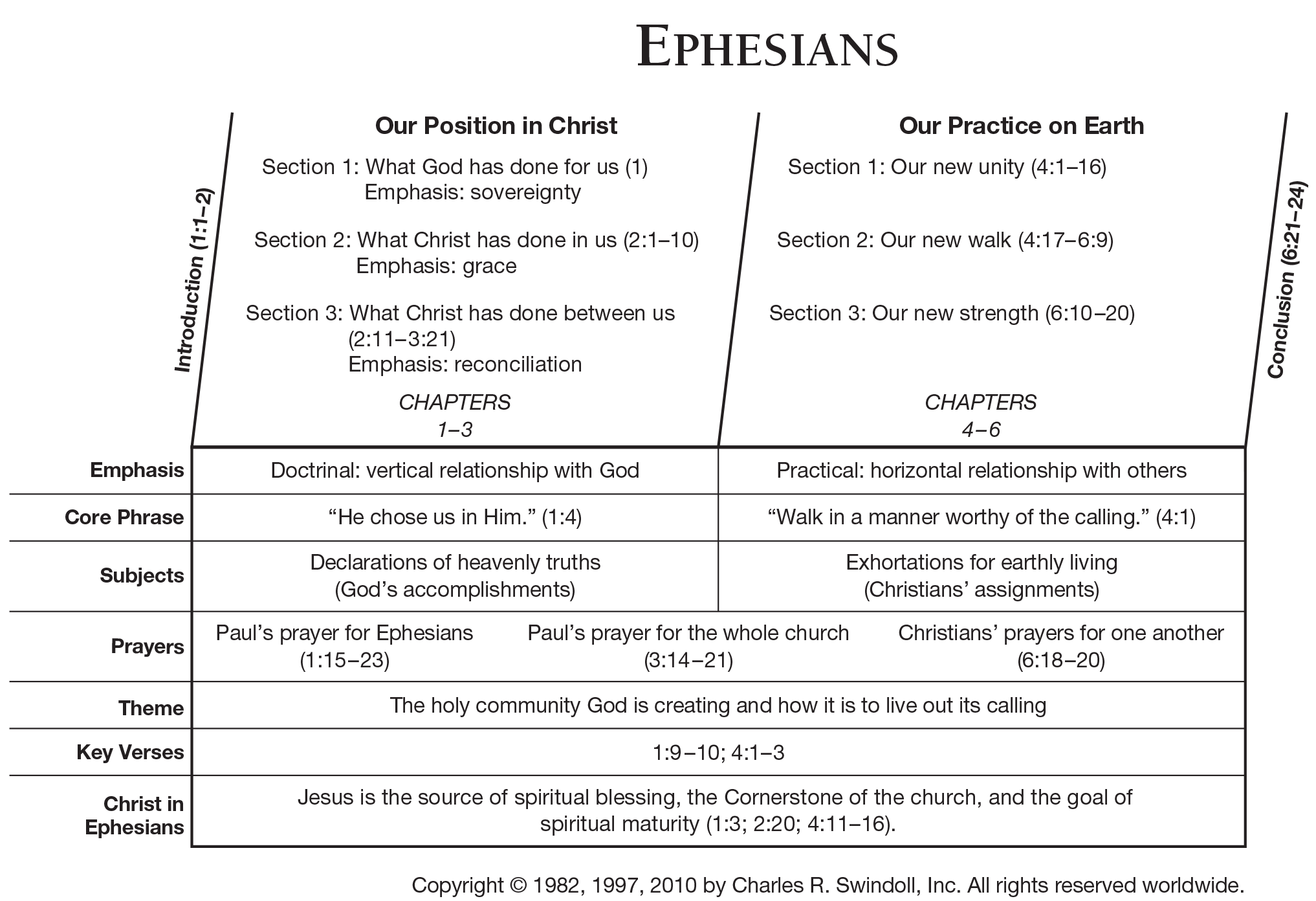
Click chart by Charles Swindoll -Note "EMPHASIS" --
Ephesians 1-3 = Doctrinal: vertical relationship with God
Ephesians 4-6 = Practical: horizontal relationship with others
Ephesians 4:25 Therefore, laying aside falsehood, SPEAK TRUTH EACH ONE of you WITH HIS NEIGHBOR, for we are members of one another. (NASB: Lockman)
Greek: Dio apothemenoi (AMPMPN) to pseudos laleite (2PPAM) aletheian hekastos meta tou plesion autou, hoti esmen (1PPAI) allelon mele.
BGT Διὸ ἀποθέμενοι τὸ ψεῦδος λαλεῖτε ἀλήθειαν ἕκαστος μετὰ τοῦ πλησίον αὐτοῦ, ὅτι ἐσμὲν ἀλλήλων μέλη.
Amplified: Therefore, rejecting all falsity and being done now with it, let everyone express the truth with his neighbor, for we are all parts of one body and members one of another. (Amplified Bible - Lockman)
ESV: Therefore, having put away falsehood, let each one of you speak the truth with his neighbor, for we are members one of another. (ESV)
Gundry - Therefore having put off falsehood [= lying], “be speaking truth, each of you, with his neighbor [Zechariah 8:16],” because we’re one another’s [body] parts.
NKJV: Therefore, putting away lying, "Let each one of you speak truth with his neighbor," for we are members of one another.
KJV Wherefore putting away lying, speak every man truth with his neighbour: for we are members one of another.
NET Therefore, having laid aside falsehood, each one of you speak the truth with his neighbor, for we are members of one another.
NIV Therefore each of you must put off falsehood and speak truthfully to his neighbor, for we are all members of one body.
NLT (revised) So stop telling lies. Let us tell our neighbors the truth, for we are all parts of the same body.
NLT: So stop telling lies. Let us tell our neighbors the truth, for we are all parts of the same body. (NLT - Tyndale House)
Phillips: Finish, then, with lying and tell your neighbour the truth. For we are not separate units but intimately related to each other in Christ. (Phillips: Touchstone)
Wuest: Wherefore, having put off the lie once for all, be speaking truth each with his neighbor, because we are members belonging to one another. (Eerdmans Publishing - used by permission)
Young's Literal: For this reason, laying aside falsehood, every one of you should speak the truth to his fellow man; for we are, as it were, parts of one another.
THEREFORE, LAYING ASIDE FALSEHOOD: Dio apothemenoi (AMPMPN) to pseudos:
- Therefore, laying aside falsehood, . Leviticus 19:11; 1Ki 13:18; Ps 52:3; 119:29; Pr 6:17; 12:19,22; 21:6; Isaiah 9:15; 59:3,4; 63:8; Jeremiah 9:3, 4, 5; Hosea 4:2; John 8:44; Acts 5:3,4; Colossians 3:9; 1Ti 1:10; 4:2; Titus 1:2,12; Rev 21:8; 22:15
- Ephesians 4 Resources - Multiple Sermons and Commentaries
- Ephesians 4:25 To Tell the Truth - Steven Cole
- Ephesians 4:26-27 How to Be Both Good and Mad - Steven Cole
- Ephesians 4:17-5:14 Study Guide (see dropdown menu) - John MacArthur
- Ephesians 4:26 Can Believers Be Angry Without Sinning? - John MacArthur
Related Passages:
Leviticus 19:11+ ‘You shall not steal, nor deal falsely, nor lie to one another.
Colossians 3:9+ Do not lie (present imperative with a negative see our need to depend on the Holy Spirit to obey) to one another, since you laid aside the old self with its evil practices,
1 Corinthians 4:5+ Therefore do not go on passing judgment before the time, but wait until the Lord comes who will both bring to light the things hidden in the darkness and disclose the motives of men’s hearts; and then each man’s praise will come to him from God.
1 Corinthians 6:9-11+ Or do you not know that the unrighteous (PAUL WILL GIVE A LIST OF THE UNRIGHTEOUS) will not inherit the kingdom of God? Do not be deceived; neither fornicators, nor idolaters, nor adulterers, nor effeminate, nor homosexuals, 10 nor thieves, nor the covetous, nor drunkards, nor revilers, nor swindlers (harpax = LIES & DECEIVES OTHERS), will inherit the kingdom of God. 11 Such were some of you (Cf Eph 4:17-19); but you were washed, but you were sanctified, but you were justified in the name of the Lord Jesus Christ and in the Spirit of our God. (Gal 5:21 GIVES A "QUALIFIER" - "those who practice [prasso in present tense = unabated lifestyle!] such things will not inherit the kingdom of God." - DON'T CONFUSE PAUL'S POINT - HE IS NOT SPEAKING OF LOSS OF INHERITANCE OR REWARDS OF BELIEVERS BUT OF LOSS OF "THE KINGDOM" = HEAVEN, ETERNAL LIFE!)
John 8:44 “You are of your father the devil, and you want to do the desires of your father. He was a murderer from the beginning, and does not stand in the truth because there is no truth in him. Whenever he speaks a lie, he speaks from his own nature, for he is a liar and the father of lies.
Genesis 3:4+ (THE LIES BEGIN...) The serpent said to the woman, “You surely will not die!
Revelation 22:15+ (HABITUAL LYING WILL LAND YOU IN HELL!) “But for the cowardly and unbelieving and abominable and murderers and immoral persons and sorcerers and idolaters and all liars, their part will be in the lake that burns with fire and brimstone, which is the second death.”
TAMING A LYING
TONGUE
Paul begins a list of put offs/put on's and these makes a good checklist for those who profess Christ (See another list). Are we characterized by the positive aspects of behavior in this list? If so, then we can be assured we have truly put off Adam's clothes (1Co 15:22) and been clothed with Christ's righteousness (Gal 3:27). Our new (supernaturally enabled) practices affirm our new position! Remember also that beginning in Ephesians 4-6 there are 40 commands (compared to only one in 1-3 - "remember" in Eph 2:11) and in the 22 verses in Ephesians 4:25-5:14 there are 20 commands, all except one being in the present imperative (aorist imperative in Eph 4:31), several being in the present imperative with a negative. So what's the point? Recall Eph 4:1-2 called us to a worthy walk and if we look at the traits in Eph 4:2, clearly Paul is calling us to walk like Jesus walked. But you might protest, "That is Jesus and He is God, so how could we be expected to walk like Him?" That's a fair question. The answer is that Jesus, while never ceasing to be God, walked as a perfect Man, perfectly in tune with and continually enabled by the Holy Spirit (cf Acts 10:37-38+), thus giving all of His followers a pattern which they could at least potentially follow. The truth is that we cannot keep even ONE of the 41 commands in Ephesians in reliance upon our own natural strength, but we can only keep them by relying wholly on the Holy Spirit. For more on this vitally important truth which seems not to be widely known in the modern evangelical church see the discussion of The Holy Spirit-Walking Like Jesus Walked!.
John Phillips rightly notes that "Complete deliverance from the old nature is expressed in a converted disposition—including a transformed tongue, which James said no man can tame. In Ephesians 4:25 Paul moved from principles of the faith to the practice of the faith. He started spelling things out, giving specific examples of what happens when we put off the old nature and put on the new nature. (See Exploring Ephesians & Philippians: An Expository Commentary)
Therefore, laying aside (apotithemi, cf use in Ep 4:22+) falsehood (pseudos) - Therefore (dio - term of conclusion.) is a relatively emphatic marker of a result, usually denoting that the inference is self-evident. Therefore as those created in likeness of God (Eph 4:24+), Paul calls for there to be a "family likeness." He is transitioning from the principles and precepts of the faith (being renewed in our minds and putting on the new life Eph 4:22-24) to the personal practice of our faith, providing a "list" of specific put off/put on "miracles" which should mark the new clothes of every new man in Christ. As Steven Cole puts it Paul "goes from preaching to meddling", listing specific sins that characterized the life of the old man and the corresponding godly behavior of the new man. This description continues Paul's exhortation in Eph 4:1-2 of a walk which is worthy of their calling. Laying aside falsehood is the first filthy garment that is to be cast aside, for it has no part in the life of the new man in Christ. As new creatures in Christ we are to display the life and loveliness of the Lord Jesus in our everyday lives. Laying aside is not a command in Ephesians (but it is in Col 3:9) but is in the aorist tense calling for a once and for all, definite action. The stripping off is to be done at once and for good.to cease doing what one is accustomed to doing. Stop doing it. "Throw" it off like you would dirty, foul smelling clothes! Be done with it!
THOUGHT - Beloved, is lying (even so called little "white lies") one of those skeletons that lies "hidden in the darkness" of your heart (1Cor 4:5+).
A T Robertson succinctly on why therefore - Because of putting off the old man, and putting on the new man.
THOUGHT - Some writers would interpret Eph 4:25a as "having put off falsehood" as that act which occurred when we "lay aside the old self" (Eph 4:22) interpreting that "laying aside" as synonymous with our new birth, our regeneration (e.g., see ESV rendering Eph 4:24ESV). While this certainly is true positionally once we are in Christ (in Whom there is no falsehood or lying), it is still true that we must practice our position every day for the remainder of our short time on earth. And so in Colossians 3:9+ Paul commands believers "Do not lie present imperative with a negative see our need to depend on the Holy Spirit to obey) to one another, since you laid aside the old self (When? At new birth, regeneration) with its evil practices." It will be an ongoing struggle, a daily battle with our still present fallen flesh (cf our three inveterate mortal enemies the world, the flesh and the devil) that is within our mortal bodies. And yet because of the Cross, Christ's death, burial, resurrection and ascension, He has attained victory over the fallen flesh and on top of that has sent us the "Helper", the omnipotent Holy Spirit (Acts 2:33+, Lk 24:49+), to Whom we daily yield our members that He might empower us for the incessant war of the fallen flesh. As we rely on Him, He enables us to make the right, godly choices each day and thereby to experience in real time the victory that Christ secured on the Cross over our mortal foes (especially the fallen flesh) (See Gal 5:16-17+). I think this is part of what Paul meant when he commanded his young disciple to "fight (present imperative see our need to depend on the Holy Spirit to obey) the good fight of faith; take hold of (aorist imperative see our need to depend on the Holy Spirit to obey) the eternal life to which you were called." (1Ti 6:12+). In sum, since you are now in Christ (have put off the old man - cf 1Co 15:22+) and are enabled by His Spirit, now you must choose to lay aside all the dirty, filthy clothes which the fallen flesh attempts to enrobe you in (so to speak) each day, doing so all for the glory of the Father and through His Son. Amen.
John Eadie on therefore - Paul passes to a deduction in the form of an application. (Ed: The things just explained being so, now work them out is the idea). Since the old man and all his lusts are to be abandoned, and the new man assumed who is created in the righteousness and holiness of the truth—aletheia; the vice and habit of falsehood—pseudos—are to be dropped. (Col. 3:9). (Ephesians 4 Commentary)
S Lewis Johnson - There is always a needed emphasis on the Christian use of the tongue. Even George Eliot said, “Blessed is the man who having nothing to say, abstains from giving wordy evidence of the fact.” It wouldn’t be so bad if the only problem was the fact that we weren’t saying anything, but often we say things that are very disturbing, very harming, upset others, actually things that not only disturb them but can disturb a great number of people.....John Chrysostom, the 4th Century preacher whose name means “golden-tongue,” says, “If the eye sees a serpent, does it deceive the foot? If a tongue tastes bitter, does it deceive the stomach?” The man who tells a lie is really a pest in Christian circles. So, putting away the lie, speak every man truth with his neighbor, for we are members one of another. (Sermon)
Moule adds that in the parallel passage in Col 3:9-10 "truthfulness is connected with "new creation." He who is "in Christ" is, above all things, in a region of light and of right, whose first result will be the aim to do an speak truth; the truth of entire and unselfish sincerity. (The Epistle to the Ephesians)
Hendriksen - Lying is not only wrong because it makes light of the intrinsic excellence of the truth, but also because it causes trouble, friction, disunity and sadness in the church. The law of love certainly implies truthfulness. (Ephesians)
In summary, this verse the verb signifies that the saved readers are to take an action (their practice) that is in agreement with their change in identity (their position), from the old man (who practiced lying) to the new man who is called to speak truth (in love). Apotithemi means we as new men in Christ are to discard, strip off or cast away lies and falsehood. Note that we are to lay aside every form of dishonesty, including shading the truth, exaggerating, failure to keep a promise, betrayal of a confidence, etc. There is no such thing as a "little white lie" for those who are positionally holy and blameless. The believer's word is to be totally trustworthy and yes should mean yes and no should mean no. In the Sermon on the Mount Jesus called his hearers to the same high standard declaring...
Again, you have heard that the ancients were told, 'YOU SHALL NOT MAKE FALSE VOWS, BUT SHALL FULFILL YOUR VOWS TO THE LORD.' 34 "But I say to you, make no oath at all, either by heaven, for it is the throne of God, 35 or by the earth, for it is the footstool of His feet, or by Jerusalem, for it is THE CITY OF THE GREAT KING. 36 "Nor shall you make an oath by your head, for you cannot make one hair white or black. 37 But let your statement be, 'Yes, yes' or 'No, no'; and anything beyond these is of evil. (Mt 5:33-35+, Mt 5:36-37+)
The most dangerous of all falsehoods is a slightly distorted truth.
A half truth is a whole lie.
Steven Cole observes that...
One of the greatest moral issues that we all struggle with is that of telling the truth, the whole truth, and nothing but the truth. The book, The Day that America Told the Truth, states (p. 45) that 91 percent of us lie regularly (cited by Alistair Begg, “Cedarville Torch, Fall, 1994, p. 15). “Of the people interviewed, 92 percent said the main reason for their lying was to save face, and 98 percent said the reason they told lies was so as not to offend people” (ibid.).
Another survey of 20,000 middle- and high-schoolers indicated that 92 percent admitted to lying to their parents in the previous year, and 73 percent said that they told lies weekly. Despite these admissions, 91 percent of all respondents said they were “satisfied with my own ethics and character” (Reader's Digest [Nov., 1999], pp. 81-82). Their consciences were insensitive to their sin! (cp Ro 1:32+)
Lest you think, “Well, these surveys were probably taken among pagans,” pollster George Gallup indicts us when he says, “church attendance makes little difference in people’s ethical views and behavior with respect to lying, cheating, pilferage, and not re-porting theft” (cited by Vernon Grounds, “Focal Point” [Summer, 1995], p. 8).
We bend the truth in many ways. There is the half-truth. You sort of tell the truth, but not the whole truth. You tell your employer, “I wasn’t feeling well,” which was sort of true. But, in reality, you were not so ill as to miss work. You just wanted to do something else. Or, there is the white lie, a supposedly “innocent” lie that doesn’t hurt anyone. “Yes, your new hairdo is beautiful!” “Thank you, I just love fruitcake!”
There are the lies that cover for someone or for ourselves: The boss is in the next room, but you say, “He’s not here right now to take your call.” Often, the rationalization for cover-up lies is that the truth would hurt too many people. This was the excuse behind the Watergate scandal that brought down the Nixon administration. It would “hurt the country” if the truth were known!
Or, lies often go undercover as exaggeration. You stretch the story a bit to make yourself look better or to evoke sympathy. One of the easiest lies to fall into is the silent lie. This is where someone assumes something about you, which you know to be untrue. But, their mistaken view makes you look good, so you just let it go by and don’t say anything to correct it. In a similar way, we use evasive lies. We change the subject or don’t directly answer the question.
We also bend the truth by cheating on our income taxes, always with the justification that the government wastes so much money or that the tax system is unfair to the little guy (that’s me!). We cheat on tests with the excuse, “everyone else does it.” Or, we pilfer from our employer with the rationalization that they don’t pay me enough. Or, if the clerk at the store makes a mistake to our advantage, we don’t say anything to make it right. We figure, “They over-charge for everything, anyway!” (To Tell the Truth Ephesians 4:25)
Gregory Brown - Why do believers (and people in general) practice lying, even though it is harmful?
- We lie in order to make ourselves look better (a little exaggeration makes a story better).
- We lie to protect ourselves from consequences (often to cover up a failure).
- We lie to gain something we want (like a good grade, a promotion, or tax benefits).
Scripture says that Satan is “a liar and the father of lies” (John 8:44). When we lie, cheat, or exaggerate, we mimic our old father, Satan. It was his lie in the Garden that led to the fall. In fact, as ruler of this world, he built the entire world system on lies. Success is this, beauty is that, marriage is this, etc. The world is built on lies. The enemy lies to pull people further away from God, and further away from God’s plans for their lives. This is exactly what Satan did in the Garden to lead Adam and Eve away from God, and he does the same to people today.
When Christians lie, they not only mar the image of God, but also push themselves and others farther away from God. The world says, “If this person is a Christian, then I want nothing to do with Christ.” When we lie, cheat, and deceive, we open the door for the devil to work in and through us.
In addition, Revelation 22:15+ says, “Outside are the dogs, those who practice magic arts, the sexually immoral, the murderers, the idolaters and everyone who loves and practices falsehood.” This doesn’t mean that we are saved by our works, but our works do prove if we are saved. Those who practice a lifestyle of lying are not saved. Yes, a believer may stumble in this area, and if he does, he must confess and repent. But if this is his continual practice, then he may not be born again.
Laying aside (659) (apotithemi from apo = away from, marker of dissociation, implying a rupture from a former association, separation, departure, cessation, any separation of one thing from another by which the union or fellowship of the two is destroyed + tithemi = put, place) means literally to put or take something away from its normal location and put it out of the way. It was used literally of runners who participated in the Olympic games who cast off their clothes and running nearly completely naked in the stadium.
Apotithemi - 9x in 9v - laid aside(1), lay aside(3), laying aside(1), put(1), put...aside(1), putting aside(2). - Matt 14:3; Acts 7:58; Rom 13:12; Eph 4:22, 25; Col 3:8; Heb 12:1; Jas 1:21; 1 Pet 2:1.
Paul used apotithemi in his exhortation to the saints at Rome, writing that "The night is almost gone, and the day is at hand. Let us therefore lay aside the deeds of darkness and put on the armor of light. (Ro 13:12+)
In his letter to the predominantly Gentile saints at Colossae Paul exhorting them based on their new position in Christ (and no longer in Adam)...
But now you also, put them all aside: (aorist imperative = do this now! do it effectively! it is urgent!) anger, wrath, malice, slander, and abusive speech from your mouth. 9 Do not lie (present imperative with a negative see our need to depend on the Holy Spirit to obey) to one another, since you laid aside the old self (man) with its evil practices, (Col 3:8+; Col 3:9+)
The writer of Hebrews used apotithemi in his great exhortation writing...
Therefore, since we have so great a cloud of witnesses surrounding us, let us also lay aside every encumbrance, and the sin which so easily entangles us, and let us run with endurance the race that is set before us, (Hebrews 12:1+)
Peter addressing his believing readers exhorted them writing...
Therefore, putting aside (apotithemi) all malice and all guile and hypocrisy and envy and all slander, 2 like newborn babes, long for the pure milk of the word, that by it you may grow in respect to salvation (1Pe 2:11+, 1Pe 2:2+)
Luke gives us a literal use of apotithemi to describe the Jewish leaders in Jerusalem who "began stoning (Stephen), and the witnesses laid aside (apotithemi) their robes at the feet of a young man named Saul. " (Acts 7:58+). They laid aside their outer garments so they could more freely do their wicked work. The Christian lays aside the following attitudes, so he can be free to do the righteous work of the Lord.
Falsehood (5579) (pseudos from pseudomai = to lie) describes an untrue statement, an intentional violation of the truth, a lie or a deception. Falsehood is that which is in the state of being untrue. Pseudos is the content of a false utterance. Pseudos is conscious and intentional falsehood. In a broad sense, pseudos is whatever is not what it seems to be or professes to be (the antithesis of truth).
Ellicott - falsehood in every form is a chief characteristic of the old man. (Ephesians 4 Commentary Online)
Webster says a lie is an assertion of something known or believed by the speaker to be untrue with intent to deceive. It is an intentionally false statement. Biblically since God is truth unchanged and unchanging, a lie is the very antithesis of Who He is and who we are to now be in Christ. The old adage says "Like father, like son." When we speak truth, we are like our Father, but when we speak falsehoods, we are more like our old father, Satan (Jn 8:44)!
A lie is any statement or act designed to deceive another person. The motivation for most lying is a desire either to hurt the one against whom the lie is directed or to protect oneself, usually out of fear or pride.
The Evangelical Dictionary of Biblical Theology says that "The sanctity of truth is fundamental in biblical teaching since it is based on the nature and character of God. Therefore, to despise truth is to despise God, and the Scriptures treat this topic with profound seriousness. In the garden of Eden the serpent denied the truth of God’s pronouncement and encouraged the woman to act in defiance of divine truth (Ge 3:4)... Lying undermines moral standards and is, therefore, often associated with even more glaring sins (Lie, Lying - Baker's Evangelical Dictionary of Biblical Theology)
Related Resources:
- Lie, Lying - Hastings' Dictionary of the Bible,
- Lie; Lying - International Standard Bible Encyclopedia
- Lying - Torrey's Topical Textbook
- See list of put on's and put off's
There are 10 uses of pseudos in the NT...
John 8:44 "You are of your father the devil, and you want to do the desires of your father. He was a murderer from the beginning, and does not stand in the truth, because there is no truth in him. Whenever he speaks a lie, he speaks from his own nature; for he is a liar, and the father of lies.
Romans 1:25 (note) For they exchanged the truth of God for a lie, and worshiped and served the creature rather than the Creator, who is blessed forever. Amen. (Comment: Literally "the lie" and here stands by metonymy for an idol. See Isaiah 44:20 below.)
Ephesians 4:25 Therefore, laying aside falsehood, speak truth, each one of you, with his neighbor, for we are members of one another.
2Thessalonians 2:9 that is, the one whose coming is in accord with the activity of Satan, with all power and signs and false wonders, (Comment: Literally "signs and wonders of a lie". Both bear the stamp of fraud. Here pseudos refers to false, fictitious, pretended miracles calculated to deceive - in this case to deceive people into the acknowledgement of the false claim that the Antichrist is deity.)
2Thessalonians 2:11 And for this reason (because of their willful rejection) God will send upon them a deluding influence (literally a working -- energeia -- of error) so that they might believe what is false, (literally "the lie" in this case deluding men to believe Satan and not God)
1John 2:21 I have not written to you because you do not know the truth, but because you do know it, and because no lie is of the truth.
1John 2:27 And as for you, the anointing which you received from Him abides in you, and you have no need for anyone to teach you; but as His anointing teaches you about all things, and is true and is not a lie, and just as it has taught you, you abide in Him.
Revelation 14:5 And no lie was found in their mouth; they are blameless.
Revelation 21:27 and nothing unclean and no one who practices abomination and lying, shall ever come into it, but only those whose names are written in the Lamb's book of life.
Revelation 22:15 Outside are the dogs and the sorcerers and the immoral persons and the murderers and the idolaters, and everyone who loves and practices lying. (Comment: How serious is lying? Look at the company God places it with and the reward it secures!)
There are 34 uses of pseudos in the Septuagint (LXX) (Job 16:8; Ps. 4:2; 5:6; 58:3; 59:12; 62:4; Prov. 9:12; 14:5, 25; 24:2, 22; Isa. 28:15, 17; 30:12; 44:20; Jer. 3:10, 23; 5:2; 9:3; 13:25; 23:14, 32; 37:14; 43:2; Ezek. 33:31; Dan. 8:25; 11:23; Hos. 4:2; 7:3, 13; 11:12; Mic. 2:11; Zech. 5:4; Mal. 3:5) Here is an interesting use of pseudos in the OT...
Isaiah 44:20 He (referring to overt idol worshipers) feeds on ashes (what a picture! Practicing idolatry is like feeding on ashes! It will never satisfy, is ever disgusting and in the end results in death!); a deceived heart has turned him aside (idolatry promises but does not follow through). And he cannot deliver himself (from bondage to idolatry. He is like a drug addict trapped by the drug, in this case a godless idol!), nor say, "Is there not a lie (Lxx = pseudos) (an idol) in my right hand" (Comment: Pseudos in this use refers to an idol or idolatry)
Psalm 5:6 Thou dost destroy those who speak (habitually, as their lifestyle) falsehood (Lxx = pseudos). The LORD abhors the man of bloodshed and deceit.
QUESTION - What does the Bible say about lying? Is lying a sin?
ANSWER - The Bible is clear that lying is a sin and is displeasing to God. The first sin in this world involved a lie told to Eve. The Ten Commandments given to Moses includes: “You shall not bear false witness against your neighbor” (Exodus 20:16).
In the early church, Ananias and Sapphira lied regarding a donation in order to make themselves look more generous than they really were. Peter’s rebuke is stern: “Ananias, why has Satan filled your heart to lie to the Holy Spirit?” (Acts 5:3). God’s judgment was sterner: the couple died as a result of their sin of lying (Acts 5:1–11).
Colossians 3:9 says, “Do not lie to each other, since you have taken off your old self with its practices.” Lying is listed in 1 Timothy 1:9-11 as something practiced by the lawless. Furthermore, liars will be among those judged in the end (Revelation 21:8). In contrast, God never lies (Titus 1:2). He is the source of truth. “It is impossible for God to lie” (Numbers 23:19).
Jesus called Himself the way, the truth, and the life (John 14:6), and He expects those who follow Him to be people of truth. The truth is to be expressed in love (Ephesians 4:15), offering hope to those seeking redemption from the lies of the world.
For an explanation of the instances in the Bible in which lying appears to be acceptable, please see our "Is it ever right to lie?" article.GotQuestions.org
QUESTION - Is it ever right to lie?
ANSWER - The Bible nowhere presents an instance where lying is considered to be the right thing to do. The ninth commandment prohibits bearing false witness (Exodus 20:16). Proverbs 6:16-19 lists “a lying tongue” and “a false witness who pours out lies” as two of the seven abominations to the Lord. Love “rejoices with the truth” (1 Corinthians 13:6). For other Scriptures that speak negatively of lying, see Psalm 119:29, 163; 120:2; Proverbs 12:22; 13:5; Ephesians 4:25; Colossians 3:9; and Revelation 21:8. There are many examples of liars in Scripture, from Jacob’s deceit in Genesis 27 to the pretense of Ananias and Sapphira in Acts 5. Time after time, we see that falsehood leads to misery, loss, and judgment.
There are at least two instances in the Bible where lying produced a favorable result. For example, the lie the Hebrew midwives tell Pharaoh seems to result in the Lord’s blessing on them (Exodus 1:15-21), and it probably saved the lives of many Hebrew babies. Another example is Rahab’s lie to protect the Israelite spies in Joshua 2:5. It is important to note, however, that God never condones these lies. Despite the “positive” outcome of these lies, the Bible nowhere praises the lies themselves. The Bible nowhere states that there are instances where lying is the right thing to do. At the same time, the Bible does not declare that there is no possible instance in which lying is an acceptable option.
The question then remains: is there ever a time when lying is the right thing to do? The most common illustration of this dilemma comes from the life of Corrie ten Boom in Nazi-occupied Holland. Essentially, the story is this: Corrie ten Boom is hiding Jews in her home to protect them from the Nazis. Nazi soldiers come to her home and ask her if she knows where any Jews are hiding. What is she to do? Should she tell the truth and allow the Nazis to capture the Jews she was trying to protect? Or, should she lie and deny that she knows anything about them?
In an instance such as this, where lying may be the only possible way to prevent a horrible evil, perhaps lying would be an acceptable thing to do. Such an instance would be somewhat similar to the lies of the Hebrew midwives and Rahab. In an evil world, and in a desperate situation, it may be the right thing to commit a lesser evil, lying, in order to prevent a much greater evil. However, it must be noted that such instances are extremely rare. It is highly likely that the vast majority of people in human history have never faced a situation in which lying was the right thing to do. GotQuestions.org
Related Resources:
- Speak Truth with Your Neighbor - John Piper
- Is It Ever Right to Lie? - John Piper
D L Moody - WE have got nowadays so that we divide lies into white lies and black lies, society lies, business lies, and so on. The Word of God knows no such letting-down of the standard. A lie is a lie, no matter what are the circumstances under which it is uttered, or by whom. I have heard that in Siam they sew up the mouth of a confirmed liar. I am afraid if that was the custom in this land, a good many would suffer.
Parents should begin with their children while they are young and teach them to be strictly truthful at all times. There is a proverb: “A lie has no legs.” It requires other lies to support it. Tell one lie and you are forced to tell others to back it up.
F B Meyer contrasts the Old Man and the New Man...
THE OLD MAN. (Eph 4:22+) - The old man is the aggregate of habits and methods of life, which marked us before conversion (ED: EVERYTHING WE ONCE WERE IN ADAM). The phrase describes the impression which we produced as men and women upon our fellows. What we were wont to be, and say, and do. That form of character and life which was ours before the great change operated through faith in Jesus. It is called the old man, as if there were but one, because the habits and tastes, the thoughts and acts of men, before conversion, have much in common. There is not much to choose between them. It is one evil nature; one likeness to fallen Adam; one type of evil, though its forms are slightly modified in different temperaments and by special circumstances. It is under the control of deceitful lusts (Eph 4:22+). In other words, it is shaped (present tense = continually; passive voice = emphasizes that these lusts continually exerted power on us in our prior state - old man) by the passionate desires which have their origin in the strong natural tendencies of our being (Ed: flesh). These were given us by God to be the motive-forces of our nature, but not to rule. For when once they are permitted to usurp this position, corruption ensues, and the nature rots piecemeal before their insidious action (2Pe 1:4+)--as the body of the leper beneath the living death that eats away his flesh. Ah, deceitful lusts! promising liberty (2Pe 2:19+), and happiness, and joy, but resembling the Syren sisters, whose upper form was fair, but whose lower extremities were foul; whilst whose sweet songs allured the unwary mariner only to ruin. We must not defer this "putting off." The tense (aorist tense) indicates the sudden resolve of the will, inspired and empowered by the Holy Spirit to be no longer under the dominion of these terrible passions. Once and for ever let us divest ourselves of them; as the beggar his rags, or as Lazarus the cerements of death.
THE NEW MAN. (Eph 4:24+) - This is the aggregate of blessed habits that mark the life of the converted the white robe of purity, the girdle of self-restraint, the silver of humility, the jewels of holy character. All through the Epistles we are bidden to don it. "Put on the armor of light." (Ro 13:12+) "Put on, as God's elect, a heart of compassion.'' (Col 3:12+) "Put on the Lord Jesus Christ." (Ro 13:14+) It is the new man, because the habits and character of the children of God are very similar. There is a family likeness common to all. It is after God, because it is created in His likeness. It is the fashion of God in human nature, perfectly exemplified once in Jesus Christ, and now waiting to be imparted by the Holy Ghost. It is righteous toward man. It is holy toward God. It is true, perfectly transparent and sincere. Put on this holy thing! Created in Jesus, and therefore not to be woven by human effort or spun by outward obedience to rites (Ed: Many of us need to read that last statement again! Legalism is subtle.), but to be simply assumed. Put it on by faith. Do not try to build up Christ-likeness by your repeated endeavors (Ed: Do it by dying to your self-efforts). Just assume it by faith (Ed: But remember that faith is an "action verb" that manifest itself in obedience). Believe it is yours. Reckon that it is so (cf Ro 6:11+). Go out believing that Christ's likeness is on you, and His beauty clothing you as a beautiful robe; and men shall increasingly realize that it is not you but Christ. The beauty of the Lord will be upon you; and the life of Jesus will be manifest in your mortal body (2Co 4:10, 11, cf 2Co 2:14+), both in life and death. (Ephesians - A Devotional Commentary)
No Lying - A father was looking at bicycles with one of his children when a deliveryman came into the store. He didn’t see a TV set perched on a stand, and with his cart stacked high with boxes he hit the television and sent it crashing to the floor. As father and son watched, the store manager said, “Don’t worry. We won’t make you pay for it. We’ll just tell the manufacturer it was damaged in shipping, and he’ll give us a new one.” A lie!
The father, a believer in Christ, left the store without making a purchase. He did not want to give his business to a man who would lie without giving it a thought.
It’s pretty tough not to fall into a pattern of lying. But if we give in to the temptation to lie, soon we are doing it so often that we’re not even aware of it anymore. It becomes a way of life. What we don’t realize is that for the few bucks we may save, we’ve sold out on a basic principle of the Bible (Ep 4:25) and compromised our witness for Christ.
The standards of God’s Word are high. We must not lower them for the sake of financial gain or because we fear that it’s the only way our business can survive. Our rule in business and in all of life should be: “No Lying.” -- David C. Egner (Our Daily Bread, Copyright RBC Ministries, Grand Rapids, MI. Reprinted by permission. All rights reserved)
Tell the truth and tell it right,
A lie will never do;
The Bible says that God is truth—
And He wants truth from you. —JDBThe ability to lie is a liability.
SPEAK TRUTH EACH ONE OF YOU WITH HIS NEIGHBOR: laleite (2PPAM) aletheian hekastos meta tou plesion autou:
- SPEAK TRUTH, EACH ONE of you, WITH HIS NEIGHBOR Ep 4:15; Proverbs 8:7; 12:17; Zechariah 8:16,19; 2Corinthians 7:14; Colossians 3:9
- Ephesians 4 Resources - Multiple Sermons and Commentaries
- Ephesians 4:25 To Tell the Truth - Steven Cole
- Ephesians 4:26-27 How to Be Both Good and Mad - Steven Cole
- Ephesians 4:17-5:14 Study Guide (see dropdown menu) - John MacArthur
- Ephesians 4:26 Can Believers Be Angry Without Sinning? - John MacArthur
Related Passage:
Ephesians 4:15 (NOTE ASSOCIATION OF TRUTH AND MATURATION) but speaking the truth in love, we are to grow up in all aspects into Him who is the head, even Christ,
Ephesians 4:21 if indeed you have heard Him (HEARD TRUTH) and have been taught in Him (TAUGHT TRUTH), just as truth is in Jesus,
Ephesians 4:24 (COMPARE TRUTH) and put on the new self, which in the likeness of God has been created in righteousness and holiness of the truth.
SPEAKING THE TRUTH
IN LOVE
Paul is quoting from Zechariah 8:16 "These are the things which you should do: speak the truth to one another; judge with truth and judgment for peace in your gates.
John Phillips on Paul's OT quote from a post-exilic prophet Zechariah - One of his great burdens was to urge the restored Jewish remnant not to repeat the sins that had made their exile necessary. Throughout chapter 8, Zechariah reiterated the phrase, "Thus saith the Lord of hosts," as the Lord contrasted His former acts of government and His present acts of grace. One of the fundamentals for staying in the land, the Lord said, was to speak the truth. How significant and sad that centuries later the Jewish people ended up hiring false witnesses against the Lord. They paid for this sin when they were exiled again for nearly two thousand years. Paul picked up Zechariah's warning and addressed it to Christian believers. But there are some fundamental differences between the restored Jewish remnant and Christian believers. For instance, we are not in the land; we are in the Lord. Our position is not in Canaan; our position is in Christ. We are not concerned with a place; we are concerned with the person of Christ. Israel could lose its position—and it did; we cannot lose our position in Christ. We have something Israel did not have. Israel had the divine statute, but we have the Holy Spirit! If Israel needed to put away lying, how much more should we. All deceit grieves the Holy Spirit and consequently leaves us bereft of joy, peace, and power. There is something particularly deceitful about lying to a fellow member of the body of Christ, but all lying is destructive. We are to have a transformed tongue, one that speaks the truth in love. (See Exploring Ephesians & Philippians: An Expository Commentary)
SPEAK (laleo) TRUTH (aletheia), EACH ONE (hekastos) of you, WITH HIS NEIGHBOR (plesion) - Paul is not suggesting we speak truth but commanding it by using the present imperative which calls for this to be the believer's habitual way of speaking (i.e., not lying), the action which characterizes his or her life, an attitude/action that can only be carried out by jettisoning self-reliance and relying wholly on the Holy Spirit Who gives us the DESIRE and the POWER. Php 2:13NLT+).
The best way to kill the lie is by telling the truth.
-- William Hendriksen
Speak truth - Paul had repetitively emphasized truth in this section - He had just explained that "truth was in Jesus" (Ep 4:21-note), that these Gentile believers had put on a new garment, the new self or new man (Ep 4:24-note), having been "created in righteousness and holiness of the truth" and that they were to be "speaking the truth in love" (Ep 4:15-note) which would facilitate growing up in all aspects into Christ the Head of the Body, the source of all Truth.
Moule on Speak...truth: The application of the decisively accepted principle of truth. Observe the sober and humbling practicality of the Apostle's precepts; as necessary now as ever. And earnestly observe the uncompromising condemnation, by the Gospel, of all kinds and phases of dishonesty. Nothing untruthful can possibly be holy. A pious fraud is, in the light of true Christianity, a most grievous sin. The emphasis laid on truthfulness in Scripture is all the more significant of the character and origin of Scripture when we remember the proverbial Oriental laxity about truth. Lying is a vice deeply characteristic of heathenism. And Indian missionary said of his first convert, "he would often come to me with tears in his eyes, saying, 'I told you a falsehood, but it seemed natural to me to say "yes" when I should say "no" and "no" when I should say "yes"'. Contrast Ps 15:2,3. (The Epistle to the Ephesians - Online)
John Eadie - Christians are to speak the whole truth, without distortion, diminution, or exaggeration. No promise is to be falsified—no mutual understanding violated. The word of a Christian ought to be as his bond, every syllable being but the expression of “truth in the inward parts.” The sacred majesty of truth is ever to characterize and hallow all his communications. It is of course to wilful falsehood that the apostle refers—for a man may be imposed upon himself, and unconsciously deceive others—to what Augustine defines as falsa significatio cum voluntate fallendi. As may be seen from the quotations made by Whitby and other expositors, some of the heathen philosophers were not very scrupulous in adherence to truth, and the vice of falsehood was not branded with the stigma which it merited. And (Ephesians 4 Commentary)
Gregory Brown - How should believers speak the truth to their neighbor?
When Paul refers to speaking truthfully, he does not just mean to stop telling lies, he means many other things as well:
1. Believers speak the truth by speaking God’s Word.
In John 17:17, Jesus prays, “Sanctify them by your truth, your word is truth.” As believers, we must speak the Word of God to one another. When God called Joshua to lead Israel into the promised land, he told him never to let the Word depart from his mouth, but to meditate on it day and night (Josh 1:8). Joshua was called to always speak the Word of God to others, and we must do likewise.
2. Believers speak the truth by exposing lies.
Many times, by standing quietly while others lie or believe lies, we implicitly take part in the deception. No! Speaking the truth includes exposing lies, as Paul later clarifies in Ephesians 5:11: “Have nothing to do with the fruitless deeds of darkness, but rather expose them.”
Sometimes the need arises to expose falsehood in an interpersonal or business relationship. When Christ went into the temple (John 2), he exposed cheating by speaking the truth. In the majority of Paul’s letters, he combats lies by teaching truth. We must do the same in our personal, church, and work relationships. We do this because it protects people, and because it honors God.
3. Believers speak the truth by challenging people in sin.
A common lie propagated in the world is that it’s polite, and therefore preferable, to be untruthful if the truth would upset somebody or make them angry. Scripture teaches the opposite. Proverbs 27:6 says, “Faithful are the wounds of a friend, but deceitful are the kisses of an enemy” (paraphrase). One of the ways that we speak truthfully is by lovingly challenging people in sin or who are falling away from God. This is what a true friend or neighbor does. Paul tells us how the church grows in Ephesians 4:15: “Instead, speaking the truth in love, we will in all things grow up into him who is the Head, that is, Christ.” When we lovingly speak the truth to one another, especially when one member is sinning, the body grows.
Speak (2980) (laleo) is the Greek verb meaning to make a sound and then to utter words. Vincent says that laleo is "used of speaking, in contrast with or as a breaking of silence, voluntary or imposed. Thus the dumb man, after he was healed, spake (Mt 9:33 "And after the demon was cast out, the dumb man spoke; and the multitudes marveled, saying (lego), "Nothing like this was ever seen in Israel.") and Zacharias, when his tongue was loosed, began to speak (Lk 1:64 "And at once his mouth was opened and his tongue loosed, and he began to speak in praise of God") The use of the word laleo ...contemplates the fact rather than the substance of speech. Hence it is used of God (Heb 1:1+), the point being, not what God said, but the fact that he spake to men. On the contrary, lego refers to the matter of speech. The verb originally means to pick out, and hence to use words selected as appropriate expressions of thought, and to put such words together in orderly discourse." (Vincent, M. R. Word studies in the New Testament).
Kenneth Wuest adds that "Laleo (was) used originally just of sounds like the chatter of birds, the prattling of children, (but was also used) of the most serious kind of speech. It takes note of the sound and the manner of speaking. One thinks of the words in the song In the Garden; “He speaks, and the sound of His voice is so sweet, the birds hush their singing.” (Wuest Word Studies - Eerdman Publishing Company Volume 1, Volume 2, Volume 3 - used by permission)
Truth (225) (aletheia from a = without + lêthô = that which is hidden or concealed, the combination meaning out in open) is the the unconcealed reality lying at the basis of and agreeing with an appearance; the manifested, the veritable essence of matter. Truth is an accurate representation of the facts. It is the property of being in accord with or conformity to fact or reality. It is exact accordance with that which is or has been or shall be. Aletheia - in Ephesians - Eph 1:13; 4:21, 24f; 5:9; 6:14
Truth is the property of being in accord with fact or reality as defined by God.
Whatever God says is Truth. Truth is a person, Christ Jesus.
TDNT explains the origin of aletheia this way - Etymologically aletheia means “nonconcealment.” It thus denotes what is seen, indicated, expressed, or disclosed, i.e., a thing as it really is, not as it is concealed or falsified. aletheia is “the real state of affairs,” e.g., the truth in law, or real events in history, or true being in philosophy... aletheia is “that which has certainty and force”... aletheia is “that on which one can rely”...aletheia is “the state of affairs as disclosed”... aletheia is “truth of statement” used with speaking (Lk. 4:25) or teaching (Mk. 12:14).... aletheia is “true teaching or faith” (2Cor. 13:8; 4:2; Gal. 5:7; 1Pe 1:22+) (Kittel, G., Friedrich, G., & Bromiley, G. W. Theological Dictionary of the New Testament. Eerdmans)
Truth then is the correspondence between a reality and a declaration which professes to set it forth. To say it another way, words are true when they correspond with objective reality. Persons and things are true when they correspond with their profession. Hence a truth is a declaration which has corresponding reality, or a reality which is correctly set forth. Since God is Himself the great reality, that which correctly sets forth His nature is pre-eminently the Truth.
Each one (1538)(hekastos from hékas = separate) every single one. This idea of separation or singling out is expressed still more strongly by heís hékastos.
Neighbor (4139) (plesion from pélas = near, near to) literally means near, quite near, nearby = position quite close to another position. Figuratively, plesion means to be near someone and thus be a neighbor. In context he refers especially to Christian brethren (as he explains - for we are members of one another -- it would be like the left hand speaking falsehood to the right hand!).
Plesion - 17x in 17v - Mt 5:43; 19:19; 22:39; Mk 12:31, 33; Luke 10:27, 29, 36; John 4:5; Acts 7:27; Rom 13:9f; 15:2; Gal 5:14; Eph 4:25; Jas 2:8; 4:12. NAS = near(1), neighbor(16).
John MacArthur - THE IMPORTANCE OF TRUTH - EPHESIANS 4:25
Why is it so important to tell the truth? Because we are members one of another. When we don’t speak the truth with each other, we harm our fellowship. For example, what would happen if your brain told you that cold was hot and hot was cold? When you took a shower, you’d either freeze to death or scald yourself! If your eye decided to send false signals to your brain, a dangerous curve in the highway might appear straight and you would crash. You depend on the honesty of your nervous system and of every organ in your body. The Body of Christ can’t function with any less than that. We cannot shade the truth with others and expect the church to function properly. How can we minister to each other, bear each other’s burdens, care for each other, love each other, build up each other, teach each other, and pray for each other if we do not know what is going on in each others’ lives? So be honest, “speaking the truth in love” (Eph. 4:15). (See Truth for Today: A Daily Touch of God's Grace)
FOR WE ARE MEMBERS OF ONE ANOTHER: hoti esmen (1PPAI) allelon mele:
- for we are members of one another Ep 5:30; Ro 12:5; 1 Cor 10:17; 12:1-27
- Ephesians 4 Resources - Multiple Sermons and Commentaries
- Ephesians 4:25 To Tell the Truth - Steven Cole
- Ephesians 4:26-27 How to Be Both Good and Mad - Steven Cole
- Ephesians 4:17-5:14 Study Guide (see dropdown menu) - John MacArthur
- Ephesians 4:26 Can Believers Be Angry Without Sinning? - John MacArthur
Related Passages:
Eph 5:30+ Christ nourishes and cherishes His body, the Church) because we are members of His body.
Ro 12:4+ For just as we have many members in one body and all the members do not have the same function, 5 so we, who are many, are one body in Christ, and individually members one of another.
1Cor 12:12+ For even as the body is one and yet has many members, and all the members of the body, though they are many, are one body, so also is Christ.
LYING IS DIVISIVE
TRANSFORMED TONGUE UNIFYING
Recall the charge in Eph 4:3+ was for the body of Christ to be "diligent to preserve the unity of the Spirit in the bond of peace." Lies divide, while truth unites. So He begins his put offs/put ons by focusing on the vital contributor to body unity.
Gundry - Therefore having put off falsehood [= lying], “be speaking truth, each of you, with his neighbor [Zechariah 8:16],” because we’re one another’s [body] parts. “Be getting angry and don’t be sinning [Psalm 4:4].” The sun isn’t to be setting on the provocation of your anger, 27 and don’t be giving a place for the Devil.
For we are members (melos) of one another - Gundry = " because we’re one another’s [body] parts" For (hoti) is a term of explanation which in this context gives the reason for changing lying into telling the truth. We is most likely focused on the unity of the body of Christ (cf Eph 2:13–22; 3:6, 14, 15; 4:1–6, 16), not people in general (although honesty is always the best policy). Recall that Jesus followers should especially speak the truth because we "have been taught in Him, just as truth is in Jesus." (Eph 4:21) Stott makes the point that "the avoidance of lies is of little use without the active pursuit of truth."
MacKay says "A lie is a stab into the very vitals of the Body of Christ. This is so because a lie is a sable shaft from the kingdom of darkness.…There is no place in the Christian ethic for the well-intentioned lie. In the moral behavior which Christ inspires, the end never justifies the means." (Quoted by Hughes - see Ephesians: The Mystery of the Body of Christ)
Stott adds that "fellowship is built on trust, and trust is built on truth. So falsehood undermines fellowship, while truth strengthens it." (Message of Ephesians )
THOUGHT - Paul is speaking of the members of the spiritual body of Christ in this context but by way of application, how important is this practice of speaking truth in a marriage covenant, where the two are one flesh! For covenant partners to lie to the one another is in a sense to lie to one's self! How foolish and deceived we are we when we walk in the darkness of falsehood in our marriages. Darkness is also a dangerous place because the Evil One rules over this realm and when we traffic in his kingdom by lying to one another in our marriage, we give the devil an opportunity, just as we do when we have unresolved anger (Ep 4:27+)
John Eadie on members - Christians are bound up together by reciprocal ties and obligations as members of the one body of which Christ is the one Head—the apostle glancing back to the image of Ep 4:16. Their being members one of another springs from their living union with Christ. Trusting in one God, they should therefore not create distrust of one another; seeking to be saved by one faith, they should not prove faithless to their fellows; and professing to be freed by the truth, they ought not to attempt to enslave their brethren by falsehood. Truthfulness is an essential and primary virtue. Chrysostom, taking the figure in its mere application to the body, draws out a long and striking analogy—“Let not the eye lie to the foot, nor the foot to the eye. If there be a deep pit, and its mouth covered with reeds shall present to the eye the appearance of solid ground, will not the eye use the foot to ascertain whether it is hollow underneath, or whether it is firm and resists? Will the foot tell a lie, and not the truth as it is? And what again if the eye were to spy a serpent or a wild beast, will it lie to the foot?” etc. (Ephesians 4 Commentary)
Ellicott on members of one another- The force of the exhortation does not rest on any mere ethical considerations of our obligations to society, or on any analogy that may be derived from the body (Chrysostom), but on the deeper truth that in being members of one another we are members of the body of Christ (Ro. 12:5+), of Him who was the truth.
Gregory Brown - Who is Paul referring to when he says “neighbor” in Ephesians 4:25?
Now, honesty is a duty that believers owe everybody; however, in this passage, Paul specifically refers to our Christian neighbors—the church. This is clear from the rest of the verse, “speak truthfully to his neighbor, for we are all members of one body.” Paul’s argument is that lying to a member of the church is as foolish as the eye lying to the brain. It is like lying to ourselves. It is both illogical and dangerous (ED: BUT DON'T WE IN A SENSE "LIE TO OURSELVES" WHEN WE WILLFULLY CHOOSE TO SIN? JUST A THOUGHT TO PONDER!) However, let us also consider that Paul probably says this to the Ephesians because they were still lying to each other. They were still wearing the old clothes of deception, and we often are as well.
Members (3196) (melos) is literally a limb or member of the body. Here melos is used metaphorically of "members" ("limbs") of the Church of which Christ is the Head.
Melos - 34x in 24v - Matt 5:29f; Rom 6:13, 19; 7:5, 23; 12:4f; 1 Cor 6:15; 12:12, 14, 18ff, 22, 25ff; Eph 4:25; 5:30; Col 3:5; Jas 3:5f; 4:1. NAS = member(4), members(27), part(1), parts(2).
One another (240) (allelon from állos = another) means just what it says. Reciprocally, mutually, each other.
ILLUSTRATION - The importance of the one another's is like the sequoia trees of California which tower as high as 300 feet above the ground. You might be surprised to discover that these giant trees have unusually shallow root systems that reach out in all directions to capture the greatest amount of surface moisture. Their intertwining roots also provide support for each other against the storms. That's why they usually grow in clusters. Seldom will you see a redwood standing alone, because high winds would quickly uproot it! That's what "one another" means!
One another - In the Pauline writings - Rom 1:27; 12:10, 16; 13:8; 14:13, 19; 15:5, 7, 14; 16:16; 1 Cor 6:7; 7:5; 11:33; 12:25; 16:20; 2 Cor 13:12; Gal 5:13, 15, 17, 26; Eph 4:2, 25, 32; 5:19, 21; Phil 2:3; Col 3:9, 13, 16; 1 Thess 3:12; 4:9, 18; 5:11, 13, 15; 2 Thess 1:3; Titus 3:3
Wayne Barber explains that the new garment displays a transformed tongue noting that..
Paul moves on and begins to show us, with the fourth point, what the new garment looks like.
"Therefore, laying aside falsehood, speak truth, each one of you, with his neighbor, for we are members of one another."
The first characteristic of this garment is we are going to have a transformed tongue. The Bible tells us that what the mouth speaks identifies what is on the inside of the heart. James 3:8 says "no one can tame the tongue; it is a restless evil and full of deadly poison."
If you ever see somebody in control of their tongue, they must be under the control of the Holy Spirit of God.
The first thing Paul says about the characteristics of the garment is, speak truth and stop speaking falsehood. Let’s identify here why it is a characteristic of this new garment.
If you go back to John 8:44, the same word truth is used to identify its source. Remember Ephesians 2 says we were once dead in our trespasses and in our sins. Of course, then we were of our father the devil.
"You mean to tell me that lost people have a father who is called the devil?"
That is exactly right. If you don’t know Christ, may I just encourage you to realize that you are already in that downward spiral, in that trap of being deceived by the devil himself. This comes right out of the devil himself. People who lie find their roots in the devil himself. Look at John 8:44:
"You are of your father the devil, and you want to do the desires of your father. He was a murderer from the beginning, and does not stand in the truth, because there is no truth in him. Whenever he speaks a lie, he speaks from his own nature, for he is a liar, and the father of lies."
When you find a person who does not tell the truth, who lies in any area of his life, you find a person who is no longer being controlled by the Spirit of God. He has now subjected himself under the influence of the devil who is the father of all lies.
If you will look in Colossians 3:9 it documents that we were once like that. It was part of the fabric of the old man. It certainly isn’t a fabric of the new man. Colossians 3:9 says, "Do not lie to one another, since you laid aside the old self with its evil practices."
We know the root of a lying tongue is the devil and we also know that it is seen and manifested in the old man, the old garment. When I take off the garment of Christ, when I put on those wrong clothes, immediately I am going to see lies and deceit come out of my mouth.
Look in 1John 2:27: "And as for you, the anointing which you received from Him abides in you, and you have no need for anyone to teach you; but as His anointing teaches you about all things, and is true and is not a lie, and just as it has taught you, you abide in Him."
Folks, listen, there is no lie, there is no deceit in truth. There is no deceit in the written truth, the living truth. There is no lie in that. Where do lies come from? They come from the pit of hell. What is it representative of? The Old Man, the way we used to live. It was a characteristic of man to just simply lie. But when you come into the truth, there can be no lie in your life.
Look at 1Pe 2:22+. Jesus lives in us in the person of His Spirit. We find the word again, and it speaks directly of the Lord Jesus Christ. It is a prophecy of Him which was fulfilled in Him. In the Lord Jesus there was no deceit. Peter says, "WHO COMMITTED NO SIN, NOR WAS ANY DECEIT FOUND IN HIS MOUTH."
That tells me two things. First of all, the truthfulness of our Lord Jesus Christ and His inability to lie, but secondly the truthfulness of His Word, for in what He spoke there was no lie.
LIES ALWAYS
PROTECT THE FLESH
Folks, you can’t lie when Christ is in your heart because lying is something that is a nature of Adam and the nature of the devil himself. He is the father of it. It came in through Adam. When God came to Adam he called out, "Adam, where are you? What have you done?"
Adam replied,"It is her fault."
I mean, it is immediate. I don’t know why Paul started with this as the first characteristic of the garment. I think it is because all lying and all deceit protect the flesh rather than confess the flesh. It is so easy to tell a lie, isn’t it? Just tell a partial truth. You can’t do it when Jesus Christ is in your life.
You see, lies always protect the flesh. The flesh is filled up with lustful deceit and doesn’t want to be exposed. So when you come and bow down before Christ and begin to put that brand new garment on, it won’t let you lie. If you do, immediately you know you have grieved the Holy Spirit of God. Isn’t it amazing, he starts right there?
I want you to see something in Ephesians 6. Ephesians 4 and 6 are saying the same thing!
In Ephesians 4, Christ's life is your garment. In Ephesians 6 Christ is your armor. It is the same thing.
The whole book of Ephesians is like a fabric that is so woven together. You can’t disassociate chapter 6 from chapters 3 and 4. It all blends together. It says over in chapter 6 concerning the armor, "having girded your loins with truth."
How many times have you heard that preached that that is the Word of God? There is no definite article there. God is trying to say, "A person who is wearing the garment of Christ is transparent and open and honest and does not lie about anything, especially with his lips. He doesn’t speak deceit."
First of all then, we have a transformed tongue. (Ephesians 4:22-27: A Brand New Way of Life - 3)
Who’s Telling The Truth?
Let each one of you speak truth with his neighbor. — Ephesians 4:25
Today's Scripture: John 8:42-47
If television commercials are telling the truth, glamorous movie stars and athletes use products that everyone ought to buy. But, as Time magazine reports (and most viewers suspect), many celebrities don’t use the products they endorse.
And what about autobiographies? According to the same article, they are not always written by the individuals whose names they bear but by writers who aren’t mentioned.
This dishonesty, Time suggests, is a symptom of the deception that is creeping into our society. What will civilized life become as people increasingly ignore God’s commands against lying? (Ex. 20:16; Lev. 19:11; Eph. 4:25).
Jesus had strong words for those who stood in the way of the truth. He said they were children of their father the devil (Jn. 8:44), and they were incapable of speaking the truth because they refused to hear it (vv.43-47).
God’s Word urges us to tell the truth (Prov. 12:17-22). Only as we obey Him can we hope to prevent our society from being consumed by suspicion and mistrust.
We are to be truth-tellers like Jesus, of whom Scripture says, “Nor was deceit found in His mouth” (1 Pet. 2:22). Let’s strive for that holy standard today. By: Vernon Grounds (Copyright RBC Ministries, Grand Rapids, MI. Reprinted by permission. All rights reserved)
Take my voice and let me sing
Always, only, for my King;
Take my lips and let them be
Filled with messages from Thee.
—Havergal
All the trouble in the world began with one lie.
Good Communicators
Let each one of you speak truth with his neighbor, for we are members of one another. — Ephesians 4:25
Today's Scripture: Ephesians 4:25–5:1
A young boy and his stepfather had difficulty communicating with each other. The man was outgoing; the boy was quiet. The elder loved to fish; the youngster loved to read.
The stepfather, wanting to get close to the boy, took him on a fishing trip. The boy hated it but didn’t know how to tell his stepfather directly. So he wrote him a note saying he wanted to go home. The man looked at it and then stuck it in his pocket.
The fishing trip continued for 4 more days. When they finally returned home, the boy shared his frustration with his mother and told her that his father had paid no attention to his note. His mother said to him, “Son, your father can’t read!”
Good communication occurs not only when we know what we want to say, but when we know the person to whom we speak. And to know one another requires a willingness to let others know our weaknesses and limitations.
Paul urged us as believers to speak truthfully with each other because we are members of one another. He also admonished us to be “kind to one another, tenderhearted, forgiving one another” (Eph. 4:32). That’s Christlike love, and it provides the security in which good communication can thrive. By: Haddon W. Robinson (Copyright RBC Ministries, Grand Rapids, MI. Reprinted by permission. All rights reserved)
We ought to speak the truth we feel
With careful thought for those who hear;
For truth and love must try to sense
What others feel, what others fear.
—DJD
Words spoken in love need no interpreter.
No Lying
Let each one of you speak truth with his neighbor. — Ephesians 4:25
Today's Scripture: Ephesians 4:17-29
A father was looking at bicycles with one of his children when a deliveryman came into the store. He didn’t see a TV set perched on a stand, and with his cart stacked high with boxes he hit the television and sent it crashing to the floor. As father and son watched, the store manager said, “Don’t worry. We won’t make you pay for it. We’ll just tell the manufacturer it was damaged in shipping, and he’ll give us a new one.” A lie!
The father, a believer in Christ, left the store without making a purchase. He did not want to give his business to a man who would lie without giving it a thought.
It’s pretty tough not to fall into a pattern of lying. But if we give in to the temptation to lie, soon we are doing it so often that we’re not even aware of it anymore. It becomes a way of life. What we don’t realize is that for the few bucks we may save, we’ve sold out on a basic principle of the Bible (Eph. 4:25) and compromised our witness for Christ.
The standards of God’s Word are high. We must not lower them for the sake of financial gain or because we fear that it’s the only way our business can survive. Our rule in business and in all of life should be: “No Lying.” By: David C. Egner (Copyright RBC Ministries, Grand Rapids, MI. Reprinted by permission. All rights reserved)
Tell the truth and tell it right,
A lie will never do;
The Bible says that God is truth—
And He wants truth from you.
—JDB
The ability to lie is a liability.
Wii And Mii
Let each one of you speak truth with his neighbor, for we are members of one another. — Ephesians 4:25
Today's Scripture: Ephesians 4:25-5:1
Our grandsons introduced me to the amazing world of virtual bowling using the Nintendo Wii (pronounced we) video-game console. But before beginning, we had to create my look-alike character called Mii (me). From a selection of facial characteristics, they quickly created a person whose hair, nose, glasses, and mouth looked surprisingly like me. “Hey, Grandpa,” they said. “It’s you!” And so it was.
Much of our self-concept comes from others. The feedback of family and friends is vital in helping us discover our unique gifts. As followers of Christ, we are charged with making an honest, positive contribution to each other. We can apply the words of Paul to this critical process. “Let each one of you speak truth with his neighbor, for we are members of one another. . . . Let no corrupt word proceed out of your mouth, but what is good for necessary edification, that it may impart grace to the hearers” (Eph. 4:25,29).
Between the extremes of hazardous flattery and destructive criticism, we should aim for beneficial reality in what we say to each other. In the “we” of Christian community, the “me” of personality is shaped. It’s a great privilege and responsibility to help each other discover who we are in Christ. By: David C. McCasland (Copyright RBC Ministries, Grand Rapids, MI. Reprinted by permission. All rights reserved)
Together, Lord, we seek Thy will;
We bow before Thee—yielded still;
We come today, as oft before,
And with each coming love Thee more.
—Group
True community is not organized but exercised.
No Lie (based on "Do not lie (present imperative) to one another, since you have put off the old man with his deeds. — Col 3:9+")
A college football coach resigns after admitting he falsified his academic and athletic credentials. A career military officer confesses to wearing combat decorations he did not earn. A job applicant acknowledges that her stated experience in "food and beverage oversight" was actually making coffee each morning at the office.
Within each of us is a tendency to embellish the truth in order to impress others. Whether on a job résumé or in casual conversation, exaggeration comes naturally—but we pay a price. Small lies usually grow larger as we try to avoid discovery. Then we wonder how we ever got ourselves into such a predicament.
The Bible says, "Do not lie to one another, since you have put off the old man with his deeds, and have put on the new man who is renewed in knowledge according to the image of Him who created him" (Col 3:9, 10+). In other words, if we've placed our faith in Jesus as our Savior, lying is inconsistent with what God expects us to be. The antidote to the poison of self-promotion is a growing Christlikeness—a spirit of mercy, kindness, humility, patience, forgiveness, and love (Col 3:12, 13, 14+).
If we genuinely care about people, we won't need to try to impress them at any cost. —David C. McCasland (Copyright RBC Ministries, Grand Rapids, MI. Reprinted by permission. All rights reserved)
Lord, help me to please You by telling the truth,
Being honest in words and in deeds;
And help me to conquer my selfish desires,
To love others and care for their needs. —Fitzhugh
Honesty means never having to look over your shoulder.
Ephesians 4:26 BE ANGRY, AND yet DO NOT SIN; do not let the sun go down on your anger, (NASB: Lockman)
Greek: orgizesthe (2PPPM) kai me amartanete; (2PPAM) o helios me epidueto (2PPAM) epi [to] parorgismo humon
BGT ὀργίζεσθε καὶ μὴ ἁμαρτάνετε· ὁ ἥλιος μὴ ἐπιδυέτω ἐπὶ [τῷ] παροργισμῷ ὑμῶν,
Amplified: When angry, do not sin; do not ever let your wrath (your exasperation, your fury or indignation) last until the sun goes down. (Amplified Bible - Lockman)
CSB Be angry and do not sin. Don't let the sun go down on your anger,
ESV: Be angry and do not sin; do not let the sun go down on your anger (ESV)
NKJV: "Be angry, and do not sin": do not let the sun go down on your wrath,
KJV Be ye angry, and sin not: let not the sun go down upon your wrath:
NET Be angry and do not sin; do not let the sun go down on the cause of your anger.
NIV "In your anger do not sin": Do not let the sun go down while you are still angry,
NLT (revised) And "don't sin by letting anger control you." Don't let the sun go down while you are still angry,
NLT: And “don’t sin by letting anger control you.” Don’t let the sun go down while you are still angry (NLT - Tyndale House)
Phillips: If you are angry, be sure that it is not out of wounded pride or bad temper. (Phillips: Touchstone)
Wuest: Be constantly angry with a righteous indignation, and stop sinning. Do not allow the sun to go down upon your irritated, exasperated, embittered anger. (Eerdmans Publishing - used by permission)
Young's Literal: If angry, beware of sinning. Let not your irritation last until the sun goes down;
BE ANGRY, AND YET DO NOT SIN: orgizesthe (2PPPM) kai me amartanete (2PPAM) :
- BE ANGRY, AND yet DO NOT SIN; Ep 4:31,32; Ex 11:8; 32:21,22; Nu 20:10, 11, 12, 13,24; 25:7, 8, 9, 10, 11; Neh 5:6, 7, 8, 9, 10, 11, 12, 13; Ps 4:4; 37:8; 106:30, 31, 32, 33; Pr 14:29; 19:11; 25:23; Eccl 7:9; Mt 5:22; Mk 3:5; 10:14; Ro 12:19, 20, 21; Jas 1:19
- Ephesians 4 Resources - Multiple Sermons and Commentaries
- Ephesians 4:25 To Tell the Truth - Steven Cole
- Ephesians 4:26-27 How to Be Both Good and Mad - Steven Cole
- Ephesians 4:17-5:14 Study Guide (see dropdown menu) - John MacArthur
- Ephesians 4:26 Can Believers Be Angry Without Sinning? - John MacArthur
Related Passage:
Mark 3:5+ (RIGHTEOUS ANGER) - After looking around at them with anger, grieved at their hardness of heart, He *said to the man, “Stretch out your hand.” And he stretched it out, and his hand was restored.
James 1:19-20+ This you know, my beloved brethren. But everyone must be quick to hear, slow to speak and slow to anger; 20 for the anger of man does not achieve the righteousness of God.
Proverbs 29:11 A fool always loses his temper ("uttereth all his mind" = KJV), but a wise man holds it back.
Note how one can identify a "fool". Sometimes (most of the time!) is is better to not give others "a piece of our mind" (cp KJV rendering)! How quick the fallen flesh flashes and lashes out when provoked! Many a person has said too much and lived to regret it. Shimei and Nabal (Nabal means fool! - 1Sa 25:3,25, 26, 34, 37) are prime Biblical examples of such a fool.
RIGHT ANGER FOR
RIGHT REASON
Be sure and note the context which clearly indicates that the anger Paul describes is not unrighteous, but righteous. However as the context teaches if the righteous anger is not guarded and "corralled" so to speak, it can become unrighteous (sin). As S Lewis Johnson says "This is clearly in the context justifiable indignation."
Our anger should be kindled by the fire from the altar of God.
-- Sam Gordon
BE ANGRY, (orgizo) AND yet DO NOT SIN (hamartano) - Remember ALL CAPS in NAS signals a direct OT quotation, here from Psalm 4:4 (below). See God's righteous anger in Eph 5:6. BE ANGRY is in the present imperative calling for a righteous anger, but Robertson is probably correct adding that it is better seen as a "Permissive imperative, not a command to be angry." In either event this command should bring us to our knees for not one of us is able to be righteously angry in our own strength. The moment we think we can, God allows some person or some circumstance to come into our life that tests us (God is not tempting but testing, testing to show us what is in our hearts just as He did Israel - read Dt 8:1-3+) Hendriksen describes this "angry sin" as the spirit of resentment, the angry mood, the sullen countenance that is indicative of hatred and of the unforgiving attitude."
John Stott has an interesting comment that "the verse recognizes that there is such a thing as Christian anger, and too few Christians either feel or express it. Indeed, when we fail to do so, we deny God, damage ourselves and encourage the spread of evil....I go further and say that there is a great need in the contemporary world for more Christian anger. We human beings compromise with sin in a way in which God never does. In the face of blatant evil we should be indignant not tolerant, angry not apathetic. If God hates sin, his people should hate it too. If evil arouses his anger, it should arouse ours also. ‘Hot indignation seizes me because of the wicked, who forsake thy law.’ (Psalm 119:53) What other reaction can wickedness be expected to provoke in those who love God? " (The Message of Ephesians )
Sam Gordon - we can be angry when it is a righteous cause and, when we are, it will be a wholesome anger. Yes, there are times when we should be angry. We need the anger of a Wilberforce or a Shaftesbury at personal or societal sins, or of a Martin Luther at doctrinal aberration. It is the anger of which the great English preacher F W Robertson of Brighton wrote in one of his pastoral letters. When he once met a certain man who was trying to lure a beautiful young girl into prostitution, he became so angry that he bit his lip until it bled. An excellent rule of thumb: be angry at the things with which God is angry and only for the same reasons. What are they? I can suggest a couple: (1) be angry when his unsullied holiness has been outraged, and (2) be angry when his universe has been spoiled. In the face of evil, we should be indignant not tolerant, we should be angry not apathetic. If God hates sin, his people should hate it too. If evil arouses his anger, it should arouse ours also. Indeed, when we fail to feel it or express it, we deny the Lord, we damage ourselves, and we encourage the spread of evil.
R Kent Hughes - God himself is sometimes angered. Jesus was angry when, for instance, he cleansed the Temple (Mark 11:15). If we are imitators of God (Eph 5:1), we will sometimes be angry. We need the anger of a Wesley or a Wilberforce at personal or societal sins, or of a Luther at doctrinal aberration. Proper anger is a sign of spiritual life and health. (See Ephesians: The Mystery of the Body of Christ)
To love the sinner while one hates his sin requires a goodly supply of grace.
-- Wiliam Hendriksen
S Lewis Johnson adds that "The anger of a man against religious hypocrisy is righteous indignation. The anger of men at tyrants may be the anger of righteous indignation. The anger at men who delude others is the anger of righteous indignation, and that’s permissible, according to the word of God. Be ye angry, and sin not. Let not the sun go down upon your wrath... Anger is a God-given emotion. And when it is righteous indignation, it is perfectly alright. But when it is the anger of sin, then it is something else. Now you’ll notice here in this particular passage in which God gives permission for anger, even then there is a limit to it: “Be ye angry, and sin not.” In other words, do not mingle with the anger anything that may be called sin: pride, arrogance, resentment. Incidentally, that does not mean that you can be angry until sunset. It does not mean that all day long you can be as angry as you like, but when sunset comes, make your confessions. (Sermon)
‘Give me a hundred men who fear nothing but God, and who hate nothing but sin,
and who know nothing but Jesus Christ and him crucified, and I will shake the world.’
-- John Wesley
John Phillips makes an interesting observation "We should note carefully how Ephesians 4:26 is positioned in the text. Its neighbor is the tongue (Ep 4:25) because it is all too easy for us to say wrong things when we are angry. Its other neighbor is the devil (Ep 4:27), because Satan is swift to take advantage of powerful emotions....(He adds that "be angry") "is a positive command. There is nothing wrong with being angry for a righteous cause. Anger can be wholesome. There are times when we should be angry. Anger can be kindled by the fire of Hell or by the fire from the altar of God. Anger kindled by the old man is always sinful, destructive, and devilish. Anger kindled by the Holy Spirit at the sight of some injustice, some great depravity, or some monstrous iniquity, is intended to give those who are engaging in the sinful activity reason to fear. The person who cannot get angry at the seduction of an innocent girl, at the corrupting of a child, at those who practice and propagate perversion and pornography, must either be spineless or wholly without moral conviction. (See Exploring Ephesians & Philippians: An Expository Commentary)
Gregory Brown - It reminds us that there is a righteous anger every believer should have. Sometimes, it is even sinful for us not to be angry. Psalm 7:11 says, “God is a righteous judge, a God who expresses his wrath every day.” God expresses his wrath at sin every day, and we should as well. There should be a righteous anger in the lives of believers. Anger, as part of the image of God, is meant to motivate us to correct what is wrong. Holy anger leads believers to get rid of sin, including their own. Matthew 5:29-30 says, If your right eye causes you to sin, gouge it out and throw it away. It is better for you to lose one part of your body than for your whole body to be thrown into hell. And if your right hand causes you to sin, cut it off and throw it away. It is better for you to lose one part of your body than for your whole body to go into hell." Many times, habitual sin lingers in the lives of believers because they are not righteously angry about it. In that case, they should hear the words, “Be angry.” They should also consider Christ’s admonition to be so angry that we will cut off things dear to us in order to be holy and not fall again. Righteous anger in a believer should not only be about his own sins, but also the sins of others. No doubt, we see this anger in Christ. Again, when he saw people stealing and cheating in the temple, he used a whip and turned over tables, declaring, “‘My house will be a house of prayer’; but you have made it a den of robbers’” (Luke 19:46). When God was dishonored and others were hurt, Christ became angry. Through Christ’s example, we can learn a great deal about unrighteous and righteous anger. Unrighteous anger is typically selfish and vengeful. John MacArthur says, “Anger that is sin, on the other hand, is anger that is self–defensive and self–serving, that is resentful of what is done against oneself. It is the anger that leads to murder and to God’s judgment (Matt. 5:21–22).”2 Righteous anger, on the other hand, is primarily concerned with offenses against God and others
Hendriksen - The day must not end thus. Before another dawns, nay rather, before the sun even sets—which to the Jew meant the end of one day and the beginning of another—genuine forgiveness must not only have filled the heart but must, if at all possible, have come to open expression so that the neighbor has benefited from its blessing. Phillips, though not really translating, does give the sense of the passage when he paraphrases it as follows: “Never go to bed angry.” (Ephesians)
Steven Cole reminds us to "Keep in mind that Paul is telling us specific ways in which we need to put off the old way of life and put on the new. One characteristic of the world is that worldly people do not get angry about the right things. They see sins that destroy people, shrug their shoulders and say, “Whatever!” Or, even worse, they laugh at these sins as they are portrayed on the evil sitcoms on TV. In this apathy toward sin, they are very un-godlike. God hates sin and He displays His righteous wrath against it (Ro 1:18+). Since sin destroys people, God would be neither righteous nor loving if He did not hate sin with a holy passion. And, if we want to be godly people, we must learn to hate sin. First of all we must hate and be angry at sin in ourselves. We must take the log out of our own eye first! (Mt 7:3- 5+) But, also, we must be angry at the sin and injustice that we see in the world. But, in our righteous anger, we must be careful, lest we fall into sin. When you are righteously angry, deal with it promptly, carefully, and biblically, so that the devil does not gain an opportunity in your life. All of the sins that Paul deals with in this section (Ep 4:25-5:2) disrupt the unity of the body (which is the theme of Eph 4:1-16). The positive actions and attitudes that we are to put on in place of these sinful behaviors all contribute to the unity of the body. Our motive in seeking to preserve the unity of the body should be to glorify our Lord, who gave Himself for the church. (How to Be Both Good and Mad)
John Eadie - It is objected to this view by Olshausen and others, that anger is forbidden in Ep 4:31. But the anger there reprobated is associated with dark malevolence, and regarded as the offspring of it. Anger is not wholly forbidden, as Olshausen imagines it is. It is an instinctive principle—a species of thorny hedge encircling our birthright. But in the indulgence of it, men are very apt to sin, and therefore they are cautioned against it. If a mere trifle put them into a storm of fury—if they are so excitable as to fall into frequent fits of ungovernable passion, and lose control of speech or action—if urged by an irascible temper they are ever resenting fancied affronts and injuries, then do they sin. Mt 5:21, 22. But specially do they sin, and herein lies the danger, if they indulge anger for an improper length of time...—“let not the sun go down upon your indignation.” Similar phraseology occurs in Deut. 24:15.(Ephesians 4 Commentary)
Moule writing on be angry and do not sin - Another inference from co-membership in the Lord. Anger, as the mere expression of wounded personality is sinful for it means that self is in command. Anger, as the pure expression of repugnance to wrong in loyalty to God is sinless, where there is true occasion for it. The Apostle practically says, let anger, when you feel it, be never for the former motive, always from the latter. (Epistle to the Ephesians)
Sam Gordon - Pure anger is an exceedingly rare commodity. It is thin on the ground! Even our hottest emotions and words are spoiled by sin. When we are angry, we have to make sure that our anger is free from injured pride, spite, malice, animosity, and the spirit of revenge. Even when anger is justified, it is not to last for long. We are not to go to bed and brood (a good principle for married couples). Paul’s time honoured counsel warns us against nursing anger. Basically, it is seldom safe to allow the embers to smoulder. If we keep our anger overnight it will be like the manna from heaven, it will breed all sorts of worms (cf. Eph 4:31; Exodus 16:20). Plutarch tells us that the disciples of Pythagoras had a rule of their society, that if, during the day, anger had made them speak insultingly to each other, before the sun set they shook hands and kissed each other and were reconciled. There was a Jewish Rabbi whose prayer it was that he might never go to sleep with any bitter thought against a brother man within his mind. We are to rise each morning and face each new day with no feelings of hurt lingering from the day before. I know and you know that is easier said than done. But God can help us and he will help us if we ask him. If we fail, the devil will exploit the situation to the full and he will make hay when the sun is shining.
Paul is quoting the Greek verbatim from the Septuagint (LXX) of Psalm 4:4, for the literal Hebrew reads "Tremble and do not sin" where the verb for tremble denotes tremor of grief, awe or anger.
Psalm 4:4 Tremble, (qal imperative = command; Heb = ragaz; Lxx = orgizo) and do not sin (miss the way, err, swerve from the truth = fall short of God’s standard); Meditate in your heart upon your bed, and be still. Selah.
Comment: The Hebrew word for tremble is ragaz, which most often describes a physical motion, shaking or quivering, as can be seen with a violent emotion such as anger or fear (Ex 15:14, Dt 2:25, Is 64:2, Joel 2:1, Mic 7:17). Have you ever been so angry that you began to shake (tremble, quiver)? The Septuagint (from which Paul quotes verbatim) as well as the context of Eph 4:26 supports the idea that "trembling" is a picture of one "shaking (quivering) with anger". In context David seems to be alluding to a righteous indignation directed against the sons of men who love what is worthless (empty, vain, "nothingness", same word in Hab 2:13-note "nothing") and seek falsehood (see Ps 4:3). The NIV (Ps 4:4NIV) and NKJV (Ps 4:4NKJV) both translate the Hebrew in a way that show the translators favored that David meant to convey a warning regarding anger.
Spurgeon comments on Psalm 4:4 - Tremble and sin not. How many reverse this counsel and sin but tremble not. O that men would take the advice of this verse and commune with their own hearts. Surely a want of thought must be one reason why men are so mad as to despite Christ and hate their own mercies. O that for once their passions would be quiet and let them be still, that so in solemn silence they might review the past, and meditate upon their inevitable doom. Surely a thinking man might have enough sense to discover the vanity of sin and the worthlessness of the world. Stay, rash sinner, stay, ere thou take the last leap. Go to thy bed and think upon thy ways. Ask counsel of thy pillow, and let the quietude of night instruct thee! Throw not away thy soul for nought! Let reason speak! Let the clamorous world be still awhile, and let thy poor soul plead with thee to bethink thyself before thou seal its fate, and ruin it forever! Selah. O sinner! pause while I question thee awhile in the words of a sacred poet, --
"Sinner, is thy heart at rest?
Is thy bosom void of fear?
Art thou not by guilt oppressed?
Speaks not conscience in thine ear?
Can this world afford thee bliss?
Can it chase away thy gloom?
Flattering, false, and vain it is;
Tremble at the worldling's doom!
Think, O sinner, on thy end,
See the judgment day appear,
Thither must thy spirit wend,
There thy righteous sentence hear.
Wretched, ruined, helpless soul,
To a Saviour's blood apply;
He alone can make thee whole,
Fly to Jesus, sinner, fly!"
Be still. Advice -- good, practical, but hard to follow. Times when seasonable. Graces needed to enable one to be still. Results of quietness. Persons who most need the advice. Instances of its practice, here is much material for a sermon.
Henry Ward Beecher - A man that does not know how to be angry does not know how to be good. Now and then a man should be shaken to the core with indignation over things evil.
Remember that anger is only one letter short of danger!
"Don't fly into a rage unless you are prepared for a rough landing."
Contrast Paul's instructions in Eph 4:31+ that clearly deal with unrighteous anger "Let all bitterness and wrath and anger and clamor and slander be put away from you, along with all malice."
Gregory Brown - How can we be angry and not sin?
1. When angry, we must evaluate the reason for the anger.
Is this anger selfish—rooted in pride, and a response to personal injustice? Or is it about sin against God and others? If our anger is rooted in pride and a response to personal injustice, we must confess our sin to God (and others if we sinned against them) and repent.
2. When angry, we should probably take time before responding.
It is possible to be righteously angry and still sin in response. In fact, righteous anger can lead to cursing, physical violence, and many other sins. Nehemiah provides a good example of taking time before responding to a report of gross injustice:
When I heard their outcry and these charges, I was very angry. I pondered them in my mind and then accused the nobles and officials. I told them, “You are exacting usury from your own countrymen!” So I called together a large meeting to deal with them (Nehemiah 5:6-7)
After hearing of the charges, Nehemiah didn’t respond immediately— he “pondered” them. This can be translated literally as, “I took counsel with myself.” Similarly, one of the ways that we keep ourselves from sinning in anger is by taking time to reflect, pray, and get counsel before responding.
3. When angry, we must seek to resolve it as soon as possible.
When Paul says, “Do not let the sun go down while you are still angry,” he probably just means to resolve the situation as soon as possible.
Application Question: How should we seek to resolve our anger quickly?
To quickly resolve anger, we should always forgive the offender.
Christ says we should forgive seventy-seven times (Matt 18:22). Whether the person repents or not, our duty is to forgive as Christ forgave us. This is the first way to resolve our anger.
To quickly resolve anger, sometimes when a person sins against us or others, we should biblically confront them. Matthew 18:15-17 says,
“If your brother sins against you, go and show him his fault, just between the two of you. If he listens to you, you have won your brother over. But if he will not listen, take one or two others along, so that ‘every matter may be established by the testimony of two or three witnesses.’ If he refuses to listen to them, tell it to the church; and if he refuses to listen even to the church, treat him as you would a pagan or a tax collector.
(1) Without talking to others first (gossiping), approach the offender one on one. When doing this, speak gently to not offend. Proverbs 15:1 says, “A gentle answer turns away wrath.” This one on one meeting is important because the problem may be a simple misunderstanding. Or, if the offender has sinned, the private confrontation might lead to repentance. (2) If he doesn’t respond, take another person to help challenge him, and also for a witness. (3) If he still doesn’t respond, bring the matter before the church. (4) Then if he still doesn’t respond, the church should discipline him with the hope of his eventual repentance.
This is not often practiced in the church, and for that reason, many continue in sin. This method applies to a person stealing, committing sexual immorality, being abusive to his or her spouse, gossiping, etc. It is especially important for struggling married couples to consider. God’s method of reconciliation for divided homes is through the church—his body. It is not, “Let’s keep our struggles a secret.” We should handle righteous anger when it involves the sin of others by seeking restoration through biblical confrontation.
To quickly resolve anger, sometimes, instead of confronting the person, we should cover their failure, especially if it is not a moral issue or if it resulted from ignorance.
First Peter 4:8 says, “Above all, love each other deeply, because love covers over a multitude of sins.” This is probably how God would have us respond to most situations. We should forgive and let go of small and big injuries. Love covers sin and doesn’t hold a record of wrongs (1 Cor 13:5).
How else can we be angry and not sin?
4. When angry, we must remember the demonic consequences of unbridled anger.
Finally, Paul says, “‘In your anger do not sin’: Do not let the sun go down while you are still angry, and do not give the devil a foothold” (Eph 4:26).
When we handle anger inappropriately, we open the door for Satan to attack us and others. Christ says that anger is the root of murder (Matt 5:21-22), and that Satan was a murderer from the beginning (John 8:44). Satan’s only desire is to steal, kill, and destroy (John 10:10). When unrighteous anger is found in a Christian, Satan fans it into flame. He cultivates the burning embers of anger in an upset person in order to destroy his relationships—both with God and others. Satan fans anger and unforgiveness in church members to cause splits. In many churches, grudges and feuds linger for years, opening doors for the enemy to wreak havoc.
Christ gives the disciples a stern warning against unforgiveness, which is often rooted in anger: God will hand them over to torturers if they don’t forgive others from the heart (Matt 18:34-35). Who are these torturers? I believe they are demons (cf. 1 Cor 5:5). The unforgiveness and anger that people choose to cultivate allow the devil to torment and tempt them. They often struggle with anxiety, depression, irrational thoughts, and sometimes sickness all because they opened the door to the devil many years ago by not forgiving somebody. Therefore, Satan launches all-out assaults against them and others from the beachhead of their unforgiveness.
One of the reasons we must rid ourselves of anger is because of the demonic consequences associated with cultivating it. Satan works through anger to steal, kill, and destroy.
Be angry (3710) (orgizo from orge = wrath) describes a brooding, simmering anger that is nurtured and not allowed to die. It is seen in the holding of a grudge, in the smoldering bitterness that refuses to forgive. It is the anger that cherishes resentment and does not want reconciliation.
TDNT - (Root word orge) denotes “upsurging” (of sap of vigor), comes to be used for “impulsive nature.” This is a tragic element in drama, since it inclines people to decisive acts. A demonic excess of will combines with fate to bring disaster. A second and resultant meaning is “anger” as the most striking manifestation of impulsive passion. Unlike thumos, a complementary term, orge is especially oriented to revenge or punishment. Thus it is applied to rulers who must avenge injustice. There then develops the sense of “punishment.” Apart from this legitimate form, however, orge is recognized to be an evil, or the source of other evils.
It is interesting that in the NT orgizo is used only of human and satanic anger whereas in the OT uses (Lxx) it is used frequently of Jehovah (do a "mini-study" on the Psalms below). As of April, 2025 I need to revise this statement. In reading the parables, especially Mt 22:7+ we see " the king was enraged, and he sent his armies and destroyed those murderers and set their city on fire." In this parable I think the king is a picture of God and His anger against those who rejected His Son. The result of His anger is the destruction of their city surely a prophecy of the destruction of Jerusalem in 70 AD.
Thayer - from Sophocles, Euripides, and Thucydides down; to provoke, arouse to anger; passive to be provoked to anger, be angry, be wroth
Orgizo - 8x in 8v - Mt 5:22; 18:34; 22:7; Lk 14:21; 15:28; Eph 4:26; Rev 11:18; 12:17. NAS = angry(4), enraged(3), moved with anger(1).
Matthew 5:22+ "But I say to you that everyone who is angry with his brother shall be guilty before the court; and whoever says to his brother, 'You good-for-nothing,' shall be guilty before the supreme court; and whoever says, 'You fool,' shall be guilty enough to go into the fiery hell.
Matthew 18:34 "And his lord, moved with anger, handed him over to the torturers until he should repay all that was owed him.
Comment: Mt 18:21-35, is one of the most important Biblical teachings on forgiveness, for Jesus knows that an unforgiving spirit will lock a person in a jail cell of their own making and they will remain in bondage and torment until they cancel the debt (= sins as shown by comparing Luke 11:4) and release (totally, unconditionally, completely, supernaturally) those who have offended them. (See related resources appended to notes on Exposition of "Forgiveness" in Ephesians 4:32)
Matthew 22:7 "But the king was enraged, and he sent his armies and destroyed those murderers and set their city on fire.
Luke 14:21+ "And the slave came back and reported this to his master. Then the head of the household became angry and said to his slave, 'Go out at once into the streets and lanes of the city and bring in here the poor and crippled and blind and lame.'
Luke 15:28+ "But he became angry and was not willing to go in; and his father came out and began pleading with him.
Ephesians 4:26 BE ANGRY, AND yet DO NOT SIN (see the 2 verses below for anger of men and Satan); do not let the sun go down on your anger,
Revelation 11:18+ "And the nations were enraged, and Your wrath came, and the time came for the dead to be judged, and the time to reward Your bond-servants the prophets and the saints and those who fear Your name, the small and the great, and to destroy those who destroy the earth."
Warren Wiersbe makes a very astute observation: "In Rev 11:18, we have a “table of contents” for the remainder of the Book of Revelation. These events did not take place the instant the angel blew his trumpet; he simply signaled the beginning of the process, and now these events would take place as planned.
“The nations were angry.” What do the nations have to be angry about? Certainly the Lord has been good and gracious to them. He has provided their needs (Acts 14:15, 16, 17; 17:24, 25, 26, 27, 28, 29, 30, 31), assigned their territories, and graciously postponed His judgment to give men opportunity to be saved. Even more, He sent His Son to be the Saviour of the world. Today, God offers forgiveness to the nations! What more could He do for them?
Then, why are the nations angry? Because they want to have their own way. “Why do the heathen [the nations] rage, and the people imagine a vain thing? The kings of the earth set themselves, and the rulers take counsel together, against the Lord, and against His anointed [Christ], saying, ‘Let us break Their bands asunder, and cast away Their cords from us’ ” (Ps 2:1, 2, 3). They want to worship and serve the creature instead of the Creator (Ro 1:25-note). Like adolescent children, the nations want to cast off all restraint; and God will permit them to do so. The result will be another “Babylon” (Rev 17,18), man’s last attempt to build his Utopia, a “heaven on earth. In Rev 11:2-note, the nations ruthlessly take over Jerusalem. In Rev 11:9-note, they rejoice at the death of the two witnesses. But now they are angry; their arrogance and joy did not last very long. This belligerent attitude finally will cause the nations to unite to fight God at the great battle of Armageddon.” (See The Wiersbe Bible Commentary: New Testament)
Revelation 12:17+ So the dragon was enraged with the woman (Metaphorical allusion to Israel in the time of the Great Tribulation), and went off to make war (Note: Here we see one of the sequelae/associations of the inner attitude of anger - make war! Husbands and wives be careful what comes out of your mouth, that it not be angry in tone or intent!) with the rest of her children, who keep the commandments of God and hold to the testimony of Jesus.
Orgizo - 61x in the Septuagint (LXX): Ge 31:36; 40:2; 41:10; 45:24; Ex 15:14; 22:24; 32:19, 22; Num 22:22; 25:3; 31:14; 32:10, 13; Deut 6:15; 7:4; 29:27; 31:17; Jdg 2:14, 20; 3:8; 6:39; 9:30; 10:7; 14:19; 1 Kgs 11:9; 2 Kgs 13:3; 19:28; 2 Chr 16:10; 29:8; 35:19; Neh 4:1; Esth 1:12; Job 32:2f; Ps 2:12; 4:4; 18:7; 60:1; 74:1; 79:5; 80:4; 85:5; 99:1; 103:9; 106:40; 112:10; 124:3; Prov 29:9; Eccl 5:6; Isa 12:1; 28:28; 57:6, 16; 64:5, 9; Lam 5:22; Dan 11:11, 30; Hab 3:8; Zech 1:2, 15.
Take a moment and study the uses in Psalms, 10/13 of which refer to God's anger (exceptions = Ps 4:4, 99:1, 112:10, 124:3) Here are few examples of OT uses...
Psalm 2:12-note Do homage (Piel imperative > Heb = Kiss the son) to the Son, that He not become angry (Hebrew = anaph [0599] [study the OT uses - Dt 1:37, 4:21, 9:8, 20; 1Ki 8:46; 11:9; 2Ki 17:18; 2Chr 6:36; Ezra 9:14; Ps 2:12; 60:1; 79:5; 85:5; Isa 12:1], anaph = to breath through the nose which comes from the heavy breathing and snorting we have all seen when one is angry. This verb is only of God’s anger with His people; Lxx = orgizo), and you perish in the way, For His wrath may soon be kindled. How blessed are all who take refuge in Him!
Psalm 18:7-note Then the earth shook and quaked; And the foundations of the mountains were trembling And were shaken, because He was angry (He = charah = to burn or be kindled with anger!; Lxx = orgizo).
Isaiah 64:9 Do not be angry (Heb = qasap; Lxx = orgizo - In the Greek this is a present imperative) beyond measure, O LORD, Nor remember iniquity forever; Behold, look now, all of us are Your people.
Zechariah 1:2 "The LORD was very angry (Heb = qasap; Lxx = orgizo) with your fathers.
Zechariah 1:15 "But I am very angry (Heb = qasap; Lxx = orgizo) with the nations who are at ease; for while I was only a little angry, they furthered the disaster."
Do (not) sin (264) (hamartano) means to miss the mark (and so not share in the prize) err, esp sin, offend, sin, trespass. It is to act contrary to the will and law of God. Here the present imperative with the negative is a command for them to stop a process which is already in progress. The idea is "Be righteously angry but don't miss the mark. Keep your anger under (Spirit) control (Gal 5:23-note on Spirit enabled 'self control')"
Hamartano - Matt. 18:15; Matt. 18:21; Matt. 27:4; Lk. 15:18; Lk. 15:21; Lk. 17:3; Lk. 17:4; Jn. 5:14; Jn. 8:11; Jn. 9:2; Jn. 9:3; Acts 25:8; Rom. 2:12; Rom. 3:23; Rom. 5:12; Rom. 5:14; Rom. 5:16; Rom. 6:15; 1 Co. 6:18; 1 Co. 7:28; 1 Co. 7:36; 1 Co. 8:12; 1 Co. 15:34; Eph. 4:26; 1 Tim. 5:20; Tit. 3:11; Heb. 3:17; Heb. 10:26; 1 Pet. 2:20; 2 Pet. 2:4; 1 Jn. 1:10; 1 Jn. 2:1; 1 Jn. 3:6; 1 Jn. 3:8; 1 Jn. 3:9; 1 Jn. 5:16; 1 Jn. 5:18
Aristotle said, "Anybody can become angry—that is easy; but to be angry with the right person, to the right degree, at the right time, for the right purpose, and in the right way—that is not easy.
Warren Wiersbe writes that "Anger is an emotional arousal caused by something that displeases us. In itself, anger is not a sin, because even God can be angry (Dt 9:8, 20; Ps 2:12). The Bible often speaks of anger “being kindled” (Ge 30:2; Dt 6:15), as though anger can be compared to fire. It is difficult for us to practice a truly holy anger or righteous indignation because our emotions are tainted by sin, and we do not have the same knowledge that God has in all matters. God sees everything clearly and knows everything completely, and we do not. The NT principle seems to be that the believer should be angry at sin but loving toward people. The fire of anger, if not quenched by loving forgiveness, will spread and defile and destroy the work of God. According to Jesus, anger is the first step toward murder (Mt 5:21-26), because anger gives the devil a foothold in our lives, and Satan is a murderer (Jn 8:44). Satan hates God and God’s people, and when he finds a believer with the sparks of anger in his heart, he fans those sparks, adds fuel to the fire, and does a great deal of damage to God’s people and God’s church (Ed: Cf the effects of the closely related sin of unforgiveness - 2Co 2:10, 11). Both lying and anger “give peace to the devil” (Ep 4:27). (See Ephesians)
Solomon has a good solution "A gentle answer turns away wrath, But a harsh word stirs up anger." (Pr 15:1).
Spurgeon said that "Anger is one of the holy feet of the soul when it goes in the right direction....To be angry against sin is high and holy thing.
Frederick Buechner - Of the seven deadly sins, anger is possibly the most fun. To lick your wounds, to smack your lips over grievances long past, to roll over your tongue the prospect of bitter confrontation still to come, to savor to the last toothsome morsel both the pain you are given and the pain you are giving back; in many ways it is a feast fit for a king. The chief drawback is that what you are wolfing down is yourself. The skeleton at the feast is you.
EXAMPLE OF MOSES' ANGER" - God allowed two "no water" tests for Israel, one for the first generation, the second for the following generation (who would enter the promised land). In Exodus 17:6+ Moses passed the test and obeyed God's instructions - ""Behold, I will stand before you there on the rock at Horeb; and you shall strike the rock, and water will come out of it, that the people may drink." And Moses did so in the sight of the elders of Israel." At the second "no water" test Moses disobeyed God "Take the rod; and you and your brother Aaron assemble the congregation and speak to the rock before their eyes, that it may yield its water. You shall thus bring forth water for them out of the rock and let the congregation and their beasts drink." So Moses took the rod from before the LORD, just as He had commanded him; and Moses and Aaron gathered the assembly before the rock. And he said to them, "Listen now, you rebels; shall we bring forth water for you out of this rock?" Then Moses lifted up his hand and struck the rock twice with his rod; and water came forth abundantly, and the congregation and their beasts drank. But the LORD said to Moses and Aaron, "Because you have not believed Me, to treat Me as holy in the sight of the sons of Israel, therefore you shall not bring this assembly into the land which I have given them." (Nu 20:8-12+). Moses sadly gives us an example of "righteous anger" gone awry and a study of this episode in his life serves to instruct believers today regarding how steep a precipice we stand on when we claim "righteous anger". Understandably, Moses felt anger over the unjust treatment of his Hebrew brethren, but what he did with that anger got him into trouble. Why? Because he allowed his emotions (aka, flesh) to control him with the result that he committed a crime of passion (murder - cf Jesus' association of anger with murder Mt 5:21, 22+). Although he was right about the injustice (cp "righteous anger"), his reaction was wrong. His hot-blooded volatility revealed how unprepared he was for the task God had planned for him and as result God trained him with 40 years of "desert duty", so that he would realize that rescuing his own people in his own way would ultimately fail. Moses needed to learn what we all need to learn over and over - that to accomplish God's work in God's way, we must rely on God's power (His Spirit).
S Lewis Johnson adds that Moses was angry when he came down and saw the Children of Israel had made the Golden Calf, and he broke the tables of stone. Later on, in Moses’ experience, he was at Meribah-Kadesh, and God said to him, when the Children of Israel murmured, “Moses, speak to the rock.” Instead, in anger – in a paroxysm of anger, which is really the thing that the Apostle is speaking about here in this context, a paroxysm of anger – he smote the rock twice instead of speaking to it, and God said, alright Moses, because you have lost your temper, and in a paroxysm of anger you’ve said the things and done the things you’ve done, you’re not going to be able to enter into the Land. So, on the one hand Moses had righteous indignation; on the other hand, the anger that was sin.
Spurgeon was right when he said, “Anger is momentary insanity" as demonstrated by Moses' actions.
John Trapp reminds us of the fine line between righteous and unrighteous anger observing that "It is not a sin to be angry, but hard not to sin when we are angry." See the example of Cain (Ge 4:4-7) and the result his failure to "master" his anger (Ge 4:8)! When one studies those passages one truth that comes out is that anger at God was simply a symptom of Cain's more basic problem of unbelief (cp Heb 11:4+, 1Jn 3:11, 12)
Matthew Henry - When anger was in Cain's heart, murder was not far off... (adding that) When passion is on the throne reason is out of doors.
Thomas Adams - He that is inebriated with a passion is unfit for an action.
Anger is an acid that can do more harm to the vessel in which it is stored than to anything on which it is poured or as Matthew Henry said "Anger is a sin that is its own punishment".
Matthew Henry - If we would be angry and not sin, we must be angry at nothing but sin; and we should be more jealous for the glory of God than for any interest or reputation of our own.
God gives stern warnings about anger.
* Psalm 37:8—Cease from anger, and forsake wrath: fret not thyself in any wise to do evil.
* Proverbs 14:17—He that is soon angry dealeth foolishly: and a man of wicked devices is hated.
* Proverbs 16:32—He that is slow to anger is better than the mighty; and he that ruleth his spirit than he that taketh a city.
For every minute you are angry, you lose sixty seconds of happiness.
Our temper is one of the few things that improves the longer we keep it.
Will Rodgers said, “People who fly into a rage always make a bad landing.”
I like William Cowper's poem on what we should rightly hate...
Hate Sin
Holy Lord God! I love Thy truth,
Nor dare Thy least commandment slight;
Yet pierced by sin, the serpent's tooth,
I mourn the anguish of the bite.
But though the poison lurks within,
Hope bids me still with patience wait;
Till death shall set me free from sin,
Free from the only thing I hate.
Had I a throne above the rest,
Where angels and archangels dwell,
One sin, unslain, within my breast,
Would make that heaven as dark as hell.
The prisoner sent to breathe fresh air,
And blest with liberty again,
Would mourn were he condemn'd to wear
One link of all his former chain.
But, oh! no foe invades the bliss,
When glory crowns the Christian's head;
One view of Jesus as He is
Will strike all sin for ever dead.
DO NOT LET THE SUN GO DOWN ON YOUR ANGER: o helios me epidueto (2PPAM) epi [to] parorgismo humon:
- Do not let the sun go down on your anger - Deuteronomy 24:15
- Ephesians 4 Resources - Multiple Sermons and Commentaries
- Ephesians 4:25 To Tell the Truth - Steven Cole
- Ephesians 4:26-27 How to Be Both Good and Mad - Steven Cole
- Ephesians 4:17-5:14 Study Guide (see dropdown menu) - John MacArthur
- Ephesians 4:26 Can Believers Be Angry Without Sinning? - John MacArthur
DEAL WITH THE SIN OF
ANGER QUICKLY!
Do not let the sun go down (epiduo) on your anger (parorgismos) - This is a command in the present imperative with a negative which necessitates our continual reliance upon the supernatural work of the Holy Spirit to obey. The idea of this negative command is stop a process which is already in progress "Stop letting the sun go down on your anger!" Alternatively, it also conveys the sense of don't let this be your practice. Either way Paul's point is keep "short angry accounts!" Some take this literally, but that would be ridiculous in Greenland where the sun can shine for months!
ILLUSTRATION OF TAKING IT LITERALLY- Lamesa, Texan Don Nut says he and his wife have been married fifty years. He says that the secret is that they never went to bed without settling any differences between them. But Don concedes there have been times when he went ten days without sleep. -- Associated Press
One thing that improves the longer it is kept is your temper
-- Anonymous
Kent Hughes - A life filled with anger — a church full of angry people — is a pain to the Spirit. He will not work, indeed cannot, for he abides by his own laws. The great evangelist D. L. Moody related a story which demonstrates this truth (ILLUSTRATION): " I remember one town that Mr. Sankey and I visited. For a week it seemed as if we were beating the air; there was no power in the meetings. At last, one day, I said that perhaps there was someone cultivating the unforgiving spirit. The chairman of our committee, who was sitting next to me, got up and left the meeting right in view of the audience. The arrow had hit the mark, and gone home to the heart of the chairman of the committee. He had had trouble with someone for about six months. He at once hunted up this man and asked him to forgive him. He came to me with tears in his eyes, and said: “I thank God you ever came here.” That night the inquiry room was thronged." We must deal with our anger for the sake of our own souls and the life of the Church. (See Ephesians: The Mystery of the Body of Christ)
Lehman Strauss - He is warning against permitting a hidden malice or a smouldering resentment to remain in the heart of any one of us. Anger, when allowed to linger in the heart, is a mighty weapon in Satan’s hands. It is a dangerous state of mind and becomes a wedge for more open and damaging forms of sin. When I am wrong, I must show patience. I accept with literalness the words, (ED: ONE CAN SEE HIS POINT BUT MUST AVOID TAKING IT TOO LITERALLY AS DISCUSSED ABOVE). “Let not the sun go down upon your wrath.” Resentment must not be cherished beyond the sunset, “For the wrath of man worketh not the righteousness of God” (James 1:20). Let us never retire to our beds angry; let us kneel first and confess to God the sin in the anger. (Ephesians 4-6 The Conduct and Duty of the Church)
Stott - We are not to understand Paul ‘so literally that we may take leave to be angry till sunset’, for ‘then might our wrath lengthen with the days, and men in Greenland, where days last above a quarter of the year, have plentiful scope of revenge’. No, the apostle’s intention is to warn us against nursing anger. It is seldom safe to allow the embers to smoulder. (The Message of Ephesians)
Wayne Barber explains that the new garment displays a controlled temper noting that..
We have a controlled temper. "Wait a minute. Are you telling me I can have a temper and it still be under control?" Yes. Look at what he says here in verse 26: "Be angry, and yet do not sin; do not let the sun go down on your anger."
We think anger in itself is sin. No. It is what you do with anger. I am grateful for all the ones who have worked for the Pro-life cause. Hey, folks, we need to get mad. But what you do with that anger? James 1:20+ says "the anger of man does not achieve the righteousness of God." In other words, this anger is not really just you getting mad. It is the Lord Jesus in you. He was not a mild person all the time. He drove the moneychangers out of the Temple. This Man Who came to this earth, the God-Man Who was so virtuous, stood in a perfect balance between the extremes. He got angry, but He knew what to be angry at. He knew the target of His anger. He knew exactly how to express that anger. He never sinned at all. So we are to be angry, but not sin with the anger. Go back to Eph 4:2+. Here is a good example of it. It is all in relationships. Obviously it means that provocation has taken place. Somebody has provoked you. Look at what he says: "with all humility and gentleness, with patience." (note)
Those three words show you that somebody is standing in the balance (walking worthy of their calling). They are upset. Nobody likes provocation. But they are letting their righteous anger rise up to where they know that they are not going to hate the sinner. They are going to hate the sin and still love the sinner. They are willing to trust God through the whole thing. The word "gentleness" simply means an inward calm so tamed by the Holy Spirit of God that when it happens, you know God is in control. Now that is a person who knows how to be angry, but not to sin with the anger. It is not really him being angry. It is the Lord Jesus rising up in him. There is such a thing as a righteous anger, and I believe that is what he is talking bout. But there is no sin with that righteous anger.
The word "sin" means missing the mark. We don’t miss the mark with righteous anger within us.
Paul goes on to say in Ephesians 4:26, "do not let the sun go down on your anger." Personally, Paul is telling me, "When the sun goes down, make sure your spirit is quiet. Don’t let the sun go down on your anger." You know, my wife and I have done this over the years. We have tried never to go to bed without solving whatever difference we have. We have tried our best to make sure that we have dealt with what has angered us. We try to disassociate it from unrighteous anger and righteous anger to make sure we don’t sin with our anger. We have not always done it, but it has been a helpful thing in our marriage.
You have a controlled temper when you have on the new garment of Christ. Not only do you have a transformed tongue, but you have a controlled temper....What is in the new garment? Honesty, no lying. You don’t protect the flesh. You confess it. Not only that, you have a controlled temper. Then when you do that you have frustrated the tempter. He can’t get into the body of Christ. He can’t begin to tempt you to where you fall again. You start walking and living like you ought to walk and like you ought to live.
Put on the new garment. Put on the new clothes and you will have a transformed tongue. What you say to people will edify and not tear down. You will have a controlled temper. You will be angry, but it will be God’s anger in you and you won’t miss the mark with your anger. Thirdly, you will definitely frustrate the tempter because he doesn’t know how to handle you when Jesus is Jesus in your life. (Ephesians 4:22-27: A Brand New Way of Life - 3)
John Trapp rightly warned that "Anger may rush into a wise man's bosom, but should not rest there."
Sun (2246) (helios from hele = shining, the splendor of the sun) is the heavenly body the sun. First use of helios in the Lxx is Ge 15:12 in the context of Yahweh cutting the covenant with Abraham! Interesting!
Gilbrant - Classical Greek - Hēlios is a rather simple term in classical as well as Biblical Greek. It consistently means “the sun.” Later it became equated with “day” (as opposed to “night”), and in the plural it meant “hot sunny days” (Liddell-Scott). The rising of the sun or its setting were also directions (east or west). Hēlios was the name of the sun-god.
Septuagint Usage - Hēlios corresponds to nine different Hebrew terms, but shemesh (“sun,” the “east”) dominates (e.g., Genesis 15:12; Numbers 21:11; Joshua 10:13). In conjunction with other terms it translated different Hebrew expressions for the activity of the sun; e.g., mizrāch equaled “sunrise” (e.g., Joshua 1:15; 13:5; 19:34) and “east” (e.g., Joshua 4:19; 12:3).
The word hēlios functions in a variety of ways in the New Testament. It is frequently used in a literal sense, such as Matthew 5:45 (the sun rises on the good and evil), Mark 4:6 (of seed which is scorched by the sun), and Acts 13:11 (of the sorcerer Elymas who was blinded and was unable to see the light of the sun). In other contexts it is used figuratively to describe the supernatural radiance which appeared when the glory of God was present (see Matthew 17:2, Jesus on the Mount of Transfiguration; Acts 13:11, Paul’s Damascus meeting with the glorified Lord). At times it serves as a figure of speech (e.g., Matthew 13:43; 17:2; cf. Revelation 1:16), and it may denote “east” (Revelation 7:2). In addition to the above examples, the New Testament also uses the word hēlios metaphorically in the Book of Revelation (cf. Rev 6:12; 9:2; 12:1; 16:8; 19:17; 21:23; 22:5). The use of the term hēlios within eschatological (prophetic) contexts is of particular importance. As in the Old Testament, New Testament passages which relate prophecies regarding judgment and the glory of God mention the word “sun.” For example, Peter’s sermon on the Day of Pentecost focused on a prophecy contained in Joel chapter two. It included the statement that “the sun shall be turned into darkness, and the moon into blood” (Acts 2:20). It is quite possible that to Peter and his listeners, the words of Joel (cf. 2:10; 2:31) were seen as fulfilled when darkness covered the land as Jesus hung on the cross (Matthew 27:45; Mark 15:33; Luke 23:44,45). (For additional eschatological uses of the term see Matthew 24:29; Luke 23:45; Acts 2:20.) (Complete Biblical Library)
Helios - east*(1), sun(31). Matt. 5:45; Matt. 13:6; Matt. 13:43; Matt. 17:2; Matt. 24:29; Mk. 1:32; Mk. 4:6; Mk. 13:24; Mk. 16:2; Lk. 4:40; Lk. 21:25; Lk. 23:45; Acts 2:20; Acts 13:11; Acts 26:13; Acts 27:20; 1 Co. 15:41; Eph. 4:26; Jas. 1:11; Rev. 1:16; Rev. 6:12; Rev. 7:2; Rev. 7:16; Rev. 8:12; Rev. 9:2; Rev. 10:1; Rev. 12:1; Rev. 16:8; Rev. 16:12; Rev. 19:17; Rev. 21:23; Rev. 22:5
Helios in Septuagint - Gen. 15:12; Gen. 15:17; Gen. 19:23; Gen. 28:11; Gen. 32:32; Gen. 37:9; Gen. 41:45; Gen. 41:50; Gen. 46:20; Exod. 1:11; Exod. 16:21; Exod. 17:12; Exod. 22:2; Exod. 22:25; Lev. 22:7; Num. 21:11; Num. 25:4; Deut. 4:19; Deut. 4:41; Deut. 4:47; Deut. 4:49; Deut. 11:30; Deut. 16:6; Deut. 17:3; Deut. 23:12; Deut. 24:13; Deut. 24:15; Deut. 33:14; Jos. 1:4; Jos. 1:15; Jos. 4:19; Jos. 8:29; Jos. 10:12; Jos. 10:13; Jos. 10:27; Jos. 12:1; Jos. 13:5; Jos. 13:7; Jos. 13:8; Jos. 15:7; Jos. 15:10; Jos. 19:27; Jos. 19:34; Jos. 23:4; Jdg. 5:31; Jdg. 9:33; Jdg. 11:18; Jdg. 14:18; Jdg. 19:14; Jdg. 20:43; Jdg. 21:19; 1 Sam. 11:9; 2 Sam. 2:24; 2 Sam. 3:35; 2 Sam. 12:11; 2 Sam. 12:12; 2 Sam. 23:4; 1 Ki. 8:53; 1 Ki. 22:36; 2 Ki. 3:22; 2 Ki. 10:33; 2 Ki. 23:5; 2 Ki. 23:11; 2 Chr. 18:34; Neh. 7:3; Neh. 8:3; Est. 1:1; Est. 10:3; Ps. 18:5; Ps. 49:1; Ps. 57:9; Ps. 71:5; Ps. 71:17; Ps. 73:16; Ps. 88:37; Ps. 103:19; Ps. 103:22; Ps. 112:3; Ps. 120:6; Ps. 135:8; Ps. 148:3; Eccl. 1:3; Eccl. 1:5; Eccl. 1:9; Eccl. 1:14; Eccl. 2:3; Eccl. 2:11; Eccl. 2:17; Eccl. 2:18; Eccl. 2:19; Eccl. 2:20; Eccl. 2:22; Eccl. 3:16; Eccl. 4:1; Eccl. 4:3; Eccl. 4:7; Eccl. 4:15; Eccl. 5:12; Eccl. 5:17; Eccl. 6:1; Eccl. 6:5; Eccl. 6:12; Eccl. 7:11; Eccl. 8:9; Eccl. 8:15; Eccl. 8:17; Eccl. 9:3; Eccl. 9:6; Eccl. 9:9; Eccl. 9:11; Eccl. 9:13; Eccl. 10:5; Eccl. 11:7; Eccl. 12:2; Cant. 1:6; Cant. 6:10; Job 1:3; Job 2:9; Job 8:16; Job 9:7; Job 31:26; Amos 8:9; Mic. 3:6; Joel 2:10; Joel 3:4; Joel 4:15; Jon. 4:8; Nah. 3:17; Hab. 3:11; Mal. 1:11; Mal. 3:20; Isa. 9:11; Isa. 11:11; Isa. 11:14; Isa. 13:10; Isa. 30:26; Isa. 38:8; Isa. 41:25; Isa. 45:6; Isa. 49:10; Isa. 59:19; Isa. 60:19; Isa. 60:20; Jer. 8:2; Jer. 15:9; Jer. 38:36; Jer. 50:13; Ezek. 8:16; Ezek. 30:17; Ezek. 32:7; Dan. 3:62; Dan. 4:11; Dan. 4:31; Dan. 6:15
Go down (1931) (epiduo from epí = upon + dúo = to sink) means to go down, to sink down or to set fully. BDAG has a quotation from Plutarch "‘before the sun went down they joined their right hands’ and parted friends [the practice of Pythagoreans when they had altercations)." LSJM - "set upon or so as to interrupt an action." This is the only NT use, but there are 3 in the Septuagint - Dt. 24:15+; Jos. 8:29+; Jer. 15:9
Gilbrant - This word means “set (upon) of the sun” and is confined to only one usage in the New Testament. It is related to dunō, “to sink into,” which is also used of the setting of the sun (cf. Mark 1:32; Luke 4:40). According to Vine, the sun, moon, and stars are described as “sinking into the sea” when they set (Expository Dictionary, “Set”). Paul used the word in Ephesians 4:26, “Let not the sun go down upon your wrath,” perhaps in reference to the Mosaic Law (Deuteronomy 24:13,15) where all “transactions” between two or more parties were to be settled before sundown. Paul was not referring to simple business matters or disputes but to exasperating anger between people that could easily degenerate to bitterness and sin if allowed to simmer overnight. (Complete Biblical Library)
Plutarch tells us that the disciples of Pythagoras had a rule of their society, that if, during the day, anger had made them speak insultingly to each other, before the sun set they shook hands and kissed each other and were reconciled.
There was a Jewish Rabbi whose prayer it was that he might never go to sleep with any bitter thought against a brother man within his mind. Paul's advice is sound, because the longer we postpone mending a quarrel, the less likely we are ever to mend it. In short, the day of anger is to be the day of reconciliation!
Anger (3950) (parorgismos from parorgizo = make angry, provoke to violent or bitter anger) is that which is provoked to wrath or rage. Provocation, anger, rage, wrath, exasperation. Parorgismos is not momentary outward, boiling over rage or inward, seething resentment, but rather a deep seated, determined and settled conviction. It describes that irritation, exasperation or anger to which one is provoked. It can refer to an angry mood (we all know what this is like!) or a violent irritation which is expressed by either hiding oneself from others or by flaming looks ("if looks could kill", he "stared daggers at me"), harmful/hurtful words or inconsiderate actions. Note how damaging these various aspects of anger can be to interpersonal relations (especially in marriages and in parent/child relationships!).
Parorgismos = severe or violent anger which arises from direct provocation, an aroused anger or seething exasperation. Such behavior is contrary to the Spirit and Word of God. Orge = anger in general and though it is used of sinful anger it is also used of righteous indignation as here and in (Mk 3:5).
Gilbrant - Parorgismos is not found in the Greek language until about the time of the Septuagint where it means “a provocation, cause of anger.” The word is rare in the Septuagint, usually referring to God’s “provocation to anger” or “an action provoking anger.” For example, the Lord smote the house of Israel’s king “because of the sins of Jeroboam which he sinned, and which he made Israel sin, by his provocation wherewith he provoked the Lord God of Israel to anger” (1 Kings 15:30; cf. 2 Kings 23:26; Nehemiah 9:13,26). (Complete Biblical Library)
Parorgismos - Only here in NT but 6x in the Septuagint - 1Ki. 15:30 (provocation); 2Ki. 19:3; 2Ki. 23:26 (provocation); Neh. 9:18; Neh. 9:26; Jer. 21:5
Phillips notes that "parorgismos, communicates the idea of provocation. If you have to be angry—if the cause is righteous, the provocation severe—then let the storm burst but make sure the expression of your anger is not promiscuous or prolonged. Let calm follow the storm and be sure that your fellowship with God is not broken. Do not let the day end without quieting your spirit and making sure you have not grieved the Holy Spirit. You must not nurse anger. A converted disposition includes a transformed temper. (See Exploring Ephesians & Philippians: An Expository Commentary)
John Eadie...- Parorgismos is a term peculiar to biblical Greek, is a fit of indignation or exasperation; para—referring to the cause or occasion; while the orge, to be put away from Christians, is the habitual indulgence of anger. 1Ki 15:30; 2Ki 23:26; Neh. 9:18. Parorgismos is not in this clause absolutely forbidden, as Trench wrongly supposes (Synonyms p. 141), but it is to cease by sunset. The day of anger should be the day of reconciliation. It is to be but a brief emotion, slowly excited and very soon dismissed. If it be allowed to lie in the mind, it degenerates into enmity, hatred, or revenge, all of which are positively and in all circumstances sinful. To harbor ill-will; to feed a grudge, and keep it rankling in the bosom; or to wait a fitting opportunity for successful retaliation, is inconsistent with Christian discipleship—“Let not the sun go down upon your wrath.” .... The Pythagorean disciple was to be placated, and to shake hands with his foe.... (Ephesians 4 Commentary)
THOUGHT - Are you one who always wants to get the last word? Well here's the answer you may not have been waiting to hear - An apology is a good way to have the last word!
ILLUSTRATION - Pastor Steven Cole. - A 27-year-old man pleaded guilty to assault after he was arrested for accosting a 59-year-old woman in St. Paul, Minnesota. They were waiting for a bus when he began yelling at her, “Why don’t you show me some respect?” When she took out a cell phone to call police, he hit her in the face. When a 63-year-old man intervened, the angry young man hit him with a folder, which fell on the ground as he fled. Police tracked the man down after finding his name in the folder, along with his homework from an anger management class, where he was headed when he lost his temper and hit the woman (Flag Live [March 6-12, 2008])! Well, I guess we can be glad that he’s working on the problem! Anger is a huge problem, not only in the world, but also in the evangelical church. During my years in the ministry, I’ve seen many Christian marriages break up because of abusive anger. I’ve even heard of pastors who use anger to intimidate and control their families and to dominate others in the church. I have seen fathers and mothers who are abusively angry towards their children, usually under the excuse of exercising biblical discipline. I’ve seen church members angry with other church members to the point of leaving the church, rather than be reconciled. Almost always, those who are angry deny it. I once had an elder at my church in California whose face was red, the veins on his neck were bulging, and his fists were clenched as he vehemently said to me through clenched teeth, “I am not angry!” I would venture to say that there are some here today who may put on a happy face for church, but the rest of the week, you are like a smoldering volcano, waiting to erupt. (Ephesians 4:26-27 How to Be Both Good and Mad)
Ephesians 4:27 and do not give the devil an opportunity. (NASB: Lockman)
Greek: mede didote (2PPAM) topon to diabolo.
BGT μηδὲ δίδοτε τόπον τῷ διαβόλῳ.
CSB and don't give the Devil an opportunity.
Amplified: Leave no [such] room or foothold for the devil [give no opportunity to him]. (Amplified Bible - Lockman)
ESV: and give no opportunity to the devil. (ESV)
NKJV: nor give place to the devil.
KJV Neither give place to the devil.
NET Do not give the devil an opportunity.
NIV and do not give the devil a foothold.
NLT (revised) for anger gives a foothold to the devil.
NLT: for anger gives a foothold to the devil., (NLT - Tyndale House)
Phillips: Never go to bed angry - don't give the devil that sort of foothold. (Phillips: Touchstone)
Wuest: And stop giving an occasion for acting [opportunity] to the devil. (Eerdmans Publishing - used by permission)
Young's Literal: and do not leave room for the Devil.
AND DO NOT GIVE THE DEVIL AN OPPORTUNITY: mede didote (2PPAM) topon to diabolo:
- Do not give the devil an opportunity - Ep 4:11,16; Acts 5:3; 2Co 2:10,11; Jas 4:7; 1Pe 5:8
- Ephesians 4 Resources - Multiple Sermons and Commentaries
- Ephesians 4:25 To Tell the Truth - Steven Cole
- Ephesians 4:26-27 How to Be Both Good and Mad - Steven Cole
- Ephesians 4:17-5:14 Study Guide (see dropdown menu) - John MacArthur
- Ephesians 4:26 Can Believers Be Angry Without Sinning? - John MacArthur
Related Passages:
Romans 12:17-21 Never pay back evil for evil to anyone. Respect what is right in the sight of all men. 18If possible, so far as it depends on you, be at peace with all men. 19 Never take your own revenge, beloved, but leave room for the wrath of God, for it is written, “VENGEANCE IS MINE, I WILL REPAY,” says the Lord. 20 “BUT IF YOUR ENEMY IS HUNGRY, FEED HIM, AND IF HE IS THIRSTY, GIVE HIM A DRINK; FOR IN SO DOING YOU WILL HEAP BURNING COALS ON HIS HEAD.” 21 Do not be overcome by evil, but overcome evil with good.
DON'T GIVE THE ENEMY
A BEACHHEAD!
THOUGHT - Have you ever heard the old saying "give an inch and they'll take a mile"? While the devil did not invent this proverbial saying (but in one sense he did > cf Genesis 3 where he murdered 2 souls and thus all mankind! Ro 5:12+), this passage teaches he is an eager, clever practitioner of this precept! As Paul wrote to the Corinthians we must not be ignorant of his schemes (= "a systematic plan of action!" - 2Co 2:11+) and, clearly, unresolved, unreconciled, unrepented anger is one of his major "schemes," a major modus operandi of our inveterate adversary! Let us not be ignorant beloved follower of Jesus Christ our Lord and soon returning King of kings (Rev 19:11-16+)! Enabled by His Holy Spirit, Who convicts us of sin (Jn 16:8) and continually works within us (energeo - present tense - continually "energizing") the desire (thelo - present tense) and the power ("supernatural energy" - energeo - present tense) to confess (Php 2:13NLT+, 1Jn 1:9+, read Pr 28:13+ = so don't conceal, but confess!), let us keep short accounts, doing so quickly (which is the main idea of the metaphorical description "do not let the sun go down on your anger")! When we do so, we will frustrate one of the major strategies the devil uses to "divide and conquer!" Remember that you are not alone in this daily spiritual war, for as David said when he faced a seemingly invincible adversary name Goliath, "the LORD does not deliver by sword or by spear; for the battle is the LORD'S." (1Sa 17:47). Yes, we are to fight (in this case confess and repent), but the One Who fights on our behalf is "mighty to save." (Song) (Isa 63:1+).
Do not give (didomi) the devil (diabolos) an opportunity (topos)- Amp, NIV, NLT = "a foothold. " As we noted above the old saying "give and inch and he takes a mile" is now more like "don't give the devil an inch or he will take your mind." It is not that a Christian can be demon possessed, but it is possible for flaming arrows to sink into the mind of a believer and cause "fire damage" (Eph 6:16+). Such a Christian can be oppressed. In this passage Paul uses the present imperative with a negative (our need to depend on the Holy Spirit to obey) which means stop giving the devil a foothold or base for his crafty, potentially corrupting operations! Beloved, our sinful actions have consequences so confess and repent of your anger before your tongue flames into a destructive fire (James 3:5-10+).
Hendriksen - The devil will quickly seize the opportunity of changing our indignation, whether righteous or unrighteous, into a grievance, a grudge, a nursing of wrath, an unwillingness to forgive. Paul was very conscious of the reality, the power, and the deceitfulness of the devil, as Eph 6:10-11 shows. What he means, therefore, is that from the very start the devil must be resisted (James 4:7+). No place whatsoever must be given to him, no room to enter or even to stand. There must be no yielding to or compromise with him. He must not be given any opportunity to take advantage of our anger for his own sinister purpose. (Ephesians)
Don't make a "spot" for the devil to come sit in your life or between you and another individual, especially between you and your spouse! He and his minions specialize in driving wedges between husbands and wives (cf Ge 3:1, 12, 13, 16, 17+) and anger (and its related rotten fruit unforgiveness) is one of his primary methods (methodeia) by which he wreaks havoc!
Dwight Pentecost - When a mountain climber scales a mountain, he does not need a four-lane highway to allow him to get to the top. If you have watched a climber in a movie you can see that he or she can use the smallest foothold and inch-by-inch has victory over the mountain. In your life, Satan does not need a huge opening, and you are not safe if there is the slightest foothold for him to begin inching his way to your defeat. (Your Adversary, the Devil p. 99-100) (Bolding and color added for emphasis)
Lehman Strauss - Satan works through that heart which cherishes anger. It is a part of his scheme to get Christians to act in malice against other believers. Elsewhere Paul said that we were to forgive one another "Lest Satan should get an advantage of us" (2Co 2:10, 11). Oh, that we Christians might learn the strategy of Satan in his evil work among the saints of God! The devil has no place in the life of a Christian, so let us beware lest we give him something to lay hold of. (Ephesians 4-6 The Conduct and Duty of the Church)
John Eadie - “Also give no place to the devil” is the true reading, upon preponderant authority, and closely connects this clause with the preceding exhortation, not certainly logically or as a developed thought, but numerically as an allied injunction. Ho diabolos ("the devil") is plainly the Evil One, not viewed simply in his being, but in some special element of his character...To “give place to,” is to yield room for...Lk 14:9; Ro 12:19+... The idea indicated by the connection is, that anger nursed in the heart affords opportunity to Satan. Satan has sympathy with a spiteful and malignant spirit, it is so like his own! Envy, cunning, and malice are the pre-eminent feelings of the devil, and if wrath gain the empire of the heart, it lays it open to him, and to those fiendish passions which are identified with his presence and operations. Christians are not, by the indulgence of angry feeling, to give place to him; for if he have any place, how soon may he have all place! (Ed: Eadie is not inferring that Christians can be demonically possessed, but that they can be demonically oppressed!) Give him “place” but in a point, and he may speedily cover the whole platform of the soul.(Ephesians 4 Commentary)
John Phillips - Note where Ephesians 4:27 finds its home in the text. Its immediate neighbors are temper (Ep 4:26) and theft (Ep 4:28). The devil lurks between anger and dishonesty, waiting to exploit them to ruin our testimonies and dishonor the Lord's name.(See Exploring Ephesians & Philippians: An Expository Commentary)
Steven Cole cautions "When you are righteously angry, deal with it promptly, carefully, and biblically, so that the devil does not gain an opportunity in your life." (How to Be Both Good and Mad)
"Nothing makes room for Satan more than wrath."
--Thomas Manton
C H Spurgeon speaking of unrighteous anger said that "Anger is temporary insanity....I have no more right as a Christian to allow a bad temper to dwell in me than I have to allow the devil himself to dwell there."
John Phillips - The author of the bad behavior described in Ephesians 4:1-19,22,25 is unmasked in Ep 4:27. It is the devil. The mother of all sin is lust, and the father of sin is the devil. James said that when lust has conceived, it brings forth death (James 1:15). Sin did not begin on earth; it began in Heaven. Sin did not begin in the human heart but in the soul of Lucifer, the highest anointed cherub in glory. Sin was already hoary with antiquity before the fallen Lucifer introduced it into this planet. Satan does not like people. He hates us with a hatred that beggars description. His sole interest in Adam's race is to deceive us, degrade us, distress us, and then destroy us. Since man was made in the image and likeness of God, the more Satan can deface that image, distort it, and turn it into a mere caricature, the more his distorted soul is satisfied. He constantly opposes us, even more so when we have been born again and the image of God has been restored in us. Regenerated believers are no longer the devil's dupes; they are his deadly enemies. He fears as well as hates us. From the moment of our salvation right down to the gates of death, he keeps up the pressure of his opposition. But we must not give in. Paul said, "Neither give place to the devil." It is not that the devil is afraid of us personally. Rather, he is desperately afraid of the Holy Spirit who indwells us. Satan never knows when we will enter into all that is available to us—when we will become filled with the Spirit and triumphantly wage battle in his realm. Paul expected that we will live triumphant lives. We are not to give place, ground, or opportunity to the devil. (See Exploring Ephesians & Philippians: An Expository Commentary)
Dwight Pentecost has an insightful comment writing...
Sin is not necessarily the result of a premeditated plan. Sin often comes to a believer because the believer was not serious minded, recognizing the nature of the conflict, and vigilant. He gave Satan an opportunity and Satan took the opportunity and used it to defeat the child of God in his Christian life.
The Apostle recognizes this danger in Ephesians 4:27 when he gives the command, “Neither give place to the devil.” In 2 Corinthians 2:10, 11+ Paul says,
“But whom you forgive anything, I forgive also; for indeed what I have forgiven, if I have forgiven anything, I did it for your sakes in the presence of Christ, in order that no advantage be taken of us by Satan; for we are not ignorant of his schemes.”
The word advantage means a toe hold (Ed note: Actually it is the word "opportunity" in Eph 4:27 which means "toe hold" but the principle still stands!). One scaling a mountain does not need a road to get to the top. A skilled mountain climber can make his way on the ice fields and up sheer granite walls if he can get or make as much as a toe hold. He doesn’t take a bulldozer and bulldoze a road to the top. Give him a toehold and he can ascend the highest mountain. We somehow have felt that unless we provide Satan a four-lane paved super-highway he can’t attack us or overcome us or defeat us. Peter didn’t believe that; nor did Paul. Paul was afraid that Satan would get an advantage by getting a toe hold. In a military maneuver all that is needed is a beachhead. From that beachhead the army can launch a successful attack.
Satan is looking for a beachhead and if he can establish a toehold or a beachhead in your life, he can destroy you. Satan can establish a beachhead by causing you to doubt. If you begin to doubt the authority of the Word of God, you have given Satan a beachhead upon which he can launch a campaign that will overthrow your faith. You don’t have to throw the Bible away; just harbor a single doubt about the truth that is revealed in the book and you have given Satan a beachhead to destroy your faith. He doesn’t have to get you to deny the holiness and the righteousness of God to pervert your conduct. All he has to do is get you to turn the least bit from the path of perfect obedience to God and he, from that beachhead, can destroy a life.
The apostles recognized this danger; they recognized there is never a moment, day or night, day in and day out, when your footsteps are not being pursued by an adversary who is watching every move that you make. The first time you provide him with a beachhead he will establish himself on that beachhead and he will begin his work from it. But he cannot do it unless you provide him the opportunity. He cannot overpower the defenses of the Holy Spirit nor can Satan penetrate the armor that has been provided through the Word of God as the Apostle outlines it in Ephesians. You must give him the beachhead; you must give him the opportunity. (our Adversary, the Devil. Originally published: Grand Rapids, MI: Kregel 1997) (Bolding added)
Wayne Barber explains that the new garment results in a "frustrated tempter" writing...
When you start putting on the new garment, you are going to frustrate the devil. Do you want to frustrate him? I do. As a matter of fact, I love to irritate him. If you want to irritate him, put on the new garment and walk the brand new life. Let Jesus be Jesus in your life, and you are going to frustrate him.
Look at what Paul says in Ep 4:27: "and do not give the devil an opportunity."
Now let me explain that a little bit. There are people who say because he uses the word "opportunity," which is translated "place" 72 times in the Scriptures, then that word has to mean "place" here. That means that somehow a Christian can let the demons of hell get inside their life. Now that is being taught whether you believe that or not. Some of you may say, "Amen, preach the truth!" A lot of people say a demon can get inside of a Christian. This is one of the verses they use. They want to translate it "don’t give a place," as if you are going to open up a room and let him in.
The New American Standard translators did us justice by translating it "opportunity." That turns your mind from the devil getting inside to where you become a pawn in his hands in order to bring division rather than to build up. If you can find anywhere in the Word where that word is used in any other way other than "place," you don’t have a case. You cannot force the fact that it means "place" in this context.
Let me show you two other places where it is used and could not mean "place" in those contexts. It is the same Greek word, though. Look in Acts 25:16: "And I answered them that it is not the custom of the Romans to hand over any man before the accused meets his accusers face to face, and has an opportunity to make his defense against the charges."
That’s the same word. Look in Hebrews 8:7. It is used a little differently even there. In the context it is very clear. Right before the verse that tells us we are of a better covenant, it says, "For if that first covenant had been faultless, there would have been no occasion sought for a second."
"Occasion" is the same word. Why do people think in Ephesians 4:27 the Scriptures are teaching that a Christian can have a demon? Folks, that is not even in the context of the chapter. The whole chapter is putting on the new garment. The whole chapter is saying,
"Listen, don’t go back and live like you used to live. If you do, the devil then has an opportunity to influence you wrongly into doing things that you shouldn’t do, into doing things that are a downward spiral. You don’t want to go back into that. He works in the context of the world. He works in the pulpit of the world in order to tempt the flesh. Don’t give him an opportunity to do what he wants to do."
What is the word for "devil" there? There are many words for devil. You can go to Revelation and find out that he is the old dragon. You can find out he is a lot of things. What is the word used here? Well, the word translated "devil" is the word diabolos. That tells you a whole lot about what the author is trying to say. Why did he choose that name and not other names? Why didn’t he call him Satan? Why didn’t he say demon? He didn’t. He said devil. Why?
The word diabolos comes from dia, which means through, and ballo, which means to cast, and so this combination means to cast in between. And what does this do? Divide. What happens when a Christian puts on the wrong garment? What is he doing to the body of Christ? What is the context of Ephesians 4? There are sixteen verses on doing what? Preserving the unity of the Spirit of God. Now there is a warning. Don’t go back and live like you used to live. Put on the new garment.
What is in the new garment? Honesty, no lying. You don’t protect the flesh. You confess it. Not only that, you have a controlled temper. Then when you do that you have frustrated the tempter. He can’t get into the body of Christ. He can’t begin to tempt you to where you fall again. You start walking and living like you ought to walk and like you ought to live.
Put on the new garment. Put on the new clothes and you will have a transformed tongue. What you say to people will edify and not tear down. You will have a controlled temper. You will be angry, but it will be God’s anger in you and you won’t miss the mark with your anger. Thirdly, you will definitely frustrate the tempter because he doesn’t know how to handle you when Jesus is Jesus in your life. (Ephesians 4:22-27: A Brand New Way of Life - 3)
Give (1325) (didomi) grant someone the opportunity or occasion to do something. (1). to give as an expression of generosity, (2) give something, bestow, grant (3)express devotion (give God glory, praise, honor Rev 4:8, Lk 17:18, Jn 9:24) (4) to cause to happen, esp. in ref. to physical phenomena, produce, make, cause, give figurative extension of meaning. (n Jas 5:18 Acts 14:17. Acts 2:19 Mt 24:29; Mk 13:24) (5). to put something in care of another, entrust Mt 25:15; Lk 19:13, 15; Mt 16:19). (6) to engage in a financial transaction, of payment pay, give (Mt 20:4; 26:15; 28:12; Mk 14:11; Lk 22:5; Rev 11:18) (7). appoint to special responsibility, appoint (Nu 14:4 Acts 13:20) (8). to cause something to happen, (Lk 1:77)
The present imperative with the negative represents a command for the believers to stop a process which is already in progress - "Stop giving the devil a foothold [in your heart and life]!"
Didomi in Ephesians - Eph. 1:17 = may give to you a spirit of wisdom and of revelation; Eph. 1:22 = gave Him as head over all things to the church,; Eph. 3:2 = stewardship of God’s grace which was given to me for you;; Eph. 3:7 = according to the gift of God’s grace which was given to me ; Eph. 3:8 = To me, the very least of all saints, this grace was given, to preach to the Gentiles the unfathomable riches of Christ,; Eph. 3:16 = that He would grant you, according to the riches of His glory; Eph. 4:7 = But to each one of us grace was given according to the measure of Christ’s gift.; Eph. 4:8 = HE GAVE GIFTS TO MEN.” ; Eph. 4:11 = And He gave some as apostles,; Eph. 4:27 = do not give the devil an opportunity.; Eph. 4:29 = so that it will give grace to those who hear.; Eph. 6:19 = that utterance may be given to me in the opening of my mouth,;
Devil (1228) (diabolos from diaballo = accuse from dia = through + ballo = throw) primarily refers to a slanderer, talebearer or false accuser. It is used here and elsewhere in the NT as a proper name of the Devil. He "throws false accusations between" the effect being to divide! His name speaks of his evil deeds. The NT translates diabolos 3 times as "malicious gossips" (NAS).
Diabolo - 37x in 35v - NAS - devil(34), malicious gossips(3). Matt 4:1, 5, 8, 11; 13:39; 25:41; Luke 4:2f, 6, 13; 8:12; John 6:70; 8:44; 13:2; Acts 10:38; 13:10; Eph 4:27; 6:11; 1 Tim 3:6f, 11; 2 Tim 2:26; 3:3; Titus 2:3; Heb 2:14; Jas 4:7; 1 Pet 5:8; 1 John 3:8, 10; Jude 1:9; Rev 2:10; 12:9, 12; 20:2, 10.
The related verb diabállo conveys the basic sense of “to separate from,” “to be set in opposition,” “to be hated” (passive), “to accuse,” “to repudiate,” “to give false information.” The only NT instance is in Luke 16:1
Now He was also saying to the disciples, "There was a certain rich man who had a steward, and this steward was reported to (diabállo; KJV, NKJV, NIV = "accused", NLT first version = "soon a rumor went around") him as squandering (vivid word picture = diaskorpizo = literally to scatter or disperse as grain was thrown into the air in winnowing) his possessions."
Opportunity (5117) (topos) is literally a place, position, region (Mt 14:35; 26:52; Mk 1:35; 15:22; Lk 16:28; J 5:13; 11:48; 20:25; Ac 6:13; 12:17; 16:3; 27:2; 1 Cor 1:2; Rev 2:5. A room (Lk 2:7; 14:9, 22), In the plural = regions, districts (Mt 12:43; Mk 13:8; Ac 27:2) A place, passage in a book Lk 4:17. A position, office = Acts 1:25a. A possibility, opportunity, chance = Acts 25:16; Ro 12:19; 15:23; Eph 4:27; Heb 12:17 Topos can refer to an area of any size depending on the context. As used figuratively here in Eph 4:27 topos refers to a place, opportunity or occasion for the devil to launch his temptation attack including shooting fiery missiles at our mind! Look out! It is interesting that in the end times a man empowered by the devil (cf Rev 13:2+) who Jesus referred to as "the ABOMINATION OF DESOLATION" would disclose his true nature away by "standing in the holy place," in the rebuilt Jewish Temple in Jerusalem. This would occur at the Midpoint of the Seven Year Tribulation and signal the beginning of the Great Tribulation. Look out!
It is interesting that topos is used in another passage on anger - "Never take your own revenge, beloved, but leave room (topos) for the wrath of God, for it is written, "VENGEANCE IS MINE, I WILL REPAY," says the Lord." (Ro 12:19+) Divine wrath - leave room for Him to work. He is just. His delay is not denial of the guilt of the offending party. Do not get in God's way, as you will do if you choose to try to take vengeance into your own hands so that you might get "your pound of flesh"!
Friberg -
(1) A specific and defined area of any size - district, territory, land, region (Acts 12.17);
(2) under Semitic influence, to denote the site of an event - place, location (Jn 10.40);
(3) to denote an inhabited place, as a city, village, seaport, etc. (Mt 14.35; Acts 27.2); by metonymy the people of a place (Mk 6.11);
(4) to denote an inhabited space, as a room, building, temple, etc. place (Mt 24.15; Acts 4.31);
(5) Figuratively, refers to the location of a passage in a book (Lk 4.17);
(6) A position, office, task (Acts 1.25a);
(7) Figuratively = refer to an opportunity, occasion, chance (Acts 25.16, Ro 15:23 Heb 12:17),
Topos - 94x in 89v - NAS renders topos as = areas(1), locality(1), occasion(1), opportunity(2), parts(1), passenger*(1), place(75), places(6), reef(1), regions(1), room(3). Mt 12:43; Matt. 14:13 = "a secluded place by Himself"; Matt. 14:15 = “This place is desolate and the hour is already late"; Matt. 14:35; Matt. 24:7; Matt. 24:15 = "standing in the holy place"; Matt. 26:52; Matt. 27:33 = "a place called Golgotha, which means Place of a Skull"; Matt. 28:6; Mk. 1:35; Mk. 1:45; Mk. 6:11; Mk. 6:31; Mk. 6:32; Mk. 6:35; Mk. 13:8; Mk. 15:22; Mk. 16:6; Lk. 2:7; Lk. 4:17; Lk. 4:37; Lk. 4:42; Lk. 6:17; Lk. 9:12; Lk. 10:1; Lk. 10:32; Lk. 11:1; Lk. 11:24; Lk. 14:9; Lk. 14:10; Lk. 14:22; Lk. 16:28; Lk. 19:5; Lk. 21:11; Lk. 22:40; Lk. 23:33; Jn. 4:20; Jn. 5:13; Jn. 6:10; Jn. 6:23; Jn. 10:40; Jn. 11:6; Jn. 11:30; Jn. 11:48; Jn. 14:2; Jn. 14:3; Jn. 18:2; Jn. 19:13; Jn. 19:17; Jn. 19:20; Jn. 19:41; Jn. 20:7; Acts 1:25; Acts 4:31; Acts 6:13; Acts 6:14; Acts 7:7; Acts 7:33; Acts 7:49; Acts 12:17; Acts 16:3; Acts 21:28; Acts 25:16; Acts 27:2; Acts 27:8; Acts 27:29; Acts 27:41; Acts 28:7; Rom. 9:26; Rom. 12:19; Rom. 15:23; 1 Co. 1:2; 1 Co. 14:16; 2 Co. 2:14; Eph. 4:27; 1 Thess. 1:8; 1 Tim. 2:8; Heb. 8:7; Heb. 11:8; Heb. 12:17; 2 Pet. 1:19; Rev. 2:5; Rev. 6:14; Rev. 12:6; Rev. 12:8; Rev. 12:14; Rev. 16:16; Rev. 18:17; Rev. 20:11
Topos - >600 uses in Septuagint - This is only a sampling - Gen. 12:6; Gen. 13:3; Gen. 13:4; Gen. 13:14; Gen. 18:24 = "not spare the place"; Gen. 18:26; Gen. 18:33; Gen. 19:12; Gen. 19:13; Gen. 19:14; Gen. 19:27; Gen. 20:11; Gen. 20:13; Gen. 21:17; Gen. 21:31; Gen. 22:3; Gen. 22:4; Gen. 22:9; Gen. 22:14; Gen. 24:23; Gen. 24:25; Gen. 24:31; Gen. 26:7; Gen. 28:11; Gen. 28:16; Gen. 28:17; Gen. 28:19; Gen. 29:3; Gen. 29:22; Gen. 29:26; Gen. 30:25; Gen. 31:13; Gen. 31:55; Gen. 32:2; Gen. 32:30; Gen. 33:17; Gen. 35:1; Gen. 35:7; Gen. 35:13; Gen. 35:14; Gen. 35:15; Gen. 36:40; Gen. 38:21; Gen. 38:22; Gen. 39:20; Gen. 40:3; Exod. 3:5 = "the place on which you are standing is holy ground"; Jos. 1:3 = "Every place on which the sole of your foot treads, I have given it to you"; Jos. 1:16; Jos. 3:3; Jos. 4:9; Jos. 5:3; Jos. 5:9; Jos. 5:15; Jos. 8:18; Jos. 8:19; Jos. 9:27; Jos. 24:28; Jos. 24:33; Ps 23:2 "green pastures (places)"; Ps. 24:3 = "who may stand in His holy place?"; Ps. 26:8 = "O LORD, I love the habitation of Your house And the place where Your glory dwells.";
FERTILE GROUND INTO WHICH THE
DEVIL CAN SOW SINISTER SEED!
In what other ways does Satan gain an advantage over God's children? Probably one of the most significant "opportunities" believers provide for our enemy to "gain ground" in our personal and family life and in the church is in the area of retained unforgiveness (which includes attitudes of resentment, holding grudges, bitterness, anger, etc). Unforgiveness in its various forms is the number one problem encountered in every church in which the revival oriented ministry, Life Action Ministries has ministered over the last several decades.
Paul in his second letter to the church at Corinth exhorts the body to forgive and receive back into fellowship the repentant sinner (2Co 2:6, 7, 8, 9) who was "excommunicated" (because of incest [1Co 5:1, 2]; "delivered" over to Satan [1Co 5:5]) from the fellowship. Paul writes...
But whom you forgive (charizomai [used in Lk 7:42-43+ = "canceled the debts"] = grace based [Spirit enabled] giving = graciously forgive = they don't merit, earn or deserve the forgiveness, but we give out of a new heart [Ezek 36:26, 27, 2Co 5:17] that forgives like God in Christ has forgiven us [Ep 4:32-see notes on forgiveness]) anything, I forgive also; for indeed what I have forgiven (charizomai), if I have forgiven anything, I did it for your sakes in the presence of Christ, in order that no advantage be taken of us by Satan; for we are not ignorant of his schemes (Gk = noema [NB: This noun is PLURAL > Satan has >1 plot for believers!] = what results from directing one's mind, and so in context = Satan's devices, designs, contrivances, evil purposes). (2Co 2:10, 11+)
Phillips ILLUSTRATES 2Cor 2:11: I was in a small church recently, in a little country town, which had come through a period of shock and dismay. The pastor had been caught in an immoral relationship with one of the women of the church. The situation had been dealt with and the pastor dismissed. A year or two had passed and a new pastor had been installed. He confessed to me that it was tough going. Although the affair was over it was still all over town. It was the kind of place where everybody knows everybody and most people are kin. The new pastor soon discovered that the church had been branded in the local community. Door to door visitation was virtually impossible. Everybody sneered at the first mention of the church's name. "Oh that church! We all know what goes on in that church." Satan had gained an advantage. We remember the sad words of the prophet Nathan to David when David's sin had found him out: "Thou hast given great occasion to the enemies of the Lord to blaspheme" (2Sa 12:14). The word for "devices" here is noema, meaning "that which is thought out." Satan is a cunning player on the chessboard of life. He thinks out his moves. He brings to bear, on our varying situations, the keenest created mind in the universe. He knows how to exploit our circumstances. Our only safe course is to stay close to Christ and to be obedient to Him. (Amen!) (See Exploring 2 Corinthians: An Expository Commentary) (Bolding and color added for emphasis)
Related Resources:
- List of links (on and off site) to studies related to forgiveness/unforgiveness
- Multiple illustrations and quotes related to forgiveness/unforgiveness