Ephesians 4:2
Ephesians 4:3
Ephesians 4:4
Ephesians 4:5
Ephesians 4:6
Ephesians 4:7
Ephesians 4:8
Ephesians 4:9
Ephesians 4:10
Ephesians 4:11
Ephesians 4:12
Ephesians 4:13
Ephesians 4:14
Ephesians 4:15
Ephesians 4:16
Ephesians 4:17
Ephesians 4:18
Ephesians 4:19
Ephesians 4:20
Ephesians 4:21
Ephesians 4:22
Ephesians 4:23
Ephesians 4:24
Ephesians 4:25
Ephesians 4:26
Ephesians 4:27
Ephesians 4:28
Ephesians 4:29
Ephesians 4:30
Ephesians 4:31
Ephesians 4:32

EPHESIANS - CHRIST AND THE CHURCH
Click chart to enlarge
Charts from Jensen's Survey of the NT - used by permission
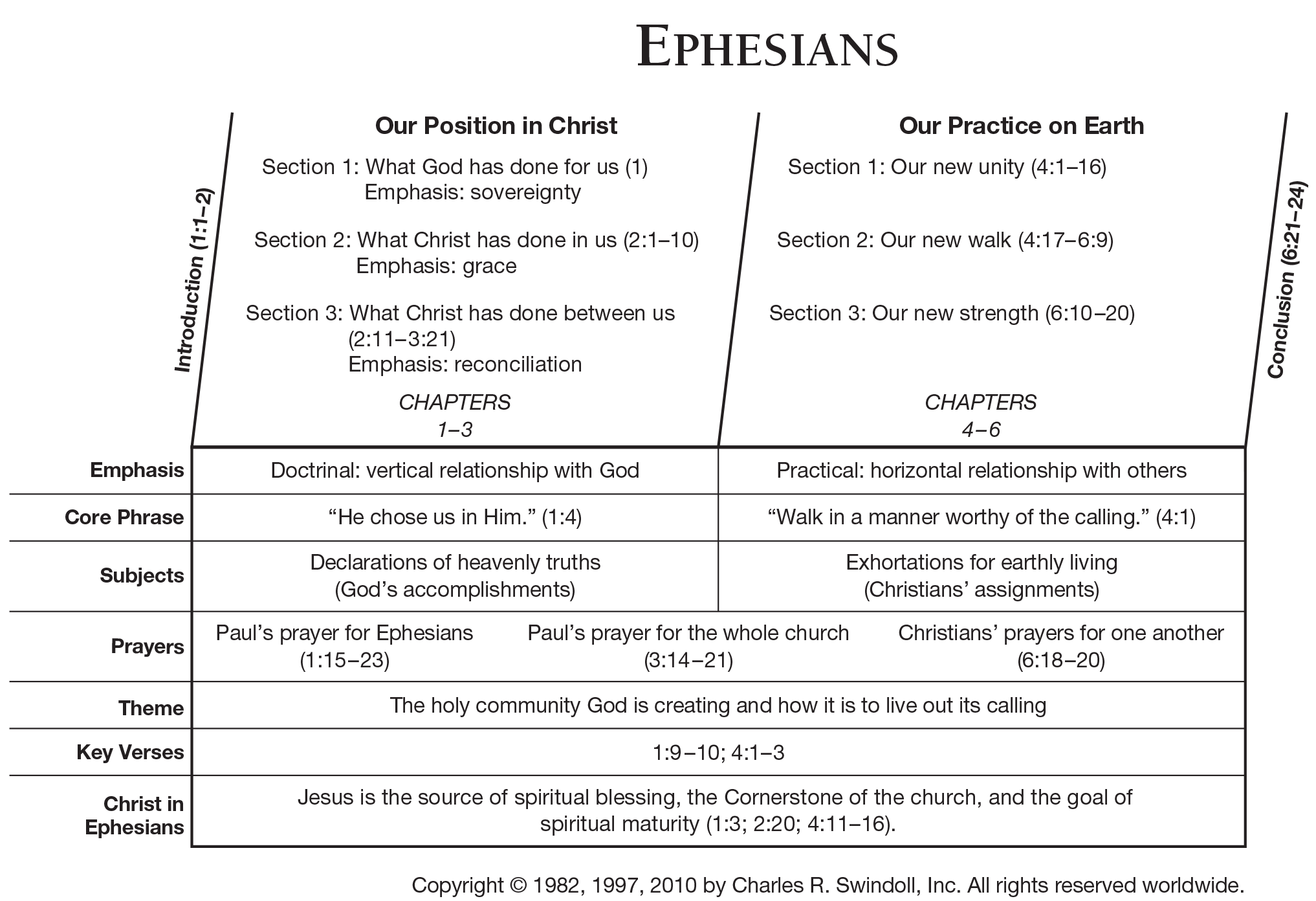
Click chart by Charles Swindoll -Note "EMPHASIS" --
Ephesians 1-3 = Doctrinal: vertical relationship with God
Ephesians 4-6 = Practical: horizontal relationship with others
Ephesians 4:8 Therefore it says, "WHEN HE ASCENDED ON HIGH, HE LED CAPTIVE A HOST OF CAPTIVES, AND HE GAVE GIFTS TO MEN." (NASB: Lockman)
Greek: dio legei, (3SPAI) Anabas (AAPMSN) eis hupsos echmaloteusen (3SAAI) aichmalosian, edoken (3SAAI) domata tois anthropois.
Amplified: Therefore it is said, When He ascended on high, He led captivity captive [He led a train of vanquished foes] and He bestowed gifts on men. (Amplified Bible - Lockman)
NLT: That is why the Scriptures say, "When he ascended to the heights, he led a crowd of captives and gave gifts to his people." (NLT - Tyndale House)
Phillips: As the scripture says: 'When he ascended on high, he led captivity captive, and gave gifts to men' (Phillips: Touchstone)
Wuest: Wherefore He says, Having ascended on high, He led away captive those taken captive and gave gifts to men. (Eerdmans)
Young's Literal: For this reason Scripture says: "He re-ascended on high, he led captive a host of captives, and gave gifts to men."
NET Therefore it says, "When he ascended on high he captured captives; he gave gifts to men."
CSB For it says: When He ascended on high, He took prisoners into captivity; He gave gifts to people.
ESV Therefore it says, "When he ascended on high he led a host of captives, and he gave gifts to men."
NIV This is why it says: "When he ascended on high, he led captives in his train and gave gifts to men."
NRS Therefore it is said, "When he ascended on high he made captivity itself a captive; he gave gifts to his people."
NJB That is why it says: He went up to the heights, took captives, he gave gifts to humanity.
NAB Therefore, it says: "He ascended on high and took prisoners captive; he gave gifts to men."
MIT To reference that, he says: When he ascended to the high elevation, he took captives of war; he gave gifts to his people.
GWN That's why the Scriptures say: "When he went to the highest place, he took captive those who had captured us and gave gifts to people."
BBE For this reason he says, He went up on high, taking his prisoners with him, and gave freely to men.
RSV Therefore it is said, "When he ascended on high he led a host of captives, and he gave gifts to men."
NKJ Therefore He says: "When He ascended on high, He led captivity captive, And gave gifts to men."
ASV Wherefore he saith, When he ascended on high, he led captivity captive, And gave gifts unto men.
DBY Wherefore he says, Having ascended up on high, he has led captivity captive, and has given gifts to men.
THEREFORE IT SAYS, WHEN HE ASCENDED ON HIGH: dio legei, (3SPAI) anabas (AAPMSN) eis hupsos:
- Ephesians 4 Resources - Multiple Sermons and Commentaries
- Ephesians 4:7-10 Christ's Purpose for His Church - Steven Cole
- Ephesians 4:7-12 - Wayne Barber
- Ephesians 4:7-10: Preserving the Unity of the Spirit -2 - Wayne Barber
- Ephesians 4:7-11 The Gifts of Christ to His Church - John MacArthur
Related Passages:
Colossians 2:15 When He had disarmed the rulers and authorities, He made a public display of them, having triumphed over them through Him.
Psalm 68:18 You have ascended on high, You have led captive Your captives; You have received gifts among men, Even among the rebellious also, that the LORD God may dwell there.
VALIDATION FOR
GIVING GIFTS
Therefore it says, "WHEN HE ASCENDED ON HIGH, HE LED CAPTIVE A HOST OF CAPTIVES, AND HE GAVE GIFTS TO MEN - Therefore (dio) (dio) It is an urgent invitation to listen attentively and is because Jesus has distributed grace to each member of His body. Paul is drawing a conclusion based on the "parenthetical" section (Eph 4:8-10) using an OT quotations is how Christ was enabled in the divine plan of God to give the gift described in Eph 4:7. Paul wants the saints to know that although the gift is free, there was a great cost that had to be paid to make this bestowal of grace available. And so Paul proceeds to tie the giving of gifts to the triumphant ascension of Christ. He explains that it is Christ's exaltation to the right hand of His Father that makes possible for Him to give gifts to men. And so Paul turn to Psalm 68:18 to illustrate beautifully what Christ did for us.
Therefore it says (For this reason - a term of conclusion) - What is it? Hoehner says "This is an introductory formula to alert the readers that he is going to quote an OT passage." IT is the Word of God in Psalm 68. What Paul is saying is that the truth he has just stated (see Eph 4:7) should not surprise us because it was foretold in the Old Testament (now it might "surprise" a Gentile reader for they had been far off from the Hebrew Scriptures). In other words, the previous statement about the grace given to believers by the Lord is not something that just popped into Paul's mind, but a truth which was always a part of the manifold wisdom of God (Eph 3:10) and His marvelous plan of redemption, especially as it applies to the Church, even though the Church itself was a mystery in the OT. Paul then goes on in verses 9 and 10 to write a "commentary" on the OT quote.
Hoehner has an interesting thought on Paul's quotation from Psalm 68 writing that "Ephesians 4:8 includes a quotation from the Old Testament, which confirms God’s giving of gifts. Most think it quotes Psalm 68:18 with five minor and two major changes. The two major variations are the change from the second to the third person, and the change of direction from having received gifts from men to the giving of gifts to men. However, it is better to think that Paul was not quoting one particular verse of the psalm but rather that he was summarizing all of Psalm 68, which has many words similar to those in Psalm 68:18. (See page 634 Bible Knowledge Commentary)
Max Anders has a succinct summary of Paul's parenthetical passages writing "Paul digresses from his direct argument to provide scriptural proof. Instead of giving a direct quote of Psalm 68:18, he apparently gave a general summary of the entire psalm. Psalm 68 is a victory hymn composed by David to celebrate the conquest of a Jebusite city. It describes a victory parade up Mount Zion, going beyond the literal, historical victory parade to attribute the victory to God. Thus it talks about a figurative victory parade with God ascending, not up to Mount Zion, but up to heaven. Historically, it was typical, after a king won a significant military victory, to bring back the spoils of war, including enemy prisoners, to display to his people. In addition, however, if there were any of his own soldiers whom the enemy had previously captured, the victorious king would bring them back and parade them before the home crowd. These were often referred to as recaptured captives—prisoners who had been taken prisoner again by their own king and then given freedom. It was a great honor to release these captives. David pictures God ascending to heaven after having been victorious against his earthly enemies and freeing those who had been captive to the forces of evil. (See Holman New Testament Commentary - Galatians, Ephesians, and Colossians) (Bolding added)
Says (3004) (lego) personifies the Scripture as speaking. It is always good to maintain a high view of the precious word of God and to recall that when the Scripture speaks, it is truly the infinite, transcendent, incomprehensible God Himself personally communicating with us! This is an awesome thought which should continually fill our hearts with praise and thanksgiving that the Creator has condescended to communicate so intimately with His creation. Hallelujah!
Most observers feel that the Scripture Paul quotes from is Psalm 68:18
Thou hast ascended on high. Thou hast led captive Thy captives; Thou hast received gifts among men, Even among the rebellious also, that the LORD God may dwell there.
Comment: Note that the verse in Ephesians is reads "gave gifts" instead of "received gifts" is "gave gifts". In this Psalm David is extolling the Name of Jehovah because of the great victory He had given him. David's victory reminds him of the prior glorious "victorious" acts of God, including the Red Sea crossing, destruction of Pharaoh's hosts, the subsequent wilderness journey and entrance into the Promised Land of Canaan. In each of these scenarios God's people were in dire straits and yet God, as it were, had come down and delivered them and then ascended back to heaven! And herein we see the wisdom of God's inspiration of David who spoke primarily of a local event, which the Spirit intended to have a double meaning, a greater prophetic message, foretelling what would happen to the Messiah over a millennium later! From comparison of the Old and the New Testament passages, it is also clear that Paul is teaching that the Lord Jesus Christ is Jehovah. As an aside, the exact fulfillment of such detailed prophecies of course provides one of the great proofs of the divine inspiration of the Scriptures.
John MacArthur comments on Paul's use of Psalm 68 noting that this psalm "is a victory hymn composed by David to celebrate God’s conquest of the Jebusite city and the triumphant ascent of God (represented by the Ark of the Covenant) up Mount Zion (cf. 2 Sa. 6-7; 1Chr 13). After a king won such a victory he would bring home the spoils and enemy prisoners to parade before his people. An Israelite king would take his retinue through the holy city of Jerusalem and up Mount Zion. Another feature of the victory parade, however, would be the display of the king’s own soldiers who had been freed after being held prisoner by the enemy. These were often referred to as recaptured captives—prisoners who had been taken prisoner again, so to speak, by their own king and given freedom. (See The MacArthur New Testament Commentary)
F F Bruce - There is little basis for the traditional view that the reference is to the harrowing of hell—that the captivity which he led captive consists here of the souls of men whom his victory liberated from the thraldom of death.
Wayne Barber gives the background to help Paul's selection of Psalm 68:18 to explain how Christ was enable to give gifts to men...
The writer is giving a picture here of those days when the general would go out to battle. He would win a victory, and then on the way back into town the commander and his chariot would be up front. Boy, he is proud. He has won the victory. The people line the streets and are all shouting, "Hallelujah, the victory has been won." Behind him, chained to the back of his chariot, are all the people that he has conquered, the generals and the leaders of the armies. Then behind them are all the spoils of war. As soon as he gets into town, he goes up to the holy mountain and there on the holy mountain, the riches or spoils of war, are given to him. He in turn disperses them to all the other people. He has to receive the gifts in order to give the gifts. Now I am saying that for a reason. In Psalm 68:18 it says, "Thou hast received gifts among men,..." When Paul quotes that Scripture, he doesn’t say that. He says, "And He gave gifts to men." The liberal stands up and says, "There is a contradiction in Scripture right there. It says in the Old Testament that He received gifts. Paul says He gave gifts. There is something wrong here." Friend, how are you going to give them until you have first received them? Paul just takes it that extra step that the Psalmist did not take. He is not contradicting anything. He is just fully explaining what the Lord Jesus did for us on the cross when He ascended back in to heaven.
The Lord Jesus came down and conquered sin, death and many other things. He ascends back to the heavens. He has His captives with Him. Then and only then can He give gifts unto men.
There is a wonderful picture here of what Christ has done for us. You see, without the ascension, there would never be a Christ who could send His Holy Spirit, the Gift, who in turn could display all the different gifts. What did He say in John 14? "I must go to My Father." Why? "So that the Holy Spirit might come." He is the gift. The Holy Spirit is the one who is going to be making sure He carries out God’s desires of having the pie sliced in the way that it is sliced. But Jesus has to ascend first. You say, "I don’t understand. He is the Son of God. Why does He have to qualify for anything? Why does He have to ascend in order to do anything? He is God." That is right, but He is also the God-man. We forget this. He uniquely became a brand new creature never seen before. He became the God-man. Not only that, but when He ascended, He went into the throne room by His own blood and there received the name that is above every name. He was exalted on high. Now, as Lord of the Universe, He qualifies to give gifts unto men.
Paul is pointing to what it cost God for us to have our gifts! Jesus had to go to the cross! Jesus had to resurrect! Jesus had to ascend! Jesus had to go into the presence of the Father before the Spirit could come who is the actual one who disburses the gifts unto men.
During World War I there was a tradition in the towns, particularly in France. During the war, many times the cities defended themselves. Therefore, their little army was the army of that particular city. They had a tradition. They had walled cities with huge gates and walkways over the gates. When the group of men who had left the town to represent them in battle came back, the people would get on top of that gate. They would have a choir who would chant. The men would come back, wounded and broken and bleeding from battle, but they came back waving their flag, which meant they had won the victory! The people on top of the wall would shout at them, "What right do you have to enter through these gates?" They would hold up the hands of the wounded. They would hold up the hands of the bleeding. Then they would raise that flag and say, "We have been to battle, and we have won the victory!" The gates would swing open, and they would walk through. The streets would be lined with people. They would shower them with hallelujahs for the victory that had been won.
Can you imagine the Lord Jesus’ return back into heaven? He ascended. He is the ascended Christ. Without His ascension, we would have no gifts. Without His ascension we would have no body. Without His ascension, we would have nothing. He had to ascend and go back to the Father so that the Spirit could come and give gifts to the body. As He walked up to the gates of heaven, the choir of heaven on that gate would say, "What right do you have to enter these gates?" The Lord Jesus Christ would hold up His hands with the nail prints in His wrists. He would show them the nail prints in His feet and the spear mark in His side. Then He would say, "I’ve been to Calvary, and I have won the victory!" Then the gates would open up in heaven, and the Lord Jesus would march triumphantly to the Father and sit at His right hand, the name above every name, the One who is going to send His gift to His body who will dispense the gifts unto all men.
It cost God everything for us to be diverse. It cost God everything for us to have our gifts. Until we are free in His Spirit, empowered with His might, then the church is not operating. Whatever we are doing is nothing more than a secular organization on this earth. We have got to see that. We are not preserving the unity of the Spirit when we criticize a brother because they see things differently. They are gifted differently. Friend, we need to function in the gift that was blood bought for each one of us. You’ve got enough to do simply living in your own gift. That is why Paul says to work out your own salvation. Begin to function in the gifts that you have and honor the fact that it cost Him everything for you to have those gifts. (Ephesians 4:7-10: Preserving the Unity of the Spirit)
C H Spurgeon comments on Psalm 68:18 - Thou hast ascended on high. The ark was conducted to the summit of Zion; God himself took possession of the high places of the earth. The antitype of the ark, the Lord Jesus, has ascended into the heavens with signal marks of triumph. To do battle with our enemies, the Lord descended and left his throne; but now that the fight is finished, he returns to his glory; high above all things is he now exalted.Thou hast led captivity captive. As great conquerors of old led whole nations into captivity, so Jesus leads forth from the territory of his foe a vast company as the trophies of his mighty grace. From the gracious character of his reign it comes to pass that to be led into captivity by him is for our captivity to cease. The Lord Jesus puts death to death. Thou hast received gifts for men, or, received gifts among men: they have paid thee tribute, and will in every age continue to do so, delighting in thy reign. Paul’s rendering is the Gospel one: Jesus has “received gifts for men,” of which he makes plentiful distribution, enriching his church with the priceless fruits of his ascension, such as apostles, evangelists, pastors, and teachers, and all their varied endowments. In him we are endowed with priceless treasures, and we give him ourselves, our all. (The Treasury of David)
Great King of grace my heart subdue,
I would be led in triumph too;
As willing captive to my Lord,
To own the conquests of his word.
He ascended on high - He who? Clearly the Lord Jesus Christ. Jesus Christ of the New Testament is Jehovah of the Old Testament. In fact the Greek word used for Jesus in the NT is kurios, which is the same word used over 6000 times in the Greek translation of the OT to translate Jehovah (LORD, Yahweh). Jesus is LORD in both testaments! It was not the Father Who ascended but it was the Son, Who subordinated Himself for the work of salvation, although He is subordinate in Himself but co-equal with His Father (misunderstanding of these basic doctrines led to the Arian heresy which held that Christ although divine was a created being).
Ascended (305) (anabaino from aná = up + baíno = to go) means to go up and here describes Jesus ascending on high (into heaven) after His victory on Calvary over sin, Satan and the world. In the first chapter Paul referred to this momentous event writing...
which (refers to the working of the strength of His might) He brought about in Christ, when He raised Him from the dead, and seated Him at His right hand in the heavenly places, 21 far above all rule and authority and power and dominion, and every name that is named, not only in this age, but also in the one to come. 22 And He put all things in subjection under His feet, and gave Him as head over all things to the church, 23 which is His body, the fulness of Him who fills all in all. (See notes Ephesians 1:20; 1:21; 1:22; 1:23)
High (5311) (hupsos/hypsos from húpsi = high, aloft) means elevation, altitude, the sky. As used figuratively in James (see below) it speaks of dignity or being exalted (as having a "high" position).
Luke 1:78 Because of the tender mercy of our God, With which the Sunrise (KJV = Dayspring - the Messiah's coming would be like the coming of dawn, light driving away darkness) from on high shall visit us (cf Mal 4:2, Lu 19:42, 44 - the Jews failed to recognize His time of visitation!)
Luke 24:49 "And behold, I am sending forth the promise of My Father upon you (THE HOLY SPIRIT - SEE Acts 1:8 and Acts 2:1-4); but you are to stay in the city until you are clothed with power (dunamis = supernatural power) from on high."
Ephesians 3:8 may be able to comprehend with all the saints what is the breadth and length and height and depth,
James 1:9 But let the brother of humble circumstances glory in his high position (hupsos)
Revelation 21:16 And the city is laid out as a square, and its length is as great as the width; and he measured the city with the rod, fifteen hundred miles; its length and width and height are equal.
HE LED CAPTIVE A HOST OF CAPTIVES: echmaloteusen (3SAAI) aichmalosian:
- He led captive a host of captives - Judges 5:12; Colossians 2:15
- Ephesians 4 Resources - Multiple Sermons and Commentaries
- Ephesians 4:7-10 Christ's Purpose for His Church - Steven Cole
- Ephesians 4:7-12 - Wayne Barber
- Ephesians 4:7-10: Preserving the Unity of the Spirit -2 - Wayne Barber
- Ephesians 4:7-11 The Gifts of Christ to His Church - John MacArthur
CHRIST OUR
CONQUEROR AND KING
He led captive a host of captives - In the context of Ephesians 4, this passage depicts our triumphant Lord Jesus Christ returning from earth to heaven after His victory at Calvary. As discussed above, Paul adds this section to show how Christ received the authority to give the gift of grace described in Ephesians 4:8. The meaning of this "parenthetical" section in Ephesians 4:8-10 is not easy to grasp and there are a number of opinions from excellent commentators. While we will discuss these passages in more detail, it is important to not miss the forest for the trees and the forest is our Christ the Conqueror of sin, death, Satan and hell has rightly now established as Head over His church has been given the right to give spiritual gifts to each member of His Body.
Cornerstone Bible Commentary - he led a crowd of captives.—Lit., “he captured the captives.” Who were the captives? There are two interpretations. (1) They were the enemies of Christ, namely, Satan, sin, and death, and they were defeated by Christ’s death (Eadie 1883:288; Abbott 1897:113); or (2) they were captives of Satan, sin, and death that were taken captive by Christ through his redemption and now are his followers (Hendriksen 1967:191; O’Brien 1999:292-293; Hoehner 2002:529-530). The second view is favored by the NLT by its translation “crowd of captives.” (See Ephesians, Philippians, Colossians, )
KJV Commentary - This is a quotation from Psalm 68:18, a messianic psalm of victory in which God is praised for deliverance. He led captivity captive. The inferences drawn from the triumphal return of the King are: (1) the thought of victory; and (2) the bestowal of gifts. The captives are most probably the Old Testament saints in sheol (hades). (KJV Bible Commentary)
Comment - If you have ever recited the Apostles' Creed ("He descended into hell; on the third day He rose again from the dead; He ascended into heaven"), you would have been speaking words agreeing with the KJV Commentary that Jesus descended into Hell and there released the "captive" saints of the OT (men like Abraham, Moses, David, etc) and took them with Himself when He ascended to Heaven. This was traditionally the belief held by many of the early church fathers. As we will discuss below, is this really what the Bible teaches?
John MacArthur explains that "In His crucifixion and resurrection, Jesus Christ conquered Satan, sin, and death (cf. Col 2:15), and by that great victory He led captive a host of captives, who once were prisoners of the enemy but now are returned to the God and the people with whom they belong. (MacArthur, J: Ephesians. Chicago: Moody Press)
There are other able commentators who feel this passage indicates quite a different identity of the captives. For example Martyn Lloyd-Jones feels that "the picture is one of triumph over enemies, one of the leading of enemies in triumph. In ancient times, if a king or a prince or a great military captain waged successful warfare, when he came back to his own country there was always a kind of victory parade. The conquered kings and princes and military chieftains and captains were all made to walk in the procession in their chains. The conqueror was ‘leading captivity captive’. He had taken his foes captive and was now making a public display of them. At the same time he threw gifts to his own people. He was riding in his chariot distributing his largesse among the acclaiming people, and he was leading these conquered men as captives at the same time. (Lloyd-Jones, D. M. Exposition of Ephesians in 8 Vol. Baker Book or Click Ephesians 4:1-16Mp3's and then select the sermon on Ephesians 4:7–10 entitled ‘One … every one’)
John Phillips - When Paul wrote Ephesians 4:8, he had in mind a picture of a victorious king who has overthrown his foes. He is ascending the mountains, entering triumphantly into his city. He is laden with the spoils of war and bestows lavish gifts on his cheering people. He has freed the hostages held by the enemy and has ravished the enemy's domains. The freed captives are special recipients of his princely gifts. We can see the parallel. Jesus triumphed in battle over sin and Satan. He carried the war into the enemy's domains and led forth from the lower regions a multitude of captives ("he led captivity captive"). Then Jesus took His place on high and "gave gifts unto men." He bestowed liberal, magnificent gifts on His own." (Borrow Exploring Ephesians: An Expository Commentary)
Chuck Swindoll - After His crucifixion and resurrection, Christ led His people to freedom and ascended in victory. He "led captive a host of captives" (Eph. 4:8), seating believers with Him spiritually in the heavens (Eph 2:6). Though we were once enemies of God (Eph 2:12), we have been brought into His family through the reconciliation of Christ (Eph 2:19). Once bound by sin and subject to the kingdom of Satan, we have been taken captive by Christ and are joint heirs in the kingdom of heaven. (Insights on Galatians, Ephesians)
J Vernon McGee - "When he ascended up on high" refers to the ascension of Christ. At that time He did two things: (1) He led captivity captive, which refers, I believe, to the redeemed of the Old Testament who went to paradise when they died. Christ took these believers with Him out of paradise into the very presence of God when He ascended. Today when a believer dies, we are not told that he goes to paradise, but rather he is absent from the body and present with the Lord (see 2Cor. 5:8; Phil. 1:23). (2) When Christ ascended He also gave gifts to men. This means that He conferred gifts upon living believers in the church so that they might witness to the world. In His ascension, Christ not only brought the Old Testament saints into God's presence, but He also, through the Holy Spirit, bestowed His gifts. At the Day of Pentecost the Holy Spirit baptized believers into the body of Christ and then endowed them with certain gifts, enabling them to function as members of the body. The Holy Spirit put each of them in a certain place in the body, and He has been doing the same with each new believer ever since. (Thru The Bible) (Bolding Added)
Ron Daniel - A public display is always public. In other words, Jesus' triumph took place in front of people. Remember, in Paradise, there were Lazarus, Abraham, and all of the others who had lived by faith in God. But although they'd had faith, they were still sinners like the rest of us. They were not sinless and perfect, which is the only way to be granted admission into heaven. Instead, they were captive in Abraham's Bosom. Comforted, yet captive. Faithful people, but not forgiven people. Fortunately, when Jesus died, He paid the price of the sin of all who place their hope in Him. And when that happened, captivity was able to be led captive - Jesus was able to escort them from their captivity in the heart of the earth.
Believer's Study Bible - (vv. 8,9) The reference to Jesus' ascension in Ps. 68:18 presupposes His coming down to earth from heaven. Therefore, the "lower parts of the earth" probably is a reference to the incarnation of Christ. This difficult and debated passage has been linked by some with 1 Pet. 3:18-20 and is thought to reflect a ministry of Jesus immediately following His death but prior to His resurrection, in which He descended into Sheol or Hades to announce the accomplishment of atonement to the lost, as well as to the dead saints of the O.T. He then "led captivity captive," i.e., He led these O.T. saints into heaven's rest. Another explanation that seems to have fewer explanatory difficulties is that the captivity which Christ led captive in His resurrection and ascension is the awful power of Satan, sin, death, and the grave. The descent into the lower parts of the earth is a reference to His entombment in the heart of the earth. From this He arose and ascended in unparalleled victory (Eph 4:10).
Related Resources:
I believe in God, the Father almighty,
creator of heaven and earth.
I believe in Jesus Christ, his only Son, our Lord,
who was conceived by the Holy Spirit
and born of the virgin Mary.
He suffered under Pontius Pilate,
was crucified, died, and was buried;
he descended to hell.
The third day he rose again from the dead.
He ascended to heaven
and is seated at the right hand of God the Father almighty.
From there he will come to judge the living and the dead.
I believe in the Holy Spirit,
the holy catholic* church,
the communion of saints,
the forgiveness of sins,
the resurrection of the body,
and the life everlasting. Amen.
He led captive (only here in NT in UBS)(162) (aichmaloteuo from aichme = spear + halotós = be taken, conquered) means to be taken a prisoner of war by the sword. The idea is to gain complete control over another, either by force or deception. The allusion is to a triumphal possession in which one marched the captives that one had taken in a war.
Zodhiates - The Textus Receptus in 2Ti 3:6 has aichmalōteúontes from aichmalōteúō, while the UBS in the same verse has aichmalōtízontes from aichmalōtízō 163, designating one of the characteristics of the last days, namely, the deceptive ability of men to penetrate homes and to captivate women loaded with sins. Thus, aichmalōteúō in this text has the meaning of taking captive by deception, while in Eph. 4:8 it has a benevolent meaning. (Complete Word Study Dictionary – New Testament)
Aichmaloteuo in Septuagint (Lxx)- frequently in the Septuagint to describe being led away in a military captivity. Gen. 14:14 = his relative had been taken captive Gen. 34:29; Num. 24:22; 1 Sam. 30:2; 1 Sam. 30:3; 1 Sam. 30:5; 1 Ki. 8:50; 2 Ki. 5:2; 2 Ki. 6:22; 1 Chr. 5:21; 2 Chr. 6:36; 2 Chr. 6:38; 2 Chr. 28:5; 2 Chr. 28:11; Est. 1:1; Est. 2:6; Job 1:15; Job 1:17; Ps. 68:18; Ps. 137:3; Isa. 14:2; Isa. 49:24; Isa. 49:25; Jer. 50:33; Ezek. 6:9; Ezek. 12:3; Ezek. 39:23; Amos 1:5; Amos 1:6; Amos 5:5; Obad. 1:11; Mic. 1:16
Ps 68:18 - You have ascended on high, You have led captive (LXX - aichmaloteuo) Your captives (aichmalosia); You have received gifts among men, Even among the rebellious also, that the LORD God may dwell there.
A host of captives (161) (aichmalosia from aichmálōtos = a captive) describes the state of being captive or of taking someone captive by the force of the spear. The only other NT use is Rev 13:10 where it is used twice - "If anyone is destined for captivity, to captivity he goes; if anyone kills with the sword, with the sword he must be killed. Here is the perseverance and the faith of the saints."
Gilbrant - This term denotes either the condition of “captivity” or a “group of captives,” according to classical sources, and it is related to other members of the aichmal- word group (aichmalōteuō [160], aichmalōtizō [161], aichmalōtos [162]). In the Septuagint aichmalōsia occurs from the Book of Numbers on. Mainly it refers to “captives” taken during warfare (e.g., Numbers 21:1; 31:12,19; etc.). A significant, more technical association with the Babylonian captivity is reflected in Nehemiah 1:2 and 3, which speaks of “those who survived the exile.” (Cf. Tobit 1:3 in Codex Sinaiticus; Judith 2:9). Captivity became the fate of the people of God because of their disobedience (cf. Jeremiah 15:2; 20:6; 22:22). The hope of Israel’s captives was to be saved by God (Isaiah 1:27; 45:13); but this is the case even prior to the Babylonian captivity (Ps 14:7; 53:6 [52:6]). There are only three instances of aichmalōsia in the New Testament: Ephesians 4:8 (a citation of Psalm 68:18 [LXX 67:18]) and Revelation 13:10 (twice). Through the power of the Resurrection Christ has vanquished His enemies: He led them “captives” in His train (Ephesians 4:8; cf. Colossians 2:15). In Revelation 13:10 the two uses refer to the possible fate of the faithful. The attitude of the author is not stoic complacency that “what will be will be”; rather, he was calling for endurance from the faithful, no matter what the circumstances. If they went into captivity or if they were killed, the call was for faithfulness. (Complete Biblical Library Greek-English Dictionary)
Zodhiates has a lengthy note on this word - In Eph. 4:8 aichmalōsía is used with the verb aichmalōtízō <G163>, to take captive, meaning a captive multitude. Quoted from Ps. 68:18, it is a prophecy of the distribution of gifts (charísmata) to believers. What the Lord Jesus received from the Father (Mt. 28:19, 20) at the time of His ascension, He distributed as gifts to His own to enable them to continue His work. The use of both the verb and the noun, "He captivated captivity" (a.t. [Eph. 4:8]), indicates that the ascended Lord was in full possession of all believers and that their destiny was absolutely in His hands, no matter what difficulties they would encounter in the execution of their task of spreading the gospel (ED: SO ZODHIATES DOES NOT FAVOR THAT CHRIST TOOK OT SAINTS TO HEAVEN WHEN HE ASCENDED). Distributing gifts was Christ's confirmation of the captivity of the captives who were to serve Him through the exercise of the gifts. In exercising these gifts they were never to forget that He was in full control. The word also occurs in Rev. 13:10 where the kjv says, "He that leadeth into captivity shall go into captivity." In the Gr. text there is only one verb, hupágei, to go. The literal translation is: "If anyone has captivity, he goes" (a.t.). The meaning assumed for the first clause cannot be different from the meaning of the second clause. It means that since one has chosen to become a captive of Jesus Christ, he moves on into captivity because he has tasted that the captivity is not for his harm but for his good. To be a captive of Jesus Christ is the greatest freedom that one can experience. Rev. 13 speaks of the activity of the Antichrist. At that time on earth, there will be the believers who have placed themselves under the protective captivity of Jesus Christ and will be maintained by Him and will not in any way succumb to the pressures of the Antichrist. The endurance and the faith of the believers is spoken about in Rev 13:10. Therefore, the word aichmalōsía here refers to the state of the captivity of the believers even as does Eph. 4:8 which regards the multitude of the believers as the "captivity." In Ephesians we have the captives and in Revelation we have the state of the captives or the captivity itself. (The Complete Word Study Dictionary: New Testament )
Aichmalosia is frequent in the Septuagint (Lxx) - Num. 21:1; Num. 31:12; Num. 31:19; Num. 31:26; Deut. 21:13; Deut. 28:41; Deut. 32:42; Jdg. 5:12; 2 Ki. 24:14; 2 Chr. 6:37; 2 Chr. 28:5; 2 Chr. 28:11; 2 Chr. 28:13; 2 Chr. 28:14; 2 Chr. 28:15; 2 Chr. 28:17; 2 Chr. 29:9; Ezr. 2:1; Ezr. 3:8; Ezr. 5:5; Ezr. 8:35; Ezr. 9:7; Neh. 1:2; Neh. 1:3; Neh. 4:4; Neh. 7:6; Neh. 8:17; Est. 1:1; Ps. 14:7; Ps. 53:6; Ps. 68:18; Ps. 78:61; Ps. 85:1; Ps. 96:1; Ps. 126:1; Ps. 126:4; Isa. 1:27; Isa. 20:4; Isa. 45:13; Jer. 1:3; Jer. 15:2; Jer. 20:6; Jer. 22:22; Jer. 30:18; Jer. 31:19; Jer. 31:23; Jer. 46:27; Jer. 49:39; Lam. 1:5; Lam. 1:18; Lam. 2:14; Lam. 2:21; Ezek. 1:1; Ezek. 1:2; Ezek. 3:11; Ezek. 3:15; Ezek. 11:15; Ezek. 11:24; Ezek. 11:25; Ezek. 12:3; Ezek. 12:4; Ezek. 12:7; Ezek. 12:11; Ezek. 25:3; Ezek. 29:14; Ezek. 30:17; Ezek. 32:9; Ezek. 33:21; Ezek. 39:25; Ezek. 40:1; Dan. 1:3; Dan. 2:25; Dan. 5:10; Dan. 5:13; Dan. 6:13; Dan. 8:11; Dan. 11:8; Dan. 11:33; Hos. 6:11; Joel 3:1; Joel 3:8; Amos 1:6; Amos 1:9; Amos 1:15; Amos 4:10; Amos 9:4; Amos 9:14; Hab. 1:9; Zeph. 2:7; Zeph. 3:19; Zech. 6:10; Zech. 14:2
AND HE GAVE GIFTS TO MEN: edoken (3SAAI) domata tois anthropois:
- 1 Samuel 30:26; Esther 2:18
- Ephesians 4 Resources - Multiple Sermons and Commentaries
- Ephesians 4:7-10 Christ's Purpose for His Church - Steven Cole
- Ephesians 4:7-12 - Wayne Barber
- Ephesians 4:7-10: Preserving the Unity of the Spirit -2 - Wayne Barber
- Ephesians 4:7-11 The Gifts of Christ to His Church - John MacArthur
GOD THE GIVER OF
EVERY GOOD GIFT
God's gifts are good gifts.
James 1:17 "Every good thing given and every perfect gift is from above, coming down from the Father of lights, with whom there is no variation or shifting shadow."
He gave - As noted above, Paul substitutes "gave" for "received". Some might argue that this contradicts the infallibility of the Scripture. But there is really no contradiction for it is true to say that Christ both received and gave. Listen to what Peter, speaking of the Lord Jesus Christ, says in Acts 2...
"Therefore having been exalted to the right hand of God, and having received from the Father the promise of the Holy Spirit, He has poured forth this which you both see and hear. (Acts 2:33)
Comment: And so we see Christ has both received and given, the latter action presupposing the former. So the Son received the gift from the Father and gives gifts to the Church, thus there is no contradiction for both statements are true. The same Holy Spirit Who inspired David to write received, also inspired Paul to write give, these actions being two sides of the same "coin" for the same intended meaning is brought out in both cases; i.e., that Jehovah Jesus is the One through Whom and by Whom the gifts flow to the Church. This pictures Jesus as our Great High Priest, Who mediates the receiving and giving between us and His Father.
Gave gifts - The greatest gift Jesus gave was the Holy Spirit, Who in turn brought life to men in salvation, baptized (brought them into union) with the body of Christ and then distributed individual spiritual gifts to each believer as He willed.
In the gospel of John Jesus referred to His giving of the Spirit, recording that...
on the last day, the great day of the feast, Jesus stood and cried out, saying, "If any man is thirsty, let him come to Me and drink. 38 "He who believes in Me, as the Scripture said, 'From his innermost being shall flow rivers of living water.'" 39 But this He spoke of the Spirit, Whom those who believed in Him were to receive; for the gift of the Spirit was not yet given (as He would be given by Jesus at the appropriate time), because Jesus was not yet glorified. (John 7:37-39)
Jesus promised to send the Spirit to His disciples
"When the Helper comes, whom I will send to you from the Father, that is the Spirit of truth, Who proceeds from the Father, He will bear witness of Me" (John 14:26)
"But I tell you the truth, it is to your advantage that I go away; for if I do not go away, the Helper shall not come to you; but if I go, I will send Him to you. (John 16:7)
"And behold, I am sending forth the promise of My Father upon you; but you are to stay in the city until you are clothed with power from on high." (Lu 24:49)
Related Resources (articles related to Holy Spirit):
- 1 Corinthians 2:10-16 Commentary
- 1 John 4:4 Commentary
- A Spirit Filled Church
- Acts 1:8 Commentary
- Ephesians 5:18 Commentary
- Expulsive Power of a New Affection
- Galatians 5:16 Commentary
- Illumination of the Bible
- Loving Obedience-Obedient Love
- Our Anointing - The Holy Spirit
- Praying in the Spirit
- Spirit-Filled Believers Are Like Artesian Wells
- Spiritual Paradox in the Christian Life
- The Holy Spirit-2
- The Holy Spirit-Walking Like Jesus Walked!
Gave (1325) (didomi) means He granted these gifts based on decision of His will and not on the merit of the recipients.
MacArthur explains that "Upon arriving in heaven, He gave gifts to men. Paul here uses yet another term for gifts (domata) to express the comprehensiveness of this gracious provision. Like a triumphant conqueror distributing the spoils to his subjects, so Christ takes the trophies He has won and distributes them in His kingdom. After His ascension came all the gifts empowered by the Holy Spirit (John 7:39; 14:12; Acts 2:33). When the Savior was exalted on high, He sent the Spirit (Acts 1:8), and with the coming of the Spirit also came His gifts to the church. (MacArthur, J: Ephesians. Chicago: Moody Press)
Gifts (1390) (doma from didomi) is a word that means present or gift but which lends greater emphasis to the character of the gift. For example, in secular Greek doma was used of a thing given, as in a medical dose.
Doma can mean a gift as such without any benefit necessarily derived from it. Vine explains that doma...
lends greater stress to the concrete character of the gift, than to its beneficent nature
Doma in this verse is in plural (domata) and refers to the actual gifts which prove Christ’s generous character (cf, dorea in Ephesians 4:7).
Doma is far more common in the Septuagint (LXX) being found some 58 times
Gen. 25:6; 47:22; Exod. 28:38; Lev. 7:30; 23:38; Num. 3:9; 18:6-7, 11, 29; 27:7; 28:2; Deut. 12:11; 23:23; 1 Sam. 18:25; 2 Sam. 19:42; 1 Ki. 13:7; 2 Chr. 2:10; 17:11; 21:3; 31:14; 32:23; Est. 1:1; Ps. 68:18; Pr. 18:16; 19:17; Eccl. 3:13; 5:1, 19; Ezek. 20:26, 31; 46:5, 16f; Dan. 2:6, 48; 5:17; Hos. 9:1; 10:6; Mal. 1:3
Doma except in Eph. 4:8, is used of human gifts in the only other NT uses...
Matthew 7:11 "If you then, being evil, know how to give good gifts to your children, how much more shall your Father who is in heaven give what is good to those who ask Him! (Comment: here doma refers to a good gift from man to man irrespective of the character of the giver which may be evil.)
Luke 11:13 "If you then, being evil, know how to give good gifts to your children, how much more shall your heavenly Father give the Holy Spirit to those who ask Him?"
In Philippians 4 Paul uses doma to refer to the material gifts the Philippians repeatedly sent him for his needs writing...
Not that I seek the gift (doma) itself, but I seek for the profit which increases to your account (See note Philippians 4:17)
To men (444) (anthropos) to those men and women who compose the Church.
Ephesians 4:9 (Now this expression, "He ascended," what does it mean except that He also had descended into the lower parts of the earth? (NASB: Lockman)
Greek: {to de Anebe (3SAAI) ti estin (3SPAI) ei me oti kai katebe (3SAAI) eis ta katotera [mere] tes ges?
Amplified: [But He ascended?] Now what can this, He ascended, mean but that He had previously descended from [the heights of] heaven into [the depths], the lower parts of the earth? (Amplified Bible - Lockman)
NLT: Notice that it says "he ascended." This means that Christ first came down to the lowly world in which we live. (NLT - Tyndale House)
Phillips: (Note the implication here - to say that Christ "ascended" means that he must previously have "descended", that is from the height of Heaven to the depth of this world. (Phillips: Touchstone)
Wuest: Now, the fact that He ascended, what is it except that also He descended into the nether parts of the earth? (Eerdmans)
Young's Literal: (Now this "re-ascended" —what does it mean but that He had first descended into the lower regions of the earth?
(NOW THIS EXPRESSION "HE ASCENDED": to de anebe (3SAAI):
- Proverbs 30:4; John 3:13; 6:33,62; 20:17; Acts 2:34-36
- Ephesians 4 Resources - Multiple Sermons and Commentaries
- Ephesians 4:7-10 Christ's Purpose for His Church - Steven Cole
- Ephesians 4:7-12 - Wayne Barber
- Ephesians 4:7-10: Preserving the Unity of the Spirit -2 - Wayne Barber
- Ephesians 4:7-11 The Gifts of Christ to His Church - John MacArthur
He ascended - Refers of course to Jesus Christ, these verses (4:9-10) serving as parenthesis explaining "He ascended" in the prior verse and proving that only Christ fits the description.
Ascended (305) (anabaino from aná = up + baíno = to go) means to go up and here describes Jesus ascending on high (into heaven).
Disciple's Study Bible notes that "The ascent/descent idea about Jesus--God's Son from heaven coming to earth, descending even to hell and rising above all creation to God's heaven--is a marvelous way of expressing in spatial terms the thoroughness of Christ's redemption. (Disciple's Study Bible)
Anabaino - 82x in 78v translated Usage: arise(1), ascend(2), ascended(7), ascending(3), came(7), climbed(1), climbs(1), come(4), comes(2), coming(3), entered(2), go(6), goes(1), going(6), gone(3), got(2), grew(1), grows(1), rises(1), started on our way up(1), went(25).-
Matt 3:16; 5:1; 13:7; 14:23, 32; 15:29; 17:27; 20:17f; Mark 1:10; 3:13; 4:7f, 32; 6:51; 10:32f; 15:8; Luke 2:4, 42; 5:19; 9:28; 18:10, 31; 19:4, 28; 24:38; John 1:51; 2:13; 3:13; 5:1; 6:62; 7:8, 10, 14; 10:1; 11:55; 12:20; 20:17; 21:11; Acts 1:13; 2:34; 3:1; 7:23; 8:31, 39; 10:4, 9; 11:2; 15:2; 18:22; 20:11; 21:6, 12, 15, 31; 24:11; 25:1, 9; Rom 10:6; 1 Cor 2:9; Gal 2:1f; Eph 4:8ff; Rev 4:1; 7:2; 8:4; 9:2; 11:7, 12; 13:1, 11; 14:11; 17:8; 19:3; 20:9
WHAT DOES IT MEAN EXCEPT THAT HE ALSO HAD DESCENDED INTO THE LOWER PARTS OF THE EARTH?: ti estin (3SPAI) ei me oti kai katebe (3SAAI) eis ta katotera [mere] tes ges:
- Genesis 11:5; Exodus 19:20; John 6:33,38,41,51,58; 8:14; 16:27,28
- Ps 8:5; 63:9; 139:15; Matthew 12:40; Hebrews 2:7,9
- Ephesians 4 Resources - Multiple Sermons and Commentaries
- Ephesians 4:7-10 Christ's Purpose for His Church - Steven Cole
- Ephesians 4:7-12 - Wayne Barber
- Ephesians 4:7-10: Preserving the Unity of the Spirit -2 - Wayne Barber
- Ephesians 4:7-11 The Gifts of Christ to His Church - John MacArthur
He also descended into the lower parts of the earth - the interpretations include descent to Hades (Sheol), descent to the grave, or descent to earth (incarnation). Descent into Hades is the view held by the early church fathers but which is less popular with modern evangelical commentators.
Ryrie comments that the lower parts "Could mean that Christ descended into Hades between His death and resurrection. Or, more likely, "of the earth" is better understood as an appositional phrase, meaning that Christ descended (at His incarnation) into the lower parts (of the universe), namely, the earth. (The Ryrie Study Bible: New American Standard Translation: 1995. Moody Publishers)
Henry Morris makes an interesting point explaining that...
The ascending Lord was not merely ascending back from the earth, but from "the lower parts of the earth." This somewhat enigmatic geographical reference could, by itself, perhaps refer to the deep ocean bottom, but this would not yield captives. More likely it refers to the great pit at the center of the earth, indicated in the Bible as the prison confining the souls of the dead, the place called Sheol in the Old Testament Hebrew and Hades in the Greek New Testament, but often translated "hell" in the King James Version. One of Christ's purposes when He came to earth was "to preach deliverance to the captives, and...to set at liberty them that are bruised" (Luke 4:18).
This statement of Jesus is taken from Isaiah 61:1, where it reads "...to proclaim liberty to the captives, and the opening of the prison to them that are bound."
When Christ died on the cross, He in the Spirit "went and preached unto the spirits in prison" (1Peter 3:19). The word "preached" can be better translated "proclaimed"--that is, proclaimed His victory over Satan. Christ had said prophetically (Psalm 16:10), "thou wilt not leave [abandon] my soul in hell" (see note 1Peter 3:19). He returned from Hades with "the keys of hell and of death" (Re 1:18), bringing "captivity captive" with Him as He returned. His spirit returned to His body resting in Joseph's tomb, and He arose from the dead, alive forever more. The souls of those who had died in faith came with Him from their resting place in Hades in "Abraham's bosom" (Luke 16:22), and then, in a mighty miracle, "the graves were opened; and many bodies of the saints which slept arose" (Matthew 27:52). With the thief on the cross who had also believed, the Lord then presumably took them all with Him into "paradise, the third heaven" (Luke 23:43; 2Cor 12:2,4), where they will remain with the Lord until He comes to earth again with them and with the souls of all who have died as Christian believers since that time (1Th 3:13; 4:14). (Ephesians 4 Study Bible Notes - Defenders Study Bible)
Those who favor this section as a reference to Christ descending into Hades associate this Ephesians passage with the passage in Peter which says...
in which (Jesus alive in the spirit) also He went and made proclamation to the spirits now in prison (See comments 1 Peter 3:19)
Comment: It must be stated that the interpretation of this passage in 1Peter is very controversial and there are some excellent evangelical commentators who don't interpret this as Christ descending to Hades. Click here for more discussion of this difficult passage
Ephesians 4:9 is a much debated passage and the NET Bible note summarizes the most likely interpretations (the first two being the most commonly mentioned by conservative writers) of the lower parts of the earth...
(1) The traditional view understands it as a reference to the underworld (hell), where Jesus is thought to have descended in the three days between his death and resurrection. In this case, “of the earth” would be a partitive genitive.
(2) A second option is to translate the phrase “of the earth” as a genitive of apposition: “to the lower parts, namely, the earth” (as in the present translation). Many recent scholars hold this view and argue that it is a reference to the incarnation. (ED: See John Piper's analysis - Did Jesus Descend into Hell?)
(3) A third option, which also sees the phrase “of the earth” as a genitive of apposition, is that the descent in the passage occurs after the ascent rather than before it, and refers to the descent of the Spirit at Pentecost (cf. Acts 4:11-16). Support for this latter view is found in the intertestamental and rabbinic use of Ps 68:18 (quoted in Eph 4:8), which is consistently and solely interpreted as a reference to Moses’ ascent of Mt. Sinai to “capture” the words of the law. The probability, therefore, is that the comments here in v. 9 reflect a polemic against the interpretation of Ps 68:18 in certain circles as a reference to Moses. (NET Bible)
Descended (2597) (katabaino from katá = down + baíno = go) means to come or go down or to descend from a higher to a lower place.
A T Robertson notes that "If the anabas is the Ascension of Christ, then the katabas would be the Descent (Incarnation) to earth and tēs gēs would be the genitive of apposition. What follows in verse 10 argues for this view. Otherwise one must think of the death of Christ (the descent into Hades of Acts 2:31). (see note Ephesians 1:20)
Katabaino - 81x in 81v translated as arise(1), ascend(2), ascended(7), ascending(3), came(7), climbed(1), climbs(1), come(4), comes(2), coming(3), entered(2), go(6), goes(1), going(6), gone(3), got(2), grew(1), grows(1), rises(1), started on our way up(1), went(25).- Matt 3:16; 7:25, 27; 8:1; 11:23; 14:29; 17:9; 24:17; 27:40, 42; 28:2; Mark 1:10; 3:22; 9:9; 13:15; 15:30, 32; Luke 2:51; 3:22; 6:17; 8:23; 9:54; 10:15, 30f; 17:31; 18:14; 19:5f; 22:44; John 1:32f, 51; 2:12; 3:13; 4:47, 49, 51; 5:7; 6:16, 33, 38, 41f, 50f, 58; Acts 7:15, 34; 8:15, 26, 38; 10:11, 20f; 11:5; 14:11, 25; 16:8; 18:22; 20:10; 23:10; 24:1, 22; 25:6f; Rom 10:7; Eph 4:9f; 1 Thess 4:16; Jas 1:17; Rev 3:12; 10:1; 12:12; 13:13; 16:21; 18:1; 20:1, 9; 21:2, 10
Lower (2737) (katoteros) means the lower region or lower parts. This verse marks the only Scriptural use of katoteros.
Parts (3313) (meros) means a division, region or portion.
Earth (1093) (ge) refers to soil (as distinct from the sea), to the solid part or to the entire globe.
Lower parts of the earth - this phase is not without some controversy among conservative, evangelical sources. Even the rendering of the translations reflects this difference of opinion.
Literally Paul writes that Jesus "went down into (eis) the lower parts or regions of the earth."
Now, read the NIV and the NLT to determine where Christ descended...
(What does "He ascended" mean except that He also descended to the lower, earthly regions? (NIV)
Notice that it says "He ascended." This means that Christ first came down to the lowly world in which we live. (NLT)
Clearly from a simple reading of these two translations (neither of which is literal), one would arrive at the interpretation that this verse speaks of Christ's incarnation, thus describing His descent from His Father's side down to the "earthly regions" (NIV) or "the lowly world in which we live" (NLT) as the God-Man.
Now look at how this same passage is rendered in the following (more literal) translations...
(Now that he ascended, what is it but that he also descended first into the lower parts of the earth? (KJV)
[But He ascended?] Now what can this, He ascended, mean but that He had previously descended from [the heights of] heaven into [the depths], the lower parts of the earth? (Amplified)
These renderings suggest that Christ's descent was to the "lower parts of the earth" which has been traditionally interpreted as Hades (Sheol).
Regarding the interpretation of this verse as a reference to Hades (Sheol is the OT counterpart), Peter in his first post-Pentecostal sermon quotes from David's Psalm 16 (a Messianic Psalm) and makes reference to Hades Luke recording...
Acts 2:27 BECAUSE THOU WILT NOT ABANDON MY SOUL TO HADES, NOR ALLOW THY HOLY ONE TO UNDERGO DECAY. 28 'THOU HAST MADE KNOWN TO ME THE WAYS OF LIFE; THOU WILT MAKE ME FULL OF GLADNESS WITH THY PRESENCE.' 29 "Brethren, I may confidently say to you regarding the patriarch David that he both died and was buried, and his tomb is with us to this day. (Peter's point is that this remarkable prophecy of Messiah's resurrection was not fulfilled by David) 30 And so, because he was a prophet, and knew that GOD HAD SWORN TO HIM WITH AN OATH TO SEAT one OF HIS DESCENDANTS UPON HIS THRONE (in 2Sa 7:11-16 God made a covenant with David which ultimately was also a prophecy of the Messiah - see 2Chr 21:7 where word "covenant" is used) 31 he (David, the prophet = literally one who tells beforehand) looked ahead and spoke of the resurrection of the Christ, that HE WAS NEITHER ABANDONED TO HADES, NOR DID His flesh SUFFER DECAY.
In 1 Peter there is another passage that refers to the events surrounding Christ's death on the Cross and which helps understand the phrase He also descended into the lower parts of the earth...
18 For Christ also died for sins once for all, the just for the unjust, in order that He might bring us to God, having been put to death in the flesh, but made alive in the spirit; 19 in which also He went and made proclamation (not the verb used to preach the gospel) to the spirits now in prison, 20 who once were disobedient, when the patience of God kept waiting in the days of Noah, during the construction of the ark, in which a few, that is, eight persons, were brought safely through the water. (See notes 1 Peter 3:18; 3:19;1 3:20)
What Peter is saying is that between His death on Calvary and His resurrection, Jesus was physically dead but spiritually alive. During these three days Jesus also "went and made proclamation to the spirits now in prison" and this could be interpreted as a explanation of He also descended into the lower parts of the earth. At this time Jesus proclaimed His victory over the demonic spirits who were in Hades (Sheol being the OT synonym), which was the place of the departed dead. When Christ descended to Sheol, He proclaimed His victory, because as Paul records in Colossians...
When He had disarmed the rulers and authorities, He made a public display of them, having triumphed over them through Him. (See notes Colossians 2:15)
John MacArthur after acknowledging that Peter is undoubtedly speaking of Jesus' descent to Hades, notes that it is less certain that these passages in Ephesians 4 are a definite description of the same event that Peter describes. MacArthur emphasizes that...
Paul’s point in Ephesians 4:8-10 is to explain that Jesus’ paying the infinite price of coming to earth and suffering death on our behalf qualified Him to be exalted above all the heavens (that is, to the throne of God), in order that He might rightfully have the authority to give gifts to His saints. By that victory He gained the right to rule His church and to give gifts to His church, that He might fill all things. (MacArthur, J: Ephesians. Chicago: Moody Press)
Ephesians 4:10 He who descended is Himself also He who ascended far above all the heavens, so that He might fill all things.) (NASB: Lockman)
Greek: o katabas (AAPMSN) autos estin (3SPAI) kai o anabas (AAPMSN) huperano panton ton ouranon, hina plerose (3SAAS) ta panta.}
Amplified: He Who descended is the [very] same as He Who also has ascended high above all the heavens, that He [His presence] might fill all things (the whole universe, from the lowest to the highest). (Amplified Bible - Lockman)
NLT: The same one who came down is the one who ascended higher than all the heavens, so that his rule might fill the entire universe. (NLT - Tyndale House)
Phillips: The one who made this descent is identically the same person as he who has now ascended high above the very Heavens - that the whole universe from lowest to highest might know his presence.) (Phillips: Touchstone)
Wuest: The One who descended himself is also the One who ascended above all the heavens, in order that He might fill all things. (Eerdmans)
Young's Literal: He who descended is the same as He who ascended again far above all the Heavens in order to fill the universe.)
HE WHO DESCENDED IS HIMSELF ALSO HE WHO ASCENDED FAR ABOVE ALL THE HEAVENS: o katabas (AAPMSN) autos estin (3SPAI) kai o anabas (AAPMSN) huperano panton ton ouranon:
- Ep 1:20, 21, 22, 23; Acts 1:9,11; 1Timothy 3:16; Hebrews 4:14; 7:26; 8:1; 9:23,24) (Ep 3:19; John 1:16; Acts 2:33; Colossians 1:19; 2:
- Ephesians 4 Resources - Multiple Sermons and Commentaries
- Ephesians 4:7-10 Christ's Purpose for His Church - Steven Cole
- Ephesians 4:7-12 - Wayne Barber
- Ephesians 4:7-10: Preserving the Unity of the Spirit -2 - Wayne Barber
- Ephesians 4:7-11 The Gifts of Christ to His Church - John MacArthur
Descended (2597) (katabaino from katá = down + baíno = go) means to come or go down or to descend from a higher to a lower place.
Himself (846) (autos) sets Jesus apart from anyone and everyone else in regard to His descent and ascent. He is unique.
Ascended (305) (anabaino from aná = up + baíno = to go) means to go up and here describes Jesus ascending on high (into heaven).
MacDonald summarizes this section writing that "The central thought in verses 8–10 is that the Giver of the gifts is the ascended Christ. There were no such gifts before He went back to heaven.
Far above (5231) (huperano from hupér = above + áno = up, upwards) indicating that after His incarnation and crucifixion, Christ then ascended higher than all the heavens.
All the heavens - Paul himself had ascended to the third heaven (2Cor 12:2) (See discussion of Third Heaven: What is the third heaven?)
All (3956) (pas) means all without exception. Paul's point is clearly to emphasize the supremacy of Christ. (See notes on parallel teaching in Ephesians 1:20; 1:21; 1:22; 1:23) Clearly this position would place all powers subject to Him.
Heavens (3772) (ouranos) means sky and by extension heaven, the over-arching, all-embracing heaven beneath which is the earth and all that is therein.
Morris has an interesting comment writing that "Jesus, in pre-incarnate theophanies, had previously "ascended up to heaven" and come "down from heaven," even while remaining "in heaven" (John 3:13 "And no one has ascended into heaven, but He who descended from heaven, even the Son of Man."). Now, however, He "ascended up far above all heavens"--above the atmosphere, above the stars, even above the third heaven of paradise, "that he might fill all things." He is Creator and Redeemer of the entire universe, omnipresent in the Spirit, even though residing at the right hand of the Father in His glorified human body. (Ephesians 4 Study Bible Notes - Defenders Study Bible)
SO THAT HE MIGHT FILL ALL THINGS: hina plerose (3SAAS) ta panta:
- Eph 3:19; John 1:16; Acts 2:33; Colossians 1:19; 2:9
- Matthew 24:34; Luke 24:44; John 19:24,28,36; Acts 3:18; 13:32,33; Romans 9:25, 26, 27, 28, 29, 30; 15:9, 10, 11, 12, 13; 16:25,26
- Ephesians 4 Resources - Multiple Sermons and Commentaries
- Ephesians 4:7-10 Christ's Purpose for His Church - Steven Cole
- Ephesians 4:7-12 - Wayne Barber
- Ephesians 4:7-10: Preserving the Unity of the Spirit -2 - Wayne Barber
- Ephesians 4:7-11 The Gifts of Christ to His Church - John MacArthur
So that (2443) (hina) introduces a purpose clause. Always pause to ponder these terms of purpose or result .
As we close on this parenthetical section, Eph 4:8-10, remember that although the descent and especially the meaning of the lower parts has received a great deal of discussion, Paul's main emphasis is on the ascension of Christ, for this results in His bestowal of gifts. Let us continually major on the major ideas and not on the minors, lest we miss the reason Paul added this parenthesis.
This passage parallels Paul's teaching in chapter 1 where he writes that the working of God's mighty power is that power...
which He brought about in Christ, when He raised Him from the dead, and seated Him at His right hand in the heavenly places, 21 far above all rule and authority and power and dominion, and every name that is named, not only in this age, but also in the one to come. 22 And He put all things in subjection under His feet, and gave Him as head over all things to the church, 23 which is His body, the fulness of Him who fills all in all. (See notes Ephesians 1:20; 1:21; 1:22; 1:23)
This passage also helps understand Paul's statement regarding...
the summing up of all things in Christ, things in the heavens and things upon the earth. (See note Ephesians 1:10)
Wayne Barber writes...
His power and presence now fill all the universe and all things. He fills it. It is there. Do you know how it is manifested? Through the people of God who have tapped into the divine ability of His Spirit working in them. The church is the body of Christ, the dwelling of God in the Spirit, people with gifts to minister to that body. Do you realize that the very moment you get in touch with your gifts and start living, you are preserving the unity of the body? The only unity we have is the unity that the Spirit produces when we are being filled and controlled by the Spirit of God. Otherwise, we are tearing the ligaments and have no clue about what oneness is all about. What you think about the unity of the Spirit dictates the way you live.
He might fill (4137) (pleroo) means to make complete in every particular, to cause to abound, to furnish or supply liberally, to flood, to diffuse throughout, to pervade, to take possession of and so to ultimately to control. Christ filling all things indicates that He is in control of all things, without exception. Christ is Lord of all! Amen. Is He your Lord?
This filling parallels a similar thought in verse 13 where Paul explains the goal of equipping the saints...
until we all attain to the unity of the faith, and of the knowledge of the Son of God, to a mature man, to the measure of the stature which belongs to the fulness of Christ. (See notes Ephesians 4:13)
All (things) (3956) (pas) means all without exception.
Hoehner explains that in this passage pleroo "is active and basically means “to fill.” The object of the filling is “all things.” The designation “all things” does not limit Christ’s filling to the church, otherwise Paul would have made the church the object of the filling. Also, it does not refer to the Lutheran doctrine of the ubiquity or omnipresence of Christ’s body. Rather, the object of Christ’s ascension was to allow Him to enter into a sovereign relationship with the whole world, and in that position He has the right to bestow gifts as He wills. How is the universe filled with all things? It is the benefits of the work on the Cross and consequently the ministry of the Church to which Christ gave gifted persons who can function in his power. In Ephesians 1:23 Christ is filled with God’s fullness (cf. Col 1:19, 20) and Christ fills the church with that fullness. Since the verb (plerose) in the present context is active, it means that Christ is the subject, filling all things with God’s fullness. This also fits with Ephesians 1:10 where Christ unites all things under His head. Notice in that context, as in the present setting, Christ is Head over all the universe (Col 1:17) and embodies the fullness of the Godhead (Col 2:9), fills the universe, and is Head over it (Eph 1:22; cf. Col 1:18). In the present context Christ fills the universe with the message of love by the messengers on whom he has bestowed the gifts as he willed (Ephesians 4:7–8, 11). In conclusion, this verse serves as a critical link between the preceding and succeeding verses. Christ’s descent enabled him to gain victory over Satan, sin, and death, followed by his ascent where as conqueror he had the right to bestow gifts to the church." (Ephesians - An Exegetical Commentary)
Calvin - Although He (Jesus) departed, it was not that He might remove to a distance from us, but, as Paul says, "that He might fill all things." By His ascension to heaven, the glory of His divinity has been only more illustriously displayed; and, though no longer present with us in the flesh, our souls receive spiritual nourishment from (Him the Head).
F B Meyer...
This power to fill was won by Christ in his Death and Resurrection.—He did not ascend till He had first descended. Always death before resurrection; stooping before rising; the garden and the cross before the Ascension Mount.
But as surely as these come first, the others follow. He who condescended to the fashion of a man, and thence to death, even the death of the cross, must ascend by the very laws of that spiritual world which He obeyed. He could not be holden by death. "Wherefore God highly exalted Him." "Thou art worthy, for Thou wast slain."
And being by the right hand of God exalted, He received of the Father the promised plentitude of the Spirit. It had been his before, as the second Person in the Holy Trinity; but it became his now as the Representative and High Priest of his people. It was entrusted to Him as their Trustee and Surety. As we receive the fulness of forgiveness from his death, so we may receive the fulness of the Spirit from his life.
There is no soul so low in its need, but He can touch it, because He has descended into the depths of Hades; and now from the zenith throne of his ascended glory He can reach the furthest and remotest points of spiritual need: as the sun can cover a wider area when it sits regnant in the sky at noon, than when pillowing its chin upon the western wave. (The Epistle to the Ephesians-A Devotional Commentary)