Ephesians 6:2
Ephesians 6:3
Ephesians 6:4
Ephesians 6:5
Ephesians 6:6
Ephesians 6:7
Ephesians 6:8
Ephesians 6:9
Ephesians 6:10
Ephesians 6:11
Ephesians 6:12
Ephesians 6:13
Ephesians 6:14
Ephesians 6:15
Ephesians 6:16
Ephesians 6:17
Ephesians 6:18
Ephesians 6:19
Ephesians 6:20
Ephesians 6:21
Ephesians 6:22
Ephesians 6:23
Ephesians 6:24

EPHESIANS - CHRIST AND THE CHURCH
Click chart to enlarge
Charts from Jensen's Survey of the NT - used by permission
| SYMMETRY OF EPHESIANS |
|
| EPHESIANS 1-3 | EPHESIANS 4-6 |
| The Root | The Fruit |
| Spiritual Wealth | Spiritual Walk |
| Christian Privilege | Christian Conduct |
| The Position of the Believer |
The Practice of the Believer |
| God Sees Us in Christ |
World Sees Christ in Us |
| Privilege | Practice |
| Doctrine | Duty |
| Doctrinal | Practical |
| Revelation | Responsibility |
| Christian Blessings |
Christian Behavior |
| Belief | Behavior |
| Privileges of the Believer |
Responsibilities of the Believer |
| Our Heritage In Christ |
Our Life In Christ |
| Know your Resources (Riches) in Christ |
Live by faith in the light of your Resources (Riches) in Christ |
| The Finished Work of Christ |
The Faithful Walk of the Christian |
| Work of Christ In Us |
Work of Christ Through Us |
| We in Christ |
Christ in Us |
| Word of God |
Walk of the Christian |
| Heavenly Standing |
Earthly Walk |
| Who You Are In Christ |
Whose You Are In Christ |
| Identity | Responsibility |
| Position of the Believer |
Practice of the Believer |
| Theology | Ethics |
Ephesians 6:14 Stand firm therefore, HAVING GIRDED YOUR LOINS WITH TRUTH, and HAVING PUT ON THE BREASTPLATE OF RIGHTEOUSNESS, (NASB: Lockman)
Greek: stete (2PAAM) oun perizosamenoi (AMPMPN) ten osphun humon en aletheia, kai endusamenoi (AMPMPN) ton thoraka tes dikaiosunes
Amplified: Stand therefore [hold your ground], having tightened the belt of truth around your loins and having put on the breastplate of integrity and of moral rectitude and right standing with God, (Amplified Bible - Lockman)
NLT: Stand your ground, putting on the sturdy belt of truth and the body armor of God's righteousness. (NLT - Tyndale House)
Phillips: Take your stand then with truth as your belt, righteousness your breastplate, (Phillips: Touchstone)
Wuest: Stand therefore, having girded your loins in the sphere of truth, and having clothed yourself with the breastplate of righteousness, (Eerdmans Publishing - used by permission)
Young's Literal: Stand, therefore, having your loins girt about in truth, and having put on the breastplate of the righteousness
STAND FIRM THEREFORE, HAVING GIRDED YOUR LOINS WITH TRUTH: stete (2PAAM) oun perizosamenoi (AMPMPN) ten osphun humon en aletheia:
- Ep 5:9; Isaiah 11:5; Luke 12:35; 2Corinthians 6:7; 1Peter 1:13
- Ephesians 6 Resources - Multiple Sermons and Commentaries
- Ephesians 6:14: Spiritual Warfare - 3 - Wayne Barber
- Ephesians 6:14 Protected by Truth and Righteousness - Steven Cole
- Ephesians 6:14 The Believer's Armor, Part 1 The Belt of Truthfulness - John MacArthur
- Ephesians 6:14 The Believer's Armor, Part 2 The Breastplate of Righteousness - John MacArthur
- Ephesians 6:14 The Armor of God: The Belt of Truthfulness and The Breastplate of Righteousness - John MacArthur
STAND FIRM
SAINTS OF GOD
Stand firm therefore - this is the third time Paul calls on believers to stand firm (see notes Ephesians 6:11; 6:13) thus emphasizing the need for immovable steadfastness in the face of a relentless, ruthless foe.
Stand firm (2476) (histemi) means literally to support oneself on the feet in an erect position. It means to take up or maintain a specified position or posture. In context it conveys the idea of digging in (the Roman sandals had spikes for this purpose).
From a practical standpoint one stands firm by living the obedient, Scripture–dominated, Spirit–empowered life - the Spirit in such a state is not quenched or grieved and strengthens the obedient believer to stand firm. The greatest weapon we have in warfare is not what we say to the devil but how we live the ''Christ life''. Obey, surrender, submit for this is your greatest weapon. It's not binding but it's bowing, saying ''yes'' to Jesus and committing to do His Word...at the moment He says it...then at that moment you become a fortress against the devil.
Again Paul like a military general barks out a command to the troops of saints to stand firm. The aorist imperative conveys a sense of urgency. Do it now! Don't delay! The active voice means that we must make the choice to stand firm. God gives us the want to and the enablement but He won't force us to choose to stand.
We must live in light of the fact that just as much as "God loves you and has a wonderful plan for your life," so it is true that "Satan hates you and has a terrible plan for your life" - we do have an enemy who wishes us nothing but evil
Using the metaphor of a battle, in the military sense to stand firm meant to hold a watch post or to stand and hold a critical position on a battlefield while under attack! The intent of Paul's exhortation is not unlike that of our Lord to the embattled church at Thyatira, whom He commanded, “hold fast (aorist imperative) until I come” (Re 2:25). The believer needs to be strengthened in the inner man, letting our mind be affected by the truth, and letting the Spirit of Christ motivate us (Ezekiel 36:27, Php 2:12) and live His life through you. Stand firm by being in His word, obeying His word, repenting quickly and returning to your first Love. If you are disobedient you are deceived and a deceived person doesn't even know it! Furthermore when you are deceived you are primed for defeat! That is how good the Deceiver is. Remember his territory is the darkness, this present evil world system, and even though believers have been transferred out of darkness and into God's marvelous light, we can still choose to place ourselves under his domain of darkness when we willingly disobey God's Word.
Therefore (3767) (oun) introduces a logical result or inference from what precedes. Whenever you encounter a term of conclusion, pause to ponder what is the writer concluding? The items of armor appear in the order in which a soldier would put them on and together make up the full armor (panoplia) every soldier had put on before taking the field in mortal combat.
Expositor's Greek Testament - First in the list of these articles of equipment is mentioned the girdle. Appropriately so; for the soldier might be furnished with every other part of his equipment, and yet, wanting the girdle, would be neither fully accoutered nor securely armed. His belt was no mere adornment of the soldier, but an essential part of his equipment. Passing round the loins and by the end of the breastplate (in later times supporting the sword), it was of especial use in keeping other parts in place, and in securing the proper soldierly attitude and freedom of movement.” (Ephesians 6 Commentary)

The Belt
(Girdle)
Having girded (4024) (perizonnumi from perí = about or around + zonnumi = gird, gird around especially with a belt) means to gird all around as preparation for work or activity. Figuratively, perizonnumi speaks of readiness for activity while ungirding denotes rest.
This picture derives from the custom of shortening the long flowing garments of Orientals which were pulled up and knotted at the waist for freedom of movement. The idea is to tuck up one’s long garment by pulling it through a belt. From the belt hung the scabbard in which the soldier's sword was sheathed. The belt tied tightly around the waist indicated that a soldier was ready for combat. Conversely, to slacken the belt equated with the soldier going off duty, something that is never to be in a Christian soldier. We are always on duty, for our foe never rests.
In the middle voice perizonnumi means you yourself have to fasten on the belt, wrapping yourself around. No one can accomplish this girding for you.
Salmond notes that "The soldier might be furnished with every other part of his equipment, and yet, wanting the girdle, would neither be fully accoutered nor securely armed. His belt...was no mere adornment of the soldier, but an essential part of his equipment...it was of especial use in keeping other parts in place, and in securing the proper soldierly attitude and freedom of movement."
Vine summarizes the uses of perizonnumi writing that it means...
to gird around or about, is used
(a) literally, of girding oneself for service, Luke 12:37; 17:8; for rapidity of movement, Acts 12:8;
(b) figuratively, of the condition for service on the part of the followers of Christ, Luke 12:35; Eph. 6:14;
(c) emblematically, of Christ’s Priesthood, Rev. 1:13, indicative of majesty of attitude and action, the Middle Voice suggesting the particular interest taken by Christ in girding Himself thus; so of the action of the angels mentioned in 15:6. (Vine, W E: Vine's Complete Expository Dictionary of Old and New Testament Words. 1996. Nelson)
There are 31 uses of perizonnumi in the Septuagint (LXX)
Ex 12:11; Jdg 3:16; 1 Sa 2:4, 18; 2 Sa 3:31; 20:8; 21:16; 1 Ki. 20:32; 2 Ki. 1:8; 3:21; 1 Chr. 15:27; Ps. 18:32, 39; 30:11; 45:3; 65:6, 12; 93:1; 109:19; Isa. 3:24; 15:3; 32:11; Jer. 1:17; 4:8; 6:26; 49:3; Lam. 2:10; Ezek. 7:18; 44:18; Da 10:5; Joel 1:8, 13
Here are some representative uses...
Exodus 12:11 'Now you shall eat it in this manner: with your loins girded (LXX = perizonnumi), your sandals on your feet, and your staff in your hand; and you shall eat it in haste-- it is the LORD's Passover.
Psalm 18:32 The God who girds me with strength, And makes my way blameless?..39 For Thou hast girded me with strength for battle; Thou hast subdued under me those who rose up against me.
Psalm 30:11 Thou hast turned for me my mourning into dancing; Thou hast loosed my sackcloth and girded me with gladness;
Psalm 93:1 The LORD reigns, He is clothed with majesty; The LORD has clothed and girded Himself with strength; Indeed, the world is firmly established, it will not be moved.
Jeremiah 1:17 "Now, gird up your loins, and arise, and speak to them all which I command you. Do not be dismayed before them, lest I dismay you before them.
Lamentations 2:10 The elders of the daughter of Zion Sit on the ground, they are silent. They have thrown dust on their heads; They have girded themselves with sackcloth. The virgins of Jerusalem Have bowed their heads to the ground
There are 7 uses of perizonnumi in the NASB...
Luke 12:35 "Be dressed in readiness, and keep your lamps alight.
Luke 12:37 "Blessed are those slaves whom the master shall find on the alert when he comes; truly I say to you, that he will gird himself to serve, and have them recline at the table, and will come up and wait on them. (Comment: As a servant girding up his loose garments to wait on the table.)
Luke 17:8 "But will he not say to him, 'Prepare something for me to eat, and properly clothe yourself and serve me until I have eaten and drunk; and afterward you will eat and drink'?
Eph 6:14 Stand firm therefore, HAVING GIRDED YOUR LOINS WITH TRUTH, and HAVING PUT ON THE BREASTPLATE OF RIGHTEOUSNESS,
Rev 1:13 and in the middle of the lampstands one like a son of man, clothed in a robe reaching to the feet, and girded across His breast with a golden girdle.
Rev 15:6 and the seven angels who had the seven plagues came out of the temple, clothed in linen, clean and bright, and girded around their breasts with golden girdles.
Roman Soldier's Belt (click figure to enlarge) or cingulum militare (soldier's belt) was not the most 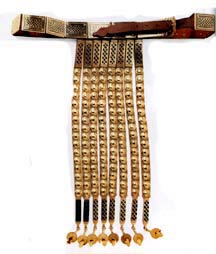 noticeable piece of the armor but was a soldier's badge of office, worn with the tunic at all times and formed the central piece of his armor holding all the rest securely in place. The belt was broad and composed of sturdy leather. From it hung an overlapping skirt of leather straps almost like an apron on which were decorative rivets. Also from the belt hung specialized hooks and holders on which to secure the scabbard that contained the dagger ("pugio"), the quiver which held lances, and an apparatus on which to rest the large battle shield. Also, on the belt were clips with which to hold the breastplate in its proper place. Supplies of bread, oil and water were also on the belt.
Roman soldiers wore at least one of 3 belts or girdles: (1) The breech-like leather apron worn to protect the lower abdomen; (2) the sword-belt which was buckled on together with the sword as the decisive step in the process of preparing one's self for battle (3) the special belt or sash designating an officer or high official
Ray Stedman - The officers in the Roman army wore short skirts very much like Scottish kilts. Over them they wore a cloak or tunic that was secured at the waist with a belt. When they were about to enter battle, they would tuck the tunic up under the belt so as to leave their legs free and unimpeded for the fight. Belting one's waist (or, as many older translations put it, "girding the loins") was always a symbol of readiness to fight. That is why Paul mentions this item of armor first. You cannot do battle until you have surrounded yourself with the belt of truth. What does this mean in practical, everyday terms? Simply this: When you are threatened by discouragement, depression, spiritual apathy and coldness, and similar moods, you fight back by remembering that you first became a Christian by surrounding yourself with truth. You remind yourself that in coming to Jesus Christ you found the truth behind all things, you found the One who is the Way, the Truth, and the Life, the secret of the universe, the final reality! (Ray Stedman. Spiritual Warfare - recommended!)
Loins (3751) (osphus) (see additional note) or "hip" (as used in classic Greek according to the TDNT) refers literally to the general area of the body between the ribs and the thighs, the midsection between the upper and lower body that includes the hips, the small of the back, the waist, and the reproductive organs. Osphus refers to the lower region of the back, which is the region of the 5 lower vertebrae of lumbar region, the part of body where the girdle was worn. It is the region of the hips as opposed to shoulders and thighs.
Jews considered osphus as the place of the reproductive organs and so we find the phrases ''to go forth from someone's loins'' equated with ''to be descendant''. Finally, In the NT girded loins signified that a man was ready for service or heavy battle. Osphus was used figuratively to describe a state of alertness or readiness.
Girding the loins was a symbolic way of saying that one was standing firm or exercising self-control. The picture derived from the fact that Orientals would often tuck their long flowing robes in their belt around their loins , with a view to greater mobility for work, for travel, for battle etc. Thus girded one would thus be enabled to move unimpeded and be less likely to be hindered or tripped.
The expression “to gird up one’s loins” means to belt the garment which is worn ungirdled in the house or in times of relaxation, with a view to greater mobility for work, for travel, for battle etc
The Theological Dictionary of the New Testament notes that in the Septuagint (LXX = Greek translation of the Hebrew OT) osphus...
"is a common figure of speech for “power,” Deut 33:11 ("LORD...shatter the loins of those who rise up against" Israel); Daniel 5:6 ("Then the king's face grew pale, and his thoughts alarmed him; and his hip joints went slack, and his knees began knocking together")
One of the most famous illustrations of this custom is found in Exodus where Moses records God's instructions to Israel on the night of the Passover...
"Now you shall eat it in this manner: with your loins (LXX = osphus) girded, your sandals on your feet, and your staff in your hand; and you shall eat it in haste-- it is the LORD'S Passover." (Exodus 12:11)
In a description of the Messiah's readiness for conflict (which Paul quotes in his exhortation to the Christian "soldier" in Ephesians 6:14), Isaiah records that righteousness and faithfulness are His preparation, declaring that...
"righteousness will be the belt about His loins (LXX = osphus), and faithfulness the belt about His waist." (Isaiah 11:5) (Here is the LXX translation - And he shall have his loins girt with righteousness, and his sides clothed with truth.)
In Ephesians 6:14 believers are to gird their loins with God's truth including His manifold promises which reminds one of C H Spurgeon's comment regarding the physical (and spiritual) warfare Joshua was about to encounter in the promised land. Spurgeon quipped that Joshua...
"was not to use (God's) promise as a couch upon which his indolence might luxuriate, but as a girdle wherewith to gird up his loins for future activity”
As Warren Wiersbe put it "God’s promises are prods, not pillows!"
Marvin Vincent - The loins (osphus) encircled by the girdle form the central point of the physical system. Hence, in Scripture, the loins are described as the seat of power. “To smite through the loins” is to strike a fatal blow. “To lay affliction upon the loins” is to afflict heavily. Here was the point of junction for the main pieces of the body-armor, so that the girdle formed the common bond of the whole. Truth gives unity to the different virtues, and determinateness and consistency to character. All the virtues are exercised within the sphere of truth." (Vincent, M. R. Word Studies in the New Testament. Vol. 3, Page 1-408)
Vine writes that osphus in Ephesians 6:14 is used metaphorically and that the girding of one's loins with truth refers to...
bracing up oneself so as to maintain perfect sincerity and reality as the counteractive in Christian character against hypocrisy and falsehood. (Vine, W., Vine's Expository dictionary of Old and New Testament words)
Wiersbe - "The loins are the place of action, mobility, and direction. A soldier with a broken hip would not be worth very much! Unless we are motivated and directed by truth, we will be defeated by the enemy. If we permit any deception to enter our lives, we have weakened our position and cannot fight the battle victoriously." (The Strategy of Satan: How to Detect and Defeat Him )
Osphus is used 58 times in the Septuagint (LXX)
Gen. 35:11; 37:34; Exod. 12:11; 28:42; Lev. 3:9; 7:3; 8:25; 9:19; Deut. 33:11; 2 Sam. 20:8; 1 Ki. 2:5; 12:10, 24; 18:46; 20:31f; 2 Ki. 1:8; 4:29; 9:1; 2 Chr. 6:9; 10:10; Neh. 4:18; Job 12:18; 38:3; 40:7, 16; Prov. 31:17; Isa. 5:27; 11:5; 15:4; 20:2; 21:3; 32:11; Jer. 1:17; 13:1f, 4, 11; 30:6; 48:37; Ezek. 1:27; 8:2; 9:2f, 11; 21:6; 23:15; 24:17; 29:7; 44:18; 47:4; Dan. 5:6; 10:5; Amos 8:10; Nah. 2:1, 10
Nahum 2:1 The one who scatters has come up against you. Man the fortress, watch the road; Strengthen your back, (LXX = osphus) summon all your strength.
Osphus is used 8 times in the NT (note the NAS and NIV do not always translate osphus separately thus some of the verses below are in the KJV)...
Matthew 3:4 Now John himself had a garment of camel's hair, and a leather belt about his waist; and his food was locusts and wild honey.
Mark 1:6 And John was clothed with camel's hair and wore a leather belt around his waist, and his diet was locusts and wild honey.
Luke 12:35 "(Literally - Let your loins be girded) Be dressed in readiness, and keep your lamps alight. (Comment: both metaphors picture a disciple as one living in constant expectancy of the Lord's return)
Acts 2:30 "Therefore being a prophet, and knowing that God had sworn with an oath to him, that of the fruit of his loins, according to the flesh, he would raise up Christ to sit on his throne" (KJV)
Ephesians 6:14 Stand firm therefore, having girded your loins with truth, and having put on the breastplate of righteousness,
Hebrews 7:5 And those indeed of the sons of Levi who receive the priest's office have commandment in the Law to collect a tenth from the people, that is, from their brethren, although these are descended (come out of the loins) from Abraham...10 for he (Levi) was still in the loins (osphus) of his father when Melchizedek met him.
1 Peter 1:13 (note) Wherefore gird up the loins of your mind, be sober, and hope ( or "fix your hope" = aorist imperative) to the end for the grace that is to be brought (the tense is the vivid present —“is being brought unto you”—as if to make the future event immediately real) unto you at the revelation of Jesus Christ (KJV) (Comment: Literally is "having girded up the loins [osphus] of your mind" = Pull your mind together and have the right mental attitude in view of our Lord’s return for when you center your thoughts on His return and live accordingly, you escape the many worldly things that would encumber your mind and hinder your spiritual progress)
Kenneth Wuest commenting on "girding one's mind for action" in 1Pe 1:13 (note) has an excellent practical comment...
It is not physical exertion that Peter has in mind here, but mental. If the purpose of girding up the clothing was to put out of the way that which would impede the physical progress of an individual, the girding up of the loins of the mind would be the putting out of the mind all that would impede the free action of the mind in connection with the onward progress of the Christian experience, things such as worry, fear, jealousy, hate, unforgiveness, impurity. (Ed note: add thanklessness)
These thoughts harbored in the mind prevent the Holy Spirit from using the mental faculties of the Christian in the most efficient manner, and thus from causing that believer to grow in the Christian life and make progress in his salvation. The word “to gird up” (1Pe 1:13) is in the aorist tense which refers to a past once-for-all act.
Bringing this oriental expression over to the occidental manner of thinking, enables us to translate,
“Wherefore, having put out of the way, once for all, everything that would impede the free action of your mind.”
Peter treats this as a God-expected obligation on the part of the believer. In 1Pe 1:3 (see note) we learned that as the believer definitely subjected himself to the ministry of the Holy Spirit, He (the Spirit) would produce in his (the yielded believer's) life through the Word, that Christian optimism that always looks for the best and not for the worst, that always sees the silver lining on every cloud.
By the power of the same Holy Spirit, he is able to exert his will in putting out of his mind those things that would impede its free action. Thus, the Christian has the privilege of enjoying the wholesome mental atmosphere called “Christian optimism and a care-free mind,” not a mind devoid of an appreciation of the seriousness of life and its responsibilities, but a mind not crippled and frozen by worry, fear, and their related mental attitudes. Living in this blessed mental state, the believer is ready and able to obey the exhortations to which the apostle now addresses himself." (Wuest Word Studies - Eerdman Publishing Company Volume 1, Volume 2, Volume 3 - used by permission)
Expositor's Greek Testament comments that truth "is simplest and most accordant with usage to take it so here (in the sense of candor, sincerity, truthfulness). And this plain grace of openness, truthfulness, reality, the mind that will practice no deceits and attempt no disguises in our intercourse with God, is indeed vital to Christian safety and essential to the due operation of all the other qualities of character. “As the soldier covers his breast with the breastplate to make it secure against the disabling wound, so the Christian is to endue himself with righteousness so as to make his heart and will proof against the fatal thrust of his spiritual assailants.” (Ephesians 6 Commentary)
Truth (225) (aletheia from alethes = true in turn from a + lêthô = that which is hidden or lanthanô = conceal, this combination meaning out in the open, containing nothing that is hidden) describes the body of reality (facts, events, etc) or the content which is true, or which is in accordance to what actually occurred. Truth is the unveiled reality lying at the basis of and agreeing with an appearance; the manifested, the veritable essence of matter. Truth is the correspondence between a reality and a declaration which professes to set it forth. Words are true when they correspond with objective reality. Persons and things are true when they correspond with their profession. Hence a truth is a declaration which has corresponding reality, or a reality which is correctly set forth. Since God is Himself the great reality, that which correctly sets forth His nature is pre-eminently the Truth. Obviously whatever God says is "the truth", and in fact "the Truth" is actually embodied in the Person of Christ Jesus!
We must faithfully hold the truth of God’s word, but it is also necessary for the truth to hold us. We must apply it to our daily lives and test everything by comparing it to the plumbline of God's Word of truth.
Since Satan is a liar, we must oppose him with God’s truth. In Paul's day the people wore belts or girdles to bind up their flowing garments and hold everything together. It is God’s truth that must hold everything together in our lives. As Christians, we must love truth and live truth. It is therefore not surprising to see John write to his spiritual children...
I have no greater joy than this, to hear of my children walking in the truth. (3John 1:4)
Warren Wiersbe - Unless we are motivated and directed by truth, we will be defeated by the enemy. If we permit any deception to enter our lives, we have weakened our position and cannot fight the battle victoriously. The girdle of truth is not an offensive weapon; it is for protection. When the believer has what I call “an attitude of truth” in his life, this protects him from Satan’s attacks. It does not prevent these attacks; it keeps the believer from being harmed by them. (Wiersbe, W: Strategy of Satan: How to Detect and Defeat Him)
Marvin Vincent has this note about truth in Ephesians 6:14 writing that it is...
The state of the heart answering to God’s truth; inward, practical acknowledgment of the truth as it is in Him: the agreement of our convictions with God’s revelation.
The loins encircled by the girdle form the central point of the physical system. Hence, in Scripture, the loins are described as the seat of power. “To smite through the loins” is to strike a fatal blow. “To lay affliction upon the loins” is to afflict heavily. Here was the point of junction for the main pieces of the body-armor, so that the girdle formed the common bond of the whole. Truth gives unity to the different virtues, and determinateness and consistency to character. All the virtues are exercised within the sphere of truth. (Vincent, M. R. Word Studies in the New Testament 3:408)
MacDonald wisely comments that Christian soldiers...
must be faithful in holding the truth of God’s word, but it is also necessary for the truth to hold us. We must apply it to our daily lives. As we test everything by the truth, we find strength and protection in the combat. (Believer's Bible Commentary)
Ray Stedman relates a story regarding truth which you may have heard...
In Proceedings, the magazine of the Naval Institute, naval officer Frank Koch tells the story of an incident that happened to him at sea an incident that illustrates the principle Paul talks about:
Two battleships assigned to the training squadron had been at sea on maneuvers in heavy weather for several days. I was serving on the lead battleship and was on watch on the bridge as night fell. The visibility was poor with patchy fog, so the captain remained on the bridge keeping an eye on all activities. Shortly after dark, the lookout on the wing of the bridge reported, "Light, bearing on the starboard bow." "Is it steady or moving astern?" the captain called out. Lookout replied, "Steady, captain," which meant we were on a dangerous collision course with that ship.
The captain then called to the signalman, "Signal that ship: We are on a collision course, advise you change course 20 degrees." Back came a signal, "Advisable for you to change course 20 degrees." The captain said, "Send, I'm a captain, change course 20 degrees." "I'm a petty officer second class," came the reply. "You had better change course 20 degrees." By that time, the captain was furious. He spat out, "Send, I'm a battleship. Change course 20 degrees." Back came the flashing light, "I'm a lighthouse." We changed course.
God's truth is like that lighthouse and we are like that battleship. In our human arrogance, we chart our own course and demand that the world adjust itself to our wishes. But God's truth is unchanging, unbending, unyielding. It is not God's duty to alter His truth. It is our responsibility to chart our course according to the light of His Word, which is ultimate, objective reality. If we fail to do so, we risk running our lives aground. (Spiritual Warfare)
Truth is mentioned 7 times in Ephesians and thus is a key thought...
Ephesians 1:13 (note) In Him, you also, after listening to the message of truth, the gospel of your salvation-- having also believed, you were sealed in Him with the Holy Spirit of promise
Comment: Truth is the gospel. Truth is what saved us. Truth has to be believed to be effective in our lives. So, when we have our loins girded about with the belt of truth, part of it refers to the gospel of the Lord Jesus Christ, by which we were saved and are now daily sanctified).
Ephesians 4:15 (note) but speaking the truth in love, we are to grow up in all aspects into Him, who is the head, even Christ
Comment: Truth is what the members of the body are to speak to each other. In speaking truth we grow in Christlikeness. Speaking truth is vital for spiritual maturity. When you gather for "fellowship", do you talk about the things of the world, many of which are deception and lies, or do you talk about truth as revealed by God? We must redeem the time for the days are evil!)
Ephesians 4:21 (note) if indeed (as is the case) you have heard Him and have been taught in Him, just as truth is in Jesus
Comment: Truth is a Person, Jesus, the very essence of Truth, the One Who Alone is the Way, the Truth and the Life. John wrote "And we know that the Son of God has come, and has given us understanding, in order that we might know Him Who is true, and we are in Him Who is true, in His Son Jesus Christ. This is the true God and eternal life." 1John 5:20)
Ephesians 4:24 (note) and put on the new self, which in the likeness of God has been created in righteousness and holiness of the truth.
Comment: Truth is the source of righteousness and holiness and is now the potential of each believer who is a new man in Christ. Here in Ephesians 6:14, this truth is the knowledge of sound doctrinal truth but it is also the practice that is in keeping with that truth. This was pictured by Paul as a putting off of the Old Man and a putting on of the New Man, as one would change a filthy, dirty garment for a bright, clean garment. When we practice the truth we know [i.e., obey and walk in the Spirit, filled with the Spirit] we are actively putting on this piece of the armor - girding our loins with the belt of truth and this serves as our defense against the deception and lies of the Evil One. Simply knowing the truth is not girding yourself with it. One must also practice the truth for it to be an effective defense! How are you doing? Is there a specific truth that you have willingly disobeyed this week or which you repeatedly refuse to obey? Then confess it before the God of infinite mercy and forgiveness, repent, turn around, yield to the Spirit and walk out in His power, in light and in the truth -- then you will walk out armed against the devil!)
Ephesians 4:25 (note) Therefore, laying aside falsehood, SPEAK TRUTH, EACH ONE of you, WITH HIS NEIGHBOR, for we are members of one another.
Comment: What we speak to one another should conform to reality. This truth should be made manifest by the way we speak. This will build up rather than tear down. A life so lived filled with the Spirit will be a sure defense against Satan and will prevent him from gaining a toehold in our life.)
Ephesians 5:9 (note) (for the fruit of the light consists in all goodness and righteousness and truth)
Comment: We are now light in the Lord and as we walk in a manner worthy of that new identification and do it in the power of the Spirit, the Spirit bears fruit - goodness, righteousness and truth, that truth which others see in our practice or conduct being in agreement with the truth that is in us - the indwelling Spirit of truth, Christ in us = Jesus Who is the Truth, the Word of Truth, God's Word. And this gives God the glory as others see our good works)
Ephesians 6:14 Stand firm therefore, HAVING GIRDED YOUR LOINS WITH TRUTH, and HAVING PUT ON THE BREASTPLATE OF RIGHTEOUSNESS
Wayne Barber explains girding your loins with truth...
We need to start by understanding what the word TRUTH is. It is aletheia. It is used several times in the book of Ephesians. Let me give you the basic understanding of that word. The basic, simple understanding of that word is a manifestation of a hidden reality. When you go into a courtroom and you are going to be a witness in a trial, they say, "Raise your right hand. Do you swear that you will tell the truth and nothing but the truth so help you God?" You say, "I do" and you sit down. What are they saying by using the term "truth"? They are asking, "Are you willing to come into this courtroom and manifest something that is hidden to us that only you know so that you will bear evidence to that?" You will manifest a hidden reality. That is what the word "truth" means. It is something that is manifested of a hidden reality...There are many things that you could say are true. Now a lot of things in life can be said to be true. But what we are seeing in Ephesians is the essence of all truth, The Truth (Ed note: See Scriptures above). You see, we are to be affected by what truth really is, and Ephesians tells us what it is. (See all the uses of truth in the preceding section)...
We then are to gird our loins with the belt of truth which is pure, which has no deception but instead accurately manifests some hidden reality. To be clothed with truth means to be sincerely committed to truth. In other words, I am totally sold out to who God is. I am totally sold out to what God has done. I am totally sold out to what God has said. I am yielded to Him. It is the truth, and I am now completely surrendered to Him.
"HAVING GIRDED YOUR LOINS WITH TRUTH" is an aorist middle participle (having girded) which means I can’t put it on for you. A lot of people come to church, and they feel like when they walk in the door, everybody is just going to love Jesus. The problem is, you can preach the truth but an individual has to make up his own mind as to whether or not to adhere to that truth. I can’t make it happen. It is a choice that we make, constantly choosing to be affected, to be totally committed to that which God says, to what He is, and that which He has done (these are all "truth"). To be girded with truth means that I am sincerely, totally, wholly committed to truth which most obviously is found in God’s Word. Paul is saying "Having girded your loins with truth, you must choose to allow truth to influence your life."
Why is this girding with truth a piece of the armor and why is it so important in warfare? We live in a darkened, deceptive world. The devil is constantly deceiving the whole world. Now believers have been made light in the midst of that darkness (see note Ephesians 5:8). If we are going to stand firm and wear the garment, part of that garment has a thread and it is armored. That armored thread is that we be totally committed to truth, who God is, what God has said and what God has done.
"Loins" refers to the lower back and Paul's analogy is beautiful. Your lower back is what helps you to stand. If you have trouble in your lower back, you are going to start bending and falling. Years ago I bought a little car to save gas. One day I came to the church, got out of the car and when I did, I swung my body the wrong way. Something went out in my lower back and I fell on my hands and knees and could not get up. I could not stand. Something happened in my lower back that brought me down.
The word osphus refers to the five lower vertebra of the back. The Apostle Paul is describing a Roman soldier who wore wide belts that carried their weapons. But also the belt would protect the lower back. When they went into combat, they were hand to hand, constantly digging in and standing up. Something had to gird and strengthen them. Paul says, "You are in a dark world. You are in a deceived world. When you get up on Monday morning and walk out you face it." Even on Sundays folks, we face it in the church. It is all around us. People who are not surrendered to Jesus Christ and to His Word don’t understand how sincerely wrong they can be because the mind is the key. Someone asked me, "Do you mean if you don’t wear that belt, the whole garment falls off?" I am not sure we can biblically say that, but that is good to remember. If you don’t have the belt of truth on, forget the rest of the armor. Truth means I am totally sold out, loving who God is, what God has said. I am not going to listen to what the world says. I am going to listen to what God says. Now this is an armored thread in that garment. It protects me because the one thing the devil wants to do is to deceive me.
What we don’t understand is, if we are not putting the Word of God into our minds, balancing out the error and deception we are being pounded with every day, we are already being misled and don’t know it. Listen, just because you think it doesn’t make it right. Examine it. Look at what God says. Folks, we are living in an upside down world and only the Word can put it right side up.
Now Paul is not specifically talking about just the Word. There is no definite article. But he is talking about truth and its essence—who God is, what God has done, what God has said. It is all wrapped up in that. Friend, if I am not going to be surrendered, if I am going to do stupid things, fill my mind with things of the world, then what happens next is my own fault. I wake up with a negative, critical and discouraged feeling that simply overwhelms me. Have you ever done that? I walk around thinking, "What is wrong?" What happens is, you start being suspicious. You start being critical. You start being bitter. Why? This is where we live every day folks. The way you are thinking right now is determined by some standard in your life. If it is not the standard of truth, you have already lost your garment, you are already led astray and you don’t even know it. That is what Paul is saying. It is urgent. The Word has to be in your life.
Folks, listen, they are telling us on the news that we are not going to have enough room for everybody in the world in a few years. I was watching CNN the other night and they said Social Security is going to go bankrupt. Who cares! God is not bankrupt! What does God say compared to what the world is saying? We talk about truth, and we will defend truth, but how many people are living in it? Folks, until you are adhering to truth, you have no strength. No wonder you have grown weak in the back. No wonder you are trying to cower down. No wonder you have been knocked down. Only truth can gird your loins and cause you to be able to stand.
Jesus said the devil is a liar and there is no truth in him. If I can’t do anything else in this series to convince you of anything, let me convince you of one thing. It is not a power struggle. If you put Satan up next to Jesus, he doesn’t show up on the scale. But his power is his power to deceive and he is deceiving us if we are not living according to the Word of God. It scares me how much deception is already in my mind because I have not examined everything by the counsel of the Word of God. (Ephesians 6:14 - Spiritual Warfare Part 3 - Wayne Barber)
Ray Stedman (ibid) explains truth by noting that...
for twenty centuries, men and women in desperate need have called out, "Lord Jesus Christ! Help me!" And help comes! Deliverance comes! That is how we know that Jesus is the truth.
Remember, all competing and conflicting systems and philosophies must be tested at all points, not at just one. Many philosophies can provide limited help and insight in this or that area. Even Karl Marx, as misguided as he was, had a few kernels of limited and fragmentary truth embedded in his godless diagnosis of human problems. But the presence of occasional partial insights and scattered nuggets of truth does not validate a system of ideas or beliefs. Truth is a complete entity. It is all or nothing. A half-truth is frequently no better than an outright lie and is sometimes even more deceptive than a lie. That is why witnesses in our courts must swear to tell "the truth, the whole truth, and nothing but the truth" because fragmentary truth produces deception.
Truth is reality. Truth is the sum total of the way things really are. Therefore, truth is the explanation of all things. You know you have found the truth when you find something that is wide enough and deep enough and high enough to encompass all things. That is what Jesus Christ does.
Further, ultimate reality never changes. Another mark of truth is that true truth never requires updating. It never needs to be modernized. If a moral or spiritual principle was true ten thousand years ago, it is still true today. If a principle is true today, it was true a hundred thousand years ago.
A man once visited his old friend, a music teacher, and said to him in that casual way people have these days, "Hey, what's the good news today?" Without saying a word, the old man walked across the room, picked up a hammer, and struck a tuning fork. As the note sounded out through the room, he said, "That is 'A.' It is 'A' today, it was 'A' five thousand years ago and it will be 'A' ten thousand years from now. The soprano upstairs sings off-key, the tenor across the hall flats his high notes, and the piano downstairs is out of tune." He struck the note again and said, "That is 'A,' my friend, and that's the good news for today!"
Jesus Christ is unchanging. He's the same yesterday, today, and forever. That is how you know you have the truth. Remember that, when you feel defeated, when you are under attack, when doubts come flooding into your mind. Remember that you are already encircled by the belt of truth. You have found the One who is the solid, unchanging Rock. The words of the hymn express this well,
On Christ, the solid Rock, I stand
All other ground is sinking sand.
Play "My Hope is Built"
VERSE BY VERSE EXPOSITION ON EPHESIANS 6:10-18...
- Ephesians 6:10
- Ephesians 6:11
- Ephesians 6:12
- Ephesians 6:13
- Ephesians 6:14
- Ephesians 6:15
- Ephesians 6:16
- Ephesians 6:17
- Ephesians 6:18
EPHESIANS 6:10-18 BY WAYNE BARBER
- Ephesians 6:10: Spiritual Warfare, Pt 1
- Ephesians 6:11: Spiritual Warfare, Pt 2
- Ephesians 6:14: Spiritual Warfare, Pt 3
- Ephesians 6:15,16 Spiritual Warfare, Pt 4
- Ephesians 6:17: Spiritual Warfare, Pt 5
- Ephesians 6:12,13 Spiritual Warfare, Pt 6
- Ephesians 6:18: Spiritual Warfare, Pt 7
VERSE BY VERSE EXPOSITION ON THE FALLEN FLESH
D MARTYN LLOYD JONES - expository preaching at its finest - a veritable "crash course" in Spiritual Warfare 101!
- Ephesians 6:10-13 The Enemy Described
- Ephesians 6:10-13 The Origin of Evil
- Ephesians 6:10-13 The Wiles of the Devil
- Ephesians 6:10-13 The Devil and the Nations
- Ephesians 6:10-13 Spiritism
- Ephesians 6:10-13 Spiritism and the Christian
- Ephesians 6:10-13 Demon Possession
- Ephesians 6:10-13 Common and Special Grace
- Ephesians 6:10-13 The Strong Man Disarmed
- Ephesians 6:10-13 The Christian and the Devil
- Ephesians 6:10-13 Schism in the Church (1)
- Ephesians 6:10-13 Schism in the Church (2)
- Ephesians 6:10-13 Cults
- Ephesians 6:10-13 Counterfeits
- Ephesians 6:10-13 Watchfulness
- Ephesians 6:10-13 Philosophy and Vain Deceit
- Ephesians 6:10-13 Knowledge Puffs Up
- Ephesians 6:10-13 God in the Flesh
- Ephesians 6:10-13 Faith and Experience
- Ephesians 6:10-13 Physical; Psychological; Spiritual
- Ephesians 6:10-13 True and False Assurance
- Ephesians 6:10-13 Attacks on Assurance (1)
- Ephesians 6:10-13 Attacks on Assurance (2)
- Ephesians 6:10-13 Quenching The Spirit (1)
- Ephesians 6:10-13 Quenching The Spirit (2)
- Ephesians 6:10-13 Temptation and Sin
- Ephesians 6:10-13 Discouragement
- Ephesians 6:10-13 Worry and Anxiety
- Ephesians 6:10-13 Mans Greatest Problem - Self
- Ephesians 6:10-13 True and False Zeal
- Ephesians 6:10-13 Worldliness
- Ephesians 6:10-13 The Call to Battle
- Ephesians 6:10-13 God's Battle Not Ours
- Ephesians 6:10-13 Who Does the Fighting?
- Ephesians 6:10-13 Morale
- Ephesians 6:10-13 Food and Drink
- Ephesians 6:10-13 Exercise
- Ephesians 6:10-13 Discipline
- Ephesians 6:10-13 The Promises
- Ephesians 6:10-13 Trust in God and...
- Ephesians 6:10-13 Things to Avoid
VERSE BY VERSE EXPOSITION ON RESISTING THE ROARING LION
VERSE BY VERSE EXPOSITION ON THE BATTLE IN OUR MIND
THE METAPHOR OF THE CHRISTIAN SOLDIER
- Soldier Illustrations
- Exposition of 2 Timothy 2:3-4
- Three Kinds of Soldiers - Ten Principles of Warfare
- Roman Soldier by Edward Gibbon (Decline & Fall of Roman Empire)
- The Roman Soldier - Description from Jewish Historian Josephus
- A Few Soldier Stories and Sermons
THE AMALEKITES: A PICTURE OF PERSISTENT SPIRITUAL WARFARE
AND HAVING PUT ON THE BREASTPLATE OF RIGHTEOUSNESS: kai endusamenoi (AMPMPN) ton thoraka tes dikaiosunes:
- Isaiah 59:17; 1Thessalonians 5:8; Revelation 9:9,17
- Ephesians 6 Resources - Multiple Sermons and Commentaries
- Ephesians 6:14: Spiritual Warfare - 3 - Wayne Barber
- Ephesians 6:14 Protected by Truth and Righteousness - Steven Cole
- Ephesians 6:14 The Believer's Armor, Part 1 The Belt of Truthfulness - John MacArthur
- Ephesians 6:14 The Believer's Armor, Part 2 The Breastplate of Righteousness - John MacArthur
- Ephesians 6:14 The Armor of God: The Belt of Truthfulness and The Breastplate of Righteousness - John MacArthur
IMPUTED AND IMPARTED
RIGHTEOUSNESS
Having put on the breastplate of righteousness - When we first believed the Gospel we were justified (declared righteous) by faith which describes positional righteousness. What Paul is referring to in this passage is not so much our position of righteousness but our daily practice of righteousness, living rightly before God and man as we rely on the power of the Holy Spirit.
Phil Newton comments on the breastplate of righteousness "The Puritan writers called this both the "imputed and imparted" righteousness of Christ for our lives. Inattention to the law of God in our obedience will flatten us before the enemies. And even more so, forgetting your dependence upon the imputed righteousness of Christ so that you put confidence in the flesh will leave you open to doubt and discouragement." (2 Cor 10:1-6 The Christian's Weapons: Becoming Battle Ready)
Jerry Bridges explains that he begins each day with God...
by reviewing and appropriating to myself the Gospel. Since the Gospel is only for sinners, I come to Christ as a still practicing sinner. In fact, I usually use the words of that tax collector in the temple when he cried out, “God, be merciful to me, a sinner” (Luke 18:13). God has been merciful, and I’m quick to acknowledge his mercy in my life, but I say to him that I come in the attitude of that tax collector. “I need your mercy. I am still a practicing sinner. Even my very best deeds are sinful in your sight, and I am an object of your mercy and your grace....To use an expression...I began to “preach the Gospel to myself. And I subsequently learned that I continued to need the Gospel every day of my life....Now this raises an apparent problem or question. That is, we know that justification is a point-in-time past event. At the time you trusted Christ you were at that precise moment declared righteous by God. You were justified. For the apostle Paul, justification was not only a past event; it was also a present reality. This is where so many Christians miss it. They can look back to the day that they trusted Christ. And if you press them on that they will say, “Yes, I was justified at that time.” But today they seek to live their lives as if it depends upon them (Ed: And in the context of this section of Ephesians, they try to carry out spiritual warfare as if it depended on them). In their mind they have reverted to a performance relationship with God. And so the thinking is, if I had my quiet time and if I haven’t had any lustful thoughts and these kind of things, then I expect God to bless me today (Ed: Or I can expect to victorious in the ongoing spiritual war). We want to pay our own way. We want to earn God’s blessings. The apostle Paul didn’t do that. Paul looked outside himself and saw himself clothed in the righteousness of Christ. He saw himself declared righteous....But what about from the time of our conversion until the time we go to be with the Lord? For most Christians it’s a performance relationship. That is why we need a daily appropriation of the Gospel, because it is our nature to drift toward a performance relationship....And so we come to the Lord and we say, “Lord, I come still a practicing sinner, but I look to Jesus Christ and his shed blood and His perfect obedience, His righteous life that has been credited to me. And I see myself standing before you clothed in His righteousness. That will get you out of bed in the morning. That will get you excited about the Christian life, when you see yourself daily clothed in his righteousness. And that will keep you from loving the world (Ed: One of our three great spiritual enemies). You can’t love the Gospel and love the world at the same time (cf 1Jn 2:15). So a daily appropriation of the Gospel will keep you from getting off course. (Ed: And enable you to fight the good fight of faith against your invisible foe).” (Stand: A Call for the Endurance of the Saints)
David Guzik adds that the righteousness Paul is describing in Eph 6:14 "is not our own earned righteousness, not a feeling of righteousness, but a righteousness received by faith in Jesus. It gives us a general sense of confidence, an awareness of our standing and position. (He quotes Lloyd-Jones who says) "Thank God for experiences, but do not rely on them. You do not put on the ‘breastplate of experiences’, you put on the breastplate of ‘righteousness." . We are sometimes tempted to say to the devil “Look at all I’ve done for the Lord.” But that is shaky ground, though sometimes it feels good. It is shaky because the feeling and experiences and doing is so changeable (Ed: And to a degree it is performance based). God’s righteousness is not. The breastplate of righteousness is your best defense against the sense of spiritual depression and gloom that comes against your gut." (Ephesians 6)
To summarize, although positional (justifying) righteousness is necessary for us to even enter the fight, Paul is saying that it is our practical (sanctifying) righteousness that must be worked out (relying on the Spirit) in fear and trembling (Php 2:12, Php 2:13). Someone has well said that
“When a man is clothed in practical righteousness, he is impregnable.
Words are no defense against accusation, but a good (righteous) life is.”
Put on (1746) (enduo from en = in + dúo = to sink, go in or under, to put on) means literally to clothe or dress someone and to put on as a garment, to cause to get into a garment (eg, Lk 15:22 where the father says "quickly bring out the best robe and put it on him...").
Aorist tense indicates this putting on is a past completed action and includes the idea that this action was decisive. In the middle voice (as in Col 3:10) it means to clothe oneself with something, in this case the "new man", who is clothed in the robes of Christ's righteousness and now needs to practice what this privileged position entails, i.e., to manifest His righteousness each day toward God and toward men in everyday life.
Luke uses enduo figuratively describing clothing with spiritual power...
"And behold, I am sending forth the promise of My Father upon you; but you are to stay in the city until you are clothed with power from on high." (Luke 24:49)
Comment: Here the indirect middle conveys the sense "put on yourselves power from on high as a garment". They are to wait till this experience comes to them, which equates with “the promise of the Father.” Enduo used in this figurative in classical Greek by Aristophanes who writes "clothed with audacity"; Homer, "clothed with strength"; Plutarch, "clothed with nobility and wealth".
Ray Stedman gives the following illustration:
"When I get up in the morning I put on my clothes, intending them to be part of me all day, to go where I go and do what I do. They cover me and make me presentable to others. That is the purpose of clothes. In the same way, the apostle is saying to us (Ro 13:12, 13, 14- See notes Ro 13:12, 13 14), “Put on Jesus Christ when you get up in the morning. Make Him a part of your life that day. Intend that He go with you everywhere you go, and that He act through you in everything you do. Call upon His resources. Live your life IN CHRIST.” (Stedman, Ray C. From Guilt to Glory. Vol 2. p136. Waco, TX: Word, 1978) (Bolding added)
Expositor's Greek Testament comments on the breastplate writing that "As the soldier covers his breast with the breastplate to make it secure against the disabling wound, so the Christian is to endue himself with righteousness so as to make his heart and will proof against the fatal thrust of his spiritual assailants.” (Ephesians 6 Commentary)

Breastplate (2382) (thorax) describes either the chest area or part of the body covered by the breastplate or the protective covering of this area as utilized in combat. Polybius tells us that it was known as a heart-protector. Usually it was made of bronze but the more affluent officers wore a coat of chain mail. The front piece was strictly the breastplate, but a back piece was commonly worn as well.
Isaiah prophetically describes Messiah wearing the breastplate of righteousness, recording (in the context of a tragic description of sins by Israel) that...
He (Messiah) put on righteousness like a breastplate, and a helmet of salvation on His head; and He put on garments of vengeance for clothing, and wrapped Himself with zeal as a mantle. 18 According to their deeds, so He will repay, wrath to His adversaries, recompense to His enemies. To the coastlands He will make recompense. 19 So they will fear the name of the LORD from the west and His glory from the rising of the sun, For He will come like a rushing stream, which the wind of the LORD drives. (Isaiah 59:17, 18, 19)
Comment: This prophecy is a picture of Messiah's second advent, at the end of the Great Tribulation, to save those who will be saved and to judge those who rejected His salvation. Had our Substitute not been fully, perfectly righteous, we could never have attained God's required righteousness. Instead Paul explains that believers have nothing to boast it for by God's "doing you are in Christ Jesus, who became to us wisdom from God, and righteousness and sanctification, and redemption" 1Cor 1:30.
Thayer describes the armor writing that it was...
a breast-plate or corselet consisting of two parts and protecting the body on both sides from the neck to the middle (Homer, Herodotus, Xenophon, Plato, others):
There are 10 uses of thorax in the Septuagint (LXX) (1 Sam. 17:5; 1 Ki. 22:34; 2 Chr. 18:33; 26:14; Neh. 4:16; Job 41:13, 26; Isa. 59:17; Jer. 46:4; Ezek. 38:4).
Isaiah 59:17 And He put on righteousness like a breastplate (LXX = thorax), and a helmet of salvation on His head; and He put on garments of vengeance for clothing, and wrapped Himself with zeal as a mantle.
TDNT - In Greece we find various forms of armor from leather doublets (with metal studs) to bronze armor conforming to the body. The Romans also use coats of mail combining lightness and strength. Armor comes into Egypt from abroad. Goliath the Philistine wears a heavy coat of mail. In Israel armor is at first a privilege of the nobility but comes into general use under Uzziah...The OT. The biblical metaphor originates in Isaiah 59:17 (see above) with its statement that God has put on righteousness like a breastplate, i.e., that He will deploy His full moral integrity to destroy evil and bring salvation in the sense both of justice (Kittel, G., Friedrich, G., & Bromiley, G. W. Theological Dictionary of the New Testament. Eerdmans)
There are 5 uses of thorax in the NAS...
Ephesians 6:14 Stand firm therefore, having girded your loins with truth, and having put on the breastplate of righteousness,
1 Thessalonians 5:8 But since we are of the day, let us be sober, having put on the breastplate of faith and love, and as a helmet, the hope of salvation.
Revelation 9:9 And they had breastplates like breastplates of iron; and the sound of their wings was like the sound of chariots, of many horses rushing to battle.
Revelation 9:17 And this is how I saw in the vision the horses and those who sat on them: the riders had breastplates the color of fire and of hyacinth and of brimstone; and the heads of the horses are like the heads of lions; and out of their mouths proceed fire and smoke and brimstone.
Righteousness (1343) (dikaiosune from dikaios = just, righteous = root idea of conforming to a standard or norm) is derived from a root word that means “straightness.” It refers to a state that conforms to an authoritative standard or norm and so is in keeping with what God is in His holy character. Righteousness is a moral concept. God’s character is the definition and source of all righteousness. God is totally righteous because He is totally as He should be. The righteousness of human beings is defined in terms of God’s. Righteousness in Biblical terms describes the righteousness acceptable to God and thus which is in keeping with what God is in His holy character. Rightness means to be as something or someone should be.
In short, the righteousness of God is all that God is, all that He commands, all that He demands, all that He approves and all that He provides (through the gospel of Jesus Christ, the perfectly Righteous One.)
We are positionally righteous by grace through faith
1Cor 1:30 But by His (the Father's) doing you are in Christ Jesus, Who became to us wisdom from God, and righteousness and sanctification, and redemption,
2Cor 5:21 He made Him who knew no sin to be sin on our behalf, that we might become the righteousness of God in Him.
Romans 1:17 (note) For in it (the Gospel) the righteousness of God is revealed from faith to faith; as it is written, "BUT THE RIGHTEOUS man SHALL LIVE BY FAITH."
Philippians 3:8 More than that, I count all things to be loss in view of the surpassing value of knowing Christ Jesus my Lord, for whom I have suffered the loss of all things, and count them but rubbish in order that I may gain Christ, 9 and may be found in Him, not having a righteousness of my own derived from the Law, but that which is through faith in Christ, the righteousness which comes from God on the basis of faith (See notes Philippians 3:8; 3:9)
Job declared...
I put on righteousness, and it clothed me. My justice was like a robe and a turban. (Job 29:14)
The Psalmist writes...
Let Thy priests be clothed with righteousness; and let Thy godly ones sing for joy. (Psalms 132:9)
Comment: Peter says believers are now a "holy priesthood" [1Pe 2:5] and a "royal priesthood" [1Pe 2:9] -- how much more important for us to be clothed with righteousness!
In a prophecy of the Messiah (see Messianic Prophecies), Isaiah records that...
"Also righteousness will be the belt about His loins, and faithfulness the belt about His waist."
(Messiah is speaking) "I will rejoice greatly in the LORD, My soul will exult in my God; for He has clothed me with garments of salvation, He has wrapped me with a robe of righteousness, as a bridegroom decks himself with a garland, and as a bride adorns herself with her jewels." (Isaiah 61:10)
Isaiah goes on to explain why men need to receive the righteous garments of Messiah that...
"all of us have become like one who is unclean, and all our righteous deeds are like a filthy garment; and all of us wither like a leaf, and our iniquities, like the wind, take us away." (Isa 64:6)
We have all become like one who is unclean [ceremonially, like a leper], and all our righteousness (our best deeds of rightness and justice) is like filthy rags or a polluted garment; we all fade like a leaf, and our iniquities, like the wind, take us away [far from God’s favor, hurrying us toward destruction]" (Isaiah 64:6 Amplified Version)
John MacArthur comments on Isa 64:6: As in Isaiah 53:6 ("all of us like sheep have gone astray"), the prophet included himself among those confessing their utter unworthiness to be in God’s presence. Isaiah employed the imagery of menstrual cloths used during a woman’s period to picture uncleanness (cf. Lev. 15:19-24). This is true of the best behavior of unbelievers (cf. Php 3:5, 6, 7, 8-notes Php 3:5; 3:6; 3:7; 3:8). (MacArthur Study Bible)
In Revelation 12:10 John describes the devil's activity as...
the accuser of our brethren has been thrown down, who accuses (present tense) them before our God day and night. (Comment: The one presently accusing. Prior to his casting out [Ed note: at the midpoint of the 7 year period "The Tribulation", at the 7th Trumpet - see Great Tribulation], Satan is continuously active bringing charges against the elect. The term is used of bringing a legal charge before a judge, as in court. He goes to and fro between this world and heaven as the “accuser of our brethren”. Yet even in his missions of slander and accusation, he is strictly limited - Job 1:6, 7, 8, 9, 10, 11, 12; Zec 3:1, 2, 3, 4, 5; Luke 22:31 from notes at Revelation 12:10)
As MacDonald rightly observes that
Every believer is clothed with the righteousness of God (2 Cor. 5:21), but he must also manifest integrity and uprightness in his personal life. Someone has said, “When a man is clothed in practical righteousness, he is impregnable. Words are no defense against accusation, but a good life is.”
If our conscience is void of offense toward God and man, the devil has nothing to shoot at. (Believer's Bible Commentary)
Comment: Satan is the accuser, and his minions attack us by reminding us of our sins. It is important to make a distinction between imputed [justification] and imparted righteousness [sanctification]. When a sinner trusts Christ and is born again, the very righteousness of Christ is put to his account, and this never changes. As the believer walks with the Lord and yields to the Spirit, sanctification [present tense salvation - see related topic Three Tenses of Salvation] occurs and he becomes more like Christ. Because we know we have been accepted by God and are righteous in Jesus Christ [1Cor 1:30, 2Co 5:21]], we need not fear when Satan's workers throw their accusations at us. And although people are not our enemy, remember that Satan often uses people, even Christians, to slander and accuse us, but we are not called to fight back even though we are sorely tempted to do so.
David (in the context of spiritual and literal warfare as Saul sought to take his life) in verses 3-4 of Psalm 7 is not boasting but offering a statement of assurance that he had acted righteously toward men and thus had in essence put on the practical breastplate of righteousness
3 O LORD my God, if I have done wrong or am guilty of injustice,
4 if I have betrayed a friend or plundered my enemy without cause,
5 then let my enemies capture me. Let them trample me into the ground. Let my honor be left in the dust. Interlude (Psalm 7:3, 4, 5, NLT)
Wuest explains it this way...
The righteousness (in Ephesians 6:15) is not justifying righteousness given the believing sinner when he first believes, but sanctifying righteousness, the product of the Holy Spirit in the life of the yielded saint. It can be defined as moral rectitude. The breastplate of righteousness is therefore the breastplate which is righteousness or consists of righteousness. (Wuest Word Studies - Eerdman Publishing Company Volume 1, Volume 2, Volume 3 - used by permission)
Marvin Vincent adds that...
Righteousness is used here in the sense of moral rectitude (Ed note: morally correct behaviour). In 1 Thess. 5:8, the breastplate is described as of faith and love. Homer speaks of light-armed warriors armed with linen corselets; and these were worn to much later times by Asiatic soldiers, and were occasionally adopted by the Romans. Thus Suetonius says of Galba, that on the day on which he was slain by Otho’s soldiers, he put on a linen corselet, though aware that it would avail little against the enemy’s daggers (“Galba,” xix.). Horn was used for this purpose by some of the barbarous nations. It was cut into small pieces, which were fastened like scales upon linen shirts. Later, the corselet of metal scales fastened upon leather or linen, or of flexible bands of steel folding over each other, was introduced. They appear on Roman monuments of the times of the emperors. The Roman spearmen wore cuirasses (Ed note: a piece of armor covering the body from neck to waist) of chain-mail. Virgil mentions those in which the linked rings were of gold (“Aeneid,” iii., 467). The stiff cuirass called stadios standing upright, because, when placed upon its lower edge it stood erect, consisted of two parts: the breastplate, made of hard leather, bronze, or iron, and a corresponding plate covering the back. They were connected by leathern straps or metal bands passing over the shoulders and fastened in front, and by hinges on the right side. The breastplate covers the vital parts, as the heart. (Vincent, M. R. Word Studies in the New Testament 3:408)
Ray Stedman explains the breastplate of righteousness as follows...
Christians, through one circumstance or another, often lack assurance. They feel unworthy before God. They feel they are a failure in the Christian life and that God is certain to reject them, and He is no longer interested in them. As Christians, we are constantly aware of our failures and shortcomings. Growth seems to take place so slowly. The first joy of faith has faded, and people often come to doubt God's presence with them, love for them, or forgiveness of their sin. There is a nagging sense of guilt. Their conscience needles them, making them feel unhappy and miserable. They feel God blames them. This is simply a satanic attack, a crafty and devilish accusation, a lie designed to undermine what God is doing in your life.
How do you answer an attack like this? You answer by remembering that you already wear the breastplate of righteousness. In other words, you do not stand on your own merits--and you never did. You never had anything . worthwhile in yourself to offer to God. You gave all that up when you came to Christ. You quit trying to be good enough to please God. You came to God the Father on the infinite merits of His Son, who died for you. It is not your own miserable, tattered righteousness that covers your heart, but the solid, impenetrable righteousness of Jesus. And His righteousness is durable enough to deflect any of the arrows of Satan's accusations. (Spiritual Warfare)
Lehman Strauss notes that the breastplate of righteousness is a
piece of defensive armor covered the body, both front and back, from the neck to the thighs. It offered special protection for the heart. A warrior without his breastplate was dangerously exposed to the thrust of the enemy.
Now we can think of no better protection for the heart
than a walk in righteousness consistent with our position in Christ.
Paul is not referring alone to that imputed positional righteousness which is the possession of all true believers, but the practical righteousness which results from the positional.
It is the righteousness of both standing and state.
It is not enough that we have the imputed righteousness of Jesus Christ; our walk must be consistent with our position. Most certainly no man can live righteously who has not had the righteousness of God in Christ communicated unto him. All the righteousnesses of the natural man are as filthy rags (Is 64:6), so that we must say with Paul
That I may … be found in Him, not having mine own righteousness, which is of the law, but that which is through the faith of Christ, the righteousness which is of God by faith (Php 3:8, Php 3:9).
The righteous ones are the redeemed ones, and to all such God says:
yield (aorist imperative = command to do this now. Don't delay. It is urgent.) yourselves unto God, as those that are alive from the dead, and your members as instruments of righteousness unto God (Ro 6:13).
If we are not living righteously we are easy targets for the enemy’s darts.
Sinning saints cannot stand
in the day of adversity when Satan attacks.
Right living is wound-proof; therefore
we should live soberly, righteously, and godly, in this present world (Titus 2:12).
If we fall instead of stand when Satan attacks, it is because we have not been living right. Let every one with unconfessed sin in his life confess it here and now, lest the devil gain an advantage over any one of us.
Dr. Charles R. Erdman writes
One who binds himself about with a determined loyalty to the holy will and law of God is secure against the deadly thrusts of the tempter. A man who is conscious of being in the wrong is usually a coward; a man who knows that he is right can withstand a multitude arid enters the conflict without fear.
Righteousness is a matter of the heart continually; it is not something we piously and fraudulently parade one day a week. Strictest integrity must be maintained at all times, the heart being kept purged of every lustful desire and the mind clear of every unholy thought. Notice the words, “having on.” Christians are expected to be ethical and righteous. None but the righteous can stand.
Righteousness is Jehovah’s breastplate (Is 59:17).
Make it yours.
(The Conduct and Duty of the Church - Ephesians 4-6) (Bolding added)
Wayne Barber explains the breastplate of righteousness...
What is righteousness? Righteousness is anything that conforms to a standard. Something is righteous if it conforms to a right standard. The world has its standard, and when people try to conform to that standard, they call it righteousness. It is deeds. It is what you do. In Isaiah God said our righteousness, conforming to the standard of man, is filthy rags in His eyes. So when you determine righteousness, you’ve got to find the standard. The standard is the truth and the truth is God. When you go back to the truth, then He determines the standard. When we start living lives, conforming to His rights over us and to His standards, then righteousness results.
Righteousness is not what I do for God. Righteousness is a result of my surrender to Him and my adherence to His truth. It is the deeds that come from that surrender to the Spirit Who then fills and controls me. Adhering to truth affects the breastplate of righteousness. The breastplate was used by a Roman soldier to cover him from the shoulders to the loins covering the vital organs. Paul is saying, "It is like that Roman soldier. He wouldn’t go into battle without his loins girded. But secondly, he wouldn’t go into battle without that breastplate on, because that breastplate is what protects the vital things of his life." (Ed note: The man who lacks integrity can offer no successful defence to the foe; the dishonest man is vulnerable at every point.)
When we live righteously, conducting ourselves in conformity to the truth of who God is, what He has said, and what He has done, our righteous life becomes a breastplate which protects our heart as we stand in the spiritual war we live in each day.
Many believers have fallen into the trap of Satan. If you want to know where warfare starts, it is the battlefield of your mind for as Proverbs says, "As a man thinks so is he."...
We represent the living Lord Jesus Christ. The way we honor who He is and what He says has to do with the motivation in our heart of never wanting to bring attention to ourselves, but only wanting to bring attention to Him. You see the new garment is Jesus being Jesus in our life. When I honor His truth, the armor against the devil is not me and does not draw attention to me. It is Jesus who draws attention to Him. Friend, if you want to frustrate the devil, put on the garment.
In Romans 6 Paul speaks of righteousness as a believer's weapon writing...
Therefore do not let sin reign in your mortal body that you should obey its lusts, 13 and do not go on presenting (implying they were doing it - Paul says stop doing this!) the members of your body to sin as instruments (weapons) of unrighteousness; but present yourselves to God as those alive from the dead, and your members as instruments (weapons) of righteousness to God. 14 For sin shall not be master over you, for you are not under law, but under grace. (Ro 6:12, 13, 14-See notes Ro 6:12; 13; 14)
(Comment: The word for instruments, hoplon, was used of implements of war, either offensive or defensive and as used here in Romans 6 gives one the picture of a spiritual war between armies, Satan's and God's. When the believer reckons [see note Romans 6:11] or counts upon the truth or fact that the power of Sin has been rendered inoperative [see note Ro 6:6] and he conducts his life based on the principle that he is dead to Sin and alive to God in Christ Jesus, he is strengthened by the Spirit Who renews his mind and enables him to stop allowing Sin to reign like a king telling him how to live [ungodly]. But the believer does something else. He is empowered to obey Paul’s command to “Stop putting your members as weapons of unrighteousness at the service of the sinful nature.” Under the control of and strengthening of his inner man by the Holy Spirit, the believer is now empowered to not only refuse obedience to Sin's sinful desires, but is enabled to refuse placing his members (his eyes, ears, tongue, mind, hands, and feet) at Sin's disposal for use as weapons of unrighteousness. When the Christian lays down his armor by sin and disobedience, he in essence is choosing to put present his members as weapons at the service of the sinful nature [flesh], and he is guilty of "high treason", for he is then fighting against his own Captain, the Lord Jesus.)
Jesus, Thy Blood and Righteousness
Nikolaus L. von ZinzendorfJesus, Thy blood and righteousness
My beauty are, my glorious dress;
’Midst flaming worlds, in these arrayed,
With joy shall I lift up my head.Bold shall I stand in Thy great day,
For who aught to my charge shall lay?
Fully absolved through these I am,
From sin and fear, from guilt and shame,O let the dead now hear Thy voice;
Now bid Thy banished ones rejoice;
Their beauty this, their glorious dress,
Jesus, Thy blood and righteousness.
Ephesians 6:15 and having shod YOUR FEET WITH THE PREPARATION OF THE GOSPEL OF PEACE; (NASB: Lockman)
Greek: kai hupodesamenoi (AMPMPN) tous podas en hetoimasia tou euaggeliou tes eirenes,
Amplified: And having shod your feet in preparation [to face the enemy with the firm-footed stability, the promptness, and the readiness produced by the good news] of the Gospel of peace. [Isa. 52:7.] (Amplified Bible - Lockman)
NLT: For shoes, put on the peace that comes from the Good News, so that you will be fully prepared. (NLT - Tyndale House)
Phillips: the Gospel of peace firmly on your feet, (Phillips: Touchstone)
Wuest: and having sandalled your feet with a firm foundation of the good news of peace; (Eerdmans Publishing - used by permission)
Young's Literal: and having the feet shod in the preparation of the good-news of the peace;
AND HAVING SHOD YOUR FEET WITH THE PREPARATION: kai hupodesamenoi (AMPMPN) tous podas en hetoimasia:
- Dt 33:25; Song 7:1; Hab 3:19; Lk 15:22
- Ephesians 6 Resources - Multiple Sermons and Commentaries
- Ephesians 6:14: Spiritual Warfare - 3 - Wayne Barber
- Ephesians 6:14 Protected by Truth and Righteousness - Steven Cole
- Ephesians 6:14 The Believer's Armor, Part 1 The Belt of Truthfulness - John MacArthur
- Ephesians 6:14 The Believer's Armor, Part 2 The Breastplate of Righteousness - John MacArthur
- Ephesians 6:14 The Armor of God: The Belt of Truthfulness and The Breastplate of Righteousness - John MacArthur
This phrase is the most difficult of the descriptions of Christian armor to explain and there are a variety of interpretations. Radmacher, et al, summarize the two most likely views...
This may mean either that the gospel is the firm foundation on which Christians are to stand or that the Christian soldier should be ready to go out to defend and spread the gospel. (Radmacher, E. D., Allen, R. B., & House, H. W. The Nelson Study Bible: NKJV. Nashville: Thomas Nelson)
Comment: Most of the translations and the commentators favor the former interpretation as discussed more below.
Having shod (5265) (hupodeo from hupó = under + déo = to bind) means literally to bind under and thus means to bind under one's feet and so put on shoes or sandals.
In order to stand firm the soldier must have have secure footing.
Having shod is an aorist middle participle, which means do it on your own accord. You don’t need someone else to make you feel guilty if you are not doing it. Do it because Jesus is your Captain, your Lord, your Life. Do it because you have a high view of salvation. Do it because God says to do it in order that you not lack any piece of God's full armor.
Paul uses the plural here so is speaking to the church as a whole, composed of Jew and Gentile. Remember that as a result of listening and receiving the word of truth, the gospel of their salvation, the Gentiles have been brought near and are now at peace with Jewish believers through the blood of Christ. So however one interprets this piece of spiritual armor, it is important to remember that the peace that the gospel established results in an army of individual believers who are united under one Head and are to march forward being diligent to preserve that unity in the bond of peace. If Satan can disrupt and divide the foundation of the the Christian army which was wrought by the gospel of peace, then he increases his chances of defeating us in individual battles.
A common military practice of the Roman soldiers was to plant sticks in the ground which had been sharpened to a point, burying them just beneath the surface of the ground so that they could not be easily seen. This tactic was potentially debilitating to the enemy because, if the soldier’s foot was pierced, he could not walk and if he could not walk, he clearly could not fight. The thick soled sandals protected their feet from this catastrophe.
Wood has an interesting note on the Roman soldier's shoes writing that...
Josephus described them as ‘shoes thickly studded with sharp nails’ . . . so as to ensure a good grip. the military successes both of Alexander the Great and of Julius Caesar were due in large measure to their armies’ being well shod and thus able to undertake long marches at incredible speed over rough terrain.”
Wuest explains this somewhat difficult to interpret piece of armor this way...
The Greek middle is used again in the exhortation, “and having shod your feet“ the responsibility of the Christian soldier. If the Christian soldier is to stand up against the attack of the demons, he must see to it that his feet are properly protected and equipped.
The Roman soldier wore sandals which were bound by throngs over the instep and around the ankle, and the soles were thickly studded with nails. This would give him a firm footing in case of attack. The word “preparation” is hetoimazo which was used in classical Greek in the sense of establishment or firm foundation. Thus, the Christian soldier should see to it that his feet are equipped with the sandals which will give him a firm footing, namely, the good news that speaks peace to a sinful heart, for the Lord Jesus made peace by the blood of His Cross, making a way for a holy God to reunite Himself with a believing sinner who in Adam had been separated from Him and His life.(Wuest Word Studies - Eerdman Publishing Company Volume 1, Volume 2, Volume 3 - used by permission) (Bolding added)
Barnes notes that..
The protection of the feet and ankles consisted of two parts: (1.) the sandals, or shoes, which were probably made so as to cover the foot, and which often were fitted with nails, or armed with spikes, to make the hold firm in the ground; or (2.) with greaves that were fitted to the legs, and designed to defend them from any danger. These greaves, or boots, 1Sa 17:6, were made of brass, and were in almost universal use among the Greeks and Romans. (Albert Barnes. Barnes NT Commentary)
There are 3 uses in the NT, the first 2 literal and the one here in Ephesians 6:15 figurative...
Mark 6:9 but to wear (KJV = shod with) sandals; and He added, "Do not put on two tunics."
Acts 12:8 And the angel said to him, "Gird (zonnumi) yourself and put on (KJV = bind on) your sandals." And he did so. And he said^ to him, "Wrap your cloak around you and follow me."
Feet (4228)(pous) refers to the foot, the terminal part of the vertebrate leg upon which an individual stands. The Roman soldier wore sandals called caliga, which were thickly studded sandals with cleats on the bottom of them. The cleats were to dig in and stand in the face of battle.
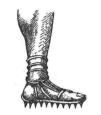
Caliga was a heavy shoe studded with hobnails and worn by the ordinary roman soldier. Soldiers wearing the caliga -- i.e., the ordinary soldiers -- were known as caligati. Germanicus put the caliga on his young son when they were among the soldiers. As a result, he was named "little boots," and became the emperor Caligula. Many of higher rank wore the calceus. The iron hobnails hammered into the sole served three purposes: to reinforce the caligae , to provide the soldier with better traction, and to allow the soldier to inflict damage by kicking with it.
Paul advises Christian converts to "put on the whole armor of God, that ye may be able to stand against the wiles of the devil" (Eph 6:11)...feet shod with the preparation [firm footing for the foundation] of the gospel of peace" This intimates the firm and solid knowledge of the gospel in which the believer may stand firm and unmoved like soldiers in their military duty.
Preparation (2091) (hetoimasia from hetoimos = ready, prepared) means readiness, fitness for, alacrity or preparedness. Preparation in the active sense of making ready. A state of preparedness whether external or internal (Ps 10:17).
Note that hetoimasia can also signify a prepared foundation or base, as frequently used in the in Septuagint (LXX) (see several representative uses below).
Here are some uses of hetoimasia which is found 10 times in the Septuagint (LXX)...
Ezra 2:68 And some of the heads of fathers' households, when they arrived at the house of the LORD which is in Jerusalem, offered willingly for the house of God to restore it on its foundation. (hetoimasia)
Ezra 3:3 So they set up the altar on its foundation (hetoimasia), for they were terrified because of the peoples of the lands; and they offered burnt offerings on it to the LORD, burnt offerings morning and evening.
Psalm 89:14 Righteousness and justice are the foundation (hetoimasia) of Thy throne; Lovingkindness and truth go before Thee.
Zechariah 5:11 Then he said to me, "To build a temple for her in the land of Shinar; and when it is prepared (hetoimasia), she will be set there on her own pedestal."
Expositor's Greek Testament feels this means "readiness, preparedness of mind, the preparedness which comes from the Gospel whose message is peace." (Comment: This interpretation would be in agreement with the peace believers that they have with God because of the gospel being like a foundation providing firm footing in warfare.) (Ephesians 6 Commentary)
Vincent writes that hetoimasia is found...
Only here in the New Testament. The Roman soldier substituted for the greaves of the Greek (metal plates covering the lower part of the leg) the caligae or sandals, bound by thongs over the instep and round the ankle, and having the soles thickly studded with nails. They were not worn by the superior officers, so that the common soldiers were distinguished as caligati. Hetoimasia means readiness; but in Hellenistic Greek it was sometimes used in the sense of establishment or firm foundation, which would suit this passage: firm-footing. Compare Isa. 52:7. (Vincent, M. R. Word Studies in the New Testament 3:409)
The Amplified Version chooses to translate this verse in a way that favors preparation as indicative of a firm foundation the Christian soldier now experiences as a result of the gospel of peace...
And having shod your feet in preparation [to face the enemy with the firm-footed stability, the promptness, and the readiness produced by the good news] of the Gospel of peace. (Amplified Bible - Lockman)
Other versions translate it with a similar thought concerning hetoimasia...
Barth “steadfast because the gospel of peace is strapped under your feet”
New English Bible “to give you firm footing”
NIV "and with your feet fitted with the readiness that comes from the gospel of peace"
Moffatt “and have shod your feet with the stability of the gospel of peace”
Williams "to put on your feet the preparation the good new of peace supplies"
Charles Ryrie agrees writing that...The gospel gives our feet (and lives) support and stability. (The Ryrie Study Bible: New American Standard Translation: 1995. Moody Publishers)
Wayne Barber comments that...this Greek word (hetoimasia) refers to the basis, foundation or the firm footing of something. This implies a firm and solid understanding of the gospel of Jesus Christ causes me to dig in. When the devil comes at me with deception, I have an understanding and am firmly fixed upon the truth of the gospel is. The "cleats" on the believer’s sandals provide a firm grasp on what the gospel of Jesus Christ is about, which Paul explains is a gospel of peace. (Discussion adapted from Wayne Barber's sermon)
The writers of the New Testament adapted the term Gospel as God's glorious message of salvation for lost otherwise hopeless, helpless sinners. Euaggelion is found in several combination phrases, each describing the gospel like a multifaceted jewel in various terms from a different viewpoint (from the NASB, 1977):
- the gospel of the kingdom (Mt 4:23, Mt 9:35, Mt 24:14)
- the gospel of Jesus Christ, the Son of God (Mk 1:1) because it centers in Christ
- the gospel of God (Mk 1:14, Ro 15:16, 2Co 11:7, 1Th 2:2, 1Th 2:8,9, 1Pe 4:17) because it originates with God and was not invented by man
- the gospel of the kingdom of God (Lu 16:16)
- the gospel of the grace of God (Acts 20:24, Ro 1:1),
- the gospel of His Son (Ro 1:9)
- the gospel of Christ (Ro 15:19, 2Co 2:12, 2Co 9:13, 2Co 10:14, Gal 1:7, Phil 1:27, 1Th 3:2)
- the gospel of the glory of Christ (2Co 4:4)
- the gospel of your salvation (Eph 1:14)
- the gospel of peace (Eph 6:15)
- the gospel of our Lord Jesus (2Th 1:8)
- the glorious gospel of the blessed God (1Ti 1:11)
- In Ro 16:25, 26 Paul called it “my Gospel” indicating that the special emphasis he gave the gospel in his ministry.
- An eternal gospel - Rev 14:6 (Some writers such as C I Scofield interpret this as a "different gospel" than the other "gospels" mentioned above but I think such a distinction is incorrect and is poorly substantiated).
For a rewarding study, study the preceding references in context making notation of the truth you observe about the gospel. If you would like a special blessing, take an afternoon to go through all 76 uses of euaggelion in context making a list of what you learn about the gospel. The Spirit of God will enlighten your heart and encourage your spirit in a very special way...and you'll want to share the "good news" with someone because of your "discoveries"!
Euaggelion - Matt. 4:23; Matt. 9:35; Matt. 24:14; Matt. 26:13; Mk. 1:1; Mk. 1:14; Mk. 1:15; Mk. 8:35; Mk. 10:29; Mk. 13:10; Mk. 14:9; Mk. 16:15; Acts 15:7; Acts 20:24; Rom. 1:1; Rom. 1:9; Rom. 1:16; Rom. 2:16; Rom. 10:16; Rom. 11:28; Rom. 15:16; Rom. 15:19; Rom. 16:25; 1 Co. 4:15; 1 Co. 9:12; 1 Co. 9:14; 1 Co. 9:18; 1 Co. 9:23; 1 Co. 15:1; 2 Co. 2:12; 2 Co. 4:3; 2 Co. 4:4; 2 Co. 8:18; 2 Co. 9:13; 2 Co. 10:14; 2 Co. 11:4; 2 Co. 11:7; Gal. 1:6; Gal. 1:7; Gal. 1:11; Gal. 2:2; Gal. 2:5; Gal. 2:7; Gal. 2:14; Eph. 1:13; Eph. 3:6; Eph. 6:15; Eph. 6:19; Phil. 1:5; Phil. 1:7; Phil. 1:12; Phil. 1:16; Phil. 1:27; Phil. 2:22; Phil. 4:3; Phil. 4:15; Col. 1:5; Col. 1:23; 1 Thess. 1:5; 1 Thess. 2:2; 1 Thess. 2:4; 1 Thess. 2:8; 1 Thess. 2:9; 1 Thess. 3:2; 2 Thess. 1:8; 2 Thess. 2:14; 1 Tim. 1:11; 2 Tim. 1:8; 2 Tim. 1:10; 2 Tim. 2:8; Phlm. 1:13; 1 Pet. 4:17; Rev. 14:6
Take My Life and Let It Be
Take my feet and let them be
Swift and beautiful for Thee
—Frances Ridley Havergal
OF THE GOSPEL OF PEACE: tou euaggeliou tes eirenes:
- Isa 52:7; Ro 10:15; 2 Cor 5:18-21
- Ephesians 6 Resources - Multiple Sermons and Commentaries
- Ephesians 6:14: Spiritual Warfare - 3 - Wayne Barber
- Ephesians 6:14 Protected by Truth and Righteousness - Steven Cole
- Ephesians 6:14 The Believer's Armor, Part 1 The Belt of Truthfulness - John MacArthur
- Ephesians 6:14 The Believer's Armor, Part 2 The Breastplate of Righteousness - John MacArthur
- Ephesians 6:14 The Armor of God: The Belt of Truthfulness and The Breastplate of Righteousness - John MacArthur
Gospel (2098) (euaggelion from eú = good + aggéllo = proclaim, tell) is literally good message and was in common use in first century indicating good news of any kind. A common question must have been “Have you any good news (euaggelion) for me today?”
As in the OT so among the Greeks, euaggelion was used for the proclamation of news of victory and the death or capture of the enemy! Ponder this in terms of our enemies!. Often the news was sent in a letter, but also came from the field of battle by ship, by horse, or a swift runner, who proclaims to the anxiously awaiting city the victory of the army, and the death or capture of the enemy.
Others uses of euaggelion included being gladdened by the birth of a son, by news of an approaching wedding, or of the death of someone.
The Cult of the Caesar was the state religion of the Roman empire, in which the emperor was worshipped as a god. When the announcement of the emperor’s birthday was made, or the accession of a new Caesar (gives rise to our English Kaiser & Czar!) proclaimed, the account of either event was designated by the word euaggelion or “good news.” The NT evangelists appropriated the word, take it out of the secular usage, and applying it to the message of salvation as the "best news" a man could ever hear!
In the context of Paul's description of the Christian's armor his allusion to the gospel is not simply referring to how people get saved which is how some interpret this verse. Paul is reminding us to become strong in the faith and ready for battle by keeping our feet firmly planted in the truth of the Good News. We must have a solid grasp, a sure footing so to speak, in regard to what the Good News teaches, specifically that we can live daily in the victory of Christ's life (Col 3:4). Too many Christian's "feel" saved and yet experience no victory.
A CONCISE DESCRIPTION OF THE GOSPEL
1 Corinthians 15:1-5 Commentary
Now I make known to you [since it seems to have escaped you], brethren, the gospel which I preached to you, which also you received, in which also you stand, 2 by which also you are saved, if you hold fast the word which I preached to you, unless you believed in vain (does not teach that true believers are in danger of losing their salvation, but it is a warning against non–saving faith -- could be translated "unless your faith is worthless" -- holding fast was the result and evidence of genuine salvation). 3 For I delivered to you as of first importance what I also received, that Christ died for our sins according to the Scriptures, 4 and that He was buried, and that He was raised on the third day according to the Scriptures, 5 and that He appeared to Cephas, then to the twelve. (See Notes)
Spurgeon - Rough roads grow smooth when these blessed gospel sandals are on your feet. A little stone in the shoe will make the pilgrim’s progress a very wearisome and painful one, so try to keep out all the stones, — everything about which you have any scruple, or that you think may be wrong; and walk in the safe and narrow way set forth in the gospel of peace.
Peace (1515) (eirene from verb eiro = to join or bind together that which has been separated) literally pictures the binding or joining together again of that which had been separated or divided and thus setting at one again. Peace contrasts with strife and thus denotes the absence or end of strife.
Why is it called the gospel of peace? Because of Adam's sin entering the world and affecting every man (Ro 5:12), all men are hostile toward God and at war with Him. It is only the gospel of Jesus Christ, the gospel of peace, which can bring about reconciliation of man to God and establishment peace. Therefore the gospel of peace pertains to the good news that, through Christ, believers are at peace with God and He is on their side (Ro 5:6-10). It is this confidence of divine support which allows the believer to stand firm -- he knows that he is at peace with God and God is his strength (see Ro 8:31, 37, 38, 39).
Expositor's Bible Commentary writes that this verse...
is not altogether easy to understand. Literally it reads: "and having shod yourselves as to the feet in readiness of the gospel of peace." But what is this readiness or preparation? It can mean preparedness, for the term is applied to a ship's tackling. Part of the Christian soldier's equipment is his readiness to go out at any moment to announce the Good News to others. As in Ephesians 2:17, the apostle may be recalling Isaiah 52:7 with its reference to the feet of the herald. Hetoimasia can also signify a prepared foundation or base, as frequently in Septuagint (LXX). In that case the sense would be that the gospel of peace with God through which the believer himself has already been reconciled (Eph 2:17) affords him a sure foothold in the campaign in which he is engaged. This second interpretation is more suitable to the context and had been adopted by the NIV in its first edition "with your feet fitted with the gospel of peace as a firm footing." (Gaebelein, F, Editor: Expositor's Bible Commentary) (Bolding added)
Henry Morris - Satan would bring doubt and rebellion and death, but the whole gospel, from creation to redemption to consummation, brings assurance and peace and life. (Defenders Study Bible) (Comment: It is this victory of Christ that gives us a safe and solid standing as we fight the devil. Wherever we walk, we stand on victory ground!)
J Vernon McGee - Shoes are necessary for standing. They speak of the foundation. We need a good, solid foundation, and preparation is foundational. I remember in hand-to-hand combat we were taught to make sure our feet were anchored. Are your feet anchored on the Rock? Christ is your foundation in this world. No other foundation can any man lay but the one that is laid, Jesus Christ (1Cor. 3:11). We are to put on Christ. Oh, how we need Him today as we face a gainsaying world and also spiritual wickedness in the darkness of this world! (Ephesians 6:14-15 Mp3)
Hoehner makes an excellent point observing that...
This verse does not speak of the spreading of the gospel, for Christians are pictured in vv. 10-16 as standing, not advancing. Instead this refers to a believer’s stability or surefootedness from the gospel which gives him peace so he can stand in the battle. (The Bible Knowledge Commentary)
Blaikie - "The metaphor becomes somewhat difficult to follow; the feet have to be shod or armed as with military sandals, and the sandal is the preparedness of or caused by, the gospel of peace. The idea seems to be that the mind is to be steadied, kept from fear and flutter, by means of the good news of peace—the good news that we are at peace with God; and “if God be for us, who can be against us?” The Roman sandal was furnished with nails that gripped the ground firmly, even when it was sloping or slippery; so the good news of peace keeps us upright and firm." (Ephesians 6 Commentary)
John Eadie says - the possession of peace with God (as a result of the Gospel) creates blessed serenity of heart, and confers upon the mind peculiar and continuous preparedness of action and movement. There is nothing to disconcert or perplex it, or divide and retard its energies. Consequently it is an error on the part of many expositors, from Chrysostom down to Conybeare, to represent the meaning thus—“preparation to preach or publish the gospel of peace,” for it is of defensive armour alone the apostle is now speaking. (Commentary on Ephesians)
Expositor's Greek Testament writes that the peace here is...
doubtless peace with God (Ro 5:1) which alone imparts the sense of freedom, relieves us of what burdens us, and gives the spirit of courageous readiness for the battle with evil. The phrase "the Gospel of peace" is elsewhere associated with the idea of the message preached (Isa 52:7, Nahum 1:15, cf. Ro 10:5). Here, however, the readiness is not zeal in proclaiming the Gospel, but promptitude with reference to the conflict. The preparedness, the mental alacrity with which we are inspired by the gospel with its message of peace with God, is to be to us the protection and equipment which the sandals that cover the feet are to the soldier. With this we shall be helped to face the foe with courage and with promptitude. (Ephesians 6 Commentary) (Bolding added)
MacArthur agrees with Expositor's Greek Testament writing that...
many commentators also interpret Ephesians 6:15 as a reference to preaching. But in the Ephesians text Paul is not talking about preaching or teaching but about fighting spiritual battles. And he is not talking about traveling about but standing firm (Ep 6:11, 13, 14). His subject is not evangelizing the lost but fighting the devil. In this passage the gospel of peace refers to the good news that believers are at peace with God...The gospel of peace is the marvelous truth that in Christ we are now at peace with God and are one with Him. Therefore, when our feet are shod with the preparation of the gospel of peace, we stand in the confidence of God’s love for us, His union with us, and His commitment to fight for us...The believer who stands in the Lord’s power need not fear any enemy, even Satan himself When he comes to attack us, our feet are rooted firmly on the solid ground of the gospel of peace, through which God changed from our enemy to our defender. We who were once His enemies are now His children, and our heavenly Father offers us His full resources to “be strong in the Lord, and in the strength of His might” (Eph. 6:10). (MacArthur, J: Ephesians. Chicago: Moody Press)
Boice on the other hand asks...
Does Paul want us to be shod with the gospel, with peace, or with the readiness to make the truth known?In my judgment the emphasis falls upon readiness to make the gospel known. Any Christian already knows the gospel; he would not be a Christian if he did not. So this must go beyond mere knowledge and appropriation. It must involve readiness to share the good news with others. Moreover, Paul links the gospel to the soldier’s boots or sandals. Shoes carry us from place to place, and it is as we go from place to place that we are to be ready to speak about Jesus. (Boice, J. M.: Ephesians: An Expositional Commentary)
Ray Stedman draws an analogy with the plight of England in WWII noting that...
In the dark days of England during the blitz, while bombs rained down on London and Coventry, the situation was truly desperate. Then Winston Churchill would come on the radio and speak to the English people when their hearts were filled with defeat and discouragement. At times they would be almost ready to quit. But that one man's voice would ring out and the nation would take heart again. The morale of an entire people would be elevated and strengthened. That is what Christ does. He speaks courage and peace to our hearts.
You see, it is not a battle against people at all, is it? It is an inner fight, a battle in the realm of the thought life and attitudes. It is a battle in the realm of your outlook on the situation in which you find yourself. This is the place to start. Remember that you wear the belt of truth. (Ray Stedman. Spiritual Warfare - Available online and highly recommended!)
In Colossians Paul explains that
you were formerly alienated and hostile in mind, engaged in evil deeds, yet He has now reconciled you in His fleshly body through death, in order to present you before Him holy and blameless and beyond reproach (Col 1:21, 22-notes)
Paul adds in Romans 3 that outside of Christ no man is righteous, not even a single one ...
AND THE PATH OF PEACE HAVE THEY NOT KNOWN." (Ro 3:17)
Paul then explains the path of peace writing...
Therefore having been justified by faith, we have peace with God through our Lord Jesus Christ, through Whom also we have obtained our introduction by faith into this grace in which we stand; and we exult in hope of the glory of God. (Ro 5:1,2-notes)
Later in Romans, Paul explains the importance of feet shod with the gospel of peace exulting...
how shall they preach unless they are sent? Just as it is written, "HOW BEAUTIFUL ARE THE FEET OF THOSE WHO BRING GLAD TIDINGS OF GOOD THINGS!" (Ro 10:5)
How lovely on the mountains Are the feet of him who brings good news, Who announces peace And brings good news of happiness, Who announces salvation, And says to Zion, "Your God reigns!" (Isaiah 52:7)
Comment: Here the good news is the announcement of the captive exiles' return to Jerusalem from Babylon but Paul applies this verse to messengers of the gospel.
Now those who have received the gospel of peace are at peace with God and the war is over because the peace treaty had been irrevocably "signed" in blood, the precious blood of the Lamb. Because of this unbreakable, immutable new covenant in His blood, believers can be at peace.
Peace is defined by Cremer as "a state of untroubled, undisturbed wellbeing.”
Illustration of Peace - Jim Walton was translating the NT for the Muinane people of La Sabana in the jungles of Colombia. But he was having trouble with the word peace. During this time, Fernando, the village chief, was promised a 20-minute plane ride to a location that would have taken him 3 days to travel by walking. The plane was delayed in arriving at La Sabana, so Fernando departed on foot. When the plane finally came, a runner took off to bring Fernando back. But by the time he had returned, the plane had left. Fernando was livid because of the mix-up. He went to Jim and launched into an angry tirade. Fortunately, Walton had taped the chief's diatribe. When he later translated it, he discovered that the chief kept repeating the phrase, "I don't have one heart." Jim asked other villagers what having "one heart" meant, and he found that it was like saying, "There is nothing between you and the other person." That, Walton realized, was just what he needed to translate the word peace. To have peace with God means that there is nothing--no sin, no guilt, no condemnation--that separates us. And that peace with God is possible only through Christ (Ro 5:1). Do you have "one heart" with God today?
Outside of Christ there is no peace
Only those in Christ know peace