Hebrews 11:1
Hebrews 11:2
Hebrews 11:3
Hebrews 11:4
Hebrews 11:5
Hebrews 11:6
Hebrews 11:7
Hebrews 11:8
Hebrews 11:9
Hebrews 11:10
Hebrews 11:11
Hebrews 11:12
Hebrews 11:13
Hebrews 11:14
Hebrews 11:15
Hebrews 11:16
Hebrews 11:17
Hebrews 11:18
Hebrews 11:19
Hebrews 11:20
Hebrews 11:21
Hebrews 11:22
Hebrews 11:23
Hebrews 11:24
Hebrews 11:25
Hebrews 11:26
Hebrews 11:27
Hebrews 11:28
Hebrews 11:29
Hebrews 11:30
Hebrews 11:31
Hebrews 11:32
Hebrews 11:33
Hebrews 11:34
Hebrews 11:35
Hebrews 11:36
Hebrews 11:37
Hebrews 11:38
Hebrews 11:39
Hebrews 11:40
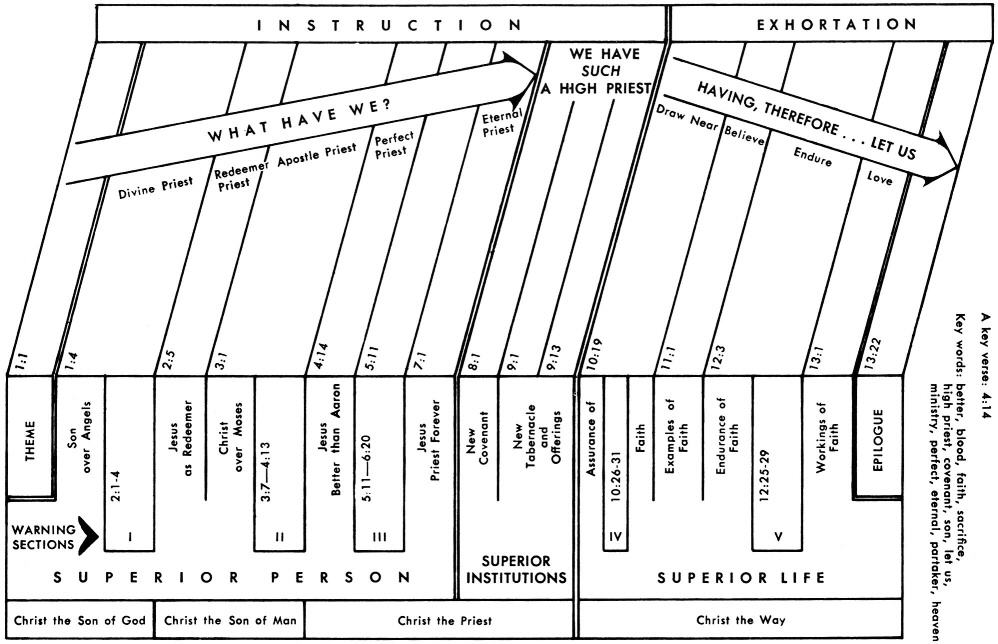
CONSIDER JESUS OUR GREAT HIGH PRIEST
Click chart to enlarge
Charts from Jensen's Survey of the NT - used by permission
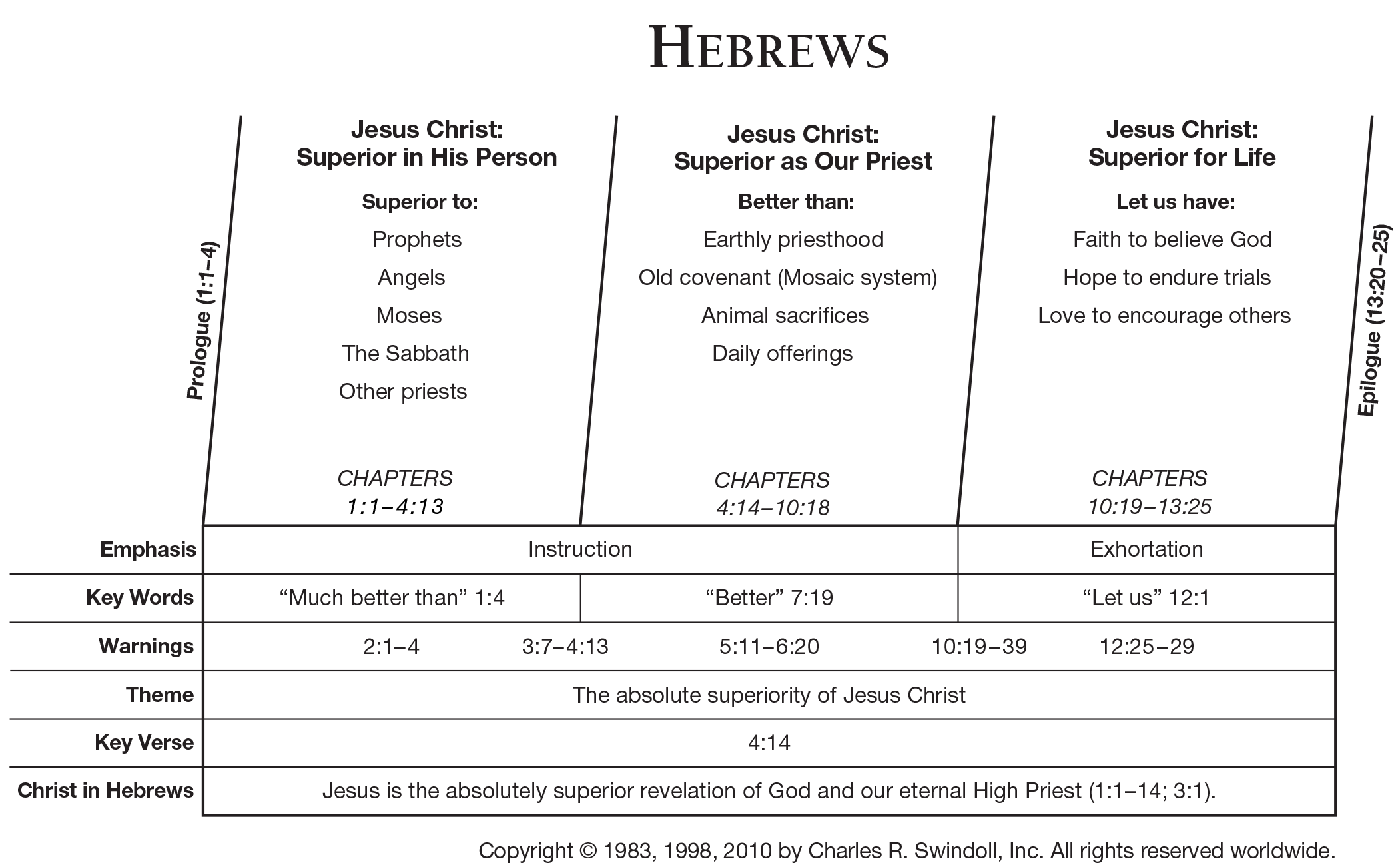
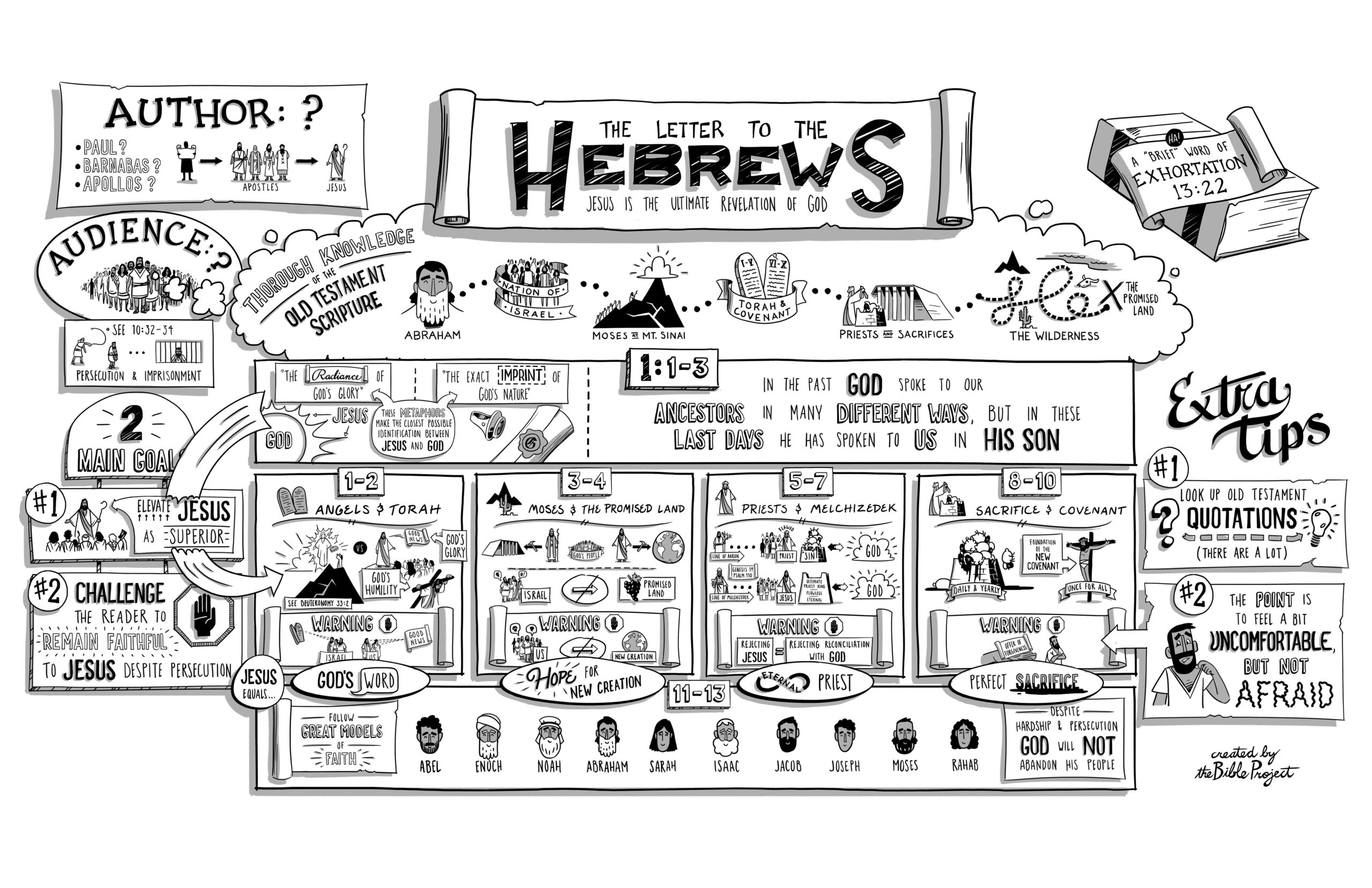
Swindoll's Chart, Interesting Pictorial Chart of Hebrews, Another Chart
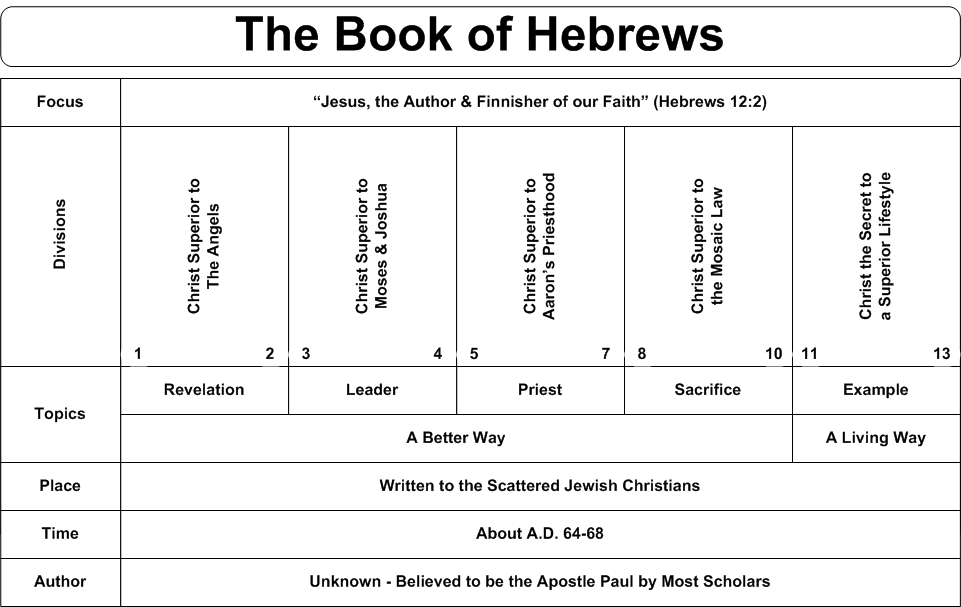
|
The Epistle |
||||
| INSTRUCTION Hebrews 1-10:18 |
EXHORTATION Hebrews 10:19-13:25 |
|||
| Superior Person of Christ Hebrews 1:1-4:13 |
Superior Priest in Christ Hebrews 4:14-10:18 |
Superior Life In Christ Hebrews 10:19-13:25 |
||
| BETTER THAN PERSON Hebrews 1:1-4:13 |
BETTER PRIESTHOOD Heb 4:14-7:28 |
BETTER COVENANT Heb 8:1-13 |
BETTER SACRIFICE Heb 9:1-10:18 |
BETTER LIFE |
| MAJESTY OF CHRIST |
MINISTRY OF CHRIST |
MINISTERS FOR CHRIST |
||
|
DOCTRINE |
DUTY |
|||
|
DATE WRITTEN: |
||||

See ESV Study Bible "Introduction to Hebrews"
(See also MacArthur's Introduction to Hebrews)
Borrow Ryrie Study Bible
Hebrews 11:27 By faith he left Egypt, not fearing the wrath of the king; for he endured, as seeing Him who is unseen. (NASB: Lockman)
Greek: Pistei katelipen (3SAAI) Aigupton, me phobetheis (APPMSN) ton thumon tou basileos, ton gar aoraton os oron (5723) ekarteresen. (3SAAI)
Amplified: [Motivated] by faith he left Egypt behind him, being unawed and undismayed by the wrath of the king; for he never flinched but held staunchly to his purpose and endured steadfastly as one who gazed on Him Who is invisible. (Amplified Bible - Lockman)
KJV: By faith he forsook Egypt, not fearing the wrath of the king: for he endured, as seeing him who is invisible.
NLT: It was by faith that Moses left the land of Egypt. He was not afraid of the king. Moses kept right on going because he kept his eyes on the one who is invisible. (NLT - Tyndale House)
Phillips: By faith he led the exodus from Egypt; he defied the king's anger with the strength that came from obedience to the invisible king. (Phillips: Touchstone)
Wuest: By faith he abandoned Egypt, not fearing the wrath of the king, for he was staunch and steadfast as seeing the Invisible One.
Young's Literal: by faith he left Egypt behind, not having been afraid of the wrath of the king, for, as seeing the Invisible One--he endured;
BY FAITH HE LEFT EGYPT NOT FEARING THE WRATH OF THE KING: Pistei katelipen (3SAAI) Aigupton mê phobêtheis (APPMSN) ton thumon tou basileos:
KJV - By faith he forsook Egypt, not fearing the wrath of the king: for he endured, as seeing him who is invisible.
- He left Egypt - Exodus 10:28,29; 11:8; 12:11,37, 38, 39, 40, 41, 42; 13:17, 18, 19, 20, 21
- Not fearing the wrath - Exodus 2:14,15; 4:19; 14:10, 11, 12, 13
- Hebrews 11 Resources - Multiple Sermons and Commentaries
FAITH COUNTERS
FEAR
By faith - What took faith? In context clearly it was the fear that might rise up in his mind when face with the wrath of the king (Ex 10:28,29). Faith is always the antidote for fear. (see related study on Fear, How to Handle It) See also the more detailed discussion of the role of faith in the example of Moses' parents who did not fear the king's edict (Hebrews 11:23-See note). Some translations like Phillip's paraphrase suggest this act of faith is solely related to the exodus ("By faith he led the exodus from Egypt" - Phillips), but the exodus was simply the reflection of a series of faith building encounters with the Pharaoh in the 10 plagues which culminated in the Passover (which is mentioned in Heb 11:28)
Faith (4102)(pistis) For more discussion on the meaning of faith see commentary on Hebrews 11:1-2. Faith is believing that God will keep His promises, despite circumstances that seem to be to the contrary! True faith that saves one's soul includes at least three main elements - (1) firm persuasion or firm conviction, (2) a surrender to that truth and (3) a conduct emanating from that surrender. In sum, faith shows itself genuine by a changed life. (Click for W E Vine's definition of faith). Click for Dr Grudem's online outline of Conversion and/or Listen to the Mp3 of Conversion which addresses the question "What is saving faith?" in an easy to understand manner.
Related Resources:
- Faith vs. fear - what does the Bible say?
- Is it true that fear is a liar?
- What does the Bible say about faith?
- What is a leap of faith?
- Why do so many people struggle with a lack of faith?
- How can I overcome the fact that I am struggling with faith?
- Where does faith come from?
Spurgeon - Moses was an Israelite indeed, and he would not conceal his nationality nor renounce it by becoming a naturalized Egyptian. Though it should tear the heartstrings of his foster mother, and be even as a sentence of death to himself, yet he would take his stand. Moses thus proved his faith to be stronger than that of many who are mastered by family ties, and held captive by the bonds of earthly love. Faith can do what unbelief must not attempt to do. And when unbelief tries to follow in the footsteps of faith, it becomes its own destroyer. You must have real faith in God, or you cannot go where faith would take you; but with faith you may go through the cloud or through the sea, and find yourself safe on the other side.
McGee - Moses had faith to act—faith will lead to action. Many folk today are saying, “I believe, I believe,” but do nothing. May I say, faith reveals itself in action. God saves us without our works, but the faith that saves produces works. Therefore Moses “forsook Egypt, not fearing the wrath of the king: for he endured, as seeing him who is invisible.”
MacDonald - He feared Pharaoh so little because he feared God so much. He kept his eyes on “the blessed and only Potentate, the King of kings and Lord of lords, who alone has immortality, dwelling in unapproachable light, whom no man has seen or can see, to whom be honor and everlasting power. Amen” (1Ti 6:15, 16). (Believer's Bible Commentary: Thomas Nelson)
He left Egypt - Recall that Moses left Egypt twice with 40 years separating these two departures (cp Acts 7:30). In Exodus 2 (Ex 2:14 = "Moses was afraid" cp why he may have been afraid in Ex 2:15) Moses left Egypt the first time after killing an Egyptian but in my opinion (not all commentators agree) the author omits this example of leaving Egypt as it was in fact not Moses' faith but his fear which motivated his leaving! John Owen, John Wesley, John Calvin, A W Pink (see below), Adam Clarke, John MacArthur (see below), Steven Cole (see his explanation), et al also favor this interpretation. Jamieson, Fausset and Brown, Dwight Pentecost, Ray Stedman, R Kent Hughes and Phillip Hughes favor Moses' first departure from Egypt as the event that is being referenced in this verse. While we may not be able to completely resolve these different interpretations in this lifetime, let us not lose sight of the truths that are clear - that faith counters fear of those who might seek to persecute or prosecute us for our faith (cp Lk 12:4, 5, Pr 29:25).
Ryrie takes a middle ground stating that this verse refers to "Either when he fled to Midian at age 40 (Ex. 2:11, 12, 13, 14, 15) or when he left at the time of the Exodus (Ex 12:37).
A W Pink - Moses left Egypt on two different occasions, and there is some diversity of opinion among the commentators as to which of them is here in view. Personally, we think there is little or no room for doubt that the Holy Spirit did not have reference unto the first. (Hebrews 11:26, 27)
John MacArthur - Moses left Egypt for the first time when he fled for his life after killing the Egyptian slave master (Ex 2:14, 15). That time he did fear Pharaoh’s wrath. On the second occasion, he turned his back on Egypt and all that it represented. This leaving was not for fear of Pharaoh, so it is the one in view here. (The MacArthur Study Bible Nashville: Word) (Bolding added for emphasis).
The KJV Bible Commentary -Moses left Egypt twice, first for Midia, and forty years later at the Exodus. His first departure was a hasty flight because of his fear. Forty years later he had learned to walk by faith and did not fear the entire Egyptian nation. The second departure must be understood as the correct one, even though it puts the next event of faith out of order. (Dobson, E G, Charles Feinberg, E Hindson, Woodrow Kroll, H L. Wilmington: KJV Bible Commentary: Nelson)
He Left - The verb kataleipo (see below) describes not just the idea of leaving but of abandoning. In this verse kataleipo is in the active voice indicating this was Moses' volitional choice to leave. He actively left Egypt "in the dust". The intensity of Moses' "leaving" is pictured in the following 3 uses of kataleipo "FOR THIS REASON A MAN SHALL LEAVE HIS FATHER AND MOTHER (Mark 10:7)
Think of how completely a man is to leave (kataleipo) his family to cleave to his wife in order for the marriage to function as it should (see note)
Mark also records the anecdotal story of a young man (probably Mark himself) who was following Jesus when He was arrested and was himself seized by the authorities "But he pulled free of (leaving - kataleipo) the linen sheet and escaped naked. (Mk 14:52)
A similar picture is found in the Septuagint (Lxx) where Moses records Joseph fleeing from the advances of Potiphar's wife - "She caught him by his garment, saying, "Lie with me!" And he left (Lxx = kataleipo) his garment in her hand and fled, and went outside. When she saw that he had left (Lxx = kataleipo) his garment in her hand and had fled outside (Ge 39:12, 13)
These three uses of kataleipo present a striking picture of the way in which Moses left Egypt.
THOUGHT - By way of application these 3 passages also give us a sense of how we as believers should "leave" the world (to be sure we are to be "in the world" but we not to be of the world). We are to "leave our garments" so to speak every time the world seeks to arrest our attention! We are to get out, not looking back as did Lot's wife, who became a pillar of salt! (Lk 17:32, 33+, Ge 19:28, cp 1Co 6:18-note , Jude 1:23). We are to make it our lifestyle like Joseph to continually flee youthful lusts (2Ti 2:22-note - where "flee" is present imperative). When temptation attacks our mind (as when Potiphar's wife tempted Joseph) we are to have the attitude of the popular Nike commercial which says ''Just do it!" "Leave Egypt!"
Jon Courson makes the point that "Because Moses grew up in the palace, Pharaoh and his court were actually Moses’ colleagues. The people with whom we are the most familiar are often the people before whom it is hardest to take a stand. Not so with Moses. (Jon Courson's Application Commentary)
Left (2641) (kataleipo from kata = intensifies or strengthens the meaning of leipo + leipo = to leave behind, forsake, to be wanting or deficient) literally means to leave behind or leave remaining (of a person or place - Mt 4:13, 16:4, 21:17, Heb 11:27). Kataleipo is often used to indicate abandoning a heritage, giving up riches, and leaving one's native land. Figuratively kataleipo was used to mean "neglect" (Acts 6:2+). Kataleipo conveys a strong sense of to abandon or forsake (as forsaking true Christianity 2Pe 2:15). To cause something to be left over and so to remain in existence (Ro 11:4-note, Heb 4:1-note = a promise remains). To leave without help (Lk 10:40). In the passive to remain behind (1Th 3:1-note, John 8:9). To leave alone in the sense of disregard as describing those who sail past a place without stopping (Acts 21:3) Kataleipo can mean to cease an activity (eg, give up a vice) but there are no uses with this sense in Scripture.
In Ps 49:10 ("leave their wealth") kataleipo conveys the sense of to leave behind or bequeath.
Kataleipo - 24x in 24v - NAS = forsaking(1), kept(1), leave(4), leaves behind(1), leaving(3), leaving behind(1), left(8), left behind(1), left… behind(1), neglect(1), pulled free(1), remains(1). Note that the Textus Receptus has one additional use in Titus 1:5 (note)
Matthew 4:13 and leaving Nazareth, He came and settled in Capernaum, which is by the sea, in the region of Zebulun and Naphtali.
Matthew 16:4 "An evil and adulterous generation seeks after a sign; and a sign will not be given it, except the sign of Jonah." And He left them and went away.
Comment: Constable quoting Plummer "He turned His back on these religious leaders because they were hopeless and incorrigible."
Matthew 19:5 and said, 'FOR THIS REASON A MAN SHALL LEAVE HIS FATHER AND MOTHER AND BE JOINED TO HIS WIFE, AND THE TWO SHALL BECOME ONE FLESH'?
Matthew 21:17 And He left them and went out of the city to Bethany, and spent the night there.
Mark 10:7 "FOR THIS REASON A MAN SHALL LEAVE HIS FATHER AND MOTHER,
Comment: The Greek word leipo means “to leave.” But the word used here is an intensified form, kataleipo, and means “to abandon completely.” Married couples run into a big problem if they don’t leave their mothers and fathers completely when they step into the marriage relationship. That doesn’t mean they shouldn’t talk to their parents anymore; it means they need to have a conscious understanding of the new relationship that has been formed. (MacArthur, J. . The fulfilled family. Chicago: Moody Press)
There’s a vital severing of the parent-child relationship that must occur when a couple gets married. Marriage doesn’t utterly terminate the relationship with parents, of course. Nor does it eliminate the child’s responsibility to honor the father and mother. But it does take the child out from under the parents’ direct chain of command, and it establishes a whole new home with a whole new headship. The new husband becomes head of the wife. The married couple are no longer children under their parents’ direct oversight, and the parents are no longer directly responsible for them. Leaving father and mother is an essential part of every marriage. When young couples try to “cleave” but have forgotten to “leave,” it creates havoc in the young marriage. (MacArthur, J. (1998). Successful Christian parenting: Word Pub)
Mark 12:19 "Teacher, Moses wrote for us that IF A MAN'S BROTHER DIES and leaves behind a wife AND LEAVES NO CHILD, HIS BROTHER SHOULD MARRY THE WIFE AND RAISE UP CHILDREN TO HIS BROTHER.
Mark 12:21 "The second one married her, and died leaving behind no children; and the third likewise
Mark 14:52 But he pulled free of the linen sheet and escaped naked.
Luke 5:28 And he left everything behind (Refers to Levi = Matthew, the tax collector when Jesus commanded him "Follow [present imperative = speaks of one's lifestyle, not just a one time decision!] Me" Lk 5:27), and got up and began to follow Him. (Discipleship is associated with a radical call to leave all! See the same idea in Luke 5:11. Hesitation to His call is disobedience - see Lk 9:59, 60, 61, 62. The rich young ruler went away from Jesus rather than leave everything for Jesus - Mt 19:22, 23, 24, 25, 26, 27)
Luke 10:40 But Martha was distracted with all her preparations; and she came up to Him and said, "Lord, do You not care that my sister has left me to do all the serving alone? Then tell her to help me."
Luke 15:4 "What man among you, if he has a hundred sheep and has lost one of them, does not leave the ninety-nine in the open pasture and go after the one which is lost until he finds it?
Luke 20:31 and the third married her; and in the same way all seven died, leaving no children.
John 8:9 When they heard it, they began to go out one by one, beginning with the older ones, and He was left alone, and the woman, where she was, in the center of the court.
Acts 6:2 So the twelve summoned the congregation of the disciples and said, "It is not desirable for us to neglect the word of God in order to serve tables.
Acts 18:19 They came to Ephesus, and he left them there. Now he himself entered the synagogue and reasoned with the Jews.
Acts 21:3 When we came in sight of Cyprus, leaving it on the left, we kept sailing to Syria and landed at Tyre; for there the ship was to unload its cargo.
Acts 24:27 But after two years had passed, Felix was succeeded by Porcius Festus, and wishing to do the Jews a favor, Felix left Paul imprisoned.
Acts 25:14 While they were spending many days there, Festus laid Paul's case before the king, saying, "There is a man who was left as a prisoner by Felix;
Romans 11:4-note But what is the divine response to him? "I HAVE KEPT for Myself SEVEN THOUSAND MEN WHO HAVE NOT BOWED THE KNEE TO BAAL."
Ephesians 5:31-note FOR THIS REASON A MAN SHALL LEAVE HIS FATHER AND MOTHER AND SHALL BE JOINED TO HIS WIFE, AND THE TWO SHALL BECOME ONE FLESH.
1 Thessalonians 3:1-note Therefore when we could endure it no longer, we thought it best to be left behind at Athens alone,
Hebrews 4:1-note Therefore, let us fear if, while a promise remains of entering His rest, any one of you may seem to have come short of it.
Hebrews 11:27-note By faith he left Egypt, not fearing the wrath of the king; for he endured, as seeing Him who is unseen.
2Peter 2:15-note forsaking (present tense = emphasizes habitual action = as shown by their "lifestyle") the right way, they have gone astray, having followed the way of Balaam, the son of Beor, who loved the wages of unrighteousness;
Kataleipo - 276 uses in the non-apocryphal Septuagint (LXX) -
Gen 2:24; 7:23; 14:10; 33:15; 39:12f, 15, 18; 42:38; 44:22; Ex 2:20; 8:31; 10:5; 12:10; 14:28; 16:19f, 23f; 29:34; 39:1; Lev 2:10; 5:13; 6:16; 7:15, 17; 8:32; 10:6, 12, 16; 14:17f, 29; 19:6, 10; 25:52; 26:36, 39; Num 9:12; 11:26; 21:35; 26:65; 32:15; 33:55; Deut 2:34; 3:3, 11; 4:27; 7:20; 28:51, 54f, 62; 29:25; 31:17; Josh 8:17, 22; 10:28, 30, 33, 39f; 11:8, 11, 14, 22; 13:2, 12; 17:6; 18:2; 21:5, 20, 40; 23:4, 7; 24:16; Judg 2:21; 4:16; 6:4; 8:10; 9:5; Ruth 1:3, 5, 16; 2:11, 14, 18; 1 Sam 2:11; 30:13; 31:7; 2 Sam 13:30; 14:7; 16:21; 17:13; 1 Kgs 11:33; 19:18, 20; 2 Kgs 2:2; 3:25; 4:43f; 7:13; 8:6; 10:11, 14, 17, 21; 25:11, 22; 1 Chr 4:43; 10:7; 16:37; 28:9; 2 Chr 1:14; 8:7f; 10:8; 21:17; 28:6; 30:6; 31:10; 34:21; Ezra 1:4; 9:8, 15; Neh 1:2f; 3:8; 6:1; Job 6:18; Ps 49:10; Pr 12:11; 14:26; 20:7; Isa 3:26; 4:2f; 6:11f; 7:3, 16, 22; 10:3, 14, 19, 20, 21; 11:11, 16; 13:12, 14; 16:14; 17:2, 6, 10; 18:6; 21:10; 23:15; 24:6, 12, 14; 27:10; 28:5f; 30:17f; 37:4, 31f; 38:10, 12; 39:6; 49:21; 54:6f; 62:4; 65:15; 66:19; Jer 2:17, 19; 8:3; 9:2; 17:13; 21:7; 27:11; 34:7; 37:10; 38:4, 22; 40:6; 41:10; 42:2; 43:6; 44:7; 48:28; 49:9; 52:16; Lam 2:22; 5:20; Ezek 36:4, 36; 39:14; Da 2:35; 10:8, 13, 17; 11:30; Zech 11:17; 14:16.
One of the interesting uses of kataleipo in the Lxx which is not found in the NT is to describe the Remnant of Israel (eg, see Ezra 9:8, 15, Neh 1:3, Isa 4:2, 3, 10:19, 20, 21, 11:11, 16, 16:14, 28:5, 37:4, 37:31, 32)
The wrath of the king - We read about this in Exodus 10 - "Then Pharaoh said to him, “Get away from me! Beware, do not see my face again, for in the day you see my face you shall die!” Moses said, “You are right; I shall never see your face again!” (Exodus 10:28, 29)
As discussed in the beginning of this note, the Pharaoh's rage could have generated fear in Moses had he had taken "up the shield of faith" and was able to fend off the fiery missiles of the evil one's (Satan's) representative (cp Eph 6:16-note).
MacArthur reminds us that "Fear is one of Satan’s most effective, and therefore most used, weapons. We are afraid of being thought different, or of losing our job, reputation, or popularity. We are afraid of criticism, often from people that we do not even respect. (MacArthur, John: Hebrews. Moody Press)
Wrath (rage, indignation) (2372) (thumos from thúo = move impetuously, particularly as the air or wind, a violent motion or passion of the mind; move violently, rush along) describes passion (as if breathing hard) and so speaks of an agitated or "heated" anger that rushes along (impulse toward a thing). Thumos describes a tumultuous welling up of the whole spirit; a mighty emotion which seizes and moves the whole inner man. John Eadie says thumos is an "explosion of rage that proceeds from a vindictive heart and an ungovernable temper." Thumos (especially when accompanied by breathing violently or hard) pictures a "panting rage". We've all seen individuals in whom there was a sudden outburst of this type of passionate anger. You can even see their nasal passages widening to take in more air in the heat of their passion. After experiencing nine plagues, one can just imagine the rage on the face and in the voice of Pharaoh! Moses' faith however was unflappable!
Related Resources
- How To Handle Fear Part 1
- How To Handle Fear Part 2
- How To Handle Fear Part 3
- How To Handle Fear Part 4
- Anxiety (merimna) - Word Study
- Anxious, be anxious (merimnao) - Word Study
- Jesus' solution "Do not be worried" Mt 6:25ff
- Paul's Solution - Philippians 4:6; Philippians 4:7
- Peter's Solution - Cast your cares on God - 1 Peter 5:7
- Worry - What is it?
- What does the Bible say about fear?
FOR HE ENDURED AS SEEING HIM WHO IS UNSEEN: ton gar aoraton os oron (PAPMSN) ekarteresen (3SAAI):
- For he endured - Heb 6:15; 10:32; 12:3; Mt 10:22; 24:13; Mk 4:17; 13:13; 1Co 13:7; Jas 5:11
- As seeing - Heb 11:1,13; 12:2; Ps 16:8; Acts 2:25; 2Cor 4:18; 1Ti 1:17; 6:16; 1Pe 1:8
- Hebrews 11 Resources - Multiple Sermons and Commentaries
FAITH SEES THE
UNSEEABLE
Yes, genuine faith is mysterious for it allows us to see what is invisible, to see with the eyes of our heart, to see the eternal as Paul explains - "we look not at the things which are seen, but at the things which are not seen; for the things which are seen are temporal, but the things which are not seen are eternal....for we walk by faith, not by sight." (2 Cor 4:18, 2 Cor 5:7)
THOUGHT - Is your vision by faith 20/20?
He endured, as seeing Him Who is invisible: FAITH defined in a phrase! (Newell)
Faith enables endurance.
Spurgeon - This is what you and I must do: feel that it is but common sense, sanctified common sense, to be looking out for that which will endure forever, and to let these temporary things go, if it be needful that they go, that we may win the crown that does not fade away.
A T Robertson - This is the secret of his choice and of his loyalty to God and to God's people. This is the secret of loyalty in any minister today who is the interpreter of God to man (2 Cor. 4:16-18).
For (gar) (see term of explanation) - This explains why Moses did not fear the wrath of the earthly king for he had seen the heavenly King! And it would be in the same way that the Hebrew readers who were being tempted to return to Judaism might be strengthened to continue holding fast to their belief in Jesus without wavering. And beloved, it is as we see Him Who is unseen (How? In His Word!) that we too will be strengthened in our inner man to continue to fight the good fight of faith without growing weary and losing heart!
The NLT paraphrases it this way "Moses kept right on going because he kept his eyes on the one who is invisible."
Richard Phillips records - A great Christian example comes from the Scottish Reformer John Knox. When asked how he could so boldly confront the Roman Catholic queen, Knox replied, "One does not fear the Queen of Scotland when he has been on his knees before the King of Kings." It is said that Napoleon would sometimes call his generals in one by one before a great battle to gaze on them without speaking and let them look upon his face. In a similar way, the man or woman of frequent communion with God in prayer and in his Word will see His face in the midst of the fight, thereby finding courage and a strong incentive to faith. (Reformed Expository Commentary – Hebrews)
He endured (2594) (kartereo which some sources state originates from kratos = and others say karteros = strength) means to be strong, to be steadfast, to continue in a state without wavering.
TDNT says kartereo - This word has the two senses a. “to be strong” and b. “to endure steadfastly.”
BDAG - Accordingly Heb 11:27 giving the reason for Moses’ fearlessness: he kept the one who is invisible continually before his eyes (i.e., in faith), as it were.
Moses continued holding out even in the face of impending doom when Pharaoh's army thundered down on the Israelites (Ex 14:4, 5, 6, 7, 8, 9, 10, 11, 12). In face of sure doom under normal circumstances Moses continued to walk by faith not the sight of the billowing dust signaling the Egyptian Chariots of doom.
But Moses said to the people, "Do not fear! Stand by ("stand firm") and see the salvation of the LORD which He will accomplish for you today; for the Egyptians whom you have seen today, you will never see them again forever. Jehovah (Yahweh) will fight for you while you keep silent. (Ex 14:13, 14)
Note: Faith in the "salvation of Jehovah" gives one the ability to endure when others feel like giving up.
The only other 2 uses of kartereo in Scripture are from the non-apocryphal Septuagint (LXX)…
Job 2:9 Then his wife said to him, "Do you still hold fast your integrity? Curse God and die!"
Isaiah 42:14 "I have kept silent for a long time, I have kept still and restrained Myself. Now like a woman in labor I will groan (Lxx translated "I have endured like a travailing woman"), I will both gasp and pant.
Wiersbe makes a good point that "The endurance of Moses was not a natural gift, for by nature Moses was hesitant and retiring. This endurance and courage came as the reward of his faith. (Bible Exposition Commentary)
Seeing Him Who is unseen - Moses did not fear the visible king because he saw the Invisible One. This verse also provides a nice segue to the writer's exhortation in the next chapter to fix our eyes on Jesus (Who we have not seen with physical eyes but with spiritual eyes as we read of Him in the Word - see Heb 12:2-note) (See Ro 1:20-note for an interesting aspect of seeing the invisible - men saw the attributes of God in creation but refused to "accept" them, instead rejecting and even exchanging truth for a lie Ro 1:25-note) - Moses saw Him Who is unseen and unknowable apart from His gracious revelation (believers today have His full written revelation - cp Jn 1:18, 14:9, 17:26, 1Jn 5:20) because Moses was obedient to His call… he was pure in heart and thus he saw God.
Blessed are the pure in heart, for they shall see God. (Mt 5:8-note)
The writer of Hebrews later exhorts all his readers to
"Pursue (present imperative - make this the habit of your life, only possible as you are enabled by His Spirit and His grace) peace with all men, and the sanctification without which no one will see the Lord. (Heb 12:14-note)
Indeed God gives us a prophetic promise that we shall all see God…
For the LORD is righteous; He loves righteousness; The upright will behold His face. (Ps 11:7)
For the righteous LORD loveth righteousness; his countenance doth behold the upright. (Ps 11:7KJV)
Spurgeon comments: His countenance doth behold the upright. We need never be out of countenance, for God countenances us. He observes, He approves, He delights in the upright. He sees His own image in them, an image of His own fashioning, and therefore with complacency He regards them. Shall we dare to put forth our hand unto iniquity in order to escape affliction? Let us have done with byways and short turnings, and let us keep to that fair path of right along which Jehovah's smile shall light us. Are we tempted to put our light under a bushel, to conceal our religion from our neighbours? Is it suggested to us that there are ways of avoiding the Cross, and shunning the reproach of Christ? Let us not hearken to the voice of the charmer, but seek an increase of faith, that we may wrestle with principalities and powers, and follow the Lord, fully going without the camp, bearing His reproach (He 13:13). Mammon, the flesh, the devil (the world, the flesh and the devil), will all whisper in our ear, "Flee as a bird to your mountain;" but let us come forth and defy them all. "Resist (aorist imperative = Do this now! Don't delay! It is vital!) the devil, and he will flee from you." (Jas 4:7-note) There is no room or reason for retreat. Advance! Let the vanguard push on! To the front! all ye powers and passions of our soul. On! on! in God's name, on! for "the Lord of hosts is with us; the God of Jacob is our refuge." (Ps 46:7-note, Ps 46:11-note)
R Kent Hughes writes that "the author references the second half of his essential definition of faith in He 11:1: “Faith is being… certain of what we do not see”—visual certitude. (Hebrews: An Anchor for the Soul. Volume 1; Volume 2)
Moses had the experience of seeing the burning bush in Midian as depicted below…

Ex 3:1-15
In Exodus we read "Thus the LORD used to speak to Moses face to face, just as a man speaks to his friend. When Moses returned to the camp, his servant Joshua, the son of Nun, a young man, would not depart from the tent. (Exodus 33:11, cp Nu 12:7,8)
Moses was not permitted to see the face of God, but he did see His back - "Then I will take My hand away and you shall see My back, but My face shall not be seen. (Ex 33:23)
Steven Cole notes that…
Moses did not fear the wrath of the king, “for he endured, as seeing Him who is unseen.” There is intended irony in that phrase. “No one has seen God at any time” (1John 4:12). Moses had seen a manifestation of God at the burning bush. He spoke with God “face to face, just as a man speaks to his friend” (Ex 33:11). He would later ask to see God, and God allowed him to see His “back” (Ex 33:22, 23). Jesus told the twelve, “He who has seen Me has seen the Father” (John 14:9).
Thus when we are fearful, we need to draw near to the Lord Jesus by faith. “Seeing Him who is unseen” takes us back to Hebrews 11:1-note, that faith is “the conviction [or, proof] of things not seen.” Faith is like a telescope that brings a distant object into visible focus. If fear is looming larger than your faith, take time to draw near to God in His Word and prayer. As Paul instructs us (Php 4:6-note, Php 4:7-note),
Be anxious (present imperative - make this the habit of your life, enabled by His Spirit and His grace to stop being anxious about everything and instead be anxious) for nothing, but in everything by prayer and supplication with thanksgiving let your requests be made known (present imperative - make this your lifestyle, consider yourself always to be in need) to God. And the peace of God, which surpasses all comprehension, will guard your hearts and your minds in Christ Jesus.
Don’t leave out the thanksgiving! That’s how you express faith and submission to God in your prayers. Faith overcomes powerful opposition by seeing the unseen God. (Hebrews 11:27-29 Overcoming Faith)
Paul praises the unseen God - "Now to the King eternal, immortal, invisible, the only God, be honor and glory forever and ever. Amen… Who alone possesses immortality and dwells in unapproachable light; Whom no man has seen or can see. To Him be honor and eternal dominion! Amen. (1Ti 1:17, 6:16, cp Jn 20:29)
Paul says that as believers exhorts us to "look not at the things which are seen, but at the things which are not seen; for the things which are seen are temporal, but the things which are not seen are eternal. (2Cor 4:18-note)
Paul's point in 2Co 4:18-note is not that we can see the invisible with our physical eye, but that the eye of faith can see what the physical eye is incapable of seeing.
Kent Hughes adds this note - I personally believe that seeing “him who is invisible” is not extraordinary. Rather, it is ordinary, normal Christianity. In fact, if you do not see the unseen, you are abnormal and below the divinely ordained norm. Christianity is supernatural, and it is to be lived supernaturally. Elisha’s prayer is just as relevant today for the church as it was when he prayed it over his anxious servant: “And Elisha prayed, ‘O Lord, open his eyes so he may see.’ Then the Lord opened the servant’s eyes, and he looked and saw the hills full of horses and chariots of fire all around Elisha” (2Kings 6:17). (Ibid - Bolding added)
From Hebrews 11:27 Steven Cole finds three obstacles that faith must overcome (see more detailed explanation of these obstacles)…
(1) Faith often puts us into opposition with powerful forces.
(2) Faith enables us to obey God without fear.
(3) Faith overcomes powerful opposition by seeing the unseen God.
Spurgeon draws these applications from the decisions Moses made based on his faith -
We ought all of us to be ready to part with everything for Christ, and if we are not we are not His disciples: “He that loves son or daughter more than me is not worthy of me” (Matt 10:37). “Every one of you who does not renounce all his own possessions cannot be my disciple” (Luke 14:33). Jesus may not require you actually to leave anything, but you must be ready to leave everything if required.
We also ought to abhor the very thought of obtaining honor in this world by concealing our sentiments or by making compromises. If there is a chance of your being highly esteemed by holding your tongue, speak at once and do not run the risk of winning such dishonorable honor. If there is a hope of people praising you because you are so ready to yield your convictions, pray God to make you like a flint never to yield again. What more damning glory could a man have than to be applauded for disowning his principles to please his fellow men? From this may the Lord save us!
Third, we ought to take our place with those who truly follow God and the Scriptures, even if they are not altogether what we should like them to be. The place for an Israelite is with the Israelites; the place for a Christian man is with Christian men. The place for a thoroughgoing disciple of the Bible and of Christ is with others who are such, and even if they should happen to be the lowest in the land, and the poorest of the poor, and the most illiterate and uneducated persons of the period, what is all this if their God loves them and if they love God? Weighed in the scales of truth, the least one among them is worth ten thousand of the greatest ungodly men.
Lastly, we must all look to our faith. Faith is the main thing. You cannot make a thorough character without sincere faith. If you are not a believer in Christ, if you do not believe in the one God, may the Lord convert you, and give you now that precious gift! To try and raise a character that shall be good without a foundation of faith is to build upon the sand, and to pile up wood and hay and stubble. Wood, hay, and stubble are very good things as wood, hay, and stubble, but they will not bear the fire—and as every Christian character will have to bear fire, it is well to build on the rock, and to build with such graces and fruits as will endure trial. You will have to be tried. And if you have, by sneaking through life as a coward, avoided all opposition and all ridicule, ask yourself whether you really are a disciple of that Master of the house whom they called Beelzebub, whether you are truly a follower of that crucified Savior who said, “Whoever does not carry his cross and follow me cannot be my disciple” (Luke 14:27). Suspect the smooth places; be afraid of that perpetual peace that Christ declares He came to break. He says, “I have not come to bring peace, but a sword” (Matt 10:34). He came to bring fire upon the earth; and “what will I,” said He, “if it be already kindled?” (Luke 12:49)
Hebrews 11:28 By faith he kept the Passover and the sprinkling of the blood, so that he who destroyed the firstborn would not touch them. (NASB: Lockman)
Greek: Pistei pepoieken (3SRAI) to pascha kai ten proschusin tou aimatos, ina me o olothreuon (PAPMSN) ta prototoka thige (3SAAS) auton.
Amplified: By faith (simple trust and confidence in God) he instituted and carried out the Passover and the sprinkling of the blood [on the doorposts], so that the destroyer of the firstborn (the angel) might not touch those [of the children of Israel]. (Amplified Bible - Lockman)
KJV: Through faith he kept the Passover, and the sprinkling of blood, lest he that destroyed the firstborn should touch them.
NLT: It was by faith that Moses commanded the people of Israel to keep the Passover and to sprinkle blood on the doorposts so that the angel of death would not kill their firstborn sons.
Phillips: By faith Moses kept the first Passover and made the blood-sprinkling, so that the angel of death which killed the first-born should not touch his people. (Phillips: Touchstone)
Wuest: By faith he instituted the Passover and the sprinkling of the blood in order that the destroyer of the first-born should not touch them.
Young's Literal: by faith he kept the passover, and the sprinkling of the blood, that He who is destroying the first-born might not touch them.
BY FAITH HE KEPT THE PASSOVER AND THE SPRINKLING OF THE BLOOD, SO THAT HE WHO DESTROYED THE FIRST-BORN MIGHT NOT TOUCH THEM: Pistei pepoieken to pascha kai ten proschusin tou haimatos, hina me o holothreuon ta prototoka thige auton:
- By faith he kept the Passover Exodus 12:3-14,21-30
- Sprinkling - He 9:19; 12:24; Exodus 12:7,13,23; 1 Peter 1:2
- Hebrews 11 Resources - Multiple Sermons and Commentaries
By faith he kept - This phrase clearly links genuine faith with real obedience. It was D L Moody who said that "Faith makes all things possible; love makes all things easy." Indeed, Moses showed his love by his obedience (cp Jn 14:15, 1Jn 5:3).
Faith (4102)(pistis) - for more discussion on the meaning of faith see commentary on Hebrews 11:1-2. Faith is believing that God will keep His promises, despite circumstances that seem to be to the contrary! True faith that saves one's soul includes at least three main elements - (1) firm persuasion or firm conviction, (2) a surrender to that truth and (3) a conduct emanating from that surrender. In sum, faith shows itself genuine by a changed life. (Click for W E Vine's definition of faith)
John Calvin defined faith as "a steady and certain knowledge of the Divine benevolence towards us, which, being founded on the truth of the gratuitous promise in Christ (Objective Component of faith), is both revealed to our minds, and confirmed to our hearts, by the Holy Spirit (Subjective Component of faith).
Wiersbe - Faith in the Word led to the Passover deliverance (how the Egyptians must have scoffed at the blood on the doors!) and the crossing of the Red Sea. (Wiersbe's Expository Outlines on the New Testament. Wheaton, Ill.: Victor Books)
Spurgeon - Here, again, you have the obedience of faith, taking God's precepts and carrying them out.
Related Resources:
Vance Havner summed up Hebrews 11:24-29…
Faith chooses the imperishable (He 11:24, 25, 26)
Faith sees the invisible (He 11:27)
Faith does the impossible (He 11:28, 29)
Wiersbe comments on Moses' faith writing that "Faith brings us out (He 11:28), takes us through (He 11:29), and brings us in (He 11:30). When we trust God, we get what God can do; but when we trust ourselves, we get only what weak people can do. The experience of Moses is proof that true biblical faith means obeying God in spite of circumstances and in spite of consequences."
Moses kept - Emphasizes that faith is complete trust in and obedience to God. He obeyed God’s command and trusted that God did indeed have power over life and death.
Kept is in the perfect tense about which which Hughes writes "by faith he kept the Passover" actually means that he instituted the Passover (perfect tense). Moses actually instituted the Passover as a "lasting ordinance" to be done year after year (Ex 12:14) — which means that Moses never doubted in the least that the people would be delivered from Egypt! He had nothing to go on but God's word, but he believed it implicitly. Moses' massive faith saved Israel! (Preaching the Word – Hebrews, Volume II: An Anchor for the Soul)
Calvin says Moses "acquiesced in the bare word of God where the thing itself was not apparent
Kept the Passover (Ex 12:1-13) - God affirms that Moses' obediently keeping the Passover the night before he led Israel out of Egypt was the result of his faith and not just religious ceremonialism. Moses' faith produced a response of obedience to the divine command. Moses believed God's promise that the Destroyer of the firstborn would pass over those houses whose doorposts and lintels were sprinkled with the blood of the Passover lamb.
The sprinkling of the blood - Refers to the application of the blood to the doorways of the Israelite houses.
Exodus 12:7 'Moreover, they shall take some of the blood and put it on the two doorposts and on the lintel of the houses in which they eat it.
Exodus 12:13 'The blood shall be a sign for you on the houses where you live; and when I see the blood I will pass over you, and no plague will befall you to destroy you when I strike the land of Egypt.
Exodus 12:23 "For the LORD will pass through to smite the Egyptians; and when He sees the blood on the lintel and on the two doorposts, the LORD will pass over the door and will not allow the destroyer to come in to your houses to smite you.
Christologically the Passover with its sprinkling of the blood is a type of the suffering Christ (cf. 1Cor. 5:7). (See related discussion - Typology - Study of Biblical types)
Chrysostom wrote that "If the blood of a lamb then preserved the Jews unhurt in the midst of the Egyptians and in the presence of so great a destruction, much more will the blood of Christ save us, for whom it has been sprinkled not on our doorposts but in our souls. For even now the destroyer is still moving around in the depth of night; but let us be armed with Christ's sacrifice, since God has brought us out from Egypt, from darkness and from idolatry.
Illustration - The story is told of one who, passing through a village in Basutoland, noticed some chickens with little red ribbons fastened to their backs between their wings. The people explained: "They protect the chickens from the many vicious hawks that otherwise would attack them. The hawks are afraid of red ribbons. Neither blue, nor green nor any other color would provide the needed immunity from attack." Are we eternally tied by the red ribbon of the atoning blood? "
So that (hina) - see importance of observing and querying these terms of purpose or result (so that, in order that, that, as a result)
Destroyed the first -born - Below is the sad image of the death of Pharaoh's firstborn son.
THOUGHT - Beloved, if you've not been covered by the blood of the Passover Lamb (1Pe 1:18, 19-note; 1Cor 5:7 - see related study of Jehovah Roi - The LORD My Shepherd), you too will experience the tragic consequences of having chosen to reject of God's truth regarding redemption from bondage to Satan, Sin and eternal death (separation from God's glorious presence - cp Mt 25:41, 2Th 1:6, 7, 8, 9, 10)

Destroyed (3645)(olothreuo from olethros = to destroy. Derivative = apollumi = destroy utterly or fully and has to do with that which is ruined and is no longer usable for its intended purpose) carrying out severe punishment destroy (especially in the sense of slaying), cause to perish. This is the only use in the NT. "“He who sacrifices to any god, other than to the LORD alone, shall be utterly destroyed." (Ex. 22:20+) It describes a "destroying lion (figurative description of what Judah did to the prophets God sent!) "I will destroy (Lxx - olothreuo) the power of kingdoms (Context = return of Messiah - Da 2:44+ and set up His Millennial Kingdom)." (Hag 2:22).
Olothreuo - 13x in the Septuagint (Lxx) - Ex. 12:23+; Ex. 22:20+; Nu 4:18; Jos. 3:10; Jos. 7:25; Jdg. 6:25; Jdg. 6:28; Jdg. 6:30; Jer. 2:30; Jer. 5:6; Jer. 22:7; Jer. 25:36; Hag. 2:22
The first-born (4416) (prototokos from protos = first, foremost, in place order or time; rank dignity + titko = beget, to bear, bring forth) can mean first-born chronologically (Lk 2:7+) as it does in the present context, but elsewhere it refers to position, rank, priority of position and emphasizes quality or kind, not time with the idea of "preeminence".
Prototokos - 8x in 8v - Luke 2:7; Ro 8:29; Col 1:15, 18; Heb 1:6; 11:28; 12:23; Rev 1:5. This same word is used in the Septuagint (Lxx) translation of Ex 12:12+ and Ex 12:29+
Wiersbe comments that…The faith of Moses was rewarded with deliverance for him and his people. (See Ex. 11–13 for the exciting Passover account.) Faith brings us out (Heb. 11:28), takes us through (Heb. 11:29), and brings us in (Heb. 11:30). When we trust God, we get what God can do; but when we trust ourselves, we get only what weak people can do. The experience of Moses is proof that true biblical faith means obeying God in spite of circumstances and in spite of consequences. If you and I had been writing this chapter, the next section would be Faith Wandering—but there is no mention of Israel’s failure and forty years of wasted time. Why? Because that was an experience of unbelief, not faith! The writer did use this experience in Hebrews 3 and 4 as an illustration of doubting the Word. But nowhere in Hebrews 11 will you find a record of any failure because of unbelief. Faith records only the victories. (Wiersbe, W: Bible Exposition Commentary. 1989. Victor)
Blood (129) haima is literally the red fluid that circulates in the heart, arteries, capillaries, and veins of a vertebrate animal carrying nourishment and oxygen to and bringing away waste products from all parts of the body and thus is essential for the preservation of life. Haima gives us English words like hemorrhage (Gk - haimorragia from haimo- + rragia from regnuo - to burst) English derivatives inclue hematology (study of blood) and "leukemia" which is from leuco (white) plus haima (blood), which is fitting as leukemia is a disease that affects the white blood cells. Derivatives of haima are : haimatekchusía (130), shedding of blood; haimorroéō (131), to hemorrhage. Haima was used to describe “descent” or “family” in ancient times. “To shed blood” is to destroy life.
Zodhiates adds that "haima is used to denote life given up or offered as an atonement since, in the ritual of sacrifice, special emphasis is laid upon it as the material basis of the individual life. The life of the animal offered for propitiation appears in the blood separated from the flesh which the Jews were forbidden to eat (Ge. 9:4; Lev. 3:17; 17:10-14; Deut. 12:23; Heb. 9:7-13, 18-25; 11:28; 13:11). This life is, on the one hand, in the blood, presented to God; on the other hand by sprinkling, appropriated to man (Heb. 9:7, 19, 20). This blood thus becomes the blood of the covenant or testament (see diathekē) which God commanded to us (Heb. 9:20). (Complete Word Study Dictionary- New Testament)
HAIMA IS A KEYWORD IN HEBREWS - 22X OUT OF 97X IN NT - Heb. 2:14; Heb. 9:7; Heb. 9:12; Heb. 9:13; Heb. 9:14; Heb. 9:18; Heb. 9:19; Heb. 9:20; Heb. 9:21; Heb. 9:22; Heb. 9:25; Heb. 10:4; Heb. 10:19; Heb. 10:29; Heb. 11:28; Heb. 12:4; Heb. 12:24; Heb. 13:11; Heb. 13:12; Heb. 13:20
Hebrews 2:14 Therefore, since the children share in flesh and blood,
Hebrews 9:7 only the high priest enters once a year, not without taking blood,
Hebrews 9:12 and not through the blood of goats and calves, but through His own blood
Hebrews 9:13 For if the blood of goats and bulls
Hebrews 9:14 how much more will the blood of Christ, who through the eternal Spirit offered Himself
Hebrews 9:18 even the first covenant was not inaugurated without blood.
Hebrews 9:19 he took the blood of the calves and the goats
Hebrews 9:20 saying, “THIS IS THE BLOOD OF THE COVENANT WHICH GOD COMMANDED YOU
Hebrews 9:21 he sprinkled both the tabernacle and all the vessels of the ministry with the blood
Hebrews 9:22 almost say, all things are cleansed with blood,
Hebrews 9:22 and without shedding of blood there is no forgiveness.
Hebrews 9:25 high priest enters the holy place year by year with blood that is not his own.
Hebrews 10:4 For it is impossible for the blood of bulls and goats to take away sins.
Hebrews 10:19 confidence to enter the holy place by the blood of Jesus,
Hebrews 10:29 has regarded as unclean the blood of the covenant by which he was sanctified
Hebrews 11:28 By faith he kept the Passover and the sprinkling of the blood
Hebrews 12:4 have not yet resisted to the point of shedding blood
Hebrews 12:24 Jesus, the mediator of a new covenant, and to the sprinkled blood
Hebrews 12:24 which speaks better than the blood of Abel.
Hebrews 13:11 For the bodies of those animals whose blood is brought into the holy place
Hebrews 13:12 He might sanctify the people through His own blood
Hebrews 13:20 the great Shepherd of the sheep through the blood of the eternal covenant
Spurgeon has the following sermons related to blood…
- Exodus 12:13 The Blood
- Hebrews 12:24-25 The Blood Of Sprinkling
- Hebrews 12:24-25 The Blood Of Sprinkling
- Hebrews 13:20 The Blood Of The Everlasting Covenant
- Hebrews 9:19-20 The Blood Of The Testament
- Hebrews 9:22 Blood-Shedding
Peter Cameron Scott was a gifted young singer whose dream was to be an opera star. He was on the steps of an opera house, about to answer an ad for chorus singers, when he faced the crucial decision of his life. As Ruth Tucker tells it, (From Jerusalem to Irian Jaya [Zondervan], p. 300; the following story is gleaned from pp. 300-304, and from Global Prayer Digest, 10/84):
Would he seek a life of self-glory and applause under the spotlight of the entertainment world, or would he dedicate his life to God’s service, no matter how humble and obscure the circumstances? It was a moment of crisis in the young man’s life, but the decision was final. He chose to serve God.
Scott enrolled at the New York Missionary Training College. After graduation, he sailed for Africa in 1890. His brother soon joined him, but quickly died from the harsh conditions. Peter built his brother’s coffin and dug the grave himself. Soon his own health was broken and he went to England. There his hope was renewed as he read the inscription on David Livingstone’s grave in Westminster Abbey:
“Other sheep I have which are not of this fold.”
Scott went to America and recruited others to join him in the cause of reaching Africa with the gospel. With seven others, including his sister, he returned to Africa in October, 1895. In his first year’s report, four stations had been opened, educational and medical programs had been set up, and the missionaries were making progress in learning the languages.
But shortly after this optimistic report, Scott, age 29, fell ill and died in December, 1896, just 14 months after returning to Africa. Soon after, several other workers died. Others had to give up for health reasons. By the summer of 1899, only one missionary remained on the field. The area became known as “the white man’s graveyard.” More missionaries died than people became Christians during those first years. But other missionaries came, packing their belongings in coffins. The Africans were amazed by their determination. They said,
“Surely only a message of great importance would inspire such actions!”
In 1971, the Africa Inland Mission became the Africa Inland Church, numbering about one and a half million, under African leadership.
If time allowed, I could tell other stories of overcoming faith on the part of courageous missionaries. Our text tells of the faith of Moses and the people of Israel when they came out of slavery in Egypt. The lesson is that…
Faith overcomes enormous obstacles, enduring by seeing the unseen God.
There are three obstacles here that faith had to overcome.
THE FIRST OBSTACLE:
POWERFUL OPPOSITION:
1. Faith overcomes powerful opposition by seeing the unseen God (He 11:27).
Moses left Egypt twice: first, after he killed the Egyptian slave driver; and, again in the exodus. To which departure does this verse refer? The chronological order, along with the singular reference (“he left”) favor the first departure. But Exodus 2:14, 15 says that Moses was afraid when he learned that the news of his killing the Egyptian was known, and that he fled from Pharaoh’s attempt to kill him. So the phrase, “not fearing the wrath of the king,” favors the second departure.
Those who argue for the first departure explain that Moses fled, not out of personal fear of Pharaoh, but because he was aware of his destiny as the deliverer of the covenant people (Philip Hughes, A Commentary on the Epistle to the Hebrews [Eerdmans], pp.497-499). I find that unconvincing. The author has already inverted the chronological order twice in this chapter (compare Heb 11:17, 18, 19, 20, 21 with He 11:13; also, in He 11:21). A singular reference is used in He 11:28 describing the Passover, even though the entire Jewish nation did it. So I understand He 11:27 to refer to the exodus, when Moses courageously stood up to Pharaoh. He 11:28, 29 refer to two events that took place during the exodus. There are three lessons in He 11:27:
A. Faith often puts us into opposition with powerful forces.
From somewhere-I’m not sure where-many Christians have the naïve notion that when you yield your life to God and begin to follow His purpose, all of your problems evaporate! Maybe it’s from the “sales pitch,” “Would you like an abundant life? Follow Jesus!” People think, “Sure, I could handle an abundant life!” So they sign up for the program, only to encounter abundant trials. Life before they trusted Christ was relatively calm compared to what they experience afterwards!
The verb, “left,” may be translated “forsook” (Heb 11:27NKJV). It refers to what we saw in 11:24, 25, 26, that when Moses refused to be called the son of Pharaoh’s daughter, he forfeited the treasures of Egypt. When Moses forsook Egypt, he didn’t step into something better. Instead, he embraced a difficult situation that had no chance of success, apart from God’s power. To stand against Pharaoh was suicidal, unless God protected Moses. To lead two million people into the desert without food or water was genocidal, unless God protected them. Pharaoh was a powerful despot with an army of trained warriors at his disposal. Moses was leading a disorganized bunch of untrained, defenseless slaves. Humanly speaking, it was not even a contest.
When you believe the gospel and submit to Jesus Christ, you declare yourself to be the enemy of the prince of the power of the air, who commands an army of evil spirits intent on your destruction. That’s why the Christian life is often portrayed as warfare. Don’t be surprised by opposition; expect it!
B. Faith enables us to obey God without fear.
Moses encountered the wrath of the king. Whenever you at-tempt to follow God’s path for your life, someone will get angry at you. In Moses’ case, it was Pharaoh. In your case, it may be a family member, an employer, a professor at the university, or a friend. The more powerful that person is, the more difficult it is to fear God more than you fear that person. Proverbs 19:12 observes, “The king’s wrath is like the roaring of a lion.” If there were no cage separating you from the lion’s roar, it would be rather frightening! But Moses stood before Pharaoh and boldly said, “Thus says the Lord God of Israel, ‘Let My people go…” (Ex 5:1).
A. W. Pink observes,
Faith and fear are opposites, and yet, strange to say, they are often found dwelling within the same breast; but where one is dominant the other is dormant (Exposition of Hebrews)
Moses probably had some butterflies in his stomach as he prepared to go before Pharaoh. Martin Luther fought off anxiety at the Diet of Worms as he appealed to Scripture and said,
Here I stand. I can do no other. God help me.
Faith in God enabled these men to obey Him and overcome any fear.
Fear can come in various forms. It is not always as dramatic as Moses’ showdown with Pharaoh. As I was preparing the outline and about to start writing this message, I received a call from a doctor who informed me that my recent PSA test indicates that there is a one-in-five chance that I have prostate cancer. He recommended that I schedule a biopsy. I once wrote an article about the danger of preaching. I called it, “The Gospel Boomerang,” be-cause you think that you’re aiming your sermon at others, but God brings it back to hit you first! He has this unnerving habit of making me practice what I preach!
How do we get the faith to overcome the fear of powerful opposition, in whatever form it appears?
C. Faith overcomes powerful opposition by seeing the unseen God.
Moses did not fear the wrath of the king, “for he endured, as seeing Him who is unseen.” There is intended irony in that phrase. “No one has seen God at any time” (1John 4:12). Moses had seen a manifestation of God at the burning bush. He spoke with God “face to face, just as a man speaks to his friend” (Ex 33:11). He would later ask to see God, and God allowed him to see His “back” (Ex 33:22, 23). Jesus told the twelve, “He who has seen Me has seen the Father” (John 14:9).
Thus when we are fearful, we need to draw near to the Lord Jesus by faith. “Seeing Him who is unseen” takes us back to Hebrews 11:1, that faith is “the conviction [or, proof] of things not seen.” Faith is like a telescope that brings a distant object into visible focus. If fear is looming larger than your faith, take time to draw near to God in His Word and prayer. As Paul instructs us (Php 4:6, Php 4:7), “Be anxious for nothing, but in everything by prayer and supplication with thanksgiving let your requests be made known to God. And the peace of God, which surpasses all comprehension, will guard your hearts and your minds in Christ Jesus.” Don’t leave out the thanksgiving! That’s how you express faith and submission to God in your prayers. Faith overcomes powerful op-position by seeing the unseen God.
THE SECOND OBSTACLE:
GOD’S IMPENDING JUDGMENT
2. Faith trusts in God’s sacrifice for deliverance from His judgment (He 11:28).
Moses has just endured the wrath of the king; now he has to be saved from the wrath of God.
“By faith he kept the Passover and the sprinkling of the blood, so that he who destroyed the first-born would not touch them.”
At the culmination of the plagues, God gave Moses instructions for how Israel was to observe the Passover (Ex 12). At the heart of that celebration was the sacrifice of an unblemished male lamb. Its blood was to be smeared on the doorposts and lintel of each house. God warned that He would go through the land on that night and kill every firstborn male in homes that did not have the blood on the doorposts.
The New Testament is clear that Christ is our Passover Lamb who was slain (1Cor. 5:7). If you have seen the Jews for Jesus presentation, “Christ in the Passover” you know that not just the lamb, but just about every detail in that ceremony, speaks about Jesus Christ and His sacrifice on the cross. It was at the Passover that Jesus took the bread and the wine and instituted the Lord’s Supper as a remembrance of His death. Note three applications of Hebrews 11:28:
A. All people face the threat of God’s impending judgment.
It was not only the Egyptians, but also the Jews, who faced God’s impending judgment of the death of their firstborn if they did not apply the blood of the lamb to their doorposts. Being a Jew by birth would not have spared anyone. Being a decent, hard-working person who had never committed a crime would not have gained an exception. While Moses• faith is mentioned in He 11:28, his faith did not cover all of the Jewish homes. Each home had to apply the blood as God had commanded or they would suffer the consequences.
Romans 3:23-note states,
“for all have sinned and fall short of the glory of God.”
Every person is born alienated from God. Both pagan Gentiles and religious Jews are “by nature children of wrath” (Eph. 2:3-note). Whether we recognize it or not, we all are born hostile toward God (Ro 8:7, 8-note). In that condition, we are a heartbeat away from incurring His eternal judgment. Many professing Christians do not like this truth. They stumble over the idea that “a God of love would judge people who have never heard.”
Moses warned Israel about the death of their first-born, but the Egyptians had no such warning. Some would say that while it was okay for God to judge Pharaoh, since he had hardened his heart, God was not fair to strike down the sons of all Egyptians. But God struck down the firstborn in every Egyptian home, in order to make a distinction between Egypt and Israel (Ex 11:7; 12:29, 30).
The accusation that God is not fair to judge sinners minimizes the holiness of God and the sinfulness of every person on earth. God would be perfectly fair to send every sinner straight to hell. He does not owe salvation to anyone, because none deserve it. God’s sovereign election does not keep anyone out of heaven that wants to go there, because if God left people to themselves, none would seek Him (Ro 3:10, 11-note, Ro 3:12-note). If He had not chosen us (see eklektos), we would have continued in rebellion against Him until the day we died. Election results in millions going to heaven who otherwise would never have gone there (see Eph 1:4, 5-note; Eph. 2:5-note; Rev. 5:9-note).
B. God has appointed a way of deliverance from His judgment through the blood of a substitute.
The elaborate instructions for how to carry out the Passover may have seemed like a hassle to some. For one thing, it was not cheap. Every family had to sacrifice a lamb, or if the family was too small, they could join another family (Ex 12:4). The blood had to be applied to the doorposts and lintel. God specifically warned them (Ex 12:13)
The blood shall be a sign for you on the houses where you live; and when I see the blood I will pass over you, and no plague will befall you to destroy you when I strike the land of Egypt.
The blood of the Passover lamb was a type, of course, of the blood of Jesus Christ (See discussion of Typology = Biblical types). When Jesus died on the cross, He died as a substitute for sinners. As John wrote (1Jn 2:2),
and He Himself is the propitiation for our sins; and not for ours only, but also for those of the whole world.
In other words, the offer is extended to every sinner, Jew or Gentile: It obviously does not mean that Christ actually paid for all the sins of all people, or else all would be saved, which Scripture plainly denies. Rather, it means that Christ’s sacrifice extends to all who by faith embrace the gospel” (John Calvin, Calvin's Commentaries [Baker], on 1Jn 2:2, p. 173). Thus…
C. God’s way of deliverance must be applied by faith in order to be effective.
To be delivered through the Passover blood, Moses and the Israelites had to trust God’s word and do what He told them to do. If anyone disputed it by saying, “It’s not logical that sprinkling blood on your doorposts would protect your oldest son from death,” his son would have died. It would not have been enough to say mentally, “I believe,” but not apply the blood. To be saved from the destroyer, the person had to believe God’s warning by applying the blood.
The same is true with the blood of Christ. You can argue that God is a God of love, not judgment, and that you don’t need the blood of Christ to be saved. You will someday learn too late that He is a God who judges sinners. Perhaps you grew up in a Christian home and you believe in a general sense, but you have not personally fled to the cross. James (Jas 2:19-note) warns us that the demons also believe in that manner, but they will not be saved. Unlike the Passover, it is not enough for your father to believe on your behalf.
To be saved, you must acknowledge that as a sinner you deserve God’s judgment. You must abandon all trust in yourself or your good works as a means of salvation. And you must trust in Christ’s blood as God’s payment for your sins. Every sinner must apply the blood of Christ to his or her heart by faith to be saved from God’s judgment. Finally, there is…
THE THIRD OBSTACLE:
OVERWHELMING PROBLEMS:
3. Faith trusts God for deliverance from overwhelming problems (He 11:29).
This verse shifts from Moses’ faith to the faith of Israel. I do not know why the shift did not take place in He 11:28, since all Israel had to believe in the Passover sacrifice. Either way, there is a difficulty, in that as the author of Hebrews has already told us, the generation that came out of Egypt was evil and unbelieving (He 3:8, 9, 10, 11, 12).
The apostle Paul explained that although all Israel was baptized into Moses, so to speak, when they passed through the sea, “with most of them God was not well-pleased; for they were laid low in the wilderness” (1Co 10:2, 5). But here the author indicates that they passed through the Red Sea by faith.
Probably the solution is that the faith of the believing believing remnant (note) is generalized to cover the entire nation (John Owen, An Exposition of Hebrews [The National Foundation for Christian Education], 7:170; Calvin, p. 299 adopts a similar solution). There is a similar situation in the New Testament when everyone on the ship with Paul was saved because of Paul’s faith, even though they did not believe God. In both cases, it was temporal deliverance only for the unbelievers. But the exodus pictures spiritually how genuine faith delivers us from overwhelming problems, beginning with the salvation of our souls. Briefly, note two things:
A. Faith does not exempt us from overwhelming problems, but rather it often leads us into such problems.
If Israel had stayed in Egypt, they wouldn’t be in the mess they were in at the Red Sea. Some of the unbelievers sarcastically said to Moses (Ex 14:11),
Is it because there were no graves in Egypt that you have taken us away to die in the wilderness?
But the fact is, Moses had not led them to the dire situation that they were in; God had led them there and He had hardened Pharaoh’s heart so that he would chase after them (Ex 14:1, 2, 3, 4, 5, 6, 7, 8, 9)!
So by God’s direct actions, this defenseless bunch of slaves had the Red Sea in front of them and Pharaoh’s army charging at them from behind. They were doomed unless God intervened, which He planned to do. But they had to learn that salvation is completely from Him. There was no place for human ingenuity or some scheme to escape. God led them into this desperate situation to teach them to trust Him as their only option.
That’s how God grows our faith. We know in our heads that we must trust Him totally, but we don’t believe it in practice until He throws us into situations where there is no way out if He does not act. We need to learn in experience that “salvation belongs to the Lord” (Ps 3:8-Spurgeon's note).
B. God delights to turn our overwhelming problems into exhibitions of His mighty power when we trust Him.
The situation that the enemy thought would bring them an easy victory led to their defeat. God miraculously piled the water up as a wall on both sides for Israel to walk through on dry ground (Ex 14:21, 22). He moved the pillar of cloud behind them until they all passed through. Then He let the Egyptians pursue them in blind fury. They should have looked to both sides and seen the trap. But as John Owen observes (pp. 173-174),
There is no such blinding, hardening lust in the minds or hearts of men, as hatred of the people of God and desire for their ruin.
The Egyptians abandoned reason and common sense and rushed into the sea to their own destruction. And so a helpless, defenseless, unorganized band of two million slaves were delivered from a powerful, well-equipped army. Nothing is too difficult for the Lord (Jer 32:17)!
Conclusion
So faith overcomes enormous obstacles, enduring by seeing the unseen God.
“But,” you may be wondering, “what about Peter Cameron Scott and all of his fellow missionaries that died young while trying to take the gospel into Africa? Their faith did not deliver them!”
John G. Paton (1824-1907), who left his native Scotland to take the gospel to the cannibals of the New Hebrides Islands, answers that question well. As he was getting ready to leave, an elderly friend repeatedly sought to deter him. His crowning argument was always, “The Cannibals! You will be eaten by Cannibals!” (You Will Be Eaten by Cannibals! Lessons from the Life of John G. Paton from Dr John Piper - if you have time listen to the Mp3)
Paton finally replied, "Mr. Dickson, you are advanced in years now, and your own prospect is to be soon laid in the grave, there to be eaten by worms. I confess to you, that if I can but live and die serving and honoring the Lord Jesus, it will make no difference to me whether I am eaten by Cannibals or worms. And in the Great Day my resurrection body will arise as fair as yours in the likeness of our risen Redeemer” (John G. Paton Autobiography [Banner of Truth], p. 56).
Let’s join Paton and Moses as people of over-coming faith, who endure by seeing the unseen God!
Discussion Questions
1. Why is it important for Christians to expect opposition and hardship? Why do many naively think that the Christian life will be trouble-free?
2. Is all fear sin? Can fear and faith abide together? How can we overcome our fears?
3. Why was God fair to judge the Egyptians without letting them know in advance? Why is He free to choose Israel (or us) as His people?
4. Someone says, “Many Christians have trusted God and have been killed, not delivered. Why should I trust in such a God?” How would you answer? (Index to Pastor Steven Cole's sermons by Bible book - Highly Recommended - They read much like a verse by verse commentary)
Vance Havner summed up Hebrews 11:24-29…
- Faith chooses the imperishable (He 11:24, 25, 26)
- Faith sees the invisible (He 11:27)
- Faith does the impossible (He 11:28, 29)
Warren Wiersbe - True Bible faith is confident obedience to God's Word in spite of circumstances and consequences. Read that last sentence again and let it soak into your mind and heart. This faith operates quite simply. God speaks and we hear His Word. We trust His Word and act on it no matter what the circumstances are or what the consequences may be. The circumstances may be impossible, and the consequences frightening and unknown; but we obey God's Word just the same and believe Him to do what is right and what is best. The unsaved world does not understand true Bible faith, probably because it sees so little faith in action in the church today. The cynical editor H.L. Mencken defined faith as "illogical belief in the occurrence of the impossible." The world fails to realize that faith is only as good as its object, and the object of our faith is God. Faith is not some "feeling" that we manufacture. It is our total response to what God has revealed in His Word.
Dr. W. A. Criswell entitled Hebrews 11:23-27 THE CHOICES OF LIFE
“The greatest thing you will ever do is learn how to say no.” I’m not sure who said that, but whoever it was spoke the truth. Nothing is harder than learning how to say no at the right time, in the right way, for the right reasons. Life is made up of choices, in fact, that’s really all life is—a series of choices we make that lead us in one direction or another. We make our choices and our choices turn around and make us.
Most people if given a choice to enjoy an elite life of the rich and famous or to live a life of adversity and hardship would clearly choose the good life. There was a major lottery this week and one man said, if he had won, he wouldn’t be working anymore but just enjoying life. Of course, he didn’t win and he never had a chance to choose what to do with his life. But there was a man who did have that choice. His name was Moses. Moses actually had that choice. He deliberately chose to take the hard road rather than the high road.
Pritchard sums up Moses’ life with 5 simple statements, each one emphasizing the Great Refusal that led to the Great Deliverance of God’s people…
I. He Refused Egypt’s Fame. – v24
II. He Repudiated Egypt’s Pleasure. – v25
III. He Resigned Egypt’s Wealth – v26
IV. He Renounced Egypt’s King. – v27
V. He Rejected Egypt’s Religion – v28
Hebrews 11:23 By faith Moses, when he was born, was hidden for three months by his parents, because they saw he was a beautiful child; and they were not afraid of the king’s edict.
God’s providence – Pharaoh’s daughter was barren and on the scene just happens to pop a “baby!”
Moses was hidden three months’ = Faith proves itself by works. Can you imagine the faith it required to put that baby in a basket and leave him alone to God’s care in the Nile River?
The faith of parents is important for the welfare of their children. (NOTICE THE WORD “PARENTS” – IT WAS NOT JUST MOSES’ MOTHER BUT ALSO HIS FATHER WHO HAD FAITH). Few texts illustrate this truth so well as this text. The parents were Moses' parents. Their names, which are not mentioned in our text here, were mentioned in Exodus 6:20. They were Amram (the father) and Jochebed (the mother). Their faith was superb. They remind me of Peter’s words in Acts 5:29 “But Peter and the apostles answered, “We must obey God rather than men.”
Butler - Moses' parents because of their faith, did not fear Pharaoh. Faith in God is a great remover of fear and, therefore a great source of peace. Sin creates fear in the heart of man. Many would mock the faith of Moses' parents, but they could not mimic the peace that Moses' parents had. The world may ridicule our faith, but they do not have the peace in heart and mind that faith brings.
By hiding the baby from Pharaoh’s forces and floating him down the Nile River, they trusted God alone to take care of their child. This one act of faith set off a series of events that eventually led to the rescue of the Israelite people from Egypt and the ordering of the nation under the Law. It all began with faith.
they saw he was beautiful - This is something more than outward beauty. The eye of faith could see something special in Moses. Faith has perception that the flesh does not.
There are three arks mentioned in the Word of God. Each was a place of refuge, shelter, and safety. Each is typical of the Lord Jesus Christ, and God’s salvation in and by him. – Noah’s Ark, Ark for Moses and Ark of Covenant.
Wiersbe - Though godly parents cannot pass on their faith as they do family traits, they can certainly create an atmosphere of faith at home and be examples to their children. A home should be the first school of faith for a child.
Hebrews 11:24 By faith Moses, when he had grown up, refused to be called the son of Pharaoh’s daughter,
Note the literal reading is “when he had become great (megas)” so it was grown but he was also great! Stephen elaborates on Moses’ greatness in Acts 7:22 ““Moses was educated in all the learning of the Egyptians, and he was a man of power in words and deeds.”
F. B. Meyer describes Moses’ place in Egyptian high society this way: “If he rode forth into the streets, it would be in a princely equipage, amid the cries of ‘Bow the knee.’ If he floated on the Nile, it would be in a golden barge, amid the strains of voluptuous music. If he wished for aught, the almost illimitable wealth of the treasure of Egypt was within his reach.”
The word "refused" (arneomai) means "to say no, to deny, refuse," and the middle voice indicates he personally, deliberately rejected this Egyptian dream career. He refused to be described or called the son of a royal princess, and with it he refused the prestige, power and position of such a station in life.
Wiersbe - As the adopted son of the Egyptian princess, Moses could have led an easy life in the palace. But his faith moved him to refuse that kind of life. He chose to identify with God's suffering people. True faith Causes a believer to hold the right values and make the right decisions.
HISTORICAL CONTEXT - We do not really comprehend the immensity of Moses’ refusal until we understand that archaeological evidence from the Eighteenth Dynasty of Egypt reveals the luxurious opulence and wealth of the Pharaohs. They had fabulous treasures of gold. As the son of Pharaoh's daughter Moses was identified with the ruling dynasty with its luxury and power.
There are four faith actions mentioned here to Moses’ grown up faith:
(Faith Action #1) - He refused to be called the son of Pharaoh’s daughter. 11:24
(Faith Action #2) - He chose to endure hardships of the Hebrews. 11:25a
(Faith Action #3) - He refused to enjoy the passing pleasures of sin. 11:25b
(Faith Action #4) - He considered commitment to Jesus Christ greater than any Egyptian treasure. 11:26
HOW GROWN UP WAS MOSES? Stephen tells us that he was 40 in Acts 7:23.
Ray Pritchard - Don’t miss the point. Moses made a choice. Our problem is not that we don’t make the choice. It is rather that we don’t see that a choice even needs to be made. We think we’re supposed to live in Egypt! It hasn’t occurred to us to leave. We like being Pharaoh’s daughter.
In his adult years Moses made his choice; he would not hide his true nationality to win a few short years of earthly fame. The result? Instead of occupying a line or two of hieroglyphics on some obscure tomb, he is memorialized in God's eternal Book. Instead of being found in a museum as an Egyptian mummy, he is famous as a man of God.
Hebrews 11:25 choosing rather to endure ill-treatment with the people of God than to enjoy the passing pleasures of sin,
MOSES’ attitude of faith manifested itself in an act of the will (the middle voice depicts his personal involvement – he made a choice of his will and participated in the results/consequences of that choice).
Just think of the options Moses actually had. Moses can choose to become the next Egyptian Pharaoh and enjoy all of the pomp and luxury that comes with that lifestyle, or he can decide to become associated with the Hebrews and wander around as a nomad. He chose to endure the hardships of the Hebrews and there were many hardships. How in the world could Moses make such a choice? He made it by faith. He believed that in the end, the Hebrews would be the blessed people of God and he chose to go with them
endure ill-treatment – sugkakoucheomai = to endure adversity with, suffer or be mistreated along with someone. Note the present tense = continually. Also note similar word used of the Hebrews in Heb 10:34 “you showed sympathy to the prisoners,” where sympathy is the verb sympatheo from syn = intimately with + pascho = suffer, thus to suffer with or share in sufferings, just like Moses even though the verb was different.
G. Campbell Morgan said, “I love that passage because it’s so true to life. Pleasures of sin. There are such today. What a stupid thing it is that some people say that there is no pleasure in sin. Of course there are pleasures in sin.”
Faith chooses purity above pleasures. Purity is not without pleasure, but that pleasure often comes only in eternity. No pleasure will be greater.
Moses had the opportunity to experience what Solomon described in Eccl 2 – 1 I said to myself, “Come now, I will test you with pleasure. So enjoy yourself.” And behold, it too was futility. 2 I said of laughter, “It is madness,” and of pleasure, “What does it accomplish?” 3 I explored with my mind how to stimulate my body with wine while my mind was guiding me wisely, and how to take hold of folly, until I could see what good there is for the sons of men to do under heaven the few years of their lives.
Moses saw the Egyptian world and he knew what was going on. He saw the sin and the pleasure and he made a choice; he was not going to spend his life enjoying the “passing pleasures of sin.” Pleasures of sin are passing. They will not be around forever. There is no question that there are pleasures to sin, but there is also a deceitfulness to sin. You and I will never regret making a decision to choose virtue over vice. You and I will never regret keeping our faith focus on pleasing God, not pleasuring ourselves. Those who refuse to give in to transitory pleasures because they want to please God in the future, have a faith as solid as Moses.
The phrase "pleasures of sin" does not refer only to lust and other gross sins. The phrase describes a way of life that we today would call "successful"—position, prestige, power, wealth, and freedom from problems.
WORD STUDY – PROSKAIROS – means literally for a season and just like a season comes and goes, so proskairos conveys that sense (passing). Translated “passing” in Heb 11:25 but “temporal” in 2 Cor 4:18 “the things seen are temporal (proskairos), but the things which are not seen are eternal.”
- The thrill of sin is so short-lived.
- A moment of folly, a lifetime of regret.
- A lifetime of folly, an eternity of regret.
Sin will take you further than you ever wanted to stray!
Cost you more than you ever dreamed you would pay!
Keep you longer than you ever thought you would stay!
Are you beginning to tolerate/conceal "pet" sins? If you are, then you need to remember the fate of the man with the "pet boa constrictor". After 15 years of living with his owner, one day the "pet boa" would not let its "owner" out of its grip resulting in the owner's tragic death. Wild animals remain wild and so does Sin. Do not be deceived (Stop being deceived)!
SCRIPTURE - Mark 8:36-37 For what does it profit a man to gain the whole world, and forfeit his soul? 37“For what will a man give in exchange for his soul?
Hebrews 11:26 considering the reproach of Christ greater riches than the treasures of Egypt; for he was looking to the reward.
NOTE “CHOOSING” AND “CONSIDERING” ARE BOTH aorist tenses showing a single decisive event.
Faith enabled Moses to see that the fabulous treasure houses of Egypt were worthless in the light of eternity. So he chose to suffer the same kind of reproach as the Messiah would later suffer. Loyalty to God and love for His people were valued by him more that the combined wealth of Pharaoh. He knew that these were the things that would count one minute after he died. (THINK ABOUT 1 MINUTE AFTER YOU DIE – WHAT ARE YOU COUNTING ON? WILL YOU HAVE TREASURE IN HEAVEN? WILL YOU AWAKEN IN HEAVEN? MAKE YOUR MINUTES COUNT NOW SO THAT YOUR FIRST MINUTE IN HEAVEN WILL BE FILLED WITH GREAT JOY!)
DAVID’S REPROACH - Psalm 69:9 (oneidismos used 5x in Lxx Ps. 69:7; Ps. 69:9; Ps. 69:10; Ps. 69:19; Ps. 69:20) and Psalm 89:50 (Remember, O Lord, the reproach of Your servants; How I bear in my bosom the reproach of all the many peoples,) discuss the same “reproach” (oneidismos) which David found against those who choose for God.
WHAT IS THE REPROACH OF CHRIST? - How much Moses knew about the promised Anointed One, we cannot know for sure. But Abraham rejoiced to see Jesus’ day (John 8:56). Moses knew that God promised to raise up a prophet like him, who would speak His word (Deut. 18:15). He knew of God’s promise to Eve, that one from her seed would bruise the serpent’s head (Gen. 3:15). He also no doubt knew that the sacrificial system pointed ahead to a Redeemer. And so Moses considered that any reproach that he endured for identifying himself with God’s Messiah was far more valuable than the worldly treasures he could amass in Egypt.
WIERSBE - Moses' refusal of faith led to the reproach of faith (Heb. 11:26a). The mayor of a large American city moved into a dangerous and decayed housing project to demonstrate the problems and needs of the minorities. But she also kept her fashionable apartment and eventually moved out of the slum. We commend her for her courage but we have to admire Moses even more. He left the palace and never went back to the old life! He identified with the Jewish slaves! Men and women of faith often have to bear reproach and suffering. The Apostles suffered for their faith. Believers today behind the Iron Curtain know what it is to bear reproach. If reproach is an evidence of true faith, we wonder how much true faith there is in our own country today!
If it be asked in what sense he could be said to know anything of the reproach of Christ, the answer of course is that “Christ” is simply the Greek word that represents the Hebrew “Messiah.” And so for Messiah’s sake Moses forsook Egypt. By faith he gave up all his privileges there and, in spite of great trials, endured as seeing Him who is invisible. It is only faith that discerns the invisible God who transcends all circumstances.
Moses considered commitment to Jesus Christ greater than any Egyptian treasure.
Ray Pritchard - Moses did some mental reckoning. He looked at the earthly glories of Egypt and figured out that it amounted to nothing compared with the glory that would come to those who trust the Lord and walk by faith. Somehow, like Abraham before him, he saw in the distance the coming of the Lord, and he knew it would be better to suffer for the Lord with the Lord’s people than to live in the lap of luxury in Egypt.
The major way to combat the temptations of “the lust of the flesh, the lust of the eyes, and the boastful pride of life” (1 John 2:16) is to see the infinite value of possessing Jesus Christ. When you see what a treasure Christ is, everything else fades away.
"He was looking to the reward" (v. 26) has the idea of habitually keeping his eye on the reward (imperfect tense of the verb apeblepen, “was looking ahead”indicates that he kept looking off into the future again and again). He kept his attention fixed on the goal. What does God have in store for the believer? The apostle Paul quoted Isaiah saying just as it is written, "Things which eye has not seen and ear has not heard, And which have not entered the heart of man, All that God has prepared for those who love Him" (1 Corinthians 2:9). ARE YOU LOOKING FOR THE REWARD?
what was the reward? The reward that he looked for was, “the better country, that is, a heavenly one” (Heb 11:16). What enabled Moses to let go of all the glitter of Egypt and to endure ill-treatment with the people of God was that he was looking to the reward of heaven. Are you?
WIERSBE ON VALUE OF TRUTH THAT WE WILL RECEIVE REWARDS - "As with Abraham and Moses of old, the decisions we make today will determine the rewards tomorrow. More than this, our decisions should be motivated by the expectation of receiving rewards.... The emphasis in the Epistle to the Hebrews is: "Don’t live for what the world will promise you today! Live for what God has promised you in the future!
Faith has a good sense of values and evaluates with heavenly wisdom. Faith perceives accurately what is valuable and what is not. The flesh cannot discern or perceive accurately in this area. First, the perception of riches. "Reproach of Christ greater riches than the treasures in Egypt" (Hebrews 11:26). "Reproach of Christ" is more valuable than any earthly wealth. Only faith perceives this truth. Second, the perception of rewards. "He had respect unto the recompense of the reward" (Hebrews 11:26). Much of the world sees worldly rewards as the best. Faith respects heavenly rewards as the best.
APPLICATION – We need to hear and heed (enabled by the Spirit) Jesus’ command regarding treasure in Mt 6:19-21, specifically to “store up (present imperative – you can ONLY keep this as the Spirit empowers you so daily BE FILLED! BE CONTROLLED! BE EMPOWERED!) for yourselves treasures in heaven,
WORD STUDY- CONSIDERING (hegeomai) - hegeomai in this passage refers to “belief resting on external proof,” especially, “careful judgment” (G. Abbott-Smith). Wuest writes that hegeomai "speaks of a belief or appraisal that does not rest upon one’s emotions, but upon the due consideration of external grounds, upon the weighing and comparing of facts. It refers to a deliberate and careful judgment." Moses carefully weighed in the balance what the world had to offer on one side and what God had to offer on the other side. The world’s side was momentarily attractive, but lightweight. God’s side was momentarily difficult, but satisfying in the long haul. Moses chose to believe God and reject the world.
WORD STUDY – REPROACH – oneidismos (USED ONLY 5X IN NT – 3 IN HEBREWS – Heb 10:33, 11:26, 13:13)– in this context refers to insults or reviling which represent unjustifiable verbal abuse inflicted on Moses. The root verb oneidizo is used by Jesus in describing the reproaches that would come on believers, and the rewards associated with those reproaches (Mt 5:11 = “blessed” and Mt 5:12 continues the thought adding that “your reward in Heaven is great.”)
QUOTE - If you live for God, you can expect trouble from the world.
INTERESTING FACT - When Moses appeared on the Mount of Transfiguration with Elijah and Jesus, it was his first time to set foot in the promised land
THE COMPARISON.
A. Reproach of Christ.
1. Worst Christianity has to offer.
B. Treasures of Egypt.
1. Best the world has to offer.
Compared the best that the world offered against the worst Christianity offered and still chose the way of Christ.
Hebrews 11:27 By faith he left Egypt, not fearing the wrath of the king; for he endured, as seeing Him who is unseen.
Faith overcomes enormous obstacles, enduring by seeing the unseen God.
Don’t miss this – Moses left the FAMILIAR to venture into the FOREIGN. This is amazing faith!
Moses knew Egypt better than any place on earth. Egypt’s buildings and alleys, obelisks and temples—all the sights and sounds and smells were “home” for him.
Heb 11:1: “Faith is being… certain of what we do not see” = visual certitude.
Moses did not fear the visible king because he saw the Invisible King.
Moses walked away from a visible Egyptian king because he believed in the Eternal invisible King.
As a result of this focused faith he "endured" (kartereo) meaning "to be strong, be steadfast, hold out, endure." He persevered as if he saw the invisible King. It is a picture of persevering faith that would not turn back to Egypt. He stood firm in his strength, steadfast and fearless faith.
Faith is not wimpy but it is courageous. It does what is right to do no matter the dangers, difficulties or dislikings.
ON THE OTHER HAND NOTE THAT The endurance of Moses was not a natural gift, for by nature Moses was hesitant and retiring. This endurance and courage came as the reward of his faith.
Ray Stedman - That long, discouraging wait was possible only because Moses saw the unseen; he reckoned upon invisible realities, and God surprised him one day with a remarkable experience with a bush that burned but was not consumed!
Faith, mighty faith, the promise sees
And looks to God alone.
Laughs at impossibilities,
And cries, "It shall be done."
he left Egypt – which departure, first or second? Chronological order of passages v27-28 and singular “he” support first departure at 40. On the other hand “not fearing the wrath of the King” suggests the second departure because Ex 2:14-15 (“Then Moses was afraid”) Steven Cole writes “The author has already inverted the chronological order twice in this chapter (compare 11:17-21 with 11:13; also, in 11:21). A singular reference is used in verse 28 describing the Passover, even though the entire Jewish nation did it. So I understand 11:27 to refer to the exodus, when Moses courageously stood up to Pharaoh. Verses 28 & 29 refer to two events that took place during the exodus.”
SEEING (horao) – Don’t miss the use of the present tense (continually seeing)! One might think “Sure, Moses saw the manifestation of God in the burning bush” (Ex 3:2-4) But with eyes of faith Moses kept continually seeing and continually believing in the invisible, unseen God. As the hours of the life of Moses ticked away, Moses just kept on believing and he kept on living his life in his faith. By faith he left Egypt.
CONTINUALLY SEEING - A sound vision continually held before us will strengthen us to do our finest deeds
It is no accident that our author urges his readers to “fix your thoughts on Jesus” (Hebrews 3:1). “Let us fix our eyes on Jesus” (Hebrews 12:2). The book of Hebrews is full of looking at Jesus.
John Owen said, "He had as certain persuasion as if he had seen God working with him and for him by his bodily eyes."
faith has superb vision
faith can see that which the flesh cannot see. Here Moses focused on God. God is invisible to the eyes of flesh but not to the eyes of faith. Faith sees eternity, but the flesh only sees time. Faith sees the spiritual, but flesh only sees the material. Faith sees God, the flesh only sees man.
SCRIPTURE - Which He will bring about at the proper time–He who is the blessed and only Sovereign, the King of kings and Lord of lords, Who alone possesses immortality and dwells in unapproachable light, whom no man has seen or can see. To Him be honor and eternal dominion! Amen. (1 Ti 6:15-16)
seeing Him who is unseen – Cole writes “There is intended irony in that phrase. “No one has seen God at any time” (1 John 4:12). Moses had seen a manifestation of God at the burning bush. He spoke with God “face to face, just as a man speaks to his friend” (Exod. 33:11). He would later ask to see God, and God allowed him to see His “back” (Exod. 33:22-23). Jesus told the twelve, “He who has seen Me has seen the Father” (John 14:9). Thus when we are fearful, we need to draw near to the Lord Jesus by faith. “Seeing Him who is unseen” takes us back to Hebrews 11:1, that faith is “the conviction [or, proof] of things not seen.” Faith is like a telescope that brings a distant object into visible focus. If fear is looming larger than your faith, take time to draw near to God in His Word and prayer.
When did Moses see "Him who is invisible"? Exodus chapters three and four tells about living in the wilderness tending his father-in-law Jehtro's sheep. "The angel of the LORD appeared to him in a flame of fire out of the midst of a bush. He looked, and behold, the bush was burning, yet it was not consumed." God called to him out of the bush. He said, "I am the God of your father, the God of Abraham, the God of Isaac, and the God of Jacob" (Exodus 3:2-6, ESV). God spoke to Moses often in Egypt (Exo. 33:11, 23; Num. 12:7-8). The author of Hebrews is probably referring to the lifelong vision of God that was at work in Moses' life. "The Invisible One" takes us back to verse one of faith trusting "things not seen." We do not look at icons and idols as if to believe they help us see God. Like Moses our eyes are focused on the Invisible One. We see with spiritual eyes Him who is invisible.
The same Angel of the LORD who appeared to Moses at the burning bush is also the one who strikes Egypt's first born dead, and delivers the children of Israel out of Egypt (Exod. 3:2-6; 11:4; 12:12-13, 23, 27, 29). Many Old Testament scholars identify this Angel of Yahweh as the preincarnate Christ. (PREINCARNATE CHRISTOPHANY) We never encounter Him after the incarnation of the Second Person of the Godhead, Jesus Christ.
ILLUSTRATION - John G. Paton (1824-1907), who left his native Scotland to take the gospel to the cannibals of the New Hebrides Islands, answers that question well. As he was getting ready to leave, an elderly friend repeatedly sought to deter him. His crowning argument was always, “The Cannibals! You will be eaten by Cannibals!” Paton finally replied, “Mr. Dickson, you are advanced in years now, and your own prospect is to be soon laid in the grave, there to be eaten by worms. I confess to you, that if I can but live and die serving and honoring the Lord Jesus, it will make no difference to me whether I am eaten by Cannibals or worms. And in the Great Day my resurrection body will arise as fair as yours in the likeness of our risen Redeemer”
Hebrews 11:28 By faith he kept the Passover and the sprinkling of the blood, so that he who destroyed the firstborn would not touch them.
In keeping the Passover, Moses was portraying the Gospel message about Christ. Thus faith proclaims the Gospel of Christ. Faith does not preach another Gospel but is faithful to the Gospel of Christ.
1 Cor 5:7 Clean out the old leaven so that you may be a new lump, just as you are in fact unleavened. For Christ our Passover also has been sacrificed.
SWINDOLL - by faith Moses was willing to swallow his pride and do the unusual (11:28). On the eve of the Exodus from their slavery in Egypt and after a series of powerful signs and wonders, God commanded Moses and the Israelites to do something unusual. They were to kill an unblemished male sheep or goat, apply its blood to the doorposts of their houses, and eat its meat in haste. This was to be their “Passover” observance, as God would go through the land of Egypt that night and kill the firstborn of every house in Egypt that didn’t have the sign of blood on the door (Exod. 12:5-13). I can imagine more than a few Israelites looking cross-eyed (or just plain cross) at Moses and saying, “You want us to do what with the blood?” Moses’ obedience to the seemingly absurd led directly to Pharaoh’s release of the Israelites from the land of Goshen. How like God to test our faith by demanding from us what seems ridiculous! Whether it’s building an ark without a cloud in the sky . . . or believing the promise of having a baby when you’re pushing a century . . . or painting blood on a door to spare your family’s lives, God seems to pair faith with the unusual.
Wiersbe - Faith in the Word led to the Passover deliverance (how the Egyptians must have scoffed at the blood on the doors!) and the crossing of the Red Sea.
Spurgeon - Here, again, you have the obedience of faith, taking God's precepts and carrying them out.
David Thompson - Now what I find intriguing about this is that Moses’ name is last mentioned concerning the Passover and not mentioned with crossing the Red Sea. Why is this? Keep in mind what this book of Hebrews is designed to do - exalt Jesus Christ. Jesus Christ is the Passover. When God sees the blood of Jesus Christ applied to us, He will pass over giving us His wrath just as the death angel passed over the death penalty in Egypt. It would seem to me that Moses had some perspective of the eternal ramifications of the Passover and by faith he believed it and applied it to his own life
The Passover was a type of Christ. Christ is the Lamb of God without blemish who was slain for us. Christ the Passover lamb was sacrificed for us. He bore the fiery wrath of God on our behalf. By faith we come to Him today and feast upon the spiritual food He has provided. "Whatever is not sprinkled with the blood of Christ, the Lamb of God, who was slain and sacrificed for us, is exposed unto destruction from the anger and displeasure of God," wrote John Owen.
Chrysostom wrote, "If the blood of a lamb then preserved the Jews unhurt in the midst of the Egyptians and in the presence of so great a destruction, much more will the blood of Christ save us, for whom it has been sprinkled not on our doorposts but in our souls."
Illustration - The story is told of one who, passing through a village in Basutoland, noticed some chickens with little red ribbons fastened to their backs between their wings. The people explained: "They protect the chickens from the many vicious hawks that otherwise would attack them. The hawks are afraid of red ribbons. Neither blue, nor green nor any other color would provide the needed immunity from attack." Are we eternally tied by the red ribbon of the atoning blood? "
Wiersbe - The faith of Moses was rewarded with deliverance for him and his people. (See Ex. 11–13 for the exciting Passover account.) Faith brings us out (Heb. 11:28), takes us through (Heb. 11:29), and brings us in (Heb. 11:30). When we trust God, we get what God can do; but when we trust ourselves, we get only what weak people can do. The experience of Moses is proof that true biblical faith means obeying God in spite of circumstances and in spite of consequences. If you and I had been writing this chapter, the next section would be Faith Wandering—but there is no mention of Israel’s failure and forty years of wasted time. Why? Because that was an experience of unbelief, not faith! The writer did use this experience in Hebrews 3 and 4 as an illustration of doubting the Word. But nowhere in Hebrews 11 will you find a record of any failure because of unbelief. Faith records only the victories