Hebrews 12:1
Hebrews 12:2
Hebrews 12:3
Hebrews 12:4
Hebrews 12:5
Hebrews 12:6
Hebrews 12:7
Hebrews 12:8
Hebrews 12:9
Hebrews 12:10
Hebrews 12:11
Hebrews 12:12
Hebrews 12:13
Hebrews 12:14
Hebrews 12:15
Hebrews 12:16
Hebrews 12:17
Hebrews 12:18
Hebrews 12:19
Hebrews 12:20
Hebrews 12:21
Hebrews 12:22
Hebrews 12:23
Hebrews 12:24
Hebrews 12:25
Hebrews 12:26
Hebrews 12:27
Hebrews 12:28
Hebrews 12:29
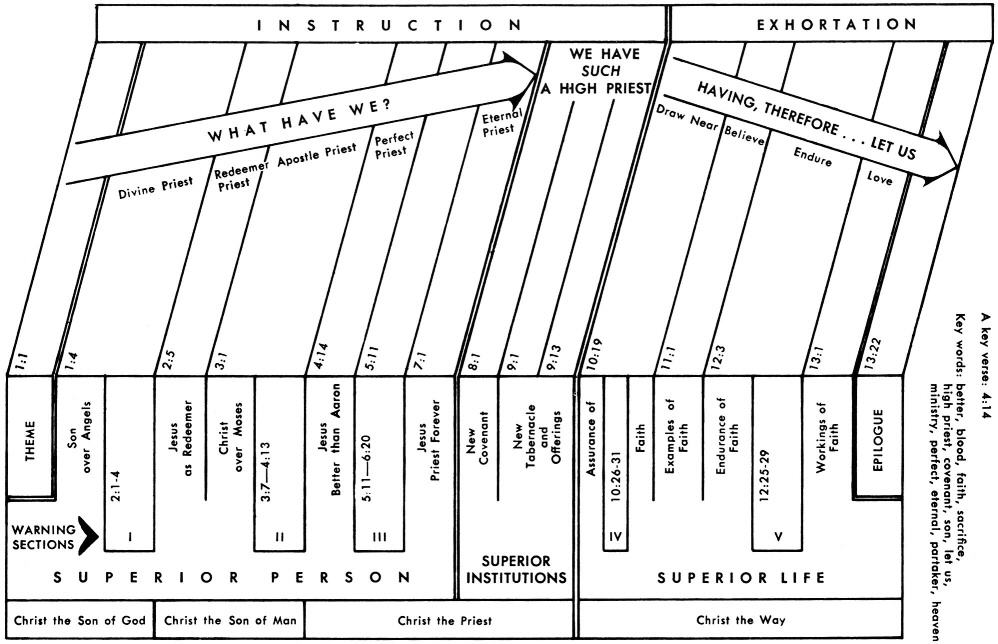
CONSIDER JESUS OUR GREAT HIGH PRIEST
Click chart to enlarge
Charts from Jensen's Survey of the NT - used by permission
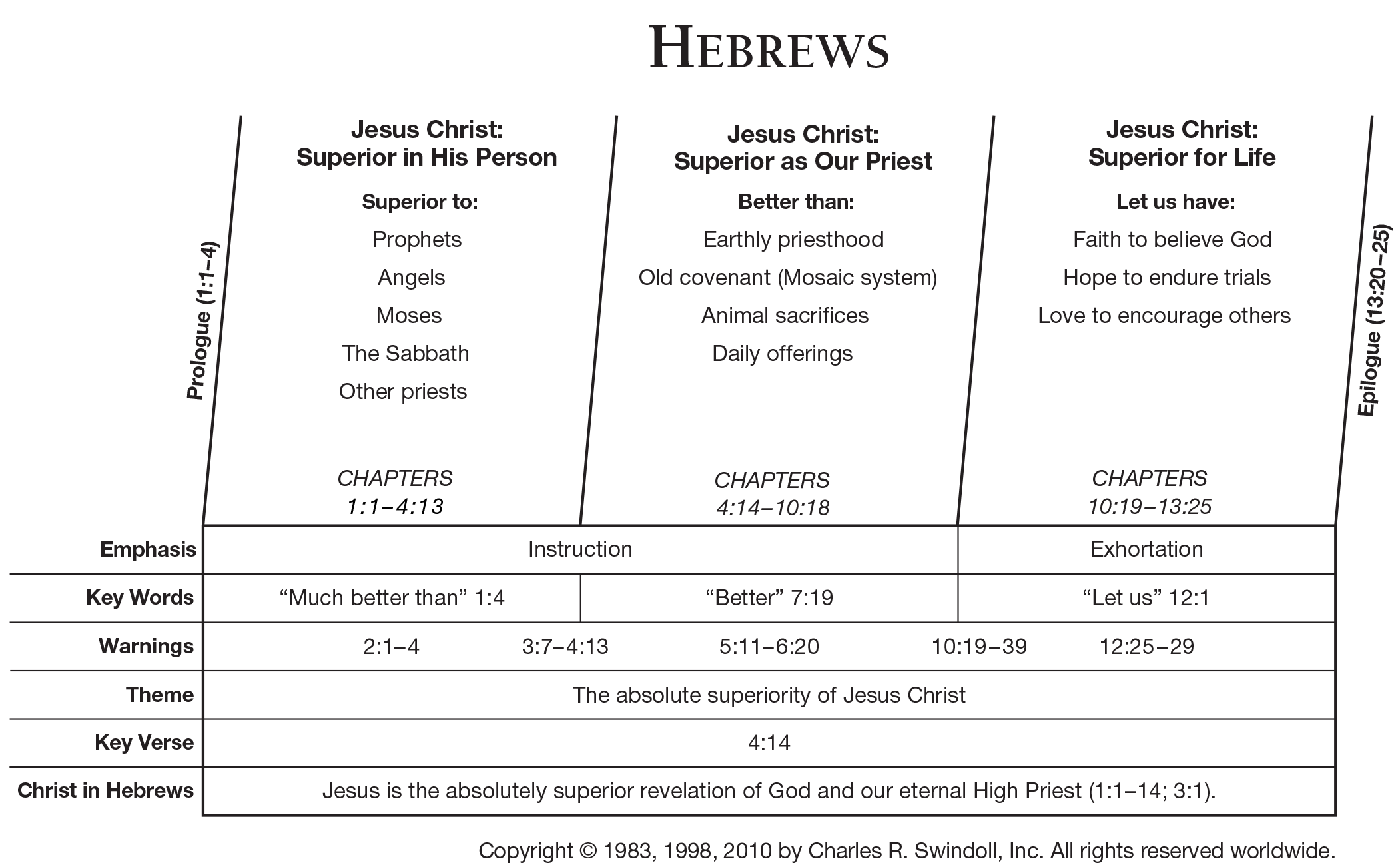
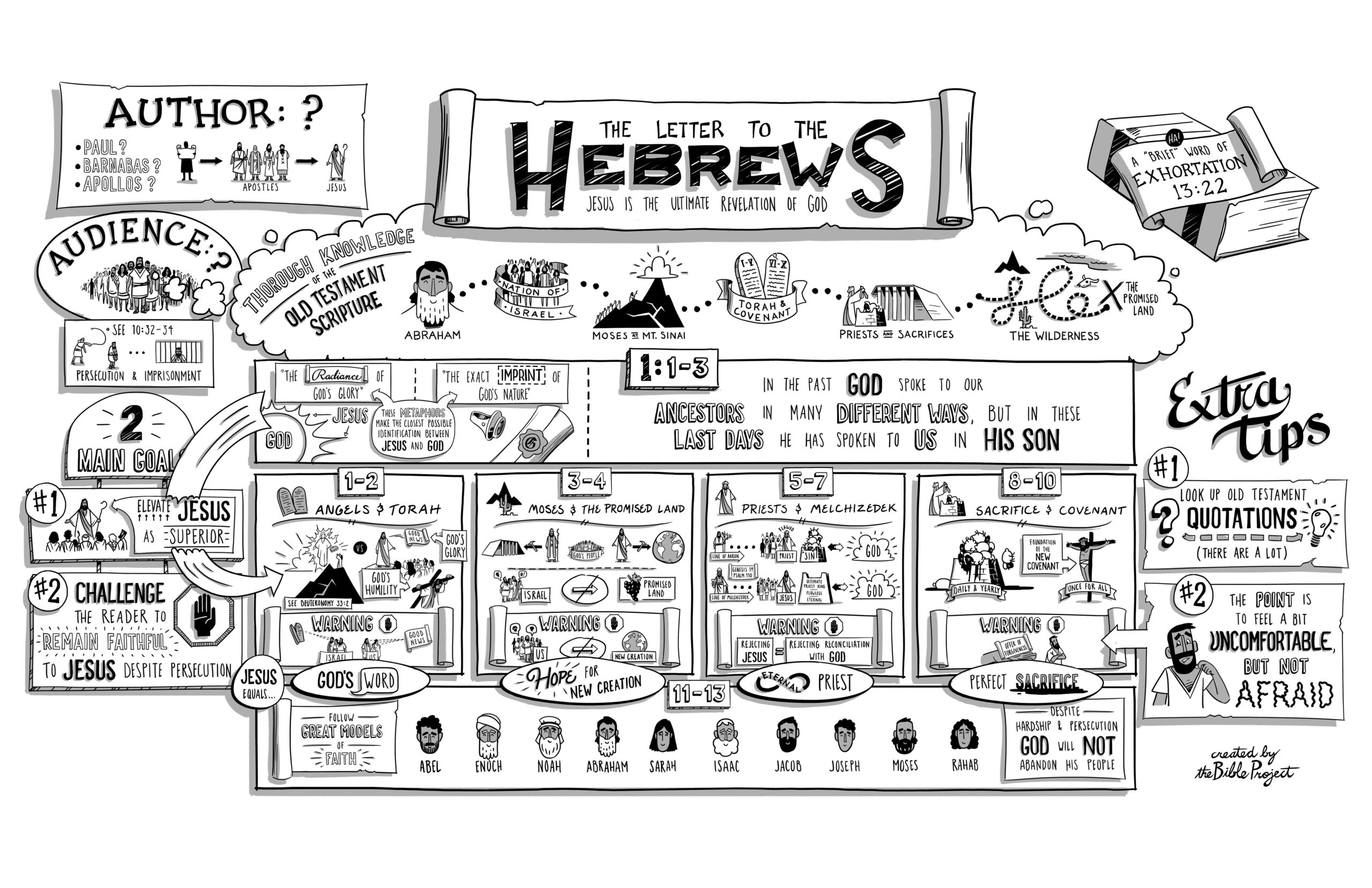
Swindoll's Chart, Interesting Pictorial Chart of Hebrews, Another Chart
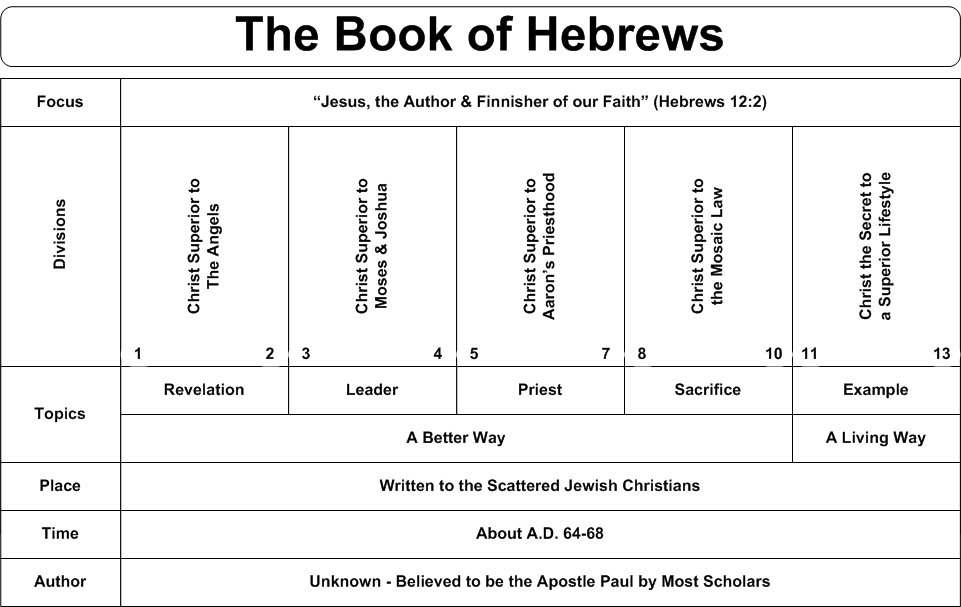
|
The Epistle |
||||
| INSTRUCTION Hebrews 1-10:18 |
EXHORTATION Hebrews 10:19-13:25 |
|||
| Superior Person of Christ Hebrews 1:1-4:13 |
Superior Priest in Christ Hebrews 4:14-10:18 |
Superior Life In Christ Hebrews 10:19-13:25 |
||
| BETTER THAN PERSON Hebrews 1:1-4:13 |
BETTER PRIESTHOOD Heb 4:14-7:28 |
BETTER COVENANT Heb 8:1-13 |
BETTER SACRIFICE Heb 9:1-10:18 |
BETTER LIFE |
| MAJESTY OF CHRIST |
MINISTRY OF CHRIST |
MINISTERS FOR CHRIST |
||
|
DOCTRINE |
DUTY |
|||
|
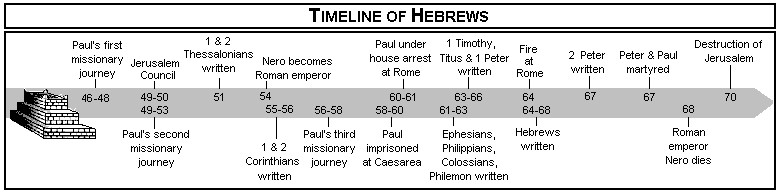
DATE WRITTEN: |
||||

See ESV Study Bible "Introduction to Hebrews"
(See also MacArthur's Introduction to Hebrews)
Borrow Ryrie Study Bible
Hebrews 12:2 fixing our eyes on Jesus, the Author and Perfecter of faith, Who for the joy set before Him endured the cross, despising the shame, and has sat down at the right hand of the throne of God. (NASB: Lockman)
Greek: aphorontes (PAPMPN) eis ton tes pisteos archegon kai teleioten Iesoun, os anti tes prokeimenes (PMPFSG) auto charas hupemeinen (3SAAI) stauron aischunes kataphronesas, (AAPMSN) en dexia te tou thronou tou Theou kekathiken. (3SRAI) (NASB: Lockman)
BGT ἀφορῶντες εἰς τὸν τῆς πίστεως ἀρχηγὸν καὶ τελειωτὴν Ἰησοῦν, ὃς ἀντὶ τῆς προκειμένης αὐτῷ χαρᾶς ὑπέμεινεν σταυρὸν αἰσχύνης καταφρονήσας ἐν δεξιᾷ τε τοῦ θρόνου τοῦ θεοῦ κεκάθικεν.
Analyzed Literal: looking with undivided attention to the Originator and Perfecter of [our] faith-Jesus-who, because of the joy being set before Him, endured a cross, having disregarded [the] shame, and has sat down at [the] right hand of the throne of God.
Amplified: Looking away [from all that will distract] to Jesus, Who is the Leader and the Source of our faith [giving the first incentive for our belief] and is also its Finisher [bringing it to maturity and perfection]. He, for the joy [of obtaining the prize] that was set before Him, endured the cross, despising and ignoring the shame, and is now seated at the right hand of the throne of God. [Ps. 110:1] (Amplified Bible - Lockman)
My Amplified Paraphrase: Fixing our eyes—deliberately turning away from all distractions and riveting our gaze—on Jesus, the Author and Perfecter of faith, the One Who initiates, sustains, and brings our faith to completion, Who for the joy set before Him—the joy of redeeming a people, glorifying the Father, and being exalted as King—endured the cross, persevered through its agony, shame, and suffering, despising the shame, counting the humiliation as nothing compared to the joy beyond it, and has sat down—His work finished—at the right hand of the throne of God, the place of highest honor, authority, and eternal intercession.
Barclay: and, as we do so, let us keep our gaze fixed on Jesus who, in order to win the joy that was set before him, steadfastly endured the Cross, thinking nothing of its shame, and has now taken his seat at the right hand of the throne of God. (Westminster Press)
BBE: Having our eyes fixed on Jesus, the guide and end of our faith, who went through the pains of the cross, not caring for the shame, because of the joy which was before him, and who has now taken his place at the right hand of God's seat of power.
Darby: looking steadfastly on Jesus the leader and completer of faith: who, in view of the joy lying before him, endured the cross, having despised the shame, and is set down at the right hand of the throne of God.
ESV: looking to Jesus, the founder and perfecter of our faith, who for the joy that was set before him endured the cross, despising the shame, and is seated at the right hand of the throne of God. (ESV)
ISV: looking off to Jesus, the pioneer and perfecter of the faith, who, in view of the joy set before him endured the cross, despising its shame, and has sat down at the right hand of the throne of God.
NLT: We do this by keeping our eyes on Jesus, on whom our faith depends from start to finish. He was willing to die a shameful death on the cross because of the joy he knew would be his afterward. Now he is seated in the place of highest honor beside God’s throne in heaven. (NLT - Tyndale House)
NIV: Let us fix our eyes on Jesus, the author and perfecter of our faith, who for the joy set before him endured the cross, scorning its shame, and sat down at the right hand of the throne of God. (NIV - IBS)
Phillips: our eyes fixed on Jesus the source and the goal of our faith. For he himself endured a cross and thought nothing of its shame because of the joy he knew would follow his suffering; and he is now seated at the right hand of God's throne. (Phillips: Touchstone)
Weymouth; simply fixing our gaze upon Jesus, our Prince Leader in the faith, who will also award us the prize. He, for the sake of the joy which lay before Him, patiently endured the cross, looking with contempt upon its shame, and afterwards seated Himself-- where He still sits--at the right hand of the throne of God.
Wuest: looking off and away to Jesus, the originator and perfecter of this aforementioned faith, who instead of the joy then present with Him endured the Cross, despising the shame, and has sat down at the right hand of the throne of God.
Young's Literal: looking to the author and perfecter of faith—Jesus, who, over-against the joy set before him—did endure a cross, shame having despised, on the right hand also of the throne of God did sit down
FIXING [OUR] EYES ON JESUS: aphorontes (PAPMPN) eis ton tes pisteos archegon kai teleioten Iesoun:
See the devotional Fix Your Eyes On Jesus by Ann Ortlund
- looking with undivided attention (Analyzed Literal)
- Looking away [from all that will distract] to Jesus (Amplified)
- looking steadfastly on Jesus (Darby)
- simply fixing our gaze upon Jesus (Weymouth)
- looking off and away to Jesus (Wuest)
VERTICAL VISION IN OUR
HORIZONTAL RACE
Westcott - The encouragement to be drawn from earthly witnesses passes into the supreme encouragement which springs from the contemplation of Christ. Above the ‘cloud of witnesses,’ who encompass us, is our King, no Roman Emperor dispensing by his arbitrary will life or death to the stricken combatant, but One Who has Himself sustained the struggle which we bear. He Who is ‘the captain (author) of our salvation,’ ‘the righteous Judge’ (2Ti 4:8-note), is also the example and the inspiration of our faith. He in His humanity endured suffering and shame beyond all others and received compensating joy and glory. We therefore may hope by sharing His sufferings to share His glory (Ro 8:17-note) (Hebrews 12 Commentary) (See notes on Vertical Vision)
Wuest - Having presented a catalog of Old Testament witnesses to the efficacy of faith, the writer now speaks of Messiah, the Jehoshua of the Old Testament, the Jesus of the New, God Himself incarnate in human flesh. He uses Him as the supreme example to which his readers should look as they run life’s race. (Wuest's word studies from the Greek New Testament)
Richard Phillips - This leads us to what I often call "the all-purpose Christian advice," from Hebrews 12:2, which gives the encouragement of the Christian life: I say this because there is no circumstance, no difficulty, no temptation for which this is not a reliable guide: "looking to Jesus." This is the "secret" of the Christian life, the encouragement we need for our faith: to place our eyes not on the world with its enticements and threats, not even on ourselves with our petty successes and many failures, but on him who is the source and fountain of all our spiritual vigor. (Reformed Expository Commentary - – Hebrews)
As believers, our life of faith begins when we look to the Lord and trust Him for salvation (Is 45:22KJV), continues as we keep our eyes of faith fixed on Him, and climaxes with faith becoming sight as see Him in all His glory (1Jn 3:1, 1Jn 3:2).
Spurgeon - The Greek word for “looking” is a much fuller word than we can find in the English language. It has a preposition in it that turns the look away from everything else. You are to look from all else to Jesus. Do not fix your gaze on the cloud of witnesses; they will hinder you if they take away your eye from Jesus. Do not look at the weights and the besetting sin—these you have laid aside; look away from them. Do not even look at the racecourse, or the competitors, but look to Jesus and so start in the race. on Jesus The instructive original has in it the word “eis,” which is translated “on,” but in addition has the force of “into.” We shall do well if we look on Jesus, but better still if we are found “looking into Jesus.” I want you, when you begin your divine life, to take care that you look to Jesus with so penetrating a gaze that your “on” grows to an “into.” I have read of a competition of certain young plowmen who were set to plow for a prize. Most of them made very crooked work of it. After they had ended, one of the judges said, “Young man, where did you look while you were plowing?” “I kept my eyes on the plow handles, sir, and saw what I had to hold.” “Yes,” the judge said, “and your plow went in and out, and the furrow is all crooked.” He asked the next plowman, “Where did you look?” “Well, sir,” he answered, “I looked at my furrow, I kept my eye always on the furrow that I was making. I thought I should make it straight that way.” “But you did not,” answered the judge. “You were all over the place.” To the next he said, “What did you look at?” “Well, sir,” he said, “I looked between the two horses to a tree that stood in the hedge at the other end of the field, right in front of me.” Now that man went straight because he had a fixed mark to guide him. This helps us to appreciate the wisdom of the text, “Fixing our eyes on Jesus.” Looking to Jesus means life, light, guidance, encouragement, joy: never cease to look on Him who ever looks on you.
GLANCE AT THE GODLY OT EXAMPLES
GAZE AT THE NT EXAMPLE OF GOD IN THE FLESH!
Fixing our eyes (872) (aphorao from apo = away from something near, indicates separation + horao = look, see, behold) means to look away from all else and to look steadfastly, intently toward a distant object. The idea is to direct one’s attention without distraction. The idea is putting some things away (behind) to go with a forward-gaze. This happens through inner vision (perception), persuaded about God's upcoming provision.
The prefix apo emphasizes the "separation" from what lies behind that we might focus on what lies ahead. Apo can be a marker of dissociation, implying a rupture from a former association. This preposition pictures the separation of one thing from another with destruction of the union or fellowship of the two.
The only other NT use is Php 2:23 (note) where Paul writes "Therefore I hope to send him immediately, as soon as I see how things go with me." (Comment: Here the connotation is that of learning or finding out about another.)
There is one use of aphorao in the Septuagint of Jonah 4:5 which carries a similar meaning to this use in Philippians.
ILLUSTRATION - In 1954 a memorable event occurred at the Empire Games in Vancouver where the eyes of the world were fixed on Roger Bannister and John Landy, the two fastest milers in the world at that time. It was being called the "Miracle Mile" as the world was waiting to see the first sub-four minute mile race. And it lived up to expectations as Landy quickly took the lead in the first laps but then he made a mistake from which he could not recover. He took a moment to look over his left shoulder to see were Bannister was and in that moment Bannister shot past him and dashed ahead to beat Landy by five yards and run a sub-four minute mile. Landy's "fatal lapse of concentration" (Kent Hughes) was a picture of what the writer of Hebrews was saying in this verse. Fixing your eyes on Jesus, blocking out all distractions, running to win the race of your life! (Play the video of this famous race and listen to the announcer say Landy "looked the wrong way" just as Roger Bannister passes him on the right side!)
Kenneth Wuest writes that aphorao "The word “looking” is aphorao “to turn the eyes away from other things and fix them on something.” The word also means “to turn one’s mind to a certain thing.” Both meanings are applicable here, the spiritual vision turned away from all else and together with the mind, concentrated on Jesus. What a lesson in Christian running technique we have in that little preposition (apo) “off, away from,” which is prefixed to this verb. The minute the Greek runner in the stadium takes his attention away from the race course and the goal to which he is speeding, and turns it upon the on-looking crowds, his speed is slackened. It is so with the Christian. The minute he takes his eyes off of the Lord Jesus, and turns them upon others, his pace in the Christian life is slackened, and his onward progress in grace hindered. (Hebrews - Wuest's word studies from the Greek New Testament - excellent) (Ed: Have you ever run hurdles in track? What happens when a hurdler begins to take his eye off the finish line, instead looking at the hurdles? Quite often he begins to hit the hurdles, which throws off his rhythm and saps his energy, making his race far more difficult. How easy it is for us to look at the menacing hurdles rather than our Majestic Lord! One other illustration of the meaning of aphorao is to picture a horse drawing a cart. What did horses often have on their eyes? Blinders (PICTURE) to keep them from looking to the sides and being distracted from their main job which was to trot on straight ahead. A good word picture of what God desire of His children (cf Dt 5:32, 28:14, Joshua 1:7, Joshua 23:6, 2 Ki 22:2, 2 Chr 34:2).
#/media/File:Horses_2.jpg)
Wikipedia note on "Blinkers" (Blinders) - Many racehorse trainers believe these keep horses focused on what is in front, encouraging them to pay attention to the race rather than other distractions, such as crowds. Additionally, blinkers are commonly seen on driving horses, to keep them from being distracted or spooked, especially on crowded city streets.
The present tense describes a habitual attitude (which is necessary to run with endurance) and not just a single act. Now just try to do this relying solely on your own power! Clearly, to continually maintain this spiritual gaze on Jesus, we need to continually depend on the filling and empowering of the indwelling Spirit! Aphorao conveys the idea of "having eyes for no one but Jesus." It is good to "glance" at the godly examples of the cloud of Old Testament witnesses and be encouraged by their faithful finish, but it is imperative that each of us then firmly fix our gaze on our Savior Jesus. The idea is that we continually choose (it is a choice, but again energized super looking away from everything which may distract. The idea is to "have eyes for no one but Jesus."
Newell - Mr. Darby's words are illuminative: "When looking at Jesus" (which is here enjoined as the positive engagement of the soul, laying aside being negative) "the new man is active; there is a new object, which unburdens and detaches us from every other by means of a new affection, which has its place in the new nature and in Jesus Himself, to Whom we look, there is a positive power which sets us free." And Grant: "To get on in the road is the way to escape entanglements and the need of a battle. Christ is the goal; and if our eyes are upon Him, we find at once the perfect example and the energy for the way." (Hebrews 12 Commentary)
Our eyes will always gaze at what engrosses our heart. If worldly and fleshly desires are harbored in our heart, they will obscure our moral vision and our ability to see Jesus as we should. Mark it down beloved - Keeping our eyes fixed on Jesus is the only safe way to live in a sinful world. This involves continually looking "away from all else" that would turn us aside.
Westcott writes that they are to be "looking away from all that distracts on earth into...not only at the first moment, but constantly during the whole struggle...Christ is always near and in sight... In one form or other the hope of the vision of God has been the support of the saints in all ages (Job 19:26-27.; Ps. 17:15.). Christ in His humanity—Jesus—is ‘the leader and consummator of faith.’ To Him our eyes are to be turned while we look away from every rival attraction. From Him we learn Faith. The ‘faith’ of which the Apostle speaks is faith in its absolute type, of which he has traced the action under the Old Covenant.... in Jesus Christ Himself we have the perfect example—perfect in realisation and in effect—of that faith which we are to imitate, trusting in Him. He too looked through the present and the visible to the future and the unseen. In His human Nature He exhibited Faith in its highest form, from first to last, and placing Himself as it were at the head of the great army of heroes of Faith, He carried faith, the source of their strength, to its most complete perfection and to its loftiest triumph. (Ed: Compare Paul's command in Col 3:1). (Hebrews 12 Commentary)
Expositor's - We are to run this race "with no eyes for any one or anything except Jesus" (Moffatt, in loc.). It is He toward Whom we run. There must be no divided attention. (Gaebelein, F, Editor: Expositor's Bible Commentary 6-Volume New Testament. Zondervan Publishing)
Am I continually fixing my eyes on Jesus?
Am I looking away from the problems and concentrating on Jesus ?
Keep your eyes
On the prize.
The Greek verb aphorao pictures a runner who is virtually oblivious to the thousands of onlookers, even as his attention is diverted from every consideration except that of running the best possible race. We've all seen runners and other top athletes who are "practicing focusing" prior to the race or event. Their attention is concentrated upon one thing to the total exclusion of everything else. And so the runner looks away from everything else and fixes his or her eyes upon the goal and not the cheering crowds or even the opponents. In a race if the runner turns his or her head even slightly toward the spectators or the opponents, their speed will be lessened.
Peter learned the lesson of not keeping his gaze on Jesus in Matthew 14...
26 And when the disciples saw Him walking on the sea, they were frightened, saying, "It is a ghost!" And they cried out for fear.
27 But immediately Jesus spoke to them, saying, "Take courage, it is I; do not be afraid."
28 And Peter answered Him and said, "Lord, if it is You, command me to come to You on the water."
29 And He said, "Come!" And Peter got out of the boat, and walked on the water and came toward Jesus.
30 But seeing the wind, he became afraid, and beginning to sink, he cried out, saying, "Lord, save me!"
31 And immediately Jesus stretched out His hand and took hold of him, and said to him, "O you of little faith, why did you doubt?"
32 And when they got into the boat, the wind stopped.
Some storms come because of our disobedience, but this one came because the disciples obeyed Jesus. Peter obeyed Jesus' command and walked on the water; but became distracted by the waves, and took his eyes off Jesus. We look to Jesus by faith when we trust His word. We need to beware of the distracting storms (which are certainty in our life in this fallen world)! Instead we need to keep our eyes continually focused on the One Who controls the "waves" and is able to calm the storm!
John Phillips writes that believers...
are going to run, not because of the prize at the end and not because so many illustrious saints have run the course in the past and have been gloriously crowned, but because the vision of Jesus thrills the soul.
We are filled with thoughts of His person; He is "the author and finisher of... faith" (He 12:2b). He, above all others, has been down this course. He knows how it should be run. The word author is really "leader," suggesting that He is going to remain a pace or two ahead of us all the way, to show us where the obstacles are and to direct each step.
We are filled with thoughts of His passion: "who for the joy that was set before him endured the cross, despising the shame" (He 12:2c). No runner in the race ever had such terrible experiences as He. Yet, He kept looking ahead and pressing on with His heart fixed on the coming joy.
We are filled with thoughts of His position, for He "is set down at the right hand of the throne of God" (He 12:2d). There He is, crowned! There He is, smiling down from the utmost height upon those who, for His name's sake, would enter the race and follow His lead. (Phillips, John: Exploring Hebrews: An Expository Commentary)
Octavius Winslow - We must look away from ourselves. SELF is, perhaps, the most common and insidious object that comes between the eye of the soul and Jesus. When God was ejected from the heart of man, self vaulted into the vacant throne, and has ever since maintained a supremacy. We must look from righteous self; from all works of righteousness which we can perform, from our almsgivings, from our charities, from our religious observances, our fastings, and prayers, and sacraments; from all the works of the law by which we are seeking to be justified; from all our efforts to make ourselves better, and thus to do something to commend ourselves to the Divine notice, and to propitiate the Divine regard. From all this we must look, if we rightly look unto Jesus to be saved by his righteousness, and by his alone. (Looking Unto Jesus)
Let us fix our eyes on Jesus! (Octavius Winslow)
"Let us fix our eyes on Jesus, the author and perfecter of our faith!"
We cannot keep our eyes too exclusively or too intently fixed on Jesus.
All salvation is in Him.
All salvation proceeds from Him.
All salvation leads to Him.
And for the assurance and comfort of our salvation, we are to repose believingly and entirely on Him.Christ must be all!
Christ the beginning,
Christ the center,
Christ the end.Oh sweet truth to you who are sensible of your poverty, vileness, and insufficiency, and of the ten thousand flaws and failures of which, perhaps, no one is cognizant but God and your own soul!
Oh the blessedness--to turn from self, and rest in Christ:
a full Christ,
a loving Christ,
a tender Christ,whose heart's love never chills,
from whose eye darts no reproof,
from whose lips breathes no sentence of condemnation!
"He whose daily life is a fixing his eyes on Jesus, has heaven on his way to heaven!" Henry Law
"And when Christ, who is your life, appears--then you also will appear with Him in glory!" Colossians 3:4
Illustration - Bible teacher Tony Evans tells of a farmer who was teaching his son to plow with a mule. ""To make straight furrows, son, just pick out an object beyond the field and keep your eyes fixed on it."" The boy nodded his understanding, and the farmer left. When he came back an hour later, the farmer was shocked to see a field of twisted furrows. ""What happened, son? I thought I told you to keep your eye on an object beyond the field."" ""I did, Dad,"" the boy replied, pointing to the ""standard"" he had chosen--a cow in the adjoining pasture! That humorous story holds a serious lesson. Whether you're plowing a field or running the race called the Christian life, it's critical that you keep your eyes on the right target. Despite all the great men and women of faith the Hebrews had just read about, only Jesus Himself was worthy of their undivided loyalty and attention.
Illustration - It was a cold January in 1994. I had just been transferred to the Coke Plant facility at U.S. Steel for my new job assignment as a firebrick mason. I was nervous because the extreme temperatures surrounding the Coke Batteries that I would be working on and in. I joined the crew: There was Irv - 58 yrs old with the beginning signs if Alzheimers, There was Frank, 45 years old, and KY, nicknamed after his home state of Kentucky. He was just over sixty. And then there was me. I was the young buck. I was partnered with KY and assigned to go up on top of the Coke Battery and change a standpipe base. We approached the Battery and I saw the glowing orange brick and the heat waves pouring out into the morning sun. The workers near the battery were wearing protective heat gear and special respirator masks. Not KY. We made our way up the stairs to the top of the batter. The heat was so intensive. I was offered wooden sandals to go outside the heels of my special boots to help sheild my feet from the heat. KY didn't take them so neither did I. The top of the battery was a dangerous place. A large machine carried the raw coal from one end of the battery to the various ovens and dumped it in to be processed by heat for several hours. It spanned the entire width of the battery except a few feet on either side. I had been warned of the danger of fatality and sever injury that could result in being in the wrong place. KY began walking out onto the top of the battery. I didn't want to go. It was too hot, too dangerous, and I didn't have a clue as to what I was supposed to do. KY noticed that and turned around and said "just follow me kid, I've done this a hundred times. Just walk where I walk, do what I do, and you'll be okay - oh, and tell me if you get too hot, I'll walk you back off the battery. I learned to trust KY not because of his age, or his skill, or his education. I trusted KY because he had already walked where I needed to walk. He knew the dangers, he knew how to take the heat and survive. I want to talk to you today about walking where others have walked. (A Cloud of Witnesses -- Richard O. Rich)
Illustration - The Summer Olympics in Atlanta Georgia in 1996 are remembered for the explosion in the Centennial Olympic Park (1 killed and over 100 injured)—but I want to draw your attention not so much to the big boom of the bomb, put to a small “pop” After their first night of competition the U. S. women gymnasts trailed the favored Russian team by just a tad over 1/10th of a point. Two nights later, on July 23rd, a huge television audience watched spellbound as the lead changed hands and the U. S. A. moved ahead by 4/10ths of a point. With the floor exercises finished, their razor thin margin was doubled going into the final event. That was the vault, a springboard leap over a padded metal horse. The first four American women got solid scores. If the fifth to vault could just get a 9.7 it would clinch the gold—which the American women gymnastics team had never won. But falls on her landings silenced the deafening chants from the crowd of “U. S. A., U. S. A.” The 32,000 in the Georgia Dome murmured nervously when a 9.2 score was posted. The last member of the team was 18-year-old Kerri Strugg who weighed all of 85 pounds. Her words were, “I could feel the gold slipping away.” “The vault is my strength,” she wrote later. “And I hadn’t missed my difficult twisting vault with a 1 ½ turn in the past three months. But I landed short on my first attempt and fell backwards. The moment my feet hit the floor I heard a pop. As I scrambled to stand, a fiery pain shot up my left leg. When I tried to walk, my ankle felt loose, as if it would fall off. But I tried to shake it off as I limped down the runway.” “I heard my coach yelling, ‘You can do it.’ I stared back with my eyes ready to burst, thinking to myself, ‘I don’t know if I can do this—something is wrong.’” (Do you remember what happened next on that night?) “Everyone was counting on me,” Kerri Strugg recalled. “I owed it to them to try. Then I said a little prayer, ‘Please God, help me out here.’ Amazingly, the pain eased. I sprinted pain-free to the springboard. After a quick twisting blur, I landed on both feet and heard another snap. I lifted the throbbing ankle, balanced on one foot to salute the judges, then collapsed to my knees.” Well, the crowd just erupted in applause. That was true in the stadium and in homes all across the country. Yes, she did it. Her score, 9.712. The gold medal belonged to the U. S. A! Kerri Strugg’s ankle was wrapped tight and paramedics prepared to take her to the hospital. “No,” she pleaded. “Let me stay!” And most you may recall the U. S. coach Bela Karolyi carrying Kerri Strugg in his arms up to the winner’s stand for the gold medal ceremony. Somehow I think that may well be how we will get to the medal ceremony as we stand before the judge of all the earth…There we are---not in our own merit, but in the arms of Jesus!
J R Miller - Keeping the heart upon Christ—transfigures the life. The old monks intently gazed upon the crucifix (Editorial Comment: I realize Miller is just introducing with an analogy but still feel compelled to comment. Clearly this practice is to be strictly avoided, for Christ is not on the Cross but seated on the Throne at the right hand of God!), thinking that the print of the nails would come in their hands and feet, and the thorn-scars in their brow—as they gazed. It was but an utter fiction—yet in the fiction there is a spiritual truth. Gazing by faith upon Christ—the lines of His beauty indeed imprint themselves on our hearts! That is the meaning of Paul's words—"We all, with unveiled face, beholding as in a mirror the glory of the Lord—are transformed into the same image!" The gospel is the mirror. There we see the image of Christ. If we earnestly, continuously, and lovingly behold it—the effect will be the changing of our own lives into His likeness. The transformation is wrought by the Holy Spirit, and we are only to behold, to continue beholding, the blessed beauty! As we sit before Christ—His image is imprinted on our soul.
Oswald Chambers - Our Lord is our example of a life of self-sacrifice, and He perfectly exemplified Psalm 40:8, "I delight to do Your will, O my God"...He endured tremendous personal sacrifice, yet with overflowing joy. Have I ever yielded myself in absolute submission to Jesus Christ? If He is not the One to whom I am looking for direction and guidance, then there is no benefit in my sacrifice. But when my sacrifice is made with my eyes focused on Him, slowly but surely His molding influence becomes evident in my life (see Hebrews 12:1, 2 ). (Sacrifice and Friendship - My Utmost For His Highest)
Robert Murray McCheyne (Biography) who died at in the thirtieth year of his age and seventh of his ministry" had some sage advice for his age "For every one look at your problems, your weaknesses, your failures -- take ten looks at Jesus. (Mark it down - Worry will keep you from fixing your eyes on Jesus, or fixing your eyes on Jesus will keep you from worry).
Warren Wiersbe reminds us of the importance of a "look" writing that " It was in “looking to Him” that we were saved, for to look means “to trust.” When the dying Jews looked to the uplifted serpent, they were healed; and this is an illustration of our salvation through faith in Christ (Nu 21:4, 25, 26, 27, 28, 29; Jn 3:14, 15, 16). “Looking unto Jesus” describes an attitude of faith and not just a single act." (Wiersbe, W: Bible Exposition Commentary. 1989. Victor) (Bolding added)
The Puritan saint John Owens rightly reminds us (he is a bit difficult to read but worth enduring) that...
A look unto Christ as crucified (and how glorious He was therein, has been declared) is made the cause and fountain of that godly sorrow which is a spring unto all other graces, especially in those who have fallen under decays, Zech 12:10; and it is so also of desiring strength from Him, to enable us to endure all our trials, troubles, and afflictions, with patience unto the end, Heb 12: 2.
The only inquiry remaining, is, how a constant view of the glory of Christ will produce this blessed effect in us: and it will do so several ways.
1. A constant view of the glory of Christ will be effected by that transforming power and efficacy which this exercise of faith is always accompanied therewith.
This is that which changes us every day more and more into the likeness of Christ, as has been at large before declared. Herein all revivals and all (spiritual) flourishing are contained. To have a reasonable measure of conformity to Christ is all we are capable of in this life: the perfection of this conformity is eternal blessedness (It will only be fully realized in the future when we are glorified). According as are our attainments therein, so is the thriving and flourishing of the life of grace in us; which is that which is aimed at. Other ways and means have failed us, so let us put this truth (a constant view of Christ) to the trial and live in the constant contemplation of the glory of Christ, and virtue will proceed from Him to repair all our decays, to renew a right spirit within us, and to cause us to abound in all duties of obedience. This way of producing these effects flesh and blood will not reveal, - it looks like washing in Jordan to cure a leprosy; but the life of faith is a mystery known only to those in whom it exists.
2. A constant view of the glory of Christ will fix the soul unto that object which is suited to give it delight, complacency, and satisfaction.
This in perfection is blessedness, for it is caused by the eternal vision of the glory of God in Christ; and the nearer approaches we make unto this state, the better, the more spiritual, the more heavenly, is the state of our souls. And this is to be obtained only by a constant contemplation of the glory of Christ, as has been declared. And it is several ways effectual unto the end now proposed. For, -
1. The majority of our spiritual decay and barrenness arises from an inordinate admission of other things into our minds for these things weaken grace in all its operations.
But when the mind is filled with thoughts of Christ and His glory, when the soul thereon cleaves unto Him with intense affections, they will cast out, or not give admittance to the causes of spiritual weakness and indisposition. See Col 3: 1, 2, 3, 4, 5; Ep 5:8.
2. Where we are engaged in this duty, it will stir up every grace unto its due exercise; which is that wherein the spiritual revival inquired after does consist.
This is all we desire, all we long for, this will make us fat and flourishing, - namely, that every grace of the Spirit have its due exercise in us. See Ro 5:3, 4, 5; 2Pe 1:5, 6, 7, 8. Whereas, therefore, Christ Himself is the first proper, adequate object of all grace, and all its exercise (for it first respects Him, and then other things for Him), when the mind is fixed on Him and His glory, every grace will be in a readiness for its due exercise. And without this we shall never attain it by any resolutions or endeavours of our own, let us make the trial when we please.
3. This (a constant contemplation of the glory of Christ) will assuredly put us on a vigilant watch and constant conflict (opposition) against all the deceitful workings of sin (He 3:13), against every entrance of temptation (Mt 26:41), against all the ways and means of the state of being surprised by foolish frames (foolish mental attitudes or outlooks), by vain imaginations which are the cause of our decay.
Our recovery or revival will not be effected, nor a fresh spring of grace be obtained, in a careless, slothful course of profession. Constant watching, fighting, contending against sin, with our utmost endeavour for an absolute conquest over it, are required hereunto. And nothing will so much excite and encourage our souls hereunto as a constant view of Christ and His glory; every thing in Him has a constraining power hereunto, as is known to all who have any acquaintance with these things. (Note: Some minor alterations have been made in an attempt to make this more readable - The Glory of Christ Mediation and Discourses on the Glory of Christ, in His Person, Office, and Grace With the Differences Between Faith and Sight Applied unto the Use of them that Believe - Part 2, Chapter 2 (The Ways and Means of the Recovery of Spiritual Decays, and of Obtaining Fresh Springs of Grace) -- John Owens - Online)
I See Jesus
I don't look back: God knows the fruitless efforts,
The wasted hours the sinning, the regrets;
I leave them all with Him Who blots the record,
And mercifully forgives, and then forgetsI don't look forward, God sees all the future,
The road that, short or long, will lead me home,
And He will face with me its every trial,
And bear for me the burdens that may come.I don't look round me: then would fears assail me,
So wild the tumult of earth's restless seas;
So dark the world, so filled with woe and evil,
So vain the hope of comfort or of ease.I don't look in; for then am I most wretched;
Myself has naught on which to stay my trust;
Nothing I see save failures and short-comings,
And weak endeavors crumbling into dust.But I look up -- into the face of Jesus,
For there my heart can rest, my fears are stilled.
And there is joy, and love, and light for darkness,
And perfect peace, and every hope fulfilled
--Annie Johnson Flint
Guy King says that there's a gold running cup on another man's mantel that could have been -- should have been -- on his own. He was running toward the tape, coming in number one. Somebody was trailing on his right, and he shot a look to see where he was. It was a split-second distraction that his competitor needed, and he flashed by him and won. "Our sole safety [as Christians]," says Guy King, "is to be found in keeping our eyes averted . . . from others, and keeping them unswervingly 'looking unto Jesus.'" (Brought In)
A famous illustration emphasizes this basic principle of running the race with focus:
On May 6, 1954, Roger Bannister became the first man in history to run a mile in less than 4 minutes. Within 2 months, John Landy eclipsed the record by 1.4 seconds. On August 7, 1954, the two met together for a historic race. As they moved into the last lap, Landy held the lead. It looked as if he would win, but as he neared the finish he was haunted by the question, "Where is Bannister?" As he turned to look, Bannister took the lead. Landy later told a Time magazine reporter, "If I hadn't looked back, I would have won!"
One of the most descriptive pictures of the Christian life in the Bible is of an athlete competing in a race. 1Corinthians 9:24, 25, 26, 27 tells us that discipline is the key to winning. In Hebrews 12:1, 2, we are encouraged to lay aside anything that might hinder our spiritual advancement and to stay focused on Christ. And in Philippians 3:12, 13 (notes), the apostle Paul said, "I press on, . . . forgetting those things which are behind and reaching forward to those things which are ahead."
Lord, give us endurance as we run this race of life. Help us not to wallow in past failures, but to be disciplined and to shun sinful ways. May we fix our eyes on the eternal goal set before us and keep looking unto Jesus. --H G Bosch (Our Daily Bread)
Run the straight race through God's good grace,
Lift up thine eyes and seek His face;
Life with its way before us lies,
Christ is the path and Christ the prize.
--Monsell
You can't make spiritual progress
by looking back.
What a lesson for the Christian. The minute we turn our eyes toward our fellow-men and take them off the Lord Jesus, our pace is slackened. Pride, discouragement, envy, the desire for praise, these and other evils incapacitate the Christian runner as he looks at men instead of keeping his eyes fixed upon Jesus.
Turn Your Eyes Upon Jesus
by Helen Lemmel
O soul, are you weary and troubled?
No light in the darkness you see?
There’s light for a look at the Savior,
And life more abundant and free!Refrain
Turn your eyes upon Jesus,
Look full in His wonderful face,
And the things of earth will grow strangely dim,
In the light of His glory and grace.Through death into life everlasting
He passed, and we follow Him there;
O’er us sin no more hath dominion—
For more than conquerors we are!
Refrain
His Word shall not fail you—He promised;
Believe Him, and all will be well:
Then go to a world that is dying,
His perfect salvation to tell!
Refrain
It is possible that some of the Jewish Christian readers had begun to take their eyes off their Messiah and to fix them instead on the hardships they were encountering for the sake of Christ.
Don't look at your fellow Christian stumbling along. Don't look at any great Christian that you admire. He might take you in a different path. Note well that the eyes are very important in any athletic endeavor. Looking unto Jesus - that is our occupation!
Keep your eyes on the Lord
He never takes His eyes off you.
The late beloved pastor James Montgomery Boice wrote that "The only thing that will ever get us moving along this path of self-denial and discipleship is fixing our eyes on Jesus and what He has done for us, coming to love Him as a result, and thus wanting also to be with Him both now and always. Jesus is our only possible model for self-denial. He is the very image of cross-bearing. And it is for love of Him and a desire to be like Him that we take up our cross and willingly follow Him (Mk 8:34, 35, 36). (Boice, J M and Philip G. Ryken. The Heart of the Cross Wheaton, Ill.: Crossway, 1999)
A W Pink has an excellent note on "fixing our eyes on Jesus" writing that...
The person of the Saviour is to be the “mark” (Ed note: the Greek word for "mark" is skopos = that on which the eye is fixed, the distant mark looked at, the goal or end that one has in view) on which the eyes of those who are pressing forward for the prize of the high calling of God, are to be fixed. Be constantly “looking” to Him, trustfully, submissively, hopefully, expectantly. He is the Fountain of all grace (John 1:16): our every need is supplied by God “according to His riches in glory by Christ Jesus” (Php 4:19). Then seek the help of the Holy Spirit that the eye of faith be steadfastly fixed on Christ. He has declared “I will never leave thee, nor forsake thee,” then let us add, “The Lord is my Helper, I will not fear what man shall do unto me” (He 13:5, 6). Salvation is by grace, through faith: it is through “faith” we are saved, not only from Hell, but also from this world (1John 5:4), from temptation, from the power of indwelling sin—by coming to Christ, trusting in Him, drawing from Him.
What are the things which hinder us running? An active Devil, an evil world, indwelling sin, mysterious trials, fierce opposition, afflictions which almost make us doubt the love of the Father. Then call to mind the “great cloud of witnesses”: they were men of like passions with us, they encountered the same difficulties and discouragements, they met with the same hindrances and obstacles. But they ran “with patience,” they overcame, they won the victor’s crown. How? By “looking unto Jesus”: He 11:26. But more: look away from difficulties (Ro 4:19), from self, from fellow-racers, unto Him who has left us an example to follow, in whom dwelleth all the fulness of the Godhead bodily, so that He is able to succour the tempted, strengthen the weak, guide the perplexed, supply our every need. Let the heart be centered in and the mind stayed upon Him.
The more we are “looking unto Jesus” the easier will it be to “lay aside every weight.” It is at this point so many fail. If the Christian denies self of different things without an adequate motive (for Christ’s sake), he will still secretly hanker after the things relinquished, or ere long return to them, or become proud of his little sacrifices and become self-righteous. The most effective way of getting a child to drop any dirty or injurious object, is to proffer him something better. The best way to make a tired horse move more quickly, is not to use the whip, but to turn his head toward home! So, if our hearts be occupied with the sacrificial love of Christ for us, we shall be “constrained” thereby to drop all that which displeases Him; and the more we dwell upon the joy set before us, the more strength shall we have to run “with patience the race that is set before us.” (Pink, A. W: An Exposition of Hebrews) (Bolding added)
TODAY IN THE WORD - Dr. Joseph Stowell has excellent advice for anyone who wants to run a successful race for Jesus Christ. Dr. Stowell says that running well involves at least three forms of preparation. First, we need to “unload the baggage,” getting rid of things in our lives that distract us from the business of living for Christ. Second, we must “shed the sin” which blocks our fellowship with Christ and disqualifies us from the race. Third, we must “stay at it,” running with a commitment to hang in there when it gets tough and finish the race. That’s a great training regimen for any believer who wants to be counted among God’s faithful people when it’s all over. Hebrews 11 is a great chapter because it teaches us that faith pleases God, and shows us what He can do with people who are determined to live faithfully before Him. But the encouragement doesn’t stop there. In Hebrews 12 we discover what it takes to live a life of faith that doesn’t quit. The plan isn’t quick or easy, and there are no shortcuts on God’s cross-country race course. We are called to “endure hardship” and accept discipline that is often painful. But the blessing of “righteousness and peace” (Heb 12:11), and God’s crown of victory (2Ti 4:8) are more than worth the sacrifice. Hebrews 12 also takes the lesson of faith one step further by offering the ultimate example of faithfulness: Jesus Christ in His suffering on the cross (Heb 12:2-3). Our Lord did not falter once, of course, even though His suffering was beyond imagination. Because He endured the shame and pain of the cross, we can run our race with endurance and finish the course. TODAY ALONG THE WAY - Did you have a favorite story of faith from Hebrews 11? Today would be a good time to turn to that passage again and help yourself to a faith-enriching review of God’s Word.
Jesus (2424) (Iesous equivalent to the Hebrew Yeshu'a H3091 = Jehovah His help, Jehovah is salvation or Jehovah delivers) means He saves, helps or delivers. Vine says Jesus is a transliteration of the Hebrew name “Joshua” which means "Jehovah is salvation".
Vincent - Having presented a long catalogue of witnesses under the old covenant, he now presents Jesus, the mediator of the new covenant, and the supreme witness. (Vincent, M. R. Word Studies in the New Testament 4:538)
Writing to Timothy Paul refers to the "witness" of Jesus "I charge you in the presence of God, Who gives life to all things, and of Christ Jesus, Who testified (martureo - witnessed, gave evidence) the good confession before Pontius Pilate
John refers to Jesus twice as a "witness" "Jesus Christ, the faithful witness, the first-born of the dead, and the ruler of the kings of the earth. To Him who loves us, and released us from our sins by His blood, (Re 1:5)
(Jesus speaking) And to the angel of the church in Laodicea write: The Amen, the faithful and true Witness, the Beginning of the creation of God, says this... (Re 3:14)
We do well to fix our eyes on the One Whose testimony was and is both faithful (worthy of our trust) and true (containing no deceit or lies, etc.) Whenever you are tempted to look at your circumstances or at yourself, look to Jesus by faith and rejoice in His faithfulness.
John Piper reminds us that "Jesus is the one sure thing. He is the rock (Ed note: Click for Scripture chain & chart - studying these passages observing what they teach about Jesus as the Rock would make a great Sunday School lesson), the foundation. Get Him in view when everything else in your life is swirling and you will land safely. The coach knows that panic is the worst enemy in the midst of a dangerous routine. And panic comes from a building sense of weakness and uncertainty—or we might say, a lack of assurance in the Christian life. And the main cry of this book is: Jesus is sure! God is sure! The Cross is sure! The Covenant is sure! The promises are sure! Fix your attention on the things that are sure! “Find the floor!” (Read his full message The Doctrine of Perseverance: The Earnest Pursuit of Assurance )
In another message Piper says that the idea of looking to Jesus means that you "do not dwell on yourself, dwell on what God has done in Jesus Christ. There is a paradox here. For many people—most people, I think—the more we focus on the subjective inner workings of our own soul and the relative purity or impurity of our own attitudes and behavior, the more uncertain we become of our own assessment of our authenticity. Paradoxically the path to assurance is to shift our focus off of ourselves and onto God. Off of the subjective and onto the objective. (Read his full message God Has Chosen Us in Him Before the Foundation of the Earth)
Spurgeon has a similar thought writing "How frequently you who are coming to Christ look to yourselves. "Oh," say you, "I do not repent enough!" That is looking to yourself. "I do not believe enough!" That is looking to yourself. "I am too unworthy." That is looking to yourself. "I cannot discover," says another, "that I have any righteousness." It is quite right to say that you have not any righteousness, but it is quite wrong to look for any....Look to Him, look at Him, study Him, know all you can about Him, meditate upon Him.
Piper observes that this passage makes the point "that the fight of faith is not done in our own strength. When you go away to plan your fall run with Jesus, verse 2 says, “Look to Jesus the author and perfecter of your faith.” Don’t look to your own resources and say, “I’ve tried before. It won’t work.” Fix your eyes on him. The battle is a battle of faith: will you believe that the things he promises are better than the bad habits that you use to cover your sadness? (Read the full message Running with the Witnesses)
Just as a runner concentrates on the finish line, believers should concentrate on Jesus, the goal and objective of our faith. Paul wrote ""Brethren, I do not regard myself as having laid hold of (taken eagerly; seized, possessed) it yet; but one thing (singleness of purpose; focused) [I do = not in the original Greek]: forgetting (completely forgetting; present tense = continually forgetting) what lies behind and reaching forward (attempting energetically to attain the goal like a runner stretching his head out to cross the tape the winner; present tense = lifelong attitude) to what lies ahead (in front of), I press on (follow hard after, pursuing with desire, earnestness and diligence in order to obtain ~ "zeal" = burning desire to please God, to do His will & to advance His glory) toward the goal for the prize of the upward call of God in Christ Jesus." (Php 3:13, 14 - see notes Php 3:13; 14)
A B Bruce writes that we are to keep our eyes riveted on Jesus, the foremost Runner for only One "...stands out conspicuous above all the rest ... the Man who first perfectly realised the idea of living by faith ... , who undauntedly endured the bitter suffering of the cross, and despised the ignominy of it, sustained by a faith that so vividly realised coming joy and glory as to obliterate the consciousness of present pain and shame. (Bruce, A B: Hebrews, P 415-416)
MacDonald adds that Jesus "not only began the race but finished it triumphantly. For Him the race course stretched from heaven to Bethlehem, then on to Gethsemane and Calvary, then out of the tomb and back to heaven. At no time did He falter or turn back. He kept His eyes fixed on the coming glory when all the redeemed would be gathered with Him eternally. This enabled Him to think nothing of shame and to endure suffering and death. (MacDonald, W & Farstad, A. Believer's Bible Commentary: Thomas Nelson)
Vincent writes that the author "Having presented a long catalogue of witnesses under the old covenant, now presents Jesus, the Mediator of the new covenant, and the supreme Witness. (Vincent, M. R. Word studies in the New Testament. Vol. 4, Page 538)
A W Pink agrees writing that “The cloud of witnesses is not the object on which our heart is fixed. They testify of faith, and we cherish their memory with gratitude, and walk with a firmer step because of the music of their lives. Our eye, however, is fixed, not on many, but on One; not on the army, but the Leader; not on the servants, but the Lord. We see Jesus only, and from Him we derive our true strength, even as He is our light of life” (A. Saphir). In all things Christ has the pre-eminence: He is placed here not among the other “racers,” but as One who, instead of exemplifying certain characteristics of faith, as they did, is the “Author and Finisher” of faith in His own person." (The Object of Faith)
Keep choosing to turn your eyes away from the trials and sorrows that are nearby (also from the great conflict of sufferings that was probably imminently looming on the horizon in 70AD as well as the daily reproaches from other Jews calling them to turn away from Messiah).
A T Robertson - Fix your eyes on Jesus, after a glance at “the cloud of witnesses” (Hebrews 11) for He is the Goal." (Robertson, A T: Word Pictures in the New Testament)
Moses ran his "race". looking with eyes of faith to Him Who is unseen:
By faith Moses, when he had grown up, refused to be called the son of Pharaoh’s daughter;25 choosing rather to endure ill-treatment with the people of God, than to enjoy the passing pleasures of sin;26 considering the reproach of Christ greater riches than the treasures of Egypt; for he was looking to the reward. 27 By faith he left Egypt, not fearing the wrath of the king; for he endured, as seeing Him who is unseen. (He 11:24, 25, 26, 27-see notes He 11:24;25; 26; 27)
Looking to Jesus...
Why look? Because the best beings in the universe encourage it (the Angels, the redeemed in heaven, the Holiest on earth), our own needs demand it (we need a Mediator, Example, Friend, such as He is) and finally because the great God enjoins it.
How to look? By the study of His biography. By communion with others of pure heart.
When to look? At the beginning of the Christian life. I times of temptation and difficult. In all the encouragements and discouragements of life. At death.
What should be our attitude? Trustful. Obedient.. Loving. (Adapted from the Biblical Illustrator)
C H Spurgeon discusses looking to Jesus...
The rule of the race: —
I. First, then, we are to look to Jesus as THE AUTHOR OF FAITH. The apostle would have us view the Lord Jesus as the starter of the race. When a foot-race began, the men were drawn up in a line, and they had to wait for a signal. Those who were in the race had to look to the starter; for the runner who should get first by a false start would not win, because he did not run according to the rules of the race. No man is crowned unless he strives lawfully. The starter was in his place, and the men stood all waiting and looking. Our word at starting in the Christian life is, “Look unto Jesus.”
A). We have to look to Jesus, first, by trusting in that which He has wrought for us. It is described in these words: “Who for the joy that was set before Him endured the Cross, despising the shame.”
B). We also begin looking unto Jesus because of what He has wrought in us.
II. But now we must look to Jesus as THE FINISHER OF FAITH. As Jesus is at the commencement of the course, starting the runners, so He is at the end of the course, the rewarder of those who endure to the end. Those who would win in the great race must keep their eyes upon Him all along the course, even till they reach the winning-post.
A). You will be helped to look to Him when you remember that He is the finisher of your faith by what He has wrought for you; for the text saith “He endured the Cross, despising the shame, and is set down at the right hand of the throne of God.” You also shall have heaven, for He has it; you shall sit upon the throne, for He sits there.
B). We are helped to run to the end, not only by what Jesus has done for us, but by what Jesus is doing in us.
(1) You that are in the middle of the race, remember that Jesus sustains you. Every atom of your strength for running comes from your Lord. Look to Him for it.
(2) We are not only sustained by looking unto Jesus, but we are inspirited thereby. A sight of the exalted Leader fires the zeal of each believer, and makes him run like a roe or a young hart.
(3) Looking unto Jesus, you will get many a direction; for, as He sits at the winning-post, His very presence indicates the way.
(4) Look to Jesus, for by that look He draws you. The great magnet up yonder is drawing us towards itself. Christ’s cords of love give us speed.
III. Let us next consider our Lord Jesus as THE PATTERN OF OUR FAITH.
Run, as Jesus ran, and look to Him as you run, that you may run like Him. How did our Lord pursue His course?
A). You will see this if you first note His motive: “Who for the joy that was set before Him.” The chief end of man is to glorify God; let it be my chief end, even as it was my Lord’s. Oh, that I might glorify Thee, my Creator, my Preserver, my Redeemer! To this end was I born, and for this end would I live in every action of my life. We cannot run the race set before us unless we feel thus.
B). Wherein are we to imitate Jesus?
(1) First, we are to copy His endurance. He “ endured the Cross.” Ours is a trifling cross compared with that which pressed Him down; but He endured it. He took it up willingly, and carried it patiently.
(2) Imitate your Lord in His magnanimity. He endured the Cross, “despising the shame.” Shame is a cruel thing to many hearts. Our Lord shows us how to treat it. See, He puts His shoulder under the Cross; but He sets His foot upon the shame. He endures the one, but He despises the other.
(3) Our Saviour is to be imitated in His perseverance. For the joy that was set before Him, He endured the Cross, despising the shame, and “is set down.” He never stopped running till He could sit down at the right hand of the throne of God; and that is the only place where you may sit down.
IV. Lastly, our text sets before us Jesus as THE GOAL OF FAITH
We are to run “looking unto Jesus” as the end that we should aim at. True faith neither goes away from Christ Jesus, nor takes a roundabout road to Jesus, nor so much as dreams of going beyond Jesus. Now, we are to run towards Him, looking unto Him. Looking to Jesus and running to Jesus will look well and run well together. The eyes outstrip the feet; but this also is well, for the feet will thus be made to move the faster. Look you that you may see more of Jesus. Let us run towards Jesus, that we may grow more like Him. It is one of the virtues of Jesus that He transforms into His own image those who look at Him. He photographs Himself upon all sensitive hearts. Run, that you may come nearer to Jesus. Seek after more near and dear fellowship with Him. (Read Spurgeon's full sermon The Rule of the Race - Pdf)
Robert Murray McCheyne advised that "For every one look at your problems, your weaknesses, your failures -- take ten looks at Jesus."
C. M. Merry writes that...
1. “Looking to Jesus” supplies the strongest motive to run well our Christian race; that is, love towards Himself. You know that fire and force are the effect of a supreme affection; how it makes light of difficulties, and changes leaden feet into feet of angel swiftness. Love lightens toil, and makes even waiting more than endurable.
2. “Looking to Jesus” furnishes all needful strength for running well our Christian race. This is the act on our part that appropriates it for our various occasions and exigencies; just as plants, by opening out their
leaves, to them the organs of assimilation, imbibe the light and dew, and distribute sustenance through their entire structure, so we, by “ looking to Jesus,” receive those communications of a spiritual kind, upon which the life of our souls and the vigor of our Christian walk depend.
3. “Looking to Jesus “ brings before us the highest example of a successful runner in the Christian race. When you are in doubt, ask, “What, in such a case, would my Master have done?” (Biblical Illustrator)
F B Meyer writes that we should
...look off unto Jesus. Away from past failure and success; away from human applause and blame; away from the gold pieces scattered on the path, and the flowers that line either side. Do not look now and again, but acquire the habit of looking always; so that it shall become natural to look up from every piece of daily work, from every room, however small, from every street, however crowded, to His calm face; just as the sojourner on the northern shores of Geneva’s lake is constantly prone to look up from any book or work on which the attention may have been engaged, to behold the splendour and glory of the noble range of snowcapped summits on the further shores. And if it seems hard to acquire this habitual attitude, trust the Holy Spirit to form it in your soul.
Above all, remember that where you tread there your Lord trod once, combating your difficulties and sorrows, though without sin; and ere long you shall be where He is now. Keep your eye fixed, then, on him as he stands to welcome and reward you; and struggle through all, animated by his smile, and attracted to his side, and you will find weights and unbelief dropping off almost insensibly and of themselves.
This is the only way by which souls can be persuaded. Argue with them; urge them; try to force them-and they will cling the closer to the encumbrances which are clogging their steps. But present to them Jesus in the beauty and attractiveness of his person and work, and there will be a natural loosening of impediments; as the snow which had been bending the leaves to the earth drops away when the sun begins to shine. And God never takes aught from us, without giving us something better. He removes the symbol, to give us the reality; breaks the type, to give the substance; releases us from the natural and human, to give us the divine. Oh, trust him, soul: and dare to let go, that thou mayest take; to be stripped, that thou mayest become clothed! (Meyer, F B: Hebrews 12:1-2: Stripping for the race)
G Campbell Morgan sums up this section:
These words catch up and apply all that had been said as to the service rendered in the past by those who had "received the promises," and had died, not having "received the promise." If they so endured with courage and cheerfulness, we also should be prepared to endure with patience, and run the race toward the glorious goal without wavering, however hopeless the enterprise may seem, when judged by the circumstances of the hour. The ultimate strength of this appeal, however, lies in the contrast which it suggests between these men of the past and ourselves. They had the promises; we have Jesus. They look for the City; we look off unto Jesus. This means that in Him we have a clearer revelation of the glory of the City, and of the travail through which alone it can be built. Through Him our understanding of what the tabernacling of God with men means, is more perfect. In Him the call is to yet profounder suffering and to greater patience. But He is Himself the File-leader of the Faithful; that is, in His own life and service He takes precedence of all others. And so He is supremely the Vindicator of faith in the promises of God as the one principle which moves toward the fulfilment of those very promises. He also is waiting for the consummation, waiting till His enemies shall be made the footstool of His feet, but waiting in the perfect assurance of the final victory. Then we are called upon to rest in His assurance, to have fellowship with His sufferings, and so to hasten the coming of the Day of God. (Morgan, G. C.: Life Applications from Every Chapter of the Bible). (Bolding added)
J. C. Ryle commenting on "looking to Jesus" has some excellent advice...
The expression before us is one of the pithy golden sayings which stand out here and there on the face of the New Testament, and demand special attention. It is like “to me to live is Christ,” “Christ is all and in all,” “Christ who is our life,” “He is our peace,” “I live by the faith of the Son of God.” To each and all of these sayings one common remark applies. They contain far more than a careless eye can see on the surface. But the grand question which rises out of the text is this: What is that we are to look at in Jesus?
I. First and foremost, if we would look rightly to Jesus, we must look daily at His DEATH, as the only source of inward peace. We all need peace. Now there is only one source of peace revealed in Scripture, and that is the sacrifice of the death of Christ, and the atonement which He has made for sin by that vicarious death on the Cross. To obtain a portion in that great peace, we have only to look by faith to Jesus, as our substitute and Redeemer.
Let your faith's eye daily look on Christ crucified, and rest in the sight.
Let the first look of your soul to Jesus, be a look backward.
Look at Him dying for your sins on the cross, and as you look, say to yourself,
"This was done for me."
II. In the second place, if we would look rightly to Jesus, we must look daily to His LIFE OF INTERCESSION, in heaven, as our principal provision of strength and help. While we are fighting Amalek in the valley below, one greater than Moses is holding up His hands for us in heaven, and through His intercession we shall prevail.
Let your faith's eye see Jesus as your Priest in heaven, and rejoice in the sight.
What will you see there? You will see the same Saviour who died for you exalted to the place of highest honour, and doing the work of an intercessor and advocate for your soul. All was not done when He suffered for your sins on Calvary. He rose again and ascended up to heaven, to carry on there the work which He began on earth. There, as our Priest and Representative, He ever lives to make intercession for us. He presents our names before the Father; He continually pleads our cause. He obtains for us a never-ending supply of mercy and grace; He watches over our interests with an eye that never sleeps. He is ready, morning, noon, and night, to hear our confessions, to grant us absolution, to strengthen us for duty, to comfort us in trial, to guide us in perplexity, to hold us up in temptation, and to preserve us safe on our journey heavenward until we reach home.
What will you get by looking upward to Jesus? Comfort and strength in all the daily battle of life. What thought more cheering than the thought that Jesus is ever looking at you and watching over you! What idea more strengthening than the idea that you are never alone, never forgotten, never neglected, never without a Friend who is "able to save to the uttermost all them who come unto God by Him!" (Heb. 7:25.)
This daily upward look at Jesus is a most important point. The life of Christ for His people in heaven is only second in importance to His death for them on the cross. The blood, the sacrifice, the atonement, the satisfaction for sin can never be too much prized or thought of. But the session in heaven, the priestly intercession, the daily advocacy of Jesus ought not to be forgotten. I sadly fear they are not so much considered in this day as they ought to be.
Reader, beware of falling into this mistake. Beware of leaving out any part of the truth concerning Jesus. That great divine, John Owen, declared, two hundred years ago, that there was no office of Christ which Satan hated so much as the priestly one, and none which he laboured so incessantly to obscure and bring into contempt. Understand that office thoroughly, and cling to it firmly. No earthly priest can be so wise, so sympathizing, so trustworthy, so able to help, as Jesus, the Son of God. From no confessional will you go away so light-hearted, so cheerful, so satisfied, as from the throne of grace, and from communion with Christ. Look up to Him daily, if you would be a happy Christian; pour out your heart before Him, if you would enjoy the consolations of the Gospel. This daily look to a living interceding Jesus is one great secret of strength and comfort in religion.
III. In the third place, if we would look rightly to Jesus, we must look at His EXAMPLE as our chief standard of holy living. We must all feel, I suspect, and often feel, how hard it is to regulate our daily lives by mere rules and regulations. But surely it would cut many a knot and solve many a problem if we could cultivate the habit of studying the daily behaviour of our Lord as recorded in the four Gospels, and striving to shape our own behaviour by its pattern. We may well be humbled when we think how unlike the best of us are to our example, and what poor blurred copies of His character we show to mankind. Like careless children at school we are content to copy those around us with all their faults, and do not look constantly at the only faultless copy, the One perfect man in whom even Satan could find nothing. But one thing at any rate we must all admit. If Christians during the last eighteen centuries had been more like Christ, the Church would certainly have been far more beautiful, and probably have done far more good to the world.
IV. Fourthly, and lastly, if we would look to Jesus rightly, we must look forward to His SECOND ADVENT, AS THE TRUEST FOUNTAIN OF HOPE AND CONSOLATION. That the early Christians were always looking forward to a second coming of their risen Master, is a fact beyond all controversy. In all their trials and persecutions, under Roman Emperors and heathen rulers, they cheered one another with the thought that their own King would soon come again, and plead their cause. It ought to be the consolation of Christians in these latter days as much as it was in primitive times.
Let the eye of your faith look onward to the day when Christ shall come again the second time.
What will you get by looking forward to Jesus coming again? You will get that which is the best remedy against disquiet and depression,--hope shed abroad in your heart about things to come. When the minds of others are cast down with perplexity, you will feel able to lift up your head and rejoice; when all around seems dark and gloomy, you will see light, and be able to wait patiently for better days.
You should look backward, to Jesus on the cross.
You should look upward, to Jesus at the right hand of God.
You should look forward, to Jesus coming again at the last day.
Reader, remember these three looks at Jesus, backward, upward, forward; and make use of them every day. The first is the secret of peace of conscience: no peace unless we look backward at the cross of Christ!--the second is the secret of real daily strength and comfort in our walk with God: little solid comfort unless we look upward to Christ's intercession!--The third is the secret of bright and cheerful hope in a dark world: no bright prospect unless we look forward to Christ coming again! Backward, upward, forward,--these are the three ways in which we should look at Jesus. He that looks at the cross is a wise man; he that looks at the cross and the intercession also, is wiser still; but he that looks at all three,--the cross, the intercession, and the coming of Jesus,--he is the wisest of all.
Keep on looking unto Jesus. Faith shall soon be changed to sight, and hope to certainty. Looking to Jesus on earth by faith, you shall end with seeing Jesus eye to eye in heaven. Those eyes of yours shall look on the head that was crowned with thorns, the hands and feet that were pierced with nails, and the side that was pierced with a spear. You shall find that seeing is the blessed consequence of believing, and that looking at Jesus by faith, ends with seeing Jesus in glory, and living with Jesus for evermore. When you awake up after His likeness, you shall be satisfied.
(Notes in blue from Biblical Illustrator (and his sermon Looking Unto Jesus) and in Green from Ryle's tract Are You Looking?)
Spurgeon's Morning devotional from June 28th addresses "looking unto Jesus":
It is ever the Holy Spirit's work to turn our eyes away from self to Jesus; but Satan's work is just the opposite of this, for he is constantly trying to make us regard ourselves instead of Christ. He insinuates, "Your sins are too great for pardon; you have no faith; you do not repent enough; you will never be able to continue to the end; you have not the joy of his children; you have such a wavering hold of Jesus." All these are thoughts about self, and we shall never find comfort or assurance by looking within. But the Holy Spirit turns our eyes entirely away from self: he tells us that we are nothing, but that "Christ is all in all."
Remember, therefore, it is not thy hold of Christ that saves thee-it is Christ; it is not thy joy in Christ that saves thee-it is Christ; it is not even faith in Christ, though that be the instrument-it is Christ's blood and merits; therefore, look not so much to thy hand with which thou art grasping Christ, as to Christ; look not to thy hope, but to Jesus, the source of thy hope; look not to thy faith, but to Jesus, the author and finisher of thy faith. We shall never find happiness by looking at our prayers, our doings, or our feelings; it is what Jesus is, not what we are, that gives rest to the soul. If we would at once overcome Satan and have peace with God, it must be by "looking unto Jesus." Keep thine eye simply on him; let his death, his sufferings, his merits, his glories, his intercession, be fresh upon thy mind; when thou wakest in the morning look to him; when thou liest down at night look to him. Oh! let not thy hopes or fears come between thee and Jesus; follow hard after him, and he will never fail thee.
"My hope is built on nothing less
Than Jesus' blood and righteousness:
I dare not trust the sweetest frame,
But wholly lean on Jesus' name."
Scriptures that speak of fixing your eyes on Jesus...
Hebrews 9:28 (note) so Christ also, having been offered once to bear the sins of many, shall appear ca second time for salvation (future tense salvation = glorification) without reference to sin, to those who eagerly await (continually looking with a sure hope, a steadfastness and an expectancy) Him.
Numbers 21:8 Then the Lord said to Moses, “Make a fiery serpent, and set it on a standard; and it shall come about, that everyone who is bitten, when he looks at it, he shall live.” 9 And Moses made a bronze serpent and set it on the standard; and it came about, that if a serpent bit any man, when he looked to the bronze serpent, he lived." which John explains as follows...
John 3:14 “And as Moses lifted up the serpent in the wilderness, even so must the Son of Man be lifted up; 15 that whoever believes may in Him have eternal life.
Job 19:26 "Even after my skin is destroyed, Yet from my flesh I shall see (behold) God" (The grave is not the end of our seeing Him. Let us practice beholding Him now with eyes of faith, and one day soon face to face! Glory!)
Psalm 17:15 As for me, I shall behold Thy face in righteousness; I will be satisfied with Thy likeness when I awake. (Like Job David held fast to the hope [certainty] of resurrection into the presence of the Lord. Let us do likewise, for our life is but a breath [Job 7:7], a vapor that appears for a little while and then vanishes away [James 4:14], a wind [ruach -spirit] that passes and does not return [Ps 78:39 - Spurgeon's comment].)
Psalm 123:2 Behold, as the eyes of servants look to the hand of their master, as the eyes of a maid to the hand of her mistress; so our eyes look to the Lord our God until He shall be gracious to us.
Psalm 123:6 My soul waits for the Lord more than the watchmen for the morning; Indeed, more than the watchmen for the morning.
Isaiah 8:17 And I will wait for the Lord who is hiding His face from the house of Jacob; I will even look eagerly for Him.
Isaiah 31:1 Woe to those who go down to Egypt for help, and rely on horses, and trust in chariots because they are many, and in horsemen because they are very strong, but they do not look to the Holy One of Israel, nor seek the Lord!
Isaiah 45:22 “Turn to Me (KJV "Look unto Me") and be saved, all the ends of the earth, for I am God, and there is no other. (this "look" resulted in the salvation of C H Spurgeon!) (Ann Ortlund wrote that "It's the look that saves, but it's the gaze that sanctifies." - Fix Your Eyes on Jesus) (Spurgeon wrote "Look is ever the right word. After all, it is “Look unto me, and be ye saved” [Isaiah 45:22]). Look, yes, look steadfastly and intently. Your posture should always be that of one “looking unto Jesus” throughout life.)
Micah 7:7 But as for me, I will watch expectantly for the Lord; I will wait for the God of my salvation. My God will hear me.
Zechariah 12:10 And I will pour out on the house of David and on the inhabitants of Jerusalem, the Spirit of grace and of supplication, so that they will look on Me whom they have pierced; and they will mourn for Him, as one mourns for an only son, and they will weep bitterly over Him, like the bitter weeping over a first-born.
John 1:29 The next day he saw Jesus coming to him, and said, “Behold, the Lamb of God who takes away the sin of the world!
John 6:40 “For this is the will of My Father, that everyone who beholds the Son and believes in Him, may have eternal life; and I Myself will raise him up on the last day.”
John 8:56 “Your father Abraham rejoiced to see My day, and he saw it and was glad.”
1 Corinthians 12:12 For now we see in a mirror dimly, but then face to face; now I know in part, but then I shall know fully just as I also have been fully known.
2 Corinthians 3:18 But we all, with unveiled face beholding as in a mirror the glory of the Lord, are being transformed into the same image from glory to glory, just as from the Lord, the Spirit.
Philippians 3:20 (note) For our citizenship is in heaven, from which also we eagerly wait for a Savior, the Lord Jesus Christ; (see exposition of )
2 Timothy 4:8 (note) in the future there is laid up for me the crown of righteousness, which the Lord, the righteous Judge, will award to me on that day; and not only to me, but also to all who have loved (present tense) His appearing.
Titus 2:13 (note) looking (expectantly) for the blessed hope and the appearing of the glory of our great God and Savior, Christ Jesus
1 John 1:1-3 What was from the beginning, what we have heard, what we have seen with our eyes, what we beheld and our hands handled, concerning the Word of Life— 2 and the life was manifested, and we have seen and bear witness and proclaim to you the eternal life, which was with the Father and was manifested to us— 3 what we have seen and heard we proclaim to you also, that you also may have fellowship with us; and indeed our fellowship is with the Father, and with His Son Jesus Christ.
Jude 1:21 keep yourselves in the love of God, awaiting anxiously (looking expectantly) for the mercy of our Lord Jesus Christ to eternal life.
Look …
Look around and be distressed.
Look inside and be depressed.
Look at Jesus and be at rest.
Corrie Ten Boom
Bible teacher Tony Evans tells of a farmer who was teaching his son to plow with a mule. ""To make straight furrows, son, just pick out an object beyond the field and keep your eyes fixed on it."" The boy nodded his understanding, and the farmer left.
When he came back an hour later, the farmer was shocked to see a field of twisted furrows. ""What happened, son? I thought I told you to keep your eye on an object beyond the field.""
""I did, Dad,"" the boy replied, pointing to the ""standard"" he had chosen--a cow in the adjoining pasture!
That humorous story holds a serious lesson. Whether you're plowing a field or running the race called the Christian life, it's critical that you keep your eyes on the right target. Despite all the great men and women of faith the Hebrews had just read about, only Jesus Himself was worthy of their undivided loyalty and attention. (Today In The Word - Moody Bible Institute)
Robert Murray McCheyne - Unfathomable oceans of grace - "Let us fix our eyes on Jesus!" Hebrews 12:2
For every look at self—take ten looks at Christ! Live near to Jesus—and all things will appear little to you in comparison with eternal realities.
How many millions of dazzling pearls and gems are at this moment hidden in the deep recesses of the ocean caves. Likewise, unfathomable oceans of grace are in Christ for you. Dive and dive again—you will never come to the bottom of these depths!
When you gaze upon the sun—it makes everything else dark; when you taste honey—it makes everything else tasteless. Likewise,
when your soul feeds on Jesus—
it takes away the sweetness of all earthly things;
praise, pleasure, fleshly lusts, all lose their sweetness.
Keep a continued gaze! Run, looking unto Jesus. So will the world be crucified to you—and you unto the world! (Gal 6:14)
Gleanings from the Inner Life of Ruth Bryan - The secret of peace and power - "Let us fix our eyes on Jesus." Hebrews 12:2
The work of the Holy Spirit is to bring us to be experimentally nothing, and to make Jesus our "all in all," thereby teaching us to live by faith upon Him.
Oh, may you, by the Spirit's power, so lift up your eyes from all but Jesus, that you will be conformed to His image (2Co 3:18). But do not expect to receive any better account of yourself—rather a worse one; for, as you get nearer the light, you will see more of your own sinfulness. I do hope, however, to hear you speak well of Him, and that, as you feelingly cry out, "Behold, I am vile!" He will melt your heart by responding, "You are absolutely beautiful, my darling, with no imperfection in you!"
Oh, this wondrous Savior! He opens the secret of our wanderings and transgressions—only to declare how entirely He has put them all away by the sacrifice of Himself! Oh, what mercy that He did not say, "Let them alone, they have loved idols, after idols let them go!" What mercy that by His light, He has manifested our darkness. You shall see greater things than these.
More of your own vile heart—and more of His loving heart.
More of your sin—and more of His great salvation.
More of your deformity—and more of His beauty.
Do not be considering so much how you love Jesus, as how He loves you. Your love is but the effect; His is the cause; and the more you have to do with the cause, the more fully will the effect flow from it (1John 4:19, and John 15:9).
So with faith; if you would have it grow, it must be by looking at Him, not at your faith.
In short, the more you "consider Him," and are continually coming unto Him, the more lively and healthy will be the graces of the Spirit in your soul; while yet you rejoice, not in your fruitfulness—but only in Jesus and in what He has done and suffered. If the Holy Spirit opens this to you, you will find the secret of peace and power. It is all in Christ! He says, "Arise, my love, my fair one, and come away." Away from self, away from all besides—to be absorbed in Him. We must learn . . .
our weakness—as well as His strength;
our emptiness—as well as His fullness;
our ignorance—as well as His wisdom.
May your eye and heart to be fixed on Him. Then will your course be steady, and you will not be greatly moved by the many changes you will ever find within. Oh, press on after a life of faith in Jesus, for it is next in blessedness to a life of glory with Jesus. Beg of the blessed Spirit to draw your faith out continually upon His precious Person and work. Oh! may He cause you to come out of self continually, and find your all in Jesus! The more you are brought so to live upon Jesus, the more stability of soul you will experience. To Him I commend you—may He be revealed more fully in your soul.
Richard Phillips writes that "This encouragement—"looking to Jesus"—is vitally important in such a difficult race as ours. Those who fix their gaze on the world and the things of the world will be conformed to its pattern (Ro 12:2). But in a still more powerful and reliable way, those whose gaze is fixed on Jesus will find themselves changed into His pattern (Ro 8:29)—not merely because of the working of our own hearts, but because of His active and transforming work through the Holy Spirit. With our eyes fixed on Him, we are, Paul says, "being transformed (present tense = a continual process) into [his] image from one degree of glory to another" (2Co 3:18). (Hebrews Reformed Expository Commentary)
Spurgeon's Exposition (compiled) on Hebrews 12:2 - Look to him, look at him, study him, know all you can about him-, meditate upon him, — His race is complete; his wrestling is over; so he sits down with the great Judge of all as the One who has won his crown for ever. Let us look to him.
How frequently you who are coming to Christ look to your-selves. "Oh," say you, "I do not repent enough!" That is looking to yourself. "I do not believe enough!" That is looking to your-self. "I am too unworthy." That is looking to yourself. "I cannot discover," says another, "that I have any righteousness." It is quite right to say that you have not any righteousness, but it is quite wrong to look for any.
What was "the joy that was set before him"? Oh, it's a thought that melts a rock. It makes a heart of iron move. The joy set before Jesus was principally joy of saving you and me!
Let the grandest of all examples nerve us. Think how Jesus ran the race!
It was this joy that made Christ strong to endure in the day of his sorrow and joy must make you also strong to endure unto the end. He had the joy of anticipated victory. It “was set before him,” and so he “endured the arose, despising the shame.” He ran with a heavy cross on his back, and yet he ran faster than you or I have run: he ran because he had more joy than we have. So, my brethren, let us live in the joy of heaven, let us live in the joy of ultimate victory, and this will enable us to bear all the toils and trials of our present life. (Spurgeon Exposition on Hebrews)
THE AUTHOR AND PERFECTER OF FAITH: tes pisteos archegon kai teleioten Iesoun:
- Heb 2:10; Mark 9:24; Luke 17:5; Acts 5:31; Revelation 1:8,11,17; 2:8) (Heb 7:19; 10:14; Psalms 138:8; 1Corinthians 1:7,8; Philippians 1:6
- the Originator and Perfecter (Analyzed Literal)
- the Leader and the Source of our faith [giving the first incentive for our belief] and is also its Finisher [bringing it to maturity and perfection] (Amplified)
- Jesus, the guide and end of our faith (BBE)
- Jesus the leader and completer of faith (Darby)
- Jesus, the founder and perfecter of our faith (ESV)
- Jesus, the pioneer and perfecter of the faith (ISV)
- Jesus, on whom our faith depends from start to finish (NLT)
- Jesus the author and perfecter of our faith (NIV)
- Jesus the source and the goal of our faith (Phillips)
- the originator and perfecter of this aforementioned faith (Wuest)
Westcott comments that "Christ in His humanity—Jesus—is ‘the leader and consummator of faith.’ To Him our eyes are to be turned while we look away from every rival attraction... He too looked through the present and the visible to the future and the unseen. In His human Nature He exhibited Faith in its highest form, from first to last, and placing Himself as it were at the head of the great army of heroes of Faith, He carried faith, the source of their strength, to its most complete perfection and to its loftiest triumph. (Hebrews 12 Commentary)
John MacArthur agrees writing "I believe the primary meaning of archegos here is that of chief leader, or chief example. Jesus Christ is our preeminent example of faith. He was “tempted in all things as we are, yet without sin” (Heb 4:15). Jesus lived the supreme life of faith. When the devil tempted Him in the wilderness, Jesus’ reply each time was the expression of trust in His Father and His Word. Jesus would not bypass the Father’s will just to get food, or to test His Father’s protection or lordship (Matt. 4:1-10). He would wait until the Father supplied or protected or directed. When the ordeal was over, His Father did provide by sending angels to minister to Him. He trusted His Father implicitly, for everything and in everything. “I can do nothing on My own initiative. As I hear, I judge; and My judgment is just, because I do not seek My own will, but the will of Him who sent Me” (John 5:30). In the Garden of Gethsemane, just before His arrest, trial, and crucifixion, Jesus said to His Father, “My Father, if it is possible, let this cup pass from Me; yet not as I will, but as Thou wilt” (Matt. 26:39). Whatever the prospect of hardship or suffering, He trusted His Father. His Father’s will was what He lived by and died by. It was all Jesus ever considered. The faith of all the heroes of chapter 11 together could not match the faith of the Son of God. They were wonderful witnesses and examples of faith; Jesus is a more wonderful example still. Their faith was true and acceptable to God; His was perfect and even more acceptable. In fact, without Jesus’ faithfulness, no believer’s faith would count for anything. For if Jesus’ perfect faith had not led Him to the cross, our faith would be in vain, because there would then be no sacrifice for our sins, no righteousness to count to our credit. (MacArthur, John: Hebrews. Moody Press)
Spurgeon - We must fix our eye on “the originator of our faith.” If we do not begin by looking to Him, however quickly we may hurry along, we shall run in vain and labor in vain. To what purpose will your running be if the umpire determines that you started improperly? He by His bearing the cross has removed your heaviest weights, and by His death has destroyed your entangling sin. He can renew your nature by His resurrection power, and save you from the dominion of sin by His glorious reign. If you look alone to Him, you start well; but not otherwise.
Author (747) (archegos from arche = beginning, the first + ago = lead) strictly speaking denotes the first in a long procession, a file leader, pioneering the way for others to follow. Archegos is the originator or founder of a movement and continues as the leader. Archegos is one who leads from the beginning, the one who is the first in succession of many who follow. The archegos is the trailblazer, the pioneer, the forerunner who arrives at the destination (end or goal) where others are to follow. The term was used for both human and divine heroes, founders of schools or those who cut a path forward for their followers and whose exploits for humanity were rewarded by exaltation. The archegos takes the lead and thus furnishes the example for those to follow in his steps (cp the picture in 1Pe 2:21). The premier example of our faith is Jesus, Who has blazed the trail on which we are to run with eyes of faith fixed on Him, the One Who has overcome all obstacles (cp Jn 16:33).
Newell - Thayer well translates archegos, "One who takes the lead in anything, and thus affords an example, a predecessor in the matter," adding of Christ, "Who in the pre-eminence of His faith far surpassed the examples commemorated in Hebrews 11. Our directions here are, to look objectively at our Lord Jesus, the File-Leader of the column of believers, those who had perfect faith to look at Him just as objectively as we would look at Abel, Enoch, Noah, Abraham, or any of the other great cloud of witnesses. (Hebrews 12 Commentary)
Archegos - 4x in 4v - Acts 3:15; 5:31; Heb 2:10; 12:2. NAS = author(2), Prince(1), prince(1).
Jesus is to be distinguished from simply being the cause. One may be the cause of something but not the beginning. Archegos can refer to His being the Author or Originator, the primary meaning in context is that of chief leader or chief example. Jesus Christ is our preeminent example of faith. He was “tempted in all things as we are, yet without sin” (He 4:15).
Jesus lived the supreme life of faith. When the devil tempted Him in the wilderness, Jesus’ reply each time was the expression of trust in His Father and His Word. Jesus would not bypass the Father’s will just to get food, or to test His Father’s protection or lordship (Matthew 4:1-10). He would wait until the Father supplied or protected or directed. When the ordeal was over, His Father did provide by sending angels to minister to Him. He trusted His Father implicitly, for everything and in everything, declaring “I can do nothing on My own initiative. As I hear, I judge; and My judgment is just, because I do not seek My own will, but the will of Him who sent Me” (John 5:30).
Vincent writes that Christ is the archegos, the Chief Leader of the faith in that He "furnished the perfect development, the supreme example of faith, and in virtue of this He is the leader of the whole believing host of all time. (Vincent, M. R. Word Studies in the New Testament Vol. 4, Page 538)
Moffatt explains that Jesus as archegos is "the Pioneer (one who opens up and prepares the way for others to follow) of personal faith."
He is the “Pathfinder” Who has blazed the trail as His people’s Representative and Forerunner. He has run the race to its triumphant finish.
Perfecter (accomplisher, finisher) (5051) (teleiotes from teleioo = to bring to an end or goal, to perfect or complete from telos = goal, purpose) describes a state of completeness, perfection or complete maturity. Some think the writer of Hebrews coined this word as it is found in no other literature, Biblical or secular. BDAG says teleiotes is "one who brings something to a successful conclusion."
Friberg writes that the noun teleiotes is "a designation for Jesus, the one who brings faith to its highest attainment, either in Himself as an example or in others through His high priestly ministry." (Analytical Lexicon)
Thayer on teleiotes - "One who has in his own person raised faith to its perfection and so set before us the highest example of faith."
TDNT on teleiotes - Jesus gives faith its perfect basis by his high-priestly work and thus completes it. At the same time, he exercises complete faith as demonstrated by his passion.
This word describes Jesus as the completer or perfecter, the One Who reached the goal, carrying faith through to its completion, especially to win the prize. Jesus is the supreme and perfect example of the faith. The Latin Vulgate translates teleiotes as "Consummator". On the Cross Jesus' work of payment of the redemption price was complete as attested by His words "It is finished" (John 19:30). The redemption price was paid in full!
Vine - teleiotēs signifies one who completes, who brings to the destiny determined. The corresponding verb (teleioo) has been used of Christ in Heb 2:10; 5:9; 7:28. The thought seems, then, to be “the One who has arrived at the goal of faith.” His faith has had its issue in His exaltation at the right hand of God. Accordingly, as the leader He is our pattern, as the perfecter He is our encouragement, being Himself the incentive to our faith. The two words carry us first to His life on earth, and then to His position and ministry in the sanctuary. He has trodden the pathway of faith from beginning to end.
Spurgeon - As Jesus is at the commencement of the course, starting the runners, so He is at the end of the course, the rewarder of those who endure to the end. Those who would win in the great race must keep their eyes upon Him all along the course, even until they reach the finish line.
Wuest explains that "Our Lord in His life of faith on earth, became the perfect or complete example of the life of faith. Thayer speaks of our Lord as “one who has in his own person raised faith to its perfection and so set before us the highest example of faith.” (Hebrews - Wuest's word studies from the Greek New Testament - excellent) (Bolding added)
Larry Richards - As we run we can look back and see how Jesus ran His race ("Author"). When we look ahead we can see His exaltation ("Finisher"). He is our example as starter and finisher. (Richards, L: The Bible Reader's Companion. Wheaton, Ill.: Victor Books)
When His disciples offered Him food in Samaria, Jesus explained that "My food is to do the will (His gracious disposition which He Himself does of for His own good pleasure) of Him who sent Me, and to accomplish (related verb teleioo = He completed His race which was made perfect by reaching the intended goal) His work (note: not "My work" - He ran the course that the Father had laid out beforehand, just as the Father does for every believer)" (John 4:34).
In Jesus' high prayer just before He was crucified He declares that "I glorified Thee on the earth, having accomplished (teleioo = brought to the intended goal) the work which Thou hast given Me to do (John 17:4)
And so we see Jesus testify that He endured and finished the race the Father had given Him to run, and so too must we beloved.
What does Perfecter mean pragmatically? It means that if you want to look for a perfect example of faith, you look to our Lord Jesus Christ. If you look at Abraham, you see failure. If you look to Abel, you see failure. If you look to Moses, you will see failure. And in Gideon, Samson, Jeptha, and all the rest of the runners in the race of faith in Hebrews 11, you will see failure. There is one person, and only One, Who never failed and that Person is our Lord Jesus Christ. And He will never fail you beloved.
R Phillips says that "If the heroes of the Old Testament are lights testifying to faith in God, Jesus on the cross is a blazing sun bringing faith to its most dazzling expression. (Reformed Expository Commentary – Hebrews)
S Lewis Johnson - I am sure, if you feel as I do at times, to look at our Lord as an example which we are to follow, is a very frustrating thing. Joseph Parker, a great London preacher, had gone to hear the great pianist Paderiski play. He was so filled with the consummate beauty of the playing that he went home and asked his wife for an ax to chop his piano into pieces. That was the power of a great example. When I look at the example of our Lord Jesus, that is the way I feel. But in the Word of God, we are told that not only is Jesus our example, but He also offers us the utmost of enablement. A German woman in World War II had been rationing for years and finally got to the place where she did not have enough food to feed her family. One day she made a trip to the ocean which she had never seen before. When she saw the water, she exclaimed, "Well there is after all something that they cannot ration." Likewise, the power of God through Jesus Christ is something we cannot ration. It is available to us, and as we run the race, keeping the weight down, keeping our limbs free, and keeping our eyes upon Him, the power of our Lord Jesus Christ flows through us and we are enabled to do what we could not do otherwise!
Notice the recurrence of the idea of perfecting permeating this epistle (why do you think that is so?). See notes Hebrews 2:10; Hebrews 5:9; Hebrews 6:1; Hebrews 7:11, Hebrews 7:19, Hebrews 7:28; Hebrews 9:9; Hebrews 10:1, Hebrews 10:14; Hebrews 11:40.
The Bible says that Jesus is before us. He is behind us. He is by our side. He is below us. He is above us. He is around about us and He is in us. There was a man who looked to Jesus once, and he did an impossible thing. Do you remember? Jesus came walking on the water and when Peter first saw Him he said "It is a ghost." Then he said, "If it be Thee Lord, bid me come unto Thee. And Peter climbed out of that boat in the midst of the raging storm with the lightening and thunder, and he walked on the water. Impossible! But as long as Peter kept his eyes on Jesus, the power of Jesus Christ was in Peter!
Having presented a long catalogue of witnesses under the old covenant, he now presents Jesus, the mediator of the new covenant, and the supreme Witness, Who is ever Faithful and True. See Re 1:5, Re 3:14; 1Ti 6:13.
S Lewis Johnson writes about a certain king in western Europe who "was about to visit a small town. A mother took her little boy and found her way to the front of the crowd. Finally the king arrived she held him up and said, "Now look at him and never forget it all the days of your life." That is the kind of look that we should have as we look unto Jesus. As you run the race, look to Jesus and never forget Who He is and what He has done, and what He can do for you. May you reach the crown at the end of the race."
THOU ART ENOUGH FOR ME
Thou art enough for me,
Thou art enough for me,
Thou living, loving, mighty God
Thou art enough for me!
To God our father above,
We glory in Thy love,
Thou living, loving, mighty God,
Thou art enough for me.
Lord Jesus, Savior king,
All glory now we sing,
Thou living, loving, mighty God,
Thou art enough for me!
The Holy Spirit's power
Shall keep me every hour,
Thou living, loving, mighty God.
The Faith (4102) (pistis [word study]) when used with the definite article ("the faith" - see discussion of specific phrase "the faith") it refers to the specific body of doctrine. "The faith" describes that body of doctrine that was given by God through the Apostles to the church. "The faith" also describes the course of life dictated by faith.
Jesus is the supreme model of the "by faith" way of life. Where others failed, He succeeded.
WHO FOR THE JOY SET BEFORE HIM:os anti (for the sake of) tes prokeimenes (PMPFSG) auto charas:
- Heb 2:7, 8, 9; 5:9; Psalms 16:9, 10, 11; Isaiah 49:6; 53:10, 11, 12; Luke 24:26; John 12:24,32; John 13:3,31,32; 17:1, 2, 3, 4; Acts 2:25,26,36; Philippians 2:8, 9, 10, 11; 1 Peter 1:11
For the joy set before Him - Jesus was able to endure the cross because He knew it was leading to the Father’s presence where there is fullness of joy and the Father’s right hand where there are pleasures for evermore. Believers need to emulate His example, and realize that this world is not our home but that most of the joy we long for is still over the horizon. If you are seeking joy in earthly things, it will be a fragile, easily shaken joy. Stop for a moment and really ponder the question - Where (Who) is my source of greatest joy?
Westcott commenting on the joy writes that "The joy was that of the work of redemption accomplished through self-sacrifice. The suffering was that of the cross, a death at once most painful and most humiliating. (Ibid)
Piper comments on the practical application of this truth noting that "The greatest act of love that has ever been performed was sustained by the joy of hope. For the joy set before Him He died for us. How do you keep on loving people, and sacrificing to do them good, the way Jesus did? For the joy set before you, that streams back into the present and becomes your strength (Nehemiah 8:10). (See full sermon Be Constant in Prayer for the Joy of Hope)
Spurgeon - The joy that was set before Jesus was principally the joy of saving you and me. I know it was the joy of fulfilling His Father’s will, of sitting down on His Father’s throne, of being made perfect through suffering—but still I know that this is the grand, great motive of the Savior’s suffering: the joy of saving us. It was this joy that made Christ strong to endure in the day of His sorrow, and joy must make you also strong to endure unto the end. He had the joy of anticipated victory. It “was set before Him,” and so He “endured the cross, disregarding the shame.” He ran with a heavy cross on His back, and yet He ran faster than you or I have run. He ran because He had more joy than we have. So let us live in the joy of heaven, let us live in the joy of ultimate victory, and this will enable us to bear all the toils and trials of our present life.
Joy (5479) (chara from chaíro = to rejoice) describes an attitude of cheerfulness or gladness.
Joy (and rejoice) is a feeling of inner gladness, delight or rejoicing. Joy is a feeling of inner gladness, delight or rejoicing. Joy in the NT is virtually always used to signify a feeling of "happiness" that is based on spiritual realities (and independent of what "happens").Joy is an inner gladness; a deep seated pleasure. It is a depth of assurance and confidence that ignites a cheerful heart. It is a cheerful heart that leads to cheerful behavior. Joy is not an experience that comes from favorable circumstances but is God’s gift to believers. Joy is a part of God’s very essence and as discussed below His Spirit manifests this supernatural joy in His children (Galatians 5:22, Acts 13:52,1Th 1:6). Joy is the deep-down sense of well-being that abides in the heart of the person who knows all is well between himself and the Lord. (Click here for a more detailed discussion of joy)
There is a chorus from an old spiritual song that is apropos…
Happiness happens
But joy abides
For the correspondence between the sufferings and the glory of Christ compare He 2:9;Php 2:9; Isa 53:11;
William Newell - There is no joy like the accomplishment of a noble task: and of the noblest task of all eternity, Christ was to say, 'I have finished it. (Hebrews 12 Commentary)
Set before (4295) (prokeimai [word study] from pros = in front of + keimai = lie outstretched) means to be set before one and figuratively means to be present to the mind as an example or reward. The idea is that the race lies before us in full view.
The joy was the full, divine beatitude of Jesus' pre-incarnate life which He experienced in the bosom of the Father; the glory which He had with God before the foundation of the world. In exchange for this glorious joy, Jesus willingly (volitionally) accepted the Cross, the blame and the shame! His attention was not on the passing, but painful passion and agony of the Cross, but on the glorious Crown. Jesus did not focus on the temporal suffering, but on the eternal reward, and so too should we as His brethren (see James' exhortation - Jas 1:2, Jas 1:3, Jas 1:4 cp the "reward" in Jas 1:12).
Psalm 16 speaks of the joy Jesus experienced when He rose from the dead and ascended into heaven:
(Messiah is speaking prophetically) Therefore my heart is glad and my glory rejoices. My flesh also will dwell securely. For Thou will not abandon my soul to Sheol. Nor will You allow Thy Holy One to undergo decay. Thou will make known to me the path of life. In Thy presence is fullness of joy; in Thy right hand there are pleasures forever. (Ps 16:9, 10, 11)
Comment: Barnes writes that this "joy" was "Not partial joy; not imperfect joy; not joy intermingled with pain and sorrow; not joy which, though in itself real, does not satisfy the desires of the soul, as is the case with much of the happiness which we experience in this life - but joy, full, satisfying, unalloyed, unclouded, unmingled with anything that would diminish its fulness or its brightness; joy that will not be diminished, as all earthly joys must be, by the feeling that it must soon come to an end." (Barnes, A: Notes on the Old Testament)
The writer had earlier alluded to that "joy" quoting from (Psalm 45:7) that "Thou (Jesus) hast loved righteousness and hated lawlessness; therefore God, Thy God (the Father), hath anointed Thee (Jesus) with the oil of gladness above Thy companions. (He 1:9).
The "joy set before" Jesus includes His perfection completion of His Father’s will, His being seated on the throne at the Father's right hand, and the joy of presenting believers to the Father in glory.
Vine explains that "the joy set before the Lord was the anticipation of His glory with the Father and all that was to be the outcome of His finished work on the Cross, both in the present age and the ages to come. Because of the value He set upon all this He endured the Cross. (Collected writings of W. E. Vine. Nashville: Thomas Nelson)
Wycliffe Bible Commentary explains "joy" this way - "The reward for Christ’s endurance is the position of authority and his occupation thereof. In this position his joy is complete, and so will our joy be complete when we are in his presence before God. At God’s right hand Christ performs all the functions of ruler, high priest, and advocate, yet he came to that place through suffering and endurance, i.e., by way of the cross." (Pfeiffer, C F: Wycliffe Bible Commentary. 1981. Moody)
Albert Barnes explains that the joy set before Him includes "all the honor which he would have at the right hand of God, and the happiness which he would experience from the consciousness that he had redeemed a world, was willing to bear the sorrows connected with the atonement." (Barnes, A: Notes on the NT)
John Piper writes regarding "joy" that " It is not a morally defective thing to be sustained in the marathon of life by the joy of triumph at the end. The reward of seeing God and being free from all sin is the greatest incentive of all. So if it seems that there are going to be some temporary losses when you run this race with Jesus, you are right. That is why Jesus said to count the cost (Luke 14:25, 26, 27, 28, 29, 30, 31, 32, 33) before you sign on. But the marathon of the Christian life is not mainly loss. It is mainly gain. "For the joy that was set before him he endured the cross." It is only a matter of timing. If you see things with the eyes of God, there is a vapor's breath of loss and pain, and then everlasting joy (2Co 4:17). (Running with the Witnesses) (Bolding added)
William Newell - There is no joy like the accomplishment of a noble task: and of the noblest task of all eternity, Christ was to say, "I have finished it." There is among us on earth no joy like that of rescuing a fellow-creature from ruin. But Christ had the joy set before Him of rescuing and redeeming from endless woe so many that He would "see the travail of His soul and be satisfied"! There was no joy like that of lavishing His infinite love on those eternally lost and undone without it and Him: for, being God, He is Love: and now it became possible to let love freely out, fully and forever. There was no joy like unselfish love receiving, without stint or limit, that love for which true love longs: "Only love seeks love, and only love satisfies love." There was no joy like looking forward, after the ages of sin, to a New Creation, based on His sacrifice, "where righteousness is at home." There is no earthly delight like that of doing the will of, perfectly pleasing, another to whom our will is properly subjected. How infinitely more with Christ, Who said: "I delight to do Thy will, O My God; Yea, Thy Law is within My heart." And, "My meat is to do the will of Him that sent Me, and to accomplish His work." "The cup which the Father hath given Me shall I not drink it?" The joy of being the means of letting out the heart of God toward His creatures was set before Christ! When He bare men's sins and put them away, then the mighty river of grace, pure grace, from the heart of God, Who delighteth in mercy, could pour forth! "God was in Christ reconciling the world unto Himself, not reckoning unto them their trespasses." "God so loved the world that He gave His only begotten Son." Or, "Herein is love, not that we loved God, but that He loved us, and sent His Son to be the Propitiation for our sins." Or, "We know and have believed the love which God hath in our case." Finally, there is the joy of the Victor: "I also overcame, and sat down with My Father in His throne" (Rev. 3:21). God the Father eternally speaks to Him: "Thou hast loved righteousness and hated iniquity" ... "Thou didst resist unto blood, striving against sin." And now, "Judgment has returned unto righteousness, and all the upright in heart rejoice with Thee and with Me forever." (Hebrews 12 Commentary)
ENDURED THE CROSS DESPISING THE SHAME: hupemeinen (3SAAI) stauron aischunes kataphronesas (AAP):
- Hebrews 10:5-12; Matthew 16:21; 20:18,19,20,28; 27:31-50; Mark 14:36; John 12:27,28; Ephesians 2:16; 5:2; Titus 2:14; 1Peter 2:24; 3:18
- Despising - Heb 10:33; 11:36; Psalms 22:6, 7, 8; 69:19,20; Isaiah 49:7; 50:6,7; 53:3; Matthew 26:67; Matthew 26:68; 27:27, 28, 29, 30, 31,38, 39, 40, 41, 42, 43, 44; Mark 9:12; Luke 23:11,35, 36, 37, 38, 39; Acts 5:41; 1Peter 2:23; 4:14-16)
R Phillips - Jesus endured both suffering and shame on the cross. The Hebrew Christians were in danger of shrinking back from these very things, just as we find them so difficult to endure. It was by faith that Jesus "endured the cross, despising the shame," persevering to his appointed end and thus entering into his glory in heaven. He "is seated at the right hand of the throne of God," because He faithfully endured suffering and did not fear the world's contempt. This provides an Example for us (1Pe 2:21), that we would bear the cross in our own lives. (Mk 8:34, 35, 36) (Reformed Expository Commentary - Hebrews) (Bolding added)
Spurgeon - Ours is a trifling cross compared with that which pressed Him down, but He endured it. He took it up willingly, and carried it patiently. He never rebelled against it, and never relinquished it. He bore the cross until the cross bore Him, and then He bore death upon it. He could say, “It is finished.” (Jn 19:30) Let us do the same. Are you persecuted, are you poor, are you sick? Take up the appointed cross. Christ ran with a cross on His shoulder, and so must we run. Do not try to escape trouble; the followers of the Crucified must be familiar with the cross. Endure it patiently, joyfully, in the strength of God. “Fixing your eyes on Jesus,” behold His cross whenever you begin to faint under your own.
Endured (5278) (hupomeno from hupó = under + meno = remain) (click related noun hupomone) means literally to remain under but not simply with resignation, but with a vibrant hope. It describes one who continues in an activity despite resistance and opposition. Hupomeno was used as a military term to describe an army’s holding a vital position at all costs.
Hupomeno - 17x in 16v - Matt 10:22; 24:13; Mark 13:13; Luke 2:43; Acts 17:14; Rom 12:12; 1 Cor 13:7; 2 Tim 2:10, 12; Heb 10:32; 12:2f, 7; Jas 1:12; 5:11; 1 Pet 2:20. NAS = endure(3), endure...with patience(1), endured(5), endures(3), patiently endure(1), perseveres(1), persevering(1), remained(1), stayed behind(1).
Vincent draws our attention to the verb tenses writing "Notice the tenses: endured, aorist, completed: has sat down, perfect, He remains seated and reigning. (Vincent, M. R. Word studies in the New Testament. Vol. 4, Page 539)
Cross (4716) (stauros from hístemi = to stand) was an upright pointed stake often with a crossbeam above it or intersected by a crossbeam and utilized as an instrument of capital punishment. This word originally was used of wood or timber. In later Greek it came to mean a tree and was used of the cross by Peter.
Vine - denotes, primarily, "an upright pale or stake." On such malefactors were nailed for execution. Both the noun and the verb stauroo, "to fasten to a stake or pale," are originally to be distinguished from the ecclesiastical form of a two beamed "cross." The shape of the latter had its origin in ancient Chaldea, and was used as the symbol of the god Tammuz (being in the shape of the mystic Tau, the initial of his name) in that country and in adjacent lands, including Egypt. By the middle of the 3rd cent. A.D. the churches had either departed from, or had travestied, certain doctrines of the Christian faith. In order to increase the prestige of the apostate ecclesiastical system pagans were received into the churches apart from regeneration by faith, and were permitted largely to retain their pagan signs and symbols. Hence the Tau or T, in its most frequent form, with the cross-piece lowered, was adopted to stand for the "cross" of Christ. As for the Chi, or X, which Constantine declared he had seen in a vision leading him to champion the Christian faith, that letter was the initial of the word "Christ" and had nothing to do with "the Cross" (for XULON, "a timber beam, a tree," as used for the stauros, see under TREE). The method of execution was borrowed by the Greeks and Romans from the Phoenicians. The stauros denotes (a) "the cross, or stake itself," e.g., Matthew 27:32; (b) "the crucifixion suffered," e.g., 1 Corinthians 1:17,18 , where "the word of the cross," RV, stands for the Gospel; Galatians 5:11 , where crucifixion is metaphorically used of the renunciation of the world, that characterizes the true Christian life; Galatians 6:12,14; Ephesians 2:16; Philippians 3:18 . The judicial custom by which the condemned person carried his stake to the place of execution, was applied by the Lord to those sufferings by which His faithful followers were to express their fellowship with Him, e.g., Matthew 10:38 .(Cross, Crucify - Vine's Expository Dictionary of NT Words - Bible Dictionary)
Stauros - 27x in 27v (not found in the Septuagint) - Always translated "cross" in the NAS - Matt 10:38; 16:24; 27:32, 40, 42; Mark 8:34; 15:21, 30, 32; Luke 9:23; 14:27; 23:26; John 19:17, 19, 25, 31; 1Cor 1:17f; Gal 5:11; 6:12, 14; Eph 2:16; Phil 2:8; 3:18; Col 1:20; 2:14; Heb 12:2
- Cross - International Standard Bible Encyclopedia
- Cross - Hastings' Dictionary of the Bible
- Cross - Bridgeway Bible Dictionary
- Cross - Fausset's Bible Dictionary
- Cross - Kitto's Popular Cyclopedia of Biblial Literature
A W Pink wriest that "endured the cross" signifies "far more than than He experienced the shame and pain of crucifixion: they tell us that He stood steadfast under it all. He endured the cross not sullenly or even stoically, but in the highest and noblest sense of the term—with holy composure of soul. He never wavered or faltered, murmured or complained: “The cup which My Father hath given Me, shall I not drink it” (John 18:11)! And He has left us an example that we should “follow His steps” (1Pe 2:21), and therefore does He declare, “If any man will come after Me, let him deny himself, and take up his cross” (Matthew 16:24). Strength for this task is to be found by “looking unto Jesus,” by keeping steadily before faith’s eye the crown, the joy awaiting us. (The Object of Faith)
Spurgeon - Shame is a terrible thing to endure, and many of the proudest natures have been subdued when once they have been subjected to it. In the Savior’s case, shame would be peculiarly shameful. The nobler a man’s nature, the more readily does he perceive the slightest contempt, and the more acutely does he feel it. That contempt which an ordinary man might bear without suffering, he who has been bred to be obeyed, and who has all his life long been honored, would feel most bitterly. Beggared princes and despised monarchs are among the most miserable of men, but here was our glorious Redeemer, in whose face was the nobility of Godhead itself, despised and spit upon and mocked.
Despising (2706) (kataphroneo from katá = down or against + phronéo = think) means literally to think down upon or against and so to despise, hold in contempt or feel contempt for something (shame).
Kataphroneo - 9x in 9v - Mt 6:24; 18:10; Lk 16:13; Ro 2:4; 1Co11:22; 1Ti 4:12; 6:2; Heb 12:2; 2Pe 2:10. NAS = despise(5), despising(1), disrespectful(1), look down(1), think lightly(1).
Shame (152) (aischune) describes a feeling which leads one to shun what is unworthy out of the prospect and anticipation of dishonor or fear of disgrace. The cross was an instrument of “shame” in both Roman (the standard proclamation of execution) and Jewish (cf. Dt 21:23; Joshua 10:26,27) thought. Jesus despised that, in spite of the momentary shrinking from it, and did his Father's will by submitting to it.
Aischune - 6x in 6v - Luke 14:9; 2 Cor 4:2; Phil 3:19; Heb 12:2; Jude 1:13; Rev 3:18. NAS = disgrace(1), shame(5).
Jesus' shame was prophesied
Psalm 69:19 You know my reproach and my shame and my dishonor; All my adversaries are before You. 20 Reproach has broken my heart and I am so sick. And I looked for sympathy, but there was none, And for comforters, but I found none.
Isaiah 53:3 He was despised and forsaken of men, a man of sorrows and acquainted with grief; and like one from whom men hide their face, He was despised, and we did not esteem Him.
The psalmist prophesied of Messiah's triumph over the shame - "I gave My back to those who strike Me, and My cheeks to those who pluck out the beard; I did not cover My face from humiliation and spitting. For the Lord God helps Me, Therefore (Why?), I am not disgraced; Therefore, I have set My face like flint, and I know that I will not be ashamed. (before His Father and ultimately all who partake of His New Covenant by grace through faith) (Ps 50:6, 7)
Peter described the fulfillment of these OT prophecies "For you have been called for this purpose, since Christ also suffered for you, leaving you an example for you to follow in His steps, WHO COMMITTED NO SIN, NOR WAS ANY DECEIT FOUND IN HIS MOUTH (quote from the Lxx of Isa 53:9); and while being reviled, He did not revile in return; while suffering, He uttered no threats, but kept entrusting Himself to Him who judges righteously; (1Pe 2:21, 22, 23-notes)
Jesus' triumphant attitude over the shame of suffering left an example the early believers embraced "Acts 5:41 So they went on their way from the presence of the Council, rejoicing that they had been considered worthy to suffer shame for His name (context - Acts 5:25, 26, 27, 28, 29, 30, 31, 32, 33, 40).
Spurgeon writes the following to help us get a grasp on what the shame must have meant to the Lord of Glory Who was now a humble Bondservant...
Perhaps there is nothing which men so much abhor as shame. We find that death itself has often been preferable in the minds of men to shame; and even the most wicked and callous-hearted have dreaded the shame and contempt of their fellow-creatures far more than any tortures to which they could have been exposed.
We find Abimelech, a man who murdered his own brethren without compunction; we find even him overcome by shame, when
“a certain woman cast a piece of a millstone upon Abimelech’s head, and all to break his skull. Then he called hastily unto the young man his armour bearer, and said unto him, Draw thy sword and slay me, that men say not of me, A woman slew him. And his young man thrust him through, and he died.”
Shame was too much for him. He would far rather meet the suicide’s death — for such it was — than he should be convicted of the shame of being slain by a woman. So was it with Saul also — a man who was not ashamed of breaking his oath, and of hunting his own son in-law like a partridge upon the mountains — even he fell upon his own sword rather than it should be said of him that he fell by the Philistines. And we read of an ancient king, Zedekiah, that albeit he seemed reckless enough, he was afraid to fall into the hands of the Chaldeans, lest the Jews who had fallen away to Nebuchadnezzar should make a mock of him.
These instances are but a few of many. It is well known that criminals and malefactors have often had a greater fear of public contempt than of ought else.
Nothing can so break down the human spirit as to be subject continually to contempt, the visible and manifest contempt of one’s fellows; in fact to go further, shame is so frightful to man that it is one of the ingredients of hell itself; it is one of the bitterest drops in that awful cup of misery.
The shame of everlasting contempt to which wicked men awake in the day of their resurrection; to be despised of men, despised of angels, despised of God, is one of the depths of hell.
Shame, then, is a terrible thing to endure; and many of the proudest natures have been subdued when once they have been subjected to it.
In the Savior’s case, shame would be peculiarly shameful; the nobler a man’s nature, the more readily does he perceive the slightest contempt, and the more acutely does he feel it. That contempt which an ordinary man might bear without a suffering, he who has been bred to be obeyed, and who has all his life-long been honored, would feel most bitterly. Beggared princes and despised monarchs are among the most miserable of men; but here was our glorious Redeemer, in Whose face was the nobility of Godhead itself, despised and spit upon, and mocked. Ye may, therefore, think how such a noble nature as His had to endure. The mere kite can bear to be mewed, but the eagle cannot bear to be hoodwinked and blindfolded; he hath a nobler spirit than that. The eye that hath faced the sun, cannot endure darkness without a tear. But Christ Who was more than noble, matchlessly noble, something more than of a royal race, for Him to be shamed, and mocked, must have been dreadful indeed. (Read the full sermon The Shameful Sufferer)
Jesus endured short-term pain
Because of the certainty of long-term gain
John Piper asks "What does that mean (to despise the shame)? It means that when shame began to threaten His heart and to tempt Him to abandon a clear and obedient witness to God and to the gospel, He said to shame, “Shame, I despise you. I will not yield to you. I will not give to you any satisfaction. You may do with me whatever you please – in the short run – but I will not obey you or follow you or give in to you. I despise you, shame, and will not let you rule me.” How could he do that? Hebrews 12:2 says he did it “for the joy that was set before him.” Shame was stripping away every earthly support that Jesus had: His friends gave way in shaming abandonment; His reputation gave way in shaming slander; His decency gave way in shaming nakedness; His comfort gave way in shaming torture. So, if His present supports were all being stripped away in shaming persecution, how did He not capitulate to such shame? Hebrews 12:2 says, He set his heart not on the supports of the present, but on the joy of the future where very soon he would “sit down at the right hand of the throne of God.” Though He was being shamed, Jesus was not ashamed of His God and Father. Why? Because God had power to save Him from death and give Him all-satisfying glory at His right hand forever. (Read the full message Not Ashamed of the Gospel)
Pink comments on Jesus' despising the shame writing that "We scarcely think of associating this word “despising” with the meek and lowly Jesus. It is an ugly term, yet there are things which deserve it. The Saviour viewed things in their true perspective; He estimated them at their proper worth: in the light of the joy set before Him, He regarded hardship, ignominy, persecution, sufferings from men, as trifles. Here, too, He has left us “an example.” But alas, instead of scorning it, we magnify and are intimidated by “the shame.” How many are ashamed to be scripturally baptized and wear His uniform. How many are ashamed to openly confess Christ before the world. Meditate more upon the reward, the crown, the eternal joy—that outweighs all the little sacrifices we are now called upon to make. (Pink, A. W. An Exposition of Hebrews - The Object of Faith)
Warren Wiersbe - Our Lord endured far more than did any of the heroes of faith named in Hebrews 11, and therefore He is a perfect example for us to follow. He endured the cross! This involved shame, suffering, the “contradiction [opposition]” of sinners, and even temporary rejection by the Father. What was it that enabled our Lord to endure the cross? Please keep in mind that, during His ministry on earth, our Lord did not use His divine powers for His own personal needs. Satan tempted Him to do this (Matthew 4:1-11), but Jesus refused. It was our Lord’s faith that enabled Him to endure. He kept the eye of faith on “the joy that was set before Him.” (Wiersbe, W: Bible Exposition Commentary. 1989. Victor)
The cross was the great stumbling-block to the Jews.
The cross at his time brought only shame (most shameful of deaths, “yea, the death of the cross” see note Philippians 2:8). But Jesus despised that, in spite of the momentary shrinking from it, and did his Father’s will by submitting to it.
HAS SAT DOWN RIGHT HAND OF THE THRONE OF GOD: en dexia te tou thronou tou theou kekathiken (AAI):
- Heb 1:3,13; 8:1; Ps 110:1; 1Peter 3:22
Beale and Carson - Hebrews' fifth use of Ps 110:1 (see the allusions to it at Heb 1:3; 8:1; 10:12; and the initial full discussion of its quotation in commentary at Heb. 1:13 above), the occurrence at Heb 12:2, challenges the hearers to focus on Jesus (cf. Heb 3:1), who thought little of the shame of the cross and, enduring, "sat down at the right hand of God." The movement of Christ from heaven to earth, to death and resurrection, to exaltation has been called the "Way of the Son" and is used variously by Hebrews. Here, the culmination in his exaltation provides strong encouragement for those who are suffering under persecution by demonstrating the outcome of Christ's perseverance. Immediately following this allusion, Heb 12:3-4 makes somewhat an argument from a greater situation to a lesser: if Christ endured, shedding his blood, then the hearers, who have not yet resisted to the point of martyrdom, likewise can endure. (Commentary on the NT Use of the OT)
Spurgeon - He takes His rest because He has completed His work. Here on earth He was filled with shame, but in glory He is full of honor, for He is set down “at the right hand of God.” Here He was bound and led captive; there He is King of kings and Lord of lords, for He sits at the right hand of the throne of God. Here on earth we see His manhood, born in a manger, living in poverty, dying the ignominious death of the cross. There we adore His divine glory, for He is “at the right hand of the throne of God.” Think of your Savior as your God, clothed with all power and authority. Surely this should urge you to quicken your pace, and never to become weary or faint. You began by looking to Him as a sufferer; persevere by looking to Him as a victor. “Have courage,” said He, “I have conquered the world” (John 16:33). In that fact He gives you an assurance of your own victory. The seed of the woman has bruised the serpent’s head, and therefore the Lord will tread Satan under your feet shortly. The death of Christ is our death for sin, but the life of Christ is our life unto holiness. The shame of Christ was our shame, and the triumph of Christ is our triumph. Therefore let us run, looking unto Jesus.
Sat down (2523) (kathizo from katá = down + hizo = sit) means literally to sit down. Kathizo is in the perfect tense indicating the permanence of His position. Jesus, after His work of providing a salvation was finished, sat down, and remains seated. He need never arise and repeat His work on the Cross for sinners. It is a finished work.
The writer of Hebrews introduced Jesus with the description "When He had made purification of sins (His work of salvation as the sacrificial Lamb of God was accomplished once and for all), He sat down at the right hand of the Majesty on high." (Heb 1:3)
Right (1188) (dexios from dechomai = to accept deliberately and readily) means the right side as opposed to the left. When giving or receiving, preference is given to right hand. Thus Jesus is not only seated, but He occupies the position of preeminence, at the right hand of God.
Throne (2362) (thronos from thráo = to seat) was used to describe a relatively large and elaborate seat upon which ruler sits on official occasions.
John Piper explains that "The right hand of God is the place of ultimate authority along with God the Father. Paul says he is there "Because He must reign until He has put all His enemies under His feet” (1Corinthians 15:25). The resurrection of Jesus restored Jesus to a place of triumphant all-authority over all things. And from there He works out His saving purposes in the world—with authority over politics and government and industry and business and science and education and entertainment and media and weather and stars and light and energy and life and death. His cause cannot fail. If you have all power and all authority and cannot die, your cause cannot fail. This is a great reason for following Jesus. He cannot fail. Sin and death and hell and evil and Satan cannot defeat His purposes. He will win. That is a good reason to trust Him and follow Him. It is suicide to oppose Him or ignore Him. (Read the full message Jesus Christ Alive and With Us to the End)
A W Pink notes that "His “sitting down” denoted three things. First, rest after finished work, the race run. Second, being invested with dominion: He now occupies the place of supreme sovereignty: Matthew 28:18, Philippians 2:10. Third, being entrusted with the prerogative of judgment: John 17:2, Acts 17:30. And what have these three things to do with us, His unworthy followers? Much indeed: eternal rest is assured the successful racer: Revelation 13:14. A place on Christ’s throne is promised the overcomer: Revelation 3:21. Dominion too is the future portion of him who vanquishes this world: Revelation 2:26, 27. Finally, it is written “Do ye not know that the saints shall judge the world? Do Ye not know we shall judge angels?” (1Corinthians 6:2, 3).“ Joint heirs with Christ: if so be that we suffer with Him, that we may be also glorified together” (Ro 8:17). (Pink, A. W.: An Exposition of Hebrews) (Bolding added)
A Lifelong Journey - The trip from Magadan, Siberia, to Grand Rapids, Michigan, seemed to take forever. In actuality it took 30 hours, four stops, three different airplanes, and one border entry.
After a while, I was tired of the journey. The seat became uncomfortable. The drone of the engines was distracting. The airports all started to look alike. What helped me to endure it was focusing on the end of the trip--my arrival home.
Yet my journey across nine time zones was nothing compared with travel in the 1800s. Back then, it took several days to go from New York to Philadelphia. The voyage from England to the Far East took many weeks.
The journey to spiritual maturity is also a long one, but it's no faster today than it was in the first century. No new technology can shorten the trip. It's easy to grow impatient. When the way is difficult and dangerous, we tire. It seems as if there is no rest for our weary souls.
That's why we must be like Abraham, who focused on the promised destination (He 11:8, 9, 10-see notes Heb 11:8; 11:9; 10). We need to keep our spiritual eyes on the "heavenly country" that awaits us (see note Hebrews 11:16), and our Lord who has gone before us (Heb 12:2). When we remember where we are going and that Christ awaits us, we can endure anything along the way. —David C. Egner (Our Daily Bread, Copyright RBC Ministries, Grand Rapids, MI. Reprinted by permission. All rights reserved)
Let us then be true and faithful,
Trusting, serving every day;
Just one glimpse of Him in glory
Will the toils of life repay.
--Hewitt
Keep your eyes on the prize.
Proper Perspective - Many a Christian has almost lost his spiritual footing by getting his eyes focused on other people instead of fixing them on the Lord Jesus. All human idols have feet of clay, and sooner or later they may fall and seriously disappoint us.
Until we give our full attention to Jesus, we will stumble and be a disappointment to ourselves and others, and especially to the Lord.
John McNeil tells the story of a young eagle he had raised with a flock of chickens. The out-of-place bird had never learned to fly. One day McNeil thought he would teach this bird how, so he tried throwing it up in the air. But each time the bird would look down and fall to the ground. Then he had an idea. Lifting the eaglet's head, he made it catch a glimpse of the bright sun above. That did it! The eagle pushed out its wings. Then, lifting its head with a shriek, it jumped from his hand and began to soar higher and higher until it was lost to sight in the face of the sun.
Many Christians find themselves in a similar state. If they could just get their eyes off the things of this earth and off other people and on the Son, they would soar on the wings of the Spirit to higher levels of spiritual maturity and blessing. —Henry G. Bosch (Our Daily Bread, Copyright RBC Ministries, Grand Rapids, MI. Reprinted by permission. All rights reserved)
Turn your eyes upon Jesus,
Look full in His wonderful face,
And the things of earth will grow strangely dim
In the light of His glory and grace.
--Lemmel
(Play hymn)
To soar spiritually,
look to the Son.
Where To Look - Let's see. What is the crisis of the day? It could be terrorism and its random threat. Or the economy and the fear that we will run out of money before we run out of time. Maybe it's a personal crisis with no foreseeable solution—a tragedy or a failure too great to bear.
Before we fall under the weight of our accumulated fears, we would do well to look back to a 20th-century woman who bore sadness, pain, and heartache with grace.
Corrie ten Boom lived through the hellish life of Nazi concentration camps—a place where hope was lost for most people. She survived to tell her story of unfaltering faith and tight-fisted hope in God.
She saw the face of evil up close and personal. She saw some of the most inhumane acts man can do to man. And when she came out of it all, she said this: "If you look at the world, you'll be distressed. If you look within, you'll be depressed. But if you look at Christ, you'll be at rest."
Where are you looking? Are you focusing on the world and its dangers? Are you gazing at yourself, hoping to find your own answers? Or are you looking to Jesus, the author and finisher of your faith? (Hebrews 12:1-2). In an uncertain world, we must keep looking to Him.—Dave Branon (Our Daily Bread, Copyright RBC Ministries, Grand Rapids, MI. Reprinted by permission. All rights reserved)
Looking to Jesus, my spirit is blest,
The world is in turmoil, in Him I have rest;
The sea of my life around me may roar,
When I look to Jesus, I hear it no more.
—Anon.
When your world is falling apart,
trust Jesus to hold it together.
Don’t Play for the Crowd - Herschel Hobbs (My Favorite Illustrations)
Ben Chapman and I were fellow students in Phillips High School, Birmingham, Alabama. Ben became a professional baseball player and played as an outfielder for the New York Yankees along with Babe Ruth. Later he managed a big league club.
After his first season with the Yankees, Ben visited Frances and me. I asked, “Ben, how do you like being a big league ballplayer?” He answered, “I like it fine. The salary is good. The only thing I don’t like is that with the crowd you are a hero today and a bum tomorrow.”
However, as a true athlete Ben was not playing to the crowd, but doing his best for the manager.
In the Christian game of life we are to be willing to pay the price for standing by our convictions. We are not to play to the crowd. Instead we are to be “looking unto Jesus the author (pioneer) and finisher (goal) of our faith” (Heb. 12:2). His “well done” drowns out the raucous jeers of the fickle crowd.
Shame - Have you ever felt ashamed? Perhaps you feel shame now. You have lied or you have slandered a friend. Perhaps you have broken a vow or betrayed a trust. You have sinned and you know it. You are guilty and you feel ashamed.
When you sin, guilt and shame are the appropriate emotions to feel. You need to confess to God and to those whom you have offended what you have done and how wrong it was. Don't shrug off your sin or carry it as a terrible secret. Don't explain it away as the result of circumstances or the seduction of the devil. When you see your sin for what it is and what it has done to others, you ought to be ashamed.
Guilt and shame can be good if they drive you to the Savior. When Jesus carried your sin to the cross, He also carried your shame. He "endured the cross, despising the shame" (Heb. 12:2). He now sits enthroned in heaven, but it cost Him dearly. He hung on a Roman execution rack, naked and humiliated. Jesus endured shame--our shame.
When you give yourself to Jesus, who triumphed over death and experienced the shame caused by your sin, you will not only have forgiveness for what you have done, but it will be the beginning of the end of your shame. —Haddon W. Robinson (Our Daily Bread, Copyright RBC Ministries, Grand Rapids, MI. Reprinted by permission. All rights reserved)
Calvary covers it all,
My past with its sin and stain;
My guilt and despair Jesus took on Him there,
And Calvary covers it all.
--Taylor
© Renewal 1962 The Rodeheaver Company
A judge may suspend a sentence,
but only God can remove our guilt.
A Boost of Courage - When my son Joe was a child, I took him to the local YMCA for swimming lessons. I could almost see an Olympic gold medal swinging around his neck.
To my chagrin, Joe didn’t “wow” the class. Instead, he took one look at the water, one look at the instructor, and started bawling.
I thought, Oh, no, I’ve fathered a coward! To make matters worse, the instructor motioned for me to take Joe back to the locker room. In the midst of his sobs and pleas to go home, I gave him a little pep talk: “You can do it, Joe! I’ll come to all your lessons, and we’ll have a signal. When you get scared you can look up at me, and when I hold my thumb up you’ll know it’s going to be okay because I’m here cheering you on.” Joe finally agreed, and today he can swim circles around me.
How often we too face situations that seem overwhelming and impossible. It’s in those times that we need to find our confidence in Jesus. Our first instinct may be to back away in fear. But that’s exactly when we need to look to Jesus, “the author and finisher of our faith” (Heb 12:2), who will raise His nail-scarred hand and say, “Stay with it. Run the race. I’ve run it before you, and in My power you can win. You can do it!” —Joe Stowell (Our Daily Bread, Copyright RBC Ministries, Grand Rapids, MI. Reprinted by permission. All rights reserved)
Hold fast to Christ and He will give
The will to see you through;
And if you keep on keeping on,
Your strength He will renew.
—D. De Haan
Christ’s victory in the past gives courage
for the present and hope for the future.
Looking To Jesus - Leslie Dunkin told about a dog he had when he was a boy. His father would occasionally test the dog's obedience. He would place a tempting piece of meat on the floor and give the command, "No!" The dog, who must have had a strong urge to go for the meat, was placed in a most difficult situation—to obey or disobey his master's command.
Dunkin said, "The dog never looked at the meat. He seemed to feel that if he did, the temptation to disobey would be too great. So he looked steadily at my father's face." Dunkin then made this spiritual application: "There is a lesson for us all. Always look up to the Master's face."
Yes, that's good advice. God, of course, will not tempt us to do wrong (James 1:13). We do encounter many temptations, though, and if we keep our eyes fixed on the Lord Jesus we will be able to overcome them. When confronted by enticements that could easily overwhelm us, we need to look to Christ and follow His direction. "Seeing" Him and "hearing" Him as He is revealed in the Scriptures will give us the discernment to know what's right, and the desire and strength to obey Him.
Are you battling temptation? Keep your eyes fixed on the Lord Jesus. He will give you victory. —Richard De Haan (Our Daily Bread, Copyright RBC Ministries, Grand Rapids, MI. Reprinted by permission. All rights reserved)
The only way to overcome
Temptations that we face
Is just to focus on the Lord,
Who strengthens by His grace.
—Sper
To master temptation,
keep your eyes on the Master.
Octavius Winslow - Morning Thoughts - FEBRUARY 18. "Looking unto Jesus." Hebrews 12:2. If Jesus is especially glorified in the faith of His people, let yours be a life of faith in all its minute detail. Live upon Him for spiritual supplies; live upon Him for temporal supplies. Go to Him in dark providences, that you may be kept from sinking: go to Him in bright providences, that you may be kept from falling. Go to Him when the path is rough, that you may walk in it contentedly: go to Him when the path is smooth, that you may walk in it surely. Let your daily history be a traveling to Jesus empty, and a coming from Jesus filled. Keep the truth constantly and prominently before your eye, "The just shall live by faith." If this be so, do not expect that God will ever permit you to live by sight. Bend your whole soul submissively to Him in this matter. Let His will and yours be one. If, in the course of your wilderness journeyings, He has brought you into a great difficulty, yes, to the very margin of the sea, still, at His bidding, "go forward," though it be into that sea. Trust Him to cleave asunder its waters, making a dry passage for your feet, and causing those very waves that threatened to engulf you, now to prove as a cloud canopying you above, and as walls of strength fencing you in on every side.
MARCH 4. -"Looking unto Jesus the author and finisher of our faith." Hebrews 12:2 - Be careful of making a savior of faith. There is a danger, and it cannot be too vigilantly guarded against, of substituting the work of the Spirit for the work of Christ; this mistake it is that leads so many of God's saints to look within, instead of outside of themselves, for the evidences of their calling and acceptance; and thus, too, so many are kept, all their spiritual course, walking in a state of bondage and fear, the great question never fully and fairly settled; or, in other words, never quite sure of their sonship. The work of Christ is a great and finished work; it is so glorious that it can admit of no comparison, so complete that it can allow of no addition, and so essential that it can give place to no substitution. Precious as is the work of the Holy Spirit in the heart, and essential as it is to the salvation of the soul, yet he who places it where the work of Jesus ought only to be, deranges the order of the covenant, closes up the legitimate source of evidence, and will assuredly bring distress and uncertainty into his soul. "Righteousness, peace, and joy" are the fruit of a full belief in the Lord Jesus Christ, and he who looks for them away from the cross will meet with disappointment; but they are found in Jesus. He who looks away from himself, from his vileness, guiltiness, emptiness, and poverty, fully, and believingly unto Jesus, shall know what the forgiveness of sin is, and shall experience the love of God shed abroad in his heart.
If, then, your faith is feeble and tried, do not be cast down. Faith does not save you; though it be an instrument of salvation, and, as such, is of vast importance, it is but the instrument. The finished work of Immanuel is the ground of your salvation, yes, it is your salvation itself. Then, make not a savior of your faith; despise it not if it is feeble, exult not in it if it is strong, trample not on it if it is small, deify it not if it is great: such are the extremes to which every believer is exposed. If your faith is feeble and sharply tried, it is no evidence that you are not a believer; but the evidence of your acceptance in the Beloved is to arise from Jesus alone; then let your constant motto be, "looking unto Jesus;" looking to Him just as you are; looking unto Him when faith is feeble; looking unto Him when faith is tried; looking unto Him when faith is declining; yes, looking unto Him when you fear you have no faith. Look up, tried and tempted soul! Jesus is the Author, the Sustainer, and He will become the Finisher of your faith. All you need is in Him; one glimpse, dim though it be, of His cross, one touch, trembling though it be, of His garment, will lift you from your lowest depths, lighten your heaviest burden, gild your darkest prospect, and when you arrive at Jordan's brink, will bear you safely through its swellings, and land you on the sunny and verdant shores of Canaan.
"Looking unto Jesus." Hebrews 12:2
The text of Scripture which heads this page is well fitted to supply useful thoughts for Christmas. At a season like this, when we are specially invited to remember how our blessed Lord came into the world, and was born of the Virgin Mary, we surely cannot do better than ask ourselves, what we know of "Looking unto Jesus."
The Christianity which the world requires, is a Christianity for everyday life. No other religion will ever receive much heart-felt attention from mankind. It may exist; but it will never strike deep root, and satisfy souls. A mere Sunday religion is not enough. A thing put on and off with our Sunday clothes is powerless. Thinking men feel and know that there are seven days in a week, and that life is not made up of Sundays. A weekly round of forms and ceremonies within consecrated buildings, is not enough. Wise men remember that there is a world of duty and trial, outside the walls of the church, in which they have to play their part. They want something that they can carry with them into that world. A monastic religion will never do. A faith which cannot flourish except in an ecclesiastical hot-house, a faith which cannot face the cold air of worldly business, and bear fruit except behind the fence of retirement and private asceticism — such a faith is a plant which our Heavenly Father has not planted, and it brings no fruit to perfection.
A religion of spasmodic and hysterical excitement will not do. It may suit weak and sentimental minds for a little season; but it rarely lasts, and does not meet the needs of many. It lacks bone and muscle, and too often ends in deadness. It is not the wind, nor the fire, nor the earthquake—but the still small voice, which shows the real presence of the Holy Spirit. (1Ki 19:12).
The Christianity which the world requires, and the Word of God reveals—is of a very different stamp. It is a useful everyday religion. It is a healthy, strong, manly plant, which can live in every position, and flourish in every atmosphere, except that of sin. It is a religion which a man can carry with him wherever he goes, and never need leave behind him. In the army or in the navy, at the public school or at college, in the hospital-room or at the bar, on the farm or in the shop—true heaven-born Christianity will live and not die. It will wear, and stand, and prosper in any climate—in winter and in summer, in heat and in cold. Such a religion meets the needs of mankind.
But where is such true Christianity to be found? What are its special ingredients? What is the nature of it? What are its peculiar characteristics? The answer to these questions is to be found in the three words of the text which form the title of this paper.
The secret of a vigorous, powerful, everyday Christianity
is to be ever
"Looking unto Jesus!"
The glorious company of the Apostles, the noble army of martyrs, the saints who in every age and land have made their mark on mankind, and turned the world upside down—all, all have had one common mint-stamp upon them. They have been men who lived "Looking unto Jesus!" The expression of the text is one of those pithy golden sayings which stand out here and there on the face of the New Testament, and demand special attention. It is like "to me to live is Christ," "Christ is all and in all," "Christ, who is our life," "He is our peace," "I live by the faith of the Son of God." (Php 1:21; Col. 3:4, Col 3:11; Ep 2:14; Ga 2:20) To each and all of these sayings, one common remark applies. They are rich in thought and food for reflection. They contain far more than a careless eye can see on the surface.
In the phrase "looking unto Jesus," it is useful and interesting to remember that the Greek word which, in our English Bible, we render "looking," is only found here in the New Testament. Literally translated it means "looking off," looking away from other objects to one, only one, and looking on that one with a steady, fixed, intent gaze. And the object we are to look at, you will observe, is a PERSON—not a doctrine, not an abstract theological dogma—but a living Person; and that Person is Jesus the Son of God. How much matter for thought lies there!
Creeds and confessions are the necessary invention of a comparatively modern age. The first and simplest type of an apostolic early Christian was a man who trusted, and loved, a living Divine Person. Of head knowledge, and accurate theological definitions, perhaps he had but little store. Very likely he would have failed a basic exam in one of our theological schools. But one thing he did know: he knew, believed, loved, and would have died for, a living Savior, a real personal Friend in heaven, even Jesus, the crucified and risen Son of God. Well would it be for the Churches of the nineteenth century, if we had more of this simple Christianity among us, and could realize more the Person of Christ.
But, after all, the grand question which rises out of the text is this: What is it that we are to look at in Jesus? If we are to live habitually fixing the eyes of our mind on Christ, what are the special points to which we are to have regard? If "looking unto Jesus" is the real secret of a healthy, vigorous Christianity, what does the phrase mean?
I answer these questions without hesitation. I dismiss as insufficient and unsatisfactory, the idea that the Lord Jesus is only set before us here as an "example, and nothing more." I hold with that great divine, John Owen, who was once Dean of my own college at Oxford, that "Christ is proposed to us as one in whom we are to place our faith, trust, and confidence, with all our expectation of success in our Christian course." I consider there are four points of view in which we are intended to "look to Jesus," and I shall try, briefly, to put these four before you in order.
I. First, and foremost (yes! by far first), if we would look rightly to Jesus, we must look daily at His death—as the only source of inward peace.
We need inward peace. So long as our conscience is asleep, deadened by indulged sin, or dulled and stupefied by incessant pursuit of the things of this world—so long can that man get on tolerably well without peace with God. But once let conscience open its eyes, and shake itself, and rise, and move—and it will make the stoutest child of Adam feel ill at ease. The irrepressible thought that this life is not all—that there is a God, and a judgment, and a something after death, an undiscovered destiny from which no traveler returns—that thought will come up at times in every man's mind, and make him long for inward peace.
It is easy to write brave words about "eternal hope," and strew the path to the grave with flowers. Such theology is naturally popular: the world loves to have it so. But after all, there is something deep down in the heart of hearts of most men, which must be satisfied. The strongest evidence of God's eternal truth, is the universal conscience of mankind. Who is there among us all, who can sit down and think over the days that are past—school days, and college days, and days of middle life, their countless things left undone that ought to have been done, and done that ought not to have been done—who, I say, can think over it all without shame, if indeed he does not turn from the review with disgust and terror, and refuse to think at all?
We all need peace. Where is the man in all England, the best and saintliest among us, whether old or young, who must not confess, if he speaks the truth, that his best things now are full of imperfection; and his life a constant succession of shortcomings? Yes! the older we grow, and the nearer we draw to death, the more we see our own great darkness and multitudinous defilements, and the more disposed we feel to cry, "Unclean! unclean! God be merciful to me a sinner!"
We need peace. Now, there is only one source of peace revealed in Scripture, and that is the sacrifice of the death of Christ, and the atonement which He has made for sin by that vicarious death on the cross. To obtain a portion in that great peace, we have only to "look" by faith to Jesus, as our Substitute and Redeemer, bearing our sin in His own body on the tree, and to cast all the weight of our souls on Him.
To enjoy that peace habitually, we must keep "daily looking back" to the same wondrous point at which we began, daily bringing all our iniquity to Him, and daily remembering that "the Lord has laid on Him the iniquity of us all." (Isaiah 53:6). This, I am bold to say, is the Bible way of peace. This is the old fountain of which all the true sheep of Christ have drunk for 1800 years, and have never found its waters to fail. Holy men of all ages, have agreed on one point, at least, in their respective creeds. And that point is this, that the only recipe for peace of conscience, is to "look" by faith to Jesus suffering in our stead, the just for the unjust, paying our debt by that suffering, and dying for us on the cross.
The carnal wisdom of these latter days entirely fails to find a better way of peace, than the old path of "looking" to the vicarious death of Christ. Thousands are annually growing grey, and blistering their hands in hewing out cisterns—broken cisterns, which can hold no water. They are vainly hoping that they will find some better way to heaven, than the old-fashioned way of the cross. They will never find it! They will have to turn at last, if they love life, like many before them, to the brazen serpent. They must be content, like Israel in the wilderness, to look and live, and to be saved by the blood of the Lamb!
The words which Anselm, Archbishop of Canterbury, wrote in 1093 upon this subject, are well worth noticing. They are to be found in his directions for the visitation of the sick. Quaint and old-fashioned as they sound, they are wiser, I fear, than many things written in our own times. He says: "Place your trust in no other thing. Commit yourself wholly to the death of Christ. Wrap yourself wholly in this death. And if God would judge you, say, 'Lord, I place the death of our Lord Jesus Christ between me and Your judgment.' And if He shall say unto you that you are a sinner, say, 'I place the death of our Lord Jesus Christ between me and my sins.' If He shall say unto you that you have deserved damnation, say, 'Lord, I put the death of our Lord Jesus Christ between You and all my sins—and I offer His merits for my own.' If He says that He is angry with you, say, 'Lord, I place the death of our Lord Jesus Christ between me and Your anger.' "
Forever let us keep to this old path of peace, and never be ashamed of it. While others go back, and barely conceal their contempt for the so-called blood theology, let us boldly go forward, "looking unto Jesus," and saying daily to Him, "Lord, I have sinned—but You have suffered in my stead! I take You at Your word, and rest my soul on You."
So much for the first "Look to Jesus." We must look back habitually to Christ's death for peace and pardon. This is what Paul meant the Hebrews to do. Let this be the first item in our creed.
II. In the second place, if we would look rightly to Jesus—we must look daily to His life of intercession in heaven, as our principal provision of strength and help.
We must surely feel that we need Almighty help every day we live, if we are true Christians. Even when started in the narrow way of life, with pardon, grace, and a new heart—we soon find that, left to ourselves, we would never get safely to our heavenly home. Every returning morning brings with it so much to be done and borne and suffered, that we are often tempted to despair. So weak and treacherous are our hearts, so busy the devil, so persecuting and ensnaring the world, that we are sometimes half inclined to look back and return to Egypt. We are such poor, weak creatures, that we cannot do two things at once. It seems almost impossible to do our duty in that place of life to which God has called us, and not to be absorbed in it and forget our souls. The cares and business and occupations of life appear to drink up all our thoughts, and swallow up all our attention. What are we to do? Where are we to look? How many are exercised with thoughts like these!
I believe the great Scriptural remedy for all who feel such helplessness as I have faintly described, is to look upward to Christ in heaven, and to keep steadily before our eyes His intercession at the right hand of God. We must learn to look UPWARD, away from ourselves and our weakness, and upward to Christ in heaven. We must try to realize daily that Jesus not only died for us and rose again, but that He also lives as our Advocate with the Father, and appears in heaven for us.
This, surely, was the mind of Paul, when he said, "Being reconciled to God by the death of His Son—we shall be saved by His life." (Ro 5:10). This, again, is what he meant when he gave that confident challenge, "Who is he who condemns? It is Christ who died, yes rather, who is risen again, who is even at the right hand of God, who also makes intercession for us!" (Ro 8:34). This, above all, is what he had in view when he told the Hebrews, "He is able also to save to the uttermost, those who come unto God by Him—seeing He ever lives to make intercession for them." (He 7:25).
Now I venture boldly to express a doubt whether modern Christians "look to Jesus" in this point of view, and make as much as they ought of His life of intercession. It is too often a dropped link in our present-day Christianity. We are apt to think only of the atoning DEATH and the precious blood, and to forget the LIFE and priestly office of our great Redeemer! It ought not to be so. We miss much by this forgetfulness of the whole truth as it is in Jesus.
What a mine of daily comfort there is in the thought—that we have an Advocate with the Father, who never slumbers or sleeps, whose eye is always upon us, who is continually pleading our cause and obtaining fresh supplies of grace for us, who watches over us in every company and place, and never forgets us, though we, in going to and fro, and doing our daily business, cannot always think of Him! While we are fighting Amalek in the valley below, One greater than Moses is holding up His hands for us in heaven, and through His intercession we shall prevail.
Surely, if we have been satisfied with half the truth about Jesus hitherto, we ought to say, 'I will live in such fashion no more.' And here let me declare my own firm conviction—that the habit of daily looking to the intercession of Christ is one great safeguard against some modern superstitions. If Jesus did NOT live in heaven as our merciful and faithful High Priest, I could understand a little the craving which exists in many minds for that deadly opiate, which, nowadays, usurps the name and office of spiritual medicine: I mean, habitual confession to earthly priests! But I cannot understand it when I read the Epistle to the Hebrews, and see that we have a great High Priest in heaven, who can be touched with the feeling of our infirmities, and who bids us pour out our hearts before Him, and come to Him for grace to help in time of need.
In short, I do not hesitate to assert, that a right view of Christ's priestly office is the true antidote to some of the most dangerous errors of the Church of Rome. So much for the second "look to Jesus." We ought to look habitually to His life and intercession.
III. In the third place, if we would look rightly to Jesus, we must look daily at His example, as our chief standard of holy living.
We must all feel, I suspect, and often feel—how hard it is to live a Christian life, by mere rules and regulations. Scores of circumstances will continually cross our path, in which we find it difficult to see the line of duty, and feel perplexed. Prayer for the guidance of the Holy Spirit, and attention to the practical part of the Epistles, are, undoubtedly, primary resources. But surely it would cut many a knot, and solve many a problem, if we would cultivate the habit of studying the daily behavior of our Lord Jesus, as recorded in the four Gospels, and strive to shape our own behavior by His pattern. Yet this must have been what our Lord meant when He said, "I have given you an example—that you should do as I have done to you." (John 13:15). And this is what Paul meant, when he wrote, "Be followers of me—even as I am of Christ." (1Co 11:1). And this is what John meant when he said, "he who says he abides in Him, ought himself also so to walk, even as He walked." (1Jn 2:6).
The chief end for which anyone is said to be predestined--is "to be conformed to the image of His Son." (Ro 8:29) This, says the 17th Article, with true wisdom, is the special character of God's elect, "they are made like the image of God's only begotten Son, Jesus Christ." In the face of such evidence as this, I have a right to say that our "look" to Jesus is very imperfect, if we do not look at His example, and strive to follow it.
Let us consider for a moment what a beautifier and marvelous portrait the four Gospels hold up to our eyes, of the Man Jesus Christ. It is a portrait that extorted the admiration even of a wretched skeptic like Rousseau. It is a portrait which, even to this day, is one of the cardinal difficulties of infidelity, for there never lived the infidel who could face the question, "Tell us, if you refuse to believe the Divine origin of Christianity, tell us who and what Christ was?"
Let us Christians trace all the footsteps of our Master's career from the carpenter's shop at Nazareth to the cross of Calvary. See how in every company and position, by the Sea of Galilee, and in the Temple courts of Jerusalem, by the well of Samaria, in the house Bethany, amidst the sneering Sadducees, or the despised publicans, alone with His faithful disciples, or surrounded by bitter enemies—He is always the same—always holy, harmless, undefiled; always perfect in word and deed.
Mark what a wonderful combination of seemingly opposite qualifications is to be seen in His character. Bold and outspoken in opposing hypocrisy and self-righteousness, tender and compassionate in receiving the chief of sinners. Profoundly wise in arguing before the Sanhedrin; simple, so that a child might understand Him, in teaching the poor. Patient towards His weak disciples; unruffled in temper by the keenest provocation. Considerate for all around Him; sympathizing, self-denying, prayerful, overflowing with love and compassion, utterly unselfish, always about His Father's business, ever going about doing good, continually ministering to others, and never expecting others to minister to Him. What person ever walked on earth, like Jesus of Nazareth!
We may well be humbled and ashamed when we think how unlike the best of us are, to our great Example, and what poor, blurred copies of His character we show to mankind. Like careless children at school, we are content to copy those around us, with all their faults, and do not look constantly at the only faultless copy, the One perfect Man, in whom even Satan could find "nothing." (Jn 14:30). But one thing, at any rate, we must all admit. If Christians, during the last eighteen centuries, had been more like Christ, the Church would certainly have been far more beautiful, and would probably have done far more good to the world.
It is a sorrowful thought, that Christ's example should be so little remembered or looked at, in these latter days. It is a striking illustration of man's mental littleness and inability to grasp more than a portion of the truth. You may lay your hand on a hundred books which profess to grapple with points of doctrine, before you will find one which handles the mighty subject of the true pattern of Christian practice. I believe the Church has suffered greatly by neglecting the point of which I now speak. The famous book of Thomas a Kempis may have many defects, I have no doubt, and to some it is even mischievous. But I am sure it would be well if we had many more Christlike men and women, who strive at home and abroad to imitate Christ. Let us beware of this error in these latter days. Let us cultivate the daily habit of "looking to Christ as our pattern," as well as our salvation. Let us not forget that a cunning artificer will tell you that he often learns more from a pattern in five minutes—than from the best written rules and directions in an hour. We can never look too steadily at Christ's death and intercession. But we may easily look too little at the blessed steps of His most holy life. Let us shake off this reproach. Let us strive and pray that we may make the tone and temper of Jesus our model and standard in our daily behavior. Let all men see that, as the poet says, "this example has a magnet force," and that we love to follow Him whom we profess to love. "My Master, my Master!" as George Herbert loved to say. "How would my Master have behaved in my position?" should be our constant cry. "Let me go and do likewise." So much for the third "look" at Jesus. We ought to look habitually to His example.
IV. Fourthly and lastly, if we would "look" to Jesus rightly, we must look forward to His second Advent, as the truest fountain of hope and consolation.
That the early Christians were always looking forward to a second coming of their risen Master, is a fact beyond all controversy. You cannot read the Epistles and fail to see that one of their chief sources of comfort, was the hope of His return. They clung tenaciously to the old promise, "This same Jesus shall come in, like manner as you have seen Him go." (Acts 1:11). In all their trials and persecutions, under Roman Emperors and heathen rulers, they cheered one another with the thought that their own King would soon come again, and plead their cause. Persecutors and oppressors would soon be swept away, and the great Shepherd of the sheep would gather them into a fold of safety. "We look for the Savior." "We wait for the Son of God from heaven." "Yet in a little while, He who shall come will come, and will not tarry." "Be patient unto the coming of the Lord." (Php 3:20; 1Th 1:10; He 10:37; Jas 5:7).
Many, no doubt, in their impatience, misunderstood the times and seasons, and thought that the kingdom of God would immediately appear. But, for all that, it remains a fact that a second personal advent of Christ, was the great hope of the early Church.
Now, I believe firmly that this same second advent was meant to be the hope of the Church in every age of the world. It ought to be the consolation of Christians in these latter days, as much as it was in primitive times. And I doubt whether there ever was an era when it was so useful to keep the second advent of Christ steadily in view, as it is just now. Who can look abroad at public affairs all over the globe, and avoid the impression that this old, bankrupt world needs a new order of things? The cement seems to have fallen out of the walls of human society. On all sides we hear of restlessness, anarchy, lawlessness, envy, jealousy, distrust, suspicion, and discontent. The continuance of evils of every kind, physical, moral, and social—the constantly recurring revolutions, and wars, and famines, and pestilences—the never-ending growth of superstition, skepticism, and unbelief—the bitter strife of political parties—the divisions and controversies of Christians—the overflowing of intemperance and immorality—the boundless luxury and extravagance of some classes, and the grinding poverty of others—the strikes of workmen—the conflict of labor and capital—the shiftless helplessness of statesmen to devise remedies—the commercial dishonesty—the utter failure of mere secular knowledge to really help mankind—the comparative deadness of Churches—the apparently small results of missions at home and abroad—the universal "distress of nations with perplexity," and dread of something terrible coming. These strange phenomena and symptoms, what do they all mean? Yes—what indeed!
They all seem to tell us, with no uncertain voice, that the world is out of joint, and needs a new administration, and a new King. Like a crying infant in the arms of a stranger, the world is ever fretting, and wailing, and struggling, though it hardly knows why, and will never rest and be quiet until its rightful parent takes it in hand, and puts the stranger aside. As Plato makes Socrates say, in one of his dialogues, before the FIRST advent, "We must wait for some one, be he God, or inspired man, to give us light, and take away darkness from our eyes,"—even so we Christians must fix our hopes upon the SECOND advent, and look and long for the rightful King's appearing.
And who, again, can look round his own private circle, whether great or small, and fail to see many things which are most painful and distressing; things which, like a watcher by a dying pillow, he can only look on and feel deeply, but cannot mend? Think of the ever-flowing stream of sorrow arising from poverty, sickness, disease, and death—from quarrels about money, from incompatibility of temper, from family misunderstandings, from failures in business, from disappointments about children, from separations of families in pursuit of callings. What hidden skeletons there are in many households! How many aching hearts! How many secret sorrows known only to God! How many Jacobs in the world, vexed by their children, and refusing to be comforted! How many Absaloms bowing down a father's head by their thanklessness and rebellion! How many Isaacs and Rebeccas daily grieved by self-willed sons! How many weeping widows of Nain! Where is the thoughtful Christian who does not often sigh for a better state of things, and ask himself, "How long, O Lord, faithful and true, how long are we to go on weeping, and working, binding up wounds, and drinking bitter cups, and educating, and parting, and burying, and putting on mourning? When shall the end once be?"
Now, I believe that the true Scriptural source of consolation, in the face of all that troubles us, whether publicly or privately, is to keep steadily before our eyes the second coming of Christ. Once more I say, we must "look forward to Jesus." We must grasp and realize the blessed fact that the rightful King of the world is returning soon, and shall have His own again; that He shall put down that old usurper, the devil, and take away the curse from off the earth. Let us cultivate the habit of daily looking forward to the resurrection of the dead, the gathering together of the saints, the restitution of all things, the banishment of sorrow and sin, and the re-establishment of a new kingdom, of which the rule shall be righteousness.
Any sorrow or trial may be borne, I believe—if men only have a hope of an end. All the sorrows of this world will be cheerfully borne, and we shall work on with a light heart, if we thoroughly believe that Christ is coming again without sin unto salvation.
After all, one principal cause of human unhappiness is the indulgence of unwarrantable expectations from anybody or anything here below. I ask my younger readers especially to remember that. The less we expect from statesmen, philosophers, men of money, men of science, ay, even from visible Churches—the happier we shall be. He who leans on staffs like these, will find them pierce his hand. He who drinks only of these fountains, shall thirst again. Let us learn to fix our chief hopes on the second coming of Christ—and work, and watch, and wait confidently—like those who wait for the morning, and know for a certainty that in the time appointed by the Father, the Sun of Righteousness will arise, with healing on His wings. Then, and then alone, we shall not be disappointed.
So much for the fourth and last look to Jesus. We ought to look habitually to His second personal coming, as the hope of the Church and world. He who looks at the cross of Christ is a wise man; he who looks at the intercession and example is wiser still; but he who lives looking at all four objects—the death, the priesthood, the pattern, the second advent of Jesus—he is the wisest of all.
(a) And now let me wind up all by offering a word of friendly advice to all into whose hands this paper may fall.
I offer it in all affection as one who longs to help you in the right way, who desires to promote in your heart a healthy, vigorous, everyday Christianity, and would gladly guard you against mistakes. Our greatest poet truly says, "We know what we are; but we know not what we may be."
All before us, is dark and uncertain, and mercifully kept from our eyes. I cannot tell you where the lot of many of my readers may be finally cast on earth, or what they may be called to do and bear before the end comes. But one thing I say confidently—let the keynote of your Christianity, in every quarter of the globe, be the phrase of my text— "Looking to Jesus!" Jesus dying, Jesus interceding, Jesus the example, Jesus coming again. Fix your eyes firmly on Him if you would so run as to obtain. Value the pure and reformed branch of Christ's Church, to which you belong, and all her many privileges. Love her services. Labor for her peace. Contend for her prosperity. But for your own personal religion, the salvation of your own soul, take care that your ruling idea is, "Looking to Jesus."
(b) Together with friendly advice, let me offer a friendly warning.
Beware, if you love life, beware of a Christless religion. A watch without a mainspring, a steam engine without a fire, a solar system without the sun—all these are but faint and feeble images of the utter uselessness of a religion without Christ. And next to a Christless religion, beware of a religion in which Christ is not the first, foremost, chief, principal object—the very Alpha in the alphabet of your faith. He who enters upon a vast series of arithmetical calculations, requiring weeks and months of brain-exhausting toil, he knows well that his labor will be all in vain, and his conclusions faulty, if a single figure is wrong in his first line. And he who does not give Christ His rightful place and office in the beginning of his religion, must not be surprised if he never knows anything of joy and peace in believing, and goes cheerless and comfortless on his way to heaven, with "all the voyage of life bound in shallows and in misery."
(c) Finally, may I not say to all, both old and young, with this great text in view, that we shall do well to aim at greater SIMPLICITY in our own personal religion.
The early Christians lacked many privileges and advantages that we enjoy. They had no printed books. They worshiped God in dens and caves and private homes, had few and simple "church clothes", and often received the Lord's Supper in vessels of wood, and not of silver or gold. They had little money, no church endowments, no universities. Their creeds were short. Their theological definitions were scanty and few. But what they knew—they knew well. They were men of one book. They knew Whom they believed. If they had wooden communion vessels, they had golden ministers and teachers. They "looked to Jesus" and realized intensely their personal relationship to Jesus. For Jesus they lived, and worked, and died.
But what are we doing? And where are we in the nineteenth century? And what deliverance are we working on earth? With all our countless advantages, our grand old cathedrals, our splendid libraries, our accurate definitions, our elaborate liturgies, our civil liberties, our religious societies, our numerous facilities—we may well doubt whether we are making such a mark on the world as the New Testament Christians made! I know we cannot put the clock back, and return to the A B C's of early Christianity. But one thing we can do: we can grasp more firmly, with every returning Christmas, the grand old foundational principles around which our modern Christianity has clustered, and swelled, and grown to its present proportions. Such a principle is that laid down in our text, "Looking unto Jesus." Then let us covenant with ourselves, that for the time to come we will try to run our race, fight our battles, fill our position, serve our generation, like men who are ever "looking to Jesus." So looking while we live—we shall see face to face when we die. And then when the last great gathering takes place, we shall joyfully exchange faith for sight, see as we have been seen, and know as we have been known!