Hebrews 12:1
Hebrews 12:2
Hebrews 12:3
Hebrews 12:4
Hebrews 12:5
Hebrews 12:6
Hebrews 12:7
Hebrews 12:8
Hebrews 12:9
Hebrews 12:10
Hebrews 12:11
Hebrews 12:12
Hebrews 12:13
Hebrews 12:14
Hebrews 12:15
Hebrews 12:16
Hebrews 12:17
Hebrews 12:18
Hebrews 12:19
Hebrews 12:20
Hebrews 12:21
Hebrews 12:22
Hebrews 12:23
Hebrews 12:24
Hebrews 12:25
Hebrews 12:26
Hebrews 12:27
Hebrews 12:28
Hebrews 12:29
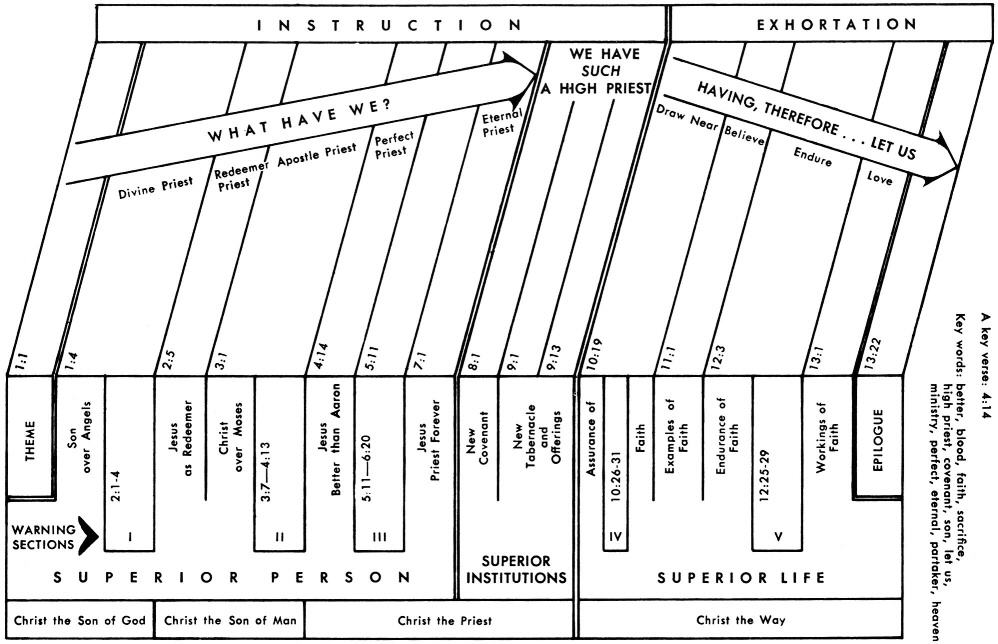
CONSIDER JESUS OUR GREAT HIGH PRIEST
Click chart to enlarge
Charts from Jensen's Survey of the NT - used by permission
Swindoll's Chart, Interesting Pictorial Chart of Hebrews, Another Chart
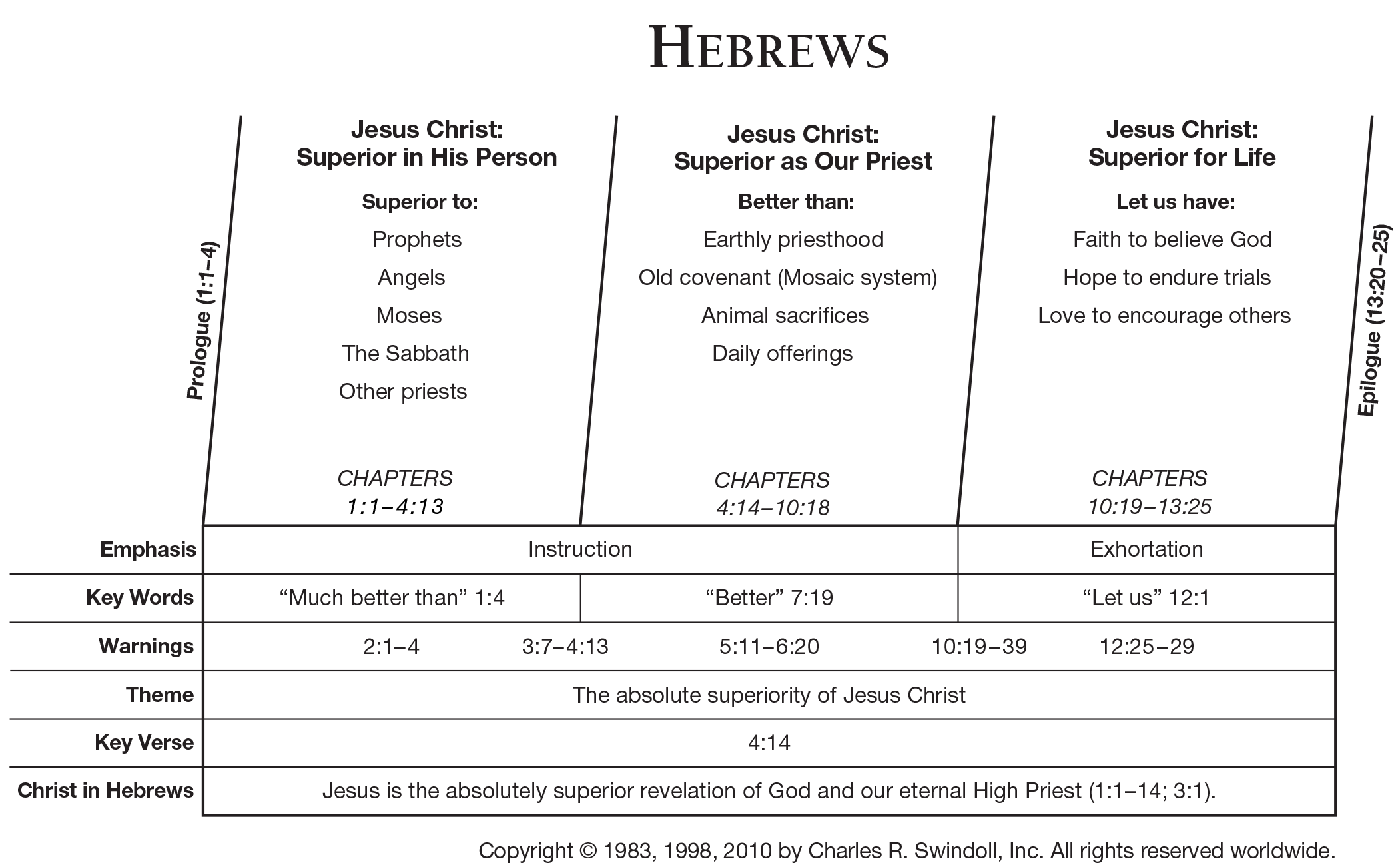

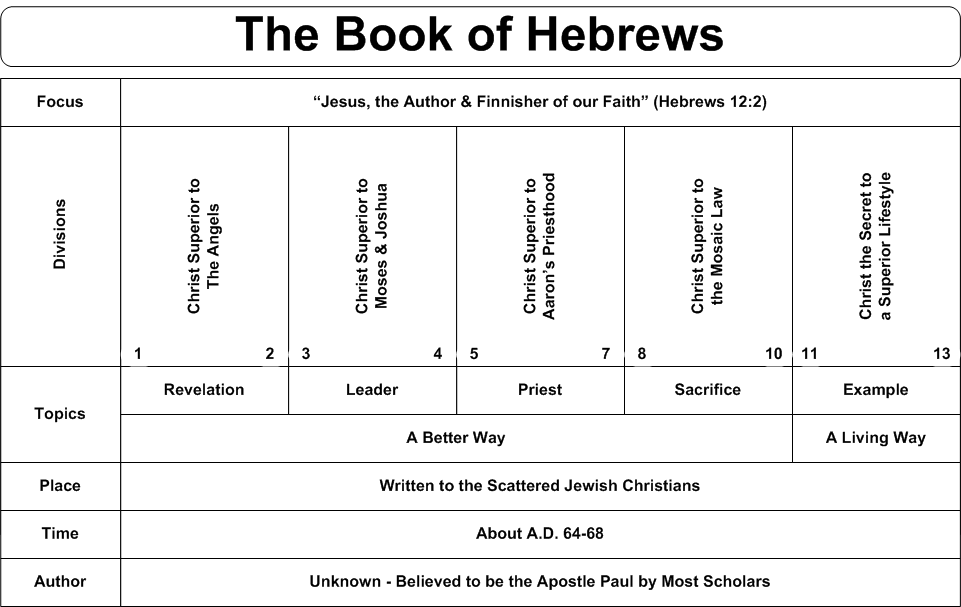
|
The Epistle |
||||
| INSTRUCTION Hebrews 1-10:18 |
EXHORTATION Hebrews 10:19-13:25 |
|||
| Superior Person of Christ Hebrews 1:1-4:13 |
Superior Priest in Christ Hebrews 4:14-10:18 |
Superior Life In Christ Hebrews 10:19-13:25 |
||
| BETTER THAN PERSON Hebrews 1:1-4:13 |
BETTER PRIESTHOOD Heb 4:14-7:28 |
BETTER COVENANT Heb 8:1-13 |
BETTER SACRIFICE Heb 9:1-10:18 |
BETTER LIFE |
| MAJESTY OF CHRIST |
MINISTRY OF CHRIST |
MINISTERS FOR CHRIST |
||
|
DOCTRINE |
DUTY |
|||
|
DATE WRITTEN: |
||||

See ESV Study Bible "Introduction to Hebrews"
(See also MacArthur's Introduction to Hebrews)
Borrow Ryrie Study Bible
Hebrews 12:5 and you have forgotten the exhortation which is addressed to you as sons, "MY SON, DO NOT REGARD LIGHTLY THE DISCIPLINE OF THE LORD, NOR FAINT WHEN YOU ARE REPROVED BY (NASB: Lockman)
Greek: kai eklelesthe (2PRMI) tes parakleseos, etis umin os uiois dialegetai, (3SPMI) Uie mou, me oligorei (2SPAM) paideias kuriou, mede ekluou (2SPPM) up' autou elegchomenos; (PPPMSN)
GNT καὶ ἐκλέλησθε τῆς παρακλήσεως, ἥτις ὑμῖν ὡς υἱοῖς διαλέγεται, Υἱέ μου, μὴ ὀλιγώρει παιδείας κυρίου μηδὲ ἐκλύου ὑπ᾽ αὐτοῦ ἐλεγχόμενος·
Amplified: And have you [completely] forgotten the divine word of appeal and encouragement in which you are reasoned with and addressed as sons? My son, do not think lightly or scorn to submit to the correction and discipline of the Lord, nor lose courage and give up and faint when you are reproved or corrected by Him; (Amplified Bible - Lockman)
ESV And have you forgotten the exhortation that addresses you as sons? "My son, do not regard lightly the discipline of the Lord, nor be weary when reproved by him.
CSB And you have forgotten the exhortation that addresses you as sons: My son, do not take the Lord's discipline lightly or faint when you are reproved by Him,
NIV And you have forgotten that word of encouragement that addresses you as sons: "My son, do not make light of the Lord's discipline, and do not lose heart when he rebukes you,
NLT: And have you entirely forgotten the encouraging words God spoke to you, his children? He said, "My child, don't ignore it when the Lord disciplines you, and don't be discouraged when he corrects you. (NLT - Tyndale House)
Phillips: and you have perhaps lost sight of that piece of advice which reminds you of our sonship in God: 'My son, do not despise the chastening of the Lord, nor be discouraged when you are rebuked by him (Phillips: Touchstone)
TLB: And have you quite forgotten the encouraging words God spoke to you, his child? He said, "My son, don’t be angry when the Lord punishes you. Don’t be discouraged when he has to show you where you are wrong.
Weymouth: and you have quite forgotten the encouraging words which are addressed to you as sons, and which say, "My son, do not think lightly of the lord's discipline, and do not faint when he corrects you;
Wuest: And you have completely forgotten the exhortation which is of such a nature as to speak to you as to sons, Son of mine, stop making light of the Lord's discipline, correction, and guidance. Stop fainting when you are being effectually rebuked by Him.
Young's Literal: and ye have forgotten the exhortation that doth speak fully with you as with sons, 'My son, be not despising chastening of the Lord, nor be faint, being reproved by Him,
AND YOU HAVE FORGOTTEN THE EXHORTATION: kai eklelesthe (2PRMI) tes parakleseos:
- forgotten - Dt 4:9,10; Ps 119:16,83,109; Pr 3:1; 4:5; Mt 16:9,10; Lk 24:6,8
- exhortation - Heb 12:7; Pr 3:11,12
- Hebrews 12:4-6 God's Loving Discipline - Steven Cole
- Hebrews 12:4-11 God’s Faithful Discipline - John MacArthur
- Hebrews 12:5-11 The Discipline of God - John MacArthur
- Hebrews 12:5-11 The Discipline of God - John MacArthur
- Hebrews 12:5-11 God's Loving Discipline 1 - John MacArthur
- Hebrews 12:5-11 God's Loving Discipline 2 - John MacArthur
- Key Words in Hebrews - Click for complete list of Key Words in Hebrews
- Hebrews 12 Resources - Multiple Sermons and Commentaries
| CONSIDER JESUS OUR GREAT HIGH PRIEST |
||||
| INSTRUCTION He 1:1-10:18 |
EXHORTATION He 10:19-13:25 |
|||
| REVELATION He 1:1-10:18 |
RESPONSE He 10:19-13:25 |
|||
| PRECEPTS He 1:1-10:18 |
PRACTICE He 10:19-13:25 |
|||
| DOCTRINE He 1:1-10:18 |
DUTY He 10:19-13:25 |
|||
| SUPERIORITY of CHRIST'S PERSON He 1:1-7:28 |
SUPERIORITY of CHRIST'S PRIESTHOOD He 8:1-10:18 |
SUPERIORITY of the CHRISTIAN'S PRACTICE He 10:19-13:25 |
||
|
MAJESTY |
MINISTRY |
MINISTERS |
||
|
Christ |
Christ |
Christ |
Christ |
|
|
This chart is adapted in part from Jensen's Survey of the NT and Wilkinson's Talk Thru the Bible |
||||
EXHORTATION TO
SONS AND DAUGHTERS
Don Anderson - To fail to discipline would be to show a lack of love and responsibility. A very important part of the Christian life is to recognize that the Lord is dealing with us as sons and daughters and that He is teaching and training us through the various experiences and stresses He allows to come into our lives.
Wuest - The writer now quotes from Proverbs 3:11, 12, exhorting his readers to take these persecutions as allowed of God for the purpose of chastening them.
Irving Jensen - The main theme of Hebrews may be stated thus: The knowledge and assurance of how great this High Priest Jesus is should lift the drifting believer from spiritual lethargy to vital Christian maturity. Stated another way: The antidote for backsliding is a growing personal knowledge of Jesus (He 2:1-note, He 2:3-note). ( Jensen's Survey of the New Testament)
Leon Morris introduces this section noting that "Suffering comes to all; it is part of life, but it is not easy to bear. Yet it is not quite so bad when it can be seen as meaningful. The author has just pointed out that Christ endured His suffering on the Cross on account of the joy set before Him (He 12:2-note). His suffering had meaning. So for Christians all suffering is transformed because of the Cross. We serve a Savior who suffered, and we know He will not lead us into meaningless suffering. The writer points to the importance of discipline and proceeds to show that for Christians suffering is rightly understood only when seen as God's fatherly discipline, correcting and directing us. Suffering is evidence, not that God does not love us, but that He does. Believers are sons and are treated as sons. (Gaebelein, F, Editor: Expositor's Bible Commentary 6-Volume New Testament. Zondervan Publishing)
Forgotten (1585) (eklanthanomai from ek = intensifies meaning + lantháno = forget, lie hidden) means to make to forget entirely. To be utterly oblivious of. To completely forget! Forgotten is in the perfect tense which means that you forgot somewhere along the journey and that forgetfulness is still present. This is the only use of this verb in the Bible (not in the Lxx).
Spurgeon - Our trials are little compared with those of the martyrs of the olden times. Courage, brothers, these are small matters to faint about!
THOUGHT - How about you dear reader? Have you read this verse or heard this teaching and yet it "came in one ear" and "went out the other"? not all who hear or read God’s word give their total attention to it. At times the truth is quickly forgotten and we find ourselves drifting away from the divine "moorings" of God's Word (He 2:1-note).
Exhortation (3874) (paraklesis from parakaléo = calling one alongside to help or give aid <> pará = side of + kaléo = call) means the giving of solace, comfort, consolation or exhortation. As noted it has the root idea of calling to one side to give aid and thus represents an act of encouragement or comfort. It the present context the nuance leans more toward exhortation but even exhortation has an element of encouragement. In a sense all of Scripture acts like a paraklesis or exhortation, admonition or encouragement for the purpose of strengthening and establishing believers.
Paraklesis - 29x in 28v - NAS = appeal(1), comfort(13), consolation(1), encouragement(6), exhortation(7), urging(1).
Luke 2:25; 6:24; Acts 4:36; 9:31; 13:15; 15:31; Ro 12:8; 15:4f; 1Cor 14:3; 2Cor 1:3ff; 7:4, 7, 13; 8:4, 17; Phil 2:1; 1Th 2:3; 2Th 2:16; 1Ti 4:13; Philemon 1:7; Heb 6:18; 12:5; 13:22.
The epistles frequently "remind" the believers of what they once knew (Ro 15:15-note, 2Ti 1:6-note, 2:14, Titus 3:1, 2-note; 2Pe 1:12-note, Jude 1:5). We all need to remember the warning in Heb 2:1 (note). Compare Heb 12:15, 16, 17, in which he implies how some had completely forgotten God’s warning. The Christian view of suffering is now presented. Why do persecution, testings, trials, sickness, pain, sorrow, and trouble come into the life of the believer? Are they a sign of God’s anger or displeasure? Do they happen by chance? How should we react to them?
Forgetfulness causes a lot of unnecessary problems and heartaches. Our greatest need is not for new light from God, but for paying attention to light we already have. When God’s Word is neglected it is forgotten. Sometimes the answer or the help we need is in a truth we learned a long time ago but have let slip away.
These believers were upset about their afflictions partly because they had forgotten God’s Word. In the Old Testament God not only had spoken to them about suffering and discipline, but He had spoken to them as sons. They had forgotten more than simply divine truths, they had forgotten the exhortation of their heavenly Father. Turning to Scripture is listening to God, for Scripture is His Word. For believers, it is the Word of their Father.
Specifically they forgot the firm foundation, that by which faith comes in Pr 3:11,12 He 6:18-note, He 12:5-note, He 13:22-note The figure of speech (metaphor) changes from that of an athletic contest to that of a family.
The psalmist had this experience, and cries out to himself, “Why are you in despair, O my soul? And why have you become disturbed within me?” He knew his problem, and he also knew the cure, for he continues, “Hope in God, for I shall yet praise Him, the help of my countenance, and my God” (Ps. 42:11). The cure for hopelessness is hope in God. The child of God has no need to faint because of God’s discipline. God gives it to strengthen us, not to weaken us, to encourage us, not to discourage us, to build us up, not to tear us down.
- When, why, and how does the Lord God discipline us when we sin?
- Does God punish us when we sin?
- What does it mean to be chastened? How does God chasten us?
- Discussion of suffering as a Divine Gift!
- Notes and quotes on suffering and trials - 1Peter 1:6-note; 1Peter 1:7- note
- Exposition related to suffering - Romans 8:18
- Exposition related to tribulations - Romans 5:3
- Exposition on how the Savior Succors Suffering Saints - Hebrews 2:18
- Discussion of what the God of All Grace Promises when we suffer- 1 Peter 5:10
- Exposition on how God uses suffering in the life of a saint - 2 Cor 12:9-note; 2Co 12:10-note
- Exposition on Trials - James 1:2
- Exposition on present pain versus future joy - Matthew 5:10, 11, 12- notes
- Don't forget to do a Site Search - E.g., this link retrieve over 4000 hits on the word SUFFERING on Preceptaustin
- How should Christians discipline their children? What does the Bible say?
WHICH IS ADDRESSED TO YOU AS SONS: etis humin os huiois dialegetai (3SPMI):
- Hebrews 12 Resources - Multiple Sermons and Commentaries
- Hebrews 12:4-6 God's Loving Discipline - Steven Cole
- Hebrews 12:4-11 God’s Faithful Discipline - John MacArthur
- Hebrews 12:5-11 The Discipline of God - John MacArthur
- Hebrews 12:5-11 The Discipline of God - John MacArthur
- Hebrews 12:5-11 God's Loving Discipline 1 - John MacArthur
- Hebrews 12:5-11 God's Loving Discipline 2 - John MacArthur
BELIEVERS: SONS
AND DAUGHTERS OF GOD
Which - Referring to the exhortation.
Addressed (present tense)(1256) (dialegomai from diá = transition or separation + lego = speak) means to say thoroughly, to discuss in argument or exhortation, to reason with someone, to dispute (Mk 9.34) or as used here in Hebrews 12 to speak to someone in order to convince, address or reason with them.
Dialegomai - 13x in 13v - NAS = addressed(1), argued(1), carrying on a discussion(1), discussed(1), discussing(1), reasoned(2), reasoning(4), talking(2).
Mark 9:34; Acts 17:2, 17; 18:4, 19; 19:8f; 20:7, 9; 24:12, 25; Heb 12:5; Jude 1:9.
Sons (5207) (huios) refers literally to a male son but is used figuratively here of genuine believers who by grace through faith in the Messiah have been born into the Kingdom of God and into His family. John records…
But as many as received Him, to them He gave the right to become children of God, even to those who believe in His name, who were born not of blood, nor of the will of the flesh, nor of the will of man, but of God. (John 1:12-13)
The utterance of Scripture is treated as the voice of God conversing w. men Speaks as in a dialogue or discourse, so the Greek, implies God’s loving condescension (cp use closely related verb in Lxx: "come let us reason together" = Isa 1:18).This verb = say thoroughly, discuss in argument or exhortation, REASON WITH SOMEONE
The key words in this OT quotation are “son,” “children,” and “sons.” These words are used six times in Heb 12:5-8. They refer to adult sons and not little children.
Matthew Henry -Persecution for religion is sometimes a correction and rebuke for the sins of professors of religion. Men persecute them because they are religious; God chastises them because they are not more so: men persecute them because they will not give up their profession; God chastises them because they have not lived up to their profession.
In the ancient world it was universally accepted that the bringing up of sons involved disciplining them. Therefore, we should not read back modern permissive attitudes into our understanding of this passage. The Roman father possessed absolute authority. When a child was born, he decided whether to keep or discard it. Through out its life he could punish it as he chose. He could even execute his son and, while this was rarely done, the right to do it was there. Discipline was only to be expected.
MY SON, DO NOT REGARD LIGHTLY THE DISCIPLINE OF THE LORD: huie mou me oligorei (2SPAM) paideias kuriou:
- Regard lightly - Job 5:17,18; Job 34:31; Ps 94:12; 118:18; 119:75; Jer 31:18; 1Cor 11:32; Jas 1:12; Re 3:19
- Hebrews 12:4-6 God's Loving Discipline - Steven Cole
- Hebrews 12:4-11 God’s Faithful Discipline - John MacArthur
- Hebrews 12:5-11 The Discipline of God - John MacArthur
- Hebrews 12:5-11 The Discipline of God - John MacArthur
- Hebrews 12:5-11 God's Loving Discipline 1 - John MacArthur
- Hebrews 12:5-11 God's Loving Discipline 2 - John MacArthur
- Hebrews 12 Resources - Multiple Sermons and Commentaries
STOP REGARDING GOD'S
DISCIPLINE AS OF LITTLE VALUE
My son - This is a common opening address in the book of Proverbs (23x - Pr 1:8, 10, 15; 2:1; 3:1, 11, 21; 4:10, 20; 5:1, 20; 6:1, 3, 20; 7:1; 19:27; 23:15, 19, 26; 24:13, 21; 27:11; 31:2). God is speaking to His beloved children, not to the unregenerate. When they are punished, it is a reflection of God's wrath. When a believer is disciplined, it is a reflection of God's love.
Job 5:17; 18 “Behold, how happy is the man whom God reproves, So do not despise the discipline of the Almighty. “For He inflicts pain, and gives relief; He wounds, and His hands also heal.
Ps 94:12 Blessed is the man whom You chasten, O LORD, And whom You teach out of Your law;
Not destructive but instructive discipline.
Pr 15:5 A fool rejects (see Nu 14:23 for example of spurning) his father's discipline, but he who regards reproof is prudent.
If they would recall the Proverb in Pr 3:11-12, they would be better able to view their present trials in proper perspective.
THOUGHT - That's a good principle for all of the Christian life. We should "filter" everything that happens in our life through the Word of God (cf Php 4:8). Notice that in the present passage because these believers forgot the Word, they lost their encouragement and they were ready to give up! Beloved, does this not underscore the centrality and import of Jesus' words (used as a "sword of the Spirit" against the temptations of the devil) "“It is written, ‘MAN SHALL NOT LIVE ON BREAD ALONE, BUT ON EVERY WORD THAT PROCEEDS OUT OF THE MOUTH OF GOD.’” - (Mt 4:4, Lk 4:4+) This begs the critical question - Are you in the Word daily? More importantly is the Word in you daily, renewing your mind? If not you are open to discouragement like these Hebrew believers. You are open to the schemes of Satan, one of which is discouragement and despair! Are you memorizing the Word? Are you meditating on the Word? If you answer "no" to both, little wonder that your Christian walk is a bit "wobbly!"
Related Resources:
Proverbs 15:10 Stern discipline awaits him who leaves the path; he who hates correction will die.
Proverbs 15:32 He who ignores discipline despises himself, but whoever heeds correction gains understanding.
Moses records an example of spurning in Numbers writing "Surely all the men who have seen My glory and My signs, which I performed in Egypt and in the wilderness, yet have put Me to the test these ten times and have not listened to My voice, shall by no means see the land which I swore to their fathers, nor shall any of those who spurned Me see it. (Nu 14:22, 23)
Macaulay says: Discipline is a divine principle. Always the preparation of a chosen vessel involves discipline. It was so even in the case of our divine and sinless Saviour. "For it became him, for whom are all things, and through whom are all things, in bringing many sons unto glory, to make the author of their salvation perfect through sufferings" (Heb. 2:10, ASV); and again, "though he was a son, yet learned [he] obedience by the things which he suffered" (Heb 5:8, ASV). If it were so of the perfect Son, how much more shall we expect a heap of discipline in the process of "bringing many sons unto glory," transforming sinners into saints who bear the very image of the Son of God!
Barclay says: HERE the writer to the Hebrews sets out still another reason why men should cheerfully bear trouble and affliction when it comes to them. He has urged them to bear it because the great saints of the past have borne it. He has urged them to bear it because anything we have to bear is a little thing compared with that which Jesus Christ had to bear. Now, he says that we must bear hardship and affliction because they are sent to us as a discipline from God and no life can have any value apart from discipline.
Wiersbe says: "Chastening" refers to child training, helping the child prepare for adulthood. It does not necessarily mean punishment for disobedience, although that sometimes might be included. The successful runner must exercise discipline and submit to training. Never fear the chastening hand of the Lord; it is controlled by a loving heart. God's goal is your maturity.
Thomas Brooks - He who has deserved a hanging—has no reason to charge the judge with cruelty—if he escapes with a whipping! And we who have deserved a damning—have no reason to charge God for being too severe —if we escape with a fatherly lashing! (From The Mute Christian under the Smarting Rod)
While Winston Churchill spoke the following words in the context of the sufferings of war (spoken 1940), they are relevant to the suffering believers experience - Death and sorrow will be the companions of our journey; hardship our garment; constancy and valor our only shield. We must be united, we must be undaunted, we must be inflexible.
As someone has said believers need to remember that nothing touches them apart from the permissive will of the Father in heaven. Therefore we must not look upon our trials as by chance, or as unnecessary.
Regard lightly (Only here in NT)(3643) (oligoreo from olígoros = careless, caring little <> oligos = little + ora = care) means to regard something or someone as of little value, to look down on, to have contempt for, to make light of, to despise; to make little of, to have little regard for, to disesteem or care little for, to consider of small worth.
Do not regard lightly is present imperative, a command in the present tense which coupled with the negative particle is a charge to stop regarding God's discipline as of little value. (present imperative with a negative; See discussion of the Need for the Holy Spirit to obey NT commands) The Scripture repeatedly links suffering with sonship and this sound spiritual truth had been forgotten by the readers which explains in part why they had begun to regard discipline lightly.
In Judaism a father was required to provide for the instruction of his sons and daughters and to teach them good behavior. Whipping was accepted, along with other disciplinary measures. Today they would probably be tried on charges of "child abuse"! My, how times have changed, and as God so clearly warns in both the OT and NT, what we sow will eventually be reaped. America is reaping the seeds of a paucity of parental (especially fatherly) punishment (discipline for correction not destruction)!
Charles Stanley rightly reminds us that "The writer of Hebrews knew all too well our tendency not to take the discipline of God as seriously as we should. So he warns us, “Do not regard lightly the discipline of the Lord.” In other words, the potential severity of God’s discipline should be enough to keep us in line. One of the reasons we fall into sin so easily is that we forget God will discipline us when we step out of bounds. We have forgotten that His complete knowledge of sin and its destructive consequences compels Him to take drastic measures with us. As much as He must disdain using adversity to remind us to live a righteous life, the fact is that He will if He knows that is what it takes. How Far? The question that occurs to me as I ponder this awesome doctrine is, “How far is God willing to go?” How much pain dare He inflict? Is there a limit to the adversity He might send? He blinded Paul. He brought Jonah within an inch of his life. I think the answer is that God will do whatever it takes. As much as He must hate pain, He hates sin that much worse. As much as He must despise suffering, He loves us that much more. (How to Handle Adversity)
Spurgeon - God’s people can never by any possibility be punished for their sins. God has punished them already in the person of Christ; Christ, their substitute, has endured the full penalty for all their guilt, and neither the justice nor the love of God can ever exact again that which Christ has paid. Punishment can never happen to a child of God in the judicial sense. He can never be brought before God as his Judge, as charged with guilt, because that guilt was long ago transferred to the shoulders of Christ, and the punishment was exacted at the hands of His surety.
But yet, while the sin cannot be punished, while the Christian cannot be condemned, he can be chastised. While he shall never be arraigned before God’s bar as a criminal and punished for his guilt, yet he now stands in a new relationship—that of a child to his parent. As a son, he may be chastised on account of sin. Folly is bound up in the heart of all God’s children (Prov 22:15), and the rod of the Father must bring that folly out of them (Pr 13:24).
It is essential to observe the distinction between punishment and chastisement. Punishment and chastisement may agree as to the nature of the suffering. The one suffering may be as great as the other: the sinner who while here is punished for his guilt may suffer no more in this life than the Christian who is only chastised by his parent. They do not differ as to the nature of the punishment, but they differ in the mind of the punisher and in the relationship of the person who is punished. God punishes the sinner on His own account, because He is angry with the sinner. His justice must be avenged, His law must be honored, and His commands must have their dignity maintained. But He does not punish the believer on His own account; it is on the Christian’s account—to do him good. He afflicts him for his profit. He lays on the rod for His child’s advantage. He has a good design toward the person who receives the chastisement.
Beecher wrote “Difficulties are God’s errands; and when we are sent upon them, we should esteem it as a proof of God’s confidence.”
Don Anderson makes a distinction - I believe it is necessary for us to recognize the fact that there is a DIFFERENCE between DISCIPLINE and PUNISHMENT. PUNISHMENT is: BY THE JUDGE, UPON ENEMIES, and OUT OF ANGER. Whereas, DISCIPLINE is: PARENTAL, FROM A FATHER, UPON CHILDREN, and AN ACT OF LOVE. (Ps 34:19, 2 Cor 12:7). A FATHER'S HAND WILL NEVER CAUSE HIS CHILD A NEEDLESS TEAR. God can not punish you for your sins, that has already been placed on Jesus Christ. CHASTISEMENT and CORRECTION are evidences of sonship. We need to look beyond the rod to the all-wise hand that wields it. HE IS OUR FATHER AND OUR TEACHER.
Hession says: As I have said, we are still on the theme of endurance and Paul tells his readers that they have not only to endure the hurtful opposition of men as they run the race set before them, but the loving chastening of the Lord. The latter is just as much part of the trials of the cross-country race as the former. Indeed, very often they are one and the same. On the one hand, the difficulties and sufferings come from man; on the other hand, they could not be happening unless God permitted them and therefore they come from Him. And coming from Him, they are to be regarded as part of the chastening and the discipline which the heavenly Father gives His children. (From Shadow to Substance)
Delitzsch says: The main purpose which the sacred writer has here in view is to reconcile the minds of his readers to the sufferings entailed by their Christian profession, that is, the cross in the proper sense of the word. But all sufferings imposed by God upon His children, whether for discipline, trial of faith, or witness for the truth, have this one feature in common, that they are all proofs of divine love, not signs of anger. Thought passes easily, therefore, from one kind to another. The Christian in every trial sees a proof of the Father's loving care for his good. He must not murmur or withdraw himself from it. (Commentary on the epistle to the Hebrews)
Westcott says: Sufferings are tempered by the providence of God, and they are a sign of sonship. Do not make it of little account; do not neglect to consider its real scope and end.
MacArthur says: The key word of Hebrews 12:4-11 is discipline, used both as a noun and a verb. It is from the Greek paideia, which, in turn, comes from pais ("child") and denotes the training of a child. The word is a broad term, signifying whatever parents and teachers do to train, correct, cultivate, and educate children in order to help them develop and mature as they ought. It is used nine times in these eight verses. The figure changes from that of a race to that of a family. Christian living involves running, working, fighting, and enduring. It also involves relationships, especially our relationship to God and to other believers. The emphasis of this passage is on the heavenly Father's use of discipline in the lives of His children....If we do not understand our problems as being discipline that the Lord sends for our good, we cannot profit from them as He intends. Our reactions cannot be right if our view of what is happening is not right. The spiritual weakness mentioned in this verse is not that of taking our problems lightly but of taking the Lord's discipline through them lightly. It is usually because we take our problems too seriously that we take the Lord's discipline too lightly. Our focus is on the experience rather than on our heavenly Father and on what He wants to do for us through the experience (MacArthur NT Commentary - Hebrews)
Discipline (3809) (paideia from país = child) means to provide instruction, with the intent of forming proper habits of behavior, of providing guidance for responsible living, of rearing and guiding a child toward maturity. Paideia is a broad term, signifying whatever parents and teachers do to train, correct, cultivate, and educate children in order to help them develop and mature as they ought.
Paideia - 6x in 6v - Eph 6:4-note; 2Ti 3:16-note; Heb 12:5-note, He 12:7, 8-note, He 12:11-note. NAS = discipline(5), training(1).
Although paideia refers primarily to the training or discipline of children (whether in the schools of men - Acts 7:22+, Acts 22:3+ or in the school of God, Titus 2:12+ [where you note that grace is your "instructor" - as shown by comparing Titus 2:11+ and this grace is dispensed by the "Spirit of grace" Heb 10:29), at one end of the spectrum it describes the training that occurs by teaching, instructing, educating or nurturing and at the other end of the spectrum the training that occurs by utilizing correction and punishment if necessary (which it usually is for children) as a part of the training or child rearing process bringing them to maturity (this end of the spectrum conveyed by English words like chastise or chasten, as morally disciplining an adult, correcting them and giving them guidance). From these definitions one can see that the meaning of paideia is dependent on the context.
Wuest - paideia was used of the whole training and education of children. It speaks also of whatever in adults cultivates the soul, especially by correcting mistakes and curbing the passions. It speaks also of instruction which aims at the increase of virtue. The word does not have in it the idea of punishment, but of corrective measures which will eliminate evil in the life and encourage the good. Here, the persecutions were used of God in an effort to clarify the spiritual vision of the readers as to the relative merits of the First Testament and the New Testament, warning them against returning to the temple sacrifices and urging them on to faith in the Messiah as High Priest. The readers, in their action of leaning back towards the First Testament and by their avowed purpose of returning to it in order to escape the persecution, had forgotten the lesson of Proverbs. (Hebrews - Wuest's word studies from the Greek New Testament)
Detzler writes that paideia (and paideuo) "moves from education to correction and finally embraces the concept of punishment. This idea is quite unpopular, because many Christians confuse salvation with sentimentality. God does not tolerate sin among Christians, but rather disciplines them as a good father would (Heb. 12:5-11). In fact, if a Christian is comfortable and undisciplined, there is cause to doubt that he truly is a believer. (New Testament Words in Today's Language. Victor. 1986)
Webster says that the English word discipline describes training that corrects, molds, or perfects the mental faculties or moral character
Thayer says paideia describes "the whole training and education of children (which relates to the cultivation of mind and morals, and employs for this purpose now commands and admonitions, now reproof and punishment). In Greek writings from Aeschylus on, it includes also the care and training of the body. Whatever in adults also cultivates the soul, especially by correcting mistakes and curbing the passions hence, a. instruction which aims at the increase of virtue: b. according to Biblical usage chastisement, chastening (of the evils with which God visits men for their amendment)
TDNT writes that "Paideia from pais a child. In classical usage, that which is applied to train and educate a child. So Plato: “Education (Paideia) is the constraining and directing of youth toward that right reason which the law affirms, and which the experience of the best of our elders has agreed to be truly right” (“Laws,” 659).(Kittel, G., Friedrich, G., & Bromiley, G. W. Theological Dictionary of the New Testament. Eerdmans)
Vincent - In scriptural usage another meaning has come into it and its kindred verb paideuein, which recognizes the necessity of correction or chastisement to thorough discipline. So Lev. 26:18; Ps. 6:1; Isa. 53:5; Heb. 12:5–8. In Acts 7:22+ paideuo occurs in the original classical sense: “Moses was instructed (epaideuthe) in all the wisdom,” etc. The term here covers all the agencies which contribute to moral and spiritual training. (Vincent, M. R. Word Studies in the New Testament 3:404).
John MacArthur has a helpful note on paideia writing that it refers to "the systematic training of children. It includes the idea of correction for wrongdoing, as seen in the well–known proverb, “He who spares his rod hates his son, but he who loves him disciplines him diligently” (Pr. 13:24). In the several uses of the term in Hebrews 12:5-11, the translators of the Authorized Version rendered it “chastening,” which is clearly the emphasis of that context. Paul’s meaning here is expressed even more fully, however, in the proverb “Train up a child in the way he should go, even when he is old he will not depart from it” (Pr 22:6). Discipline has to do with the overall training of children, not restricted to but also not excluding punishment. Susannah Wesley, the mother of John and Charles Wesley, raised seventeen children and had these words to say about raising children: “The parent who studies to subdue [self–will] in his child works together with God in the renewing and saving a soul. The parent who indulges it does the devil’s work, makes religion impracticable, salvation unattainable, and does all that in him lies to damn his child, soul and body forever” (cited in The Journal of John Wesley [Chicago: Moody, n.d.], p. 106).
Paideia is used 50 times in the Septuagint (LXX)
Deut. 11:2; Ezra 7:26; Job 20:3; 37:13; Ps. 2:12; 18:35; 50:17; 119:66; Pr. 1:2, 7f; 3:11; 4:1, 13; 5:12; 6:23; 8:10; 10:17; 12:1; 13:18; 15:5, 10, 32f; 16:17, 22; 17:8; 19:20, 27; 22:15; 23:12; 24:32; 25:1; Isa. 26:16; 50:4f; 53:5; Jer. 2:30; 5:3; 7:27; 17:23; 30:14; 32:33; 35:13; Ezek. 13:9; Dan. 1:20; Amos 3:7; Hab. 1:12; Zeph. 3:2, 7
Here are a few representative uses…
Psalm 50:17 "For you hate discipline (Lxx = paideia), and you cast My words behind you.
Proverbs 1:8 Hear, my son, your father's instruction, And do not forsake your mother's teaching;
Proverbs 3:11 My son, do not reject the discipline of the LORD, Or loathe His reproof,
Proverbs 6:23 For the commandment is a lamp, and the teaching is light; And reproofs for discipline are the way of life,
Proverbs 10:17 He is on the path of life who heeds instruction, But he who forsakes reproof goes astray.
Proverbs 12:1 Whoever loves discipline loves knowledge, But he who hates reproof is stupid.
Proverbs 13:18 Poverty and shame will come to him who neglects discipline, But he who regards reproof will be honored.
Proverbs 15:5 A fool rejects his father's discipline, But he who regards reproof is prudent.
Proverbs 15:10 Stern discipline is for him who forsakes the way; He who hates reproof will die.
Proverbs 15:32 He who neglects discipline despises himself, But he who listens to reproof acquires understanding.
Proverbs 15:33 The fear of the LORD is the instruction for wisdom, And before honor comes humility.
Proverbs 16:22 Understanding is a fountain of life to him who has it, But the discipline of fools is folly.
Proverbs 19:20 Listen to counsel and accept discipline, That you may be wise the rest of your days.
Proverbs 19:27 Cease listening, my son, to discipline, And you will stray from the words of knowledge.
Proverbs 22:15 Foolishness is bound up in the heart of a child; The rod of discipline will remove it far from him.
Proverbs 23:12 Apply your heart to discipline, And your ears to words of knowledge.
Jeremiah 2:30 "In vain I have struck your sons; They accepted no chastening. Your sword has devoured your prophets Like a destroying lion.
Jeremiah 17:23 "Yet they did not listen or incline their ears, but stiffened their necks in order not to listen or take correction.
Habakkuk 1:12 Art Thou not from everlasting, O LORD, my God, my Holy One? We will not die. Thou, O LORD, hast appointed them to judge; And Thou, O Rock, hast established them to correct.
Zephaniah 3:2 She heeded no voice; She accepted no instruction. She did not trust in the LORD; She did not draw near to her God.
Lord (2962) (kurios) means master, owner or the one who has absolute ownership power. Jesus is referred to some ten times as Savior and some seven hundred times as Lord. Supreme in Authority. Kurios translates Jehovah (LORD in OT) in Septuagint (LXX) 7000 times.
Martin Luther puts "Lord" in an interesting perspective noting that "The life of Christianity consists of possessive pronouns. It is one thing to say, "Christ is a Saviour"; it is quite another thing to say, "He is my Saviour and my Lord." The devil can say the first; the true Christian alone can say the second.
The purpose of discipline is the maturity of the son. God’s purpose is not to persecute us, but to perfect us. Chastening is not the work of an angry judge as he punishes a criminal. It is the work of a loving Father as he perfects a child. This chastening is not always because we have sinned. Sometimes God permits suffering in our lives simply to build us up and help us mature. We experience God’s education through hardship or affliction. So the preacher to the Hebrews, who exhorts his flock to “endure hardship as discipline,” is enjoining them to a most positive pursuit that has as its goal the very growth of their souls.
All the hardships that come the believer’s way are loving discipline and are, in effect, either corrective or preventative or educational. We must remember this! As James Moffatt said, “To endure rightly, one must endure intelligently.”
If we have an informed, intelligent, Biblical understanding of the afflictions that come our way, and we believe God’s Word, we will endure. The correction of David, the prevention of Paul, the education of Job—this is sanctifying grist for the reflective heart.
The hostility of sinners is real and it is wrong and responsible and guilty. But it is also - and this is a great hope for us - it is also the loving, painful discipline of our Father in heaven. God is not coming to his children late after the attack, and saying, "I can make this turn for good." That is not discipline. That is repair. It's the difference between the surgeon who plans the incision for our good, and the emergency room doctor who sews us up after a freak accident. This text says, God is the doctor planning our surgery, not the doctor repairing our lacerations.
Billy Graham "I truly believe that the lot of those that suffer is more enviable than the people who seem to be set apart, untouched, like a piece of fine china in a locked cabinet. Without dark clouds in our lives we would never know the joy of sunshine. We can become callous and unteachable if we do not learn from pain."
John Phillips has some sobering words on divine scourging noting that "It is not to be treated with carelessness. We should ask, Why is this happening to me? It is to be accepted sensibly. We are not to faint under the Lord's dealings, for He does not flog us in blind rage but measures the weight of each stroke. One of the great passages in How Green Was My Valley tells of the flogging of Huw Morgan by the schoolmaster, Elijah-Jonas-Sessions. The boy had been fighting and was made to bend over in such a way that his back was stretched to receive the stick. The stick swished twice as the bullying schoolmaster limbered up for his task, and the sound of the stick awoke all Huw's tingling nerves in anticipation of coming hurt. Then the stick swished again, and Huw saw its shadow on the floor and felt the first sharp, shocking, burning of its work. Again, again, and again the strokes came as the boy across whom it was stretched staggered at the weight of the blows. Without pause, as the clock works, the sound changing as the strokes fell, the stick soared upward and down again until Huw Morgan's back seemed to be in flames and his eyes blind and his head filled with thunder, and the strokes were still coming. Only now they were but a hard, dull laying on until the stick broke. "Now then," said Mr. Jonas, in falsetto and breathless, "fight again! That was just a taste! Back to your place! No more nonsense! Teach you manners!" The brutal schoolmaster himself was exhausted by the flogging; his face twitched; his hands trembled from his spent passion. And poor Huw got his legs to bring him to his seat and saw that one of the girls had torn her handkerchief to shreds under the emotion of watching the scene. God is not like that schoolmaster. Each stroke He administers is weighed by Him in fairness and firmness to suit our needs exactly (cf 1Co 10:13-note) and to bring us to our senses, not lay us senseless in the dust. Scourging is to be taken not only soberly and sensibly, but spiritually, as well. The spiritually discerning believer will recognize the disciplines of life to be evidence of the Lord's love. (Phillips, John: Exploring Hebrews: An Expository Commentary) (Bolding added)
Saint John of the Cross wrote: God perceives the imperfections within us, and because of his love for us, urges us to grow up. His love is not content to leave us in our weakness, and for this reason he takes us into a dark night. He weans us from all the pleasures by giving us dry times and inward darkness. In doing so he is able to take away all these vices and create virtues within us. Through the dark night pride becomes humility, greed becomes simplicity, wrath becomes contentment, luxury becomes peace, gluttony becomes moderation, envy becomes joy, and sloth becomes strength. No soul will ever grow deep in the spiritual life unless God works passively in that soul by means of the Dark Night.
WHY?
--Anonymous
I promised a doll to my dear baby girl;
I had pictured a figure most fair,
With exquisite features and teeth of pure pearl,
Moving eyes, walking limbs, and real hair!
We entered a shop, and the sweet little maid
Clasped a cheap, tawdry doll to her breast;
To make the exchange I was really afraid,
Though I wanted to give her the best.
I took it away, and the tears filled her eyes,
But I gave her the one I had planned;
The dear little face glowed in joyous surprise
That a treasure existed so grand.
O Savior, I too am a child in Thy sight,
And I choose the first things that I see;
I struggle to keep them, I do not know quite
Why the Father should take them from me.
But when I look back through the wisdom of years,
When my faith is age-old and sublime,
I know I shall see through a rainbow of tears
That my Father planned best all the time!"
NOR FAINT WHEN YOU ARE REPROVED BY HIM: mede ekluou (2SPPM) hup autou elegchomenos (PPPMSN):
- faint - He 12:3,4; Josh 7:7, 8, 9, 10, 11; 2Sa 6:7, 8, 9, 10; 1Chr 13:9, 10, 11, 12, 13; 15:12,13; Ps 6:1,2; 2Co 4:8,9; 12:9,10
- Hebrews 12 Resources - Multiple Sermons and Commentaries
- Hebrews 12:4-6 God's Loving Discipline - Steven Cole
- Hebrews 12:4-11 God’s Faithful Discipline - John MacArthur
- Hebrews 12:5-11 The Discipline of God - John MacArthur
- Hebrews 12:5-11 The Discipline of God - John MacArthur
- Hebrews 12:5-11 God's Loving Discipline 1 - John MacArthur
- Hebrews 12:5-11 God's Loving Discipline 2 - John MacArthur
DON'T GROW WEARY
OF DIVINE REPROOFS
Spurgeon - Note the two evils of which we are in danger: either of making light of God’s discipline, or else of giving up under it—either of thinking too little or too much of them. Happy is the Christian who takes the middle course, and never despises the discipline of the Lord, nor ever faints under it.
Faint (1590) (ekluo from ek = out or intensifies meaning of + lúo = loose) means literally to loose out of and so to set free from. The idea then comes to mean to become so tired and weary as to give out ("to loose out of") and even to faint from exhaustion. Ekluo can also convey the sense of losing one's motivation to accomplish a valid goal and so to become discouraged and give up as in Galatians 6 where Paul encourages the believers writing "let us not lose heart in doing good, for in due time we shall reap if we do not grow weary (ekluo). (Galatians 6:9)
Ekluo is used in the Septuagint (LXX)…
Dt 20:3 And he shall say to them, 'Hear, O Israel, you are approaching the battle against your enemies today. Do not be fainthearted. Do not be afraid, or panic, or tremble before them
1Sa 14:28 Then one of the people answered and said, "Your father strictly put the people under oath, saying, 'Cursed be the man who eats food today.' And the people were weary.
Charles Stanley comments "For those of us who do not heed this warning of discipline, the writer offers another piece of advice, “Nor faint when you are reproved by Him.” The implication here is that when we are undergoing the discipline of God, we will have a tendency to grow discouraged. We will be dangerously open to suggestions by others that cast doubt on the goodness and justice of God. If we are not careful, we will interpret God’s discipline for the opposite of what it really is. (How to Handle Adversity)
Reproved (1651) (elegcho/elencho-- related to elegchos = bringing to light) means to bring to the light (to reveal hidden things) with the implication that there is adequate proof of wrongdoing. To shame or disgrace and thus to rebuke another in such a way that they are compelled to see and to admit the error of their ways. To show someone that they have done something wrong and summon them to repent or to correct they wayward ways.
In this context elegcho implies exposing someone's sin in order to bring correction.
Elegcho - 14x in 14v = convict(2), convicted(2), convicts(1), expose(1), exposed(2), rebuke(1), refute(1), reprimanded(1), reprove(4), reproved(1), show… fault(1).
Matt 18:15; Luke 3:19; John 3:20; 8:46; 16:8; 1 Cor 14:24; Eph 5:11, 13; 1 Tim 5:20; 2 Tim 4:2; Titus 1:9, 13; 2:15; Heb 12:5; Jas 2:9; Jude 1:15; Rev 3:19.
Elegcho can mean…
1) To scrutinize or examine carefully, bring to light, expose. Jesus said that
And do not participate in the unfruitful deeds of darkness, but instead even expose (elegcho) them 12 for it is disgraceful even to speak of the things which are done by them in secret. 13 But all things become visible when they are exposed (elegcho) by the light, for everything that becomes visible is light. (Ep 5:11, 12-note; Ep 5:13-note)
2) To convict, to show to be wrong. Jesus for example said
Which one of you convicts (elegcho) Me of sin? If I speak truth, why do you not believe Me? (Jn 8:46)
3) To convince someone of error. To refute (prove wrong by argument or evidence
4) show to be false or erroneous). To confute (to overwhelm in argument = refute conclusively). Elihu for example said
there was no one who refuted (Lxx = elegcho) Job" (Job 32:12).
5) To reprove, admonish in the sense of setting right or correcting. This is the sense elegcho is used in Hebrews 12:5.
6) To rebuke, reprove by chastisement. For example, the writer of Hebrews tells his readers
"you have forgotten the exhortation which is addressed to you as sons, “My son, do not regard lightly the discipline of the Lord, nor faint when you are reproved (elegcho) by Him." (Heb 12:5)
Elegcho was used in the Greek law courts not merely of a reply to an opposing attorney, but of a refutation of his argument. No one could prove any charges of sin against our Lord. No one could bring charges against Him in such a way as to convince Him that He was guilty. (because of course He wasn't)
Jesus describing the role of the Holy Spirit says that "He, when He comes, will convict (elegcho) the world concerning sin and righteousness and judgment." (Jn 16:8).
The Spirit’s coming would result in heightened conviction among unbelievers concerning sin, righteousness, and judgment. Before the Spirit's coming that conviction had come mainly from the Old Testament, John the Baptist, Jesus and the disciples’ influence. In John 16:8 the purpose of the Holy Spirit is not condemnation but conviction of the need for the Savior. The Spirit would not just accuse people of sin, but would bring an inescapable sense of guilt before God upon them.
Chastening is the evidence of the Father’s love. Satan wants us to believe that the difficulties of life are proof that God does not love us, but just the opposite is true. Sometimes God’s chastening is seen in His rebukes from the Word or from circumstances. At other times He shows His love by punishing (“scourges”) us with some physical suffering. Whatever the experience, we can be sure that His chastening hand is controlled by His loving heart. The Father does not want us to be pampered babies; He wants us to become mature adult sons and daughters who can be trusted with the responsibilities of life.
Such giving up is inexcusable because none of God’s children will ever be tested beyond their strength
No temptation has overtaken you but such as is common to man; and God is faithful, who will not allow you to be tempted beyond what you are able, but with the temptation will provide the way of escape also, that you may be able to endure it. (1Cor 10:13-note).
Some in adversity kick against God’s will, others despond; neither is to be done by the Christian, who is peculiarly the child of God. To him such adverse things occur only by the decree of God, and that designed in kindness, namely, to remove the defilements adhering to the believer, and to exercise his patience
Suffering for God’s sake was nothing new. The saints of the Old Covenant had known what it was to suffer for their faith. They faced warfare, weakness, torture, beatings, imprisonment, stonings, destitution, and every sort of affliction-all because of their trust in the Lord (Heb 11:34-38-note).
MacDonald writes that "The Christian view of suffering is now presented. Why do persecution, testings, trials, sickness, pain, sorrow, and trouble come into the life of the believer? Are they a sign of God's anger or displeasure? Do they happen by chance? How should we react to them? These verses teach that these things are part of God's educative process for His children. Although they do not come from God, He permits them, then overrules them for His glory, for our good, and for the blessing of others. Nothing happens by chance to the Christian. Tragedies are blessings in disguise, and disappointments are His appointments. God harnesses the adverse circumstances of life to conform us to the image of Christ. (MacDonald, W & Farstad, A. Believer's Bible Commentary: Thomas Nelson)
Theodore Epp - God's purpose in chastening us is so that we might learn not to sin. We cannot expect forgiveness and then be turned loose to go on living in the sin that brought God's displeasure. God fixed a gulf between sin and righteousness. This must be maintained. Absolutely no compromise is possible. No attempt should ever be made by us to reduce or detract from the absolute holiness and purity of God. Sin is always sin, and righteousness is always righteousness. There can be no blending of them in any way, shape or form. God cannot forgive us at the expense of lowering His standard of righteousness. In order to teach us to hate sin, God chastens us. If He did not, we would be crawling to Him every five minutes for more pardon because of our continuing to live in sin. God's people are taught by Him to hate sin by its bitter consequences and are also taught to love righteousness, or holiness. God chastens us as He pleases "for our profit, that we might be partakers of his holiness" (He 12:10-note). God does not want us to come to heaven with nothing to show for our spiritual lives and service. He wants to see abundant spiritual fruit. (He 12:11-note) "As many as I love, I rebuke and chasten: be zealous therefore, and repent" (Rev 3:19-note). (Hebrews 12:1-13 God's Purpose in Chastising)
Oswald Chambers writes…
"It is very easy to quench the Spirit; we do it by despising the chastening of the Lord, by fainting when we are rebuked by Him. If we have only a shallow experience of sanctification, we mistake the shadow for the reality, and when the Spirit of God begins to check, we say—‘Oh, that must be the devil.’
Never quench the Spirit, and do not despise Him when He says to you—‘Don’t be blind on this point any more; you are not where you thought you were. Up to the present, I have not been able to reveal it to you, but I reveal it now.’ When the Lord chastens you like that, let Him have His way. Let Him relate you rightly to God.
“Nor faint when thou art rebuked of Him.” We get into sulks with God and say—‘Oh well, I can’t help it; I did pray and things did not turn out right, and I am going to give it all up.’ Think what would happen if we talked like this in any other domain of life!
Am I prepared to let God grip me by His power and do a work in me that is worthy of Himself? Sanctification is not my idea of what I want God to do for me; sanctification is God’s idea of what He wants to do for me, and He has to get me into the attitude of mind and spirit where at any cost I will let Him sanctify me wholly."
Anne Dutton…
Consider that it is the Lord who brings your greatest troubles upon you. Not a trouble could touch you, but by His operation or permission. Say, then, "It is the Lord, let Him do what seems good to Him!" and, "Shall I receive good at the hand of the Lord, and shall I not receive evil?"
And if the rod is in your all-wise, your all-gracious Father's most kind hand, it will profit your soul in the end. (Anne Dutton's Letters on Spiritual Subjects)
The Rod and the Staff…
Nor would we omit the employment of the "Rod" as a disciplinary agent in the hands of our Divine Shepherd. This symbol is frequently used as illustrating the afflictive dispensations through which God's people pass. "Hear the rod, and He who has appointed it." The rod of Divine discipline is not less essential to the completeness of our Christian character, and thus our fitness for heaven, than any other use in which the Lord employs it. The reference in God's word to this is striking and instructive. "If he commit iniquity, I will chasten him," says God, "with the ROD of men." Listen to the words of the sorely afflicted patriarch- "Let Him take His ROD away from me, and let not His fear terrify me." How necessary this "Rod" of reproof, judgment, and restraint, by which the Church of God is disciplined! It is fearful to contemplate the result of its absence! Dissever a timely and wholesome exercise of discipline from a church-or a nation- or a school- or a family, and how soon would lawlessness, anarchy, and ruin ensue! And thus, exempt the Church of God- collectively and individually- from the discipline of Christ- let Him extinguish the furnace, and suspend the flail, and lay aside the knife, and what would be the result? The dross would then hide the gold- the chaff would spoil the wheat- the sucker would ruin the vine- and incalculable would be our soul's loss!
But the "Rod" of Christ's discipline has a voice. "Hear the rod, and Him who has appointed it." It is the voice of a Father, whose love for us is not a blind, unwise affection, but infinitely holy and intelligent. It is the voice of a Savior bidding us not shrink from the pruning, but accept its severing as designed but to promote our fruitfulness. "He opens mine ear to discipline." And when the ear bends humbly and submissively to the Divine voice in this discipline of sorrow, then it may be said that, like Aaron's, it "brought forth buds, and bloomed with blossoms." Sanctified affliction- hallowed grief- is no bare and barren rod of God. There is power and vitality in it: it quickens the divine life- awakens the spirit of prayer- strengthens and purifies faith- enthrones Christ supremely upon the heart- and though 'at present not joyous, but grievous, yet afterward it yields the fruits of righteousness unto those who are exercised thereby.' And thus it is, when the Heavenly Husbandman prunes the branch, and the Divine Refiner purifies the gold, that the one brings forth more fruit, and the other reflects the more perfect likeness; and He that prunes and He that refines receives all the glory. (The Rod and the Staff)
J C Philpot…
If we were wholly left to ourselves - Our afflictions and trials strip, as it were, the world and worldly things off our backs—as well as all our own wisdom, and strength, and righteousness. The Lord Himself disciplines His children! The nature, season, duration, and all attending circumstances of all their trials, are—determined for them—selected by infinite wisdom—decreed by unalterable purpose—guided by eternal love, and brought to pass by almighty power. To believe less than this is secret infidelity, and will always result in murmuring, rebellion, self-righteousness, worldly sorrow, and self-pity. But with faith in exercise, there will be submission and resignation to the will of God.
When the Lord is carrying into execution His secret counsels, they are so contrary to the will of the flesh, and so opposed to our thoughts and ways—that we can hardly see His hand in them. Our flesh murmurs and rebels under the heavy strokes. It wants ease, indulgence, and self-gratification—not to be mortified and crucified. Our coward flesh shrinks from the trial of affliction through which the blessing comes. If we were wholly left to ourselves—we would greedily and eagerly choose the way of destruction! (RICHES OF PHILPOT)
Octavius Winslow…
The rod of your heavenly Father is upon you. In the experience of your sensitive spirit, your feeling heart, the stroke is a heavy, and a sore one. To a keen sense of its severity, is perhaps added the yet keener conviction of the sin that has evoked it- that, but for your wanderings from God, your rebellion against His will, your disobedience of His commands, there would not have come upon you a correction so painful and humiliating. But where in your sorrow will you repair? To the solace and sympathy of whose heart will you betake yourself? Will you flee from that Father? Will you evade His eye, and shun His presence? Eternal love forbids it! What then? You will hasten and throw yourself in His arms, and fall upon His bosom, confessing your sins, and imploring His forgiveness. Thus taking hold of His strength, with that displeased and chastening Father you are in a moment at peace. Blessed is the man, O Lord, whom You chasten, and draw closer within the sacred pavilion of Your loving, sheltering bosom. Oh, what an unveiling of the heart of God may be seen in a loving correction! No truth in experimental religion is more verified than this, that the severest discipline of our heavenly Father springs from His deepest, holiest love. That in His rebukes, however severe, in His corrections, however bitter, there is more love, more tenderness, and more real desire for our well-being, than exists in the fondest affection a human heart ever cherished. And oftentimes, in His providential dealings with His children, there is more of the heart of God unfolded in a dark, overhanging cloud than is ever unveiled and revealed in a bright and glowing sunbeam. But this truth is only learned in God's school. (Morning Thoughts - April 15)
John MacDuff…
THE REASON FOR CHASTISEMENT - What! God loves me when He is discharging His quiver upon me! emptying me from vessel to vessel! causing the sun of my earthly joys to set in clouds? Yes! O afflicted, tossed with tempest; He chastens you because He loves you! This trial comes from His own tender, loving hand; His own tender, unchanging heart!
Are you laid on a sickbed; are sorrowful months and wearisome nights appointed unto you? Let this be the pillow on which your aching head reclines. It is because He loves me!
Is it bereavement that has swept your heart and desolated your dwelling? He appointed that chamber of death, because He loves you! As it is the suffering child of the family which claims a mother's deepest affections and most tender solicitude, so have you at this moment embarked on your side the most tender love and solicitude of a heavenly Father. He loved you into this sorrow, and will love you through it. There is nothing capricious in His dealings. LOVE is the reason of all He does. There is no drop of wrath in that cup you are called to drink. "I do believe," says one, "He has purchased these afflictions for us, as well as everything else. Blessed be His name, it is part of His covenant to visit us with the rod." What says our adorable Lord himself? The words were spoken, not when He was on earth, a sojourner in a sorrowing world, but when enthroned amid the glories of heaven. "As many as I love I rebuke and chasten." (Revelation 3:19)
Believer! rejoice in the thought that the rod, the chastening rod, is in the hands of the living, loving Savior, who died for you! Tribulation is the King's Highway and yet that highway is paved with love. As some flowers before shedding their fragrance require to be crushed, so does your God think it suitable to bruise you. As some birds are said to sing their sweetest notes when the thorn pierces their bosom, so does He appoint affliction to lacerate, that you may be driven to the wing, singing, in your upward soaring, "My heart is fixed, O God, my heart is fixed!"
Be it ours to say, "Lord, I will love You not only despite Your rod, but because of your rod." I will rush into the very arms that are chastening me! (The Rainbow in the Clouds)
Two storms in the Bible illustrate the truth about discipline…
1). THE FIRST STORM came to correct God’s disobedient servant:
Jonah disobeyed God and refused to go to Nineveh. He found a convenient ship to take him to Tarshish, but God interrupted Jonah’s escape by sending a storm. When the mariners threw Jonah into the stormy sea, the prophet was swallowed by a great fish. He describes his “living death” in the stomach of the great fish in Jonah 2:1ff. God had to chasten Jonah and almost take his life before the prophet would confess his sins and surrender to God.
2). STORMS THAT COME BECAUSE WE ARE OBEDIENT:
One such storm is recorded in Matthew 14:22-33. Jesus had fed more than 5,000 people and they wanted to make him king. He sent the crowd away, and also sent the disciples across the Sea of Galilee in their boat. He went up to the mountaintop to pray. When the disciples got away from the land, a fierce storm arose and almost sank the ship. Please note: they were not in the storm because they disobeyed the Lord, but because they obeyed him. He was testing and perfecting their faith. Later he came to them and stilled the storm; but the entire experience revealed to the men how weak their faith really was.
The study on Hebrews 12:5-11 on discipline has had quite an impact on me and so it prompted me to do additional study on God's purpose for trials, suffering, affliction, etc in our life. Scripture supports that these are all variegated manifestations of DISCIPLINE. Discipline means so much more than just punishment (which is what my misconception was prior to this study) and includes all of the aspects that go into training up a child (education, encouragement, admonishment, etc). So below are some Scriptures that illustrate the Biblical "Dividends of Discipline". The enemy of our souls does not want us to know the truth about God's love and that even discipline from the hand of the Almighty is a definite manifestation of His love (Heb 12:6) and has incredible benefits now and throughout eternity (cp 1Ti 4:7, 8-note). So study the following "dividends" asking your Helper the Holy Spirit (Jn 14:26) to open the eyes of your heart (Ep 1:18-note) to behold wonderful things in God's Word (Ps 119:18-note). Ponder each Scripture to determine whether you think I've drawn appropriate conclusions… be a Berean (Acts 17:11,12-note)
Meditating on the DIVIDENDS OF DISCIPLINE - Gives one an eternal perspective of trials and suffering and enables one to CONSIDER all trials to be all joy (Jas 1:2-note) and to give thanks in all things (1Th 5:18-note).
Spurgeon Exposition…
Hebrews 12:3, 4 - Jesus is here delightfully called “ the author and finisher of our faith.” In most of the arts, there is a division of labor, one man begins, and another completes; there is scarcely anything that is completed by one man; but the stupendous work of our salvation was not only commenced but it was also completed by the Lord Jesus Christ alone. Let us look unto him then. This will help us to persevere unto the end because he persevered to the end.
Think how he wrestled, think how he ran; and let your consideration of him nerve you for your struggle, and brace up every muscle of your spirit so that you will be determined that, as he won, so Will you by the divine help of him who is “the Author and Finisher of our faith.”
It has not come to that yet with any of you who are now here; you have not shed your blood for Christ yet, for these are not martyr days, so can you be wearied and faint? If you run with the footmen, and they weary you how will you contend with horses? We ought to be ashamed of ourselves if we grow weary in a race that is so easy compared with that of the men and women who laid down their lives for Christ’s sake
It has never come to a bloody sweat with you as with him, nor to death upon a cross, as in his case. Shall the disciple be above his master or the servant above his lord?
Our trials are little compared with those of the martyrs of the olden times. Courage, brethren, these are small matters to faint about! Moreover, our chastenings are love tokens from God, let us not be alarmed at them.
Hebrews 12:5-7 - Here is a little variation in the subject. First we had the trials which come from the world, these we are to endure looking to Christ for grace to enable us to overcome them. Now we have the trials which come from God, and here nature becomes an assistant to grace. We are reminded that children have to be chastened, and therefore, if we are the children of God we must expect to be chastened by him.
Note in the fifth verse, the two evils of which we are in danger,-either of deepening God’s chastenings or else of fainting under them; either of thinking too little or too much of them. HAPPY is the Christian who ever takes the middle course, and never despises the chastenings of the Lord, nor ever faints under them.
Note, in the sixth verse, that we are to expect sharp blows from God’s chastening hand. That word “encourageth” is a wrong word: “Whom the Lord loveth he chasteneth, and scourgeth every son whom he receiveth.” The scourge was ever a most severe form of punishment. God will not spare his children when they need to be chastened; they shall have some blow as hard as he can well lay them on, that is to say, as hard as such a loving heart as his will permit him to give. They shall have such blows that each one of them shall have to cry out, “I am broken in sunder, my heart is smitten and withered like grass.” And this is to be the treatment for every son whom God receives; not for some of them, but for all. “He scourgeth every son whom he receiveth.”
Hebrews 12:6 - We ought to thank God that he will not let us sin without chastisement. If any of you are sinning and find pleasure without penalty in the self-indulgence, do not congratulate yourself on the apparent immunity with which you violate the laws of virtue, for that is the badge of the reprobate. To sin and never smart is the mark of those who will be damned; their smart, like their doom, being in reserve and stored up for sorer judgment
I remember once being very, very ill, and a man who had no godliness but who was full of wicked wit accosted me thus: "You see, 'whom the Lord loveth he chasteneth.' "
"Yes," I said, "I am suffering greatly."
"Well," said he with a sneer, "I can do very well without such love, as long as I get off such chastening."
I burst into tears, and my very soul boiled over as I cried, "If the Lord were to grind me to powder, I would accept it at his hands, so that I might but have his love. It is you who need to be pitied, for sound as your health may be and merry as you look, you are a poor creature, since you have missed the only thing worth living for." I let fly a volley at him; I could not help it. I felt forced to stand up for my Master.
Hebrews 12:5-7 - With doting parents it is not so: often him whom his mother loveth is allowed to do as he pleases and to escape chastening, but this is folly. The love of God is higher and wiser than the partialities of parents. “Whom the Lord loveth he chasteneth;” it is a token of his favour to us that he takes the trouble to remove our love of sin by sharp and bitter pain.
The apostle’s intention is to harden us to any suffering that may come to us in this mortal life. He does so first by showing us that we are like wrestlers and racers, and that we must expect to endure much hardship if we are to win the crown. We are to “endure hardness.” The crown cannot be won without it. You know what men will do to win an earthly crown; but the heavenly crown is an immortal, unfading one; so how much more may be expected of you in the way of patient endurance in your heart to win it. Then Paul changes the figure, and says, “You are the sons of God, and that is the reason why you are admitted to the arena where these sacred strugglings take place, and as you are the sons of God, you must endure the chastening rod as a part of your training.” Dear brethren in Christ, will not each one of you thankfully accept it, and say, “As this is one of the evidences of my sonship, I will thank God for every cut of the rod, and bless his holy name for every twig of it.”
Hebrews 12:5 - Both these states are wrong, either to think nothing of chastisement or else to faint under it; we are not to fall into either evil, but to keep the golden mean between them.
Hebrews 12:6 - The Greek word is a strong one, and means, “whom the Lord tenderly loveth —
Everyone does not receive the like measure of chastisement, and he that has the largest share of the love of God will feel the most of his chastising hand. Are you not willing to take that portion, and to be among the Lord’s tenderly loved ones?
John MacArthur addresses the subject of Divine Discipline in a sermon on Galatians 5:1-6
Now I want to say just a few more things, so I’m going to digress for a minute. I am deeply concerned about the popularity of these antinomian ideas that you can be a Christian and live any way you want to live. I see it all the time, so do you, in the media. The notion that, “Now that I’m a Christian all my sins are forgiven, and Jesus is on my side. He loves me unconditionally. He lived a perfect life for me, it’s credited to my account, so it doesn’t really matter what I do.” Nothing could be further from the truth, absolutely nothing could be further from the truth.
I want you to turn in your Bible for just a moment to Titus 2:11-15. We’ll get some significant help from this portion of Scripture. We find in Titus 2:11+ this statement: “For the grace of God has appeared, bringing salvation to all men.” We understand that. The grace of God appears in the person of Christ, and He dies and rises again, and provides salvation. “The grace of God has appeared, bringing salvation.”
But notice the next verse, Titus 2:12+, “instructing us.” Now the antecedent to that and the subject that is acting on that verb is the same grace of God. The grace of God, one, has appeared bringing salvation to all men. The grace of God, two, is “instructing us to deny ungodliness and worldly desires, and to live sensibly, righteously, and godly in the present age, looking and appearing of the glory of our great God and Savior, Christ Jesus, who gave Himself for us to redeem us from every lawless deed, and to purify for Himself a people for His own possession, zealous for good deeds. These things speak and exhort and reprove with all authority. Let no one disregard you.” Now I just want to capture the essence of this.
“The grace of God has appeared bringing salvation.” Yes, salvation by grace. But at that point, grace doesn’t disappear, it takes over. And we see in Titus 2:12 “the grace of God instructs us to deny ungodliness.”
When people are under the law, the law is external, the law is instructing them externally from outside of them to conform to something they have not the ability to do. Along comes grace and saves them, and now the grace of God begins to instruct them, because the grace of God in the form of the Holy Spirit has moved inside of them and begins to instruct them to do what? Deny ungodliness, worldly desires. Those are the negatives.
The positives, “to live sensibly, righteously, godly.” All of this because, Titus 2:14, “God redeemed us to purify for Himself a people for His own possession, zealous for good deeds.” And Titus 2:15 says, “Don’t let anyone get around this truth. Don’t let anyone disregard this great truth.” Grace has become our instructor.
Now I want to have you look at that word “instructing” for a moment, because it appears a little bit benign in this text. It is the Greek verb paideuo. And I only mention that because of its other uses. It means “to instruct,” yes, but in a far bigger sense that word would indicate. It includes “to reprimand,” it includes “to discipline,” and it even includes “to punish.” This verb is used twice by Luke in the gospel of Luke to mean “punish.” Paul uses it also, 2 Corinthians 6:9, in the sense of “punishment.” The grace of God is a full orbed instructor, training us, disciplining us, reprimanding us, and punishing us. It is used in 2 Timothy 2:25 and translated “correcting us.”
If you think that because you’re under grace you’re free to do whatever you want, you have no idea how far off you are. The instruction came from an external law, now it comes from an internal spirit.
In fact, look over at the twelfth chapter of Hebrews for just a moment and you will be familiar with this, Heb 12:5: “My son, do not regard lightly the discipline of the Lord, nor faint when you’re reproved by Him.” So it’s discipline with reproof. Heb 12:6: “Those whom the Lord loves He disciplines, and He scourges every son whom He receives.” It’s discipline with scourging; that’s a kind of form of punishment.
In Heb 12:8, the word “discipline” appears again. In Heb 12:9, the word “discipline” appears again. And we are reminded that all fathers discipline their sons; and if you’re not disciplined, you’re not a legitimate son. Heb 12:10 says, “We are disciplined for a short time, but disciplined for our good, so that we may share His holiness,” disciplined for the purpose of holiness.
Heb 12:11 admits, “All discipline for the moment seems not to be joyful, but sorrowful; yet to those who have been trained by it, afterwards it yields the peaceful fruit of righteousness.” It’s discipline for holiness, it’s discipline for righteousness. Here’s the interesting thing: it’s exactly the same verb paideuō. It’s the grace of God that instructs us, that is the same grace that sets us free in Galatians. All right, back to Galatians 5:1-6. (Read full sermon)
There is no excuse for anyone to come up with the idea that now that you’re a Christian you’re not responsible for anything; you’re free to do whatever you want, free to sin. Not at all. For the first time you’re free to do the right thing, and you’re empowered to do the right thing, and you’re taught to do the right thing. So freedom is not just deliverance from the oppression of legalism or the law or sin, it is the endowment of the power and presence of the Holy Spirit so that you can do the right thing. And since you have been transformed you desire to do the right thing.
If somebody comes along and says to you, you know, “I’m free to do whatever I want,” if they say, “Well, I’m a Christian, but I’m not under law, I’m not under any obligation, I’m not going to live my life by law and duty and responsibility, I’m free,” if they tell you that, you have every right to question their Christianity, because sanctification is not an option, it is a work of God. Just as much as He elected us, justified us, and will glorify us, He is sanctifying us. And all of that sanctifying instruction and discipline and correction and punishment is going on internally by the Holy Spirit. Freedom then is now an enabling to walk in the Spirit, to live in the Spirit, to see the fruit of the Spirit produced, to live with joy and gratitude, doing the will of God from the heart. Not a freedom to sin, it’s a freedom to do what is right. So I just want to make clear that point again in this text. (Read full sermon)
Oliver Greene on Divine Discipline
If the believer refuses to confess his sins and refuses to judge himself, then he will be dealt with by the chastening hand of Almighty GOD . . . and a believer can commit "the sin unto death." Paul warns, "For this cause many are weak and sickly among you, and many sleep. For if we would judge ourselves, we should not be judged. But when we are judged, we are chastened of the Lord, that we should not be condemned with the world" (I Corinthians 11:30-32).
"For whom the Lord loveth He chasteneth, and scourgeth EVERY SON WHOM HE RECEIVETH. If ye endure chastening, God dealeth with you as with sons; for what son is he whom the Father chasteneth not? BUT IF YE BE WITHOUT CHASTISEMENT, WHEREOF ALL ARE PARTAKERS, THEN ARE YE BASTARDS, AND NOT SONS" (Hebrews 12:6-8).
I do not believe I need make any remarks concerning that passage - it is self-explanatory, very easily understood. A person who can practice sin, live in sin, enjoy sin and prosper therein without the chastening hand of GOD upon him, has never been truly born into GOD's Grace by the power of the Blood of JESUS CHRIST. To join a church, to be baptized and live a good life for awhile, does not mean a person has been saved. Who has been saved and who has not been saved is known only by GOD Almighty. You may say, "I KNOW Preacher Greene is saved," and I may say of some person, "I KNOW that person is saved." But in reality you do not know, I do not know. All we can know of another person is what we see on the outside; but GOD Almighty looks on the heart.
I have two boys. They are young men now, but when they were just little lads I chastened them with a switch, with my belt, and in other ways. I did it because I loved them, not because I hated them. I chastened them because I was their friend, not their enemy. GOD chastens every child He has; and any person who claims to be a Christian but has not been chastened of the Lord is a spiritual illegitimate . . . he has never been born into GOD's family, according to Paul and the dictation of the HOLY GHOST through his pen!
Do not get angry with me for what I have said - I have simply pointed out Hebrews 12:6-8. I did not write it; I am just preaching it. GOD did not ask my permission to put that passage in the Bible. It was put there because it is truth . . . "Ye shall know the truth, and the truth shall make you free!" Therefore, stand fast in the liberty of the marvelous Grace of our God!
In Corinth, Christians died under the chastening hand of GOD while out of fellowship . . . and yet, the HOLY GHOST said, "But when we are judged, we are chastened of the Lord, that we should not be condemned with the world!" That is what the HOLY GHOST said through the pen of Paul. They were chastened of the Lord that they should not be condemned. Condemnation to a Christian is impossible.
GOD, through chastening, brings the Christian to his knees in tears. Peter wept bitterly when he saw the tender eyes of Jesus looking his way after he had denied Him, after he had even cursed and sworn that he did not know Him! Praise God for Grace! (Epistle of Paul to the Galatians)
- Shows Father's love and Christ's love for us - Heb 12:6, Christ = Re 3:19 (note)
- Happy (Blessed - Lxx = makarios) is the man whom God reproves (= disciplines) Job 5:17 (As a result of discipline Job had a greater revelation of God = Job 42:5,12, Jas 5:11)
- Blessed (Blessed - Lxx = makarios) = fully satisfied regardless of circumstances Ps 94:12
- Produces endurance, "perfection" (having reached the intended goal); "completion" (perfectly sound) Jas 1:3, 4-note
- Blessed, crown of life Jas 1:12-note
- To let us know what is in our heart Dt 8:2 (note that Dt 8:2 describes God's testing as discipline)
- For our good in the end Dt 8:16
- Proves we are His legitimate sons (& His heirs) He 12:8-note
- Way of life (reproofs for discipline) Pr 6:23
- Being Subject to God's discipline yields true "life", life indeed (Jn 10:10 type life!, cp Christ our life Col 3:4) He 12:9-note
- Removes foolishness from our heart - Pr 22:15
- Allows us to share God's holiness - He 12:10-note
- Peaceful fruit that is the result of a righteous life He 12:11-note
- That we may not be condemned along with the world - 1Cor 11:32 (Note the effects of taking the Lord's Supper without confession - weak, sick, sleep - 1Cor 11:30)
- Tested proven faith results in praise and glory and honor at Christ's return 1Pe 1:7-note
- He who regards reproof will be honored. Pr 13:18
- That you may be wise the rest of your days Pr 19:20
- Helps us learn God's statutes Ps 119:71-note
- One disciplined less like to go astray, more likely to keep God's Word Ps 119:67-note
- Shows that we love knowledge (not just bookish information but an experiential knowledge of the Living God) Pr 12:1
- May His Spirit richly reward your investment of time to learn this vital truth about the heart of the Father in the so often misunderstood area of discipline.
- God gives reproof to his own children -2Sa 7:14; Job 5:17; Ps 94:12; 119:67,71,75; He 12:6,7
- God gives, to the wicked -Ps 50:21; Isa 51:20
- Christ sent to give -Is 2:4; 11:3
- The Holy Spirit gives -Jn 16:7,8
- Christ gives, in love -Rev 3:19
ON ACCOUNT OF
- Impenitence -Mt 11:20, 21, 22, 23,24
- Not understanding -Mt 16:9,11; Mk 7:18; Lk 24:25; Jn 8:43; 13:7,8
- Hardness of heart -Mk 8:17; 16:14
- Fearfulness -Mk 4:40; Lk 24:37,38
- Unbelief -Mt 17:17,20; Mark 16:14
- Vain boasting -Lk 22:34
- Hypocrisy -Mt 15:7; 23:13
- Reviling Christ -Lk 23:40
- Unruly conduct -1Th 5:14
- Oppressing out brethren -Neh 5:7
- Sinful practices -Mt 21:13; Lk 3:19; Jn 2:16
- The Scriptures are profitable for -Ps 19:7, 8, 9, 10, 11; 2Ti 3:16
WHEN FROM GOD
- Is for correction -Ps 39:11
- Is despised by the wicked -Pr 1:30
- Should not discourage saints -Heb 12:5
- Pray that it be not be in anger -Ps 6:1
- Should be accompanied by exhortation to repentance -1Sa 12:20, 21, 22, 23, 24, 25
DECLARED TO BE
- Better than secret love -Pr 27:5
- Better than the praise of fools -Eccl 7:5
- An excellent oil -Ps 141:5
- More profitable to saints, than stripes to a fool -Pr 17:10
- A proof of faithful friendship -Pr 27:6
LEADS TO
- Understanding -Pr 15:32
- Knowledge -Pr 19:25
- Wisdom -Pr 15:31; 29:15
- Honour -Pr 13:18
- Happiness -Pr 6:23
- Eventually brings more respect than flattery -Proverbs 28:23
- Of those who offend, a warning to others -Lev 19:17; Acts 5:3,4,9; 1Ti 5:20; Titus 1:10,13
- Hypocrites not qualified to give -Mt 7:5
- Ministers are sent to give -Jer 44:4; Ezek 3:17
- Ministers are empowered to give -Mic 3:8
MINISTERS SHOULD GIVE
- Openly -1Timothy 5:20
- Fearlessly -Ezek 2:3, 4, 5, 6, 7
- With all authority -Titus 2:15
- With longsuffering, etc -2Ti 4:2
- Unreservedly -Isa 58:1
- Sharply, if necessary -Titus 1:13
- With Christian love -2Th 3:15
- They who give, are hated by scorners -Pr 9:8; 15:12
- Hatred of, a proof of brutishness -Pr 12:1
- Hatred of, leads to destruction -Pr 15:10; 29:1
- Contempt of, leads to remorse -Pr 5:12
- Rejection of, leads to error -Pr 10:17
SAINTS SHOULD
- Give -Lev 19:17; Eph 5:11
- Give no occasion for -Php 2:15
- Receive kindly -Ps 141:5
- Love those who give -Pr 9:8
- Delight in those who give -Pr 24:25
- Attention to a proof of prudence -Pr 15:5
Exemplified
- Samuel -1Samuel 13:13
- Nathan -2Samuel 12:7-9
- Ahijah -1Kings 14:7-11
- Elijah -1Kings 21:20
- Elisha -2Kings 5:26
- Joab -1Chronicles 21:3
- Shemaiah - 2Chronicles 12:5
- Hanani -2Chronicles 16:7
- Zechariah -2Chronicles 24:20
- Daniel -Da 5:22,23
- John the Baptist -Matthew 3:7; Lk 3:19
- Stephen -Acts 7:51
- Peter -Acts 8:20
- Paul -1Co 1:10, 11, 12, 13; 5:1, 2, 3, 4, 5; 6:1-8; 11:17, 18, 19, 20, 21, 22; Gal 2:11
RESTING AND WRESTLING
There is a restful side to the Christian life and a wrestling side to the Christian life.
"Come to me all you who labor and are heavy laden and I will give you rest," Jesus said in Mt 11:28.
"Be anxious for nothing … let your requests be made known to God … and the peace of God will guard your hearts and minds in Christ Jesus" (Php 4:6-note; Php 4:7-note). There is rest and peace in the Christian soul.
But there is also wrestling and struggle. Jesus said in Lk 13:24, "Strive (present imperative) to enter by the narrow door; for many, I tell you, will seek to enter and will not be able." And the word "strive" is agonizomai [word study] - to wrestle and struggle. At the end of his life, Paul said in 2Ti 4:7-note, "I have fought the good fight, I have finished the course, I have kept the faith." Keeping the faith is a fight to be fought and a race to be run (and to be won).
These two sides are not related in such a way that you rest one day and wrestle the next. They are interwoven in two ways.
1) First, the main aim of our wrestling is to rest - in God and not in money or position or looks or achievement; the aim of our wrestling is to rest in the promises of God and not the promises of sin.
2) Second, all our wrestling and fighting and running are done with a deep restfulness of spirit that Christ Himself has already won the decisive victory for us and is sovereignly working in us and will bring us to glory.
THE MYSTERY OF GOD'S PROVIDENCE
IN THE PAIN OF OUR LIVES
The book of Hebrews is a very mature and sober book when it comes to the pain and stress of Christian living and the endurance that it takes to run the race and fight the fight and finish well. It's not a book that people (especially teenagers and strong young adults) gravitate toward - unless they have suffered and struggle for some explanation of how that relates to God. In other words, the more easy and pain-free your life has been, the less you will cherish the kind of spirituality taught in this book. And the more you have suffered, the more you will cling to the precious teachings of this book - IF you are willing to believe them.
That is a big IF. I was talking with one of our members at the baptism service Wednesday evening, and he was telling me about recent conversations he had had with people who simply do not believe what this chapter teaches. It's not a little feel-good chapter about how to make the best of your troubles - or even about how God makes the best of your troubles. It is a massive statement about the gracious sovereignty of God over the evil that befalls his people. And the big IF is: will you believe this? Will you accept the mystery of God's providence in the pain of your life, and be trained by it (as He 12:11 says) for the sake of good and peace and holiness and righteousness and life? Or will you kick against this chapter and demand in the season of suffering that God give a greater account of himself than he does in this chapter?
I think it will be helpful to approach He 12:3-11 like this: first we will notice the pain and sorrow in this chapter? Second, we will ask what kind it is and where it comes from? Third, we will ask if it has a purpose or design and what is it?
First, then, let's notice the thread of suffering that runs through this section. Keep in mind what we saw two weeks ago and last week. Two weeks ago in Hebrews 11:35, 36, 37, 38 we read about OT believers who were tortured, mocked, whipped, imprisoned, sawn in two, destitute, homeless. Then last week in Hebrews 12:1-note we heard the call for all of us to lay aside sins and weights and run the marathon of radical love and holiness, while these saints witness to us along the route that it really can be done "by faith." And then in v2 the writer tells us to look to Jesus who, like these Old Testament saints, endured a horrible death and was shamed, but set his eyes on the joy set before him.
GLIMPSES OF THE SUFFERING
OF THE READERS OF HEBREWS
And now he brings this legacy of suffering up to date and applies it to the believers of his day. In He 12:3 he says,
"Consider Him who has endured such hostility by sinners against Himself, so that you may not grow weary and lose heart."
The first glimpse of suffering we see in this church here is that something is threatening to make them "grow weary and lose heart." It is normal for Christians to have experiences of stress and suffering that threaten their faith and press too hard, or last too long and feel almost intolerable. Losing heart is a great spiritual danger. And these Christians were in that danger, as are many of you.
Another glimpse of their suffering is the reference to the hostility against Jesus (Hebrews 12:3-note): "Consider Him who has endured such hostility by sinners against Himself." Why consider this? Because the same kind of thing is happening to you and you need to get strength from Jesus.
Another glimpse is in He 12:4-note:
"You have not yet resisted to the point of shedding blood in your striving against sin."
The point here is that things are bad, but not as bad as they could be. There is hostility and trouble and stress and suffering, but evidently no martyrs yet. We know from Heb10:34 that some had been imprisoned and some had been plundered. But it is not yet martyrdom, though that could come. The stress level here is huge. How do you sleep at night when being a Christian may result in mob violence?
Another glimpse of their suffering is in Hebrews 12:11-note:
"All discipline for the moment seems not to be joyful, but sorrowful."
In other words, the present experience of these Christians was sorrowful. Joy had been covered with a dark cloud of pain. The word "seems" (discipline "seems" not to be joyful) hints that there is a kind of residual joy of hope that hangs on beneath the cloud, but the tears and the sighs and the groans are so many that it looks like sorrow has the upper hand - at least for a season. As it does when a child cries after a spanking.
So I think it is fair to say that the believers in this passage are under tremendous stress; they are enduring some form of hostility; they are wrestling with great sorrow and are in danger of growing weary of the battle and losing heart. This whole book is written to keep that from happening.
THE SUFFERING IS COMING
FROM THE HOSTILITY OF SINNERS
Now the second thing to ask is what kind of suffering this is and where did it come from. The first answer is that the suffering is coming from hostile adversaries. This was true in He 10:32, 33-note, He 10:34-note; and it was true of the OT saints in He 11:35; 36-note; He 11:37; 11:38-note; and you can see that it is true here in the connection between He 12:3; 4-note. The link with Jesus and the hostility shown against Him shows that this is what the Christians are dealing with. He endured hostility from sinners … you too have resisted, but have not yet had to shed your blood. So the suffering in view is mainly persecution in various forms, short of martyrdom.
But where did it come from? Who is doing this? Who's in charge of this? The first answer to that is seen in He 12:3: This is what Jesus endured, and this is what you are enduring. The suffering comes from the hostility of sinners. The suffering is coming from the hostile will of sinful adversaries. That is the first answer.
It is not the main one, and it is not the decisive one. This whole passage is built on another answer to the question: Where does this suffering come from? And who's doing this? And who's in charge? The main answer of the passage is that God is in charge here, and that he is in ultimate control of these afflictions and that they are in fact the loving discipline of a perfect heavenly father. That's the burden of this passage.
THE SUFFERING
IS GOD'S DISCIPLINE
He 12:5, 6, 7 says that one of the reasons you are growing weary and losing heart is that
"you have forgotten the exhortation which is addressed to you as sons, 'MY SON, DO NOT REGARD LIGHTLY THE DISCIPLINE OF THE LORD, NOR FAINT WHEN YOU ARE REPROVED BY HIM; FOR THOSE WHOM THE LORD LOVES HE DISCIPLINES, AND HE SCOURGES EVERY SON WHOM HE RECEIVES.' It is for discipline that you endure" (quoting Pr 3:11,12).
In other words, what adversaries do to you out of sinful hostility, God is doing out of fatherly discipline.
This is extremely important for knowing your God and for living by faith through the suffering that is coming sooner or later into your life. Notice very carefully: this text does not say that God looks on while hostile sinners hurt His people, or while Satan ravages the elect, and only then steps in to turn all this evil for good. That is not what the text says. It has a totally different conception of what is happening to us.
It says that God is disciplining us; he is teaching us and correcting us and transforming us. In other words, God has a purpose and a design in what is happening to us. God is the ultimate Doer here. He 12:6b goes so far as to say, "[God] scourges every son whom he receives." Who is scourging? Who is whipping? (Hebrews 11:36-note). God is. God is not a passive observer in our lives while sinners and Satan beat us up. He rules over sinners and Satan, and they unwittingly, and with no less fault or guilt, fulfill His wise and loving purposes of discipline in our lives.
This is what I said earlier some Christians simply will not believe. They say that God is not in charge of the evil that happens to us. That He has given the world over to Satan and the free will of man. But it will not work in this passage. The hostility of sinners is real and it is wrong and responsible and guilty. But it is also - and this is a great hope for us - it is also the loving, painful discipline of our Father in heaven. God is not coming to his children late after the attack, and saying, "I can make this turn for good." That is not discipline. That is repair. It's the difference between the surgeon who plans the incision for our good, and the emergency room doctor who sews us up after a freak accident. This text says, God is the doctor planning our surgery, not the doctor repairing our lacerations.
ARE NATURAL CALAMITIES
ALSO GOD'S DISCIPLINE?
Someone might ask, does this principle of discipline apply to things like natural calamities and sicknesses that are not caused by the hostility of sinners? Should we see these things as part of God's overarching discipline of his children for their good?
I would answer with a question: Which is harder to attribute to God's design: the hostility of sinners against God's people or the destruction of a hurricane? I believe the hostility of sinners is more difficult to attribute to God's design. The reason is that in both cases - hostility and hurricanes - you have to deal with the pain caused by the event. But in the case of hostility you have the added difficulty that people's wills are involved, whereas in the case of a hurricane you don't have that difficulty. No human agent is causing the hurricane, but a human is willing the hostility. So if we say that God is governing the hostility of sinners against the saints, we imply that he governs not just natural effects but human wills, and what harm they bring to the saints.
And that is what this passage teaches. What hostile sinners mean for harm, God means for good. What they will as hurtful, God wills as helpful. What they plan as destruction, God plans as salvation. What they design as a deterrent to faith, God designs as discipline for faith.
The upshot then is this: if it is more difficult for God to govern the hostility of sinners against His people, and yet this passage teaches that He does just that, then why would we even think of denying the less difficult act of God's rule over natural things like hurricanes and sickness? Especially when God himself says in Ex 4:11
"Who has made man's mouth? Or who makes him dumb or deaf, or seeing or blind? Is it not I, the LORD?"
So I see in this passage the precious teaching that God reigns over the hazards of our circumstances and over the health of our bodies and over the hostility of our adversaries and He designs all of life ultimately as a loving father's discipline.
GOD'S DESIGN
IS LOVE
Which leaves one last question: what is the design of God in this sovereign governing of our adversaries and circumstances? The text is wonderfully clear on this. V6: "Those whom the Lord loves he disciplines." The design of God is love. Our pain is not the effect of God's hate, but of God's love. Will you believe this? That is the question.
Or Hebrews 12:7-note
"It is for discipline that you endure; God deals with you as with sons."
In other words, in your pain, you are not being treated as a slave or as an enemy. You are being treated as a loved child of God. The issue is: will you believe this? Will you let the Word of God settle the issue for you, so that when the suffering comes, you don't turn on God and put him in the dock and prosecute him with accusations? He probably will not tell you why it is your turn, or why it is happening now, or why there is this much pain, or why it lasts this long. But he has told you what you need to know: it is the love of an all-wise Father to a child. Will you trust him?
OUR GOOD, OUR HOLINESS,
OUR PEACE, OUR RIGHTEOUSNESS
But he is even willing to tell us more. He 12:10-note; He 12:11-note, "He disciplines us for our good, that we may share His holiness. All discipline for the moment seems not to be joyful, but sorrowful; yet to those who have been trained by it, afterwards it yields the peaceful fruit of righteousness." Four words: our good, our holiness, our peace, and our righteousness. This is the design of our loving Father that comes to us painfully and mysteriously through the hostility of sinful adversaries and the natural hazards of a fallen world.
He 12:9 poses our concluding question: Will we "be subject to the Father of spirits, and live?" Or will be rebel against the father of spirits, and die? Will we trust him? If we submit to this sovereign, loving, fatherly care, we will not "grow weary and lose heart," but we will keep the faith, fight the good fight, and finish our course, and die well, and glorify our Father in heaven. (The Painful Discipline of Our Heavenly Father )
William MacDonald writes that in this section we have…
The CHRISTIAN VIEW OF SUFFERING is now presented. Why do PERSECUTION, TESTINGS, TRIALS, SICKNESS, PAIN, SORROW, and TROUBLE come into the life of the believer? Are they a sign of God's anger or displeasure? Do they happen by chance? How should we react to them? These verses teach that these things are part of GOD'S EDUCATIVE PROCESS FOR HIS CHILDREN. Although they do not come from God, He permits them, then overrules them for His glory, for our good, and for the blessing of others. Nothing happens by chance to the Christian. Tragedies are blessings in disguise, and DISAPPOINTMENTS are His APPOINTMENTS. God harnesses the adverse circumstances of life to CONFORM us to the image of Christ.
When we read the word chastening, or chastisement, we tend to think of a whipping. But here the word means child training or education. It includes instruction, discipline, correction, and warning. All are designed to cultivate Christian virtues and drive out evil. In this passage, the chastening was not punishment for wrongdoing, but TRAINING through PERSECUTION. The passage in Proverbs distinctly states that GOD'S DISCIPLINE IS A PROOF OF HIS LOVE, and no son of His escapes chastisement. By REMAINING SUBMISSIVE to the chastening of God, WE PERMIT HIS DISCIPLINE TO MOLD US into His image. If we try to SHORT-CIRCUIT His dealings with us, He may have to teach us over a longer period of time, using more instructive, and consequently, more difficult methods. So WHEN TESTINGS COME to us, we should realize that God is treating us as sons. In any normal father-son relationship, the father trains his son because he loves him and wants the best for him. God loves us too much to let us develop naturally. Most of us have experienced discipline from our human fathers. We did not interpret this as a sign that they hated us. We realized that they were interested in our welfare, and we paid them respect. How much more should we respect the training of the Father of spirits and LIVE!…By being subject to God we ENJOY LIFE IN ITS TRUEST SENSE. The discipline of earthly parents is not perfect. It lasts only for a time, that is, during childhood and youth. If it has not succeeded then, it can do no more. And it is as seemed best to them, according to what they think is right. Sometimes it may not be right. But GOD'S DISCIPLINE IS ALWAYS PERFECT. His love is infinite and His wisdom is infallible. His chastenings are NEVER the result of WHIM, but ALWAYS for our PROFIT. His objective is that we may be partakers of His holiness. And GODLINESS CAN NEVER BE PRODUCED OUTSIDE GOD'S SCHOOL. Jowett explains: "The purpose of God's chastening is not punitive but CREATIVE. He chastens "that we may share His holiness." The phrase "that we may share" has direction in it, and the direction points toward a purified and beautified life. The fire which is kindled is not a bonfire, blazing heedlessly and unguardedly, and consuming precious things; it is a REFINER'S FIRE, and the Refiner sits by it, and He is firmly and patiently and gently bringing HOLINESS out of CARELESSNESS and STABILITY out of WEAKNESS. God is always creating even when He is using the darker means of grace. He is producing the fruits and flowers of the Spirit. His love is always in quest of lovely things. "
At the time, all discipline seems painful. But it yields the peaceful fruit of righteousness to those who have been trained by it. That is why we often come across such testimonies, like this by Leslie Weatherhead:
"Like all men I love and prefer the sunny uplands of experience, where health, happiness, and success abound, but I have learned far more about God and life and myself in the darkness of fear and failure than I have ever learned in the sunshine. There are such things as the treasures of darkness. The darkness, thank God, passes. But what one learns in the darkness one possesses for ever. "The trying things," says Bishop Fenelon, "which you fancy come between God and you, will prove means of unity with Him, if you bear them humbly. Those things that overwhelm us and upset our pride, do more good than all that which excites and inspirits us. (MacDonald, W & Farstad, A. Believer's Bible Commentary: Thomas Nelson)
Peter Marshall "It is a fact of Christian experience that life is a series of troughs and peaks. In His efforts to get permanent possession of a soul, God relies on the troughs more than the peaks. And some of His special favorites have gone through longer and deeper troughs than anyone else." (quoted in A Better Tomorrow,
Consider the following testimony by Charles Haddon Spurgeon
"I am afraid that all the grace I have got out of my comfortable and easy times and happy hours might almost lie on a penny. But the good that I have received from my sorrows and pains and griefs is altogether incalculable. What do I not owe to the hammer and the anvil, the fire and the file? Affliction is the best bit of furniture in my house."
Ray Stedman writes that…
The passage from He 12:4-11 develops the true point of view Christians must have toward hardship and opposition. He 12:4, 5, 6 put it succinctly, saying, in effect: Remember, it isn't as bad as it could be! (You have not yet resisted to the point of shedding your blood.) Don't forget, behind the difficulties you must go through is a Father's loving heart! (You have forgotten that word of encouragement that addresses you as sons.)…discomfort, hardship and deprivations, borne for the sake of Christ, are viewed as privileges and blessings, sent by a loving Father to prepare us to be worthy heirs of the incomparable glories yet to come. They are not a sign of His displeasure, but a sign that He regards us as genuine children…(Hebrews 12:9, 10, 11) adduce a second reason for patient endurance: our earthly fathers disciplined us when we were children, even though they doubtless made mistakes. Yet we respected them for their efforts which we recognized were meant for our good. How much more should we accept the discipline of our God, Who makes no mistakes and Who aims at enabling us to share His own perfect character! The trials, disappointments, hardships and even physical attacks which sometimes constitute God's discipline may be painful to bear. No one enjoys such experiences. As C. S. Lewis notes,God whispers to us in our pleasures, speaks in our conscience, but shouts in our pains: it is His megaphone to arouse a deaf world. But the pain is not the whole story. There is always a later on which follows. There is a harvest of righteousness and peace which invariably will come for those who have been trained by it (the discipline). (Hebrews 12:4-13 How God Trains Us)
Morris - Christian suffering is not simply sheer circumstantial misery or the result of blind chance. Paul declares, "We know that suffering produces perseverance; perseverance, character; and character, hope" (Ro 5:3, 4-note). James adds, "You know that the testing of your faith develops perseverance. Perseverance must finish its work so that you may be mature and complete, not lacking anything" (Jas 1:3, 4-note). Peter concurs, "These [trials] have come so that your faith-of greater worth than gold, which perishes even though refined by fire-may be proved genuine and may result in praise, glory and honor when Jesus Christ is revealed" (1Pe 1:7-note). How foolish then it is to complain and grouse about the difficulties we face. "If we are always rebelling against it and refusing to learn the lessons the Father is teaching us, we are shutting ourselves up to discontent and misunderstanding" (Hebrews 12 Notes from Defender's Study Bible - links on right)
Matthew Henry commenting on Heb 12:7-11 writes that "Our earthly parents sometimes may chasten us, to gratify their passion, rather than to reform our manners. But the Father of our souls never willingly grieves nor afflicts his children. It is always for our profit. Our whole life here is a STATE OF CHILDHOOD, and imperfect as to SPIRITUAL things; therefore we must submit to the discipline of such a state…God's correction is not condemnation; the chastening may be borne with patience, and greatly promote holiness. Let us then learn to consider the afflictions brought on us by the malice of men, as corrections sent by our wise and gracious Father, for our spiritual good.
J. Vernon McGee makes an interesting "confession" on Heb 12:5-11
Now there are a great many saints today who do not think they need to be disciplined, but DISCIPLINE is for mature saints, people who have been walking with the Lord for a long time. There was a time when I had come to the place where I thought I didn't need to be disciplined anymore. I thought I had come a long ways. But the Lord put me flat on my back physically to let me know that there was some more DISCIPLINING to be done. The word chastening means something a little different from what we think today. We think that chastening is punishment. The Greek word is paideuo, and it means "child training or discipline…"That we might be partakers of his HOLINESS." I believe that there is no way you can become a FULL-GROWN CHILD OF GOD living in fellowship with Him (that is the main thought behind "holiness") EXCEPT through the DISCIPLINE OF GOD.
I am reminded of the story of the man who lived in a home for the mentally ill. There was a visitor one day who saw the man beating himself on the head with a baseball bat. The visitor went up to him and said, "Why in the world are you hitting yourself on the head with the baseball bat?" The man replied, "It feels so good when I quit!" God does not discipline you just to make you feel good when it is over. He doesn't give you ill health just so you will appreciate good health when it returns. There is always a purpose in the discipline of God for you.
NOW WHAT IS YOUR REACTION WHEN GOD DISCIPLINES YOU? The first reaction is that you can DESPISE the chastening. You can treat it lightly and accept no message from it at all. You simply become a fatalist and say, "Well, I'm having trouble. Everybody has trouble." You do not recognize the fact that your heavenly Father is disciplining you, and you do not get His message in it at all.
"Nor FAINT when thou art rebuked of him" (v5). There are those who respond in this way (I would call it the crybaby reaction): They begin to cry and say, "Why did this happen to me? It is not worth living a Christian life. I have served the Lord, and now He's letting this happen to me." In other words, they just faint away. Many saints take that attitude. However, when I was going through a serious illness several years ago, I received several thousand letters from people all over this country and throughout the world. Many of those people were suffering much more than I, and their attitude made me feel ashamed of myself. They had been on beds of pain for months-several of them for years-and they wrote the sweetest letters I have ever read. Those letters came from folk who had real victory. We hear of meetings where people are healed and where they talk of great victories. Well, to be very frank with you, if you want to know where the GREAT VICTORIES are being won today, go to the hospitals or visit some dear shut-in saints who have been in bed for months, and listen to them talk. You can faint, but these saints don't faint because the Lord is strengthening them.
I would like to give this word of personal testimony. A number of years ago when I had cancer, my first question to the Lord was, "Why?" It didn't take me long to discover that it was my heavenly Father punishing me-I understood that. I was a hardheaded child of God, but I got things squared away with Him. He healed me of the cancer and richly blessed the growth of our radio broadcast ministry. Then suddenly I was knocked down with another illness. The doctor told me to stay on my back, and I did so for three weeks or more. I learned something during that time which I would like to pass on to you. God wasn't judging me this time, because I've learned to keep my account short with Him. I get things straightened out with Him about every day. I do fail Him-I guess I'm still as hardheaded as I ever was-but I go to Him and confess my sin. I believe I am in the will of God. So I went to Him that second time and cried, "Lord, why in the world did You let this happen to me? I want to go on with the radio ministry." He put me flat on my back, and He said, "You are My son, and I am your Father. There are a lot of things you haven't learned yet. You may have the notion that your radio ministry is essential and that I can't get along without you, but how did I get along without you before you got here? You are going to lie here and learn something. I am your Father, and you need to learn to endure for Me. You do not know how to rest, and you do not know how to wait on Me." It took me a while, but I finally said to Him, "All right, Father, if You want me to lie here, I'll lie here. I want to learn the lesson You have for me." (McGee, J V: Thru the Bible Commentary: Thomas Nelson) (Listen to Dr McGee's Mp3's on Hebrews 12)
John MacDuff…
THE CHASTISEMENTS OF GOD - Chastisement- the family badge- the family pledge- the family privilege– "To you it is given to suffer." "Troubles," says a good man, "are in God's catalogue of mercies." "Afflictions," says another, "are God's hired laborers to break the clods and plow the land." Reader, is the hand of your God heavy upon you? Has He been breaking your cisterns, withering your gourds, poisoning your sweetest fountains of earthly bliss? Are the world's bright spots outnumbered by the dreary ones? Has one tear been following another in quick succession? You may have to tell, perhaps, of a varied experience of trials. Every tender point touched- sickness, bereavement, poverty- perhaps all of these.
Be still. If you are a child of God, there is no exemption from the "household discipline." The rod is a Father's; the voice that speaks may be rough, but the hand that smites is gentle. The furnace may be seven times heated, but the Refiner is seated by. His object is not to consume, but to purify. Do not misinterpret His dealings; there is mercy on the wings of "the rough wind." Our choicest fountains are fed from dark lowering clouds. All, be assured, will yet bear the stamp of love. Sense cannot discern yet "the bright light in the clouds." Aged Jacob exclaimed at first, "All these things are against me;" but at last he had a calmer and a more just verdict, "His spirit revived!"
"At evening time it was light." The saint on earth can say, regarding his trials, in faith and in trust, "I know, O Lord, that Your judgments are right." The saint in glory can go a step farther, "I see, O Lord, that they are so!" His losses will then be shown to be his riches. Believer! on a calm retrospect of your heaviest afflictions- say, were they unneeded? Was this what Augustine calls, "the severe mercy of God's discipline"- was it too severe? Less would not have done. Like Jonah, you never would have awoke but for the storm. He may have led you to a Zarephath, (a place of furnaces,) but it is to show you there, "one like unto the Son of God!" When was God ever so near to you, or you to your God, as in the furnace-fires.
When was the presence and love and sympathy of Jesus so precious? When "the Beloved" comes down from the Mountain of Myrrh and the Hill of Frankincense to His Garden on earth. He can get no fragrance from some plants but by bruising them. The spices in the Temple of old were crushed. The gold of its candlestick was beaten gold! It was when the Marah-fountain of your heart was bitter with sin, that He cast in some cross, some trial, and "the waters were made sweet!"
My soul, be still! You have, in affliction, one means of glorifying God, which even angels have not, in their sorrowless world- patience under the rod- submission to your Heavenly Father's will! Pray not to have your affliction removed, but for grace to bear up under it, so that you may glorify God even "in the fires." Remember that though "weeping endures for a night, joy comes in the morning," close your tearful eyes, saying– "I will lie down and sleep in peace, for you alone, O Lord, make me dwell in safety." Psalm 4:8 (From chapter 20 - THE NIGHT WATCHES by John MacDuff)
Don Anderson comments - The writer is saying here that those who escape the rod need to ASK themselves again: Am I truly born again? Have I been born by the spirit of God into His family, and have become His son? Because to become His son places us in the position of experiencing, without exception, the disciplining hand of our Heavenly Father, exercised in love for our good. (Notes)
Wiersbe commenting on Heb 12:5-11 writes that
Chastening refers to child training, helping the child prepare for adulthood. It does not necessarily mean punishment for disobedience, although that sometimes might be included. Never fear the chastening hand of the Lord; it is controlled by a loving heart. God's goal is your maturity. A Greek boy was expected to "work out" in the gymnasium until he reached his maturity. It was a part of his preparation for adult life. Instead of trying to escape the difficulties of life, we should rather be "trained" by them so that we might grow (He 12:11).
WHEN WE ARE SUFFERING, it is easy to think that God does not love us. So the writer gave three proofs that chastening comes from the FATHER'S HEART OF LOVE:
(1). The Scriptures (He 12:5-6):
The quotation is from Pr 3:11-12, a statement that his readers had known but had forgotten. (Ed: This is one of the sad consequences of getting "DULL" toward the Word; (Heb 5:11,12) This quotation is an "exhortation," which literally means "encouragement." Because they forgot the Word, they lost their ENCOURAGEMENT and were ready to give up! The key words (Ed: Dr. Wiersbe prepares to write his commentary by first reading a book 50x!) in this quotation are "son," "children," and "sons." These words are used six times in Heb12:5-8. They refer to adult sons and not little children. A parent who would repeatedly chasten an infant child would be considered a monster. God deals with us as adult sons because we have been adopted and given an adult standing in His family. The fact that the Father chastens us is proof that we are maturing, and it is the means by which we can mature even more. Chastening is the evidence of the Father's love. SATAN WANTS US TO BELIEVE THAT THE DIFFICULTIES OF LIFE ARE PROOF THAT GOD DOES NOT LOVE US, BUT JUST THE OPPOSITE IS TRUE.
Sometimes God's chastening is seen in His rebukes from the Word or from circumstances. At other times He shows His love by punishing ("scourges") us with some PHYSICAL SUFFERING. Whatever the experience, we can be sure that His chastening hand is controlled by His LOVING HEART. The Father does not want us to be pampered babies; He wants us to become mature adult sons and daughters who can be trusted with the responsibilities of life.
(2). Personal experience (He 12:7-11):
All of us had a father and, if this father was faithful, he had to discipline us. If a child is left to himself, he grows up to become a selfish tyrant. The point the writer made (Heb 12:7-8) is that a father chastens only his own sons, and this is proof that they are his children. We may feel like spanking the neighbors' children (and our neighbors may feel like spanking ours), but we cannot do it. God's chastening is proof that we are indeed His children! I have met in my ministry people who professed to be saved, but for some reason they NEVER EXPERIENCED ANY CHASTENING. If they DISOBEYED, they seemed to get away with it. If I resisted God's will and did not experience His loving chastening, I would be afraid that I was not saved! All true children of God receive His chastening. All others who claim to be saved, but who escape chastening, are nothing but counterfeits-illegitimate children. Why do good earthly fathers correct their kids? So that their offspring might show them reverence (respect) and obey what they command. This is why the Heavenly Father corrects us: He wants us to reverence Him and obey His will. A child who does not learn subjection to authority will never become a useful, mature adult.
(3). The blessed results (He 12:11-13):
No chastening at the time is pleasant either to the father or to his son, but the benefits are profitable. I am sure that few children believe it when their parents say, "This hurts me more that it hurts you." But it is true just the same. The Father does not enjoy having to discipline His children, but the benefits afterward make the chastening an evidence of His love. What are some of the benefits? For one thing, there is "the peaceable fruit of righteousness." Instead of continuing to sin, the child strives to do what is right. There is also peace instead of war-"the peaceable fruit of righteousness." The rebellion has ceased and the child is in a loving fellowship with the Father
Of course, THE IMPORTANT THING IS HOW GOD'S CHILD RESPONDS TO CHASTENING. He can DESPISE it or FAINT under it (Heb 12:5), both of which are wrong. He should show reverence to the Father by submitting to His will (Heb 12:9). (Wiersbe, W: Bible Exposition Commentary. 1989. Victor) (Bolding added)
ILLUSTRATION - CHASTISEMENT CORNER - There is a beautiful little anecdote in the life of one of Britain’s most famous artists which illustrates the point. His name was Sir Edward Barnes Jones. In his later years, when he had grandchildren, he went to see his daughter and they were having tea in their home. His little granddaughter Angela was there, and she was doing a few things that displeased mother. And finally, she did something that caused mother to tell Angela to go stand in the corner and look at the wall. And the doting grandfather was quite impressed by the quite dignity of the child and her evident sorrow over what she had done. And so after the tea was concluded and he had gone home, he determined to do something. The next morning he arrived at the house with his box of paints of brushes and he went over to the corner, chastisement corner, where the little girl had stood and there he painted a beautiful mural. There was some beautiful birds that were flying and a little kitten was playing with the tail of its mother. And the corner of the house in which the child had stood became the most beautiful place in that room. Every true child of God who has ever fallen into sin understands that there is marvelous grace in the chastisement that the Lord inflicts upon us. When we fall into sin we fall into the grace of a loving Father. (From S. Lewis Johnson)
If you can understand the atonement and realize God punished, judged His Son for your sin and then decide you can go out and live any way you want—you haven’t seen discipline yet!—Charles Stanley (Ed: A corollary thought is that if you go out and live the rest of your life ungodly, you have little evidence to prove you are a genuine believer. The saved person has the indwelling Holy Spirit [emphasize "Holy"!] and to live a lifestyle characterized by unholy behavior and without being disciplined by God is strong evidence that one is not a "son" of the Father!)
To be very dear to God involves no small degree of chastisement.—Charles Haddon Spurgeon
Look upon chastening as God’s chariots sent to carry your soul into the high places of spiritual achievement.—Hannah Whitall Smith
Nothing of value is ever acquired without discipline.—Gordon MacDonald
If we do not sacrifice the natural to the spiritual, the natural life will mock at the life of the Son of God in us and produce a continual swither. This is always the result of an undisciplined spiritual nature.—Oswald Chambers
You can judge the quality of their faith from the way they behave. Discipline is an index to doctrine.—Tertullian
When God does the directing, our life is useful and full of promise, whatever it is doing; and discipline has its perfecting work.—H. E. Cobb
It has been well said that “earthly cares are a heavenly discipline,” but they are even something better than discipline; they are God’s chariots, sent to take the soul to its high places of triumph.—Denham Smith
Discipline is a privilege because it is an evidence of our sonship. - Alistair Begg
"Discipline begets abundance. Abundance, unless we use utmost care, destroys discipline. Discipline in its fall pulls down with it abundance."-- Anonymous (Source: Leadership, Vol. 3, no. 4)
Better be pruned to grow than cut up to burn. - John Trapp
… We have neglected to discipline our children and called it building self- esteem (from prayer offered by Pastor Joe Wright at the opening session of the Kansas Senate)
In my own personal and pastoral experience, I can say I have never known a man or woman who came to spiritual maturity except through discipline. - Donald S. Whitney
Some children are compliant to the hilt. They eat their vegetables. They don’t scream at bedtime. They don’t touch the vase. They don’t hit the dog. They smile. They do what Mom and Dad ask, without a lot of questions. Other children keep parents humbled.
God has children. Some are more compliant than others, but all need correction. Some respond to a gentle, “Don’t do that.” Others push the limit before they listen.
Earthly parents get exasperated. They often overcorrect, under correct, or abdicate. God never gets exasperated. He has never once been too harsh on one of His children. He has never been too easy. And He won’t abdicate His fatherly role. The reason for God’s consistent insistence on discipline is simple. He wants all His children to grow up and be like their Elder Brother, the Lord Jesus.
God is the perfect Parent to strong-willed children. We need to thank Him for His constant training. And learn from it.
There is a reticence in the church to talk about discipline. All of us understand the value of discipline, but few of us have been the recipient without some resistance. There is always room in our lives to improve, but few of us would readily make the changes necessary were we not prodded into change by some loving parent, teacher, or counselor.
Discipline is a part of life. Not only did our parents have to discipline us, but our teachers did. Later we learned discipline in our workplace. However, the discipline that we receive from a supervisor at work or the teacher in a classroom may not always be as loving as that of our heavenly Father. It would be nice to think that all discipline is handed out justly, but we all know of instances where a person was disciplined unfairly. In a fallen world, inequity abounds. Nevertheless, we must not resist the discipline of our heavenly Father. He disciplines us to conform us to the likeness of His Son. Understanding that, we need to know how to submit to God’s discipline.
Discipline is necessary in spite of the hesitancy of some to approach the subject. It was something Jesus considered significant and something worth a closer look.
The purpose of godly discipline is positive. The writer of Hebrews tells us it is administered so “we may share His holiness.”
Holiness has little to do with a religion or denomination. Holiness is being conformed to the image of Jesus Christ. When our behavior fails to align with our true identity in Christ, God disciplines us for our own good. He is willing to bring into our lives whatever is necessary to accomplish that purpose.
Does that mean we’ll be perfect? Of course not. It does mean we’ll have a heart bent toward Him—to ultimately be like Him. He brings about correction so that our behavior parallels our identity.
Since God is holy, what method does He use to conform us to that image? The method is discipline through training. Look at this verse: “All discipline for the moment seems not to be joyful, but sorrowful; yet to those who have been trained by it, afterwards it yields the peaceful fruit of righteousness” (Heb. 12:11).
God is our Father. We are His sons and daughters. It doesn’t matter whether we are saved at age five or fifty-five, ten or one hundred, we are always in training. The work of the Holy Spirit is to train us, sift and sand us, chip away at things that are foreign to the family we belong to. As any father who loves his children does, our heavenly Father meets our needs, but He doesn’t stop there. He is also our trainer, giving us guidance. When we don’t respond to the gentle taps on the shoulder, He will use hardship, failure, and even our sin to bring our behavior in line with our holiness.
God’s purpose is our holiness, and His method is training. Since He is training us for holiness, what should our response be to correction?
We are to take it seriously: “My son, do not regard lightly the discipline of the Lord” (Heb. 12:5). We need to see it as seriously as God does. We need to see the sin that caused the correction the way God sees the sin. An attitude of indifference or arrogance places us on dangerous spiritual footing.
We are to take our discipline courageously. We are not to faint (Heb. 12:5). We are not to give up and mumble, “Why bother?” We are to endure the chastening and learn from it, much as athletes must persevere through the rigors of training. Do they like the discipline? Do they enjoy getting up at four in the morning to run the laps or swim the length of the pool fifty times? If you asked any of them as they head to the training arena, I doubt any of them would say, “Oh, I absolutely love having to be here eight hours a day, not being with my family, missing out on what other kids are doing.” The story is different on the day of their event when they compete and win. The struggle with discipline and training becomes a sweet memory as the medal is placed around the neck. Those who endure, accepting the discipline instead of running from it, benefit in ways they would otherwise miss.
We are to respond to our corrective discipline with the faith that our loving Father is doing what is best. Our tendency is to escape. But when we realize discipline is from the hand of a loving Father, we are able to accept and learn. This has not been an easy lesson for me to learn. I understand how some could say, “How can this be loving? This hurts so bad!” There have been times in my life had I not known God as a loving Father, I would have turned away, unable to accept the discipline. I grew up with an abusive stepfather, so I was able to see the difference. Love is never abusive.
If you are a parent, think how you discipline your children. You correct them because you see their present and their future. You want them to grow up with mature attitudes and actions. You don’t want them to grow up crude and rebellious: “God deals with you as with sons; for what son is there whom his father does not discipline?” (Heb. 12:7 nasb). Children don’t believe their parents when they say, “This hurts me more than it hurts you.” You have to be a parent to see that is true. I honestly believe our loving Father says, “This hurts Me more than it hurts you.” What amazing love!
We need to respond with the belief that it is for our good.
Afterward we see it was worth the pain. God knows we’re human and don’t relish His chastening hand. It does seem “sorrowful,” as Hebrews declares. It is sorrowful. But He loves us enough not to leave us where we are. He loves us enough to perfect His holiness in us. We live in an age that tells us parents should let their children do as they please. Many parents believe this lie. No one enjoys the process of discipline, but many men and women have praised their parents who stood firm and meted out the correction. Our heavenly Father understands our resistance but isn’t swayed by it. How grateful we should be that He isn’t.
We are to respond to our discipline with expectancy, not with shock. We may as well expect it: “God deals with you as with sons” (Heb. 12:7).
Children know when Mom or Dad repeats, “Don’t touch the pretty vase,” there are consequences when they break it. Cause and effect aren’t really all that hard to teach. What God says, He means. And when His children disobey, we should expect consequences of our sin.
We are to respond to our correction with submission:
Furthermore, we had earthly fathers to discipline us, and we respected them; shall we not much rather be subject to the Father of spirits, and live?” (Heb. 12:9 nasb). We need not fight, run, argue, or bargain. We need to yield. You know what I’m talking about. When we think about disciplining our children, it would be a lot easier if they would just submit to a grounding with an “okay, Dad.
Sometimes we’re not aware of what He is doing. Perhaps something is going on in your life, and you can’t put your finger on it. Or you feel pressure from God in your life, and you’re not sure what’s going on. Let me offer a suggestion. Why not ask Him, “Father, are You allowing something in my life to get my attention? Are You training me? Is there discipline going on?”
All hardship and difficulty and trials are not necessarily God’s hand of discipline for sin. Sometimes He sends things to strengthen our faith and to teach us to endure. John 15:2 tells us that He prunes even the branch that is bringing forth fruit. Don’t lose heart.
Just as there are right responses to discipline, there are also wrong ones that demand our attention.
It is wrong to think God is angry. I know that earthly parents sometimes discipline out of anger. That is not correct discipline and teaches the wrong kind of lesson. God is not like that at all. God is love. He isn’t waiting for us to slip and then knock us down. That’s not the biblical view of God. It’s the view that Satan wants us to harbor so we will resist the discipline God sends our way.
The wrath and condemnation of God are not for believers anyway: they are for unbelievers. The Lord Jesus took the wrath and condemnation on Himself when He died. He took our judgment. Those who have never received Him are still under wrath and condemnation.
Another wrong response to the chastening of God is to get discouraged and give up. Saying, “Well, I can’t please God, so I’m just going to quit trying,” is not what God longs for in His children. Some earthly parents may berate their children so much that they break their spirits. This is not discipline; this is child abuse. God’s correction is for our welfare. We should never give up; only give in to Christ.
The last wrong response is rationalizing the whole thing away: “Well, these things happen to a lot of people. Even lost people have their share of trouble.” They’re right in that lost people do have trouble. But there is a major difference between lost and saved people. In the life of the believer, discipline is to prevent future disaster and drifting.
Now that we have seen the right and wrong responses to God’s chastening, let me mention something about self-judgment. Paul told the Corinthians to “let a man examine himself” (1 Co 11:28). What could that mean?
Self-examination is looking deep inside and being honest about what you see. Self-examination is coming to the same conclusion God does about your sin. Self-examination is confessing—saying the same thing about sin that God says—and repenting, which means turning around. Because sin doesn’t fit who you are, if you deal with sin as soon as you identify it in yourself, God won’t have to. You need to deal with it immediately. God will give you time to deal with it.
Martin Lloyd Jones, that great English preacher, once said, “Anytime you preach the grace of God according to the Scripture, it will appear to some that it’s cheap grace.”
You may think that my saying that God will give you time to deal with or rid yourself of sin is cheap grace. That is not what I’m saying at all. I’m saying God detests your sin (not you), and if you won’t deal with it, He will.
Although God gives us time to deal with sin, some sins, by their nature, bear consequences—even if we repent immediately. I’ve had the heartbreaking experience of counseling families torn apart by the unexpected pregnancy of a young daughter. They can either bitterly blame God for their misery or receive His forgiveness and rely fully on His grace to see them through.
Correction is for training in our lives so that we may be conformed to the Lord Jesus Christ. We need to respond seriously and courageously, sensing His love and knowing it’s for our best. We need to respond to discipline realizing He said He’d send it, submitting to it, and remembering it is for our good and His glory.
We are not to get angry. We are not to get discouraged and give up. We can see that trials come to the believer and unbeliever for two different reasons: to the Christian for training, and to the non-believer as a warning of future things.
We can examine ourselves and save ourselves heartache if we deal with the sin in confession and repentance. We need to do this immediately.
We need to praise God for loving us through our discipline. Praise God, He trains us in love, not as a duty-bound policeman. We must recognize His wisdom and praise Him for never berating His children. We are blessed by His insistence on disciplining us when we stray. Praise God!
He loves us where we are but loves us enough not to leave us there.
Thoughts on … Limits
God sometimes uses adversity as a form of discipline. The question is, How far is God willing to go? How much pain dare He inflict? Is there a limit to the adversity He might send? He blinded Paul. He brought Jonah within an inch of his life. I think the answer is that God will do whatever it takes. As much as He must hate pain, He hates sin that much worse. As much as He must despise suffering, He loves us that much more.
By remembering that God will treat us as His children, we can endure the pain of discipline.
Heavenly Father, I know You set the limits to my adversity, working all together to accomplish Your purposes. Help me receive and respond to Your loving correction.
More thoughts on "discipline"
from Charles Stanley…
We forget that God treats us as sons and daughters. Instead of expecting discipline from our heavenly Father, we are taken by surprise. We misinterpret this act of supreme love. We view as a threat what was intended for our good. But in reality, the discipline of God is a sign of ownership. It serves as the guarantee of our Father-child relationship with God. So the writer says,
It is for discipline that you endure; God deals with you as with sons; for what son is there whom his father does not discipline? But if you are without discipline, of which all have become partakers, then you are illegitimate children and not sons.-Hebrews 12:7-8
By remembering that God will treat us as His children, we can endure the pain of discipline. To forget that is to run the risk of losing all hope, of becoming discouraged, and of giving up altogether.
A Matter of Respect - Now that my kids are grown, I realize more than ever the importance of discipline. The fears I had in those early years really had no substance. Disciplining my children did not cause them to turn against me. On the contrary, I have no doubt that my discipline paved the way to the harmonious relationship we enjoy today. Discipline develops respect. It deepens relationships. The same is true in our relationship with God.
Furthermore, we had earthly fathers to discipline us, and we respected them; shall we not much rather be subject to the Father of spirits, and live? For they disciplined us for a short time as seemed best to them, but He disciplines us for our good, that we may share His holiness.—Hebrews 12:9-10
If we can understand the value of discipline in the context of an earthly father and his children, certainly we can appreciate to some degree the immense value of a heavenly Father who takes the time to discipline His children. All of us have encountered children who have had little or no discipline. Not only are they unpleasant to be around, but their behavior usually gravitates toward those things that are destructive.
I have noticed among the youths of our church that the teenagers who have inclinations toward tobacco, drugs, and alcohol are usually those who come from homes where there is little discipline. Where there is a deficiency in the area of discipline, there is a propensity toward self-destructive behavior. I am not sure I fully understand the relationship between the two, but I have seen this pattern enough to know that the relationship exists.
God is aware of this relationship as well. He knows that unless He disciplines us, chances are that we will allow sin to run its destructive course (see James 1:15). He is all too aware of the ultimate consequences of sin when permitted to go unchecked. His love for us will not let Him sit back and watch our lives be destroyed, so He intervenes with discipline.
Every father knows the pain and embarrassment of realizing he has made the mistake of being too harsh in his discipline or, even worse, of disciplining a child who was not guilty. Yet even with those possibilities always looming over his head, a good father continues the routine of discipline, for the value of discipline is worth the risk of being wrong occasionally.
If we believe an earthly father should continue disciplining his children—knowing that from time to time his discipline will be unjustified or imperfectly administered—how much more supportive should we be of a perfect, omnipotent, heavenly Father who disciplines His children? If we respected our imperfect earthly fathers when they disciplined us, how much more should we respect our heavenly Father? Whereas our earthly fathers disciplined us according to what they knew, we can be assured that the discipline of our heavenly Father will be perfectly suited to our individual needs.
Sharing His Holiness -There is another major difference between the discipline of our fathers and the discipline of God. This one has to do with purpose. Oftentimes the primary reason we were disciplined by our parents was to make us “behave” or be “good.” Sometimes their reasons were selfish; they just did not want to be embarrassed. Our heavenly Father has a different agenda. The writer of Hebrews put it this way: But He disciplines us for our good, that we may share His holiness… it yields the peaceful fruit of righteousness.—Hebrews 12:10-11
God’s goal in discipline is not simply to make us behave. His purpose is to make us holy, to bring us into conformity with His Son. He wants to build into our experience a hatred for sin similar to His own—a hatred that will cause us to separate ourselves not only from the practice of evil, but from the very appearance of it as well. Through this process, our character will be fine-tuned to reflect the character of Christ Himself. Because God knows us inside and out, He can tailor our discipline in such a way to accomplish just that. (from How to Handle Adversity by Charles Stanley)
From Warren Wiersbe's Strategy of Satan…
Note, too, that there is more than one kind of suffering in the life of the Christian. There is natural suffering that we experience simply because we are human. We cannot prevent the gradual breakdown of the body as we grow old, though we can seek to delay it. We are subject to sickness and injury; we lose loved ones and friends as death claims them; we find ourselves slowing down when we wish we could speed things up. The inconvenience, and even the pain, of being a weak human being in a dangerous world cannot be blamed on the devil. All of creation is groaning because of the bondage of sin, and we Christians are groaning with it (Romans 8:18-23).
God sometimes sends (or permits) his children to suffer that he might discipline them. Our heavenly Father loves us too much to permit us to be rebels, so he chastens us that we might conform to his will.
My son, do not regard lightly the discipline of the Lord, nor faint when you are reproved by Him; for those whom the Lord loves He disciplines, and He scourges every son whom He receives. Hebrews 12:5, 6
The word translated “discipline” in Hebrews 12 simply means “child-training.” The purpose of discipline is the maturity of the son. God’s purpose is not to persecute us, but to perfect us. Chastening is not the work of an angry judge as he punishes a criminal. It is the work of a loving Father as he perfects a child.
This chastening is not always because we have sinned. True, God does “spank” his children if they rebel and refuse to repent. David sinned against God and tried to hide his sin for a year or more. Read Psalm 32 and discover what David suffered physically, emotionally, and spiritually because he would not submit to God. But sometimes God permits suffering in our lives simply to build us up and help us mature.
Two storms in the Bible illustrate this truth. Jonah disobeyed God and refused to go to Nineveh. He found a convenient ship to take him to Tarshish, but God interrupted Jonah’s escape by sending a storm. When the mariners threw Jonah into the stormy sea, the prophet was swallowed by a great fish. He describes his “living death” in the stomach of the great fish in Chapter 2 of his book. God had to chasten Jonah and almost take his life before the prophet would confess his sins and surrender to God. This storm came for the purpose of correcting God’s servant who had been disobedient.
But there are storms that come because we are obedient! One such storm is recorded in Matthew 14:22-33. Jesus had fed more than 5,000 people and they wanted to make him king. He sent the crowd away, and also sent the disciples across the Sea of Galilee in their boat. He went up to the mountaintop to pray. When the disciples got away from the land, a fierce storm arose and almost sank the ship. Please note: they were not in the storm because they disobeyed the Lord, but because they obeyed him. He was testing and perfecting their faith. Later he came to them and stilled the storm; but the entire experience revealed to the men how weak their faith really was.
So, we sometimes suffer simply because we are human. We suffer, too, because we disobey the Lord and need to be chastened. We also suffer that God might perfect our faith and help us mature. Not all suffering is Satanic in origin. But there is a kind of suffering that is Satan’s weapon, and that is what Job experienced. It seemed that all of the calamities in his life had perfectly natural explanations: the Sabeans took the oxen and donkeys; fire from heaven (perhaps lightning) burned the sheep; the Chaldeans took the camels; and a great wind (a tornado?) wrecked his oldest son’s house and killed all of Job’s children. But Satan was behind all of them! When God gives him permission, Satan can use people and the forces of nature to accomplish his purposes.
As believers, we have this confidence: God is always in complete control. When God permits Satan to light the furnace, he always keeps his own hand on the thermostat! Job did not know what was going on behind the scenes. He had no idea that God was permitting him to suffer so that Satan might be silenced. The real battle was “in the heavenly places” (Ephesians 6:12). Job’s home and body were only the arena in which the two combatants—God and Satan—were struggling against each other. Satan wanted to use Job’s body to defeat God, and God wanted to use Job’s body to defeat Satan.
When you find yourself in difficult circumstances, seek to discern through the Word and prayer whether your suffering is from nature, from God, or from Satan. Is God perfecting you? Is he disciplining you? Is Satan seeking to hinder your ministry or even destroy you? You cannot control the origin of your suffering, but you can control the outcome. (The Strategy of Satan: How to Detect and Defeat Him by Warren Wiersbe)
How do you view your troubles? A pastor's wise advice…
A woman who’d endured much suffering asked her pastor, “When am I going to get out of these troubles?”
He wisely responded, “You should have asked, ‘What am I going to get out of these troubles.”
Bad Weather - Hebrews 12:5-11 - My son, do not despise the chastening of the Lotto, nor detest His correction (Proverbs 3:11).
Scientists tell us that the seeds of certain types of desert bushes must be damaged by a storm before they will germinate. Covered by hard shells that keep out water, these seeds can lie dormant on the sand for several seasons until conditions are right for growth. When heavy rains finally bring flash floods, the little seeds are banged against sand, gravel, and rocks as they rush down the slopes. Eventually they settle in a depression where the soil is damp several feet deep. Able to absorb water through the nicks and scratches they acquired on their downhill plunge, they finally begin to grow.
Sometimes Christians are like those seeds. We need bad weather to stimulate our spiritual development. We do not take life seriously until something drastic happens. Although the heavenly Father never allows His children to suffer needlessly, sometimes He lets us experience nicks and scratches that let the water of His Word seep in and soften our hearts.
An unexpected stay in the hospital, stacks of unpaid bills, or family disruption can quickly awaken a sleeping saint. Such difficulties hurt for a while, but if we yield to the Lord we will find that life's bruises can mark the beginning of spiritual advances. Occasionally God will let us be roughed up to grow up. We may prefer to remain seeds, but He wants us to become fruitful trees. —M. R. De Haan II (Our Daily Bread, Copyright RBC Ministries, Grand Rapids, MI. Reprinted by permission. All rights reserved)
There are no gains without pains.
Life Without Regret - A woman unknowingly allowed some valuable family jewels to be sold for 10 cents. It happened after she took the jewels out of a bank safety deposit box to wear to a wedding. The bank was closed when she got home, so she put the jewels in an old shaving case and forgot about them. One day, she gave the shaving case to a friend who was collecting items for a garage sale. By the time the woman realized what she had done, the precious gems had been sold to an unknown buyer for a dime.
In a sense, her pain is similar to Esau's. He too discovered what it's like to realize suddenly that something of great value has been lost (Genesis 25:29-34). His wrong decision and subsequent sorrow can be a lesson for Christians. Hebrews 12 teaches that if we become bitter over the correction that comes our way because of our sin, we will lose the benefits of God's disciplining hand (Hebrews 12:5). And that kind of loss is far greater than trading expensive jewels for almost nothing.
How can we avoid this unnecessary loss? When we sin, we must be willing to learn from God's correction (Hebrews 12:11), show courage (Hebrews 12:12-13), and renew our spiritual vitality (Hebrews 12:14). If we respond to our Father's chastening hand, we can enjoy a life without regret. —Mart De Haan (Our Daily Bread, Copyright RBC Ministries, Grand Rapids, MI. Reprinted by permission. All rights reserved)
If you've rebelled and turned away
From what you know is true,
Submit to God, He will forgive—
He still has work for you. —Sper
You can't put your sins behind you until you face them.
The Discipline of the Lord - It is very easy to grieve the Spirit of God; we do it by despising the discipline of the Lord, or by becoming discouraged when He rebukes us. If our experience of being set apart from sin and being made holy through the process of sanctification is still very shallow, we tend to mistake the reality of God for something else. And when the Spirit of God gives us a sense of warning or restraint, we are apt to say mistakenly, "Oh, that must be from the devil."
"Do not quench the Spirit" (1Th 5:19-note), and do not despise Him when He says to you, in effect, "Don’t be blind on this point anymore— you are not as far along spiritually as you thought you were. Until now I have not been able to reveal this to you, but I’m revealing it to you right now." When the Lord disciplines you like that, let Him have His way with you. Allow Him to put you into a right-standing relationship before God.
"… nor be discouraged when you are rebuked by Him." We begin to pout, become irritated with God, and then say, "Oh well, I can’t help it. I prayed and things didn’t turn out right anyway. So I’m simply going to give up on everything." Just think what would happen if we acted like this in any other area of our lives!
Am I fully prepared to allow God to grip me by His power and do a work in me that is truly worthy of Himself? Sanctification is not my idea of what I want God to do for me— sanctification is God’s idea of what He wants to do for me. But He has to get me into the state of mind and spirit where I will allow Him to sanctify me completely, whatever the cost (1Th 5:23, 24-notes). (O. Chambers)
Chastening - It is very easy to quench the Spirit; we do it by despising the chastening of the Lord, by fainting when we are rebuked by Him. If we have only a shallow experience of sanctification, we mistake the shadow for the reality, and when the Spirit of God begins to check, we say—‘Oh, that must be the devil.’
Never quench the Spirit, and do not despise Him when He says to you—‘Don’t be blind on this point any more; you are not where you thought you were. Up to the present, I have not been able to reveal it to you, but I reveal it now.’ When the Lord chastens you like that, let Him have His way. Let Him relate you rightly to God.
“Nor faint when thou art rebuked of Him.” We get into sulks with God and say—‘Oh well, I can’t help it; I did pray and things did not turn out right, and I am going to give it all up.’ Think what would happen if we talked like this in any other domain of life!
Am I prepared to let God grip me by His power and do a work in me that is worthy of Himself? Sanctification is not my idea of what I want God to do for me; sanctification is God’s idea of what He wants to do for me, and He has to get me into the attitude of mind and spirit where at any cost I will let Him sanctify me wholly (O. Chambers)
IT is ever still the danger of discouragement and backsliding that the writer seeks to avert. In these verses we find the words, Faint not, twice used, and twice the way is pointed out to be kept from it. The first time the word is used in connection with the considering of Jesus, our Example and Leader. The second time, with the teaching, that it is God from whom all affliction comes. In affliction, look to Jesus as our Forerunner, who was Himself so tried; to God as our Father, who has appointed the trial, as the safeguard against fainting.
For consider Him that hath endured such gainsaying of sinners against Himself, that ye wax not weary, fainting in your souls. We have previously had the injunction (Hebrews 3:1): Consider Jesus, the Apostle and High Priest of our profession--that pointed to the work He did for us. Here it is: Consider Him in His sufferance and patient endurance. The thought that He suffered like you, that you are suffering like Him, will give courage and patience. Consider Him. It will remind you how necessary suffering is. If He could not be perfected without it, how much more we. If suffering wrought such blessing in Him, how surely in us too, for whose sake He was made perfect, to whom God has given Him as a Leader in the path that leads through suffering to glory. We may be sure of it, all that is most precious in a Christlike character--the virtues that were perfected in Him through suffering, the meekness and lowliness of heart, the gentleness and patience and submission of the Lamb of God, will come to us too if we will but consider Him. Looking to Jesus, the suffering One, will bring us the comfort of His sympathy, the courage of His victory, the blessed consciousness of conformity to Him. Ye have not yet resisted unto blood, striving against sin: the thought of His blood in Gethsemane and on Calvary, and the insignificance of our own suffering, will urge us to endure and resist. And we shall neither wax weary nor faint.
And ye have forgotten the exhortation, which reasoneth with you as with sons, My son, regard not lightly the chastening of the Lord. The words from Proverbs warn against a double danger. On the one hand, we may regard "lightly the chastening of the Lord, and think too little of it. We may seek to bear up against it with human wisdom; looking upon it as the lot of all, counting ourselves too manly to bow before it, trusting to time and fortune to bring a change. We fail to recognise the hand of God in it; we do not accept it as indeed God's chastening, and lose all the teaching and the blessing it was meant to bring. My son, regard not lightly the chastening of the Lord.
Neither, here is the other danger--faint when thou art reproved of Him. Be not discouraged or downcast as if the chastening was too heavy, more than you deserved or are able to bear. Beware above everything, in your Christian life, of casting away your boldness, of becoming impatient, of losing courage. It is trial and vexation, care and anxiety, persecution or reproach that often causes this. Learn to-day the secret of never suffering loss in the soul by the sufferings of life--yea, rather, of always making them your greatest gain. Link them to God and to Jesus. It is God who sends them. He sent them to Jesus and perfected Him through them. He sends them to thee in the same love, and will make them thy highest gain. "Receive every inward and outward trouble, every disappointment, pain, uneasiness, temptation, darkness, desolation, with both thy hands, as a true opportunity and blessed occasion of dying to self, and entering into a fuller fellowship with thy self-denying, suffering Saviour."
For whom the Lord loveth He chasteneth, And scourgeth every son whom He receiveth. Sufferings are for chastening. And chastening is from love, a token of God's fatherly care. We live in a world full of trial and suffering. Thousands of God's children have complained that their circumstances were too unfavourable for a life of full devotion, of close intercourse with God, of pressing on unto perfection. The duties and difficulties, the cares and troubles of life, render it impossible, they say, to live a fully consecrated life. Would God that they might learn the lesson of His word! Every trial comes from God as a call to come away from the world to Him, to trust Him, to believe in His love. In every trial He will give strength and blessing. Let but this truth be accepted, in every trial, small or great: first of all and at once recognise God's hand in it. Say at once: My Father has allowed this to come; I welcome it from Him; my first care is to glorify Him in it; He will make it a blessing. We may be sure of this; let us by faith rejoice in it. The salvation God has provided for us, the blessed life in the new and living way into the Holiest, through Jesus Christ, has such power that it can enable us amid every trial to be more than conqueror through Him that loved us. "Give up yourself absolutely and entirely to God in Christ Jesus, as into the hands of infinite love; firmly believing this great and infallible truth, that God has no will towards you, but that of infinite love, and infinite desire to make you partaker of His divine nature; and that it is as absolutely impossible for the Father of our Lord Jesus Christ to refuse all that good, and life, and salvation which you want. as it is for you to take it by your own power."
1. Consider Him. If Christians would only understand that God's word says, that it is impossible for them to live the true Christian life unless they keep their eye daily, unceasingly fixed on Jesus. Not a step in the race is safe if they are not looking to Jesus.
2. Consider Him. But is it possible--is it not too great a strain, an unnatural life--to be always looking to Jesus? With men it is impossible; with God all things are possible. "And all things are possible to him that believeth. By faith.
3. Yes, but is such a faith possible? Bless God! It is indeed. This is the open secret of the higher Christian life--Jesus revealing Himself so that the soul can as little forget Him as it forgets to breathe or to see--Jesus so taking possession of the soul by the Holy Spirit and so dwelling within it, that faith never ceases going out to Him who is above. Lord, reveal Thyself to us! The soul that, be it amid effort and failure, begins and gives itself to consider Jesus in separate acts of faith will be led on, and in due time receive this deeper blessing--a heart in which by the Holy Spirit looking to Jesus is its spontaneous and meet natural exercise. (Andrew Murray. The Holiest of All)
Hebrews 12:6 FOR THOSE WHOM THE LORD LOVES HE DISCIPLINES, AND HE SCOURGES EVERY SON WHOM HE RECEIVES." (NASB: Lockman)
Greek: on gar agapa (3SPAI) kurios paideuei, (3SPAI) mastigoi (3SPAI) de panta uion on paradechetai. (3SPMI)
GNT ὃν γὰρ ἀγαπᾷ κύριος παιδεύει, μαστιγοῖ δὲ πάντα υἱὸν ὃν παραδέχεται.
Amplified: For the Lord corrects and disciplines everyone whom He loves, and He punishes, even scourges, every son whom He accepts and welcomes to His heart and cherishes. (Amplified Bible - Lockman)
ESV For the Lord disciplines the one he loves, and chastises every son whom he receives."
CSB for the Lord disciplines the one He loves and punishes every son He receives.
NIV because the Lord disciplines those he loves, and he punishes everyone he accepts as a son."
NLT: For the Lord disciplines those he loves, and he punishes those he accepts as his children (NLT - Tyndale House)
Phillips: for whom the Lord loves he chastens, and scourges every son whom he receives'. (Phillips: Touchstone)
TLB: For when he punishes you, it proves that he loves you. When he whips you, it proves you are really his child."
Weymouth: for those whom the lord loves he disciplines: and he scourges every son whom he acknowledges."
Wuest: For the one whom the Lord loves, He disciplines, corrects, and guides, and He scourges every son whom He receives and cherishes.
Young's Literal: for whom the Lord doth love He doth chasten, and He scourgeth every son whom He receiveth
FOR THOSE WHOM THE LORD LOVES HE DISCIPLINES: on gar agapa (3SPAI) kurios paideuei (3SPAI)
- Whom - Dt 8:5; Ps 32:1, 2, 3, 4, 5; 73:14,15; 89:30, 31, 32, 33, 34; 119:71,75; Pr 3:12; 13:24; Isa 27:9; Jer 10:24; Jas 1:12; 5:11; Rev 3:19
- Hebrews 12 Resources - Multiple Sermons and Commentaries
- Hebrews 12:4-6 God's Loving Discipline - Steven Cole
- Hebrews 12:4-11 God’s Faithful Discipline - John MacArthur
- Hebrews 12:5-11 The Discipline of God - John MacArthur
- Hebrews 12:5-11 The Discipline of God - John MacArthur
- Hebrews 12:5-11 God's Loving Discipline 1 - John MacArthur
- Hebrews 12:5-11 God's Loving Discipline 2 - John MacArthur
THE LORD LOVES
HIS CHILDREN
For (gar) - Term of explanation. What is he explaining? He is give us the reason for the two previous exhortations (not to regard lightly or to faint). The Christian in every trial should see a proof of the Father's loving care and concern for his highest good. He disciplines us because He loves us!
Here are some related passages:
- Job 5:17 Blessed is the man whom God corrects; so do not despise the discipline of the Almighty.
- Job 6:24 Teach me, and I will be quiet; show me where I have been wrong.
- Proverbs 10:17 He who heeds discipline (Lxx = paideuo) shows the way to life, but whoever ignores correction leads others astray.
- Psalm 94:12 Blessed is the man whom You chasten (Lxx = paideia), O LORD, And whom You teach out of Your law;
Although the benefits of divine discipline are repeated in comments on the following passages, it would still be good for us to continually remember the five benefits of God's discipline. Then the next time we experience His discipline, we can quickly recall these benefits and will be much more likely to receive His chastisement willingly instead of trying to resist it or becoming discouraged. I can personally assure you that ready recall of these benefits can be a powerful "analgesic" to help you bear up under God's discipline. I recently experienced one of the most painful episodes of discipline in my 34 years of walking with Jesus and I can testify that my confidence in these benefits undergirded me during some of the hours and days when I was experiencing the most intense suffering.
- God's discipline is evidence of His love for us (Hebrews 12:6)
- God's discipline assures us that we are His spiritual children, genuine members of His family (Hebrews 12:7-8)
- God's discipline enhances our spiritual life (Hebrews 12:9)
- God's discipline enables us to share His holiness (Hebrews 12:10)
- God's discipline yields the peaceful fruit of righteousness (Hebrews 12:11).
Those whom the Lord loves - The "whom" refers in this context to believers, who God loves (agapao in the ) with the love of a Father for His children. As 1 Jn 3:1+ says , "See how great a love the Father has bestowed on us, that we would be called children of God; and such we are. For this reason the world does not know us, because it did not know Him." So yes God "so loved the world, (He proved that by sending His only Son to die on a Cross) that He gave His only begotten Son, that whoever believes in Him shall not perish, but have eternal life." (Jn 3:16) John writes that "But as many as received Him, to them He gave the right to become children of God, even to those who believe in His name." (Jn 1:12+ ) So only those who believe are His children and this passage refers specifically to them and not to all the people of the world.
Wiersbe - Whatever the experience, we can be sure that His chastening hand is controlled by His loving heart. The Father does not want us to be pampered babies; He wants us to become mature adult sons and daughters who can be trusted with the responsibilities of life. (BEC)
Loves (present tense - continually loves)(25)(agapao see related study of noun agape) means to love unconditionally and sacrificially as God Himself loves sinful men (John 3:16), the way He loves the Son (John 3:35, 15:9, 17:23, 24). Agapao is a verb and by its verbal nature calls for action -- it is a love that is not an emotion but is an action initiated by a volitional choice.
MacArthur writes that agapao "expresses the purest, noblest form of love, which is volitionally driven, not motivated by superficial appearance, emotional attraction, or sentimental relationship. (MacArthur, John: 1 & 2 Thessalonians. Moody Press)
Proverbs 3:12 says "For whom the LORD loves He reproves, Even as a father, the son in whom he delights."
See Jesus words in Revelation 3:19-note where He declares "Those whom I love, I reprove and discipline (paideuo); be zealous therefore, and repent."
Moses records a parallel thought…
Thus you are to know in your heart that the LORD your God was disciplining you just as a man disciplines his son. (Dt 8:5)
In the wilderness He fed you manna which your fathers did not know, that He might humble you and that He might test you, to do good for you in the end. (Dt 8:16)
The psalmist records the benefits of the related idea of affliction…
Before I was afflicted I went astray, But now I keep Thy word. (Psalm 119:67-note)
It is good for me that I was afflicted, That I may learn Thy statutes. (Psalm 119:71-note)
I know, O LORD, that Thy judgments are righteous, And that in faithfulness Thou hast afflicted me. (Psalm 119:75-note)
Deuteronomy 8:2 shows His purpose was to disclose to Israel in the wilderness what was in their heart! - "And you shall remember all the way which the LORD your God has led you in the wilderness these forty years, that He might humble you, testing you, to know what was in your heart, whether you would keep His commandments or not."
What a wonderful Truth and one we must lay hold of in the midst of whatever "wilderness" trial we are experiencing in order that we not throw away our confidence which has a great reward… in the context of these verses in Hebrews 12 the reward is legitimacy, life, holiness (His holiness shared) and the peaceful fruit which righteousness yields.
Spurgeon - What comfort there is here! Whenever we are under the scourging hand of God, how we ought to be cheered with the thought that this is a part of the heritage of the children. There are those who spoil their children. God is not one of them. He does not spare the rod (Pr 13:24), and the more He loves, often the more He corrects. Here is another noble reason for patience. That same trial which, on the one hand, comes from man, viewed in another way comes from God, and is a chastening. Let us accept it at His hands, regarding it as a token of sonship. God will not spare His children when they need to be chastened. They shall have some blows as hard as He can well lay them on—that is to say, as hard as such a loving heart as His will permit Him to give. They shall have such blows that each one of them shall have to cry out, “I am broken in two; my heart is smitten and withered like grass.” And this is to be the treatment for every son whom God receives; not for some of them, but for all.
He disciplines (present tense)(3811) (paideia from país = child) refers primarily to the training or discipline of children (whether in the schools of men - Acts 7:22+, Acts 22:3+ or in the school of God, Titus 2:12+ [where you note that grace is your "instructor" - as shown by comparing Titus 2:11-note]), at one end of the spectrum it describes the training that occurs by teaching, instructing, educating or nurturing and at the other end of the spectrum the training that occurs by utilizing correction and punishment if necessary (which it usually is for children) as a part of the training or child rearing process bringing them to maturity (this end of the spectrum conveyed by English words like chastise or chasten, as morally disciplining an adult, correcting them and giving them guidance). From these definitions one can see that the meaning of paideia is dependent on the context.
Disciplines is not synonymous with punish (see Pink's comment below), since paideuo always implies an infliction which contemplates the subject’s amendment; and hence answers to chastise or chasten. In popular speech chastise and punish are often confounded. Chasten is from the Latin , “pure,” “chaste ;” and to chasten is, properly, to purify! This meaning underlies even the use of the word by Pilate, who was not likely to be nice in his choice of words. Instead of punishing the Messiah with death, he sought to chastise him, in order to teach him better! (see Luke 23:16)
Paideuo includes instruction, discipline, correction, and warning. All are designed to cultivate Christian virtues and drive out evil. In this passage, the chastening was not punishment for wrongdoing, but training through persecution.
Arthur Pink - When the believer is smarting under the rod let him not say, "God is now punishing me for my sins!" That can never be. That is most dishonoring to the blood of Christ. God is correcting you in love, not smiting in wrath. Nor should the Christian regard the chastening of the Lord as a sort of necessary evil to which he must bow as submissively as possible. No, it proceeds from God's goodness and faithfulness, and is one of the greatest blessings for which we have to thank Him.
Chastisement evidences our Divine sonship. The father of a family does not concern himself with those on the outside--but those within he guides and disciplines to make them conform to his will. Chastisement is designed for our good, to promote our highest interests. Look beyond the rod, to the all-wise hand that wields it!
Let us not conclude when we see a fellow-Christian under the rod of God, that he is necessarily being taken to task for his sins.
Oftentimes God's chastenings are corrective. They are sent to empty us of self-sufficiency and self-righteousness. They are given to reveal to us hidden transgressions, and to teach us the plague of our own hearts.
Or again, chastisements are sent to strengthen our faith, to raise us to higher levels of Christian experience, and to bring us into a condition of usefulness.
Still again, divine chastisement is sent as a preventative, to hinder pride, to save us from being unduly elated over success in God's service.
There is a threefold distinction between divine punishment and divine chastisement:
First, the character in which God acts.
In divine punishment, God acts as a Judge.
In divine chastisement, God acts as a Father.The second distinction lies in the recipients of each.
The objects of divine punishment, are His enemies.
The objects of divine chastisement, are His children.A third distinction is seen in the design of each.
Divine punishment is retributive
Divine chastisement is remedial.Divine punishment flows from His anger
Divine chastisement flows from His love.All discipline for the moment seems not to be joyful, but sorrowful; yet to those who have been trained by it, afterwards it yields the peaceful fruit of righteousness. Hebrews 12:11+
AND HE SCOURGES EVERY SON WHOM HE RECEIVES: mastigoi (3SPAI) de panta huion on paradechetai (3SPMI)
- KJV = Scourges - He 12:7,8; 2Sa 7:14
- Hebrews 12 Resources - Multiple Sermons and Commentaries
- Hebrews 12:4-6 God's Loving Discipline - Steven Cole
- Hebrews 12:4-11 God’s Faithful Discipline - John MacArthur
- Hebrews 12:5-11 The Discipline of God - John MacArthur
- Hebrews 12:5-11 The Discipline of God - John MacArthur
- Hebrews 12:5-11 God's Loving Discipline 1 - John MacArthur
- Hebrews 12:5-11 God's Loving Discipline 2 - John MacArthur
GOD TAKES US TO
THE "WOODSHED"
When I was a boy if someone said they were being taken to the woodshed, it meant they were going to have a whipping. I think I would rather have my "whipping" from God than from my grandfather!
2Sa 7:14 “I will be a father to him and he will be a son to Me; when he commits iniquity, I will correct him with the rod of men and the strokes of the sons of men,
Scourges (3146)(mastigoo from mástix = plague, whip, scourge) means literally to flog or scourge. The scourge was first a whip used as an instrument of punishment and then figuratively came to mean to punish severely or to drive as if by blows of a whip. It was the normal and legal preliminary to crucifixion. In the case of Jesus (Luke 23:22) it was inflicted before the sentence of crucifixion was pronounced. Pilate hoped to avert the extreme punishment and satisfy the Jews at the same time.
The Jewish method of scourging, as described in the Mishnah, was by the use of 3 thongs of leather, the offender receiving 13 stripes on the bare breast and 13 on each shoulder (cf. the “forty stripes save one,” as administered to Paul 5 times [2 Corinthians 11:24]).
In the present context the use is figurative (and yet it still behooves us to ponder the literal meaning) and entails any suffering which God ordains (He is sovereign and He either sends it or He allows it) for His children, remembering that whatever He sends or allows is always designed for our edification and maturation, not our destruction. God’s chastisement includes not only His “whipping” us so to speak for specific transgressions (but even here with the idea of remedial not retributive intent), but also the entire range of trials and tribulations which He providentially ordains and which work to mortify sin and nurture faith, ultimately serving to conform us to the image of His Son (Ro 8:29-note)
Gilbrant - Classical Greek and Septuagint Usage - Mastigoō, “to whip, flog, or beat,” is generally associated with punishment or discipline in classical Greek but is also used to describe unjustifiable “torment” or “mistreatment.” The variation appears in references to Roman or Jewish authorities administering the punishment. It appears in the Septuagint usually to translate the Hebrew nākhâh meaning “to strike or smite.” Typically it is used in the sense of unwarranted beating (cf. Ex 5:14), but for certain transgressions of the Law it was justified (Deut 25:2). Occasionally it is also used as a general term for fighting (cf. 1 Ki 12:24). (The Complete Biblical Library Greek-English Dictionary)
Mastigoo - Mt 10:17; 20:19; 23:34; Mk 10:34; Lk 18:33; Jn 19:1; Heb 12:6
Mastigoo - 16v in the Septuagint -
Ex 5:14; Ex 5:16; Dt. 25:2; Dt. 25:3; 1 Ki. 12:24; 2 Chr. 25:16; Job 15:11; Job 30:21; Ps. 73:5; Ps. 73:14; Prov. 3:12; Prov. 17:10; Prov. 19:25; Prov. 27:22; Jer. 5:3; Da. 4:26
Notice that scourges is in the present tense, which indicates that this is not a one time event, but can be expected in the lives of those who are truly God's spiritual children (not everyone belongs to the family of God and therefore cannot rightfully address Him as their Father -- in fact most of mankind belongs to the family whose head is Satan - see Jn 8:44, 1Jn 3:7, 8, 9. See especially 1Jn 3:10 for how we can discern whose family we are in - note "practice" and "love" are both in the present tense indicating that this is the general "tenor" of our life -- it is not about "perfection" but it is about "direction" -- heavenward or hell-ward, the two destinies that await every man and woman ever created. Which should motivate us to pray for the lost and share the Gospel boldly disregarding the cost!)
God's Own Only begotten Son was literally scourged (John 19:1). And as the writer has already commanded us… "Consider Him" (Heb 12:3-note).
Pink says: Discouraged reader, look over the things which so much distress you, and behold the Father's smiling face; look above the frowning clouds of His providence, and see the sunshine of His never changing love....The one whom God scourges is not rejected, but "received"--received up into glory, welcomed in His House above. First the cross, then the crown, is God's unchanging order. This was vividly illustrated in the history of the children of Israel: God "chose them in the furnace of affliction," and many and bitter were their trials ere they reached the promised land. So it is with us. First the wilderness, then Canaan; first the scourging, and then the "receiving." May we keep ourselves more and more in the love of God.
GOD MOVES IN A MYSTERIOUS WAY
William Cowper's hymn
Vocal by Gary Brumley
(Lyrics in Italics added by Brumley)
God moves in a mysterious way
His wonders to perform;
He plants His footsteps in the sea
And rides upon the storm.
Deep in unfathomable mines
Of never failing skill
He treasures up His bright designs
And works His sov’reign will.
Ye fearful saints, fresh courage take;
The clouds ye so much dread
Are big with mercy and shall break
In blessings on your head.
Refrain
O bless the Lord with heart and soul,
Let all within me sing,
And trust the wisdom of my God,
My Father, Lord, my King.
With deepest wisdom highest love
And never failing skill
He masterminds His bright designs
And works His sovereign will
His purposes will ripen fast,
Unfolding every hour;
The bud may have a bitter taste,
But sweet will be the flow’r.
Refrain
Blind unbelief is sure to err
And scan His work in vain;
God is His own interpreter,
And He will make it plain.
Judge not the Lord by feeble sense,
But trust Him for His grace;
Behind a frowning providence
He hides a smiling face.
Refrain
Dr Charles Stanley comments on how God uses adversity in our lives noting that…
He uses it to remind us of His great love; He uses adversity as a form of discipline. As much as we see pain used in discipline in human relationships, you would think that we would readily accept this principle in the context of our spiritual lives as well. Through the years, however, I have observed that this is a difficult concept for many people to accept. They cannot imagine a loving God inflicting pain on His children. In their minds the concepts of love and pain seem to be diametrically opposed. But in God’s economy, the two go hand in hand, just as they do within human relations. The writer of Hebrews expounds upon this relationship (see Hebrews 12:5KJV, He 12:6KJV) There is no conflict in the author’s mind when it comes to reconciling pain and love. Love necessitates the possibility and even the probability of pain. Notice he says, “He scourges every son whom He receives.” …
A scourge was a leather whip or a stick used to discipline slaves and criminals. The Romans commonly used a scourge weighted by pieces of bone or metal. This form of punishment was so severe that it was against the law to punish Roman citizens with a scourge. It was not uncommon for men to die as a result of these beatings. Despite the mental pictures this term must have conjured up, the author of Hebrews felt at liberty to use it when referring to the discipline of God. This is a very sobering thought—or at least it should be. We are not talking about a little whipping here. This is serious! (How to Handle Adversity)
Every son - No exceptions! No child of God escapes God's hand of discipline! Every person born by the Spirit into the family of God is subject to and will experience His loving, instructing discipline. For example in Titus 2 we read that "the grace of God has appeared, bringing salvation to all men, instructing (paideuo so more literally disciplining - present tense = continually) us to deny ungodliness and worldly desires and to live sensibly, righteously and godly in the present age (Titus 2:11-note, Titus 2:12-note) So the same grace that saves us, sanctifies us! And it is the Spirit of grace (Heb 10:29) Who dispenses this grace.
Henry Ward Beecher made the following statement regarding trials "No physician ever weighed out medicine to his patients with half so much care and exactness as God weighs out to us every trial. Not one grain too much does He ever permit to be put on the scale.
He scourges us because He loves us and desires the best for us in this life. He is the great "Vinedresser" Who prunes us as Spurgeon explains - A tree of common fruit may be let alone so long as there is some little fruit on it, but the very best fruit gets the sharpest pruning. I have noticed that in those countries where the best wine is made, the vinedressers cut the shoots right close in, and in the winter you cannot tell that there is a vine there at all unless you watch very carefully. They must cut them back sharp to get sweet clusters.The Lord does thus with His beloved. It is not anger. Afflictions are not always anger. There are often tokens of great love. With doting parents it is not so. Often the child whom his mother loves is allowed to do as he pleases and to escape chastening; but this is folly. The love of God is higher and wiser than the partialities of parents. It is a token of His favor to us that He takes the trouble to remove our love of sin by sharp and bitter pain.
Don Anderson says that "The Lord is not expecting a hypocritical shout from us: "ALLELUIA, IT HURTS!" He is looking for a: BROKENNESS and OBEDIENCE that will eventually yield the FRUIT OF THE SPIRIT. Thus far the writer has CHALLENGED us by the: EXAMPLE OF CHRIST, so we will: NOT GROW TIRED BY RELAXING IN OUR SOULS. He has shared with us the EDUCATIONAL PROCESS in that: CHASTISEMENT IS NECESSARY TO RID US OF HAMPERING SIN AND TO PRODUCE THE FRUIT OF RIGHTEOUSNESS. As the Lord looks and finds something to rebuke, He then uses the rod on every one of us. If we really believe this it would not be comfort that we are always desiring but rather the rod to produce: GROWTH, CHARACTER, and PROGRESS. Obviously the readers of this epistle were growing weary of God's chastening hand and were thinking of getting away from it. (Notes)
Receives (3858) (paradechomai from para = from, beside, near + dechomai = accept deliberately and readily, receive kindly and so to take to oneself what is presented or brought by another) means literally to receive or accept near or beside and then to accept deliberately, willingly, favorably and readily.
Paradechomai in some contexts conveys the sense of to delight in. To receive or embrace with favor. In other words this verb speaks of far more than an indifferent or apathetic reception, especially here in Hebrews 12:6.
To accept or acknowledge as correct (Acts 16:21). To receive, welcome or accept a person in a friendly or hospitable manner (Acts 15:4).
To come to believe something to be true and to respond accordingly. To receive or accept with delight. To admit with approval.
As you can discern from the definitions, the meaning of verb paradechomai is not significantly different from dechomai except that the prefix preposition may intensify the meaning.
BDAG has these secular uses of paradechomai… Receive erroneous teachings…Take back a wife who was dismissed for adultery Hm 4, 1, 8a; pass. 4, 1, 7; 8b. Of a citizen who wishes to return to his home city after living in a strange land, pass. s 1:5.
Liddell-Scott speaking of secular uses…-of children, to receive as inheritance…to take up and continue the battle, Id....to take upon oneself, engage to do a thing,
Moulton-Milligan speaking of secular uses…meaning “approve,” “commend,” in Aristeas. The verb is common = “make allowance for,” especially in leases - "I have given you every allowance"… "if any of the land becomes unwatered, a proportionate allowance from the rent shall be made to me"… "if in any of the years there should be a failure of water, an allowance shall be made to the lessee"… "I will make allowance for the expense"
Vine writes that in the present context paradechomai "here has the meaning of accepting by way of recognizing, and refers to God’s recognition of a person as His son. The chastening is an indication of love; the scourging is an act with the object of our highest good.
Paradechomai - 6x in 6v - Mark 4:20; Acts 15:4; 16:21; 22:18; 1 Tim 5:19; Heb 12:6
Mark 4:20 "And those are the ones on whom seed was sown on the good soil; and they hear the word and accept it and bear fruit, thirty, sixty, and a hundredfold."
Comment: Here paradechomai conveys the sense of to embrace with assent and obedience (the obedience of course is evidence that the Word was truly accepted into one's heart and not just into their head with an accompanying lip acknowledgment without a life alteration!)
Acts 15:4+ When they arrived at Jerusalem, they were received by the church and the apostles and the elders, and they reported all that God had done with them.
Comment: A T Robertson says paradechomai is an "old verb, to receive, to welcome. Here it was a public reception for Paul and Barnabas provided by the whole church including the apostles and elders, at which an opportunity was given to hear the story of Paul and Barnabas about God’s dealings with them among the Gentiles."
Acts 16:21+ and are proclaiming customs which it is not lawful for us to accept or to observe, being Romans.
Acts 22:18+ and I saw Him saying to me, 'Make haste, and get out of Jerusalem quickly, because they will not accept your testimony about Me.'
1 Timothy 5:19 Do not receive an accusation against an elder except on the basis of two or three witnesses.
Comment: Here paradechomai means “to entertain,” or “to consider in your mind” regarding unsubstantiated allegations against elders. They are not to be welcomed or favorably received but in fact ignored by turning a deaf ear, in so doing protecting the reputation of the elder from false accusations.
The verb paradechomai means, in the broad sense, to “accept” and can be used in the sense of “admit/allow” (Plato, Thaetetus 155C; Laws 935D). The negative imperative in this verse may bear the nuance of “stop receiving,” with the implication that Timothy had been allowing some. (Johnson, L. T.. The First and Second Letters to Timothy: New Haven; London: Yale University Press)
The Septuagint (LXX) uses paradechomai with a similar meaning as discerned from comparing the Hebrew and Septuagint translations into English…
Hebrew into English = Exodus 23:1 "You shall not bear a false report; do not join your hand with a wicked man to be a malicious witness.
Septuagint (LXX) (Greek) into English = Exodus 23:1 Thou shalt not receive (paradechomai) a vain report: thou shalt not agree with the unjust man to become an unjust witness.
Hebrews 12:6 FOR THOSE WHOM THE LORD LOVES HE DISCIPLINES, AND HE SCOURGES EVERY SON WHOM HE RECEIVES."
Proverbs 3:12 is the only other use of the verb paradechomai in the Septuagint (LXX), and in fact is OT source quoted by the writer of Hebrews in Heb 12:6 "For whom the LORD loves He reproves, even as a father, the son in whom he delights. (Lxx = paradechomai)
Note that the Hebrew word for delights is ratsah which means to be pleased with, to sets One's affection on, to delight, to enjoy. The root of ratsah frequently describes God's pleasure with His servants and particularly is referred to His Son, the Messiah.
Welcome Cross
“Tis my happiness below
Not to live without the cross,
But the Saviour’s power to know,
Sanctifying every loss:
Trials must and will befall;
But with humble faith to see
Love inscribed upon them all,
This is happiness to me.
God in Israel sows the seeds
Of affliction, pain, and toil;
These spring up and choke the weeds
Which would else o’er spread the soil:
Trials make the promise sweet,
Trials give new life to prayer;
Trials bring me to His feet,
Lay me low, and keep me there.
Did I meet no trials here,
No chastisement by the way,
Might I not with reason fear
I should prove a castaway'
Bastards may escape the rod,
Sunk in earthly vain delight;
But the true-born child of God
Must not—would not, if he might.
Olney Hymns, William Cowper
Cowper’s Poems, Sheldon & Company, NY
Our Daily Bread - Always For Us - Naomi, her husband, and their two sons left Israel and moved to Moab because of a famine (Ru 1:1, 2-note). One son married Ruth, the other married Orpah. Eventually Naomi's husband and sons died (Ru 1:3, 5-note), so she decided to return to Israel. But she felt that her daughters-in-law would be better off staying in Moab (Ru 1:6, 7, 8-note, Ru 1:9, 10, 11, 12, 13-note). She tried to dissuade them from going with her by saying, "No, my daughters; for it grieves me very much for your sakes that the hand of the Lord has gone out against me!" (Ru 1:13-note).
Was Naomi right in her thinking about God? Perhaps the family had displayed a lack of faith by moving to pagan Moab, but God certainly was not against her. He proved this by wonderfully providing for her and Ruth after they returned to Israel. (Read the rest of the book—it's short.)
You may be unemployed, terminally ill, have a disabled child, or care for a loved one with Alzheimer's. God hasn't promised to keep us from such problems. But He has proven that He is always "for us" as Christians by what He did through Jesus (Ro 5:8, 9-note). Nothing, not even death, can separate us from His love (Ro 8:35, 36-note, 37, 38, 39-note).
The Lord is never "against us," not even when He chastens us (Heb 12:5, 6). He is always for us! —Herbert Vander Lugt (Our Daily Bread, Copyright RBC Ministries, Grand Rapids, MI. Reprinted by permission. All rights reserved)
Our God is always there for us—
Receiving every prayer,
Delighting in our words of praise,
Responding with His care. —Sper
The One who died to save you will never be against you.
Our Daily Bread - Winds Of Love - A farmer had a weather vane on his barn, on which was written "God is love." When friends asked why, the farmer said, "This is to remind me that no matter which way the wind blows, God is love."
When the warm "south wind" with its soothing and balmy breezes brings showers of blessing, God is love. "Every good gift and every perfect gift is from above" (James 1:17-note;).
When the cold "north wind" of trial and testing sweeps down upon you, God is love. "All things work together for good to those who love God" (Romans 8:28-note).
When the "west wind" blows hard upon you with its punishing intent, God is love. "Whom the Lord loves He chastens" (Hebrews 12:6).
When the "east wind" threatens to sweep away all that you have, God is love. "God shall supply all your need according to His riches in glory" (Php 4:19-note).
Perhaps you are discouraged and downhearted. If so, remember, God still cares for you. What you are experiencing has either been sent or it has been allowed by Him for your good.
Yes, no matter which way the wind is blowing, God is love. —Richard De Haan (Our Daily Bread, Copyright RBC Ministries, Grand Rapids, MI. Reprinted by permission. All rights reserved)
God is love: His mercy brightens
All the path in which we rove;
Bliss He wakes and woe He lightens—
God is wisdom, God is love. —Bowring
No affliction would trouble us
if we knew God’s reason for permitting it
The Making Of Us - When my husband was a child, his mother sometimes scolded and disciplined him for disobeying her. During one such scolding he said to her imploringly, "You must be nice to your little boy!" His words touched her tender heart. But because she loved him, she continued his discipline and training. Years later as a missionary, Bill was grateful for her tough love, for it was the making of him.
God also disciplines and trains His erring sons and daughters. He may do so directly (1Co 11:29, 30, 31, 32), or He may allow life's hardships to melt us, mold us, and make us more like Jesus. In Hebrews 12:6, we're assured that "whom the Lord loves He chastens." Yet God's chastening doesn't feel very loving. Sometimes we even think it's ruining us. But God's discipline is the very thing that will save us from the ruin of our selfish, stubborn ways.
Although we're unlikely to enjoy God's discipline, we're told that it trains us for right and holy living (He 12:7, 8, 9, 10, 11). Rather than resisting God's correction, we can yield to Him, confident that His goal is our spiritual growth. Whatever our circumstances, God knows the seriousness of our difficulties and is working powerfully behind the scenes for our good. His tough love is the making of us.—Joanie Yoder (Our Daily Bread, Copyright RBC Ministries, Grand Rapids, MI. Reprinted by permission. All rights reserved)
God's loving hand of discipline
May give us little rest;
His only purpose is our good —
He wants for us what's best. —D. De Haan
God's discipline is designed to make us like His Son.
As the story goes, a little piece of wood once bitterly complained because its owner kept whittling away at it, gouging it and making holes in it. But the one who was cutting it paid no attention to the stick's protests. He was making a flute out of that piece of ebony, and he was too wise to stop when the wood complained so bitterly.
The man said, "Little piece of wood, without these rifts and holes, and all this cutting, you'd be just a stick forever--a useless piece of ebony. What I am doing now may seem as if I am destroying you, but instead it will change you into a flute. Your sweet music will charm the souls of many and comfort sorrowing hearts. My cutting you is the making of you, for only thus can you be a blessing in the world."
The meaning of this little parable is clear: That flute, whose music blended so sweetly in the orchestra, was made a flute only by the knife and file that filled it with rifts and holes which seemed to be its very destruction. But the purpose of the master was that it might become a melodious instrument to the praise of God.
The Lord is shaping us. Let's be patient and allow His chastening to do its work in our lives. — M. R. De Haan (Our Daily Bread, Copyright RBC Ministries, Grand Rapids, MI. Reprinted by permission. All rights reserved)
More purity give me, more strength to o'ercome,
More freedom from earth-stains, more longings for home;
More fit for the kingdom, more used would I be,
More blessed and holy, more, Savior, like Thee. --Bliss
Present pains can lead to permanent gains.
Our Father's Anguish - Think about the anguish that the parents of a rebellious son must have felt in Old Testament times! The law required them to bring such a son before the authorities for execution by stoning (Dt. 21:18, 19, 20, 21). This was likely carried out only in extreme circumstances, but imagine the emotional struggle they must have endured in fulfilling God's holy law!
According to the prophet Hosea, that's the type of anguish God experiences over His rebellious people. He's like a loving parent who coaxes his child to take his first steps, then tenderly picks him up and kisses away the hurt when he falls (Hos 11:3). God had shown His love for Israel, but the nation had walked away from Him. They deserved to be abandoned by Him.
But God still loved the people of Israel and did not want the entire nation to be destroyed. Even though He allowed the Assyrians to capture them, He led thousands of former citizens of the northern kingdom of Israel to join the southern kingdom of Judah and participate in the return from exile (1Chr. 9:1, 2, 3).
God still loves us when we sin. When He must chasten us, He does it reluctantly and with great anguish. His love won't permit Him to leave us alone. — Herbert Vander Lugt (Our Daily Bread, Copyright RBC Ministries, Grand Rapids, MI. Reprinted by permission. All rights reserved)
Thinking It Over
Read Hebrews 12:5-11.
Why does God chasten us? What would it mean
to us if we never experienced His discipline?
God's chastening is compassionate--never cruel.
The Gain Of Loss - When she was a child, Nancy was taught that winning isn't everything; it's how you play the game that counts. But when she became an adult, she adopted another approach to life. As the wife of Dick Howser, manager of the Kansas City Royals baseball team, she agreed with her husband's philosophy that it doesn't matter what you do--as long as you win. Then they had a harrowing experience that brought about a reversal in their values. Dick was afflicted with brain cancer, forcing him to resign as manager. "After what has happened," said Nancy, "I realized that my priorities in the so-called real world were all wrong. Now Dick and I know that the old way was right."
We may be so determined to win in the competitive game of life that we turn our backs on the principles laid down in Scripture. Sometimes God in love lets us undergo pain and loss to motivate us to readjust our values and priorities. He lovingly chastens His children so that they will produce the fruit of righteousness (Heb. 12:11). And through our testimony, He brings non-Christians to see that only biblical principles can guide us safely through the deceptive maze of earthly ambitions.
Let's learn from our losses. — Vernon C. Grounds (Our Daily Bread, Copyright RBC Ministries, Grand Rapids, MI. Reprinted by permission. All rights reserved)
God often sends me joy through pain,
Through bitter loss, divinest gain;
Yet through it all--dark days or bright--
I know my Father leads aright. --Conklin
Great gain often comes through great loss.
Blue-ribbon Christians - While visiting New England, I was presented with a tin of pure Vermont maple syrup. It was given to me by a man who consistently had won blue ribbons for his product.
Producing syrup of that quality is no easy task. Its richness, flavor, and color depend on many factors: the tree from which the sap is drawn, the time it is collected, the existing weather conditions, and the skill of the one who controls the boiling and filtering process. A blue-ribbon award is the result of a carefully controlled procedure from start to finish.
This reminds me of the way the Lord refines the lives of His children. Even now, He is working on us. The fires of affliction and trial may be painful for a time, but afterward they will result in great blessing and reward (Hebrews 12:11).
I remember well when my brother and I collected some sap from our maple trees in the back yard. We put it in a big tub on a burner in the basement, and then promptly forgot all about it. Many hours later Mother almost fainted when she opened the basement door and was greeted by billowing clouds of smoke. How thankful we can be that God never forgets us in that way. He knows just the right amount of heat necessary to make us blue-ribbon Christians! — Richard De Haan (Our Daily Bread, Copyright RBC Ministries, Grand Rapids, MI. Reprinted by permission. All rights reserved)
All God's testings have a purpose—
Someday you will see the light;
All He asks is that you trust Him,
Walk by faith and not by sight. —Zoller
God sends trials not to impair us but to improve us.
Why Love Gets Tough - James McConkey was a well- known Bible teacher in the early 20th century. While traveling through Europe, he went on a hike with a group of tourists in the awe-inspiring Swiss Alps.
Their experienced guide led them cautiously through dangerous gorges and across treacherous ice fields. At one point he was leading the hikers on a wide detour to ensure their safety. One weary tourist, though, decided he would take a short-cut. He left the pathway and started out on his own. The guide raced after him, tackled him, and dragged him back to the path. Then he explained that the snow over which that tourist intended to walk was a thin crust of ice covering a giant crevasse. That short-cut would have meant a long and deadly plunge deep into the glacier.
Our Guide, the Lord Jesus, knows that if we are to avoid dangers in our pilgrimage, He must sometimes lead us on detours that seem unnecessary. If we decide to leave the pathway of obedience, He may be forced to use painful means to drag us back to spiritual safety (Heb. 12:3-11). Eventually, though, we will understand that our Guide's discipline was motivated by His protecting care. How thankful we can be for His tough love! — Vernon C. Grounds (Our Daily Bread, Copyright RBC Ministries, Grand Rapids, MI. Reprinted by permission. All rights reserved)
The Lord foresees the danger when
From Him we go astray,
And stretches out His saving hand
To keep us in His way. --DJD
God's love may have to be tough to keep us out of the rough.
Real Wholeness - I was driving my car and listening to a talk-radio program when a young man called in. He was desperate because he had been expelled from college and had lost his job.
The caller said he had grown up in a good home, attended church faithfully, and professed faith in Jesus Christ. But now he was hooked on pornography and immoral conduct.
The pastor-counselor answered vaguely, telling the young man to "focus on your God-given potential" and "get in touch with your inner self" as a step toward personal "wholeness." I didn't know just what he meant. I'm sure the caller didn't either.
If the writer of Hebrews could have responded to this young man, he would have told him that he had a sin problem and that God in love was chastening him to correct him (He 12:7-11). He would have urged him to repent, and then he would have told him to commit himself wholeheartedly to honoring the Lord (He 12:12), stick to the straight paths for his own good and the good of others (He 12:13), and strive for a life marked by peacefulness and purity (He 12:14).
God's path to wholeness is more than looking within ourselves. It's facing our sin and looking to Christ for forgiveness. Real wholeness is not easy, but it is rewarding. — Herbert Vander Lugt (Our Daily Bread, Copyright RBC Ministries, Grand Rapids, MI. Reprinted by permission. All rights reserved)
When God begins His work in us,
He leaves no stone unturned;
He points out sins both large and small
Until each one is spurned. --DJD
God's discipline is designed to make us like His Son.
F B Meyer in The Way Into the Holiest …
IT is hardly possible to suppose that any shall read these lines who have not drunk of the bitter cup of affliction. Some may have even endured a great fight of afflictions. Squadron after squadron has been drawn up in array, and broken its regiments on the devoted soul. It has come to us in different forms, but in one form or another it has come to us all. Perhaps our physical strength and health have been weakened in the way; or we have been racked with unutterable anguish in mind or body; or have been obliged to see our beloved slowly slipping from the grasp of our affection, which was condemned to stand paralyzed and helpless by. In some cases, affliction has come to us in the earning of our daily bread, which has been procured with difficulty and pain, whilst care has never been long absent from our hearts, or want from our homes. In others, homes which were as full of merry voices as the woods in spring of sweet-voiced choristers are empty and silent. Ah, how infinite are the shades of grief! how extended the gamut of pain! How many can cry with the Psalmist, "All thy waves and thy billows are gone over me! We can see clearly the reason of all this suffering. The course of nature is out of joint. Man's sin has put not himself only, but the whole course of nature into collision with the will and law of God; so that it groans and travails in its pains. Selfishness has also alienated man from his fellows, inciting him to amass all that he can lay hands on for himself, oblivious to the bitter sufferings of those around him, and careless of their woes. Whilst behind the whole course of nature there is the incessant activity of malignant spirits, who, as in the case of Job, may be plotting against us, reveling in any mischief, which, for some great reasons, they are permitted to work to our hurt.
There are different ways in which affliction may be borne.
Some despise it (Heb. 12:5). They refuse to acknowledge any reason in themselves for its infliction. They reject the lesson it was designed to teach. They harden themselves in stoical indifference, resolving to bear it with defiant and desperate courage.
Some faint under it (Heb. 12:5). They become despondent and dispirited, or lose heart and hope. Like Pliable, they are soon daunted, and get out of the Slough of Despond with as little cost as possible to themselves; or, like Timorous and Mistrust, turn back from the lion's roar. We ought to be in subjection. Lifting the cup meekly and submissively to our lips; calmly and trustfully saying "Amen" to every billow and wave; lovingly trying to learn the lesson written on the page of trial; and bowing ourselves as the reeds of the river's edge to the sweeping hurricane of trial. But this, though the only true and safe course, is by no means an easy one.
Subjection in affliction is only possible when we can see in it the hand of the Father of spirits (Heb. 12:9). So long as we look at the second causes, at men or things, as being the origin and source of our sorrows, we shall be filled alternately with burning indignation and hopeless grief. But when we come to understand that nothing can happen to us except as our Father permits, and that, though our trials may originate in some lower source, yet they become God's will for us as soon as they are permitted to reach us through the defense of his environing presence, then we smile through our tears; we kiss the dear hand that uses another as its rod; we realize that each moment's pain originates in our Father's heart; and we are at rest. Judas may seem to mix the cup, and put it to our lips; but it is nevertheless the cup which our Father giveth us to drink, and shall we not drink it? Much of the anguish passes away from life's trials as soon as we discern our Father's hand; then------
Affliction becomes chastisement.
There is a great difference between these two. Affliction may come from a malignant and unfriendly source; chastisement is the work of the Father, yearning over his little children, desiring to eliminate from their characters all that is unlovely and unholy, and to secure in them entire conformity to his character and will. But, before you can appropriate the comfort of these words, let me earnestly ask you, my reader, whether you are a child? None are children in the sense of which we are speaking now, save those who have been born into the divine family by regeneration, through the grace of the Holy Spirit. Of this birth, faith is the sure sign and token; for it is written: "Those that believe on his name are born, not of blood, nor of the will of the flesh, nor of the will of man, but of God." Are you a child? Does the Spirit witness with your spirit that you are born of God? Can you look up into his face and cry, "Abba, Father"? If so, you are surrounded by your Father's tender, loving care. Nothing can reach you without passing through the cordon of his protection. If, therefore, affliction does lay its rough hand upon your arm, arresting you, then be sure that it must first have obtained permission from One who loves you infinitely, and who is willing to expose both you and himself to pain because of the vast profit on which he has set his heart.
All chastisement has a Purpose.
There is nothing so absolutely crushing in sorrow as to feel one's self drifting at the mercy of some chance wave, sweeping forward to an unknown shore. But a great calm settles down upon us when we realize that life is a schoolhouse, in which we are being taught by our Father himself, who sets our lessons as he sees we require them. The drill-sergeant has a purpose in every exercise; the professor of music, an object in every scale; the farmer, an end in every method of husbandry. "He does not thresh fitches with a sharp threshing instrument, neither is a cart-wheel turned about upon cummin; but the fitches are beaten out with a staff, and the cummin with a rod." So God has a purpose in every pain he permits us to feel. There is nothing fortuitous or empirical or capricious in his dealings with his own. The purposes which chastisement subserves are very various. Of course we know that the penalty of our sins has been laid on the head of our great Substitute; and that, therefore, we are forever relieved from their penal consequences. But though that is so, yet often chastisement follows on our wrong-doing; not that we expiate the wrong-doing by suffering, but that we may be compelled to regard it in its true light. Amid the pain we suffer we are compelled to review our past. The carelessness, the unwatchfulness, the prayerlessness which have been working within us pass slowly before our minds. We see where we had been going astray for long months or years. We discover how deeply and incessantly we had been grieving God's Holy Spirit. We find that an alienation had been widening the breach between God and our souls, which, if it had proceeded further, must have involved moral ruin. Perhaps we never see our true character until the light dies off the landscape, and the clouds overcast the sky, and the wind rises moaningly about the house of our life. Times of affliction lead to heart-searchings, and we become increasingly aware of sins of which we had hardly thought at all. And even though the offense may be confessed and put away, so long as affliction lasts there is a subdued temper of heart and mind, which is most favorable to religious growth. We cannot forget our sin so long as the stroke of the Almighty lies on our soul; and we are compelled to maintain a habit of holy watchfulness against its recurrence. It is also in affliction that we learn that fellowship with the sufferings of Christ and that sympathy for others which are so lovely in true Christians. That is not the loftiest type of character which, like the Chinese pictures, has no background of shadow. Even Christ could only learn obedience by the things that he suffered, or become a perfect High-Priest by the ordeal of temptation. And how little can we enter into the inner depths of his soul, unless we tread the shadowed paths, or lie prostrate in the secluded glades of Gethsemane! We who attempt to assuage the griefs of mankind must ourselves be acquainted with grief, and become men of sorrows. Be sure, then, that not one moment's pain is given you to bear that could have been dispensed with. Each has been the subject of divine consideration before permitted to come, and each will be removed directly its needed mission is fulfilled.
Special discipline is evidence of special love (Heb. 12:6).
It costs us much less to fling our superfluities on those we love than to cause them pain. Indulgence is a sign not of intense but of slender love. The heart that really and wisely loves will bear the pain of causing pain, will incur the risk of being misjudged, will not flinch from misrepresentation and reproach; from all of which a less affection would warily shrink. It is because our Father loves us that he chastens us. He would not take so much trouble over us if we were not dear to his heart. It is because we are sons that he sets himself to scourge us. But oh, how much he suffers as he wields that scourge of small cords! Yet, hail each blow; for each sting and smart cries to thee that thou art being received into the inner circle of love. When suppliants for his healing help came to our Lord, for the most part he hastened to their side. But on one occasion he lingered yet two days in the place where he was. He dared to face the suspicion of neglect and the loving impeachment of bereaved love, because he loved Martha and her sister and Lazarus. He loved them too much to be satisfied with doing small things for them, or revealing only fragments of his great glory. He longed to enrich them with his precious revelation of resurrection life. But his end could only be reached at the cost of untold sorrow, even unto death. Lazarus must die, and lie for two days in the grave, before his mightiest miracle could be wrought. And so he let the thunder-cloud break on the home lie loved, that he might be able to flash on it light which broke into a rainbow of prismatic glory. If you are signally visited with suffering, such as you cannot connect with persistence in carelessness or neglect, then take it that you are one of Heaven's favorites. It is not, as men think, the child of fortune and earthly grace, dowered with gifts in prodigal profusion, who is best beloved of God; but oftenest the child of poverty and pain and misfortune and heart-break. "If ye be without chastisement, whereof all are partakers, then ye are bastards and not sons." Oh, ye who escape the rod, begin seriously to ask whether indeed ye be born again!
Pain is fraught with precious results (Heb. 12:10, 11).
Not joyous but grievous: nevertheless afterward.
How full of meaning is the "afterward." Who shall estimate the hundredfold of blessing from each moment of pain? The Psalms are crystallized tears. The Epistles were in many cases written in prison. The greatest teachers of mankind have learned their most helpful lessons in sorrow's school. The noblest characters have been forged in a furnace. Acts which will live forever, masterpieces of art and music and literature, have originated in ages of storm and tempest and heart-rending agony. And so also is it with our earthly discipline. The ripest results are sorrow-born. "The path of sorrow, and that path alone, Leads to the land where sorrow is unknown."
Holiness is the product of sorrow, when sanctified by the grace of God. Not that sorrow necessarily makes us holy, because that is the prerogative of the divine Spirit; and, as a matter of fact, many sufferers are hard and complaining and unlovely. But that sorrow predisposes us to turn from the distractions of earth to receive those influences of the grace of God which are most operative where the soul is calm and still, sitting in a veiled and darkened room, whilst suffering plies body or mind. Who of us does not feel willing to suffer, if only this precious result shall accrue, that we may be "partakers of his holiness"?
Fruit is another product (Heb. 12:11).
Where, think you, does the Husbandman of souls most often see the fruit he loves so well, and hear the tones of deepest trust? Not where his gifts are most profuse, but where they are most meager. Not within the halls of successful ambition or satiated luxury, but in cottages of poverty, and rooms dedicated to ceaseless pain. Genial almost to a miracle is the soil of sorrow. Necessary beyond all count is the pruning-knife of pain. Count, if you will, the precious kinds of fruit. There is patience, which endures the Father's will; and trust that sees the Father's hand behind the rough disguise; and peace, that lies still, content with the Father's plan; and righteousness, that conforms itself to the Father's requirements; and love, that clings more closely than ever to the Father's heart; and gentleness, which deals leniently with others, because of what we have learned of ourselves. Nor is it for very long. Jesus, who endured the cross and shame and spitting, is now set down on the right hand of the throne of God. Ere long we too shall come out of the great tribulation, to sit by his side. Every tear kissed away; every throb of anguish stayed; every memory of pain allayed by God's anodyne of bliss. The results will be ours forever. But sorrow and sighing, which may have been our daily comrades to the gates of the celestial city, will flee away as we step across its threshold, unable to exist in that radiant glory.
"And God shall wipe away all tears from their eyes; and there shall be no more death, neither sorrow nor crying; neither shall there be any more pain."
"For I reckon that the sufferings of this present time are not worthy to be compared with the glory which shall be revealed in us."
"For our light affliction, which is but for a moment, worketh for us a far more exceeding and eternal weight of glory."
"Wherefore lift up the hands that hang down, and the feeble knees." (F. B. Meyer. The Way Into the Holiest)