Hebrews 1:2
Hebrews 1:3
Hebrews 1:4
Hebrews 1:5
Hebrews 1:6
Hebrews 1:7
Hebrews 1:8
Hebrews 1:9
Hebrews 1:10
Hebrews 1:11
Hebrews 1:12
Hebrews 1:13
Hebrews 1:14
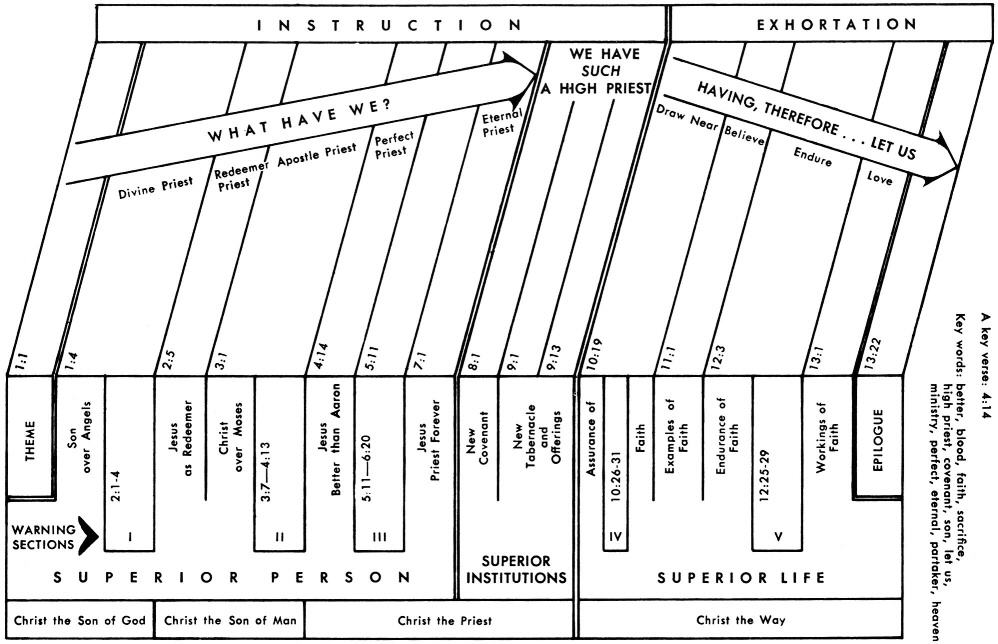
CONSIDER JESUS OUR GREAT HIGH PRIEST
Click chart to enlarge
Charts from Jensen's Survey of the NT - used by permission
Swindoll's Chart, Interesting Pictorial Chart of Hebrews, Another Chart
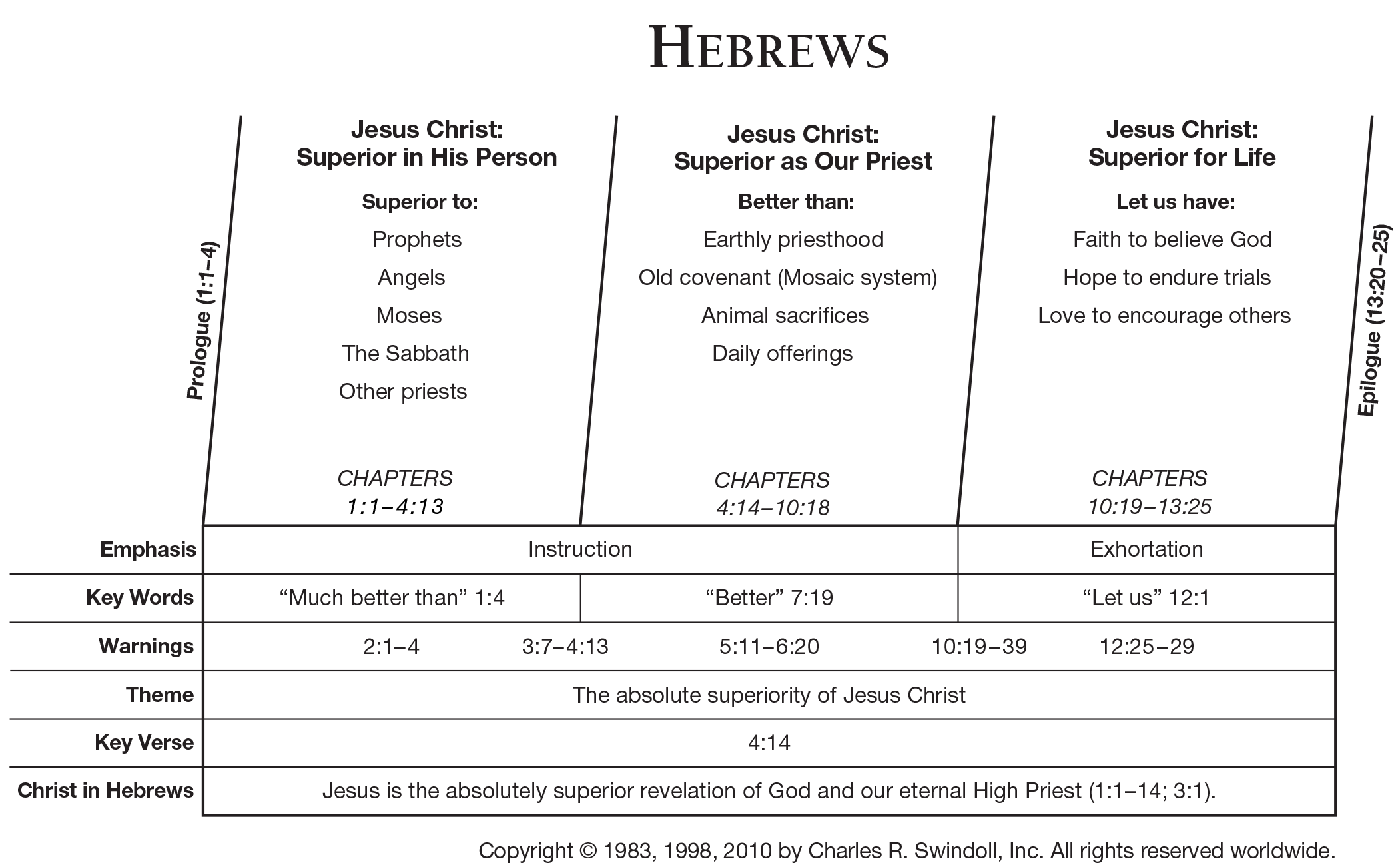
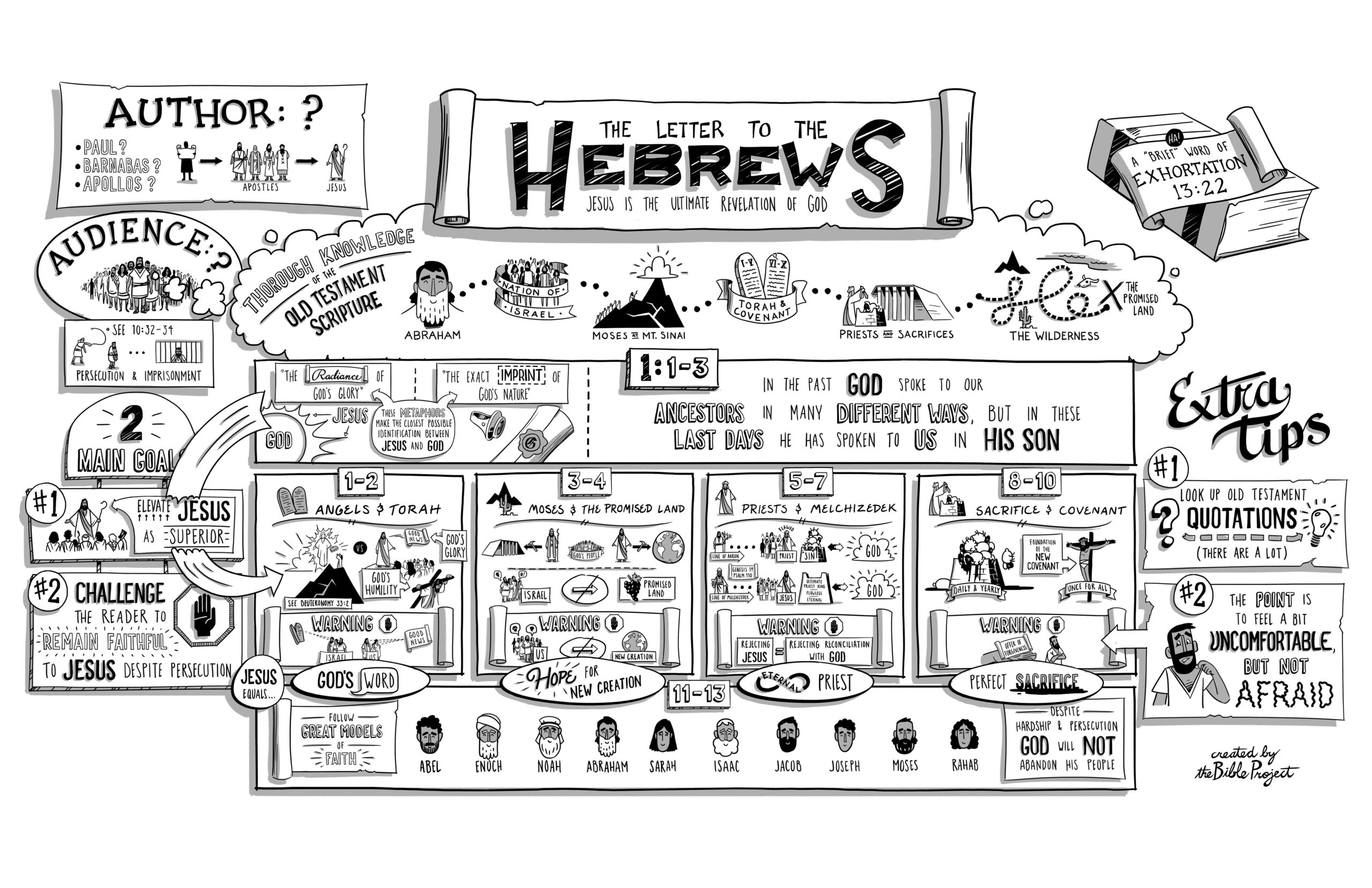
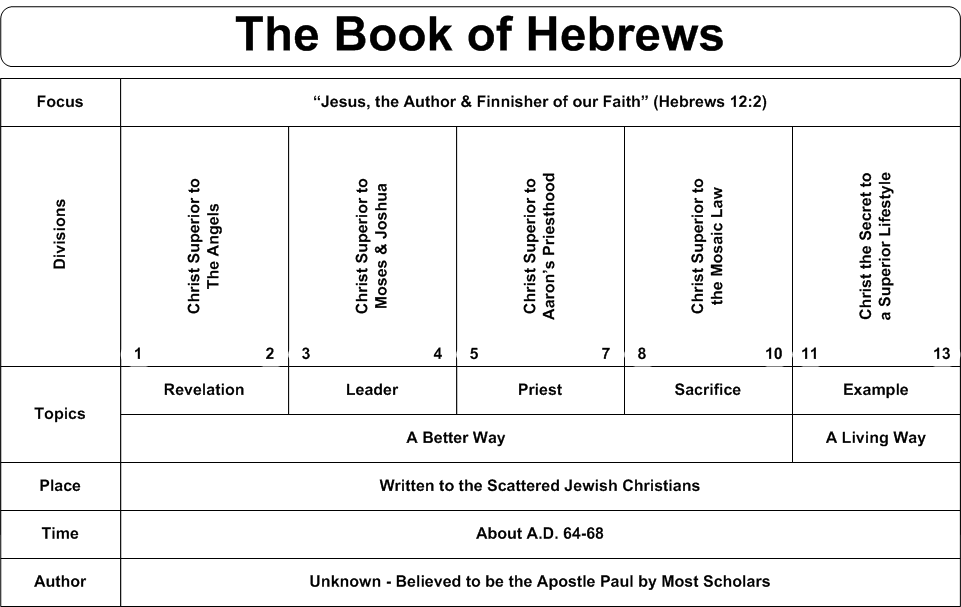
|
The Epistle |
||||
| INSTRUCTION Hebrews 1-10:18 |
EXHORTATION Hebrews 10:19-13:25 |
|||
| Superior Person of Christ Hebrews 1:1-4:13 |
Superior Priest in Christ Hebrews 4:14-10:18 |
Superior Life In Christ Hebrews 10:19-13:25 |
||
| BETTER THAN PERSON Hebrews 1:1-4:13 |
BETTER PRIESTHOOD Heb 4:14-7:28 |
BETTER COVENANT Heb 8:1-13 |
BETTER SACRIFICE Heb 9:1-10:18 |
BETTER LIFE |
| MAJESTY OF CHRIST |
MINISTRY OF CHRIST |
MINISTERS FOR CHRIST |
||
|
DOCTRINE |
DUTY |
|||
|
DATE WRITTEN: |
||||

See ESV Study Bible "Introduction to Hebrews"
(See also MacArthur's Introduction to Hebrews)
Borrow Ryrie Study Bible
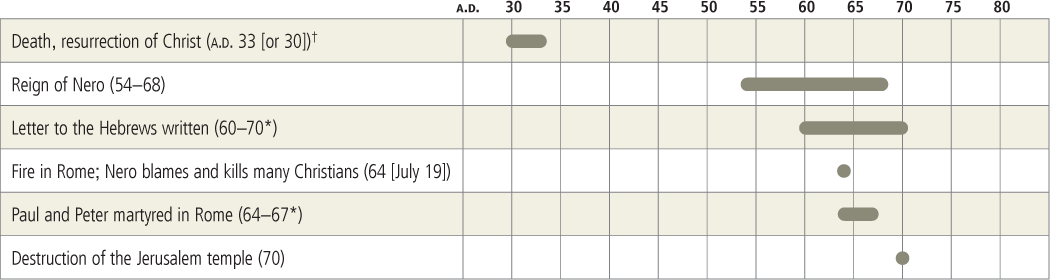
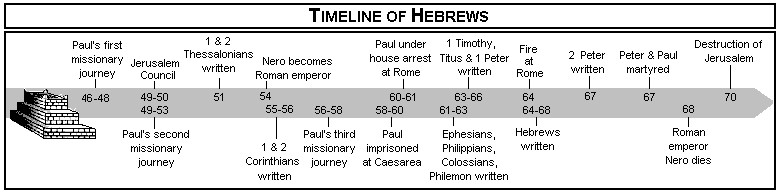
Timeline of Hebrews - ESV Study Bible
* Denotes approximate date of Writing
Hebrews 1:4: having become as much better than the angels, as He has inherited a more excellent name than they. (NASB95: Lockman)
Greek: tosouto kreitton genomenos (AMPMSN) ton aggelon hoso diaphoroteron par' autous kekleronomeken (3SRAI) onoma.
BGT τοσούτῳ κρείττων γενόμενος τῶν ἀγγέλων ὅσῳ διαφορώτερον παρ᾽ αὐτοὺς κεκληρονόμηκεν ὄνομα.
BBE Having become by so much better than the angels, as the name which is his heritage is more noble than theirs.
CSB So He became higher in rank than the angels, just as the name He inherited is superior to theirs.
ESV having become as much superior to angels as the name he has inherited is more excellent than theirs.
NET Thus he became so far better than the angels as he has inherited a name superior to theirs.
NIV So he became as much superior to the angels as the name he has inherited is superior to theirs.
GWN The Son has become greater than the angels since he has been given a name that is superior to theirs.
ICB: The Son became much greater than the angels. And God gave him a name that is much greater than theirs. (ICB: Nelson)
KJV: Being made so much better than the angels, as he hath by inheritance obtained a more excellent name than they.
NKJ having become so much better than the angels, as He has by inheritance obtained a more excellent name than they.
MIT He became much superior to angels, inasmuch as he rightfully has title to a name that exceeds theirs in magnificence.
NAB as far superior to the angels as the name he has inherited is more excellent than theirs.
NJB So he is now as far above the angels as the title which he has inherited is higher than their own name.
Phillips: thus proving himself, by the more glorious name that he has won, far greater than all the angels of God. (Phillips: Touchstone)
NRS having become as much superior to angels as the name he has inherited is more excellent than theirs.
RSV having become as much superior to angels as the name he has obtained is more excellent than theirs.
Wuest: having become by so much superior to the angels as He has inherited a more excellent name than they.
Young's Literal: having become so much better than the messengers, as he did inherit a more excellent name than they.
ASV having become by so much better than the angels, as he hath inherited a more excellent name than they.
- RBC What Can We Learn From The Angels?
- Much better - Heb 1:9+; Heb 2:9+; Ep 1:21+; Col 1:18+; Col 2:10+; 2Th 1:7; 1Pe 3:22+; Rev 5:11,12+
- More excellent Name - Ps 2:7-8; Php 2:9-11
- Hebrews 1 Resources - Multiple Sermons and Commentaries
- Study Questions for Hebrews - 5W/H questions for leading lessons
Related Passages:
Deuteronomy 33:2+ He said, “The LORD came from Sinai, And dawned on them from Seir; He shone forth from Mount Paran, And He came from the midst of ten thousand holy ones; At His right hand there was flashing lightning for them.
Psalm 68:17 The chariots of God are myriads, thousands upon thousands; The Lord is among them as at Sinai, in holiness.
Acts 7:53+ you who received the law as ordained by angels, and yet did not keep it.”
Galatians 3:19+ Why the Law then? It was added because of transgressions, having been ordained through angels by the agency of a mediator, until the seed would come to whom the promise had been made.
Colossians 2:18+ Let no one keep defrauding you of your prize by delighting in self-abasement and the worship of the angels, taking his stand on visions he has seen, inflated without cause by his fleshly mind,
THE SON BECAME
BETTER THAN THE ANGELS
Having become (ginomai) as much (tosoutos) better (kreitton) than the angels (aggelos/angelos) - CSB = "So He became higher in rank than the angels." The implication of this statement is that Jesus was at one time lower in rank than the angels. Let's explain - First, let's set the context by noting that having become (or He became) is the last section of a long Greek sentence that extends from Heb 1:1 to Heb 1:4 and as we shall see, the statement in Heb 1:4+ is clearly linked to the last clause in Heb 1:3+. Second, note that having become is in the aorist tense which speaks of a past completed act or action. What act/action is described in context? In context, this refers to Jesus' exaltation when he "sat down at the right hand of the Majesty on high." (Heb 1:3+) When was it that Jesus sat down? Clearly He sat down after completing His work of redemption, for which "God highly exalted Him (SPEAKS OF JESUS' SEATED AT THE FATHER'S RIGHT HAND), and bestowed on Him the Name which is above every name." (Php 2:9+). It follows that when Jesus accomplished redemption and sat down at the right hand of His Father it was at that time that Jesus became "much better than the angels."
Now, don't be confused by this statement, thinking "Wait a minute, Jesus is Creator all things (Col 1:16+) which means He created the angels. So how could He become much better if He has always been their Creator?" That's a good question. And the writer gives us the answer in Hebrews 2:9+ declaring "we do see Him who was made for a little while lower than the angels, namely, Jesus, because of the suffering of death crowned with glory and honor, so that (term of purpose) by the grace of God He might taste death for everyone." In other words in order for Jesus to taste death, He had to be born as a Man, to be incarnated as the God-Man in order to die for our sins (Heb 2:14+), and it was at that time Jesus was in effect "made for a little while lower than the angels." So for a little while (30+ years) Jesus was a little lower than the angels. But when He completed the redemptive work His Father had sent Him to accomplish (cf Jn 4:34+, Jn 17:4+), it was the end of his time as lower than the angels, for He ascended into heaven and was seated at the right hand of His Father and "became higher in rank than the angels."
While "Jesus" is not the name intended here, one can hardly neglect Paul speaking of the summun bonum Name declaring "For this reason also, God highly exalted Him, and bestowed on Him the Name which is above every name, so that at the Name of Jesus EVERY KNEE WILL BOW, of those who are in heaven and on earth and under the earth, and that every tongue will confess that Jesus Christ is Lord, to the glory of God the Father." (Phil 2:9-11+)
The writer introduces the subject of angels which will continue through Hebrews 2:16+. The writer will proceed to prove the superiority of Jesus to the angels by quoting 7 passages from the OT (all from Septuagint) in Heb 1:5-14 (See Summary Chart)
ESV Study Bible (borrow) - Angels were objects of much speculation in first-century Judaism. Certainly they were known to appear in human form, to minister before the very throne of God, to guide and protect humans, and to have revealed the Mosaic law (see Heb 1:7; 2:2; 12:22; 13:2). Yet Jesus is deemed superior to them, in part because His Name (i.e., his essence) is “Son” (Heb 1:5), which points to a more intimate relationship and which speaks of a better family inheritance (all that belongs to the Father belongs to his unique Son).
Become (ginomai) means o that of poieo which means “to make” or create fashioning something out of existing materials. Become (1096) (ginomai) is the word used of the universe coming into existence. The Son became better than the angels, inferring that at one time He was lower than the angels. Heb 2:7, 9 during His incarnation.
Better is a key word in Hebrews. This repetition of better demonstrates beyond all doubt to the Jewish reader that the New is better than the Old system. Study the 13 uses in 12v in Hebrews asking what is better?
What the Bible teaches – Hebrews - It is, by the way, somewhat thrilling to notice that if there are thirteen references to angels in the epistle (Heb. 1:4; Heb. 1:5; Heb. 1:6; Heb. 1:7; Heb. 1:13; Heb. 2:2; Heb. 2:5; Heb. 2:7; Heb. 2:9; Heb. 2:16; Heb. 12:22; Heb. 13:2), there are also thirteen occurrences of the word "better" (kreissōn)(SEE BELOW), which is here in this verse noticed for the first time
John MacArthur's introductory comments to Hebrews 1:4-14 - In this chapter we are going to be dealing with meat as opposed to milk. I cannot remember a passage on which I have spent more time. To some extent, it is like an iceberg. You can see the top clearly enough, but it may not appear too impressive or meaningful. We will be looking below the surface of this passage into its deep truths. In that sense, verses 4 through 14 are not easy to understand. If, even in a small measure, I can help make these truths more understandable, I have succeeded in what I asked God to help me do. (See Hebrews MacArthur New Testament Commentary - Page 22)
NOTE: Do not confuse this discussion of Jesus better than the angels with the Angel of the LORD a term found only in the Old Testament and referring not to a created angel but to the preincarnate appearances of the Lord Jesus Christ. Click for a Scriptural analysis of the Angel of the LORD. (See also Gotquestions.org) Note that the term the Angel of the Lord does not appear in the New Testament after the incarnation of Christ, for there was no longer any need for a "pre-incarnate" theophany (appearance in the form of God).
Spurgeon comments - So you perceive that Christ is no created angel. He is sometimes compared to an angel. He is sometimes called the angel of the covenant, but he is not a created angel. He is higher in nature, higher in rank, higher in intellect, and higher in power than they. He is nothing less than very God of very God. The very man who suffered on Calvary. The angels are servants, but they are not sons; they are created, but they are not begotten. You see what he says to the Son—“I will be to him a Father, and he shall be to me a Son.”
Paul warned Timothy that "the Spirit explicitly says that in later times some will fall away from the faith, paying attention to deceitful spirits and doctrines of demons (1Ti 4:1). That these later times had already arrived in the first century church is clear for writing to the church at Colossae Paul warned the saints to reject false angelogly saying "Let no one keep defrauding you of your prize by delighting in self-abasement and the worship of the angels, taking his stand on visions he has seen, inflated without cause by his fleshly mind and not holding fast to the Head (Christ), from Whom the entire body, being supplied and held together by the joints and ligaments, grows with a growth which is from God. (Colossians 2:18; 2:19+)
Many people in the first century apparently believed that angels served as mediators between God and men and it was tempting to focus more on angels than upon the sufficiency of Christ as the Great High Priest and Mediator. Basing his arguments upon familiar Old Testament verses, specifically quoting from the Greek translation, the Septuagint (LXX), the author in eleven verses (Hebrews 1:4-14) brilliantly constructs a convincing contrast between Christ the Creator and the created angels, conclusively demonstrating that Christ is far superior to the angels and He Alone warrants the readers (and our) adoration, worship and obedience. Modern Christianity, enamored with widespread Scripturally "shallow" teaching on angels, is in desperate need of this sound doctrine which alone is able to nourish our faith (1Ti 4:6) and cause us to "grow in the grace and knowledge of our Lord and Savior Jesus Christ" (2Pe 3:18+)
Scripture has considerable teaching on the topic of angels with approximately 108 direct references in the OT and 165 in the NT. Study of these passages reveals that God's primary purpose for creating the angels was to render worship and service to God and in turn serve as God's messengers and ministers to men. For a synopsis of "angelology" I would recommend taking an hour or so and reading through the passages in Torrey's topic on Angels (NB: Keep in mind some passages do not have the word "angel" but instead have "host" which is the synonym for angels). Don't just read Torrey's conclusions (as good as I think they are) but since "you have an anointing from the Holy One" (1Jn 2:20), read the passages in context and allow your Teacher the Holy Spirit (1Co 2:12-16, cf Jn 14:26) to lead you into all truth (i.e., Be a Berean - Acts 17:11+).
Angels are often referred to as hosts (for more discussion click here) of God (LORD of hosts or Sabaoth) and equated with His "army" in heaven. God is represented as surrounded by a host of beings of a higher order than man. As to their number, the writer of Hebrews says there are "myriads (murias = indefinite large number that cannot be counted) of angels" (Hebrews 12:22+) The writer of Hebrews writes that in the Old Testament God spoke "the word… through angels " and that word "proved unalterable and every transgression and disobedience received a just recompense, (He 2:2+)
Why would the writer even need to address the issue of Jesus as much better than the angels? For one thing, from the very fact the writer had to address this issue implies that ancient Jews, even those who were now believers in the Messiah held angels in high regard. It is not surprising that Jews might have a high regard for angels, because Scripture teaches that the law had been given through angels (Acts 7:53). Paul writes that "God gave his laws to angels to give to Moses, who was the mediator between God and the people" (Gal 3:19NLT+). Recall that Cherubim were woven into the veil of the tabernacle, and cherubim were fashioned of gold for the mercy seat. Furthermore, in the OT, angelic beings had made frequent appearance to the Jewish people (eg Da 8:16+, etc). Finally, it is evident from Paul's letter to the Colossians that those with a strong Jewish background (Col 2:16, 17+) were being tempted to "delight in false humility and the worship of angels" (Col 2:18+). Those to whom this letter is sent were either already entertaining or being encouraged to entertain, teaching which elevated angels to a position rivaling that of Christ himself.
William Lane adds an explanation of why include angels in this presentation of Christ's superiority - In the OT angels were ascribed a broad role in revelation and redemption (e.g., Exod 3:2; Isa 63:9). It was commonly understood that the law had been mediated to Moses, the greatest of the prophets, through angels (cf. Jub. 1:29; Acts 7:38-39, 53; Gal 3:19; Jos., Ant. 15.5.3; Mek. on Exod 20:18; Sipre 102 on Num 12:5; Pesiq. R. 21). This conception was shared by the writer and his readers (Heb. 2:2). The description of the Jewish law as "the message declared by angels" in Hebrews 2:2 is determinative for the interpretation of the reference to the angels in . The assertion of Christ's exaltation over the angels prepares for the demonstration of that superiority (Heb. 1:5-14). That demonstration is foundational to the thought that Christ's revelation is far superior to that mediated by the angels (Heb. 2:14). (See Hebrews 1-8, Volume 47A - Page 17 BORROW related work Hebrews Commentary page 34)
Thomas Aquinas explains that "Angels mean messengers and ministers. Their function is to execute the plan of divine providence, even in earthly things.
John Calvin - Angels are the dispensers and administrators of the divine beneficence towards us.
Billy Graham rightly declared "Of one thing we can be sure: Angels never draw attention to themselves but ascribe glory to God and press His message upon the heavens as a delivering and sustaining word of the highest order.
HEIR OF A MORE
EXCELLENT NAME
As He has inherited (kleronomeo) a more excellent (diaphoros) Name than they - AMP = "as the glorious Name (title) which He has inherited is different from and more excellent than theirs." Inherited (kleronomeo) in the perfect tense speaks of a past completed action and of present abiding results and thus conveys the idea of the permanence of His inherited Name. Jesus is the Heir Who forever possesses the more excellent Name. In the Bible is name is not a mere designation to distinguish one individual from others but a name that reveals what this person really is, their identity, their authority, their reputation. Stated another way the name described the nature. In Heb 8:6+ "He has obtained a more excellent (diaphoros) ministry." Jesus' more excellent Name is "Son," a Name that implies close, intimate relationship, something the angels did not possess. They could come near God in worship, but their nearness was limited, but not so with the Son!
R T France on excellent name and inherited - The “superior name” is of course the title “Son,” (ED: AS EXPLAINED IN NEXT VERSE Heb 1:5 "For to which of the angels did He ever say, “YOU ARE MY SON,") which has been introduced in v. 2 and will be the explicit basis of the first two quotations that follow in v. 5. It is because he is God’s Son that he holds authority even over God’s angels. he use of the verb “inherited” rather than simply “received” stresses that he holds this name not by favor but by right, as the Son who shares his Father’s authority. (See Hebrews - Revelation)
Warren Wiersbe agrees that "The "more excellent name" that Jesus possesses is "Son." While the angels collectively may be termed "the sons of God" (Job 1:6), no angel would be given this title individually. It belongs uniquely to our Lord Jesus Christ." (Bible Exposition Commentary page 807)
What the Bible Teaches - It is the character, the rank, the dignity, of the Son who is now the Redeemer seated at the right hand of the Majesty on high. In His person and in His position He is superior. Now what tremendous effect should all this have had on believing Hebrews. How familiar they were with the ministry of angels, as were their fathers. Abraham in Mamre (Gen 18:1), Isaac in Moriah (Gen 22:11), Jacob at Mahanaim (Gen 32:1), Moses at Sinai (Acts 7:53), Gideon, Manoah, Elijah, David, Daniel: all could bear testimony to the ministry of the heavenly ones. We have no account of the creation of angels. Neither do we know how many there are. An innumerable company (Heb 12:22); ten thousand times ten thousand, and thousands of thousands (Rev 5:11); a multitude of the heavenly host at Bethlehem (Luke 2:13); more than twelve legions awaiting His command at Gethsemane (Matt 26:53); these give us but a faint idea of the vastness of the angel hosts. But Christ is greater than all. How such superiority to angels should have encouraged and strengthened these Jewish saints. The Christ of the new order of things was more excellent than angels and was therefore more excellent than a Judaism whose glory was angelic in character.
R Kent Hughes on more excellent name - According to Jewish thought, a person's name revealed his essential nature and could express rank and dignity. Jesus had the name "Son" from all eternity, and it is the name he will always keep, as the perfect tense of the phrase "the Name he has inherited" indicates. No angel was ever called "Son," though sometimes they were generically referred to as sons—for example, "the sons of God" presented themselves before the Lord (Job 1:6, NASB). But no angel ever had the title "Son." (See Hebrews: An Anchor for the Soul - Page 7)
NET NOTE - Most modern English translations attempt to make the comparison somewhat smoother by treating “name” as if it were the subject of the second element: “as the name he has inherited is superior to theirs” (cf. NAB, NIV, NRSV, CEV). However, the Son is the subject of both the first and second elements: “he became so far better”; “he has inherited a name.” The present translation maintains this parallelism even though it results in a somewhat more awkward rendering. NET = "Thus He became so far better than the angels as He has inherited a Name superior to theirs." This comparison is somewhat awkward to express in English, but it reflects an important element in the argument of Hebrews: the superiority of Jesus Christ.
David Guzik - Jesus’ superior status is demonstrated by a superior name, which is not merely a title, but a description of His nature and character. There are many reasons why it is important to understand the surpassing excellence of Jesus, setting Him far above every angelic being. We often best understand things when they are set in contrast to other things. (1) Though the Old Covenant came by the hands of angels to Moses, a better covenant came by a better being, Jesus. First century Jews might think that the gospel came at the hands of mere men – the apostles. But in truth, the gospel came by Jesus, who is superior to the angels. (2) There was a dangerous tendency to worship angels developing in the early Church (Colossians 2:18, Galatians 1:8), and Hebrews shows that Jesus is high above any angel. (3) There was the heretical idea that Jesus Himself was an angel, a concept that degrades His glory and majesty. (4) Understanding how Jesus is better than the angels helps us to understand how He is better than anyone or anything in our life.
Than they (par autous) is more literally “alongside of them” which expresses the idea that the Son has a Name more excellent in comparison to the angels. The writer has already shown that the Son is superior to the prophets and now presents Him as superior to the angels, a conclusion he proceeds to substantiate in the remainder of the chapter relying primarily on the reliable testimony of the Old Testament Scriptures, which again directly addresses the concerns of his Jewish audience.
James Townsend in Emmaus Journal (Vol 9. Page 97. 2000) writes the following summary of Jesus and angels…
Superior to the Invisible Agents of Old Testament Revelation - Angels (Hebrews 1:1-2:18)
A lot of modern people have caught the disease of angelitis (spawned from TV shows such as “Touched by an Angel”). When angels are promoted to the extent that God’s Son is demoted, then such obsessions amount to “the worship of angels” (see note Colossians 2:18). Angels were the invisible intermediaries involved in God’s giving the Old Testament revelation of the law (see Acts 7:38, 53 and Gal. 3:19). In order to show that God’s New Testament revelation in His Son is superior to the Old Testament revelation at Sinai, the author of Hebrews (Heb 1:1-2:18) cites evidence to show the Son’s superiority above all angels (who are unseen law-givers).
In Hebrews 1:1-3 the author forges seven scintillating statements about God’s Son, who is God’s supreme revelation (Heb 1:1–3). In Heb 1:4-14 he shows, by seven Scriptural citations, that He is “superior to the angels” (He 1:4+) because no angel has ever been singled out as “the” Son (He 1:5+; He 1:6+), or addressed as “God” (He 1:8+) or has had an eternal existence (He 1:10+; He 1:11, 12+).
The word “angels” appears twelve times in Hebrews 1:4-2:18. The law (or past revelation) was “spoken by angels” (He 2:2+), but this last revelation (He 1:2+) was spoken by God’s superior Son, so no one dare neglect the message “announced by” God’s Son (He 2:3+) and attested by God the Father (He 2:4+).
Angels were not only agents of the law-giving (Hebrews 2:2+), but administrators over nations (He 2:5+; Da. 10:13, 20, 21; 11:1, where angels are called “princes” ruling over nations). Yet God has not “subjected the world to come…to angels” (Hebrews 2:5+), but eventually the world is to be subjected to the Son…
Related Resources:
- What does the Bible say about the angel Gabriel? | GotQuestions.org
- Who is Michael the archangel? | GotQuestions.org
- What are the names of angels in the Bible? | GotQuestions.org
Hughes sums up Hebrews 1:1-4 saying: He is: (PLAY THE SONG BY AARON JEFFREY ENTITLED "HE IS...")
- Inheritor. As Creator he is heir to the universe. As Redeemer he bought our souls and so made us his personal inheritance.
- Creator. He created the universe's one hundred thousand million galaxies, each with a hundred thousand million stars, each six hundred trillion miles across - and each fleeing away in never-ending expansion. Awesome!
- Sustainer. He is sustaining the galloping galaxies as well as the sub-microscopic universe of atoms - all by his spoken word.
- Radiator. Like the sun, he is the source and radiator of divine glory - not a reflection, but part of it! He is God.
- Representor. He is the exact representation of the Fathers being. He is everything God is, yet separate. He is with God.
- Purifier. He is the cosmic sacrifice who paid for our sins with his blood in order to purify us.
- Ruler. He sits, having paid for our sins once and for all, as the supreme priest. He is at the right hand of Majesty in ineffable exaltation. And wonder of wonders, he prays for us.
Better (2909) (kreitton/kreisson from kratos = strong which denotes power in activity and effect) is the comparative degree of agathos meaning good (intrinsically good). In the New Testament kreittōn is used primarily to describe the superiority of the Christian system. Thus it is used heavily in the Book of Hebrews, especially the first part of the book, to show the superiority of the Christian system over the Jewish system. Christians in the Book of Hebrews have a Lord who is superior to the angels (1:4), a better hope (7:19), a better covenant (7:22), better promises (8:6), and a better future as foreseen by God (11:40).
Robertson renders it as "by how much more". Vine comments that "better is here indicative of a higher position or rank."
Gilbert - Kreittōn, also spelled kreissōn, comes from the root krat meaning “strong, righteous, powerful.” It came to be used as a comparative adjective meaning “better” or “superior.” In classical Greek it is used to compare such diverse things as military ranks and gods. In the Septuagint kreittōn is found as a translation for the very common Hebrew term ṯôv (meaning “good”) when ṯôv is used in the comparative sense. Thus kreittōn is used many times in the Wisdom books (over 20x in Proverbs) where there is a concern to show a “better” way (e.g., Proverbs 8:11; 19:22). In Proverbs the better way is that of honesty and dependence upon God rather than dishonesty and dependence upon self or material possessions....A secondary meaning is “more useful, more advantageous, better” (Bauer). Here the emphasis is on the usefulness or the advantage to someone. Here “better” means better for someone. Paul wrote about controlling one’s lust and said, “It is better to marry than to burn” (1 Corinthians 7:9). (Complete Biblical Library)
FRIBERG - kreitton = comparative of kratos (strong) used as a comparative of agathos (good); (1) of persons = superior, better, higher in rank (Heb 1.4); substantivally more important person (Heb 7.7); (2) of what is more advantageous, better, more useful (1Co 7.9); neuter as a substantive to kreitton = the advantage, the more profitable thing (1Co 11.17; perhaps Heb 12.24), opposite to esson (the worse); ta kreissona = more useful things (Heb 6.9); (3) neuter as an adverb (in a) better (way) (probably Heb 12.24)
Zodhiates - (I) Better, i.e., more useful, more profitable (1 Cor. 7:9; Phil. 1:23; Heb. 11:40; 2 Pet. 2:21); used with the art. tó kreítton (1 Cor. 11:17; 12:31 [pl.]; Sept.: Ex. 14:12; Prov. 25:25). Used as an adv. in Heb. 12:24. (II) Better in value or dignity, nobler, more excellent (Heb. 1:4; 6:9; 7:7, 19, 22; 8:6; 9:23; 10:34; 11:16, 35; 1 Pet. 3:17; 2 Pet. 2:21). (Complete Word Study Dictionary)
KREITTON - 19X/18V - better(17), better things(1), greater(1). 1 Co. 7:9; 1 Co. 7:38; 1 Co. 11:17; Phil. 1:23; Heb. 1:4; Heb. 6:9; Heb. 7:7; Heb. 7:19; Heb. 7:22; Heb. 8:6; Heb. 9:23; Heb. 10:34; Heb. 11:16; Heb. 11:35; Heb. 11:40; Heb. 12:24; 1 Pet. 3:17; 2 Pet. 2:21
- Hebrews 1:4+ better than the angels
- Hebrews 6:9+ better things
- Hebrews 7:1+ better hope
- Hebrews 7:22+ better covenant.
- Hebrews 8:6+ better covenant...better promises.
- Hebrews 9:23+ better sacrifices
- Hebrews 10:34+ better possession
- Hebrews 11:4+ better sacrifice
- Hebrews 11:16+ better country
- Hebrews 11:35+ better resurrection
- Hebrews 11:40+ better for us
- Hebrews 12:24+ better than the blood of Abel
Angels (32) (aggelos/angelos) is the Greek word used to describe a messenger sent in order to announce, teach or perform anything in place of one who has sent him. In Scripture aggelos refers to transcendent (exceeding usual limits) celestial spirit beings, messenger, superior in power and intelligence to man, who are "sent out (by God) to render service for the sake of those who will inherit salvation." (Heb 1:14+)
Related Resources:
- International Standard Bible Encyclopedia Angel
- Baker Evangelical Dictionary Angel
- Questions about Angels & Demons
- Nave Topical Bible Angel (a Spirit)
- Torrey Topical Textbook Angels
- American Church Dictionary Angels
- American Tract Society Angel
- Bridgeway Bible Dictionary Angels
- Charles Buck Dictionary Angel
- CARM Theological Dictionary Angel
- Easton's Bible Dictionary Angel
- Fausset Bible Dictionary Angels
- Holman Bible Dictionary Angel
- Hastings' Dictionary of the Bible Angel
- Hastings' Dictionary of the NT Angels Angels (2)
- Hawker's Poor Man's Dictionary Angels Angel
- Smith Bible Dictionary Angels
- Vines' Expository Dictionary Angel
- Wilson's Bible Types Angel
- Watson's Theological Dictionary Angel
- 1911 Encyclopedia Britannica Angel
- Kitto Biblical Cyclopedia Angels
- The Nuttall Encyclopedia Angel
Inherited (2816) (kleronomeo from kleros = a lot + nemomai = to possess) means to be an heir. Literally, as receiving a possession or gift from someone who has died and so to inherit, be an heir (Ga 4.30 quoted from Ge 21:10); Sept.: Ge. 15:4; Nu 27:11; Figuratively, as receiving God's salvation, gifts, and benefits obtain, gain possession of, receive (Lk 10.25; Heb 12.17). Inherit, be an heir Gal 4:30.—2. acquire, obtain, come into possession of - Mt 5:5; 25:34; 1 Cor 6:9f; 15:50; Gal 5:21. Receive, share in Mt 19:29; Mk 10:17; Lk 10:25; Hb 1:4, 14; 12:17; Rv 21:7.
Zodhiates - In later usage followed by the acc., simply to obtain, acquire, possess. Spoken only of the friends of God as receiving admission to the kingdom of heaven and its attendant privileges (Matt. 5:5, "they shall possess the land" [a.t.], referring to the Messiah's kingdom [cf. Sept.: Ps. 25:13; 37:11, 22, 29]). To inherit the kingdom of God (Matt. 25:34; 1 Cor. 6:9, 10; 15:50; Gal. 5:21); eternal life (Matt. 19:29; Mark 10:17; Luke 10:25; 18:18); incorruptibility (1 Cor. 15:50). See Heb. 1:4, 14; 6:12; 12:17; 1 Pet. 3:9; Rev. 21:7; Sept.: Gen. 15:7; Deut. 1:21. (Borrow Complete Word Study Dictionary)
KLERONOMEO - 18X/17V - heir(1), inherit(16), inherited(1). Matt. 5:5; Matt. 19:29; Matt. 25:34; Mk. 10:17; Lk. 10:25; Lk. 18:18; 1 Co. 6:9; 1 Co. 6:10; 1 Co. 15:50; Gal. 4:30; Gal. 5:21; Heb. 1:4; Heb. 1:14; Heb. 6:12 = "inherit the promises"; Heb. 12:17 = "he desired to inherit the blessing"; 1 Pet. 3:9; Rev. 21:7
Excellent (1313)(diaphoros from diaphero = be different, superior) pertains to that which is different and in the present context the focus is on different in "value" and thus His Name is outstanding, exceptional (forming an exception, not ordinary), superior (of extraordinary worth or merit, of higher rank, quality, or importance), surpassing (greatly exceeding others, of very high degree) and excellent.
Diaphoros signifies more distinguished, more eminent and is used elsewhere only (He 8:6+) describing the Son's “more excellent ministry, by as much as He is also the mediator of a better covenant, which has been enacted on better promises.”
Gilbrant on Diaphoros - In classical Greek since the time of Herodotus (Fifth Century B.C.) this term means “different” but later (by the time of Josephus) came to include the meaning “outstanding, excellent.” It is used 12 times in the Septuagint to translate 3 different Hebrew words. In Leviticus 19:19 it refers to “diverse” seed, and in Theodotion’s version of Daniel (7:17,19) the reference of the beast being “different” has a qualitative sense of “greater” (in terms of power) as well as “different” (in terms of its description). In Romans 12:6 it refers to the diversity of spiritual gifts among believers. In Hebrews 9:10 it refers to the various kinds of ceremonial washings. A comparative form of the adjective, diaphorōteros, meaning “much different from, much better than, or superior to something or someone,” occurs twice in the New Testament. It is used in Hebrews 1:4 and 8:6 in reference to Christ’s name being superior to that of the angels and His ministry being superior to or more excellent than that of the high priests. (Complete Biblical Library Greek-English Dictionary)
DIAPHOROS - 4X/4V - differ(1), more excellent(2), various(1). Ro 12:6; Heb. 1:4; Heb. 8:6; Heb. 9:10
DIAPHOROS - 5X in Septuagint (LXX) - Lev 19:19; Dt 22:9; Ezra 8:27; Dan 7:7, 19)
Name (3686) (onoma) is the distinctive designation of a person or thing and includes the ideas of title, character, reputation or authority. In antiquity the name meant much more than it does today. We use a name as little more than a distinguishing mark or label to differentiate one person from other people. But in the NT "the name" concisely sums up all that a person is. One's whole character was somehow implied in the name.
ONOMA IN HEBREWS - Heb. 1:4; Heb. 2:12; Heb. 6:10; Heb. 13:15
Jon Courson - There are those who will knock on your door and say that Jesus Christ is not ultimately superior to the angels, but that He is one of the angels....
Jehovah's Witnesses teach that Jesus is the brother of the archangel Michael (ED: Is Jesus Michael the archangel?; see note). But it's absolute heresy—not because we're splitting doctrinal hairs, but because if, like angels, Jesus Christ was created by the Father, it greatly cheapens the sacrifice God made on the Cross of Calvary. If Jesus is not God of very God, then God merely sent an angel to die on the Cross and take the rap for humanity. That's not what happened. Paul would say great is the mystery of godliness that God was manifested in the flesh (1 Timothy 3:16). God Himself bore our sin. God Himself died on the Cross.
Mormons also deny Jesus is superior to the angels. Although they don't talk about it very readily, if you press them on the point, they'll admit they believe Jesus is the brother of Lucifer. You see, according to Mormon theology, God called Jesus and Lucifer together and said, "We need to redeem humanity." And the two created beings—Jesus and Lucifer—both gave their suggested plan. The Father went with Jesus' suggestion. Lucifer got ticked, and from that time has been determined to undermine his brother's work.
Gang, turn the cultist to Hebrews 1 and say, "Jesus is not in the same category as any angel—Michael, Lucifer, or the devil. He's superior." A lot of people have the idea that there's a cosmic contest between God and the devil—that they're equals and they're battling it out. Oh, they know eventually God's going to win—but it's going to be tough. Not so! It's not God and Satan battling it out. God is in an entirely different realm. Now, if Satan and Michael, or Satan and Gabriel fought—then you would have an interesting contest. Satan, however, is no match for God, Jesus, or the Holy Spirit, for they are far superior to any angel. (See Jon Courson's Application Commentary)
F B Meyer in the Way Into the Holiest has the following chapter on Hebrews 1:4…
"He hath by inheritance obtained a more excellent name." Hebrews 1:4.
APART from Scripture, we should have been disposed to infer the existence of other orders of intelligent and spiritual beings besides man. As the order of creation climbs up to man from the lowest living organism through many various stages of existence, so surely the series must be continued beyond man, through rank on rank of spiritual existence up to the very steps of the eternal throne. The divine mind must be as prolific in spiritual as it has been in natural forms of life.
But we are not left to conjecture. From every part of Scripture come testimonies to the existence of angels. They rejoiced when the world was made, and they are depicted as ushering in with songs that new creation for which we long. They stood sentries at the gate of a lost paradise; and at each of the twelve gates of the New Jerusalem an angel stands (Rev 21:12+). They trod the plains of Mamre, and sang over the fields of Bethlehem. One prepared the meal on the desert sands for Elijah; another led Peter out of gaol and a third flashed through the storm to stand by the hammock where the Apostle Paul was sleeping (Acts 27:23,24).
But in the mind of the pious Hebrew the greatest work which the angels ever wrought was in connection with the giving of the law. The children of Israel received the law "as it was ordained by angels" (Acts 7:53, R.v.). It was necessary, therefore, in showing the superiority of the Gospel to the Law, to begin by showing the superiority of him through whom the Gospel was given, over all orders of bright and blessed spirits, which, in their shining ranks and their twenty thousand chariots, went and came during the giving of the decalogue from the brow of Sinai (Psalm 68:17).
It is not difficult to prove the Lord's superiority to angels. It is twofold: in Nature and in Office.
In Nature. "He hath by inheritance obtained a more excellent name than they" (Heb 1:4). In verse 7, quoted from Psalm 104:4 (R.v. marg.), where they are distinctly spoken of as messengers and ministers, they are compared to winds and flames.-winds, for their swiftness and invisibility; flames, because of their ardent love. But how great the gulf between their nature, which may thus be compared to the elements of creation, and the nature of that glorious Being whom they are bidden to worship, and who is addressed in the sublime title of Son! (Heb 1:6+; Psalm 97:7)
In Office. In Heb 1:14 they are spoken of as ministering spirits, "sent forth to do service for the sake of them that shall inherit salvation" (RV). This liturgy of service is a literal fact. When struggling against overwhelming difficulties; when walking the dark, wild mountain-pass alone; when in peril or urgent need-we are surrounded by invisible forms, like those which accompanied the path of Jesus, ministering to him in the desert, strengthening him in the garden, hovering around his cross, watching his grave and accompanying him to his home. They keep pace with the swiftest trains in which we travel. They come unsoiled through the murkiest air. They smooth away the heaviest difficulties. They garrison with light the darkest sepulchers. They bear us up in their hands, lest we should strike our foot against a stone. Many an escape from imminent peril; many an unexpected assistance; many a bright and holy thought whispered in the ear, we know not whence or how-is due to those bright and loving spirits. "The good Lord forgive me," says Bishop Hall, "for that, amongst my other offenses, I have suffered myself so much to forget the presence of his holy angels." But valuable as their office is, it is not to be mentioned in the same breath as Christ's, which is set down for us in this chapter.
He Is The Organ of Creation. "By whom also he made the worlds." To make that which is seen out of nothing, that is creation: it is a divine work; and creation is attributed to Christ. "By him were all things created that are in heaven and that are in earth." "All things were made by him; and without him was not anything made that was made" (Col 1:16+; John 1:3). But the word here and in xi. 3 translated worlds means ages. Not only was the material universe made by him, but each of the great ages of the world's story has been instituted by Jesus Christ.
When genius aspires to immortality, it leaves the artist's name inscribed on stone or canvas: and so Inspiration, "dipping her pen in indelible truth, inscribes the name of Jesus on all we see-on sun and stars, flower and tree, rock and mountain, the unstable waters and the firm land; and also on what we do not see, nor shall, until death has removed the veil-on angels and spirits, on the city and heavens of the eternal world."
This thought comes out clearly in the sublime quotation made in Psalm 102:10. That inspired poem is obviously inscribed to Jehovah: "Thou, Jehovah, in the beginning hast laid the foundation of the earth; and the heavens are the work of thy hands." But here, without the least apology, or hint of accommodating the words to an inferior use, it is applied directly to Christ. Mark the certainty of this inspired man that Jesus is Jehovah! How sure of the Deity of his Lord! And what a splendid tribute to his immutability!
Mark how the Epistle rings with the unchangeableness of Jesus, in his human love (He 13:8), in his priesthood (Heb 7:24+), and here in his divine nature (He 1:10, 11, 12+). We live in a world of change. The earth is not the same today as it was ages ago, or as it will be ages on. The sun is radiating off its heat. The moon no longer as of yore burns and glows; she is but an immense opaque cinder, reflecting the sunlight from her disk. Stars have burnt out, and will. The universe is waxing old, as garments which from perpetual use become threadbare. But the wearing out of the garment is no proof of the waning strength or slackening energy of the wearer. Nay, when garments wear out quickest, it is generally the time of robustest youth or manhood. You wrap up and lay aside your clothes when they have served their purpose; but you are the same in the new suit as in the old. Creation is the vesture of Christ. He wraps himself about in its ample folds. Its decay affects him not. And, when he shall have laid it all aside, and replaced it by the new heavens and the new earth, he will be the same forevermore.
With what new interest may we not now turn to the archaic record, which tells how God created the heavens and the earth. Those sublime syllables, "Light, be!" were spoken by the voice that trembled in dying anguish on the cross. Rolling rivers, swelling seas, waving woods, bursting flowers, caroling birds, innumerable beasts, stars sparkling like diamonds on the pavilion of night-all newly made; all throbbing with God's own life; and all very good: but, mainly and gloriously, all the work of those hands which were nailed helplessly to the cross, which itself, as well as the iron that pierced him, was the result of his creative will.
He Is The God of Providence. "Upholding all things by the word of his power" (He 7:3+). He is the prop which underpins creation. Christ, and not fate. Christ, and not nature. Christ, and not abstract impersonal law. Law is but the invariable method of his working. "In him all things live, and move, and have their being." "By him all things consist." He is ever at work repeating on the large scale of creation the deeds of his earthly life. And if he did not do them, they must be forever undone. At his word rainwater and dew become grape-juice; tiny handfuls of grain fill the autumn barns; storms die away into calm; fish are led through the paths of the sea; rills are sent among the mountains; and stars are maintained in their courses, so that "not one faileth."
All power is given unto him in heaven and on earth. Why, then, art thou so sad? Thy best Friend is the Lord of Providence. Thy Brother is Prime Minister of the universe, and holds the keys of the divine commissariat. Go to him with the empty sacks of thy need; he will not only fill them, but fill them freely, without money and without price; as Joseph did in the old story of the days of the Pharaohs.
He Is The Saviour of Sinners. "He purged our sins." We shall have many opportunities of dwelling on this glorious fact. Jesus is Saviour, Redeemer, and the High-Priest. This is his proudest title; in this work no angel or created spirit can bear him rivalry. In the work of salvation he is alone. No angel could atone for sin, or plead our cause, or emancipate us from the thrall of evil.
But notice the finality of this act. "He made purging of sins " (see Greek). It is finished; forever complete; done irrevocably and finally. If only we are one with him by a living faith, our sins, which were many, are washed out; as an inscription from a slate, as a stain from a robe, as a cloud from the azure of heaven. Gone-as a stone into the bottomless abyss! Gone-never to confront us here or hereafter! "Who is he that condemns? It is Christ that died, yea, rather, that is risen again; who is even at the right hand of God; who also makes intercession for us" (Ro 8:34+).
He Is Also King. And on what does his kingdom rest? What is the basis of that Royalty of which we constantly sing, in the noble words of the primitive Church? "Thou art the King of Glory, Christ." It is a double basis.
He is King by right of his divine nature. "Thy throne, O God, is forever and ever." Well might Psalm xlv. be entitled the poem of the lilies, as if to denote its pure and choice and matchless beauties. It celebrated the marriage of Solomon: but, after the manner of those inspired singers, its authors soon passed from the earthly to the heavenly; from the transient type of the earthly realm to the eternal and imperishable realities of the divine royalty of Christ.
He is also King as the reward of his obedience unto death. "He became obedient unto death, even the death of the cross: wherefore, God also hath highly exalted him" (Php 2:8,9+). Satan offered him sovereignty in return for one act of homage, and Christ refused, and descended the mountain to poverty and shame and death; but through these things he has won for himself a Kingdom which is yet in its infancy, but is destined to stand when all the kingdoms of this world have crumbled to dust.
As Christ emerged from the cross and the grave, where he had purged our sins, it seemed as if words were addressed to him which David had caught ages before: "The LORD said unto my Lord, Sit on my right hand, until I make thine enemies thy footstool" (He 1:13+; Psalm 110:1). This is the interpretation which the Apostle Peter, in the flush of Pentecostal inspiration, put upon these words (Acts 2:34). And, accordingly, we are told, "He was received up into heaven, and sat on the right hand of God " (Mark 16:19). "He sat down on the right hand of the Majesty on high" (He 1:3).
"He sat down." Love is regnant. The Lamb is in the midst of the Throne. Behold his majesty, and worship him with angels and archangels, and all the throng of the redeemed. Prostrate yourself at his feet, consecrating to him all you are and all you have. Comfort yourself also by remembering that he would not sit to rest from his labors in redemption, and in the purging away of sins, unless they were so completely finished that there was nothing more to do. It is all accomplished; and it is all very good. He has ceased from his works, because they are done; and therefore he is entered into his rest. And that word "until" is full of hope. God speaks it, and encourages us to expect the time when he shall have put down all rule and all authority and power; and when death itself, the last enemy, shall be destroyed (1Co 15:24, 25, 26).
Angel, Summary: Angel = "messenger,"
of God,
of men,
of an order of created spiritual beings whose chief attributes are strength and wisdom (2Sa14:20; Ps103:20;104:4).
OT expression "the angel of the LORD" usually implies presence of Deity in angelic form (Ge 16:1 - 13; 21:17 - 19; 22:11 - 16; 31:11 - 13; Ex 3:2 - 4; Judges 2:1; 6:12 - 16; 13:3 - 22). See Judges 2:1; cp. Mal 3:1,
The word "angel" is used of men in Luke 7:24, Gk.; James 2:25, Gk.; Rev 1:20; 2:1,8,12,18; 3:1,7,14. In Rev 8:3 - 5 Christ is evidently meant.
Sometimes "angel" used of spirit of man (Ac 12:15).
Though angels are spirits (Ps 104:4; Heb 1:14), power is given them to become visible in the semblance of human form (Gen 19:1, cp. Ge 19:5; Exo 3:2; Num 22:22 - 31; Judges 2:1; 6:11,22; 13:3,6; 1 Chr 21:16,20; Mat 1:20; Luke 1:26; John 20:12; Acts 7:30; 12:7 - 8, etc.).
always masculine gender, though sex, in the human sense, is never ascribed to angels (Mt22:30; Mk12:25).
exceedingly numerous (Ps 68:17; Mat 26:53; Heb 12:22; Rev 5:11).
power is inconceivable (2 Ki 19:35).
place is about the throne of God (Rev 5:11; 7:11).
relation to believers is that of "ministering spirits sent to serve those who will inherit salvation," has reference to the physical safety and well-being of children of God (1 Ki 19:5; Ps 34:7; 91:11; Dan 6:22; Mat 2:13,19; 4:11; Luke 22:43; Acts 5:19; 12:7 - 10).
Comparing Heb 1:14 with Mat 18:10 and Ps 91:11, it appears that this care for the heirs of salvation begins in infancy and continues through life.
angels observe us (Ec5:6; 1Co4:9; Ep3:10), should influence conduct.
Man is made "a little lower than the angels," (Ps8:4,5; Heb2:7) and in incarnation Christ took "for a little while" this lower place that He might lift the Christian into His own sphere above angels (Heb2:9,10).
angels are to accompany Christ in His second advent (Mt 25:31).
will be committed the preparation of the judgment of individual Gentiles among the nations (see Mt 13:30,39,41,42; 25:32).
The Kingdom Age is not to be subject to angels, but to Christ and those for whom He was made a little lower than the angels (Heb2:7).
archangel, Michael, is mentioned as having a particular relation to Israel and to resurrections (Da10:13,21; 12:1,v2; 1Th4:16; Jude 9).
only other angel named = Gabriel, employed in most distinguished services (Da8:16; 9:21; Lu1:19,26).
fallen angels, two classes are mentioned:
(1) "The angels who did not keep their positions of authority but abandoned their own home" and are chained under darkness, awaiting judgment (Jude 6; 2 Pet 2:4; cp. John 5:22; 1 Cor 6:3). See Gen 6:4.
(2) the angels who are not bound, but go about doing the will of Satan (see Rev 20:10). They may be identical with the demons (see Mat 7:22. Everlasting fire is prepared for Satan and his angels (Mat 25:41; Rev 20:10).
ANGELS SUMMARY - On a dark night about a hundred years ago, a Scottish missionary couple found themselves surrounded by cannibals intent on taking their lives. That terror-filled night they fell to their knees and prayed that God would protect them. Intermittent with their prayers, the missionaries heard the cries of the savages and expected them to come through the door at any moment. But as the sun began to rise, to their astonishment they found that the natives were retreating into the forest. The couple’s hearts soared to God. It was a day of rejoicing! The missionaries bravely continued their work. A year later the chieftain of that tribe was converted. As the missionary spoke with him, he remembered the horror of that night. He asked the chieftain why he and his men had not killed them. The chief replied, “Who were all those men who were with you?” The missionary answered, “Why, there were no men with us. There were just my wife and myself.” The chieftain began to argue with him, saying, “There were hundreds of tall men in shining garments with drawn swords circling about your house, so we could not attack you.” This story, recorded in Billy Graham’s book Angels (BORROW), is one of the great tales of missionary history. The missionary was the “legendary” John G. Paton of the New Hebrides.
Norwegian missionary Marie Monsen, who served in North China, experienced the intervention of angels on several occasions. In her autobiography A Present Help, published in 1960, she tells how looting soldiers had surrounded the mission compound but never entered—leaving the missionaries unharmed and happily perplexed. A few days later they learned why when a marauder explained that as they were about to enter the compound, they saw “tall soldiers with shining faces on a high roof of the compound.” Miss Monsen said:
The heathen saw them, it was a testimony to them, but they were invisible to us. It came powerfully to me and showed me how little we reckon with “the Lord, the God of Hosts,” who sends forth his angels, mighty in strength “to do service for the sake of them that shall inherit salvation” (Heb 1:14 RV).
Why address angels so directly?
Jews held high regard: Col 2:18 Paul warns against "worship of angels"
1). OT mediated between God & man (Heb 2:2)
Most Jews believed that angels were very important to the Old Covenant. They esteemed these creatures as the highest beings next to God. They believed that God was surrounded by angels and that angels were the instruments of bringing His word to men and of working out His will in the universe.
2). Rabbis exalted them > beyond Scripture
Gnosticism involved, among other things, the worship of angels. It even reduced Jesus Christ to an angel. The Colossian church had been flirting with Gnosticism and Paul warned them, “Let no one keep defrauding you of your prize by delighting in self-abasement and the worship of the angels” (Col. 2:18).
Angels were thought to be ethereal creatures made of fiery substance like blazing light, who did not eat or drink or procreate.
Many believed that angels acted as God’s senate or council and that He did nothing without consulting them-that, for example, the “Us” in “Let Us make man in Our image” (Ge 1:26) refers to this angelic council.
Many names for angels were coined. The supposed “presence angels,” who stayed in the presence of God at all times, were given such names as Raphael, Yuriel, Phanuel.
They believed 200 angels controlled the movements of the stars and that one very special angel, the calendar angel, controlled the never-ending succession of days, months, and years. A mighty angel took care of the seas, while others superintended the frost, dew, rain, snow, hail, thunder, and lightning.
Still others were wardens of hell and torturers of the damned. There were even recording angels who wrote down every word men spoke. Angels were so numerous that one rabbi claimed that every blade of grass had its angel.
"We have neglected totally the subject of angels" (Betsy comment from 1980s...what a difference a decade makes!!!)
How does the author go about substantiating his claim that Jesus is better than the angels?
He doesn't tell them to open up their pocket New Testaments and follow along. Instead he goes to the source the Jewish believers would be most familiar with...OT Scriptures and he quotes 7 times from various OT sources but esp the Psalms (Why psalms? Not sure) Last week we saw and emphasized the Deity & the Supremacy of Jesus Christ, and this week we study how the writer artfully & powerfully proves that point.
Note: Fortunately, the NIV translated the word “for” here. For whatever reasons, it left untranslated 46 of the 91 appearances of the conjunction gar in Hebrews. One of the best ways of knowing about something is to show that which contrasts, especially if that which is being contrasted is well known and even revered.
Truths about Jesus vs
Truths about angels
What was the contrast between Jesus & angels?
1). JESUS IS CREATOR: (Heb 1:2, 10)
Contrast: Angels were created (“to create” or “to make”) v7 (makes His angels spirits NKJV) quoting from Ps 104:4, this entire Song magnifying the creation by the Lord, and would surely establish a vivid contrast between Jesus the Creator & the spiritual beings who were created by Him.
2). INHERITED A BETTER NAME: (Heb 1:4)
Heb 1:5: Son (thru Resurrection) Christ has a Father-Son relationship with God the Father.
Heb 1:6: firstborn (Preeminent)first in the sense of priority and superiority, of being above someone else. It is a word that shows dignity, honor, worth; that someone deserves praise. Jesus Christ is the One who is to be worshipped and praised, not angels.
Heb 1:8: God
Heb 1:10: Lord
How many angels are even named in Scripture? 2 as best I can find: Michael & Gabriel. Jesus alone has been “begotten” (gegenneka), that is, born or sent into the world by God. God did not send or cause an angel to be born into the world; He sent His only begotten Son. He and He alone can save us and keep us from perishing (Jn 3:16). No angel can do this. Therefore, we must look to Christ and to Him alone.
Contrast: Never called angels "son" singular
The angels had always been but ministers and messengers.
not same as Job 38:7 (there it is "sons" collectively & Lxx translates it with phrase "pantes aggeloi mou") (Job 1:6, 2:1 also translates it similarly).
Just as wind and fire are used to serve God and men, so angels are used to serve God. But this is not true with Christ.
3). JESUS IS ON THE THRONE:
Heb 1:3: He sat down at the right hand of the Majesty on high;
Heb 1:8: "THY THRONE, O GOD, IS FOREVER AND EVER, (ETERNAL)
Heb 1:13: "SIT AT MY RIGHT HAND,Contrast: Angels worship God
Heb 1:6:"AND LET ALL THE ANGELS OF GOD WORSHIP HIM."
Jesus anointed above His companions...The whole force of the first chapter points toward angels being the companions.
Cp Rev 22:8,9 in Greek it is the same word "proskuneo"
(Note: each of these contrast show the fulfillment of prophecy)
4). JESUS NEVER CHANGES: Heb 1:12
5). JESUS IS RULER:
CONTRAST: Angels are ministers Heb 1:7,14
Are they not all ministering spirits, sent out to render service for the sake of those who will inherit salvation?
6). JESUS IS SON OF GOD: ("Son" in Heb 1:5, "God" in Heb 1:9, "Lord" in Heb 1:10).
CONTRAST: Angels are servants of God
The point is striking: no angel has been anointed above others as God. No angel has come to earth and secured righteousness for man; only Jesus Christ has done that. Therefore, we must look to Jesus Christ for righteousness, not to angels.
7). JESUS IS VICTOR & SOVEREIGN LORD: in Heb 1:13
MAKE THINE ENEMIES A FOOTSTOOL FOR THY FEET"?
ANGELS are His servants
8). JESUS IS THE SOURCE OF SALVATION: Heb 1:3:
CONTRAST: angels sent to help those who are to receive salvation Heb 1:14
To be favored today by the visit of an angel...how exciting that would be...but wait...we have the very Spirit of the Living Christ dwelling within and scarce stirs an emotion!!! Lord, open the eyes of our hearts to see Christ is all His radiance and glory. Amen. Therefore Jesus alone IS WORTHY of our WORSHIP.
Summary of definition of angels:
Created
Spirit beings (capable of manifestation as MEN).
Worship God (Angels are not to be worshiped)
Serve God: Minister (servants of God)
Serve Believers: Minister of those who receive salvation
Why important? exalted angels beyond Scripture but angels are important
What does writer call them to do in Heb 2:1?
pay much closer attention to what we have heard
2:2 they have heeded the word of the angels
they have had it proven to them that the Word disobeyed would lead to a just recompense
but Jesus is superior & that is why he says in 2:3:
how shall we escape if we neglect so great a salvation?
So he is saying that the word spoken thru Jesus is to be heeded!
What was Hebrew word?
malak: sent from God to communicate a message
Greek? aggelos
Spirits (don't have a body)
If they do take on a form it it of a man Heb 13:2
Sent to communicate a message
They can change
Are ministers to those who will inherit salvation
CROSS REFERENCES:
1). WHAT ABOUT THEIR CREATION?
By God: Col 1:16
When? Job 38:7 Witnessed creation of earth so created prior ( pantes aggeloi mou)
2). CHARACTERISTICS:
a). HAVE A FREE WILL: good & bad angels, result of some of them to follow Satan Rev 12:4,7
b). Emotions: shouted for joy at creation (Job 38:7) rejoice in the repentance of a single sinner (Luke 15:10).
c). Neither marry or given in marriage Mk 12:25
d). Cannot die anymore Lu 20:36
e). Powerful Ps 103:19,20:
Mighty in strength (185,000 Assyrians killed one night 2 Ki 19:35; Isa 37:36)
Bless Jehovah
Perform His work
Obey the voice of His word
Serve Him
Doing His will
What's the contrast with Jesus? But Jesus upholds all things by the Word of His power (Heb 1:3) They are mighty but He is moreso
f). Perform His word:
g). Ps 103:19, 20: they serve Him
h). Rev 22:8,9: not to be worshiped (Contrast: Heb 1:6)
i). They are all around: 1 Ti 5:21, (Elisha's servant in 2 Ki 6:15,16,17 )
Angels observe men (Eccl 5:6; 1 Co 4:9; Eph 3:10).
3). THEIR WORK:
a). Mt 4:11 Ministered to Jesus
b). Ps 78:49 Destroying angels
c). Will come with Jesus when He comes to set up His throne: will be used to divide wheat from tares Mt 25:31
d). Will throw wicked into Lake of Fire: Mt 13:41,42
e). Minister in the 7 churches Rev 1:16,20
WHAT ABOUT BAD ANGELS?
1). Chose to sin: they have a will of own
2 Pe 2:4 For if God did not spare angels when they sinned, but cast them into hell and committed them to pits of darkness, reserved for judgment;
Jude 6 And angels who did not keep their own domain, but abandoned their proper abode, He has kept in eternal bonds under darkness for the judgment of the great day.
Satan heads an angelic force of 1/3 of the angels host Rev 12:4,7,9
And his tail swept away a third of the stars of heaven, and threw them to the earth. (Describes the original fall of 1/3 of the angels --see Isa 14:12,15, Ezek 28:14-- and then the ultimate being thrown down in Rev 12:9).
Some are free to roam the earth
What is the end destiny for Satan & bad angels?
Mt 25:41 "Then He will also say to those on His left, 'Depart from Me, accursed ones, into the eternal fire which has been prepared for the devil and his angels; (Does not state when: See Rev 20:10)
Angel of the Lord
When AoL spoke He was heeded...let's look at the occasion, purpose & response
Ge 16:7
When Hagar fled from Sarah
What happened? AoL came to her: gave her directions to go home, promise to multiply her, prophecy concerning her son, she recognized Him as God
So she responded
The prophets were not always heeded but when AoL spoke, He was heeded!
Gen 22:10-17:
Direction: not to slay his only son
Provision: ram
Promise:
Abraham's obedience
Judges 6:11,23,24: Gideon:
Directed to deliver Israel from Midian
AoL performs miracles
Gideon finally (Judg 6:23!!!) recognizes he is in the presence of the Lord & fear
Promise that the Lord was with him
Gideon heeds the words
1 Chr 21:1-27:
David numbered & sinned greatly
Angel sent to punish
David listens to the angel
Luk 1:8-13,19
AoL here announces John the Baptists birth
Identified as Gabriel
Lu 2:8-15:
An angel of Lord to the shepherds
They obeyed
Acts 8:26:But an angel of the Lord spoke to Philip saying, "Arise and go south to the road that descends from Jerusalem to Gaza." (This is a desert road.) Directs Philip to Ethiopian eunuch
So when angels spoke, the hearers responded and writer of Hebrews says Jesus is superior to the angels...don't neglect Him.
Gal 1:8 But even though we, or an angel from heaven, should preach to you a gospel contrary to that which we have preached to you, let him be accursed.
God's final word has come to us in Jesus Christ. There will be no other word that will contradict His Word. E.g., Mormonism is based on the visitation of an angel, yet God's word clearly refutes this.
How do we apply?
Satan disguised himself 2 Co 11:13-15
His messengers are incorporating psychology, removing the authority of the Word, but are not being recognized as servants of righteousness (ex of "you can reach point of never sinning" and "hell is not eternal" by former member of some renown).
How do we apply?
- God's final revelation is in Jesus Christ...anything else must line up with the truth of the word or it is from the enemy.
- We must know the Word of God to be able to recognize error
- God's angels are around us
- We will judge angels 1 Co 6:2,3
- Heed the revelation in Jesus Christ.
Hebrews 1:5 For to which of the angels did He ever say, "YOU ARE MY SON, TODAY I HAVE BEGOTTEN YOU"? And again, "I WILL BE A FATHER TO HIM AND HE SHALL BE A SON TO ME"? (NASB95: Lockman)
Greek: Tini gar eipen (3SAAI) pote ton aggelon, Huios mou ei (2SPAI) su, ego semeron gegenneka (1SRAI) se? kai palin, Ego esomai (1SFMI) auto eis patera, kai autos estai (3SFMI) moi eis Huion?
BGT Τίνι γὰρ εἶπέν ποτε τῶν ἀγγέλων· υἱός μου εἶ σύ, ἐγὼ σήμερον γεγέννηκά σε; καὶ πάλιν· ἐγὼ ἔσομαι αὐτῷ εἰς πατέρα, καὶ αὐτὸς ἔσται μοι εἰς υἱόν;
KJV: For unto which of the angels said he at any time, Thou art my Son, this day have I begotten thee? And again, I will be to him a Father, and he shall be to me a Son?
NKJ For to which of the angels did He ever say: "You are My Son, Today I have begotten You "? And again: "I will be to Him a Father, And He shall be to Me a Son "?
Phillips: For to which of the angels did he ever say such words as these: 'You are my Son, today I have begotten you?' Or, again 'I will be to him a Father, and he shall be to me a Son?' (Phillips: Touchstone)
Wuest: For to which of the angels did He say at any time, Son of mine you are, I this day have begotten you? and again, I will be to Him as a Father, and He himself shall be to me as a Son?
Young's Literal: For to which of the messengers said He ever, 'My Son thou art -- I today have begotten thee?' and again, 'I will be to him for a father, and he shall be to Me for a son?'
NET For to which of the angels did God ever say, "You are my son! Today I have fathered you"? And in another place he says, "I will be his father and he will be my son."
CSB For to which of the angels did He ever say, You are My Son; today I have become Your Father, or again, I will be His Father, and He will be My Son?
ESV For to which of the angels did God ever say, "You are my Son, today I have begotten you"? Or again, "I will be to him a father, and he shall be to me a son"?
NIV For to which of the angels did God ever say, "You are my Son; today I have become your Father "? Or again, "I will be his Father, and he will be my Son"?
NLT For God never said to any angel what he said to Jesus: "You are my Son. Today I have become your Father. " God also said, "I will be his Father, and he will be my Son."
MIT For to which of the angels did God ever say? You are my son! Today I became your father. And again, I shall be his father, And he will be my son.
NJB To which of the angels, then, has God ever said: You are my Son, today I have fathered you, or: I shall be a father to him and he a son to me?
NRS For to which of the angels did God ever say, "You are my Son; today I have begotten you"? Or again, "I will be his Father, and he will be my Son"?
RSV For to what angel did God ever say, "Thou art my Son, today I have begotten thee"? Or again, "I will be to him a father, and he shall be to me a son"?
NAB For to which of the angels did God ever say: "You are my son; this day I have begotten you"? Or again: "I will be a father to him, and he shall be a son to me"?
GWN God never said to any of his angels, "You are my Son. Today I have become your Father." And God never said to any of his angels, "I will be his Father, and he will be my Son."
BBE To which of the angels did God say at any time, You are my Son, this day I have given you being? or, I will be his Father, and he will be my Son?
ASV For unto which of the angels said he at any time, Thou art my Son, This day have I begotten thee? and again, I will be to him a Father, And he shall be to me a Son?
- You are My Son - He 5:5 Ps 2:7 Ac 13:33
- I will be a Father to Him - 2Sa 7:14; 1Chr 17:13; 22:10; 28:6; Ps 89:26, 27
- Hebrews 1 Resources - Multiple Sermons and Commentaries
Related Passages:
Psalm 2:7 “I will surely tell of the decree of the LORD: He said to Me, ‘You are My Son, Today I have begotten You.
John 5:18+ For this reason therefore the Jews were seeking all the more to kill Him, because He not only was breaking the Sabbath, but also was calling God His own Father (IMPLYING HE IS GOD'S SON), making Himself equal with God.
John 5:22-23+ “For not even the Father judges anyone, but He has given all judgment to the Son, 23 so that all will honor the Son even as they honor the Father. He who does not honor the Son does not honor the Father who sent Him.
John 8:54+ Jesus answered, “If I glorify Myself, My glory is nothing; it is My Father (IMPLYING HE IS GOD'S SON) Who glorifies Me, of Whom you say, ‘He is our God’
John 14:23+ Jesus answered and said to him, “If anyone loves Me, he will keep My word; and My Father (IMPLYING HE IS GOD'S SON) will love him, and We will come to him and make Our abode with him.
NO ANGEL WAS EVER
CALLED MY SON BY GOD
For (gar) is a term of explanation. What is the writer explaining? What had he just emphasized in context? He had just stated that Jesus "has inherited a more excellent Name that" the angels. Now he explains why this Name is more excellent. He then proceeds to explain the superiority with seven OT quotations which amplify why Jesus is better. One reason the writer begins with proving Jesus has a better name, Son, is because a perennial objection of the Jews to Jesus has been that God has no son since He is one God (Dt 6:4). The writer addresses this argument by showing the Jewish readers from their own Old Testament Scriptures that Jesus is the Son, a truth woven throughout the New Testament (cf Lk 1:32-33+, Lk 1:35+, baptism - Mk 1:9-11+, Lk 3:22+; Mt 3:17+, transfiguration - Mt 17:5+; Mk 9:7+; Lk 9:34, 35+, resurrection Ro 1:4+, Acts 13:33+, etc).
To which of the angels (aggelos) did He (God the Father) ever say "YOU ARE MY SON (huios), TODAY I HAVE BEGOTTEN (gennao) YOU"? - This is a rhetorical question expecting a negative response. The answer in short is God the Father never called any angel His Son. First note that the NAS has this clause in ALL CAPS which is used to identify direct OT quotations in this version. Unfortunately no other Bible versions utilize this tool to help identify OT quotes. Second, note that almost every OT quote in the book of Hebrews is taken from the Greek translation (not the Hebrew Masoretic Text), known as the Septuagint (LXX). Third, this first OT quote is from Psalm 2:7 and is widely accepted by the Jewish rabbis as Messianic (a psalm that prophesied of the coming Messiah - see Messianic Prophecies) and one that would be fulfilled through the lineage of King David. Fourth, note that "you" is not addressed to an angel but is speaking to Jesus, for all writers agree that Ps 2:7 was never spoken of any angel. Note also that Peter attributes this psalm to David (Acts 4:25) for this is where the Davidic king of Israel is declared the royal son of God at his coronation. This coronation established a pattern that Jesus fulfilled as the final son of David.
In regard to YOU ARE MY SON, Scripture is clear that the Father never referred to anyone else as His Son (singular). To be sure the angels were sometimes referred to in the plural as “sons of God” (Job 1:6, Job 2:1, Job 38:7) but never called the "Son" (singular). And if one looks at the Septuagint of Job 1:6, the word for "sons" is not huios (as in the Septuagint of Ps 2:7). Instead, "sons" in Job 1:6 in the Greek is aggelos in the plural ("angels"), and thus is rendered as "angels of God" in the English translation. Similarly, the Septuagint of "sons" in Job 2:1 and Job 38:7 is translated with the word aggelos, not the word huios. And while believers are called “sons of God” (John 1:12KJV+), sons in that verse is not huios but teknon. Suffice it to say that no believer is ever referred to as “the Son (huios) of God.” That title uniquely belongs to Jesus and signifies His deity, as the Jews themselves knew (John 5:18+, et al).
Marvin Vincent adds "In the O.T. son is applied to angels collectively, but never individually. See Psalm 29:1; 89:6. Similarly, son is applied to the chosen nation, Exodus 4:22; Hosea 11:1, but to no individual of the nation."
The next phrase to dissect is TODAY I HAVE BEGOTTEN YOU. The interpretation is not as simple as you might think. One might interpret "today" as reference to Jesus' incarnation as the God-Man and say that event corresponded to when He became God's Son. The implication of this interpretation is that Jesus was not the "Son" before His incarnation, and is a view known as incarnational Sonship. This interpretation holds that while Christ did pre-exist before His incarnation, his pre-existence was NOT as the SON. This view has been taught by several evangelicals writers, the most prominent being John MacArthur, who thankfully has changed his view to agree with the eternality of the Son. (See Eternal Sonship of Christ - NB: unfortunately both MacArthur's Study Bible and his Hebrews Commentary still teach "incarnational Sonship" but in fairness once something is in book form, it is difficult to correct errors like this one!). Suffice it to say, the interpretation of so-called incarnational Sonship is not correct, because Jesus did not become the Son at His incarnation but He has eternally been the Son of God.
Gotquestions supports the eternality of the Son writing "We believe that the better view is that the Son of God is indeed God the Son. He has always been the Son, from eternity past. He is eternally begotten of the Father. Hebrews 1:5 (and Psalm 2:7) is best understood as a declaration of Jesus’ deity. The whole point of Hebrews 1 is that “the Son is the radiance of God’s glory and the exact representation of his being” (Hebrews 1:4). Christ’s identification as the only begotten Son of the Father is not a title conferred upon Him but proof of His divine nature—a nature that is both eternal and unchanging." (See their excellent analysis of TODAY I HAVE BEGOTTEN YOU).
The NICENE CREED written in 325 AD supports the eternality of the Son stating "I believe in one God the Father Almighty; Maker of heaven and earth, and of all things visible and invisible. And in one Lord Jesus Christ, the only-begotten Son of God, begotten of the Father before all worlds, God of God, Light of Light, very God of very God, begotten, not made, being of one substance with the Father." Notice "begotten" is repeated 3 times emphasizing (1) Jesus' uniqueness ("only-begotten"), (2) His eternality ("begotten...before all worlds") and (3) His incarnation, not His creation as a Man as is taught by the cults (e.g., modern day Arians like the Jehovah's Witnesses).
Third Millennium - From eternity, the second person of the Trinity "is" and "always has been" the eternal Son of God; there was not a time when he became the Father's Son in this sense (Mark 1:11; John 1:1; 3:16). Yet the Father declared Jesus to be his royal Son at Jesus' baptism (Matt. 3:17), at his transfiguration (Matt. 17:5) and at his resurrection (Acts 13:32-35; Rom. 1:4).
ESV Study Bible (BORROW) supports the eternality of the Son - You are my Son. This citation from Ps. 2:7 invokes the whole Psalm: the Messiah is the Anointed One (Ps. 2:2), is king over all (Ps. 2:6-8), and especially is God’s Son (Ps. 2:7). today I have begotten you. A poetic expression reflecting the unique relationship of the Son to God Almighty (see further Heb. 1:6); this speaks of entering into a new phase of that Father-Son relationship and should not be pressed to suggest that the Son once did not exist (he has begotten the already living Son “today”).
Steven Cole agrees with the eternality of the Son - The author backs up the claim to Jesus’ more excellent name by quoting the well known messianic Psalm 2:7, “You are My Son, today I have begotten You.” In that psalm, the verse quoted here is preceded by the statement, “I will surely tell of the decree of the Lord.” Because that decree took place in eternity, before creation, the church has affirmed the eternal Sonship of Jesus Christ and has said that He is “eternally begotten” by the Father, not made (“The Nicene Creed”). In other words, since God exists in eternity, begetting is not an event that took place in time. Rather, it describes an eternal relationship between the first and second members of the Godhead. They always have and always will relate to one another as Father and Son. Like a human father and son, God the Father and Jesus the Son share the same essential nature, which is the main point. Unlike a human father and son, God the Father did not pre-date the existence of God the Son, because Jesus shares His nature as eternal God (John 1:1–3). (The Son's Superiority over Angels)
What does the writer of Hebrews mean by TODAY? There is disagreement on what event this refers to. Some say this refers to His incarnation, some say it refers to His baptism, some say it refers to His resurrection and some say it refers to His exaltation.
William MacDonald lumps several of these "TODAYS" together writing "In one sense Christ is the eternally begotten Son. In another sense, He was begotten in incarnation. In a third sense, He was begotten in resurrection—the first-born from the dead (Col. 1:18). Paul used this verse in the synagogue at Antioch of Pisidia and applied it to Christ's First Advent (Acts 13:33)." (Believer's Bible Commentary - Page 2159 OR Borrow)
Steven Cole writes that "Some relate TODAY to Jesus’ baptism, when the Father declared, “This is My beloved Son.” Others relate it to Jesus’ resurrection, which declared Him to be the Son of God with power (Rom. 1:4). Paul preached that Jesus’ resurrection fulfilled Psalm 2:7, proving Him to be God’s Son (Acts 13:33). F. F. Bruce (BORROW Commentary on the Epistle to the Hebrews [Eerdmans], p. 13) relates “today” to the exaltation and enthronement of Christ, which is an emphasis throughout Hebrews. He explains that this does not in any way question the eternal Sonship of Christ. Rather, he says, “He who was the Son of God from everlasting entered into the full exercise of all the prerogatives implied by His Sonship when, after His suffering had proved the completeness of His obedience, He was raised to the Father’s right hand” (ibid.) (The Son's Superiority over Angels)
Philip E Hughes (I include this view but do not necessarily agree with it) writes "This “day” belongs, in the first place, to the event of the resurrection, but it extends also to the ascension of Christ and his glorification at the right hand of the divine majesty. In other words, resurrection, ascension, and glorification should be viewed as forming a unity, each one contributing to the exaltation of the Son to transcendental heights of power and dignity." (See A Commentary on the Epistle to the Hebrews - Page 55)
I would suggest that the writer is less concerned with what day TODAY is then he is with proving from Psalm 2 that Jesus has a more excellent name than the angels because He is the Son, the only Son of the Father and has been the Son from eternity past. The created angels pale in comparison!
None of the angels nor anyone else was ever singled out
and given the kind of status this passage gives to Christ.
Leon Morris has an interesting comment on Hebrews 1:5 - The opening question, “For to which of the angels did God ever say” implies that Christ is to be seen in all the Scriptures because there is no explicit reference to Him in the passage cited (ED: SEE MCGEE'S QUOTE). In the OT angels are sometimes called “sons of God” (cf. Job 1:6; 2:1); and the term was applied to Israel (Ex 4:22; Hos 11:1) and Solomon (2Sa 7:14; 1Chr 28:6). But none of the angels nor anyone else was ever singled out and given the kind of status this passage gives to Christ. The first quotation comes from Psalm 2:7. Among the rabbis, the “Son” is variously identified as Aaron, David, the people of Israel in the messianic period, or the Messiah himself (SBK, pp. 673–77). But clearly our writer is taking the psalm as messianic and sees it as conferring great dignity on Jesus. (ED: I AGREE WITH MORRIS' NEXT STATEMENT!) We should not concern ourselves overmuch with trying to identify the day meant in “TODAY.” Since the writer seems to be quoting the text to bring out the greatness of the Son, he could scarcely pass over the word rendered “TODAY.” But his interest was not here, and he makes no special reference to the day. (Borrow Expositor's Bible Commentary page 944)
J Vernon McGee comments that Psalms (Songs) is "a H-I-M book—it was the hymn book of the temple, but it is all about Him; it is praise to Him. You have a more complete picture of Christ in the Psalms than you have in the Gospels."
Related Passage:
1 Chronicles 17:13+ “I will be his father and he shall be My son; and I will not take My lovingkindness away from him, as I took it from him who was before you.
Psalms 89:27 “I also shall make him My firstborn, The highest of the kings of the earth.
Luke 1:32-33+ He will be great and will be called the Son of the Most High; and the Lord God will give Him the throne of His father David; 33 and He will reign over the house of Jacob forever, and His kingdom will have no end.”
Luke 1:68-69+ “Blessed be the Lord God of Israel, For He has visited us and accomplished redemption for His people, 69 And has raised up a horn of salvation for us In the house of David His servant–
SECOND QUOTATION EMPHASIZING
THE FATHER-SON RELATIONSHIP
And again (implying to which of the angels did God every say), "I WILL BE A FATHER (pater) TO HIM AND HE SHALL BE A SON (huios) TO ME"? - This OT quote is the only one in Hebrews 1:5-14 that is not from the Psalms. The writer shows Jesus' more excellent Name in this Messianic prophecy where God is the Father and Jesus His Son, something God never said to angels. In short, the Son’s relationship to the Father is superior to the angels’ relationship. This passage emphasizes the intimacy between the Father and the Son. Jesus is greater than angels because of relationship to the Father.
Speaking through the prophet Nathan to David God made a promise in 2 Samuel 7
When your days are complete and you lie down with your fathers, I will raise up your descendant after you, who will come forth from you, (Near fulfillment of course refers to Solomon) and I will establish his kingdom. 13 "He shall build a house for My name, and I will establish the throne of his kingdom forever. (Future, final fulfillment: - this could not be fully fulfilled in Solomon who died but is fullfilled by David's greater Son, the Messiah Who will receive a Kingdom from the Ancient of Days and that Kingdom [Da 7:13, 14+] will endure forever - Da 2:44+) 14 I will be a father to him and he will be a son to Me; when he commits iniquity, I will correct him with the rod of men and the strokes of the sons of men (Messiah of course did not commit iniquity so the last part of this verse cannot apply to Him). (2Sa 7:12-14+) (See Davidic Covenant)
While the near fulfillment spoke of Solomon, the ultimate fulfillment is found in the greater Son of David, Who Himself testified to this truth declaring "The Queen of the South will rise up with this generation at the judgment and will condemn it, because she came from the ends of the earth to hear the wisdom of Solomon; and behold, something (AKA "SOMEONE") greater than Solomon is here." (Mt 12:42+)
Leon Morris - Though the words (2Sa 7:12-14+) were originally used of Solomon, the writer of Hebrews is applying them to the Messiah, a usage which does not seem to occur among the rabbis (SBK, p. 677). There was, however, a widespread expectation that the Messiah would be a descendant of David (de Jonge, TDNT, 9:511ff.). The quotation points to the father-son relationship as the fundamental relationship between God and Christ. No angel can claim such a relationship. This and Hebrews 12:9 are the only passages in Hebrews in which the term "Father" is applied to God. (See The Expositor's Bible Commentary - Abridged Edition- Page 1270)
ESV Study Bible - This proclamation (2 Sam. 7:14; also 1 Chron. 17:13) is declared to King David concerning his covenant heir, whom God will designate God’s own “Son.” In the context of Samuel, the reader might assume this refers to David’s son Solomon, but Solomon failed to follow the law and was not “established forever” (2 Sam. 7:16); hence, the promise can only be fulfilled by the Davidic Messiah. Psalm 2 and 2 Samuel 7 are linked by the special designation “Son,” and by their messianic theology (a link also assumed in NT-era Judaism, e.g., 4QFlorilegium in the Dead Sea Scrolls). (See ESV Study Bible - Page 6)
Steven Cole sums it up - Thus the author’s first point is that Jesus is greater than the angels because of His unique position as the Son of God, as seen in two Old Testament prophecies. To demote Him to the level of the angels, who are mere messengers (Hebrews 1:14), would be blasphemy! (The Son's Superiority over Angels)
Donald Guthrie writes that "Now begins a list of Old Testament quotations which set out to show the extent of the Son's superiority. The writer does not use his quotations in precisely the same way as in the original context. For example, he takes words which applied originally to an Israelite king and applies them to Jesus Christ. He regards this as a legitimate procedure. In this he is not alone, for there are other examples among the New Testament writers. Matthew's Gospel contains several. Matthew 2:5 and Matthew 22:44 are instances where Old Testament passages are cited Messianically. Some of Matthew's fulfilments, however, are passages which the Jews never regarded as Messianic (e.g. Matthew 2:15 which quotes Hosea 11:1), but which the Spirit led the early Christians to recognize as such. It is clear that the Old Testament Scriptures possessed considerable authority for the New Testament age and indeed the whole of this letter to the Hebrews testifies to this. It is further to be noted that the writer introduces the quotations in this chapter with the simple formula 'He say', which must refer to God. The Scriptures for him are the voice of God." (BORROW Hebrews Commentary page 74)
Son (5207) huios - means "a son," primarily signifying the relation of offspring to parent, is used of the "foal" of an ass in Matt. 21:5.
Gilbrant (Complete Biblical Library) - Classical Greek - Huios means “son” in the broadest sense in classical Greek. Thus it means not only “son” as in the male offspring of human parents but also “offspring” as in the offspring of animals or even plants. Neither is it restricted to meaning the offspring of the first generation, for it can be used of “grandchildren” or of “descendants” in general. The relationship between a teacher and a student may also be conveyed in terms of the father-son relationship. In addition it can describe nationality (e.g., son of Achaia; cf. Braumann, “Child,” Colin Brown, 1:287). Finally huios functions in a religious capacity, such as in the expressions “the sons of darkness” or “the sons of light” (ibid.).
SON = Key Word in Hebrews - 25X/22V (but not all refer to God's Son) - Heb 1:2, 5 (2x), He 1:8; 2:6, 10; 3:6; 4:14; 5:5, 8; 6:6; 7:3, 5, 28; 10:29; 11:17, 21, 22, 24; 12:5 (2x), He 12:6, 7, (2x), He 12:8
Vine - Huios primarily signifies the relation of offspring to parent (see John 9:18-20; Gal. 4:30. It is often used metaphorically of prominent moral characteristics (see below). "It is used in the NT of (a) male offspring, Gal. 4:30; (b) legitimate, as opposed to illegitimate offspring, Heb. 12:8; (c) descendants, without reference to sex, Rom. 9:27; (d) friends attending a wedding, Matt. 9:15; (e) those who enjoy certain privileges, Acts 3:25; (f) those who act in a certain way, whether evil, Matt. 23:31, or good, Gal. 3:7; (g) those who manifest a certain character, whether evil, Acts 13:10; Eph. 2:2, or good, Luke 6:35; Acts 4:36; Rom. 8:14; (h) the destiny that corresponds with the character, whether evil, Matt. 23:15; John 17:12; 2 Thess. 2:3, or good, Luke 20:36; (i) the dignity of the relationship with God whereinto men are brought by the Holy Spirit when they believe on the Lord Jesus Christ, Rom. 8:19; Gal. 3:26. (See much longer discussion of huios)
Gilbrant (Complete Biblical Library) - Classical Greek - Huios means “son” in the broadest sense in classical Greek. Thus it means not only “son” as in the male offspring of human parents but also “offspring” as in the offspring of animals or even plants. Neither is it restricted to meaning the offspring of the first generation, for it can be used of “grandchildren” or of “descendants” in general. The relationship between a teacher and a student may also be conveyed in terms of the father-son relationship. In addition it can describe nationality (e.g., son of Achaia; cf. Braumann, “Child,” Colin Brown, 1:287). Finally huios functions in a religious capacity, such as in the expressions “the sons of darkness” or “the sons of light” (ibid.).
Begotten (conceived) (1080) gennao from genos = offspring, in turn from ginomai = to become) means to beget, to bring forth, to give birth, to procreate a descendant, to produce offspring, to generate. To beget is spoken of men (Mt 1:2-16KJV+), whereas to bear is spoken of women. The passive voice means to be begotten or to be born. The most notable uses of gennao are in the description of Jesus' virgin birth in which He was supernaturally "conceived (gennao) in her (Mary) of the Holy Spirit." (Mt 1:20+) and His subsequent supernatural resurrection in which He is described as "begotten (gennao)." (Acts 13:33+). Gennao describes the commencement of life where previously none had existed. In fact most of the uses of gennao refer to biology (birth) but as noted some refer to spirituality (new birth). Gennao can refer literally to begetting or conceiving a child or figuratively to spiritually "begetting" a person, resulting in them finding new life when they are born again (Jn 3:3, 5) In a similar use Paul presents himself as the spiritual father of the Corinthians. (1Cor 4:15) All of John's uses of gennao in his First John are figurative and refer to the impartation of spiritual life to one formerly dead in their trespasses and sins.
GENNAO IN HEBREWS - Heb. 1:5; Heb. 5:5; Heb. 11:23
In Acts Luke records a sermon by Paul in the Jewish synagogue at Pisidian Antioch where he says "we preach to you the good news of the promise made to the fathers, (Jesus is the fulfillment of all the promises the prophets had spoken) that God has fulfilled this promise to our children in that He raised up Jesus, as it is also written in the second Psalm, 'THOU ART MY SON; TODAY I HAVE BEGOTTEN THEE.' (thus equating His resurrection with "begotten") (Acts 13:32, 33+)
John MacArthur originally taught in his commentary Jesus' "sonship began in a point of time, not in eternity."
John MacArthur wrote that "Christ is never called the Son until His incarnation. Before that He was eternal God. It is therefore incorrect to say the Jesus Christ is eternally inferior to God because He goes under the title of Son. He is no “eternal son” always subservient to God, always less than God, always under God. Sonship is an analogy to help us understand Christ’s essential relationship and willing submission to the Father for the sake of our redemption. As already mentioned, the today of verse 5 shows that His sonship began in a point of time, not in eternity. His life as Son began in this world. (See Hebrews Commentary - Page 28)
John MacArthur later reversed his opinion on the eternal sonship of Christ. This is important for the student to understand because many take Dr MacArthur's comments almost as it they are inerrant (I am exaggerating). I probably quote Dr MacArthur more frequently than any other individual except for possible C H Spurgeon. Here is a takeaway for the Berean student - study the Scriptures under the tutelage of the Holy Spirit Who inspired the Scriptures and as grow in the grace and knowledge of the Lord Jesus Christ, you will be amazed at how much light the illuminating teaching ministry of the Spirit will shed on the commentaries. If you fail to do your own study, you will not be able to comment on the commentaries and leave yourself open to aberrant teachings (and there are many out there today!)
As a result of Dr MacArthur's preceding comments, critics questioned his belief in the deity of Jesus, and he was prompted to review his original statement made in 1983. Here is an excerpt of his comments regarding his correction and retraction…
Controversy continued to swirl around my views on "incarnational sonship," prompting me to reexamine and rethink the pertinent biblical texts. Through that study I have gained a new appreciation for the significance and the complexity of this issue. More important, my views on the matter have changed. Here are two major reasons for my change of opinion:
1. I am now convinced that the title "Son of God" when applied to Christ in Scripture always speaks of His essential deity and absolute equality with God, not His voluntary subordination. The Jewish leaders of Jesus' time understood this perfectly. John 5:18 says they sought the death penalty against Jesus, charging Him with blasphemy "because he not only had broken the Sabbath, but said also that God was his Father, making himself equal with God."…
2. It is now my conviction that the begetting spoken of in Psalm 2 and Hebrews 1 is not an event that takes place in time. Even though at first glance Scripture seems to employ terminology with temporal overtones ("this day have I begotten thee"), the context of Psalm 2:7 seems clearly to be a reference to the eternal decree of God. It is reasonable to conclude that the begetting spoken of there is also something that pertains to eternity rather than a point in time. The temporal language should therefore be understood as figurative, not literal. (Click full text of Dr MacArthur's retraction)
For much more in depth discussion of the eternal sonship of Christ see George Zeller and Reginald Showers' book The Eternal Sonship
of Christ. Here are some quotes from this book available online...
George Zeller on Son...I have begotten You - The vital doctrine of the eternal Sonship of Christ is under attack today. Those who deny this doctrine teach that Jesus became the Son of God at some point in history. Some say He became the Son at His baptism. Others say He became the Son at His resurrection, or even at His exaltation. Most of them, however, say He became the Son of God at the incarnation (Aka "Sonship-by-incarnation"). They believe that the Lord Jesus Christ, before His incarnation in the womb of the virgin Mary, was the eternal Word, the eternal God, and even the eternal second person of the Trinity, but He was not the eternal Son. He did not assume the role of Son or bear the name or title of Son, they believe, until the incarnation. Regardless of different understandings concerning the time and event marking the beginning of His Sonship (ED: INCARNATION, BAPTISM, RESURRECTION, EXALTATION), those who deny the eternal Sonship of Christ all agree that there was a time when He was not the Son of God.....A more recent denial of the doctrine of eternal Sonship comes from the published writings of one of America's most popular Bible teachers, Dr. John MacArthur, Jr. (See chapter 5 - THE DENIAL OF ETERNAL SONSHIP) (See MacArthur's retraction of his original position).(Bolding added)
George Zeller on The Doctrine of Eternal Sonship - The doctrine of eternal Sonship declares that the second person of the triune godhead has eternally existed as the Son. The inspired Scriptures clearly identify Him as the Son of God. There was never a time when He was not the Son of God. At the incarnation He became a man; He did not become the Son. He was, is, and ever will be the Son. Son of God is His essential and inherent identity: "And we believe and are sure that thou art that Christ, the Son of the living God" (John 6:69). These are solid, indisputable, Biblical facts on which the Christian faith may be fixed. Those who deny this doctrine teach that Jesus became the Son of God at some point in history. (From chapter 5 - The Doctrine of Eternal Sonship) (Bolding added)
- PDF of the Entire Book
- Chapter 1--The Deity of the Son
- Chapter 2--The Pre-existence of the Son
- Chapter 3--The Incarnation of the Son
- Chapter 4--The Doctrine of Eternal Sonship
- Chapter 5--The Denial of Eternal Sonship
- Chapter 6--The Defense of Eternal Sonship
- Chapter 7--The Meaning of the Term "Son of God"
- Chapter 8--The Meaning of Psalm 2:7
- Chapter 9--Dealing with Problems and Objections
- Chapter 10--The Necessity and Importance of Doctrine
QUESTION - What is the doctrine of eternal Sonship, and is it biblical? GOTQUESTIONS.ORG
ANSWER - The doctrine of eternal Sonship simply affirms that the second Person of the triune Godhead has eternally existed as the Son. In other words, there was never a time when He was not the Son of God, and there has always been a Father-Son relationship within the Godhead. This doctrine recognizes the idea of sonship is not merely a title or role that Christ assumed at some specific point in history, but is the essential identity of the second Person of the Godhead. According to this doctrine, Christ is and always has been the Son of God.
Yes, the eternal Sonship is biblical and is the most widely held view throughout church history. That said, there are evangelical Christians on both sides of this debate. Those who deny the doctrine of eternal Sonship are not denying the triune nature of God or the deity or eternality of Christ, and those who embrace the eternal Sonship of Christ are not implying that Jesus Christ is anything less than fully God.
The doctrine that Jesus existed as God’s eternal Son before the creation of the world is affirmed in the Nicene Creed (AD 325):
“We believe in one God, the Father, the Almighty, maker of heaven and earth, of all that is, seen and unseen. We believe in one Lord, Jesus Christ, the only Son of God, eternally begotten of the Father, God from God, Light from Light, true God from true God, begotten, not made, of one Being with the Father. Through him all things were made. For us and for our salvation he came down from heaven: by the power of the Holy Spirit he became incarnate from the Virgin Mary, and was made man. For our sake he was crucified under Pontius Pilate; he suffered death and was buried. On the third day he rose again in accordance with the Scriptures; he ascended into heaven and is seated at the right hand of the Father. He will come again in glory to judge the living and the dead, and his kingdom will have no end.”
The eternal Sonship of Christ was also affirmed in the fifth century in the Athanasian Creed.
There is considerable biblical evidence to support the doctrine of the eternal Sonship of Christ.
First, many passages clearly identify “the Son” as the one who created all things (Colossians 1:13–16; Hebrews 1:2), thereby strongly implying that Christ was the Son of God at the time of creation. The most normal and natural meaning of such passages is that the second Person of the Godhead has always been the Son and, by extension, the Father has always been the Father and the Spirit has always been the Spirit.
Second, there are numerous verses that speak of God the Father sending the Son into the world to redeem sinful man (John 20:21; Galatians 4:4; 1 John 4:10, 14) and giving His Son as a sacrifice for sin (John 3:16). All these passages strongly suggest that Christ was “the Son” before He was sent into the world. According to Galatians 4:4–6, for example, both the Son and the Spirit were “sent forth.” The Holy Spirit did not become the Holy Spirit when He was sent to empower the believers at Pentecost, and neither did the Son become the Son at His Incarnation. All three Persons of the Triune Godhead have existed for all eternity, and their names, Father, Son, and Spirit, reveal who they are, not simply their title or function.
Third, 1 John 3:8 speaks of the appearance or manifestation of the Son of God: “Whoever makes a practice of sinning is of the devil, for the devil has been sinning from the beginning. The reason the Son of God appeared was to destroy the works of the devil” (ESV). The verb appeared in this context means “made visible or brought to light.” The idea is that something that was previously hidden has been made manifest. The verse communicates not that the second Person of the Trinity “became” the Son of God, but that the already existing Son of God was “made manifest” or “appeared” in order to fulfill God’s predetermined purpose. See also John 11:27 and 1 John 5:20.
Fourth, Hebrews 13:8 teaches that “Jesus Christ is the same yesterday and today and forever.” This truth also supports the doctrine of eternal Sonship. If Christ’s divine nature is unchanging, and sonship is an essential part of His Person, then He has always been the Son of God. At the Incarnation the Son took on human flesh, but His divine nature did not change, nor did His relationship with the Father. This same truth is also implied in John’s purpose in writing his Gospel: “These [things] are written that you may believe that Jesus is the Messiah, the Son of God; and that by believing you may have life in His name” (John 20:31). John does not say that Christ “became” the Son of God but that He “is” the Son of God.
One of the strongest evidences for the eternal Sonship of Christ is the triune nature of God and the eternal relationships that exist among the Father, Son, and Holy Spirit. The unique Father-Son relationship can best be understood from the aspect of God’s eternal Fatherhood and Christ’s eternal Sonship. In fact, this relationship is key to understanding the full measure of God’s love for the redeemed. God the Father took His Son—the very Son He loved from before the foundation of the world—and sent Him to be the sacrifice for our sins. The doctrine of eternal Sonship makes God’s amazing grace seem even more amazing.
In John 16:28 Jesus speaks of the eternal relationship between the Father and Son: “I came from the Father and entered the world; now I am leaving the world and going back to the Father.” Jesus clearly says that, at His Incarnation, He “came from the Father”; in the same way, upon His resurrection He returned “to the Father.” If God is His “Father,” then He must be the “Son”—and that relationship existed before the Incarnation. Other verses that support the eternal Sonship of Christ include John 17:5, in which the Father glorified the Son “before the world began”; and John 17:24, which speaks of the Father’s love for the Son “before the creation of the world.” The Father-Son relationship is eternal.
Those who deny the doctrine of eternal Sonship often hold the view of incarnational Sonship,
which teaches the preexistence of Christ, although not as the Son of God.
Those who deny the doctrine of eternal Sonship often hold the view of incarnational Sonship, which teaches the preexistence of Christ, although not as the Son of God. Those who hold this view affirm the deity and eternality of Christ but believe that He became the Son of God at some point in time. The most common view is that Christ became the Son at His Incarnation—when He took on human flesh, He also took on a new role as Son of God. Variant theories take the position that Christ became the Son at His baptism, at His resurrection, or at His exaltation.
Those who hold the view of incarnational Sonship do not see sonship as being an essential part of who Christ is; rather, they see it as being a role or a title or function that Christ assumed at His Incarnation. A companion teaching is that God became the Father at the time of Christ’s Incarnation. Throughout history many conservative Christians held to incarnational Sonship rather than eternal Sonship, including Ralph Wardlaw, Adam Clarke, Albert Barnes, Finis J. Dake, Walter Martin, and at one time John MacArthur. However, several years ago John MacArthur changed his position on this doctrine, and he now affirms the doctrine of eternal Sonship.
One verse commonly used to support the doctrine of incarnational Sonship is Hebrews 1:5, which quotes Psalm 2:7 and appears to speak of God the Father’s begetting God the Son at a specific point in time: “‘You are My Son, Today I have begotten You[.]’ And again: ‘I will be to Him a Father, And He shall be to Me a Son’” (NKJV). In the NIV translation, God says, “Today I have become your Father.” Those who hold to the doctrine of incarnational Sonship point out that “begetting” normally speaks of a person’s origin, and that a son is normally subordinate to his father. Their rejection of the doctrine of eternal Sonship is an attempt to preserve the equality and eternality of the three Persons of the Godhead. So, they conclude that “Son” is simply a title or function that Christ took on at His Incarnation and that “sonship” refers to Christ’s voluntary, fleshly submission to the Father (Philippians 2:5–8; John 5:19).
One of the problems with the doctrine of incarnational Sonship is that
it confuses the internal relationships that exist within the Trinity.
One of the problems with the doctrine of incarnational Sonship is that it confuses the internal relationships that exist within the Trinity. If the Son is not eternally begotten by the Father, then neither does the Spirit eternally proceed from the Father through the Son. Also, if there is no Son prior to the Incarnation, then there is no Father, either. Yet throughout the Old Testament we see God being referred to as the Father of Israel. If we could not use the names Father and Son prior to the Incarnation of Christ, we would be forced to say that God chose not to reveal Himself as He truly is, but only as He was to become. Taken to its logical conclusion, denying the eternal Sonship of Christ reduces the Trinity from the relationship of Father, Son, and Holy Spirit to simply the existence of “Number One,” “Number Two,” and “Number Three,” with the numbers themselves being an arbitrary designation.
We believe that the better view is that the Son of God is indeed God the Son. He has always been the Son, from eternity past. He is eternally begotten of the Father. Hebrews 1:5 (and Psalm 2:7) is best understood as a declaration of Jesus’ deity. The whole point of Hebrews 1 is that “the Son is the radiance of God’s glory and the exact representation of his being” (Hebrews 1:4). Christ’s identification as the only begotten Son of the Father is not a title conferred upon Him but proof of His divine nature—a nature that is both eternal and unchanging.
NICENE CREED - I believe in one God the Father Almighty; Maker of heaven and earth, and of all things visible and invisible. And in one Lord Jesus Christ, the only-begotten Son of God, begotten of the Father before all worlds, God of God, Light of Light, very God of very God, begotten, not made, being of one substance with the Father; by whom all things were made; who, for us men and for our salvation, came down from heaven, and was incarnate by the Holy Spirit of the Virgin Mary, and was made man; and was crucified also for us under Pontius Pilate; he suffered and was buried; and the third day he rose again, according to the Scriptures; and ascended into heaven, and sitteth on the right hand of the Father; and he shall come again, with glory, to judge both the quick and the dead; whose kingdom shall have no end. And in the Holy Spirit, the Lord and Giver of Life; who proceedeth from the Father and the Son;4 who with the Father and the Son together is worshiped and glorified; who spake by the Prophets. And one Holy Catholic and Apostolic Church. I acknowledge one Baptism for the remission of sins; and I look for the resurrection of the dead, and the life of the world to come. Amen.
Kay Arthur - Jesus is Better than the Angels
1). Spoken thru Son
2). Heir
3). Creator
4). Radiance
5). Exact Representation of His nature
6). Upholds
7). Purification for sins...it's all done
8). Sat down @ right hand of Majesty
3 fold Messianic ministry:
- Prophet: spoken in His Son
- Priest: purification
- King: sat down
If God spoke thru angels in days of prophets & transgression brought a just judgment how much more important that we listen to His Son.
7 OT References that prove He is better:
Better than = to show these Jewish believers that the New is better than the Old system.
Heb 6:9,(better things) Heb 7:19 (better hope), Heb 7:22 (better covenant), Heb 8:6 (better covenant, better promises), Heb 9:23 (better sacrifices), Heb 10:34 (better possession), Heb 11:40 (better for us...the OT idea of salvation), Heb 12:24 (better than blood of Abel)
Heb 1:5 Ps 2:7:
Has a more excellent name: Son:
1). Heb 1:5 = Ps 2 was a coronation psalm when kings took throne esp Ps 2:8,9.
OT Jews believed this was Messianic psalm & would be fulfilled thru line of David
Thou art My Son:
Lu 1:32 ""He will be great, and will be called the Son of the Most High; and the Lord God will give Him the throne of His father David"33 and He will reign over the house of Jacob forever; and His kingdom will have no end."
Mk 1:11 And it came about in those days that Jesus came from Nazareth in Galilee, and was baptized by John in the Jordan.10 And immediately coming up out of the water, He saw the heavens opening, and the Spirit like a dove descending upon Him; 11 and a voice came out of the heavens: "Thou art My beloved Son, in Thee I am well-pleased."
Lu 9:35 on mt of transfiguration
And a voice came out of the cloud, saying, "This is My Son, My Chosen One; listen to Him!"
Ro 1:3 concerning His Son, who was born of a descendant of David according to the flesh, 4 who was declared the Son of God with power by the resurrection from the dead, according to the Spirit of holiness, Jesus Christ our Lord, (the resurrection is the event that ultimately declared Jesus to be the Son of God...if He had been any man, He could not have been resurrected from His sins...death could not hold Him)
Acts 13:33 When did God begat Jesus? When is "Today"?
32 "And we preach to you the good news of the promise made to the fathers, (Jesus is the fulfillment of all that the prophets had spoken) 33 that God has fulfilled this promise to our children in that He raised up Jesus, as it is also written in the second Psalm, 'THOU ART MY SON; TODAY I HAVE BEGOTTEN THEE.'34 "And as for the fact that He raised Him up from the dead, no more to return to decay, He has spoken in this way: 'I WILL GIVE YOU THE HOLY and SURE blessings OF DAVID.' (One from David's line) 35 "Therefore He also says in another Psalm, 'THOU WILT NOT ALLOW THY HOLY ONE TO UNDERGO DECAY.'
Today" begins with His incarnation up to the resurrection...so His being begotten a Son establishes Jesus' superiority over angels as He was brought about the possible redemption of all men, men who originally listened to a FALLEN ANGEL!!!
What angel has been resurrected from the dead and brought about redemption?
Angels were called "sons of God" but never "My Son".
Job 38:7 Before God created earth there was an angelic host & some think that Ge 6:1,2 refers to angelic beings who came to earth and cohabitated with daughters of men.
Another group called "sons of God"...you and I:
Ro 8:14 For all who are being led by the Spirit of God, these are sons of God.15 For you have not received a spirit of slavery leading to fear again, but you have received a spirit of adoption as sons by which we cry out, "Abba! Father!"16 The Spirit Himself bears witness with our spirit that we are children of God,
The only way we can be called "sons of God" is vis-a-vis our adoption by the Father as brothers of Christ bc we have believed in Him.
As sons of God we live forever with Him: Jn 14:1,2,3:
2). Heb 1:5 = 2 Sa 7:14:
in the middle of the Davidic covenant stating that David would have a son who would sit upon the throne (Lu 1:32).
Je 23:5 "Behold, the days are coming," declares the LORD, "When I shall raise up for David a righteous Branch; And He will reign as king and act wisely And do justice and righteousness in the land. (refers to the covenant with David).
We also will reign with Him
3). Ps 97:7 = Heb 1:6
They will worship Jesus bc He is the FIRSTBORN = He has preeminence over all creation, He exist over all creation, He is supreme over all of creation. So this is why the angels have to worship Him.
Watch the logic of the writer of Hebrews: he begins with Scripture telling us that Jesus is the Son of God begotten by the Father, then he tells us that Jesus is that One Who will fulfill the Davidic covenant ("I will be a Father to him"), therefore He will sit upon the throne (Heb 1:8),
Firstborn:
Ps 89:27 "I also shall make him My first-born, The highest of the kings of the earth.
Why the highest? bc He is the FIRSTBORN, which points to Jesus' supremacy over all and His existence before all creation.
Col 1:15 And He is the image of the invisible God, the first-born (had priority over all creation) of all creation.16 For by Him all things were created, both in the heavens and on earth, visible and invisible, whether thrones or dominions or rulers or authorities-- all things have been created by Him and for Him........
Col 1:18 He is also head of the body, the church; and He is the beginning, the first-born from the dead; so that He Himself might come to have first place in everything.
Rev 1:5 and from Jesus Christ, the faithful witness, the first-born of the dead, and the ruler of the kings of the earth. To Him who loves us, and released us from our sins by His blood,6 and He has made us to be a kingdom, priests to His God and Father; to Him be the glory and the dominion forever and ever. Amen.
1 Co 15:20 But now Christ has been raised from the dead, the first fruits of those who are asleep. (there is more to come...you and I)
Ro 8:29 For whom He foreknew, He also predestined to become conformed to the image of His Son, that He might be the first-born among many brethren;
Firstborn:
Has all the rights of inheritance
As firstborn, the birthright belongs to Him
When a man had 2 sons, the first son was the heir & the firstborn was set apart for God! (Ex 13:2, "Sanctify to Me every first-born, Ex 22:29 The first-born of your sons you shall give to Me.)
Because He has a birthright, you and I have the same birthright and as God elevated Him above the angels so too will you and I be so elevated bc it is our birthright. See
Heb 12:15 See to it that no one comes short of the grace of God; that no root of bitterness springing up causes trouble, and by it many be defiled;16 that there be no immoral or godless person like Esau, who sold his own birthright for a single meal.
What did ESAU do? He looked at his present earthly, temporal possession and failed to see the better possession in heaven via his birthright...that is what the author is saying "Listen to My Son...He is better than the angels & bc He is a Son you will be sons of God and you are not to despise your birthright.
4). Heb 1:7 = Ps 104:4
So the angels become the SERVANTS OF JESUS & this is true of us bc we are heirs of salvation they also minister to us (Heb 1:14). Winds = came & went and done temporarily.
5). Heb 1:8, v9 = Ps 45:6,7:
Jesus is better than angels bc He is the One Who sits upon a throne.
It is not angels who rule. See Heb 2:5
We shall rule with HimRev 2:26,27
Rev 5:10
1 Co 6:2,3 Why? bc Jesus is better than the angels (anointed Him above His companions)
Isa 61:1 The Spirit of the Lord GOD is upon me, Because the LORD has anointed me To bring good news to the afflicted; He has sent me to bind up the brokenhearted, To proclaim liberty to captives, And freedom to prisoners;
BELIEVERS ALSO RECEIVE THAT ANOINTING. Why? bc we abide in Him...
1 Jn 2:27 And as for you, the anointing which you received from Him abides in you, and you have no need for anyone to teach you; but as His anointing teaches you about all things, and is true and is not a lie, and just as it has taught you, you abide in Him.
Oil of gladness: Jesus having achieved eternal redemption causes Him to be anointed with the oil of gladness bc He has done what the Father has told Him to do. See this in Heb 12:2, Ac 2:28 When He sees what He was wrought for us, the redemption that He has obtained for us, the fact that He has brought us into the family of God, made us sons of God, elevated us above the angels, allowed us to sit with Him upon His throne as bone of bone and flesh of flesh over all the power of the enemy. When He sees all that He has wrought for mankind He is filled with Joy. We are the joy that was set before Him. So God says "Listen to Him".
6). Ps 102:25,26,27 = Heb 1:10
Jesus is Creator & the angels are the created
Everything He created will become old as a garment
Those angels already have their fate determined. If they chose to stay with God, then they will be with God forever. But if they chose for Satan, they will end up in the Lake of fire. You and I will abide with Him when He rolls up this present heaven & earth, thus we have a great salvation & we are not to refuse Him Who is speaking
Heb 12:25 See to it that you do not refuse Him who is speaking. For if those did not escape when they refused him who warned them on earth, much less shall we escape who turn away from Him who warns from heaven. 26 And His voice shook the earth then, but now He has promised, saying, "YET ONCE MORE I WILL SHAKE NOT ONLY THE EARTH, BUT ALSO THE HEAVEN." 27 And this expression, "Yet once more," denotes the removing of those things which can be shaken, as of created things, in order that those things which cannot be shaken may remain. 28 Therefore, since we receive a kingdom which cannot be shaken, let us show gratitude, by which we may offer to God an acceptable service with reverence and awe; 29 for our God is a consuming fire.
He is saying this is the Son...He is better than the angels. Listen to Him
CAUTION - Be aware of how some versions translate this verse. For example the normally well worded NET, translates it as Today I have fathered You, a translation that could be used to "justify" a very erroneous interpretation. Some cults, for example, teach that God the Father went in to Mary and "fathered" the Son. Regarding the Virgin Birth of Christ one of the Mormon founders, Brigham Young unequivocally stated,
When the Virgin Mary conceived the child Jesus, the Father had begotten him in his own likeness. He was not begotten by the Holy Ghost. And who was the Father? He is the first of the human family; and when he took a tabernacle [body], it was begotten by his Father in heaven, after the same manner as the tabernacles of Cain, Abel, and the rest of the sons and daughters of Adam and Eve; from the fruits of the earth, the first earthly tabernacles were originated by the Father, and so on in succession. Jesus, our elder brother, was begotten in the flesh by the same character that was in the garden of Eden, and who is our Father in Heaven” (Journal of Discourses, 1:50–51).
Mormon doctrine also teaches that "When our father Adam came into the garden of Eden, he came into it with a celestial body, and brought Eve, one of his wives, with him. He is our FATHER and our GOD, and the only God with whom WE have to do." The Mormons could appeal to the NET translation (out of context of course) as a potential substantiation of this abominable heresy.
QUESTION - What is the Davidic covenant? GOTQUESTIONS.ORG
ANSWER - The Davidic Covenant refers to God’s promises to David through Nathan the prophet and is found in 2 Samuel 7 and later summarized in 1 Chronicles 17:11–14 and 2 Chronicles 6:16. This is an unconditional covenant made between God and David through which God promises David and Israel that the Messiah (Jesus Christ) would come from the lineage of David and the tribe of Judah and would establish a kingdom that would endure forever. The Davidic Covenant is unconditional because God does not place any conditions of obedience upon its fulfillment. The surety of the promises made rests solely on God’s faithfulness and does not depend at all on David or Israel’s obedience.
The Davidic Covenant centers on several key promises that are made to David. First, God reaffirms the promise of the land that He made in the first two covenants with Israel (the Abrahamic and Mosaic Covenants). This promise is seen in 2 Samuel 7:10, “I will provide a place for my people Israel and will plant them so that they can have a home of their own and no longer be disturbed. Wicked people will not oppress them anymore.” God then promises that David’s son will succeed him as king of Israel and that this son (Solomon) would build the temple. This promise is seen in 2 Samuel 7:12–13, " I will raise up your offspring to succeed you, your own flesh and blood, and I will establish his kingdom. He is the one who will build a house for my Name.”
But then the promise continues and expands: “I will establish the throne of his kingdom forever” (verse 13), and “Your house and your kingdom will endure forever before me; your throne will be established forever” (verse 16). What began as a promise that David’s son Solomon would be blessed and build the temple turns into something different—the promise of an everlasting kingdom. Another Son of David would rule forever and build a lasting House. This is a reference to the Messiah, Jesus Christ, called the Son of David in Matthew 21:9.
The promise that David’s “house,” “kingdom,” and “throne” will be established forever is significant because it shows that the Messiah will come from the lineage of David and that He will establish a kingdom from which He will reign. The covenant is summarized by the words “house,” promising a dynasty in the lineage of David; “kingdom,” referring to a people who are governed by a king; “throne,” emphasizing the authority of the king’s rule; and “forever,” emphasizing the eternal and unconditional nature of this promise to David and Israel.
Other references to the Davidic Covenant are found in Jeremiah 23:5; 30:9; Isaiah 9:7; 11:1; Luke 1:32, 69; Acts 13:34; and Revelation 3:7.
HEBREWS 1:5-14
|
||
| HEBREWS | OT QUOTE | PROVES THAT… |
| Hebrews 1:5+ | Psalm 2:7+ | Jesus is God's only begotten Son |
| Hebrews 1:5+ | 2 Samuel 7:14+ | God is His Father Jesus is the Son |
| Hebrews 1:6+ | Psalm 97:7*+ | Jesus is to be worshipped by angels |
| Hebrews 1:7+ | Psalm 104:4+ | Angels are His Ministers |
| Hebrews 1:8, 1:9+ | Psalm 45:6-7+ | Jesus Christ is God Forever and ever |
| Hebrews 1:10+, Heb 1:11,12+ | Psalm 102:25-27+ | Jesus is Immutable and Eternal |
| Hebrews 1:13+ | Psalm 110:1+ | Jesus is honored as Victor over All |
|
*Psalm 97:7 - Some scholars favor this quotation as from Deut 32:43+ which in the Greek (LXX) reads "Rejoice, ye heavens, with him, and let all the angels of God worship him". ESV translation = ""Rejoice with him, O heavens1 bow down to him, all gods2 for he avenges the blood of his children3 and takes vengeance on his adversaries. He repays those who hate him4 and cleanses5 his people's land."6 The ESV Marginal Footnotes...
|
||