Hebrews 3:2
Hebrews 3:3
Hebrews 3:4
Hebrews 3:5
Hebrews 3:6
Hebrews 3:7
Hebrews 3:8
Hebrews 3:9
Hebrews 3:10
Hebrews 3:11
Hebrews 3:12
Hebrews 3:13
Hebrews 3:14
Hebrews 3:15
Hebrews 3:16
Hebrews 3:17
Hebrews 3:18
Hebrews 3:19
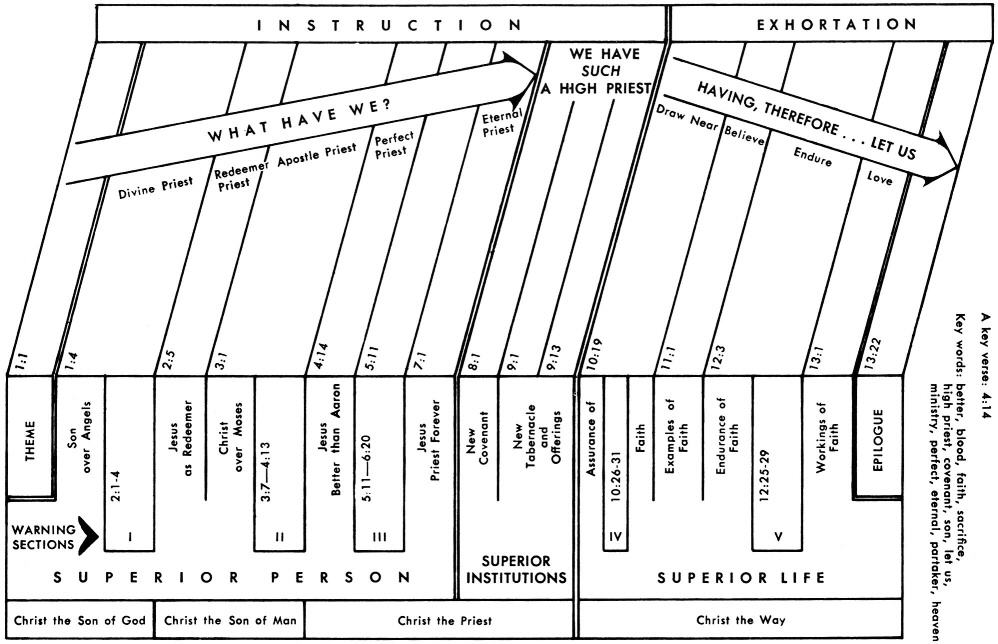
CONSIDER JESUS OUR GREAT HIGH PRIEST
Click chart to enlarge
Charts from Jensen's Survey of the NT - used by permission
Hebrews - Charles Swindoll
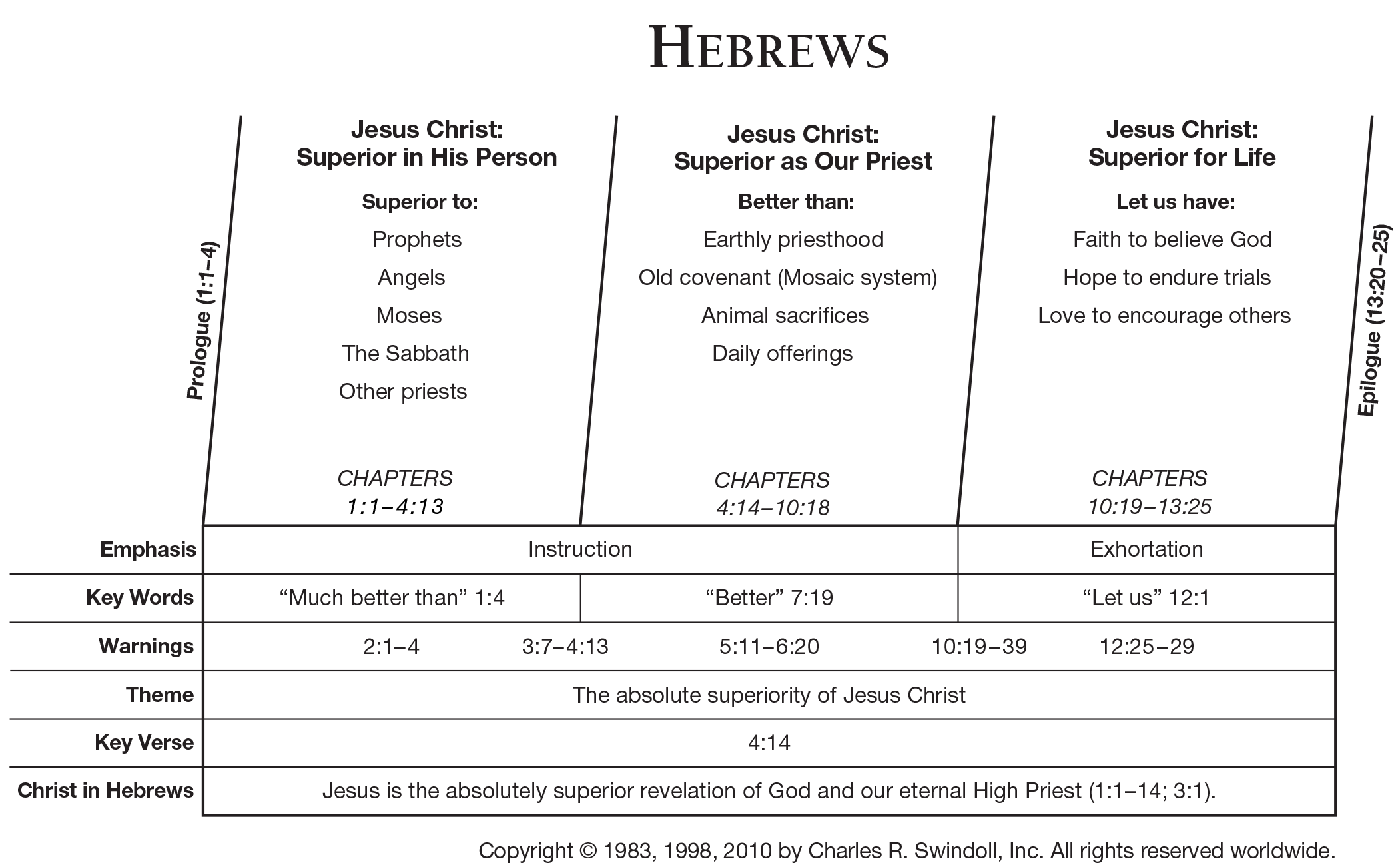
|
The Epistle |
||||
| INSTRUCTION Hebrews 1-10:18 |
EXHORTATION Hebrews 10:19-13:25 |
|||
| Superior Person of Christ Hebrews 1:1-4:13 |
Superior Priest in Christ Hebrews 4:14-10:18 |
Superior Life In Christ Hebrews 10:19-13:25 |
||
| BETTER THAN PERSON Hebrews 1:1-4:13 |
BETTER PRIESTHOOD Heb 4:14-7:28 |
BETTER COVENANT Heb 8:1-13 |
BETTER SACRIFICE Heb 9:1-10:18 |
BETTER LIFE |
| MAJESTY OF CHRIST |
MINISTRY OF CHRIST |
MINISTERS FOR CHRIST |
||
|
DOCTRINE |
DUTY |
|||
|
DATE WRITTEN: |
||||

See ESV Study Bible "Introduction to Hebrews"
(See also MacArthur's Introduction to Hebrews)
Borrow Ryrie Study Bible
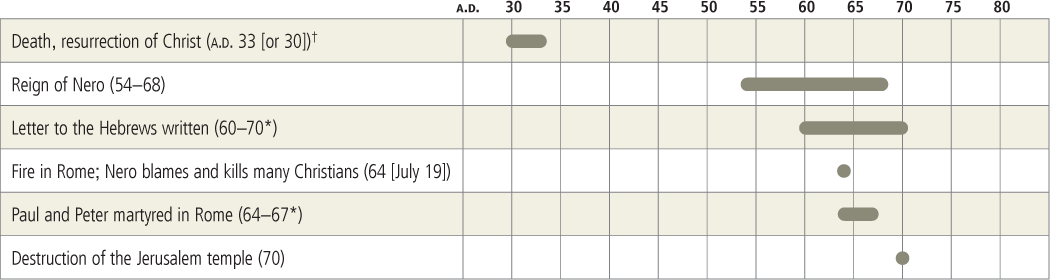
Timeline of Hebrews - ESV Study Bible
Hebrews 3:12 Take care, brethren, that there not be in any one of you an evil, unbelieving heart that falls away from the living God. (NASB: Lockman)
Greek: Blepete, (2PPAM) adelphoi, mepote estai (3SFMI) en tini humon kardia ponera apistias en to apostenai (AAN) apo theou zontos, (PAPMSG)
BGT Βλέπετε, ἀδελφοί, μήποτε ἔσται ἔν τινι ὑμῶν καρδία πονηρὰ ἀπιστίας ἐν τῷ ἀποστῆναι ἀπὸ θεοῦ ζῶντος,
Amplified: [Therefore beware] brethren, take care, lest there be in any one of you a wicked, unbelieving heart [which refuses to cleave to, trust in, and rely on Him], leading you to turn away and desert or stand aloof from the living God. (Amplified Bible - Lockman)
KJV: Take heed, brethren, lest there be in any of you an evil heart of unbelief, in departing from the living God.
NLT: Be careful then, dear brothers and sisters. Make sure that your own hearts are not evil and unbelieving, turning you away from the living God. (NLT - Tyndale House)
Phillips: You should therefore be most careful, my brothers, that there should not be in any of you that wickedness of heart which refuses to trust, and deserts the cause of the living God. (Phillips: Touchstone)
Weymouth: see to it, brethren, that there is never in any one of you—as perhaps there may be—a sinful and unbelieving heart, manifesting itself in revolt from the ever-living God.
Wuest: Take heed constantly, brethren, lest there be in any one of you a heart perniciously evil with unbelief in standing aloof from the living God
Young's Literal: Take care, brethren, lest there should be in any one of you an evil, unbelieving heart, in falling away from the living God.
NKJ Beware, brethren, lest there be in any of you an evil heart of unbelief in departing from the living God;
NET See to it, brothers and sisters, that none of you has an evil, unbelieving heart that forsakes the living God.
CSB Watch out, brothers, so that there won't be in any of you an evil, unbelieving heart that departs from the living God.
ESV Take care, brothers, lest there be in any of you an evil, unbelieving heart, leading you to fall away from the living God.
NIV See to it, brothers, that none of you has a sinful, unbelieving heart that turns away from the living God.
NLT Be careful then, dear brothers and sisters. Make sure that your own hearts are not evil and unbelieving, turning you away from the living God.
YLT See, brethren, lest there shall be in any of you an evil heart of unbelief in the falling away from the living God,
- Take care brethren - Heb 2:1-3; Heb 12:15; Mt 24:4; Mk 13:9,23,33; Lk 21:8; Ro 11:21; 1Co 10:12
- An evil, unbelieving heart: He 3:10 Ge 8:21 Jer 2:13 Jer 3:17 Jer 7:24 Jer 11:8 Jer 16:12 Jer 17:9 Jer 18:12 Mk 7:21-23
- In falling away from: He 10:38 12:25 Job 21:14 22:17 Ps 18:21 Pr 1:32 Isa 59:13 Jer 17:5 Ho 1:2
- The living God: 1Th 1:9
- Hebrews 3 Resources - Multiple Sermons and Commentaries
Related Passages:
Hebrews 12:15 See to it (episkopeo) that no one comes short of the grace of God; that no root of bitterness springing up causes trouble, and by it many be defiled;
Jeremiah 2:13 "For My people have committed two evils: They have forsaken Me, The fountain of living waters, To hew for themselves cisterns, Broken cisterns, That can hold no water.
Jeremiah 17:9 "The heart is more deceitful than all else And is desperately sick; Who can understand it?
Mark 7:21 "For from within, out of the heart of men, proceed the evil thoughts, fornications, thefts, murders, adulteries,22 deeds of coveting and wickedness, as well as deceit, sensuality, envy, slander, pride and foolishness.23 "All these evil things proceed from within and defile the man."
Hebrews 10:38 BUT MY RIGHTEOUS ONE SHALL LIVE BY FAITH; AND IF HE SHRINKS BACK, MY SOUL HAS NO PLEASURE IN HIM.
Hebrews 12:25 See to it that you do not refuse Him who is speaking. For if those did not escape when they refused him who warned them on earth, much less shall we escape who turn away from Him who warns from heaven.
1 Timothy 4:1 (WARNING ABOUT FALLING AWAY) But the Spirit explicitly says that in later times some will fall away (aphistemi) from the faith, paying attention to deceitful spirits and doctrines of demons
2 Corinthians 13:5 (AM I HOLDING FAST?) Test yourselves to see if you are in the faith; examine yourselves! Or do you not recognize this about yourselves, that Jesus Christ is in you–unless indeed you fail the test?
THE DANGER OF AN
UNBELIEVING HEART
The writer has just illustrated the tragedy and consequences of Israel's unbelief in the Old Testament (Heb 3:7-11) and now applies that truth and commands his readers to watch out and be careful that they do not commit the same sin of hearing the Gospel and hardening their hearts resulting in neglecting this great salvation and drifting back into dead religious works of Judaism.
As Paul wrote "Now these things happened (Heb 3:7-11) as examples for us, that we should not crave evil things, as they also craved… Now these things happened to them as an example, and they were written for our instruction, upon whom the ends of the ages have come." (1Cor 10:6, 11)
Paul adds "Therefore let him who thinks he stands take heed (Blepo - present imperative see our need to depend on the Holy Spirit to obey) that he does not fall." (1Co 10:12)
Take care (blepo), brethren (adelphos), that there not be in any one of you an evil (poneros), unbelieving (apistia) heart (kardia) that falls away (aphistemi) from the living God - Take care is in the present tense (continual action called for = make this the habit of your life) active voice (choice of your will = the writer cannot force or coerce them) and imperative mood (command not a suggestion). "Be seeing to it constantly, keep a watchful eye ever open.” See our need to depend on the Holy Spirit to obey this command (see Php 2:13NLT). Any one (tini) can also be rendered "someone" the point being that the writer is raising the possibility that there could be someone in his audience who is vulnerable to an evil, unbelieving heart. In other words, in his audience there may someone who is a professor of belief in Messiah, but who is not a genuine believer.
In addition, notice that brethren is not designated the same way as in Hebrews 3:1 where "holy brethren" is descriptive of genuine believers. In this group of "brethren" there might be an "any one" who was not a genuine believer. They would be shown to not be a true believer by subsequently falling away from the living God. A genuine believer would not fall away but in context would hold fast (Heb 3:6, 14)! False believers can and will fall away as Jesus warned declaring "Those on the rocky soil are those who, when they hear, receive the word with joy; and these have no firm root; they believe for a while, and in time of temptation (TESTING) fall away (aphistemi)." (Lk 8:13)
John MacArthur agrees that "Brethren is not a reference to Christians, as is "holy brethren" in Hebrews 3:1. It refers to racial brothers, unbelieving Jews, as the term does throughout the book of Acts. (See Commentary)
Many professing Christians today, if you ask them about their faith,
will tell you of their wonderful memory of their exodus,
but have nothing to say about their present day faith…for their faith is dead.
Brian Bell - Ray Stedman (see Hebrews commentary) says this well, “A relapse from Christianity into Judaism would be comparable to the action of the Israelites when they turned back in their hearts unto Egypt. It would not be a mere return to a position previously occupied, but a gesture of outright apostasy, a complete break with God.” They are like the professors in Mt.13:20-21 "The one on whom seed was sown on the rocky places, this is the man who hears the word and immediately receives it with joy; yet he has no firm root in himself, but is only temporary, and when affliction or persecution arises because of the word, immediately he falls away." Many professing Christians today, if you ask them about their faith, will tell you of their wonderful memory of their exodus, but have nothing to say about their present day faith…for their faith is dead.
"No good ever comes of carelessness.
He who never examines himself is sure to be self-deceived."
-- C H Spurgeon
The writer's command is an admonition to be continually on your guard against enemies both within and without. The ruin of others should be a warning to us to take heed. Israel's fall in the Old Testament should sound a continual clarion call to all who might be tempted to walk the same crooked path.
You may go to hell heedlessly,
but you cannot so go to heaven.
C H Spurgeon gives us all some sage comments on the command to take heed writing "that we are all of us called upon to take heed. The word (blepo) means that we are to be careful, to be watchful. True religion is not a thing that can be acquired by carelessness or neglect; we must take heed, or we shall never be found in the narrow way (Mt 7:13,14). You may go to hell heedlessly, but you cannot so go to heaven. Many stumble into the bottomless pit with their eyes shut, but no man ever yet entered into heaven by a leap in the dark. Take heed, brethren. If ever there was a matter that needed all your thought, all your prudence, and all your care, it is the matter of your soul’s salvation. If you do trifle with anything, let it be with your wealth, or with your health, but certainly not with your eternal interests. I recommend all men to take heed to everything that has to do with this life, as well as with that which is to come, for in the little the great may be concealed, and the neglect of our estate may end in mischief to our immortal spirit. Certainly, the neglect of the body might lead to great injury to the soul; but if ever neglect deserves condemnation, it is when it concerns our higher nature; if we do not carefully see to it, that which is our greatest glory may become our most tremendous curse. Brethren, the watchword for every one of us is, Take heed. You are an old Christian, but take heed. (ED: AT AGE 79 I CAN ATTEST THAT SPURGEON WHO DIED AT AGE 57 GIVES ALL OF US WISE ADVICE) You are a minister of the gospel, and there are many who look up to you with veneration; but take heed. You have learned the doctrines of grace, and you know them well; there is little that any human being can teach you, for you have been well instructed in the things of the kingdom; but, still, take heed. (ED: BELOVED, THERE WILL NEVER BE A SINGLE DAY OF YOUR LIFE THAT YOU CAN "TAKE THE DAY OFF" SPIRITUALLY BECAUSE YOUR ADVERSARY CONTINUALLY PROWLS AROUND - 1Pe 5:8). Ay, and if you were so near to Heaven's gate that you could hear the song within, I would still whisper in your ear, Take heed. Horses fall oftenest at the bottom of the hill when we, think that we need not hold them up any longer, and there is no condition in life which is more dangerous than that feeling of perfect security which precludes watchfulness and care.He who is quite sure of his strength to resist temptation may be also equally certain of his weakness in the hour of trial. God grant us grace, whatever sort of “brethren” we may be, to listen to the admonition of the apostle, “Take heed.” (The writer) means, not only take heed for yourself, — though that is the first duty of each one of us, for every man must bear his own burden, and it becomes every prudent man to look well to the matter of his own salvation; — but the (writer) says, “Take heed, brethren, lest there be in any of you an evil heart of unbelief.” You are to watch over your brethren, to exhort one another daily, especially you who are officers of the church, or who are elderly and experienced. Be upon the watch lest any of your brethren in the church should gradually backslide, or lest any in the congregation should harden into a condition of settled unbelief, and perish in their sin. He who bids you take heed to yourself, would not have you settle down into a selfish care for yourself alone, lest you should become like Cain, who even dared to say to the Lord himself, “Am I my brother’s keeper?” Nothing can be more horrible than the state of mind of a man whose talk is like to that of Cain, who slew his brother. “Take heed,” therefore, ye who are in the Church of God, not only to yourselves, but to those who are round about you, especially to such as are of your own family. (Sermon - Take Heed, Brethren)
Truth is not productive
if we don't act upon it
J C Ryle in his classic must read Thoughts for Young Men (also applicable to OLD men!) writes "Young men run into sin, and then say, "I did not think about it--it did not look like sin." Not look like sin! Would we expect sin to come to us saying, "I am sin". How much easier to avoid if it were so obvious. One problem is that sin usually seems "good, and pleasant, and desirable" when it is being committed. But as the wisest man of the Old Testament warned (BUT WHO HIMSELF FAILED TO HEED HIS OWN WISDOM AND THUS FELL - see below 1Ki 11:1-12)…"Watch the path of your feet, and all your ways will be established." (Pr 4:26) But truth is not productive if we don't act upon it, which is what even the writer Solomon failed to do as shown in the tale of his tragic downfall in first Kings…
Now King Solomon loved many foreign women along with the daughter of Pharaoh: Moabite, Ammonite, Edomite, Sidonian, and Hittite women, 2 from the nations concerning which the LORD had said to the sons of Israel, "You shall not associate with them, neither shall they associate with you, for they will surely turn your heart away after their gods." Solomon held fast to these in love. 3 And he had seven hundred wives, princesses, and three hundred concubines, and his wives turned his heart away.4 For it came about when Solomon was old, his wives turned his heart away after other gods; and his heart was not wholly devoted to the LORD his God, as the heart of David his father had been. 5 For Solomon went after Ashtoreth the goddess of the Sidonians and after Milcom the detestable idol of the Ammonites. 6 And Solomon did what was evil in the sight of the LORD, and did not follow the LORD fully, as David his father had done). (Read 1 Kings 11:1-12)
H. W. Montefiore says: Our author regards this danger not as a remote possibility, but as a present peril. He is not content with general exhortation, but he is concerned lest a single member of his flock should lapse
WARNING TO ANYONE
WITH AN EVIL HEART
That there not (mepote) be (estai - future tense ~ "will not be") in any one (someone) of you an evil (poneros = actively evil), unbelieving (apistia - not trusting) heart (kardia) that falls away (aphistemi) from the living God - Having reminded his readers of the defection of the wilderness generation in Heb 3:7-11, the writer proceeds to warn them against the danger of committing a similar sin of falling away. The Greek construction indicates that the writer has a fear that the thing spoken of (falls away) might occur which is why he emphasized the need to take the warning seriously.
In context, the idea of any one means someone, a certain one whom the writer cannot or does not wish to name. They have heard the Gospel, but they may have an "evil heart of unbelief" (Heb 3:12YLT). Their hearts were like the "rocky soil" in Lk 8:13 on who may have professed belief having received "the word with joy; and these have no firm root; they believe for a while, and in time of temptation fall away (aphistemi)." (Luke 8:13) Jesus says they fall away because the seed of the Word of God failed to take root and so they were never genuine believers.
John MacArthur adds that "These readers were informed about the gospel. Many, perhaps, professed to be Christians. None considered himself to be actively, aggressively against Christ; but they all were against Him. No matter how close a person may be to accepting Jesus Christ as Savior, if he never comes to Him, he still has an evil, unbelieving heart. His punishment will be all the more severe because of his knowledge of the living God. If such "have fallen away, it is impossible to renew them again to repentance" (Heb. 6:6). When you have heard the truth of Jesus Christ, when you have acknowledged that it is the truth, and then turn your back and walk away from Him, there is nothing God can do. Once you have heard the gospel and understood its claims, and then say no to Jesus Christ, you have fallen away. You have become apostate.The Holy Spirit is saying to everyone who hears the gospel: "Respond to Jesus while your heart is still warmed and softened by His truth, while it is still sensitive. Respond to His sweet love and His call of grace. Wait too long and you will find your heart getting hard and insensitive. The decision will become harder and harder as your heart becomes harder and harder. If you continue to follow your evil, unbelieving heart rather than the gospel, you will forever depart from the living God, and forfeit salvation rest. (See Commentary)
William Newell on unbelieving - “Unbelief is not inability to understand, but unwillingness to trust . . . it is the will, not the intelligence, that is involved.”
Unbelief is not intellectual; it is moral.
It doesn’t come out of the head; it comes out of the heart.
-- Adrian Rogers (When Your Fail Fails - page 510)
J Oswald Sanders points out that "There is a world of difference between “an evil heart of unbelief” (Hebrews 3:12 KJV) and the doubts of one who is weak in faith, between arrogant unbelief and the sensitive questioning of an earnest but hesitant heart. The doubting of the latter is a regrettable infirmity, but that of the former is an affront to God. (See Dealing with Doubt)
David Guzik - One can truly believe God, yet be occasionally troubled by doubts. There is a doubt that wants God’s promise but is weak in faith at the moment. Unbelief (ED: AS DESCRIBED IN THIS VERSE) isn’t weakness of faith; it sets itself in opposition to faith.
Kenneth Wuest says the evil (poneros), unbelieving (apistia) heart (kardia) "of which the writer speaks, and which he suspects is found in some ("any one") of his readers, is a heart in which the evil of unbelief is present, not in a passive or latent state, but in an active, pernicious condition (ED: poneros speaks of actively evil!). The attitude of these Hebrews toward the New Testament was not one of a passive neglect, but one of an active opposition, and was an attitude the writer was afraid would result in a deliberate and final rejection of the New Testament.
NOTE: There is an important, even critical difference between a heart in which unbelief is present, and an unbelieving heart. True believers can have some elements of unbelief in their heart (YOUR AUTHOR INCLUDES HIMSELF IN THIS GROUP) but do not have an unbelieving heart which describes a person who is not born again. The person who has an unbelieving heart is solely and entirely controlled by unbelief and there is no faith whatever. If some of the Hebrews had this kind of heart they were not saved. They may have given intellectual assent acknowledging that Jesus was the Messiah but they had not truly believed in their heart (cf Ro 10:9,10).
Spurgeon adds that "Even in God’s people there is a measure of unbelief and deafness of ear. Even God’s children do not hear their Father’s voice so readily as they should. We are sometimes so taken up with other things that God speaks again and again, and we do not regard Him. The still small voice of His love is too apt to be altogether unheeded while the thunders of this world’s traffic fill our ears." (From Spurgeon's powerful sermon "To-day! To-day! To-day!")
Kenneth Wuest comments that the writer of Hebrews "fears lest some (ED: "ANY ONE OF YOU") should come short of rest in Christ and die in their sins as the generation that came out of Egypt came short of rest in Canaan and died a physical death in the wilderness because they did not appropriate the land by faith (Heb 4:1, 2). (ED: I WOULD ADD THEY DID NOT APPROPRIATE THE GOOD NEWS!" Therefore he appeals to them to go on to faith in Messiah. He appeals to them to be followers of those who through faith and patience inherit the promises (Heb 6:12). When one exhorts someone to do something, it is clear evidence that the latter is not doing that which is exhorted. These Jews, while making a profession, had no faith, and under the pressure of persecution, were in danger of renouncing the intellectual assent which they gave to the New Testament and returning to the First Testament (Heb 10:23, 32, 33, 34). The writer urges them to place their faith in the New Testament High Priest (Heb 10:19, 20), using First Testament typology....The writer exhorts the first century Jew to enter, not the Holy of Holies of the temple on earth, but the Holy of Holies of heaven, and in the same way, in the Person of the new High Priest, by a freshly slain (new) and living way (Heb 10:20), and to do so in the faith which brings full assurance of salvation, a faith they did not have. He warns them against drawing back from (aphistemi) their profession of faith in Christ to perdition, and urges them on to faith in this same Christ, with the result that their souls will be saved (Heb 10:38, 39). Finally, he devotes chapter eleven to an argument based upon Old Testament scripture, that faith is the way of salvation, urging them to look off and away to Jesus in faith, a thing they were not doing (Heb 12:1, 2). Thus, the purpose of the writer was to reach the professing Jews who outwardly had left the temple sacrifices, and had identified themselves with those groups of people who were gathering around an unseen Messiah, the High Priest of the New Testament system who had at the Cross fulfilled the First Testament system of typical sacrifices. These unsaved Jews were under the stress of persecution, and in danger of renouncing their profession and returning to the abrogated sacrifices of the Levitical system (Heb 10:32, 33, 34). (Untranslatable Riches from the Greek New Testament: p.47-48)
Spurgeon on an unbelieving heart - That is the thing that provokes God—unbelief. Not so much the unbelief of the head as the unbelief of the heart, when the heart will not yield to the plan of salvation, when men want to be saved by their own works, or else are indifferent altogether about whether they are saved or not. It is heart-unbelief that damns men. It is heart-faith that is the means of salvation. “With the heart one believes, resulting in righteousness” (Rom 10:10), but heart-unbelief leads to, and seals, his ruin.
🙏 THOUGHT - What fills your heart as you read these notes? You can know by what has come out of your mouth over the past few days. Remember that "the good man out of the good treasure of his heart brings forth what is good (agathos)" (Luke 6:45) See also Proverbs 4:23 How to Guard Your Heart!
Your unbelief is your fault, not your misfortune.
It is a disease, but it is also a crime
Spurgeon - “Hearken, O unbeliever, you have said, ‘I cannot believe,’ but it would be more honest if you had said, ‘I will not believe.’ The mischief lies there. Your unbelief is your fault, not your misfortune. It is a disease, but it is also a crime: it is a terrible source of misery to you, but it is justly so, for it is an atrocious offense against the God of truth.”.....“Did I not hear someone say, ‘Ah, sir, I have been trying to believe for years.’ Terrible words! They make the case still worse. Imagine that after I had made a statement, a man should declare that he did not believe me, in fact, he could not believe me though he would like to do so. I should feel aggrieved certainly; but it would make matters worse if he added, ‘In fact I have been for years trying to believe you, and I cannot do it.’ What does he mean by that? What can he mean but that I am so incorrigibly false, and such a confirmed liar, that though he would like to give me some credit, he really cannot do it? With all the effort he can make in my favour, he finds it quite beyond his power to believe me? Now, a man who says, ‘I have been trying to believe in God,’ in reality says just that with regard to the Most High!”
FALLING AWAY FROM
THE LIVING GOD
That falls away (aphistemi) from (apo ~ separation from, motion away from) the living (zao in present tense - continually living) God (theos) - If any one (someone) had an evil, unbelieving heart they would fall away. And to reiterate, falls away (aphistemi) does not mean that at one time they belonged to God and now they no longer belong to Him, but that they never belonged to Him. The writer is not teaching Arminianism, which is the false teaching that believers can lose their salvation. Falls away is aorist tense (describes a completed action) and active voice, which means this person makes a choice of their will, a volitional choice to depart, to turn away, to apostatsize from the living God! Such a choice will lead to eternal regret as this person will suffer eternal punishment!
Vincent explains that departure from the living God is "The characteristic of unbelief. Faith is personal union with God. Unbelief separates from God."
Matthew Henry - An evil heart of unbelief is at the bottom of all our sinful departures from God; it is a leading step to apostasy; if once we allow ourselves to distrust God, we may soon desert him.
Kenneth Wuest comments on falling away (aphistemi) from (apo) apparently the position of some (cf "any one") of "these Hebrews. They were standing aloof from the living God....Our word “apostasy” is derived from a form of this Greek word. Apostasy is defined as the act of someone who has previously subscribed to a certain belief, and who now renounces his former professed belief in favor of some other which is diametrically opposed to what he believed before. In other words, his new belief is not merely a new system of faith, but one which at every point negates his former belief. These Jews, should they renounce their professed faith in the New Testament system and go back to the First Testament sacrifices, would be embracing that which if brought in again would negate the New Testament. It was a question of the Levitical sacrifices or the crucified Messiah. (ED: A QUESTION OF THE "SHADOW" OR THE "SUBSTANCE" - Col 2:17) In making a profession of Messiah as High Priest and then renouncing that professed faith to return to a dependence upon the sacrifices which God set aside at the Cross, the person would commit the sin called apostasy (see also Apostasy). (Hebrews)
F F Bruce has an important insight commenting that "a relapse from Christianity into Judaism would be comparable to the action of the Israelites when they ‘turned back in their hearts unto Egypt’ (Acts 7:39); it would not be a mere return to a position previously occupied, but a gesture of outright apostasy, a complete break with God” Living God is a common phrase in the O.T. and the N.T. for God as opposed to lifeless idols."
Jack Arnold on falling away (aphistemi) from (apo) - Notice carefully that the Hebrew-Christians were not warned of any danger of falling away from denominationalism but from the living God. Apostasy is falling away from Christ, the living God, who alone is salvation. Christians might change their church affiliations from Baptist to Methodist or Presbyterian because of doctrinal convictions concerning the whole counsel of God, but apostasy is a complete denial of the living God. This is not talking about falling into sin, for all Christians still at times sin, but it is falling away from a person, the living God. True Christians may have at times a heart where there is unbelief but they cannot have an unbelieving heart. A true Christian may have lapses of faith and even flirt with apostasy but he cannot apostatize. However, a professing Christian is characterized by unbelief and is a likely candidate for apostasy.
Take care (991) (blepo) means perceive with your eyes. Have your eye on this truth so as to beware of. The idea is to be constantly observing with a view to avoiding or constantly looking at in the sense of continuing to be wary. Here is the idea of this charge - Keep a watchful eye ever upon. Be seeing to it constantly, keep a watchful eye ever open.
BLEPO - 132x in NT - Matt. 5:28; 6:4, 6, 18; 7:3; 11:4; 12:22; 13:13f, 16f; 14:30; 15:31; 18:10; 22:16; 24:2, 4; Mk. 4:12, 24; 5:31; 8:15, 18, 23f; 12:14, 38; 13:2, 5, 9, 23, 33; Lk. 6:41f; 7:21, 44; 8:10, 16, 18; 9:62; 10:23f; 11:33; 21:8, 30; 24:12; Jn. 1:29; 5:19; 9:7, 15, 19, 21, 25, 39, 41; 11:9; 13:22; 20:1, 5; 21:9, 20; Acts 1:9; 2:33; 3:4; 4:14; 8:6; 9:8f; 12:9; 13:11, 40; 27:12; 28:26; Rom. 7:23; 8:24f; 11:8, 10; 1 Co. 1:26; 3:10; 8:9; 10:12, 18; 13:12; 16:10; 2 Co. 4:18; 7:8; 10:7; 12:6; Gal. 5:15; Eph. 5:15; Phil. 3:2; Col. 2:5, 8; 4:17; Heb. 2:9; 3:12, 19; 10:25; 11:1, 3, 7; 12:25; Jas. 2:22; 2 Jn. 1:8; Rev. 1:11f; 3:18; 5:3f; 9:20; 11:9; 16:15; 17:8; 18:9, 18; 22:8
Blepo is clearly a key word in the epistle to the Hebrews occurring 8 times in 13 chapters…
Hebrews 2:9 But we do see Him who was made for a little while lower than the angels, namely, Jesus, because of the suffering of death crowned with glory and honor, so that by the grace of God He might taste death for everyone.
Hebrews 3:12 Take care (present imperative), brethren, that there not be in any one of you an evil, unbelieving heart that falls away from the living God.
Hebrews 3:19 So we see that they were not able to enter because of unbelief.
Hebrews 10:25 not forsaking our own assembling together, as is the habit of some, but encouraging one another; and all the more as you see the day drawing near.
Hebrews 11:1 Now faith is the assurance of things hoped for, the conviction of things not seen.
Hebrews 11:3 By faith we understand that the worlds were prepared by the word of God, so that what is seen was not made out of things which are visible.
Hebrews 11:7 By faith Noah, being warned by God about things not yet seen, in reverence prepared an ark for the salvation of his household, by which he condemned the world, and became an heir of the righteousness which is according to faith.
Hebrews 12:25 See to it (present imperative) that you do not refuse Him who is speaking. For if those did not escape when they refused him who warned them on earth, much less will we escape who turn away from Him who warns from heaven.
Evil (4190) (poneros from pónos = labor, sorrow, pain) (see related word poneria) refers to evil and means active evil in opposition to good. When Satan is referred to as the "Evil One", the NT writers chose poneros rather than kakos, this latter word basically denoting a lack of something (it is not as it ought to be and thus is bad) but also used to refer evil in a moral sense.
PONEROS - 78x in NT - (Note repetition by Jesus in His Sermon on Mount) Matt. 5:11, 37, 39, 45; 6:13, 23; 7:11, 17f; 9:4; 12:34f, 39, 45; 13:19, 38, 49; 15:19; 16:4; 18:32; 20:15; 22:10; 25:26; Mk. 7:22f; Lk. 3:19; 6:22, 35, 45; 7:21; 8:2; 11:13, 26, 29, 34; 19:22; Jn. 3:19; 7:7; 17:15; Acts 17:5; 18:14; 19:12f, 15f; 25:18; 28:21; Rom. 12:9; 1 Co. 5:13; Gal. 1:4; Eph. 5:16; 6:13, 16; Col. 1:21; 1 Thess. 5:22; 2 Thess. 3:2f; 1 Tim. 6:4; 2 Tim. 3:13; 4:18; Heb. 3:12; 10:22; Jas. 2:4; 4:16; 1 Jn. 2:13f; 3:12; 5:18f; 2 Jn. 1:11; 3 Jn. 1:10; Rev. 16:2
Evil in the abstract is kakos, but poneros is used in this passage to indicate an evil which actively harmful and hurtful and actively opposed to good.
Hiebert adds that poneros "is a strong term and is properly distinguished from kakos. The latter term points to the base nature of a thing; its lack of those qualities and conditions that would makes it worthy of the claim that it makes. The former term is active and denotes that which is destructive, injurious, and evil in its effect." It is malignant evil, blasting and destroying what it touches. It includes the doctrinal as well as the moral.
Stated another way the kakos man may be content to perish in his own corruption, but the poneros man is not content unless he is corrupting others as well, and dragging them down into the same destruction with himself. The English word which best translates this Greek word is “pernicious.”
Paul uses poneros in Galatians writing of the Lord Jesus Christ "Who gave Himself for (~ His substitutionary atonement) our sins, that He might deliver (rescue out of) us out of this present evil (poneros) age ("world order"), according to the will of our God and Father." (Galatians 1:4-)
Unbelieving (570)(apistia from a = without + pistos = believing, faithful) is literally "not believing" and thus describes a lack of faith (unfaithfulness). It describes an unwillingness to commit oneself to another or respond positively to the other’s words or actions.
APISTIAa - 11x in NT - Matt. 13:58; Mk. 6:6; 9:24; 16:14; Rom. 3:3; 4:20; 11:20, 23; 1 Tim. 1:13; Heb. 3:12, 19
Heart (2588)(kardia) in the NT does not refer to the physical organ that pumps blood but always refers (figuratively) to the seat and center of human life. The heart is the center of one's personality, and as such it controls one's intellect, emotions, and will. If one has a believing heart, such a heart is the wellspring of this person's spiritual life. You do what you do because you believe what you believe in your heart. As Jesus taught "the mouth speaks out of that which fills the heart" (Mt 12:34)..
HEART - a key word in Hebrews 3-4 - Heb 3:8, 10, 12, 14 Heb 4:7, 12 - Six of the ten uses are in these two chapters! Why would this be the case? Other uses = Heb 8:10, 10:16, 10:22, 13:9.
Falling away from (868) (aphistemi from apo = separation of one thing from another + histemi = stand) literally means to stand off from (English = apostasy), to withdraw, forsake, depart from or remove oneself from.
APHISTEMI - 14x in NT -Lk. 2:37; 4:13; 8:13; 13:27; Acts 5:37f; 12:10; 15:38; 19:9; 22:29; 2 Co. 12:8; 1 Tim. 4:1; 2 Tim. 2:19; Heb. 3:12
Not (3379) mepote from me, (not) and pote, (at some time); Friberg says mepote is "used as a negative particle in similar types of constructions as mh, (q.v.); (1) with the indicative to reinforce negative time never, at no time (Heb 9.17); (2) predominately as a conjunction as an emphatic form of me,; (a) after verbs of fearing and warning lest (at any time), for fear that (Lk 21.34); (b) expressing anxiety about the future in negative purpose clauses in order that not (at all), lest (Mt 4.6); (3) as an interrogative particle expressing a measure of doubt or uncertainty whether perhaps (Lk 3.15); (4) as introducing a guess in a weakened negative perhaps, probably (Mt 25.9) (Borrow Analytical Lexicon of the Greek New Testament)
Gilbrant - Classical Greek and Septuagint Usage - Mēpote is formed from two words, mē (3231), “not,” and pote (4077), “at any time.” The meaning of these two words combined is the expression of a negative wish, command, condition, or question that covers a general amount of time, area, or persons. It occurs in literature prior to the New Testament as an adverb meaning “never” or as a conjunction meaning “lest ever” (Liddell-Scott). It is used especially in oaths and can also be found in prohibitions or warnings (ibid.). The compound mēpote does not appear in the Septuagint, however, mēpote does occur frequently as a conjunction indicating purpose (Bauer; cf. Genesis 38:23; Ezra 4:22 [ LXX 2 Esdras 4:22]). Sometimes it can also mean simply “perhaps” in the sense of something less than definite (Genesis 24:5; cf. Liddell-Scott). New Testament Usage - Mēpote occurs 25 times in the New Testament. Seventeen of these are in Matthew and Luke. It occurs 13 times with a command and is used as a general negation, e.g., Hebrews 9:17. In Matthew 5:25 it comes between a command and a qualifying expression about that which preceded: “Agree with thine adversary quickly,...lest at any time the adversary deliver thee to the judge.” It is also used as a prohibition reflecting the purpose of an action, e.g., Luke 12:58. In addition it is used with questions that express doubt about the outcome, e.g., John 7:26. (Complete Biblical Library)
MEPOTE - 25V- Matt. 4:6; Matt. 5:25; Matt. 7:6; Matt. 13:15; Matt. 13:29; Matt. 15:32; Matt. 25:9; Matt. 27:64; Mk. 4:12; Mk. 14:2; Lk. 3:15; Lk. 4:11; Lk. 12:58; Lk. 14:8; Lk. 14:12; Lk. 14:29; Lk. 21:34; Jn. 7:26; Acts 5:39; Acts 28:27; 2 Tim. 2:25; Heb. 2:1; Heb. 3:12; Heb. 4:1; Heb. 9:17
USES OF MEPOTE IN SEPTUAGINT - Gen. 3:22; Gen. 19:17; Gen. 20:2; Gen. 24:5; Gen. 24:39; Gen. 26:7; Gen. 26:9; Gen. 27:12; Gen. 27:45; Gen. 31:24; Gen. 31:29; Gen. 31:31; Gen. 32:11; Gen. 38:11; Gen. 38:23; Gen. 42:4; Gen. 43:12; Gen. 47:18; Gen. 50:15; Exod. 1:10; Exod. 5:3; Exod. 13:17; Exod. 19:21; Exod. 19:22; Exod. 19:24; Exod. 20:19; Exod. 32:12; Exod. 34:12; Exod. 34:15; Num. 16:34; Jos. 6:18; Jdg. 3:24; Jdg. 7:2; Jdg. 9:54; Jdg. 14:15; Jdg. 15:12; Jdg. 18:25; Ruth 4:6; 1 Sam. 4:9; 1 Sam. 23:22; 2 Sam. 1:20; 2 Sam. 17:16; 2 Sam. 20:6; 1 Ki. 18:27; 2 Ki. 2:16; Ezr. 4:22; Ezr. 6:8; Ezr. 7:23; Neh. 6:3; Job 1:5; Ps. 2:12; Ps. 7:2; Ps. 13:3; Ps. 13:4; Ps. 28:1; Ps. 38:16; Ps. 50:22; Ps. 59:11; Ps. 79:10; Ps. 91:12; Ps. 115:2; Ps. 140:8; Prov. 22:25; Prov. 23:9; Prov. 25:16; Prov. 25:17; Prov. 30:10; Eccl. 7:16; Cant. 1:7; Isa. 6:10; Isa. 8:12;
Spurgeon writes that "THIS message is not addressed to strangers far away, but to brethren. Paul wrote it to the Hebrews, who were his brethren according to the flesh; it was kind of him to call them by that name. He also, writes it to all of us who are believers in Christ, and we ought to receive his word with all the greater intensity of attention because he writes to us as his brethren. The term applies to all who are brethren in Christ, — really so, — those who are quickened by the one Spirit, made children of the one Father, and going to the one heavenly home. The apostle would not have us begrudge this title to any genuine member of our Lord Jesus Christ’s true Church. It is not for us to read men’s hearts; we have not the Lamb’s Book of Life in our possession, so we cannot discover whether such-and-such a man’s name is really written in it, or not; but, in the judgment of Christian charity, all those who have joined themselves to Christ’s Church are our brethren, and the more we recognize that relationship, the better. To all of you, therefore, who bear the Christian name, this message comes with power, “Take heed, brethren, lest there be in any of you an evil heart of unbelief, in departing from the living God.”
There are other persons, who are associated with us in our congregations, who do not profess as yet to have passed from death unto life, although they come up with us to the house of the Lord. They swell the chorus of our praise, they bow their heads with us in prayer, they are in many respects our fellow-worshippers, and they have, apparently, a warm heart towards good things, though not yet fully one with us in the highest spiritual sense. We will not exclude them from this message, for they are our brethren as men, even if they are not our brethren as Christians, and the word comes to them as well as to us who are avowedly on the Lord’s side, “Take heed, brethren, lest there be in any of you an evil heart of unbelief.” (Take Heed, Brethren - Pdf)
Spurgeon addresses genuine believers (dearly beloved, this note is long but is worth reading) who can experience varying degrees of unbelief writing
dear friend, even you may fall into unbelief. Are you not aware of that fact? Have you not been already tormented with it? I daresay, like myself, you did at one time indulge the idea that old Incredulity would soon die. You took him by the heels, and you put him in the stocks, and you said to yourself,
“He will never trouble me again; I shall never doubt the promise of God any more as long as I live. I have had such a wonderful experience of God’s faithfulness, he has been so exceedingly gracious to me, that I cannot doubt him any more.”
You remember how Mr. Bunyan says, in Holy War, that, after the enemies of King Shaddai had been sentenced to death,
“One of the prisoners, Incredulity by name, in the interim betwixt the sentence and time of execution, brake prison, and made his escape, and gets him away quite out of the town of Mansoul, and lay lurking in such places and holds as he might, until he should again have opportunity to do the town of Mansoul a mischief for their thus handling of him as they did.”
Incredulity will work his wicked will upon you if he can, and you must ever remember that it is possible even for you to fall into unbelief, — you who are rejoicing, you who have hung out all your flags, and are keeping high festival, — oh, tell it not in Gath! — even you may yet be found doubting your God. May the Lord grant that you may be delivered from this evil! But it is only almighty grace which can keep you with faith pure and simple, and free from any tincture of doubt and unbelief.
Pressure of circumstances may drive you into an unbelieving state of mind. Depression of soul, due to physical causes, may do it; the spirit often truly is willing and believing, but the flesh is weak, and it may pull you down. Association with doubters may have a similar effect. Conflict for the truth may make you familiar with the poisoned arrows of skeptics, and in attempting to do them good you may imbibe mischief from them.
The Lord will preserve you from the positive, stark, black Egyptian darkness of unbelief; but there are other grades and degrees of it which you may have to endure. It is bad for a Christian to have any admixture of darkness with his light, and to have any measure of doubt mingled with his faith; yet it may be so, and therefore the Spirit of God says to the people of God, “Take heed, lest there be in any of you an evil heart of unbelief, in departing from the living God.”
Note, next, that in proportion as unbelief does get into your heart, you will be in to depart from the living God. I am not speaking now of open glaring sin; you have not fallen into that, and I pray God that you never may. But, beloved, we may have all the decencies of morality, and all the proprieties of Christian conduct, and yet we may be all the while “departing from the living God.” The moment we begin to trust in man, and to make flesh our arm, we have to that extent forgotten Jehovah, and departed from the living God. The moment our heart’s deepest affections twine about the dearest creature, — be it husband, or wife, or child, — we are to that degree “departing from the living God.” To the true believer, in his best estate, the sweetest line that he can ever sing, is that which we sang just now, —
“Yea, mine own God is He.”
That is the circle which surrounds all his joy; it is the center of his soul’s highest delight. He has God for his very own. On his God he relies, and towards him he sends out the full streams of his earnest affection.
Remember what the Lord wrote by the pen of the prophet Jeremiah:
“Cursed be the man that trusteth in man: and maketh flesh his arm, and whose heart departeth from the Lord. For he shall be like the heath in the desert, and shall not see when good cometh; but shall inhabit the parched places in the wilderness, in a salt land and not inhabited. Blessed is the man that trusteth in the Lord, and whose hope the Lord is. For he shall be as a tree planted by the waters, and that spreadeth out her roots by the river, and shall not see when heat cometh, but her leaf shall be green; and shall not be careful in the year of drought, neither shall cease from yielding fruit:”
Brothers, it is easy to depart from the living God spiritually, — gradually to lose that serene and heavenly frame which is our highest privilege, to forget Him Who ought ever to be before our eyes as the chief factor in our entire life, the great All-in-all, compared with Whom everything else is but as a dream, a fleeting shadow.
I bear my witness that, to walk with the living God, is life; but to get away from Him, is death; and that, in proportion as we begin to depart and put a distance between ourselves and the great Invisible, in that proportion our life ebbs away, and we get to be sickly, and scarcely alive. Then doubts arise as to whether we are the people of God at all; and it is sad that such a question as that should ever be possible.
We ought to live like the angel whom Milton pictures as living in the sun, — in the very center of the orb of light, — so near to God that we do not merely sometimes enjoy His presence, but that in Him we live altogether, and never depart from Him. I remember a minister calling upon a poor old saint, and before coming away he said he hoped that the Divine Father would constantly visit the sick man; but he replied,
“O sir, I do not want you to ask that the Father should merely visit me, for by these many months together He has been abiding with me, and I have been abiding in Him.”
So may it be with each one of you, my brethren; and that it may be so, give attention to the message of the text: “Take heed, brethren, lest there be in any of you an evil heart of unbelief, in departing “ — in any measure or degree — “from the living God.”
“But,” say you, “wherefore should we take such heed about that matter? We are believers, and, therefore, we are saved.” Are you believers? They who can trifle with heavenly things are not true believers in the Lord Jesus Christ; and if ever it becomes a thing of small importance to you whether you dwell with the living God, or not, the question may well arise in your heart,
“Am I truly a believer in Jesus Christ with the faith of God’s elect, — the faith that really saves the soul?”
But, my brethren, if you do not continue steadfast and firm in your faith in its simplicity, if your evil heart of unbelief begins to prevail, and you are turned aside from your confidence in Christ, and so begin to get away from God, you will be great losers thereby even if you do manage to get to heaven, “saved, yet so as by fire.”
YOU WILL LOSE YOUR JOY
For, first, you will lose your joy. That is no small thing. “The joy of the Lord is your strength.” The joy of the Lord is one of the means by which you are to be made useful. The joy of the Lord sweetens trial, lightens care, and turns service into delight but if you lose that joy, you are as one who travels alone in the dark, and who stumbles and falls. I pray you, do not depart from the living God in any degree, for if you do so, your joy will begin to get clouded, the brightness and the warmth of it will be taken from you, and you will become faint-hearted, trembling, timorous, and sad. If the evil heart of unbelief shall prevail against you, depend upon it you will lose your joy.
YOU WILL LOSE YOUR ASSURANCE
Then you may be certain, also, that you will lose your assurance. Full assurance cannot exist with unholiness. One has well said,
“If thine assurance doth not make thee leave off sinning, thy sinning will make thee leave off enjoying assurance;”
and I am sure that it is so. If we begin to look to second causes, and do not trust in God, we shall then put forth our hand to some one sin or another; and when we do that, we cannot be certain that we are children of God at all.
That man who feels sure of his safety, and yet can play with sin, and find pleasure in it, may be assured of his own damnation.
I remember, in my boyhood, one, who never talked so religiously as when he was the worse for drink; and in public, before ungodly men, he used to boast of his full assurance of salvation, when he was much too far gone to be assured that he would get home in safety that night. That kind of conduct is atrocious, and no one would excuse it for a moment; we know that men who talk so only proclaim their own shame to their own eternal disgrace. But do not let any of us indulge even in a measure of that kind of sin. That, evil heart of unbelief will not only lead us away from a holy walk with God, but it will also take from us our assurance if it is an assurance that is worth, the having.
YOU WILL LOSE YOUR FRUITFULNESS
Then, next, it will take from us our fruitfulness. Dear child of God, I am sure that you do not wish to live here without doing good to others; but how can you do good if you are not yourself good?
You cannot bring forth fruit unto holiness unless you are watered with the dew of heaven, and the sunlight of God shines upon you; and you will not have either of those blessings if you live carelessy, and if you fall into an unbelieving state of mind, and get away from contact with the everliving God.
If any of you have tried this kind of life, you must have become painfully aware what it is to have all the sap and. juice, out of which the clusters ought to come, dried up within the tree, and everything turned to barrenness because you have yourself departed from God.
YOU WILL LOSE PURITY
These are all serious losses to a child of God; it is no light matter for you to lose joy, and assurance, and fruitfulness; but the evil heart of unbelief will cause you also to lose purity. There is a delicate bloom upon the fruit that grows in Christ’s garden, where He, as the Gardener, cultivates it with tender care; but sin comes, and rubs away that bloom, and spoils the fruit. If you and I fall into sin, we shall have to weep bitterly over it; we shall not be able to enjoy the high privilege which belongs to those who keep their garments unspotted from the world. Of these the Savior says, “They shall walk with me in white: for they are worthy.”
I believe that, of all fortes of spiritual loss, one of the worst is to lose tenderness of conscience, quickness of apprehension when sin is near, — to lose a sense of cleanness of heard.; and of sanctification by the Spirit of God.
When those are gone, we are something like Adam when he lost Paradise, and we turn our faces back again toward that purity, and cry to the Lord to restore it, as we moan rather than sing, —
“Where is the blessedness I knew
When first I saw the Lord?”
Take care that you do not lose it, for it will hardly be likely to be restored to you in the same degree as you had it at the first.
The child of God who wanders away also loses peace, and many other attainments of the spiritual life. He is like a boy who is sent down from the top of the class; it may take him a long time to get up again. Or he is like the man who has risen from the ranks, but who has misbehaved himself, and is therefore made a private again. He who once could lead the people of God has to be very thankful that he is permitted to go into the rear rank, and to follow where others lead, he who could talk for God boldly now has to sing very small, and let others speak. He who used to encourage others now needs to be encouraged himself. He was once strong in faith, and a mighty man of valor, but now he has to use Mr. Ready-to-halt’s crutches, and to go along with the feeble ones among the pilgrims, because an evil heart of unbelief has made him depart from the living God.
YOU WILL LOSE INFLUENCE
This brings, of course, a loss of influence with the people of God, and with worldlings, too; for when a man has injured his reputation, it is not soon repaired again. If he has slipped and fallen, brethren weep over him, and love him, and seek to restore him, but they do not trust him as they used to do. They are some little while before they dare to follow where he leads the way. I have seen a man, whose judgment was like that of Solomon, whose position in the midst of his brethren was that of a hero inciting them to daring deeds; but he has fallen, and all Israel has wept over him. Perhaps there has been no shameful sin, but yet there has been an evident decline in spirituality, and in force and power. The Lord has left him, and great Samson, though he shakes himself as aforetime, is fast bound in chains, and his eyes have been put out. Happy will he be if, at; some future day, when the locks of his hair have grown again, he shall be able, to pull down the temple of the Philistine lords upon them; but so far as his brethren are concerned, he will have to be the object of loving pity rather than of joyful confidence.
YOU WILL LOSE POWER IN PRAYER
Do not tell me, then, that you do not lose anything by getting into a state of unbelief, and departing from God, for, in addition to all this, such a child of God loses power in prayer. It is
“the effectual fervent prayer of a righteous man” that “availeth much.”
Our Lord Jesus told his disciples,
“If ye abide in me, and my words abide in you, ye shall ask what ye will, and it shall be done unto you.”
But disobedient children will find that the Father will turn a deaf ear to their supplication. “No,” he will say, “you would not hearken to me, neither will I hearken to you,” for God has a way of walking contrary to them that walk contrary to Him. Then there very often follow, at the back of that, chastisements heavy and multiplied.
Take heed, my brethren, as ye remember the history of David. What a blessed life, what a glorious life, is that of David until the unhappy day when kings went forth to battle, but the king of Israel went not! He tarried in inglorious ease at home, and as he walked upon the top of his palace, he saw that which tempted him to ill desire, to that ill desire he fell a prey, and the man after God’s own heart became an adulterer and a murderer. Alas! alas! All the rest of his life he travels on toward heaven with broken bones and sorrowful spirit. At every step, he limps; his prayers are sighs; his psalms lack the jubilant notes that once made them ascend joyously unto the Lord. He is a true man of God still, and in his deep repentance he becomes a pattern to us all in repenting of sin; but the brave joyous David is not there, and at the last, though he pleads the covenant, he has to say,
“Although my house be not so with God.”
There was a great mass of heart-break packed away in those few words, more than we need to explain just now. What a dreadful family David had! None of us have had a family like his; that was his chastisement in his own children. What a mercy it was for him that sovereign grace did not cast him away after he had uttered that deep bass note,
“Although my house be not so with God,”
then came the sweet assurance of faith, “Yet He hath made with me an everlasting covenant, ordered in all things, and sure, although He make it not to grow.” There came in again the note of deep sorrow mingled with his holy faith in God. O brothers, I have heard men say that a broken leg, when it is mended, is sometimes stronger than it was before. It may be so; but I am not going to break my leg to try the experiment. I know one who says that his arm was broken when he was a boy, and that he believes it is stronger than the other one. So it may be; but I will not break my arm if I can help it. May the Lord rather keep me in His hands lest I dash my foot against a stone There is a great deal of experience which I hope you will never have, and that is the kind of experience which comes of an evil heart of unbelief, in departing from the living God. Take heed that you never come to know that sorrow. (Take Heed, Brethren - Pdf)
Spurgeon goes on to describe those had full blown unbelieving hearts and were thus professors but not possessors of the new life in Christ…
Now, in the second place, and very briefly, I want to apply my text to All In The Visible Church, whether they are indeed God’s people or not. If you profess to belong to Christ, it is enough for my present purpose. “Take heed,” I pray you, professing Christians, “lest there be in any of you an evil heart of unbelief, in departing from the living God.”
For, first, many professors have had an evil heart. It is not every church-member who has a new heart and a right spirit. Judas was in the church, but he had an evil heart, and was a devil. It may be so with me, my brother, or with you. There are some in the church who have no real faith in Christ. Their very heart is crammed full of unbelief, though they pretend that they have believed in Christ. I know that it is so; we cannot help observing that there are unbelievers who bear the name of Christians.
Many of these have turned aside. To our sorrow, we have lived to see it in far too many cases; they were members of churches, but they grew weary of the good way. Nothing pleased them; the preacher who used to charm them has lost all his power over them. Prayer-meetings are dull, and they would rather not have anything at all to do with religion. We have known some go back to the world for no reason that they dared even to tell themselves; it was because of the fickleness of their unregenerate spirits.
We have seen this happen to others when they have been strongly tempted. Satan knew their particular weakness, and he assailed them there. How many professors have given way to strong drink! They would have a little, and who could condemn them? But when they began by taking a little, they soon took what was not little to others, and it turned out by-and-by not to be little to themselves; and he who should have been a pattern of self-denial to the people of God, has become a victim of intoxication.
Others have fallen through the lusts of the flesh, the lust of the eye, and the pride of life. A man has been tempted to get gain by dishonesty; at first, the bribe did not affect him; but it was doubled, or trebled, and then he fell.
Many more have we seen very gradually turning aside; it was almost impossible to tell exactly when they left the line of strict integrity; it was only by a heir’s breadth that they turned aside at first, but afterwards their apostasy was visible to all.
Some have been frost-bitten; they’ have grown lukewarm, and then at last icy cold, and we have lost them.
Some professors have been turned aside by pride. They were too rich to join with any but a “respectable” worldly church; or they were so learned — so conceited, is the right word — that the plain gospel was too inferior an article for their profound minds!
Some, alas! — and I fear, very many, — have turned aside through poverty. We meet with cases where the visitor in the lowest haunts of degradation says that he has come across a woman in the depths of penury, and with scarcely rags enough to cover her, yet she has produced a communion ticket, for in better days she was a member of the church, but she could not get clothes quite good enough, as she thought. She fancied that she would be looked down upon if she came when poor, and so she ceased to attend the means of grace, and by-and-by gave up everything like a profession of religion. Oh, if there are any members of the church of that sort here, I pray you, if you ever do become very poor, do not go away from us because of that; and if your clothes should be all rags, I am sure that none of us will despise you, or if there should be any who do so, I will bear the responsibility of despising them; but do not you ever stay away from the house of God, or the company of your Christian brethren and sisters, because of poverty. Why, it seems to me that, the less you have of earthly good things to comfort you, the more you want of divine treasure and the companionship of Christ; and you should rather seek the society of your friends in Christ than for a moment to shun it.
Yet it has been so, and therefore I put it to all here who profess to be followers of Christ: “Take heed, brethren, lest there be in any of you an evil heart of unbelief, in departing from the living God.”
Now I have only a very few minutes left in which to apply my text To Those Who Are Simply In The Congregation.
There is a large number of you, who come to worship with us, who are only camp-followers. You are not in the regular regiments of the Lord’s army, yet you cling to us, and we cannot help regarding you with much affection as “brethren” so far as you allow that brotherhood to be true. We wish that you would make it truer still, but we do not want any of you to perish because of your unbelief.
Remember, dear friends, that your unbelief is an affair of your heart. It is not an evil head of unbelief, but “an evil heart of unbelief” of which the apostle speaks; and that is what is wrong with you.
You know that you believe everything that is in the Bible; you look with horror upon any heretical doctrine; you love to hear the gospel, and yet you have not received it for yourselves. I want you to do my Lord the credit to think Him no liar; but a true Savior; and if He be such, then come and trust Him. You are fit to come to Him, for your fitness lies in your need of Him, and I am sure you need Him. Come and do Him this act of justice, — trust Him. He is so strong, so true, so tender, that if you will but commit your staff to Him, He will take care of it. If you will bring your sins to Him, he will wash them away. If you will bring your weakness to Him, He will strengthen you. If you will really come to Him, He will take you as you are at this moment, for He never did cast out one who came to Him; it is not like Him, He could not do it. It is no more possible for Christ to reject a sinner who trusts him than it is for God to lie. It is contrary to the nature of God, and he cannot do what is contrary to himself. Come, then, and do not depart from the living God by an evil heart of unbelief. Nothing will bring you near to God but believing; and nothing can shut you out from God, and from the life and light and liberty that there is in God in Christ Jesus, but your unbelief. Only trust him; that is the whole of the mariner. I pray God, of his infinite mercy, to make you “take heed, lest there be in any of you an evil heart of unbelief,” which shall get such mastery over you, that you shall depart, not only from the living God, but even from the ways of morality, till God shall say to you, at the last, “Depart, ye cursed. You always were departing, keep on departing.” And this shall be the punishment of your sin; you shall reap it fully developed, for hell is sin full-grown. God save us from the babe, which is sin, that we may not know the man, which is hell; — save us from the seed, which is sin, that we may not know the harvest, which is hell; — save us from the spark, which is sin, that we may not know the conflagration, which is eternal damnation! God save and bless you, dear friends, for Jesus Christ’s sake! Amen. (Take Heed, Brethren - Pdf)
Related Resource:
- Warning Against Unbelief - Wayne Barber
Octavius Winslow… JANUARY 24 Devotional
Observe to what cause He traces all departure from God- unbelief. This is the sin which, in another place, he exhorts the Christian to "lay aside," as "the sin which does so easily beset us." What is the easy besetting sin of every child of God? Let any believer testify. Ask him to point to his most subtle, constant, powerful, and dangerous foe. Ask him what has the most easy access to his mind; what most entangles his feet, and so impedes him in the race that is set before him; what has most easily and frequently vanquished him; what has brought most distress to his soul, and dishonor to God- and he will unhesitatingly reply, "My evil heart of unbelief." He may have constitutional infirmities, and be assailed by peculiar temptations, and may yield to "presumptuous sins," and these, in secret and close transaction with God, may cause him deep bitterness and humiliation of soul. But the sin which does so easily and so perpetually beset him is the sin of unbelief, the fruitful cause of all other sin. For as faith is the parent of all holiness, so is unbelief the parent of all unholiness.
TAKE HEED - Stewart Custer
- Jesus said, “Take heed that no man deceive you. For many shall come in my name” (Mt. 24:4b–5a).
- “Take heed therefore how ye hear: for whosoever hath, to him shall be given; and whosoever hath not, from him shall be taken even that which he seemeth to have” (Luke 8:18).
- “As a wise master builder, I have laid the foundation, and another buildeth thereupon. But let every man Take heed how he buildeth thereupon” (1 Cor. 3:10b).
- “Wherefore let him that thinketh he standeth Take heed lest he fall” (1 Cor. 10:12).
- “Take heed to the ministry which thou hast received in the Lord, that thou fulfil it” (Col. 4:17b).
- “Take heed, brethren, lest there be in any of you an evil heart of unbelief, in departing from the living God” (Heb. 3:12).
🙏 THOUGHT - It is no accident that every Take Heed above is a command in the present imperative. You may be saying "So what?" Well, for one thing this means that this "mindset" needs to be our lifestyle, our habitual or continual practice. The implication is that there are many things which will assault us on a daily basis and need to be on "high alert" for enemy attacks from . Secondly, we need to understand this is a command we cannot keep by relying on our own power or strength. We simply will not be able to so this by ourselves and we must learn to depend on the Holy Spirit to obey. In other words, every command requires supernatural enablement in order to obey.
BIBLE—faith must accompany listening Numbers 14:29, 31; Hebrews 3:12
Faith in God’s Word
In The Chronicles of Narnia, Uncle Andrew hears a voice singing during the night. He knows it is a song but does not like the sound because of the feeling it gives him. When the sun rises and he sees that a lion is singing, Uncle Andrew says it is no song at all, but just a roaring—like a lion in the zoo. The more beautifully the Lion sings, the more Andrew convinces himself it is only a louder roaring. Soon, all he hears is roaring. When Aslan calls Narnia awake, Uncle Andrew hears only a snarl, not intelligible words.
People repeat Andrew’s mistake when they refuse to unite faith with Christ’s message. Like the pillar of fire, God’s Word illuminates those who look to it for deliverance and shrouds in darkness those who see it as an obstacle to their goals. The same pillar, the same Word—enlightening some, confounding others. What will it be for us?
A W Tozer - “Frozen” Unbelief Mornings with Tozer: Daily Devotional Readings - Page 16
Take heed, brethren, lest there be in any of you an evil heart of unbelief (Hebrews 3:12)
Study the life of faithful Noah and you will know what he would say if he could come and counsel you today: “Whenever you hear God’s truth,” he would say, “you will go either in the direction you are moved, or you will just wait.
“If you wait, you will find that the next time you hear the truth, it will not move you quite as much. The next time, it will move you less—and the time will come when that truth will not move you at all!”
We need that message in our generation, for there is a distressing kind of “frozen” unbelief all around us. Men and women are paying little heed to any of God’s warning signals.
As a farm boy, I learned the lesson of little chicks—an easy prey for hawks overhead. The mother hen heard the high-pitched cry of the soaring hawk and gave her own special “cluck-cluck” of warning. Her chicks scampered to her side and soon she had them all tucked safely under her feathers.
Thank God, there is a true faith that is not ashamed to move in the direction of the Ark of Safety!
C H Spurgeon - from sermon Take Heed, Brethren - You see, then, that we are all of us called upon to “take heed.” The word means that we are to be careful, to be watchful. True religion is not a thing that can be acquired by carelessness or neglect; we must take heed, or we shall never be found in the narrow way. You may go to hell heedlessly, but you cannot so go to heaven. Many stumble into the bottomless pit with their eyes shut, but no man ever yet entered into heaven by a leap in the dark. “Take heed, brethren.” If ever there was a matter that needed all your thought, all your prudence, and all your care, it is the matter of your soul’s salvation. If you do trifle with anything, let it be with your wealth, or with your health, but certainly not with your eternal interests......
Brethren, the watchword for every one of us is, “Take heed.” You are an old Christian; but “take heed.” You are a minister of the gospel, and there are many who look up to you with veneration; but “take heed.” You have learned the doctrines of grace, and you know them well; there is little that any human being can teach you, for you have been well instructed in the things of the kingdom; but, still, “take heed.” Ay, and if you were so near to Heavengate that you could hear the song within, I would still whisper in your ear, “Take heed.” Horses fall oftenest at the bottom of the hill when we think that we need not hold them up any longer, and there is no condition in life which is more dangerous than that feeling of perfect security which precludes watchfulness and care. He who is quite sure of his strength to resist temptation may be also equally certain of his weakness in the hour of trial. God grant us grace, whatever sort of “brethren” we may be, to listen to the admonition of the apostle, “Take heed.”
Spurgeon - Exposition - Watch over each other as well as over yourselves. Take heed lest sin hardens you before you are aware of it; even while you fancy that you have wiped it out by repentance, petrifaction will remain upon your heart “through the deceitfulness of sin.”
James Smith - BACKSLIDING HEBREWS 3:12
I. The Subjects. “Take heed, brethren!” Only those who have been made nigh unto God can backslide from Him.
II. The Cause. “An evil heart of unbelief.” Unbelief is in itself the fruit of an evil heart.
III. The Manner. “Departing from the living God.” The trust of the heart turning away from God to something else.
IV. The Preventative. “Take heed!” Examine yourselves.
A W Tozer - Faith Must Be Restored Mornings with Tozer: Daily Devotional Readings - Page 12
Take heed, brethren, lest there be in any of you an evil heart of unbelief. (Hebrews 3:12)
The Bible tells about man’s being alienated from and an enemy to God. Should this sound harsh or extreme you have only to imagine your closest friend coming to you and stating in cold seriousness that he no longer has any confidence in you.
“I do not trust you. I have lost confidence in your character. I am forced to suspect every move you make”—such a declaration would instantly alienate friends by destroying the foundation upon which every friendship is built. Until your former friend’s opinion of you had been reversed there could be no further communion.
People do not go boldly to God and profess that they have no confidence in Him and they usually do not witness publicly to their low view of God. The frightful thing, however, is that people everywhere act out their unbelief with a consistency that is more convincing than words.
Christianity provides a way back from this place of unbelief and alienation: “He that cometh to God must believe that He is and that He is a rewarder of them that diligently seek Him.” God took the wrong upon Himself in order that the one who committed the wrong might be saved!
Topical studies -
Heedfulness - R A Torrey's Scriptures on the needfulness of heedfulness
Suggestion - Consider going through Torrey's Scripture references in context. This would make an interesting topic in a Bible study or Sunday School class (if your church still has one!), walking your class through the passages and simply listing what the class observes about the necessity to stay on the alert spiritually.
HOLDING BACK YOUR HEART Hebrews 3:12 - Embracing Eternity: Living Each Day with a Heart Toward Heaven
WHEN TERRY became a Christian, he decided to turn everything over to God.
He gave his career to God. After graduation from college, he went into full-time youth ministry work. With his winning smile and approachable personality, Terry quickly endeared himself to the young people of his church.
He gave his marriage to God. Terry married a beautiful Christian woman who pledged to work side-by-side with him in the daily chores of his ministry. She understood the demands of church work and was willing to make the needed sacrifices.
He gave his children to God. Two precious children. He read to them from the Bible, taught them all about Jesus, and prayed with them every night before bedtime.
He gave his possessions to God. His house was always open to the kids he ministered to. On more than a few occasions, Terry opened his home and his wallet to a stranger in need. If you needed to borrow his car, all you had to do was ask.
But there was one part of Terry that he just couldn’t seem to turn loose of. He tried to let go, but he couldn’t. It was the part of him that wanted desperately to be liberated from the constraints of ministry, marriage, children, and responsibility. The part that wanted to be free. So one clear, sunny day, Terry decided to leave. Without notice. Without a clue as to why or where he went. His car was found on a dirt road outside of a small town in Texas, with his wallet and keys on the ground beside it. No note, no explanation, no sign of abduction. No Terry. An investigation would eventually find him in a faraway state with a different life and a different lover. Terry was finally free.
The part of Terry that he couldn’t give up was the one part that Jesus most needed to change. He couldn’t surrender himself. Terry gave everything to Jesus but his heart, and in the end, his heart took it all back. The writer of Hebrews warns, “Be careful then, dear brothers and sisters. Make sure that your own hearts are not evil and unbelieving, turning you away from the living God” (Heb 3:12).
REFLECTION Is there a part of you that you haven’t yet surrendered to God? If so, why not pray today that he will help you do that?
James Smith - SEVEN EVILS TO BE DELIVERED FROM.
DISCIPLES saw Jesus praying, and noticed the great difference between His prayers and theirs, so they requested to be taught how to pray. He alone can deliver us from evil. Said he to Moses: "I am come down to deliver them," i.e., Israel. So deeply sunk are we in the mire of sin that only He can lift us out.
"Deliver us from evil." What evils? There are seven to be delivered from:
I. Evil Conscience. By Blood of Christ (Heb. 10:22).
II. Evil Heart of Unbelief. By Regeneration (Heb. 3:12).
III. Evil Speaking. By filling our hearts with such love that will lead us to cover other people's sins (Eph. 4:31).
IV. Evil Communications. By setting a watch before our mouths, and keeping the door of our lips (1 Cor. 15:33).
V. Every Evil Work, every evil intention, and plot of the devil and his emissaries (2 Tim. 4:18), by God's loving Providence.
VI. All Appearance of Evil. By a spirit of great carefulness (1 Thess. 5:22). Observe, not merely evil, but that which may not be evil to us, yet would appear to be so to others.
VII. Present Evil World. When He comes for us (Gal. 1:4), He will save us now from the world, by taking the world out of our hearts. By and by He will take us out of the world to the glorious Home on High.
FULL SPEED AHEAD - Greg Laurie (Hebrews 3:12) Every Day with Jesus: Forty Years of Favorite Devotions - Page 98
We all know of situations, activities, and places we can go that make it easier for the devil to tempt us. But now that we have been delivered from his power, we don’t want to put ourselves in a position of vulnerability again.
Why do I bring this up? Because I believe that we are living in the last days. And one of the prophetic signs we sometimes forget about is that in the last days, there will be a great apostasy, meaning that people will fall away from the Lord. According to 1 Timothy 4:1, “Now the Spirit expressly says that in latter times some will depart from the faith, giving heed to deceiving spirits and doctrines of demons.” This means that in these critical days in which we are living, the devil is walking around like a roaring lion and is looking for people that he can pull down (see 1 Peter 5:8).
The Book of Hebrews warns about the perils of spiritually turning away. Hebrews 3:12 tells us, “Beware, brethren, lest there be in any of you an evil heart of unbelief in departing from the living God.” Notice this verse doesn’t address unbelievers. Rather, it is a warning to Christians. The passage continues, “But exhort one another daily, while it is called ‘Today,’ lest any of you be hardened through the deceitfulness of sin. For we have become partakers of Christ if we hold the beginning of our confidence steadfast to the end” (vv. 13–14). Did you catch that? You will “become partakers of Christ”—if you are faithful to the end. In other words, you need to cross the finish line.
Horatius Bonar - THE MISCHIEF OF UNBELIEF’—Hebrews 3:12.
UNBELIEF in Scripture is spoken of as the sin of sins. As faith is the root of all good, so is unbelief of all evil. God hates it; Christ condemns it; our own hearts cannot but say it is evil. ‘The evil heart of unbelief,’ is the most evil of all.
Let us consider unbelief in its bearings on what is divine and what is human; what relates to God and to ourselves; its injustice in the one case, its injury in the other.
I. Its injustice.—It does injustice.
(1.) To God.—It assumes that He is not to be trusted or credited; that He is not the being that He has said He is. It does gross injustice to His whole character; His love, His grace, His veracity, His unchangeableness. It misinterprets and misrepresents Him in all respects, and so dishonours Him, and separates us from Him.
(2.) To Christ.—It rejects the testimony which God has given of Him; it refuses to accept the character which the Father has given of Him, and treats Him as one like ourselves. Every act of unbelief, every doubt, every suspicion is an injustice to Him,—to one who has not deserved such treatment at our hands. It keeps us apart from Him, and Him from us; it will not allow us to be satisfied with what Scripture has revealed concerning Him.
(3.) To the Holy Spirit.—All unbelief is a rejection of the Spirit’s testimony to the Son; a grieving of the Spirit. It is a doing injustice to His love and power; to His willingness to bless. It is making Him a liar. It is casting discredit on that Book which He has written for us concerning the love of God.
(4.) To the cross.—All unbelief, more or less, directly assails the cross. It says—(1) That cross is insufficient, it cannot save unless assisted by goodness in us; (2) That cross may save ordinary sinners, it cannot save me; (3) That cross is not the place of substitution, but merely of example of a divine self-surrender. Thus it insists that we shall not take our peace from the cross alone.
(5.) To the blood.—The special thing which marks the cross is the blood; and unbelief specially sets aside the blood in its value and efficacy. It refuses to take peace from the blood alone. It rejects the simple meaning of such a text, ‘He hath made peace through the blood of His cross.’ It sets aside or invalidates the finished work; and maintains that we shall put away all peace and all assurance of forgiveness that comes to us from a direct and simple recognition of the great propitiation. It does grievous injustice to the cross, and blood, and work of Christ.
(6.) To the gospel.—It makes void the good news, and turns them into evil tidings, or at least into no tidings at all. It makes the faith which receives the gospel a work to be done, a condition to be performed; and upon the right doing of that work, and the right performance of that condition, it makes our peace to turn. What grievous injustice to the glad tidings! What a mockery of the gospel!
II. Its injury.—It does most grievous injury to ourselves; and through us to the Church of God; nay, to the world. It is a deadly poison. It is a dismal shadow. It is our worst enemy. It does infinite injury to us in every possible way.
(1.) It mars our peace; either forbidding it altogether, or subjecting it to continual breaks; turning it from the continual flow of a river, into a tide with ebbs and flows.
(2.) It hinders progress.—It brings us to a standstill; instead of moving forward and upward, we revolve in a narrow circle of useless routine, or perhaps slide backward.
(3.) It checks prayerfulness.—Prayer implies expectancy: ‘Ask, and ye shall receive.’ Where unbelief comes in, this expectancy is stopped; and prayer becomes irksome, and in the end brief and infrequent.
(4.) It destroys fruitfulness.—Without faith how can we be fruitful? Unbelief takes the sap out of the tree. None of the graces of the Spirit can grow up in an unbelieving heart. We may do many outward things, but the true, the inner, the acceptable, can only be done by faith. In proportion to our faith will be our good works.
Thus unbelief injures—
(1.) Ourselves.—It keeps us dark, and gloomy, and useless, and in bondage.
(2.) The Church.—For of what use are we to the Church in this unbelieving state? We are not helpers of the brethren in any sense, nor bearers of each other’s burdens, nor assisting the growth of the body.
(3.) The world.—We are not useful to the unconverted. We do no good in our families or neighbourhood. The world is not the better for us at all.
Our good outward life does not tell upon the world, if it is not the fruit of faith.
Sermon Outline
An Unbelieving Heart He 3:12-13, 18-19
AN UNBELIEVING HEART IS AN EVIL HEART – He 3:12
AN UNBELIEVING HEART IS A DEPARTING HEART – He 3:12
AN UNBELIEVING HEART IS A HARDENED HEART – He 3:13
AN UNBELIEVING HEART IS A RESTLESS HEART – He 3:18-19
QUESTION - Why are so many young people falling away from the faith? GOTQUESTIONS.ORG. WATCH VIDEO
ANSWER - Not every child who starts out in church stays in church; in fact, many young people are falling away from the faith and walking away from the church as they grow older. A recent survey conducted by the Barna Group, a leading research organization whose focus is on the relationship of faith and culture, found that less than 1 percent of the young adult population in the United States has a biblical worldview. Even more startling, the data shows that less than one half of one percent of Christians between the ages of 18 and 23 has a biblical worldview.
The Barna Group defined a biblical worldview as belief in the following:
• absolute moral truth exists
• the Bible is completely inerrant
• Satan is a real being, not symbolic
• a person cannot earn his way into the kingdom of God though good works
• Jesus Christ lived a sinless life on earth
• God is the supreme Creator of the heavens and the earth and reigns over the whole universe today
Another study by Fuller Seminary also looked at why young people are falling away from the faith. The Fuller study determined that the most important factor in whether young people leave the church or remain steadfast in their faith is whether they have a safe haven to express their doubts and concerns regarding their faith before leaving home. Such a refuge is found in two places: their home and their church youth ministry.
The Fuller study also found that most church youth programs tend to focus on providing entertainment and pizza rather than building up young people in their faith. As a result, teens are ill-equipped to face the challenges they will encounter upon leaving home. It’s no wonder that some young people fall away from the faith, if they were never grounded in the faith to begin with.
Two studies conducted by both the Barna Group and USA Today found that nearly 75 percent of Christian young people fall away from the faith and leave the church after high school. One of the key reasons they do so is intellectual skepticism. But how many of these youth were actually taught the Bible in their homes or in church? Statistics show that children today spend an average of 30 hours per week in school where they are often taught ideas that are diametrically opposed to biblical truths, e.g., evolution, the acceptance of homosexuality, etc. Then they come home to another 30 hours per week spent in front of a television set bombarded by commercials and sitcoms, playing video games, or connecting on social media. This is in contrast to the time spent weekly in the church classroom: 45 minutes. Given the amount of exposure to worldly influences versus Bible training, it’s understandable why young people leave the home without a Christian worldview and why many are falling away from the faith. Not only are most youth not being well-grounded in the faith, but they’re also not being taught to intelligently examine the views of skeptics who will inevitably challenge their faith. Most of these students are not prepared to enter the college classroom where more than half of all college professors view Christians with hostility and take every opportunity to belittle them and their faith.
A key factor in keeping young people from falling away from their faith is the influence of their parents. It’s as the Proverb says, “Train a child in the way he should go, and when he is old he will not turn from it” (Proverbs 22:6). One particular study found that when both parents were faithful and active in the church, 93 percent of their children remained faithful. When just one parent was faithful, 73 percent of their children remained faithful. When neither parent was particularly active in church, only 53 percent of their children stayed faithful. In those instances where neither parent was active at all and only attended church now and then, the percentage dropped to a mere 6 percent.
There are many competing beliefs in the marketplace of ideas. Relativism and skepticism are commonly seen as “enlightened” positions in our society. Christian parents must train their children in God’s Word (Deuteronomy 6:6–9). Teenagers should be able to walk away from the home without falling away from the faith. They must be fully trained in how to respond to their unsaved friends. They should be ready to give a reason for the hope that is within them (1 Peter 3:15).
The fact that so many young people are falling away from their faith should concern every Christian family and every church. It’s not enough to blame the secularization of society or the increased biblical illiteracy of the world in general. If the world is biblically illiterate, then the church is partly to blame, since the church is to be “declar[ing] the praises of him who called [us] out of darkness into his wonderful light” (1 Peter 2:9). Churches need to take a hard look their youth programs. Instead of entertaining youth with skits, bands, and movies, we need to teach them Scripture with logic, truth, and a Christian worldview. Frank Turek, a Christian author and lecturer on apologetics, addresses the problem of youth falling away from the faith this way: “What we win them with we win them to. If we win them with entertainment and low commitment, we win them to entertainment and low commitment. Charles Spurgeon was way ahead of his time when he implored the church to start ‘feeding the sheep rather than amusing the goats’” (“The Seeker Church: Is Anyone Making Disciples?” CrossExamined. Web. 5 Oct. 2015).
🙏 THOUGHT - I WILL ANSWER THE PRECEDING QUESTION FROM MY 40 YEARS OF EXPERIENCE AND SAY VERY FEW CHURCHES HAVE ACTIVE DISCIPLE MAKING MINISTRIES WHERE THEY LINK UP OLDER, MATURE, BIBLICALLY SOUND INDIVIDUALS -- "APOSTLE PAUL'S" OR "PAULINES" -- WITH YOUNGER MEN AND WOMEN WHO HAVE RECENTLY BEEN BORN AGAIN. THE GREAT "COMMISSION" OF JESUS -- MAKE DISCIPLES Mt 28:19, 20 -- IS MORE LIKE THE GREAT OMISSION IN THE MODERN CHURCH IN AMERICA! DEAR OLDER SAINT KNOWLEDGEABLE IN THE WORD OF GOD, WHO ARE YOU DISCIPLING? WE MUST BEGIN TO DISCIPLE THE YOUNGER GENERATION. I AM NOT TALKING ABOUT DISCIPLESHIP "COURSES" BUT LIFE ON LIFE DISCIPLING KEEPING THE WORD OF GOD CENTRAL IN THE PROCESS. SEE MAKE DISCIPLES - MULTI-PART STUDY)
Hebrews 3:13 But encourage one another day after day, as long as it is still called "Today," so * that none * of you will be hardened by the deceitfulness of sin. (NASB: Lockman)
Greek: alla parakaleite (2PPAM) heautous kath' hekasthn hemeran, achris ou to Semeron kaleitai, (3SPPI) hina me sklerunthe (3SAPS) tis ex humon apate tes hamartias;
BGT ἀλλὰ παρακαλεῖτε ἑαυτοὺς καθ᾽ ἑκάστην ἡμέραν, ἄχρις οὗ τὸ σήμερον καλεῖται, ἵνα μὴ σκληρυνθῇ τις ἐξ ὑμῶν ἀπάτῃ τῆς ἁμαρτίας-
Amplified: But instead warn (admonish, urge, and encourage) one another every day, as long as it is called Today, that none of you may be hardened [into settled rebellion] by the deceitfulness of sin [by the fraudulence, the stratagem, the trickery which the delusive glamour of his sin may play on him]. (Amplified Bible - Lockman)
KJV: But exhort one another daily, while it is called To day; lest any of you be hardened through the deceitfulness of sin.
NLT: You must warn each other every day, as long as it is called "today," so that none of you will be deceived by sin and hardened against God. (NLT - Tyndale House)
Phillips: Help each other to stand firm in the faith every day, while it is still called "today", and beware that none of you becomes deaf and blind to God through the delusive glamour of sin. (Phillips: Touchstone)
Weymouth: On the contrary encourage one another, day after day, so long as To-day lasts, so that not one of you may be hardened through the deceitful character of sin.
Wuest: but be constantly exhorting one another daily, so long as the aforementioned Today is being announced, lest any of you be hardened through the stratagem of this sin
Young's Literal: But encourage one another day after day, as long as it is still called "Today," lest any one of you be hardened by the deceitfulness of sin.
NET But exhort one another each day, as long as it is called "Today," that none of you may become hardened by sin's deception.
CSB But encourage each other daily, while it is still called today, so that none of you is hardened by sin's deception.
ESV But exhort one another every day, as long as it is called "today," that none of you may be hardened by the deceitfulness of sin.
NIV But encourage one another daily, as long as it is called Today, so that none of you may be hardened by sin's deceitfulness.
MIT But exhort one another on a daily basis, as long as today is in effect, lest anyone among you, by the seduction of sin, become recalcitrant.
NJB Every day, as long as this today lasts, keep encouraging one another so that none of you is hardened by the lure of sin,
NRS But exhort one another every day, as long as it is called "today," so that none of you may be hardened by the deceitfulness of sin.
RSV But exhort one another every day, as long as it is called "today," that none of you may be hardened by the deceitfulness of sin.
NAB Encourage yourselves daily while it is still "today," so that none of you may grow hardened by the deceit of sin.
GWN Encourage each other every day while you have the opportunity. If you do this, none of you will be deceived by sin and become stubborn.
BBE But give comfort to one another every day as long as it is still Today; so that no one among you may be made hard by the deceit of sin:
ASV but exhort one another day by day, so long as it is called To-day; lest any one of you be hardened by the deceitfulness of sin:
DBY But encourage yourselves each day, as long as it is called To-day, that none of you be hardened by the deceitfulness of sin.
- Encourage - He 10:24-25 Acts 11:23 1Th 2:11 1Th 4:18 1Th 5:11 2Ti 4:2
- Daily - Heb 3:7
- Deceitfulness - Pr 28:26; Is 44:20; Ob 1:3; Ro 7:11; Ep 4:22; Jas 1:14
- Hebrews 3 Resources - Multiple Sermons and Commentaries
Related Passages:
Hebrews 10:24-25 and let us consider how to stimulate one another to love and good deeds, 25 not forsaking our own assembling together, as is the habit of some, but encouraging one another; and all the more as you see the day drawing near.
Acts 11:22-23 (ENCOURAGEMENT PRACTICE IN EARLY CHURCH) The news about them reached the ears of the church at Jerusalem, and they sent Barnabas off to Antioch. 23 Then when he arrived and witnessed the grace of God, he rejoiced and began to encourage them all with resolute heart to remain true to the Lord;
Acts 13:43 (ENCOURAGEMENT PRACTICE IN EARLY CHURCH) Now when the meeting of the synagogue had broken up, many of the Jews and of the God-fearing proselytes followed Paul and Barnabas, who, speaking to them, were urging them to continue in the grace of God.
Acts 14:21-22 (ENCOURAGEMENT PRACTICE IN EARLY CHURCH) After they had preached the gospel to that city and had made many disciples, they returned to Lystra and to Iconium and to Antioch, 22 strengthening the souls of the disciples, encouraging them to continue in the faith, and saying, “Through many tribulations we must enter the kingdom of God.” (NOTICE HOW THIS ENCOURAGEMENT INCLUDED WARNINGS OF "FIERY TRIALS"!0
1 Thessalonians 2:11 just as you know how we were exhorting and encouraging and imploring each one of you as a father would his own children,
1 Thessalonians 5:11 Therefore encourage one another and build up one another, just as you also are doing.
2 Corinthians 6:2 "AT THE ACCEPTABLE TIME I LISTENED TO YOU, AND ON THE DAY OF SALVATION I HELPED YOU"; behold, now is "THE ACCEPTABLE TIME," behold, now is "THE DAY OF SALVATION"
Proverbs 28:26 He who trusts in his own heart is a fool, But he who walks wisely will be delivered.
Isaiah 44:20 He feeds on ashes; a deceived heart has turned him aside. And he cannot deliver himself, nor say, “Is there not a lie in my right hand?”
Proverbs 5:22 (DANGER OF SIN) An evil man is held captive by his own sins. They are ropes that catch and hold him.
Romans 7:11 for Sin, taking an opportunity through the commandment, deceived (exapatao) me and through it killed me.
Titus 3:3 For we also once were foolish ourselves, disobedient, deceived, enslaved to various lusts and pleasures, spending our life in malice and envy, hateful, hating one another.
Ephesians 4:22 that, in reference to your former manner of life, you lay aside the old self, which is being corrupted in accordance with the lusts of deceit (apate),
James 1:14 But each one is tempted when he is carried away and enticed by his own lust. (LUST IS ORCHESTRATED BY OUR INTERNAL ENEMY SIN!)
THE VITAL MINISTRY OF
ENCOURAGING BRETHREN
But encourage (parakaleo) one another day after day, as long as it is still called "Today (semeron)," so that (hina - introduces a purpose clause. What is purpose?) none of you will be hardened (skleruno) by the deceitfulness (apate) of sin (hamartia) - But (alla) introduces a contrast to falling away from the living God. A good "antidote/preventative" to counteract the tendency to fall away from the living God is to come alongside the one who is wavering. Encourage (parakaleo) is in the present imperative which is a command to continually encourage (beg, entreat, beseech, exhort) one another (which calls for continual dependence on the Holy Spirit to obey). Why do we need to do this continually? Because sin continually seeks to deceive the readers (and us) and they were continually in present danger of "falling away from the living God." One another is a reflexive pronoun used here deliberately (rather than the reciprocal pronoun "each other") for the purpose of emphasizing the close unity of the Christian body.
🙏 THOUGHT - Is there someone in your life whom God is calling you to come alongside with an encouraging word (lunch, email, phone call, a jog on the trail, etc)? Don't ignore that "urge", for it may well be God's invitation to join Him in His work (cf Eph 2:10) He wants to carry out in that person's life! What a privilege we as believers have to be given this privilege and also to be enabled (Php 2:13NLT) to obey this great command!
To reiterate, the recipients of this letter are commanded to exhort one another not to harden their hearts by renouncing their professed faith in Messiah and going back to the "dead works" Levitical system and sacrifices but to go on in faith in the better covenant, better ministry, better promises and better sacrifice of the Messiah.
Jack Arnold points out "We need to exhort one another because the heart of a Christian has such a tendency to wander from the things of Christ.
“Prone to wander. Lord, I feel it,
Prone to leave the God I love...”
C H Spurgeon - You are to watch over your brothers, to exhort one another daily, especially you who are officers of the church, or who are elderly and experienced. Be on the watch lest any of your brothers in the church should gradually backslide, or lest any in the congregation should harden into a condition of settled unbelief, and perish in their sin. He who bids you take heed to yourself would not have you settle down into a selfish care for yourself alone, lest you should become like Cain, who even dared to say to the Lord Himself, “Am I my brother’s keeper?” (Gen 4:9) Nothing can be more horrible than the state of mind of a man whose talk is like that of Cain, who killed his brother. “Watch out,” therefore, you who are in the church of God, not only for yourselves, but to those who are round about you, especially to such as are of your own family.
OUR DAILY
DUTY
Day after day, as long as it is still called "Today (semeron)," - In other words day after day means continually be mutual encouragers. As long as implies that the opportunity to encourage one another will pass, so that we must redeem the time and take advantage of Today (semeron)! Don't put off encouraging until tomorrow, when you could be encouraging someone today! In short, the writer is seeking to convey a sense of urgency so that his readers give immediate attention to the exhortation. This urgency is further emphasized by the repetition of today. What else can we say about Today? For one thing, it is the day of grace, the day in which salvation by grace through faith in the Lord Jesus Christ is still readily available. (See excellent sermon by Clarence McCartney on the related idea of not delaying to do today what we can do! Read this his convicting, hopefully motivating message Come Before Winter.
As one sage has written "We should be doing all the good we can to one another while we are together, which will be but a short and uncertain time. Since tomorrow is none of ours, we must make the best improvement of to-day. If Christians do not exhort one another daily, they will be in danger of being hardened through the deceitfulness of sin."
Spurgeon commenting on the text “Encourage one another day after day“ draws two lessons.
First, hear exhortation from others; and, secondly, practice exhortation to others.
I have known people of this kind, that if a word is spoken to them, however gently, as to a wrong which they are doing, their temper is up in a moment. Who are they that they should be spoken to? Dear friend, who are you that you should not be spoken to? Are you such an off-cast and such an outcast that your Christian brethren must give you up? Surely you do not want to bear that character. I have even known persons take offense because the word has been spoken from the pulpit too pointedly. This is to take offense where we ought to show gratitude.
“Oh,” says one, “I will never hear that man again! He is too personal.”
What kind of a man would you like to hear? Will you give your ear to one who will please you to your ruin, and flatter you to your destruction? Surely, you are not so foolish? Do you choose that kind of doctor who never tells you the truth about your bodily health? Do you trust one who falsely assured you that there was nothing the matter with you when all the while a terrible disease was folding its cruel arms about you? Your doctor would not hurt your feelings. He washes his hands with invisible soap, and gives you a portion of the same. He will send you just a little pill, and you will be all right. He would not have you think of that painful operation which a certain surgeon has suggested to you. He smirks and smiles, until, after a little while of him and his pills, you say to yourself,
“I am getting worse and worse, and yet he smiles, and smiles, and flatters and soothes me. I will have done with him and his little pills, and go to one who will examine me honestly, and treat me properly. He may take his soap and his smile elsewhere.”
O sirs, believe me, I would think it a waste of time, nay, a crime like that of murder, to stand here and prophesy smooth things to you. We must all learn to hear what we do not like.
The question is not, “Is it pleasant?” but, “Is it true?”
We ought to be able to take a loving exhortation from our brethren and sisters. We must do so if we are to be preserved from the deceitfulness of sin. Another eye may see for me what I cannot see for myself. Reproofs should be given with great tenderness; but even if they wound us, we must bear them. “Let the righteous smite me; it shall be a kindness: and let him reprove me, it shall be an excellent oil.” Let us be thankful that some saints love us well enough to give themselves the pain and trouble of exhorting us.
And then let us endeavor, if the Lord is keeping us by his grace, to “exhort one another daily.” We are not to scold one another daily, nor to suspect one another daily, nor to pick holes in one another's’ coats daily; but when we see a manifest fault in a brother, we are bound to tell him of it in love; and when we do not see any fault of commission, but the brother is evidently growing lax and cold, it is well to stir him up to greater zeal by a loving exhortation.
Wisely said, a word may save a soul from declension and sin. A good fire may need a little stirring. The best of believers may grow better by the communications of his friends. Alas! we do not care enough for the souls of our brethren. If we thought more carefully of others, we should probably think more carefully about ourselves. “Exhort one another daily.”
Watch over your own children, your wife, your husband, and then do not forget your neighbors and fellow-workmen. Cry to God to give us union of spirit with all the Lord’s chosen, and may that union of spirit be a living and loving one! We would not be frozen together in chill propriety, but we would be welded together at a white heat of loving earnestness, so as to be truly one in Christ Jesus. Let us take for our motto, “One and all.” Maintaining individuality by each one watching against personal sin, and merging individuality in the commonwealth of saints by each one laboring for the sanctification of his brother. (The Deceitfulness of Sin)
PURPOSE OF DAILY
ENCOURAGING
So that (hina - introduces a purpose clause. What is purpose?) none of you will be hardened (skleruno) by the deceitfulness (apate) of sin (hamartia) - So that gives the purpose for his command to continually encourage one another. Note that the verb be hardened (skleruno) is passive voice which means the effect of the hardening comes from an "outside force," in this case from Sin (which is actually an inside force in the body of both believers and non-believers). As stated, one antidote to impede or prevent hardening is encouragement. Note also that the verb hardened (skleruno) gives us our English word atherosclerosis which is most serious when it affects one's heart. Every day in America, an estimated 8,990 die and heart disease is the number one cause. As serious as hardening of the coronary arteries in heart disease is physically, hardening of one's heart spiritually is far more serious for the consequence is not just physical death but spiritual death and eternal punishment! And remember just as atherosclerosis does not happen overnight, neither does hardening
C H Spurgeon on hardened heart - Notice very carefully that sin has a hardening power over the heart. How does that come about? Partly through our familiarity with sin. We may look at hateful sin till we love it. Familiarity with sin makes the conscience dull, and at length deadens sensibility. Security in wrongdoing leads also to this kind of hardening. A man has been dishonest; he is found out, and he suffers for it. I could almost thank God, for now he may cease from his evil course. But one of the greatest curses that can happen to a man is for him to do wrong with impunity. He will do it again, and again, and again, and he will proceed from bad to worse.
Tony Evans warns us to be careful lest we begin to travel on the road to spiritual failure one of the chief warnings signs of which is becoming hardened and developing spiritual insensitivity - "Insensitivity sets in when Christ stops being real to you and you stop looking to Him for your life. When you stop looking to Christ, unbelief sets in. And when unbelief sets in, you become susceptible to the deceitfulness of sin. Insensitivity means you’ve lost your ability to feel. How do you know when you’re being spiritually insensitive? Sin isn’t as painful as it used to be. Before, when you sinned you were crushed. You had failed your Savior. You had the right heart attitude about your sin. But when spiritual insensitivity sets in, sin isn’t that painful anymore. After all, everybody else is doing it. What hurts the heart of God doesn’t hurt you the way it used to. This is a dangerous condition, which is why the author of Hebrews gives the Holy Spirit’s warning, “Do not harden your hearts as when they provoked Me, as in the day of trial in the wilderness” (Heb 3:8). (See Totally Saved) (Bolding added)
Your hearts are every day
either softening or hardening.
-- Charles Spurgeon
See Deceitfulness of Sin
Thomas Watson - A hard heart is a dwelling for Satan. As God has two places He dwells in—heaven and a humble heart; so the devil has two places he dwells in—hell and a hard heart. (From the recommended resource Puritan Thomas Watson on Repentance)
Spurgeon - Watch over each other as well as over yourselves. Take heed lest sin hardens you before you are aware of it; even while you fancy that you have wiped it out by repentance, petrifaction will remain upon your heart “through the deceitfulness of sin.”
Matthew Henry - If Christians do not exhort one another daily, they will be in danger of being hardened through the deceitfulness of sin. Note, [1.] There is a great deal of deceitfulness in sin; it appears fair, but is filthy; it appears pleasant, but is pernicious; it promises much, but performs nothing. [2.] The deceitfulness of sin is of a hardening nature to the soul; one sin allowed prepares for another; every act of sin confirms the habit; sinning against conscience is the way to sear the conscience; and therefore it should be the great concern of every one to exhort himself and others to beware of sin.
David's ethical outrage in response to Nathan's parable (2Sa 12:6), while at the same time hiding his own sin, illustrates the deceitfulness of sin.

Don't Take the Bait Beloved!
By the deceitfulness (apate) of sin (hamartia) - Phillips has a vivid rendering "beware that none of you becomes deaf and blind to God through the delusive glamour of sin." Don't miss the importance of this verse! We cannot always blame the devil for all of our sins. No, in truth, the primary suspect is the Sin (Principle ~ personified as an active, crafty, pernicious power) that remains alive and well in the mortal bodies of every believer! Yes, it is true "that our old self was crucified with Him, in order that our body of sin might be done away with, so that we would no longer be slaves to sin." (Ro 6:6) And yes, it is true that now we can (and are commanded to) "consider (present imperative see our need to depend on the Holy Spirit to obey) yourselves to be dead to Sin, but alive to God in Christ Jesus." (Ro 6:11). But because Sin is deceitful, it daily attempts to tempt us to disobey God (Jas 1:14-15, cf 1Pe 2:11) That is why James gives us this critical command "Do not be deceived (present imperative with a negative = implying you are already being deceived by sin > in the passive voice it signifies the deception is from an outside source, in this case the inside intruder Sin), my beloved brethren." (Jas 1:16)
🙏 THOUGHT - Are you being deceived by "the sin which so easily entangles you" (Heb 12:1)? Because of what Jesus did for us on the Cross, being made sin in our place (2Co 5:21), He destroyed the ability of Sin to be the master over our choices (cf Ro 6:12-14). Now, enabled by the Spirit (Ro 8:13b, cf Php 2:13NLT), we can choose to say "YES" to God and "NO" to Sin (cf Ro 13:14) whenever it attempts to slyly seduce us, whispering "It's such a "little sin." It won't really harm you or harden your heart." That is a deceptive lie that emanates from our fallen flesh. Don't bite the bait beloved!
All the devices of sin are as fair baits whereby dangerous hooks are covered over
to entice silly fish to snap at them, so as they are taken and made a prey to the fisher.
-- Dr. Gouge
So that (hina - introduces a purpose clause. What is purpose?) none of you will be hardened (skleruno) by the deceitfulness (apate) of sin (hamartia) - The writer gives the purpose for his command to continually encourage one another. Note that the verb be hardened (skleruno) is passive voice which means the effect of the hardening comes from an "outside force," in this case from Sin (which is actually an inside force in the body of both believers and non-believers). As stated, one antidote to impede or prevent hardening is encouragement. Note also that the verb hardened (skleruno) gives us our English word atherosclerosis which is most serious when it affects one's heart. Every day in America, an estimated 8,990 die and heart disease is the number one cause. As serious as hardening of the coronary arteries in heart disease is physically, hardening of one's heart spiritually is far more serious for the consequence is not just physical death but spiritual death and eternal punishment!
Deceitfulness (apate) describes that which causes one to accept as true or valid what is false or invalid. To deceive implies the imposition of a false idea or belief that results in ignorance, bewilderment, helplessness or in this passage, hardening of one's heart. The idea of deceive is to mislead the intellection, the mind, leading astray from the truth, causing one to believe what is false and causing them to disbelieve what is true! And Sin is the ultimate "Master of Deceit"
Jack Arnold - The deceitfulness of sin refers to the “trickery” of sin. Every Christian must be on guard against the subtlety of sin. Sin causes believers to harden their hearts. Sin tricks us by getting us to think that sin is not really as serious as God says it is and that a loving God will not judge our sins. As one yields to this kind of thinking, his heart becomes more and more hardened, and if that hardening process continues that person may find himself moving away from Christ and falling into apostasy. Sin appears very attractive but the consequences of yielding to it continually could well have eternal consequences.
Vice (sin) is a monster of such frightful mien (look, manner)
As to be hated needs but to be seen;
Yet seen too oft, familiar with her face,
We first endure, then pity, then embrace!
--Alexander Pope
Steven Cole explains that " Sin fools us into thinking that it will get us out of our current problems and will deliver what we want, and that obedience to God will deprive us of what we want. When David went over to the Philistines, Saul stopped pursuing him. (See 1Sa 27:1-4) The Philistine king gave David his own city. Instead of living from cave to cave, David and his wives could settle down in a normal way of life. Sin always works that way. It fools us into thinking that we’re getting what we want. But then the bills of sin come due! You’re single and lonely. There haven’t been any godly men calling you for a date. Satan comes along and says, “You’ll never get what you want if you wait on God! Here’s a nice unbeliever. Go out with him!” Or, you’re having problems in your marriage. Your wife constantly nags you. She doesn’t meet your needs sexually. Along comes a beautiful, sensitive, understanding woman who offers herself to you. Satan whispers, “She will meet your needs!” Sin, including unbelief, always deceives us. (Hebrews 3:12-19 Persevering in Faith)
Sin slyly insinuates itself and by slow degrees prevails,
therefore must we carefully guard against it.
-- C H Spurgeon
Brian Bell on the deceitfulness of sin - Like a mouse to the baited trap; like a bug to the dangerously hot light; like a deer to the attractive headlights; so are we attracted by sins deceitful magnetism. “The trouble with trouble is that it usually starts out as a whole lot of fun.” Sin whispers, “yes, the poison will hurt, but it sure tastes sweet going down!” And we say, “it does?” (a) The beautifully attractive immoral woman, with a wink of the eye, has led many like an ox going to slaughter. (b) Many married women have fallen to the deceptive words of another man, “If I were your husband I would treat you much different.” Yet, she does not see he is in process of flirting with a married woman at that very moment! How will he be trusted that this would be the last time? “Sin is deceitful. You think you are getting away with it, but all the while it is hardening your heart and robbing your blessing.” It is one thing to trust God for salvation, and quite another to surrender our wills and lives to Him for daily guidance and service.
John Blanchard hits the proverbial nail on the head observing that "If sin was not such a pleasure it would not be such a problem (cp He 11:25)… Sin keeps us from knowing the true nature of sin… To understand the deceitfulness of sin, compare its promises and its payments. (These quotes and several of the quotes in this section are from John Blanchard's book which is recommended as the single best compendium of Biblically sound quotations available - The Complete Gathered Gold: A Treasury of Quotations)
C S Lewis makes an interesting point noting that "Nothing can deceive unless it bears a plausible resemblance to reality.
Stephen Olford - The most deadly sins do not leap upon us; they creep upon us.
John Owen - Sin is never less quiet than when it seems to be most quiet. (See his classic work On the Nature, Power, Deceit, and Prevalence of Sin in Believers [see also chap 8 ] - Owen's old English is sometimes difficult to wade through but is worth the effort!)
Scott Richardson - Let's not listen for a minute to the contemptible question, 'What harm is there in it?' There's nothing but harm if Christ is not in it.
Sin may be clasped so close
we cannot see its face.
-- R C Trench
Thomas Brooks - Sin is of a very deceitful and bewitching nature. It will kiss the soul, and look enticing to the soul—and yet betray the soul forever! It will with Delilah smile upon us—that it may betray us into the hands of the devil—as she did Samson into the hands of the Philistines. Tell the bewitched soul that sin is a viper that will certainly kill; that sin often kills secretly, insensibly, eternally—yet the bewitched soul cannot, and will not, cease from sin. A man bewitched with sin—had rather lose God, Christ, heaven, and his own soul—than part with his sin! Oh, therefore, forever take heed of playing with or nibbling at Satan's golden baits! (Brooks "Precious Remedies Against Satan's Devices")
Thomas Watson in The Doctrine of Repentance characterizes the deceitfulness of sin…SIN is a mere cheat. While it pretends to please us, it beguiles us! Sin does as Jael did. First she brought the milk and butter to Sisera—then she pounded the tent peg through his head! (Jdg 5:26). Sin first courts—and then kills! Sin is first a fox—and then a lion! Those locusts in Revelation 9 are fit emblems of sin: "They had gold crowns on their heads … They had tails that stung like scorpions, with power to torture people!" Judas pleased himself with the thirty pieces of silver—but they proved deceitful riches. Ask him now how he likes his bargain!
Thomas Brooks describes the deceitfulness of sin…Sin is of a penetrating nature. It pierces and winds itself into every corner and chink—into our thoughts, our words, and our works. Sin will wind itself … into our understandings to darken them, into our judgments to pervert them, into our wills to poison them, into our affections to disorder them, into our consciences to corrupt them, and into our lives to debase them. Sin will wind itself into every duty—and every mercy; it will wind itself into every one of our enjoyments—and concernments. (Apples of Gold)
Spence - The deceitfulness of sin. It matters little whether we take the reference here as to the sin of unbelief specially, or to sin in general. All sin is deceiving in its beginnings. The seed hides much which the sower cannot understand until he is compelled to reap the fruit. And his only safety is to trust a timely warning, and have nothing to do with the seed. And though to each of us individually some forms of sin appear not at all deceitful, yet we are deceived by others. Some form of sin is deceitful to every one of us. The great enemy of man considers us according to our individuality. There are temptations for the appetite, temptations for the senses, temptations for the intellect.....If there is no danger that we should be tempted into any kind of vicious living, then most of all is the deceitfulness of sin to be feared. Before the readers of this Epistle a great historical example was put, drawn from the conduct of their own ancestors. The behaviour of the children of Israel in the wilderness is an illustration, on a great scale, of the deceitfulness of sin; especially of the proneness of the heart to fall into unbelief with respect to spiritual things. It might have seemed safe to predict that, after all the great Divine deliverance of which they had been objects, they would have steadily gone on in the way of obedience; whereas only a very short time elapses before they are found believing the wishes of their own hearts rather than the word of God through Moses. “Let him that standeth take heed lest he fall.” (1Co 10:12) Those who are fallen to-day were standing yesterday, and some standing to-day will be fallen to-morrow. And if we are not among the fallen, it will be because we are giving daily practical heed to this truth concerning the deceitfulness of sin.
William Sprague…
How insidious is sin! From small and almost imperceptible beginnings, it gradually makes its way, until it reduces the whole man to its dominion, and brings into captivity every affection and faculty of the soul. Sin first throws out the bait of pleasure, and flatters its victim on to forbidden ground; then it makes him the sport of temptation; and does not give him over until he is fast bound in the chains of eternal death!
In its very nature, sin is deceitful; its very element is the region of false appearances, and lying promises, and fatal snares. When it addresses itself to the unwary youth, it puts on a smiling countenance, and makes fair pretensions, and takes care to conceal its hideous features, until, like a serpent, it has entwined him with its deadly coils, and rendered his escape impossible!
You may venture into the path of vice with that most foolish of all notions—that you shall retreat early enough to save your soul. Alas, I fear you have not yet learned the slippery and insidious nature of vice! As well might you think to take the deadly viper into your bosom, and render him harmless by flattering words; or as well might you drink down the fatal poison, and expect to stop its progress in your system, when the blood had curdled at your heart! (Lectures to Young People)
George Swinnock on "The deceitfulness of sin"… Sin goes in a disguise--and thence is welcome. Like Judas, it kisses--and kills! Like Joab, it salutes--and slays!
A W Pink - This deceitfulness of sin should serve as a strong inducement to make us doubly watchful against it, and that because of our foolish disposition and proneness of nature to yield to every temptation. Sin presents itself in another dress than its own. It lyingly offers fair advantages. It insensibly bewitches our mind. It accommodates. itself to each individual’s particular temperament and circumstances. It clothes its hideousness by assuming an attractive garb. It deludes us into a false estimate of ourselves. One great reason why God has mercifully given us His Word is to expose the real character of sin. (An Exposition of Hebrews).
SIN IS LIKE LIKE
A BOA CONSTRICTOR!
Are you being deceived by sin and tolerating it like a pet? If you are, then you need to remember the fate of the man with the pet boa constrictor (Do a Google search - use the following three words in your search keeping the quotation marks as written >> "pet boa" killed - example). After 15 years of living with his owner, one day the "pet boa" would not let its "owner" out of its grip resulting in the owner's tragic death. Wild animals remain wild and so does Sin. Do not be deceived (present imperative with a negative = implying you are already being deceived by sin > in the passive voice it signifies the deception is from an outside source, in this case the inside intruder Sin), my beloved brethren." (Jas 1:16)
Sin will take you further than you ever wanted to stray!
Cost you more than you ever dreamed you would pay!
Keep you longer than you ever thought you would stay!
This sin nature which is still present in believers (some subtle, "snake-like" teachers falsely teach that the sin nature is no longer present in believers! Wrong!) is personified as an active power which continually seeks to seduce, deceive, delude and destroy (our fellowship with God).
Sin appears to be fair ("you deserve this little treat"!), but is in fact filthy. It appears pleasant ("it will make you feel so good"), but belies its pernicious character and finally it promises much pleasure ("you'll be better for having done this", cp "passing pleasures" He 11:25), but performs nothing good, in the end bringing only death (to our fellowship with God if we are believers, eternal death/separation if unbelievers).
🙏 THOUGHT - Once one refuses to believe what God says about a matter, not only does he lose his walk and fellowship with God, but the hardening of the heart begins to take place. Every time you say "NO" to God it becomes easier to say "NO" the next time!....When one rejects truth and continues in sin, his heart becomes hardened and insensitive to the Holy Spirit; so much so that he may even claim to be right with and have a great relationship with God! This is what happened to Samson. He had become so entangled in sin that he didn’t realize that he had lost God’s presence and power. When awakened with the message that the Philistines were upon him, the Bible says that … he awoke out of his sleep, and said, I will go out as at other times before, and shake myself. And he wist not that the LORD was departed from him. (Judges 16:20) (Glenn Spencer)
Paul alluded to the crafty character of sin in Romans 7 writing that "sin, taking opportunity through the commandment, deceived me, and through it killed me. (Ro 7:11; Jas 1:14, 15, Jas 1:16 ).
Paul speaking of the character and activity of the Antichrist in the end times declared that he will come "with all the deception of wickedness for those who perish, because they did not receive the love of the truth so as to be saved (2Th 2:10) (Note that they perish not because they were deceived but because they made the conscious choice to refuse the truth of the gospel of salvation. And the divine punishment for their rejection is that they will receive a deluding influence which causes them to believe what is false.)
James makes it clear that God never tempts one to do evil "But each one is tempted when he is carried away and enticed by his own lust. Then when lust has conceived, it gives birth to sin; and when sin is accomplished, it brings forth death. Do not be deceived, my beloved brethren. (James 1:14, 15, Jas 1:16)
Sin promotes the illusion that disobedience is more secure (Ex 17:3) or pleasurable (see notes Hebrews 11:25; 26; Ex 16:3) than the life of faithful obedience.
The terrible danger of sin lies in the deceptive ease with which it slowly but surely hardens one's heart, ever gradually weakening one's will’s power to resist evil temptations. Paul gives us a command that is good "preventative maintenance" which serves to minimize our vulnerability to the deceptive temptations of sin
Even so consider (present imperative = command to continually take spiritual inventory of what we have and we now are in Christ. Why? Because we are continually vulnerable/susceptible to being deceived if we let go of our grasp of the truth of this affirmation. Speaking this truth does not make it true, but it does remind us that it is true, so that this truth like a shield might be readily recalled in time of need!) yourselves to be dead to sin (separated from, no longer subject to the power of Sin), but alive to God in Christ Jesus. (Ro 6:11)
Alexander Maclaren… in his sermon What Sin Does to Men (Isaiah 1:30, 31)…
Sin withers. We see the picture of a blasted tree in the woods, while all around are in full leaf, with tiny leaves half developed and all brown at the edges. The prophet draws another picture, that of a garden not irrigated, and therefore, in the burning East, given over to barrenness. Sin makes men fruitless and withered. It involves separation from God, the source of all fruitfulness (Ps. 1).
Think of how many pure desires and innocent susceptibilities die out of a sinful soul. Think of how many capacities for good disappear. Think of how dry and seared the heart becomes.
Think of how conscience is stifled. All sin, any sin, does this.
Not only gross, open transgressions, but any piece of godless living will do it.
Whatever a man does against his conscience—neglect of duty, habitual unveracity, idleness—in a word, his besetting sin withers him up.
And all the while the evil thing that is drawing his life-blood is growing like a poisonous, blotched fungus in a wine-cask. (Read full sermon - Isaiah 1:30, 31 What Sin Does to Men)
As someone has written…
[1.] There is a great deal of deceitfulness in sin; it appears fair, but is filthy; it appears pleasant, but is pernicious; it promises much, but performs nothing.
[2.] The deceitfulness of sin is of a hardening nature to the soul; one sin allowed prepares for another; every act of sin confirms the habit; sinning against conscience is the way to sear the conscience; and therefore it should be the great concern of every one to exhort himself and others to beware of sin.
To summarize, the readers are warned against being hardened by a trick which their sin nature may play on them. Mark it down that sin is always a deceitful thing, in that it promises to do that which it cannot do. Sin is always a lie. Any man who sins, who does the forbidden thing or who takes the forbidden thing, does so because he thinks that he will be happier for doing or taking that thing. Sin deceives him into thinking so. But the plain fact of experience is that an act or a possession which is the result of sin never brought happiness to any man. Long ago, Epicurus, with his strictly utilitarian morality, pointed out that sin can never bring happiness, because, apart from anything else, it leaves a man with the constant fear of being found out! Good logic from an unregenerate Gentile!
Encourage (3870) (parakaleo from para = side of, alongside, beside + kaleo = call) means literally to call one alongside, to call someone to oneself, to call for, to summon. Parakaleo can include the idea of giving help or aid but the primary sense in the NT is to urge someone to take some action, especially some ethical course of action. Sometimes the word means convey the idea of comfort, sometimes of exhortation but always at the root there is the idea of enabling a person to meet some difficult situation with confidence and with gallantry.
PARAKALEO IN HEBREWS Heb. 3:13; Heb. 10:25; Heb. 13:19; Heb. 13:22
Kent Hughes illustrates the root idea of parakaleo "to come alongside and encourage" with the following example - I see this exemplified every time my church has a roller skating party, and the parents put their little ones on skates for the first time. Mom and Dad skate with their child, holding on to his or her hands, sometimes with the child’s feet on the ground and sometimes in the air. But all the time the parents are alongside encouraging… [exhortation] is a wonderful gift, and we are to place it at Christ’s feet and be willing to be worn out in its use.
One of the Greek historians use parakaleo to describe a Greek regiment which had lost heart and was utterly dejected. The general sent a leader to talk to it to such purpose that courage was reborn and a body of dispirited men became fit again for heroic action.
Today (4594) semeron - Friberg on semeron - adverb of time; (1) generally designating the present today, this day (Mt 11.23), in contrast to in the past; (2) as an unspecified period of time between past and future periods for the present, at this time (Lk 13.32, 33); (3) as the twenty-four-hour period beginning at sundown today, this very day (Mk 14.30); (4) as designating the same period of time as the day of the discourse today (Mt 21.28); (5) as a religious technical term identifying the limits of the time God has put at man's disposal for some purpose (Heb 3.13) (Borrow Analytical Lexicon of the Greek New Testament)
SEMERON IN HEBREWS - Heb. 1:5; Heb. 3:7; Heb. 3:13; Heb. 3:15; Heb. 4:7; Heb. 5:5; Heb. 13:8
Hardened (4645) (skleruno from skleros = dry, hard, rough) means first to make dry, stiff or hard. In the active skleruno means to harden and in the passive sense, to grow hard. The NT uses are only figurative (metaphorical) and mean to cause one to become unyielding, obstinate or stubborn (carried on in an unyielding or persistent manner)
SKLERUNO - 6x in NT - (Note concentration in Hebrews 3-4 Warnings) Acts 19:9; Ro 9:18; Heb. 3:8, 13, 15; 4:7
Skleruno was a medical technical term (first attested by Hippocrates) in Greek writings describing something becoming hardened or thickened. Our English word "hardening" of the arteries is known as "arteriosclerosis". This is a serious, potentially fatal physical condition, but here in Hebrews the danger is even more ominous, for spiritual hardening can lead to eternal death and damnation of one's soul, not just loss of their physical life!
From the uses of skleruno in Exodus (see below), one observes two important aspects of hardening: (1) Man can repeatedly harden his heart, until finally God does the hardening, with the implication that the latter is irrevocable. (2) One effect when one's heart is hardened is not listening to God.
Regarding Ro 9:18 note that in Exodus Moses speaks of God’s hardening Pharaoh's heart (see Exodus 4:21; 7:3, 9:12; 10:20, 27; 11:10) and also records that Pharaoh hardened his own heart (see this "self produced" hardening in Ex 8:15, 32; Ex 9:34), the obstinate ruler confirming God’s act of hardening by his own act of hardening. Such passages point out the humanly irreconcilable tension between God’s sovereignty and man’s free will. A similar tension is found with Esau who was rejected before he was born (and who later chose to reject the inheritance for a pot of stew). Judas Iscariot, in a similar way, before he was born, was appointed to betray Christ (Acts 1:16; John 6:70, 71). Both Esau and Judas chose to follow sin and unbelief.
Deceitfulness (539) (apate from apatao = cheat, delude, deceive, beguile) describes that which gives a false impression, whether by appearance, statement or influence. It speaks of ethical enticement. It is spoken of anything which is seducing (a leading astray by persuasion or false promises). Apate is that which seduces someone by causing them to have misleading or erroneous views concerning the truth.
Wuest - The word deceitfulness is the translation of apate which refers to a trick, stratagem, or deceit rather than to the quality of deceitfulness. The recipients are warned against being hardened by a trick which their sin may play upon them. The definite article precedes the word “sin,” identifying that sin with the one spoken of in the context, namely, the sin of apostasy. The deceit here would be the illusion of their past faithfulness to the ritual of the Levitical economy.
APATE - 7x - Matt. 13:22; Mk. 4:19; Eph. 4:22; Col. 2:8; 2 Thess. 2:10; Heb. 3:13; 2 Pet. 2:13
Some scholars say deception comes from a word which means "to get you off the path" , that which leads you down a road that goes nowhere. Webster says this word implies imposition of a false idea or belief which results in ignorance, bewilderment, or helplessness.
The related word enticement (The Concise Oxford English Dictionary says it derives from O French enticier, probably from a base meaning ‘set on fire’) is that which to attracts and leads astray artfully or adroitly or by arousing hope or desire.
Vine rightly points out that "Deceitfulness is the characteristic element of sin (Ge 3:13; Ro 7:11, in which latter text sin is personified). This element tends to the hardening of the heart. Deceit induces a person to believe that what is false is true; it holds out as a benefit what actually proves to be an injury. (Collected writings of W. E. Vine)
See in depth article on Deceitfulness of Sin - equivalent of an about 80 page booklet.
Sin (266) (hamartia) in simple terms is missing the mark, specifically missing God's will for us, a will which is good and acceptable and perfect (Ro 12:2b). Sin is what you do when you obey your fallen flesh, instead of obeying the Holy Spirit (cp Gal 5:16, Gal 5:17). The apostle John has a good "working" definition of sin writing that sin is lawlessness (anomia > a = without + nomos = law - behaving as if one had no supreme, divine law ruling their flesh, cp Jdg 21:25) (1John 3:4 = practices is present tense = as one's lifestyle - something a truly born again person cannot do habitually - 1Jn 3:9, 10). In Romans 5 and 6 Paul explains that Sin refers to the inherent propensity to commit specific sins a propensity that entered the human heart of Adam and as a result constituted or made him a sinner by nature. Adam then passed the inherent sinful nature (the "sin virus") he possessed to all of his offspring (which is every person ever born) (Ro 5:12, Ge 5:3 = "in his own likeness", not God's as in Ge 1:26!). This same "Adamic" nature which always seeks to satisfy self will (cp "lovers of self" -2Ti 3:2) rather than God's will is present in every person at the moment of conception when the "sin virus" is passed to the fertilized ovum (Ps 51:5, Ps 58:3, Job 25:4).
HAMARTIA IN HEBREWS - Heb. 1:3; Heb. 2:17; Heb. 3:13; Heb. 4:15; Heb. 5:1; Heb. 5:3; Heb. 7:27; Heb. 8:12; Heb. 9:26; Heb. 9:28; Heb. 10:2; Heb. 10:3; Heb. 10:4; Heb. 10:6; Heb. 10:8; Heb. 10:11; Heb. 10:12; Heb. 10:17; Heb. 10:18; Heb. 10:26; Heb. 11:25; Heb. 12:1; Heb. 12:4; Heb. 13:11
Believers should encourage one another
(1) In love: Ep 3:16, Ep 4:15, 16 1Pe 1:22.
(2) Unto good works - Ep 2:10. Titus 3:8.
(3) By regular fellowship: He 10:25. Ex 34:24. 1Sa 2:30. Mt 6:33. Acts 2:42, 43.
(4) By avoiding willful sin: He 10:26. 1Cor 6:9, 10, 11; Ga 5:21. Ep 5:5. Re 21:8, Re 21:27.
(5) By maintaining confidence: He 10:35. Acts 11:23, 13:43, 14:22.
(6) With the sure hope of Christ’s coming: 1Th 4:13-18. Titus 2:11-14. Jas 5:7, 8. 1Jn 3:1, 2, 3. 2Pe 3:14.
(7) Unto steadfastness and perseverance: He 10:38, 39. 1Co15:58.
(8) To not draw back unto perdition: He 10:35. 1Co 5:2. 1Ti 4:1. 2Pe 2:20, 21, 22
Jack Arnold - I remember reading somewhere about a group of Russian Christians in the Ukraine area. They took the command to exhort one another seriously, and whenever these Christians met individually or collectively, they would ask each other the question, “Is it well with your soul today?” They were concerned for their own hearts and for the hearts of their fellow Christians that they might not fall away.
Ray Stedman - Daily Devotion - Warning, Warning!
Truth KNOWN never does anything;
it is truth DONE which sets us free.
This second warning is against the danger of hardening. Of hearing the words and believing them, understanding what they mean, but of taking no action upon them. The peril of holding truth in the head but never letting it get into the heart. But truth known never does anything; it is truth done which sets us free. Truth known simply puffs us up in pride of knowledge. He can quote the Scriptures by the yard, can memorize it, can know the message of every book and know the whole book from cover to cover, but truth known will never do anything for us. It is truth done, truth acted upon, that moves and delivers and changes.
John Butler - Sermon Starters - Encouraging the Believer - Hebrews 3:13
Believers are ordered in our text to encourage each other in the faith.
FIRST—THE PRECEPT FOR ENCOURAGING
"Exhort one another." We need Christian fellowship in order to provide encouragement for the believer. The world certainly will not encourage us in the faith but our fellow believer's should. Therefore the precept to get Christians to encourage each other in the faith. Encourage people in their stand for Christ. Encourage those who are new converts to stand true when persecution comes. Encourage your fellow believer when trials come upon him.
SECOND—THE PROMPTNESS OF ENCOURAGING
"While it is called today." One never knows if that fellow believer that is walking beside you is facing a deep and painful trial. Do not delay to encourage the exhort them to be true to the faith. Share the Scripture with them, do not be tardy, God may in providence put you in contact with that believer at a critical time in their life. Be prompt to encourage them, for they may be on the very brink of falling and your encouragement will give them strength at a needed time. "While it is called today" is a great exhortation to be prompt in all our tasks for God. Timing is so important. Do not let opportunities slip out of your grasp but use them the moment they present themselves.
THIRD—THE PERSISTENCY OF ENCOURAGING
"Daily." Encouragement is not a once only thing. It is to be a continuous thing. Believers need encouraging daily, continuously for Satan never lets up in his attack. In fact this encouraging one another is to increase "as ye see the day approaching" (Hebrews 10:24). And if the day was "approaching" then, it surely is "approaching" today.
FOURTH—THE PURPOSE IN THE ENCOURAGING
"Lest any of you be hardened through the deceitfulness of sin." One of the purposes of encouraging one another it to keep from the work of sin in our lives. I recall a new convert in our church in Chicago mentioning the fact that he needed the midweek prayer service for it buoyed up his faith. A week without the midweek prayer service was a week without spiritual help. Sin is so sneaky, it can get into our lives and wreck our testimony if we are not careful. We note two things about sin in this last sentence.
• The conquering of sin. "Lest any of you." Satan may have lost you because you are saved, but he does not give up and would try to conquer you via sin to ruin your testimony and the joy of salvation.
• The character of sin. "Hardened ... deceitfulness of sin. Two things about sin are stated here. First, it deadens. "Hardened" your senses so you will tolerate sin. You are not sensitive to sin. Second, it deceives. "Deceitfulness." Sin is so deceptive. It looks good but it is very evil and wicked and ru
John Piper on encourage one another - This text makes it very clear that the means by which God intends to guard us for salvation (1 Peter 1:5) is Christian community. Eternal security is a community project. Not just prayer, not just worship, not just the sacraments, not just Bible reading, but daily exhortation from other believers is God’s appointed means to enable you to hold your first confidence firm to the end.....The text envisions not just haphazard meetings on the street but planned gatherings for the purpose of exhortation.....Bonhoeffer was speaking biblical truth when he said, “A Christian needs another Christian who speaks God’s Word to him. He needs him again and again when he becomes uncertain and discouraged.” (Sermon Helping Each Other Endure to the End)
Warren Wiersbe - Encouragement Jesus in the Present Tense: The I AM Statements of Christ - Page 184
The Christian life is not a solo enterprise, and the self-confident believer who tries to make it that will be disappointed. After all, Christians belong to the same spiritual body and are sheep in the same flock, soldiers in the same army, and children in the same family, to name but a few of the many images of the church in Scripture. These images indicate clearly that we belong to each other, we affect each other, and we need each other. Frequently you find the phrase one another in the New Testament—love one another, forgive one another, edify one another, be kind to one another—and one another speaks of mutual concern and care.
Hebrews 3:13 admonishes us, “But encourage one another daily, as long as it is called ‘Today,’ so that none of you may be hardened by sin’s deceitfulness.” In the early days of the church, the believers daily met in the temple courts, daily provided food for the widows, and daily led others to Christ (Acts 2:46–47; 6:1); so they had daily opportunities to encourage each other. Hebrews 10:25 commands believers to encourage each other to attend the regular meetings of the church where they could give and receive even more encouragement. Some Christians have a special gift of encouragement and must not hesitate to use it (Rom. 12:6, 8).
The Scottish preacher and writer John Watson, who wrote under the name Ian Maclaren, used to say, “Be kind, for everyone you meet is fighting a battle.” I wrote that quotation in the front of my Bible and often looked at it before I stepped into the pulpit. There are many causes of discouragement in these difficult days, and our preaching, teaching, and counseling must assist people to rise above discouragement and believe the promises of God. Believers who are living in the present tense should be sensitive to the needs of others and take time to show concern, to listen, and to encourage.
The Sequoia trees of California tower as much as 300 feet above the ground. Strangely, these giants have unusually shallow root systems that reach out in all directions to capture the greatest amount of surface moisture. Seldom will you see a redwood standing alone, because high winds would quickly uproot it. That's why they grow in clusters. Their intertwining roots provide support for one another against the storms. Similarly believers need each other and need to encourage each other.
Adrian Rogers - (see full sermon The Church: The Body of Christ page 782) I’m going to do something, and don’t try to write these scriptures down, because I’ll be going too fast. But, I want to give you some scriptures that use the phrase “one another”:
- John 13:14: “Wash one another’s feet.”
- Romans 12:10: “[Prefer] one another.”
- Romans 12:16: “Be of the same mind one toward another.”
- Romans 14:13: “[Do] not … judge one another.”
- James 4:11: “[Do not] speak … evil one of another.”
- Romans 14:19: “Edify one another.”
- Romans 15:7: “Receive … one another.”
- Romans 15:14: “Admonish one another.”
- 1 Corinthians 12:25: “Care [for] one … another.”
- 1 Peter 4:10: “Minister [gifts] one to another.”
- 1 Corinthians 16:20: “Greet … one another.”
- Galatians 5:13: “Serve one another.”
- Galatians 6:2: “Bear … one another’s burdens.”
- Ephesians 5:21: “[Submit] … one to another.”
- 1 Thessalonians 4:18: “Comfort one another.”
- Hebrews 3:13: “Exhort one another.”
- Hebrews 10:24: “Consider one another.”
- James 5:16: “Confess your faults one to another.”
- James 5:16: “Pray one for another.”
- 1 Peter 4:9: “Use hospitality one to another.”
1 John 1:7: “Fellowship one with another.”
You think God’s trying to tell us anything? Oh, He’s telling us, folks, that we need one another. “For by one Spirit [have] we all [been] baptized into one body” (1 Corinthians 12:13).
Related Resource -
P G Matthew —Hebrews 3:13
The Hebrews writer warns, “See to it, brothers, that none of you has a sinful, unbelieving heart that turns away from the living God” (Heb. 3:12). The Greek word translated as “turns away” actually means to actively revolt against God; such people are called apostates, those who stand away from God. How can we guard our own souls and help others to avoid this deadly heart condition? In verse 13 he gives one chief imperative: “Encourage one another daily.”
What does this call to encourage entail? First, we have a responsibility to quickly recognize and respond in love when a brother or sister begins to turn away. We must say with great compassion, “Stop, friend! Remember what God has done for you. He has given you his word; he has forgiven your sins. Don’t turn back to the way of rebellion, for the end thereof is destruction.” Our goal is to win that person back, so that we can continue to walk together on the narrow way that leads to heaven. And we, too, must respond in humble repentance when a brother or sister comes to us with a similar exhortation.
It is the responsibility of each church member to engage in this ministry. The church is necessarily a community where people are vitally connected. That implies close relationships, not a “Don’t ask, don’t tell” attitude. We are to spur one another on to love and good works. Notice that such close fellowship is wonderfully therapeutic. It prevents hardheartedness, which ultimately damns.
Why is this exhortation so important? The writer explains, “We have come to share in Christ if we hold firmly till the end the confidence we had at first” (Heb. 3:14). Perseverance in the faith is one mark of a genuine Christian. If we do not persevere, if we apostatize, we are not children of God. The Israelites began well, but they did not continue in obedience and faith, and their bodies fell in the desert. By way of contrast, in Hebrews 3 we read that Moses was faithful as a servant in all God’s house, and Jesus was faithful as a son over God’s house. If we would be his house, we must together walk faithfully before God, encouraging one another daily until we each arrive safely in heaven.
KEEP ON HONKING! - Bruce Larson illustrated the power of encouragement in his book Wind and Fire. Writing about sand-hill cranes, he said, "These large birds, who fly great distances across continents, have three remarkable qualities. First, they rotate leadership. No one bird stays out in front all the time. Second, they choose leaders who can handle turbulence. And then, all during the time one bird is leading, the rest are honking their affirmation." Larson commented, "That's not a bad model for the church. Certainly we need leaders who can handle turbulence and who are aware that leadership ought to be shared. But most of all, we need a church where we are all honking encouragement." There's a lesson for each of us in the unique habits of the sand-hill crane. Let's begin to offer encouragement, to support our leaders, to build one another up. Who can tell what might happen in our church if we started "honking encouragement." D. C. Egner
Stephen Olford - “But exhort one another daily.” – Hebrews 3:13
The proverbial saying is “Familiarity breeds contempt.” But this is not true in the spiritual realm. At least, it is not true in the case of the spiritually-minded, because spiritual truths are inexhaustible, spiritual blessings unlimited, and the thoughts of God too vast to fully comprehend. So, there is a sense in which it is utterly impossible to become too familiar with spiritual things; there is always something new. This, however, is only true of the invisible and eternal.
On the other hand, to the carnal mind, spiritual things can become familiar. The obvious reason for this is that carnality in itself has brought the mind to a standstill, hence the stagnation.
Thus, the Word says that to avoid stagnation and to frustrate hardness of heart (through the deceitfulness of sin), “Exhort one another daily.”
Innocence and Guilt Pictured—Heb. 3:13.
A painter, who wanted a picture of Innocence, drew the likeness of a child at prayer. The little suppliant was kneeling by the side of his mother, who regarded him with tenderness. The palms of his lifted hands were reverently pressed together; his rosy cheek spoke of health, and his mild blue eye was upturned with an expression of devotion and peace. This portrait of young Rupert was highly prized by the painter; for he had bestowed on it great pains: he hung it up in his study, and called it Innocence. Years rolled along, and the painter became an aged man; but the picture of Innocence still adorned his study walls. Often had he thought of painting a contrast to his favorite portrait; but opportunity had not served. He had sought for a striking model of Guilt, but had failed to find one. At last he effected his purpose by paying a visit to a neighboring jail. On the damp floor of his dungeon lay a wretched culprit named Randal, heavily ironed. Wasted was his body, worn was his cheek, and anguish was seen in his hollow eye; but this was not all: vice was visible in his face, guilt was branded, as with a hot iron, on his brow, and horrid imprecation burst from his blaspheming tongue. The painter executed his task to the life, and bore away the successful effort of his pencil. The portraits of young Rupert and old Randal were hung side by side in his study,—the one representing Innocence, the other Guilt. But who was young Rupert, that knelt in prayer by the side of his mother in meek devotion? And who was old Randal, that lay manacled on the dungeon floor, cursing and blaspheming? Alas! the two were one! Young Rupert and old Randal were the same. Led by bad companions into the paths of sin, no wonder that young Rupert found bitterness and sorrow. That brow which in childhood was bright with peace and joy, in years became darkened by guilt and shame; and that heart, which was once the abode of happiness, afterward became the habitation of anguish.
Exhort one another daily. HEBREWS 3:13
WHEN A TRAVELLER PASSES VERY rapidly through a country, the eye has not time to rest upon the different objects in it, so that, when he comes to the end of his journey, no distinct impressions have been made upon his mind - he has only a confused notion of the country through which he has travelled.
This explains how it is that death, judgment and eternity, make so little impression upon most men's minds. Most people never stop to think, but hurry on through life, and find themselves in eternity, before they have once put the question, "What must I do to be saved?" More souls are lost through want of consideration than in any other way.
The reason why men are not awakened and made anxious for their souls is, that the devil never gives them time to consider. Therefore God cries, "Stop, poor sinner, stop and think. Consider your ways. Oh that you were wise, that you understood this, that you considered your latter end!" And, again He cries, "Israel doth not know, My people doth not consider."
In the same way does the devil try to make the children of God doubt if there be a Providence. He hurries them away to the shop and market. Lose no time, he says, but make money. Therefore God cries, "Stop, poor sinner, stop and think;" and Jesus says, "Consider the lilies of the field, how they grow; consider the ravens, which have neither storehouse nor bam."
In the same way does the devil try to make the children of God live uncomfortable and unholy lives. He beguiles them away from simply looking to Jesus; he hurries them away to look at a thousand other things, as he led Peter, walking on the sea, to look around at the waves. But God says, "Look here, consider the Apostle and High Priest of your profession; look unto me and be ye saved; run your race, looking unto Jesus; consider Christ, the same yesterday, today and forever."
Sound in Body—Hebrews 3:13 - Nancy Demoss The Quiet Place: Daily Devotional Readings - Page 27
AS CHRISTIANS, we have not been left alone to deal with our sin. God has graciously put us within a group of believers who are called to look out for one another and to stand together against the enemies that would threaten our spiritual strength and stamina. This family—the body of Christ—is another wonderful provision, a vital means of grace, that God has given to help us in our pursuit of holiness.
This is why it is so essential for every believer to be in a committed relationship with a Christ-centered local church. Because while each of us is accountable to God for our personal holiness, He never intended that we should wage our battle single-handedly.
Is this an admission that we are weak and vulnerable? Yes, it is. I am weak. So are you. And the prideful independence that keeps us from taking off our mask and getting real before others is the same pride that inevitably causes us to fall into sin. Humbling ourselves by letting others into our lives and allowing them to help us and hold us accountable will release the sanctifying, transforming grace of God in our hearts. We need this kind of help from others; they need it from us, as well.
And not just on Sundays. For as the above verse from Hebrews 3 suggests, it takes less than twenty-four hours for our hearts—for any of us—to become hardened or deceived by sin. None of us can afford to be without the consistent, day-in, day-out accountability of our brothers and sisters in Christ.
You and I need the support of our Christian family every day of the week, if we are to make it spiritually. How could you tap into this necessary resource in the next twenty-four hours?
Now Is the Time - Consider Him - Vance Havner
“But exhort one another daily, while it is called To day.…” Heb. 3:13
Procrastination is thief both of time and eternity. We live either in memory or anticipation: we were happy yesterday, we shall be happy tomorrow, but we never know what to do with today. God lives in an everlasting now for he is the eternal I AM.
If we are ever going to be or do or say anything for our Lord, now is the time. He wants our bodies as living sacrifices, not corpses; he wants us to buy up the time today; today he must abide at our house. “If only I had lived when Jesus was in the flesh”, says one, but he is “Jesus Christ the same yesterday, and to day …” (Heb. 13:8). “But if he would come and make it all plain, it is such a puzzle”; “The word is nigh thee, even in thy mouth” (Rom. 10:8). We say “There are yet four months, and then cometh harvest” (John 4:35). We are going to live this life when we have a deeper experience, or when we understand it, or when we feel better, but today is as good a time as tomorrow ever will be.
Today is the day of condemnation for “he that believeth not is condemned already”, not when he dies or at the judgment (John 3:18). You are never more lost than lost without Christ, and you are lost now! But now is also the accepted time, the day of salvation (2 Cor. 6:1). “To day if ye will hear his voice, harden not your hearts” (Heb. 3:15).
Tomorrow’s sun may never rise
To bless thy long deluded sight.
Now is the time!
ENCOURAGEMENT
Bible Verses: 1 Thessalonians 5:11; Hebrews 3:13
On April 13, 1823, eleven year old pianist Franz Liszt gave a concert at which, he impressed Ludwig von Beethoven to such an extent that he personally congratulated Liszt, kissing him on the forehead and giving him enthusiastic praise.
Today, he is considered to be one of the greatest pianists in history. Liszt is frequently credited with re-defining piano playing itself, and his influence is still visible today, both through his compositions and his legacy as a teacher.
During his later years, Liszt devoted much of his time as a teacher. Every aspiring pianist during that time wanted to claim that he or she was a “pupil of Listz.”
There was one young woman who was preparing for a recital in the small village of Jena, Austria that thought she might attract a larger audience if she advertised herself as a “pupil of Liszt” though she never met him.
To her shock, Liszt arrived in Jena the day of her performance. Regretting her lie, she confessed to him her lie and asked for his forgiveness.
“Come my dear, sit yourself at the keyboard and go through your program for me” said Liszt. For the next two hours, the great pianist listened and corrected the things that displeased him.
Then, after offering a few suggestions, he dismissed her with a kiss on the cheek and a word of encouragement: “Now, my dear, you can call yourself a pupil of Liszt.”
Encourage others to become more like Jesus Christ each and every day.
Richard D Phillips writes that …
I cannot help but recall my days as an officer in the United States Army. Early every morning all the units would be out doing physical fitness training, hundreds of little units running in formation, often for long periods of time and until the men were utterly exhausted. You could tell everything you needed to know about the morale and the leadership and even the combat effectiveness of a unit by the way they ran in formation. A good unit was all together, even if they had to slow the pace a little bit. There was mutual encouragement going on. If a man fell out—and that is the very language in Heb 4:1 (Ed: This principle is also pictured here in He 3:13) —if a man was exhausted or dispirited and lagged behind, a good unit would turn around to retrieve him, to exhort and bring back his determination. Not being a particularly gifted long-distance runner, I can remember times when I thought I could go no further, but was virtually carried by the encouragement of my fellow soldiers until my legs regained their strength. That is what it is like to be part of a real team. The opposite was true of lesser outfits. In poor units you would see soldiers straggling way behind, falling out and even quitting altogether, while the main column went on oblivious. Soldiers who would have persevered in more cohesive outfits fell by the wayside—they fell short (cp He 4:1). That is what the writer of Hebrews wants us to avoid, especially since the stakes are so much higher in the matter of salvation. A good church, therefore, will not be defined by the size of its building, nor by the number of people attending or the amount of money raised. Rather, by God's standard, a quality church will be one that leaves no stragglers to lag behind or perish in unbelief. The kind of church the writer of Hebrews is looking for is one where the discouraged are propelled forward by encouragement, where the weak find strength in the care of others, and those in danger of being deceived are recalled to the truth in a spirit of love. (from the Reformed Expository Commentary – Hebrews)
ILLUSTRATION OF OUR NEED FOR ENCOURAGEMENT - Years ago, a Dear Abby column ran a story by a retired schoolteacher. One day she had her students take out two sheets of paper and list the names of the other students in the room. Then she told them to think of the nicest thing they could say about each of their classmates and write it down by their names. She took the papers home that weekend and compiled a list for each student of what the others had said about him or her. On Monday she gave each student his or her list. Before long, everyone was smiling. Really? one whispered. I never knew that meant anything to anyone. I didn't know anyone liked me that much! Years later, the teacher went to the funeral of one of her former students, who had been killed in Vietnam. Many who had been in that class years before were there. After the service, the young mans parents approached the teacher and said, We want to show you something. Mark was carrying this when he was killed. The father pulled out of a wallet the list of all the good things Marks classmates had said about him. Thank you so much for doing that, Marks mother said. As you can see, Mark treasured it. A group of Marks classmates overheard the exchange. One smiled sheepishly and said, I still have my list. Its in my top desk drawer at home. Another said, I have mine, too. Its in my diary. I put mine in our wedding album, said a third. I bet we all saved them, said a fourth. I carry mine with me at all times. At that point, the teacher sat down and cried. And, she used that assignment in every class for the rest of her teaching career. Robert Orben said it well "A compliment is verbal sunshine." THE LESSON: We all need encouragement, which is "like oxygen" to our soul. Nothing succeeds like encouragement. Who have you encouraged this week?
THE LAW REVEALS THE DECEITFULNESS OF SIN (Romans 7:11)
Romans 7:11 for sin, taking an opportunity through the commandment, deceived me and through it killed me.
Note again: it is sin that takes the law and misuses it; it takes the law and deceives us. How? There are at least two ways.
1. Sin misuses the law and deceives a person by making him feel safe and secure. Sin, that is, self-righteousness, says obey the law and you shall live. But this is deception, for no man can keep the law perfectly. Down deep, the thinking and honest man knows he can never achieve perfection by keeping God’s law; but his sin, his self-righteousness, drives him onward to try and try; thus he is forever deceived and doomed. The point is this: the law reveals the deceitfulness of sin or of self-righteousness. The law proves that man is not perfect, that he cannot live without sinning, that he sins continually and cannot keep from sinning. When a man honestly looks at the law, the law destroys the deceitfulness of sin.
2. Sin misuses the law and deceives a person by discouraging him, making him feel helpless and hopeless. Sin deceives men into thinking that the law has been given to bring life to man. Therefore, when a man continues to break the law, he is keenly aware that he is condemned and unable to achieve the righteousness of the law. He knows that he has displeased God, senses that he is unacceptable to God. Feelings of helplessness and hopelessness swarm over him; he becomes defeated, down and out. Sin simply takes the law and uses man’s failure to discourage him. Sin uses the law, so to speak, to whip man; to make him feel unworthy, helpless, and hopeless; to drive him deeper and deeper into despair. (Leadership Ministries Worldwide)
Titus 3:3 For we also once were foolish ourselves, disobedient, deceived, enslaved to various lusts and pleasures, spending our life in malice and envy, hateful, hating one another.

The Deadly Matador Plant
DECEPTIVE NATURE OF DEVELOPING A HARDENED HEART - S. Coley wrote "In Brazil there grows a common plant which forest-dwellers call the matador or “murderer.” Its slender stem creeps along the ground, but no sooner does it meet a vigorous tree, than it sends out an entangling tentacle, which cleaves and climbs up the tree, at intervals sending out arm-like tendrils that further entangle the tree. As the "murderer" ascends, these ligatures grow larger and their clasp becomes tighter. Up and up the rogue vine climbs until the last loftiest spire is gained and fettered. Then, as if in triumph, the parasite shoots a huge, flowery head above the strangled summit, and there from the dead tree’s crown, scatters its seed to begin its entangling work again."

What is the "matador plant"
in your life?
🙏 THOUGHT - Beloved disciple of Christ, what is the "matador plant" in your life? Like the writer of Hebrews exhorts us "Therefore, since we have so great a cloud of witnesses surrounding us, let us also lay aside every encumbrance and the sin which so easily entangles us (euperistatos = the easily ensnaring sin, cleverly placing itself around, exerting tight control), and let us run with endurance the race that is set before us, fixing (aphorao - present tense - continually) our eyes on Jesus, the author and perfecter of faith, who for the joy set before Him endured the cross, despising the shame, and has sat down at the right hand of the throne of God. ." (Hebrews 12:1-2)
C H Spurgeon from sermon The Deceitfulness of Sin (note I have a number of excerpts below -- but this is a sermon we would all to well to read in its entirety and ponder Spurgeon's wise words if we would be fortified to fight the good fight against so craft a foe as Sin! Here is a link to a summary of this sermon) -
If sin comes to us as sin, we are swift to hate it, and strong to repel it, by the grace of God. When we are walking with God, we only need to know that an action is forbidden, and straightway we avoid it; we shun the evil thing when it is plainly evil. But sin puts on another dress, and comes to us speaking a language which is not its own; and so, even those who would avoid sin as sin, may, by degrees, be tempted to evil, and deluded into wrong. It is well when sin carries its black flag at the mast-head; for then we know what we are dealing with. The deceitfulness of sin is most ruinous. We have grave cause to watch and pray against secret sins, veiled sins, popular sins, fascinating sins, deceitful sins.....sin has a singular power to deceive; secondly, its deceivableness has a hardening influence upon the soul—we may grow “hardened through the deceitfulness of sin”; and, therefore, thirdly, there is great need that this be fought against..... If man in his perfectness (garden of Eden) was so readily deceived by sin, what think you of yourself, fallen and inclined to evil as you are? Will not sin soon deceive you?....If sin overcame angels (Lucifer), can we fight with it? If sin entangled in its thrice-accursed net even the pure spirits of heaven, what, think ye, sons and daughters of fallen parents, will not ye soon be deceived by it, unless the grace of God shall make you wise unto salvation? Since your hearts are deceitful, and sin is deceitful, you are in peril indeed.....
The deceitfulness of sin will be seen in several points, to which I call your attention. Its deceit may be seen in the manner of its approaches to us. Sin does not uncover all its hideousness, nor reveal its horrible consequences; but it comes to us in a very subtle way, offering us advantage. Intellectually, it comes with a question, or an inquiry. Ought we not to question and to enquire? Are we to receive everything implicitly? The question is, however, full often the thin end of the wedge, which Satan drives home in the form of carnal wisdom, doubt, infidelity, and practical atheism. The practice of sin may be encouraged by a doubt as to its penalty. “Yea, hath God said?” is the speculative question which is meant to undermine the foundations of godly fear in the heart. How tiny a drop of sinful distrust of God’s Word will poison all the thoughts of the soul!....
Sin frequently comes as a bare suggestion, or an imagination; an airy thing, spun of such stuff as dreams are made of.....
Sin has a way of adapting itself to us and to our circumstances.....Sin’s quiver has an arrow for the rich, and a dart for the poor: it has one form of poison for the prosperous, and another for the unsuccessful.....Satan knows more about us than we know about ourselves: he knows our raw places, and our weak points, and in what joint there was a breakage in our youth.....
Next, sin is deceitful in its object, for the object which it puts before us is not that which is its actual result. We are not tempted to provoke our Maker, or wilfully cast off the authority of righteousness. We are not invited to do these things for their own sake. No, no; we are moved to do evil under the idea that some present good will come of it.....The man thinks, when he yields to sin, that he shall enjoy an additional pleasure, or shall gain an extra profit, or at least shall avoid a measure of evil, and escape from something which he dreads. He does the wrong for the sake of what he hopes will come of it. In brief, he does evil that good may come. Thus, the seeming good is dangled before the short-sighted creature, man, as the bait before the fish. In every case, this object is a piece of deceit. Evil does not lead to good, nor sin promote our real profit: we are fooled if we think so. Yet, in most cases, the man does not commit the sin with the design of breaking the law of God, and defying his Maker, but because he fancies that something is to be gained; and, in his judgment, he better understands what is good for him even than the Lord God, by whose wisdom he ought to be guided. Just as in the case of the old serpent, the argument is—God refuses you that which would be for your advantage, and you will be wise to take it. The arch-deceiver insinuated that God knew that if Adam and Eve ate of the forbidden fruit their eyes would be opened, and they would be as gods; and therefore, to keep them under subjection, he denied them the charming fruit. Perhaps Milton’s idea is right. “See what this fruit has done for me,” says the serpent; “I, a mere reptile, am now able to speak and argue like a man. Go, take the fruit, and you, as men, will rise to the rank of God.” Thus are we lured and bird-limed like the silly fowls of the air. The object set before us is delusive: the reward of sin may glitter, but it is not gold, and yet as gold it thrusts itself upon our erring judgment. This deceitfulness of sin is everywhere present: the street, the house, the private room, all come to be enchanted ground unless we dwell in God.....
Sin is deceitful, next, in the names it wears. It is very apt to change its title: it seldom cares for its own true description. Fine words are often used to cover foul deeds.....Call garlic perfume, and it remains a rank odour. Style the fiend an angel of light, and he is none the less a devil. Sin, call it by what names you may, is still evil, only evil, and that continually.....
Sin also shows its special deceitfulness in the arguments which it uses with men. Have you never heard its voice whispering to you, “Do not make much ado about nothing. Is it not a little one? There is no need to boggle over so small a matter as this. It is not right, but still it is a mere trifle, unworthy of notice. Do it! do it!” My friends, can there be such a thing as a small sin?....He that wills to do wrong is eager to find a loophole for himself. He that has begun to seek an excuse is on the border-land of the enemy. He that is loyal to the core and true to his King in everything, makes short work of questions; for when he is not sure that a thing is right he lets it alone.
The deceitfulness of sin creates in the mind a tendency to do evil because others have done so. We have known people so eager to excuse sin that they cry, “Look at Noah, at David, at Peter,” and so on; as if the faults of others were an excuse for them. It is true that these men went wrong, and were restored; but yet they suffered greatly. That is a vile mind which eats up the sins of God’s people as men eat bread. Arguing for the indulgence of sin because of the failings of good men, is not only folly, but wickedness. What if a man was saved who had taken poison, shall I therefore drink the deadly draught? Some time ago, a person sought to blow out his brains with a pistol; he still lives; and shall I therefore put a revolver to my forehead? Yet such detestable arguments often suffice to mislead men, through the deceitfulness of sin. Beware of the witchery of sin!....
Sin has often whispered in the vain minds of men, “This action might be very wrong for other people, but it will not be evil in you.....
Sin will also flatter a man with the notion that he can go just so far, and no farther, and retreat with ease. He can tread the verge of crime, and yet be innocent. Another person would be in great danger; but this self-satisfied fool thinks that he has such power over himself, and that he is so intelligent, and so experienced, that he can stop at a safe point. This moth can play with the candle, and not singe its wings.....
This deceivableness is further seen in the excuses which it frames afterwards. It needs a great general to cover a retreat, and conduct it to a safe conclusion. Sin knows how to furnish a rear-guard for itself, lest it be assailed by the troops of repentance. To screen the conscience from regret is one of the efforts of deceitful sin. “Ah!” says the man to himself, “I did wrong; but what can you expect of poor flesh and blood?”....
Sin will also add, “And, after all, though you were wrong, yet you were not so bad as you might have been; and, considering the temptation, you may wonder at your own moderation in transgression. On the whole, you have behaved better than others would have done.” Thus the sinner will weave a garment out of the cobwebs of his sins. Self-righteousness is poor stuff when it can be fashioned even out of our faults. Such is the deceivableness of sin, that it makes itself out to be praiseworthy.
Then sin will suggest, “Well, you can soon make up for lost time. Live nearer to God, and be more useful! and then your little divergence will soon be made up.” It even ventures coarsely to propose a price for pardon.....
The deceitfulness of sin is seen again in its promises; for we shall not go far into sin without finding out how greatly it lies unto us. It promises liberty, and the man who yields to it becomes the veriest slave. It promises light, and the man gives up the old faith to go after the new light, and before long the darkness thickens about him into sevenfold midnight. Sin promises elevation of mind and spirit, and before long the wretch is worldly, pleasure-loving, grovelling, superstitious. Sin keeps none of its promises, save only to the ear. Holiness is truth; but sin is a lie. Sin is false through and through: it promises pleasure, and it leads to misery; it feigns a heaven, but inflicts a real hell.....
Once more, sin is deceitful in the influence which it carries with it. At first sin cultivates a free and easy bearing, and it says to the sinner, “Don’t think. Leave consideration to older heads.....
I want you, in the second place, to notice very carefully that THIS DECEITFULNESS HAS A HARDENING POWER OVER THE HEART....
Partly through our familiarity with sin. We may look at hateful sin till we love it.....
Security in wrong-doing leads also to this kind of hardening. A man has been dishonest: he is found out, and he suffers for it. I could almost thank God, for now he may cease from his evil course. But one of the greatest curses that can happen to a man is for him to do wrong with impunity: he will do it again, and again, and again, and he will proceed from bad to worse..... Sinners descend by an inclined plane till they find themselves far down in the abyss, and think it impossible to rise out of it.
See also Spurgeon's sermon - Isaiah 44:20 The Deceived Heart
SEIZE THE DAY (Hebrews 3:13) - Greg Laurie
Repetition dulls truth’s potency. The more we hear something, the more immune we can become to it, even if it is the most wonderful thing. Take music, for example. You’ve just heard the greatest song. You just love it. So what do you do? You go and buy it. You load it on your iPod or put it in your CD player. You play it over and over again, because you love it. Then you like it. Then you like it a little less. Then you are getting sick of it. Why? Because you have heard it over and over again. Repetition has dulled your appreciation for it.
Or let’s say, for example, that you go out to eat with a friend, and he orders a malt. It looks really good, so he lets you have a taste. So you order one too. That first taste is sweet, but the more of it you take in, the less you appreciate it.
The same is true of the gospel. If we hear it and then put it off responding to it, our hearts will begin to harden. Our continual exposure to the truth and our refusal to respond to it causes our hearts to grow more calloused. When someone does this, his or her heart becomes hardened to the very truth that might have softened it. That person becomes judged by the very message that might have set him or her free. The most difficult people to reach with the gospel are those who know it best but are unmoved by it.
The Bible warns about being hardened through the deceitfulness of sin. Has this happened to you?
Pulpit Commentary- Sin is a deceiver (cf. Rom. 7:11; Eph. 4:22); it distorts the spiritual vision, causes us to take false views of things, and to lose our clear view of truth; and continued dalliance with sin may have its result in final obduracy, which, as above remarked, is our own doing as it comes of our sin, God’s doing as it comes of his judgment.......
“Lest any one of you be hardened by the deceitfulness of sin.” The danger is that of growing into a condition of moral obduracy, of becoming “past feeling.” The greatness of this peril largely arises from two facts. 1. That this condition is generally reached gradually. Men do not become hardened in sin by one act of wickedness. Moral insensibility is the result of a process. The progress may sometimes be distinctly traced. (1) The hardening of the will against certain Divine commands, as in the case of Pharaoh (Exod. 5:2). The refusal to do a manifest duty. (2) The hardening of the entire moral disposition in sin. In this stage the struggle against temptation to sin is renounced, and the effort to be and to do what is true and right is given up (cf. Eph. 4:18, 19). (3) The hardening of the heart against the influences of Divine grace. In this stage the offers of the gospel are rejected; unbelief becomes positive and active12 (cf. Acts 7:51). How inexpressibly terrible is such a condition of soul! 2 That this condition is generally reached insidiously. “Hardened by the deceitfulness of sin.”
Sin never approaches the soul in its true aspect.
It assumes attractive disguises; it propounds plausible reasons;
it exhibits fascinating yet fictitious prospects.
ILLUSTRATION OF THE DECEITFUL CORRUPTING EFFECT OF SIN: What happened to the great city of Ephesus? Often mentioned in the New Testament, it was one of the cultural and commercial centers of its day. Located at the mouth of the Cayster River, it was noted for its bustling harbors, its broad avenues, its gymnasiums, its baths, its huge amphitheater, and especially its magnificent Temple of Diana. What happened to bring about its gradual decline until its harbor was no longer crowded with ships and the city was no longer a flourishing metropolis? Was it smitten by plagues, destroyed by enemies, or demolished by earthquakes? No, silt was the reason for its downfall—silent and non-violent silt. Over the years, fine sedimentary particles slowly filled up the harbor, separating the city from the economic life of the sea traders. Little evil practices, little acts of disobedience may seem harmless. (Song 2:15) But let the silt of sin gradually accumulate, and we will find ourselves far from God. Life will become a spiritual ruin. In the book of Hebrews we are warned of the danger of “the deceitfulness of sin” (Heb 3:13). James said that the attractive pleasures of sin are really a mask covering death (Jas 1:15).God forbid that we let the "silt of sin" accumulate in our lives!
The pictures below illustrate physically what happened to Ephesus spiritually. For a full discussion see Beware of Slowly Drifting from Your First Love of Jesus (See also onsite article -- Are You Drifting Spiritually?)


Left - Aerial View of Ephesus - Blue Circle marks ruins of city with harbor 2 miles away!
Right - View toward the west with marshes & then the ocean (hard to see) (Source)

Related Resources:
- The Danger and Deceitfulness of a Hardened Heart
- Are You Drifting Spiritually?
- Backsliding
- Beware of Slowly Drifting from your First Love of Jesus
- Are You Entangled?
- Give Me An Undivided Heart
- Compromise
- Daniel-Man of Integrity
- Proverbs 4:23 Commentary - Watch over your HEART with all diligence
- Matthew 5:8 Commentary - Blessed are the pure in HEART.
Martin Manser - Why do we blame-shift?
Clearly, this matter of trying to shift the blame is no new phenomenon! But, why do we do it? What is it in us that finds it so hard to ‘come clean’?
Sometimes it is because of pride. We are too proud to admit that we made a mistake; or we want to maintain a good appearance before people and have them think well of us, like King Saul (e.g. 1 Samuel 15:30). Sometimes it is because of fear, perhaps from our circumstances (e.g. 1 Samuel 13:11–12) or from worrying about the outcome of our sin or even whether God will ever forgive us for it. Whatever the specific reason, behind them all lies what the Bible calls the deceitfulness of sin.
In Paul’s argument in Romans 7 about how the very presence of the commandments provoked within him a desire to break them (rather like a ‘Wet Paint’ sign provokes us to touch, just to see!), he includes this phrase:
I found that the very commandment that was intended to bring life actually brought death. For sin, seizing the opportunity afforded by the commandment, deceived me, and through the commandment put me to death. (Romans 7:10–11)
This is what sin does: it deceives us. It tells us things will be all right; but then once we have done wrong, we discover that things aren’t right at all (which we probably suspected all along, but somehow thought it might be different this time!). Blame-shifting is an aspect of that deceitfulness of sin. It tells us that it wasn’t really our fault and that there were others just as responsible; and, in believing it, we put ourselves outside the grace of God, for that grace can only be found where we are prepared to come clean.
C H Spurgeon - How Near Can You Drive to Danger?”
There once was a lady who wanted to hire a driver. When three applied, she had them in one by one. “Well,” said she to the first, “How near can you drive to danger?” “Madam,” said he, “I believe I could drive within a foot without fear.” “You will not do for me,” said she. To the second she said, “How near could you drive to danger?” “Within a hair’s breadth, Madam,” said he, “and yet, you would be perfectly safe.” “You will not suit me,” said she. The third came in, and when asked the same question, “How near could you drive to danger?” he said, “Madam, I never tried; I always drive as far off as I can.” Such should the Christian act. Some, through the deceitfulness of sin, are always trying to see how near they can go to the edge, so as not to fall over—how near they can sail to the rock and not dash upon it; how much sin they can indulge in and yet remain respected church members. Shame on us, that any of us should be guilty of tampering with that accursed thing that slew the Lord of glory.
Alexander MacLaren - The Lies Of The Temptress” (Click for full sermon)
‘The deceitfulness of sin.’—Heb. 3:13.
THERE is a possible reference here, in this personification of Sin, as leading men away by lies, to the story of the First Temptation. There, the weapons of the Tempter were falsehoods. There was a lie about, the unlawfulness of the suggested act, insinuated rather than boldly spoken, ‘Hath God said, ye shall not eat?’ There was a lie about its disadvantages, ‘Ye shall be as gods, knowing good and evil. ‘There was a lie about its ultimate consequences, ‘Ye shall not surely die.’
And these three falsehoods are typical of the methods which sin employs to draw us away from the path of right.
The writer of this letter does not leave us in much doubt as to what he means by sin, for he includes in it not only gross outward acts, but goes a great deal deeper, and in the verse before my text, all but defines it as being ‘an evil heart of unbelief in departing from the living God.’ Whether it come in the form of gross breaches of the common laws of morality, or whether it come in more refined but not less dangerous forms, everything by which my heart goes away from God is sin; and every such thing gains its power over me by dangling before my credulous eyes a series of falsehoods.
So then my purpose is just to try to unrip some of these lies, and see what is inside of them. The deceitfulness ‘of sin’ tells lies about the bait:—lies about the hook that it hides; lies about the criminality of the act to which she would draw us; and, lastly, lies about the possibilities of deliverance. Let me touch on each of these in order.
I. First, Then, My Text Suggests To Me Sin’s Lies About The Bait.
The old story is typical, and may stand as a well, developed specimen of the whole set of evil deeds. ‘When she saw that it was pleasant to the eye, and good for food, and a thing to be desired,’ then the inflamed desire’ perceiving the attainable object, went straight at it. And that is the history of all the evil that we do. It is either for the sake of winning a desirable object, or for the sake of avoiding some undesirable issue; we never do the wrong thing, and go away from God, except under a delusion that we shall be bettor and happier when we have got the desired thing than we should “be without it.
Now I do not mean to say for a moment that there is not a very solid reality in the pleasurable results of a great many wrong things. If a man chooses to sin to gratify sense, he does get the sensuous enjoyment out of it. The food that is stolen will stay hunger, and be sweet upon the palate, just as much as that which is the product of honest industry. The things which tempt our desires we may get; and there will be no illusion at all about the reality and solidity of the pleasure. But there is another question to be asked. You have got the thing you wanted; have you—what then? Are you much the better for it? Are you satisfied with it? Was it as good as it looked when it was not yours? Is it as blessed now that you have stretched your hand across the flames of Hell and made it your own as it seemed when it danced there on the other side? Is not the giant painted on the canvas outside the caravan a great deal bigger than the reality inside, when you go in to look at him? Is there anything that we have got by doing wrong for it, howsoever it may have satisfied the immediate impulse in obedience to whose tyrannous requirements we were stirred up to grasp it, which is worth, in solid enjoyment, what we gave for it? Having attained the desire, do we not find that it satisfies not us, but only some small part of us? If I might so say, we are like those men that old stories used to tell about that had swallowed some loathly worm. We feed the foul creeping thing within us, but ourselves continue hungry. We cannot slake our thirst out of empty cups, however jewelled Besides, sin’s pleasures are false, because along with them all comes an after tang that takes the sweetness out of them. Like the prophet’s book, they may be honey on the lip, but bitter as gall when swallowed. Some foul-tasting preparation of naphtha is put into spirits of wine to keep people from drinking it. The cup that sin brings to you, though it may be fiery and intoxicating, has got the nasty naphtha in it too. And you taste both the one and the other.
There is only one thing that promises less than it performs, and which can satisfy a man’s soul; and that is cleaving to God. Go to Him, let nothing draw you away from Him. Let us hold by Him in love, thought, obedience; and the lies that tempt us to our destruction will have no power over us; and we shall possess joys that neither pall nor end, nor leave behind them a bitterness upon the lips. ‘Even in laughter the heart is sorrowful, and the end of that mirth is heaviness.’
Better what Christ offers in the cup which He drank off, whereof, though the taste may be bitter at first, what remains is His own joy, perpetual and full.
II. Again, Note The Lies About The Hook.
The old story lends itself to us as a kind of general expression to which all the falsehoods of sin may be reduced. ‘Ye shall not surely die.’ I suppose that if any man had clear before him at the moment of any temptation,howsoever fiery and strong, the whole sweep of the consequences that are certainly involved in his yielding to it, he would pause on the edge, and durst not do it. But sin suppresses facts; and here are a few of the barbed points which she hides. She does not tell you anything about outward consequences. I have been speaking about gross forms of sin. I wish I could believe that there is no man among my hearers to whom dehortations from them are appropriate, but I fear that in a great city like this there are never gathered as many men and women together as are here, without there being some whose sin lies in the direction of sensuous passion and animal indulgence. And I beseech such to remember the hook as well as the bait, and rethink of the outward consequences in broken constitutions, poisoned blood, enfeebled frames, damaged reputations, loss of faculty, position, prospects, and a thousand other things which hang round about the path of the profligate man’. Every year there come into Manchester young men who fancy they can play the game and not pay the stakes. Every month, I was going to say, there drop out of this great city, bankrupt in reputation, ruined in health, driven from positions of hopes and profit, the heart-break of their families, and a curse to themselves, young fellows that listened to such words as I am speaking to them now, and went away and said: ‘We will chance it! It is exaggerated.’ Yes, it would be, if I said that this was true about the whole circle of evil:doers, but it is not exaggerated, if you remember that a definite percentage of all the young profligates of Manchester, year by year, go away to die, with their ‘bones full of the iniquity of their youth.’ Did Pleasure show you that hook when she dangled her bait before your eyes?
She suppresses the action of conscience. There is nothing more awful than the occasional swiftness and completeness of the revulsion of feeling between the moment before and the moment after. While yet escape from the temptation was possible, the thing looked so fascinating, so all-desirable; and the next moment, when the thing is done, and can never be undone, and you have got round to the back of it, it looks so hideous and threatening. Conscience lulled, or at least unheard during the hubbub of the clamant voices of the passions that yelled to be fed, lifts up her solemn voice sometimes, the moment that they are silent, gnawing the poisoned portion that is thrown to them, and speaks. Did Pleasure tell you about that hook when she dangled the bait before your eyes? She suppresses the action of sin upon character.
We do not perceive how all our deeds, even the small and apparently transitory and incidental, are really linked together in an iron net-work of cause and effect, so as that every one of them lives on and on, in more or less perceptible and distinct effects upon our characters, You cannot do a wrong thing, ‘departing from the living God,’ without thereby leaving an indelible mark upon your whole spiritual and moral nature. Loftier aspirations die out of you, the incapacity for better actions is confirmed, and that awful, mysterious thing that we call ‘habit’ comes in to ensure that once done, twice will be probable, and twice done, thrice and innumerable times more will be almost certain. There is nothing more mystical and solemn about our lives than the way in which unthought of and trifling deeds harden themselves into habits, and dominate us, whether we will or no. And so the sin which once stood in front of us with a smile and tempted us, because it was desirable, afterwards comes behind us with a frown, and is a taskmaster with a whip. Instead of being drawn from before by anticipated delight, we are driven from behind by tyrannous habit, and commit the old sin, not because we expect pleasure, but to get away from misery. The flowery fetters become iron, and the evil once done gets to be our master, and we are held and be!rod in the chain of our sins. And more than that, there is the necessity for perpetual increase, heavier doses, more pungent forms of evil, in order to titillate the increasing insensitiveness of the nature. You take a tiger cub into your house when it is little; it is prettily striped, graceful in its motions, playful and affectionate; and it grows up, and when it is big, it is the master of you, if it is not the murderer of you! Do not you take the little sin into your hearts. It will grow, and its claws will grow, and its ferocity will grow.
And now all these consequences suggest the last of sin’s suppressions that I would specify.
They all make a future retribution a probable thing. And that future retribution is a plain and necessary inference from any belief at all in a God and in a future life. But the tempting sin has nothing to say about that future judgment or if it has, has only this to say: ‘Ye shall not die.’ Is it not strange that it is almost impossible to get many of you—reasonable, far-dighted, prudent men and women as you are, in regard to ordinary things—to look that fact fairly in the face? You are like sailors who get into the spirit-room in a ship when she is driving on the rocks, and as long as you can get the momentary indulgence, never mind about what is coming.
But you cannot, jump the life to come.’ ‘Let no man deceive you with vain words; because of these things the wrath of God is coming upon the children of disobedience.’ And so, dear brethren, let me plead with you. Weak my w or(is are, I know, to break down the walls with which we surround ourselves. But oh, let me try to get within the defences, and plead with you not to let wishes, inclinations, and earthly tastes make you so short-sighted; but take into view all the consequences of your actions, and then tell me, if, regard being had to the whole duration of their results, anything is so wise as to love and serve and cleave to God who dwells in Christ, and in whom is our portion and our all. It is an evil thing and a bitter to depart from the living God.’ (Click for full sermon)
The Velvet Alley
“There is a way which seemeth right unto a man, but the end thereof are the ways of death.” Proverbs 14:12
INTRODUCTION:
Ananias and Sapphira were lured into the alley by greed and lust and discovered how God feels about sin. The prodigal son found that the attractive path led to a pig pen. Judas went out and hanged himself after realizing that he was too far down the dead-end street to turn back. The velvet alley leads to destruction.
I. THE DEFINITION OF SIN
The Bible says, “Whosoever committeth sin transgresseth also the law: for sin is the transgression of the law.” (1 John 3:4). To break God’s law or to “miss the mark” is sin. Solomon defined sin as, “He that despiseth his neighbour sinneth” (Prov. 14:21).
II. DECEITFULNESS OF SIN
The writer of Hebrews wrote, “But exhort one another daily, while it is called today; lest any of you be hardened through the deceitfulness of sin” (Heb. 3:13). Jeremiah stated that, “The heart is deceitful above all things, and desperately wicked” (Jer. 17:9).
III. DEATH BY SIN
“For the wages of sin is death… ” (Rom. 6:23). “The soul that sinneth, it shall die.” (Ezek. 18:20). The sinner dies in sin, the Savior died for sin, and the saint dies to sin. Eternal death is called “the second death.” “And death and hell were cast into the lake of fire.”
IV. DELIVERANCE FROM SIN
“For he hath made him to be sin for us, who knew no sin: that we might be made the righteousness of God in him” (2 Cor. 5:21). The penalty was hanging over our head, but payment and pardon was granted by Christ The curse was passed to all, but the cure was found in Him. Judgement was for sure, but justification was revealed to us.
PURE HEART
by Craig Smith
Over and over I hear it again
That the Father desires pure hearts.
Not to seek earthly treasure or the favor of men,
But to be found with pureness of heart.
Pure heart is what the Father desires,
Holy heart, purified by God's holy fire,
Broken hearts, proven to be faithful and true,
Fashion in me a heart that's thirsting for You.
Search every chamber, expose them to me
Create motives of honor and simplicity
May You find faithfulness, integrity,
In a heart that is worthy for Your eyes to see.
My only ambition is to stand before You
And find I was pleasing in Your sight
An obedient child of God, faithful and true,
Found with pureness of heart.
No Compromise”
by Keith Green
Consider making it your prayer today.
Make my life a prayer to you
I wanna do what you want me to
No empty words and no white lies
No token prayers, no compromise
I wanna shine the light you gave
Through Your Son You sent to save us
From ourselves and our despair
It comforts me to know You’re really there.
I wanna thank You now for being patient with me
Oh, it’s so hard to see when my eyes are on me
I guess I’ll have to trust and just believe what You say
Oh, You’re coming again, coming to take me away
I wanna die and let You give Your life to me
So I might live and share the hope You gave to me
The love that set me free
I wanna tell the world out there,
You’re not some fable or fairy tale
That I’ve made up inside my head
You’re God the Son, You’ve risen from the dead
Just for "fun" take a moment to review the following list of 20 reasons not to commit sins (hamartano)…
1. A little sin leads to more sin.
2. Sin invites the discipline of God.
3. The time spent in my sin is forever wasted.
4. My sin never pleases but always grieves the God Who loves me.
5. My sin places a greater burden on my spiritual leaders.
6. In time, sin always brings heaviness to my heart.
7. Others, including my family, suffer consequences due to my sin.
8. My sin makes the enemies of God rejoice.
9. Sin deceives me into believing I have gained when in reality I have lost.
10. Sin may keep me from qualifying for spiritual leadership.
11. The supposed benefits of sin will never outweigh the consequences of disobedience.
12. Repenting of sin is a painful process.
13. My sin may influence others to sin.
14. My sin may keep others from knowing Christ.
15. Sin makes light of the Cross, upon which Christ died for the very purpose of taking away my sin.
16. It is impossible to sin and follow the Spirit at the same time.
17. Others more earnest than I have been destroyed by just such sins.
18. God chooses not to hear the prayers of those who cherish their sin (Ps 66:18).
19. My unwillingness to reject this sin now grants it authority over me greater than I understand.
20. I promised God He would be the Lord of my life. (Source unknown)
James Smith - SIN.
"Sin shall not have dominion over you" (Rom. 6:14).
Sin has a dominating power, the lovers of it are lorded over by it, all who are not saved from it are under the curse of it, those under grace have escaped its bondage.
I. Look at the Nature of it. The popular idea of it is that it is a kind of pardonable weakness, an infirmity of the flesh common to all and expected in all. The Bible idea of it is: A "missing the mark," coming short of the purpose of our creation, rebelling against God, guilty before God. "What saith the Scriptures?"—
1. "THE THOUGHT OF FOOLISHNESS IS SIN" (Prov. 24:9). The Lord looketh upon the heart.
2. "WHATSOEVER IS NOT OF FAITH IS SIN" (Rom. 14:23). This cuts deeper down into the life of self, which seeks only the things which are seen.
3. "SIN IS THE TRANSGRESSION OF THE LAW" (1 John 3:4). Every crook in our life, and thought, and feeling, discovered by the straight rule of God's holy law is sin.
4. "ALL UNRIGHTEOUSNESS IS SIN" (1 John 5:17). No matter how righteous the act may seem to us, if God discerns impurity in the motive it is sin. The law of God is exceeding broad.
II. Look at the Characteristics of it. It is not always a hideous thing in the eyes of men. It—
1. HAS PLEASURES. Moses "chose affliction with the people of God rather than the pleasures of sin for a season" (Heb. 11:25). It is pleasant floating, said a young man when warned of his danger, while being carried over the fatal falls. Many seem to be enjoying themselves while walking according to the course of this world. Yes, there may be present pleasure, but no satisfaction in prospect of the future.
2. BRINGS WAGES. "The wages of sin is death" (Rom. 6:23). The value of an article is judged by the price attached to it. The awfulness of sin is seen by the consequences. God hath connected with it death, corruption, undying worm, weeping and wailing, the bottomless pit, and the lake of fire.
3. IS DECEITFUL (Heb. 3:13). It is constantly promising, but never fulfilling. It makes men believe that the darkness is better than the light, and that there is more liberty in serving self than God. It betrays to death and hell.
III. Look at the Remedy Provided for it. "Deliver from going down to the pit, I have found a ransom" (Job 33:24). Where did He find it?
1. IN THE PERSON OF HIS SON. "It pleased the Lord to bruise Him" (Isa. 53:10). "He laid on Him the iniquity of us all" (Isa. 53:6). "He bare our sins in His own body on the tree" (1 Peter 2:24).
2. IN THE BLOOD OF HIS SON. "The blood of Jesus Christ, His Son, cleanseth us from all sin" (1 John 1:7). The life is in the blood.
IV. Look at the Application of the Remedy. This is within the reach of all.
1. "BEHOLD the Lamb of God (John 1:29)." "Look unto Me and be saved. "
2. "COME, let us reason together, though your sins be as scarlet, they shall be as white as snow" (Isa. 1:18).
3. "BELIEVE and thou shalt be saved" (Acts 16:31). "Justified from all things" (Acts 13:38, 39)..
R A Torrey on "hardened through the deceitfulness of sin” Heb. 3:13.
INTRODUCTION.—There is not a more solemn warning in the Bible than this. There is not a more timely warning in the Bible than this. All around us we see men and women who are being “hardened through the deceitfulness of sin.” Three times in this one chapter God pleads with men, “Harden not your hearts.”
I. Indications that one is Hardened.
1. The truth does not move us as it once did.
2. Jest about sacred things or listen approvingly to others when they jest about them.
3. Not deeply moved by thoughts of God’s love.
II. Results of being Hardened.
1. The first evil that results from a hardened heart is a corrupt life. The hardening of the heart against the truth and against Christ leads inevitably to sin.
2. Spiritual blindness.
3. Loss of joy.
4. Utter despair.
5. Eternal death. Ro 2:5. There is no hope in the life that now is, there is no hope in the life that is to come for the man whose heart is finally hardened against Christ. (How to Work for Christ)
The Hardened Heart - Stephen F. Olford - Heb. 3:13
I. WHAT CREATES AND CAUSES HARDNESS OF HEART?
Look at our text again: “Exhort one another daily, while it is called Today; lest any of you be hardened through the deceitfulness of sin.”
- The deceitfulness of sin in the first place disputes the authority of the Word of God. Said the serpent to the woman, “Yea, hath God said?” Gen. 3.
- The deceitfulness of sin derides the supremacy of the wisdom of God. “For God doth know that in the day ye eat thereof, then your eyes shall be opened, and ye shall be as God, knowing good and evil.”
II. THE CURSE OF HARDENING
I see here three very serious consequences:
- There is the life of wickedness. I am very burdened that I be saved, and that you be saved, from a life of wickedness. “Take heed, brethren, lest there be in any of you an evil heart of unbelief, in departing from the living God” (Heb 3:12).
- A life of absolute wastefulness. Twice over in this passage God says, “So I sware in my wrath, They shall not enter into my rest” (v. 11), and again, “To whom sware He that they should not enter into His rest” (v. 18). This “rest” here is a reference to the restfulness and rest of Canaan, the rest of achievement.
III. A CURE?
- There must be the hearing of the voice of Christ. Through the holy Scriptures, and through the Holy Spirit, God speaks to us in His Son.
- The heeding of the warning of Christ. “Take heed, brethren, lest there be in any of you an evil heart of unbelief, in departing from the living God” (v. 12).
- Helping the witness of Christ. “Exhorting one another daily.” And I maintain, when you can live an entire day without bring a word of challenge, or edification, of comfort, to some brother or sister.
Spurgeon - There once was a lady who wanted to hire a driver. When three applied, she had them in one by one. “Well,” said she to the first, “How near can you drive to danger?” “Madam,” said he, “I believe I could drive within a foot without fear.” “You will not do for me,” said she. To the second she said, “How near could you drive to danger?” “Within a hair’s breadth, Madam,” said he, “and yet, you would be perfectly safe.” “You will not suit me,” said she. The third came in, and when asked the same question, “How near could you drive to danger?” he said, “Madam, I never tried; I always drive as far off as I can.” Such should the Christian act. Some, through the deceitfulness of sin, are always trying to see how near they can go to the edge, so as not to fall over—how near they can sail to the rock and not dash upon it; how much sin they can indulge in and yet remain respected church members. Shame on us, that any of us should be guilty of tampering with that accursed thing that slew the Lord of glory.
Charles Hodge - The Deceitfulness of Sin. [April 3, 1853]
Either the latter, sin, qualifies the former, a being deceived, which is sinful, i.e., for which we are guilty; or, the first word qualifies the second, sin that is deceitful. Compare the expressions, deceitfulness of riches, of unrighteousness, of lusts. The latter is the better sense. The subject for consideration is the characteristic of sin as deceitful.
I. Sin is not an act but a power, a principle, something innate, indwelling, permanent and active,
an enemy of the most dangerous kind, not only because it is within and ever on the alert and powerful, and has so many allies, but also because it is so treacherous.
II. How is sin deceitful?
1. It deceives us as to what is sinful, as in the case of Adam. So also in the case of thousands.
2. It deceives us as to its demands. It promises to be satisfied with a limited indulgence. So the slothful, the negligent, the sensual, the avaricious. It is the first step that costs.
3. It deceives as to the pleasure it promises. Adam expected to be like God.
4. It deceives us as to the true motives which determine our conduct. Ministers, missionaries, as well as others are thus deceived.
5. It deceives us as to its effects and to the degree of impunity with which it can be indulged.
III. The effects of sin as thus deceitful.
1. It hardens. That is,
a. as to the will it renders it stiff and fixed. It becomes settled in evil.
b. As to the feelings it renders them obdurate. Motives cease to affect, the conscience to warn or reprove, and the result is a reprobate mind.
2. It slays or destroys the soul.
a. In destroying its sensibility.
b. In destroying desire and hope of amendment.
c. In bringing it fully under the power of the law.
IV. Means.
The preliminary conditions are;
1. A sense of danger.
2. A sense of weakness. The means are;
1. Committing ourselves to Christ and his Spirit. To be guided by his wisdom. To regard nothing as innocent or harmless which he condemns.
2. To resist the beginning and first suggestions.
3. In doubtful cases always to go against what may be evil.
Barnhouse on "Deceitfulness of Sin" - The natural man does not receive the things of the Spirit. Among the things of the Spirit to which the natural man is most averse is God's estimate of sin, which is difficult even for a Christian to accept and appreciate. This is why believers are to exhort each other daily, "lest any of you be hardened through the deceitfulness of sin" (Heb. 3:13). Now if sin can deceive a believer, how much more deceitful is it to an unbeliever? If a man with 20-20 vision cannot discern an object at which he is gazing, how shall one born blind see it? Because of the deceitful nature of sin, the unregenerate world cannot comprehend it. Sin originated in Lucifer who became Satan, and in his fall his very nature became deceit. The Lord Jesus Christ said to the unbelievers of His day, "You are of your father the devil, and the lusts of your father you will do. He was a murderer from the beginning, and abode not in the truth, because there is no truth in him. When he speaketh a lie, he speaketh of his own: for he is a liar, and the father of it" (John 8:44). We understand, therefore, that sin is deceitful because it proceeds from the devil, the father of lies, who uses falsehood to suit his purpose and even teaches that he does not exist. Thus his dominion can more easily be extended, and sin can be cloaked by the claim that it is unreal, an error of mortal mind. (Barnhouse Romans - Expositions of Bible Doctrines Taking the Epistle to the Romans As a Point of Departure – Volume 6: God's Freedom)
Ray Pritchard - The law reveals the deceitfulness of sin. - Sermon Whatever Became of Sin?
“For sin, seizing the opportunity afforded by the commandment, deceived me, and through the commandment put me to death.” Romans 7:11
Sin deceives. If I could say anything that will be helpful in this message, let it be this one sentence. Sin always deceives. When I read this, my mind goes back to the Garden of Eden. You can see the deception of sin in the Garden of Eden from the very beginning.
There are three ways in which sin deceives.
First, sin deceives us by promising what it can never deliver. Sin says “go ahead, it will be fun.” Sin says “Go ahead, you’ll enjoy it!” Sin says “You’ll feel better, you’ll be more fulfilled. Life will be better for you. Go ahead and take it. Go ahead and tell the lie. Go ahead and say that dirty word. Go ahead and jump in bed with that person. Go ahead and read that magazine. Go ahead, you need this. It will bring you happiness.” What was it the serpent said to Eve? “Eat this fruit and you shall be like God.” Sin deceives us by promising what it can never deliver.
Second, sin deceives us by convincing us that what happens to others will never happen to us. Let’s say that we know that ten times out of ten, people get caught when they sin. Ten times out of ten, and yet sin convinces us that we are going to be the exception. We know that for 2000 years people who have done this sin have suffered for it. But sin says “Wait a minute. Are you kidding me? You’re going to be different. You’re going to get away with this!” And the serpent said to Eve, “You shall not die.”
Third, sin deceives us by creating in us a desire for that which we know can only hurt us. A little voice says, “Go ahead.” And we stupidly go ahead even though we know we’re going to suffer for it. When Eve looked at the fruit she saw that it was good to look at, good to touch and good to taste. So she took it and she ate it and we’ve been taking and eating ever since. We’re no different even though we know that every time we take and eat it will hurt us. That’s the deceitfulness of sin.
J Knap writes that…
All know how this hardening takes place. It begins by permitting sin, in particular the secret sin, to which we cleave so closely with all the senses of our heart. If this sin be not opposed bravely in God’s power, we will sink away in it deeper and deeper, while our conscience will register less and less opposition to it on a daily basis. In sin there is a numbing power, that makes even the conscience to be senseless, so that even she no longer raises her warning voice as loudly,—it is as if a thief creeps into our home and cuts first the cable of our alarm to disable any warning signal beforehand. And, of course, once the protesting inward voice has been brought to silence, the surrender to the sin becomes easier by the day and it even loses its humiliating character of evil to our soul’s sense, it can even get so far, that we enjoy it. (!!!)
Oh, it is such a slow but certain process with the hardening of the heart,—a steadily callousing of the once so tender hand, or, like someone said strikingly, the freezing over of a water surface, that initially is covered with a skin thin layer that is even punctured by a needle falling upon it, but soon hardens to a heavy floor of ice, upon which we can travel with clanging sleighs.
This progress in hardening is, according to Scripture, to be blamed on the deceitfulness of sin. Sin acts in these rebellious ones like a seducer. She knows how to allure and how to whisper with a flattering voice, to convince us to make the present day of grace to pass by aimlessly. Only once more to enjoy,—and then we shall convert ourselves. To day we shall still sin,—and to morrow we shall become a saint. After all, God is good, He forgives manifoldly, is it not written in Scripture that He is of infinite mercy,—behold the language of the sly and unholy seducer.
Away with such deceitful language, and with such pretentious piety, and with such sly prostitution of the Scriptures! Rather let every one be exhorted, yes admonished daily, to be alert for the initial hardening, to listen respectfully to the callings of God to hear His voice presently, and to guard the tenderness of the conscience. (The Loins Girded. Ontario, Canada: Martien C. Vanderspek)
In his book The Vanishing Conscience (BORROW) (which I highly recommend - click the link and read the reviews - all gave it 5/5 stars!) John MacArthur observed in a chapter entitled "Hardened by the Deceitfulness of Sin" that…
The most ominous aspect of our culture’s moral slide is that the problem tends to feed itself. Sin denied dulls the conscience. The writer of Hebrews warned about the danger of being “hardened by the deceitfulness of sin” (3:13). Sin defies and deceives the human conscience, and thereby hardens the human heart. A sin-hardened heart grows ever more susceptible to temptation, pride, and every kind of evil. Unconfessed sin therefore becomes a cycle that desensitizes and corrupts the conscience and drags people deeper and deeper into bondage.
On the cultural level, for example, we can see that as conviction of sin is silenced and the community conscience vanishes, society becomes more corrupt and more tolerant of worse debauchery. The rapid erosion of social standards regarding obscenity and moral propriety provides abundant evidence of this phenomenon. What was shocking and unacceptable only a decade ago is now standard fare on network television. Lewd humor that would have been judged inappropriate outside the locker room not so long ago is now the main attraction in children’s entertainment. And things are steadily growing worse. Just when “The Simpsons” seemed to be plumbing the depths of moral nihilism in animated cartoons, MTV introduced a couple of characters who make Bart Simpson look like a choirboy. Beavis, and his friend whose name is too crude to mention, epitomize the degeneracy of modern culture (Ed: Remember this book was published in 1996! Beavis is now the "choirboy" relative to the trash talk that pollutes not just shows during the "family hours" but even crude, off color, sexual innuendo-laden commercials not just for beer but even for candy and burgers!). Everything that is vulgar, disrespectful, or illegal, they consider “cool”—and all that is good or sacred, they ridicule. Beavis and his buddy are the heroes of the next generation. That is an appalling thought. How low can the culture sink? Evidence of serious moral decline is all around. (The Vanishing Conscience (BORROW) - SEE PAGE 56) (Bolding added)
C H Spurgeon…
THE PRICK OF A PIN AND A HEAVY BLOW - “The prick of a pin maketh a man start, but a heavy blow stunneth him. David, when he cut off the lap of Saul’s garment, his heart smote him; but when he fell into adultery and blood, he was like one in a swoon.”
Thus it is that a slight departure from right will startle the unsophisticated conscience, while a gross sin may stun it into a horrible insensibility. Much serious thought is suggested by this most striking simile. Among other things it teaches us to dread a benumbed or swooning conscience, for it may have been brought into that condition by a terrible sin. Better far to be morbidly sensitive, and condemn one’s self needlessly, than to be hardened through the deceitfulness of sin. A quick and tender conscience is among the best gifts of grace; let those who have it guard its delicacy with jealous care.
Lord, let my conscience be as tender as the apple of my eye. As well-balanced scales are tremulous at the fall of a single grain of dust, so let the minutest sin set me on the move. Never, I beseech thee, permit me to become heavy with the intoxication caused by a deep draught of evil: “Keep back thy servant also from presumptuous sins; let them not have dominion over me.” (Flowers from a Puritan's garden, distilled and dispensed).
Sin slyly insinuates itself and by slow degrees prevails,
Therefore must we carefully guard against it.
--Spurgeon
John Owen…
There are three false notions whereby the deceitfulness of sin deludes the souls of men:
1. That it is one sin alone wherein alone they would be indulged. Let them be spared in this one thing, and in all others they will be exact enough…
One sin willingly lived in is as able to destroy a man’s soul as a thousand.
2. They judge that although they cannot shake off their sin, yet they will continue still to love God and abound in the duties of His worship…
Where God is not loved above all, He is not loved at all.
3. They determine that at such or such a season or time, after such satisfaction given unto their lusts or pleasures, they will utterly give over, so as that iniquity shall not be their ruin…
He that will not now give over, say what he will and pretend what he will,
never intends to give over, nor is it probable, in an ordinary way, that ever he will do so.
Puritan Thomas Watson (from his excellent treatise on Repentance)…
Sin is like oil, and God's wrath is like fire. As long as the damned continue sinning—so long will the fire continue scorching! "They cursed the God of heaven for their pains and sores. But they refused to repent of all their evil deeds!" Revelation 16:11 But men question the truth of this, and are like impious Devonax who, being threatened with hell for his villainies, mocked at it and said, "I will believe there is a hell when I come there—and not before!" We cannot make hell enter into men—until they enter into hell. If, for all this, men will persist in sin and are resolved upon a voyage to hell—who can hinder their damnation? They have been told what a soul-damning rock sin is—but if they will voluntarily run upon it and damn themselves—their blood is upon their own head!…
Sin is a mere cheat. While it pretends to please us, it beguiles us! Sin does as Jael did. First she brought the milk and butter to Sisera, then she pounded the tent peg through his head! (Jdg 5:26). Sin first courts, and then kills! It is first a fox—and then a lion. Whoever sin betrays—it kills! Those locusts in Revelation are fit emblems of sin: "They had gold crowns on their heads … They had tails that stung like scorpions, with power to torture people" (Revelation 9:7, 8, 9, 10). Judas pleased himself with the thirty pieces of silver—but they proved deceitful riches (Mk 4:19, Pr23:5; Eccl 5:13; Lk 18:24; 1Ti 6:9,10,17; cp Acts 5:1-10). Ask him now how he likes his bargain!…
Sin is worse than hell. Torment has its epitome in hell—yet nothing in hell is as bad as sin. Hell is of God's making—but sin is not of God's making. Sin is the devil's creature. The torments of hell are a burden only to the sinner—but sin is a burden to God. In the torments of hell, there is something which is good, namely, the execution of divine justice. There is justice to be found in hell—but sin is a piece of the highest injustice. Sin would rob God of his glory, Christ of his purchase, the soul of its happiness. Sin is the most hateful thing—for it is worse than the torments of hell…
"The wicked know no shame." Zephaniah 3:5 - Many have sinned away shame. It is a great shame, not to be ashamed. "Are they ashamed of their loathsome conduct? No, they have no shame at all; they do not even know how to blush!" (Je 6:15). The devil has stolen shame from men. When men have hearts of stone and foreheads of brass—it is a sign that the devil has taken full possession of them!
There is no creature capable of shame but man. The brute beasts are capable of fear and pain—but not of shame. You cannot make a beast blush. Those who cannot blush for sin, do too much resemble the beasts. There are some so far from this holy blushing, that they are proud of their sins. They are so far from being ashamed of sin, that they glory in their sins! They look on sin as a piece of gallantry. The swearer thinks his speech most graceful when it is interlarded with oaths. The drunkard counts it a glory that he is mighty to drink. But when men shall be cast into the fiery furnace, heated seven times hotter by the breath of the Almighty—then let them boast of sin! (From the recommended resource Puritan Thomas Watson on Repentance)
Alexander Maclaren addresses "How Men May Deceive Themselves About Their Condition" noting first that this could also be entitled…
the self-illusions and compromises of sin. These convictions will never, by themselves, keep a man from evil, but they may lead men to try to compromise, just as Balaam did. He would go, but he would not, for the life of him, curse; and he evidently thought that he was a hero in firmness and a martyr to duty.
He would not curse in words, but he did it in another way, by means of Baal-peer.
So we find men making compromises between duty and inclination; keeping the letter and breaking the spirit; obeying in some respects and indemnifying themselves for their obedience by their disobedience in others; very devout, attentive to all religious observances, and yet sinning on. And we find such men playing tricks upon themselves, and really deluding themselves into the idea that they are very good men!
This is the great characteristic of sin, its deceitfulness. It always comes as an ‘angel of light,’ like some of those weird stories in which we read about a strange guest at a banquet who discloses a skeleton below the wedding garment!
‘Father of lies.’ ‘Nihil imbecillius denudate diabolo.’ The more one sins, the less capable he becomes of discerning evil. Conscience becomes "sophisticated", and it is always possible to refine away its judgments.
‘By reason of use have their senses exercised to discern.’ ‘Take heed lest any of you be hardened through the deceitfulness of sin.’ (See Maclaren's full sermon = Numbers 22:6 "Balaam")
In another sermon Maclaren writes that…
The deceitfulness ‘of sin’ tells lies about the bait:—lies about the hook that it hides; lies about the criminality of the act to which she would draw us; and, lastly, lies about the possibilities of deliverance. Let me touch on each of these in order. (I highly recommend reading Maclaren's excellent exposition entitled The Lies of the Temptress)
In his article "Pastoral Counseling: Biblical Foundations and Framework" Noel Due writes…
The noetic (= relating to mental activity or the intellect) effects of sin are real. Not only must hearts and minds be illuminated by the Holy Spirit to give entrance to God’s Word, but even once the process of new birth is accomplished, sin’s abiding presence affects the heart and mind until the end. As long as we are in this body we will suffer from the inbuilt deceitfulness of sin. We will be tempted, seduced, led astray and willingly subject to the wiles of world, flesh and devil. (Footnote #10 = The deceitfulness of sin is well recognized in the case of ministerial adultery, where pastors who have been caught up in such a sin will often declare that the love they have for the other person is so deep, and the return of affection so fulfilling that it patently must be God’s will for this relationship to exist.)
Sin is anemia, irrational and unpredictable. It is not subject to reason or controlled by our mere willpower. Indeed the doctrines of original sin and total depravity indicate that every function of a person’s mind and heart is affected by sin. The mind, emotions, will and conscience are alike subject to the deleterious affects of sin. Minds must be informed, with patient instruction and much love, and shaped according to the renewal of the Spirit through the Word. Emotions must be disciplined by faith to refuse the contemporary axiom, “I feel, therefore I am,” and wills must be aligned to the command of God rather than the demands of the world. Consciences must be aligned to the gospel and (in rarer cases these days) be liberated from legalism to the freedom of grace. (Pastoral Counseling Biblical Foundations and Framework -- By Noel Due - from Reformation and Revival Volume 13 Number 2, Spring, 2004 page 49)
Peccatum est Deicidium
Thomas Brooks
"The deceitfulness of sin." Hebrews 3:13
Sin …
has its original from a deceitful subtle serpent,
is the ground of all the deceit in the world,
is the great deceiver of souls.
Sin …
debases the soul of man,
defiles and pollutes the soul of man,
renders the soul most unlike to God,
who is the best and greatest;
renders the soul most like to Satan,
who is a very sea and sink of sin!
Sin robs the soul of …
the image of God,
the holiness of God,
the beauty of God,
the glory of God,
the righteousness of God.
Sin is peccatum est Deicidium—a killing of God!
"But they kept shouting—Crucify Him! Crucify Him!" Luke 23:21
Achan is a classic example of one deceived by sin. As Charles Simeon says…
Achan at first contemplated only the satisfaction he should feel in possessing the Babylonish garment, and the comforts which the gold and silver would procure for him. The ideas of shame and remorse and misery were hid from him; or, if they glanced through his mind, they appeared as visionary, and unworthy of any serious attention. But O! with what different thoughts did he contemplate his gains, when inquisition was made to discover the offender! (Simeon, C. Horae Homileticae Vol. 2: Numbers to Joshua Page 394)
Spurgeon…
If we preach against hypocrisy, hypocrites say, “Admirable! Admirable!” If we deal out threatenings against secret sin, secret sinners feel a little twinge, but forget it all and say, “An excellent discourse.” They have hardened their neck against God’s Word, have made their brows like flints and their hearts like adamant stones, and now they might just as well stay away from the house of God as not, for their soul has become hardened through the deceitfulness of sin. And yet would I have them refrain from the means of grace? No, for with God nothing is impossible…
Man loves his own ruin. The cup is so sweet that though he knows it will poison him, yet he must drink it. And the harlot is so fair, that though he understands that her ways lead down to hell, yet like a bullock he follows to the slaughter till the dart goes through his liver. Man is fascinated and bewitched by sin.
Spurgeon's superb sermon The Deceitfulness of Sin, (listen to it - it will be one hour you will not regret!)
SIN is the greatest evil in the universe. It is the parent of all other ills. All manner of evils draw their bitterness from this fount of wormwood and gall. If a man had every possession mortal could desire, sin could turn every blessing into a curse; and, on the other hand, if a man had nothing for his inheritance but suffering, but stood clear from all sin, his afflictions, his losses, his deprivations might each one be a gain to him. We ought not to pray so much against sickness, or trial, or temptation, or even against death itself, as against sin. Satan himself cannot hurt us, except as he is armed with the poisoned arrows of sin. Lord, keep us from sin. “Lead us not into temptation, but deliver us from evil.” There is no evil like the evil of sin: deliver us from it, O Lord!
Alas! we are sadly prone to sin, and evil has great influence over us. When I say this, I refer not only to those who are “dead in trespasses and sins,” in whom sin is the great reigning power, for they are the servants of sin; but I refer also to the people of God. Even we that have been born again, and are, in a measure, sanctified by the Spirit of God; even we, I say, have a fleshly nature (see flesh), whose tendencies are evil, whose desires draw towards sin. How soon we slip! How much we need to be held up! How ought we daily to cry for grace, lest we also should be “hardened through the deceitfulness of sin”!
… If sin comes to us as sin, we are swift to hate it, and strong to repel it, by the grace of God. When we are walking with God, we only need to know that an action is forbidden, and straightway we avoid it; we shun the evil thing when it is plainly evil.
But sin puts on another dress, and comes to us speaking a language which is not its own; and so, even those who would avoid sin as sin, may, by degrees, be tempted to evil, and deluded into wrong. It is well when sin carries its black flag at the mast-head; for then we know what we are dealing with.
The deceitfulness of sin is most ruinous. We have grave cause to watch and pray against secret sins, veiled sins, popular sins, fascinating sins, deceitful sins. May God grant that the words which I may now utter may set us on our watch-tower, and excite all our faculties to enquire diligently, lest we be “hardened through the deceitfulness of sin.”
… Sin Has A Singular Power To Deceive. We have only to look back to the beginning of our race to be sure of this. Eve, in the garden, was pure, intelligent, and filled with good dispositions: her faculties were well balanced, for no original sin or natural depravity had put her mind out of order. Yet that lovely woman, without a taint upon her heart or will, perfect as she came from her Maker’s hand, was overcome by Satan, who embodied in himself the deceitfulness of sin. The serpent played his part right cunningly with the woman, and soon withdrew her from her loyal obedience to the Lord God. She began to question, to parley, to argue with rebellious suggestions, and after a while she put forth her hand, and she took of the fruit which had been forbidden, and she gave also to her husband with her, and he did eat. If man in his perfectness was so readily deceived by sin, what think you of yourself, fallen and inclined to evil as you are? Will not sin soon deceive you? I will even go further back than the garden; for the serpent who was the instrument of evil in the garden, was once an angel of God. Lucifer, the light-bearer, son of the morning, once stood high in the hierarchy of spirits; but sin entered into his heart, and the sublime angel became a loathsome fiend. Lucifer became Satan, as prompt for evil as once he had been swift for good. If sin overcame angels, can we fight with it? If sin entangled in its thrice-accursed net even the pure spirits of heaven, what, think ye, sons and daughters of fallen parents, will not ye soon be deceived by it, unless the grace of God shall make you wise unto salvation? Since your hearts are deceitful, and sin is deceitful, you are in peril indeed.
The deceitfulness of sin will be seen in several points, to which I call your attention.
Its deceit may be seen in the manner of its approaches to us. Sin does not uncover all its hideousness, nor reveal its horrible consequences; but it comes to us in a very subtle way, offering us advantage. Intellectually, it comes with a question, or an inquiry. Ought we not to question and to enquire? Are we to receive everything implicitly? The question is, however, full often the thin end of the wedge, which Satan drives home in the form of carnal wisdom, doubt, infidelity, and practical atheism. The practice of sin may be encouraged by a doubt as to its penalty. “Yea, hath God said?” is the speculative question which is meant to undermine the foundations of godly fear in the heart. How tiny a drop of sinful distrust of God’s Word will poison all the thoughts of the soul!
Sin frequently comes as a bare suggestion, or an imagination; an airy thing, spun of such stuff as dreams are made of. You do not think of committing the fault, nor even of talking of it; but you think of it pleasantly, and view it as a thing bright and lustrous to the imagination. The thought fascinates, and then the spell of evil begins its deadly work: thought condenses into desire, and desire grows to purpose, and purpose ripens into act. So slyly doth sin come into the soul, that it is there before we are aware of it.
I have known a sin infinite itself by the way of the repulsion of another sin. A man has wasted his substance in profligacy; and by way of repentance, in after days he becomes a miser — greedy, wretched, living only for himself and his hoard. So have I seen the publican reform and develop a Pharisee. The pendulum went sadly far in this direction, and now, to make amends, it swings too far the other way. The shivering fit follows upon the burning heat — it is but the same fever of sin in diverse phases. A man will fly from pride to meanness, from moroseness to jollity, from obstinacy to laxity. Thus the shutting of one gate may open another, and one sin may crawl in as another creeps out. You set all your guards to keep the northern border, and the enemies come up from the south, taking you at unawares. You pursue a virtue till you hurry into a vice, and shun one evil so much that you fall into a worse.
Sin has a way of adapting itself to us and to our circumstances. One man is of a sanguine temperament, and he is tempted to speculate, to gamble, and ultimately to become dishonest. Another man is of a sober frame of mind, and he is tempted to be melancholy, disputatious, peevish, rebellious against God. To the young man sin will come with fire for passions, which are all too ready to blaze; to the old man sin will come with the chill frost of parsimony, or the frost of sloth, or the canker of care. Sin’s quiver has an arrow for the rich, and a dart for the poor: it has one form of poison for the prosperous, and another for the unsuccessful. This master fisherman in the sea of life does not use the same bait for all sorts of fish; but he knows the creatures he would capture. If sin find thee poor as an owlet, it will tempt thee to envy, or to steal, or to doubt God, or to follow crooked ways of gain. If sin find thee abounding in riches, it will follow quite another tack, and lure thee on to self-indulgence, or to pride, or worldly fashion. Satan knows more about us than we know about ourselves: he knows our raw places, and our weak points, and in what joint there was a breakage in our youth. Sin, like the north wind, finds out every cranny in the house of manhood, and comes whistling in where we fondly dreamed that we were quite screened from its intrusion. Sin creeps towards us as a lion stealthily draws near to his prey, or as the Red Indian creeps towards his victim without sound of foot or stir of twig. Beware of the sin which, like Agag, comes delicately. Watch well against the temptation whose words are smoother than butter, but inwardly they are drawn swords.
Next, sin is deceitful in its object, for the object which it puts before us is not that which is its actual result. We are not tempted to provoke our Maker, or wilfully cast off the authority of righteousness. We are not invited to do these things for their own sake. No, no; we are moved to do evil under the idea that some present good will come of it. The man thinks, when he yields to sin, that he shall enjoy an additional pleasure, or shall gain an extra profit, or at least shall avoid a measure of evil, and escape from something which he dreads. He does the wrong for the sake of what he hopes will come of it. In brief, he does evil that good may come. Thus, the seeming good is dangled before the short-sighted creature, man, as the bait before the fish. In every case, this object is a piece of deceit. Evil does not lead to good, nor sin promote our real profit: we are fooled if we think so. Yet, in most cases, the man does not commit the sin with the design of breaking the law of God, and defying his Maker, but because he fancies that something is to be gained; and, in his judgment, he better understands what is good for him even than the Lord God, by whose wisdom he ought to be guided. Just as in the case of the old serpent, the argument is — God refuses you that which would be for your advantage, and you will be wise to take it. The arch-deceiver insinuated that God knew that if Adam and Eve ate of the forbidden fruit their eyes would be opened, and they would be as gods; and therefore, to keep them under subjection, he denied them the charming fruit. Perhaps Milton’s idea is right. “See what this fruit has done for me,” says the serpent; “I, a mere reptile, am now able to speak and argue like a man. Go, take the fruit, and you, as men, will rise to the rank of God.” Thus are we lured and bird-limed like the silly fowls of the air. The object set before us is delusive: the reward of sin may glitter, but it is not gold, and yet as gold it thrusts itself upon our erring judgment. This deceitfulness of sin is everywhere present: the street, the house, the private room, all come to be enchanted ground unless we dwell in God. Are we not often caused to think that we could make at least a little gain, or do a measure of extra good, if we might just to a small degree quit the strait and narrow way? This is falsehood, base as hell.
Sin is deceitful, next, in the names it wears. It is very apt to change its title: it seldom cares for its own true description. Fine words are often used to cover foul deeds. We read, at times, in the newspapers, of gentlemen who have an alias, or possibly half-a-dozen: in such cases, there is always a reason for it. Sin has many names by which it would disguise its real character. In his “Holy War,” Mr. Bunyan tells us that Covetousness called himself by the name of Prudent-thrifty; Lasciviousness was named Harmless-mirth; and Anger was known as Good-zeal. Nowadays, anger is known as “proper spirit,” and infidelity is “Advanced Theology.” Almost every sin, nowadays, has a pretty name to be called by on Sundays, and silver slippers to wear in fine society. The paint-brush and the powder-box are much used upon the wrinkled countenance of sin, to make it look fair and beautiful. The fig-leaf is not only worn on the man’s body; but sin itself puts on the apron. To hide the nakedness of sin is the great desire of Satan; for thus he hopes that even the better sort may fall in love with a decent evil, though they might have shunned an odious transgression. Alas, how sadly prone are men to call things by false names! Even those who profess to be godly men, when they are indulging sin, will speak of it as though it were no raven, black as night, but a dove, with its wings covered with silver. I knew one who often drank to excess; but he spoke of himself as obliged to “take a little for his health.” He was not drunk, but excited; and if he shouted uproariously, it was caused by his convivial temperament. This dear innocent only took “a glass” or a “drop”; and yet one might not be further off the truth if he described him as taking a barrel or a hogshead. Diminutives are names of endearment, and men would not talk of their sins as such little things, unless they loved them dearly. To-day, “worldliness” is “being abreast of the age”; false doctrine is described as “advanced thought.” Indifference to truth is liberality, heresy is breadth of view. Yet, names do not alter things. Call garlic perfume, and it remains a rank odour. Style the fiend an angel of light, and he is none the less a devil. Sin, call it by what names you may, is still evil, only evil, and that continually. Hear how our God cries concerning it: “Oh, do not this abominable thing that I hate”! Lord, save us from the wolf in the sheep’s clothing! May we have grace to see through the mask of sin, detect its loathsome face, and turn from it with full purpose of heart!
Sin also shows its special deceitfulness in the argument which it uses with men. Have you never heard its voice whispering to you, “Do not make much ado about nothing. Is it not a little one? There is no need to boggle over so small a matter as this. It is not right, but still it is a mere trifle, unworthy of notice. Do it! do it!” My friends, can there be such a thing as a small sin? The point of the rapier is small, and for that reason the more deadly. That which grieves the Lord cannot be a little evil. To pluck the fruit from the forbidden tree was of all actions the simplest, yet brought it death into the world, with all its train of woe; and that which seems most trifling may have infinite consequences following in its track.
Then will sin raise the question, and say, “Is this really wrong? May we not be too precise? Are not the times changed? Do not circumstances alter the command? “Sin is great at raising difficult points of casuistry.” Are there not some points of view in which this act may be allowable, though from more usual points of view it must certainly be regarded as an unhallowed thing?” He that wills to do wrong is eager to find a loophole for himself. He that has begun to seek an excuse is on the border-land of the enemy. He that is loyal to the core and true to his King in everything, makes short work of questions; for when he is not sure that a thing is right he lets it alone.
The deceitfulness of sin creates in the mind a tendency to do evil because others have done so. We have known people so eager to excuse sin that they cry, “Look at Noah, at David, at Peter,” and so on; as if the fault of others were an excuse for them. It is true that these men went wrong, and were restored; but yet they suffered greatly. That is a vile mind which eats up the sins of God’s people as men eat bread. Arguing for the indulgence of sin because of the failings of good men, is not only folly, but wickedness. What if a man was saved who had taken poison, shall I therefore drink the deadly draught? Some time ago, a person sought to blow out his brains with a pistol; he still lives; and shall I therefore put a revolver to my forehead? Yet such detestable arguments often suffice to mislead men, through the deceitfulness of sin. Beware of the witchery of sin!
With feeble minds the argument is, “Beware lest you be singular. As well be out of the world as out of the fashion. When you are at Rome you must do as Rome does.” Weak minds are plentiful, and to these, to be thought singular and odd, is a thing to be dreaded and shunned: they must be in the swim, though the water should be of the foulest. To them it would be next door to a crime or a calamity to be out of the fashion. To some of us this is no temptation, for we prefer to quit the crowd and walk alone; but to the bulk of people this is a mighty argument, and yet a most deceitful one. He who has God on his side is in the majority; and if all the world go with us on the wrong road it is not a whit the safer.
Sin has often whispered in the vain minds of men, “This action might be very wrong for other people, but it will not be evil in you. Under your present circumstances, you may take leave to overlook the command of God. True, you would severely condemn such a sin in another; but in yourself it is quite another matter. Things must be left to your superior discretion. You who do so much that is good, and are such a remarkable person, you may venture where others should not.” Sin will also plead with you that your circumstances are such that they furnish you with an excellent justification: you cannot do otherwise than make an exception to the general rule, under the singular conditions in which you are now placed. It tempts you to put forth your hand unto iniquity, arguing that it is the quick way, and the only way, out of your present difficulties. This is specious reasoning: yet are men foolish enough to be swayed by it.
Sin will also flatter a man with the notion that he can go just so far, and no farther, and retreat with ease. He can tread the verge of grime, and yet be innocent. Another person would be in great danger; but this self-satisfied fool thinks that he has such power over himself, and that he is so intelligent, and so experienced, that he can stop at a safe point. This moth can play with the candle, and not singe its wings. This child can put its finger between the bars, and yet never burn himself. I know you, my self-contained friend, and I know your boast that you can stand on the edge of a cliff, and look down upon the foaming sea, and while other people’s heads grow giddy, your brain is clear, and your foot is firm. You may try the experiment once too often. The deceivableness of sin is such that it makes those most secure who are most in peril. Oh, for grace to watch and pray, lest we also become “hardened through the deceitfulness of sin”!
This deceivableness is further seen in the excuses which it frames afterwords. It needs a great general to cover a retreat, and conduct it to a safe conclusion. Sin knows how to furnish a rear-guard for itself, lest it be assailed by the troops of repentance. To screen the conscience from regret is one of the efforts of deceitful sin. “Ah!” says the man to himself, “I did wrong; but what can you expect of poor flesh and blood?” To hear him talk, you would think him a pitiable victim, rather than a blameworthy offender. With a sham tear in his eye, he lays this flattering unction to his soul — that he is weak, but not wicked; he was compelled to do wrong; he would not have thought of it had there not been a necessity. Beware of aptness in the making of an excuse, and above all, beware of casting the blame of sin on providence, or on God.
Sin will also add, “And, after all, though you were wrong, yet you were not so bad as you might have been; and, considering the temptation, you may wonder at your own moderation in transgression. On the whole, you have behaved better than others would have done.” Thus the sinner will weave a garment out of the cobwebs of his sins. Self-righteousness is poor stuff when it can be fashioned even out of our faults. Such is the deceivableness of sin, that it makes itself out to be praiseworthy.
Then sin will suggest, “Well, you can soon make up for lost time. Live nearer to God, and be more useful! and then your little divergence will soon be made up.” It even ventures coarsely to propose a price for pardon. “Give something extra to the good cause, and make amends for offenses.” The old Popish idea of purchasing pardon by some extra piece of religion comes up in many forms.
“Ah!” you say, “surely nobody hears such deceitful talk!” Has sin never whispered all this to you? If it has not, then it has taken another way of deceiving you; but deceive you it will, unless Almighty grace shall keep you ever on the watch against its devices.
The deceitfulness of sin is seen again in its promises; for we shall not go far into sin without finding out how greatly it lies unto us. It promises liberty, and the man who yields to it becomes the veriest slave. It promises light, and the man gives up the old faith to go after the new light, and before long the darkness thickens about him into sevenfold midnight. Sin promises elevation of mind and spirit, and before long the wretch is worldly, pleasure-loving, grovelling, superstitious. Sin keeps none of its promises, save only to the ear. Holiness is truth; but sin is a lie. Sin is false through and through: it promises pleasure, and it leads to misery; it feigns a heaven, but inflicts a real hell.
Once more, sin is deceitful in the influence which it carries with it. At first sin cultivates a free and easy bearing, and it says to the sinner, “Don’t think. Leave consideration to older heads.”
’I count it one of the wisest things
To drive dull care away.’
The guilty one goes on day after day without looking to his way. His happiness lies in carelessness. He hurries downward to destruction, and it is enough to him that the road is easy. With a laugh and a joke, he puts off serious things till to-morrow. He is a free-thinker, and, to a large extent, a free actor, too: those who are near him often find him making too free. Yes, but he is being deceived, and by-and-by, when conscience wakes up, he will find it so. Out of his own mouth will come the death-warrant of his jollity. In those more serious days, what does sin say? — “You have provoked the Spirit of God, and there is no mercy for you. Do not listen to the preacher of the gospel, it is impossible that you should be forgiven. Your case is hopeless; you are finally condemned, and there is no changing the verdict. As for the promises of God, they are not for such a sinner as you are; you are given up to despair, and you will, without doubt, perish everlastingly.” This is the opposite pole of sin’s deceiving: for, though it has changed sides, it is still deceiving. Despair is as much a sin as profanity: to doubt God is as truly a crime as to take pleasure in uncleanness. Thus will sin, by any means, by all means, endeavor to keep men under its tyranny, so as to work their ruin. Let no man in this place think that he cannot be deceived; he is already deluded by his pride. Let no woman dream that she has come to such a state of perfection that she cannot be deluded by sin: she is even now in imminent peril. We have a cunning enemy, and we have no wit of our own wherewith to match the subtlety of the old serpent, and the deceitfulness of sin. Unless we call in the help of him who is “the Wisdom of God,” we shall be led as an ox to the slaughter, and perish in our folly.
SIN'S HARDENING POWER
I want you, in the second place, to notice very carefully that This Deceitfulness Has A Hardening Power Over The Heart: “Lest any of you be hardened through the deceitfulness of sin.”
How does that come about?
Partly through our familiarity with sin. We may look at hateful sin till we love it. It has the eye of a basilisk, and its gaze is fascinating. At first you are shocked by sin; but if you see it every day it will cease to distress you. Persons who have never heard profane language are greatly grieved as they go down the streets of London; and yet even good people who live in certain localities come to hear it without horror. This is one of the sad influences of sin, it makes the heart horny by contact with it. The lion in the fable alarmed the fox when first he saw him, but soon he ceased to tremble at him, and at last made him his companion. Familiarity with sin makes the conscience dull, and at length deadens sensibility.
Security in wrong-doing leads also to this kind of hardening. A man has been dishonest: he is found out, and he suffers for it. I could almost thank God, for now he may cease from his evil course. But one of the greatest curses that can happen to a man is for him to do wrong with impunity: he will do it again, and again, and again, and he will proceed from bad to worse. I am always glad when I hear of a young gambler whose pocket is cleaned out at his first venture: if he has any wit he will quit the way of destruction; at least, we hope he will. But if he gains at first he will stake more and more, and become a confirmed gamester. It is just so with sin: its deceitfulness is assisted by a man’s being able to go a little further and a little further without any great hurt appearing to come of it: for the heart grows used to the increasing heat, and is hardened to it, till he can live in a furnace heated seven times hotter by sin. Sinners descend by an inclined plane till they find themselves far down in the abyss, and think it impossible to rise out of it.
Then there follows on the back of this insensibility to sin an insensibility to the gospel. I think I could mention some who come here who once trembled under the Word; but they do not tremble now. They come still, because they like to pick out the few smart bits the preacher may say, or the witty anecdotes that he may let fall; but nothing touches their conscience or arouses their fears now. If there be a sermon that is likely to disturb them, they play the part of the adder, which will not hear. I think with sadness of one, who, in reply to the remark, “What a terrible sermon we had this morning!” answered, “I never pay any attention to that kind of thing. I only listen to him when he is comforting us.” Hypocrites get into such a condition at last, that if all the apostles were to preach to them, and Jesus himself were to denounce the judgments of God, they would simply make an observation upon the style of the address, or remark that it was a very searching discourse; but as for being themselves moved, they are so “past feeling” that nothing comes home to them. The devils believe and tremble; but these profess to believe every truth, but trembling is not for them.
In time comes in the help of unbelief. When a man begins to doubt his Bible, to doubt the atonement, to doubt the wrath to come, and so on, there is generally a cause for it; and that cause is not always intellectual, but moral and spiritual. “There is something rotten in the state of Denmark”; I mean something rotten in the heart, and this makes something rotten in the head. Very naturally a man does not like that truth which does not like him. That which condemns him he tries to condemn. A truth makes him uneasy, and so he tries to doubt it, and the tone of society soon helps him to discover a stale objection which will answer his turn, and enable him to set up in business as an unbeliever. Then he ceases to feel the preaching; for, as a rule, we only feel under the gospel in proportion as we believe it to be true; and if we persuade ourselves that it is all a myth, or a fiction, we have made a pillow for our guilty heads.
One of the worst points about hardening in sin is companionship in it. Evil men seek other evil men to be their associates. Oh, how many are ruined by company! We do not wonder that they get no good on Sundays, when we know where they spend their week evenings. Who are their chosen companions when they take their pleasure? Many a man will do, when connected with others, what he himself would never have thought of doing. Inasmuch as others are of the same mind, he joins hand in hand with them, and encourages himself in evil. The daring, the looseness, the profanity, the infidelity of abler persons tempt the weak-minded to venture where else they would have been afraid to go. So the deceitfulness of sin which led the man to seek evil company leads to the further hardening of his heart by that company.
O sirs! your hearts are every day either softening or hardening. The sun that shines with vehement heat melts the wax, but it, at the same time, hardens the clay. The effect of the gospel is always present in some degree: it is a savor of life unto life, or also a savor of death unto death, to all who hear it. You cannot listen to my plain rebukes and earnest warnings without growing worse, if you do not grow better.
Pray God to give you a lively conscience; and when you have it, do nothing to deaden it. It is much better even to be morbidly sensitive, and fear that you are wrong when you are right, than to grow careless as to whether you are right or wrong, and so to go on blindly till you fall into the ditch of open sin. “Do professing Christians ever do this?” Do they not do it? Is not this the heart-break of pastors, the dishonor of the church, the crucifying of our Lord afresh? O Lord, preserve us from it, lest any one of us be hardened through the deceitfulness of sin!
FIGHTING SIN'S DECEITFULNESS
Now I conclude by a practical observation, that This Deceitfulness Of Sin, And This Tendency To Become Hardened, Need To Be Fought Against. How is it to be done? I will not keep to my text just now, but enlarge the scope of my discourse by taking in the context.
The way to keep from hardness of heart, and from the deceitfulness of sin, is to believe. We read, “To whom sware he that they should not enter into his rest, but to them that believed not? So we see that they could not enter in because of unbelief.”
Believe! — faith has saved you. Believe! faith will save you! Believe! — faith has brought you to Christ. Believe! — it will keep you to Christ. Believe against the present temptation. Believe against all future deceitfulness of sin.
You shall find that, just in proportion as faith grows strong, the deceit of sin will be baffled. Under the strong light of a living faith you see through the sinful imposture, and you no longer put bitter for sweet, and sweet for bitter; but under the half light, the twilight, the darkness of a questioning, half-hearted faith, you cannot see the true color of an act, and you are easily deceived.
Believe thou in the living God, and in His righteousness, and in thy obligation to serve Him — then sin will appear exceeding sinful.
Believe in Christ, Who took thy sin, and bare it in His own body on the tree — then sin will be seen in its black colors.
Believe in the Holy Ghost, by Whose power thou canst be delivered from the deceitfulness of sin; and as thou believest, so shall it be unto thee, and thou shalt stand fast where the half-believer slides.
The next advice I would give is this — if you would be saved from the deceitfulness of sin confess it honestly before God. It is necessary to lay bare your heart before the living God. Though sin call itself by another name, do thou call it by its right name. When thou hast sinned, make no excuses for thyself; but with weeping and lamentation cry, “Lord, I have sinned.”
Tell the Lord all the evil connected with your transgression, and try therein to spy out and humbly learn the villany of thy heart, the falseness of thy nature, the crookedness of thy disposition, the loathsomeness of thy corruptions.
Pray that sin may appear sin: it cannot appear in a worse light. Thus thou shalt not so readily be caught in its traps and lures. It lays its snares in the darkness: keep thine eyes open. It digs its pits, and covers them most cunningly: look before thou puttest thy foot down. Tread very cautiously; for thy way is full of pitfalls.
When thou hast sinned, then confess the great evil of thy wickedness; for this humble penitence will be not only thy way to pardon, but to future purity. Oh, that the Spirit of God may teach thee this!
Again, cultivate great tenderness of heart. Do not believe that to grieve over sin is lowering to manhood; indulge thyself largely in sweet repentance. Do not think that to yield to the power of the Word, and to be greatly affected by it, shows thee to be weak; think rather that this is an infirmity in which thy strength lies.
As for myself, I would be swayed by the Word of God as the ripe corn is swayed by the summer wind. I would be by God’s Spirit as readily moved as the leaves of the aspen by the breeze. I would be sensitive to the gentlest breath of my Lord. God grant that we may have a conscience quick as the apple of an eye! A conscience seared as with a hot iron is the sure prelude of destruction. God save us from a heart over which sin has cast a coat of callous insensibility! (The Deceitfulness of Sin) (or you can also listen to it - it will be one hour you will not regret!)
The slippery and insidious nature of vice! by William Sprague from "Lectures to Young People
"The deceitfulness of sin." Hebrews 3:13
How insidious is sin! From small and almost imperceptible beginnings, it gradually makes its way, until it reduces the whole man to its dominion, and brings into captivity every affection and faculty of the soul. Sin first throws out the bait of pleasure, and flatters its victim on to forbidden ground; then it makes him the sport of temptation; and does not give him over until he is fast bound in the chains of eternal death!
In its very nature, sin is deceitful; its very element is the region of false appearances, and lying promises, and fatal snares. When it addresses itself to the unwary youth, it puts on a smiling countenance, and makes fair pretensions, and takes care to conceal its hideous features, until, like aserpent, it has entwined him with its deadly coils, and rendered his escape impossible!
You may venture into the path of vice with that most foolish of all notions--that you shall retreat early enough to save your soul. Alas, I fear you have not yet learned the slippery and insidious nature of vice! As well might you think to take the deadly viper into your bosom, and render him harmless by flattering words; or as well might you drink down the fatal poison, and expect to stop its progress in your system, when the blood had curdled at your heart!
The Deceitful Appearance of Poisonous Mushrooms - There are a thousand or more varieties of mushrooms that are good to eat… The most dreaded of the poisonous mushrooms are two members of the Amanita group. One is the death cap, and the other is the fly amanita. The death cap grows in the woods from June until fall. Its poison acts like the venom of a rattlesnake, as it separates the corpuscles in the blood from the serum. No antidote is known for the poison of the death cap. The only hope for anyone who has eaten it is to clean out his stomach promptly with a stomach pump. It is small wonder that one variety is known as the destroying angel. The death cap has often been mistaken for the common mushroom. A person should not make this mistake if he observes carefully. The poisonous plant has white gills (picture), white spores, and the fatal poison cap around the stem. The plant that is safe to eat has pink gills, brown spores, and no cap. Many of the mistakes come from picking it in the button stage, for it does not show all these differences until it has grown larger. Sin is most dangerous when it is in the button stage!
#/media/File:Lact.sub.jpg)
No Small Deviations in God's Economy! - In St. Louis there is a railroad switchyard. One particular switch begins with just the thinnest piece of steel to direct a train away from one main track to another. If you were to follow those two tracks, however, you would find that one ends in San Francisco, the other in New York. Sin is like that. Just a small deviation from God’s standards can place us far afield from our intended destination. Don't be deceived by the world, the flesh and the devil who whisper "It's no big deal!" Wrong! Sin is a VERY BIG DEAL! (Sin seeks to rule over us and to kill us = Ps 19:13, [See also Spurgeon's comments] Ps 119:133, 1Jn 5:16)
Entanglement by the Cords of one's own Sin - Not long after a wealthy contractor had finished building the Tombs prison in New York, he was found guilty of forgery and sentenced to several years in the prison he had built! As he was escorted into a cell of his own making, the contractor said, “I never dreamed when I built this prison that I would be an inmate one day.” (cp Nu 32:23, Pr 5:22 - See Captured by Iniquity and Held by Cords of one's own Sin - A Study) (See article Are You Entangled?)
Garbage Out of Control
In 1991, a judge fined brothers Geno and Russell Capozziello, owners of a Bridgeport, Connecticut, wrecking company, nearly $900,000 for operating an illegal dump. In 1986, on the empty lots surrounding their facility, the brothers began dumping debris from buildings. Eventually the mound of rubble and muck covered two acres and reached a height of thirty-five feet, the equivalent of a three-story building.
The state ordered them to clean it up, but the brothers claimed there was no place to dump it legally in Bridgeport, and they could not afford to have it hauled away. While spending more than $330,000 the previous year to have debris hauled away, they barely dented the pile. According to Geno, “It was never supposed to get this high.”
Like garbage, the effects of sinful habits have a way of accumulating beyond our plans and beyond our control. —Michael E. Hardin in Fresh Illustrations for Preaching & Teaching
Sin’s Deception
When John Belushi died in the spring of 1983 of an overdose of cocaine and heroin, a variety of articles appeared, including one in U.S. News and World Report, on the seductive dangers of cocaine: “It can do you no harm and it can drive you insane; it can give you status in society and it can wreck your career; it can make you the life of the party and it can turn you into a loner; it can be an elixir for high living and a potion for death.” Like all sin, there’s a difference between the appearance and the reality, between the momentary feeling and the lasting effect. —Daniel Hans, Milford, Connecticut. Leadership, Vol. 6, no. 3.
Don’t Ignore Small Snakes
Sins that seem little and harmless will grow.
Tolerate or ignore sin, and it will eventually lead to death
For eight years Sally had been the Romero family pet. When they got her, she was only one foot long. But Sally grew until eventually she reached eleven-and-a-half feet and weighed eighty pounds. Then on July 20, 1993 Sally, a Burmese python, turned on 15-year-old Derek, strangling the teenager until he died of suffocation. Associated Press Online (7/22/93) quoted the police as saying that the snake was “quite aggressive, hissing, and reacting” when they arrived to investigate. Sins that seem little and harmless will grow. Tolerate or ignore sin, and it will eventually lead to death (James 1:15). —Bruce E. Truman, Mt. Olivet, Kentucky. Leadership, Vol. 15, no. 4.
Paved Over Sin
Over one million acres that once held oxygen producing trees are paved over every year. Oxygen is the source of life for man. Without oxygen one dies quickly. In paving our tree-producing soil, we are cutting one source of life-sustaining oxygen. How like the person that hardens his feelings against God’s leadership in one area of his life at a time. He is ultimately hardened against God’s will and is lifeless. The Scripture says, “by your hard and impenitent heart you are storing up wrath for yourself.” (Romans 2:5 RSV)
Petrified Hearts
There are six great “forests” in the 94,189-square-mile Petrified Forest National Park within the Painted Desert of northern Arizona.
Virtually unknown until the late 1870’s, the 135-million-year-old “stone trees” had been killed by natural processes and deeply buried in mud and sand that contained silica-rich volcanic ash. The logs became petrified as the mineral, carried into the wood by ground water, replaced the wood cells. Eventually, the surrounding material eroded away, and the petrified logs and fragments and chips of varied colors became exposed. The stone is of such hardness that it will scratch all but the hardest alloy steels.
I wonder how long it takes unconfessed sin to petrify our hearts, so that we no longer feel the Holy Spirit’s touch?*
James Girdwood - We face the same danger that the Israelites faced. It is possible for our hearts to become hard, as theirs did. Thus we are warned not to have sinful, unbelieving hearts. Some people are inclined more toward certain sins, but all are inclined toward some sin. But God has given us the power to choose to obey him. We have the power to reject sin’s deceitfulness and to hold tightly to the One who promises us life (Hebrews 3:13, 14). We can also help one another avoid becoming hardhearted. Hebrews 3:13 tells us to “encourage one another.” We are not designed by God to live life alone. We need others, and others need us. That is why the image of the church as a body is so appropriate (Romans 12:4, 5; 1 Corinthians 12:12–26). We can and should help the other members of the body remain soft and pliable to God’s leading and instruction. Note also that we are to do this on a “daily” basis. Church today tends to make us nudge one another weekly, not daily, which is better than nothing. But God would have us encourage one another every day, keeping ourselves and others tender before God and his Word.
Walk in the Light - Zach Schlegel
Take care, brothers, lest there be in any of you an evil, unbelieving heart, leading you to fall away from the living God. But exhort one another every day, as long as it is called “today,” that none of you may be hardened by the deceitfulness of sin. (Heb. 3:12–13)
I was called to the hospital around 1:00 a.m. On the outside, he’d seemed to be doing well. He was happily married and successful at work, had numerous friends, and was a member of our church. But no one knew what he was struggling with. He figured that he could beat sin on his own. But a few isolated instances of lust turned into flirtation, until sin began to snowball. Before long, he was maintaining multiple adulterous relationships simultaneously. That afternoon, it all came crashing down. Unable to see a way out, he tried to take his own life. What happened?
Hebrews 3:13 calls each of us to exhort one another. To exhort means to warn and encourage. Exhortation is necessary so that none of us are hardened by the deceitfulness of sin. Sin lies to us, whispering, “There’s no harm in this! No one will find out! This will satisfy.” But sin never delivers on its promises. No one wakes up one morning saying, “I’m going to ruin my life today!” It happens through little decisions—compromises left unchecked … and each time, sin hardens the heart a little more, making it easier for us to go deeper into sin. Drifting away from God is usually subtle, and apart from the grace of God, it can happen to any of us. That’s why we are called to exhortation—the antidote to hardheartedness.
For years, fear had kept my friend from telling anyone about his struggle. But hitting rock bottom was a wakeup call that provided him the courage to open up. As I sat next to my friend in the hospital that morning, he finally stepped into the light, confessed everything, and found relief. When folks in the church found out, they didn’t shun him; they came alongside him and his family to warn and encourage. Ten years later, he is, by God’s grace, happily married to the same woman and walking with God.
J J Knapp - Hardening of the Heart Heb. 3:13
Hardening of the heart is the most fearful judgement of God that may hit us in our life. The Holy Scriptures seriously warn us concerning it and keep before our eyes the example of Israel, that witnessed for forty years God’s works during the journey through the wilderness, yet hardened itself against all these blessings, and could not enter into the holy land. In order to keep us from a similar sentence, the apostle demands the faithful to exhort each other daily, as long as it is called To Day,lest any of them would be hardened through the deceitfulness of sin.
All know how this hardening takes place. It begins by permitting sin, in particular the secret sin, to which we cleave so closely with all the senses of our heart. If this sin be not opposed bravely in God’s power, we will sink away in it deeper and deeper, while our conscience will register less and less opposition to it on a daily basis. In sin there is a numbing power, that makes even the conscience to be senseless, so that even she no longer raises her warning voice as loudly,—it is as if a thief creeps into our home and cuts first the cable of our alarm to disable any warning signal beforehand. And, of course, once the protesting inward voice has been brought to silence, the surrender to the sin becomes easier by the day and it even loses its humiliating character of evil to our soul’s sense, it can even get so far, that we enjoy it.
Oh, it is such a slow but certain process with the hardening of the heart,—a steadily callousing of the once so tender hand, or, like someone said strikingly, the freezing over of a water surface, that initially is covered with a skin thin layer that is even punctured by a needle falling upon it, but soon hardens to a heavy floor of ice, upon which we can travel with clanging sleighs.
This progress in hardening is, according to Scripture, to be blamed on the deceitfulness of sin. Sin acts in these rebellious ones like a seducer. She knows how to allure and how to whisper with a flattering voice, to convince us to make the present day of grace to pass by aimlessly. Only once more to enjoy,—and then we shall convert ourselves. To day we shall still sin,—and to morrow we shall become a saint. After all, God is good, He forgives manifoldly, is it not written in Scripture that He is of infinite mercy,—behold the language of the sly and unholy seducer.
Away with such deceitful language, and with such pretentious piety, and with such sly prostitution of the Scriptures! Rather let every one be exhorted, yes admonished daily, to be alert for the initial hardening, to listen respectfully to the callings of God to hear His voice presently, and to guard the tenderness of the conscience.
The Deceitfulness of Sin -- Heb. 3:13 - Before the Face of God
Apostasy means a falling away from the truth. To commit this sin you must first be a professing believer, a member of God’s church. This is not to say that you must be an actual Christian, for only those who are truly unsaved become truly apostate. The Israelites as a nation received God’s covenant, yet as a nation Israel committed apostasy in the wilderness. God judged them, and they died without crossing into the land of promise. God raised up a new generation to take their place.
The same possibility of apostasy is a real danger for those in every age. Only God knows the heart, so only God knows the elect. We know who has professed faith and has by baptism been admitted into the church. This is the church we can see. But some members of the “visible church” are not members of the “invisible church.” Professing Christians fall away, deluded by the deceitfulness of sin.
If many people in a church fall away from God, the church itself will fall away from God. That happens in local congregations, and in a massive way it has happened to entire denominations in Europe and the United States. In the 1700s in Europe and the early 1800s in the U.S., theological liberalism, which rejects or changes essential Christian teachings of historic Christianity, began to take hold in educational institutions, publishing houses, and movements. Soon it became acceptable in some local churches to deny the foundational truths of Christianity. These apostates did not leave the church—which would have been the honest thing to do. They remained, subverting by redefining what Christianity is all about.
Soon the apostates persecuted the faithful remnant. Seminary professors heaped scorn on Bible-believing students. It became harder for faithful believers to be ordained to the ministry. Eventually, most Christians left these churches and formed new ones. The new wine of the kingdom had to find new wine skins.
God warns in Hebrews 3:13–14 that apostasy is caused by sin’s deceitfulness. People do not set out to renounce the fundamentals of the faith. Rather, they compromise in small areas, and eventually drift into unbelief.
Coram Deo The author of Hebrews urges us to search out seeds of Satan’s deceit in our lives, As long as you trust in Jesus and faithfully study his Word with a spirit of obedience, you need not fear that you are deluded into thinking you are saved when you are not. Has sin’s deceitfulness led you to compromise? If so, look closely and honestly in the mirror of God’s truth today, for compromise with the spirit of apostasy is not a safe harbor for the soul.
J I Packer - HEBREWS 3:13 Taking God Seriously: Vital Things We Need to Know - Page 79
Sin’s technique of deception is multiform. Temptation exploits both our temperamental weaknesses and our temperamental strengths. Sin can entangle our minds in a devilish sort of situation ethics whereby we conclude that, whatever might be proper to other situations or for other people, circumstances make what I want to do now all right for me this time. Also, sin can paralyze our minds, so mesmerizing us by the dazzling prospect of what it is open to us to do that reason and conscience cannot get a word in edgeways. (Afterward we shall say, “I didn’t think,” and how right we shall be.) Sins of exploiting people, manipulating systems, ducking responsibilities, withholding good will, and working out resentments regularly issue from minds that are entangled; sins of sex, greed, and violence regularly reflect a mind temporarily switched off, a state of affairs to which alcohol, drugs, and exhaustion can contribute disastrously. We need to realize that sin works restlessly within us to produce its horrific effects all the time and that only divine grace can overcome it.
The Mercy of a Gambling Loss -- I am always glad when I hear of a young gambler whose pocket is cleaned out at his first venture. If he has any wit he will quit the way of destruction; at least, I hope he will. But if he gains at first he will stake more and more, and become a confirmed gamester.
It is just so with sin. Its deceitfulness is assisted by a man’s being able to go a little further and a little further without any great hurt appearing to come of it, for the heart grows used to the increasing heat, and is hardened to it, till he can live in a furnace heated seven times hotter by sin. Sinners descend by an inclined plane until they find themselves far down in the abyss, and think it impossible to rise out of it. - Spurgeon
Spurgeon - “The deceitfulness of sin.”
If we preach against hypocrisy, hypocrites say, “Admirable! Admirable!” If we deal out threatenings against secret sin, secret sinners feel a little twinge, but forget it all and say, “An excellent discourse.” They have hardened their neck against God’s Word, have made their brows like flints and their hearts like adamant stones, and now they might just as well stay away from the house of God as not, for their soul has become hardened through the deceitfulness of sin. And yet would I have them refrain from the means of grace? No, for with God nothing is impossible.
Man loves his own ruin. The cup is so sweet that though he knows it will poison him, yet he must drink it. And the harlot is so fair, that though he understands that her ways lead down to hell, yet like a bullock he follows to the slaughter till the dart goes through his liver. Man is fascinated and bewitched by sin.
Charles Hodges' Outline dealing with the Deceitfulness of Sin…
Compare the expressions, deceitfulness of riches, of unrighteousness, of lusts. The latter is the better sense. The subject for consideration is the characteristic of sin as deceitful.
I. Sin is not an act but a power, a principle, something innate, indwelling, permanent and active, an enemy of the most dangerous kind, not only because it is within and ever on the alert and powerful, and has so many allies, but also because it is so treacherous.
II. How is sin deceitful?
1. It deceives us as to what is sinful, as in the case of Adam. So also in the case of thousands.
2. It deceives us as to its demands. It promises to be satisfied with a limited indulgence. So the slothful, the negligent, the sensual, the avaricious. It is the first step that costs.
3. It deceives as to the pleasure it promises. Adam expected to be like God.
4. It deceives us as to the true motives which determine our conduct. Ministers, missionaries, as well as others are thus deceived.
5. It deceives us as to its effects and to the degree of impunity with which it can be indulged.
III. The effects of sin as thus deceitful.
1. It hardens. That is,
a. as to the will it renders it stiff and fixed. It becomes settled in evil.
b. As to the feelings it renders them obdurate. Motives cease to affect, the conscience to warn or reprove, and the result is a reprobate mind.
2. It slays or destroys the soul.
a. In destroying its sensibility.
b. In destroying desire and hope of amendment.
c. In bringing it fully under the power of the law.
IV. Means. The preliminary conditions are;
1. A sense of danger.
2. A sense of weakness. The means are;
a. Committing ourselves to Christ and his Spirit. To be guided by his wisdom. To regard nothing as innocent or harmless which he condemns.
b. To resist the beginning and first suggestions.
c. In doubtful cases always to go against what may be evil.
(Hodge, C. Sermon Outlines: Taken from Princeton Sermons Simpsonville SC: Christian Classics Foundation)
ILLUSTRATION OF THE DECEITFULNESS OF SIN - There is an insect that has a very close resemblance to the bumblebee, but which is a terrible enemy to it. Because of its likeness, it sometimes finds its way in a fraudulent manner into the bee’s nest, and there deposits its eggs. But when these eggs are hatched the larvae devour those of the bee. It comes in as a friend and helper, but turns out to be a devouring enemy. Such is the secret sin harbored in the heart. It eats away the vitals of the spiritual life, and effectually destroys the power of growth and usefulness. It is all the more dangerous when it comes in the likeness of a friend and helper in the work of the Lord. Beware of the deceitfulness of sin! (AMG Bible Illustrations)
Oswald Chambers —Knowledge of what sin is in inverse ratio to its presence; only as sin goes do you realize what it is; when it is present you do not realize what it is because the nature of sin is that it destroys the capacity to know you sin.
The trouble with trouble is that it usually starts out as a whole lot of fun.
A HEART FOCUSED ON PLEASING GOD NIV, Once-A-Day: Walk with Jesus: 365 Days in the New Testament
But encourage one another daily, as long as it is called “Today,” so that none of you may be hardened by sin’s deceitfulness. HEBREWS 3:13
Each day has its own challenges, responsibilities, and problems. Each can be faced only one at a time. The author of Hebrews suggests three daily disciplines to help you remain faithful, no matter what day it is:
- Today, “hear his [God’s] voice” (Hebrews 3:7).
- Today, “encourage one another” (Hebrews 3:13).
- Today, “do not harden your hearts” (Hebrews 3:8,15).
Listening to God’s voice, encouraging your brothers and sisters in Christ, and refusing to harden your heart—three essentials for enjoying daily victory in Christ.
Today, Alexander Maclaren challenges you to examine and avoid that which tempts you to be unfaithful to God.
WALK WITH ALEXANDER MACLAREN
“We may get the things which tempt our desires; and there will be no illusion at all about the reality of the pleasure. But another question must be asked.
“You have received the thing you wanted; what then? Are you much the better for it? Are you satisfied with it? Is it as good as it looked when it was not yours?
“Is it as blessed now that you have stretched your hand and made it your own as it seemed when it danced there on the other side?
“Having attained the desire, do we not find that it fails to satisfy us fully?”
WALK CLOSER TO GOD
Father, thank you for your Word, which teaches me how to avoid sin. Help me to listen carefully whenever you speak to me through its pages. Cause me to encourage my brothers and sisters in Christ and to draw strength from their example and fellowship. Above all, Lord, grant me a soft, pliable, teachable heart, one that beats strongly for you. In the name of the one who wants to keep my heart focused on pleasing you. Amen.
J Johnston - The deceitfulness of sin. Sin deceiveth by general invectives. By delays. By coming plumed in the feathers of profit, or pleasure, or honours, or preferments. By presenting herself in a coat of many colours, especially in making her address in all the charms of sensual pleasures. She attacks the soul in Jacob’s voice, and in an angel’s form. Sin, by continuance, increases upon the soul. In hardened sinners, vice prompts men to presume upon impunity.
Steven Cole - Sin fools us into thinking that it will get us out of our current problems and will deliver what we want, and that obedience to God will deprive us of what we want. (Hebrews 3:12-19 Persevering in Faith)
THE DECEITFULNESS OF SIN - Dr. Paul Chappell
"Take heed, brethren, lest there be in any of you an evil heart of unbelief, in departing from the living God. But exhort one another daily, while it is called To day; lest any of you be hardened through the deceitfulness of sin." Hebrews 3:12–13
I counseled a man some time ago who was enslaved by pornography. He wanted to get rid of that vile habit, and sometimes he managed to stay away from it for a week or two. But after a little time passed, the craving for sin returned, and he would go to almost any lengths to find something to feed his addiction. I’ll never forget what he said to me: "I just don’t think normally anymore. Lust has destroyed my mind."
This man was once a loving and committed husband. He had no intention of becoming enslaved to a destructive habit. Sin is deceitful because it shows you the pleasure without showing you the pain that follows later on. To overcome temptation, you need to consider the end result of the sin. Many of us learned this saying back when we were in Sunday school: "Sin will take you further than you want to go, keep you longer than you want to stay, and cost you more than you want to pay."
It’s not hard to cut down a tree when it’s only three or four inches tall. But allow that tree to grow for a few years, and the task become much more difficult. Allow it to grow for decades, and it will take power tools and a full day’s work to cut it down. Sin works the same way. It slowly grows over time until it becomes so large and powerful that it is almost impossible to remove.
Destroy your sins while they are small;
don’t be deceived into thinking they will remain that way.
Rod Mattoon on deceitfulness of sin -
Burt Hunter, a newspaper reporter and photographer in Long Beach, California, found himself on a strange mission one foggy morning. He was scheduled to interview and take pictures of a woman snake charmer. When Burt visited the woman's home, he was surprised to find that she lived in a very nice, upper-class neighborhood. The woman herself didn't look like someone who played with snakes. Burt couldn't help mentioning that fact to her. "I don't understand why a wealthy, attractive woman such as yourself, is engaged in this kind of business," he said. "It seems awfully dangerous to me."
The woman smiled and said, "Oh, I don't do it because I have to. It's a fascinating hobby. I really like the element of danger involved. Someday soon I plan to give it up and spend more time with my flowers. I can quit this any time I want to." While Burt set up his equipment, the woman brought in baskets containing cobras. She confidently lifted some of the deadly snakes as he snapped pictures of her handling them.
After replacing the snakes in their baskets, she cautioned, "Be especially quiet now and don't make any quick moves. I'm going to take out my newest snake. It isn't completely used to me yet."
The woman lifted the new snake out of its basket, then suddenly stiffened. "Something's wrong," she whispered to the photographer. "I'm going to have to put him back." She opened the basket slowly and began to lower the snake into it.
With a lightning-fast jab, the cobra buried its fangs into the woman's wrist. The woman forced the snake into the basket and clutched her arm. She spoke calmly to Burt, "Go quickly to my medicine chest and bring the snake serum. Hurry!"
Trembling, Burt ran to the restroom and returned with the precious vial. The woman instructed him to take out the syringe and fit the needle on. Then she told him how to withdraw the serum. Burt struggled with the unfamiliar task, his hands shaking badly. He braced his arm against the table as he tried desperately to get the needle into the vial. Suddenly he gasped. His clumsy fingers had crushed the tiny bottle. The serum, now useless, dripped through his fingers and onto the floor.
"Tell me," he urged. "Where can I get another?" In a quiet voice she responded, "That was my last one." The woman's agony ended when she died a few hours later. Burt's agony, however, continued for the rest of his life. He often recalled what the woman had said that day: "I can quit this anytime I want to." Such a statement is made by someone who is arrogant.
Beloved, we all know people who are involved in behavior that is just as dangerous as playing with poisonous snakes. There are people who say, "I can quit this any time I want to," but for some reason, they never do until it's too late. Do not underestimate the venom of sinful living. If you are engaged in sinful habits and living, stop before it's too late. Don't let your arrogance deceive you into thinking that living in sin will not hurt you or you can kick some bad habit any time you wish.
The Deceitfulness of Sin! James Smith, 1859
A death-bed is a great revealer. Some time ago, I was called to visit a lovely young woman on her death-bed. She had regularly attended the means of grace, often felt impressed under the Scriptures — but never came to saving faith. She was suddenly seized with illness, which soon terminated fatally. On that sick bed, she saw things very differently to what she had done, and deeply regretted the course she had pursued. Often on her dying pillow, she was heard to exclaim, "Oh the deceitfulness of sin! Oh the deceitfulness of sin!" She now saw that it had deceived her, and bitterly regretted that she had yielded to its fascinations.
Reader! Sin is very deceitful. It never appears at first in its true colors — but wears a mirthful garment to deceive. Beware of it, lest it deceive you. Many have never been undeceived — until it was too late; the door of mercy was closed, and they were beyond the reach of salvation.
JANE JONES was a lively, good-tempered, kind young woman. Her conduct was moral, and she stood well with her employers. She read her Bible, sometimes attended a place of worship — -and her case appeared very hopeful. But she was invited to a public dance. She hesitated about going. She was pressed, and was assured there was no harm in it. She went. She was fascinated. She soon gave up reading her Bible. Then she neglected public worship, and went out visiting friends on the Lord's day. She acquired a fondness for dress, for mirthful company, for music, for parties — in a word, for all that was frivolous and mirthful.
But in the end, she was ruined. She lost her job and her character, her conscience became hardened, she could laugh at serious things, and became a victim to the deceitfulness of sin. One step led on to another, until she perished in her own deceivings, and became the victim of her own folly!
Had she refused to go to the dance, had she kept to her Bible and the house of prayer — she might have lived respected, and died happy.
Young woman! Beware of the village dancing-room. It was the ruin of Jane Jones — and has been the ruin of thousands beside!
SAMUEL SMITH was a sober, steady, and industrious young man. He promised well. In the Sunday school he had learned many useful lessons, and under a faithful minister became "almost a Christian." But he was urged to join a club which met at a tavern, and, from an exaggerated representation of its advantages — at length did so. At first he went, paid his money, drank his pint of beer, and returned home. At length he took a pipe of tobacco. Soon after, he remained to hear one song. Soon he became fond of the society of vain, mirthful, thoughtless young men — and at times drank so much that could not walk straight when he went home. A craving for strong drink, mirthful company, and foolish jests was produced, and step by step he was led on until he squandered his property, destroyed his health, and ruined his soul!
Disease was generated by his bad habits — his constitution was undermined, and he sank into a premature grave. He was another victim to "the deceitfulness of sin."
Young man! avoid the tavern as you would a house full of disease! Join no society or club which holds its meetings there. The ruin of thousands has been accelerated thereby. If you take one step in sin — you will be tempted to take another, and another, until you are undone! Yielding to temptation, is like making a break in a huge dam — the waters will soon become all-powerful, and carry everything before them. If you begin — you cannot stop when you will; for habits are soon formed — but, once formed, are not easily broken off! Hence that fearful text of Scripture, "Let the Ethiopian change his skin, and the leopard his spots — then may you also do good, who are accustomed to do evil."
HENRY MAYNE was a kind-hearted, amiable lad, a good son, and a faithful employee. His conscience was tender, his conduct was consistent. His mother was proud of him, and his father used to say, "there was not a better lad in the town than our Henry!" He had just turned his eighteenth year when he was coaxed away one day to the races. There he was introduced into mirthful company, which proved a snare to him. He became selfish, and his temper was soon soured. He could not bear the restraints of home. He was now too much of a 'man' to be tied to his mother's apron string — nor would he put up with the old man's lectures. If he earned money — he had a right to do what he pleased with it, and he would, too!
He left home, went to lodge with a loose young man, and was soon added to the number of those who are destroyed through "the deceitfulness of sin." Poor Henry! he might have been a respectable young man, a useful member of society, and a happy Christian — but sin deceived him, and he died as he lived — a slave to his passions, one of the dupes of Satan — led captive by the devil at his will.
Reader! beware of yielding to temptation! Beware, Oh beware, of taking the first step in the road to ruin! Seek grace from God in prayer, to enable you to live godly, righteously, and soberly in the present world. Keep, Oh keep eternity in view, for you must live forever in happiness — or woe! Your eternal destiny is fixed — by the course you pursue in time. There is a strait gate and a narrow way that leads to glory, and comparatively few go in thereat: and there is a wide gate and a broad road that leads to destruction — and multitudes, multitudes, go in thereat! Strive, therefore, to enter in at the strait gate, and be sure you enter it by a living faith. It leads to the way of holiness, it conducts to the presence of God.
Do not be deceived by sin! Do not walk in the way of sinners. Young woman! avoid the dancing-room, it is one of the first steps to ruin! Young man! avoid the tavern, and the race-course — for there Satan lies in wait to destroy. The best way to escape from all the traps and snares that Satan lays for you — is to come to Jesus, and be saved from sin and the wrath to come through him!
ILLUSTRATION - Popular evangelist J. Wilbur Chapman told of a preacher friend who delivered a powerful sermon on the subject of sin. After the service, one of the church officers confronted the minister in his study and offered what he thought was some needed counsel. "Pastor," he said, "we don't want you to talk as openly as you do about man's guilt and corruption. If our boys and girls hear you discussing that subject, they will more easily become sinners. Call it a mistake if you want to, but do not speak so plainly about sin." The pastor removed a small bottle from a shelf behind his desk. Showing it to the man, he said, "You see this label? It says 'Strychnine,' and underneath in bold, red letters is the word 'POISON.' What you are asking me to do would be like changing this label. Suppose I write over it 'Essence of Peppermint.' Someone who doesn't know the danger might use it and become very ill. The milder the label, the more dangerous the poison!"
Let's Go Higher! - Author Ragnar Arlander tells about the time he and some friends scaled Mt. Rainier. When they reached a plateau, the group decided they had gone far enough.
Arlander, however, continued the climb to find a person who had traveled on ahead. Eventually he found him resting, gazing at a beautiful glacier. The man was ready to go back, but when he saw Arlander approaching, he jumped up and exclaimed, "Since you've come, let's go higher!"
This experience makes me think of the events described in Acts 28. As the apostle Paul was traveling to Rome, he met some fellow believers, and "when Paul saw them, he thanked God and took courage" (Acts 28:15).
What better compliment could be offered us than to have someone say, "Talking to you has encouraged me to continue on in my spiritual walk." The world is filled with troubled and discouraged souls who are struggling along in the Christian life. Battle weary, they are almost ready to give up. When they see you, what influence do you have on them? Do you inspire them to more noble lives of service? Or does your example tend to drag them down?
May we influence others in such a way that they will take heart and say, "I want to go higher!" —Richard De Haan (Reprinted by permission from Our Daily Bread Ministries. Please do not repost the full devotional without their permission)
Oh, I would be to others
A cheering ray of light,
Inspiring them with courage
To climb some new-found height!
—Bosch
when lifted by an encouraging word.
ILLUSTRATION - Sin Is Like An Insect! - It was reported recently that an enormous pine tree in the mountains of Colorado had fallen victim to a pine beetle and died. According to locals, up to that point the tree was thought to be indestructible. It had survived fourteen lightning strikes and many years of Colorado winters, including avalanches and fires. But it was eventually brought down from within by a tiny insect that did its work silently. That's the way it is with sin in a person's life, be they a Christian or a non-Christian. Watch over your heart with all diligence. Pr 4:23
BEWARE OF YOUR OWN LUSTS! > Consumed by Their Own Lust
Radio personality Paul Harvey tells the story of how an Eskimo kills a wolf. The account is grisly, yet it offers fresh insight into the consuming, self-destructive nature of sin.
First, the Eskimo coats his knife blade with animal blood and allows it to freeze. Then he adds another layer of blood, and another, until the blade is completely concealed by frozen blood.
Next, the hunter fixes his knife in the ground with the blade up. When a wolf follows his sensitive nose to the source of the scent and discovers the bait, he licks it, tasting the fresh frozen blood. He begins to lick faster, more and more vigorously, lapping the blade until the keen edge is bare. Feverishly now, harder and harder the wolf licks the blade in the arctic night. So great becomes his craving for blood that the wolf does not notice the razor-sharp sting of the naked blade on his own tongue, nor does he recognize the instant at which his insatiable thirst is being satisfied by his OWN warm blood. His carnivorous appetite just craves more—until the dawn finds him dead in the snow!”
Dr. George Sweeting wrote in Special Sermons For Special Days It is a fearful thing that people can be “consumed by their own lusts.” Only God’s grace keeps us from the wolf’s fate. -- Chris T. Zwingelberg
This powerful illustration from Paul Harvey—of a wolf unknowingly killing itself by licking a blood-covered knife—perfectly portrays the deceptive, destructive nature of sin. It highlights how sin, like the frozen blood, disguises itself as harmless or satisfying, yet ultimately leads to self-destruction. The wolf’s inability to recognize that it is consuming its own lifeblood mirrors how sinners become consumed by their own appetites, often without realizing their peril until it’s too late.
Below are Scriptures that beautifully complement this illustration and can be used in teaching, preaching, or devotional writing:
Scriptures That Align with This Illustration
1. James 1:14–15 But each one is tempted when he is carried away and enticed by his own lust. Then when lust has conceived, it gives birth to sin; and when sin is accomplished, it brings forth death.
Key Connection: Just as the wolf is drawn by its appetite and unknowingly seals its doom, so those who are lured by sinful desires will inevitably find that sin leads to spiritual death.
2. Romans 6:23 For the wages of sin is death, but the free gift of God is eternal life in Christ Jesus our Lord.
Key Connection: The wolf’s fatal appetite mirrors the consequence of sin—death. Only God's grace rescues us from this fate through Christ.
3. Proverbs 14:12 There is a way which seems right to a man, but its end is the way of death.
Key Connection: The wolf thinks it is feeding itself, but is destroying itself. Sin often appears satisfying, even harmless, until its deadly end is revealed.
4. Galatians 6:7–8 Do not be deceived, God is not mocked; for whatever a man sows, this he will also reap.
For the one who sows to his own flesh will from the flesh reap corruption, but the one who sows to the Spirit will from the Spirit reap eternal life.Key Connection: The wolf "sows to the flesh" and reaps corruption—death. Habitual sin is self-sabotaging.
5. 2 Peter 2:19 …by what a man is overcome, by this he is enslaved.
Key Connection: The wolf is overcome by its appetite—its own nature—just as sinners can become enslaved by their own desires until it destroys them.
6. Proverbs 5:22 His own iniquities will capture the wicked, and he will be held with the cords of his sin.
Key Connection: Sin is not something merely external—it comes from within and traps us. The wolf is literally consuming and being trapped by its own blood.
7. Jeremiah 17:9 The heart is more deceitful than all else and is desperately sick; who can understand it?
Key Connection: Like the wolf deceived by its own hunger, the human heart deceives itself into thinking sinful desires will satisfy.
8. Hebrews 3:13 But encourage one another day after day… so that none of you will be hardened by the deceitfulness of sin.
Key Connection: Sin deceives—and that deception leads to spiritual death if unchecked, just like the wolf’s fatal ignorance.
9. Isaiah 59:2 But your iniquities have made a separation between you and your God, and your sins have hidden His face from you so that He does not hear.
Key Connection: The wolf’s insatiable appetite leads to separation from life, just as sin separates us from God—unless we repent.
Rousseau's "Self-Ruse" - The deceitfulness of sin is vividly seen in the life of the French philosopher Rousseau. He declared, “No man can come to the throne of God and say, ‘I’m a better man than Rousseau.’” When he knew death was close at hand, he boasted, “Ah, how happy a thing it is to die, when one has no reason for remorse or self-reproach.” Then he prayed, “Eternal Being, the soul that I am going to give Thee back is as pure at this moment as it was when it proceeded from Thee; render it a partaker of Thy felicity!”
This is an amazing statement when we realize that Rousseau didn’t profess to be born again. In his writings he advocated adultery and suicide, and for more than 20 years he lived in licentiousness. Most of his children were born out of wedlock and sent to a foundling home. He was mean, treacherous, hypocritical, and blasphemous. (Reprinted by permission from Our Daily Bread Ministries. Please do not repost the full devotional without their permission)
ILLUSTRATION - Rod Mattoon - deceitfulness of sin illustrated by "floating pumpkins" - Satan will use the same type of tactics that hunters use in Africa. The story is told of a certain African tribe that learned an easy way to capture ducks in a river. Catching their agile and wary dinner would be a feat indeed, so these hunters formulated a plan.
The tribesmen learned to go upstream, place a pumpkin in the river, and let it slowly float down into the flock of ducks. At first, the cautious fowl would quack and fly away. After all, it wasn't ordinary for pumpkins to float down the river! But the persistent tribesmen would subsequently float another pumpkin into the re-gathered ducks. Again they would scatter, only to return after the strange sphere had passed. Again, the hungry hunters would float another pumpkin. This time the ducks would remain, with a cautious eye on the pumpkin, and with each successive passing, the ducks would become more comfortable, until they finally accepted the pumpkins as a normal part of life.
When the natives saw that the pumpkins no longer bothered the ducks, they hollowed out pumpkins, put them over their heads, and walked into the river. Meandering into the midst of the tolerant fowl, they pulled them down one at a time. Roast duck was on the menu for evening supper.
In the same manner, we can be deceived by tolerating pumpkins of perversity in our own lives. We get use to them day after day. We may even conclude that these sins will not harm or hurt us at all, and before we know it, we are drowning in destruction. Liquor, drugs, sensuality, or sexual immorality may not seem like a big deal after a while when these things are tolerated or when you participate in them. Sooner or later, however, they pull you under the water and destroy you. Beware of being deceitful and being deceived. May we heed Paul’s warnings.
Misnomers - A newspaper columnist expressed astonishment at the way truth is often stretched in advertising. She recalled ordering "fresh fruit salad" from the menu in a Boston restaurant. But when the item was served, it was anything but "fresh." The peaches, pineapples, grapes, and maraschino cherries had spent months wallowing in their own juice in a tin can. When the waitress was asked what happened to the "fresh" fruit salad, she responded cheerily, "Oh, honey, that's just what they call it." Such deception occurs not only in advertising; it happens whenever people move away from God's principles of truth and goodness. Deception, misnomers (the use of a wrong name), and outright lies are the tools of an immoral person's trade. Selfish and evil people call themselves generous and good. The slaves of sin call themselves liberated. The foolish call themselves enlightened. And the lustful describe their acts as love affairs. God is not fooled by these misnomers. In Isa 5:20, He warned against those who "call evil good, and good evil." No matter what the world calls good or evil, let's take our definition from the God of all truth. With Him there are no misnomers. –M R De Haan II (Reprinted by permission from Our Daily Bread Ministries. Please do not repost the full devotional without their permission)
Deceptions, twists, and outright lies
Define the words of fools;
But those who know God's Word will have
A life where wisdom rules. –Sper
We would not delight in sin if we were not deceived by sin.
If you rationalize one sin, it becomes two.
Check The Compass Two Florida men charted a course and drove their fishing boat out into the Gulf of Mexico. Using the boat's compass, they headed to deep waters 60 miles offshore where they hoped to catch grouper. When they arrived at what they thought was the right place, they turned on their depth finder and realized they were nowhere near their target. They discovered that one of them had laid a flashlight near the ship's compass, and the attached magnet had affected the reading. Just as that magnet changed the compass, so our sinful hearts can influence our thinking. Many of Jesus' countrymen, for example, thought they were moving in the right direction by denying that He was the promised Messiah (Jn 7:41, 422). But the real problem with these people was the bias in their hearts. They resisted Jesus because of the threat He seemed to pose to their religious traditions. Rather than carefully checking all the Scriptures, which would have verified who He was, they settled for what they preferred to believe. And they rejected Him. Because we too can be self-deceived, we must ask the Lord to expose the inner motives that cast shadows across our minds and dim our spiritual discernment (Ps 139:24notes). With His help, we can get back on course. –M R De Haan II (Reprinted by permission from Our Daily Bread Ministries. Please do not repost the full devotional without their permission)
Often I have walked in my own way,
Trusting in my self-deceiving heart;
Now I realize that I must pray,
"Lord, from Your way I will not depart." –Hess
To avoid self-deception,
seek God's direction.
Got Moles? - While cutting our grass, I spotted rounded mounds of sandy loam on what had recently been a smooth lawn. A family of moles had emigrated from nearby woods to take up residence beneath our yard. The little creatures were wreaking havoc with our lawn by burrowing into the soil and disrupting the beautiful turf.
In some ways the activity of moles illustrates the dark side of the human heart. On the surface, we may appear polished and polite. But greed, lust, bigotry, and addictions can work inner destruction. Sooner or later, those sins will become apparent.
King Saul had a fatal flaw that festered beneath the surface—rebellion against God. He had been commanded not to take any of the spoils of war from the Amalekites (1Sa 15:3). But after a decisive victory, he let the Israelites keep the best of the livestock for themselves (1Sa 15:9).
When the prophet Samuel confronted the king, Saul rationalized that he had kept the sheep and cattle to sacrifice to God. But this was a mere cover for his sinful pride, which had erupted in defiance of the God he claimed to serve.
God's remedy for rebellion is confession and repentance. Like Saul, you may be rationalizing your sin. Confess and forsake it before it's too late.—Dennis Fisher (Reprinted by permission from Our Daily Bread Ministries. Please do not repost the full devotional without their permission)
God wants complete obedience—
Excuses will not do;
His Word and Spirit point the way
As we His will pursue. —Sper
One sin becomes two when it is defended.
Evil Is Like a Wild Wolf The 19th-century pastor Henry Ward Beecher told of a mother in the wild frontier country who was washing clothes beside a stream. Her only child was playing nearby. Suddenly she realized he was gone. She called his name, but there was no answer. Alarmed, the mother ran to the house, but her son was not there. Frantically, the woman dashed out to the forest. There she found the child, but it was too late. The youngster had been killed by a wolf. Heartbroken, she picked up his lifeless body, drew him close to her heart, and tenderly carried him home. Beecher concluded, "Oh, how that mother hated wolves!"
Every Christian should have a similar hatred for evil (Ps 101:3, 4, 5, 6, 7, 8notes). Yet many mothers and fathers who are so careful to guard their youngsters from physical harm don't notice the evil forces that threaten their spiritual welfare. As a result, they leave them unprotected. They show little concern for the kinds of friends their children make, the magazines they read, or the TV programs they watch. But whenever these influences are bad, they should be seen as a deadly threat, and we should protect our children from them. It's not wrong to hate when we hate what is wrong. –R W De Haan (Reprinted by permission from Our Daily Bread Ministries. Please do not repost the full devotional without their permission)
FOR FURTHER STUDY
According to Psalm 101, what are we to hate?
How can we avoid looking at evil? (Ps101:3).
How can we please God with our speech? (Ps101:1, 5, 7).
If we do not hate evil,
we cannot love good.
Pulling Weeds Pulling weeds from my lawn can be a struggle. Whether it's unearthing a string of ivy or digging up dandelions, it's often difficult to overcome God's curse in the Garden of Eden (Ge 3:17, 18). When the ground is hard and dry, weeds are highly resistant to being uprooted. But when a soaking rain softens the soil, they yield quite readily. I've also noticed that the youngest weeds are easier to remove and the older ones are more stubborn. Bad habits are like that. The longer they remain, the more difficult they are to remove. If we uproot them early, when our heart is tender toward God's love, we will have the best chance for success.
Paul tells us of God's great love and abundant grace to us (Ro 5:20,21notes). These truths can soften the soil of a hard heart. And when we understand that Jesus died to free us from the penalty and the power of sin (Ro 6:1, 2, 3, 4, 5, 6, 7, 8, 9, 10, 11, 12, 13, 14notes), we will see the need to fight aggressively against sinful habits. A passive faith won't kill a bad habit. Faith must actively apply these truths. "Pulling weeds" is often a painful process of multi-failures followed by the success of failing for the last time. Do you have some weeds that need pulling? –D J De Haan (Reprinted by permission from Our Daily Bread Ministries. Please do not repost the full devotional without their permission)
The sins that would entangle us
Must never be ignored;
If we do not get rid of them
They'll pierce us like a sword. –Sper
A bad habit is like a soft chair–
easy to get into but hard to get out of.
I Was Deceived - It was dusk. My wife and I had just strolled across the famous Charles Bridge in Prague when a man approached us with a wad of money in his hand. "Forty-two Czech korunas for one dollar," he said. The official rate was about 35Ks for one US dollar. So I exchanged 50 dollars for 2,100 Czech korunas.
That evening I told my son about my good fortune. "Dad, I should have told you," he apologized. "Never exchange money on the street." We looked at the bills. The 100K note was a good Czech bill, but the two 1,000K bills were worthless. They looked like Czech money but were Bulgarian notes no longer in circulation. I had been deceived—and robbed!
Satan employs similar tactics (John 8:44). He capitalizes on the deceitfulness of sin (Heb 3:13), using its "passing pleasures" (Hebrews 11:25notes) to hide the pain that always follows. Sin may be attractive, even offering something that in and of itself is good—but behind it is deception.
Our best defense against that deception is to have a growing knowledge of God's Word. As we follow the psalmist's example, we'll keep from being deceived by sin: "Your Word I have hidden in my heart, that I might not sin against You" (Psalm 119:11notes) (See Memorizing His Word). —Dennis J. De Haan (Reprinted by permission from Our Daily Bread Ministries. Please do not repost the full devotional without their permission)
Give me, O Lord, a strong desire
To look within Your Word each day;
Help me to hide it in my heart,
Lest from its truth my feet would stray. —Branon
God's truth uncovers Satan's lies.
Exhort one another daily, while it is called “Today,” lest any of you be hardened through the deceitfulness of sin. —Hebrews 3:13
Several years ago a friend took me to a motivational seminar that I thoroughly enjoyed. Instead of focusing on money and success, the leaders guided us toward understanding our unique identity and purpose in life. Then they passed along some helpful methods for effective living. One motto has stayed with me: “Do it now!” The principle they taught us was that it takes as much energy to avoid a task as it does to do it. Procrastination saps power; completion gives relief.
A spiritual application can be seen in Hebrews 3, a passage filled with an air of immediacy as it calls us to obey the Lord. “‘Today,’ if you will hear His voice, do not harden your hearts as in the rebellion, . . . but exhort one another daily, while it is called ‘Today,’ lest any of you be hardened through the deceitfulness of sin” (vv.7-8,13). We don’t know how long it would have taken the children of Israel to reach the Promised Land if they had obeyed God, but their 40-year journey resulted from their unwilling hearts. An entire generation missed the adventure of a lifetime (vv.8-11).
When we know how the Lord wants us to live, why don’t we just say “Yes!” No debate, no delay. Do it now! David C. McCasland (Reprinted by permission from Our Daily Bread Ministries. Please do not repost the full devotional without their permission)
It’s easy to procrastinate
And leave good deeds undone,
But such a course will bring regrets
When life’s short race is run.
—Anon.
Do it now! Today will be yesterday tomorrow.
Hebrews 3:7-15 Seize The Day
My times are in Your hand. —Psalm 31:15
Before entering the broadcasting field, Jim Valvano led the North Carolina State University basketball team to a national championship. Then cancer developed in his lower back. Invited to address the Duke University squad, Jim had this to say: “Life changes when you least expect it to. The future is uncertain. So, seize this day, seize this moment, and make the most of it.”
God gives us an urgent directive in Hebrews 3:13, “Exhort one another daily, while it is called ‘Today,’ lest any of you be hardened through the deceitfulness of sin.” Why is there such a strong insistence on today?
It may be that today, this very day, could be the last one in our time here on earth. Today may be your last opportunity to accept God’s gift of salvation, or if you know the Lord already, to share His love with a friend or loved one.
James has this warning about presuming upon our tomorrows: “You do not know what will happen tomorrow. For what is your life? It is even a vapor that appears for a little time and then vanishes away” (Heb 4:14).
Seize the opportunities that God gives you today. That’s sound advice—not just for basketball players, but for all of us.
Redeem the time—God only knows
How soon our little life may close;
As every passing moment flows,
Redeem the time!
—Anon.
Plan as though you’ll be living for a century;
live as though you’ll be leaving today.
Booster Words - Booster shots—think of the benefits! They are part of a complete program of vaccinations that protect us against threatening diseases.
Booster words—ever heard of them? They are words we say to help others in the fight against discouragement and despair.
In his book Secrets From The Mountain, Pat Williams tells of an experiment with a group of students. They were told that scientists had proven that brown-eyed children were smarter than blue-eyed ones. Immediately, the brown-eyed students began doing better in school. A few days later, though, the students were told that they had been misinformed, and it was the blue-eyed youngsters who were actually smarter. Quickly, the scores of the blue-eyed children rose above those of their brown-eyed classmates.
Lying to children is never right, but the study demonstrates that words have the power to influence behavior. Paul recognized this, so he sent Timothy to the church at Thessalonica to encourage the believers in their faith—and his words did just that (1Th 3:2, 3notes, 1Th 3:6).
Do we "exhort one another daily"? (Hebrews 3:13). Do we bring comfort and encouragement to the people we know? Try using some booster words today. —Dave Branon (Reprinted by permission from Our Daily Bread Ministries. Please do not repost the full devotional without their permission)
Putting It Into Practice
Think of someone who needs encouragement.
How can you help that person today?
Make a phone call, send an e-mail, or pay a visit.
Hope can be ignited by a spark of encouragement.
P G Matthew - Encourage one another daily . . . so that none of you may be hardened by sin’s deceitfulness. —Hebrews 3:13
The Hebrews writer warns, “See to it, brothers, that none of you has a sinful, unbelieving heart that turns away from the living God” (Heb. 3:12). The Greek word translated as “turns away” actually means to actively revolt against God; such people are called apostates, those who stand away from God. How can we guard our own souls and help others to avoid this deadly heart condition? In verse 13 he gives one chief imperative: “Encourage one another daily.”
What does this call to encourage entail? First, we have a responsibility to quickly recognize and respond in love when a brother or sister begins to turn away. We must say with great compassion, “Stop, friend! Remember what God has done for you. He has given you his word; he has forgiven your sins. Don’t turn back to the way of rebellion, for the end thereof is destruction.” Our goal is to win that person back, so that we can continue to walk together on the narrow way that leads to heaven. And we, too, must respond in humble repentance when a brother or sister comes to us with a similar exhortation.
It is the responsibility of each church member to engage in this ministry. The church is necessarily a community where people are vitally connected. That implies close relationships, not a “Don’t ask, don’t tell” attitude. We are to spur one another on to love and good works. Notice that such close fellowship is wonderfully therapeutic. It prevents hardheartedness, which ultimately damns.
Why is this exhortation so important? The writer explains, “We have come to share in Christ if we hold firmly till the end the confidence we had at first” (Heb. 3:14). Perseverance in the faith is one mark of a genuine Christian. If we do not persevere, if we apostatize, we are not children of God. The Israelites began well, but they did not continue in obedience and faith, and their bodies fell in the desert. By way of contrast, in Hebrews 3 we read that Moses was faithful as a servant in all God’s house, and Jesus was faithful as a son over God’s house. If we would be his house, we must together walk faithfully before God, encouraging one another daily until we each arrive safely in heaven.
Sin Saps Us
READ: Judges 16:1-4,15-20
Return to the Lord. Say to Him, "Take away all iniquity; receive us graciously." --Hosea 14:2
Sin saps us of our God-given strength. We become spiritually weak and decrepit, but often we imagine that we're just as hardy as ever.
That's the deceitfulness of sin. Gradually we drift away from God. We lose our desire to spend time in His Word and in prayer. The current of this world carries us away from friends and godly influences. We drift deeper into sin—our pathetic, feeble state evident to all eyes but our own. (Are You Drifting Spiritually?)
I think of Samson, that man of towering strength who pillowed his head in the lap of sin, then rose from his sleep and said, "I will go out as before . . . and shake myself free!" (Judges 16:20). But he didn't know that the Lord had taken away his strength.
Many years later, the prophet Hosea confronted the people of Israel and said that they too had lost their strength because of sin, and they didn't realize it (Hosea 7:8-16). So Hosea commanded them to "return to the Lord. Say to Him, 'Take away all iniquity; receive us graciously'" (14:2).
Sin can sap us too. That's why we must deliberately take time to ask the Lord to expose our sin (Psalm 139:23-24). When we turn in repentance to Him, He will receive us graciously, set us free from sin's domination, and arm us again with strength. —David H. Roper (Our Daily Bread, Copyright RBC Ministries, Grand Rapids, MI. Reprinted by permission. All rights reserved)
Search me, O God, and know my heart;
Try me, and know my anxieties;
And see if there is any wicked way in me,
And lead me in the way everlasting.
—Psalm 139:23-24
Sin adds to your trouble, subtracts from your energy, and multiplies your difficulties.
Beware, brethren, lest there be in any of you an evil heart of unbelief in departing from the living God. —Hebrews 3:12
Today's Scripture: Hebrews 3:1-13
On a sandy beach in Uruguay, giant concrete fingers partially submerged in sand reach up toward the sky. It is called the Monument to the Drowned. Locals just call it La Mano, “The Hand.” It was created by Chilean artist Mario Irarrázabal as a warning to swimmers about the danger of drowning. “The Hand” has become a tourist attraction, but its real purpose remains to remind swimmers about the perils of the sea.
The Word of God contains its own kind of warning signs. The book of Hebrews especially provides cautions about perils to the soul. “Beware, brethren, lest there be in any of you an evil heart of unbelief in departing from the living God; but exhort one another daily, while it is called ‘Today,’ lest any of you be hardened through the deceitfulness of sin” (Heb. 3:12-13).
The context of the verse is a review of the unbelief and rebellion of Israel in the wilderness. Though this happened centuries before the book of Hebrews was written, the spiritual principle applies today. We are to exhort one another to resist the hardening of our hearts that comes with sin.
Warning signs are given to us for our safety. Praise God that He has given us protective warnings in His Word because of His great love for us. Dennis Fisher (Reprinted by permission from Our Daily Bread Ministries. Please do not repost the full devotional without their permission)
Lord, thank You for the warnings in Your Word
that are intended to protect and preserve my life.
Help me to heed Your reproofs and instruction
that I may live a life that is pleasing to You.
God gives us loving warnings in His Word to protect and preserve us.
Encourage one another daily. Hebrews 3:13
Today's Scripture & Insight: 1 Thessalonians 4:1-12
Richard needed a push, and he got one. He was rock climbing with his friend Kevin who was the belayer (the one who secures the rope). Exhausted and ready to quit, Richard asked Kevin to lower him to the ground. But Kevin urged him on, saying he had come too far to quit. Dangling in midair, Richard decided to keep trying. Amazingly, he was able to reconnect with the rock and complete the climb because of his friend’s encouragement.
In the early church, followers of Jesus encouraged one another to continue to follow their Lord and to show compassion. In a culture riddled with immorality, they passionately appealed to one another to live pure lives (Rom. 12:1; 1 Thess. 4:1). Believers encouraged one another daily, as God prompted them to do so (Acts 13:15). They urged each other to intercede for the body (Rom. 15:30), to help people stay connected to the church (Heb. 10:25), and to love more and more (1 Thess. 4:10).
Through His death and resurrection, Jesus has connected us to one another. Therefore, we have the responsibility and privilege with God’s enablement to encourage fellow believers to finish the climb of trusting and obeying Him. Marvin Williams (Reprinted by permission from Our Daily Bread Ministries. Please do not repost the full devotional without their permission)
When was the last time you needed to urge someone to keep following Jesus? Who has encouraged you or stirred you to pursue holiness, to keep praying, or to enlarge your love for Jesus and others?
Share with us at Facebook.com/ourdailybread
Encourage one another and build each other up. 1 Thessalonians 5:11
Encourage one another daily, as long as it is called “Today.” Hebrews 3:13
Today's Scripture & Insight: Hebrews 3:7–19
After another week of being beaten down by more medical setbacks, I slumped onto the sofa. I didn’t want to think about anything. I didn’t want to talk to anybody. I couldn’t even pray. Discouragement and doubt weighed me down as I turned on the television. I began watching a commercial showing a little girl talking to her younger brother. “You’re a champion,” she said. As she continued affirming him, his grin grew. So did mine.
God’s people have always struggled with discouragement and doubt. Quoting Psalm 95, which affirms that God’s voice can be heard through the Holy Spirit, the writer of Hebrews warned believers in Jesus to avoid the mistakes made by the Israelites while wandering in the wilderness (Hebrews 3:7–11). “See to it, brothers and sisters, that none of you has a sinful, unbelieving heart that turns away from the living God,” he wrote. “But encourage one another daily” (Heb 3:12–13).
With our lifeline of hope secured in Christ, we can experience the power-packed fuel we need to persevere: mutual encouragement within the fellowship of believers (Heb 3:13). When one believer doubts, other believers can offer affirmation and accountability. As God strengthens us, His people, we can offer the power of mutual encouragement to one another. By: Xochitl Dixon (Reprinted by permission from Our Daily Bread Ministries. Please do not repost the full devotional without their permission)
How has God used the affirming words of someone in your life to comfort and encourage you during a difficult time? How can you encourage others with your words today?
Loving God, help me live for You and lift others up in love with my words and actions.
For further study, read That Skill: How Words Invite Others into Freedom.
The Power Of Sin - I was having lunch with a pastor-friend when the discussion sadly turned to a mutual friend in ministry who had failed morally. As we grieved together over this fallen comrade, now out of ministry, I wondered aloud, “I know anyone can be tempted and anyone can stumble, but he’s a smart guy. How could he think he could get away with it?” Without blinking, my friend responded, “Sin makes us stupid.” It was an abrupt statement intended to get my attention, and it worked.
I have often thought of that statement in the ensuing years, and I continue to affirm the wisdom of those words. How else can you explain the actions of King David, the man after God’s own heart turned adulterer and murderer? Or the reckless choices of Samson? Or the public denials of Christ by Peter, the most public of Jesus’ disciples? We are flawed people who are vulnerable to temptation and to the foolishness of mind that can rationalize and justify almost any course of action if we try hard enough.
If we are to have a measure of victory over the power of sin, it will come only as we lean on the strength and wisdom of Christ (Ro 7:24, 25notes). As His grace strengthens our hearts and minds, we can overcome our own worst inclination to make foolish choices. —Bill Crowder (Reprinted by permission from Our Daily Bread Ministries. Please do not repost the full devotional without their permission)
The price of sin is very high
Though now it may seem low;
And if we let it go unchecked,
Its crippling power will grow. —Fitzhugh
God’s Spirit is your power source—
don’t let sin break the connection.
Connected Actions - My son Steve was running the best cross-country races of his life. Just a high-school freshman, he earned a spot on the varsity team.
That's when Steve decided he wanted to go even faster—but not on foot. So he spent a Saturday racing a dirt-track motorcycle. All went well until he misjudged a jump and ended up with his leg under a Yamaha.
Nothing was broken, but having a banged-up calf muscle took a toll on his cross-country season. His times got worse, and he missed making the varsity team for the state finals.
Steve learned an important lesson: All of our actions are connected. Each action affects other areas of our lives.
Sometimes we try to keep parts of our lives separate from our faith in Christ. One example is thinking that watching immorality on TV does not affect our walk with God. But the Bible says, "He who sows iniquity will reap sorrow" (Proverbs 22:8), and "He who sows to his flesh will … reap corruption, but he who sows to the Spirit will … reap everlasting life" (Galatians 6:8).
All elements in life are inter-related. We must make sure that each thought, each action, and each word flows from a heart of Godliness—so that everything we do is for God's glory, honor, and praise. —Dave Branon ((Reprinted by permission from Our Daily Bread Ministries. Please do not repost the full devotional without their permission)
Surer than autumn's harvests
Are harvests of thought and deed;
Like those that our hearts have planted,
The yield will be like the seed.
—Harris
The best reason for doing what's right today is tomorrow.
Rod Mattoon - In 1996, Disney came out with the movie 101 Dalmatians, and it was a box-office success. Many viewers fell in love with the cute spotted puppies on the big screen and decided to get one for themselves. When they brought those adorable little puppies home, however, they found that living with a Dalmatian is an entirely different experience from watching one on the movie screen. Soon, according to the Associated Press, all over the United States dog shelters saw a dramatic increase in the number of Dalmatians being abandoned by their owners. A Florida organization called Dalmatian Rescue took in 130 Dalmatians in the first nine months of 1997; usually they get that many dogs in two and a half years. Dalmatians can be a challenge to own for several reasons. Dalmatians grow to be big dogs, weighing as much as seventy pounds. They are rambunctious and require a lot of exercise. They can be moody, becoming restless and even destructive if they don't get enough activity. They shed year-round, and 10 percent of Dalmatians are born deaf. Tracey Carson, a spokeswoman for the Wisconsin Humane Society, says, "Although Dalmatians are beautiful puppies, and can be wonderful dogs, you have to know what you're getting into." Whether with pets or with people, infatuation with someone's appearance is a poor foundation for a relationship. This is exactly how Satan works. He endeavors to infatuate us with sinful temptations in order to entangle us into sin. Once, we get involved in wickedness, we realize the consequences of our choices are not so great at all. They are not liberating, but shackling. Many who have become entangled in sexual sin have shirked their responsibility when a pregnancy occurs. Some women murder their babies in abortion clinics. Many men have dumped the woman they impregnated like a Dalmatian, leaving her stranded in rearing a baby by herself. If you want to be faithful under fire, be aware of the deceitfulness of sin and the destructiveness of corruption.
John Piper - Colossians 3:5 Practical Steps to Kill Sin
November 9, 1987 | by John Piper | Topic: Indwelling Sin
Relief: All true believers have sin remaining in them in this life. Romans 7:23 - “I see in my members another law at war with the law of my mind and making me captive to the law of sin which dwells in my members.”
Therefore we are commanded to constantly kill this sin (Romans 8:13; Colossians 3:5).
How Is This to Be Done?
1) Take heart from the truth that the old sinful you is decisively already dead (Romans 6:6; Colossians 3:3; Galatians 5:24). This means three things:
the mortal blow to our “old man” has been struck;
he will not succeed in domination now;
his final obliteration is certain.
2) Consciously reckon the old man dead; that is, believe the truth of Scripture about the old man’s death, and seek to live in that freedom (Romans 6:11).
3) Cultivate enmity with sin! You don’t kill friends (Romans 8:13). Ponder how it killed your best friend, dishonors your Father, and aims to destroy you for ever.
4) Rebel against sin’s coup. Refuse to be bullied by his deceits and manipulations (Romans 6:12). Fight your sinful impulses with all your might like a boxer fights an opponent and like a marathon runner fights fatigue (1 Corinthians 9:27; 2 Timothy 4:8).
5) Declare radical allegiance to the other side—God—and consciously put all your mind and heart and body at his disposal for righteousness and purity (Romans 6:13).
6) Don’t make any plans that open the door for sin’s entry (Romans 13:14). Don’t prove your purity in a pornography shop.
7) Develop mental habits that continually renew the mind in God-centeredness (Romans 12:2; 2 Corinthians 4:16). Fix attention daily on “the things of the Spirit” (Romans 8:5), “things that are above” (Colossians 3:2), “whatever is true, honorable, just, pure, lovely, gracious, excellent, praiseworthy” (Philippians 4:8).
8) Admit failure and confess all known sin every day (1 John 1:9). Ask for forgiveness (Matthew 6:12).
9) Ask for the Spirit’s help and power in all these things (Romans 8:13; Galatians 5:17, 22; Ezekiel 36:27; Isaiah 26:12).
10) Be part of a larger and smaller fellowship where you are exhorted often to beware of the deceitfulness of sin (Hebrews 3:13).
11) Beware of “works of law”; but let all your warfare be “the work of faith” (2 Thessalonians 1:11). That is, let your fight against sin spring from your confidence in the superior pleasures of closeness to Christ.
Pastor John
Another article by John Piper - 13 Practical Steps to Kill Sin. NOVEMBER 16, 2015
It is both relief and heartache to know that all true believers have sin remaining in them in this life. The great apostle said, “Not that I have already obtained this or am already perfect, but I press on to make it my own, because Christ Jesus has made me his own” (Philippians 3:12). In another place he said, “I see in my members another law waging war against the law of my mind and making me captive to the law of sin that dwells in my members” (Romans 7:23). And Jesus taught us to pray daily, “Forgive us our debts” (Matthew 6:12).
“Killing sin is not optional. This is mortal combat:
Sin dies or we die. We refuse to settle in with sin.”
This does not mean we should become complacent about sin. It means we must fight it daily. We are commanded to constantly kill the sin that remains in our lives: “If you live according to the flesh you will die, but if by the Spirit you put to death the deeds of the body, you will live. . . . Put to death therefore what is earthly in you” (Romans 8:13; Colossians 3:5). This is not optional. This is mortal combat: Sin dies or we die. Not that we ever become perfect in this age, but we go on killing sins as they attack us from day to day. We do not settle in with sin. We fight and we kill.
How do we kill sin? Here are thirteen tactical steps in the battle:
1. Take heart from the truth that the old sinful you is decisively already dead (Romans 6:6; Colossians 3:3; Galatians 5:24). By faith we are united to Christ so that his death was our death (Romans 6:5; 2 Corinthians 5:14). This means three things: (a) The mortal blow to our “old man” has been struck; (b) the old self will not succeed in domination now; and (c) his final obliteration is certain.
2. Consciously reckon the old man dead; that is, believe the truth of Scripture about the old man’s death in Christ and seek to live in that freedom (Romans 6:11). Living out the reality that you are is the proof that you are. One clear illustration of becoming what you are is found in 1 Corinthians 5:7: “Cleanse out the old leaven that you may be a new lump, as you really are unleavened.” It sounds strange, but salvation is a strange and wonderful thing: Clean out the old leaven of sin, because it is really already cleaned out. If you try to play logic games with this reality and say, “I don’t need to fight sin because it is already cleaned out,” you will prove only that you are not among the number who are cleansed.
3. Cultivate enmity with sin! You don’t kill friends (Romans 8:13). You kill enemies. Ponder how sin killed your best Friend (Jesus), dishonors your Father, and aims to destroy you forever. Develop more hatred for sin.
4. Rebel against sin’s coup. Refuse to be bullied by its deceits and manipulations. “Let not sin therefore reign in your mortal body, to make you obey its passions” (Romans 6:12). Temptations to sin are all half-truths and half-lies at best. Paul calls their fruit (literally) “lusts of deceit” (Ephesians 4:22).
5. Declare radical allegiance to the other side — God — and consciously put all your mind, heart, and body at his disposal for righteousness and purity. “Present yourselves to God as those who have been brought from death to life, and your members to God as instruments for righteousness” (Romans 6:13).
6. Don’t make any plans that open the door for sin’s entry. “Make no provision for the flesh, to gratify its desires” (Romans 13:14). Don’t prove your purity in a pornography shop or your commitment to simplicity at an upscale mall.
7. Know the spirit of the age and consciously resist conformity to it (Romans 12:2). As D.L. Moody said, “The ship belongs in the water of the world, but if the water gets in the ship, it sinks.”
8. Develop mental habits that continually renew the mind in God-centeredness (Romans 12:2; 2 Corinthians 4:16). Fix attention daily on “the things of the Spirit” (Romans 8:5), the “things that are above” (Colossians 3:2). Let your mind dwell on whatever is true, honorable, just, pure, lovely, gracious, excellent, and worthy of praise (Philippians 4:8).
9. Admit failure and confess all known sin every day (1 John 1:9). Ask God for forgiveness (Matthew 6:12).
10. Ask for the Spirit’s help and power in all these things. “By the Spirit . . . put to death the deeds of the body” (Romans 8:13). All that is good in us is a “fruit of the Spirit” (Galatians 5:22). He causes us to walk as we should (Ezekiel 36:27; Isaiah 26:12).
11. Be part of a larger and a smaller fellowship where you are exhorted often to beware of the deceitfulness of sin (Hebrews 3:13). Perseverance in faith is a community project. We have no warrant to think we will make it to heaven if we neglect the appointed means of mutual encouragement and warning.
12. Fight your sinful impulses with all your might as a boxer fights an opponent and as a marathon runner fights fatigue (1 Corinthians 9:27; 2 Timothy 4:7).
13. Beware of “works of the law” (Galatians 3:2, 5), but let all your warfare be the “work of faith” (2 Thessalonians 1:11). That is, let your fight against sin spring from your confidence in the superior pleasures of all God promises to be for you in Christ.
DECEITFULNESS OF SIN by Archibald Alexander
All sin takes its origin from false views of things. Our first parents would never have sinned--had they not been deceived by the tempter. Eve saw that the forbidden fruit was beautiful, and she was persuaded also good for food, that is, pleasant to the taste and nutritious. Here was a deception. This fruit was never intended for nourishment, whatever might have been its flavor. It was intended for trial, and not for food.
But the greatest deception practiced on our first mother by the arch deceiver was, that the eating of this food would make her wise to know good and evil, even as it is known to God. The deceitful words of the tempter wrought this unfounded persuasion in her mind. The desire of knowledge is natural, a part of man's original constitution, as well as the appetite for food; but these natural propensities are not to be indulged by every means, and gratified on all occasions, but should be kept under the government of reason and conscience. The brutes were made to be governed by appetite and instinct; but man is the subject of law, and he cannot but feel the binding obligation of law. He is a moral agent, and may properly be subjected to a trial whether he will obey the law of his Creator.
How widely different does sin appear after it is committed--from what it did before. Passion or craving appetite creates a false medium by which the unwary soul is deceived, and led into transgression. After our first parents sinned, "their eyes were opened." A sense of guilt unknown before now seized them, and this was like a new vision—not of beauty, but odious deformity. Innocence was lost. Shame and confusion take the place of peace and purity. Unhappy change! The guilty pair are now sensible of their great mistake, of their guilty act, of their disgraceful condition, of their ruined state. Their whole race is ruined! What will they do when their Creator shall make his usual visit—heretofore so delightful and instructive? Hark, he comes—his voice is heard in the garden. The wretched culprits are seized with terror and consternation. Guilt causes them to flee from the presence of the best and kindest of fathers. They try to hide themselves. They run into the densest thickets of the trees of the garden. But they cannot conceal themselves from the eye of Omniscience. They cannot escape from the arm of the Almighty, much less resist his power.
Behold, the Creator not finding his creature man in his proper place, sends forth a voice, which must have been like the most terrible thunder, when the awful sound penetrated his ear, and resounded through his whole soul: "Adam, where are you?" Trembling, the guilty pair come forth to meet the frowns of a displeased and righteous Judge. We need pursue the interesting history no farther at present.
From this first transgression, by which sin entered into the world, we may form some idea of its deceitful nature. This first sin is a sort of example of all other sins. As they flow from this as streams from a fountain, they all partake of the poison of their origin. In all sin there is some bait—some apparent good—some expectation of pleasure or profit from unlawful indulgence. In all sin the mind is under a delusive influence. Right thoughts and motives are for the moment forgotten or overborne; the attention, like the eye of a beguiled bird, is fixed on a point from which it cannot be withdrawn. The enticement prevails, and guilt is contracted
Sin Is Like An Insect! - It was reported recently that an enormous pine tree in the mountains of Colorado had fallen victim to a pine beetle and died. According to locals, up to that point the tree was thought to be indestructible. It had survived fourteen lightning strikes and many years of Colorado winters, including avalanches and fires. But it was eventually brought down from within by a tiny insect that did its work silently. That's the way it is with sin in a person's life, be they a Christian or a non-Christian. Watch over your heart with all diligence. Pr 4:23-notes
William Newell - in Ro 2:13, the great fact, (true of Jews or Gentiles), that the possession of Divine truth can avail nothing with God apart from subjection and obedience thereto. There is no form of the "deceitfulness of sin" more insidious and more prevalent (because of its subtle power over the self-righteous heart) than that of settling down into false peace because of merely knowing God's truth.
Allen Ross - Hebrews 3:13 “Encourage one another daily”
In a warning against unbelief, the writer to the Hebrews says, “See to it, brothers, that none of you has a sinful, unbelieving heart that turns away from the living God. But encourage one another daily, as long as it is called Today, so that none of you may be hardened by sin’s deceitfulness” (Heb. 3:12, 13).
The writer has just quoted Psalm 95:7-11, which is about the Israelites in the wilderness who because of their unbelief did not enter the promised land but died in the wilderness. The psalm makes the warning that people should not harden their heart when they hear the word of the Lord. When people hear the Lord speaking, they must obey what He says, because obedience is the evidence of faith.
The writer of this book is addressing the early Hebrew people who professed faith in Jesus. But he has concerns about a number of them—they may have professed faith and seemed to have made a start in the Christian life, but they have not yet shown enough evidence that they truly believe. He is afraid that under pressure of persecution or some other discouragement they will not continue, but return to Judaism. And so he exhorts the members of the body of Christ to encourage one another daily in their life of obedience to the faith. The reason for this is that sin is so deceitful that some can be confused and discouraged very easily, and without the loving care and encouragement from other Christians may make the wrong decision. But Christian encouragement will help them understand the faith better, see it lived out in people’s lives, and draw them into a fellowship of prayerful support and guidance.
But it is not simply the solid Christians who are supposed to encourage the new or weaker Christians. No, it is “one another.” Remember, Moses was one of those Israelites who because of disobedience did not get to enter the land. We are all vulnerable, and so the constant encouragement is important. But this is not “preaching at” someone; it is true and meaningful fellowship in the Lord.
Warren Wiersbe - 2 Ki 18:31–32 illustrate the deceitfulness of sin; (The King of Assyria) promised them peace and plenty until they were taken away into captivity. There is always an “until” to disobedience. (Borrow Wiersbe's expository outlines on the Old Testament page 348)
In comments on 2 Peter 2:19-20 - Balaam not only followed the ways of sin, but he encouraged other people to sin! He told Balak how to seduce the nation Israel and his plan almost succeeded. Lot lost his family, but Balaam lost his life. Beware of “the deceitfulness of sin” (Heb. 3:13). Sin always promises freedom but in the end brings bondage. It promises life but instead brings death. Sin has a way of gradually binding a person until there is no way of escape, apart from the gracious intervention of the Lord. Even the bondage that sin creates is deceitful, for the people who are bound actually think they are free! Too late they discover that they are prisoners of their own appetites and habits. (Bible Exposition Commentary)
In comments on Ps 36 - Sin deceives us (Rom. 7:11) and flatters us (10:3; Deut. 29:18–19), giving us the false assurance that our rebellion will go unpunished (Gen. 3:1–5). “Listen to your heart!” the world tells us, forgetting that “The heart is more deceitful than all else and is desperately sick; who can understand it?” (Jer. 17:9, NASB). (Bible Exposition Commentary - Old Testament )
Wiersbe - The Bible gives us many pictures of sin because the Lord wants us to know that sin is more than a word in a book; it’s a horrible force that deceives and destroys. God compares sin to defilement, for David prayed, “Wash away all my iniquity and cleanse me from my sin” (Ps. 51:2). What dirt is to the body, sin is to the soul. Sin is also pictured as darkness. The apostle John warns us that we cannot have fellowship with the Lord or his people if we “walk in darkness” and disobey him (1 John 1:5–7). Sin is a form of bondage: “The evil deeds of the wicked ensnare them; the cords of their sins hold them fast” (Prov. 5:22). Sin is a burden: “My guilt has overwhelmed me like a burden too heavy to bear” (Ps. 38:4). Jesus compared sin to sickness and presented himself as the only physician who could heal sinners (Luke 5:29–31). He also pictured sin as “lostness,” for sinners are like lost sheep that can’t find their way home (Luke 15:1–7). “We all, like sheep, have gone astray, each of us has turned to our own way; and the LORD has laid on him the iniquity of us all” (Isa. 53:6). “Our own way” is the beginning of trouble. (How the Lord's Prayer Teaches Us to Pray Effectively)
Bob Dewaay - I once was asked to visit the dying father of a Christian lady. She told me that he had spent nearly all of the years since World War II slowly drinking himself to death. He was now in the Veterans Hospital, having nearly succeeded in killing himself with alcohol. I went to his bedside and shared the gospel. He responded, "I know about that, my daughter has spoken to me many times. However, I am doing better today and might get out of here." He did not want to repent that day, in case he recovered and got to go home to drink some more! That illustrates the deceitfulness of sin. Sin deceives sinners into thinking things are better than they are. Even when the consequences weigh heavily upon them, sinners hope for a "better day" when they can sin and not die. The gradual and inevitable effect of the process is "hardening." They might become so hardened that even the sting of demonized scorpions would not get them to quit. If you hear God's voice (the inner call of the gospel) you have your opportunity to repent. Today is the day of salvation. Tomorrow will only bring a harder, more calloused, cavalier heart that wonders why one ever worried about such things as an eternal soul facing judgement. ". . . and they did not repent." Dear Lord, by your grace may that not apply to us as we consider your words.
Rod Mattoon on Deceitfulness of Sin and Drifting Spiritually - (See onsite article -- Are You Drifting Spiritually?)
• Jerry White said, "No one is so empty as the man who has stopped walking with God and doesn't know it."
• Theodore H. Epp said, "Backsliding starts in such a subtle way that most of us are not aware of it, and many of us may be backslidden and may not realize it."
• Oswald Sanders put it this way, "We must not just take it for granted that we are in touch with God. Joseph and Mary lost a whole day of fellowship with Jesus because they supposed him to be in the company. They took for granted something of which they should have made sure. Samson made this mistake. The Bible says that he wist not that the Lord had departed from him (Judges 16:20). He was out of touch with God and did not know it."
• F. W. Boreham stated, "The captain gives earnest heed to the charts lest he drift unconsciously shorewards!"
DANDELION DECEPTION - Dandelions, when left unchecked, spread quickly. As spring progressed in Northern Idaho, dandelions kept popping up in my yard where there were none before and my lawn was being overrun. It was time to do something before it was too late. Sin is the same way. It is progressive. It is almost unnoticeable at first, but if not checked, before long it will completely overtake your life. The horrible sins of the Gentiles listed in Romans 1:26–31 (homosexuality, unrighteousness, wickedness, etc.) began with the passive sins of neglecting to “honor God as God and give thanks” (verse 21). Check sin at its inception before it progresses. Honor God and give Him thanks daily. Below that pretty little short-lived dandelion flower is an ugly weed that will kill your lawn. Sin is just like that. It appears very attractive (2 Corinthians 11:14–15) and is even pleasurable at first (Hebrews 11:26). However, the gratification soon wears off or wears out, leaving only the ugly lasting effects. Once the fleeting moments of sexual pleasure of adultery are gone, there remains the broken families, the loss of trust and respect of spouse and children, the hurt feelings, and the guilt—not to mention the possibility of AIDS. It seemed good at the moment, but in the end it is terribly ugly. The roots of the dandelion are instructive. A plant ten inches in diameter is fed by a single taproot only one-half inch at its widest point. Similarly, the “big” sins such as murder and adultery are merely the outgrowth of “smaller” sins that are under the surface, in the heart (Matthew 5:21–28; 1 Timothy 6:10). Contemptuously calling another person a “fool” or a “stupid jerk” comes from the same hateful attitude that causes others to murder. Likewise in adultery, the real sin—lust—is under the surface, in the heart. So watch your heart with all diligence (Proverbs 4:23). Another thing about dandelion roots is that, though relatively small, they go very deep. This makes it difficult to dig the whole root out. Likewise sin. Long after we become Christians, those same old desires continue to plague us (Galatians 5:17). Consequently, we must continually “put to death the deeds of the body” (Romans 8:13) and be “renewed in the spirit of our mind” (Ephesians 4:23). A heavy dose of God’s word, however, will act like herbicides on a dandelion and kill even the roots of sin. But unlike Roundup, one shot is not enough. Which brings up the next point. Dandelions don’t grow on a healthy lawn. The good stuff (lush green grass) can out-compete the weeds if its roots and leaves are healthy and obtain plenty of nourishment. Sin is just like that. It has its greatest success when we are spiritually malnourished. So our best preventative measure is God’s word. David said, “Thy word I have treasured up in my heart, that I might not sin against Thee” (Psalm 119:11; see 1 Peter 2:2). Plenty of the proper nourishment can keep us free of the weeds of sin. The next time you see a yard overrun with dandelions, think of sin and its lasting and terrible consequences. Think about how quickly it progresses from bad to worse and about how deceptive it is. Think about where it begins (in the heart) and what it will take to root it out and keep it out. If you have a lawn, go out and pull some dandelions. Bring your whole family and see how many lessons they can find in these simple little weeds. You will improve the looks of your lawn, but more importantly you will learn much about sin. -- Randy S. Hohf
As it has been well said, sin is like Jael, who, when asked by Sisera for water, brought forth milk, “butter in a lordly dish,” but had the hammer and nail behind! -- Judges 4:17-21
The deceitfulness of sin. - Isaac Watts
SIN has a thousand treach’rous arts
To practise on the mind;
With flatt’ring looks she tempts our hearts,
But leaves a sting behind.
With names of virtue she deceives
The aged and the young;
And while the heedless wretch believes,
She makes his fetters strong.
She pleads for all the joys she brings,
And gives a fair pretence:
But cheats the soul of heav’nly things,
And chains it down to sense.
So on a tree divinely fair,
Grew the forbidden food;
Our mother took the poison there,
And tainted all her blood.
The deceitfulness of sin. The demoniacs “worshipped him” (Mark 5:6). This was not true worship. It was deceitful worship. They had intended evil (Matthew 8:28); but because Christ had commanded the demons to come out of the men (Luke 8:29), they fell down (the word translated “worshipped” means to fall prostrate before someone) before Christ and pleaded not to be exorcised. So it was deceitful worship. Sin likes to look like it is worshiping, but it is phony. This is what Paul was speaking of when he said of evil, “Having a form of godliness, but denying the power thereof” (2 Timothy 3:5).
James Smith - THE DECEITFULNESS OF SIN - The fishing frog, as described by Professor Forbes, is a most deceitful creature. This artful dodger lives to deceive and to destroy. On the top of its head it has two long, moveable, bony filaments, one of which has a silvery lustre; this is waved to and fro to tempt the little fish, which is attracted by it, expecting something to eat, while the monster, with its horrible mouth, lies half buried in the sand or mud beneath. Beneath every sin lies the hungry jaws of death. Sin has often the appearance of a silvery delight, and there may be a momentary pleasure in it, but "sin, when it is finished, bringeth forth death."
Bud Marten - THE DECEITFULNESS OF SIN
The truth will always expose sin for what it is
I SIN IS DECEITFUL IN ITS PROMISES
A. Sin couldn’t keep it’s first promise
B. Sin never has kept one of it’s promises
C. Sin never will keep one of it’s promises
II SIN IS DECEITFUL AS TO ITS PURPOSE
A. Sins Purpose is Death not Life
B. Sin takes instead of gives
C. Sin Burdens instead of Blesses
III SIN IS DECEITFUL AS TO ITS POWER
A. Before you sin - Sin will first make you think that you can stop it anytime you want to stop
B. After you sin - Sin will make you think that you can never stop what you’re doing once you’re started
C. Both of these are a Lie and part of the deceitfulness of sin
1. If you can stop anytime you want, then stop before you get started
2. Jesus broke the power of sin (1 Jn 3:8)(Heb.2:14-15)(1 Cor 15:55-57)
3. You don’t have to live under the power of sin (Ro.6:12-14)
Vance Havner - Now Is the Time (from Consider Him)
"But exhort one another daily, while it is called To day...." Heb. 3:13
Procrastination is thief both of time and eternity. We live either in memory or anticipation: we were happy yesterday, we shall be happy tomorrow, but we never know what to do with today. God lives in an everlasting now for he is the eternal I AM.
If we are ever going to be or do or say anything for our Lord, now is the time. He wants our bodies as living sacrifices, not corpses; he wants us to buy up the time today; today he must abide at our house. "If only I had lived when Jesus was in the flesh", says one, but he is "Jesus Christ the same yesterday, and to day..." (Heb. 13:8). "But if he would come and make it all plain, it is such a puzzle"; "The word is nigh thee, even in thy mouth" (Rom. 10:8). We say "There are yet four months, and then cometh harvest" (John 4:35). We are going to live this life when we have a deeper experience, or when we understand it, or when we feel better, but today is as good a time as tomorrow ever will be.
Today is the day of condemnation for "he that believeth not is condemned already", not when he dies or at the judgment (John 3:18). You are never more lost than lost without Christ, and you are lost now! But now is also the accepted time, the day of salvation (2 Cor. 6:1). "To day if ye will hear his voice, harden not your hearts" (Heb. 3:15).
Tomorrow's sun may never rise
To bless thy long deluded sight.
Now is the time!
Adrian Rogers on the deceitfulness of sin...excerpt - see full sermon "The Cleansing of Sin in the Life of a Christian" goto page 53
I. The Deceitfulness of Sin in the Life of a Christian
Now, let’s think for just a moment about the deceitfulness of sin in the life of a Christian. There are very few things that are more deceitful, more deceiving, than sin in the life of a Christian. I want you to see, as we look here in 1 John chapter 1—notice verse 6: “If we say that we have fellowship with him, and walk in darkness, we lie, and do not the truth” (1 John 1:6). Just underscore that phrase—“if we say.” Now, skip down, if you will, to verse 8: “If we say that we have no sin, we deceive ourselves” (1 John 1:8)—the same phrase. Now, skip down to verse 10: “If we say that we have not sinned, we make him a liar, and [the truth] is not in us” (1 John 1:10). Three times we read this statement: “If we say,” “if we say,” “if we say …” And, three times what we say is connected with lying and deceitfulness. So, you can see why I’m calling this point the deceitfulness of sin in the Christian.
Let me tell you what happens when a Christian lets sin get into his life.
A. Lying to Others
If he’s not careful, the first thing he’ll do is lie to others. Look in verse 6: “If we say that we have fellowship with him, and walk in darkness, we lie, and do not the truth” (1 John 1:6). The first thing that we do when we get out of fellowship with God—we still come to church; we still paste a smile on our face; we still carry a Bible; we still nod and say, “Amen,” when the choir sings, when the preacher preaches. And, we go through a little show, and we want everybody to think we’re in fellowship with God. In our hearts we know we’re not, but we’re sitting there in church—and oh, we look so holy, and we look so pious, you know, and so forth. I’m looking out at you right now, and oh my, how holy you all look, you know. You’re sitting here this morning just radiant, but some of you are playing a game—some are playing a game. In your heart you don’t have fellowship with God. Look at it again: “If we say that we have fellowship with him, and walk in darkness, we lie, and do not the truth” (1 John 1:6). And so, you’re just kind of living a lie. That’s the first step: lying to others.
B. Lying to Yourself
Now, let me tell you what that leads to: it leads to lying to yourself. Look in verse 8: “If we say that we have no sin, we deceive ourselves, and the truth is not in us” (1 John 1:8). Now, after a while, we stop deceiving others, and we start deceiving ourselves. Maybe we continue to deceive others, and we start to deceive ourselves. You know, you can act a certain way long enough until you think that’s the way you’re supposed to act. There are some people who make peace with their sin, and they go through just a little bit of acting or roleplaying until suddenly they just settle down with it; and they don’t call it sin any more. They say, “Well, this is normal. That’s the way I’m supposed to be,” and they lie to themselves. They start … they get into a game of self-deception.
C Lying to God
All right. But now, let’s see where it goes to. First of all, we start lying to others; in other words, we start acting the way we’re not. And then, secondly, we start believing the way we’re acting. And thirdly, it ends up lying to God. We lie to others. Then we lie to ourselves. We end up lying to God. Look, if you will, in verse 10: “If we say that we have not sinned, we make him a liar, and his word is not in us” (1 John 1:10). Now, what we do—actually, we think that we can take issue with God. And, God says that we’ve sinned, but we say, “Oh no, God. You’re wrong. I haven’t really sinned.” You’re not telling the truth. Now, of course, it’s those of us who are not telling the truth. If we say that we’ve not sinned, we are really lying to God.
Now, how do we—how do we—get around this? Well, we just take sin, and we put new labels on it. Rather than calling it a sin, we call it a “mistake.” You know, rather than calling it a sin, we call it an “error in judgment.” Or, rather than calling it a sin, we just call it a “bad temper.” Or, we call it a “glandular malfunction.” Or, we just say it was the result of environment, you see. We don’t want to really admit our sinfulness. You know, it’s amazing what modern society has done to explain away sin. Today, men are no longer evil; they’re “ill.” They’re no longer sinful; they’re “sick.” They’re no longer wicked; they’re “underprivileged.” And really, it’s not our fault any more what we do because we’re like a computer that’s been programmed wrong. And, if we smack our little sister in the mouth, it’s because our mother wouldn’t let us push our mush off the highchair when we were a kid, you know, and somehow our psyche got warped. You’d be surprised how this philosophy has gone through life.
I tell you, they used to have something on television and on the radio—used to irk me every time I would hear it. It was a little statement that went like this: “Take your keys out of your car, and don’t help a good boy to go wrong … or don’t cause a good boy to go wrong.” You ever hear that? “Take your keys out of your car; don’t cause a good boy to go wrong.” Friend, you take your keys out of your car so some punk won’t steal it, you hear? I mean, you see, the thought is that if you leave your keys in your car, you’ll cause him to steal. Now, my goodness, if your car gets stolen, they ought to put you in jail. Think what you did to that kid. I mean, that’s the philosophy, see? Dear friend, a child, or a boy, or a man is not a thief because he steals; he steals because he’s a thief. People are not liars because they tell lies; they tell lies because they’re liars.
But, we have a cute little way of telling lies about our own sin. First of all, we start saying, “Well, you know …” We just start living it. We come to church, and we look like we’re in fellowship. We look so holy, and we sing so well, and so forth. Inside we know we’re not right with God. Then, after a while, we start believing we’re all right. And then, after a while, we take issue with God. “If we say [we’ve] not sinned, we make him a liar, and his [truth] is not in us” (1 John 1:10). Oh, the deceitfulness of sin in the life of a Christian! I wonder if there are not some in this class this morning who are playing the game—playing the game. You’ll never have joy in your Christian life until you stop playing that game and telling those lies: “If we say,” “if we say,” “if we say …”
II. The Destructiveness of Sin in the Life of a Christian
Secondly, I want you to see not only the deceitfulness of sin in the life of a Christian, but I want you to see the destructiveness of sin in the life of a Christian. Look at verse 4: “these things write we unto you, that your joy may be full” (1 John 1:4). That is, no one can have joy as a Christian when there is the deceitfulness of sin in his heart and in his life. Sin always causes a loss of joy.
If you were here last week, you remember we studied together Psalm 51, where David prayed, “[LORD,] restore unto me the joy of thy salvation” (Psalm 51:12). He did not pray, “Lord, restore unto me Thy salvation.” He never lost his salvation; he lost the joy of his salvation. Now, I want you to learn this: the most miserable man on earth is not an unsaved man. There are a lot of unsaved people in the city of Memphis, Tennessee, who are having a big time. They’re living it up, and they almost feel sorry for you today because you’re in church. I mean, they’re living high, wide, and handsome. They’re boozing it up, running around, kicking up their heels, laughing and joking. And, don’t tell these people they’re not having a good time, ’cause they won’t believe you; they know they are.
You say, “Brother Rogers, you ought not to talk that way.” Well, the Bible talks that way. The Bible speaks of “the pleasures of sin” (Hebrews 11:25). You see, the devil’s too smart to go fishing without any bait on his hook. “The pleasures of sin” (Hebrews 11:25), the Bible mentions. But, the Bible says that “the pleasures of sin [are only] for a season” (Hebrews 11:25) and the “bread of deceit is sweet … but [afterward a man’s] mouth shall be filled with gravel” (Proverbs 20:17). But, don’t make the mistake of saying that the happiest people in town are the Christians and the unhappiest people in town are the unsaved. I want to tell you, dear friend, that the most miserable man in town is not a lost man; the most miserable man in town is a saved man out of fellowship with God. Mark it down: a Christian out of fellowship with God is absolutely miserable—more miserable than the lost man who is enjoying the pleasures of sin. A lost man can enjoy the pleasures of sin without the Holy Spirit in him tearing him up, but the unsaved man cannot. You see, there are some of you … have just enough salvation to make you miserable in the world and just enough of the world to make you miserable in your salvation, and you’re unhappy wherever you go.
Now, now, John here says, “These things [have I written] unto you, that your joy may be full”—“that you might have fullness of joy” (1 John 3:4). Sin takes away your joy. Now, how does it do it? Well, the Bible says in Proverbs chapter 28 and verse 13: “[Whoso] covereth his [sin] shall not prosper”—now, what that means is if you fail to confess your sins, nothing will work out right. As a Christian, you’re engineered that way; God’s made you that way. The unsaved person can just sail along, but not the Christian—“He that covereth his [sin] shall not prosper: but whoso confesseth and forsaketh them shall have mercy” (Proverbs 28:13). Now, when it says, “You will not prosper,” that just simply means nothing is going to work out right until you stop covering your sin—until you stop saying, “If we say, if we say, if we say …” or stop saying what you say when you say what John meant when he said, “If we say …”
All right. Now, let me tell you some things that will not work out right. Let me tell you why you can’t have any joy.
A. Loss of Health
First of all, there’s going to be the loss of health. We mentioned this last week. Remember the scripture in 1 Corinthians chapter 11 and verse 30? Paul was talking to those in the church at Corinth, and he said—because of their carnality, and because of their schism, and because of their irreverence, and because of their immorality—he said, “For this cause many are weak and sickly among you, and [some] sleep” (1 Corinthians 11:30). For what cause? Because of their sin. Many Christians were sick. Not all Christians are sick because of their personal sins. Some of God’s choicest of saints have suffered—and they do. But, it would surprise us if we knew how much of our physical sickness is directly related to our spiritual meanness, and we talked about that last week; I’m not going to deal with that in great depth.
B. Loss of Prayer Power
But, not only is there the loss of health; there’s also the loss of prayer power. Did you know, friend, the time will come when for God to answer your prayer will mean more to you than anything else on the face of this earth? And yet, many of you will pray, and your prayers will get no higher than the light bulb. And, you say, “Prayer has failed.” No, prayer hasn’t failed. If I go into my house, and I throw the light switch, and the lights don’t come on, I don’t say, “Electricity is a failure.” I may say, “There’s a blown fuse,” or I may say, “We didn’t pay the bill,” or, “The bulb is burned out.” But, I wouldn’t say, “Electricity has failed.” When you pray and your prayers are not answered, and that prayer is in the will of God, it does not mean that prayer has failed. But, it means there’s trouble somewhere, and most frequently that trouble is sin in the Christian’s life. The Bible says in Psalm 66 and verse 18: “If I regard iniquity in my heart, the Lord will not hear me”—“the Lord will not” (Psalm 66:18). You see, dear friend, un-confessed sin in our lives causes our prayers not to be heard. This is the destructiveness of sin in the life of a Christian.
C. Loss of Influence
Not only may I lose my health; I’ll lose the answer to my prayers. And, not only that—I may lose my influence and my ability and my power to bring others to Jesus Christ. Did you know that if I went out and got drunk, God would chastise me for that? I would not go to hell, but I believe some other people would go to hell if I went out and got drunk, because of what I did. People watch me, but they watch you. And, God demands as much holiness out of you as He does out of me. It took as much of the blood of Jesus to save you as it did me. Amen. See? The Bible says, “None of us live unto ourselves, and none of us die unto ourselves” (Romans 14:7). So many people say, “Well, will this hurt me?” That’s not the only question. Will it hurt others? Will it cause someone else to stumble?
I read in the Bible, for example, about Lot. And Lot—when we’re going … when we’re preaching through Genesis, we’ll come to this—but Lot was a just man, the Bible says in the New Testament (2 Peter 2:7). That means he’d been saved; he’s been born again. But, Lot moved into the city of Sodom and actually became one of the civic leaders in Sodom. And, he became so much like the people of Sodom (although he was saved) that when God came to Lot and said, “Lot, you get out of this city because I’m going to destroy it with fire and brimstone,” Lot turned to the boys that his daughters had married and said, “Boys, let’s leave. God’s going to destroy this place.” And, the Bible says that they laughed and sneered at him; they laughed him to scorn (Genesis 19:14).
D. Loss of Reward in Heaven
Not only may you lose your influence; you’ll lose reward in heaven by your sin. Did you know that God is keeping a record of your life? And, you’re not saved by good works, but you’re rewarded according to your works. And, did you know that when you sin, you lose reward in heaven? Now, we’ll talk about this more fully in a later lesson, but we’re in 2 John. In 2 John 8, the Bible says, “Look to yourselves, that we lose not those things which we have wrought, but that we receive a full reward” (2 John 1:8). Many are not going to receive a full reward. Jesus said, “Lay up for yourselves [treasure] in heaven” (Matthew 6:20). That verse doesn’t make sense unless some are going to have more than others, you see. And, while sin may not cost you your salvation, it will cost a loss of reward in heaven. You say, “Well, that doesn’t make any difference to me—just so long as I get there.” Well, I’m going to teach a lesson later on that I think will nullify that theory, but I don’t have time to deal with that right now. There’s going to be a loss of reward in heaven.
E. Loss of Physical Life
Let me tell you something else that you may lose by your sin: even though you do not lose your salvation, there may be a loss of your very physical life. You’re in 1 John 1. Turn to 1 John 5—1 John 5—and look, if you will, in verse 16: “If any man see his brother sin a sin which is not unto death, he shall ask, and he shall give him life for them that sin not unto death”—that is, you intercede for a man if he hasn’t sinned unto death. But then, he says—“There is a sin unto death: I do not say that he shall pray for it” (1 John 5:16). That is, a brother or a sister in a church may cross a deadline where even intercession cannot keep him from dying prematurely. Did you know that death can—that death can—come to a Christian who sins when death ordinarily would not come to him? Did you know that many Christians die prematurely when they should not die? Go back to that verse in 1 Corinthians chapter 11 and verse 30: “For this cause many are weak and sickly among you, and [some] sleep” (1 Corinthians 11:30). You know what that word sleep means? That’s the Bible word for death in a Christian. Does … It doesn’t … That’s not the Bible word for death for the unsaved but death for the Christian. “[Some] sleep” (1 Corinthians 11:30)—that is, they died prematurely.
You read in the Bible where Moses—and Moses was a man of God; Moses is in heaven. Moses appeared with the Lord Jesus Christ on the Mount of Transfiguration—but you read in the Bible where Moses disobeyed God, and he died prematurely. He committed the sin unto death. If you’re a Bible scholar, you remember the episode. God said to Moses—when the people were murmuring and they had no water out in the wilderness—God said to Moses, “Moses, you take that rod that I’ve given you, and you strike that rock”—excuse me, “you”—“yes, you strike the rock. And, out of that rock will come water, and the people may drink” (Exodus 17:6). And, that’s what happened. Later, they had given out of water. This time, God said to Moses, “Moses, speak to the rock, and the rock will give water” (Numbers 20:8). He was not told to strike the rock again.
Incidentally, there’s a deep spiritual lesson there, because that rock was an illustration of who? Jesus. The Bible tells us in the New Testament, “That Rock was Christ” (1 Corinthians 10:4). That is, symbolically, it was Christ. When Moses struck that rock the first time, do you know what that symbolized? Jesus, “smitten of God, and afflicted” (Isaiah 53:4). And, from His wounded side comes the water of life. It’s a beautiful Old Testament picture of Jesus. But, the next time they needed water Moses was not told to strike the rock; he was told to speak to the rock and water would come. Do you see the symbolism? Jesus died once—smitten once, never to be smitten again. For when He died on the cross, He said, “It is finished” (John 19:30). And, all we need we find in Calvary. No longer need that rock be smitten. We just speak to the rock, see? Just speak—just speak. And, from His riven side comes those refreshing waters of the soul that we have in the finished work of Calvary.
But, what did Moses do? Moses got so perturbed and exacerbated with those people, he took the rod, and he smote the rock. He should have known better. And, because he did not sanctify God in the eyes of the people, God said to Moses, “You’re not going to cross this Jordan. You’re not going to enter into My Promised Land. Come with Me, Moses, up here on the mountaintop” (Numbers 20:12). And, Moses went up on the mountaintop on Mount Nebo, and he saw the Promised Land afar off. But, he died without entering in. Nobody knows his burial place because God performed his funeral. But, the Bible says this about Moses when he died: the Bible says, “His eye was not [dimmed], [neither was] his [strength] abated” (Deuteronomy 34:7). That is, he died in the prime of health. There was no reason for Moses to die except that he sinned as a Christian, as a child of God. He sinned against God. He committed a sin unto death, and he died prematurely.
In the fifth chapter of 1 Corinthians there’s a story of a man. This man was living in sexual immorality in the church. He had been warned. He had been prayed over and pled with, but he would not repent. And, do you know what Paul said there? Paul said, “Deliver such [a] one [to] Satan for the destruction of the flesh, that the spirit may be saved in the day of the Lord Jesus” (1 Corinthians 5:5). Notice his body was destroyed; his spirit was saved. He was a Christian; he was a brother. But, he got into flagrant sin, and rather than confessing that sin and dealing with that sin, he was obstinate. He committed a sin unto death, and he was delivered “[to] Satan for the destruction of the flesh” (1 Corinthians 5:5). When Satan started working on him, later on he did repent, and he did not have to die.
But, let me tell you another person who almost did die and didn’t die: his name was Balaam. Do you remember reading about Balaam back there in the Book of Numbers, chapter 22? God said to Balaam … Well, Balaam wanted to do a certain thing, and God didn’t want him to do it. And, he asked God if he could do it, and God said no. And, he kept on asking, and then God said, “All right, you can do it.” Now, it seems like God wanted him to do it, but God didn’t want him to do it. God only allowed him to do it. You have to be careful, friend, when you’re praying with God.
You know, I heard about a man one day. He was just sort of an itinerant or vagabond, and he just rambled all over the country. And, someone said, “Well, how do you decide where you’re going to go?” He said, “I just follow a trail.” He said, “Well, what do you do when you get to the forks in the road?” “Well,” he said, “I just have a stick.” He said, “I throw it up in the air, and whichever way it lands—that way I go.” He said, “Now, sometimes I have to throw it up as many as six times to make it land right.” Now, that’s the way some people are with God. You know, they say, “God, can I do this?” “No.” They come back: “God, can I do this?” “No.” “God, can I do this?” “No, you can’t.” “God, can I do this?” “All right, do it.” It doesn’t mean God wants you to; it means God’s going to let you have your way, and you’re going to come into the consequences of it because you would not listen to God the first time.
That’s what Balaam did. God said, “Balaam, can I do this?” Or, or, Balaam said, “God, can I do this?” “No.” “Can I do this?” “No.” Finally, Balaam thinks that God is giving him permission, and it’s really Balaam’s own decision. And, Balaam was a prophet; he was a man of God. And, some of the marvelous prophecies about Jesus in all of the Bible came from the mouth of Balaam. But, Balaam is riding along on his donkey, and the donkey sees something that Balaam couldn’t see. What the donkey saw was the angel of Jehovah with a drawn sword standing before Balaam. And, when the donkey saw this drawn sword, it just … it scared him so much that he turned aside to get out of the way. And, he was in a narrow place, and he crushed Balaam’s foot up against a wall. Well, it made Balaam angry, and he beat the donkey and said, “Now, let’s go.” The donkey started again. He saw the angel of the Lord, and the donkey went out in the field. He beat him again. Third time—he said, “Let’s go,” and the donkey just fell down and wouldn’t move. Balaam was so angry. He beat that poor animal the third time, and the donkey spoke. A miracle took place. The donkey said, “Now, why have you beaten me these three times? Haven’t I been your faithful beast?” Somebody said they knew what language that donkey used. It was Hebraic. Anyway, he spoke to old Balaam. And, at that moment, Balaam’s eyes were opened, and Balaam saw what the donkey saw. And, what Balaam saw was the angel of the Lord with a drawn sword (Numbers 22:11–34). And, you can turn to Numbers chapter 32 and find it for yourself later—chapter 22, verse 32 (Numbers 22:32). But, here’s what the angel of the Lord said to Balaam: the angel of the Lord said to Balaam, “If you had come any further, I would surely have slain you” (Numbers 22:33). There’s only so far God will let you go. Now, Balaam was a man of God; he was a prophet. But, the angel of the Lord said, “Had you gone any further, I surely would have slain you” (Numbers 22:33).
I wonder if there are some of you who are not about two steps away from that. And, everybody will say, “Wasn’t it awful—that automobile accident? Wasn’t it awful—that heart attack? Wasn’t it strange—that sudden death?” “There is a sin unto death” (1 John 5:16). You say, “Brother Rogers, are you trying to scare me?” You bet your booties. “[There’s] a sin unto death”—“[there’s] a sin unto death” (1 John 5:16). That’s what the Bible says. You can die prematurely. “For this cause many are weak and sickly among you, and [some] sleep” (1 Corinthians 11:30). You see, God will not let you, if you’re a real Christian, just continually disgrace Him. You take your little boy to a birthday party. He starts pulling girls’ pigtails or sticking his fist in the cake and just using bad language. And, you speak to him, and that doesn’t help him. And then you spank him, and that doesn’t help him. Then, what’s the third thing you do? You say, “Come on, let’s go home.” Right? “You’re not going to stay here and disgrace me like that.” You just bring him on home. That’s what God does to some of His children—they just come on home. “Let’s go home early. The party’s over. That’s it. Come on home. I spoke; you wouldn’t listen. I spanked you; you wouldn’t listen. Let’s go home.” (See Dr Rogers' entire collection which is available in Logos).
Backsliding: Watch That First Step! - Adrian Rogers
If you wanted a study of character, nobility, wisdom, courage, and devotion; you could not find a better man than David. The Bible calls him, "...a man after God’s own heart" (Acts 13:22).
Yet there was a dark chapter in David’s life. Even though he was a great man and loved God, David committed a horrible and egregious sin against Almighty God. He entered into an adulterous affair with Bathsheba. Then, in an attempt to cover his sin, he arranged to have her husband killed.
We need to be forewarned! If it could happen to David, it can happen to us. First Corinthians 10:12 says, "...let him that thinketh he standeth take heed lest he fall." And so, we need to see how and why this happened in the life of this great man.
Second Samuel 11:1-2 says, "And it came to pass, after the year was expired, at the time when kings go forth to battle ... But David tarried still at Jerusalem. And it came to pass in an eveningtide, that David arose from off his bed, and walked upon the roof of the king's house: and from the roof he saw a woman washing herself; and the woman was very beautiful to look upon."
The Sin of Casualness
What was David’s sin? In the beginning, it was simply the sin of casualness. The harvest time was over, and there were battles to be fought; yet David remained at home. He did not do anything wrong in itself; he just failed to do what was right. He was a king, but he lay around in bed all day while others fought.
Maybe the battle-scarred veteran thought, "I’ve done my time on the battlefield; I need a little rest and relaxation." Don’t ever think you have done your service to Jesus and you can quit.
The Sin of Carelessness
It was also a sin of carelessness. David had failed to keep up his guard. How different David was from Joseph. When tempted by Potiphar’s wife, Joseph immediately fled (see Gen. 39:11-13). He obeyed what later would be an injunction by the apostle Paul, "Flee fornication..." (1 Cor. 6:18). Jesus also warned the apostles in Matthew 26:41: "Watch and pray, that ye enter not into temptation..."
You will have times in your life when everything is going just fine and you don’t feel any unusual temptation, but watch out for the sin of carelessness.
The Sin of Compulsiveness
David’s sin was also a sin of compulsiveness. It has been said that sin is an undetected weakness, an unexpected opportunity, and an unprotected life. That was true in David’s life. He didn’t intend to sin; it just happened. He looked over the parapet, and there she was. He called his servants and said, "Get her for me" (v. 4).
You say, "Well, that couldn’t happen to me." David would have said the same thing before he compulsively fell into sin. There are three people seated in your seat right now: the person you are this very moment; the person you could be for God; and the person you could be for evil.
The Sin of Callousness
But it doesn’t end there. David then became calloused and tried to cover his sin. When he found out Bathsheba had conceived a child, he attempted to hide the fact that the baby was his. When that failed, he arranged for Bathsheba’s husband to be placed on the front line of battle and killed (verses 5-17).
Can you imagine this is David doing such a thing? When he committed adultery with Bathsheba, that was terrible, vile, and wicked; but it was a hot-blooded sin. Now, this is cold-blooded murder! See where his carelessness led him! David had been hardened by the deceitfulness of sin.
It Could Happen to You!
This is a sad story, and God was grieved by it (v. 27). David too grieved over his sin and finally cried out to God for mercy. And as we read the rest of his life (2 Sam. 12-1 Kings 2), we see that the consequences of David’s sin followed him; but David received forgiveness from God.
Now, you say, "That’s an interesting story; maybe I can pass it on to somebody else who needs it." You missed the point! David got into trouble with the sin of casualness. He didn’t go roaring into sin. Don’t ever think it couldn’t happen to you. Is your heart cold? Get it warm. Have you been lazy? Go to work. Have you been careless? Keep the fire burning for Jesus. Don’t take that first step toward sin.
Dictionary of Biblical Imagery page 2663 - SIN
The Bible is nearly as full of sin as it is of grace. Scripture records the sordid details of everything from petty embezzlement (Acts 5:1–11) to child sacrifice (Jer 7:31), from verbal abuse (2 Sam 16:5–14) to homicidal rape (Judg 19). The staggering variety of sin in the Bible reflects the totality of human depravity, confirming the verdict that “if any one of you is without sin, let him be the first to throw a stone” (Jn 8:7 NIV).
Sin is exemplified and personified already in the opening pages of the Bible. The fall of Adam and Eve (Gen 3) is sin exemplified. Eating the forbidden fruit-indicative as it is of such varied sins as grasping after deity, mistrust of divine providence, disobedience of the word of God and subsequent shaming and blaming-is the paradigmatic sin. In the very next story, that of Cain and Abel, sin takes on palpable form as it is personified: God warns Cain, “If you do not do what is right, sin is crouching at your door” (Gen 4:7 NIV). Sin is the stalker behind the door who casts a long, dark shadow over the rest of human history. Other translations picture sin as “couching” at the door like a predatory monster that through long habitude has become domesticated (cf. Rom 7:9). The subsequent history of Genesis is replete with evidence that the stalker has no shortage of victims; these include the entire human race—of which God says that “every inclination of the thoughts of his heart was only evil all the time” (Gen 6:5 NIV)—the builders of the Tower of Babel (Gen 11) and the sinful cities of Sodom and Gomorrah (Gen 19). And these are only the opening chapters in the book of human sinfulness that constitutes a large part of the Bible.
The rich biblical vocabulary for sin has its origin in metaphor (as does a great deal of language). The most prominent terms in the OT all appear in Exodus 34:7: “wickedness, rebellion and sin” (NIV). Wickedness (Heb ’āwōn) has its origins in the idea of bending or twisting. Rebellion (peša’) is transgression, or breaking the law. Sin (ẖ’â) denotes missing the mark or straying from the path. The primary NT term for sin is hamartia, a term that in its etymology is associated with missing the mark in archery. The more infrequent paraptōma suggests falling down or losing one’s way (e.g., Heb 6:6). Similarly, parabasis (“trespass”) has the obvious sense of walking away from the right path (e.g., Judas in Acts 1:25) or overstepping a proper boundary (Jas 2:9). Yet these and the other biblical terms for sin become so conventional that the metaphors behind them have vanished through long use in common discourse. What remains are synonymous and overlapping terms for sin.
What is sin like? It is often described as a form of tyranny or bondage. Sin wraps the sinner up with strong cords (Prov 5:22), and it easily entangles its victim (Heb 12:1). The reason Cain is warned not to let sin have mastery (Gen 4:7) is that sin is a slave driver. The psalmist took the hint and prayed that sin would not rule over him (Ps 119:133). Jesus warned that “everyone who sins is a slave to sin” (Jn 8:34 NIV). Paul could vouch for the bondage of sin from his own experience as a man “sold as a slave to sin … a prisoner of the law of sin” (Rom 7:14, 23 NIV; cf. Rom 6). Indeed, “the whole world is a prisoner of sin” (Gal 3:22 NIV).
Sin is like falling down or turning away from a good path. Ezekiel argues that silver and gold made the children of Israel “stumble into sin” (Ezek 7:19 NIV). To sin is to go astray, turning to one’s own way (Is 53:6; cf. Dan 9:11). Even though sin is a kind of wandering, it is no accident. Both the writer of Proverbs and the prophet Isaiah observe that the feet of sinners “rush into sin” (Prov 1:16 NIV; Is 59:7; cf. Jer 8:6 NIV: “Each pursues his own course like a horse charging into battle”).
Sin is costly and unsightly. It can be compared to a debt that must be paid. Sin deserves a penalty (Job 8:4) that can be laid as a charge against someone (Acts 7:60 KJV). It can also compared to an indelible stain. Sins are like scarlet; they are red as crimson (Is 1:18; see COLORS).
Sin is deadly. The connection between sin and death is emphasized in the Torah by the oft-repeated provisions for sin offerings involving blood sacrifice. The costliness and deadliness of sin are conjoined in Paul’s memorable epigram “The wages of sin is death” (Rom 6:23 NIV; cf. Rom 5:12). To be a sinner is to be “dead in your transgressions and sins” (Eph 2:1 NIV; cf. Col 2:13). Paul goes so far as to personify sin as a killer or an executioner: “Sin, seizing the opportunity afforded by the commandment, deceived me, and through the commandment put me to death” (Rom 7:11 NIV). Alternatively, it is the mother of all death, for “when it is full-grown, [it] gives birth to death” (Jas 1:15 NIV). A variant of the sin-as-death motif is the biblical portrayal of it as a disease of which one must be rid (Ps 32:1–5; 103:3; Is 53:5; Mt 9:2, 5; Mk 2:5, 9; Lk 5:20, 23; 1 Pet 2:24).
Although the Bible is saturated with images that portray the pervasiveness of sin, it also offers a complete remedy for sin (see FORGIVENESS). In order to put sin to death once and for all, Jesus Christ became sin personified on the cross: “God made him who had no sin to be sin for us, so that in him we might become the righteousness of God” (2 Cor 5:21 NIV). Jesus put Cain’s stalker to death by paying the price for sin: “Speak tenderly to Jerusalem, and proclaim to her … that her sin has been paid for” (Is 40:2 NIV). Again, “Blessed is the man whose sin the Lord will never count against him” (Rom 4:8; cf. Ps 32:2).
The effect of the death and resurrection of Jesus Christ is to undo all the damage of sin. His victory gives freedom from the bondage of sin (Jn 8:36; cf. Rom 6; 8:2). His blood is the fountain that cleanses from “sin and impurity” (Zech 13:1 NIV), that can “wash away all my iniquity” (Ps 51:2 NIV) and make my scarlet stains “as white as snow” (Is 1:18). Though sin cannot be concealed from God, it can be covered by Christ (Ps 32:1, 85:2; Is 14:17). Though “my sin is always before me,” the grace of atonement can “blot out all my iniquity” (Ps 51:3, 9 NIV; cf. Is 43:25) and “take away our sins” (1 Jn 3:5 NIV; cf. Heb 9:28). How far has God removed “our transgressions from us?” “As far as the east is from the west” (Ps 103:12 NIV).
God not only cleanses and removes sin, he also forgets it. God “remembers your sins no more” (Is 43:25 NIV; cf. Jer 31:34; Heb 8:12). Divine forgetfulness of pardoned sin is most vividly portrayed by the prophet Micah: “[God will] hurl all our iniquities into the depths of the sea” (Mic 7:19 NIV; cf. Is 38:17: “you have put all my sins behind your back” [NIV]).
The term *sinner can be used pejoratively, as when the Pharisees asked the disciples why Jesus ate “with tax collectors and ‘sinners’ ” (Mt 9:10 NIV). On the lips of a penitent, however, it is a mark of purest piety: “God, have mercy on me, a sinner” (Lk 18:13 NIV).
Sin and its synonyms appear in many other memorable phrases in the Bible. While these phrases are not images in the strictest sense of the word, their evocative nature has transformed them into symbolic emblems: “the sin of the fathers” (e.g. Ex 20:5 NIV); “your sin will find you out” (Num 32:23 NIV); “the sins of my youth” (Job 13:26 NIV; Ps 25:7); “if your right eye causes you to sin” (Mt 5:29 NIV); “forgive us our debts” (Mt 6:12 NIV); “the unpardonable sin” (Mk 3:29 KJV); “your sins are forgiven!” (Lk 7:48 NIV); “the Lamb of God, who takes away the sin of the world” (Jn 1:29 NIV); “all have sinned and fall short of the glory of God” (Rom 3:23 NIV); “where sin increased, grace increased all the more” (Rom 5:20 NIV); “Christ died for our sins” (1 Cor 15:3 NIV); “enjoy the pleasures of sin for a season” (Heb 11:25 KJV); “if we claim to be without sin” (1 Jn 1:8 NIV); “if we confess our sins” (1 Jn 1:9 NIV). Most memorable of all, “he was pierced for our transgressions, he was crushed for our iniquities … and the LORD has laid on him the iniquity of us all” (Is 53:5–6 NIV).
Rod Mattoon - Why does a person get hard-hearted in the first place?
1. The Deceitfulness of your Sin
* Hebrews 3:13 — But exhort one another daily, while it is called To day; lest any of you be hardened through the deceitfulness of sin.
2. Dignity or Pride
* Daniel 5:20 — But when his heart was lifted up, and his mind hardened in pride, he was deposed from his kingly throne, and they took his glory from him:.
3. Defiance toward God's Word
* Zechariah 7:12 — Yea, they made their hearts as an adamant stone, lest they should hear the law, and the words which the Lord of hosts hath sent in his spirit by the former prophets: therefore came a great wrath from the Lord of hosts.
4. Doubt, Disbelief, and Forgetfulness of God's Power
* Mark 6:52 — For they considered not the miracle of the loaves: for their heart was hardened.
5. Dependance or Trusting in Yourself
* Isaiah 47:10-11 — For thou hast trusted in thy wickedness: thou hast said, None seeth me. Thy wisdom and thy knowledge, it hath perverted thee; and thou hast said in thine heart, I am, and none else beside me. [11] Therefore shall evil come upon thee; thou shalt not know from whence it riseth: and mischief shall fall upon thee; thou shalt not be able to put if off: and desolation shall come upon thee suddenly, which thou shalt not know.
6. A Depletion of Gratefulness
When you become ungrateful for what God or others have done for you, you get hard-hearted and become distant from God.
* Romans 1:21 — Because that, when they knew God, they glorified him not as God, neither were thankful; but became vain in their imaginations, and their foolish heart was darkened.
Don't lose a thankful heart. Learn to count your blessings and be thankful for everything that God has done for you.
* 1 Thessalonians 5:18 — In every thing give thanks: for this is the will of God in Christ Jesus concerning you
Hebrews 3:7-19 TODAY IN THE WORD
Today, if you hear his voice, do not harden your hearts. - Hebrews 3:7-8
What one national park worker calls ""a false sense of security"" continues to lead visitors of national parks to ignore warnings and to take dangerous chances. Despite clear warnings, for example, people still try to pose with the bears, to get too close to other wild animals, or to enter waters that are not safe for swimming. This park worker suggests that perhaps the word ""park"" itself helps to lull people into feeling safe when they are actually in a potentially dangerous environment.
It seems to be part of our human nature to ignore warning signs. The recipients of the letter to the Hebrews had a very clear warning posted before them of the tragic consequences of allowing their hearts to be hardened through unbelief. But the writer was afraid these believers were about to crash through the warning sign and commit the same error that a previous generation of God's people had committed.
These verses are part of an ongoing series of warnings directed at a group of people who were wavering in their commitment to Christ. They were reminded that the generation of Israelites that came out of Egypt under Moses never reached God's promised rest in Canaan, although it was waiting to be claimed.
The problem was the people's hardness of heart, which led them to test God, to doubt His provision, and to rebel against His will for them. These Israelites provoked God to anger, and He ""declared on oath"" (Heb 3:11) that their bones would bleach in the desert until the entire generation died out (Heb 3:17).
We also need to take this warning to heart. Unbelief always displeases God. The solution to this problem is to keep our hearts tender toward Him, something believers need to help one another do every day (Heb 3:11).
The urgency of doing this today is obvious from the fact that sin is very deceitful. If we ignore it, sin will harden our spirits as surely as cement hardens once it has been poured. We need the same kind of faithfulness the writer of Hebrews urged his readers to maintain (Heb 3:14).
Just to make sure the point wasn't missed, the writer returned to the example of Moses' unbelieving generation (Heb 3:15- 19). It's a warning we can't hear too often. God honors faith, whereas unbelief invites His judgment.
TODAY ALONG THE WAY - This very day is one of the ""todays"" that the author of Hebrews urges us to take advantage of as we encourage one another. Through today's study, we have attempted to encourage you to walk faithfully with Christ. Do you know someone you can encourage in his or her walk? It might be a family member or a friend who is experiencing doubt or a trial. Ask God to lead you to someone who needs an encouraging word this week.
Harmless Little Sins? - What happened to the great city of Ephesus? Often mentioned in the New Testament, it was one of the cultural and commercial centers of its day. Located at the mouth of the Cayster River, it was noted for its bustling harbors, its broad avenues, its gymnasiums, its baths, its huge amphitheater, and especially its magnificent Temple of Diana. What happened to bring about its gradual decline until its harbor was no longer crowded with ships and the city was no longer a flourishing metropolis? Was it smitten by plagues, destroyed by enemies, or demolished by earthquakes? No, silt was the reason for its downfall--silent and nonviolent silt. Over the years, fine sedimentary particles slowly filled up the harbor, separating the city from the economic life of the sea traders. Little evil practices, little acts of disobedience may seem harmless. But let the silt of sin gradually accumulate, and we will find ourselves far from God. Life will become a spiritual ruin. In the book of Hebrews we are warned of the danger of "the deceitfulness of sin" (Heb 3:13). James said that the attractive pleasures of sin are really a mask covering death (Jas 1:15). God forbid that we let the silt of sin accumulate in our lives! (Ibid)
Christian, walk carefully, danger is near!
On in your journey with trembling and fear;
Snares from without and temptations within
Seek to entice you once more into sin.
—Anon.
Little sins add up to big trouble.
God forbid that we let the silt of sin accumulate in our lives! -Vernon Grounds (Click to go to the full devotional including a related picture and a link at the bottom of the page to one of their excellent devotional booklets. Reprinted by permission from Our Daily Bread Ministries. Please do not repost the full devotional without their permission.)
Christian, walk carefully, danger is near!
On in your journey with trembling and fear;
Snares from without and temptations within
Seek to entice you once more into sin.
--Anon.
Little sins add up to big trouble.
Sin will take you farther than you ever thought you'd stay
Keep you longer than you ever meant to stay
And cost you more than you ever thought you'd have to pay!