Isaiah 6:2
Isaiah 6:3
Isaiah 6:4
Isaiah 6:5
Isaiah 6:6
Isaiah 6:7
Isaiah 6:8
Isaiah 6:9
Isaiah 6:10
Isaiah 6:11
Isaiah 6:12
Isaiah 6:13
| ISAIAH | ||||||
| Judgment & Character of God |
Comfort & Redemption of God |
|||||
| Uzziah Jotham Ahaz 1-12 |
13-27 |
28-35 |
Hezekiah's Salvation & Blessing 36-39 |
True God
40-48 |
Suffering Messiah 49-57 |
Reigning Lord 58-66 |
| Prophecies Regarding Judah & Jerusalem Is 1:1-12:6 |
Prophecies Against the Nations |
Warnings & Promises |
Historical Section |
Redemption Promised: Israel's Deliverance |
Redemption Provided: Israel's Deliverer |
Redemption Realized: Israel's Glorious Future |
| Prophetic | Historic | Messianic | ||||
| Holiness, Righteousness & Justice of Jehovah | Grace, Compassion & Glory of Jehovah | |||||
| God's Government "A throne" Is 6:6 |
God's Grace "A Lamb" Is 53:7 |
|||||
| Time 740-680BC |
||||||
Isaiah 6:1 IN THE YEAR OF KING UZZIAH'S DEATH, I SAW THE LORD SITTING ON A THRONE, LOFTY AND EXALTED, WITH THE TRAIN OF HIS ROBE FILLING THE TEMPLE:
- 2Ki 15:7, 2Chr 26:22,23
- Saw - Ex 24:10,11; Nu 12:8; Ezek 1:1,25, 26, 27, 28; Jn 1:18; 12:41; 1Ti 6:16
- Sitting Isa 66:1; 1Ki 22:19; Ezek 10:1; Da 7:9; Mt 25:31; Re 3:21; 4:2,10; 5:1,7; Re 6:16; 7:15, 16, 17
- Exalted Isa 12:4; 57:15; Ps 46:10; 108:5; 113:5; Ep 1:20,21
- Train - 1Ki 8:10,11; Re 15:8)
To help keep this chapter in context observe the preceding table and the following outline adapted from Talk Thru the Bible which summarizes the first section of Isaiah dealing primarily with prophecies concerning the Kingdom of Judah…
Prophecies against Judah
Isaiah 1:1-12:6
A The Judgment of Judah Isa 1:1–31
B The Day of the Lord Isa 2:1–4:6
C The Parable of the Vineyard Isa 5:1–30
D The Commission of Isaiah Isa 6:1–13
E The Destruction of Israel by Assyria Isa 7:1–10:4
1 Sign of Immanuel Isa 7:1–25
2 Sign of Maher-Shalal-Hash-Baz Isa 8:1–22
3 Prophecy of the Messiah’s Birth Isa 9:1–7
4 Judgment on Ephraim Isa 9:8–10:4
F The Destruction of Assyria by God Isa 10:5–12:6
1 Destruction of Assyria Isa 10:5–19
2 Remnant of Israel Isa 10:20–34
3 Restoration of the Messiah’s Kingdom Isa 11:1–16
4 Thanksgiving in the Messiah’s Kingdom Isa 12:1–6
HISTORICAL CONTEXT:
A Timeline of Isaiah
790 - Uzziah (790-739BC) becomes king of Judah, reigns 52 years
759 - Jotham becomes king of Judah assuming reign when Uzziah becomes leprous
742 - Micah begins his prophetic ministry (cp ministry to Hezekiah Jer 26:18, 19, Mic 3:12)
739 - Isaiah begins prophetic ministry in year King Uzziah died (Isa 6:1f)
731 - Ahaz becomes king of Judah (2Ki 15:38, 16:1, 2Chr 28:1)
726 - Hezekiah becomes 12th king of Judah (2Ki 16:20, 18:1,2) and one of 3 best (2Ki 18:5)
722 - Shalmaneser (2Ki 17:3, 18:9) dies while besieging Samaria, Sargon seizes crown
722 - Sargon of Assyria (Sargon) (Is 20:1) conquers Samaria (2Ki 17:6, 18:9, 10, 11, 12)
701 - Sennacherib (son of Sargon) of Assyria lays siege to Jerusalem
695 - Manasseh becomes king of Judah (2Ki 21:1, 2, 3, 4, 5, 6, 7, 8, 9, 10, 11, 12)
627 - Jeremiah begins prophetic ministry
586 - Nebuchadnezzar of Babylon conquers Judah
(Source: The Ryrie Study Bible: New American Standard Translation: 1995. Moody Publishers) Note that most of these dates are approximations and not indisputable facts. They are listed to help give the reader have a general idea of the relationship of historical events in Isaiah's time.
Keep the context in mind remembering that in Isaiah 1-39 the message is primarily one of condemnation and that Isaiah 1-12 is directed to Judah and Jerusalem.
Isaiah 6 can be divided into two main sections…
Isaiah 6:1-7 - Isaiah's Vision and Cleansing
Isaiah 6:8-13 - Isaiah's Call and Commission
A C Gaebelein has the following outline for Isaiah 6…
The Prophet's Vision and New Commission
The time of the vision (Is 6:1)
Jehovah of hosts (Is 6:2, 3, 4)
The prophet's woe (Is 6:5)
The cleansing (Is 6:6, 7)
"Here am I. Send me." (Is 6:8)
The new commission (Is 6:9, 10)
The limitation of the judgment (Is 6:11, 12, 13)
Note the eight steps:
vision, conversion, self-judgment, cleansing, self-surrender, communion, commission, intercession.
This vision is the glory of Christ (John 12:41). The fulfillment of the hardening judgment of the nation, the blinding of their eyes did not set in completely in Isaiah's day. Study carefully Matt. 13:14, 15; John 12:39, 40, 41; Acts 28:25, 26, 27. However, Israel's blindness is not permanent.
The year of King Uzziah's death (see similar dating Isa 14:28) (~ 740 or 739BC) (2Ki 15:1-7 where Uzziah = Azariah, 2Chr 26:1-23) Under Uzziah's 52 year reign Judah experienced prosperity (a "golden age") and power (cp 2Chr 26:8) during a time when Assyria was still weak. Uzziah was generally a good king (2Ki 15:3, 2Chr 26:8) but was struck with leprosy when he entered the Temple of the LORD (2Ki 15:5, 2Chr 26:16, 17, 18, 19, 20, 21) which led to his isolation as a leper for about the last 15 years of his life until his death (2Ki 15:7). In about 745BC, five years prior to Uzziah's death, Assyria began to emerge as a new international power under Tiglath-Pileser (745-727BC) while Jotham was king (2Ki 15:19).
Most (Wiersbe, MacArthur, Motyer, et al) but not all conservative commentators feel that Isaiah 6 marks the inaugural call of Isaiah into the prophetic ministry and that chapters 1-5 were actually written after his call which would place Isaiah 6 out of chronological order. Others (like Gary Smith, New American Commentary series) argue for Isaiah 6 as special "recommissioning for a new task". The interested reader is referred to other resources for more in depth discussion (Smith: New American Commentary, Oswalt: The New International Commentary). The approach of these notes is to accept Isaiah 6 as the prophet's call into ministry.
John Fish makes an interesting observation on Isaiah 6 noting that…
Preachers often speak on Isaiah, chapter six because of the vision of the awesome majesty and holiness of God presented there. They also speak on the call of Isaiah and his response to God. “Then I heard the voice of the Lord, saying, ‘Whom shall I send, and who will go for Us?’ Then I said, ‘Here am I. Send me!’” (Isa 6:8). But not many continue in the chapter to dwell on the specific message Isaiah is told to preach (Isa 6:9,10) because this message shocks us. (The Commission of Isaiah - Emmaus Journal V4:1, Summer, 95)
Comment: Considering the current state of the Church in America perhaps it is time for pulpits to preach Isaiah's message that the Church might be awoken from her slumber and her easy compromise with the world ("Why not go to PG-13 movies"?)
J N Oswalt offer his explanation of why the vision is dated from Uzziah's death…
He had been a true king. How easy it must have been to focus one’s hopes and trust upon a king like that. What will happen, then, when such a king dies, and coupled with that death there comes the recognition that a resurgent Assyria is pushing nearer and nearer? In moments like that it is easy to see the futility of any hope but an ultimate one. No earthly king could help Judah in that hour. In the context of such a crisis, God can more easily make himself known to us than when times are good and we are self-confidently complacent. “In the year of King Uzziah’s death … mine eyes have seen the king.” (See context in The Book of Isaiah, Chapters 1–39 )
Warren Wiersbe has an interesting thought on the significance of Isaiah 6…
Anyone reading Isaiah’s first two messages (Isaiah 1-5) might be inclined to ask, “What right does this man have to pronounce judgment on the leaders of our land and the many worshipers in the temple?” The answer is in this chapter: Isaiah’s account of his call to ministry. Before he announced any “woes” on others, he first confessed his own sin and said, “Woe is me!” He saw the Holy One of Israel, and he could not keep silent… A great king may have left his throne on earth, but the greatest King was still seated on the throne of heaven. (See context in Be Comforted (Isaiah): Feeling Secure in the Arms of God) (Bolding added)
Gary Smith writes that
Chapter 6 also serves a literary function as the conclusion to Isaiah 2-5 and the introduction to Isaiah. 7-11. (New American Commentary: Volume 15a: Isaiah 1-39. Page183. B & H Publishing Group)
Grogan adds that…
it is impossible to link Isaiah 6 solely to chs. 1–5 or solely to chs. 7–12. It functions with both sections, both showing the way of hope for the future (in chs. 1–5) and explaining the present situation (in chs. 7–12). In this sense it is a genuinely strategic chapter, shaping and defining the book as a whole. (See context in The Book of Isaiah, Chapters 1–39)
D L Moody wrote…
Uzziah’s reign was a kind of Victorian era in Jewish history. It was when this passed away into shame and disgrace that Isaiah saw the Eternal King on his throne. (Notes from My Bible, p. 85)
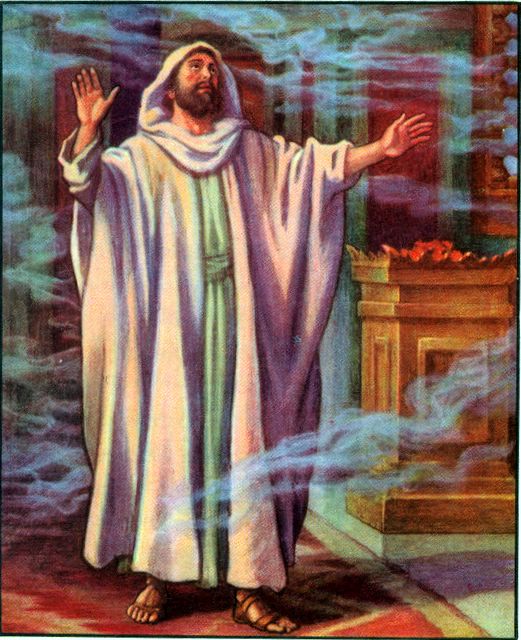
I saw the Lord sitting on a throne - How? In a vision? The text is silent. He saw Jehovah which is enough to know. To argue over how he saw Him is to miss the splendor of this scene. Before Isaiah is sent to preach to the sinful and rebellious nation, the majesty, greatness, and holiness of God is revealed to him.
Who did Isaiah see? Comparing this text with Jn 12:41 (discussed below), it is clear that Isaiah saw Jesus, Who is Jehovah of the OT. In Jn 8:58 He declared that He was "I Am", the name ascribed to God in Ex 3:14+. It was Jesus Who Moses experienced in the burning bush.
- See a detailed discussion addressing the question "Did created men ever see the uncreated God?
Fish writes…
Verse 1 says that Isaiah saw the Lord. How this could be is not indicated. There are many verses in the Bible which teach that God is invisible and cannot be seen. “No man can see Me and live!” (Exod. 33:20). “No man has seen God at any time” (John 1:18). In fact Paul says that God “dwells in unapproachable light; whom no man has seen or can see” (1 Tim. 6:16). “God is spirit” (John 4:24). Yet Isaiah saw the Lord and many others in the Bible are said to have seen God. Jacob said, “I have seen God face to face” (Gen. 32:30). The Lord Jesus even said, “Blessed are the pure in heart, for they shall see God” (Matt. 5:8).
It is obvious that the phrase “to see God” is used in two different senses. Man cannot see God in His essence. Man can only see God as He has revealed Himself. Any time a person sees God, it is an indication that God has adapted Himself to the limited capacity of the creature. We do not know God as He really is. We only know God as He has revealed Himself. Our knowledge of God is never exhaustive and perfect, but it is nevertheless true. It is not exhaustive because no one can see God and live. It is true because God has accommodated Himself to the weakness of man so that there was a sense in which Isaiah was able to “see” God. (The Commission of Isaiah - Emmaus Journal V4:1, Summer, 95)
James Montgomery Boice commenting on John 12:41 writes that
The Gospel of John is a book filled with many extraordinary verses. But none is more extraordinary than (and few are equal to) the verse to which we come now. It is a verse in which John refers to one of the most glorious visions of God ever given to a human being—the vision received by Isaiah at the beginning of his ministry as a prophet, in which he saw Jehovah sitting upon a throne, high and lifted up, with his train filling the temple—saying quite naturally, it would seem, that this applies to Jesus. John says, “Isaiah said this because he saw Jesus’ glory and spoke about him” (John 12:41). (The Gospel of John : An Expositional Commentary. Grand Rapids, Mich.: Baker Books) (Bolding added)
MacDonald explains that…
In Isaiah 6 the prophet was described as seeing the glory of God. John now added the explanation that it was Christ’s glory which Isaiah saw, and it was of Christ that he spoke. Thus, this verse is another important link in the chain of evidence that proves Jesus Christ to be God. (See context Believer's Bible Commentary or borrow Believer's Bible Commentary) (Bolding added)
Edwin Blum in the respected Bible Knowledge Commentary agrees writing…
John wrote that this glory Isaiah saw was Jesus’ glory. The implication is startling: Jesus is Yahweh! (See context in Bible Knowledge Commentary) (Bolding added)
Adam Clarke adds that…
It appears evident, from this passage, that the glory which the prophet saw was the glory of Jehovah: John, therefore, saying here that it was the glory of Jesus, shows that he considered Jesus to be Jehovah. (Bolding added)
Jamieson et al write that John 12:41 is…
a key of immense importance to the opening of Isaiah’s vision (Isaiah 6:1-13), and all similar Old Testament representations. “The Son is the King Jehovah Who rules in the Old Testament and appears to the elect, as in the New Testament the Spirit, the invisible Minister of the Son, is the Director of the Church and the Revealer in the sanctuary of the heart” [Olshausen]. (Jamieson, R., Fausset, A. R., & Brown, D. A Commentary, Critical and Explanatory, on the Old and New Testaments) (Bolding added)
Life Application commentary writes that…
Isaiah had seen the Lord of glory, Who is none other than Jesus Himself—Jesus is God, yet He is also a distinct part of the mysterious Trinity, and He is also Jesus the Son. (See context in John notes)(Bolding added)
Matthew Poole writes that…
Isaiah’s sight of God’s glory is described, Isaiah 6:1, “I saw the Lord sitting upon a throne, high and lifted up, etc.” The evangelist expounds this of Christ, which is an evident proof of the Deity of Christ, that He is Jehovah; for it was Jehovah Whom the prophet there saw (Matthew Poole's Commentary on the New Testament) (Bolding added)
Believer's Study Bible (Criswell) writes that…
The passage undoubtedly refers to the magnificent vision of Isaiah (cf. Isaiah 6), but also to the great Suffering Servant prophecy of Isaiah 53 (v. 38). Again the theme is sounded: the Messiah’s glory is revealed in His suffering. Since John declares that Isaiah saw the glory of Jesus, it is certain that this vision was a Christophany, i.e., a preincarnate appearance of the living Lord. (Bolding added)
Beasley-Murray
The glory of God that Isaiah saw in his vision (Isa 6:1-4) is identified with the glory of the Logos-Son, in accordance with John 1:18 and 17:5. (John 8:56 is a little different; Abraham had a vision of the day of Jesus in the future, i.e., in the time of the coming kingdom of God, see Comment). (Beasley-Murray, G. R. (2002). Vol. 36: Word Biblical Commentary : John. Word Biblical Commentary. Dallas: Word, Incorporated)
John Calvin commenting on John 12:41 writes…
Lest readers should think that this prediction was inappropriately quoted, John expressly states, that the prophet was not sent as a teacher to a single age, but, on the contrary, that the glory of Christ was exhibited to him, that he might be a witness of those things which should take place under his reign. Now the Evangelist takes for granted, that Isaiah saw the glory of Christ. (Bolding added)
Jamieson comments that…
JEHOVAH, (is) a name implying His immutable constancy to His promises. From the Hebrew root, meaning "existence." "He that is, was, and is to be," always the same (see notes Hebrews 13:8 ; Revelation 1:4; Revelation 1:8; compare Ex 3:14, 15; 6:3). As He was unchangeable in His favor to Jacob, so will He be to His believing posterity. (A Commentary, Critical and Explanatory, on the Old and New Testaments) (Bolding added)
Spurgeon comments…
“Behold, he cometh with clouds; and every eye shall see him, and they also which pierced him” (Revelation 1:7). This judgment by Christ is by our apostle proved from an Old Testament prophecy which certainly refers to Jehovah himself. Read Isaiah 45:23, and learn from it that our Lord Jesus is Jehovah, and let us joyfully adore Him as our Savior and God, to Whom be glory for ever and ever.
Spurgeon in his comments on Psalm 47:5 writes…
The Lord with the sound of a trumpet. Jesus is Jehovah. The joyful strain of the trumpet betokens the splendor of his triumph, leading captivity captive, and well might the clarions ring out the tidings of Emmanuel’s victorious return.
Harry Bultema in Bibliotheca Sacra writes that Jesus…
is the Jehovah of the Old Testament as appears from the quotation of Isa 40:3: “Prepare ye the way of Jehovah.” John the Baptist prepared the way of Jehovah-Jesus, Jehovah is Jesus manifested in the flesh as a real man. (Dallas Theological Seminary. Volume 96:325. 1939)
Lord - Adonai (see discussion of this name), the Lord or the master. The related root word adon can be used of God or man. For example in Ex 21:4 (Ge 24:9, 10), adon is used of the slave owner who was the master of the slave. In Ge 42:33 Joseph is referred to as "the lord (adon) of the land (of Egypt)", which signifies that Joseph had great authority and was sovereign over Egypt, not in himself, but because he was acting in the place of the king. Pharaoh was called lord (adon) because he was the sovereign over Egypt (Gen. 40:1). God is as adon is described as "majestic" (Ps 8:1, 9), as "Lord of the whole earth" (Ps 97:5), as the Lord "above all gods" (Ps 135:5) because He is the sovereign Lord of the universe. Girdlestone in his classic work "Synonyms of the OT" says that Adonai
indicates the truth that God is the owner of each member of the human family, and that He consequently claims the unrestricted obedience of all… The claim upon man's service which is set forth in the title Adonai is well illustrated by Mal 1:6, where Jehovah says, "A son honors his father, and a servant his master (or masters); if, then, I be a father, where is mine honour? and if I be a master (Adonim), where is my reverential fear?"
Adonai is the exalted, majestic sovereign, the One Who has the right to call Isaiah into ministry so that His sovereign rights as Master and Owner over Israel might be proclaimed (Isa 1:3 "an ox knows its owner").
Adonai - 52v in Isaiah - Isa 1:24; 3:1, 15, 17, 18; 4:4; 6:1, 8, 11; 7:7, 14, 20; 8:7; 9:8, 17; 10:12, 16, 23, 24; 11:11; 19:4; 21:6, 8, 16; 22:5, 12, 14, 15; 25:8; 28:2, 16, 22; 29:13; 30:15, 20; 37:24; 38:16; 40:10; 48:16; 49:14, 22; 50:4, 5, 7, 9; 51:22; 52:4; 56:8; 61:1, 11; 65:13, 15
C I Scofield writes on Adon/Adonai that there are two principles that evolve from the relation of master and servant…
(a) the Master’s right to implicit obedience (Jn 13:13; Mt. 23:10; Lk 6:46);
(b) the servant’s right to direction in service (Isa 6:8, 9, 10, 11). Clear distinction in the use of the divine names is illustrated in Ex. 4:10, 11, 12. Moses feels his weakness and incompetence, and “Moses said unto the LORD [Jehovah], O my Lord [Adonai], I am not eloquent,” etc. Since service is in question, Moses (appropriately) addresses Jehovah as Lord. But now power is in question, and it is not the Lord (Adonai) but Jehovah (Lord) who answers (referring to creation power)—“and Jehovah said unto him, Who hath made man’s mouth? … Now therefore go, and I will be with thy mouth.” The same distinction appears in Josh 7:8, 9, 10, 11. (Scofield Reference Bible)
Robert Lightner comments on Adon/Adonai noting that…
The Master has a right to expect obedience. In Old Testament times, slaves were the absolute possession of their master and had no rights of their own. Their main objective was to fulfill the wishes of their master. Slaves had a relationship and responsibilities that were different from that of hired servants. For example, hired servants could quit if they did not like the orders of their master. In contrast, slaves had no other option but to obey their master (see, for example, Ge 24:1–12).
The call of Moses serves as another illustration. His hesitation to obey the call of God eventually ended when he acknowledged God as Adonai, or Lord (Ex 4:10, 11-18). When Moses admitted his position as a slave and God’s position as the Lord—the Master—there was only one viable option—to obey. When Moses called God Adonai, he acknowledged that it was not his place as the slave to choose his work; he had to heed his Master’s directives.
The commission of Isaiah gives us another illustration of the right of Adonai, the Lord, to expect absolute obedience from His servants (Isa. 6:1-8). Though the closing years of Uzziah’s reign were filled with disobedience to God, this Judean monarch, in comparison with many other kings, was still considered godly, for “he did right in the sight of the Lord” (2Ki 15:3). It’s possible that Isaiah had been encouraged by Uzziah’s reign. And at times the prophet may have been tempted to look to Judah’s king, rather than to Yahweh, for the continued prosperity of the nation. All that changed, however, when Uzziah died. In that year (740BC), Isaiah had a vision of “the Lord [Adonai] sitting on His throne, lofty and exalted” (Isa. 6:1). This revelation of God as the absolute Lord ruling over the affairs of people caused the prophet to lament over his own sinfulness. God then took the initiative to spiritually cleanse Isaiah. Then, when the prophet heard “the voice of the Lord [Adonai]” (Isa 6:8), he said, “Here am I. Send me!” Isaiah was ready and willing to do the bidding of his Master. (The God of the Bible and Other Gods: Is the Christian God Unique among World Religions?. Grand Rapids, MI: Kregel Publications)
Nathan Stone comments on use of Adonai in Isaiah 6 noting that…
It is the vision of God as Adonai which started him out on his prophetical career. One of the most stirring portions of Scripture describes this vision. It was a time of national darkness, for Uzziah, Judah's great king, had died. Uzziah was the prophet's king, therefore his lord and master, and perhaps his hero too, in spite of his tragic end (died a leper). It is then that the young man experiences one of the most solemn and significant visions of Scripture. In the sixth chapter he tells us,
"in the year that King Uzziah died I saw the Lord" (Adonai)
His earthly lord and master had died, but what does that matter when the Lord of lords, the Adonai in the heavens, lives and reigns. This Adonai is seated upon a throne too, but high and lifted up, above all earthly lords and monarchs, for this Adonai is also Jehovah of hosts, whose train fills the Temple and whose glory covers the whole earth. This Adonai is surrounded by the fiery seraphim, who not only cover their eyes before their thrice holy Lord, but with their wings are ready instantly to do His bidding. Then after the prophet's confession and cleansing in preparation for his service, he hears a voice saying:
"Whom shall I send and who will go for us?"
This call for service comes from Adonai, for this is the name used in Isaiah 6:8. So prophet after prophet is called and commissioned for service by Adonai, the Lord who claims obedience and service. The shrinking Jeremiah, ordained from before his birth to be a prophet, answers the call to service by saying, somewhat like Moses: "Ah, Adonai Jehovah! Behold, I cannot speak: for I am a child" (Jer 1:6).
As with Moses, the Lord of life and service enables His servants to carry out His commands when they yield themselves to Him and obey. He touches the lips of Jeremiah, as of Isaiah, and promises His presence and protection. (Names Of God Nathan Stone Books. 1944 Moody Publishers)
Jesus quotes from Isaiah…
These things (Jn 12:37-40) Isaiah said (Is 53:1, Isa 6:10, cp Ro 10:16), because he saw His glory (Isa 6:1), and he spoke of Him. (Jn 12:41)
Comment: John MacArthur writes that "John unambiguously ties Jesus to God or Yahweh of the OT (see Jn 8:58 - Jesus declared Himself to be Yahweh, i.e., the Lord of the OT). Therefore, since Jn 12:41 refers to Jesus, it makes Him the Author of the judicial hardening of Israel. That fits His role as Judge (see Jn 5:22, 23, 27, 30; 9:39)." (See context The MacArthur Study Bible)
In summary, Jesus is the "LORD" Isaiah saw. Jesus is Jehovah in the Old Testament (See caveats)
Lofty (07311) (ruwm) is a primary root which conveys three ideas (1) literal height, (2) height symbolic of notions (glory, exaltation - Ps 34:3 exalt His name), and (3) height symbolic of negative notions (arrogance & pride). The OT uses ruwm with positive meaning most frequently of God's being high as in rank (cf 2Sa 22:47; Ps 18:46; Ps 113:4). In the present context while elevation in regard to rank is certainly intended, it also suggests a more literal meaning, implying Isaiah had to look upwards to see the lofty Lord.
Exalted (05375) (nasa') is a common OT verb (some 612 verses) and conveys the sense of lift up or lifted up as in Isa 6:1. (This picture of the exalted Lord brings to mind Michael W Smith's song - Above All)
The train - This describes the hem or fringe (cf Ex 28:33, 34) of His robe which appropriately filled the temple. (just as "the cloud… the glory of Jehovah filled the Tabernacle" in Ex 40:35)
His robe - In Psalm 104 God's "robe" is described as light…
Covering Yourself with light as with a cloak (Ps 104:2)
Spurgeon comments that: the light about Him as a monarch puts on his robe. The conception is sublime: but it makes us feel how altogether inconceivable the personal glory of the Lord must be; if light itself is but His garment and veil, what must be the blazing splendour of His own essential being! We are lost in astonishment, and dare not pry into the mystery lest we be blinded by its insufferable glory.
The temple - What Temple? In Jerusalem? In heaven? One cannot be dogmatic (in my opinion).
MacArthur writes…
Though Isaiah may have been at the earthly temple, this describes a vision which transcends the earthly. The throne of God is in the heavenly temple (Rev. 4:1-7+; Rev 11:19+; Rev 15:5-8+). (See context in The MacArthur Bible Commentary)
I CAN ONLY IMAGINE
Play & praise as you ponder one day seeing Holy Holy Holy
Mercy Me
I can only imagine what it will be like
When I walk by your side
I can only imagine what my eyes will see
When your face is before me
I can only imagine
I can only imagine
Surrounded by your glory
What will my heart feel?
Will I dance for you Jesus,
Or in awe of you be still?
Will I stand in your presence,
Or to my knees will I fall?
Will I sing Halelluja,
Will I be able to speak at all?
I can only imagine
I can only imagine
ISAIAH, MIGHTY SEER
Martin Luther
Isaiah, mighty seer, in days of old
The Lord of all in spirit did behold
High on a lofty throne, in splendor bright,
With flowing train that filled the temple quite.
Above the throne were stately seraphim;
Six wings had they, these messengers of Him.
With twain they veiled their faces, as was meet,
With twain in reverent awe they hid their feet,
And with the other twain aloft they soared,
One to the other called and praised the Lord:
“Holy is God, the Lord of Sabaoth!
Holy is God, the Lord of Sabaoth!
Holy is God, the Lord of Sabaoth!
Behold, His glory filleth all the earth!”
The beams and lintels trembled at the cry,
And clouds of smoke enwrapped the throne on high.
Related Resources:
- Praise to the Lord the Almighty
- Praise to the Lord the Almighty - Fernando Ortega (recommended!)
- Indescribable - Chris Tomlin
- Indescribable - Laura Story
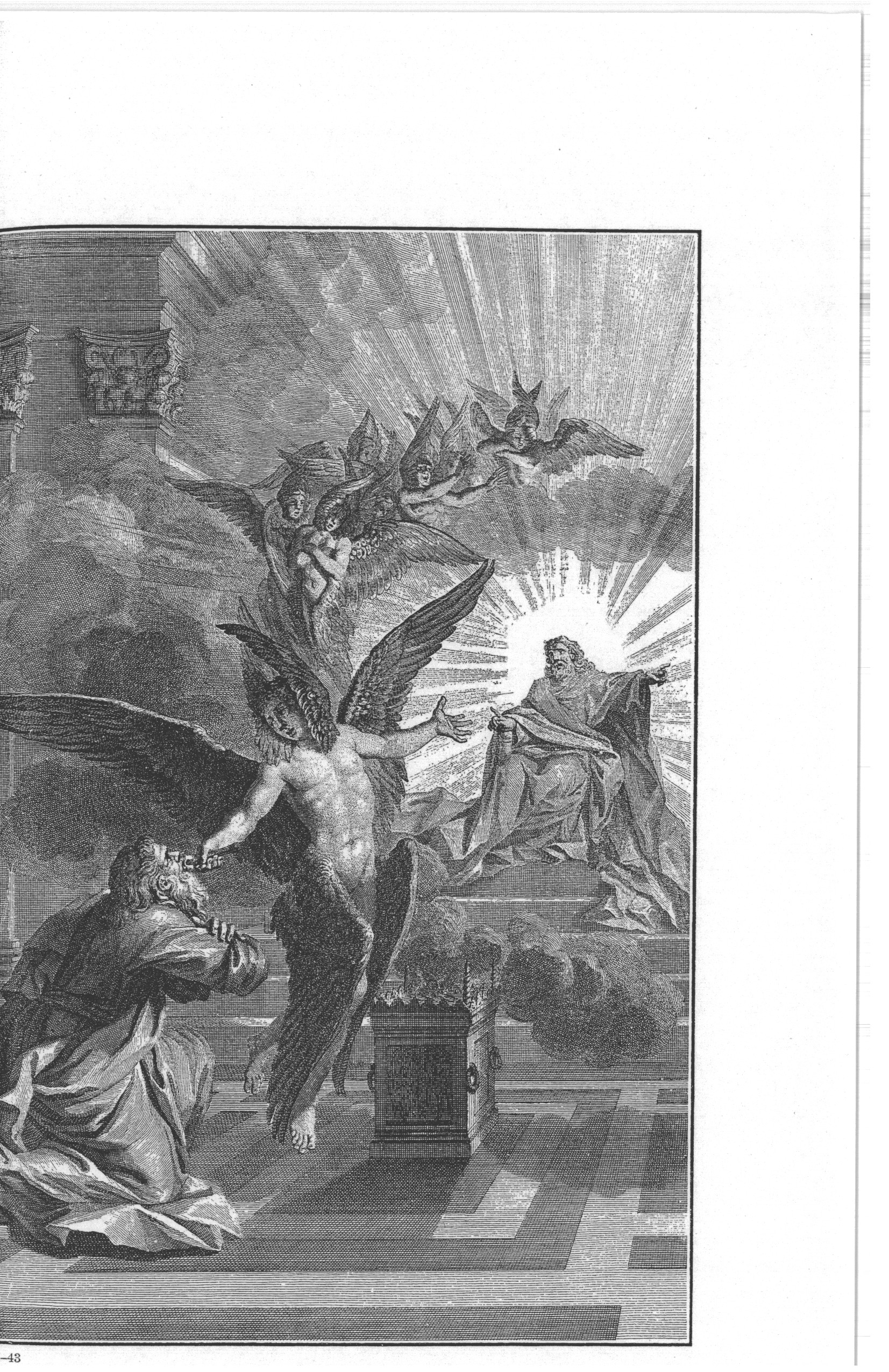
Isaiah 6:2 SERAPHIM STOOD ABOVE HIM, EACH HAVING SIX WINGS: WITH TWO HE COVERED HIS FACE AND WITH TWO HE COVERED HIS FEET AND WITH TWO HE FLEW
- 1Ki 22:19; Job 1:6; Da 7:10; Zech 3:4; Luke 1:10; Rev 7:11
- seraphim - Ps104:4; Ezek 1:4; Heb 1:7
- wings Ex 25:20; 37:9; 1Ki 6:24,27; 8:7; Ezek 1:6,9,24; 10:21; Rev 4:8)
- face Ge 17:3; Ex 3:6; 1Ki 19:13; Ps 89:7
- feet Job 4:18; 15:15; Ezek 1:11
- fly - Isa 6:6; Ps18:10; 103:20; Ezek 10:16; Da 9:21; Rev 8:13; 14:6
Click to enlarge
Seraphim (08314) (seraph [fiery serpent - Nu 21:6, Isa 14:29) is related to the verb sarap = to burn, of literal burning, Lv 4:12, Josh 6:24, Je 7:13, almost always of destructive burning is the plural of seraph (In Hebrew the "-im" ending signifies plurality) literally means burning one, fiery one or glowing one. Seraphim contrary to popular opinion is not a class of angels but a separate class of created beings. They are not "originally mythically conceived with serpents' bodies" as one popular Hebrew lexicon suggests, for they clearly are described with feet, face and wings (no hands described). As Harrison suggests (TWOT) the idea of burning suggest as that "These… beings were brilliant as flaming fire, symbolic of the purity and power of the heavenly court."
Seraph - 7 OT uses - Nu 21:6, 8; Dt 8:15; Is 6:2, 6; 14:29; 30:6
In Numbers seraph is used of the fiery serpents…
And the LORD sent fiery serpents (seraphim) among the people and they bit the people, so that many people of Israel died. (Nu 21:6)
Comment: Here the word fiery or burning probably refers to the burning pain and the inflammation which resulted from the venomous bite, which brought death to all who would not look at the bronze serpent and live. (cp Nu 21:5, 6, 7, 8, 9, cp Jesus' teaching Jn 3:14, 15 , 2Co 5:21, cp destruction of the idol Israel had made from the bronze serpent 2Ki 18:4)
BEFORE HIS EYE
(Play hymn)
Neil Barham
Faces covered, wings resplendent, Seraphim before Him bow!
Angels tremble, martyrs weep, and saints perfected praise Him now!
Holy is the angels’ Maker, He who spread His stars in the skies.
Holy is the Judge of Creation, all lies bare before His eyes!
Woe is me, for I am ruined! For my eyes have seen the King!
Robed in righteousness, and holy: Hear the Voice of Judgment ring!
All unclean, my lips, my spirit, vile and foul in all I do!
All corrupt, my heart within me, wretched, wicked through and through!
Every hope I must abandon! Guilty, I await His stroke.
Now must come His righteous sentence: Wait! A Bright Form parts the smoke!
Bleeding feet stride through the temple! Christ approaches, weeping love!
Wounded hands remove my filthiness, God’s caress in every move.
Freely righteous! Full atonement! Justified, from sin set free!
By the Word of God the Father, I’m declared as pure as HE!
At the Cross, His wounds acquit me! Fatal wounds proclaim His praise!
And the Empty Tomb sings His glories: Justice is assuaged by Grace!
Covered his face… his feet - Notice how the Seraphim acknowledge the person of Jehovah by their actions (and then in Isa 6:3 with their words), even covering their face undoubtedly because of the overwhelming glory of God's holy presence. They dare not gaze at the glory of Jehovah! As an aside, this surely points to an amazing display of grace from God to man, that the man Isaiah would even be permitted to look upon such a sight without dying (cf Ex 33:20, Jn 1:18, 6:46, 14:9, Col 1:15-note, 1Ti 6:16)
Thine angels adore Thee,
All veiling their sight
Play Immortal, Invisible, God Only Wise
Vine adds that…
With two they covered their feet, in acknowledgment of the lowliness of their glorious service. With twain they were flying, or hovering. The verbs are in the imperfect tense, describing what they were doing continually. (Vine, W. Collected writings of W. E. Vine. Nashville: Thomas Nelson)
Isaiah 6:3 AND ONE CALLED OUT TO ANOTHER AND SAID "HOLY, HOLY, HOLY IS THE LORD OF HOSTS, THE WHOLE EARTH IS FULL OF HIS GLORY:
- Ex 15:20,21; Ezra 3:11; Ps 24:7, 8, 9, 10) (Ex 15:11; Rev 4:8,9; 15:3,4) (Isa 11:9,10; 24:16; 40:5; Nu 14:21; Ps 19:1, 2, 3; 57:11; 72:19; Hab 2:14; Zec 14:9; Ep 1:18)
Resources
- Jehovah Sabaoth, LORD of hosts, of armies
- Knowledge Of The Holy - A W Tozer's classic book on God's Attributes
- The Pursuit of God - A W Tozer
- Holiness - Micah Stampley
- Blessed Be Your Name Matt Redman (Alternate version)
- How Great is our God - Chris Tomlin
- Holy is the Lord - Chris Tomlin
- Holy, Holy, Holy - Hillsong United
JEHOVAH'S
UNSURPASSED
HOLINESS
And one called out to another - One to another suggest an antiphony (as when one choir alternates in singing with another).
Vine comments…
This suggests that their utterances were antiphonal, though not in song. There is no record in Scripture of angels singing. (Vine, W. Collected writings of W. E. Vine. Nashville: Thomas Nelson)
Holy, holy, holy - The Seraphic attribution of holy in triplicate is the Hebrew way of denoting "intensity". The triplicate is the strongest way the Hebrew language can express the superlative (cf Ezek 21:27, Jer 22:29, cf NT triplicates - Re 8:13, ). Thus this "emphatic Semitic triplet" underscores God's extreme/unsurpassed level of holiness, an infinite degree of holiness. Some see this threefold repetition of holy as an OT allusion to the Trinity, with which while compatible would not be dogmatic proof of the Trinity (eg, it would probably be inappropriate to use Isa 6:3 as strong substantiation of the Trinity in the OT). Caution is also advisable when one attempts to associate theological significance to the number three (eg, E W Bullinger says that "three denotes divine perfection" but again a "Berean-like" [Acts 17:11] mindset is advisable when evaluating such comments.)
Net Bible adds that…
Some have seen a reference to the Trinity in the seraphs' threefold declaration, "holy, holy, holy." This proposal has no linguistic or contextual basis and should be dismissed as allegorical. Hebrew sometimes uses repetition for emphasis… By repeating the word "holy," the seraphs emphasize the degree of the Lord's holiness. (Isaiah 6 Commentary)
This sole OT occurrence of a threefold repetition of God's holy character is echoed in the book of Revelation where John records that…
the four living creatures, each one of them having six wings, are full of eyes around and within; and day and night they do not cease to say, “Holy, holy, holy is the Lord God, the Almighty, Who was and Who is and Who is to come.” (Re 4:8-note), contrasting with the thrice repetition of six in the number of the Beast in Rev 13:18-note).
Holy (06918) (qadosh) means consecrated, set apart (as dedicated to God), and designates that which is opposite of the common or profane. In the case of God, qadosh describes what He is by His intrinsic nature and as regards man, it refers to those that have been brought into the sphere of the sacred (set apart) by God.
Related Resource: Holy - God's Attribute
The NET Bible note adds that…
The basic sense of the word "holy" is "set apart from that which is commonplace, special, unique." In this context the Lord's holiness is first and foremost his transcendent sovereignty as the ruler of the world. He is "set apart" from the world over which He rules. Note the emphasis on the elevated position of his throne in Isa 6:5. At the same time his holiness encompasses His moral authority, which derives from His royal position. As King He has the right to dictate to His subjects how they are to live; indeed His very own character sets the standard for proper behavior. He is "set apart" from His subjects in a moral sense as well. He sets the standard; they fall short of it. Note that in Isa 6:5 Isaiah laments that he is morally unworthy to be in the King's presence. (Isaiah 6 Commentary)
Commenting on God's holiness Fish writes that…
There is an incomprehensible contrast between what is divine and what is human. Also the holiness of God consists of His positive attributes which constitute His deity. The holiness of God involving His inner essence is largely hidden, but His glory is manifest, being declared by the whole creation. (The Commission of Isaiah - Emmaus Journal V4:1, Summer, 95)
Young…
As used here, qadosh [holy] signifies the entirety of the divine perfection which separates God from His creation.
Jamieson…
God's holiness is the keynote of Isaiah's whole prophecies.
J Vernon McGee applies this grand scene to our everyday lives noting that…
if we would see Him today in that (high and lifted up) position, we would be delivered from low living. It would also deliver some folk from this easy familiarity that they seem to have with Jesus. They talk about Him as if He were a buddy and as if they could speak to Him in any way they please. My friend, you cannot rush into the presence of God. He doesn't permit it. You come to the Father through Christ. This is the only way He can be approached. You can never come into the presence of the Father because of who you are. You come into His presence because you are in Christ. The Lord Jesus made that very clear when He said, "No man cometh unto the Father, but by me." (Jn 14:6) If you are His child, you can come with boldness to the throne of grace (Heb 4:16-note), but you cannot come to Him on any other basis. (Isaiah 6:3-5 on mp3)
The LORD of hosts - In Isa 6:1, 8, 11 the divine name is Adonai but the Seraphim acclaim Him as Jehovah Sabaoth, LORD of the armies.
Glory (03519) kabod means literally to be heavy or weighty (only rarely used literally), the figurative use ("heavy with sin") being more common. From heavy derives the idea of a "weighty" person in society, one who is honorable, impressive, worthy of respect, the meaning in >50% of uses. In the OT glory is a “technical term for God’s manifest presence” (Ex 16:7), often connected with the Shekinah glory cloud (Ex 16:10) and with the Ark of the Covenant. It can also be represented as a consuming fire (Ex 24:17). Glory also involves “honor” or position of power. The glory of the Lord “reveals His person and dignity, and the proper response to such a revelation is to give God honor or glory” (cf Ex 33:18). God's glory is essentially the profound, glowing, visible, confluent expression of the attributes of Deity which bears witness to a still more profound and incomprehensible reality of essence. In His character and essence, He is "Spirit," and thus invisible to man (Jn 4:24), but He has made Himself known to man through revelation by His many names and titles, by His attributes, by His written Word, and finally by His living Word, Jesus Christ (Jn 1:14). In the OT, God revealed His glory at Sinai (Ex 24:16, 17), in the tabernacle (Ex 40:34, 35, 36, 37, 38), in the Jerusalem temple (1Ki 8:10, 11) and here in Isaiah 6 to the prophet.
Grogan notes that Kabod "is used of God in his manifestation to his creatures. The essence of deity is inscrutable, but something of his glory can be seen if God is pleased to disclose it (Exod 33:17=23; Ezek 1:28). (See context in Commentary- Isaiah)
The Septuagint (LXX) translates the Hebrew with the noun doxa [word study], in simple terms means to give a proper opinion or estimate of something and thus the glory of God expresses all that He is in His Being and in His nature, character, power and acts. He is glorified when He is allowed to be seen as He really is. To be where God is will be glory. To be what God intended will be glory. To do what God purposed will be glory.
Charles Ryrie says that the glory of God "is the manifestation of any or all of His attributes. In other words, it is the displaying of God to the world. Thus, things which glorify God are things which show the characteristics of His being to the world. (See context in Balancing the Christian Life)
I like the way Puritan writer Thomas Watson described God's glory…
Glory is the sparkling of the Deity… We may see God's glory blazing in the sun and twinkling in the stars (Ps 19:1)… A sight of God's glory humbles. The stars vanish when the sun appears.
The whole earth is full of His glory - More literally this reads "The fulness of all the earth is His glory". Vine says it should be rendered "His glory is the fullness of the whole earth".
David prayed for this end (and so should we considering that it is a prayer for the Lord's return and the real peace of Jerusalem!)…
And blessed be His glorious name forever; and may the whole earth be filled with His glory. Amen, and Amen. (Ps 72:19)
In Numbers Yahweh declares…
but indeed, as I live, all the earth will be filled with the glory of the Lord. (Nu 14:21)
Later in the context of a prophecy of the coming Millennial Age Isaiah God says…
For the earth will be full of the knowledge of the Lord as the waters cover the sea. (Is 11:9, cf Isa 40:5 describing the Second Coming of the Messiah - see Mt 24:30)
Habakkuk records the prophecy that in the Millennial Age…
The earth will be filled with the knowledge of the glory of the Lord, as the waters cover the sea. (Hab 2:14)
TODAY IN THE WORD - In his book Our God Is Awesome, Bible teacher Tony Evans says, “Holiness is the centerpiece of God’s attributes. Of all the things that God is, at the center of His being, He is holy… God’s holiness unlocks the door to understanding and making sense out of everything else about Him.”
This is an important truth for us to understand in relation to heaven and the kind of people who will be there. Dr. Evans goes on to say, “Only one thing happens [in heaven]: people get to know God. You will spend eternity in heaven getting to know God.”
Since God is perfectly holy and heaven is His dwelling place, it follows that heaven must be a holy place where no sin can exist. That’s exactly what the Bible teaches. The prophet Habakkuk says of God, “Your eyes are too pure to look on evil; you cannot tolerate wrong” (Hab. 1:13).
Isaiah was given a vision of heaven and of the God of heaven that few others have ever experienced. The prophet’s attention was immediately drawn to the throne where God rules in awe-inspiring majesty and holiness. He saw the angels surrounding the throne who eternally call out the reality of God’s holiness. In fact, over 600 years after Isaiah lived, John heard the same testimony in heaven: “Holy, holy, holy is the Lord God Almighty” (Rev. 4:8).
In this heavenly environment of pure holiness, holy people are the only ones who will be at home. Thankfully, through salvation, Jesus Christ clothes us with His holiness so we can stand forgiven and clean in God’s presence. He places His Spirit within us so that Christ is formed in us (Gal. 4:19).
We still have to live in a sin-scarred world, of course, and that can wear us down at times. It’s great to realize that in heaven we will finally be free from the presence and power of sin, both our own sin and the evil that surrounds us. Let’s also remember that God made us holy in Jesus Christ not just to prepare us for heaven in the sweet by-and-by, but so we can live above the pull of sin in the mixed-up here-and-now.
TODAY ALONG THE WAY- It’s a staggering thought to realize that naturally unholy people like us can look forward to sharing heaven with our sinless God.
TODAY IN THE WORD - A. W. Tozer once said the most important thing anyone could know about him was what he believed about God. That's another way of saying that theology matters. What Tozer said about the importance of his view of God can be said about each one of us. What we believe about God is so crucial because everything else in our lives is built on that foundation. If the foundation is shaky, things will start to crumble.
As with most of our studies so far this month, we can't summarize everything the Bible teaches about God in a few lines. Isaiah 6 is a good representative because it captures the majesty of God's Person, His perfect holiness and overwhelming presence. Isaiah knew he was standing before an awe-inspiring God when he had his vision in the temple.
Missionaries and others who live among various cultures observe that people tend to create and then worship gods whom reflect their own peculiar tendencies. A tribe or village prone to violence invariably creates gods whom they believe delight in violence and blood.
This was true in the nations around Israel, as well. That's one reason God commanded the Israelites to eradicate the Canaanites.
How different the true God is from one of these created beings. He is so unlike us, so exalted over His creation, that we can't control Him or make Him simply a reflection of ourselves.
Isaiah was struck with awe, and even terror, when he saw a vision of God on His throne. The presence of the seraphim and their thunderous voices are a picture of indescribable majesty. The repetition of the word 'holy' speaks of God's perfect holiness His complete purity and separation from anything evil.
Isaiah did the same thing we would have done. He cried out in distress, suddenly very aware of his sinfulness. But it was at this point that the character of this terrifying God shined through. Instead of erasing the prophet with a blast of holiness, God sent an angel to cleanse and forgive Isaiah.
We don't have to ask Isaiah what he believed about God. The question was what Isaiah's encounter with God did to him. We face the same question because, amazingly, this holy God has said, 'Be holy, because I am holy' (1Pe 1:16).
TODAY ALONG THE WAY - Isaiah 6 is not the kind of text we can just read and put down. It seems to demand some reflection. But too many of our schedules allow too little time for reflection and meditation on God and His Word. God Himself tells us, 'Be still, and know that I am God' (Ps. 46:10). Make sure this day includes some time alone with the Lord to thank Him for His holiness, and consider what it means to be holy the way He is holy.
Still one of my favorite hymns of all time, and one which has special memories for me. Although I was an unregenerate teenager, this hymn always seemed to strike a peculiar chord in my heart, until one day at age 39 after studying the Minor Prophets, the Holy One of Israel, the Messiah, came to take up residence within my heart and "Holy, Holy, Holy" became even more meaningful (My Testimony to God's Grace). Praise God for godly music which lifts our souls to the throne room of God in Heaven!
HOLY, HOLY, HOLY
Reginald Heber, 1826
Renditions:
Shane and Shane
Hymns Project
Men's Acappella
Holy, holy, holy! Lord God Almighty!
Early in the morning our song shall rise to Thee;
Holy, holy, holy, merciful and mighty!
God in three Persons, blessèd Trinity!
Holy, holy, holy! All the saints adore Thee,
Casting down their golden crowns around the glassy sea;
Cherubim and seraphim falling down before Thee,
Who was, and is, and evermore shall be.
Holy, holy, holy! though the darkness hide Thee,
Though the eye of sinful man Thy glory may not see;
Only Thou art holy; there is none beside Thee,
Perfect in power, in love, and purity.
Holy, holy, holy! Lord God Almighty!
All Thy works shall praise Thy Name, in earth, and sky, and sea;
Holy, holy, holy; merciful and mighty!
God in three Persons, blessèd Trinity!
(Note: Heber wrote this hymn for Trinity Sunday while he was Vicar of Hodnet, Shropshire, England)
Some "Holy" Choruses
- Holy is the Lord
- Holy, Holy, Holy Is The Lord Of Hosts
- He Reigns - "Holy, Holy, Holy is our Lord God Almighty...."
More Hymns Related to Isaiah 6
- Bright the Vision That Delighted
- Day Is Dying in the West
- Eternal Wisdom, Thee We Praise
- Father All Holy
- Father and Friend! Thy Light, Thy Love
- Father, Thine Elect Who Lovest
- For the Beauty of the Earth
- God’s Praise Book
- Great Giver of All Good
- Harp at Nature’s Advent Strung, The
- Holy, Holy, Holy
- Holy, Holy, Holy! God of Grace and Glory!
- Holy, Holy, Holy Lord (Dodd)
- Holy, Holy, Holy Lord (Wesley)
- Holy, Holy, Holy, Lord (Wordsworth)
- Holy, Holy, Holy, Lord, Thy Disciples
- Holy, Holy, Lord Almighty
- Jehovah, Thee We Praise
- O Holy, Holy, Holy Lord (Eastburn)
- O Holy, Holy, Holy Lord (Conder)
- Round the Lord in Glory Seated
- Round the Throne of Glory
- See the Shining Dewdrops
- Seek Not Afar for Beauty
- Thou Has Been Our Guide This Day
- We Thank Thee, Lord, for This Fair Earth
- We Thank Thee, Lord, Thy Paths of Service Lead
- We Worship Thee, Almighty Lord
- When Comes the Golden Sunset
Isaiah 6:4 AND THE FOUNDATIONS OF THE THRESHOLDS TREMBLED AT THE VOICE OF HIM WHO CALLED OUT, WHILE THE TEMPLE WAS FILLING WITH SMOKE
- foundations of the thresholds: Eze 1:24 10:5 Am 9:1
- Temple: Ex 40:34 1Ki 8:10, 11, 12 2Ch 5:13,14 6:1 Ps 18:8 Rev 11:19 15:8
The foundations of the thresholds trembled - the bases of the thresholds shook. Compare other allusions to physical manifestations of God's power (Ex 19:18, Acts 4:31).
Foundations (0520) ('ammah) usually describes a linear measurement (cf first use Ge 6:15) of a cubit, but here describes a post. Are these the very "gates of heaven" which are caused to shake at the sound of the seraphim? One cannot be dogmatic, but that is certainly a possibility!
Trembled (05128) (nua/nuwa) means to move back and forth, to and fro (cf Ex 20:18, 1Sa 1:13). The voice of the seraphim was so powerful that the sound waves caused the temple foundation to sway back and forth, even as mountains tremble when Jehovah appears (Ex 19:18, Jdg 5:4). What an awesome, even fearful experience for God's prophet!
NIDOTT notes that…
In the OT the terms for smoke appear chiefly in three contexts: theophanic portrayals (Ex 4:5, 19:18, 40:38, Ps 104:32, Ps 144:5), descriptions of mundane events whether actual or prophesied, and comparisons or figurative descriptions (eg, anger of God, Ps 74:1, 80:4).
Him - Is a collective pronoun which includes the company of the seraphim.
Him who called out - One seraphim calling out to another. Perhaps this is a preview of believers calling out to other believers in a symphony of praise to God.
Temple (01004) (bayith) describes a fixed, established structure made from some kind of material and in many context (such as the present passage ) bayith refers to the place of worship, the dwelling place (house as it were) of God.
Filling with smoke - Given that there is an altar, that could be the source of the smoke. The meaning of the smoke is uncertain, so we had best avoid dogmatic interpretation. We do know that God had revealed Himself to men in the past in similar ways. For example, at the completion of Solomon’s Temple (note) in Jerusalem…
It happened that when the priests came from the holy place, the cloud filled the house of the Lord, so that the priests could not stand to minister because of the cloud, for the glory of the Lord filled the house of the Lord. Then Solomon said, “The Lord has said that He would dwell in the thick cloud. (1 Ki 8:10, 11, 12)
Tony Garland in his discussion of The Abiding Presence of God (take a moment to read this insightful discussion) writes that…
At the heart of the idea of a Temple is the abiding presence of God. Although God is omnipresent, He has chosen to manifest His presence in certain locations and at certain times within history. This physical manifestation of God has come to be called the Shekinah.
(quoting Arnold Fruchtenbaum's "The Footsteps of Messiah") the Shechinah Glory is the visible manifestation of the presence of God. It is the majestic presence or manifestation of God in which He descends to dwell among men. Whenever the invisible God becomes visible, and whenever the omnipresence of God is localized, this is the Shechinah Glory. The usual title found in Scriptures for the Shechinah Glory is the glory of Jehovah, or the glory of the Lord. The Hebrew form is Kvod Adonai, which means ‘the glory of Jehovah’ and describes what the Shechinah Glory is. The Greek title, Doxa Kurion, is translated as ‘the glory of the Lord.’ Doxa means ‘brightness,’ ‘brilliance,’ or ‘splendor,’ and it depicts how the Shechinah Glory appears. Other titles give it the sense of ‘dwelling,’ which portrays what the Shechinah Glory does. The Hebrew word Shechinah, from the root shachan, means ‘to dwell.’ The Greek word skeinei, which is similar in sound as the Hebrew Shechinah (Greek has no ‘sh’ sound), means ‘to tabernacle.’… In the Old Testament, most of these visible manifestations took the form of light, fire, or cloud, or a combination of these. A new form appears in the New Testament: the Incarnate Word [John 1:14].
John records in his vision of the heavenly temple that…
the temple was filled with smoke from the glory of God and from His power; and no one was able to enter the temple until the seven plagues of the seven angels were finished. (Rev 15:8-note)
Pulpit Commentary…
Smoke is sometimes the mere sign of the presence of God, as in Isa 4:5; but more often it indicates his presence in anger or judgment (see Ex 19:18; 20:18; Rev 15:8).
John Fish sums up the possible meaning of the smoke…
The meaning of the smoke is uncertain. It may signify 1) the presence of God (cf. Ex. 40:30; Ezek. 10:4); or it may be 2) an indication of the sanctuary scene with the smoke rising from the altar of incense; or 3) the smoke may be an indication of the wrath of Yahweh (cf. Psalm 18:8). (The Commission of Isaiah - Emmaus Journal V4:1, Summer, 95)
Regarding the trembling of the foundations Harry Ironside makes a piercing comment…
Strange that inanimate pillars should thus be moved while the hearts of men remained obdurate and motionless! But one man there was who did respond and that in a very definite way (Ed: Referring of course to the prophet Isaiah, who had ears to hear and eyes to see the supernatural! Lord give us men and women like Isaiah in these "difficult" last days, cf 2Ti 3:1-note).
Sinful men with tender hearts rightly respond with a reverent fear and awe when confronted with the manifest presence of the Holy One of Israel. Scripture gives us a number of examples: Abraham (Ge 18:27, 30, 32), Gideon (Jdg 6:21, 22, 23), Manoah and his wife (Jdg 13:20); Job (Job 42:5, 6); Isaiah (Isa 6:5); the apostle John on the isle of Patmos (Rev 1:17).
As Kistemaker says (in his comments on Luke 5:8+) - When one is confronted with Jesus, it is impossible to remain neutral. His enemies react to His miracles with hatred and reviling; His true disciples, with homage and reverence. They stoop and worship.
TODAY IN THE WORD DEVOTIONAL- According to a report on the history of the automobile, the boom in the fast food industry may be explained largely by the car's entrance into American daily life. The first "carhops" appeared in the 1930s, allowing people to eat without leaving their cars. Then in the 1970s some restaurants tested the idea of "drive-through" service. The new service was a big hit with people who were too busy to park and eat, let alone sit at a table. Drive-through service, cell phones, beepers and other time-saving devices say a lot about a culture that always seems to be in a hurry.
Unfortunately, as Dr. Tony Evans points out, this "hurry up and get it" mentality has invaded the church. The result is that many Christians want their worship the way they want their hamburgers. They want to drive up to church, grab an hour of worship, and drive off--what Dr. Evans calls "drive-through worship." Nothing could be more opposed to this mentality than the awe-inspiring heavenly scene before us today. The vision Isaiah saw would bring the busiest "drive-through worshiper" screeching to a halt. In Isaiah 6, the curtain is pulled back on the never-ending worship of God that fills heaven.
There is a lot happening in this chapter of Scripture. One purpose of Isaiah's vision was to commission him for service (Isa 6:8-13). Another purpose was to reveal God's holiness and worthiness to be worshiped. Today, we want to step back and take in the incredible scene the prophet describes.
We learn much about heaven in these few verses. For instance, God's throne is in the heavenly temple, which, as we will learn later this month, served as the pattern for the earthly temple. We also catch a glimpse of the ceaseless worship that the angels of heaven render to God (Isa 6:3, cf. Rev. 4:8), and we can almost feel the ""doorposts and thresholds"" of the temple shaking.
TODAY ALONG THE WAY -Is your worship being offered to God on His terms and timetable, or has it become a "drive-through experience"?
Isaiah 6:5 THEN I SAID, "WOE IS ME, FOR I AM RUINED! BECAUSE I AM A MAN OF UNCLEAN LIPS, AND I LIVE AMONG A PEOPLE OF UNCLEAN LIPS; FOR MY EYES HAVE SEEN THE KING, THE LORD OF HOSTS
- said: Ex 33:20 Jud 6:22 13:22 Job 42:5,6 Da 10:6-8 Hab 3:16 Lk 5:8,9 Rev 1:16,17
- man: Ex 4:10 6:12,30 Jer 1:6 Zec 3:1-7 Mt 12:34-37 Jas 3:1,2
- I live: Isa 29:13 Jer 9:3-8 Eze 2:6, 7, 8 33:31 Jas 3:6, 7, 8, 9, 10
- my eyes: Isa 33:17 Rev 1:5, 6, 7
- Jacob's vision of God - Ge 32:30, Ex 20:19; 33:20;
- Gideon when he encountered the Angel of the LORD = Jdg 6:21, 22, 23,
- Manoah and his wife [Samson's parents] = Jdg 13:22; Job 42:5, 6
WOE! I HAVE
SEEN GOD
See a detailed discussion addressing the question "Did created men ever see the uncreated God?
Woe is me - It is interesting to note the prophet himself pronounced 6 woes on Israel (Is 5:8, 11, 18, 20, 21, 22 - a different, albeit synonymous Hebrew word [hoy in Isaiah 5, 'oy in Isaiah 6] than that translated "woe" in this verse), but when confronted with the transcendent glory infinite holiness of God, in alarm and despair, he could only cry "woe". Apart from the grace and mercy of God, we would all cry "Woe is me" and it behooves each of us to continually keep this attitude so that we might remain humble and yielded to our great and awesome God (cf Dt 7:21, Neh 1:5, 4:14, Ps 99:3-note, Da 9:4-note).
Grogan writes that "This verse teaches us that in order to be an effective channel for God’s penetrating word, the power of that word must be felt in the person’s own conscience. (See context in New American Commentary- Isaiah 1-39)
Woe (0188) (oy) is an interjection (a word thrown in between words connected in construction to express emotion or passion) which means alas, which in turn is an exclamation expressive of sorrow, grief, pity, concern, or apprehension of evil.
Oy - 23x in 22v - Nu 21:29; 24:23; 1Sa 4:7, 8; Isa 3:9, 11; 6:5; 24:16; Jer 4:13, 31; 6:4; 10:19; 13:27; 15:10; 45:3; 48:46; Lam 5:16; Ezek 16:23; 24:6, 9; Hos 7:13; 9:12
How does Isaiah express woe? (1) Ruined (2) Unclean (3) Live among unclean people (4) Seen the King. "This revelation of God’s holiness, had a devastating impact on Isaiah. Overwhelmed by acute awareness of his own sinfulness… This is remarkable considering Isaiah was a member of the religious elite" (Jerry Bridges)
I am ruined - KJV "I am undone". Some commentators feel this verb is better translated "I am silenced, still, cannot reply" and thus Young's Literal renders it "I have been silent". (See Oswald Chambers on Isaiah 6:5: The Concentration of Personal Sin)
Ruined (01820) (damah) primarily means made to cease, come to one's end, cut off, undone, doomed to die. This was Isaiah's response to a vision of the Thrice Holy God!
Damah - 15x in 14v in the NAS - Ps 49:12, 20; Isa 6:5; 15:1; Jer 6:2; 14:17; 47:5; Lam 3:49; Hos 4:5, 6; 10:7, 15; Obad 1:5; Zeph 1:11. NAS = cease(1), completely cut off(1), cut off(2), destroy(1), destroyed(1), perish(2), ruined(5), silenced(1), unceasingly*(1).
It is interesting to recall that King Uzziah himself (cf Isa 6:1) had been "cut off" (ruined) after becoming leprous (the discipline of the Lord - 2Chr 26:19, 21) and according to the Mosaic law had to cry "Unclean (tame')! Unclean (tame')!" (Lev 13:45) even as did the prophet Isaiah, who recognized his sinful "leprous like" condition in the face of God's perfect purity.
Vine writes that every believer should have an "Isaiah 6 reaction" to the glory of God for…
The more we apprehend the facts and character of the atoning sacrifice of Christ and the glories of His Person the more deeply we realize our own sinfulness. The nearer we are to the Lord the greater the sense of our utter unworthiness. Further, in this our own rightful attitude before Him we learn to identify ourselves with the condition of those fellow members of the Body of Christ who have proved unfaithful and lapsed into evil ways, and to confess their sins, as ours. Only so can we really be prepared to give an effectual testimony. It is one thing to condemn the saints, it is quite another to take upon ourselves the confession of their sins as ours. It is that which causes the Holy Spirit to use us for real blessing amidst them. (Vine, W. Collected writings of W. E. Vine. Nashville: Thomas Nelson)
Paul exhibited a similar increase in awareness of his sinful state as grew in grace and the knowledge of our Lord and Savior Jesus Christ…
1Co15:9 (55AD) For I am the least of the apostles, who am not fit to be called an apostle, because I persecuted the church of God.
Ep 3:8 (61AD) To me, the very least of all saints, this grace was given, to preach to the Gentiles the unfathomable riches of Christ,
1Ti 1:15 (63-66AD) It is a trustworthy statement, deserving full acceptance, that Christ Jesus came into the world to save sinners, among whom I am foremost of all.
Constable - It is in seeing God for who He is that we can see ourselves for who we are and can, therefore, accurately evaluate our condition (Isaiah - Expository Notes)
John Fish explains that Isaiah "does not merely say that he is doomed because of the belief that no man can see God and live (Ex 33:20), but because the vision has revealed the infinite moral contrast between the One on the throne and Isaiah himself. “Isaiah saw himself in the light of Jehovah’s infinite holiness. It is ever thus when man is brought consciously into the presence of God.”(The Commission of Isaiah - Emmaus Journal V4:1, Summer, 95)
John Murray writes that "The broken spirit and the contrite heart are the abiding marks of the believing soul."
Ray Ortlund - As this awareness forms in Isaiah's mind, he blurts out the obvious conclusion: "Woe is me!" Those are the first words spoken by Isaiah himself in his book, and they pronounce a prophetic woe upon himself. He doesn't saunter into God's presence. For the first time he really worships God. For the first time his mouth speaks with "the highest sort of simplicity, of naiveté,… the intuition of a soul which has seen itself in the light of the divine holiness." For the first time, he sees that he's typical of his generation, whose faith was unthinking and glib. Their mouths were not filled with seraphic worship but with flippant repetitions and self-justifying excuses. But now Isaiah sees himself, because he sees God. And something new is entering his heart—humility. (Preaching the Word – Isaiah: God Saves Sinners)
Ironside rightly observes that…
The effect of beholding GOD is to make one realize his own unworthiness and the corruption of his own heart.
Isaiah saw himself
in the light of the Lord's infinite holiness.
It is ever thus when man is brought consciously into the presence of GOD.
- When Job saw the Lord, he cried, "I repent in dust and ashes." (cp Job 42:5, 6)
- When Simon recognized in JESUS the Creator of the fish of the sea, he fell at His feet and cried, "Depart from me, for I am a sinful man, O Lord." (Lk 5:8) (Isaiah 6 - The Prophet's Cleansing and Commission)
J C Ryle comments on Peter's reaction in Luke 5:8 - We should observe… how much a sense of God’s presence abases man and makes him aware of his sinfulness. We see this strikingly illustrated by Peter’s words when the miraculous catch of fish convinced him that One greater than man was in his boat… In weighing these words of Peter, we must, of course, remember when they were spoken. Peter was at best but a babe in grace, weak in faith, short of experience, and poor in knowledge. At a later time in his life he would doubtless have said, “Stay with me and do not leave me.” Peter’s words exactly express the first feelings a person has when he is brought into close contact with God. The sight of divine greatness and holiness makes him feel his own littleness and sinfulness. Like Israel beneath Mount Sinai, the words of his heart are, “Do not have God speak with us or we will die” (Ex 20:19).
Life Application Commentary - Simon (Peter) had seen people cured and had heard Jesus’ teachings, but this miracle reached directly into his life and grabbed him. Simon had been fishing all his life. When he saw what Jesus did in supplying such a huge haul of fish, he recognized Jesus as the Messiah. He had called him “Master” in 5:5, but here he called him Lord… Simon saw no vision; he saw the living Christ. Recognizing Jesus’ identity and thus his inherent holiness made Simon painfully aware of his own sinfulness.
Concordia Self-Study Note - The nearer one comes to God, the more he feels his own sinfulness and unworthiness—as did Abraham (Ge 18:27)
J Vernon McGee - When Simon said, “Depart from me; for I am a sinful man. O Lord,” he was saying, “Lord, you called me to be a fisher of men and I failed. I went back to fishing for fish—I thought I knew that kind of fishing better, but I find that I don’t! Depart from me. Let me alone. I am a sinful man. You should find someone upon whom you can depend.” The Lord, however, did not intend to get rid of Simon Peter. He was going to use him, and this applies to us also. All we have to do is recognize that we are not very good fishermen —recognize our failures and faithlessness. When we are willing to depend on Him, He will not put us out of the fishing business, and He will not throw us overboard. He will use us. This is an encouraging truth!
R. J. D. Utley - There is also the reassurance that God lives and works with sinful, fallen, marred people (e.g. Moses, David, Apostles). Fallen mankind’s only hope is the gracious character of God and the self-giving work of Christ.
D. Bock - What Peter does not realize is that admitting one’s inability and sin is the best prerequisite for service, since then one can depend on God. Peter’s confession becomes his résumé for service. Humility is the elevator to spiritual greatness.
Pulpit Commentary - The first effect upon the soul of this vision of God. What usually happens is that the soul is smitten with a sense of its sinfulness, and desires to withdraw from the Divine presence. At this we need not wonder. If conscious ignorance shrinks from great learning, poverty from great wealth, obscurity from high rank, human guilt from human purity, well may the consciously sinful soul of man shrink from the near presence of the thrice-holy God. As Adam and Eve hid themselves when they “heard the voice of the Lord God walking in the garden;” (Ge 3:8, 9, 10)… so do we shrink from the felt presence of the Lord in view of our own unworthiness and guilt. Remembering our spiritual estrangement, our great undischarged indebtedness to God, our impurity of heart in His sight, our manifold transgressions of His righteous law,—our souls tremble before Him; and if we do not say, “Depart from me, O Lord!” as Peter did, yet our first thought is to escape from His felt presence, to put some distance, in thought and feeling, between ourselves and that Holy and Mighty One in whose power we stand so absolutely, and whose Spirit we have grieved so greatly.
Ray Pritchard - Once Peter realized who Jesus really was—the true Son of God from heaven—he saw himself in a new light. To see God is to see ourselves as we really are. And sometimes the vision is too much for us to handle. Peter could not stand the contrast between the purity and power of Christ and his own sinfulness. (Ref)
IVP Commentary - The size of the catch tells Simon and his companions that this event has been no accident. The greatest moment in their fishing career causes them to stop and ponder what God is doing. Jesus has taken Peter’s humble faith and scared him to death with God’s presence. But in the uncertainty that often surrounds faith comes the divine honoring of its presence and a calm voice that says, “Don’t be afraid.” Grace is active. Simon Peter, James and John learn that God will take the faith of humble fishermen and ask them to join him in catching other people for God.
Simon Peter represents all disciples. His humility and awareness of his sin do not disqualify him from service; they are the prerequisite for service. Simon’s response recalls the reaction of earlier great servants of God like Isaiah and Jeremiah, who also bowed low in humility when they caught a glimpse of God’s presence (Isa 6; Jer 1:1, 2, 3, 4, 5, 6, 7, 8, 9, 10). Jesus does not call those who think they can help God do his work. God does not need or want servants who think they are doing God a favor. Jesus calls those who know they need to be humble before his power and presence. From now on Simon will be casting his nets in a different sea, the sea of humanity’s need for God.
A genuine meeting with Jesus alters one’s perspective. An encounter with God’s power is no reason to draw back from him, but an opportunity to approach him on the right basis, in faith and dependence. In catching fish, Jesus has caught Simon Peter.
The mission is to catch persons alive. The figure involves rescue from danger, since those caught are caught alive (on the term “alive,” see Nu 31:15, 18; Dt 20:16; Josh 2:13; 2 Maccabees 12:35; on the “fisher” and being hooked, Jer 16:16; Ezek 29:4, 5, 6; Amos 4:2; Hab1:14, 15, 16, 17). In the Old Testament this kind of symbolism is usually negative, but for Jesus it is clearly positive. The response is instantaneous and total. When the boats come in, the former fishermen leave everything behind and follow Jesus. The call had gone to Peter in verse 10, but all those who experience the catch follow Jesus. The fishing expedition has brought in its first catch. Sinners are transformed into servants of God. That is how great God’s holiness and grace can be. (Luke. The IVP New Testament Commentary Series (Lk 5:1). Downers Grove, Ill.: InterVarsity Press)
UNCLEAN LIPS
UNCLEAN HEART
Unclean lips - The words of one's lips reflect the state of one's heart, for as Jesus said "The mouth speaks out of that which fills the heart." (Mt 12:34). Isaiah saw the pure holiness of God and heard the pure praise from undefiled lips (Seraphim) and realized that his lips which had been contaminated by sin were not worthy to be instruments of perfect praise to the thrice holy God (cf what God will do for men of impure lips in Zeph 3:9).
Wiersbe - The prophet knew that he could not faithfully preach for the Lord unless he was prepared and cleansed. How different from some Christians who rush out to serve Christ before taking time to meet the Lord and be cleansed. (See context in Wiersbe's Expository Outlines on the Old Testament or borrow Wiersbe's expository outlines on the Old Testament)
Luke records a similar teaching by Jesus that "The good man out of the good treasure of his heart brings forth what is good; and the evil man out of the evil treasure brings forth what is evil; for his mouth speaks from that which fills his heart. (Lk 6:45+)
James wrote that "we all stumble in many ways. If anyone does not stumble in what he says, he is a perfect man, able to bridle the whole body as well. (Jas 3:2+)
Unclean (02931)(tame) means defiled, rendered foul or dirty, soiled, sullied, impure, polluted. Tame' describes that which has become ceremonially impure by not following the Levitical laws properly or who had come in contact with something that rendered him unclean. Thus it is not surprising that of the 78 uses almost half are found in Leviticus. In short, tame' describes whatever does not suit the presence of the holiness of God.
Tame' - 88x in 78v in the NAS - defiled(1), ill(1), unclean(83), unclean thing(1), unclean woman(1), who was unclean(1).Lev 5:2; 7:19, 21; 10:10; 11:4-8, 26-29, 31, 35, 38, 47; 13:11, 15, 36, 44-46, 51, 55; 14:40, 41, 44, 45, 57; 15:2, 25, 26, 33; 20:25; 22:4; 27:11, 27; Nu 5:2; 9:6, 7, 10; 18:15; 19:13, 15, 17, 19, 20, 22; Dt 12:15, 22; 14:7, 8, 10, 19; 15:22; 26:14; Josh 22:19; Jdg 13:4; 2Chr 23:19; Job 14:4; Ec 9:2; Isa 6:5; 35:8; 52:1, 11; 64:6; Jer 19:13; Lam 4:15; Ezek 4:13; 22:5, 10, 26; 44:23; Hos 9:3; Amos 7:17; Hag 2:13, 14
Job said that even "the heavens are not pure in His sight" (Job 15:15).
For my eyes have seen the King - God was always to be the true King of the Jews. This verse is further evidence that Isaiah saw an OT Christophany or manifestation of Christ, Who at the end of the age will return to reign as the true and only "King of kings and Lord of lords" (Rev 19:16)
Zechariah describes this glorious future day when Jesus the King will reign over all the earth (Maranatha!)…
And it will come about in that day that living waters will flow out of Jerusalem, half of them toward the eastern sea and the other half toward the western sea; it will be in summer as well as in winter. And the LORD will be King over all the earth; in that day the LORD will be the only one, and His name the only one. (Zech 14:8, 9+)
Fish writes that Isaiah…
is a man with unclean lips. The lips are specified because of the fact that he had just seen choirs of holy creatures worshipping with pure lips. Notice the extent of his sense of sinfulness. Even if he uses his lips to praise and worship God, they are still unclean lips because he is unclean. In the presence of the thrice-holy God he is not even fit to worship properly. Sin so pervades our nature that it taints all of our thoughts and actions, not just those which we can specify as disobedient to God. Even with our best intentions and desires, our worship of God is imperfect. Perhaps it is because we never do anything 100% to the glory of God that no work is untainted with sin. Furthermore not only was Isaiah himself a man of unclean lips, he was a member of a nation with unclean lips. How could such a one as he live in the presence of the almighty and holy God? (The Commission of Isaiah - Emmaus Journal V4:1, Summer, 95)
J Vernon McGee…
Isaiah was God's man before he had this experience, but it still had a tremendous effect on him. The reaction of Isaiah to such a vision is revolutionary. He sees himself as he really is in the presence of God -- undone. It reveals to him his condition. When he had seen God, he could see himself. The problem with many of us today is that we don't walk in the light of the Word of God. If we did, we would see ourselves. That is what John is talking about in the first chapter of his first epistle: "But if we walk in the light, as he is in the light, we have fellowship one with another, and the blood of Jesus Christ his Son cleanseth [keeps on cleansing] us from all sin" (1Jn 1:7). If we walk in the light of His Word, we are going to see exactly what Isaiah saw -- that we are undone and men of unclean lips. You have never really seen the Lord, my friend, if you feel that you are worthy or merit something or have some claim upon God.
Job had an experience similar to Isaiah's, and his reaction was, "I abhor myself." Job was a self-righteous man. He could maintain his integrity in the presence of his friends who were attempting to tear him to bits. They told him that he was a rotten sinner, but he looked them straight in the eye and said, "As far as I know, I am a righteous man." From his viewpoint he was right, and he won the match against them. But he was not perfect. When Job came into the presence of God, he no longer wanted to talk about maintaining his righteousness. When Job really saw who he was, he said,
"I have heard of thee by the hearing of the ear: but now mine eye seeth thee. Wherefore I abhor myself, and repent in dust and ashes" (Job 42:5, 6).
If you walk in the light of the Word of God, you will see yourself, and you will know that even as a child of God you need the blood of Jesus Christ to cleanse you from all sin.
You will find that other men had the same reaction when they came into the presence of God. John, on the Isle of Patmos, wrote, "And when I saw him, I fell at his feet as dead … " (Rev 1:17-note). When Daniel saw the Lord, he said, "Therefore I was left alone, and saw this great vision, and there remained no strength in me: for my comeliness was turned in me into corruption, and I retained no strength" (Da 10:8-note). That was also the experience of Saul of Tarsus, who became Paul the apostle. After Paul met the Lord, he no longer saw himself as a self-righteous Pharisee, but as a lost sinner in need of salvation. He then could say, "But what things were gain to me, those I counted loss for Christ" (Php 3:7-note). He saw his need of Jesus Christ. (Listen free online - Isaiah 6:1.mp3 Isaiah 6:2.mp3 Isaiah 6:3-5.mp3 Isaiah 6:6-8.mp3 Isaiah 6:9-13.mp3) (See context in Thru the Bible)
Octavius Winslow writes…
What an august revelation of the glory of Christ's Godhead was this which broke upon the view of the lowly prophet! How instructive is each particular of His beatific vision! Mark the profound humility of the seraphim-they veiled with their wings their faces and their feet. They were in the presence of Jesus. They saw the King in His beauty, and covered themselves.
But the effect of this view of our Lord's divine glory upon the mind of the prophet is still more impressive: "Then said I, Woe is me! For I am undone; because I am a man of unclean lips…for mine eyes have seen the King, the Lord of hosts." What prostrated his soul thus low in the dust? What filled him with this self-abasement? What overwhelmed him with this keen sense of his vileness? Oh, it was the unclouded view he had of the essential glory of the Son of God! And thus will it ever be. The beaming forth of Christ's glory in the soul reveals its hidden evil; the knowledge of this evil lays the believer low before God with the confession, "I abhor myself. Woe is me! For I am undone." Beloved, let this truth be ever present to your mind that as we increasingly see glory in Christ, we shall increasingly see that there is no glory in ourselves. Jesus is the Sun which reveals the pollutions and defilements which are within. The chambers of abomination are all closed until Christ shines in upon the soul. Oh, then it is these deep-seated and long-veiled deformities are revealed; and we, no longer gazing with a complacent eye upon self, sink in the dust before God, overwhelmed with shame, and covered with confusion of face. Holy posture! Blessed spectacle!-a soul prostrate before the glory of the incarnate God! All high and lofty views of its own false glory annihilated by clear and close views of the true glory of Jesus. As when the sun appears, all the lesser lights vanish into darkness, so when Jesus rises in noontide glory upon the soul, all other glory retires, and He alone fixes the eye and fills the mind. "With twain they covered their faces, and with twain they covered their feet." Their own perfections and beauty were not to be seen in the presence of the glory of the Lord. How much more profound should be the humility and self-abasement of man! Have we covered ourselves-not with the pure wings of the holy cherubim, but with sackcloth and ashes before the Lord? Have we sought to veil-not our beauties, for beauty we have none-but our innumerable and flagrant deformities, even the "spots upon our feasts of charity," the sins of our best and holiest things; and, renouncing all self-glory, have we sunk, as into nothing before God? Oh, we are yet strangers to the vision of Christ's glory, if we have not. If the constellation of human gifts and attainments, distinctions and usefulness, on which unsanctified and unmortified self so delights to gaze, have not retired into oblivion, the Sun of Righteousness has yet to rise upon our souls with healing in His wings.
Today in the Word - “Apart from Me–you are nothing.” (Jn 15:5). In light of this truth the great saint of yesteryear Andrew Murray prayed…
Lord, I gladly accept the arrangement: I am nothing–You are all. My nothingness is my highest blessing, because You are the Vine, which gives and works all, so be it, Lord!– Andrew Murray, The True Vine
Humility and brokenness aren’t very popular in our culture. Although some action heroes show sensitivity, the message of our society is that success demands toughness. But “having your act together” runs contrary to Scripture. Over and over, we see people driven to the Lord in their helpless need.
For the past few days, we’ve considered aspects of God’s nature that need to be understood to foster prayer. For the next few days, we’ll consider attitudes of our hearts that open us to prayer. Helplessness is one such attitude.
Consider the following insights from Ole Hallesby in his excellent book, Prayer:
“Listen, my friend! Your helplessness is your best prayer. It calls from your heart to the heart of God with greater effect than all your uttered pleas. He hears it from the very moment that you are seized with helplessness, and He becomes actively engaged at once in hearing and answering the prayer of your helplessness (cp He 2:18-note).”
TODAY ALONG THE WAY - Self-sufficiency can be a serious barrier to prayer. Many people take the adage “the Lord helps those who help themselves” to mean that they can never come to the Lord until they have exhausted their own resources. But passivity and helplessness are not the same. Isaiah’s attitude was brokenness in the blinding light of God’s holiness (Isa 6:5). Yet Isaiah’s eager response, “Here I am!” (Isaiah 6:8) reveals how he was actively ready to respond to God. Or consider the woman in today’s reading from Mark. Despite her best efforts to find help, her terrible condition worsened and she desperately sought Jesus (Mk 5:26, 27). Both this woman and Isaiah show the close link between humility, coming helplessly before the Lord, and obedience.
Do you ponder your true helplessness and vulnerability apart from Christ? Reflect back on Andrew Murray’s prayer. Then ask the Lord to translate your sense of brokenness into an eager willingness to follow Him more fully.
Today in the Word - How did Isaiah respond to this vision? He was immediately and absolutely conscious of his sinfulness. He cried out that he was “ruined” or “undone”. Surely no sinner could see the holy God and live. How did God show mercy to Isaiah? Isaiah was not consumed (cf. Lam 3:22, 23). What’s more, the Lord sent an angel to him with a live, cleansing coal from the altar before His throne. The coal touched his mouth, corresponding to Isaiah’s sense of “unclean lips” and his imminent prophetic calling. He had been eternally transformed! If you feel led to join the hosts of heaven in proclaiming the utter holiness of our God, sing a relevant chorus or hymn, such as “Holy, Holy, Holy,” during your prayer time today (or see the links below).
Related Resources:
- Hide Me In Your Holiness - a beautiful old Maranatha chorus
- When I Look Into Your Holiness
- How Deep The Father's Love For Us - Fernando Ortega
- Holy, Holy, Holy
Isaiah 6:6 THEN ONE OF THE SERAPHIM FLEW TO ME WITH A BURNING COAL IN HIS HAND, WHICH HE HAD TAKEN FROM THE ALTAR WITH TONGS.
- flew: Isa 6:2 Da 9:21, 22, 23 Heb 1:7,14
- in his hand: Eze 10:2 Mt 3:11 Ac 2:3 Rev 8:3, 4, 5
- which: Lev 16:12 Heb 9:22-26 13:10 Rev 8:3, 4, 5
Isaiah's confession and contrition was met with God's gracious provision of mercy as He promised in Isaiah 57…
For thus says the high and exalted One Who lives forever, whose name is Holy, “I dwell on a high and holy place, and also with the contrite and lowly of spirit (descriptive of Isaiah) in order to revive the spirit of the lowly and to revive the heart of the contrite. (Is 57:15)
One of the seraphim - The worshipping one became a ministering one, reminiscent of the writer of Hebrews rhetorical question concerning angelic beings…
Are they not all ministering spirits, sent out to render service for the sake of those who will inherit salvation? (He 1:14-note)
A burning coal - The Seraphim are themselves "burning ones" and here bring a "burning coal". While this may have been a literal coal, it is used symbolically (otherwise it would have literally burned Isaiah) and in the context was God's vehicle for purifying His prophet of his uncleanness. Therefore in this context, symbolic interpretations, such as those quoted below certainly appear to be warranted.
The altar - John describes an altar in heaven (Rev 6:9, Rev 8:3), but one cannot state with certainty that that is the same as seen by Isaiah.
Raymond Ortlund feels that the burning coal…
belongs to the place of sacrifice and atonement and forgiveness. But this holy thing touches Isaiah's dirty mouth, and it does not hurt him, it heals him. What we must see, in the context of the whole Bible, is that this burning coal symbolizes the finished work of Christ on the cross. (Preaching the Word – Isaiah: God Saves Sinners)
McGee on the burning coal… from the altar…
This "live coal" has come from the burnt altar where sin had been dealt with. In the next chapter we will see the prediction of the birth of Christ, but it is not the incarnation of Christ that saves us, it is His death upon the Cross. For this reason, Isaiah needs the live coal from off the burnt altar, which is symbolic of Christ's death. This living coal represents the cleansing blood of Christ that keeps on cleansing us from all sin…
I believe it would be more accurate to say that this glowing coal is symbolic of none other than the Lord Jesus Christ. He was the One high and lifted up on the throne, and He was the One lifted up on the Cross. It is absolutely essential that He be lifted up, because He came down to this earth and became one of us that He might become "… the Lamb of God, which taketh away the sin of the world" (Jn 1:29).
And so the lips of this man Isaiah are cleansed. I take it that this act of putting the coal on his lips was just an external manifestation of what happened in the inner man. It is what proceeds out of the heart of a man that goes through the lips; and, when the lips are cleansed, it means that the heart is cleansed also.
There was a man in the New Testament who also was "undone." His name was Paul, and he cried out, "O wretched man that I am! who shall deliver me from the body of this death?" (Ro 7:24). When Paul said this, he was not a lost sinner but a saint of God, learning the lesson from God that he needed to walk in the Spirit because he could not live for God by himself. Living for God can only be accomplished by divine grace. Man's responsibility is to confess his sinfulness and his inability to please God. Therefore, we need to have the redemption of Christ applied to our lives again and again and again. (Listen free online - Isaiah 6:1.mp3 Isaiah 6:2.mp3 Isaiah 6:3-5.mp3 Isaiah 6:6-8.mp3 Isaiah 6:9-13.mp3)(See context in Thru the Bible)
Ironside feels that the altar ultimately pictures…
the altar of sacrifice, which prefigured the Cross. That live coal told of the fire of judgment having burned itself out upon the offering. The representative of the grace of GOD to needy men flew swiftly to tell of His saving favor, based upon the atoning sacrifice.
Isaiah 6:7 HE TOUCHED MY MOUTH WITH IT AND SAID, "BEHOLD, THIS HAS TOUCHED YOUR LIPS; AND YOUR INIQUITY IS TAKEN AWAY AND YOUR SIN IS FORGIVEN
- Heb. caused it to touch - Jer 1:9 Da 10:16
- iniquity: Isa 43:25 53:5,10 Mt 9:2 Heb 9:13,14 1Jn 1:7 2:1,2
THE GOSPEL IN ISAIAH
"YOU SIN IS FORGIVEN"
HALLELUJAH!
He touched my mouth with it - Isaiah's mouth was cleansed but represented cleansing of his entire person. Beloved, perhaps it is not your mouth, but your wandering eyes which need to be cleansed of defiling, pornographic images. Acknowledge your "ruined" state and cry out for God's cleansing.
Iniquity (05771)('avon) is a verb with the basic meaning of to bend, twist, distort. 'Avon is is a twisting of the standard or deviation from it and thus refers to iniquity, guilt or punishment for guilt. The derivative noun 'awon occurs with only the derived, abstract theological notion of the root: "infraction, crooked behavior, perversion, iniquity, etc."
Taken away (05493) (cuwr) conveys the primary sense of to turn aside and thus means to depart, remove, or be removed
Sin (02403)(chattat/chattath) like it's NT counterpart (hamartia [word study]) means to miss the mark or to fall short of the divine standard. In the majority of cases chatta'ah denotes sins against man, e.g. 1Sa 20:1 Ps 59:3, or against God, mainly in the historical and prophetical literature.
Forgiven (KJV = purged) (03722)(kapar related to koper = to cover as in Ge 6:14, ransom, as in Ex 21:30, Nu 35:31, Ps 49:7, an atonement by blood - Lev 17:11) means to atone by offering a substitute. Kaphar includes the ideas of to forgive, be merciful, pacify, pardon, purge (away), put off, reconcile or make reconciliation.
Kaphar - 101x in 93v in the NAS - appease(1), appease*(1), atone(3), atoned(2), atonement is made(1), atonement shall be made(1), atonement was made(1), atoning(1), canceled(1), expiation can be made(1), forgave(1), forgive(4), forgiven(5), made atonement(3), make atonement(71), makes atonement(2), making atonement(1), pardon(1). Ge 32:20; Ex 29:33, 36, 37; 30:10, 15f; 32:30; Lev 1:4; 4:20, 26, 31, 35; 5:6, 10, 13, 16, 18; 6:7, 30; 7:7; 8:15, 34; 9:7; 10:17; 12:7f; 14:18, 19, 20, 21, 29, 31, 53; 15:15, 30; 16:6, 10f, 16, 17, 18, 20, 24, 27, 30, 32, 33, 34; 17:11; 19:22; 23:28; Nu 5:8; 6:11; 8:12, 19, 21; 15:25, 28; 16:46f; 25:13; 28:22, 30; 29:5; 31:50; 35:33; Dt 21:8; 32:43; 1Sa 3:14; 2Sa 21:3; 1Chr 6:49; 2Chr 29:24; 30:18; Neh 10:33; Ps 65:3; 78:38; 79:9; Prov 16:6, 14; Isa 6:7; 22:14; 27:9; 28:18; 47:11; Jer 18:23; Ezek 16:63; 43:20, 26; 45:15, 17, 20; Da 9:24.
Scofield - Hebrew kaphar means to propitiate, to atone for sin. According to Scripture the sacrifice of the law only covered the offerer's sin and secured the divine forgiveness. The OT sacrifices never removed man's sin because it was "impossible for the blood of bulls and of goats to take away sins" (Heb 10:4-note). The Israelite's offering implied confession of sin and recognized its due penalty as death; and God passed over his sin in anticipation of Christ's sacrifice which did, finally, put away those sins "committed beforehand" [OT times] (Heb 9:15-note, He 9:26-note; Ro 3:25-note).
Fish adds that "Symbolically the fire had a purifying effect, but the cleansing came not from the fire, but from the initiative of the Lord and the fact that a sacrifice for sin had been offered. Young comments, “The action of the seraph in touching the coal to the lips of Isaiah symbolized the fact that, the necessary propitiatory sacrifice having been made, his sins were forgiven.” Isaiah’s woeful cry is silenced. By the gracious work of the Majestic and Holy One upon the throne through atonement his sins are taken care of along with the resultant guilt. (The Commission of Isaiah - Emmaus Journal V4:1, Summer, 95)
Motyer observes that "The two verbs, has touched and is taken away, are co-ordinate perfects, stressing that as soon as the one happened the other happened also. Isaiah contributes nothing; all is of God—‘This touched your lips and your iniquity went’. (Motyer, J. A. The Prophecy of Isaiah: An Introduction & Commentary. Downers Grove, Ill.: InterVarsity Press)
Isaiah is an excellent OT illustration of the powerful principle taught in 1John 1:9…
If we confess our sins, He is faithful and righteous to forgive us our sins and to cleanse us from all unrighteousness. (1 Jn 1:9-note)
Isaiah confessed in Isa 6:5 ("I am a man of unclean lips") and the faithful God in His boundless mercy provided purification and forgiveness of his whole being (not just from unclean lips but from iniquity and sin). Praise God.
Vine feels that "If we are to engage in any particular service for the Lord, we can render it effectively only as we freshly appropriate to ourselves the efficacy of the atoning sacrifice of Christ for the cleansing of our hearts from sin. For each occasion we must come to the Throne by way of the Cross. We must come to the Mercy-Seat (Christ Himself) “that we may obtain mercy." (Vine, W. Collected writings of W. E. Vine. Nashville: Thomas Nelson)
Forgiven (03722) (kaphar/kapar) means to cover, to make atonement (to effect a kopher or ransom price, the price that God's justice required), make amends, to pardon, to release. To remove the guilt of a wrongdoing (Ex 29:36). The related word kapporet describes the mercy seat, an "atonement cover", the gold cover on the ark of the covenant where atonement is made.
Motyer adds that: As we speak of a sum of money as sufficient to ‘cover’ a debt, so kipper/koper is the payment of whatever divine justice sees as sufficient to cover the sinner’s debt, the death of the substitute sacrifice on the altar. (Ibid)
Wycliffe Bible Commentary asks "How could the prophet's impure lips repeat that angelic song? His conscience was burdened by a sense of personal weakness and failure. He could only confess his helplessness and fallen estate. But God's redeeming grace hastened to meet his need, applying to his lips a coal from the incense altar (originally from the altar of blood sacrifice; cf. Lev 16:12). Isaiah was thus cleansed and equipped for praise, intercessory prayer, and the proclamation of God's word. (See context in The Wycliffe Bible Commentary or borrow Wycliffe Bible Commentary)
Wiersbe - How tragic it would be to have the throne without the altar! There would be conviction of sin, but no cleansing. Note that it was more important for the seraph to equip Isaiah to be a soul-winner than to praise God. True worship ought to lead to witness and service. Too many Christians want to hold on to a "spiritual experience" with the Lord, rather than be prepared to go out to share the Lord with others. There is a wonderful word of encouragement here: God quickly answers prayer and cleanses us (1John 1:9). He longs to equip us to serve Him. (See context in Wiersbe's Expository Outlines on the Old Testament or borrow Wiersbe's expository outlines on the Old Testament)
Ironside- The divinely-sent messenger proclaimed the good news of redemption and purification from sin through Him whose one offering was pictured in the sacrifice of the altar. We would re-emphasize the fact that it was from the altar of burnt offering the coal was taken, not from the golden altar, where only incense was burned. That live coal was witness of the fire, ever burning, which was never to go out (Leviticus 6:13). It constantly foreshadowed the work of the Cross. Through that sacrifice alone could iniquity be purged and sin be put away (He 9:13, 14-notes).
Related Resources:
- Give Us Clean Hands - Chris Tomlin
- Pure Heart - Craig Smith (listen to the words)
TODAY IN THE WORD - Have you ever accidentally burned yourself? You might have a vivid childhood memory of reaching out to touch that hot stove Mom warned you against. Perhaps you accidentally stepped on a live coal from your campfire during your last vacation. Maybe at your last backyard barbecue, the wind blew a bit of hot ash from your charcoal grill and singed your skin. Whatever the case, being burned wasn’t a pleasant experience. Given a choice, you certainly wouldn’t repeat it. So why in today’s reading does God’s angel touch a burning coal to Isaiah’s lips? It’s a familiar passage, often associated with missions conferences or sermons on God’s holiness, and rightly so. But the topic of forgiveness is also front and center here and deserves our consideration.
Over the past few days, we may have given you the idea that forgiveness is only pleasure. Certainly Scripture associates God’s forgiving love with delight, but let’s back up a bit and remember the big picture. Forgiveness follows repentance, but confessing and rooting out sin can be a painful experience. It certainly was for Isaiah. Confronted with a vision of God’s holiness, the future prophet felt crushed with the knowledge of his own sinfulness. He stood condemned and ruined. He saw that he was a sinful man in a sinful community. His focus on “unclean lips” may foreshadow his calling, but more likely signals that he understood how far short his worship fell of God’s worthiness.
God knew Isaiah’s need. He sent an angel with a live coal, an image associated with Old Testament sacrifices. For example, the high priest took live coals into the Holy of Holies on the Day of Atonement (Lev 16:12). This coal came from the altar before God’s throne--the real altar of which the earthly ones were only copies or shadows. We suggest that you use a physical object to help yourself grasp spiritual truth more vividly. If you can, use a fall barbecue or bonfire as an opportunity to meditate on the reality of Isaiah’s coal. (Moody)
TODAY IN THE WORD - Visitors to the Mount St. Helens volcano in Washington can now peer directly into the huge crater left by the volcano's deadly eruption on May 18, 1980. A new visitors' center brings the mountain up close, satisfying the curiosity of many who want a firsthand look inside the famous mountain. The volcano has been mostly in-active since 1986, and scientists see little danger of another eruption any time soon. No doubt visitors to Mount St. Helens will gasp as they look into a crater almost two miles wide. They are likely to stare, take pictures, buy postcards, and go home with another vacation memory. But what would happen if a human being were to look on the eternal God?
The Bible tells us that no one can see God and live, so awesome is His presence. But the prophet Isaiah came as close to seeing God as anybody in the biblical record. In a vision, Isaiah saw God's holiness and glory, and he was utterly overwhelmed. This well-known passage teaches us a lot about the God we worship and the ministry of worship itself. Evidently Isaiah was in the temple in Jerusalem when he had this awe-inspiring vision of God's throne (Isa 6:1). The description of God leaves no doubt that Isaiah was dealing with the Lord of heaven and earth.
These verses give us a vivid word picture of God's majesty and glory. He is the eternally holy God, worthy of the adoration of angels who minister to Him in unending worship (v. 3, see also Rev. 4:8).
The seraphim Isaiah saw are magnificent beings. Through-out the Bible, whenever an supernatural being appeared to someone, that person was overcome with fear and amazement. But in God's presence, even the seraphs covered themselves in humility (Isa 6:2). Peter also felt overwhelmed and sinful in God's presence after Jesus performed a miracle one day in Galilee (Lk 5:8). (Moody)
Isaiah 6:8 THEN I HEARD THE VOICE OF THE LORD, SAYING, "WHOM SHALL I SEND, AND WHO WILL GO FOR US?" THEN I SAID, HERE AM I. SEND ME!
- I heard: Ge 3:8-10 Dt 4:33-36 Eze 1:24 10:5 Ac 28:25-28
- Whom: Ex 4:10, 11, 12, 13 1Ki 22:20 Ac 22:21 26:16,17
- Then: Mt 4:20, 21, 22 Ac 20:24 Eph 3:8
- Here am I: Heb. Behold me, Isa 65:1
Related Passages:
Multiple related passages dealing with "judicial hardening" and the related topic of Jesus speaking in parables - Dt 29:4+, Isa 6:9,10+ Mt 13:11-15+ Mk 4:11-12+ Lk 8:10+ Jn 9:39-41, Jn 12:38-40 Acts 28:26,27+ Ro 11:7-10+, 2Co 3:14-15+, Eph 4:17-18+, 2Th 2:10-12+.
FIRST ISAIAH SAW… THEN HE WAS CLEANSED
THEN HE HEARD… THE LORD
Then I heard - When is "then"? When he was cleansed from his sin. Now Isaiah is fit for holy service for he has been cleansed, set apart, and made useful to Adonai for His good work. Beloved, is there not a powerful principle here? When our heart is "filled" with unconfessed sins, surely our ears are "stopped" to God's still small voice! How is your "spiritual" hearing?
The voice of the Lord - Isaiah opens this chapter by seeing Adonai from a distance but after confession and cleansing he is now able to hear Adonai. Is there not a principle here for believers today?
J Vernon McGee explains that "It is interesting that up to this time Isaiah had never heard the call of God. I think many Christians have never felt like they were called to do anything for God because they have never been cleansed. They have not seen this great need as Christians. God is not going to use a dirty vessel, I can assure you of that. It is true that God does bless His Word even when it is given out by those who are playing around with sin, but in time God judges them severely. I don't dare mention any names, but I have known certain ministers who for awhile enjoyed the blessing of God. Then they got into sin, and it wasn't long until the judgment of God fell upon them. (Listen free online - Isaiah 6:6-8.mp3)(See context in Thru the Bible)
Paul reminded his young disciple Timothy of the importance of the principle of Biblically based "separation" (not exclusiveness or becoming part of an "elite") from potentially corrupting influences, if we would be used by God…
Therefore (based on the preceding truth), if a man cleanses himself from these things, (Ed: Some interpret this as "these people") he will be a vessel for honor (precious, valuable), sanctified (set apart from the common and profane uses and readied for holy, consecrated uses), useful to the Master, prepared for every good (God - Jn 15:5 type) work. Now flee (present imperative - Command to make this your habitual practice. Why? Because Sin continually chases after us, seeking to drag us into the miry clay!) from youthful lusts, and pursue (present imperative - Continually. Don't just flee, but fill that "spiritual vacuum" with persistent proper pious pursuit of… ) righteousness, faith, love and peace, with those who call on the Lord from a pure heart (Ed: Select your "spiritual running companions" prayerfully and carefully). (2Ti 2:21-note, 2Ti 2:22-note)
The voice of the Lord - The voice of Adonai, the supreme, sovereign God, the owner of everything, the Master and here Isaiah's Master. Isaiah has been cleansed and is now ready to hear and heed the call of Adonai.
For us (cf Ge 1:26, Ge 3:22, Ge 11:7) - First we observe the singular pronoun "I", followed by the plural pronoun "us" which is at least suggestive/supportive of the doctrine of the Trinity (tri-unity) of God.
The NET note however feels that "The plural pronoun ("us") refers to the Lord, the seraphs, and the rest of the heavenly assembly."
Oswald Chambers - God did not address the call to Isaiah; Isaiah overheard God saying, "Who will go for us?" The call of God is not for the special few, it is for everyone. Whether or not I hear God's call depends upon the state of my ears; and what I hear depends upon my disposition. "Many are called but few are chosen," (Mt 22:14) that is, few prove themselves the chosen ones. The chosen ones are those who have come into a relationship with God through Jesus Christ whereby their disposition has been altered and their ears unstopped, and they hear the still small voice (1Ki 19:12KJV) questioning all the time, "Who will go for us?" It is not a question of God singling out a man and saying, "Now, you go." God did not lay a strong compulsion on Isaiah; Isaiah was in the presence of God and he overheard the call, and realized that there was nothing else for him but to say, in conscious freedom, "Here am I, send me." Get out of your mind the idea of expecting God to come with compulsions and pleadings. When our Lord called His disciples there was no irresistible compulsion from outside. The quiet passionate insistence of His "Follow Me" (Mt 4:19, 8:22, 9:9, 16:24, 19:21) was spoken to men with every power wide awake. If we let the Spirit of God bring us face to face with God, we too shall hear something akin to what Isaiah heard, the still small voice of God; and in perfect freedom will say, "Here am I; send me." (January 14th Called Of God)
Then I said - Isaiah responds with no apparent hesitation.
THOUGHT - How do I respond when I "hear" the Master's voice (especially in His Word) commanding a certain response? Delayed obedience is disobedience beloved! We need to be like the vintage RCA dog and "tilt our ears" when we hear the Master's voice!

Cp 1Sa 3:9, 10
McGee - Isaiah heard God's call for the first time and responded to it, as a cleansed individual will do. There are too many people today who are asked to do something in the church who first of all ought to get cleansed and straightened out with the Lord. They need to have their lips touched with a living coal. They need to confess the sins in their lives, because their service will be sterile and frustrating until that takes place. (See context Thru the Bible)
Jerry Bridges - As Isaiah anguished over his newly discovered sinfulness, God sent one of the seraphim with a burning coal from the altar. As he touched Isaiah’s mouth with it, the seraph said, “Behold, this has touched your lips; your guilt is taken away, and your sin atoned for” (verse 7). In this good news, Isaiah heard the gospel… Isaiah also experienced both the deep conviction of his sin and the assurance of God’s gracious forgiveness. Isaiah’s response was… When he heard the voice of the Lord saying, “Whom shall I send, and who will go for us?” he responded, “Here am I! Send me” (verse 8). Isaiah gave his life in service to God. He essentially offered himself as a blank check, to be filled in as God saw fit… With Isaiah we see a three-step process: first, acute realization of one’s own sinfulness in the light of God’s holiness; second, hearing the gospel that one’s sins are forgiven; and finally the response of gratitude, love, and surrender leading to action…For many of us, such realizations may come in stages as we gradually grow in the Christian life. But whether suddenly or slowly, we should aim to increase our awareness of God’s holiness and our sinfulness, coupled with an ever-deepening understanding of the meaning and application of the gospel. As we do, we, too, will respond with genuine gratitude and commitment to God; we’ll experience the motivating power of the gospel, and our lives will be progressively transformed. (The Bookends of the Christian Life -recommended read - I have read this one 3-4 times. It is that good!)
Wiersbe - He did not discuss his call with the Lord, as did Moses (Ex 3:11-4:15) and Jeremiah (Jer 1:4, 5, 6, 7, 8, 9, 10), but accepted the appointment and made himself available to his Master. (See context in The Bible Exposition Commentary)
Isaiah's prompt response and surrender to Adonai's call reminds us of two fishermen in the NT men who also heard and surrendered to the Lord's call…
And walking by the Sea of Galilee, He (Jesus) saw two brothers, Simon who was called Peter, and Andrew his brother, casting a net into the sea; for they were fishermen. And He said to them, "Follow (command) Me, and I will make you fishers of men." And they immediately (eutheos = instantly, straightway, forthwith) left the nets (abandoned the temporal), and followed (for the eternal) Him (akoloutheo = literally "to walk the same road"!) (Mt 4:17, 18, 19)
Paul like Peter and Andrew manifested a similar complete surrender to Adonai (Kurios) declaring
I do not consider my life of any account as dear to myself (death to self, surrender to the Lord, not one's own but bought with a price), in order that I may finish (teleioo = accomplish, bring to an end or to the intended goal. Not just to terminate a thing but carry out to full, to carry through completely.) my course (dromos = race - see 2Ti 4:7-note), and the ministry which I received from the Lord (kurios = Master - Greek word used to translated Adonai) Jesus, to testify solemnly of the gospel (euaggelion) of the grace (good news of unmerited favor, in contrast to the bad news of the law) of God. (Acts 20:24)
Ironside writes that…
It has pleased GOD to commit the declaration of His truth to men rather than to angels. He is still calling for consecrated men and women to carry the offer of salvation and the warning of judgment to a lost world. Such must know for themselves the cleansing power of the blood of CHRIST if they would give effective testimony to those still in their sins.
Vine…
There is no task laid upon us by the Lord which we shall not have power from Him to fulfill, when everything that would hinder our communion with Him has been removed. (Ibid)
Chambers…
We make calls out of our own spiritual consecration, but when we get right with God He brushes all these aside, and rivets us with a pain that is terrific to one thing we never dreamed of, and for one radiant flashing moment we see what He is after, and we say - "Here am I, send me." (See The Commission Of The Call)
Related Resources:
- Here Am I Send Me - Mercy Me
- Here Am I Send Me - Powerful Missionary Quotes with Musical Background
- Here I Am Lord or Here I Am Lord
- Take My Life - Chris Tomlin
Isaiah 6:9 HE SAID, " GO, AND TELL THIS PEOPLE: 'KEEP ON LISTENING, BUT DO NOT PERCEIVE; KEEP ON LOOKING, BUT DO NOT UNDERSTAND
- Go: Isa 29:13 30:8, 9, 10, 11 Ex 32:7-10 Jer 15:1,2 Ho 1:9
- Hear: Isa 43:8 44:18, 19, 20 Mt 13:14,15 Mk 4:12 Lk 8:10 Jn 12:40 Ac 28:26,27 Ro 11:8
THE PROPHET'S PAINFUL PRONOUNCEMENT
Note: Verbs in Red = Commands
He said - Who? Adonai, the Master commands. What the Master commands of His bond-servants, He always enables. Given the solemnity and "heaviness" of the message, Isaiah would need all the divine enablement he could get, especially in view of the fact that the prophet is forewarned that his mission would be (in one sense) an abysmal "failure"! Isaiah would convey God's offer of the opportunity of faith, but the very offer would make the recipients even more obstinate! If you ever begin to think God has given you a difficult ministry, take time to meditate on the ministry of Isaiah. The immutable principle is that persistent unbelief will eventually produce a hardened heart that becomes progressively more impenetrable over time!
Go and tell - Beloved, these two commands should greatly encourage us because they show that although we, like Isaiah, are men and women of unclean lips, the thrice Holy God is ever willing to use vessels who are willing to be used for His holy purposes (cp 2Ti 2:21-note, Jer 15:19). Simply amazing… amazing grace!
Wiersbe - "Go and tell" is still God's command to His people (Isa 6:9; see Mt 28:7; Mk 5:19). He is waiting for us to reply, "Here am I; send me." (Ed: Truth be said if we went and told exactly what Isaiah was to go and tell, keep listening but do not perceive, etc, that message would not be well received! Wiersbe of course is applying this section, saying go and tell the gospel to the lost.) (See context in The Wiersbe Bible Commentary: Old Testament)
This people (same phrase Isa 6:10, 8:11, 12, 9:16, 28:11, 14, 29:13, 14) - The phrase "this people" rather than "My people" seems to convey a sense of contempt with a clear implication that God sees Judah's unbelief and unclean lips (Read Je 7:4, 5,6,7, 8, 9, 10, 11)! (cf Ex. 32:9, 21, 31; Nu 11:11, 12, 13, 14).
This people in context is a reference primarily to the people Judah and Jerusalem (Isa 1:1), a people of unclean lips!
Keep on listening… do not perceive… keep on looking… do not understand - Can you imagine Isaiah's first reaction upon hearing these words he was to speak to the people of Judah - to say they are not seeker friendly would be an understatement! In fact, almost any one (including believers) upon hearing these words would surely think these do not sound like words from a God of grace and mercy Who is relentlessly seeking to save sinners. The following section gives some insight into these somewhat difficult to understand commands which Isaiah was to go and tell.
In a word, Isaiah 6 shows that unbelief is the result of rejection of the light that is given, and that the rejection of the light in turn, in accord with the sovereign decree of God, gradually makes belief impossible. Woe! But note that even in the face of Judah's steadfast unbelief by the majority of souls, there is Isaiah, a picture of the remnant, those who see and are convicted by the light, who confess sin and who receive redemption from the Redeemer! Praise God!
Fish points out that…
What is to be heard is the message of God through Isaiah, and what is to be seen are the works of God which prominently display His providence. The message and the revelation are to be repeatedly before the nation, yet she is forbidden to perceive and understand. (The Commission of Isaiah - Emmaus Journal V4:1, Summer, 95)
MAN'S RESPONSIBILITY
GOD'S SOVEREIGNTY
Isaiah 6:9,10 has been the subject of much debate and speculation because instead of calling his readers to repent and to not harden their hearts, these verses command Isaiah to issue a proclamation which is just the opposite!
Remembering that the best commentary on Scripture is Scripture, it behooves the sincere student of God's Word to try and discern a similar action elsewhere in the Scriptures. In Exodus we see how Pharaoh's decision to harden his heart was followed later by Divine hardening. Ten times the Scripture records that Pharaoh hardened his own heart (Ex 7:13, 14, 22; 8:15, 19, 32; 9:7, 34, 35; 13:15), and ten times it records God's hardening of Pharaoh's heart (Ex 4:21; 7:3; 9:12; 10:1, 20, 27; 11:10; 14:4, 8, 17). This sovereign act of God, designed to make His power known (Ro 9:17-note) might seem cruel except that Pharaoh volitionally hardened his own heart against God (Ex 8:15), and so fully merited God's judgment. Here is an example of the great mystery, inscrutable to our finite minds, of God's election versus man's will. Like two sides of the same coin, both are real but can only be viewed and pondered separately. Neither can be discarded. Paul uses this as an example of the inscrutable will of God and of His mercy toward men (Ro 9:14, 15, 16, 17, 18-note).
In sum, Pharaoh hardened his own heart before God hardened it, though the prediction that God would do so preceded Pharaoh's choice. So even as Moses' ministry to Pharaoh resulted in hardening of his heart rather than repentance, in a similar fashion Isaiah's prophetic ministry to Judah would (sadly) result in increased hardening of his hearer's hearts.
We see a similar "judicial hardening" of men in the last days (during Daniel's Seventieth Week = the Tribulation), Paul describing the time when…
that lawless one (Antichrist) will be revealed whom the Lord will slay with the breath of His mouth and bring to an end by the appearance of His coming (Second Coming of Messiah), that is, the one whose coming is in accord with the activity of Satan, with all power and signs and false wonders, and with all the deception of wickedness for those who perish, because (Here is the root cause of why God "hardens" hearts - His judicial hardening) they did not receive the love of the truth (They made a volitional choice to reject the only Truth that gives life Jn 14:6 and sets free Jn 8:31, 32) so as to be saved. And for this reason (What reason? Their refusal to receive Truth!) God will send upon them a deluding influence (Their repeated rejection reaps righteous retribution from God!) so that they might believe what is false, in order that they all may be judged who did not believe the truth (He reiterates that this is not God's desire but is their choice), but took pleasure in wickedness (How they behave shows what they really believe). (2Th 2:8, 9, 10, 11)
Warren Wiersbe - God does not deliberately make sinners blind, deaf, and hard-hearted; but the more that people resist God’s truth, the less able they are to receive God’s truth. But the servant is to proclaim the Word no matter how people respond, for the test of ministry is not outward success but faithfulness to the Lord. (See context in The Wiersbe Bible Commentary: Old Testament)
John Fish asks…
How could this (Isa 6:9,10) be the message of “God our Savior, who desires all men to be saved and to come to the knowledge of the truth” (1Ti 2:3, 4)? Could the Lord Who is “not wishing for any to perish but for all to come to repentance” (2Pe 3:9-note) keep men and women from salvation by preventing them from understanding the message of the Gospel?…
It is a people immersed in sin. During the reign of Uzziah, Judah was politically and militarily at her height, but chapters 1–5 show that her spiritual, moral, and social ills had reached the crisis state. There was an advanced religious corruption… Departure from God inevitably results in moral and social corruption, and these are apparent…
It was to this people that Isaiah was commissioned to preach, and while Judah was not as far degenerate as the northern kingdom of Israel, it was a people so immersed in sin as to be incapable of repentance and correction. Isaiah’s preaching was therefore to be a part of the judgment of God resulting in judicial blindness upon the nation. (The Commission of Isaiah - Emmaus Journal V4:1, Summer, 95)(Bolding added)
Matthew Henry (concise commentary) has a balanced comment noting that "God sends Isaiah to foretell the ruin of His people. Many hear the sound of God's word, but do not feel the power of it. God sometimes, in righteous judgment, gives men up to blindness of mind, because they will not receive the truth in the love of it (see 2Thes above). But no humble inquirer after Christ, need to fear this awful doom, which is a spiritual judgment on those who will still hold fast their sins. Let every one pray for the enlightening of the Holy Spirit, that he may perceive how precious are the Divine mercies, by which alone we are secured against this dreadful danger. Yet the Lord would preserve a remnant, like the tenth, holy to him.
John MacArthur writes that "Isaiah’s message was to be God’s instrument for hiding the truth from an unreceptive people. Centuries later, Jesus’ parables were to do the same (Matt. 13:14,15; Mark 4:12; Luke 8:10; cf. 29:9,10; 42:18; 43:8; Deut. 29:4; John 12:40; Acts 28:26,27; Rom. 11:8). (See context in The MacArthur Bible Commentary)
Gary Smith has a good summation of the principle of judicial hardening explaining that…
The doctrine of hardening people's hearts is a controversial perspective that initially seems almost inappropriate for a preacher or for God. Yet Ro 1:18-32 (notes) speaks of a similar situation in which people knew the truth of God's revelation but refused to follow it. As a result "their thinking became futile and their foolish hearts were darkened" (Ro 1:21-note). Consequently "God gave them over in the sinful desires of their hearts… to a depraved mind" (Ro 1:24-note, Ro 1:28-note). These sinners deserve death and will experience the wrath of God, with no hope of healing because they purposely reject what they knew to be the will of God. Thus hardening comes at the end of God's dealing with rebellious sinners and just before their judgment. God starts out graciously revealing his will and offering repentance, but if people repeatedly reject God, eventually the day of hardening and judgment will come. At times it may be hard for the believer to follow God, but life will be far harder for those who harden their hearts and refuse to listen to God's voice. (See context in Isaiah 1-39: An Exegetical and Theological Exposition Bolding added)
The NET Bible has a lengthy insightful note on this enigmatic passage…
Do we take this commission at face value? Does the Lord really want to prevent his people from understanding, repenting, and being healed? Isaiah 6:9, which ostensibly records the content of Isaiah's message, is clearly ironic. As far as we know, Isaiah did not literally proclaim these exact words. The Hebrew imperatival forms (Commands) are employed rhetorically and anticipate the response Isaiah will receive. When all is said and done, Isaiah might as well preface and conclude every message with these ironic words, which, though imperatival in form, might be paraphrased as follows:
"You continually hear, but don't understand; you continually see, but don't perceive."
Isaiah might as well command them to be spiritually insensitive, because, as the preceding (Isaiah 1-5) and following chapters (Isaiah 7-12) make clear, the people are bent on that anyway. (This ironic command is comparable to saying to a particularly recalcitrant individual, "Go ahead, be stubborn!")
Isaiah 6:10b is also clearly sarcastic. On the surface it seems to indicate Isaiah's hardening ministry will prevent genuine repentance. But, as the surrounding chapters clearly reveal, the people were hardly ready or willing to repent. Therefore, Isaiah's preaching was not needed to prevent repentance! Isaiah 6:10b reflects the people's attitude and might be paraphrased accordingly:
"Otherwise they might see with their eyes, hear with their ears, understand with their mind, repent, and be restored, and they certainly wouldn't want that, would they?"
Of course, this sarcastic statement may also reveal that the Lord Himself is now bent on judgment, not reconciliation. Just as Pharaoh's rejection of Yahweh's ultimatum ignited judgment and foreclosed, at least temporarily, any opportunity for repentance, so the LORD may have come to the point where He has decreed to bring judgment before opening the door for repentance once more. The sarcastic statement in Isaiah 6:10b would be an emphatic way of making this clear. Perhaps we could expand our paraphrase:
"Otherwise they might…repent, and be restored, and they certainly wouldn't want that, would they? Besides, it's too late for that!"
Within this sarcastic framework, Isaiah 6:10a must also be seen as ironic. As in Isaiah 6:9 the imperatival forms should be taken as rhetorical and as anticipating the people's response. One might paraphrase:
"Your preaching will desensitize the minds of these people, make their hearing dull, and blind their eyes."
From the outset the Lord might as well command Isaiah to harden the people, because his preaching will end up having that effect.
Despite the use of irony, we should still view this as a genuine, albeit indirect, act of divine hardening. After all, God did not have to send Isaiah. By sending him, He drives the sinful people further from Him, for Isaiah's preaching, which focuses on the LORD's covenantal demands and impending judgment upon covenantal rebellion, forces the people to confront their sin and then continues to desensitize them as they respond negatively to the message.
As in the case of Pharaoh, Yahweh's hardening is not arbitrarily imposed on a righteous or even morally neutral object. Rather His hardening is an element of His righteous judgment on recalcitrant sinners. Ironically, Israel's rejection of prophetic preaching in turn expedites disciplinary punishment, and brings the battered people to a point where they might be ready for reconciliation. The prophesied judgment (cf. Isa 6:11-13) was fulfilled by 701 B.C. when the Assyrians devastated the land (a situation presupposed by Isa 1:2-20; see especially Isa 6:4-9). At that time the divine hardening had run its course and Isaiah is able to issue an ultimatum (Isa 1:19, 20-note, one which Hezekiah apparently took to heart, resulting in the sparing of Jerusalem (see Isa 36-39) and cf. Jer 26:18,19 with Mic 3:12).
This interpretation, which holds in balance both Israel's moral responsibility and the LORD's sovereign work among His people, is consistent with other pertinent texts both within and outside the Book of Isaiah. Isaiah 3:9 (note) declares that the people of Judah "have brought disaster upon themselves," but Isa 29:9, 10 indicates that the Lord was involved to some degree in desensitizing the people. Zec 7:11, 12 looks back to the pre-exilic era (cf. Isa 6:7) and observes that the earlier generations stubbornly hardened their hearts, but Ps 81:11-12, recalling this same period, states that the Lord "gave them over to their stubborn hearts." (Isaiah 6 Net Bible Comments) (Paragraph indentations, bolding and italics added)
Robert Murray McCheyne who himself died at a young age gave this advice to a young ministerial student
I know you will apply hard to German, but do not forget the culture of the inner man—I mean of the heart. How diligently the cavalry officer keeps his saber clean and sharp; every stain he rubs off with the greatest care. Remember you are God’s sword, His instrument—I trust, a chosen vessel unto Him to bear His name. In great measure, according to the purity and perfection of the instrument, will be the success.
It is not great talents God blesses so much as likeness to Jesus. A holy minister is an awful weapon in the hand of God. (Amen!)
It is interesting to note the parallels between the divine encounter in Isaiah 6 and that of Peter and the disciples with Christ in Luke 5…
And when He (Jesus) had finished speaking, He said to Simon, "Put out into the deep water and let down your nets for a catch." And Simon answered and said, "Master, we worked hard all night and caught nothing, but at Your bidding I will let down the nets."
And when they had done this, they enclosed a great quantity of fish; and their nets began to break; and they signaled to their partners in the other boat, for them to come and help them. And they came, and filled both of the boats, so that they began to sink. But when Simon Peter saw that, he fell down at Jesus' feet, saying,
"Depart from me, for I am a sinful man, O Lord!"
For amazement had seized him and all his companions because of the catch of fish which they had taken; and so also James and John, sons of Zebedee, who were partners with Simon. And Jesus said to Simon, "Do not fear, from now on you will be catching men." And when they had brought their boats to land, they left everything and followed Him. (Luke 5:4, 5, 6, 7, 8, 9, 10,11)
Observe that Peter like Isaiah recognized his personal sinfulness in the presence of Messiah's perfect holiness. And similar to the LORD in Isaiah 6, Jesus (Who in fact I believe is also Jehovah of Isaiah 6) gives Peter, James and John a commission to be "catching men" to which they responded to the Lord's call/commission (much like Isaiah) by leaving everything and following Him. Isaiah sadly unlike the disciples did not receive a promise of procuring men but rather a promise of reproving men because of their rejection of Truth.
Isaiah 6:10 RENDER THE HEARTS OF THIS PEOPLE INSENSITIVE, THEIR EARS DULL, AND THEIR EYES DIM, OTHERWISE (LEST) THEY MIGHT SEE WITH THEIR EYES, HEAR WITH THEIR EARS, UNDERSTAND WITH THEIR HEARTS, AND RETURN AND BE HEALED
- heart: Isa 29:10 63:17 Ex 7:3 10:27 11:10 14:17 Dt 2:30 Eze 3:6-11 2Co 2:16
- dull: Dt 32:15 Ps 17:10
- ears: Jer 6:10 Zec 7:1
- otherwise: Jer 5:21 Jn 3:19,20 Ac 3:19 28:27
- return: Isa 19:22 Mt 13:15)
Related Passages:
Multiple related passages dealing with "judicial hardening" and the related topic of Jesus speaking in parables - Dt 29:4+, Isa 6:9,10+ Mt 13:11-15+ Mk 4:11-12+ Lk 8:10+ Jn 9:39-41, Jn 12:38-40 Acts 28:26,27+ Ro 11:7-10+, 2Co 3:14-15+, Eph 4:17-18+, 2Th 2:10-12+.
THE PENALTY FOR REJECTING GOD'S WORD!
Render… insensitive - Literally, this reads "Declare fat the heart". These are frightening words to me, for my heart too often "prone to wander, Lord I feel it", and it always crosses my mind that God might do just this to my heart! He might allow me to have what I want. This is a frightful state. I realize that in this context this people represents unbelievers in Judah whose minds have been deceived and whose hearts have become hardened by continual rebellion to God's warnings. God is no respecter of persons, and He will not hold back His hand of just discipline for His children. So let us all beware, lest our hearts should be hardened by the deceitfulness of sin (cf Heb 3:13-note).
Insensitive (08082) (shamen/saman) is a verb which means to be fat or to become fat (Dt 32:15, Neh 9:25, Jer 5:28) and is used figuratively to describe one who is self-satisfied, surfeited, lazy (Neh 9:25) and insensitive to God's plans and unreceptive of His law and will (Dt 32:15). In Isaiah 6:10 shamen is translated in the Septuagint with pachuno (from pachus = thick) which means to make fat and is used only in Acts 28:27+ and Mt 13:15, both uses in the passive voice (action or effect coming from without from an unmentioned force, in context assumed to be God = "divine passive") figuratively meaning to become dull or calloused. Calloused means to make insensitive or to deaden feelings or morals.
Shamen/saman - NAS = fat(1), grew fat(2), grown fat(1), insensitive(1), render(1). - Deut 32:15 (used twice); Neh 9:25; Isa 6:10; Jer 5:28.
Otherwise (06435) (pen) is a conjunction that introduces a negative purpose. The primary function of pen at the beginning of a clause is to express precaution. The negative purpose in context is to keep Judah from seeing the divine truth, turning and being saved (those who are part of the remnant [see "tenth" below] are the exception). The upshot is that those who have rejected truth, are to be irreparably hardened by the very truth they chose to reject! (This is discussed in more detail in the comments on Isa 6:9 above)
This verse is a classic example of a chiasmus in which there is an inversion in the second set of phrases of the order of similar words in the first section. In other words - heart… ears… eyes… see with their eyes… hear with their ears… understand with their hearts.
Hearts… insensitive… understand - So they cannot understand God's message.
Ears dull… hear - So they cannot hear God's message.
Eyes dim… see - So they cannot perceive God's message.
In this verse God is describing to Isaiah the "fruit" of his proclamation - insensitive hearts, dull ears, and dim eyes! Stated another way, God is telling Isaiah that he would be the instrument of Judah's divinely appointed judicial hardening and spiritual blindness! God's command to preach the truth was in effect His command to harden and blind Judah! Woe!
Return (turn back) (07725)(shub/sub) means to turn back and in the Lxx is translated with epistrepho which means to revert, to turn about, to turn around, to turn toward, to return and figuratively to convert. The idea is a definite turn to God in conduct as well as in one's mind. In this prophecy God says those who reject His Word of Truth have gone too far and cannot return.
Healed (07495)(rapha/rophe) primarily describes the process of healing as when one is restored to health (eg, fertility Ge 20:17, of wounds Lev 13:18, Jer 15:18). In a spiritual sense, rapha means to be made whole as in Isaiah 53:5 where because of the divine scourging and chastening that fell upon the Lamb of God at Calvary, "we are healed (rapha)". See related study of this great Name of God - Jehovah Rapha: (Jehovah Rophe) The LORD our Healer
Vine - The people had so persistently perverted their ways that they had gone beyond the possibility of conversion and healing. A man may so harden himself in evil as to render his condition irremediable, and this by God’s retributive judgment upon him. (Vine, W. Collected writings of W. E. Vine. Nashville: Thomas Nelson)
Criswell explains that "God in His omniscience knew in advance that the nation would not respond but would remain indifferent and unrepentant, and thus would become hardened. The judgment on the nation Israel did not preclude the repentance of a remnant (cf. Isa 11:11, 12-note).
J. Alec Motyer observes that "Isa 6:9 speaks of both the outer faculties (hearing, seeing) and the inner ones (understanding/‘discerning’, perceiving/‘knowing’). Isa 6:10 arranges these into a rounded structure (heart, ears, eyes, eyes, ears, heart) thus emphasizing a total inability to comprehend… These were the days in which the decisive word was spoken and refused. ‘Opportunity in human life is as often judgment as it is salvation.’ (See context in The Prophecy of Isaiah)
Fish explains the judicial hardening…
What the hardening is. Sin carries with it its own consequences so that rejection of God itself produces insensitivity to God. It becomes clear that the nation has hardened itself so that they have passed the point of repentance and response to God. Their choice of sin and disobedience was settled and therefore “God gave them up” (Ro 1:24, 26, 28). This generation is being confirmed in its rebellion and will not be given another chance. God will destroy it (Is 6:11, 12) and therefore judicially blinds them to further light. The thought of Isa 6:9, 10 is complex and must be viewed from different aspects. The main thought is that of the hardness and blindness of the nation. On the one hand this is the fruit of their own depravity. On the other it is the execution of God’s righteous judgment. In addition Isaiah is the agent in achieving this effect.
A final question which needs to be answered is why Isaiah was to preach and call the nation to repentance which was already judicially blind. At least two reasons may be given. One is that the judgment of blindness over the nation as a whole did not preclude the salvation of individuals. Even today while Israel as a nation is blinded (2 Cor. 3:15), God is still saving individuals (Rom. 11:1). These individuals who would be saved through Isaiah’s ministry are the basis for the remnant of verse 13.
Secondly, if the theocracy was to come to an end, then it must be evident that it no longer had a concern for God. Isaiah was to preach to stony soil in order that it might be apparent that the nation no longer was responsive to God and was ripe for banishment. (The Commission of Isaiah - Emmaus Journal V4:1, Summer, 95)
The divine commission in Isaiah 6:9,10 is quoted by Jesus in Matthew 13 in the context of issuing a rebuke to the hypocritical religious leaders who were making an external show of religion while failing to exhibit evidence of internal, heart change. It would be beneficial for us to review these Scriptures, lest any of us should think we stand (1Cor 10:12)…
Matthew 13:10 And the disciples came and said to Him, "Why do You speak to them in parables?" 11 Jesus answered them, "To you it has been granted to know the mysteries of the kingdom of heaven, but to them it has not been granted. 12 "For whoever has, to him more shall be given, and he will have an abundance; but whoever does not have, even what he has shall be taken away from him. 13 "Therefore I speak to them in parables; because while seeing they do not see, and while hearing they do not hear, nor do they understand. 14 "In their case the prophecy of Isaiah is being fulfilled, which says,
'YOU WILL KEEP ON HEARING , BUT WILL NOT UNDERSTAND; YOU WILL KEEP ON SEEING, BUT WILL NOT PERCEIVE; 15 FOR THE HEART OF THIS PEOPLE HAS BECOME DULL, WITH THEIR EARS THEY SCARCELY HEAR , AND THEY HAVE CLOSED THEIR EYES , OTHERWISE THEY WOULD SEE WITH THEIR EYES , HEAR WITH THEIR EARS , AND UNDERSTAND WITH THEIR HEART AND RETURN , AND I WOULD HEAL THEM.'
16 "But blessed are your eyes, because they see; and your ears, because they hear. 17 "For truly I say to you that many prophets and righteous men desired to see what you see, and did not see it, and to hear what you hear, and did not hear it. (Mt 13:10-17)
Comment: God considers Isaiah 6:9, 10 so significant that they are quoted no less than six times in the NT (Mt 13:14, 15; Mk 4:12; Lk 8:10; Jn 12:40; Acts 28:25, 26, 27, 28; Ro11:8)!
Isaiah 6:11 THEN I SAID, "LORD, HOW LONG?" AND HE ANSWERED, "UNTIL CITIES ARE DEVASTATED AND WITHOUT INHABITANT, HOUSES ARE WITHOUT PEOPLE AND THE LAND IS UTTERLY DESOLATE
- Lord: Ps 74:10 90:13 94:3
- Until the: Isa 1:7 3:26 24:1-12)
Then - After Isaiah had received the specifics regarding his "difficult" mission.
Lord how long (cf similar query of "How long?" in context of judgment - Da 8:13-note, Da 12:6-note) - Isaiah knew that God would not cast off His people forever (cf Ex. 32:9, 10, 11, 12, 13, 14) and so he desires to know how long until the end of the divine judgment?
To speak of God's judgment is a "heavy" responsibility for Isaiah, and for believers today who are sent to give forth the "good news", remembering that the Biblical pattern is first the "bad news" (See Ro 1:18-3:20) and then the "good news" (Ro 3:21ff "but now"). (Related Resource: The Bridge Illustration = The Romans Road to Salvation)
Until - This marks the time of judgment, up to the time it is completed as described (devastated… without inhabitant… without people… utterly desolate).
Cities are devastated (laid waste)… without inhabitant… without people… utterly desolate (devastated, wasted) - The immediate fulfillment of this prophecy would be realized in Judah's exile to Babylon who destroyed the cities of the land. Let us not forget that devastation is the bitter but inevitable (Gal 6:7, 8, Hos 8:7) fruit of continual, unrepentant (thus unforgiven) sin (then and now)!
Ryrie - Though the people would not pay attention, Isaiah was to continue to prophesy of the Babylonian deportation. (The Ryrie Study Bible: New American Standard Translation: 1995. Moody Publishers)
Ironside - Even though the Word seemed to have no other effect than to harden them in their sins and rebellion, Isaiah was to proclaim the message faithfully. The servant of GOD is responsible to the Lord Himself. Having received his commission, he is to go forth in the name of the One who sends him, declaring the message committed to him. The results must be left with GOD. Whether men hear or whether they forbear (Ezek 2:3, 4, 5), he who proclaims the Word faithfully has delivered his soul. The Apostle Paul entered into this when he spoke of being a sweet savor of CHRIST unto GOD both in them that are saved and in them that perish (2Co 2:15). GOD is honored when His truth is preached, no matter what attitude the hearers take toward it, and that Word will not return void, but will accomplish the divine purpose (Is 55:11). Faced with the solemn responsibility of proclaiming so unpopular a message, Isaiah cried, "Lord, how long?" It takes special faith and obedience to continue to preach to an unheeding people who are only hardened by the Word instead of being softened by it. The Lord's answer was that the message must be proclaimed until there were none left to hear.
Isaiah 6:12 THE LORD HAS REMOVED MEN FAR AWAY, AND THE FORSAKEN PLACES ARE MANY IN THE MIDST OF THE LAND:
- Isa 26:15 2Ki 25:11,21 Jer 15:4 52:28-30
- many: Jer 4:29 12:7 La 5:20 Ro 11:1,2,15
The LORD has removed men far away - This phrase is still part of the answer to Isaiah's question "How long?", and so should be read as "Until… the LORD has removed men far away." While God Himself did not literally do this to Judah, He did use King Nebuchadnezzar to carry out this end of carrying Judah off into exile in Babylon.
Removed men far away - This prophecy is spoken in the past tense, as if it had already been fulfilled. God's promises (whether to do good and bad [judgment]) are so certain that Scripture frequently speaks of them as already accomplished. In this verse Isaiah's prophetic warning was given some 150 years in advance of its fulfillment. Isaiah's prophecy was written between 740-680BC and Judah was taken into exile into Babylon in 3 stages, 605BC, 597BC, and 586BC, this last date resulting in the destruction of the Temple and Jerusalem. Beloved, we all do well to ponder the truth that the Lord always fulfills His Word, even though the fulfillment may be long in coming.
Isaiah 6:13 YET THERE WILL BE A TENTH PORTION IN IT, AND IT WILL AGAIN BE SUBJECT TO BURNING, LIKE A TEREBINTH OR AN OAK WHOSE STUMP REMAINS WHEN IT IS FELLED. THE HOLY SEED IS ITS STUMP:
- yet: Isa 1:9 4:3 10:20, 21, 22 Mt 24:22 Mk 13:20 Ro 11:5,6,16-29
- Holy: Isa 65:8,9 Ge 22:18 Ezra 9:2 Mal 2:15 Jn 15:1-3 Ro 9:5 11:5,24 Ga 3:16-19,28,29
PROMISE OF
A FAITHFUL REMNANT
Yet - A merciful (mercy filled) contrast -- devastation, destruction, exile would come but it would not bring annihilation of Judah.
A tenth portion in it - "It" is the land of Judah. In the midst of wrath, God remembers mercy. In the setting of death, God prophesies there will be life.
We see the "ultimate" faithful remnant in the time of the "terminal generation" of the Nation of Israel which is described by the prophet Zechariah who writes
“It will come about in all the land,” Declares the LORD, “That two parts in it will be cut off and perish; But the third will be left (REMNANT) in it. “And I will bring the third part through the fire, refine them as silver is refined, and test them as gold is tested. They will call on My name, And I will answer them; I will say, ‘They are My people,’ And they will say, ‘The LORD is my God.’” (Zechariah 13:8-9-note)
Comment: The prophet Zechariah is speaking of the last days, in that day, Day of the Lord, specifically that segment that is known as the Great Tribulation (Begins - Mt 24:15-note, named - Mt 24:21-note), AKA the Time of Jacob's Distress (Jeremiah 30:7-note) or AKA "a time of distress" (Da 12:1-note). This period of the Day of the Lord corresponds to the last 3.5 years of Daniel's Seventieth Week during which time the Campaign of Armageddon will be waged and be brought to an abrupt termination when the King o kings returns (Rev 19:11-16-note) and defeats all of His and Israel's enemies (Rev 19:17-21-note). Daniel depicts this final destruction of the Gentile nations by Messiah as a Stone (Messiah) that returns to crush Nebuchadnezzar's statue which symbolizes all of the anti-God, anti-Christ nations of the world. After crushing the Gentile kingdoms Messiah establishes His Millennial Kingdom (Da 2:34-35-note, Da 2:44-45-note).
The prophet Daniel spoke about these days of future national purging, purifying and refining writing...
Now at that time Michael, the great prince who stands guard over the sons of your people, will arise. And there will be a time of distress (Heb = tsarah; Lxx = thlipsis the same word used by Jesus in His phrase "The Great Tribulation" [thlipsis megale]) such as never occurred since there was a nation until that time; and at that time your people, everyone who is found written in the book, will be rescued....7 I heard the man dressed in linen, who was above the waters of the river, as he raised his right hand and his left toward heaven, and swore by Him who lives forever that it would be for a time, times, and half a time (synonymous time phrases = 1260 days, 42 months, "middle of the week"); and as soon as they finish shattering the power of the holy people (ISRAEL), all these events will be completed. 8 As for me, I heard but could not understand; so I said, “My lord, what will be the outcome of these events?” 9 He said, “Go your way, Daniel, for these words are concealed and sealed up until the end time. 10 “Many (OF ISRAEL) will be purged, purified and refined (ZECHARIAH IS QUANTIFYING HOW "MANY" = 1/3), but the wicked will act wickedly; and none of the wicked will understand, but those who have insight will understand. (Da 12:1, 7-10-note)
God always has a remnant of faithful men and women among the unfaithful majority who chose to rebel rather than return and repent.
As Motyer says "Typically of Isaiah, hope is the unexpected fringe attached to the garment of doom." (See context in The Prophecy of Isaiah)
Wiersbe - It would be like the stump of a fallen tree from which the shoots (“the holy seed”) would come, and they would continue the true faith in the land. Isaiah needed a long-range perspective on his ministry or else he would feel like he was accomplishing nothing. (See context in The Wiersbe Bible Commentary: Old Testament)
It is interesting to see the meaning of this same fraction of a "tenth" in Leviticus where Moses records that…
every tenth part of herd or flock, whatever passes under the rod, the tenth one shall be holy to Jehovah. (Le 27:32-note)
The concept of a believing remnant of Judah is alluded to again in Isaiah 7:3 where we encounter Isaiah's son whose name Shear-jashub (see ISBE note) means a "remnant shall return". In that passage Isaiah was saying that sin would yield captivity, but that God would bring a Redeemer (cf Isa 7:14). Isaiah has more prophecies about Jesus Christ than any OT prophet.
Isaiah refers frequently to the doctrine of the remnant (and a term often used synonymously = "survivors")…
Remnant - Isa 10:20, 21, 22-note, Isa 11:11, 16-note, Isa 15:9, 16:14, 28:5, 37:4, 37:31, 37:32, 46:3
Survivor = Isa 1:9 Isa 4:2, 3 (he who is left… and remains) Isa 37:32 Isa 66:19
Like a Terebinth (note) or an oak - The tenth which survives the exile is compared to a terebinth or an oak tree. This comparison prepares the reader for an understanding of the truth that even after the tenth has been subjected to burning, a stump will remain and be available to "regrowth".
Skinner explains that "As the terebinth and oak when cut down retain the principle of vitality in their roots, which will again spring up into a great tree (cf. Job 14:7ff.), so the ruined Israel contains the indestructible germ of the future kingdom of God, the “holy seed” is wrapped up in it.
Vine explains that the stump remains and "has life in it after the cutting off of the branches; it can shoot out into verdure again. All this describes, in a twofold application, the circumstances of the remnant both after the return from captivity and hereafter in the great tribulation. The nation, consisting of the remnant, will, under the hand of their Messiah-Deliverer, revive and be glorified (see Isa 11:1-note). (Collected writings of W. E. Vine. Nashville: Thomas Nelson)
The holy seed is its stump - More literally "the seed of holiness its stump". There is some disagreement as to how to best interpret this phrase, so the reader needs to be a Berean (Acts 17:11), even regarding the present comments. Although the nation of Israel like a great tree might have been felled (North exiled to Assyria in 722BC, South exiled to Babylon 586BC) and therefore appear to have been completely destroyed, "a tenth" pictured as a "stump" will retain the "holy seed" (cf Isa 4:3-note), which in turn appears to picture faithful Jews who believe in their Messiah (they are part of the believing remnant), the holy seed of Abraham. (Gal 3:16, cf Ge 22:18 where "seed" = Messiah)
Later in Isaiah Jehovah promises that …
the surviving remnant of the house of Judah shall again take root downward and bear fruit upward. (Isa 37:31)
Grogan - How astounding that God should use the word “holy” (qadosh) of the remnant of His people when it has been used already in Is 6:3 in relation to His own transcendent being! This is condescending grace indeed! (See context in Isaiah)
Criswell - This verse describes the extent of the destruction as nearly complete. But God is promising that just as a tree may sprout again from a stump, so there will be a remnant of the nation that will survive.
Ryrie - After the 70 years in Babylon, a tenth would return. These would, in turn, be subject again to chastisement (burning) but not eradication. Israel would sprout like the terebinth (an oak-like tree from which, when cut, flows a fragrant, resinous juice) and oak trees. (Ibid)
Constable notes that "Many preachers of this passage have pointed out that the order of events is very significant. First, after gaining a greater appreciation for God’s holiness and his own sinfulness, Isaiah said “woe” acknowledging his own uncleanness. Second, the seraphim said “lo” (“behold” in the NASB) pointing to God’s provision for cleansing. Third, God said “go” (Isa 6:9) giving the prophet a mission to fulfill. (Isaiah - Expository Notes)
It will again be subject to burning - This is a difficult phrase. Although, one should avoid dogmatic interpretation, it seems to predict that the remnant will pass through another "fire", which could refer to further chastisement. Irregardless, the important point is that the "burning" would not result in complete destruction, for God would preserve a holy remnant. Some commentators see this as a prophecy that will ultimately be fulfilled in the time of the Great Tribulation, the time of Jacob's distress, when "Many will be purged, purified and refined" (Da 12:10-note), which will result in 1/3 of the nation of Israel receiving the Messiah as Savior (Zech 13:8, 9).
Guzik writes that "The remnant will indeed return (Ed: From Babylonian exile back to Judah), but even the remnant will eventually be judged. Israel was not done being disobedient when the returned from the Babylonian captivity, and God was not done bringing His judgment on a disobedient Israel. (Enduring Word Bible Commentary Isaiah Chapter 6)
Constable comments that…
When the nation was thoroughly cut down and burned, there would be a little spiritual life in it that would eventually sprout. This happened when a small number of godly exiles under the leadership of Zerubbabel, Nehemiah, and Ezra returned to the land and reestablished the nation. Antiochus IV of Syria almost consumed even this remnant during the inter-testamental period. They were the initial holy seed (cf. Isa 41:8; 43:5; 53:10; 59:21; 65:9; 66:22; 1Ki 19:18; Ro 11:5), but Messiah would be the ultimate holy seed (Heb. zera, a collective singular; cf. Isa 4:2; 11:1) who would arise out of the chastened nation. (Isaiah - Expository Notes)
Gary Smith summarizes Isaiah 6…
From this passage one can conclude that the servants of the Holy King may be called upon to
(a) worship God and praise him with the heavenly hosts;
(b) repent of daily sins in order to enter the presence of a holy God;
(c) serve the king;
(d) speak the message God gives regardless of its popularity or severity;
(e) cause some to harden themselves for destruction; or
(f) give a ray of hope in times of disaster and hopelessness.
Although some of Isaiah's responsibilities might not seem very inviting, personal preferences and fear fade into the background when a person has had the privilege of seeing the glory of the Holy King. (See Isaiah 1-39: An Exegetical and Theological Exposition)
John Fish offers a sobering summation of the last section of Isaiah 6…
The preaching of Isaiah in Isaiah 6 calls us to remember a solemn and important message of Scripture. The God of grace and mercy is also a God of judgment. Even though God is longsuffering and a God of love, His love and patience cannot be assumed presumptuously. There will come a day when He will come and deal out
retribution to those who do not know God and to those who do not obey the gospel of our Lord Jesus. And these will pay the penalty of eternal destruction, away from the presence of the Lord and from the glory of His power (2Th 1:8, 9).
The day of grace will end and there will be no more opportunity for salvation for those who have rejected the Lord Jesus. Isaiah, chapter six teaches us that even in this age the day of grace may come to an end for certain individuals. That happened to Israel in Isaiah’s day and to many of the individuals in it. Because of their sin which is presented in the first five chapters, they are judged by God. God “gave them up.” He cut them off from further light. The effect of this was to confirm them in their sin, and therefore confirm them in their lost estate.
Are we offended by this? We should only be offended if we are offended by the fact that God is a God who judges sin. This has nothing to do with innocent people being kept from salvation.
We may safely say at once that God never harden [sic] hearts that would otherwise be soft, and that owe their hardness to His interposition. He does not blind the eyes of those that would fain see, and apart from His interposition, would see.
Rather this hardening is the outworking of the message of Pr 29:1,
He, that being often reproved, hardeneth his neck, shall suddenly be destroyed, and that without remedy.
God will not forever offer the pearls of His grace and salvation to those spiritual swine who continually trample them in the dust. This is a solemn warning for all who are outside of Christ to take heed and to come to Him in faith. But it is never meant to be a message of despair to any lost sinner who desires salvation and would like to come to the Savior. There is no sin which is too great for the grace of God, and anyone who wants salvation can rest in the promise that “the one who comes to Me I will certainly not cast out” (Jn 6:37). Those who are hardened by God are simply confirmed in their own sinful thoughts and desires. They are already rebellious and hostile to God. The judgment of God means that they will continue this way. This message is also a message that grace really is grace. God is under no obligation to forgive all sinners. Nor is He obligated to offer salvation to everyone forever. When He judges sin, He is still perfectly just and righteous. Isaiah, chapter six is a message that the judgment of God is not only in the future, it may also be now. (The Commission of Isaiah - Emmaus Journal V4:1, Summer, 95)