Isaiah 7:2
Isaiah 7:3
Isaiah 7:4
Isaiah 7:5
Isaiah 7:6
Isaiah 7:7
Isaiah 7:8
Isaiah 7:9
Isaiah 7:10
Isaiah 7:11
Isaiah 7:12
Isaiah 7:13
Isaiah 7:14
Isaiah 7:15
Isaiah 7:16
Isaiah 7:17
Isaiah 7:18
Isaiah 7:19
Isaiah 7:20
Isaiah 7:21
Isaiah 7:22
Isaiah 7:23
Isaiah 7:24
Isaiah 7:25
| ISAIAH | ||||||
| Judgment & Character of God |
Comfort & Redemption of God |
|||||
| Uzziah Jotham Ahaz 1-12 |
13-27 |
28-35 |
Hezekiah's Salvation & Blessing 36-39 |
True God
40-48 |
Suffering Messiah 49-57 |
Reigning Lord 58-66 |
| Prophecies Regarding Judah & Jerusalem Is 1:1-12:6 |
Prophecies Against the Nations |
Warnings & Promises |
Historical Section |
Redemption Promised: Israel's Deliverance |
Redemption Provided: Israel's Deliverer |
Redemption Realized: Israel's Glorious Future |
| Prophetic | Historic | Messianic | ||||
| Holiness, Righteousness & Justice of Jehovah | Grace, Compassion & Glory of Jehovah | |||||
| God's Government "A throne" Is 6:6 |
God's Grace "A Lamb" Is 53:7 |
|||||
| Time 740-680BC |
||||||
SEE ALSO:
ESV chart - kings of Israel - more information
ESV chart - kings of Judah - more information
Another Chart with Variable Dates for Reigns of King
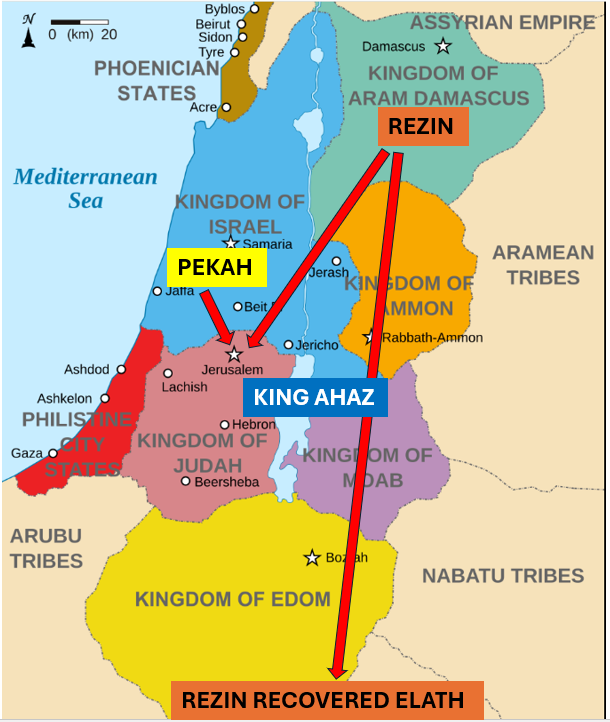
Isaiah 7:1 Now it came about in the days of Ahaz, the son of Jotham, the son of Uzziah, king of Judah, that Rezin the king of Aram and Pekah the son of Remaliah, king of Israel, went up to Jerusalem to wage war against it, but could not conquer it.:
- the days : 2Ki 16:1 2Ch 28:1-6
- Rezin : Isa 8:6 2Ki 15:37 Ps 83:3-5
- but could: Isa 7:4-9 8:9,10
- Isaiah 7 Resources - Multiple Sermons and Commentaries
Related Passages:
2 Kings 16:1+ In the seventeenth year of Pekah the son of Remaliah, Ahaz the son of Jotham, king of Judah, became king.
2 Kings 16:5-6+ Then Rezin king of Aram and Pekah son of Remaliah, king of Israel, came up to Jerusalem to wage war; and they besieged Ahaz, but could not overcome him. 6 At that time Rezin king of Aram recovered Elath for Aram, and cleared the Judeans out of Elath entirely; and the Arameans came to Elath and have lived there to this day.
2 Chronicles 28:5-8+ Wherefore, the LORD his God delivered him into the hand of the king of Aram; and they defeated him and carried away from him a great number of captives and brought them to Damascus. And he was also delivered into the hand of the king of Israel, who inflicted him with heavy casualties. 6 For Pekah the son of Remaliah slew in Judah 120,000 in one day, all valiant men, because they had forsaken the LORD God of their fathers 7 And Zichri, a mighty man of Ephraim, slew Maaseiah the king’s son and Azrikam the ruler of the house and Elkanah the second to the king. 8 The sons of Israel carried away captive of their brethren 200,000 women, sons and daughters; and they took also a great deal of spoil from them, and brought the spoil to Samaria.
NATIONAL CRISIS
PERSONAL UNBELIEF
PROFOUND PROPHECY
Now it came about Events do not just happen by chance. God is sovereign and is in control of history ("His" story) even while allowing men their free will. This is a mystery we cannot now explain. What we must continually remember is that since God is in total control, nothing just "comes about" but is ordained and orchestrated by an Omnipotent, Omniscient, Sovereign God.
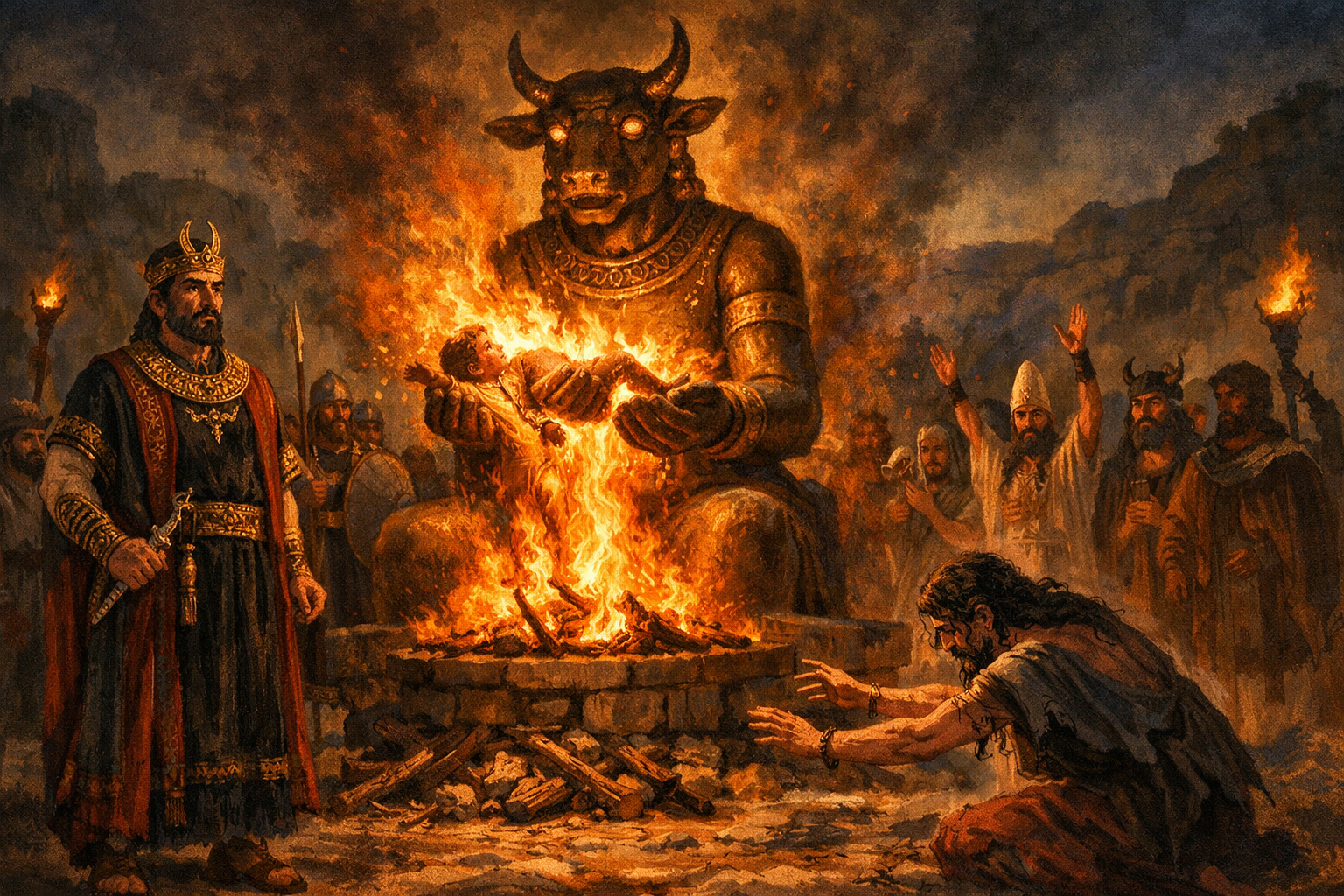
In the days of Ahaz ("he has grasped") the son of Jotham - Ahaz was an evil king from beginning to end for "he walked in the way of the kings of Israel, made molten images for the Baals..., burned incense in the valley of Ben-Hinnom and burned his sons in fire, according to the abominations of the nations whom the Lord had driven out before the sons of Israel. He sacrificed and burned incense on the high places, on the hills and under every green tree. (2Chr 28:1-4)
The son of Jotham, the son of Uzziah, king of Judah - This sets the chronology of Isaiah's prophecy in Isaiah 7-8.

That Rezin the king of Aram and Pekah the son of Remaliah, king of Israel, went up to Jerusalem to wage war against it, but could not conquer it (2Ki 16:5) - During Jotham's reign Pekah (Israel) formed an alliance Rezin (Aram-Syria) and launched a campaign against Judah with the goal of overthrowing Ahaz. This Syro-Ephraimite alliance advanced as far as Jerusalem but could not conquer it. The LORD preserved Jerusalem despite Ahaz’s unfaithfulness. Why did this alliance between the Syrians and the Northern Kingdom not conquer Jerusalem? Ultimately God did not allow them to conquer Jerusalem and replace King Ahaz as this would have ended the Davidic line from which Messiah would come. God is a covenant keeping God and here He kept His covenant with David! This is also called grace and mercy because Ahaz was an extremely evil king, and was preserved because of the Davidic Covenant.
Second Kings gives additional background which helps interpret the events in Isaiah 7...
Then (This "term of succession" [see expressions of time] follows a summation of the evil deeds of Ahaz [see that summary in the preceding section under "days of Ahaz"] and suggests that Ahaz was reaping the evil fruit of the evil seeds he had sown! cp Gal 6:7+, Gal 6:8+ - This is an immutable principle beloved - If you have some "secret" sins, you would be most wise to confess and forsake them immediately [Pr 28:13+], lest you reap the righteous response of God to your evil deeds!) Rezin king of Aram and Pekah son of Remaliah, king of Israel, came up to Jerusalem to wage war; and they besieged Ahaz, but could not overcome him (Isa 7:1, 2). 6 At that time Rezin king of Aram (Syria) recovered Elath for Aram, and cleared the Judeans out of Elath entirely; and the Arameans (Syrians) came to Elath, and have lived there to this day. 7 So (term of conclusion) Ahaz sent messengers to Tiglath-pileser king of Assyria (Asshur), saying,
"I am your servant and your son; come up and deliver me from the hand of the king of Aram, and from the hand of the king of Israel, who are rising up against me." (Comment: Contrast Ahaz's reliance on the "arm of flesh" with his rejection of the strong arm of the LORD - see especially Isa 7:8, 9, 10, 11, 12 - note God's clear warning against unbelief in Isa 7:9)
8 And Ahaz took the silver and gold that was found in the house of the LORD and in the treasuries of the king's house, and sent a present to the king of Assyria. 9 So the king of Assyria listened to him; and the king of Assyria went up against Damascus and captured it, and carried the people of it away into exile to Kir, and put Rezin to death (Comment: Ahaz undoubtedly thought his human plan had worked and had even trumped God's promise of protection, but God had clearly stated that he would not last and God's Word always comes to pass! We are all a bit like Ahaz - we devise a plan without praying about it, instead consulting other "wise" men, and at first our plan seems to work but in time it proves to be unsuccessful. May God's Spirit make us all quick to remember the foolish unbelief of Ahaz [cp 1Co 10:6, 11] and continually seek to put into practice the wisdom of Pr 3:5, 6, 7, 8. The world says "Look before you leap!" The Bible says "Pray before you leap!"). (2Ki 16:5-9, cp fate of Pekah = 2Ki 15:27, 28, 29)
QUESTION - Who was King Ahaz in the Bible? | GotQuestions.org
ANSWER - Ahaz was an evil king of Judah who became king at the age of 20 and reigned for 4 years with his father, Jotham, from 735 to 731 BC, and 16 years on his own, from 731 to 715 BC (ED: OR 732-716 BC). 2 Kings 16 and 2 Chronicles 28 record King Ahaz’s destructive practices, such as idol worship and sacrilege against the temple of the Lord. The actions of Ahaz contributed to the downfall of the kingdom of Judah, which the Lord brought about in 586 BC. Isaiah 7–10 speaks of the results and consequences of King Ahaz’s wicked ways.
it is unclear why King Ahaz departed
so completely from the teachings of the Lord
Ahaz’s father, King Jotham, was one of the good kings of Judah (2 Chronicles 27:2), so it is unclear why King Ahaz departed so completely from the teachings of the Lord. His repugnant deeds included sacrificing his own children, which was a great evil the kingdom of Israel had already been practicing (2Ki 16:3; 2Ch 28:3). King Ahaz also desecrated the temple as a result of his alliance with the king of Assyria, which came about in response to punishment God sent on Ahaz in the form of attacks on Ahaz’s land.
King Rezin of Aram and King Pekah of Israel had besieged King Ahaz’s lands, and, although they were not strong enough to defeat Ahaz, they did “inflict heavy casualties on him” (2 Chronicles 28:5+). Not only were Ahaz’s son Maaseiah and his second-in-command, Elkanah, killed, but over 100,000 soldiers were killed, and Judah’s cities were plundered. Many Israelites who were living in Judah were taken captive (verses 6–8). Because of all this, Ahaz appealed to the king of Assyria, Tiglath-Pileser, for help in defeating Aram and Israel. Tiglath-Pileser complied and attacked Damascus, capturing the city and killing King Rezin.
When King Ahaz met the victorious king of Assyria in Damascus, he saw a pagan altar there he wanted to copy for his own use in Jerusalem. So he sent plans to his priest Uriah, who finished the altar before Ahaz came back from Damascus (2 Kings 16:11). Upon his return, King Ahaz made sacrifices on the altar to the gods of Damascus. He moved the altar of the Lord, and, although he still planned to use it for “guidance” (verse 15), Ahaz offered all the sacrifices on the new altar.
Ahaz’s sacrilege did not end there. To impress the king of Assyria, he removed the royal entryway of the temple as well as the Sabbath canopy, and cut the temple furnishings into pieces (2 Kings 16:17–18; 2 Chronicles 28:24). After shutting the doors to the temple, he placed altars at all the street corners in Jerusalem and high places for worshiping false gods in every city in Judah (2 Chronicles 28:24–25).
The Bible is not clear on how Ahaz died, but it does say that, although he was buried with his ancestors in Jerusalem, he did not earn a place in the tombs of the kings of Israel (2 Kings 16:20; 2 Chronicles 28:27). His son Hezekiah reigned after him, and, fortunately, King Hezekiah “did what was right in the eyes of the LORD” (2 Chronicles 29:2). He reversed what his father had done to the temple, purifying it and again consecrating it for worship of the Lord (verses 3–36).
QUESTION - Who was King Pekah in the Bible? | GotQuestions.org
ANSWER - During the time of the divided kingdom in Israel, there was a string of wicked kings who ruled in the northern and southern kingdoms. This should not be surprising; when the people of Israel first became dissatisfied with God as their king and clamored for an earthly king, God warned them that human kings would make them unhappy (1 Samuel 8:6–18). But the people insisted, and so God gave them over to their desire. While there were several righteous kings who ruled over God’s people in Judah, the number of poor rulers who led the people into idolatry would eventually bring the nation to ruin and captivity in a foreign land.
Pekah was one such evil king. He began his rule in the kingdom of Israel by assassinating the former king, Pekahiah, for whom Pekah served as a chief officer, and taking over his throne (2 Kings 15:25). Pekah reigned for 20 years before he himself was assassinated by Hoshea son of Elah. Before Pekah was killed, however, some events took place that had a big impact on the nation of Israel and also on the whole world.
Late in his reign, Pekah entered an alliance with the king of Syria and attacked the southern kingdom of Judah, besieging Jerusalem. In response, King Ahaz of Judah sought help from the Assyrians, and Assyria invaded and “took Ijon, Abel Beth Maakah, Janoah, Kedesh and Hazor. He took Gilead and Galilee, including all the land of Naphtali and deported the people to Assyria” (2 Kings 15:29). This was the beginning of the destruction of the kingdom of Israel, which was God’s judgment for the sin and idolatry of the kings and their people (2 Kings 17:7–23). Pekah’s assassin, Hoshea, would reign for nine years after Pekah’s death, but King Shalmaneser of Assyria would discover Hoshea’s treachery in refusing to pay tribute and attempting to ally with Egypt against Assyria (2 Kings 17:4) and imprison Hoshea. Shalmaneser would then conquer the rest of the kingdom of Israel and deport its people, completing God’s judgment on the northern kingdom of Israel.
Another major event happened during Pekah’s rule that brought hope to God’s people. When King Pekah and King Rezin of Aram marched against Ahaz, king of Judah, the Lord sent the prophet Isaiah to comfort Ahaz and the people. He said, “It will not take place, / it will not happen, / for the head of Aram is Damascus, / and the head of Damascus is only Rezin. / Within sixty-five years / Ephraim will be too shattered to be a people. / The head of Ephraim is Samaria, / and the head of Samaria is only Remaliah’s son. / If you do not stand firm in your faith, / you will not stand at all” (Isaiah 7:7–9). In this prophecy, Pekah is referred to as “Remaliah’s son.”
Isaiah 7:7-9+ thus says the Lord GOD: “It shall not stand nor shall it come to pass. 8 “For the head of Aram is Damascus and the head of Damascus is Rezin (now within another 65 years Ephraim will be shattered, so that it is no longer a people), 9 and the head of Ephraim is Samaria and the head of Samaria is the son of Remaliah. If you will not believe, you surely shall not last.”’”
The Lord also offered Ahaz a sign, and, even though Ahaz refused on the grounds that he did not want to test the Lord, God moved Isaiah to give this famous prophecy Isaiah 7:14+
“Therefore the Lord himself will give you a sign: The virgin will conceive and give birth to a son, and will call him Immanuel. He will be eating curds and honey when he knows enough to reject the wrong and choose the right, for before the boy knows enough to reject the wrong and choose the right, the land of the two kings you dread will be laid waste.”
Not only did God promise that King Pekah and King Rezin would not prevail, but He also spoke about how His Son, Jesus, the Messiah Israel had long awaited, would come. Ahaz saw the sign of a child’s birth, but the ultimate fulfillment of the prophecy awaited the birth of Jesus Christ, who was born to a virgin, grew up, died on a cross, and rose again, all to save His people from the reign of sin and death.
REZIN (ISBE) - re'-zin (retsin; Rhaasson): The last of the kings of Syria who reigned in Damascus (2 Ki 15:37; 16:5-10; Isa 7:1; 8:4-7). Along with Pekah, the son of Remaliah, who reigned 20 years over Israel in Samaria, he joined in the Syro-Ephraimitic war aaainst Ahaz, the king of Judah. Together they laid siege to Jerusalem, but were unsuccessful in the effort to take it (2 Ki 16:5; Isa 7:1). It was to calm the fears, and to restore the fainting spirits of the men of Judah, that Isaiah was commissioned by the Lord to assure them that the schemes of "these two tails of smoking firebrands" (Isa 7:4) were destined to miscarry. It was then, too, that the sign was aiven of the vigin who should conceive, and bear a son, and should call his name Immanuel. Rezin had to content himself on this campaign to the South with the capture of Elath from the men of Judah and its restoration to the men of Edom, from whom it had been taken and made a seaport by Solomon (2 Ki 16:6, where it is agareed that "Syria" and "Syrians" should be read "Edom" and "Edomites," which in the Hebrew script are easy to be mistaken for one another, and are in fact often mistaken). Rezin, however, had a more formidable enemy to encounter on his return to Damascus. Ahaz, like kings of Judah before and after him, placed his reliance more on the arm of flesh than on the true King of his people, and appealed to Tiglath-pileser III, of Assyria, for help. Ahaz deliberately sacrificed the independence of his country in the terms of his offer of submission to the Assyrian: "I am thy servant and thy son" (2 Ki 16:7). Tiglath-pileser had already carried his arms to the West and ravaged the northern border of Israel; and now he crossed the Euphrates and hastened to Damascus, slaying Rezin and carrying his people captive to Kir (2 Ki 16:9). In the copious Annals of Tialath-pileser, Rezin figures with the designation Racunu(ni), but the tablet recording his death, found and read by Sir Henry Rawlinson, has been irrecoverably lost, and only the fact of its existence and loss remains (Schrader, COT, I, 252, 257). With the death of Rezin the kingdom of Damascus and Syria came to an end.
Joseph A Alexander sets the context and summarizes Isaiah 7 writing that...
Here begins a series of connected prophecies (Isaiah 7-12), belonging to the reign of Ahaz, and relating in general to the same great subjects, the deliverance of Judah (southern 2 tribes) from Syria and Israel (northern 10 tribes), its subsequent subjection to Assyria and other foreign powers, the final destruction of its enemies, the advent of the Messiah, and the nature of His kingdom. The series admits of different divisions, but it is commonly agreed that one distinct portion is contained in the seventh chapter....
The common division (of Isaiah 7) is more natural, which supposes Isa 7:1-16 to contain a promise of deliverance from Syria (Aram) and Israel (Ephraim), and Isa 7:17-25 a threatening of worse evils to be brought upon Judah by the Assyrians whom they trusted. The chapter begins with a brief historical statement of the invasion of Judah by Rezin and Pekah and of the fear which it excited, to relieve which Isaiah is commissioned to meet Ahaz in a public place, and to assure him that there is nothing more to fear from the invading powers, that they evil design cannot be accomplished, that one of them is soon to perish, and that in the meantime both are to remain with out enlargement (Isaiah 7:1-9).
Seeing the king to be incredulous, the prophet invites him to assure himself by choosing any sign or pledge of the event, which he refuses to do, under the pretext of confidence in God, but is charged with unbelief by the prophet, who nevertheless renews the promise of deliverance in a symbolical form, and in connection with a prophecy of the miraculous conception and nativity of Christ, both as a pledge of the event, and as a measure of the time in which it is to take place (Isaiah 7:10-16)
To this assurance of immediate deliverance, he adds a threatening of ulterior evils, to arise from the Assyrian protection which the king preferred to that of God, to wit, the loss of independence, the successive domination of foreign powers, the harassing and predatory occupation of the land by strangers, the removal of its people, the neglect of tillage, and the transformation of its choicest vineyards, fields, and gardens, into wastes or pastures (Isaiah 7:17-25). (The Prophecies of Isaiah - one of the best older commentaries on Isaiah)
W E Vine introduces this chapter noting that...After the death of Uzziah (Isa 6:1-note) and during the reign of Jotham, Isaiah was given no written prophecy to record. Jotham, probably exercised by his father’s death, sought to be conformed to God’s Law. Evil went on in the nation (2Chr. 27:2), and Ahaz broke out into open defiance of God. And now a new series of prophecies is committed to His messenger. (BORROW isaiah prophecies promises warning)
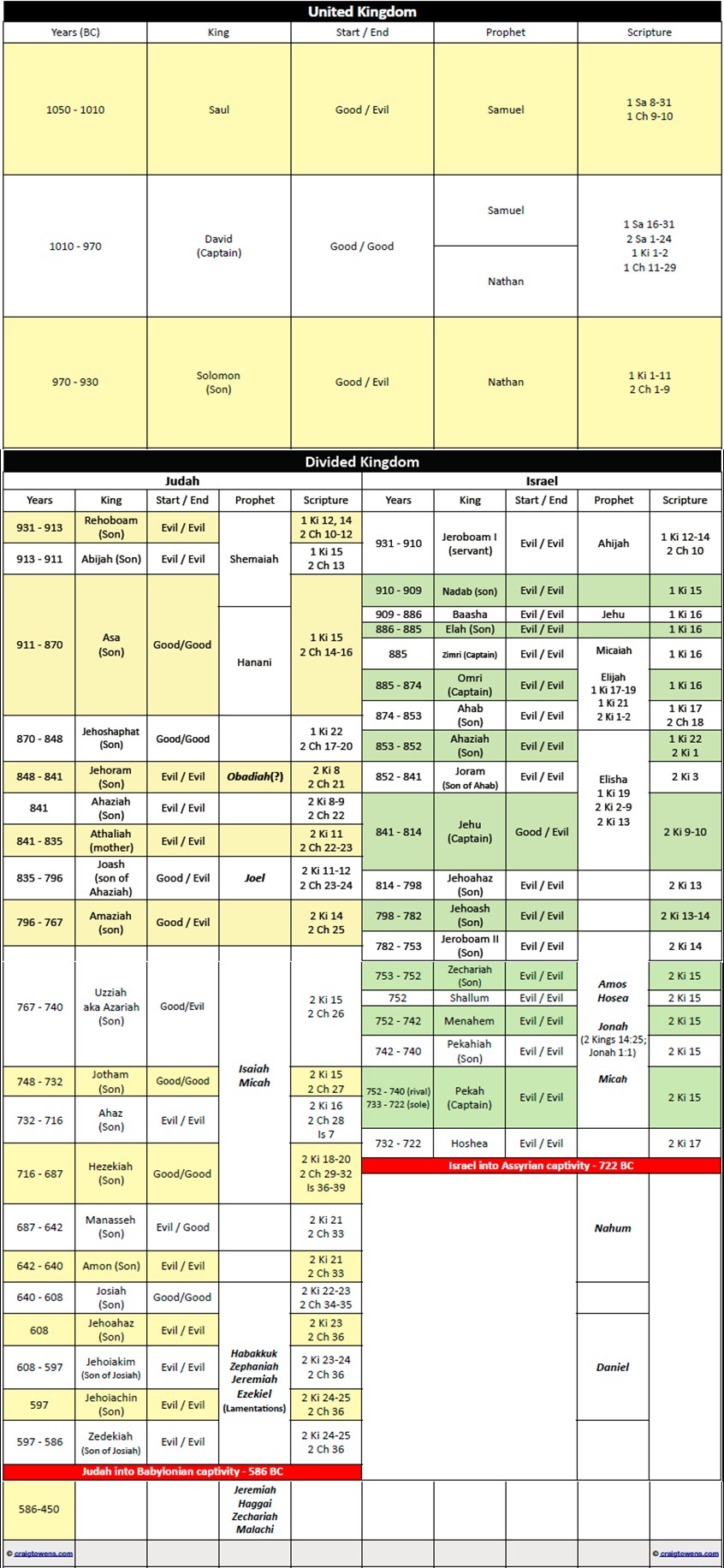
To help keep this chapter in context observe the preceding table and the following outline adapted from Talk Thru the Bible which summarizes the first section of Isaiah dealing primarily with prophecies concerning the Kingdom of Judah...
A The Judgment of Judah Isa 1:1–31
B The Day of the Lord Isa 2:1–4:6
C The Parable of the Vineyard Isa 5:1–30
D The Commission of Isaiah Isa 6:1–13
E The Destruction of Israel by Assyria Isa 7:1–10:4
1 Sign of Immanuel Isa 7:1–25
2 Sign of Maher-Shalal-Hash-Baz Isa 8:1–22
3 Prophecy of the Messiah’s Birth Isa 9:1–7
4 Judgment on Ephraim Isa 9:8–10:4
F The Destruction of Assyria by God Isa 10:5–12:6
1 Destruction of Assyria Isa 10:5–19
2 Remnant of Israel Isa 10:20–34
3 Restoration of the Messiah’s Kingdom Isa 11:1–16
4 Thanksgiving in the Messiah’s Kingdom Isa 12:1–6
790 - Uzziah (790-739BC) becomes king of Judah, reigns 52 years
759 - Jotham becomes king of Judah assuming reign when Uzziah becomes leprous
742 - Micah begins his prophetic ministry (cp ministry to Hezekiah Jer 26:18, 19, Mic 3:12)
739 - Isaiah begins prophetic ministry in year King Uzziah died (Isa 6:1f)
731 - Ahaz becomes king of Judah (2Ki 15:38, 16:1, 2Chr 28:1)
726 - Hezekiah becomes 12th king of Judah (2Ki 16:20, 18:1,2) and one of 3 best (2Ki 18:5)
722 - Shalmaneser (2Ki 17:3, 18:9) dies while besieging Samaria, Sargon seizes crown
722 - Sargon of Assyria (Sargon) (Is 20:1) conquers Samaria (2Ki 17:6, 18:9, 10, 11, 12)
701 - Sennacherib (son of Sargon) of Assyria lays siege to Jerusalem
695 - Manasseh becomes king of Judah (2Ki 21:1, 2, 3, 4, 5, 6, 7, 8, 9, 10, 11, 12)
627 - Jeremiah begins prophetic ministry
586 - Nebuchadnezzar of Babylon conquers Judah
(Source: The Ryrie Study Bible) Note that most of these dates are approximations and not indisputable facts. They are listed to help give the reader have a general idea of the relationship of historical events in Isaiah's time.
Irving Jensen reminds us that "Of all the writing prophets, Isaiah is justly accounted the greatest. His prophecy is one of the longest, is quoted more frequently than any other in the New Testament, and he more often than any other prophet tells of the coming Messiah. Isaiah prophesied for about fifty years during very critical times of both kingdoms, Israel and Judah. He was greatly responsible for the sweeping reforms introduced by Hezekiah, who was one of Judah’s righteous kings. Merrill Unger says this of Isaiah: “Isaiah … is the great messianic prophet and prince of OT seers. For splendor of diction, brilliance of imagery, versatility and beauty of style, profundity and breadth of prophetic vision, he is without peer.”...Isaiah, like most of the prophets, preached a twofold message: warning of judgment for sin, and comfort of salvation for righteousness. John Phillips writes, “One moment his book is black with the thunder and the darkness of the storm. The next, the rainbow shines through, and he sweeps his readers on to the Golden Age that still lies ahead for the world.” Isaiah spoke mainly to the chosen people of God, but his message was also directed to foreign nations, prophesying judgment but also proclaiming the evangel (Gospel) to them (read Isa 11:10; 42:6; 45:22). (Jensen's Survey of the Old Testament - Irving L. Jensen Books - recommended resource)
Isaiah 7:2 When it was reported to the house of David, saying, "The Arameans have camped in Ephraim," his heart and the hearts of his people shook as the trees of the forest shake with the wind.:
- house : Isa 7:13 6:13 37:35 2Sa 7:16 1Ki 11:32 12:16 13:2 Jer 21:12
- camped in: Isa 7:17 11:13 2Ch 25:10 28:12 Eze 37:16-19 Ho 12:1
- His heart: Isa 8:12 37:27 Lev 26:36,37 Nu 14:1, 2, 3 Dt 28:65,66 2Ki 7:6,7 Ps 11:1 27:1,2 112:7,8 Pr 28:1 Mt 2:3
- Isaiah 7 Resources - Multiple Sermons and Commentaries
Related Passages:
2 Chronicles 28:5-6 Wherefore (because of 2Chr 28:1-4), the LORD his God delivered him (Ahaz) into the hand of the king of Aram (Syria); and they defeated him and carried away from him a great number of captives, and brought them to Damascus. And he was also delivered into the hand of the king of Israel, who inflicted him with heavy casualties. For Pekah the son of Remaliah slew in Judah 120,000 in one day, all valiant men, (Why?) because they had forsaken the LORD God of their fathers (Sin never pays!).

AHAZ & JUDAH SHAKEN BY
ENEMY ENCAMPMENT
When it was reported to the house of David - This phrase refers to King Ahaz and serves to focus our attention on the Davidic Covenant, Jehovah's unbreakable, immutable, unconditional, eternal covenant with David in which He promised to give to His servant an eternal seed, throne, and kingdom (2Sa 7:12-16+; 1Ch 17:11-14+; Ps 89:19-37).
Ron Teed offers an interesting thought on why the phrase house of David is used in place of the name Ahaz - The house of David in Isa 7:2 reminds us of the significance of Satan’s attempt to destroy the Davidic dynasty or line from which would come the Savior, Jesus Christ. If Ahaz had been overthrown, it would have made it impossible for God’s promise of a Savior to come through the line of David. But we know that God controls all history and He would not allow anyone to cause His promise to be broken (Ed: The promise of the Messiah from the house of David - see Jehovah, the covenant keeping God's, immutable, unconditional promise in His "Davidic Covenant" - 2Sa 7:12, 13, 16; 1Ch 17:11-14 cp Covenant - Solemn & Binding) to be broken. (Isaiah 7 Teed Commentaries)
The Arameans have camped in Ephraim - Ephraim is another name for the Northern Kingdom, so what is being described is the camp of the Syro-Ephraimite forces, their encampment implies they were positioned within striking distance for an attack on Jerusalem. From a human perspective, Judah was outmatched.
His (King Ahaz's) heart and the hearts of his people shook as the trees of the forest shake with the wind - The reaction of the king and the people at this news would not be surprising in view of the fact that Aram (Syria) and Israel (King Pekah) had previously defeated King Ahaz (See above 2Ch 28:5-6). From a human standpoint the threat was overwhelming—Judah was small, politically weak, and led by an ungodly king. Fear and unbelief at the top trickled down to every level. Shook describes violent trembling, an inner earthquake even before a battle has begun. Isaiah uses a powerful picture as trees with deep roots still sway helplessly in strong winds. Judah was not not bending in prayer but bending in panic. Ahab was not a man of God, nor a man of the Book. Had he understood the Davidic Covenant, he would have been firmly rooted in the faithfulness of Jehovah and the certainty that He would keep His covenant. But instead of faith, he (and the people) had fear.
🙏 THOUGHT - This raises the question of how do I handle adverse circumstances, especially when they begin to "encamp" around my mind? Do I trust in my own wisdom and ability (as Ahaz did by making a treaty with Assyria)? Or do I search God's Word that my faith in God might be buoyed and I might be strengthened by His Spirit to endure the trial?
Rydelnik (page 1019) - Ahaz’s fear was well described—the house of David is pictured as trembling like the trees of the forest shake with the wind (v. 2), since replacing Ahaz would also entail the murder of the entire house of David. Michael Rydelnik explains:
This threat provides a significant detail in understanding the passage. While some have contended that there would be no reason to foretell the coming of the Messiah, the danger to the house of David explains the messianic concerns of the passage. It was the Davidic Covenant (2 Sam 7:12–16; 1 Chron 17:11–14) that led to the expectation of a future Messiah who would be a descendant of David. Therefore, if Ahaz and the entire royal house were to be destroyed, it would bring an end to the Messianic hope. A long-term prophecy of the birth of Messiah would assure the Davidic house and the readers of the scroll of Isaiah that the Messianic hope was indeed secure (Michael Rydelnik, “An Example from the Prophets: Interpreting Isaiah 7:14 as Messianic Prophecy”, In The Messianic Hope: Is the Hebrew Bible Realy Messianic? [Nashville: Broadman & Holman, 2010], 148).
Isaiah 7:3 Then the LORD said to Isaiah, "Go out now to meet Ahaz, you and your son Shear-jashub, at the end of the conduit of the upper pool, on the highway to the fuller's field,:
- Go out: Ex 7:15 Jer 19:2,3 22:1
- Shear-jashub - "remnant shall return" Isa 6:13 10:21 55:7 Ro 9:27
- at the end of the conduit of the upper pool: Isa 36:2 2Ki 18:17 20:20
IN THE MIDDLE OF THE
PANIC GOD SPEAKS
Then - When? When king and country are in mortal fear! Jehovah comes into the picture when Judah is in great fear.
THOUGHT - Beloved, when we are in great fear, remember that the Lord is near.-- Hebrews 13:5+
The LORD said to Isaiah, "Go out now to meet Ahaz, you and your son Shear-jashub - Isaiah was to take his son whose name functions as a walking "sermon" or walking "object lesson" for his name means "a remnant shall return." (Isa 10:21 - where remnant = believing remnant).
Leupold makes an interesting observation that the name Shear-jashub "is either a threat to the effect that only a remnant shall return or survive; or it can imply that a remnant shall return, and so it involves a promise. Ahaz must have known the child’s name, otherwise this procedure would have to be stamped as meaningless. But by the side of Shear-jashub stood Isaiah, with a name equally meaningful: "the salvation of the Lord", or "the Lord is salvation". The entire cue to the course to be taken plus an indication of the outcome was mapped out in this significant name. This encounter was suggesting to Ahaz to let the Lord be his salvation and then at least a remnant would survive. (Borrow Exposition of Isaiah)
Vine notes that Shear-jashub "forms a continuation of the message given in Isa 6:13 ("there will be a tenth portion in it...a holy seed, its stump"), marking the unity of the distinct prophecies. The name was designed to be to Ahaz both an inducement to him to turn to God himself, and a warning that, if he refused to do so, he would have no part in the restoration of that part of the nation described as the remnant."
Guzik sees Shear-jashub as more of a warning - "Because his name meant "A Remnant Shall Return", and God wanted Ahaz to know that because of the kind of ungodly trust he put in the king of Assyria (see Isa 7:12), Judah would eventually be taken into captivity, and only a remnant would return."
Skinner adds the thought that instead of meaning a "return from exile," (which I favor) Shear-jashub means to "turn to Jehovah" citing Isaiah 10:22 as support for his interpretation. (doctrine of the remnant). It is very possible that this name has more than one prophetic fulfillment to Judah who would be taken into captivity to Babylon for 70 years after which a remnant would return to the land. This historical fulfillment could be a picture of the future, final fulfillment, when a remnant of believing Israel (Jews) will repent and return to Jehovah their Redeemer in the last half of Daniel's Seventieth Week, the horrible time that Jesus referred to as the Great Tribulation (the time of Jacob's distress - Jer 30:7, Da 12:1+. Compare Zechariah's prophecy declaring that 2/3's of the Jews will be cut off because of their unbelief and 1/3 will be brought through the Refiner's fire - Zech 13:8, 9+, ) (See page 144 The book of prophet Isaiah)
At the end of the conduit of the upper pool, on the highway to the fuller's field - The exact location of this reservoir is uncertain, but as an above ground aqueduct providing water to the city it's strategic nature is beyond question. Therefore as a source of water to the city, it is likely that Ahaz was attempting to prevent the invading forces from Syria and Israel from having access while at the same time retaining its use for Jerusalem. So it appears that instead of falling on his knees before God to seek His help against the Syriac-Israeli alliance, King Ahaz was inspecting the water supply, making human preparations for the potential coming siege.
🙏 THOUGHT - Aren't we all like Ahaz at times - we find ourselves suddenly confronted with a seemingly overwhelming problem and our first reaction is to call our lawyer, our accountant, our counselor, etc, rather than immediately calling out to our Father Who art in heaven? I hope you are as convicted as I am! God grant us grace to first seek Thy face! Amen
Rydelnik (page 1019) - The aqueduct was outside the city, but it was a strategic point from a military perspective as it was Jerusalem’s water source. Military strategies in the ancient Near East often entailed sieges in which an attacking army trapped their opponents inside a walled city (Israel Eph’al, The City Besieged: Siege and Its Manifestations in the Ancient Near East [Leiden: Brill, 2009], 35–113). Those inside the city could hold off an attack if they were adequately stocked with food and water. While it is not stated in the text, the implication is that Ahaz was actively planning to resist Rezin and Pekah by preparing for a siege.
Skinner adds that..."Ahaz was at this anxious moment devoting his personal attention to the water supply of his capital. Operations were apparently in progress either for filling the reservoirs and cisterns within the city or for stopping the sources that would be accessible to the enemy. In the historic sieges of Jerusalem the assailants always suffered more from scarcity of water than the defenders and it is not impossible that the precautions taken on this occasion were the reason why the allies "were not able to fight against it." (See The book of prophet Isaiah)
Conduit (te'alah) describes a trench, a channel or an aqueduct constructed to carry water. An aqueduct would enable water to flow from one location to another (2Ki 18:17, 20:20) (Click here for description of ancient aqueducts - see entry #5 "Pools and Aqueducts")
The Fuller's Field - The location is uncertain. This field was a place where people washed clothes.
The upper pool is mentioned later in Isaiah as the very site Sennacherib's field commander Rabshakeh hurled insults at King Hezekiah (which served as a fulfillment of Isaiah's prediction of an Assyrian attack - see below Isa 7:17, 18ff) suggesting that whatever was the specific location, it was certainly in "earshot" of the wall...
And the king of Assyria sent Rabshakeh from Lachish to Jerusalem to King Hezekiah with a large army. And he stood by the conduit of the upper pool on the highway of the fuller’s field. (Is 36:2, cp Isa 36:11, 2Ki 18:17, 26).
Shear-jashub The name Shear-jashub (שְׁאָר יָשׁוּב), mentioned in Isaiah 7:3, carries profound theological and prophetic significance. He was one of Isaiah’s sons whose very name served as a prophetic sign to King Ahaz (Isa 7:3; cf. Isa 8:18). Around 735 BC, Judah was threatened by the alliance of Israel (Ephraim) and Syria. Instead of trusting the LORD, Ahaz sought help from Assyria. Isaiah confronted Ahaz, bringing Shear-jashub with him, likely so that the child’s name would visibly embody God’s message before the fearful king.
The name Shear-jashub means “a remnant shall return,” and it carried a double-edged message of warning and of hope. On the one hand, it warned of judgment because King Ahaz had chosen to rely on Assyria rather than on the Almighty God. The result would be Judah would suffer devastation, and only a remnant of the people would survive. On the other hand Shear-jashub held out a promise and a hope (not hope so but hope sure) that despite the coming disaster, God would preserve a remnant faithful to His covenant promises.
Theologically, Shear-jashub’s name summarized Isaiah’s theology in miniature - judgment followed by restoration. Human rebellion would lead to severe loss, yet God’s mercy would ensure the survival and restoration of a believing remnant. Though judgment would come upon Judah and Israel for their apostasy, God promised that a faithful remnant would survive and return to Him. In a single sentence, Isaiah 7:3, Shear-jashub embodied the sober truth that judgment was coming because of Ahaz’s unbelief, yet God would preserve a faithful remnant and His Covenant would not fail.
This meaning comes into clearer focus later in Isaiah 10:21, which declares, “A remnant will return, the remnant of Jacob, to the mighty God” Only a remnant would survive the consequences of Ahaz’s choices, yet that remnant would be living proof that God had not abandoned His people and would remain faithful to His ancient promises. Significantly, Shear-jashub was born and named before Ahaz rejected God’s gracious offer of help, making his presence at the encounter a pre-announced warning of what unbelief would bring.
The concept of a faithful remnant aligns with God’s unchanging covenant nature. Despite human failure, the Lord remains steadfast, always preserving a people for Himself. Paul quotes Isaiah in Romans 9:27 affirming that “Though the number of the sons of Israel be like the sand of the sea, it is the remnant that will be saved”. This shows how the promise of a remnant in Isaiah points beyond Judah’s immediate context to God’s ultimate plan of redemption through Jesus Christ. Those who repent and trust in Christ become part of this spiritual remnant, restored and reconciled to the “Mighty God” foretold by Isaiah (Isaiah 9:6).
In summary, Shear-jashub is far more than a symbolic name for it is a declaration of God’s enduring mercy and faithfulness to keep His Covenant promises. Even in times of rebellion and judgment, His promise endures that those who return to Him in faith will find restoration. The remnant theme reminds all believers that God’s purposes are never thwarted by human failure and that He always preserves a people who "will truly rely on the LORD, the Holy One of Israel." (Isaiah 10:20).
Not everyone agrees with the preceding interpretation of a warning and a hope. Here are some other commentators...
Gilbrant - Isaiah’s son Shear-Jashub was a sign to Ahaz that a remnant would be preserved from Assryian destruction. The concept of the remnant was extended to refer to those who eventually returned to Judah after the destruction of Jerusalem in 586 b.c. and the return of that remnant in 538 b.c. under Cyrus, king of Persia. Although Israel would become a “remnant,” a negative concept, yet a “remnant” would return by God’s grace to continue his holy seed (Ezra 9:8). Ezra, however, feared for the possible destruction of the remnant that returned from Babylon (ch. 9). Interestingly, the remnant concept highlights both God’s judgment and his grace in preserving and returning a remnant to Judah. The name “Shear-Jashub” emphasizes the positive aspect of return and future hope. Inherent in the return to the land is likewise a return to the Lord in faith. Israel’s ability to be a people of hope was based upon God’s faithful preservation of them. (Complete Biblical Library)
G V Smith in the newest edition of the International Standard Bible Encyclopedia - SHEAR-JASHUB shēär-jāʹ shōōb [Heb. šeʾār yāšûḇ—‘a remnant will return’]. The symbolic name given to Isaiah’s first son (Isa. 7:3; cf. Maher-shalala-hash-baz; Immanuel). Around 734–32 b.c. Rezin the king of Syria and Remaliah the king of Israel formed an anti-Assyrian coalition that Ahaz the king of Judah refused to join (2 K. 16; 1 Ch. 28; Isa. 7:1–9.) Because Ahaz remaind loyal to Assyria, Israel and Syria attacked Judah and defeated all its cities except Jerusalem. Before these battles Ahaz oversaw the military preparations of Jerusalem, including the protection of the city’s water supply at the upper pool (Isa. 7:3; cf. 32:2). Isaiah and his son Shear-jashub brought God’s message to Ahaz at this crucial time (7:4–9). Interpreters usually view Shear-Jashub’s presence as a sign that: (a) “only a remnant will return” (cf. 10:22); i.e., Judah will only have a few that will return alive from its war with Syria and Israel (Blank); or (b) “a remnant will return” (cf. 6:10; 10:20f); i.e., the remnant of Judah will return to God and trust in Him (Lindblom). The first approach takes Shear-jashub’s name as a curse, while the second views the name as a promise of hope. The first runs contrary to the context of 7:4–9, and the second is determined primarily by 10:20–22. Isaiah’s spoken message challenged Ahaz to trust God and not to fear the armies of Israel and Syria (Isa. 7:4–9). Since the word of the Lord in 7:7–9 announces the defeat of the king’s enemies, it seems that Shear-jashub is a sign that Israel and Syria will be defeated and will return to their own land with only a remnant remaining (Tiglath-pileser III defeated both nations; cf. 2 K. 15:29; 16:7, 9). The use of the phrase “only a remnant of them will return” in Isa. 10:20–22 is distinct from 7:3–9 and Isaiah’s son is not present. Bibliography.—S. Blank, JBL, 67 (1948), 211–15; HUCA, 27 (1956), 86–90; G. Hasel Andrews University Seminary Studies, 9 (1971), 36–46; The Remnant (1974), pp. 270–288; L. Koehler, VT, 3 (1953), 84f; J. Lindblom, A Study on the Immanuel Section in Isaiah (1958); J. N. Oswalt, comm on Isaiah, I (NICOT, 1986), 199f.
Isaiah 7:4 and say to him, 'Take care and be calm, have no fear and do not be fainthearted because of these two stubs of smoldering firebrands, on account of the fierce anger of Rezin and Aram and the son of Remaliah.:
- Take care: Isa 30:7,15 Ex 14:13,14 2Ch 20:17 La 3:26
- fear: Isa 8:11-14 35:4 41:14 51:12,13 Mt 10:28 24:6
- Do not be fainthearted: Heb. let not they heart be tender, Dt 20:3 1Sa 17:32
- Two stubs: Isa 7:8 8:4 2Ki 15:29,30 Am 4:11)

JEHOVAH COMMANDS AN
ATTITUDINAL ADJUSTMENT
Note that Jehovah's message to King Ahaz through His "mouthpiece" Isaiah continues from Isa 7:4 through Isa 7:9.
Take care and be calm (both are commands = red) - "Guard yourself and be quiet." "Be careful and cautious and do not act rashly or as if in panic." "Keep calm and don't lose your head." (Compare the charge to Joshua - Joshua 1:6, see also Isaiah 30:15) A similar message was issued by Moses to Israel just before they crossed the Jordan to confront the Canaanite enemies...
Be strong and courageous (both are commands), do not be afraid or tremble at them, for the Lord your God is the one who goes with you. He will not fail you or forsake you. Then Moses called to Joshua and said to him in the sight of all Israel, “Be strong and courageous, (why?) for you shall go with this people into the land which the Lord has sworn to their fathers to give them (Note: The divine promise had been given and was thus was certain. And yet faith and obedience were necessary in order for Joshua and Israel to "possess their possessions!" This is an immutable principle which undergirds the "victorious Christian life" - Trust and obey for there's no other way to be happy in Jesus, then to trust and obey! Where are you not obeying in your Christian life? Be sure that your disobedience reflects your unbelief and together these inseparable "twins" will impede your progress in your journey of progressive Christlikeness!), and you shall give it to them as an inheritance. (Dt 31:6-7).
Take care (08104) (samar) means to watch (over or carefully), to be on guard, to exercise great care over (eg, Adam in the Garden Ge 2:15, a flock Ge 30:31). The Lxx uses phulasso (aorist imperative = Command to do this effectively with a sense of urgency) which means to be on guard, to watch, to keep in safe custody.
Be calm (08252) (saqat) means to be still, quiet or undisturbed. The Lxx uses hesuchazo (from hesuchos = quiet, still) (aorist imperative = Command to do this effectively with a sense of urgency) and means to keep still, refrain from labor, meddlesomeness or speech. To be at rest or maintain a state of silence.
Be tenderhearted (07401)(rakak) means to be tender (second Hebrew word = lebab = heart), and in the present context is used to discourage the faintheartedness as in a man who lacks resolve and needs to be strong in the face of danger (Dt 20:3, 8 Jer 51:46)
Because - Isaiah now explains why King Ahaz need not fear the Rezin-Pekah alliance that was arrayed against Judah and Jerusalem.
Two stubs of smoldering firebrands - Rezin and Pekah are not flaming (destructive) firebrands but smoldering (about to flame out) firebrands. The two stubs are Aram (Syria) and Israel (in context referred to as Ephraim) This is a very pithy metaphor picturing the power of Rezin and Pekah as ready to die out like a piece of smoking wood that has been removed from a bonfire. A piece of wood that is smoldering is already burning out and now characterized more by smoke than by fire which is a picture of braggadocio (empty boasting) without brawn (muscular strength) to back their verbal threats (See Isa 7:6)
John Calvin comments on the two stubs "One would think that they are endued with so great power that they could burn and destroy the whole world. To put down the excess of terror, the Lord declares that what we imagined to be a burning, and a perpetual burning, is but a slight smoke and of short duration.
John Trapp adds "Call them in contempt a couple of firebrands, such as would do mischief but cannot, because smoking and not burning, and but the tails of smoking firebrands neither, such as are smoking their last, and shall shortly be utterly extinct. In a word, they have more pride than power, being a mere flash."
Fierce anger - (Literally a burning nose) The burning (intense, hot) anger emanates from a "smoldering firebrand", a firebrand about to burn out! This is why King Ahaz is to take care and be calm. Ahaz's (Judah's) enemies may have a lot of bark but no bite according to Jehovah.
Ahaz's reaction to Syria and Israel reflected his human perspective on the problem. To Ahaz this was a big problem, for these two enemies allied together constituted a terrible threat! What Ahaz failed to do was to see them as God saw them, as two stubs of wood about to burn out, as all smoke and no fire!
🙏 THOUGHT - How often we are like Ahaz and choose to keep our focus on our problem rather than looking at the One Who can solve our problems! What problem has you paralyzed with fear? Who are you choosing to look at to solve this problem, yourself, the arm of flesh or Jehovah, the Almighty God?
Son of Remaliah - Skinner is probably correct when he writes that "Pekah was a usurper, a novus homo, and Isaiah never condescends to utter his name. Cp Isa 7:5, 9) (See The book of prophet Isaiah)
Isaiah 7:5 'Because Aram, with Ephraim and the son of Remaliah, has planned evil against you, saying,:
- Aram [Syria]: Ps 2:2 83:3,4 Na 1:11 Zech 1:15
- Isaiah 7 Resources - Multiple Sermons and Commentaries
Related Passages:
Psalm 2:2 The kings of the earth take their stand And the rulers take counsel together Against the LORD and against His Anointed (MESSIAH), saying,
YAHWEH THRU ISAIAH
EXPLAINS THE EVIL
Because - Term of explanation. The little word “Because” opens the curtain on the political storm behind Isaiah 7. God tells Ahaz exactly what his enemies are thinking. Isaiah explains the nature of the fierce anger as pre-medicated evil against King Ahaz and His Kingdom of Judah.
Aram, with Ephraim - Aram = Syria, led by Rezin. Ephraim = the northern kingdom of Israel under Pekah. These two traditional rivals had become partners, not out of love for each other, but out of fear of Assyria. Their coalition had one purpose which is to force Judah to join their anti-Assyrian bloc.
And the son of Remaliah - Notice how God speaks of Pekah. Not “King Pekah.” Not “mighty ruler.” Simply “the son of Remaliah.” This is deliberate divine diminishment of Pekah, King of Israel. Some see this way of referring to Pekah as a title of contempt for his usurping the crown rather than having descended from the royal line.
Every human scheme must pass through
the filter of divine permission.
Has planned evil against you, saying - Planned signifies this is a deliberate strategy, calculated conspiracy and political scheming. What men call strategy, God may call evil. Their evil is explained in following passages -- Deposing Ahaz, Ending David’s dynasty, Installing a puppet ruler. This was a direct (satanic) attack on 2 Samuel 7:12-16+, Yahweh's promise to David that through him would come the Messiah. If Satan could decaptitate the Davidic line with this evil plan, he could prevent the coming of the Messiah. The sovereign, omnipotent, covenant keeping God obviously would not let that happen!

Ahaz looked at the seen circumtances, not the unseen God. Ahaz saw two armies, potential political extinction and overall human impossibility. God saw a temporary conspiracy, men under His leash and a plan that “shall not stand” (Isa 7:7) The Omniscient God exposed the Syro-Ephraimite coalition’s secret agenda to show Ahaz that what looked like an unstoppable political plot was, in heaven’s view, a fragile and doomed conspiracy against His covenant. And like Ripley's logo says "Believe it or not!" This was to be King Ahaz's ultimate faith test!
Isaiah 7:6 "Let us go up against Judah and terrorize it, and make for ourselves a breach in its walls and set up the son of Tabeel as king in the midst of it,":
- Isaiah 7 Resources - Multiple Sermons and Commentaries
THE THREE PART
EVIL PLAN
Let us go up against Judah and terrorize (qus) it, and make for ourselves a breach (baqa') in its walls and set up the son of Tabeel as king in the midst of it - Now Isaiah tells Ahaz the three specific objectives of the planned evil. (1) Campaign of terror calculated to fill Judah with fear, anxiety, apprehension (terrorize it), which from Isa 7:3 was already having its intended impact on the King and the nation of Judah. (2) Split the defensive walls (a breach) of the city of Jerusalem wide open! (3) Set up a puppet king - Tabeel about whom nothing specific is known. Tabeel in some resources is said to mean "God is good" but there are a few sources (Leupold; The Exhaustive Dictionary of Bible Names) that say the meaning of the slightly altered form of the name is "Good for nothing" which might be an intended pun.
Terrorize (06973) (qus) can mean to loathe or be disgusted but as used here in the causative sense it means to vex (bring trouble, distress, agitation, to make one cower) A verb meaning to loathe, feel disgust, or be sick of. It describes God’s revulsion toward pagan practices (Lev 20:23), Israel’s ungrateful disdain for manna (Num 21:5; Ps 78:22–25), personal aversion such as Rebekah toward her Hittite daughters-in-law (Gen 27:46), and despising the Lord’s rebuke (Prov 3:11). It can also denote hostile resentment toward Israel’s prosperity (Ex 1:12; Num 22:3). In Isaiah 7:6 the causative sense means to vex or provoke, reflecting the enemies’ intent to make Judah abhor them.
Leonard Copes - (TWOT) - qûṣ denotes the deep emotional reaction of the subject issuing in a desired repulsion (or destruction) of the object. Compare the following synonyms: bāʿash "to be or become stinking, odious," gāʿal "to cast away as unclean, to loathe," shāgaṣ "to detest as unclean," tāʿab "to treat as an abomination" in a ritualistic and, also, a moral and general sense, dērāʾôn "object of contempt," and qûṭ, a variant spelling of our root. The root occurs nine times.
Understanding the state of mind denoted by this root enlightens many passages. Rebekah complained to Isaac that she loathed her life because of Esau's wives (Genesis 27:46). If she is telling the truth perhaps their strange ways had so irritated her that her life had become unbearable. At least this is probably what Isaac believed. It is such an irritation and loathing that is forbidden toward God's fatherly reproof (qûṣ is parallel to māʿaś, q.v.). This word describes God's feelings toward the Canaanites (Leviticus 20:23) and toward all idolatry (cf. qût). Israel used it to describe their feelings toward the manna after prolonged feeding on it (Numbers 21:5). Several peoples are described as having such an irritating abhorrence of Israel (Exodus 1:12; Numbers 22:3; 1 Kings 11:25), and Israel felt the same toward her enemies (cf. Isaiah 7:6, 16).
Gilbrant - The verb qûts means "to loathe" or "to dread." Strong's concordance lists two other verbs with this same spelling (HED #6972, 6974), but modern lexicons list these two words under the root qîts. Qûts is a by-form of the verb qôt (HED #7248), which also means "to loathe." The Jewish Aramaic verb qûts means "to be or feel disgust(ed)."
Generally, qûts is used to describe people who cause feelings of loathing and abhorrence within others. Rebekah loathed her own life because of the Hittite women Esau had married (Gen. 27:46). The Lord abhorred the Canaanite nations because of their evil way of life (Lev. 20:23).
This human causation is also true when the word means "to dread." The Egyptians were in dread of the growing number of Israelites in their land (Exo. 1:12). The Moabites were in dread of the huge number of Israelites moving into their area (Num. 22:3). In this passage, the verb appears in a parallel statement with the verb gûr (HED #1513), which also means "to dread," "to fear."
Three references have an object rather than a person as the source of loathing or dread. Israel loathed the manna after eating it for nearly forty years (Num. 21:5). Proverbs 3:11 admonishes the reader not to loathe the Lord's correction. In this passage, the verb appears in a parallel statement with the verb māʾas (HED #4128), which means "to despise." Isaiah prophesied that the lands of Ephraim and Syria, which Ahaz dreaded, would soon be overthrown (Isa. 7:16).
This verb appears in the Hiphil stem in Isa. 7:6, and translators have gone a few different directions with this word. Assuming this root, the Hiphil means "to cause someone to fear or dread." The KJV, translating the word as "vex," the NASB, translating the word as "terrorize," and the RSV, translating the word as "terrify," all assume qûts came from this root, and this is most likely correct. The margin of the KJV, however, suggests that qûts might instead mean "to waken." This assumes that the verb comes from the root qîts (HED #7301). The advantage of assuming this root is that all occurrences of qîts appear in the Hiphil stem, while the root meaning "to dread" only occurs in the Hiphil stem in Isa. 7:6; the rest are in the Qal.
The NIV translates the verb as "to tear it apart." This translation assumes that it is an Arabic cognate of qada. In Aramaic and Mishnaic Hebrew, qûts is a by-form of qātsats, which means "to cut down" or "to destroy." Though some scholars assume this separate root and cite Isa. 7:6 as having this meaning of "to tear apart" or "to demolish," the goal of the kings of Syria and Ephraim was not to destroy Judah but to force it to join their coalition against the Assyrian Empire. Therefore, "to cause dread" fits the context better. (Complete Biblical Library)
Make a breach (01234)(baqa') means to rend, rip, open. Leupold says baqa' "involves the idea of cleaving an object apart, and then that which remains is to be partitioned between the two assailants (Borrow Exposition of Isaiah)
John Oswalt (TWOT) - Baqa means to split, break open, divide, burst forth, or hatch. It conveys the forceful rending of something—such as the sea or wood (Ex 14:16, 21; Ps 78:13; Eccl 10:9), the tearing open of bodies (2 Ki 8:12; Hos 13:16; Amos 1:13), and the hatching of eggs (Isa 34:15; 59:5). It can denote breaking into or invading (2 Sam 23:16; 2 Chr 21:17), the splitting of the Mount of Olives at the Lord’s coming (Zech 14:4), and the breaching of wineskins, light, tunnels, or valleys (Josh 9:13; Isa 58:8; Judg 15:19; Mic 1:4). The term also describes a city taken by storm or broken through (Isa 7:6; Ezek 26:10).
This root with its derivatives appears seventy-three times in the OT. Cognates are found in Ugaritic (bqʿ), Arabic (faqaʿa) and Ethiopic. The basic idea seems to be "a strenuous cleaving of recalcitrant materials" (Greenfeld, HUCA). As a result of the cleaving, the contents may "burst forth" (cf. Isaiah 58:8, etc.), but it is clear that this meaning is secondary and not primary as with such roots as פָּצַח (pāṣaḥ), or פָּרַץ (pāraṣ).
bāqaʿ is used in five situations, all of which express the forcefulness of the splitting action. Of these, only the first sees the splitting action as coming from within, as in the hatching of eggs (Isaiah 34:15; Isaiah 59:5), the splitting of wineskins (Joshua 9:4, 13), the dawn rending the heavens (Isaiah 58:8; cf. Mesha Insc. 1.15), etc.
The second usage expresses the splitting actions encountered in daily life as the splitting of wood (Genesis 22:3; 1 Samuel 6:14) or of stones (Psalm 141:7).
Thirdly, the word is used with reference to the splitting of the earth. In all cases but 1 Kings 1:40, where the splitting is attributed to the noise of jubilation over Solomon's coronation, this is the work of the Lord (Numbers 16:31, etc.). Two references here are of special importance, for they indicate that the earth will be split upon the return of the Lord (Micah 1:4, Zech. 14:4). The creation will not be able to stand when the Creator returns in his glory.
Fourth, bāqaʿ is associated with warfare and violence. It is used several times to express the action of troops in breaking into a city, camp or territory (2 Kings 25:4; 2 Chron. 21:17; Ezekiel 30:16). The results of such a conquest were often horrifying. Captives and young children were frequently thrown from high places so that they were "split open" (KJV "dashed to pieces") on the rocks below (2 Kings 8:12; 2 Chron. 25:12). Pregnant women were all too commonly "ripped up" (2 Kings 15:16; Amos 1:13, etc.).
The final usage is associated with water production and behind that lies creation. These creative activities were directly paralleled by God's redemptive actions on behalf of Israel. The One who first cleaved open brooks and springs (Psalm 74:15) was able to do it again in the wilderness of Sinai (Psalm 78:13; Isaiah 48:21). The One by whose knowledge the great deeps were first split up (Proverbs 3:20) (and again in Noah's day [Genesis 7:11]) could once again exercise his mastery over the waters by dividing the waters of the Red Sea for his people (Exodus 14:16; Isaiah 63:12, etc.). In the Akkadian creation epic, Marduk is said to have split the body of Tiamat, the Great Deep, as the basis for creation. Whether some relation exists between the biblical and Akkadian material is difficult to ascertain (cf. Psalm 74:12-17; Isaiah 51:9-11). In any case God's creation was pictured as ex nihilo and not as the result of some warfare of the gods. However, the burden of these passages is not simply that God is possessed of such terrible power as to split rocks and waters, etc., but that the possessor of such power is able to redeem a lost creation. Of this the Akkadian knows nothing. See the discussion under tehôm, no. 2495a. Theological Wordbook of the Old Testament. TWOT
Gilbrant - Bāqaʿ, meaning "divide," "break through," or "tear," occurs, with its derivatives (HED #1261, #1262), 73 times in the OT. The Ugaritic bq' and Arabic Faqa'a are cognate Semitic words.
In all its verbal forms, the word is used in four relatively distinct senses. In Isaiah, the word is used twice to mean "hatch" ("break out" of an egg). Owls, a sign of desolation and condemnation of uncleanness, will reside and reproduce ("hatch" young) in Edom as a sign of the judgment of God in 34:15. God condemns the disobedience and sin of his people in 59:1-8, associating their evil plots with the picture of the eggs of deadly poisonous snakes, where snakes come out ("hatch,").
A second use of connotes a ripping and tearing action. Several verses (Amos 1:13; 2 Ki. 15:16; 8:12; Hos. 13:16) refer to soldiers "ripping up" pregnant women. Such behavior on the part of Ammorite warriors (Amos 1:13) results in God's punishment. Menahem, king of Israel by virtue of his assassination of the rightful king, Shallum, is described as a blood-thirsty conqueror, similar to pagan nations, by attributing to him the vicious slaughter of defenseless women in 2 Ki. 15:16. The prophet Elisha weeps over the prophecy given to him that Hazael, soon-to-be king of Syria in the place of Ben-hadad, will become a ruthless killer of women and children (2 Ki. 8:10-15). Hosea's prophecy of judgment on Samaria's disobedience includes the deaths of children and women at the hands of enemy soldiers (13:16).
The idea of ripping and tearing occurs in two other passages. The 42 youths who ridiculed Elisha were "torn" to pieces by two bears (2 Ki. 2:24). God pictures his actions toward a disobedient, sinful tribe of Ephraim to be like a bear or lion who attacks and "tears" its victim to pieces (Hos. 13:8).
A third meaning is "to break open," or "to create a breach." Examples are: wineskins (Job 32:19); the morning light (Isa. 58:8); men through military ranks (2 Sam. 23:16) and cities (Jer. 39:2).
The most numerous occurrences convey the meanings "to divide," "to cleave" or "to rent." God divides the sea (Exo. 14:16; Ps. 74:15; 78:13). He also cleaves a hollow place (Judg. 15:19; Ps. 141:7; Ecc. 10:9; Isa. 48:21; Zech. 14:4).
The word also speaks of "rending" the shoulder (Job 26:8; Ezek. 30:16). The word picturesquely illustrates poetic and symbolic language such as the dawn splitting the heavens (Isa. 58:8) and God rending the earth with His presence (Hab. 3:9, Mic. 1:4, Zech. 14:4). (Complete Biblical Library)
Isaiah 7:7 thus says the LORD GOD, "It shall not stand nor shall it come to pass
- Isa 8:10 10:6-12 37:29 46:10,11 Ps 2:4-6 33:11 76:10 Pr 21:30 La 3:37 Da 4:35 Ac 4:25-28
- Isaiah 7 Resources - Multiple Sermons and Commentaries
JEHOVAH'S PROMISE
GOD VETOS THEIR HUMAN PLOT
Thus says the LORD GOD, "It shall not stand nor shall it come to pass" - Note God's double (not stand nor...come to pass) prophetic promise to Ahaz. The LORD not only reveals the future; He guarantees its outcome with unshakable certainty. Yet even the surest divine promise must still be received by faith. Ahaz’s later refusal to ask for a confirming sign exposes a heart that would not trust what God had declared. The problem was not the reliability of God’s word, but the unbelief of the king who heard it.
Recall that Ahaz was a wicked King in Judah but nevertheless, God in His longsuffering was showing Ahaz mercy in spite of his iniquity. And before we are too hard on Ahaz, we need to recall the times in our life when we have been rebellious and disobeyed the Lord's clear Word and yet He has been longsuffering with us! Amazing grace. Amazing God. Who saved and continues to save a wretch like me!
Ahaz was a spiritually flawed, deeply wicked king, yet in His longsuffering God still reached toward him with undeserved mercy. The LORD did not treat Ahaz according to his iniquity but continued to warn, restrain, and invite him back to the path of trust.
🙏 THOUGHT - Before we judge Ahaz too harshly, we must remember our own seasons of rebellion—those times when we ignored God’s clear Word and chose our way instead of His. Even then, He did not cast us aside. He was patient, pursuing, and faithful when we were faithless (cf 2Ti 2:13+). Truly this is amazing grace from an amazing God Who saved a wretch like me and continues, day by day, to save, restore, and keep me by His mercy.
Ahaz and Judah were now faced with the question, "Do we take God at His Word?" Beloved, God's promises must be believed to be received and realized experientially.
FAITH "ENDORSES"
GOD'S CHECKBOOK OF PROMISES
Spurgeon discusses the vital link between God's promises and man's trust in his wonderful (recommended) devotional Faith's Checkbook (Pt 1 Pt 2 Pt 3 Pt 4)...
A PROMISE from God may very instructively be compared to a check payable to order. It is given to the believer with the view of bestowing upon him some good thing. It is not meant that he should read it over comfortably, and then have done with it. No, he is to treat the promise as a reality, as a man treats a check.
He is to take the promise, and endorse it with his own name by personally receiving it as true. He is by faith to accept it as his own. He sets to his seal that God is true and true as to this particular word of promise. He goes further, and believes that he has the blessing in having the sure promise of it, and therefore he puts his name to it to testify to the receipt of the blessing.
This done, he must believingly present the promise to the Lord, as a man presents a check at the counter of the bank. He must plead it by prayer, expecting to have it fulfilled. If he has come to heaven’s bank at the right date, he will receive the promised amount at once. If the date should happen to be further on, he must patiently wait till its arrival; but meanwhile he may count the promise as money, for the bank is sure to pay when the due time arrives.
Some fail to place the endorsement of faith upon the check (of promise), and so they get nothing; and others are slack in presenting it, and these also receive nothing. This is not the fault of the promise, but of those who do not act with it in a common-sense, business-like manner.
God has given no pledge which He will not redeem, and encouraged no hope which He will not fulfill. To help my brethren to believe this, I have prepared this little volume. The sight of the promises themselves is good for the eyes of faith: the more we study the words of grace, the more grace shall we derive from the words. To the cheering Scriptures, I have added testimonies of my own, the fruit of trial and experience. I believe all the promises of God, but many of them I have personally tried and proved. I have seen that they are true, for they have been fulfilled to me. This, I trust, may be cheering to the young and not without solace to the older sort. One man’s experience may be of the utmost use to another; and this is why the man of God of old wrote, "I sought the Lord, and he heard me"; and again, "This poor man cried, and the Lord heard him."
All the promises of God are “Yea and Amen” in Christ Jesus; and as He is ours, every promise is ours if we will but lie down upon it in restful faith.
The firmest things in the universe are the promises and purposes of the unchanging God, and these are the safeguard of the obedient believer.
There is a promise prepared for your present emergencies; and if you will believe and plead it at the mercy-seat through Jesus Christ, you shall see the hand of the Lord stretched out to help you.
Everything else will fail,
but His word never will.
He has been to me so faithful in countless instances that I must encourage you to trust Him. I should be ungrateful to God and unkind to you if I did not do so.
Seeing that it is the word of a God so true, so immutable, so powerful, so wise, I will and must believe the promise.” If we thus meditate upon the promises, and consider the Promiser, we shall experience their sweetness, and obtain their fulfilment.
A man prevails only as he believes (cp 1Jn 5:4). The Holy Spirit is the Author of faith, and strengthens it, so that we pray believing God’s promise.
Isaiah 7:8 "For the head of Aram is Damascus and the head of Damascus is Rezin (now within another 65 years Ephraim will be shattered, so that it is no longer a people),:
- 2Sa 8:6
- Isaiah 7 Resources - Multiple Sermons and Commentaries
Related Passages:
Isaiah 17:1-6 (PARALLELS DESCRIPTION OF DESTRUCTION IN Isaiah 7) -- The oracle concerning Damascus. “Behold, Damascus is about to be removed from being a city And will become a fallen ruin. 2 “The cities of Aroer are forsaken; They will be for flocks to lie down in, And there will be no one to frighten them. 3“The fortified city will disappear from Ephraim, And sovereignty from Damascus And the remnant of Aram; They will be like the glory of the sons of Israel,” Declares the LORD of hosts. 4 Now in that day the glory of Jacob will fade, And the fatness of his flesh will become lean. 5It will be even like the reaper gathering the standing grain, As his arm harvests the ears, Or it will be like one gleaning ears of grain In the valley of Rephaim. 6 Yet gleanings will be left in it like the shaking of an olive tree, Two or three olives on the topmost bough, Four or five on the branches of a fruitful tree, Declares the LORD, the God of Israel.

JEHOVAH'S VERDICT ON THE
THE SYRO-EPHRAIMITE ALLIANCE
For - This is a term of explanation. Whenever you encounter a "for" at the beginning of a sentence you need to stop and interrogate with the 5W/H'S questions. This discipline will slow you down, help you begin to meditate on the text and allow your Teacher, the Holy Spirit time to illuminate the text. In the present context, Jehovah God is explaining (in Isa 7:7, 8) why the enemies' evil plan will not come to pass.
The head of Aram is Damascus and the head of Damascus is Rezin - The statement emphasizes that political authority flows in an ordered chain—Aram’s power is centered in its capital Damascus, and Damascus in turn is ruled by its king Rezin—highlighting the merely human and limited nature of Judah’s enemies.
Now within another 65 years Ephraim will be shattered - The specific statement of timing of this event is enigmatic because we know that the events in this chapter took place during Ahaz's reign, so somewhere around 735BC by some estimates. History teaches us that Ephraim (Israel) was taken into captivity by Assyria in 722BC which would be only 12 years later.
Michael Rydelnik (page 1019) While Judah’s enemies appeared to be powerful, God declared that in 65 years, Ephraim (the independent northern kingdom of Israel) would be shattered, so that it was no longer a people (v. 8). This prediction came to fruition in three phases. (1) Tiglath-pileser, the king of Assyria, sent many captives from Israel to Assyria when he conquered Israel in 732 BC (cf. 2Kg 15:29). (2) Assyria destroyed the kingdom of Israel in 721 BC, sending a large portion of the population to Assyria and replacing them in Israel with other peoples (cf. 2Kg 17:24). (3) The fulfillment was completed when Ashurbanipal made the final population transfers between Israel and Assyria (cf. Ezr 4:2, 10). Thus, in exactly 65 years, the kingdom of Israel was shattered, so that it [was] no longer a people (v. 8).
Leupold explains the prediction this way "Sixty-five years would bring us down to 670, when Esarhaddon was the Assyrian king. Of him, however, it is said that he brought colonists to Samaria to replace the last group that had been removed; and this step was really the one that spelled the total end of the national existence of Ephraim (cf. 2Ki 17:24ff.; Ezra 4:2, 10). So the statement—Isa 7:8c—is both correct in itself and very much in place at this point. (BORROW Exposition of Isaiah)
Constable adds that "The Northern Kingdom suffered defeat in 722BC, only about 13 years from then. However in 671BC, about 62 years after this prophecy, King Esarhaddon began importing foreign settlers into the former Northern Kingdom that made return and resettlement there impossible (cf. 2Ki 17:24; 2Chr 33:11; Ezra 4:2, 10).
The point is that by around 671BC, as the Isaiah had prophesied, Israel’s (Ephraim's) population (the Northern Kingdom) had been had been effectively erased from history.
Note that it must be mentioned that the interpretation of "65 years" is not definitive and you are referred to the NET note below...
TECHNICAL NOTE: NET Note - another 65 years - This statement is problematic for several reasons. It seems to intrude stylistically, interrupting the symmetry of the immediately preceding and following lines. Furthermore, such a long range prophecy lacks punch in the midst of the immediate crisis. After all, even if Israel were destroyed sometime within the next 65 years, a lot could still happen during that time, including the conquest of Judah and the demise of the Davidic family. Finally the significance of the time frame is uncertain. Israel became an Assyrian province within the next 15 years and ceased to exist as a nation. For these reasons many regard the statement as a later insertion, but why a later editor would include the reference to "65 years" remains a mystery. Some (see Leupold and Constable above) try to relate the prophecy to the events alluded to in Ezra 4:2, 10, which refers to how the Assyrian kings Esarhaddon and Ashurbanipal settled foreigners in former Israelite territory, perhaps around 670 B.C. However, even if the statement is referring to these events, it lacks rhetorical punch in its immediate context and has the earmarks of a later commentary that has been merged with the text in the process of transmission.
While it is somewhat problematic to explain the phrase "within another 65 years", this prediction does serve as another reminder of the truth of Daniel 2 that...
It is He (the Sovereign God) Who changes the times and the epochs. He removes kings and establishes kings. He gives wisdom to wise men, and knowledge to men of understanding. (Daniel 2:21+)
Isaiah 7:9 and the head of Ephraim is Samaria and the head of Samaria is the son of Remaliah. If you will not believe, you surely shall not last.":
KJV And the head of Ephraim is Samaria, and the head of Samaria is Remaliah's son. If ye will not believe, surely ye shall not be established.
NKJ The head of Ephraim is Samaria, And the head of Samaria is Remaliah's son. If you will not believe, Surely you shall not be established."'"
NET Ephraim's leader is Samaria, and Samaria's leader is the son of Remaliah. If your faith does not remain firm, then you will not remain secure."
BGT καὶ ἡ κεφαλὴ Εφραιμ Σομορων καὶ ἡ κεφαλὴ Σομορων υἱὸς τοῦ Ρομελιου καὶ ἐὰν μὴ πιστεύσητε οὐδὲ μὴ συνῆτε
LXE And the head of Ephraim is Somoron, and the head of Somoron the son of Romelias: but if ye believe not, neither will ye at all understand.
CSB the head of Ephraim is Samaria, and the head of Samaria is the son of Remaliah. If you do not stand firm in your faith, then you will not stand at all.
ESV And the head of Ephraim is Samaria, and the head of Samaria is the son of Remaliah. If you are not firm in faith, you will not be firm at all.'"
NIV The head of Ephraim is Samaria, and the head of Samaria is only Remaliah's son. If you do not stand firm in your faith, you will not stand at all.' "
NLT Israel is no stronger than its capital, Samaria, and Samaria is no stronger than its king, Pekah son of Remaliah. Unless your faith is firm, I cannot make you stand firm."
YLT And the head of Ephraim is Samaria, And the head of Samaria is the son of Remaliah. If ye do not give credence, Surely ye are not stedfast.'
NJB The head of Ephraim is Samaria, and the head of Samaria is the son of Remaliah. If you will not take your stand on me you will not stand firm." '
NRS The head of Ephraim is Samaria, and the head of Samaria is the son of Remaliah. If you do not stand firm in faith, you shall not stand at all.
RSV And the head of Ephraim is Samaria, and the head of Samaria is the son of Remaliah. If you will not believe, surely you shall not be established.'"
NAB But within sixty years and five, Ephraim shall be crushed, no longer a nation. Unless your faith is firm you shall not be firm!
GWN The capital of Ephraim is Samaria, and the leader of Samaria is Remaliah's son. If you don't remain faithful, you won't remain standing.
BBE And the head of Ephraim is Samaria, and the head of Samaria is Remaliah's son. If you will not have faith, your kingdom will be broken.
ASV and the head of Ephraim is Samaria, and the head of Samaria is Remaliah's son. If ye will not believe, surely ye shall not be established.
- Head : 1Ki 16:24-29 2Ki 15:27
- If you will not believe: 2Ch 20:20 Ac 27:11,25 Ro 11:20 Heb 11:6 1Jn 5:10
- Isaiah 7 Resources - Multiple Sermons and Commentaries
IF THERE IS NO BELIEF
THERE WILL BE NO RELIEF
The head of Ephraim is Samaria - Samaria was the capital (head) city of the nation of Israel (Ephraim).
The head of Samaria is the son of Remaliah - Pekah, King of the northern kingdom of Israel.
Faith is the foundation
of steadfastness.
If you will not believe (aman - trust - 1st use Ge 15:6+) you will not last (aman - be established) - ESV = "If you are not firm in faith, you will not be firm at all.'" NAB "Unless your faith is firm you shall not be firm!" The "If" introduces a conditional call to King Ahaz to trust Jehovah, this call being in the form of a "negative" promise - no belief , no stability or more literally "If you will not be sure, You cannot be secure." (See also discussion of men's faith and God's promises)
TECHNICAL NOTE - The verse employs a striking wordplay built on the same Hebrew root (אָמַן, ʾāman), but in two different stems:
Hiphil IMPERFECT – “believe” In the Hiphil stem, the verb carries the sense to regard as firm, to trust, to place confidence in. The imperfect aspect points to an ongoing, decisive act of faith—“if you will not believe.” Faith is presented as an active reliance upon God’s word.
Niphal IMPERFECT – “be established” In the Niphal stem, the same root means to be made firm, to be confirmed, to be secure. The imperfect expresses the resulting state—“you will not be established.” Stability and endurance flow from trusting the Lord.
Isaiah intentionally links the two forms: “If you do not believe (Hiphil), you will not be established (Niphal).” True security is not political or military but spiritual. Trust in God produces firmness; unbelief results in instability. The grammar itself preaches the message—faith is the foundation of steadfastness.
NET Note - Heb “if you do not believe, you will not endure.” The verb forms are second plural; the Lord here addresses the entire Davidic family and court. (Isa 7:4 was addressed to the king.) There is a wordplay in the Hebrew text, designed to draw attention to the alternatives set before the king (cf. 1:20). “Believe” (תַאֳמִינוּ, ta’aminu) is a Hiphil form of the verb אָמָן (’aman); “endure” (תֵאָמֵנוּ, te’amenu) is a Niphal form of this same verb. ED: In support of the NET Note's comment is the fact that in Isaiah 7:2 it was not only the King who feared but also the people of Judah.
Ray Stedman says "That is a play on words in the Hebrew. We could capture it in English if we put it this way: If there is no belief, you will find no relief."
🙏 THOUGHT - Beloved, can you see the clear application in each of our lives? Circumstances arise that give birth to fear in our heart. God's promises (His living and active Word of Truth) remind us of His constant companionship and watchcare even (especially) during the storm, the trial, the adverse circumstances, truths about Him which are calculated to counter the fear and cause us to stand firm in the grace that is in Christ Jesus. And yet we must each make a volitional choice to trust His trustworthy Word of promise, something Ahaz refused to do to his great loss!
The writer of Hebrews reiterates this vital, timeless spiritual principle...
And without faith it is impossible to please Him, (Why?) for (term of explanation) he who comes to God must (dei = an obligation out of intrinsic necessity; present tense = this is an unchanging "obligation/need/necessity") believe (pisteuo) that He is, and that He is a rewarder of those who seek Him. (Heb 11:6+)
And what are we saying to (and about) God when we refuse to believe His trustworthy Word about His Son? John addresses the danger of a deficient faith regarding Jesus Christ explaining that...
The one who believes in the Son of God has the witness in himself; the one who does not believe God has made Him a liar, because he has not believed in the witness that God has borne concerning His Son. (1Jn 5:10, cp 1Jn 1:10)
Vine paraphrases this warning “If ye are not firm in faith, ye shall not be made firm in fact.” (BORROW isaiah prophecies)
This is a clear warning to Ahaz to trust in God's promises, not in the arm of men (making alliance with Assyria). It is notable that Ahaz's failure to believe is not said to affect the outcome of the attack against Jerusalem. God had already decreed that the Syriac-Israeli alliance would not succeed. However, Ahaz's unbelief would affect the course of his life and reign as king.
Ahaz's reaction reminds me of the words in Ps 20:7 "Some boast in chariots and some in horses, but we will boast in the name of the LORD, our God."
It should be noted that the Hebrew verb believe and shall not last are both in the plural (as is the corresponding Greek verb pisteuo) which indicates that God is not just calling for King Ahaz to believe but for the people of Judah (certainly all who heard Isaiah's prophecy, which would likely include other government leaders.)
Ray Ortlund comments that God is saying "In other words, “You’ll live by faith, or you won’t live at all. But if you do want my support, all you have to do is lean on me.” God is attracted to weakness and need and honesty. He is repelled by our self-assured pride." (Isaiah: God Saves Sinners)
W E Vine comments on the vital role of faith in laying hold of God's promises "This warning serves to remind us, positively, of the power of faith. Faith is encouraged and strengthened by difficulties. Faith faces what to the natural mind are impossibilities, and, resting on the promises of God, relies upon Him to fulfill His counsel concerning them and to turn the obstacles to account for His glory. (BORROW isaiah prophecies promises warning)
Skinner remarks on the singular importance of this passage... The words mark an epoch ( a memorable event or date) in the history of revelation; never before probably had the distinctively religious principle of faith been so plainly exhibited as the touchstone of character and of destiny (cf. Ge 15:6; Hab 2:4). Here as throughout Scripture faith means trust in the positive revelation of God, the faith required of Ahaz being whole-hearted acceptance of God's word through Isaiah. The doctrine is one of the foundation truths of this prophet's ministry (cf. Isaiah 28:16, 30:15). (See The book of prophet Isaiah)
Believe (0539) (aman) means to confirm, support, uphold and at the heart of the meaning of the root is the idea of certainty. Faith in this present passage represents a basic trust that leans wholly on the Lord and His Word of promise that Judah's enemies will not succeed with their evil plans. This is similar to the definition of faith in Hebrews 11:1+. The basic root idea is firmness or certainty. The derivatives reflect the concept of certainty and dependability. In short, belief or faith is not a blind leap into the dark but a confident commitment to the One about Whom abundant evidence bears ample testimony of His eternal, immutable trustworthiness. In the NT the corresponding verb pisteuo signifies an intellectual apprehension of the truth, a surrender the truth and a behavior consistent with that surrender.
Aman is the verb by which Abram lays hold of the promise of God and by which he is given righteousness - "Then he believed in the LORD; and He reckoned it to him as righteousness." (Ge 15:6+). Compare similar usages in Isaiah 28:16 "Therefore thus says the Lord GOD, “Behold, I am laying in Zion a stone, a tested stone, A costly cornerstone for the foundation, firmly placed. He who believes in it will not be disturbed."
Trust God > Be Established
Trust His Word > Succeed
We see this trust principle reiterated by good King Jehoshaphat ("Jehovah Judges") to the people of Judah "And they rose early in the morning and went out to the wilderness of Tekoa (means "trumpet blast") and when they went out, Jehoshaphat stood and said, "Listen to me, O Judah and inhabitants of Jerusalem, put your trust (aman) in the LORD your God, and you will be established. Put your trust (aman) in His prophets and succeed. (2Chr 20:20+)
Comment: Jehoshaphat gives us the key to a stable, successful Christian life in his OT charge to the people of Judah. Apply this truths in your life and reap the bountiful fruit thereof. You can stake your life on these promises, because they are backed by the promise keeping God, the God Who never breaks His covenant! When all else in your life is in disarray and discord, you can always trust His divine declarations.
AMAN - 102V - believe(26), believed(11), believes(2), bringing(1), carried(1), chronic(1), confirmed(5), doorposts(1), endure(1), enduring(3), established(3), faithful(21), firm(2), fulfilled(1), guardians(3), has assurance(1), have faith(1), have...assurance(1), last(1), lasting(1), nurse(3), put your trust(2), puts...trust(2), reared(1), reliable(1), stand still(1), sure(4), trust(4), trusted(1), trustworthy*(1), unreliable*(1), verified(1). Gen. 15:6; Gen. 42:20; Gen. 45:26; Exod. 4:1; Exod. 4:5; Exod. 4:8; Exod. 4:9; Exod. 4:31; Exod. 14:31; Exod. 19:9; Num. 11:12; Num. 12:7; Num. 14:11; Num. 20:12; Deut. 1:32; Deut. 7:9; Deut. 9:23; Deut. 28:59; Deut. 28:66; Jdg. 11:20; Ruth 4:16; 1 Sam. 2:35; 1 Sam. 3:20; 1 Sam. 22:14; 1 Sam. 25:28; 1 Sam. 27:12; 2 Sam. 4:4; 2 Sam. 7:16; 2 Sam. 20:19; 1 Ki. 8:26; 1 Ki. 10:7; 1 Ki. 11:38; 2 Ki. 10:1; 2 Ki. 10:5; 2 Ki. 17:14; 2 Ki. 18:16; 1 Chr. 17:23; 1 Chr. 17:24; 2 Chr. 1:9; 2 Chr. 6:17; 2 Chr. 9:6; 2 Chr. 20:20; 2 Chr. 32:15; Neh. 9:8; Neh. 13:13; Est. 2:7; Job 4:18; Job 9:16; Job 12:20; Job 15:15; Job 15:22; Job 15:31; Job 24:22; Job 29:24; Job 39:11; Job 39:12; Job 39:24; Ps. 12:1; Ps. 19:7; Ps. 27:13; Ps. 31:23; Ps. 78:8; Ps. 78:22; Ps. 78:32; Ps. 78:37; Ps. 89:28; Ps. 89:37; Ps. 93:5; Ps. 101:6; Ps. 106:12; Ps. 106:24; Ps. 111:7; Ps. 116:10; Ps. 119:66; Prov. 11:13; Prov. 14:15; Prov. 25:13; Prov. 26:25; Prov. 27:6; Isa. 1:21; Isa. 1:26; Isa. 7:9; Isa. 8:2; Isa. 22:23; Isa. 22:25; Isa. 28:16; Isa. 33:16; Isa. 43:10; Isa. 49:7; Isa. 49:23; Isa. 53:1; Isa. 55:3; Isa. 60:4; Jer. 12:6; Jer. 15:18; Jer. 40:14; Jer. 42:5; Lam. 4:5; Lam. 4:12; Hos. 5:9; Hos. 11:12; Jon. 3:5; Hab. 1:5
Isaiah 7:10 Then the LORD spoke again to Ahaz, saying:
- Then: Isa 1:5,13 8:5 10:20 Hos 13:2
- Isaiah 7 Resources - Multiple Sermons and Commentaries
Related Passage:
Isaiah 55:11 So will My word be which goes forth from My mouth; It will not return to Me empty, Without accomplishing what I desire, And without succeeding in the matter for which I sent it.
THE SIGN:
IMMANUEL
Isaiah 7:10-17
Then...again (Literally = "the Lord added to speak", ESV = "Again", KJV = "Moreover") - In inductive Bible study the word "then" is often an "expression of time" and as such it marks sequence (defining an order of succession) and can provide important insights, especially in the context of prophetic passages. Expressions of time generally answer the 5W/H question "When?"
The LORD spoke - Remember that in context the prophet Isaiah is speaking to Ahaz. This statement (the LORD spoke) emphasizes that the prophet was not speaking of his own accord but was God's mouthpiece transmitting Jehovah's Words...
ISAIAH SPEAKS
JEHOVAH SPEAKS
🙏 THOUGHT - Beloved this pattern ought to be the constant goal of every modern day prophet (used in the sense of "speaking forth" NOT foretelling [The canon is closed at Revelation 22:21+!]) every time he steps into the pulpit or teaches the saints in any capacity. When he speaks, he should speak for Jehovah, which emphasizes why it is so critical that the modern "prophet" is diligent to rightly divide the Word of Truth (2Ti 2:15+) without adding to it or taking away from it (Pr 30:6)!
Oswalt has an excellent comment on the dynamic of God speaking through His prophet Isaiah explaining...
that the Transcendent (God) can relate to the finite (Isaiah) in such a way that neither the Transcendent is contained nor the finite violated (ED: In other words, Isaiah was not a "puppet" with no will of his own). Neither God nor Isaiah has become other than himself in the process, yet there has been such a community of thought and desire between the two personalities that Isaiah's words are God's words (ED: O Father, that this same degree of covenant oneness and communion might be wrought in this writer's and each reader's heart in Christ. Amen!). If Isaiah was deluded in his astonishing claim, why study his book at all? If he was correct, then the world dare not dismiss as easily as it is wont to Isaiah's and Israel's religion as merely one more of humanity's quests for the Divine. Isaiah did not claim to speak about God, he claimed to speak for God. (The Book of Isaiah, Chapters 1–39)
Paul emphasizes the importance of this pattern of preaching explaining...
We do not preach ourselves but Christ Jesus as Lord, and ourselves as your bond-servants for Jesus' sake. (2Cor 4:5+)
Saying - The context is still God's prophet Isaiah challenging Ahaz to believe God regarding the certainty of the failure of the Syrian-Israeli threats against Judah.
Isaiah 7:11 "Ask a sign for yourself from the LORD your God; make it deep as Sheol or high as heaven.":
- Sign: Isa 37:30 Isa 38:7,8,22 Jdg 6:36-40 2Ki 20:8-11 Jer 19:1,10 Jer 51:63,64 Mt 12:38-40, 16:1-4
- Isaiah 7 Resources - Multiple Sermons and Commentaries
Related Passages:
Isaiah 37:30 “Then this shall be the sign for you: you will eat this year what grows of itself, in the second year what springs from the same, and in the third year sow, reap, plant vineyards and eat their fruit.
Isaiah 38:7-8 “This shall be the sign to you from the LORD, that the LORD will do this thing that He has spoken: 38:8 “Behold, I will cause the shadow on the stairway, which has gone down with the sun on the stairway of Ahaz, to go back ten steps.” So the sun’s shadow went back ten steps on the stairway on which it had gone down.
AHAZ PUT TO
THE TEST
Ask a sign ('oth; LXX - semeion) for yourself from the LORD your God; make it deep as Sheol (she'ol) or high as heaven - NET paraphrases it "You can even ask for something miraculous." This is a remarkable moment of divine condescension! God does not merely command faith but He offers to strengthen it with a sign! The initiative comes from the LORD Himself, revealing His patience toward an evil, unfaithful king. The phrase for yourself underscores that the assurance was personal AND meant to steady Ahaz’s own faithless heart and to confirm that Judah’s future rested in God’s hands, not in Ahaz's political alliances.
God places no limits
on the request.
Notice also that the scope of the invitation is breathtaking make it deep as Sheol or high as heaven. In other words, God places no limits on the request. Ahaz may ask for a sign from the lowest depths to the highest heights, in effect anything within the created order! Such language of course shows Yahweh's absolute sovereignty over everything visible and invisible. No wonder-working boundary is beyond His power. The offer shows that faith in God is never irrational. In other words. Yahweh is willing to supply tangible confirmation of His word. Yet God's generosity exposes the condition of Ahaz’s hard heart. God stands ready to authenticate His promise, but the king must be willing to trust the Giver rather than his own schemes, something he is unwilling to do!
Ask (07592)(shaal) means to inquire and is in the imperative mood. Jehovah is not making a suggestion but giving a command to Ahaz! The LXX translates with aiteo which means to ask for with a claim on receipt of an answer and is in the aorist imperative a command calling for an immediate response! While we should never base our faith in signs, Ahaz is being given another opportunity to prove and believe that God's Word is trustworthy. Contrary to popular opinion, God does not call for us to make a "leap of faith" but a leap into the light of His Word of Truth.
The irony is that while Ahaz thinks (or at least wants Isaiah to think) he is putting God to the test, it is actually Ahaz himself who is being tested! The test to Ahaz (and the leaders and people of Judah) is will he (they) receive (by faith) or reject (by unbelief) God's prophetic promise in Isaiah 7:8, 9 that their adversaries will be destroyed?
Your God - This might imply that Ahaz genuinely knows Him personally. Some commentators (including yours truly) however are less sure of whether Ahaz was a genuine believer in Messiah. Some conclusions will have to wait until heaven! But see the comment below on MY GOD.
Make it deep...or high - While this could point to the call for a miraculous sign, it could just as easily point to the fact that there is no limit on what sign Ahaz could ask of God.
NET NOTE - These words suggest that Ahaz can feel free to go beyond the bounds of ordinary human experience.
Ray Stedman comments "notice, first of all, the wide scope from which Ahaz was invited to choose a sign. God said to him, "Ask of me and I will give you a sign (that what I say is going to happen), and you can choose from as deep as Sheol (hell itself) or as high as heaven." In other words, this sign was intended to be of world-shaking importance, something that all the peoples of the earth for all time would know about, a sign that would strengthen the faith of millions." (O Come Emmanuel)
H C Leupold comments that Jehovah's "demand on Ahaz was virtually exorbitant. Considering the weakness of Ahaz’ faith, none recognized that more clearly than Yahweh himself. Therefore, not to ask more than Ahaz could bear, the Lord very graciously allows the king to ask for a sign to provide for himself some ground on which to build. This sign should be asked from Yahweh himself. By calling him “your God” it is admitted that the king still stands in some sort of special relation to God. Ahaz had not as yet openly or virtually denied the God of his father David. The sign to be asked for could appear in one of two areas: either down on earth or up in the skies. The king is even granted the liberty of penetrating as deeply as he wished in either of these two areas. Down on earth he may, if he so desires, penetrate into the area of Sheol, the underworld, or the hereafter. Under this head one might think of the sign granted to King Saul when Samuel reappeared from the realm of the dead (1Sa 28:11ff.). On the other hand a striking sign way up in the skies would be allowed. In that area there might be signs in the sun, moon, or stars, eclipses, and the like. We have sought especially to catch the wide latitude given by the divine permission by translating: “Go as low as you please; go as high as you please.” (BORROW Exposition of Isaiah)
Sign (0226)('oth) means a signal, a mark a miracle and is used to describe amazing events such as God bringing Israel out of Egypt (Ex 4:8, 9, Nu 14:22) or a sign serving to authenticate the message as from God (1Sa 2:34, 10:7, 9) in contrast to the signs from false prophets (Dt 13:1, 2). King Hezekiah received a sign from Jehovah that the He would add fifteen years to his life (Isa 38:1, 2, 3, 4, 5, 6, 7, 8; Gideon - Jdg 6:17+) As an aside, while the Bible does record individuals asking for signs of divine approval or affirmation, this process is not to be the norm. In other words, it is usually not best to test God by asking Him for signs! Perhaps better is the prayer of the sick boy's father in Mark (Mk 9:24)!
R Alden - This is the general word for "sign," and it covers the entire range of the English term and the Greek word sēmeion. On the pedestrian end of the scale it includes what amounts to a "signboard" or "standard" (Numbers 2:2). It also includes such important concepts as the rainbow "sign" to Noah (Genesis 9:12-13, 17).
1. ʾôt first occurs in Genesis 1:14, where it refers to the luminaries serving as "signs" to distinguish the seasons. In Jeremiah 10:2 it has a similar meaning.
2. According to Genesis 4:15, the Lord set a "mark" on Cain. The meaning of this word is uncertain.
3. A third use of the word is illustrated by Genesis 9:12-13, 17, according to which the rainbow is a "sign" of the covenant. Circumcision is the "sign" in Genesis 17:11. Also, the Sabbath is to be a "sign," according to Exodus 31:13, 17 and Ezekiel 20:12. It is this use of "sign" that is meant when Christians refer to the ordinances as outward "signs" of inward grace.
4. Most of the eighty occurrences of ʾôt refer to "miraculous signs." All the plagues on the Egyptians are called "signs." In these contexts the complementary word mopes (q.v.) meaning "wonders" often occurs (Exodus 7:3; Deut. 4:34; Deut. 6:22; Deut. 7:19; Deut. 26:8; Neh. 9:10; Isaiah 20:3; et al.). This word ʾôt is used in Isaiah's famous prophecy to Ahaz (Isaiah 7:11, 14). The shadow's advance on the palace steps was a "sign" for the ailing king Hezekiah (2 Kings 20:9, Isaiah 38:7). Likewise God showed Gideon a "sign" by igniting the offered food (Judges 6:17).
5. The word ʾôt sometimes means "token." For example, Aaron's rod was to be a "warning to the rebellious" (Numbers 17:25 NAB and Heb, Numbers 17:10 in other English versions). In the same category are the stones in the Jordan (Joshua 4:6), the hammered plates on the altar (Numbers 16:38 [H 17:3]), and the witness pillar in Egypt (Isaiah 19:20).
6. A dreamer or a prophet, true or false, could produce "signs" according to Deut. 13:1ff. The fulfillment of Jeremiah's threat of punishment was a true "sign" (Jeremiah 44:29), while Isaiah speaks of "signs" of liars (Isaiah 44:25).
Naturally, these categories are artificial and overlap. The simple fact that one Hebrew word covers them all is proof of that. The word "sign" either signifies the unusual event itself or in someway points to that unusual event. Or it may point backward to a historical event such as the stones in the Jordan (Joshua 4:6), or even forward to such a promise as a thornless future world (Isaiah 55:13).(See TWOT ONLINE = Theological Wordbook of the Old Testament)
NET NOTE - The Hebrew term אוֹת (’ot, “sign”) can refer to a miraculous event (see v. 11), but it does not carry this sense inherently. Elsewhere in Isaiah the word usually refers to a natural occurrence or an object/person vested with special significance (see 8:18; 19:20; 20:3; 37:30; 55:13; 66:19). Only in 38:7–8, 22 does it refer to a miraculous deed that involves suspending or overriding natural laws. The sign outlined in vv. 14–17 involves God’s providential control over events and their timing, but not necessarily miraculous intervention.
Skinner comments that sign ('oth)...plays a very large part in OT religion and with considerable latitude of meaning. The most important cases are those in which a divine revelation is attested by some striking event within the range of immediate perception through the senses. Such a sign may be a supernatural occurrence conveying an irresistible persuasion of the divine agency (Isa 38:7, 22; Ex 7:8ff.; Jdg 6:17, 36ff.; 1Ki 13:1 ff.). But it may also be an ordinary event, which acquires significance through its having been foretold, or asked for (Ge 24:14; 1Sa 10:2ff.; 14:10; Luke 2:12). Thus of two predicted events the nearer may be made a "sign" of the more remote (1Sa 2:34; Jer 44:29f.). Or, in a still more general sense, the "sign " may be merely an incident of the fulfilled prediction, which carries the mind back to the time of the prophecy, when the sign was appointed (Ex 3:12 ; Is 37:30). That for which a sign is here offered to Ahaz is the certainty of divine help or (what is the same thing) the truth that God speaks to him through the prophet. (See The book of prophet Isaiah)
Delitzsch says that "signs authenticate divine causality retrospectively or divine certainty prospectively."
Oth - 77v in the OT - Gen 1:14; 4:15; 9:12f, 17; 17:11; Ex 3:12; 4:8f, 17, 28, 30; 7:3; 8:23; 10:1f; 12:13; 13:9, 16; 31:13, 17; Num 2:2; 14:11, 22; 16:38; 17:10; Deut 4:34; 6:8, 22; 7:19; 11:3, 18; 13:1f; 26:8; 28:46; 29:3; 34:11; Josh 2:12; 4:6; 24:17; Judg 6:17; 1Sa 2:34; 10:7, 9; 14:10; 2 Kgs 19:29; 20:8f; Neh 9:10; Job 21:29; Ps 65:8; 74:4, 9; 78:43; 86:17; 105:27; 135:9; Isa 7:11, 14; 8:18; 19:20; 20:3; 37:30; 38:7, 22; 44:25; 55:13; 66:19; Jer 10:2; 32:20f; 44:29; Ezek 4:3; 14:8; 20:12, 20 - The NET Bible notes that...
Elsewhere in Isaiah the word 'oth usually refers to a natural occurrence or an object/person vested with special significance (see Isa 8:18; 19:20; 20:3; 37:30; 55:13; 66:19). Only in Isa 38:7, 8, 22 does 'oth refer to a miraculous deed that involves suspending or overriding natural laws.
BOB UTLEY'S SPECIAL TOPIC: SIGN
- The Semitic root, BDB 16, KB 26
- The NOUN "sign" is used
- as a marker of time, Gen. 1:14
- as a marker of person, Gen. 4:15
- as a marker of covenant, Gen. 9:12,13,17; 17:11
- as a marker of a faith promise, Exod. 3:12
- as a miracle to affirm God's representative (i.e., Moses), Exod. 4:8 (twice),9,17,28,30; 7:3; 8:23, etc.
- tribal standard, Num. 2:2; Ps. 74:4
- as a warning, Num. 16:38; 17:10
- There are several "signs" (BDB 16) in the OT
- a sign (or mark) for Cain's protection ‒ Gen. 4:15
- a rainbow for no more floods ‒ Gen. 9:12-17
- the blood on the door ‒ Exod. 12:13
- the Sabbath ‒ Exod. 31:12-17; Ezek. 20:12,20
- plate made from the censers of Korah ‒ Num. 16:36-40
- phylacteries and frontlets ‒ Deut. 6:8; 11:18
- the stones taken from the midst of the Jordan ‒ Josh. 4:6
- certain words spoken by Philistines to Jonathan ‒ 1 Sam. 14:10
- agricultural crops over three seasons ‒ 2 Kgs. 19:29-34; Isa. 37:30
- movement of shadow on the stairs ‒ 2 Kgs. 20:8-11; Isa. 38:5-8
- birth of a son to Ahaz ‒ Isa. 7:11,14
- an altar in Egypt ‒ Isa. 19:19-22
- YHWH made known to the nations ‒ Isa. 66:18-19 (cf. Isa. 11:10,11-16; 19:22)
- mark on forehead of faithful followers in Jerusalem ‒ Ezek. 9:4 (cf. Rev. 7:3; 14:1)
See NIDOTTE, vol. 4, pp. 1224-1228, "Sign and Symbol: Theology of."
- It is used often in Isaiah.
- special birth, Isa. 7:14
- Isaiah's children, Isa. 8:18
- altar and pillar in Egypt, Isa. 19:19-20
- Isaiah's dress, Isa. 20:3
- harvest, Isa. 37:30
- sparing Jerusalem from Assyria, Isa. 38:7
- Hezekiah's healing, Isa. 38:22
- false signs, Isa. 44:25
- agricultural blessings, Isa. 55:13
- missionaries to the nations, Isa. 66:1
- The NOUN "sign" is used
- OT ‒
The terms "wonder," "sign," "portent" (BDB 68, KB 559) are synonymous (cf. Deut. 4:34; 7:19; 29:2) with "sign," "mark" (BDB 16, KB 26). It is used often in Exodus and Deuteronomy, but only twice in Isaiah (i.e., Isa. 8:18 and 20:3).
- BDB has two main usages.
- a special demonstration of God's power (i.e., the plagues of the Exodus)
- a token of future events or symbolic acts denoting future events (cf. Isa. 20:3; Ezek. 12:6-11; 24:24; Zech. 3:8)
These usages show God's knowledge of the future and His ability to set its course. He reveals things to His people so they will trust and follow Him!
- Signs in the NT
- For the shepherds at Jesus' birth ‒ Luke 2:12
- Prophecy of Simeon about Jesus ‒ Luke 2:34
- Jesus performed signs and wonders to confirm His new message.
- John 20:30; 21:25
- Acts 2:22
- The Jewish leaders demand Jesus to do a sign before they would believe.
- Matt. 12:38-39; 10:1-4
- Mark 8:11-12
- Luke 11:16,29,30 (sign of Jonah)
- John 4:48; 6:30
- 1 Cor. 1:22
- The Disciples' questions about the end (see SPECIAL TOPIC: THE DISCIPLES' QUESTIONS)
- Matt. 24:3
- Mark 13:4
- Luke 21:7,11,25
- Satan and false teachers do signs to trick and confuse.
- Matt. 24:24
- Mark 13:22
- 2 Thess. 2:9
- Apostles do signs and wonders to confirm their message about Jesus
- Acts 2:43; 4:30; 5:12; 8:13; 14:3
- Romans 15:19
- 2 Cor. 12:12
- Heb. 2:4
- tongues as a sign to believers (see SPECIAL TOPIC: TONGUES) ‒ 1 Cor. 14:22
Signs and predictive prophecy help humans trust God and His word. They are faith gifts to believers. But, they are not given to unbelievers, stubborn in their unbelief!
Isaiah 7:12 But Ahaz said, "I will not ask, nor will I test the LORD!"
- I will not ask: 2Ki 16:15 2Ch 28:22
- neither: Eze 33:31
- test : Dt 6:16 Mal 3:15 Ac 5:9 1Co 10:9
- Isaiah 7 Resources - Multiple Sermons and Commentaries
Related Passages:
Exodus 17:2+ Therefore the people quarreled with Moses and said, “Give us water that we may drink.” And Moses said to them, “Why do you quarrel with me? Why do you test (nasah; LXX = peirazo) the LORD?”
1 Corinthians 10:9+ Nor let us try (ekpeirazo) the Lord, as some of them did, and were destroyed by the serpents.
Malachi 3:10+ Bring the whole tithe into the storehouse, so that there may be food in My house, and test (bachan) Me now in this,” says the LORD of hosts, “if I will not open for you the windows of heaven and pour out for you a blessing until it overflows.
Luke 11:29+ As the crowds were increasing, He began to say, “This generation is a wicked generation; it seeks for a sign, and yet no sign will be given to it but the sign of Jonah.

AHAZ'S PRETENTIOUS
PIETY PORTRAYED
But - This word always marks a contrast and calls for the reader to stop and ask questions such as what is being contrasted? It is also worth noting the reactions of two men to the same LORD - Isaiah sees the LORD and his heart is broken by his sinfulness (Isa 6:1, 2, 3, 4, 5+) whereas Ahaz hears the LORD (cp Isa 7:10) and hardens his heart reflecting his pride!
Ahaz's refusal to ask and trust God reminds me of Stephen's description in Acts 7:51+ in which he confronts the Jews declaring "“You men who are stiff-necked and uncircumcised in heart (not a genuine believer - cf Col 2:11+) and ears are always resisting (antipipto - opposing, present tense and active voice = volitional choice, a willful choice!) the Holy Spirit; you are doing just as your fathers did (aka Men like King Ahaz!)." So I would submit that this is a "tailor-made" description of the heart of King Ahaz. He was clearly continually, willfully resisting the Holy Spirit speaking through Yahweh's prophet Isaiah!
Ahaz's hardening of his heart also fits well with the LORD's words to Isaiah in Isaiah 6:9-10 - "He said, “Go, and tell this people: ‘Keep on listening, but do not perceive; Keep on looking, but do not understand.’ 10 “Render the hearts of this people insensitive, Their ears dull, And their eyes dim, Otherwise they might see with their eyes, Hear with their ears, Understand with their hearts, And return and be healed.”
Ahaz "listened" to Isaiah but failed to perceive what he was saying, ultimately because he had serious heart disease (so to speak)! As Michael Rydelnik (page 1019) says "His (AHAZ) denial of the sign served as an example of those who cannot see past their current circumstances to imagine the reality that God would bring about if humankind would only trust Him."
I will not ask nor will I test (nasah; LXX = peirazo) Jehovah - On the surface his answer appears humble, even spiritual, echoing the biblical warning against putting God to the test. Yet in this context the statement is not reverence—it is resistance. The Lord Himself had invited Ahaz to request a sign; to refuse was not obedience but unbelief disguised as devotion. The king’s reply reveals a heart that does not want divine confirmation because confirmation would require submission. The tragedy is that Ahaz rejects help freely offered. God stoops to strengthen a wavering ruler, yet the ruler will not be strengthened. His refusal exposes the deeper issue: he is more comfortable managing his own plans than resting in God’s promise. What sounds like respect for the Lord is actually a refusal to trust Him.
A secret disaffection to God is often disguised
with the specious colours of respect to Him.
-- Matthew Henry
Rydelnik (page 1019) Although the word sign in Hebrew can refer either to a miraculous or a natural sign, this offer indicates that it was to be viewed as a miraculous sign. Ahaz was not constrained from asking for a sign because of a limited amount of options, but by his lack of faith. By refusing, Ahaz revealed that he was not interested in entertaining the possibility that God could protect him from Rezin and Pekah. It represented his implicit choice to deny the Lord.
Ahaz's pseudo piety and pretended humility (which were really just a "covert" expression of Ahaz's pride!) are shown by his rejection of God's gracious, merciful (remember Ahaz was an evil king!) offer to give him a sign. Ahaz is willfully disobeying a clear command from Jehovah (Ask a sign...)! Presumably Ahaz is basing his "pious" rejection on a misinterpretation of Deuteronomy 6 in which Moses warns Israel...
You shall not put the LORD your God to the test, as you tested Him at Massah. (Dt 6:16+, cp Ex 17:7)
Comment: Yes, it is true, we are not to "test" the Lord (Acts 5:9, 10+, 1Co 10:9, 10+), except when He clearly directs us to do so - see Malachi 3:10+. It is true that asking for a sign is often evidence of lack of faith (Mt 12:38, 39, 40, 41, 42+), but in the present context, Ahaz's failure to ask for a sign demonstrates his lack of faith!
This is false piety, a smokescreen designed
to cover up his lack of faith in the Lord!
NET NOTE - Ahaz uses the verb נָסַה (nasah, “test”) in its negative sense of “challenge, provoke.” However, this is false piety, a smokescreen designed to cover up his lack of faith in the Lord.
E. Strachey (paraphrased) - Ahaz did not regard Jehovah as his God but merely as the local deity of Judah—no different, in his mind, from the gods of the surrounding nations and inferior to the god of Assyria (WHOSE ALTAR HE PREFERRED!). Having already determined to seek help from the Assyrian king, whom he considered a more reliable ally than the LORD in his present crisis, he refused to ask for a sign. He masked his unbelief with pious language, paraphrasing Moses’ command, “You shall not tempt the LORD.” In truth, he rejected the sign because he knew it would strengthen the still-troubled voice of his conscience—a voice he had already resolved to silence, since it called him to abandon Assyria and place his trust in Jehovah alone.
King Ahaz pretended to be very spiritual by refusing to ask a sign, but his rejection of the sign was actually a rejection of the Lord and His messenger.
God’s Word goes to work
when we believe it and act on it!
King Ahaz only talked about it! Contrast the great faith of the widow of Zarephath who had no bread for Elijah and yet who by faith laid hold of God's promise of provision = 1Ki 17:10, 11, 12, 13, 14, 15+! (C H Spurgeon has a great sermon on this text which is worth taking a moment to ingest and digest - The Inexhaustible Barrel)
Faith can be refused by the will,
no matter how strong the evidences
Ray Ortlund comments that "Ahaz proves here that faith can be refused by the will, no matter how strong the evidences. If we don’t want God, we can find a way to make our unbelief sound plausible, even pious!"
The real problem with King Ahaz was the fact
that he did not want to put his trust in God at all.
Rod Mattoon - King Ahaz gave a pious answer to God's offer. Ahaz claimed he did not want to ask the Lord for a sign of deliverance because he didn't want to tempt or test the Lord. However, he wasn't concerned about this at all. Furthermore, the request for a sign would not be tempting the Lord because God was extending the invitation to him (cf Mal 3:10). The real problem with King Ahaz was the fact that he did not want to put his trust in God at all. His trust was in the King of Assyria. People today make the same mistake when they reject God's promise of salvation and the wonderful promises in His Word. They would rather trust in something else or be content in their unbelief.
Brevard S. Childs, Isaiah, Old Testament Library (Louisville, KY: Westminster John Knox, 2001), p. 65. Commenting on Ahaz’s response states, “Taken by itself, his response seems to have the trappings of true piety before such an awesome decision. However, this possible interpretation is immediately excluded by the prophet’s vehement response, which brands it as wearisome hypocrisy arising out of sheer unbelief”
Ron Teed - Whereas Isaiah’s encounter with a holy God caused him to fall to his knees in true humility, Ahaz stands upright and displays a pseudo or pretend humility. Ahaz is being given a wonderful opportunity, but he blows it. God was willing to perform the most extraordinary miracle as a sign to Ahaz that Ahaz could trust God. Ahaz responds to God’s offer with a counterfeit piety, here drawing on Deuteronomy 6:16, which states it is wrong to put God to the test. The real reason, however, that he doesn’t want a sign is that he doesn’t want to follow God’s advice. He doesn’t want to do what God has told him to do. Ahaz preferred to worship idols and to say, “No thanks, I’ll do it myself.” How pig-headed can a person be?
Oswalt...Evidence cannot create faith; it can only confirm it. Where there is not faith, evidence is merely unwelcome, something which needs to be explained away. But why should Ahaz hand himself over to the tender mercies of his ultimate enemy, a far worse threat than Syria or Ephraim? Once abandon a heartfelt conviction that God does truly care for us and is intimately involved with us, once abandon his perspective for our own, then suddenly decisions which are utterly foolish viewed from his perspective become intelligent and wise. When we cannot trust God, it suddenly makes good sense to trust our worst enemy. So John Wesley said, "If a man will not believe God, he will believe anything. Why he may believe a man could put himself into a quart bottle!" (Letters, VI:123). (BORROW The Book of Isaiah, Chapters 1–39)
Ray Stedman - I have read passages of Scripture to people listing promises of God about what he would do if they would trust him, and they have responded, "Oh, I cannot believe that God would do anything like that for me." That may sound humble and pious, but actually it is a fearful utterance of pride. Isaiah answers the king rather bluntly, "Look, isn't it enough that you make me tired without making God tired as well?"
Test (05254) nacah/nasah in most OT uses has idea of testing or proving quality of someone or something and doing so often through adversity or hardship. NASAH frequently describes God testing the faith and obedience of His people—such as Abraham (Gen 22:1), Israel (Ex 15:25; 16:4; Deut 8:2, 16; Judg 2:22), Hezekiah (2 Chr 32:31), and David (Ps 26:2). While Scripture forbids people from putting God to the test, they often did so (Ex 17:2, 7; Dt 6:16; Ps 78:18, 41; Isa 7:12). The term does not always imply tempting to sin; it can denote examining or evaluating, as when the Queen of Sheba tested Solomon’s wisdom (1 Kgs 10:1) or Daniel’s appearance was tested after a special diet (Dan 1:12, 14). It may also refer to testing equipment, such as armor or weapons (1 Sam 17:39).
QUESTION - What does it mean to test God? | GotQuestions.org
There are examples of both an acceptable
and unacceptable kind of testing God
ANSWER - In the Bible, there are examples of both an acceptable and unacceptable kind of testing God. It’s acceptable to “test” God in regard to tithes and offerings, for example, but unacceptable when the test is rooted in doubt.
Malachi 3:10 says,
“‘Bring the whole tithe into the storehouse, that there may be food in my house. Test me in this,’ says the Lord Almighty, ‘and see if I will not throw open the floodgates of heaven and pour out so much blessing that there will not be room enough to store it.’”
This is the only situation given in the Bible in which God tells His people to “test” Him. Interestingly, the Hebrew word used for “test” in this verse is bachan, which means “to examine, scrutinize, or prove (as in gold, persons, or the heart).” Just as gold is “tested” with fire to prove its quality, God invites Israel to test Him in tithes and offerings and see that He proves His faithfulness in response.
There is another Hebrew word for “test” used elsewhere in the Bible. Nasah means “to put to the test, try, or tempt.” It is used in Deuteronomy 6:16, where God commands Israel to not test Him: “Do not put the Lord your God to the test as you did at Massah.”
unacceptable kind of testing is when doubt
leads us to demand something of God to prove Himself
This second, unacceptable kind of testing is when doubt leads us to demand something of God to prove Himself to us. Jesus quoted Deuteronomy 6:16 in the wilderness, in response to one of Satan’s temptations.
“The devil took him to the holy city and had him stand on the highest point of the temple. ‘If you are the Son of God,’ he said, ‘throw yourself down. For it is written: “He will command his angels concerning you, and they will lift you up in their hands, so that you will not strike your foot against a stone.”
Jesus answered him,
‘It is also written: “Do not put the Lord your God to the test”’” (Matthew 4:5–7+).
Essentially, the devil was telling Jesus to “prove” God’s Word was true by forcing God’s hand—if Jesus was in peril, God would have to save Him. Jesus refused to test God in such a way. We are to accept God’s Word by faith, without requiring a sign (see Luke 11:29+). God’s promises are there for us when we need them; to manipulate situations in an attempt to coerce God into fulfilling His promises is evil.
The occasion where the Israelites tested God at Massah is found in Exodus 17. As God was leading Moses and His people toward the Promised Land, they camped at a place where there was no water. The Israelites’ immediate reaction was to grumble against God and quarrel with Moses (Exodus 17:1–3). Their lack of trust in God to take care of them is evident in their accusations toward Moses: “They said, ‘Why did you bring us up out of Egypt to make us and our children and livestock die of thirst?’” (Exodus 17:3). The Israelites were obviously in a situation where they needed God to intervene. The point at which they tested God, though, is when doubt and fear overtook them and they came to the conclusion that God had abandoned them (see Exodus 17:7). They questioned God’s reliability because He was not meeting their expectations.
The difference between these two kinds of testing God is faith.
“Now faith is confidence in what we hope for and the assurance about what we do not see” (Hebrews 11:1).
The Israelites at Massah tested God because they lacked faith in Him. The Israelites in Malachi’s day were invited to test God because they had faith in Him.
Faith, by definition, takes risk.
When true faith is present, obedience follows.
Faith, by definition, takes risk. When true faith is present, obedience follows. It is that faith-inspired action of obedience that God loves. As seen in the example of Israel’s tithes and offerings (Mal 3:10), when we give out of our faith in who God is, He proves Himself to be faithful. By contrast, when we view God through our doubt and demand something of Him as a way of determining whether or not He can be trusted, we’re in danger of testing God (see Mark 8:11–12+).
Mark 8:11–12+ The Pharisees came out and began to argue with Him, seeking from Him a sign from heaven, to test Him. 12 Sighing deeply in His spirit, He *said, “Why does this generation seek for a sign? Truly I say to you, no sign will be given to this generation.”
Isaiah 7:13 Then he said, "Listen now, O house of David! Is it too slight a thing for you to try the patience of men, that you will try the patience of my God as well?:
KJV And he said, Hear ye now, O house of David; Is it a small thing for you to weary men, but will ye weary my God also?
NET So Isaiah replied, "Pay attention, family of David. Do you consider it too insignificant to try the patience of men? Is that why you are also trying the patience of my God?
BGT καὶ εἶπεν ἀκούσατε δή οἶκος Δαυιδ μὴ μικρὸν ὑμῖν ἀγῶνα παρέχειν ἀνθρώποις καὶ πῶς κυρίῳ παρέχετε ἀγῶνα
LXE And he said, Hear ye now, O house of David; is it a little thing for you to contend with men? and how do ye contend against the Lord?
ESV And he said, "Hear then, O house of David! Is it too little for you to weary men, that you weary my God also?
NIV Then Isaiah said, "Hear now, you house of David! Is it not enough to try the patience of men? Will you try the patience of my God also?
NLT Then Isaiah said, "Listen well, you royal family of David! Isn't it enough to exhaust human patience? Must you exhaust the patience of my God as well?
- O house: Isa 7:2 2Ch 21:7 Jer 21:12 Lk 1:69
- Is it too slight: Ge 30:15 Nu 16:9,13 Ezek 16:20,47 34:18
- To try: 2Ch 36:15,16 Jer 6:11
- You will: Isa 1:24 43:24 63:10 65:3-5 Am 3:13 Mal 2:17 Ac 7:51 Heb 3:10
- Isaiah 7 Resources - Multiple Sermons and Commentaries
- The Virgin Birth in the Old Testament and Isaiah 7:14 - Charles Feinberg
HOW TO
WEARY GOD!
Then he said - The prophet Isaiah is speaking (cf "my God")
Listen now House of David - NET = "Pay attention, family of David." Ahaz's refusal to ask a proof offered by Jehovah Himself is an insult to the divine majesty which as we see exhausts the patience of the Almighty! Woe to the one who wearies God's longsuffering! So here God gives a command to listen.
The prophet addresses
the whole family of David
NET NOTE on Listen - The verb (Listen) is second plural in form, because the prophet addresses the whole family of David. He continues to use the plural in Isaiah 7:14 (with one exception, see the notes on that verse), but then switches back to the second singular (addressing Ahaz specifically) in Isaiah 7:16–17.
House of David - Notice that he does not address just Ahaz in this verse for but (1) the House of David and (2) you (twice in the plural). The mention of the house of David is would call to mind the Messianic interpretation of Isaiah 7:14, for the Messiah was repeatedly referred to as the "son of David" (Mt 1:1, 12:23, 15:22, 20:30, 31, 21:9, 15 Lk 18:38, 22:42 cp Lk 1:69, 2:4)
NET NOTE adds that "The address to the house of David is designed to remind Ahaz and his royal court of the protection promised to them through the Davidic covenant. The king's refusal to claim God's promise magnifies his lack of faith."
Michael Rydelnik has an interesting interepretation - "Ahaz’s rejection of Isaiah’s offer caused Isaiah to address the house of David. (ED: COMPARE NET = "Pay attention, family of David.") This is evident not just by the use of the vocative Listen now, O house of David (Isa 7:13), but also in the use of the second person plural pronoun you, evident in Hebrew but not in English since English does not have a distinct word for the second person singular and plural pronouns (“you” serves as both)."
You - This picks up on Rydelnik's comment above. This pronoun is plural, indicating that this prophecy is not just to King Ahaz, but to the entire nation. In the following prophecy in Isaiah 7:14, God is giving the people of Israel a sign by which they would be able to recognize their longed for Deliverer, the Masyiach (Messiah - mashiach/masiyah) ben (son of) David. Sadly most of Israel refused to recognize and receive Messiah as the Son of David Who when He was born of a virgin (Mt 1:23, 25+) fulfilling Isaiah 7:14 (Jn 1:11, 12, 13+).
Try the patience of men - ESV = "Is it too little for you to weary men" Referring to the patience of the prophet Isaiah.
Try the patience (laah) of my God - The Septuagint (Lxx) translates laah with two Greek words - (1) the Greek noun agon means a struggle against opposition (2) the Greek verb parecho has the basic meaning of "to hold beside" or "to hold near". These two Greek words literally mean to keep holding near a struggle and in short to contend with someone, in this case with both men and God.
Although it is not the same Hebrew verb for "test" (nasah; LXX = peirazo) that was used in Isaiah 7:12, try the patience (laah) does indicate that Ahaz's failure to believe ("test") God in response to God's request is in fact a "testing" or trying the patience of the Lord! Ahaz had already wearied people, prophets, counselors, and citizens, with his wavering and faithless policies. But now his resistance has reached a more serious level for he is exhausting the patience of God Himself! To refuse to ask for a sign when God offered to give him one was not a minor hesitation but was a deliberate provocation, treating God's amazing grace with profound contempt.
My God - Wicked King Ahaz has now voiced his overt unbelief and thus Isaiah no longer says to Ahaz that Jehovah is "Your God" (Isa 7:11) but "my God"! Indeed, given the continual evil of Ahaz's life, it would be very difficult to believe he was a genuine believer in Jehovah. What/Who you believe determines how you obey/live (not perfectly but directionally!) and Ahaz's direction was continually "hell-ward" not "heaven-ward."
Try the patience (03811) (laah) is a Hebrew verb meaning to become impatient, to grow weary, to be frustrated, or exhausted. The term can describe physical fatigue as well as inner, psychological weariness—the draining effect of persistent effort, pressure, or sin.
The first occurrence in Genesis 19:11 depicts the men of Sodom who “wearied themselves” trying to break down Lot’s door in order to violate the angelic visitors. Their consuming lust drove them to impatience, frustration, and exhaustion—a vivid picture of what our own sinful desires (epithumia) do to us. Fallen flesh is never truly satisfied; it only leaves us more depleted. Only Christ fully satisfies the deepest longings of the heart.
God Himself uses this word to describe His response to hollow religion. In Isaiah 1:14 He declares that Israel’s feasts—though divinely appointed—had become empty rituals: “I am weary of bearing them.” Likewise in Ezekiel 24:12 the Lord says of Jerusalem, “She has wearied Me with toil, yet her great rust has not gone from her.” Persistent rebellion exhausts even the longsuffering patience of God.
Jeremiah employs lāʾâ repeatedly. The Lord challenges the prophet: “If you have run with footmen and they have tired you out, how can you compete with horses?” (Jer 12:5). Jeremiah also observes that Judah “wearied themselves committing iniquity” (Jer 9:5)—a sobering truth: sin does not energize; it drains. Later he confesses, “I am full of the wrath of the LORD; I am weary with holding it in” (Jer 6:11). Isaiah echoes this theme when he asks, “Is it too slight a thing for you to try the patience of men, that you will try the patience of my God as well?” (Isa 7:13).
🙏 THOUGHT - Do we test the Lord’s patience through cycles of confessing, sinning again, and returning to the same bondage? A question worth pondering—for me and for thee. To be forewarned is to be forearmed, spiritually speaking.
Laah can also mean to be tired or weary. The basic idea is to be worn out. To exhaust oneself. In the hiphil stem (expresses "causative" action) as in the present passage, la'ah means to weary someone (Job 16:7, Ezek 24:12, Micah 6:3).
lāʾâ refers either to physical or psychological weariness and is used in poetic figures based upon both. The physical weariness of the runner is thus described (Jeremiah 12:5). The Sodomites are described as physically wearied from searching for Lot's door (Genesis 19:11). Physical weariness is sarcastically attributed to Moab from much activity in idolatry (Isaiah 16:12; cf. Proverbs 26:15).
Psychological weariness expresses several attitudes. On Job's part, discouragement (Job 4:5) and annoyance (Job 4:2) are thus described. Disgust is also indicated by lāʾâ when the Egyptians are said to be too "tired" to drink the corrupted waters of the Nile (Exodus 7:18) and when God is depicted as "tired" of the Hebrews' insincere religious rituals (Isaiah 1:14). As a poetic figure weariness describes the land struck by drought conditions (Psalm 68:9 [H 10]).
Often the idiom of "being weary" with something serves as a dramatic, poetic way of asserting that there is an objectionable excess of what causes weariness. The Hebrews were wearied by too many" pagan, religious advisors (Isaiah 47:13). Attempting to hold in God's message of wrath was too much for Jeremiah to bear (Jeremiah 6:11). God himself was weary from too much relenting (Jeremiah 15:6).
Isaiah 7:14 "Therefore the LORD Himself will give you a sign: Behold, a virgin will be with child and bear a son, and she will call His name Immanuel
- Behold: Ge 3:15 Jer 31:22 Mt 1:23 Lk 1:35
- Will call: Ge 4:1,2,25 16:11 29:32 30:6,8 1Sa 1:20 4:21
- Immanuel : Isa 8:8 9:6 Jn 1:1,2,14 Ro 9:5 1Ti 3:16)
- Isaiah 7 Resources - Multiple Sermons and Commentaries
- See Related Devotionals at bottom of page
- Immanuel-Emmanuel - 35 pages of notes, devotional,, quotes - Bruce Hurt

A DIFFICULT TEXT
A DEFINITIVE TEXT!
Isaiah 7:14-16 is one of the most difficult texts in the Bible to interpret! One reason Isaiah 7:14 is so controversial is that some who deny the Virgin Birth of Jesus go to great lengths (vain attempts in my opinion) to argue that the Hebrew (and Greek Septuagint) language of this passage does not predict Jesus' virgin birth! These notes will not attempt to review these sundry, often confusing opinions. For more detailed analysis, the reader will need to consult other sources. Note that in the references listed above, there are a number of scholarly articles on this passage (Note: The $ signifies that the host site charges a fee [$50] to view the entire article but this fee gives one a full year's subscription with access to literally thousands of articles in conservative, highly respected theological journals -- PS - I receive no royalty but if you can afford it, this is potentially a "gold mine" of sound teaching on the Word of God!)
I love Spurgeon's comment that Isaiah 7:14 is...
One of the most difficult in all the Word of God. It may be so; I certainly did not think it was until I saw what the commentators had to say about it, and I rose up from reading them perfectly confused.
Ray Stedman - Charles Wesley had a great gift for incorporating in brief form some of the greatest truths of our faith. He wrote,
Late in time behold Him come,
Offspring of a Virgin's womb;
Veiled in flesh the Godhead see;
Hail th' incarnate Deity.
In Chapter 7 of Isaiah we have the prophetic announcement of that virgin birth. One commentator has written: Of measureless importance to the universe, to this world, to every individual of the human family is the prophecy to which we have now come. On the fulfillment of this prophecy all Christianity rests, as a building on its foundation. (Isaiah 7, 9 O Come, Immanuel!)
Therefore - This is a term of conclusion which always begs the question of the reader "What is it there for?" Because of Ahaz's act of unbelief and failure to ask for a sign, God Himself will give the sign.
The LORD Himself will give you (PLURAL) a sign - In some ways I am glad Ahaz refused to ask for a sign. Ahaz's unbelief and refusal opens the way for Jehovah Himself to give us one of the greatest signs in all of the Bible! Unfortunately it has also become one of the most controversial!
As Grogan says "The sign of the child...constitutes an indication that the all-sovereign and all-knowing God has the situation completely in hand, and it rebukes the king’s lack of faith in Him. (See The Expositor's Bible Commentary - Abridged Edition: Page 295)
A virgin will be with child and bear a son - Although some commentators, even conservative commentators (e.g., Feinberg), feel that the sign of a virgin bearing a son was only fulfilled in the virgin birth of Christ, it would be difficult to explain how such a far future sign (over 700 years later) would function as an actual sign to King Ahaz and the house of David. Therefore, most conservative commentators view Isaiah 7:14 like a number of OT prophecies which have a near and future fulfillment or so-called double fulfillment. The near fulfillment of the sign occurred in the days of Ahaz and the later, complete, final fulfillment occurred at the first coming of Christ when He was born of the virgin Mary.
|
POSSIBLE DOUBLE FULFILLMENT |
|
|
NEAR FULFILLMENT |
FUTURE FULFILLMENT |
|
Maher-shalal-hashbaz** |
Immanuel |
| ** As Michael Rydelnik discusses below not everyone agrees that Isaiah 7:14 has a double fulfillment. Also not everyone agrees that Maher-shalal-hashbaz is the sign givne to Ahaz (See W A Criswell's note below). | |
Michael Rydelnik - Since Ahaz refused to ask for a sign, now the entire house of David, (ED: IT IS NOTEWORTHY THAT Isa 7:13 HAS "HOUSE OF DAVID" AND "YOU" IN THE PLURAL) under a threat of destruction because of Ahaz’s lack of faith, would receive a sign: a virgin will be with child and bear a son, and she will call His name Immanuel (v. 14). This was the first of two signs. The first sign was addressed to the entire house of David and gave a long-term prophecy of the coming Messiah (Isa 7:13–15) to reassure them of God’s preservation of the nation. The second sign was a short-term prophecy addressed to Ahaz about the immediate situation he was facing. The term sign occurs elsewhere in Isaiah with reference to various objects, people, or non-miraculous events that are identified as having particular significance (8:18; 19:20; 20:3; 37:30; 55:13; 66:19). While non-miraculous events can be used as signs, Isaiah also used the word sign to refer to miraculous events. For example, later in the book Hezekiah would be given a sign that his life would be extended, namely, that the shadow on the stairway would retreat ten steps, clearly a miraculous event (38:7–8, 22). Hence, the way to determine if the word refers to a miracle is by the context. Since Isaiah had previously offered a sign as deep as Sheol or high as heaven (v. 11), it appears that this sign now would also be miraculous.....The sign the Lord promised the house of David was that “the” virgin would conceive. The use of the definitive article (frequently untranslated in modern English versions) with the word ‘almah indicates that the Lord had a particular woman in mind. She was not some nameless woman in the court of Ahaz, but one whom the prophet specifically saw. (Page 1019ff Moody Bible Commentary)
Ray Stedman comments that "It is not wrong to translate "a virgin" as "a young woman." The Hebrew allows for that. The word can mean a young married as well as a young unmarried woman. But to be a "sign" it would have to be a young unmarried woman who had never known a man -- a virgin, in other words. Young women have sons all the time, but it would only be a sign if a woman who never knew a man conceived and bore a son. That is what the prophet said would happen. It was a sign to the whole House of David. In the New Testament we are told that an angel appeared to Joseph because he was of the line of David and said to him, "Fear not to take this woman to be your wife because that which is born of her is of the Holy Spirit," Mt 1:20). Thus the virgin birth was, indeed, a sign to the House of David, 750 years later, that God would carry out his promise. A baby would be born of a virgin and his name would be "God with us." ...Surely anyone reading these two Scriptures together can fail to see the tie between them. (Isaiah 7, 9 O Come, Immanuel!)
W A Criswell comments that "The sign of a child was fulfilled not only immediately in the birth of either (1) Isaiah's son Maher-Shalal-Hash-Baz (cf. Isa 8:3, 4), or (2) the royal child Hezekiah (715-686 B.C.), whose righteous deeds (2Ki 18:4 , 5, 6, cp 2Ki 23:25) were honored by a period of the revealed presence of God; but messianically as Immanuel, "God with us," Jesus, the virgin maiden's Son, Who fulfilled the oracle in its truest sense. ("Double fulfillment" of prophecy)
COMMENT: It is important to note that all of the specific interpretations have problems to some degree. For example, one reason not everyone agrees that Maher-Shalal-Hash-Baz was the sign to Ahaz is because Isaiah already had one son by his wife which makes it difficult to understand how she would fulfill the meaning of 'alma as a "virgin" unless his first wife had died and he had remarried a virgin. And so Criswell offers the birth of Hezekiah as the fulfillment of the sign but this is a minor interpretative view. Some like Rydelnik feel that the prophecy Isaiah 7:14 had no fulfillment in Ahaz's day, but then why even give Ahaz a sign (which he would have been able to recognize)? The important point to remember is that while the interpretation of the near fulfillment is disputed, there is no controversy (among conservative commentators who accept predictive prophecy) on the interpretation of the future and final fulfillment in the birth of Jesus, Immanuel, to the virgin Mary (Mt 1:23, Lk 1:26, 27)
IMMANUEL - GOD WITH US
HALLELUJAH!
Immanuel (see Immanuel-Emmanuel) - God with us. Despite the difficulties in the detailed interpretation of Isaiah 7:14 (eg, who is the near fulfillment?), the name Immanuel is clearly a prediction which was fulfilled in the virgin birth of the Messiah. How can we be so dogmatic? Scripture is the best commentary on Scripture (Compare Scripture with Scripture) and Matthew's quotation of Isaiah 7:14 in Mt 1:23 leaves absolutely no doubt that the Holy Spirit intended Isaiah 7:14 to be a prophetic sign of the birth of Jesus to the virgin Mary.
Mattoon - No one else could meet the qualifications of this statement, "God with us." Jesus Christ was God's love, holiness, and heart wrapped in human flesh. He was God walking in sandals upon this earth.
Gene Brooks writes that Immanu-El is an "unusual order of the words (which) indicates an emphatic “WITH US is God!” Thus this name captures the awe and wonder of the Incarnation, and the unimaginable fact that the God of the universe entered the world through a virgin’s womb to become like us and become one with us. (Isaiah 7:14 - The Virgin Shall Conceive)
Wolf adds that "The name Immanuel was a rebuke to Ahaz. If ‘God is with us,’ then why should he have feared the enemy?"
Expositor's Bible Commentary - This event, therefore, as Caspari says, stands at the turning-point of Old Testament History. It marks the beginning of that second period of the History of the Chosen People in which their hopes were granted as a counterpoise to their anguish and their humiliation. "It stood, therefore, at the point where a prospect offered itself to the eye of the prophet which reached out over the whole development of the people of God."
Robert G. Gromacki takes Isa 7:14 as a reference to the virgin conception and birth of Jesus; he sees Isa 7:15–16 as a reference to Isaiah’s second wife, a virgin at the time of the prophecy, and the son as Maher-shalal-hash-baz (The Virgin Birth: Doctrine of Deity, 1981, pp. 141–44).
J. Alec Motyer, taking the expressions in Isa 7:15 as connoting hardship, Motyer argues, “the name of the overlord power would change, from Assyria to Babylon to Persia to Greece and finally to Rome, before Immanuel would be born, but when he was born it was to share the poverty of his people.” (The Prophecy of Isaiah: An Introduction and Commentary pp. 84–87).
Robert B. Chisholm, Jr., Handbook on the Prophets (Grand Rapids: Baker, 2002), pp. 32–34. Chisholm understands Mahershalal-hash-baz as the historical type and Jesus as the antitype. Commenting on Jesus as the “second Immanuel,” Chisholm states that “He ‘fulfills’ Isaiah’s Immanuel prophecy by bringing the typology intended by God to realization and by filling out or completing the pattern designed by God” (p. 34).
Adam Clarke asks "In what sense then, is Christ God with us? Jesus is called Immanuel, or God with us, in His incarnation; God with us, by the influences of His Holy Spirit, in the holy sacrament, in the preaching of His word, in private prayer. And God with us, through every action of our life, that we begin, continue, and end in His name. He is God with us, to comfort, enlighten, protect, and defend us, in every time of temptation and trial, in the hour of death, in the day of judgment; and God with us and in us, and we with and in Him, to all eternity."
Michael Rydelnik (Page 1019ff Moody Bible Commentary) has a simple summary of the ways Isaiah 7:14 has been interpreted:
This chapter contains one of the most controversial messianic predictions in the Hebrew Bible. Interpreters differ over a number of issues, such as the meaning of the Hebrew word ‘almah (translated “virgin” [v. 14] in the NASB), the way Isaiah’s sign (v. 14) relates to the context, how the original audience would have understood Isaiah’s words, and Matthew’s intention in citing this passage as a prediction of the virgin birth of Jesus (cf. Mt 1:18–25).
As a result of these disputed meanings, there are three primary interpretations of this passage, and even among these three, expositors have their own distinct perspectives.
(1) The first approach, held by many traditional Christian interpreters, sees the prophecy as a direct prediction of the virgin birth. Although there are a variety of ways that these interpreters come to this conclusion, they all agree that the word ‘almah means “virgin” and refers to the virgin mother of the Messiah.
(2) A second view, frequently held by traditional Jewish scholars and biblical critics, sees the passage as purely historical. In this view, a young woman in the eighth century BC would give birth to a child in a completely natural way.
(3) A third explanation of the passage, held by many other Christian interpreters, understands the passage as having dual or multiple fulfillments. These interpreters understand the passage to refer to the natural birth of a child in the eighth century BC. Nevertheless, they contend that this does not exhaust its meaning. Rather, by double fulfillment, typology, and progressive fulfillment, the prophecy also refers to the virgin birth.
This commentary will argue for the traditional interpretation, that the passage contains a direct prediction of the virgin birth of the Messiah.
R Bruce Compton in THE IMMANUEL PROPHECY IN ISAIAH 7:14–16 AND ITS USE IN MATTHEW 1:23: HARMONIZING HISTORICAL CONTEXT AND SINGLE MEANING summarizes the 3 common modes of interpretation...
The crucial question with the Immanuel passage is to explain how the birth of Jesus fulfilled Isaiah’s prophecy. The problem comes in harmonizing Isaiah 7:14 as a sign to Ahaz in the eighth century B.C. with Matthew’s use of it as a reference to the birth of Jesus at the close of the first century B.C. Attempts at a solution have generally fallen under one of three approaches.
(1) One approach is to take the prophecy in verse 14 as exclusively historical. A young woman, who may or may not have been a virgin at the time of the prophecy, marries and gives birth to a son. Some identify the woman as Isaiah’s wife and the son as Maher-shalal-hash-baz.12 Others opt for the woman to be Ahaz’s wife, Abi, and the son to be Hezekiah.13 In either case, the prophecy in verse 14 has no direct or explicit reference to Jesus.
(2) A second approach is to take the prophecy in verse 14 as exclusively messianic. The woman, a virgin, is Mary, and the son is Jesus. Opinion is divided over the meaning of verses 15–16. Some take verses 15–16 as describing the experience of Jesus in the first century B.C./A.D. 14 Others distinguish the reference to Jesus in verse 14 from the child mentioned in verses 15–16 so that verses 15–16 describe the experience of a child in eighth century Judah.15 Regardless, verse 14 refers to the birth of Jesus and has no direct bearing on Ahaz’s immediate circumstances.
(3) A third approach is to combine the first two approaches and see something of a double fulfillment. The initial fulfillment takes place with the birth of a child shortly after the prophecy, while the subsequent fulfillment takes place with the birth of Jesus. Proponents explain the relationship between these fulfillments in one of two ways. Some see the relationship as involving a sensus plenior or fuller meaning where Matthew expands the meaning of Isaiah’s words in their original setting to include a reference to Jesus’ conception and birth.16 Others understand the relationship to involve typology, where Matthew takes Isaiah’s words as foreshadowing something beyond their immediate context and applies them to Jesus in a type-antitype relationship.17
John Martin offers the following summary of this controversial section... (See Bible Knowledge Commentary: Old Testament - Page 1048)
Most Bible scholars hold one of three views on the virgin in Isaiah 7:14–16:
(1) The boy of whom Isaiah wrote was conceived shortly after Isaiah spoke this message. A young woman, a virgin, married and then had a baby. Before he would be old enough to tell the difference between good and evil the northern Aram-Israel alliance would be destroyed. According to this view the woman was a virgin when Isaiah spoke his prophecy but was not when the boy was born because he was conceived by sexual relations with her husband. Some say this child was born to Isaiah (Isa 8:3–4). They point out that Isa 8:1–4 corresponds in a number of ways to 7:14–17. But this view must be rejected because (a) Isaiah’s wife already had a child (Shear-Jashub, Isa 7:3) and so was not a virgin, and (b) the second child born to Isaiah’s wife was not named Immanuel (Isa 8:3). In this view Ahaz would have known this woman, and hearing of the child’s birth and his name Immanuel he would understand that Isaiah’s prophecies were correct.
(2) A second view sees the predicted birth as exclusively messianic and the virgin as Mary, Jesus’ mother. It is argued that in Isaiah 7:14 the virgin is said to be with child (lit., “the virgin is or will be pregnant”). It is also argued that Matthew, stressing the fact that Joseph and Mary’s marriage was not consummated till after Jesus’ birth (Matt. 1:18, 25), affirmed that Jesus’ birth fulfilled Isaiah’s prophecy (Matt. 1:21–23).
Proponents of this view point out that since Isaiah spoke this prophecy to the house of David (Isa. 7:13) and not just to Ahaz himself, the sign was given not just to the king but to the entire kingly line and the entire nation. However, if the fulfillment did not occur until Joseph and Mary’s day, how does the prophecy relate to Isaiah’s point that the Aram-Israel confederacy would soon be defeated? And how does the birth of the Lord Jesus relate to the eating of curds and honey (v. 15) and to the breaking of the alliance before the boy was old enough to know good and evil? (v. 16) Proponents of this view answer that the time is similar: the two years of Jesus’ babyhood (before He would know between right and wrong) point to the same time segment, two years, within which the Aram-Israel threat would be gone.
(3) A third view, a combination of the first two, sees the prophecy as directed primarily to Ahaz regarding the breaking of the alliance. The ‘almâh was a virgin when Isaiah spoke his message, but then she would marry and have a baby. When the Aram-Israel alliance was broken the boy would still be young. Centuries later the Holy Spirit led Matthew to quote Isaiah 7:14 as a statement that was also true of a virgin birth (i.e., a birth to a woman who was still a virgin). This is the first of many prophecies about the Messiah given by Isaiah. (See the chart “Messianic Prophecies in the Book of Isaiah.”)
The sign must have had some significance for the historical situation in which it was given. The sign involved not only the birth and the boy’s name (Immanuel, “God [is] with us,” would assure the people of God’s presence), but also a designated length of time: before the boy knows enough to reject the wrong and choose the right, the land of the two kings … will be laid waste.
Within about three years (nine months for the pregnancy and two or three years until the boy would know the difference between good and evil) the alliance would be broken. It was broken in 732 B.C. when Tiglath-Pileser III destroyed Damascus. After Tiglath-Pileser had defeated Aram and put Rezin to death Ahaz went to Damascus to meet the Assyrian monarch (2 Kings 16:7–10). Ahaz liked an altar he saw in Damascus, and had a sketch of it drawn so a similar altar could be set up in Jerusalem. No wonder Isaiah and God were angry with Ahaz. Even after the alliance had been broken by Tiglath-Pileser Judah had no peace. Though Assyria did not defeat Judah, she had to pay Assyria a heavy tribute. Isaiah foretold the consequences of Ahaz’s attitude (Isa. 7:17–25).
For another summary of the various interpretations of IMMANUEL see the online article in Anchor Bible Dictionary pages 3832-3836.
Behold (02009) (hinneh) is an interjection (= a word in speaking or writing, thrown in between words connected in construction, to express some emotion or passion) often seeks to grab the reader's attention and says something like - Look! Pay attention! Don't miss this next point! Hinneh draws attention to an important fact or action that follows and in a sense demands our attention. It follows that the prophecy in Isaiah 7:14 demands every reader's very careful attention. Unfortunately this great passage has been scrutinized and criticized to the the point that the reader might miss the Lord's clear intent (remembering that He is not a God of confusion!) That said there are some legitimate difficulties in the translation and interpretation of this famous passage.
Young adds that "hinneh or “behold!” is employed in the Scriptures to announce a birth of unusual importance and significance." (The Book of Isaiah 3 Vol. Edward J. Young) (Young)
Spurgeon reminds us that "Behold is a word of wonder; it is intended to excite admiration. Wherever you see it hung out in Scripture, it is like an ancient sign-board, signifying that there are rich wares within, or like the hands which solid readers have observed in the margin of the older Puritanic books, drawing attention to something particularly worthy of observation." I would add, behold is like a divine highlighter, a divine underlining of an especially striking or important text. It says in effect "Listen up, all ye who would be wise in the ways of Jehovah!"
Hinneh is translated in the Septuagint with the interjection idou (strictly speaking a command in the second person aorist imperative, middle voice) a demonstrative particle (used 1377 times in the Septuagint and NT) which is found especially in the Gospels of Matthew and Luke "and giving a peculiar vivacity to the style by bidding the reader or hearer to attend to what is said: "Behold! See! Lo!" (Thayer) The command is calling for urgent attention. Do this now! Don't delay! It could be loosely paraphrased "Pay attention!" or "Listen up!" to arouse attention and introduce a new and extraordinary fact of considerable importance.
W E Vine says that it is notable that when behold (hinneh) is used in Isaiah, it always introduces something relating to future circumstances. (BORROW isaiah prophecies promises warning)
Uses of hinneh in Isaiah - Isa 3:1; 5:7, 26, 30; 6:7f; 7:14; 8:7, 18, 22; 10:33; 12:2; 13:9, 17; 17:1, 14; 19:1; 20:6; 21:9; 22:17; 24:1; 25:9; 26:21; 28:2, 16; 29:8, 14; 30:27; 34:5; 35:4; 36:6; 37:7, 11, 36; 38:5, 8, 17; 39:6; 40:9f; 41:15, 27; 42:9; 43:19; 47:14; 48:7, 10; 49:12, 22; 51:22; 52:6, 13; 54:11; 58:9; 59:9; 60:2; 62:11; 65:1, 6, 13f, 17f; 66:12, 15
Virgin (05959) ('almah) has several meanings depending on the context - young woman of marriageable age (Ge 24:43), maiden (Pr 30:19), girl (Ex 2:8), virgin. While some argue that 'almah is by no means an unambiguous Hebrew term for a virgin, it is notable that a passage such as Genesis 24:43 describes not only a young woman of marriageable age but one who undoubtedly is a virgin. Thus the use of 'almah by no means excludes the possibility that the intended meaning in Isaiah 7:14 is a literal virgin. 'Almah is never employed of a married woman.
Rydelnik - Controversy has long surrounded the translation of ‘almah. Does it mean “young woman” or “virgin?” Etymologically, ‘almah is derived from a word which means “to be sexually strong, sexually mature, sexually ripe or ready,” emphasizing the age of the woman (pubescent) rather than indicating whether she was sexually active. However, the best way to determine the meaning of ‘almah is by examining its usage throughout the Hebrew Bible. If there were but one place in Scripture where ‘almah were to refer to a non-virgin (that is, as some maintain, “a young woman of marriageable age who is engaging in intercourse and on the verge of conception”), then it would dismiss the translation of the word as “virgin.” However, in every usage, the word is used either of a virgin (a woman who has not had sexual relations) or in a sense that is indeterminate, meaning it does not address the sexual experience of the young woman (cf. Gn 24:43; Ex 2:8; 1Ch 15:20; Pss 46:1; 68:25; Pr 30:19; Sg 1:3; 6:8).
The passages that speak to the sexuality of the ‘almah always indicate that she was not sexually active. For example, in Gn 24, Rebekah is called an ‘almah (v. 43) and a betulah (general word for virgin, v. 16). In Ex 2:8, Miriam, Moses’ sister, is described as an ‘almah, and she is young and plainly a virgin. In Sg 6:8, the king’s harem is described as having sixty queens and eighty concubines, and maidens [alamot, plural of ‘almah] without number. The queens were those married to the king, the concubines those with whom he has had sexual relations, and the alamot were virgins who would either become concubines or queens. In Pr 30:19, the word ‘almah is used to describe the pure, romantic attraction between a maiden and a young man. Since the following verse (v. 20) contrasts that attraction with an immoral woman, it would be unlikely that the attraction in 30:19 was anything other than wholesome, and the word ‘almah would refer to a virgin.
Beyond usage in the Hebrew Bible, in the intertestamental period the Septuagint (second-century BC Greek translation of the Hebrew Bible) translated ‘almah as parthenos in Mt 1:23, an undisputed Greek word for virgin. (See the extended word study in Rydelnik’s The Messianic Hope, 151–55; see also the comments on Mt 1:22–23.) Based on the use of ‘almah in the Hebrew Bible, the meaning of the word is precise and specific, referring to a maiden who has just arrived at puberty but has not been sexually active. She is a virtuous maiden in the truest and purest sense. (SEE PAGE 1021 in MOODY BIBLE COMMENTARY)
'Almah - 7x in OT - Gen 24:43; Ex 2:8; Ps 68:25; Pr 30:19; Song 1:3; 6:8; Isa 7:14
Related Resources:
- The Virgin Birth in the Old Testament and Isaiah 7:14 - Charles Feinberg
- The Immanuel Prophecy of Isaiah 7:14 and its use in Matthew 1:23 - R Bruce Compton
- Word study on - Virgin (maiden) (01330) bethulah
- Word study on - Virgin parthenos
- Virgin - Hastings' Dictionary of the Bible
- Virgin; Virginity - International Standard Bible Encyclopedia
- Virgin virginity - Hastings' Dictionary of the New Testament
Without going into the various interpretations and arguments concerning the meaning of the Hebrew word 'almah, the Greek word parthenos chosen by the Hebrew translators of the Septuagint (Lxx) lends support to the interpretation of 'almah in Isaiah 7:14 as a virgin. BDAG says that parthenos is used "generally of a young woman of marriageable age, with or without focus on virginity" (See Mt 25:1, 11, 1Co 7:25, 28, 34).
As an interesting aside, because the Jews' own Greek translation of the OT (Lxx was translated by Jewish scholars circa 150BC) negated their claims that 'almah did not mean virgin, Isaiah 7:14 is one of the reasons Jewish synagogues ceased using the Septuagint Scriptures and returned to the Hebrew Scriptures! When individuals are not willing to believe God's Word of Truth (whether in Hebrew or Greek!), it is amazing (and sad) the lengths to which they will go in order to try to cover up or refute the Truth!
W A Criswell adds that "The Septuagint (Lxx) also uses parthenos to translate another Hebrew word meaning "virgin" (betulah), again underscoring the fact that parthenos meant "virgin" in the Lxx and for Matthew (Ed: See Mt 1:23 below). It is clear that both Matthew and the Lxx translators understood that Isaiah was speaking of a virgin when he used `almah. And this is precisely the purity which both Matthew and Luke ascribe to Mary (cf. Mt 1:18-25; Lk 1:26-35).
D A Carson notes, “the overwhelming majority of the occurrences of parthenos in both biblical and profane Greek require the rendering ‘virgin’; and the unambiguous context of Matthew 1 (cf. vv. 16, 18, 20, 25) puts Matthew’s intent beyond dispute” (See Matthew)
Matthew quotes from Isaiah 7:14 and uses the Greek noun parthenos...
BEHOLD, THE VIRGIN (parthenos) SHALL BE WITH CHILD, AND SHALL BEAR A SON, AND THEY SHALL CALL HIS NAME IMMANUEL," which translated means, "GOD WITH US. (Mt 1:23+)
Luke also uses parthenos in his description of Jesus' mother Mary...
Now in the sixth month the angel Gabriel was sent from God to a city in Galilee called Nazareth, to a virgin (parthenos) engaged to a man whose name was Joseph, of the descendants of David; and the virgin's (parthenos) name was Mary. (Lk 1:26, 27+)
In the conclusion of a well referenced study (72 references cited) of the meaning of 'almah in Isaiah 7:14 Niessen concludes that
The evidence supports both the traditional translation of “virgin” and the modern translation of “young woman,” but each must be qualified. The English term “virgin” does not suggest age limitations while the English phrase “young woman” does not suggest virginity. The word עַלְמָה ('almah) demands both, and so a more accurate translation would be “young virgin.” (The Virginity of the עַלְמָה in Isaiah 7:14 - Bibliotheca Sacra 137:546, April, 1980)
Net Note on virgin...
The Hebrew article has been rendered as a demonstrative pronoun (“this”) in the translation to bring out its force. It is very likely that Isaiah pointed to a woman who was present at the scene of the prophet’s interview with Ahaz. Isaiah’s address to the “house of David” and his use of second plural forms suggests other people were present, and his use of the second feminine singular verb form (“you will name”) later in the verse is best explained if addressed to a woman who is present.
Because Isaiah 7:14 is quoted in Mt 1:23 in connection with Jesus’ birth, the Isaiah passage has been regarded since the earliest Christian times as a prophecy of Christ’s virgin birth.
Much debate has taken place over the best way to translate this Hebrew term, although ultimately one’s view of the doctrine of the virgin birth of Christ is unaffected. Though the Hebrew word used here (עַלְמָה, ’almah) can sometimes refer to a woman who is a virgin (Ge 24:43), it does not carry this meaning inherently. The word is simply the feminine form of the corresponding masculine noun עֶלֶם (’elem, “young man”; cf. 1Sa 17:56; 20:22). The Aramaic and Ugaritic cognate terms are both used of women who are not virgins. The word seems to pertain to age, not sexual experience, and would normally be translated “young woman.”
The Septuagint (Lxx) translators who later translated the Book of Isaiah into Greek sometime between the second and first century BC, however, rendered the Hebrew term by the more specific Greek word parthenos, which does mean “virgin” in a technical sense. This is the Greek term that also appears in the citation of Isa 7:14 in Mt 1:23.
Therefore, regardless of the meaning of the term in the OT context, in the NT Matthew’s usage of the Greek term parthenos clearly indicates that from his perspective a virgin birth has taken place.
Thomas Constable notes that the "Hebrew has a word for virgin, bethula, so why did not Isaiah use this word if he meant the mother of the child was a virgin? Probably Isaiah used ‘alma rather than bethula because he did not want to stress the virginity of the mother, but this word does not rule virginity out either. God evidently led Isaiah to use ‘alma so the predicted mother could be simply a young unmarried woman or a virgin."
Gene Brooks adds that "The Rabbis, in an effort to deflect the obvious problem that Isaiah 7:14 creates for them in Yeshua (Jesus) being the Messiah, say that bethulah should have been used if the text meant virgin.
Comment: While bethulah does appear to signify a virgin in the context of a some OT passages (see Ge 24:16-see Net Bible note on this verse), it can also signify a young woman, maid or maiden (a young marriageable maiden) without definitively labeling her as a virgin. Thus this term is actually no more specific for virgin than is the Hebrew word 'almah. The well respected TWOT makes the point that "a strong case can be presented that betulah is not a technical term for virgo intacta ("maiden intact") in the OT." -- See TWOT Theological Wordbook of the Old Testament)
Betulah - 50x in OT - Ge 24:16; Ex 22:16, 17; Lev 21:3, 14; Dt 22:19, 23, 28; 32:25; Jdg 19:24; 21:12; 2Sa 13:2, 18; 1Kgs 1:2; 2Kgs 19:21; 2Chr 36:17; Esther 2:2f, 17, 19; Job 31:1; Ps 45:14; 78:63; 148:12; Isa 23:4, 12; 37:22; 47:1; 62:5; Jer 2:32; 14:17; 18:13; 31:4, 13, 21; 46:11; 51:22; Lam 1:4, 15, 18; 2:10, 13, 21; 5:11; Ezek 9:6; 44:22; Joel 1:8; Amos 5:2; 8:13; Zech 9:17
As an aside Irving Jensen reminds us that as we study Isaiah, we need to keep a proper prophetic perspective explaining that...
Isaiah, like many of the prophets, was given divine revelation concerning four prophetic points: (1) the prophet’s own time, (2) coming captivity, (3) coming of Christ, (4) new heavens and new earth. How these are distributed throughout the book is summarized below.
1. The prophet’s own time. Messages concerning this appear throughout the book. Forthtelling was Isaiah’s major role.
2. Captivity. Isaiah foresaw Judah taken captive by the Babylonians. God alone knew when the captivity would come (586BC). The first mention of Babylon (Shinar) as the captor is in Isa 11:11. In the days of King Hezekiah the prophecy was made very clear (cf. Isa 39:6).
3. Coming of Christ. These prophecies abound in the “Book of Consolation” (chaps. 40–66). They concern both the first and second comings of Christ.
4. New heavens and new earth. Isaiah prophesies of end times, especially with reference to the Millennium, with Christ as the Prince of peace (Isa 9:6), and the elect nation of Israel gathered together after their worldwide dispersion (Isa 27:12, 13; 43:5, 6, 7; 65:8, 9, 10). On the most distant horizon he sees the new heavens and new earth (Isa 65:17).
Sermons on Isaiah 7:14
- Isaiah 7 Commentary - Brian Bell
- Isaiah 7:14 Wondering at Immanuel, Isaiah 7:14; Mt 1:18-25
- The Virgin Birth and History - James M Boice
- Isaiah 7:14 - The Virgin Shall Conceive - Gene Brooks
- Isaiah 7:14 Signs of the Virgin - W A Criswell
- Isaiah 7:14-15 Butter & Honey - Don Fortner
- Isaiah 7:14-15 Immanuel - Don Fortner
- Isaiah 7:14-15 Our Virgin Born Savior - Don Fortner
- Isaiah 7:14-15 Surely, you don't believe in the virgin birth - Do you - Don Fortner
- Isaiah 7:1-25 It Shall Not Stand - Don Fortner
- Isaiah 7:9-13 If Ye Will Not Believe - Don Fortner
- Isaiah 7:14-15 Our Virgin Born Savior - Don Fortner
- Development of the Interpretation of Isaiah 7:14 - Edward Hindson
- Context And Content In The Interpretation Of Isaiah 7:14 - Alex Motyer
- Isaiah 7:14 Christmas B.C. Terry Trivette
- Isaiah 7:14 Jesus - The Promise Foretold Steve Wagers
- Isaiah 7:14 Christmas in its Christian Context Donnie L. Martin
- Isaiah 7:14 God with Us - Wil Pounds
- Isaiah 7:14 The Virgin Birth Series Brian Bill
- Isaiah 7:7-14 God With Us - Hope Stephen Sheane
- Isaiah 7:1-14 Do You Hear What I Hear? Jeff Strite
- Isaiah 7:1-16 A Son Is Given Jeff Strite
- Isaiah 7:14 Immanuel: The Right Choice John Phillip R. Pesebre
- Isaiah 7:14 God With Us: The Reality Of Emmanuel Blake Inscore
- Isaiah 7:14, 15 The Birth of Christ - C H Spurgeon
- Isaiah 7:14 Behold, a virgin shall conceive, and bear a son, and shall call his name Immanuel - C H Spurgeon
Let us to-day go down to Bethlehem, and in company with wondering shepherds and adoring Magi, let us see him who was born King of the Jews, for we by faith can claim an interest in him, and can sing, “Unto us a child is born, unto us a son is given.” Jesus is Jehovah incarnate, our Lord and our God, and yet our brother and friend; let us adore and admire. Let us notice at the very first glance his miraculous conception. It was a thing unheard of before, and unparalleled since, that a virgin should conceive and bear a Son. The first promise ran thus, “The seed of the woman,” not the offspring of the man. Since venturous woman led the way in the sin which brought forth Paradise lost, she, and she alone, ushers in the Regainer of Paradise. Our Saviour, although truly man, was as to his human nature the Holy One of God. Let us reverently bow before the holy Child whose innocence restores to manhood its ancient glory; and let us pray that he may be formed in us, the hope of glory. Fail not to note his humble parentage. His mother has been described simply as “a virgin,” not a princess, or prophetess, nor a matron of large estate. True the blood of kings ran in her veins; nor was her mind a weak and untaught one, for she could sing most sweetly a song of praise; but yet how humble her position, how poor the man to whom she stood affianced, and how miserable the accommodation afforded to the new-born King!
Immanuel, God with us in our nature, in our sorrow, in our lifework, in our punishment, in our grave, and now with us, or rather we with him, in resurrection, ascension, triumph, and Second Advent splendour.
- Isaiah 7:14 What’s In A Name - John Walton
Below are Older Sermons on Isaiah 7:14
Isaiah 7:15 He will eat curds and honey at the time He knows enough to refuse evil and choose good.:
- curds: Isa 7:22 Mt 3:4
- know: Ps 51:5 Am 5:15 Lk 1:35 2:40,52 Ro 12:9 Php 1:9,10
- Isaiah 7 Resources - Multiple Sermons and Commentaries
Related Passages:
Isaiah 7:22+ and because of the abundance of the milk produced he will eat curds, for everyone that is left within the land will eat curds and honey.
EATING CURDS AND HONEY
REFUDING EVIL, CHOOSING GOOD
He - Who is "He"? The interpretation is difficult and there is no absolute consensus. Some favor this as a reference to Isaiah’s second son, Maher-Shalal-Hash-Baz (Isa 8:3+), because in the next chapter Isaiah records...
Behold, I and the children whom the Lord has given me are for signs and wonders in Israel from the Lord of hosts, who dwells on Mount Zion. (Is 8:18+).
He will eat curds and honey The majority of scholars see the expression as indicating a land that has been devastated (cf Isa 7:20-25) so that virtually no agriculture is possible, and the only food available is wild honey and the produce of the flocks.
Curds - Coagulated milk (like cottage cheese) reflects a diet of poverty as one would see in a land that had been overrun by enemy forces. The following passages describe the enemy occupation and devastation of Judah by the fly (Egyptian forces) and the bee (Assyrian forces) leaving only milk producing animals
At the time He knows enough to refuse evil and choose good - This description marks a specific stage of moral awareness—an age of discernment when a child becomes capable of distinguishing right from wrong and acting upon that knowledge. It does not merely refer to biological growth but to the development of moral consciousness, the time when a child becomes able to discern right from wrong. When combined with Isa 7:16, we see Isaiah is telling King Ahaz that before the promised child reaches an age of moral discernment, the two threatening kings, Rezin of Aram and Pekah of Israel, will be toast (removed)! Thus, what seemed like an overwhelming political crisis to King Ahaz would dissolve within only a few short years. The prophecy assured Judah that God’s timetable, not foreign alliances, controlled history.
Within three years Damascus had been destroyed
and most of Samaria's holdings had been plundered.
John Oswalt has a helpful comment...Some believe it refers to moral discrimination (as in Ge 2:17; 3:5; Dt. 1:39; 1Ki. 3:9; Isa 5:20) and, in that light, suggest an elapsed time of twelve to twenty years. Others point to Isa 8:4, where it is said that Isaiah's son will not be able to speak clearly before Damascus and Samaria are plundered, and argue that this is the correct interpretation of good and evil here: distinguishing between what is helpful and what is harmful....Either idea would fit here. Within three years Damascus had been destroyed and most of Samaria's holdings had been plundered. But it is also true that it was not until some twelve or thirteen years later that Samaria was destroyed and Israel ceased to exist. On balance, given the evident connection of the phrase with moral discernment at several points, and given a lack of clear evidence to the contrary, the best interpretation seems to be that by the time the child has reached an age of official accountability, both of the threatening powers will have ceased to exist. (BORROW The Book of Isaiah, Chapters 1–39)
Isaiah 7:16 For before the boy will know enough to refuse evil and choose good, the land whose two kings you dread will be forsaken.:
- before : Dt 1:39 Jon 4:11
- the land: Isa 8:4 9:11 17:1-3 2Ki 15:29,30 16:9)
THE SIGN OF AHAZ'S
ENEMIES SOON CRUSHED
The boy will know enough to refuse good and evil - There is some disagreement on the identity of this boy, as some (Rydelnik) think this was a different boy than in the previous passage. Another interpretation is that this description is a literal boy born to the "virgin" who served as a sign from Jehovah to King Ahaz. If this is the case, God was giving Ahaz a sign that within a few years, both Aram (Syria) and Ephraim (Israel) would be crushed.
"Whatever a man trusts in place of God (Ahaz trust in Assyria) will one day turn to devour him." (Oswalt - BORROW The Book of Isaiah, Chapters 1–39)
Teed has an interesting thought on this passage noting that...A Jewish boy became bar-mitzvahed, a “son of the commandment,” at 12 or 13 years of age. At this time he was considered a moral adult, responsible enough for his own acts to reject wrong and choose right (enough to refuse good and evil). Thus the sign proving Isaiah’s words about the salvation to be won by Immanuel would be the destruction of Israel and Syria by Assyria within a dozen years. And this is exactly what happened, for by 722 B.C., just thirteen years after Ahaz became king, the two lands he feared lay in waste. This sign was ultimately fulfilled 700 years later in Matthew 1:20-23 (Isaiah 7 Teed Commentaries)
The land whose two kings you dread will be forsaken - This prophecy clearly refers to the downfall of Aram (Syria) and Israel (Ephraim).
Isaiah 7:17 The LORD will bring on you, on your people, and on your father's house such days as have never come since the day that Ephraim separated from Judah, the king of Assyria.":
- bring on: Isa 8:7,8 10:5,6 36:1-37:38 2Ki 18:1-19:37 2Ch 28:19-21 32:1-33 2Ch 33:11 36:6-20 Ne 9:32
- the day: 1Ki 12:16-19 2Ch 10:16-19
- Isaiah 7 Resources - Multiple Sermons and Commentaries

DAYS OF DESTRUCTION
DECREED
The LORD will bring on you (King Ahaz) - Assyria could not have come to Palestine apart from the Lord’s permission! God is sovereign, righteous and just and so He must punish evil. In His sovereignty He uses the king of Assyria as His implement of punishment to King Ahaz and Judah.
Oswalt comments that...By depending on himself rather than God, Ahaz has unleashed a whirlwind (cp Hos 8:7) which will not be content to devour his troublesome northern neighbors. Led by the God he has disdained, it will come sweeping over him and his nation as well.(BORROW The Book of Isaiah, Chapters 1–39)
Comment: How important it is for a country to be governed by a righteous leader!
Jeremiah's description of the judgment of Jehovah is applicable to Judah's present plight...
Your own wickedness will correct you, and your apostasies will reprove you; Know therefore and see that it is evil and bitter for you to forsake the LORD your God, and the dread of Me is not in you," declares the Lord GOD of hosts. (Jeremiah 2:19)
Teed comments...
Not only did God use the Assyrians to judge the Northern kingdom of Israel (Ephraim - defeating them in 722BC), He also used them to invade Ahaz’s domain in Judah. The desolation prophesied in this section began in the days of Ahaz and reached its climax when the Babylonians conquered Judah (586BC Jerusalem and the Temple destroyed). And its results will continue right up to the time Jesus will return to deliver Israel and establish His kingdom on earth (cp Time of Jacob's Distress or Trouble - Jer 30:7, 8, 9; Great Tribulation). (Isaiah 7 Teed Commentaries)
Isaiah 7:18 In that day the LORD will whistle for the fly that is in the remotest part of the rivers of Egypt and for the bee that is in the land of Assyria
- whistle: Isa 5:26
- fly: Isa 30:1,2 31:1 Ex 8:21,24 Dt 1:44 7:20 Jos 24:12 Ps 118:12
- bee: Isa 7:17 2Ki 23:33,34
- Isaiah 7 Resources - Multiple Sermons and Commentaries
Related Passages:
Deuteronomy 1:44+ “The Amorites who lived in that hill country came out against you and chased you as bees do, and crushed you from Seir to Hormah.

Like a Swarm of Flies and Bees
"IN THAT DAY"
A DAY OF JUDGMENT
In that day - Whenever you observe an expression of time, pause and ask questions, such as when is that day, what transpires, why does it happen, who is involved, etc. In this case that day is clearly the day when God begins to judge Judah using the foreign powers of Egypt and Assyria.
The day of judgment of Judah is but a vague preview of the final day of the LORD, His day of judgment on this godless world, a day which (praise God) will be followed by a new day, a day of glorious, unspeakable peace and joy in the presence of our Redeemer and King. Since this will truly occur one day let us celebrate this future glorious day with this great Robin Mark song "One Day (click to play)"...
ONE DAY
To you O Lord will all the earth give glory.
No other name will share the glory due.
Though kingdoms rise and nations mock Your mercy.
One day they'll stand and worship only You!
Every knee will bow down, every tongue say out loud,
"You are the Lord of earth and heaven."
Every hand will be raised in the thunder of praise,
"You are the king of all creation," they'll say...One day....
Today we'll join with angels and archangels,
Who never cease by day and night to sing.
Yet we await the moment earth joins heaven,
Around Your throne to raise an offering.
For yours is the kingdom, the power
and the glory forever and ever. Amen
This repetition of day also serves to explain (the explanation continuing from Isa 7:18-25) why the coming days will be unlike any since the time Israel became a divided kingdom. The prophesied desolation of Judah in Isaiah 7:18-25 began in the days of King Ahaz and unto the third and final Babylonian conquest of Judah and Jerusalem in 586 BC.
John MacArthur comments that the desolations that began in the time of Ahaz will continue in Judah up to "the time when the Messiah will return to deliver Israel and establish His kingdom on earth."
IN THAT DAY - This phrase occurs 86x in 83v in the OT (NAS) and 40x in Isaiah. Some uses of in that day are eschatological (e.g., Isa 2:11,17, 20, Isa 4:2, Isa 11:10, Isa 12:4) and refer to the time of extreme judgment in the Great Tribulation just before the Messiah will return to establish the millennial kingdom. Clearly one must carefully examine the CONTEXT to determine the meaning of IN THAT DAY as having a near fulfillment (as in Isaiah 7) or a distant fulfillment.
Lev. 7:35; Num. 32:10; Deut. 31:17; Deut. 31:18; 1 Sam. 3:12; 1 Sam. 8:18; Isa. 2:11; Isa. 2:17; Isa. 2:20; Isa. 3:18; Isa. 4:1; Isa. 4:2; Isa. 5:30; Isa. 7:18; Isa. 7:20; Isa. 7:21; Isa. 7:23; Isa. 10:20; Isa. 10:27; Isa. 11:10; Isa. 12:4; Isa. 17:4; Isa. 17:7; Isa. 17:9; Isa. 19:16; Isa. 19:18; Isa. 19:19; Isa. 19:21; Isa. 19:23; Isa. 19:24; Isa. 20:6; Isa. 22:8; Isa. 22:12; Isa. 22:20; Isa. 22:25; Isa. 23:15; Isa. 24:21; Isa. 25:9; Isa. 26:1; Isa. 27:1; Isa. 27:2; Isa. 27:12; Isa. 27:13; Isa. 28:5; Isa. 31:7; Isa. 52:6; Jer. 4:9; Jer. 48:41; Jer. 49:22; Jer. 49:26; Jer. 50:30; Hos. 2:16; Hos. 2:18; Hos. 2:21; Joel 3:18; Amos 2:16; Amos 8:3; Amos 8:9; Amos 8:13; Amos 9:11; Mic. 4:6; Mic. 5:10; Zeph. 3:11; Zeph. 3:16; Zech. 2:11; Zech. 3:10; Zech. 9:16; Zech. 12:3; Zech. 12:4; Zech. 12:6; Zech. 12:8; Zech. 12:9; Zech. 12:11; Zech. 13:1; Zech. 13:2; Zech. 13:4; Zech. 14:4; Zech. 14:6; Zech. 14:8; Zech. 14:9; Zech. 14:13; Zech. 14:20; Zech. 14:21; Mk. 2:20; Lk. 6:23; Lk. 10:12; Jn. 14:20; Jn. 16:23; Jn. 16:26
Note the frequent use of IN THAT DAY in Isaiah = Isaiah 2:11, 17, 20; 3:18; 4:1, 4:2; 5:30; 7:18, 20, 21, 23; 10:20, 27; 11:10; 12:4; 17:4, 7, 9; 19:16, 18, 19, 21, 23, 24; 20:6; 22:8, 12, 20, 25; 23:15; 24:21; 25:9; 26:1; 27:1, 2, 12, 13; 28:5; 31:7; 52:6 - Note that while some uses refer to near judgment (as in the present passages in Isaiah 7:18, 20, 21, 23), some uses have specific eschatological (study of future things) meaning and are related to the future day of judgment of Israel (judgment followed by blessing), the time of Jacob's distress (Jer 30:7), the terrible last 3.5 year period of the Great Tribulation which will terminate with the Second Coming of Christ and the establishment of His Millennial Kingdom - Observe the "future focus" of IN THAT DAY = Isa 4:2, Isa 10:2, 10:27, 11:10, 12:4, 17:7, 19:16, 18, 19, 21, 23, 24; 24:21, 25:9, 26:1, 27:1, 27:2, 12, 13, 28:5, 31:7, 52:6
The LORD will whistle - This is a vivid metaphor drawn from the everyday life of the ancient Near East. Shepherds, farmers, and beekeepers used a sharp sound, a whistle or hiss, to summon animals or insects that were under their control. Isaiah adopts this familiar image to declare a sobering truth that the nations may appear powerful and independent, but they move only at the signal of the Sovereign God (cf Pr 21:1). This whistle is not a casual sound; it is a royal summons. The Lord of hosts calls distant empires as easily as a shepherd calls his flock. Egypt and Assyria, the superpowers of Isaiah’s day, believed they were acting out of their own ambition, yet Scripture reveals that they were instruments in the hand of Yahweh. What looked like geopolitics was actually providence. The nations were not masters of history—they were servants of God’s purposes.
In Isaiah 5:26 Isaiah had described God as whistling for the distant nation to come and devastate his land. Now those nations are specified as Assyria from the north and Egypt from the south. The imagery also conveys speed and readiness. When the Lord whistles, the response is immediate. The armies will come swiftly, relentlessly, like a swarm of bees that cannot be restrained. Human defenses, alliances, and strategies will prove powerless against a movement initiated by God Himself. The same God who once called Israel out of Egypt can just as easily summon foreign powers to discipline His covenant people.
For the fly that is in the remotest part of the rivers of Egypt - The fly represents Egypt, numerous, persistent, and irritating, an apt symbol for a nation that would swarm into Judah not as a friend but as a nuisance and a scourge. Egypt was full of flies. In the ancient world the Nile River delta was infamous for clouds of biting flies that rose from its marshes. To an Israelite audience this image would immediately suggest something invasive, unclean, and impossible to control by human means. A single fly is trivial, but a swarm overwhelms. Isaiah’s point is that Egypt, though appearing weak compared with Assyria, would still be a torment to Judah.
The bee that is in the land of Assyria - The bee image completes Isaiah’s striking portrait of Judah's coming judgment. If Egypt is pictured as the swarming fly, Assyria is depicted as the bee, organized, aggressive, and armed with a painful sting. The metaphor would have been instantly understood in the ancient world, where wild bees were known for their disciplined formations and relentless attacks. And Assyria was known for bee keeping. Unlike the irritating but relatively weak fly, the bee suggests military precision and deadly efficiency. Assyria was the most formidable empire of Isaiah’s day, famed for its iron weapons, siege tactics, and cruel punishment. The prophet’s imagery communicates that the Assyrian armies would not drift into Judah by accident but would come like a focused swarm, moving with purpose and irresistible force.
Yet the emphasis is not on Assyria’s power but on God’s sovereignty. The bee belongs to “the land of Assyria,” but it answers to the whistle of the LORD. The empire that boasted of its own might was, in truth, only an instrument in the hand of Israel’s God. What appeared to be the triumph of pagan strength was actually the execution of divine decree. The bee flies because God summons it.
The metaphor also hints at the nature of the coming affliction. A bee does not merely annoy; it wounds. Assyria would penetrate Judah’s defenses, sting its pride, and leave lasting pain—deportations, heavy tribute, and the stripping away of national independence. The sting was meant to awaken, not merely to destroy. Divine discipline often hurts precisely because it is designed to heal a deeper disease.
There is also a sobering contrast between the two images. Egypt, the fly, represents the nuisance Judah sought as an ally; Assyria, the bee, represents the power Ahaz feared yet trusted. Both would become instruments of chastisement. The lesson is clear: when God’s people refuse His protection, even their chosen protectors turn into stinging bees.
And let us not forget that Yahweh's heart toward Judah was not for her destruction but for her repentance. Imagine Ahaz hearing these words. Notice there is not interrupting question by Ahaz asking Isaiah "What do these insects signify?" Ahaz knew exactly what the picture was describing for Judah. The fact that he once again failed to repent tells us how utterly depraved and hard hearted this man was! SO SAD!
🙏 THOUGHT - Don't we all have relatives (parents, children, friends, etc) who are just like Ahaz? They have been exposed to the light so many times and yet they continue to refuse to bow their knee to God and repent and cry out for His mercy and grace while they still have time! SO SAD! But let us never give up praying for "is anything too difficult for the LORD?" (Ge 18:14, Jer 32:17, 27) NO!
Oswalt quips that...Assyria and Egypt are insects trained to swarm at their master's command (Ed: Jehovah). Now that command is issued and they come. (BORROW The Book of Isaiah, Chapters 1–39)
Isaiah 7:19 They will all come and settle on the steep ravines, on the ledges of the cliffs, on all the thorn bushes and on all the watering places
- ledges: in the holes : Isa 2:19,21 2Ch 33:11 Jer 16:16 Mic 7:17
- Isaiah 7 Resources - Multiple Sermons and Commentaries

THEY EVERYWHERE! EVERYWHERE!
SWARMS OF INVADERS
NO PLACE TO HIDE
They will all come and settle on the steep ravines, on the ledges of the cliffs, on all the thorn bushes and on all the watering places - Isaiah's point is the enemy invaders will be everywhere! It follows that there will no place to hide from the forces of Egypt and Assyria which will "swarm" like a plaque of insects throughout the land of Judah. The invading hosts will come in overwhelming swarms, leaving no corner of the land untouched. They will descend upon every steep ravine and rocky gorge where men once felt secure, clinging to the ledges of the cliffs that had seemed inaccessible and safe. No natural barrier will restrain them. They will spread across the countryside, settling even upon the thorn bushes that mark the neglected and desolate places, and they will gather at every watering place where life once flourished. What had been familiar and peaceful landscapes will be occupied and claimed by foreign powers. The picture is one of total penetration, so that every hiding place discovered, every refuge exposed, every source of sustenance controlled, showing that when God summons the instruments of His discipline, there is nowhere the nation can flee beyond His reach.
Isaiah 7:20 In that day the LORD will shave with a razor, hired from regions beyond the Euphrates (that is, with the king of Assyria), the head and the hair of the legs; and it will also remove the beard.:
- shave : Isa 10:6 2Ki 16:7,8 2Ch 28:20,21 Jer 27:6,7 Eze 5:1-4 29:18,20
- head : Isa 1:5 9:14-17 24:2
Related Passages:
2 Samuel 10:4-5+ So Hanun took David’s servants and shaved off half of their beards, and cut off their garments in the middle as far as their hips, and sent them away. 5 When they told it to David, he sent to meet them, for the men were greatly humiliated. And the king said, “Stay at Jericho until your beards grow, and then return.”

Stripped of Dignity
THE DIVINE BARBER
BRINGS HUMILIATION
In that day - The day of judgment of Judah. Isaiah now begins to concentrate on Assyria as His instrument of judgment.
The LORD will shave - In that solemn day of judgment the LORD Himself will act, employing a most humiliating instrument to accomplish His purpose. He will take up a razor hired from beyond the Euphrates which is a vivid picture of the king of Assyria and his ruthless armies, and with it He will "shave the land" as a barber strips a man of his dignity. The shaving of the head, the hair of the legs, and even the beard was, in the ancient world, a sign of disgrace, captivity, and utter subjection. A man's beard was a badge of honor and respect and thus this passage predicts Judah's utterhumiliation at the hands of the Assyrian "barbers"! (cf Isa. 15:2; Jer. 47:5; 48:37; Ezek. 7:18; Amos 8:10; Micah 1:16; Also a sign of deep distress = Job 1:20) What King Ahaz and Judah considered to be the nation's glory and strength would one day be scraped away, leaving the nation exposed and ashamed before its enemies.
The image underscores that Assyria was a tool in the hand of the sovereign God. The razor is hired or in effect summoned by the LORD to perform His work of judgment. What seemed to King Azah to be a wise political alliance with Assyria would become the very means of Judah's shame. The nation that sought help from Assyria would discover that the helper had become the shaver, cutting away its independence, its resources, and its dignity!
To reiterate, once again the text emphasizes Jehovah's active hand in the discipline He metes out to His chosen people. The hand of the LORD is pictured holding a "razor" (Assyria) which He would use to "shave" Judah! Note the irony -- the very "razor" Ahaz had trusted in, would now be turned upon this faithless, wicked King and his kingdom of Judah! Indeed, Ahaz and the nation would reap what he had sown (Gal 6:7,8+)
John Calvin writes of King Ahaz - "You might have remained at home and at ease, and might have received the assistance of God; but you chose rather to call in the Assyrians. You shall find them to be worse than your own enemies."
The head and the hair of the legs - Compare the prophecy in Isaiah 1:6+ 'From the sole of the foot even to the head There is nothing sound in it, Only bruises, welts and raw wounds, Not pressed out or bandaged, Nor softened with oil. "
David Guzik adds that "To shave off the beard of an Oriental was an unbearable shame to him and was a sign of great sadness and mourning as well as despicable slavery. (Bultema) We see this principle illustrated by the actions of David in 2Sa 10:4, 5+.
Isaiah 7:21 Now in that day a man may keep alive a heifer and a pair of sheep
- a man : Isa 7:25 5:17 17:2 37:30 Jer 39:10
- Isaiah 7 Resources - Multiple Sermons and Commentaries

SURVIVAL IN GOD'S
DAY OF DISCIPLINE
In that day - The devastation wrought by God's hand of judgment will be so severe that the normal produce of the land is no longer available to the populace. In mercy, God does leave a few cattle and sheep for His people.
A man may keep alive a heifer and a pair of sheep - Now in that day conditions will be so reduced and altered that a man will consider himself fortunate simply to keep alive a single heifer and a pair of sheep. What had once been a land of flourishing vineyards, abundant fields, and large herds will be diminished to the barest means of survival. Instead of prosperous estates with many cattle, the average household will possess only a few animals, just enough to sustain life. The picture reflects a dramatic reversal of fortune, with wealth and plenty giving way to scarcity and subsistence.
Yet even in this small remnant of livestock there is a hint of mercy. Though the nation will be stripped of its former prosperity, God will not allow His people to perish completely. A heifer and two sheep represent the fragile thread by which life continues, suggesting that the LORD’s discipline, severe as it is, stops short of total destruction. Families will return to a simple, pastoral existence, living from the milk of a few animals rather than from the rich produce of cultivated land.
The verse captures the humbling effect of judgment. Pride built on abundance will be replaced by dependence on the most modest provisions. What once would have been considered poverty will become the new normal, teaching Judah that life does not consist in the multitude of possessions but in the sustaining hand of God. Even a heifer and a pair of sheep, preserved in troubled times, will testify that the LORD still remembers His people and leaves them a means to begin again. Indeed, in the midst of wrath, God remembers mercy! (Hab 3:2b+)
Oswalt points out that "the main theme of this utterance along with the following is of the depopulation of the land so that it reverts from a crop-growing to a herding region in which there will be so few people that a minimum of animals will produce more than enough food. (BORROW The Book of Isaiah, Chapters 1–39)
Isaiah 7:22 and because of the abundance of the milk produced he will eat curds, for everyone that is left within the land will eat curds and honey.:
- curds and honey : Isa 7:15 2Sa 17:29 Mt 3:4
- Isaiah 7 Resources - Multiple Sermons and Commentaries
Related Passages:
Ezekiel 6:8+ “However, I will leave a remnant (yathar), for you will have those who escaped the sword among the nations when you are scattered among the countries.

GOD PROVIDES
CURDS AND HONEY
And because of the abundance of the milk produced he will eat curds, for everyone that is left (yathar; LXX - kataleipo = left behind) within the land will eat curds and honey - The scene here is both hopeful and sorrowful at the same time. The land, once filled with vineyards, grain fields, and bustling commerce, will lie largely uncultivated after the Assyrian devastation. With few people remaining to work the soil, open pastures will spread across former farmlands. The small remnant who survive will keep only a heifer and a pair of sheep (Isa 7:21), yet those few animals will roam freely on the overgrown countryside and produce more milk than their owners can consume. Out of this unexpected “abundance of milk,” the people will eat curds—simple, pastoral food rather than the varied diet of a prosperous nation. What once symbolized the richness of the Promised Land will now mark a stripped-down existence of Curds and honey. The phrase echoes earlier descriptions of blessing, yet here it carries a somber tone: the land flows with honey not because it is thriving, but because it has returned to wilderness conditions. Judgment has reduced Judah from a cultivated garden to a grazing field.
Everyone that is left (yathar; LXX - kataleipo = left behind) - Once again we see God's mercy woven into his judgment. Everyone left within the land will have enough to live on. God’s discipline does not aim at annihilation but at purification. The remnant will learn again to depend on the LORD rather than on political alliances or economic strength. Their simple meal will preach a daily sermon: God has humbled us, yet He has not forsaken us.
Everyone that is left implies that some percentage of the population of Judah has been "removed" (? killed) by the invading armies, which again helps explain the abundance of the milk in a wartime context.
One wonders if the name of Isaiah's son has any relation to this description of what is in essence a "remnant" of Judah (Shear-jashub means "a remnant shall return.")
Left (remnant) (03498) yathar is a Hebrew verb meaning to remain, to be left over, to survive, describing what endures after separation, loss, or judgment. It can refer to ordinary leftovers, such as food that must not remain until the next day (Lev 22:30) or the devastation in Egypt when nothing green was left after the locusts (Ex 10:15). The word also depicts people who remain after crisis—Jacob left alone at the Jabbok before meeting God (Gen 32:24), survivors after battle (Judg 8:10), the remaining members of Saul’s house (2 Sam 9:1), or children left after a father’s death (Deut 28:54). In the prophets it gains theological weight, describing those spared in divine judgment: Isaiah warned Hezekiah that nothing would remain after Babylon’s conquest (2 Kgs 20:17), yet God promised to leave a remnant of Judah (Ezek 6:8; Isa 4:3; Zech 14:2). While the concept of the remnant is more often expressed by shāʾar, yāthar likewise conveys both the severity of judgment and the mercy of God who preserves a people for future restoration, culminating in the day when all who remain will worship the Lord in Jerusalem (Zech 14:16).
Isaiah 7:23 And it will come about in that day, that every place where there used to be a thousand vines, valued at a thousand shekels of silver, will become briars and thorns.:
- a thousand vines : Song 8:11,12 Mt 21:33
- be for briers : Isa 5:6 32:12-14 Jer 4:26 Heb 6:8
- Isaiah 7 Resources - Multiple Sermons and Commentaries
Related Passages:
Isaiah 7:17+ (PROPHECY AGAINST KING AHAZ) “The LORD will bring on you, on your people, and on your father’s house such days as have never come since the day that Ephraim separated from Judah, the king of Assyria.”
Isaiah 5:4+ “What more was there to do for My vineyard (REFERRING TO ISRAEL) that I have not done in it? Why, when I expected it to produce good grapes did it produce worthless ones?
Isaiah 5:6+ (SPEAKING OF ISRAEL) “I will lay it waste; It will not be pruned or hoed, But briars and thorns will come up. I will also charge the clouds to rain no rain on it.”
Micah 4:4+ (A PICTURE OF PEACE AND DIVINE BLESSING) Each of them will sit under his vine And under his fig tree, With no one to make them afraid, For the mouth of the LORD of hosts has spoken.
Proverbs 10:22 "It is the blessing of the LORD that makes rich, And He adds no sorrow to it."

FROM VINEYARDS
TO THORNS
In that day - The Holy Spirit repeatedly uses this term to emphasize the specific judgments associated with the day which was described in general terms in Isaiah 7:17 as a day unlike any other since the nation of Israel had divided into two kingdoms.
That every place where there used to be a thousand vines, valued at a thousand shekels of silver, will become briars and thorns -Previously cultivated areas where overgrown by uncultivated vegetation was a sign of desolation (cp Isa 5:6+). The devastation of the source of produce is part of the "fruit" of God's judgment of Judah.
This verse paints a vivid picture of economic collapse and covenant curse. Isaiah describes vineyards that were once priceless as “a thousand vines…for a thousand shekels of silver” now reduced to wasteland. The figure emphasizes the magnitude of loss, becase it was a land so productive and valuable that each vine was worth a shekel, a symbol of prosperity and generational blessing. Yet the coming Assyrian invasion would turn fruitufl abundance into fruitless barrenness.
In ancient Judah, vineyards were not merely crops but reflected the family inheritance and wealth. Symbolically, a flourishing vineyard meant peace, security, and God’s favor (Micah 4:4) To lose the vineyards was to lose the future. Isaiah’s prophecy reverses that ideal scene of Micah 4:4. Instead of men resting beneath fruitful vines, the land would sprout “briars and thorns,” recalling the curse in Eden (Ge 3:17–18). Judah’s spiritual rebellion would in effect bring the promised land into a land of mourning. The land that once testified to blessing would now testify to judgment.
This devastation was not random agriculture failure; it was the consequence of trusting Assyria instead of the Lord. Earlier the prophet warned Ahaz "The LORD will bring on you, on your people, and on your father’s house such days as have never come since the day that Ephraim separated from Judah, the king of Assyria.” (Isaiah 7:17+)
The tragic irony is that the very power Ahaz courted for protection would become the instrument that stripped his nation bare. Invading armies, deportations, and neglected fields would leave vineyards untended. What had required decades of patient cultivation would be undone in a single season of war. Judah had enjoyed centuries of divine care, yet produced the fruit of idolatry and injustice and would forfeit the fruit of the vine! Earlier Isaiah had already compared the nation to a failed vineyard Isaiah 5:4
W E Vine applies Judah's physical desolation to our spiritual life noting that... Where a company of God’s people departs from the right ways of the Lord, fruitless and noxious products are sure to develop, and there will be spiritual barrenness instead of fertility that glorifies God. Bows and arrows suggest strife, instead of “the whole armor of God” that wards off and defeats the spiritual foe. (BORROW isaiah prophecies promises warning)
Isaiah 7:24 People will come there with bows and arrows because all the land will be briars and thorns.:
- Ge 27:3
- Isaiah 7 Resources - Multiple Sermons and Commentaries

FROM VINEYARDS
TO WILDERNESS
People will come there with bows and arrows - Since the previously cultivated land has been so devastated, now all one can use it for is hunting. Bows and arrows would also be necessary to defend one's self from the wild animals that had re-populated the land which had become a wilderness as a result of the Assyrian devastation! The verse pictures a total reversal of life in Judah. Fields once entered with pruning knives would be approached with bows and arrows, not for harvest, but for survival. Cultivated vineyards would become dangerous wilderness, overrun by wild animals and untended growth. The tools of farming would give way to the weapons of hunting.
What is not faithfully cultivated is eventually lost,
in the ground, in a nation, and in the human heart.
Because (term of explanation) all the land will be briars and thorns - This describes neglected soil which symbolizes a society abandoned to disorder. Thorns grow naturally where care disappears. What generations had patiently built would unravel in a short season of war caused by unbelief. The irony is that Ahaz sought security through human power, yet his foolish choice would leave the land stripped and barren and insecure.
The image in this verse is one of complete reversal. Land that once welcomed farmers with pruning knives and baskets would now be entered only with bows and arrows. The tools of cultivation would be replaced by these weapons of survival. Isaiah is portraying the collapse of an entire way of life. The mention of bows and arrows suggests that the land would no longer be safe for ordinary travel. Wild animals would roam where families once worked. People would enter the hills not to gather grapes but to hunt for food or to defend themselves. Prosperity would give way to uncertainty; cultivation would yield to mere subsistence.
Isaiah 7:25 As for all the hills which used to be cultivated with the hoe, you will not go there for fear of briars and thorns; but they will become a place for pasturing oxen and for sheep to trample:
- but : Isa 7:21,22 13:20-22 17:2 Zeph 2:6
- Isaiah 7 Resources - Multiple Sermons and Commentaries

FROM CULTIVATED HILLS
TO TRAMPLED PASTURES
As for all the hills which used to be cultivated with the hoe, you will not go there for fear of briars and thorns; Isaiah concludes the prophecy with a final picture of reversal. The hills once carefully worked with the hoe, would no longer be visited by their owners. Fear of briars and thorns would keep farmers away. What had demanded skill and daily attention would be abandoned as unsafe (cf need for bows and arrows, v. 24) and unprofitable.
As an aside there may be a touch of poetic justice here for evil King Ahaz had turned the hills into places of sacrifice and burning of incense (2Ch 28:4+), the very next verse beginning with "wherefore" (conclusion of perverting use of the hills, etc) describes Yahweh delivering Ahaz into the hand of Aram. Here God turns them into a place of briars and thorns, to be trampled by oxen and sheep!
But they will become a place for pasturing oxen and for sheep to trample - These hills represented generations of investment, because cultivating high ground required clearing stones, building retaining walls, and constant weeding. Such land did not become fruitful by accident, but by sweat and tears and God's blessing. Instead of vineyards and grain, the hills would become rough pasture for oxen and sheep. Animals would trample what human hands once tended. The orderly rows of crops would disappear beneath hooves and weeds. The land would not be completely empty, but it would be reduced to its lowest use, mere grazing rather than fruitful harvest. Isaiah foresees a society that has moved from cultivation to mere survival.
The verse carries a sober lesson that blessing requires stewardship and obedience. When a nation turns from God, even the soil reflects the backslidden spiritual condition. What was no longer guarded by obedience would be surrendered to ruin. In effect the ruined hills of Judah would preach a silent sermon that human effort without obedience ends in briars instead of vineyards!
NET Bible Notes - At this point one is able to summarize the content of the “sign” (Isa 7:14, 15) as follows: A young woman known to be present when Isaiah delivered this message to Ahaz (perhaps a member of the royal family or the prophetess mentioned in Isa 8:3) would soon give birth to a boy whom the mother would name Immanuel, “God is with us.” Eventually Immanuel would be forced to eat sour milk and honey, which would enable him to make correct moral decisions. How would this situation come about and how would it constitute a sign? Before this situation developed, the Israelites and Syrians would be defeated. But then the Lord would usher in a period of time unlike any since the division of the kingdom almost 200 years before. The Assyrians would overrun the land, destroy the crops, and force the people to subsist on goats’ milk and honey. At that time, as the people saw Immanuel eating his sour milk and honey, the Davidic family would be forced to acknowledge that God was indeed with them. He was present with them in the Syrian-Israelite crisis, fully capable of rescuing them; but he was also present with them in judgment, disciplining them for their lack of trust. The moral of the story is quite clear: Failure to appropriate God’s promises by faith can turn potential blessing into disciplinary judgment.
🙏 THOUGHT - Will you humble yourself like Isaiah or resist and harden your heart like Ahaz? Will you be greatly used by the LORD or greatly disciplined by Him? Will you be useful in the Lord’s hand or corrected by His hand? Will your life become a vessel of honor God uses or a lesson God must teach? The choice is yours!
Ron Teed contrasts the encounters of Isaiah and Ahaz with the Holy One of Israel "We’ve now looked at two encounters with God, the Holy One: Isaiah (Isaiah 6) and Ahaz (Isaiah 7). But what happens when you encounter the Holy One? Oh, you don’t think you do, simply because you haven’t had a heavenly vision or a direct word from God? I have to say you are wrong. You are right now having an encounter with God the Holy One. He is giving you His direct Word through the Scripture and through this morning’s message. What questions is He asking you:
“Do I have your attention? Do I have your whole heart? Am I number one in your life? Can I count on you to serve Me in whatever way I ask? Will you seek My guidance every day by spending time in the Bible and praying?”
Or perhaps His question to you is more personal and He is speaking it deep in your heart.
And what is your response to the holiness of God and to His question to you? Will you be like Isaiah and obey humbly? Or will you be like Ahaz and give a response of false humility and disobedience?
Remember this, no matter how bad your sin, if you turn to God, give Him your heart and your love, and follow Him obediently, then He will bless you.
There are only two possible responses to an encounter with the Holy God of heaven: falling on your knees and receiving Him or rejecting Him and walking away. Which one do you choose? (Isaiah 7 Teed Commentaries)
Play this beautiful song from - Michael Card
A sign shall be given, A virgin will conceive
A human baby bearing undiminished Deity
The Glory of the nations, a Light for all to see
And Hope for all who will embrace His warm reality.
Refrain
IMMANUEL, OUR GOD IS WITH US
And if GOD IS WITH US, who could stand against us?
Our GOD IS WITH US, IMMANUEL.
For all those who live in the shadow of death
A Glorious Light has dawned
For all those who stumble in the darkness
Behold, your Light has come.
Refrain
So what will be your answer? Will you hear the call
Of Him Who did not spare His Son but gave Him for us all
On earth there is no power, there is no depth nor height
That could ever separate us from the love of God in Christ.
Refrain
Progressive Revelation
of the Redeemer
- “Behold, a virgin will be with child and bear a son,and she will call His name Immanuel. Isaiah 7:14
- I will raise up your descendant after you, who will come forth from you, and I will establish his kingdom. “He shall build a house for My name,and I will establish the throne of his kingdom forever. 2 Samuel 7:12-13
- “The scepter shall not depart from Judah, Nor the ruler’s staff from between his feet,
- Until Shiloh comes, And to him shall be the obedience of the peoples Genesis 49:10
- But God said, “No, but Sarah your wife will bear you a son, and you shall call his name Isaac ;I will establish My covenant with him for an everlasting covenant for his descendants after him. Genesis 17:19
- And in you all the families of the earth will be blessed.” Genesis 12:3
- (Proto-Evangelium) And I will put enmity between you and the woman, And between your seed and her seed; He shall bruise you on the head, And you shall bruise him on the heel.” Genesis 3:15-commentary
Spurgeon - Morning and Evening - “Behold, a virgin shall conceive, and bear a son, and shall call his name Immanuel.” —Isaiah 7:14
Let us to-day go down to Bethlehem, and in company with wondering shepherds and adoring Magi, let us see him who was born King of the Jews, for we by faith can claim an interest in him, and can sing, “Unto us a child is born, unto us a son is given.” Jesus is Jehovah incarnate, our Lord and our God, and yet our brother and friend; let us adore and admire. Let us notice at the very first glance his miraculous conception. It was a thing unheard of before, and unparalleled since, that a virgin should conceive and bear a Son. The first promise ran thus, “The seed of the woman," (See Ge 3:15 - commentary) not the offspring of the man. Since venturous woman led the way in the sin which brought forth Paradise lost, she, and she alone, ushers in the Regainer of Paradise. Our Saviour, although truly Man, was as to His Human nature the Holy One of God. Let us reverently bow before the holy Child whose innocence restores to manhood its ancient glory; and let us pray that He may be formed in us (Gal 4:19-note), the hope of glory (Col 1:27-note). Fail not to note His humble parentage. His mother has been described simply as “a virgin,” (Luke 1:27-note) not a princess, or prophetess, nor a matron of large estate. True the blood of kings ran in her veins; nor was her mind a weak and untaught one, for she could sing most sweetly a song of praise; but yet how humble her position, how poor the man to whom she stood affianced, and how miserable the accommodation afforded to the new-born King!
Immanuel, God with us in our nature, in our sorrow, in our lifework, in our punishment, in our grave, and now with us, or rather we with Him, in resurrection, ascension, triumph, and Second Advent splendor.
Henry Morris - The Virgin Birth
"Therefore the LORD himself shall give you a sign: Behold, a virgin shall conceive, and bear a Son, and shall call his name Immanuel" (Isa. 7:14).
This has been a hotly disputed verse, as unbelievers for two thousand years have tried to undermine the vital doctrine of the unique sinlessness of Christ. Without the miraculous conception and virgin birth of Jesus, not only is His mother Mary made to be an impure woman, but also Jesus is deprived of His intrinsic deity, being born with the sin-nature inherited from Adam. He could not really be our sin-bearing Savior since He would thus be sinful also.
Because of this intrinsic importance of the virgin birth to the very essence of Christianity, liberals and other opponents of the truth have long argued that the Hebrew almah should be translated "young woman," instead of "virgin." This is utterly wrong, of course. There would be no "sign" in a "young woman conceiving," and it would be blasphemous to name an ordinary child Immanuel ("God with us"), clearly implying divine incarnation in man.
Even if almah could legitimately be thus translated, none of its seven occurrences in the Old Testament require any meaning other than "virgin." The issue is settled for all who believe the Bible by the fact that the Holy Spirit inspired Matthew to use parthenos (a Greek word which can only mean "virgin") when he translated and quoted Isaiah 7:14 (see Matt. 1:23, "Behold, a virgin shall be with child"). Actually, both Isaiah 7:14 and Matthew 1:23 support the use of the definite article ("Behold, the virgin...") in this great prophecy. God has, indeed, "sent forth his Son, made of a woman" (Gal. 4:4), and only of a woman, fulfilling the primeval promise of "the seed of the woman" who would someday bring deliverance from Satan and sin and death (Gen. 3:15). (Days to Remember - Devotions)
MIRACLES - Vance Havner
In Isaac shall thy seed be called. Genesis 21:12.
Behold, a virgin shall conceive, and bear a son.... Isaiah 7:14.
Born, not of blood, nor of the will of the flesh, nor of the will of man, but of God. John 1:13.
Every Jew is a miracle, descended from Isaac, who was born to Abraham and Sarah long past the age of parenthood. Jesus was a miracle baby born of a virgin. The true Church is made of people born again through faith in Christ. The Bible is a miracle book written by divine inspiration. No Christian has any business asking like Gideon, "Where be all the miracles?" We are part of the miracle business, the supernatural work of God.
GOD WITH US - Vance Havner
God with us. Isaiah 7:14; Matthew 1:23.
One of the names of our Lord is Emmanuel, God With Us. We must get away from the notion that God is up there somewhere sending down a program for us to carry out. He is down here working for, in, and among His people. Our Lord did not die to placate an angry Deity. God was in Christ reconciling the world unto Himself. The Christian life is not something we try to live by God's help. Christ lives His life in all who can truly say, "To me to live is Christ." We do not do God's will by sheer determination and hard work. He works in us to will and to do of His good pleasure. It is all God's work with our consent and cooperation.
Oswald Chambers - His birth and our new birth
Behold, a virgin shall bring forth a son, and they shall call His name Emanuel, which being interpreted is, God with us. Isaiah 7:14 (R.V.).
His Birth in History. “Therefore also that holy thing which shall be born of thee shall be called the Son of God” (Luke 1:35-note). Jesus Christ was born into this world, not from it. He did not evolve out of history; He came into history from the outside. Jesus Christ is not the best human being, He is a Being Who cannot be accounted for by the human race at all. He is not man becoming God, but God Incarnate, God coming into human flesh, coming into it from outside. His life is the Highest and the Holiest, entering in at the lowliest door. Our Lord’s birth was an advent.
His Birth in Me. “Of whom I travail in birth again until Christ be formed in you” (Gal. 4:19-note). Just as Our Lord came into human history from outside, so He must come into me from outside. Have I allowed my personal human life to become a ‘Bethlehem’ for the Son of God? I cannot enter into the realm of the Kingdom of God unless I am born from above by a birth totally unlike natural birth. “Ye must be born again.” This is not a command, it is a foundation fact. The characteristic of the new birth is that I yield myself so completely to God that Christ is formed in me. Immediately Christ is formed in me, His nature begins to work through me.
God manifest in the flesh—that is what is made profoundly possible for you and me by the Redemption. (From Daily Devotionals: My Utmost for His Highest)
Always Right by Richard De Haan
A weatherman boasted, “I’m 90 percent right—10 percent of the time.” That’s a ridiculous statement, but some people resort to that type of doubletalk to cover up a poor record.
The Bible’s prophetic record, though, truly is accurate. Let’s look at a few examples.
The Lord Jesus was born in the city of Bethlehem (Micah 5:2) of a virgin (Isaiah 7:14) at the time specified (Daniel 9:25). Infants in Bethlehem were massacred as prophesied (Jeremiah 31:15). Jesus went down into Egypt and returned (Hosea 11:1). Isaiah foretold Christ’s ministry in Galilee (Isaiah 9:1-2). Zechariah predicted His triumphal entry into Jerusalem on a colt (Zechariah 9:9) and His betrayal for 30 pieces of silver (11:12-13). David had never seen a Roman crucifixion, yet in Psalm 22, under divine inspiration, he penned a graphic portrayal of Jesus’ death. Isaiah 53 gives a detailed picture of our Lord’s rejection, mistreatment, death, and burial. These few prophecies (and there are many more) should impress us with the reliability of the Bible.
Since these predictions have all been fulfilled, let us also accept with confidence what the Bible says about the future. Remember, we have a book of prophecy that is right—all of the time! Our Daily Bread, Copyright RBC Ministries, Grand Rapids, MI. — Reprinted by permission. All rights reserved
I'll trust in God's unchanging Word
Till soul and body sever;
For though all things shall pass away,
His Word shall stand forever! —Luther
You can trust the Bible—God always keeps His word.
He was like Us - Peter Kennedy
Joseph Damien went as a missionary to the Hawaiian Islands in 1864. In 1873, he volunteered to minister at the leper colony on the island of Molokai. In Molokai there was no doctor, nurse, clergy or even a gravedigger. The island was a place of quarantine for people with leprosy. Damien built a small chapel on the island but few came to worship. After twelve long years of unfruitful ministry Joseph Damien decided to leave Molokai in 1885.
Standing on the pier waiting for his ship to take him home to his native Belgium, Damien looked down at his hands and noticed white spots—he had contracted leprosy.
The news of the missionary's disease spread quickly and hundreds of lepers gathered outside of Joseph Damien's hut. The people could identify with his pain and despair. The following Sunday the little chapel was filled to overflowing because the people knew that Joseph Damien could now identify with their condition. In the next four years, before his death at age forty-nine, Joseph Damien shared Christ's love in a way he never could before his leprosy.
Jesus Christ humbled Himself to be a man. Though He did not sin, He took on the sins of the world. He became part of the human race so we could accept Him. Thank Christ today that He humbled Himself for you so you could be with Him.
"A sign shall be given. A virgin shall conceive. A human baby bearing undiminished deity. The glory of the nations, a light for all to see, and hope for all who will embrace this warm reality."—Michael Card
WHERE'S THE BABY?
Read: Isaiah 7:10-14
The virgin shall conceive and bear a Son, and shall call His name Immanuel. —Isaiah 7:14
Two women who were dressed in their finest were having lunch together in a very exclusive restaurant. A friend saw them and came over to their table to greet them. "What's the special occasion?" she asked. One of the women said, "We're having a birthday party for the baby in our family. He's 2 years old today." "But, where's the baby?" the friend asked. The child's mother answered, "Oh, I dropped him off at my mother's house. She's taking care of him until the party's over. It wouldn't have been any fun with him along."
How ridiculous! A birthday celebration for a child who wasn't welcome at his own party? Yet, when you stop to think about it, that's no more foolish than going through the Christmas season, with all of its festivities, without remembering the One whose birth we are supposed to be honoring.
And that's the way many people celebrate Christmas. In all the busyness—the party-going, gift-shopping, and family gatherings—the One whose birthday they are commemorating is almost completely forgotten.
As you move into this holiday season, in all of your good times with family and friends, make sure you don't leave out the Lord Jesus. Give Him the honor He deserves. —R W De Haan Our Daily Bread, Copyright RBC Ministries, Grand Rapids, MI. — Reprinted by permission. All rights reserved
Among the tinsel, trees, and toys
Are many signs of Christmas joys,
But where's the Christ, whom God sent down,
Who laid aside His throne and crown?
—Hess
There is always the danger of keeping Christmas and losing Christ. —Ironside
Matthew 1:16-25
The virgin will be with child and will give birth to a son, and will call him Immanuel. - Isaiah 7:14
TODAY IN THE WORD
Several ancient myths tell stories of a god impregnating a human woman. One of the most famous is “Leda and the Swan,” in which Zeus assumed the form of a swan in order to seduce the girl Leda. According to Greek mythology, Leda then bore Helen, the beautiful woman who ignited the Trojan War.
Some skeptics use these myths to discredit the account of the virgin birth of Jesus. Is this passage in Matthew just another ancient tale of the gods dabbling in the affairs of men? The answer is a resounding no.
As Matthew's genealogy concludes, a break in the formula occurs in verse 16. No “father of . . .” construction is used; Joseph is identified as the husband of Mary, and she alone is mentioned as the parent of Jesus. The verses that follow explain: Mary and Joseph were engaged but not yet married, and she became pregnant with Jesus by the Holy Spirit although she was a virgin. In obedience to God's directive, Joseph took his pregnant bride and fulfilled the fatherly obligation of naming this boy.
Matthew is concerned with the legal, not physical, genealogy of Jesus. Joseph was in the kingly line of David—but he was not the physical father of Jesus. But because Joseph adopted Jesus and fulfilled the Jewish requirement of naming Him, Jesus legally could claim the same genealogy, with full rights in the line of David.
Unlike the lurid tales of ancient mythology, there is no description of just how Mary became pregnant. Two points in particular differ from these myths: Mary's virginity and the role of the Holy Spirit. They are intertwined in their significance. First, the mention of the Holy Spirit recalls God's creative power (see Gen. 1:1-26). The coming of Jesus, the Messiah, is a work of the Spirit that signals the new creation of the people of God. Second, a virgin birth is a miracle, the sort of miracle associated with the work of the Holy Spirit. It was a fulfillment of Scripture and also evidence of God's continuing work through unexpected people and means to fulfill His promises.
TODAY ALONG THE WAY
The name Immanuel reveals the role of the Trinity—God the Father, God the Son, and God the Holy Spirit. The Father has sent the Holy Spirit to make possible “God with us” in the fully human and fully divine person of the Son. As we approach the celebration of Easter later this month, prayerfully ask the Holy Spirit to use this study of Matthew's Gospel to show you more about the person and work of Jesus. You might want to record your insights in a journal or the back page of this devotional.
The Spirit Of Giving By Dave Branon
Matthew 1:18-25
Behold, the virgin shall conceive and bear a Son, and shall call His name Immanuel. —Isaiah 7:14
Yes, there are people who believe in Santa Claus. According to a poll taken by KRC Research in 1996 and cited in U.S.News & World Report, nine percent of American adults say they really do believe in the jolly old North Pole resident.
Perhaps that’s not surprising when we realize that at no other time of the year do we focus so much attention on a single theme as during the Christmas season. The fictional character of Santa Claus has become an integral part of the celebration in our culture because he symbolizes gift-giving, the centerpiece of most holiday gatherings. What many people believe in at Christmas is the spirit of giving.
As admirable as that spirit may be, there is something more grand and life-changing to believe in. At Christmas we need to focus on truths like these:
The prophecies of Jesus’ birth (Isa. 7:14; 9:1-7).
The miracle of Jesus’ conception (Mt. 1:18).
The perfection of the holy Christ-child (Lk. 1:35).
The mission of that baby boy (Mt. 1:21).
The Creator of the world miraculously became man on that first Christmas morning so He could provide us with the gift of eternal life. Now, that’s something to believe in at Christmas!
The greatest gift in history:
Almighty God becoming man;
He left His throne and slept on straw,
In keeping with salvation's plan.
—Sper
The best gift in the world was wrapped in a manger. Our Daily Bread, Copyright RBC Ministries, Grand Rapids, MI. — Reprinted by permission. All rights reserved
JESUS, who passed the angels by,
Assumed our flesh to bleed and die;
And still he makes it his abode,
As man, he fills the throne of GOD.
Our next of kin, our Brother now,
Is he to whom the angels bow;
They join with us to praise his name,
But we the nearest interest claim.
John Newton - Our nearest kinsman
‘Therefore the Lord himself shall give you a sign; behold a virgin shall conceive, and bear a son, and shall call his name Immanuel.’ Isaiah 7:14
SUGGESTED FURTHER READING: Hebrews 2:5–18
The Messiah must not only be a man, but partaker of our very nature. It had been easy to divine power to have formed the second Adam as he did the first, out of the dust of the earth. But, though in this way he might have been a true and perfect man, he would have been no more related to us than an angel. Therefore when God sent forth his Son to be made under the law, he was made of a woman. Thus he became ‘Goel’ [Hebrew for kinsman], our near kinsman. But farther, had he derived his human nature wholly in the ordinary way, from sinful parents, we see not how he could have escaped that inherent defilement which the fall of Adam has entailed upon all his posterity. But his body, that holy thing conceived and born of a virgin, was the immediate production of God. Therefore he was pure and spotless, qualified to be such a High Priest as became us, holy, harmless, undefiled, separate from sinners, who needed not, as the typical high priest of Israel, to offer up sacrifice, first for his own sins, and then for the sins of the people. These difficulties were obviated by a virgin’s conceiving and bearing a son. Let us now praise and admire the wisdom of God. Let us adore his power. Thus he created a new thing upon earth.
Ken Hemphill - GOD IS...
IMMANUEL
Isaiah 7:14 The Lord Himself will give you a sign: The virgin will conceive, have a son, and name him Immanuel.
We have all experienced the power of “presence” when we were afraid. We have caressed the brow of our fevered child and watched as our presence brought a sense of peace. We have been in the hospital waiting room when no one knew exactly what to say, but the physical presence of family and friends was all that was required to bring comfort.
The name “Immanuel” assures us that God is always “with us.”
During the time of King Ahaz, the house of David was beset with enemies, and the king was weak in faith. In contrast to the worldly power on which Ahaz had put his hope, the prophet Isaiah spoke about the wondrous birth of a child whose very name signified a redemption only God could bring. The ultimate fulfillment of this promise would not occur for generations, but the promise was one that brought hope.
A few scholars have argued against the translation “virgin” for the Hebrew word alma, which means “young woman.” But contrary to what some have argued, the use of the words “young woman” (rather than “wife”) suggests a birth outside the normal pattern of childbirth. What we sometimes forget is that a young unmarried woman in Isaiah's day would have been expected to be a virgin. Together with other passages from Isaiah that use the term Immanuel and speak of a coming birth, it is clear that the promise of Isaiah 7:14 is preparing the way for a developing messianic theme.
A few years ago when I embarked on a study of several of the Old Testament names of God, I was intrigued to discover that the last of the names, occurring in Ezekiel 48:35, was Jehovah Shammah, which means “The Lord is there.” Ezekiel was speaking of the rebuilding of the temple—the earthly reminder of God's presence. The promise of God's presence was not to be accomplished by an earthly temple, however, but by the birth of Jesus. Only our Savior, Jesus, allows us to experience “God with us.”
H A Ironside from Continual Burnt Offering: Daily Meditations on the Word of God
Therefore the Lord Himself will give you a sign: Behold, the virgin shall conceive and bear a Son, and shall call His name Immanuel. Isaiah 7:14
The virgin birth of Jesus is a revealed truth, the importance of which no one can properly appraise. Upon this fact hangs the whole plan of redemption. It tells us that God entered into human conditions, became man without ceasing to be God, took our flesh and blood apart from sin, in order that He might by Himself effect the purging of sins by dying upon the cross. With the denial of the virgin birth goes the denial of the true vicarious atonement of Christ.
Had He been a member of Adam’s fallen race He would have needed a Savior for Himself. As the virgin-born Son of the Father He came into the world as “that holy One” uncontaminated by sin in the flesh, though in its likeness, and so was able to qualify as our Kinsman-Redeemer.
Though in the very form of God,
With heavenly glory crowned,
Thou didst a servant’s form assume,
Beset with sorrow round.
Thou wouldst like wretched man be made
In ev’ry thing but sin,
That we as like Thee might become
As we unlike had been.
—Stennett
Pause for Power - Warren Wiersbe
"The Lord himself will give you a sign: The virgin will be with child and will give birth to a son, and will call him Immanuel" (Isa. 7:14).
A SURE SIGN
These were perilous days for the nation of Judah. Assyria was growing stronger and threatening the smaller nations whose security depended on a very delicate political balance. Syria and Ephraim (the Northern Kingdom) tried to pressure Judah into an alliance against Assyria, but Ahaz refused to join them. Why? Because he had secretly made a treaty with Assyria! (2 Kings 16:5-9)
If Ahaz had believed God's promise, he would have broken his alliance and called the nation to prayer and praise; but the king continued in his unbelief. Realizing the weakness of the king's faith, Isaiah offered to give a sign to encourage him. But knowing that he was secretly allied with Assyria, how could Ahaz honestly ask the Lord for a special sign? So, instead of speaking only to the king, Isaiah addressed the whole "house of David" and gave the prophecy concerning "Immanuel."
Of course, the ultimate fulfillment of this prophecy is in our Lord Jesus Christ, who is "God with us." The virgin birth of Christ is a key doctrine; for if Jesus Christ is not God come in sinless human flesh, then we have no Savior. However, this "sign" had an immediate significance to Ahaz and the people of Judah. A woman who was then a virgin would get married, conceive, and bear a son whose name would be "Immanuel." This son would be a reminder that God was with His people and would care for them. It is likely that this virgin was Isaiah's second wife, his first wife having died after his first son was born; and that Isaiah's second son was named both "Immanuel" and "Maher-shalal-hash-baz."
Billy Graham - God in the Flesh
The Lord himself will give you a sign: The virgin will be with child and will give birth to a son, and will call him Immanuel [which means “God with us”]. ISAIAH 7:14 NIV
Jesus Christ lived on Earth only thirty-three years, yet He transformed civilization. And after two thousand years, countless millions worship Him.
Where did Jesus come from? His birth in a stable in Bethlehem was not His origin; that was His incarnation—His coming in the flesh. The Bible teaches that Jesus is God in human flesh, God Incarnate. Jesus—the eternal Son of God—never had a beginning; He will never have an end. He always was, and He always will be.
When Jesus walked this Earth, He made the blind to see, the deaf to hear, and the dumb to speak. He was the greatest teacher of all time, and He was also a man of compassion, love, and selflessness.
Yet consider the emphasis on His death. Three chapters in the book of Matthew, three in Mark, three in Luke, and six in John are devoted to the last twenty-four hours of Jesus’ life. Why? Because Jesus was born to die as the final and perfect sacrifice for your sins and mine.
Praise Him this holy season!
Today in the Word Devotionals - Isaiah 7:14 - Charles Swindoll once said that if Dan Rather had given a news broadcast in 1809, it would have focused on Napoleon’s sweep across Europe with no mention of the many remarkable babies born that year, all of whom would become quite famous. For example, the outstanding British political leader William Gladstone, the American writer Edgar Allan Poe, and President Abraham Lincoln were all born in 1809.
Similarly, no Roman newsperson was likely to have picked up from the news wires the story of a baby born to poor parents in a remote region of a troubled country. But heavenly “reporters” picked up this event and “broadcast” it to all who would hear (Luke 2:14). These glorious messengers knew that the most newsworthy event in the history of the world had occurred--the Savior had been born! All of history points to and centers around this one event.
Recall that Isaiah also lived in a troubled country. As the nation of Judah faced what seemed to be its destruction (Isa. 7:1–2), God used Isaiah to give a sign of His faithfulness to Judah: a virgin would give birth to a son who would be named Immanuel, which literally means “God with us.” Scholars are not quite sure of the exact nature of this prophecy’s fulfillment in Isaiah’s time, but there can be little doubt of its later fulfillment in Jesus.
In fact, Matthew cited this verse as he wrote, under the inspiration of the Holy Spirit, the birth narrative of Jesus (Matt. 1:23). The virginal conception of Jesus remains a unique event in all of history. This conception enabled Jesus to be both “Son of God” and “Son of Man”--titles we will look at beginning tomorrow.
Notice how concisely the two names given to our Lord at His birth summarize His unique nature: Jesus means “God is salvation,” showing His deity, and Immanuel means “God is with us,” showing His humanity.
Today in the Word Devotionals - Isaiah 7:14, Mt 1:23 - Let's do another one-question Bible quiz today, like the one we did on Tuesday (see the November 23 study). Which name or title of Jesus Christ was never again used in the Bible after its first mention? Once again, the answer is in today's verse.
In explaining the significance of Jesus' birth, Matthew said the people would call Jesus ""Immanuel,"" which the writer interprets for us. Matthew drew this name from Isaiah's prophecy, but it appears only once in the New Testament. If Jesus was ever called Immanuel, it is not recorded in Scripture.
But that doesn't lessen the power of this name. Matthew's purpose was not to give us an alternative name by which to call Jesus. The purpose of his quotation from Isaiah was to demonstrate that Jesus' virgin birth was the fulfillment of a prophecy made centuries before.
You may know that Matthew's use of Isaiah 7:14 has generated much controversy. The problem centers on how we should understand what Isaiah was saying. His prophecy had a meaning for his own day, which was clearly not a virgin birth, and a greater meaning that Matthew explained.
It can be argued that the Hebrew word Isaiah used does not have to mean ""virgin."" But the woman the prophet was speaking about in his day could have been his future wife, with whom Isaiah later had a son (Isa. 8:1-4). In that case, she may have been a virgin at the time Isaiah 7:14 was written.
Isa 7:15, 16, 17 say this child was a ""sign"" to King Ahaz of Judah in that by the time the boy was old enough to know right and wrong, the kings of Israel and Syria, who were threatening Judah, would be driven away.
Whatever the specifics of Isaiah's prophecy, Matthew leaves no doubt about the virgin birth of Jesus. Quoting from the Greek translation of the Old Testament known as the Septuagint, Matthew used a word that can mean only virgin.
Jesus is ""God with us."" No one else can claim that title, which makes Him unique. As you prepare your heart and home to celebrate His birth, praise God for sending His Son to live among us--and die for us.
TODAY ALONG THE WAY -When we did the little quiz on Tuesday (the November 23 study), we mentioned a book that contains more than 300 names for Jesus.
You may want to pick up a copy of this book for devotional use this Christmas. It's called Names of Christ, by T. C. Horton and Charles E. Hurlburt. Reading some of these names together and talking about them as a family will give your family's Christmas devotions a new perspective. Check your local bookstore for this unique book
Today in the Word Devotionals - Isaiah 7:14 - The writings of C. S. Lewis form the basis for a popular statement regarding the choices people have about the claims of Jesus Christ. The statement says that Jesus was either a liar, a lunatic, or Lord of all in His claim to be the Son of God.
People are also faced with several choices concerning the birth of Jesus. His divine origin is validated by the Bible's teaching that He was born of a virgin. And people's eternal destiny may hinge on what they believe about this doctrine.
The prophecy of the Messiah's virgin birth is embedded in a passage that has immediate and far-reaching implications. The setting is the threat against the southern kingdom of Judah by an alliance between the kings of Aram (Syria) and Israel, the northern kingdom. God sent Isaiah to King Ahaz of Judah to assure him that the attack would never take place, because within several years God would bring down the kings of Aram and Israel.
Ahaz's refusal to ask for a confirming sign of this prophecy sounds very pious, but it was actually a way of rejecting God's message and His messenger Isaiah. This is why the prophet reacted the way he did.
Then came the message that God would sovereignly provide a sign. The virgin in the prophecy may have been the woman Isaiah called 'the prophetess' (Isa. 8:3), who could still have been a virgin when the prophecy was given.
This wife of Isaiah had a son, and by the time the boy was two or three, old enough to know right from wrong, the kings of Aram and Israel were no longer a threat to Judah. The boy's name, Immanuel, was a reminder of God's presence with Judah.
But the Holy Spirit clearly had something more in mind for this remarkable prophecy. Matthew said its ultimate fulfillment was in the birth of Jesus (Mt 1:22, 23) and the word Matthew used means a woman who is sexually pure.
That's why the Gospels are so careful to establish that Mary conceived Jesus before she had any relations with Joseph. Even in his genealogy, Matthew was careful to show that although Joseph was the husband of Mary, he was not the biological father of Jesus. The term 'of whom' (Matt. 1:16) is a feminine pronoun, pinpointing Mary alone as the parent of the Messiah.
TODAY ALONG THE WAY - The claims of Jesus rise and fall together. If He was not virgin born, then His death would have no power to do anything for us.
But God left us with a divine record of His Son's earthly origin, even in the middle of an eighth-century B.C. prophecy about human kings. It's time we paused this month to thank God for the truth and accuracy of His Word, which makes it possible for us to know what we believe